
MAV Stabilization using Machine Learning and Onboard Sensors
|
|
|
- Ashlyn Mitchell
- 10 years ago
- Views:
Transcription
1 MAV Stabilization using Machine Learning and Onboard Sensors CS678 Final Report Cooper Bills and Jason Yosinski December 17, 21 Abstract In many situations, Miniature Aerial Vehicles (MAVs) are limited to using only on-board sensors for navigation. This limits the data available to algorithms used for stabilization and localization, and current control methods are often insufficient to allow reliable hovering in place or trajectory following. In this research, we explore using machine learning to predict the drift (flight path errors) of an MAV while executing a desired flight path. This predicted drift will allow the MAV to adjust it s flightpath to maintain a desired course. 1 Introduction Past automation work with miniature aerial vehicles (MAVs) at Cornell has produced interesting results [1] and presented additional challenges. During past projects, results have often been limited not by insufficiencies in planning algorithms, but by navigation errors stemming from inadequate control in the face of realistic, breezy operating environments. In many cases the MAVs will simply drift off the desired path (Figure 1). Thus, this project focuses on refining the basic motion of the same platform, and in particular, minimizing its drift. Our work focuses on reduction of low frequency drift in gps-denied environments. Similar work has been done, some using neural networks [4] or using adaptive-fuzzy control methods [5] to stabilize a quadrotor. Though this research has produced promising results, these methods were demonstrated only in simulation, not via live testing. 1

2 Figure 1: Desired path vs. actual path due to drift. 2 Platform We are using the Parrot AR.Drone quadrotor (Figure 2), a toy recently available to the general public. Commands and images are exchanged via a WiFi ad-hoc connection between a host machine and the AR.Drone. All of our coding and control is processed on the host machine and sent to the drone. The AR.Drone has a multitude of sensors (accelerometers, gyroscopes, sonar, and more) built in, which utilize for our learning purposes. Figure 2: Our Parrot AR.Drone Platform 3 Approach Given the large number of sensors and navigation data available on our quadrotor platform, we suspected that there are unexploited correlations between these sensor values and the drift of the quadrotor. It is difficult for a human to recognize any solid correlation by looking at the data directly, but by using supervised learning methods we have been able to discover relationships between sensor values and quadrotor behavior, and use these to predict a large portion of the drift. To do this we recorded the onboard sensor data while simultaneously collecting ground truth locations over time. We collected the ground truth values using the tracking system 2

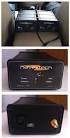
3 described in Section 3.1. After applying the post-processing described in Section 3.2 to the collected data, we used supervised learning methods to learn to predict the drone s drift. For our supervised learning, we tested two support vector machine (SVMs) libraries that support regression. The first algorithm we tested was the LibSVM algorithm [3] in the Shogun machine learning toolbox [2]. The second algorithm we tested is the SVM-Light regression algorithm [6] and obtained similar results. Our system only records and trains on drift in the horizontal plane. We trained each axis (defined as X and Y) separately, resulting in two separate trained systems. 3.1 Tracking System To collect ground truth data, we created a custom tracking system to track MAVs in the horizontal plane. This system uses an infrared LED on the drone, and a Nintendo Wii remote (connected to the computer though bluetooth) to track the MAV. During data collection, we record time, position from the Wii (in pixels), and 6 dimensions of data for prediction. This data comes from onboard sensors as well as the navigation computer of the MAV. To test our tracking system and to assist with data collection, we constructed a simple PD controller to center the drone in real-time. This system works well, and is demonstrated here: Figure 3: The tracking system developed to collect data for our project (Section 3.1). Left: The tracking hardware Right: MAV being tracked. 3
![The first algorithm we tested was the LibSVM algorithm [3] in the Shogun machine learning toolbox [2].](/docs-images/43/6044999/images/page_3.jpg "The second algorithm we tested is the SVM-Light regression algorithm [6] and obtained similar results. Our system only records and trains on drift in the horizontal plane.")
4 3.2 Training Data The training data we collected is divisible into three types: time, external data available from the tracking system, and onboard data available from the quadrotor. For training, we learn a mapping from the onboard data to the derivatives pixels per second in each of x and y computed using the time and the external data from the wii. During the testing or prediction phase, we predict the derivatives from the onborad data. The fields of data we collected, including all 6 dimensions of onboard data, are shown below: Data fields collected and used for training and prediction Time: time Wii tracking system: wii x, wii y, wii xd, wii yd, wii age, wii staleness Onboard data: altitude roll pitch yaw vx vy vz acc x acc y acc z controlstate vbat vphi trim vtheta trim vstate vmisc vdelta phi vdelta theta vdelta psi vbat raw ref theta ref phi ref theta I ref phi I ref pitch ref roll ref yaw ref psi rc ref pitch rc ref roll rc ref yaw rc ref gaz rc ref ag euler theta euler phi pwm motor1 pwm motor2 pwm motor3 pwm motor4 pwm sat motor1 pwm sat motor2 pwm sat motor3 pwm sat motor4 pwm u pitch pwm u roll pwm u yaw pwm yaw u I pwm u pitch planif pwm u roll planif pwm u yaw planif pwm current motor1 pwm current motor2 pwm current motor3 pwm current motor4 gyros offsetx gyros offsety gyros offsetz trim angular rates trim theta trim phi Over the course of this project, the following data points were collected: 11,934 hovering, 1,64 with a directional command, and 417 with gusts of wind, for a total of 13,991 data points. Plots of a few fields of data over five capture sessions is given in Figure 4. Once the data is collected and logged to a file, we run post-processing to make it more suitable for digestion by the learning algorithms. First, we remove all duplicate entries and stale entries caused by network delays, then we compute the position derivatives (velocities) in pixels per second for both the X and Y directions, and it is this data that we learn on. Figure 5 shows the singular values of the data before and after normalization, to give an idea how many dimensions of information are present in the data. 4

5 x 1 9 time wii_age 4 2 yaw acc_y wii_x wii_staleness vx acc_z wii_y altitude 9 8 vy wii_xd roll vz wii_yd pitch 2 1 acc_x Figure 4: Some of the data collected from five manual runs. The first plot is time, the next six are external data from the Wii tracking system, and the rest represent a fraction of the 6 dimensions of internal data from the quadrotor s sensors. Note that these graphs are not meant to be analyzed, but are presented merely as an example subset of the available features over time. 4 Results By training on data collected in the lab, we were able to predict quadrotor drift quite accurately. Figure 6 shows the actual drift velocity versus the drift velocity predicted by our learned model. The predictions are not perfect, but they do match the actual drift quite well, certainly much better than the null hypothesis of no drift at all. While Figure 6 shows results while hovering and drifting in normal indoor conditions, in Figure 7 we show results obtained by creating an artificially windy environment. We created this environment by waving a large board back and forth, buffeting the quadrotor. A model was then trained on a combination of windy and non-windy data and tested on other windy runs. As one can see in the figure, the quadrotor drifts significantly in one direction, and the prediction follows quite well. 5

6 1e7 Singular Values, not normalized Singular Values, normalized Figure 5: (left) Singular values of the 6 dimensional training data before normalization. (right) Singular values of the 6 dimensional training data after normalization. As one can see, the sensor data set is fairly rich, offering quite a few dimensions of non-covariant information. 5 Future Work Although our algorithm was able to accurately predict drift, we are still working on getting the prediction code to be fast enough to control the quadrotor in live flight. The SVM regression code runs quickly, but we re currently facing difficulties with delays due to I/O as well as a suboptimal configuration. We integrated and tested a complete feedback loop, but delays caused it to be unstable. 6 Conclusion We are making strong progress towards predicting and removing the quadrotor drift. The drift is predicted fairly accurately via a 6 dimensional sensor data vector from the quadrotor, and we hope to soon demonstrate a controller enhanced by the predicted drift. References [1] Cooper Bills, Yu-hin Joyce Chen and Ashutosh Saxena, Autonomous Vision-based MAV Flight in Common Indoor Environments, ICRA 211. (Submitted) [2] Soeren Sonnenburg, Gunnar Raetsch, Sebastian Henschel, Christian Widmer, Jonas Behr, Alexander Zien, Fabio de Bona, Alexander Binder, Christian Gehl, and Vojtech Franc. The SHOGUN Machine Learning Toolbox. Journal of Machine Learning Research, 11: , June 21. 6

7 [3] Chih-Chung Chang and Chih-Jen Lin, LIBSVM : a library for support vector machines, 21. Software available at cjlin/libsvm [4] Nicol, C.; Macnab, C.J.B. and Ramirez-Serrano, A. Robust neural network control of a quadrotor helicopter, CCECE 28. [5] Coza, C. and Macnab, C.J.B. A New Robust Adaptive-Fuzzy Control Method Applied to Quadrotor Helicopter Stabilization, NAFIPS 26. [6] T. Joachims, Making large-scale SVM Learning Practical. Advances in Kernel Methods - Support Vector Learning, B. Schlkopf and C. Burges and A. Smola (ed.), MIT-Press,
![[5] Coza, C. and Macnab, C.J.B. A New Robust Adaptive-Fuzzy Control Method Applied to Quadrotor Helicopter Stabilization, NAFIPS 26. [6] T.](/docs-images/43/6044999/images/page_7.jpg "Joachims, Making large-scale SVM Learning Practical. Advances in Kernel Methods - Support Vector Learning, B. Schlkopf and C. Burges and A.")
8 2 15 dec17 1 DataLog x 12 1 dec17 1 DataLog y 1 8 Velocity (pixels per second) 5 5 Velocity (pixels per second) Timestep Timestep 11 1 dec17 1 DataLog Y position (pixels) X position (pixels) Figure 6: Results for normal indoor conditions. Top left: predicted versus actual x drift at each timestep in pixels per second. Top right: predicted versus actual y drift at each timestep in pixels per second. Bottom: actual position versus position inferred from integrating predictions over time. 8

9 5 dec17 windplus 4 DataLog x 11 1 dec17 windplus 4 DataLog y 9 Velocity (pixels per second) 5 1 Velocity (pixels per second) Timestep Timestep 8 7 dec17 windplus 4 DataLog Y position (pixels) X position (pixels) Figure 7: Results for environment with artificial wind. This environment was created by waving a large board back and forth, blowing the quadrotor off to the side. The learned model was trained on a combination of windy and non-windy data and then tested on other windy runs. As one can see in the figure, the quadrotor drifts significantly in one direction, and the prediction follows quite well. Top left: predicted vs. actual x drift. Top right: predicted vs. actual y drift; Bottom: integrated position. 9

The Design and Implementation of a Quadrotor Flight Controller Using the QUEST Algorithm
 The Design and Implementation of a Quadrotor Flight Controller Using the QUEST Algorithm Jacob Oursland Department of Mathematics and Computer Science South Dakota School of Mines and Technology Rapid
fml The SHOGUN Machine Learning Toolbox (and its python interface)
 fml The SHOGUN Machine Learning Toolbox (and its python interface) Sören Sonnenburg 1,2, Gunnar Rätsch 2,Sebastian Henschel 2,Christian Widmer 2,Jonas Behr 2,Alexander Zien 2,Fabio de Bona 2,Alexander
CONTRIBUTIONS TO THE AUTOMATIC CONTROL OF AERIAL VEHICLES
 1 / 23 CONTRIBUTIONS TO THE AUTOMATIC CONTROL OF AERIAL VEHICLES MINH DUC HUA 1 1 INRIA Sophia Antipolis, AROBAS team I3S-CNRS Sophia Antipolis, CONDOR team Project ANR SCUAV Supervisors: Pascal MORIN,
CHAPTER 1 INTRODUCTION
 CHAPTER 1 INTRODUCTION 1.1 Background of the Research Agile and precise maneuverability of helicopters makes them useful for many critical tasks ranging from rescue and law enforcement task to inspection
An inertial haptic interface for robotic applications
 An inertial haptic interface for robotic applications Students: Andrea Cirillo Pasquale Cirillo Advisor: Ing. Salvatore Pirozzi Altera Innovate Italy Design Contest 2012 Objective Build a Low Cost Interface
SIVAQ. Manufacturing Status Review
 SIVAQ Manufacturing Status Review Project Overview 2 Mission Statement: Augment the capabilities of the Parrot AR Drone 2.0 such that it flies autonomously with a predetermined flight path, records data,
Search Taxonomy. Web Search. Search Engine Optimization. Information Retrieval
 Information Retrieval INFO 4300 / CS 4300! Retrieval models Older models» Boolean retrieval» Vector Space model Probabilistic Models» BM25» Language models Web search» Learning to Rank Search Taxonomy!
Control of a quadrotor UAV (slides prepared by M. Cognetti)
 Sapienza Università di Roma Corso di Laurea in Ingegneria Elettronica Corso di Fondamenti di Automatica Control of a quadrotor UAV (slides prepared by M. Cognetti) Unmanned Aerial Vehicles (UAVs) autonomous/semi-autonomous
ZMART Technical Report The International Aerial Robotics Competition 2014
 ZMART Technical Report The International Aerial Robotics Competition 2014 ZJU s Micro-Aerial Robotics Team (ZMART) 1 Zhejiang University, Hangzhou, Zhejiang Province, 310027, P.R.China Abstract The Zhejiang
Onboard electronics of UAVs
 AARMS Vol. 5, No. 2 (2006) 237 243 TECHNOLOGY Onboard electronics of UAVs ANTAL TURÓCZI, IMRE MAKKAY Department of Electronic Warfare, Miklós Zrínyi National Defence University, Budapest, Hungary Recent
Quadcopters. Presented by: Andrew Depriest
 Quadcopters Presented by: Andrew Depriest What is a quadcopter? Helicopter - uses rotors for lift and propulsion Quadcopter (aka quadrotor) - uses 4 rotors Parrot AR.Drone 2.0 History 1907 - Breguet-Richet
Comparing the Results of Support Vector Machines with Traditional Data Mining Algorithms
 Comparing the Results of Support Vector Machines with Traditional Data Mining Algorithms Scott Pion and Lutz Hamel Abstract This paper presents the results of a series of analyses performed on direct mail
Visual Servoing using Fuzzy Controllers on an Unmanned Aerial Vehicle
 Visual Servoing using Fuzzy Controllers on an Unmanned Aerial Vehicle Miguel A. Olivares-Méndez mig [email protected] Pascual Campoy Cervera [email protected] Iván Mondragón [email protected] Carol
VTOL UAV. Design of the On-Board Flight Control Electronics of an Unmanned Aerial Vehicle. Árvai László, ZMNE. Tavaszi Szél 2012 ÁRVAI LÁSZLÓ, ZMNE
 Design of the On-Board Flight Control Electronics of an Unmanned Aerial Vehicle Árvai László, ZMNE Contents Fejezet Témakör 1. Features of On-Board Electronics 2. Modularity 3. Functional block schematics,
Basic Principles of Inertial Navigation. Seminar on inertial navigation systems Tampere University of Technology
 Basic Principles of Inertial Navigation Seminar on inertial navigation systems Tampere University of Technology 1 The five basic forms of navigation Pilotage, which essentially relies on recognizing landmarks
Early defect identification of semiconductor processes using machine learning
 STANFORD UNIVERISTY MACHINE LEARNING CS229 Early defect identification of semiconductor processes using machine learning Friday, December 16, 2011 Authors: Saul ROSA Anton VLADIMIROV Professor: Dr. Andrew
Automatic Labeling of Lane Markings for Autonomous Vehicles
 Automatic Labeling of Lane Markings for Autonomous Vehicles Jeffrey Kiske Stanford University 450 Serra Mall, Stanford, CA 94305 [email protected] 1. Introduction As autonomous vehicles become more popular,
Multiple Network Marketing coordination Model
 REPORT DOCUMENTATION PAGE Form Approved OMB No. 0704-0188 The public reporting burden for this collection of information is estimated to average 1 hour per response, including the time for reviewing instructions,
Developer Guide SDK 2.0
 Developer Guide SDK 2.0 2 Prepared Stephane Piskorski Nicolas Brulez Pierre Eline Frederic D Haeyer Title AR.Drone Developer Guide Approved Date Revision File December 19, 2012 SDK 2.0 Notations used in
Mobile Robot FastSLAM with Xbox Kinect
 Mobile Robot FastSLAM with Xbox Kinect Design Team Taylor Apgar, Sean Suri, Xiangdong Xi Design Advisor Prof. Greg Kowalski Abstract Mapping is an interesting and difficult problem in robotics. In order
Maximizing Precision of Hit Predictions in Baseball
 Maximizing Precision of Hit Predictions in Baseball Jason Clavelli [email protected] Joel Gottsegen [email protected] December 13, 2013 Introduction In recent years, there has been increasing interest
AVIONICS SYSTEM FOR A SMALL UNMANNED HELICOPTER PERFORMING AGRESSIVE MANEUVERS
 AVIONICS SYSTEM FOR A SMALL UNMANNED HELICOPTER PERFORMING AGRESSIVE MANEUVERS V. Gavrilets 1, A. Shterenberg 2, M. A. Dahleh 3, E. Feron 4, M.I.T., Cambridge, MA Abstract: An Xcell-60 5 ft rotor diameter
Quadcopter control using Android based sensing
 Quadcopter control using Android based sensing AUGUST BJÄLEMARK Lund University Department of Automatic Control Ole Römers väg 1, SE 223 63, Lund SWEDEN [email protected] HANNES BERGKVIST Lund University
2. Dynamics, Control and Trajectory Following
 2. Dynamics, Control and Trajectory Following This module Flying vehicles: how do they work? Quick refresher on aircraft dynamics with reference to the magical flying space potato How I learned to stop
Control of a Quadrotor Helicopter Using Visual Feedback
 Control of a Quadrotor Helicopter Using Visual Feedback Erdinc Altu~*, James P. Ostrowski*, Robert Mahony** *GRASP Lab. University of Pennsylvania, Philadelphia, PA 1914, USA **Dep. of Eng., Australian
Tracking of Small Unmanned Aerial Vehicles
 Tracking of Small Unmanned Aerial Vehicles Steven Krukowski Adrien Perkins Aeronautics and Astronautics Stanford University Stanford, CA 94305 Email: [email protected] Aeronautics and Astronautics Stanford
Hardware In The Loop Simulator in UAV Rapid Development Life Cycle
 Hardware In The Loop Simulator in UAV Rapid Development Life Cycle Widyawardana Adiprawita*, Adang Suwandi Ahmad = and Jaka Semibiring + *School of Electric Engineering and Informatics Institut Teknologi
Automating ROV Operations in aid of the Oil & Gas Offshore Industry
 Automating ROV Operations in aid of the Oil & Gas Offshore Industry Ioseba Tena SeeByte Whitepaper August 2011 Context The Remotely Operated Vehicle has been instrumental in the development of subsea fields.
Intelligent Submersible Manipulator-Robot, Design, Modeling, Simulation and Motion Optimization for Maritime Robotic Research
 20th International Congress on Modelling and Simulation, Adelaide, Australia, 1 6 December 2013 www.mssanz.org.au/modsim2013 Intelligent Submersible Manipulator-Robot, Design, Modeling, Simulation and
Whitepaper. Image stabilization improving camera usability
 Whitepaper Image stabilization improving camera usability Table of contents 1. Introduction 3 2. Vibration Impact on Video Output 3 3. Image Stabilization Techniques 3 3.1 Optical Image Stabilization 3
MP2128 3X MicroPilot's. Triple Redundant UAV Autopilot
 MP2128 3X MicroPilot's Triple Redundant UAV Autopilot Triple redundancy (3X) gives autopilot technology the reliability necessary to safely carry out sensitive flight missions and transport valuable payloads.
How To Control Gimbal
 Tarot 2-Axis Brushless Gimbal for Gopro User Manual V1.0 1. Introduction Tarot T-2D gimbal is designed for the Gopro Hero3, which is widely used in film, television productions, advertising aerial photography,
Ar Drone Controller Version 1.6.0 and above
 Ar Drone Controller Version 1.6.0 and above Getting started Menu Introduction Prerequisites Main screen 3.1 Menu 3.2 Toolbar Settings Keyboard configuration Joystick configuration RTH Return to home Wifi
Waypoint. Best-in-Class GNSS and GNSS+INS Processing Software
 Waypoint Best-in-Class GNSS and GNSS+INS Processing Software Waypoint Exceptional Post-Processing Software Enhance your GNSS Position, Velocity and Attitude Accuracy For applications requiring highly
A highly integrated UAV avionics system 8 Fourth Street PO Box 1500 Hood River, OR 97031 (541) 387-2120 phone (541) 387-2030 fax CCT@gorge.
 A highly integrated UAV avionics system 8 Fourth Street PO Box 1500 Hood River, OR 97031 (541) 387-2120 phone (541) 387-2030 fax [email protected] Bill Vaglienti Ross Hoag April 10, 2003 Table of contents
Quadcopter Dynamics, Simulation, and Control Introduction
 Quadcopter Dynamics, Simulation, and Control Introduction A helicopter is a flying vehicle which uses rapidly spinning rotors to push air downwards, thus creating a thrust force keeping the helicopter
Apogee Series. > > Motion Compensation and Data Georeferencing. > > Smooth Workflow. Mobile Mapping. > > Precise Trajectory and Direct Georeferencing
 Ultimate accuracy MEMS Apogee Series Inertial Navigation System Motion Sensing and Georeferencing > INS > MRU > AHRS ITAR free 0,005 RMS Apogee Series High quality, high accuracy Hydrography > > Motion
Sensor Fusion Mobile Platform Challenges and Future Directions Jim Steele VP of Engineering, Sensor Platforms, Inc.
 Sensor Fusion Mobile Platform Challenges and Future Directions Jim Steele VP of Engineering, Sensor Platforms, Inc. Copyright Khronos Group 2012 Page 104 Copyright Khronos Group 2012 Page 105 How Many
Research Methodology Part III: Thesis Proposal. Dr. Tarek A. Tutunji Mechatronics Engineering Department Philadelphia University - Jordan
 Research Methodology Part III: Thesis Proposal Dr. Tarek A. Tutunji Mechatronics Engineering Department Philadelphia University - Jordan Outline Thesis Phases Thesis Proposal Sections Thesis Flow Chart
Design-Simulation-Optimization Package for a Generic 6-DOF Manipulator with a Spherical Wrist
 Design-Simulation-Optimization Package for a Generic 6-DOF Manipulator with a Spherical Wrist MHER GRIGORIAN, TAREK SOBH Department of Computer Science and Engineering, U. of Bridgeport, USA ABSTRACT Robot
FRC WPI Robotics Library Overview
 FRC WPI Robotics Library Overview Contents 1.1 Introduction 1.2 RobotDrive 1.3 Sensors 1.4 Actuators 1.5 I/O 1.6 Driver Station 1.7 Compressor 1.8 Camera 1.9 Utilities 1.10 Conclusion Introduction In this
General aviation & Business System Level Applications and Requirements Electrical Technologies for the Aviation of the Future Europe-Japan Symposium
 General aviation & Business System Level Applications and Requirements Electrical Technologies for the Aviation of the Future Europe-Japan Symposium 26 March 2015 2015 MITSUBISHI HEAVY INDUSTRIES, LTD.
Development of Knowledge-Based Software for UAV Autopilot Design
 Development of Knowledge-Based Software for UAV Autopilot Design George Tarrant Director CLOSED LOOP SYSTEMS Health Warning Autopilot design is a technical subject. In this paper, I have tried to translate
Flight Controller. Mini Fun Fly
 Flight Controller Mini Fun Fly Create by AbuseMarK 0 Mini FunFly Flight Controller Naze ( Introduction 6x6mm. 6 grams (no headers, 8 grams with). 000 degrees/second -axis MEMS gyro. auto-level capable
SIMULATION AND CONTROL OF A QUADROTOR UNMANNED AERIAL VEHICLE
 University of Kentucky UKnowledge University of Kentucky Master's Theses Graduate School 2011 SIMULATION AND CONTROL OF A QUADROTOR UNMANNED AERIAL VEHICLE Michael David Schmidt University of Kentucky,
Classifying Manipulation Primitives from Visual Data
 Classifying Manipulation Primitives from Visual Data Sandy Huang and Dylan Hadfield-Menell Abstract One approach to learning from demonstrations in robotics is to make use of a classifier to predict if
Knowledge Discovery from patents using KMX Text Analytics
 Knowledge Discovery from patents using KMX Text Analytics Dr. Anton Heijs [email protected] Treparel Abstract In this white paper we discuss how the KMX technology of Treparel can help searchers
sonobot autonomous hydrographic survey vehicle product information guide
 sonobot autonomous hydrographic survey vehicle product information guide EvoLogics Sonobot an autonomous unmanned surface vehicle for hydrographic surveys High Precision Differential GPS for high-accuracy
Local Gaussian Process Regression for Real Time Online Model Learning and Control
 Local Gaussian Process Regression for Real Time Online Model Learning and Control Duy Nguyen-Tuong Jan Peters Matthias Seeger Max Planck Institute for Biological Cybernetics Spemannstraße 38, 776 Tübingen,
Exploring Health-Enabled Mission Concepts in the Vehicle Swarm Technology Laboratory
 AIAA Infotech@Aerospace Conference andaiaa Unmanned...Unlimited Conference 6-9 April 9, Seattle, Washington AIAA 9-1918 Exploring Health-Enabled Mission Concepts in the Vehicle Swarm Technology
UAV Pose Estimation using POSIT Algorithm
 International Journal of Digital ontent Technology and its Applications. Volume 5, Number 4, April 211 UAV Pose Estimation using POSIT Algorithm *1 M. He, 2. Ratanasawanya, 3 M. Mehrandezh, 4 R. Paranjape
Design Specifications of an UAV for Environmental Monitoring, Safety, Video Surveillance, and Urban Security
 Design Specifications of an UAV for Environmental Monitoring, Safety, Video Surveillance, and Urban Security A. Alessandri, P. Bagnerini, M. Gaggero, M. Ghio, R. Martinelli University of Genoa - Faculty
Support Vector Machines with Clustering for Training with Very Large Datasets
 Support Vector Machines with Clustering for Training with Very Large Datasets Theodoros Evgeniou Technology Management INSEAD Bd de Constance, Fontainebleau 77300, France [email protected] Massimiliano
Robotics & Automation
 Robotics & Automation Levels: Grades 10-12 Units of Credit: 1.0 CIP Code: 21.0117 Core Code: 38-01-00-00-130 Prerequisite: None Skill Test: 612 COURSE DESCRIPTION Robotics & Automation is a lab-based,
NONLINEAR TIME SERIES ANALYSIS
 NONLINEAR TIME SERIES ANALYSIS HOLGER KANTZ AND THOMAS SCHREIBER Max Planck Institute for the Physics of Complex Sy stems, Dresden I CAMBRIDGE UNIVERSITY PRESS Preface to the first edition pug e xi Preface
Motion tracking using Matlab, a Nintendo Wii Remote, and infrared LEDs.
 Motion tracking using Matlab, a Nintendo Wii Remote, and infrared LEDs. Dr W. Owen Brimijoin MRC Institute of Hearing Research (Scottish Section) Glasgow Royal Infirmary 16 Alexandra Parade Glasgow G31
Scalable Developments for Big Data Analytics in Remote Sensing
 Scalable Developments for Big Data Analytics in Remote Sensing Federated Systems and Data Division Research Group High Productivity Data Processing Dr.-Ing. Morris Riedel et al. Research Group Leader,
Online Tuning of Artificial Neural Networks for Induction Motor Control
 Online Tuning of Artificial Neural Networks for Induction Motor Control A THESIS Submitted by RAMA KRISHNA MAYIRI (M060156EE) In partial fulfillment of the requirements for the award of the Degree of MASTER
PID, LQR and LQR-PID on a Quadcopter Platform
 PID, LQR and LQR-PID on a Quadcopter Platform Lucas M. Argentim [email protected] Willian C. Rezende [email protected] Paulo E. Santos [email protected] Renato A. Aguiar [email protected]
Active Vibration Isolation of an Unbalanced Machine Spindle
 UCRL-CONF-206108 Active Vibration Isolation of an Unbalanced Machine Spindle D. J. Hopkins, P. Geraghty August 18, 2004 American Society of Precision Engineering Annual Conference Orlando, FL, United States
Simulation-based traffic management for autonomous and connected vehicles
 Simulation-based traffic management for autonomous and connected vehicles Paweł Gora Faculty of Mathematics, Informatics and Mechanics University of Warsaw ITS Kraków, 3-4.12.2015 Axioms Vehicles may communicate
Integration of Inertial Measurements with GNSS -NovAtel SPAN Architecture-
 Integration of Inertial Measurements with GNSS -NovAtel SPAN Architecture- Sandy Kennedy, Jason Hamilton NovAtel Inc., Canada Edgar v. Hinueber imar GmbH, Germany Symposium Gyro Technology, Stuttgart 9/25
MLPACK: A Scalable C++ Machine Learning Library
 MLPACK: A Scalable C++ Machine Learning Library Ryan R. Curtin [email protected] James R. Cline [email protected] Neil P. Slagle [email protected] Matthew L. Amidon [email protected] Alexander
Advantages of Auto-tuning for Servo-motors
 Advantages of for Servo-motors Executive summary The same way that 2 years ago computer science introduced plug and play, where devices would selfadjust to existing system hardware, industrial motion control
MSc in Autonomous Robotics Engineering University of York
 MSc in Autonomous Robotics Engineering University of York Practical Robotics Module 2015 A Mobile Robot Navigation System: Labs 1a, 1b, 2a, 2b. Associated lectures: Lecture 1 and lecture 2, given by Nick
T1-Fuzzy vs T2-Fuzzy Stabilize Quadrotor Hover with Payload Position Disturbance
 International Journal of Applied Engineering Research ISSN 0973-4562 Volume 9, Number 22 (2014) pp. 17883-17894 Research India Publications http://www.ripublication.com T1-Fuzzy vs T2-Fuzzy Stabilize Quadrotor
Experimental Results from TelOpTrak - Precision Indoor Tracking of Tele-operated UGVs
 Experimental Results from TelOpTrak - Precision Indoor Tracking of Tele-operated UGVs Johann Borenstein*, Adam Borrell, Russ Miller, David Thomas All authors are with the University of Michigan, Dept of
Statistics for BIG data
 Statistics for BIG data Statistics for Big Data: Are Statisticians Ready? Dennis Lin Department of Statistics The Pennsylvania State University John Jordan and Dennis K.J. Lin (ICSA-Bulletine 2014) Before
Lab 8 Notes Basic Aircraft Design Rules 6 Apr 06
 Lab 8 Notes Basic Aircraft Design Rules 6 Apr 06 Nomenclature x, y longitudinal, spanwise positions S reference area (wing area) b wing span c average wing chord ( = S/b ) AR wing aspect ratio C L lift
Goal driven planning and adaptivity for AUVs CAR06
 Goal driven planning and adaptivity for AUVs CAR06 GESMA : Location DGA/DET/GESMA 06/04/2006 Diapositive N 2 / 46 GESMA : Skills & Missions Mine warfare Robotics Underwater Warfare Environment Platform
Series: IDAM Servo Drive E Digital Motor Drive - DMD-078.12
 Series: IDAM Servo Drive E Digital Motor Drive - DMD-078.12 inside Integrated amplifiers for 8 single-phase motors, 4 two-phases motors or 4 three-phases motors or combinations of them in one device Position
Sensory-motor control scheme based on Kohonen Maps and AVITE model
 Sensory-motor control scheme based on Kohonen Maps and AVITE model Juan L. Pedreño-Molina, Antonio Guerrero-González, Oscar A. Florez-Giraldo, J. Molina-Vilaplana Technical University of Cartagena Department
Separation of Concerns in Component-based Robotics
 Separation of Concerns in Component-based Robotics Davide Brugali Università degli Studi di Bergamo, Italy Robot Control Architectures Typical functions implemented in software Acquiring and interpreting
A Reliability Point and Kalman Filter-based Vehicle Tracking Technique
 A Reliability Point and Kalman Filter-based Vehicle Tracing Technique Soo Siang Teoh and Thomas Bräunl Abstract This paper introduces a technique for tracing the movement of vehicles in consecutive video
Line Following and Ground Vehicle Tracking by an Autonomous Aerial Blimp
 Line Following and Ground Vehicle Tracking by an Autonomous Aerial Blimp David Jerónimo 1, Ricardo Alcácer 1, F. C. Alegria 2, Pedro U. Lima 3 Abstract In this paper we introduce an autonomous aerial blimp
Performance Test Results of an Integrated GPS/MEMS Inertial Navigation Package
 Performance Test Results of an Integrated GPS/MEMS Inertial Navigation Package Alison K. Brown and Yan Lu, NAVSYS Corporation BIOGRAPHY Alison Brown is the President and Chief Executive Officer of NAVSYS
Robotics. Lecture 3: Sensors. See course website http://www.doc.ic.ac.uk/~ajd/robotics/ for up to date information.
 Robotics Lecture 3: Sensors See course website http://www.doc.ic.ac.uk/~ajd/robotics/ for up to date information. Andrew Davison Department of Computing Imperial College London Review: Locomotion Practical
0 28 November 2011 N/A First Release of Manual 1 24 February 2012 Page 21 Error in FY31AP connection diagram corrected.
 Rev 1: 24 February 2012 FEIYU TECH FY31AP Autopilot System Installation & Operation Guide Guilin Feiyu Electronic Technology Co., Ltd Rm. B305, Innovation Building, Information Industry Park, Chaoyang
Solar Tracking Controller
 Solar Tracking Controller User Guide The solar tracking controller is an autonomous unit which, once configured, requires minimal interaction. The final tracking precision is largely dependent upon the
Lecture 8 : Dynamic Stability
 Lecture 8 : Dynamic Stability Or what happens to small disturbances about a trim condition 1.0 : Dynamic Stability Static stability refers to the tendency of the aircraft to counter a disturbance. Dynamic
Aerospace Information Technology Topics for Internships and Bachelor s and Master s Theses
 Aerospace Information Technology s for Internships and Bachelor s and Master s Theses Version Nov. 2014 The Chair of Aerospace Information Technology addresses several research topics in the area of: Avionic
Landing on a Moving Target using an Autonomous Helicopter
 Landing on a Moving Target using an Autonomous Helicopter Srikanth Saripalli and Gaurav S. Sukhatme Robotic Embedded Systems Laboratory Center for Robotics and Embedded Systems University of Southern California
PRODUCT DATASHEET. J1939 Vehicle Inertia Monitor. Advanced Vehicle Inertial Measurement and Vibration Monitoring Device. fleet-genius.
 PRODUCT DATASHEET fleet-genius.com J1939 Vehicle Inertia Monitor Advanced Vehicle Inertial Measurement and Vibration Monitoring Device Prova s J1939 Vehicle Inertia Monitor (VIM) formulates moving vehicle
CIS 536/636 Introduction to Computer Graphics. Kansas State University. CIS 536/636 Introduction to Computer Graphics
 2 Lecture Outline Animation 2 of 3: Rotations, Quaternions Dynamics & Kinematics William H. Hsu Department of Computing and Information Sciences, KSU KSOL course pages: http://bit.ly/hgvxlh / http://bit.ly/evizre
Design of a Quadrotor System for an Autonomous Indoor Exploration
 Design of a Quadrotor System for an Autonomous Indoor Exploration M. Ga bel, T. Kru ger and U. Bestmann University of Braunschweig Institute of Technology A BSTRACT of an autonomous indoor exploration.
MTi and MTx User Manual and Technical Documentation
 MTi and MTx User Manual and Technical Documentation Document MT0100P Revision G, March 2, 2006 Xsens Technologies B.V. Capitool 50 phone +31-(0)53-4836444 P.O. Box 545 fax +31-(0)53-4836445 7500 AM Enschede
Development of Automatic shooting and telemetry system for UAV photogrammetry INTRODUCTION
 Development of Automatic shooting and telemetry system for UAV photogrammetry Jinwoo PARK 1, Minseok KIM 1, Khin Mar Yee 1, Chuluong CHOI 1 1 Department of Spatial Information Engineering, Pukyong National