
Scatter Plot, Correlation, and Regression on the TI-83/84
|
|
|
- Dulcie Cole
- 10 years ago
- Views:
Transcription
1 Scatter Plot, Correlation, and Regression on the TI-83/84 Summary: When you have a set of (x,y) data points and want to find the best equation to describe them, you are performing a regression. This page shows you how to determine the strength of the association between your two variables (correlation coefficient), and how to find the line of best fit (least squares regression line). For an illustration of linear regression, we ll use the data given below in a table. The explanatory variable x is dial settings on a freezer, and the response variable y is temperature of the freezer. Contents: Step 0. Setup Step 1. Make the Scatter Plot Step 2. Perform the Regression Step 3. Display the Regression Line Step 4 (optional). Display the Residuals Step 0. Setup Set floating point mode, if you haven t already. Go to the home screen Turn on diagnostics with the [DiagnosticOn] command. [MODE] [ ] [ENTER] [2nd MODE makes QUIT] [CLEAR] [2nd 0 makes CATALOG] [x -1 ] Don t press the [ALPHA] key, because the CATALOG command has already put the calculator in alpha mode. Scroll down to DiagnosticOn and press [ENTER] twice. The calculator will remember these settings when you turn it off: next time you can start with Step 1.

2 Step 1. Make the Scatter Plot Before you even run a regression, you should first plot the points and see whether they seem to lie along a straight line. If the distribution is obviously not a straight line, don t do a linear regression. (Some other form of regression might still be appropriate, but that is outside the scope of this course.) Turn off other plots. Enter the numbers. Dial (x) Temp, F (y) Set up the scatter plot. [Y=] Cursor to each highlighted = sign or Plot number and press [ENTER] to deactivate. [STAT] [1] selects the list-edit screen. Cursor onto the label L1 at top of first column, then [CLEAR] [ENTER] erases the list. Enter the x values. Cursor onto the label L2 at top of second column, then [CLEAR] [ENTER] erases the list. Enter the y values. [2nd Y= makes STAT PLOT] [1] [ENTER] turns Plot 1 on. [ ] [ENTER] selects scatter plot. [ ] [2nd 1 makes L1] ties list 1 to the x axis. [ ] [2nd 2 makes L2] ties list 2 to the y axis. Plot the points. [ZOOM] [9] automatically adjusts the window frame to fit the data, but does not adjust the grid spacing. (optional) [WINDOW], set Xscl=1 and Yscl=5, then [GRAPH] to redisplay it. (Appropriate values of Xscl and Yscl may be different for other problems. Pick the values that make the graph look best to you.)
![) Turn off other plots. Enter the numbers. Dial (x) 0 2 3 5 6 Temp, F (y) 6 1 3 10 16 Set up the scatter plot. [Y=] Cursor to each highlighted = sign or Plot number and press [ENTER] to deactivate.](/docs-images/57/6006827/images/page_2.jpg "[STAT] [1] selects the list-edit screen. Cursor onto the label L1 at top of first column, then [CLEAR] [ENTER] erases the list. Enter the x values.")
3 Step 2. Perform the Regression Set up to calculate statistics. [STAT] [ ] [4] pastes LinReg(ax+b) to the home screen. [2nd 1 makes L1] [,] [2nd 2 makes L2] defines L1 as x values and L2 as y values. Set up to store regression equation. Make it so! [,] [VARS] [ ] [1] [1] pastes Y1 into the LinReg command. [ENTER] shows correlation and regression statistics and pastes the regression equation into Y1. Write down a (slope), b (y intercept), r (correlation coefficient; r * is our symbol). Round a and b to two more decimal places than your actual y values have; remember that final rounding should be done only at the end of calculations. Round r * to two decimal places unless it s very close to ±1 or to 0. a = 3.52 b = 6.46 r * = R² is the coefficient of determination. The closer it is to 1, the better a predictor is the regression equation. Another way to look at it is that in this case R² is about 98%, so 98% of the variation in y is associated with the variation in x. Statisticians say that R² tells you how much of the variation in y is explained by variation in x, but if you use that word remember that it means a numerical association, not necessarily a cause-and-effect explanation. Only linear regression will have a correlation coefficient r, but any type of regression will have a coefficient of determination R² that tells you how well the regression equation predicts y from the independent variable(s). (The calculator uses r², but most authors use R².)
![[ENTER] shows correlation and regression statistics and pastes the regression equation into Y1. Write down a (slope), b (y intercept), r (correlation coefficient; r * is our symbol).](/docs-images/57/6006827/images/page_3.jpg "Round a and b to two more decimal places than your actual y values have; remember that final rounding should be done only at the end of calculations.")
4 Step 3. Display the Regression Line Show line with original data points. [GRAPH] Step 4 (optional). Display the Residuals A plot of residuals can be helpful to show whether linear regression was the right choice. If the residuals are more or less evenly distributed above and below the axis and show no particular trend, you were probably right to choose linear regression. But if there is a trend, you have probably forced a linear regression on non-linear data. If your data points looked like they fit a straight line but the residuals show a trend, it probably means that you took data along a small part of a curve. The residuals are automatically calculated during the regression; all you have to do is plot them on the y axis against your existing x data. Make the residuals visible in the statistics editor. [STAT] [1] brings up the editor. Cursor to the column heading of [L3] and press [ 2nd DEL makes INS] to open up a new list. You see the NAME= indicator at the bottom of the screen, with the blinking A to indicate alpha mode.

5 Press [2nd STAT makes LIST], then scroll to RESID and press [ENTER]. The list of residuals appears. Turn off other plots. Set up the plot of residuals against the x data. Press [Y=]. Cursor to the highlighted = sign next to Y1 and press [ENTER]. Cursor to PLOT1 and press [ENTER]. Set up Plot 2 for the residuals. Press [2nd Y= makes STAT PLOT] [ ] [ENTER] [ENTER] to turn on Plot 2. Press [ ] [ENTER] to select a scatter plot. The x s are still in L1, so press [2nd 1 makes L1] [ ENTER]. In this plot, the y s will be the residuals: press [2nd STAT makes LIST], cursor to RESID, and press [ENTER] [ENTER]. Display the plot. [ZOOM] [9] displays the plot. Don t worry about the magnitude of the residuals, because [ZOOM] [9] adjusts the vertical scale so that the points take up the full screen. What you want to look at is whether there s a trend in the residuals. Here there is no trend, so you conclude that a linear regression was the right choice, as opposed to regression against some curve. (By the way, if you want to remove the residuals list from your statistics editor, just cursor to the column heading and press [DEL].)
![Press [ ] [ENTER] to select a scatter plot. The x s are still in L1, so press [2nd 1 makes L1] [ ENTER].](/docs-images/57/6006827/images/page_5.jpg "In this plot, the y s will be the residuals: press [2nd STAT makes LIST], cursor to RESID, and press [ENTER] [ENTER]. Display the plot. [ZOOM] [9] displays the plot.")
You buy a TV for $1000 and pay it off with $100 every week. The table below shows the amount of money you sll owe every week. Week 1 2 3 4 5 6 7 8 9
 Warm Up: You buy a TV for $1000 and pay it off with $100 every week. The table below shows the amount of money you sll owe every week Week 1 2 3 4 5 6 7 8 9 Money Owed 900 800 700 600 500 400 300 200 100
Academic Support Center. Using the TI-83/84+ Graphing Calculator PART II
 Academic Support Center Using the TI-83/84+ Graphing Calculator PART II Designed and Prepared by The Academic Support Center Revised June 2012 1 Using the Graphing Calculator (TI-83+ or TI-84+) Table of
Tutorial for the TI-89 Titanium Calculator
 SI Physics Tutorial for the TI-89 Titanium Calculator Using Scientific Notation on a TI-89 Titanium calculator From Home, press the Mode button, then scroll down to Exponential Format. Select Scientific.
Getting to know your TI-83
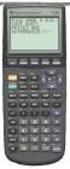 Calculator Activity Intro Getting to know your TI-83 Press ON to begin using calculator.to stop, press 2 nd ON. To darken the screen, press 2 nd alternately. To lighten the screen, press nd 2 alternately.
How Does My TI-84 Do That
 How Does My TI-84 Do That A guide to using the TI-84 for statistics Austin Peay State University Clarksville, Tennessee How Does My TI-84 Do That A guide to using the TI-84 for statistics Table of Contents
Copyright 2013 by Laura Schultz. All rights reserved. Page 1 of 7
 Using Your TI-83/84/89 Calculator: Linear Correlation and Regression Dr. Laura Schultz Statistics I This handout describes how to use your calculator for various linear correlation and regression applications.
Guide for Texas Instruments TI-83, TI-83 Plus, or TI-84 Plus Graphing Calculator
 Guide for Texas Instruments TI-83, TI-83 Plus, or TI-84 Plus Graphing Calculator This Guide is designed to offer step-by-step instruction for using your TI-83, TI-83 Plus, or TI-84 Plus graphing calculator
Pearson s Correlation Coefficient
 Pearson s Correlation Coefficient In this lesson, we will find a quantitative measure to describe the strength of a linear relationship (instead of using the terms strong or weak). A quantitative measure
LAYOUT OF THE KEYBOARD
 Dr. Charles Hofmann, LaSalle [email protected] Dr. Roseanne Hofmann, MCCC [email protected] ------------------------------------------------------------------------------------------------- DISPLAY CONTRAST
Exercise 1.12 (Pg. 22-23)
 Individuals: The objects that are described by a set of data. They may be people, animals, things, etc. (Also referred to as Cases or Records) Variables: The characteristics recorded about each individual.
2. Simple Linear Regression
 Research methods - II 3 2. Simple Linear Regression Simple linear regression is a technique in parametric statistics that is commonly used for analyzing mean response of a variable Y which changes according
Activity 5. Two Hot, Two Cold. Introduction. Equipment Required. Collecting the Data
 . Activity 5 Two Hot, Two Cold How do we measure temperatures? In almost all countries of the world, the Celsius scale (formerly called the centigrade scale) is used in everyday life and in science and
Using Excel (Microsoft Office 2007 Version) for Graphical Analysis of Data
 Using Excel (Microsoft Office 2007 Version) for Graphical Analysis of Data Introduction In several upcoming labs, a primary goal will be to determine the mathematical relationship between two variable
USING A TI-83 OR TI-84 SERIES GRAPHING CALCULATOR IN AN INTRODUCTORY STATISTICS CLASS
 USING A TI-83 OR TI-84 SERIES GRAPHING CALCULATOR IN AN INTRODUCTORY STATISTICS CLASS W. SCOTT STREET, IV DEPARTMENT OF STATISTICAL SCIENCES & OPERATIONS RESEARCH VIRGINIA COMMONWEALTH UNIVERSITY Table
Using Your TI-89 in Elementary Statistics
 Using Your TI-89 in Elementary Statistics Level of Handout: Target: Intermediate users of the TI-89. If you are a new user, pair up with someone in the class that is a bit familiar with the TI-89. You
Introduction to the Graphing Calculator
 Unit 0 Introduction to the Graphing Calculator Intermediate Algebra Update 2/06/06 Unit 0 Activity 1: Introduction to Computation on a Graphing Calculator Why: As technology becomes integrated into all
I. Turn it on: Press É
 Graphing Calculator Guide for the TI-83/84 Plus The following pages describe how to use the calculator to graph functions, use some of the matrix menu, use scientific notation, and other various keys.
Answer: C. The strength of a correlation does not change if units change by a linear transformation such as: Fahrenheit = 32 + (5/9) * Centigrade
 Statistics Quiz Correlation and Regression -- ANSWERS 1. Temperature and air pollution are known to be correlated. We collect data from two laboratories, in Boston and Montreal. Boston makes their measurements
Pre-Calculus Graphing Calculator Handbook
 Pre-Calculus Graphing Calculator Handbook I. Graphing Functions A. Button for Functions This button is used to enter any function to be graphed. You can enter up to 10 different functions at a time. Use
Absorbance Spectrophotometry: Analysis of FD&C Red Food Dye #40 Calibration Curve Procedure
 Absorbance Spectrophotometry: Analysis of FD&C Red Food Dye #40 Calibration Curve Procedure Note: there is a second document that goes with this one! 2046 - Absorbance Spectrophotometry. Make sure you
Univariate Regression
 Univariate Regression Correlation and Regression The regression line summarizes the linear relationship between 2 variables Correlation coefficient, r, measures strength of relationship: the closer r is
Straightening Data in a Scatterplot Selecting a Good Re-Expression Model
 Straightening Data in a Scatterplot Selecting a Good Re-Expression What Is All This Stuff? Here s what is included: Page 3: Graphs of the three main patterns of data points that the student is likely to
Years after 2000. US Student to Teacher Ratio 0 16.048 1 15.893 2 15.900 3 15.900 4 15.800 5 15.657 6 15.540
 To complete this technology assignment, you should already have created a scatter plot for your data on your calculator and/or in Excel. You could do this with any two columns of data, but for demonstration
Chapter 23. Inferences for Regression
 Chapter 23. Inferences for Regression Topics covered in this chapter: Simple Linear Regression Simple Linear Regression Example 23.1: Crying and IQ The Problem: Infants who cry easily may be more easily
MULTIPLE CHOICE. Choose the one alternative that best completes the statement or answers the question.
 Module 7 Test Name MULTIPLE CHOICE. Choose the one alternative that best completes the statement or answers the question. You are given information about a straight line. Use two points to graph the equation.
price quantity q The Supply Function price quantity q
 Shown below is another demand function for price of a pizza p as a function of the quantity of pizzas sold per week. This function models the behavior of consumers with respect to price and quantity. 3
Correlation. What Is Correlation? Perfect Correlation. Perfect Correlation. Greg C Elvers
 Correlation Greg C Elvers What Is Correlation? Correlation is a descriptive statistic that tells you if two variables are related to each other E.g. Is your related to how much you study? When two variables
Lesson 3.2.1 Using Lines to Make Predictions
 STATWAY INSTRUCTOR NOTES i INSTRUCTOR SPECIFIC MATERIAL IS INDENTED AND APPEARS IN GREY ESTIMATED TIME 50 minutes MATERIALS REQUIRED Overhead or electronic display of scatterplots in lesson BRIEF DESCRIPTION
Regression and Correlation
 Regression and Correlation Topics Covered: Dependent and independent variables. Scatter diagram. Correlation coefficient. Linear Regression line. by Dr.I.Namestnikova 1 Introduction Regression analysis
Introductory Handbook for the TI-89 Titanium
 Introductory Handbook for the TI-89 Titanium Note: This handbook will, for the most part, work for the standard TI-89 as well. The color-coding used on the TI-89 differs from the color-coding used on the
Chapter Table & Graph
 Chapter Table & Graph The Table & Graph menu makes it possible to generate numeric tables from functions stored in memory. You can also use multiple functions to generate tables. Since Table & Graph uses
AP Physics 1 and 2 Lab Investigations
 AP Physics 1 and 2 Lab Investigations Student Guide to Data Analysis New York, NY. College Board, Advanced Placement, Advanced Placement Program, AP, AP Central, and the acorn logo are registered trademarks
Copyright 2007 by Laura Schultz. All rights reserved. Page 1 of 5
 Using Your TI-83/84 Calculator: Linear Correlation and Regression Elementary Statistics Dr. Laura Schultz This handout describes how to use your calculator for various linear correlation and regression
Calculator Notes for the TI-89, TI-92 Plus, and Voyage 200
 CHAPTER 1 Note 1A Reentry Calculator Notes for the TI-89, TI-92 Plus, and Voyage 200 If you want to do further calculation on a result you ve just found, and that result is the first number in the expression
CHAPTER 13 SIMPLE LINEAR REGRESSION. Opening Example. Simple Regression. Linear Regression
 Opening Example CHAPTER 13 SIMPLE LINEAR REGREION SIMPLE LINEAR REGREION! Simple Regression! Linear Regression Simple Regression Definition A regression model is a mathematical equation that descries the
Activity 6 Graphing Linear Equations
 Activity 6 Graphing Linear Equations TEACHER NOTES Topic Area: Algebra NCTM Standard: Represent and analyze mathematical situations and structures using algebraic symbols Objective: The student will be
0 Introduction to Data Analysis Using an Excel Spreadsheet
 Experiment 0 Introduction to Data Analysis Using an Excel Spreadsheet I. Purpose The purpose of this introductory lab is to teach you a few basic things about how to use an EXCEL 2010 spreadsheet to do
Dealing with Data in Excel 2010
 Dealing with Data in Excel 2010 Excel provides the ability to do computations and graphing of data. Here we provide the basics and some advanced capabilities available in Excel that are useful for dealing
Data Mining Part 5. Prediction
 Data Mining Part 5. Prediction 5.7 Spring 2010 Instructor: Dr. Masoud Yaghini Outline Introduction Linear Regression Other Regression Models References Introduction Introduction Numerical prediction is
How Many Drivers? Investigating the Slope-Intercept Form of a Line
 . Activity 1 How Many Drivers? Investigating the Slope-Intercept Form of a Line Any line can be expressed in the form y = mx + b. This form is named the slopeintercept form. In this activity, you will
Chapter 10. Key Ideas Correlation, Correlation Coefficient (r),
 Chapter 0 Key Ideas Correlation, Correlation Coefficient (r), Section 0-: Overview We have already explored the basics of describing single variable data sets. However, when two quantitative variables
TIME SERIES ANALYSIS & FORECASTING
 CHAPTER 19 TIME SERIES ANALYSIS & FORECASTING Basic Concepts 1. Time Series Analysis BASIC CONCEPTS AND FORMULA The term Time Series means a set of observations concurring any activity against different
The importance of graphing the data: Anscombe s regression examples
 The importance of graphing the data: Anscombe s regression examples Bruce Weaver Northern Health Research Conference Nipissing University, North Bay May 30-31, 2008 B. Weaver, NHRC 2008 1 The Objective
NCSS Statistical Software Principal Components Regression. In ordinary least squares, the regression coefficients are estimated using the formula ( )
 Chapter 340 Principal Components Regression Introduction is a technique for analyzing multiple regression data that suffer from multicollinearity. When multicollinearity occurs, least squares estimates
Tutorial on Using Excel Solver to Analyze Spin-Lattice Relaxation Time Data
 Tutorial on Using Excel Solver to Analyze Spin-Lattice Relaxation Time Data In the measurement of the Spin-Lattice Relaxation time T 1, a 180 o pulse is followed after a delay time of t with a 90 o pulse,
Simple Regression Theory II 2010 Samuel L. Baker
 SIMPLE REGRESSION THEORY II 1 Simple Regression Theory II 2010 Samuel L. Baker Assessing how good the regression equation is likely to be Assignment 1A gets into drawing inferences about how close the
Example: Boats and Manatees
 Figure 9-6 Example: Boats and Manatees Slide 1 Given the sample data in Table 9-1, find the value of the linear correlation coefficient r, then refer to Table A-6 to determine whether there is a significant
DATA HANDLING AND ANALYSIS ON THE TI-82 AND TI-83/83 PLUS GRAPHING CALCULATORS:
 DATA HANDLING AND ANALYSIS ON THE TI-82 AND TI-83/83 PLUS GRAPHING CALCULATORS: A RESOURCE FOR SCIENCE AND MATHEMATICS STUDENTS John L. McClure Scott A. Sinex Barbara A. Gage Prince George s Community
Graphing Calculator Workshops
 Graphing Calculator Workshops For the TI-83/84 Classic Operating System & For the TI-84 New Operating System (MathPrint) LEARNING CENTER Overview Workshop I Learn the general layout of the calculator Graphing
A Guide to Using Excel in Physics Lab
 A Guide to Using Excel in Physics Lab Excel has the potential to be a very useful program that will save you lots of time. Excel is especially useful for making repetitious calculations on large data sets.
EXCEL Tutorial: How to use EXCEL for Graphs and Calculations.
 EXCEL Tutorial: How to use EXCEL for Graphs and Calculations. Excel is powerful tool and can make your life easier if you are proficient in using it. You will need to use Excel to complete most of your
Correlation key concepts:
 CORRELATION Correlation key concepts: Types of correlation Methods of studying correlation a) Scatter diagram b) Karl pearson s coefficient of correlation c) Spearman s Rank correlation coefficient d)
Getting Correct Results from PROC REG
 Getting Correct Results from PROC REG Nathaniel Derby, Statis Pro Data Analytics, Seattle, WA ABSTRACT PROC REG, SAS s implementation of linear regression, is often used to fit a line without checking
The Big Picture. Correlation. Scatter Plots. Data
 The Big Picture Correlation Bret Hanlon and Bret Larget Department of Statistics Universit of Wisconsin Madison December 6, We have just completed a length series of lectures on ANOVA where we considered
Engineering Problem Solving and Excel. EGN 1006 Introduction to Engineering
 Engineering Problem Solving and Excel EGN 1006 Introduction to Engineering Mathematical Solution Procedures Commonly Used in Engineering Analysis Data Analysis Techniques (Statistics) Curve Fitting techniques
Estimating a market model: Step-by-step Prepared by Pamela Peterson Drake Florida Atlantic University
 Estimating a market model: Step-by-step Prepared by Pamela Peterson Drake Florida Atlantic University The purpose of this document is to guide you through the process of estimating a market model for the
GeoGebra Statistics and Probability
 GeoGebra Statistics and Probability Project Maths Development Team 2013 www.projectmaths.ie Page 1 of 24 Index Activity Topic Page 1 Introduction GeoGebra Statistics 3 2 To calculate the Sum, Mean, Count,
Lecture 11: Chapter 5, Section 3 Relationships between Two Quantitative Variables; Correlation
 Lecture 11: Chapter 5, Section 3 Relationships between Two Quantitative Variables; Correlation Display and Summarize Correlation for Direction and Strength Properties of Correlation Regression Line Cengage
2013 MBA Jump Start Program. Statistics Module Part 3
 2013 MBA Jump Start Program Module 1: Statistics Thomas Gilbert Part 3 Statistics Module Part 3 Hypothesis Testing (Inference) Regressions 2 1 Making an Investment Decision A researcher in your firm just
WEB APPENDIX. Calculating Beta Coefficients. b Beta Rise Run Y 7.1 1 8.92 X 10.0 0.0 16.0 10.0 1.6
 WEB APPENDIX 8A Calculating Beta Coefficients The CAPM is an ex ante model, which means that all of the variables represent before-thefact, expected values. In particular, the beta coefficient used in
Session 7 Bivariate Data and Analysis
 Session 7 Bivariate Data and Analysis Key Terms for This Session Previously Introduced mean standard deviation New in This Session association bivariate analysis contingency table co-variation least squares
2 Describing, Exploring, and
 2 Describing, Exploring, and Comparing Data This chapter introduces the graphical plotting and summary statistics capabilities of the TI- 83 Plus. First row keys like \ R (67$73/276 are used to obtain
Using Microsoft Excel to Plot and Analyze Kinetic Data
 Entering and Formatting Data Using Microsoft Excel to Plot and Analyze Kinetic Data Open Excel. Set up the spreadsheet page (Sheet 1) so that anyone who reads it will understand the page (Figure 1). Type
 T O P I C 1 2 Techniques and tools for data analysis Preview Introduction In chapter 3 of Statistics In A Day different combinations of numbers and types of variables are presented. We go through these
Diagrams and Graphs of Statistical Data
 Diagrams and Graphs of Statistical Data One of the most effective and interesting alternative way in which a statistical data may be presented is through diagrams and graphs. There are several ways in
Using Excel for Statistical Analysis
 Using Excel for Statistical Analysis You don t have to have a fancy pants statistics package to do many statistical functions. Excel can perform several statistical tests and analyses. First, make sure
Tutorial 2: Using Excel in Data Analysis
 Tutorial 2: Using Excel in Data Analysis This tutorial guide addresses several issues particularly relevant in the context of the level 1 Physics lab sessions at Durham: organising your work sheet neatly,
Linear Regression. Chapter 5. Prediction via Regression Line Number of new birds and Percent returning. Least Squares
 Linear Regression Chapter 5 Regression Objective: To quantify the linear relationship between an explanatory variable (x) and response variable (y). We can then predict the average response for all subjects
Regression Analysis: A Complete Example
 Regression Analysis: A Complete Example This section works out an example that includes all the topics we have discussed so far in this chapter. A complete example of regression analysis. PhotoDisc, Inc./Getty
Acceleration of Gravity Lab Basic Version
 Acceleration of Gravity Lab Basic Version In this lab you will explore the motion of falling objects. As an object begins to fall, it moves faster and faster (its velocity increases) due to the acceleration
Grade level: secondary Subject: mathematics Time required: 45 to 90 minutes
 TI-Nspire Activity: Paint Can Dimensions By: Patsy Fagan and Angela Halsted Activity Overview Problem 1 explores the relationship between height and volume of a right cylinder, the height and surface area,
Curve Fitting in Microsoft Excel By William Lee
 Curve Fitting in Microsoft Excel By William Lee This document is here to guide you through the steps needed to do curve fitting in Microsoft Excel using the least-squares method. In mathematical equations
1) Write the following as an algebraic expression using x as the variable: Triple a number subtracted from the number
 1) Write the following as an algebraic expression using x as the variable: Triple a number subtracted from the number A. 3(x - x) B. x 3 x C. 3x - x D. x - 3x 2) Write the following as an algebraic expression
(Least Squares Investigation)
 (Least Squares Investigation) o Open a new sketch. Select Preferences under the Edit menu. Select the Text Tab at the top. Uncheck both boxes under the title Show Labels Automatically o Create two points
There are six different windows that can be opened when using SPSS. The following will give a description of each of them.
 SPSS Basics Tutorial 1: SPSS Windows There are six different windows that can be opened when using SPSS. The following will give a description of each of them. The Data Editor The Data Editor is a spreadsheet
XPost: Excel Workbooks for the Post-estimation Interpretation of Regression Models for Categorical Dependent Variables
 XPost: Excel Workbooks for the Post-estimation Interpretation of Regression Models for Categorical Dependent Variables Contents Simon Cheng [email protected] php.indiana.edu/~hscheng/ J. Scott Long [email protected]
Chapter 7: Simple linear regression Learning Objectives
 Chapter 7: Simple linear regression Learning Objectives Reading: Section 7.1 of OpenIntro Statistics Video: Correlation vs. causation, YouTube (2:19) Video: Intro to Linear Regression, YouTube (5:18) -
Simple Linear Regression, Scatterplots, and Bivariate Correlation
 1 Simple Linear Regression, Scatterplots, and Bivariate Correlation This section covers procedures for testing the association between two continuous variables using the SPSS Regression and Correlate analyses.
Describing Relationships between Two Variables
 Describing Relationships between Two Variables Up until now, we have dealt, for the most part, with just one variable at a time. This variable, when measured on many different subjects or objects, took
Course Objective This course is designed to give you a basic understanding of how to run regressions in SPSS.
 SPSS Regressions Social Science Research Lab American University, Washington, D.C. Web. www.american.edu/provost/ctrl/pclabs.cfm Tel. x3862 Email. [email protected] Course Objective This course is designed
DEPARTMENT OF PSYCHOLOGY UNIVERSITY OF LANCASTER MSC IN PSYCHOLOGICAL RESEARCH METHODS ANALYSING AND INTERPRETING DATA 2 PART 1 WEEK 9
 DEPARTMENT OF PSYCHOLOGY UNIVERSITY OF LANCASTER MSC IN PSYCHOLOGICAL RESEARCH METHODS ANALYSING AND INTERPRETING DATA 2 PART 1 WEEK 9 Analysis of covariance and multiple regression So far in this course,
Doing Multiple Regression with SPSS. In this case, we are interested in the Analyze options so we choose that menu. If gives us a number of choices:
 Doing Multiple Regression with SPSS Multiple Regression for Data Already in Data Editor Next we want to specify a multiple regression analysis for these data. The menu bar for SPSS offers several options:
Introduction to Regression and Data Analysis
 Statlab Workshop Introduction to Regression and Data Analysis with Dan Campbell and Sherlock Campbell October 28, 2008 I. The basics A. Types of variables Your variables may take several forms, and it
Chapter 4 Creating Charts and Graphs
 Calc Guide Chapter 4 OpenOffice.org Copyright This document is Copyright 2006 by its contributors as listed in the section titled Authors. You can distribute it and/or modify it under the terms of either
7.7 Solving Rational Equations
 Section 7.7 Solving Rational Equations 7 7.7 Solving Rational Equations When simplifying comple fractions in the previous section, we saw that multiplying both numerator and denominator by the appropriate
POLYNOMIAL AND MULTIPLE REGRESSION. Polynomial regression used to fit nonlinear (e.g. curvilinear) data into a least squares linear regression model.
 Polynomial Regression POLYNOMIAL AND MULTIPLE REGRESSION Polynomial regression used to fit nonlinear (e.g. curvilinear) data into a least squares linear regression model. It is a form of linear regression
DATA INTERPRETATION AND STATISTICS
 PholC60 September 001 DATA INTERPRETATION AND STATISTICS Books A easy and systematic introductory text is Essentials of Medical Statistics by Betty Kirkwood, published by Blackwell at about 14. DESCRIPTIVE
7.1 Graphs of Quadratic Functions in Vertex Form
 7.1 Graphs of Quadratic Functions in Vertex Form Quadratic Function in Vertex Form A quadratic function in vertex form is a function that can be written in the form f (x) = a(x! h) 2 + k where a is called
Quadratic Functions Applications
 Quadratic Functions Applications CA 8.0 Students solve and graph quadratic equations by using the quadratic formula. Students apply these techniques in solving word problems. Today you will be investigating/experiencing
The Correlation Coefficient
 The Correlation Coefficient Lelys Bravo de Guenni April 22nd, 2015 Outline The Correlation coefficient Positive Correlation Negative Correlation Properties of the Correlation Coefficient Non-linear association
(More Practice With Trend Forecasts)
 Stats for Strategy HOMEWORK 11 (Topic 11 Part 2) (revised Jan. 2016) DIRECTIONS/SUGGESTIONS You may conveniently write answers to Problems A and B within these directions. Some exercises include special
What does the number m in y = mx + b measure? To find out, suppose (x 1, y 1 ) and (x 2, y 2 ) are two points on the graph of y = mx + b.
 PRIMARY CONTENT MODULE Algebra - Linear Equations & Inequalities T-37/H-37 What does the number m in y = mx + b measure? To find out, suppose (x 1, y 1 ) and (x 2, y 2 ) are two points on the graph of
Plots, Curve-Fitting, and Data Modeling in Microsoft Excel
 Plots, Curve-Fitting, and Data Modeling in Microsoft Excel This handout offers some tips on making nice plots of data collected in your lab experiments, as well as instruction on how to use the built-in
Slope-Intercept Equation. Example
 1.4 Equations of Lines and Modeling Find the slope and the y intercept of a line given the equation y = mx + b, or f(x) = mx + b. Graph a linear equation using the slope and the y-intercept. Determine
LAGUARDIA COMMUNITY COLLEGE CITY UNIVERSITY OF NEW YORK DEPARTMENT OF MATHEMATICS, ENGINEERING, AND COMPUTER SCIENCE
 LAGUARDIA COMMUNITY COLLEGE CITY UNIVERSITY OF NEW YORK DEPARTMENT OF MATHEMATICS, ENGINEERING, AND COMPUTER SCIENCE MAT 119 STATISTICS AND ELEMENTARY ALGEBRA 5 Lecture Hours, 2 Lab Hours, 3 Credits Pre-