
your retirement benefits
|
|
|
- Nathaniel Joseph
- 10 years ago
- Views:
Transcription
1 NEW YORK STATE AND LOCAL POLICE AND FIRE RETIREMENT SYSTEM your retirement benefits New York State Office of the State Comptroller Thomas P. DiNapoli

2 NEW YORK STATE AND LOCAL POLICE AND FIRE RETIREMENT SYSTEM your retirement benefits New York State Office of the State Comptroller Thomas P. DiNapoli 1

3 table of contents A Message from State Comptroller Thomas P. DiNapoli... 3 Your Membership in the Retirement System... 5 Service Credit... 9 Final Average Salary Retirement Plans Preparing for Your Retirement Applying for Your Service Retirement Benefit After You Retire Disability Benefits Death Benefits Survivor s Benefit Program Your Obligations

4 A MESSAGE FROM STATE COMPTROLLER Thomas P. DiNapoli Dear Member: This book describes your New York State and Local Retirement System benefits and can be a valuable resource especially now, as you approach retirement. I want to make sure you thoroughly understand your benefits so you can successfully plan for retirement. We also offer other pre-retirement planning resources including: Individual member consultations on scheduled days at locations throughout the State, and every business day at our Albany office; An online Benefit Projection Calculator that enables most members to estimate what their pensions will be when they retire; Plan booklets and publications that outline and explain your benefits; Member Annual Statements explaining the status of your membership; and Formal benefit estimates for members within 18 months of retirement. In addition, you can find retirement-related information on our website at retire/index.php. I am joined by a staff of dedicated professionals in my commitment to help you make informed decisions about your future. I encourage you to contact us with any questions you have because we believe it is critical for you to plan for your tomorrows today. Sincerely, Thomas P. DiNapoli State Comptroller 3

5 This page intentionally left blank. 4

6 YOUR MEMBERSHIP IN THE retirement system As a public servant in New York State, and a member of one of the world s largest public pension systems, you are covered by a retirement plan that provides important benefits. Whether you have just joined or have been a member your entire career, it is important to know about those benefits. The New York State and Local Retirement System (NYSLRS) is a defined benefit plan. Your pension will be based on factors such as your tier, retirement plan, service credit, final average salary (FAS) and age at retirement. This publication explains your rights and obligations as a member. It clarifies the factors that affect your retirement benefits and provides you with comprehensive examples of how those benefits are determined. It also takes you step-by-step through the retirement process and provides information regarding a variety of post-retirement matters. Please contact us whenever you have questions about your benefits. 5

7 Contact Information Call Center (Toll-free) (Albany, New York area) Select Contact Us Mail New York State and Local Retirement System 110 State Street Albany, NY Fax Retirement Consultation Appointments are needed for individual consultations at all sites. However, with the exception of our New York City site, members do not need an appointment to drop off forms, pick up information or have something notarized. Our office hours are 8:30 am 4:30 pm in Albany; 9:00 am noon and 1:00 pm 4:00 pm at all other sites. All sites are closed on legal holidays. When visiting any of our sites, please bring photo identification and any recent Retirement System correspondence. If you require special accommodations to attend a consultation at any location, we will make a reasonable effort to meet your needs. Please contact our Call Center at least two weeks in advance of your visit. To schedule an appointment or for special accommodations, call us toll-free at , or in the Albany, New York area. 6

8 Consultation Site Offices City/ Village Address Monthly Visiting Days Albany 110 State St. Every Business Day Binghamton Buffalo Binghamton State Office Building 44 Hawley St., Room 606 Walter J. Mahoney State Office Building 65 Court St., Room 500 Every Tuesday Every Business Day Canton SUNY at Canton (off Route 68) Campus Center, 2nd Floor First Thursday Hauppauge 330 Motor Pkwy., Suite 107 Every Business Day Middletown New City New York City Plattsburgh Poughkeepsie Rochester Hudson Valley DDSO 42 Rykowski Ln. Sain Building 18 New Hempstead Rd. 59 Maiden Ln., 30th Floor Entrance located between William St. and Nassau St. County Center 1st Floor, County Clerk s Office 137 Margaret St. Eleanor Roosevelt State Office Building 4 Burnett Blvd. NYS DOT Building 1530 Jefferson Rd., Henrietta Second & Fourth Thursday First & Third Friday Every Tuesday & Wednesday First & Third Thursday Second & Fourth Friday Every Thursday Syracuse 620 Erie Blvd. West, Suite 113 Every Friday Utica Watertown White Plains Utica State Office Building 207 Genesee St., Ground Floor Jefferson County Human Services Building Lower Level Conference Room 250 Arsenal St. Clarence D. Rappleyea Building 123 Main St., 1st Floor First, Second, Third & Fourth Monday First Wednesday Every Wednesday NOTE: Always check our website ( for the most current consultation site schedule as locations and monthly visiting days can change. 7

9 Your Membership Tier Members are categorized into different groups or tiers based on their date of membership in the Retirement System. There are five tiers in the New York State and Local Police and Fire Retirement System (PFRS). Tier status determines the following, but is not limited to: Contribution requirements; Benefit eligibility; Service crediting; Formula used to calculate your final average salary; Loan provisions; Vesting requirements; Death benefit coverage; and Formula used to calculate your retirement benefit. You Are In: If You Joined: Tier 1 Before July 31, 1973 Tier 2 July 31, 1973 through June 30, 2009 Tier Reinstatement If you had a previous membership in this System, or any of the following public retirement systems, your service may be recredited and your date of membership and tier restored. However, an earlier tier of membership does not always result in a better benefit. Please contact us regarding this membership and the potential for reinstatement. New York State and Local Employees Retirement System New York State Teachers Retirement System New York City Employees Retirement System New York City Police Pension Fund New York City Teachers Retirement System New York City Board of Education Retirement System New York City Fire Department Pension Fund Tier 3 July 1, 2009 through January 8, 2010* Tier 5 January 9, 2010 through March 31, 2012 Tier 6 April 1, 2012 or after * PFRS members who joined July 1, 2009 through January 8, 2010, and did not elect to be covered by Article 22 (opt into Tier 5), can be covered by Article 11 or Article 14 benefits, depending on their retirement plan election. There is no Tier 4 in the New York State Police and Fire Retirement System. 8

10 service credit As a member, you earn service credit for your public employment while on the payroll of a participating employer in the Retirement System. Your service credit forms the basis for eligibility and/or the calculation of death benefits, vested rights, service retirement, disability retirement and member loans. Since your benefits are directly related to your service credit, it is important to make sure you have credit for all your allowable service. Members of the New York State and Local Police and Fire Retirement System whose employer has adopted one or more special plans should be aware that not all service in public employment is creditable under these plans. Please refer to the Retirement Plans section beginning on page 27 to determine the creditable service under your special plan. 9

11 Service Crediting The number of hours that constitute a standard workday is established by your employer. Generally, 260 workdays per year, as reported to us by your employer(s), constitute full-time credit. A full year of service credit is given for full-time service. Part-time service is generally prorated. Credit is not given for leaves of absence without pay or for any period of time you do not receive salary. There may be exceptions if you are on sick leave at half-pay or receiving Workers Compensation benefits. Vesting You are eligible for a vested retirement benefit if you leave public employment before retirement age and you have met the minimum service requirement. Tier 1, 2 and 3 members must have five years of credited member service. Tier 5 and 6 members must have ten years of service credit. When you reach retirement age, you will be entitled to a retirement benefit based on your service and earnings when you were an active member. The date you are eligible to retire depends on your tier: Tier 1 Tiers 2 and 3 (Article 11) covered by a regular retirement plan Tiers 2 and 3 (Article 11) covered by a special retirement plan Tier 3 (Article 14) Tier 5 covered by a regular retirement plan Tier 5 covered by a special retirement plan Full vested benefit as early as the first of the month following your 55th birthday. Full vested benefit at age 62. Early retirement with a reduced benefit as early as the first of the month following your 55th birthday. Full vested benefit at age 55. Full vested benefit at your early retirement age (the age at which you would have completed 20 years of service credit). Early retirement with a reduced benefit as early as the first of the month following your 55th birthday. Full vested benefit at age 62. Early retirement with a reduced benefit as early as the first of the month following your 55th birthday. Full vested benefit at age 55. Tier 6 Full vested benefit at age 63. To receive your vested benefit at the earliest possible date, file a retirement application within 90 days before your eligibility date. If we receive your retirement application after your eligibility date, your vested retirement will be effective on the date the application is received. Remember, it is up to you to file a retirement application when you become eligible and wish to receive your benefits. 10

12 Unused, Unpaid Sick Leave Section 341[j] of the Retirement and Social Security Law (RSSL) provides an optional sick leave benefit. If your employer has chosen to offer this benefit, you may receive service credit for your unused, unpaid sick leave days at retirement. To be eligible for this benefit, you must retire directly from public employment or within a year after separating from service. If applicable, up to 165 days (.63 of a year) of unused, unpaid sick leave may be credited. Members in certain negotiating units may have up to 200 days (.77 of a year) of unused, unpaid sick leave credited. Example: For a member whose full-time day is 8 hours # hours unused sick leave full-time hours per day = # days additional service credit Credit for your unused sick leave at retirement cannot be used to: Qualify for vesting. For example, if you have four years and ten months of service credit and you need five years to be vested, your sick leave credit cannot be used to reach the five years. Qualify for a better retirement benefit calculation. For example, if you have 19½ years of service credit but your pension will improve substantially if you have 20 years, your sick leave credit cannot be used to reach the 20 years. Increase your pension beyond the maximum amount payable under your retirement plan. Meet the service credit requirement to retire under a special 20- or 25-year plan hours 8 = 165 days additional service credit # days additional service credit 260 = additional service credit 165 days 260 =.63 of a year additional service credit 11

13 Credit For Your Past Service Legislative changes in 2000 allow for the crediting of most previous public employment. Some previous service, however, may not be creditable under certain plans and may not increase your retirement benefit (see page 14). These different types of service are: Prior Service Prior service is any period of time you received salary from a public employer before that employer elected to participate in the Retirement System. Service Before Your Date of Membership You may receive credit for working for a public employer in New York State before you joined the Retirement System (including CETA service with employers that participate in the Retirement System). Service From a Previous Membership If you previously were a member of this System, or another public retirement system in New York State, your service may be re-credited and your date of membership and tier changed. (See page 8.) Military Service You may be able to get retirement credit for military service you have had in the U.S. armed forces. There are many statutes (Retirement and Social Security Law, Military Law, Uniform Services Employment and Reemployment Rights Act of 1994, etc.) that dictate eligibility dates, circumstances, cost (to you and your employer) and maximum credit allowed. To find out if you qualify, please send us a copy of your Certificate of Release or Discharge from Active Duty, more commonly known as a DD-214. If you were discharged from the United States Army, Navy, Air Force, Marine Corps, National Guard or Coast Guard, but do not have your copy, request one by contacting the National Archives and Records Administration, the official repository for these records. The website for requesting this information is www. archives.gov/veterans/military-servicerecords. Or write them at: National Personnel Records Center Military Personnel Records 1 Archives Drive St. Louis, MO If your military records were destroyed in the 1973 fire at the National Personnel Records Center (NPRC), they will issue you a Certification of Military Service that we will also accept. Veterans who have been separated from active service, but have Reserve status, should contact the Reserve Component of the appropriate branch of service. Veterans currently in the National Guard should contact the Adjutant General s Office of New York State. Recently discharged National Guard members, in most cases, will not be able to get their military records from NPRC until six months after discharge because of required processing. For more information about getting credit for your military service, visit our Military Service Credit page or our Military Service Unit at [email protected]. 12

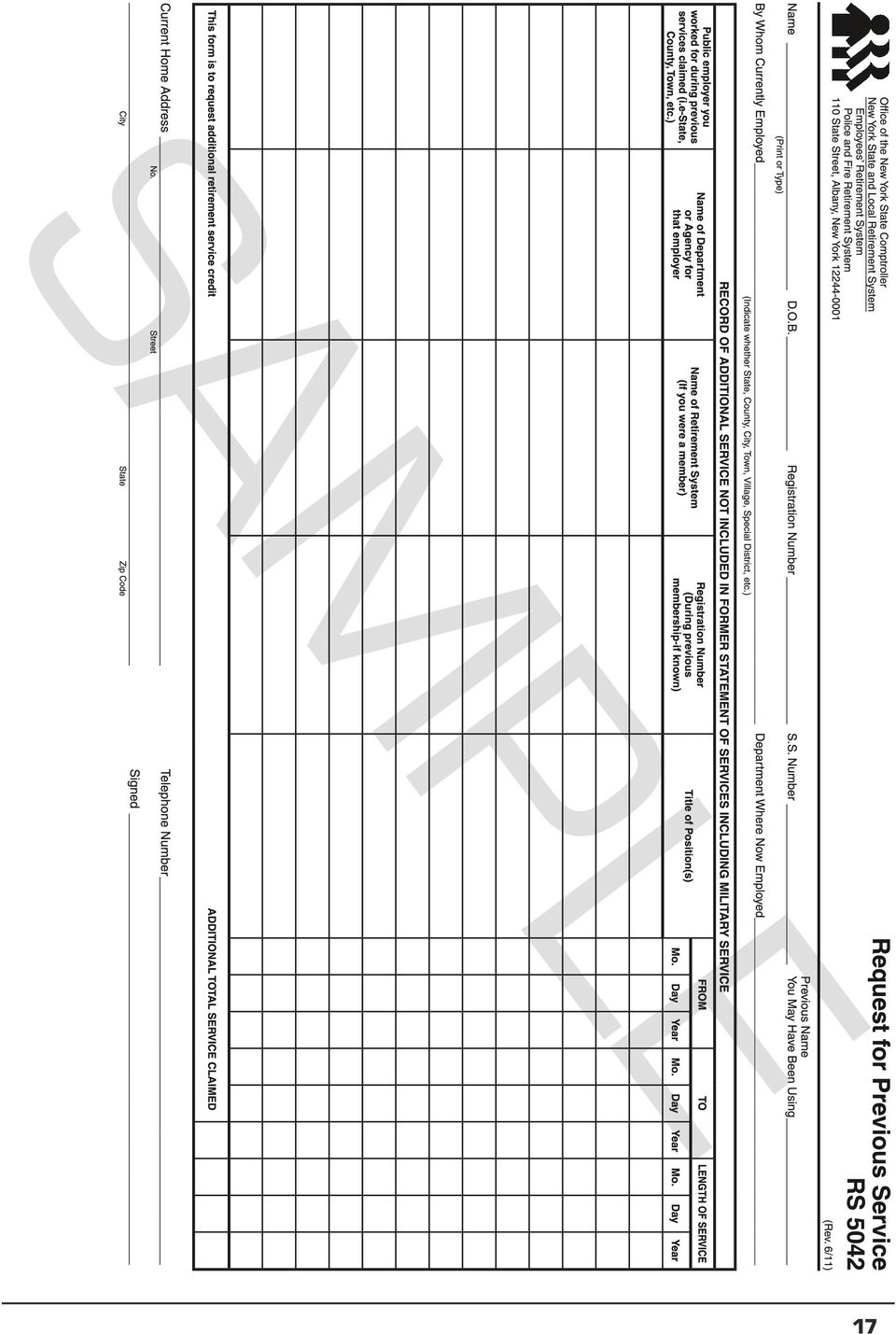
14 FAQs How do I know how much service I have been credited with? Most Tier 2, 3, 5 and 6 members can find their total service credit in their latest Member Annual Statement. Because Tier 1 members have service credit prior to the automation of our records, their Member Annual Statements generally do not include this information. If you are within 18 months of retirement eligibility, you can request an estimate of your retirement benefits by submitting the form, Request for Estimate (RS6030). The estimate will include your total allowable service credit under your retirement plan, projected to your anticipated retirement date. (See page 45 for more information.) How do I claim credit for my past service? You must send either a Request for Previous Service form (RS5042 see page 17) or a letter to our Arrears Unit that includes a full description of the service you are requesting. If you previously were a member of this System, or another public retirement system in New York State, your service may be recredited and your date of membership and tier restored. However, an earlier tier of membership does not always result in a better benefit. Please review your options carefully before making your decision, and contact us with any questions you may have. If you were in active military duty, send us a copy of your Certificate of Release or Discharge from Active Duty (DD-214) along with your written request. Requests for previous service credit should be mailed to: New York State and Local Retirement System Member & Employer Services Bureau Arrears Unit 110 State Street Albany, NY We will send you a letter indicating the amount of previous service credit you are eligible to receive and the cost, if applicable. NOTE: Even if you included information about past service on your membership application, you must still initiate the request to receive credit for it. Requesting credit well before you expect to retire allows us sufficient time to get salary and service records from your employer(s) and provides you with ample time to pay for it, if required. Also, Tier 2, 3, 5 and 6 members must have two years of service credit in their current membership before they can receive credit for previous service. If you are requesting credit for your military service, you may need at least five years of service credit in your current membership, depending on the eligibility requirements of the particular law governing the crediting of this service. If you are requesting previous service to establish eligibility for a vested retirement benefit, you must request credit while you are on the payroll of a participating employer. If you receive a statement of the cost after you leave the payroll, you must make payment within 30 days of notification. 13

15 What are past service payments? Past service payments are those associated with service crediting. There are two kinds of past service payments: Mandatory payments are required contributions for service after your membership date if you are covered by a contributory retirement plan (example: contributions for Tier 5 and 6 members). If no or insufficient contributions were made to the Retirement System, you may owe mandatory past service payments. In that case, we notify you of the amount due. You may make a single lump sum payment to cover the cost for this service, or you may request we notify your employer to begin payroll deductions to cover the cost. Optional payments are required to purchase your public employment prior to your membership date or for military service credit. Payment is optional. However, service is not credited until payment is made. NOTE: Purchasing credit for your previous service may not increase your pension. Please contact our Call Center if you have questions regarding the purchase of credit for previous service. Does crediting of past service change my tier status? If you have a previously withdrawn membership, your former date of membership may be reinstated and your tier status could change. For other previous service, the additional credit may increase your retirement benefit, but does not change your tier status or date of membership. Does crediting of past service always increase my retirement benefit? Many special plans do not allow for the use of service credit obtained in other types of public employment. For example, members of PFRS who request a tier reinstatement based on a previous Employees Retirement System (ERS) membership may be eligible to change their date of membership and, in some cases, their tier. However, the service credit obtained from the ERS membership would not be allowable, in most cases, under a PFRS special plan. Please review the information regarding allowable service for your retirement plan. Information on the various retirement plans is located on pages 27 through 42. Must I begin payment for my past service immediately? Except for mandatory past service payments, you may choose to purchase service at a later date. However, the cost will increase due to interest compounding annually at the rate of 5 percent to the date of payment. If you choose to purchase available military service at a later date, the cost will have to be recalculated if you do not pay the total amount due in a lump sum, or notify us of your intent to pay through payroll deduction within 30 days of the date your cost letter was mailed. 14

16 How can I pay for my past service? If there is a cost to secure credit for your past service, there are three ways you can make payment: 1. A single lump sum to cover the entire cost of the past service; 2. Through payroll deductions (you may supplement payroll deductions with additional payments if you choose to pay off the balance owed sooner); or 3. Through a trustee-to-trustee transfer from one of the allowable plans below (for optional service only). Individual Retirement Account - 408(a) - or - Individual Retirement Account - 408(b) 403(a) Annuity Plan 403(b) Tax-Sheltered Annuity Qualified Defined Benefit or Contribution Plan 401(a) or 401(k) Governmental Deferred Compensation Plan Transfers from Roth IRAs, inherited IRAs or inherited Roth IRAs are not permitted. NOTE: If you decide on payroll deductions, the time over which you make payments cannot exceed the total amount of service credit being purchased. For example, if you are purchasing three years of service credit, payroll deductions can be made for up to three years, or until your date of retirement, whichever comes first. At the time of retirement, the total cost must be paid in full or you will receive credit only for that part of your previous service that was paid for. 15

17 This page intentionally left blank. 16

18 17
19 This page intentionally left blank. 18

20 final average salary Your final average salary (FAS) is an important factor in the calculation of your retirement benefit. For all PFRS members in Tiers 1 through 5, FAS means the average of the three highest consecutive years of earnings in covered public employment. For Tier 6 members, it is the average of the five highest consecutive years of earnings. This is usually the last years of employment immediately before retirement. However, for some members, their highest consecutive period of earnings may have been earlier in their career.* The earnings used in the FAS calculation may be subject to certain limitations based on the date you joined the Retirement System. Some employers have also adopted an additional one-year FAS benefit for their employees. In this calculation, the last 12 months of regular compensation must be used. * Not always a calendar or fiscal year. 19

21 ONE-YEAR FINAL AVERAGE SALARY Sections 302(9)(d) and 443(f) If your employer has adopted this benefit, your retirement pension will be calculated using a one-year FAS, unless the three-year FAS provides a higher benefit. (This benefit is generally not available to Tier 6 members.) The one-year FAS includes only the regular compensation earned during the last 12 months preceding retirement. The calculation of a one-year FAS can include, but is not limited to, the following types of payments: Regular salary; Overtime;* Holiday pay; Compensatory overtime;* and Longevity payment. All payments must be earned in the 12 months immediately preceding retirement. The following types of payments are not considered regular compensation and will not be included in the one-year FAS calculation: Unused sick leave; Unused vacation; Payment made as a result of working your vacation; Termination pay; Payments made in anticipation of retirement; Lump sum payment for deferred compensation; and Payments made for time not worked. Limitations The earnings used in the calculation of the one-year FAS cannot exceed the earnings in the previous 12-month period by more than 20 percent. Any amount over 20 percent will be excluded from the calculation. Here s an example of a one-year FAS calculation: Actual Earnings Example: Limit Earnings Allowed Year 1: $106,100 $86, = $103,440 $103,440 Year 2: $86,200 Note: The earnings in Year 1 exceed the earnings of the previous 12 months by more than 20 percent. The one-year FAS would be $103,440. A three-year FAS would also be calculated and compared to the one-year FAS. The greater of the two calculations (usually the one-year FAS) would be used. * For Tier 5 members, the total amount of overtime and compensatory overtime that can be included in your FAS calculation is limited to 15 percent of your salary. 20
22 THREE-YEAR FINAL AVERAGE SALARY A three-year FAS is the average of the wages earned during any three consecutive years of service when earnings were highest. This is usually the last three years of employment. The following payments are included in a three-year FAS calculation (payments must be earned during the FAS period): Regular salary; Overtime;* Compensatory overtime;* Longevity; and Vacation (up to 30 days for Tier 1 members who joined prior to April 1, 1972, and Tier 3 Article 14 members if the FAS is based on the 36 months immediately preceding retirement). The following types of payments are not included in the three-year FAS calculation: Unused sick leave; Payment made as a result of working your vacation; Termination pay; Payments made in anticipation of retirement; Lump sum payment for deferred compensation; and Payments made for time not worked. Here is an example of a three-year FAS calculation for a member who joined prior to June 17, Members who joined prior to this date are not subject to earnings limitations. Earnings Example: Year 1: $ 106,100 Year 2: $ 86,200 Year 3: $ 84,300 $ 276,600 3 = $92,200 FAS * For Tier 5 members, the total amount of overtime and compensatory overtime that can be included in your FAS calculation is limited to 15 percent of your salary. 21
23 Limitations Tier 1 Members who joined prior to June 17, 1971, are not subject to earnings limitations. If your date of membership is June 17, 1971 or later, Example: Tier 1 member who joined on or after 6/17/71 Actual Earnings Limit Earnings Allowed Year 1: $ 106,100 $ 86, = $ 103,440 $ 103,440 Year 2: $ 86,200 $ 84, = $ 101,160 $ 86,200 Year 3: $ 84,300 $77, = $ 92,400 $ 84,300 Year 4: $ 77,000 a limitation may apply to the calculation of your FAS. The earnings in any one year of your FAS calculation cannot exceed the earnings of the previous 12 months by more than 20 percent. Earnings in excess of the 20 percent will be excluded from the calculation. $ 273,940 3 = $ 91,313 FAS Note: The earnings in Year 1 exceed the earnings in the previous year by more than 20 percent. The total allowable earnings for Year 1 are $103,440. A 20 percent increase from one year to another is unusual. Therefore, most Tier 1 members are not affected by this limitation. Tiers 2, 3 (Article 11) and 5 The earnings in any one year of your FAS calculation cannot exceed the average earnings of the previous two years by more than 20 percent. Earnings in excess of the 20 percent limitation will be excluded from the calculation. Additionally, for Tier 5 members, the amount of overtime compensation that can be included in your FAS is limited to 15 percent of your salary. Example: Tiers 2, 3 (Article 11) and 5 Actual Earnings Limit Earnings Allowed Year 1: $ 106,100 Year 2: $ 86,200 Year 3: $ 84,300 Year 4: $ 77,000 Year 5: $ 73,000 ($86,200 + $84,300) 2 ($84,300 + $77,000) 2 ($77,000 + $ 73,000) = $ 102,300 $ 102, = $ 96,780 $ 86, = $ 90,000 $ 84,300 $ 272,800 3 = $ 90,933 FAS Note: The earnings in Year 1 exceed the average earnings in the previous two years by more than 20 percent. The total allowable earnings for Year 1 are $102,
24 Tier 3 (Article 14) The earnings in any one year of your FAS calculation cannot exceed the average earnings of the previous two years by more than 10 percent. Earnings in excess of the 10 percent limitation will be excluded from the calculation. Example: Tier 3 (Article 14) Actual Earnings Limit Earnings Allowed Year 1: $ 106,100 ($86,200 + $84,300) = $ 93,775 $ 93,775 Year 2: $ 86,200 ($84,300 + $77,000) = $ 88,715 $ 86,200 Year 3: $ 84,300 ($77,000 + $ 73,000) = $ 82,500 $ 82,500 Year 4: $ 77,000 Year 5: $ 73,000 $ 262,475 3 = $ 87,492 FAS Note: The earnings in Years 1 and 3 exceed the average earnings in the previous two years by more than 10 percent. The total allowable earnings for Year 1 are $93,775 and for Year 3 are $82,
25 FIVE-YEAR FINAL AVERAGE SALARY A five-year FAS is the average of the wages earned during any five consecutive years of service when earnings were highest. This is usually the last five years of employment. The following payments are included in a five-year FAS calculation (payments must be earned during the FAS period): Regular salary; Overtime;* Compensatory overtime;* and Longevity The following types of payments are not included in the five-year FAS calculation: Unused sick leave; Vacation pay; Payment made as a result of working your vacation; Earned compensation which exceeds the Governor s annual salary (currently $179,000); Wages paid from more than two participating employers; Termination pay; Lump sum payment for deferred compensation; and Any payments made for time not worked. * For Tier 6 members, the total amount of overtime and compensatory overtime that can be included in the calculation of your FAS is limited to 15 percent of your salary. 24
26 Tier 6 Limitations The earnings in any one year of your FAS calculation cannot exceed the average earnings of the previous four years by more than 10 percent. Earnings in excess of the 10 percent limitation will be excluded from the calculation. Example: Tier 6 Actual Earnings Limit Earnings Allowed Year 1: $ 106,100 ($ 86,200 + $ 84,300 + $ 77,000 + $ 73,000) = $ 88,138 $ 88,138 Year 2: $ 86,200 ($ 84,300 + $77,000 + $73,000 + $ 70,000) = $ 83,683 $ 83,683 Year 3: $ 84,300 ($ 77,000 + $ 73,000 + $ 70,000 + $ 68,000) = $ 79,200 $ 79,200 Year 4: $ 77,000 ($ 73,000 + $ 70,000 + $ 68,000 + $ 64,000) = $ 75,625 $ 75,625 Year 5: $ 73,000 ($ 70,000 + $ 68,000 + $ 64,000 + $ 61,000) = $ 72,325 $ 72,325 Year 6: $ 70,000 Year 7: $ 68,000 Year 8: $ 64,000 Year 9: $ 61,000 $ 398,971 5 = $ 79,794 FAS Note: The earnings in any one year of your FAS calculation cannot exceed the average of the previous four years by more than 10 percent. Earnings in excess of the 10 percent limitation were excluded from the above example. 25
27 This page intentionally left blank. 26
28 retirement plans Most employers who participate in PFRS have adopted special retirement plans that allow for retirement after completing 20 or 25 years of creditable service, regardless of age. There are also various regular retirement plans available to PFRS members. In a regular plan, eligibility for a retirement benefit is based on the attainment of a certain age and years of credited service. For example, Tier 2 and 3 (Article 11) members with at least five years of service credit who are covered by the New Career Plan become eligible for retirement at 55. Tier 5 members covered by this plan must be 55 and have at least ten years of service. Tier 6 members covered by this plan must be 55, have at least ten years of service and retire directly from service. Tier 6 members who are off the public payroll must have ten years of service credit and can retire at age 63. All examples of calculations shown in this section are subject to federal tax. Your retirement benefit is not taxed by New York State. Each plan s example(s) uses the Single Life Allowance payment option that provides the maximum amount payable. 27
29 NEW YORK STATE POLICE PLAN Section 381-b Eligible State police officers can retire at any age after completing 20 years of creditable service. If you retire with 20 years of creditable service, your guaranteed service retirement benefit will be 1/40th (2.5 percent) of your FAS for each year of service. This equates to 50 percent of your FAS. Only police service will be used in computing the benefit (certain military service may also be creditable). An additional benefit of 1/60th (1.66 percent) of your FAS will be included for service credit in excess of 20 years. Only police service is creditable for this additional benefit (certain military service may also be creditable). Members with 20 years of creditable service who were previously credited with service in ERS as a SUNY police officer and have completed a course of law enforcement training (as specified by the Education Law) may receive credit for up to five years of service beyond 20 years for the additional 1/60th benefit. For Tier 1 members retiring under this plan, the pension portion of your retirement benefit cannot exceed 75 percent of your FAS (with 35 years or more of service). For Tier 2, 5 and 6 members retiring under this plan, the pension portion of your retirement benefit cannot exceed 70 percent of your FAS (with 32 years or more of service). Tier 3 members covered by the Article 14 Plan should refer to page 41 for a description of the benefit. Example: State Police Officer 28 years of creditable service FAS = $120, $120, $120, = $ 60,000 + = $ 16,000 $ 76,000 per year $ 6,333 per month 28
30 REGIONAL STATE PARK POLICE PLAN Section 383-a Eligible regional state park police officers can retire at any age after completing 25 years of creditable service. If you retire with 25 years of creditable service, your guaranteed service retirement benefit will be 1/50th (2 percent) of your FAS for each year of service. This equates to 50 percent of your FAS. Only regional state park police or New York State police service will be used in computing the benefit (certain military service may also be creditable). An additional benefit of 1/60th (1.66 percent) of your FAS will be included for service credit in excess of 25 years. All covered service in public employment is creditable for this additional 1/60th benefit. For Tier 1 members retiring under this plan, there is no limitation on the amount of your retirement benefit. For Tier 2, 3 (Article 11), 5 and 6 members retiring under this plan, the pension portion of your retirement benefit cannot exceed percent of your FAS (with 32 years or more of service). If you retire at age 60 or older prior to completing 25 years of creditable service, the benefit will be: 1/50th (2 percent) of your FAS for each year of regional state park police service; plus 1/60th (1.66 percent) of your FAS for each year of service in all other types of covered public employment. The maximum benefit based on this calculation is 50 percent of your FAS. Example: Regional State Park Police Officer 28 years of creditable service FAS = $98, $98, $98, = $ 49,000 + = $ 4,900 $ 53,900 per year $ 4,492 per month 29
31 ENVIRONMENTAL CONSERVATION POLICE PLAN Section 383-b Eligible Environmental Conservation police officers can retire at any age after completing 25 years of creditable service. If you retire with 25 years of creditable service, your guaranteed service retirement benefit will be 1/50th (2 percent) of your FAS for each year of service. This equates to 50 percent of your FAS. Only Environmental Conservation police service will be used in computing the benefit (certain military service may also be creditable). An additional benefit of 1/60th (1.66 percent) of your FAS will be included for service in excess of 25 years. All covered service in public employment is creditable for this additional 1/60th benefit. For Tier 1 members retiring under this plan, there is no limitation on the amount of your retirement benefit. For Tier 2, 3 (Article 11), 5 and 6 members retiring under this plan, the pension portion of your retirement benefit cannot exceed percent of your FAS (with 32 years or more of service). If you retire at age 60 or older prior to completing 25 years of creditable service, the benefit will be: 1/50th (2 percent) of your FAS for each year of Environmental Conservation police service; plus 1/60th (1.66 percent) of your FAS for each year of service in all other types of covered public employment. The maximum benefit based on this calculation is 50 percent of your FAS. Example: Environmental Conservation Police Officer 28 years of creditable service FAS = $98, $98, $98, = $ 49,000 + = $ 4,900 $ 53,900 per year $ 4,492 per month 30
32 NYS FOREST RANGER PLAN Section 383-c Eligible NYS forest rangers can retire at any age after completing 25 years of creditable service. If you retire with 25 years of creditable service, your guaranteed service retirement benefit will be 1/50th (2 percent) of your FAS for each year of service. This equates to 50 percent of your FAS. Only NYS forest ranger service will be used in computing the benefit (certain military service may also be creditable). An additional benefit of 1/60th (1.66 percent) of your FAS will be included for service credit in excess of 25 years. All covered service in public employment is creditable for this additional 1/60th benefit. For Tier 1 members retiring under this plan, the pension portion of your retirement benefit cannot exceed 75 percent of your FAS (with 40 years or more of service). For Tier 2, 3 (Article 11), 5 and 6 members retiring under this plan, the pension portion of your retirement benefit cannot exceed percent of your FAS (with 32 years or more of service). If you retire at age 60 or older prior to completing 25 years of creditable service, the benefit will be: 1/50th (2 percent) of your FAS for each year of NYS forest ranger service; plus 1/60th (1.66 percent) of your FAS for each year of service in all other types of covered public employment. The maximum benefit based on this calculation is 50 percent of your FAS. Example: NYS Forest Ranger 28 years of creditable service FAS = $75, $75, $75, = $ 37,500 + = $ 3,750 $ 41,250 per year $ 3,438 per month 31
33 SPECIAL 25-YEAR PLAN Section 384 Eligible police officers and firefighters whose employer has adopted this plan can retire at any age after completing 25 years of creditable service. Members must elect this plan within one year from employer adoption or entering an eligible position. If you retire with 25 years of creditable service, your guaranteed service retirement benefit will be 1/50th (2 percent) of your FAS for each year of service. This equates to 50 percent of your FAS. Only comparable police and fire service will be used in computing the benefit (certain military service may also be creditable). Service credit over 25 years will not be used in the calculation. If you are 55 or older at retirement, a comparison will be made with your employer s regular plan and the greater benefit will be paid. If you are a Tier 3 member and your employer offers a one-year FAS, your benefit may be calculated under Article 14. Please refer to page 41 for a description of this benefit. Example: Police Officer or Firefighter 25 years of creditable service FAS = $101, $101, = $ 50,600 per year $ 4,217 per month 32
34 OPTIONAL RETIREMENT PLAN Section 384 (f),(g) and (h) Eligible police officers and firefighters whose employer has adopted this benefit can retire at any age after completing 25 years of creditable service. Members must elect this plan within one year from employer adoption or entering an eligible position. If you retire with 25 years of creditable service, your guaranteed service retirement benefit will be 1/50th (2 percent) of your FAS for each year of service. This equates to 50 percent of your FAS. Only comparable police and fire service will be used in computing the benefit (certain military service may also be creditable). An additional benefit of 1/60th (1.66 percent) of your FAS will be included for service credit in excess of 25 years. Only complete years of comparable police and fire service will be used in computing the additional 1/60th benefit (certain military service may also be creditable). For Tier 1 members retiring under this plan, there is no limitation on the amount of your retirement benefit. For Tier 2, 3 (Article 11), 5 and 6 members retiring under this plan, the pension portion of your retirement benefit cannot exceed percent of your FAS (with 32 years or more of service). If you are a Tier 3 member and your employer offers a one-year FAS, your benefit may be calculated under Article 14. Please refer to page 41 for a description of this benefit. If you are over age 55 at retirement and prior to your mandatory retirement date, a comparison will be made with your employer s regular plan and the greater benefit will be paid. If you are age 62 or older at retirement, you must withdraw from this plan to receive the Section 375 series calculation. Example: Police Officer or Firefighter 28 years of creditable service FAS = $101, $101, $101, = $ 50,600 + = $ 5,060 $ 55,660 per year $ 4,638 per month 33
35 SPECIAL 20-YEAR PLAN Section 384-d Eligible police officers and firefighters whose employer has adopted this benefit can retire at any age after completing 20 years of creditable service. If you joined the Retirement System prior to January 1, 2015, you must have elected this benefit within one year from employer adoption or entering an eligible position. Members who join on or after January 1, 2015, and whose employer has adopted the Section 384-d benefit, are automatically covered by this special plan. If you retire with 20 years of creditable service, your guaranteed service retirement benefit will be 1/40th (2.5 percent) of your FAS for each year of service. This equates to 50 percent of your FAS. Only comparable police and fire service will be used in computing the benefit (certain military service may also be creditable). Service credit over 20 years will not be used in the calculation. If you are 55 or older at retirement, a comparison will be made with your employer s regular plan and the greater benefit will be paid. If you are age 65 or older at retirement, you must withdraw from this plan to receive the Section 375 series calculation. If you are a Tier 3 member covered by this plan, your benefit will be calculated under Article 14. Please refer to page 41 for a description of this benefit. Example: Police Officer or Firefighter 20 years of creditable service FAS = $101, $101, = $ 50,600 per year $ 4,217 per month 34
36 SPECIAL 20-YEAR PLAN WITH ADDITIONAL BENEFITS Section 384-e Eligible police officers and firefighters whose employer has adopted this benefit can retire at any age after completing 20 years of creditable service. If you retire with 20 years of creditable service, your guaranteed service retirement benefit will be 1/40th (2.5 percent) of your FAS for each year of service. This equates to 50 percent of your FAS. Only comparable police and fire service will be used in computing the benefit (certain military service may also be creditable). An additional benefit of 1/60th (1.66 percent) of your FAS will be included for service credit in excess of 20 years. Only comparable police and fire service will be used in computing the additional 1/60th benefit* (certain military service may also be creditable). For Tier 1 members retiring under this plan, the pension portion of your retirement benefit cannot exceed 75 percent of your FAS (with 35 years or more of service). For Tier 2, 5 and 6 members retiring under this plan, the pension portion of your retirement benefit cannot exceed 70 percent of your FAS (with 32 years or more of service). If you are a Tier 3 member covered by this plan, your benefit will be calculated under Article 14. Please refer to page 41 for a description of this benefit. If you are over age 55 at retirement and prior to your mandatory retirement date, a comparison will be made with your employer s regular plan and the greater benefit will be paid. If you are age 65 or older at retirement, you must withdraw from this plan to receive the Section 375 series calculation. 28 years of creditable FAS = $101,200 FAS Example: Police Officer or Firefighter 20 $101, $101, = $ 50,600 + = $ 13,493 $ 64,093 per year $ 5,341 per month * Members who have at least 20 years of creditable service and work for an employer that has adopted Section 384-e(b) can receive this additional 1/60th benefit for their non-police and fire service. 35
37 PARTIAL LUMP SUM PAYMENT Article 21 RSSL Chapter 735 of the Laws of 2006 allows eligible police officers and firefighters to elect to receive a partial lump sum (PLS) payment at retirement. If you elect a PLS payment, your monthly benefit will be permanently reduced. Eligibility To be eligible for the PLS, you must be a member of the Police and Fire Retirement System and: Your date of retirement must be on or after April 1, 2008; You retire under a plan that allows for retirement after 20 or 25 years of creditable service; You must be eligible to retire for at least one full year prior to your actual date of retirement; and You retire with a service retirement benefit (not a disability retirement benefit). Lump Sum Payment Amounts The PLS payment amounts are a percentage of the actuarial value of your pension benefit at the time of your retirement. The chart below outlines the various percentages available to you based on the number of years you have been eligible to retire. Your Single Life Allowance will be reduced by the same percentage as the PLS option you have chosen. If you choose a different option, that option amount will be calculated based on your reduced Single Life Allowance. Years You ve Been Eligible to Retire Available PLS Payment Options* 1 5% 2 5 or 10% 3 5, 10 or 15% 4 5, 10, 15 or 20% 5 or more 5, 10, 15, 20 or 25% * A percentage of the value of your retirement benefit. 36
38 To estimate your PLS payment amount: 1. Determine your Single Life Allowance Option (Option 0). 2. Find your age at retirement on the chart below to determine your Lump Sum Factor (round to the nearest age). 3. Multiply your Option 0 Benefit Lump Sum Factor 5, 10, 15, 20 or 25 percent = your PLS amount. Age at Retirement Lump Sum Factor* Lump Sum Factors effective April 1, * Note: Lump Sum Factors may fluctuate from one fiscal year to the next. Example: Age at Retirement: 55 years 4 months Retirement Plan: Section 384-d Creditable Service: 25 years FAS: $100,000 Date of Retirement: February 28, 2016 Date first eligible to retire: February 28, 2011 Determine Option 0: $100,000 50% = $ 50,000 Determine Lump Sum Factor at Age 55: Value of pension at retirement: $50, = $581,550 5% Lump-Sum Distribution: Lump Sum ($581,550 5%) = $ 29,078 New Single Life Allowance ($50,000 95%) = $ 47,500 10% Lump-Sum Distribution: Lump Sum ($581,550 10%) = $ 58,155 New Single Life Allowance ($50,000 90%) = $ 45,000 15% Lump-Sum Distribution: Lump Sum ($581,550 15%) = $ 87,233 New Single Life Allowance ($50,000 85%) = $ 42,500 20% Lump-Sum Distribution: Lump Sum ($581,550 20%) = $ 116,310 New Single Life Allowance ($50,000 80%) = $ 40,000 25% Lump-Sum Distribution: Lump Sum ($581,550 25%) = $ 145,388 New Single Life Allowance ($50,000 75%) = $ 37,500 37
39 NEW CAREER PLAN Section 375-h (State), Section 375-i (Local) 20 or More Years of Service Credit If you retire with 20 or more years of service credit, your guaranteed service retirement benefit will be 1/50th (2 percent) of your FAS for each year of service credit. For Tier 1 members retiring under this plan, the pension portion of your retirement benefit cannot exceed 75 percent of your FAS (with 37.5 or more years of service). For Tier 2, 3 (Article 11), 5 and 6 members retiring under this plan, the pension portion of your retirement benefit cannot exceed 64 percent of your FAS (with 32 or more years of service). Benefit Reductions For Tier 2, 3 (Article 11), 5 and 6 members who retire between the ages of 55 and 62, your benefit is subject to permanent reduction based on your age at retirement. Benefit reductions are prorated by month. The closer your retirement date is to age 62, the less the reduction. For example, if you were to retire at age 56 and five months, your annual benefit would be reduced by percent. The reduction decreases 3 percent each year until age 60 when it begins to decrease 6 percent each year. Age at Retirement Percentage of Reduction 55 = 27% 56 = 24% 57 = 21% 58 = 18% 59 = 15% 60 = 12% 61 = 6% 62 = 0% NOTE: It is important to know that once you retire with a reduced benefit, the reduction is permanent it does not end when you turn 62. Example 1: Tier 1 Age years of creditable service and a $98,400 FAS 34 $98, = $ 66,912 per year $ 5,576 per month Example 2: Tiers 2, 3 (Article 11), 5 and 6 Age years of creditable service FAS = $98,400 32* $98, = $ 62,976 per year $ 5,248 per month * Maximum usable service = 32 years Example 3: Tiers 2, 3 (Article 11), 5 and 6 Age years of creditable service FAS = $98,400 32* $98, = $ 62,976-17,004 ** $ 45,972 per year $ 3,831 per month * Maximum usable service = 32 years ** 27 percent benefit reduction at age 55 38
40 Percentage of FAS You Would Receive Based on the 375-i or 375-j Benefit Calculation For Tiers 2, 3, 5 and 6* Age at Retirement Number of Years of Service at Retirement years 46.72% 45.26% 43.80% 42.34% 40.88% 39.42% 37.96% 36.50% 55 years 6 months 47.68% 46.19% 44.70% 43.21% 41.72% 40.23% 38.74% 37.25% 56 years 48.64% 47.12% 45.60% 44.08% 42.56% 41.04% 39.52% 38.00% 56 years 6 months 49.60% 48.05% 46.50% 44.95% 43.40% 41.85% 40.30% 38.75% 57 years 50.56% 48.98% 47.40% 45.82% 44.24% 42.66% 41.08% 39.50% 57 years 6 months 51.52% 49.91% 48.30% 46.69% 45.08% 43.47% 41.86% 40.25% 58 years 52.48% 50.84% 49.20% 47.56% 45.92% 44.28% 42.64% 41.00% 58 years 6 months 53.44% 51.77% 50.10% 48.43% 46.76% 45.09% 43.42% 41.75% 59 years 54.40% 52.70% 51.00% 49.30% 47.60% 45.90% 44.20% 42.50% 59 years 6 months 55.36% 53.63% 51.90% % 48.44% 46.71% 44.98% 43.25% 60 years 56.32% 54.56% 52.80% 51.04% 49.28% 47.52% 45.76% 44.00% 60 years 6 months 58.24% 56.42% 54.60% 52.78% 50.96% 49.14% 47.32% 45.50% 61 years 60.16% 58.28% 56.40% 54.52% 52.64% 50.76% 48.88% 47.00% 61 years 6 months 62.08% 60.14% 58.20% 56.26% 54.32% 52.38% 50.44% 48.50% 62 years 64.00% 62.00% 60.00% 58.00% 56.00% 54.00% 52.00% 50.00% * For the exception, please see page 40, Chapter 674 of the Laws of
41 Less Than 20 Years of Service Credit If you retire under Section 375-i or 375-h with less than 20 years of service credit, your benefit will be calculated using an alternative plan. Please contact us for information regarding the best available plan coverage for your circumstances. Chapter 674 of the Laws of 2003 Tier 2, 3 (Article 11), 5 and 6 members covered by plans 384-d, 384-e and 375-i, whose employer has also adopted the optional provision under Chapter 674 (Laws of 2003), can elect coverage under 375-i or 375-j and retire between the ages of 55 and 62 with their full benefit (no reduction for early retirement). Comparison: 384-d and 375-i Example 1: Tier 1 Age years of creditable service FAS = $98, $98, = 384-d $ 49,200 per year $ 4,100 per month 375-i Example 2: Tiers 2, 3 (Article 11), 5 and 6 Age years of creditable service FAS = $98, $98, * $98, = = 384-d $ 49,200 per year $ 4,100 per month 375-i $ 62,976 per year $ 5,248 per month Example 3: Tiers 2, 3 (Article 11), 5 and 6 Age 59 (working for an employer not covered by Chapter 674 of the Laws of 2003) 36 years of creditable service FAS = $98, $98, * $98, d $ 49,200 per year = $ 4,100 per month 375-i = $ 62,976-9,446 ** $ 53,530 per year $ 4,461 per month * Maximum Useable Service = 32 years ** 15 percent benefit reduction 37 $98, = $ 72,816 per year $ 6,068 per month 40
42 TIER 3 BENEFITS Article 14 You can choose regular retirement or early retirement, but must be separated from service on the first of the month following the month you reach 62. Regular Retirement With at least 22 years of service credit, you can apply for regular retirement regardless of your age. The regular retirement benefit equals 50 percent of your FAS. When you turn 62, the regular retirement benefit is reduced by 50 percent of your primary Social Security benefit. Your retirement benefit may be eligible for escalation the annual increase or decrease of a benefit, based on the cost-of-living index. Some benefits are eligible for full escalation, while others are eligible for partial escalation. If you retire with at least 22 years and 1 month of service credit, but less than 25 years, you are immediately eligible for partial escalation. If you retire with at least 25 years of service credit, you are immediately eligible for full escalation. Example: Retiring with 25 years of credited service FAS = $98,400 Total Annual Benefit: 50 percent $98,400 = $ 49,200 Estimated primary Social Security benefit = $ 12,000 This benefit is eligible for full escalation. At Age 62: Primary Social Security Benefit Reduction: $12, percent = $ 6,000 Total Annual Benefit: $49,200 $6,000 = $ 43,200 41
43 Early Retirement With 20 years of service credit, you can apply for early retirement regardless of your age. The early retirement benefit equals 42 percent of your FAS for 20 years of service credit plus an additional 4 percent of your FAS for each year of service (or prorated portion thereof) beyond 20 years. Your total benefit cannot exceed 50 percent of your FAS. When you turn 62, the early retirement benefit is reduced by 50 percent of your primary Social Security benefit. This retirement benefit is not eligible for escalation. Example 1: Retiring with 21 years of credited service FAS = $98, years of credited service: 42 percent $98,400 = $ 41,328 1 year of service beyond 20: 4 percent $98,400 = + 3,936 Total Annual Benefit $ 45,264 Estimated primary Social Security benefit = $ 12,000 Primary Social Security Benefit Reduction at Age 62: $12, percent = $ 6,000 Total Annual Benefit No Escalation: $45,264 $6,000 = $ 39,264 Example 2: Retiring with 18 years of credited service FAS = $98, percent 18 = 37.8 percent $98,400 = $ 37,195 Estimated primary Social Security benefit = $ 12,000 Primary Social Security Benefit Reduction at Age 62: $12, percent = $ 6,000 Total Annual Benefit No Escalation: $37,195 $6,000 = $ 31,195 Note: At age 62, your service retirement benefit equals 2.1 percent of your FAS for each year of service credit. The benefit is reduced by 50 percent of your primary Social Security benefit. 42
44 PREPARING FOR YOUR retirement Retirement is one of the biggest life changes that most people will ever experience. One of the keys to minimizing the uncertainty that can occur during the retirement process is to plan ahead. Properly preparing for your retirement will provide you with the tools and information you ll need to make educated decisions about your benefits. It will also make the process easier to understand and less stressful when it s time to retire. 43
45 COUNTDOWN TO RETIREMENT Months to Retirement Ask for a Retirement Estimate 18 Educate yourself about the many pre-retirement issues you will need to consider 12 Review other retirement income (Social Security, IRAs, etc.) 8 Review your retirement budget 6 Review your health insurance coverage 4 File a Retirement Application { 15 to 90 days before your retirement Submit a Direct Deposit Form (RS6370) Submit a W-4P Form Retirement date For more information, be sure to read our publication, How Do I Prepare to Retire? (VO1709). 44
46 Understanding Your Benefit It s never too early to start planning for your retirement. One of the most important things you should do to prepare is review how much your pension benefit could be. The Retirement System offers a variety of ways for you to obtain a projection of your future retirement benefits. Members who are planning for their retirement should use more than one and possibly all of the methods listed below, depending on where they are in their career. Request a General Estimate When you are within 18 months of your retirement eligibility date, you should request an estimate of your retirement benefits. You can receive this information by completing a Request for Estimate form (RS6030) or by writing our Benefit Calculations and Disbursements Services Bureau. Include in your letter your estimated retirement date, the name and birth date of your intended beneficiary and your public employment history, including part-time service while in school and any military service. A general estimate provides information about your retirement benefits and the approximate amount you can expect to receive monthly under each of the available retirement options. It also allows you to confirm: Your approximate final average salary Your total years of credited service Your total member contributions (if applicable) The retirement plan used to determine your benefit The name and birth date of your current member beneficiary (who would be entitled to your death benefit) Be sure to review your estimate carefully and report any inconsistencies to us as soon as possible. If you decide not to retire, you may request a new estimate 18 months after receiving your initial one. On page 49 you will find a Request for Estimate form and sample estimates. Use our Benefit Projection Calculator If you are covered by one of our more popular special plans, Section 384-d or 384-e, or you are a New York State police officer covered by Section 381-b, visit our website at: ny.us/retire/members/projecting-your-pension. php and use our benefit projection calculator. It allows you to enter different retirement dates, final average salaries and service credit totals. You will get an idea of how much your annual benefit will be based on the data you enter. This service is currently not available to PFRS members with a date of membership on or after July 1, NOTE: These benefit projections are based entirely on salary and service credit information you enter not Retirement System records. So it s important that you contact us to confirm the information we have in our records is accurate and complete before you make any final decisions regarding your retirement. Speak with an Information Representative The Retirement System offers you the opportunity to speak with an Information Representative to obtain a projection of your retirement benefits. This consultation service is available by phone or in-person at locations throughout New York State. To schedule an appointment to speak with an Information Representative, contact the Retirement System s Call Center toll-free at (or in the Albany, New York area). 45
47 Locate Proof of Your Birth Date We must have proof of your birth date before any benefits can be paid. In most cases, a photocopy of the document is acceptable but if you send us the original, we will return it to you. Please send us a copy of one of the following: Birth certificate; New York State driver s license issued on or after January 1, 2005; Passport; Certificate of Release or Discharge from Active Duty (DD-214); Baptismal certificate; Enhanced driver s license; or Naturalization papers. If you do not have one of these documents readily available, now is the time to arrange for a replacement. This is especially important if you have to write to an out-of-state registry or a foreign country for an acceptable document. If you intend to choose a retirement option that provides a lifetime benefit to a beneficiary (one of the Joint or Pop-Up options), we also require proof of your beneficiary s birth date. The National Center for Health Statistics website contains information for each state on where to write for vital records, such as your birth certificate, and the cost. Visit their site at If you are unable to provide one of these documents, please contact us for information about alternate types of proof that are acceptable. You may forward proof of your and/or your beneficiary s birth dates to us any time before your retirement date. Be sure to include your full name, date of birth, address and registration number with any documents you want included in your records. Your registration number can be found on your latest Member Annual Statement. Commit to Paying Off Your Retirement System Loan(s) Many members take advantage of our loan program. However, it is very much to your advantage, as you near retirement, to commit to paying off (or at least substantially reducing) your Retirement System loan balances. A portion of any remaining balance at retirement may be reportable as ordinary income and subject to federal income tax. Additionally, if you are a Tier 1 or 2 member with outstanding loans, your pension will not be affected, but the balance remaining on your loans will permanently reduce your annuity. Because your loans are paid off by your contributions at retirement, large outstanding loans could substantially reduce your contribution balance. If you are a Tier 3, 5 or 6 member with outstanding loan balances at retirement, you will have a permanent reduction to your pension benefit. Your pension benefit will not increase, even though the loan balances could have been paid off, over time, by the amount of the benefit reduction. You may pay off your loan sooner by increasing the amount of your loan payment deducted from your salary. Send us a letter indicating the amount you would like your payments increased to we will notify your payroll department. Or, you may send additional payments directly to us be sure to indicate the payment is to be applied to your loan. These additional payments should not be submitted more than once a month. Send your letter and/or payments, along with your name, address and registration number to: New York State and Local Retirement System Member & Employer Services Bureau Loan Unit 110 State Street Albany, NY
48 Review Your Domestic Relations Order Retirement benefits are considered marital property and can be divided between you and your ex-spouse when you divorce. Your ex-spouse may be entitled to a portion of your pension. You may be required to name your ex-spouse as beneficiary of any pre-retirement death benefit payable. You may be required to elect a retirement option that provides a continuing benefit to your ex-spouse in the event of your death. Your ex-spouse may be entitled to a portion of your cost-of-living adjustment. The most commonly used equitable distribution formula for a public pension was established by the State Court of Appeals in Majauskas v. Majauskas. This formula provides your former spouse with one-half of that part of your pension that was earned while you were married: Your maximum benefit The service credit you earned during the time you were married and were a member of the Retirement System Your total credited service ½ = The portion distributed to your ex-spouse also need a certified copy of your divorce decree. We highly recommend your attorney send us a proposed DRO for review prior to its entry in court. Orders that are vague, contain inconsistent or contradictory provisions, or are contradictory to plan requirements or New York State law, will be rejected. A DRO does not allow for a distribution of your pension until you actually retire, die or terminate membership. The Retirement System offers an easy to complete online DRO template. The template is not required, but all submissions using the template will be given priority review. We will also honor a properly drawn DRO issued by a New York State Court. We will honor an out-of-state order if you submit to us a notarized statement: Consenting to the laws of New York State; Authorizing us to make payments from your retirement benefit in accordance with the provisions of the order; and Releasing us from any liability whatsoever as a consequence of any payments based upon that order. For more information about our fillable DRO template and how divorce may affect retirement benefits, please visit our website: index.php. Any questions by the parties or their legal representatives should be submitted in writing to [email protected] or by regular or certified mail. Inquires may also be faxed to Any division of your benefits must be stated in the form of a Domestic Relations Order (DRO) a court order that gives us specific instructions on how your benefits should be divided. We will 47
49 Review Other Income Sources A sound financial plan is crucial for a comfortable retirement. At least eight months before you plan to retire, review other sources of retirement income such as savings, investments, a pension from private employment, proceeds from a deferred compensation plan or perhaps income from post-retirement employment. Experts tell us you will need at least 80 percent of your pre-retirement income to maintain your current standard of living. The average retiree receives about 20 percent of his or her post-retirement income from Social Security. If your earnings have been below average, Social Security may replace more of your income while an above average income means a lower percentage will be replaced. The Social Security Administration offers many tools to help guide you through the retirement process. Though they have suspended mailing annual statements, they do offer online statements. Also, you may be able to estimate your benefit using their online Retirement Estimator. For more information, visit their website at In addition, this site contains information on Medicare, disability benefits and planning for your retirement and will help you locate your nearest Social Security Administration office. Prepare a Retirement Budget Once you determine what your expected income will be, it is time to prepare a budget. Having a budget allows you to decide how you want to spend your money and aids you in keeping your long-term goals in focus. You will need to determine how you spend your money, so it is a good idea to keep track of your expenses over a month or two. Do not forget to include expenses that occur periodically, such as car insurance or property and school taxes. You will also want to include an amount set aside for an emergency fund and/or savings for future goals. We have included a set of work sheets to help you in your budget preparation on pages 55 to 57. Review Your Health Insurance Coverage We do not administer health insurance programs for retirees. Before you retire, check with your employer s health benefits administrator to determine your eligibility for post-retirement coverage for yourself and your family. The administrator will be able to provide you with information concerning the type of coverage available, the cost, and how much you must pay. If you are not eligible for coverage after retirement or you need supplemental coverage, you should investigate private health insurance well in advance of retiring. For New York State employees and retirees, the NYS Department of Civil Service administers the New York State Health Insurance Program (NYSHIP). Your health benefits administrator should be able to answer your questions about your coverage as a retiree or visit the Department of Civil Service s website at to learn more. 48
50 49
51 50
52 Sample General Estimate New York State and Local Retirement System Employees Retirement System Police and Fire Retirement System Name: Date: Reg. No.: Soc. Sec. No.: GENERAL ESTIMATE This is an estimate. It is not a guarantee of any kind, nor is it a presentation of the exact amounts you will receive when you retire. Shown below are the amounts payable under the various options and a brief description of the options. The figures in the estimate are based on the following: Retirement Date Used: March 31, 2016 Total service: Years Type of Retirement: Section 384-e Final Average Salary: $126,413 Date of Birth: October 5, 1957 Contributions Plus Interest: $0 Beneficiary on File: Beneficiary Date of Birth: December 18, 1962 Single Life Allowance (Option 0) This maximum lifetime retirement allowance pays $6,285 per month. There is no form of payment to any beneficiary after your death. Annual Pension: $75,426 + Annual Annuity: $0 = Annual Allowance: $75,426 Description of Cash Refund Contributions (Option 1/2) If a member dies before receiving annuity payments equal to member contributions including interest, the balance will be paid to the beneficiary. Since you have no member contributions on deposit, this option would not apply to you. Joint Allowance Full (Option 2) This reduced lifetime allowance pays $5,487 per month. If you die before your beneficiary, we will pay your beneficiary $5,487 per month for life. If your beneficiary dies first payments will stop at your death. Your beneficiary cannot be changed after the last day of the month in which you retire. Annual Pension: $65,855 + Annual Annuity: $0 = Annual Allowance: $65,855 Joint Allowance Half (Option 3) This reduced lifetime allowance pays $5,859 per month. If you die before your beneficiary, we will pay your beneficiary $2,929 per month for life. If your beneficiary dies first, payments will stop at your death. Your beneficiary cannot be changed after the last day of the month in which you retire. Annual Pension: $70,312 + Annual Annuity: $0 = Annual Allowance: $70,312 51
53 Five Year Certain This reduced lifetime allowance pays $6,257 per month. If you die within five years of retirement, payments of $6,179 per month will be continued to your beneficiary for the remainder of the five year period. You may change your beneficiary any time before October 19, If you live for more than five years after retirement, all payments stop at your death. Annual Pension: $75,087 + Annual Annuity: $0 = Annual Allowance: $75,087 Ten Year Certain This reduced lifetime allowance pays $6,179 per month. If you die within ten years of retirement, payments of $6,179 per month will be continued to your beneficiary for the remainder of the ten year period. You may change your beneficiary any time before October 19, If you live for more than ten years after retirement, all payments stop at your death. Annual Pension: $74,151 + Annual Annuity: $0 = Annual Allowance: $74,151 Pop-Up Joint Allowance Full This reduced lifetime allowance pays $5,438 per month. If you die before your beneficiary, we will pay $5,438 per month to your beneficiary for life. If your beneficiary dies first, your allowance will be changed to $6,285 per month for life. Your beneficiary cannot be changed after the last day of the month in which you retire. Annual Pension: $65,266 + Annual Annuity: $0 = Annual Allowance: $65,266 Pop-Up Joint Allowance Half This reduced lifetime allowance pays $5,831 per month. If you die before your beneficiary, we will pay $2,915 per month to your beneficiary for life. If your beneficiary dies first, your allowance will be changed to $6,285 per month for life. Your beneficiary cannot be changed after the last day of the month in which you retire. Annual Pension: $69,980 + Annual Annuity: $0 = Annual Allowance: $69,980 For Office Use: Case #: Unit ID: Police and Fire User ID: Rt
54 Sample PLS General Estimate New York State and Local Retirement System Employees Retirement System Police and Fire Retirement System Name: Date: GENERAL ESTIMATE Partial Lump Sum Payment Reg. No.: Soc. Sec. No.: This is an estimate. It is not a guarantee of any kind, nor is it a presentation of the exact amounts you will receive when you retire. Shown below are the amounts payable under the Partial Lump Sum (PLS) payment option(s) available to you. If you elect this Partial Lump Sum payment option you will receive a lump sum payment equal to 5, 10, 15, 20 or 25 percent of the actuarial value of your retirement benefit and receive a lesser annual retirement benefit thereafter. To elect a PLS payment option you must be in a plan that allows for retirement upon the completion of 20 or 25 years of service regardless of age. In addition you must have been eligible to retire for: * One full year to receive the benefit of the 5 percent lump sum payment; * Two full years to receive the benefit of the 5 or 10 percent lump sum payment; * Three full years to receive the benefit of the 5, 10, or 15 percent lump sum payment; * Four full years to receive the benefit of the 5, 10, 15 or 20 percent lump sum payment; or * Five full years to receive the benefit of the 5, 10, 15, 20 or 25 percent lump sum payment. The figures in your estimate are based on the following: Retirement Date Used: March 31, 2016 Total service: Years Type of Retirement: Section 384-e Final Average Salary: $126,413 Date of Birth: October 5, 1957 Estimated Single Life Allowance (Before PLS): $75,426 Beneficiary: Beneficiary Date of Birth: December 18, 1962 Any changes to the above data may alter the information below. Your annual benefit under the PLS option(s) available to you is as follows: No PLS selection Five % PLS Ten % PLS Fifteen % PLS Twenty % PLS Twenty- Five % PLS Lump Sum Amount None $39,315 $78,632 $117,947 $157,263 $196,579 Single Life Allowance $75,426 $71,655 $67,883 $64,112 $60,341 $56,570 Cash Refund - Contributions N/A N/A N/A N/A N/A N/A Joint Allowance - Full $65,855 $62,562 $59,670 $55,977 $52,684 $49,391 Joint Allowance - Half $70,312 $66,796 $63,281 $59,765 $56,250 $52,734 Five Year Certain $75,087 $71,333 $67,578 $63,824 $60,070 $56,315 Ten Year Certain $74,151 $70,443 $66,736 $63,028 $59,321 $55,613 Pop Up Joint Allowance - Full $65,266 $62,002 $58,739 $55,476 $52,213 $48,950 Pop Up Joint Allowance - Half $69,890 $66,396 $62,901 $59,407 $55,912 $52,418 53
55 54 This page intentionally left blank.
56 MONTHLY EXPENSES WORKSHEET Item Present Anticipated SHELTER Rent $ $ Mortgage Payments Real Estate Taxes Insurance HOUSEHOLD MAINTENANCE Repairs, House & Grounds Water, Electricity, etc. Fuel Telephone Waste Disposal Hired Help Other HOME PURCHASES Furniture & Fixtures Equipment, Household & Yard Other AUTOMOBILE & TRANSPORTATION Monthly Car Payment Repairs Gas & Oil License & Registration Insurance Other Transportation TOTAL (Enter on next page) $ $ 55
57 Monthly Expenses Worksheet (Continued) Item Present Anticipated TOTAL (From previous page) $ $ MEDICAL & HEALTH Medicines & Drugs Doctor, Dentist, etc. Hospital Insurance Premiums Other CLOTHING New Clothing Dry Cleaning, Laundering Other FOOD Food at Home Food Away From Home TAXES & INSURANCE Federal State & Local Life Insurance Premiums SAVINGS & INVESTMENTS Savings, Stocks, IRAs Other PERSONAL CARE TOTAL $ $ 56
58 MONTHLY INCOME WORKSHEET Source Present Anticipated New York State Retirement Income $ $ Social Security Amount Yield from Savings Dividends from Stocks, Mutual Funds Life Insurance Income Salary Real Estate Other Sources TOTAL $ $ 57
59 This page intentionally left blank. 58
60 APPLYING FOR YOUR service retirement benefit Applying for your service retirement benefit is relatively easy, especially if you have taken the proper steps to prepare for your retirement in advance. However, it is important you know exactly what your responsibilities are at this point. It will also help if you understand how we will be handling our part of the process so that you can plan properly. Remember we are here to help if you need us. If you have any concerns or questions about applying for your service retirement benefit, please contact our Call Center to speak with a customer service representative. 59
61 Filing Your Retirement Application To receive your retirement benefit, you must file a completed Application for Service Retirement form (RS6037) with us (see page 65). This form is available through your employer, our website, Call Center or consultation sites. Retirement benefit applications, and many other documents are required by law to be filed with the Office of the State Comptroller within specific time limits. Your retirement application must be on file with us at least 15 days, but not more than 90 days before your retirement date. The 15-day filing requirement is waived if you are over age 70 at retirement. For a form to be considered as filed with the Comptroller, it must be received by our Albany office, one of our consultation sites, or another office of the State Comptroller. Giving your employer the form does not mean that you have filed with the Comptroller. As an alternative to visiting our offices to file these time-sensitive documents personally, you can fulfill the filing requirements by mailing the document to us. We will consider it filed when it is delivered to us by the Post Office. If you are concerned about meeting a filing deadline, you can mail the document via Certified Mail Return Receipt Requested. When we receive the document, it will be considered as having been filed on the same date it was mailed. To meet a filing deadline (such as an application for retirement benefits or an option election form), you can also send the document to us via fax. Although we will consider the form as filed on the date the transmission is received, you must still mail us the original document to continue the process and properly complete the filing requirements. Approximately two to three weeks after we receive your retirement application, we will send you a letter confirming we are processing it. At the same time, we ll notify your employer you have filed for retirement. If you received a General Estimate from us within the past 18 months, our letter will include an Option Election form for you to choose how you want your retirement benefit paid based on the information supplied in that estimate. Also included will be a W-4P form, enabling you to have federal taxes withheld each month, and a Direct Deposit Enrollment Application (RS6370), enabling you to have your pension directly deposited into the bank account of your choice. We will prepare a retirement estimate of your benefits only if you have not received a formal estimate from us within the last 18 months or if your retirement plan coverage recently changed. Included with this estimate will be an Option Election form for you to choose how you want your retirement benefit paid. 60
62 Determine Your Federal Withholding A W-4P form (Withholding Certificate for Pension or Annuity Payments) will also be mailed to you with your retirement confirmation letter. A W-4P form enables you to have federal taxes withheld from your monthly benefit. If you are not sure how much should be withheld, visit our website and use our tax calculator at information.php. By entering your anticipated monthly benefit, whether you are single or married, and the number of dependents you claim, the calculator can determine how much federal withholding is suitable for your pension benefit. Of course, if you have other sources of taxable income besides your pension, you may want to have more withheld check with your tax advisor to determine the appropriate amount. If you do not submit a completed W-4P form to us, we can still process your retirement application. But when we pay your monthly benefit, the amount of federal tax withheld will be based on the status, married with three dependents. This may or may not be adequate for your needs. You can, however, change your federal withholding tax status anytime. See page 69 for a sample W-4P form. W-4P forms are available from our website, Call Center and at our consultation sites. Your pension is not subject to New York State income tax. But if you are planning to move to another state after you retire, check with that state s tax department to see if your pension is taxable there. You can also visit the Retired Public Employee s Association s website at There you will find a complete list of states that tax and do not tax your New York State pension. Receiving Your Benefit At retirement, you must decide how you want your retirement benefit paid. You can choose from several options, all of which will provide you with a monthly benefit for life. For example, you may elect the Single Life Allowance which provides the maximum amount payable during your lifetime, with nothing payable to a beneficiary upon your death. Or, you may elect to receive a smaller monthly benefit to provide for a possible payment to a designated beneficiary after your death. 61
63 Filing Your Option Election You must file your Option Election form (unless notified otherwise, as in the case of disability retirement) before the first day of the month following your retirement date. You have up to 30 days after your pension benefit becomes payable to change your selection. If you are a disability retiree, you may change your option selection up to 30 days after your disability application is approved, or up to 30 days after your retirement date, whichever is later. If your election is not timely, by law, we must process your retirement as if you had selected: Cash Refund Contributions for Tier 1, 2 or Tier 3 (Article 11); or Single Life Allowance for Tier 3 (Article 14), Tier 5 or 6. NOTE: Some options are only applicable to specific tiers. Single Life Allowance (Option 0) This is the basic retirement benefit. It provides the maximum benefit payment to you each month for the rest of your life. Under this selection, all payments cease upon your death. When you die (even if it is only one year, or sooner, after retiring), nothing will be paid to any beneficiary. Cash Refund Contributions (Available only to members with annuity savings contributions on deposit) This option will provide you with a reduced monthly benefit for your lifetime. At your death, the unpaid balance of your accumulated annuity savings contributions will be paid to your beneficiary or your estate. If all of your accumulated annuity savings contributions have been expended, all payments cease upon your death. The mandatory contributions made by Tier 3 (Article 14), 5 and 6 members are not annuity savings contributions. Cash Refund Initial Value (Available only to Tier 1 members) This option will provide you with a reduced monthly benefit for your lifetime. It guarantees that if you die before receiving retirement benefit payments that equal the initial value of your benefit, the balance of the initial value will be paid to your beneficiary or estate in a lump sum. Initial value is an actuarial term for the value of your retirement benefit at the time of your retirement. If you live long enough, you will receive your initial value amount and more through your monthly retirement benefit. However, if you die after the full initial value amount has been paid out to you, no benefit is payable to your beneficiary. Five Year Certain This option will provide you with a reduced monthly benefit for your lifetime, with the additional guarantee that if you live for less than five years after retirement, payments in the same amount you were receiving (without COLA) will be made to your beneficiary for the balance of the five-year period. You may change your beneficiary anytime within the five-year period. Ten Year Certain This option will provide you with a reduced monthly benefit for your lifetime, with the additional guarantee that if you live for less than ten years after retirement, monthly payments in the same amount you were receiving (without COLA) will be made to your beneficiary for the balance of the ten-year period. You may change your beneficiary anytime within the ten-year period. 62
64 Joint Allowance Full* This option will provide you with a reduced monthly benefit for your lifetime, and is based on your birth date and that of your beneficiary. After your death, your beneficiary will receive the same monthly amount (without COLA) for life. If your beneficiary dies before you, all benefit payments cease upon your death. Joint Allowance Half* This option will provide you with a reduced monthly benefit for your lifetime, and is based on your birth date and that of your beneficiary. After your death, your beneficiary will receive one-half of your monthly benefit (without COLA) for life. If your beneficiary dies before you, all benefit payments cease upon your death. Joint Allowance Partial* (Available to Tier 3 members covered by Article 14) This option will provide you with a reduced monthly benefit for your lifetime, and is based on your birth date and that of your beneficiary. After your death, your beneficiary will receive a specific percentage of your benefit (without COLA) which you select (either 90, 80, 70, 60, 50, 40, 30, 20 or 10 percent) for his or her lifetime. If your beneficiary dies before you, all payments will cease upon your death. Pop-Up/Joint Allowance Full* This option will provide you with a reduced monthly benefit for your lifetime. If you die before your beneficiary, we will continue paying the same monthly amount (without COLA) to your beneficiary for life. If your beneficiary dies first, your benefit will be increased to the amount you would have received if you had selected the Single Life Allowance at retirement and all payments will cease upon your death. Pop-Up/Joint Allowance Half* This option will provide you with a reduced monthly benefit for your lifetime. If you die before your beneficiary, we will pay one-half of the monthly amount you were receiving (without COLA) to your beneficiary for life. If your beneficiary dies first, your benefit will be increased to the amount you would have received if you had selected the Single Life Allowance at retirement and all payments cease upon your death. * If you elect to have your monthly benefit paid under this option, you must submit proof of your beneficiary s birth date. You can only designate one beneficiary and you may not change your designation after your retirement. If your beneficiary is your spouse at the time of your death, he or she will be eligible for 50 percent of your COLA. 63
65 Alternative Option If the standard options we offer do not meet your needs, you may request a customized option. For example, you might request a Joint Allowance or Pop-Up Allowance that pays your beneficiary a percentage of your benefit not available with the standard options (i.e., 20 percent, percent, or 40 percent of your monthly amount). Another example of an alternative option is a variation of the Five and Ten Year Certain you might request a Seven or Nine Year Certain. Or, you might request an option paying you a reduced benefit so that, upon your death, your beneficiary would receive a pre-determined, one-time payment. While such an option might seem like life insurance, it is not technically the same for tax purposes and you should consult your accountant or estate planner to review the tax implications. Alternative options are subject to our approval for legal and actuarial soundness and may require proof of your beneficiary s birth date. For the most efficient handling of your request, please submit a written description of the alternative option you are considering along with your request for an estimate (form RS6030). Be sure to include a daytime phone number if we need additional information to process your request. NOTE: If you choose one of the following retirement options, you may change your pension beneficiary designation after the last day of the month in which you retire: Cash Refund Contributions Cash Refund Initial Value Five or Ten Year Certain Alternative Option (depending on the terms of payment) To do this, complete a Pensioner Designation of Beneficiaries form (RS4411), available from our Call Center. 64
66 65
67 66
68 67
69 68
70 69
71 This page intentionally left blank. 70
72 after you retire The retirement process doesn t stop once you reach your date of retirement. There is still some work to be done, and there are a number of things you should know in advance to ensure that you are properly prepared for what happens next. 71
73 Advance Payments After you retire, we will begin the process of finalizing your benefit calculations. Since this process can take some time, as a new retiree, you may be eligible to receive advance payments until we have completed your benefit calculations. Advance payments are based on your most recent General Estimate and are approximately 90 to 95 percent of the estimated monthly amount of the retirement option you have elected. Your first advance payment will be mailed to you approximately five to eight weeks after your date of retirement. The table below shows the schedule of mailing dates for a new retiree s first advance payment. Date of Retirement January 1-31 February 1-28 (29) March 1-31 April 1-30 May 1-31 June 1-30 July 1-31 August 1-31 September 1-30 October 1-31 November 1-30 December 1-31 Date First Advance Payment is Mailed 1st business day of March 1st business day of April 1st business day of May 1st business day of June 1st business day of July 1st business day of August 1st business day of September 1st business day of October 1st business day of November 1st business day of December 1st business day of January 1st business day of February Advance payments are subject to federal income tax withholding. You can choose the amount to be withheld by submitting a W-4P Withholding Certificate, (see page 69). If you do not submit a W-4P form, withholding will be based on a rate of married with three exemptions. Advance payments are always paid in the form of a check that is mailed to the home address you have on file with the Retirement System. These payments cannot be paid via our Direct Deposit Program. If you plan to relocate during the period you are receiving advance payments, please contact us as soon as possible and provide us with your new address and the date it becomes effective. The maximum amount that can be paid in one advance payment is $9,
74 Final Calculation Letter and Retroactive Payment When we finalize your pension calculation, we will mail you a letter explaining how we determined your retirement benefit. This Final Calculation Letter provides you with the amount of the benefit you will be receiving each month for the remainder of your life. It also provides you with the total amount of the pension you have earned up to that point and the total amount already paid to you in the form of advance payments. If the total amount of the pension you have earned up to that point exceeds the total amount of your advance payments, we will issue you a retroactive check to make up the difference (less federal income tax withholding, if applicable). If you have previously submitted a Direct Deposit Enrollment Application, your retroactive payment will be deposited directly into your bank account. If you have not applied for direct deposit, we will mail you a check for your retroactive payment. Direct Deposit Program This program becomes available to you once we receive your Direct Deposit Enrollment Application (RS6370) and your final retirement benefit calculations have been completed. With direct deposit, payments are deposited into your bank account on the last business day of each month. To enroll in our Direct Deposit Program, you must complete an Electronic Funds Transfer/ Direct Deposit Enrollment Application (RS6370) (mailed with your General Estimate or Option Election Form) and return it to us. A copy of this form is provided on page 67 of this book. It is also available on our website and from our Call Center. We do not accept direct deposit forms issued by your banking institution. Cost-of-Living Adjustments Once you meet the eligibility requirements, including age and number of years retired, your retirement benefit will permanently increase each year. This adjustment, subject to pension caps and limitations, is 50 percent of the previous year s annual rate of inflation, but never less than 1 percent or more than 3 percent of your benefit. The adjustment percentage is applied only to the first $18,000 of your Single Life Allowance, even if you selected a different option at retirement. You will begin receiving cost-of-living adjustments (COLAs) when you are: Age 62 or older and retired for five or more years; Age 55 or older and retired for 10 or more years; or Receiving a disability pension from us for five or more years. Also eligible: The beneficiary of a deceased member who has been receiving the accidental death benefit for five or more years; and The spouse of a deceased retiree who is receiving a lifetime benefit (under an option elected by the retiree at retirement) is entitled to one-half the COLA amount that would have been paid to the retiree, when he or she would have met the eligibility criteria. 73
75 Thinking of Returning to Work? Your earnings may be limited if you return to work after retiring. The Retirement and Social Security Law regulates post-retirement employment for all members of the Retirement System. The rules and restrictions differ depending on: The type of retirement benefit you are receiving (service or disability) The employer you will be working for (private, public, yourself, etc.) Your date of membership and tier Your age Disregarding or otherwise not following the rules can result in the loss, suspension, or reduction of your retirement benefit. For more information on post-retirement employment, please visit our website, read our booklet, What If I Work After Retirement? (VO1648), or contact us. Organize Your Legal and Financial Papers If you have not already done so, now is the perfect time to organize all your important papers and legal documents into one place it is surprising how many you can accumulate over a lifetime. Having your important papers organized will help family members keep your financial and legal matters in order during an extended vacation or severe illness or, in the event of your death, settle your estate. We have included the worksheet Where My Assets Are, on page 75, to help you in this task. It is important you store this information in a safe but accessible location preferably not in a safe deposit box because any items kept there will not become available until a probate judge orders the box to be opened under court supervision. Be sure to keep this information updated and let the executor of your estate or a trusted relative or friend know where it can be found. 74
76 75
77 This page intentionally left blank. 76
78 disability benefits 77
79 ORDINARY DISABILITY Section 362 Eligibility If you are unable to perform your duties because of permanent physical or mental incapacity and have ten or more years of service credit, you may be eligible for an ordinary disability retirement benefit. The Benefit If approved, this is a benefit equal to the greater of: 1/60th (1.66 percent) of your FAS for each year of credited service; or 1/60th (1.66 percent) of your FAS for each year of credited service, plus 1/60th of your FAS for each year of service you might have earned before attaining age 60, but not more than one-third of your FAS. The benefit would also include an annuity based on any annuity savings contributions you have made. The mandatory contributions made by Tier 5 and 6 members are not annuity savings contributions, and Tier 5 and 6 members would not receive an annuity based on those contributions. If you are age 60 or older at the effective date of your disability retirement, your ordinary disability benefit will equal the benefit that would have been payable to you as a service retirement. You also must select an option for the payment of your disability benefit. Filing You, your employer or someone authorized with your power of attorney may file your application for ordinary disability retirement benefits. However, employers may not file applications for members receiving Section 207-a or 207-c (General Municipal Law) benefits. If you are eligible, applications for ordinary disability, accidental disability, performance of duty disability and regular service retirement benefits may be submitted simultaneously. However, your application for ordinary disability retirement must be submitted while you are in service or within 90 days from the date you: Are last paid on the payroll; Are last on an authorized medical leave of absence for up to two years (which may be extended for an additional two years); or Last receive Workers Compensation or other similar employer-funded benefits as long as you have not resigned or been terminated from employment while receiving those benefits. Application forms (RS6038) for this benefit are available from our website at ny.us/retire/forms/rs6038.pdf. Once your application has been filed, you may be asked to undergo one or more medical examinations. NOTE: If you are filing for ordinary disability retirement benefits and are covered by special plan Section 384 or 384-d, please contact us for information regarding the potential for withdrawing from the special plan to qualify for a post-retirement death benefit. Withdrawal from a special plan, however, may severely limit your post-retirement earnings in private employment. 78
80 PERFORMANCE OF DUTY DISABILITY Section 363-c Eligibility You may be entitled to this disability benefit if you are found permanently disabled as a result of the performance of your duties, regardless of the amount of service you may have. Notice of Occurrence To be eligible for this benefit, you must file an application for a performance of duty disability retirement benefit within one year following the alleged incident or occurrence. Otherwise, you must have filed a written notice of the incident or occurrence with: The Retirement System within 90 days of the incident or occurrence; or Your employer within 30 days of the date of the incident or occurrence, if your employer is covered by the Workers Compensation Law or if the incident or occurrence took place on or after September 1, The written notice must detail the time and place of the incident or occurrence, the particulars thereof, the nature and extent of your injuries, and the alleged incapacity. The Benefit If approved, the benefit would be equal to onehalf (50 percent) of your FAS, plus an annuity based on any annuity savings contributions you have made. The mandatory contributions made by Tier 5 and 6 members are not annuity savings contributions, and Tier 5 and 6 members would not receive an annuity based on those contributions. The performance of duty disability benefit is not reduced by any Workers Compensation benefit you may be eligible to receive. You must also select an option for the payment of your disability benefits. Filing You, your employer or someone authorized with your power of attorney may file your application for performance of duty disability retirement. The application must be filed while you are still in service or within two years of your discontinuance from service. When filing for this benefit, in service is defined as while you are: Being paid on the payroll; On an authorized medical leave of absence for up to two years (which may be extended for an additional two years); or Receiving Workers Compensation or other similar employer-funded benefits for up to two years since last being paid on the payroll, as long as you have not resigned or been terminated from employment while receiving those benefits. Application forms (PF6047) for this benefit are available from our website at ny.us/retire/forms/pf6047.pdf. If you are eligible, applications for ordinary disability, performance of duty disability, accidental disability and regular service retirement benefits may be submitted simultaneously. 79
81 ACCIDENTAL DISABILITY Section 363 Eligibility Regardless of the amount of service credit you may have, if you become permanently incapacitated (physically or mentally) and unable to perform your job as the natural and proximate result of an on-the-job accident not due to your own willful negligence, you may be eligible for the benefit. Notice of Accident To be eligible for this benefit, you must have filed a written notice of the accident with: The Retirement System within 90 days of the accident; or Your employer within 30 days of the date of the accident, if your employer is covered by the Workers Compensation Law or if the accident occurred on or after September 1, The written notice must detail the time and place of the accident, the particulars thereof, the nature and extent of your injuries, and the alleged incapacity. If no written notice of the accident is filed, as noted above, you may still be eligible for this benefit if you file an application for an accidental disability retirement benefit within one year following the alleged accident. 80
82 The Benefit If approved, the accidental disability retirement benefit is a lifetime pension equal to three-quarters (75 percent) of your FAS, plus an annuity provided by any annuity savings contributions you may have made while in service. The mandatory contributions made by Tier 5 and 6 members are not annuity savings contributions, and Tier 5 and 6 members would not receive an annuity based on those contributions. You must apply for Workers Compensation benefits if you are eligible. Regardless of tier, the accidental disability benefit will be reduced by the total amount of Workers Compensation benefits that you are eligible to receive. You must also select an option for the payment of your disability benefits. Filing You, your employer or someone authorized with your power of attorney, may file your application for accidental disability retirement. The application must be filed while you are still in service or within two years of your discontinuance from service. When filing for this benefit, in service is defined as while you are: Being paid on the payroll; On an authorized medical leave of absence for up to two years (which may be extended for an additional two years); or Receiving Workers Compensation or other similar employer-funded benefits for up to two years since last being paid on the payroll, as long as you have not resigned or been terminated from employment while receiving those benefits. Application forms (RS6047) for this benefit are available from our website at ny.us/retire/forms/rs6047.pdf. If you are eligible, applications for ordinary disability, performance of duty disability, accidental disability, and regular service retirement benefits may be submitted simultaneously. 81
83 HIV, TUBERCULOSIS OR HEPATITIS DISABILITY Section 363-dd Eligibility Regardless of the amount of service credit you have, you may be eligible for this benefit if you are permanently disabled because you contracted HIV, Tuberculosis or Hepatitis after contact with members of the public where there may have been exposure to bodily fluids. Police and firefighters will be presumed to have contracted such disease as the result of an accident in the performance of their job duties unless there is proof that the disease was not employment related. You must apply for Workers Compensation benefits if eligible. Notice of Accident To be eligible for this benefit, you must file a written notice of the accident with: The Retirement System within 90 days of the accident; or Your employer within 30 days of the date of the accident, if your employer is covered by the Workers Compensation Law or if the accident occurred on or after September 1, The written notice must detail the time and place of the accident, the particulars thereof, the nature and extent of your injuries, and the alleged incapacity. If no written notice of the accident is filed, as noted above, you may still be eligible for this benefit if you file an application for an accidental disability retirement benefit within one year following the alleged accident. 82
84 The Benefit If approved, the accidental disability retirement benefit is a lifetime pension equal to threequarters (75 percent) of your FAS, plus an annuity based on any annuity savings contributions you have made. The mandatory contributions made by Tier 5 and 6 members are not annuity savings contributions, and Tier 5 and 6 members would not receive an annuity based on those contributions. The benefit will be reduced by the total amount of Workers Compensation benefits that you are eligible to receive. You must also select an option for the payment of your disability benefits. Filing You, your employer or someone authorized with your power of attorney, may file your application for accidental disability retirement. The application must be filed while you are still in service or within two years of your discontinuance from service. When filing for this benefit, in service is defined as while you are: Being paid on the payroll; On an authorized medical leave of absence for up to two years (which may be extended for an additional two years); or Receiving Workers Compensation or other similar employer-funded benefits for up to two years since last being paid on the payroll, as long as you have not resigned or been terminated from employment while receiving those benefits. Application forms (RS6047) for this benefit are available from our website at ny.us/retire/forms/rs6047.pdf. If you are eligible, applications for ordinary disability, performance of duty disability, accidental disability and regular service retirement benefits may be submitted simultaneously. 83
85 HEART DISEASE DISABILITY Section 363-a Eligibility Regardless of the amount of service credit you have, you may be eligible for the heart disease benefit if you are permanently disabled because of any condition impairing the heart caused by diseases of the heart. You must have successfully passed a physical examination upon entry into covered police or fire employment that failed to reveal any evidence of heart disease or other impairment of the heart. It is presumed that the illness was incurred in the performance and discharge of duty, unless there is proof that the illness was not employment related. If you are a police officer and are permanently disabled by heart disease, you may be eligible for a performance of duty disability retirement benefit. If you are a firefighter and are permanently disabled by heart disease, you may be eligible for an accidental disability or performance of duty disability retirement benefit. Notice of Accident/Occurrence To be eligible for this benefit, you must file a written notice of the incident or occurrence with: The Retirement System within 90 days of the incident or occurrence; or Your employer within 30 days of the date of the incident or occurrence, if your employer is covered by the Workers Compensation Law or if the incident or occurrence took place on or after September 1, The written notice must detail the time and place of the incident or occurrence, the particulars thereof, the nature and extent of your injuries, and the alleged incapacity. If no written notice of the incident or occurrence is filed, as noted above, you may still be eligible for this benefit if you file an application for an accidental or performance of duty disability retirement benefit within one year following the alleged incident or occurrence. 84
86 The Benefit If approved, the performance of duty disability benefit payable is a lifetime pension equal to one-half (50 percent) of your FAS, plus an annuity based on any annuity savings contributions you have made. The mandatory contributions made by Tier 5 and 6 members are not annuity savings contributions, and Tier 5 and 6 members would not receive an annuity based on those contributions. It is not reduced by any Workers Compensation benefit you may be eligible to receive. If approved, the accidental disability retirement benefit is a lifetime pension equal to threequarters (75 percent) of your FAS. You must apply for Workers Compensation if you are eligible. Regardless of tier, the accidental disability benefit will be reduced by the total compensation benefits that you are eligible to receive. You must also select an option for the payment of your disability benefits. Filing You, your employer or someone authorized with your power of attorney may file your application for accidental or performance of duty disability retirement. The application must be filed while you are still in service or within two years of your discontinuance from service. When filing for this benefit, in service is defined as while you are: Being paid on the payroll; On an authorized medical leave of absence for up to two years (which may be extended for an additional two years); or Receiving Workers Compensation or other similar employer-funded benefits for up to two years since last being paid on the payroll, as long as you have not resigned or been terminated from employment while receiving those benefits. Application forms (PF6047/RS6047) for these benefits are available from our website at (Performance of Duty Disability Retirement Benefit) or rs6047.pdf (Accidental Disability Retirement Benefit). If you are eligible, applications for other disability and regular service retirement benefits may be submitted simultaneously. 85
87 EN-CON & STATE PARK POLICE DISABILITY Section 363-e Eligibility You would be entitled to this disability benefit if, at the time of filing, you are: Under age 60; Physically or mentally unable to perform your duties as the natural and proximate result of a disability sustained in service, not caused by your own willful negligence, regardless of your years of service (for a disability not sustained in service, you must have at least five years of total service as a police officer in the New York State Department of Environmental Conservation s Division of Law Enforcement or as a regional state park police officer in the New York State Office of Parks, Recreation and Historical Preservation); and In the service upon which your membership is based. This benefit is the only disability benefit available to you if you entered service on or after September 1, Notice of Occurrence To be eligible for the job-related benefit, you must file a written notice of the incident or occurrence with: The Retirement System within 90 days of the incident or occurrence; or Your employer within 30 days of the date of the incident or occurrence, if your employer is covered by the Workers Compensation Law or if the incident or occurrence took place on or after September 1, If no written notice of the incident or occurrence is filed, as noted above, you may still be eligible for this benefit if you file an application for an Environmental Conservation or Regional State Park Police disability retirement within one year following the alleged incident or occurrence. The written notice must detail the time and place of the incident or occurrence, the particulars thereof, the nature and extent of your injuries, and the alleged incapacity. 86
88 The Benefit If approved, the benefit would be equal to onehalf (50 percent) of your FAS, plus an annuity based on any annuity savings contributions you have made. The mandatory contributions made by Tier 5 and 6 members are not annuity savings contributions, and Tier 5 and 6 members would not receive an annuity based on those contributions. The En-Con and State Park Police disability benefit is not reduced by any Workers Compensation benefit you may be eligible to receive. If you have more than 25 years of service, the benefit is equal to the service retirement benefit. The sum of the disability retirement, Workers Compensation benefit and Social Security disability cannot exceed your final salary. The portion of the pension that exceeds your final salary will be suspended until the combined benefit is less than or equal to your final salary. Final salary is the maximum salary or compensation which would be received from your position held at the time of retirement. You must select an option for the payment of your disability benefits. Filing To be eligible for the job-related benefit, you, your employer, or someone authorized with your power of attorney must file proper notice of the accident. The application for this benefit must be filed while you are still in service, or within two years of your discontinuance from service. When filing for this benefit, in service is defined as while you are: Being paid on the payroll; On an authorized medical leave of absence for up to two years (which may be extended for an additional two years); or Receiving Workers Compensation or other similar employer-funded benefits for up to two years since last being paid on the payroll, as long as you have not resigned or been terminated from employment while receiving those benefits. If your disability is not work related, you must apply within 90 days of your discontinuance from service. Application forms (PF6091) for this benefit are available from our website at ny.us/retire/forms/pf6091.pdf. If you are eligible, applications for other disability and regular service retirement benefits may be submitted simultaneously. 87
89 FIREFIGHTERS CANCER DISABILITY Section 363-d Eligibility Regardless of the amount of service credit you may have, you may be eligible for this benefit if you are a paid firefighter permanently disabled due to melanoma or cancer of the lymphatic, digestive, hematological, urinary or prostate systems. To be eligible, you must have successfully passed a physical examination that failed to reveal any evidence of the melanoma or cancer listed above upon entry into paid firefighter service. Unless there is proof that the illness is not employment related, it is presumed that the cancer is a result of an accident and was sustained in the performance of duty. You may file for the performance of duty or accidental disability benefit. Notice of Accident/Occurrence To be eligible for this benefit, you must file a written notice of the accident with: The Retirement System within 90 days of the accident/incident or occurrence; or Your employer within 30 days of the date of the accident/incident or occurrence if your employer is covered by the Workers Compensation Law or if the accident/ incident or occurrence was on or after September 1, If no written notice of the accident/incident or occurrence is filed, as noted above, you may still be eligible for this benefit if you file an application for an accidental and/or performance of duty disability retirement within one year following the alleged accident/incident or occurrence. The written notice must detail the time and place of the accident/incident or occurrence, the particulars thereof, the nature of the illness and the alleged incapacity. 88
90 The Benefit If approved, the performance of duty disability retirement benefit is a lifetime pension of one-half (50 percent) of your FAS, plus an annuity based on any annuity savings contributions you have made. The mandatory contributions made by Tier 5 and 6 members are not annuity savings contributions, and Tier 5 and 6 members would not receive an annuity based on those contributions. This benefit is not offset by Workers Compensation payments. If approved, the accidental disability retirement benefit is a lifetime pension of threequarters (75 percent) of your FAS. The benefit will be reduced by the total amount of Workers Compensation benefits that you are eligible to receive. You must select an option for the payment of your disability benefits. Filing You, your employer or someone authorized with your power of attorney may file your application for accidental or performance of duty disability retirement. The application must be filed while you are still in service or within two years of your discontinuance from service. In service is defined as while you are: Being paid on the payroll; or On an authorized medical leave of absence for up to two years (which may be extended for an additional two years); or Receiving Workers Compensation or other similar employer-funded benefits for up to two years since last being paid on the payroll, as long as you have not resigned or been terminated from employment while receiving those benefits. Application forms (PF6047/RS6047) for these benefits are available from our website at (Performance of Duty Disability Retirement Benefit) or rs6047.pdf (Accidental Disability Retirement Benefit). If you are eligible, applications for other disability and regular service retirement benefits may be submitted simultaneously. 89
91 FIREFIGHTERS LUNG DISEASE DISABILITY Section 363-f Eligibility Regardless of the amount of service credit you may have, you may be eligible for this benefit if you are a paid firefighter permanently disabled due to lung disease. To be eligible, you must have successfully passed a physical examination that failed to reveal any evidence of lung disease upon entry into paid firefighter service. Unless there is proof that the illness is not employment related, it is presumed that the lung disease is a result of an accident and was sustained in the performance of duty. Members may file for the performance of duty or accidental disability benefit. Notice of Accident/Occurrence To be eligible for this benefit, you must file a written notice of the accident with: The Retirement System within 90 days of the accident/incident or occurrence; or Your employer within 30 days of the date of the accident/incident or occurrence if your employer is covered by the Workers Compensation Law or if the accident/ incident or occurrence was on or after September 1, If no written notice of the accident/incident or occurrence is filed, as noted above, you may still be eligible for this benefit if you file an application for an accidental and/or performance of duty disability retirement within one year following the alleged accident/incident or occurrence. The written notice must detail the time and place of the accident/incident or occurrence, the particulars thereof, the nature of the illness and the alleged incapacity. 90
92 The Benefit If approved, the performance of duty disability retirement benefit is a lifetime pension of one-half (50 percent) of your FAS, plus an annuity based on any annuity savings contributions you have made. The mandatory contributions made by Tier 5 and 6 members are not annuity savings contributions, and Tier 5 and 6 members would not receive an annuity based on those contributions. This benefit is not offset by Workers Compensation payments. If approved, the accidental disability retirement benefit is a lifetime pension equal to threequarters (75 percent) of your FAS, plus an annuity based on any annuity savings contributions you have made. The mandatory contributions made by Tier 5 and 6 members are not annuity savings contributions, and Tier 5 and 6 members would not receive an annuity based on those contributions. The benefit will be reduced by the total amount of Workers Compensation benefits that you are eligible to receive. You must select an option for the payment of your disability benefits. Filing You, your employer or someone authorized with your power of attorney may file your application for accidental or performance of duty disability retirement. The application must be filed while you are still in service or within two years of your discontinuance from service. In service is defined as while you are: Being paid on the payroll; or On an authorized medical leave of absence for up to two years (which may be extended for an additional two years); or Receiving Workers Compensation or similar employer-funded benefits for up to two years since last being paid on the payroll, as long as you have not resigned or been terminated while receiving those benefits. Application forms (PF6047/RS6047) for these benefits are available from our website at (Performance of Duty Disability Retirement Benefit) or rs6047.pdf (Accidental Disability Retirement Benefit). If you are eligible, applications for other disability and regular service retirement benefits may be submitted simultaneously. 91
93 STATE POLICE DISABILITY Section 363-b Eligibility You would be entitled to this disability benefit if, at the time of filing, you are: Under age 60; Physically or mentally unable to perform your duties as the natural and proximate result of a disability sustained in service, not caused by your own willful negligence, regardless of your years of service (for a disability not sustained in service, you must have at least five years of service credit earned in the Division of State Police); and In the service upon which your membership is based. If you are discontinued from this service, voluntarily or involuntarily, and the disability is work related, you may apply within two years of the discontinuance. If the disability is not work-related, you must apply within 90 days of the discontinuance. Notice of Occurrence To be eligible for the job-related benefit, you must file a written notice of the incident or occurrence with: The Retirement System within 90 days of the incident or occurrence; or Your employer within 30 days of the date of the incident or occurrence, if your employer is covered by the Workers Compensation Law or if the incident or occurrence took place on or after September 1, The written notice must detail the time and place of the incident or occurrence, the particulars thereof, the nature and extent of your injuries, and the alleged incapacity. If no written notice of the incident or occurrence is filed, as noted above, you may still be eligible for this benefit if you file an application for a State Police disability retirement benefit within one year following the alleged incident or occurrence. 92
94 The Benefit If approved, the benefit payable is a lifetime pension equal to one-half (50 percent) of your FAS, plus an annuity based on any annuity savings contributions you have made. The mandatory contributions made by Tier 5 and 6 members are not annuity savings contributions, and Tier 5 and 6 members would not receive an annuity based on those contributions. It is not reduced by any Workers Compensation benefit you may be eligible to receive. If you have more than 20 years of service, the benefit is equal to the service retirement benefit. The sum of the disability retirement, Workers Compensation benefit and Social Security disability cannot exceed your final salary. The portion of pension that exceeds your final salary will be suspended until the combined benefit is less than or equal to your final salary. Final salary is the maximum salary or compensation which would be received from your position held at the time of retirement. You must also select an option for the payment of your disability benefits. Filing To be eligible for the job-related benefit, you, your employer, or someone authorized with your power of attorney must file proper notice of the accident. The application for this benefit must be filed while you are still in service, or within two years of your discontinuance from service. When filing for this benefit, in service is defined as while you are: Being paid on the payroll; On an authorized medical leave of absence for up to two years (which may be extended for an additional two years); or Receiving Workers Compensation or similar employer-funded benefits for up to two years since last being paid on the payroll, as long as you have not resigned or been terminated while receiving those benefits. Application forms (PF6090) for this benefit are available from our website at state.ny.us/retire/forms/pf6090.pdf. If you are eligible, applications for accidental disability, and regular service retirement benefits may be submitted simultaneously. 93
95 STATE POLICE ACCIDENTAL DISABILITY Section 363-bb Eligibility If you are unable to perform your duties because of permanent physical or mental incapacity and have ten or more years of service credit, you may be eligible for an ordinary disability retirement benefit. The Benefit If approved, this is a benefit equal to the greater of: 1/60th (1.66 percent) of your FAS for each year of credited service; or 1/60th (1.66 percent) of your FAS for each year of credited service, plus 1/60th of your FAS for each year of service you might have earned before attaining age 60, but not more than one-third of your FAS. The benefit would also include an annuity based on any annuity savings contributions you have made. The mandatory contributions made by Tier 5 and 6 members are not annuity savings contributions, and Tier 5 and 6 members would not receive an annuity based on those contributions. If you are age 60 or older at the effective date of your disability retirement, your ordinary disability benefit will equal the benefit that would have been payable to you as a service retirement. You also must select an option for the payment of your disability benefit. Filing You, your employer or someone authorized with your power of attorney may file your application for ordinary disability retirement benefits. However, employers may not file applications for members receiving Section 207-a or 207-c (General Municipal Law) benefits. If you are eligible, applications for ordinary disability, accidental disability, performance of duty disability and regular service retirement benefits may be submitted simultaneously. However, your application for ordinary disability retirement must be submitted while you are in service or within 90 days from the date you: Are last paid on the payroll; Are last on an authorized medical leave of absence for up to two years (which may be extended for an additional two years); or Last receive Workers Compensation or other similar employer-funded benefits as long as you have not resigned or been terminated from employment while receiving those benefits. Application forms (RS6047) for this benefit are available from our website at ny.us/retire/forms/rs6047.pdf. Once your application has been filed, you may be asked to undergo one or more medical examinations. NOTE: If you are filing for ordinary disability retirement benefits and are covered by special plan Section 384 or 384-d, please contact us for information regarding the potential for withdrawing from the special plan to qualify for a post-retirement death benefit. Withdrawal from a special plan, however, may severely limit your post-retirement earnings in private employment. 94
96 TIER 3 (ARTICLE 14) ORDINARY DISABILITY BENEFIT Eligibility To qualify for the ordinary disability retirement benefit, you must: Be unable to perform your duties because of a permanent physical or mental incapacity; Have five years of credited service; and Be eligible for primary Social Security disability benefits. The Benefit If approved, this is a benefit equal to the greater of: One-third of your FAS; or 2 percent of your FAS for each year of credited service, up to 25 years. It is reduced by 100 percent of any Workers Compensation benefit payable and 50 percent of the primary Social Security benefit beginning on the date you first become eligible for primary Social Security disability benefits. The benefit is also subject to full escalation. Learn more about escalation in your Article 14 PFRS Retirement Plan booklet, located on our publications page at publications/vo1644/index.php. Filing You, your employer, or someone authorized with your power of attorney may file your Application for Article 14 Disability Retirement Benefits (RS6411) with the Office of the State Comptroller. Your application must be submitted while you are in active service. If you are no longer in active service, you may be eligible if your Social Security disability benefit is awarded retroactively to a time when you were in active service. Active service is defined as: When you are on your employer s payroll; or When you are on an authorized medical leave of absence for up to two years (which may be extended for an additional two years); or When you are receiving Workers Compensation, or other employerfunded benefits for up to two years. You will not be considered in active service if your employment terminates, even if you are still receiving Workers Compensation or similar employer-funded benefits. Application forms (RS6411) for this benefit are available from our website at ny.us/retire/forms/rs6411.pdf (Application for Article 14 Disability). If you are eligible, applications for any other disability and regular service retirement benefits may be filed simultaneously. 95
97 TIER 3 (ARTICLE 14) ACCIDENTAL DISABILITY Eligibility You may be eligible for an accidental disability retirement benefit if: You are unable to perform your duties because of a permanent physical or mental incapacity; and It is determined that the disability is the natural and proximate result of an accident sustained in the performance of duties not caused by your own willful negligence. OR You are awarded primary Social Security disability benefits; and It is determined that the disability is the natural and proximate result of an accident sustained in the performance of duties not caused by your own willful negligence. There is no minimum service requirement for an accidental disability retirement benefit. The Benefit This benefit is a pension equal to one-half (50 percent) of your FAS and is reduced by 100 percent of any Workers Compensation benefit payable and 50 percent of the primary Social Security benefit. If you are receiving Social Security disability benefits, the Social Security reduction begins immediately. If you are not receiving Social Security disability benefits, the reduction begins at age 62. The benefit is also subject to full escalation. Learn more about escalation at ny.us/retire/publications/vo1644/service_ret_ benefits/escalation.php. Filing You, your employer, or someone authorized with your power of attorney may file your Application for Article 14 Disability Retirement Benefits (RS6411) with the Office of the State Comptroller. The application should be filed while you are still in active service. Active service is defined as: Service while on your employer s payroll; or When you are on an authorized medical leave of absence for up to two years. If you are no longer in active service, you may be eligible if your Social Security disability benefit is awarded retroactively to a time when you were in active service. Application forms (RS6411) for this benefit are available from our website at ny.us/retire/forms/rs6411.pdf (Application for Article 14 Disability). If you are eligible, applications for any other disability and regular service retirement benefits may be filed simultaneously. 96
98 death benefits It s important you understand the Death Benefit coverage you are entitled to at various points during your membership. In addition to knowing how and when you become covered by a particular benefit, you should also be sure to keep your beneficiary information up-to-date with the Retirement System. If we should ever have to pay a Death Benefit on your behalf, having accurate information in your records will ensure that we will be able to contact and pay the beneficiary or beneficiaries that you have chosen. 97
99 ORDINARY DEATH BENEFITS FOR SPECIAL PLANS Your beneficiary may be entitled to an ordinary death benefit, in lieu of a monthly pension, if you meet eligibility requirements and your death is not attributable to an on-the-job accident. The beneficiaries of active (not retired) members generally are not entitled to a monthly pension benefit. The first $50,000 of this benefit is paid in the form of group term life insurance, which is currently exempt from federal income tax. Your accumulated contributions (if any) are also payable to your beneficiary. Eligibility An ordinary death benefit may be payable to your designated beneficiary if you are a: Tier 1 member and have completed at least one year of service since last joining the Retirement System; or Tier 2, 3, 5 or 6 member and have completed at least 90 days of service since last joining the Retirement System; and Your death occurs: 98 While you are on the payroll; While you are on an authorized medical leave of absence (with or without pay); While you are receiving Workers Compensation or other employer-funded benefits, for up to two years (which may be extended for an additional two years) following the last date you were paid on the payroll, provided your employment has not been terminated by resignation, employer action, retirement or any other means while receiving those benefits; or Within 12 months of the last date you were receiving salary, on an authorized medical leave of absence or receiving Workers Compensation or other employerfunded benefits, provided you were not otherwise gainfully employed or retired during that period. Tier 1 If your employer provides a non-contributory retirement plan, the benefit is 1/12th (8.33 percent) of your last year s earnings multiplied by your years of service, maximum of 36 years. Example: Age 54 Years of service: 19 Last year s earnings: $81, $81, = $ 128,567 NOTE: A Tier 1 New York State Police Officer s death benefit is the same benefit as a Tier 2 PFRS member. Tiers 2, 3, 5 & 6 After 90 days of service in a special plan, this benefit would equal three times your salary raised to the next highest multiple of $1,000. The salary is limited by Section 130 of the Civil Service Law. Example: Age 54 Years of service: 19 Last year s earnings: $81,200 3 $81,200 = $ 243,600 Rounded up to next highest multiple of $1,000 = $ 244,000
100 Alternative Death Benefits If you are a Tier 1 or 2 member and die while in service after becoming eligible to retire with full benefits, your death benefit may be substantially increased. The benefit payable under the alternative death benefit would be equal to the initial value of your pension under the provisions of the special plan which would have been established had you retired on your date of death or under Section 375-c if you are not covered by a special plan. Plan: 384-e Years of Service: 28 FAS: $81, $81, $81, *Annuity value for age 55 Example: Tier 1 and 2 Age 55 = $ 40,600 + = $ 10,827 $ 51,427 per year * $ 717,612 Filing 2. The benefit payable is 50 percent of the ordinary death benefit, plus your contributions with interest, if: You are not gainfully employed, have not retired, and your death occurs more than one year after leaving covered service; or You become employed within the first year of discontinuing covered service, and You have ten or more years of credited service. 3. There is no ordinary death benefit payable, but your contributions, plus interest, will be returned to your named beneficiary if: You become gainfully employed within the first year of discontinuing public employment, and You have less than ten years of credited service. Your family or employer should notify us of your death as soon as possible. We will send the appropriate forms to your beneficiary. Out-of-Service Death Benefit An Out-of-Service death benefit may be payable if you leave public employment and meet any of the following three scenarios: 1. The full amount of the ordinary death benefit and your contributions with interest are payable if: Beneficiary Changes You may change your death benefit beneficiary designation at any time. Members with a domestic relations order on file may be restricted from changing their beneficiary designation. You are not employed and your death occurs within one year of discontinuing employment; You do not terminate membership; and You have at least one year of credited service. 99
101 ORDINARY DEATH BENEFITS FOR REGULAR PLANS (Sections 375-h and 375-i) Your beneficiary may be entitled to an ordinary death benefit, in lieu of a monthly pension, if you meet eligibility requirements and your death is not attributable to an on-the-job accident. The beneficiaries of active (not retired) members generally are not entitled to a monthly pension benefit. The first $50,000 of this benefit is paid in the form of group term life insurance, which is currently exempt from federal income tax. Your accumulated contributions (if any) are also payable to your beneficiary. Eligibility An ordinary death benefit may be payable to your designated beneficiary if you have completed at least one year of service since last joining the Retirement System and your death occurs: While you are on the payroll; While you are on an authorized medical leave of absence (with or without pay); While you are receiving Workers Compensation or other employer-funded benefits, for up to two years (which may be extended for an additional two years) following the last date you were paid on the payroll, provided your employment has not been terminated by resignation, employer action, retirement, or any other means while receiving those benefits; or Within 12 months of the last date you were receiving salary, on an authorized medical leave of absence or receiving Workers Compensation or other employerfunded benefits, provided you were not otherwise gainfully employed, or retired during that period. Tier 1 Ordinary Death Benefit This benefit is equal to 1/12th (8.33 percent) of your last year s earnings, multiplied by your years of service credit, up to 36 years. Alternative Death Benefit If you die while in service after age 55, an alternative death benefit may be payable. This benefit would be equal to the initial value of your pension under the provisions of the Non-Contributory Retirement Plan (Section 375-c) as of your date of death. Tiers 2, 3, 5 & 6 Members who joined before January 1, 2001, were given a choice between two death benefits. If you chose death benefit one and you die while in active service, your beneficiary will be paid the greater of the two death benefits; if you die after retirement, and meet the eligibility criteria, your beneficiary will receive the post-retirement death benefit. Members who join on or after January 1, 2001, will automatically be covered by death benefit two, the greater benefit in almost all cases. Death benefit two is equal to your salary multiplied by your years of service, not to exceed three years of salary. For example, if you die after one year of service, your beneficiary would receive a benefit equal to one year of your salary; if you die after two years, your beneficiary would receive a benefit equal to two years of your salary; and if you die after three or more years of service, your beneficiary would receive a benefit equal to three years of your salary. The salary is limited by Section 130 of the Civil Service Law. 100
102 If you are in service at age 61, your death benefit will be reduced by 3 percent and will be further reduced by 3 percent each year you continue to be in service. It will not be reduced below 70 percent of the original benefit payable. Post-Retirement Death Benefit Death benefit two provides a post-retirement death benefit if you: Retire directly from service; or Are a vested member and your date of retirement is within one year of leaving covered employment. The post-retirement death benefit is calculated at retirement. During your first year of retirement, the benefit is 50 percent of the ordinary death benefit payable at retirement; during your second year of retirement, the benefit is 25 percent. During your third year and thereafter, the benefit will be 10 percent of the ordinary death benefit that would have been payable at age 60, if any, or at retirement, whichever was earlier. Example: Retirement at age 60 with a salary of $80,000 $80,000 3 = $ 240,000 (ordinary death benefit at retirement) 1st year of retirement (50% of ordinary death benefit): $ 120,000 2nd year of retirement (25% of ordinary death benefit): $ 60,000 After 2nd year of retirement (10% of benefit at age 60): $ 24,
103 ACCIDENTAL DEATH BENEFITS Eligibility Regardless of your years of service credit, if you die as the natural and proximate result of an on-the-job accident not due to your own willful negligence, an accidental death benefit may be payable on your behalf. The Benefit The accidental death benefit is a lifetime pension if paid to a spouse or dependent parent. The benefit equals one-half (50 percent) of your FAS (less any Workers Compensation benefit paid or payable because of your death) and can only be paid to the following family beneficiaries, in this order: First, to your surviving spouse, for life; Second, where there is no surviving spouse, or in the event of his or her death, to minor children until they reach age 18, or if students, until age 23; Finally, where there is no surviving spouse or minor children, to a dependent parent for life. If all the beneficiaries listed become ineligible for benefit payments, and the payments made to that time do not equal or exceed the amount of the ordinary death benefit that would have been payable at the time of death, we will pay the difference to your designated beneficiary or to your estate. If you have no beneficiaries as listed above, we will not pay the accidental death benefit but will pay the applicable ordinary death benefit to your last designated beneficiary or your estate. Any accumulated contributions will be refunded to your designated beneficiary or your estate. Filing Your family or employer should notify us of your death as soon as possible so we can send the appropriate forms to your beneficiary. The application for an accidental death benefit must be filed within two years of the date of your death. 102
104 SPECIAL ACCIDENTAL DEATH BENEFIT Eligibility If you die under circumstances that permit payment of the accidental death benefit, a special accidental death benefit will be paid to your surviving spouse. If your spouse receiving the special accidental death benefit dies, this benefit will be paid to your children who are under the age of 18, or if they are students, until the age of 23. NOTE: This benefit is not available to Tier 3 members covered by Article 14. The Benefit The special accidental death benefit is a pension equal to the full salary you would have earned in your highest grade step, which may increase each year after the year of death, reduced by the following: The accidental death benefit without reductions; and The Social Security benefit payable. The salary used to compute the special accidental death benefit will be the regular compensation earned by you during the last 12 months of service prior to the date of death. If you do not complete 12 months of service, the salary will be what you would have earned had you worked for the 12 months prior to death. Some restrictions may apply. 103
105 This page intentionally left blank. 104
106 survivor s benefit program This program is available to New York State employees only. The benefit is paid in a lump sum upon your death if certain eligibility requirements have been met. 105
107 Eligibility You must have at least ten years of full-time State service within the last 15 years immediately prior to leaving or retiring from State service You must: Benefit Retire directly from any retirement system or pension plan supported by State funds; Retire directly from the State University optional retirement program after age 55, and begin receiving your benefit within 90 days of your last day on the payroll; or Leave State service after age 62. Equals $3,000 Payable as a lump sum Filing Contact us or your Human Resources office to file the appropriate form for this benefit Beneficiaries If you select the Single Life Allowance (Option 0) at retirement, you must name a beneficiary for this benefit by completing form RS6355 available from the Retirement System and your Human Resources office. If you selected any retirement option other than the Single Life Allowance, your survivor s benefit beneficiary(ies) is the same as your retirement option beneficiary(ies). If you wish to change your beneficiary after you retire, please contact our Call Center. 106
108 107
109 108
110 your obligations 109
111 Notify Us If Your Address Changes The United States Postal Service usually will not forward pension checks to another address. Having your correct address on file also ensures you will receive the tax information, newsletters and statements we send you. Keep Your Beneficiaries Current By keeping your beneficiary designation up to date, you ensure that your loved ones receive any post-retirement death benefit due to them when you die. Your death benefit beneficiaries can be changed at any time contact our Call Center and we will send you a form to make the change, or, if you are not yet retired, use the Designation of Beneficiary form (RS5127) included in this book on page 107. Read Our Publication, A Guide For Retirees This publication provides information about other benefits you may be entitled to and the services we offer to retirees. It is available on the Publications page on our website at state.ny.us/retire/publications/index.php, or from our Call Center. Keep Your Beneficiaries Informed Your family or a friend will need to notify us when you die so potential benefits can be paid to your designated beneficiaries. They may contact our Call Center or notify us by mail. Either way, they must supply us with a certified copy of your death certificate. 110
112 ZO1829 Content Last Revised 5/ , New York State and Local Police and Fire Retirement System This publication provides a general summary of membership benefits, rights and responsibilities, and is not a substitute for any New York State or federal law. For specific information about your benefits, please contact us.
your retirement benefits
 NEW YORK STATE AND LOCAL EMPLOYEES RETIREMENT SYSTEM your retirement benefits New York State Office of the State Comptroller Thomas P. DiNapoli NEW YORK STATE AND LOCAL EMPLOYEES RETIREMENT SYSTEM your
Your Retirement Plan
 Your Retirement Plan Special 20- and 25-Year Plans For PFRS Tier 1, 2, 3, 5 and 6 Members (Sections 384, 384-d and 384-e) New York State Office of the State Comptroller Thomas P. DiNapoli New York State
New York State Office of the State Comptroller
 EMPLOYER PARTNERSHIP New York State Office of the State Comptroller Thomas P. DiNapoli New York State and Local Retirement System Table of Contents Overview of the New York State and Local Retirement System...
your retirement plan For ERS Tier 5 Members (Article 15)
 your retirement plan For ERS Tier 5 Members (Article 15) New York State Office of the State Comptroller Thomas P. DiNapoli New York State and Local Employees Retirement System A Message from Comptroller
Your Retirement Plan
 Your Retirement Plan Coordinated Plan For ERS Tier 3 and 4 Members (Articles 14 and 15) New York State Office of the State Comptroller Thomas P. DiNapoli New York State and Local Employees Retirement System
Under any of the following four scenarios, however, membership is optional:
 New York State Employees Retirement System (ERS): Your Coordinated Retirement Plan For Tier 3 (Hired between 7/27/76-8/31/83) and Tier 4 Members (Hired between 9/1/83-12/31/09), and Tier 5 Members (Hired
What if I Work After Retirement?
 L I F E Changes What if I Work After Retirement? New York State Office of the State Comptroller Thomas P. DiNapoli New York State and Local Retirement System Employees Retirement System Police and Fire
Board of Education Retirement System of the City of New York BRIEF SUMMARY TIER 6
 BERS Board of Education Retirement System of the City of New York BRIEF SUMMARY TIER 6 Effective April 1, 2012 New York City Board of Education Retirement System Tier 4 Revised Plan Also known as Tier
New York State Teachers' Retirement System
 New York State Teachers' Retirement System NYS Teachers Retirement System WELCOME This Active Members Handbook is intended to help working and vested NYSTRS members better understand their retirement benefits.
LOCAL GOVERNMENTAL EMPLOYEES RETIREMENT SYSTEM FOR LOCAL LAW ENFORCEMENT OFFICERS. your retirement benefits
 LOCAL GOVERNMENTAL EMPLOYEES RETIREMENT SYSTEM FOR LOCAL LAW ENFORCEMENT OFFICERS your retirement benefits Department of State Treasurer Raleigh, NC Revised January 2012 NORTH CAROLINA DEPARTMENT OF STATE
TEACHERS AND STATE EMPLOYEES RETIREMENT SYSTEM. your retirement benefits
 TEACHERS AND STATE EMPLOYEES RETIREMENT SYSTEM your retirement benefits Department of State Treasurer Raleigh, NC Revised January 2013 NORTH CAROLINA DEPARTMENT OF STATE TREASURER RETIREMENT SYSTEMS DIVISION
TRADITIONAL PLAN MEMBER GUIDE S U R S STATE UNIVERSITIES RETIREMENT SYSTEM
 TRADITIONAL PLAN MEMBER GUIDE S U R S STATE UNIVERSITIES RETIREMENT SYSTEM SURS MISSION STATEMENT To secure and deliver the retirement benefits promised to our members. This booklet is intended to serve
TEACHERS AND STATE EMPLOYEES RETIREMENT SYSTEM. your retirement benefits
 TEACHERS AND STATE EMPLOYEES RETIREMENT SYSTEM your retirement benefits Department of State Treasurer Raleigh, NC Revised January 2014 NORTH CAROLINA DEPARTMENT OF STATE TREASURER RETIREMENT SYSTEMS DIVISION
Employees Retirement System (ERS) Old Plan, New Plan, GSEPS Plan Guide E RSGA. Employees Retirement System of Georgia. Serving those who serve Georgia
 Employees Retirement System (ERS) Old Plan, New Plan, GSEPS Plan Guide Serving those who serve Georgia E RSGA Employees Retirement System of Georgia Updated 09/2013 Table of Contents Introduction... 3
Application for Retirement Allowance Public Employees' Retirement System Teachers' Pension and Annuity Fund
 Application for Retirement Allowance Public Employees' Retirement System Teachers' Pension and Annuity Fund State of New Jersey Division of Pensions and Benefits PO Box 295 Trenton, New Jersey 08625-0295
U.S. ARMY NAF EMPLOYEE RETIREMENT PLAN
 U.S. ARMY NAF EMPLOYEE RETIREMENT PLAN March 2014 INTRODUCTION This booklet is published by the U.S. Army NAF Employee Benefits Office. It is intended to provide you with useful information about the U.S.
New York State. New York State Office of the State Comptroller Thomas P. DiNapoli
 The Survivor s Benefit Program for Employees Office of the State Comptroller Thomas P. DiNapoli and Local Retirement System Employees Retirement System Police and Fire Retirement System The Survivor s
Benefits. handbook. Revised July 2011. Pension System for Law Enforcement Officers of the State of Maryland
 Benefits handbook Revised July 2011 MARYLAND STATE RETIREMENT and PENSION SYSTEM Pension System for Law Enforcement Officers of the State of Maryland PENSION SYSTEM FOR LAW ENFORCEMENT OFFICERS OF THE
5 - Member Benefits / Health Insurance Continuation
 Illinois Municipal Retirement Fund Member Benefits / Health Insurance Continuation / SECTION 5 5 - Member Benefits / Health Insurance Continuation BENEFITS... 143 5.00 INTRODUCTION... 143 5.10 SEPARATION
CALCULATING YOUR RETIREMENT BENEFITS
 CALCULATING YOUR RETIREMENT BENEFITS ET-4107 (REV 2/2015) Scan to read online. Calculating Your Retirement Benefits Eligibility... 2 Retirement Benefit Calculation Methods... 3 Annuity Payment Options...
Your Pension Benefits from The City of Atlanta and The Atlanta Board of Education
 Rev. 12/05 Your Pension Benefits from The City of Atlanta and The Atlanta Board of Education Summary Plan Description for the General Employees Pension Plan Police Officer s Pension Plan Firefighter s
TEACHERS AND STATE EMPLOYEES RETIREMENT SYSTEM FOR STATE LAW ENFORCEMENT OFFICERS YOUR RETIREMENT BENEFITS
 TEACHERS AND STATE EMPLOYEES RETIREMENT SYSTEM FOR STATE LAW ENFORCEMENT OFFICERS YOUR RETIREMENT BENEFITS Member Handbook Department of State Treasurer Raleigh, NC Revised January 2015 NORTH CAROLINA
Purchasing. Service Credit. Defined Benefit Plan. For members enrolled in the
 Purchasing Service Credit For members enrolled in the Defined Benefit Plan 2015 2016 Purchasing Service Credit Table of Contents Purchasing Service Credit...1 How to certify purchasable credit...2 Methods
TABLE OF CONTENTS. Introduction... 1. Membership... 1. Defined Benefit Portion of the Hybrid... 2. Retirement Benefits for Public Safety Officer...
 TABLE OF CONTENTS Introduction... 1 Membership... 1 Defined Benefit Portion of the Hybrid... 2 Retirement Benefits... 4 Retirement Benefits for Public Safety Officer... 5 Cost-of-Living Adjustments after
Contact ERS. Phone 877.517.0020 334.517.7000. Fax 877.517.0021 334.517.7001. Email. Mail. Website. Building Location
 Contact ERS Phone 877.517.0020 334.517.7000 Fax 877.517.0021 334.517.7001 Email [email protected] Because email submissions are unsecured, do not include confidential information like your Social Security
Employee Pension Guide. Pension Plan for Salaried Employees of Union Pacific Corporation and Affiliates
 Employee Pension Guide Pension Plan for Salaried Employees of Union Pacific Corporation and Affiliates OVERVIEW OF THE PLAN The following provides a brief overview of the Pension Plan for Salaried Employees
Boeing Satellite Systems Retirement Plan
 Boeing Satellite Systems Retirement Plan Summary Plan Description 2008 Edition/Eligible Union-Represented Employees EAST 1553 and IBEW 2295 The summary plan description (SPD) for this Plan is this booklet
District of Columbia Teachers Retirement Plan Summary Plan Description 2007
 District of Columbia Teachers Retirement Plan Summary Plan Description 2007 This booklet is a Summary Plan Description of the benefits provided to you under the District of Columbia Teachers Retirement
FERS Retirement Benefits. Insurance Programs. Thrift Savings Plan. Social Security Benefits. CSRS / FERS Transfer Retirement Benefits
 Retirement Planning for FERS and FERS Transfer Employees FERS Retirement Benefits Insurance Programs Thrift Savings Plan Social Security Benefits CSRS / FERS Transfer Retirement Benefits Financial Planning
Non-Contributory Retirement Plan
 Non-Contributory Retirement Plan Summary Plan Description 2008 Edition/Union-Represented Employees UAW 1069 The summary plan description (SPD) for this Plan is this booklet and any summaries of material
LOCAL GOVERNMENTAL EMPLOYEES RETIREMENT SYSTEM YOUR RETIREMENT BENEFITS
 LOCAL GOVERNMENTAL EMPLOYEES RETIREMENT SYSTEM YOUR RETIREMENT BENEFITS Member Handbook Department of State Treasurer Raleigh, NC Revised January 2015 NORTH CAROLINA DEPARTMENT OF STATE TREASURER RETIREMENT
Your Employees Retirement System
 Questions & Answers About Your Employees Retirement System Contributory Plan for Police Officers, Firefighters, and certain Public Safety Officers* *Includes Department of the Attorney General investigators;
How To Pay Out Of Pocket
 CHAPTER 15. UNIFORM RETIREMENT SYSTEM FOR JUSTICES AND JUDGES Subchapter Section 1. General Provisions... 590:15-1-1 3. Excess Contributions... 590:15-3-1 5. Excess Benefit Plan and Trust... 590:15-5-1
District of Columbia Teachers Retirement Plan
 District of Columbia Teachers Retirement Plan SUMMARY PLAN DESCRIPTION 2012 District of Columbia Teachers Retirement Plan Summary Plan Description This booklet is a Summary Plan Description (SPD) of the
Retirement Plan Of CITGO Petroleum Corporation And Participating Subsidiary Companies. Summary Plan Description As in effect January 1, 2012
 Of CITGO Petroleum Corporation And Participating Subsidiary Companies Summary Plan Description As in effect January 1, 2012 01/2012 In the event of any conflict between this Summary Plan Description and
Frequently Asked Questions and Next Steps to Retirement
 State Teachers Retirement System Of Ohio Completing My Service Retirement Application Frequently Asked Questions and Next Steps to Retirement for Members Enrolled in the Defined Benefit Plan Dear Member:
The Public Employees Retirement System or The Alternate Benefit Program
 STATE OF NEW JERSEY DEPARTMENT OF THE TREASURY DIVISION OF PENSIONS AND BENEFITS Considerations for Choosing Between The Public Employees Retirement System or The Alternate Benefit Program February 2015
How To Get A Pension From The Pension Fund
 Member s Guide to: DROP Deferred Retirement Option Plan www.op-f.org PLAN DEFERRED RETIREMENT DROP The Deferred Retirement Option Plan (DROP) is an optional benefit that allows eligible police officers
Contact TRS. Phone 877.517.0020 334.517.7000. Fax 877.517.0021 334.517.7001. Email. Mail. www.rsa-al.gov. Website. Member Online Services
 Contact TRS Phone 877.517.0020 334.517.7000 Fax 877.517.0021 334.517.7001 Email [email protected] Because email submissions are unsecured, do not include confidential information like your Social Security
Your Benefits Under the IMRF. Regular Plan Tier 1. Illinois Municipal Retirement Fund. Helping you build a secure retirement
 Your Benefits Under the IMRF Regular Plan Tier 1 Illinois Municipal Retirement Fund Helping you build a secure retirement table of contents Your Benefits at a Glance... 2 Why you participate in IMRF...
Retirement Programs. For New Faculty and Staff
 Retirement Programs For New Faculty and Staff January 2015 Table of Contents Introduction................................................... 1 Choosing Your Retirement Annuity Program at SUNY................
Retirement Plan. Employee Benefits
 Employee Benefits Retirement Plan Summary Plan Description Union-Represented Aerospace Employees UAW 864, 887, 952, 1519, and 1558; IBPATA 36; IBCJA 721; IBEW 2295; and SMWIA 461 The summary plan description
How To Get A Retirement Plan In Wisconsin Retirement System
 YOUR BENEFIT HANDBOOK ETF P O Box 7931 Madison, WI 53707-7931 ET-2119 (REV 10/13) TABLE OF CONTENTS INTRODUCTION... 2 VESTING REQUIREMENTS... 2 WISCONSIN RETIREMENT SYSTEM... 3 Retirement Benefits...
Handbook for Members Virginia Retirement System
 Handbook for Members Virginia Retirement System V R S System Virginia Retirement Handbook for Members Virginia Retirement System The Virginia Retirement System (VRS) exists to provide its members and their
Use this update notice to find out about changes, which were published in the Postal Bulletin, that have occurred since the last printed version.
 Update Notice Handbook EL-502, CSRS Retirement Guide February 2005 Handbook EL-502, CSRS Retirement Guide, was last printed in February 2005. To inform you of changes since that time, we periodically update
Teachers Retirement System of Georgia. member s guide
 Teachers Retirement System of Georgia member s guide Welcome to the Teachers Retirement System of Georgia The Teachers Retirement System of Georgia (TRS) is pleased to provide you with this Member s Guide.
Income for your. Retirement
 Income for your Retirement Information about Your SDRS Retirement Benefits Class B Public Safety July 1, 2015 South Dakota Retirement System 222 East Capitol Avenue, Suite 8 P.O. Box 1098 Pierre, SD 57501
Delaware Public Employees Retirement System State Employees Pension Plan. Retirement Planning. Presented by the State of Delaware Office of Pensions
 Delaware Public Employees Retirement System State Employees Pension Plan Retirement Planning Presented by the State of Delaware Office of Pensions Current Statistics (as of 6/30/13) 29,539 Retirees from
Attainment of age 50 when age plus contributory service equals 70 (excluding military service)
 RETIREMENT BENEFITS: Contributions MPFRS is funded by employee and employer contributions. An active employee currently contributes 8.5% of his or her gross monthly salary, and the employer currently contributes
Retirement... A New Beginning
 Retirement... A New Beginning A Guide to Retirement for the Tennessee Consolidated Retirement System January 1, 2014 David H. Lillard, Jr., State Treasurer Jill Bachus, Director of TCRS Table of Contents
VI The Defined Benefit Member (Tiers I and II)
 VI The Defined Benefit Member (Tiers I and II) Enrollment Members who first entered the TRS: Before July 1, 1990, are in Tier I; On or after July 1, 1990, are in Tier II. Tier status is established when
Federal Employees Retirement System. Information for. Disability Annuitants
 FERS Federal Employees Retirement System Information for Disability Annuitants This pamphlet provides information for disability retirees under the Federal Employees Retirement System. For a detailed description
Long-Term Disability Insurance Reference Guide
 Long-Term Disability Insurance Reference Guide ET-5109 (Created 02/2012) ii Table of Contents General Information... 1 Disability Benefits and Dates of Employment... 1 Definitions... 1 Eligibility Requirements
Member Handbook. Teacher. MainePERS Benefits for Teachers. October 2014 mainepers.org
 Teacher Member Handbook MainePERS Benefits for Teachers October 2014 mainepers.org MainePERS Benefits for Teachers A general summary of the benefits available to you as a MainePERS member A publication
BENEFIT OPTIONS WHEN TERMINATING EMPLOYMENT
 Public Employees' Retirement System (PERS) Teachers' Pension and Annuity Fund (TPAF) Police and Firemen's Retirement System (PFRS) BENEFIT OPTIONS WHEN TERMINATING EMPLOYMENT May 2013 State of New Jersey
MAKE NO ALTERATIONS TO THIS FORM.
 Office of the New York State Comptroller New York State and Local Retirement System Employees Retirement System Police and Fire Retirement System 110 State Street, Albany, New York 12244-0001 Retirement
KPERS. Getting Ready to Retire Your KP&F Pre-Retirement Planning Guide. re-retirement PlanningGuide
 Getting Ready to Retire Your KP&F Pre-Retirement Planning Guide re-retirement PlanningGuide nsas Police and Firemen s Retirement System Information for KP&F Members Nearing Retirement KPERS Countdown to
What You Need to Know About Your CalPERS. State Safety Benefits
 Your Benefits Your Future What You Need to Know About Your CalPERS State Safety Benefits CONTENTS Introduction...3 Your Retirement Benefits...4 Service Retirement or Normal Retirement....4 Disability
North Dakota Public Employees Retirement System DEFINED BENEFIT PLAN
 North Dakota Public Employees Retirement System DEFINED BENEFIT PLAN Provisions for the Purchase of Service Credit and Conversion of Unused Sick Leave This brochure is intended to provide general information
SELF-MANAGED PLAN MEMBER GUIDE S U R S STATE UNIVERSITIES RETIREMENT SYSTEM
 SELF-MANAGED PLAN MEMBER GUIDE S U R S STATE UNIVERSITIES RETIREMENT SYSTEM SURS MISSION STATEMENT To secure and deliver the retirement benefits promised to our members. This booklet is intended to serve
Summary Plan Description
 Summary Plan Description Glatfelter Retirement Plan Program for Hourly Employees in the Spring Grove Group (Applicable to Employees hired prior to January 17, 2011) Effective January 1, 2012 DMEAST #14404512
Retirement. Alcoa Retirement Plan II Rule IIX Form E. Alcoa Power Generating, Inc. Warrick Power Plant
 a Retirement Alcoa Retirement Plan II Rule IIX Form E Effective January 1, 2009 Alcoa Power Generating, Inc. Warrick Power Plant Contents WEB AND TELEPHONE RESOURCES... ii PLAN OVERVIEW... 1 Key Features...
Public Employees Retirement System Teachers Pension and Annuity Fund
 RM-0018-0411 Application for Retirement Allowance Public Employees Retirement System Teachers Pension and Annuity Fund State of New Jersey Division of Pensions and Benefits PO Box 295 Trenton, New Jersey
Employee Benefits Frequently Asked Questions
 Employee Benefits Frequently Asked Questions USA Health & Dental Plan 1. When will my medical/dental coverage be effective if I am a new employee? If your employment begins on the first day of the calendar
Disability. Retirement. For members enrolled in the Defined Benefit Plan
 Disability Retirement For members enrolled in the Defined Benefit Plan 2015 2016 Is Disability Right For You? Table of Contents Is Disability Right For You?...1 Disability retirement overview...2 Eligibility
Employee Retirement Income Plan
 Employee Retirement Income Plan Summary Plan Description 2006 Edition/Hourly West Employees/IAM 725; IBEW 2295; IUOE 501 Weldors; DASO; AFSO 1/SPFPA; IBT 848 Firefighters; UAW 148 and 1482; SPFPA 159 and
Metropolitan Edison Company Bargaining Unit Retirement Plan
 Metropolitan Edison Company Bargaining Unit Retirement Plan January 2007 Metropolitan Edison Company Bargaining Unit Retirement Plan This Summary Plan Description is created for the use of eligible participants
Overview of Teacher Retirement System of Texas
 Overview of Teacher Retirement System of Texas Tom Guerin Revised September 2011 Revised 10/21/09 TRS retirement plan benefits are funded by member, state, and employer contributions to the trust fund,
1999 Academic Pension Plan
 1999 Academic Pension Plan TABLE OF CONTENTS Introduction... 3 Eligibility... 3 Enrolling in the Plan... 3 Contributions... 3 Defined Benefit Component:... 3 Defined Contribution Component:... 4 Other
TEACHERS RETIREMENT ASSOCIATION A MINNESOTA PUBLIC PENSION FUND
 TEACHERS RETIREMENT ASSOCIATION A MINNESOTA PUBLIC PENSION FUND 2011 Welcome! What is TRA? The Teachers Retirement t Association (TRA) is a public retirement t system that was founded in 1931 to provide
Choosing a Retirement Program
 Revised July 1, 2011 S TATE R ETIREMENT AND P ENSION S YSTEM Choosing a Retirement Program Maryland Optional Retirement Plan Highlights of the SRPS & ORP Retirement Programs ABOUT THIS BOOK About This
Benefits. handbook. Revised July 2010. Contributory and Non-Contributory Pension Systems for Employees and Teachers of the State of Maryland
 MARYLAND STATE RETIREMENT and PENSION SYSTEM Benefits handbook Revised July 2010 Contributory and Non-Contributory Pension Systems for Employees and Teachers of the State of Maryland CONTRIBUTORY AND NON-CONTRIBUTORY
Defined Benefit Retirement Plan. Summary Plan Description
 Defined Benefit Retirement Plan Summary Plan Description This booklet is not the Plan document, but only a summary of its main provisions and not every limitation or detail of the Plan is included. Every
Houston Municipal Employees Pension System Benefits Handbook (as of January 2008)
 Houston Municipal Employees Pension System Benefits Handbook (as of January 2008) 1111 Bagby, Suite 2450, Houston, Texas 77002-2555 713-595-0100 Fax 713-650-1961 www.hmeps.org HOUSTON MUNICIPAL EMPLOYEES
A Guide for all Classified School Employees contributing to CalPERS Understanding Your CalPERS Defined Benefit Rights Rewards
 A Guide for all Classified School Employees contributing to CalPERS Understanding Your CalPERS Defined Benefit Rights Rewards Publication 907 AFL-CIO California School Employees Association Revised September
Department of State Treasurer
 Department of State Treasurer Disability Training - Updated January 2015 1 This presentation is based on current legislation and is subject to change without notice. This material is to be used for training
IN THIS SECTION SEE PAGE. Diageo: Your 2015 Employee Benefits 139
 Diageo: Your 2015 Employee Benefits 139 Cash Balance Pension Plan The Diageo North America, Inc. Cash Balance Pension Plan is a Company-funded defined benefit plan that provides you with retirement income
PLAN HIGHLIGHTS. Guide to understanding your. Trinity Health. Retirement Program. For former Holy Cross 403(b) Plan participants
 PLAN HIGHLIGHTS Guide to understanding your Trinity Health Retirement Program For former Holy Cross 403(b) Plan participants HC UNDERSTANDING THE TRINITY HEALTH RETIREMENT PROGRAM The Trinity Health Retirement
How To Get A Pension From The Ersri
 Employees Retirement System Of Rhode Island Handbook Membership & Retirement Reduce Contact: Employees Retirement System of Rhode Island 40 Fountain Street Providence, Rhode Island 02903-1854 Call Center:
ANNUITY AND REFUNDS HANDBOOK FOR TIER 1 PARTICIPANTS
 ANNUITY AND REFUNDS HANDBOOK FOR TIER 1 PARTICIPANTS "INQUIRE BEFORE YOU RETIRE" Our experienced counselors are here to help you navigate through the benefits in order to make an informed decision that
Retirement Facts 10. Voluntary Contributions Under the Civil Service Retirement System
 Retirement Facts 10 Voluntary Under the Civil Service Retirement System This is a non-technical summary of the laws and regulations on the subject. It should not be relied upon as a sole source of information.
TEACHERS AND STATE EMPLOYEES RETIREMENT SYSTEM YOUR RETIREMENT BENEFITS
 TEACHERS AND STATE EMPLOYEES RETIREMENT SYSTEM YOUR RETIREMENT BENEFITS Member Handbook Department of State Treasurer Raleigh, NC Revised January 2015 NORTH CAROLINA DEPARTMENT OF STATE TREASURER RETIREMENT
Your. Understanding CalPERS Defined Benefit Rights and Rewards. A Guide for all Classified School Employees contributing to CalPERS.
 Your Understanding CalPERS Defined Benefit Rights and Rewards Publication 907 A Guide for all Classified School Employees contributing to CalPERS Revised September 2014 AFL-CIO CalPERS General Information
Service Retirement. Plans of Payment AND. For members enrolled in the Defined Contribution Plan
 Service Retirement AND Plans of Payment For members enrolled in the Defined Contribution Plan 2015 2016 Service Retirement Overview Table of Contents Service Retirement Overview...1 Benefit calculation...2
Your CalPERS Benefits. Planning Your Service Retirement
 Your CalPERS Benefits Planning Your Service Retirement This page intentionally left blank to facilitate double-sided printing. Table of ConTenTS Planning Your Service Retirement...3 Making the Decision
Teachers Retirement System of Georgia. purchasing service credit
 Teachers Retirement System of Georgia purchasing service credit Asa member of TRS, you may be eligible to purchase certain types of service credit. By purchasing service, you will increase the total number
NC General Statutes - Chapter 135 1
 Chapter 135. Retirement System for Teachers and State Employees; Social Security; State Health Plan for Teachers and State Employees. Article 1. Retirement System for Teachers and State Employees. 135-1.
The Boeing Company Employee Retirement Plan
 The Boeing Company Employee Retirement Plan Summary Plan Description 2007 Edition/Certain Union-Represented Employees The summary plan description (SPD) for this Plan is this booklet and any summaries
Tier. Plan. for members participating prior to September 1, 2008
 Tier Plan for members participating prior to September 1, 2008 This guide is a companion publication to KRS Summary Plan Description. For a comprehensive overview of our plans, refer to the Summary Plan
Your Employees Retirement System
 Questions & Answers About Your Employees Retirement System Hybrid Plan 1. What is the Employees Retirement System? The Employees Retirement System of Hawaii (ERS) was established in 1925 to provide retirement
LONGEVITY PAY PLAN FOR COLLEGE PERSONNEL
 LONGEVITY PAY PLAN FOR COLLEGE PERSONNEL Employees of colleges in the North Carolina Community College System assigned to permanent full-time or permanent part-time positions shall receive longevity pay
CITY OF GROSSE POINTS FARMS SUMMARY OF ORDINANCE NO. 386 ENTITLED AN ORDINANCE TO AMEND AND RESTATE THE PROVISIONS OF THE CITY OF GROSSE POINTE FARMS
 CITY OF GROSSE POINTS FARMS SUMMARY OF ORDINANCE NO. 386 ENTITLED AN ORDINANCE TO AMEND AND RESTATE THE PROVISIONS OF THE CITY OF GROSSE POINTE FARMS PUBLIC SAFETY OFFICER RETIREMENT SYSTEM TO INCORPORATE
Join CalSTRS? Join CalPERS? Decide which retirement system is best for you
 Join? Join? Decide which retirement system is best for you 2014 15 Contents Choosing Your Retirement System 5 Your Questions Answered 6 Dual Membership 19 This guide is based on the California Teachers
UC Retirement Benefits. Guide to Your. A Complete RETIREMENT PLANS: SUMMARY PLAN DESCRIPTIONS
 RETIREMENT PLANS: SUMMARY PLAN DESCRIPTIONS 2012 A Complete Guide to Your UC Retirement Benefits Listed below are telephone numbers and website and correspondence addresses for some of the resources UC