
TEACHERS AND STATE EMPLOYEES RETIREMENT SYSTEM. your retirement benefits
|
|
|
- Shannon Russell
- 10 years ago
- Views:
Transcription
1 TEACHERS AND STATE EMPLOYEES RETIREMENT SYSTEM your retirement benefits Department of State Treasurer Raleigh, NC Revised January 2013

2 NORTH CAROLINA DEPARTMENT OF STATE TREASURER RETIREMENT SYSTEMS DIVISION JANET COWELL STATE TREASURER STEVEN C. TOOLE DIRECTOR Welcome to the North Carolina Retirement Systems! The Department of State Treasurer, which administers the retirement systems for state and local government employees, is committed to providing you with information that will help you make informed decisions about your financial future. I encourage you to familiarize yourself with the benefits described in this booklet. This handbook outlines the benefits available to you as a member of the Teachers and State Employees Retirement System, including: Benefits you will receive at retirement once you meet the service and age requirements Benefits you may receive if you become disabled (Disability Income Plan of North Carolina) Benefits your beneficiary may receive if you die while you are an active employee or after you retire (death benefits) Qualifications for reemployment after retiring I also encourage you to visit our website, for retirement resources, and to register on ORBIT, your safe and secure online access to your personal retirement account information. You can also contact the North Carolina Retirement Systems if you have additional questions. Our customer service representatives can assist with the status of an application or answer questions about retirement, disability and death benefits. Thank you for your service to North Carolina. Sincerely, Janet Cowell Toll-free (Raleigh area) [email protected]
3 teachers and state employees retirement system Contents Page Contents Page Your Retirement System Benefits in Brief... 4 Becoming a Member of the System Who Pays for the System... 5 Tax-Deferred Savings Advantages How to Qualify for Benefits Becoming Vested...6 Service Retirement (Unreduced Benefits)...6 Early Retirement (Reduced Benefits)...6 Disability Retirement...6 Reciprocity Between Retirement Systems...7 If You Leave the System Before Retirement...7 How Your Beneficiaries Are Protected Death Benefit...7 Survivor s Alternate Benefit...8 How Your Benefit is Calculated Example of How a Benefit is Calculated... 9 At Service Retirement...9 At Early Retirement...10 Early Retirement Percentages...10 Examples of Benefits Paid...11 Retirement Benefit Payment Plans Maximum Allowance...12 Payment Options...12 How the Payment Options Work...14 Creditable Service and Service Purchase Provisions Rollovers to Purchase Retirement Service Credit...18 Transferring Service and Contributions Between Systems Refund of Contributions Interest...19 Applying for and Receiving Monthly Benefits Retirement Application Process...20 Your First Monthly Benefit...20 Post-Retirement Increases...21 NC 401(k) and NC 457 Transfer Benefit Retiree Health Coverage Optional Supplemental Insurance...22 Income Tax Retirement Benefits...22 Death Benefits...24 Refunds...24 Reemployment After Retirement Important Information to Remember Disability Income Plan of North Carolina Overview Definition of Disability Day Waiting Period...28 Short-Term Disability Benefits...28 Extended Short-Term Disability Benefits...28 Long-Term Disability Benefits...28 More Information about DIPNC...28 Administration and Funding ORBIT (Online Retirement Benefits through Integrated Technology) How to Contact Us DISCLAIMER: The availability and amount of all benefits you might be eligible to receive is governed by Retirement System law. The information provided in this handbook cannot alter, modify or otherwise change the controlling Retirement System law or other governing legal documents in any way, nor can any right accrue to you by reason of any information provided or omission of information provided herein. In the event of a conflict between this information and Retirement System law, Retirement System law governs. 3
4 Your Retirement System Benefits in Brief Automatic membership for eligible employees. (See below) You and the State pay the cost of retirement benefits. (See page 5) Monthly payments at retirement based on your salary, age, and years of credit. (See page 6) Unreduced retirement benefit at age 65 with five years of membership (10 years if you became a member on or after August 1, 2011), or at age 60 with 25 years of credit, or at any age with 30 years of credit; reduced benefit after age 50 and 20 years of credit, or at age 60 with five years of membership (10 years if you became a member on or after August 1, 2011). (See page 6) A right to a reduced benefit at age 60 after five years of membership (10 years if you became a member on or after August 1, 2011), regardless of whether you are working. (See page 6) Death benefit paid to your beneficiary if you die in active service after one year of membership. (See page 7) Survivor monthly income if you die in active service with 20 years of credit regardless of age; or after age 60 with five years of membership (10 years if you became a member on or after August 1, 2011). (See page 8) Several payment options available to continue income to your beneficiary following your death after retirement. (See pages 11 through 14) Disability Income Plan benefits. (See page 28) This section only highlights the System. The following pages describe it in detail. Becoming a Member of the System You become a member of the System on your date of hire if you are: a permanent full-time teacher or employee of a State-supported board of education or community college a permanent employee of the State (or any of its agencies, departments, bureaus, or institutions) and work at least 30 hours per week for nine months per year a permanent employee of a charter school whose board has elected to participate in the Retirement System, and work at least 30 hours per week for nine months per year However, if you are: a faculty member, administrator, or other eligible employee at a State institution of higher education, an eligible employee of UNC Health Care, or a community college president, you may join an optional retirement program, instead of the System an Agricultural Extension Service employee and a member of the Federal Employees Retirement System, you may not join this System You can get more details about the alternate systems from your employer. Shortly after your employer enrolls you in the System, you will be asked to name your beneficiary(ies) to receive a refund of your retirement contributions and a death benefit if you die before retirement. You can change your beneficiary(ies) at any time before retirement by completing a Form 2RC, Designating Beneficiary(ies) for Retirement System Return of Contributions, and Form 2DB, Designating Beneficiary(ies) for the Death Benefit. These forms are available on the ORBIT website. 4
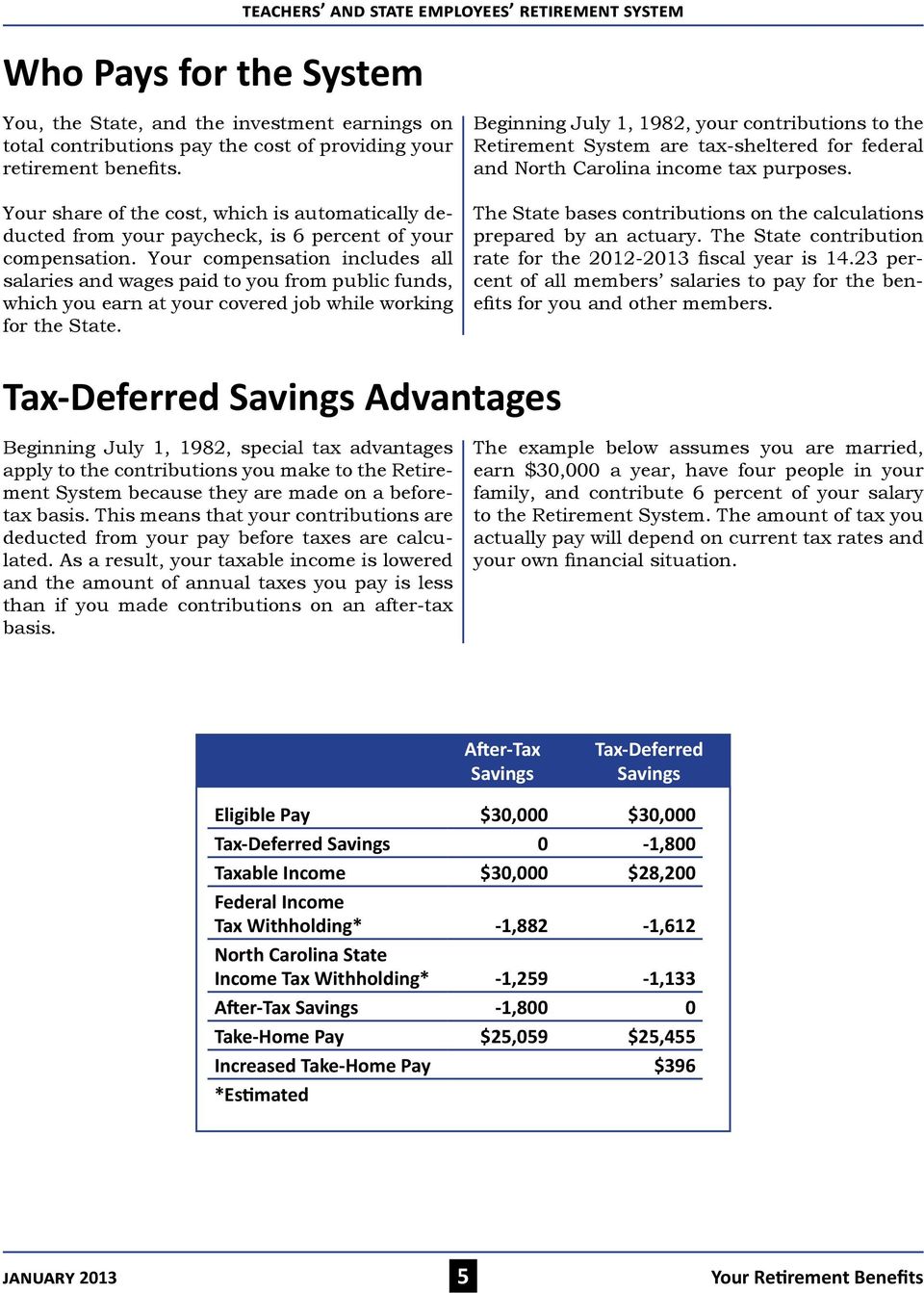
5 Who Pays for the System teachers and state employees retirement system You, the State, and the investment earnings on total contributions pay the cost of providing your retirement benefits. Your share of the cost, which is automatically deducted from your paycheck, is 6 percent of your compensation. Your compensation includes all salaries and wages paid to you from public funds, which you earn at your covered job while working for the State. Beginning July 1, 1982, your contributions to the Retirement System are tax-sheltered for federal and North Carolina income tax purposes. The State bases contributions on the calculations prepared by an actuary. The State contribution rate for the fiscal year is percent of all members salaries to pay for the benefits for you and other members. Tax-Deferred Savings Advantages Beginning July 1, 1982, special tax advantages apply to the contributions you make to the Retirement System because they are made on a beforetax basis. This means that your contributions are deducted from your pay before taxes are calculated. As a result, your taxable income is lowered and the amount of annual taxes you pay is less than if you made contributions on an after-tax basis. The example below assumes you are married, earn $30,000 a year, have four people in your family, and contribute 6 percent of your salary to the Retirement System. The amount of tax you actually pay will depend on current tax rates and your own financial situation. After-Tax Savings Tax-Deferred Savings Eligible Pay $30,000 $30,000 Tax-Deferred Savings 0-1,800 Taxable Income $30,000 $28,200 Federal Income Tax Withholding* -1,882-1,612 North Carolina State Income Tax Withholding* -1,259-1,133 After-Tax Savings -1,800 0 Take-Home Pay $25,059 $25,455 Increased Take-Home Pay $396 *Estimated 5
6 How to Qualify for Benefits Becoming Vested You become vested in the Retirement System once you have completed a minimum of five years of membership service (10 years if you became a member on or after August 1, 2011). This means that you are eligible to apply for lifetime monthly retirement benefits based on the formula, and the age and service requirements described in this handbook, provided you do not withdraw your contributions. You may also be eligible for retiree health coverage as described on page 21. Service Retirement (Unreduced Benefits) You may retire with an unreduced service retirement benefit after: you reach age 65 and complete five years of membership service (10 years if you became a member on or after August 1, 2011) you reach age 60 and complete 25 years of creditable service you complete 30 years of creditable service at any age Early Retirement (Reduced Benefits) You may retire early with a reduced retirement benefit after: you reach age 50 and complete 20 years of creditable service you reach age 60 and complete five years of membership service (10 years if you became a member on or after August 1, 2011) Your early retirement benefit is determined by the same formula as a service retirement benefit multiplied by a reduction percentage based on your age and/or service at early retirement. Since your benefits may be paid over a longer period of time than if you waited until you were eligible for service retirement, they will be reduced. The table on page 10 shows the effect these reductions would have on your benefit. Disability Retirement After attaining certain service requirements, you may be eligible for short-term disability and/or long-term disability benefits from the Disability Income Plan of North Carolina as described on pages 27 and 28. However, if you earned and maintained five or more years of membership service with the State Retirement System prior to July 1, 1982, you may be eligible to receive disability retirement benefits. Your eligibility is based upon approval by the Medical Review Board and is based in part on the amount of service that you would have earned if you had been able to remain in service until age 65, instead of benefits from the Disability Income Plan. In addition, if you earned and maintained five or more years of membership service with the State Retirement System prior to January 1, 1988, you may be eligible to receive disability retirement benefits. The benefits are based in part on the amount of service that you would have earned if you had been able to remain in service until you would have otherwise been eligible for an unreduced service retirement benefit, instead of benefits from the Disability Income Plan. In either case, if you earned and maintained five or more years of membership service with the State Retirement System prior to January 1, 1988, and subsequently become disabled, as approved by the Medical Review Board, you will have the opportunity to elect to receive benefits from the Disability Income Plan or to receive disability retirement benefits from the State Retirement System. If you are eligible for and you elect to receive disability retirement benefits, your payment under the Maximum Allowance will be calculated using the same formula as a service retirement benefit. (See pages 11 through 13 for descriptions of retirement payment plans.) Under disability retirement, you may choose any payment option except Option 4. If you choose a survivorship option, it will be calculated using disability reduction percentages. Please visit our website at for additional information about disability benefits and the required forms. 6
7 Reciprocity Between Retirement Systems Any credit you may have in the Legislative, Judicial, or Local Governmental Employees Retirement Systems may be counted along with your credit in this Retirement System for the purpose of determining your eligibility for a reduced or unreduced benefit. However, only your creditable service in this System will be used in computing the amount of your benefit in this System, and creditable service in any other system will be used in computing benefits from that System. In addition, effective July 1, 2010, any service credit you may have in the Optional Retirement Program may be added to your creditable service in this System for the purpose of determining eligibility for State Retirement System benefits. If You Leave the System Before Retirement Even if you leave before service or early retirement, you may still receive a deferred benefit at a later date. You are entitled to apply to receive a benefit once you meet eligibility requirements after you have completed five years of member- ship service (10 years if you became a member on or after August 1, 2011), provided you do not withdraw your contributions. See page 21 for information regarding retiree health coverage. Your benefit is determined by the formula in effect on the effective date of your retirement. It is based on your average final compensation and years of creditable service at that time. You can apply for deferred payments to begin when you reach age 60. If you have at least 20 years of creditable service when you leave, you can apply for early payments starting at age 50. However, your benefit is reduced because you may receive payments for a longer period of time than if you waited until you were eligible for service retirement. If you leave the System before you have five years of membership service (10 years if you became a member on or after August 1, 2011), the only payment you can receive is a refund of your contributions. See page 19 regarding a refund of contributions. How Your Beneficiaries Are Protected Although the System s primary purpose is to provide retirement income, it recognizes that some employees will not live to enjoy their retirement benefits. For that reason, it provides a death benefit that protects your beneficiary should you die before retirement. In addition, your beneficiary will receive a refund of your contributions (with interest, if applicable). More details on refunds appear on page 19. If you meet certain eligibility requirements, a Survivor s Alternate Benefit may be paid instead of the refund of contributions if you have one eligible beneficiary living at the time of your death. See below. If you die after retirement, depending on the payment option you chose, your beneficiary may receive income following your death. See pages 12 and 13. Death Benefit If you die while still in active service after one year as a contributing member, your beneficiary will receive a single lump-sum payment. The payment equals the highest 12 months of salary in a row during the 24 months before you die, but no less than $25,000 and no more than $50,000. This benefit is also paid if you die within 180 days of your last day of service. It is in addition to any other benefits to which you may be entitled. For this death benefit, you may name the same or different beneficiary(ies) than the one(s) you named to receive the return of contributions. 7

8 Survivor s Alternate Benefit Provided you have not retired, the Survivor s Alternate Benefit may be payable if you have one and only one eligible beneficiary for the return of your contributions living at the time of your death, and you die while in active service or within 180 days of your last day of service after: completing 20 years of creditable service (not including credit for unused sick leave) regardless of age reaching age 60 with five years of membership service (10 years if you became a member on or after August 1, 2011) The Survivor s Alternate Benefit does not apply if you have two or more eligible beneficiaries for the return of contributions living at the time of your death, or if your estate is your eligible beneficiary at the time of your death, or if you have retired. The benefit equals the same monthly amount you would have been entitled to receive under Option 2 had you retired on the first of the month following your death. If you do not want your beneficiary to have the choice to receive the Survivor s Alternate Benefit, you should so indicate, in writing, to the Retirement System. This beneficiary may choose to receive a monthly benefit (known as the Survivor s Alternate Benefit) for life instead of a return of your contributions. How Your Benefit is Calculated Your annual retirement benefit is based on this formula: 1.82% of average final compensation TIMES years and months of creditable service Average final compensation means the average of your salary during your four highest-paid years in a row. If your four highest-paid years in a row include a final payment for unused vacation leave and/or prorated longevity, your average final compensation may be increased by the extra payment(s). (Final payments, if any, for unused sick leave or reimbursements for expenses are not includable in your average final compensation.) Creditable service means any period during which you contribute to the System, provided you do not withdraw your contributions. In addition, if you have unused sick leave, were in military service, or worked out of state in related governmental employment, special rules may apply in determining creditable service. See pages 15 through 18 for more details. If you left the System and withdrew any of your own contributions, you may restore your creditable service by making a lump-sum payment, as outlined on page 16. 8

9 Example of How a Benefit is Calculated At Service Retirement To give you an idea of how benefits are calculated, let us look at some examples. Assume an employee, Mary Benson, who works on a 10-month per year basis, retires at age 60, with 32 years and two months of creditable service. As we go through the steps to figure Mary s benefit, write in your own figures for an estimate of your benefit. Because Mary has more than 30 years of creditable service at retirement, she receives her basic benefit of about $18,929 annually, or approximately $1,577 monthly, for the rest of her life under the maximum allowance, with monthly payments ceasing at her death. In addition, Mary may also be eligible for Social Security benefits as early as age 62. At Service Retirement Mary You Step 1 Add your salary during your 4 $30,600 $ highest-paid years in a row. 31,700 32, ,000 $129,200 $ Step 2 Divide Step 1 by 4 to get $32,300 $ average final compensation. Step 3 Multiply Step 2 by.0182 to $32,300 $ apply formula. x.0182 x.0182 $ $ Step 4 Determine creditable service. (see pages 16 through 19) 32.2 years Step 5 Multiply Step 3 by Step 4 $ $ to determine your annual x 32.2 x retirement benefit. $18, $ Step 6 Divide Step 5 by 12 to get $1, $ monthly maximum allowance. You can also create your own custom estimate by visiting our website at clicking on the ORBIT icon, and logging into your personal ORBIT account. 9

10 At Early Retirement Now let us look at an employee, Fred Wise, who works on a 12-month per year basis. Assume when Fred retires at age 61, he has: average final compensation of $32, years and three months of creditable service Here is how we calculate his benefit: $ 32,300 (average final compensation) x.0182 $ x (creditable service) $ 14, Now apply the early retirement reduction percentage from the chart below. $ 14, x.88 (percentage at age 61) $12, In this case, Fred receives a maximum payment of about $12,544 a year, or about $1,045 a month, unless he chooses a payment option. His payment will start at age 61 and continue for the rest of his life. Assume, however, that Fred is age 59 instead of age 61. With years of creditable service, his early service retirement reduction percentage is.80 instead of.88. In this case, Fred receives a maximum payment of about $11,404 a year, or about $950 a month, unless he chooses a specific retirement payment option. His payment will start at age 59 and continue for the rest of his life. In addition, Fred may also be eligible for Social Security benefits as early as age 62. Early Retirement Percentages If you are between ages 60 and 65, with less than 25 years of creditable service, your early service retirement benefit will be reduced to the following percentages. If you are You receive this this age when percentage of payments start your benefit 64 97% 63 94% 62 91% 61 88% 60 85% If you are between birthdays when payments start, the reduction will be adjusted proportionately. If you are between ages 50 and 59, with less than 30 years of creditable service, your early retirement will be reduced to the percentages shown in the table below. Creditable Service Age % 90% 85% 80% 80% 80% 80% 80% 80% 80% 58 95% 90% 85% 80% 75% 75% 75% 75% 75% 75% 57 95% 90% 85% 80% 75% 70% 70% 70% 70% 70% 56 95% 90% 85% 80% 75% 70% 65% 65% 65% 65% 55 95% 90% 85% 80% 75% 70% 65% 60% 60% 60% 54 95% 90% 85% 80% 75% 70% 65% 60% 55% 55% 53 95% 90% 85% 80% 75% 70% 65% 60% 55% 52% 52 95% 90% 85% 80% 75% 70% 65% 60% 55% 50% 51 95% 90% 85% 80% 75% 70% 65% 60% 55% 50% 50 95% 90% 85% 80% 75% 70% 65% 60% 55% 50% 10

11 Examples of Benefits Paid The following chart shows the approximate monthly benefit paid at various salary levels, depending on age and creditable service. Of course, these are only examples. Your own benefit is calculated individually and depends on your age, creditable service, and average final compensation. Average Final Compensation Monthly Retirement Benefit Under Maximum Allowance Age N/A N/A Service $80,000 $1,213 $3,057 $3,033 $3,640 $,4,853 70,000 1,061 2,675 2,654 3,185 4,246 60, ,293 2,275 2,730 3,640 55, ,102 2,085 2,502 3,336 50, ,911 1,895 2,275 3,033 45, ,719 1,706 2,047 2,730 40, ,528 1,516 1,820 2,426 35, ,337 1,327 1,592 2,123 30, ,146 1,137 1,365 1,820 25, ,137 1,516 Retirement Benefit Payment Plans When you retire you have to decide which monthly payment plan to select. Your decision will be personal and should take into account your needs during retirement and the needs of a dependent, if any, after your death. Neither the payment plan selected by a co-worker nor the one selected by the largest number of retirees should have any effect on your personal decision. Before you select a payment plan, you should know that, on average, each payment plan is mathematically equal to the other plans. That is, each payment plan is calculated so that the total value of the plan you select is the same as the value of the other plans if you and the beneficiary (if any) you name to receive a monthly payment, live your expected lifespans. You should first decide if you need to select a type of payment plan that provides for a monthly payment to a beneficiary after your death. If you do not select such a plan, all of your retirement benefits will be used to provide you with a lifetime monthly payment that ceases at your death. 11

12 There is a Guaranteed Refund feature of your retirement benefits, which provides that the total amount paid out after your retirement will not be less than the amount of your contributions and interest, regardless of which retirement plan you select. Should your death and the death of the beneficiary named to receive a monthly payment, if any, occur before the total of all monthly payments equals the amount of your contributions and interest, the unrecovered portion of your contributions and interest will be paid in one lump-sum to another beneficiary(ies). Payments made to purchase additional creditable service after retirement are also covered by the Guaranteed Refund provisions. You may name one or more beneficiaries for the Guaranteed Refund provision, and you may change this beneficiary(ies) as often as you desire. Of course, any beneficiary named for the Guaranteed Refund cannot be named as beneficiary for a monthly benefit. You may not change the payment plan you select once you cash a retirement check or after the 25th of the month following the month your first check is mailed (whichever is earlier) except under the following conditions: if you select a payment option that provides a monthly benefit to your spouse as named beneficiary after your death (i.e., Option 2, 3, 6-2, or 6-3) and later become divorced from that spouse if you are rehired in a position covered by the Retirement System and contribute to your new account for at least three years Maximum Allowance When you retire on a service retirement allowance, your basic benefit is the maximum allowance and is calculated under the formula on page 8. If you retire early, your maximum allowance is calculated using the same formula and then reduced for early retirement. In either case, unless you choose a payment option, you will receive your maximum allowance for as long as you live. All monthly payments stop at your death. Payment Options Instead of the maximum allowance, you can choose one of the following payment options. If you elect to provide a monthly payment to a beneficiary after your death by choosing Option 2, 3, 6-2, or 6-3, you give up some of your retirement benefit while you are living. The amount you give up is placed in reserve to be paid to one beneficiary after your death. (A beneficiary for a monthly benefit cannot be named as beneficiary for the Guaranteed Refund.) The amount your retirement benefit is reduced depends on the amount of your maximum allowance, your age, and the age of your beneficiary. Option 2 100% Joint and Survivor You receive reduced monthly payments for life. After you die, your beneficiary receives the same amount monthly for life. Option 3 50% Joint and Survivor You receive reduced monthly payments for life. After you die, one-half of your payment continues to your beneficiary for life. 12

13 Option 4 Social Security Leveling You receive larger monthly payments than you would otherwise be entitled to receive, until you become eligible for Social Security at age 62. Beginning at age 62, your monthly payments will be reduced to an amount that is less than what you would otherwise be entitled to receive. Nevertheless, your reduced retirement payments after age 62 plus your allowance from the Social Security Administration should be approximately the same amount as the inflated payment you received from the Retirement System before age 62. However, the actual amount of your retirement payments both before and after age 62 will be based on the estimate of benefits you provide to our office from the Social Security Administration prior to your retirement. All monthly payments cease at your death. The reduction in your monthly retirement payments after age 62 allows the Retirement System to recover the inflated amounts you received before age 62. Therefore, on average, the inflated amounts received before age 62, together with the reduced amounts received after age 62, are equal in value to the other retirement plans over your life expectancy. Please be sure to contact the Social Security Administration to inquire about how to apply for benefits and what date your first age 62 Social Security benefit will be paid to you; this will help you plan your finances in the event your Social Security age 62 benefit is not paid until the latter part of the month following the month your Option 4 benefit is reduced. Under Option 4, any percentage increase you are granted in your retirement payments before age 62 will be applied to the inflated benefit you are receiving at that time; however, upon reaching age 62 your retirement payments will be reduced to the original amount promised after age 62, plus the percentage increases (not the dollar amount of increases) granted before age 62. For additional information regarding Option 4 and Social Security, see pages 20 and 27. Option 6 Modified Joint and Survivor You receive reduced monthly payments under a combination of Option 2 and the maximum allowance, or under Option 3 and the maximum allowance. Your death, or the death of your beneficiary, affects monthly payments as follows: Option 6-2 Under a combination of Option 2 and the maximum allowance, your death entitles your beneficiary to receive a monthly payment for life in the same amount as you received. However, if your beneficiary dies before you do, your monthly payments are increased to the amount payable under the maximum allowance. Option 6-3 Under a combination of Option 3 and the maximum allowance, your death entitles your beneficiary to receive a monthly payment for life of one-half the amount you received. However, if your beneficiary dies before you do, your monthly payments are increased to the amount payable under the maximum allowance. Under Options 2, 3, 6-2, and 6-3, you may name only one beneficiary to receive a monthly survivor payment after your death. You may not change your survivor beneficiary after you retire except under the following conditions: if you named your spouse as survivor beneficiary at the time of retirement, and later become divorced from that spouse if you return to employment covered under this Retirement System and contribute to a new retirement account for at least three years if you chose Option 2 or 3 at retirement and designated your spouse as survivor beneficiary and this spouse dies before you, and you remarry, you may name your new spouse as your beneficiary within 90 days of your remarriage under the same option you chose at retirement. This redesignation must be properly filed with the Retirement System within 120 days of remarriage. Your new benefit will be reduced on the basis of your age and the 13
14 age of your spouse at the time of the change. The benefit payable to you will be the benefit you received prior to the death of your original spouse, additionally reduced in order to cover your new spouse as beneficiary. Under Options 6-2 and 6-3, if your survivor beneficiary dies before you do, you may not name another. Your new beneficiary designation will be effective on the first day of the month that it was made, and it will provide retirement benefits that are mathematically equal to the retirement benefits that were in effect prior to your new beneficiary designation. he will receive $1,000 each month for life with all monthly payments ceasing at his death. But let us assume he wants to share his benefit with his wife, Pam. Pam is 51 when John retires at 57 after 30 years and three months of creditable service. The table below shows how much John and Pam would each receive monthly under various payment options. Of course, the actual amounts of the payment options you can choose are based on many factors, such as your age, your beneficiary s age, and when payments start. Before you retire, you will receive an estimate of the actual amounts payable to you. How the Payment Options Work John Murphy has earned a service retirement benefit under the maximum allowance of $1,000 a month. Unless he chooses a payment option, Payment Option To John To Pam After John s Death Maximum Allowance $1,000 monthly $0.00 Option 2 $ monthly $ monthly Option 3 $ monthly $ monthly Option 4* $1, up to age 62, $ thereafter $0.00 Option 6-2 Option 6-3 $ monthly; if Pam dies before John, he receives $1,000 monthly thereafter $ monthly; if Pam dies before John, he receives $1,000 monthly thereafter $ $ *Assumes John s primary Social Security benefit is $635 a month at age

15 Creditable Service and Service Purchase Provisions Your benefit at retirement is based, in part, on your creditable service. In addition to the years and months you contribute to the System, creditable service may also include unused sick leave credit and certain types of purchased retirement service credit, which are described below. Sick Leave. Sick leave earned monthly under a duly adopted policy and for which you would receive full salary if you were absent from work due to sickness, counts as creditable service. Sick leave converted from excess vacation leave in accordance with State law is also creditable. One month of credit is allowed, at no cost to you, for each 20 days of your unused sick leave when you retire. One more month is allowed for any part of 20 days left over, provided the remaining portion is at least one hour. Sick leave is used to increase your creditable service, but it cannot be used to meet the minimum qualifications for a deferred benefit or the Survivor s Alternate Benefit. You may use your sick leave to complete 30 years of service regardless of age, 25 years of service after age 60, and 20 years of service after age 50. Please note that sick leave does not count toward eligibility for retiree health coverage. See page 21 for information regarding retiree health coverage. Your employer will certify the amount of sick leave you have on your retirement application. To purchase retirement service credit, you will need to complete the appropriate purchase form. These forms, which include detailed information about the service purchase process, are available on the ORBIT website. Military Service. Your periods of active duty in the United States military up to the time you were first eligible for discharge count as creditable service at no cost to you if you were a teacher or State employee when you entered the military, and you returned to State System employment: within two years after your earliest discharge date, or at any time after your discharge and completed at least 10 additional years of service as a contributing member Effective July 1, 2011, your State System employer is required to pay the employer contributions for the full period you were in active duty if you were a State System member immediately prior to your active duty military service and you return to State System membership service within two years after the military duty. If you are not eligible for free credit under these rules, you may be eligible to buy credit for your first period plus later required periods of active duty by making a lump-sum payment. To be eligible to purchase military service credit, you must have contributed to this Retirement System for five years. Your cost will be equal to the full actuarial liabilities created due to the additional credit purchased. If your service is creditable in another retirement system, your ability to buy credit in this System may be restricted. 15
16 Withdrawn Service. If you ever received a refund of your contributions from this Retirement System, the Local Governmental Employees Retirement System, or the former Law Enforcement Officers Retirement System, you may be eligible to make a lump-sum payment to purchase in this System the amount of creditable service you lost when you received your refund. Before you are eligible to pay for this service, you must be rehired and contribute to this System for five years or have a combination of five years of current membership service in the Judicial, Legislative, Local Governmental, or this Retirement System. Effective July 1, 2001, your cost, which must be paid in a lump sum, will be equal to the amount of contributions withdrawn, plus interest at the rate of six and one-half percent compounded annually from the year of withdrawal to the year of repayment, plus an administrative fee of $25. Other Withdrawn Service Purchase Provisions. If you ever received a refund of your contributions from the Consolidated Judicial Retirement System, the Legislative Retirement System, or the Local Governmental Employees Retirement System, you may be eligible to make a lump-sum payment to purchase the amount of withdrawn creditable service in the System from which it was withdrawn. Before you are eligible to pay for this service, you must have five years of current membership service in this Retirement System or in the Judicial, Legislative, or Local Governmental Retirement Systems, or have a combination of five years of membership service in any of these Systems. Service purchased under this method may be used in determining your eligibility for benefits in this System. However, only your creditable service in this System will be used in computing the amount of your benefit in this System, and creditable service in any other system will be used in computing benefits from that System. Eligible Local or State withdrawn service purchased in the Local System or State System counts as creditable service, not membership service. State System withdrawn service purchased in the State System does not count toward the five-year membership service requirement for eligibility for State Health Plan coverage as a Teachers and State Employees Retirement System retiree. Your cost, which must be paid in a lump sum, will be calculated using the withdrawn service purchase provisions in the System under which you are purchasing the service credit. Out-Of-State Service. If you have performed fulltime out-of-state public employment, you may be eligible to buy credit for that service. Credit that can be purchased must have been with: another state or governmental subdivision of a state a federal, overseas dependent or military dependent school the Public Health Service the Merchant Marine (if you were also in the Naval Reserve) the International Cooperation Administration or Agency for International Development, while on an approved leave of absence To be eligible to purchase out-of-state service, you must have contributed to the Retirement System for a total of five years with at least one year of membership service after completing your out-ofstate service. Your cost will be equal to the full actuarial liabilities created due to the additional credit purchased. If your service is creditable in another retirement system, your ability to buy credit in this System will be restricted. If you are eligible, you may buy credit at the rate of one year of out-of-state service for each year of service under this System. You may purchase a maximum of 10 years of outof-state service credit. Temporary Local and State Service. You may purchase credit for full-time temporary local and State government employment if you have completed five years of service as a contributing member after the temporary employment. Your cost will be a lump-sum payment equal to the full actuarial liabilities created due to the additional credit purchased. 16

17 Educational Leave. If you have interrupted service or approved leave of absence for educational purposes, credit may be purchased if regular employee and employer contributions are paid by the 15th of the month following the month for which service credit is allowed. If contributions are not made by the 15th of the month, a penalty of 1 percent per month shall be assessed to the total costs. In addition, unless you return to service as a contributing member within 12 months after completion of your educational program and contribute to the Retirement System for at least three more years (except in the event of death or disability), your contributions will be refunded and the service credits canceled. If your employer will not make the employer contributions, you may make them in addition to the employee contributions. Regardless of when the educational program was completed, the maximum allowable credit for educational leave or interrupted service for educational purposes is six years. Probationary or Waiting Period Service. You may purchase credit for a period of service you performed with a unit of the Local Retirement System, during which time you were in a probationary or employer imposed waiting period status between your date of employment and date of membership in the Retirement System. In order to be eligible to purchase this credit, the employer must have revoked its probationary or waiting period policy. Your cost will be a lump-sum payment equal to the full actuarial liabilities created due to the additional credit purchased. Workers Compensation Leave. If you are granted a leave of absence to receive benefits under the North Carolina Workers Compensation Act, you may make a lump-sum payment to purchase credit for the period of time you received those benefits. If your leave ended before January 1, 1988, your cost will be a lump-sum payment that includes the total amount required to cover the employee and employer funding. If your leave ends on or after January 1, 1988, the cost will be shared by you and your employer. If payments are not made within six months of your return to service for any leave ending on or after July 1, 1983, a penalty of 1 percent per month shall be assessed to the total cost. Part-Time Local and State Service. You may purchase credit for part-time local and State government service if you have completed five years of service as a contributing member. If your purchase of credit for part-time service makes you eligible to retire and you do so immediately after your purchase, the five years of service as a contributing member may be performed at any time before and/or after completion of the part-time employment. Otherwise, the five years of service must be performed since completion of the parttime employment. Your cost will be a lump-sum payment equal to the full actuarial liabilities created due to the additional credit purchased. Service With a Local Governmental Employer. If you worked on a permanent, full-time basis with a unit of local government, and are not otherwise eligible for credit for that service, you may purchase credit for it in the State Retirement System, if you have completed five years of service as a contributing member. In order to be eligible to purchase this credit in the State Retirement System, the service must not be creditable in the Local Governmental Employees Retirement System. Your cost will be a lump-sum payment equal to the full actuarial liabilities created due to the additional credit purchased. Service With the Federal Government. You may purchase credit for service you performed on a full-time basis with the federal government, if you have completed five years of service as a contributing member of this Retirement System since performing the federal service. In order to be eligible to purchase this credit, your federal service must not be creditable in any other retirement system. Your cost will be a lump-sum payment equal to the full actuarial liabilities created due to the additional credit purchased. 17

18 Public Community Service. If you worked on a full-time basis with a public community service entity in North Carolina that was funded entirely with federal funds, and are not otherwise eligible for credit for that service, you may be eligible to purchase credit for it in this Retirement System. To do so, you must have completed five years of service as a contributing member since completing the public community service employment. Your cost will be a lump-sum payment equal to the full actuarial liabilities created due to the additional credit purchased. Omitted Service. You may purchase credit for a period of eligible service to a participating employer, if during that period of eligible service, you should have been a contributing member of the State or Local Governmental Employees Retirement System but were omitted from contributing membership through error. The cost to purchase this type of service depends on when the omitted membership occurred. The cost, which must be paid in a lump-sum payment, will likely be lower if you purchase the omitted service as soon as possible after the omission. Service as a Member of the General Assembly. You may purchase credit for service as a member of the General Assembly if that service is not creditable in the Legislative Retirement Fund or the Legislative Retirement System. Your cost will be a lump-sum payment equal to the full actuarial liabilities created due to the additional credit purchased. Service as a Member of a Charter School. You may purchase credit for service if you were a permanent employee of a charter school whose board elected not to participate in the Retirement System. You must have completed five years as a contributing member after the charter school employment. Your cost will be a lump-sum payment equal to the full actuarial liabilities created due to the additional credit purchased. Withdrawn University of North Carolina Optional Retirement Program Service. You may purchase credit for periods of withdrawn University of North Carolina Optional Retirement Program service, provided you are not receiving, and are not entitled to receive, any retirement benefits resulting from this service. To purchase this service, you must have completed five years of service as a contributing member of this Retirement System since your Optional Retirement Program service. Your cost will be a lump-sum payment equal to the full actuarial liabilities created due to the additional credit purchased. Extended Illness Leave. If your membership service was interrupted by one or more periods of leave without pay due to extended injury or illness, excluding maternity leave, you may purchase credit for each separate period during which you lost at least two months of membership credit. To be eligible, you must be a contributing member at the time of purchase and have at least five years of service as a contributing member. Your cost will be a lump-sum payment equal to the full actuarial liabilities created due to the additional credit purchased. Parental Leave. If your membership service was interrupted by one or more periods of parental or maternity leave, pregnancy, or childbirth, you may purchase credit for each separate period during which you lost at least one month of membership credit. The maximum amount of credit you may purchase for each separate period is six months. To be eligible, you must be a contributing member at the time of purchase and have at least five years of service as a contributing member. Your cost will be a lump-sum payment equal to the full actuarial liabilities created due to the additional credit purchased. Rollovers to Purchase Retirement Service Credit Effective January 1, 2003, pre-tax money from an eligible retirement plan or an eligible IRA may be accepted via rollover or in-service plan-toplan transfer to purchase creditable service. For further information and instructions, please see Form 398, Using a Distribution of Tax-Sheltered Savings to Purchase Retirement Credit, available from the ORBIT website. 18

19 Transferring Service and Contributions Between Systems You can transfer your contributions and creditable service between this Retirement System and the Local Governmental Employees Retirement System as long as you are an eligible member of the System to which you are transferring, do not receive a refund of your contributions from the System from which you are transferring, and file a Form 5TR, which is available from the Retirement System. Creditable service transferred counts toward eligibility for monthly benefits and is used in computing the amount of your benefit. (See page 7 concerning reciprocity.) Overlapping transferred service cannot be counted twice for the same period of time Refund of Contributions If you leave the System for any reason other than retirement or death, you can either receive a refund of your contributions (plus interest, if you have at least five years of service as a contributing member), or leave your contributions in the System and keep all the creditable service you earned to that date. See page 7. To receive a refund, simply complete a Form 5, Withdrawing Your Retirement Service Credit and Contributions, and file it with the Retirement System. You can get the form from the ORBIT website. State law does not permit the Retirement System to make a refund earlier than 60 days after your separation from covered employment. Upon receipt of your refund of contributions, you waive any rights to the employer contributions or any other benefit from the Retirement System. (See pages 21 through 24 for information about retiree medical benefits and taxation.) Effective January 1, 2004, after completing five years of membership service in the Teachers and State Employees Retirement System, you may transfer contributions and creditable service from the Consolidated Judicial and Legislative Retirement Systems to this Retirement System. Please contact the Retirement System for additional information and instructions. NOTE: A transfer can affect your eligibility for retiree group coverage under the State Health Plan. Please see page 21 for further information. Interest The interest credited on your contributions and paid with a refund is set by State law. The amount is 4 percent per year on your balance at the first of each calendar year, compounded annually. Interest is a benefit to you only if you leave the System, get a refund, and qualify for an interest payment. The difference between the total investment earnings on your contributions and the 4 percent paid with your refund is kept by the System to help pay the cost of retirement benefits for career employees. If the law allowed a higher rate of interest to be paid with refunds, retirement benefits and other career employee benefits would be lower. 19
20 Applying for and Receiving Monthly Benefits Retirement Application Process Once you decide to retire and meet the eligibility requirements for monthly benefits, there are certain steps that must be taken to begin the retirement process. Monthly retirement benefits are effective the first day of any month; however, a retirement application must be signed, dated, and filed at least one day and not more than 120 days prior to the effective date of retirement. Approximately 90 to 120 days before your planned retirement date, you should complete a Form 6, Claiming Your Monthly Retirement Benefit (please see the Guides on the Form 6 for additional detailed information about the retirement process). This form is available from your employer or the ORBIT website. If you contribute to the Retirement System during the six months before your effective date of retirement (or you are currently out of service, but your last day of service with your last participating employer of the Retirement System is within five years prior to your effective date of retirement, and you had unused sick leave), your employer should complete the employer certification section (Section H) on the Form 6, Claiming Your Monthly Retirement Benefit, before the form is sent to the Retirement System. If you want an estimate under Option 4, you must furnish the Retirement System with an estimate, obtained from the Social Security Administration, of the Social Security benefit available to you at age 62. This estimate should be obtained within one year prior to your effective date of retirement. You must terminate employment, live until the effective date of retirement, and not perform any work for a State System employer (except as an unpaid bona fide volunteer in a local school administrative unit) at any time during the six months immediately following the effective date of retirement in order to be legally retired. Generally, if your death occurs before the effective date of your retirement, your beneficiary will not be eligible for a monthly retirement allowance, based on your retirement account, except as provided under Survivor s Alternate Benefit on page 8. Upon receipt of your Form 6, Claiming Your Monthly Retirement Benefit, the Retirement System will send you an acknowledgement letter that will include instructions on your next steps in the retirement process. You will also be sent: Form 170, Authorizing Direct Deposit Instructions for enrolling in the retiree group of the State Health Plan In addition, you will have an opportunity to elect coverage under the optional $10,000 Contributory Death Benefit for Retired Members. Your election must be made within 60 days of the effective date of your retirement. Information about the cost and coverage provisions will be sent to you shortly after the Retirement System receives your retirement application. Later you will receive an estimate of the maximum allowance you can receive and the payment options, if applicable. Along with the estimates, you will receive: Form 6E, Choosing Your Retirement Payment Option Form 290, Choosing Income Tax Withholding Preferences Form 336, Designating Beneficiary(ies) for the Guaranteed Refund as a Retiree Please note that the Retirement System will not be able to pay monthly retirement benefits to you until we have received your properly completed Form 6E. Please return completed forms directly to the Retirement System. Your First Monthly Benefit Your first monthly retirement benefit will be mailed to you. Thereafter, it is the policy of the Retirement Systems Division for your monthly payment to be directly deposited in your account when your financial institution opens for busi- 20
21 ness on the 25th day of each month, except in December, when it will be deposited on the 20th. If the day the Retirement System would normally make your deposit is a Saturday, Sunday, or holiday, then your deposit will be made on the last workday before that Saturday, Sunday, or holiday. Direct deposit is fast, automatic, and free of cost to you. Post-Retirement Increases Your benefit may be increased periodically after retirement to help you keep up with the cost of living. Increases depend on changes in the Consumer Price Index, the availability of funds, and how much active working members of the System receive in salary raises. The cost-of-living increases granted are usually figured as a percentage increase in your monthly benefit. That percentage increase becomes a permanent part of your monthly benefit, under all payment plans, and the monthly benefit to be paid to your beneficiary, after your death, under Options 2, 3, 6-2, and 6-3. (See page 13 regarding Option 4 increases.) NC 401(k) and NC 457 Transfer Benefit You are eligible to make a one-time election at or following retirement to transfer any portion of your eligible contributions, not including Roth contributions and earnings, in the NC 401(k) Plan and/or NC 457 Plan to the Teachers and State Employees Retirement System and receive a separate additional monthly lifetime retirement allowance based upon your transferred balance. Allowances are available without cost-of-living increases and with cost-of-living increases. Please visit our website at for additional detailed information about the Transfer Benefit, a Transfer Benefit estimator, and the required forms. Retiree Health Coverage When you retire, you are eligible to enroll in the State Health Plan. The cost is determined by: when you began State employment which health coverage you select, if you contributed to the Teachers and State Employees Retirement System for at least five years (not including credit for unused sick leave or credit transferred from the Local Governmental Employees Retirement System) while employed as a teacher or State employee State System withdrawn service purchased in the State System does not count toward the five-year membership service requirement for eligibility for State Health Plan coverage as a Teachers and State Employees Retirement System retiree. After the Retirement System receives your retirement application, you will be sent instructions on how to enroll in the retiree group of the State Health Plan. Under current law, if you were first hired prior to October 1, 2006, and retire with five or more years of State System membership service, the State will pay for your individual coverage under the noncontributory (currently 70/30) plan at retirement. Based on the conditions described above, if you were first hired on or after October 1, 2006, in order to receive individual coverage at no cost, you must retire with 20 or more years of retirement service credit; if you have 10 but less than 20 years of retirement service credit, you will have to pay 50 percent of the cost for your coverage, and with five but less than 10 years, you will have to pay the full cost for your coverage. In all cases, the full cost of dependent coverage, if elected, must be paid by you. Please see Guidance on State Health Plan Changes Effective October 1, 2006 on our website at www. myncretirement.com for additional information. As a retiree, when you or covered dependents become eligible for Medicare, both Parts A (Hospital) and B (Medical) must be elected in order to maintain the same level of coverage provided before retirement. 21
22 For information on prescription drug coverage under the State Health Plan and Medicare Part D (Prescriptions), please contact the State Health Plan at or visit the State Health Plan website at Income Tax Benefits from the Retirement System receive special income tax treatment. The following is a brief outline of current tax laws as they apply to System benefits. However, tax laws often change. You should consult your tax advisor for more details. Retirement Benefits Each year by January 31, a Form 1099-R (similar to Form W-2, Statement of Income and Tax Withheld, that you received annually while you were working) will be sent to you. Shown on the Form 1099-R are the amount of your retirement benefits, the taxable portion (if any), the amount of tax withheld (if any), and related information. Copies will also be sent to the Internal Revenue Service and North Carolina Department of Revenue. Therefore, you should report your retirement benefits on your federal and North Carolina tax returns regardless of whether you owe any income tax. Federal Income Tax. Part of your retirement benefit may not be subject to federal income tax because the tax was withheld while you were working. Included in the non-taxable part of your retirement benefits are contributions made by you before July 1, 1982, and any non-rollover service purchases made by you. All or part of your retirement benefit may be subject to federal income tax because it has not been taxed before. Included in the taxable part of your retirement benefits are contributions made by you after July 1, 1982, any rollover service purchases, and all benefits paid with the employer contributions and investment earnings. Coverage under the retiree group of the State Health Plan begins on the first day of the month following the effective date of retirement. For example, if your effective date of retirement is January 1, 2013, your retiree group health coverage will begin on February 1, Optional Supplemental Insurance Optional supplemental insurance coverage (vision, dental, accident, and term and whole life insurance) is available to retirees through Pierce Insurance Agency Inc. Pierce will mail information to the member after the first retirement benefit payment has been made. When you retire, you will receive a statement that shows the total amount of your retirement benefits not subject to federal income tax. That figure will be referred to as your federal tax base. Under federal law, the majority of each and every retirement check is includable as taxable income on your federal tax Form This does not mean that you will pay tax again on the contributions on which you have already paid tax. It does mean, however, that you may exclude only a small portion of your previously taxed contributions each month throughout a period of time specified by the federal government. The Retirement System computes the non-taxable portion of your monthly benefit by using the Internal Revenue Service Simplified General Rule. Under this method of computation, your federal tax base is divided by a specified number, based on your option and your age at retirement, to determine the non-taxable amount of your monthly benefit. In order to determine in advance the portion of your monthly benefit that is not taxable, refer to the tables on the following page. Use Table 1 if you select the Maximum Allowance or Option 4; use Table 2 if you choose Option 2, 3, 6-2, or 6-3. Based on your age at retirement for Table 1 or your and your beneficiary s combined age for Table 2, determine the number of expected payments in column two opposite your age bracket. Divide the number of expected payments into your federal tax base (as shown in your Final Report of Retirement Benefits). The result is the amount of your monthly benefit that is not taxable. 22
23 Table 1 - For Maximum Allowance and Option 4 Your Age At Retirement Number of Expected Payments to Be Divided Into Your Federal Tax Base 55 and under 360 over 55 to over 60 to over 65 to over Table 2 - For Options 2, 3, 6-2, and 6-3 Combined Age At Retirement Number of Expected Payments to Be Divided Into Your Federal Tax Base 110 and under 410 over 110 to over 120 to over 130 to over FOR EXAMPLE Table 1 Maximum Allowance and Option 4: If your federal tax base is $13,950, your age at retirement is 60, you would divide $13,950 by 310 to obtain your non-taxable figure of $45 per month. Therefore, regardless of the post-retirement increases you may receive in the future, $45 of your monthly benefit would be exempt from federal income tax for 310 months. The amount of your monthly benefit in excess of $45 would be immediately includable for federal income tax purposes, and after 310 months your total monthly benefit would be includable. FOR EXAMPLE Table 2 Options 2, 3, 6-2, and 6-3: If your federal tax base is $13,950, and your age at retirement is 56, and your spouse s age is 63, you would divide $13,950 by 360 to obtain your non-taxable figure of $38.75 per month. Therefore, regardless of the post-retirement increases you may receive in the future, $38.75 of your monthly benefit would be exempt from federal income tax for 360 months. If you fail to live 360 months, the beneficiary to whom you have left a monthly benefit can claim the $38.75 monthly exclusion for the balance of the 360 months. The amount of your or your survivor s monthly benefit in excess of $38.75 would be immediately includable for federal income tax purposes, and after 360 months your total monthly benefit would be includable. The illustrations on this page are only examples. Your non-taxable amount will be based on your age and the age of your survivor, if applicable, at retirement and the amount of your federal tax base. North Carolina Income Tax. If you are a North Carolina resident and have maintained five or more years of retirement service credit as of August 12, 1989, your retirement benefit paid by this System is not subject to North Carolina income tax. If you do not have five years of maintained retirement service credit as of August 12, 1989, you will be required to pay North Carolina income tax on the taxable portion of your retirement benefit. The amount of retirement benefits subject to North Carolina income tax is the same amount of retirement benefits on which federal income tax must be paid, less a $4,000 annual exclusion. If the taxable portion of your annual retirement benefits is less than $4,000, you will not owe any North Carolina income tax on your retirement benefits. If you are not a resident of North Carolina, you may not owe North Carolina income tax on your retirement benefits from this System. However, you may owe state income tax in the state in which you live. You should contact your tax advisor, the North Carolina Department of Revenue, or the Department of Revenue in the state in which you live for specific information relative to your situation. Our System can only withhold North Carolina income tax. We cannot withhold any other state s income tax from your monthly benefit. 23
24 Death Benefits Your beneficiary pays no income tax on death benefits. They are treated as life insurance benefits for tax purposes. Refunds By January 31 of the year following the year of your refund, you will be sent a Form 1099-R showing the amount of your refund, the taxable portion, the amount of tax withheld (if any) and related information. Copies will also be sent to the Internal Revenue Service and North Carolina Department of Revenue. During the six months immediately following your retirement date, you must not perform any work for an employer in the Teachers and State Employees Retirement System in any capacity (except as an unpaid bona fide volunteer in a local school administrative unit or as a school board member). Returning to work earlier than six months after your retirement date will revoke your retiretaxable portion of your refund will be withheld for federal income tax purposes. Withholding is mandatory unless the taxable portion of your refund is directly rolled over. In addition to income tax, you may owe a 10 percent excise tax on the taxable portion of a refund, which is made prior to death, disability, or the attainment of age 59 1/2. You can defer the income tax and avoid the 10 percent excise tax by rolling over the taxable portion of your refund to an eligible IRA or eligible employer plan. You should consult the Internal Revenue Service, your attorney, or your accountant for specific information relative to your particular situation. Federal Income Tax. You pay no federal income tax on the amount you contributed prior to July 1, 1982; however, the amount you contribute after July 1, 1982, is subject to federal income tax. Also, any interest earned by your contributions before and after July 1, 1982, is subject to federal income tax. Federal income tax laws require withholding from the taxable portion of your refund unless that portion of your refund is directly rolled over to an eligible IRA or eligible employer retirement plan that will accept your rollover. If you do not elect to roll over the taxable portion of your refund directly to an eligible IRA or eligible employer plan that will accept your rollover, 20 percent of the Reemployment After Retirement If you perform work in any capacity for an employer under this Retirement System after you have officially retired and are receiving monthly benefits, you will be subject to the reemployment provisions described below. These provisions may require you to work under an earnings limitation or to reenroll as a contributing member of the Retirement System. You will be subject to reemployment provisions based on the nature of the particular work you perform for a State System employer, regardless of your job classification or your technical employment status (which may include being assigned to work for a State System employer by a private company such as a temporary agency). North Carolina Income Tax. the amount of the refund subject to North Carolina income tax is the amount of the refund on which federal income tax must be paid, less a $4,000 exclusion. Refunds of retirement contributions paid by the Retirement System to former employees who maintained five or more years of retirement service credit as of August 12, 1989, are not subject to North Carolina income tax. Employees who do not have five years of maintained retirement service credit as of August 12, 1989, will be required to pay North Carolina income tax on the taxable portion of their retirement benefits refunds. If the taxable portion of your refund is less than $4,000 for federal income tax purposes, you will not owe any North Carolina income tax on your refund. Reemployment After Receiving Early or Service Retirement Benefits. If you retire with monthly early or service retirement benefits from the System and are reemployed by an employer that participates in the Teachers and State Employees Retirement System, the following apply: 24
25 ment benefit retroactively to your retirement date, and all benefits paid to you must be repaid to the Retirement System. Establishing a pre-existing agreement for post-retirement employment with an employer in this System is prohibited and will cause retroactive revocation of retirement benefits. After a six-month break, you may return to work in a position that requires membership (see Becoming a Member of the System on page 4 for membership requirements) in the Teachers and State Employees Retirement System. Your retirement benefit will be suspended on the first day of the month following the month of reemployment and you will again become a contributing member in the month in which you are restored to membership service. (Your State System retirement benefit will also be suspended if you return to membership service under the Consolidated Judicial Retirement System.) If you return to service and contribute for at least three additional years, at the time you terminate your second period of employment, you will have the following choices: Combine your service from your first and second periods of employment to create one (generally larger) monthly retirement benefit. You can change the retirement payment plan and/or beneficiary you selected at the time of your original retirement. (Note: If Option Four elected for first retirement, the Retirement System must actuarially adjust benefits when you retire again.) Reinstate your first retirement account and withdraw your contributions only from your second account. If you return to service and contribute for less than three additional years, at the time you terminate your second period of employment, your first retirement benefit will be reinstated and you will have the following choices for your second retirement account: Apply to receive a second (generally smaller) monthly benefit based on your second period of employment Withdraw your contributions from your second account Leave your second account open After a six-month break, if you return to work with a Teachers and State Employees Retirement System employer in a position not eligible for membership in this Retirement System (see Becoming a Member of the System on page 4 for membership requirements), you will be subject to earnings restrictions of the greater of the following: 50 percent of your gross 12-month pre-retirement salary (excluding termination payments) $30,680 (2013 amount) The dollar figure is adjusted annually according to the Consumer Price Index, which is a national measure of increase in the cost of living from one year to the next. These earnings restrictions apply for the 12 months immediately following retirement and for each calendar year following the year of retirement. If you exceed your earnings limitations, your retirement benefit will be suspended the first day of the month following the month in which you exceed the limit for the remainder of the calendar year. Your retirement payment will start again on January 1 of the year after your benefit is suspended. If your earnings exceed the allowable amount in the month of December, your benefit will not be suspended. Reemployment that causes suspension of your retirement allowance will also cause the suspension of your health coverage under the retiree group of the State Health Plan. Before accepting such reemployment, you should ask the new employer if you will qualify for continued coverage under the active group of the State Health Plan and if you will qualify for the State s contribution 25
26 toward your coverage. Upon restoration of your retirement allowance, your health coverage under the retiree group will be reinstated the first of the month following the month your retirement allowance is restored. your employer has certified to the Retirement System that it has a shortage of qualified nursing instructors and has met all required conditions of making a good faith effort to hire non-retirees as nursing instructors For additional information, please see Return-to- Work Laws on our website at Reemployment Exception for Nursing Instructors. If you are a Teachers and State Employees Retirement System retiree who retired on or before June 1, 2009, with a reduced or unreduced benefit, or if you retired on or after July 1, 2009, with an unreduced benefit, and you wish to return to work as a nursing instructor exempt from the earnings limitations and continue to receive your monthly retirement benefit, you may do so provided you meet all of the following conditions: you have a six-month separation from service under this System immediately preceding your return to employment as a nursing instructor, during which time no work is performed in any capacity with a State-supported community college or university you return to work as a nursing instructor for a maximum of three years in a permanent full-time position, or a part-time position that exceeds fifty percent of the workweek, in a certified nursing program at a State-supported community college or university you have been certified by your North Carolina Community College System or University of North Carolina System employer to teach as a nursing instructor Unless legislation extends this reemployment exception for nursing instructors, these provisions are in effect through June 30, Please visit our website at for legislative updates pertaining to this provision. Reemployment Effects on Health Coverage. Effective July 1, 2007, reemployment with a State System employer will cause you to be enrolled in the State Health Plan active group coverage if the position would require the employer to pay the State s contribution for your State Health Plan coverage if you were not a retiree. Your active group coverage will continue as long as you remain in that position. Upon termination, you will return to State Health Plan retiree group coverage. Reemployment After Receiving Disability Payments. If you accept public or private employment, contact the Retirement System for information on provisions that apply to you. For additional information, please see the Disability section on our website at Reemployment under the Legislative or Consolidated Judicial Retirement Systems. Please contact the Retirement Systems Division for information on provisions that apply to you. 26
27 Important Information to Remember In all correspondence with the Retirement System, give your Member ID number or last four digits of your Social Security number. With more than 875,000 accounts and many duplicate names, it is essential that your inquiries be identified with this information. Keep your beneficiary designation up to date. Form 2RC, Designating Beneficiary(ies) for Retirement System Return of Contributions, and Form 2DB, Designating Beneficiary(ies) for the Death Benefit, are used for this purpose. These forms are available on the ORBIT website. No application, form, or other type of document can be effective until it has been received and accepted by the Retirement System. At your request, the Retirement System will gladly send you any form, application, or other information it has developed for use by members. Please note that many of our forms are available on the ORBIT website. Any error concerning your retirement account should be brought to the attention of the Retirement System, in writing, immediately. If you are fully insured, you are guaranteed a monthly retirement income for life from Social Security starting as early as age 62. Social Security also provides medical benefits through Medicare starting at age 65. More information can be obtained from the Social Security Administration. Its toll-free telephone number is Your benefit from the Retirement System and your benefit from Social Security are not paid automatically you or your beneficiary must apply for them. If you become disabled, you should apply for disability benefits from all available sources, including the Disability Income Plan of North Carolina through your employer, and the Social Security Administration. Effective July 1, 2007, if you are an elected government official, you may forfeit your right to a monthly benefit from this System if convicted of certain state or federal offenses involving public corruption. Effective December 1, 2011, it is a Class 1 Misdemeanor to fraudulently receive the retirement benefit of a deceased retiree for two months or longer after the retiree s death. Effective December 1, 2012, if you are convicted of a state or federal felony offense that is directly related to your employment while in service under this System and: you were not vested as of December 1, 2012, you are prohibited from receiving any retirement benefit other than a return of your contributions you were vested as of December 1, 2012, you are prohibited from receiving any retirement benefit for service rendered after December 1, 2012, other than a return of your contributions and interest for the period of service after December 1, 2012 Disability Income Plan of North Carolina Overview The Disability Income Plan of North Carolina (DIPNC) provides monthly replacement income to you in the form of short-term, extended shortterm, and long-term disability benefits if you become disabled while you are a permanent employee under the Teachers and State Employees Retirement System (TSERS) or Optional Retirement Program (ORP) and you meet certain eligibility requirements. Your employer pays the cost for you to be covered under DIPNC. The basic provisions of DIPNC are summarized below. Definition of Disability Disability under DIPNC is defined as the mental or physical incapacity for the further performance of duty (the usual occupation) of a participant, provided that such disability was not the result of terrorist activity, active participation in a riot, committing or attempting to commit a felony, or an intentional self-inflicted injury. 27
28 60-Day Waiting Period Benefits under DIPNC may begin after a mandatory 60-calendar day waiting period. During this waiting period, you may exhaust accumulated sick leave, vacation leave, or any other salary continuation provided by your employer. Short-Term Disability Benefits You must have at least one year of contributing retirement membership service earned within the 36 calendar months preceding your disability, and meet all eligibility requirements. Short-term disability payments: are payable after the conclusion of a 60-day waiting period, and therefore generally begin on the 61st day of disability are paid by your employer provide monthly income before any offsets equal to 50 percent of one-twelfth of your annual base salary, including longevity and local supplements, if any, subject to a monthly maximum of $3,000 are subject to certain offsets or reductions for benefits received from other disability programs are payable for up to 365 calendar days Extended Short-Term Disability Benefits Additional period(s) of extended short-term disability benefits may be payable: for as many as 365 days beyond the short-term period provided the Plan s Medical Board determines that your condition is temporary, not a permanent disability Long-Term Disability Benefits Long-term disability benefits are payable if you meet all eligibility requirements after the conclusion of the short-term disability period or after salary continuation payments cease, whichever is later. You must meet all of these conditions: have at least five years of contributing retirement membership service earned within the 96 calendar months immediately prior to becoming disabled or the date of completion of continuous salary continuation payments, whichever is later be approved by the Plan s Medical Board for a permanent disability that has been continuous, and was incurred at the time of active employment terminate employment as a full-time teacher or State employee not be eligible to receive an unreduced service retirement benefit from TSERS (If you are an ORP member, you must not be eligible for unreduced service retirement if you had chosen TSERS membership) Long-term disability payments: are paid by the Retirement Systems Division provide monthly income before any offsets equal to 65 percent of one-twelfth of the annual base salary that was last payable to you prior to the beginning of the short-term period, including longevity and local supplements, if any, subject to a monthly maximum of $3,900 and a monthly minimum of $10.00 are subject to certain offsets or reductions for Social Security benefits and for disability benefits received from other programs. These required offsets will cause your DIPNC benefit to be reduced. are payable until the earliest date you become eligible for unreduced service retirement benefits, or otherwise no longer meet the requirements to receive the long-term disability benefits NOTE: If you had less than five years of TSERS membership service or ORP employment as of July 31, 2007, after the first 36 months of the long-term disability period, long-term benefits will end unless you are receiving Social Security disability benefits. More Information about DIPNC Please see the Disability Income Plan of North Carolina Benefits Handbook on our website at www. myncretirement.com to learn more. It includes examples of how DIPNC benefits are calculated and a section describing how to apply for DIPNC benefits. It also explains required offsets for other disability benefits, excess earnings offsets, health coverage, medical board reexamination, income tax, beneficiary payments if you die while in receipt of DIPNC benefits, and converting to a service retirement benefit. 28
29 Administration and Funding Administration The Retirement System is administered by the Board of Trustees. The Board members are: System Assets Janet Cowell, State Treasurer, Chair Pearla Alston June Atkinson Sam Barefoot Loris R. Colclough Dennis Ducker Joyce H. Elliott Mark L. Foster Shirley E. Harris Harold T. Keen Dr. Harold Martin Sterling Primus Randy Sales Paschal W. Swann The State Treasurer is the custodian of the Plan assets and serves as the Chief Investment Officer. Equity assets (e.g., common stock, preferred stock, and debentures convertible into common stock) are invested in conjunction with policies adopted by the Investment Advisory Committee. The Committee members are: Janet Cowell, State Treasurer, Chair Steve Jones Harold T. Keen Dr. Harold Martin Neal F. Triplett Courtney A. Tuttle Medical Review Board The Medical Review Board determines eligibility for disability benefits. The members of the Board are: Dr. George S. Edwards, Sr. Dr. Robert H. Fleming Dr. Robert Gaddy Dr. Bobby Sellers Dr. Nathaniel L. Sparrow Future of the System The State expects to continue the System indefinitely. However, because future conditions cannot be foreseen, the State General Assembly reserves the right to modify the provisions of the System. System Documents This booklet summarizes the main features of the Teachers and State Employees Retirement System of North Carolina. The official text governing the operations of the System and the payment of all benefits is found in Chapter 135 of the General Statutes and Title 20 of the North Carolina Administrative Code. Member Contributions Members contribute 6 percent of gross salary each month to the System. Employer Contributions For the fiscal year, employers contribute percent of the gross payroll of members each month to the System for benefits. Funded Status The Retirement System has been labeled as actuarially sound because of the consistent use over the years of: actuarial assumptions based on experience an approved actuarial funding method the recognition of all promised benefits in the actuarial liabilities 29
30 Funded Ratio A generally accepted measure of the soundness of any retirement system is to relate the total assets to the total accrued liabilities. This determines the funded ratio or percentage of the System. The total of the accrued liabilities is found by adding the total assets and the unfunded accrued liabilities. Shown are the assets and unfunded liabilities for the past several years, as of December 31 of each year. Beside the figure is a graph that shows the funded ratio of the Retirement System (the percentage of the assets to the total accrued liabilities). Assets Unfunded Accrued Liabilities 2011 $58,125,010,880 $3,721,686, $57,102,198,448 $2,773,867, $55,818,099,117 $2,360,173, $55,127,658,183 $391,086, $55,283,120,813 ($2,468,031,336) 2006 $52,420,807,724 ($3,028,900,728) 2005 $49,670,182,206 ($3,045,514,417) 2004 $47,383,509,397 ($3,555,655,121) % Funded % 106% 106% Funded Ratio 104% 99% 95% 95% 94% The North Carolina Department of State Treasurer created ORBIT (Online Retirement Benefits through Integrated Technology) to allow members convenient access to their retirement account information 24 hours a day, seven days a week. This secure site enables you to view your personal information, account information, and other relevant details specific to your retirement system account. In ORBIT, active employees are able to view: Service credit history Retirement estimates Service purchase cost estimates NC 401(k)/NC 457 Transfer Benefit estimates Annual benefit statements Retirees are able to: Maintain tax withholdings View and download 1099-R Generate income verification letters Update their contact information To access ORBIT, go to our website at www. myncretirement.com, click on the ORBIT icon and follow the instructions to log into your personal ORBIT account. 1. Register for ORBIT via the Register button on the login page. 2. Follow the prompts for registration. 3. Once you have registered, you are able to gain access to ORBIT using the User ID and Password that you created
31 How to Contact Us teachers and state employees retirement system System Internet Address Visit our website to learn more about the benefits that are available to you: download and complete applications and forms used by the Retirement System view and download handbooks review Frequently Asked Questions manage your retirement account online using ORBIT These are some of the options that are currently available to you on our website. Please feel free to visit and use this site whenever it may be of assistance to you. System System Address The address of the Retirement System is: System Telephone Number (toll free outside of Raleigh area) (within local calling distance of Raleigh) Due to the large volume of calls that are received in the Member Services Section, we recommend that you do not call during the following times: Mondays other days between the hours of noon and 2:00 p.m. the day following the mailing of monthly retirement checks If you believe that the nature of your inquiry will result in a lengthy conversation or will require research by our staff, we recommend that you submit your questions in writing, and we will respond accordingly. NOTE: The Retirement System provides members who wish to visit our office with one-on-one and group consultations by appointment only. Please call or our office to schedule an appointment. Teachers and State Employees Retirement System Department of State Treasurer Albemarle Building 325 North Salisbury Street Raleigh, North Carolina
TEACHERS AND STATE EMPLOYEES RETIREMENT SYSTEM. your retirement benefits
 TEACHERS AND STATE EMPLOYEES RETIREMENT SYSTEM your retirement benefits Department of State Treasurer Raleigh, NC Revised January 2014 NORTH CAROLINA DEPARTMENT OF STATE TREASURER RETIREMENT SYSTEMS DIVISION
LOCAL GOVERNMENTAL EMPLOYEES RETIREMENT SYSTEM FOR LOCAL LAW ENFORCEMENT OFFICERS. your retirement benefits
 LOCAL GOVERNMENTAL EMPLOYEES RETIREMENT SYSTEM FOR LOCAL LAW ENFORCEMENT OFFICERS your retirement benefits Department of State Treasurer Raleigh, NC Revised January 2012 NORTH CAROLINA DEPARTMENT OF STATE
TEACHERS AND STATE EMPLOYEES RETIREMENT SYSTEM FOR STATE LAW ENFORCEMENT OFFICERS YOUR RETIREMENT BENEFITS
 TEACHERS AND STATE EMPLOYEES RETIREMENT SYSTEM FOR STATE LAW ENFORCEMENT OFFICERS YOUR RETIREMENT BENEFITS Member Handbook Department of State Treasurer Raleigh, NC Revised January 2015 NORTH CAROLINA
LOCAL GOVERNMENTAL EMPLOYEES RETIREMENT SYSTEM YOUR RETIREMENT BENEFITS
 LOCAL GOVERNMENTAL EMPLOYEES RETIREMENT SYSTEM YOUR RETIREMENT BENEFITS Member Handbook Department of State Treasurer Raleigh, NC Revised January 2015 NORTH CAROLINA DEPARTMENT OF STATE TREASURER RETIREMENT
TEACHERS AND STATE EMPLOYEES RETIREMENT SYSTEM YOUR RETIREMENT BENEFITS
 TEACHERS AND STATE EMPLOYEES RETIREMENT SYSTEM YOUR RETIREMENT BENEFITS Member Handbook Department of State Treasurer Raleigh, NC Revised January 2015 NORTH CAROLINA DEPARTMENT OF STATE TREASURER RETIREMENT
Teachers and State Employees Retirement System (TSERS)
 Teachers and State Employees Retirement System (TSERS) Revised July 2010 Disclaimer This presentation is based on current legislation and is subject to change without notice. This material is to be used
LOCAL GOVERNMENTAL EMPLOYEES RETIREMENT SYSTEM EMPLOYER MANUAL
 LOCAL GOVERNMENTAL EMPLOYEES RETIREMENT SYSTEM EMPLOYER MANUAL Department of State Treasurer Raleigh, NC Revised January 2015 NORTH CAROLINA DEPARTMENT OF STATE TREASURER RETIREMENT SYSTEMS DIVISION JANET
Retirement... A New Beginning
 Retirement... A New Beginning A Guide to Retirement for the Tennessee Consolidated Retirement System January 1, 2014 David H. Lillard, Jr., State Treasurer Jill Bachus, Director of TCRS Table of Contents
Employees Retirement System (ERS) Old Plan, New Plan, GSEPS Plan Guide E RSGA. Employees Retirement System of Georgia. Serving those who serve Georgia
 Employees Retirement System (ERS) Old Plan, New Plan, GSEPS Plan Guide Serving those who serve Georgia E RSGA Employees Retirement System of Georgia Updated 09/2013 Table of Contents Introduction... 3
Teachers and State Employees Retirement System (TSERS)
 Teachers and State Employees Retirement System (TSERS) A BASIC REVIEW OF THE NORTH CAROLINA PENSION PLAN MARCH 2014 Amy Owenby Presented by: Lisa Honeycutt Disclaimer This presentation is based on current
TABLE OF CONTENTS. Introduction... 1. Membership... 1. Defined Benefit Portion of the Hybrid... 2. Retirement Benefits for Public Safety Officer...
 TABLE OF CONTENTS Introduction... 1 Membership... 1 Defined Benefit Portion of the Hybrid... 2 Retirement Benefits... 4 Retirement Benefits for Public Safety Officer... 5 Cost-of-Living Adjustments after
Your Pension Benefits from The City of Atlanta and The Atlanta Board of Education
 Rev. 12/05 Your Pension Benefits from The City of Atlanta and The Atlanta Board of Education Summary Plan Description for the General Employees Pension Plan Police Officer s Pension Plan Firefighter s
DISABILITY INCOME PLAN OF NORTH CAROLINA FOR MEMBERS OF THE TEACHERS AND STATE EMPLOYEES RETIREMENT SYSTEM AND THE OPTIONAL RETIREMENT PROGRAM
 DISABILITY INCOME PLAN OF NORTH CAROLINA FOR MEMBERS OF THE TEACHERS AND STATE EMPLOYEES RETIREMENT SYSTEM AND THE OPTIONAL RETIREMENT PROGRAM Benefits Handbook Department of State Treasurer Raleigh, NC
TRADITIONAL PLAN MEMBER GUIDE S U R S STATE UNIVERSITIES RETIREMENT SYSTEM
 TRADITIONAL PLAN MEMBER GUIDE S U R S STATE UNIVERSITIES RETIREMENT SYSTEM SURS MISSION STATEMENT To secure and deliver the retirement benefits promised to our members. This booklet is intended to serve
Choosing a Retirement Program
 Revised July 1, 2011 S TATE R ETIREMENT AND P ENSION S YSTEM Choosing a Retirement Program Maryland Optional Retirement Plan Highlights of the SRPS & ORP Retirement Programs ABOUT THIS BOOK About This
TEACHERS AND STATE EMPLOYEES RETIREMENT SYSTEM EMPLOYER MANUAL
 TEACHERS AND STATE EMPLOYEES RETIREMENT SYSTEM EMPLOYER MANUAL Department of State Treasurer Raleigh, NC Revised January 2015 NORTH CAROLINA DEPARTMENT OF STATE TREASURER RETIREMENT SYSTEMS DIVISION JANET
DISABILITY INCOME PLAN OF NORTH CAROLINA BENEFITS HANDBOOK
 DISABILITY INCOME PLAN OF NORTH CAROLINA BENEFITS HANDBOOK FOR MEMBERS OF THE TEACHERS AND STATE EMPLOYEES RETIREMENT SYSTEM AND THE OPTIONAL RETIREMENT PROGRAM Department of State Treasurer Raleigh, NC
Your Benefits Under the IMRF. Regular Plan Tier 1. Illinois Municipal Retirement Fund. Helping you build a secure retirement
 Your Benefits Under the IMRF Regular Plan Tier 1 Illinois Municipal Retirement Fund Helping you build a secure retirement table of contents Your Benefits at a Glance... 2 Why you participate in IMRF...
Purchasing. Service Credit. Defined Benefit Plan. For members enrolled in the
 Purchasing Service Credit For members enrolled in the Defined Benefit Plan 2015 2016 Purchasing Service Credit Table of Contents Purchasing Service Credit...1 How to certify purchasable credit...2 Methods
your retirement plan For ERS Tier 5 Members (Article 15)
 your retirement plan For ERS Tier 5 Members (Article 15) New York State Office of the State Comptroller Thomas P. DiNapoli New York State and Local Employees Retirement System A Message from Comptroller
How To Get A Retirement Plan In Wisconsin Retirement System
 YOUR BENEFIT HANDBOOK ETF P O Box 7931 Madison, WI 53707-7931 ET-2119 (REV 10/13) TABLE OF CONTENTS INTRODUCTION... 2 VESTING REQUIREMENTS... 2 WISCONSIN RETIREMENT SYSTEM... 3 Retirement Benefits...
1999 Academic Pension Plan
 1999 Academic Pension Plan TABLE OF CONTENTS Introduction... 3 Eligibility... 3 Enrolling in the Plan... 3 Contributions... 3 Defined Benefit Component:... 3 Defined Contribution Component:... 4 Other
Handbook for Members Virginia Retirement System
 Handbook for Members Virginia Retirement System V R S System Virginia Retirement Handbook for Members Virginia Retirement System The Virginia Retirement System (VRS) exists to provide its members and their
Your Retirement Plan
 Your Retirement Plan Coordinated Plan For ERS Tier 3 and 4 Members (Articles 14 and 15) New York State Office of the State Comptroller Thomas P. DiNapoli New York State and Local Employees Retirement System
Income for your. Retirement
 Income for your Retirement Information about Your SDRS Retirement Benefits Class B Public Safety July 1, 2015 South Dakota Retirement System 222 East Capitol Avenue, Suite 8 P.O. Box 1098 Pierre, SD 57501
Your Employees Retirement System
 Questions & Answers About Your Employees Retirement System Hybrid Plan 1. What is the Employees Retirement System? The Employees Retirement System of Hawaii (ERS) was established in 1925 to provide retirement
Your Employees Retirement System
 Questions & Answers About Your Employees Retirement System Contributory Plan for Police Officers, Firefighters, and certain Public Safety Officers* *Includes Department of the Attorney General investigators;
What you need to know about your CalPERS. State Safety Benefits
 YO U R B E N E F I T S YO U R F U T U R E What you need to know about your CalPERS State Safety Benefits C O N T E N T S Introduction............................................. 2 Your Retirement Benefits.................................
Retirement Plan for Bargaining Unit Employees of Florida Progress Corporation
 Document title: AUTHORIZED COPY Retirement Plan for Bargaining Unit Employees of Florida Progress Corporation Document number: HRI-PGNF-00013 Applies to: Keywords: Progress Energy Florida, Inc. (bargaining
What You Need to Know About Your CalPERS. State Safety Benefits
 Your Benefits Your Future What You Need to Know About Your CalPERS State Safety Benefits CONTENTS Introduction...3 Your Retirement Benefits...4 Service Retirement or Normal Retirement....4 Disability
Your Retirement Plan
 Your Retirement Plan Special 20- and 25-Year Plans For PFRS Tier 1, 2, 3, 5 and 6 Members (Sections 384, 384-d and 384-e) New York State Office of the State Comptroller Thomas P. DiNapoli New York State
NC General Statutes - Chapter 135 1
 Chapter 135. Retirement System for Teachers and State Employees; Social Security; State Health Plan for Teachers and State Employees. Article 1. Retirement System for Teachers and State Employees. 135-1.
Join CalSTRS? Join CalPERS? Decide which retirement system is best for you
 Join? Join? Decide which retirement system is best for you 2014 15 Contents Choosing Your Retirement System 5 Your Questions Answered 6 Dual Membership 19 This guide is based on the California Teachers
UNO-VEN Retirement Plan. Summary Plan Description As in effect January 1, 2012
 Summary Plan Description As in effect January 1, 2012 In the event of any conflict between this Summary Plan Description (SPD) and the actual text of the UNO-VEN Retirement Plan, the more detailed provisions
Teachers Retirement System of Georgia. member s guide
 Teachers Retirement System of Georgia member s guide Welcome to the Teachers Retirement System of Georgia The Teachers Retirement System of Georgia (TRS) is pleased to provide you with this Member s Guide.
Retirement Plan Of CITGO Petroleum Corporation And Participating Subsidiary Companies. Summary Plan Description As in effect January 1, 2012
 Of CITGO Petroleum Corporation And Participating Subsidiary Companies Summary Plan Description As in effect January 1, 2012 01/2012 In the event of any conflict between this Summary Plan Description and
District of Columbia Teachers Retirement Plan Summary Plan Description 2007
 District of Columbia Teachers Retirement Plan Summary Plan Description 2007 This booklet is a Summary Plan Description of the benefits provided to you under the District of Columbia Teachers Retirement
Frequently Asked Questions and Next Steps to Retirement
 State Teachers Retirement System Of Ohio Completing My Service Retirement Application Frequently Asked Questions and Next Steps to Retirement for Members Enrolled in the Defined Benefit Plan Dear Member:
The McClatchy Company. Retirement Plan. April 1, 2009 SUMMARY PLAN DESCRIPTION. April 1, 2009. Table of Contents. Rev. 08/10
 The McClatchy Company Retirement Plan April 1, 2009 SUMMARY PLAN DESCRIPTION April 1, 2009 Table of Contents Rev. 08/10 Table of Contents I. INTRODUCTION... 4 PLAN HIGHLIGHTS... 5 II. LEGACY MCCLATCHY
Florida Retirement System Pension Plan D R O P. Deferred Retirement Option Program
 Florida Retirement System Pension Plan D R O P Deferred Retirement Option Program Department of Management Services Division of Retirement July 2011 DISCLAIMER If questions of interpretation arise as a
Purchasing Service Credit
 Los Angeles County Employees Retirement Association Purchasing Service Credit A & Purchasing Service Credit Table of Contents Section I: Overview pertaining to all contributory members general and safety...3
Choosing Your Retirement Plan Optional Retirement Plan for Higher Education VRS Hybrid Retirement Plan Membership Date: On or after January 1, 2014
 Choosing Your Retirement Plan Optional Retirement Plan for Higher Education VRS Hybrid Retirement Plan Membership Date: On or after January 1, 2014 A comparison guide to help you select the best plan for
U.S. ARMY NAF EMPLOYEE RETIREMENT PLAN
 U.S. ARMY NAF EMPLOYEE RETIREMENT PLAN March 2014 INTRODUCTION This booklet is published by the U.S. Army NAF Employee Benefits Office. It is intended to provide you with useful information about the U.S.
Teachers Retirement System of Georgia. purchasing service credit
 Teachers Retirement System of Georgia purchasing service credit Asa member of TRS, you may be eligible to purchase certain types of service credit. By purchasing service, you will increase the total number
Service Retirement. Plans of Payment AND. For members enrolled in the Defined Contribution Plan
 Service Retirement AND Plans of Payment For members enrolled in the Defined Contribution Plan 2015 2016 Service Retirement Overview Table of Contents Service Retirement Overview...1 Benefit calculation...2
Employee Benefits Frequently Asked Questions
 Employee Benefits Frequently Asked Questions USA Health & Dental Plan 1. When will my medical/dental coverage be effective if I am a new employee? If your employment begins on the first day of the calendar
SELF-MANAGED PLAN MEMBER GUIDE S U R S STATE UNIVERSITIES RETIREMENT SYSTEM
 SELF-MANAGED PLAN MEMBER GUIDE S U R S STATE UNIVERSITIES RETIREMENT SYSTEM SURS MISSION STATEMENT To secure and deliver the retirement benefits promised to our members. This booklet is intended to serve
Contact ERS. Phone 877.517.0020 334.517.7000. Fax 877.517.0021 334.517.7001. Email. Mail. Website. Building Location
 Contact ERS Phone 877.517.0020 334.517.7000 Fax 877.517.0021 334.517.7001 Email [email protected] Because email submissions are unsecured, do not include confidential information like your Social Security
A Guide for all Classified School Employees contributing to CalPERS Understanding Your CalPERS Defined Benefit Rights Rewards
 A Guide for all Classified School Employees contributing to CalPERS Understanding Your CalPERS Defined Benefit Rights Rewards Publication 907 AFL-CIO California School Employees Association Revised September
BENEFITS RETIREMENT HANDBOOK
 The University of Houston BENEFITS RETIREMENT HANDBOOK Rev 10/07 UNIVERSITY OF HOUSTON BENEFITS RETIREMENT HANDBOOK TABLE OF CONTENTS SECTION I DEFINITION OF A RETIREE 3 SECTION II RETIREE INSURANCE BENEFITS
Department of State Treasurer
 Department of State Treasurer Disability Training - Updated January 2015 1 This presentation is based on current legislation and is subject to change without notice. This material is to be used for training
PAROCHIAL EMPLOYEES' RETIREMENT SYSTEM OF LOUISIANA P.O. BOX 14619 BATON ROUGE, LOUISIANA 70898-4619. seal SUMMARY OF PRINCIPAL FEATURES
 PAROCHIAL EMPLOYEES' RETIREMENT SYSTEM OF LOUISIANA P.O. BOX 14619 BATON ROUGE, LOUISIANA 70898-4619 seal SUMMARY OF PRINCIPAL FEATURES THROUGH THE 2013 LOUISIANA LEGISLATURE ACT 584 of 2006 PLAN OF BENEFITS
Under any of the following four scenarios, however, membership is optional:
 New York State Employees Retirement System (ERS): Your Coordinated Retirement Plan For Tier 3 (Hired between 7/27/76-8/31/83) and Tier 4 Members (Hired between 9/1/83-12/31/09), and Tier 5 Members (Hired
Your Master Retirement Plan Handbook...
 annuity options. Master Retirement Plan Your Master Retirement Plan Handbook... Key points in understanding this generous benefit: Remember, if you re married, you can select any of the payment options.
GOLD CROSS SERVICES, INC. 401(K) RETIREMENT SAVINGS PLAN SUMMARY PLAN DESCRIPTION
 GOLD CROSS SERVICES, INC. 401(K) RETIREMENT SAVINGS PLAN SUMMARY PLAN DESCRIPTION TABLE OF CONTENTS INTRODUCTION TO YOUR PLAN What kind of Plan is this?... 1 What information does this Summary provide?...
Member Handbook. Teacher. MainePERS Benefits for Teachers. October 2014 mainepers.org
 Teacher Member Handbook MainePERS Benefits for Teachers October 2014 mainepers.org MainePERS Benefits for Teachers A general summary of the benefits available to you as a MainePERS member A publication
IN THIS SECTION SEE PAGE. Diageo: Your 2015 Employee Benefits 139
 Diageo: Your 2015 Employee Benefits 139 Cash Balance Pension Plan The Diageo North America, Inc. Cash Balance Pension Plan is a Company-funded defined benefit plan that provides you with retirement income
SCHOOL NPERS. Employees Retirement System. Nebraska Public Employees
 SCHOOL Employees Retirement System NPERS Nebraska Public Employees R e t i r e m e n t S y s t e m s ii IMPORTANT This member handbook contains time-sensitive information and should be read by all new
UNDERSTANDING YOUR PERSI DISABILITY BENEFITS
 UNDERSTANDING YOUR PERSI DISABILITY BENEFITS If your career is cut short because of a permanent and total disability, you may be eligible for a monthly disability benefit from your PERSI Base Plan if you
Your. Understanding CalPERS Defined Benefit Rights and Rewards. A Guide for all Classified School Employees contributing to CalPERS.
 Your Understanding CalPERS Defined Benefit Rights and Rewards Publication 907 A Guide for all Classified School Employees contributing to CalPERS Revised September 2014 AFL-CIO CalPERS General Information
Contact TRS. Phone 877.517.0020 334.517.7000. Fax 877.517.0021 334.517.7001. Email. Mail. www.rsa-al.gov. Website. Member Online Services
 Contact TRS Phone 877.517.0020 334.517.7000 Fax 877.517.0021 334.517.7001 Email [email protected] Because email submissions are unsecured, do not include confidential information like your Social Security
Summary Plan Description. The University of Chicago Contributory Retirement Plan
 The University of Chicago Contributory Retirement Plan ( CRP ) Summary Plan Description July 2005 The University of Chicago Contributory Retirement Plan Table of Contents Your CRP Benefits... 1 CRP Highlights...
Payment Options. Retirement Benefit
 Payment Options Retirement Benefit Table of contents Choosing your benefit payment option... 2 Life Annuities... 5 Fixed Period Benefit... 7 Installment Benefit... 8 Combination of Benefits... 10 Single
Application for Retirement Allowance Public Employees' Retirement System Teachers' Pension and Annuity Fund
 Application for Retirement Allowance Public Employees' Retirement System Teachers' Pension and Annuity Fund State of New Jersey Division of Pensions and Benefits PO Box 295 Trenton, New Jersey 08625-0295
About Your Benefits 1
 About Your Benefits 1 BENEFIT HIGHLIGHTS Your Benefits. Provide Immediate Eligibility for You and Your Family As a Full-time or Part-time Employee, you are eligible for coverage under most benefits on
DELUXE CORPORATION 401(k) AND PROFIT SHARING PLAN SUMMARY PLAN DESCRIPTION
 DELUXE CORPORATION 401(k) AND PROFIT SHARING PLAN SUMMARY PLAN DESCRIPTION October 1, 2015 151027:0918 INFORMATION IN THIS SUMMARY INTRODUCTION... 1 WHY CONTRIBUTE TO THE PLAN?... 2 ELIGIBILITY... 2 Eligibility
5 - Member Benefits / Health Insurance Continuation
 Illinois Municipal Retirement Fund Member Benefits / Health Insurance Continuation / SECTION 5 5 - Member Benefits / Health Insurance Continuation BENEFITS... 143 5.00 INTRODUCTION... 143 5.10 SEPARATION
LIFE INSURANCE SUMMARY
 LIFE INSURANCE SUMMARY Your family can count on your paycheck to meet day-to-day expenses while you are actively at work, but it is important to plan for their financial security in the event of your death.
FY2015. Select Your Retirement Plan
 FY2015 Select Your Retirement Plan South Carolina Public Employee Benefit Authority Select Your Retirement Plan July 2014 Edition (Revised 5/20/15) This version of the Select Your Retirement Plan guide
Summary Plan Description
 Summary Plan Description Glatfelter Retirement Plan Program for Hourly Employees in the Spring Grove Group (Applicable to Employees hired prior to January 17, 2011) Effective January 1, 2012 DMEAST #14404512
Ryerson Retirement Pension Plan Summary
 Ryerson Retirement Pension Plan Summary ABOUT THIS DOCUMENT This summary document has been prepared to provide a convenient and understandable source of information about the Ryerson Retirement Pension
Sample. Table of Contents. Introduction... 1. What is the difference between a regular 401(k) deferral (pre-tax) and a Roth 401(k) deferral?...
 Table of Contents Introduction... 1 What is the difference between a regular 401(k) deferral (pre-tax) and a Roth 401(k) deferral?... 2 Who is eligible to make a Roth 401(k) deferral?... 3 Roth IRAs have
N.C. Teachers and State Employees Retirement System. Employee resumes participation in TSERS; payroll deductions resume.
 North Carolina State Military Leave and Reemployment Rights (For policy on Military Leave, please review http://www.ncsu.edu/policies/employment/leave/military_leave.php ) Benefit Military Leave With Full
Your Retirement Plan A Member Handbook for Michigan s Public School Employees
 Your Retirement Plan A Member Handbook for Michigan s Public School Employees Public School Employees Retirement System State of Michigan February 2015 About the Office of Retirement Services The Office
West Virginia Department of Public Safety Death, Disability and Retirement Fund (Plan A)
 West Virginia Department of Public Safety Death, Disability and Retirement Fund (Plan A) Actuarial Valuation As of July 1, 2013 Prepared by: for the West Virginia Consolidated Public Retirement Board January
PLAN HIGHLIGHTS. Guide to understanding your. Trinity Health. Retirement Program. For former Holy Cross 403(b) Plan participants
 PLAN HIGHLIGHTS Guide to understanding your Trinity Health Retirement Program For former Holy Cross 403(b) Plan participants HC UNDERSTANDING THE TRINITY HEALTH RETIREMENT PROGRAM The Trinity Health Retirement
ANNUITY AND REFUNDS HANDBOOK FOR TIER 1 PARTICIPANTS
 ANNUITY AND REFUNDS HANDBOOK FOR TIER 1 PARTICIPANTS "INQUIRE BEFORE YOU RETIRE" Our experienced counselors are here to help you navigate through the benefits in order to make an informed decision that
Defined Benefit Retirement Plan. Summary Plan Description
 Defined Benefit Retirement Plan Summary Plan Description This booklet is not the Plan document, but only a summary of its main provisions and not every limitation or detail of the Plan is included. Every
TEACHERS RETIREMENT ASSOCIATION A MINNESOTA PUBLIC PENSION FUND
 TEACHERS RETIREMENT ASSOCIATION A MINNESOTA PUBLIC PENSION FUND 2011 Welcome! What is TRA? The Teachers Retirement t Association (TRA) is a public retirement t system that was founded in 1931 to provide
PURCHASING IMRF PAST SERVICE
 PURCHASING IMRF PAST SERVICE An explanation of past service, how to purchase, and the impact on your IMRF pension. 02/2015 Locally funded, financially sound. Table of Contents Frequently asked questions...
Separation Benefits. ET-3101 (REV 9/23/2015) Scan to read online.
 Separation Benefits ET-3101 (REV 9/23/2015) Scan to read online. Table Of Contents Before You Apply for a Separation Benefit...1 Vesting Requirements...1 Special Circumstances...2 Benefit Eligibility...2
District of Columbia Teachers Retirement Plan
 District of Columbia Teachers Retirement Plan SUMMARY PLAN DESCRIPTION 2012 District of Columbia Teachers Retirement Plan Summary Plan Description This booklet is a Summary Plan Description (SPD) of the
TABLE OF CONTENTS. 1. Introduction 3. 2. Eligibility for Participation 3. 3. Retirement Options 3. 4. Alternate Form of Annuity 4
 FOR EMPLOYEES OF THE UNITED STATES AIR FORCE NONAPPROPRIATED FUND INSTRUMENTALITIES - 2002 TABLE OF CONTENTS Section Page 1. Introduction 3 2. Eligibility for Participation 3 3. Retirement Options 3 4.
YORK UNIVERSITY PENSION PLAN
 YORK UNIVERSITY PENSION PLAN (Amended and Restated as at January 1, 1992) Unofficial Consolidation to December 31, 2013 This is an unofficial consolidation of the York University Pension Plan including
District of Columbia Judges. Retirement Plan
 District of Columbia Judges Retirement Plan Summary Plan Description 2008 JUDGES_COV_10-5-08.indd 1 10/6/08 7:27:13 AM Summary Plan Description 2008 This booklet is a Summary Plan Description of the benefits
Board of Education Retirement System of the City of New York BRIEF SUMMARY TIER 6
 BERS Board of Education Retirement System of the City of New York BRIEF SUMMARY TIER 6 Effective April 1, 2012 New York City Board of Education Retirement System Tier 4 Revised Plan Also known as Tier
BE CONNECTED TO YOUR FUTURE. The Hearst Corporation Employee Savings Plan SUMMARY PLAN DESCRIPTION
 BE CONNECTED TO YOUR FUTURE The Hearst Corporation Employee Savings Plan SUMMARY PLAN DESCRIPTION Contents THE HEARST CORPORATION EMPLOYEE SAVINGS PLAN...1 LIFE EVENTS AND THE SAVINGS PLAN...1 WHO IS ELIGIBLE...3
THE USW INDUSTRY 401(k) PLAN SUMMARY PLAN DESCRIPTION MAY 2011. 3320 Perimeter Hill Drive Nashville, Tennessee 37211-4123
 THE USW INDUSTRY 401(k) PLAN SUMMARY PLAN DESCRIPTION MAY 2011 3320 Perimeter Hill Drive Nashville, Tennessee 37211-4123 May 2011 TO ALL PARTICIPANTS AND BENEFICIARIES: The Board of Trustees of the USW
Public Employees Retirement System Teachers Pension and Annuity Fund
 RM-0018-0411 Application for Retirement Allowance Public Employees Retirement System Teachers Pension and Annuity Fund State of New Jersey Division of Pensions and Benefits PO Box 295 Trenton, New Jersey
The law, language and calculations. PERA Benefits and Marriage Dissolution
 The law, language and calculations PERA Benefits and Marriage Dissolution Public Employees Retirement Association of Minnesota September 2010 September 2010 If you have questions about marriage dissolution
Introducing Pension Plus and the Defined Contribution plan
 Introducing and the plan On the day you begin public school employment, you are automatically enrolled in the plan. As a new employee who first worked for a Michigan public school on or after September
Disability. Retirement. For members enrolled in the Defined Benefit Plan
 Disability Retirement For members enrolled in the Defined Benefit Plan 2015 2016 Is Disability Right For You? Table of Contents Is Disability Right For You?...1 Disability retirement overview...2 Eligibility
Benefits. handbook. Revised July 2011. Pension System for Law Enforcement Officers of the State of Maryland
 Benefits handbook Revised July 2011 MARYLAND STATE RETIREMENT and PENSION SYSTEM Pension System for Law Enforcement Officers of the State of Maryland PENSION SYSTEM FOR LAW ENFORCEMENT OFFICERS OF THE
VI The Defined Benefit Member (Tiers I and II)
 VI The Defined Benefit Member (Tiers I and II) Enrollment Members who first entered the TRS: Before July 1, 1990, are in Tier I; On or after July 1, 1990, are in Tier II. Tier status is established when
BENEFITS SUMMARY. Physicians (Unit 1)
 BENEFITS SUMMARY Physicians (Unit 1) THE BENEFITS OF WORKING AT THE CSU This summary provides an overview of systemwide benefits generally available to Physician (Unit 1) employees of the California State
Civil Service Retirement System. Retirement Facts 10. Voluntary Contributions Under the Civil Service Retirement System
 CSRS Civil Service Retirement System Retirement Facts 10 Voluntary Contributions Under the Civil Service Retirement System United States Office of Personnel Management Retirement and Insurance Service
Tier. Plan. for members participating prior to September 1, 2008
 Tier Plan for members participating prior to September 1, 2008 This guide is a companion publication to KRS Summary Plan Description. For a comprehensive overview of our plans, refer to the Summary Plan