
Use this update notice to find out about changes, which were published in the Postal Bulletin, that have occurred since the last printed version.
|
|
|
- Gary Watkins
- 10 years ago
- Views:
Transcription
1 Update Notice Handbook EL-502, CSRS Retirement Guide February 2005 Handbook EL-502, CSRS Retirement Guide, was last printed in February To inform you of changes since that time, we periodically update this online edition of the handbook. We use vertical bars (i.e., revision bars) in the margin to indicate text changed since February How to Use This Update Notice Use this update notice to find out about changes, which were published in the Postal Bulletin, that have occurred since the last printed version. Find the chapter, subchapter, part, section, or system of records in the first column and read across the other columns to find specific information about that revision. This online version of EL-502, CSRS Retirement Guide, published in February 2005, is updated through July 20, 2006, with the following Postal Bulletin articles: This chapter, subchapter, part, or section titled was updated... Chapter 2, Overview in Postal Bulletin issue number with an issue date of Exhibit Present Value Factors to reflect the Office of Personnel Management annual release of its new table of Present Value Factors, effective October Military Retired Pay in item b to show the current reference for military retired pay. 233 Annuity Limitation of 80 Percent to correct erroneous information published in the February 2005 edition. The second paragraph is corrected to state that unused sick leave and voluntary contributions to the Civil Service Retirement System fund may be creditable to provide an annuity above 80 percent of high-3 average salary Computation of the AFA in the example to be consistent with new Present Value Factor table (Exhibit )

2 CSRS Retirement Guide Handbook EL-502 February Purpose. One of the key strategies of the Postal Service Transformation Plan is to retain and recruit quality employees. Retirement benefits are a critical component of that strategy. This guide will help explain these benefits for employees who are planning to retire in the near future and have retirement coverage under the Civil Service Retirement System (CSRS), CSRS Offset, or Federal Employment System (FERS) with CSRS Frozen Service. The information provided within is to guide them through the retirement process and explain their benefit options. 2. Explanation. This guide is updated to incorporate revised Office of Personnel Management (OPM) regulations. 3. Distribution 1. Online. Handbook EL-502 is available on the Postal Service Intranet on the Policy- Net Web site at click on HBKs. 2. Additional Copies. You may order printed copies from the Material Distribution Center (MDC) using the Touch Tone Order Entry (TTOE) system. Call , choose option 2. Note: You must be registered to use TTOE: to register, call , choose option 1, then extension 2925, and follow the prompts to leave a message. Wait 48 hours after registering before you place your first order. 4. Comments and Questions. Submit any comments and questions in writing to: RETIREMENT PROGRAMS US POSTAL SERVICE 475 L ENFANT PLAZA SW RM 9670 WASHINGTON DC Effective Date. This handbook is effective January Obsolete Copies. Destroy all previous copies of Handbook EL-502. DeWitt O. Harris Vice President Employee Resource Management
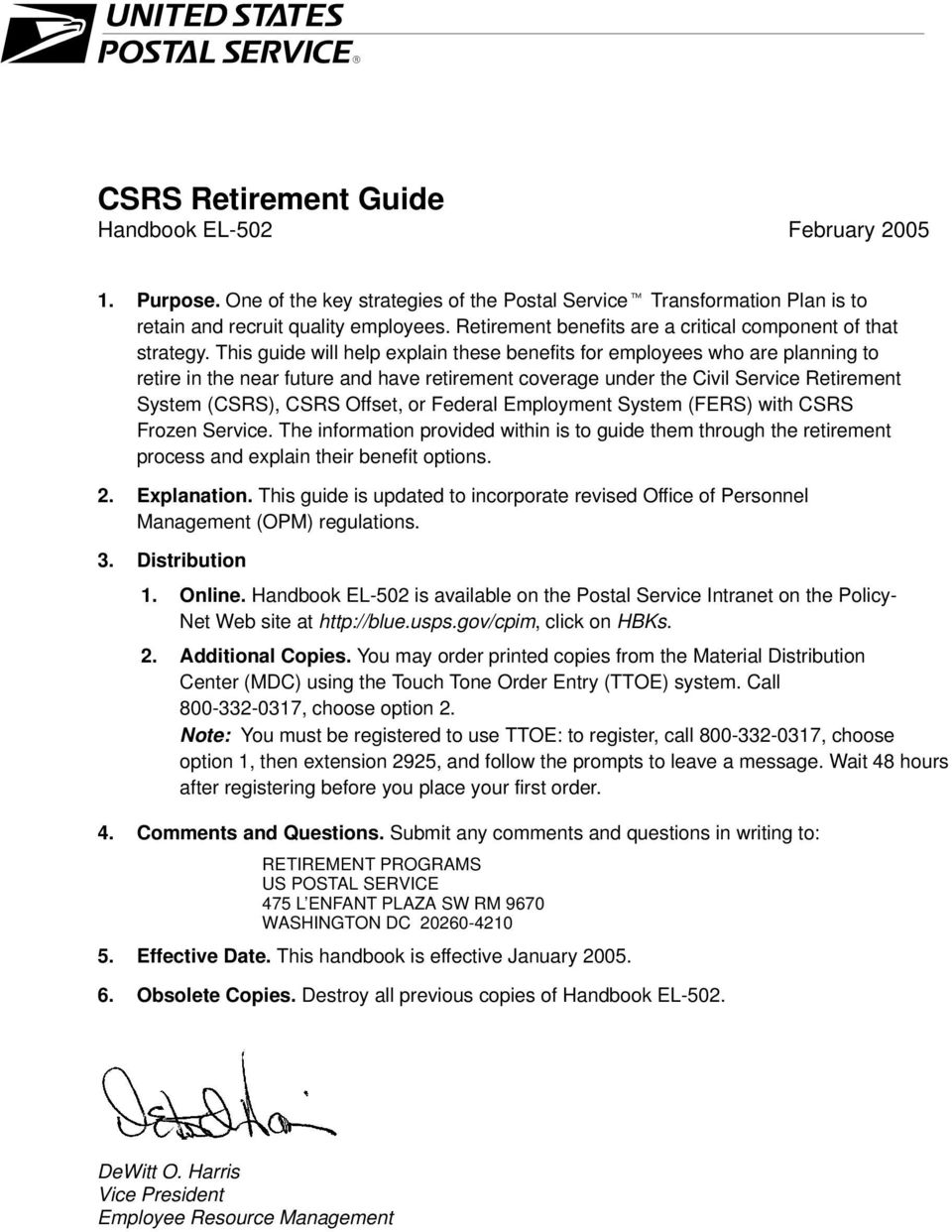
3 Contents 1 General Information Purpose Federal Employees Retirement System National Retirement Counseling System Overview Overview Creditable Service Retirement Eligibility Date Retirement Computation Date Sick Leave Determining Service Credit Civilian Service Assumption Deposit or Nondeduction Service Service Performed Before October 1, Service Performed On or After October 1, Amount of Deposit Redeposit for Refunded Service Refunded Service Terminated Before October 1, Refunded Service Terminated On or After October 1, Deposits and Redeposits Subject to Interest General Information Interest on Deposits for Nondeduction Service Rates for Service Performed Before October 1, Rates for Service Performed On or After October 1, Interest on Redeposits for Refunded Service Rates for Redeposits for Service Before October 1, Rates for Redeposits for Service On or After October 1, Payment of Deposit or Redeposit Application Exceptions For More Information Voluntary Contributions Application Restrictions Military Service February 2005 iii
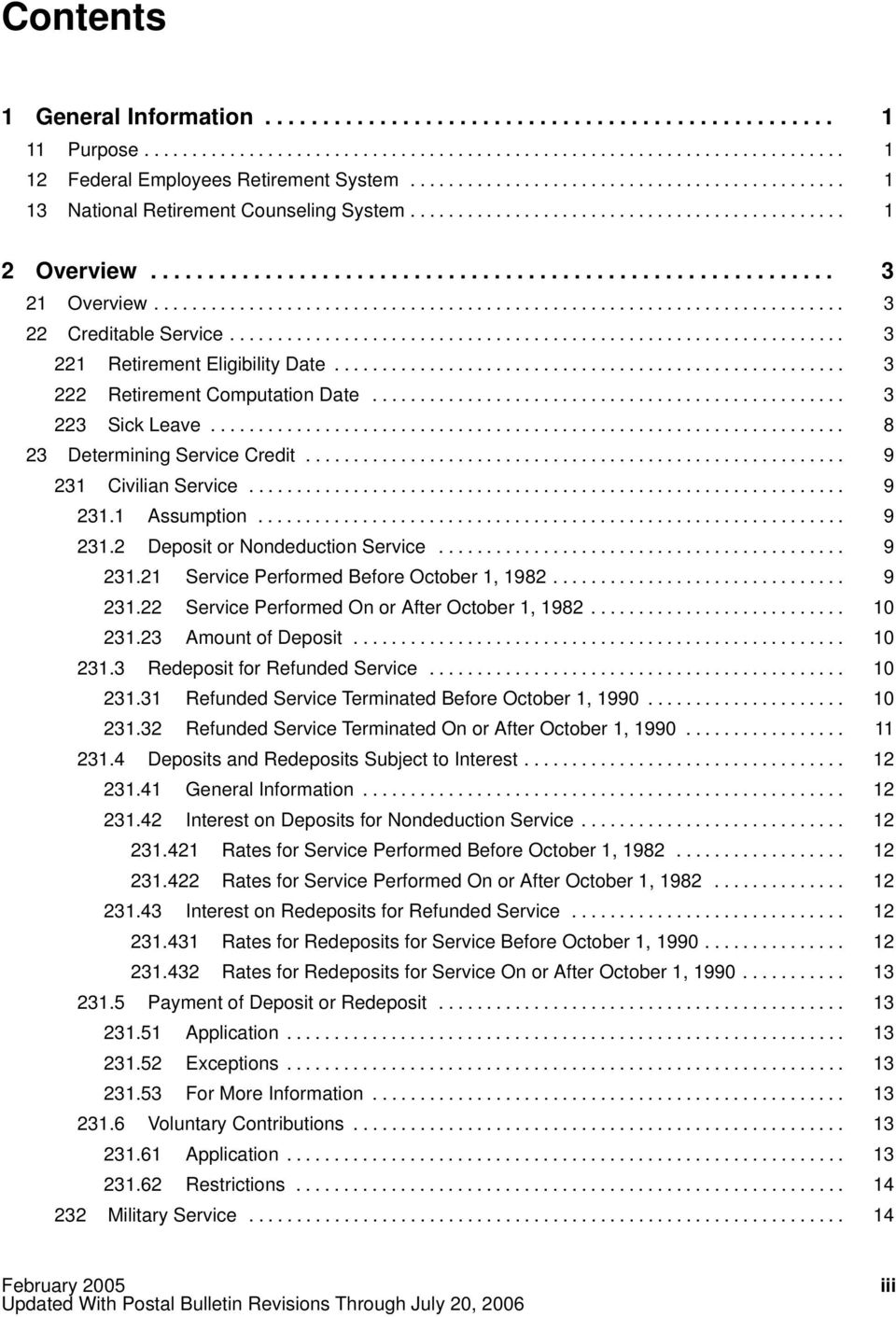
4 CSRS Retirement Guide Service Before January Post-1956 Military Service Employed Before October 1, Employed On or After October 1, Military Retired Pay Waiver of Military Retired Pay Deposit for Military Service Annuity Limitation of 80 Percent CSRS Offset Salary History Annuity Calculation Factors Affecting the Annuity Primary Factors Affecting the Annuity Amount Length of Service High-3 Average Pay Other Considerations Affecting the Annuity Amount Reductions Proration for Part-Time Service Additional Annuity Determining the Amount of the Annuity General Formula Service Factor Method Computation for Part-Time Service Service Performed Before April 7, Service Performed On or After April 7, Pre- and Post-April 6, 1986, Service Alternative Form of Annuity Eligibility and Payment Computation of the AFA Annuity Commencement Date Rounding Down of Civil Service Annuities Cost-of-Living Adjustment Other Annuity Information Retirement Deductions Annual Leave Balance Terminal Leave Payment Deductions from Annuity iv Handbook EL-502

5 Contents 3 Survivor Benefits Survivor Benefits Elections Election for Current Spouse Spouse s Written Consent to Reduce Annuity Survivor Annuity for Former Spouse Court-Ordered Provision Voluntary Provision Effect on Current Spouse Survivor Annuity Designating a Base Determining the Cost Annuity Election Changes After Retirement Election for Current Spouse Changes in Marital Status Marriage After Retirement Insurable Interest Election Eligibility Determining the Cost Election for Current Spouse Surviving Children Insurance and Other Benefits Federal Employees Group Life Insurance Description of Coverage Requirements for Continuation Reduction in Basic Life Insurance Coverage After Retirement Reduction in Optional Insurance Coverage After Retirement Certification of Insurance Status and Conversion For More Information Federal Employees Health Benefit Program Description Requirements for Continuation Employee Organization Plan Benefits Cost of Coverage Medicare Long Term Care Thrift Savings Plan Statement of Earnings Withdrawing and Distributing Accounts Transfer to IRA February 2005 v

6 CSRS Retirement Guide Lump Sum Payment Installment Payments Life Annuity Social Security Administration and Medicare Benefits Qualifying for Benefits How a Civil Service Retirement Annuity Can Affect Your Social Security Benefits What the Windfall Elimination Provision Means What the Government (Public) Pension Offset Means Medicare Benefits Social Security Publications Flexible Spending Accounts Termination of Accounts With Retirement Deadline for Withdrawal Requests Contributions While on Postal Service Rolls Regular Contributions Missed Contributions For More Information Counseling Services Postal Service Counseling for Employees Office of Personnel Management Counseling for Retirees and Survivors Social Security Administration Assistance Federal Retirement Thrift Investment Board Assistance Processing the Retirement Application Employee Responsibility Selecting the Date Contacting a Counselor Application for Retirement General Information Reminder Review of Federal and Postal Service History Verifying Your Service and Benefits Reviewing the Retirement History Report Supplying Missing Documentation Verifying Retirement Eligibility Military Discharge Certificates Employing Office Responsibility Office of Personnel Management Receipt of Retirement Package vi Handbook EL-502

7 Contents 632 OPM Review Interim Annuity Payments Processing by Claims Examiner Direct Deposits Required Method of Payment Required Form Taxing Your Annuity Federal Income Tax Withholding Provision Taxable Portion of Annuity State Income Tax Withholding Voluntary Withholding Program Withholding Request Avoiding Delays Mailing Instructions Final Pay and Terminal Leave Payment Annuity Payments Ensuring Receipt of Annuity Payments Information Assistance Documenting CSA Number Requesting Information Death Benefits General Information Survivor Annuity Death in Service Death After Retirement Exception Duration of Survivor Annuity Lump Sum Benefits Amount Order of Precedence Death Claims Death in Service Notification Documentation Required Obtaining Claim Forms Death After Retirement OPM Notification Return of Annuity Checks February 2005 vii

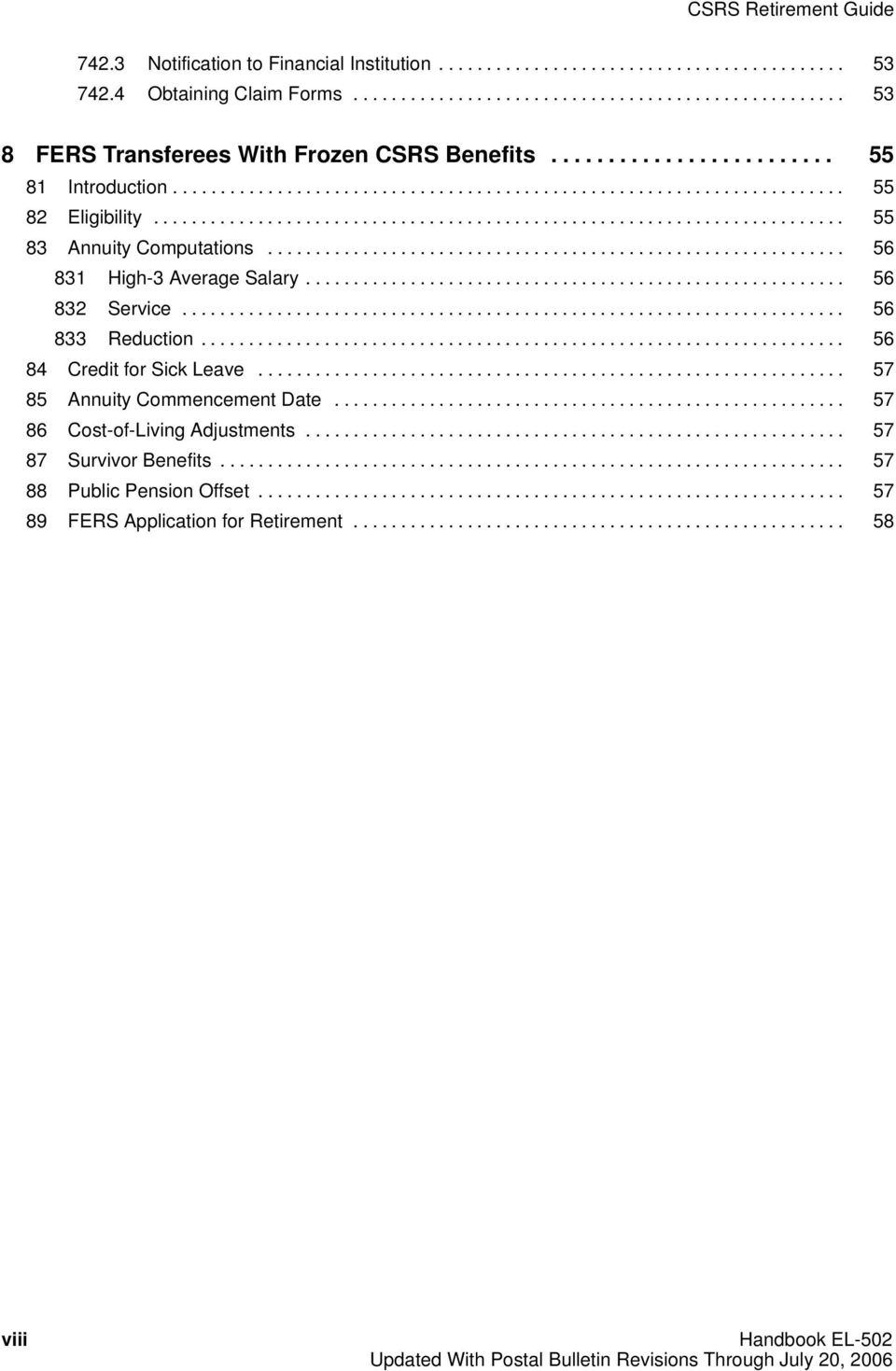
8 CSRS Retirement Guide Notification to Financial Institution Obtaining Claim Forms FERS Transferees With Frozen CSRS Benefits Introduction Eligibility Annuity Computations High-3 Average Salary Service Reduction Credit for Sick Leave Annuity Commencement Date Cost-of-Living Adjustments Survivor Benefits Public Pension Offset FERS Application for Retirement viii Handbook EL-502
9 Exhibits Exhibit 21 Annuity Estimate Example Exhibit 223 Sick Leave Conversion Chart Exhibit Present Value Factors Exhibit Variable Interest Rates Exhibit Chart for Computing Annuity Exhibit 412 Premiums and Reductions to Value Exhibit 71 Personal Records Locator Exhibit 82 Minimum Retirement Ages February 2005 ix

10 CSRS Retirement Guide This page intentionally left blank x Handbook EL-502

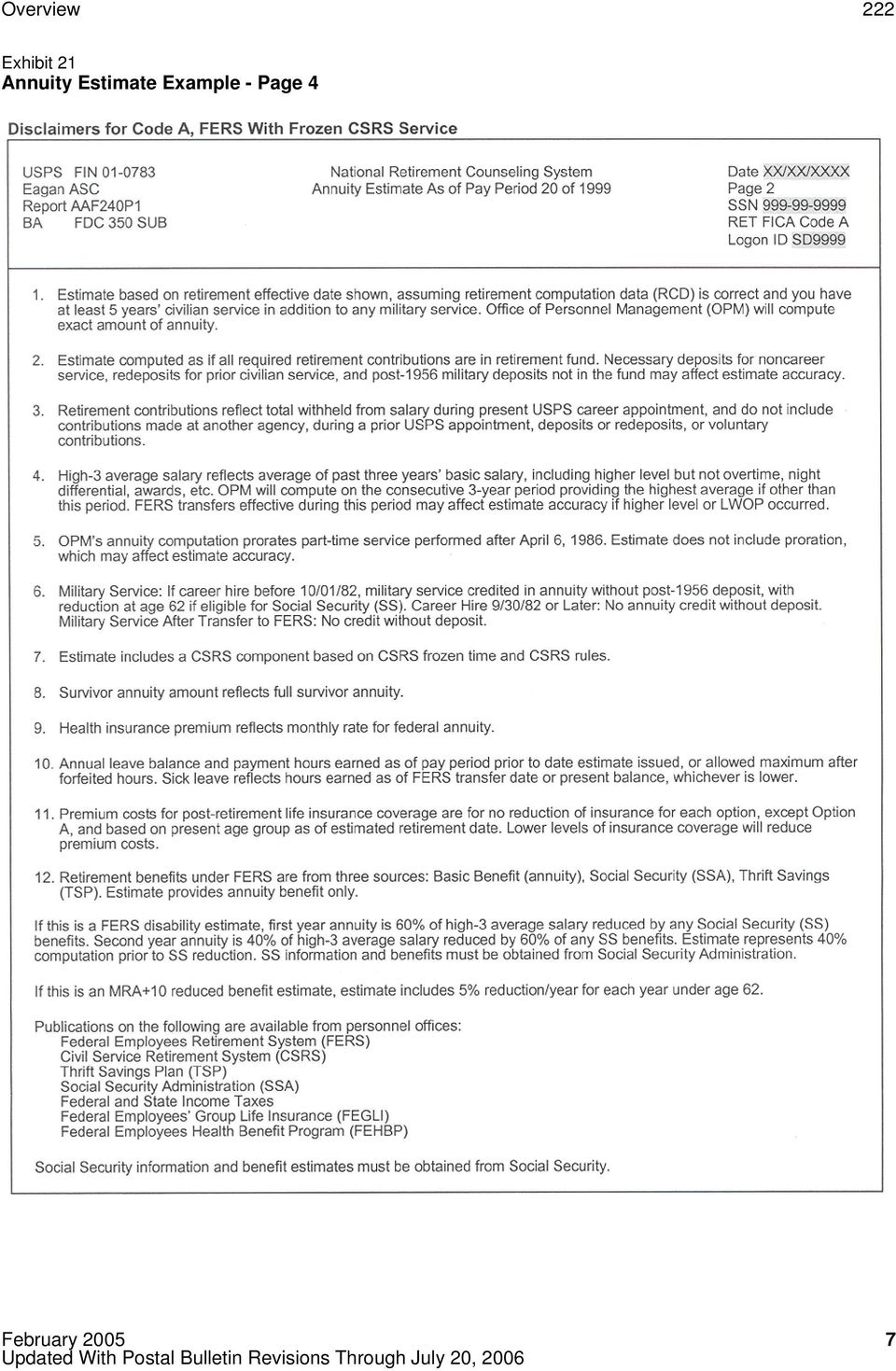
11 General Information 13 1 General Information 11 Purpose If you are planning to retire within the near future and are covered under the regular Civil Service Retirement System (CSRS) or CSRS Offset, this handbook is for you. It is designed to guide you through the retirement process and provide you with information on the following: a. Annuity and survivor benefit calculations. b. Other benefits such as health benefits, life insurance, and the Thrift Savings Plan (TSP). c. Procedures and time frames involved in applying for retirement. d. What to expect in retirement. Note: For more information on specifics regarding CSRS Offset service, see OPM pamphlet RI 83-19, CSRS Offset Retirement, available from your personnel office or on the Internet at 12 Federal Employees Retirement System If you are covered under the Federal Employees Retirement System (FERS), contact your employing office for information about that program. OPM pamphlet RI 90-1, Federal Employees Retirement System (An Overview of Your Benefits), is available in your local personnel office. If you transferred to FERS with frozen CSRS service, refer to Chapter 8 of this handbook, FERS Transferees With Frozen CSRS Benefits. 13 National Retirement Counseling System The Postal Service implemented the National Retirement Counseling System (NARECS) to ensure that all employees who become eligible for retirement are provided with in-depth information and counseling to make informed decisions to prepare for retirement. A computer-generated report called an annuity estimate is mailed twice each year to the home address of those employees currently eligible for retirement. Those employees who are within 3 years of retirement eligibility may request an annuity estimate by contacting their personnel office. An example of an annuity estimate appears as Exhibit 21, Annuity Estimate Example. February

12 CSRS Retirement Guide This page intentionally left blank 2 Handbook EL-502

13 Overview Overview 21 Overview The annuity estimate gives you the approximate amount of your benefit and also provides other pertinent information, such as the amount of terminal leave payment and the cost of health and life insurance in retirement. Remember, the annuity is simply an estimate. When you retire, the Office of Personnel Management (OPM) computes your benefit and advises you of the exact amount. An example of an annuity estimate (a universal estimate form and alternate disclaimers for different retirement codes) is shown in Exhibit 21, Annuity Estimate Example, and its contents are explained throughout this handbook. 22 Creditable Service 221 Retirement Eligibility Date The retirement eligibility date is the earliest date you meet both the age and service requirements for optional retirement. Eligibility Requirements for Optional Retirement Age Years of Service Retirement Computation Date The retirement computation date (RCD) is the date used to determine your creditable years of service for retirement purposes. Example: RCD = 12/10/ years of service = 12/10/ years of service = 12/10/2005 February

14 222 CSRS Retirement Guide Exhibit 21 Annuity Estimate Example - Page 1 Universal Estimate Form and Alternate Disclaimers for Different Retirement Codes 4 Handbook EL-502

15 Overview 222 Exhibit 21 Annuity Estimate Example - Page 2 February

16 222 CSRS Retirement Guide Exhibit 21 Annuity Estimate Example - Page 3 6 Handbook EL-502

17 Overview 222 Exhibit 21 Annuity Estimate Example - Page 4 February
18 223 CSRS Retirement Guide 223 Sick Leave Your unused sick leave hours, converted to years, months, and days, are added to your total actual service once you reach the age and service requirement (see Part 221, Retirement Eligibility Date). This combined time is used to compute your annuity. Although credit for accumulated sick leave increases the annuity, it is not used to compute the high-3 average salary (see Section 251.1, Primary Factors Affecting the Annuity Amount) or to meet the retirement eligibility service requirement. For this reason, it is listed as a separate item on the annuity estimate as Time Represented by Sick Leave (see Exhibit 223, Sick Leave Conversion Chart). Note: For more information on sick leave credit, see OPM pamphlet RI 83-8, Credit for Unused Sick Leave Under the Civil Service Retirement System, available from your personnel office or on the Internet at Exhibit 223 Sick Leave Conversion Chart To convert sick leave hours to retirement service credit, find the number of sick leave hours in the chart under columns b through m. (If you cannot find the exact number, locate the next lower number.) The retirement credit is thus obtained, in months and days, from the months listed at the top of the column and the days noted in the far left column (column a). For example, 1,560 hours equals 9 months of service; 805 hours equals 4 months, 19 days of service (on the basis of 2,080 hours to the year). a b c d e f g h i j k l m No. of Days Under 1 Mo. 1 Mo. 2 Mo. 3 Mo. 4 Mo. 5 Mo. 6 Mo. 7 Mo. 8 Mo. 9 Mo. 10 Mo. 11 Mo Handbook EL-502

19 Overview Determining Service Credit 231 Civilian Service Assumption The annuity estimate assumes that all periods of creditable civilian service are covered by retirement deductions. This may not be the case in your particular situation Deposit or Nondeduction Service Any period of service never covered by retirement deductions is called deposit or nondeduction service. Generally, this is noncareer time such as temporary, indefinite, casual, Transitional Employee, or Rural Carrier Associate service creditable for Social Security benefits with Social Security withholdings (shown as FICA or OASDI ) on Postal Service and other agency earnings statements and W-2 forms. As explained below, deposit (nondeduction) service performed before October 1, 1982, differs from deposit (nondeduction) service performed on or after that date Service Performed Before October 1, 1982 Service performed before October 1, 1982, for which no retirement fund deductions were made, is creditable in full in counting total time for retirement eligibility, whether or not a deposit is made. To receive full annuity, however, a deposit must be paid in full to cover the period of nondeduction service. The deposit amount consists of the contributions that would have been due OPM for the nondeduction period if it had been career service, calculated at the appropriate CSRS or CSRS Offset contribution rate, plus 3 percent interest (accrued daily and compounded annually) on the total contributions due (see Section , Rates for Service Performed Before October 1, 1982, and Part 422, Requirements for Continuation). If no deposit is paid, the actual annuity is reduced by 10 percent of the deposit amount due for this nondeduction service, and the reduction remains in effect for the life of the annuity. Example: If the deposit and interest due is $600 when your eligibility to retire is calculated, your annual annuity is reduced by 10 percent of $600, or $60 per year, if the deposit is not made. This translates into a reduction of $5 a month ($60 divided by 12 months) in your monthly annuity for as long as you receive it. When determining whether to make the deposit, consider that although you are receiving a higher monthly annuity, it will take approximately 10 years for you to recover the full amount of the deposit. Only then can the advantage of a deposit be realized. February
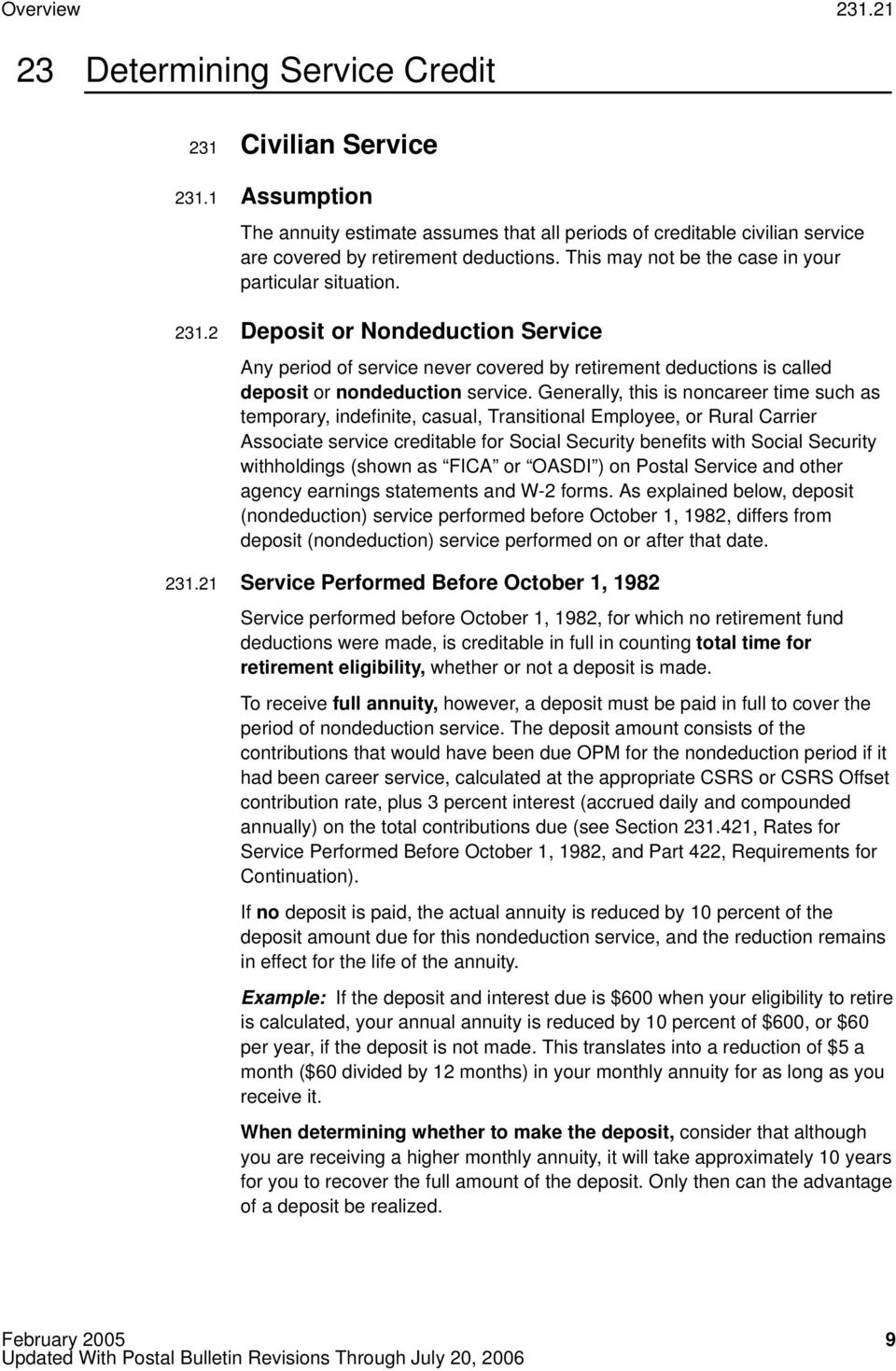
20 CSRS Retirement Guide Service Performed On or After October 1, 1982 Service performed on or after October 1, 1982, for which no retirement fund contributions were paid is creditable in full in counting total time for retirement eligibility but is not creditable for annuity computation purposes unless the deposit, with interest, is made (see Section 231.4, Deposits and Redeposits Subject to Interest). Usually, it is to your advantage to make a deposit to cover nondeduction service performed on or after October 1, Amount of Deposit The deposit is computed as if regular retirement fund contributions were paid, as shown in the following table, plus interest. Percent of Basic Pay Service Period 3.5 Service before July 1, July 1, 1942, to June 30, July 1, 1948, to October 31, November 1, 1956, to December 31, After December 31, Redeposit for Refunded Service A period of service for which retirement deductions were withheld and later refunded by OPM to an employee following a break in service of 30 days or more is referred to as refunded service. This period of service is creditable in full in counting total time for retirement eligibility. However, the rules for crediting refunded service toward the calculation of the annuity vary depending on when the service terminated Refunded Service Terminated Before October 1, 1990 Redeposit of funds to OPM for a period of refunded service is not required for the employee to receive credit for this service in calculating the annuity if the separation from rolls for that period occurred before October 1, If no redeposit is paid, the annuity is actuarially reduced (see Exhibit , Present Value Factors). This reduction takes into consideration the employee s age at retirement and the amount of unpaid redeposit and is determined by dividing the amount of the unpaid redeposit by the actuarial factor based on the individual s age at retirement, as shown in the following example. 10 Handbook EL-502
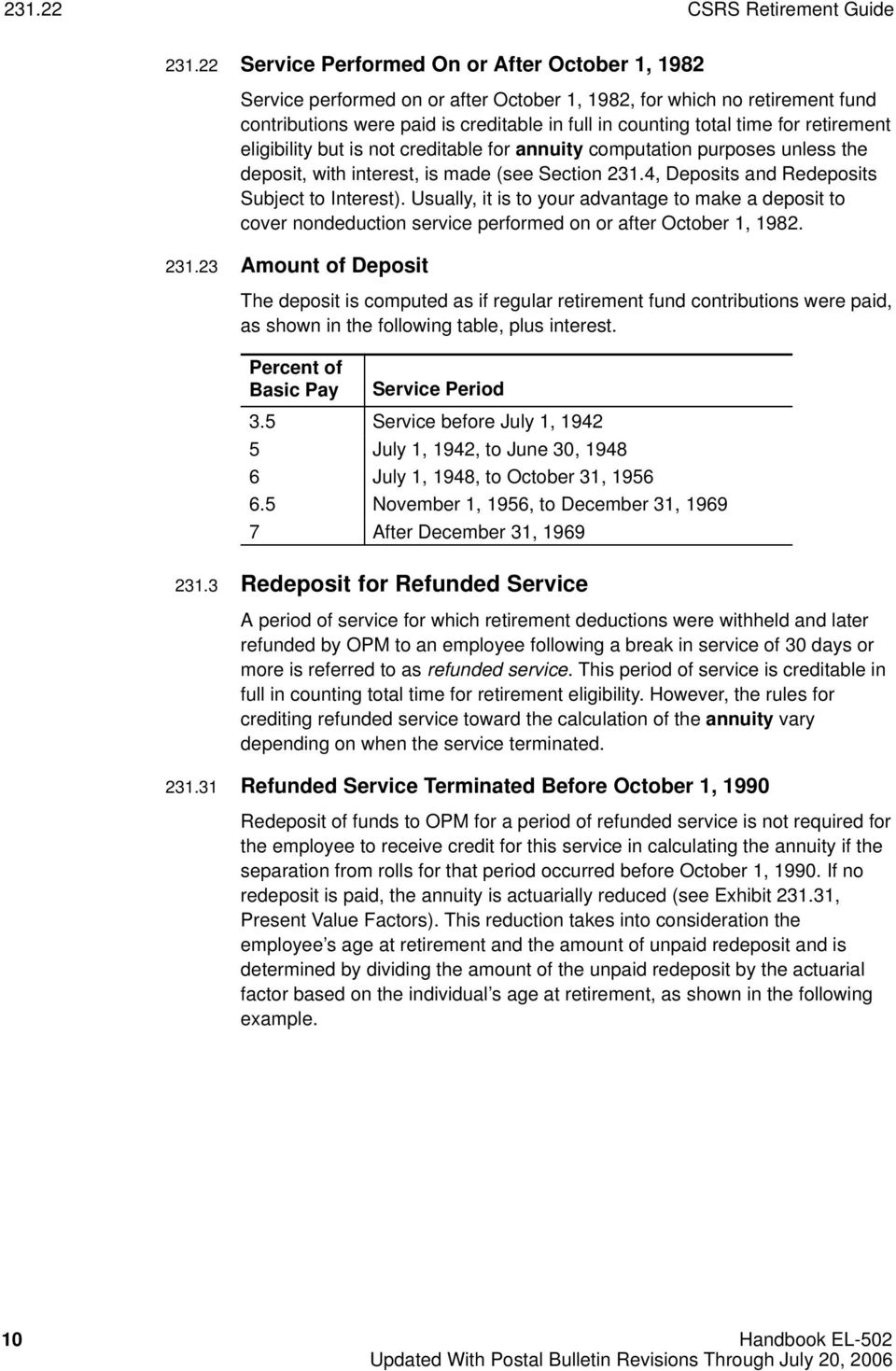
21 Overview Exhibit Present Value Factors Age at Retirement Factor Age at Retirement Factor Example: Using this exhibit, it is established that for a retiree at age 60, with an unpaid redeposit of $1,500 ($800 CSRS contributions withdrawn + $700 interest), the actuarial factor to determine the reduction to the annuity would be Therefore: $1, = $7.95 reduction to annuity per month Refunded Service Terminated On or After October 1, 1990 Redeposit of funds to OPM is required for a period of refunded service if the separation from rolls for that period occurred on or after October 1, The full redeposit consists of the exact amount refunded plus interest (see Section 231.4, Deposits and Redeposits Subject to Interest). February
22 231.4 CSRS Retirement Guide Deposits and Redeposits Subject to Interest General Information Both deposits and redeposits are subject to interest compounded annually. You are charged interest for all periods of employment covering the deposit or redeposit and certain periods of separation. Periods of separation before October 1956 are not subject to interest. However, you are charged interest for all periods of separation that began on or after that date. The variable rate of interest is determined each year by the Secretary of the Treasury on the basis of the average yield of new investments purchased by the retirement fund during the previous calendar year. The variable rates of interest established for each calendar year since 1985 are shown in exhibit Exhibit Variable Interest Rates Interest Year Rate Interest Rate Year % % % % % % % % % % % % % % % % % % % % Interest on Deposits for Nondeduction Service Rates for Service Performed Before October 1, 1982 Interest on deposits for nondeduction service performed before October 1, 1982, is computed at a fixed rate of 3 percent, accrued daily and compounded annually Rates for Service Performed On or After October 1, 1982 Interest on deposits for nondeduction service performed on or after October 1, 1982, is computed at the rate of 3 percent through 1984 and at a variable rate starting in 1985, accrued daily and compounded annually Interest on Redeposits for Refunded Service Rates for Redeposits for Service Before October 1, 1990 Interest on redeposits for service performed before October 1, 1990, is computed at the rate of 3 percent per year from the date of receipt of the refund to the date redeposit is completed, accrued daily and compounded annually. 12 Handbook EL-502
23 Overview Rates for Redeposits for Service On or After October 1, 1990 For those applications for refund that were received by either the Postal Service or OPM on or after October 1, 1982, interest is computed at the rate of 3 percent per year through December 31, 1984, accrued daily and compounded annually. For refund received after December 31, 1984, a variable rate of interest is computed using the table in exhibit , compounded annually Payment of Deposit or Redeposit Application You must submit a request to make a deposit or redeposit to OPM through the Eagan Accounting Service Center (ASC) Retirement Branch on SF 2803, Application to Make Deposit or Redeposit. Your employing office assists you in completing this form. The request to make a deposit or redeposit need not delay filing an SF 2801, Application for Immediate Retirement. When you or your local personnel office submits your SF 2801 to the Eagan ASC, the SF 2803 may also be included. OPM notifies you of the exact amount due and will give you an opportunity to pay this amount, if you wish, before your annuity claim is finalized Exceptions In those limited retirement cases when an alternative form of annuity (AFA) lump sum is elected (see Part 254, Alternative Form of Annuity), OPM does not collect deposit or redeposit money, which simply would be returned as part of a person s lump sum payment. Instead, OPM gives automatic credit for deposits or redeposits, including interest, thus assuring that the AFA is the maximum amount possible. These are deemed deposits or redeposits that are treated as having been paid and then returned to the person as part of the lump sum payment For More Information Note: For more information on all items in Subchapter 23, Determining Service Credit, see OPM pamphlets RI 83-3, Deposits and Redeposits Under the Civil Service Retirement System, and RI 83-7, Computing Retirement Benefits Under the Civil Service Retirement System, available from your local personnel office. These pamphlets are also available on the Internet at Voluntary Contributions Application You may increase your future annuity by increasing your contributions to OPM during employment, prior to retirement, provided you are not subject to the restrictions covered in the following section. Each $100 of voluntary contributions increases your annuity $7 to $10 a year, depending on your age at the time of retirement. Voluntary contributions earn a variable interest rate compounded annually (see Exhibit , Variable Interest Rates). Application is made by filing SF 2804, Application to Make Voluntary February
24 CSRS Retirement Guide Contributions, with OPM. This form may be obtained from your employing office. If you have made voluntary contributions and wish to withdraw them, you may do so at any time before you retire Restrictions OPM will not approve an application for voluntary contributions from an employee who (1) owes a deposit or redeposit for civilian service or (2) has previously received a refund of voluntary contributions, unless the applicant was separated for more than 3 calendar days and was again employed under CSRS. Note: For more information, see OPM pamphlet RI 83-10, Voluntary Contributions Under the Civil Service Retirement System, available from your local personnel office or on the Internet at Military Service Service Before January 1957 All honorable active military service performed before January 1957 is included in the computation of the annuity unless you are receiving military retired pay. (See Section 232.5, Military Retired Pay, for exceptions in allowing credit for military retired pay.) Post-1956 Military Service Creditable post-1956 military service is a period of honorable active service performed after December 1956 in the Army, Navy, Marine Corps, Air Force, or Coast Guard of the United States. Creditable post-1956 military service also includes service performed after June 30, 1960, in the Regular or Reserve Corps of the Public Health Service or, after June 30, 1961, as a commissioned officer of the National Oceanic and Atmospheric Administration (formerly Coast and Geodetic Survey and the Environmental Science Service Administration). The rules for crediting post-1956 military service for retirement eligibility and for the annuity calculation vary depending on the date of your initial period of CSRS employment. These rules are explained in sections through Employed Before October 1, 1982 If you were ever employed by the federal government or the Postal Service before October 1, 1982, in a position covered by the CSRS, the following provisions apply: a. You receive credit for all your creditable post-1956 military service in the computation of annuity provided you meet the eligibility requirements for an annuity. However, if at age 62 you are eligible for Social Security benefits, your annuity is recomputed, eliminating the years of post-1956 military service. If you currently receive military retired pay, you must waive your retired pay to receive credit for your military service unless you qualify for one of the exceptions cited in 14 Handbook EL-502
25 Overview Section 232.5, Military Retired Pay. Military retirees who waive their retired pay to receive credit for military service also have their annuity recomputed upon reaching Social Security eligibility. The recomputation (reduction) of annuity occurs only at age 62, if you are entitled to Social Security at age 62, which explains why it is commonly referred to as catch 62. b. If you do not wish to have your annuity recomputed at age 62 to eliminate post-1956 military service, you must make a deposit to the CSRS Fund for the post-1956 military service (see Section 232.7, Deposit for Military Service). c. You should be aware that the recomputation of annuity at age 62 occurs only if you are eligible for Social Security benefits at age 62. If you do not become eligible for Social Security benefits until after age 62 (i.e., age 63 or later) then the CSRS annuity will not be recomputed and full credit will continue for post-1956 military service in annuity, even though a deposit has not been made Employed On or After October 1, 1982 If you were first employed by the federal government or the Postal Service on or after October 1, 1982, in a position covered by the CSRS, the following provisions apply: a. You do not receive credit for your post-1956 military service unless you make a deposit to the CSRS Fund for the military service (see Section 232.7, Deposit for Military Service). b. If you are receiving military retired pay, you must make the deposit and also waive your retired pay before the commencement date of your annuity to receive credit for your military service (see Sections 232.5, Military Retired Pay, and 232.6, Waiver of Military Retired Pay) Military Retired Pay Military service is not creditable if you receive military retired pay unless one of the following provisions is true: a. Your military retired pay was awarded because of a service-connected disability either incurred in combat with an enemy of the United States or caused by an instrumentality of war and incurred in the line of duty during a period of war. b. Your military retired pay was awarded under the reserve retiree provisions under Chapter 1223, Title 10, United States Code (U.S.C.). c. You waive your military retired pay Waiver of Military Retired Pay If you wish to waive your military retired pay, you must request such a waiver in writing. Submit a letter to your Military Finance Center at least 60 days before your retirement date. A copy of your letter, or the letter of acknowledgement from the Military Finance Center, should be attached to your SF If a waiver does not accompany the SF 2801, your annuity is February
26 232.7 CSRS Retirement Guide delayed. The effective date for discontinuance of your military retired pay should be the day before the commencement date of your annuity (see Subchapter 26, Annuity Commencement Date) Deposit for Military Service If you wish to make a deposit for your post-1956 military service, you must complete SF 2803, and provide a copy of Form DD 214, Certificate of Release or Discharge From Active Duty, or equivalent record to verify your service and provide documentation of military basic pay. The deposit is 7 percent of your military basic pay for the period of military service claimed. Contact your employing office for instructions on how to process your request. Deposits for military service must be completed before separation or retirement or included with the retirement application. Note: For more information, see OPM pamphlet RI 83-2, Military Service Credit Under the Civil Service Retirement System, available from your personnel office or on the Internet at Annuity Limitation of 80 Percent The maximum possible amount of annuity is 80 percent of high-3 average salary. The 80-percent maximum is attained by a combined total of years of service (civilian and military) of 41 years and 11 months (see , High-3 Average Pay, for an explanation of a high-3 average salary). Retirement deductions withheld after 41 years and 11 months of service are applied toward payment of deposits or redeposits, with any balance automatically refunded to the employee at the time of retirement. Excess contributions may be used as voluntary contributions to increase annuity or be returned to the employee as a refund. Unused sick leave may be creditable to provide additional annuity above 80 percent. Voluntary contributions made to your CSRS fund may also provide additional annuity. 234 CSRS Offset If you are covered by both CSRS and Social Security, you are covered by the CSRS Offset. This means that your CSRS annuity is offset by your Social Security benefits. The annuity shown on your estimate is reduced (offset) when you become eligible for Social Security. The amount of the offset is the amount of the Social Security benefits attributable only to service after 1983 covered by both CSRS and Social Security. 16 Handbook EL-502
27 Overview Salary History Your annuity estimate under the Salary History heading reflects the last 3 years of salary history to calculate your high-3 average salary (see Section 251.1, Primary Factors Affecting the Annuity Amount). An annuity estimate for an employee who worked part-time after April 6, 1986, indicates total earnings for the position, and special attention should be paid to disclaimers noted in Exhibit 21, Annuity Estimate Example (see also Part 253, Computation for Part-Time Service). 25 Annuity Calculation 251 Factors Affecting the Annuity Primary Factors Affecting the Annuity Amount Length of Service This includes credit for unused sick leave, but may not include credit for nondeduction or refunded service (see Subchapter 23, Determining Service Credit) High-3 Average Pay Your high-3 average salary is the highest salary figure obtained by averaging your rate of basic salary during any 3 consecutive years of service, with each rate weighted by the time it was in effect. Basic pay for retirement purposes includes higher-level pay but does not include overtime, night differential, and military pay. The 3 years used in the average salary computation do not need to be continuous, but they must consist of consecutive periods of service. In most cases, the assumption that the last 3 years are the high-3 years is correct. If, however, you had an earlier period of higher earnings, OPM will compute your annuity based on the earlier period, even if that period of service was with another federal agency Other Considerations Affecting the Annuity Amount Reductions The annuity is reduced if any of the following factors are relevant at time of retirement: (1) retirement begins before age 55 (for example, discontinued service annuity or a reduction in force), (2) deposits and redeposits have not been made (see Subchapter 23, Determining Service Credit), or (3) an election of an annuity for a surviving spouse, a former spouse, or a person with an insurable interest is made (see Chapter 3, Survivor Benefits) Proration for Part-Time Service For an employee who worked part-time, see Part 253, Computation for Part-Time Service. February
28 CSRS Retirement Guide Additional Annuity An annuity may be increased by making voluntary contributions to the CSRS Fund (see Section 231.6, Voluntary Contributions). 252 Determining the Amount of the Annuity General Formula Once a high-3 average has been determined, the annual basic annuity is obtained by applying the following general formula: Step 1 Take 1.5 percent of the high-3 average pay and multiply the result by 5, for the first 5 years of service. Step 2 Take 1.75 percent of the same high-3 average pay and multiply the result by 5, for the second 5 years of service. Step 3 Take 2 percent of the same high-3 average pay and multiply by the number of years of service beyond the first 10. The total of the products of Steps 1, 2, and 3 equals the annual basic annuity. The annual basic annuity divided by 12 equals the monthly basic annuity. Example: Here is an example of how the general formula is applied to an employee with 30 years of service and a high-3 average pay of $30,000: General Formula Method Step 1: Take 1.5 percent of the high-3 average salary ($30,000) multiplied by years of service up to 5 (5 years). Step 2: Step 3: Add 1.75 percent of the same high-3 average salary ($30,000) multiplied by the years of service between 5 and 10 (5 years). Add 2 percent of the same high-3 average salary ($30,000) multiplied by the years of service over 10 (20 years) x $30,000 x 5 = $2, x $30,000 x 5 = + $2, x $30,000 x 20 = + $12, The total is the annual basic annuity. $16, The annual basic annuity divided by 12 is the $ 16, = $1, monthly basic annuity Service Factor Method An easier way to compute the basic annuity is to use the factor identified for the years and months of service as shown in Exhibit 252.2, Chart for Computing Annuity, instead of the step-by-step method of the general formula. To obtain the annual basic annuity, multiply the high-3 average pay by the appropriate factor from the chart and then divide the annual basic annuity by 12 to find the monthly basic annuity. 18 Handbook EL-502
29 Overview Example: Here is an example of how the service factor method is applied to an employee with 30 years 8 months of service and a high-3 average pay of $30,000: Service Factor Method Step 1: Multiply the high-3 average salary ($30,000) by the service factor for 30 years 8 months ( ) to find the annual basic annuity. Step 2: Divide the annual basic annuity by 12 to find the monthly basic annuity. $30,000 x = $17, $17, = $1, Exhibit Chart for Computing Annuity Instructions: 1. Find row showing full years of service at far left of table. 2. Moving across top of table, find column heading showing full months of service. 3. Where row and column intersect, find the factor for computing your annuity. Computing Basic Annuity Where High-3 Average Pay is $5,000 or More Years of 0 mo. 1 mo. 2 mo. 3 mo. 4 mo. 5 mo. 6 mo. 7 mo. 8 mo. 9 mo. 10 mo. 11 mo. Service * *Annuity in excess of 80 percent that is produced by credit for unused sick leave is payable. February
30 253 CSRS Retirement Guide 253 Computation for Part-Time Service Service Performed Before April 7, 1986 Part-time service performed before April 7, 1986, is treated as full-time service for annuity computation Service Performed On or After April 7, 1986 Part-time service performed on or after April 7, 1986, is subject to a different annuity formula. This formula reduces an individual s annuity for such service by a fraction called the proration factor. The proration factor is generally the number of hours a part-time employee works divided by the number of hours an employee would have worked if he or she had been a full-time employee over the same period of time. Your personnel office will assist you in obtaining a retirement estimate that reflects the proration factor applicable to the part-time service Pre- and Post-April 6, 1986, Service If you have service both before and after April 7, 1986, two separate calculations are made for each period of service. The proration factor method is applied only to the portion of the annuity that represents part-time service performed on or after April 7, Alternative Form of Annuity Eligibility and Payment In place of the basic annuity calculated above, certain employees may elect an alternative form of annuity (AFA). In general, the AFA is limited to employees with a life threatening affliction who separate under either a voluntary (optional) retirement or an involuntary discontinued service annuity. The AFA allows the retiree to receive a lump sum payment equal to the total contributions made by the employee to the retirement plan, plus any interest accrued before 1957, and to receive a reduced monthly annuity. Individuals eligible for AFA are provided an estimated alternative annuity on their annuity estimate printout under Lump Sum Computation of the AFA To determine the reduction to monthly annuity, full annuity must first be calculated as stated in parts 252 and 253. This amount is then reduced by an amount equal to the lump sum payment divided by a present value factor for the employee s age at the time of retirement. The value factors (also referred to as actuarial factors) are the same as those used to determine reductions for redeposits not paid to OPM (see Exhibit , Present Value Factors). 20 Handbook EL-502
31 Overview 26 Example: The following is a calculation for an employee, age 62 at the time of retirement, with a total lump sum payment due of $20,000 and a beginning rate of annuity of $1,000 per month. If the employee elects the AFA, that annuity is $887 per month instead of $1,000 per month. The calculation is as follows: $20, (value factor for age 62) = $113 (rounded up) $1,000 $113 = $ Annuity Commencement Date Under the current retirement law, if you voluntarily retire on day 1, 2, or 3 of the month, your annuity begins on the day after separation. If you retire voluntarily on any other day of the month, your annuity begins on the first day of the month after separation. In either case, if the employee s last day in pay status was prior to the effective date elected on the retirement application and retirement eligibility had been met as of that day, OPM will begin annuity the day following the last day of pay status. These provisions on the commencement date do not apply to disability retirement or retirement based on an involuntary separation. The following are examples for two employees retiring with the last day in pay status (LDIPS) earlier than the effective date indicated on their SF 2801: Example 1: An employee electing retirement effective 02/01/2005 (date on SF 2801) has been on LWOP since 11/10/2004 (LDIPS = 11/09/2004). The employee meets retirement criteria effective 09/30/2004 (55 years of age + 32 years of service). The annuity is effective 12/01/2004, not 02/01/2005. The employee is eligible 09/30/2004; the LDIPS is 11/09/2004. Per current retirement law, as the LDIPS is not before the third of the month, the annuity begins the first of the following month, 12/01/2004. Example 2: An employee electing retirement effective 02/01/2005 (date on SF 2801) has been on LWOP since 11/02/2004 (LDIPS = 11/09/2004). The employee meets retirement criteria effective 09/30/2004 (55 yrs of age + 32 years of service). The annuity is effective 11/02/2004, not 02/01/2005. The employee is eligible 09/30/2004; the LDIPS is 11/01/2004. Per current retirement law, as the LDIPS is before the third of the month, the annuity begins the day after the LDIPS, or 11/02/2004. February
32 27 CSRS Retirement Guide 27 Rounding Down of Civil Service Annuities Annuities beginning or redetermined on or after October 1, 1982, are rounded down to the next lower dollar rather than next higher. The rounding-down provision applies when annuities are initially computed and redetermined and also when they are later adjusted by cost-of-living increases. 28 Cost-of-Living Adjustment After retirement, you are entitled to an annual cost-of-living adjustment (COLA) increase, which is based on increases in the Consumer Price Index (CPI). Under current retirement law, COLA increases are effective December 1 of each year and are reflected in your annuity the following January. Your first COLA increase as a retiree, however, is prorated. You receive 1/12 of the applicable increase for every month (or partial month) you have been in a retired status. 29 Other Annuity Information 291 Retirement Deductions The amount of retirement deductions shown on your annuity estimate does not include (1) refunds, redeposits, or deposits; (2) deductions made by another federal agency or, in some cases, by another Postal Service data center; (3) any deductions transferred to OPM due to prior separations; or (4) voluntary contributions. However, any military deposits paid during your current career appointment are included. 292 Annual Leave Balance Terminal Leave Payment It is to your advantage to retire with an annual leave balance since the payment for terminal leave provides you with funds while you wait for your first annuity check. Note that: a. If you are a bargaining unit employee separating other than under the Voluntary Early Retirement Authority (VERA), you may receive a lump sum payment for accumulated annual leave carried over from the previous year; accrued annual leave for the year in which you separate, up to the carryover maximum for your bargaining unit; any unused donated leave; and, if you are a full-time or part-time regular employee, holidays that fall within your terminal leave period. b. Any part of your unused annual leave earned during the leave year of your separation that is in excess of the maximum carryover amount is granted to you prior to separation rather than paid out in the form of a lump sum payment. Any of the unused annual leave that you cannot take within the leave year is forfeited. 22 Handbook EL-502
33 Overview 293 c. If you are a nonbargaining unit employee or a bargaining unit employee separating under VERA, you may receive a lump sum leave payment for accumulated annual leave carried over from the previous year; accrued annual leave for the year in which you separate, including amounts over the carryover maximum; any unused donated leave; and, if you are a full-time or part-time regular employee, holidays that fall within your terminal leave period. 293 Deductions from Annuity The deductions made from your annuity for health benefits, life insurance, etc., may appear excessive. The deductions are larger than when you were an employee because they are made on a monthly basis instead of biweekly. Note: See Chapter 4 for more information on life insurance, health benefits, the Thrift Savings Plan, and Social Security Administration and Medicare benefits. February
34 CSRS Retirement Guide This page intentionally left blank 24 Handbook EL-502
35 Survivor Benefits Survivor Benefits 31 Survivor Benefits Elections 311 Election for Current Spouse Your annuity estimate provides calculations with and without survivor benefits for your spouse. Note that the estimated survivor benefit assumes you will provide the maximum provision; however, you may elect less than the full survivor annuity (see Subchapter 32, Designating a Base). Under certain circumstances, survivor benefit elections made for your spouse at the time of your retirement may be changed after you retire (see Subchapter 34, Annuity Election Changes After Retirement). The cost for electing a survivor benefit is withheld from your annuity (see Subchapter 33, Determining the Cost). 312 Spouse s Written Consent to Reduce Annuity The law requires that if you are married and elect less than the maximum survivor annuity for your spouse, you must have your spouse s written consent. You are required to complete Part I of SF , Spouse s Consent to Survivor Election, stating that you elect either no survivor annuity for your spouse or less than the maximum survivor annuity. Part 2 of SF is completed by your current spouse and must be notarized. The statement indicates that your spouse is aware of the election made by you and consents to the election. This consent is required even if there is a qualifying court order awarding the survivor annuity to a former spouse. Note: In order for your surviving spouse (and or other family members) to be entitled to continue enrollment in a health benefit plan following your death, a survivor annuity (even if you elect less than the maximum) must be established. Health benefit premiums for survivors are withheld from survivor annuities. If an annuity would be insufficient, OPM establishes an alternative direct-pay method to collect premiums. February
36 313 CSRS Retirement Guide 313 Survivor Annuity for Former Spouse Court-Ordered Provision Retirements effective on or after May 7, 1985, may be affected by a qualifying court order or divorce decree requiring the retiree to provide a survivor annuity to a former spouse. In those cases annuity is automatically reduced to provide the benefit to your former spouse. OPM provides a handbook with complete information and instructions regarding court orders. This handbook, RI , Handbook for Attorneys, can be found on the Internet at As noted in the handbook, all court orders must be forwarded to OPM to be kept on file for future retirement benefits Voluntary Provision If no court order or decree exists, you may still voluntarily elect to provide a survivor annuity for a former spouse. If you are currently married, your current spouse must consent to the voluntary election Effect on Current Spouse Survivor Annuity 32 Designating a Base The total of survivor benefits cannot exceed 55 percent of your annuity (see Subchapter 32, Designating a Base). Therefore, a current spouse will only receive an amount equal to the difference between the amount awarded to a former spouse and 55 percent of your annuity. If a former spouse is awarded the maximum survivor benefit, the current spouse would be ineligible for benefits. If you elect a survivor annuity for your spouse, you may designate any portion or all (maximum provision) of your annuity as a base for figuring the amount of the survivor annuity. Upon your death, your spouse receives 55 percent of the amount you chose as a base, plus cost-of-living increases (unless a qualifying court order has awarded a full survivor annuity to a former spouse (see Part 313, Survivor Annuity for Former Spouse)). Example: If your annual annuity is $19,000 and you designate $8,000 of your annuity as a base, upon your death your spouse receives a yearly survivor annuity of 55 percent of $8,000 (i.e., $4,400), plus cost-of-living increases. If you designate the entire annuity as a base, your spouse will receive 55 percent of $19,000 (i.e., $10,450), plus cost-of-living increases. 26 Handbook EL-502
37 Survivor Benefits Determining the Cost If you elect a survivor annuity for your spouse, your annuity is reduced by 2 1/2 percent of the first $3,600 chosen as a base, plus 10 percent of any amount over $3,600. Example: If you choose $8,000 as a base, your annuity will be reduced as follows: First $ 3,600 of base x 2.5% = $ 90 Remaining $ 4,400 of base x 10% = $ 440 $ 8,000 base = $ 530 reduction per year 34 Annuity Election Changes After Retirement 341 Election for Current Spouse If you elect at retirement to provide less than a maximum survivor annuity for a current spouse, you may later change that election to provide an increase to the survivor benefit. (You may not elect to provide a lesser survivor benefit for your spouse.) The request for an increase must be filed with OPM no later than 18 months after the commencement date of your annuity. You are required to pay a deposit (plus interest) representing the difference between the reduction in your annuity for the new survivor election and the original survivor election, plus a charge of $245 for each thousand-dollar change in the designated survivor s base. 342 Changes in Marital Status If you elect a survivor benefit and your spouse dies or the marriage is otherwise dissolved, you should immediately notify OPM so that your annuity can be recomputed to eliminate the reduction for the survivor benefit. 343 Marriage After Retirement If you are not married and you decide to marry after you retire, you may elect a survivor benefit by notifying OPM. However, your spouse is not eligible for survivor benefits unless you have been married for at least 9 months or, if married less than 9 months, there is a child born of that marriage. You are required to make a deposit equal to the total amount by which your annuity would have been reduced if that election had been made at the time of retirement, plus 6 percent interest compounded annually. February
38 35 CSRS Retirement Guide 35 Insurable Interest Election 351 Eligibility In addition to the provisions made for survivor annuity for former and current spouses as described in subchapter 31, you may make provisions for survivor benefits for a person with an insurable interest in your life, i.e., a person who expects to benefit financially from your continued life. You must demonstrate good health to be eligible for this benefit. 352 Determining the Cost The reduction in your annuity may be from 10 to 40 percent depending on the age difference between you and the person named. In order to determine what the reduction is, consult the following table: Insurable Interest Reductions Age of Person Named in Relation to That of Retiring Employee Reduction in Annuity Older, same age, or less than 5 years younger 10% 5 but less than 10 years younger 15% 10 but less than 15 years younger 20% 15 but less than 20 years younger 25% 20 but less than 25 years younger 30% 25 but less than 30 years younger 35% 30 or more years younger 40% 353 Election for Current Spouse If you are married and a survivor annuity has been awarded by court order (effective after May 6, 1985) to a former spouse, you may elect an insurable interest survivor annuity for your current spouse. The combined reduction for both elections may exceed the maximum 40 percent reduction in the annuity normally applicable to insurable interest annuities. 36 Surviving Children At the time of an employee s or retiree s death, monthly annuity and continuation of health benefits are automatically established for surviving children who are (1) unmarried and under age 18, or (2) unmarried and under age 22 if a full-time student, or (3) unmarried and incapable of self-support (regardless of age, provided the disability was established before age 18). There are no reductions to your annuity for these benefits. Note: For more information, see OPM pamphlet RI 83-5, Survivor Benefits Under the Civil Service Retirement System, available from your personnel office or on the Internet at 28 Handbook EL-502
39 Insurance and Other Benefits Insurance and Other Benefits 41 Federal Employees Group Life Insurance 411 Description of Coverage The life insurance information on the annuity estimate shows the types of insurance in which you are enrolled under Federal Employees Group Life Insurance (FEGLI), its current cost to you and to the Postal Service, and the monthly deductions that will be made if you continue enrollment into retirement (see Exhibit 21, Annuity Estimate Example). 412 Requirements for Continuation In order to carry life insurance into retirement, you must have been enrolled for 5 years immediately preceding the effective date of your annuity, or, if enrolled less than 5 years, from the date of your first opportunity to enroll. These provisions apply to both Basic Life Insurance and any optional insurance (Option A Standard, Option B Additional, or Option C Family) you may have. Accidental Death and Dismemberment Insurance does not continue into retirement. The value of the coverage for basic and each type of optional insurance is set forth in Exhibit 412, Premiums and Reductions to Value. To continue your Basic Life Insurance you must complete SF 2818, Continuation of Life Insurance Coverage As an Annuitant or Compensationer (FEGLI), at the time of retirement. Your decision will determine the level of coverage you take into retirement and the cost of that coverage. Continuation of any of the optional insurance is not possible unless an election is made to continue Basic Life Insurance. 413 Reduction in Basic Life Insurance Coverage After Retirement Your Basic Life Insurance may be retained at full value (no reduction), or gradually reduced by 50 or 75 percent of value over a fixed period, depending upon the election you make at retirement. If you choose the 50-percent reduction, your coverage reduces at the rate of 1 percent of value per month starting the month after you reach age 65. If you choose the 75-percent reduction, your insurance reduces at the rate of 2 percent of value February
40 414 CSRS Retirement Guide per month, starting the month after you reach age 65. Premiums vary for each of the three Basic Life Insurance elections (see Exhibit 412, Premiums and Reductions to Value). 414 Reduction in Optional Insurance Coverage After Retirement If you are enrolled in any of the optional insurance benefits as an employee for the 5 years immediately preceding retirement (or for all of your service during which it was available to you, if less than 5 years), at time of retirement you may elect to continue the coverage. You may choose the Option B and Option C multiples you wish to continue into retirement and whether to have those multiples reduced. Exception: If you have assigned your insurance, you may not reduce the number of multiples of Option B coverage. If you elect no reduction, your coverage will not reduce and premiums will be withheld from your annuity for the rest of your life, or until you cancel or reduce the insurance. If you elect full reduction at age 65, the month after you reach age 65 your optional insurance will begin reducing in value by 2 percent each month. Option A will reduce to $2,500. Option B and Option C will reduce until the insurance value reaches zero, with no extension of coverage or right of conversion. As an annuitant, if you previously elected no reduction of your optional insurance, you may change to full reduction at any time. If you are over age 65, the amount of insurance in force will be computed as if you had elected full reduction originally. There will be no refund of premiums. If you previously elected full reduction, you may change to no reduction at any time until the second month following your 65th birthday. Once you receive an annuity check that shows no premiums withheld for full reduction, you cannot change your election from full reduction to no reduction. Premiums for the optional insurance are age-based and, in the case of Options B and C insurance, depend on the multiples of coverage elected (see Exhibit 412, Premiums and Reductions to Value). In January 2003 new age bands at age 65 and above were created for Option B; previously everyone age 65 and older paid the same rate. OPM added these new age bands due to a 1998 law allowing older enrollees to keep their optional coverage without suffering the prior automatic reduction after age 65, and the new rates reflect higher claim rates now being experienced by FEGLI. The new age bands and premiums included in Exhibit 412, Premiums and Reductions to Value, are currently effective for the years 2004 and After that time, contact your local personnel office for current premium rates. 30 Handbook EL-502
41 Insurance and Other Benefits 414 Exhibit 412 Premiums and Reductions to Value Insurance Value Value Reduction Rate and Eventual Value Monthly Deductions From Annuity Before You Reach Age 65 Monthly Deductions From Annuity After You Reach Age 65 Basic Life (basic salary increased by $2,000, rounded up to next $1,000) No reduction; 100% preretirement value continues for life. For 50% total reduction: 100% preretirement value until age 65. Beginning at 65 (or date of retirement if 65 or older at retirement), 1% per month reduction until 50% preretirement value reached. For 75% total reduction: 100% preretirement value until age 65. Beginning at 65 (or date of retirement if 65 or older at retirement), 2% per month reduction until 25% preretirement value reached. $2.155 per $1,000 $1.83 per $1,000 $ per $1,000 $0.60 per $1,000 $0.325 per $1,000 No further deductions Option A Standard ($10,000) 100% preretirement value until age 65. Beginning at 65 (or date of retirement if 65 or older at retirement), 2% per month reduction until 25% preretirement value reached ($2,500). Depends on age; For $10,000: $ $ $13.00 No further deductions Option B Additional (1 5 multiples of salary, as elected) No reduction; 100% preretirement value continues for life. Depends on age; Per $1,000, per multiple: $ $ $1.30 Depends on age; Per $1,000, per multiple: Effective $ $ $ $3.965 Effective $ $ $ $5.20 Full reduction; 100% preretirement value until age 65. Beginning at 65 (or date of retirement if 65 or older at retirement), 2% per month reduction for 50 months; then coverage ends. Depends on age; Per $1,000, per multiple: $ $ $1.30 No further deductions Option C Family (1 5 multiples of $5,000 for spouse and $2,500 for each eligible dependent child) No reduction; 100% preretirement value continues for life. Depends on age; Per multiple: $ $ $5.63 Depends on age; Per multiple: $ $ $ $13.00 Full reduction; 100% preretirement value until age 65. Beginning at 65 (or date of retirement if 65 or older at retirement), 2% per month reduction for 50 months; then coverage ends. Depends on age; $ $ $5.63 No further deductions February
42 415 CSRS Retirement Guide 415 Certification of Insurance Status and Conversion Your local personnel office completes SF 2821, Agency Certification of Insurance Status, at the time of your retirement, and forwards it to OPM with your retirement application. If you wish to convert your individual policy (because you were not enrolled for 5 years immediately preceding retirement or from your first opportunity to enroll or for any other reason), the procedures are clearly explained on this form. 416 For More Information Complete details on the kinds of insurance, types of coverage, and premiums are available in OPM booklet RI 76-20, FEGLI Program Booklet for Postal Service Employees, which is available from your local personnel office. 42 Federal Employees Health Benefit Program 421 Description The health insurance information on the annuity estimate shows both the amount presently being deducted from your pay check each pay period for your present health benefits plan under the Federal Employees Health Benefits (FEHB) Program and the amount that will be deducted monthly in retirement for that same plan (see Exhibit 21, Annuity Estimate Example). 422 Requirements for Continuation You may continue your health benefits into retirement if you have been enrolled in the FEHB Program for the 5 years immediately preceding retirement or, if enrolled less than 5 years, from the date of your first opportunity to enroll. Military health coverage (Civilian Health and Medical Program of the Uniformed Services TriCare and CHAMPUS) and enrollment as a family member under another employee s FEHBP enrollment count toward the 5-year requirement. If you elect to continue health benefits into retirement under FEHB, you are not allowed to change plans or options until the next FEHB Open Season or unless you have a qualified life status change. A change to the Self Only option is allowed. Annuitants who at the time of their retirement do not meet the criteria to continue enrollment into retirement may qualify to enroll under the Temporary Continuation of Coverage (TCC) Program. This program provides health benefits enrollment opportunities to allow continuation of benefits beyond the 31-day extension period that follows termination. Under TCC, election is allowed in any plan or option available for which the individual meets the enrollment criteria. For additional information, contact your local personnel office. 32 Handbook EL-502
43 Insurance and Other Benefits Employee Organization Plan If you are enrolled in an employee organization health plan, you may be required to maintain membership in the employee organization. Check with the plan. If this is required, make arrangements to pay your membership fees individually to the organization or as an automatic allotment from your annuity. 424 Benefits Annuitants are entitled to the same benefits as active employees enrolled in the same plan, including FEHB Open Season changes and other opportunities to change enrollment. Your survivors may also continue health benefits if they are covered under your enrollment as a retiree and a survivor annuity has been established. 425 Cost of Coverage The Postal Service contributes a larger share of its employees health benefit costs than other government agencies. During retirement, the Postal Service s contribution for annuitants reverts to the government s rate of contribution and, therefore, your share of the cost of your health insurance premium may increase. The cost of your health insurance premium may change from year to year, just as it did when you were an employee. Furthermore, your employee health benefit premiums are paid every other week (26 times per year), while your annuitant health benefit premiums will be paid monthly (12 times per year). Making fewer payments means making bigger payments. For most Postal Service employees, health benefit premiums are paid on a pre-tax basis, with tax savings reducing the net cost of the premium. However, the pre-tax premium program is not available for annuitants, so there are no tax savings from the net cost of the premium. 426 Medicare Medicare eligibility qualifies as an opportunity for employees and annuitants to change health benefit plans or options. You are entitled to a one-time opportunity to use Medicare eligibility as a reason to change. The eligibility period begins the 30th day before you become eligible for Medicare (usually age 65) and has no ending date. This option offers you an opportunity to elect a plan or option with lesser benefits and a lower health benefit premium, but still also take advantage of the Medicare benefits. 43 Long Term Care Every federal employee s retirement planning should include consideration of long term care insurance as a means to protect retirement assets against the potentially high cost of long term care. The federal government now sponsors an excellent long term care insurance program for the federal family. You are encouraged to compare the Federal Long Term Care Insurance Plan February
44 44 CSRS Retirement Guide (FLTCIP) with other long term care insurance plans so that you can make decisions that meet your individual needs. Your local personnel office will be glad to assist you in obtaining FLTCIP information, or you can find further information on the OPM Web site, 44 Thrift Savings Plan 441 Statement of Earnings If you participated in the Thrift Savings Plan (TSP), your contributions and investment earnings are reported quarterly by the Federal Retirement Thrift Investment Board whether you are a current employee or annuitant. 442 Withdrawing and Distributing Accounts Depending on your eligibility for basic retirement benefits, you have four distribution options available for your TSP account: a. Transfer your account balance to an IRA or other eligible retirement plan. b. Receive a lump sum payment. c. Receive your account balance in equal monthly payments. d. Receive a life annuity. At the time of your retirement or upon request at any time, your local personnel office will provide you with the Thrift Investment Board s publication TSP BK02, Withdrawing Your TSP Account After Leaving Federal Service, which outlines in more detail the options described briefly below, the appropriate forms to process your selected option, and other information such as IRS withdrawal penalties and future TSP account activity Transfer to IRA You may transfer all or part of your account balance to an IRA or other eligible retirement plan. The balance is not taxed until you withdraw it from the IRA or plan Lump Sum Payment You may request a lump sum payment to be received when you are eligible to receive your basic CSRS retirement benefits. Taxes are due in the year the payment is issued Installment Payments You may request equal payments of your account balance to begin when you are eligible to receive your basic CSRS retirement benefits. You may choose payments for a fixed period for example, 5, 10, or 15 years or in a fixed amount until your account is depleted. Once payments have begun, the 34 Handbook EL-502
45 Insurance and Other Benefits balance remaining continues to accrue earnings. Once you receive all payments for the time period you have chosen, all benefits end. If you die before receiving all of your installments, your beneficiary will receive the balance of your account in one lump sum payment Life Annuity You may request an immediate or deferred life annuity based on the balance in your account. There are a number of annuity options. Payments are made to you for life. Some life annuities provide that, after your death, your surviving spouse (or other beneficiary) also receives a monthly benefit for life. This is referred to as a joint and survivor annuity. Life annuities are provided by insurance companies selected by the Thrift Investment Board. You may choose to receive your annuity immediately after you leave the service, or defer the annuity until a later date. 45 Social Security Administration and Medicare Benefits 451 Qualifying for Benefits To qualify for Social Security Administration (SSA) benefits, you must be age 62 or older and must have at least 10 years of work under Social Security. Benefits are payable based on your earnings shown on the individual Social Security wage record and the age at which you retire. The receipt of a civil service annuity does not prohibit anyone from receiving Social Security benefits. However, the calculation of these benefits may be affected. 452 How a Civil Service Retirement Annuity Can Affect Your Social Security Benefits Two provisions in the Social Security law may cause your civil service annuity to reduce your Social Security benefits. These provisions are commonly referred to as the Windfall Elimination Provision and the Government (Public) Pension Offset. It is important to mention that these provisions apply only to Postal Service and federal workers who receive their entire pension or a portion of their pension under CSRS rules. These two provisions are briefly covered in this section What the Windfall Elimination Provision Means Persons who first become eligible for Social Security benefits after 1985 and who also become eligible for CSRS retirement benefits after 1985 are subject to computation of Social Security benefits under the Windfall Elimination Provision. Social Security benefits are intended to replace a percentage of a worker s preretirement earnings, giving a higher percentage replacement of earnings to a lower paid worker than to a higher paid worker. Lower paid workers could receive a Social Security benefit up to 90 percent of their preretirement earnings, while highly paid workers could receive a Social Security benefit of about 42 percent of their preretirement earnings. February
46 452.2 CSRS Retirement Guide To determine benefits, the SSA uses the total of the past 30 years of Social Security earnings in all computations. CSRS employees with past 30 years of earnings under CSRS and not Social Security may appear to be lower paid workers. Therefore, a special computation rule, the Windfall Elimination Provision, is used to make sure that CSRS employees are not treated as lower paid workers and consequently receive an unfairly higher percentage of their preretirement earnings as a Social Security benefit. The Windfall Elimination Provision corrects the Social Security benefits computation by recognizing that CSRS employees have preretirement earnings that are not subject to Social Security, and that those employees will receive retirement benefits outside the Social Security system. The number of years you have worked in employment covered by Social Security deductions is the determining factor in the amount of Social Security benefit you may receive. If you have 30 years or more of substantial Social Security contributions (perhaps through self-employment or a job within the private sector) even though your retire under CSRS, your Social Security benefit is not reduced. Note: For more information, see Social Security Administration (SSA) Publication No , Windfall Elimination Provision, available at local Social Security Offices, your local personnel office, or on the Internet at What the Government (Public) Pension Offset Means All CSRS annuitants who became eligible for CSRS retirement benefits beginning after November 1982 have their entitlement to benefits under their spouse s Social Security affected by the Government (Public) Pension Offset provision. Social Security spousal benefits were established to provide income to husbands and wives with little or no entitlement to retirement benefits in their own right. If your spouse (who is not a Federal employee) receives a Social Security benefit earned due to his or her employment, you are entitled to a spousal or widow s benefit. As with the Windfall Elimination Provision (see Section 452.1, What the Windfall Elimination Provision Means), the normal Social Security computation is adjusted to recognize that a CSRS employee receives a retirement benefit outside the Social Security system. Pursuant to Pension Offset rules, two-thirds of your CSRS annuity is offset against the possible spousal benefit computed by the SSA. If two-thirds of your CSRS annuity is greater than the spousal Social Security benefit, you receive no spousal Social Security benefit. If the spousal Social Security benefit is greater than two-thirds of your CSRS annuity, then you receive the difference between the two figures. Note: For more information, see Social Security Administration (SSA) Publication No , Government Pension Offset, available at local Social Security offices, your local personnel office, or on the Internet at 36 Handbook EL-502
47 Insurance and Other Benefits Medicare Benefits Medicare is a medical insurance program enacted in 1965 to provide health insurance to people who qualify for Social Security benefits. The hospital insurance (HI) program (Part A) of Medicare is financed through a portion of the total Federal Insurance Contribution Act (FICA) tax. Beginning January 1, 1983, all career federal and Postal Service employees became subject to the HI portion of the FICA tax. Consequently, your Postal Service and other federal employment counts toward eligibility for the Medicare Program in the same way that work covered by Social Security counts. 454 Social Security Publications The Social Security Administration produces many publications targeted to specific subjects and audiences. The following publications are available through your local Social Security office and may be of interest to you: a. SSA Publication , Retirement Benefits. b. SSA Publication , How Your Retirement Benefit is Figured. c. SSA Publication , Government Pension Offset. d. SSA Publication , Medicare. e. SSA Publication , Survivors. f. SSA Publication , Windfall Elimination Provision. 46 Flexible Spending Accounts 461 Termination of Accounts With Retirement When planning for retirement, remember that if you participate in the Flexible Spending Account (FSA) program, your period of participation ends the day after your termination date. That means that you may file a claim for the expenses of services or items received up to and including your termination date, but any services or items received after that date are not eligible for payment. You cannot continue your FSA coverage after you terminate. 462 Deadline for Withdrawal Requests No matter when you terminate, your deadline for submitting withdrawal requests to the FSA Customer Service is the same requests received by September 30 of the year following the year you participate will be processed. February
48 463 CSRS Retirement Guide 463 Contributions While on Postal Service Rolls Regular Contributions If you are enrolled in FSA, you must pay a full pay period contribution for any pay period during which you are on Postal Service rolls. If you are on Postal Service rolls even for only the first day of a pay period, you will still have to pay your full FSA contribution (the payroll system does not prorate your FSA contribution). The collection of FSA contributions (including the collection of missed contributions) relates strictly to the amount of the contributions you were scheduled to make while you were an FSA participant. What you actually claim, whether it is more or less than what you were scheduled to contribute while you were an FSA participant, does not affect what you must pay in contributions Missed Contributions If you missed contributions you were scheduled to make from your paychecks because you were on Leave Without Pay (LWOP) or had insufficient pay, you must make up the missed contributions. If you missed contributions, you cannot reduce what you owe by not filing claims. These rules apply to any type of retirement, including a disability retirement. After you return to a pay status, the Postal Service normally collects any missed contributions from your pay on a pre-tax basis during the plan year if sufficient pay is available. However, if you still owe Health Care FSA or Dependent Care contributions because you missed making contributions during your period of participation, then, at the end of the calendar year or at termination, this amount becomes a debt and will be collected (on an after-tax basis) under debt collection rules. 464 For More Information For questions about the FSA program, please refer to the current version of the employee brochure FSA BK1, Flexible Spending Accounts, which is mailed to career employees each FSA Open Season and also is available from your personnel office. For questions about eligible expenses or filing claims, please contact the FSA Customer Service Center at Handbook EL-502
49 Counseling Services 53 5 Counseling Services 51 Postal Service Counseling for Employees Your local personnel office provides you with individual retirement counseling, and annual group sessions are also scheduled. You are encouraged to attend and include your spouse in both individual and group retirement counseling sessions. As an employee, you should contact your district personnel office for assistance and information. 52 Office of Personnel Management Counseling for Retirees and Survivors OPM administers the CSRS and is responsible for counseling and assisting retirees and survivors on retirement and insurance matters. As an annuitant, you may contact OPM by writing to: CIVIL SERVICE RETIREMENT SYSTEM OFFICE OF PERSONNEL MANAGEMENT 1900 E STREET NW WASHINGTON DC If you find it necessary to communicate with that office, you should provide complete identifying information, such as your full name, date of birth, agency where you were employed and the dates of such employment, and the Civil Service Annuity (CSA) number assigned to you as an annuitant. Note: While you are an employee, the OPM staff cannot respond to inquiries, so you must contact your local personnel office. 53 Social Security Administration Assistance The SSA is responsible for providing information and assistance regarding Social Security benefits. Specific inquiries and questions should be referred to your local Social Security office. You can find information about Social Security on the Internet at February
50 54 CSRS Retirement Guide 54 Federal Retirement Thrift Investment Board Assistance The Federal Retirement Thrift Investment Board is responsible for providing information to retirees concerning their TSP accounts. If you have a TSP account, at retirement you will receive from your employing office a copy of TSP BK02, Withdrawing Your TSP Account After Leaving Federal Service. This booklet provides information you need concerning your account (see Subchapter 44, Thrift Savings Plan). You can find information about TSP on the Internet at 40 Handbook EL-502
51 Processing the Retirement Application Processing the Retirement Application 61 Employee Responsibility 611 Selecting the Date You may select any date for retirement after you become eligible. However, you should carefully consider the retirement law provisions concerning the commencement date of annuities (see Subchapter 26, Annuity Commencement Date). If you are retiring voluntarily, remember that, if your retirement date is between the fourth and the last day of the month, your annuity will not begin until the first day of the following month. These provisions on the commencement date do not apply to a disability retirement or retirement based on an involuntary separation. Annuities under these conditions begin the day after separation or the day after the last day in a pay status. 612 Contacting a Counselor Contact your designated district retirement counselor early enough to allow that person time to answer any questions you may have or to resolve any problems you may be experiencing. This is especially important if you are combining your military service with civilian service, or your local personnel office needs to verify creditable service time. Advance planning gives you time to assess carefully whether to make a deposit or redeposit for certain service, if applicable. Someone in your local personnel office designated to perform retirement counseling will assist you. 613 Application for Retirement General Information You may obtain an SF 2801, Application for Immediate Retirement, from your employing office. Your counselor will gladly assist you in completing the form. This form should be submitted to your employing office as far in advance as possible, but not less than 6 weeks before your actual retirement date. The retirement application package contains the following: February
52 613.2 CSRS Retirement Guide a. A summary of basic eligibility requirements for civil service retirement. b. Instructions for the completion and submission of all required forms contained in the package. c. Additional information about retirement, including: (1) How to file your application. (2) What happens after you file your retirement application. (3) What to do if your address changes before processing is completed. (4) How to have your annuity payments sent to a bank or other financial institution. (5) How annuities are paid and accrued. (6) How cost-of-living increases are determined. (7) How annuities are computed Reminder It is important that you understand that your election on the SF 2801 to provide or not to provide survivor benefits for your spouse is, in most instances, an irrevocable decision after the application has been processed by OPM. It can be changed only during retirement if there is a change in your marital status or if you elected less than a full survivor annuity for your spouse. You may increase the survivor annuity within 18 months of your retirement (see Subchapter 34, Annuity Election Changes After Retirement). 614 Review of Federal and Postal Service History Verifying Your Service and Benefits All service and insurance coverage should be verified and documented before your retirement package is submitted to OPM. Otherwise, the final processing of your retirement application may be delayed until the missing documentation is obtained. Ask your personnel office to: a. Verify that your current SF 2823, Designation of Beneficiary (FEGLI), if you have submitted one, is on file. b. Verify your health benefits and life insurance coverage. Note: If you have not been enrolled for the 5 years of service immediately preceding your annuity commencement date (or from your first opportunity to enroll), you cannot continue your health benefits or life insurance coverages into retirement. Federal health benefits coverage as a family member counts toward the 5-year requirement. c. Give you a copy of your Retirement, Thrift Savings Plan, and Reduction in Force (RTR) Retirement History Report so that you can make sure all of your military and/or federal service is shown. 42 Handbook EL-502
53 Processing the Retirement Application Reviewing the Retirement History Report Review the RTR Retirement History Report to verify the following: a. Service dates for all of your career and noncareer Postal Service and other federal employment, including part-time or intermittent appointments. b. Any military service Supplying Missing Documentation If any period of service is missing from your RTR Retirement History Report, inform the person assisting you and request help obtaining the missing documentation Verifying Retirement Eligibility Get advice from the person assisting you about whether your records verify that you meet the age and service requirements on your proposed retirement date. 615 Military Discharge Certificates If you are claiming military service for retirement purposes, you should provide complete copies of all your Forms DD 214, Certificate of Release or Discharge From Active Duty, with your SF 2801, Application for Immediate Retirement. 62 Employing Office Responsibility As soon as you submit your SF 2801, Application for Immediate Retirement, your employing office completes an SF This form provides a cumulative record of your complete federal service, both civilian and military. After the form is completed, you must review and sign it. Entries reflect only service verified by official documents in your official personnel folder (OPF) or by other official documents the Postal Service possesses. OPM cannot use unverified service for retirement purposes, and you should be aware of the impact that unverified service has on your annuity. Upon completion of all paperwork, personnel proceeds as follows: a. Forwards your retirement application, the SF , and documentation of your health benefits and life insurance enrollments to the Retirement Branch of the Eagan ASC. b. Prepares a PS Form 50, Notification of Personnel Action, effecting your retirement. You should receive your copy of this PS Form 50 within 3 to 4 weeks after your separation date. February
54 63 CSRS Retirement Guide 63 Office of Personnel Management 631 Receipt of Retirement Package Shortly after they receive your application for retirement, OPM will send you an acknowledgment and your retirement claim number, which will begin with the letters CSA (for Civil Service Annuity). This number is very important because you must refer to it any time you call or write OPM about your claim. You should not attempt to contact OPM before you receive your CSA number. 632 OPM Review OPM reviews your application package and any retirement records they have on file from service at a previous agency and assembles them into a retirement file. 633 Interim Annuity Payments If your entitlement to annuity is clear, OPM authorizes interim annuity payments to provide you with an income until your claim is finalized. Interim annuity payments are usually about 85 percent of your estimated monthly payment and begin within 30 days after OPM receives your retirement package from the Eagan ASC. 634 Processing by Claims Examiner Your case is assigned to a retirement claims examiner for verification of your application. The claims examiner reviews your entitlement to benefits and follows up to obtain any outstanding documentation needed to process the application. When your retirement file is complete and accurate, the claims examiner determines the amount of your monthly annuity benefit and sends you informational material concerning your retirement benefits. OPM completes the final verification of fully documented claims within 50 to 55 days from the date OPM receives the retirement package. 64 Direct Deposits 641 Required Method of Payment Public Law requires all federal payments, for which the first date of eligibility for payment is on or after July 26, 1996, to be paid by direct deposit through electronic funds transfer (EFT) into a savings or checking account at a financial institution (see OPM Benefits Administration Letter No , dated July 9, 1999). However, if receiving payment by direct deposit would cause a hardship financially or otherwise, you may waive direct deposit and receive your payment by check. 44 Handbook EL-502
55 Processing the Retirement Application Required Form You can arrange or waive direct deposit by completing either OPM Form RI , It s Time to Sign Up for Direct Deposit, or PS Form 1199-A, Direct Deposit. You can obtain Form RI from your local personnel office or PS Form 1199-A from your financial institution. 65 Taxing Your Annuity 651 Federal Income Tax Withholding Provision The Tax Equity and Fiscal Responsibility Act of 1982 requires OPM to automatically withhold federal income tax from the taxable portion of your annuity unless you elect not to have withholding apply. The income tax is scheduled to be withheld at a rate applicable to a married person claiming 3 withholding allowances. However, OPM will provide you with Form W-4P-A, Election of Federal Income Tax Withholding, shortly after interim payments begin, to allow you to change or terminate the amount being withheld Taxable Portion of Annuity Annuities effective after November 18, 1996, are subject to the Internal Revenue Service (IRS) Simplified Method to determine the taxable portion of your annuity. For a detailed explanation of how your annuity is taxed, request IRS Publications 721, Tax Guide to U.S. Civil Service Retirement Benefits, and 525, Taxable and Nontaxable Income, from the IRS. If after reviewing Publication 721 you need assistance to determine how your annuity is taxed, follow the directions provided in this publication for obtaining assistance from the IRS. Neither OPM nor your local personnel office can provide you with advice concerning your federal income tax liability. If you need assistance to determine the taxability of your annuity, contact your tax advisor or the IRS. 652 State Income Tax Withholding Voluntary Withholding Program You may have state income tax withheld from your regular annuity payments only if your state participates in the Voluntary State Income Tax Withholding Program. Contact your state tax office to determine if you live in a participating state Withholding Request State tax deductions cannot be taken from interim payments. You may contact OPM by phone at or (or in Washington, DC) after receipt of your CSA number to establish this February
56 66 CSRS Retirement Guide deduction. You must specify the monthly amount you want withheld, with the minimum being $5. 66 Avoiding Delays Your annuity claim may be delayed if the Postal Service encounters problems when reviewing your OPF or processing your application, or if OPM has problems verifying your service. It is essential, therefore, that you initiate your retirement process at least 6 weeks before your planned retirement date. Check your OPF several months before your retirement date to ensure that all your pertinent papers are ready for processing. By taking these precautions, you can avoid a delay of weeks, or even months, in receiving your annuity. 67 Mailing Instructions 671 Final Pay and Terminal Leave Payment The Eagan ASC sends your final pay and terminal leave payment to your employing office. Therefore, make sure your employing office knows where to forward your last payroll check. 672 Annuity Payments If your address changes after you submit your retirement application, check with your local personnel office staff to see if they forwarded the change to OPM. If they have not, notify OPM of your change of address by writing to or calling: RETIREMENT OPERATIONS CENTER OFFICE OF PERSONNEL MANAGEMENT PO BOX 440 BOYERS PA Toll-Free: or TDD Toll-Free: (for the hearing impaired) In Washington, DC: TDD in Washington, DC: If writing, provide OPM with your name, date of birth, Social Security number, date of retirement, the Post Office from which you retired, and your CSA number, if you have received it. You always need to refer to your CSA number when you write to OPM. Note: Write to OPM only if your local personnel office forwarded your application to that office. Also, be sure to notify your former local personnel office of your forwarding address. 46 Handbook EL-502
57 Processing the Retirement Application Ensuring Receipt of Annuity Payments If you change banks, do not close out your old bank account until you begin receiving direct deposit annuity payments at the new account. This will prevent a break in your receipt of annuity payments. 68 Information Assistance 681 Documenting CSA Number After OPM assigns you a CSA claim number, keep a record of it in several places and tell your spouse, or at least one other person, where to find it. Note: Since this CSA number identifies you and must be included on all correspondence with OPM, make sure your designee knows how to access it in case of emergency. 682 Requesting Information After retirement, all requests for information must be addressed to OPM. a. Address correspondence about retirement to: RETIREMENT OPERATIONS CENTER OFFICE OF PERSONNEL MANAGEMENT PO BOX 45 BOYERS PA b. Telephone inquiries should be made to one of the following: Toll-Free: or (recorded message) TDD Toll-Free: (for the hearing impaired) In Washington, DC: TDD in Washington, DC: OPM customer service specialists are available from 7:00 a.m. to 5:00 p.m. Eastern time, Monday through Friday. By phone, the specialists provide general information and make changes to mailing addresses, payment addresses, federal and state income tax withholdings, and various health benefits. You can also make changes using the automated services and your personal identification number (PIN) 24 hours a day, 7 days a week. Once your annuity application is processed, OPM mails your annuity explanation with instructions on how to obtain your PIN. Using your PIN you may make various changes to your own retirement account, request verification of personal information, or request OPM informational material. OPM continually updates this system, adding new options as they become available. You may currently use the automated telephone service to do the following: (1) Report a death of retiree or survivor annuitant. (2) Change an address. (3) Change federal and state income tax withholding amounts. February
58 682 CSRS Retirement Guide (4) Request verification of income. (5) Request current value of life insurance. (6) Request verification of the survivor benefits. (7) Ask OPM to mail various retirement forms and brochures. c. Automated services are also provided via the Internet at to do the following: (1) Report a missing annuity payment. (2) Replace a CSA card or, if you are a survivor, a Civil Service Final (CSF) card. (3) Change a PIN. (4) Make a savings bond election. (5) Request a duplicate 1099-R. (6) Change account information, including allotments. 48 Handbook EL-502
59 Death Benefits Death Benefits 71 General Information The Postal Service has a sincere interest in your well-being and that of your family. This retirement guide is designed primarily to assist you in your retirement planning, but it can also be used as a source of general information and guidance for your survivors. We suggest you tell your family, a friend, or the individual you select as the executor of your will, not only where to find your will, but also where you keep your retirement and insurance papers, this retirement guide, and other important information. It will save a great deal of time and facilitate a smooth handling of your affairs should you become too ill to do so. It will also facilitate filing for death benefits upon your death. See Exhibit 71, Personal Records Locator, for help in organizing this information. 72 Survivor Annuity 721 Death in Service If your death occurs while you are employed, your surviving spouse and children qualify for a monthly survivor annuity provided: a. You were subject to CSRS or CSRS Offset at death and had completed at least 18 months of creditable civilian service. b. You and your spouse were married for at least 9 months at the time of death or your spouse is the parent of a child born of your marriage. The 9-month requirement does not apply in case of accidental death. c. The children are unmarried and under age 18, or under age 22 if full-time students in recognized educational institutions, or unmarried and incapable of self-support at the time of your death, regardless of age, provided the disability occurred before age 18. February
60 721 CSRS Retirement Guide Exhibit 71 Personal Records Locator Information Source Location of Documents or Person to Contact Employment-Connected Insurable Benefits Pension Benefits Social Security Benefits Proof of Age Marriage Certificate Children s Birth Records Military Service Records Death Benefits Savings Accounts Checking Accounts Savings and Loan Accounts Your Life Insurance Spouse s Life Insurance Children s Life Insurance Household Insurance Health Insurance Automotive Insurance Medicare Other Insurance Bonds Stocks Real Estate Taxes Mortgage Real Estate Insurance Safety Deposit Box Wills Executor or Attorney Financial Obligations Memberships Diplomas Licenses Health Records Other 50 Handbook EL-502
61 Death Benefits Death After Retirement If your death occurs after you retire, and if you accepted a reduced annuity with survivor benefits at retirement and your surviving spouse has been married to you for a total of at least 9 months at the time of your death or is the parent of your child, your surviving spouse qualifies for an annuity. The marriage duration requirement does not apply if your death is accidental. Children described above automatically qualify for survivor annuity regardless of your survivor annuity election. 723 Exception OPM must honor qualifying court orders that provide survivor annuity benefits for a former spouse. If you have a former spouse who is entitled to a full survivor annuity based on a qualifying court order, your current spouse receives monthly survivor benefits after your death only if the former spouse loses entitlement to the court-ordered survivor benefits, unless you elect to provide an insurable interest annuity for your spouse when you retire. A court order providing survivor benefits to a former spouse does not affect survivor benefits for eligible children (see Parts 313, Survivor Annuity for Former Spouse, and 353, Election for Current Spouse). 724 Duration of Survivor Annuity A survivor annuity for a spouse continues for life unless the spouse remarries before age 55. A child s annuity ends when the child is married, reaches age 18 (or age 22 if a full-time student), or, if disabled, becomes capable of self-support (recovers from the disability). 73 Lump Sum Benefits 731 Amount Lump sum benefits consist of the total amount you contributed to your retirement fund. However, no lump sum benefits of retirement contributions are paid if your current spouse, former spouse, or children are eligible for a survivor annuity. If your survivor annuity terminates before your retirement contributions are exhausted (paid out in the form of annuity), the balance remaining in your account is payable in a lump sum. Any unpaid accrued annuity due you at death is also payable in a lump sum. 732 Order of Precedence A lump sum is payable in this order: a. Designated beneficiary. b. Spouse. c. Child or children in equal shares. d. Parents. February
62 74 CSRS Retirement Guide e. Executor or administrator of estate. f. Next of kin. 74 Death Claims 741 Death in Service Notification If your death occurs while you are in service, your survivors should notify your local personnel office immediately Documentation Required When your local personnel office is notified of your death, they offer to assist your survivors in filing the necessary claim forms for death benefits. The following documents are required: a. Three certified copies of the death certificate. b. Copies of all military discharge certificates, Forms DD 214, Certificate of Release or Discharge From Active Duty. c. Copy of marriage certificate. d. Copies of birth certificates of dependent children under age Obtaining Claim Forms Your local personnel office provides these applicable claim forms: a. SF 2800, Application for Death Benefits. b. FE-6, Claim for Death Benefits (Federal Employees Group Life Insurance). c. SF 1153, Claim for Unpaid Compensation of Deceased Civilian Employee. When the forms are completed and returned to personnel, they are sent immediately to the offices responsible for processing them. 742 Death After Retirement OPM Notification Your survivors should notify OPM of your death giving your full name, CSA claim number, date of birth, date of death, and the name and address of the person entitled to death benefits. They should write or call: RETIREMENT OPERATIONS CENTER OFFICE OF PERSONNEL MANAGEMENT PO BOX 45 BOYERS PA Handbook EL-502
63 Death Benefits Toll-Free: or TDD Toll-Free: (for the hearing impaired) In Washington, DC: TDD in Washington, DC: The death of an annuitant can also be reported on the Internet at apps.opm.gov/retire/death/death.cfm Return of Annuity Checks Your survivors should return uncashed annuity checks with a statement stating the date of your death to: FINANCIAL MANAGEMENT SERVICE US TREASURY DEPARTMENT PO BOX 7224 SAN FRANCISCO CA Notification to Financial Institution If your checks are being deposited directly into your bank account by OPM, your survivors should contact your bank and any other financial institutions, notifying them of the date of your death Obtaining Claim Forms When OPM receives notice of your death, they review your retirement records and send applicable claim forms to the person entitled to the death benefits. They also issue a Civil Service Final (CSF) number and a CSF card to replace the CSA card. February
64 CSRS Retirement Guide This page intentionally left blank 54 Handbook EL-502
65 FERS Transferees With Frozen CSRS Benefits 82 8 FERS Transferees With Frozen CSRS Benefits 81 Introduction Chapter 8 covers the FERS portion of your annuity. See also OPM booklet FERS RI 90-1, Federal Employees Retirement System (An Overview of Your Benefits). 82 Eligibility Employees under FERS may retire optionally when they reach any of the following combinations of length of service and age or minimum retirement age (MRA): Age Length of Service MRA 30 Years Years? 62 5 Years MRA 10 Years* *A FERS employee may take an optional reduced retirement at minimum retirement age (MRA) with at least 10 years of service (MRA+10), or separate at MRA+10 and defer retirement and other benefits to a later date to reduce or avoid the reduction (see Exhibit 82, Minimum Retirement Ages, and Part 833, Reduction). You may calculate your MRA using Exhibit 82. February
66 83 CSRS Retirement Guide Exhibit 82 Minimum Retirement Ages If the year of birth is... Then the MRA is... Before and 2 months and 4 months and 6 months and 8 months and 10 months and 2 months and 4months and 6 months and 8 months and 10 months 1970 and After Annuity Computations 831 High-3 Average Salary The high-3 average salary used to compute the FERS portion of your annuity is the same as that used for the CSRS portion (see Section , High-3 Average Pay). 832 Service The FERS portion of your annuity is computed at the rate of 1 percent of your high-3 average salary for every year of service under FERS. If you are 62 or older at retirement and your combined CSRS and FERS service equals 20 or more years, your FERS annuity is calculated at the rate of 1.1 percent for every year of FERS service. 833 Reduction Your annuity will be subject to reduction in the following instances: a. Early Retirement. Should you retire under the minimum retirement age (MRA) and 10 years of service provision, your annuity is reduced by 5 percent for every year you are under age 62. This reduction applies to your entire annuity not just the FERS portion. b. Survivor Benefits. If you elect survivor benefits for your current (or former) spouse, or if there is a court order on file with OPM that grants a former spouse a survivor annuity, your total annuity is reduced by 10 percent to provide the survivor annuity. 56 Handbook EL-502
67 FERS Transferees With Frozen CSRS Benefits Credit for Sick Leave You receive credit in the CSRS portion of your annuity for no more than the sick leave hours total credited to you on the day before the effective date of your transfer to FERS. Sick leave hours earned after the date you transferred to FERS are not creditable for retirement purposes. 85 Annuity Commencement Date Your annuity (both the CSRS and FERS portions) begins the month following your retirement. This means that if you retire on April 30, your annuity will begin May 1. If you retire on May 1, your annuity will begin June Cost-of-Living Adjustments The CSRS portion of your annuity receives full cost-of-living adjustments (COLA) in accordance with information previously discussed (see Subchapter 28, Cost-of-Living Adjustment). The FERS portion of your annuity does not receive COLA until you reach age 62. From then on, the adjustment is usually 1 percent less than the rate of inflation. If the increase in the Consumer Price Index is... Up to 2.0% Then the annual FERS COLA is... Same as CPI 2.0% to 3.0% 2.0% Above 3.0% CPI increases minus 1.0% 87 Survivor Benefits The benefit payable to your surviving spouse is either 50 percent or 25 percent of your annuity, based on the joint election you and your spouse make at retirement. The amount payable to your survivor and the reduction are based on your combined annuity (CSRS and FERS). 88 Public Pension Offset The Social Security Public Pension Offset provision (see Section 452.2, What the Government (Public) Pension Offset Means) does not apply to an employee who made an election to transfer to FERS by December 31, 1987, or during the belated period ending June 30, However, employees who transfer during any other election period (New Hire 6-Month Opportunity, or 1998 One-Time Election Opportunity) must work at least 5 years under FERS before retiring in order to be exempt from the Public Pension Offset. February
68 89 CSRS Retirement Guide 89 FERS Application for Retirement An employee who wishes to apply for retirement benefits and is subject to FERS at the time of retirement must complete an SF 3107, Application for Immediate Retirement (Federal Employees Retirement System). This form may be obtained from a local personnel office. 58 Handbook EL-502
CIVIL SERVICE RETIREMENT SYSTEM
 CIVIL SERVICE RETIREMENT SYSTEM CSRS ELIGIBILITY TYPES OF RETIREMENT: AGE YEARS OF SERVICE OPTIONAL 55 30** 60 20 62 5 DISABILITY ANY 5 DEFERRED 62 5 EARLY OPTIONAL 50 20* (Agencies must have approval
U.S. ARMY NAF EMPLOYEE RETIREMENT PLAN
 U.S. ARMY NAF EMPLOYEE RETIREMENT PLAN March 2014 INTRODUCTION This booklet is published by the U.S. Army NAF Employee Benefits Office. It is intended to provide you with useful information about the U.S.
Civil Service Retirement System. Retirement Facts 7. Computing Retirement Benefits Under the Civil Service Retirement System
 CSRS Civil Service Retirement System Retirement Facts 7 Computing Retirement Benefits Under the Civil Service Retirement System United States Office of Personnel Management Retirement and Insurance Service
CSRS Planning and Applying for Retirement FERS i Chapter 40
 CSRS Planning and Applying for Retirement FERS i Table of Contents Subchapter 40A CSRS and FERS Part 40A1 General Information Section 40A1.1-1 Overview... 1 A. Introduction... 1 B. Topics Covered... 2
Civil Service Retirement System. Retirement Facts 10. Voluntary Contributions Under the Civil Service Retirement System
 CSRS Civil Service Retirement System Retirement Facts 10 Voluntary Contributions Under the Civil Service Retirement System United States Office of Personnel Management Retirement and Insurance Service
. -,". ... -. 1 -.. Understanding Your Retirement Benefits. Making the Right Decisions. r ;.-.. r... - - - Civil Service Retirement System (CSRS) --.
 ..-;r...!!!!!!!!!!!!!!!!!!!!!!!!!!!!!!!!!!!!!!!!!!!!!!!!!!!!!!!!!!!!!!!!!!!!!!!!!!!!!!!!!!!!!!!!!!!!!!!!!!!!!!!!!!!!!!!!!!!!!!!!!!!!!!!!!!!!!!!!!!!!!!!!!!!!!!!!!!!!!!!!!!!!!!!!!!!!!!!!!!!!!!!!!!!!!!!!!!!!!!!!!!!!!!!!!!!!!!!!!!!!!!!!!!!!!!!!!!!!!!!!!!!!!!!!!!!!!!!!!!!!!!!!!!i
Retirement Facts 10. Voluntary Contributions Under the Civil Service Retirement System
 Retirement Facts 10 Voluntary Under the Civil Service Retirement System This is a non-technical summary of the laws and regulations on the subject. It should not be relied upon as a sole source of information.
FERS Retirement Benefits. Insurance Programs. Thrift Savings Plan. Social Security Benefits. CSRS / FERS Transfer Retirement Benefits
 Retirement Planning for FERS and FERS Transfer Employees FERS Retirement Benefits Insurance Programs Thrift Savings Plan Social Security Benefits CSRS / FERS Transfer Retirement Benefits Financial Planning
Frequently Asked Questions Regarding Deposit Service
 Frequently Asked Questions Regarding Deposit Service What Is Deposit Service? Although you may be covered under the Civil Service Retirement System (CSRS) or the Federal Employees' Retirement System (FERS)
CSRS Alternative Annuity Elections FERS Chapter 53
 CSRS Alternative Annuity Elections FERS i Table of Contents Subchapter 53A CSRS... 1 Part 53A1 General Information... 1 Section 53A1.1-1 Overview... 1 A. Introduction... 1 B. Topics Covered... 1 C. Organization
Planning for Retirement
 Planning for Retirement We at the Army Benefits Center Civilian (ABC-C) understand that retirement is a very important topic and the information contained in this document should not negate your need to
Retirement Facts 7. Computing Retirement Benefits Under the Civil Service Retirement System
 Retirement Facts 7 Computing Retirement Benefits Under the Civil Service Retirement System This is a non-technical summary of the laws and regulations on the subject. It should not be relied upon as a
2014 Retirement Planning Checklists
 2014 Retirement Planning Checklists www.feddesk.com FREE Federal & Military Guides Since 2002 2014 Retirement Planning Checklists Published by Feddesk.com FREE Federal and Military Guides Since 2002 www.feddesk.com
7/15/2015. Injured Workers Retirement Options. Objectives. Retirement System Overview
 Injured Workers Retirement Options NICOLE KELSCH WORKERS COMPENSATION PROGRAM MANAGER NORTH FLORIDA/SOUTH GEORGIA VETERANS HEALTH SYSTEM Objectives Identify retirement options to determine eligibility
CSRS Spouse Benefits - Death of an Employee FERS i Chapter 70
 CSRS Spouse Benefits - Death of an Employee FERS i Table of Contents Subchapter 70A CSRS Part 70A1 General Information Section 70A1.1-1 Overview... 1 A. Introduction... 1 B. Topics Covered... 1 C. Organization
Retirement Facts 1. Civil Service Retirement System
 CSRS Civil Service Retirement System Retirement Facts 1 Civil Service Retirement System United States Office of Personnel Management Retirement and Insurance Service March 1995 edition is usable RI 83-1
Federal Employees Retirement System. FERS Facts 1. Information for Separating FERS Employees Who Are Not Eligible for an Immediate Annuity
 FERS Federal Employees Retirement System FERS Facts 1 Information for Separating FERS Employees Who Are Not Eligible for an Immediate Annuity United States Office of Personnel Management Retirement and
FERS. Federal Employees Retirement System System. (An Overview of Your Benefits) (An Overview of Your Benefits) Insurance. Office of.
 FERS Federal Employees Retirement System System (An Overview of Your Benefits) (An Overview of Your Benefits) United States Office of Personnel Management Previous edition is usable. Retirement and Insurance
Retirement Eligibility. Annuity Benefits. Survivor Benefits. Credit for Service. Voluntary Contributions. Retirement Application Process
 Civil Service Retirement Benefits Retirement Eligibility Annuity Benefits Survivor Benefits Credit for Service Voluntary Contributions Retirement Application Process CSRS Offset Benefits Civil Service
CSRS Creditable Military Service FERS Chapter 22
 CSRS Creditable Military Service FERS i Table of Contents Subchapter 22A CSRS Part 22A1 General Information Section 22A1.1-1 Overview... 1 A. Introduction... 1 B. Topics Covered... 1 C. Organization of
CSRS Computation of Annuity FERS Under the General Formula Chapter 50
 CSRS Computation of Annuity FERS i Table of Contents Subchapter 50A CSRS Part 50A General Information Section 50A1.1-1 Overview... 1 A. Introduction... 1 B. Topics Covered... 1 C. Organization of Subchapter...
FREQUENTLY ASKED QUESTIONS REDEPOSIT SERVICE
 FREQUENTLY ASKED QUESTIONS REDEPOSIT SERVICE What Is Redeposit Service? As employees, we contribute to either the Civil Service Retirement System (CSRS) or the Federal Employees Retirement System (FERS)
CSRS Cost-of-Living Adjustments FERS Chapter 2
 CSRS Cost-of-Living Adjustments FERS i Table of Contents Subchapter 2A CSRS Part 2A1 General Information Section 2A1.1-1 Overview... 1 A. Introduction... 1 B. Topics Covered... 1 C. Organization of Subchapter...
Federal Employees Retirement System. Information for. Disability Annuitants
 FERS Federal Employees Retirement System Information for Disability Annuitants This pamphlet provides information for disability retirees under the Federal Employees Retirement System. For a detailed description
3 FAM 6180 COMPUTATION OF BENEFITS UNDER FSRDS, FSRDS OFFSET AND FSPS
 3 FAM 6180 COMPUTATION OF BENEFITS UNDER FSRDS, FSRDS OFFSET AND FSPS (Office of Origin: HR/RET) 3 FAM 6181 HIGH-THREE AVERAGE SALARY An annuity under the Foreign Service Retirement and Disability System
VII. ERRONEOUS FERS COVERAGE EMPLOYEE BELONGS IN SOCIAL SECURITY: ELECTION BETWEEN FERS AND SOCIAL SECURITY
 VII. ERRONEOUS FERS COVERAGE EMPLOYEE BELONGS IN SOCIAL SECURITY: ELECTION BETWEEN FERS AND SOCIAL SECURITY This section is divided into subsections. The titles to the subsections are also the names of
Civil Service Retirement System. Retirement Facts 12. Information About Reemployment for Civil Service Retirement System Annuitants
 CSRS Civil Service Retirement System Retirement Facts 12 Information About Reemployment for Civil Service Retirement System Annuitants United States Office of Personnel Management Retirement and Insurance
FERS Facts 1. Information for Separating FERS Employees Who Are Not Eligible for an Immediate Annuity
 FERS Facts 1 Information for Separating FERS Employees Who Are Not Eligible for an Immediate Annuity This is a non-technical summary of the laws and regulations on the subject. It should not be relied
EMPLOYEE HANDOUT MILITARY SERVICE AND RETIREMENT
 MILITARY SERVICE AND RETIREMENT Persons First Employed Under the Civil Service Retirement System BEFORE 10-1-82 If You Will Be: Your Choices: Effect on Your Annuity: Eligible for Social Security benefits
Court-Ordered Benefits for Former Spouses
 Court-Ordered Benefits for Former Spouses Civil Service Retirement System Federal Employees Retirement System Federal Employees Group Life Insurance Federal Employees Health Benefits RI 84-1 Revised July
CSRS and FERS Benefits Calculator and Retirement Income/Expense Analyzer
 CSRS and FERS Benefits Calculator and Retirement Income/Expense Analyzer Software Manual Decision Support Software LLC P.O. Box 2368 Granite Bay, CA 95746 http://fedretiresoftware.com Page 1 of 156 Table
Checklist for Employees Preparing to Retire
 Checklist for Employees Preparing to Retire Reference: CSRS and FERS Handbook, Section 40B1.1-2 at https://www.opm.gov/retirement-services/publications-forms/csrsfers-handbook/c040.pdf Employee Information
Court-ordered Benefits for Former Spouses Under CSRS, FERS, FEHB, and FEGLI
 Court-ordered Benefits for Former Spouses Under CSRS, FERS, FEHB, and FEGLI The information in this publication is a non-technical summary of the relevant laws and regulations dealing with the subject.
Civil Service Retirement System. Retirement Facts 5. Survivor Benefits Under the Civil Service Retirement System
 CSRS Civil Service Retirement System Retirement Facts 5 Survivor Benefits Under the Civil Service Retirement System United States Office of Personnel Management Retirement and Insurance Service The September
Important Notice. Lump Sum Benefits Chapter 75
 CSRS FERS Lump Sum Benefits Important Notice On June 26, 2013, the Supreme Court ruled that Section 3 of the Defense of Marriage Act (DOMA) is unconstitutional. As a result of the Supreme Court s decision,
Information About Disability Retirement (FERS)
 . Information About Disability Retirement (FERS) This pamphlet contains basic information concerning disability retirement benefits under the Federal Employees Retirement System (FERS). This is for use
IRS Federal Income Tax Publications provided by efile.com
 IRS Federal Income Tax Publications provided by efile.com This publication should serve as a relevant source for up to date tax answers to your tax questions. Unlike most tax forms, many tax publications
Applying for Immediate Retirement Under the. Federal Employees. Retirement System
 FERS Federal Employees Retirement System Applying for Immediate Retirement Under the Federal Employees Retirement System This pamphlet is for you if you are currently a Federal employee covered by the
Retirement Facts 12. Information About Reemployment for CSRS Annuitants
 Retirement Facts 12 Information About Reemployment for CSRS Annuitants This is a non-technical summary of the laws and regulations on the subject. It should not be relied upon as a sole source of information.
District of Columbia Teachers Retirement Plan Summary Plan Description 2007
 District of Columbia Teachers Retirement Plan Summary Plan Description 2007 This booklet is a Summary Plan Description of the benefits provided to you under the District of Columbia Teachers Retirement
Retirement Facts 14. Law Enforcement and Firefighter CSRS Retirement
 Retirement Facts 14 Law Enforcement and Firefighter CSRS Retirement The information in this publication is a non-technical summary of the relevant laws and regulations dealing with the subject. It should
for Work-Related Injuries and Disease Chapter 102 Table of Contents SUBCHAPTER 102A CSRS AND FERS... 1
 CSRS Relationship Between Retirement Annuity and Compensation FERS i Table of Contents SUBCHAPTER 102A CSRS AND FERS... 1 Part 102A1 General Information... 1 Section 100A1.1-1 Overview... 1 A. Introduction...
Applying for Immediate Retirement Under the Federal Employees Retirement System
 Applying for Immediate Retirement Under the Federal Employees Retirement System Do not use this pamphlet, or form SF 3107, FERS Application for Immediate Retirement, if you are applying for a deferred
Table of Contents. Change of Address for W-2 and Subsequent Mailings Regarding Your Employment and Benefits 3
 Table of Contents Change of Address for W-2 and Subsequent Mailings Regarding Your Employment and Benefits 3 Property of the U.S. House of Representatives 3 Accrued Leave For Separated Employees 4 Annual
SUMMARY OF MAJOR CHANGES TO CHAPTER 12 DOD 7000.14-R, VOLUME 7B MILITARY PAY POLICY AND PROCEDURES FOR RETIRED PAY
 SUMMARY OF MAJOR CHANGES TO CHAPTER 12 DOD 7000.14-R, VOLUME 7B MILITARY PAY POLICY AND PROCEDURES FOR RETIRED PAY New and revised instructions are indicated by a star placed immediately before the new
Federal Retirement Benefits Checklist for Employee
 Federal Retirement Benefits Checklist for Employee Five Years before Retirement Attend a pre-retirement seminar at your agency, if available. Request a listing of all your verified civilian and military
This pamphlet answers questions most frequently asked by Civil Service Retirement System survivor annuitants and their families.
 CSRS Civil Service Retirement System This pamphlet answers questions most frequently asked by Civil Service Retirement System survivor annuitants and their families. O P M United States Office of Personnel
Federal Payments That May be Available to Federal Employees and Their Families When Employees are Injured or Die on the Job
 Federal Payments That May be Available to Federal Employees and Their Families When Employees are Injured or Die on the Job Retirement & Insurance Service Theodore Roosevelt Building 1900 E Street, NW
District of Columbia Teachers Retirement Plan
 District of Columbia Teachers Retirement Plan SUMMARY PLAN DESCRIPTION 2012 District of Columbia Teachers Retirement Plan Summary Plan Description This booklet is a Summary Plan Description (SPD) of the
Retirement Facts 5. Survivor Benefits Under the Civil Service Retirement System
 Retirement Facts 5 Survivor Benefits Under the Civil Service Retirement System This is a non-technical summary of the laws and regulations on the subject. It should not be relied upon as a sole source
Applying for Death Benefits Under the Federal Employees Retirement System
 Applying for Death Benefits Under the Federal Employees Retirement System United States Office of Personnel Management Retirement & Insurance Service Theodore Roosevelt Building 1900 E Street, NW Washington,
Work-Related Injuries and Fatalities What You and Your Family Need to Know About Your Benefits
 Work-Related Injuries and Fatalities What You and Your Family Need to Know About Your Benefits RI 84-2 Revised December 2008 Previous editions are not usable. Additional retirement information and all
ADS Chapter 494 Civil Service Retirement
 Civil Service Retirement Document Quality Check Date: 05/22/2013 Partial Revision Date: 02/10/2012 Responsible Office: OHR/ELR File Name: 494_052213 Functional Series 400 Human Resources Civil Service
District of Columbia Judges. Retirement Plan
 District of Columbia Judges Retirement Plan Summary Plan Description 2008 JUDGES_COV_10-5-08.indd 1 10/6/08 7:27:13 AM Summary Plan Description 2008 This booklet is a Summary Plan Description of the benefits
Summary of Benefits Checklist Upon the Death of a Federal Employee FEDERAL EMPLOYEES' GROUP LIFE INSURANCE (FEGLI)
 ATTACHMENT 2 Summary of Benefits Checklist Upon the Death of a Federal Employee The benefits based on the death of a Federal employee applicable to your claim are checked below. Only the items checked
Retirement Planning for
 Retirement Planning for Civil Service Employees Civil Service Retirement Benefits Insurance Programs Thrift Savings Plan Social Security Benefits Financial Planning for Federal Employees National Park
Life Events and Your Retirement and Insurance Benefits
 Life Events and Your Retirement and Insurance Benefits (For Employees) United States Retirement and Theodore Roosevelt Building Office of Insurance 1900 E Street, NW Personnel Service Washington, DC 20415-0001
PORTABILITY OF BENEFITS FOR MOVES BETWEEN CIVIL SERVICE AND NONAPPROPRIATED FUND EMPLOYMENT SYSTEMS
 PORTABILITY OF BENEFITS FOR MOVES BETWEEN CIVIL SERVICE AND NONAPPROPRIATED FUND EMPLOYMENT SYSTEMS REFERENCE GUIDE July 2004 Department of Defense Civilian Personnel Management Service Nonappropriated
Q UESTIONS ANSWERS CIVIL SERVICE RETIREMENT SYSTEM
 Q UESTIONS ANSWERS O N T H E CIVIL SERVICE RETIREMENT SYSTEM 1999 Dear NALC Member: As a letter carrier either about to retire or already retired, you may have questions regarding the Civil Service Retirement
A. We will automatically withhold the following taxes from these supplemental payments:
 Frequently Asked Questions on Pay-Related Aspects of Your Voluntary Separation incentive Payment (VSIP/Buyout) Prepared by the GSA National Payroll Center, Kansas City, MO. Q-1. The Human Resources Office
Your Pension Benefits from The City of Atlanta and The Atlanta Board of Education
 Rev. 12/05 Your Pension Benefits from The City of Atlanta and The Atlanta Board of Education Summary Plan Description for the General Employees Pension Plan Police Officer s Pension Plan Firefighter s
Purchasing. Service Credit. Defined Benefit Plan. For members enrolled in the
 Purchasing Service Credit For members enrolled in the Defined Benefit Plan 2015 2016 Purchasing Service Credit Table of Contents Purchasing Service Credit...1 How to certify purchasable credit...2 Methods
How To Get A Pension From The Pension Fund
 Member s Guide to: DROP Deferred Retirement Option Plan www.op-f.org PLAN DEFERRED RETIREMENT DROP The Deferred Retirement Option Plan (DROP) is an optional benefit that allows eligible police officers
5 - Member Benefits / Health Insurance Continuation
 Illinois Municipal Retirement Fund Member Benefits / Health Insurance Continuation / SECTION 5 5 - Member Benefits / Health Insurance Continuation BENEFITS... 143 5.00 INTRODUCTION... 143 5.10 SEPARATION
THE FEDERAL CIVIL SERVICE RETIREMENT SYSTEM
 THE FEDERAL IVIL SERVIE RETIREMENT SYSTEM Prepared for Louisiana ooperative Extension Service Employees ONTENTS SETION I: Your Retirement System Introduction... 3 Eligibility Requirements for Retirement...
CRS/FERS RETIREMENT SYSTEM HANDBOOK
 American Postal Workers Union, AFL-CIO CRS/FERS RETIREMENT SYSTEM HANDBOOK Linda Turney Instructor Developed by the APWU Retirees Department Douglas C. Holbrook, Director Plan for Retirement It might seem
Health Benefits Coverage for Noncareer Employees
 Health Benefits Coverage for Noncareer Employees The Federal Employees Health Benefits (FEHB) Program permits health insurance enrollment for certain noncareer (temporary) employees provided these employees
National Association of Letter Carriers. Auestionson. nswers FERS. Federal Employees Retirement System
 National Association of Letter Carriers Auestionson & nswers FERS Federal Employees Retirement System Dear NALC Member: Employees who began their careers with the United States Postal Service on or after
ANNUITY AND REFUNDS HANDBOOK FOR TIER 1 PARTICIPANTS
 ANNUITY AND REFUNDS HANDBOOK FOR TIER 1 PARTICIPANTS "INQUIRE BEFORE YOU RETIRE" Our experienced counselors are here to help you navigate through the benefits in order to make an informed decision that
Summary of Bene its BENEFITS 9/10
 Summary of Bene its BENEFITS 9/10 Information and data throughout this booklet regarding federal benefits are based on information found at www.opm.gov Civil Service Retirement System (CSRS) CSRS Retirement
Federal Employees Retirement System Act of 1986
 Federal Employees Retirement System Act of 1986 by Wilmer L. Kerns* In June, President Reagan signed the Federal Employees Retirement System Act of 1986 (Public Law 99-335), which establishes the Federal
TABLE OF CONTENTS. 1. Introduction 3. 2. Eligibility for Participation 3. 3. Retirement Options 3. 4. Alternate Form of Annuity 4
 FOR EMPLOYEES OF THE UNITED STATES AIR FORCE NONAPPROPRIATED FUND INSTRUMENTALITIES - 2002 TABLE OF CONTENTS Section Page 1. Introduction 3 2. Eligibility for Participation 3 3. Retirement Options 3 4.
Summary of Benefits FOR FEDERAL EMPLOYEES BENEFITS 3/12
 Summary of Benefits FOR FEDERAL EMPLOYEES BENEFITS 3/12 Information and data throughout this booklet regarding Federal benefits are based on information found at www.opm.gov. TABLE OF CONTENTS Table of
AAFES Retirement Plan
 for Eligible Civilian Employees of the Army & Air Force Exchange Service i A027000 (March 2008) The information contained in this booklet explains and illustrates your Retirement Plan. The terms and conditions
Information for Annuitants Civil Service Retirement System (CSRS)
 Information for Annuitants Civil Service Retirement System (CSRS) This pamphlet answers the questions most frequently asked by Civil Service Retirement System annuitants. Table of Contents Page How to
Marine Corps Nonappropriated Fund Pre-Retirement Planning Guide
 Marine Corps Nonappropriated Fund Pre-Retirement Planning Guide For Active Marine Corps Nonappropriated Fund Civilians JANUARY 2015 Table of Contents CONGRATULATIONS!... 1 GROUP RETIREMENT PLAN... 2 ADDITIONAL
Thrift Savings Plan. Plan Overview. Investment Options. Contribution Limits. Withdrawal Options
 Plan Overview Investment Options Contribution Limits Withdrawal Options (TSP) Contents Investment Options... Life Cycle Funds... TSP Contributions - Tax Treatment... Agency Contributions... Over 50 Catch-up
DIVIDING FERS and CSRS RETIREMENT ANNUITIES
 DIVORCE FINANCIAL SOLUTIONS, LLC Divorce Financial Counselors and Divorce Financial Analysts 2229 South Kinnickinnic Avenue Milwaukee, WI 53207 GARRICK G. ZIELINSKI, CFP, CDFA Telephone: (414) 294-4755
Benefits. handbook. Revised July 2011. Pension System for Law Enforcement Officers of the State of Maryland
 Benefits handbook Revised July 2011 MARYLAND STATE RETIREMENT and PENSION SYSTEM Pension System for Law Enforcement Officers of the State of Maryland PENSION SYSTEM FOR LAW ENFORCEMENT OFFICERS OF THE
TSP Annuities. Thrift Savings Plan. March 2006. Federal Retirement Thrift Investment Board
 Announcement Effective April 1, 2006, a new annuity contract was put into place for TSP annuities. Because the annuity and interest adjustment factors have changed, the old tables previously contained
FAQs About Your Federal Benefits
 Fs bout Your Federal Benefits NRFE White Paper Fs bout Your Federal Benefits The National ctive and Retired Federal Employees ssociation (NRFE) sponsors and supports legislation to protect the benefits
Retirement Benefits for Members of Congress
 Katelin P. Isaacs Analyst in Income Security July 31, 2015 Congressional Research Service 7-5700 www.crs.gov RL30631 Summary Prior to 1984, neither federal civil service employees nor Members of Congress
TABLE OF CONTENTS. Introduction... 1. Membership... 1. Defined Benefit Portion of the Hybrid... 2. Retirement Benefits for Public Safety Officer...
 TABLE OF CONTENTS Introduction... 1 Membership... 1 Defined Benefit Portion of the Hybrid... 2 Retirement Benefits... 4 Retirement Benefits for Public Safety Officer... 5 Cost-of-Living Adjustments after
Your Retirement Plan
 Your Retirement Plan Special 20- and 25-Year Plans For PFRS Tier 1, 2, 3, 5 and 6 Members (Sections 384, 384-d and 384-e) New York State Office of the State Comptroller Thomas P. DiNapoli New York State
Deferred Retirement Option Plan (DROP)
 Deferred Retirement Option Plan (DROP) Any Group G member who meets the requirements for a normal retirement may elect to participate in the DROP for up to three years. Sick leave may be used as credited
YOUR ROLLOVER OPTIONS GENERAL INFORMATION ABOUT ROLLOVERS
 SPECIAL TAX NOTICE REGARDING PAYMENTS FROM QUALIFIED PLANS YOUR ROLLOVER OPTIONS You are receiving this notice because all or a portion of a payment you are receiving from your Employer s plan (the "Plan")
A BASIC GUIDE TO UNDERSTANDING BACKDOOR ROTH CONVERSIONS AND THE VOLUNTARY CONTRIBUTION PROGRAM. January 18, 2016
 BASICS A BASIC GUIDE TO UNDERSTANDING BACKDOOR ROTH CONVERSIONS AND THE VOLUNTARY CONTRIBUTION PROGRAM I. HISTORY OF IRAs January 18, 2016 First introduced now known as Traditional (7) Change in 1997 to
SUMMARY OF FERS AND CSRS
 Appendix A SUMMARY OF FERS AND CSRS This appendix summarizes the main features of FERS and CSRS (Office of Personnel Management, 1998). FERS FERS became effective on January 1, 1987. Most employees who
Mandatory Employment Termination Employee Benefit Fact Sheet Revised April 2014 Marine Corps NAF Benefits Programs
 Mandatory Employment Termination Employee Benefit Fact Sheet Revised April 2014 Marine Corps NAF Benefits Programs The purpose of these fact sheets is to provide terminating employees information on the
Attachment 1: DOE Phased Retirement Implementation Plan
 Attachment 1: DOE Phased Retirement Implementation Plan Purpose: Phased retirement is designed to assist agencies with knowledge management and continuity of operations in the short term. Although the
Participant Name (First) (Middle Initial) (Last) Social Security Number I.D. Number. Participant Address (Street) City State ZIP Code + 4
 Mailing Address: Des Moines, IA 50392-0001 Principal Life Insurance Company Early Withdrawal of Benefits Without Guaranteed Accounts No Spousal Consent Needed CTD00603 Complete this form to withdraw part
Dear SUSAN SMITH PERSONAL STATISTICS YOUR FEDERAL SURVIVOR BENEFITS
 YOUR FEDERAL SURVIVOR BENEFITS Dear SUSAN SMITH Name: PERSONAL STATISTICS This Explanation of Benefits was prepared as of July 18, 2004 SUSAN SMITH As the survivor of a former Federal employee, you are
TEACHERS AND STATE EMPLOYEES RETIREMENT SYSTEM. your retirement benefits
 TEACHERS AND STATE EMPLOYEES RETIREMENT SYSTEM your retirement benefits Department of State Treasurer Raleigh, NC Revised January 2014 NORTH CAROLINA DEPARTMENT OF STATE TREASURER RETIREMENT SYSTEMS DIVISION
CSRS Relationship Between Retirement Annuity and Compensation FERS i for Work-Related Injuries and Diseases Chapter 102
 CSRS Relationship Between Retirement Annuity and Compensation FERS i Table of Contents Subchapter 102A CSRS and FERS Part 102A1 General Information Section 102A1.1-1 Overview... 1 A. Introduction... 1
Thrift Savings Plan. TSP Annuities. July 2004. Federal Retirement Thrift Investment Board
 TSP Annuities Thrift Savings Plan July 2004 Federal Retirement Thrift Investment Board Table of Contents Thrift Savings Plan Annuities Introduction..................................................................