
Public Employees Retirement System Teachers Pension and Annuity Fund
|
|
|
- Henry Banks
- 10 years ago
- Views:
Transcription
1 RM Application for Retirement Allowance Public Employees Retirement System Teachers Pension and Annuity Fund State of New Jersey Division of Pensions and Benefits PO Box 295 Trenton, New Jersey

2 RM TABLE OF CONTENTS Read Fact Sheet # Introduction Disability Retirement Retirement Estimates Retirement Process Notifying Your Employer Outstanding Loans at Retirement The Deferred Compensation Plan, SACT, and the DCRP Your First Retirement Check Changing Your Retirement Fact Sheet #4, Applying for Retirement Fact Sheet #5, Pension Options Fact Sheet #13, Conversion of Group Life Insurance Fact Sheet #6, Your Retirement Checklist Fact Sheet #12, Taxation of Retirement Benefits Fact Sheet #18, Cost-of-Living Adjustments Instructions and Forms for Completing the Application for Retirement Change of Retirement Form NOTICE TO ALL APPLICANTS It is your responsibility to ensure that all forms or documents indicated with a check mark are submitted to the Division of Pensions and Benefits. Application for Retirement Allowance Authorization for Direct Deposit of Benefit Payment Employer Certification of Service and Final Salary A copy of your birth certificate if you have not already submitted it to the Division of Pensions and Benefits. IF YOU NEED HELP IN COMPLETING THIS APPLICATION, CONTACT THE OFFICE OF CLIENT SERVICES AT (609) OR VISIT OUR OFFICE AT 50 WEST STATE STREET TRENTON, NEW JERSEY

3 RM Retirement Benefits and Qualifications Public Employees, Retirement System / Teachers Pension and Annuity Fund READ FACT SHEET #4 This booklet includes Fact Sheet #4, Applying for Retirement. Read this fact sheet first to determine if you qualify for retirement. If you qualify, continue reading and follow the instructions to complete the application. If, after reading this information, you have questions about the qualifications for retirement, call the Division of Pensions and Benefits at (609) INTRODUCTION This booklet includes all the information and forms needed to apply for retirement from the Public Employees' Retirement System (PERS) or the Teachers' Pension and Annuity Fund (TPAF). The forms and other documents indicated with a check mark (in the list below) must be completed and submitted to the Division of Pensions and Benefits. It is your responsibility to ensure that all forms are submitted to the Division within 90 days of the Division s receipt of your retirement application. Otherwise, your retirement application will be canceled and you will need to submit another application for a future retirement date. This booklet contains: Retirement Benefits and Qualifications an introduction to retirement and information about the application process. Fact Sheet #4, Applying for Retirement. Fact Sheet #5, Pension Options. Fact Sheet #13, Conversion of Group Life Insurance. Fact Sheet #6, Your Retirement Checklist. Fact Sheet #12, Taxation of Retirement Benefits. Fact Sheet #18, Cost-of-Living Adjustments. Application for Retirement Allowance to be completed by the employee. Authorization for Direct Deposit of Benefit Payment Direct deposit of your benefit payment is mandatory. Employer Certification of Service and Final Salary to be completed by the employer. Change of Retirement form. 1 You should also submit: A photocopy (not the original document) of your birth certificate if you have not already submitted it to the Division of Pensions and Benefits. MAIL THESE DOCUMENTS TO: The Division of Pensions and Benefits PO Box 295 Trenton, NJ DISABILITY RETIREMENT You cannot use this application to file for a disability retirement. For information on disability retirement, please see Fact Sheet #15, Disability Retirement Benefits. You can view this fact sheet on the Division s Web site at: If you do not have Internet access, you can request that this fact sheet be sent to you by calling the Division at (609) or by sending an to: [email protected] RETIREMENT ESTIMATES Obtain a retirement estimate. Members within 2 years of retirement can obtain an estimate of retirement benefits using the Member Benefits Online System (MBOS). MBOS is a set of Internet based applications that allow registered members access to information about their pension. Register with MBOS at: (select Online Member Services - MBOS ). To hear an estimate of retirement benefits over the phone, you may call the Division of Pensions and Benefits Automated Information System at (609) You may also submit a Request for Retirement Estimate form which is available from your benefits administrator, the Division s Web site (select Forms and Publications ), or by calling (609) The form must be forwarded to the Division. Please allow four to six weeks for manual processing.
4 RM RETIREMENT PROCESS The retirement process starts with the filing of your Application for Retirement Allowance with the Division of Pensions and Benefits. All retirements are effective on the first of a month. You can submit your Application for Retirement Allowance no more than one year before your retirement date and as late as the last business day prior to your retirement date however, four to six months advance filing is recommended because there is no provision for an interim benefit between your last day of salary and your first pension check. Under no circumstances can a retirement become effective prior to the date the application is received by the Division of Pensions and Benefits. Once your retirement application is processed by the Division of Pensions and Benefits, you will receive a Quotation of Retirement Allowance that outlines your retirement benefits and life insurance benefits. Your application will then be presented to the PERS or TPAF Board of Trustees for approval. You will receive written notification of the Board s approval of your application. NOTIFYING YOUR EMPLOYER It is important that you notify your employer of your retirement plans since, before we can process your retirement, your employer must submit the Certification of Service and Final Salary. Your retirement cannot be processed until the Division of Pensions and Benefits receives this certification. OUTSTANDING LOANS AT RETIREMENT If you have a loan balance at retirement, you must decide whether you wish to carry monthly payments into retirement until the balance, with interest, is satisfied, or pay off the entire loan in a lump sum prior to receiving retirement benefits. THE DEFERRED COMPENSATION PLAN, SACT, AND THE DCRP Contact the State Employees Deferred Compensation Plan at NJSEDCP if you participate in the plan. Contact the Supplemental Annuity Collective Trust (SACT) at (609) if you participate in SACT. Contact the Defined Contribution Retirement Program (DCRP) at if you participate in the DCRP. YOUR FIRST RETIREMENT CHECK The earliest your first retirement check can be paid is the first of the month following your retirement date or 30 days after approval by the PERS or TPAF Board of Trustees, whichever is later. This is when your retirement becomes "due and payable." For example, a member who files his or her application well in advance for a June 1 retirement date, and is approved by the Board of Trustees at the Board meeting in May, would receive the first retirement check on July 1 (this check pays the amount due for the month of June). If approval of the retirement is delayed, the first check will be paid later but is retroactive to the original June 1 date of retirement. Enclosed in this packet is a form for initiating the direct deposit of your retirement checks. Direct deposit of your benefit payment is mandatory. (Except for foreign mailing addresses.) Complete the Authorization for Direct Deposit of Benefit Payment and send it to the Division of Pensions and Benefits along with your retirement application. CHANGING YOUR RETIREMENT If, after applying for retirement, you wish to change your retirement date, retirement option selection, or cancel your retirement, you must forward written notice to the Division s Retirement Bureau within 30 days of the approval of your retirement by the Board of Trustees or the effective retirement date, whichever is later. After that time, you cannot change your retirement date or your retirement option. NOTE: Changing or canceling your retirement does not guarantee continued employment with your employer. Changes can be requested by letter or by using the Change of Retirement form included in this booklet. If requesting a change of retirement date, your employer must also complete the service and salary certification on the back of the change form. 2
5 EP Fact Sheet #4 Applying for Retirement Public Employees Retirement System Teachers Pension and Annuity Fund BEFORE YOU RETIRE You should inquire about retirement at least six months before your retirement date. This will give you enough time to review your benefits and options. You may also request an Estimate of Retirement Benefits, which estimates your monthly retirement allowance, the benefits payable to your beneficiary upon your death under the various retirement options, and your life insurance benefits. Obtain a Retirement Estimate Members within two years of retirement can obtain an estimate of retirement benefits using the Member Benefits Online System (MBOS). Estimates obtained through MBOS provide the most accurate information available by using the service and salary information currently posted to your account. You must be registered with MBOS. Registration is free. To begin the registration process, go to: (select Online Member Services - MBOS ). You can also hear an estimate of retirement benefits over the phone by calling the Division of Pensions and Benefits Automated Information System at (609) Or you can submit a Request for Retirement Estimate form which is available from your benefits administrator, the Division s Web site (select Forms and Publications ), or by calling the Office of Client services at (609) The form must be forwarded to the Division. Please allow four to six weeks for manual processing. If you provide us with the name and birth date of your beneficiary, we will estimate your Maximum Allowance along with alternate payment options to your beneficiary. SUBMITTING YOUR APPLICATION Applying for Retirement You must meet all of the eligibility requirements for retirement and cannot submit an application more than one year prior to your retirement date. (Members eligible for a Deferred Retirement may file more than one year in advance upon termination of employment.) The Application for Retirement Allowance can be submitted online using the Member Benefits Online System (MBOS). This is an easy, secure, and accurate way to apply for retirement. You can also obtain an Application for Retirement Allowance: by printing it from the Division of Pensions and Benefits Web site at: by writing to the Division of Pensions and Benefits, PO Box 295, Trenton, NJ ; by contacting the Office of Client Services at (609) ; or by request to: [email protected] Whether you apply for retirement online through MBOS or by written application, be sure to carefully read the instructions and the fact sheets about retirement prior to submission. All retirements are effective the first of a month. Your application must be received by the Division of Pensions and Benefits before your retirement date. Under no circumstances can a retirement become effective prior to the date the application is received by the Division of Pensions and Benefits. It is your responsibility to file for retirement. Four to six months advance filing is recommended. July 2011 Page 1 Fact Sheet #4
6 Fact Sheet #4 EP Processing times vary and cannot begin until we have received all the necessary information from both you and your employer. Your employer will be notified that you have filed an application for retirement. If you have not furnished proof of your age to the Division of Pensions and Benefits, you must submit a photocopy of your proof of age to the Division. Proof of age for your beneficiary is required under Options A, B, C, D, 2, 3, and 4. For an explanation of your options at retirement see Fact Sheet #5, Pension Options. Note: Members should allow additional processing time for Option 4 retirements with multiple beneficiaries. If you retire with an outstanding loan balance, you must decide how you wish to repay your loan. You may: pay the loan in its entirety prior to receiving any benefits; or continue your monthly loan repayment schedule into retirement until the loan balance plus interest has been repaid. TYPES OF RETIREMENT With the passage of recent legislation the enrollment and retirement criteria has changed for PERS and TPAF members enrolled as of certain dates. These differences in PERS and TPAF membership referred to as membership tiers are defined as follows: Membership Tier 1 Members who were enrolled prior to July 1, Membership Tier 2 Members who were eligible to enroll on or after July 1, 2007 and prior to November 2, 2008 pursuant to the provisions of Chapters 92 and 103, P.L Membership Tier 3 Members eligible to enroll on or after November 2, 2008 and on or before May 21, 2010 pursuant to the provisions of Chapter 89, P.L Membership Tier 4 Members eligible to enroll after May 21, 2010 and before June 28, 2011 pursuant to the provisions of Chapter 1, P.L Membership Tier 5 Members eligible to enroll on or after June 28, 2011 pusuant to the provisions of Chapter 78, P.L Please note: Age requirements and benefit formulas for certain types of retirement vary by membership tier. There are several types of retirement for which you may qualify. Service Retirement Available to Tier 1 and Tier 2 members upon reaching age 60 or older; or to Tier 3 and Tier 4 members upon reaching age 62 or older; or to Tier 5 members upon reaching age 65. No minimum amount of pension service credit is required. The formula to calculate the maximum annual pension for Tier 1, Tier 2 and Tier 3 is: Years of Service X Final Average = Maximum 55 Salary Annual Allowance The formula to calculate the maximum annual pension for Tier 4 and Tier 5 is: Years of Service X Final Average = Maximum 60 Salary Annual Allowance For example: A Tier 1 member with 22 years of service would receive 22/55 or 40% of Final Average Salary. You receive a slightly higher percentage for each additional month of service. Years of Service means the amount of membership credit you have accumulated in your account. Salary means the base salary on which your pension contributions are based. It does not include extra pay for overtime or money given in anticipation of your retirement. Final Average Salary for a PERS or TPAF member enrolled under membership Tier 1, Tier 2, or Tier 3, is the average salary for the 36 months (30 months for employees with 10 month contracts) immediately preceding your retirement. If your last three years are not your highest years of salary, Fact Sheet #4 July 2011 Page 2

7 EP Fact Sheet #4 your allowance will be calculated using your three highest fiscal years (July - June) of salary. If this is the case, you must indicate it on your retirement application. For a PERS or TPAF member enrolled under Tier 4 or Tier 5, Final Average Salary is the average of your salary for the last 60 months (50 months for employees with 10 month contracts) immediately preceding your retirement. If your last five years are not your highest years of salary, your allowance will be calculated using your five highest fiscal years (July - June) of salary. Note: If your last years of salary are not your highest years, you must indicate it on the retirement application. Early Retirement Available to members who have 25 years or more of pension membership service credit before reaching age 60 for Tier 1 and Tier 2 members, or before age 62 for Tier 3 and Tier 4 members; or with 30 years or more of pension membership service credit before age 65 for Tier 5 members. The benefit is calculated using the Service Retirement formula that applies to the membership tier. For Tier 1 members who retire before age 55, your allowance is reduced 1/4 of 1 percent (3 percent per year) for each month under age 55. For example: If you retire at age 54, you will receive 97 percent of your full retirement allowance. If you retire between the ages of 55 and 60, there is no reduction. For Tier 2 members who retire before age 60, your allowance is reduced 1/12 of 1 percent (1 percent per year) for each month under age 60 through age 55, and 1/4 of 1 percent (3 percent per year) for each month under age 55. For example: If you retire at age 54, you will receive 92 percent of your full retirement allowance. If you retire at age 57 you will receive 97 percent of your full retirement allowance. For Tier 3 and Tier 4 members who retire before age 62, your allowance is reduced 1/12 of 1 percent (1 percent per year) for each month under age 62 through age 55, and 1/4 of 1 percent (3 percent per year) for each month under age 55 (Note: While the age reduction amount for Tier 3 and Tier 4 is the same, the retirement calculation formulas are different. See Service Retirement on page 2) For example: If you retire at age 54, you will receive 90 percent of your full retirement allowance. If you retire at age 57 you will receive 95 percent of your full retirement allowance. For Tier 5 members who retire before age 65, with at least 30 years of service, your allowance is reduced 3 percent per year (1/4 of 1 percent per month) for each year under age 65. For example: if you retire at age 60, you will receive 85 percent of your full retirement allowance. If you retire at age 62, you will receive 91 percent of your full retirement allowance. Veteran Retirement Available to qualified military veterans. If you are not already listed as a veteran on the Division of Pensions and Benefits records, you should submit a copy of your Form DD 214 or discharge papers showing both your induction and discharge dates to: NJ Department of Military and Veterans Affairs ATTN: DVP-VBB PO Box 340 Trenton, NJ Attach a note to the discharge papers indicating that you want to obtain veteran status for pension purposes and include your address on the note. For additional information see Fact Sheet #17, Veteran Status. Qualified veterans must be in active employment until the effective date of retirement or must have met the requirements for a Veteran Retirement as of their termination date. The age requirements for calculating a Veteran retirement are the same for mem- July 2011 Page 3 Fact Sheet #4

8 Fact Sheet #4 EP bership Tier 1, Tier 2, Tier 3, Tier 4, and Tier 5. A qualified veteran may retire with: 25 years of service credit at age 55 or older; or 20 years of service credit at age 60 or older; or 35 years of service credit at age 55 or older. Veterans meeting the age requirement with between 20 and 34 years of service credit will retire with an annual benefit equal to 54.5 percent of the salary upon which pension contributions were based during the last year of employment or highest 12 consecutive months of base salary. Veterans with 35 or more years of service credit at age 55 or older are entitled to an annual allowance based on the following formula: Years of Service X Highest 12 = Maximum 55 Consecutive Annual Months of Salary Allowance Veteran members may retire on a Service Retirement if that provides a higher benefit. Deferred Retirement Available to members who have at least 10 years of pension membership service credit (but less than 25 years) and who are not yet 60 years of age for Tier 1 or Tier 2 members; or 62 years of age for Tier 3 or Tier 4 members; or 65 years of age for Tier 5, when they terminate employment. You must file an Application for Retirement Allowance before the Deferred Retirement can become effective and payments can begin. After filing and upon reaching age 60 (age 62 for Tier 3 and Tier 4 members or age 65 for Tier 5 members), you will begin to receive a retirement allowance based on the Service Retirement formula. If you do not file before you attain age 60 (age 62 for Tier 3 and Tier 4 members, or age 65 for Tier 5 members), your retirement will be effective on the first on the month after the Division of Pensions and Benefits receives your properly completed retirement application. If you return to PERS or TPAF covered employment before your Deferred Retirement becomes effective, you may cancel your retirement and are eligible to maintain your original membership tier status provided you have not withdrawn your membership and it has not been more than two consecutive years since your last pension contribution. If, however, there has been a break in service of more than two consecutive years since your last pension contribution, or if you have withdrawn your account, you will be enrolled in a new PERS or TPAF account under the membership tier in effect at the time you return to employment. Your group life insurance coverage is not in effect between the time you terminate employment and your Deferred Retirement becomes effective. If you die between the time you terminate employment and your retirement becomes effective, the beneficiary on your Deferred Retirement application will receive the return of your pension contributions with interest. If you have terminated employment and not filed for Deferred Retirement, the last named beneficiary on your account will receive the return of your pension contributions with interest. There is no other death benefit under these circumstances.at any time before your Deferred Retirement becomes effective you may change your mind and apply for withdrawal of your contributions instead. Once you cancel your Deferred Retirement and withdraw your contributions, all rights and privileges of pension membership end. If a member is removed from employment for cause on charges of misconduct or delinquency, the member would be ineligible for deferred retirement benefits. DISABILITY RETIREMENT Disability retirement benefits are only available for Tier 1, Tier 2 and Tier 3 members. See Fact Sheet #15, Disability Retirement, for additional information. Tier 4 and Tier 5 members may be eligible for disability insurance coverage. See your employer or contact the Division of Pensions and Benefits, Office of Client Services for more information. Fact Sheet #4 July 2011 Page 4
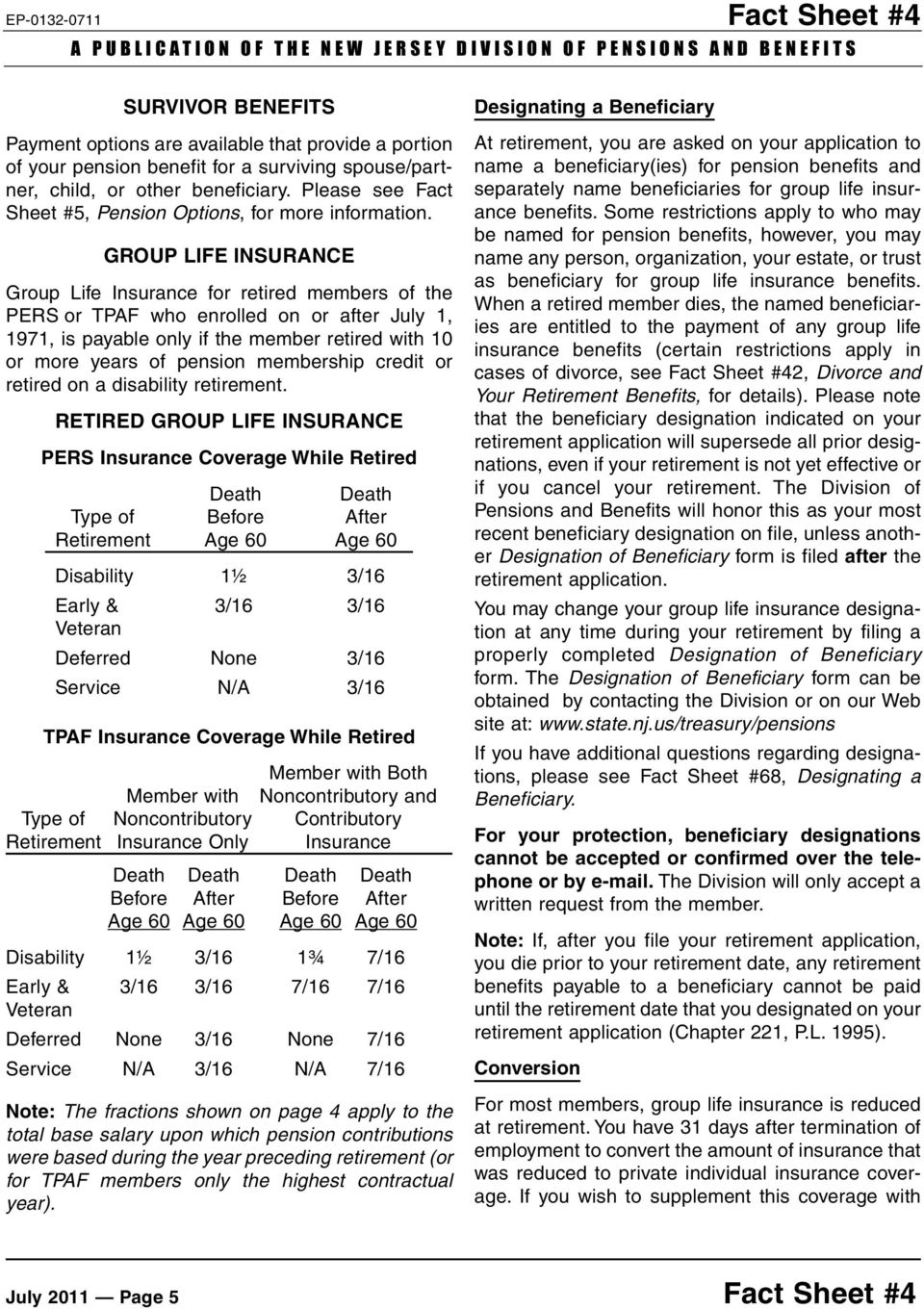
9 EP Fact Sheet #4 SURVIVOR BENEFITS Payment options are available that provide a portion of your pension benefit for a surviving spouse/partner, child, or other beneficiary. Please see Fact Sheet #5, Pension Options, for more information. GROUP LIFE INSURANCE Group Life Insurance for retired members of the PERS or TPAF who enrolled on or after July 1, 1971, is payable only if the member retired with 10 or more years of pension membership credit or retired on a disability retirement. RETIRED GROUP LIFE INSURANCE PERS Insurance Coverage While Retired Death Death Type of Before After Retirement Age 60 Age 60 Disability 1½ 3/16 Early & 3/16 3/16 Veteran Deferred None 3/16 Service N/A 3/16 TPAF Insurance Coverage While Retired Member with Both Member with Noncontributory and Type of Noncontributory Contributory Retirement Insurance Only Insurance Death Death Death Death Before After Before After Age 60 Age 60 Age 60 Age 60 Disability 1½ 3/16 1¾ 7/16 Early & 3/16 3/16 7/16 7/16 Veteran Deferred None 3/16 None 7/16 Service N/A 3/16 N/A 7/16 Note: The fractions shown on page 4 apply to the total base salary upon which pension contributions were based during the year preceding retirement (or for TPAF members only the highest contractual year). Designating a Beneficiary At retirement, you are asked on your application to name a beneficiary(ies) for pension benefits and separately name beneficiaries for group life insurance benefits. Some restrictions apply to who may be named for pension benefits, however, you may name any person, organization, your estate, or trust as beneficiary for group life insurance benefits. When a retired member dies, the named beneficiaries are entitled to the payment of any group life insurance benefits (certain restrictions apply in cases of divorce, see Fact Sheet #42, Divorce and Your Retirement Benefits, for details). Please note that the beneficiary designation indicated on your retirement application will supersede all prior designations, even if your retirement is not yet effective or if you cancel your retirement. The Division of Pensions and Benefits will honor this as your most recent beneficiary designation on file, unless another Designation of Beneficiary form is filed after the retirement application. You may change your group life insurance designation at any time during your retirement by filing a properly completed Designation of Beneficiary form. The Designation of Beneficiary form can be obtained by contacting the Division or on our Web site at: If you have additional questions regarding designations, please see Fact Sheet #68, Designating a Beneficiary. For your protection, beneficiary designations cannot be accepted or confirmed over the telephone or by . The Division will only accept a written request from the member. Note: If, after you file your retirement application, you die prior to your retirement date, any retirement benefits payable to a beneficiary cannot be paid until the retirement date that you designated on your retirement application (Chapter 221, P.L. 1995). Conversion For most members, group life insurance is reduced at retirement. You have 31 days after termination of employment to convert the amount of insurance that was reduced to private individual insurance coverage. If you wish to supplement this coverage with July 2011 Page 5 Fact Sheet #4
10 Fact Sheet #4 EP either a conversion policy from the Prudential Life Insurance Company, or a policy from another insurance carrier, it is best to begin exploring your options at least four to six months prior to your retirement. However, you cannot file to convert your life insurance any earlier than six months prior to your retirement date. To estimate the cost of conversion to a private policy with the Prudential Life Insurance Company, contact a Prudential agent or use the conversion calculator on the Division of Pensions and Benefits Web site. For additional information see Fact Sheet #13, Conversion of Group Life Insurance. HEALTH BENEFITS Your Application for Retirement Allowance does not automatically enroll you in retired health benefits coverage. Employees who are covered by the State Health Benefits Program (SHBP) or School Employees Health Benefits Program (SEHBP) through their employer will be offered retired group SHBP or SEHBP coverage when they retire. In addition, some employers have agreed to pay for some or all the cost of SHBP or SEHBP coverage for retirees with 25 or more years of service credit (and in some cases retirees on disability retirements). If eligible for SHBP or SEHBP retired group coverage, you will receive a letter approximately three months before your retirement date offering you enrollment in the SHBP or SEHBP. Fact Sheet #11, Enrolling in Health Benefits Coverage When You Retire, provides information about continuing your SHBP or SEHBP coverage in retirement. If you are not covered by the SHBP or the SEHBP, contact your employer about your options for continuing your health benefits coverage. COST-OF-LIVING ADJUSTMENTS With the passing of Chapter 78, P.L. 2011, Cost-of- Living Adjustments (COLA) are suspended for all current and future retirees of all retirement systems. No further COLA increases will be granted. The law does not reduce any COLA increases that have already been added to retiree benefits. For more information see Fact Sheet #18, Cost-of- Living Adjustments, for more information. CANCELLING OR CHANGING YOUR RETIREMENT DATE The following are some important points to remember if you consider changing your retirement to a later date or canceling your retirement: You may change or cancel your retirement up until 30 days immediately following your retirement date, or 30 days after the approval of your retirement by the Board of Trustees, whichever is later. Note: You cannot cancel or change the date for a disability retirement once it has been approved by the Board of Trustees. If you cancel or change your retirement date, it is your responsibility to notify your employer to ensure that any active health benefits are not canceled and your employment remains uninterrupted. Canceling or changing your retirement date does not guarantee continued employment with your employer. EMPLOYMENT AFTER RETIREMENT Most private employment will not affect your retirement benefits. However, returning to public employment in New Jersey after your retirement may jeopardize your retirement benefits. If you return to employment in a position covered by the same retirement system from which you retired, you should expect to cancel your retirement and reenroll in the retirement system. In addition: Retirees who returns to public employment before age 59½ may be subject to 10 percent additional federal tax withholding for an in service distribution under the Internal Revenue Code. if you pre-arrange with your employer to return to employment in any capacity, or it is otherwise determined that your retirement is not bona fide or the employer/employee relation- Fact Sheet #4 July 2011 Page 6

11 EP Fact Sheet #4 ship was not completely severed, your retirement may be determined to be invalid and you would be be required to reimburse the retirement system for the amount of any retirement benefits you received from the date of retirement. Before you consider returning to any public employment, see Fact Sheet #21, Employment After Retirement (PERS) or Fact Sheet #28, Employment After Retirement (TPAF), for the limitations and procedures for returning to public employment in New Jersey. This fact sheet has been produced and distributed by: New Jersey Division of Pensions and Benefits PO Box 295 Trenton, New Jersey (609) TDD for the hearing impaired (609) URL: This fact sheet is a summary and not intended to provide total information. Although every attempt at accuracy is made, it cannot be guaranteed. July 2011 Page 7 Fact Sheet #4

12

13 RM Fact Sheet #5 Pension Options Public Employees Retirement System Teachers Pension and Annuity Fund ESTIMATING YOUR RETIREMENT ALLOWANCE If you are within two years of retirement, you may obtain an estimate of your retirement benefits online using the Member Benefits Online System (MBOS). Estimates obtained through MBOS provide the most accurate information available by using the service and salary information currently posted to your account. Before you can begin using the system, you must be registered with MBOS. Registration is free. To begin the MBOS registration process go to: You may also call the Division of Pensions and Benefits' Automated Information System at (609) to hear an estimate of your retirement benefits over the phone. Please have your Social Security number available when you call. Or you can obtain a retirement estimate by completing a Request for Retirement Estimate form, available from your employer or the Division of Pensions and Benefits. If you provide us with the birth date of your beneficiary, we will estimate not only the Maximum Option but also the alternate payment options described in this fact sheet. (Telephone estimates are not available for members of the PERS Prosecutors Part, Workers Compensation Judges, or PERS Law Enforcement Officers-LEOs.) If you are more than two years from retirement, you may calculate your own retirement allowance using the online retirement estimate calculator on the Division of Pensions and Benefits Web site: or using the worksheet and instructions in Fact Sheet #54, Calculating Your Own Retirement Allowance. PENSION PAYMENT OPTIONS When planning for retirement, you must be familiar with the pension payment options available to you from the retirement system. You should also consider your financial needs in retirement, your health, your beneficiary's health, the need to provide survivor benefits, life insurance benefits, and income from other sources such as Social Security benefits, investments, etc. When you apply for retirement, you will have to choose one of nine ways to receive your retirement benefits. Please be sure you understand the different payment options available to you because, once you have made your choice and your retirement becomes due and payable (usually when your first check is issued), you cannot change your payment option. Maximum Option - No Pension Benefit to a Beneficiary The Maximum Option, also called a single-life annuity, is the highest amount payable and provides a retirement benefit to you for the remainder of your life. If you are not concerned with providing either a lump-sum benefit or providing a monthly income to another person after your death, the Maximum Option may be the most appropriate payment choice for you. The benefit payments continue for your lifetime only. Upon your death, benefits end and your survivors do not receive a pension allowance. If you die before receiving, through your retirement allowance, the amount that you paid into the retirement system while working (including interest on those contributions), the balance of your contributions will be paid to your beneficiary. OPTIONS OTHER THAN THE MAXIMUM Under Options A, B, C, or D you receive a smaller monthly benefit than that provided under the Maximum Option so that, upon your death, your beneficiary will receive a lifetime monthly pension. The percentage of reduction is based on the life expectancies of both you and your beneficiary at the time of your retirement and the option selected. Therefore, the younger your beneficiary, the greater the percentage of reduction in your benefit. Your beneficiary under these options must be an individual.you may not designate a charity, institution, your estate, etc. as a beneficiary. Option A - 100% to Beneficiary - Increase to Maximum Option Option A, also called a 100% joint and survivor benefit, provides a lifetime monthly payment to you. If your beneficiary is living at the time of your death, your beneficiary will receive 100% of your monthly retirement July 2007 Page 1 Fact Sheet #5
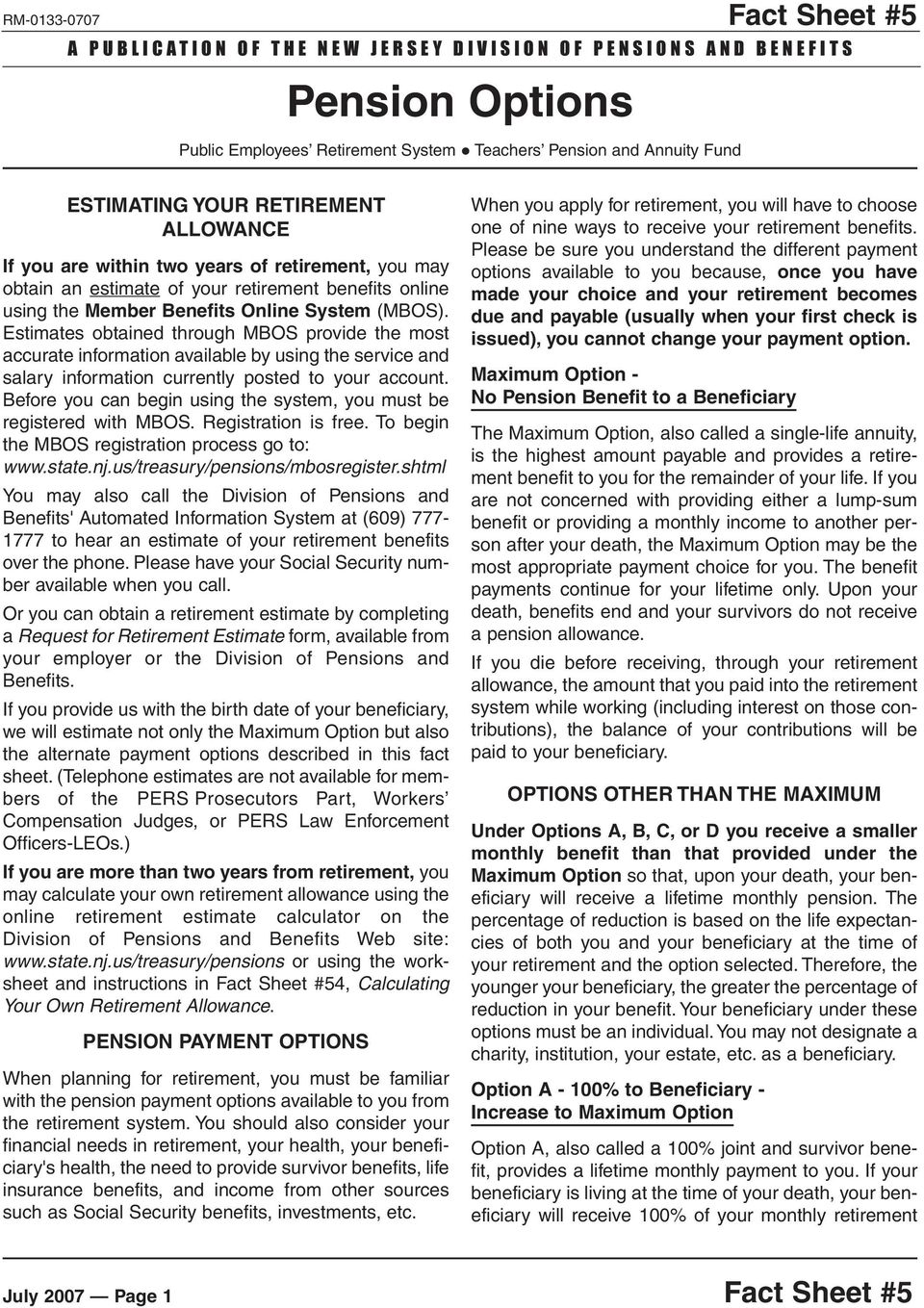
14 Fact Sheet #5 RM allowance for life. If your beneficiary dies before you, your retirement allowance will increase to the Maximum Option. You can name only one beneficiary for this benefit and your beneficiary can never be changed after retirement. Option B - 75% to Beneficiary - Increase to Maximum Option Option B, also called a 75% joint and survivor benefit, provides a lifetime monthly payment to you. If your beneficiary is living at the time of your death, your beneficiary will receive 75% of your monthly retirement allowance for life. If your beneficiary dies before you, your retirement allowance will increase to the Maximum Option. You can name only one beneficiary for this benefit and your beneficiary can never be changed after retirement. Option C - 50% to Beneficiary - Increase to Maximum Option Option C, also called a 50% joint and survivor benefit, provides a lifetime monthly payment to you. If your beneficiary is living at the time of your death, your beneficiary will receive half of your monthly retirement allowance for life. If your beneficiary dies before you, your retirement allowance will increase to the Maximum Option. You can name only one beneficiary for this benefit and your beneficiary can never be changed after retirement. Option D - 25% to Beneficiary - Increase to Maximum Option Option D, also called a 25% joint and survivor benefit, provides a lifetime monthly payment to you. If your beneficiary is living at the time of your death, your beneficiary will receive 25% of your monthly retirement allowance for life. If your beneficiary dies before you, your retirement allowance will increase to the Maximum Option. You can name only one beneficiary for this benefit and your beneficiary can never be changed after retirement. Option 1 - Reducing Retirement Reserve to a Beneficiary Option 1 provides a lifetime monthly payment to you. Your retirement allowance is reduced from what you could collect under the Maximum Option. It is also different from the Maximum Option in that it may provide a lump-sum payment to your beneficiary after your death. At the time of your retirement, the amount expected to be paid to you in retirement benefits over your lifetime is calculated. This is called your retirement reserve. If you die before you receive monthly retirement benefits equal to your retirement reserve, your beneficiary is entitled to the balance. The balance will be paid in a lump sum or the beneficiary may request payment in equal monthly payments over 5, 10, 15, or 20 years or as a life annuity. You may name more than one beneficiary for this option and you can change your beneficiary at any time. Your beneficiary may be a person, a charity, an institution, or your estate. For example, if your monthly retirement allowance is $2,000 and your retirement reserve is $230,400, your beneficiary would be entitled to the following payment depending on when you died (16 or 120 months after retirement as shown below). Retirement Reserve $ 230,400 Retirement Benefits Paid $ 32,000 (death at 16 months) Beneficiary Benefit $ 198,400 Retirement Reserve $ 230,400 Retirement Benefits Paid $ 240,000 (death at 120 months) Beneficiary Benefit $ 0 Since the retirement reserve is based on your retirement allowance and your life expectancy, your own reserve may be much different than this example. Under Options 2, 3, or 4 you receive a smaller monthly benefit than that provided under the Maximum Option so that, upon your death, your beneficiary will receive a lifetime monthly pension. The percentage of reduction is based on the life expectancies of both you and your beneficiary at the time of your retirement and the option selected. Therefore, the younger your beneficiary, the greater the percentage of reduction in your benefit. Your beneficiary under these options must be an individual.you may not designate a charity, institution, your estate, etc. as a beneficiary. Option 2-100% to Beneficiary - Permanent Reduction Option 2, also called a 100% joint and survivor benefit, provides a lifetime monthly payment to you. If your beneficiary is living at the time of your death, your benefi- Fact Sheet #5 July 2007 Page 2

15 RM Fact Sheet #5 ciary will receive 100% of your monthly retirement allowance for life. You can name only one beneficiary for this benefit and your beneficiary can never be changed after retirement. This is similar to Option A except that if your beneficiary dies before you, you will continue to receive the reduced retirement allowance you had been receiving under this option. Option 3-50% to Beneficiary - Permanent Reduction Option 3, also called a 50% joint and survivor benefit, provides a lifetime monthly payment to you. If your beneficiary is living at the time of your death, your beneficiary will receive one-half of your monthly retirement allowance for life. You can name only one beneficiary to receive this benefit and the beneficiary can never be changed after retirement. This is similar to Option C except that if your beneficiary dies before you, you will continue to receive the reduced retirement allowance you had been receiving under this option. Option 4 - Choice of Amount to Beneficiary - Permanent Reduction If the preceding payment options do not meet your financial needs, you may want to consider this option. Option 4 provides a lifetime monthly payment to you. If your beneficiary is living at the time of your death, your beneficiary will receive whatever monthly allowance you decide for life. (This can be no more than your own allowance.) You can name one beneficiary or multiple beneficiaries to receive this benefit and the beneficiary(ies) can never be changed after retirement. If your beneficiary dies before you, you will continue to receive the reduced retirement allowance you had been receiving under this option. Age Limits on Nonspouse Beneficiaries For all options, you can name your spouse as your beneficiary regardless of your spouse's age. For Options C, D, 1, or 3, you can name someone other than your spouse as beneficiary regardless of age. For Options 2, A, or B, if you are naming a beneficiary who is not your spouse, Internal Revenue Service regulations restrict the age of your beneficiary. Note: Because the Internal Revenue Service is a federal agency, a civil union partner, or domestic partner as defined under New Jersey State law does not qualify as a spouse under these circumstances and would be subject to the age limitations described. For Options 2 and A (100% to beneficiary): If you are age 70 or older at retirement, your nonspouse beneficiary can be no more than 10 years younger than you. If you are under age 70 at retirement, determine 1.) the number of years difference between your age at retirement and age 70; and 2.) the number of years difference between your age at retirement and the age of your nonspouse beneficiary. Subtract the age 70 difference from the difference in age between yourself and your beneficiary. The resulting age difference can be no more than 10 years (younger than you). Pension Benefit to Beneficiary Upon Death of Retiree 100% of 75% of 50% of 25% of Retirement Retirement Retirement Retirement None Lump Sum Allowance Allowance Allowance Allowance Maximum X Option A X Option B X Option C X Option D X Option 1 X Option 2 X Option 3 X Option 4 X X X Under Option 4 you can name any dollar amount less than your allowance to be paid to a beneficiary. July 2007 Page 3 Fact Sheet #5
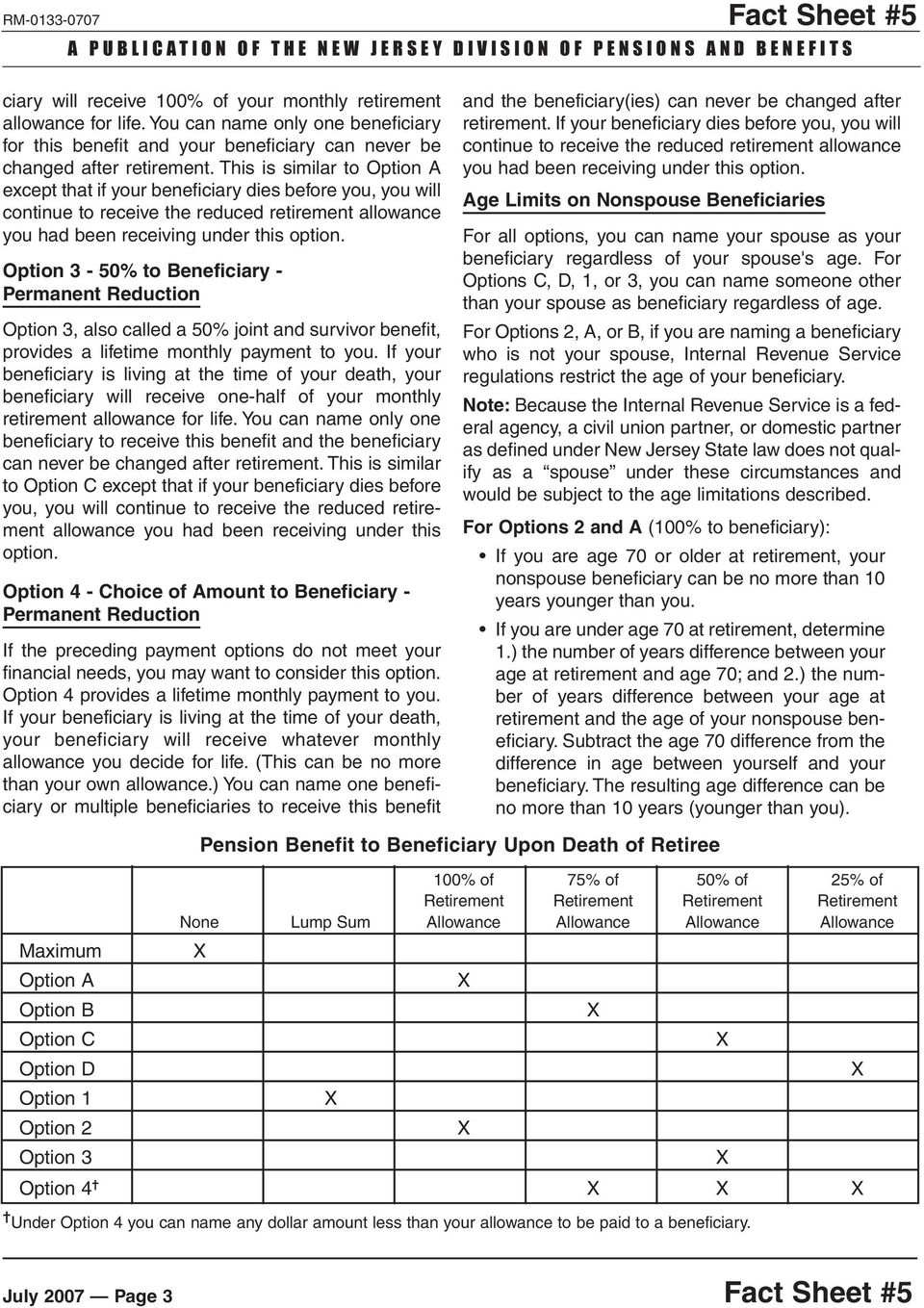
16 Fact Sheet #5 RM For Option B (75% to beneficiary): If you are age 70 or older at retirement, your nonspouse beneficiary can be no more than 19 years younger than you. If you are under age 70 at retirement, determine 1.) the number of years difference between your age at retirement and age 70; and 2.) the number of years difference between your age at retirement and the age of your nonspouse beneficiary. Subtract the age 70 difference from the difference in age between yourself and your beneficiary. The resulting age difference can be no more than 19 years (younger than you). If you name a nonspouse beneficiary under Option 4, and the dollar amount of your beneficiary's pension is more than half of your allowance, restrictions on your beneficiary's age apply. Proof of Age Documentation If you choose Option 2, 3, 4, A, B, C, or D, proof of age documentation is required for both you and your designated beneficiary. You should submit photocopies of the proof of age documentation at the time you submit your Application for Retirement Allowance. Power-of-Attorney and Option Selection A person acting on behalf of a member, other than a legal guardian, cannot choose a pension option other then the Maximum Option (and cannot name themselves as a life insurance beneficiary). However, a person with legal Power-of-Attorney on behalf of a retiring member can: Apply for retirement on behalf of a member; Choose any Pension Option; and Name themselves as the beneficiary for that Pension Option. Note: For the Group Life Insurance, the Power-of- Attorney documentation must specifically state that the person acting as Power-of-Attorney has the right to designate or change beneficiaries for group life insurance and, additionally, must specifically grant them the right to name themselves. IF THE BENEFICIARY DIES BEFORE THE RETIREE Under Options 2, 3, and 4, if your beneficiary dies before you, your retirement allowance remains at the reduced option level. Under Options A, B, C, and D, if your beneficiary dies before you, your retirement increases to the Maximum Option. Options A through D provide a smaller retirement allowance to you and your beneficiary, when compared to similar Options 2, 3, and 4, to pay for the larger retirement allowance you would collect if your beneficiary dies before you. Retiree Allowance Upon Death of Beneficiary Stays at Reduced Increases to Option Maximum Allowance Allowance Maximum N/A N/A Option A X Option B X Option C X Option D X Option 1 X Option 2 X Option 3 X Option 4 X LIFE INSURANCE AFTER RETIREMENT Most members of the PERS and TPAF are covered by group life insurance while employed. At retirement, those members receive a reduced life insurance benefit to be paid to their beneficiary upon their death, provided that they have credit for at least 10 years of service in the pension plan. You may want to leave a pension option benefit to your beneficiary in addition to the life insurance. ADDITIONAL INFORMATION If, after reading this fact sheet, you have questions about your pension options, contact the Division of Pensions and Benefits Office of Client Services at (609) , or send to: [email protected] This fact sheet has been produced and distributed by: New Jersey Division of Pensions and Benefits PO Box 295 Trenton, New Jersey (609) TDD for the hearing impaired (609) [email protected] This fact sheet is a summary and not intended to provide total information. Although every attempt at accuracy is made, it cannot be guaranteed. Fact Sheet #5 July 2007 Page 4

17 CC Fact Sheet #13 Conversion of Group Life Insurance All Funds If you are covered by group life insurance while employed, the coverage ends 31 days after you cease employment (whether for reason of retirement, termination of employment, or leave of absence without pay). You have the option to convert your group life insurance coverage to an individual policy with the Prudential Insurance Company when you retire, terminate employment, or lose coverage while on a leave of absence without pay. This conversion to a Prudential policy is guaranteed (you cannot be denied coverage for health or other reasons), but it may be more expensive or less suitable to your needs than other policies for which you may qualify from Prudential or other insurance carriers. You can estimate the cost of converting your policy by using the Group Life Insurance Conversion Calculator on the Division of Pensions and Benefits Web site at: You should contact other insurance carriers and compare the available policies and costs before you decide to purchase the conversion policy. (Other carriers may accept or reject your application based on their evaluation of the status of your health and other factors.) If you wish to purchase a conversion policy, you have a one time option to do so prior to the 31st day after you cease employment. After that date, you will not be eligible to purchase a conversion policy. You may convert your life insurance to any individual, non-group policy customarily offered by Prudential. However, you cannot convert to term insurance or a policy containing disability benefits. Under a guaranteed conversion, you pay premiums at Prudential s standard rates for the type of policy to which you would be converting. The individual policy will be effective at the end of the 31 day conversion grace period. If you do not convert to an individual policy by the end of the 31 day period, your coverage will end. To initiate the purchase of a conversion policy, you must contact the Prudential Insurance Company (not the Division of Pensions and Benefits) at or , or through any of Prudential s local offices. You will need your group insurance policy number, as follows: G This is the policy number for the basic (noncontributory) group life insurance for the following retirement systems: ABP 1, PERS 2, TPAF 3, JRS 4, PFRS 5, SPRS 6, DCRP 7 G This is the policy number for the contributory group life insurance for PERS G This is the policy number for the contributory group life insurance for TPAF The conversion policy can be for any amount of insurance up to the amount that you had while employed. (In the case of a retirement the maximum amount that you can purchase will be reduced by the amount of any life insurance that you will automatically receive in retirement under your retirement plan. See example under Retirement.) To protect your conversion privilege it is suggested that you send your application for conversion to Prudential with at least one month s premium, at the time you file your retirement application with the Division of Pensions and Benefits (however, you cannot file to convert your life insurance any earlier than six months prior to your retirement date). The following provides detailed information about conversion policies for the specific situations of retirement, i.e., deferred retirement, disability retirement, and termination of employment, or leave of absence. RETIREMENT If you retire with 10 or more years of service credit in the retirement system, the amount of your group life insurance will be substantially reduced when you retire. The amount of your coverage will be listed in the Quotation of Retirement Benefits that you will receive prior to your retirement. It will be identified as the "Lump Sum Death Benefit." You will automatically be covered by this insurance and do not need to do anything to qualify. 1 ABP Alternate Benefit Program 2 PERS Public Employees Retirement System 3 TPAF Teachers Pension and Annuity Fund 4 JRS Judicial Retirement System 5 PFRS Police and Firemen s Retirement System 6 SPRS State Police Retirement System 7 DCRP Defined Contribution Retirement Program May 2011 Page 1 Fact Sheet #13

18 Fact Sheet #13 CC If you retire with less than 10 years of service credit in the retirement system, you will not receive any group life insurance coverage (for the exception, see "Disability Retirement" below). The reduction (or elimination) of your life insurance coverage will be effective 31 days after your date of termination. If you wish to supplement this coverage with either a conversion policy from Prudential or another type of policy from Prudential or another insurance carrier, it is best to begin exploring your options four to six months prior to your retirement. EXAMPLE: If you had group life insurance of $96,000 through the retirement system while employed, and that life insurance coverage drops to $6,000 at retirement, you can purchase up to $90,000 in life insurance coverage under an individual non-group policy by contacting a Prudential agent before 31 days following your termination of employment. Deferred Retirement* Your life insurance coverage will end 31 days after termination of employment. Any life insurance coverage to which you are entitled upon retirement will not take effect until you reach the normal retirement age for your retirement system and begin to receive retirement benefits (age 60 for Tier 1 and Tier 2 or age 62 for Tier 3 or Tier 4 of the PERS or TPAF; age 60 for JRS; age 55 for PFRS or SPRS). You have a one-time option to purchase a conversion policy prior to the 31st day after termination of employment (not at the time that you reach normal retirement age). The maximum amount of coverage you may purchase will be the difference between the amount of coverage you had while employed and the amount of coverage you will automatically receive when you begin to receive retirement benefits. Disability Retirement* If you are approved for a disability retirement you will be automatically covered by life insurance until you reach age 60 for PERS, TPAF, and JRS, or age 55 for PFRS and SPRS. The amount of this coverage will be equal to the amount of the noncontributory insurance coverage you had while employed. *Does not apply to the ABP or the DCRP. You will have the option to purchase a conversion policy up until the day you reach normal retirement age for your retirement system. The maximum amount of coverage you may purchase will be the difference between the amount of noncontributory coverage you had while employed and the amount of coverage you will automatically receive when you reach the normal retirement age. If you also had contributory life insurance while employed, you may convert the amount of your contributory insurance until 31 days after termination of employment. Whether or not you exercise this option, you will still have the option to convert the noncontributory portion of your life insurance up until the day that you reach normal retirement age. TERMINATION OF EMPLOYMENT OR LEAVE OF ABSENCE If you terminate employment without applying for retirement or your insured period during a leave of absence expires, you will continue to be covered for the next 31 days. Up until the end of that 31 day period, you may convert your group life insurance, without medical examination, to any individual policy customarily offered by Prudential except term insurance or a policy containing disability benefits. EXAMPLE: If you had group life insurance of $96,000 through the retirement system while employed, that life insurance coverage is eliminated when you terminate employment. You can purchase up to $96,000 in life insurance coverage under an individual non-group policy by contacting a Prudential agent before 31 days following your termination of employment. RETURN TO PUBLIC EMPLOYMENT If you return to public employment after purchasing a conversion policy, you must discontinue your individual conversion policy. Otherwise, you are required to submit satisfactory proof of insurability before you can be covered again in full under a group life insurance policy. The Division of Pensions and Benefits cannot provide premium rates for converted life insurance policies. Please contact a Prudential agent for this information. This fact sheet has been produced and distributed by: New Jersey Division of Pensions and Benefits PO Box 295 Trenton, New Jersey (609) TDD for the hearing impaired (609) URL: [email protected] This fact sheet is a summary and not intended to provide total information. Although every attempt at accuracy is made, it cannot be guaranteed. Fact Sheet #13 May 2011 Page 2

19 RM Fact Sheet #6 Your Retirement Checklist All Funds When planning for retirement, it is important to give yourself enough time to review your benefits and options. The time frames in this checklist are a guide, however, actual processing times vary and cannot begin until the Division of Pensions and Benefits receives all the necessary information and forms from both you and your employer. 6-8 MONTHS BEFORE RETIREMENT Obtain a Retirement Estimate Members within 2 years of retirement can obtain an estimate of retirement benefits using the Member Benefits Online System (MBOS). MBOS is a set of Internet based applications that allow registered members access to information about their pension. Register with MBOS at: (select Online Member Services - MBOS ). To hear an estimate of retirement benefits over the phone, call the Division of Pensions and Benefits Automated Information System at (609) You may also submit a Request for Retirement Estimate form which is available on the Division s Web site (select Forms and Publications ), or by calling (609) The form must be forwarded to the Division for manual processing. Please allow 4-6 weeks for processing and mailing. If you provide us with the name and birth date of your beneficiary, we can estimate the payment options for your beneficiary. 4-6 MONTHS BEFORE RETIREMENT Apply for retirement You cannot submit an application more than one year prior to your retirement date (members eligible for a Deferred Retirement may file more than one year in advance upon termination of employment). Registered MBOS users can apply for retirement online. This is an easy and secure way to apply for retirement. If you do not have Internet access you can obtain an Application for Retirement Allowance from your benefits administrator or the Division of Pensions and Benefits. Whether you apply for retirement online through MBOS or by written application, be sure to carefully read the instructions and the available fact sheets about retirement prior to submission. (see page 4). All members must provide proof of age prior to retirement. Acceptable proofs of age include a photocopy of any of the following: birth certificate, baptismal certificate, passport, naturalization or immigration papers, or other records including military records, census records, school or business records, age recorded on marriage licenses and insurance, or children s birth records. Registered users can verify if proof of age is on file using MBOS. If your proof of age is not already on file with the Division of Pensions and Benefits, you should attach a photocopy of your birth certificate, or other proof of age document, to your retirement application. (MBOS applicants should mail proof of age to the Retirement Bureau, Division of Pensions and Benefits, PO Box 295, Trenton, NJ ) Please also include your name, pension membership number, retirement date, and daytime telephone number on the photocopy. For Public Employees' Retirement System (PERS) and Teachers' Pension and Annuity Fund (TPAF) only If you are choosing Options A, B, C, D, 2, 3, or 4, you must also submit proof of your beneficiary's birth date (see above for acceptable forms of proof). Please include your (the retiree s) name, pension membership number, retirement date, daytime telephone number, on the photocopy of your beneficiary s proof of age and attach it to your retirement application or mail it to the Division s Retirement Bureau (see paragraph above for April 2011 Page 1 Fact Sheet #6
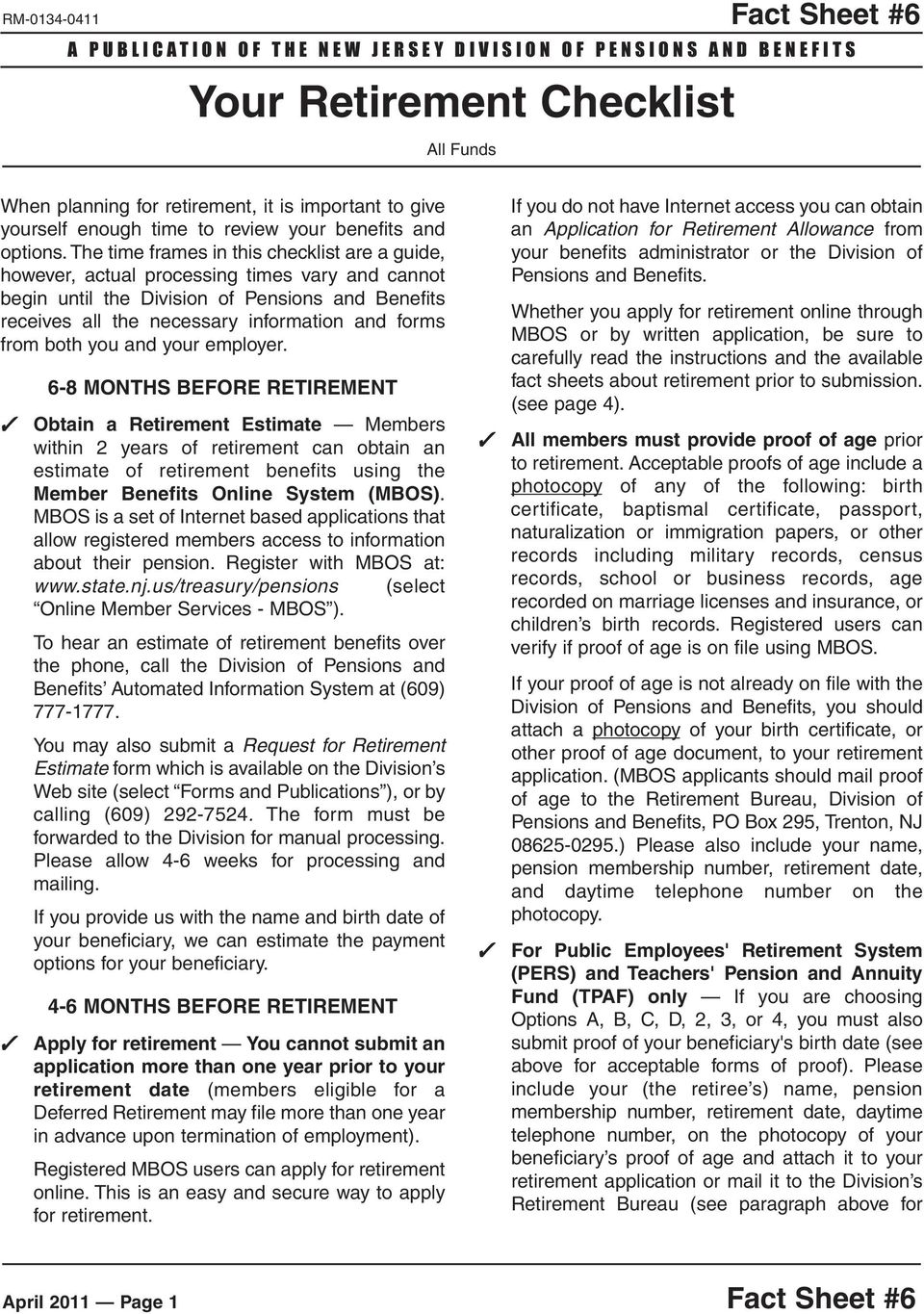
20 Fact Sheet #6 RM address). Your retirement application will not be processed until the Division receives the required copies of birth date evidence. PERS and TPAF only If applying for a Veteran Retirement, you must qualify as a veteran for pension purposes. Registered users can verify if veteran status is on file using MBOS. If you are not already listed as a veteran on the Division of Pensions and Benefits records, you must send a photocopy of your military discharge (Form DD 214) to the NJ Department of Military and Veteran Affairs (NJDMAVA), at the following address: NJ Department of Military and Veteran Affairs ATTN: DVP-VBB PO Box 340 Trenton, NJ Since the NJDMAVA also makes determinations of veteran's preference for Civil Service and property tax appeals, a note should be attached to say that the discharge is being sent for pension purposes. For more information see Fact Sheet #17, Veteran Status. If you have applied for a purchase of additional service credit in the past six months, and are not submitting an online retirement application through MBOS, please write "Purchase Pending" across the top of your Application for Retirement Allowance prior to sending it to the Division. The amount of your group life insurance coverage through the retirement system decreases at retirement or terminates if you have less than 10 years of service credit. You may convert the dollar difference between the coverage you had before retirement and the coverage you will have after retirement to a nongroup life insurance policy by applying to a Prudential Insurance Company agent within 31 days of your termination of employment. No physical examination is required to prove insurability. The cost of the coverage will be at the standard rate for someone your age. For further information about conversion, you can contact Prudential at or at You should contact other insurance carriers and compare the available policies and costs before you decide to purchase the conversion policy. Ask your employer to submit a Certification of Service and Final Salary to the Division of Pensions and Benefits. Please note: Your employer will be notified that you have filed an application for retirement. Contact the NJ State Employees Deferred Compensation Plan office at NJSEDCP, or the Supplemental Annuity Collective Trust (SACT) office at (609) , or the Defined Contribution Retirement Program (DCRP) at , if you participate in these plans. You will receive a letter from the Division of Pensions and Benefits acknowledging receipt of your retirement application. Included with the letter are answers to some frequently asked retirement questions. APPROXIMATELY 3 MONTHS BEFORE RETIREMENT You will receive a letter offering you enrollment in the State Health Benefits Program (SHBP) or the School Employees Health Benefits Program (SEHBP) if you are: A member already covered by the SHBP or SEHBP through their employer. (If you are not eligible for State-paid or employer-paid coverage, you may continue the coverage into retirement by paying the appropriate premium.); A member employed by a board of education or a county college who retiring with 25 or more years of service credit in one or more State- or locally-administered retirement system or who retire on a disability retirement, even if their employer did not participate in the SEHBP. This includes members who elected Deferred Retirement with 25 or more years of service credit in one or more State- or locallyadministered retirement system. Eligibility is limited to full-time employees as defined by N.J.A.C. 17:9-4. The State pays for the health benefit cost if you qualify under this category (See Chapter 78, P.L on page 3); Fact Sheet #6 April 2011 Page 2

21 RM Fact Sheet #6 Members eligible for Medicare who retired from full-time employment at a board of education, vocational/technical school, or special services commission that does not participate in the SEHBP, provided you are participating in the health benefit plan of your employer and are enrolled in Medicare Part A and Part B. You will be required to pay the full cost of the coverage; Part-time State employees and part-time faculty at institutions of higher education that participate in the SHBP or SEHBP if enrolled in the SHBP or SEHBP at the time of retirement. You will be required to pay the full cost of the coverage; A PERS or Alternate Benefit Program (ABP) member retiring from a school board of education or county college with 25 or more years of service credit in the pension fund or retiring on a disability retirement; A police officer, firefighter, or PERS Law Enforcement Officer (LEO) retiring with 25 years or more of service credit in the retirement system or retiring on a disability retirement, and whose employer does not provide any payment towards the retiree s health coverage or reimbursement of Medicare Part B premiums, may be eligible for retired group SHBP or SEHBP coverage under the provisions of Chapter 330, P.L (see Fact Sheet #47, Health Benefits Retired Coverage under Chapter 330). Note: Enrollment for coverage as a retiree in the SHBP or SEHBP is not automatic. You must submit a health benefits Retired Coverage Enrollment Application to enroll. If you are age 65 or older, contact the local Social Security Administration office for full Medicare enrollment. You must be covered by both Part A and Part B of Medicare to be eligible to enroll in the SHBP or SEHBP in retirement. Most Medicare eligible retirees, in the SHBP or SEHBP, and/or their Medicare eligible dependents, need not enroll in Medicare Part D prescription drug coverage. While some SHBP or SEHBP members who qualify for low income subsidy programs may find it beneficial to enroll in Medicare Part D, once you and/or a dependent enroll in a Medicare Part D plan, the person enrolled in Medicare Part D will lose their SHBP or SEHBP prescription drug coverage. In addition, the SHBP and SEHBP will not cover the costs of any drugs that are not covered by the Medicare Part D plan. You may need to obtain a written statement from your employer certifying that you have been covered under an employer group health plan. The statement should indicate when and why coverage as an active employee will end. If you will not be eligible for post-retirement medical coverage through the SHBP or SEHBP, be sure to discuss any coverage options that are available to you with your employer. APPROXIMATELY 2 MONTHS BEFORE RETIREMENT You will receive a Quotation of Retirement Benefits letter which shows your monthly retirement allowance with: the option you selected; (for PERS and TPAF) a quote of any outstanding loan balance with repayment options; and a quote or any outstanding arrears (purchase) balance and/or shortages. If you will be retiring with an outstanding loan balance, you must decide how you wish to repay your loan. You may: pay the loan in its entirety prior to receiving any benefits; or continue your monthly loan repayment schedule into retirement until the loan balance plus interest has been repaid. Any outstanding arrears or shortages must be paid before your retirement check can be issued. Failure to respond to these issues will delay your retirement benefits. APPROXIMATELY 1 MONTH BEFORE RETIREMENT Your retirement will be presented to the retirement system s Board of Trustees for approval. You will receive a board approval letter April 2011 Page 3 Fact Sheet #6
22 Fact Sheet #6 RM and will have 30 days from the board approval date or 30 days from your effective retirement date (whichever is later) to change your retirement date and or your option selection. If you make any changes after board approval, your new selection must again be approved by the Board of Trustees. This may delay your first check. You may choose to cancel your retirement within 30 days of your retirement date or 30 days of your board approval date (whichever is later). This request must be in writing to the Division of Pensions and Benefits. If you cancel or change your retirement date and submit a new application with a later retirement date, it is your responsibility to notify the employer to ensure your active health benefits (if any) are not canceled and that your employment remains uninterrupted. Canceling your retirement does not guarantee continued employment with your employer. If you are not eligible for health benefit coverage after retirement, you should discuss with your employer the possibility of continuing medical, prescription drug, dental, or vision coverage under the provisions of COBRA. SHORTLY AFTER YOUR RETIREMENT DATE You will receive a letter confirming your retirement and death benefits called the Statement of Retirement Allowance. The letter will also supply figures needed in filing your income tax return. Keep this with your important papers. Your first retirement check cannot be issued earlier than 30 days following your retirement date. If processing of your retirement is delayed, your first check will be retroactive to the date of your retirement. Regular retirement checks are dated on the first of the month to cover the allowance for the previous month. For example, if you retire on July 1, your first retirement check would be due and payable on August 1 and is payment for the month of July. Your retirement is not considered bona fide until your retirement becomes due and payable and the employer/employee relationship is completely severed. This normally occurs after but is not limited to a break in employment without pay of at least 30 days following your retirement date, or 30 days following the approval of your retirement by the retirement system s Board of Trustees, whichever is later. If you return to a position covered by the retirement system before the 30 days have elapsed on either a paid or voluntary basis or if you pre-arrange with your employer to return to employment in any capacity, or if it is otherwise determined that your retirement is not bona fide, the employer/employee relationship is not completely severed and your retirement may be determined to be invalid. In this case you will remain an active employee and reenrolled in the retirement system. You will also be required to reimburse the retirement system for the amount of any retirement benefits you received from the date of retirement. You will receive forms for withholding federal and New Jersey State income tax. If you are a registered MBOS user you can make changes to your tax withholding online. If you did not submit the Authorization for Direct Deposit form when you applied for retirement, the form will be sent to you by mail. Direct deposit of your benefit payment to your bank account is mandatory (except for foreign mailing addresses). You may also sign up for direct deposit, or make changes to an existing direct deposit, anytime after retirement using the Direct Deposit/ Electronic Funds Transfer application available on MBOS. Please allow approximately 60 days for a new direct deposit or changes to begin. FACT SHEETS ABOUT RETIREMENT Listed below are fact sheets pertaining to retirement and related issues. These fact sheets are available on our Web site at: (select Forms and Publications ). You can also obtain fact sheets from the Division s Office of Client Services at (609) Purchasing Service Credit #1, Purchasing Service Credit (PERS, TPAF & Fact Sheet #6 April 2011 Page 4
23 RM Fact Sheet #6 PFRS) #2, Estimating the Cost of Purchasing Service Credit (PERS & TPAF) #3, Estimating the Cost of Purchasing Service Credit (PFRS) Retirement Planning #4, Applying for Retirement (PERS & TPAF) #5, Pension Options (PERS & TPAF) #11, Enrolling in Health Benefits Coverage When You Retire #17, Veteran Status (PERS & TPAF) #18, Cost-of-Living Adjustments (All Funds) #19, Applying for Retirement (PFRS) #41, Applying for Retirement (SPRS) #54, Calculating Your Own Retirement Allowance (PERS & TPAF) #61, Planning for Your Survivors - Pension Options (JRS) #64, About Your Retirement Check #79, Defined Contribution Retirement Program for PERS, TPAF, PFRS, and SPRS Members #80, Defined Contribution Retirement Program for Elected and Appointed Officials #82, Defined Contribution Retirement Program if Ineligible for PERS or TPAF Types of Retirement #14, Deferred Retirement (PERS, TPAF & PFRS) #15, Disability Retirement Benefits (PERS & TPAF) #16, Disability Retirement Benefits (PFRS) #39, Disability Retirement Benefits (SPRS) #53, Legislative Retirement Benefits (PERS) #62, Prosecution Part (PERS) #63, Workers Compensation Judges Part (PERS) Taxation of Benefit Distributions #7, New Jersey State Employees Deferred Compensation Plan Distribution Options #12, Taxation of Retirement Benefits #27, The Taxability and Mandatory Withholding of Income Tax From Your Pension Distribution Employment after Retirement #21, Employment After Retirement (PERS) #28, Employment After Retirement (TPAF) #29, Employment After Retirement (PFRS) #57, Employment After Retirement (SPRS) Health Benefits and COBRA Coverage #11, Enrolling in Health Benefits Coverage When You Retire #23, Health Benefits Programs and Medicare Parts A & B for Retirees #30, Continuation of Health Benefits Insurance Under COBRA #47, Health Benefits Retired Coverage Under Chapter 330 (PFRS & Law Enforcement Officers of PERS) #73, Retiree Dental Expense Plan Life Insurance/Death Benefits #13, Conversion of Group Life Insurance (All Funds) #58, Group Life Insurance (PERS & TPAF) #59, Group Life Insurance (PFRS) #68, Designating a Beneficiary (All Funds) This fact sheet has been produced and distributed by: New Jersey Division of Pensions and Benefits PO Box 295 Trenton, New Jersey (609) TDD for the hearing impaired (609) URL: [email protected] This fact sheet is a summary and not intended to provide total information. Although every attempt at accuracy is made, it cannot be guaranteed. April 2011 Page 5 Fact Sheet #6
24 RM
25 FA Fact Sheet #12 Taxation of Retirement Benefits All Funds HOW ARE MY PENSION BENEFITS TAXED FOR FEDERAL PURPOSES? Pension benefits (except for Accidental Disability retirement and Accidental Death benefits) are subject to federal income tax; however, if you paid tax on any of your contributions to the pension plan, that portion of your monthly benefits representing a return of your previously-taxed contributions is not taxable. Contributions made to the pension plan prior to January 1, 1987 were already taxed as were any purchases of optional pension membership credit made before After January 1, 2002 some purchases may have been made with previously-taxed money. Therefore, if you began contributing to the pension plan prior to January 1, 1987, or if you purchased pension membership since then, all or a portion of your total contributions may have been previously subject to federal tax. The rate at which you can recover your previouslytaxed contributions is determined in part by your retirement date. If you retired before August 1, 1986 you were able to fully recover your contributions before having to pay tax on your benefits. Once you recovered your contributions, your benefits became fully taxable. The exception is if you did not fully recover your contributions within the first three years of retirement. In that case, you had to recover your contributions under the IRS expected return rule explained below. If you retired on or after August 1, 1986 you must recover your contributions under the expected return rule. Under this rule, you recover your contributions evenly over your expected lifetime or the combined lifetime of you and your pension beneficiary. This means that only a small portion of each monthly benefit is considered a return of your previously-taxed contributions and is tax-free. CALCULATING THE NON-TAXABLE AMOUNT If you retired after July 1, 1986 and before November 1, 1996 your monthly nontaxable amount is determined using life expectancy tables found in IRS Publication 939. If you retired on or after November 1, 1996 the following tables are used to determine your monthly nontaxable amount: TABLE A Benefits Payable To Retiree Only* Age of Retiree Number of (at retirement) Payments 55 or less or more 160 *For those retired on or after November 1, 1996 and before December 1, 1997, Table A is used even if benefits are payable to the retiree and the retiree's survivor. TABLE B Benefits Payable To Retiree and Beneficiary Combined Age of Retiree (at retirement) Number of & Beneficiary Payments 110 or less or more 210 The following examples illustrate how the monthly nontaxable amount is computed using Tables A and B: Example 1 A PERS member whose previouslytaxed contributions equaled $12,000 retires at age 62 and chooses to receive the maximum allowance February 2009 Page 1 Fact Sheet #12
26 Fact Sheet #12 FA (designating no monthly pension to a surviving beneficiary). Table A is used because benefits are payable to the retiree only. The $12,000 is divided by 260 which produces a monthly tax-free amount of $ The balance of the monthly pension is subject to federal income tax. Example 2 A TPAF member whose previouslytaxed contributions equaled $15,000 retires at age 60 and chooses to receive benefits under Option 2 (designating the same monthly pension to the surviving beneficiary). Table B is used because benefits are payable to the retiree and the retiree's beneficiary. The designated beneficiary is the same age as the retiree. The $15,000 is divided by 360 which produces a monthly tax-free amount of $ The balance of the monthly pension is subject to federal income tax. HOW LONG WILL THE NON-TAXABLE PORTION CONTINUE? For those who retired after December 31, 1986 the monthly nontaxable amount remains in effect until all of your previously-taxed contributions are fully recovered. At that point your benefits become fully taxable. For those who retired before December 31, 1986 the monthly nontaxable amount is effective for as long as you or your survivor receive benefits. If benefits cease before your previously-taxed contributions are fully recovered, the remaining balance can be claimed as a deduction on the income tax return of the last recipient, provided you retired on or after July 1, If you retired before July 1, 1986, no deduction is allowed for unrecovered contributions. WITHHOLDING FEDERAL INCOME TAX FROM YOUR PENSION CHECK Each new retiree will automatically receive a federal withholding tax Form W-4P near the date of retirement. The Division of Pensions and Benefits is required by federal law to automatically withhold federal income tax from your pension check, based on a status of married with three allowances if you do not complete a W-4P. The W-4P allows you to elect no withholding or, if you want withholding, to inform us of your tax filing status so that we can withhold the proper amount. WITHHOLDING NJ STATE INCOME TAX FROM YOUR PENSION CHECK If you live in New Jersey you will automatically receive a New Jersey State withholding tax Form NJ W-4P near the date of retirement. Most retirees will not be subject to New Jersey income tax until they recover in pension checks the amount of the contributions which they made to the pension plan while working. If you will not recover your total contributions within three years of retirement, refer to the instructions for the Form NJ-1040 to determine how your pension is taxed. You can find information on both the three year rule and the general rule methods in the instructions for the Form NJ If you are at least 62 or considered disabled by Social Security, you may exclude the following amounts of retirement income from New Jersey income tax for the tax year indicated below: Retirement Income Exclusions Married Married Tax Filing Filing Year Jointly Single Separately 2000 $12,500 $9,375 $6, $15,000 $11,250 $7, $17,500 $13,125 $8, and $20,000 $15,000 $10,000 beyond Note: Beginning with tax year 2005, the Retirement Income Exclusions listed above are limited to taxpayers with gross income of $100,000 or less. Please see the instructions for the Form NJ-1040 or contact the New Jersey Division of Taxation or a professional tax advisor for further information. Unlike federal income tax, withholding for New Jersey income tax is completely voluntary. No New Jersey income tax will be withheld unless you authorize it by completing a Form NJ W-4P. The amount withheld must be at least $10.00 per month and in even dollar amounts (no cents). If you need help deciding whether or not to have New Jersey income tax withheld or how much tax to have withheld, you can contact the New Jersey Division of Taxation at Fact Sheet #12 February 2009 Page 2
27 FA Fact Sheet #12 If you live outside New Jersey, you are not required to pay New Jersey income tax on the pension you receive from the retirement system. The Division of Pensions and Benefits does not withhold income tax for other states. Check with your home state's tax office to determine if your pension is taxable in your state of residence. CHANGING YOUR WITHHOLDING AMOUNT Retirees can now quickly and easily change their tax withholdings online using the Member Benefits Online System (MBOS). Find out more about MBOS at: To change your withholding you must submit a new Form W-4P or NJ W-4P to the Division of Pensions and Benefits. Forms can also be found on the Internet at: If you do not have Internet access, you can contact the Division of Pensions and Benefits at (609) to obtain the form. QUESTIONS COMMONLY ASKED AFTER RETIREMENT Will I receive a statement of pension income for tax purposes? Yes. retirees receive Form 1099-R at the end of January each year, covering the previous tax year. This shows the gross retirement allowance; how much is subject to federal income tax; and the amounts, if any, that were withheld for federal and New Jersey income tax. Am I taxed on the reimbursement of Medicare premiums? No. Some State employees and all employees of boards of education or county colleges who retired with 25 or more years of service, or on a disability retirement, who are enrolled in the State Health Benefits Program are reimbursed in their pension checks for the Medicare Part B premiums they pay to Social Security. If you receive this Medicare reimbursement, the gross amount of your pension checks will be greater than the gross amount shown on your Form 1099-R because the Medicare reimbursement is not taxable. The Medicare premium reimbursement is subtracted from your total gross income to determine the gross pension reported to the IRS. Why doesn t my gross allowance equal 12 times the amount of my December 1 check? When you receive a cost-of-living increase, your pension is changed each year with the February 1 check. Therefore, the gross allowance for your January 1 check is usually less than your next 11 checks. Is my disability pension taxable? If you are receiving a disability pension, your benefits are not subject to New Jersey income tax until you reach age 65. If you are receiving an Accidental Disability pension, or if you are a survivor receiving Accidental Disability or Accidental Death benefits the Division of Pensions and Benefits reports your benefit as exempt from federal income tax. Ordinary Disability pensions are subject to federal tax to the same extent as other pensions. Any additional questions should be referred to the IRS at the number listed below. THE DIVISION OF PENSIONS AND BENEFITS CANNOT GIVE TAX ADVICE. CONSULT THE IRS (1-800-TAX-1040), OR THE NJ DIVISION OF TAXATION ( in NJ), OR YOUR TAX ADVISOR FOR ASSISTANCE. This fact sheet has been produced and distributed by: New Jersey Division of Pensions and Benefits PO Box 295 Trenton, New Jersey (609) TDD for the hearing impaired (609) URL: [email protected] This fact sheet is a summary and not intended to provide total information. Although every attempt at accuracy is made, it cannot be guaranteed. February 2009 Page 3 Fact Sheet #12
28 RM
29 RM Fact Sheet #18 Cost-of-Living Adjustments Public Employees' Retirement System Teachers' Pension and Annuity Fund Police and Firemen's Retirement System State Police Retirement System Judicial Retirement System Consolidated Police and Firemen's Pension Fund Prison Officers' Pension Fund On June 28, 2011, Governor Christie signed Chapter 78, P.L. 2011, the Pension and Health Benefit Reform Law. This law provides for changes to the manner in which the Stateadministered retirement systems operate and to the benefit provisions of those systems. Under a provision of Chapter 78, P.L. 2011, future Cost-of-Living Adjustments (COLA) are suspended for retirees and benefit recipients of all retirement systems. Please be assured, there is no reduction to any COLA increases that were already added to retiree benefits prior to the effective date of the law. Chapter 78 also provides for the establishment of Pension Committees for the retirement systems that are open to new members, which may consider reinstating the COLA when the retirement system reaches a target funded ratio established by the law. At that time, the Pension Committees are to give the reactivation of the COLA priority consideration. Target funded ratio means a ratio of the value of assets against the accrued liabilities of 75% and increasing annually by equal increments over seven fiscal years to a ratio of 80%. Prior to the enactment of Chapter 78, P.L. 2011, the Pension Adjustment Program provided a cost-of-living adjustment (or COLA) to retirees and their eligible survivors if receiving a monthly retirement allowance from one of the state-administered retirement systems. The first COLA was paid in the 25th month after the date of retirement. Subsequent costof-living adjustments were computed annually and the adjustment was reflected in the February 1st check (which is payment for the month of January). If a beneficiary was entitled to receive a monthly pension upon a retiree s death, the COLA was applied to that benefit based upon the year of retirement. To calculate the COLA, the Division of Pensions and Benefits used the CPI for Urban Wage Earners and Clerical Workers (CPI-W), U.S. City Average, All Items, =100. The rate of increase was equal to 60 percent of the percentage of change between the average CPI for the calendar year in which the member retired and the average CPI for the 12 month period ending August 31st immediately preceding the year when the adjustment was payable. For COLA recipients who retired in 2007 and earlier the 2011 COLA calculation was offset by an amount equal to the reduction that should have occurred in For additional information about the offset calculation, see the Divisions Web site at: Example: To calculate the COLA due February 1, 2011 for members who retired in 2007 or earlier: A member retired in 2000 with a monthly retirement allowance of $1,278.35*. The average CPI for the twelve months ending December 31, 2000 was The average CPI for the twelve months ending August 31, 2010 was To calculate the change in the CPI, subtract from = To calculate the percentage change in the CPI between the retirement year 2000 and the 12 months ending August 31, 2010, divide by The result equals % = % *If the member chose Option 1, the COLA would be calculated on the Maximum Option. August 2011 Page 1 Fact Sheet #18
30 Fact Sheet #18 RM The cost-of-living adjustment rate for February 1, 2011 equals 60% of %, or %. 60% X % = % To calculate the percentage change in the CPI decrease, divide -0.42** by The result equals % % = % The cost of living adjustment offset for February 1, 2011 equals 60% of %, or %. 60% X % = % The cost of living adjustment offset for this member equals % of $1,278.35, or - $1.90. $1, X % = -$1.90 Therefore, the cost of living adjustment for this member equals % of $1, less the 2010 COLA offset: $1, X % = $ $1.90 = Total monthly benefit equals $1, $1, $ = $1, For COLA recipients who retired in 2008 and 2009 there was no offset since no COLA was paid to these retirees in Example: To calculate the COLA due February 1, 2011 for members who retired in 2008 or 2009: A member retired in 2009 with a monthly retirement allowance of $2,500.00*. The average CPI for the twelve months ending December 31, 2009 was The average CPI for the twelve months ending August 31, 2010 was To calculate the change in the CPI, subtract from = 3.31 To calculate the percentage change in the CPI between the retirement year 2009 and the 12 months ending August 31, 2010, divide 3.31 by The result equals 1.579% = 1.579% The cost-of-living adjustment rate for February 1, 2011 equals 60% of 1.579%, or 0.947%. 60% X 1.579% = 0.947% Therefore, the cost-of-living adjustment for this member equals 0.947% of $2,500.00, or $ $2, X 0.947% = $23.68 The total monthly benefit equals $2, $2, $23.68 = $2, The cost-of-living adjustment amount can be found under the Current Earnings section on your retirement benefit check stub. You can view your COLA amount at any time through the Member Benefits Online System (MBOS). Registration information for MBOS is available on the Division of Pensions and Benefits Web site: After you complete the MBOS registration process, simply log on to MBOS and select the Retired Account Information button on the MBOS home page. You can also verify your current allowance and deduction information at any time by calling our Automated Information System, (609) When calling, you will be asked to enter your Social Security number. * If the member chose Option 1, the COLA would be calculated on the Maximum Option. ** The decrease in the average CPI for the 12 month period ending August 31, 2008 (COLA payable in calendar year 2009) from the average CPI for the 12 month period ending August 31, 2009 (COLA payable in calendar year 2010) equals This fact sheet has been produced and distributed by: New Jersey Division of Pensions and Benefits PO Box 295 Trenton, New Jersey (609) TDD for the hearing impaired (609) URL: [email protected] This fact sheet is a summary and not intended to provide total information. Although every attempt at accuracy is made, it cannot be guaranteed. Fact Sheet #18 August 2011 Page 2
31 RM PUBLIC EMPLOYEES RETIREMENT SYSTEM AND TEACHERS PENSION AND ANNUITY FUND NEW JERSEY DIVISION OF PENSIONS AND BENEFITS APPLICATION FOR RETIREMENT ALLOWANCE PLEASE READ THESE INSTRUCTIONS AND FACT SHEETS #4 AND #5 CAREFULLY BEFORE COMPLETING THIS APPLICATION. PLEASE DETACH THE APPLICATION FROM THE BOOKLET BEFORE MAILING. When to File All retirements are effective on the first of the month. File this application with the Division of Pensions and Benefits before your retirement date or you will lose benefits. Four to six months advance filing is recommended. You must terminate employment before your retirement date. Mail your completed application to the New Jersey Division of Pensions and Benefits, PO Box 295, Trenton, NJ INSTRUCTIONS PLEASE PRINT BLACK INK PREFERRED OR TYPE PART ONE: ITEM 1: PENSION FUND Indicate the pension fund of which you are a member, the Public Employees' Retirement System (PERS), or the Teachers' Pension and Annuity Fund (TPAF). ITEM 2: MEMBERSHIP NUMBER Enter your pension fund membership number. If you are not sure of your number, it is shown on your annual statement, or else contact your personnel or payroll office. ITEM 3: SOCIAL SECURITY NUMBER Enter your Social Security number. ITEM 4: DATE OF BIRTH Insert the month, day, and year of your birth.you should submit a photocopy of your birth or baptismal certificate to the Division of Pensions and Benefits. (Do not delay filing the application if this document is not readily available). ITEM 5: NAME Enter your full name. ITEM 6: ADDRESS Enter your present mailing address. Report any change of address before you begin receiving a pension to the Retirement Bureau at the address shown above. Provide your Social Security number and retirement date in the letter. Or, you may change your address over the Internet by using our online change of address form for pending retirees at: ITEM 7 AND 8: TELEPHONE NUMBERS Enter your home and work telephone numbers. Include your area code. ITEM 9: HOME ADDRESS Enter your home address, if you have one. PART TWO: ACKNOWLEDGEMENT OF TERMS AND CONDITIONS OF RETIREMENT You must agree to and sign the terms and conditions when applying for retirement. If you fail to sign the acknowledgement, your Application for Retirement Allowance will not be processed. PART THREE: ITEM 10: RETIREMENT DATE Enter the month and year you wish to retire. All retirements are effective on the first of a month. The earliest retirement date available to you is the first of the month following the Division's receipt of your application.your application must be received in this office prior to your retirement date. Your first retirement check will be dated no earlier than the first of the month after your retirement date or 30 days after approval by the PERS or TPAF Board of Trustees, whichever is later.
32 RM ITEM 11: PURCHASE INFORMATION If you have applied to purchase service credit within six months of your filing this retirement application, check yes. ITEM 12: TYPE OF RETIREMENT Check the appropriate box indicating the type of retirement you are applying for. ITEM 13: SALARY INFORMATION Your retirement allowance is based on the last three years of salary or the three fiscal years (July - June) during which your earnings were the highest. If your last three years were your highest years of salary, check Yes. If you earned more during previous years than you did during your last three years, check No and indicate the dates of the three highest fiscal years. ITEM 14 AND 15: SPOUSE, CIVIL UNION PARTNER OR DOMESTIC PARTNER S NAME AND ADDRESS If you are currently married or have entered into a civil union or domestic partnership,* provide your spouse or partner s name. Provide your spouse or partner s address if it is different from your address entered in item 6. PART FOUR: CHOOSE A RETIREMENT PAYMENT OPTION See Fact Sheet #5, Pension Options (included in this booklet), for an explanation of the available payment options. Mark only one box. MAXIMUM OPTION AND OPTION 1 If you select the Maximum Option or Option 1, name a beneficiary (or beneficiaries) in the space provided. Please include the beneficiary s full name, relationship to you (if not related, write friend ), date of birth, Social Security number (optional), and mailing address. Even if you choose the Maximum Option, it is to your benefit to name a beneficiary. The beneficiary named in this section will receive any undistributed pension contributions and any issued, but uncashed pension checks remaining at your death. The beneficiary will also receive any Option 1 benefits that may be payable if you selected that option. Under the Maximum Option and Option 1, you may name any person or persons as well as an institution, charity, organization, your estate, etc., as a beneficiary. If you designate an institution, charity, or organization, in order to insure that this designee is a legal entity, we require the beneficiary's tax identification number. If you choose the Maximum Option, you must sign the application in the space indicated to acknowledge your understanding that no monthly benefit is payable to a spouse or beneficiary upon your death. The law also requires that the Division notify your spouse or partner* if you choose the Maximum Option. If you are currently married or have entered into a civil union or domestic partnership, please enter your spouse or partner's name and mailing address (if different than yours) in items 14 and 15. PART FIVE: ADDITIONAL OPTIONS THAT PROVIDE A MONTHLY PAYMENT TO A SURVIVING BENEFICIARY To provide a monthly benefit to a spouse or other beneficiary, you may choose one of the following options: A, B, C, D, 2, 3, or 4. Selecting an option other than the Maximum Option will reduce your retirement allowance to provide a benefit to a beneficiary upon your death. The higher your beneficiary's allowance, the more your allowance will be reduced. Your option selection is irrevocable (cannot be changed under any circumstances) once your retirement becomes due and payable (see Your First Retirement Check on page 2). * Spouse means a person of the opposite sex to whom you are legally married. A photocopy of the Marriage Certificate is required for verification. Civil Union Partner is a person of the same sex with whom you have entered into a Civil Union. A photocopy of the New Jersey Civil Union Certificate or a valid certification from another jurisdiction that recognizes same-sex civil unions is required for verification. Domestic Partner is a same-sex domestic partner, as defined under Chapter 246, P.L. 2003, the Domestic Partnership Act, of any state employee, State retiree, or an eligible employee or retiree of a local public entity if the local governing body adopts a resolution to provide Chapter 246 benefits. A copy of the New Jersey Certification of Domestic Partnership dated prior to February 19, 2007 or a valid certification from another jurisdiction that recognizes same-sex domestic partners is required for verification.
33 RM Name your beneficiary in the space provided. If you select Option A, B, C, D, 2, or 3, you may name only one person as a beneficiary. If you select Option 4, you may name multiple beneficiaries to share the benefit. A separate beneficiary designation area is provided if you choose this option (to name 3 or more beneficiaries, list the beneficiary information on an additional sheet, sign it, and attach it to your application). Please include the beneficiary's full name, relationship to you (if not related, write friend ), date of birth, Social Security number (optional), and mailing address. For Options A, B, C, D, 2, 3, or 4, please also attach a photocopy of the beneficiary's birth certificate. The designation of beneficiary becomes effective when your Application for Retirement Allowance is received by the Division of Pensions and Benefits and supersedes all prior designations. If you do not understand your payment options, call the Division of Pensions and Benefits for assistance at (609) MEMBER'S SIGNATURE AND DATE Sign and date the option selection page where appropriate. Your application cannot be processed without your signature. PART SIX: DESIGNATION OF GROUP LIFE INSURANCE BEN- EFICIARY Most members of the retirement systems are covered by group life insurance. See Fact Sheet #4, Applying for Retirement, for more information about group life insurance coverage while retired. You may name any person or persons as well as an institution, charity, organization, your estate, etc., as a life insurance beneficiary. If you designate an institution, charity, or organization, in order to insure that this designee is a legal entity, we require the beneficiary's tax identification number. You may also name multiple beneficiaries for this benefit. You may change your group life insurance beneficiary at any time. For additional details about special designations see Fact Sheet #68, Designating a Beneficiary, which is available from the Division of Pensions and Benefits or on our Web site. You should name a Primary Beneficiary(ies) and a Contingent Beneficiary(ies) for this benefit. If you find it necessary to use additional sheets to complete this section, write see attached in the beneficiary area of the application. The attachments, which you should label Life Insurance Beneficiaries, must also be signed and dated. Primary Beneficiary(ies) List the full name, relationship to you (if not related, write friend ), birth date, Social Security number (optional), and address of the individual(s)/entity(ies) you want to receive your life insurance proceeds. If you name more than one Primary Beneficiary, the lump sum insurance proceeds will be divided equally among those listed. If you do not wish to divide the proceeds equally, please contact the Division of Pensions and Benefits for assistance. Contingent Beneficiary(ies) List the full name, relationship to you (if not related, write friend ), birth date, Social Security number (optional), and address of the individual(s)/entity(ies) you want to receive your life insurance proceeds should your primary beneficiaries not be living at the time of your death. If you name more than one Contingent Beneficiary, the lump sum insurance proceeds will be divided equally among those listed. If you do not wish to divide the proceeds equally, please contact the Division of Pensions and Benefits for assistance. The designation of beneficiary becomes effective when your Application for Retirement Allowance is received by the Division of Pensions and Benefits and supersedes all prior designations. The amount by which your group life insurance is reduced at retirement may be converted at retirement to a non-group policy. Conversion must be done within 31 days of the termination of employment. If you need further information about conversion, see Fact Sheet #13, Conversion of Group Life Insurance (included in this booklet). MEMBER S SIGNATURE AND DATE Sign and date this page. Your application cannot be processed without your signature.
34 RM AUTHORIZATION FOR DIRECT DEPOSIT Included in this packet is a form for initiating the direct deposit of your retirement checks. Direct deposit of your benefit payment is mandatory. Complete the Authorization for Direct Deposit of Benefit Payment and send it to the Division of Pensions and Benefits along with your retirement application. Having your retirement check directly deposited into your checking or savings account eliminates the possibility of a check being lost or stolen. Upon verification of your account information with your bank, your retirement check will be directly deposited in your checking or savings account and you will receive a Statement of Allowances and Deductions in the mail. Thereafter, you will receive a Statement of Allowances and Deductions each December that summarizes your allowance and deduction information for the year. You will also receive the statement anytime there is a change to your financial information, bank information, or your address. Otherwise, monthly statements are not sent, however, your monthly allowance and deduction information is always available 24 hours a day, 7 days a week by calling the Division s Automated Information System at (609) Past and current payment information can also be seen on the Member Benefits Online System (MBOS). EMPLOYER CERTIFICATION It is important that you notify your employer of your retirement plans since your employer must complete the Certification of Service and Final Salary - Retirement. The Division will request the certification from your employer. Your retirement cannot be processed until the Division of Pensions and Benefits receives this certification.
35 RM PO Box 295 Trenton, NJ PUBLIC EMPLOYEES' RETIREMENT SYSTEM AND TEACHERS' PENSION AND ANNUITY FUND NEW JERSEY DIVISION OF PENSIONS AND BENEFITS APPLICATION FOR RETIREMENT ALLOWANCE PART ONE: MEMBER INFORMATION (Please print - black ink preferred - or type.) 1. PENSION FUND: PERS TPAF 2. MEMBERSHIP NUMBER 3. SOCIAL SECURITY NO. 4. DATE OF BIRTH Month Day Year 5. NAME Last First Middle 6. ADDRESS Street Apt. No. City State Zip 7. HOME PHONE ( ) 8. WORK PHONE ( ) 9. HOME ADDRESS PART TWO: ACKNOWLEDGEMENT OF TERMS AND CONDITIONS OF RETIREMENT You must agree to and sign these terms and conditions when applying for retirement. If you fail to sign this acknowledgement your Application for Retirement Allowance will not be processed. I understand that I must meet all of the eligibility requirements for retirement and cannot submit an application more than one year before my retirement date (if applying for Deferred Retirement, I may file more than one year in advance upon termination of employment). I understand that my employer will be notified that I have filed an application for retirement. I understand that if I cancel or change my retirement date and submit a new application with a later retirement date, it is my responsibility to notify my employer to ensure that any active health benefits are not canceled and that my employment remains uninterrupted. I understand that changing or canceling my retirement date does not guarantee continued employment with my employer. I understand that I cannot make pre-arrangements with my employer to return to employment in any capacity. I understand that the beneficiary designation I am indicating on this retirement application supersedes all prior designations, even if my retirement is not yet effective or if I cancel my retirement. The Division of Pensions and Benefits will honor this as my most recent beneficiary designation on file, unless another beneficiary designation is made after the retirement application. I understand that if I die prior to the retirement date indicated on this retirement application, any retirement benefits that may be payable to a beneficiary cannot be paid until the retirement date selected. MEMBER S SIGNATURE DATE, 20 I have read and agree to the Terms and Conditions of Retirement, have not pre-arranged with my employer to return to employment in any capacity, and attest that the information provided on this application is true and correct. SIGN THIS PAGE AND CONTINUE TO PART THREE
36 RM PART THREE: RETIREMENT INFORMATION 10. RETIREMENT DATE To be effective the first day of Month Year 11. PURCHASE INFORMATION Have you applied to purchase pension service credit within the past six months? YES NO 12. TYPE OF RETIREMENT SERVICE RETIREMENT You must be age 60 or older (age 62 or older if a Tier 3 or Tier 4 member) to qualify for a Service Retirement. No minimum amount of service credit is required. EARLY RETIREMENT You must be under age 60 (age 62 if a Tier 3 or Tier 4 member) and have a minimum of 25 years of service credit. If you are under 55 years of age, your benefit will be reduced (see Fact Sheet #4, Applying for Retirement). VETERAN RETIREMENT You must be a qualified military veteran and meet minimum age and service credit requirements. (see Fact Sheet #4, Applying for Retirement). DEFERRED RETIREMENT You must be under age 60 (age 62 if a Tier 3 or Tier 4 member) and have a minimum of 10 years of service credit upon termination of employment. A Deferred Retirement becomes effective at age 60/62 if you have filed an Application for Retirement Allowance prior to that date. 13. SALARY INFORMATION Were your last years of service also the years you earned the highest salaries? YES NO (If no, list the fiscal years, July - June, in which you earned the highest salaries. Tier 1,Tier 2, and Tier 3 members list three years, Tier 4 members list five years.) _ Year 1 Year 2 Year 3 Year 4 Year SPOUSE, CIVIL UNION PARTNER, OR DOMESTIC PARTNER S NAME (If naming a partner, submit a photocopy of your Civil Union Certificate or Certificate of Domestic Partnership along with this application.) NAME Last First Middle 15. SPOUSE, CIVIL UNION PARTNER, OR DOMESTIC PARTNER S ADDRESS (If different from yours.) ADDRESS Street Apt. No. City State Zip CONTINUE TO PART FOUR FOR PAYMENT OPTIONS
37 RM MEMBER S NAME _ MEMBERSHIP NUMBER _ PART FOUR: CHOOSE A RETIREMENT PAYMENT OPTION AND NAME A BENEFICIARY USE THIS PAGE FOR THE MAXIMUM OPTION OR OPTION 1 ONLY Additional payment options are listed on the following page. Indicate whether your choice for a method of payment is the Maximum Option or Option 1. Maximum Option and Option 1 beneficiaries share the benefit equally. Refer to Fact Sheet #5, Pension Options (in this booklet) for an explanation of each option. You will receive a monthly retirement allowance for your lifetime, regardless of which option you choose. Choosing an option other than the Maximum will reduce your retirement allowance. You cannot change your payment option once your retirement becomes due and payable (see Your First Retirement Check on page 2). MARK ONLY ONE BOX. MAXIMUM OPTION NO PENSION BENEFIT TO BENEFICIARY Largest allowance paid to you with no pension benefit paid to a beneficiary upon your death. (You must sign here) OPTION 1 REDUCING RETIREMENT RESERVE TO A BENEFICIARY Your beneficiary receives the balance of a reserve set up to pay your retirement allowance if you die before the reserve is depleted. You can name more than one beneficiary and you can change your beneficiary(ies) at any time after retirement. NAME A RETIREMENT OPTION BENEFICIARY (OR BENEFICIARIES) FOR THE MAXIMUM OPTION OR OPTION 1 PRIMARY BENEFICIARY(IES) BENEFICIARY NAME(S) RELATIONSHIP BIRTH DATE SOCIAL SECURITY NUMBER (Optional) 1. ADDRESS 2. ADDRESS CONTINGENT BENEFICIARY(IES) If no Primary Beneficiary is living at my death, payment is to be made to: BENEFICIARY NAME(S) RELATIONSHIP BIRTH DATE SOCIAL SECURITY NUMBER (Optional) 1. ADDRESS 2. ADDRESS (Attach additional sheets for 3 or more beneficiaries. Additional sheets must be signed and dated.) MEMBER S SIGNATURE DATE, 20 I attest that the information provided on this application is true and correct. SIGN THIS PAGE IF SELECTING THE MAXIMUM OPTION OR OPTION 1 AND THEN CONTINUE TO PART SIX OTHERWISE, CONTINUE TO PART FIVE, ON THE NEXT PAGE FOR ADDITIONAL PAYMENT OPTIONS
38 RM PART FIVE: OPTIONS THAT PROVIDE A MONTHLY PAYMENT TO A SURVIVING BENEFICIARY If you did not select the Maximum Option or Option 1, indicate your choice on this page for method of payment. Refer to Fact Sheet #5, Pension Options (in this booklet) for an explanation of each option. You will receive a monthly retirement allowance for your lifetime, regardless of which option you choose. Choosing an option other than the Maximum will reduce your retirement allowance to provide a monthly benefit to a beneficiary upon your death. The higher your beneficiary's allowance, the more your allowance will be reduced. You cannot change your payment option once your retirement becomes due and payable (see Your First Retirement Check on page 2). Under Options A, B, C, or D, you can name only one beneficiary and you cannot change your beneficiary after retirement. If your beneficiary dies before you, your retirement allowance will increase to the Maximum Option. OPTION A 100% TO BENEFICIARY - INCREASE TO MAXIMUM OPTION Upon your death, your beneficiary receives a lifetime monthly retirement allowance equal to 100% of your monthly allowance. OPTION B 75% TO BENEFICIARY - INCREASE TO MAXIMUM OPTION Upon your death, your beneficiary receives a lifetime monthly retirement allowance equal to 75% of your monthly allowance. OPTION C 50% TO BENEFICIARY - INCREASE TO MAXIMUM OPTION Upon your death, your beneficiary receives a lifetime monthly retirement allowance equal to 50% of your monthly allowance. OPTION D 25% TO BENEFICIARY - INCREASE TO MAXIMUM OPTION Upon your death, your beneficiary receives a lifetime monthly retirement allowance equal to 25% of your monthly allowance. Under Options 2, 3, and 4, you cannot change your beneficiary after retirement. Options 2 and 3 pay you a larger monthly retirement allowance than the corresponding Options A and C. However, under Options 2 and 3, if your beneficiary dies before you, you continue to receive the reduced allowance provided by that option. OPTION 2 100% TO BENEFICIARY - PERMANENT REDUCTION You can name only one beneficiary. Upon your death, your beneficiary receives a lifetime monthly retirement allowance equal to 100% of your monthly allowance. OPTION 3 50% TO BENEFICIARY - PERMANENT REDUCTION You can name only one beneficiary. Upon your death, your beneficiary receives a lifetime monthly retirement allowance equal to 50% of your monthly allowance. RETIREMENT OPTION BENEFICIARY For Options A, B, C, D, 2, and 3 you may list only ONE beneficiary. BENEFICIARY NAME RELATIONSHIP BIRTH DATE SOCIAL SECURITY NUMBER (Optional) ADDRESS OPTION 4 CHOICE OF AMOUNT TO BENEFICIARY - PERMANENT REDUCTION You can name one beneficiary or multiple beneficiaries. Upon your death, your beneficiary(ies) receives the lifetime monthly retirement allowance indicated. OPTION 4 BENEFICIARIES (Attach an additional sheet for 3 or more beneficiaries. Additional sheets must be signed and dated.) BENEFICIARY NAME(S) RELATIONSHIP BIRTH DATE SOCIAL SECURITY NUMBER (Optional) 1. ADDRESS ENTER AMOUNT $ (Can be no more than the Option 2 allowance.) 2. ADDRESS ENTER AMOUNT $ (Can be no more than the Option 2 allowance.) MEMBER S SIGNATURE DATE, 20 I attest that the information provided on this application is true and correct. SIGN THIS PAGE AND CONTINUE TO PART SIX ON THE NEXT PAGE
39 RM MEMBER S NAME _ MEMBERSHIP NUMBER _ PART SIX: DESIGNATION OF GROUP LIFE INSURANCE BENEFICIARY(IES) Members with 10 or more years of membership credit are covered by group life insurance at retirement. This section is used to name a beneficiary(ies) for your group life insurance, if any. Please be sure to name both a Primary and Contingent beneficiary. Complete this section even if the beneficiary you name is the same as in Part Three. This designation becomes effective when received by the Division of Pensions and Benefits. PRIMARY INSURANCE BENEFICIARY(IES) BENEFICIARY NAME(S) RELATIONSHIP BIRTH DATE SOCIAL SECURITY NUMBER (Optional) 1. ADDRESS 2. ADDRESS 3. ADDRESS 4. ADDRESS CONTINGENT INSURANCE BENEFICIARY(IES) If no Primary Beneficiary is living at my death, payment is to be made to: BENEFICIARY NAME(S) RELATIONSHIP BIRTH DATE SOCIAL SECURITY NUMBER (Optional) 1. ADDRESS 2. ADDRESS 3. ADDRESS 4. ADDRESS MEMBER S SIGNATURE DATE I attest that the information provided on this application is true and correct., 20 Return this application to: Division of Pensions and Benefits PO Box 295 Trenton, NJ
40 RM
41 FC STATE OF NEW JERSEY - DIVISION OF PENSIONS AND BENEFITS AUTHORIZATION FOR DIRECT DEPOSIT OF BENEFIT PAYMENT INSTRUCTIONS: A: Read the terms and conditions listed below. B: Enter your name, mailing address, retirement number (for retirement payment and survivor benefit), Social Security number, and home telephone number. C Mark the appropriate payment and account type boxes, and print the financial institution's account number, routing number, and name and address where indicated. Be sure to double-check your account and 9-digit routing numbers before submitting this form inaccurate information will delay processing of this application or your payment. D: You and all other parties to this account must sign the form. E: Attach a VOIDED check if using a checking account and return the completed form to the Division of Pensions and Benefits. RECIPIENT INFORMATION Please Print Legibly MAIL TO: Direct Deposit Division of Pensions and Benefits PO Box 295 Trenton, NJ Fund: PERS TPAF PFRS SPRS JRS Your Name: Your Address: Retirement No: (For Retirement Payment and Survivor Benefit Only) Social Security No: Home Phone No: TYPE OF PAYMENT: RETIREMENT PAYMENT/SURVIVOR BENEFIT Your Account Number TYPE OF ACCOUNT: CHECKING SAVINGS Financial Institution s 9-digit Routing Number Signature(s) of Other Persons On Account and Date(s) Name of Financial Institution Street of Financial Institution City, State, Zip of Financial Institution Your Signature and Date Please read the terms and conditions below and ATTACH A VOIDED CHECK IF AUTHORIZING A CHECKING ACCOUNT (used to verify your financial institution's routing and account number) TERMS AND CONDITIONS Benefit Recipient I authorize the New Jersey Division of Pensions and Benefits and the financial institution indicated to directly deposit my net retirement allowance or survivor benefit each month to the account specified. Direct deposit under this authorization is full satisfaction and discharge of the amount then due and payable under the retirement system or benefit program. I understand that the provisions of the statutes governing the pension funds prohibit the deposit of retirement payments to a trust fund. I understand that any retirement allowance or survivor benefit forwarded to the financial institution with a due date after my death will be refunded to the appropriate retirement system. I agree that the financial institution shall have the right of offset for such a refund. I further understand that this agreement may be changed by me upon written notification to the Division of Pensions and Benefits. The change will be processed for the pay period following receipt of the notice by the Division. I understand that a change in the title of this account which alters the interest of any party terminates this authorization, a notification must then be submitted. I understand that it is my responsibility to inform the Division of Pensions and Benefits of address changes immediately. I authorize the financial institution to provide the Division of Pensions and Benefits with my home address. Other Parties to the Account As a party to this account, I understand that I am personally liable, both individually and as a member of the group of parties to this account, for the full amount of all retirement allowances or survivor benefit payments with due dates after the death of the benefit recipient withdrawn from the account. This liability is to the retirement system or benefit program. If I am entitled to any benefit from the retirement system or benefit program as a beneficiary of the benefit recipient, the amount of my liability may be deducted from the amount payable to me. I agree that the financial institution shall have the right of offset for such a refund and I authorize the financial institution to provide the Division of Pensions and Benefits with my home address.
42 RM
Applying for Retirement
 EP-0132-0813 Fact Sheet #4 Applying for Retirement Public Employees Retirement System Teachers Pension and Annuity Fund BEFORE YOU RETIRE You should inquire about retirement at least six months before
Application for Retirement Allowance Public Employees' Retirement System Teachers' Pension and Annuity Fund
 Application for Retirement Allowance Public Employees' Retirement System Teachers' Pension and Annuity Fund State of New Jersey Division of Pensions and Benefits PO Box 295 Trenton, New Jersey 08625-0295
Your Retirement Checklist
 Your Retirement Checklist All Funds When planning for retirement, it is important to give yourself enough time to review your benefits and options. The time frames in this checklist are a guide, however,
BENEFIT OPTIONS WHEN TERMINATING EMPLOYMENT
 Public Employees' Retirement System (PERS) Teachers' Pension and Annuity Fund (TPAF) Police and Firemen's Retirement System (PFRS) BENEFIT OPTIONS WHEN TERMINATING EMPLOYMENT May 2013 State of New Jersey
Disability Retirement Benefits
 Disability Retirement Benefits Public Employees' Retirement System Teachers' Pension and Annuity Fund Ordinary Disability and Accidental Disability Retirement for PERS or TPAF members is only for those
GROUP LIFE INSURANCE
 GROUP LIFE INSURANCE Public Employees Retirement System (PERS) and Teachers Pension and Annuity Fund (TPAF) CONTRIBUTORY AND NONCONTRIBUTORY GROUP LIFE INSURANCE As an active employee in the PERS or TPAF
PO Box 295 Trenton, NJ 08625-0295 www.nj.gov/treasury/pensions
 RETIREMENT PLANNING Information for Members of the New Jersey PUBLIC EMPLOYEES RETIREMENT SYSTEM and the TEACHERS PENSION AND ANNUITY FUND PO Box 295 Trenton, NJ 08625-0295 www.nj.gov/treasury/pensions
The Public Employees Retirement System or The Alternate Benefit Program
 STATE OF NEW JERSEY DEPARTMENT OF THE TREASURY DIVISION OF PENSIONS AND BENEFITS Considerations for Choosing Between The Public Employees Retirement System or The Alternate Benefit Program February 2015
APPLICATION FOR RETIREMENT ALLOWANCE
 PO Box 295 Trenton, NJ 08625-0295 PUBLIC EMPLOYEES' RETIREMENT SYSTEM AND TEACHERS' PENSION AND ANNUITY FUND NEW JERSEY DIVISION OF PENSIONS AND BENEFITS APPLICATION FOR RETIREMENT ALLOWANCE PART ONE:
Enrolling in Health Benefits Coverage When You Retire
 HR-0111-1214 Fact Sheet #11 Enrolling in Health Benefits Coverage When You Retire State Health Benefits Program and School Employees Health Benefits Program ELIGIBILITY The following full-time employees,
Continuation of Health Benefits Under COBRA
 HC-0262-1214 Fact Sheet #30 INTRODUCTION The federal Consolidated Omnibus Budget Reconciliation Act (COBRA) of 1985 requires that most employers sponsoring group health plans offer employees and their
INFORMATION ON THE CONTINUATION OF GROUP HEALTH INSURANCE COVERAGE FOR NEW EMPLOYEES AND DEPENDENTS UNDER THE PROVISIONS OF COBRA IMPORTANT NOTICE
 HC-0247-1108q INFORMATION ON THE CONTINUATION OF GROUP HEALTH INSURANCE COVERAGE FOR NEW EMPLOYEES AND DEPENDENTS UNDER THE PROVISIONS OF COBRA IMPORTANT NOTICE CONSOLIDATED OMNIBUS BUDGET RECONCILIATION
APPLICATION FOR WITHDRAWAL
 STATE OF NEW JERSEY DIVISION OF PENSIONS AND BENEFITS Public Employees' Retirement System Teachers' Pension and Annuity Fund Police and Firemen's Retirement System State Police Retirement System APPLICATION
Choosing a Retirement Program
 Revised July 1, 2011 S TATE R ETIREMENT AND P ENSION S YSTEM Choosing a Retirement Program Maryland Optional Retirement Plan Highlights of the SRPS & ORP Retirement Programs ABOUT THIS BOOK About This
Your Retirement Plan
 Your Retirement Plan Special 20- and 25-Year Plans For PFRS Tier 1, 2, 3, 5 and 6 Members (Sections 384, 384-d and 384-e) New York State Office of the State Comptroller Thomas P. DiNapoli New York State
Enrolling in the State Health Benefits Program When You Retire
 Enrolling in the State Health Benefits Program When You Retire State Health Benefits Program ELIGIBILITY The following full-time employees, who are eligible for employer-paid health insurance coverage
M E M B E R H A N D B O O K. State of New Jersey Public Employees Retirement System. September 2011
 M E M B E R H A N D B O O K State of New Jersey Public Employees Retirement System Department of the Treasury Division of Pensions and Benefits FOREWORD The New Jersey Public Employees Retirement System
THE QUARTERLY REPORT OF CONTRIBUTIONS
 THE QUARTERLY REPORT OF CONTRIBUTIONS Employers of All Funds The defined benefit plans administered by the Division of Pensions and Benefits the Public Employees' Retirement System (PERS), Teachers' Pension
Under any of the following four scenarios, however, membership is optional:
 New York State Employees Retirement System (ERS): Your Coordinated Retirement Plan For Tier 3 (Hired between 7/27/76-8/31/83) and Tier 4 Members (Hired between 9/1/83-12/31/09), and Tier 5 Members (Hired
SUPPLEMENTAL ANNUITY COLLECTIVE TRUST
 DS-0448-1299 SUPPLEMENTAL ANNUITY COLLECTIVE TRUST Regular and Tax-Sheltered Prepared and Distributed By New Jersey Division of Pensions and Benefits PO Box 295 Trenton, New Jersey 08625-0295 October 1999
M E M B E R H A N D B O O K. State of New Jersey Teachers Pension and Annuity Fund. September 2011
 M E M B E R H A N D B O O K State of New Jersey Teachers Pension and Annuity Fund Department of the Treasury Division of Pensions and Benefits FOREWORD The New Jersey Teachers Pension and Annuity Fund
your retirement plan For ERS Tier 5 Members (Article 15)
 your retirement plan For ERS Tier 5 Members (Article 15) New York State Office of the State Comptroller Thomas P. DiNapoli New York State and Local Employees Retirement System A Message from Comptroller
Your Retirement Plan
 Your Retirement Plan Coordinated Plan For ERS Tier 3 and 4 Members (Articles 14 and 15) New York State Office of the State Comptroller Thomas P. DiNapoli New York State and Local Employees Retirement System
Benefits Under the Domestic Partnership Act
 Benefits Under the Domestic Partnership Act All Pension Funds and the Health Benefit Programs CIVIL UNIONS AND CHANGES TO THE DOMESTIC PARTNERSHIP ACT Please Note: Chapter 103, P.L. 2006, established civil
DEFINED CONTRIBUTION RETIREMENT PROGRAM (DCRP)
 DEFINED CONTRIBUTION RETIREMENT PROGRAM (DCRP) For PERS, TPAF, PFRS, and SPRS Members The Defined Contribution Retirement Program (DCRP) was established July 1, 2007, under the provisions of Chapter 92,
What you need to know about your CalPERS. State Safety Benefits
 YO U R B E N E F I T S YO U R F U T U R E What you need to know about your CalPERS State Safety Benefits C O N T E N T S Introduction............................................. 2 Your Retirement Benefits.................................
TEACHERS AND STATE EMPLOYEES RETIREMENT SYSTEM. your retirement benefits
 TEACHERS AND STATE EMPLOYEES RETIREMENT SYSTEM your retirement benefits Department of State Treasurer Raleigh, NC Revised January 2014 NORTH CAROLINA DEPARTMENT OF STATE TREASURER RETIREMENT SYSTEMS DIVISION
TABLE OF CONTENTS. Introduction... 1. Membership... 1. Defined Benefit Portion of the Hybrid... 2. Retirement Benefits for Public Safety Officer...
 TABLE OF CONTENTS Introduction... 1 Membership... 1 Defined Benefit Portion of the Hybrid... 2 Retirement Benefits... 4 Retirement Benefits for Public Safety Officer... 5 Cost-of-Living Adjustments after
What You Need to Know About Your CalPERS. State Safety Benefits
 Your Benefits Your Future What You Need to Know About Your CalPERS State Safety Benefits CONTENTS Introduction...3 Your Retirement Benefits...4 Service Retirement or Normal Retirement....4 Disability
TEACHERS AND STATE EMPLOYEES RETIREMENT SYSTEM. your retirement benefits
 TEACHERS AND STATE EMPLOYEES RETIREMENT SYSTEM your retirement benefits Department of State Treasurer Raleigh, NC Revised January 2013 NORTH CAROLINA DEPARTMENT OF STATE TREASURER RETIREMENT SYSTEMS DIVISION
After You Retire. What Every Pension Recipient Should Know
 After You Retire What Every Pension Recipient Should Know State of Michigan State Employees' Retirement System July 2015 After You Retire What Every Pension Recipient Should Know About the Office of Retirement
How To Get A Retirement Plan In Wisconsin Retirement System
 YOUR BENEFIT HANDBOOK ETF P O Box 7931 Madison, WI 53707-7931 ET-2119 (REV 10/13) TABLE OF CONTENTS INTRODUCTION... 2 VESTING REQUIREMENTS... 2 WISCONSIN RETIREMENT SYSTEM... 3 Retirement Benefits...
Planning Your Service Retirement
 Planning Your Service Retirement California Public Employees Retirement System Planning Your Service Retirement If you re planning to retire, you have some important decisions to make. This brochure includes
M E M B E R H A N D B O O K. State of New Jersey Public Employees Retirement System. July 2005
 M E M B E R H A N D B O O K State of New Jersey Public Employees Retirement System Department of the Treasury Division of Pensions and Benefits FOREWORD The New Jersey Public Employees Retirement System
Your Benefits Under the IMRF. Regular Plan Tier 1. Illinois Municipal Retirement Fund. Helping you build a secure retirement
 Your Benefits Under the IMRF Regular Plan Tier 1 Illinois Municipal Retirement Fund Helping you build a secure retirement table of contents Your Benefits at a Glance... 2 Why you participate in IMRF...
Member Handbook. Teacher. MainePERS Benefits for Teachers. October 2014 mainepers.org
 Teacher Member Handbook MainePERS Benefits for Teachers October 2014 mainepers.org MainePERS Benefits for Teachers A general summary of the benefits available to you as a MainePERS member A publication
Employee Pension Guide. Pension Plan for Salaried Employees of Union Pacific Corporation and Affiliates
 Employee Pension Guide Pension Plan for Salaried Employees of Union Pacific Corporation and Affiliates OVERVIEW OF THE PLAN The following provides a brief overview of the Pension Plan for Salaried Employees
LOCAL GOVERNMENTAL EMPLOYEES RETIREMENT SYSTEM FOR LOCAL LAW ENFORCEMENT OFFICERS. your retirement benefits
 LOCAL GOVERNMENTAL EMPLOYEES RETIREMENT SYSTEM FOR LOCAL LAW ENFORCEMENT OFFICERS your retirement benefits Department of State Treasurer Raleigh, NC Revised January 2012 NORTH CAROLINA DEPARTMENT OF STATE
~ Death and Survivor Benefits ~ Death and Survivor Benefits
 ~ Death and Survivor Benefits ~ Death and Survivor Benefits We re here to help. Contact us: Internet: Phone: Mail: Website: www.trsl.org Email: [email protected] Your questions will be answered within
Delaware Public Employees Retirement System State Employees Pension Plan. Retirement Planning. Presented by the State of Delaware Office of Pensions
 Delaware Public Employees Retirement System State Employees Pension Plan Retirement Planning Presented by the State of Delaware Office of Pensions Current Statistics (as of 6/30/13) 29,539 Retirees from
ANNUITY AND REFUNDS HANDBOOK FOR TIER 1 PARTICIPANTS
 ANNUITY AND REFUNDS HANDBOOK FOR TIER 1 PARTICIPANTS "INQUIRE BEFORE YOU RETIRE" Our experienced counselors are here to help you navigate through the benefits in order to make an informed decision that
Applying for Immediate Retirement Under the. Federal Employees. Retirement System
 FERS Federal Employees Retirement System Applying for Immediate Retirement Under the Federal Employees Retirement System This pamphlet is for you if you are currently a Federal employee covered by the
THE UNIVERSITY OF IOWA. Life Insurance Long Term Disability Insurance and Retirement Annuity Protection Insurance
 THE UNIVERSITY OF IOWA Life Insurance Long Term Disability Insurance and Retirement Annuity Protection Insurance 1 2 TABLE OF CONTENTS Page(s) GENERAL INFORMATION... 4-5 Participation in Insurance Programs...
TRADITIONAL PLAN MEMBER GUIDE S U R S STATE UNIVERSITIES RETIREMENT SYSTEM
 TRADITIONAL PLAN MEMBER GUIDE S U R S STATE UNIVERSITIES RETIREMENT SYSTEM SURS MISSION STATEMENT To secure and deliver the retirement benefits promised to our members. This booklet is intended to serve
District of Columbia Teachers Retirement Plan Summary Plan Description 2007
 District of Columbia Teachers Retirement Plan Summary Plan Description 2007 This booklet is a Summary Plan Description of the benefits provided to you under the District of Columbia Teachers Retirement
Death Benefits For City of San Diego Members, Survivors & Beneficiaries
 Death Benefits For City of San Diego Members, Survivors & Beneficiaries Beneficiaries of SDCERS Members are eligible for certain Death Benefits that are dependent on the status of the SDCERS Member at
11/2003. You should name Public. and one or. PSERS. You may. also name. benefits are paid
 Publication 9520 11/2003 BENEFIT and BENEFICIARY When do I nominate a beneficiary? You should name a beneficiary when your employer enrolls you with the Public School Employees Retirement System (PSERS).
District of Columbia Teachers Retirement Plan
 District of Columbia Teachers Retirement Plan SUMMARY PLAN DESCRIPTION 2012 District of Columbia Teachers Retirement Plan Summary Plan Description This booklet is a Summary Plan Description (SPD) of the
Summary Plan Description
 Summary Plan Description Prepared for The College of Wooster Defined Contribution Plan July 2011 TABLE OF CONTENTS INTRODUCTION...3 ELIGIBILITY...4 A. Am I eligible to participate in the Plan?...4 B. What
DEPARTMENT OF HEALTH AND HUMAN SERVICES Public Health Service CONTENTS. Section Subject Page. E. Spouse or Former Spouse As an SBP Beneficiary...
 MANUAL: Personnel Chapter Series CC--Commissioned Corps Personnel Manual Part 2--Commissioned Corps Personnel Administration DEPARTMENT OF HEALTH AND HUMAN SERVICES Public Health Service Chapter CC29.5--Officers'
DISABILITY BENEFITS REFERENCE GUIDE
 DISABILITY BENEFITS REFERENCE GUIDE Department of Employee Trust Funds P O Box 7931 Madison, WI 53707-7931 ET-5102 (REV 12/2012) TABLE OF CONTENTS DISABILITY RETIREMENT ANNUITY OR LONG -TERM DISABILITY
PERS AND TPAF EMPLOYEE CONTRIBUTION RATES
 July 14, 2011 TO: FROM: SUBJECT: Certifying Officers of the Public Employees Retirement System and Teachers Pension and Annuity Fund Florence J. Sheppard Acting Director, Division of Pensions and Benefits
IN THIS SECTION SEE PAGE. Diageo: Your 2015 Employee Benefits 139
 Diageo: Your 2015 Employee Benefits 139 Cash Balance Pension Plan The Diageo North America, Inc. Cash Balance Pension Plan is a Company-funded defined benefit plan that provides you with retirement income
Florida Retirement System Pension Plan D R O P. Deferred Retirement Option Program
 Florida Retirement System Pension Plan D R O P Deferred Retirement Option Program Department of Management Services Division of Retirement July 2011 DISCLAIMER If questions of interpretation arise as a
Electrical. Pension. Trustees. Pension Plan No. 2
 Electrical Pension Trustees Pension Plan No. 2 ABOUT THIS BOOKLET To understand your benefits from the Electrical Contractors Association and Local Union 134, I.B.E.W. Joint Pension Trust of Chicago Pension
Service Retirement. Plans of Payment AND. For members enrolled in the Defined Contribution Plan
 Service Retirement AND Plans of Payment For members enrolled in the Defined Contribution Plan 2015 2016 Service Retirement Overview Table of Contents Service Retirement Overview...1 Benefit calculation...2
Choosing Your Retirement Plan Optional Retirement Plan for Higher Education VRS Hybrid Retirement Plan Membership Date: On or after January 1, 2014
 Choosing Your Retirement Plan Optional Retirement Plan for Higher Education VRS Hybrid Retirement Plan Membership Date: On or after January 1, 2014 A comparison guide to help you select the best plan for
UNO-VEN Retirement Plan. Summary Plan Description As in effect January 1, 2012
 Summary Plan Description As in effect January 1, 2012 In the event of any conflict between this Summary Plan Description (SPD) and the actual text of the UNO-VEN Retirement Plan, the more detailed provisions
New Jersey Division of Pensions and Benefits, PO Box 295, Trenton, NJ 08625-0295
 New Jersey Division of Pensions and Benefits, PO Box 295, Trenton, NJ 08625-0295 Pensi n News A Newsletter Published for New Jersey s Retired Public Employees IVR Enhanced Automated Information System
Applying for Immediate Retirement Under the Federal Employees Retirement System
 Applying for Immediate Retirement Under the Federal Employees Retirement System Do not use this pamphlet, or form SF 3107, FERS Application for Immediate Retirement, if you are applying for a deferred
LIFE INSURANCE SUMMARY
 LIFE INSURANCE SUMMARY Your family can count on your paycheck to meet day-to-day expenses while you are actively at work, but it is important to plan for their financial security in the event of your death.
SCHOOL NPERS. Employees Retirement System. Nebraska Public Employees
 SCHOOL Employees Retirement System NPERS Nebraska Public Employees R e t i r e m e n t S y s t e m s ii IMPORTANT This member handbook contains time-sensitive information and should be read by all new
Summary Plan Description
 Summary Plan Description Prepared for DePauw University Retirement Plan January 2012 TABLE OF CONTENTS Page INTRODUCTION...1 ELIGIBILITY...1 Am I eligible to participate in the Plan?...1 What requirements
2014 Retirement Planning Checklists
 2014 Retirement Planning Checklists www.feddesk.com FREE Federal & Military Guides Since 2002 2014 Retirement Planning Checklists Published by Feddesk.com FREE Federal and Military Guides Since 2002 www.feddesk.com
Attainment of age 50 when age plus contributory service equals 70 (excluding military service)
 RETIREMENT BENEFITS: Contributions MPFRS is funded by employee and employer contributions. An active employee currently contributes 8.5% of his or her gross monthly salary, and the employer currently contributes
Thrift Savings Plan. Plan Overview. Investment Options. Contribution Limits. Withdrawal Options
 Plan Overview Investment Options Contribution Limits Withdrawal Options (TSP) Contents Investment Options... Life Cycle Funds... TSP Contributions - Tax Treatment... Agency Contributions... Over 50 Catch-up
Your Pension Benefits from The City of Atlanta and The Atlanta Board of Education
 Rev. 12/05 Your Pension Benefits from The City of Atlanta and The Atlanta Board of Education Summary Plan Description for the General Employees Pension Plan Police Officer s Pension Plan Firefighter s
YOUR GROUP INSURANCE PLAN BENEFITS
 YOUR GROUP INSURANCE PLAN BENEFITS WORKING TODAY The enclosed certificate is intended to explain the benefits provided by the Plan. It does not constitute the Policy Contract. Your rights and benefits
Group Health Insurance
 Group Health Insurance Group Health Insurance ET-4112 (REV 4/16/15) Table of Contents Introduction...2 Obtaining Coverage When Not Currently Covered...2 Requirements to Continue Coverage...2 Regular Retirement...2
APPLICATION FOR SURVIVORS BENEFITS
 APPLICATION FOR SURVIVORS BENEFITS ALL APPLICATIONS FOR SURVIVORS BENEFITS SHOULD BE SENT TO: UMWA Health and Retirement Funds 2121 K Street, NW Suite 350 Washington, DC 20037-1879 1-800-291-1425 Fax:
MUNICIPAL EMPLOYEES ANNUITY AND BENEFIT FUND OF CHICAGO. A Pension Trust Fund of the City of Chicago
 MUNICIPAL EMPLOYEES ANNUITY AND BENEFIT FUND OF CHICAGO A Pension Trust Fund of the City of Chicago MEMBERSHIP HANDBOOK ON THE LAWS GOVERNING THE FUND INCLUDING AMENDATORY PROVISIONS THROUGH NOVEMBER 1,
How To Get A Life Insurance Plan From Prudential
 The State Treasurer of New Jersey Public Employees Retirement System Member Term Life Coverage Basic and Optional Plans Foreword We are pleased to present you with this Booklet. It describes the Program
Continuing Your Group Term Life Insurance Coverage. The Prudential Insurance Company of America (Prudential) 0177151
 Continuing Your Group Term Life Insurance Coverage The Prudential Insurance Company of America (Prudential) 0177151 INTRODUCTION Now that YOU* may no longer be eligible for group life insurance coverage
Frequently Asked Questions and Next Steps to Retirement
 State Teachers Retirement System Of Ohio Completing My Service Retirement Application Frequently Asked Questions and Next Steps to Retirement for Members Enrolled in the Defined Benefit Plan Dear Member:
How To Get A Pension From The Pension Fund
 Your OPSRP Pension Program and Individual Account Program (IAP) Pre-Retirement Guide and Retirement Application For PERS members hired after August 29, 2003 Published September 15, 2015 This Pre-Retirement
About Your Benefits 1
 About Your Benefits 1 BENEFIT HIGHLIGHTS Your Benefits. Provide Immediate Eligibility for You and Your Family As a Full-time or Part-time Employee, you are eligible for coverage under most benefits on
Defined Benefit Retirement Plan. Summary Plan Description
 Defined Benefit Retirement Plan Summary Plan Description This booklet is not the Plan document, but only a summary of its main provisions and not every limitation or detail of the Plan is included. Every
Members Guide to: Survivor Benefits
 Members Guide to: Survivor Benefits Whether a police officer or firefighter dies before or after retirement, their survivors may be eligible to receive survivor benefits from OP&F. These benefits are generally
Continuing Your Group Term Life Insurance Coverage. The Prudential Insurance Company of America (Prudential) 0280134
 Continuing Your Group Term Life Insurance Coverage The Prudential Insurance Company of America (Prudential) 0280134 INTRODUCTION Now that YOU* may no longer be eligible for group life insurance coverage
FERS Facts 1. Information for Separating FERS Employees Who Are Not Eligible for an Immediate Annuity
 FERS Facts 1 Information for Separating FERS Employees Who Are Not Eligible for an Immediate Annuity This is a non-technical summary of the laws and regulations on the subject. It should not be relied
BENEFITS RETIREMENT HANDBOOK
 The University of Houston BENEFITS RETIREMENT HANDBOOK Rev 10/07 UNIVERSITY OF HOUSTON BENEFITS RETIREMENT HANDBOOK TABLE OF CONTENTS SECTION I DEFINITION OF A RETIREE 3 SECTION II RETIREE INSURANCE BENEFITS
~ TRSL Disability Retirement ~ TRSL Disability Retirement
 ~ TRSL Disability Retirement ~ TRSL Disability Retirement Dear Member: This publication has been created as a resource and reference guide for members of the Teachers Retirement System of Louisiana (TRSL)
Board of Education Retirement System of the City of New York BRIEF SUMMARY TIER 6
 BERS Board of Education Retirement System of the City of New York BRIEF SUMMARY TIER 6 Effective April 1, 2012 New York City Board of Education Retirement System Tier 4 Revised Plan Also known as Tier
Federal Employees Retirement System. FERS Facts 1. Information for Separating FERS Employees Who Are Not Eligible for an Immediate Annuity
 FERS Federal Employees Retirement System FERS Facts 1 Information for Separating FERS Employees Who Are Not Eligible for an Immediate Annuity United States Office of Personnel Management Retirement and
Preparing for Retirement
 Preparing for Retirement Preparing for Retirement Your UC Pension Lump Sum Cashout Retirement payment vs. paycheck Additional UC sources of retirement income Other sources of retirement income To your
Payment Options. Retirement Benefit
 Payment Options Retirement Benefit Table of contents Choosing your benefit payment option... 2 Life Annuities... 5 Fixed Period Benefit... 7 Installment Benefit... 8 Combination of Benefits... 10 Single
Tier. Plan. for members participating prior to September 1, 2008
 Tier Plan for members participating prior to September 1, 2008 This guide is a companion publication to KRS Summary Plan Description. For a comprehensive overview of our plans, refer to the Summary Plan
Janus Qualified Retirement Accounts Distribution Form
 Janus Qualified Retirement Accounts Distribution Janus Qualified PO Box 55932 Form Retirement Accounts Distribution Form Boston, MA 02205-5932 800-525-1093 PO Box 55932 Boston, MA 02205-5932 800-525-1093
VI The Defined Benefit Member (Tiers I and II)
 VI The Defined Benefit Member (Tiers I and II) Enrollment Members who first entered the TRS: Before July 1, 1990, are in Tier I; On or after July 1, 1990, are in Tier II. Tier status is established when
Disability Coverage. This brochure can also be made available in alternative formats, such as large print, Braille, or on tape. Rev.
 Disability Coverage This brochure summarizes many features of your retirement plan and disability coverage. If a discrepancy develops between this summary and state law, the law will govern. This brochure
U.S. ARMY NAF EMPLOYEE RETIREMENT PLAN
 U.S. ARMY NAF EMPLOYEE RETIREMENT PLAN March 2014 INTRODUCTION This booklet is published by the U.S. Army NAF Employee Benefits Office. It is intended to provide you with useful information about the U.S.
SUMMARY PLAN DESCRIPTION
 SUMMARY PLAN DESCRIPTION January 2012 DEATH BENEFIT RETIREMENT BENEFIT DISABILITY BENEFIT WITHDRAWAL BENEFIT Introduction The IBEW District Ten NECA Individual Equity Retirement Plan (often referred to