
A practical guide to occupational benefits/
|
|
|
- Egbert Carroll
- 10 years ago
- Views:
Transcription
1 BVG Handbook A practical guide to occupational benefits/ Explanations of Pillar 2 legislation January 2015

2 Chapter overview BVG Handbook 1 Origin and development of occupational benefits insurance in Switzerland 3 Historic aspects of social insurance The three-pillar system of Switzerland 2 Purpose, scope and conditions 7 Purpose and scope Conditions 3 Insured benefits 11 Savings process / retirement assets Retirement benefits Disability benefits Survivors benefits 4 Financing 16 Principle Transparency Retirement benefits Shortfall in coverage Risk benefits Guarantee Fund 5 Coordination with national social insurance 19 Principle Coordination in case of disability Coordination in case of death 6 Vesting 23 Principle Special considerations Vested benefits Duty to inform 7 Promotion of residential property ownership 28 Principle Pledging Definition of purpose Duty of information Early withdrawal Making an early withdrawal 8 Organization 33 Occupational benefits institutions Supervision of occupational benefits institutions 9 National Substitute Pension Plan 39 BVG National Substitute Pension Plan 10 Tax treatment 41 Tax laws on occupational benefits Tax treatment of occupational benefits institutions Tax treatment of employees, self-employed persons, and employers 11 Investment regulations 43 Investments AXA Winterthur assumes no responsibility for the completeness and accuracy of the information given. The laws and ordinances currently in force are binding in each case. 2

3 1. Origin and development of occupational benefits in Switzerland Chapter 1 Milestones in social insurance Before 1850 Charitable institutions, guilds, mutual assistance organizations, and poor laws marked the beginning of social insurance in Switzerland The factory law set the first social standard in Switzerland Railroad and shipping legislation contained the first legal provisions on employee pension funds Swiss Constitution The acceptance of Art. 34 bis in the Swiss Constitution marked the cornerstone in the development of social insurance at the federal level. The federal government was tasked with establishing a national health and accident insurance plan Military insurance was introduced Health and accident insurance was introduced and became the basis of compulsory accident insurance For the first time, factory law contained mandatory provisions on factory pension funds Swiss Constitution Art. 34 quater was added to the Swiss Constitution. The federal government was tasked with establishing old age and survivors insurance (AHV) and disability insurance (IV). Some cantons had already set up their own insurance Revision of the With the revision of the SCO, occupational benefits insurance was given a Swiss Code of legal basis, whereby the government sought to establish pension funds Obligations (SCO) and guarantee employees rights. However, the legislation proved to be incomplete Swiss Constitution Art. 34 quinquies on the protection of the family became part of the Swiss Constitution. Article 4 called for mandatory maternity insurance AHVG The Federal Law on Old Age and Survivors Insurance (AHV) entered into force after it was approved by an overwhelming majority in the referendum of July 6, Unemployment insurance was introduced. Compulsory insurance remained the remit of the cantons EOG The Federal Law on Income Compensation was enacted to compensate persons serving in the army, civilian service and civil defense (EOG) FLG The Federal Law on Family Allowances in the Agricultural Sector (FLG) entered into force. AXA Life Ltd 3

4 1958 Revision of the SCO The revision of the SCO and the CC required occupational benefits and the Civil Code (CC) institutions and companies to be separated and enacted regulations on entitlement to vested benefits IVG The Federal Law on Disability Insurance (IVG) entered into force ELG The Federal Law on Supplementary Benefits to Old Age, Survivors and Disability Pensions (ELG) entered into force Revision of the SCO With the revision of employment contract law (part of the Swiss Constitution), the provisions on occupational benefits were amended and included in a separate subsection. The revision mainly focused on introducing regulations on vested benefits. Chapter BV With the revision of Art. 34 quater, the three-pillar concept became anchored (Swiss Constitution) in the Swiss Constitution. This meant that occupational benefits insurance became the mandatory Pillar 2 of this concept, next to Pillar 1 (AHV and IV). This paved the way for the introduction of mandatory occupational benefits insurance AVIG The Federal Law on Mandatory Unemployment Insurance and Compensation in Cases of Insolvency (AVIG) entered into force UVG The Federal Law on Accident Insurance (UVG) entered into force, marking the separation of laws on health and accident insurance and stipulating mandatory accident coverage for all employees BVG The Federal Law on Occupational Retirement, Survivors and Disability Pension Plans (BVG ) entered into force. It was based on the concept of occupational benefits and introduced new, guaranteed minimum benefits that became mandatory for all employees MVG The new Federal Law on Military Insurance (MVG ) entered into force FZG The Federal Law on Vesting in Pension Plans (FZG) entered into force WEF The federal law was intended to encourage the use of vested pension accruals for home ownership (partial revision of BVG and SCO) KVG With the introduction of the Federal Law on Health Insurance (KVG), all persons living in Switzerland became subject to compulsory basic health insurance. The Federal Law on Insurance Contracts (VVG ) governs voluntary supplementary insurance coverage Tenth revision of The tenth AHV revision implemented the principle of equal treatment AHV legislation of men and women and introduced, among other things, the change from married couples pensions to individual pensions (splitting) and the gradual increase in the retirement age of women from 62 to BVG Ordinance The Ordinance on Mandatory Occupational Benefits Insurance for Unemployed Persons (insurance coverage against the risks of death and disability) entered into force Revision of the The new Constitution was accepted. The three-pillar concept became Swiss Constitution anchored in Art AXA Life Ltd 4
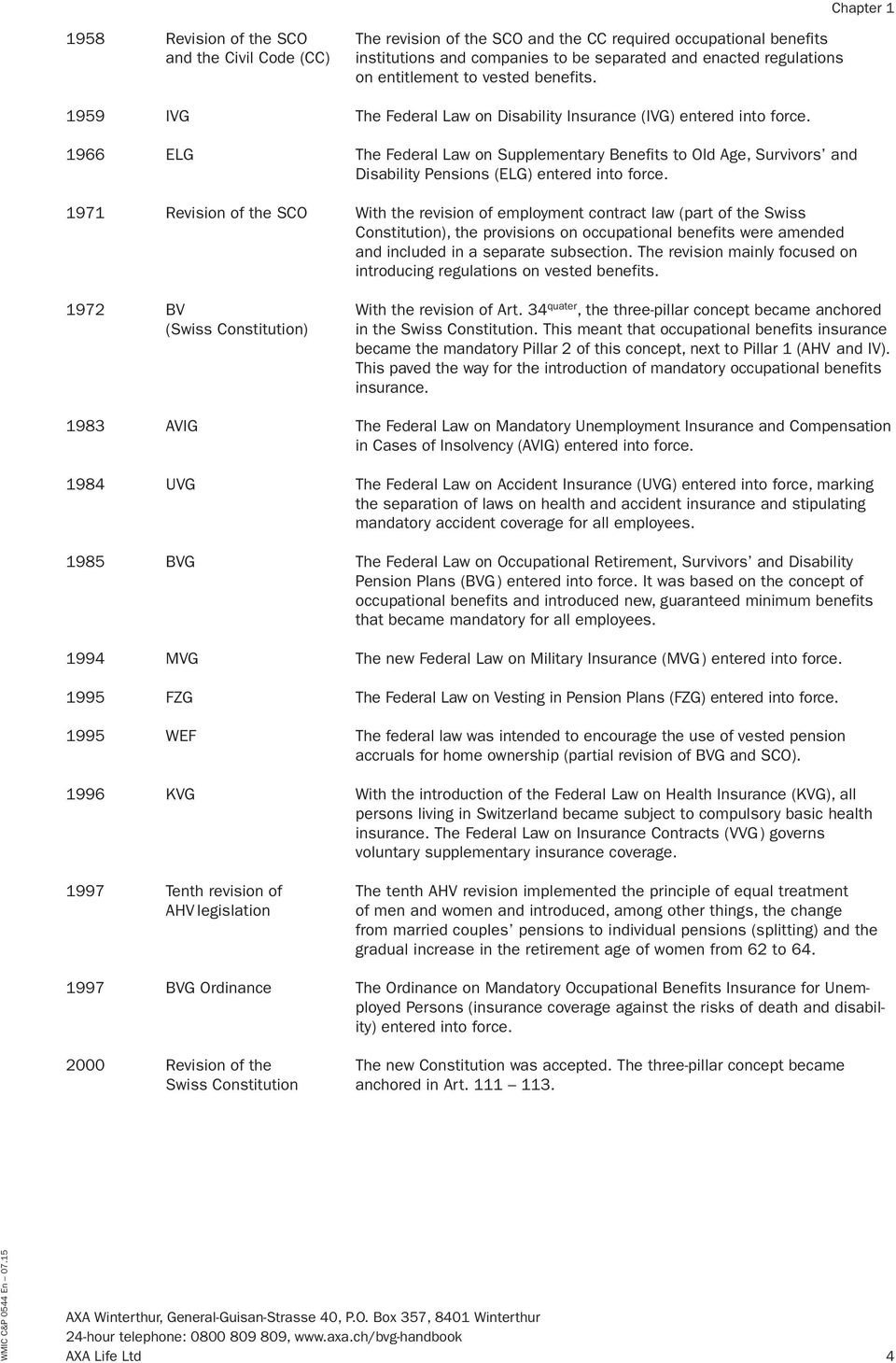
5 2003 ATSG The Federal Law on the General Part of the Social Insurance Law (ATSG) entered into force. It harmonized the provisions and introduced uniform designations and procedures in the various types of social insurance. Chapter Fourth revision of The fourth IV revision mainly concerned the financial consolidation of the IV the IV. It introduced specific amendments to benefits while increasing supervision by the federal government at the same time. It also simplified organizational aspects and procedures First revision of The occupational benefits insurance implemented the provisions designed the BVG to ensure transparency in how pension funds are managed and insured persons are informed First revision of the The BVG revision aimed to harmonize provisions for men and women, BVG, remediation lower the minimum income required for enrollment in an occupational pension plan, adjust the coordination deduction and the conversion rate, introduce a widower s pension, and harmonize pension thresholds with the IV. At the same time, the remediation enacted measures to address any shortfalls in coverage in occupational benefits institutions. First and foremost, these measures sought to levy restructuring contributions while reducing the BVG minimum interest rate at the same time Revision EO The revision of the Federal Law on Income Compensation granted farreaching benefits to working mothers First revision of Tax-relevant provisions on occupational benefits insurance were put into the BVG force. These addressed, in particular, occupational benefits insurance, the pensionable salary, and the purchase of additional benefits Structural reforms More stringent provisions to improve pension fund governance and transparency entered into force Structural reforms On January 1, 2012, provisions on supervisory structures entered into force. They mainly focus on strengthening and restructuring the supervisory system by means of an independent Supreme Supervisory Commission for Occupational Benefits and with detailed regulations for investment foundations. AXA Life Ltd 5

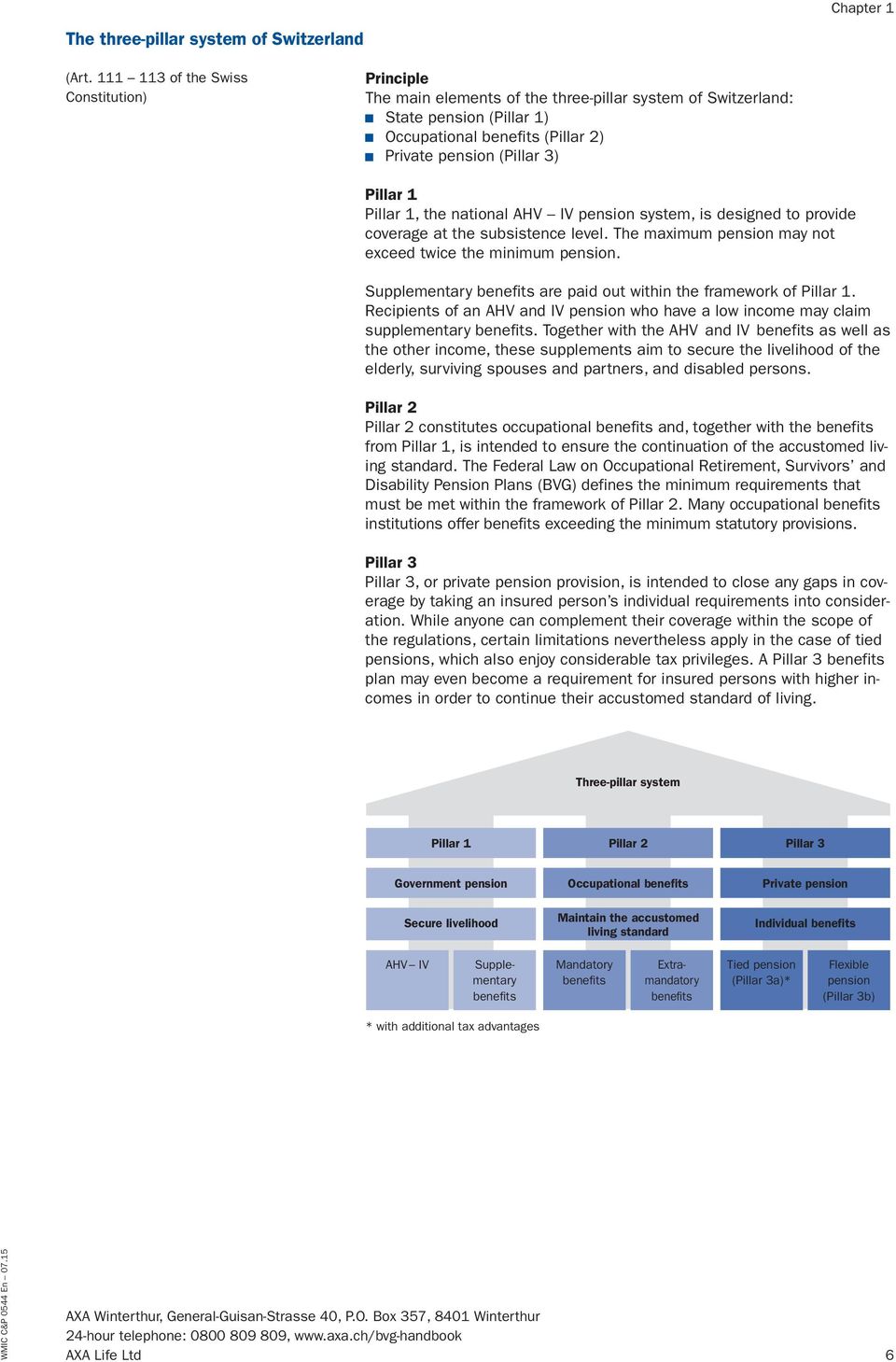
6 Chapter 1 The three-pillar system of Switzerland (Art of the Swiss Constitution) Principle The main elements of the three-pillar system of Switzerland: State pension (Pillar 1) Occupational benefits (Pillar 2) Private pension (Pillar 3) Pillar 1 Pillar 1, the national AHV IV pension system, is designed to provide coverage at the subsistence level. The maximum pension may not exceed twice the minimum pension. Supplementary benefits are paid out within the framework of Pillar 1. Recipients of an AHV and IV pension who have a low income may claim supplementary benefits. Together with the AHV and IV benefits as well as the other income, these supplements aim to secure the livelihood of the elderly, surviving spouses and partners, and disabled persons. Pillar 2 Pillar 2 constitutes occupational benefits and, together with the benefits from Pillar 1, is intended to ensure the continuation of the accustomed living standard. The Federal Law on Occupational Retirement, Survivors and Disability Pension Plans (BVG) defines the minimum requirements that must be met within the framework of Pillar 2. Many occupational benefits institutions offer benefits exceeding the minimum statutory provisions. Pillar 3 Pillar 3, or private pension provision, is intended to close any gaps in coverage by taking an insured person s individual requirements into consideration. While anyone can complement their coverage within the scope of the regulations, certain limitations nevertheless apply in the case of tied pensions, which also enjoy considerable tax privileges. A Pillar 3 benefits plan may even become a requirement for insured persons with higher incomes in order to continue their accustomed standard of living. Three-pillar system Pillar 1 Pillar 2 Pillar 3 Government pension Occupational benefits Private pension Secure livelihood Maintain the accustomed living standard Individual benefits AHV IV Supplementary benefits Mandatory benefits Extramandatory benefits Tied pension (Pillar 3a)* Flexible pension (Pillar 3b) * with additional tax advantages AXA Life Ltd 6
7 2. Purpose, scope and conditions Chapter 2 Purpose and scope Purpose (Art. 113 par. 2a of the Constitution, Art. 1 BVG ) The objective of the BVG is to complement the benefits from the Federal Old Age and Survivors Insurance and Disability Insurance (AHV IV) in order to ensure that people can maintain their accustomed standard of living. The pensionable salary under the occupational benefits insurance may not exceed the salary subject to AHV contributions. Principles of occupational benefits (Art. 1 par. 1 and 3 BVG; Art. 1, 1a, 1b, 1c, 1d, 1e, 1f, 1g, 1h, 1i BVV2 ; final provisions of the amendment to the BVV2 of June 10, 2005) The provisions referred to above are based on the principles of appropriateness, collectivity, equal treatment, and predictability, as well as on the insurance principle all of which are implemented in occupational benefits insurance. This means that tax-privileged occupational benefits insurance is managed separately from private pension and other insurance plans, with the aim of preventing insured persons from obtaining excessive tax privileges under Pillar 2. Appropriateness A pension plan is deemed appropriate if the regulatory benefits do not exceed 70 % of the most recent salary subject to AHV contributions, or if the total regulatory savings contributions paid by the employer and the employees are less than 25 % of all insurable salaries subject to AHV contributions. To prevent insured persons with salaries of more than CHF 84,600 (upper threshold under compulsory insurance) from being overinsured, the total retirement benefits under the occupational benefits insurance and the AHV may not exceed 85 % of the most recent salary subject to AHV contributions before retirement. If the pension plan includes any lump-sum payment, the appropriateness of the plan must be determined based on the corresponding retirement benefits. If an employer concludes affiliation contracts with several occupational benefits institutions and its employees are thus insured with more than one institution, all occupational benefits relationships must remain within the scope of what is deemed reasonable. Self-employed individuals who have taken out occupational benefits insurance voluntarily must also observe the principle of appropriateness. If an insured person draws retirement benefits before reaching the regular retirement age, the benefits will be reduced. The regulations of the occupational benefits institution can allow insured persons to compensate any reductions in part or in full through the purchase of additional benefits. If the insured person has purchased the maximum in additional benefits but does not retire early, the regulatory benefits limit may not be exceeded by more than 5 %. AXA Life Ltd 7

8 Chapter 2 Collectivity Employers must allocate their employees into one or more groups under the occupational benefits insurance. A group of insured employees is called a collective, whose membership is governed by objective criteria (for example employees / management employees). Every insured person who fulfills the specific criteria must be admitted to the group in question. The principle of collectivity is also upheld if only one person is insured at a specific time but regulations provide for the possibility of admitting other persons to the group. This possibility does not exist under voluntary insurance of a self-employed individual. Equal treatment The same regulatory conditions must apply to all members of a collective. Definition The pension fund regulations of an occupational benefits institution must define the insured benefits, financing of benefits, conditions for entitlement, pension plans, different groups of insured in the various plans. Insurance principle At least 6 % of all employer contributions to the occupational benefits insurance must be used to finance the risk benefits for death and disability. Minimum retirement age An insured person can retire at the earliest at age 58. Earlier retirement is possible in the event of operational reorganizations and for persons exercising a profession where public security demands retirement at an even earlier age. This provision entered into force on January 1, The law makes an exception for occupational benefits institutions that granted retirement earlier than at age 58 before this provision entered into force: up to December 31, 2010 these institutions allowed insured persons who where already insured with the institution on December 31, 2005 to retire before age 58. Insured persons (Art. 2 5, BVG; Art. 1j, 28 BVV2 ) The BVG distinguishes between those mandatorily and those voluntarily insured, as well as between employees and self-employed persons. Mandatory insurance of employees Employees are subject to mandatory insurance in accordance with the BVG if they have an employment contract, are subject to AHV IV insurance, are 17 or older, have an annual income that exceeds the BVG entry threshold, have not yet reached retirement age. AXA Life Ltd 8

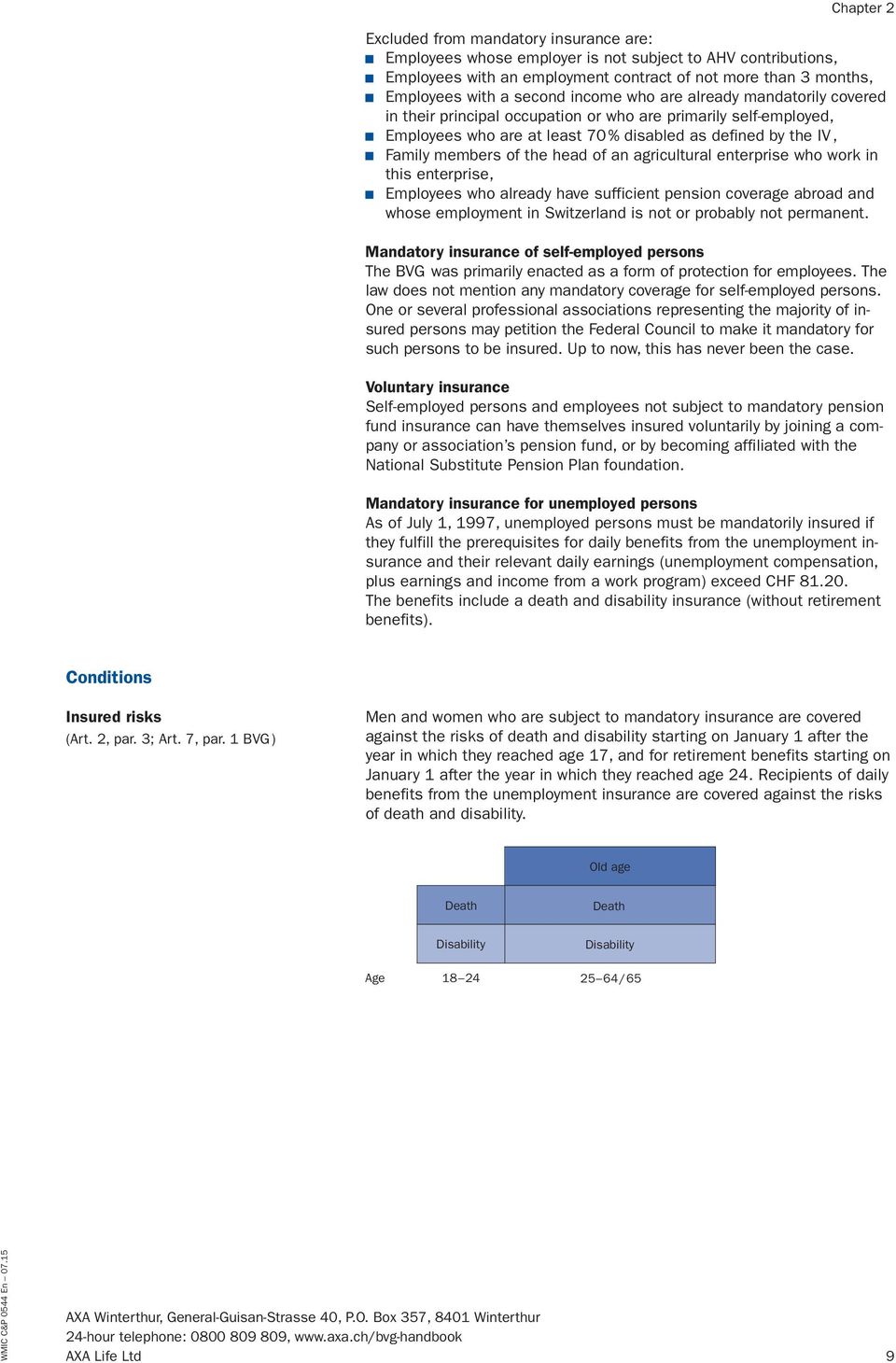
9 Chapter 2 Excluded from mandatory insurance are: Employees whose employer is not subject to AHV contributions, Employees with an employment contract of not more than 3 months, Employees with a second income who are already mandatorily covered in their principal occupation or who are primarily self-employed, Employees who are at least 70 % disabled as defined by the IV, Family members of the head of an agricultural enterprise who work in this enterprise, Employees who already have sufficient pension coverage abroad and whose employment in Switzerland is not or probably not permanent. Mandatory insurance of self-employed persons The BVG was primarily enacted as a form of protection for employees. The law does not mention any mandatory coverage for self-employed persons. One or several professional associations representing the majority of insured persons may petition the Federal Council to make it mandatory for such persons to be insured. Up to now, this has never been the case. Voluntary insurance Self-employed persons and employees not subject to mandatory pension fund insurance can have themselves insured voluntarily by joining a company or association s pension fund, or by becoming affiliated with the National Substitute Pension Plan foundation. Mandatory insurance for unemployed persons As of July 1, 1997, unemployed persons must be mandatorily insured if they fulfill the prerequisites for daily benefits from the unemployment insurance and their relevant daily earnings (unemployment compensation, plus earnings and income from a work program) exceed CHF The benefits include a death and disability insurance (without retirement benefits). Conditions Insured risks (Art. 2, par. 3; Art. 7, par. 1 BVG ) Men and women who are subject to mandatory insurance are covered against the risks of death and disability starting on January 1 after the year in which they reached age 17, and for retirement benefits starting on January 1 after the year in which they reached age 24. Recipients of daily benefits from the unemployment insurance are covered against the risks of death and disability. Old age Death Death Disability Disability Age /65 AXA Life Ltd 9
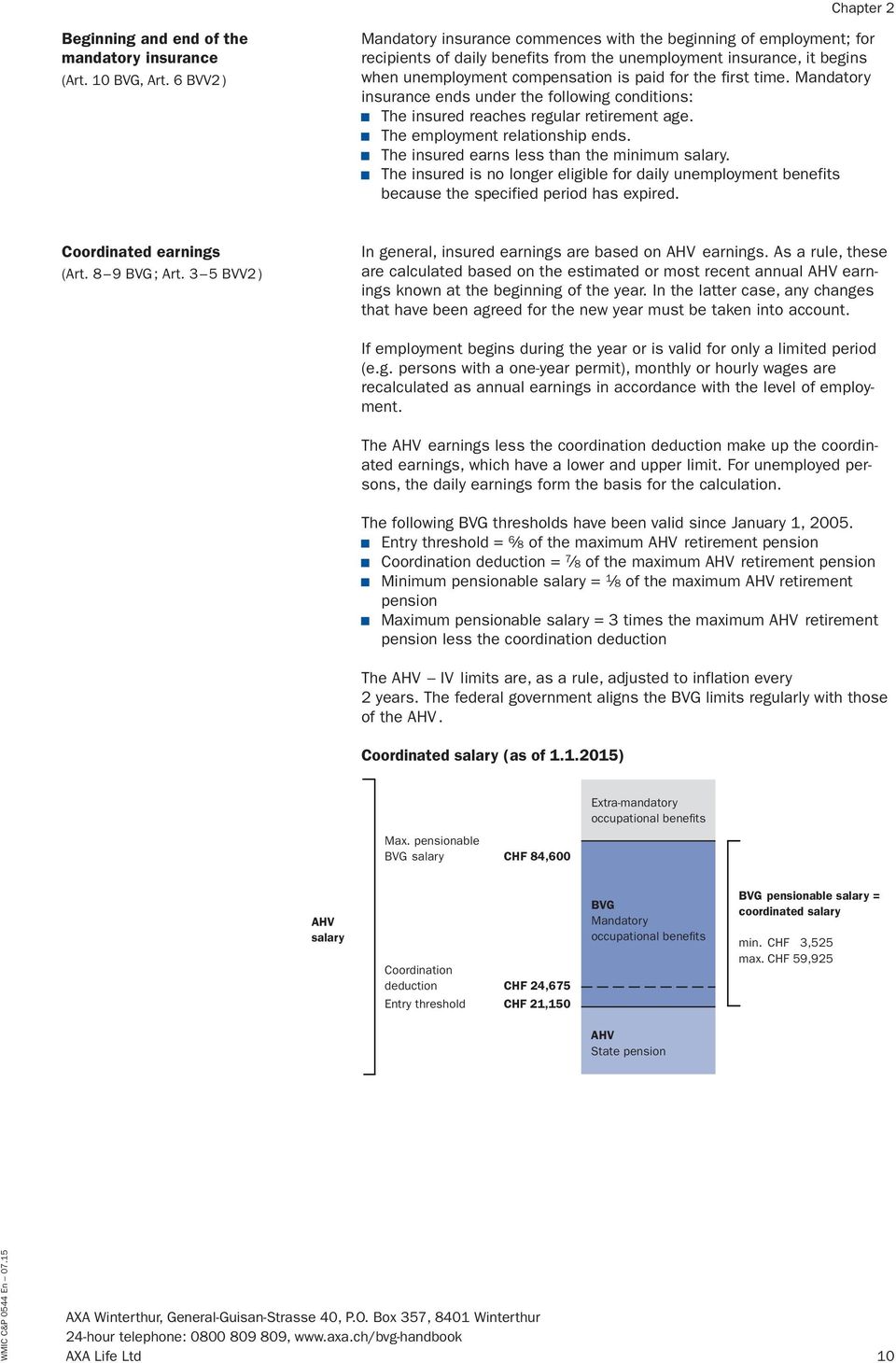
10 Chapter 2 Beginning and end of the mandatory insurance (Art. 10 BVG, Art. 6 BVV2 ) Mandatory insurance commences with the beginning of employment; for recipients of daily benefits from the unemployment insurance, it begins when unemployment compensation is paid for the first time. Mandatory insurance ends under the following conditions: The insured reaches regular retirement age. The employment relationship ends. The insured earns less than the minimum salary. The insured is no longer eligible for daily unemployment benefits because the specified period has expired. Coordinated earnings (Art. 8 9 BVG ; Art. 3 5 BVV2 ) In general, insured earnings are based on AHV earnings. As a rule, these are calculated based on the estimated or most recent annual AHV earnings known at the beginning of the year. In the latter case, any changes that have been agreed for the new year must be taken into account. If employment begins during the year or is valid for only a limited period (e.g. persons with a one-year permit), monthly or hourly wages are recalculated as annual earnings in accordance with the level of employment. The AHV earnings less the coordination deduction make up the coordinated earnings, which have a lower and upper limit. For unemployed persons, the daily earnings form the basis for the calculation. The following BVG thresholds have been valid since January 1, Entry threshold = 6 8 of the maximum AHV retirement pension Coordination deduction = 7 8 of the maximum AHV retirement pension Minimum pensionable salary = 1 8 of the maximum AHV retirement pension Maximum pensionable salary = 3 times the maximum AHV retirement pension less the coordination deduction The AHV IV limits are, as a rule, adjusted to inflation every 2 years. The federal government aligns the BVG limits regularly with those of the AHV. Coordinated salary (as of ) Max. pensionable BVG salary CHF 84,600 Extra-mandatory occupational benefits AHV salary Coordination deduction CHF 24,675 Entry threshold CHF 21,150 BVG Mandatory occupational benefits BVG pensionable salary = coordinated salary min. CHF 3,525 max. CHF 59,925 AHV State pension AXA Life Ltd 10
11 3. Insured benefits Chapter 3 Savings process / retirement assets (Art. 15, 16, BVG ; Art. 11, par. 1 2; Art. 12, 13 BVV2 ) The mandatory insurance is based on a savings process that begins on January 1 following the year in which the person completes age 24 and that lasts at the most until completion of age 65 for men or 64 for women. The retirement assets accrue through annual retirement credits and other payments, for example transferred vested benefits. The accrued capital (retirement assets) bears interest for the time that an insured person is a member of the occupational benefits institution. The Federal Council sets the minimum rate of interest (1.75 % as of January 1, 2014). The retirement credits are determined as a percentage of the coordinated (pensionable) earnings. The amount of these credits depends on the insured person s age. Insured person s age Woman / man / 65 Retirement credits as % of the coordinated earnings 7 % 10 % 15 % 18 % From age 25, a male can thus accrue retirement assets (without interest) amounting to 500 % of his coordinated earnings (10 years at 7 %, 10 years at 10 %, 10 years at 15 % and 10 years at 18 %). From age 25, a female (working until age 64) can expect to earn retirement assets without interest of only 482 % of her coordinated earnings, because the last period of retirement credit of 18 % lasts only 9 years. The retirement assets (including interest) that accrue in this manner form the basis for determining the retirement pension. The disability and survivors pensions at the time of an insured event are calculated based on the accrued retirement assets plus the sum of the future retirement credits, without interest. Retirement benefits Beneficiaries (Art. 13, 17, 22 par. 3 BVG; Art. 1i, 62a BVV2 ) Retirement pension Entitlement to a retirement pension applies to women upon completion of age 64 men upon completion of age 65 Exceptions The regulations of an occupational benefits institution may include provisions for early (from age 58) or deferred retirement, in which case benefits are adjusted commensurately. AXA Life Ltd 11

12 Chapter 3 Pensioner s child s pension Beneficiaries of retirement benefits are also entitled to a pension for their children who are below age 18 or currently in school or training,* or who are disabled at a level of at least 70 %.* * At the most up to age 25. Amount of retirement benefits (Art. 14, 17, 19a, Art. 36 par. 2 BVG ) Retirement pensions The amount of the retirement pension depends on the accrued retirement assets (retirement credits plus interest) at retirement age. Under the mandatory occupational benefits insurance, retirement assets are converted into a pension using the conversion rate set by the Federal Council. In the course of the next 10 years, the conversion rate will gradually be decreased from 7.2 % to 6.8 % (as of January 1, 2013: men 6.85 % / women 6.8 %). Annual retirement credits with interest Retirement assets at retirement age with interest Retirement pension: Conversion rate x retirement assets Age 25 64/65 Pensioner s child s pension The retirement pension forms the basis for calculating a pensioner s child s pension, which equals 20 % of the retirement pension per child during the entitlement period. Special considerations Reversionary spouse s pension: Upon the death of a spouse after retirement, the surviving spouse receives a pension amounting to 60 % of the retirement pension. A partner registered in accordance with the Federal Law on the Registration of Partnerships for Same-Sex Couples of June 18, 2004, is treated the same as a spouse. Reversionary orphan s pension: 20 % of the retirement pension. Current retirement pensions must be adjusted to inflation within the scope of an occupational benefits institution s financial possibilities. Lump sum payment of the retirement pension (Art. 37 BVG) Retirement benefits are generally paid as a pension. If permitted under the regulations, benefits may be drawn as a lump sum instead of as a pension. One quarter of the BVG retirement assets can always be withdrawn as a lump sum. If the insured person is married, a lump sum payment is permissible only if the spouse or registered partner gives his or her written consent. If the retirement pension is less than 10 % of the minimum AHV retirement pension, the occupational benefits institution can pay a lump sum instead of a pension. AXA Life Ltd 12

13 Chapter 3 Disability benefits Beneficiaries (Art. 22, 23, 25, 26 par. 1 BVG ) Disability pensions Entitlement to a disability pension falls under the provisions of the IV, i.e. a pension is usually paid only if the insured is at least 40 % disabled and has not yet reached retirement age. To be eligible, the insured person must have been covered at the time of the event that caused the disability. Persons with a congenital defect or who became disabled while not yet of age are entitled to a disability pension if they were at least 20 % but not more than 40 % incapacitated when they started working and insured for at least 40 % at the time of the illness / injury that caused the incapacity for work. Disabled person s child s pension Persons entitled to a disability pension are also entitled to a pension for their children, provided these have not yet reached age 18 or are still in school or training,* or are at least 70 % disabled.* * Maximum up to age 25. Amount of disability benefits (Art. 24, 25, 36, par. 1 BVG; Art. 4, 14, 15, 18 BVV2, ordinance of Sept. 16, 1987, on the adjustment of the current survivors and disability benefits to inflation, transitional regulation pursuant to the amendment of October 3, 2003 [f]) Disability pensions The calculation relies on projections of retirement assets because the insured person has not yet reached retirement age. These consist of the capital accrued (with interest) up to the start of disability plus any future retirement credits without interest. The projected retirement assets are converted into a disability pension using the same conversion rate as for the retirement pension. Annual retirement credits plus interest Projected retirement credits without interest Projected retirement assets Disability pension: Conversion rate x projected retirement assets Age 25 Start of 64/65 disability Pensions for disabled persons children This pension equals 20 % of the disability pension per child. Special considerations Mandatory disability pensions that have been in effect for over 3 years are adjusted to inflation according to the directives of the Federal Council, up to completion of age 64 for women and completion of age 65 for men. Insured persons with a disability of at least 40 % are entitled to a quarter disability pension, with a disability of 50 % to half a disability pension, with a disability of 60 % to a three-quarter disability pension, and with a disability of 70 % or more to the full disability pension. Reversionary spouse s pension: 60 % of the disability pension. Reversionary orphan s pension: 20 % of the disability pension. AXA Life Ltd 13

14 Chapter 3 Lump sum withdrawal of the disability pension (Art. 37, par. 3 and 4 BVG ) Under the regulations, a person entitled to a pension may request a lump sum payment instead of a disability pension. If the disability pension is less than 10 % of the minimum AHV retirement pension, the occupational benefits institution may pay a lump sum instead of a pension. Survivors benefits Beneficiaries (Art , 22 BVG; Art. 20 BVV2 ) General prerequisites A surviving partner is entitled to survivors benefits if the decedent was insured or received a retirement or disability pension from the occupational benefits institution at the time of death. Surviving spouse s pensions If a married insured person dies, the surviving spouse is entitled to a surviving spouse s pension until the time of remarriage or death, provided this person is required to support one or more children, has reached age 45 and the marriage lasted for at least 5 years. If none of these conditions applies, the surviving spouse receives a lumpsum payment of three annual pensions. These requirements apply also to the registered partner. The divorced spouse is treated the same as the widow or widower after the death of the former spouse, provided their marriage lasted at least 10 years and the divorced spouse was awarded a pension or lump-sum payment instead of a lifelong pension in the divorce settlement. This rule applies also to a former registered partner after the registered partnership has been dissolved. Orphans pensions If an insured person dies, his or her children are entitled to an orphan s pension if they are below age 18 or are still in school or training,* or if they are at least 70 % disabled.* * At most up to age 25. AXA Life Ltd 14

15 Chapter 3 Amount of survivors benefits (Art. 21, 36 BVG, ordinance of Sept. 16, 1987 on the adjustment of the current survivors and disability benefits to inflation) Surviving spouse s pension Orphan s pension before retirement 60 % of the disability pension 20 % of the disability pension after retirement 60 % of the retirement pension 20 % of the retirement pension Special consideration Mandatory survivors pensions that have been in effect for more than three years are adjusted to cost-of-living increases in accordance with the directives of the Federal Council up to completion of age 64 for women and completion of age 65 for men. Lump-sum payment of surviving spouse s pension (Art. 37, par. 1, 3, 4, 5 BVG) Survivors benefits are generally paid as pensions. However, the surviving spouse s pension may be drawn as a lump sum if stipulated in the regulations. A registered partner is treated the same as a spouse. If the widow s or widower s pension is less than 6 % or the orphan s pension less than 2 % of the minimum AHV retirement pension, the occupational benefits institution can pay a lump sum instead of a pension. AXA Life Ltd 15

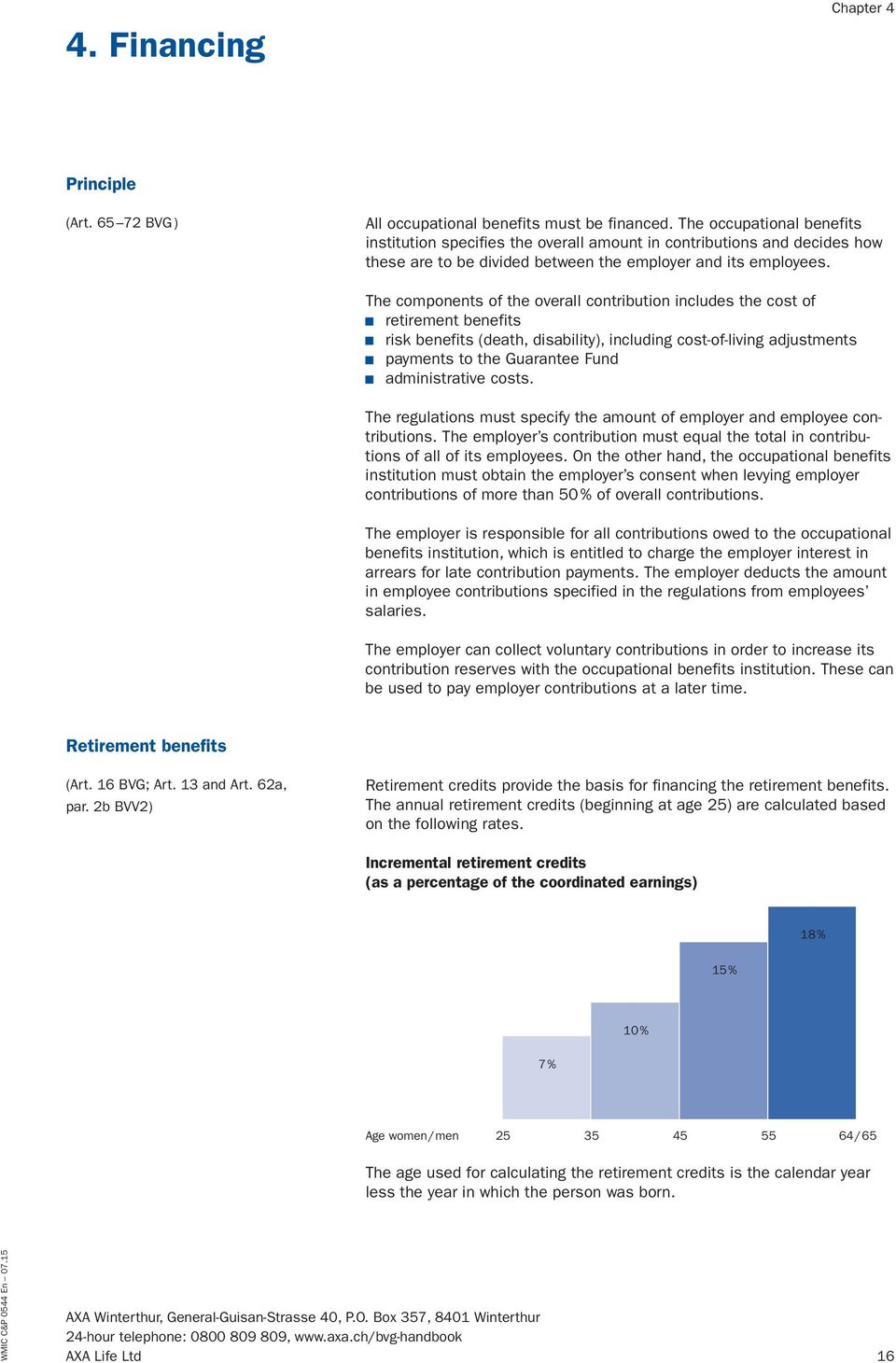
16 4. Financing Chapter 4 Principle (Art BVG ) All occupational benefits must be financed. The occupational benefits institution specifies the overall amount in contributions and decides how these are to be divided between the employer and its employees. The components of the overall contribution includes the cost of retirement benefits risk benefits (death, disability), including cost-of-living adjustments payments to the Guarantee Fund administrative costs. The regulations must specify the amount of employer and employee contributions. The employer s contribution must equal the total in contributions of all of its employees. On the other hand, the occupational benefits institution must obtain the employer s consent when levying employer contributions of more than 50 % of overall contributions. The employer is responsible for all contributions owed to the occupational benefits institution, which is entitled to charge the employer interest in arrears for late contribution payments. The employer deducts the amount in employee contributions specified in the regulations from employees salaries. The employer can collect voluntary contributions in order to increase its contribution reserves with the occupational benefits institution. These can be used to pay employer contributions at a later time. Retirement benefits (Art. 16 BVG; Art. 13 and Art. 62a, par. 2b BVV2) Retirement credits provide the basis for financing the retirement benefits. The annual retirement credits (beginning at age 25) are calculated based on the following rates. Incremental retirement credits (as a percentage of the coordinated earnings) 18% 15% 10% 7% Age women/men /65 The age used for calculating the retirement credits is the calendar year less the year in which the person was born. AXA Life Ltd 16
17 Chapter 4 Risk benefits The annual risk premiums (from age 18) are based on the amount in benefits due in the case of death or disability. They also include the cost of adjusting mandatory survivors and disability benefits to costs-of-living increases. Transparency (Art. 65a BVG; Art. 48b 48e BVV2) Occupational benefits institutions must observe the principle of transparency in their contribution system, financing, capital investments and accounting. This aims to ensure that their financial situation is apparent and that institutions can guarantee payment of all their benefit obligations. Furthermore, they must fulfill the duty to provide information to the insured, and the governing body must be able to perform its management function on the basis of equal employer and employee representation. Shortfall in coverage (Art. 65, 65c, 65d, 65e BVG ; Art. 44, 44a and 44b BVV2) Occupational benefits institutions must ensure that they can meet their obligations at all times. A shortfall in coverage arises if an institution s assets are insufficient for covering its liabilities (obligations to the insured). A temporary shortfall in coverage and temporary non-compliance with the principle of security is permissible if a) there are guarantees that the statutory benefits can be paid when they fall due, and b) the occupational benefits institution takes measures to eliminate the shortfall in coverage within a reasonable period. Measures to eliminate the shortfall must be based on a regulatory principle, be appropriate and commensurate with the level of the shortfall, and be part of a balanced overall concept. If other measures are insufficient to reach these objectives, the occupational benefits institution may for the duration of the shortfall demand additional restructuring contributions from the employer and employees. The employer s contribution must equal at least the total contributions of all its employees. These contributions are not part of the vested benefits; undercut the minimum interest rate pursuant to Art. 15 par. 2 BVG (but not for longer than 5 years); levy contributions on pension recipients. This measure must be used in a restrictive manner; pensions cannot be reduced permanently. The BVG minimum benefits must be guaranteed; place a limit on the time and amount of early withdrawals or refuse these altogether if their purpose is to repay a mortgage loan; impose a restriction of use on the funds in the separate employer contribution reserve account and allocate funds from the regular employer contribution reserves to this account. AXA Life Ltd 17

18 Chapter 4 Guarantee Fund (Art BVG; ordinance of June 22, 1998 on the BVG Guarantee Fund, Art. 1 par. 2 FZG) The Guarantee Fund fulfills two basic functions: It provides subsidies to registered occupational benefits institutions with an unfavorable age structure, i.e. where the sum of the retirement credits exceeds 14 % of the sum of the corresponding coordinated earnings. It secures entitled persons benefits in accordance with regulations if the occupational benefits institution becomes insolvent. However, this guarantee is limited to the maximum benefit calculated from a specified salary of one and a half times the upper BVG limit, currently CHF 126,900. The Guarantee Fund also compensates the National Substitute Pension Plan for costs that cannot be transferred to those who incur them. All occupational benefits institutions subject to the Federal Law on Vesting in Pension Plans (FZG) of December 17, 1993 are affiliated with the BVG Guarantee Fund and participate in its funding. These occupational benefits institutions guarantee entitlement to benefits in accordance with the regulations. Subsidies for an unfavorable age structure and payments for the compensation fund offices are funded with contributions from the registered occupational benefits institutions based on the sum of the coordinated earnings (as of age 25). The other benefits are funded by all occupational benefits institutions that are subject to the FZG. The contributions are charged based on the sum of the vested benefits in accordance with the FZG (as of December 31) plus 10 times the amount of the current pensions. Occupational benefits institution Occupational benefits institution Occupational benefits institution Contributions Guarantee Fund foundation Subsidies to Occupational benefits payments to Registered occupational benefits institutions with an unfavorable age structure Insolvent pension funds AXA Life Ltd 18

19 5. Coordination with social insurance Chapter 5 Principle Purpose and targets of the coordination (Art. 34a BVG) Social insurance laws include numerous provisions that are intended to harmonize different systems. As a whole, these provisions constitute Swiss coordination law. Coordination provisions are meant to eliminate the disadvantages that invariably will arise when different social insurance measures, rules, and regulations are in force simultaneously. With a view to establishing a general coordination norm, the Federal Council issues directives in order to prevent insured persons or their survivors from taking unjustified advantage of the system when benefits are paid from several sources. In the event of a benefit case, persons entitled to a pension are thus prevented from gaining a financial advantage. Procedure in the case of over-compensation (Art. 34a BVG; Art BVV2) The occupational benefits institution can reduce the survivors and disability benefits insofar as they, together with other benefits received, exceed 90 % of the eligible lost earnings. Retirement benefits, however, may not be reduced. The occupational benefits institution may also set a higher limit, but not above 100 %, for tax reasons. Presumed loss of earnings (Art. 24, par. 1 BVV2) In general, this refers to earnings the insured person would have received at the time of the calculation if no adverse event had occurred. If the calculation is made some time after the insured event, the most recent annual salary can be multiplied with an earnings index. AXA Life Ltd 19
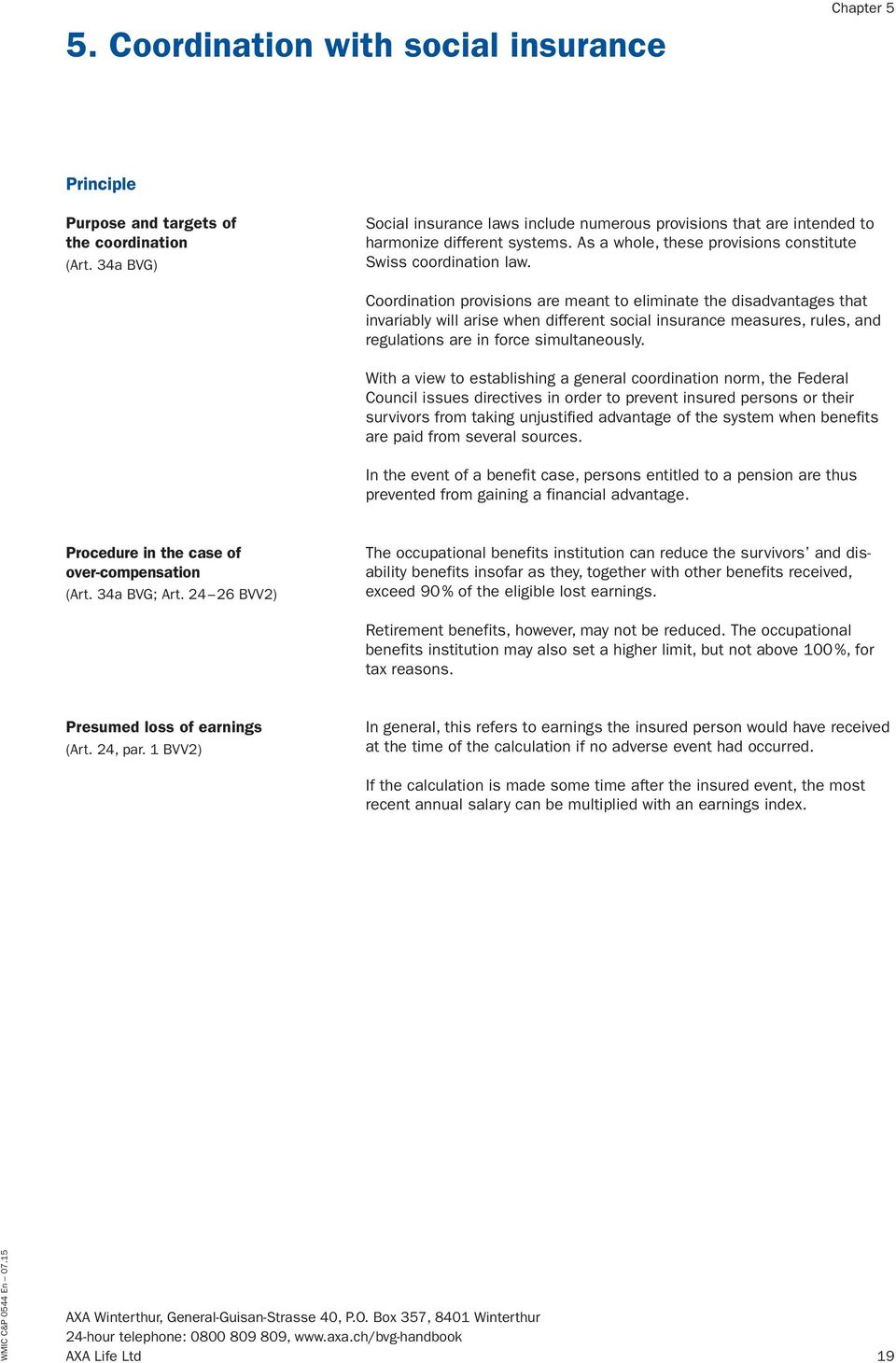
20 Chapter 5 Coordination in case of disability Disability due to illness (Art. 34a BVG) If an insured person becomes ill, the employer will initially continue to pay the full salary (obligation of continued salary payment under the SCO). The period of continued salary payment depends on the period of employment. The employee can claim BVG benefits only when benefits from the Federal Disability Insurance (IV ) begin, generally after one year. Option without daily benefits insurance (statutory solution) 100% 80% 60% Benefits as a % of salary Salary Continued salary payment Possibly extra-mandatory benefits from the pension fund BVG benefits IV benefits BVG benefits AHV benefits 0% Start of disability 1 year Regular retirement Many employers take out daily benefits insurance to cover part of the costs for continued salary payments and to cover the gap in benefits between the end of the salary payment and the beginning of the IV and BVG benefits. The occupational benefits institution may postpone paying BVG benefits by one year if an employer has taken out daily benefits insurance for 730 days that covers at least 80 % of the earnings and at least half is financed by the employer. Option with daily benefits insurance 100% 80% 60% * Possibly extra-mandatory benefits from the pension fund Benefits as a % of salary 0% Salary Beginning of disability BVG benefits IV benefits BVG benefits AHV benefits Beginning of disability * Continued salary payments 1 year 2 years Regular retirement AXA Life Ltd 20
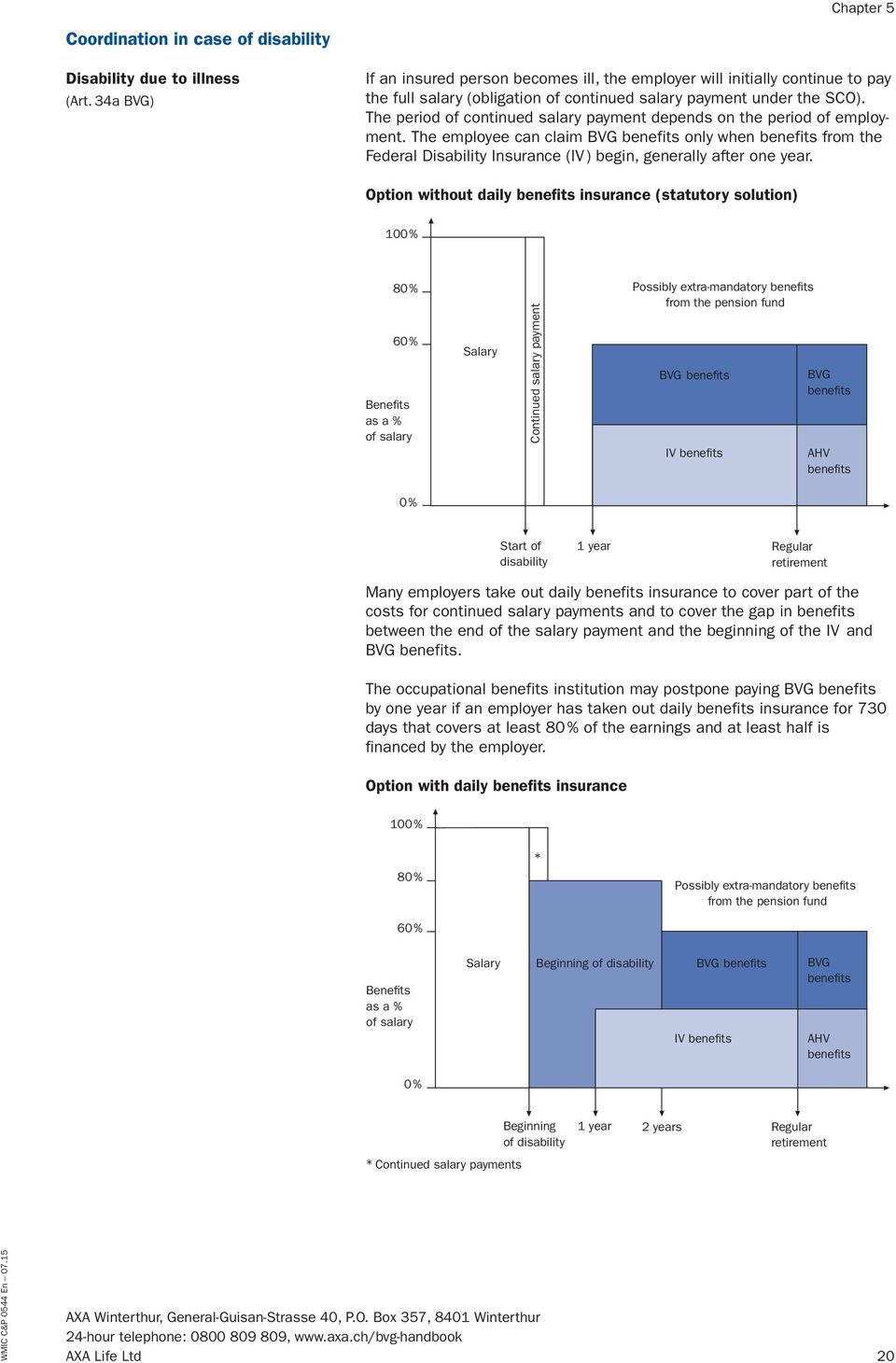
21 Chapter 5 Disability due to accident (Art. 34a BVG; Art. 24 and 25 BVV2) If an insurer is liable for benefit payments under Swiss accident insurance law (UVG ) because an insured person is disabled as a result of an accident, the BVG benefits are limited to the statutory minimum. Moreover, these benefits can be claimed only if they are less than 90 % of the eligible lost earnings together with any other benefits that are due. A benefit reduction or exclusion by the insurer because the insured person culpably caused the event leading to disability is not compensated by other benefits. Coordination with UVG for salaries of up to CHF 126,000 (UVG salary maximum) 100% 90% 80% Salary UVG benefits * Benefits as % of salary 0% IV benefits AHV benefits Start of disability 1 year Regular retirement * The accident insurance pays 80% of the salary. As soon as IV benefits become due, the accident insurance pays a supplementary pension of up to 90% of the salary. In general, no BVG benefits become due for earnings below the UVG maximum when coordinated with the UVG. Supplementary BVG benefits become effective only once this limit is exceeded. Coordination with UVG for salaries above CHF 126,000 (UVG earnings maximum) 100% * BVG benefits Salary UVG benefits ** Benefits as % of salary 0% IV benefits AHV benefits Start of disability 1 year Regular retirement * Employer s obligation to continue salary payments of the difference between 4 5 of the salary * and the UVG benefits. ** The accident insurance covers 80% of the UVG earnings maximum. As soon as IV benefits are due, the accident insurance pays a supplementary pension of up to 90% of the UVG salary maximum. AXA Life Ltd 21
22 Chapter 5 Coordination in case of death Death due to illness If an insured person dies from an illness, the surviving dependents will receive both AHV and BVG benefits. If this results in over-compensation, the BVG benefits may be reduced accordingly. Death due to accident If an accident insurer is obligated to pay benefits under accident insurance law (UVG) upon the death of an insured person due to accident, the BVG benefits are limited to the legal minimum. Moreover, entitlement to these benefits exists only if they do not exceed 90 % of the presumed lost earnings together with any other survivors benefits that are due. Any benefit reduction or exclusion by the accident or military insurer because the insured person culpably caused the event leading to disability is not compensated by other benefits. AXA Life Ltd 22
23 6. Vesting Chapter 6 Principle (Art. 27 BVG ; Art. 1 FZG) The Federal Law on Vesting in Pension Plans (FZG), which has been in force since January 1, 1995, sets out the basic rules on the transfer of benefits and governs insured persons entitlement when they withdraw from an occupational benefits institution (vested benefits case). This law applies to all occupational benefits institutions that pay benefits upon retirement, death, or disability (benefits case) on the basis of regulatory provisions. The goal of the FZG is to maintain the insured person s accrued occupational benefits coverage. It primarily serves to determine the amount due upon withdrawal, referred to hereinafter as vested benefits. These are calculated in different ways depending on whether the fund offers a defined contribution plan or a defined benefit plan. The law also determines the minimum vested benefits a withdrawing insured person may claim in any situation. Vested benefits Definition (Art. 2, par. 1 and 2 FZG ) Insured persons who withdraw from the occupational benefits institution before an insured event occurs (vested benefits case) are entitled to vested benefits. The occupational benefits institution specifies in its regulations how vested benefits are calculated. Calculation of vested benefits (Art. 2, par. 2; Art. 15, par. 1 3; Art. 16 FZG; Art. 5 FZV) Every occupational benefits institution must specify in its regulations if it will manage vested benefits under the legal provisions valid for a defined benefit plan or a defined contribution plan, because vested benefits are calculated differently in each of these cases. Defined contribution plan Here, occupational benefits are calculated based on the contribution amount, which is set in advance. In the case of such pension funds, withdrawing insured persons are entitled to the savings assets / actuarial reserves (also known as retirement assets) that have accrued. In other words, insured persons receive all savings contributions that have been credited (employer and employee contributions), their single premiums, and all interest that has accrued. AXA Life Ltd 23
24 Chapter 6 Defined benefit plan In a defined benefit plan, the occupational benefit amount is set at a certain level (e.g. as a percentage of the earnings) and contributions are then calculated so as to reach this level. In these pension funds, vested benefits correspond to the present value of the accrued benefits. In other words, the vested benefits equal the amount the insured person would need, based on underlying actuarial factors, for purchasing the same benefits with the same pension fund at the time of the withdrawal. Benefits are calculated as follows: The accrued benefit amount equals the insured benefits multiplied by the eligible insurance term divided by the possible insurance term; The vested benefit amount equals the accrued benefits multiplied by the regulatory present value rate, which must be calculated in accordance with accepted actuarial principles. The insured benefits are described in the regulations and calculated based on the possible insurance term. The eligible insurance term is the sum of the contribution years and any additional insurance term that may have been purchased. It begins at the earliest with the payment of contributions towards the retirement benefits. The possible insurance term begins at the same time as the eligible insurance term and ends when the insured person reaches the regular retirement age. Minimum amount (Art. 17 FZG ; Art. 6 FZV) The vested benefit law guarantees insured persons a minimum benefit amount when withdrawing from an occupational benefits institution. This amount consists of any vested benefits brought in when joining, including interest, any contributions by the insured during the contribution period (savings and risk contributions), without interest, a supplement on these contributions by the insured person. The supplement is 4 % of the personal contributions at age 21 and increases by a further 4 % annually. The insured person s age is calculated as the calendar year minus the year of birth. The maximum supplement of 100 % (i.e. double the insured person s own contributions) is thus achieved when this person reaches age 45. Example Age at withdrawal Supplement on the insured s contributions 21 years 4 % 25 years 20 % 30 years 40 % 35 years 60 % 40 years 80 % 45 years and more 100 % AXA Life Ltd 24
25 Chapter 6 If the insured person paid only risk contributions for a certain period, these are not taken into account when calculating the minimum vested benefits amount. When calculating the minimum amount, the occupational benefits institution can deduct from insured persons contributions the risk portion as well as the amounts for the administrative costs, the Guarantee Fund, and any funds needed for eliminating any shortfall in coverage, provided these amounts have been specified in the regulations and the need for deducting them is explained in the annual financial statements or notes. In this case, the occupational benefits institution must take the insured person s savings contribution as well as the interest into consideration. Guarantee of mandatory occupational benefits (Art. 18 FZG; Art. 15 BVG) Registered occupational benefits institutions must pay at least the retirement assets in accordance with the BVG to an insured person upon withdrawal. Comparative calculation (Art. 8, par. 1; Art FZG) When an insured person withdraws, the occupational benefits institution must make three calculations (possibly four if it violates the one-third rule) and pay the highest of the three amounts: Defined contribution plan Vested benefit amount (pursuant to Art. 15 FZG) Defined benefit plan Vested benefit amount (pursuant to Art. 16 FZG) The one-third rule (in accordance with Art. 17 FZG) states that at least one third of all regulatory contributions must be considered as the employee contribution. Minimum amount (under Art. 17 FZG) Retirement assets BVG (under Art. 18 FZG) Regulatory vested benefits What happens with vested benefits? (Art. 3, par. 1; Art. 4 FZG; Art. 1, par. 2; Art. 10, 12 FZV) If an insured person joins a new occupational benefits institution, the former one must transfer all vested benefits to the new one. Insured persons who do not join a new occupational benefits institution must inform the former one if they wish to maintain their coverage in the form of a paid-up policy or a vested benefits account. In the absence of notification, the occupational benefits institution must transfer the vested benefits, with interest, to the National Substitute Pension Plan no earlier than six months and no later than two years from the time of the change. AXA Life Ltd 25
26 Chapter 6 Special considerations Provisos based on health (Art. 14 FZG ; Art. 11 FZV, Art. 331c SCO) A proviso means that benefits for certain risks are either fully or partly excluded from the insurance coverage. In the minimum insurance coverage specified in the BVG, no provisos are permissible. Such provisos are permissible in the extra-mandatory part of the insurance; however, they may not exceed a five-year period. Furthermore, the coverage an insured person acquires through vested benefits brought in from a previous benefits provider may not be reduced by a new proviso based on health. The new occupational benefits institution can continue a proviso that was imposed by the former institution, in which case it must factor in the time the proviso was in effect at the former institution. Cash payment (Art. 5; Art. 25f FZG; Art. 14 FZV, second supplementary agreement of March 8, 1989, between the Principality of Liechtenstein and the federal government on social insurance, effective since August 14, 2002; agreement of June 21, 1999, between the federal government and the European Community and its member states on the free movement of persons, effective as of June 1, 2002) There are three situations in which insured persons can request to have their vested benefits paid out in cash: Upon leaving Switzerland permanently (the Principality of Liechtenstein is regarded as part of Switzerland for this purpose). Upon becoming self-employed, in which case the person is no longer subject to mandatory occupational benefits insurance. If the vested benefits amount is less than one year s contribution. Married insured persons must obtain the written consent of their spouse for a cash payment. A registered partner who asks to have the amount paid out in cash must obtain the other partner s written consent as well. As of June 1, 2007, the compulsory portion of the vested benefits can no longer be paid out in cash if the insured person leaves Switzerland and becomes subject to the compulsory insurance of an EU / EFTA member state against the risks of old age, death and disability. Divorce (Art. 22 FZG ; Art. 1, par. 3 FZV, Art. 22a d FZG; Art. 122 ZGB, Art ZPO) In the case of divorce, the vested benefits accrued during the marriage will be divided. The occupational benefits institution is obligated to notify the court of the amount in accrued vested benefits that must be divided. The court will then notify the occupational benefits institution of the amount to be transferred. The spouse who must transfer part of his or her accrued vested benefits has the possibility to repurchase an equal amount in benefits, in which case the amount is tax-deductible. The provisions on divorce apply analogously if a registered partnership is dissolved by a court. AXA Life Ltd 26
27 Chapter 6 Duty to inform The pension fund s duty to inform (Art. 8, 24 FZG; Art. 2 FZG Ordinance) The occupational benefits institution must inform insured persons annually about their regulatory vested benefit amount. In the event of a vested benefits case, a statement must be issued to withdrawing insured persons. This must show how their vested benefits are calculated, the minimum benefits amount, and the retirement assets pursuant to the BVG. Furthermore, the insured persons must be informed about all the statutory and regulatory options for maintaining their insurance coverage. The occupational benefits institution must calculate the amount in vested benefits as of the relevant date for insured persons who have reached age 50, married, or formed a registered partnership after January 1, These figures must be notified to the insured person s new occupational benefits institution in the case of a transfer. Insured person s duty to inform (Art. 4, 11 FZG; Art. 1, FZG Ordinance ) Prior to withdrawal, insured persons must inform the occupational benefits institution to which new institution the vested benefits are to be transferred. The new occupational benefits institution may view the details of the vested benefits account from previous occupational benefits relationships. Insured persons who do not join a new occupational benefits institution must inform the former institution as to which of the permissible options they choose for maintaining their occupational benefits coverage. The employer s duty to inform (Art. 1, par. 1 and 3 FZG Ordinance) The employer must immediately notify the occupational benefits institution of the withdrawing insured person s address, or of the AHV Social Security number in the absence of an address. The employer must also inform the institution if the employment was terminated for reasons of ill health. The employer must notify the occupational benefits institution if the insured person marries or forms a registered partnership. Pillar 2 Central Office (Art. 24a f FZG ) Occupational benefits institutions must contact their insured regularly. If they are unable to do so, they must inform the Pillar 2 Central Office (dormant assets), which will try to reestablish contact between the occupational benefits institutions and their insured. It also handles inquiries from individual insured persons or their heirs, compares personal data with notifications received from occupational benefits institutions, and communicates the results to those making the inquiry, who can then claim their benefits from the institution in question. AXA Life Ltd 27
28 7. Promotion of home ownership Chapter 7 Principle (Art. 30a, b, c BVG, Art. 331d, e, f SCO) Insured persons may use occupational benefits assets either as an advance withdrawal or a pledge to purchase a home for their own use. These assets may be withdrawn from any part of the occupational benefits insurance, i.e. from the mandatory occupational benefits insurance, the extra-mandatory occupational benefits insurance, a vested benefits policy, or a vested benefits account. Purpose (Art. 30b, c, par. 3 BVG; Art. 1, 2, 3, 4, par. 1 WEF) An advance withdrawal or pledge of benefits is permitted for the following purposes in Switzerland and abroad: purchasing or constructing owner-occupied residential property,* extending or remodeling existing residential property,* paying back a mortgage,* purchasing share certificates in a housing co-operative or similar participations. * Sole ownership, co-ownership, joint ownership with the spouse or registered partner, independent and permanent building rights. Owner-occupied property means insured persons must use the place as their home or primary place of residence. Vacation homes or apartments, as well as mobile homes (caravans, etc.), do not count as residential owner-occupied property as defined in the law on promoting home ownership. Occupational benefits assets may not be used for financing ordinary home repairs and maintenance work or for paying mortgage interest. The occupational benefits assets may only be used for financing one property at a time. Advance withdrawal Definition (Art. 30c BVG) In case of an advance withdrawal of occupational benefits, the occupational benefits institution pays a cash lump sum up to the vested benefits amount. This enables the insured person to increase the equity portion of the home purchase. As a result, however, the insured person s occupational benefits for retirement, death, or disability are reduced commensurately. AXA Life Ltd 28
29 Chapter 7 Minimum and maximum amounts (Art. 30c, par. 2 BVG; Art. 5, par. 1, 2, 4 WEF) Minimum amount The minimum amount of the advance withdrawal is CHF 20,000. However, this limit does not apply when purchasing participation shares in a housing co-operative or a similar arrangement, or for claims against vested benefits institutions. Maximum amount Insured persons may only withdraw in advance the maximum amount in vested benefits accrued up to age 50. As of age 50, only the larger of the following two amounts may be withdrawn: the vested benefits at age 50; half of the vested benefits at the time of the withdrawal. Time frame (Art. 30c, par. 1 BVG; Art. 5, par. 3 WEF; Art. 79b BVG) The insured may make an advance withdrawal once every 5 years until 3 years before reaching retirement age. Benefits purchased by the insured may not be withdrawn as a lump sum for 3 years from the purchase date. Payment of the early withdrawal (Art. 30e, par. 2 BVG; Art. 6, par. 2 WEFV) The occupational benefits institution pays the advance withdrawal in question directly to the insured person s creditor (seller, lender, builder, etc.) as soon as the required documents have been submitted. Insured persons must approve the transfer before the advance withdrawal can be made. In order to uphold the purpose of the occupational benefits provision, the occupational benefits institution must enter a sales restriction in the land register. This states that the insured person must repay the advance withdrawal to the occupational benefits institution in case the property is sold. Shortfall in coverage (Art. 30f BVG, Art. 6a WEF) In the event of a shortfall in coverage, the occupational benefits institution can limit the time and amount of the advance withdrawal, or refuse it altogether if it is used to repay a mortgage. If the payment is restricted or refused, the occupational benefits institution will inform the insured person of the duration and level of the measure. Benefit reductions / supplementary insurance (Art. 30c, par. 4 BVG; Art. 17 WEF) An early withdrawal by an insured person will lead to reduced occupational benefits. In addition to the retirement benefits, which are necessarily reduced in any case, the survivors and disability benefits are often subject to a reduction as well. The insured person can take out supplementary insurance as offered or referred by the occupational benefits institution in order to compensate for reduced risk coverage in case of disability or death. Supplementary insurance is voluntary and the insured person bears the costs involved. AXA Life Ltd 29
30 Chapter 7 Repayment of the advance withdrawal (Art. 30d, Art. 30e par. 1, 3c and 6 BVG; Art. 7 WEF) The insured person or the heirs must repay the advance withdrawal to the occupational benefits institution if the residential property in which the insured invested the occupational benefits assets is sold; privileges are granted on the residential property that are economically equivalent to a sale (i.e. renting, right of residence, usufructuary rights); no occupational benefits are due upon the insured person s death. Exceptions Transfer of the residential property to a beneficiary of occupational benefits (the sales restriction then applies to the beneficiary); If the proceeds of the sale are used to purchase owner-occupied residential property within 2 years, the early withdrawal must not be repaid but transferred to a vested benefits account instead. The insured person can also repay the early withdrawal voluntarily. The minimum repayment amount is CHF 20,000. If the outstanding amount is less than this amount, the entire repayment must be paid as a single installment. The obligation and the right to pay an early withdrawal remain in effect until 3 years before retirement; another insured event occurs; vested benefits are paid out in cash. As a consequence of a repayment, the occupational benefits institution will grant the insured person correspondingly higher occupational benefits in accordance with regulations. Taxes (Art. 83a BVG, Art. 13, par. 1, Art. 14, par. 2, 3 WEF) The occupational benefits institution must notify the Swiss Federal Tax Administration of any early withdrawal within 30 days. The insured person must pay tax on the benefits received at the time of payment as a lump sum. The tax is levied annually and assessed separately from other income. The amount of the tax may not be deducted from the early withdrawal, i.e. insured persons must pay the amount with funds from another source. Upon repayment of an early withdrawal, an insured person can write to the tax authority and ask for a refund (without interest) of the tax paid on the early withdrawal. The application and corresponding confirmation by the occupational benefits institution must be submitted to the tax authorities that levied the tax within 3 years. AXA Life Ltd 30
31 Chapter 7 Pledging Definition (Art. 30b BVG) Insured persons may pledge their entitlement to occupational old age, death, or disability benefits, or an amount equal to their vested benefits, for owner-occupied property. Pledging serves as (additional) guarantee for capital provided by a third party. In contrast to the early withdrawal, the occupational benefits are not reduced, except if the pledge is redeemed. Minimum and maximum amounts (Art. 5, para. 4 and Art. 8 WEF) Minimum amount There is no minimum amount of occupational benefits that can be pledged. Maximum amount Up to age 50, an insured person may pledge an amount up to the maximum in vested benefits at the time the pledge is redeemed. Beginning at age 50, a pledge may at the most involve the larger of the following two: vested benefits at age 50; half of the vested benefits at the time of the pledge. Time frame Insured persons may pledge their entitlement to occupational benefits or their occupational benefits assets until 3 years before retirement age. To be valid, the occupational benefits institution must be notified of the pledge in writing. Pledgee (Art. 9, par. 1, 3 WEF) As regards the amount of the pledge, the pledgee s written consent is necessary when paying out vested benefits in cash; paying out occupational benefits; transferring a part of the vested benefits to the occupational benefits institution of a divorced spouse or a former partner. If the insured person transfers to another occupational benefits institution, the former occupational benefits institution will notify the pledgee. Consequences if the pledge is realized If a pledge on vested benefits is realized, the insured person loses the pledged vested benefit amount, in which case the effects of an early withdrawal apply. If a pledge on occupational benefits is realized, the insured person loses the pension or lump sum that has been pledged. Realizing a pledge involving entitlement to occupational benefits is possible only at the time the benefits fall due. AXA Life Ltd 31
32 Chapter 7 Duty to inform (Art. 11, 12 WEF) At the insured person s written request, the occupational benefits institution must provide information about occupational benefit assets available for residential property; any reduction in benefits; the possibility for closing gaps in occupational benefits coverage with a supplementary insurance; tax obligations; the right to a tax refund on the payment of the advanced benefits. If the insured person transfers to a new occupational benefits institution, the former one must inform the new one of its own accord of any vested benefits that have been pledged or if funds have been withdrawn in advance. Making an advance withdrawal (Art. 30c, par. 5 BVG; Art. 10, WEF) When making an advance withdrawal an insured person must file a request in writing to the occupational benefits institution. Pledging, on the other hand, requires written notification to the occupational benefits institution. Insured persons who are married must obtain the written consent of the spouse; those living in a registered partnership must obtain the partner s written consent. The insured person must submit the necessary documentation to the occupational benefits institution as proof that the prerequisites for the advance withdrawal or pledge have been met. AXA Life Ltd 32
33 8. Organization Chapter 8 Occupational benefits institutions Registration (Art BVG; Art. 6, 7, 10, 11, BVV1) Occupational benefits institutions that wish to provide coverage under the BVG must be entered in the register for occupational benefits. Each super visory authority maintains such a register for the occupational benefits institutions it manages. To be able to register, an occupational benefits institution must meet the material and formal prerequisites of the BVG, i.e. it must provide the statutory benefits and collect the necessary contributions. Legal form (Art. 11, par. 1) An employer of persons subject to mandatory insurance must either set up a registered occupational benefits institution or be affiliated with one. The occupational benefits institution must have one of the following legal forms: foundation cooperative body subject to public law with a separate legal personality Besides institutions governed by public law with a separate legal personality, which is reserved for communities and institutions under public law, the foundation has proven to be a suitable form of occupational benefits institution (pension fund statistics show that approx. 98 % of all private occupational benefits institutions are foundations). Legal relationships Employer Employment contract Employee Affiliation contract Board of trustees Regulations Personal insurance certificate Occupational benefits institution (foundation) Deed of foundation Founder Supervisory authorities Auditors Pension actuary Partner/service provider Investment Risk Advice Management Information AXA Life Ltd 33
34 Chapter 8 Setting up new occupational benefits institutions as well as collective and joint foundations (Art. 65 BVG, Art BVV1) The supervisory authority aims to use structural reform as a means of reviewing the loyalty, integrity and responsibilities of occupational benefits institutions, and of institutions serving the purpose of occupational benefits provision, already before they are founded. Collective and joint foundations with a majority of affiliated employers and assets under management may not enter into affiliation contracts before supervision has been put in place, and new foundations must ensure that they have sufficient start-up funds. This applies in cases where the foundation can cover the expected administrative, organizational and operating expenses during the first two years. The supervisory authority also reviews if the institution has an irrevocable and non-assignable guarantee from a bank that is subject to supervision by the Swiss Financial Market Supervisory Authority or whether or not it is fully reinsured with an insurer that is subject to Swiss or Liechtenstein law. Autonomy (Art BVG) Occupational benefits institutions can determine their benefits, funding, and organization within the given legal framework. However, they must issue provisions in the deed of foundation or the regulations that govern benefits organization administration and funding supervision the relationship to employer, insured persons, and claimants. Any binding provisions of the BVG take precedence over those of the occupational benefits institution. If a registered occupational benefits institution provides benefits in addition to the minimum coverage, the following BVG provisions apply also to the supplementary coverage: Limitation periods and filing of pension documents Equal representation in decision-making bodies and tasks of the executive bodies of occupational benefits institutions Responsibility Authorization and tasks of the governing bodies Integrity and loyalty of decision-makers, legal transactions with closely involved parties, and conflicts of interest Partial or total liquidation Cancellation of contracts Guarantee Fund Supervision and supreme supervision Financial guarantee Transparency Surplus participation from insurance contracts Asset management Administration of justice Penalties Information to insured persons Equal representation in decision-making bodies (Art. 51 BVG) For registered occupational benefits institutions, the body governing the regulatory provisions, funding, and asset management must have equal representation in its decision-making powers, i.e. it must have an equal number of employer and employee representatives. In particular, the various employee categories must be adequately represented. Insured persons may elect their representatives directly or through delegates. If it proves impossible to hold an election, the supervisory authority can authorize another form of representation. In particular, the law prescribes a procedure in case of a tied vote, provided the occupational benefits institution has not already issued measures to take in such a case. In addition, equal representation and the subsequent possibility by employees to participate in decisions apply even in situations where benefits granted by a registered occupational institution exceed the minimum. AXA Life Ltd 34
35 Chapter 8 Tasks of the supreme governing body (Art. 51 a BVG, Art. 33 BVV2) The supreme governing body of an occupational benefits institution is responsible for managing the institution as a whole, ensuring that it meets its statutory obligations, defining its strategic goals and principles, and providing the necessary resources. Its non-transferable and irrevocable tasks include, among other things Defining the system for financing Defining the performance objectives and pension plans, as well as the principles governing the use of unallocated assets Defining the technical interest rate and other technical fundamentals Defining the organizational structure Ensuring the initial and further professional training of employee and employer representatives Appointing and dismissing persons entrusted with management responsibilities The supreme governing body of an occupational benefits institution must have at least four members. In justified exceptional cases, the supervisory authority can allow for fewer members. Integrity and loyalty of those responsible (Art. 51b BVG, Art. 13 BVV1 and Art. 48f BVV2) Persons who have been entrusted with management or administrative tasks of occupational benefits institutions, or with managing its assets, must have a good reputation and ensure that business activities run smoothly. The integrity and loyalty of such persons are evaluated regularly when the basic prerequisites are reviewed. Anyone who assumes an executive function must have thorough applied and theoretical knowledge of occupational benefits insurance. Responsibility (Art. 52 BVG) All persons entrusted with the occupational benefits institution s administration, management, or supervision are responsible for any damage they cause to it intentionally or negligently. Audit (Art. 52a et seq. BVG, Art. 33, 41a BVV2) The occupational benefits institution must appoint an auditor and a pension actuary. The auditor must review, among other things if: The annual financial statements and retirement accounts comply with statutory provisions The organization, management, and investments comply with regulatory provisions Measures to ensure loyalty in asset management have been implemented and if the supreme governing body is sufficiently monitoring compliance with loyalty obligations Furthermore, the pension actuary must perform regular checks to ensure that the occupational benefits institution can meet its obligations at all times. The pension actuary must also review if the regulatory actuarial provisions on benefits and financing comply with statutory provisions. He must make recommendations to the supreme governing body, in particular as regards the technical interest rate and other actuarial fundamentals and about measures to take if the foundation is underfunded. Information provided to insured persons (Art. 86b BVG) Occupational benefits institutions must inform insured persons annually about: Entitlement to benefits, coordinated salary, the contribution rate and the retirement assets Organization and financing The names of the members of the governing body with an equal number of employer and employee representatives. AXA Life Ltd 35
36 Chapter 8 The occupational benefits institution must provide its insured persons with the annual financial statements and the annual report upon request. Similarly, it must, among other things, inform about its investment income, actuarial risk experience, administrative costs, and coverage ratio if requested to do so. Supervision of occupational benefits institutions (Art BVG; Art. 1 4b BVV1) The supervisory provisions of the BVG apply to most occupational benefits institutions, in particular also to those that offer more than the minimum benefits. Since the enactment of structural reforms, the cantons are responsible for directly appointing the authorities that supervise occupational benefits institutions with their registered office in their canton. They can form regional supervisory authorities. BVG and foundation supervisory bodies in central and eastern Switzerland already existed before January 1, Supreme Supervisory Commission of Occupational Benefits Insurance Investment foundations Cantonal/regional supervisory authorities BVG Guarantee Fund National Substitute Pension Plan (BVG) Occupational benefits institutions with registered office in the cantons* * The collective foundations of AXA Life Ltd. report directly to the Office of Occupational Pension Plans and Foundations of the Canton of Zurich. Supervisory authorities (Art a and 64 64c BVG) Occupational benefits institutions are supervised by cantonal and regional authorities, unlike in the case of the BVG Guarantee Fund, the BVG National Substitute Pension Plan, and the investment foundations. They must comprise institutions under public law with their own legal personality and report to the Supreme Supervisory Commission. The Supreme Supervisory Commission is tasked, among other things, with the following: Occupational benefits institutions of national and international character (including those of the federal government) Occupational benefits institutions of the Swiss National Bank, the Swiss National Accident Insurance Fund (SUVA) and the Swiss Federal Railways BVG Guarantee Fund BVG National Substitute Pension Plan (Swiss Financial Market Supervisory Authority, FINMA) Occupational benefits institutions subject to the Insurance Supervision Act (ISA) The cantons supervise all other occupational benefits institutions. The Supreme Supervisory Commission is also responsible for: Issuing instructions to supervisory authorities, pension actuaries and auditors Reviewing the annual reports of the supervisory authorities Setting the standards necessary for supervision Deciding on the admission or dismissal of the pension actuary Managing the register on licensed pension actuaries AXA Life Ltd 36
37 Chapter 8 The main permanent functions of the supervisory authorities (Art. 62 BVG) The supervisory authorities must monitor whether or not the occupational benefits institutions, auditors, pension actuaries, and institutions serving the purpose of occupational benefits provision comply with statutory provisions and are managing the pension assets in accordance with the stated purpose, in particular by reviewing whether or not the bylaws and regulations comply with statutory provisions, requiring occupational benefits institutions to issue periodic reports about their activities, reviewing reports of the auditor and the pension actuary, taking the necessary steps for remedying deficiencies, and settling disputes on insured persons right to information by occupational benefits institutions. During its annual review of the reports, the supervisory authority generally relies on the auditor s findings and conducts only spot checks. The supervisory authorities must ensure that registered occupational benefits institutions provide insured persons with the information to which they are entitled. In addition, they must see to it that employers inform their employees of their information rights. Occupational benefits covering more than one company Occupational benefits institutions set up by third parties that have several affiliated employers are of great economic and social importance today. In general, they are organized in the legal form of a foundation. The following two forms are used, constituting entirely different ways of managing the occupational benefits: Collective foundation Joint foundation Occupational benefits institution (foundation) Founder Occupational benefits institution (foundation) Founder Occupational benefits fund A Company A Company A OBC A Insured persons Insured persons Board of trustees Occupational benefits fund B OBC B Company B Insured persons Board of trustees Company B Insured persons Occupational benefits fund C Company C Company C OBC C Insured persons Insured persons OBC = Occupational benefits fund commission AXA Life Ltd 37
38 Chapter 8 Collective foundation Joint foundation Founder Life insurer, bank, fiduciary, others Enterprise, professional or trade association (employer / employee organization, social partners) Basic principle Independent occupational benefits fund for every affiliated company / no solidarity or liability across occupational benefits funds No independent occupational benefits fund for each affiliated company / Genuine association with full solidarity extending across individual companies Joint representation / decision-making powers under the BVG Pension fund regulations Asset accrual / use At the level of the occupational benefits unit (occupational benefits fund commission) within the framework of the affiliated company Issued by the occupational benefits fund commission with equal representation At the level of the occupational benefits unit (no solidarity in assets between the occupational benefits units). Use is in the remit of the occupational benefits funds, which have equal representation At the level of the occupational benefits institution (board of trustees) Issued by the board of trustees with equal representation At the level of the occupational benefits institution (in general, solidarity in assets between the affiliated companies and insured persons) Use is in the remit of the board of trustees, which has equal representation AXA Life Ltd 38
39 9. National Substitute Pension Plan Chapter 9 BVG National Substitute Pension Plan Carrier and area of responsibility (Art. 54, 55 BVG) The BVG National Substitute Pension Plan is a foundation administered with equal representation by the top-level employer and employee organizations. The foundation is entrusted with regular management responsibilities as well as with special tasks that fall under public law. Tasks (Art. 11 para. 3 bis, 6 and 7; Art. 12; Art. 44 par. 2; Art. 46 para. 1 2; Art. 47; Art. 60 BVG; Art. 28, BVV2; Art. 4, par. 3, FZG; ordinance of August 28, 1985, on entitlements of the National Substitute Pension Plan for occupational benefits; Art. 22a, par. 3, AVIG ; ordinance on the occupational benefits of unemployed persons from March 3, 1997) Affiliating on a madatory basis employers who have neither established nor joined an occupational benefits institution. Affiliating persons on a voluntary basis, such as Self-employed individuals and Swiss expatriates; Employees who work for several employers; Employees who withdraw from mandatory insurance but wish to retain coverage. Paying statutory benefits for an employee or his or her survivors if the employer is not affiliated with an occupational benefits institution despite the statutory obligation. Safeguarding statutory benefits in the case of dormant credit balances. Managing statutory occupational benefits of unemployed persons. Supervision (Art. 63 BVG) As a foundation, the BVG National Substitute Pension Plan is subject to the Supreme Supervisory Commission for occupational benefits insurance. The Federal Council must approve the deed of foundation and the regulatory provisions and be informed of the annual report and the annual financial statements. AXA Life Ltd 39
40 Chapter 9 Special considerations (Art. 12 par. 2; Art. 60 par. 4; Art. 72 BVG; Art. 4 par. 3 FZG; ordinance of August 28, 1985 on entitlements of the National Substitute Pension Plan for occupational benefits) The National Substitute Pension Plan administers occupational benefits through 3 regional offices. Vested benefits from a dormant credit balance are administered by a central office. The BVG Guarantee Fund covers costs that the BVG National Substitute Pension Plan incurs that cannot be passed on to the party causing them. Top-level organizations of the social partners Employers Employees BVG National Substitute Pension Plan foundation Board of trustees Regional offices Administration of BVG occupational benefits Mandatory affiliation Voluntary affiliation Voluntarily insured persons Benefits paid in the absence of affiliation with an occupational benefits institution Administration of vested benefits from dormant accounts Administration by a central office Administration of statutory occupational benefits for unemployed persons In cooperation with the regional employment centers and the State Secretariat for Economic Affairs (SECO) AXA Life Ltd 40
41 10. Tax treatment Chapter 10 Tax laws on occupational benefits (Art. 111 par. 3 Swiss Constitution; Art. 80 par. 1, Art. 98 par. 3 and 4 BVG) The Constitution governs tax treatment as follows: The federal government may require the cantons to exempt the institutions of the federal old age, survivors, and disability insurance as well as the employee pension plans from tax liability and to grant insured persons and their employers tax relief on contributions and reversionary entitlements. The following tax considerations also apply to the provisions of the BVG as well as to extra-mandatory occupational benefits and for occupational benefits institutions not entered in the register of occupational benefits institutions. Tax treatment of occupational benefits institutions (Art. 80 par. 2 and 3 BVG) Occupational benefits institutions under private and public law are exempt from direct federal, cantonal, and local tax, and from inheritance and gift tax, to the extent that their income and assets are used solely for providing occupational benefits. Real estate tax (in particular property and sales taxes) may be levied on real estate. Tax treatment of employees, self-employed persons, and employers Deductibility of contributions (Art. 8 par. 1, Art. 79a, b, c, Art. 81 BVG; Art. 60a, b, c, d BVV2) Employees and self-employed persons can deduct their annual contributions to occupational benefits plans from their direct federal, cantonal and local tax. The occupational benefits institution can permit insured persons to purchase additional benefits only up to the maximum in regulatory benefits. An insured person who purchases additional benefits may not withdraw a lump sum for the next three years. Any advance withdrawal made to finance residential property must first be repaid before any additional benefits can be purchased. This does not apply if the advance withdrawal cannot be repaid because the insured person will be entitled to retirement benefits in less than 3 years. This provision does not apply in cases where additional benefits are purchased after a divorce or after a registered partnership is dissolved by a court. In the case of self-employed individuals, the amount of additional benefits that can be purchased may be reduced if Pillar 3a assets are higher. Individuals who have moved to Switzerland from abroad and were never a member of a Swiss occupational benefits institution may purchase additional benefits for a maximum annual amount of 20 % of the pensionable salary under the regulations in the first five years. This restriction lapses after 5 years and individuals may then purchase the full benefits amount. AXA Life Ltd 41
42 Chapter 10 The pensionable salary is limited to ten times the upper threshold, i.e. to CHF 846,000. This limit applies to all occupational benefits institutions of which the insured person is a member. Salary components exceeding this limit cannot be insured under the occupational benefits insurance. The employee contributions that are deducted must be listed on the salary statement. Occupational benefits institutions must authenticate all other contributions that are paid. Contribution to AHV, IV, EO, ALV Annual contribution to the occupational benefits plan Income subject to AHV Tax-exempt salary components Taxable income Tax on benefits (Art. 83 and 83a par. 1 BVG ) As a rule, benefits (pensions, lump sums), vested benefits paid in cash, as well as early withdrawals for purchasing residential property count as income and are subject to direct federal, cantonal, and local tax. Taxes on lump sums are levied separately from other income at a special rate. Persons who live abroad and receive benefits are liable for withholding tax, in which case the occupational benefits institution owes the tax. No tax on reversionary entitlements (Art. 84 BVG ) Entitlements to benefits from occupational benefits institutions prior to maturity are exempt from direct federal, cantonal and local tax. AXA Life Ltd 42
43 11. Investment regulations Chapter 11 Investments Investment principles (Art. 49 par. 2 (21) and Art. 71 par. 1 BVG, Art 89 bis par. 6 (18) ZGB; Art BVV2) Scope of validity The investment guidelines under BVV2, primarily valid for pension funds, vested benefits foundations, and Pillar 3a foundations, were amended and have been in force since January 1, They apply by extension to financing foundations, employer-funded welfare funds, investment foundations, and the Guarantee Fund. Assets The assets constitute total assets as reported in the commercial balance sheet, less any losses carried forward. Surrender values from group insurance contracts may be factored into the assets. Goals of the revision The primary purpose of the revision is to place additional emphasis on the principle of prudence, which foresees an even stronger role for the governing body in setting asset management goals and principles and determining how the investment process is to be implemented and supervised. This is meant to develop responsibility at the personal and managerial level within the governing body. It also aims to facilitate the riskappropriate use of new investment forms and instruments that have proven to be effective in the market. Besides the principle of prudence, the investment catalog and investment guidelines continue to serve as important decision-making aids for the governing body. The new limitations have been reduced in number and simplified. Fulfilling the purpose of the occupational benefits institution and spreading the risk Compliance with the investment guidelines no longer releases the governing body from the duty of due care, from safeguarding the purpose of the occupational benefits institution, and from ensuring an adequate distribution of risk. The regulations must specify the objectives and principles, organizational structure, and procedure for investing the assets. At the same time an alternative investment category has been created without an obligation for a further call on capital, with a limit of 15 % of total assets. This allows for risk-adjusted investments in diversified products, in addition to investments in equities, bonds, real estate, etc. Such products consist of multiple components whose yields and risks depend on a number of factors. The governing body must examine the characteristics of alternative investments and their possible impact on the financial situation of the occupational benefits institution in full, and it must also understand all the possible consequences. While every occupational benefits institution previously had the authority to set an investment strategy that matches its risk capacity and, if specified in the investment regulations, to expand the investment catalog and limitations as needed, the amended investment regulations now emphasize this new principle even more strongly: Active and systematic management of the investment process now takes precedence over the prescribed investment catalog and limitations. The investment process must be purposeful from an economic perspective. Deviations are permissible only to the extent provided for in the investment regulations, provided that conclusive comments are included in the notes to the financial statements. AXA Life Ltd 43
44 Chapter 11 Yield The occupational benefits institution must aim to generate a return that reflects current market conditions. Liquidity Sufficient liquidity must be maintained to ensure that occupational benefits can be paid when they fall due. The occupational benefits institution must therefore divide its assets into appropriate short-, medium- and long-term investments. Investment forms (Art BVV2) Limitations The following overview lists the permissible investment forms with the corresponding investment and single limits as a percentage of invested assets. Investments with the employer The employer may not invest assets dedicated to vested benefits or current pensions without providing a guarantee. Unsecured investments and participations with the employer may not exceed 5 % of total assets. Investments in real estate of which more than 50 % is used by the employer for business purposes may not exceed 5 % of total assets. The occupational benefits institution s claims against the employer must earn interest at current market rates. Guarantees Claims against the employer must be secured effectively and adequately. Guarantees offered by federal, cantonal or local bodies or by a bank are valid as security. Mortgages count as security for up to two-thirds of the market price; mortgages on employer-owned real estate of which more than 50 % is used by the employer for business purposes are not accepted as security. The supervisory authorities may approve other forms of security on a case-by-case basis. Duty to notify If the regulatory contributions have not yet been transferred, the occupational benefits institution must notify its supervisory authority within 3 months after the agreed deadline has passed. The occupational benefits institution must also notify its supervisory authority if there is a risk that a new investment with the employer may exceed the permissible limit. If, while monitoring the investment process, the governing body notices that the funding ratio has dropped below 100 %, it must notify the supervisory authority no later than 6 months after the end of the financial year. Such notification is not necessary in cases where a coverage shortfall is redressed by an employer contribution reserve that includes a waiver of usage. Minimum requirements include, among other things, a current report by a pension actuary, an action plan, and an implementation concept. AXA Life Ltd 44
45 Chapter 11 Alternative investments without an obligation to provide a call on capital Since January 1, 2009, alternative investments, such as private equity, hedge funds and commodities have also been allowed. They are treated the same as non-traditional investments. Alternative investments are permitted only with diversified investment vehicles and may not be subject to any further call on capital. Derivatives Derivatives are permissible as investment alternatives if they are linked to underlyings approved under the BVV 2. Their use, however, may not have a leverage effect on the overall portfolio. The liquidity required to cover all the obligations of the occupational benefits institution that arise or may arise at the time when the right is exercised from transactions involving derivatives must be available or procurable at all times. AXA Life Ltd 45
46 Chapter 11 Forms of investment and their limits (after the revision of January 1, 2009) as % of gross assets Investment limits under BVV2 Until now New Single limits Category limits Investments with the employer Single limits Category limits Investments with the employer Art. 54 Art. 54/55 Art. 57 Art. 54 Art. 55 Art. 57 Claims against debtors in Switzerland 15 % 100 % Claims against foreign debtors 5 % 30 % Claims in foreign currencies 5 % 20 % 10 % per debtor Mortgages, mortgage bonds 75 % 50 % Property Switzerland 50 % Property abroad 5 % 5 % per property 30 % of which max. 1 3 abroad Mortgaged property Swiss shares 10 % 30 % Foreign shares 5% 25% Alternative investments (only collective investments without an obligation to make additional contributions) 5 % per participation 30 % of property s current value 50 % 15 % Nominal values 100 % Real values 70 % Foreign deptors 30 % Shares 50 % Foreign currencies without currency hedging 30 % 30 % Unsecured investments with the employer 5 % 5 % Properties that serve the employer at more than 50 % for business purposes 5 % Total number of limits to be observed FSIO AXA Life Ltd 46
47 Pension and insurance matters demand individual attention. AXA shows you fresh alternatives and delivers relevant solutions. Arrange for an advisory meeting without obligations still today. This document is for information purposes only and not binding. AXA Winterthur General-Guisan-Strasse 40 P.O. Box 357, 8401 Winterthur 24 -hour telephone: AXA Life Ltd (client portal)
Occupational benefits. All you need to know about Pillar 2/
 Occupational benefits All you need to know about Pillar 2/ Mandatory occupational benefits (BVG) in Switzerland Status: January 2015 Contents Pillar 2 of the Swiss pension system 3 Statutory contribution
SIX Group Staff Pension Fund
 SIX Group Staff Pension Fund Pension Fund Regulations Valid from 1 January 2014 These Regulations describe the benefits and the financing of the SIX Group Staff Pension Fund. The Regulations have been
Social insurance. All you need to know about social security/
 Social insurance All you need to know about social security/ Pension system in Switzerland Status: January 2015 Group of persons Benefits Calculation basis for benefits Old Age, Survivors and Disability
Pension Fund of Credit Suisse Group (Switzerland) Retirement Savings Plan
 Pension Fund of Credit Suisse Group (Switzerland) Retirement Savings Plan Effective January 1, 2015 Key Facts about the Pension Fund The Pension Fund of Credit Suisse Group (Switzerland) is one of the
Private Pension Provision Fundamentals of Pension Provision
 Fundamentals of Pension Provision The Swiss Pension System 5 1 Retirement, Surviving Dependants, and Disability Insurance 6 (First Pillar) 1.1 General Information 6 1.2 Who Is Insured in the AHV? 6 1.3
Swiss Life Ltd, Zurich. General Policy Conditions for Group Life Insurance. Supplementary sheet. General Policy Conditions for Group Life Insurance
 Swiss Life Ltd, General-Guisan-Quai 40, P.O.Box, 8022 Zurich Swiss Life Ltd, Zurich (Swiss Life) General Policy Conditions for Group Life Insurance and Supplementary sheet for the General Policy Conditions
Pension fund and residential property/
 Promotion of home ownership Pension fund and residential property/ Withdrawing or pledging Pillar 2 assets for purchasing residential property Contents Raising capital to purchase a home 3 Own capital
Swiss Life Ltd, Zurich. General Policy Conditions for Group Life Insurance. (Swiss Life) Effective date: 1 January 2015
 Swiss Life Ltd, General-Guisan-Quai 40, P.O.Box, 8022 Zurich Swiss Life Ltd, Zurich (Swiss Life) General Policy Conditions for Group Life Insurance Effective date: 1 January 2015 NVS0135 / 04.2015 Contents
Compulsory accident insurance (UVG/LAA). Legal basis and supplementary coverage
 Compulsory accident insurance (UVG/LAA). Legal basis and supplementary coverage Compulsory accident insurance (UVG/LAA) Compulsory accident insurance pursuant to the UVG/LAA provides both employees and
Encouragement of residential property ownership
 Encouragement of residential property ownership Introduction The Swiss Federal Law on Occupational Retirement, Survivors and Disability Benefits Plans (BVG) allows you to draw your money from the Pension
General Policy Conditions of Insurance (GPC) for group life insurance outside the occupational pensions area
 General Policy Conditions of Insurance (GPC) for group life insurance outside the occupational pensions area (Insurance segment A3.4 pursuant to Appendix 1 of the Insurance Supervision Ordinance AVO) Edition
Insurance and pensions. Start-up package for entrepreneurs/
 Insurance and pensions Start-up package for entrepreneurs/ Simple and practical/ Many young entrepreneurs face questions about insurance when they start their own business. Your advisor from AXA would
Pension Fund of Credit Suisse Group (Switzerland) JPK P.O. Box 1 8070 Zurich. www.cspix.ch XSCH 5500084 01.05
 Pension Fund of Credit Suisse Group (Switzerland) JPK P.O. Box 1 8070 Zurich www.cspix.ch XSCH 5500084 01.05 Pension Fund of Credit Suisse Group (Switzerland) Pension Fund Regulations Edition of January
Information sheet Retirement/retirement benefits. For your social security
 Information sheet Retirement/retirement benefits For your social security Regular retirement In its regulations the SVE defines the regular retirement age as 65 years. This is the age at which the obligation
Insurance plans in accordance with the KVG
 Insurance plans in accordance with the KVG Regulations Version 01.2014 To make the provisions of the contract easier to read, the male personal pronoun is used; these designations also apply to females.
Helsana is always by your side.
 Helsana is always by your side. Reliable competent committed. Tailored cover with modular solutions. We insure companies and their employees against the consequences of illnesses and accidents, as well
CHAPTER 428. BE IT ENACTED by the Senate and General Assembly of the State of New Jersey:
 CHAPTER 428 AN ACT concerning retirement benefits for members of the Police and Firemen's Retirement System of New Jersey, amending various parts of the statutory law and supplementing P.L.1944, c.255.
Act on the old-age pension scheme. The National Council of the Slovak Republic has adopted the Act as follows: SECTION I PART ONE GENERAL PROVISIONS
 Act on the old-age pension scheme The full text of Act No 43/2004 Coll. of 20 January 2004 on the old-age pension scheme, as amended by Act No 186/2004 Coll., Act No 439/2004 Coll., Act No 721/2004 Coll.,
Australia. Old Age, Disability, and Survivors. Australia. Exchange rate: US$1.00 equals 1.32 Australian dollars (A$). Qualifying Conditions
 Australia Exchange rate: US$1.00 equals 1.32 Australian dollars (A$). Old Age, Disability, and Survivors First laws: 1908 (old-age and disability) and 1942 (widows). Current laws: 1991 (social security),
United Kingdom. Old Age, Disability, and Survivors. United Kingdom. Exchange rate: US$1.00 = 0.64 pounds ( ). Qualifying Conditions
 United Kingdom Exchange rate: US$1.00 = 0.64 pounds ( ). Old Age, Disability, and Survivors First laws: 1908 (old-age pension), 1911 (disability insurance), and 1925 (old-age and survivors insurance).
General Terms and Conditions of Insurance (GTI) Compulsory health insurance Voluntary Daily Sickness allowance Insurance
 Edition January 1, 2014 General Terms and Conditions of Insurance (GTI) Compulsory health insurance Voluntary Daily Sickness allowance Insurance Contents 1. Common Rules Page Page 1.1 Implementation and
Colombia. Old Age, Disability, and Survivors. Regulatory Framework. Qualifying Conditions. Coverage. Source of Funds. Colombia
 Colombia Exchange rate: US$1.00 equals 2,338.14 pesos. Old Age, Disability, and Survivors First law: 1946, implemented in 1965. Current law: 1993 (social insurance), implemented in 1994, with 2003 amendments.
Article 2 This Law shall govern mandatory pension and disability insurance based on generational solidarity.
 PENSION AND DISABILITY INSURANCE LAW 1 ( Official Gazette of the Republic of Montenegro, no. 54/03, 39/04, 61/04, 79/04, 81/04, 14/07 and 47/07 and Official Gazette of Montenegro, no. 79/08, 14/10 and
STATUTORY INSTRUMENTS. S.I. No. 582 of 2014 RULES FOR PRE-EXISTING PUBLIC SERVICE PENSION SCHEME MEMBERS REGULATIONS 2014
 STATUTORY INSTRUMENTS. S.I. No. 582 of 2014 RULES FOR PRE-EXISTING PUBLIC SERVICE PENSION SCHEME MEMBERS REGULATIONS 2014 2 [582] S.I. No. 582 of 2014 RULES FOR PRE-EXISTING PUBLIC SERVICE PENSION SCHEME
Articles of Association Swiss Life Holding Ltd
 Articles of Association Swiss Life Holding Ltd (Translation of the original text in German) I. Company name, object and registered office 1. Company name, legal form Under the corporate name Swiss Life
Enthusiasm? «Knowing my retirement is in good hands.» Helvetia Vested Benefits Solutions. Invest your vested benefits to best meet your needs.
 Enthusiasm? «Knowing my retirement is in good hands.» Helvetia Vested Benefits Solutions. Invest your vested benefits to best meet your needs. Your Swiss Insurer. Vested benefits in occupational benefit
3 FAM 6180 COMPUTATION OF BENEFITS UNDER FSRDS, FSRDS OFFSET AND FSPS
 3 FAM 6180 COMPUTATION OF BENEFITS UNDER FSRDS, FSRDS OFFSET AND FSPS (Office of Origin: HR/RET) 3 FAM 6181 HIGH-THREE AVERAGE SALARY An annuity under the Foreign Service Retirement and Disability System
LITHUANIAN PENSION SCHEMES
 LITHUANIAN PENSION SCHEMES Audrius Bitinas Vice-minister Ministry of Social protection and labour I. STATUTORY MANDATORY SOCIAL INSURANCE P-A-Y-G PENSION SCHEME (DB) About 96 % of the employed population
VI The Defined Benefit Member (Tiers I and II)
 VI The Defined Benefit Member (Tiers I and II) Enrollment Members who first entered the TRS: Before July 1, 1990, are in Tier I; On or after July 1, 1990, are in Tier II. Tier status is established when
A brief guide to the pension provisions of the Family Law Acts
 A brief guide to the pension provisions of the Family Law Acts www.pensionsauthority.ie The Pensions Authority Verschoyle House 28/30 Lower Mount Street Dublin 2 Tel: (01) 613 1900 Locall: 1890 65 65 65
General Insurance Provisions (GIP)
 Group Supplementary Insurance Pursuant to the Swiss Federal Law on Insurance Contracts (VVG) General Insurance Provisions (GIP) Edition January 2005 (Version 2007) Sanitas Privatversicherungen AG with
CITY OF GROSSE POINTS FARMS SUMMARY OF ORDINANCE NO. 386 ENTITLED AN ORDINANCE TO AMEND AND RESTATE THE PROVISIONS OF THE CITY OF GROSSE POINTE FARMS
 CITY OF GROSSE POINTS FARMS SUMMARY OF ORDINANCE NO. 386 ENTITLED AN ORDINANCE TO AMEND AND RESTATE THE PROVISIONS OF THE CITY OF GROSSE POINTE FARMS PUBLIC SAFETY OFFICER RETIREMENT SYSTEM TO INCORPORATE
China. Old Age, Disability, and Survivors. China. Exchange rate: US$1.00 = 6.78 yuan. Regulatory Framework. Coverage. Qualifying Conditions
 China Exchange rate: US$1.00 = 6.78 yuan. Old Age, Disability, and Survivors First law: 1951. Current laws: 1953 (regulations); 1978, 1995, 1997, 1999, and 2005 (directives); and 2009 (guideline on rural
Conditions of employment and additional benefits at UBS in Switzerland. Your advantages with UBS.
 Conditions of employment and additional benefits at UBS in Switzerland Your advantages with UBS. We reward your personal performance. At UBS we recruit and employ the best staff members you. You can also
Employee: 9.75 % of gross monthly salary Employer: 12.25% of gross monthly salary depending on type of industry No salary ceiling.
 Prepared by Mapfre Panama. I SUMMARY Social Security Eligibility Retirement Age Contributions Retirement Disability All private and public employees. 62M/57F Employee: 9.75 % of gross monthly salary Employer:
Work Injury: Benefits, 2010
 Austria Belgium Temporary disability The insured receives the cash sickness benefit until a decision on permanent disability is made. The employer pays 100% of earnings for up to 12 weeks (plus additional
UNO-VEN Retirement Plan. Summary Plan Description As in effect January 1, 2012
 Summary Plan Description As in effect January 1, 2012 In the event of any conflict between this Summary Plan Description (SPD) and the actual text of the UNO-VEN Retirement Plan, the more detailed provisions
Summary of Social Security and Private Employee Benefits HUNGARY
 Private Employee Benefits HUNGARY 2014 Your Local Link to IGP in Hungary: AEGON Hungary Composite Insurance Company AEGON Hungary Composite Insurance Company was Hungary s sole insurance company until
YORK UNIVERSITY PENSION PLAN
 YORK UNIVERSITY PENSION PLAN (Amended and Restated as at January 1, 1992) Unofficial Consolidation to December 31, 2013 This is an unofficial consolidation of the York University Pension Plan including
Retirement Plan for Bargaining Unit Employees of Florida Progress Corporation
 Document title: AUTHORIZED COPY Retirement Plan for Bargaining Unit Employees of Florida Progress Corporation Document number: HRI-PGNF-00013 Applies to: Keywords: Progress Energy Florida, Inc. (bargaining
Social assistance: 2% of covered payroll. Government. Social insurance: None; contributes as an employer. Social assistance: Any deficit.
 Barbados Exchange rate: US$1.00 = 2.02 Barbadian dollars (B$). Old Age, Disability, and Survivors First law: 1937 (social assistance). Current law: 1966 (social insurance). Type of program: Social insurance
GCI. Health Insurance. (General Conditions of Insurance) Visana Ltd, sana24 Ltd, vivacare Ltd. Managed Care (FLHI/KVG) Valid from 2016
 GCI (General Conditions of Insurance) Visana Ltd, sana24 Ltd, vivacare Ltd Valid from 2016 Health Insurance Managed Care (FLHI/KVG) Contents Page 3 4 5 6 6 7 7 8 8 1. General principles 2. Benefits 3.
1999 Academic Pension Plan
 1999 Academic Pension Plan TABLE OF CONTENTS Introduction... 3 Eligibility... 3 Enrolling in the Plan... 3 Contributions... 3 Defined Benefit Component:... 3 Defined Contribution Component:... 4 Other
Pensions Information for Scheme Members in the format of Frequently Asked Questions
 Pensions Information for Scheme Members in the format of Frequently Asked Questions RPC005769_EN_PR_L_1.indd Feb 2015 Designed & Printed by the Revenue Printing Centre Preface The information in the F.A.Qs
TEACHERS AND STATE EMPLOYEES RETIREMENT SYSTEM. your retirement benefits
 TEACHERS AND STATE EMPLOYEES RETIREMENT SYSTEM your retirement benefits Department of State Treasurer Raleigh, NC Revised January 2013 NORTH CAROLINA DEPARTMENT OF STATE TREASURER RETIREMENT SYSTEMS DIVISION
IOPS Member country or territory pension system profile: TRINIDAD AND TOBAGO. Update as of 15 February 2013
 IOPS Member country or territory pension system profile: TRINIDAD AND TOBAGO Report 1 issued on September 2011, validated by the Central Bank of Trinidad and Tobago Update as of 15 February 2013 1 This
Retirement Plan Of CITGO Petroleum Corporation And Participating Subsidiary Companies. Summary Plan Description As in effect January 1, 2012
 Of CITGO Petroleum Corporation And Participating Subsidiary Companies Summary Plan Description As in effect January 1, 2012 01/2012 In the event of any conflict between this Summary Plan Description and
Who is eligible for the State Pension, a contribution based benefit for people of State Pension age
 Factsheet 19 April 2015 Inside this factsheet Who is eligible for the, a contribution based benefit for people of age Information about the current ages 65 for men and 62 ½ for women How to claim Information
How To Pay Out Of Work In The United States
 U.S. Railroad Retirement Board www.rrb.gov RAILROAD RETIREMENT and SURVIVOR BENEFITS U.S. Railroad Retirement Board MISSION STATEMENT The Railroad Retirement Board s mission is to administer retirement/survivor
Summary of Social Security and Private Employee Benefits URUGUAY
 Private Employee Benefits URUGUAY 2012 Your Local Link to IGP in URUGUAY: Network Partner Mapfre Uruguay Compañía de Seguros S.A. was established in 1995 and is the fourth largest insurance company in
EMPLOYER S SOCIAL CONTRIBUTIONS AND EMPLOYEE SOCIAL, MEDICAL AND PENSION BENEFIT IN RUSSIA
 Authors: Jon Hellevig, Anton Kabakov, and Artem Usov. Jon Hellevig, Managing partner of Awara Group LinkedIn: http://www.linkedin.com/in/jonhellevig Facebook: http://www.facebook.com/jonhellevig E-mail:
Survivor Benefits for Families of Civilian Federal Employees and Retirees
 Order Code RS21029 Updated April 17, 2008 Survivor Benefits for Families of Civilian Federal Employees and Retirees Summary Patrick Purcell Specialist in Social Legislation Domestic Social Policy Division
TEACHERS AND STATE EMPLOYEES RETIREMENT SYSTEM. your retirement benefits
 TEACHERS AND STATE EMPLOYEES RETIREMENT SYSTEM your retirement benefits Department of State Treasurer Raleigh, NC Revised January 2014 NORTH CAROLINA DEPARTMENT OF STATE TREASURER RETIREMENT SYSTEMS DIVISION
Your Retirement Plan
 Your Retirement Plan Special 20- and 25-Year Plans For PFRS Tier 1, 2, 3, 5 and 6 Members (Sections 384, 384-d and 384-e) New York State Office of the State Comptroller Thomas P. DiNapoli New York State
Social protection of the self-employed
 Social protection of the self-employed Country analysis Bulgaria Czech Republic Estonia Hungary Latvia Lithuania Poland Romania Slovak Republic Slovenia Comparative analysis 323 General principles The
AustChoice Super general reference guide (ACH.02)
 AustChoice Super general reference guide (ACH.02) Issued: 28 May 2015 This guide contains important information not included in the AustChoice Super PDS. We recommend you read this entire guide. The information
STATUTORY INSTRUMENTS. S.I. No. 292 of 2015 EDUCATION AND TRAINING BOARD TEACHERS SUPERANNUATION SCHEME 2015
 STATUTORY INSTRUMENTS. S.I. No. 292 of 2015 EDUCATION AND TRAINING BOARD TEACHERS SUPERANNUATION SCHEME 2015 2 [292] S.I. No. 292 of 2015 EDUCATION AND TRAINING BOARD TEACHERS SUPERANNUATION SCHEME 2015
Retirement and Survivor Annuities for Former Spouses of Federal Employees
 Order Code RS22856 April 3, 2008 Summary Retirement and Survivor Annuities for Former Spouses of Federal Employees Patrick Purcell Specialist in Income Security Domestic Social Policy Division A former
TABLE OF CONTENTS. Introduction... 1. Membership... 1. Defined Benefit Portion of the Hybrid... 2. Retirement Benefits for Public Safety Officer...
 TABLE OF CONTENTS Introduction... 1 Membership... 1 Defined Benefit Portion of the Hybrid... 2 Retirement Benefits... 4 Retirement Benefits for Public Safety Officer... 5 Cost-of-Living Adjustments after
How To Get A Basic Health Insurance In Swissand
 Mandatory basic health insurance pursuant to the Swiss Federal Health Insurance Act (KVG/LAMal) Terms of insurance January 2009 edition (amended 2013) Insurance carrier: Sanitas Grundversicherungen AG
English. Separation. United Nations Joint Staff Pension Fund
 English Separation United Nations Joint Staff Pension Fund New York & Geneva April 2003 Introduction The United Nations Joint Staff Pension Fund (UNJSPF) Regulations and Rules govern the conditions of
The U.S. social welfare structure has been shaped both by long standing traditions and by changing economic and social conditions.
 The U.S. social welfare structure has been shaped both by long standing traditions and by changing economic and social conditions. In its early history, the United States was an expanding country with
Choosing Your Retirement Plan Optional Retirement Plan for Higher Education VRS Hybrid Retirement Plan Membership Date: On or after January 1, 2014
 Choosing Your Retirement Plan Optional Retirement Plan for Higher Education VRS Hybrid Retirement Plan Membership Date: On or after January 1, 2014 A comparison guide to help you select the best plan for
State Street Bank and Trust Company Universal Individual Retirement Account Information Kit
 State Street Bank and Trust Company Universal Individual Retirement Account Information Kit The Federated Funds State Street Bank and Trust Company Universal Individual Retirement Custodial Account Instructions
Service Retirement. Plans of Payment AND. For members enrolled in the Defined Contribution Plan
 Service Retirement AND Plans of Payment For members enrolled in the Defined Contribution Plan 2015 2016 Service Retirement Overview Table of Contents Service Retirement Overview...1 Benefit calculation...2
ABOUT THE RETIREMENT PLAN... 2 WHO IS ELIGIBLE... 2 COST... 2 VESTING... 3 BREAK IN SERVICE... 3 RETIREMENT AGE... 3
 Retirement Plan ABOUT THE RETIREMENT PLAN... 2 WHO IS ELIGIBLE... 2 COST... 2 VESTING... 3 BREAK IN SERVICE... 3 RETIREMENT AGE... 3 HOW TO GET AN ESTIMATE OF YOUR PENSION BENEFIT... 4 BENEFITS UNDER THE
LIVING AND WORKING IN SWITZERLAND
 LIVING AND WORKING IN SWITZERLAND + THE SWISS SOCIAL SECURITY SYSTEM + SOCIAL SECURITY SYSTEM The Swiss social security system is relatively complex. Each branch has its own special characteristics. This
Employee Pension Guide. Pension Plan for Salaried Employees of Union Pacific Corporation and Affiliates
 Employee Pension Guide Pension Plan for Salaried Employees of Union Pacific Corporation and Affiliates OVERVIEW OF THE PLAN The following provides a brief overview of the Pension Plan for Salaried Employees
LIFE INSURANCE SUMMARY
 LIFE INSURANCE SUMMARY Your family can count on your paycheck to meet day-to-day expenses while you are actively at work, but it is important to plan for their financial security in the event of your death.
Korea, South. Old Age, Disability, and Survivors. Korea, South. Exchange rate: US$1.00 equals 945.30 won. Qualifying Conditions. Regulatory Framework
 Korea, South Exchange rate: US$1.00 equals 945.30 won. Old Age, Disability, and Survivors First law: 1973 (national welfare pension). Current law: 1986 (national pension), with 1989, 1993, 1995, 1997,
GOLD CROSS SERVICES, INC. 401(K) RETIREMENT SAVINGS PLAN SUMMARY PLAN DESCRIPTION
 GOLD CROSS SERVICES, INC. 401(K) RETIREMENT SAVINGS PLAN SUMMARY PLAN DESCRIPTION TABLE OF CONTENTS INTRODUCTION TO YOUR PLAN What kind of Plan is this?... 1 What information does this Summary provide?...
Pensions. Information for Scheme Members. in the format of Frequently Asked Questions
 Pensions Information for Scheme Members in the format of Frequently Asked Questions Designed & Printed by the Revenue Printing Centre January 2015 RPC005668_EN_PR_L_1.indd Preface The information in the
Introduction... Distinctive Features of the Benefits Environment... Key Changes in Recent Years...
 Table of Contents Introduction... Distinctive Features of the Benefits Environment... Key Changes in Recent Years... 2 3 4 Statutory/Mandatory Programs... 5... 5 Retirement Benefits... 6 Death Benefits...
English. Separation. United Nations Joint Staff Pension Fund
 English Separation United Nations Joint Staff Pension Fund New York & Geneva April 2008 Introduction The United Nations Joint Staff Pension Fund (UNJSPF) Regulations and Rules govern the conditions of
CRS Report for Congress
 CRS Report for Congress Received through the CRS Web Order Code RS20927 Federal Employees Retirement Benefits: Bills in the 108 th Congress Summary Patrick J. Purcell Specialist in Social Legislation Domestic
How To Get A Pension In Canada
 United Food and Commercial Workers Union for further information Plan Administrator: William M. Mercer Suite #860, One Bentall Centre 505 Burrard Street Vancouver, BC, V7X 1M4 Pension Plan Canada Safeway
and the President has proclaimed the following Law:
 Unofficial translation The Saeima 1 has adopted and the President has proclaimed the following Law: THE INSURANCE CONTRACT LAW Chapter I GENERAL PROVISIONS Article 1. Definitions 1) sum insured - the amount
Your Pension Benefits from The City of Atlanta and The Atlanta Board of Education
 Rev. 12/05 Your Pension Benefits from The City of Atlanta and The Atlanta Board of Education Summary Plan Description for the General Employees Pension Plan Police Officer s Pension Plan Firefighter s
DISCLOSURE STATEMENT
 DISCLOSURE STATEMENT for Individual Retirement Annuities Home Office: Wilmington, Delaware Administrative Office: P.O. Box 19032 Greenville, SC 29602-9032 Telephone 866-262-1161 The following information
DISTRIBUTION REQUEST FORM
 DISTRIBUTION REQUEST FORM Previously, there was little oversight regarding the withdrawal of money from 403(b) plans. The recent law changes now apply sanctions on Plans that do not carefully monitor and
First and current law: 1965 (social security fund), with amendments.
 Page 1 of 6 Social Security Programs Throughout the World: Africa, 2009 You are here: Social Security Online > Research, Statistics, & Policy Analysis > Program Descriptions > Social Security Programs
2014 No. PENSIONS. The Occupational Pension Schemes (Schemes that were Contracted-out) Regulations 2014
 Consultation draft STATUTORY INSTRUMENTS 2014 No. PENSIONS The Occupational Pension Schemes (Schemes that were Contracted-out) Regulations 2014 Made - - - - *** Laid before Parliament *** Coming into force
CIVIL SERVICE RETIREMENT SYSTEM
 CIVIL SERVICE RETIREMENT SYSTEM CSRS ELIGIBILITY TYPES OF RETIREMENT: AGE YEARS OF SERVICE OPTIONAL 55 30** 60 20 62 5 DISABILITY ANY 5 DEFERRED 62 5 EARLY OPTIONAL 50 20* (Agencies must have approval