
Department of Epidemiological Surveillance and Intervention
|
|
|
- Deborah Blair
- 10 years ago
- Views:
Transcription
1 Department of Epidemiological Surveillance and Intervention EPIDEMIOLOGICAL DATA FOR MALARIA IN GREECE (MANDATORY NOTIFICATION SYSTEM) Key Points The notification rate of malaria in Greece shows an increasing tendency. Based on data for the period : - The disease had the highest frequency of occurrence among men belonging to the age group years old. The notification rate among males (0.4/100,000 population) was 4 times higher than that among females. - The disease showed a seasonal trend, presenting an increase during summer months, with a peak in August. - Among reported cases, 78% were of foreign origin. - Transmission of the disease was related to travel or stay in an endemic country. However, in Greece, the re-appearance of autochthonous cases is possible due to the simultaneous presence of anopheles mosquitoes and immigrants from countries, where the disease is endemic. Malaria is an infectious disease caused by an intracellular protozoan parasite, called plasmodium, which is transmitted via the infected female Anopheles sp. mosquitoe bites. There are 4 species of this plasmodium that can cause infection in humans: Plasmodium falciparum, Plasmodium vivax, Plasmodium ovale and Plasmodium malariae. The disease s symptoms (high fever, chills, headache and myalgia) appear usually between 1 and 4 weeks after infection, whereas relapses of the disease are common, especially following infection with Plamodium vivax [1]. Time trend The temporal distribution of malaria notification rate for the decade is presented in Figure 1. During 2009, 51 cases of malaria were reported in Greece, a number that represents a 28% increase compared to the previous year. During the period , 171 cases were reported in total, with the mean annual notification rate reaching 0.3 cases per 100,000 population (mean number of cases per year: 34). Age and gender distribution For the period , the disease occurred more frequently in the age group years old (0.9/100,000 population), with second in frequency the age group years old (0.7/100,000 population) (Figure 2). During the same period, the mean annual notification 1

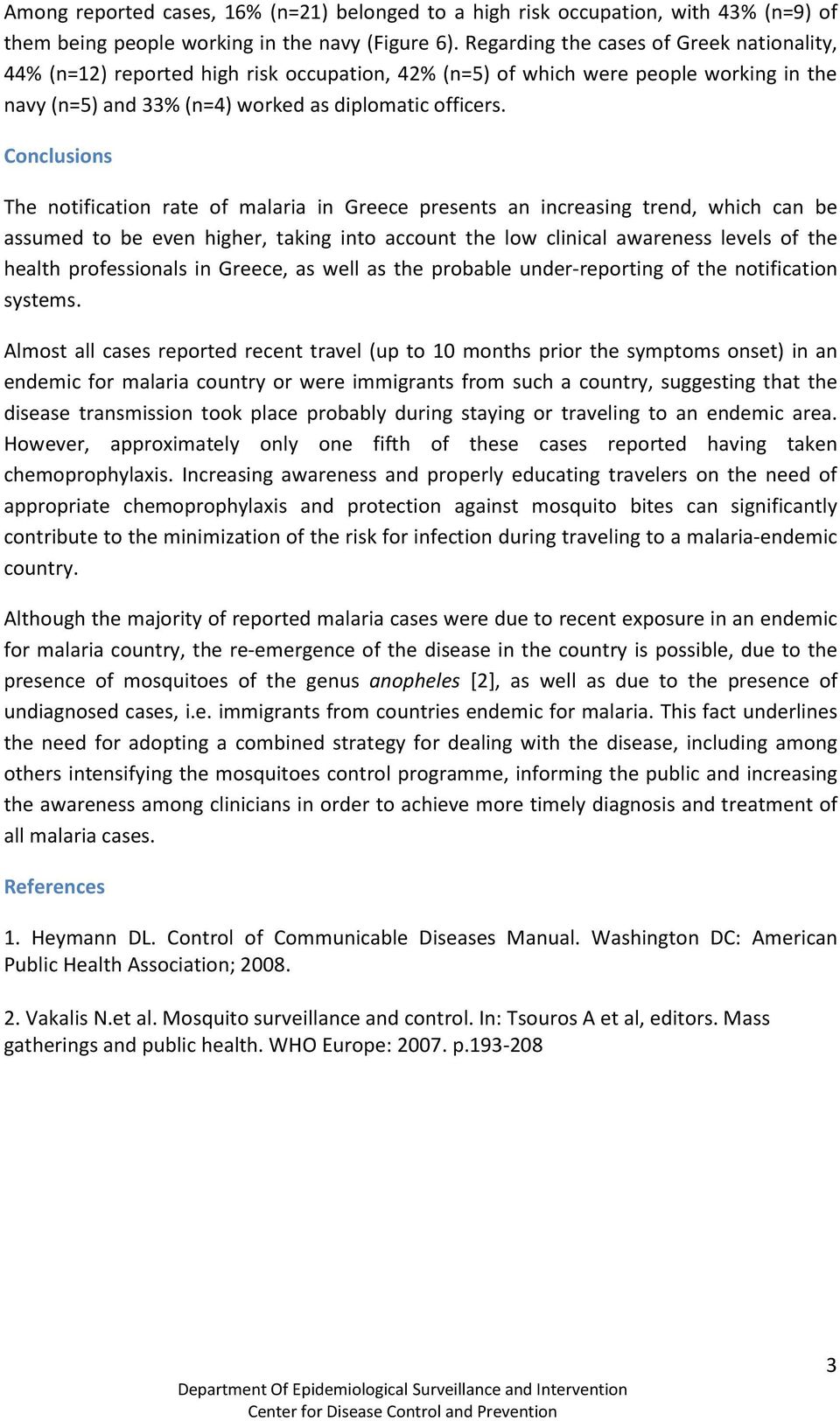
2 rate of the disease among males (0.4/100,000 population) was 4 times higher than the one in females. Seasonality Malaria shows an apparent seasonal trend, with the mean rate for the period increasing steadily during the spring months, peaking in August and subsequently steadily decreasing (Figure 3). This trend is probably related to the Anopheles mosquito activity, which peaks during the summer months. Geographical distribution During the period , 62% of the cases, were reported in Attica (mean annual notification rate: 0.4/100,000 population), whereas in Central Greece, Northern Greece and the Aegean islands/crete the mean annual notification rate was 0.1/100,000 population (Figure 4). Types of pathogen The most frequently isolated plasmodium during the period , was P. falciparum, which was responsible for 54% (n=79) of the reported cases, followed by P. vivax (42%, n=61) (Figure 5). In 24 of the cases the type of the plasmodium could not be identified. All cases with P. falciparum infection, reported recent traveling to an endemic country, 75% of which in a sub-saharan Africa country. Burden of disease 93% of the cases notified during were hospitalized, whereas 2 deaths were reported, due to P. falciparum infection. Malaria, especially the one caused by P. falciparum, can lead to severe disease and death. Timely request of medical assistance can significantly improve the disease prognosis. Risk factors 95% of the cases reported in the country during the period , were probably infected following recent exposure in an endemic country. During the period , the majority of the cases (78%, n=133) were of foreign origin, of which 40% (n=53) reported recent travel to the country of origin, prior to symptoms onset (Figure 6). Among country of origin, the most frequently reported was Pakistan (21%), followed by Bangladesh (13%), Afghanistan (10%) and Nigeria (10%). Among cases with recent travel to an endemic area, 79% (n=64) reported that they did not take any kind of chemoprophylaxis. 25% of those that had not taken chemoprophylaxis, had been re-infected in the past. Transmission via blood or blood products transfusion has not been verified for any of the reported cases. 2

3 Among reported cases, 16% (n=21) belonged to a high risk occupation, with 43% (n=9) of them being people working in the navy (Figure 6). Regarding the cases of Greek nationality, 44% (n=12) reported high risk occupation, 42% (n=5) of which were people working in the navy (n=5) and 33% (n=4) worked as diplomatic officers. Conclusions The notification rate of malaria in Greece presents an increasing trend, which can be assumed to be even higher, taking into account the low clinical awareness levels of the health professionals in Greece, as well as the probable under-reporting of the notification systems. Almost all cases reported recent travel (up to 10 months prior the symptoms onset) in an endemic for malaria country or were immigrants from such a country, suggesting that the disease transmission took place probably during staying or traveling to an endemic area. However, approximately only one fifth of these cases reported having taken chemoprophylaxis. Increasing awareness and properly educating travelers on the need of appropriate chemoprophylaxis and protection against mosquito bites can significantly contribute to the minimization of the risk for infection during traveling to a malaria-endemic country. Although the majority of reported malaria cases were due to recent exposure in an endemic for malaria country, the re-emergence of the disease in the country is possible, due to the presence of mosquitoes of the genus anopheles [2], as well as due to the presence of undiagnosed cases, i.e. immigrants from countries endemic for malaria. This fact underlines the need for adopting a combined strategy for dealing with the disease, including among others intensifying the mosquitoes control programme, informing the public and increasing the awareness among clinicians in order to achieve more timely diagnosis and treatment of all malaria cases. References 1. Heymann DL. Control of Communicable Diseases Manual. Washington DC: American Public Health Association; Vakalis N.et al. Mosquito surveillance and control. In: Tsouros A et al, editors. Mass gatherings and public health. WHO Europe: p
4 Figure 1. Time trend of malaria notification rate, Greece, Figure 2. Mean annual notification rate (cases/100,000 population) of malaria by sex and age group, Greece,

5 Figure 3. Mean notification rate (cases/100,000 population) of malaria by month, Greece, Figure 4. Mean annual notification rate (cases/100,000 population) of malaria by geographical area (NUTS-I), Greece,
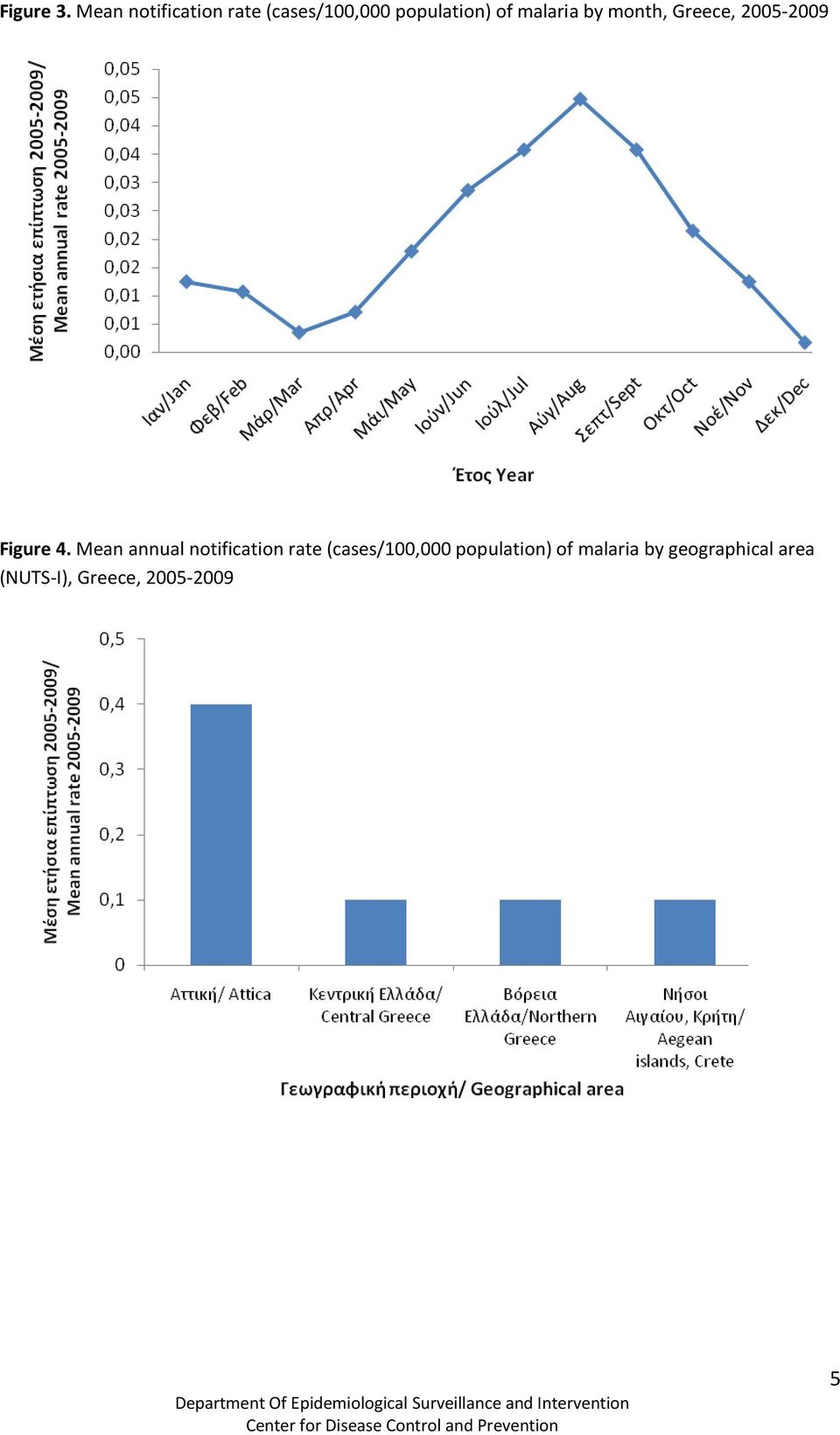
6 Figure 5. Frequency distribution of malaria notified cases by plasmodium species, Greece, % 1% 41% 54% P. falciparum P. vivax P. malariae P. ovale Figure 6. Frequency distribution of malaria notified cases by risk factor, Greece, Last updated: January

Malaria in the WHO EurOpEan region
 Malaria in the WHO EurOpEan region This information leaflet contains six sections and is intended for a generic and public health audience: 1.Malaria is present in certain areas of Europe. What are the
Borderless Diseases By Sunny Thai
 Borderless Diseases By Sunny Thai Millennium Development Goal #6 6. Combat HIV/AIDS, malaria and other borderless diseases. A. Halt and begin reversing spread of HIV by 2015. B. Achieve universal access
Frequently asked questions for malaria
 Frequently asked questions for malaria 1. What is malaria? Malaria is an infectious disease caused by a parasite that is transmitted through bite of an infected mosquito at night. There are two main types
Outbreak of Legionnaires disease in a hotel in Calpe, Spain December 2011 January 2012 6 February 2012
 RAPID RISK ASSESSMENT Outbreak of Legionnaires disease in a hotel in Calpe, Spain December 2011 January 2012 6 February 2012 Main conclusions and recommendations A cluster of 13 cases of travel-associated
EPIDEMIOLOGY OF HEPATITIS B IN IRELAND
 EPIDEMIOLOGY OF HEPATITIS B IN IRELAND Table of Contents Acknowledgements 3 Summary 4 Introduction 5 Case Definitions 6 Materials and Methods 7 Results 8 Discussion 11 References 12 Epidemiology of Hepatitis
COMMONWEALTH of VIRGINIA Department of Health
 COMMONWEALTH of VIRGINIA Department of Health MARISSA J. LEVINE, MD, MPH, FAAFP PO BOX 2448 TTY 7-1-1 OR STATE HEALTH COMMISSIONER RICHMOND, VA 23218 1-800-828-1120 Dear Colleague: Emerging Infections
Nige g ri e an a N at a ional a Antimal a ari a a Tre re t a men e t g ide d l e ines
 Nigerian National Antimalaria Treatment guidelines Pre Purpose: To provide guidelines for the treatment of malaria in Pregnant women in Nigeria Pregnant women Malaria: An infectious disease caused by plasmodium.
Scaling up diagnostic testing, treatment and surveillance for malaria
 Scaling up diagnostic testing, treatment and surveillance for malaria World Health Organization 2012 All rights reserved. This health information product is intended for a restricted audience only. It
Saint Louis Encephalitis (SLE)
 Saint Louis Encephalitis (SLE) Saint Louis Encephalitis is a Class B Disease and must be reported to the state within one business day. St. Louis Encephalitis (SLE), a flavivirus, was first recognized
Saint Louis Encephalitis (SLE)
 Encephalitis, SLE Annual Report 24 Saint Louis Encephalitis (SLE) Saint Louis Encephalitis is a Class B Disease and must be reported to the state within one business day. St. Louis Encephalitis (SLE),
Norovirus Outbreak Among Residents of an Assisted Living Facility, Houston County, Alabama 2010 (AL1003NRV 35a)
 Norovirus Outbreak Among Residents of an Assisted Living Facility, Houston County, Alabama 2010 (AL1003NRV 35a) Introduction On March 9, 2010, Public Health Area (PHA) 10 surveillance nurse contacted the
Gail Bennett, RN, MSN, CIC
 Gail Bennett, RN, MSN, CIC The occurrence of more cases of disease than expected in a given area or among a specific group of people over a particular period of time Cases above your usual endemic rate
MALARIA PREVENTION. Mary F. Vaeth, MD, MS Deployment Health Clinical Center
 Slide 1 MALARIA PREVENTION Mary F. Vaeth, MD, MS Deployment Health Clinical Center Hello, I am Dr. Mary Vaeth with the Staff Assistance and Training Team of the Deployment Health Clinical Center. In this
FILARIASIS OUTLINE WHAT IS FILARIASIS
 FILARIASIS By Micaela Yanez OUTLINE Introduction of Filariasis History Transmission Epidemiology Progress of Lymphatic Filariasis The Disease Symptoms and Treatments WHAT IS FILARIASIS A disease that affects
Summary and Key Points
 Summary and Key Points The World Malaria Report 2011 summarizes information received from 106 malaria-endemic countries and other sources and updates the analyses presented in the 2010 report. It highlights
WHO Regional Office for Europe update on avian influenza A (H7N9) virus
 WHO Regional Office for Europe update on avian influenza A (H7N9) virus Situation update 2: 30 April 2013 Address requests about publications of the WHO Regional Office for Europe to: Publications WHO
Follow-up of humanitarian workers returning from ebola affected area
 Follow-up of humanitarian workers returning from ebola affected area Validated by the RMG on 18 / 12 / 2014 Content Content... 2 Purpose... 3 Objectives... 3 Acknowledgments... 3 Medical follow-up after
What You Should Know About Lyme Disease and Other Tick-Borne Diseases. Sudbury Board of Health
 What You Should Know About Lyme Disease and Other Tick-Borne Diseases Sudbury Board of Health Goals of presentation Be aware of Lyme disease and other tick-borne diseases Recognize basic signs and symptoms
Table 16a Multiple Myeloma Average Annual Number of Cancer Cases and Age-Adjusted Incidence Rates* for 2002-2006
 Multiple Myeloma Figure 16 Definition: Multiple myeloma forms in plasma cells that are normally found in the bone marrow. 1 The plasma cells grow out of control and form tumors (plasmacytoma) or crowd
West Nile virus in the WHO european region
 West Nile virus in the WHO european region This information leaflet contains six sections and is intended for a generic and public health audience: 1. WNv is found in europe. What are the risks in European
Disease Surveillance for Malaria. An operational manual
 Disease Surveillance for Malaria ELIMINATION An operational manual Disease Surveillance for Malaria ELIMINATION An operational manual WHO Library Cataloguing-in-Publication Data Disease surveillance for
Appendix B: Provincial Case Definitions for Reportable Diseases
 Infectious Diseases Protocol Appendix B: Provincial Case Definitions for Reportable Diseases Disease: Hepatitis B Revised Hepatitis B 1.0 Provincial Reporting Confirmed, chronic and probable cases of disease
Zika virus infection: guidance for primary care
 Introduction There is an ongoing outbreak of Zika virus infection, mostly focussed in South and Central America and the Caribbean. Based on a growing body of research, there is scientific consensus that
M&E Strategies for a Community IRS Program
 M&E Strategies for a Community IRS Program Cole Church, Ph.D. MosquitoZone International September 2013 2013 MosquitoZone Corporation. All rights reserved.! An Outline of a Successful IRS Program Set clear
Scaling up diagnostic testing, treatment and surveillance for malaria
 Scaling up diagnostic testing, treatment and surveillance for malaria World Health Organization 2012 All rights reserved. Publications of the World Health Organization are available on the WHO web site
Dengue in the WHO european region
 Dengue in the WHO european region This information leaflet is intended to guide public health authorities in protecting their populations from the health risks of dengue. The following sections will answer
MINISTRY OF HEALTH: MALARIA PROGRAMME REVIEW MAY 2011 AIDE MEMOIRE
 MINISTRY OF HEALTH: MALARIA PROGRAMME REVIEW MAY 2011 AIDE MEMOIRE I. Purpose The malaria program performance review (MPR) is a periodic joint program management process for reviewing progress and performance
Global travel Health risk assessment. Dr Mike Causer Medical Director Occupational Health Europe
 Global travel Health risk assessment Dr Mike Causer Medical Director Occupational Health Europe Agenda Global travel health risk assessment Establish context Risk assessment Controlling health risks Business
TUBERCULOSIS (TB) SCREENING GUIDELINES FOR RESIDENTIAL FACILITIES AND DRUG
 TUBERCULOSIS (TB) SCREENING GUIDELINES FOR RESIDENTIAL FACILITIES AND DRUG Tx CENTERS Tuberculosis Control Program Health and Human Services Agency San Diego County INTRODUCTION Reducing TB disease requires
Principles of Disease and Epidemiology. Copyright 2010 Pearson Education, Inc.
 Principles of Disease and Epidemiology Pathology, Infection, and Disease Disease: An abnormal state in which the body is not functioning normally Pathology: The study of disease Etiology: The study of
WEST NILE VIRUS DEPARTMENT OF HEALTH AND HUMAN SERVICES
 WEST NILE VIRUS DEPARTMENT OF HEALTH AND HUMAN SERVICES Centers for Disease Control and Prevention West Nile Virus West Nile virus was first recognized in the United States in 1999 as the cause of severe
Hepatitis C Infections in Oregon September 2014
 Public Health Division Hepatitis C Infections in Oregon September 214 Chronic HCV in Oregon Since 25, when positive laboratory results for HCV infection became reportable in Oregon, 47,252 persons with
Chapter 20: Analysis of Surveillance Data
 Analysis of Surveillance Data: Chapter 20-1 Chapter 20: Analysis of Surveillance Data Sandra W. Roush, MT, MPH I. Background Ongoing analysis of surveillance data is important for detecting outbreaks and
It takes a planet: global implications/consequences of local vaccine refusal
 It takes a planet: global implications/consequences of local vaccine refusal Meg Fisher, MD Medical Director Disclosures I have no disclosures. I may be mentioning off label uses of vaccines. Objectives/Outcomes
HEPATITIS WEB STUDY Acute Hepatitis C Virus Infection: Epidemiology, Clinical Features, and Diagnosis
 HEPATITIS WEB STUDY Acute C Virus Infection: Epidemiology, Clinical Features, and Diagnosis H. Nina Kim, MD Assistant Professor of Medicine Division of Infectious Diseases University of Washington School
Artemether-lumefantrine (four-dose regimen) for treating uncomplicated falciparum malaria (Review)
 Artemether-lumefantrine (four-dose regimen) for treating uncomplicated falciparum malaria (Review) Omari AAA, Gamble C, Garner P This is a reprint of a Cochrane review, prepared and maintained by The Cochrane
National Health Burden of CLD in Italy
 National Health Burden of CLD in Italy 11,000 deaths due to liver cirrhosis or HCC in 2006 Direct costs for the National Health System for treating CLD patients: 420 M / year for hospital care 164 M /
The rate of failure to thrive among children aged 2 months - 5 years in Kanaan sub-district / Diyala province
 The rate of failure to thrive among children aged 2 months - 5 years in Kanaan sub-district / Diyala province Mehdi SH. Al-Zuheiry (M.B.Ch.B., F.I.C.M.S.Ped.) College of Medicine-Diyala University Background:
Zika Virus. Fred A. Lopez, MD, MACP Richard Vial Professor Department of Medicine Section of Infectious Diseases
 Zika Virus Fred A. Lopez, MD, MACP Richard Vial Professor Department of Medicine Section of Infectious Diseases What is the incubation period for Zika virus infection? Unknown but likely to be several

MALARIA DIAGNOSIS: A GUIDE FOR SELECTING RAPID DIAGNOSTIC TEST (RDT) KITS - 1 st edition
 MALARIA DIAGNOSIS: A GUIDE FOR SELECTING RAPID DIAGNOSTIC TEST (RDT) KITS - 1 st edition Published October 2007 Overview Plasmodium falciparum, P. vivax, P. ovale and P. malariae are the four main species
Measles and rubella monitoring
 SURVEILLANCE REPORT Measles and rubella monitoring February 213 Measles and rubella are targeted for elimination in Europe by 215. ECDC closely monitors progress towards interruption of endemic transmission
Seroprevalence and risk factors of Lassa fever infection in Nasarawa State, Nigeria 2013
 Seroprevalence and risk factors of Lassa fever infection in Nasarawa State, Nigeria 2013 Muhammad Shakir Balogun COHORT 3 Nigeria-FELTP Supervisors: Dr. AT Olayinka, Dr. AI Mamman Outline Background Methodology
MALARIA STATUS IN TANZANIA MAINLAND: AN OVERVIEW NATIONAL MALARIA FORUM- 25 TH APRIL 2014.
 MALARIA STATUS IN TANZANIA MAINLAND: AN OVERVIEW NATIONAL MALARIA FORUM- 25 TH APRIL 2014. 1 Presentation Outline: Overview Intervention scale up/achievements Current malaria epidemiologic profile and
Multiple Choice Questions
 C hapter 13 WHY DO WE FALL ILL Multiple Choice Questions 1. Which one of the following is not a viral disease? (a) Dengue (b) AIDS (c) Typhoid (d) Influenza 2. Which one of the following is not a bacterial
Advice for Colleges, Universities, and Students about Ebola in West Africa For Colleges and Universities
 Advice for Colleges, Universities, and Students about Ebola in West Africa For Colleges and Universities Advice for Study Abroad, Foreign Exchange, or Other Education-related Travel Is it safe to travel
U.S. President s Malaria Initiative (PMI) Approach to Health Systems Strengthening
 U.S. President s Malaria Initiative (PMI) Approach to Health Systems Strengthening What is Health System Strengthening? Strengthening health systems means supporting equitable and efficient delivery of
Guidelines for Animal Disease Control
 Guidelines for Animal Disease Control 1. Introduction and objectives The guidelines are intended to help countries identify priorities, objectives and the desired goal of disease control programmes. Disease
Malaria: Global Fund proposal development
 Global Malaria Programme Malaria: Global Fund proposal development (Round 11) A compilation of WHO reference documents July 2011 CONTENTS I. CASE MANAGEMENT...1 II. SUPPLY CHAIN MANAGEMENT...1 III. COMMUNITY
Travel Vaccines. Olive Health & Travel Clinic. http://www.olivehealthandtravel.co.uk Phone 020 8550 2276
 Travel Vaccines Olive Health & Travel Clinic http://www.olivehealthandtravel.co.uk Phone 020 8550 2276 Diphtheria, Tetanus and Polio (DTP) The DTP is a class of combination vaccines against three infectious
EMBARGOED All information in this report is strictly embargoed until 17 September 2015, 00h01 BST (London) / 01h01 CEST (Geneva)
 Reversing the Incidence of Malaria 2000 2015 All information in this report is strictly embargoed until 17 September 2015, 00h01 BST / 01h01 GMT. Achieving the Malaria MDG Target Reversing the Incidence
MALARIA PARASITE COUNTING
 VERSION 1 EFFECTIVE DATE: 01/01/2016 MALARIA PARASITE COUNTING MALARIA MICROSCOPY STANDARD OPERATING PROCEDURE MM-SOP-09 1. PURPOSE AND SCOPE To describe the procedure for counting malaria parasites on
NBER WORKING PAPER SERIES INSTITUTIONS DON T RULE: DIRECT EFFECTS OF GEOGRAPHY ON PER CAPITA INCOME. Jeffrey D. Sachs
 NBER WORKING PAPER SERIES INSTITUTIONS DON T RULE: DIRECT EFFECTS OF GEOGRAPHY ON PER CAPITA INCOME Jeffrey D. Sachs Working Paper 9490 http://www.nber.org/papers/w9490 NATIONAL BUREAU OF ECONOMIC RESEARCH
Course Description. SEMESTER I Fundamental Concepts of Substance Abuse MODULE OBJECTIVES
 Course Description SEMESTER I Fundamental Concepts of Substance Abuse MODULE OBJECTIVES At the end of this course participants will be able to: Define and distinguish between substance use, abuse and dependence
SOGC recommendation on ZIKA virus exposure for clinicians caring for pregnant women and those who intend to get pregnant
 SOGC recommendation on ZIKA virus exposure for clinicians caring for pregnant women and those who intend to get pregnant Foreword The rapid emergence of Zika virus as a potential causative agent for fetal
Case management TRAINING MODULE ON MALARIA CONTROL GUIDE FOR PARTICIPANTS
 Flash-OMS-GMP-TrainingModule-CM-Participant-couv-20120816.indd 1-3 ISBN 978 92 4 150397 6 TRAINING MODULE ON MALARIA CONTROL GUIDE FOR PARTICIPANTS Case management Global Malaria Programme World Health
Date of Commencement: January, 2004 Duration: One Year Status: Ongoing. Objectives
 Development of a computer based Health Management Information System (HMIS) in Rajasthan using Geographical Information System- R. C. Sharma, Vinod Joshi and Manju Singhi Date of Commencement: January,
Hepatitis C Virus Infection: Prevalence Report, 2003 Data Source: Minnesota Department of Health HCV Surveillance System
 Hepatitis C Virus Infection: Prevalence Report, 2003 Data Source: Minnesota Department of Health HCV Surveillance System P.O. Box 9441 Minneapolis, MN 55440-9441 612-676-5414, 1-877-676-5414 www.health.state.mn.us/immunize
FDA Considerations Regarding Frequent Plasma Collection Procedures
 FDA Considerations Regarding Frequent Plasma Collection Procedures Alan E. Williams, Ph.D. Office of Blood Research and Review Center for Biologics Evaluation and Research US Food and Drug Administration
Part 4 Burden of disease: DALYs
 Part Burden of disease:. Broad cause composition 0 5. The age distribution of burden of disease 6. Leading causes of burden of disease 7. The disease and injury burden for women 6 8. The growing burden
Cholera: mechanism for control and prevention
 SIXTY-FOURTH WORLD HEALTH ASSEMBLY A64/18 Provisional agenda item 13.9 17 March 2011 Cholera: mechanism for control and prevention Report by the Secretariat 1. Cholera is an acute enteric infection characterized
GUIDE BOOK. SD BIOLINE Malaria Antigen Rapid Test series. Standard Diagnostics, Inc.
 GUIDE BOOK SD BIOLINE Malaria Antigen Rapid Test series Standard Diagnostics, Inc. TABLE OF CONTENTS I. PRODUCT INFORMATION 3 II. BACKGROUND INFORMATION 7 III. CLINICAL FEATURES AND TREATMENT 12 IV. COMPARISON
Competency 1 Describe the role of epidemiology in public health
 The Northwest Center for Public Health Practice (NWCPHP) has developed competency-based epidemiology training materials for public health professionals in practice. Epidemiology is broadly accepted as
Frequently Asked Questions (FAQs)
 Frequently Asked Questions (FAQs) Research Rationale 1. What does PrEP stand for? There is scientific evidence that antiretroviral (anti-hiv) medications may be able to play an important role in reducing
Disease surveillance and outbreak prevention and control
 CHAPTER 6 Disease surveillance and outbreak prevention and control Factors increasing the risk of DHF outbreaks The occurrence of DHF outbreaks is linked to a number of factors, including the density of
Measures of Prognosis. Sukon Kanchanaraksa, PhD Johns Hopkins University
 This work is licensed under a Creative Commons Attribution-NonCommercial-ShareAlike License. Your use of this material constitutes acceptance of that license and the conditions of use of materials on this
How To Plan Healthy People 2020
 Healthy California 2020 Initiative: Consensus Building on Top Priority Areas for CDPH Public Health Advisory Committee April 30, 2010 Introducing the CDPH Decision Framework Responding to public health
The Health Academy e-learning COURSES
 Health Information in Tomorrow s World The Health Academy e-learning COURSES Courses Developed 1 1. All the Way to the Blood Bank Around the world, AIDS is shattering young people's opportunities for healthy
Patient Information Sheet
 Healthcare Worker exposure to a patient s blood What is a healthcare worker exposure? Patient Information Sheet Occasionally, health care workers come into contact with the blood or body fluids of their
NATIONAL DRUG POLICY ON MALARIA (2013)
 203 - 2 - NATIONAL DRUG POLICY ON MALARIA (203) Preamble Malaria is one of the major public health problems of the country. Around.5 million laboratory confirmed cases of malaria are annually reported
A Retrospective Study of Rabies Cases Reported at Vom Christian Hospital, Plateau State, Nigeria, 2006 2010.
 Nigerian Veterinary Journal VOL:32 (4) 366-370 A R T I C L E A Retrospective Study of Rabies Cases Reported at Vom Christian Hospital, Plateau State, Nigeria, 2006 2010. *1 2 1 2 3 2 1 AWORH, M. K., NWOSUH,
Laboratory confirmation requires isolation of Bordetella pertussis or detection of B. pertussis nucleic acid, preferably from a nasopharyngeal swab.
 Pertussis Epidemiology in New Zealand New Zealand has continued to experience outbreaks of pertussis in recent decades. This is in part due to historically low immunisation rates and in part because immunity
PROTOCOL FOR THE MANAGEMENT OF CLOSE CONTACTS OF PERTUSSIS INFECTION
 PROTOCOL FOR THE MANAGEMENT OF CLOSE CONTACTS OF PERTUSSIS INFECTION Printed copies must not be considered the definitive version DOCUMENT CONTROL PROTOCOL NO. 1.03 Policy Group Infection Control Committee
Pandemic Risk Assessment
 Research Note Pandemic Risk Assessment By: Katherine Hagan Copyright 2013, ASA Institute for Risk & Innovation Keywords: pandemic, Influenza A, novel virus, emergency response, monitoring, risk mitigation
The global classroom: Training the world s healthcare professionals
 The global classroom: Training the world s healthcare professionals Dr Stuart Anderson Associate Dean of Studies London School of Hygiene and Tropical Medicine 1 Overview Describe the main education and
Treatment Seeking of Malaria Patients in East Shewa Zone of Oromia, Ethiopia
 Original article Treatment Seeking of Malaria Patients in East Shewa Zone of Oromia, Ethiopia Wakgari Deressa 1, Shelleme Chibsa 2, Dereje Olana 3 Abstract Background: Prompt access to early diagnosis
Interim Illinois Department of Public Health Guidance for Monitoring and Movement of Persons with Potential Ebola Virus Exposure
 Interim Illinois Department of Public Health Guidance for Monitoring and Movement of Persons with Potential Ebola Virus Exposure Updated: November 10, 2014 The world is facing the biggest and most complex
Tuberculosis Exposure Control Plan for Low Risk Dental Offices
 Tuberculosis Exposure Control Plan for Low Risk Dental Offices A. BACKGROUND According to the CDC, approximately one-third of the world s population, almost two billion people, are infected with tuberculosis.
School of Public Health. Department of Epidemiology & Biostatistics
 School of Public Health Department of Epidemiology and Biostatistics Master of Science in Public Health Microbiology and Emerging Infectious Diseases 2015-2016 Program-at-a-Glance Note: All curriculum
Online Communicable Disease Reporting Handbook For Schools, Child-care Centers & Camps
 Online Communicable Disease Reporting Handbook For Schools, Child-care Centers & Camps More Information On Our Website https://www.accesskent.com/health/commdisease/school_daycare.htm Kent County Health
Rhode Island Department of Health Division of Infectious Diseases and Epidemiology
 Rhode Island Department of Health Division of Infectious Diseases and Epidemiology STD (Sexually Transmitted Disease) PROGRAM Expedited Partner Therapy (EPT) for STDs Guidance for Medical Providers in