
Saint Louis Encephalitis (SLE)
|
|
|
- Herbert Rogers
- 10 years ago
- Views:
Transcription
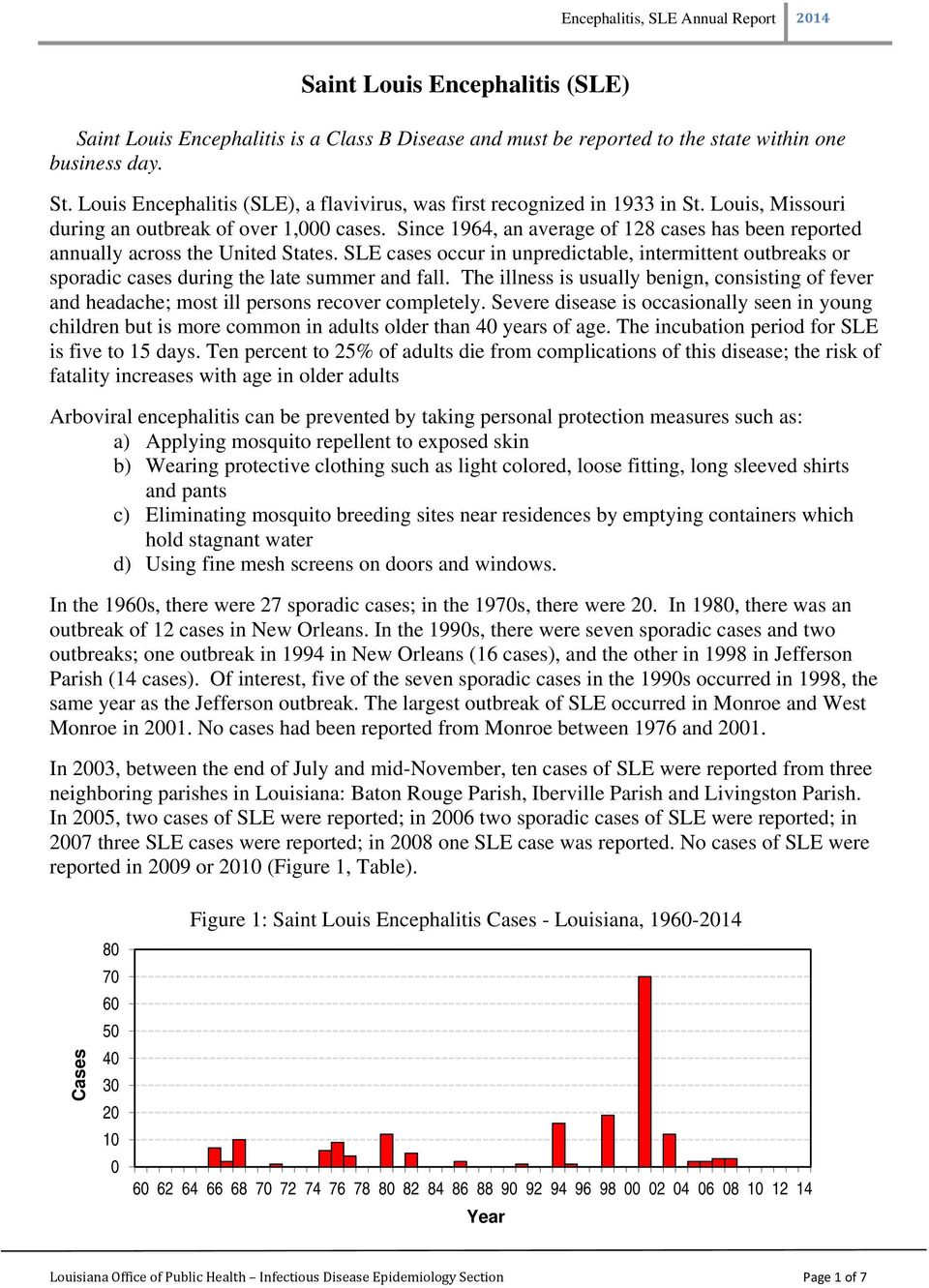
1 Encephalitis, SLE Annual Report 24 Saint Louis Encephalitis (SLE) Saint Louis Encephalitis is a Class B Disease and must be reported to the state within one business day. St. Louis Encephalitis (SLE), a flavivirus, was first recognized in 9 in St. Louis, Missouri during an outbreak of over, cases. Since 94, an average of 28 cases has been reported annually across the United States. SLE cases occur in unpredictable, intermittent outbreaks or sporadic cases during the late summer and fall. The illness is usually benign, consisting of fever and headache; most ill persons recover completely. Severe disease is occasionally seen in young children but is more common in adults older than 4 years of age. The incubation period for SLE is five to 5 days. Ten percent to 25% of adults die from complications of this disease; the risk of fatality increases with age in older adults Arboviral encephalitis can be prevented by taking personal protection measures such as: a) Applying mosquito repellent to exposed skin b) Wearing protective clothing such as light colored, loose fitting, long sleeved shirts and pants c) Eliminating mosquito breeding sites near residences by emptying containers which hold stagnant water d) Using fine mesh screens on doors and windows. In the 9s, there were 27 sporadic cases; in the 97s, there were 2. In 98, there was an outbreak of 2 cases in New Orleans. In the 99s, there were seven sporadic cases and two outbreaks; one outbreak in 994 in New Orleans ( cases), and the other in 998 in Jefferson Parish (4 cases). Of interest, five of the seven sporadic cases in the 99s occurred in 998, the same year as the Jefferson outbreak. The largest outbreak of SLE occurred in Monroe and West Monroe in 2. No cases had been reported from Monroe between 97 and 2. In 2, between the end of July and mid-november, ten cases of SLE were reported from three neighboring parishes in Louisiana: Baton Rouge Parish, Iberville Parish and Livingston Parish. In 25, two cases of SLE were reported; in 2 two sporadic cases of SLE were reported; in 27 three SLE cases were reported; in 28 one SLE case was reported. No cases of SLE were reported in 29 or 2 (Figure, Table). Cases Figure : Saint Louis Encephalitis Cases - Louisiana, 9-24 SLE Outbreak of Year Louisiana Office of Public Health Infectious Disease Epidemiology Section Page of 7
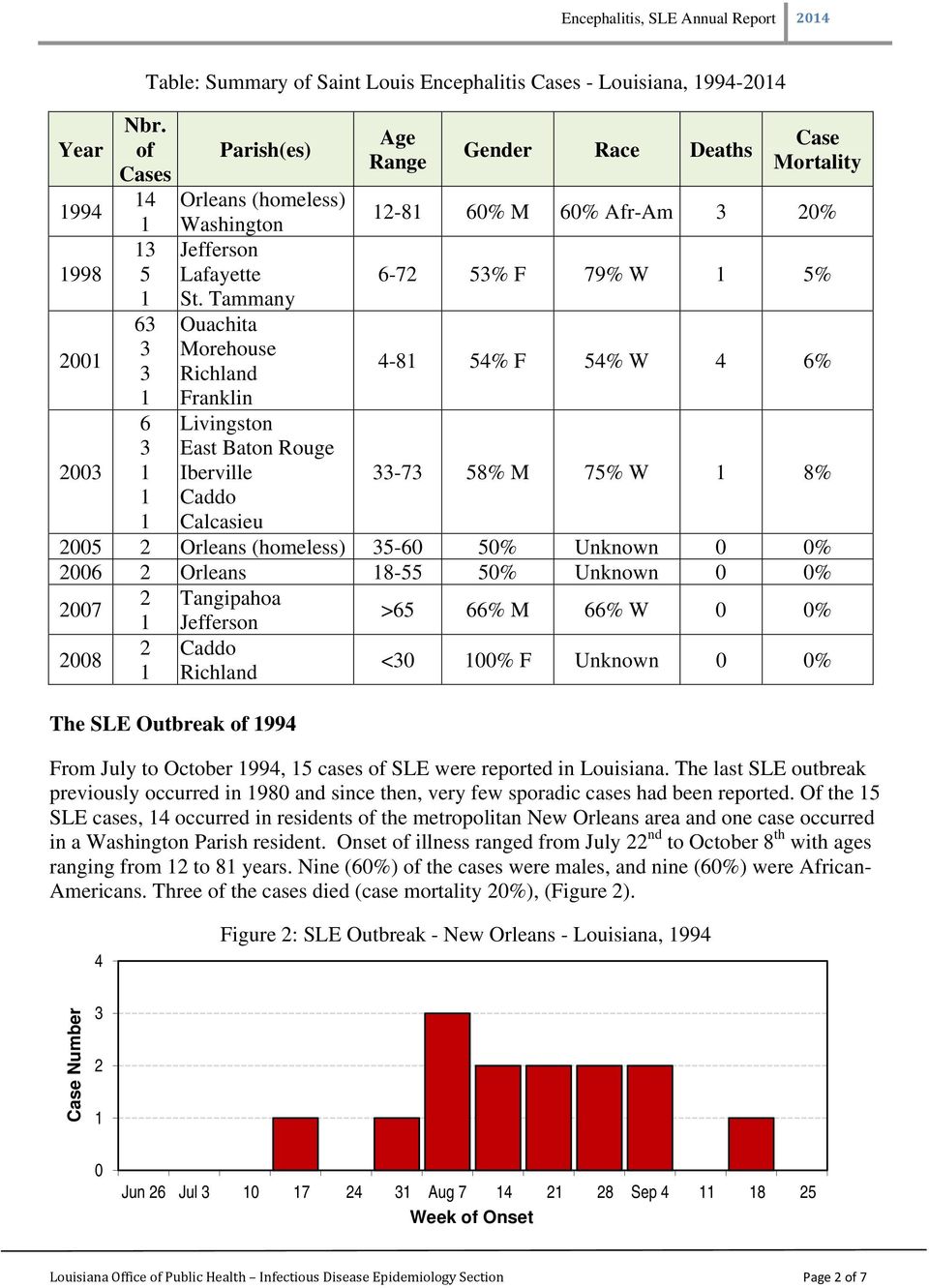
2 Encephalitis, SLE Annual Report 24 Year Nbr. of Cases 4 5 Table: Summary of Saint Louis Encephalitis Cases - Louisiana, Parish(es) Orleans (homeless) Washington Jefferson Lafayette St. Tammany Ouachita Morehouse Richland Franklin Livingston East Baton Rouge Iberville Caddo Calcasieu Age Range Gender Race Deaths Case Mortality 2-8 % M % Afr-Am 2% -72 5% F 79% W 5% % F 54% W 4 % -7 58% M 75% W 8% 25 2 Orleans (homeless) 5-5% Unknown % 2 2 Orleans % Unknown % 2 Tangipahoa 27 >5 % M % W % Jefferson 2 Caddo 28 < % F Unknown % Richland The SLE Outbreak of 994 From July to October 994, 5 cases of SLE were reported in Louisiana. The last SLE outbreak previously occurred in 98 and since then, very few sporadic cases had been reported. Of the 5 SLE cases, 4 occurred in residents of the metropolitan New Orleans area and one case occurred in a Washington Parish resident. Onset of illness ranged from July 22 nd to October 8 th with ages ranging from 2 to 8 years. Nine (%) of the cases were males, and nine (%) were African- Americans. Three of the cases died (case mortality 2%), (Figure 2). 4 Figure 2: SLE Outbreak - New Orleans - Louisiana, 994 Case Number 2 Jun 2 Jul 7 24 Aug Sep Week of Onset Louisiana Office of Public Health Infectious Disease Epidemiology Section Page 2 of 7
3 Encephalitis, SLE Annual Report 24 In order to specify the vector involved in this outbreak, the trapping and testing of mosquitoes for SLE virus was done by the Centers for Disease Control and Prevention (CDC) in collaboration with New Orleans Mosquito Control. None of the mosquitoes tested were positive for the SLE virus. Although Culex quinquefasciatus has been assumed to be the vector for SLE in this outbreak (and indeed large populations of C. quinquefasciatus mosquitoes were found near some of the initial cases), the finding of a higher than expected abundance of Culex nigripalpus, the primary SLE virus vector in Florida, raises the possibility of transmission by C. nigripalpus mosquitoes in this outbreak. Because % of the cases reported for July and August occurred in homeless persons who spent a great deal of their time outdoors, there was concern that this group might be particularly at high risk for SLE. In order to compare the rate of SLE exposure in the homeless population and in the general population, serosurveys were conducted in October of persons attending the city's Health Care for the Homeless Clinic and persons attending the city's sexually transmitted diseases (STD) clinic. None of the samples from 28 homeless people were positive for SLE antibodies, and only one of the samples from 55 persons at the STD clinic were positive for SLE antibodies. Based on these data, the prevalence of SLE infection in the general population and the homeless population was likely to be in the same range.5% to.9%. The SLE Outbreak of 998 Between July and October of 998, 9 cases of SLE were reported from three parishes in southern Louisiana. Of the SLE cases reported, five were reported from Lafayette Parish, one from St. Tammany Parish and the remaining cases were reported from Jefferson Parish. Onset of illness ranged from July 5th to September 27th. Ages ranged from six to 72 years. Ten of the cases (5%) were females and 5 (79%) of the cases were White. Only one death was reported (case mortality 5%). The SLE Outbreak in Monroe of 2 In 2, cases of SLE were reported in Monroe and West Monroe with seven additional cases reported in the neighboring parishes of Richland, Morehouse and Franklin. The epidemic curve based on blood collection date (date disease was suspected) showed an explosive outbreak reaching a peak by the second week and progressively slowing down. The SLE epidemic curve by week of onset shows that by the time the first case was diagnosed (Week : 8//2 to 8//2), % or more of the cases were already infected (Figure ). Louisiana Office of Public Health Infectious Disease Epidemiology Section Page of 7
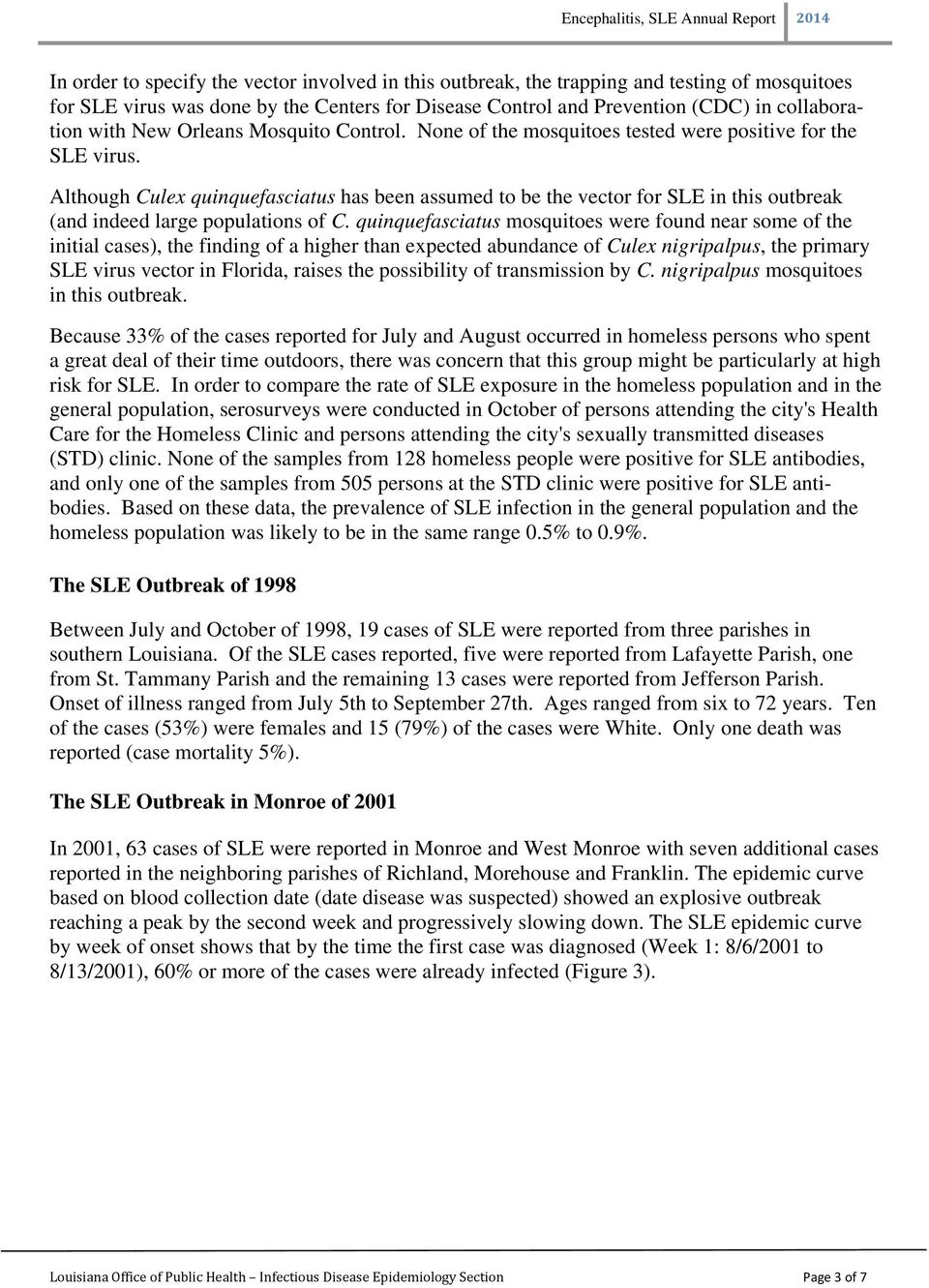
4 Encephalitis, SLE Annual Report 24 Figure : SLE Epidemic Curve by Week of Onset - Louisiana, Case Number : 7/2-29 -: 7/-8/5 : 8/-2 2: 8/-9 : 8/2-2 4: 8/27-9/2 5: 9/- : 9/- 7: 9/7-2 8: 9/24- Week: Date of Onset Most of the cases lived in low socio-economic areas. Houses were often run down, many with screens in disrepair. Backyards were usually large, with heavy brush and many trees. There was an abundance of sources of mosquito larvae, particularly for Culex quinquefasciatus, which is the main vector. Infection rates in mosquitoes were still high at four to five per, mosquitoes after five weeks into the outbreak. Small containers or areas filled with heavily polluted water where this species of mosquitoes prefer to breed were commonplace. Houses were built on short posts with leaking plumbing or air conditioning units, creating puddles under the houses. There were many drainage ditches clogged with vegetation and garbage. Clinically, most cases presented with fever and meningitis syndrome with altered mental status. Tremors were common (5% of cases). There were three deaths. Age group distribution showed predominance among those age 45 years and older. Cases are presumptively diagnosed on the basis of a positive IgM for Flavivirus. The first cases were further tested by the CDC in Fort Collins by neutralization. Acute and convalescent serums were collected and forwarded to the CDC lab for confirmation. Mosquito pools (Culex quinquefasciatus) confirmed the presence of SLE virus. As soon as the first case was reported, campaigns for health education and increased mosquito adulticiding were implemented. Within three weeks, more than 95% of the population interviewed was aware of the problem and of precautionary measures. However, driving through the affected areas in the evening, one could see people sitting on their front porches socializing, children playing in the streets and house screens still in disrepair. Adulticiding with pyrethroid applications by trucks was targeted against pest mosquitoes and was on-going before the outbreak. After the first cases were reported to mosquito control, truck Louisiana Office of Public Health Infectious Disease Epidemiology Section Page 4 of 7
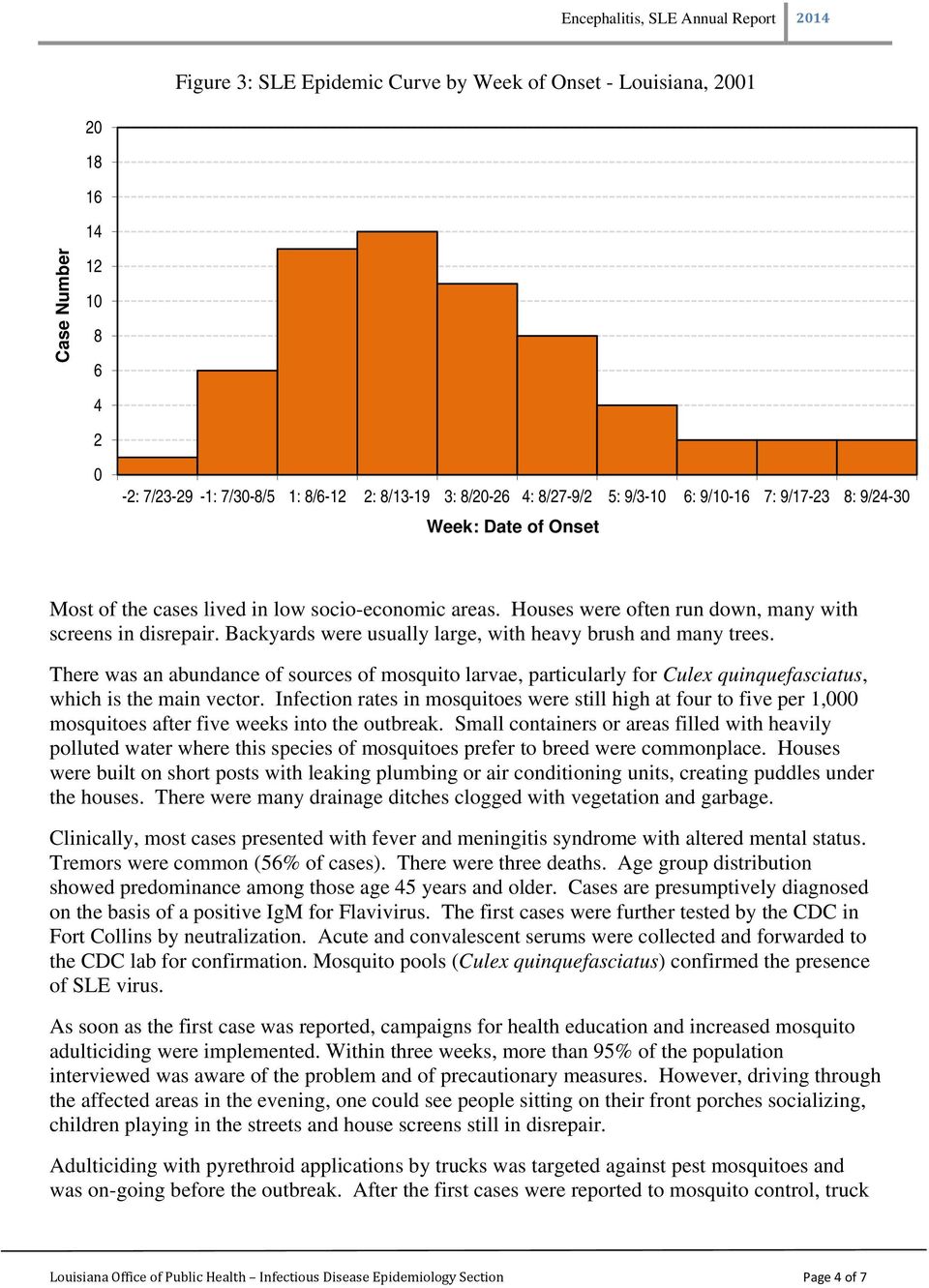
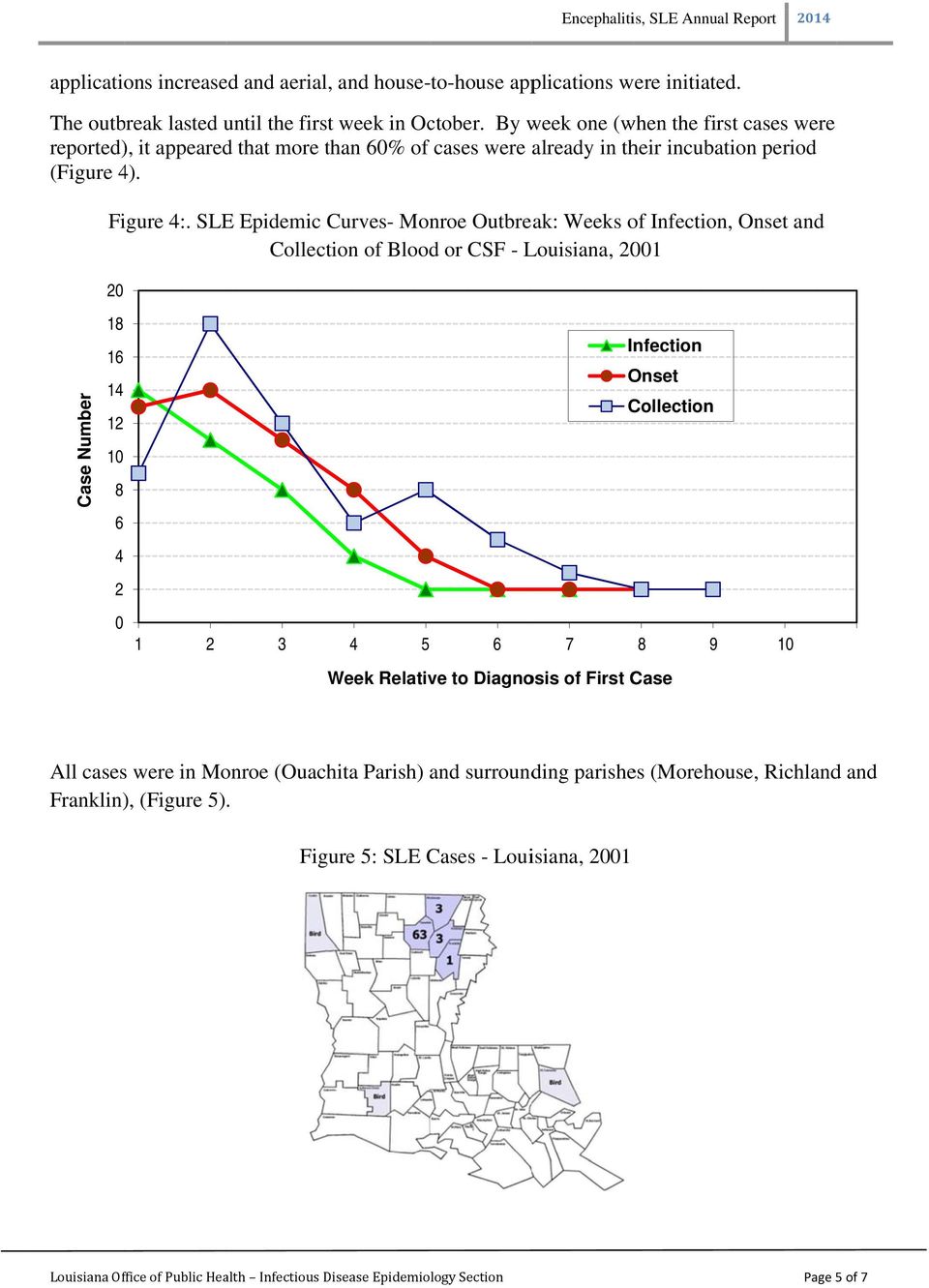
5 Encephalitis, SLE Annual Report 24 applications increased and aerial, and house-to-house applications were initiated. The outbreak lasted until the first week in October. By week one (when the first cases were reported) ), it appeared that more than % of cases were already in their incubation period (Figure 4). Figure 4:. SLE Epidemic Curves- Monroe Outbreak: Weeks of Infection, Onset and Collection of Blood or CSF - Louisiana, 2 2 Case Number Infection Onset Collection Week Relative to Diagnosis of First Case All casess were in Monroe (Ouachita Parish) and surrounding parishes (Morehouse, Richland and Franklin) ), (Figure 5). Figure 5: SLE Cases - Louisiana, 2 Louisiana Office of Public Health Infectious Disease Epidemiology Section Page 5 of 7
6 Encephalitis, SLE Annual Report 24 The highest number of cases concentrated around the intersection of f the Ouachita River and Interstatee 2, overlapping the towns of Monroe and Westt Monroe (Figure ). Figure : SLE Cases - Ouachita Parish - Louisiana, 2 The SLE Outbreak of 2 In 2, between the end of July and mid-november, tenn cases of SLE were reported from three neighboring parishess in Louisiana. Of the SLE cases reported, three were reported from East Baton Rouge Parish, one from Iberville Parish, and six from Livingston Parish. Onset of illness ranged from July 2 rd to November 2 th. It should be noted that two sporadic casess were also reported in mid-april (one in the northwest corner of the state in Caddo Parish and one in the southwest corner in Calcasieu Parish). Seven out of the 2 cases were men (58%). The age range of cases was from to 7 years of age (5% of cases were older than 45 years). Nine of f the 2 casess were White (75%). There was one death reported. SLE Cases of 25 In 25, two cases of SLE were reported among Louisiana residents who evacuated from Hurricane Katrina to neighboringg states. For both cases, the onset of illness was the second week of September. One case was reported Louisiana Office of Public Health Infectious Disease Epidemiology Section Page of 7

7 Encephalitis, SLE Annual Report 24 from Texas and one case was reported from Mississippi. One case was a homeless resident of Louisiana. SLE Cases of 2, 27 and 28 There were two sporadic cases of SLE reported in 2. One case was younger than 2 years of age and one case was older than 45 years. Both cases were residents of Orleans Parish. The onset of illness ranged from the end of August to early October. In 27, there were three SLE cases reported. Two of the cases were male older than 5 years of age. Two of the cases were from Tangipahoa Parish and the third was from Jefferson Parish. In 28, there was one SLE case and two SLE-fever cases. All three infections were in females younger than years of age. Two of the cases were in Caddo Parish, the third was in Richland Parish. Based on over 4 years of surveillance in Louisiana, it is expected that sporadic cases with intermittent outbreaks will be reported every few years as SLE; the mosquito vectors that carry the disease are endemic across the state. Louisiana Office of Public Health Infectious Disease Epidemiology Section Page 7 of 7
Saint Louis Encephalitis (SLE)
 Saint Louis Encephalitis (SLE) Saint Louis Encephalitis is a Class B Disease and must be reported to the state within one business day. St. Louis Encephalitis (SLE), a flavivirus, was first recognized
WEST NILE VIRUS DEPARTMENT OF HEALTH AND HUMAN SERVICES
 WEST NILE VIRUS DEPARTMENT OF HEALTH AND HUMAN SERVICES Centers for Disease Control and Prevention West Nile Virus West Nile virus was first recognized in the United States in 1999 as the cause of severe
Mosquitoes and West Nile Virus
 Mosquitoes and West Nile Virus What You Should Know And What You Can Do An informational bulletin prepared by the St. Tammany Parish Mosquito Abatement District What is West Nile virus? West Nile virus
Zika Virus. History of Zika virus
 Zika Virus Zika fever is caused by the Zika virus (ZIKV), an arthropod-borne virus (arbovirus). The Zika virus is a member of the Alphavirus genus in the family Togaviridae. It is related to dengue, yellow
Frequently asked questions for malaria
 Frequently asked questions for malaria 1. What is malaria? Malaria is an infectious disease caused by a parasite that is transmitted through bite of an infected mosquito at night. There are two main types
TITLES I, II, and III
 TITLES I, II, and III Chapter: 15 Chapter Title: Assignment of Cases and Preliminary Motions Appendix 15.1 Rule No: 15.1 Alternative Method of Service on District Attorney 1st Judicial District Caddo In
WEST NILE VIRUS QUESTIONS ABOUT SPRAYING AND MOSQUITO CONTROL
 WEST NILE VIRUS QUESTIONS ABOUT SPRAYING AND MOSQUITO CONTROL Q1: What is West Nile virus (WNV)? A: WNV is a virus carried by certain species of mosquitoes that pick it up after biting infected birds.
West Nile Virus Infection Prevention and Control Recommendations Colorado Long-term Care Facilities
 West Nile Virus Infection Prevention and Control Recommendations Colorado Long-term Care Facilities What is West Nile Virus? West Nile virus (WNV) is a disease transmitted to humans by infected mosquitoes.
Zika Virus. Fred A. Lopez, MD, MACP Richard Vial Professor Department of Medicine Section of Infectious Diseases
 Zika Virus Fred A. Lopez, MD, MACP Richard Vial Professor Department of Medicine Section of Infectious Diseases What is the incubation period for Zika virus infection? Unknown but likely to be several
Sentinel Chicken Screening Here are the mosquito larvae! Ground Application Aerial Larvicide Applications
 County of San Diego Vector Control Program Mosquitoes, Rats, Ticks and More! What is a Vector? Any organism capable of carrying and transferring a disease Common vectors: Mosquitoes Ticks Rats Flies Mosquito
Appendix B: Provincial Case Definitions for Reportable Diseases
 Infectious Diseases Protocol Appendix B: Provincial Case Definitions for Reportable Diseases Disease: West Nile Virus Illness Revised December 2014 West Nile Virus Illness 1.0 Provincial Reporting Confirmed
Louisiana's Uninsured Population:
 Louisiana's Population: Parish-level Estimates A Report from the 2011 Louisiana Health Insurance Survey Stephen Barnes, Assistant Professor-Research Division of Economic Development Department of Economics
Department of Epidemiological Surveillance and Intervention
 Department of Epidemiological Surveillance and Intervention EPIDEMIOLOGICAL DATA FOR MALARIA IN GREECE (MANDATORY NOTIFICATION SYSTEM) Key Points The notification rate of malaria in Greece shows an increasing
Vocational Rehabilitation Program
 January 2005 LOUISIANA REHABILITATION SERVICES (LRS) Vocational Rehabilitation Program Quarterly Report OCTOBER 2004 - DECEMBER 2004 The Vocational Rehabilitation Program (VR) is an employment program
2013 STD/HIV Surveillance Report
 213 STD/HIV Surveillance Report State of Louisiana Department of Health and Hospitals Office of Public Health Louisiana Department of Health and Hospitals Office of Public Health STD/HIV Program 145 Poydras
Diagnosing arbovirus infections (and Bill s holiday snaps) David W Smith Division of Microbiology and Infectious Diseases PathCentre
 Diagnosing arbovirus infections (and Bill s holiday snaps) David W Smith Division of Microbiology and Infectious Diseases PathCentre Arboviral illnesses relevant to Australia Polyarthralgia Fever and rash
A Journey through LOUISIANA REHABILITATION SERVICES (LRS) Programs and Services
 A Journey through LOUISIANA REHABILITATION SERVICES (LRS) Programs and Services LRS under the umbrella of LOUISIANA WORKFORCE COMMISSION (LWC) Louisiana Rehabilitation Services Programs... Vocational Rehabilitation
West Nile virus in the WHO european region
 West Nile virus in the WHO european region This information leaflet contains six sections and is intended for a generic and public health audience: 1. WNv is found in europe. What are the risks in European
Hepatitis C Infections in Oregon September 2014
 Public Health Division Hepatitis C Infections in Oregon September 214 Chronic HCV in Oregon Since 25, when positive laboratory results for HCV infection became reportable in Oregon, 47,252 persons with
Norovirus Outbreak Among Residents of an Assisted Living Facility, Houston County, Alabama 2010 (AL1003NRV 35a)
 Norovirus Outbreak Among Residents of an Assisted Living Facility, Houston County, Alabama 2010 (AL1003NRV 35a) Introduction On March 9, 2010, Public Health Area (PHA) 10 surveillance nurse contacted the
Navigators for a Healthy Louisiana. Louisiana Department of Insurance 2014 Annual Health Care Conference May 20 th, 2014
 Navigators for a Healthy Louisiana Louisiana Department of Insurance 2014 Annual Health Care Conference May 20 th, 2014 Navigators for a Healthy Louisiana On August 15 th, 2013 Louisiana Area Health Education
Outbreak of Legionnaires disease in a hotel in Calpe, Spain December 2011 January 2012 6 February 2012
 RAPID RISK ASSESSMENT Outbreak of Legionnaires disease in a hotel in Calpe, Spain December 2011 January 2012 6 February 2012 Main conclusions and recommendations A cluster of 13 cases of travel-associated
West Nile Virus and Workers
 West Nile Virus and Workers What is West Nile virus (WNv)? The West Nile Virus (WNv) is a mosquito-borne virus that can cause swelling and inflammation of the brain and spinal cord in horses, birds, and
TOTS Training For Lead Agencies Supporting Families Enrolling in Child Care
 TOTS Training For Lead Agencies Supporting Families Enrolling in Child Care Objectives & Agenda OBJECTIVES 1. Train Lead Agencies on process for enrolling families into TOTS 2. Discuss next steps to be
Gail Bennett, RN, MSN, CIC
 Gail Bennett, RN, MSN, CIC The occurrence of more cases of disease than expected in a given area or among a specific group of people over a particular period of time Cases above your usual endemic rate
PERTUSSIS SURVEILLANCE AND RESPONSE PROTOCOL
 PERTUSSIS SURVEILLANCE AND RESPONSE PROTOCOL Public Health Action 1. Educate the public, particularly parents of infants, about the dangers of whooping cough and the advantages of initiating immunization
How To Kill Jesuva
 Summary of Key Points WHO Position Paper on Vaccines against Japanese Encephalitis (JE) February 2015 1 Background l Japanese Encephalitis Virus (JEV) is the leading cause of viral encephalitis in Asia
HEPATITIS WEB STUDY Acute Hepatitis C Virus Infection: Epidemiology, Clinical Features, and Diagnosis
 HEPATITIS WEB STUDY Acute C Virus Infection: Epidemiology, Clinical Features, and Diagnosis H. Nina Kim, MD Assistant Professor of Medicine Division of Infectious Diseases University of Washington School
What You Should Know About Lyme Disease and Other Tick-Borne Diseases. Sudbury Board of Health
 What You Should Know About Lyme Disease and Other Tick-Borne Diseases Sudbury Board of Health Goals of presentation Be aware of Lyme disease and other tick-borne diseases Recognize basic signs and symptoms
Chapter 20: Analysis of Surveillance Data
 Analysis of Surveillance Data: Chapter 20-1 Chapter 20: Analysis of Surveillance Data Sandra W. Roush, MT, MPH I. Background Ongoing analysis of surveillance data is important for detecting outbreaks and
Algorithm for detecting Zika virus (ZIKV) 1
 Algorithm for detecting Zika virus (ZIKV) 1 This algorithm is addressed to laboratories with established capacity (molecular, antigenic and/or serological) to detect dengue (DENV), Zika (ZIKV) 2, and chikungunya
Arboviral Encephalitis
 Arboviral Encephalitis (Eastern Equine Encephalitis, St. Louis Encephalitis, Western Equine Encephalitis, La Crosse Encephalitis and Powassan Encephalitis) NOTE: For information on West Nile Virus (WNV)
COMPREHENSIVE MOSQUITO SURVEILLANCE AND CONTROL PLAN
 COMPREHENSIVE MOSQUITO SURVEILLANCE AND CONTROL PLAN 2016 T h e C i t y o f N e w Y o r k D E P A R T M E N T O F H E A L T H A N D M E N T A L H Y G I E N E Bill de Blasio Mayor Mary T. Bassett, M.D.,
Your Guide to Vocational Rehabilitation
 Your Guide to Vocational Rehabilitation Louisiana Rehabilitation Services (LRS) Non-Discrimination: LRS provides services without regard to race, creed, color, sex, age, national origin, or disability.
4A. Types of Laboratory Tests Available and Specimens Required. Three main types of laboratory tests are used for diagnosing CHIK: virus
 4. LABORATORY 4A. Types of Laboratory Tests Available and Specimens Required Three main types of laboratory tests are used for diagnosing CHIK: virus isolation, reverse transcriptase-polymerase chain reaction
15th Judicial District Attorney's Office A Teen Court 22,248
 1 of 14 11th Judicial District Attorney's Office A Supervision and Probation 10,000 11th Judicial District Attorney's Office C Victim Assistance Program 15,273 12th Judicial District Attorney's Office
Multiple Choice Questions
 C hapter 13 WHY DO WE FALL ILL Multiple Choice Questions 1. Which one of the following is not a viral disease? (a) Dengue (b) AIDS (c) Typhoid (d) Influenza 2. Which one of the following is not a bacterial
EPIDEMIOLOGY OF HEPATITIS B IN IRELAND
 EPIDEMIOLOGY OF HEPATITIS B IN IRELAND Table of Contents Acknowledgements 3 Summary 4 Introduction 5 Case Definitions 6 Materials and Methods 7 Results 8 Discussion 11 References 12 Epidemiology of Hepatitis
Information on Measles and Whooping Cough: Vaccination and Disease
 Information on Measles and Whooping Cough: Vaccination and Disease Vaccine s Mechanism of Action Vaccines expose the recipient to a small amount of an weakened organism. Through this exposure, the body
Figure 3.1 Rate of fatal work-related injuries per 100,000 workers, Colorado and the United States, 2001-2008
 Indicator : Fatal Work-Related Injuries Indicator : Fatal-Work Related Injuries Significance Fatal work-related injuries are defined as injuries that occur at work and result in death. Unintentional injuries
Measles and rubella monitoring
 SURVEILLANCE REPORT Measles and rubella monitoring February 213 Measles and rubella are targeted for elimination in Europe by 215. ECDC closely monitors progress towards interruption of endemic transmission
Principles of Disease and Epidemiology. Copyright 2010 Pearson Education, Inc.
 Principles of Disease and Epidemiology Pathology, Infection, and Disease Disease: An abnormal state in which the body is not functioning normally Pathology: The study of disease Etiology: The study of
acbis Chapter 1: Overview of Brain Injury
 acbis Academy for the Certification of Brain Injury Specialists Certification Exam Preparation Course Chapter 1: Overview of Brain Injury Module Objectives Describe the incidence, prevalence and epidemiology
CERTIFIED TREATMENT AND REHABILITIATION PROGRAMS LOCAL JAIL FACILITIES BASIC EDUCATION - ALL FACILITIES
 14 September 2012 CERTIFIED TREATMENT AND REHABILITIATION PROGRAMS LOCAL JAIL FACILITIES BASIC EDUCATION - ALL FACILITIES Adult Basic Education (ABE) or General Education Development (GED)* Developmental
The rate of failure to thrive among children aged 2 months - 5 years in Kanaan sub-district / Diyala province
 The rate of failure to thrive among children aged 2 months - 5 years in Kanaan sub-district / Diyala province Mehdi SH. Al-Zuheiry (M.B.Ch.B., F.I.C.M.S.Ped.) College of Medicine-Diyala University Background:
ECDC SURVEILLANCE REPORT
 ECDC SURVEILLANCE REPORT Pandemic (H1N1) 2009 Weekly report: Individual case reports EU/EEA countries 31 July 2009 Summary The pandemic A(H1N1) 2009 is still spreading despite the fact that the regular
SOGC recommendation on ZIKA virus exposure for clinicians caring for pregnant women and those who intend to get pregnant
 SOGC recommendation on ZIKA virus exposure for clinicians caring for pregnant women and those who intend to get pregnant Foreword The rapid emergence of Zika virus as a potential causative agent for fetal
9.0 PUBLIC HEALTH (MOSQUITO ABATEMENT)
 9.0 PUBLIC HEALTH (MOSQUITO ABATEMENT) This chapter analyzes the public health effects of the project, particularly with regard to mosquito abatement. The chapter discusses historical and existing efforts
Injection Drug Users in Miami-Dade: NHBS-IDU2 Cycle Preliminary Results
 Injection Drug Users in Miami-Dade: NHBS-IDU2 Cycle Preliminary Results David W. Forrest, Ph.D. Marlene LaLota, M.P.H. John-Mark Schacht Gabriel A. Cardenas, M.P.H. Lisa Metsch, Ph.D. National HIV Behavioral
COMMONWEALTH of VIRGINIA Department of Health
 COMMONWEALTH of VIRGINIA Department of Health MARISSA J. LEVINE, MD, MPH, FAAFP PO BOX 2448 TTY 7-1-1 OR STATE HEALTH COMMISSIONER RICHMOND, VA 23218 1-800-828-1120 Dear Colleague: Emerging Infections
COMMUNICABLE DISEASE
 Public Health Activities & Services Inventory Technical Notes COMMUNICABLE DISEASE CLINICAL SERVICES, SURVEILLANCE AND CONTROL In 2014, decision was made to adopt number of national public health activities
FREQUENTLY ASKED QUESTIONS ABOUT PERTUSSIS (WHOOPING COUGH)
 FREQUENTLY ASKED QUESTIONS ABOUT PERTUSSIS (WHOOPING COUGH) What is pertussis? General Questions About Pertussis Pertussis, or whooping cough, is a contagious illness that is spread when an infected person
Community Health Administration
 Community Health Administration 300 North San Antonio Road Santa Barbara, CA 93110-1332 805/681-5439 FAX 805/681-5200 Takashi M. Wada, MD, MPH Director/Health Officer Anne M. Fearon Deputy Director Suzanne
Malaria in the WHO EurOpEan region
 Malaria in the WHO EurOpEan region This information leaflet contains six sections and is intended for a generic and public health audience: 1.Malaria is present in certain areas of Europe. What are the
The 2015 African Horse Sickness season: Report
 The 2015 African Horse Sickness season: Report 1 September 2014 to 30 June 2015 Report by Dr M de Klerk, Ms M Laing, Dr C Qekwana and Ms N Mabelane Directorate: Animal Health 2015/07/03 Contents Introduction...
Credentialing for Classroom Paraprofessionals. Paraprofessional LOUISIANA COMMUNITY & TECHNICAL COLLEGE SYSTEM
 Credentialing for Classroom Paraprofessionals Paraprofessional LOUISIANA COMMUNITY & TECHNICAL COLLEGE SYSTEM Postsecondary Pathways to Becoming a Highly-Qualified Paraprofessional Paraprofessionals play
4/30/2013 HPV VACCINE AND NORTH DAKOTA HPV IMMUNIZATION RATES HUMAN PAPILLOMAVIRUS (HPV) HUMAN PAPILLOMAVIRUS HPV CONTINUED
 HPV VACCINE AND NORTH DAKOTA HPV IMMUNIZATION RATES HUMAN PAPILLOMAVIRUS (HPV) HUMAN PAPILLOMAVIRUS What is human papillomavirus (HPV)? HPV is the most common sexually transmitted infection. There are
American Recovery and Reinvestment Act (Stimulus) Byrne/JAG
 American Recovery and Reinvestment Act (Stimulus) Byrne/JAG Court 14th Calcasieu Parish Juvenile Drug Court Drug Court $113,552 14th Judicial District Court Court Delay Reduction $137,622 15th Judicial
Table 16a Multiple Myeloma Average Annual Number of Cancer Cases and Age-Adjusted Incidence Rates* for 2002-2006
 Multiple Myeloma Figure 16 Definition: Multiple myeloma forms in plasma cells that are normally found in the bone marrow. 1 The plasma cells grow out of control and form tumors (plasmacytoma) or crowd
Viral Hepatitis Case Report
 Page 1 of 9 Viral Hepatitis Case Report Perinatal Hepatitis B Virus Infection Michigan Department of Community Health Communicable Disease Division Investigation Information Investigation ID Onset Date
Online Communicable Disease Reporting Handbook For Schools, Child-care Centers & Camps
 Online Communicable Disease Reporting Handbook For Schools, Child-care Centers & Camps More Information On Our Website https://www.accesskent.com/health/commdisease/school_daycare.htm Kent County Health
Viral Hepatitis. 2009 APHL survey report
 Issues in Brief: viral hepatitis testing Association of Public Health Laboratories May Viral Hepatitis Testing 9 APHL survey report In order to characterize the role that the nation s public health laboratories
Dengue in the WHO european region
 Dengue in the WHO european region This information leaflet is intended to guide public health authorities in protecting their populations from the health risks of dengue. The following sections will answer
Adult Vaccination Frequently Asked Questions: The Basics
 The Basics Why should I get vaccinated? Vaccination is the best way to protect against infections that can make you sick and be passed on to those around you. 1 What kinds of side effects will I get from
Higher Education State Fact Book Louisiana Board of Regents 2015 2016 NOTE: Data is subject to change Revised 05/13/2016
 Higher Education State Fact Book Louisiana Board of Regents 2015 2016 NOTE: Data is subject to change Revised 05/13/2016 Table of Contents Methodology... 3 State... 4 Four Year and Specialized Universities...
Norwalk-Like Viruses Decontamination Guidelines for Environmental Services
 Norwalk-Like Viruses Decontamination Guidelines for Environmental Services This document has been developed in accordance with current applicable infection control and regulatory guidelines. It is intended
9. Substance Abuse. pg 166-169: Self-reported alcohol consumption. pg 170-171: Childhood experience of living with someone who used drugs
 9. pg 166-169: Self-reported alcohol consumption pg 170-171: Childhood experience of living with someone who used drugs pg 172-173: Hospitalizations related to alcohol and substance abuse pg 174-179: Accidental
Fact Sheet for Health Care Providers: Interpreting Results from the Aptima Zika Virus Assay. June 17, 2016
 Dear Health Care Provider: Fact Sheet for Health Care Providers: Interpreting Results from the Aptima Zika Virus Assay June 17, 2016 The U.S. Food and Drug Administration (FDA) has issued an Emergency
Viral Hepatitis A, B, and C
 Viral Hepatitis A, B, and C What is Hepatitis? Hepatitis means inflammation of the liver Elizabeth A. Bancroft, MD, SM Acute Communicable Disease Control County of Los Angeles Department of Public Health
Public School Funding in Louisiana
 March 2010 Public School Funding in Louisiana Minimum Foundation Program (MFP) l The primary source of state and local funding for schools in Louisiana is the Minimum Foundation Program (MFP). l The Louisiana
Zika virus infection: guidance for primary care
 Introduction There is an ongoing outbreak of Zika virus infection, mostly focussed in South and Central America and the Caribbean. Based on a growing body of research, there is scientific consensus that
Central African Republic Country brief and funding request February 2015
 PEOPLE AFFECTED 2 700 000 affected with 2,000,000 target by Humanitarian response 1 472 000 of those in need, targeted for health service support by WHO 430 000 internally displaced 426 000 refugees HEALTH
PLUS MAY EQUAL. Flu-Like Symptoms SORE THROAT, SWOLLEN GLANDS, FEVER, JOINT AND MUSCLE ACHES
 What is acute HIV infection? Acute HIV infection is the very early stage of infection with HIV (human immunodeficiency virus), the virus that causes AIDS. This is also called primary HIV infection. Acute