
Managing stormwater flooding risks in Melbourne
|
|
|
- Rosalind Pearson
- 10 years ago
- Views:
Transcription
1 V I C T O R I A Auditor General Victoria Managing stormwater flooding risks in Melbourne Ordered to be printed by Authority. Government Printer for the State of Victoria PP No. 144, Session
2 ISBN

3 The Hon. Monica Gould MP President Legislative Council Parliament House Melbourne The Hon. Judy Maddigan MP Speaker Legislative Assembly Parliament House Melbourne Dear Presiding Officers Under the provisions of section 16AB of the Audit Act 1994, I transmit my performance audit report on Managing stormwater flooding risks in Melbourne. Yours faithfully JW CAMERON Auditor-General 19 July 2005
4

5 v Foreword In December 2003 and January 2004, Melbourne was subjected to heavy rain and widespread flash flooding, with consequential substantial disruption of services in some parts of the city and damage to property. Just over one year later the same experience was repeated with the same outcome. In the circumstances it was not unreasonable to ask whether Melbourne s stormwater drainage system was adequate to minimise the risk of damage and disruption caused through stormwater drainage failure. This audit examines Melbourne s stormwater drainage system and the shared responsibilities of a range of public authorities whose role it is to manage the risk to the city of stormwater flooding. This report identifies that metropolitan Melbourne continues to be exposed to the risk of significant flood related damage from significant storm events. Reducing this exposure will require a range of responses from improving community education, upgrading drainage systems, introducing better planning controls and addressing legislative gaps. It will also require a joined up government response. The Department of Sustainability, Melbourne Water Corporation and local government need to work collaboratively to raise stormwater flood protection levels for metropolitan Melbourne. This report provides an opportunity to address these issues. JW CAMERON Auditor-General 19 July 2005

6

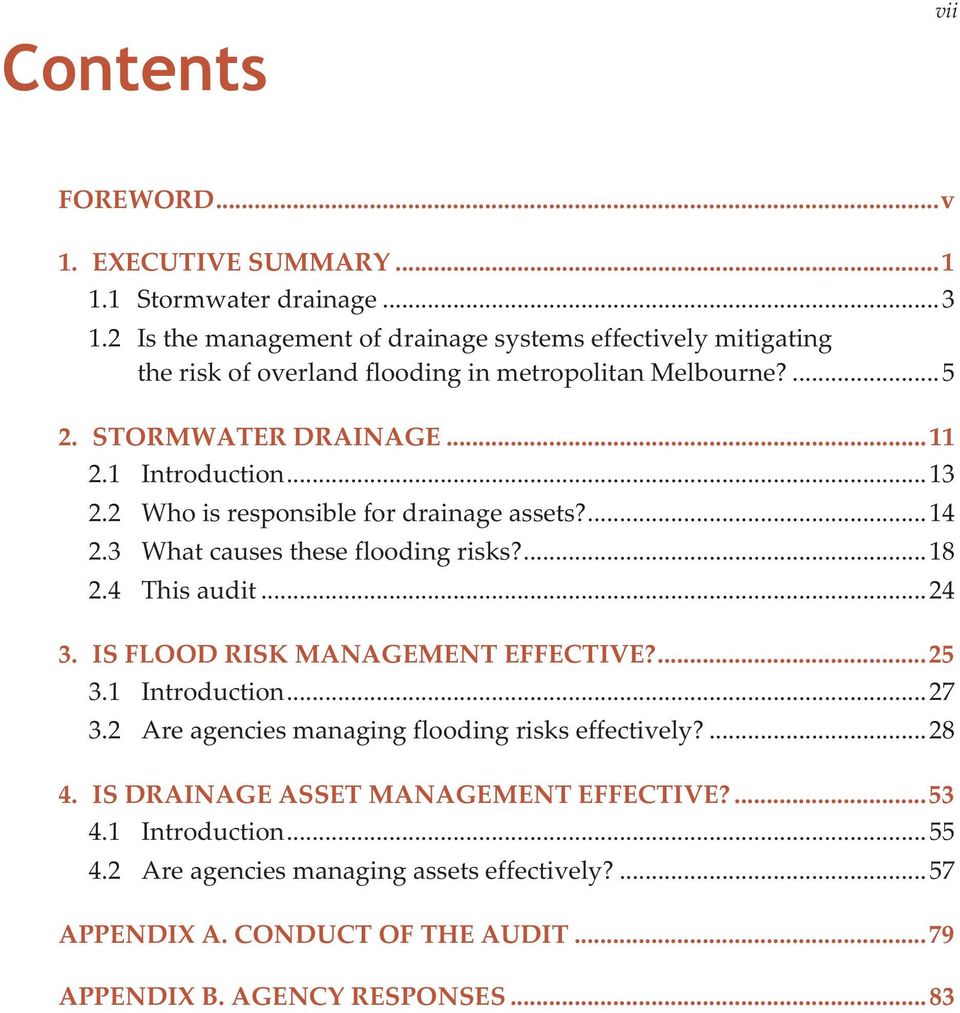
7 Contents vii FOREWORD...v 1. EXECUTIVE SUMMARY Stormwater drainage Is the management of drainage systems effectively mitigating the risk of overland flooding in metropolitan Melbourne? STORMWATER DRAINAGE Introduction Who is responsible for drainage assets? What causes these flooding risks? This audit IS FLOOD RISK MANAGEMENT EFFECTIVE? Introduction Are agencies managing flooding risks effectively? IS DRAINAGE ASSET MANAGEMENT EFFECTIVE? Introduction Are agencies managing assets effectively?...57 APPENDIX A. CONDUCT OF THE AUDIT...79 APPENDIX B. AGENCY RESPONSES...83
8 1 1. Executive summary

9

10 Executive summary Stormwater drainage The Melbourne Water Corporation (Melbourne Water) and local government (councils) have responsibility for managing the Melbourne metropolitan drainage system. The drainage system carries rainwater from roofs, roads and buildings through gutters, drains and channels, and discharges it into rivers and creeks where it eventually flows into the bays. Melbourne Water manages the major drainage system in large stormwater catchments. Councils are responsible for land-use planning and managing drainage systems in smaller, local stormwater catchments. Melbourne Water, as a regional drainage authority, is responsible for providing a safe level of flood protection for the community. Councils do not have any statutory responsibility for floodplain management. The capacity of drainage systems across metropolitan Melbourne to cope with stormwater varies, generally according to the age of the system. Before the late 1970s, most drainage systems were designed to contain stormwater from a 5-year storm event 1. Properties developed where no provision was made for the overland flow 2 of stormwater, are subject to flooding when the capacity of the underground drainage system is exceeded. After major flooding in 1973, 1974 and 1975, the Victorian Government introduced the Drainage of Land Act in , which enabled authorities to control development on flood-prone land by the end of that decade. Subdivisions developed after that date under the new standards incorporated drainage systems that could safely accommodate overland flows from a 100-year storm event. Today, the 100-year storm event is still the basis for identifying land subject to flooding and determining appropriate controls under the Water Act 1989, and for setting minimum building requirements under the Building Act There is no statutory obligation on Melbourne Water and councils to upgrade those drainage systems in place prior to the late 1970s to the new standard. 1 The magnitude of a storm event is rated in terms of the duration and intensity of rainfall, and how often these conditions are likely to occur. A 5-year storm is expected to happen, on average, once every 5 years, and a much larger 100-year storm is expected to happen once every 100 years. 2 Overland flow is the path which stormwater follows when not contained by the drainage system. 3 The Drainage of Land Act 1975 no longer exists and has been replaced by the Water Act 1989.
11 4 Executive summary Agencies face a number of challenges in reducing existing flood risks for their stakeholders: Increasing high-density development has reduced the area of porous surfaces that soak up stormwater, as well as reducing the number of above-ground pathways for the passage of stormwater into the drainage system Some urban development has occurred without full knowledge of the location of flood risk areas Flood mitigation work such as increasing the drainage capacity or constructing retarding basins 4 is usually too difficult and expensive because of the existing pattern of urban development. In addition, climate change, further urban development and an ageing drainage asset base are likely to increase flooding risks. Agencies thus face the dual challenge of controlling new risks while effectively mitigating the risks arising from drainage systems built to the old standard. This audit focused on the performance of Melbourne Water and 6 councils in managing their drainage systems to effectively mitigate the risk of overland flooding. Five inner suburban councils, Bayside, Boroondara, Darebin, Glen Eira and Stonnington, were selected because they have a large number of properties in flood-prone areas built before the late 1970s before drainage capacity standards were increased. Casey, an outer metropolitan council with significant recent growth, was also examined to determine whether the design of modern subdivisions provided effective flood protection from up to a 100-year storm event. The audit asked 2 key questions: Had the stormwater flood mitigation strategies adopted by these agencies diminished exposure to flood damage? Were the drainage infrastructure asset management practices adopted by these agencies optimising the useful life and service capability of their assets? 4 A retarding basin is an area (for example parkland) capable of temporarily storing stormwater to reduce flooding.

12 Executive summary Is the management of drainage systems effectively mitigating the risk of overland flooding in metropolitan Melbourne? A series of severe thunderstorms and floods over the past 2 years have highlighted the flooding risks for those parts of Melbourne developed before the late 1970s with lower drainage capacities. Melbourne Water estimates that properties and their surrounds would be vulnerable to flooding from overland flows if a 100-year storm event passed over its local drainage catchment. Of these, are vulnerable to stormwater penetrating interior living spaces from a 100-year storm event. The number of properties at risk in smaller, council drainage catchments is unknown. All the agencies examined in this audit were working towards aligning their flood risk management and asset management practices more closely with best practice. Melbourne Water was the most advanced: its practices were near to best practice. The 6 Melbourne councils were at various stages on the path to best practice, but none was aligned in all respects. Close alignment with best practice will greatly assist in controlling future risks. Managing the risks from the lower drainage standards that applied before the late 1970s presents a major challenge to agencies. This is because of the substantial cost and practicality of upgrading the drainage system to a standard closer to that required to accommodate a 100-year storm. Aside from 2 agencies, there was very little evidence that effective strategies had been applied to address these flooding risks. Melbourne Water demonstrated some progress, but its aims were very limited. Over the 4 years to , it had undertaken works to prevent 323 properties from being flooded above floor level from a 100-year storm event. Over the next 10 years, it plans to mitigate the risks for only 500 of the remaining most vulnerable properties at a cost of approximately $2 million per year. A further properties are expected to be protected by conforming to more stringent planning requirements when these properties are redeveloped. Stonnington had a 5-year plan aimed at increasing flood protection for flood-prone properties in its local catchments to accommodate a 20-year storm event. Because of this lack of progress, metropolitan Melbourne will continue to face significant flood-related damage, particularly to properties located in flood-prone areas, should the storms as severe as those of 2003 and 2004 recur.
13 6 Executive summary It is clear that agencies need to develop and apply strategies that provide a higher level of flood protection relative to existing standards. They must avoid the mistakes of the past by educating the community to prevent inappropriate home improvement practices, such as paving backyards, landscaping gardens or undertaking minor building works that exacerbate flooding risks. To do so, councils will have to carry out reliable flood mapping and include it in their planning schemes. The public also needs to be made aware of its role in flood prevention, and this would be best done through a coordinated educational program. Melbourne Water took the lead in defining flood-prone areas within its catchments by completing detailed studies to determine the location of these areas. It passed this information on to councils, who incorporated it into their planning systems so they could control development in floodprone areas. Casey and Stonnington took this a step further by mapping their local drainage catchments and incorporating this data into their planning schemes, but the other 4 councils in the audit decided it was too expensive. As a result Bayside, Boroondara, Darebin and Glen Eira do not have a clear appreciation of the flooding risks in their catchments. Melbourne Water should make use of its role in defining drainage schemes in connection with the Melbourne 2030 strategy. It should explore opportunities to address some of the flooding risks as part of these schemes and be prepared to review its priorities and targets. Unlike most other parts of the world, Melbourne has a 2-tiered system of responsibility for managing waterways and drainage. There is no uniform or coordinated approach to the management of existing flooding risks for metropolitan Melbourne or the future escalation of these risks. As floodwaters do not respect lines on a map, it is essential that agencies collaborate to produce an overall plan for Melbourne that addresses flood risks across agency boundaries. The plan should be developed in cooperation with the Department of Sustainability and Environment, which is responsible for policy in this area and is implementing stormwater policy initiatives as described in the government s White Paper Our Water Our Future.
14 Executive summary 7 Recommendations 1. That Melbourne Water and councils explore opportunities for working collaboratively to address the management of flooding risks with a view to optimising the efficient and effective use of their flood mitigation resources. 2. That Melbourne Water ensures stakeholder expectations are fully considered when setting flood risk reduction targets. 3. That Melbourne Water ensures that stakeholders (and especially local councils) are fully consulted before and during the development of drainage strategies and plans. These plans should consider councils drainage systems. 4. That councils develop flood risk management practices consistent with best practice risk management, and that these incorporate: specific flood risk management goals and objectives, which are supported by stakeholders and clearly linked to the councils wider strategies, plans and budgets a risk assessment and prioritisation process based on a sound knowledge of flood exposure an option assessment process with clear criteria that would include costs of treatment options, effectiveness (in mitigating flooding risks), and impacts on the conservation and environmental goals of stormwater management a long-term flood risk management plan to achieve the objectives of these practices an ongoing targeted community education program to raise awareness of flooding issues, ascertain community expectations and encourage behaviour that will limit flooding risks performance indicators that measure the effectiveness of flood risk management treatments in lowering flooding exposure, the results of which should be regularly reported to the community.
15 8 Executive summary 5. That all agencies develop drainage asset management plans, consistent with best practice, and that these incorporate: service levels and community expectations a demand management plan a condition assessment and monitoring program lifecycle costing principles a long-term financial plan. 6. That councils plan for, and implement, formal consultation arrangements with stakeholders to set drainage goals and objectives, and desired service levels. 7. That agencies assess the cost-effectiveness of establishing a dedicated and proven asset management information system which is integrated with the other information systems used to manage drainage assets. 8. That agencies develop a detailed improvement plan and commit resources to its implementation. 9. That councils implement a condition assessment and monitoring program conforming to best practice principles. 10. That agencies integrate condition information into their asset management decision-making practices and use it as the basis for validating asset valuations and depreciation calculations. 11. That councils formulate, track and report on measures that show their performance in managing drainage assets. All 7 agencies that were covered in the audit supported the recommendations. Their overall responses have been included below. Their detailed responses are set out in Appendix B of this report. RESPONSE provided by Managing Director, Melbourne Water Corporation Melbourne Water has reviewed the contents of the report and considers the report to be fair and balanced. We are satisfied with the conclusions reached and agree with the report s recommendations. RESPONSE provided by Chief Executive Officer, Bayside City Council Bayside City Council believes that the performance audit has been a useful exercise for council.
16 Executive summary 9 RESPONSE provided by Chief Executive Officer, Boroondara City Council The report provides a balanced description on the current policies and practices of the City of Boroondara and we are in agreement with its findings. In summary, Boroondara has undertaken a substantial body of work already to identify and actively manage its drainage network and related systems. Further improvements are in process which will address the issues and opportunities raised in your report. RESPONSE provided by Chief Executive Officer, City of Casey The performance audit and report is fair and balanced in assessing the City of Casey s position in managing stormwater flooding risk under council s control. The City of Casey accepts the conclusions of the report and agrees with the recommendations. RESPONSE provided by Chief Executive Officer, Darebin City Council Darebin City Council generally agrees with the assessments and recommendations of the report, and is working toward key improvement activities. RESPONSE provided by Chief Executive Officer, Glen Eira City Council Overall, the report is considered to be a fair assessment of the current situation, except in so far as the legislative framework is concerned and that is fundamental to the subject under review. The recommendations of the report are generally considered reasonable, however, no assessment of the resources required to implement the recommendations has been provided and the amount is likely to pose challenges for the ratepayers of the council and for state government policy.

17 10 Executive summary RESPONSE provided by Chief Executive Officer, Stonnington City Council Stonnington considers the audit report to be a fair and balanced reflection of the current drainage asset and flooding management plans and strategies for this municipality. A further overall comment is that it needs to be recognised that each council does not have the powers, responsibilities or protections of a drainage authority. To implement any drainage controls over development in a flood risk areas, such controls need to be incorporated into the council s planning scheme. This is a long and resource intensive process, for example 6 to 7 years from flood map determination to planning scheme implementation in Stonnington s case.
18 11 2. Stormwater drainage

19

20 Stormwater drainage Introduction Traditionally, flood risk management has concentrated on main stream flooding where floodwaters break the banks of a waterway and flood the surrounding low-lying areas. However, the uncontrolled overland flow of stormwater that is, local stormwater run-off on its way to a drainage system 1 also causes significant flooding. The storms of December 2003 and January 2004 caused some of the worst flash flooding metropolitan Melbourne had experienced in several decades. The worst-affected areas were those established before the late 1970s with drainage system capacity designed to contain stormwater from a 5-year storm event 2. When much larger storm events occur and swamp the piped drainage system, stormwater run-off follows the natural course as overland flow and may cause extensive property damage. This happened in December 2003 and January Insurance claims for residents and businesses from these events reached about $140 million in The aftermath of a flash flood in Glenferrie Road, Hawthorn, in December For newer suburbs developed since the late 1970s, the modern drainage standards have been designed to ensure they can safely contain the overland flows from up to a 100-year storm event. 1 The drainage system carries rainwater from roofs, roads and buildings through gutters, drains and channels, and discharges it into rivers and creeks where it eventually flows into the bays. 2 The magnitude of a storm event is rated in terms of the duration and intensity of rainfall and how often these conditions are likely to occur. A 5-year storm is expected to happen, on average, once every 5 years, and a much larger 100-year storm is expected to happen, on average, once every 100 years.

21 14 Stormwater drainage It is important that those agencies responsible for building and maintaining draining systems and for controlling development in metropolitan Melbourne manage these existing risks of stormwater flooding. 2.2 Who is responsible for drainage assets? In metropolitan Melbourne, the drainage system carries rainwater from roofs, buildings and roads through gutters, drains and channels, and discharges it into Port Phillip Bay and Western Port Bay. Unlike most other parts of the world, Melbourne has a 2-tiered system of responsibility for managing waterways and drainage. Melbourne Water Corporation (Melbourne Water) manages the main drains and waterways with funding from a specific drainage and river improvement rate paid by the owners of rateable properties. Local government (councils) provide services at the local street and property drain level, funded by council rates Melbourne Water Melbourne Water is the regional drainage authority 3 for the metropolitan area and is responsible for maintaining the major drainage system in stormwater catchments that cover an area exceeding 60 hectares. It is responsible for larger underground pipes, generally above a diameter of mm, and open channels, creeks and rivers. Melbourne Water s area extends to the Yarra Ranges in the east, the Mornington Peninsula and Western Port in the south, Yan Yean in the north and Werribee to the west 4, and currently includes approximately kilometres of constructed drains and kilometres of waterways. This area will soon be expanded to take in further areas on the periphery of Melbourne currently managed by the Department of Sustainability and Environment. Figure 2A shows Melbourne Water s current and expanded areas of operation. 3 As a regional operator, Melbourne Water Corporation is responsible for the trunk, larger-scale stormwater drainage system across a region that encompasses all metropolitan councils. As a regional operator, its aim is to ensure an integrated, metropolitan-wide approach to planning and improving the regional drainage system. 4 This boundary will be expanded significantly under the Victorian Government s action plan, Securing Our Water Future Together. The expanded area will encompass the whole of Port Phillip Bay and Western Port region and will total square kilometres.
22 Stormwater drainage 15 FIGURE 2A: MELBOURNE WATER S MANAGEMENT AREAS Source: Victorian Auditor-General s Office. Since much of this new area is predominately rural in nature, the impact on drainage infrastructure development is not expected to be significant in the short-term. Urban expansion will however increase over time. In addition to managing major waterways and creeks, all metropolitan councils rely on Melbourne Water s underground pipe system to convey stormwater from the minor drainage system to these major waterways. Figure 2B shows schematically the extent of Melbourne Waters underground drainage system in Glen Eira council.
23 16 Stormwater drainage FIGURE 2B: MELBOURNE WATER S DRAINAGE SYSTEM IN GLEN EIRA Princes Highway Nepean Highway North Road Warrigal Highway Legend Municipal boundary Melbourne Water drains South Road Source: Victorian Auditor-General s Office. Melbourne Water s drains serve catchments covering about half the total area of the municipality. Melbourne Water is required to meet the Statement of Obligations issued by the Minister for Water under the Water Industry Act These obligations include the requirement that the authority provide a safe and effective system for dealing with storm run-off, a reduced risk of flooding in priority areas and the prevention of inappropriate development in flood-prone areas 5. As a regional drainage authority, Melbourne Water is responsible for providing a safe level of flood protection for the community. It discharges this responsibility by: isolating the floodplain (area of land prone to flooding) and overland flow paths by limiting development in these areas ensuring that any development in flood-prone areas accommodates overland flows without threat to property or public safety building and operating infrastructure such as drains, levees, retarding basins and wetlands to contain, detain, convey or treat stormwater 5 Melbourne Water, Statement of Obligations, Melbourne, 2004.
24 Stormwater drainage 17 working with stakeholders and the community to manage activities that affect stormwater flooding and the quality and health of the region s waterways operating a flood warning network to raise the alarm before major waterways overflow. Melbourne Water s retarding basin in Police Road, City of Knox Local government Unlike Melbourne Water, councils do not have any statutory responsibility for floodplain management. However, councils play a significant role in managing the stormwater drainage system. Councils in the metropolitan area manage around kilometres of constructed drains servicing an area measuring around hectares. They are responsible for land-use planning and for drainage infrastructure in smaller local catchments. Under the Local Government Act 1989, councils are required to ensure that resources are used efficiently and effectively and services are provided in accordance with Best Value Principles to best meet the needs of the local community. Councils are also responsible for providing and maintaining community infrastructure 6. 6 Victorian Parliament, Local Government Act 1989.
25 18 Stormwater drainage Under the Emergency Management Act 1986, councils must prepare a municipal emergency management plan and appoint a municipal emergency resource officer. Responsibility for the immediate response to a flooding emergency rests with the Victorian State Emergency Service, but councils coordinate recovery activities such as the clean-up of debris. When a more widespread municipal emergency is declared, the council municipal emergency resource officer coordinates the immediate response. 2.3 What causes these flooding risks? The capacity of drainage systems across metropolitan Melbourne to cope with stormwater varies, generally according to the age of the system. One major cause of flooding is that drainage systems constructed in areas developed before the late 1970s were not designed to accommodate the volume of stormwater generated by serious storm events. After major flooding in 1973, 1974 and 1975 the Victorian Government introduced the Drainage of Land Act in 1975, which enabled authorities to control development on flood-prone land by the end of that decade. Subdivisions developed after that date under the new standards incorporated drainage systems that could safely accommodate flows from a 100-year storm event. Today, the 100-year flood event is still the basis for identifying flood-prone land and determining appropriate controls under the Water Act 1989, and for setting minimum building requirements under the Building Act The storms of December 2003 and January 2004 caused some of the worst flash flooding metropolitan Melbourne had experienced in several decades. The worst affected areas were those established before the late 1970s.
26 Stormwater drainage Older drainage standards Figure 2C shows the typical components of a drainage system constructed before the late 1970s. FIGURE 2C: TYPICAL COMPONENTS OF A DRAINAGE SYSTEM DEVELOPED BEFORE THE LATE 1970s High ground Creek KEY Melbourne Water drain Overland flow paths (1 in 100) Major council drain Residential development Smaller council drain Road network Melbourne Water area Source: Victorian Auditor-General's Office. Before the late 1970s, drainage systems needed to accommodate water only from storms with a 5-year Average Recurrence Interval (ARI 7 ). Since then, drainage systems in new land developments have been required to accommodate a much larger stormwater flow of up to a 100-year ARI. This is achieved by using above-ground features such as local roads and open drainage reserves to carry excess stormwater away from urban development, in addition to underground 5-year ARI pipes. This presents a challenge for inner metropolitan Melbourne because: increasing high-density development has reduced the porous surface areas that soak up stormwater, and reduced the number of aboveground pathways for the passage of stormwater into the drainage system 7 The ARI refers to the frequency or probability of floods occurring. Large floods occur rarely, while small floods occur more frequently. A 100-year ARI flood is one that occurs (or is exceeded) on average once every 100 years, and a smaller 5-year ARI flood is one that occurs on average once every 5 years.
27 20 Stormwater drainage some urban development has occurred without full knowledge of the location of flood risk areas flood mitigation work, such as increasing the drainage capacity or constructing retarding basins, is usually too difficult and expensive because of the existing pattern of development. The picture below illustrates the impact of a large storm event on an established suburb. The main drain was designed to accommodate stormwater from up to a 5-year storm. Any excess water from a larger event flows overland along its natural course, flooding properties in its path. The flooding of properties occurs because the planning system did not ensure that developers and property owners provided a clear path for the passage of stormwater, consistent with the need to manage larger storms. Overland flow path Main drain Impact of large storm event on established suburb. Melbourne Water estimates that properties and their surrounds would be vulnerable to flooding from overland flows if a 100-year storm event passed over their local drainage catchment. Of these are vulnerable to stormwater penetrating interior living spaces from a 100-year storm event. The number of properties at risk in smaller, council drainage catchments is unknown.
28 Stormwater drainage Newer drainage standards In suburbs established since the late 1970s, developers must design and build the drainage system with a greater capacity to cope with flooding risks. It is usually made up of a minor system catering for storm events with a 5-year ARI, and a major system catering for storm events up to a 100-year ARI. The system design must include measures to ensure there is no increase in downstream flooding risk and, where possible, contribute to reducing any existing flood risks. The picture below illustrates the impact of a large storm event on a newer suburb. Impact of large storm event on new suburb. The picture above shows excess stormwater being retained and conveyed along a system of overland flow paths to the floodplain area. The suburb has been designed so that excess stormwater is conveyed along existing streets and open spaces to avoid residential properties Factors likely to increase flooding risks In addition to managing the legacy of existing flooding risks, Melbourne Water and councils face challenges in preventing the escalation of those risks. These include: responding to global climate trends that indicate more frequent, intense storms controlling future development and redevelopment ensuring that an ageing asset base continues to perform to its capacity.
29 22 Stormwater drainage Climate change There is a growing body of evidence that global climate changes are likely to lead to more frequent, intense storm events. In July 2004, the Minister for Environment launched a consultation paper Adapting to Climate Change: Enhancing Victoria s Capacity 8. This paper concluded that the intensity of extreme rainfall events had increased in Victoria over the last 90 years and that this trend would continue. Flooding in Glenferrie Road, Hawthorn, in early Future development Further development in Melbourne has the potential to increase the risks of flood damage through: councils failing to identify flood-prone areas and introduce appropriate planning controls or ensure adequate flood protection for new developments in existing flood-prone areas developers and property owners continuing to engage in building practices that raise the level of stormwater run-off or make properties more vulnerable to flooding. Councils are responsible for the local planning system and can introduce flooding overlays (map of stormwater flow paths) to automatically trigger more appropriate requirements for developments in flood-prone areas. 8 Adapting to Climate Change: Enhancing Victoria s Capacity. Victorian Department of Sustainability and Environment, July 2004.
30 Stormwater drainage 23 Development activities outside of flood-prone areas can also lead to increased flooding risks. The subdivision of blocks or renovations can raise the proportion of impervious land that is, land that cannot soak up stormwater created by new buildings, driveways or paved backyards. These changes increase the volume of stormwater run-off and increase the demands on the drainage system in the immediate vicinity and further downstream. Poorly designed developments may also introduce significant risks by, for example, constructing garages below road level or constructing landscaping in a way that funnels stormwater through the house rather than around it. The government s Melbourne 2030 strategy is a 30-year plan to manage growth and change across metropolitan Melbourne and the surrounding region. Its main thrust is to continue to protect the liveability of the established areas and to increasingly concentrate major change in strategic redevelopment sites such as activity centres and underdeveloped land. While a good supply of land for development will be maintained in growth areas, over time it predicts there will be a shift away from growth on the fringe of the city. The provision of new drainage infrastructure to support greenfield 9 development within Melbourne Water s operational boundary is usually managed using a drainage scheme 10. Drainage schemes are also used in the redevelopment of established areas, although currently there are very few of these. However, Melbourne Water plans to introduce an additional 30 drainage schemes for non-greenfield sites earmarked for development under the Melbourne 2030 strategy over the next 3 years. Councils are also able to incorporate developer contribution overlays into the planning scheme. These may define development in specific locations or across the whole municipality, and the contributions required to cover the cost of drainage infrastructure associated with any new development subject to the planning process. 9 A greenfield site is undeveloped land zoned for residential development on the fringe of the established metropolitan area. 10 A drainage scheme is an overall plan identifying the drainage infrastructure required to service future urban development within a catchment. A drainage scheme also determines the financial contribution that developers should make to the construction of the necessary infrastructure to ensure that the drainage system can cope into the future.
31 24 Stormwater drainage Managing an ageing asset base A well maintained asset would operate to its intended level of service capacity and continue to do this for its expected useful life. For the established areas of Melbourne, many drainage assets may have reached an age where the consequences of poor maintenance will increase in severity. Thus, good asset management will assume increasing importance in the future. 2.4 This audit The objective of this audit was to determine whether the stormwater management practices adopted by Melbourne Water and 6 selected councils (Bayside, Boroondara, Casey, Darebin, Glen Eira and Stonnington) had efficiently and effectively addressed stormwater flooding risks in their respective localities. The audit asked 2 key questions: Had the stormwater flood mitigation strategies adopted by these agencies diminished the exposure to damage caused by flooding? Were the drainage infrastructure asset management practices adopted by these agencies optimising the useful life and service capability of their assets? More information about the conduct of the audit and list of participating agencies are provided in Appendix A of this report. We have also included additional comments from the agencies in Appendix B.
32 25 3. Is flood risk management effective?
33
34 Is flood risk management effective? Introduction The older, established areas of Melbourne are vulnerable to flooding by storm events similar to those that affected Melbourne in December 2003 and January Applying best practice risk management principles will assist Melbourne Water and the 6 councils in addressing these risks and managing future risk. Risk is the chance of something happening that will have an impact on planned achievements and is measured in terms of a combination of the consequences of an event and its likelihoods 1. Risk management is the culture, processes and structures that are directed towards realising potential opportunities while managing adverse effects 2. In terms of best practice risk management, the Australia and New Zealand Risk Management Standard 3, first released in 1995, is widely accepted in Australia and New Zealand as providing the best guidance. Our approach to assessing the flood risk management practices of the 7 agencies is based on an examination of the key components of the Australian and New Zealand Risk Management Standard, as applied to flooding, summarised in Figure 3A. 1 Emergency Management Australia, Critical Infrastructure Emergency Risk Management and Assurance Handbook, Mount Macedon, 2004, p ibid, p Australian Standards, AS/NZS 4360: 2004 Risk Management, Sydney, 2004.
35 28 Is flood risk management effective? FIGURE 3A: BEST PRACTICE RISK MANAGEMENT APPLIED TO FLOODING RISK MANAGEMENT PLAN COMPONENTS Goals and objectives (reflects stakeholder input) EXPLANATION AND KEY QUESTIONS Establish the scope of flood risk management (FRM) What are the goals and objectives of FRM? Are these linked to wider policies and goals? Do these take account of stakeholder views? Assessing risks (identify, analyse and prioritise) Identify flooding risks Analyse to determine the likelihood and consequence of the risks Evaluate risk to determine treatment priorities Monitor and review Determining risk treatments Implementing plans Communicate and consult Determine preferred treatment options based on a comparison of the costs and benefits Do agencies carry out plans in accordance with planned designs, budgets and timelines? Performance monitoring and improvement Do agencies measure performance? Do agencies use this information to further improve their practices? Source: Victorian Auditor-General's Office. 3.2 Are agencies managing flooding risks effectively? Criteria To determine whether agencies (Melbourne Water and the 6 councils) were managing the existing and future flooding risks effectively, we examined: how closely agency practices aligned with best practice risk management whether agencies had evidence that demonstrated they were mitigating flooding risks.
36 Is flood risk management effective? How closely do current flood risk management practices align with best practice? To assess actual practices against best practice, we examined whether agencies had: clearly established goals and objectives; linked to the organisation s wider goals; and the expectations of their key stakeholders 4 understood the likelihood and consequence of flooding risks and the level of risk stakeholders were willing to accept, and had used this information to prioritise risk developed plans that treated flooding risks according to their priority and took account of the wider conservation and environmental goals of stormwater management implemented these treatments in accordance with planned timelines, budgets and designs communicated with stakeholders about these risks and improved the effectiveness of treatments through ongoing community consultation and education, and performance measurement. We rated agencies between zero and 100 for each criterion. The total score was divided into 5 maturity levels 5. The maturity descriptions shown below in Figure 3B are used in this part of the report and also in Part 4. FIGURE 3B: RATING MATURITY LEVELS Levels Description Range Unaware Unaware of the importance of this area and there was no support within Up to 10 the organisation for improvement. Aware Developing Competent Excellent Aware of the importance of this area but was doing little to develop its capability. Actively developing capability and there was definite but patchy support for this. Had a basic workable approach for this area and there was support for further improvement. Had a formal, quality approach. Is likely to sustain and further improve practices over time because of the quality of the systems in place and the strength and coverage of support. 11 to to to to 100 Note: These are the best practice guidelines for asset management, based on a case study from the International Infrastructure Management Manual, Source: Victorian Auditor-General's Office. 4 In this part of the report, and in Part 4, we refer to stakeholders. These are: residents and businesses in the local community reliant on drainage services (citizens); organisations other than the agency that have drainage responsibilities or are affected by these services (external stakeholders); and other parts of the agency being audited (internal stakeholders). 5 These maturity levels are based on an example from the Institute of Public Works Engineering Association, International Infrastructure Management Manual, 2002.
37 30 Is flood risk management effective? 100 Clearly defined and supported goals Agencies must clearly define their flood risk management goals and link them to their organisational goals. The flood risk management goals must be supported by those staff responsible for their achievement, citizens and external stakeholders. Figure 3C shows our assessment of the performance of agencies in defining clear and supported goals. FIGURE 3C: RATING CLEARLY DEFINED AND SUPPORTED GOALS 90 Excellent Competent Glen Eira Bayside Casey Darebin Boroondara Stonnington Melbourne Water Developing Aware Unaware Source: Victorian Auditor-General's Office. All 7 agencies recognised the importance of flood risk management, but were at different stages of developing clear and well-supported goals. Melbourne Water and Stonnington were rated as excellent. Both agencies clearly defined the goals of flood risk management and linked these with other planning and budgetary documents. They had a comprehensive knowledge of the flooding risks in their areas of operation and had consulted stakeholders about the implications.
38 Is flood risk management effective? 31 Melbourne Water s Operating Charter for Waterways and Drainage sets out its responsibility to provide a safe, effective system for containing and transferring storm run-off and preventing inappropriate development in flood-prone areas 6. This aim leads to the following objectives: to prevent any increase in future flooding risks by introducing planning and development controls for flood-prone areas and ensuring that existing assets perform as designed to reduce the legacy of existing risks by carrying out works to provide greater protection to some vulnerable properties and to ensure that higher flood protection standards are applied if these properties are redeveloped 7. Melbourne Water has set a target of reducing the number of properties with floor levels below the applicable 100-year flood level. It sets the reduction target for its mitigation program based on the available budget, research on community expectations and the advice of the Waterways and Drainage Advisory Committee 8. This committee advises Melbourne Water on the delivery of its programs and services, and assesses how well stakeholders feedback is addressed in its service commitments. In the 2005 operating charter, the committee agreed to a reduction in this target from 800 to 500 properties over the next 10 years for the following reasons: Melbourne Water does not believe it is obliged to address the flooding issues caused by a legacy of poor land-use practices to address the flood risk legacy through mitigation works was not as cost-effective as ensuring the risks are addressed through the planning process when these properties are redeveloped the community did not rank flood mitigation as a high priority direction for Melbourne Water, but emphasised the importance of environmental and waterway health issues. Melbourne Water s objectives and targets are clear and well understood within the organisation, with objectives of preventing the increase in flooding risks and partially addressing existing flooding risks. However, the targets relating to addressing the existing flooding risks have not been adequately validated with, or communicated to, stakeholders. 6 Melbourne Water, Operating Charter for Waterways and Drainage, Melbourne Water 2005, p ibid., p The members include representatives from the Urban Development Institute of Australia, the Victorian Farmers Federation, Port Phillip and Western Port Catchment Management Authority, Environment Victoria, the Department of Primary Industries, the Municipal Association of Victoria, and 3 community representatives - one from the Peninsular Environment Councils, one from the Friends of Steele Creek, and a professor of urban design at RMIT.
39 32 Is flood risk management effective? Stonnington has similar aims to Melbourne Water and has taken action to address both existing and future flooding risks. Its target for existing vulnerable properties is to raise their level of protection to withstand the flows from a 20-year storm. The 4 developing councils (Bayside, Boroondara, Darebin, Glen Eira) had not created a focus on flood risk management with clearly communicated goals and objectives. They need to improve their performance. All councils were developing processes for this purpose, but to do so effectively they will need to set specific flood risk management objectives, gain stakeholder support for them and ensure that the objectives link to their strategy, planning and budgetary processes. All 7 agencies acknowledged the importance of identifying and understanding existing and future flooding risks. Their level of progression and relative priorities mean that they are at different stages in defining risk management objectives and targets. Some, like Melbourne Water and Stonnington, have established clear objectives and targets, while others are still scoping the size of the problem. All 7 need to review the processes they have established to ascertain stakeholder expectations about acceptable flooding risks. Assessing risks and determining priorities Agencies need to identify flooding risks and prioritise them by considering the probability of the risk occurring and the seriousness of the consequences. If agencies properly prioritise risks using set criteria they can direct available resources to the areas of greatest need. Figure 3D rates agencies risk assessment and prioritisation.
40 Is flood risk management effective? 33 FIGURE 3D: RATING ASSESSING RISKS AND DETERMINING PRIORITIES Excellent Competent Developing Aware 10 0 Glen Eira Bayside Casey Darebin Boroondara Stonnington Melbourne Water Unaware Source: Victorian Auditor-General's Office. Five agencies achieved a competent or excellent rating, but there was considerable variation within this group, with Darebin and Boroondara in the middle of the competent category and Casey, Stonnington and Melbourne Water at the upper end of competent or shading into excellent. The other 2 councils were rated as developing. The 3 best-performing (Casey, Melbourne Water and Stonnington) had a comprehensive understanding of their flooding risks in terms of likelihood and consequence based on reliable information. Stonnington and Melbourne Water used a risk assessment process based on the best practice guidelines and tailored it for application to flooding risks. For example, Stonnington defined likelihood in terms of the probability of a given storm event and consequence in terms of the type of property damage and safety risks resulting from different levels of storm. This information was used consistently to prioritise flooding risks. In Casey, most urban development happened since the late 1970s, after which stringent drainage standards were imposed. These had ensured that potential risks were addressed in the planning process. The availability of maps showing flood-prone areas ensured that developments were designed to cope with a 100-year storm event. There were a small number of residual flooding risks in the area developed before Casey had not developed formal risk assessment processes for these residual risks, but given their relative importance, this had only a small effect on their rating.
41 34 Is flood risk management effective? Darebin and Boroondara were rated as competent. Both had a reasonable understanding of local flooding risks and used council-wide risk management frameworks to assess them. However, these councils need to update and improve their knowledge of local flooding risks and apply a risk management approach to this assessment. Boroondara used a risk management framework, which it had built into its drainage emergency response database. The council is carrying out a study of drainage catchments and, when completed, will provide updated information on existing flooding risks and a clearer idea of the impacts of future development on those risks. Darebin applied a corporate risk strategy to prioritise capital works, including flood mitigation works. The most important component of this was a 1999 drainage strategy. The council needs to formulate a more detailed assessment framework tailored to flood risks and use this framework to review its priorities. This will allow it to employ measures of likelihood and consequence specific to flooding risks. For example, a consequence may be defined in terms of the type of property damage and the level of threat to persons of a particular storm event. Bayside and Glen Eira were rated as developing. Both had started a program of catchment analysis studies to enable them to better understand the local flooding risks. However, neither had yet developed their detailed knowledge of drainage problems to a point where a risk assessment approach could be applied across the whole council area. Bayside had developed a process to assess flooding risks in their ongoing catchment studies but this information did not currently inform a corporate level risk assessment process to determine expenditure priorities. Glen Eira developed a formal risk assessment process as part of its 1996 drainage strategy. However, Glen Eira concluded that it needed more detailed information to apply this framework and has started a program of drainage studies to improve their understanding of flooding risks. Agencies measure the impact of flooding based on the number of properties flooded. However, agencies do not consider the wider impacts such as the cost of disruption to businesses, transport and people s lives. All agencies could improve their risk assessment by broadening the assessment to include these wider impacts. All the councils had recently consulted their stakeholders on the application of a Special Building Overlay to identify flood prone areas and control development through the planning process. Figure 3E explains this process.
42 Is flood risk management effective? 35 FIGURE 3E: CONTROLLING URBAN DEVELOPMENT IN FLOOD-PRONE AREAS USING A SPECIAL BUILDING OVERLAY Using detailed modelling techniques, Melbourne Water mapped the areas (overlays) within its catchments likely to be affected by 20-year, 50-year and 100-year storm events. Importantly, these overlays identified not only the flooding associated with major rivers and creeks, but also floods caused by the overland flow of stormwater on its way to major drainage channels. This information was passed on to Melbourne councils over the last 2 years so the overland flow paths could be incorporated into their planning systems as Special Building Overlays. All metropolitan councils have, or are in the process of adopting these overlays. As part of this process, councils need to inform affected residents and respond to their questions about the overlays. Once the overlays are in place, any new development or redevelopment will be subject to planning controls requiring measures to protect properties from a 100-year storm. Thus, they are critical in preventing inappropriate development in these flood-prone areas. To date, amendments to 31 planning schemes have been exposed for public consultation. The Minister for Planning has approved 27 of them. These overlays will control development for about flood-prone properties across Melbourne. As most councils have not completed detailed mapping work for their own catchments, they are relying on Melbourne Water s information about flood-prone areas. However, as Stonnington and Casey have done their own mapping, their overlays will be more comprehensive than those of the other councils we examined. Source: Melbourne Water. Melbourne Water s leadership in mapping overland flooding has been critical to incorporating planning controls to contain flooding risks. Some drainage authorities throughout the world are less advanced in their understanding of flooding from overloaded drains. For example, the report Flooding in London stated that there is a whole class of urban floods drainage flooding not currently included in any systematic risk assessment and warning policy. This is all the more worrying since many consider such drainage flooding to be the greatest practical threat to London at present 9. Melbourne Water mapped only to the boundaries of its drainage catchments. Stonnington and Casey have completed a similar mapping exercise for their local catchments, with the encouragement and help of Melbourne Water. However, as the other 4 councils have not taken this step, there are significant coverage gaps across Melbourne. In our view, the mapping exercise was a missed opportunity to provide a common information base and an overall planning treatment. That this did not happen reflects the division of drainage responsibilities between Melbourne Water and local councils. 9 London Assembly, Flooding in London: A London Assembly Scrutiny Report, Greater London Authority, London, November 2002, p. 5.
43 36 Is flood risk management effective? A sample of the flood mapping information for Stonnington is shown below, with the grey, shaded areas showing the flooding pathway from a 100-year storm. Special Building Overlay for flooding, for part of Stonnington. Treating flooding risks Once agencies identify and prioritise flood risk areas, they need an assessment process to identify the best way to treat these risks. Each treatment option should be considered in terms of its effectiveness, cost, and synergy with the wider conservation and environmental goals of stormwater management. Adopting a well-founded process will help agencies achieve their flood mitigation goals while maximising synergies with related stormwater management goals. Figure 3F shows our assessment of agencies risk treatment plans.
44 Is flood risk management effective? 37 FIGURE 3F: RATING TREATING FLOOD RISKS Excellent Competent Developing Glen Eira Bayside Casey Darebin Boroondara Stonnington Melbourne Water Aware Unaware Source: Victorian Auditor-General's Office. Six of the 7 agencies were rated as competent or excellent and Bayside was on the border of developing and competent. All had good processes for developing flooding treatment plans. These processes included the assessment of reasonable options in terms of their whole-of-life costs, the level of flood protection required and the benefits to those living in flood-affected properties. For Melbourne Water, Casey and Stonnington these processes were very well defined and were part of a long-term treatment plan. For example, Melbourne Water, whose plan of flood mitigation works covered a 10-year period, including existing flood risks, had processes to ensure that options were fully considered and that costs and benefits were evaluated. Stonnington s implementation plan, which is similar, covers a 5-year period to 2010 and involves raising protection for its flood-prone areas to withstand a one in 20-year storm. We assessed the effective implementation of these long-term plans in section of this report. Bayside and Glen Eira need to incorporate proposed treatments into a clearly defined, long-term plan. Both were, however, completing drainage studies which will provide the basis for a long-term plan of flood mitigation works. These councils need to prioritise projects if they are to achieve their flood mitigation objectives.
45 38 Is flood risk management effective? The 6 councils did not adequately consider the wider environmental and conservation goals of stormwater management when determining treatments. While addressing the flooding risks was the focus for agencies, both the Victorian Government and local government have policies aimed at conserving water supplies and protecting the environment. One of these policies is aimed at reducing the loading of pollutants in stormwater and reusing it. Councils need to consider the environmental and conservation impacts of flood mitigation schemes when choosing a treatment option. Treating flooding risks by upgrading drainage capacity in Boroondara. Agencies currently formulate their plans to treat existing flooding risks in isolation. There is no evidence that councils consult Melbourne Water about the feasibility or downstream impact of their plans and it is not clear how Melbourne Water contributes to these plans. Clearly, this is important where a treatment in the upper part of a catchment requires a corresponding investment by Melbourne Water downstream to avoid the displacement of a flooding problem. Melbourne Water does not formally consider the plans and priorities of local councils when determining its mitigation program. Treatment plans should take account of the interdependencies between adjacent agencies. There is a need to plan for complete drainage catchments rather than formulating separate, unlinked plans for subcatchments. Implementing treatments as planned Once agencies commit to a program of risk treatments, they need to implement these according to planned designs, timelines and budgets. We looked at agencies implementation processes and compared estimated budgets and timelines with the actual results. Figure 3G assesses agencies management of risk treatment programs.
46 Is flood risk management effective? 39 FIGURE 3G: RATING IMPLEMENTING PLANS AS INTENDED Excellent Competent Developing Glen Eira Bayside Casey Darebin Boroondara Stonnington Melbourne Water Aware Unaware Source: Victorian Auditor-General's Office Five agencies have been rated as competent or better, while 2 agencies have been rated as developing. Comment on the effectiveness of agencies long-term implementation plans is detailed in section of this report. Melbourne Water has been rated as excellent and best illustrates the attributes leading to a high score for this criterion. Melbourne Water has developed a 10-year strategic program, a short-term works implementation plan and processes to track progress in achieving planned spending and timelines. The 4 councils rated as competent have long-term treatment plans consistent with best practice. Glen Eira and Bayside need to develop a long-term implementation plan for flood risk management projects and put in place processes to track actual versus planned spending and timelines. Educating stakeholders about flooding risks and performance Agencies need to educate stakeholders about the nature and extent of flooding risks, and their plans for, and performance in, addressing those risks. Only then will residents understand how they might be affected and how their actions could increase the risk. Education in this area should be targeted at those most at risk of flooding and those behaviours most likely to increase flooding risks.
47 40 Is flood risk management effective? 100 Figure 3H shows our assessment of agencies stakeholder education and performance monitoring. FIGURE 3H: RATING STAKEHOLDER EDUCATION AND PERFORMANCE MONITORING 90 Excellent Competent Developing Glen Eira Bayside Casey Darebin Boroondara Stonnington Melbourne Water Source: Victorian Auditor-General's Office. Aware Unaware Melbourne Water, Stonnington and Casey were rated at the upper end of competent, Bayside, Boroondara and Darebin as developing, and Glen Eira as aware. All 6 councils had, or were in the process of embedding, the flood-prone areas identified by Melbourne Water into the local planning system (referred to in Figure 3E). They had provided this information to property owners affected by overland flows associated with Melbourne Water s drainage system and had given them the opportunity to respond. However, most councils had not extended this mapping process for their own drainage catchments. The 3 agencies rated at the upper end of the competent category (Casey, Stonnington and Melbourne Water) had identified all properties within their areas of responsibility subject to the risk of flooding from a 100-year or larger storm. Only Melbourne Water had an ongoing community education program.
48 Is flood risk management effective? 41 Melbourne Water community education material. Melbourne Water prepared publications on drainage issues, conducted public forums to increase the awareness of flooding issues, and ran specific consultation programs when implementing flood mitigation projects. Although councils often consulted those affected by flood mitigation projects, they need to develop ongoing community education programs. Figure 3I illustrates the benefit of community education with some examples and possible solutions.
49 42 Is flood risk management effective? FIGURE 3I: REDUCING FLOODING RISKS THROUGH STAKEHOLDER EDUCATION Stakeholder actions that increase flooding risks During this audit, we identified many examples of practices by residents that raised the level of flood risk and, in some cases, led to localised flooding. Some of these practices were covered by planing system controls which residents either ignored or were unaware. Other practices, such as paving a backyard and increasing stormwater runoff were permissible. The Special Building Overlay (SBO), where applied by a council to flood-prone land, controlled some but not all of these practices. The following are examples of high-risk practices: An owner wanted to build his garage underneath the house. A private building surveyor approved the building permit but did not consider the flooding risks. The owners were flooded twice, significantly damaging their car and blamed the council for allowing the development to go ahead. A resident put a wire mesh bag filled with rocks in a stormwater drain to filter waste from the water on its journey into Port Phillip Bay. Unfortunately this also stopped the flow of stormwater, blocked the drain and created flooding. Some residents were unaware that an overland flow path for stormwater from a large storm went through their backyards. They built fencing that would block this path and divert stormwaters through the adjacent properties. A resident levelled and paved an entire backyard and put a very small drainage hole at the back of the yard. This drastically reduced the amount of surface to soak up rainwater and the new landscaping funnelled water towards the house rather than around it and into the drain. The result was a series of flooding incidents. Solution: Stakeholder education These examples highlight how important it is for agencies to educate stakeholders about the effects of inappropriate practices and their responsibility to avoid them. Agencies need to: develop practical advice that helps stakeholders understand and manage their flood risk responsibilities develop ways of communicating this information using existing channels, such as the agency website and newsletters and, where justified, targeted communication to specific areas and groups. Source: Victorian Auditor-General s Office. Melbourne Water commissioned a review 10 of the services it provides to the property development industry. The research was based on interviews with peak bodies and a sample of developers, consultants and 8 local councils. 10 Quay Connection et al, Melbourne Water Developer Services Review: Research with Clients Final Report, Melbourne, October 2003.
50 Is flood risk management effective? 43 In general, there were high levels of satisfaction with the service Melbourne Water provided to the development industry across most client groups. However, there were areas that could be improved, including the education of clients. There was a feeling that Melbourne Water could do more to educate developers about the development process and the general public about the implications of the government s water management policy. This applied to flood overlays, for example, where it was felt that: Melbourne Water could have done more to educate developers about the impact of the overlay on development requirements 11. There was a general consensus that small developers were not well informed about Melbourne Water s requirements. The education of small developers was seen as particularly important and they expressed a desire for more front-end education about Melbourne Water s role and decisions. It was acknowledged that: Both consultants and councils play an important role in educating these smaller developers, but they also feel that Melbourne Water could do more to assist them 12. To improve their performance and accountability, agencies also need to report on the effectiveness of flood mitigation programs. Only Melbourne Water tracked the effectiveness of its flood mitigation activities. It set a 10-year external target for the number of properties to be removed from flooding in a 100-year storm and tracked progress against this target. Agencies also need to assemble information on the impact of their actions on their citizens exposure to flooding risks. The councils rely heavily on citizen complaint information to direct their programs, rather than operate proactively. To varying degrees, councils observe storm events to confirm the presence of a flooding problem or the effectiveness of a solution. Agencies need to use this information to report to their own staff and to external stakeholders, including citizens, on the effectiveness of their flood mitigation works. Currently, none of the councils do this. 11 Ibid., p ibid., p. 11.
51 44 Is flood risk management effective? Are current practices effective in reducing flooding risks? The goal of flood risk management is to mitigate the most critical risks in a cost-effective way while taking account of community expectations and the wider conservation and environmental goals of stormwater management. Agencies must also consider other competitive demands on their resources and allocate funds in a rational way across their portfolios. Agencies are effective when they: have a comprehensive understanding of their flooding risks and use this information as the basis for developing a mitigation program reduce the level of flooding exposure in line with their objectives, constraints and reasonable expectations of the community. To assess the effectiveness of flood risk management, we examined: whether sufficient and reliable information was collected to understand past and present exposure levels, to predict exposure levels and confirm the impacts of mitigation programs whether agencies had developed long-term mitigation plans to reduce the existing flooding risks and prevent future risks caused by inappropriate development and drainage practices to what extent agencies had reduced the level of flooding exposure. Knowledge of flooding exposure Agencies make use of a range of information sources to understand where and how seriously properties and businesses are at risk of flooding; and how flood mitigation treatments have altered this exposure. They use the following types of information: past drainage studies, ranging from simple broad estimates of floodprone areas to more refined estimates based on sophisticated modelling approaches customer complaints identifying areas likely to flood observations of how the drainage system performs in large storm events the accumulated knowledge and experience of agency personnel records of water levels reached in storms measured by automatic detectors.
52 Is flood risk management effective? 45 Flood mapping Melbourne Water had the best knowledge of exposure to stormwater flooding risks. The methodical definition of flood overlays was a very important component of this. These overlays have been essential in embedding controls in the local planning system to prevent the escalation of flooding risks. Only Stonnington and Casey had collected similar information for their local catchment areas. At Stonnington the mapping of local flood overlays, while expensive, has been critical in raising the council s understanding of flooding risks and performance in this area. The overlays provided a consistent and highquality information base that significantly enhanced Stonnington s ability to prioritise and plan for these risks. Importantly, they allowed the council to introduce uniform planning system controls across the whole municipality and not just in Melbourne Water s area of responsibility. Other councils did not map their flood-prone areas in the same way, primarily because of the high costs of this exercise. The mapping can cost from $ to $ , and implementing these overlays in the planning scheme can place further, significant demands on council resources. However, scope exists to address this issue. One municipality outside of our audit sample, the City of Greater Dandenong, has successfully applied for funding for a $ project over 2 years from the Natural Disaster Mitigation Program to map local flood overlays. This is a Commonwealth Government program, however, it can only be accessed where the Commonwealth contribution is matched by equal amounts from the state government and local councils. Citizen Complaints For councils, citizen complaints are very important in focusing attention on flooding problems and a key measure of the success of mitigation measures. Such complaints are generally referred to the council s engineering division for investigation. Boroondara systematically logged complaints in a drainage issues database. Other agencies were less systematic and formal, although Casey plotted flooding complaints on a hardcopy map to understand their pattern and concentration. At Glen Eira, drainage complaints are inspected but if they require more than a maintenance response, they are referred to the Engineering Department for investigation and subsequent referral to the Capital Works Program. Drainage complaints usually go to councils. Some councils, such as Casey and Boroondara, were developing better linkages between citizen complaints and the responses of their drainage divisions.
53 46 Is flood risk management effective? Melbourne Water received a small number of complaints which were recorded, but these were not an important indicator of its success in addressing flooding problems. Melbourne Water prefers to use flood mapping to identify areas at risk of flooding. None of the agencies formally analysed and reported on citizen complaints to internal or external stakeholders. In most cases, the systems were not set up to easily allow this analysis. Councils often formulate action on the basis of citizen complaints. For example, a council might receive a cluster of complaints about a local flooding issue and, as a result, diagnose a problem and introduce a treatment. Agencies need to identify the nature and number of complaints, and track any further complaints after a treatment has been completed. Agencies need to make better use of citizen complaint information by developing systems in which the information can be used to diagnose problems and confirm the effectiveness of solutions. Observation of the drainage system during storms Agencies can estimate the impact of mitigation works on the exposure to flooding by using the expertise of their engineers and by applying models to recalculate exposure after the works have been completed. They can confirm these estimates by observing the performance of mitigation works in storm events. Melbourne Water, Casey and Stonnington often took the opportunity to observe the performance of the drainage system at critical points during a storm event. This practice was useful for confirming the nature and severity of a flooding problem and the effectiveness of a mitigation project. The other councils did this at most opportunities, while others did this less frequently. This type of observation is by its nature opportunistic. Agencies need to be ready to take advantage of these opportunities and include the observations as part of their reporting on the effectiveness of their flood mitigation projects. Melbourne Water had also installed equipment that monitored rainfall and water levels at several hundred locations throughout its area of responsibility. It used this data to monitor the performance of the drainage system.
54 Is flood risk management effective? 47 Long-term mitigation plans In terms of addressing the existing flooding risks, Melbourne Water has set clear targets and has monitored its performance. The agency estimates that there are currently properties within its catchment areas likely to suffer internal damage (flooded above floor level) if a 100-year storm event passed over their local drainage catchment. Melbourne Water s target is to reduce flood exposure for 500 properties over the next 10 years. The mitigation works will raise the protection level to a 100-year storm event. It has budgeted $7.3 million over the next 3 years to do this for 164 properties at a cost of $ per property. In addition, Melbourne Water estimates that levels of flood protection will be raised on a further properties in flood-prone areas as owners redevelop. In total, Melbourne Water plans to reduce the number of properties at risk of internal flooding from a 100-year storm from to over the next 10 years. This means that even though Melbourne Water has a reduction target, the properties flooded in Melbourne Water s areas in 2003 and 2004 are still at risk from flooding. On face value, this target is too low and may not measure up to community expectations. This leaves the remaining properties outside of any planned mitigation program. The costs of mitigating the risks from a 100-year storm for all these remaining properties are substantial. If we assume a mitigation cost per property of $50 000, then the total program cost is in the order of $1.7 billion. This is likely to be an underestimate because Melbourne Water has prioritised the most cost-effective treatments and the average mitigation cost per property is likely to greatly exceed $ Melbourne Water plans to define a further 30 drainage schemes in the established parts of Melbourne in line with developments planned under the government s Melbourne 2030 strategy. Melbourne Water should consider how these schemes might be used to mitigate some of the existing flooding issues in and around these areas. It should review its flood mitigation program and priorities in the context of this broader strategy. Melbourne Water has sound practices for controlling the escalation of flooding risks. Its investment in developing overlays and its cooperation with councils to include these in the planning scheme will improve control over inappropriate development. For the councils, Casey and Stonnington are considered effective in addressing the existing flooding risks and controlling future risks.
55 48 Is flood risk management effective? Because Casey was a recently developed area, the existing flood risk issues were very small. The council had a good understanding of the areas at risk from flooding and was well advanced in implementing planning protections to control inappropriate developments in those areas. The following photograph illustrates how Casey has used the planning process to avoid flooding. In this photograph the natural flow path of stormwater has been separated from the adjacent properties. Overland flow path built into a new housing estate in Casey. Stonnington had implemented planning controls for all the flood-prone areas identified by Melbourne Water s and its own flood mapping. It had a very good understanding of the existing flood risks and had taken a pragmatic approach to addressing these. Stonnington had a 5-year mitigation plan estimated to cost $10.4 million. The aim of this plan was to provide flood protection for up to a 20-year storm event for vulnerable properties. The council considered the much greater cost of providing a higher level of protection before deciding to uniformly raise protection for all vulnerable properties. This plan requires an increase in annual capital expenditure from the $1 million budgeted in to $1.4 million in , and up to $3 million for the last 2 years of the 5-year planning period. The approved budget for was $1.3 million compared with the proposed amount of $1.4 million.
56 Is flood risk management effective? 49 Stonnington s plan was a practical and considered response to the existing flooding risks, taking account of the scale of available resources. At the level of funding granted this year it would take 8 rather than 5 years to address the existing flood risks. Darebin created a $16.7 million plan to reduce flooding risks out of its 1999 drainage strategy. Over the last 5 years works costing $3 million had been completed. At this rate it will take at least 2 decades to complete the remaining works. Boroondara, Glen Eira and Bayside did not have a long-term, multi-year program to achieve a specified reduction in flooding exposure. Glen Eira had a drainage strategy from 1996 that identified and prioritised projects to address the flooding risks at that time. After addressing some of the higher profile drainage risks, the council realised it needed a more detailed understanding of the flooding risks. Glen Eira is now developing a more detailed approach through a program of local catchment studies. Boroondara and Bayside were completing work to better understand their drainage risks. Boroondara had developed a database of flooding issues based on citizen complaints and used this to generate mitigation projects. In the past, Boroondara carried out flood mitigation projects in response to citizen complaints. This year, it used preliminary results from its drainage catchment work to initiate some proactive projects designed to address some problems identified in the study. Boroondara intends to work towards a longer-term planning approach to flood risk management. Changes in flooding exposure Agencies used some of the data available to them to judge the effectiveness of individual flood mitigation projects. However, except for Melbourne Water, this data was not sufficiently rigorous to determine whether agencies programs had reduced the level of exposure to stormwater flooding risks. Figure 3J compares Melbourne Water s targets for reducing flood exposure over a 5-year period to
57 50 Is flood risk management effective? FIGURE 3J: MELBOURNE WATER ACHIEVEMENTS FOR REDUCED FLOOD EXPOSURE Financial year Cumulative target Actual properties Source: Melbourne Water. Over the 5 financial years to June 2004, Melbourne Water removed 323 properties from the risk of flooding in a 100-year storm, at a total cost of $18.1 million or $ per property. This was 77 short of its planned target over this time period Conclusion Addressing the flooding legacy risks Melbourne Water s flood risk management practices were rated as excellent for all the assessment criteria, including managing the growth in flood risks. Effective strategies have not been developed to address the existing flooding risks associated with the lower drainage standards that applied before the late 1970s. While Melbourne Water has set clear targets, in 10 years time (or 92 per cent) of flood-prone properties will remain susceptible to the same flooding risks they faced in 2003 and Melbourne Water needs to review this target and its strategy for mitigating these risks. The quality of council s flood risk management practices were spread across the full spectrum of competent to developing their practices. Councils did not have effective strategies to address the existing flooding risks. The number of properties subject to flooding is unknown and needs to be established. Unless councils improve their practices, most will not be able to effectively prioritise and treat existing flooding risks. Councils also need to be more proactive in verifying the effectiveness of flooding treatments. The problems arising from the existing flooding risks include the substantial cost and practicality of upgrading drainage system capacities to accommodate flows greater than a one in 5-year storm. Until appropriate and effective risk mitigation strategies are in place, the level of flood protection provided to properties will not significantly improve. Metropolitan Melbourne will continue to be faced with significant flood damage if the storms of 2003 and 2004 re-occur.
58 Is flood risk management effective? 51 Controlling future flooding risks Melbourne Water had introduced practices that should successfully control the escalation of flooding risks caused by inappropriate development in its flood prone areas. Its development of reliable flood mapping and the insertion of this into local councils planning schemes are critical to this outcome. For the most part, councils did not understand the flooding risks in their local catchment as comprehensively as they did for Melbourne Water s catchments. Only Casey and Stonnington had mapped their flood-prone areas and incorporated these in their planning schemes. Without an improved and consistent knowledge of local flooding risks, councils cannot use the formal controls of the planning system to mitigate these risks. Currently, the approach to address community behaviour, such as paving backyards, that increases the risks of flooding not covered by existing planning controls, is not coordinated. Agencies need to address gaps in planning controls by better educating the community about their responsibilities and to enforce existing planning controls. Managing flood risks for the whole catchment The responsibilities for managing the drainage system are divided between local councils and Melbourne Water and no one agency has the legislative powers to undertake a lead role. There is no uniform or coordinated approach to the management of existing flooding risks in Melbourne or the future escalation of these risks. For those residents that are flooded, the failure of agencies to work together effectively is unacceptable. This division of responsibilities has contributed to: agencies with responsibilities in the same drainage catchment developing plans in isolation of each other the absence of a metropolitan-wide approach to flooding issues (e.g. flood mapping) that would have delivered significant benefits. Better coordination across existing agency boundaries would significantly enhance the effectiveness of stormwater drainage management in metropolitan Melbourne. For example, Melbourne Water should explore whether there are opportunities to use its proposed drainage schemes, which will be defined in connection with Melbourne 2030 to address existing flooding risks.
59 52 Is flood risk management effective? The following recommendations are designed to improve the risk management practices of agencies to address future stormwater flooding risks. Embedded in these recommendations is the fundamental need to develop mitigation strategies to address the existing flooding issues. Without this, agency risk management strategies will do little to reduce existing exposure to flooding. Recommendations 1. That Melbourne Water and councils explore opportunities for working collaboratively to address the management of flooding risks with a view to optimising the efficient and effective use of their flood mitigation resources. 2. That Melbourne Water ensures that stakeholder expectations are fully considered when setting flood risk reduction targets. 3. That Melbourne Water ensures that stakeholders (and especially local councils) are fully consulted before and during the development of drainage strategies and plans. These plans should consider councils drainage systems. 4. That councils develop flood risk management practices consistent with best practice risk management, and that these incorporate: specific flood risk management goals and objectives, which are supported by stakeholders and clearly linked to the councils wider strategies, plans and budgets a risk assessment and prioritisation process based on a sound knowledge of flood exposure an option assessment process with clear criteria that would include costs of treatment options, effectiveness (in mitigating flooding risks), and impacts on the conservation and environmental goals of stormwater management a long-term flood risk management plan to achieve the objectives of these practices an ongoing targeted community education program to raise awareness of flooding issues, ascertain community expectations and encourage behaviour that will limit flooding risks performance indicators that measure the effectiveness of flood risk management treatments in lowering flooding exposure, the results of which should be regularly reported to the community.
60 53 4. Is drainage asset management effective?
61
62 Is drainage asset management effective? Introduction Stormwater drainage infrastructure represents a major investment in Melbourne and has been built up progressively over the last 100 years. Melbourne Water and the 6 councils included in this audit estimate the current replacement value of their drainage assets is $3.3 billion and $732 million, respectively. The goal of asset management is to provide a comprehensive and structured approach to the long-term management of assets as tools for the efficient and effective delivery of community benefits 1. A well-maintained asset will operate to its intended level of service and continue to do this for its expected life. To achieve this goal, asset management practices need to be consistent with best practice. This requires an understanding of the condition of the asset. A sound asset management plan is fundamental to good asset management. This will become increasingly important with an ageing asset base. A Melbourne Water stormwater drainage asset to control water flow along a creek. 1 AUSTROADS, Strategy for Improving Asset Management Practice, Melbourne, 1997, p. 4.
63 56 Is drainage asset management effective? Key components of a best practice asset management plan are set out in Figure 4A. FIGURE 4A: COMPONENTS OF A BEST PRACTICE ASSET MANAGEMENT PLAN PLAN COMPONENTS Goals and objectives (reflects stakeholder input) EXPLANATION AND KEY QUESTIONS What are the goals and objectives of asset management? Are these linked to wider policies and goals? Do these take account of stakeholder views? Levels of service (current and future targets) The defined service capacity, quality and reliability against which performance can be measured Are current service levels understood? What are stakeholder expectations for the future? Future demands on the system Changes in the environment and stakeholder expectations will change the demand placed on the system Are future demands forecast? Lifecycle management plans Lifecycle cost is the total cost of an asset over its life including planning, design, construction, operating, maintenance, renewal and disposal. Are plans to manage and operate assets at agreed levels of service while minimising lifecycle costs in place? Financial and funding requirements Are long-term costs understood? Are funding sources identified? Are long-term financial plans in place? Making plans operational (support processes and systems) Are processes and systems to ensure that decisions reflect agreed plans in place? Implementing plan Are plans in accordance with planned designs, budgets and timelines carried out? Performance monitoring and improvement Is performance measured? Is this information used to further improve practices? Source: Victorian Auditor-General s Office, based on the Institute of Public Works Engineering Australia, International Infrastructure Management Manual, 2002.
64 Is drainage asset management effective? Are agencies managing assets effectively? Criteria To assess whether the drainage asset management practices are optimising the useful life and service capability of drainage assets we examined: how closely practices aligned with best practice infrastructure asset management whether sufficient and reliable information had been collected to enable agencies to understand the current condition of assets and whether this information was consistent with the actual condition of assets How closely do current asset management practices align with best practice? We examined asset management practices using the best practice criteria in the International Infrastructure Management Manual 2. The 7 agencies covered in the audit view the manual as the definitive guide to best practice asset management. In assessing actual practices against best practice, we examined whether the 7 agencies had: clearly stated their goals and objectives; linked these to the organisation s wider goals; and ensured that they were supported by the community understood the levels of service they were providing and how these compared with community expectations predicted changes in future demands on the drainage system and made plans to manage these changes prepared comprehensive plans to manage assets to an agreed level of service through each stage of the asset lifecycle while minimising lifecycle costs understood and communicated the financial requirements of managing drainage assets implemented processes and support systems to ensure decisions were well founded and logical implemented planned actions in line with established procedures, timelines and budgets measured their performance and implemented a process that would ensure continuous improvement. 2 Institute of Public Works Engineering Australia et al, International Infrastructure Management Manual, New Zealand, 2002.
65 58 Is drainage asset management effective? As in Part 3 of this report we rated agencies between zero and 100, that is, from unaware to excellent for each criterion. (Refer to Table 3B in Part 3 of this report.) Clearly defined and supported goals Agencies need to clearly define their asset management goals and ensure that these are linked to organisational goals. These goals should be supported across the agency and by the customers. Figure 4B shows our assessment of agencies performance in defining clear and supported goals. FIGURE 4B: RATING CLEARLY DEFINED AND SUPPORTED GOALS Excellent Competent Developing Aware 10 0 Glen Eira Bayside Casey Darebin Boroondara Stonnington Melbourne Water Unaware Source: Victorian Auditor-General s Office. Most agencies achieved a competent rating or better for this criterion. All 7 had clear statements of the goals and objectives of asset ownership, but performance varied in linking these goals to organisational goals and ensuring the support of citizens and other external stakeholders. Four of the 7 had not created clear and definite links between asset management goals and other relevant planning documents such as corporate and business plans. Melbourne Water, Boroondara and Stonnington were the exceptions to this.
66 Is drainage asset management effective? 59 Stonnington is a good example of clear and direct linkages between asset management goals and other key documents. In its council plan, Stonnington included the maintenance of drains under a strategic objective to responsibly manage and sustain the natural and built environments. It identified specific drainage maintenance actions and allocated funding to achieve these. None of the councils had formal arrangements for consultation with stakeholders on drainage issues. In fact, all could improve the participation of key stakeholders in forming asset management goals and objectives, and work towards gaining their support. Applying Best Value Victoria (BVV) 3 principles to stormwater drainage should address these stakeholder engagement issues. Councils are able to determine the scope of services that are reviewed when applying BVV principles. For example, a council may incorporate drainage under the broader service description of asset management, street cleansing or water management. As such, councils may not have formal arrangements for consultation with stakeholders on specific service components, such as drainage. This is an issue that councils can address through the ongoing implementation of the BVV principles. Figure 4C summarises the BVV principles relevant to defining shared goals. FIGURE 4C: BEST VALUE PRINCIPLES RELATING TO SHARED GOALS Quality and cost standards must be set for all services that a council provides to the community. Councils should consult with the community. A council must develop a program of regular consultation with its community in relation to the services it provides. Regular community consultation should be conducted when establishing a council s mission and corporate objectives, and during each service review. Source: Summary of Best Value Principles, Government of Victoria, December Most councils have already applied BVV to drainage, but only at the highest level that is, infrastructure. There is a need for councils which are constructing or upgrading drainage systems to apply BVV to the whole process. 3 Best Value Victoria (BVV) replaced Compulsory Competitive Tendering and applies to all council services. BVV aims to ensure that council services are the best on offer and that they meet the needs of local communities. BVV is based on 6 principles: quality and cost standards for all services, responsiveness to community needs, accessible and appropriately targeted services, continuous improvement, regular community consultation, and frequent reporting to the community.
67 60 Is drainage asset management effective? Understanding current service levels and community expectations Agencies need to understand the level of service they provide and how that compares with what the community expects. For a drainage asset, the level of service is defined by how much stormwater it can carry and how reliably it can carry this load. Figure 4D shows our assessment of agencies understanding of existing service levels and community expectations. FIGURE 4D: RATING UNDERSTANDING OF CURRENT SERVICE LEVELS AND COMMUNITY EXPECTATIONS Excellent Competent Developing Aware 10 0 Glen Eira Bayside Casey Darebin Boroondara Stonnington Melbourne Water Unaware Source: Victorian Auditor-General s Office. Four agencies achieved a competent or excellent rating and 3 were rated as developing. All 7 had clear standards for current levels of service but varying degrees of knowledge about whether these were being achieved. The 4 better-performing agencies had comprehensive, detailed and current knowledge of service levels and deficiencies. For example, Melbourne Water had mapped the areas likely to be flooded in a 100-year storm for all catchments under its control. To do this, it developed a detailed appreciation of the reliable capacity of its drainage assets.
68 Is drainage asset management effective? 61 The other 3 agencies need to further develop their understanding of existing service levels. Bayside is attempting to do this and has started a 5-year research program to develop a drainage improvement strategy based on a good understanding of the level of service it provides. Bayside intends to provide a minimum drainage capacity for a 5-year storm in residential areas and for a 10-year storm in industrial areas. The work completed for 2 of Bayside s 14 local drainage catchments shows that capacity is below Bayside s service targets for a small, but significant portion of the existing system. Only Melbourne Water had a clear and formal ongoing consultation process for determining the service levels expected by the community. It achieved this by holding workshops and carrying out community research surveys to help it understand stakeholder issues, perceptions and expectations. This information formed the basis of submissions reviewed by the Standing Committee for the (Melbourne Water) Operating Charter. The 6 councils need to establish a community consultation process and compare community expectations against achievements. The application of BVV principles should enable them to identify service levels expected by the community. Managing future demands Agencies need to know how demands on the drainage system will change over time and plan to manage these changes. For example, more intensive development will increase the area of hard, impervious surfaces and lead to more stormwater run-off, which will end up in the drainage system. Agencies need to understand how changes in demand will affect the existing and future flooding risks in established areas. Figure 4E shows our assessment of agencies management of future demands on the drainage system.
69 62 Is drainage asset management effective? 100 FIGURE 4E: RATING MANAGING FUTURE DEMANDS 90 Excellent Competent Developing Aware 10 0 Glen Eira Bayside Casey Darebin Boroondara Stonnington Melbourne Water Unware Source: Victorian Auditor-General s Office. Five of the 7 agencies were rated at the upper end of developing. Casey was rated as competent and Melbourne Water on the border of competent and excellent. All agencies demonstrated a sound knowledge of the drivers of future demand, but the 5 councils rated as developing had not used this knowledge to develop comprehensive demand forecasts. Their forecasts were partial, mostly limited to areas of major development interest, and did not cover their entire geographic area of responsibility. Glen Eira is an example of a council developing its capability in this area. Glen Eira s 1996 drainage strategy specified the approximate number of properties expected in key development areas, and, using this information, estimated the future demands on the drainage system. Glen Eira is in the process of updating these forecasts with more detailed and up-to-date demand estimates and has completed this work for 40 per cent of the municipality. All 6 councils have begun action to forecast future demand on their drainage systems, but none has developed a comprehensive plan to manage these demands. Such a plan would incorporate: demand forecasts, including a description of the factors influencing demand, details of the expected growth, anticipated changes in community expectations and an analysis of how these changes will affect asset use and performance
70 Is drainage asset management effective? 63 changes in technology, where the use of new technology or obsolescence of existing technology will affect demand a management strategy to address the changes in demand using nonasset solutions, for example managing demand to reduce its impact. Jack Thomas Reserve - Casey constructed culverts and installed them in existing opens drains. Managing assets throughout their lifecycle The lifecycle is the cycle of activities an asset goes through: it includes planning and design, construction and commissioning, operation, maintenance and renewal and disposal. A long-term management plan for assets across their lifecycle is needed if they are to deliver the required level of service at minimum cost. This includes managing the flooding risk through a combination of routine maintenance, asset renewal and where economically viable, asset upgrading. The long-term management plan should include plans for routine maintenance, renewals and replacements and the creation of new assets. These plans should: be informed by a good understanding of asset performance and condition determine a program of actions using a clear decision-making process that takes account of past performance identify the standards designed to meet required service levels describe the future costs, including forecast cash flows, funding sources and a risk analysis showing the range of likely financial outcomes.
71 64 Is drainage asset management effective? Stonnington duplicated its stormwater drainage pipe and connected into Melbourne Water s main drain at this pit located in Daisy Park. Lifecycle management aims to keep the cost of achieving required service outcomes to a minimum. Figure 4F shows our assessment of agencies lifecycle management. FIGURE 4F: RATING LIFECYCLE MANAGEMENT Excellent Competent Developing Glen Eira Bayside Casey Darebin Boroondara Stonnington Melbourne Water Aware Unaware Source: Victorian Auditor-General s Office.
72 Is drainage asset management effective? 65 Boroondara, Melbourne Water, Stonnington and Casey were rated as competent, with thorough lifecycle planning practices based on highquality information about condition and costs. They had developed proactive routine maintenance and capital works plans with wellestablished priorities. Boroondara staff undertaking routine maintenance of a stormwater drain. The routine maintenance plans for these 4 agencies set out planned maintenance activities, including street sweeping and cleaning drainage pits (where water enters underground pipes). These plans also defined the process for doing unplanned maintenance in response to citizen complaints or visible problems. Figure 4G gives some examples of the problems agencies face in implementing routine maintenance for drains located on private property.
73 66 Is drainage asset management effective? FIGURE 4G: IMPLEMENTATION PROBLEMS AND INNOVATIVE SOLUTIONS Accessing drainage assets on private property A drainage easement is the land owned by the property owner but subject to council s use and right of access. This land gives council long-term access for maintenance and the eventual replacement of their drainage assets. For easements to work effectively they must be clear and free of blockages. The easement is recorded in the property title and has conditions attached that limit the property owner s right over this land. The councils we examined quoted examples of property owners building across easements or planting vegetation restricting access and causing damage to the buried assets through root intrusion. Some property owners are unaware, or ignore these conditions and pave, build or plant trees over the easement. These practices result in: restrictions on councils access to maintain the drain blocked drains due to aggressive tree roots growing into the drains. Many agencies experience the same problems. This example highlights how important it is for agencies to educate stakeholders about their responsibility for drainage assets located on their properties. Agencies need to: develop practical advice that helps stakeholders understand their responsibilities in relation to drainage assets use existing communication forums to regularly disseminate information and consider specific programs to educate owners with drainage easements on their properties conduct checks in high risk flood-prone areas. Glen Eira also raised some limitations in its powers to refuse residents permission to build on drainage easements. In the last 6 months several residents have appealed against council restrictions and been referred under the Building Act 1993 to the Building Commission. The Building Commission is a statutory authority that oversees the building control system in Victoria. Glen Eira s restrictions are based on drainage, not building issues, and it considers that a planning tribunal would be better placed to hear these appeals. Source: Victorian Auditor-General s Office. The capital works plans of Melbourne Water, Boroondara, Casey and Stonnington prioritised the rehabilitation of assets and, where economically viable, the upgrading of capacity through the creation of new assets. The agencies based their programs on a good knowledge of asset condition and an assessment of the costs and benefits of each project. The other 3 councils were rated as developing, or at the lower end of competent. They need to develop condition assessment programs, improve the documentation of planning processes and better integrate maintenance into their existing asset management systems. For example, inadequate planing for structural/cyclical condition monitoring could mean that poorly performing assets may not be detected and repaired unless they directly affect the community.
74 Is drainage asset management effective? 67 Boroondara closed circuit television condition assessment of brick drain, Auburn Road, Hawthorn. Understanding the financial requirements Agencies need to understand the future cost of lifecycle management activities and assess whether these are financially sustainable. To do so, they will need information on: historic data and at least 10-year forecasts of expenditure to a level of detail required to inform all significant asset management decisions funding requirements and sources for the forecast period and strategies to manage any gaps between planned expenditure and expected funding reliable asset valuation and depreciation forecasts for financial reporting based on good knowledge of asset condition.
75 68 Is drainage asset management effective? Figure 4H shows our assessment of agencies understanding of these financial requirements. FIGURE 4H: RATING UNDERSTANDING OF FINANCIAL REQUIREMENTS Excellent Competent Developing Aware 10 0 Glen Eira Bayside Casey Darebin Boroondara Stonnington Melbourne Water Unaware Source: Victorian Auditor-General s Office. Melbourne Water, Boroondara and Stonnington, which all had long-term financial projections based on a condition assessment program, were rated as competent. Casey was also rated as competent because its longterm financial plan for its relatively young assets was based on assumed rates of wear and tear rather than actual condition. While this is a reasonable course of action, Casey needs to plan for assessing structural condition as the assets age. The other 3 councils did not have a long-term financial plan and did not systematically assess the condition and performance of their assets to inform their financial planning. Defining logical and consistent decision-making Agencies can only translate clear goals and good information into effective practices if they have well-documented and consistent processes that are supported by robust information systems. Those agencies with inconsistent processes and poor systems cannot produce good quality information to inform asset management decision-making.
76 Is drainage asset management effective? 69 Figure 4I shows our assessment of agencies decision-making practices. FIGURE 4I: RATING DECISION-MAKING PRACTICES Excellent Competent Developing Glen Eira Bayside Casey Darebin Boroondara Stonnington Melbourne Water Aware Unaware Source: Victorian Auditor-General s Office. Four agencies achieved a competent rating or better for this criterion. Melbourne Water and Boroondara each had a dedicated asset management information system based on reliable information and linked to citizen complaint, financial and asset mapping systems. This helped to ensure that decision-making was robust and linked to the strategic management of the organisation. Melbourne Water and Boroondara could further improve their asset management information systems for decision-making. Boroondara needs to fully integrate routine maintenance with its asset management information system and better link the citizen complaints system to that information system. Melbourne Water needs to improve the integration of the financial and citizen inquiry systems with its asset management system. This could be achieved by using a common asset identifier to link information across these systems.
77 70 Is drainage asset management effective? Figure 4J explains the benefits of better linkages between asset management and financial systems. FIGURE 4J: THE BENEFITS OF LINKING ASSET MANAGEMENT AND FINANCIAL SYSTEMS An asset management system helps an agency plan and monitor lifecycle maintenance. This system needs quite detailed information on major assets, their components and groups of smaller assets. The financial system allows agencies to monitor spending against budgets and reports on expenditure, asset values, depreciation and the remaining useful lives of assets. Both systems have a register or listing of assets. The information in the asset management system would typically be more detailed than that in the financial system. For example, the financial system might identify a main drain as a single asset, whereas in the asset management system the same main drain might be separated into individual sections of pipe and drainage pits. Linking the multiple components in the asset management system through a common identifier to the single asset in the financial system simplifies the process of transferring information from one system to another in a consistent way. It is also important to confirm that all components of the asset register are linked to the smaller list of assets on the financial system. Source: Victorian Auditor-General s Office. Casey was rated as competent and recently purchased a dedicated asset management system. It is still making the transition to this system and its full implementation should improve the management of drainage assets. Stonnington was rated as competent. The council currently addresses its information needs by linking the independently maintained asset management, citizen complaint, mapping and financial systems, but these linkages could be improved. For example, the financial system records information against asset management activities rather than against the assets themselves. This makes it more difficult to track the expenditure profile of a particular asset or group of smaller assets. However, the council has well-established and logical practices. The other 3 councils did not have a dedicated asset management system, and were thus rated as developing. They need to improve their information base, decision-making processes and the integration of asset management systems with citizen complaint, mapping and financial systems. Implementing actions as planned Plans based on sound data are a prerequisite for good asset management. To realise these plans, agencies must manage the implementation of planned actions in accordance with agreed design standards, timelines and budgets.
78 Is drainage asset management effective? 71 We examined the processes and procedures used to translate plans into works and compared planned (estimated) budgets and timelines with actual results. Figure 4K shows our assessment of the adequacy of agencies processes for implementing actions as planned. FIGURE 4K: RATING IMPLEMENTING ACTIONS AS PLANNED Excellent Competent Developing Glen Eira Bayside Casey Darebin Boroondara Stonnington Melbourne Water Source: Victorian Auditor-General s Office. Aware Unaware Two councils were rated as competent, with the other 4 rated as developing. Melbourne Water was rated at the high end of competent bordering on excellent The 3 agencies rated as competent had more complete implementation processes than the others. For example, Boroondara had processes to translate plans into implemented works, which included a formal risk assessment to prioritise drainage works and a documented implementation process.
79 72 Is drainage asset management effective? Boroondara constructed a new pit with a grated cover, widening 2 pits and upgrading the drain from a semi-circular brick drain to a 525 mm diameter concrete pipe. None of the agencies had developed a comprehensive and detailed drainage asset management plan. All had some of the components of a best practice plan, and Melbourne Water had the most complete coverage. Casey had an overall plan for all its assets but needs to develop the detail within this plan for drainage assets. A consolidated asset management plan would help all agencies improve the management of their drainage assets. Agencies need to cover all the important areas identified in the best practice manual with their planning framework. Planning based on best practice ensures that all-important areas are covered and promotes the formal linking of the separate parts of the management process. For example, to form an effective lifecycle management plan, good information on objectives, stakeholder expectations, current levels of service and changing patterns of demand is needed. The successful ongoing delivery of a lifecycle management plan needs good processes and systems, clear links to the budget, and monitoring and improvement. Building asset management plans encourages the agency to see the management task in a holistic way. However, an agency can achieve these planning outcomes with a series of separate but linked sub-plans.
80 Is drainage asset management effective? 73 Continuously improving practices Agencies need to measure their performance against well-defined asset management practice objectives and use this information to drive further improvement. Performance measures must provide feedback on achievements relevant to the objectives and be available to those within the agency responsible for driving improved asset management practices. Performance results should be used to plan and resource an ongoing improvement program. It is difficult to improve performance without performance monitoring and a continuous improvement plan that is supported by resources. We examined agencies to determine how they measured their performance in managing drainage assets, whether they had developed improvement plans and were actioning these plans. Figure 4L shows our assessment of agencies continuous improvement practices. FIGURE 4L: RATING CONTINUOUS IMPROVEMENT PRACTICES Excellent Competent Developing Glen Eira Bayside Casey Darebin Boroondara Stonnington Melbourne Water Aware Unaware Source: Victorian Auditor-General s Office. Three councils were rated on the border of aware and developing, one on the border of developing and competent, and 3 as competent. Those in the aware and developing categories understood the need to improve but did not have meaningful and resourced improvement plans.
81 74 Is drainage asset management effective? All councils had an overall asset management improvement strategy as a result of participating in the Step asset management program 4. Through this program they had adopted some important principles and had initiated an overall improvement strategy. However, these strategies did not adequately set out resource requirements, timelines and the allocation of responsibilities to specific personnel. Boroondara, Stonnington and Melbourne Water were more advanced in this respect. For most councils, the development of a road asset management plan took priority because court decisions had increased their liability in this area. Boroondara took a broader approach and made asset management a strategic priority. While advancing the management of road assets, Boroondara also planned and resourced improvements in the management of drainage assets. Casey also developed an asset management plan for all assets. This provides a good vehicle for developing more detail around drainage planning. Melbourne Water had an improvement strategy specific to drainage assets, but it needs to develop a detailed resource plan to accompany that strategy. This would encompass identifying specific costs and timelines for the component tasks, and programming these resources in forward plans. Melbourne Water reports against a range of performance indicators for its drainage activities. Results are disclosed in its annual report. The 6 councils examined did not have specific performance measures for drainage maintenance activities, and need to improve their performance monitoring. These performance measures should show how agency plans were implemented against planned timelines and budgets. In addition, agencies need to devise measures that shed light on the success of these plans. These should include a summary of drainage problems and failures, their cause, impacts, and how they have been addressed. 4 The Step program was run by the Municipal Association of Victoria (MAV) and aimed to: assist Councils to achieve a minimum standard of asset management process to minimise the risk of claims against Councils, Step Program Outline, MAV.
82 Is drainage asset management effective? Do agencies understand the condition of their assets? An agency needs to understand the condition of its assets in order to properly maintain them. Figure 4M summarises the best practice Manual s 5 guidance on this issue. FIGURE 4M: BEST PRACTICE MANUAL GUIDANCE AND IMPLICATIONS FOR CONDITION ASSESSMENT AND PERFORMANCE MONITORING Best practice manual guidance Agencies need to develop a maintenance plan to ensure that their assets perform as intended. The plan should take account of the role and importance of each asset, its age and history, and the implications of failure. In this context failure is defined as the situation where the asset does not perform as intended. For a drainage asset such as an underground pipe, failure may result from structural problems for example, where a pipe joint gives way; or operational problems for example, where debris reduces its capacity to convey stormwater. Agencies need to understand the structural condition and performance of assets to estimate their remaining useful life and to frame lifecycle management plans, which ensure acceptable, long-term performance at minimum cost. The best practice manual indicates that condition assessment and performance monitoring should be appropriate to the risk profile of the asset under consideration and the consequences of failure. Agencies should justify the approach taken on the basis of the whole of life costs and benefits. The manual acknowledges the efficiency of using sampling techniques where agencies have many similar assets operating in similar situations. Best practice implications The best practice manual guidance is unlikely to lead to a uniform approach to condition assessment and monitoring. For example, the monitoring standards applied to an old, large trunk drain where failure or blockage would lead to widespread flooding, will be quite different from those standards applied to a small pipe in the local reticulation system, where the consequences of failure are small. A risk-based cost-benefit analysis is likely to lead to a significant, ongoing condition assessment program for the older, critical asset. The agency needs to detect likely failure before it occurs and to avoid this with a proactive management plan. For the smaller pipe, the detection of impending failure is preferred but not critical. An agency might justify the case for putting in place good routine maintenance procedures and reacting to any failures not detected during routine maintenance. Equally, an agency might supplement this with the inspection of a small sample of assets in this class. These examples illustrate the need for a considered, risk-based approach to condition assessment justified in terms of the chosen approach. Source: Victorian Auditor-General s Office, based on the International Infrastructure Management Manual, pp Institute of Public Works Engineering Australia et al, International Infrastructure Management Manual, New Zealand, 2002, p
83 76 Is drainage asset management effective? We assessed the agencies understanding of the condition of their drainage assets by: reviewing the extent and currency of their information on asset condition inspecting the condition of a sample of surface assets through site visits, and of buried assets by looking at closed circuit television (CCTV) camera footage comparing our inspection observations with the agencies assessment of asset condition. Knowledge of asset condition Only 3 (Melbourne Water, Boroondara and Stonnington) out of 7 agencies had condition assessment programs. Melbourne Water conducts a programmed and standardised condition assessment of all of its assets and reports the results annually in its State of the Assets Report 6 to its board of management. Through this approach, Melbourne Water possessed an excellent understanding of the condition of its visible and buried assets. Boroondara and Stonnington focused on assessing the condition of their critical assets. This is an acceptable approach, but Stonnington needs to standardise its condition assessments by documenting guidelines for assessing and recording condition in a consistent way. Both councils were rated as having a competent knowledge of the condition of their assets. Casey has mostly younger assets and its monitoring activities focused on ensuring that a small number of critical drainage assets were functioning as intended. Casey currently does not monitor structural condition, but intends to improve its efforts over time in line with the ageing of its drainage assets. It allocated a small sum this year to start this process. Casey determined that it was not yet necessary to monitor the condition of its assets because they were relatively new and the probability of a structural failure was, therefore, low. The other 3 councils (Bayside, Darebin, Glen Eira) looked at asset condition only in response to an identified problem. 6 Melbourne Water, The State of the Assets Report, Victoria, 2004.
84 Is drainage asset management effective? 77 The 3 councils had adequate routine maintenance practices and periodically observed visible assets such as drainage pits, but in most cases they did not record these observations. Consequently, the condition of assets was not consistently rated nor was any information available to inform management decisions. None of these councils undertook programmed inspections of their buried assets, even though these made up 75 per cent of the drainage asset base in terms of current replacement value. As a result, we rated the 4 councils as having a competent understanding of the condition of their visible assets, but were unaware of the condition of most of their buried assets. Current condition of assets As part of the audit, we inspected a sample of visible drainage assets and a sample of the available CCTV footage for buried assets. In the majority of cases, the visible assets we inspected were capable of providing their designed level of service and would reach their expected life under current maintenance practices. We were unable to make an equivalent judgement on buried assets for Glen Eira, Bayside, Casey and Darebin, where condition information was not routinely collected. There were some exceptions where we observed problems with visible assets: At Boroondara some low-risk assets were in poor condition, with blockages in several pits. This identified some weaknesses in the condition monitoring of low-risk assets and the integration of work orders for preventive maintenance into the asset management system. Boroondara acknowledged these weaknesses at the time of the audit and has addressed them. We observed that one of Casey s critical drainage assets was functioning poorly, and concluded that the preventive drain cleaning program needed to be reviewed. This finding also highlighted the value of regular asset inspections Conclusion Melbourne Water s asset management practices were close to best practice. Boroondara, Stonnington and Casey were managing their drainage assets effectively. These councils are refining and improving their systems and we identified areas for improvement which would increase their effectiveness.
85 78 Is drainage asset management effective? The other 3 councils, Bayside, Darebin and Glen Eira, were developing acceptable asset management practices. These councils need to plan for, and resource, further improvement so that they can be assured that their assets reach their expected useful life and sustain service level requirements in a cost-effective way. All 3 need to formulate a risk-based condition assessment program. All 7 agencies would benefit from preparing a specific drainage asset management plan so that all the important asset management areas are covered in one document. Recommendations 5. That all agencies develop drainage asset management plans, consistent with best practice, and that these incorporate: service levels and community expectations a demand management plan a condition assessment and monitoring program lifecycle costing principles a long-term financial plan. 6. That councils plan for, and implement, formal consultation arrangements with stakeholders to set drainage goals and objectives, and desired service levels. 7. That agencies assess the cost-effectiveness of establishing a dedicated and proven asset management information system which is integrated with the other information systems used to manage drainage assets. 8. That agencies develop a detailed improvement plan and commit resources to its implementation. 9. That councils implement a condition assessment and monitoring program conforming to best practice principles. 10. That agencies integrate condition information into their asset management decision-making practices and use it as the basis for validating asset valuations and depreciation calculations. 11. That councils formulate, track and report on measures that show their performance in managing drainage assets.
86 79 Appendix A. Conduct of the audit
87
88 Appendix A: Conduct of the audit 81 What did we do? The objective of this audit was to determine whether the stormwater management practices adopted by Melbourne Water and 6 selected councils had efficiently and effectively addressed stormwater flooding risks in their respective localities. The audit asked 2 key questions: Had the stormwater flood mitigation strategies adopted by these agencies diminished the exposure to damage caused by flooding? Were the drainage infrastructure asset management practices adopted by these agencies optimising the useful life and service capability of their assets? In addition to Melbourne Water, practices in 5 established metropolitan councils were examined: Bayside, Boroondara, Darebin, Glen Eira and Stonnington. These councils were selected because each contained a large number of properties in flood-prone areas with levels of protection significantly below those standards required for land developments after the late 1970s. In addition, floods affected Boroondara, Darebin and Stonnington during the storms of late 2003 and early Casey, an outer metropolitan council with significant recent growth, was the sixth council selected, for comparison. It was examined to determine whether the design of modern subdivisions provided effective flood protection for up to a 100-year ARI storm event. Methodology To conduct the audit we: surveyed each agency on its asset management and flood mitigation practices interviewed key staff and reviewed relevant documentation inspected a sample of drainage assets. The audit was performed in accordance with the Australian auditing standards applicable to performance audits, and included tests and procedures necessary to conduct the audit. The cost of the audit was $ This cost includes staff time, overheads, expert advice and printing.
89 82 Appendix A: Conduct of the audit Assistance to the audit team To obtain information about key issues in managing stormwater drainage assets, we consulted with a range of organisations: Darebin City Council Manningham City Council Stonnington City Council CSIRO Department for Victorian Communities Department of Sustainability and Environment Environmental Protection Agency Insurance Council of Australia Melbourne Water Municipal Association of Victoria RMIT University. Specialist support was provided by: GHD Pty Ltd, which assisted in planning the audit and assessing asset management practices in selected councils Maunsell Pty Ltd, which assisted in assessing the asset management and flood mitigation practices of selected councils and Melbourne Water URS Australia Pty Ltd, which assisted in assessing the flood mitigation practices of selected councils. An expert consultative group of specialists also provided advisory support to the audit team. This group comprised: Mr James Bodycott, Former NSW government-flood specialist Dr Penny Burns, AMQ International Mr Marc Noyce, Department of Sustainability and Environment Mr Michael Read, Sinclair Knight Merz Mr Michael Tarrant, Emergency Management Australia. We thank staff from Melbourne Water and the 6 councils for their assistance with the audit. We would also like to thank the specialist firms and members of the consultative group for assisting the audit team.
90 83 Appendix B. Agency responses
91
92 Appendix B: Agency responses 85 Melbourne Water Corporation Melbourne Water has reviewed the contents of the report and considers the report to be fair and balanced. We are satisfied with the conclusions reached and agree with the report s recommendations. The aspects of the report that are most relevant to Melbourne Water are concerned with developing effective and collaborative consultation arrangements with municipal councils and other stakeholders, and with setting flood risk reduction targets that are cost-effective and that consider stakeholder expectations. We are reviewing our waterway and community engagement model to introduce a more collaborative approach with our stakeholders. We anticipate that we will have a consultative framework that will be supportive of the report s recommendations. Furthermore, we are developing a flood management strategy that will consider, among other things, the level of flood protection and flood risk targets. While agreeing with the intent of the recommendations, we would point out, however, that any changes to our business practices that are required to meet the recommendations would need to be objectively evaluated having regard to costeffectiveness and regulatory requirements, as specified in our Water Plan that has now been endorsed by the Essential Services Commission. Bayside City Council In Bayside City Council s opinion, this performance audit has been a constructive opportunity to review how our organisation undertakes its drainage management activities across the municipality. The audit has provided both independent commentary on Bayside s activities and an opportunity to compare how other agencies are tackling similar issues. The audit process was undertaken in a thorough and fair manner, and the report provides a basis to stimulate discussion and advance drainage management within local government and the wider industry. Bayside will use the recommendations of the audit report as a guide for future drainage activities. While there was considerable overlap in the key questions of flood mitigation strategies and drainage asset management, the report s recommendations are logical in the context of the audit s idealised best practice approach. The premise of the audit that local governments have the same responsibility as Melbourne Water for managing the Melbourne metropolitan drainage system is something, however, that Bayside council questions.
93 86 Appendix B: Agency responses Bayside City Council - continued As the report notes, Melbourne Water is the regional drainage authority for the metropolitan area. It operates under its own legislation, Melbourne and Metropolitan Board of Works Act 1958, with clearly defined powers and obligations. It has specific funding sources through drainage rates imposed on property owners. In contrast, local government has only very limited powers and obligations. Included among the many functions of councils listed in the Local Government Act 1989 there is Councils are responsible for providing and maintaining community infrastructure. Further, there are only 4 sections in the Local Government Act 1989 that specifically refer to drainage: Section Public sewers and drains are vested in the council Section 199 Council must give notice of any works that concentrate or divert drainage Section That a council may give notice requiring owners or occupiers to carry out any work for the drainage of a building or of surface water on any land Section A council may undertake an approved water management scheme in accordance with section 216 of the Water Act However, there is no reference to councils in the Water Act 1989 (or in the Local Government Act 1989), regarding the flood plain management functions of authorities. Nowhere is it stated that councils are responsible for providing a safe level of flood protection for the community or what that safe level might be. The responsibilities of councils regarding stormwater drainage are loosely defined in legislation and they appear to have been assumed in the audit report. Compare this situation with roads where councils have clearly defined roles and responsibilities set out in both the Local Government Act 1989 and the Road Management Act It would be beneficial for all parties if councils drainage responsibilities and powers were clarified.
94 Appendix B: Agency responses 87 Bayside City Council - continued If, indeed, councils are responsible for flood plain management then it significantly changes the focus on how they should be managing their drainage networks. It would add significant weight to the report s emphasis on flood mapping as the preferred approach to managing flood risks. Bayside has been focusing its efforts on understanding the capacity of the network to handle one in 5-year rainfall events rather than the one in 100-year rainfall events (this is discussed in more detail below). If flood plain management is the major drainage function of councils, then Bayside acknowledges that it will need to reassess how it manages its drainage network. Unlike Melbourne Water, councils have no external funding sources for the renewal or upgrading of drainage assets. While Bayside has received some external funding for drainage activities during the past 5 years, it has all been targeted at water quality improvement works, for example gross pollutant traps. All of the renewal or upgrade works associated with the capacity of the drainage network are funded from council s general rate revenue and they have to compete for funds against all the other activities that councils are expected to provide. Comparing the zero external funding scenario for drains against roads, in Bayside received $ from the Grants Commission and $ from the Roads to Recovery. None of the above is intended to deny that councils have a significant role to play in relation to local stormwater drainage issues. It is rather that councils have very limited powers and resources to deliver the best practice model outlined in the report. It would be a positive outcome of this report if the powers and resources available to local governments were improved for stormwater drainage. Bayside does take its role in stormwater management seriously. It spends approximately $ on drainage maintenance and $ on drainage improvement works annually. In the past few years, Bayside has spent a further $ on drainage data capture and enhancements and it is currently in the second year of a 5-year program of drainage catchment investigations that will cost a total of $ Approximately 3 per cent of annual rate revenue is spent directly on drainage management activities. In comparison with all the other programs and activities that Bayside is expected to provide, drainage is relatively well resourced.
95 88 Appendix B: Agency responses Bayside City Council - continued Bayside s previous drainage improvement works have been focused on reacting to drainage problems as they arise. To obtain a better understanding of the performance of the existing drainage network within Bayside and to develop a more proactive drainage works program, in 2004 council commenced a Stormwater Drainage Network Improvement Strategy. The strategy is a 5-year program of drainage investigations on a catchment basis across the whole municipality. The strategy will give Bayside a clear understanding of the ability of the network to provide the standard one in 5-year capacity and it will also prioritise by risk the drains that do not meet that standard. A major outcome of the strategy will be the building of a 10-year drainage improvement program. Bayside considers that this approach will provide the most benefit to the local community but council notes that this is not the approach preferred by the drainage audit. In Bayside s opinion, to spend significant resources to identify additional properties that may be flooded in a one in 100-year storm, when neither council nor Melbourne Water has the financial capacity to do anything significant to alleviate the risk is not the most effective use of council s funds at this point in time. Bayside does, however, see some merit in flood mapping once the Stormwater Drainage Network Improvement Strategy is completed. The audit report places significant emphasis on the presence of drainage strategies and drainage asset management plans as evidence of best practice. Bayside acknowledges it is lacking in this area and it has relied on the implicit understanding of these issues rather than endorsed documentation. Bayside accepts that these are important elements of modern asset management practice and as part of the STEP Asset Management Improvement Program, facilitated by the Municipal Association of Victoria, Bayside is committed to completing a drainage asset management plan by June It is noted that the audit recognises that Bayside is developing acceptable management practices and Bayside will continue this progress. Bayside accepts that it has been rated either developing or aware in most categories of the audit and this is mainly because stormwater drainage is not a high profile issue within Bayside. There are a number of reasons for this, including: drainage complaints are relatively few and predominantly relate to highly localised problems Bayside has no high risk drainage assets such as brick barrel drains Bayside has experienced no high profile drainage asset failures in recent history the highest intensity storms in the past few years, one in 30-year intensity, highlighted no major ongoing problems Bayside has experienced no storm events close to a one in 100-year intensity in the recent past.
96 Appendix B: Agency responses 89 Bayside City Council - continued Despite the above reasons, Bayside is not complacent regarding the management of its stormwater drainage assets but it is justification as to why Bayside believes that its current approach is an appropriate allocation of resources. As far as the recommendations are concerned, Bayside offers the following comments. Recommendations 1, 2 and 3 Agreed. Recommendation 4 Agreed, councils should be more explicit regarding their drainage practices and objectives but prioritisation should be set according to the wider needs of each drainage authority rather than just flood exposure knowledge. Recommendation 5 Agreed, Bayside is committed to completing a drainage asset management plan by June Recommendation 6 Agreed, this is part of any good asset management plan but it also needs to be recognised that the general community interest in drainage issues is very low. Recommendation 7 Agreed, Bayside is currently undertaking an Asset Management Information Strategy to better integrate the handling of asset information. Recommendation 8 Agreed, the asset management plan will detail this. Recommendation 9 Agreed, Bayside has just completed its first condition assessment program, and this will be used for the ongoing monitoring of the drainage assets. Recommendation 10 Agreed, all agencies should be doing this now in order to meet the current accounting standards. Recommendation 11 Agreed.
97 90 Appendix B: Agency responses City of Boroondara The report provides a balanced description on the current policies and practices of the City of Boroondara and we agree with its findings. It represents the discussions held between audit staff, your consultants and council s officers. I trust our comments below will be of assistance. An issue that was raised during the audit was the risk of flood management and the emphasis placed upon this aspect. This emphasis is well understood by council, which has, and will continue to initiate inspection and rectification works across its extensive and somewhat aged drainage network. We seek to achieve a balance between requirements across all our infrastructure asset groups. Comments on recommendations: Recommendation 1 It is agreed that closer working relationships are desirable between councils and Melbourne Water. It is noted, however, that the respective objectives and priorities of Melbourne Water and councils at times legitimately differ. Recommendations 2, 3 Agree. Recommendation 4 Agree. Boroondara has commenced this process through the establishment of a dedicated drainage strategy team in September 2004, and the engagement of a consultant in March 2005, to review the drainage catchment areas to identify areas that may be subject to overland stormwater flows, with an emphasis on areas that may suffer property damage. Once the above review is completed, council will be in a position to target affected residents directly, and develop relevant performance measures, resulting in an efficient resource utilisation. Council officers currently liaise with, and provide advice to, those residents affected by stormwater run-off. Recommendation 5 Agree. Boroondara commenced this process in A draft asset management plan for drains is being prepared and is scheduled for presentation to council in October 2005, in accordance with the adopted schedule for the development of council s various asset management plans. The 4 points noted are addressed in all of council s asset management plans. Recommendation 6 Agree. Boroondara has incorporated this requirement in its asset management plan development.
98 Appendix B: Agency responses 91 City of Boroondara - continued Recommendation 7 Agree. Boroondara commenced this process in 2003, and has gone live with all asset categories in accordance with the adopted program of assets. The asset management information system (Conquest) interfaces with the customer request system, the financial management system, GIs and other systems as required. Recommendation 8 Agree. Boroondara has implemented an improvement program for the identified highest priority drains within the municipality and has provisionally allocated a minimum of $2 million per year until Funding at this level commenced in Recommendation 9 Agree. Boroondara currently inspects drainage assets, records condition ratings and monitors performance of the drainage system. Recommendation 10 Agree. This is current practice at Boroondara. Recommendation 11 Agree. As data is accumulated in the asset management system, Boroondara will be able to report on performance and monitor trends relating to drainage assets. City of Casey The City of Casey recognises the importance of flood risk management and asset management for the community s long-term quality of life. The performance audit and report is fair and balanced in assessing the City of Casey s position in managing stormwater flooding risk under council s control. The City of Casey accepts the conclusions of the report and agrees with the recommendations. Although it has been rated as competent in the report, the City of Casey will continue to develop and improve its flood risk management and asset management practices. The issues, conclusions and recommendations of the report will be used to direct the improvement of council s practices.
99 92 Appendix B: Agency responses Darebin City Council Darebin City Council has received and reviewed the report. Overall, we believe this was a fair and balanced report, accurately assessing agencies practices against industry best practice. We note that Melbourne Water s performance was consistently rated as excellent. This is appropriate for an authority whose core business relates to drainage and water management. Darebin s performance was not rated as highly, and we agree with the recommended improvements. However, it must be recognised that Darebin provides over 120 services covering a broad range of disciplines. As a result, we must balance the resources required to improve drainage with other competing needs. Our resourcing decisions must reflect the values and priorities of our diverse community. Directing enough resources to achieve the same high levels of performance as Melbourne Water may not be appropriate, given the demand for resources in other areas and our community s capacity to fund this level of service. While it is appropriate for Melbourne Water to strive and perform at an excellent level, it may be equally appropriate for councils to perform at a competent level balancing drainage needs appropriately with other needs in the community. We agree that drainage management is a shared responsibility between Melbourne Water and councils, and we see several areas where Melbourne Water may be able to accelerate its efforts: Melbourne Water plan to spend $2 million per year on works to mitigate flood risks, in comparison to the $1 million per year that Darebin plans to spend implementing projects from our 1999 flood study. We were surprised at this comparison, as we would have expected Melbourne Water to spend proportionately more in mitigating flood risks, given this is part of its core business, while it is only one of 120 services provided by council. This might be an area for Melbourne Water to consider increasing its funding levels Melbourne Water has discussed with us a pilot program for communicating and educating people in flood-prone areas, and we are keen to see this commence. In summary, Darebin City Council generally agrees with the assessments and recommendations of the report, and is working toward key improvement activities. These include development of the drainage asset management plan and implementation of the asset management information system. Our key issue of contention is the level of competence or excellence that is appropriate for each authority, factoring in breadth of services provided by the authority and its capacity to adequately resource this level.
100 Appendix B: Agency responses 93 Glen Eira City Council General comments The basis of the performance audit needs to be clarified. The audit process needs to identify the legislative framework in regard to council s obligations and powers to perform the assumed responsibilities. The executive summary makes mention of the Water Act 1989 and how it contains the basis for identifying flooding and appropriate controls. The Water Act 1989 does not recognise or empower councils as drainage authorities. The executive summary also mentions the Drainage of Land Act, however, it needs to be mentioned that this Act no longer exists. The majority of Glen Eira was well established prior to the introduction of the Drainage of Land Act in 1975, and comparing the public network against the requirements of this now non-existent Act is of questionable benefit. The Local Government Act 1989 outlines the functions of a council to include providing and maintaining community infrastructure in the municipal district. There are no specific obligations or powers in regard to drainage matters and drainage is just one of the many infrastructure asset classes that councils provide and maintain. Any consideration of councils performance as a drainage authorities needs to have regard to their legislative framework and any weaknesses should be addressed in the audit report recommendations. The executive summary also makes the assumption that the function and purpose of a planning or referral authority is the same as a drainage authority. While a council may be in a position where it now has planning or development control powers, it still has very few drainage powers. It is correct that councils can use general rate revenue to provide new infrastructure. However, when considering most local drainage issues or shortcomings, a more direct user-pays approach is equitable. Special charge schemes are often not practical as the majority of contributing property owners are not affected by the lack of drainage infrastructure. Metropolitan councils do not have any specified local or regional drainage responsibilities. New drains may be vested in council, or schemes may be initiated to charge benefiting properties, but these are now subject to obtaining majority support from potential contributors.
101 94 Appendix B: Agency responses Glen Eira City Council - continued General comments - continued The report describes Melbourne Water s approach to reducing the number of properties subject to flooding and provides indicative costs of these works. A redevelopment drainage scheme is currently under consideration by Melbourne Water for the catchment that covers most of the City of Glen Eira. It is the understanding of council officers that any outcome of this study, along with any potential network upgrade projects, would only have the objective of not increasing the number of properties within the municipality affected by the 100-year flood level Special Building Overlay. Town planning controls would be relied on to protect redeveloped properties and dwellings. This is not quite the same as the information contained in the report. Specific comments Section 1.2 (paragraph 6) This paragraph incorrectly asserts that many of the identified issues that increase the stormwater run-off problem can be controlled by planning controls. The Building Act and Building Regulations now allow for 80 per cent coverage of a site with impervious surfaces. Under state government legislation, many building developments do not require town planning permission and council has no role and could not meet the expectations implied in this section of the report. Government policy is to try to simplify and reduce the controls on minor works ( Better Decisions Faster ). Melbourne Water asked councils to place an overlay over those properties which Melbourne Water considered were subject to flooding. The intent of the overlay was to ensure that any development took account of possible flood levels. (The overlay in Glen Eira covers more properties than in any other municipality, approximately ) The effect of the overlay is that development needs a planning permit. To obtain a permit, the Planning and Environment Act requires that the proposals are usually advertised. If they are advertised, proposals usually attract objections on all sorts of grounds not associated with flooding. That generates considerable work (and cost) which has no bearing on the issue of appropriate mitigation of flooding. This illustrates the principle that relying on planning controls to manage stormwater flooding is an imprecise and costly approach (council has written to the then Minister for Planning and Environment on 19 March 2003 seeking exemption from advertising applications, to which a response is yet to be received).
102 Appendix B: Agency responses 95 Glen Eira City Council - continued Specific comments - continued A more efficient approach would be if the Victorian Planning Provisions were amended to make clear that where the only ground for a planning permit is flooding, that the approval of Melbourne Water is required and that the application not go through the full planning process. Adding further properties, identified in flood mapping studies by council, to be subject to planning controls as recommended by audit, will further exacerbate the planning issue above and would be more easily controlled through other approval processes. Recommendation 8 This recommendation is dependent upon a willingness and capacity to pay. It is likely that this recommendation is beyond the reasonable resources of the municipality. Section 2.2 It is only correct to say that councils fund the maintenance and replacement of existing stormwater drains from council rates. Most stormwater drainage assets have been vested in council by developers or funded by special charges schemes as allowed by the Local Government Act. There is no statutory requirement for councils to provide new infrastructure, to service existing established areas, from general rates. This is a proposition that may not be supported by the portion of the community that has already had to contribute towards the capital cost of the network serving them. Again, the framework against which councils are being audited needs to be revised. Section (paragraph 2) It could be argued that using general rate revenue to provide a service that some people are yet to pay for is inequitable to those who appropriately funded the service. The assumption that councils should use general rates to fund community infrastructure at a local level is inconsistent with the way most authorities extend their network. Section (paragraph 4) Developer contributions only apply to planning-related developments. These type of developments only contribute to a portion of the increased run-off.
103 96 Appendix B: Agency responses Glen Eira City Council - continued Specific comments - continued Section Citizen complaints All customer requests and complaints received by Glen Eira City Council are recorded in a corporate enterprise wide customer request tracking system. Hence, all requests are systematically logged and monitored. Council s Annual Report is a public document that provided commentary on reports of flooding. It also described some proposed actions, on improving drainage services, that were identified during the Best Value review process. Council has implemented some of these recommendations and purchased a purpose-built drainage suction truck. Section 4.2.2, Understanding current service levels and community expectations Council conducted surveys of residents in 2001, and questions on drainage services were included. While a small number of people expressed a desire for less frequency of flooding, at least 50 per cent of respondents advised that they are not prepared to pay any extra for an improvement in service. As council is responsible for delivering a wide range of services, of which drainage is only one, the community s willingness to pay for a best practice stormwater drainage service is questionable (see comment under recommendation 8). These issues also need to be considered in the context of a corporate approach to risk management. The significant expenditure required to mitigate a small cost to council is a decision the community needs to make. Section 4.2.2, Figure 4G: Implementation problems and innovative solutions It is more correct to assert that this council considers drainage matters when determining on applications to build over easements. The compliance of the structure with building regulations is not a factor in this process. Our observation is that authorities with regional drainage responsibilities, as described in the Water Act 1989, have powers and controls with respect to easements that do not appear to be available to councils. Disputes, under this Act, are referred to the Victorian Civil Appeals Tribunal (VCAT).
104 Appendix B: Agency responses 97 Glen Eira City Council - continued Specific comments - continued Section 4.2.2, Figure 4G: Implementation problems and innovative solutions This section is important as the awareness of the community and the building industry needs to be improved. There are many examples of inadequate standards being applied to inappropriate developments that are being issued building permits by private building surveyors who are regulated by the State Building Control Commission and who are not under the control of council. Unfortunately, there are too many examples where internal driveways and pathways are designed and built to point surface flow towards a front door. Sometimes floor levels are set at or below the existing ground levels. The community should not need to provide infrastructure to cater for poor design practices. Summary Overall, and assuming that the matters mentioned above are addressed, the report is considered to be a fair assessment of the current situation except in so far as the legislative framework is concerned and that is fundamental to the subject under review. The recommendations of the report are generally considered reasonable, however, no assessment of the resources required to implement the recommendations has been provided and the amount is likely to pose challenges for the ratepayers of the council and for state government policy. To implement a program of providing protection to existing properties against a 100-year storm is likely to be well beyond the reasonable resources of this municipality or the willingness of ratepayers to pay.
105 98 Appendix B: Agency responses Stonnington City Council Overall comment on audit report Stonnington considers the final draft audit report to be a fair and balanced reflection of the current drainage asset and flooding management plans and strategies for this municipality. A further overall comment is that it needs to be recognised that each council does not have the powers, responsibilities or protections of a drainage authority. To implement any drainage controls over development in a flood risk area, such controls need to be incorporated into the council s planning scheme. This is a long and resource intensive process, for example 6 7 years from flood map determination to planning scheme implementation in Stonnington s case. Comments on specific recommendations of the audit report Recommendation 1 Stonnington would welcome the opportunity to further enhance the existing harmonious working relationship with Melbourne Water to optimise the efficient and effective use of their flood mitigation resources. Recommendations 2, 3 Agree. Recommendation 4 Stonnington agrees in general with the development of best practice flood risk management practices for the Stonnington drainage catchments. The development of a fully integrated, comprehensive drainage system/practice is an expensive outlay for each municipality and would be considered a long-term goal. State Government /Melbourne Water technical/financial assistance in such system development for each council should be considered as flooding is a metro area wide issue for Melbourne. Recommendations 5, 6 Agree. Recommendation 7 Stonnington agrees. Also refer to comments in Recommendation 4. Recommendations 8, 9, 10 and 11 Agree.
106 Auditor-General s Reports Report title Date issued Results of special reviews and other studies August 2004 Measuring the success of the Our Forests, Our Future policy October 2004 Report of the Auditor-General on the Finances of the State of Victoria, November 2004 Results of 30 June 2004 financial statement and other audits December 2004 Meeting our future Victorian Public Service workforce needs December 2004 Managing school attendance December 2004 Regulating operational rail safety (2005:1) February 2005 Managing patient safety in public hospitals (2005:2) March 2005 Management of occupational health and safety in local government (2005:3) April 2005 Results of special reviews and other investigations (2005:4) May 2005 Results of financial statement audits for agencies with other than 30 June 2004 balance dates, and other audits (2005:5) Our children are our future: Improving outcomes for children and young people in Out of Home Care (2005:6) May 2005 June 2005 In good hands: Smart recruiting for a capable public sector (2005:7) June 2005 The Victorian Auditor-General s Office website at < contains a more comprehensive list of all reports issued by the Office. The full text of the reports issued over the past 10 years is available at the website. The website also features a search this site facility which enables users to quickly identify issues of interest which have been commented on by the Auditor-General.
107 Availability of reports Copies of all reports issued by the Victorian Auditor-General's Office are available from: Victorian Auditor-General's Office Level 34, 140 William Street Melbourne Vic AUSTRALIA Phone: (03) Fax: (03) Website: < Information Victoria Bookshop 356 Collins Street Melbourne Vic AUSTRALIA Phone: (local call cost) Fax: (03)
Objective 4: Enhanced community education, flood awareness and preparedness
 Objective 4: Enhanced community education, flood awareness and preparedness Understanding the extent and full impacts of flooding is essential for planning for potential future pressures on the drainage
Melbourne Water Flood Risk Assessment: How flood impacts are assessed in the Port Phillip and Westernport region
 Melbourne Water Flood Risk Assessment: How flood impacts are assessed in the Port Phillip and Westernport region INTRODUCTION Melbourne Water is the regional drainage and floodplain management authority
Summary: Introduction
 Summary: Melbourne Water has a range of responsibilities in the Port Phillip and Westernport region, including responsibilities for the protection and restoration of waterways and, in collaboration with
Integrated Local Flood Management and Drainage Strategy OVERVIEW
 Integrated Local Flood Management and Drainage Strategy OVERVIEW Flooding is a natural phenomenon. In urban areas where drainage relies on pipe networks, open channels and creeks, flooding can cause infrastructure
History of flooding. 12 Flood Management and Drainage Strategy. Riverine flooding
 History of flooding Riverine flooding The original settlement of Melbourne was situated in a basin intersected by the paths of the Yarra and Maribyrnong Rivers. Many of the early recorded floods occurred
Melbourne Water s Submission. Draft Victorian Floodplain Management Strategy
 Melbourne Water s Submission Draft Victorian Floodplain Management Strategy Waterways, drainage and floodplains are essential to life and liveability. The rivers, creeks, estuaries, wetlands and floodplains
Melbourne Water. Principles for Provision of Waterway and Drainage Services for Urban Growth
 Melbourne Water Principles for Provision of Waterway and Drainage Services for Urban Growth Contents About Melbourne Water 3 Principles for Creating Development Services Schemes 4 Preface 4 (Original)
Flood Management and Drainage Strategy
 Port Phillip and Westernport Region Flood Management and Drainage Strategy i Ideally society would like to be free of the risk of flooding, but this is neither practically nor economically feasible. What
CONTROL AND COMPLIANCE AUDITS
 V I C T O R I A Auditor-General of Victoria CONTROL AND COMPLIANCE AUDITS Payroll management and Administration of the goods and services tax March 2003 Ordered to be printed by Authority. Government Printer
Council Strategy DOC/15/86752
 Council Strategy Council strategy title: Council strategy owner: Adopted by: Date adopted: July 2015 Document Reference no: Drainage Upgrade Strategy Director Infrastructure Services Bayside City Council
Bolton s Flood Risk Management Strategy
 Bolton s Flood Risk Management Strategy www.bolton.gov.uk Public Summary Bolton s Flood Risk Management Strategy Public Summary Introduction Over 5.5 million properties in England and Wales are at risk
Stormwater management around the world Lessons from Novatech 2010 Dennis Corbett and Marion Urrutiaguer
 Stormwater management around the world Lessons from Novatech 2010 Dennis Corbett and Marion Urrutiaguer Novatech 2010, the 7th international conference on sustainable techniques and strategies in urban
APPENDIX 1 Floodplain Management Strategies & Guidelines
 APPENDIX 1 Floodplain Management Strategies & Guidelines A. Port Phillip Flood Management Plan (2012) B. Draft Flood Management Strategy Port Phillip and Westernport (2015) C. Revised Draft Victorian Floodplain
FLOOD INFORMATION SERVICE EXPLANATORY NOTES
 FLOOD INFORMATION SERVICE EXPLANATORY NOTES Part 1 About the flood maps Limitations of the mapping What the maps don t show Where to find more information Definitions of words used to describe flooding.
Planning for Casey s Community
 2 July 2013 ITEM 2 ATTACHMENT 1 Council Report from Meeting This information is circulated separately. Council Meeting Page 9 Amendment C143 to the Casey Planning Scheme Revisions to various areas within
INTEGRATED WATER FOR CASEY CLYDE
 INTEGRATED WATER FOR CASEY CLYDE James Westcott 1, Andrew Chapman 1, Jamie Ewert 2, Brigid Adams 3 1. South East Water, Melbourne, Vic, Australia 2. Melbourne Water, Melbourne, Vic, Australia 3. Department
4 Adoption of Asset Management Policy and Strategy
 4 Adoption of Asset Management Policy and Strategy Abstract The report recommends the adoption of an updated Asset Management Policy 2014 and an Asset Management Strategy 2014-2019. Both documents are
Planning for sea level rise. Assessing development in areas prone to tidal inundation from sea level rise in the Port Phillip and Westernport Region
 Planning for sea level rise Assessing development in areas prone to tidal inundation from sea level rise in the Port Phillip and Westernport Region Table of contents Introduction 1 New flood levels for
11.4 Voluntary Purchase. 11.5 House Raising and Flood Proofing
 11.4 Voluntary Purchase As mentioned in Section 10 in certain high hazard areas of the floodplain, it may be impractical or uneconomic to mitigate flood hazard to existing properties at risk, or flood
Budget development and management within departments
 V I C T O R I A Auditor General Victoria Budget development and management within departments Ordered to be printed by Authority. Government Printer for the State of Victoria No. 39, Session 2003-2004
Management of flooding downstream of dams
 Management of flooding downstream of dams Attachment to Victoria State Flood Emergency Plan Version 1.0 (6 February 2013) This plan is produced by the Victoria State Emergency Service and Department of
STAFF REPORT TO COMMITTEE OF THE WHOLE
 STAFF REPORT TO COMMITTEE OF THE WHOLE DATE: November 7 2012 TO: FROM: SUBJECT: ATTACHMENT(S): COMMITTEE OF THE WHOLE GINA LAYTE-LISTON, SUPERVISOR, WASTEWATER Stormwater Management Funding Strategy None
Victorian Government Risk Management Framework. March 2015
 Victorian Government Risk Management Framework March 2015 This document reproduces parts of the AS/NZS ISO 31000:2099 Risk Management Principles and Guidelines. Permission has been granted by SAI Global
Attachment 1. Drainage. Service-Driven Asset Management Plan 2015. Drainage Service-Driven Asset Management Plan Page 0
 Attachment 1 Drainage Service-Driven Asset Management Plan 2015 Drainage Service-Driven Asset Management Plan Page 0 Drainage Asset Management Plan Contents Executive Summary... 4 1.0 Introduction... 6
SUSTAINABLE URBAN DRAINAGE SYSTEMS
 overflow can lead into a permeable conveyance system to increase further the benefit and reduce the need for pipe systems. Pollutant removal rates have been shown to be high, with some pollutants being
ASSET MANAGEMENT STRATEGY
 City of Salisbury ASSET MANAGEMENT STRATEGY Version 6 June 2015 City of Salisbury Asset Management Strategy Document Control Document Control NAMS.PLUS Asset Management www.ipwea.org/namsplus Document
Asset Management and Maintenance by Councils
 Asset Management and Maintenance by Councils Victorian Auditor-General s Report February 2014 2013 14:22 V I C T O R I A Victorian Auditor-General Asset Management and Maintenance by Councils Ordered
Page 1 of 24. To present the Asset Management Policy 2014 for Council adoption.
 Page 1 of 24 COMMUNITY AND SERVICES SPECIAL COMMITTEE REPORT 9 DECEMBER 2104 AGENDA ITEM 6.1 ASSET MANAGEMENT POLICY 2014 REVIEW Director: Manager: Ian Butterworth Director Infrastructure and Engineering
The site is Lot 1 DP 837271. Survey of this lot and Willarong Road and Koonya Circuit is given in Figure 2.
 Our Ref : NA49913151-019-L02:BCP/bcp Contact: Dr Brett C. Phillips 8 th May 2015 Cardno (NSW/ACT) Pty Ltd ABN 95 001 145 035 The Manager Bunnings Group Limited, c/- C&M Consulting Engineers 1/142 James
A Developer s Guide: Watershed-Wise Development
 A Developer s Guide: Watershed-Wise Development Environmental Protection What is a watershed? It does not matter how far away you build from a creek, lake, or the ocean, you are in a watershed. Another
Toronto s Wet Weather Flow Master Plan
 Toronto s Wet Weather Flow Master Plan 1. The Master Plan 2. The Don And Waterfront Study 3. What the Individual Can Do Wet Weather Flow Management Master Plan 2000 Storm Presentation to Don Mouth Naturalization...
London Borough of Merton Local Flood Risk Management Strategy
 Local Flood Risk Management Strategy Summary 2014-2020 Introduction In response to the severe flooding across large parts of England and Wales in summer 2007, the Government has recently enacted the Flood
ASSET MANAGEMENT STRATEGY
 ASSET MANAGEMENT STRATEGY Version 3 - Final Adopted 19 February 2013 NAMS.PLUS Burnie City Council Asset Strategy Document Control Document Control NAMS.PLUS Asset www.ipwea.org.au/namsplus Document ID:
London Borough of Waltham Forest LOCAL FLOOD RISK MANAGEMENT STRATEGY. Summary Document
 LOCAL FLOOD RISK MANAGEMENT STRATEGY Summary Document October 2013 Local Flood Risk Management Strategy Summary 1 Introduction 2 Partner responsibilities 3 What do we know about flooding in the borough?
OURIMBAH FLOOD RESPONSE PLAN
 OURIMBAH FLOOD RESPONSE PLAN February 2014 2 EMERGENCY CONTACT DETAILS Security Services for all Emergencies (24 Hours) Ourimbah 4348 4222 If not able to be reached please call Newcastle on Newcastle 4921
Council Policy. This Policy assists in the implementation of the Council Plan 2009-2013 Revised 2010, in particular Strategy 3.1.
 Council Policy Council Policy Title: Council Policy Ref No: Council Policy Owner: Adopted by: Discharge of Pumped Subterranean Water Associated with Basements or Below-Ground Structures C/POL/INF/024 Director
Melbourne, Australia. Melbourne: The city as a catchment approach. The importance of holistic urban water management
 SWITCH Training Kit 1 Melbourne: The city as a catchment approach A prolonged period of drought, increasing population and polluted stormwater runoff are adding pressures to Southern Australia s water
FLOOD RISKS IN LONDON
 Environment Committee FLOOD RISKS IN LONDON Summary of findings April 2014 About this summary 2 This is a summary of the findings of the Environment Committee s investigation into flood risk. In January
Flash Flood Science. Chapter 2. What Is in This Chapter? Flash Flood Processes
 Chapter 2 Flash Flood Science A flash flood is generally defined as a rapid onset flood of short duration with a relatively high peak discharge (World Meteorological Organization). The American Meteorological
Glenorchy City Council Asset Management Strategy for Infrastructure Assets
 Glenorchy City Council Asset Strategy for Infrastructure Assets 2014/15 to 2017/18 Version 1.3 June 2014 Glenorchy City Council Asset Strategy for Infrastructure Assets Document Control Document Control
Climate Change and Infrastructure Planning Ahead
 Climate Change and Infrastructure Planning Ahead Climate Change and Infrastructure Planning Ahead Infrastructure the physical facilities that support our society, such as buildings, roads, railways, ports
Acknowledgments. Feedback and enquiries
 Acknowledgments Melbourne Water prepared the Guidelines with the assistance of a specially appointed Reference Committee of experienced people who provided valuable comment and advice on the contents of
5. Environmental Analysis
 5.11 The potential for adverse impacts on utilities and service systems was evaluated based on information concerning current service levels and the ability of the service providers to accommodate the
FLOOD RISK RECENT TRENDS AND POLICY RESPONSES
 FLOOD RISK RECENT TRENDS AND POLICY RESPONSES DEVELOPING WESTMINSTER S LOCAL PLAN Booklet No. 2 LDF Consultation - CMP Revision November 2013 INTRODUCTION CLLR ROBERT DAVIS Westminster is at risk of flooding
1800 Washington Boulevard, Baltimore, MD 21230-1718 www.mde.maryland.gov 410-537-3000 800-633-6101 TTY Users 800-735-2258 Larry Hogan, Governor Boyd
 ENVIRONMENTAL SITE DESIGN (ESD) REDEVELOPMENT EXAMPLES OCTOBER 2010 1800 Washington Boulevard, Baltimore, MD 21230-1718 www.mde.maryland.gov 410-537-3000 800-633-6101 TTY Users 800-735-2258 Larry Hogan,
How To Amend A Stormwater Ordinance
 Regulatory Alternatives to Address Stormwater Management and Flooding in the Marlboro Street Study Area Alternative 1: Amend Existing Local Regulations This proposed alternative provides an incremental
Preparing a Green Wedge Management Plan
 Preparing a Green Wedge Management Plan Planning Practice Note 31 JUNE 2015 This practice note provides a guide for the preparation of Green Wedge Management Plans and sets out the general requirements
2. The costs of natural disasters
 2. The costs of natural disasters Key Points Without action, the forecast annual cost in real terms of natural disasters (across government, business and communities) in Australia is expected to reach
Business Establishments in Victoria. Chapter 2
 Business Establishments in Victoria Chapter 2 Overview Businesses choose specific locations that best meet their various operational functions and commercial requirements. Key drivers for selecting business
Stormwater harvesting
 Stormwater harvesting How to collect and re-use stormwater from Sydney Water s stormwater system Most of the stormwater pipes and channels in the Sydney metropolitan area are the responsibility of local
Council Meeting Agenda 27/07/15
 3 Risk Management Framework Abstract Council s Risk Management Framework ( the Framework ) was adopted by Council in 2012. The Framework provides structure and guidance to Council s risk management activities
Challenges. Estimated Damages from 100-Year Flood
 Suffield Suffield is a rural community located along the Massachusetts border. It encompasses about 42.2 square miles and has a population of about 15,735. Suffield s terrain rises from an elevation of
Flood Risk Management
 Flood Risk Management Value of Flood Risk Management Every year floods sweep through communities across the United States taking lives, destroying property, shutting down businesses, harming the environment
Flood Risk Management
 Flood Risk Management Value of Flood Risk Management Value to Individuals and Communities Every year floods sweep through communities across the United States taking lives, destroying property, shutting
Newbiggin House Farm,
 Newbiggin House Farm, Near Waberthwaite Flood Investigation Report 32 Flood Event 30/8/2012 Cumbria County Council Version Undertaken by Reviewed by Approved by Date Preliminary Colin Parkes Anthony Lane
Lansdowne Stormwater UPDATE
 Lansdowne Stormwater UPDATE August 22, 2012 Ann Arbor Footing Drain Disconnection Stormwater Review Presentation Agenda Welcome and introductions Background on stormwater and sanitary sewer issues Footing
8.7 DRAINAGE MAINTENANCE SERVICES CONTRACT AMENITY JAMES LENIHAN, DRAINAGE MAINTENANCE ENGINEER
 8.7 DRAINAGE MAINTENANCE SERVICES CONTRACT LOCATION/ADDRESS: GENERAL MANAGER: PREPARED BY: TRIM FILE NO: 14/06/1912 ATTACHMENTS: WHOLE OF MUNICIPALITY FIONA BLAIR, INFRASTRUCTURE & AMENITY JAMES LENIHAN,
Multi-Jurisdictional Hazard Mitigation Plan
 Flooding General Flooding is the leading cause of death among all types of natural disasters throughout the United States, with its ability to roll boulders the size of cars, tear out trees, and destroy
HUNTER WATER CORPORATION. Greenprint For Sust ainable Urb an Wat er Managem ent
 HUNTER WATER CORPORATION Greenprint For Sust ainable Urb an Wat er Managem ent NOVEMBER 2012 Table of Contents Message from the Managing Director 4 1. Introduction 5 1.1 Cities of the Future 5 1.2 Our
21.03 SETTLEMENT AND HOUSING
 21.03 SETTLEMENT AND HOUSING 09/10/2014 C187Prop osed C189 21.03-1 Housing 09/10/2014 C187 This clause provides local content to support Clause 11 (Settlement) and 15 (Built Environment and Heritage) and
Essex County Council Flood Investigation Report
 Essex County Council Stock City of Chelmsford Rev Date Details Author Checked and Approved By 01 February 2015 Draft report for stakeholder consultation Ed Clarke Flood Investigation Engineer Lucy Shepherd
Report Relating to Incidents of Flooding within the Dollar Catchment
 Joint Position Statement Report Relating to Incidents of Flooding within the Dollar Catchment October 2012 Eric McQuarrie, Scottish Water Stuart Cullen, Clackmannanshire Council TABLE OF CONTENTS 1. INTRODUCTION...
Developing Transport Infrastructure and Services for Population Growth Areas
 Developing Transport Infrastructure and Services for Population Growth Areas Victorian Auditor-General s Report August 2013 2013 14:2 V I C T O R I A Victorian Auditor-General Developing Transport Infrastructure
Planning for Bushfire Risk Mitigation General Code
 Planning for Bushfire Risk Mitigation General Code March 2008 Contents 0H1. Introduction 14H1 1H1.1 Purpose... 2H1.2 Aim... 3H2. Principles 17H2 4H2.1 Shared Responsibility... 5H2.2 Prevention, Preparedness,
URBAN DRAINAGE CRITERIA
 URBAN DRAINAGE CRITERIA I. Introduction This division contains guidelines for drainage system design and establishes a policy for recognized and established engineering design of storm drain facilities
Water Security Action Plan 2011-2016
 Water Security Action Plan 2011-2016 Approved on: 30 May 2011 Owner: Program Manager, Sustainable City 8203 7723 Trim Reference: ACC2011/59983 Net Review Date: 2013 1 1. Introduction Why Has Council Developed
Environment Agency 2014 All rights reserved. This document may be reproduced with prior permission of the Environment Agency.
 Flood and coastal erosion risk management Long-term investment scenarios (LTIS) 2014 We are the Environment Agency. We protect and improve the environment and make it a better place for people and wildlife.
London Borough of Croydon Local Flood Risk Management Strategy
 London Borough of Croydon Local Flood Risk Management Strategy Summary 2014-2020 Introduction In response to the severe flooding across large parts of England and Wales in summer 2007, the Government has
Alphington sewer replacement
 Alphington sewer replacement Frequently asked questions We understand you might have some questions for us so here are a few to provide you with more information. You are also welcome to call us on 1800
SUFFOLK COASTAL DISTRICT COUNCIL DOMESTIC FLOOD PROTECTION POLICY
 SUFFOLK COASTAL DISTRICT COUNCIL DOMESTIC FLOOD PROTECTION POLICY 1. Introduction 1.1 The Council recognises the threat to local communities from flooding following severe weather events and as a result
MORNINGTON PENINSULA RATEPAYERS AND RESIDENTS ASSOCIATION INC and McCRAE ACTION GROUP
 MORNINGTON PENINSULA RATEPAYERS AND RESIDENTS ASSOCIATION INC and McCRAE ACTION GROUP 31 March 2015 Reg No: A0034245B PO Box 4087 Rosebud Vic 3939 E-mail: [email protected] Central Coastal Board PO Box
SOAK UP YOUR STORMWATER
 SOAK UP YOUR STORMWATER This booklet explains how you can apply soakage on your property to achieve efficient disposal of stormwater. The following information on soakage is intended as a guide only. All
Lower Raritan Watershed Management Area Stormwater & Flooding Subcommittee Strategy Worksheet LRSW-S3C1
 Strategy Name: Reduce Existing Potential for Flood Damages LRSW-S3C1. Develop and implement a program to: Minimize flood damages through the use of structural measures. Minimize flood damages through the
Impact of July 8, 2013 storm on the City's Sewer and Stormwater Systems
 STAFF REPORT ACTION REQUIRED Impact of July 8, 2013 storm on the City's Sewer and Stormwater Systems Date: September 6, 2013 To: From: Wards: Reference Number: Public Works and Infrastructure Committee
Planning, Health and Environment Division
 18 Planning, Health and Environment Division A Planning Guide to Sustainable Drainage Systems Introduction Working in co-operation with the Environment Agency, Severn Trent Water Ltd., the Highway Authority
SCHEDULE 2 TO THE DEVELOPMENT PLAN OVERLAY Shown on the planning scheme map as DPO2 WAVERLEY GOLF COURSE, LYSTERFIELD VALLEY
 SCHEDULE 2 TO THE DEVELOPMENT PLAN OVERLAY Shown on the planning scheme map as DPO2 WAVERLEY GOLF COURSE, LYSTERFIELD VALLEY 1.0 Conditions and requirements for permits A permit to use and develop the
Creating the environment for business
 1. Introduction 1.1 Introduction to Water Cycle Strategies (WCS) 1.1.1 Background The water cycle describes the pathways and processes through which water moves through the natural and built environment,
Foundations of Emergency Management Class 1 Emergencies. Working in conjunction with Communities, Government, Agencies and Business
 Foundations of Emergency Management Class 1 Emergencies Working in conjunction with Communities, Government, Agencies and Business Authorised and published by Emergency Management Victoria, 121 Exhibition
5.0 OVERVIEW OF FLOOD DAMAGE REDUCTION MEASURES
 5.0 OVERVIEW OF FLOOD DAMAGE REDUCTION MEASURES Flood damage reduction consists of two basic techniques structural and non-structural. Structural methods modify the flood and take the flood away from people
Home Drainage & Causes of Basement Flooding. Water
 Home Drainage & Causes of Basement Flooding Understanding Drainage There are two separate sewer systems Eavestroughs & Downspout Road Property Line Floor Drain Catch basin Access Cover Weeping Tile House
Overview of Singapore s Drainage Management Approach July 2011
 Overview of Singapore s Drainage Management Approach July 2011 1 Background Singapore is a small Island surrounded by the sea and therefore drainage is affected by tidal conditions. Singapore also has
CITY OF HIGHLAND PARK, ILLINOIS Stormwater Management Fact Sheet
 CITY OF HIGHLAND PARK, ILLINOIS Stormwater Management Fact Sheet WHAT IS STORMWATER MANAGEMENT? Stormwater management is the method for channeling rainfall through pipes and sewers away from property to
Environmental Guidelines for Preparation of an Environmental Management Plan
 2013 Environmental Guidelines for Preparation of an Environmental Management Plan Environmental Management Division Environmental Protection Agency 3/13/2013 ENVIRONMENTAL GUIDELINES FOR PREPARATION OF
Guidance on the use of sustainable drainage systems (SUDS) and an overview of the adoption policy introduced by
 Guidance on the use of sustainable drainage systems (SUDS) and an overview of the adoption policy introduced by Easy guide to Sustainable drainage systems 02 Contents Page Introduction 05 Purpose of this
JULY 24, 2009 WEST-END FLOODING INVESTIGATION ACTION PLAN. Presentation to Insurance Companies 19 January 2012
 JULY 24, 2009 WEST-END FLOODING INVESTIGATION ACTION PLAN Presentation to Insurance Companies 19 January 2012 Topics of Discussion Investigation Levels of Service Cause of Flooding Analysis Undertaken