
Accreditation Council for Business Schools and Programs (ACBSP) Quality Assurance (QA) Report For Associate Degree Business Programs
|
|
|
- Melvin Andrews
- 10 years ago
- Views:
Transcription
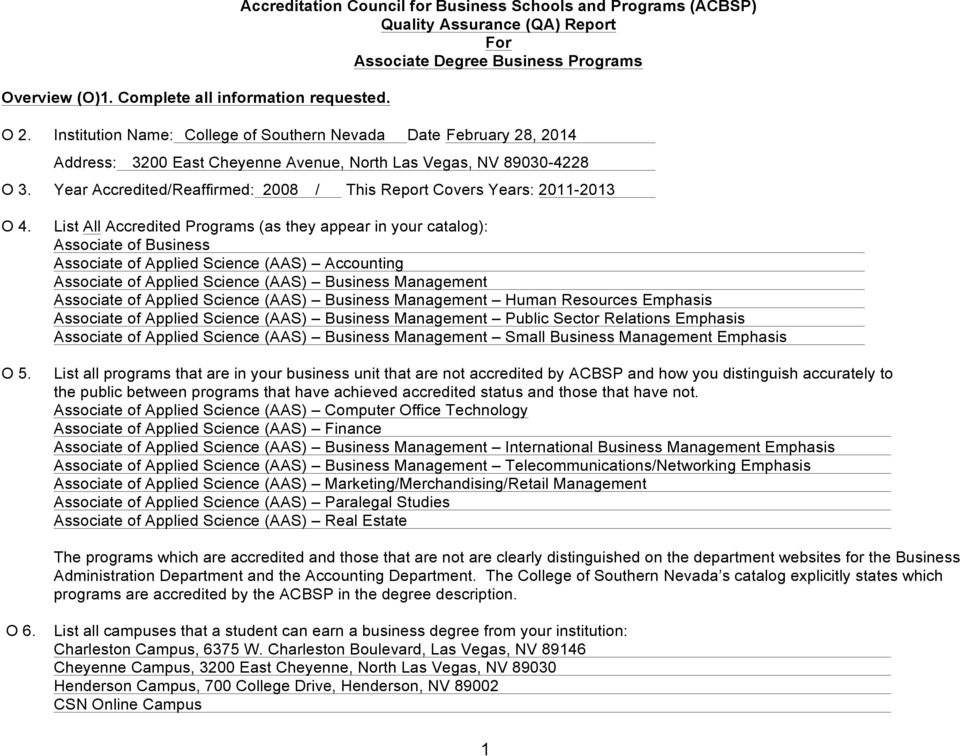
1 Overview (O)1. Complete all information requested. Accreditation Council for Schools and Programs (ACBSP) Quality Assurance (QA) Report For Associate Degree Programs O 2. Institution Name: College of Southern Nevada Date February 28, 2014 Address: 3200 East Cheyenne Avenue, North Las Vegas, NV O 3. Year Accredited/Reaffirmed: 2008 / This Report Covers Years: O 4. O 5. List All Accredited Programs (as they appear in your catalog): Associate of Associate of Applied Science (AAS) Accounting Associate of Applied Science (AAS) Management Associate of Applied Science (AAS) Management Human Resources Emphasis Associate of Applied Science (AAS) Management Public Sector Relations Emphasis Associate of Applied Science (AAS) Management Small Management Emphasis List all programs that are in your business unit that are not accredited by ACBSP and how you distinguish accurately to the public between programs that have achieved accredited status and those that have not. Associate of Applied Science (AAS) Computer Office Technology Associate of Applied Science (AAS) Finance Associate of Applied Science (AAS) Management International Management Emphasis Associate of Applied Science (AAS) Management Telecommunications/Networking Emphasis Associate of Applied Science (AAS) Marketing/Merchandising/Retail Management Associate of Applied Science (AAS) Paralegal Studies Associate of Applied Science (AAS) Real Estate The programs which are accredited and those that are not are clearly distinguished on the department websites for the Administration Department and the Accounting Department. The College of Southern Nevada s catalog explicitly states which programs are accredited by the ACBSP in the degree description. O 6. List all campuses that a student can earn a business degree from your institution: Charleston Campus, 6375 W. Charleston Boulevard, Las Vegas, NV Cheyenne Campus, 3200 East Cheyenne, North Las Vegas, NV Henderson Campus, 700 College Drive, Henderson, NV CSN Online Campus 1
2 O 7. O 8. Person completing report Name: Dr. Marcus J. Johnson, Dr. Clarissa M. Cota, Dr. Robin Nelson Phone: (702) address: [email protected] ACBSP Champion name: Dr. Marcus L. Johnson ACBSP Co-Champion name: Dr. Clarissa M. Cota Conditions or Notes to be Addressed: You do not need to address Opportunity for Improvement (OFI). We respectfully request to have the following notes removed based upon documented improvements following the recommendations made by the Associate Degree Board of Commissioners in your letter to CSN President, Dr. Michael Richards, dated May 15, Remove Note on Standard 4 (Exhibit R) Remove Note on Standard 3 Remove Note on Standard 6 (Exhibit S) Remove Note on Standard 4 (Exhibit R) After review of our 2012 Quality Assurance Report, the Associate Degree Board of Commissioners recommended that the performance measures be rewritten to include measurable outcomes and the outcomes assessment plan needed to have included results of action taken and trend data in graphs for student learning outcomes. The outcomes process needs to have included all accredited programs. As evidenced in the Standard 4 Student Learning Results Table, each of the accredited programs was addressed. All performance measures were reviewed to include measurable outcomes and results of action taken and trend data in graphs have been provided for student learning outcomes. We have addressed these concerns with the following: Comprehensive Exit Exam The Administration Department continued administration of a Comprehensive Exit Exam. Since August 2010, this exam has been administered to all graduates for the following academic years: August 2010 through May 2011, August 2011 through May 2012, and August 2012 through August This exam was administered to graduates from the following programs: Associate of (AB), Associate of Applied Science (AAS) Management, Associate of Science (AAS) Management Human Resources Emphasis, Associate of Applied Science (AAS) Management Public Sector Relations Emphasis, and Associate of Applied Science (AAS) Management Small Management Emphasis. The exam included questions related to core curriculum content in which students would be expected to demonstrate proficiency. The Comprehensive Exit Exam covered business management and accounting principles. Success was based upon performance on the comprehensive exit exam by graduated students from the following programs: Associate of (AB), Associate of Applied Science (AAS) Management, Associate of Science (AAS) Management Human Resources Emphasis, Associate of Applied Science (AAS) Management Public Sector Relations Emphasis, and Associate of Applied Science (AAS) Management Small Management Emphasis. The goal for the AB graduates who took the Comprehensive Exit Exam was that they would score at least a 75% or higher on the business and management specific questions and at least 70% on the accounting specific questions. This goal was exceeded for all reporting periods. The goal for the AAS - Management and all emphases graduates who took the Comprehensive Exit Exam 2

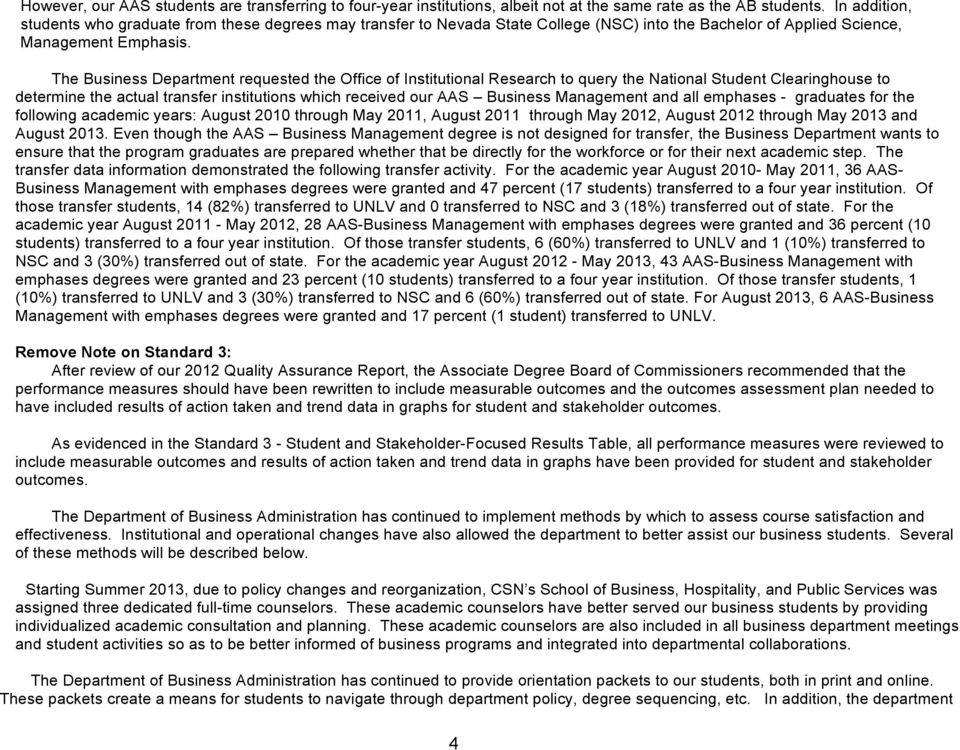
3 was that they would score at least a 75% or higher on the business and management specific questions. This goal was exceeded for all reporting periods with the exception of the graduates (this graduate group did not have any respondents to the Comprehensive Exit Exam) See Standard 4 Student Learning Results Table. The Accounting Department has created two exit exams. The first was administered in Accounting 203, Intermediate Accounting. Students enrolled in this course have already completed Accounting 201, Financial Accounting and Accounting 202, Managerial Accounting. If students choose at this point to transfer to UNLV, the university will administer a placement test to measure what they learned in 201 and 202. If students are successful, they will be approved for enrollment in the Bachelor s Degree program in Accounting. The department felt that we also wanted to measure their knowledge and developed an exam which uses some of the questions in the UNLV practice test which is available online. The test was administered for the first time in Spring, The second comprehensive exit exam was administered as a test in Accounting 204, Intermediate Accounting II. The results from both of these comprehensive exams are described in Standard 4, Student Learning Results. Transfer Data The Office of Institutional Research was asked to query the National Student Clearinghouse to determine which transfer institutions received Associate of graduates for the following academic years: August 2010 through May 2011, August 2011 through May 2012, August 2012 through May 2013 and the students who graduated in August The Administration Department requested transfer data from the CSN Office of Institutional Research for Associate of (AB) majors in order to measure the programmatic outcome of transfer readiness to a four-year college or university. This transfer data information demonstrated the following transfer activity. For the academic year of August 2010 through May 2011, 275 Associate of (AB) degrees were granted and 73 percent (202 students) transferred. Of those transfer students, 78 percent transferred to University of Nevada Las Vegas (UNLV), 5 percent transferred to Nevada State College (NSC), and 12 percent transferred out of state. For the academic year of August 2011 through May 2012, 277 Associate of (AB) degrees were granted and 70 percent (193 students) transferred. Of those transfer students, 80 percent transferred to University of Nevada Las Vegas (UNLV), 5 percent transferred to Nevada State College (NSC), and 4 percent transferred out of state. For the academic year of August 2012 through May 2013, 299 Associate of (AB) degrees were granted and 60 percent (179 students) transferred. Of those transfer students, 84 percent transferred to University of Nevada Las Vegas (UNLV), 5 percent transferred to Nevada State College (NSC), and 3 percent transferred out of state. For the August 2013 graduates, 74 Associate of (AB) degrees were granted and 42 percent (31 students) transferred. Of those transfer students, 81 percent transferred to University of Nevada Las Vegas (UNLV), 10 percent transferred to Nevada State College (NSC), and no students transferred out of state. Transfer data will be requested from Institutional Research on an annual basis to monitor transfer to University of Nevada Las Vegas (UNLV). There has been a consistent trend of close to 80 percent transfer to UNLV. This transfer pattern is particularly important because the CSN AB curriculum is intended to allow for ease of transfer to UNLV into the Bachelor of Science Administration program. The following accredited programs are not designed to transfer to the University of Nevada Las Vegas (UNLV): Associate of Applied Science (AAS) Accounting, Associate of Applied Science (AAS) Management, Associate of Science (AAS) Management Human Resources Emphasis, Associate of Applied Science (AAS) Management Public Sector Relations Emphasis, and Associate of Applied Science (AAS) Management Small Management Emphasis. 3

4 However, our AAS students are transferring to four-year institutions, albeit not at the same rate as the AB students. In addition, students who graduate from these degrees may transfer to Nevada State College (NSC) into the Bachelor of Applied Science, Management Emphasis. The Department requested the Office of Institutional Research to query the National Student Clearinghouse to determine the actual transfer institutions which received our AAS Management and all emphases - graduates for the following academic years: August 2010 through May 2011, August 2011 through May 2012, August 2012 through May 2013 and August Even though the AAS Management degree is not designed for transfer, the Department wants to ensure that the program graduates are prepared whether that be directly for the workforce or for their next academic step. The transfer data information demonstrated the following transfer activity. For the academic year August May 2011, 36 AAS- Management with emphases degrees were granted and 47 percent (17 students) transferred to a four year institution. Of those transfer students, 14 (82%) transferred to UNLV and 0 transferred to NSC and 3 (18%) transferred out of state. For the academic year August May 2012, 28 AAS- Management with emphases degrees were granted and 36 percent (10 students) transferred to a four year institution. Of those transfer students, 6 (60%) transferred to UNLV and 1 (10%) transferred to NSC and 3 (30%) transferred out of state. For the academic year August May 2013, 43 AAS- Management with emphases degrees were granted and 23 percent (10 students) transferred to a four year institution. Of those transfer students, 1 (10%) transferred to UNLV and 3 (30%) transferred to NSC and 6 (60%) transferred out of state. For August 2013, 6 AAS- Management with emphases degrees were granted and 17 percent (1 student) transferred to UNLV. Remove Note on Standard 3: After review of our 2012 Quality Assurance Report, the Associate Degree Board of Commissioners recommended that the performance measures should have been rewritten to include measurable outcomes and the outcomes assessment plan needed to have included results of action taken and trend data in graphs for student and stakeholder outcomes. As evidenced in the Standard 3 - Student and Stakeholder-Focused Results Table, all performance measures were reviewed to include measurable outcomes and results of action taken and trend data in graphs have been provided for student and stakeholder outcomes. The Department of Administration has continued to implement methods by which to assess course satisfaction and effectiveness. Institutional and operational changes have also allowed the department to better assist our business students. Several of these methods will be described below. Starting Summer 2013, due to policy changes and reorganization, CSN s School of, Hospitality, and Public Services was assigned three dedicated full-time counselors. These academic counselors have better served our business students by providing individualized academic consultation and planning. These academic counselors are also included in all business department meetings and student activities so as to be better informed of business programs and integrated into departmental collaborations. The Department of Administration has continued to provide orientation packets to our students, both in print and online. These packets create a means for students to navigate through department policy, degree sequencing, etc. In addition, the department 4
5 provides, on a semester basis, orientation sessions. These sessions are held on each of our three main campuses. These orientation sessions are offered and staffed by full-time faculty and counselors. Additionally, the Department of Administration has continued to offer the Accelerated Associate of Degree program. This program, now in its fourth year, provides students with accelerated, intensive course offerings, dedicated student programming, specialized services to the selected cohort of students every spring semester. This program has allowed the department to develop innovative course development and delivery options which has provided more options for business students in both course offerings and degree completion. Administration Department continues efforts regarding stakeholders include an employer survey, which assess employer opinions and satisfaction level of CSN students and graduates. In addition, an active department Advisory Board - whose purpose is to provide guidance, critique and recommendations in the mind frame of continuous improvement of the program and ultimately, its graduates - has continued to meet. The Advisory Board consists of volunteer community stakeholders who desire to be actively engaged in the mission and focus of the department faculty and its students. It is the Accounting department and institutional policy to administer student evaluations every semester. These evaluations are reviewed. Later in the report are the results of the evaluations from ACC 201 and ACC 202. We targeted these two courses because they are our beginning courses where students must learn the basics of accounting. The department chair, lead faculty and full-time faculty meet regularly with students to assist them with degree completion efforts as well as what courses to take and the transferability of the courses. Three counselors have been assigned to the school and meet regularly with the departments regarding program changes. The department has established an active advisory board whose purpose is to provide a liaison with the business community to promote awareness of our program and ensure that needs are met. The advisory board is made up of community business leaders, small business owners, faculty and student representatives, an IRS representative, a representative from IMA (International Management Association) and representatives from casinos and hotels. Minutes of each meeting are reviewed and discussed by department faculty and administration. Student Focused Results Exit Survey A survey to gauge program satisfaction and transfer intent of Associate of (AB) graduates has continued to be administered and analyzed. This Exit Survey was designed and implemented to monitor the performance and effectiveness of graduates. Similarly, this Exit Survey was extended to be administered and analyzed to gauge program satisfaction for graduates of these degree programs: Associate of Applied Science (AAS) Management, Associate of Science (AAS) Management Human Resources Emphasis, Associate of Applied Science (AAS) Management Public Sector Relations Emphasis, and Associate of Applied Science (AAS) Management Small Management Emphasis. The results of these Exit Surveys were shared with the Department of Administration faculty and Advisory Board. See Standard 3 Student and Stakeholder - Focused Results Table. Faculty attributed high satisfaction rates from the Exit Surveys to several factors, including three mentioned here. These include careful selection of course textbooks for each business course and enhanced professional development opportunities for both full and part-time faculty members. The faculty decided to continue the use of department textbook selection committees and support 5

6 commitment to professional development, specifically business faculty training seminars held on campus. Additionally, the department has improved course sequencing and block scheduling of business courses. Course Satisfaction On a semester basis, the student course evaluations have continued to be administered and completed by students in the 101 and Management 201 courses. These student course evaluation results continued to be analyzed and discussed with business administration department faculty members and Advisory Board members. Program Review In order to gauge program quality and to assist in program review, data has continued to be obtained from CSN s Office of Institutional Research. Working closely with this office, several reports and trend data patterns continue to be detailed and discussed to measure the overall program effectiveness and student success. For example, the Office of Institutional Research has generated and will continue to generate, on a yearly basis, a report of the actual transfer rate of our Associate of (AB) graduates to a four-year institution. See Standard 4 Student Learning Results Table. This provides an interesting comparison between the Standard 3 Student and Stakeholder - Focused Results Table which measures the transfer intent of the AB and AAS- Management graduates and the actual transfer of our AB graduates found in Standard 4 Student Learning Results Table. The actual transfer summary of the AAS- Management graduates can be found in the narrative section of Standard 4 Transfer Data noted above. Additional measures to meet student needs have been taken. These included having three dedicated Academic Counselors to the School of, Hospitality and Public Services. The three counselors have regular office hours at all three main campuses to help guide and advise students in our business programs. The Department Orientation Packets continue to be available both in print and on the department website ( This serves as a roadmap to our business programs and services business students receive. Surveys were distributed Fall, 2011, 2012, 2013 to all accounting students currently enrolled to gauge program satisfaction. The survey results were compiled and appear later in this document. We are also administering two exit exams which were previously mentioned. The Office of Institutional Research also provides us with several reports which show trends in enrollment and successful completion each semester. These survey results and reports are shared and discussed with department faculty. Each semester student evaluations are distributed and collected. Results were analyzed carefully for Fall, 2011, 2012, 2013 for ACC 201 and 202. The results are outlined later in the report. Stakeholder Focused Results Stakeholder needs continue to be addressed and supported by enhancing the following activities and programs. The employer survey, which was developed and deployed to gather opinions and satisfaction levels of community stakeholders, was conducted again and is an integral part of the department of business and its programs. In addition, The Department of Advisory Board continues to meet, collaborate, and synchronize program offerings based on expressed demand. 6

7 Ongoing efforts with the Advisory Board has resulted in greater consideration of industry relevance of all accredited business programs. For example, the Advisory Board was consulted and provided recommendations for the curriculum changes to take effect in the college catalog. Also, we have continued to assess the goals of the Advisory Board. A survey was distributed to the Board to help identify the goals of the Board. See attached Department Advisory Board Guidelines, roster and minutes. Other Department of Administration stakeholder activities include, but are not limited to, the following examples. The Western Alliance of Food Chains (WAFC) program was continued, which offers business courses on-site at two grocery store locations. In addition, in Spring 2014, the Elite Series was started, which features active business and community leaders via live business semesters throughout the academic year. Past seminar speakers have included corporate CEOs and small business owners. Other industry partnerships were continued. For example, the Incubator Program was created and is in its fifth year of helping business students with innovative business ideas and plans. In addition, a newly established Tuesday Blend event, in which CSN s incubator students are participants, has allowed students to showcase their products and services to the Las Vegas business community. The CSN Foundation, through their Board of Trustees, has provided start-up funding for business students in this incubator program. To date, over 25 business entities have been created and are operational. Accounting Department stakeholder needs were the focus of the following activities: 1. An employer survey is being developed. We are waiting for information from our s to department alumni for We plan on continuing this activity after graduation when we can secure the addresses of our alumni. 2. A new system at CSN allows us, when we print our class roster, to receive the addresses of our students as well as their program goals or major. This will provide us with a way to contact students, receive employer information with their permission, and conduct employer surveys. 3. The department advisory board meets once a year but we communicate with them more often. We share with them program development and ask for their opinion. Attached you will find a list of the advisory board members and the minutes of the last meeting. 4. The department wrote a new brochure for the accounting degree program. The brochure was distributed at the college fair, to all our local high schools, to our counselors and to the community. High school students complete cards indicating their desired major. These cards come to the department and we send degree sheets and brochures to the students. The Clark High School Academy of Finance will be touring the college this spring. We will be redoing the brochure as there are minor changes in the degree program. 5. The department provides free tax preparation each spring for all faculty, students and the community. The program is certified by the IRS and all software is provided by the IRS at no charge to the college. There is definitely a need as proven by the number of tax returns that are prepared for the community as well as employees of the college. 7

8 Remove Note on Standard 6 (Exhibit S): After review of our 2012 Quality Assurance Report, the Associate Degree Board of Commissioners recommended that the performance measures should have been rewritten to include measureable outcomes and the outcomes assessment plan needed to have included results of action taken and trend data in graphs for organizational effectiveness. As evidenced in the Table 6.1 Standard 6 - Organizational Performance Results all performance measures were reviewed to include measurable outcomes and results of action taken and trend data in graphs have been provided for organizational effectiveness. Institutional Research Data The Department of Administration as well as the Accounting Department faculty and staff have established desired data mandates from the CSN Office of Institutional Research, which has supplied requested data to the best of its ability. Examples of data this department generates include enrollment trends, graduation rates, student profiles, and an exit assessment survey instrument. Each of these data forms will assist the Administration and Accounting Departments in managing and focusing in on student trends and information related to the success of student performance, which is an integral part of information management. See Standard 4 Student Learning Results table and "Table 6.1 Standard 6 - Organizational Performance Results." CSN s Office of Institutional Research has increased their staffing levels to better meet the institutional data demands. Additionally, as also noted below, the Office of Institutional Research has updated the IR library and additional data is available on the CSN website ( Program Review The Department of Administration has continued to engage in extensive program review. The data garnered from CSN s Office of Institution Research has continued to be used in this program review to make improvements to our existing curriculum. This review process has resulted in streamlining the sequence of courses offered and altered both the scheduling and number of courses offered. This program review has been done for the following programs: Associate of (AB), Associate of Applied Science (AAS) Management, Associate of Science (AAS) Management Human Resources Emphasis, Associate of Applied Science (AAS) Management Public Sector Relations Emphasis, and Associate of Applied Science (AAS) Management Small Management Emphasis. As a result of this continued program review, the following business management emphasis programs will be terminated and be effective as of the CSN catalog: Associate of Science (AAS) Management Human Resources Emphasis, Associate of Applied Science (AAS) Management Public Sector Relations Emphasis, and Associate of Applied Science (AAS) Management Small Management Emphasis. Based on program review analysis, it was determined that the program curriculum from the terminated programs could be consolidated into the Associate of Applied Science (AAS) Management and would improve overall degree completion. The Accounting Department recently completed a thorough and extensive program review. The department was selected as one of the few departments in the college to participate in a new college wide process for program review. We are in the process of placing more emphasis on basic accounting principles in our courses. Students seem to be weak in the basics of the accounting process such as journalizing, posting, debit and credit, and financial statements. This is outlined further under Standard 4. 8

9 O 9. The business unit must routinely provide reliable information to the public on their performance, including student achievement such as assessment results. Data Availability Results of all measures of student success are accessible via the CSN website at Specifically, both Office of Institutional Research ( and the Department of Administration ( house reports that can be readily accessed by students, parents, faculty, staff, administration, and all interested parties. The links to these reports are easily navigated and the information can be easily understood with the explanations posted on the websites. For example, the Office of Institutional Research s website ( houses extensive student data reports showing various programs, graduation rates, and student success rates. The Department of Administration s website ( holds, amongst other data, the ACBSP Quality Assurance Report, the Department of Administration Program Review, and the Department of Administration Assessment Plans and Reports. The Department of Accounting s website ( includes links which allow the community to have access to the ACBSP Quality Assurance Report and our departmental program review. Additionally, all department and institutional research reports are shared with the business administration department advisory board and other stakeholder focus groups. For example, the Department of Administration Orientation Packet materials were reviewed by the advisory board. All printed materials are available in the Dean's Office at the Cheyenne Campus, the Administration Department office at West Charleston Campus, Building C, Room C250 and the Accounting Department Office at the Henderson Campus. Also the materials are available at CSN s Student Counseling Offices on each CSN campus. Standard #1 Leadership Organization a. List any organizational or administrative personnel changes within the business unit since your last report. In July 15, 2013 the School of, Hospitality & Public Services hired Dr. Marcus L. Johnson as the Dean to replaced Dr. Clarissa M. Cota, who was the Interim Dean until July 14, In August 2011, the Department of Accounting hired two highly qualified full-time instructors - Anthony Fortner, MBA, and Robert O Toole. MBA. In August 2012, the Department hired one highly qualified full-time instructor Dana Jones, MBA. In August 2013, the Department of Administration hired two highly qualified full-time instructors Maria Schellhase, DBA & MBA, and OJ Sydor, MBA. 9

10 b. List all new sites where students can earn an accredited business degree (international campus, off-campus or on campus, online) that have been added since your last report. No new sites have been added. Standard #2 Strategic Planning (this standard not typically addressed in the QA report) This is used as a place holder to allow all the other standards to be addressed in the QA report and keep the numbering system consistent with self-studies and QA reports. Standard 3 - Student and Stakeholder-Focused Results Performance Measure 90% of Advisory Board members are supportive of department functions, programs and activities. What is your measurement instrument or process? Accounting Department Meeting Minutes documentation Current Results Standard exceeded Analysis of Results Analysis of Results Continue to define the mission of the board. The Accounting Advisory Board were informed and approved usage of accounting software Peachtree and Quickbooks. Jerry Lockhart also did a presentation on our tax preparation program. The board fully supported our program and our relationship with the IRS. Adopted Advisory Board Guidelines. Continued focus on increasing number of board members and subsequent participation. Department will continue its collaboration with Board to further enhance course and program offerings. Action Taken or Improvement Made The board membership will be updated and revised to have fresh ideas and perspective. We will continue to provide board members with program development information. Graphs or Tables of Resulting Trends 100% 95% 90% 85% 80% 75% Accounting Department Advisory Board 80% 85% 90% Level of Satisfacton 10
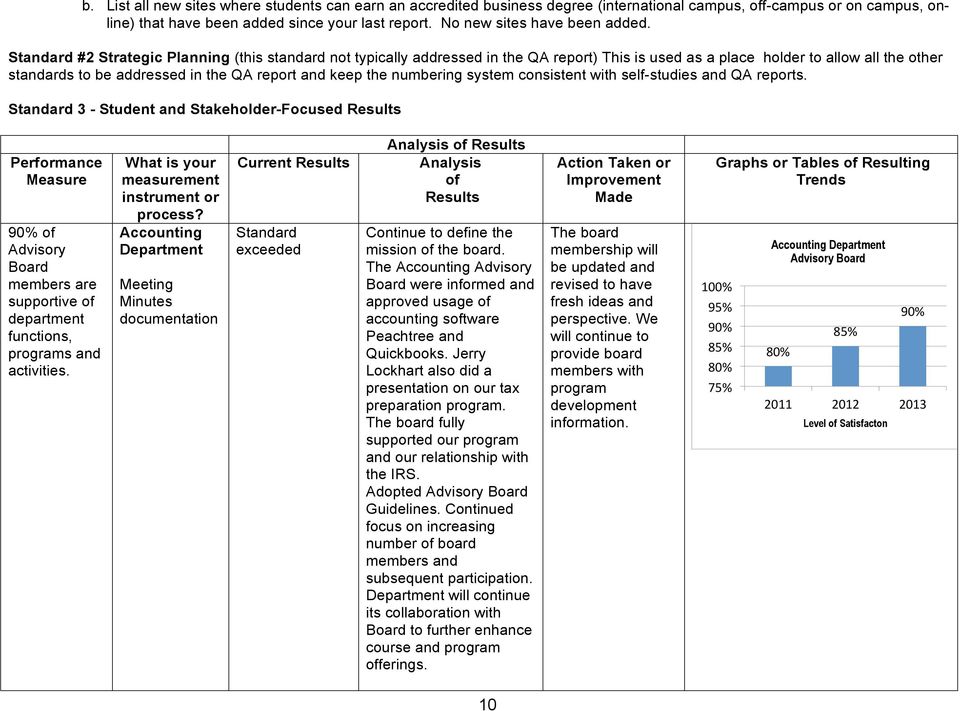
11 Department Active Advisory Board meetings have been regularly held. Meeting minutes and attendance records reflect board member support and participation. Standard has been exceeded and productive Advisory Board meetings have been held. The Advisory Board continues to define their mission and identify goals. A Advisory Board survey was developed and administered to all Advisory Board members, wherein Advisory Board members indicated suggestions for improvement of the CSN School and identified goals upon which the department should focus. The Department continued its collaboration with the Advisory Board to further enhance program and course offerings. Through the collaborative process between the Advisory Board and the Department, the curriculum changes to go into effect in have been acknowledged and supported. The Advisory Board has been able to identify its goals and objectives based on the Advisory Board survey and the Advisory Board guidelines. See Attachment. # of Participants Department - Advisory Board /22/10 12/10/10 5/13/11 12/2/11 11/15/13 2/7/14 0 Meeting Dates

12 At least 75% of graduates from the following programs will express satisfaction with their overall academic program: Associate of (AB), Associate of Applied Science (AAS) Management, Associate of Science (AAS) Management Human Resources Emphasis, Associate of Applied Science (AAS) Management Public Sector Relations Emphasis, and Associate of Applied Graduates of the following programs were surveyed and asked to rate their business education at CSN: Associate of (AB), Associate of Applied Science (AAS) Management, Associate of Science (AAS) Management Human Resources Emphasis, Associate of Applied Science (AAS) Management Public Sector Relations Emphasis, and Associate of Applied Science (AAS) Management Small Management Emphasis. Goal Exceeded: For the Associate of (AB) graduates, 81.25% of AB graduate respondents rated their business education at CSN as good or better. For the Associate of (AB) graduates, 79.17% of AB graduate respondents rated their business education at CSN as good or better. For the August, 2013, Associate of (AB) graduates, 75% of AB graduate respondents rated their business education at CSN as good or better. For the Associate of Applied Science Analysis of instructor and overall program effectiveness will be monitored on a yearly basis. Evaluate student opinions regarding overall strength of program and instruction. Survey results were shared and discussed with full-time faculty. Faculty did express concern that we had been unable to garner any respondents from the graduate class. Four separate attempts to communicate with this group were made by the department and the s were verified with the Office of Institutional Research. The Department will work closer with CSN s Institutional Research Department to increase student graduate survey participation for future graduate surveys. % Satisfied Department - Graduate Program Satisfaction Table 120.0% 100.0% 80.0% 60.0% 40.0% 20.0% 0.0% AB 81.3% 87.5% % 0.0% Year 75.0% 100.0% August 2013 AAS w/ Emphasis 12

13 Science (AAS) Management Small Management Emphasis. (AAS) Management all emphases graduates, 87.5% of AAS graduate respondents rated their business education at CSN as good or better. 83% of graduates in 2009 were satisfied with the overall academic program. 85% of graduates from 2010 were satisfied. For the Associate of Applied Science (AAS) Management all emphases graduates, the survey was administered but received zero responses. For the August, 2013, Associate of Applied Science (AAS) 13

14 Management all emphases graduates, 100% of AAS graduate respondents rated their business education at CSN. 14

15 Graduates of the AAS Accounting were surveyed 83% of graduates in 2009 were satisfied with the overall academic program. 85% of graduates from 2010 were satisfied Although there is a high rate of satisfaction, we will continue to distribute the survey each year. A new student information system allows us to receive an address for each student and to see their career or degree goals. It is at times difficult to get alumni to respond via mail or . Future contacts will become easier as we are provided with more up to date information Graduate Satisfaction - Number of Respondents

16 Student course satisfaction from BUS 101 and MGT 201 will be at or above 80% on the Student Evaluation of Instruction Form. Student course evaluations are administered every term. For Fall 2011, Spring 2012, Fall 2012, Spring 2013 and Fall 2013 all BUS 101 and MGT 201 student course evaluations were tabulated for overall course satisfaction. Goal Exceeded: For Fall 2011, 81.50% of BUS 101 students and 91.70% of MGT 201 students for a combined 84.90% of students agreed or strongly agreed that they were satisfied with course instruction. For Spring 2012, 81.40% of BUS 101 students and 87,50% of MGT 201 students for a combined 83.70% of students agreed or strongly agreed that they were satisfied with course instruction. High levels of student satisfaction goals were met. The results were consistently above 80% overall course satisfaction by students taking BUS 101 and MGT 201 sections. Analysis of instructor and overall course effectiveness will be monitored on a yearly basis. Evaluate student opinions regarding strength of course content and instruction. % Satisfied Department - Course Satisfaction Table 94.0% 92.0% 90.0% 88.0% 86.0% 84.0% 82.0% 80.0% 78.0% 76.0% 74.0% 72.0% 91.7% 81.5% 84.9% 81.4% 87.5% 83.7% 83.9% 79.4% 82.4% 83.9% 87.3% 85.2% 87.2% 80.5% 84.7% Fall 2011 Spring 2012 Fall 2012 Spring 2013 Year Fall 2013 BUS 101 MGT 201 Combined For Fall 2012, 83.90% of BUS 101 students and 79.40% of MGT 201 students for a combined 82.40% of students agreed 16

17 or strongly agreed that they were satisfied with course instruction. For Spring 2013, 83.90% of BUS 101 students and 87.30% of MGT 201 students for a combined 85.20% of students agreed or strongly agreed that they were satisfied with course instruction. For Fall 2013, 87.20% of BUS 101 students and 80.50% of MGT 201 students for a combined 84.70% of students agreed or strongly agreed that they were satisfied with course instruction. 17

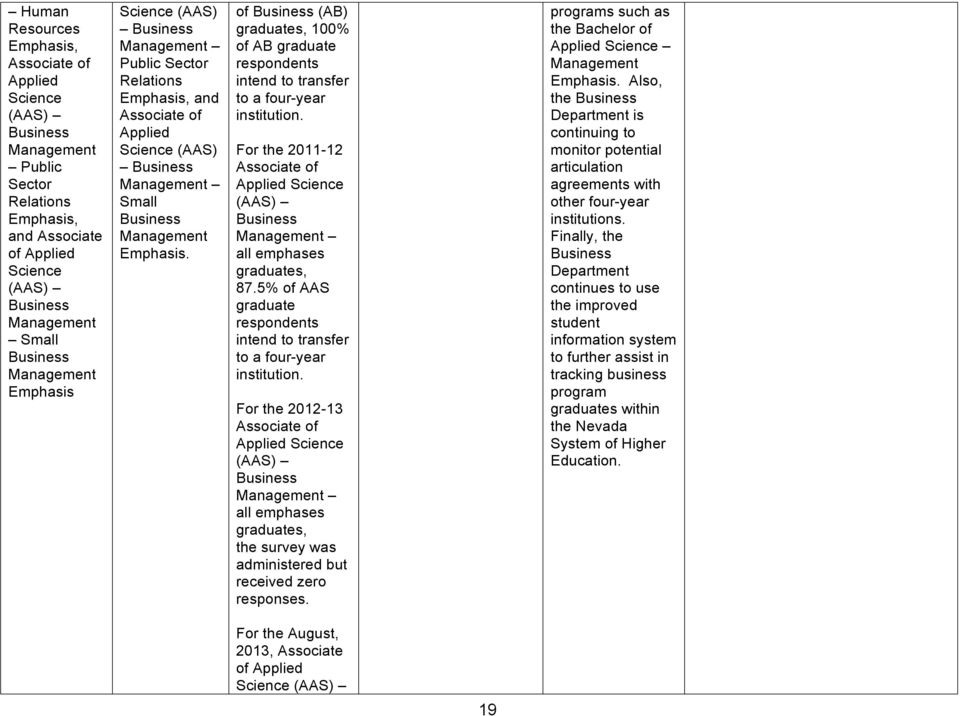
18 For fall 2012, ACC 201 and 202 course evaluations were tabulated 92% of ACC 201 students and 93% of ACC 202 students agreed or strongly agreed they were satisfied with course instruction. A higher level of satisfaction occurred in daytime classes which are primarily taught by full time faculty. Evaluations will continue to be monitored to determine the different satisfaction levels between day and evening classes. 100% 95% 90% 85% 92% Course Satisfaction ACC 201 & % 80% 75% Level of Satisfacton At least 70% of AB graduates and 50% of AAS Management graduates in the following programs intend to transfer to a four-year institution: Associate of Applied Science (AAS) Management, Associate of Science (AAS) Management Graduate surveys for AB and AAS Management in the following programs are administered every Spring term: Associate of Applied Science (AAS) Management, Associate of Science (AAS) Management Human Resources Emphasis, Associate of Applied Goal Exceeded: For the Associate of (AB) graduates, 100% of AB graduate respondents intend to transfer to a four-year institution. For the Associate of (AB) graduates, 83.33% of AB graduate respondents intend to transfer to a four-year institution. For the August, 2013, Associate The overwhelming majority of CSN business graduates, both from the AB degree and AAS all emphases programs, do intend to transfer to a four-year institution, specifically to The University of Nevada Las Vegas. 18 The Department of has paid particular attention to the AB degree articulation agreement currently in place with The University of Nevada Las Vegas. Additionally, the Department has explored transfer possibilities for AAS Management all emphases - graduates with Nevada State College, into Nevada State College degree % Intending to Transfer Department - Intent to Transfer to 4yr. Institution Table 120% 100% 80% 60% 40% 20% 0% 100% 87.50% 83.33% 0% 100% 100% August 2013 AB Year AAS w/ Emphases

19 Human Resources Emphasis, Associate of Applied Science (AAS) Management Public Sector Relations Emphasis, and Associate of Applied Science (AAS) Management Small Management Emphasis Science (AAS) Management Public Sector Relations Emphasis, and Associate of Applied Science (AAS) Management Small Management Emphasis. of (AB) graduates, 100% of AB graduate respondents intend to transfer to a four-year institution. For the Associate of Applied Science (AAS) Management all emphases graduates, 87.5% of AAS graduate respondents intend to transfer to a four-year institution. For the Associate of Applied Science (AAS) Management all emphases graduates, the survey was administered but received zero responses. programs such as the Bachelor of Applied Science Management Emphasis. Also, the Department is continuing to monitor potential articulation agreements with other four-year institutions. Finally, the Department continues to use the improved student information system to further assist in tracking business program graduates within the Nevada System of Higher Education. For the August, 2013, Associate of Applied Science (AAS) 19
20 At least 70% of respondents will rate the level of core competency and preparedness of the CSN Program as above average on the Employer Survey. An employer survey was administered to CSN s Advisory on repeated occasions during advisory board meetings. Management all emphases graduates, 100% of AAS graduate respondents intend to transfer to a four-year institution. Goal not met: Although the survey was administered on repeated occasions to Advisory Board members, the board members were unable to identify recent business hires from the CSN student or graduate population. The current difficulty of measuring this performance standard lies in the fact that CSN does not have a current reporting system in which current and relevant student and graduate employer data is garnered. Therefore, in order to directly survey the Department graduate employers, it requires graduates to self-report and provide employer information and contact information. In the most recent Exit Survey, administered to AB and AAS Management all emphases graduates, the Department collected ten selfreported contact addresses for graduate employers. The Department plans to electronically administer an employer survey to the most recent employer contacts, which were gleaned from ten graduates who self-reported employer contact information. The Department has recently developed a business internship program. This program will be going into effect in an upcoming academic year. The internship program will help generate employer contact information and feedback. # of Responses 100% 80% 60% 40% 20% Department - Employer Survey 0% 0% 0% 0% 5/13/ /15/2013 2/7/2014 Dates Administered to Advisory Board Advisory Board Members 20

21 Standard #4 Measurement and Analysis of Student Learning and Performance a. Program Outcomes Associate of Demonstrate knowledge and skills required for employment in business related careers. Demonstrate an understanding of business operations. Demonstrate understanding of the theory and practice of business. Associate of Applied Science (AAS) Accounting Demonstrate knowledge and skills required for employment in the accounting field Demonstrate knowledge of the principles, procedures and theories of organizing and maintaining business and financial transactions Demonstrate proficiency with the computerized accounting systems and software to process financial information Associate of Applied Science (AAS) Management Explain current general business and management theories. Apply general business and management theories to real-life professional situations. Demonstrate proficiency for entry-level business or management positions within profit and nonprofit organizations. Demonstrate leadership using the latest techniques in coaching and participatory styles of management. Associate of Applied Science (AAS) Management Human Resources Emphasis Explain current general business and human resources management theories. Apply general business and human resources management theories to real-life professional situations. Demonstrate proficiency for entry-level human resource management positions with profit and nonprofit organizations. Demonstrate the latest techniques in recruitment, selection, training, and other human resource practices. Associate of Applied Science (AAS) Management Public Sector Relations Emphasis Explain current general business and management theories and how they apply to public administration functions. Apply general business and management strategies to real-life professional situations related to public administration. Demonstrate proficiency for entry-level management positions within public sector organizations. Demonstrate the latest techniques and trends in public sector business and management practices. Associate of Applied Science (AAS) Management Small Management Emphasis Explain current general business and management theories and how they apply to small business settings. Apply general business and management strategies to real-life in small business settings. Explain the purpose of a business proposal used to initiate startup efforts for a prospective small business. Demonstrate the latest techniques and trends in small business management practices. 21
22 Program Outcome Changes to take effect : The Department of Administration completed an extensive two year program and curriculum review process. After months of consultation and collaboration with various stakeholder and student groups, including faculty, administration, advisory board and focus groups, new program outcomes were developed and will be implemented for the Associate of and the consolidated AAS - Management degree. The program outcome changes will be reported in the next Quality Assurance report once the changes have been implemented. b. Performance Results 22
23 Standard 4 Student Learning Results Performance Measure (Competency) 1. Students will be able to demonstrate an introductory level of competency in the fields of: accounting business principles management 2. Students will be able to illustrate how management uses the accounting system in operating the business enterprise. AB graduates who take the Comprehensive Exit Exam should score at least a 75% or higher on the business and management specific questions and at least 70% on the accounting specific questions. Description of Measurement Instrument Comprehensive Exit Exam A comprehensive exit exam was disseminated to all Associate of (AB) graduates. This comprehensive exit exam was administered to all AB graduates from the following time periods: , , August, The exam covered business, management and accounting principles. Current Results Goal Exceeded: For the Associate of (AB) graduates, the average score for business- and managementspecific questions for AB graduate respondents was 88.86%. For the Associate of (AB) graduates, the average score for business- and managementspecific questions for AB graduate respondents was 84%. For the August, 2013, Associate of (AB) graduates, the average score for business- and management- ASSOCIATE OF BUSINESS Analysis of Results Analysis of Results The results of the Comprehensive Exit Exam. Although the averages were above 70 percent, some business and management content areas were detected in which some targeted areas of instruction are needed. 23 Action Taken or Improvement Made The Department worked in collaboration with CSN s Office of Institutional Research to gather accurate graduate data. This allowed the Department to administer the Comprehensive Exit Exam and Exit Survey. Average Exam Scores Insert Graph or Tables of Resulting Trends AB Comprehensive Exit Exam Results Table 100.0% 90.0% 80.0% 70.0% 60.0% 50.0% 40.0% 30.0% 20.0% 10.0% 0.0% 88.9% 72.8% BUS/MGT 84.0% 85.0% Year ACC 75.6% 85.0%
24 PROGRAMMATIC OUTCOME 3. Successful program graduates will be prepared to pursue further specialized study in business related major areas at a four-year college or university. specific questions for AB graduate respondents was 75.6%. For the Associate of (AB) graduates, the average score for accountingspecific questions for AB graduate respondents was 72.75%. For the Associate of (AB) graduates, the average score for accountingspecific questions for AB graduate respondents was 85%. For the August, 2013, Associate of (AB) graduates, the average score for accountingspecific questions for AB graduate respondents was 85%. 24
25 At least 60% of the AB graduates should transfer to four-year institutions. Transfer Data The Office of Institutional Research queried the National Student Clearinghouse Goal was exceeded : 275 AB graduates 73% (202 graduates) transferred to four-year institutions : 277 AB graduates 70% (193 graduates) transferred to four-year institutions : 299 AB graduates 60% (179 graduates) transferred to four-year institutions. August 2013: 74 AB graduates 43% (31 graduates) transferred to four-year institutions. In collaboration with Institutional Research, the Transfer Data was further analyzed. Specifically, when looking at the transfer rate for the AB graduates at 73% in comparison to the August 2013 transfer rate at 43% was to be expected. This was anticipated because the AB graduates have had three years to get themselves to a four-year institution. In fact, some have graduated. Therefore, three years from now, we would anticipate the August 2013 AB graduates to be closer to a 70% transfer rate. We also tracked the where the AB graduates were transferring to. Year over year, close to 80% of the transfer AB graduates attend the University of Nevada Las Vegas (UNLV). Approximately, 5% of the transfer AB graduates attend Nevada State College (NSC). Very few AB 25 The transfer data was reviewed by faculty, administration and the Advisory Board. Transfer data will be requested from Institutional Research on an annual basis to especially monitor transfer to UNLV. Since there has been a consistent trend of close to 80% transfer to UNLV. The transfer pattern is particularly important because the CSN curriculum is intended to allow for ease of transfer to UNLV into the BSBA. Specifically, when going through a curriculum Percent of AB Graduate Transfers 80% 70% 60% 50% 40% 30% 20% 10% 0% Department - AB Transfer Data 73% 70% 60% AB Graduate Reporting Period AB Graduate Transfer 43%
26 graduates transfer out of state. review for the AB degree, we paid close attention to the UNLV requirements and made sure that the AB articulation agreement between CSN and UNLV would stay intact. 26
27 Standard 4 Student Learning Results Performance Measure (Competency) Students will score a minimum of 70% or higher on a comprehensive exam administered in ACC 203. Students will score a minimum of 70% or higher on a comprehensive exit exam. Description of Measurement Instrument The first assessment exam was administered in ACC 203. UNLV tests students who transfer after completing ACC 201 and 202 at CSN or any other institution. Students must pass their test to be admitted to the Bachelor s Degree program in Accounting. The first comprehensive exit exam was administered in ACC 204 as a test. The exam was developed by department faculty. Current Results The test was administered for the first time spring, The average score was 67%. This comprehensive exam was distributed to online students. The exam was graded on a pass/fail basis. Eleven (11) students passed and fourteen (14) did not. AAS - ACCOUNTING Analysis of Results Analysis of Results We plan to change our emphasis in ACC 201. More time will be spent on basic accounting fundamentals such as debit/credit, journalizing, posting, trial balance and statement. Students seem to have forgotten the basics. Syllabus for ACC 201 will be revised. Test administered first week of class in ACC 203. The results are disappointing. We plan to prepare a template for the exam. The faculty felt part of the problem was the way the test was presented. The students had trouble figuring out what was wanted as it was not in a classroom 27 Action Taken or Improvement Made We are placing more emphasis on the accounting basics in our beginning classes. We have revised the syllabus to reflect this change. Because of the changes in ACC 201 our results have improved. We are extremely encouraged by this development. Insert Graphs or Tables of Resulting Trends 80% 70% 60% 50% 40% 30% 20% 10% 0% 15% 10% 5% 0% 67% Spring % Accounting Department Comprehensive Exam Results 60% 60% Fall 2011 Spring % 62% Fall 2012 Spring 2013 Comprehensive Exam - ACC Students Who Passed 73% Fall 2013
28 with an instructor. Next year s exam needs to include clearer instructions. We then decided to administer the test in ACC 203 in conjunction with the transfer policy at UNLV. It also gives us a chance to adjust the curriculum in ACC 204 when necessary. 28
29 AAS BUSINESS MANAGEMENT AAS BUSINESS MANAGEMENT HUMAN RESOURCES EMPHASIS AAS BUSINESS MANAGEMENT PUBLIC SECTOR RELATIONS EMPHASIS AAS BUSINESS MANAGEMENT SMALL BUSINESS MANAGEMENT EMPHASIS Standard 4 Student Learning Results Performance Measure (Competency) These performance measures apply to the following programs: Associate of Applied Science (AAS) Management, Associate of Science (AAS) Management Human Resources Emphasis, Associate of Applied Science (AAS) Management Public Sector Relations Emphasis, and Associate of Applied Description of Measurement Instrument Comprehensive Exit Exam A comprehensive exit exam was disseminated to all Associate of Applied Science (AAS)- Management and all emphases graduates. The exam covered business, management and accounting principles. Current Results Goal Exceeded: For the Associate of Applied Science (AAS) all emphases - graduates, the average score for businessand managementspecific questions for AAS - all emphases - graduate respondents was 84.5%. For the Associate of Applied Science (AAS) all emphases - graduates, Analysis of Results Analysis of Results The results of the Comprehensive Exit Exam and Exit Survey will be included in the ACBSP Quality Assurance Report due February The results of these measurement instruments will be shared with the Department faculty and Advisory Board members. Although the averages were above 75%, some business and management 29 Action Taken or Improvement Made The Department worked in collaboration with CSN s Office of Institutional Research to gather accurate graduate data. This allowed the Department to administer the Comprehensive Exit Exam and Exit Survey. Faculty discussed how to improve the response rate for the Comprehensive Exit Exam and Exit Survey. Suggestions included making the exam and survey a requirement prior to graduates receiving their diplomas and disseminating the exit exam and survey to graduating students while they are still enrolled in their last semester. Insert Graphs or Tables of Resulting Trends Average Exam Scores AAS - Management w/ Emphases Comprehensive Exit Exam Results Table 90.0% 80.0% 70.0% 60.0% 50.0% 40.0% 30.0% 20.0% 10.0% 0.0% 84.5% 0.0% 80.0% August 2013 Year
30 Science (AAS) Management Small Management Emphasis. 1. Students will be able to demonstrate knowledge of current business and management theories as they apply to real-life professional situations. 2. Students will be able apply managerial and motivational leadership theories to practical business settings. AAS - Management and all emphasesgraduates who take the Comprehensive Exit Exam should score at the average score for businessand managementspecific questions for AAS - all emphases the survey was administered but received no responses. For the August 2013, Associate of Applied Science (AAS) all emphases - graduates, the average score for businessand managementspecific questions for AAS - all emphases - graduate respondents was 80%. content areas were detected in which some targeted areas of instruction are needed. The business faculty expressed concern that we were unable to garner any responses from the graduate group. Four separate attempts were utilized to communicate with this graduating group and the student s were verified with the Office of Institutional Research. 30
31 least a 75% or higher on the business and management specific questions. 3. Demonstrate proficiency for entry-level business or management positions within profit and nonprofit organizations. At least 70% of respondents will rate the level of core competency and preparedness of AAS - Management and all emphases as above average on the Employer Survey. Employer Survey An employer survey was administered to CSN s Advisory on repeated occasions during advisory board meetings. In addition, additional employer contact information was asked in the Exit Survey administered to all AAS- Management Goal not met: Although the Employer Survey was administered on repeated occasions to Advisory Board members, the board members were unable to identify recent business hires from the CSN student or graduate population. The current difficulty of measuring this performance standard lies in the fact that CSN does not have a current reporting system in which current and relevant student and graduate employer data is garnered. Therefore, in order to directly survey the Department graduate employers, it In the most recent Exit Survey, administered the AAS Management all emphases graduates, the Department collected ten self-reported contact addresses for graduate employers. The Department plans to electronically administer an employer survey employer contacts. The Department has recently developed a business internship program. This program will be going into effect in the upcoming academic year. The internship program will help generate employer contact information and feedback. 31 # of Responses 100% 80% 60% 40% 20% 0% Department - Employer Survey 0% 0% 0% 5/13/ /15/2013 2/7/2014 Dates Administered to Advisory Board Advisory Board Members
32 and all emphases graduates for the following time periods: , , August, requires graduates to self-report and provide employer information and contact information. 32
33 Table 5.1 Standard 5 - Faculty- and Staff-Focused Results Standard 5 Faculty-and Staff-Focused Results Performance Measure 100% of School faculty will earn a minimum of Satisfactory on their annual performance evaluation each year. Description of Measurement Instrument Annual academic faculty evaluation Current Results 100% of the School faculty earned a minimum of satisfactory on their performance evaluation each year. Analysis of Results Analysis Of Results The faculty evaluation process involves a selfevaluation as well as department chair evaluation of the faculty member. Action Taken or Improvement Made New faculty members were paired with tenured faculty members to assist them with the academic faculty evaluation process. In collaboration with Human Resources, due dates associated with the faculty evaluation process continue to be communicated. 120% 100% 80% 60% 40% 20% Graphs or Tables of Resulting Trends 0% Faculty Performance 100% 100% 100% 100% Satisfactory or Satisfactory or Satisfactory or Satisfactory or Better Better Better Better Faculty Performance 33
34 100% of School faculty will participate in at least one professional development activity each year. Report by faculty member and Department Chair as part of the annual faculty evaluation. 100% of School faculty have participated in at least one professional development activity each year. Professional development activities were reported by the Center for Academic and Professional Excellence (CAPE) as well as Departmental professional development. The Department of received Perkins funding in FY14 for faculty to attend approximately ten professional development conferences and best practices collegiate trips. Percent of Particepation 120% 100% 80% 60% 40% 20% 0% Professional Development Participation Rates 100% 100% 100% Year Professional Decelopment Participation Rates At least 75% of faculty respondents will be either very satisfied or moderately satisfied. A School Faculty Satisfaction Survey was disseminate d Spring Goal Exceeded: 100% of faculty respondents expressed overall satisfaction to be either very satisfied or moderately satisfied. Areas where faculty respondents exceeded 75% either very satisfied or moderately satisfied were: Job expectations, Faculty resources, Teaching facilities, Professional development. Results from this satisfaction survey will be shared with the Executive Leadership team. Faculty will be reassessed in twelve months Percent Satisfied Faculty Satisfaction Survey % % 80.00% 72.73% 60.00% 54.55% 40.00% 100% Areas where faculty respondents did not meet the 75% satisfaction threshold were: Compensation, Safety on Campus, Shared Governance, Support from administration % 0.00% Year Faculty Satisfaction 34
35 Faculty Qualifications NAME (List alphabetically by Last Name) Barnard, Lawrence Charlton, Patricia Crouch, Gary Golding, Kirk Jones, Dana Kohan, Samantha (temporary hire) Lindemann, Patrick Locker, Bruce Massey, Augusta Massey, Augusta Table 5.2 Standard 5 - NEW FULL-TIME AND PART-TIME FACULTY QUALIFICATIONS DOCUMENT AT LEAST TWO OTHER COURSES TAUGHT LIST ALL EARNED SPECIFIC PROFESSIONAL (List the Courses Taught DEGREES QUALIFICATIONS During the Reporting Period, (State Degree as Two Years Work Experience Include number Documented on Teaching Excellence of credit hours) Transcript, Must Include Professional Certifications Major Field) Research and/or Publication Additional Coursework MGT 212 Leadership & Human Relations (3 credit hours) BUS 101 Intro to Bus (3 credit hours) BUS 102 Entrepreneurship & Innovation (3 credit hours) BUS 101 Intro to Bus (3 credit hours) ACC 201 Financial Acct ACC 202 Managerial Acct (18 credit hours) ACC 201 Financial Acct ACC 202 Managerial Acct (15 credit hours) BUS 273 Bus Law I (3 credit hours) BUS 101 Intro to Bus (6 credit hours) BUS 272 Legal Environment BUS 280 Legal Aspects of International Bus (6 credit hours) BUS 275 Fund of International Bus BS Political Science International Relations MBA Administration MPA BS Agri & Managerial ECON MBA Administration BS Computer Science MBA MBA BA Admin BS Accounting/Finance MS -- Accounting JD - LAW BA Economics MBA Management BA English JD Law BA English JD LAW credit units towards Ph.D. In Administration Advanced Accounting. Since 2008 work experience teaching Accounting at Oglala Lakota College. More than two years of work experience and teaching excellence. ACBSP QUALIFICATION 1. Masters 2. Doctorate 3. Professional 4. Exception M M M M Professionally qualified in accounting. M D M D Professionally qualified in International.
36 Montilla, Elizabeth Rios, Juan Saucier, Sydney Schellhase, Maria Shumaker, Donald Sweetin, Courtney Sydor, OJ Wachtler, Robert (will not teach this course in future semesters) (3 credit hours) BUS 107 Bus Speech Communications (3 credit hours) BUS 101 Intro to Bus MGT 103 Small Bus Mgt MGT 212 Leadership & Human Relations (3 credit hours) BUS 273 Law I (3 credit hours) BUS 101 Intro to Bus BUS 107 Bus Speech Communication MGT 212 Leadership & Human Relations (15 credit hours) BUS 101 Intro to Bus BUS 108 Bus Letters & Reports MGT 103 Small Bus Mgt (6 credit hours) BUS 101 Intro to Bus BUS 107 Bus Speech & Communication MGT 103 Small Bus Mgt MGT 201 Principles of Mgt (9 credit hours) BUS 101 Intro to Bus MGT 103 Small Bus Mgt MGT 212 Leadership & Human Relations (12 credit hours) BUS 101 Intro to Bus MGT 100 Practical Human Relations for Bus MGT 103 Small Bus Mgt BS Administration: Marketing BA Administration MPA Public Administration BA MA Anthropology JD - Law DBA - Administration MBA - Administration BA Administration - Marketing MA Managerial Communications BS Elementary Ed MBA Administration BA General Political Science MA Management BS Marketing MBA 36 M M D D M M M M
37 Weber, Valerie Winder, Gary MGT 283 Intro to HR Mgt MGT 286 Personnel Interviewing (9 credit hours) BUS 108 Bus Letters & Reports MGT 286 Personnel Interviewing (6 credit hours) BUS 101 Intro to Bus MGT 201 Principles of Mgt MGT 283 Intro to HR Mgt (6 credit hours) MA Organizational Management BS Administration MBA Administration M M *On the 2012 Quality Assurance Report Review Form, the Associate Degree Board of Commissioners mentioned two faculty members who were not doctorally qualified. We have since made the necessary corrections to either their employment status or ACBSP Qualification designation. Changes are noted below: *Heavrin-Price, Marybeth BUS 275 Fund of Int'l Bus JD Master of Education Law MS - Education BS - Education *Mitchell, Jeanette BUS 101 Intro to Bus MGT 103 Small Bus Mgt MGT 201 Princ of Mgt (15 credit hours) JD MBA Administration BS - Marketing/Mgt No longer employed as of Fall M Standard #6 Educational and Process Management a. Curriculum 1. List any existing accredited degree programs/curricula that have been substantially revised since your last report and attach an updated Table 6 Curriculum Summary from Criterion 6.2 Professional Component, Criterion 6.3 General Education Component, and Criterion 6.4 Major Component. Curriculum Changes to take effect : The Department of Administration completed an extensive two year program and curriculum review process. After months of consultation and collaboration with various stakeholder and student groups, including faculty, administration, advisory 37
38 board and focus groups, new program outcomes were developed and substantive curriculum changes were to the AAS - Management degree and the emphases. As a result of this continued program review, the following business management emphases programs will be terminated and be effective as of the CSN catalog: Associate of Science (AAS) Management Human Resources Emphasis, Associate of Applied Science (AAS) Management Public Sector Relations Emphasis, and Associate of Applied Science (AAS) Management Small Management Emphasis. Based on program review analysis, it was determined that the program curriculum from the terminated programs could be consolidated into the Associate of Applied Science (AAS) Management and would improve overall degree completion. The above mentioned curriculum changes will be reported in the next Quality Assurance report once changes have been implemented. 2. List any new degree programs that have been developed since your last report and attach a Table 6 Curriculum Summary from Criterion 6.2 Professional Component, Criterion 6.3 General Education Component, and Criterion 6.4 Major Component. None 3. List any accredited programs that have been terminated since your last report. None However, the following business management emphases programs will be effectively terminated as of the CSN Catalog: Associate of Science (AAS) Management Human Resources Emphasis Associate of Applied Science (AAS) Management Public Sector Relations Emphasis Associate of Applied Science (AAS) Management Small Management Emphasis. The above mentioned accredited program terminations will be reported in the next Quality Assurance report once the changes have been implemented. 38
39 ASSOCIATE OF BUSINESS Table 6.1 Standard 6 - Organizational Performance Results Analysis of Results Performanc e Measure Measuremen t Instrument Current Results Analysis of Results Action Taken or Improvement Number of graduates will increase at least 10% per year. The Office of Institutional Research willl assist the Department of to prepare comparative data reports on an annual basis. Goal was not met: The number of AB graduates were as follows: : : : 277 (1% increase) : 299 (8% increase) After reviewing the graduate data, perhaps setting a 10% increase in the number of graduates year over year is too high. There are many initiatives ongoing within the department, as well as the institution to increase program completion. The overall institutional budge will be based in part on performance funding. Meeting program completer goals will continue being a priority for the Department of Administration. Made The Department has worked very closely with the 3 designated School Counselors to promote program completion. In addition, the Department is looking to expand its Accelerated Associate of Program. The accelerated program began in Spring 2011 and has continued since. Over 90% of the program participants graduate with AB degree. Graph of Trends or Tables of Results Number of AB Graduates Year Number of Graduates 39
40 Number of online sections offered will increase each year to meet the needs of students. The Administration Department prepares a comparative data report on an annual basis. Goal was met. The number of online sections is Faculty should continue to Year BUS 101 Online monitored MGT 201 on a Online monitor course semester basis format demand as part of the and examine department 8 additional course scheduling 9 and offerings that planning 9 process. could be online Careful 10 attention is placed on the number of cancelled sections to determine if a scheduling threshold has been met. So far, no online sections have been cancelled and therefore the department is exceeding online section needs of our business students. # of Online Sections Offered Department Number of Online Sections Offered Year BUS 101 MGT
41 Number of declared majors will increase 5% each year. The Office of Institutional Research will assist the Department of to prepare comparative data reports on an annual basis. Goal was not met: The number of declared AB majors were as follows: Fall 2009: 2,278 Fall 2010: 2,519 (11% increase) Fall 2011: 2,281 (-10% decrease) Fall 2012: 2,101 (-8% decrease) The Administration faculty and were particularly concerned with the decline in registered AB majors. Some of the decrease may be attributed to the unusual bubble of enrollment in 2009 when the recession effected our local economy and many displaced workers came back to school. As the economy has improved, there are less incoming AB majors. The Department is continuing to review their recruitment practices and update their materials, such as the Orientation packets. The College of Southern Nevada has retained the services of Noel- Levitz to develop a Strategic Enrollment Plan. This plan is intended to support the college s new commitment to student completion and success. This focus is necessitated by the State of Nevada s new funding formula that now includes metrics on completion criteria. Number of AB Majors 2,600 2,500 2,400 2,300 2,200 2,100 2,000 1,900 1,800 Number of AB Majors 2,519 2,278 2,281 2,101 Fall 2009 Fall 2010 Fall 2011 Fall 2012 Year Number of AB Majors 41
42 CSN will provide a safe and secure campus environment through the CSN Public Safety and Police Services. Comparative Campus crime statistics as required to be reported with the Jean Clear Disclosure of Campus Security were reviewed. Total crimes increased from 21 in 2009 to 27 in In 2011, total crimes spiked to 63 and then tapered in 2012 to 41. Reported crimes on the Cheyenne campus significantly up in 2011 in both frequency and severity. However they curtailed again in Crimes at Henderson rose in 2012 related to unlawful drug arrests. Charleston saw an increase arrests for drug law violations in 2011 but was lower in Continue to monitor. Waiting for the final data for Total Campus Crimes Total Campus Crimes 42
43 AAS - ACCOUNTING Table 6.1 Standard 6 - Organizational Performance Results Analysis of Results Performance Measure Measurement Instrument Current Results Analysis of Results Action Taken or Improvement Number of graduates will increase at least 10% per year. Comparative Graduate numbers have shown a steady increase as reflected in the graph. This represents a 31% increase in the number of graduates. Program completion remains a priority for the institution. Graduation rates will continue to be monitored. Made Our number of graduates continues to increase. We are working closely with our counselors to monitor student progress. We also students who are close but have not graduated. Graph or Tables of Resulting Trends Number of Graduates
44 Number of online sections offered will increase each year to meet the needs of students. Comparative Online section offerings have remained stable due to budget constraints and demand by students. An online, hybrid accounting course was developed to accommodate the accelerated associate of business degree completion program. Our online sections have remained stable. We continuously monitor enrollments and demand to meet student needs Online Sections Fall 2011 Fall 2012 Fall 2013 Number of majors will increase 5% each year. Comparative This is an increase in number of declared majors. Student intake will continue to be monitored to ensure major declarations are recorded correctly in the student information system. We can now see through our class rosters the students who are declared majors. We want to know who are majors are so that we can develop communication with them to help to ensure completion Number of Majors Fall 2011 Fall 2012 Fall
45 AAS BUSINESS MANAGEMENT AAS BUSINESS MANAGEMENT HUMAN RESOURCES EMPHASIS AAS BUSINESS MANAGEMENT PUBLIC SECTOR RELATIONS EMPHASIS AAS BUSINESS MANAGEMENT SMALL BUSINESS MANAGEMENT EMPHASIS Table 6.1 Standard 6 - Organizational Performance Results Analysis of Results Performance Measure Measurement Instrument Current Results Analysis of Results Action Taken or Improvement Number of graduates will increase at least 10% per year. The Office of Institutional Research will assist the Department of to prepare comparative data reports on an annual basis. Goal was met: The number of AAS Management and all emphases graduates were as follows: : : 36 (160% increase) :28 (-22% decrease) : 43 (55% increase) The Administration Department faculty analyzed the results and noticed a significant fluctuation in the number of program graduates. Made By continuing to work with the School Counselors, the Department hopes to improve the number of AAS Management completers. New curriculum changes to take effect in the academic year will also help program completion numbers. Graphs or Tables of Resulting Trends AAS - Management and all Empheises Gradutes Year Number of Graduates 45
46 Number of online sections offered will increase each year to meet the needs of students. The Administration Department prepares a comparative data report on an annual basis. Goal was met. The number of online sections Faculty should continue to Year BUS 101 Online are monitored MGT 201 on Online monitor course a semester 8 basis format demand as part 8 of the and examine department 9 additional course scheduling 9 and offerings that planning process. could be online Careful attention is placed on the number of cancelled sections to determine if a scheduling threshold has been met. So far, no online sections have been cancelled and therefore the department is exceeding online section needs of our business For example, one of our business faculty members is currently developing the Math course online. Because of the degree curriculum changes to take effect academic year, the department anticipates a higher demand for this course. students. # of Online Sections Offered Department - Number of Online Sections Offered BUS 101 Year MGT
47 Number of majors will increase 5% each year. The Office of Institutional Research will assist the Department of to prepare comparative data reports on an annual basis. Goal was met: The number of declared AAS Management and all emphases majors were as follows: Fall 2009: 664 Fall 2010: 730 (10% increase) Fall 2011: 907 (24% increase) Fall 2012: 1,139 (26% increase) The Administration Department faculty members were encouraged by the increase in the number of AAS Management majors. The Department Curriculum Committee is continuing to meet to develop better recruitment and advising materials for the revised AAS Management degree to be effective Number of Major's AAS Management & All Emphases Majors Fall 2009 Fall 2010 Fall 2011 Fall 2012 Reporting Period AAS Bus/Mgt & All Emphases Majors 47
48 Advisory Committee Members Accounting, Finance & Computer Office Technology Mr. Rick Arpin, Senior VP MGM Resorts International (702) (office) (702) (cell) Ms. Karen L. Brown-Wichman, CPA Director of Internal Audit, ACEP, LLC (702) (office) (702) (cell) Mr. Chris McInnis, Senior Vice President Wells Fargo Financial Advisor (702) (office) (702) (cell) Ms. Cynthia McLeod Foothill High School (702) (office) (702) (cell) Mr. Felipe S. Danglapin, PAHM Director of Accounting & Financial Analysis Teachers Health Trust (702) (office) (702) (cell) Mr. Barry Herr, CPA NV AICPA Rep (office) (cell) Mr. Reynaldo Lopez, Senior Tax Consultant IRS: Stakeholder Partnership Education & Communication (702) (office) (702) (cell) Mr. John McGinty Johnny Mac s (702) (business) (702) (cell) johnnymacspizza.com Mr. Gary Vecchiarelli, Division Controller SPECTRUM MA Rep. & Current President (702) (office) (702) (cell) [email protected] Mr. Jeffrey Jones, Professor CSN (702) (office) (702) (cell) [email protected] Dr. Robin A. Nelson, Department Chair/Professor CSN (702) (office) (702) (cell) [email protected] Mr. Robert O Toole, Accounting Instructor CSN (702) (office) (702) (cell) [email protected] 48
49 Advisory Board Meeting Minutes Accounting, Finance & Computer Office Technology Henderson Campus, Room C224 May 7, Welcome/Introductions 2. Robert O Toole and Jerry Lockhart were introduced as being representatives from the department. 3. The alumni survey document was shared and the comments were very positive from the board. It is hoped that we will receive a significant number of replies. 4. Jerry Lockhart did a PowerPoint presentation on our tax preparation program. He explained about our relationship with the IRS and that the preparation of tax returns was free to faculty, staff, students and the community. The program has been offered by the department for many years. Students enrolled in the course receive 3 credits as well as the experience of filing returns. 5. Randi Kolesar represented the MGM Grand at this meeting and discussed their roles in the corporate office. They are very anxious to establish a positive relationship with CSN and the department. 6. Wells Fargo has also expressed interested in internships for our students. Chris McInnis will provide us with more details and who handles that for the bank. 7. The meeting was adjourned. Next meeting date in Spring,
50 Advisory Board Meeting Minutes Accounting, Finance & Computer Office Technology Henderson Campus, Room C224 April 11, Welcome/Introductions 2. Jeff Jones discussed the expansion of our relationship with the Clark High School Academy of Finance and explained their visit for the Young Money presentation. We will be reaching out to other high schools in the area for others students to participate. Our next presentation will be at the Henderson campus with Foothill High School participating. Young Money provides business students with personal finance knowledge important for them for the future. 3. Randi Kolesar discussed the possibility of internships at the MGM Grand corporate offices and hotels. He will follow up with more details and send a representative to our Young Money event. 4. John McGinty discussed the role of the small business owner in the Henderson community. He actively participates in our meetings and provides the lunch. 5. We discussed the necessity for our graduates to be proficient in the latest accounting software. The department offers a course in Microcomputer Accounting Systems that fills that requirement and acts as a capstone course. 6. Robin Nelson presented information on our transfer agreement with Regis as well as the proficiency exam now given by UNLV for incoming students who want to major in accounting. There was much discussion over this new policy. 7. The board was notified about our accreditation and that it would be included on our webpage and in the catalog. 8. The meeting was adjourned. Next meeting in Spring,
51 Advisory Board Meeting Minutes Accounting, Finance & Computer Office Technology Henderson Campus, Room C224 November 9, 11:30am 1. Welcome/Introductions 2. Student Surveys Handouts. If you have any comments regarding questions that may be added please review and send. 3. Articulation Agreements a. Regis 3 page handout. There was a discussion regarding the new transfer agreement between CSN and Regis. Students may take 101 credits at CSN, obtain their AAS in Accounting, then transfer to Regis and take 27 credits to graduate with a BA in Accounting. If you would like to have pdf or doc files of this information just reply and let me know. b. National New. There will be more information provided at the next meeting. 4. Jeff s Discussion Discussion regarding Association, business and community partnerships. The objective is to establish job mirroring, internships, job placement, and job fairs for Accounting and Finance students. All student night out in February. Karen will follow up with more information. It is open attendance. MGM Internship programs Facebook page (MGM college program page) Kelly and Randi will follow up with more details and information. Wells Fargo Chris is going to find out who handles these types of topic with NV Wells Fargo and send information. Any other comments or questions welcome. 5. Vicky s Software Presentation This presentation was a demonstration of QuickBooks and PeachTree software and how to use it with real like business. It started with a Medical Practice and then added a drug store aspect during the merchandise chapter. There was also compare and contrasting between PeachTree and QuickBooks. Further question please contact Vicky. You will find a link to her via the department link in the New N/A 7. Establish next meeting date Sometime in April, The meeting was adjourned. 51
52 College of Southern Nevada Department of Administration Advisory Board Guidelines Introduction Advisory Boards are the contact between the educational community and environment and the day-to-day occupational life of that community. The Department of Administration and its respective programs at the College of Southern Nevada are an integral part of the community in which it exists and should reflect the occupational and professional needs of that community. If this reflection is to be accurate, a strong partnership between this department and the workplace is essential. One of the most effective means of developing this partnership is the establishment of the Department of Administration Advisory Board. To maintain viable and effective business educational training programs, close cooperation with the private sector is required. It prepares individuals to enter the labor force and provides the means for retraining and upgrading their skills. To maintain the relevancy of business training, the programs must continually be evaluated and reevaluated by people actively involved in the field. Ongoing assessments by graduates, employers and employees ensure that the business programs respond to the changing needs of the community. The purpose of these guidelines is to help the Department of Administration Board, Board officers and educational personnel improve the quality of the business programs at the College of Southern Nevada. It is intended to be a resource on the purposes, structure and operation of an effective advisory board. These guidelines also outline a suggested process that the advisory board may follow in carrying out a program of work based on the needs and the requirements of the community it serves Advisory Board Requirements of the Association of Collegiate Schools and Programs The following programs within the Department of Administration at the College of Southern Nevada are approved by the Association of Collegiate Schools and Programs: Associate of Associate of Applied Science (AAS) Accounting Associate of Applied Science (AAS) Management Associate of Applied Science (AAS) - Management Human Resources Emphasis Associate of Applied Science (AAS) Management - Public Sector Relations Emphasis Associate of Applied Science (AAS) Management Small Management Emphasis As a condition to maintaining this approval, the program must have an advisory committee (board) that conforms with the ACBSP Standards and Criteria. These standards can be found in the ACBSP s publication entitled Standards and Criteria for Demonstrating Excellence in Associate Degree Schools and Programs. STANDARD 3: STUDENT, STAKEHOLDER, AND MARKET FOCUS The business unit examines how it determines requirements, expectations, and preferences of its students and stakeholders. Also examined is how the business unit builds relationships with students and stakeholders and determines their satisfaction. Additionally, practitioners serve as role models and counselors for students regarding business careers. They also provide faculty with information to update professional skills, make curriculum changes, and serve as classroom speakers. 52
53 Criterion 3.5 BUSINESS/INDUSTRY RELATIONS Each academic unit must demonstrate linkages to business practitioners and identify organizations which are current and significant, including advisory boards. Examples of linkages include, but are not limited to, executives in residence; guest speakers; partnerships and cooperative agreements with organizations; student organizations (societies) in various business disciplines related to major fields of study; internship programs; cooperative education programs; and student organizations with business leaders as members. Mission Statement for the College of Southern Nevada The Department of Administration Advisory Board Guidelines shall remain consistent with the College of Southern Nevada s Mission, Vision and Values Statements: Mission Statement The College of Southern Nevada creates opportunities and changes lives through access to quality teaching, services, and experiences that enrich our diverse community. Vision Statement The College of Southern Nevada is a premier learning institution: Promoting student success through excellence in teaching and learning, Providing a highly educated, civically engaged, and skilled workforce, Using innovative technology and available resources effectively, Increasing alternative funding sources, Acting environmentally responsible, and Emphasizing fact-based decision-making and accountability to all stakeholders. Values Statement The College of Southern Nevada strives for high quality in all endeavors We value: Learning quality teaching, flexible scheduling, and total access allowing opportunities for all ages and backgrounds for student success; Shared Governance communication across multiple campus sites among our faculty, staff, and students, and with local partnerships and state communities; Students a student focused environment where academic freedom is utilized to broaden student knowledge beyond the classroom; and Community a diverse community, fostering integrity and honesty, professional development, and innovative learning for our students, faculty, and staff. Purpose and Role of Advisory Boards Purpose of the Advisory Board The concept of educational advisory boards has existed for several decades and has been a most effective means of accomplishing private sector involvement in the education process. The primary purpose of advisory boards is to help improve the quality of instruction and program content in order to assist in preparing students for occupations in their desired fields. The members of the board are officially appointed by the institution. Members are volunteers who share their expert knowledge of the job tasks and competency requirements for business graduates. Advisory Boards do not have administrative or programmatic authority. 53
54 Role of the Advisory Board Advisory Boards have three major roles. They are to: advise, assist and provide support and advocacy for and to the college in providing a quality business education. The Advising Role In an advising role, the advisory board assesses specific areas of the business programs and formulates suggestions and recommendations designed to improve that specific area. This would include such activities as: 1. Evaluate current programs to determine if they are providing realistic training by: a. Reviewing all features of the program. b. Identifying recent educational and employment trends to keep the program current. c. Assisting in preparing and interpreting information from surveys of the community, graduates and students. d. Providing information necessary to update, or modify the program. e. Offering advice on the specific aspects of the program required to prepare students for a business occupation. f. Determining what educational knowledge and skills are needed to provide proper training for business related jobs that are available in the community. g. Offering advice on curriculum content, training techniques, textbooks, software and equipment. h. Informing college personnel of changes in the labor market. i. Recommend qualified instructors for specific subjects. The Assisting Role In an assisting role, the advisory board may help an instructor or administrator carry out specific activities. Examples could include judging competitive skill events, setting up a scholarship program, obtaining media coverage for special events, etc. The Support and Advocacy Role In the support and advocacy role, the advisory board promotes the quality of the business programs of the college. Examples could include showing support of the program at various meetings, writing articles for local newspapers and looking for potential job opportunities for program graduates. Procedures for Establishing Advisory Boards An organizational structure and operating procedure for the advisory board should be developed. Size of the Board The size of the board may vary from time to time. It should be large enough to reflect the diversity of the community, yet small enough to be managed effectively. Term of Service for Members Except for student member, members are appointed on a rotating basis for three-year terms. Members may be reappointed once. Students serve a one year term and may be reappointed for a second term if they continue to be students during that second term. Selection of Members Members are appointed by the dean of the business programs based on the recommendation of the department chair, an advisory committee member or a faculty member. 54
55 The advisory board chairperson and/or department chair should contact the new members who accept an appointment to welcome them to the board and provide them with appropriate material. Selection and Duties of Officers The success of the board depends in part on the leadership ability of the officers. Elections may be held at the first or last meeting of the calendar year. The officers may consist of one or more of the following as needed: chairperson, vice chairperson and secretary. The duties for each position follow: Term of Service for Officers Officers are elected for a two-year term and may be reappointed once. Chairperson The chairperson s leadership is a key factor to the board s success. Initially, the advisory board will be chaired by the Department Chair. However, when feasible, the board should be chaired by a member other than a college representative. The responsibilities of the chairperson include: Work with college and community representatives to plan and carry out the board s program of work. Help in preparing meeting agendas and assist college representatives in handling details regarding meetings. Preside at meetings. Delegate tasks and follow-up work. Arrange for presenting appropriate reports to the board. Appoint standing committees and subcommittees as needed. Submit recommendations of the board to the appropriate college administrators. Follow up on committee recommendations or actions. Vice Chairperson The absence of the chairperson, the vice chairperson will chair for the purposes of presiding at meetings. A representative of the college may serve as vice chairman. Secretary The secretary records meeting minutes and performs other clerical duties. Boards may use college support staff in this position. The responsibilities of the secretary include the following: Take minutes of meetings; prepare and distribute minutes. Mail agenda, announcements, minutes and other information to members, Help assemble and distribute necessary background information to members. Correspond with representatives of college and community as needed. 55
56 Meetings General meetings are held twice per year. Subcommittees shall meet as needed. Subcommittees Subcommittees will be formed when needed and report back to the general advisory board. Planning and Conducting Board Meetings Planning Meetings Officers, in cooperation with the college administration, direct, coordinate and facilitate the work of the board. Planning and conducting meetings deserve special attention so that time is well spent and effort is focused. Each meeting is focused on particular content or issues, held in a comfortable location and planned well in advance of the meeting date. The general planning process involves reviewing minutes of the last several meetings in order to create the agenda. Agendas help prevent the meetings from becoming gripe sessions for instructors or members. The social aspects of the meeting, such as simple refreshments, contribute to group morale and commitment. Some meetings could be held away from the college to encourage an employment community atmosphere. In preparation for the meeting: Establish and publicize time, date and location of each meeting. Arrange for meeting room and equipment. Notify board members and appropriate college officials in writing of the meeting date and agenda. Arrange for refreshments, meals, special presentations, etc., if appropriate. Confirm all arrangements several days before meeting. Call board members and staff to remind them of the meeting. Prepare materials for issues to be addressed. Emphasis on attendance and participation in board work builds commitment and interest. A meeting notice and agenda should be sent in advance to members and appropriate college officials. Minutes from the last meeting should be included unless sent previously. Background materials necessary for completing work at the upcoming meeting should also be included. Conducting Meetings The following guidelines are useful for managing group activity and interaction at board meetings. State the purpose of the meeting and review the agenda. Some boards set goals or objectives for each meeting as a way of focusing on purposes. Encourage all members to speak and to respect the rights and opinions of others. Ask clarifying questions. Periodically summarize discussion and point out the connections and contradictions between points. Use parliamentary procedure for decisions; otherwise, encourage open and informal discussion. The majority rules, but the minority must be heard. Consider and resolve one issue at a time. Explore and encourage all points of view in working toward consensus. Show strong interest in attendance and ideas. 56
57 Distribute work assignments throughout the group. Make assignments and work tasks clear and specific; explain expectations, time lines and products. Discuss background of issues so that everyone shares a common understanding of the terminology and importance of the problems. Structure the meeting to avoid wasted time. This conveys a sense of organization, purpose and productivity. Keep members informed of activities and progress. Recognize and reward members. A simple thank you is an effective reinforcement. Evaluate board work regularly. The atmosphere for interaction is critical. It is through discussion that members present views and develop finding, while moving toward consensus. The most productive atmosphere in a group meeting is a supportive atmosphere. Creating a productive atmosphere is time well spent. The tone of board operations is set by the first or second meeting. The following ideas help establish a positive tone: Concentrate on establishing a friendly atmosphere, coupled with a seriousness of purpose and the background information necessary to begin the job. Emphasize that each member s knowledge and experience are unique and of great potential value to the program. Tour the facilities. Meet students enrolled in the business programs. Provide the opportunity for members to begin to know one another in a social context, perhaps during a meal or social time. Discuss the expectations for board work and for member behavior. Discuss future meetings, program needs and past work. Call meeting to order and adjourn at the appointed time. Minutes of Meetings As the official record of board activities, minutes keep individuals and groups informed about the board s concerns, decisions and activities. They remind members of the group s progress; they document the board s productivity and its contributions to the business programs. Planning a Program of Work To be effective, the work of the board must be organized and structured. This does not mean it has to be complicated. The overall purpose of the advisory board is to help the college improve and modernize the quality of instruction in the business programs. In developing a program of work, the board should continually keep two things in mind. One is the needs of the programs. The second is the requirements of the business community. To help an advisory board plan an effective program of work, this guide suggests that a sequence of planning steps be used. These include: Establishing annual priorities. Specifying board activities. Developing planning tasks. Assigning responsibilities Establishing time lines. In developing a program of work, the first thing the advisory board must do is to decide what it wants to accomplish. This first step is a process identifying and establishing priorities regarding the function of the board over the course of the year. 57
58 Developing Planning Tasks After selecting board activities, discussion should center on how the board plans to carry out the activities. Brainstorming is a good exercise to use. Members are encouraged to discuss a wide variety of ideas and how each activity could be accomplished. Several factors need to be considered, including time, cost, people power, community/college support, etc. Some of these factors may require the board to develop alternative planning tasks to accomplish the same end. Assigning Responsibilities To accomplish each planning task, assignments should be made to an individual, individuals or the entire board. Individuals assigned need a clear understanding of what is expected. The board chairperson should review and discuss each planning task with the entire board so that there is a clear understanding of each task. Establishing time lines In addition to clearly understanding what is to be accomplished, each person assigned to a specific task should know when the task is to be completed. By establishing time lines for each planning task, the individual members, faculty, or staff assigned to a given task can plan accordingly. Tasks assigned to individual persons need to be completed prior to meetings in order that a status report can be presented during the board meeting. Carrying Out A Program of Work The desired outcome of any program of work is either a board recommendation or a specific board action. If the board specifies activities that relate to an advising role, the end result would be a recommendation for the college or program to consider specific action. If the program of work calls for more of an assisting or advocacy role, the end result should be the board s carrying out specific action to accomplish a given activity. Both recommendations and board action have one overall intent, that is to improve and modernize the program in order to better serve the needs of the students and the community. Formulating Advisory Board Recommendations Recommendations should be formulated after the board has had sufficient time to study and discuss a specific issue and to thoroughly review and discuss the specific recommendations. Recommendations should be brief. They should be clear and concise. The number of recommendations should be kept to a minimum. One to three sound and well-stated recommendations in one year could prove helpful as the college moves to improve and modernize its program. The board members should remember that they have no program or administrative authority. Their recommendations should be viewed as advisory in nature by both the board and the administration. The most effective way to strengthen board input is to promote the advisory board as a partnership between the college and the community. For this partnership to be effective, the board and administrative officials should take the time and effort to officially review and consider the recommendation and actions of the board and respond accordingly. If a recommendation is denied, it is appropriate for the administration to advise the board of the reason for the denial. Restraints on time, budget, people and other resources or regulations may be reasons why some recommendations are not acted upon by the college. In response the board may want to consider alternative ways of improving or modernizing the business educational programs. 58
59 Department of Administration Advisory Board Spring 2014 Mike Accardi Position Address Phone Paula Browne Senior Vice President Development Wells Fargo Address Phone Clarissa Cota CSN Chair/Professor Department of Administration 6375 West Charleston Boulevard Las Vegas, NV Shannon Hiller Director of Marketing & Administration Piercy Bowler Taylor & Kern Address Phone Thomas Jackson CSN Professor Department of Administration 6375 West Charleston Boulevard 59 Jet Mitchell CSN Full-Time Instructor Department of Administration 3675 West Charleston Boulevard Las Vegas, NV / cell Paul Moffat Arista Wealth Management Park Run Drive #200 Las Vegas, NV Jerome Nwokike Child, Forensic & Adult Psychiatrist Oases Institute of Health Inc N. Durango Drive, Suite 302 Las Vegas, NV Kevin Raiford CSN Full-Time Instructor Department of Administration 3200 East Cheyenne Avenue North Las Vegas, NV Marianne Sebok CSN Professor Department of Administration 6375 West Charleston Boulevard
60 Las Vegas, NV Chip Johnson Commercial Real Estate Land Developer 8275 South Eastern, Suite 200 Las Vegas, NV Marcus L. Johnson CSN Dean School of, Hospitality & Public Services 3200 E. Cheyenne North Las Vegas, NV Las Vegas, NV Kenneth Truman New York Life Insurance Company 6325 So. Rainbow Blvd. Las Vegas, NV Glynda White CSN Professor Department of Administration 6375 West Charleston Boulevard Las Vegas, NV
61 Department of Administration Advisory Board Meeting Minutes Friday, February 7, 2014 I. Call to order Clarissa Cota called to order the regular meeting of the Department of Administration Advisory Board at 12:13 pm on February 7 th, at Arista Wealth Management, Park Run Drive #200, Las Vegas, NV II. Roll call Clarissa Cota conducted a roll call. The following persons were present: Clarissa Cota Ken Feinberg Paul Moffat Thomas Jackson Jet Mitchell Glynda White Mike Accardi Maria Nwokike Ken Truman Shannon Hiller Chip Johnson Cindy Ray Marcus Johnson Jessica Rodriguez III. Approval of Minutes A. Ken Feinberg moved motion to approve the meeting minutes, Paul Moffat second the motion. All approved. IV. Advisory Board Role A. 3 main roles 1. Advising 2. Assisting 3. Support & Advocates for the Administration Department V. Reports A. Dr. Marcus Johnson Dean of School of, Hospitality & Public Services 1. Late registration is done away with starting Spring 2014 a. Lack of success for students that do late registration. b. Relatively little problems and painless. c. Fewer students dropped on accident. 2. Strategic Enrollment Planning Committee a. How are we bringing students in? b. How are we keeping students? c. Funding is now based on completion. d. Some feeder schools might not be good. e. Looking at more counselors, student advisors, and faculty advisors. 61
62 f. Looking at what kind of technology we can bring in. g is the average age of CSN students. h. Students from the K-12 system need to be better prepared. i. Mandate counseling for new students. j. 15 to Finish k. Research shows that students that attend college full-time show more success to completing the program they are in. 3. Massive curriculum meeting at the end of December. a. Submission today to the college committee. B. Dr. Cota Department Chair 1. Marketing Trends a. Marketing classes that are offered and the changes that needs to be made to make it better. 2. HSI Hispanic Serving Institute a. Helping CSN seeking federal funding or grants that we can now apply for. b. Good consensus for more councilors, advising to see students succeed. 3. North Las Vegas new advisory committee. 4. Keeping up with CSN changes & department changes. 5. is becoming more important to the workforce areas. 6. Curriculum we offer. a. Starting year all new curriculum changes that were made will be shown. b. The Associate of Degree (AB) is our 2+2 transfer degree. i. There are currently 2,100 students enrolled into this degree program. ii. This is the second biggest degree in the college. c. The /Management degree prepares student for the workforce. d. /Management degrees with emphasis in i. Human Resources ii. International iii. Small Management e. Combined all emphasis degrees into one /Management degree with the same core classes then with specialized elective classes to pick from in i. Human Resources ii. International iii. Small Management f. This will show a much more clear path of what classes students need to take. g. This will help completion rates. h. For students that want to transfer into a Bachelor degree program they should be enrolled with the Associate of Degree. i. Certificates now roll into the Associate Degrees. j. Transfer is limited. Most students will transfer to UNLV, NV State, or Reno. k. Reduce the number of B classes because B listed classes are not transferable. l. Most students will elect to take the AAS degree and the AB degree because of the Math required courses. 62
63 i. Math boot camp has been put in place to help with the math defeasance that we are facing at the college. ii. Math is a nation wide problem. 7. A newsletter for the Administration Department is in the process of being developed. 8. ACBSP Accreditation Quality Assurance Report a. Due at the end of February. b. A survey was sent to all advisory board members. i. Please take survey, as this will be information that will go into the Quality Assurance Report. c. How are business programs doing? 9. 80% of CSN graduates are going to be coming to the workforce are they ready? 10. Fall 2014 Internship class will be offered. C. Jet Mitchell CSN Faculty 1. Redevelopment of the Marketing Program a. Looking at the courses that need to be taken out of our program. b. Courses that need to be added to our program. c. Round table that will help guide us to make these changes. i. Marketing directors, VP of Marketing, VP of Retail, Marketing instructors. ii. First Round table meeting February 11, noon at the West Charleston Campus Building K Room 108. D. Paul Moffat President of Arista Wealth Management 1. EBS Elite Series a. Rick Harrison from the World Famous Gold & Silver Pawn Shop is the first speaker. b. February 11, 2014, 11:00 am on the West Charleston Campus Building I Room 108. c. Get engaged with the students. d. FBLA students will be helping out that day. VI. Election for a Chair Person for the Administration Advisory Board A. Ken Feinberg moved a motion to nominate Paul Moffat as the chairperson, Thomas Jackson second it. All proved. VII. Adjournment Meeting adjourned at 1:40pm 63
64 Department of Administration Advisory Board Meeting Minutes Friday, November 15, 2013 I. Call to order Clarissa Cota called to order the regular meeting of the Department of Administration Advisory Board at 12:16 pm on November 15 th, at the CSN West Charleston Campus, Building E Room 321, 6375 West Charleston Blvd., Las Vegas, NV II. Roll call Clarissa Cota conducted a roll call. The following persons were present: Clarissa Cota Phil Ralston Michael Accardi Jet Mitchell Ken Feinberg Chip Johnson Ken Truman Marcus Johnson Jacque Matthews Alexis Craven Joanne Trasmil Paul Moffit Marianne Sebok Thomas Jackson III. Approval of Minutes IV. Reports No minutes to approve. a) Dr. Marcus Johnson Dean of School of, Hospitality and Public Services CSN Updates o 15 to Finish is a data driven decision process 15 credits or full-time status vs. less then 12 credits is part-time status Students that are taking 15 credits or a full-time status student are more likely to finish a certificate or degree program then a student that is only a part-time status. Only 18% of students graduate when they are taking less then 12 credits. CSN bases of students are part-time status. o CSN funding changed CSN was funded for number of students that came into the institution CSN is now being funded for the number of students that complete classes or programs There is a 5% hold back on funding In the next 4-5 years there will be a 20% hold back on funding CSN is concentrating on students successfully completing classes, degree completions, and transferring students successfully 64
65 b) Clarissa Cota Chair of the Administration Department and Director of the Paralegal Studies Program Class Updates o There are an estimated 4,000 Students in our programs. o Administration Department has 13 full-time instructors and 45 part-time instructors. o About 150 /Management/Marketing courses offered in the Spring and Fall o About 50 courses offered in the Summer. o We have morning classes that start at 8:00 a.m. and the last set of classes start at 10:00 p.m. We also offer Saturday block scheduled classes. o Classes are offered in several different formats Face to Face Online Hybrid o Completion is going to be a high priority now. o The department offers a Accelerated Associate of program that has a 90% complete rate. o To help students follow the right path of taking classes we have developed Orientation Packets Networking with 3 counselors that are designated to our School of, Hospitality and Public Services. Updated and changing our department website. o This past semester we worked on cleaning up our degree curriculum. Making pathways for students to complete a degree Streamlined our general education side of the degree sheet. The Management Certificate will now folds into the Associate of Degree. Made 3 main emphases into the Associates of Degree. Human Resource Management International Management Small Management o Students that have 150 credits above a degree requirements credits are going to have to start paying additional fees. This is to help them get completed in a degree program and have them transfer. o The Associate of is the number 2 degree at CSN. o The Certificate of Achievement can provide some marketing skills but would like to see them go into a degree program. Incubator Program o Started 4 years ago o Initially funded for $12, o Today 22 businesses that are up and running. o Foundation agreed to fund it again for $15, Social Media Presents o New full-time instructor is going to start working on this in her classes for the pilot program. Marketing Development/Faculty Development 65
66 o Perkins Funding 12 faculty members are able to travel to professional development conferences and being back ideas. 10 Lenovo Thinkpad laptops were purchased for faculty usage. Accelerated Associate of Degree Program o Funded through a grant for 3 years Paid Tuition Books Supplies Tutors Events/Seminars o $150, each year to run the program o Grant is now over but Spring 2014 is the first time we offer the program without it being grant funded o Program very intense. o Can take up to 10 classes in one semester. o The classes flowed well listen to the students to make adjustments to the schedule. o Students work together. o Faculty worked with students o To qualify the left hand side of the degree must be completed or 2 classes away from being completed. o Cooperation between 5 different departments is very important. ACBSP o Accreditation Quality Assurance Report is due in February. o 2011 We hosted the Regional Conference. o 2012 Clarissa served as Regional President. o 2014 Clarissa will serve as an evaluator. Cleaning Up Marketing Degree Sheet o Jet wants to ask 2 questions What classes need to be offered A refural to a current local Las Vegas director of Marketing or a Vice President of Marketing o Group to come together to start looking at our Marketing/Retail Management Degree Sheet to see how we can improve it and make changes that need to be made. Assessment is also being worked on to refine things in our degree sheets. Packaging classes together to see what the work force would like to see CSN teach the students in the Administration Department. o Skill set or business aspects. o training. o Skill set for critical masses. o Less is more. o On hands training. o Putting the word out there of what the Administration Department can do. 66
67 o Provide classes at offsite locations. Paul Moffat Elite Series o Elite Owners & CEO s & Presidents Bring them on site to make them aware of the facilities. Expose them to the students & have the students talk to them and ask them questions. Revision (personal enrichment). Show them to lead students to their own vision. The students are giving the list of speakers they want to hear from. Make friends with Elite business community leaders. Branding it the Elite Speaker Series. Next Meeting January 24, 2014 V. Adjournment Meeting adjourned at 1:30 p.m. Minutes submitted by: Minutes approved by: 67
68 Department Advisory Board Meeting December 2, :30 p.m. CSN Conference Room E327 -Minutes- Meeting was canceled due to a number of scheduling conflicts amongst the board and tentatively rescheduled for Friday, January 27, I. Advisory Board guidelines were distributed at a prior meeting and approved via . II. The next meeting will entail direct input from each of the board members as the department continues with assessment and program review of our business offerings. 68
69 Department Advisory Board Meeting May 13, :30 p.m. Catholic Charities 1501 Las Vegas Blvd, North Las Vegas, NV Minutes- Meeting started at 12:38 p.m. III. Welcome from Clarissa Cota, thank you to Catholic Charities for facilitating the meeting, and thank you to Chip Johnson for hosting lunch. Introductions and those in attendance were: Chip Johnson, Ken Truman, Glynda White, Ken Feinberg, Kevin Raiford, Arnold Lopez, Cat Maihen, and Clarissa Cota. IV. Reports i. ACBSP Annual Conference held in January at CSN brought national attention. Attendees included business educators made up of faculty and deans. ii. Accelerated Associate of Grant finishing up. Clarissa summarized the program saying that qualifying low income, under-represented students, with a 3.0 GPA, and a minimum of 26 general education credits were those targeted. Students would receive tuition, books, tutorial services, and specialized workshops for free under the grant. The department was under an extremely tight timeline and was recruiting students during winter break. There was discussion and interest from the advisory board. Questions and concerns about the rigorous curriculum and time frame of classes offered. Arnold mentioned that those students who fall into the grant requirements generally have jobs and wouldn t be able to attend the classes during the times offered. Clarissa did mention that if the grant continues, we will need to evaluate data and input from students to address concerns. The grant is good until May Ken Truman asked how we can afford to put on this program with the current cuts to higher-ed. The grant made it possible and CSN s match included resources, faculty, facilities, technology, and a percentage of administrative time for the chair and administrative assistant. There are discussions on the NSHE level to evaluate other institutions in which these methods are increasing graduation rates; particularly at Cuney University in New York where they are showing over a 50% graduation rate increase. There must be a level of commitment from NSHE and CSN Administration to continue the program. The board agreed that it is a great offering, but after the grant ends will the program be sustainable without funding. If this was offered as tuition paid accelerated program, how much would the cost be. Clarissa said that it is possible, and current grant students are saving approximately $4,000 in services. Kevin Raiford said that it would be great to offer some of these short term classes A La Carte to meet individual needs. Since stipends have already been given to create these accelerated hybrid offerings, it is possible to modify and offer them again. Glynda White reiterated that we were under strict timelines for the grant invitation and we are just now finishing the semester. Clarissa also mentioned partnerships that must be present amongst various departments, which is not typically done. Final comments were focused on maintaining a quality education that incorporated innovative teaching techniques with more hands on 69
70 curriculum. Again, the department will need to evaluate the program at the end of the semester to assess its viability. Proper planning, recruitment, administrative costs, and deployment of the next offering will need to be discussed. iii. iv. WAFC has been a continuous effort of partnership with local grocery stores and CSN to offer classes for the Retail Management Certificate. Courses will continue to be offered on site for Fall Articulation efforts with REGIS University have recently been established. The have agreed to accept CSN s AAS in Management and build it into their BSBA degree, which no one has ever done for us. Basically students can take three years at CSN and only have to pay and complete 33 credits with REGIS. A private institution creating a link with CSN is a very positive thing for students. BAS discussions have been happening on the NSHE level. Kevin Raiford asked board for recommendations on skill sets our students need. Ken Truman said that people skills and presenting ideas verbally are some challenges. Students are able to write their ideas but presenting and communicating them are an area of concern. V. CSN Degree Review Clarissa went over enrollment numbers and graduation stats that included which degrees our students were completing. Out of 344 graduates, 304 were completing the Associate of Degree. The second highest being the AAS in Management with 19 graduates. Chip Johnson asked why there were so many AB grads and not many others. Clarissa said that the AB is generally accepted for 2+2 programs. Transfer agreements with UNLV are ongoing. Other institutions accept our AB degree, including UNR. Ken Truman asked where our AB students go after graduation, do they even continue with higher education or move into the workforce? He believes most companies are looking for a 4 year degree but Arnold feels even a two year degree can make a difference at the entry level. Clarissa would like advisory board to submit their recommendations on which degrees they feel the department should concentrate on. What degree, if any, is most important to the Las Vegas community? Arnold said that a specific emphasis may only be beneficial when interviewing for a specific job title, like Human Resources. VI. VII. VIII. Tabled - Discussion on Advisory Board Mission/Guidelines/Goals Next meeting date to be determined but will continue to be on a Friday at 12:30 p.m. Adjourn 1:42 p.m. 70
71 Department Advisory Board Meeting December 10, :30 p.m. Latin Chamber of Commerce 300 North 13 th Street, Las Vegas, NV Minutes- Meeting started at 12:45 p.m. IX. Welcome from Clarissa Cota and thank you to Latin Chamber of Commerce for hosting today s meeting. Introductions were given by Jacque Matthews, Arnold Lopez, Bruce Layne, Chip Johnson, Cat Maihen, Hyla Winters, Ken Feinberg, Blair Lund, Ken Truman, Thomas Jackson, Duy Nguyen. X. Minutes Blair Lund motioned to approve minutes from April, Ken F. seconded the motion and unanimously passed. XI. CSN updates Hyla Winters reported student enrollment for the fall semester seems to have stabilized. Fall 2010 enrollment 43-44,000 students. Registration has started for Spring. CSN has been putting together a lobbying group for the next legislative session. Other than that it is business as usual. National and statewide initiatives for College America. Nevada is one of eight states participating in increasing the completion numbers. Current grant approved for accelerated AB pilot project. Targeted efforts working with CCSD K-12 concentrating on underrepresented high school students. Bruce questioned in current budget scenario where cuts are made. The college will be looking at low performing programs that produce minimal graduates or completions. XII. Department updates Clarissa reviewed handout that included accelerated AB, community outreach with the WAFC and Expertise Cosmetology. Blair recommended working with the National Association Hispanic Real Estate Professionals, Las Vegas Chamber of Commerce, Zappos, and Lou Ruvo with Southern Wine and Spirits. Arnold wanted to know where grants are coming from. CSN receives most grants from federal agencies to support student s services. Jacque mentioned that philanthropic grants come through the foundation but is trending down. More and more we need to match businesses specific needs. Talks included realigning academically to service the ever changing industries in need. Actual hands-on job experience is a barrier. Students have the written and book smarts but internships would extremely valuable to both students and businesses. Vertical migration to align students to work in segment industry cluster, both current and future. Clarissa says that the Department wants to do exactly that and the advisory board is a way to help bridge the gap with the community. Academic courses are being offered onsite. We are trying to offer courses with a ladder approach. Completion of two or three classes that roll into a certificate, which then rolls into an associates and can continue further. Needs are constantly shifting and need to be refocused to the emerging needs of the community. Jacque mentioned a program purchased by CSN that can predict where 71
72 XIII. XIV. XV. XVI. there is growth or decline within the next 3-5 years. The site is very useful for both faculty and staff to assess what education is needed, skill set, and salaries associated with jobs. She also mentioned that having a prospect specifically geared towards reaching out to businesses to gather input on needs and what CSN could do for them. Thomas Jackson spoke about the FBLA (Future Leaders of America) and their efforts of developing and promoting externships in the community and all students would need to sign the Acknowledgement of Responsibilities and Terms of Extern Placement form, releasing any liability from participating companies. One CSN student went to the semi final of the Press competition for new business plan proposals. The majority of students were UNLV MBA students. Clarissa said that CSN was a cosponsor. We are trying to establish different categories or level of entries. Counselor s luncheon January 4 at CSN. NSC counselors invited to attend. Tabled - Discussion on Advisory Board Mission/Guidelines/Goals Clarissa asked everyone to read proposal and maybe some correspondence can be done via . Next meeting May 13, 2011 at 12:30, Blair Lund to check with LV Chamber. Duy and Ken both offered if needed. Adjourn 1:59 p.m. 72
73 Department Advisory Board Meeting April 22, :30 p.m. Republic Services 770 East Sahara Las Vegas, NV Minutes- Meeting started at 12:32 p.m. XVII. XVIII. Welcome from Clarissa Cota and thank you to Ken Feinberg and Republic Services for hosting today s meeting. Introductions were given by Cat Maihen, Chip Johnson, Luis Valera, Ken Feinberg, Ken Truman, Thomas Jackson, Chris Kelly, and Kevin Raiford. Department updates - Clarissa reported that the department has engaged faculty who are reviewing curriculum and the subject matter of our degrees. There is an active DE Committee to ensure the quality of our online classes. Evaluation of courses started last semester and are almost fully completed. Student enrollment for CSN 43,800 headcount is up 7.4% and we are expected increased enrollment in the coming semesters. President Richards anticipates 47,500 students by Current enrollment of business students is 3,739. There are 2,200 AB Degree students who are enrolled to transfer their degree to UNLV, which has been in place for 15 years. The AB degree is the second most popular degree and has been very successful in graduating 202 students in Kevin Raiford is filling one of the two positions as a temporary full-time hire. To support the college mission we need to have at least a fifty/fifty percentage of full-time faculty to part-time faculty ratio. We are currently at sixty percent part-time and forty percent full-time. There is currently a search committee in place to fulfill the full-time position to start in Fall The department has been working on professional development workshops which have been extended to adjunct faculty. Faculty meetings have been used to pass on information on new technology available for classroom classes as well as online classes. Publishers are providing professional development seminars that show instructors how to utilize valuable resources that come with textbooks. Travel has been approved for a number of conferences that Clarissa and Chris Kelly have attended. CSN has established good relations with UNLV. We have participated in the College Transfer Day hosted by the College of at UNLV to make the transition smoother for students. This included a half day tour and lunch for students. An independent group from UNLV would like to visit CSN classes and speak to students. We need to make sure we make use of all resources. Four faculty members have are welcoming the students into their class. Clarissa has reached out to the Latin and Asian Chambers of Commerce and will continue to reach out to others. We would like to invite them to be a part of the board to bring a better representation of the community. 73
74 XIX. Chris Kelly reported on ACBSP updates The School of received accreditation with the ACBSP in Spring Every two years we must submit a quality assurance report. We need to make sure we continually improve and maintain standards. CSN belongs to Region 7 Western States. In January of 2011 we will be hosting the annual conference. This is a great opportunity for networking and for others to tour our area. Last year s Outstanding Student Leadership award was CSN s Student Body President, David Waterhouse. A plaque is currently housed in the Department of on the West Charleston campus. We are currently viewing nominations for the next award but have not yet named a winner. XX. Thomas Jackson spoke about the FBLA (Future Leaders of America) which is a national organization with different sections and divisions. They are currently developing and promoting externships in the community. They have received advice from Legal Counsel at CSN. No form will be signed by the company; obligation will be that of the student. FBLA would evaluate student s resumes, desires, and companies who are willing to provide externships and pair them with the students. It is proposed that the student would work a maximum of five hours a week for one month. All students would need to sign the Acknowledgement of Responsibilities and Terms of Extern Placement form, releasing any liability from participating companies. Las Vegas Chamber celebrates this program and welcomes it. It is still in the beginning stages but should be ready in September. Application and evaluation will tie back and show how our students are performing. Ken Feinberg feels that students should have more than five hours a month. Maybe a full day of work would be better use of time. Jackson said that hours can be negotiated with employers. Clarissa pointed out that we currently have businesses inquiry about internships but right now this is an avenue they can use while actual internships are discussed and structured properly. Right now an externship could provide a student with a snap shot of the profession without having to commit an entire semester. Professor Jackson reported that CSN submitted 5 business plans to compete in the Governors Cup presentation in Carson City. Unfortunately none of our business plans made it to the finals. The plans that did make it were those geared towards Green businesses. This is something to take into consideration for next year, along with submitting a larger number of plans. Maybe next year CSN can figure out a way to fund the students travel to Carson City. Luis Valera said that he serves on the Economic Development Sponsors of Governors Cup and will push for it being hosted in Las Vegas for Counselors Luncheon is held twice a year. The next appreciation luncheon will be held on May 13, The purpose is to present disciplines we are offering. Counselors get a chance to meet faculty and get the most recent information on courses being offered. Clarissa states that goes back to networking and is great for our enrollment numbers. We need to continue to reach more people through , externships, flyers, etc. Ken Truman said that over 3,500 insurance agents meet every third Wednesday of the month. This would be a great opportunity to get involved with students. They have community efforts every December which would give agents a chance to meet students. Advisory board communicating through would help get valuable information out to the community. Flyers for registration, new midnight class offerings, open staff positions and such could be ongoing communication done via . 74
75 XXI. Kevin Raiford reported on the Incubator program. Currently there are 32 students, five of those students have a business up and running and there should be three more by the end of the year. They received a grant for $12,000 and still have a balance of $11,262. Funds were used for licensing for the businesses. These businesses are trying to remain as transparent as possible. They have sent out a Monkey Survey because students need and value critiques and feedback from all. The students have been meeting every Thursday from 11-12:15 p.m. at the Cheyenne campus. Kevin nominated Samuel Jensen for the Outstanding Student Award for the Department of Administration. He is a military brat who has a 3.4 GPA, is extremely enthusiastic and words do not give him justice. Kevin will deliberately put him into dysfunctional groups because he knows Samuel will pull the group together and be successful in doing so. Kevin encourages board members to visit his class to observe him in action. The awards ceremony is on May 5. Clarissa and Chris emphasize the wonderful recognition ceremony that has stories of struggles that students have overcome and are extremely touching. XXII. XXIII. Community reports Luis Valera said that if the board is interested in doing a presentation for the Latin Chamber of commerce he could arrange something. This is a target audience of businesses and could up the profile of the Advisory Board. This would bring stories of students to 1700 members. Chris mentioned that there is a heavy Latino population at the Cheyenne campus. Kevin said he is even learning and practicing Spanish with his students. Clarissa says that she will make herself available to speak and reach out to any groups that are interested. Discussion on Advisory Board Mission/Guidelines/Goals Clarissa said to read at your leisure. There are needed to provide a better sense of direction and purpose. The time given by all board members is appreciated and they are our avenue to reach out to businesses within the community and bring valuable input to the college. The proposed guidelines tie in with the mission of CSN and ASBSP; Chris also states that they should tie in with the college s Strategic Plan. Any recommendations are welcome and will be brought to administration. Main role of the Advisory Board is advising and assisting. We would like to include more community members. Impose a 3 year term, up to terms (6 years). Appointments would be by the dean by recommendations from the board. At the next meeting Clarissa would like to elect officers and would like to turn over chairing the committee to a community member. Clarissa also hopes that in time the Advisory Board can look at our degrees to ensure that they apply to the current economy. Possibly using surveys as a tool of measurement. XXIV. XXV. XXVI. Next meeting Thursday, October 21 st at 12:30, Luis offered up the Latin Chamber Board Room. Minutes Ken Truman moved to approve the minutes from December 10, 2009; Ken Feinberg second the motion; minutes approved. Adjourn 1:50 p.m. 75
Accreditation Council for Business Schools and Programs (ACBSP) Quality Assurance (QA) Report For Associate Degree Business Programs
 Accreditation Council for Business Schools and Programs (ACBSP) Quality Assurance (QA) Report For Associate Degree Business Programs O3. Institution Name: College of Southern Nevada Date February 27, 2012
I - Institutional Information
 Indiana University East - Self Study - 4/14/2016 Page 1 I - Institutional Information To complete this section, first click on the Edit/Checkout button. Then copy and paste the headings into the Institutional
Department of Accounting, Finance, & Economics
 Department of Accounting, Finance, & Economics Assessment Report 2010-2011 Mission/Purpose The mission of the Department of Accounting, Finance and Economics is to provide a quality education in accounting,
College of Southern Nevada Business Management Orientation Package 2011 2012 Catalog
 CollegeofSouthernNevada BusinessManagementOrientationPackage 20112012Catalog BusinessManagementProgramincludes: o AssociateofBusinessDegree(AB) 62credits o AssociateofAppliedScienceDegree(AAS)BusinessManagement
I - Institutional Information
 West Kentucky Community & Technical College - Self Study - 2/11/2015 Page 1 I - Institutional Information O 4. List all accredited programs (as they appear in your catalog). Note: Listing new programs
Submit your report as an attachment to [email protected] on or before February 15th or September 15th.
 Accreditation Council for Business Schools and Programs (ACBSP) Quality Assurance (QA) Report for Baccalaureate/Graduate Degree Programs Current as of May 2012 Overview (O) 1. Complete all information
CALIFORNIA STATE UNIVERSITY EAST BAY COMMITTEE ON ACADEMIC PLANNING AND REVIEW. Committee on Academic Program Review
 CALIFORNIA STATE UNIVERSITY EAST BAY COMMITTEE ON ACADEMIC PLANNING AND REVIEW Designation Code: 06-07 CAPR 12 Date Submitted: May 10, 2007 TO: FROM: SUBJECT: PURPOSE: ACTION REQUESTED: Academic Senate
SPEA CRIMINAL JUSTICE 3 RD YEAR REPORT MAY 2008
 Assessment Contact Person: Barbara Peat SPEA CRIMINAL JUSTICE 3 RD YEAR REPORT MAY 2008 Annual reports for 2004 and 2006 are attached. Program completed a 3 rd year report in 2005 and was not required
MBA PROGRAM PLANNING SUMMARY
 MBA PROGRAM PLANNING SUMMARY MASTER OF BUSINESS ADMINISTRATION SCHOOL OF BUSINESS AND ECONOMICS COLLEGE OF CHARLESTON Introduction The School of Business and Economics at the College of Charleston is developing
Criminal Justice Department Review - Spring 2007
 Criminal Justice Department Review - Spring 2007 Section I. Criminal Justice Purpose and Goals 1. Mission: The mission of the Criminal Justice Area of Emphasis is to educate entry level and in-service
Submit your report as an attachment to [email protected] on or before February 27th or September 30th.
 Accreditation Council for Business Schools and Programs (ACBSP) Quality Assurance (QA) Report for Baccalaureate/Graduate Degree Programs Current as of February 2011 Overview (O)1. Complete all information
ACCOUNTING PROGRAM Academic Program Review 2000-2001
 ACCOUNTING PROGRAM Academic Program Review 2000-2001 The Office of Instruction The Office of Institutional Planning, Research, and Assessment ACCOUNTING PROGRAM Academic Program Review 2000-2001 Committee
OVERVIEW OF THE PARALEGAL PROGRAM
 OVERVIEW OF THE PARALEGAL PROGRAM Our mission in union with the American Bar Association and the State Bar of California is to extend access to legal services in our local community. With this in mind,
STANDARD #2. Strategic Planning
 As part of our ACBSP accreditation requirements, we routinely provide reliable information to the public on our performance, including student achievement such as assessment results. Portions of our report
Cerritos College Associate Degree Nursing Program
 Cerritos College Associate Degree Nursing Program The California Board of Registered Nursing 2010-2011 Annual School Report reflected that 61% of nursing programs in California are Associate Degree programs.
TAMECA A. ULMER, Ed.D. -1700 Alta Dr. #2033, Las Vegas, NV 89106 -Contact Phone (702) 982-9009 - [email protected]
 TAMECA A. ULMER, Ed.D. -1700 Alta Dr. #2033, 89106 -Contact Phone (702) 982-9009 - [email protected] EDUCATION Doctorate ofedncation CEd.D.) -Higher Education Administration and Supervision Tennessee State
National Standards. Council for Standards in Human Service Education. http://www.cshse.org 2013 (2010, 1980, 2005, 2009)
 Council for Standards in Human Service Education National Standards ASSOCIATE DEGREE IN HUMAN SERVICES http://www.cshse.org 2013 (2010, 1980, 2005, 2009) I. GENERAL PROGRAM CHARACTERISTICS A. Institutional
NORTHERN ILLINOIS UNIVERSITY. College: College of Business. Department: Inter-Departmental. Program: Master of Business Administration
 NORTHERN ILLINOIS UNIVERSITY College: College of Business Department: Inter-Departmental Program: Master of Business Administration CIP Code: 52.0201 Northern Illinois University s M.B.A. program follows
ENVIRONMENTAL HEALTH SCIENCE ASSESSMENT REPORT
 ENVIRONMENTAL HEALTH SCIENCE ASSESSMENT REPORT 2009-2010 The Environmental Health Science (EHS) Program at East Central University is one of 30 accredited undergraduate environmental health programs in
2011 Outcomes Assessment Accreditation Handbook
 2011 Outcomes Assessment Accreditation Handbook Associate Degree Programs Baccalaureate Degree Programs Master Degree Programs Accreditation Policies can be found in a separate document on the ATMAE website
MASTER OF ACCOUNTING. MASTER OF ACCOUNTING (MAcc) and MASTER OF SCIENCE IN TAXATION (MST) Master of Accounting Assurance Track (MAcc- Assurance)
 University of Miami Academic Bulletin 1 MASTER OF ACCOUNTING MASTER OF ACCOUNTING (MAcc) and MASTER OF SCIENCE IN TAXATION (MST) While the programs are similar in that they offer an opportunity to concentrate
Boise State University Department of Construction Management. 2013-2014 Quality Assessment Report and Action Plan
 Boise State University Department of Construction Management 2013-2014 Quality Assessment Report and Action Plan November 25, 2014 Executive Summary The Construction Management program is accredited by
Student Learning Assessment for Associate of Arts in Business Administration Program
 Student Learning Assessment for Academic Year 2011-2012 Business Programs Student Learning Assessment for Associate of Arts in Business Administration Program Intended Student Learning Outcomes for Associate
TRANSFER AGREEMENT. between. College of Southern Nevada. Associate of Business. and. Nevada State College. School of Liberal Arts and Sciences
 TRANSFER AGREEMENT between College of Southern Nevada Associate of Business and Nevada State College School of Liberal Arts and Sciences Bachelor of Science in Business Administration 2015-2016 1 Article
CACREP Self Study: Program Evaluation
 CACREP Self Study: Program Evaluation Executive Summary Report on Survey Findings and Recommendations During the 2013-14 and 2014-2015 academic years, as part of its CACREP Self-Study and accreditation
Lakeland Community College Campus Completion Plan
 Lakeland Community College Campus Plan Narrative Overview Lakeland Community College opened its doors in 1967 as the first college in Ohio established by a vote of local citizens committed to providing
Standard 2: The program shall have an explicit philosophical statement and clearly defined knowledge base.
 Council for Standards in Human Service Education National Standards MASTER S DEGREE IN HUMAN SERVICES http://www.cshse.org 2013 (2010, 2009) I. GENERALPROGRAM CHARACTERISTICS A. Institutional Requirements
TASK FORCE FINDINGS, FINAL REPORT: ENGINEERING TECHNOLOGY Spring 2010 HILLSBOROUGH COMMUNITY COLLEGE, HILLSBOROUGH COUNTY, FLORIDA
 TASK FORCE FINDINGS, FINAL REPORT: ENGINEERING TECHNOLOGY Spring 2010 HILLSBOROUGH COMMUNITY COLLEGE, HILLSBOROUGH COUNTY, FLORIDA TASK FORCE MEMBERS Alessandro Anzalone, Ph.D., Chair, Program Manager,
Department of Business Administration, Management, & Marketing
 Department of Business Administration, Management, & Marketing Assessment Report 2010-2011 Mission/Purpose The purpose of the Department of Business Administration, Management and Marketing is to provide
Doctor of Education Higher Education with Concentration in Community College Administration Program Handbook
 Doctor of Education Higher Education with Concentration in Community College Administration Program Handbook College of Education Graduate Education and Research Texas Tech University Box 41071 Lubbock,
Finalized Status: Finalized 09:59:04 AM Oct 31 2012 Finalized by: Doug Holton
 Human Services Associate FY1314 Unit Plan Finalized Status: Finalized 09:59:04 AM Oct 31 2012 Finalized by: Doug Holton Mission/Vision Statement The Human Services Program excels in giving graduates practical
Accelerated Graduate Degree Programs Proposal Template
 Accelerated Graduate Degree Programs Proposal Template Overview. This template was created to: 1) provide a general overview of the basic elements of accelerated graduate degree programs at the University
National Standards. Council for Standards in Human Service Education. http://www.cshse.org 2013 (2010, 1980, 2005, 2009)
 Council for Standards in Human Service Education National Standards BACCALAUREATE DEGREE IN HUMAN SERVICES http://www.cshse.org 2013 (2010, 1980, 2005, 2009) I. GENERAL PROGRAM CHARACTERISTICS A. Institutional
Southwest Texas Junior College Distance Education Policy
 Southwest Texas Junior College Distance Education Policy I. Institutional Policies A. Mission To provide quality education to students who prefer or require an alternative classroom setting. To accomplish
GRADUATE PROGRAM REVIEW POLICY. Texas Southern University
 GRADUATE PROGRAM REVIEW POLICY Texas Southern University The Purposes of Graduate Program Review Graduate program review at Texas Southern University exists to ensure that programs are functioning at the
ASSESSMENT PLAN FOR MASTER OF SCIENCE IN TAXATION (M.S.T.) DEGREE OCTOBER 2012
 ASSESSMENT PLAN FOR MASTER OF SCIENCE IN TAXATION (M.S.T.) DEGREE OCTOBER 2012 DEPARTMENT OF ACCOUNTANCY ASSESSMENT PLAN FOR MASTER OF SCIENCE IN TAXATION (M.S.T.) DEGREE I. Department Mission II. Program
CCSD s Partnership with the College of Southern Nevada
 Committee to Conduct an Interim Study Concerning Community College Subcommittee on Governance and Funding CCSD s Partnership with the College of Southern Nevada Presented by Clark County School District
Evaluation of Undergraduate Academic Programs. Self-Study Guidelines
 Evaluation of Undergraduate Academic Programs Self-Study Guidelines Office of the Provost Fall 2009 Purpose This guide is designed to support academic unit efforts to evaluate undergraduate academic programs
Phoenix College Paralegal Studies Program Assessment Plan
 Program Goals Phoenix College Paralegal Studies Program Assessment Plan 1. Prepare students for entry-level employment in law offices. 2. Provide students with practical legal skills enabling them to draft
Annual Program Review Form Medical Assisting Program
 Annual Program Review Form Medical Assisting Program Department: Health Care Technology Contact Person: Margaret Guichard Date: April 13, 2010 1. Description of Program and Services and their Locations:
Strategic Plan 2012-2014 2012-2014. San Luis Obispo County Community College District
 Strategic Plan 2012-2014 2012-2014 S Strategic Plan 2012-2014 San Luis Obispo County Community College District San Luis Obispo County Community College District STRATEGIC PLAN 2012-2014 San Luis Obispo
Board of Commissioners
 Board of Commissioners SELF-STUDY HANDBOOK CHAPTER TWO Guidelines for Conducting an Institutional Self-Study TABLE OF CONTENTS Introduction 1 Purpose of the Self-Study 1 Institutional Evaluation 1 Institutional
McNeese State University. Academic Program Review. Standards for Graduate and Undergraduate Programs
 McNeese State University Academic Program Review Standards for Graduate and Undergraduate Programs Rev. and updated 2012 Approved Academic Advisory Council, Dec 17, 2012 1 Contents Overview... 3 Candidates
New Program Proposal Master of Business Administration College of Charleston
 New Program Proposal Master of Business Administration College of Charleston Summary The College of Charleston requests approval to offer a program leading to the Master of Business Administration degree.
Master of Business Administration
 Master of Business Administration Online Master of Business Administration Accreditation Program Courses Admission Tuition Information Financial Aid About Northwest University Phone: Email: Web: Mail:
M.S. Degree Program in Human Resources (MSHR)
 M.S. Degree Program in Human Resources (MSHR) Human Services Department College of Education & Allied Professions 2015 ACADEMIC PROGRAM REVIEW: RESPONSE TO PROGRAM REVIEW STANDARDS Program Director: Dr.
AACSB Self Evaluation Report Documentation. Supporting Materials and Timeline
 AACSB Self Evaluation Report Documentation Supporting Materials and Timeline The Self Evaluation Report is a critical document in achieving initial accreditation. Ours is due May 15, 2012. To reach this
The Instructional Program Review Narrative Report
 The Instructional Program Review Narrative Report 1. College: MERRITT COLLEGE Discipline, Department or Program: ADMINISTRATION OF JUSTICE Date: 10/9/12 Members of the Instructional Program Review Team:
Sorrell College of Business. Bachelor of Science in Business Administration Accounting Major
 Sorrell College of Business Bachelor of Science in Business Administration Accounting Major Accounting Major Overview The University offers a Bachelor of Science in Accounting at the Troy, Phenix City,
Accreditation Council for Business Schools and Programs (ACBSP) Quality Assurance (QA) Report for Baccalaureate/Graduate Degree Programs
 Accreditation Council Business Schools and Programs (ACBSP) Standard 3 - Student and Stakeholder-Focused Results Student- and Stakeholder-Focused Results Student- and stakeholder-focused results examine
Heating, Refrigeration and Air Conditioning Technology Program Review/Planning Document May 6th, 2008. Section 1.
 Heating, Refrigeration and Air Conditioning Technology Program Review/Planning Document May 6th, 2008 Section 1. Mission and Goals The Mission of OTC Ozarks Technical Community College's primary mission
University of Missouri Kansas City, Kansas City, Missouri. Education Specialist in Higher Education Administration, 1994.
 MARY JONES [email protected] EDUCATION: University of Missouri Kansas City, Kansas City, Missouri. Ph.D. in Educational Administration Higher Education, 1998. Dissertation: The Relationship between Selected
College of Business. Role and Mission. Idaho Falls Programs. EITC/Idaho State University Program. Undergraduate Curriculum Learning Goals.
 2015-16 Idaho State University Undergraduate Catalog 1 College of Business Faculty Dean Thomas Ottaway, Ph.D. Associate Dean for Information Assurance Corey Schou, Ph.D. Associate Dean Joanne Tokle, Ph.D.
Upon completion of the baccalaureate degree, students will be prepared for careers in specialized ares such as:
 Management School of Business Sciences Dean: Roger Owens, PhD Academic Chair: Bob Urell Faculty: Claudia Egkan, Anne McDermott, Frank Pangborn, Daniel Scott, DBA, Terry Thorpe, Bob Urell Curriculum Students
BOARD OF HIGHER EDUCATION REQUEST FOR COMMITTEE AND BOARD ACTION
 BOARD OF HIGHER EDUCATION REQUEST FOR COMMITTEE AND BOARD ACTION COMMITTEE: Academic Affairs NO: AAC 14-02 COMMITTEE DATE: October 22, 2013 BOARD DATE: October 29, 2013 APPLICATION OF SPRINGFIELD TECHNICAL
Association of Collegiate Business Schools and Programs (ACBSP) Quality Assurance (QA) Report
 Association of Collegiate Business Schools and Programs (ACBSP) Quality Assurance (QA) Report Institution Name: BSL Business School Lausanne Date: February 2011 Address: Rte de la Maladière 21, PO Box
UTAH VALLEY UNIVERSITY Policies and Procedures
 Page 1 of 14 Proposed Policy Number and Title: 522 Undergraduate Credit and Degrees Existing Policy Number and Title: 522 Undergraduate Credit and Transcripts Approval Process* X Regular Temporary Emergency
STANDARDS AND CRITERIA
 STANDARDS AND CRITERIA For Demonstrating Excellence in Associate Degree Schools and Programs April 2013 Revision A ACBSP 11520 West 119 th Street Overland Park, Kansas 66213 USA Telephone (913) 339-9356
Program Learning Outcome Assessment Plan Template
 Program Learning Outcome Assessment Plan Template General Information Academic Year of Implementation: 2011 2012 Academic Program / Discipline Area (for General Education) or Co Curricular Program Area:
Business Administration
 Business Administration Mihaylo College of Business and Economics INTRODUCTION This major prepares students for beginning professional-level positions in business and administration in the private and
Transfer Access Self-Assessment Inventory: Four-Year College Version
 Attachment #3 Transfer Access Self-Assessment Inventory: Four-Year College Version Names of Individuals completing the inventory: Name Title Email College Name Title Email College Name Title Email College
Policy Statement for the Master of Public Administration (MPA) Program School of Public Policy and Administration University of Delaware
 Policy Statement for the Master of Public Administration (MPA) Program School of Public Policy and Administration University of Delaware (Revised October, 2015) Part I: Context and Program History The
Masters in Public Administration (MPA)
 Masters in Public Administration (MPA) Cheyney University of Pennsylvania, the nation s oldest African-American higher education institution, is offering a 36 credit-hour Master of Public Administration
PROPOSAL FOR NEW INSTRUCTIONAL PROGRAM UNIVERSITY OF MARYLAND AT COLLEGE PARK, MARYLAND Change in Five Year Integrated Program
 Copied from http://www.provost.umd.edu/pcc_documents/pcc_proposal.htm PROPOSAL FOR NEW INSTRUCTIONAL PROGRAM UNIVERSITY OF MARYLAND AT COLLEGE PARK, MARYLAND Change in Five Year Integrated Program I. OVERVIEW
BOARD OF HIGHER EDUCATION REQUEST FOR COMMITTEE AND BOARD ACTION
 BOARD OF HIGHER EDUCATION REQUEST FOR COMMITTEE AND BOARD ACTION COMMITTEE: Academic Affairs NO.: AAC 11-26 COMMITTEE DATE: April 26, 2011 BOARD DATE: May 3, 2011 MOVED: The Board of Higher Education hereby
Ivy Bridge College of Tiffin University: An Online Pipeline For Transfer Students
 Ivy Bridge College of Tiffin University: An Online Pipeline For Transfer Students Cam Cruickshank, Ph.D., Vice President and Campus Executive Officer Presentation Outline Tiffin University Background Ivy
Developing Communication-Related Master s Degree Programs
 ACADEMIC AFFAIRS FORUM Developing Communication-Related Master s Degree Programs Custom Research Brief Research Associate Amanda Michael Research Manager Nalika Vasudevan December 2012 2 of 13 3 of 13