
Geosoft Technical Note Working with 3D Views in Oasis montaj
|
|
|
- Lorraine Lindsey
- 10 years ago
- Views:
Transcription
1 Introduction Geosoft Technical Note Working with 3D Views in Oasis montaj Oasis montaj 3D views are a representation of a 3D drawing space on a standard Geosoft map. The 3D capabilities enable you to display multiple surfaces, each with its own relief and contents, and each with its own orientation in 3D space. To create 3D views requires the licensed processing engine, but 3D views on an existing map can be viewed and manipulated in the Oasis montaj interface. Overview of 3D Views, Groups and Planes Geosoft Maps use Views to organize and display information. Most Geosoft maps contain both a Base view and a Data view. The Base view uses coordinates in millimetres relative to the scale on the final printed-paper, and the Data view uses a coordinate system that can represent a projected or geographic coordinate system on the earth, or simply an arbitrary X, Y Cartesian coordinate system. Views contain Groups, and these groups in turn contain drawing elements. All Groups within a 2D View are drawn in the coordinate system of that View. 2D Views contain one flat drawing surface, which is defined by the View s coordinate system. A 3D View can be created directly from a grid file or from an existing 2D View or Group already displayed on a map. Like 2D Views, a 3D view also represents coordinates, but in this case in X, Y and Z. 3D Views may also contain any number of drawing planes. Any Group or drawing element that can be drawn on a 2D View can be drawn on a Plane in a 3D View. Each plane in a 3D view can be oriented independently in the 3D coordinate system. A Plane in a 3D view can be flat or it can have a surface relief defined by a grid file. 3D Tool and 3D Viewer The 3D Tool enables you to modify the appearance of your 3D View in the 3D Viewer. The 3D Tool will appear whenever a 3D Viewer is open. If more than one 3D Viewer is open, the parameters of the 3D Tool will represent whichever Viewer is currently selected (highlighted). The 3D Tool consists of a dialog with four tabs and a 3D Viewer. Each tab enables you modify different aspects of the 3D View within the 3D Viewer. The View tab enables you to modify the overall view of the 3D View on a map. The Plane tab enables you to modify the individual planes within each 3D View The Axis tab enables you to add labels, axis, and a box around the 3D View. The 3D Con tab enables you to adjust the rendering resolution in the 3D Tool.
2 Plot a grid in a 3D View A good place to begin working with 3D Views is to plot a grid file in a 3D View. A 3D View of a grid is plotted either to a new map or in the centre of a current map. The 3D Surface menu is easy to find under the Grid Display grid menu. TO PLOT A GRID IN A 3D VIEW: 1 On the Grid menu, select Display grid 3D Surface. The 3D Surface from a grid dialog will be displayed. 2 You can select different grids for the Surface relief and Colour image grids, or as shown above, you can select the same grid file for both so that the colour surface will coincide with the relief surface. 3 Click the [Next>] button. The Surface grid dialog is displayed.
3 4 To calculate the Surface grid statistics, click the [Defaults] button. This surface grid information may be modified here or you can do it later from within the 3D Tool. 5 Click the [Next>] button. The 3D Controls dialog is displayed. 6 You can also edit the 3D Controls parameters now, during the creation of the 3D Surface, or from within the 3D Tool while linked to the 3D Viewer in realtime so that changes are displayed immediately. 7 Click the [Finish] button to plot the 3D View to a new map. Note that, the 3D Tool and 3D Viewer are now open in the foreground of your workspace. The 3D Viewer enables you to change the point of view and work with all the attributes that make up the 3D View by using the controls in the 3D Tool.
4 3D Tool and 3D Viewer The 3D Viewer enables you to change the point of view and work with all the attributes that make up the 3D View by using the controls in the 3D Tool 8 The map is plotted behind the Viewer and when you close the 3D Tool, the map displays the 3D View exactly as it was displayed in the 3D Viewer. Note that you can move and size the 3D View on the map as required, just like any other 2D View. Open the 3D Viewer The 3D Viewer and the 3D Tool can be opened at any time. When you close the 3D Viewer, any modifications made to the 3D View will be displayed on the current map. TO OPEN THE 3D VIEWER: 9 Select the 3D View in an open map; make sure you are in View mode by selecting the Select/change the current view ( ) button. 10 Double click on the 3D View or right click and from the popup menu select 3D Viewer. The 3D Viewer and the 3D Tool will be displayed. The 3D Tool is shared by all open 3D Views (if more than one 3D View is open). The parameters and controls in the 3D Tool will represent whichever Viewer is currently selected (highlighted).
5 Use the 3D Tool The 3D Tool enables you to modify the appearance of your 3D View in the 3D Viewer. The 3D Tool consists of a dialog with four tabs and a 3D Viewer. Each tab enables you modify different aspects of the 3D View within the 3D Viewer. View Tab The View tab enables you to: Rotate your 3D View 360 degrees in all directions Zoom in and out of the displayed View Use the Pan tool Centre the displayed View (reset focus point of the View) Modify the brightness level Specify and/or fix the inclination of the View Specify and/or fix the declination of the View Select the Plane to modify Select the plane Offset in Z units Specify the Transparency of the plane Specify the viewing distance from the central focal point of the View The View tab enables you to modify your perspective when looking at 3D data. Selecting the radio buttons (or using the right mouse button popup menu) enables you to interactively adjust the viewing position in the 3D Viewer. Adjustments made in the Rotate and Zoom mode will be displayed in the Inclination, Declination, and Distance boxes. You can edit these values to fine-tune the alignment or to produce identical perspectives in multiple 3D views. Checking the Fix boxes enables you to fix an axis in Rotate mode. For example, fixing the Inclination creates a fixed vertical axis and Fix the Declination to produce a fixed horizontal axis. Plane Tab If your mouse has a roller control, dialing the roller will move the view position in and out from the centre of the view. The Planes tab enables you to: Indicate the name of the Relief grid (if one is used for the selected plane) Specify the Sample resolution of the relief grid Specify the Base value of the relief grid Specify the vertical Scale of the relief grid Specify a minimum clipped value for the relief grid Specify a maximum clipped value for the relief grid The Planes tab enables you to modify the individual planes within each 3D View. When more that one plane is included in a view, it is necessary to select the specific plane in order to view/modify the attributes of the plane. If the selected plane contains a colour grid or image then you can adjust the transparency bar to see the planes that are located below it.
6 Axis Tab The Axis tab enables you to: Add a box around the 3D View display Add an axis to the 3D View display Specify the X, Y and Z axis labels The Axis tab enables you to add axis labels, axis coordinates, and a box around the 3D view. 3DCon (Controls) Tab The 3DCon (Controls) tab enables you to: Adjust the "full" redraw rendering resolution Adjust the "fast" motion rendering resolution Important information about the 3DCon tab: The controls on the 3DCon tab are system controls and changes made to this tab will affect all 3D maps in your Oasis montaj system. Full rendering occurs every time you modify the 3D view and the view is redrawn. Fast rendering occurs when the image is in constant motion for example while rotating, zooming or panning. 3D Rendering Memory Requirements You can adjust the rendering resolution for 3D Views on the 3DCon tab. The controls on this tab are system controls and changes made to this tab will affect all 3D maps in your Oasis montaj system. The 3D Views rendering process makes heavy use of the available memory on your video card, and performance will be substantially reduced if your limits are exceeded. Full render resolution: When the full render resolution is set to maximum it can easily consume hundreds of megabytes of memory ( Mb). This is because the data must be
7 swapped back and forth between your hard disk and your RAM memory. If you do not have adequate memory available your computer will start to thrash, your hard drive light will turn on and stay on and the rendering will take a very long time. If you have less than 256 Mb of RAM, you should not increase this control. Fast render resolution The fast render resolution moves 128 Kb to the video card at the low range, 2 MB at the middle range and 24 Mb at the high range. This means that every time you draw in FAST mode you move that much memory to the video card. Unfortunately, if your memory bandwidth is low or your video card is not very fast this slows down the rendering time. Plot 3D view from an existing map Any map object that can be drawn in a 2D View can be drawn on a plane in a 3D View. This includes images and drawn or vector features. In the following example, we will display a scanned geology TIFF on a 3D plane using a topography grid file to define the surface relief. We begin with a standard Oasis montaj map with a 2D view displaying the scanned geology TIFF image and coordinates as shown below: If your TIFF is not a georeferenced GeoTIFF you will need to apply a warp to the image to set the coordinate information. In order to keep the colours of the original image, the warped output image must be a Geosoft COLOUR grid (*.grd) File type.
8 TO PLOT A 3D VIEW FROM AN EXISTING MAP: 1 On the Mapping menu, select Create a new 3D View. The Create a new 3D View dialog will be displayed. You can also open the Create a new 3D View dialog by clicking the right mouse button while the cursor is over the open map and selecting Create a new 3D View from the popup menu. 2 This dialog will enable you to create a new 3D View on a map or add a new drawing plane to an existing 3D View (Note that 3D Views can contain any number of drawing planes). 3 Specify a New 3D View name. In this case, we are calling it (3D_View). It is extremely important that when you create a new 3D view that you create a new name for the view rather than selecting a name from the dropdown list. The dropdown list is presented to enable you to see what view names you may already have. Do not overwrite one of the existing 2D views, unless you want to replace it. 4 Specify an appropriate Name of new plane in 3D view. In this case, we are calling it (geology). 5 From the View or View/Group to draw on plane dropdown list, you can select a specific Group from the data View or the entire data View to be plotted on the 3D surface. In this case, we are selecting the geology image group from the data view (Data\AGG_geology). 6 Using the [Browse] button, locate the Relief surface grid (optional) to be used. In this case, we are using a (topography.grd) file. The topography grid that we are using for the surface relief was obtained from the 1km Globe Digital Elevation Model on Geosoft s DAP Server. For more information about DAP please refer to the Geosoft DAP Website, 7 Click the [Next>] button. The Relief surface grid dialog is displayed.
9 8 Click the [Default] button to display the grid scaling parameters and cliplimits calculated from the relief grid. The default Relief base and the Vertical scale are determined from the relief grid for aesthetic purposes. When the relief grid is a topography grid (that is the z units are the same as the x and y units), then the 3D image will be realistic if the Relief base is adjusted to 0 and the Vertical scale is set to 1. For more information about these parameters, or any dialog parameter, click the [Help] button. 9 To continue, click the [Next>] button. The 3D Controls dialog is displayed.
10 10 This dialog enables you to specify the appearance of the 3D view on the map. Click the [OK] button to plot the 3D view to the current map and open the 3D Tool and 3D Viewer. 11 Using the 3D Viewer, orient the view to the desired perspective and when you are satisfied with the orientation close the 3D Viewer. 12 The 3D view is placed in the center of the current map. Using the standard 2D map tools, you can move and size the 3D view into the desirable position on the map.
11 Add a coincident plane to an existing 3D View You can add any number of new drawing planes to an existing 3D view. Anything that can be drawn on a 2D view can be drawn on a plane in a 3D view. In the next example, we will create a new plane that will include gridded magnetic data draped on topography that will appear in a plane coincident to the geology plane. TO ADD A NEW PLANE TO AN EXISTING 3D VIEW: 1 Open the map and make sure you are in View mode by selecting the Select/change the current view ( ) button. 2 Select the 3D view on the map and with the mouse cursor over the 3D view, right-click and from the popup menu, select Add a new drawing plane. The Add a new drawing plane to a 3D view dialog will be displayed. You can also add a new drawing plane from within the 3D Viewer by right clicking, and from the popup menu select Add a new drawing plan. 3 Enter the Name of new plane in 3D view ( if you enter the name of an existing plane, that plane will be replaced) and specify the same relief grid as for the geology plane. 4 We are not drawing anything on the new plane yet, therefore we will leave the remaining parameters blank and click the [Next>] button to continue.
12 5 Click the [Finish] button to create the empty plane in the 3D view. The new plane will be invisible because we have not yet drawn anything on it. 6 The new plane in the 3D View is now the default drawing plane, so anything we now draw using the standard Oasis montaj drawing tools will appear on this new plane. Draw a group directly onto a plane in an existing 3D View You can draw groups including grids, images, contours, and symbols to a plane in a 3D view just like drawing to a 2D view. After creating a 3D view, it becomes your Default Drawing View so that the next group you plot will be drawn on the Default Drawing Plane which is the most recent plane in the view unless set otherwise by the user through the popup menu in the 3D Viewer. You can make the 2D view your default drawing plane using the option Mapping Default Data Drawing View.menu item. TO DRAW AN AGGREGATE GROUP ON A PLANE IN AN EXISTING 3D VIEW: 1 For this example, the magnetics grid will be plotted using the Grid Display Grid Single Grid menu item. 2 In the 3D Tool, adjust the transparency of the geology plane so that the magnetics plane is visible. You can adjust the Offset in the Planes tab of the 3D Tool to create space between the coincident planes.
13 Add a flat plane to an existing 3D View You can add any number of new drawing planes to an existing 3D view. Anything that can be drawn on a 2D view can be drawn on a plane in a 3D view. In the next example, we will create a new plane that will include picked target symbols that will appear to float above the other planes. TO ADD A FLAT PLANE TO AN EXISTING 3D VIEW: 1 Open the map and make sure you are in View mode by selecting the Select/change the current view ( ) button. 2 Select the 3D view on the map and with the mouse cursor over the 3D view, right-click and from the popup menu, select Add a new drawing plane. The Add a new drawing plane to a 3D view dialog will be displayed. You can also add a new drawing plane from within the 3D Viewer and from the popup menu select Add a new drawing plane.
14 3 Enter the Name of new plane in 3D view ( if you enter the name of an existing plane, that plane will be replaced). 4 We are not drawing anything on the new plane yet and we are going to leave this plane flat with no relief, therefore we will leave the remaining parameters blank and click the [Next>] button to continue. The New plane without relief dialog will be displayed. 5 We would like the symbols to float above the topography surface, therefore we will offset the plane to 2000, which we have chosen by looking at the vertical axis of the 3D View. Note that, the plane offset can be modified later from the 3D Tool if the number we enter here is not suitable. 6 Click the [Finish] button to create the empty plane in the 3D view. The new plane will be invisible because we have not yet drawn anything on it.
15 7 The new plane in the 3D View is now the default drawing plane, so anything we now draw using the standard Oasis montaj drawing tools will appear on this new plane. For this example, symbols representing picked target locations will be plotted from a database using the Mapping Symbols Location plot menu item. The dynamic link now exists between the maps, database, profile window, AND the 3D Viewer. Draw on a plane in a 3D View Once a 3D View exists, you can draw directly onto planes in the 3D View. For example, you may want to draw contours on a plane. To do this you need to make the plane the default drawing plane, after which anything you draw that would otherwise be placed in the Data view will be drawn directly on the plane in the 3D view. Another way to draw on an existing plane is by copying a View or View/Group that already exists in a 2D view on the same map, to a plane in the 3D View. You can also use the clipboard to cut/copy groups from other maps to the default drawing plane of a 3D view.
16 TO MAKE A PLANE THE DEFAULT DRAWING PLANE: 1 Select the 3D View in an open map; make sure you are in View mode by selecting the Select/change the current view ( ) button. 2 Right click and from the popup menu select Set default drawing plane. 3 If the 3D View contains more than one plane, the Set a default drawing plane in a 3D View dialog will be displayed. 4 From the Default drawing plane dropdown list, select a plane from the 3D view. 5 Click the [OK] button and the selected plane will now be the default drawing plane. You can also change the default drawing view from the Mapping Default Data Drawing View menu item. TO COPY A VIEW OR VIEW/GROUP TO A PLANE: 1 Select the 3D View in an open map; make sure you are in View mode by selecting the Select/change the current view ( ) button. 2 Right click and from the popup menu select Draw a View/Group on a plane. The Draw a view or group on a plane in 3D view dialog will be displayed. 3 From the View or View/Group dropdown list, select the View or View/Group you want to copy to the plane. 4 From the Draw on plane dropdown list, select the plane you want to copy the View or View/Group to. 5 Click the [OK] button to display the View or View/Group on the selected plane. To plot in the original 2D Data view, make sure that this view is selected using the View selection mode in the Map Toolbar plotting. before
17 Advanced 3D Usage 3D IP With the release of Oasis montaj 5.1.4, Interactiv IP has the ability to create 3D views of stacked sections. This one step process enables you to view the individual sections, as they are oriented in real (3D) space. The IP3DVIEW GX will create a new 3D View on a map from existing pseudosections plotted on an IP map. From a stacked section map, the individual sections are shown as they are oriented in real (3D) space. From a single-line pseudo-section map only one section will be plotted because each of the sections in those maps are at the same location. A new 3D View will be placed in the centre of the currently displayed map window. You may move and scale the 3D View just as you would any other view on the map. Drill3D Tool With the release of Oasis montaj 5.1.6, Drill3D for WholePlot added the ability to display drillhole, surface and other data types in an interactive 3D environment. Drill holes are displayed in their true three-dimensional location and can have up to two different data types plotted along their trace.
18 For more details on how to create Drill3D views, please refer to the Drill3D Tool Tutorial and Technical Note, available on the Geosoft Website at Displaying oriented grids and images in 3D Oriented section and plan grids from WholePlot and pseudo-sections from Interactiv IP have embedded coordinate information which define their location in real (3D) space. The 3D grid display option is easy to find under Grid Display Grid Single grid to a 3D view.
19 TO DISPLAY A WHOLEPLOT OR IP GRID IN A NEW OR EXISTING 3D VIEW: 1 On the Grid menu, select the Grid Display Grid Single grid to 3D view menu option. The Display an image/grid in a 3D view dialog will be displayed. 2 If the current map contains a 3D view then a list of the 3D views will appear in the 3D View name field. Otherwise the grid can be plotted to a new map where a new 3D view will be created. 3 Click the [OK] button and the selected grid will be plotted at its correct orientation in real (3D) space. If the grid is plotted to a new map, the 3D Controls dialog will be displayed with viewing parameters. Other images, such as EM section grids and seismology or geology interpreted GeoTIFFs, have coordinate information that includes a Z value, but we may be used to seeing them plotted in plan views. Now you can plot these grids in your 3D view. TO DISPLAY AN ORIENTED GRID IN A NEW OR EXISTING 3D VIEW: 4 On the Grid menu, select the Grid Display Grid Single grid to 3D view menu option. The Display an image/grid in a 3D view dialog will be displayed.
20 5 Click the [OK] button. When the grid is plotted to a new map, the 3D Controls dialog will be displayed with viewing parameters. 6 Since the grid does not have the embedded orientation information like a WholePlot section or IP pseudo-section, the Set Grid Orientation dialog will be displayed. Plan grids plot horizontally in the 3D view. Section grids plot vertically, with the direction of their Y-axis determined by the Section Azimuth value. 7 To properly orient the EM section, select the Orientation (Section). The Reference Point is the location where the grid is "anchored" in the 3D view. There are four options: Grid axis origin, Grid top left corner, Grid bottom left
21 corner and Grid top centre. If you select a reference point on the grid (one of the last three options), then the (X, Y, Z) reference point location is where you want to put that grid location in space. For more information about these parameters, or any dialog parameter, click the [Help] button. 8 For the EM grid in the above map, the top left corner of the grid is at (9283,0). Standing this grid in a section orientation, the X axis in plan view map will become the Y axis in section and the Y axis in the plan view map will become the Z axis. The X axis in the section view will be on the survey line, East. Click the [OK] button to plot the section grid in a new 3D View. 9 If the section is at an angle to the coordinate system (such as a survey grid that is at an angle to the UTM reference grid) then we can specify a Section Azimuth for the Y axis in the 3D View. For a NE-SW section the Section Azimuth is positive. Click the [OK] button to plot the angled section grid in a new 3D View. For more information about the Reference Points and the Default calculations, click the [Help] button. Orient a Grid in a 3D View Oriented section and plan grids from WholePlot and pseudo-sections from Interactiv IP have embedded coordinate information which define their location in real (3D) space. Other grids can have 3D orientation added to them in The Orient a grid in 3D option is easy to find under Grid Utililties Orient a grid in 3D
22 In the following example, we will set 3-dimensional orientation for the EM section that was displayed in the 3D view above. TO SET THE 3D ORIENTATION OF A GRID OR IMAGE: 1 On the Grid menu, select the Grid Utilities Orient a grid in 3D menu option. The Orient a grid in 3 dimensions dialog will be displayed. 2 Select the grid that the orientation will be added to. This will be store in the associated *.gi file. 3 The Grid Orientation dialog will be displayed and the same orientation information as entered above to display the grid in 3D (see the Set Grid Orientation dialog) is entered here.
23 4 Click the [OK] button and the dialog will close. The next time this grid is displayed in a 3D view using the Single grid to 3D view option, there will be no prompt to set the orientation as it is now set. 3D Symbols Symbols in the 3D view can be created with the 3D symbol option under Map Symbols 3D colour range symbols. In the following example, we will display Euler solutions in 3D View. The solution set has been windowed, and the 2D plot of the symbols resulted in this presentation:
24 TO PLOT COLOURED SYMBOL IN A 3D VIEW: 1 On the Map menu, select Symbols 3D colour range symbols. The 3D Colored symbols plot dialog will be displayed. 2 You have the option of creating the 3D View in a new map or a current map. The database that you are using to plot the symbols from must have an X, Y, and Z channel, where Z is the elevation of the symbol in the 3D space. 3 [Fixed colour] under the Colour option will plot all the data points in a single colour at their (X, Y, Z) location. By specifying [Variable colour] under the Colour option, the colours of the symbols will vary according to this fourth
25 variable. For the Euler plot, we may wish to vary the colour using the background data channel. 4 The symbols will be plotted in a 3D View on a new map. Manipulate and orient the view to see the layout in real (3D) space. 3D Symbol Views can be combined with other views that contain the same 3D area (volume) by copying and pasting the groups, just like in 2D views.
26 3D Technology Advances Geosoft is continuing to make advances in our 3D technology. If you have any questions about our 3D capabilities please contact your local technical support representative.
27 For more information, contact the Geosoft office nearest you: North America Geosoft Inc., 85 Richmond St. W., 8th Floor Toronto, Ont., Canada M5H 2C9 Tel. (416) Fax (416) South America Geosoft Latinoamerica Ltda. Av. Rio Branco, Gr CEP , Centro Rio de Janeiro, RJ, Brasil Tel: (55-21) Fax: (55-21) [email protected] South and Central Africa Geosoft Africa Ltd. Buren Building, Second Floor Kasteelpark Office Park c/o Nossob & Jochemus Streets Erasmuskloof X3, Pretoria Tel: Fax: [email protected] Europe and North Africa Geosoft Europe Ltd. 20/21 Market Place, First Floor Wallingford, Oxfordshire United Kingdom OX10 OAD Tel: Fax: [email protected] Australia and Southeast Asia Geosoft Australia Pty. Ltd. 350 Hay Street Subiaco, WA 6008 Australia Tel. 61 (8) Fax 61 (8) [email protected]
Applying a circular load. Immediate and consolidation settlement. Deformed contours. Query points and query lines. Graph query.
 Quick Start Tutorial 1-1 Quick Start Tutorial This quick start tutorial will cover some of the basic features of Settle3D. A circular load is applied to a single soil layer and settlements are examined.
TABLE OF CONTENTS. INTRODUCTION... 5 Advance Concrete... 5 Where to find information?... 6 INSTALLATION... 7 STARTING ADVANCE CONCRETE...
 Starting Guide TABLE OF CONTENTS INTRODUCTION... 5 Advance Concrete... 5 Where to find information?... 6 INSTALLATION... 7 STARTING ADVANCE CONCRETE... 7 ADVANCE CONCRETE USER INTERFACE... 7 Other important
The following is an overview of lessons included in the tutorial.
 Chapter 2 Tutorial Tutorial Introduction This tutorial is designed to introduce you to some of Surfer's basic features. After you have completed the tutorial, you should be able to begin creating your
Generative Drafting. Page 1 1997 2001 DASSAULT SYSTEMES. IBM Product Lifecycle Management Solutions / Dassault Systemes
 Generative Drafting Page 1 Tutorial Objectives Description This Tutorial is an introduction to Generative Drafting. Message To show how CATIA V5 allows the user to automatically generate associative drafting
Files Used in this Tutorial
 Generate Point Clouds Tutorial This tutorial shows how to generate point clouds from IKONOS satellite stereo imagery. You will view the point clouds in the ENVI LiDAR Viewer. The estimated time to complete
Writer Guide. Chapter 15 Using Forms in Writer
 Writer Guide Chapter 15 Using Forms in Writer Copyright This document is Copyright 2005 2008 by its contributors as listed in the section titled Authors. You may distribute it and/or modify it under the
How To Create A View Frame In 3D
 12/4/2008-10:00 am - 11:30 am Room:Palazzo O-P (5th) The Secrets of Cutting Plan and Profile Sheets in AutoCAD Civil 3D Michelle Rasmussen - Application Engineer, IMAGINiT Technologies CV304-1P In this
Autodesk Fusion 360 Badge Guide: Design an F1 in Schools Trophy
 Autodesk Fusion 360 Badge Guide: Design an F1 in Schools Trophy Abstract: Gain basic understanding of creating 3D models in Fusion 360 by designing an F1 in Schools trophy. This badge may be claimed by
Chapter 15 Using Forms in Writer
 Writer Guide Chapter 15 Using Forms in Writer OpenOffice.org Copyright This document is Copyright 2005 2006 by its contributors as listed in the section titled Authors. You can distribute it and/or modify
Project Setup and Data Management Tutorial
 Project Setup and Heavy Construction Edition Version 1.20 Corporate Office Trimble Navigation Limited Engineering and Construction Division 5475 Kellenburger Road Dayton, Ohio 45424-1099 U.S.A. Phone:
Linkage 3.2. User s Guide
 Linkage 3.2 User s Guide David Rector Wednesday, April 06, 2016 Table of Contents Table of Contents... 2 Installation... 3 Running the Linkage Program... 3 Simple Mechanism Tutorial... 5 Mouse Operations...
Activity: Using ArcGIS Explorer
 Activity: Using ArcGIS Explorer Requirements You must have ArcGIS Explorer for this activity. Preparation: Download ArcGIS Explorer. The link below will bring you to the ESRI ArcGIS Explorer download page.
House Design Tutorial
 Chapter 2: House Design Tutorial This House Design Tutorial shows you how to get started on a design project. The tutorials that follow continue with the same plan. When we are finished, we will have created
Importing and Exporting Databases in Oasis montaj
 Importing and Exporting Databases in Oasis montaj Oasis montaj provides a variety of importing and exporting capabilities. This How-To Guide covers the basics of importing and exporting common file types.
Create a New Profile Model in GM-SYS Profile Modelling
 Create a New Profile Model in GM-SYS Profile Modelling Forward modelling involves creating a hypothetical geologic model and calculating the geophysical response to that earth model. GM-SYS is a modelling
CREATING A 3D VISUALISATION OF YOUR PLANS IN PLANSXPRESS AND CORTONA VRML CLIENT
 CREATING A 3D VISUALISATION OF YOUR PLANS IN PLANSXPRESS AND CORTONA VRML CLIENT 20-25 Minutes This topic is for users of PlansXpress Total Toolkit Edition. To upgrade to PlansXpress Total Toolkit, call
Instruction Manual. Applied Vision is available for download online at:
 Applied Vision TM 4 Software Instruction Manual Applied Vision is available for download online at: www.ken-a-vision.com/support/software-downloads If you require an Applied Vision installation disk, call
Instructions for Creating a Poster for Arts and Humanities Research Day Using PowerPoint
 Instructions for Creating a Poster for Arts and Humanities Research Day Using PowerPoint While it is, of course, possible to create a Research Day poster using a graphics editing programme such as Adobe
Guide To Creating Academic Posters Using Microsoft PowerPoint 2010
 Guide To Creating Academic Posters Using Microsoft PowerPoint 2010 INFORMATION SERVICES Version 3.0 July 2011 Table of Contents Section 1 - Introduction... 1 Section 2 - Initial Preparation... 2 2.1 Overall
Remote Viewer Recording Backup
 Remote Viewer Recording Backup Introduction: In this tutorial we will explain how to retrieve your recordings using the Web Service online. Using this method you can backup videos onto your computer using
CREATE A 3D MOVIE IN DIRECTOR
 CREATE A 3D MOVIE IN DIRECTOR 2 Building Your First 3D Movie in Director Welcome to the 3D tutorial for Adobe Director. Director includes the option to create three-dimensional (3D) images, text, and animations.
3D Viewer. user's manual 10017352_2
 EN 3D Viewer user's manual 10017352_2 TABLE OF CONTENTS 1 SYSTEM REQUIREMENTS...1 2 STARTING PLANMECA 3D VIEWER...2 3 PLANMECA 3D VIEWER INTRODUCTION...3 3.1 Menu Toolbar... 4 4 EXPLORER...6 4.1 3D Volume
The main imovie window is divided into six major parts.
 The main imovie window is divided into six major parts. 1. Project Drag clips to the project area to create a timeline 2. Preview Window Displays a preview of your video 3. Toolbar Contains a variety of
Adding Animation With Cinema 4D XL
 Step-by-Step Adding Animation With Cinema 4D XL This Step-by-Step Card covers the basics of using the animation features of Cinema 4D XL. Note: Before you start this Step-by-Step Card, you need to have
KB COPY CENTRE. RM 2300 JCMB The King s Buildings West Mains Road Edinburgh EH9 3JZ. Telephone: 0131 6505001
 KB COPY CENTRE RM 2300 JCMB The King s Buildings West Mains Road Edinburgh EH9 3JZ Telephone: 0131 6505001 Email: [email protected] [email protected] [email protected] Step 1. Set up page orientation
Hierarchical Clustering Analysis
 Hierarchical Clustering Analysis What is Hierarchical Clustering? Hierarchical clustering is used to group similar objects into clusters. In the beginning, each row and/or column is considered a cluster.
Sweet Home 3D user's guide
 1 de 14 08/01/2013 13:08 Features Download Online Gallery Blog Documentation FAQ User's guide Video tutorial Developer's guides History Reviews Support 3D models Textures Translations Forum Report a bug
Using Spreadsheets, Selection Sets, and COGO Controls
 Using Spreadsheets, Selection Sets, and COGO Controls Contents About this tutorial... 3 Step 1. Open the project... 3 Step 2. View spreadsheets... 4 Step 3. Create a selection set... 10 Step 4. Work with
Creating a Guided Tour with Google Earth
 Creating a Guided Tour with Google Earth Before creating a tour, first orient yourself to basic Google Earth functions. To start, download Google Earth to your desktop. This is free through earth.google.com.
MrSID Viewer 2.0 for Windows 95/NT4.0
 MrSID Viewer 2.0 for Windows 95/NT4.0 What is MrSID? Introducing MrSID MrSID image compression and decompression software offers users high-quality image-compression capabilities, along with the ability
Creating Drawings in Pro/ENGINEER
 6 Creating Drawings in Pro/ENGINEER This chapter shows you how to bring the cell phone models and the assembly you ve created into the Pro/ENGINEER Drawing mode to create a drawing. A mechanical drawing
Canterbury Maps Quick Start - Drawing and Printing Tools
 Canterbury Maps Canterbury Maps Quick Start - Drawing and Printing Tools Quick Start Guide Standard GIS Viewer 2 Canterbury Maps Quick Start - Drawing and Printing Tools Introduction This document will
Using Microsoft Word. Working With Objects
 Using Microsoft Word Many Word documents will require elements that were created in programs other than Word, such as the picture to the right. Nontext elements in a document are referred to as Objects
Layout Tutorial. Getting Started
 Getting Started Layout Tutorial This tutorial will explain how create a layout template, send views to a layout page, then save the document in PDF format. In this tutorial you will learn about: Creating
MapInfo Professional Version 12.5. Printing Guide
 MapInfo Professional Version 12.5 Printing Guide The purpose of this guide is to assist you in getting the best possible output from your MapInfo Professional software. We begin by covering the new print,
Chapter 1. Creating Sketches in. the Sketch Mode-I. Evaluation chapter. Logon to www.cadcim.com for more details. Learning Objectives
 Chapter 1 Creating Sketches in Learning Objectives the Sketch Mode-I After completing this chapter you will be able to: Use various tools to create a geometry. Dimension a sketch. Apply constraints to
CCBill Traffic Manager
 CCBill Traffic Manager User s Guide V.2, AUGUST 2010 CONTENTS Introduction... 3 Overview... 3 Accessing Traffic Manager... 3 Price Points... 3 Regional Pricing... 4 Basic Mode... 5 Advanced Mode... 5 Initial
CLOUD DIGITISER 2014!
 CLOUD DIGITISER 2014 Interactive measurements of point cloud sequences July 2014 Cloud Digitiser Manual 1 CLOUD DIGITISER Interactive measurement of point clouds Bill Sellers July 2014 Introduction Photogrammetric
Atomic Force Microscope and Magnetic Force Microscope Background Information
 Atomic Force Microscope and Magnetic Force Microscope Background Information Lego Building Instructions There are several places to find the building instructions for building the Lego models of atomic
How to use PGS: Basic Services Provision Map App
 How to use PGS: Basic Services Provision Map App The PGS: Basic Services Provision Map App The main features of the PGP Basic Services web application includes: Navigation Tools Map Tools Main Map Links
DataPA OpenAnalytics End User Training
 DataPA OpenAnalytics End User Training DataPA End User Training Lesson 1 Course Overview DataPA Chapter 1 Course Overview Introduction This course covers the skills required to use DataPA OpenAnalytics
Avery DesignPro 2000 User Guide
 Avery DesignPro 2000 User Guide Creating labels and cards for your personal needs is easy with Avery DesignPro 2000 Avery DesignPro 2000 User Guide First edition of the condensed user manual for Avery
How to make a line graph using Excel 2007
 How to make a line graph using Excel 2007 Format your data sheet Make sure you have a title and each column of data has a title. If you are entering data by hand, use time or the independent variable in
Understand the Sketcher workbench of CATIA V5.
 Chapter 1 Drawing Sketches in Learning Objectives the Sketcher Workbench-I After completing this chapter you will be able to: Understand the Sketcher workbench of CATIA V5. Start a new file in the Part
Importing and Opening an Alignment
 Chapter 6 Alignment Files An alignment defines the route of a road, utility line, water way, etc., and is typically comprised of both horizontal and vertical elements. Also, an alignment may include cross-sectional
Welcome to CorelDRAW, a comprehensive vector-based drawing and graphic-design program for the graphics professional.
 Workspace tour Welcome to CorelDRAW, a comprehensive vector-based drawing and graphic-design program for the graphics professional. In this tutorial, you will become familiar with the terminology and workspace
w w w. g e o s o f t. c o m
 SEG-Y Reader Convert SEG-Y files to: Windows BMP, Geosoft Grid, Geosoft Database, Geosoft Voxel USER GUIDE w w w. g e o s o f t. c o m SEG-Y Reader SEG-Y Reader reads 2D and 3D SEG-Y format data files
SpaceClaim Introduction Training Session. A SpaceClaim Support Document
 SpaceClaim Introduction Training Session A SpaceClaim Support Document In this class we will walk through the basic tools used to create and modify models in SpaceClaim. Introduction We will focus on:
Within minutes you can transform your high-resolution digital image in to a DVquality movie that pans, zooms and rotates the once-still image.
 Slick Motion gives you a simple and easy way to make your still images come alive. Within minutes you can transform your high-resolution digital image in to a DVquality movie that pans, zooms and rotates
Data Visualization. Brief Overview of ArcMap
 Data Visualization Prepared by Francisco Olivera, Ph.D., P.E., Srikanth Koka and Lauren Walker Department of Civil Engineering September 13, 2006 Contents: Brief Overview of ArcMap Goals of the Exercise
Creating Fill-able Forms using Acrobat 8.0: Part 1
 Creating Fill-able Forms using Acrobat 8.0: Part 1 The first step in creating a fill-able form in Adobe Acrobat is to generate the form with all its formatting in a program such as Microsoft Word. Then
Topography of an Origin Project and Workspace
 Origin Basics Topography of an Origin Project and Workspace When you start Origin, a new project opens displaying a worksheet window in the workspace. The worksheet is one type of window available in Origin.
Basic 2D Design Be sure you have the latest information!
 Basic 2D Design mastercam x getting started tutorials Basic 2D Design December 2011 Be sure you have the latest information! Information might have been changed or added since this document was published.
Chapter 4 Creating Charts and Graphs
 Calc Guide Chapter 4 OpenOffice.org Copyright This document is Copyright 2006 by its contributors as listed in the section titled Authors. You can distribute it and/or modify it under the terms of either
Creating Interactive PDF Forms
 Creating Interactive PDF Forms Using Adobe Acrobat X Pro Information Technology Services Outreach and Distance Learning Technologies Copyright 2012 KSU Department of Information Technology Services This
Introduction to Autodesk Inventor for F1 in Schools
 F1 in Schools race car Introduction to Autodesk Inventor for F1 in Schools In this course you will be introduced to Autodesk Inventor, which is the centerpiece of Autodesk s Digital Prototyping strategy
There are two distinct working environments, or spaces, in which you can create objects in a drawing.
 That CAD Girl J ennifer dib ona Website: www.thatcadgirl.com Email: [email protected] Phone: (919) 417-8351 Fax: (919) 573-0351 Autocad Model Space and Paper Space Model Space vs. Paper Space Initial
WEB TRADER USER MANUAL
 WEB TRADER USER MANUAL Web Trader... 2 Getting Started... 4 Logging In... 5 The Workspace... 6 Main menu... 7 File... 7 Instruments... 8 View... 8 Quotes View... 9 Advanced View...11 Accounts View...11
Introduction to Autodesk Inventor for F1 in Schools
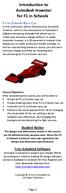 Introduction to Autodesk Inventor for F1 in Schools F1 in Schools Race Car In this course you will be introduced to Autodesk Inventor, which is the centerpiece of Autodesk s digital prototyping strategy
Basic AutoSketch Manual
 Basic AutoSketch Manual Instruction for students Skf-Manual.doc of 3 Contents BASIC AUTOSKETCH MANUAL... INSTRUCTION FOR STUDENTS... BASIC AUTOSKETCH INSTRUCTION... 3 SCREEN LAYOUT... 3 MENU BAR... 3 FILE
Charts for SharePoint
 KWizCom Corporation Charts for SharePoint Admin Guide Copyright 2005-2015 KWizCom Corporation. All rights reserved. Company Headquarters 95 Mural Street, Suite 600 Richmond Hill, ON L4B 3G2 Canada E-mail:
ORACLE BUSINESS INTELLIGENCE WORKSHOP
 ORACLE BUSINESS INTELLIGENCE WORKSHOP Creating Interactive Dashboards and Using Oracle Business Intelligence Answers Purpose This tutorial shows you how to build, format, and customize Oracle Business
Embroidery Fonts Plus ( EFP ) Tutorial Guide Version 1.0505
 Embroidery Fonts Plus ( EFP ) Tutorial Guide Version 1.0505 1 Contents Chapter 1 System Requirements.................. 3 Chapter 2 Quick Start Installation.................. 4 System Requirements................
Create a Poster Using Publisher
 Contents 1. Introduction 1. Starting Publisher 2. Create a Poster Template 5. Aligning your images and text 7. Apply a background 12. Add text to your poster 14. Add pictures to your poster 17. Add graphs
Creating Reports with Smart View s Ad Hoc Analysis
 with Smart View s Ad Hoc Analysis Dartmouth College February 10, 2009 Table of Contents Overview... 3 Connecting to the Reporting Cube... 3 Setting Ad Hoc Options... 3 The Ad Hoc Grid... 4 Selecting Members
Setting Up a New Project
 Setting Up a New Project Contents About this tutorial... 3 Step 1. Create a new project... 3 Step 2. Select project settings... 4 Step 3. Save your project... 11 Step 4. Create a project template... 12
Creating a Website with Google Sites
 Creating a Website with Google Sites This document provides instructions for creating and publishing a website with Google Sites. At no charge, Google Sites allows you to create a website for various uses,
ArcGIS. Tips and Shortcuts. for Desktop
 ArcGIS Tips and Shortcuts for Desktop Map Navigation Refresh and redraw the display. F5 Suspend the map s drawing. F9 Zoom in and out. Center map. Roll the mouse wheel backward and forward. Hold down Ctrl
Software for Producing Rack Layouts and Purchase Orders
 1 Software for Producing Rack Layouts and Purchase Orders Welcome to RackTools: software that makes it simple and quick to specify Middle Atlantic Products. RackTools has been designed with one purpose
Adobe Dreamweaver CC 14 Tutorial
 Adobe Dreamweaver CC 14 Tutorial GETTING STARTED This tutorial focuses on the basic steps involved in creating an attractive, functional website. In using this tutorial you will learn to design a site
Axion Image Viewer. Your Window To The World. User s Guide
 Axion Image Viewer Your Window To The World User s Guide 1 AxView 2000 Axion Spatial Imaging Ltd. Suite 700, 9925 109 Street Edmonton, Alberta T5K 2J8 E-mail: [email protected] www.axionspatial.com
TVI End User Guide. Version: Summer 2009 Release
 TVI End User Guide Version: Summer 2009 Release Table of Contents Control Center for Windows...2 TVI Control Center for Windows XP/Vista...2 Features...2 System Requirements...3 Installing Control Center...3
Composite Surfaces Tutorial
 Composite Surfaces Tutorial 4-1 Composite Surfaces Tutorial This tutorial will use the same model as the Materials & Loading Tutorial (with some modifications), to demonstrate how to perform a circular
NDSU Technology Learning & Media Center
 1 NDSU Technology Learning & Media Center QBB 150C 231-5130 www.ndsu.edu/its/tlmc Creating a Large Format Poster (Plot) Using PowerPoint 2013 Posters should be designed and created in a manner that best
NIS-Elements Viewer. User's Guide
 NIS-Elements Viewer User's Guide Publication date 10.09.2013 v. 4.20.00 Laboratory Imaging, s. r. o., Za Drahou 171/17, CZ - 102 00 Praha 10 No part of this publication may be reproduced or transmitted
Knowledgebase Article
 Company web site: Support email: Support telephone: +44 20 3287-7651 +1 646 233-1163 2 EMCO Network Inventory 5 provides a built in SQL Query builder that allows you to build more comprehensive
Access 2007 Creating Forms Table of Contents
 Access 2007 Creating Forms Table of Contents CREATING FORMS IN ACCESS 2007... 3 UNDERSTAND LAYOUT VIEW AND DESIGN VIEW... 3 LAYOUT VIEW... 3 DESIGN VIEW... 3 UNDERSTAND CONTROLS... 4 BOUND CONTROL... 4
Visualization with Excel Tools and Microsoft Azure
 Visualization with Excel Tools and Microsoft Azure Introduction Power Query and Power Map are add-ins that are available as free downloads from Microsoft to enhance the data access and data visualization
GUIDELINES FOR PREPARING POSTERS USING POWERPOINT PRESENTATION SOFTWARE
 Society for the Teaching of Psychology (APA Division 2) OFFICE OF TEACHING RESOURCES IN PSYCHOLOGY (OTRP) Department of Psychology, Georgia Southern University, P. O. Box 8041, Statesboro, GA 30460-8041
6. If you want to enter specific formats, click the Format Tab to auto format the information that is entered into the field.
 Adobe Acrobat Professional X Part 3 - Creating Fillable Forms Preparing the Form Create the form in Word, including underlines, images and any other text you would like showing on the form. Convert the
Tutorial 8 Raster Data Analysis
 Objectives Tutorial 8 Raster Data Analysis This tutorial is designed to introduce you to a basic set of raster-based analyses including: 1. Displaying Digital Elevation Model (DEM) 2. Slope calculations
NVMS - 1000 USER MANUAL. Version 2.1.0
 NVMS - 1000 USER MANUAL Version 2.1.0 Contents 1 Software Introduction... 1 1.1 Summary... 1 1.2 Operation Environment... 1 1.3 Install and Uninstall... 2 1.3.1 Install the Software... 2 1.3.2 Uninstall
Using an Access Database
 A Few Terms Using an Access Database These words are used often in Access so you will want to become familiar with them before using the program and this tutorial. A database is a collection of related
416 Agriculture Hall Michigan State University 517-355-3776 http://support.anr.msu.edu [email protected]
 416 Agriculture Hall Michigan State University 517-355-3776 http://support.anr.msu.edu [email protected] Title: ANR TS How To Efficiently Remove Items In Outlook To Free Up Space Document No. - 162 Revision
Task Force on Technology / EXCEL
 Task Force on Technology EXCEL Basic terminology Spreadsheet A spreadsheet is an electronic document that stores various types of data. There are vertical columns and horizontal rows. A cell is where the
Create a folder on your network drive called DEM. This is where data for the first part of this lesson will be stored.
 In this lesson you will create a Digital Elevation Model (DEM). A DEM is a gridded array of elevations. In its raw form it is an ASCII, or text, file. First, you will interpolate elevations on a topographic
Printing Guide. MapInfo Pro Version 15.0. Contents:
 MapInfo Pro Version 15.0 The purpose of this guide is to assist you in getting the best possible output from your MapInfo Pro software. We begin by covering the new print, import, and export features and
NVMS-1200. User Manual
 NVMS-1200 User Manual Contents 1 Software Introduction... 1 1.1 Summary... 1 1.2 Install and Uninstall... 1 1.2.1 Install the Software... 1 2 Login Software... 3 2.1 Login... 3 2.2 Control Panel Instruction...
SMART Board Tips & Tricks (version 9.0) Getting Started. SMART Tools vs. SMART Notebook software
 SMART Board Tips & Tricks (version 9.0) Getting Started SMART Tools vs. SMART Notebook software Click the SMART Board icon (in the system tray at the bottom right of your screen) to access the SMART Board
Build Your First Web-based Report Using the SAS 9.2 Business Intelligence Clients
 Technical Paper Build Your First Web-based Report Using the SAS 9.2 Business Intelligence Clients A practical introduction to SAS Information Map Studio and SAS Web Report Studio for new and experienced
Sample Table. Columns. Column 1 Column 2 Column 3 Row 1 Cell 1 Cell 2 Cell 3 Row 2 Cell 4 Cell 5 Cell 6 Row 3 Cell 7 Cell 8 Cell 9.
 Working with Tables in Microsoft Word The purpose of this document is to lead you through the steps of creating, editing and deleting tables and parts of tables. This document follows a tutorial format
Quick Help Guide (via SRX-Pro Remote)
 Quick Help Guide (via SRX-Pro Remote) 2012 i³ International Inc. The contents of this user manual are protected under copyright and computer program laws. Page 2 SRX-Pro Remote - Quick Help Guide Logging
DAP Proxy Server Configuration. Technical Note
 DAP Proxy Server Configuration Technical Note The software described in this manual is furnished under license and may only be used or copied in accordance with the terms of the license. Manual release
Tutorial case study D (GIS import)
 GeoModeller User Manual Tutorial case study D (GIS ) 1 Tutorial case study D (GIS ) 3D GeoModeller User Manual and Tutorials Author: Desmond Fitzgerald, Intrepid Geophysics Editor: Claire Edwards, Intrepid
FaxFinder Fax Servers
 FaxFinder Fax Servers Models: FF130 FF230 FF430 FF830 Client User Guide FaxFinder Client User Guide Fax Client Software for FaxFinder Series PN S000460B, Version B Copyright This publication may not be
CATIA V5 Tutorials. Mechanism Design & Animation. Release 18. Nader G. Zamani. University of Windsor. Jonathan M. Weaver. University of Detroit Mercy
 CATIA V5 Tutorials Mechanism Design & Animation Release 18 Nader G. Zamani University of Windsor Jonathan M. Weaver University of Detroit Mercy SDC PUBLICATIONS Schroff Development Corporation www.schroff.com
SketchUp Instructions
 SketchUp Instructions Every architect needs to know how to use SketchUp! SketchUp is free from Google just Google it and download to your computer. You can do just about anything with it, but it is especially
3. On the top menu bar, click on File > New > Project as shown in Fig. 2 below: Figure 2 Window for Orcad Capture CIS
 Department of Electrical Engineering University of North Texas Denton, TX. 76207 EENG 2920 Quickstart PSpice Tutorial Tutorial Prepared by Oluwayomi Adamo 1. To run the PSpice program, click on Start >
Quick Start Tutorial Metric version
 Quick Start Tutorial Metric version 1996-2009 Cadsoft Corporation. No part of this guide or the accompanying software may be reproduced or transmitted, electronically or mechanically, without written permission
Quick Start Tutorial Imperial version
 Quick Start Tutorial Imperial version 1996-2006 Cadsoft Corporation. No part of this guide or the accompanying software may be reproduced or transmitted, electronically or mechanically, without written