
DOT Certification Handbook
|
|
|
- Jasmin Bryan
- 10 years ago
- Views:
Transcription
1 DOT Certification Handbook Updated January 1, 2014

2 ABSOLUTE DISQUALIFICATIONS EXEMPTIONS MEDICATIONS REQUIRING PRESCRIBING PHYSICIAN RECOMMENDATION LABORATORY/PROCEDURE TESTING REQUIREMENTS SPECIALTY REFERRAL REQUIREMENTS SPECIFIC CONDITIONS REQUIREMENTS CARDIOVASCULAR DISORDERS ANEURYSMS AORTIC CONGENITAL HEART DISEASE AORTIC REGURGITATION AORTIC STENOSIS ATRIAL SEPTAL DEFECTS BUNDLE BRANCH BLOCKS AND HEMIBLOCKS CARDIOMYOPATHIES AND CONGESTIVE HEART FAILURE (CHF) COMMERCIAL DRIVERS WITH KNOWN CORONARY HEART DISEASE (CHD) COMMERCIAL DRIVERS WITHOUT KNOWN CORONARY HEART DISEASE (CHD) CONGENITAL HEART DISEASE HEART TRANSPLANTATION HYPERTENSION IMPLANTABLE DEFIBRILLATORS MITRAL REGURGITATION MITRAL STENOSIS PACEMAKERS PERIPHERAL VASCULAR DISEASE SUPRAVENTRICULAR TACHYCARDIAS VALVE REPLACEMENT VENOUS DISEASE VENTRICULAR ARRHYTHMIAS VENTRICULAR SEPTAL DEFECTS

3 RESPIRATORY DISORDERS OBSTRUCTIVE SLEEP APNEA COPD PNEUMOTHORAX LUNG CANCER ASTHMA NEUROLOGIC DISORDERS SEIZURES TRAUMATIC BRAIN INJURY HEADACHE MENINGITIS TIA/CVA PARKINSONS/MULTIPLE SCLEROSIS ENDOCRINE DISORDERS DIABETES MELLITUS PSYCHIATRIC DISORDERS ADD/ADHD MAJOR DEPRESSIVE DISORDER/BIPOLAR DISORDER SCHIZOPHRENIA/PSYCHOTIC DISORDERS ECT THERAPY PERSONALITY DISORDERS *Some guidelines noted within this handbook are suggested guidelines based upon Best Practices as suggested by the Dept. of Transportation, therefore, unless an absolute disqualification is noted below, a DOT provider may override the guidelines herein

4 ABSOLUTE DISQUALIFICATIONS -History of epilepsy (whether treated or not) -History of diabetes requiring insulin control unless accompanied by an exemption -When vision parameters (e.g., acuity, horizontal field of vision, color) fall below minimum standards unless accompanied by an exemption -When hearing measurements with or without a hearing aid fall below minimum standards -Currently taking methadone and/or suboxone -Currently taking any TCA or MAOI type medication -Current clinical diagnosis of alcoholism -Controlled substance use including a narcotic, an amphetamine, or another habit-forming drug without a prescription from the treating physician

5 Exemptions Vision Exemption -Need to have copy of annual specialist eye examination that is part of the exemption requirement -The vision exemption itself is good for 2 years BUT the specialist exam has to occur every year -If otherwise qualified, check box for vision exemption on form -Keep a copy of the exemption and specialist report to attach to form -The motor carrier is required to ensure proper documentation Insulin Waiver -If otherwise qualified, complete form and mark check box for federal diabetes exemption and give to driver for them to consider applying for insulin exemption -To be considered for exemption 1 month wait if previously treated and insulin is new 2 month wait if new diagnosis and not on prior treatment -Driver must present exemption -CDME must review 5 year medical history and driver needs to present this to you -Ask and document symptoms, monitoring and hypoglycemic reactions -Certify for 1 year maximum if all other qualification standards are met and has insulin waiver Skilled Performance Evaluation -Please remember that loss of a hand or foot or significant impairment of such is grounds for a SPE evaluation -You have discretion for anatomical or functional deficits that are less than a whole hand or foot -Need to gauge prehension and pedal use -SPEs are for FIXED deficits only -If everything else on the exam is okay, certify as usual (2 years unless some other condition indicates otherwise) but check the box that says SPE certificate required

6 MEDICATIONS REQUIRING PRESCRIBING PHYSICIAN RECOMMENDATION The following is a list, although not an exclusive list of medications, that if actively being taken by a DOT candidate should have written verification from the prescribing physician noting that the patient is stable on the current dose and the disease process is controlled by use of this medication without any significant side effects that may impair driving. (use form letter to obtain clearance from prescribing physician prior to certifying driver if needed). Maximum certification period on any of these medications is 1 year - Any narcotic medication - Any SSRI/SNRI - Sedative/Hypnotic medications (benzos, muscle relaxants, etc) - Provigil (wait time of 6 weeks post initiation before certifying) - Chantix (recommended not to certify while taking Chantix) - Incretins (Byetta and Victoza) - Stimulants

7 LABORATORY/PROCEDURE TESTING REQUIREMENTS Midlands Occupational Medicine will require proof of testing within the specified timeframe for applicable conditions as noted below. Drivers will not be certified without adequate proof of compliance. Coumadin use requires updated (within 1 month) INR within therapeutic target range Do not certify if no INR is provided or if INR is sub-therapeutic Maximum certification period is 1 year Diabetes requires recent (within 6 months) Hemoglobin A1c of less than 10 Maximum certification period is 1 year Sleep Apnea - must show proof of compliance via CPAP print out with minimally acceptable compliance of at least 4 hours per day of use on 70 percent of days Maximum certification period is 1 year Chronic Kidney Disease recent Creatinine and GFR (within 6 months) Exercise Stress Test Post PCI every 2 years Post MI every 2 years Angina Pectoris every 2 years Post CABG every year beginning 5 years after surgery Echocardiogram Aortic stenosis every 1 5 years Marfans Syndrome Aortic Regurgitation every 6 months to 3 years depending on severity Atrial Septal Defect Congestive Heart Failure every year Ebstien Anomaly every year for severe cases Tetrology of Fallot every year Corrected Transposition every year Mitral Regurgitation every year for moderate to severe cases Pacemaker Function Required to show adequate function yearly

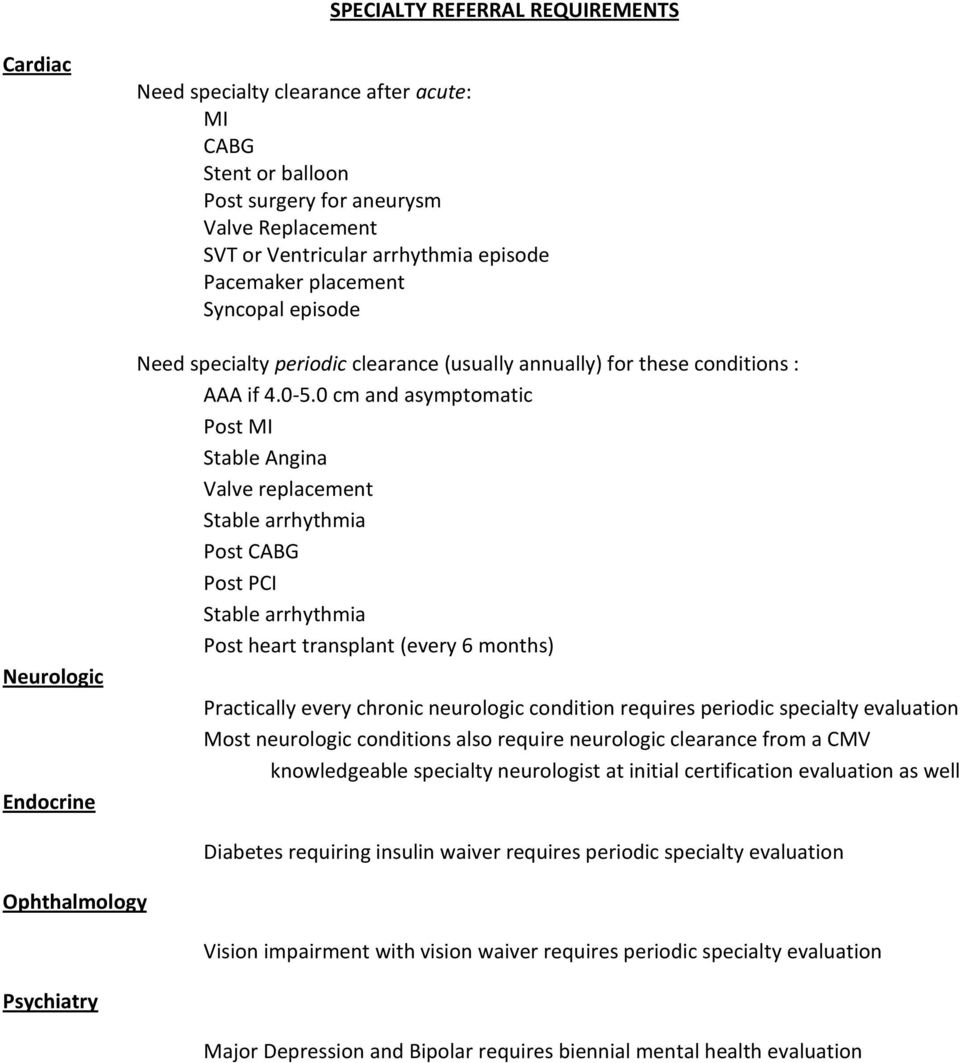
8 SPECIALTY REFERRAL REQUIREMENTS Cardiac Neurologic Endocrine Need specialty clearance after acute: MI CABG Stent or balloon Post surgery for aneurysm Valve Replacement SVT or Ventricular arrhythmia episode Pacemaker placement Syncopal episode Need specialty periodic clearance (usually annually) for these conditions : AAA if cm and asymptomatic Post MI Stable Angina Valve replacement Stable arrhythmia Post CABG Post PCI Stable arrhythmia Post heart transplant (every 6 months) Practically every chronic neurologic condition requires periodic specialty evaluation Most neurologic conditions also require neurologic clearance from a CMV knowledgeable specialty neurologist at initial certification evaluation as well Diabetes requiring insulin waiver requires periodic specialty evaluation Ophthalmology Vision impairment with vision waiver requires periodic specialty evaluation Psychiatry Major Depression and Bipolar requires biennial mental health evaluation
9 Cardiovascular Disorders ANEURYSMS Abdominal Aortic Aneurysm (AAA) Evaluate for associated cardiovascular diseases. Aneurysm <4.0 cm. Yes, if asymptomatic. Aneurysm 4.0 to <5.0 cm. Ultrasound to identify change in size. Cleared by vascular specialist. No, if: Symptomatic; Surgery recommended by vascular specialist. Ultrasound for change in size. At least 3 months after surgical repair; Cleared by cardiovascular specialist. No. Thoracic Aneurysm Aneurysms of Other Vessels Aneurysm >5.0 cm. Evaluate for associated cardiovascular diseases. Assess for risk of rupture and for associated cardiovascular diseases. At least 3 months after surgical repair; Cleared by cardiovascular specialist. No, if >3.5 cm. At least 3 months after surgical repair; Cleared by cardiovascular specialist. No At least 3 months after surgical repair; Cleared by cardiovascular specialist.

10 Bicuspid Aortic Valve AORTIC CONGENTIAL HEART DISEASE May result in aortic See section on Valvular See section on Valvular stenosis or regurgitation Diseases. Diseases. (see section on Valvular Diseases), aortic root enlargement, aortic Aortic transverse aneurysm formation and diameter >5.5 cm. aortic rupture. Subvalvular Aortic Stenosis Mild = favorable. Has potential for progression. Surgical intervention successfully performed. Aortic; No valvular abnormality or hypertrophic cardiomyopathy. Evaluation by cardiologist congenital heart disease is required. Discrete Supravalvular Aortic Stenosis Marfan Syndrome Moderate or severe = unfavorable. Unfavorable prognosis due to associated coronary and aortic disorder. Cardiovascular disorders are the major cause of morbidity and mortality including risk of sudden death. Symptomatic and mean pressure gradient >30 mm Hg. At least 3 months after successful surgical resection when cleared by cardiologist knowledgeable in congenital heart disease. No, unless surgery. At least 3 months postsurgical intervention; Cleared by cardiologist congenital heart disease. No cardiovascular involvement. Any aortic root Evaluation by cardiologist congenital heart disease required, including echocardiogram. Evaluation by cardiologist congenital heart disease is recommended. Evaluation by cardiologist congenital heart disease required including aortic root imaging and echocardiography.

11 Marfan Syndrome (cont) enlargement; Moderate or more severe aortic regurgitation; > mild mitral regurgitation related to mitral valve prolapse; LV dysfunction with EF <40% and no associated valve disease. AORTIC REGURGITATION Mild Aortic Yes, if Regurgitation asymptomatic. Echocardiogram every Moderate Aortic Regurgitation Severe Aortic Regurgitation Yes, if: Normal LV function; No or mild LV enlargement. Normal LV function (EF = 50%); LV dilatation (LVEDD <60mm, LVESD <50mm). 2 to 3 years. Echocardiogram every 2 to 3 years. Every 6 months Echocardiogram every 6 to 12 months. If LVEDD = 60mm or LVESD = 50mm. Symptoms; Unable to complete Bruce protocol Stage II; Reduced EF <50%, LV dilatation LVEDD >70mm or LVESD >55mm. Valve surgery and at least 3 months post surgery; Cleared by cardiologist. Every 4. 6 months Echocardiogram every 4. 6 months if no surgery performed.

12 Mild Aortic Stenosis (AVA >1.5 cm2) AORTIC STENOSIS If symptoms are Yes, if consistent with aortic Asymptomatic. Echocardiogram every 5 stenosis but calculated years. valve area suggests mild aortic stenosis, the severity of the stenosis and an alternative explanation for symptoms needs to be reassessed. Moderate Aortic Stenosis (AVA cm2) Yes, if: Echocardiogram every 1 to 2 years. At least 3 months after surgery. Severe Aortic Stenosis (AVA <1.0 cm2) Angina, heart failure, syncope; Atrial fibrillation; LV dysfunction with EF <50%; Thromboembolism. No, irrespective of symptoms or LV function. Yes, if at least 3 months after surgery.

13 ATRIAL SEPTAL DEFECTS Atrial Septal Defect (ASD): Ostium Secundum Small ASD = favorable Yes if asymptomatic Evaluation by cardiologist knowledgeable in congential heart disease including chocardiogram. Moderate to large ASD = unfavorable Symptoms of dyspnea, palpitations or a paradoxical embolus; Pulmonary hypertension; Right-to-left shunt; Pulmonary to ystemic flow ratio >1.5 to 1. Evaluation by cardiologist knowledgeable in congential heart disease every 2 years ASD: Ostium Primum Small ASD = favorable prognosis. At least 3 months after surgery or at least 4 weeks after device closure; Asymptomatic and clearance by a cardiologist congenital heart disease Asymptomatic. Evaluation by cardiologist congenital heart disease required including echocardiogram. Moderate to large ASD = unfavorable prognosis. Symptoms of dyspnea, palpitations or a paradoxical embolus; Echo-Doppler demonstrates pulmonary artery pressure >50% systemic; Echo-Doppler demonstrates right-to-left shunt; Pulmonary to systemic flow ratio greater than 1.5 to 1; Heart block on an

14 electrocardiogram; More than mild mitral valve regurgitation; Left ventricular outflow tract obstruction with a gradient >30 mm Hg. ASD: Ostium Primum (cont.) At least 3 months after surgical intervention if none of the above disqualifying criteria; No symptomatic arrhythmia and no significant residual shunt; Cleared by cardiologist congenital heart disease. Evaluation by cardiologist congenital heart disease. Sinus Venosus Atrial Septal Defect Usually associated with anomalous pulmonary venous connection. Prognosis depends on size of atrial septal defect. Commonly associated with sinus node dysfunction, particularly after surgery. Small shunt and hemodynamically insignificant. Symptoms of dyspnea, palpitations or a paradoxical embolus; Echo-Doppler examination demonstrating pulmonary artery pressure greater than 50% systemic; Echo-Doppler examination demonstrating a right-toleft shunt; Pulmonary to systemic flow ratio greater than 1.5 to 1; Heart block or sinus node dysfunction on an Evaluation by cardiologist congenital heart disease.

15 electrocardiogram. At least 3 months after surgical intervention; Hemodynamics are favorable; Cleared by cardiologist congenital heart disease. Evaluation by cardiologist congenital heart disease, including Holter Monitor.

16 Bundle Branch Block Axis Deviation BUNDLE BRANCH BLOCKS AND HEMIBLOCKS Progression of disease in Every 2 years the conduction system Asymptomatic. can lead to third degree (Depends on risk heart block with total loss from underlying heart of electrical connection disease.) between the atria and ventricles causing syncope or sudden death. Yes, if treated for symptomatic disease (see pacemaker); No disqualifying heart disease; Cleared by cardiologist. No, if symptomatic. CARDIOMYOPATHIES AND CONGESTIVE HEART FAILURE (CHF) Hypertrophic No. Cardiomyopathy Idiopathic Dilated No, if symptomatic CHF. Cardiomyopathy and Congestive Heart Failure Ventricular arrhythmias present; LVEF 50%. No ventricular arrhythmias; LVEF <40%. Restrictive Cardiomyopathy No ventricular arrhythmias; LVEF 40% to 50%. No Requires annual cardiology evaluation including Echocardiography and Holter monitoring.

17 Post Myocardial Infarction (MI) COMMERCIAL DRIVERS WITH KNOWN CORONARY HEART DISEASE (CHD) Risk of recurrent major cardiac event highest within the first months post-mi. Drivers in a rehabilitation program can receive comprehensive secondary prevention therapy. Recurrent angina symptoms; Post-MI ejection fraction <40% (by echocardiogram or ventriculogram); Abnormal ETT demonstrated prior to planned work return; Ischemic changes on rest ECG; Poor tolerance to current cardiovascular medications. Angina Pectoris Post Percutaneous Coronary Intervention (PCI) Lower end of spectrum among CHD patients for risk of adverse clinical outcomes. Condition usually implies at least one coronary artery has hemodynamically significant narrowing. Rapid recovery for elective PCIs for stable angina. At least 2 months post- MI; Cleared by cardiologist; No angina; Post-MI ejection fraction >40% (by echocardiogram or ventriculogram); Tolerance to current cardiovascular medications. Yes, if asymptomatic. Rest angina or change in angina pattern within 3 months of examination; Abnormal ETT; Ischemic changes on rest ECG; Intolerance to cardiovascular therapy. At least 1 week after procedure; Biennial ETT at minimum (If test positive or inconclusive, imaging stress test may be indicated). Cardiologist examination recommended. Biennial ETT at minimum (If test positive or inconclusive, imaging stress test may be indicated). Cardiologist examination recommended. Recommend cardiologist examination.

18 Post Percutaneous Coronary Intervention (PCI) (cont) Post Coronary Artery Bypass Surgery (CABG) Delayed re-stenosis is the major PCI limitation and requires intensive secondary prevention. Delay in return to work to allow sternal incision healing. Because of increasing risk of graft closure over time, ETT is obtained. Approval by cardiologist; Tolerance to medications. ETT 3 to 6 months after PCI. Incomplete healing or complication at vascular access site; Rest angina; Ischemic ECG changes. At least 3 months after CABG; LVEF 40% post CABG; Approval by cardiologist; Tolerance to medications. Biennial ETT at minimum (If test positive or inconclusive, imaging stress test may be indicated). After 5 years: ETT. Imaging stress test may be indicated. Asymptomatic, healthy COMMERCIAL DRIVERS WITHOUT KNOWN CORONARY HEART DISEASE (CHD) Low CHD event risk. Yes, if asymptomatic; Biennial Assess for clinically Rarely disqualifying apparent risk factors. alone. Use, when possible, Framingham risk score model to predict 10-year CHD event risk. Increasing age is a surrogate marker for increasing atherosclerotic plaque burden. Asymptomatic, high risk person (as designated by CHD risk-equivalent condition) Asymptomatic, high risk person >45 years with multiple risk factors for CHD Sub-clinical coronary atherosclerosis is a concern. High-risk status requires close physician follow-up and aggressive comprehensive risk factor management. asymptomatic. Abnormal ETT; Ischemic changes on ECG; Functional incapacitation by one of conditions.

19 Patent Ductus Arteriosus (PDA) CONGENITAL HEART DISEASE Small = favorable. Yes, if small shunt. Moderate to large = unfavorable Symptoms of dyspnea or palpitations; Pulmonary hypertension; Right to left shunt; Progressive LV enlargement or decreased systolic function. Coarctation of the Aorta Mild = favorable. At least 3 months after surgery or 1 month after device closure; None of above disqualifying criteria; Cleared by cardiologist congenital heart disease. Mild and unoperated; BP controlled; No associated disqualifying disease. Should have evaluation by cardiologist knowledgeable in adult congenital heart disease. Evaluation by cardiologist congenital heart disease recommended. Coarctation of the Aorta after intervention Other causes of right ventricular outflow obstruction in persons with congenital heart disease Moderate or severe = unfavorable prognosis. Unfavorable prognosis with persistent risk of cardiovascular events. Double chambered right ventricle. Infundibular pulmonary stenosis. Supravalvar pulmonary stenosis. Pulmonary artery stenosis. No Yes, if perfect repair Hemodynamic data and criteria similar to individuals with isolated pulmonary valve stenosis who are eligible for certification. Evaluation by cardiologist congenital heart disease required. Recommend evaluation by cardiologist knowledgeable in adult congenital heart disease.

20 Pulmonary Valve Stenosis (PS) Ebstein Anomaly Mild and moderate = favorable. Severe PS may be unfavorable, associated with arrhythmias and rarely sudden death. Mild = favorable. Yes, if mild or moderate. Symptoms of dyspnea, palpitations or syncope; Pulmonary valve peak gradient >50 mm Hg with normal output; RV pressure >50% systemic pressure; >mild RVH; >mild RV dysfunction; >moderate pulmonary valve regurgitation; Main pulmonary artery >5 cm. 3 months after surgical valvotomy or 1 month after balloon valvuloplasty; None of above disqualifying criteria; Cleared by cardiologist congenital heart disease. Mild; No intracardiac lesions; No shunt; No symptomatic arrhythmia or accessory conduction; Only mild cardiac enlargement; Only mild RV dysfunction. Evaluation by cardiologist congenital heart disease. Recommend evaluation by cardiologist knowledgeable in adult congenital heart disease. Evaluation by cardiologist congenital heart disease. Moderate and severe variants = unfavorable. At least 3 months postsurgical intervention; None of above disqualifying features. Echocardiogram and evaluation by cardiologist congenital heart disease required.

21 Tetralogy of Fallot Transposition of the Great Vessels Unfavorable in the unrepaired state. Repaired = variable prognosis. Unfavorable if uncorrectable. No, if uncorrected. Excellent result obtained from surgery; No significant pulmonary or tricuspid valve regurgitation; No pulmonary stenosis; No history of arrhythmias; No residual shunt. No Evaluation by cardiologist congenital heart disease required, including EKG, 24-hour Holter Monitor, exercise testing, Doppler Echocardiogram. Atrial switch repair (Mustard or Senning procedures). Unfavorable long-term prognosis. No After Rastelli repair. Asymptomatic and excellent result obtained from surgery Evaluation by cardiologist congenital heart disease. Congenitally Corrected Transposition After arterial switch repair, prognosis appears favorable. 95% have associated intracardiac lesions. Conduction system is inherently abnormal. No (Data currently not sufficient to support qualification in this group). None of below disqualifying criteria. Symptoms of dyspnea, palpitations, syncope or paradoxical embolus; Intracardiac lesion such Required annual evaluation by cardiologist congenital heart disease and echocardiography and 24-hour Holter Monitor.
22 Congenitally Corrected Transposition (cont) as VSD; >moderate pulmonary stenosis with a pulmonary ventricular Pressure >50% systemic; >mild RV or LV enlargement or dysfunction; Moderate or greater tricuspid valve (systemic atrioventricular valve) regurgitation; History of atrial or ventricular arrhythmia; ECG with heart block; Right-to-left shunt or significant residual leftto-right shunt. At least 3 months after surgery; None of above disqualifying criteria; Prosthetic valve. must meet requirements for that valve; Cleared by cardiologist congenital heart disease. Evaluation by cardiologist congenital heart disease. HEART TRANSPLANTATION Special attention to: Biannual Accelerated Clearance by cardiologist atherosclerosis, required. transplant rejection, general health. Heart Transplantation At least 1 year posttransplant; Stable on medications; No rejection; Consent from cardiologist to drive commercially
23 Essential Hypertension HYPERTENSION Evaluate for other Yes, if asymptomatic. Biennial clinical CVD including Rarely disqualifying TOD.. alone. Presence of TOD, CVD or diabetes may affect therapy selected. Stage 1 ( /90-99 mm Hg) Stage 2 ( / mm Hg) Stage 3 ( 180/110 mm Hg) Usually asymptomatic. Low risk for near-term incapacitating event. Low risk for incapacitating event. Risk increased in presence of TOD. Indication for pharmacologic therapy. High risk for acute hypertension-related event. Yes Rarely disqualifying alone. Yes One time certification for 3 months. Yes, at recheck if: BP <140/90 mm Hg; Certify for 1 year from date of initial exam. No Immediately disqualifying. BP <140/90 at annual exam. If not, but <160/100, certification extended one time for 3 months. BP <140/90. Secondary Hypertension Evaluation warranted if persistently hypertensive on maximal or nearmaximal doses of 2-3 pharmacologic agents. May be amenable to surgical/specific therapy. Yes, at recheck if: BP <140/90 mm Hg; Treatment is well tolerated; Certify for 6 months from date of initial exam. Based on above stages. Stage 1 or nonhypertensive; At least 3 months after surgical correction. Every 6 months BP <140/90. Every 6 months BP <140/90.
24 IMPLANTABLE DEFIBRILLATORS Primary Prevention Patient has high risk for No death and sudden incapacitation Secondary Prevention Patient demonstrated to have high risk for death and sudden incapacitation. No Mild Mitral Regurgitation MITRAL REGURGITATION Yes, if: echo not Normal LV size and necessary. function; Normal PAP. Moderate Mitral Regurgitation Severe Mitral Regurgitation Yes, if: Normal LV size and function; Normal PAP. Yes, if asymptomatic. Echocardiogram. Echocardiogram every 6-12 months. Exercise testing may be helpful to assess symptoms. At least 3 months postsurgery; Cleared by cardiologist. Symptomatic; Inability to achieve >6 METS on Bruce protocol; Ruptured chordae or flail leaflet; Atrial fibrillation; LV dysfunction; Thromboembolism; Pulmonary artery pressure >50% of systolic arterial pressure
25 Mild Mitral Stenosis MVA 1.6 cm2 MITRAL STENOSIS In the presence of Yes, if symptoms consistent asymptomatic. with moderate to severe mitral stenosis but a calculated valve area suggesting mild mitral stenosis, the severity of the stenosis should be reassessed and an alternative explanation for symptoms should be considered. Moderate Mitral Stenosis MVA 1.0 to 1.6 cm2 Severe Mitral Stenosis MVA 1.0 cm2 Yes, if asymptomatic. NYHA Class II or higher; Atrial fibrillation; Pulmonary artery pressure >50% of systemic pressure; Inability to exercise for >6 Mets on Bruce protocol (Stage II). At least 4 weeks post percutaneous balloon mitral valvotomy; At least 3 months post surgical commissurotomy; Clearance by cardiologist. evaluation by a cardiologist.
26 PACEMAKERS Sinus Node Dysfunction Variable long-term No prognosis depending on underlying disease, but cerebral hypoperfusion corrected by support of heart rate by pacemaker. 1 month after pacemaker implantation; Documented correct function by pacemaker center; Underlying disease is not Documented pacemaker checks. Atrioventricular (AV) Block Neurocardiogenic Syncope Hypersensitive Carotid Sinus with Syncope Variable long-term prognosis depending on underlying disease, but cerebral hypoperfusion correct by support of the heart rate by pacemaker. Excellent long-term survival prognosis, but there is risk for syncope that may be due to cardioinhibitory (slowing heart rate) or vasodepressor (drop in blood pressure) components, or both. Pacemaker will affect only cardioinhibitory component but will lessen effect of vasodepressor component. Excellent long-term survival prognosis, but there is risk for syncope that may be due to cardioinhibitory (slowing heart rate) or vasodepressor (drop in blood pressure) components, or both. Pacemaker will affect only cardioinhibitory component, but will lessen effect of vasodepressor component. disqualifying. No 1 month after pacemaker implantation; Documented correct function by pacemaker center; Underlying disease is not disqualifying No, with symptoms. 3 months after pacemaker implantation; Documented correct function by pacemaker center; Absence of symptom recurrence. No, with symptoms. 3 months after Pacemaker implantation; Documented correct function by pacemaker center; Absence of symptom recurrence. Documented pacemaker checks. Documented pacemaker checks. Absence of symptom recurrence. Documented regular pacemaker checks. Absence of symptom recurrence.
27 Peripheral Vascular Disease (PVD) Intermittent Claudication PERIPHERAL VASCULAR DISEASE Evaluate for associated cardiovascular diseases. Most common presenting manifestation of occlusive arterial disease. Rest pain. Yes, if no other disqualifying cardiovascular condition. At least 3 months after surgery; Relief of symptoms; No other disqualifying cardiovascular disease. No, if symptoms. At least 3 months after surgery; Relief of symptoms and signs; No other disqualifying cardiovascular disease.
28 SUPRAVENTRICULAR TACHYCARDIAS Lone Atrial Fibrillation Good prognosis and Yes low risk for stroke. Atrial fibrillation as cause of or a risk for stroke Risk for stroke decreased by anticoagulation. Anticoagulated adequately for at least 1 month; Anticoagulation monitored by at least monthly INR; Rate/rhythm control deemed adequate (Recommend assessment by cardiologist). In atrial fibrillation at time of return to work; Atrial fibrillation following thoracic surgery Atrial Flutter Good prognosis and duration usually limited. Same as for atrial fibrillation. Anticoagulated adequately for at least 1 month; Anticoagulation monitored by at least monthly INR; Rate/rhythm control deemed adequate (Recommend assessment by cardiologist). Same as for atrial fibrillation. Same as for atrial fibrillation. Multifocal Atrial Tachycardia Multifocal Atrial Often associated with comorbidities, such as lung disease, that may impair prognosis. Isthmus ablation performed and at least 1 month after procedure; Arrhythmia successfully treated; Cleared by electrophysiologist. Unless associated condition is disqualifying. No, if symptomatic.
29 Tachycardia (cont) Atrioventricular Nodal Reentrant Tachycardia (AVNRT) Atrioventricular Reentrant Tachycardia (AVRT) and Wolff- Parkinson-White (WPW) Syndrome Atrial Tachycardia Junctional Tachycardia Prognosis generally excellent, but may rarely have syncope or symptoms of cerebral hypoperfusion. For those with WPW, preexcitation presents risk for death or syncope if atrial fibrillation develops. Symptoms controlled and secondary cause is not exclusionary. Symptomatic; WPW with atrial fibrillation. Treated and asymptomatic for at least 1 month and assessed and cleared by expert in cardiac arrhythmias. Recommend consultation with cardiologist.
30 VALVE REPLACEMENT Mechanical Valves At least 3 months postop; Cleared by cardiologist. Recommended evaluation by cardiologist. Prosthetic valve dysfunction Biologic Prostheses Anticoagulant therapy not necessary in patients in sinus rhythm (after initial 3 months), in absence of prior emboli or hypercoagulable state. Symptomatic; LV dysfunction-ef <40%; Thromboembolic complication post procedure; Plumonary hypertension; Unable to maintain adequate anticoagulation (base on monthly INR checks). No Surgically corrected; At least 3 months postop; Cleared by cardiologist. At least 3 months postop; None of above disqualifying criteria for mechanical valves; Cleared by cardiologist. Recommended evaluation by cardiologist Recommend evaluation by cardiologist.*
31 VENOUS DISEASE Acute Deep Vein Thrombosis (DVT) No, if symptoms. No residual acute deep venous thrombosis; If on Coumadin: Regulated for at least 1 month; INR monitored at least monthly Superficial Phlebitis Pulmonary Embolus Chronic Thrombotic Venous Disease DVT ruled out; No other disqualifying cardiovascular disease. No, if symptoms. No pulmonary embolism for at least 3 months; On appropriate long-term treatment; If on Coumadin: Regulated for at least 1 month; INR monitored at least monthly; No other disqualifying cardiovascular disease. Yes, if no symptoms. Biennial Biennial Varicose veins Yes, if no complications. Biennial Coumadin Use of INR required. Stabilized for 1 month; INR monitored at least monthly.
32 VENTRICULAR ARRHYTHMIAS Coronary Heart Disease (CHD) Sustained VT: Poor prognosis and high risk. No NSVT, LVEF <0.40: Unfavorable prognosis. NSVT, LVEF <0.40: Generally considered to have good prognosis. Dilated Cardiomyopathy NSVT (LVEF <0.40). Sustained VT, any LVEF. No No, if symptomatic. At least 1 month after drug or other therapy is successful; Cleared by cardiologist. No No Cardiology examination required. Hypertrophic Cardiomyopathy Right Ventricular Outflow VT Idiopathic Left Ventricular VT Long QT Interval Syndrome Brugada Syndrome Syncope/near syncope, any LVEF: High risk. Variable but uncertain prognosis. Favorable prognosis and low risk for syncope. Favorable prognosis and low risk for syncope. High risk for ventricular arrhythmic death. High risk for ventricular arrhythmic death. No No No, if symptomatic. Yes, if asymptomatic. At least 1 month after drug or other therapy successful; Cleared by electrophysiologist. No, if symptomatic Yes, if asymptomatic. At least 1 month after successful drug therapy or ablation; Cleared by electrophysiologist. No No Recommend evaluation by cardiologist. Evaluation by cardiologist required. Recommend evaluation by cardiologist. Evaluation by cardiologist required.
33 VENTRICULAR SEPTAL DEFECTS Ventricular Septal Defect Small = favorable. Yes, if small shunt. Evaluation by cardiologist congenital heart disease recommended. Moderate to large VSD has effect on pulmonary pressure and ventricular size and function. Moderate to large VSD; Symptoms of dyspnea, palpitations or syncope; Pulmonary artery hypertension; Right-to-left shunt, left ventricular enlargement or reduced function; Pulmonary to systemic flow ratio greater than 1.5 to 1. At least 3 months after surgery; None of above disqualifying criteria; No serious dysrhythmia on 24-hour Holter Monitoring; QRS interval <120 ms (If right ventricle conduction delay >120 ms on ECG, can be certified if invasive HIS bundle studies show no infra-his block or other serious electrophysiologic disorder); Cleared by cardiologist congenital heart disease. Evaluation by cardiologist congenital heart disease, including 24-hour Holter Monitoring.
34 RESPIRATORY DISORDERS DIAGNOSIS CERTIFCATION RECERTIFICATION Obstructive Sleep Apnea No if symptomatic Confessed or observed excessive daytime sleepiness Previous diagnosis with poor compliance or no follow up Wait period - 1 month after starting CPAP Wait period 3 months after surgical corrections Asymptomatic with proof of compliance COPD Previous diagnosis with compliance claimed but no evidence - One time 3 month card Yes if asymptomatic Hypoxemia at rest Chronic respiratory failure History of continual cough or cough syncope Guidance documents do suggest PFT in all smokers > 35 years of age Pneumothorax If FEV1 is < 65% predicted, ABG should be evaluated Certification is okay for 2 years if one time episode and confirm the following: Healing by x-ray Asymptomatic Acceptable pulmonary parameters Biennial Lung Cancer Asthma Two or more spontaneous episodes Cure after resection or radiation Meets PFT criteria Asymptomatic Yes if asymptomatic Continual uncontrolled symptoms Significant impairment of function (FEV1 < 65%) Significant hypoxemia (PaO2 < 65 mm Hg) Monitored at 3 month intervals for 2 years then yearly for 5 years Biennial
35 NEUROLOGIC DISORDERS DIAGNOSIS CERTIFCATION RECERTIFICATION Seizures No if history of epilepsy Acute seizure due to structural brain insult Yes if asymptomatic with clearance from neurologist who understands CMV driving conditions Waiting Period of 1 year for: Mild insult without early seizures Waiting Period of 2 years for: Moderate insult without early seizures Mild insult with early seizures Waiting Period of 5 years for: Moderate insult with early seizures Traumatic Brain Injury Must be off seizure medications and seizure free Certification requires normal neurological examination and clearance by neurologist familiar with CMV duties Mild TBI with no seizures (< 30 min LOC, no dural penetration) - 2 year maximum certification, judgment on waiting period Mild TBI with early seizures - Minimum 2 year wait, 1 year maximum certification Biennial Moderate TBI (>30 min < 24 hr LOC, no dural penetration) - Minimum 2 year wait if no early seizures, 5 year wait if seizures = 1 yr max certify Headache Severe TBI (> 24 hr LOC or any dural penetration) No if symptomatic or undetermined etiology Yes if symptoms controlled and treatment tolerated without side effects or sedation Biennial
36 Meningitis Aseptic Bacterial meningitis without early seizures Viral encephalitis without early seizures No wait period Wait Period of 1 Biennial Bacterial meningitis with early seizures Wait Period of 5 years Viral encephalitis with early seizures Wait period of 10 years Transient Ischemic Attack (TIA) Cerebrovascular Accident (CVA) Parkinson s Disease Multiple Sclerosis Minimum wait is 1 year after TIA; Asymptomatic, cleared by Neurologist Minimum wait is 1 year after CVA; Asymptomatic, cleared by Neurologist Minimum wait is 5 years for cortical and subcortical stroke due to seizure risk Typically disqualify Certify if: If mild symptoms Tolerate meds without side effects NO on-off effects Normal or above neuropsych battery results NO mood disorder 6 months with Neurologist clearance
37 ENDOCRINE DISORDERS DIAGNOSIS CERTIFCATION RECERTIFICATION Diabetes Mellitus Yes if asymptomatic and stable on medications One severe hypoglycemic episode in last 12 months Seizure LOC Need assist from someone else Period of impaired cognitive function Two or more severe episodes in past 5 years Loss of position sensation Loss of pedal sensation Resting tachycardia Orthostatic hypotension Peripheral or proliferative neuropathy
38 RENAL DISORDERS DIAGNOSIS CERTIFCATION RECERTIFICATION Chronic Kidney Disease No if on dialysis CKD Stage 1, 2 or 3 Stage 1 or 2 = certify for 2 years if stable Stage 3 = certify for 1 year if stable CKD Stage 4 Biennial 6 Months with nephrology clearance
39 PSYCHIATRIC DISORDERS DIAGNOSIS CERTIFCATION RECERTIFICATION ADD/ADHD Active psychosis Prominent negative symptoms Adverse medication effects Major Depressive Disorder/Bipolar Disorder Treatment stable and safe Compliant NO side effects from meds Comprehensive evaluation from a mental health professional with clearance Minimum 6 month wait period that is symptom free after non-psychotic major depression Minimum 1 year wait period that is symptom free after severe depressive, suicide attempt or manic episode Requires mental health evaluation and subsequently every two years Schizophrenia/Psychotic Disorders Schizophrenia Active psychosis Prominent negative symptoms Medication interferes with safe driving May consider certification AFTER waiting period if mental health professional clears and medications are okay for: 6 month wait Brief reactive psychosis Schizophreniform disorder ECT 1 year wait for Any other psychotic disorder (except schizophrenia) No if ongoing treatment Minimum 6 month wait Requires comprehensive mental evaluation Personality Disorder Requires mental health evaluation
Cardiovascular Guidelines for DOT Physical Exams By Maureen Collins MSN, APRN, BC
 Cardiovascular Guidelines for DOT Physical Exams By Maureen Collins MSN, APRN, BC The Federal Motor Carrier Safety Administration (FMCSA) administers the Federal Motor Carrier Safety Regulations (FMCSRs)
Department of Transportation (DOT) Changes PHYSICAL EXAMINATION CHANGES
 Department of Transportation (DOT) Changes PHYSICL EXMINTION CHNGES Contents Page How will this change affect me?.... 1 General statements.... 2 Definitions.... 2 Physical requirements.... 3 Cardiovascular
Potential Causes of Sudden Cardiac Arrest in Children
 Potential Causes of Sudden Cardiac Arrest in Children Project S.A.V.E. When sudden death occurs in children, adolescents and younger adults, heart abnormalities are likely causes. These conditions are
How To Understand What You Know
 Heart Disorders Glossary ABG (Arterial Blood Gas) Test: A test that measures how much oxygen and carbon dioxide are in the blood. Anemia: A condition in which there are low levels of red blood cells in
How to get insurance companies to work with you
 Paying for Quality ACHD Care How to get insurance companies to work with you Christy Sillman, RN, MSN ACHD nurse coordinator Inpatient ACHD Nurse Educator The Adult Congenital Heart Program Stanford Lucile
CHESHIRE EAST COUNCIL DRIVER MEDICAL
 BLOCK LETTERS PLEASE: CHESHIRE EAST COUNCIL DRIVER MEDICAL FULL NAME OF APPLICANT:.. DATE OF BIRTH.... ADDRESS:............. POST CODE... This certificate, which must be completed by a Registered Medical
Common types of congenital heart defects
 Common types of congenital heart defects Congenital heart defects are abnormalities that develop before birth. They can occur in the heart's chambers, valves or blood vessels. A baby may be born with only
Diagnosis Code Crosswalk : ICD-9-CM to ICD-10-CM Cardiac Rhythm and Heart Failure Diagnoses
 Diagnosis Code Crosswalk : to 402.01 Hypertensive heart disease, malignant, with heart failure 402.11 Hypertensive heart disease, benign, with heart failure 402.91 Hypertensive heart disease, unspecified,
Adult Cardiac Surgery ICD9 to ICD10 Crosswalks
 164.1 Malignant neoplasm of heart C38.0 Malignant neoplasm of heart 164.1 Malignant neoplasm of heart C45.2 Mesothelioma of pericardium 198.89 Secondary malignant neoplasm of other specified sites C79.89
ATRIAL FIBRILLATION (RATE VS RHYTHM CONTROL)
 ATRIAL FIBRILLATION (RATE VS RHYTHM CONTROL) By Prof. Dr. Helmy A. Bakr Mansoura Universirty 2014 AF Classification: Mechanisms of AF : Selected Risk Factors and Biomarkers for AF: WHY AF? 1. Atrial fibrillation
Treating AF: The Newest Recommendations. CardioCase presentation. Ethel s Case. Wayne Warnica, MD, FACC, FACP, FRCPC
 Treating AF: The Newest Recommendations Wayne Warnica, MD, FACC, FACP, FRCPC CardioCase presentation Ethel s Case Ethel, 73, presents with rapid heart beating and mild chest discomfort. In the ED, ECG
Diagnostic and Therapeutic Procedures
 Diagnostic and Therapeutic Procedures Diagnostic and therapeutic cardiovascular s are central to the evaluation and management of patients with cardiovascular disease. Consistent with the other sections,
Automatic External Defibrillators
 Last Review Date: May 27, 2016 Number: MG.MM.DM.10dC2 Medical Guideline Disclaimer Property of EmblemHealth. All rights reserved. The treating physician or primary care provider must submit to EmblemHealth
Important information regarding your Medical Examiners Certificate (DOT card). Please read carefully! Driver name:
 Important information regarding your Medical Examiners Certificate (DOT card). Please read carefully! Driver name: Expiration date of current DOT card: / / Please contact Kingston Worx at 845-331-7751
5. Management of rheumatic heart disease
 5. Management of rheumatic heart disease The fundamental goal in the long-term management of RHD is to prevent ARF recurrences, and therefore, prevent the progression of RHD, and in many cases allow for
CARDIAC CARE. Giving you every advantage
 CARDIAC CARE Giving you every advantage Getting to the heart of the matter The Cardiovascular Program at Northwest Hospital & Medical Center is dedicated to the management of cardiovascular disease. The
MEDICAL REPORT on an applicant for a Hackney Carriage/Private Hire Drivers Licence
 MEDICAL REPORT on an applicant for a Hackney Carriage/Private Hire Drivers Licence If this is your first application for Hackney Carriage/Private Hire Drivers Licence you must get a registered doctor to
CTA OF THE EXTRACORONARY HEART
 CTA OF THE EXTRACORONARY HEART Charles White MD Director of Thoracic Imaging Department of Radiology University of Maryland NO DISCLOSURES [email protected] CARDIAC CASE DISTRIBUTION Coronary CTA 30% ED chest
MEDICAL EXAMINATION GUIDANCE
 MEDICAL EXAMINATION GUIDANCE When making an application for either a hackney carriage or private hire driver s licence, you must be able to demonstrate that you are medically fit to drive by having a medical
DERBYSHIRE JOINT AREA PRESCRIBING COMMITTEE (JAPC) MANAGEMENT of Atrial Fibrillation (AF)
 DERBYSHIRE JOINT AREA PRESCRIBING COMMITTEE (JAPC) MANAGEMENT of Atrial Fibrillation (AF) Key priorities Identification and diagnosis Treatment for persistent AF Treatment for permanent AF Antithrombotic
Management of the Patient with Aortic Stenosis undergoing Non-cardiac Surgery
 Management of the Patient with Aortic Stenosis undergoing Non-cardiac Surgery Srinivasan Rajagopal M.D. Assistant Professor Division of Cardiothoracic Anesthesia Objectives Describe the pathophysiology
Cardiology ICD-10-CM Coding Tip Sheet Overview of Key Chapter Updates for Cardiology
 Cardiology ICD-10-CM Coding Tip Sheet Overview of Key Chapter Updates for Cardiology Chapter 4: Endocrine, Nutritional, and Metabolic Diseases (E00-E89) The diabetes mellitus codes are combination codes
COVERAGE GUIDANCE: ABLATION FOR ATRIAL FIBRILLATION
 COVERAGE GUIDANCE: ABLATION FOR ATRIAL FIBRILLATION Question: How should the EGBS Coverage Guidance regarding ablation for atrial fibrillation be applied to the Prioritized List? Question source: Evidence
Christopher M. Wright, MD, MBA Pioneer Cardiovascular Consultants Tempe, Arizona
 Christopher M. Wright, MD, MBA Pioneer Cardiovascular Consultants Tempe, Arizona Areas to be covered Historical, current, and future treatments for various cardiovascular disease: Atherosclerosis (Coronary
Atrial Fibrillation An update on diagnosis and management
 Dr Arvind Vasudeva Consultant Cardiologist Atrial Fibrillation An update on diagnosis and management Atrial fibrillation (AF) remains the commonest disturbance of cardiac rhythm seen in clinical practice.
Perioperative Cardiac Evaluation
 Perioperative Cardiac Evaluation Caroline McKillop Advisor: Dr. Tam Psenka 10-3-2007 Importance of Cardiac Guidelines -Used multiple times every day -Patient Safety -Part of Surgical Care Improvement Project
Provider Checklist-Outpatient Imaging. Checklist: Nuclear Stress Test, Thallium/Technetium/Sestamibi (CPT Code 78451-78454 78469)
 Provider Checklist-Outpatient Imaging Checklist: Nuclear Stress Test, Thallium/Technetium/Sestamibi (CPT Code 78451-78454 78469) Medical Review Note: Per InterQual, if any of the following are present,
CARDIA 288 MONTH FOLLOW-UP SUPPLEMENTAL FORM (FORM B) HOSPITALIZATION CASE #: INTERVIEWER ID FY288BIVID2. Page 1 of 6 FY288BH4CN
 HOSPITALIZATION CASE #: 2 8 8 0 H FY288BH4CN Has the participant indicated any of the following reasons for being admitted overnight for this case? 1. Suspected or confirmed problems with the heart, circulation,
CHAPTER 9 DISEASES OF THE CIRCULATORY SYSTEM (I00-I99)
 CHAPTER 9 DISEASES OF THE CIRCULATORY SYSTEM (I00-I99) March 2014 2014 MVP Health Care, Inc. CHAPTER 9 CHAPTER SPECIFIC CATEGORY CODE BLOCKS I00-I02 Acute rheumatic fever I05-I09 Chronic rheumatic heart
NAME OF THE HOSPITAL: 1. Coronary Balloon Angioplasty: M7F1.1/ Angioplasty with Stent(PTCA with Stent): M7F1.3
 1. Coronary Balloon Angioplasty: M7F1.1/ Angioplasty with Stent(PTCA with Stent): M7F1.3 1. Name of the Procedure: Coronary Balloon Angioplasty 2. Select the Indication from the drop down of various indications
LEADING-EDGE Cardiovascular Care
 LEADING-Edge Cardiovascular Care Coral Gables Hospital North Shore Medical Center Hialeah Hospital Delray Medical Center Good Samaritan Medical Center Palm Beach Gardens Medical Center St. Mary s Medical
Atrial Fibrillation Based on ESC Guidelines. Moshe Swissa MD Kaplan Medical Center
 Atrial Fibrillation Based on ESC Guidelines Moshe Swissa MD Kaplan Medical Center Epidemiology AF affects 1 2% of the population, and this figure is likely to increase in the next 50 years. AF may long
Listen to your heart: Good Cardiovascular Health for Life
 Listen to your heart: Good Cardiovascular Health for Life Luis R. Castellanos MD, MPH Assistant Clinical Professor of Medicine University of California San Diego School of Medicine Sulpizio Family Cardiovascular
Medical examination report
 Medical examination report Vision assessment To be filled in by a doctor or optician/optometrist Doctors You MUST read the notes in the INF4D leaflet so that you can decide whether you are able to fully
2/20/2015. Cardiac Evaluation of Potential Solid Organ Transplant Recipients. Issues Specific to Transplantation. Kidney Transplantation.
 DISCLOSURES I have no relevant financial relationships to disclose. Cardiac Evaluation of Potential Solid Organ Transplant Recipients Michele Hamilton, MD Director, Heart Failure Program Cedars Sinai Heart
Workshop B: Essentials of Neonatal Cardiology and CHD Anthony C. Chang, MD, MBA, MPH CARDIAC INTENSIVE CARE
 SHUNT LESIONS NEONATAL : CONGENITAL CARDIAC MALFORMATIONS AND CARDIAC SURGERY ANTHONY C. CHANG, MD, MBA, MPH CHILDREN S HOSPITAL OF ORANGE COUNTY ATRIAL SEPTAL DEFECT LEFT TO RIGHT SHUNT INCREASED PULMONARY
Managing Mitral Regurgitation: Repair, Replace, or Clip? Michael Howe, MD Traverse Heart & Vascular
 Managing Mitral Regurgitation: Repair, Replace, or Clip? Michael Howe, MD Traverse Heart & Vascular Mitral Regurgitation Anatomy Mechanisms of MR Presentation Evaluation Management Repair Replace Clip
Medical examination report for a Group 2 (lorry or bus) licence
 Medical examination report for a Group 2 (lorry or bus) licence D4 If this form is not fully completed it will be returned and the application will be delayed. For information about completing the form
Universal Fetal Cardiac Ultrasound At the Heart of Newborn Well-being
 Universal Fetal Cardiac Ultrasound At the Heart of Newborn Well-being Optimizes detection of congenital heart disease (chd) in the general low risk obstetrical population Daniel J. Cohen, M.D. [email protected]
Episode 20 Atrial fibrillation Prepared by Dr. Lucas Chartier
 Episode 20 Atrial fibrillation Prepared by Dr. Lucas Chartier Most common dysrhythmia seen in ED, and incidence increasing with ageing population Presentation Common presentations: younger patients often
Medical management of CHF: A New Class of Medication. Al Timothy, M.D. Cardiovascular Institute of the South
 Medical management of CHF: A New Class of Medication Al Timothy, M.D. Cardiovascular Institute of the South Disclosures Speakers Bureau for Amgen Background Chronic systolic congestive heart failure remains
Exchange solutes and water with cells of the body
 Chapter 8 Heart and Blood Vessels Three Types of Blood Vessels Transport Blood Arteries Carry blood away from the heart Transport blood under high pressure Capillaries Exchange solutes and water with cells
ACCIDENT AND EMERGENCY DEPARTMENT/CARDIOLOGY
 Care Pathway Triage category ATRIAL FIBRILLATION PATHWAY ACCIDENT AND EMERGENCY DEPARTMENT/CARDIOLOGY AF/ FLUTTER IS PRIMARY REASON FOR PRESENTATION YES NO ONSET SYMPTOMS OF AF./../ TIME DURATION OF AF
Coronary Artery Disease leading cause of morbidity & mortality in industrialised nations.
 INTRODUCTION Coronary Artery Disease leading cause of morbidity & mortality in industrialised nations. Although decrease in cardiovascular mortality still major cause of morbidity & burden of disease.
Atrial Fibrillation Management Across the Spectrum of Illness
 Disclosures Atrial Fibrillation Management Across the Spectrum of Illness NONE Barbara Birriel, MSN, ACNP-BC, FCCM The Pennsylvania State University Objectives AF Discuss the pathophysiology, diagnosis,
Atrial Fibrillation and Ablation Therapy: A Patient s Guide
 Atrial Fibrillation and Ablation Therapy: A Patient s Guide ATRIAL FIBRILLATION CENTER AT UNIVERSITY OF ROCHESTER MEDICAL CENTER www.heart.urmc.edu 585-275-4775 INTRODUCTION Our goal at the Atrial Fibrillation
Medtronic Cardiac Rhythm and Heart Failure ICD-10 Coding for Physicians
 Medtronic Cardiac Rhythm and Heart Failure ICD-10 Coding for Physicians May 19, 2015 Disclaimer This presentation is intended for educational use. Any duplication is prohibited without written consent
DISCLOSURES RISK ASSESSMENT. Stroke and Heart Disease -Is there a Link Beyond Risk Factors? Daniel Lackland, MD
 STROKE AND HEART DISEASE IS THERE A LINK BEYOND RISK FACTORS? D AN IE L T. L AC K L AN D DISCLOSURES Member of NHLBI Risk Assessment Workgroup RISK ASSESSMENT Count major risk factors For patients with
Your Guide to Express Critical Illness Insurance Definitions
 Your Guide to Express Critical Illness Insurance Definitions Your Guide to EXPRESS Critical Illness Insurance Definitions This guide to critical illness definitions will help you understand the illnesses
LIMITED BENEFIT HEALTH COVERAGE FOR SPECIFIED CRITICAL ILLNESS. OUTLINE OF COVERAGE (Applicable to Policy Form CI-1.0-NC)
 COLONIAL LIFE & ACCIDENT INSURANCE COMPANY 1200 Colonial Life Boulevard, P.O. Box 1365, Columbia, South Carolina 29202 1.800.325.4368 www.coloniallife.com A Stock Company LIMITED BENEFIT HEALTH COVERAGE
Advanced Specialist Training (AST) Programme in Cardiology
 I. Definition Cardiology is a medical subspecialty concerned with the prevention, diagnosis, management, and rehabilitation of patients with diseases of the cardiovascular system. A cardiologist is a specialist
Definitions. Child LifeAdvance. Critical Illness Insurance Plan
 Definitions Child LifeAdvance Critical Illness Insurance Plan Child LifeAdvance This is specimen wording only and is not binding. In the event of any inconsistency between the information contained in
Atrial fibrillation. Quick reference guide. Issue date: June 2006. The management of atrial fibrillation
 Quick reference guide Issue date: June 2006 Atrial fibrillation The management of atrial fibrillation Developed by the National Collaborating Centre for Chronic Conditions Contents Contents Patient-centred
1p36 and the Heart. John Lynn Jefferies, MD, MPH, FACC, FAHA
 1p36 and the Heart John Lynn Jefferies, MD, MPH, FACC, FAHA Director, Advanced Heart Failure and Cardiomyopathy Services Associate Professor, Pediatric Cardiology and Adult Cardiovascular Diseases Associate
Recurrent AF: Choosing the Right Medication.
 In the name of God Shiraz E-Medical Journal Vol. 11, No. 3, July 2010 http://semj.sums.ac.ir/vol11/jul2010/89015.htm Recurrent AF: Choosing the Right Medication. Basamad Z. * Assistant Professor, Department
Physician and other health professional services
 O n l i n e A p p e n d i x e s 4 Physician and other health professional services 4-A O n l i n e A p p e n d i x Access to physician and other health professional services 4 a1 Access to physician care
Lifecheque Basic Critical Illness Insurance
 Lifecheque Basic Critical Illness Insurance Strong. Reliable. Trustworthy. Forward-thinking. Extra help on the road to recovery Surviving a critical illness can be very challenging financially Few of us
PHARMACOLOGICAL Stroke Prevention in Atrial Fibrillation STROKE RISK ASSESSMENT SCORES Vs. BLEEDING RISK ASSESSMENT SCORES.
 PHARMACOLOGICAL Stroke Prevention in Atrial Fibrillation STROKE RISK ASSESSMENT SCORES Vs. BLEEDING RISK ASSESSMENT SCORES. Hossam Bahy, MD (1992 2012), 19 tools have been identified 11 stroke scores 1
UNIVERSITA' DEGLI STUDI DI ROMA TOR VERGATA
 SYSTEMATIC PATHOLOGY I IIIYear Scientific Field DISCIPLINE TUTOR Systematic Pathology I MED/21 MED/10 Thoracic Surgery Respiratory Diseases Tommaso Claudio Mineo Paola Rogliani MED/10 Respiratory Diseases
Substandard Underwriting Structured Settlements
 Substandard Underwriting Structured Settlements Structures 101-Back to Basics February 20-22, 2013 Las Vegas, Nevada Rosemary Brindamour BSN CSSC Chief Medical Underwriter Structured Settlement Underwriting
Doc, I Am Fine, But I Have A Cardiac Condition
 Doc, I Am Fine, But I Have A Cardiac Condition Nevine Mahmoud, MD John Ludtke, MD Maj, USAFR, MC, FS RAM Class 2014 Wright State University Boonshoft School of Medicine Division of Aerospace Medicine Dayton,
Atrial Fibrillation The Basics
 Atrial Fibrillation The Basics Family Practice Symposium Tim McAveney, M.D. 10/23/09 Objectives Review the fundamentals of managing afib Discuss the risks for stroke and the indications for anticoagulation
BASIC STANDARDS FOR RESIDENCY TRAINING IN CARDIOLOGY
 BASIC STANDARDS FOR RESIDENCY TRAINING IN CARDIOLOGY American Osteopathic Association and the American College of Osteopathic Internists Specific Requirements For Osteopathic Subspecialty Training In Cardiology
Risk Adjustment Coding/Documentation Checklist
 Risk Adjustment Coding/Documentation Checklist The following list should be used to ensure that all member and diagnosis-related information is reported, and all the member s chronic conditions are documented
IKHLASlink Comprehensive Critical Illness Benefit Secure Takaful Rider
 IKHLASlink Comprehensive Critical Illness Benefit Secure Takaful Rider 1. IKHLASlink Comprehensive Critical Illness Benefit Secure Takaful Rider Securing life uncertainties. With IKHLASlink Comprehensive
HYPERTROPHIC CARDIOMYOPATHY
 HYPERTROPHIC CARDIOMYOPATHY Most often diagnosed during infancy or adolescence, hypertrophic cardiomyopathy (HCM) is the second most common form of heart muscle disease, is usually genetically transmitted,
Term Critical Illness Insurance
 Term Critical Illness Insurance PRODUCT GUIDE 5368-01A-JUL14 ASSUMPTION LIFE This document is a summary of the various features of Assumption Life's products. It is neither a contract nor an insurance
Tachyarrhythmias (fast heart rhythms)
 Patient information factsheet Tachyarrhythmias (fast heart rhythms) The normal electrical system of the heart The heart has its own electrical conduction system. The conduction system sends signals throughout
CANADIAN COUNCIL OF MOTOR TRANSPORT ADMINISTRATORS CONSEIL CANADIEN DES ADMINISTRATEURS EN TRANSPORT MOTORISÉ CCMTA MEDICAL STANDARDS FOR DRIVERS
 ccmta! ccatm CANADIAN COUNCIL OF MOTOR TRANSPORT ADMINISTRATORS CONSEIL CANADIEN DES ADMINISTRATEURS EN TRANSPORT MOTORISÉ CCMTA MEDICAL STANDARDS FOR DRIVERS August 2011 TABLE OF CONTENTS Page INTRODUCTION...
Atrial Fibrillation 2014 How to Treat How to Anticoagulate. Allan Anderson, MD, FACC, FAHA Division of Cardiology
 Atrial Fibrillation 2014 How to Treat How to Anticoagulate Allan Anderson, MD, FACC, FAHA Division of Cardiology Projection for Prevalence of Atrial Fibrillation: 5.6 Million by 2050 Projected number of
Managing the Patient with Atrial Fibrillation
 Pocket Guide Managing the Patient with Atrial Fibrillation Updated April 2012 Editor Stephen R. Shorofsky, MD, Ph.D. Assistant Editors Anastasios Saliaris, MD Shawn Robinson, MD www.hrsonline.org DEFINITION
GENERAL HEART DISEASE KNOW THE FACTS
 GENERAL HEART DISEASE KNOW THE FACTS WHAT IS Heart disease is a broad term meaning any disease affecting the heart. It is commonly used to refer to coronary heart disease (CHD), a more specific term to
UHS CLINICAL CARE COLLABORATION: Outpatient & Inpatient
 Guidelines for Anticoagulation Initiation and Management Y2014 UHS CLINICAL CARE COLLABORATION: Outpatient & Inpatient Topic Page Number MEDICATION FLOW AND PATIENT FLOW... 2 AND 3 PARENTERAL ANTICOAGULANTS...
Specific Basic Standards for Osteopathic Fellowship Training in Cardiology
 Specific Basic Standards for Osteopathic Fellowship Training in Cardiology American Osteopathic Association and American College of Osteopathic Internists BOT 07/2006 Rev. BOT 03/2009 Rev. BOT 07/2011
Atrial Fibrillation Peter Santucci, MD Revised May, 2008
 Atrial Fibrillation Peter Santucci, MD Revised May, 2008 Atrial fibrillation (AF) is an irregular, disorganized rhythm characterized by a lack of organized mechanical atrial activity. The atrial rate is
Cardiovascular Advisory Panel Guidelines for the Medical Examination of Commercial Motor Vehicle Drivers
 U.S. Department Of Transportation Federal Motor Carrier Safety Administration Cardiovascular Advisory Panel Guidelines for the Medical Examination of Commercial Motor Vehicle Drivers Authored by Roger
CARDIOLOGIST What does a cardiologist do? A cardiologist is a doctor who specializes in caring for your heart and blood vessel health.
 YOUR TREATMENT TEAM CARDIOLOGIST What does a cardiologist do? A cardiologist is a doctor who specializes in caring for your heart and blood vessel health. To become a cardiologist, a doctor completes additional
CRISIS COVER CLAIM FORM (DEAFNESS/ PARTIAL LOSS OF HEARING OR CAVERNOUS SINUS THROMBOSIS SURGERY/ COCHLEAR IMPLANT SURGERY) SECTION
 Reg. No 199002477Z CRISIS COVER CLAIM FORM (DEAFNESS/ PARTIAL LOSS OF HEARING OR CAVERNOUS SINUS THROMBOSIS SURGERY/ COCHLEAR IMPLANT SURGERY) SECTION 1 This section is to be completed by the Life Assured
Cardiology Fellowship Manual. Goals & Objectives -Cardiac Imaging- 1 Page
 Cardiology Fellowship Manual Goals & Objectives -Cardiac Imaging- 1 Page 2015-2016 UNIV. OF NEBRASKA CHILDREN S HOSPITAL & MEDICAL CENTER DIVISION OF CARDIOLOGY FELLOWSHIP PROGRAM CARDIAC IMAGING ROTATION
Atrial Fibrillation The High Risk Obese Patient
 Atrial Fibrillation The High Risk Obese Patient Frederick Schaller, D.O.,F.A.C.O.I. Professor and Vice Dean Touro University Nevada A 56 year old male with a history of hypertension and chronic stable
Palpitations & AF. Richard Grocott Mason Consultant Cardiologist THH NHS Foundation Trust & Royal Brompton & Harefield NHS Foundation Trust
 Palpitations & AF Richard Grocott Mason Consultant Cardiologist THH NHS Foundation Trust & Royal Brompton & Harefield NHS Foundation Trust Palpitations Frequent symptom Less than 50% associated with arrhythmia
Novartis Gilenya FDO Program Clinical Protocol and Highlights from Prescribing Information (PI)
 Novartis Gilenya FDO Program Clinical Protocol and Highlights from Prescribing Information (PI) Highlights from Prescribing Information - the link to the full text PI is as follows: http://www.pharma.us.novartis.com/product/pi/pdf/gilenya.pdf
020 // Congenital Heart Disease
 020 // Congenital Heart Disease CONTENTS 188 Basics 188 Atrial Septal Defect (ASD) 191 Patent Foramen Ovale (PFO) 192 Ventricular Septal Defects (VSD) 194 Patent Ductus Arteriosus (PDA) 195 Coronary Fistulas
James F. Kravec, M.D., F.A.C.P
 James F. Kravec, M.D., F.A.C.P Chairman, Department of Internal Medicine, St. Elizabeth Health Center Chair, General Internal Medicine, Northeast Ohio Medical University Associate Medical Director, Hospice
Ngaire has Palpitations
 Ngaire has Palpitations David Heaven Cardiac Electrophysiologist/Heart Rhythm Specialist Middlemore, Auckland City and Mercy Hospitals Auckland Heart Group MCQ Ms A is 45, and a healthy marathon runner.
Type II Pulmonary Hypertension: Pulmonary Hypertension due to Left Heart Disease
 Heart Failure Center Hadassah University Hospital Type II Pulmonary Hypertension: Pulmonary Hypertension due to Left Heart Disease Israel Gotsman MD The Heart Failure Center, Heart Institute Hadassah University
Social Security Administration Compassionate Allowances Outreach Hearing on Cardiovascular Disease and Multiple Organ Transplants November 9, 2010
 Social Security Administration Compassionate Allowances Outreach Hearing on Cardiovascular Disease and Multiple Organ Transplants November 9, 2010 Ileana Piña, MD, MPH American Heart Association/American
Hospital-based SNF Coding Tip Sheet: Top 25 codes and ICD-10 Chapter Overview
 Hospital-based SNF Coding Tip Sheet: Top 25 codes and Chapter Overview Chapter 5 - Mental, Behavioral and Neurodevelopmental Disorders (F00-F99) Classification improvements (different categories) expansions:
Enjoy a position of vantage, come what may.
 Enjoy a position of vantage, come what may. prucrisis covervantage While you have achieved much in life and you and your family enjoy the benefits of success, there may be times when the unexpected happens.
Diana Heiman, MD Associate Professor, Family Medicine Residency Director East Tennessee State University
 Diana Heiman, MD Associate Professor, Family Medicine Residency Director East Tennessee State University Objectives Define exercise associated collapse (EAC) and exercise-associated postural hypotension
INTRODUCTION TO EECP THERAPY
 INTRODUCTION TO EECP THERAPY is an FDA cleared, Medicare approved, non-invasive medical therapy for the treatment of stable and unstable angina, congestive heart failure, acute myocardial infarction, and
HEART & VASCULAR SERVICES. Heart & Vascular Services www.mhsystem.org
 HEART & VASCULAR SERVICES Heart & Vascular Services www.mhsystem.org Heart Services Testing Before Your Procedure If you are scheduled for a procedure in the catheterization lab, there will be blood work
Resuscitation in congenital heart disease. Peter C. Laussen MBBS FCICM Department Critical Care Medicine Hospital for Sick Children Toronto
 Resuscitation in congenital heart disease Peter C. Laussen MBBS FCICM Department Critical Care Medicine Hospital for Sick Children Toronto Evolution of Congenital Heart Disease Extraordinary success: Overall
Catheter Ablation. A Guided Approach for Treating Atrial Arrhythmias
 Catheter Ablation A Guided Approach for Treating Atrial Arrhythmias A P A T I E N T H A N D B O O K This brochure will provide an overview of atrial arrhythmias (heart rhythm problems affecting the upper
Current Management of Atrial Fibrillation DISCLOSURES. Heart Beat Anatomy. I have no financial conflicts to disclose
 Current Management of Atrial Fibrillation Mary Macklin, MSN, APRN Concord Hospital Cardiac Associates DISCLOSURES I have no financial conflicts to disclose Book Women: Fit at Fifty. A Guide to Living Long.
We understand you want support right from the beginning
 PROTECT We understand you want support right from the beginning PRUearly stage crisis cover Should an illness strike, the earlier it is diagnosed, the easier it is to manage and the higher the chances
Atrial Fibrillation Centre
 About this guide We have prepared this guide to help you to: learn about atrial fibrillation manage atrial fibrillation and reduce the risk of stroke find out about medicines and other treatment options
INSTRUCTIONS CHECKLIST
 These instructions have been designed for you to simplify the application process. Read these instructions in full before you begin. If you have any questions, please call Medipac for further assistance
SOUTH PALM CARDIOVASCULAR ASSOCIATES, INC. CHARLES L. HARRING, M.D. NEW PATIENT INFORMATION FORM. Patient Name: Home Address:
 NEW PATIENT INFORMATION FORM Today s Date: Referred by: Patient Name: (First) (Last) Date of Birth: Gender: M / F SSN: Home Address: Home Phone (Area Code & No.): ( ) - Cell Phone: ( ) - Secondary Address
The P Wave: Indicator of Atrial Enlargement
 Marquette University e-publications@marquette Physician Assistant Studies Faculty Research and Publications Health Sciences, College of 8-12-2010 The P Wave: Indicator of Atrial Enlargement Patrick Loftis