
IN ILLEGAL DRUG USE (IDMS) C. Wilkins P. Sweetsur B. Smart C. Warne S. Jawalkar
|
|
|
- Jodie Golden
- 10 years ago
- Views:
Transcription
1 RECENT TRENDS IN ILLEGAL DRUG USE IN NEW ZEALAND, Findings from the 2006, 2007, 2008, 2009, 2010 and 2011 Illicit Drug Monitoring System (IDMS) C. Wilkins P. Sweetsur B. Smart C. Warne S. Jawalkar Social and Health Outcomes Research and Evaluation School of Public Health Massey University, P O Box 6137, Wellesley St, Auckland, New Zealand July 2012

2 SHORE and Whariki Research Centre ISBN

3 Table of Contents List of Figures... 9 List of Tables Acknowledgements Executive Summary Introduction Aims of IDMS Methodology Survey of frequent drug users Secondary data sources Analysis Weighting of the sample Demographics Introduction Gender Age Ethnicity Employment status Education Sexual orientation Marital status Accommodation Physical health Mental health Summary of demographic characteristics Drug use patterns SHORE & Whariki Research Centre, School of Public Health 3
4 3.1 Introduction Lifetime use of drug types by frequent methamphetamine users Lifetime use of drug types by frequent ecstasy (MDMA) users Lifetime use of drug types by frequent injecting drug users Current drug use of the frequent methamphetamine users Current drug use of the frequent ecstasy (MDMA) users Current drug use of the frequent injecting drug users Summary of drug patterns Emerging drug types Introduction Drug types used for first time in past six months Summary of Emerging drugs Methamphetamine Introduction Knowledge of methamphetamine trends Availability of methamphetamine Price of methamphetamine Price of pseudoephedrine Strength of methamphetamine Perceptions of the number of people using methamphetamine Purchase of methamphetamine Seizures of methamphetamine Methamphetamine laboratories Pseudoephedrine and ephedrine seizures Summary of methamphetamine trends Crystal methamphetamine Introduction Knowledge of crystal methamphetamine trends Availability of crystal methamphetamine Price of crystal methamphetamine Table of Contents
5 6.5 Purity of crystal methamphetamine Perceptions of the number of people using crystal methamphetamine Summary of crystal methamphetamine trends Ecstasy Introduction Knowledge of ecstasy trends Drug types perceived to be in ecstasy Availability of ecstasy Price of ecstasy Strength of ecstasy Perceptions of the number of people using ecstasy Purchase of ecstasy Seizures of ecstasy Summary of ecstasy trends Cannabis Introduction Knowledge of cannabis trends Availability of cannabis Price of cannabis Strength of cannabis Perceptions of the number of people using cannabis Purchase of cannabis Seizures of cannabis plants Summary of cannabis trends LSD Introduction Knowledge of LSD trends Availability of LSD Price of LSD Strength of LSD SHORE & Whariki Research Centre, School of Public Health 5
6 9.6 Perceptions of the number of people using LSD Seizures of LSD Summary of LSD trends Street Morphine Introduction Knowledge of street morphine Availability of street morphine Price of street morphine Purity of street morphine Perceptions of the number of people using street morphine Purchase of street morphine Seizures of opioids Summary of street morphine trends Cocaine Introduction Knowledge of cocaine trends Availability of cocaine Price of cocaine Purity of cocaine Perceptions of the number of people using cocaine Seizures of cocaine Summary of cocaine trends Heroin Introduction Knowledge of heroin trends Availability of heroin Price of heroin Purity of heroin Perceptions of the number of people using heroin Summary of heroin trends Table of Contents
7 13. Homebake morphine/heroin Introduction Knowledge of homebake morphine/ heroin trends Availability of homebake morphine/ heroin Perceptions of the number of people using homebake morphine/ heroin Summary of homebake morphine/heroin trends Street methadone Introduction Knowledge of street methadone trends Availability of street methadone Perceptions of the number of people using street methadone Summary of street methadone trends Street BZP Introduction Knowledge of street BZP trends Availability of street BZP Perceptions of the number of people using street BZP Summary of street BZP trends Health risks and the social harm of drug use Introduction Drug related life impacts Drug type responsible for drug related life impacts Medical and health services Reasons for using drugs Drug Dependency Mental illness Summary of health risks and social harm from drug use Drug and alcohol treatment Introduction SHORE & Whariki Research Centre, School of Public Health 7
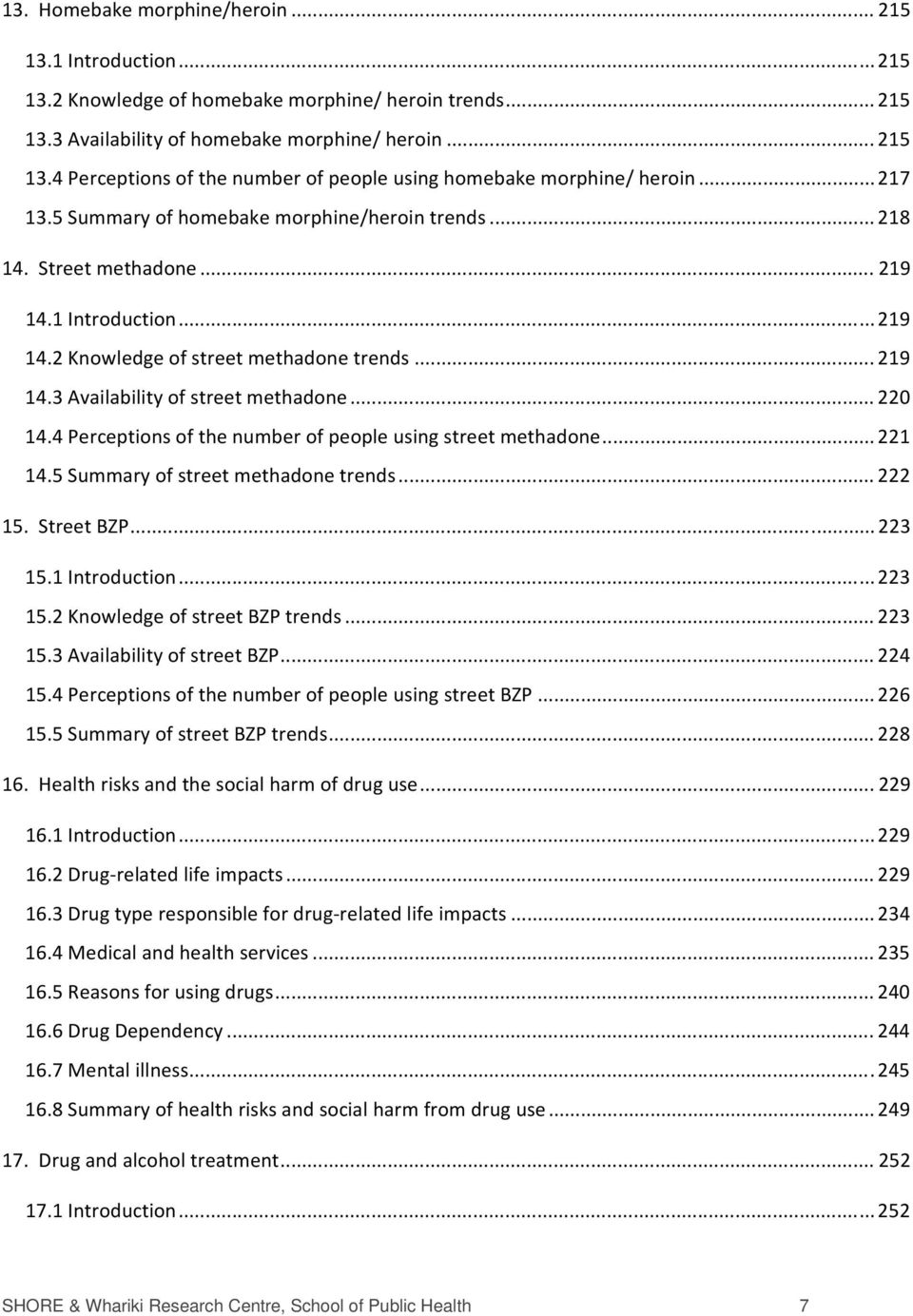
8 17.2 Extent needed help to reduce drug use Wanted help to reduce drug use but did not get it Barriers encountered when looking for help to reduce drug use Drug treatment history Type of drug treatment programme Drug type currently in drug treatment programme Calls to the Alcohol and Drug Help line Community Alcohol and Drug Services (CADS) Summary of drug treatment Crime Introduction Property crime Drug dealing Fraud Crime involving violence Means used to pay for drug use Summary of crime Drug enforcement Introduction History of arrest, conviction and imprisonment Drug treatment as part of sentencing Recent arrest and imprisonment Offences arrested for in past 12 months Perceptions of the current level of drug enforcement Perceptions of the impact of drug enforcement Number of friends arrested Summary of drug enforcement References Appendix 1: Lifetime drug use Appendix 2: Current drug use Table of Contents

9 List of Figures Figure 2.1: Proportion of the frequent drug users who were male, Figure 2.2: Mean age of the frequent drug users, Figure 2.3: Proportion of the frequent drug users who were of European ethnicity, Figure 2.4: Proportion of the frequent drug users who were of Maori ethnicity, Figure 2.5: Proportion of the frequent drug users who were unemployed or on a sickness benefit, Figure 2.6: Proportion of the frequent drug users who had no educational qualifications, Figure 2.7: Mean score of perception of physical health by frequent drug user group, Figure 2.8: Mean score of perception of mental health by frequent drug user group, Figure 3.1: Proportion of frequent methamphetamine users who had ever used antidepressants, opium poppies, oxycodone, synthetic cannabis and non BZP party pills, Figure 3.2: Proportion of frequent methamphetamine users who had ever used cocaine, BZP and crystal methamphetamine (Ice), Figure 3.3: Mean age at which the frequent methamphetamine users had first tried GHB and crystal methamphetamine (Ice), Figure 3.4: Proportion of frequent ecstasy users who had ever used tobacco, Ritalin (methylphenidate), anti depressants, oxycodone and synthetic cannabis, Figure 3.5: Proportion of frequent ecstasy users who had ever used nitrous oxide, BZP, methamphetamine, GHB and crystal methamphetamine (Ice), Figure 3.6: Mean age at which the frequent ecstasy users had first tried ecstasy, nitrous oxide, and GHB, Figure 3.7: Proportion of frequent injecting drug users who had ever used methamphetamine, anti depressants, oxycodone and synthetic cannabis, Figure 3.8: Proportion of frequent injecting drug users who had ever used nitrous oxide and LSD, Figure 3.9: Mean age at which the frequent injecting drug users had first tried Ritalin, methadone and benzodiazepines, Figure 3.10: Mean age at which the frequent injecting drug users had first tried crystal methamphetamine (Ice) and anti depressants, Figure 3.11: Proportion of the frequent methamphetamine users who had used crystal methamphetamine (Ice), anti depressants, homebake heroin/morphine, synthetic cannabis and oxycodone in the previous six months, Figure 3.12: Proportion of the frequent methamphetamine users who had used LSD, BZP and nitrous oxide in the previous six months, Figure 3.13: Mean number of frequent methamphetamine users had used cannabis, methamphetamine and crystal methamphetamine (Ice) in the previous six months (of those who had used these drug types in the previous six months),
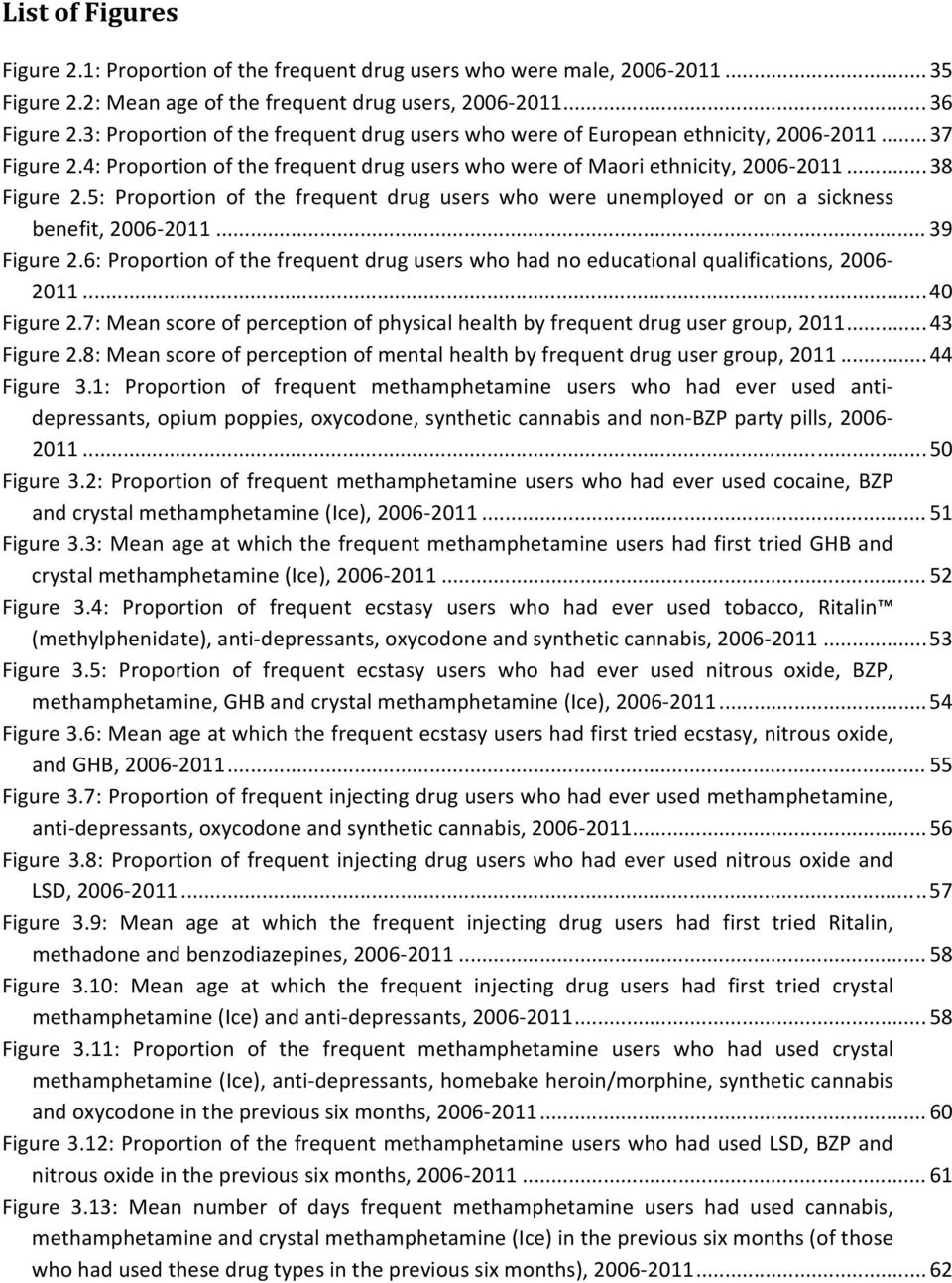
10 Figure 3.14: Mean number of frequent methamphetamine users had used Ritalin (methylphenidate) and ecstasy in the previous six months (of those who had used these drug types in the previous six months), Figure 3.15: Proportion of frequent methamphetamine users who had injected BZP and oxycodone and methamphetamine in the previous six months (of those who had used these drugs in the previous six months), Figure 3.16: Proportion of the frequent ecstasy users who had used methylphenidate (Ritalin ), anti depressants and synthetic cannabis in the previous six months, Figure 3.17: Proportion of the frequent ecstasy users who had used BZP, nitrous oxide, and crystal methamphetamine (Ice) in the previous six months, Figure 3.18: Proportion of the frequent ecstasy users who had used cannabis, LSD and ketamine in the previous six months, Figure 3.19: Mean number of frequent ecstasy users had used methamphetamine, synthetic cannabis, BZP and ecstasy in the previous six months (of those who had used these drug types in the previous six months), Figure 3.20: Proportion of the frequent injecting drug users who had used anti depressants, methamphetamine, oxycodone and synthetic cannabis in the previous six months, Figure 3.21: Proportion of the frequent injecting drug users who had used nitrous oxide, ecstasy, benzodiazepines and BZP in the previous six months, Figure 3.22: Proportion of frequent injecting drug users who had injected methylphenidate (Ritalin ) methamphetamine, methadone and BZP in the previous six months (of those who had used these drugs in the previous six months), Figure 3.23: Mean number of the frequent injecting drug users had used cannabis, crystal methamphetamine (Ice), anti depressants and BZP in the previous six months (of those who had used these drug types in the previous six months), Figure 4.1: Proportion of frequent drug users who had tried a drug type for the first time, Figure 4.2: Proportion of frequent drug users who had tried a drug type for the first time by frequent drug user group, Figure 4.3: Drug types the frequent ecstasy users had used for the first time (of those who had tried a drug for the first time), Figure 4.4: Drug types the frequent methamphetamine users had used for the first time (of those who had tried a drug for the first time), Figure 4.5: Drug types the frequent injecting drug users had used for the first time (of those who had tried a drug for the first time), Figure 4.6: Proportion of frequent drug users who noticed a new drug type, Figure 5.1: Mean score of the current availability of methamphetamine by combined frequent drug users, Figure 5.2: Mean score of the current availability of methamphetamine by combined frequent drug users by location, Figure 5.3: Mean score of the current availability of methamphetamine by location List of figures
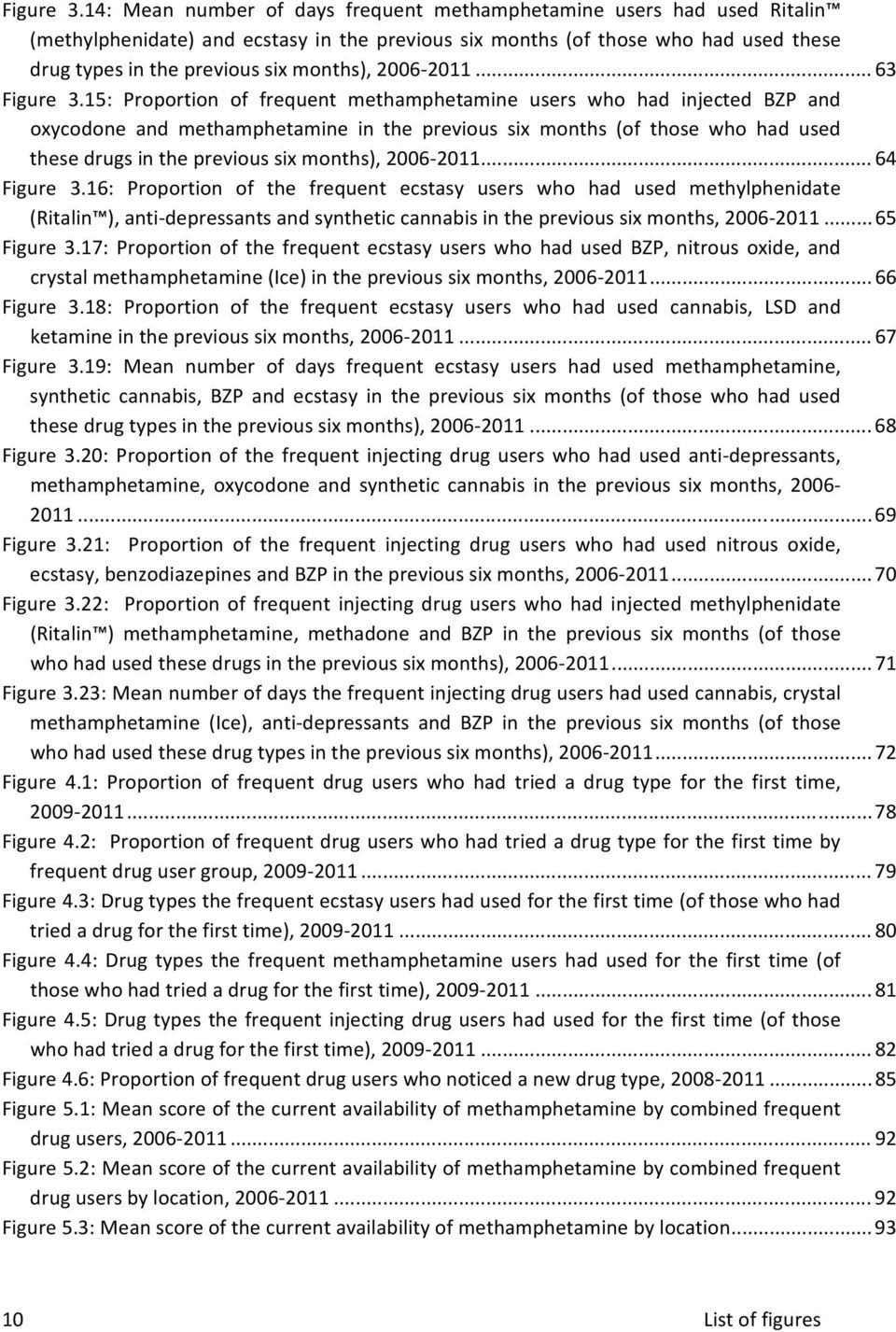
11 Figure 5.4: Mean score of the change in the availability of methamphetamine by combined frequent drug users, Figure 5.5: Mean score of the change in the availability of methamphetamine by combined frequent drug users by location, Figure 5.6: Mean price of a point of methamphetamine by combined frequent drug users, Figure 5.7: Mean price of a gram of methamphetamine by combined frequent drug users, Figure 5.8: Mean price of a gram of methamphetamine by location, Figure 5.9: Mean price of a point of methamphetamine by location, Figure 5.10: Mean price of a gram of methamphetamine by location, Figure 5.11: Mean score of the change in the price of methamphetamine in the past six months by combined frequent drug users, Figure 5.12: Mean score of the change in the price of methamphetamine in the past six months by location, Figure 5.13: Mean score of the current strength of methamphetamine in the past six months by combined frequent drug users, Figure 5.14: Mean score of the current strength of methamphetamine in the past six months by combined frequent drug users by location, Figure 5.15: Mean score of the change in strength of methamphetamine in the past six months by combined frequent drug users, Figure 5.16: Mean score of the change in strength of methamphetamine in the past six months by combined frequent drug users by location, Figure 5.17: Perceptions of the number of people using methamphetamine by combined frequent drug users, Figure 5.18: Perceptions of the number of people using methamphetamine by combined frequent drug users by location, Figure 5.19: Proportion of frequent drug users who could purchase methamphetamine in one hour or less, Figure 5.20: Proportion of frequent drug users who could purchase methamphetamine in one hour or less by location, Figure 6.1: Mean score of the current availability of crystal methamphetamine by combined frequent drug users, Figure 6.2: Mean price of a point of crystal methamphetamine by combined frequent drug users, Figure 6.3: Mean price per gram of crystal methamphetamine by combined frequent drug users, Figure 6.4: Mean score of the change in the price of crystal methamphetamine in the past six months by combined frequent drug users, Figure 6.5: Mean score of the current purity of crystal methamphetamine by combined frequent drug users, Figure 7.1: Mean score of the current availability of ecstasy by combined frequent drug users, SHORE & Whariki Research Centre, School of Public Health 11

12 Figure 7.2: Mean score of the current availability of ecstasy by location, Figure 7.3: Mean score of the change in the availability of ecstasy by combined frequent drug users, Figure 7.4: Mean score of the change in the availability of ecstasy by location, Figure 7.5: Mean price of a pill of ecstasy by combined frequent drug users, Figure 7.6: Mean price of a pill of ecstasy by location, Figure 7.7: Mean price of a pill of ecstasy by location, Figure 7.8: Mean score of the change in the price of ecstasy in the past six months by combined frequent drug users, Figure 7.9: Mean score of the change in the price of ecstasy in the past six months by location, Figure 7.10: Mean score of the current strength of ecstasy by combined frequent drug users, Figure 7.11: Mean score of the current strength of ecstasy by location, Figure 7.12: Mean score of the change in strength of ecstasy by combined frequent drug users, Figure 7.13: Mean score of the change in strength of ecstasy by location, Figure 7.14: Mean score of perceptions of the number of people using ecstasy by combined frequent drug users, Figure 7.15: Mean score of perceptions of the number of people using ecstasy by location, Figure 7.16: Proportion of frequent drug users who purchased ecstasy weekly or more often, Figure 7.17: Proportion of frequent drug users who purchased ecstasy weekly or more often by location, Figure 7.18: Proportion of frequent drug users who could purchase ecstasy in one hour or less, Figure 7.19: Proportion of frequent drug users who could purchase ecstasy in one hour or less by location, Figure 7.20: Thousands of ecstasy pills seized in New Zealand, Figure 8.1: Current availability of cannabis by combined frequent drug users, Figure 8.2: Current availability of cannabis by combined frequent drug users by location, Figure 8.3: Change in availability of cannabis by combined frequent drug users, Figure 8.4: Change in availability of cannabis by location, Figure 8.5: Price of an ounce of cannabis by combined frequent drug users, Figure 8.6: Mean price paid for an ounce of cannabis (NZD) by location, Figure 8.7: Mean price paid for an ounce of cannabis (NZD) by location, Figure 8.8: Perceptions of the number of people using cannabis by combined frequent drug users, Figure 8.9: Perceptions of the number of people using cannabis by location, Figure 8.10: Perceptions of the number of people using cannabis by location, List of figures
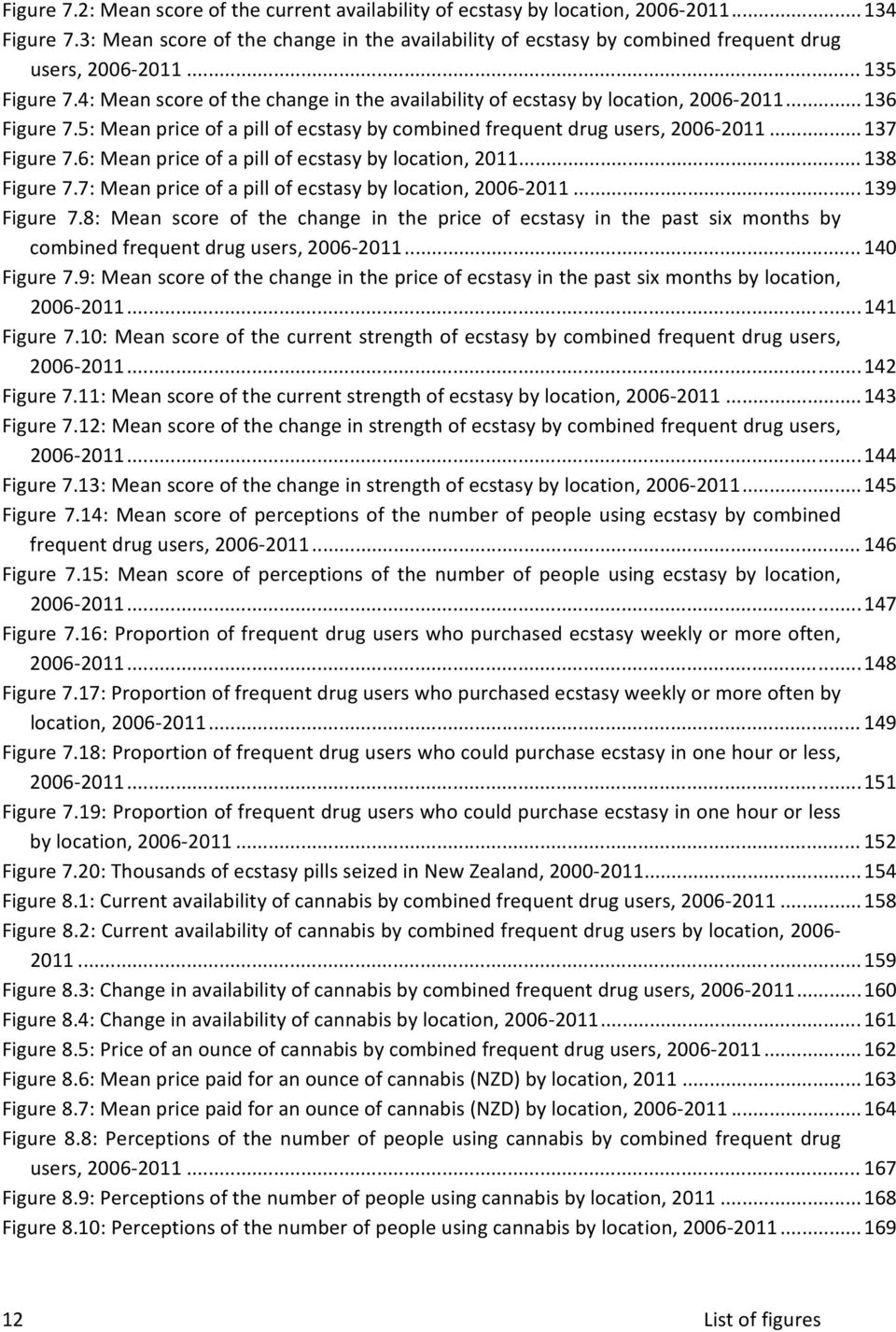
13 Figure 8.11: Proportion of frequent drug users who purchased cannabis weekly or more often by location, Figure 8.12: Proportion of frequent drug users who could purchase cannabis in one hour or less by location, Figure 8.13: Annual number of cannabis plants destroyed in New Zealand, Figure 9.1: Mean score of the change in availability of LSD by combined frequent drug users, Figure 9.2: Mean price of a tab of LSD by combined frequent drug users, Figure 9.3: Mean score of the current strength of LSD by combined frequent drug users, Figure 9.4: Change in the mean score of the strength of LSD by combined frequent drug users, Figure 9.5: Number of tabs of LSD seized in New Zealand, Figure 10.1: Current mean price paid for 100 milligrams of street morphine (NZD), Figure 10.2: Change in the price of street morphine in the past six months by combined frequent drug users, Figure 10.1: Current mean price paid for 100 milligrams of street morphine (NZD), Figure 10.2: Change in the price of street morphine in the past six months by combined frequent drug users, Figure 11.1: Mean score of the current availability of cocaine by combined frequent drug users, Figure 11.2: Mean score of the change in availability of cocaine by combined frequent drug users, Figure 11.3: Mean price of a gram of cocaine (NZD) by combined frequent drug users, Figure 11.4: Mean score of the change in price of cocaine in the previous six months by combined frequent drug users, Figure 11.5: Mean score of the current purity of cocaine by combined frequent drug users, Figure 12. 1: Current availability of heroin by combined frequent drug users, Figure 12.2: Change in availability of heroin by combined frequent drug users, Figure 13.1: Mean score of the perceptions of the number of people using homebake morphine/heroin by combined frequent drug users, Figure 14.1: Current availability of street methadone by combined frequent drug users, Figure 15.1: Current availability of street BZP by combined frequent drug users, Figure 15.2: Change in the availability of street BZP by combined frequent drug users, Figure 15.3: Perceptions of the number of people using street BZP by combined frequent drug users, Figure 16.1: Proportion of frequent methamphetamine users who had been given a drug without their knowledge and had their drink spiked, SHORE & Whariki Research Centre, School of Public Health 13

14 Figure 16.2: Proportion of frequent methamphetamine users who had been arrested, had unprotected sex, sacked/lost business/quit study and had overdosed on drugs, Figure 16.3: Proportion of frequent ecstasy users who upset a family relationship and had physically hurt someone due to their drug use, Figure 16.4: Proportion of frequent ecstasy users who were physically/verbally threatened, physically assaulted and had their drink spiked, Figure 16.5: Proportion of frequent injecting drug users who had accessed a General Practitioner, counsellor and social worker in relation to drug use in the past six months, Figure 16.6: Proportion of frequent methamphetamine users who had been admitted to hospital, received First Aid and accessed an ambulance in relation to drug use in the past six months, Figure 16.7: Selected reasons provided by the frequent methamphetamine users for using drugs, Figure 16.8: Selected reasons provided by the frequent injecting drug users for using drugs, Figure 16.9: Proportion of frequent drug user group who were assessed as drug dependent, Figure 16.10: Proportion of frequent drug users who had ever suffered from a mental illness by frequent drug user group, Figure 16.11: Proportion of frequent drug users who had stayed in a psychiatric facility overnight or longer by of frequent drug user group, Figure 16.12: Proportion of frequent drug user group who are currently receiving treatment for a mental illness, Figure 17.1: Proportion of the frequent drug users who felt they needed at least some help to reduce their drug use by frequent drug user group, Figure 17.2: Proportion of the frequent methamphetamine users who reported fear of service or fear of police as barriers to seeking help, Figure 17.3: Proportion of the frequent injecting drug users who reported long waiting lists or couldn t get an appointment at a suitable time as barriers to seeking help, Figure 17.4: Proportion of frequent drug users who had ever been or were currently in drug treatment by frequent drug user group, Figure 17.5: Proportion of callers to the Alcohol and Drug Help line by drug type calling about, Figure 17.6: Proportion of clients screening positive for problematic drug use by drug type, Figure 18.1: Proportion of the frequent drug users who sold drugs, committed property crime, committed fraud and committed violent crime in the previous six months, Figure 18.2: Proportion of frequent injecting drug users who sold drugs, committed property crime and committed fraud in the previous month, Figure 18.3: Proportion of frequent methamphetamine users who sold drugs, committed property crime and committed fraud in the previous month, List of figures

15 Figure 18.4: Proportion of frequent ecstasy users who sold drugs, committed property crime and committed fraud in the previous month, Figure 18.5: Proportion of frequent methamphetamine users who committed a violent crime in their lifetime, in the previous six months, and in the previous month, Figure 18.6: Proportion of frequent methamphetamine users who used social welfare benefits, credit from dealers, borrowed money and property crime to pay for drug use, Figure 18.7: Proportion of frequent methamphetamine users who made drugs themselves, used someone else s prescription, used their own prescription and doctor shopped to pay for drug use, Figure 18.8: Proportion of frequent ecstasy users who used drug dealing and money from parents to pay for drug use, Figure 18.9: Proportion of frequent ecstasy users who made drugs themselves and used someone else s prescription to pay for drug use, Figure 18.10: Proportion of frequent injecting users who used a prescription (own name), someone else s prescription and doctor shopping to pay for drug use, Figure 19.1: Proportion of frequent drug users who had ever been arrested, convicted and imprisoned, Figure 19.2: Proportion of frequent methamphetamine users who had ever been arrested, convicted and imprisoned, Figure 19.3: Proportion of frequent injecting drug users who had ever been arrested, convicted and imprisoned, Figure 19.4: Proportion of frequent ecstasy users who had ever been arrested, convicted and imprisoned, Figure 19.5: Proportion of convicted frequent drug users who received alcohol and drug treatment as part of sentence, Figure 19.6: Proportion of frequent methamphetamine users who had been arrested and imprisoned in the previous 12 months, Figure 19.7: Proportion of frequent injecting drug users who had been arrested and imprisoned in the previous 12 months, Figure 19.8: Proportion of frequent ecstasy users who had been arrested and imprisoned in the previous 12 months, Figure 19.9: Proportion of frequent methamphetamine users who had been arrested for a violent crime, property crime and driving over the alcohol limit in the previous 12 months, Figure 19.10: Proportion of frequent drug users who noticed police activity toward drug users in the past six months, Figure 19.11: Mean score of change in police activity toward drug users in the past six months for frequent methamphetamine users and frequent ecstasy users, Figure 19.12: Proportion of frequent methamphetamine users and frequent ecstasy users who thought police activity had made it more difficult for them to obtain drugs in the past six months, Figure 19.13: Proportion of frequent drug users who had a friend arrested in the past six months, SHORE & Whariki Research Centre, School of Public Health 15

16 List of Tables Table 1.1: Distribution of IDMS respondents by site for the 2006, 2007, 2008, 2009, 2010 and Table 1.2: Distribution of IDMS respondents by module for the 2006, 2007, 2008, 2009, 2010 and Table 1.3: Weighted distribution of respondents by site for the 2006, 2007, 2008, 2009, 2010 and Table 1.4: Weighted distribution of respondents by module for the 2006, 2007, 2008, 2009, 2010 and Table 2.1: Ethnicity of the frequent drug users, Table 2.2: Employment status of the frequent drug users, Table 2.3: Highest educational achievement of the frequent drug users, Table 2.4: Frequent drug users sexual orientation, Table 2.5: Frequent drug users by marital status, Table 2.6: Frequent drug users by current accommodation type, Table 2.7: Frequent drug users self assessment of current physical health, Table 2.8: Frequent drug users self assessment of current mental health, Table 4.1: Drug types used for the first time in the past six months by frequent drug user group (of those who reported using a drug for the first time in previous six months), Table 4.2: New drug types heard about in previous six months, Table 4.3: New types of people reported using drugs, Table 5.1: Current availability of methamphetamine by combined frequent drug users, Table 5.2: Current availability of methamphetamine by location, Table 5.3: Change in availability of methamphetamine by combined frequent drug users, Table 5.4: Current price of methamphetamine (NZD) by combined frequent drug users, Table 5.5: Current median (mean) price for a point and gram of methamphetamine (NZD) by location, Table 5.6: Change in the price of methamphetamine in the past six months by combined frequent drug users, Table 5.7: Change in the price of methamphetamine in the past six months by location, Table 5.8: Current median (mean) price of pseudoephedrine (NZD), Table 5.9: Change in the price of pseudoephedrine in the past six months, Table 5.10: Current strength of methamphetamine by combined frequent drug users, Table 5.11: Change in strength of methamphetamine by combined frequent drug users, List of tables
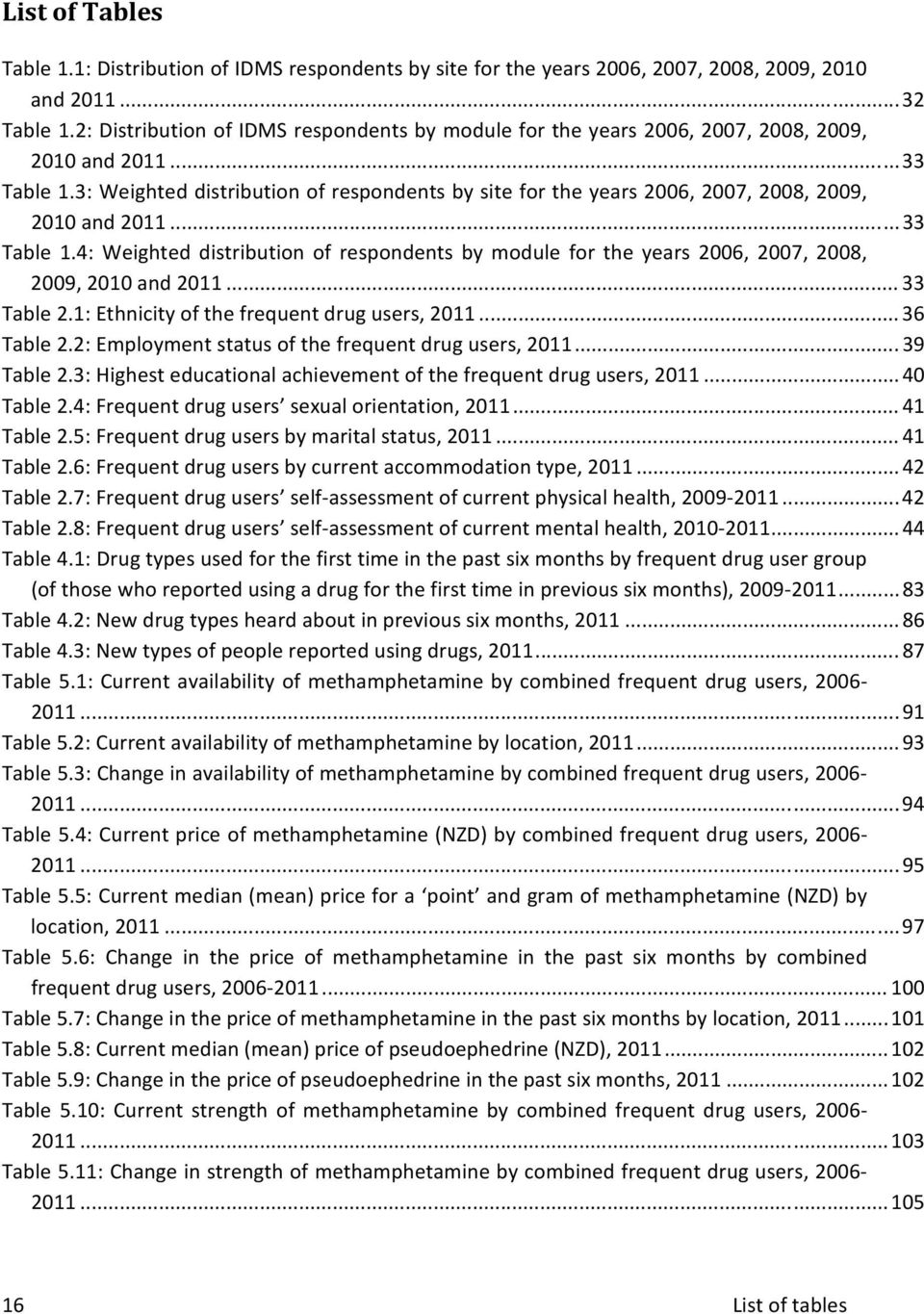
17 Table 5.12: Perceptions of the number of people using methamphetamine by combined frequent drug users, Table 5.13: Perceptions of the number of people using methamphetamine by combined frequent drug users by location, Table 5.14: Frequency of purchase of methamphetamine (of those who purchased any) in past six months by combined frequent drug users, Table 5.15: Median (mean) dollar amount spent on methamphetamine (NZD) on a typical occasion by combined frequent drug users, Table 5.16: Median (mean) dollar amount spent on methamphetamine (NZD) on a typical occasion by combined frequent drug users by location, Table 5.17: Time taken to purchase methamphetamine by combined frequent drug users, Table 5.18: Location from which methamphetamine purchased in the past six months by combined frequent drug users, Table 5.19: People from whom methamphetamine purchased in the past six months by combined frequent drug users, Table 6.1: Current availability of crystal methamphetamine by combined frequent drug users, Table 6.2: Mean score of the current availability of crystal methamphetamine by combined frequent drug users, Table 6.3: Current median (mean) price for crystal methamphetamine (NZD) by combined frequent drug users, Table 6.4: Change in the price of crystal methamphetamine in the past six months by combined frequent drug users, Table 6.5: Current purity of crystal methamphetamine by combined frequent drug users, Table 6.6: Change in purity of crystal methamphetamine by combined frequent drug users, Table 6.7: Perceptions of the number of people using crystal methamphetamine by combined frequent drug users, Table 7.1: Drug types perceived to be in ecstasy (of the people who thought they knew), Table 7.2: Current availability of ecstasy by combined frequent drug users, Table 7.3: Current availability of ecstasy by location, Table 7.4: Change in availability of ecstasy by combined frequent drug users, Table 7.5: Current price of ecstasy (NZD) by combined frequent drug users, Table 7.6: Current median (mean) price for ecstasy (NZD) by location, Table 7.7: Change in the price of ecstasy in the past six months by combined frequent drug users, Table 7.8: Change in price of ecstasy in the past six months by location, Table 7.9 Current strength of ecstasy by combined frequent drug users, Table 7.10: Change in strength of ecstasy (MDMA) by combined frequent drug users, SHORE & Whariki Research Centre, School of Public Health 17
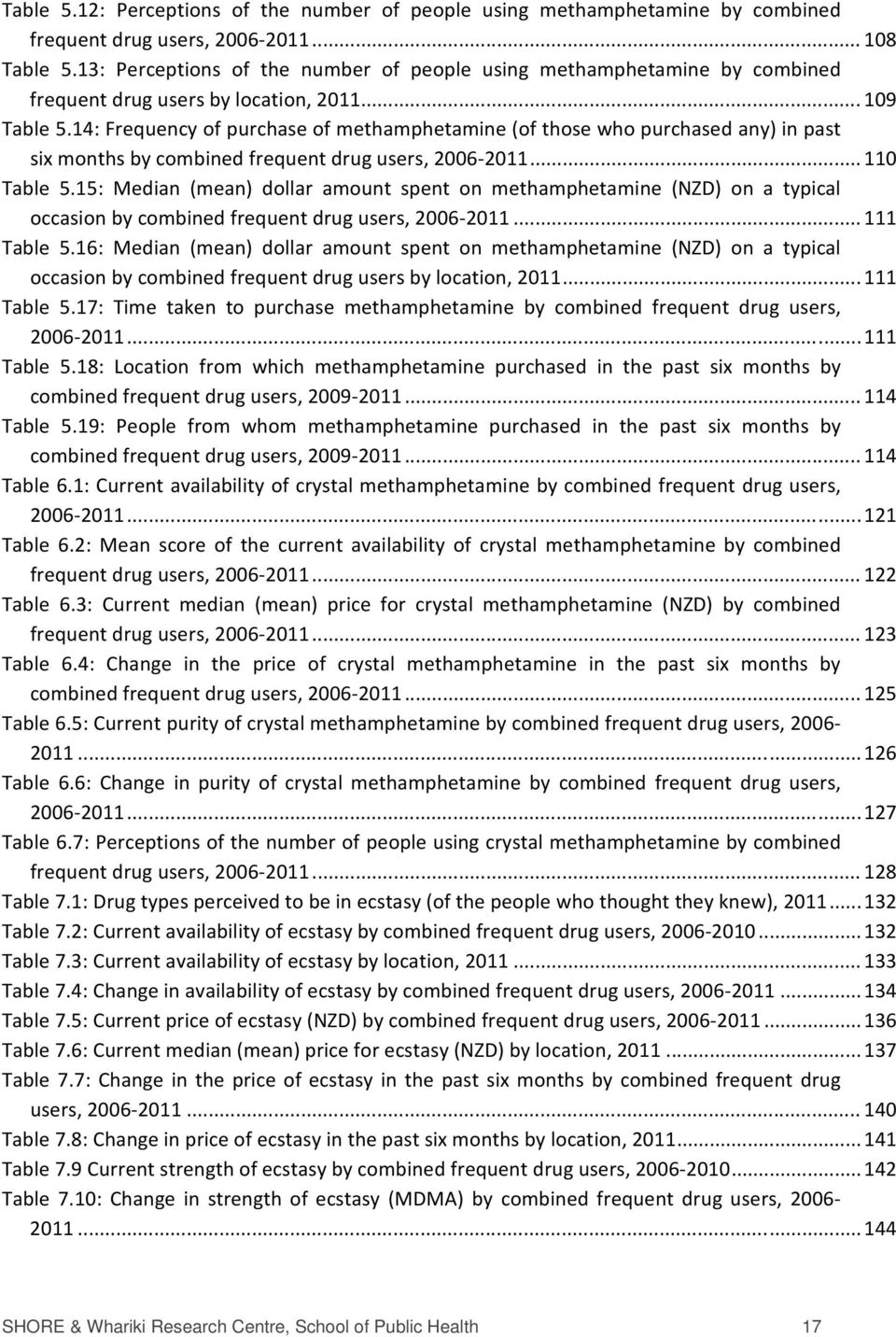
18 Table 7.11: Perceptions of the number of people using ecstasy by combined frequent drug users, Table 7.12: Frequency of purchase of ecstasy in past six months by combined frequent drug users, Table 7.13: Median (mean) dollar amount spent on ecstasy (NZD) on a typical occasion by combined frequent drug users, Table 7.14: Time taken to purchase ecstasy by combined frequent drug users, Table 7.15: Location from which ecstasy purchased in the past six months by combined frequent drug users, Table 7.16: People from whom ecstasy purchased in the past six months by combined frequent drug users, Table 8.1: Current availability of cannabis by combined frequent drug users, Table 8.2: Change in availability of cannabis by combined frequent drug users, Table 8.3: Current price of cannabis (NZD) by combined frequent drug users, Table 8.4: Current median (mean) price for cannabis (NZD) by location, Table 8.5: Change in the price of cannabis in the past six months by combined frequent drug users, Table 8.6: Current strength of cannabis by combined frequent drug users, Table 8.7: Change in strength of cannabis by combined frequent drug users, Table 8.8: Perceptions of the number of people using cannabis by combined frequent drug users, Table 8.9: Perceptions of the number of people using cannabis by location, Table 8.10: Frequency of purchase of cannabis in past six months by combined frequent drug users, Table 8.11: Median (mean) dollar amount spent on cannabis (NZD) on typical occasion by combined frequent drug users, Table 8.12: Time taken to purchase cannabis by combined frequent drug users, Table 8.13: Location from which cannabis purchased in the past six months by combined frequent drug users, Table 8.14: People from whom cannabis purchased in the past six months by combined frequent drug users, Table 9.1: Current availability of LSD by combined frequent drug users, Table 9.2: Change in availability of LSD by combined frequent drug users, Table 9.3: Current median (mean) price for LSD (NZD) by combined frequent drug users, Table 9.4: Change in the price of LSD in the past six months by combined frequent drug users, Table 9.5: Current strength of LSD by combined frequent drug users, Table 9.6: Change in strength of LSD by combined frequent drug users, Table 9.7: Perceptions of the number of people using LSD by combined frequent drug users, Table 11.1: Current availability of cocaine by combined frequent drug users, Table 11.2: Change in availability of cocaine by combined frequent drug users, List of tables
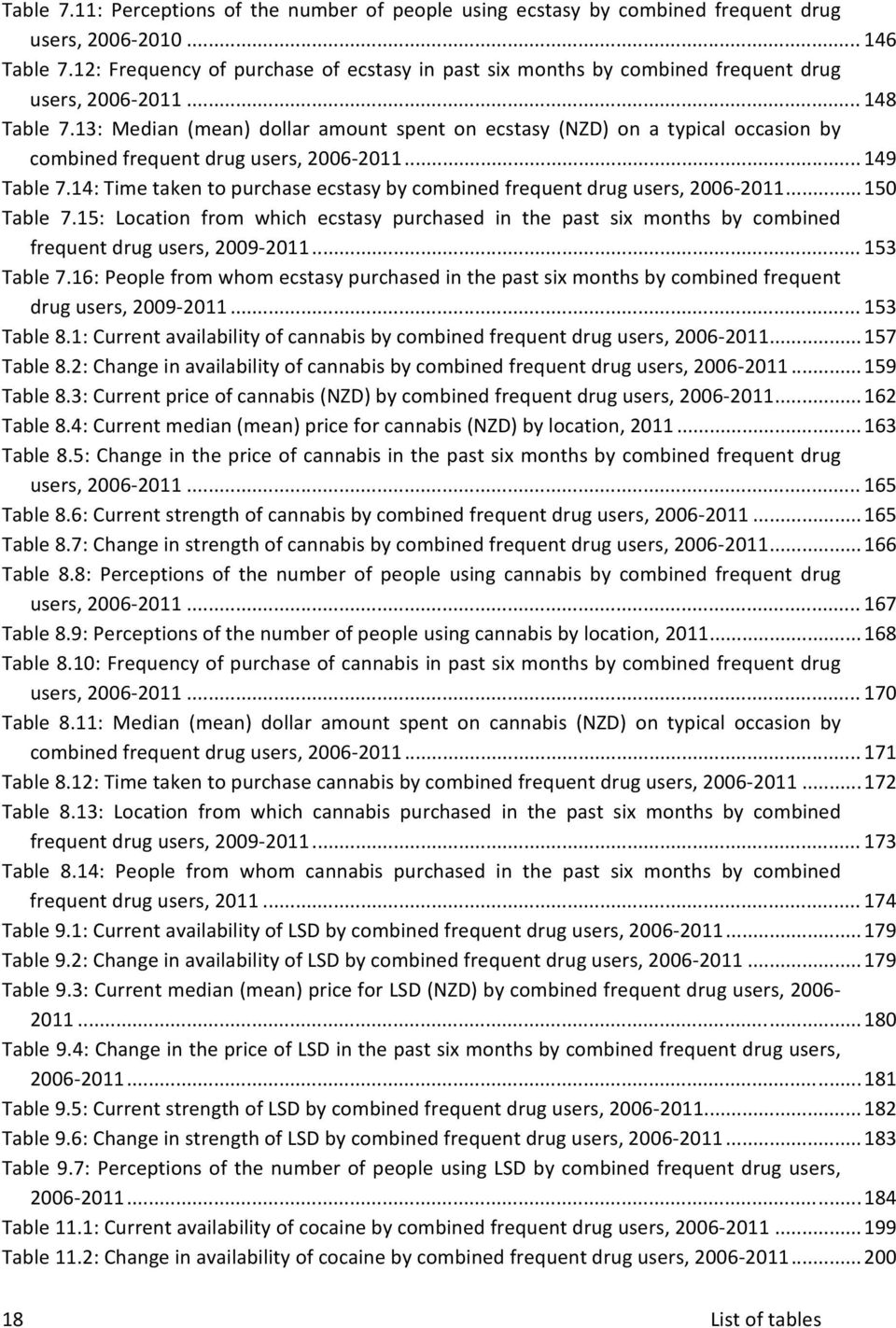
19 Table 11.3: Current price of cocaine (NZD) by combined frequent drug users, Table 11.4: Change in the price of cocaine in the past six months by combined frequent drug users, Table 11.5: Current purity of cocaine by combined frequent drug users, Table 11.6: Change in purity of cocaine by combined frequent drug users, Table 11.7: Perceptions of the number of people using cocaine by combined frequent drug users, Table 12.1: Current availability of heroin by combined frequent drug users, Table 12.2: Change in availability of heroin by combined frequent drug users, Table 12.3: Current median (mean) price of heroin (NZD) by combined frequent drug users, Table 12.4: Change in the price of heroin in the past six months by combined frequent drug users, Table 12.5: Current purity of heroin by combined frequent drug users, Table 12.6: Change in purity of heroin by combined frequent drug users, Table 12.7: Perceptions of the number of people using heroin by combined frequent drug users, Table 13.1: Current availability of homebake morphine/heroin by combined frequent drug users, Table 13.2: Change in availability of homebake morphine/heroin by combined frequent drug users, Table 13.3: Perceptions of the number of people using homebake morphine/ heroin by combined frequent drug users, Table 14.1: Current availability of street methadone by combined frequent drug users, Table 14.2: Change in availability of street methadone by combined frequent drug users, Table 14.3: Perceptions of the number of people using street methadone by combined frequent drug users, Table 15.1: Current availability of street BZP by combined frequent drug users, Table 15.2: Change in availability of street BZP by combined frequent drug users, Table 15.3: Perceptions of the number of people using street BZP by combined frequent drug users, Table 16.1: Drug related incidents by frequent drug user group, Table 16.2: Drug types mainly responsible for drug related incidents by frequent drug user group, Table 16.3: Proportion of frequent injecting drug users who had accessed medical and health services in relation to drug use in the past six months, Table 16.4: Proportion of frequent methamphetamine users who had accessed medical and health services in relation to drug use in the past six months, Table 16.5: Proportion of frequent ecstasy users who had accessed medical and health services in relation to drug use in the past six months, SHORE & Whariki Research Centre, School of Public Health 19
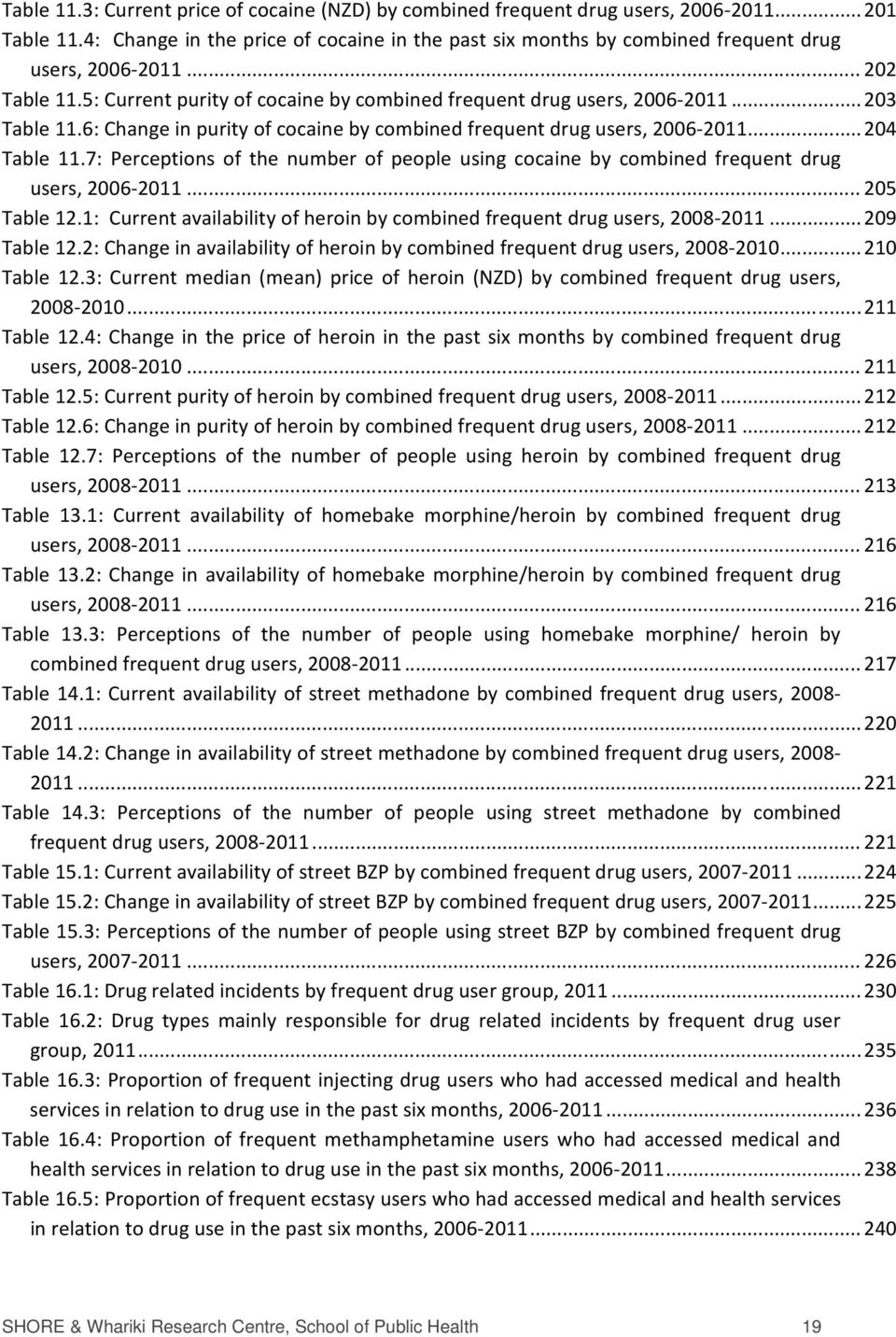
20 Table 16.6: Self reported reasons for using drugs by frequent methamphetamine users, Table 16.7: Self reported reasons for using drugs by frequent injecting drug users, Table 16.8: Self reported reasons for using drugs by frequent ecstasy users, Table 17.1: Extent to which the frequent drug users felt they needed help to reduce their drug use by frequent drug user group, Table 17.2: Proportion of frequent drug users who had wanted help to reduce their drug use in the previous six months but had not got it, Table 17.3: Barriers experienced by the frequent methamphetamine users when trying to find help to reduce drug use (of those who were unable to find help), Table 17.4: Barriers experienced by the frequent injecting drug users when trying to find help to reduce drug use (of those who were unable to find help), Table 17.5: Barriers experienced by frequent ecstasy users when trying to find help to reduce drug use (of those who were unable to find help), 2010 & Table 17.6: Type of drug treatment programme currently enrolled in by frequent drug user group, 2010 & Table 17.7: Drug Type(s) currently in treatment for by frequent drug user group, 2010 & Table 18.1: Proportion of the frequent drug users who committed property crime, Table 18.2: Proportion of the frequent drug users who sold illegal drugs, Table 18.3: Proportion of the frequent drug users who committed fraud, Table 18.4: Proportion of the frequent drug users who committed violent crime, Table 18.5: Different means used by the frequent methamphetamine users to pay for drugs in the past six months, Table 18.6: Different means used by frequent ecstasy users to pay for drugs in the past six months, Table 18.7: Different means used by frequent injecting drug users to pay for drugs in the past six months, Table 19.1: Proportion of frequent drug users who were arrested for different criminal offences in the past 12 months by frequent drug user group, Table 19.2: Frequent methamphetamine users perceptions of the change in police activity in relation to drug users in the past six months (of those who noticed any change in police activity), Table 19.3: Frequent ecstasy users perceptions of the change in police activity in relation to drug users in the past six months (of those who noticed any change in police activity), Table 19.4: Frequent injecting drug users perceptions of the change in police activity in relation to drug users in the past six months (of those who noticed any change in police activity), Table 19.5: Proportion of frequent drug users who thought police activity had made it more difficult for them to obtain drugs in the past six months, Table 19.6: Change in the number of friends arrested in the past six months by frequent drug user group (of those who had a friend arrested), List of tables

21 Acknowledgements The Illicit Drug Monitoring System (IDMS) is conducted as part of the National Drug Policy. We gratefully acknowledge the support of a number of New Zealand government agencies including Police, Ministry of Health, Customs Service, Ministry of Justice, Department of Corrections, Ministry of Pacific Island Affairs and Te Puni Kōkiri. The design of the IDMS drew on the Illicit Drug Reporting System (IDRS) and Ecstasy and other drug Reporting System (EDRS) which are conducted by the National Drug and Alcohol Research Centre (NDARC) in Australia. We acknowledge the New Zealand Needle Exchange who assist us with the recruitment of frequent drug users for the study. We would like to thank the following agencies and organisations who provided secondary data sources on drug use and drug related harm in New Zealand for this study: New Zealand Police National Drug Intelligence Bureau (NDIB) New Zealand Ministry of Health New Zealand Customs Service Alcohol Drug Association New Zealand (ADANZ) Community Alcohol and Drug Services (CADS) We would like to thank all the interviewers who worked with us on the study and the frequent drug users who agreed to be interviewed. The views expressed in this report are entirely our own. They do not necessarily reflect those of any government agency or other organisation. Correspondence Dr Chris Wilkins, Senior Researcher, Drugs Team Leader, Centre for Social and Health Outcomes Research and Evaluation (SHORE), Massey University, PO Box 6137, Wellesley Street, Auckland, New Zealand, tel , [email protected] SHORE & Whariki Research Centre, School of Public Health 21
22 Executive Summary Introduction The Illicit Drug Monitoring System (IDMS) is conducted annually to provide a snapshot of trends in drug use and drug markets in New Zealand. The 2011 IDMS interviewed a total of 372 frequent illegal drug users (i.e. 161 frequent ecstasy users, 113 frequent methamphetamine users, and 98 frequent injecting drug users) from Auckland, Wellington and Christchurch from August to December Emerging Drugs A growing number of new synthetic drug types have emerged in New Zealand in recent and this mirrors similar trends reported in Europe and the United States. The proportion of the frequent drug users who had noticed a new drug type in the previous six months increased from 9% in 2008, to 13% in 2009, to 24% in 2010 and 34% in The proportion of the frequent drug users who had tried a drug for the first time in the previous six months increased from 24% in 2009, to 33% in 2010 to 40% in The drug types the frequent drug users most commonly reported using for the first time in 2011 were synthetic cannabis (e.g. Kronic, Spice), ecstasy, oxycodone, anti depressants, methylphenidate (Ritalin ), codeine, mephedrone (methylmethcathinone), salvia divinorum and one of the 2C drugs (e.g. 2CB, 2CI). The use of many of these new substances remains at a fairly low level at present, but it is important to continue to monitor them closely given the speed at which new drug epidemics can develop (e.g. methamphetamine in the early 2000s) and, in the case of new compounds, the potential for unpredictable health risks. Increasing drug use There was a sharp increase in the use of synthetic cannabis in For example, the percentage of frequent methamphetamine users who had used synthetic cannabis in the previous six months increased from 10% in 2010 to 41% in There was also a steady increase in the use of pharmaceutical drugs. The percentage of frequent injecting drug users who had used oxycodone in the past six months increased from 9% in 2008 to 21% in Similarly, the percentage of frequent ecstasy users who had recently used methylphenidate (Ritalin ) increased from 13% in 2006 to 25% in The appropriate control of pharmaceutical drugs is a complex issue which requires a delicate balance 22 Executive summary
23 between reducing the extra medical use of pharmaceuticals and not denying access to pharmaceuticals to those with medical or therapeutic needs. Methamphetamine ( P ) The price of methamphetamine continues to increase and there was evidence of some disruption in other aspects of the methamphetamine market. The price of a gram of methamphetamine increased steadily from $610 per gram in 2006 to $815 per gram in The strength of methamphetamine has declined slightly over the past six. The availability of methamphetamine has also declined slightly in recent, and this trend is strongest in Christchurch. There is also evidence of some decline in methamphetamine use. The percentage of frequent methamphetamine users who had used crystal methamphetamine in the past six months declined from 64% in 2006 to 37% in The number of the frequent methamphetamine users had used methamphetamine in the previous six months declined from 57 in 2006 to 40 in 2011, and the number of they had used crystal methamphetamine declined from 55 in 2006 to 30 in Crystal methamphetamine ( Ice ) It is not entirely clear how separate the methamphetamine ( P ) and crystal methamphetamine ( Ice ) markets are in New Zealand, but some frequent drug users make a distinction between the two. There was evidence of a decline in the availability of Ice and a rise in price. The price of a gram of Ice increased from $691 in 2007 to $914 in 2011, with a steep rise from $763 in 2010 to $914 in Ecstasy The ecstasy market has been expanding in New Zealand over the past six. This general picture is complicated by a global shortage in MDMA in recent which has resulted in lower strength ecstasy and ecstasy containing other substitute compounds. Furthermore, during the time of interviewing for the 2011 IDMS the New Zealand Police successfully dismantled a major Auckland ecstasy supplier and this may have impacted the ecstasy market in Auckland and other places. The availability of ecstasy declined in 2011, with a sharp decline reported in Auckland. The price of ecstasy has been declining since 2006 (i.e. the price of a pill of ecstasy declined from $59 in 2006 to $47 in 2010), but the price was reported to have increased in Auckland in The strength of ecstasy has been low since There SHORE & Whariki Research Centre, School of Public Health 23
24 was evidence of some recovery in the strength of ecstasy in Auckland in 2010, but potency is yet to recover to the pre 2008 levels. Cannabis The cannabis market is generally fairly stable, but we found some small localised trends. There was a slight decline in the availability of cannabis in Christchurch and Wellington, and a slight decline in potency in Auckland and Christchurch. The price of an ounce of cannabis increased from 2006 to 2011 in Auckland (up from $295 to $332) and Christchurch (up from $308 to $335). There was a decline in the proportion of frequent drug users who purchased cannabis from a tinny house from 2010 to 2011, and this may reflect greater enforcement focus on these selling locations in recent. Cocaine Only a fairly small number of the frequent drugs users had any knowledge of cocaine. The availability of cocaine was low, and availability was reported to have declined from 2010 to The price of a gram of cocaine increased steeply from $357 in 2010 to $585 in 2011 (although only small numbers gave reports of cocaine prices). The frequent drug users thought less people were using cocaine in 2011 compared to Overall there was not much evidence to suggest the cocaine market is expanding in New Zealand. Street BZP The prohibition of BZP in 2008 greatly reduced its availability and increased its price. There has been some recovery in availability following the initial impact of the prohibition, but not to the preprohibition legal level. The use of BZP has also declined substantially since the prohibition. For example, the percentage of frequent methamphetamine users who had used BZP in the previous six months declined from 32% in 2006 to 6% in Interestingly, a similar decline was found for another former legal high, nitrous oxide. The proportion of frequent ecstasy users who had recently used nitrous oxide declined from 47% in 2006 to 5% in Executive summary
25 LSD LSD remains fairly popular, particularly among ecstasy users and methamphetamine users. The LSD market has been fairly stable over the past six. There was some decline in availability and potency in 2010, but the market appears to have largely recovered in Heroin Only a small number of frequent drugs users had any knowledge of heroin (as opposed to the much more widely used street morphine). The availability of heroin may have become more difficult over recent. There has been no change in price or purity. Street morphine Morphine remains the most commonly used and widely available opioid in New Zealand. The street morphine market has been fairly stable over the past four. The price of street morphine was reported to have increased in 2011 following a decline in the price in Purity is stable. Homebake morphine/heroin Homebake morphine use was fairly common among the frequent injecting drug users (and to a lesser extent among the methamphetamine users). Availability is fairly difficult and may be getting more difficult. There was some evidence of increasing use in 2011, but this trend is yet to be substantiated. Street methadone The use of street methadone is common among frequent injecting drug users and some frequent methamphetamine users. Most of the injecting drug users who used street methadone injected it. The availability of street methadone declined in There was little change in perceptions of the number of users. The diversion of methadone is a delicate issue as the use of methadone is generally associated with the stabilisation of injecting drugs users (as opposed to when they are using morphine and other short acting opioids) and a desire to reduce drug use. However, it is obviously preferable that methadone is not injected and use occurs within a recognised drug treatment program and therapeutic relationship. SHORE & Whariki Research Centre, School of Public Health 25
26 Health and social problems from drug use Many of the frequent drug users experienced serious health, relationship, economic and legal problems as a result of their drug use. The proportion of frequent methamphetamine users who reported being given a drug without their knowledge increased from 9% in 2008 to 24% in 2011, and the percentage who reported having their drink spiked increased from 8% in 2008 to 19% in These trends may reflect the growing number of new synthetic drugs which can be easily passed off as other substances or concealed in drinks. The proportion of frequent methamphetamine users who had accessed emergency medical services (i.e. ambulance, A&E, hospital) in relation to their drug use increased from 2006 to For example, the proportion of frequent methamphetamine users who had accessed an ambulance in relation to their drug use in the previous six months increased from 3% in 2006 to 14% in 2011, and the proportion who had required First Aid in the previous six months increased from 2% in 2006 to 22% in Drug treatment The frequent drug users were less likely to nominate fear of police, long waiting lists, fear of drug treatment and couldn t get an appointment as barriers to getting help from 2007 to For example, the proportion of frequent injecting drug users who nominated long waiting lists as a barrier to finding help decreased from 52% in 2007 to 21% in 2011, and the proportion of frequent methamphetamine users who nominated fear of the police as a barrier to finding help decreased from 43% in 2007 to 20% in Crime We found some evidence of increasing violent crime among the frequent methamphetamine users. The proportion of frequent methamphetamine users who reported committing a violent crime in the previous six months increased from 11% in 2009 to 30% in The proportion of frequent methamphetamine users who were arrested for a violent offence in the past year increased from 9% in 2006 to 26% in There were also some interesting changes with respect to the means the frequent drug users used to pay for their drug use. All three frequent drugs user groups reported increasing incidence of obtaining drugs via diversion from the health system (i.e. someone else s prescription or doctor shopping ). The percentage of frequent methamphetamine users who obtained drugs using someone else s prescription increased from 9% in 2008 to 30% in Higher proportions of the 26 Executive summary
27 frequent methamphetamine users and frequent ecstasy users also reported making drugs themselves. The proportion of frequent methamphetamine users who made their own drugs increased from 11% in 2008 to 32% in Drug enforcement There was evidence of police activity disrupting the methamphetamine and ecstasy markets. For example, the proportion of frequent methamphetamine users who thought police activity had made it more difficult for them to obtain drugs increased from 24% in 2010 to 42% in Similarly, the proportion of frequent ecstasy users who thought police activity had made it more difficult to obtain drugs increased from 15% in 2010 to 28% in The percentage of frequent methamphetamine users who had recently been arrested increased from 39% in 2009 to 61% in The frequent methamphetamine users were more likely to be arrested for violent offences, alcohol and driving and disorderly conduct. There was also evidence of drug treatment playing a greater part in the criminal justice process. The proportion of frequent methamphetamine users who had received drug treatment as part of their conviction increased from 32% in 2009 to 50% in Similarly, the proportion of frequent injecting drug users who had received drug treatment as part of their conviction increased from 26% in 2009 to 43% in SHORE & Whariki Research Centre, School of Public Health 27
28 1. Introduction The Illicit Drug Monitoring System (IDMS) was established in 2005 to provide annual snapshots of drug use, drug markets and drug related harm in New Zealand. The findings from the IDMS are intended to inform strategic responses to drug use and drug related problems in New Zealand. Research from the IDMS is utilised by a wide range of government and non government organisations, including government ministries and departments, drug treatment organisations, drug prevention organisations, health and welfare services and needle exchanges. 1.1 Aims of IDMS The principal aims of the IDMS are to: Track trends in drugs of high concern; Identify the emergence of new drug types; Document the availability, price, and purity of drugs of greatest concern; Document the health and social harms related to drug use; Document social disruption related to drug use. 1.2 Methodology The IDMS employs a research methodology which has been successfully used in a number of countries to monitor trends in drug use and drug related harm (see Griffiths et al., 2000; Mounteney & Leirvag, 2004; Wilkins & Rose, 2003). The Australian drug monitoring programmes (i.e. the Illicit Drug Reporting System (IDRS) and Ecstasy and related Drugs Reporting System (EDRS)) provided a natural starting point for the development of a drug monitoring system in New Zealand (see recent examples, Dunn et al., 2007; O'Brien et al., 2007; Stafford et al., 2009). The methodologies used overseas were adapted and extended in the IDMS to address the unique features of illegal drug use in New Zealand. The recruitment methods used in the IDMS were developed and piloted during early research into the socio economic impact of methamphetamine in New Zealand in 2004 (see Wilkins et al., 2004). 28 Introduction
29 The primary source of information in the IDMS is the interview of three groups of frequent drug users (i.e. frequent methamphetamine users, frequent ecstasy users and frequent injecting drug users) recruited from the community in the three main centres of New Zealand (i.e. Auckland, Wellington and Christchurch). The frequent drug users are asked about their own drug use and related problems, and about recent changes in drug markets. The frequent drug users interviewed for the IDMS are a sentinel population of key experts who are well placed to comment about new trends in drug use and drug markets, and who also bear a disproportionately high level of drug related harm (see Breen et al., 2002; Hando et al., 1997; Wilkins et al., 2004). A unique design feature of the IDMS is that it simultaneously recruits and interviews three groups of frequent drug users from the community. This is done to provide a broader understanding of recent trends in different drug types and to ensure we have a sample of sufficient size to investigate less popular or emerging drug types. To be eligible to be interviewed for the study respondents have to have used a drug type at least monthly in the past six months. The specific eligibility criteria are as follows: i) Frequent methamphetamine users at least monthly users of methamphetamine or crystal methamphetamine; ii) Frequent ecstasy users at least monthly users of ecstasy; iii) Frequent Intravenous Drug Users (IDU) at least monthly injectors of any drug. The drug types injected by the IDU sample can include legal pharmaceuticals which may have been illegally diverted from the medical system, such as morphine, methadone and methylphenidate (Ritalin). The information provided by the interviews with the three groups of frequent drug users is contextualised with secondary data sources, such as drug seizure statistics, admissions to drug treatment programmes, and calls to drug support and information lines. SHORE & Whariki Research Centre, School of Public Health 29
30 1.3 Survey of frequent drug users A total of 372 frequent drug users were interviewed for the 2011 IDMS, including 161 frequent ecstasy users, 113 frequent methamphetamine users, and 98 frequent injecting drug users (IDU). The frequent drug users interviewed for the study participated in an in depth, hour long face to face interview using a structured questionnaire. Recruitment and interviewing of the frequent drug users was carried out in the three main centres (i.e. Auckland, Wellington and Christchurch) from August to December Participants were recruited through purposive sampling and snowballing (Biernacki & Waldorf, 1981; Watters & Biernacki, 1989). Purposive sampling involves the use of targeted recruitment strategies and is used to reach hard to reach populations, such as frequent illegal drug users, when general population sampling is costly. In order to ensure that a broadly representative sample of frequent drug users is interviewed for the IDMS, a range of start points for recruitment are chosen, based on the demographic profile of users and an understanding of the venues and locations where they are likely to congregate in a given site (see Wilkins et al., 2005a, 2005b, 2005c; Wilkins et al., 2004). The recruitment of the three samples of frequent drug users was achieved through three separate promotional campaigns. The interviewers left promotional material at a wide range of locations. Those contacting interviewers about participating in the study indicated the type of drug advertisement to which they were responding and were screened for eligibility for that drug type in the study. Participants were administered a structured face to face interview at a public venue of their choosing. Participants were informed that all the information provided was strictly confidential and anonymous, and that the results would only be presented in aggregate. The project was designed so that no individual participant could be identified at a later date. The protocols and procedures used to collect and store the data for the project were approved by the Massey University Human Subjects Ethics Committee. All participants were offered a $20 food voucher to compensate them for their time. 1.4 Secondary data sources A range of secondary data sources were used in the 2011 IDMS to place the reports of the frequent drug users in wider context. Secondary data sources included in this report are: Drug seizure data Call statistics from the Drug and Alcohol Help line 30 Introduction
31 Drug treatment admission statistics We would like to thank the New Zealand Police, National Drug Intelligence Bureau (NDIB), New Zealand Customs Service, Alcohol and Drug Association of New Zealand (ADANZ) and Community Alcohol and Drug Services (CADS) for allowing us to present this data. The amount of a drug seized by the authorities in a given year is constantly up dated as cases are resolved through the courts. The seizure data for previous has been up dated in this report and consequently may differ from previous IDMS reports. 1.5 Analysis In this report we carried out extensive statistical testing of the differences between measures of drug use and drug related harm. This statistical analysis is important to determine whether differences between measures are real differences or merely unusual results due to sampling error. Samples of a given study population do not perfectly match the entire population but naturally vary depending on the sample taken at any given time. Measures of drug use and drug related harm therefore naturally vary according to the sample taken at a given time, and so differences between measures may not represent actual differences but variation due to the sampling process. The statistical analysis in this report brings an important level of rigour to the findings. It is particularly important when trying to answer the question of whether variation in findings between is because there has been some real change or merely an unusual result due to sampling error. We only consider there to be a real difference between the measures if the result of the test is statistically significant at the p<0.05% level. In other words, the probability of obtaining that result by chance is less than one in 20. At times we note situations where the test result is close to the p<0.05% cut off point. This is particularly worthy of note when sample numbers are low and may be impeding a successful test. Statistical testing was carried out for a range of drug measures collected in the study. We were primarily interested in two types of statistical tests across time; firstly testing for long term trends from 2006 to 2011, and secondly testing for recent trends from 2010 to We tested for differences in proportions (e.g. yes/no questions) between 2010 and 2011 using logistic regression. We tested for differences in means between 2010 and 2011 using Student s t tests. Student s t tests were run on the SHORE & Whariki Research Centre, School of Public Health 31
32 log transformed values for highly skewed variables (e.g. number of used methamphetamine in the previous six months). Scale type questions such as current drug availability were allocated scores (e.g. very difficult=4, difficult=3, easy=2 and very easy=1) and differences from 2010 and 2011 were tested for using Student s t tests. Student s t tests assume the samples tested form a normal distribution. With scale type questions such an assumption can never be met as the scores are based on discrete data. However frequency tables show the distribution of data as being mound shaped, providing an approximation of a normal probability distribution. The enumerated scale question is not intended to provide a precise description of the variable rather it is a practical way to easily summarise the variable and demonstrate how it has changed. Spearman s rank correlation coefficients were used to test for trends from 2006 and 2011 for both proportions and means. A p value of less than 0.05 indicated a significant trend across the six and the direction (positive or negative) of the coefficient showed if the trend was increasing or decreasing. Spearman s rank correlation coefficients were only run where data existed for all six sample. All analysis was run using SAS software. 1.6 Weighting of the sample As part of the analysis we wished to compare findings from the 2011 IDMS survey with the previous 2010, 2009, 2008, 2007 and 2006 IDMS surveys. The annual samples differed somewhat in terms of the proportion of respondents in each site and in each frequent drug user module (see Tables 1.1 and 1.2). If unaccounted for it is possible for the differences between the samples to influence the results of the comparisons. To minimise the effect of differing sample populations we weighted the sample to ensure the relative contribution of each site and module was equal across. We applied fixed weightings for site location and frequent drug user group based on the averages for these categories for Tables 1.3 and 1.4 show the weighted percentages of respondents from each site and module respectively. Table 1.1: Distribution of IDMS respondents by site for the 2006, 2007, 2008, 2009, 2010 and 2011 Site (%) 2006 (n=318) 2007 (n=324) 2008 (n=404) 2009 (n=315) 2010 (n=411) 2011 (n=372) Total (n=2144) Auckland Wellington Christchurch Total Introduction
33 Table 1.2: Distribution of IDMS respondents by module for the 2006, 2007, 2008, 2009, 2010 and 2011 Module (%) 2006 (n=318) 2007 (n=324) 2008 (n=404) 2009 (n=315) 2010 (n=411) 2011 (n=372) Total (n=2144) Methamphetamine Ecstasy Injecting Total Table 1.3: Weighted distribution of respondents by site for the 2006, 2007, 2008, 2009, 2010 and 2011 Site (%) 2006 (n=318) 2007 (n=323) 2008 (n=405) 2009 (n=315) 2010 (n=411) 2011 (n=372) Total (n=2144) Auckland Wellington Christchurch Total Table 1.4: Weighted distribution of respondents by module for the 2006, 2007, 2008, 2009, 2010 and 2011 Module (%) 2006 (n=318) 2007 (n=324) 2008 (n=404) 2009 (n=315) 2010 (n=411) 2011 (n=372) Total (n=2144) Methamphetamine Ecstasy Injecting Total SHORE & Whariki Research Centre, School of Public Health 33
34 2. Demographics 2.1 Introduction The frequent drug users interviewed for the IDMS are recruited using purposive sampling and snowballing as recruiting a representative sample of frequent drug users would be prohibitively costly. We utilise the same recruitment methodology in the same locations each year and this methodological discipline allows us to make valid comparisons over time. Over the past five we have found consistent differences in the demographic characteristics of the three frequent drug user groups interviewed. However, the demographic profile of a drug using group may change due to changes in the popularity of a substance, changes in youth culture, changes in drug availability and prices, law enforcement activity, legislative impacts, or due to the natural maturing of the user group. This chapter presents the demographic characteristics of the three groups of frequent drug users interviewed for the 2011 IDMS and compares these with the five previous waves. 2.2 Gender Seventy eight percent of the frequent methamphetamine users, 69% of the frequent ecstasy users and 62% of the frequent injecting drug users were male in (Figure 2.1). The proportion of frequent ecstasy users who were male increased from 57% in 2010 to 69% in 2011 (p=0.0322). The proportion of frequent methamphetamine users who were male also increased from 67% in 2010 to 78% in 2011, and this difference was close to being statistically significant (p=0.0628). There were no consistent changes in the gender of the frequent drug user from 2006 to Demographics
35 Figure 2.1: Proportion of the frequent drug users who were male, % 90% 80% % of frequent drug users 70% 60% 50% 40% 30% 20% 10% Meth Ecstasy IDU 0% Year 2.3 Age The frequent injecting drug users were a mean age of 39 old, the frequent methamphetamine users were a mean age of 32 old and the frequent ecstasy users were a mean age of 22 old in The frequent injecting drug users have got progressively older over the past six ; increasing from a mean age of 32 in 2006 to a mean age of 39 in 2011 (p<0.0001) (Figure 2.2). The frequent methamphetamine users have also got a little older over the previous six (up from 30 in 2006 to 32 in 2011) and this trend was close to being statistically significant (p=0.0685). In contrast, the age of the frequent ecstasy users has declined slightly over the past six (down from 23 in 2006 to 22 in 2011) and this trend was very close to being a statistically significant (p=0.0521). SHORE & Whariki Research Centre, School of Public Health 35
36 Figure 2.2: Mean age of the frequent drug users, Mean age () IDU Meth Ecstasy Year 2.4 Ethnicity Eighty five percent of frequent ecstasy users, 82% of the frequent injecting drug users and 53% of the frequent methamphetamine users were of European ethnicity in 2011 (Table 2.1). Thirty nine percent of the frequent methamphetamine users and seventeen percent of frequent injecting drug users were Maori. The proportion of frequent ecstasy users who were European has steadily declined over the past six ; down from 96% in 2006 to 85% in 2011 (p<0.0001) (Figure 2.3). Table 2.1: Ethnicity of the frequent drug users, 2011 Ethnicity (%) Methamphetamine users (n=113) Injecting drug users (IDU) (n=98) Ecstasy users (n=161) European Maori Pacific Island Asian Other Demographics
37 Figure 2.3: Proportion of the frequent drug users who were of European ethnicity, % of frequent drug users 100% 96% 90% 87% 86% 90% 83% 85% 82% 79% 80% 77% 70% 78% 82% 70% 60% 71% 67% 68% 68% 68% Ecstasy 50% 53% IDU 40% Meth 30% 20% 10% 0% Year The proportion of frequent methamphetamine users who were Maori increased from 22% in 2006 to 40% in 2011 (p=0.0111) (Figure 2.4). The proportion of the frequent methamphetamine users who were Maori increased sharply from 2010 to 2011 (27% to 40%, p=0.0378). The frequent ecstasy users were also more likely to Maori over the previous six ; up from 3% in 2006 to 8% in SHORE & Whariki Research Centre, School of Public Health 37
38 Figure 2.4: Proportion of the frequent drug users who were of Maori ethnicity, % 90% 80% % of frequent drug users 70% 60% 50% 40% 30% 22% 25% 28% 28% 27% 40% Meth IDU Ecstasy 20% 10% 0% 25% 19% 20% 16% 16% 17% 11% 13% 8% 8% 3% 5% Year 2.5 Employment status The three frequent drug user groups had distinctive employment status profiles. Sixty nine percent of the frequent injecting drug users and 58% of the frequent methamphetamine users were unemployed or on a sickness benefit in 2011 (Table 2.2 and Figure 2.5). In contrast, only 8% of the frequent ecstasy users were unemployed or on a sickness benefit. The frequent ecstasy users were more likely to be employed from 2010 to 2011 (21% to 37%, p=0.0075). 38 Demographics
39 Table 2.2: Employment status of the frequent drug users, 2011 Employment status (%) Methamphetamine users (n=112) Injecting drug users (IDU) (98) Ecstasy users (n=160) Unemployed/ sick/ other Employed Students Figure 2.5: Proportion of the frequent drug users who were unemployed or on a sickness benefit, % % of frequent drug users 90% 80% 70% 60% 50% 40% 30% 20% 75% 69% 65% 64% 18% 82% 49% 79% 79% 61% 52% 14% 69% 58% IDU Meth Ecstasy 10% 6% 6% 6% 8% 0% Year 2.6 Education The frequent methamphetamine users and frequent injecting drug users often had poor levels of educational achievement. Thirty three percent of the frequent injecting drug users and 21% of the frequent methamphetamine users had no educational qualifications (Table 2.3). In contrast, only 6% of the frequent ecstasy users had no educational qualifications. The proportion of frequent methamphetamine users with no educational qualifications decreased over the six of the study (down from 37% in 2006 to 21% in 2011) and this trend was close to being statistically significant SHORE & Whariki Research Centre, School of Public Health 39
40 (p=0.0716) (Figure 2.6). The proportion of frequent methamphetamine users with no educational qualifications declined from 35% in 2010 to 21% in 2011 (p=0.0269). Table 2.3: Highest educational achievement of the frequent drug users, 2011 Highest educational qualification (%) Methamphetamine users (n=109) Injecting drug users (IDU) (n=96) Ecstasy users (n=155) No qualifications High school qualifications Trade qualifications Tertiary qualifications Figure 2.6: Proportion of the frequent drug users who had no educational qualifications, % 90% 80% % of frequent drug users 70% 60% 50% 40% 30% 20% 37% 36% 42% 33% 36% 26% 31% 30% 34% 25% 33% 21% IDU Meth Ecstasy 10% 3% 7% 4% 3% 4% 6% 0% Year 2.7 Sexual orientation Twelve percent of the frequent injecting drug users, 7% of the frequent ecstasy users and 4% of the frequent methamphetamine users identified as non heterosexual (i.e. gay man, lesbian woman, bi 40 Demographics
41 sexual or other sexual orientation) in 2011 (Table 2.4). The proportion of frequent injecting drug users who identified as non heterosexual decreased over the past six from 19% in 2006 to 12% in 2011 (p=0.0478). Similarly, there was a decrease in the number of frequent methamphetamine users who identified as non heterosexual from 2010 to 2011 (15% vs. 4%, p=0.0073). Table 2.4: Frequent drug users sexual orientation, 2011 Sexual orientation (%) Methamphetamine users (n=113) Ecstasy users (MDMA) (n=161) Intravenous drug users (IDU) (n=98) Heterosexual Gay male Lesbian Bisexual Other Marital status Sixty percent of the frequent ecstasy users, 52% of the frequent methamphetamine users and 46% of the frequent injecting drug users were of single marital status in 2011 (Table 2.5). The frequent injecting drug users were more likely to be married or in a defacto relationship than the other two groups of frequent drug users. Table 2.5: Frequent drug users by marital status, 2011 Marital status (%) Methamphetamine users (n=113) Ecstasy users (MDMA) (n=161) Intravenous drug users (IDU) (n=98) Single With a regular partner Married/ defacto Separated Divorced Widowed SHORE & Whariki Research Centre, School of Public Health 41
42 2.9 Accommodation Seventy five percent of the frequent injecting drug users, 54% of the frequent methamphetamine users, and 49% of the frequent ecstasy users were currently living in a rented private house in 2011 (Table 2.6). Table 2.6: Frequent drug users by current accommodation type, 2011 Accommodation type (%) Methamphetamine users (n=113) Ecstasy users (MDMA) (n=161) Intravenous drug users (IDU) (n=98) Rented private house Own private house Parents/family private house Boarding house/hostel No fixed address/homeless Other Shelter/refuge Drug treatment residence Physical health The frequent drug users were asked to self assess their physical health using a five point scale (i.e. 1=poor 5=excellent). Forty two percent of the frequent injecting drug users reported their physical health as fair or poor in 2011 (Table 2.7). Table 2.7: Frequent drug users self assessment of current physical health, General physical health (%) Methamphetamine users 2009 (n=104) 2010 (n=126) 2011 (n=112) Ecstasy users (MDMA) 2009 (n=111) 2010 (n=153) 2011 (n=161) Intravenous drug users (IDU) 2009 (n=99) 2010 (n=128) 2011 (n=98) Excellent [5] Very good [4] Good [3] Fair [2] Poor [1] Average score of physical health (1=poor 5=Excellent) Demographics
43 Figure 2.7: Mean score of perception of physical health by frequent drug user group, = poor - 5 = excellent Meth Ecstasy IDU 2.11 Mental health The frequent drug users were also asked to self assess their mental health using a five point scale (i.e. 1=poor 5=excellent). Twenty nine percent of the frequent injecting drug users described their mental health as fair or poor in 2011 (Table 2.8). The frequent ecstasy users had a higher mean self assessed mental health score (3.8) than either the frequent methamphetamine users (3.2) or the frequent injecting drug users (3.1). SHORE & Whariki Research Centre, School of Public Health 43
44 Table 2.8: Frequent drug users self assessment of current mental health, General mental health (%) Methamphetamine users Ecstasy users (MDMA) Intravenous drug users (IDU) 2010 (n=128) 2011 (n=113) 2010 (n=153) 2011 (n=161) 2010 (n=127) 2011 (n=96) Excellent [5] Very good [4] Good [3] Fair [2] Poor [1] Average score of mental health (1=poor 5=Excellent) Figure 2.8: Mean score of perception of mental health by frequent drug user group, = poor - 5 = excellent Meth Ecstasy IDU 44 Demographics
45 2.12 Summary of demographic characteristics Frequent methamphetamine users Seventy eight percent of the frequent methamphetamine users were male and their mean age was 32 in 2011 The proportion of frequent methamphetamine who were male increased from 67% in 2010 to 78% in 2011 The mean age of the frequent methamphetamine users increased from 30 in 2006 to 32 in 2011 The proportion of the frequent methamphetamine users who identified as Maori increased from 27% in 2010 to 40% in 2011 Fifty eight percent of the frequent methamphetamine users were unemployed or on the sickness benefit in 2011 The proportion of frequent methamphetamine users with no educational qualifications declined from 35% in 2010 to 21% in 2011 Fifty two percent of the frequent methamphetamine users were of single marital status in 2011 Frequent ecstasy users Sixty nine percent of the frequent ecstasy users were male and their mean age was 22 in 2011 The proportion of frequent ecstasy users who were male increased from 57% in 2010 to 69% in 2011 The mean age of the frequent ecstasy users declined from 23 in 2006 to 22 in 2011 The proportion of the frequent ecstasy users who were Maori increased from 3% in 2006 to 8% in 2011 Only 8% of the frequent ecstasy users were unemployed or on a sickness benefit in 2011 The frequent ecstasy users were more likely to be employed in 2011 compared to 2010 (37% vs. 21%) Only 6% of the frequent ecstasy users had no educational qualifications in 2011 SHORE & Whariki Research Centre, School of Public Health 45
46 Sixty percent of the frequent ecstasy users were of single marital status in 2011 Frequent injecting users Sixty two percent of the frequent injecting users were male and their mean age was 39 in 2011 The mean age of the frequent injecting drug users has become progressively older over the course of the study; up from 32 in 2006 to 39 in 2011 Eighty two percent of the frequent injecting drug users identified as European in 2011 Sixty nine percent of the frequent injecting drug users reported that they were unemployed or on a sickness benefit in 2011 Thirty three percent of the frequent injecting drug users had no educational qualifications in Demographics
47 3. Drug use patterns 3.1 Introduction There has been a growing trend to poly drug use over the past decade (United Nations Office on Drugs and Crime, 2012). Frequent drug users generally use a range of drug types rather than just a single substance and these other drug types are sometimes used on a more frequent basis than the drug user s primary drug of choice. For example, a frequent methamphetamine user will often use alcohol, tobacco and cannabis on a daily or near daily basis. Other drugs may be used in combination with a primary drug of choice to enhance desired effects and/or to assist with the recovery from the negative after effects of drug use. For example, methamphetamine and ecstasy users may use cannabis, alcohol and benzodiazepines to come down from the stimulant effects of their primary drug use. The other drug types a frequent drug user chooses to use can provide an indication of wider changes in drug use and drug supply conditions. Frequent drug users are often early adopters of new drug types and consequently are referred to as sentinel populations with regard to identifying the emergence of new drug types. There is evidence of a growing number of new synthetic psychoactive drug types being introduced around the world over the past five or so, often as so called legal highs (European Monitoring Centre for Drugs and Drug Addiction, 2011; United Nations Office on Drugs and Crime, 2012). New Zealand has experienced increased use of a number of synthetic stimulants since the early 2000s, including methamphetamine, crystal methamphetamine and ecstasy (MDMA) (Wilkins et al., 2002b; Wilkins et al., 2003). In the mid 2000s, there was widespread use of legal BZP and TFMPP party pills (Sheridan et al., 2007; Wilkins et al., 2008). These were followed by other legal highs including non BZP party pills, containing DMAA, and most recently synthetic cannabinoids, such as Kronic and Spice (United Nations Office on Drugs and Crime, 2011a; Wilkins, 2011). In recent, ecstasy has increasingly contained a range of cathinones (i.e. methylmethcathinone, methylone, MDPV) and piperazines (i.e. BZP, mcpp, TFMPP), rather than the traditional MDMA. Some of these compounds have also been sold as separate products, such as mephedrone (i.e. methylmethcathinone) in the United Kingdom, and so called bath salts or plant food (i.e. MDPV) in the United States (European Monitoring Centre for Drugs and Drug Addiction, 2011; United Nations Office on Drugs and Crime, 2012). SHORE & Whariki Research Centre, School of Public Health 47
48 Frequent drug users in many countries have also been found to increasingly use pharmaceutical drugs for non medical purposes, such as oxycodone, morphine, methadone, benzodiazepines and methylphenidate (Ritalin ) (United Nations Office on Drugs and Crime, 2012). The number of patients receiving oxycodone in New Zealand has increased by 249% since 2007, with no corresponding decrease in the number of patients receiving morphine (the preferred first line pain relief option) (BPJ, 2012). The United States has experienced substantial problems with the misuse of oxycodone with resulting increases in treatment admissions, hospital emergencies and overdose deaths (Maxwell, 2011; Nicholas et al., 2011). The appropriate control of pharmaceutical drugs is a complex issue which requires a carefully and considered policy response. A delicate balance has to be achieved between reducing the extra medical use of pharmaceuticals and not denying access to pharmaceuticals to those with legitimate medical needs or those seeking to reduce dependence on illegal drugs (Nicholas et al., 2011; Sheridan & Butler, 2008; Wilkins et al., 2011a). For example, the benefits of methadone maintenance in terms of reducing drug use have been found to increase with the length of time an injecting drug user stays on a methadone programme (Judson et al., 2010). These findings suggest the focus should be on retaining injecting drug users in methadone programmes and within therapeutic relationships rather than taking a punitive approach. Recent investigations of pharmaceutical drug misuse have recommended greater monitoring and research of the extent of abuse, the review of the marketing practices of the pharmaceutical industry, changes to clinical practice around pain relief, greater workforce development and auditing of prescription practices, dissemination of harm minimization information to misusers, increased public education about the efficacy of medicines, and enhancements of the information technology used to allocate prescription medicines (Nicholas et al., 2011 (Sheridan and Butler, 2008). This chapter presents all the drug types which the frequent drug users have used in their lifetimes and the drug types which they have consumed during the previous six months. We have added a number of new drug categories to the IDMS interview over the, which the interviewers specifically ask participants about, including hallucinogenic mushrooms (psilocybin) in 2007; codeine, oxycodone, morphine, opium poppies and homebake heroin in 2008; and synthetic cannabis and non BZP party pills in In 2011, we added a range of new drugs including mephedrone, 2C drugs (e.g. 2CB, 2CI, 2CE, 2CD), MDPV, DMT, salvia divinorum, Fentanyl, 4 MEC, Tramadol and methylone. The findings on 48 Drug use patterns
49 drug use patterns are presented by each frequent drug user group and trends are examined over previous as available. 3.2 Lifetime use of drug types by frequent methamphetamine users The frequent methamphetamine users had tried a mean of 14 drug types in their lifetimes in They had tried a greater number of drug types over the past six, increasing from 12 in 2006 to 14 in 2011 (p=0.0264). The drug types which the frequent methamphetamine users had most commonly tried in 2011 were methamphetamine (100%), alcohol (98%), cannabis (97%), tobacco (96%), ecstasy (82%), LSD (77%) and amphetamine (72%) (see Appendix 1). Many of the frequent methamphetamine users had tried pharmaceutical drugs such as methylphenidate (Ritalin ) (47%), anti depressants (44%), morphine (42%), benzodiazepines (38%), codeine (35%) and Tramadol (30%). Half of the frequent methamphetamine users had tried synthetic cannabis (e.g. Kronic, Spice) (52%). Some had tried other new drug types including non BZP party pills (34%), one of the 2C drug (17%) and salvia divinorum (13%). There was a sharp increase in the proportion of frequent methamphetamine users who had tried synthetic cannabis, up from 22% in 2010 to 52% in 2011 (p<0.0001) (Figure 3.1). A higher proportion of the frequent methamphetamine users had tried anti depressants over the past six, up from 13% in 2006 to 44% in 2011 (p<0.0001). The frequent methamphetamine users were also more likely to have tried oxycodone (up from 3% in 2008 to 15% in 2011, p=0.0030) and opium poppies (up from 21% in 2008 to 37% in 2011, p=0.0094). The proportion of the frequent methamphetamine users who had tried non BZP party pills also increased from 22% in 2010 to 34% in 2011 (p=0.0417). SHORE & Whariki Research Centre, School of Public Health 49
50 Figure 3.1: Proportion of frequent methamphetamine users who had ever used anti depressants, opium poppies, oxycodone, synthetic cannabis and non BZP party pills, % 90% % frequent methamphetamine users 80% 70% 60% 50% 40% 30% 20% 13% 30% 31% 21% 35% 31% 52% 43% 44% 37% 32% 34% 22% Antidepressants Opium poppies Oxycodone Synthetic cannabis Non-BZP party pills 10% 0% 15% 11% 11% 3% Year A lower proportion of frequent methamphetamine users had tried crystal methamphetamine (ice), down from 78% in 2006 to 58% in 2011 (p<0.0001) (Figure 3.2). The frequent methamphetamine users were also less likely to have tried LSD (down from 83% in 2006 to 77% in 2011, p=0.0027) and amphetamine (down from 86% in 2006 to 72% in 2011, p=0.0002). Similarly, a lower proportion of the frequent methamphetamine users had tried nitrous oxide (down from 60% in 2006 to 41% in 2011, p<0.0001), amyl nitrate (down from 45% in 2006 to 34% in 2011, p=0.0242), cocaine (down from 65% in 2006 to 41% in 2011, p=0.0002), benzodiazepines (down from 48% in 2006 to 38% in 2011, p=0.0183), codeine (down from 53% in 2008 to 35% in 2011, p=0.0037) and BZP (down from 75% in 2006 to 28% in 2011, p<0.0001). 50 Drug use patterns
51 Figure 3.2: Proportion of frequent methamphetamine users who had ever used cocaine, BZP and crystal methamphetamine (Ice), % 90% % frequent methamphetamine users 80% 70% 60% 50% 40% 30% 20% 78% 75% 65% 78% 68% 73% 53% 55% 54% 38% 32% 53% 45% 34% 58% 41% 28% Ice Cocaine BZP 10% 0% Year The drug types the frequent methamphetamine users had first tried were tobacco (at a mean age of 14 ), alcohol (15 ) and cannabis (15 ). The frequent methamphetamine users had first tried methamphetamine at a mean age of 24 (median 21 ). There was a decrease in the mean age at which frequent methamphetamine users had first tried crystal methamphetamine, down from 26 in 2006 to 24 in 2011 (p=0.0370) (Figure 3.3). Similarly, there was a decrease in the age at which GHB had first been tried (down from 28 in 2006 to 22 in 2011, p=0.0023). SHORE & Whariki Research Centre, School of Public Health 51
52 Figure 3.3: Mean age at which the frequent methamphetamine users had first tried GHB and crystal methamphetamine (Ice), Mean age () GHB Ice Year 3.3 Lifetime use of drug types by frequent ecstasy (MDMA) users The frequent ecstasy users had tried a mean of 11 drug types in their lifetimes in The number of drugs types that the frequent ecstasy users had tried increased from 10.5 in 2006 to 11.4 in 2011 (p=0.0198). The drug types which the frequent ecstasy users had most commonly tried in 2011 were ecstasy (100%), alcohol (100%), cannabis (98%), tobacco (90%) and LSD (70%) (see Appendix 1). Seventy percent of the frequent ecstasy users had tried synthetic cannabis, and 51% had tried non BZP party pills. Some of the frequent ecstasy users had tried other new drugs including mephedrone (26%), salvia divinorum (23%) or one of the 2C drugs (11%). Many of the frequent ecstasy users had tried pharmaceutical drugs, such as methylphenidate (Ritalin ) (53%), codeine (47%), Tramadol (27%), antidepressants (25%) and benzodiazepines (24%). There was a steep rise in the proportion of the frequent ecstasy users who had tried synthetic cannabis, up from 36% in 2010 to 70% in 2011 (p<0.0001). The frequent ecstasy users were also more likely to have tried oxycodone, up from 5% in 2010 to 13% in 2011 (p=0.0142). The proportion of the frequent ecstasy users who had tried anti depressants increased from 9% in 2006 to 25% in 2011 (p=0.0003), and 52 Drug use patterns
53 the proportion who had tried Ritalin (methylphenidate) increased from 39% in 2006 to 53% in 2011 (p=0.0003) (Figure 3.4). The proportion of frequent ecstasy users who tried tobacco increased from 78% in 2006 to 90% in 2011 (p=0.0076). Figure 3.4: Proportion of frequent ecstasy users who had ever used tobacco, Ritalin (methylphenidate), anti depressants, oxycodone and synthetic cannabis, % % frequent ecstasy users 90% 80% 70% 60% 50% 40% 30% 20% 10% 78% 39% 9% 84% 36% 15% 88% 82% 48% 39% 18% 19% 5% 7% 88% 90% 70% 55% 53% 36% 25% 21% 13% 5% Tobacco Ritalin Synthetic cannabis Antidepressants Oxycodone 0% Year The proportion of the frequent ecstasy users who had ever tried methamphetamine and crystal methamphetamine decreased over the past six, down from 50% in 2006 to 30% in 2011 (p<0.0001), and down from 19% in 2006 to 10% in 2011 (p=0.0006), respectively (Figure 3.5). There was also a decrease in the proportion of frequent ecstasy users who had tried nitrous oxide (down from 92% in 2006 to 54% in 2011, p<0.0001), LSD (down from 79% in 2006 to 70% in 2011, p=0.0239), amphetamine (down from 73% in 2006 to 52% in 2011, p=0.0011), BZP (down from 91% in 2006 to 48% in 2011, p<0.0001) and GHB (down from 34% in 2006 to 17% in 2011, p<0.0001). SHORE & Whariki Research Centre, School of Public Health 53
54 Figure 3.5: Proportion of frequent ecstasy users who had ever used nitrous oxide, BZP, methamphetamine, GHB and crystal methamphetamine (Ice), % 92% 94% 90% 80% 91% 84% 85% 81% Nitrous oxide % frequent ecstasy users 70% 60% 50% 40% 30% 20% 10% 50% 34% 19% 44% 48% 42% 32% 32% 26% 26% 22% 23% 18% 16% 64% 54% 54% 34% 25% 30% 15% 17% BZP Methamphetamine GHB Ice 0% 8% 10% Year The drug types which the frequent ecstasy users had first tried were alcohol (at a mean age of 14 ), tobacco (15 ) and cannabis (15 ). There was a decrease in the mean age at which the frequent ecstasy users had first tried ecstasy over the past six (down from 19.3 to 18.7, p=0.0171) (Figure 3.6). There was also a decrease in the age at which the frequent ecstasy users had first used BZP party pills (down 20 in 2006 to 18 in 2011, p=0.0004), nitrous oxide (down from 19 in 2006 to 17 in 2011, p=0.0038) and GHB (down from 22 in 2010 to 19 in 2011, p=0.0125). 54 Drug use patterns
55 Figure 3.6: Mean age at which the frequent ecstasy users had first tried ecstasy, nitrous oxide, and GHB, Mean age () GHB Ecstasy Nitrous oxide Year 3.4 Lifetime use of drug types by frequent injecting drug users The frequent injecting drug users had tried a mean of 17 drug types in their lifetimes in They had tried a greater number of drug types over the previous six, up from 13 in 2006 to 17 in 2011 (p<0.0001). (see Appendix 1). Most of the frequent injecting drug users had tried pharmaceutical drugs including methadone (84%), morphine (81%), benzodiazepines (77%), methylphenidate (Ritalin ) (74%), codeine (74%), anti depressants (59%), oxycodone (46%) and Tramadol (43%). The other drug types most commonly tried by the frequent injecting drug users were cannabis (99%), tobacco (96%), alcohol (96%), methamphetamine (85%), LSD (79%) and homebake morphine/ heroin (72%). Fifty five percent of the injecting drug users had tried heroin. Some of the injecting drug users had tried new drugs such synthetic cannabis (22%), non BZP party pills (16%) and salvia divinorum (12%). A higher proportion of the frequent injecting drug users had tried methamphetamine, up from 74% in 2006 to 85% in 2011 (p=0.0344) (Figure 3.7). A higher proportion of frequent injecting drug users had also tried anti depressants, up from 19% in 2006 to 59% in 2011 (p<0.0001), and oxycodone, up from 21% in 2008 to 46% in 2011 (p<0.0001). The proportion of injecting drug users who had tried synthetic SHORE & Whariki Research Centre, School of Public Health 55
56 cannabis also increased from 14% in 2010 to 22% in 2011, and this increase was close to being statistically significant (p=0.0930). Figure 3.7: Proportion of frequent injecting drug users who had ever used methamphetamine, antidepressants, oxycodone and synthetic cannabis, % 94% 90% 85% % frequent injecting drug users 80% 70% 60% 50% 40% 30% 20% 10% 74% 19% 77% 24% 74% 41% 21% 76% 56% 46% 38% 39% 14% 59% 46% 22% Methamphetamine Antidepressants Oxycodone Synthetic cannabis 0% Year Conversely, a lower proportion of frequent injecting drug users had ever used LSD (down from 90% in 2006 to 79% in 2011, p=0.0466) and nitrous oxide (down from 68% in 2006 to 43% in 2011, p=0.0021) (Figure 3.8). 56 Drug use patterns
57 Figure 3.8: Proportion of frequent injecting drug users who had ever used nitrous oxide and LSD, % % frequent injecting drug users 90% 80% 70% 60% 50% 40% 30% 20% 90% 68% 85% 81% 59% 60% 89% 57% 80% 60% 79% 43% Nitrous oxide LSD 10% 0% Year The drug types which the frequent injecting drug users had first tried were alcohol (at a mean age of 13 ), tobacco (14 ) and cannabis (15 ). There was an increase in the mean age at which the frequent injecting drug users had first used methadone and benzodiazepines over the past six, up from 23 in 2006 to 26 in 2011 (p=0.0411), and up from 19 in 2006 to 21 in 2011 (p=0.0125), respectively (Figure 3.9). There was also an increase in the age at which the injecting drug users had first used codeine (up from 20 in 2008 to 25 in 2011, p=0.0058), methylphenidate (Ritalin ) (up from 25 in 2006 to 28 in 2011, p=0.0297), cocaine (up from 23 in 2006 to 25 in 2011, p=0.0074), anti depressants (up from 23 in 2006 to 26 in 2011, p=0.0212) and crystal methamphetamine (up from 25 in 2010 to 29 in 2011, p=0.0181) (Figure 3.10). The frequent injecting drug users had first used nitrous oxide at a younger age over the previous six, down from 23 in 2006 to 19 in 2011 (p=0.0070). SHORE & Whariki Research Centre, School of Public Health 57
58 Figure 3.9: Mean age at which the frequent injecting drug users had first tried Ritalin, methadone and benzodiazepines, Mean age () Ritalin Methadone Benzodiazepines Year Figure 3.10: Mean age at which the frequent injecting drug users had first tried crystal methamphetamine (Ice) and anti depressants, Mean age () Ice Antidepressants Year 58 Drug use patterns
59 3.5 Current drug use of the frequent methamphetamine users The frequent methamphetamine users had used a mean of seven drug types in the past six months in 2011 (median 7, range 1 20). The drug types most commonly used by the frequent methamphetamine users in the previous six months in 2011 were methamphetamine (100%), tobacco (84%), cannabis (83%), alcohol (81%), ecstasy (MDMA) (44%) and crystal methamphetamine (Ice) (37%) (see Appendix 2). Significant minorities of the frequent methamphetamine users had recently used pharmaceuticals such as methylphenidate (Ritalin ) (24%), codeine (22%), benzodiazepines (22%), anti depressants (20%) and Tramadol (14%). Forty one percent of the frequent methamphetamine users had used synthetic cannabis in the previous six months. Some of the frequent methamphetamine users had also used new drugs such as non BZP party pills (13%) and one of the 2C drugs (11%) in the past six months. There has been a steady decrease in the proportion of frequent methamphetamine users who had used crystal methamphetamine in the previous six months, down from 64% in 2006 to 37% in 2011 (p<0.0001) (Figure 3.11). There was a sharp increase in the proportion of frequent methamphetamine users who had recently used synthetic cannabis, up from 10% in 2010 to 41% in 2011 (p<0.0001). There was a steady increase in the proportion of frequent methamphetamine users who had used antidepressants, up from 5% in 2006 to 20% in 2011 (p=0.0021). There was some increase in the use of homebake heroin/morphine, up from 5% in 2008 to 11% in 2011, although the increase was only just statistically significant (p=0.0487). The proportion of frequent methamphetamine users who had used oxycodone in the previous six months also increased from 3% in 2008 to 8% in 2011, and this increase was close to being statistically significant (p=0.0670). SHORE & Whariki Research Centre, School of Public Health 59
60 Figure 3.11: Proportion of the frequent methamphetamine users who had used crystal methamphetamine (Ice), anti depressants, homebake heroin/morphine, synthetic cannabis and oxycodone in the previous six months, % 90% 80% Ice % frequent methamphetamine users 70% 60% 50% 40% 30% 20% 10% 0% 64% 64% 61% 53% 41% 37% 29% 20% 18% 14% 14% 12% 13% 11% 9% 5% 5% 10% 8% 3% 5% 5% Year Antidepressants Homebake Synthetic cannabis Oxycodone There were sharp declines in the proportion of frequent methamphetamine users who reported using BZP, down from 32% in 2006 to 6% in 2011 (p<0.0001), and nitrous oxide, down from 15% in 2006 to 5% in 2011 (p=0.0001) (Figure 3.12). The use of LSD has recovered in recent but still remains below its 2006 level (p=0.0018). There were decreases in the proportion of frequent methamphetamine users who has used ketamine (down from 6% in 2006 to 2% in 2011, p=0.0139), GHB (down from 13% in 2006 to 7% in 2011, p=0.0440) and hallucinogenic mushrooms (down from 27% in 2007 to 12% in 2011 (p=0.0101). 60 Drug use patterns
61 Figure 3.12: Proportion of the frequent methamphetamine users who had used LSD, BZP and nitrous oxide in the previous six months, % % frequent methamphetamine users 50% 40% 30% 20% 10% 0% 44% 36% 35% 32% 24% 25% 24% 18% 14% 11% 15% 9% 8% 6% 9% 6% 7% 5% LSD BZP Nitrous oxide Year Those frequent methamphetamine users who indicated they had used a drug type in the past six months were asked on how many they had used that drug type in the previous six months. There was a decrease in the mean number of on which the frequent methamphetamine users had used methamphetamine, down from 57 in 2006 to 40 in 2011 (p=0.0010), and crystal methamphetamine, down from 55 in 2006 to 30 in 2011 (p=0.0004) (Figure 3.13). There was also a decrease in the mean number of the frequent methamphetamine users had used cannabis (down from 117 in 2006 to 88 in 2011, p=0.0060), and heroin (down from 32 in 2006 to 3 in 2011, p=0.0010). SHORE & Whariki Research Centre, School of Public Health 61
62 Figure 3.13: Mean number of frequent methamphetamine users had used cannabis, methamphetamine and crystal methamphetamine (Ice) in the previous six months (of those who had used these drug types in the previous six months), Mean number of used in past six months Cannabis Methamph etamine Ice Year The frequent methamphetamine users had used ecstasy on more, up from 7 in 2006 to 9 in 2011 (p=0.0260), and methylphenidate (Ritalin ) on more, up from 12 in 2006 to 42 in 2011 (p=0.0464) (Figure 3.14). However, despite the overall increase in the number of on which the frequent methamphetamine users had used ecstasy over the past six, there was a decrease in the number of on which ecstasy was used from 2010 to 2011 (13 to 9, p=0.0431). The frequent methamphetamine users had used cannabis on a smaller number of (113 in 2010 to 88 in 2011, p=0.0144) and methadone on a higher number of from 2010 to 2011 (29 to 44, p=0.0290). The frequent methamphetamine users had used oxycodone on more, up from 4 in 2008 to 33 in 2011, but the small numbers using oxycodone in these prevents any statistical testing. 62 Drug use patterns
63 Figure 3.14: Mean number of frequent methamphetamine users had used Ritalin (methylphenidate) and ecstasy in the previous six months (of those who had used these drug types in the previous six months), Mean number of used in past six months Ritalin Ecstasy Oxycodone Year If frequent methamphetamine users reported using a drug in the previous six months they were asked if they had injected that drug in the same six month period. Thirty three percent of the frequent methamphetamine users had injected methamphetamine in 2011, and there was little change in the level of methamphetamine injecting over the previous six (see Figure 3.15). There was an increase in the proportion of frequent methamphetamine users who injected BZP, up from 4% in 2006 to 37% in 2011 (p=0.0052), although only small numbers of frequent methamphetamine users continued to use BZP following its prohibition in 2008 (i.e. 2009=9, 2010=9, 2011=6). There was a steep increase in the proportion of the frequent methamphetamine users who had injected oxycodone, up from 0% in 2008 to 81% in 2011 (p=0.0087), although only very small numbers of frequent methamphetamine users had used oxycodone in the previous six months in each of these (i.e. 2008=3, 2009=5, 2010=7, 2011=8). SHORE & Whariki Research Centre, School of Public Health 63
64 Figure 3.15: Proportion of frequent methamphetamine users who had injected BZP and oxycodone and methamphetamine in the previous six months (of those who had used these drugs in the previous six months), % % meth users who used drug in the past six months 90% 80% 70% 60% 50% 40% 30% 20% 10% 0% 81% 44% 53% 39% 37% 29% 34% 36% 33% 28% 23% 29% 10% 9% 4% Year Methamphe tamine BZP Oxycodone 3.6 Current drug use of the frequent ecstasy (MDMA) users The frequent ecstasy users had used a mean of six drug types in the past six months in 2011 (median 6, range 2 15). The drug types most commonly used by the frequent ecstasy users in the previous six months in 2011 were ecstasy (100%), alcohol (98%), cannabis (84%), tobacco (73%) and LSD (31%) (see Appendix 2). Some of the frequent ecstasy users had recently used pharmaceutical drugs such as methylphenidate (Ritalin ) (25%), codeine (23%) and Tramadol (12%). Forty five percent of the frequent ecstasy users had used synthetic cannabis in the previous six months. Some of the frequent ecstasy users had used other new drugs in the past six months including non BZP party pills (21%) and mephedrone (11%). There was a sharp increase in the proportion of frequent ecstasy users who had used synthetic cannabis in the past six months, up from 21% in 2010 to 45% in 2011 (p<0.0001) (Figure 3.16). A higher 64 Drug use patterns
65 proportion of the frequent ecstasy users had used methylphenidate (Ritalin ), up from 13% in 2006 to 25% in 2011 (p=0.0002), and anti depressants, up from 3% in 2006 to 11% in 2011 (p=0.0068). Figure 3.16: Proportion of the frequent ecstasy users who had used methylphenidate (Ritalin ), antidepressants and synthetic cannabis in the previous six months, % 90% 80% % frequent ecstasy users 70% 60% 50% 40% 30% 20% 13% 15% 19% 19% 32% 21% 45% 25% Ritalin Antidepressants Synthetic cannabis 10% 0% 11% 3% 5% 7% 6% 8% Year There were steep declines in BZP use among the frequent ecstasy users, down from 65% in 2006 to 5% in 2011 (p<0.0001), and nitrous oxide use, down from 47% in 2006 to 7% in 2011 (p<0.0001) (Figure 3.17). There was also a decline in the use of crystal methamphetamine, down from 5% in 2006 to 2% in 2011 (p=0.0017). SHORE & Whariki Research Centre, School of Public Health 65
66 Figure 3.17: Proportion of the frequent ecstasy users who had used BZP, nitrous oxide, and crystal methamphetamine (Ice) in the previous six months, % 70% 65% % frequent ecstasy users 60% 50% 40% 30% 47% 46% 32% 28% 24% 24% BZP Nitrous oxide Ice 20% 10% 0% 25% 15% 11% 11% 5% 6% 6% 7% 2% 5% 2% Year There was a decrease in the proportion of frequent ecstasy users who had recently used cannabis (down from 92% in 2006 to 84% in 2011, p=0.0092), LSD (down from 48% in 2006 to 31% in 2011, p=0.0019), ketamine (down from 10% in 2006 to 2% in 2011, p=0.0348) and morphine (down from 6% in 2008 to 2% in 2011, p=0.0449) (Figure 3.18). 66 Drug use patterns
67 Figure 3.18: Proportion of the frequent ecstasy users who had used cannabis, LSD and ketamine in the previous six months, % 90% 92% 89% 91% 89% 89% 84% 80% % frequent ecstasy users 70% 60% 50% 40% 30% 20% 10% 48% 41% 10% 11% 45% 9% 47% 20% 32% 31% 7% Cannabis LSD Ketamine 0% Year 2% Those frequent ecstasy users who had used a drug type in the past six months were asked on how many they had used it in the previous six months. The frequent ecstasy users had used ecstasy on more, up from eight in 2006 to 13 in 2011 (p=0.0001). The frequent ecstasy users had also used synthetic cannabis on more, up from seven in 2010 to 21 in 2011 (p=0.0146), and non BZP party pills on more, up from two in 2010 to three in 2011 (p=0.0452) (Figure 3.19). There was a decrease in the number of the frequent ecstasy users had used methamphetamine (down from 22 in 2010 to five in 2011, p=0.0325), nitrous oxide (down from 7 in 2010 to 2 in 2011, p=0.0065) and BZP (down from 7 in 2006 to 2 in 2011, p=0.0048). SHORE & Whariki Research Centre, School of Public Health 67
68 Figure 3.19: Mean number of frequent ecstasy users had used methamphetamine, synthetic cannabis, BZP and ecstasy in the previous six months (of those who had used these drug types in the previous six months), Mean number of used in past 6 months Methampheta mine Ecstasy BZP Synthetic cannabis Year 3.7 Current drug use of the frequent injecting drug users The frequent injecting drug users had used a mean of seven drug types in the past six months in 2011 (median 7, range 1 19). The injecting drug users had used a greater number of drug types in the previous six months, up from 6.6 in 2006 to 7.2 in 2011 (p=0.0022). Pharmaceutical drug use was common among the frequent injecting drug users with 67% using methadone, 49% using morphine, 46% using benzodiazepines, 43% using methylphenidate (Ritalin ) and 43% using codeine in the previous six months (see Appendix 2). The other drug types most commonly used by the frequent injecting drug users were tobacco (82%), cannabis (77%), alcohol (61%) and methamphetamine (50%). Only 14% of the frequent injecting drug users had used heroin in the previous six months. Some of the injecting drug users had recently used new drugs such as synthetic cannabis (17%), one of the 2C drugs (5%) and mephedrone (3%). There was an increase in the proportion of frequent injecting drug users who had used anti depressants in the past six months, up from 8% in 2006 to 21% in 2011 (p<0.0001), and oxycodone, up from 9% in 68 Drug use patterns
69 2008 to 21% in 2011 (p=0.0135) (Figure 3.20). There was no statistically significant increase in the proportion of frequent injecting drug users who had recently used methamphetamine (i.e. 40% in 2006 to 50% in 2011, p=0.3961). The proportion of frequent injecting drug users who recently used methamphetamine increased from 38% in 2010 to 50% in 2011, but again this increase was not statistically significant (p=0.1322). The proportion of injecting drug users using synthetic cannabis in the past six months increased from 9% in 2006 to 17% in 2011, and this increase was close to being statistically significant (p=0.0871). Figure 3.20: Proportion of the frequent injecting drug users who had used anti depressants, methamphetamine, oxycodone and synthetic cannabis in the previous six months, % 90% % frequent injecting drug users 80% 70% 60% 50% 40% 30% 20% 40% 44% 47% 50% 19% 18% 38% 30% 50% 21% 21% Methamphetami ne Antidepressants Oxycodone Synthetic cannabis 10% 0% 8% 9% 18% 18% 17% 9% 9% Year A lower proportion of the frequent injecting drug users had used ecstasy (down from 30% in 2006 to 10% in 2011, p=0.0020), BZP (down from 30% in 2006 to 15% in 2011, p=0.0016), and nitrous oxide (down from 21% in 2006 to 1% in 2011, p<0.0001) (Figure 3.21). The frequent injecting drug users were also less likely to have used benzodiazepines (down from 61% in 2010 to 46% in 2011, p=0.0374), non SHORE & Whariki Research Centre, School of Public Health 69
70 BZP party pills (down from 7% in 2010 to 1% in 2011, p=0.0364) and hallucinogenic mushrooms (down from 12% in 2010 to 3% in 2011, p=0.0212) in the previous six months. Figure 3.21: Proportion of the frequent injecting drug users who had used nitrous oxide, ecstasy, benzodiazepines and BZP in the previous six months, % 90% % frequent injecting drug users 80% 70% 60% 50% 40% 30% 20% 10% 0% 61% 57% 54% 46% 46% 37% 34% 30% 30% 20% 18% 16% 21% 22% 18% 20% 15% 12% 13% 10% 6% 6% 4% 1% Year Benzodiazepin es BZP Ecstasy Nitrous oxide Those injecting drug users who reported using a drug in the previous six months were asked if they had injected that drug in the same six month period. The drug types the frequent injecting drug users had most commonly injected in 2011 were heroin (100% of those who had recently used heroin), homebake morphine (100%), ketamine (100%), morphine (98%), methylphenidate (Ritalin ) (98%), methamphetamine (89%), oxycodone (86%) and BZP (86%). There was an increase in the proportion of frequent injecting drug users who injected methamphetamine (of those who used it) (up from 71% in 2006 to 89% in 2011, p=0.0019), methadone (up from 65% in 2006 to 76% in 2011, p=0.0286) and BZP (up from 31% in 2006 to 86% in 2011, p=0.0010) (Figure 3.22). The proportion of frequent injecting drug user who used methylphenidate and injected it remains high (i.e. 98% in 2011) and the increase in methylphenidate injecting (from 87% in 2006 to 98% in 2011) was close to being statistically significant (p=0.1309). 70 Drug use patterns
71 Figure 3.22: Proportion of frequent injecting drug users who had injected methylphenidate (Ritalin ) methamphetamine, methadone and BZP in the previous six months (of those who had used these drugs in the previous six months), % frequentt injecting drug users 100% 90% 80% 70% 60% 50% 40% 30% 20% 10% 87% 71% 65% 31% 94% 76% 66% 63% 98% 98% 84% 83% 73% 94% 84% 80% 80% 95% 98% 90% 92% 89% 76% 86% Ritalin Methamphet amine Methadone BZP 0% Year Those frequent injecting drug users who reported using a drug type in the past six months were also asked on how many they had used the drug over the same six month period. The frequent injecting drug users had used anti depressants on a greater number of in the previous six months, up from eight in 2006 to 156 in 2011 (p=0.0051) (Figure 3.23). They had also used BZP on a greater number of, up from six in 2006 to 26 in 2011 (p=0.0406). There was a decrease in the number of the frequent injecting drug users had used crystal methamphetamine, down 43 in 2006 to ten in 2011 (p=0.0022), and cannabis, down from 123 in 2006 to 92 in 2011 (p=0.0442). The frequent injecting drug users had smoked an average of 18 cigarettes per day in SHORE & Whariki Research Centre, School of Public Health 71
72 Figure 3.23: Mean number of the frequent injecting drug users had used cannabis, crystal methamphetamine (Ice), anti depressants and BZP in the previous six months (of those who had used these drug types in the previous six months), Mean used in last 6 months Year Antidepressants Cannabis Ice BZP 72 Drug use patterns
73 3.7 Summary of drug patterns Frequent methamphetamine users The frequent methamphetamine users had tried a greater number of drug types in their lifetimes (increasing from 12 in 2006 to 14 in 2011) The proportion of frequent methamphetamine users who had ever tried crystal methamphetamine (Ice) decreased from 78% in 2006 to 58% in 2011 The drug types the frequent methamphetamine users had most commonly used in the previous six months in 2011 were methamphetamine (100%), tobacco (84%), cannabis (83%), alcohol (81%), ecstasy (44%) and crystal methamphetamine (37%) Significant minorities of the frequent methamphetamine users had recently used pharmaceuticals such as methylphenidate (Ritalin ) (24%), codeine (22%), benzodiazepines (22%), anti depressants (20%) and Tramadol (14%) Forty one percent of the frequent methamphetamine users had used synthetic cannabis in the previous six months in 2011 Some of the frequent methamphetamine users had recently used other new drugs in 2011 including non BZP party pills (13%) and one of the 2C drugs (11%) There was a sharp rise in the proportion of frequent methamphetamine users who had used synthetic cannabis in the previous six months (up from 10% in 2010 to 41% in 2011) There was a steady rise in the proportion of frequent methamphetamine users who had used anti depressants in the previous six months (up from 5% in 2006 to 20% in 2011) There were increases in the proportion of frequent of frequent methamphetamine users who recently used homebake heroin/morphine (up from 5% in 2008 to 11% in 2011) and oxycodone (up from 3% in 2008 to 8% in 2011) There was a decrease in the proportion of frequent methamphetamine users who had used crystal methamphetamine in the previous six months (down from 64% in 2006 to 37% in 2011) There were steep declines in the proportion of frequent methamphetamine users who had recently used BZP (down from 32% in 2006 to 6% in 2011) and nitrous oxide (down from 15% in 2006 to 5% in 2011) SHORE & Whariki Research Centre, School of Public Health 73
74 The proportion of frequent methamphetamine users who had recently used LSD decreased sharply from 2007 to 2009, but increased from 2009 to 2011 There was a decrease in the number of the frequent methamphetamine users had used methamphetamine (down from 57 in 2006 to 40 in 2011) and crystal methamphetamine (down from 55 in 2006 to 30 in 2011) in the previous six months The frequent methamphetamine users had used ecstasy on more from 2006 to 2011 (up from 7 to 9 ) but on less from 2010 to 2011 (down from 13 to 9 ) The frequent methamphetamine users had also used methylphenidate (Ritalin ) on more in the previous six months (up from 12 in 2006 to 42 in 2011) and oxycodone (up from 4 in 2008 to 33 in 2011 One third of the frequent methamphetamine users had injected methamphetamine in the previous six months and there was little change in this over the previous six The proportion of frequent methamphetamine users who had recently used oxycodone and injected it increased from 0% in 2008 to 81% in 2011, although only small numbers of methamphetamine users had recently used oxycodone There was also an increase in the proportion of frequent methamphetamine users who used BZP who injected it, up from 12% in 2006 to 42% in 2011, although again only small numbers of methamphetamine users had continued to use BZP after its ban in 2008 Frequent ecstasy (MDMA) users The frequent ecstasy users had tried a greater number of drug types in their lifetimes, increasing from 10.5 in 2006 to 11.4 in 2011 A lower proportion of frequent ecstasy users had tried methamphetamine (down from 50% in 2006 to 30% in 2011) and crystal methamphetamine (down from 19% in 2006 to 10% in 2011) The drug types most commonly used by the frequent ecstasy users in the previous six months in 2011 were ecstasy (100%), alcohol (98%), cannabis (84%), tobacco (73%) and LSD (31%) Significant minorities of the frequent ecstasy users had recently used pharmaceutical drugs such as methylphenidate (Ritalin ) (25%), codeine (23%) and Tramadol (12%) Forty five percent of the frequent ecstasy users had used synthetic cannabis in the previous six months in Drug use patterns
75 Some of the frequent ecstasy users had used other new drugs in 2011 including non BZP party pills (21%) and mephedrone (11%) There was a sharp rise in the proportion of frequent ecstasy users who used synthetic cannabis in the previous six months, up from 21% in 2010 to 45% in 2011 There was a steady rise in the proportion of frequent ecstasy users who had used methylphendidate (up from 13% in 2006 to 25% in 2011) and anti depressants (up from 3% in 2006 to 11% in 2011) in the previous six months There were sharp declines in the proportion of frequent ecstasy users who had used BZP (down from 65% in 2006 to 5% in 2011) and nitrous oxide (down from 47% in 2006 to 7% in 2011) A lower proportion of the frequent ecstasy users had used crystal methamphetamine (down from 5% in 2006 to 2% in 2011) A lower proportion of frequent ecstasy users had used LSD, cannabis and ketamine in recent The frequent ecstasy users had used ecstasy on a greater number of in the previous six months (up from eight in 2010 to 13 in 2011) The frequent ecstasy users had used synthetic cannabis on a greater number of in the previous six months (up from seven in 2010 to 21 in 2011) There was a decrease in the number of the frequent ecstasy users had used methamphetamine (down from 22 in in 2010 to 5 in 2011) There was also a decrease in the number of the frequent ecstasy users had used BZP and nitrous oxide in recent Frequent injecting drug users The frequent injecting drug users had tried a greater mean number of drug types in their lifetimes (up from 13 in 2006 to 17 in 2011) A higher proportion of frequent injecting drug users had tried anti depressants, (up from 19% in 2006 to 59% in 2011) A higher proportion of frequent injecting drug users had tried oxycodone (up from 21% in 2008 to 46% in 2011) SHORE & Whariki Research Centre, School of Public Health 75
76 High proportions of the frequent injecting drug users had used pharmaceutical drugs in the previous six months in 2011, including methadone (67%), morphine (49%), benzodiazepines (46%), methylphenidate (Ritalin ) (43%) and codeine (43%) The other drug types most commonly used by the frequent injecting drug users in the previous six months were tobacco (82%), cannabis (77%), alcohol (61%) and methamphetamine (50%) Some of the injecting drug users had recently used new drugs such as synthetic cannabis (17%), Tramadol (14%), one of the 2C drugs (5%) and mephedrone (3%) in the previous six months The proportion of frequent injecting drug users who had used oxycodone in the previous six months increased from 9% in 2008 to 21% in 2011 The proportion of frequent injecting drug users who had used anti depressants in the previous six months increased from 8% in 2006 to 21% in 2011 A lower proportion of the frequent injecting drug users had used ecstasy in the previous six months, down from 30% in 2006 to 10% in 2011 A lower proportion of frequent injecting drug users had used BZP, nitrous oxide, benzodiazepines, non BZP party pills and hallucinogenic mushrooms in recent A higher proportion of the frequent injecting drug users who had used methamphetamine had injected it in the previous six months (up from 71% in 2006 to 89% in 2011) There was also an increase in the proportion of frequent injecting drug users who had used methadone who had injected it (up from 65% in 2006 to 76% in 2011) There was an increase in the proportion of frequent injecting drug users who had used BZP who had injected it (up from 31% in 2006 to 86% in 2011), although only a low number of injecting drug users continued to use BZP after it was banned in 2008 Ninety eight percent of the frequent injecting drug users who had used methylphenidate (Ritalin ) had injected it in 2011 The frequent injecting drug users had used anti depressants on a higher number of in the previous six months (up from 8 in 2006 to 156 in 2011) The frequent injecting drug users had used crystal methamphetamine on fewer in the previous six months (down from 43 in 2006 to 10 in 2011) 76 Drug use patterns
77 4. Emerging drug types 4.1 Introduction Frequent drug users are often early adopters of new drugs and this means they are well placed to comment on the emergence of new drug types. Tracking new drugs has become increasingly important over the past five as a growing number of new synthetic drug types have appeared. The number of new psychoactive substances identified by the European Monitoring Centre for Drugs and Drug Addiction (EMCDDA) has increased from 13 in 2008, to 24 in 2009, to 41 in 2010, and 49 in 2011 (European Monitoring Centre for Drugs and Drug Addiction, 2011, 2012). EMCDDA officials have indicated that based on the number of new drug types identified to date in 2012 the total number of new drug notifications for 2012 is likely to exceed 60 new substances. The new drugs identified over the past decade have come from a number of broad drug classes including phenethylamines (e.g. MDMA, MDEA, 2C B), tryptamines (e.g. DMT), piperazines (e.g. BZP, TFMPP, mcpp), cathinones (e.g. mephedrone, methylone, MDPV) and most recently synthetic cannabinoids (e.g. Kronic, Spice) (European Monitoring Centre for Drugs and Drug Addiction, 2011; United Nations Office on Drugs and Crime, 2011b, 2012). The rise in the number of new synthetic psychoactive drugs has been driven by lower cost inorganic chemistry, the increasing globalisation of trade, and the advent of marketing and sale from international web sites (Griffiths et al., 2010; Wilkins, 2011). Often these new drug types are not covered by national drug control legislation or international drug control conventions and so can initially be sold as legal highs (United Nations Office on Drugs and Crime, 2011b). Criminal groups involved in manufacture of illegal drugs have also use these new compounds as cheap substitutes for established illegal drugs such as MDMA. The paucity of research of the health risks of these new compounds, and the fact that users are unfamiliar with them, mean they can pose unpredictable and unknown harms. The frequent drug users interviewed for the IDMS are asked a range of questions about new drugs. Firstly, they are asked about all the drug types they have used for the first time in the previous six months. This question provides information about the first use of new emerging substances and also about the first use of more established drugs. Secondly, in a number of open questions the frequent SHORE & Whariki Research Centre, School of Public Health 77
78 drug users are asked whether they have noticed any new drug types, new groups of drug users or any new ways of selling drugs during the previous six months. Participants are invited to talk broadly about these topics and the interviewer writes down what they say. As detailed in the previous chapter, we have also continued to add new drug types to the list of drugs the interviewer specifically about during the drug use patterns part of the interview. 4.2 Drug types used for first time in past six months The frequent drug users were asked what drug types, if any, they had tried for the first time in the previous six months in This was an open question with the interviewer offering no prompts concerning what new drug types may be available. The proportion of the frequent drug users (i.e. combined three frequent drug user groups) who had tried a new drug type increased from 24% in 2009 to 40% in 2011 (p<0.0001) (Figure 4.1). The proportion who had tried a new drug also increased from 2010 to 2011 (33% to 40%) and this increase was close to being statistically significant (p=0.0599). Figure 4.1: Proportion of frequent drug users who had tried a drug type for the first time, % 50% % of frequent drug users 40% 30% 20% 24% 33% 40% 10% 0% The frequent ecstasy users and frequent methamphetamine users were more likely than the injecting drug users to report having used a drug for the first time in Forty eight percent of the frequent 78 New drug trends
79 ecstasy users and 42% of the frequent methamphetamine users, compared to 28% of the frequent injecting drug users, had used a drug type for the first time in The proportion of frequent methamphetamine users who had tried a new drug type increased from 16% in 2009 to 43% in 2011 (p<0.0001). The proportion of frequent methamphetamine users who had tried a new drug also increased from 2010 to 2011 (20% to 43%, p=0.0002) (Figure 4.2). The proportion of frequent injecting drug users who had used a drug for the first time increased from 15% in 2009 to 28% in 2011 (p<0.0001). Figure 4.2: Proportion of frequent drug users who had tried a drug type for the first time by frequent drug user group, % 55% 50% 49% % of frequent drug users 40% 30% 20% 16% 20% 43% 40% 15% 23% 28% % 0% Meth Ecstasy IDU The drug types which the frequent ecstasy users most often reported using for the first time in 2011 were synthetic cannabis (e.g. Kronic, Spice) (30%), ecstasy (16%), codeine (12%), methylphenidate (Ritalin ) (10%), LSD (10%) and amphetamine (10%) (Table 4.1 & Figure 4.3). SHORE & Whariki Research Centre, School of Public Health 79
80 Figure 4.3: Drug types the frequent ecstasy users had used for the first time (of those who had tried a drug for the first time), % % ecsatsy users who used drug for the first time 40% 30% 20% 10% 0% 0% 9% 30% Synthetic cannabis 25% 17% 16% 16% 14% 10% 5% 8% 12% 25% 19% 10% Ecstasy LSD Codeine Ritalin The drug types most often used by the frequent methamphetamine users for the first time in 2011 were synthetic cannabis (36%), methamphetamine (11%), oxycodone (6%), anti depressants (6%), mephedrone (i.e. methyl methcathinone) (6%), 2CB (6%) and homebake heroin/morphine (6%) (Table 4.1 & Figure 4.4). 80 New drug trends
81 Figure 4.4: Drug types the frequent methamphetamine users had used for the first time (of those who had tried a drug for the first time), % % meth users who used a drug for the first time 40% 30% 20% 10% 0% 0% 16% 36% Synthetic cannabis 15% 12% 6% 6% 6% 6% 4% 4% 4% 0% 0% 0% Oxycodone 2CB Mephedrone Anti-depressants The drug types the frequent injecting drug users had most often tried for the first time in 2011 were synthetic cannabis (34%), oxycodone (22%), salvia divinorum (12%), methylphenidate (Ritalin ) (12%) and benzodiazepines (11%) (Table 4.1 & Figure 4.5). SHORE & Whariki Research Centre, School of Public Health 81
82 Figure 4.5: Drug types the frequent injecting drug users had used for the first time (of those who had tried a drug for the first time), % % IDU who tried a drug for the first time 40% 30% 20% 10% 20% 34% 31% 7% 22% 12% 12% 12% 10% 7% 11% % 0% Synthetic cannabis Oxycodone 0% 0% Salvia divinorum Ritalin 0% Benzo 82 New drug trends
83 Table 4.1: Drug types used for the first time in the past six months by frequent drug user group (of those who reported using a drug for the first time in previous six months), New drug (%) Methamphetamine users Ecstasy users Injecting drug users 2009 (n=17) 2010 (n=26) 2011 (n=47) 2009 (n=44) 2010 (n=84) 2011 (n=77) 2009 (n=16) 2010 (n=30) 2011 (n=28) Synthetic cannabis Oxycodone Salvia Divinorum Methylphenidate (Ritalin) Benzodiazepines Methamphetamine Homebake heroin/ morphine Morphine Methadone Codeine Sevredol (Hydromorphone) CB CI LSD Ecstasy Opium poppies BZP party pills Mephedrone Other Non-BZP party pills (e.g. DMAA) Tramadol Anti-depressants Zopiclone Cocaine Hallucinogenic mushrooms (psilocybin) Amyl nitrate Nitrous oxide Alcohol Viagra Crystal methamphetamine CP Dexamphetamine GHB/GBL Mescaline SHORE & Whariki Research Centre, School of Public Health 83
84 Ketamine Procyclidine Clonazepam Phencyclidine Amphetamine Tobacco Cannabis Methylone Ephedrine Synthetic cocaine Kava Quetiapine Heroin Buprenorphine Quinine MDA Dextromethorphan Promethazine Dimethyltryptamine (DMT) Addarell APB Fentanyl The proportion of the frequent ecstasy users had used synthetic cannabis for the first time increased from 9% in 2010 to 30% in 2011 (p=0.0074). A higher proportion of frequent methamphetamine users had also first used synthetic cannabis from 2010 to 2011 (up from 16% to 36%) and this increase was close to being statistically significant (p=0.0687). A lower proportion of the frequent ecstasy users reported using methylphenidate (Ritalin ) for the first time from 2010 to 2011 (down from 25% to 10%, p=0.0064). Similarly, less frequent ecstasy users had used hallucinogenic mushrooms for the first time from 2010 to 2011 (down from 21% to 9%, p=0.0200). New drug types noticed The frequent drug users were first asked if they had heard about any new drug types in the previous six months. This was an open question with the interviewer offering no prompts concerning possible new drug types available. The interviewer wrote down what the respondent said in consultation with them. Only those trends corroborated by at least four frequent drug users are summarised below. A total of 126 frequent drug users (34% of the sample) provided reports of new drug types in An increasing 84 New drug trends
85 proportion of the frequent drug users had noticed new drug types over the past four, up from 9% in 2008 to 34% in 2011 (Figure 4.6). Figure 4.6: Proportion of frequent drug users who noticed a new drug type, % 50% % of frequent drug users 40% 30% 20% 24% 34% 10% 9% 13% 0% The highest proportion of those who answered the question (i.e. 19% or 24 respondents) described a range of pill logos. While the drug type was not specified in these instances they are likely to refer to a range of synthetic drug types sold under the broad product name ecstasy. The logos described were based on popular fashion brands and pop culture icons, including Gucci, BMW, Mercedes Benz, Louis Vuitton, Africa (geographical shape of the African continent), Superman, Scooby Doo (cartoon character), lady (outline), glass, heart, bomb, Indian, CID and rocket. A further 13% of those who answered the question said they did not know what the new substance they had observed was. The 17 respondents (13% of those who commented) who reported E or ecstasy usually gave no further information, and the drug was often mentioned with a suite of other pills (Table 4.2). The nine frequent drug users (7%) who specified MDMA as a new drug type, however, often gave further information regarding the form of the drug (capsules, pills and powder) and mentioned that MDMA was back on the market or that it was a new type of MDMA. Some of the frequent drug users commented that there was no MDMA in ecstasy and that the quality of ecstasy had been low in recent. Sixteen frequent drug users (13%) reported one of the 2C drugs (e.g. 2CB, 2CE, 2CI, 2CP) as a new drug type they had SHORE & Whariki Research Centre, School of Public Health 85
86 observed in the previous six months. Eleven frequent drug users (9%) reported synthetic cannabis (e.g. Kronic, Spice), seven (6%) mentioned mephedrone and six (5%) said research chemicals with no further details as to what the chemicals in question were. A total of 39% of the frequent drug users mentioned ecstasy type drugs as the new drugs they had seen in Table 4.2: New drug types heard about in previous six months, 2011 Drug type (%) 2011 (n=126) Unspecified [ ecstasy ] pill logos 19 2C drugs (e.g. 2CB, 2CE, 2CI, 2CP) 13 Ecstasy 13 Synthetic cannabinoids(e.g. Kronic, Spice) 9 Ice/crystal methamphetamine (crystal) 8 MDMA (pills, capsules, powder) 7 Mephedrone (4-MMC, MCAT) 6 Amphetamine (uppers, speed) 6 Methamphetamine (meth, P) 6 Research chemicals (unspecified) 5 Morphine 3 DMT 2 Oxycodone 2 LSD 2 Cannabis 2 AM2201 (synthetic cannabinoid) 2 Methylone 1 Methadone 1 Dextromethorphan (in Robitussin cough syrup) 1 Cocaine 1 Ritalin 1 MDPV 1 6APB 1 BZP 1 GHB 1 Benzodiazepines 1 86 New drug trends
87 New types of drug users The frequent drug users were also asked if they had seen any different types of drug users in the previous six months. One hundred and fifty frequent drug users (40% of the sample) provided accounts of new types of drug users in Fifty three frequent drug users (35% of those who commented) reported seeing younger drug users in the past six months (Table 4.3). Twenty frequent drug users (13%) commented that people were using drugs to party more. Eighteen frequent drug users (12%) said they had noticed more university students using drugs and a further 14 (9%) said there were more people using ecstasy. Twelve frequent drug users (8%) said there were more professional people using drugs. Table 4.3: New types of people reported using drugs, 2011 Types of people (%) 2011 (n=150) Young people 35 Using at parties 13 University students 12 Ecstasy users 9 Professionals 8 Injecting users 5 Methamphetamine users 5 People of all ages 4 Hallucinogen users 3 People with physical and/or mental health problems 3 Homeless people 2 Users due to Christchurch earthquake 1 Different ways of selling drugs Finally, the frequent drug users were asked if they had noticed any new ways in which drugs had been sold in the past six months. A total of 82 frequent drug users (22% of the sample) provided comments on changes in the ways drugs were being sold in Seventeen frequent drug users (21% of those who commented) reported people were able to buy drugs online and a further 14 people (17%) reported the use of Facebook and other social networking sites to sell drugs. Ten frequent drug users (12%) said that drugs could be bought on the street, reporting that they could be purchased outside clubs and from dealers in cars. Seven frequent drug users (9%) reported that drugs were sold SHORE & Whariki Research Centre, School of Public Health 87
88 within social circles, six (7%) said that drugs were sold at parties and four (5%) reported that drugs were sold at legal high stores. Seven frequent drug users (9%) reported new drug users being given free trials of drugs. 88 New drug trends
89 7.2 Summary of Emerging drugs The proportion of the frequent drug users who had tried a drug for the first time increased from 24% in 2009 to 40% in 2011 Forty nine percent of the frequent ecstasy users had tried a drug for the first time in 2011 The proportion of frequent methamphetamine users who had tried a drug for the first time increased from 16% in 2009 to 43% in 2011 The proportion of frequent injecting drug users who had tried a drug for the first time increased from 15% in 2009 to 28% in 2011 The drug types which the frequent ecstasy users had most often tried for the first time in 2011 were synthetic cannabis (e.g. Kronic, Spice) (30%), ecstasy (16%), codeine (12%), methylphenidate (Ritalin ) (10%), LSD (10%) and amphetamine (10%) The drug types which the frequent methamphetamine users had most often tried for the first time in 2011 were synthetic cannabis (36%), methamphetamine (11%), oxycodone (6%), antidepressants (6%), mephedrone (6%), 2CB (6%) and homebake heroin/morphine (6%) The drug types which the frequent injecting drug users had most often tried for the first time in 2011 were synthetic cannabis (34%), oxycodone (22%), salvia divinorum (12%), methylphenidate (12%) and benzodiazepines (11%) The proportion of the frequent drug users had noticed a new drug type(s) increased from 9% in 2008 to 34% in 2011 The new drug types the frequent drug users most commonly reported seeing in 2011 were generic [ ecstasy ] pills (19%), 2C drugs (13%), ecstasy (13%), synthetic cannabis (9%), crystal methamphetamine (8%), MDMA (7%) and mephedrone (6%) SHORE & Whariki Research Centre, School of Public Health 89
90 5. Methamphetamine 5.1 Introduction Methamphetamine, known colloquially in New Zealand as P or pure, is a powerful psychostimulant (Gawin & Ellinwood, 1988; Hall & Hando, 1994; Kuhn et al., 1998; Shearer et al., 2002). Methamphetamine use can cause hostility, hallucinations, obsessive behaviour, drug dependency and episodes of paranoid psychosis resembling schizophrenia (Gawin & Ellinwood, 1988; Hall & Hando, 1994; Kuhn et al., 1998; Shearer et al., 2002). Users coming down from methamphetamine can experience depression, fatigue, insomnia, and a strong psychological craving to use the drug again (Gawin & Ellinwood, 1988). Physiological harm from methamphetamine use includes damage to cardiac and vascular systems, and damage to dopamine terminals in the brain (Kuhn et al., 1998; Shearer et al., 2002). Methamphetamine use first emerged in the general population in New Zealand in the late 1990s and probably reached its peak in the early to mid 2000s (Wilkins, 2002; Wilkins et al., 2002b; Wilkins & Sweetsur, 2008). High levels of methamphetamine use and related harm remain in at risk and vulnerable groups in New Zealand, including those from dysfunctional family backgrounds, those suffering from a mental illness, victims of physical and sexual abuse, those living in poverty and people from marginalised social groups (Wilkins et al., 2010b). The National led Government announced a broad programme of policy measures, known as the Methamphetamine Action Plan, in October 2009 to significantly reduce methamphetamine use in New Zealand (Department of the Prime Minister and Cabinet, 2009). This included initiatives to reduce methamphetamine supply by controlling precursors, actively targeting methamphetamine supply chains through intelligence led policing and new legislative tools (e.g. criminal proceeds recovery), reducing demand for methamphetamine through community action programmes (i.e. CAYAD) and community policing, and by helping users into alcohol and drug (AOD) treatment programmes and investing in additional residential AOD treatment places. The various aspects of the plan were implemented over the course of 2010 and 2011 (Department of the Prime Minister and Cabinet, 2010a, 2010b). The Misuse of Drugs Amendment Act, passed in August 2011, reclassified ephedrine and pseudoephedrine as Class B2 controlled drugs (making them available only by prescription from a medical practitioner). In Australia, there are some signs of an increase in methamphetamine use. The 2011 Drug Use Monitoring in Australia (DUMA) study found an increase in methamphetamine use among police 90 Methamphetamine
91 arrestees following a long decline in use (MacGregor & Payne, 2011). The 2011 Illicit Drug Reporting System (IDRS) also found an increase in crystal methamphetamine/ice use among a sample of frequent injecting drug users in Australia (Stafford & Burns, 2011). This chapter present the frequent drug users perceptions of recent trends in the availability, price, purity and purchase of methamphetamine. 5.2 Knowledge of methamphetamine trends Fifty four percent of the frequent drug users interviewed for the 2011 IDMS (n=189) indicated they felt confident enough to comment on the price, strength and availability of methamphetamine in the previous six months. This included 93% of the frequent methamphetamine users (n=107), 53% of the frequent injecting drug users (n=54) and 17% of the frequent ecstasy users (n=28). 5.3 Availability of methamphetamine Current availability of methamphetamine The frequent drug users reported the current availability of methamphetamine to be easy/very easy in 2011 (Table 5.1). The current availability of methamphetamine declined slightly from 2006 to 2011 (down from 3.2 to 3.1), and this trend was close to being statistically significant (p=0.0697) (Figure 5.1). There was no change in the current availability of methamphetamine from to 2010 to 2011 (i.e. 3.1 in both ). There was a decrease in the current availability of methamphetamine in Christchurch from 2006 to 2011 (down from 3.1 to 2.9, p=0.0110) (Figure 5.2). Table 5.1: Current availability of methamphetamine by combined frequent drug users, Current availability of methamphetamine (%) (n=176) (n=176) (n=195) (n=167) (n=201) (n=185) Very easy [4] 38% 38% 42% 37% 34% 32% Easy [3] 44% 48% 48% 53% 48% 48% Difficult [2] 17% 12% 9% 7% 16% 18% Very difficult [1] 1% 2% 0% 2% 2% 2% Average availability score (1=very difficult 4=very easy) Overall current status Easy/ very easy Easy/ very easy Easy/ very easy Easy/ very easy Easy/ very easy Easy/ very easy SHORE & Whariki Research Centre, School of Public Health 91
92 Figure 5.1: Mean score of the current availability of methamphetamine by combined frequent drug users, = very difficult - 4 = very easy Year Figure 5.2: Mean score of the current availability of methamphetamine by combined frequent drug users by location, = very difficult - 4 = very easy Auckland Wellington Christchurch Year 92 Methamphetamine
93 The current availability of methamphetamine was higher in Auckland and Wellington than in Christchurch in 2011, and this difference was close to being statistically significant (p=0.0932) (Table 5.2 and Figure 5.3). Table 5.2: Current availability of methamphetamine by location, 2011 Current availability of methamphetamine (%) Auckland (n=105) Wellington (n=32) Christchurch (n=48) Very easy [4] 33% 37% 27% Easy [3] 53% 46% 41% Difficult [2] 13% 17% 25% Very difficult [1] 0% 0% 7% Average availability score (1=very difficult 4=very easy) Overall current status Easy/ very easy Easy/ very easy Easy/ very easy Figure 5.3: Mean score of the current availability of methamphetamine by location = very difficult - 4 = very easy Auckland Wellington Christchurch Location SHORE & Whariki Research Centre, School of Public Health 93
94 Change in the availability of methamphetamine The frequent drug users considered the availability of methamphetamine to have been stable/easier over the past six months in 2011 (Table 5.3). There was no consistent trend in the change in availability of methamphetamine from 2006 to 2011 (Figure 5.4). There was also no difference in the change in availability of methamphetamine from 2010 to 2011 (i.e. 2.0 in both ). However, there was a decline in the availability of methamphetamine in Christchurch from 2006 to 2011 (p=0.0091) (Figure 5.5). Table 5.3: Change in availability of methamphetamine by combined frequent drug users, Change in availability of methamphetamine (%) (n=175) (n=174) (n=193) (n=164) (n=194) (n=170) Easier [3] 21% 29% 14% 28% 16% 18% Stable [2] 52% 51% 57% 44% 60% 53% Fluctuates [2] 9% 6% 6% 8% 8% 13% More difficult [1] 19% 14% 23% 20% 17% 16% Average change in availability score (1=more difficult 3=easier) Overall recent change Stable/ easier Stable/ easier Stable/ more difficult Stable/ easier Stable/ more difficult Stable/ easier Figure 5.4: Mean score of the change in the availability of methamphetamine by combined frequent drug users, = more difficult - 3 = easier Year 94 Methamphetamine
95 Figure 5.5: Mean score of the change in the availability of methamphetamine by combined frequent drug users by location, = more difficult - 3 = easier Christchurch Wellington Auckland Year 5.4 Price of methamphetamine Current price of methamphetamine The current median price of a point (0.1 grams) of methamphetamine was $100 in 2011, and the current median price for a gram of methamphetamine was $800 in 2011 (Table 5.4). Table 5.4: Current price of methamphetamine (NZD) by combined frequent drug users, Current price of methamphetamine ($) Number with knowledge Median (mean) price point (0.1 grams) Number with knowledge n=144 n=130 n=166 n=137 n=155 n=161 $100 ($96) $100 ($97) $100 ($96) $100 ($100) $100 ($104) $100 ($106) n=75 n=68 n=54 n=56 n=69 n=69 Median (mean) price gram $600 ($610) $600 ($676) $700 ($698) $700 ($738) $800 ($780) $800 ($815) Number with knowledge - - n=13 n=16 n=8 n=7 Median (mean) price per ounce - - $12,000 ($12,472) $12,000 ($13,155) $12,000 ($11,032) $15,000 ($15,108) SHORE & Whariki Research Centre, School of Public Health 95
96 The mean price of a point of methamphetamine increased over the past six, up from $96 in 2006 to $106 in 2011 (p<0.0001) (Figure 5.6). Figure 5.6: Mean price of a point of methamphetamine by combined frequent drug users, $120 $100 $96 $97 $96 $100 $104 $106 $80 Dollars (NZ$) $60 $40 $20 $ Year The mean price of a gram of methamphetamine increased from $610 in 2006 to $815 in 2011 (p<0.0001) (Figure 5.7). 96 Methamphetamine
97 Figure 5.7: Mean price of a gram of methamphetamine by combined frequent drug users, $900 $800 $700 $610 $676 $698 $738 $780 $815 Dollars (NZ$) $600 $500 $400 $300 $200 $100 $ Year The mean price of a point of methamphetamine was lower in Auckland than in Christchurch ($100 vs. $117, p=0.0013) in 2011 (Table 5.5). The price of a point of methamphetamine was also lower in Wellington compared to Christchurch ($105 vs. $117), and this difference was close to being statistically significant (p=0.0594). Table 5.5: Current median (mean) price for a point and gram of methamphetamine (NZD) by location, 2011 Current price of methamphetamine Auckland Wellington Christchurch Number with knowledge n=95 n=30 n=36 Median (mean) price point (0.1 grams) $100 ($100) $100 ($105) $100 ($117) Number with knowledge n=32 n=14 n=23 Median (mean) price gram $700 ($659) $800 ($764) $1000 ($977) The mean price of a gram of methamphetamine was higher in Christchurch than in Auckland ($977 vs. $659, p<0.0001) and higher in Christchurch compared to Wellington ($977 vs. $764, p=0.0056) in 2011 (Figure 5.8). SHORE & Whariki Research Centre, School of Public Health 97
98 Figure 5.8: Mean price of a gram of methamphetamine by location, 2011 $1,100 $1,000 $977 $900 $800 $764 Dollars (NZ$) $700 $600 $500 $400 $300 $200 $100 $0 $659 Auckland Wellington Christchurch Location The price of a point of methamphetamine increased in Auckland from $93 in 2006 to $100 in 2011 (p=0.0016) and increased in Christchurch from $98 in 2006 to $117 in 2011 (p<0.0001) (Figure 5.9). Figure 5.9: Mean price of a point of methamphetamine by location, $140 $120 $100 Dollars (NZ$) $80 $60 $40 Wellington Christchurch Auckland $20 $ Year 98 Methamphetamine
99 The price of a gram of methamphetamine increased in Auckland from $542 in 2006 to $659 in 2011 (p<0.0001) (Figure 5.10). Fewer frequent drug users answered the gram price question in the other two sites and this accounted for the greater variation in these locations. The gram price of methamphetamine was higher in Christchurch from 2006 to 2011 ($829 to $977) but this difference was not statistically significant (p=0.0828). Figure 5.10: Mean price of a gram of methamphetamine by location, $1,100 $1,000 $900 $829 $941 $820 $870 $1,018 $977 Dollars (NZ$) $800 $700 $600 $500 $400 $684 $542 $600 $674 $786 $733 $642 $679 $846 $694 $764 $659 Christchurch Wellington Auckland $300 $200 $100 $ Year Change in the price of methamphetamine The price of methamphetamine was reported to have been stable/increasing over the past six months in 2011 (Table 5.6). The price of methamphetamine was considered to have been increasing from 2006 to 2011 (p<0.0001) (Figure 5.11). SHORE & Whariki Research Centre, School of Public Health 99
100 Table 5.6: Change in the price of methamphetamine in the past six months by combined frequent drug users, Change in price of methamphetamine (%) (n=155) (n=167) (n=188) (n=159) (n=190) (n=177) Increasing [3] 17% 13% 17% 12% 25% 30% Fluctuating [2] 12% 9% 11% 8% 9% 15% Stable [2] 49% 62% 66% 73% 63% 50% Decreasing [1] 21% 16% 6% 6% 3% 5% Average change in price score (1=decreasing 3=increasing) Overall recent change Stable/ decreasing Stable/ decreasing Stable/ increasing Stable Stable/ increasing Stable/ increasing Figure 5.11: Mean score of the change in the price of methamphetamine in the past six months by combined frequent drug users, = decreasing - 3 = increasing Year There was little difference in perceptions of the change in the price of methamphetamine between the site locations in 2011 (Table 5.7) 100 Methamphetamine
101 Table 5.7: Change in the price of methamphetamine in the past six months by location, 2011 Change in price of methamphetamine (%) Auckland (n=101) Wellington (n=32) Christchurch (n=44) Increasing [3] 38% 22% 25% Fluctuating [2] 17% 9% 55% Stable [2] 41% 64% 5% Decreasing [1] 4% 5% 15% Average change in price score (1=decreasing 3=increasing) Overall recent change Stable/ increasing Stable/ increasing Fluctuating/ increasing The price of methamphetamine increased from 2006 to 2011 in Auckland (1.9 to 2.3, p<0.0001) and Christchurch (2.0 to 2.2, p=0.0006) (Figure 5.12). The frequent drug users from Auckland also reported an increase in the price from 2010 to 2011 (up from 2.2 to 2.3, p=0.0232). Frequent drug users in Christchurch, however, reported a decrease in the price of methamphetamine from 2010 to 2011 (down from 2.4 to 2.2, p=0.0369). Figure 5.12: Mean score of the change in the price of methamphetamine in the past six months by location, = decreasing - 3 = increasing Wellington Christchurch Auckland Year SHORE & Whariki Research Centre, School of Public Health 101
102 5.5 Price of pseudoephedrine The frequent drug users who indicated they had knowledge of methamphetamine were asked about the price of a range of quantities of pseudoephedrine for the first time in Pseudoephedrine is a key ingredient used to manufacture methamphetamine. The question was an attempt to capture the impact of further legislative controls to restrict ephedrine products imposed in August As expected, only a few of the frequent drug users had any knowledge of pseudoephedrine prices. Furthermore, most responses came from Auckland based participants. The frequent drug users reported that 10 capsules of Contact NT had a median price of $22 and the median price of a pack of 24 flu tablets containing pseudoephedrine was $20 in 2011 (Table 5.8). Table 5.8: Current median (mean) price of pseudoephedrine (NZD), 2011 Current price of pseudoephedrine ($) Number with knowledge Median (mean) price per pack of 10 capsules Contact NT Number with knowledge Median (mean) price per pack of 24 flu tabs n=8 $22 ($23) n=19 $20 ($32) The frequent drug users reported that the price of pseudoephedrine had been stable/increasing over the previous six months in 2011 (Table 5.9). Thirty nine percent of the frequent drug users who answered the question thought the price of pseudoephedrine had been increasing over the past six months in Table 5.9: Change in the price of pseudoephedrine in the past six months, 2011 Change in price of pseudoephedrine (%) (n=25) Increasing [3] 39% Fluctuating [2] 11% Stable [2] 50% Decreasing [1] 0% Overall recent change Stable/ increasing 102 Methamphetamine
103 5.6 Strength of methamphetamine Current strength of methamphetamine The current strength of methamphetamine was described as fluctuates/high in 2011 (Table 5.10). The strength of methamphetamine declined from 2006 to 2011 (down from 2.3 to 2.2, p=0.0370) (Figure 5.13). There was no statistically significant change in the strength of methamphetamine from 2010 to Table 5.10: Current strength of methamphetamine by combined frequent drug users, Current strength methamphetamine (%) (n=166) (n=166) (n=189) (n=159) (n=187) (n=171) High [3] 33% 36% 36% 32% 28% 33% Medium [2] 24% 20% 19% 22% 21% 18% Fluctuates [2] 37% 35% 39% 39% 37% 35% Low [1] 6% 8% 7% 7% 14% 14% Average strength score (1=low 3=high) Overall current status Fluctuates/ high Fluctuates/ high Fluctuates/ high Fluctuates/ high Fluctuates/ high Fluctuates/ high SHORE & Whariki Research Centre, School of Public Health 103
104 Figure 5.13: Mean score of the current strength of methamphetamine in the past six months by combined frequent drug users, = low - 3 = high Year The frequent drug users in Auckland reported a decrease in the strength of methamphetamine from 2006 to 2011 (down from 2.3 to 2.2, p=0.0121) (Figure 5.14). Figure 5.14: Mean score of the current strength of methamphetamine in the past six months by combined frequent drug users by location, = low - 3 = high Christchurch Auckland Wellington Year 104 Methamphetamine
105 Change in strength of methamphetamine The strength of methamphetamine was reported to have been fluctuating/stable during the past six months in 2011 (Table 5.11). The strength of methamphetamine decreased slightly from 2006 to 2011 (down from 2.0 to 1.9, p=0.0272) (Figure 5.15). There was no difference in the change in the strength of methamphetamine from 2010 to Table 5.11: Change in strength of methamphetamine by combined frequent drug users, Change in strength of methamphetamine (%) (n=156) (n=160) (n=189) (n=147) (n=179) (n=166) Increasing [3] 17% 16% 9% 14% 8% 11% Stable [2] 40% 34% 29% 28% 30% 33% Fluctuating [2] 28% 30% 48% 39% 37% 38% Decreasing [1] 15% 20% 14% 20% 25% 18% Average change in strength score (1=decreasing 3=increasing) Overall recent change Stable/ fluctuating Fluctuating/ stable Fluctuating/ stable Fluctuating/ stable Fluctuating/ stable Fluctuating/ stable SHORE & Whariki Research Centre, School of Public Health 105
106 Figure 5.15: Mean score of the change in strength of methamphetamine in the past six months by combined frequent drug users, = decreasing - 3 = increasing Year The frequent drug users from Christchurch reported a decrease in the strength of methamphetamine from 2006 to 2011 (down from 2.2 to 1.9, p=0.0121) (Figure 5.16). The frequent drug users in Auckland reported an increase in the strength of methamphetamine from 2010 to 2011 (up from 1.8 to 2.0, p=0.0082). 106 Methamphetamine
107 Figure 5.16: Mean score of the change in strength of methamphetamine in the past six months by combined frequent drug users by location, = decreasing - 3 = increasing Christchurch Auckland Wellington Year 5.7 Perceptions of the number of people using methamphetamine The number of people using methamphetamine was reported to be more/same in the past six months in 2011 (Table 5.12). The frequent drug users tended to say more people were using methamphetamine from 2006 to 2011 (up from 2.2 to 2.4) and this increase was close to being statistically significant (p=0.0846) (Figure 5.17). There was no statistically significant difference in the change in the number of people using methamphetamine from 2010 to SHORE & Whariki Research Centre, School of Public Health 107
108 Table 5.12: Perceptions of the number of people using methamphetamine by combined frequent drug users, Number of people using methamphetamine (%) (n=175) (n=173) (n=198) (n=169) (n=201) (n=180) More [3] 43% 51% 35% 44% 45% 51% Same [2] 33% 32% 39% 37% 38% 33% Less [1] 23% 17% 26% 19% 16% 16% Average number of people using score (1=less 3=more) Overall recent change More/ same More/ same Same/ more More/ same More/ same More/ same Figure 5.17: Perceptions of the number of people using methamphetamine by combined frequent drug users, = less - 3 = more Year The frequent drug users in Auckland thought that more people were using methamphetamine than the frequent drug users in Christchurch in 2011 (2.5 vs. 2.2, p=0.0399) (Table 5.13). There was a perceived increase in the number of people using methamphetamine in Auckland from 2006 to 2011 (up from 2.2 to 2.5, p=0.0007) (Figure 5.18). Conversely, there was a perceived decrease in the number of people using methamphetamine in Christchurch from 2006 to 2011 (down from 2.4 to 2.2), and this trend was close to being statistically significant (p=0.0763). 108 Methamphetamine
109 Table 5.13: Perceptions of the number of people using methamphetamine by combined frequent drug users by location, 2011 Number of people using methamphetamine (%) Auckland (n=103) Wellington (n=32) Christchurch (n=45) More [3] 58% 41% 48% Same [2] 35% 44% 24% Less [1] 8% 16% 28% Average change in price score (1=less 3=more) Overall recent change More/ same More/ same More/ less Figure 5.18: Perceptions of the number of people using methamphetamine by combined frequent drug users by location, = less - 3 = more Christchurch Auckland Wellington Year SHORE & Whariki Research Centre, School of Public Health 109
110 5.8 Purchase of methamphetamine Frequency of purchase Seventy seven percent of the frequent drug users who answered the methamphetamine section had purchased methamphetamine in the previous six months in Forty eight percent of the frequent drug users who had purchased methamphetamine had done so weekly or more often in the past six months in 2011 (Table 5.14). There was no change in the proportion of the frequent drug users who purchased methamphetamine weekly or more often from 2006 to Table 5.14: Frequency of purchase of methamphetamine (of those who purchased any) in past six months by combined frequent drug users, Frequency purchase in past six months (%) (n=112) (n=117) (n=164) (n=117) (n=155) (n=145) 1-2 times times Once per month Twice per month Once per week times per week 4-5 times per week Once per day More than once per day Dollar amount spent The frequent drug users reported spending a median of $150 on methamphetamine on a typical occasion in 2011 (mean $234) (Table 5.15). There was no statistically significant trend in the mean dollar amount spent on methamphetamine from 2006 to Methamphetamine
111 Table 5.15: Median (mean) dollar amount spent on methamphetamine (NZD) on a typical occasion by combined frequent drug users, Amount spent on methamphetamine ($) Number with knowledge n=108 n=117 n=161 n=116 n=148 n=143 Median (mean) amount spent $200 ($273) $200 ($282) $200 ($269) $150 ($313) $200 ($290) $150 ($234) The frequent drug users in Christchurch reported spending more on methamphetamine on a typical occasion than those in Auckland ($392 vs. $166, p<0.0001) and those in Wellington ($392 vs. $200, p=0.0052) in 2011 (Table 5.16). Table 5.16: Median (mean) dollar amount spent on methamphetamine (NZD) on a typical occasion by combined frequent drug users by location, 2011 Amount spent on methamphetamine ($) Auckland Wellington Christchurch Number with knowledge Median (mean) amount spent n=92 n=21 n=30 $110 ($166) $150 ($200) $250 ($392) Time taken to purchase Fifty one percent of the frequent drug users were able to purchase methamphetamine in one hour or less in 2011 (Table 5.17). There was a decrease in the proportion of people who could purchase methamphetamine in one hour or less from 2006 to 2011 (down from 56% to 51%), and this trend was very close to being statistically significant (p=0.0538) (Figure 5.19). Table 5.17: Time taken to purchase methamphetamine by combined frequent drug users, Time to purchase (%) (n=112) (n=116) (n=164) (n=115) (n=153) (n=145) Weeks Days About one day Hours Hour Less than 20 mins SHORE & Whariki Research Centre, School of Public Health 111
112 Figure 5.19: Proportion of frequent drug users who could purchase methamphetamine in one hour or less, % % of frequent drug users who purchased 90% 80% 70% 60% 50% 40% 30% 20% 10% 56% 67% 53% 67% 49% 51% 0% Year There was a decrease in the proportion of frequent drug users who could purchase methamphetamine in one hour or less from 2006 to 2011 in Auckland (57% to 49%, p=0.0706) and in Christchurch (76% to 50%, p=0.0556), and these trends were close to being statistically significant (Figure 5.20). 112 Methamphetamine
113 Figure 5.20: Proportion of frequent drug users who could purchase methamphetamine in one hour or less by location, % 90% Frequent drug users (%) 80% 70% 60% 50% 40% 30% 20% Christchurch Auckland Wellington 10% 0% Year Location of purchase In 2011, 69% of the frequent drug users had purchased methamphetamine from a private house, 42% had purchased methamphetamine from an agreed public location and 17% had purchased it from a street drug market (Table 5.18). SHORE & Whariki Research Centre, School of Public Health 113
114 Table 5.18: Location from which methamphetamine purchased in the past six months by combined frequent drug users, Location (%) (n=117) (n=145) (n=143) Private house Agreed public location Street market Public area (e.g. park) Tinny house Pub/bar/club Work Educational institute Internet Type of seller In 2011, 56% of the frequent drug users had purchased methamphetamine from a drug dealer, 55% had purchased methamphetamine from a friend and 40% had purchased methamphetamine from a social acquaintance (Table 5.19). There was a decrease from 2010 to 2011 in the proportion of frequent drug users who had purchased methamphetamine from a drug dealer (69% to 56%, p=0.0181), friend (66% to 55%, p=0.0455) and from a social acquaintance (52% to 40%, p=0.0494). There was an increase in the proportion of frequent drug users who said they had purchased methamphetamine from a partner/family member from 2008 to 2011 (8% to 20%, p=0.0014). Table 5.19: People from whom methamphetamine purchased in the past six months by combined frequent drug users, Type of person (%) (n=117) (n=146) (n=144) Drug dealer Friend Social acquaintance Gang member/associate Partner/family member Methamphetamine
115 5.9 Seizures of methamphetamine The weight of methamphetamine and crystal methamphetamine seized by the New Zealand Police and New Zealand Customs Service increased substantially after 2003 before stabilising somewhat from 2007 (Figure 5.21). Very large seizures of methamphetamine were made in 2004 (i.e kilograms) and 2006 (121.9 kilograms). A mean of 29 kilograms of methamphetamine has been seized each year since There was an 11% increase in the amount of methamphetamine seized in 2011 compared to Figure 5.21: Kilograms of methamphetamine and crystal methamphetamine seized in New Zealand, Kilograms of methamphetamine Source: National Drug Intelligence Bureau, 2012 Seizures of meth/amphetamine have decreased in Australia in recent (Australian Crime Commission, 2011). The total weight of meth/amphetamine seized in Australia decreased by 84% from 417 kilograms in 2008/09 to 67 kilograms in 2009/10 (Australian Crime Commission, 2011) Methamphetamine laboratories The number of clandestine illegal drug laboratories detected by law enforcement is a useful but imperfect measure of the total production of a drug as it is difficult to say how many laboratories remain undetected and to estimate the production capacity of both detected and undetected SHORE & Whariki Research Centre, School of Public Health 115
116 laboratories (see United Nations Office on Drugs and Crime (UNODC), 2010). The number of methamphetamine laboratories dismantled each year by New Zealand Police increased dramatically from a low level in the early 2000s and reached a peak in the mid 2000s (at approximately 200 laboratories per year) (Figure 5.22). The number of methamphetamine laboratories detected then levelled off after 2007 to about 130 laboratories per year. There was a 16% decrease in the number of methamphetamine laboratories detected in 2011 compared to 2010 (i.e. down from 130 in 2010 to 109 in 2011). New Zealand Police have noted an increasing trend of methamphetamine laboratories being detected in rural and semi rural locations which may make detecting them more difficult (National Drug Intelligence Bureau, 2011). The number of methamphetamine laboratories detected in Australia increased by 97% from 297 in 2008/09 to 585 in 2009/10 (Australian Crime Commission, 2011). Figure 5.22: Number of methamphetamine laboratories dismantled in New Zealand, Number (labs detected) Source: National Drug Intelligence Bureau, Pseudoephedrine and ephedrine seizures Pseudoephedrine and ephedrine are key chemical precursors used to manufacture methamphetamine. In 2002, ephedrine products were classified as Class C controlled drugs under the Misuse of Drugs Act In August 2011, ephedrine and pseudoephedrine were re classified as 116 Methamphetamine
117 Class B2 controlled drugs making them available only by prescription from a medical practitioner. The amount of ephedrine products seized by the New Zealand Customs Service increased dramatically from 2002 onwards to reach over 5 million pills in 2009 (Figure 5.23). There has been a decline in seizures in more recent. The number of capsules of ephedrine seized in 2011 was 37% lower than the number seized in Australia also experienced a decrease in seizures of meth/amphetamine precursors in The quantity of ephedrine seized in Australia declined from 2,041 kilograms in 2008/09 to 556 kilograms in 2009/10 (Australian Crime Commission, 2011). Figure 5.23: Thousands of capsules of pseudoephedrine and ephedrine tablets/capsules seized in New Zealand, Thousands of pills/capsules Source: (National Drug Intelligence Bureau, 2008; New Zealand Police, 2009) SHORE & Whariki Research Centre, School of Public Health 117
118 5.12 Summary of methamphetamine trends The current availability of methamphetamine was reported to be easy/very easy in 2011 The availability of methamphetamine declined in Christchurch from 2006 to 2011 The median price paid for a point (0.1 grams) of methamphetamine was $100 and the median price for a gram of methamphetamine was $800 in 2011 The mean price of a point of methamphetamine increased from $96 in 2006 to $106 in 2011 The mean price of a gram of methamphetamine increased from $610 in 2006 to $815 in 2011 The mean price of a point of methamphetamine was lower in Auckland than Christchurch in 2011 ($100 vs. $117), and lower in Wellington than in Christchurch ($105 vs. $117), in 2011 The mean price of a gram of methamphetamine was also lower in Auckland than Christchurch ($659 vs. $977), and lower in Wellington than Christchurch ($764 vs. $977), in 2011 The mean price of a gram of methamphetamine increased in Auckland from $542 in 2006 to $659 in 2011 The mean price of a point of methamphetamine also increased in Auckland from $93 in 2006 to $117 in 2011 The price of methamphetamine was reported to have increased from 2006 to 2011 The rising price of methamphetamine was reported in Auckland and Christchurch from 2006 to 2011 The current strength of methamphetamine was considered to be fluctuating/high in 2011 There was a decrease in the current strength of methamphetamine from 2006 to 2011 The strength of methamphetamine in Auckland decreased from 2006 to Methamphetamine
119 The frequent drug users said more/the same number of people were using methamphetamine in 2011 There was a perceived increase in the number of people using methamphetamine in Auckland from 2006 to 2011 The proportion of frequent drug users who were able to purchase methamphetamine in one hour or less declined from 56% in 2006 to 51% in 2011 A lower proportion of frequent drug users in Auckland and Christchurch were able to purchase methamphetamine in one hour or less from 2006 to 2011 Thirty three percent of the frequent drug users had purchased methamphetamine from a gang member or gang associate in 2011 There was a 11% increase in the weight of methamphetamine seized from 2010 to 2011 (i.e. up from 30.9 kilograms in 2010 to 34.2 kilograms in 2011) There was a 16% decrease in the number of methamphetamine laboratories detected from 2010 to 2011 (i.e. down from 130 in 2010 to 109 in 2011) The number of pills of ephedrine seized in 2011 was 37% lower than the number seized in 2010 SHORE & Whariki Research Centre, School of Public Health 119
120 6. Crystal methamphetamine 6.1 Introduction Crystal methamphetamine ( ice, crystal or shabu ) refers to the highly finished crystallised form of methamphetamine (Matsumoto et al., 2002; McKetin & McLaren, 2004). In New Zealand, crystal methamphetamine (or Ice ) is often distinguished from methamphetamine (or P ) on the basis that crystal methamphetamine is manufactured overseas and is more pure than the locally made P (Wilkins et al., 2004). However, ESR analysis suggests that there is often little difference in purity between locally made methamphetamine and imported crystal methamphetamine (National Drug Intelligence Bureau, 2009). With respect to pharmacological effects there may be little difference between the two substances. To ensure the frequent drug users clearly understood the difference between crystal methamphetamine and methamphetamine the interviewer read out a brief description of crystal methamphetamine (i.e. Ice comes in large crystals and is usually imported ) and encouraged the respondent to complete the crystal methamphetamine section only if they made a clear distinction between the two types of methamphetamine. 6.2 Knowledge of crystal methamphetamine trends Eighteen percent of the frequent drug users interviewed for the 2011 IDMS (n=60) indicated they felt confident enough to comment on the price, purity and availability of crystal methamphetamine in the previous six months. This included 34% of the frequent methamphetamine users (n=40) and 18% of the frequent injecting drug users (n=20). None of the frequent ecstasy users felt confident enough to comment on recent trends in crystal methamphetamine. 6.3 Availability of crystal methamphetamine Current availability of crystal methamphetamine The frequent drug users considered the current availability of crystal methamphetamine to be easy/difficult in 2011 (Table 6.1). The current availability of crystal methamphetamine declined from 2006 to 2011 (down from 2.9 to 2.7) although the decrease was only just statistically significant (p=0.0465) (Figure 6.1). 120 Crystal methamphetamine
121 Table 6.1: Current availability of crystal methamphetamine by combined frequent drug users, Current availability of crystal methamphetamine (%) (n=107) (n=71) (n=86) (n=66) (n=61) (n=61) Very easy [4] 24% 26% 19% 27% 22% 12% Easy [3] 48% 40% 72% 47% 37% 49% Difficult [2] 23% 32% 9% 18% 36% 34% Very difficult [1] 5% 2% 0% 7% 5% 5% Average availability score (1=very difficult 4=very easy) Overall current status Easy/ very easy Easy/ difficult Easy Easy/ very easy Easy/ difficult Easy/ difficult Figure 6.1: Mean score of the current availability of crystal methamphetamine by combined frequent drug users, =very difficult - 4=very easy Year SHORE & Whariki Research Centre, School of Public Health 121
122 Change in availability of crystal methamphetamine The frequent drug users considered the availability of crystal methamphetamine to have been stable/more difficult over the past six months in 2011 (Table 6.2). There was no statistically significant difference in the perceptions of the change in the availability of crystal methamphetamine from 2006 to Table 6.2: Mean score of the current availability of crystal methamphetamine by combined frequent drug users, Change in availability of crystal methamphetamine (%) (n=106) (n=69) (n=86) (n=65) (n=58) (n=57) Easier [3] 10% 17% 14% 21% 14% 4% Stable [2] 50% 53% 38% 49% 50% 68% Fluctuates [2] 10% 5% 5% 9% 14% 12% More difficult [1] 30% 25% 42% 21% 22% 17% Average change in availability score (1=more difficult 3=easier) Overall recent change Stable/ more difficult Stable/ more difficult More difficult /stable Stable/ more difficult Stable/ More difficult 1.9 Stable/ more difficult 6.4 Price of crystal methamphetamine Current price of crystal methamphetamine The frequent drug users reported the current median price of a point (0.1 grams) of crystal methamphetamine to have been $100 in 2011, and the current median price of a gram of crystal methamphetamine to have been $900 in 2011 (Table 6.3). The mean price of a point of crystal methamphetamine increased from $100 in 2006 to $114 in 2011 (p=0.0035) (Figure 6.2). The mean price of a gram of crystal methamphetamine increased from $691 in 2007 to $914 in 2011 (p=0.0152) (Figure 6.3). The fairly low number of frequent drug users providing gram prices in some of these (i.e. <20) indicates these results should be interpreted with some caution. 122 Crystal methamphetamine
123 Table 6.3: Current median (mean) price for crystal methamphetamine (NZD) by combined frequent drug users, Current price of crystal methamphetamine ($) Number with knowledge Median (mean) price point (0.1 grams) Number with knowledge Median (mean) price per gram Number with knowledge Median (mean) price per ounce n=76 n=45 n=76 n=46 n=42 n=52 $100 ($100) $100 ($106) $100 ($105) $100 ($104) $100 ($109) $100 (114) - n=36 n=14 n=16 n=21 n=16 - $700 ($691) $800 ($802) $800 ($764) $700 ($763) $900 ($914) - - n=2 n=2 n=5 n=4 - - $14,000 ($12,297) $18,000 ($16,009) $14,000 ($11,601) $4,500 ($9,889) Figure 6.2: Mean price of a point of crystal methamphetamine by combined frequent drug users, $150 Price (NZ dollars) $125 $100 $75 $50 $100 $106 $105 $104 $109 $114 $25 $ Year SHORE & Whariki Research Centre, School of Public Health 123
124 Figure 6.3: Mean price per gram of crystal methamphetamine by combined frequent drug users, $1,000 $914 $900 $800 $700 $691 $802 $764 $763 Price (NZ dollars) $600 $500 $400 $300 $200 $100 $ Year Change in price The frequent drug users reported that the price of crystal methamphetamine had been increasing/stable in the previous six months in 2011 (Table 6.4). The frequent drug users were more likely to say the price of crystal methamphetamine had been increasing from 2006 to 2011 (up from 2.1 to 2.5, p<0.0001) (Figure 6.4). The frequent drug users were also more likely to say the price had been increasing from 2010 to 2011 (up from 2.2 to 2.5, p=0.0004). 124 Crystal methamphetamine
125 Figure 6.4: Mean score of the change in the price of crystal methamphetamine in the past six months by combined frequent drug users, =decreasing - 3=increasing Year Table 6.4: Change in the price of crystal methamphetamine in the past six months by combined frequent drug users, Change in price of crystal methamphetamine (%) (n=98) (n=69) (n=86) (n=64) (n=58) (n=59) Increasing [3] 17% 19% 6% 15% 22% 53% Fluctuating [2] 10% 11% 6% 12% 3% 7% Stable [2] 62% 61% 85% 69% 70% 39% Decreasing [1] 11% 9% 4% 3% 5% 1% Average change in price score (1=decreasing 3=increasing) Overall recent change Stable/ increasing Stable/ increasing Stable Stable/ increasing Stable/ increasing 2.5 Increasing/ stable SHORE & Whariki Research Centre, School of Public Health 125
126 6.5 Purity of crystal methamphetamine Current purity The current purity of crystal methamphetamine was considered to be high/fluctuates in 2011 (Table 6.5). There was no statistically significant trend in the current purity of crystal methamphetamine from 2006 to However, a higher proportion of frequent drug users thought the purity of crystal methamphetamine was high from 2010 to 2011 (2.2 to 2.5, p=0.0089) (Figure 6.5). Table 6.5: Current purity of crystal methamphetamine by combined frequent drug users, Current purity of crystal methamphetamine (%) (n=103) (n=73) (n=86) (n=65) (n=59) (n=58) High [3] 47% 52% 29% 46% 34% 63% Medium [2] 25% 18% 13% 24% 30% 13% Fluctuates [2] 18% 26% 52% 23% 25% 15% Low [1] 9% 4% 6% 7% 11% 9% Average purity score (1=low 3=high) Overall current status High/ medium High/ fluctuates Fluctuates/ high High/ medium High/ medium High/ fluctuates 126 Crystal methamphetamine
127 Figure 6.5: Mean score of the current purity of crystal methamphetamine by combined frequent drug users, =low - 3=high Year Change in purity The purity of crystal methamphetamine was considered to have been stable/fluctuating during the previous six months in 2011 (Table 6.6). There was no statistically significant trend in the change in the purity of crystal methamphetamine from 2006 to Table 6.6: Change in purity of crystal methamphetamine by combined frequent drug users, Change in purity of crystal methamphetamine (%) (n=102) (n=68) (n=86) (n=64) (n=59) (n=55) Increasing [3] 15% 17% 11% 18% 10% 8% Stable [2] 54% 52% 17% 54% 46% 56% Fluctuating [2] 18% 22% 66% 21% 22% 25% Decreasing [1] 13% 9% 6% 7% 22% 11% Average change in purity score (1=decreasing 3=increasing) Overall recent change Stable/ fluctuating Stable/ fluctuating Fluctuating/ stable Stable/ fluctuating Stable/ fluctuating 2.0 Stable/ fluctuating SHORE & Whariki Research Centre, School of Public Health 127
128 6.6 Perceptions of the number of people using crystal methamphetamine The number of people using crystal methamphetamine was reported to be more/same in the past six months in 2011 (Table 6.7). A higher proportion of frequent drug users said more people were using crystal methamphetamine from 2006 to 2011 (2.1 vs. 2.4) and this trend was close to being statistically significant (p=0.0866). Table 6.7: Perceptions of the number of people using crystal methamphetamine by combined frequent drug users, Number of people using crystal methamphetamine (%) (n=108) (n=71) (n=86) (n=64) (n=54) (n=47) More [3] 38% 36% 32% 25% 40% 49% Same [2] 37% 35% 48% 45% 19% 43% Less [1] 25% 29% 18% 30% 41% 8% Average number of people using score (1=less 3=more) Overall recent change More/ same More/ same Same/ more Same/ less Less/ more 2.4 More/ Same 128 Crystal methamphetamine
129 6.7 Summary of crystal methamphetamine trends The current availability of crystal methamphetamine was reported to be easy/difficult in 2011 There was a decline in the current availability of crystal methamphetamine from 2006 to 2011 The availability of crystal methamphetamine was reported to have become stable/more difficult in 2011 The mean price of a point of crystal methamphetamine increased from $100 in 2006 to $114 in 2011 The mean price of a gram of crystal methamphetamine increased from $691 in 2007 to $914 in 2011 A higher proportion of frequent drug users thought the price of crystal methamphetamine had been increasing from 2006 to 2011 The current purity of crystal methamphetamine was described as high/fluctuates in 2011 The number of people using crystal methamphetamine was reported to be more/same in the previous six months in 2011 SHORE & Whariki Research Centre, School of Public Health 129
130 7. Ecstasy 7.1 Introduction The term ecstasy has traditionally referred to MDMA (methylenedioxymethamphetamine) but in more recent drugs sold as ecstasy have contained a range of substances other than, or in addition to, MDMA including cathinones, piperazines, tryptamines, methamphetamine, ketamine and caffeine (United Nations Office on Drugs and Crime, 2008). In New Zealand, ecstasy tablets seized by the authorities have been found to contain BZP (benzylpiperazine), MDPV (methylenedioxypurovalerone), mephedrone (methylmethcathinone) and methylone (methylenedioxymethcathinone) (Wilkins et al., 2008). The decline in levels of MDMA in ecstasy has occurred around the world. For example, in the Netherlands up to half of the ecstasy seized in 2009 contained no MDMA at all (European Monitoring Centre for Drugs and Drug Addiction, 2009; van Laar, 2010). Tighter international control of key MDMA precursor chemicals is thought to be responsible for the disruption of MDMA supply and the rise in the use of substitute compounds (European Monitoring Centre for Drugs and Drug Addiction, 2009; van Laar, 2010). Ecstasy use emerged in the general population in New Zealand in the early 2000s (Wilkins et al., 2003). The population prevalence of ecstasy use has increased steadily over the past decade and it is now the second most widely used illegal drug in New Zealand (Wilkins & Sweetsur, 2008). The frequent drug users interviewed for IDMS have reported a decline in the potency of ecstasy in recent (Wilkins et al., 2011b). However, the 2010 IDMS found some improvement in ecstasy potency in Auckland which may indicate some recovery in international MDMA supply (Wilkins et al., 2011b). Improvement in the purity of ecstasy has been noted in Europe since 2010 and this may lead to resurgence in use (United Nations Office on Drugs and Crime, 2012). The expansion of the ecstasy market in New Zealand was particularly clear in the Auckland area where the price of a pill of ecstasy declined from $50 in 2009 to $41 in 2010, and the proportion of frequent drug users who could purchase ecstasy weekly or more often increased from 3% in 2009 to 46% in 2010 (Wilkins et al., 2011b). An Auckland syndicate believed to be responsible for a substantial proportion of domestic ecstasy supply was dismantled in mid November 2011 (National Drug Intelligence Bureau, 2012). Only those frequent drug users interviewed after the termination of this operation would be in a position to comment on the impact it had on the ecstasy market. 130 Ecstasy
131 The population prevalence of ecstasy use in Australia has declined in recent from 3.5% in 2007 to 3.0% in 2010 (Australian Institute of Health and Welfare (AIHW), 2011). The 2011 Ecstasy and Related Drugs Reporting System (EDRS) found a declining proportion of Australian frequent ecstasy users nominating ecstasy as their drug of choice, down from 52% in 2003 to 27% in 2011 (Sindicich & Burns, 2011). The purity of ecstasy was also reported to be low in Australia in 2010 (Scott & Burns, 2011; Sindicich & Burns, 2011). This chapter present the frequent drug users perceptions of the current trends in the availability, price, potency and purchase of ecstasy. 7.2 Knowledge of ecstasy trends Fifty percent of the frequent drug users interviewed for the 2011 IDMS (n=218) indicated they felt confident enough to comment on the price, strength and availability of ecstasy in the previous six months. This included 98% of the frequent ecstasy users (n=157), 48% of the frequent methamphetamine users (n=52) and 9% of the frequent injecting drug users (n=9). 7.3 Drug types perceived to be in ecstasy In response to the changing composition of ecstasy in recent we asked the frequent drug users who answered the ecstasy section to name the drug types they thought were in the ecstasy they had been using in the previous six months. They were read out a list of 11 substances commonly found in ecstasy pills and could name more than one substance. Nine percent of the frequent users (n=10) reported they did not know what was in the ecstasy they had used in Of those frequent drug users who thought they knew what was in their ecstasy, 89% believed it contained MDMA, 48% BZP, 47% methamphetamine, 29% ketamine and 28% mephedrone (Table 7.1). Nineteen percent thought their ecstasy contained nothing or almost nothing. SHORE & Whariki Research Centre, School of Public Health 131
132 Table 7.1: Drug types perceived to be in ecstasy (of the people who thought they knew), 2011 Drug type (%) 2011 (n=109) MDMA 89 BZP 48 Methamphetamine 47 Ketamine 29 Mephedrone 28 Caffeine 21 Nothing/almost nothing 19 Other research chemicals 5 TFMPP 3 MDPV 2 4-MEC Availability of ecstasy Current availability of ecstasy The frequent drug users considered the current availability of ecstasy to be easy/difficult in 2011 (Table 7.2). There was a decline in the current availability of ecstasy from 2010 to 2011 (down from 3.1 to 2.9, p=0.0423) (Figure 7.1). Table 7.2: Current availability of ecstasy by combined frequent drug users, Current availability of ecstasy (%) (n=200) (n=157) (n=194) (n=159) (n=229) (n=215) Very easy [4] 19% 25% 32% 25% 29% 24% Easy [3] 54% 54% 46% 46% 53% 47% Difficult [2] 27% 20% 21% 27% 16% 26% Very difficult [1] 0% 1% 1% 2% 2% 2% Average availability score (1=very difficult 4=very easy) Overall current status Easy/ difficult Easy/ very easy Easy/ very easy Easy/ difficult Easy/ very easy Easy/ difficult 132 Ecstasy
133 Figure 7.1: Mean score of the current availability of ecstasy by combined frequent drug users, = very difficult - 4 = very easy Year There was no statistically significant difference in the current availability of ecstasy between the study sites in 2011 (Table 7.3). Table 7.3: Current availability of ecstasy by location, 2011 Current availability of ecstasy (%) Auckland (n=117) Wellington (n=62) Christchurch (n=36) Very easy [4] 25% 23% 26% Easy [3] 50% 45% 45% Difficult [2] 22% 32% 24% Very difficult [1] 3% 0% 5% Average availability score (1=very difficult 4=very easy) Overall current status Easy/ very easy Easy/ difficult Easy/ Very easy The availability of ecstasy declined in Auckland from 2010 to 2011 (down from 3.2 to 2.9, p=0.0111) (Figure 7.2). There was no statistically significant change in the current availability of ecstasy in the other two sites from 2010 to SHORE & Whariki Research Centre, School of Public Health 133
134 Figure 7.2: Mean score of the current availability of ecstasy by location, = very difficult - 4 = very easy Auckland Wellington Christchurch Year Change in availability of ecstasy The frequent drug users reported the availability of ecstasy had been stable/more difficult in the past six months in 2011 (Table 7.4). A higher proportion of frequent drugs users considered the availability of ecstasy to be more difficult from 2010 to 2011 (down from 2.2 to 2.0, p=0.0147) (Figure 7.3). Table 7.4: Change in availability of ecstasy by combined frequent drug users, Change availability ecstasy (%) in of (n=194) (n=154) (n=191) (n=154) (n=223) (n=207) Easier [3] 19% 28% 15% 20% 28% 24% Stable [2] 44% 48% 54% 47% 41% 33% Fluctuates [2] 24% 6% 14% 12% 18% 20% More difficult [1] 13% 18% 17% 21% 13% 24% Average change in availability score (1=more difficult 3=easier) Overall recent change Stable/ fluctuates Stable/ easier Stable/ more difficult Stable/ more difficult Stable/ easier 2.0 Stable/more difficult 134 Ecstasy
135 The availability of ecstasy was considered to have become more difficult by frequent drug users in Auckland compared to those in Christchurch in 2011 (1.9 vs. 2.2, p=0.0207). Figure 7.3: Mean score of the change in the availability of ecstasy by combined frequent drug users, = more difficult - 3 = easier Year The decline in the availability of ecstasy was most pronounced in Auckland where a higher proportion of frequent drug users reported that the availability of ecstasy had become more difficult from 2010 to 2011 (down from 2.2 to 1.9, p=0.0004) (Figure 7.4). SHORE & Whariki Research Centre, School of Public Health 135
136 Figure 7.4: Mean score of the change in the availability of ecstasy by location, = more difficult - 4 = easier Christchurch Wellington Auckland Year 7.5 Price of ecstasy Current price of ecstasy The median price of a pill of ecstasy was $50 in 2011 (Table 7.5). The mean price of a pill of ecstasy declined from $59 in 2006 to $48 in 2011 (p<0.0001) (Figure 7.5). Table 7.5: Current price of ecstasy (NZD) by combined frequent drug users, Current price of ecstasy ($) (n=190) (n=122) (n=127) (n=122) (n=143) (n=180) Median (mean) price pill $60 ($59) $60 ($55) $60 ($56) $60 ($55) $43 ($47) $50 ($48) 136 Ecstasy
137 Figure 7.5: Mean price of a pill of ecstasy by combined frequent drug users, $70 $60 $59 $55 $56 $55 $50 $47 $48 Dollars (NZ$) $40 $30 $20 $10 $ Year The mean price of a pill of ecstasy was lower in Auckland than in Wellington ($42 vs. $50, p=0.0027), and lower in Auckland than in Christchurch in 2011 ($42 vs. $60, p<0.0001) (Table 7.6 & Figure 7.6). Similarly, the price of a pill of ecstasy was lower in Wellington than in Christchurch in 2011 ($50 vs. $60, p=0.0062). Table 7.6: Current median (mean) price for ecstasy (NZD) by location, 2011 Current price of ecstasy Auckland (n=105) Wellington (n=35) Christchurch (n=33) Median (mean) price for a pill $40 ($42) $50 ($50) $60 ($60) SHORE & Whariki Research Centre, School of Public Health 137
138 Figure 7.6: Mean price of a pill of ecstasy by location, 2011 $100 $90 $80 Dollars (NZ$) $70 $60 $50 $40 $42 $50 $60 $30 $20 $10 $0 Auckland Wellington Christchurch Location The mean price of an ecstasy pill declined from 2006 to 2011 in Auckland (down from $52 to $42, p<0.0001), Wellington ($63 to $50, p<0.0001) and Christchurch ($66 to $60, p=0.0013) (Figure 7.7). The mean price of a pill of ecstasy also declined in Wellington from 2010 to 2011 (down from $56 to $50, p=0.0262). 138 Ecstasy
139 Figure 7.7: Mean price of a pill of ecstasy by location, $70 $66 $68 $67 $60 $50 $61 $63 $60 $59 $56 $52 $52 $50 $50 $54 $56 $60 $50 Dollars (NZ$) $40 $30 $41 $42 Christchurch Wellington Auckland $20 $10 $ Year Change in price of ecstasy The frequent drug users reported the price of ecstasy had been stable/increasing over the previous six months in 2011 (Table 7.7). The price of ecstasy was largely reported to have been stable over recent, but a sharp increase in price in 2011 meant that overall the trend was toward an increasing price over the past six (from 1.8 in 2006 to 2.1 in 2011, p=0.0002) (Figure 7.8). SHORE & Whariki Research Centre, School of Public Health 139
140 Figure 7.8: Mean score of the change in the price of ecstasy in the past six months by combined frequent drug users, = decreasing - 3 = increasing Year Table 7.7: Change in the price of ecstasy in the past six months by combined frequent drug users, Change in price of ecstasy (%) (n=187) (n=158) (n=194) (n=156) (n=224) (n=205) Increasing [3] 7% 8% 12% 12% 17% 23% Fluctuating [2] 13% 14% 20% 16% 14% 18% Stable [2] 58% 64% 55% 60% 51% 44% Decreasing [1] 22% 14% 13% 13% 18% 15% Average change in price score (1=decreasing 3=increasing) Overall recent change Stable/ decreasing Stable Stable/ fluctuating Stable/ fluctuating Stable/ decreasing Stable/ increasing The increase in the price of ecstasy was most pronounced in Auckland compared to Wellington (2.3 vs. 2.0, p=0.0006) and in Auckland compared to Christchurch in 2011 (2.3 vs. 1.8, p=0.0004) (Table 7.8) 140 Ecstasy
141 Table 7.8: Change in price of ecstasy in the past six months by location, 2011 Change in price ecstasy (%) Average change in price of ecstasy (1 = Decreasing - 3 = Increasing) Auckland (n=111) Wellington (n=60) Christchurch (n=34) The price of ecstasy was considered to have increased in Auckland from 2006 to 2011 (up from 1.9 to 2.3, p<0.0001). The price of ecstasy was judged to have increased sharply in Auckland from 2010 to 2011 (up from 2.0 to 2.3, p=0.0359) (Figure 7.9). There was no statistically significant change in perceptions of the change in the price of ecstasy in the two other study sites. Figure 7.9: Mean score of the change in the price of ecstasy in the past six months by location, = decreasing - 3 = increasing Auckland Wellington Christchurch Year SHORE & Whariki Research Centre, School of Public Health 141
142 7.6 Strength of ecstasy Current strength of ecstasy The current strength of ecstasy was considered to be medium/low in 2011 (Table 7.9). The strength of ecstasy declined from 2006 to 2011 (down from 2.2 to 2.0, p<0.0001) (Figure 7.10). Table 7.9 Current strength of ecstasy by combined frequent drug users, Current strength of ecstasy (%) (n=191) (n=156) (n=191) (n=157) (n=221) (n=213) High [3] 28% 31% 26% 25% 23% 15% Medium [2] 32% 29% 30% 28% 29% 30% Fluctuates [2] 32% 33% 32% 27% 27% 23% Low [1] 8% 8% 12% 19% 21% 23% Average strength score (1=low 3=high) Overall current status Fluctuating/ medium Fluctuating/ high Fluctuating/ medium Medium/ fluctuating Medium/ fluctuating Medium/ low Figure 7.10: Mean score of the current strength of ecstasy by combined frequent drug users, =low - 3=high Year 142 Ecstasy
143 Overall the current strength of ecstasy in Auckland has declined from 2006 to 2011 (down from 2.3 to 2.1, p=0.0148), but there has been a notable reversal of this trend in recent (Figure 7.11). The current strength of ecstasy decreased in Wellington from 2006 to 2011 (2.1 to 1.8, p=0.0003). Figure 7.11: Mean score of the current strength of ecstasy by location, = low- 4 = high 2.0 Auckland Christchurch Wellington Year Change in strength of ecstasy The strength of ecstasy was reported to have been fluctuating/stable over the previous six months in 2011 (Table 7.10). The strength of ecstasy was reported to have been declining from 2006 to 2011 (down from 2.0 to 1.8, p=0.0020) (Figure 7.12). SHORE & Whariki Research Centre, School of Public Health 143
144 Table 7.10: Change in strength of ecstasy (MDMA) by combined frequent drug users, Change in strength of ecstasy (%) (n=102) (n=68) (n=86) (n=64) (n=211) (n=197) Increasing [3] 9% 10% 8% 9% 11% 10% Stable [2] 36% 39% 29% 31% 33% 28% Fluctuating [2] 42% 36% 40% 31% 28% 34% Decreasing [1] 13% 15% 23% 29% 28% 27% Average change in strength score (1=decreasing 3=increasing) Overall recent change Fluctuating/ stable Stable/ fluctuating Fluctuating/ stable Fluctuating/ stable Stable/ fluctuating Fluctuating/ stable Figure 7.12: Mean score of the change in strength of ecstasy by combined frequent drug users, = decreasing - 3 = increasing Year The strength of ecstasy declined in Auckland from 2006 to 2011 (down from 2.0 to 1.8, p=0.0344) (Figure 7.13). Similarly, the strength of ecstasy in Wellington also declined from 2006 to 2011 (2.0 to 1.8, p=0.0144). 144 Ecstasy
145 Figure 7.13: Mean score of the change in strength of ecstasy by location, = decreasing - 3 = increasing Wellington Auckland Christchurch Year 7.7 Perceptions of the number of people using ecstasy The number of people using ecstasy was reported to be more/same in the previous six months in 2011 (Table 7.11). There was no statistically significant change in the frequent drug users perceptions of the number of people using ecstasy in 2011 compared to previous (Figure 7.14). SHORE & Whariki Research Centre, School of Public Health 145
146 Table 7.11: Perceptions of the number of people using ecstasy by combined frequent drug users, Number of people using ecstasy (%) (n=196) (n=159) (n=194) (n=156) (n=226) (n=218) More [3] 39% 51% 44% 27% 54% 58% Same [2] 50% 43% 48% 60% 30% 31% Less [1] 11% 6% 8% 14% 16% 12% Average number of people using score (1=less 3=more) Overall recent change Same/ more More/ same Same/ more Same/ more More/ same More/ same Figure 7.14: Mean score of perceptions of the number of people using ecstasy by combined frequent drug users, = less - 3 = more Year The frequent drug users in Auckland reported an increase in the number of people using ecstasy from 2006 to 2011 (up from 2.3 to 2.6) and this trend was very close to being statistically significant (p=0.0539) (Figure 7.15). There were no statistically significant trends in the other two sites. 146 Ecstasy
147 Figure 7.15: Mean score of perceptions of the number of people using ecstasy by location, = less - 3 = more Wellington Auckland Christchurch Year 7.8 Purchase of ecstasy Frequency of purchase of ecstasy Eighty six percent of the frequent drug users who answered the ecstasy section had purchased ecstasy in the previous six months in Fourteen percent of the frequent drug users who had purchased ecstasy had done so weekly or more often over the past six months in 2011 (Table 7.12). The proportion of the frequent drug users had purchased ecstasy weekly or more often increased from 9% in 2006 to 15% in 2011 (p=0.0010) (Figure 7.16). However, a lower proportion had purchased ecstasy weekly or more often from 2010 to 2011 (down from 28% to 15%, p=0.0015). SHORE & Whariki Research Centre, School of Public Health 147
148 Table 7.12: Frequency of purchase of ecstasy in past six months by combined frequent drug users, Frequency purchase in past six months (%) (n=160) (n=127) (n=186) (n=140) (n=196) (n=187) 1-2 times times Once per month Twice per month Once per week times per week 4-5 times per week Once per day More than once per day Figure 7.16: Proportion of frequent drug users who purchased ecstasy weekly or more often, % 90% 80% % frequent drug users 70% 60% 50% 40% 30% 28% 20% 10% 9% 16% 15% 15% 15% 0% Year The proportion of frequent drug users in Auckland who purchased ecstasy weekly or more often increased from 11% in 2006 to 22% in 2011 (p<0.0001) (Figure 7.17). However, again there was a 148 Ecstasy
149 decrease in the proportion of frequent drug users in Auckland who purchased ecstasy weekly or more often from 2010 to 2011 (down from 46% to 22%, p=0.0008). There were no statistically significant trends in the frequency of ecstasy purchase in the other two sites. Figure 7.17: Proportion of frequent drug users who purchased ecstasy weekly or more often by location, % 90% 80% % frequent drug users 70% 60% 50% 40% 30% 20% Christchurch Auckland Wellington 10% 0% Year Dollar amount spent on ecstasy The frequent drug users reported spending a median of $60 on ecstasy on a typical occasion (mean $80) in 2011 (Table 7.13). The mean dollar amount spent on ecstasy on a typical occasion decreased from $232 in 2006 to $80 in 2011 (p<0.0001). Table 7.13: Median (mean) dollar amount spent on ecstasy (NZD) on a typical occasion by combined frequent drug users, Dollar amount spent on ecstasy ($) Number with knowledge n=159 n=128 n=184 n=139 n=192 n=185 Median (mean) amount spent $70 ($232) $70 ($129) $60 ($125) $60 ($169) $60 ($195) $60 ($80) SHORE & Whariki Research Centre, School of Public Health 149
150 The mean dollar amount spent on ecstasy on a typical occasion by frequent drug users in Auckland declined from $400 in 2006 to $78 in 2011 (p<0.0001). The mean dollar amount spent on ecstasy by frequent drug users in Wellington also declined from 2006 to 2011 (down from $113 to $74, p=0.0376). Time taken to purchase ecstasy Thirty two percent of the frequent drug users who had purchased ecstasy in the past six months were able to do so in one hour or less in 2011 (Table 7.14). The proportion of frequent drug users who were able to purchase ecstasy in one hour or less increased from 19% in 2006 to 32% in 2011 (p=0.0016) (Figure 7.18). Table 7.14: Time taken to purchase ecstasy by combined frequent drug users, Time to purchase (%) (n=158) (n=126) (n=186) (n=139) (n=196) (n=187) Weeks Days About one day Hours One Hour Less than 20 mins Ecstasy
151 Figure 7.18: Proportion of frequent drug users who could purchase ecstasy in one hour or less, % % frequent drug users who purchased 90% 80% 70% 60% 50% 40% 30% 20% 19% 24% 27% 34% 30% 32% 10% 0% Year There was an increase in the proportion of frequent drug users who could purchase ecstasy in one hour or less from 2006 to 2011 in Auckland (up from 27% to 38%, p=0.0338) and Wellington (2% to 37%, p=0.0018) (Figure 7.19). In addition, the proportion of participants in Wellington who could purchase ecstasy in one hour or less increased from 2010 to 2011 (up from 19% to 37%, p=0.0451). SHORE & Whariki Research Centre, School of Public Health 151
152 Figure 7.19: Proportion of frequent drug users who could purchase ecstasy in one hour or less by location, % 90% 80% % frequent drug users 70% 60% 50% 40% 30% 20% Christchurch Auckland Wellington 10% 0% Year Location of purchase of ecstasy Sixty eight percent of the frequent drug users had purchased ecstasy from a private house, 33% had purchased ecstasy from a pub, bar or club and 31% had purchased ecstasy from an agreed public location in 2011 (Table 7.15). The frequent drug users were more likely from 2010 to 2011 to have purchased ecstasy from a pub/bar/club (up from 17% to 33%, p=0.0006) and from an educational institute (4% to 12%, p=0.0051). The frequent drug users were less likely to have purchased ecstasy from a private house from 2010 to 2011 (down from 82% to 68%, p=0.0033). 152 Ecstasy
153 Table 7.15: Location from which ecstasy purchased in the past six months by combined frequent drug users, Location (%) (n=139) (n=184) (n=187) Private house Pub/bar/club Agreed public location 23 Educational institute Public area (e.g. park) 2 Work Street market Tinny house Internet 0 2 < Types of sellers of ecstasy Seventy seven percent of the frequent drug users had purchased ecstasy from a friend, 46% had purchased ecstasy from a social acquaintance, and 38% had purchased ecstasy from a drug dealer in 2011 (Table 7.16). There was no change in the types of sellers of ecstasy in 2011 compared to Table 7.16: People from whom ecstasy purchased in the past six months by combined frequent drug users, Type of person (%) (n=140) (n=189) (n=185) Friend Social acquaintance Drug dealer Gang member/associate Partner/family member SHORE & Whariki Research Centre, School of Public Health 153
154 7.9 Seizures of ecstasy Seizures of ecstasy made by the New Zealand Police and New Zealand Customs Service increased dramatically from 2001 onwards and remained high until Ecstasy seizures then declined to a low level for the next five (Figure 7.20). There was a dramatic recovery in seizures in 2011 when 185,922 pills were seized. A substantial proportion of the seizures made in 2011 (i.e. 111,881 pills) occurred in a single New Zealand Police operation conducted in mid November 2011 which dismantled a large Auckland based syndicate. Figure 7.20: Thousands of ecstasy pills seized in New Zealand, Thousands of pills/ tablets Source: National Drug Intelligence Bureau, 2012 Seizures of ecstasy in Australia have been declining since 2002/03 and this decline has continued in recent. The weight of ecstasy seized fell from 13 kilograms in 2008/09 to 7 kilograms in 2009/10 (Australian Crime Commission, 2011). The number of clandestine laboratories detected producing ecstasy in Australia also decreased from 19 in 2008/09 to 17 in 2009/10 (Australian Crime Commission, 2011). 154 Ecstasy
155 7.10 Summary of ecstasy trends There was a decline in the current availability of ecstasy from 2010 to 2011 The largest decline in the current availability of ecstasy occurred in Auckland from 2010 to 2011 A higher proportion of frequent drug users thought the availability of ecstasy had become more difficult from 2010 to 2011 The reported decline in the availability of ecstasy was most pronounced in Auckland from 2010 to 2011 The mean price of a pill of ecstasy declined from $59 in 2006 to $48 in 2011 The price of a pill of ecstasy declined in all three sites from 2006 to 2011 However, the price of ecstasy was reported to have increased sharply in Auckland in 2011 The strength of ecstasy was considered to have declined from 2006 to 2011 The strength of ecstasy was reported to have improved in Auckland since 2010 The Auckland frequent drug users reported an increase in the number of people using ecstasy from 2006 to 2011 The proportion of frequent drug users who had purchased ecstasy weekly or more often increased from 9% in 2006 to 15% in 2011 However, the proportion who had purchased ecstasy weekly or more often decreased from 28% in 2010 to 15% in 2011 The proportion of frequent drug users who were able to purchase ecstasy in one hour or less increased from 19% in 2006 to 32% in 2011 An Auckland syndicate believed to be responsible for a substantial proportion of the supply of ecstasy in New Zealand was dismantled in mid November 2011 and this resulted in a single very large seizure of ecstasy (i.e. 105,000 pills). Only those interviewed after this date would be in a position to comment on the impact this operation had on the ecstasy market. SHORE & Whariki Research Centre, School of Public Health 155
156 8. Cannabis 8.1 Introduction Cannabis use has been linked to a number of health and developmental problems, including low educational achievement, mental illness and drug dependency. Chronic cannabis use can lead to impaired respiratory function, respiratory cancers and increased risk of cardiovascular disease among regular smokers; and psychotic symptoms and disorders among heavy users especially those with pre existing personal or family histories of mental illness, or those who begin using cannabis in their early teens (Room et al., 2010). Those who start using cannabis at an early age are at increased risk of cannabis dependence and impaired educational attainment (Room et al., 2010). Cannabis use impairs driving ability and increases the risk of road accidents (Room et al., 2010). Women who use cannabis while pregnant increase their risk of having a low birth weight baby (Room et al., 2010). Cannabis has been the most widely used illegal drug in New Zealand for many decades (Wilkins & Casswell, 2002). However, there has been some decline in cannabis use among the general population in New Zealand in recent (Wilkins & Sweetsur, 2008) and this is consistent with similar declines in cannabis use found in Australia, the United Kingdom, Western Europe and the United States over the past decade (Australian Institute of Health and Welfare, 2008; Australian Institute of Health and Welfare (AIHW), 2011; European Monitoring Centre for Drugs and Drug Addiction, 2009). The decline in cannabis use among a number of Western nations at around the same time suggests broad socio cultural factors may be exerting an influence, such as greater concern about the health risks of smoking, decline in the social acceptability of smoking, increase in the availability of amphetamine type stimulants, and youth trends favouring stimulant drug types which enhance productivity and prolong leisure activities, such as dancing (United Nations Office on Drugs and Crime, 2012). The supply of cannabis in New Zealand is currently believed to be met entirely through domestic cultivation, either via outdoor cultivation or more recently via indoor cannabis growing operations (Wilkins et al., 2002a; Wilkins & Casswell, 2003; Yska, 1990). The retail black market for cannabis in New Zealand has been estimated to have an annual turnover of $131 $190 million (NZD) (Wilkins & Casswell, 2002; Wilkins et al., 2005e). The principal enforcement operation against cannabis in New Zealand has been the annual cannabis crop eradication operations and these have been shown to 156 Cannabis
157 achieve fairly high seizure rates over a number of (e.g. 26% in 2009) (Wilkins & Sweetsur, 2011c). Exploration of the structure of the illegal market for cannabis in New Zealand indicates that many cannabis users receive their cannabis for free during group consumption sessions, and that many heavy cannabis users finance their spending on cannabis through selling cannabis to others (Wilkins & Sweetsur, 2006). While cannabis is largely sold via personal networks, it is also sold from semi public drug houses in New Zealand, known as tinny houses, and these are popular locations for adolescents to purchase cannabis (Wilkins et al., 2005d). This chapter presents the frequent drug users appreciation of the availability, price, potency and purchase of cannabis. 8.2 Knowledge of cannabis trends Eighty seven percent of the frequent drug users interviewed for the 2011 IDMS (n=326) indicated they felt confident enough to comment on the price, purity and availability of cannabis in the previous six months. This included 92% of the frequent ecstasy users (n=147), 86% of the frequent methamphetamine users (n=99) and 82% of the frequent injecting drug users (n=80). 8.3 Availability of cannabis Current availability of cannabis The frequent drug users reported the current availability of cannabis to be very easy/easy in 2011 (Table 8.1). There was no statistically significant trend in the current availability of cannabis from 2006 to However, the current availability of cannabis declined slightly from 2010 to 2011 (down from 3.6 to 3.5, p=0.0012) (Figure 8.1). SHORE & Whariki Research Centre, School of Public Health 157
158 Table 8.1: Current availability of cannabis by combined frequent drug users, Current availability of cannabis (%) (n=276) (n=263) (n=318) (n=245) (n=344) (n=323) Very easy [4] 60% 64% 82% 73% 69% 56% Easy [3] 36% 30% 16% 23% 27% 38% Difficult [2] 4% 5% 3% 3% 3% 5% Very difficult [1] 0% 1% 0% 0% 1% 2% Average availability score (1=very difficult 4=very easy) Overall current status Very easy/ easy Very easy/ easy Very easy Very easy Very easy/ easy Very easy/ easy Figure 8.1: Current availability of cannabis by combined frequent drug users, =very difficult - 4=very easy Year There was a decrease in the current availability of cannabis in Wellington from 2010 to 2011 (down from 3.7 to 3.5, p=0.0350) and in Christchurch from 2010 to 2011 (down from 3.7 to 3.5, p=0.0068) (Figure 8.2). 158 Cannabis
159 Figure 8.2: Current availability of cannabis by combined frequent drug users by location, = very difficult - 4 = very easy Auckland Wellington Christchurch Year Change in availability of cannabis The frequent drug users reported the availability of cannabis had largely been stable over the previous six months in 2011 (Table 8.2). The availability of cannabis became slightly more difficult from 2006 to 2011 (1.99 to 2.04, p=0.0192) (Figure 8.3) [Note, the statistical test is of the mean scores of availability to a number of decimal places, whereas the mean scores of availability presented in the graphs and table are rounded to one decimal place]. The large number of respondents answering the cannabis section can mean small changes achieve statistical significance. Table 8.2: Change in availability of cannabis by combined frequent drug users, Change in availability of cannabis (%) (n=274) (n=261) (n=318) (n=242) (n=337) (n=311) Easier [3] 7% 11% 14% 18% 16% 16% Stable [2] 68% 72% 71% 66% 67% 61% Fluctuates [2] 16% 8% 9% 10% 11% 12% More difficult [1] 9% 9% 6% 5% 6% 12% Average change in availability score (1=more difficult 3=easier) Overall recent change Stable/ fluctuates Stable Stable Stable/ easier Stable/ easier Stable/ easier SHORE & Whariki Research Centre, School of Public Health 159
160 Figure 8.3: Change in availability of cannabis by combined frequent drug users, =more difficult - 3=easier Year The availability of cannabis increased in Auckland from 2006 to 2011 (1.9 to 2.1, p=0.0006) (Figure 8.4). Conversely, the availability of cannabis in Christchurch declined from 2010 to 2011 (2.1 vs. 1.9) although the decline was only just statistically significant (p=0.0445). The frequent drug users in Christchurch reported a lower level of cannabis availability than those in Auckland (1.9 vs. 2.1, p=0.0218) and Wellington (1.9 vs. 2.1, p=0.0265) in Cannabis
161 Figure 8.4: Change in availability of cannabis by location, =more difficult - 3=easier Wellington Christchurch Auckland Year 8.4 Price of cannabis Current price of cannabis The current median price of a tinny of cannabis (approximately 1.5 grams) was $20 in 2011 and the median price of an ounce of cannabis (approximately 28 grams) was $350 in 2011 (Table 8.3). There was no change in the mean price of a tinny of cannabis from 2006 to 2011 (i.e. $20 in all ). However, the mean price of an ounce of cannabis increased from $299 in 2006 to $324 in 2011 (p<0.0001) (Figure 8.5). SHORE & Whariki Research Centre, School of Public Health 161
162 Table 8.3: Current price of cannabis (NZD) by combined frequent drug users, Current price of cannabis ($) Number with knowledge Median (mean) price for a tinny/foil (1.5 grams) Number with knowledge Median (mean) price for an ounce (28 grams) Number with knowledge n=229 n=207 n=281 n=195 n=306 n=293 $20 ($20) $20 ($20) $20 ($20) $20 ($20) $20 ($20) $20 ($20) n=175 n=101 n=111 n=101 n=135 n=157 $300 ($299) $300 ($313) $300 ($315) $325 ($317) $300 ($316) $350 ($324) - - n=33 n=24 n=26 n=36 Median (mean) price for an pound (16 ounces) - - $3000 ($3046) $3500 ($3389) $3000 ($2832) $3000 ($3020) Figure 8.5: Price of an ounce of cannabis by combined frequent drug users, $400 $350 $300 $299 $313 $315 $317 $316 $324 Price (NZ dollars) $250 $200 $150 $100 $50 $ Year 162 Cannabis
163 The mean price of an ounce of cannabis was lower in 2011 in Wellington than in Auckland ($302 vs. $332, p=0.0081) and in Wellington than in Christchurch ($302 vs. $335, p=0.0003) (Table 8.4 and Figure 8.6). Table 8.4: Current median (mean) price for cannabis (NZD) by location, 2011 Current price of cannabis Auckland Wellington Christchurch Number with knowledge n=155 n=66 n=72 Median (mean) price for a tinny/foil (1.5 grams) $20 ($20) $20 ($21) $20 ($20) Number with knowledge n=71 n=43 n=43 Median (mean) price for an ounce (28 grams) $350 ($332) $300 ($302) $350 ($335) Figure 8.6: Mean price paid for an ounce of cannabis (NZD) by location, 2011 $400 $350 $300 $332 $302 $335 Dollars (NZ$) $250 $200 $150 $100 $50 $0 Auckland Wellington Christchurch Location The mean price of an ounce of cannabis increased in Auckland from $295 in 2006 to $332 in 2011 (p<0.0001) and in Christchurch from $308 in 2006 to $335 in 2011 (p=0.0012) (Figure 8.7). The price of an ounce of cannabis was also higher in Christchurch from 2010 to 2011 ($315 vs. $335, p=0.0113). SHORE & Whariki Research Centre, School of Public Health 163
164 Figure 8.7: Mean price paid for an ounce of cannabis (NZD) by location, $350 $300 $250 Price (NZ dollars) $200 $150 $100 Christchurch Auckland Wellington $50 $ Year Change in price of cannabis The price of cannabis was reported to have been stable in the past six months in 2011 (Table 8.5). The frequent drug users in Wellington were more likely to report that the price of cannabis was decreasing than those in Auckland (2.0 vs. 2.1, p=0.0083) and Christchurch (2.0 vs. 2.1, p=0.0025). The price of cannabis was considered to have increased in Auckland from 2006 to 2011 (up from 2.0 to 2.1, p=0.0005). The price of cannabis was also considered to have increased in Christchurch from 2010 to 2011 (2.0 vs. 2.1, p=0.0227). 164 Cannabis
165 Table 8.5: Change in the price of cannabis in the past six months by combined frequent drug users, Change in price of cannabis (%) (n=269) (n=253) (n=312) (n=241) (n=328) (n=315) Increasing [3] 11% 9% 8% 6% 10% 10% Fluctuating [2] 10% 4% 7% 4% 6% 8% Stable [2] 75% 82% 84% 89% 81% 81% Decreasing [1] 4% 4% 1% 1% 3% 2% Average change in price score (1=decreasing 3=increasing) Overall recent change Stable Stable Stable Stable Stable Stable 8.5 Strength of cannabis Current strength of cannabis The current strength of cannabis was considered to be high/fluctuating in 2011 (Table 8.6). The strength of cannabis was considered to have decreased from 2006 to 2011 (down from 2.4 to 2.3, p=0.0024). The current strength of cannabis declined in Auckland from 2006 to 2011 (down from 2.4 to 2.3, p=0.0045). The current strength of cannabis also declined in Christchurch from 2006 to 2011 (2.4 to 2.3) and this decrease was very close to being statistically significant (p=0.0610). Table 8.6: Current strength of cannabis by combined frequent drug users, Current strength of cannabis (%) (n=267) (n=258) (n=309) (n=240) (n=334) (n=306) High [3] 46% 51% 49% 52% 37% 38% Medium [2] 17% 13% 21% 21% 23% 24% Fluctuates [2] 33% 33% 28% 26% 38% 35% Low [1] 4% 2% 2% 1% 2% 4% Average purity score (1=low 3=high) Overall current status High/ fluctuating High/ fluctuating High/ fluctuating High/ fluctuating Fluctuating/ high High/ fluctuating SHORE & Whariki Research Centre, School of Public Health 165
166 Change in strength of cannabis The strength of cannabis was reported to be stable/fluctuating in the previous six months in 2011 (Table 8.7). There was no statistically significant difference in the perception of the change in the strength of cannabis from 2006 to Table 8.7: Change in strength of cannabis by combined frequent drug users, Change in strength of cannabis (%) (n=262) (n=254) (n=303) (n=240) (n=321) (n=292) Increasing [3] 18% 17% 14% 19% 16% 15% Stable [2] 46% 49% 45% 51% 45% 51% Fluctuating [2] 31% 30% 39% 26% 34% 30% Decreasing [1] 5% 4% 3% 4% 5% 4% Average change in purity score (1=decreasing 3=increasing) Overall recent change Stable/ fluctuating Stable/ fluctuating Stable/ fluctuating Stable/ fluctuating Stable/ fluctuating Stable/ fluctuating 8.6 Perceptions of the number of people using cannabis The number of people using cannabis was reported to be the same/more in the previous six months in 2011 (Table 8.8). There was an increase in the proportion of frequent drug users who thought that more people were using cannabis from 2006 to 2011 (up from 2.1 to 2.3, p<0.0001) (Figure 8.8). 166 Cannabis
167 Table 8.8: Perceptions of the number of people using cannabis by combined frequent drug users, Number of people using cannabis (%) (n=279) (n=261) (n=312) (n=244) (n=341) (n=320) More [3] 17% 22% 25% 26% 32% 35% Same [2] 73% 66% 68% 69% 61% 57% Less [1] 10% 11% 7% 4% 7% 8% Average number of people using score (1=less 3=more) Overall recent change Same Same/ more Same/ more Same/ more Same/ more Same/ more Figure 8.8: Perceptions of the number of people using cannabis by combined frequent drug users, =less - 3=more Year A higher proportion of frequent drug users thought more people were using cannabis in Auckland compared to Wellington (2.4 vs. 2.1, p<0.0001) and in Auckland compared to Christchurch (2.4 vs. 2.2, p=0.0364) (Table 8.9 and Figure 8.9). A higher proportion of frequent drug users in Auckland said more people were using cannabis over the past six (up from 2.0 in 2006 to 2.4 in 2011) SHORE & Whariki Research Centre, School of Public Health 167
168 (Figure 8.10). A smaller proportion of frequent drug users in Wellington reported that more people were using cannabis from 2010 to 2011 (down from 2.3 to 2.1) although this difference was only just statistically significant (p=0.0476). Table 8.9: Perceptions of the number of people using cannabis by location, 2011 Number of people using cannabis (%) Auckland (n=162) Wellington (n=76) Christchurch (n=82) More [3] 48% 20% 31% Same [2] 45% 68% 62% Less [1] 7% 12% 7% Average number of people using score (1=less 3=more) Overall recent change Same/ more Same/ more Same/ More Figure 8.9: Perceptions of the number of people using cannabis by location, =less - 3=more Auckland Wellington Christchurch Location 168 Cannabis
169 Figure 8.10: Perceptions of the number of people using cannabis by location, =less - 3=more 2.0 Christchurch Auckland Wellington Year 8.7 Purchase of cannabis Frequency of purchase of cannabis Seventy nine percent of the frequent drug users who answered the cannabis section had purchased cannabis in the past six months in Fifty percent of the frequent drug users who had purchased cannabis had done so weekly or more often in the previous six months in 2011 (Table 8.10). There was no change in the proportion of the frequent drug users who had purchased cannabis weekly or more often from 2006 to However, the proportion of frequent drug users who had purchased cannabis weekly or more often decreased from 60% in 2010 to 50% in 2011 (p=0.0255). SHORE & Whariki Research Centre, School of Public Health 169
170 Table 8.10: Frequency of purchase of cannabis in past six months by combined frequent drug users, Frequency purchase in past six months (%) (n=202) (n=202) (n=284) (n=193) (n=276) (n=254) 1-2 times times Once per month Twice per month Once per week times per week 4-5 times per week Once per day More than once per day Frequent drug users in Christchurch were more likely to purchase cannabis weekly or more often than those in Auckland in 2011 (60% vs. 42%, p=0.0098). The proportion of frequent drug users in Christchurch who purchased cannabis weekly or more often declined from 65% in 2006 to 60% in 2011 and the decline was very close to being statistically significant (p=0.0586). The proportion of frequent drug users in Auckland who purchased cannabis weekly or more often declined from 66% in 2010 to 41% in 2011 (p=0.0002) (Figure 8.11). 170 Cannabis
171 Figure 8.11: Proportion of frequent drug users who purchased cannabis weekly or more often by location, % 90% % frequent drug users who purchased 80% 70% 60% 50% 40% 30% 20% 10% Auckland Wellington Christchurch 0% Year Dollar amount spent on cannabis The frequent drug users reported spending a median of $20 on cannabis on a typical occasion in the past six months (mean $86) (Table 8.11). The mean dollar amount spent on cannabis on a typical occasion decreased from $117 in 2006 to $86 in 2011 (p=0.0195). Table 8.11: Median (mean) dollar amount spent on cannabis (NZD) on typical occasion by combined frequent drug users, Amount spent on cannabis ($) Number with knowledge Median (mean) amount spent n=202 n=202 n=280 n=192 n=266 n=251 $40 ($117) $50 ($118) $20 ($70) $40 ($95) $30 ($112) $20 ($86) There was no change in the amount of money spent on cannabis on a typical occasion between the three sites in However, there was a statistically significant decrease in the mean amount spent on cannabis in Auckland, down from $210 in 2006 to $116 in 2011 (p=0.0114). SHORE & Whariki Research Centre, School of Public Health 171
172 Time taken to purchase cannabis Sixty seven percent of frequent drug users were able to purchase cannabis in one hour or less in the past six months in 2011 (Table 8.12). There was an overall decline in the proportion of frequent drug users who could purchase cannabis in one hour or less (down from 75% in 2006 to 67%) but this decrease was not statistically significant (p=0.0831). Table 8.12: Time taken to purchase cannabis by combined frequent drug users, Time to purchase (%) (n=203) (n=202) (n=283) (n=193) (n=272) (n=250) Weeks Days About one day Hours Hour Less than 20 mins The proportion of frequent drug users in Christchurch who could purchase cannabis in one hour or less declined from 91% in 2010 to 75% in 2011 (p=0.0039) (Figure 8.12). There were no statistically significant differences in the other two sites. 172 Cannabis
173 Figure 8.12: Proportion of frequent drug users who could purchase cannabis in one hour or less by location, % frequent drug users who purchased 100% 90% 80% 70% 60% 50% 40% 30% 20% 10% 86% 70% 67% 96% 66% 63% 89% 88% 83% 73% 73% 91% 75% 71% 66% 62% 60% Christchurch Wellington Auckland 0% Year Location of purchase of cannabis Seventy two percent of the frequent drug users had purchased cannabis from a private house, 38% had purchased cannabis from a tinny house and 29% had purchased cannabis from an agreed public location in 2011 (Table 8.13). The proportion of frequent drug users who purchased cannabis from a tinny house decreased from 51% in 2010 to 38% in 2011 (p=0.0026). Table 8.13: Location from which cannabis purchased in the past six months by combined frequent drug users, Location (%) (n=193) (n=267) (n=249) Private house Tinny house Agreed public location Public area (e.g. park) Street drug market Work Pub/bar/club Educational institute Internet SHORE & Whariki Research Centre, School of Public Health 173
174 Types of sellers of cannabis Seventy four percent of the frequent drug users had purchased cannabis from a friend, 45% had purchased cannabis from a drug dealer and 45% had purchased cannabis from a social acquaintance in 2010 (Table 8.14). A lower proportion of frequent drug users had purchased cannabis from a drug dealer from 2010 to 2011 (down from 55% to 45%, p=0.0267). Similarly, a lower proportion of frequent drug users had purchased cannabis from a social acquaintance from 2010 to 2011 (down from 54% to 45%) although this difference was only just statistically significant (p=0.0465). Table 8.14: People from whom cannabis purchased in the past six months by combined frequent drug users, 2011 Type of person (%) (n=1193) (n=265) (n=248) Friend Drug dealer Social acquaintance Gang member/associate Partner/family member Seizures of cannabis plants There has been some variation in the annual number of cannabis plants seized by New Zealand Police over the past decade (Figure 8.13). There was a dramatic increase in the number of cannabis plants destroyed in The number of cannabis plants detected then declined slowly over the next four. In the past two, seizures of cannabis plants have remained steady at around 160,000 plants per year. 174 Cannabis
175 Figure 8.13: Annual number of cannabis plants destroyed in New Zealand, Number of cannabis plants 220, , , , , , ,000 80,000 60,000 40,000 20, ,131 90,857 73, , , , , , , , , , Source : National Drug Intelligence Bureau, 2012 SHORE & Whariki Research Centre, School of Public Health 175
176 8.9 Summary of cannabis trends The current availability of cannabis was reported to be very easy/easy in 2011 The current availability of cannabis declined in Wellington and Christchurch from 2010 to 2011 The mean price of an ounce of cannabis increased from $299 in 2006 to $324 in 2011 The mean price of an ounce of cannabis was lower in Wellington than in Auckland and Christchurch in 2011 The price of an ounce of cannabis increased from 2006 to 2011 in Auckland (up from $295 to $332) and Christchurch (up from $308 to $335) The current strength of cannabis was described as high/fluctuating in 2011 The current strength of cannabis decreased in Auckland and Christchurch from 2006 to 2011 The strength of cannabis had been stable/fluctuating over the past six months in 2011 An increasing proportion of frequent drug users said more people were using cannabis from 2006 to 2011 A higher proportion of frequent drug users in Auckland said more people were using cannabis from 2006 to 2011 A lower proportion of frequent drug users in Wellington reported more people using cannabis from 2010 to 2011 A lower proportion of frequent drug users had purchased cannabis weekly or more often from 2010 to 2011 The proportion of frequent drug users in Auckland who purchased cannabis weekly or more often declined from 2010 to 2011 There was a decrease in the mean dollar amount spent on cannabis on a typical occasion from 2006 to 2011 There was a decrease in the mean dollar amount spent on cannabis by frequent drug users in Auckland from 2006 to Cannabis
177 Seventy seven percent of the frequent drug users could purchase cannabis in one hour or less in 2011 A lower proportion of frequent drug users in Christchurch could purchase cannabis in one hour or less from 2010 to 2011 A lower proportion of the frequent drug users had purchased cannabis from a tinny house from 2010 to 2011 A lower proportion of frequent drug users had purchased cannabis from a drug dealer from 2010 to 2011 The number of cannabis plants seized by police each year has remained fairly steady at around 160,000 plants in recent SHORE & Whariki Research Centre, School of Public Health 177
178 9. LSD 9.1 Introduction Lysergic acid diethylamide or LSD ( trips or acid ) is a hallucinogen which became popular in many Western countries during the 1960s. LSD is taken in minute amounts impregnated onto everyday materials, such as small pieces of blotting paper (known as tabs ). While the use of LSD waned in many countries in the decades following the 1960s, LSD remained popular in New Zealand up until the late 1990s. The use of LSD began to decline in New Zealand in the early 2000s following the emergence of ecstasy and methamphetamine (Wilkins et al., 2002b; Wilkins et al., 2003). This decline in LSD use may have stabilised in more recent as drug users became wary of the health effects of methamphetamine and frustrated with the decline in the quality of ecstasy (MDMA) (Wilkins et al., 2010a). This chapter presents the frequent drug users appreciation of recent trends in the availability, price and potency of LSD. 9.2 Knowledge of LSD trends Twenty six percent of the frequent drug users interviewed for the 2011 IDMS (n=97) indicated they felt confident enough to comment on the price, purity and availability of LSD in the previous six months. This included 39% of the frequent ecstasy users (n=58), 28% of the frequent methamphetamine users (n=29) and 10% of the frequent injecting drug users (n=10). 9.3 Availability of LSD Current availability The frequent drug users considered the current availability of LSD to be difficult/easy in 2011 (Table 9.1). There was no statistically significant change in the current availability of LSD from 2006 to LSD
179 Table 9.1: Current availability of LSD by combined frequent drug users, Current availability of LSD (%) (n=124) (n=102) (n=111) (n=97) (n=113) (n=93) Very easy [4] 9% 16% 19% 9% 12% 10% Easy [3] 46% 34% 48% 49% 43% 39% Difficult [2] 38% 42% 32% 36% 36% 48% Very difficult [1] 7% 8% 2% 7% 9% 2% Average availability score (1=very difficult 4=very easy) Overall current status Easy/ difficult Difficult/ easy Easy/ difficult Easy/ difficult Easy/ difficult 2.6 Difficult/ easy Change in availability The frequent drug users reported the availability of LSD had been stable/fluctuating over the past six months in 2011 (Table 9.2). A higher proportion of frequent drug users considered LSD to have been easier to obtain from 2010 to 2011 (up from 1.8 to 2.0) and this difference was very close to being statistically significant (p=0.0583) (Figure 9.1). Table 9.2: Change in availability of LSD by combined frequent drug users, Change in availability of LSD (%) (n=119) (n=96) (n=107) (n=90) (n=110) (n=94) Easier [3] 16% 20% 17% 24% 12% 17% Stable [2] 33% 41% 53% 41% 35% 45% Fluctuates [2] 32% 20% 20% 12% 25% 21% More difficult [1] Average change in availability score (1=more difficult 3=easier) Overall recent change Stable/ fluctuates 19% 20% 10% 23% 29% 18% Stable/ easier Stable/ fluctuates Stable/ easier Stable/ more difficult 2.0 Stable/ fluctuates SHORE & Whariki Research Centre, School of Public Health 179
180 Figure 9.1: Mean score of the change in availability of LSD by combined frequent drug users, =more difficult - 3=easier Year 9.4 Price of LSD Current price The median price of a tab of LSD was $40 in 2011 (Table 9.3). There was no statistically significant change in the mean price of a tab of LSD from 2006 to 2011 (Figure 9.2). Table 9.3: Current median (mean) price for LSD (NZD) by combined frequent drug users, Current price of LSD ($) Median (mean) price for a tab (n=117) (n=75) (n=79) (n=77) (n=88) (n=81) $35 ($35) $40 ($36) $40 ($39) $40 ($37) $40 ($37) $40 ($37) 180 LSD
181 Figure 9.2: Mean price of a tab of LSD by combined frequent drug users, $45 $40 $35 $35 $36 $39 $37 $37 $37 NZ Dollars ($) $30 $25 $20 $15 $10 $5 $ Year Change in price The price of LSD was reported to be stable/fluctuating over the previous six months in 2011 (Table 9.4). There was no statistically significant difference in the change in price of LSD from 2006 to Table 9.4: Change in the price of LSD in the past six months by combined frequent drug users, Change in price of LSD (%) (n=117) (n=96) (n=103) (n=88) (n=107) (n=91) Increasing [3] 11% 13% 6% 7% 13% 12% Fluctuating [2] 10% 11% 10% 13% 16% 13% Stable [2] 70% 70% 73% 71% 58% 68% Decreasing [1] 10% 6% 11% 9% 13% 7% Average change in price score (1=decreasing 3=increasing) Overall recent change Stable Stable Stable Stable Stable/ fluctuating 2.1 Stable/ fluctuating SHORE & Whariki Research Centre, School of Public Health 181
182 9.5 Strength of LSD Current strength The current strength of LSD was reported to be medium/fluctuates in 2011 (Table 9.5). There was no statistically significant change in the current strength of LSD from 2006 to 2011 (Figure 9.3). Table 9.5: Current strength of LSD by combined frequent drug users, Current strength of LSD (%) (n=121) (n=92) (n=99) (n=90) (n=106) (n=84) High [3] 25% 35% 31% 38% 16% 24% Medium [2] 41% 23% 35% 33% 34% 34% Fluctuates [2] 25% 27% 27% 17% 37% 31% Low [1] 8% 16% 8% 13% 13% 11% Average purity score (1=low 3=high) Overall current status Medium/ fluctuates High/ fluctuates Medium/ high High/ medium Fluctuates/ medium 2.1 Medium/ fluctuates Figure 9.3: Mean score of the current strength of LSD by combined frequent drug users, =low - 3=high Year 182 LSD
183 Change in strength The strength of LSD was reported to be fluctuating/ stable in the previous six months in 2011 (Table 9.6). The frequent drug users were more likely to say the strength of LSD was declining from 2006 to 2011 (down from 2.0 to 1.9) and this decline was close to being statistically significant (p=0.0664) (Figure 9.4). Table 9.6: Change in strength of LSD by combined frequent drug users, Change in strength of LSD (%) (n=109) (n=85) (n=91) (n=81) (n=95) (n=76) Increasing [3] 15% 15% 10% 10% 9% 9% Stable [2] 44% 38% 42% 55% 36% 24% Fluctuating [2] 29% 30% 34% 24% 37% 46% Decreasing [1] 12% 17% 13% 12% 18% 21% Average change in purity score (1=decreasing 3=increasing) Overall recent change Stable/ fluctuating Stable/ fluctuating Stable/ fluctuating Stable/ fluctuating Fluctuating/ stable Fluctuating/ stable Figure 9.4: Change in the mean score of the strength of LSD by combined frequent drug users, =decreasing - 3=increasing Year SHORE & Whariki Research Centre, School of Public Health 183
184 9.6 Perceptions of the number of people using LSD The number of people using LSD was reported to be the same/more compared to six months ago in There was no statistically significant trend in the number of people using LSD from 2006 to Table 9.7: Perceptions of the number of people using LSD by combined frequent drug users, Number of people using LSD (%) (n=125) (n=101) (n=111) (n=99) (n=111) (n=92) More [3] 22% 27% 26% 28% 30% 25% Same [2] 50% 51% 57% 55% 42% 54% Less [1] 28% 22% 17% 17% 26% 22% Average number of people using score (1=less 3=more) Overall recent change Same/ less Same/ more Same/ more Same/ more Same/ more 2.0 Same/ more 9.7 Seizures of LSD LSD is a particularly difficult drug to detect as only a minute amount is required for a typical dose and a small volume can be sufficient for many thousands of doses. Substantial seizures of LSD were made by the New Zealand Police and the New Zealand Customs Service in 1999 and 2000 (i.e. 13,687 and 19,331 tabs respectively) (Figure 9.5). Seizures of LSD then declined in the subsequent eight, largely remaining below 5,000 tabs per year. This changed in a dramatic way in 2009 when a record 53,177 tabs were seized. The total seizure figure for 2009 was largely made up of a single large seizure of 50,000 tabs made in November The number of tabs of LSD seized in 2009 was 175% higher than the next previous largest annual seizure for the decade made in A total of 637 tabs of LSD were seized in LSD
185 Figure 9.5: Number of tabs of LSD seized in New Zealand, ,000 53,177 50,000 40,000 Number (tabs) 30,000 20,000 13,687 19,331 10, ,057 7, ,529 3,483 1,031 2, Source : National Drug Intelligence Bureau, 2012 SHORE & Whariki Research Centre, School of Public Health 185
186 9.8 Summary of LSD trends The current availability of LSD was reported to be difficult/easy in 2011 A higher proportion of the frequent drug users considered the availability of LSD to be easier from 2010 to 2011 The median price of a tab of LSD was $40 in 2011 The price of LSD was reported to be stable/fluctuating over the past six months in 2011 The current strength of LSD was described as medium/fluctuates in 2011 The frequent drug users were more likely to describe the strength of LSD as declining from 2006 to 2011 The number of people using LSD was described as the same/more in 2011 A total of 637 tabs of LSD were seized in LSD
187 10. Street Morphine 10.1 Introduction Morphine is a potent opiate analgesic with a high potential for addiction. It acts directly on the central nervous system and is used to treat severe and chronic pain. Pharmaceutical morphine is one of the principal opioids used by injecting drug users in New Zealand, primarily due to the poor supply of heroin (Wilkins et al., 2010a; Wilkins et al., 2011a). The international supply of heroin to New Zealand was significantly disrupted in the late 1970s by the arrest of the Mr Asia international heroin trafficking gang and, as a consequence, recreational drug users in New Zealand were forced to seek alternative means of opioid supply (New Zealand Customs Service, 2002; Newbold, 2000). Three domestic sources of opioids emerged in the subsequent decades to largely replace heroin in New Zealand: (1) street morphine pharmaceutical morphine illicitly diverted from the medical system; (2) homebake heroin/morphine morphine made by users from diverted codeine in makeshift kitchen laboratories; and (3) opium extracted on a seasonal basis from locally grown opium poppies (Adamson & Sellman, 1998; New Zealand Customs Service, 2002). The IDMS has collected separate trend data on the four main opioid groups used in New Zealand since 2008 (i.e. street morphine, street methadone, heroin and homebake heroin/morphine). Detailed findings concerning the specific opioid products used by the frequent drug users can be found in the drug use patterns chapter of this report. This chapter presents the frequent drug users appreciation of the current availability, price, potency and purchase of street morphine Knowledge of street morphine Thirty two percent of the frequent drug users interviewed for the 2011 IDMS (n=96) indicated they felt confident enough to comment on the price, purity and availability of street morphine in the previous six months. This included 62% of the frequent injecting drug users (n=60), 26% of the frequent methamphetamine users (n=27) and 5% of the frequent ecstasy users (n=9). SHORE & Whariki Research Centre, School of Public Health 187
188 10.3 Availability of street morphine Current availability of street morphine The frequent drug users reported the current availability of street morphine to be easy/very easy in 2011 (Table 10.1). There was a small decline in the availability of street morphine from 2008 to 2011 (down from 3.3 to 3.2) and this decline was close to being statistically significant (p=0.0916). Table 10.1: Current availability of street morphine by combined frequent drug users, Current availability of street morphine (%) (n=110) (n=108) (n=116) (n=96) Very easy [4] 40% 50% 33% 40% Easy [3] 52% 40% 54% 41% Difficult [2] 7% 9% 12% 17% Very difficult [1] 1% 1% 1% 1% Average availability score (1=very difficult 4=very easy) Overall current status Easy/ very easy Very easy/ easy Easy/ very easy Easy/ very easy Change in availability of street morphine The frequent drug users reported the availability of street morphine had been stable/fluctuates over the past six months in 2011 (Table 10.2). There was no statistically significant difference in the change in the availability of street morphine from 2008 to Table 10.2: Change in availability of street morphine by combined frequent drug users, Change in availability of street morphine (%) (n=110) (n=109) (n=113) (n=93) Easier [3] 13% 16% 16% 7% Stable [2] 62% 60% 53% 65% Fluctuates [2] 14% 7% 12% 16% More difficult [1] 11% 17% 19% 12% Average change in availability score (1=more difficult 3=easier) Overall recent change Stable/ fluctuates Stable/ more difficult Stable/ more difficult Stable/ fluctuates 188 Street morphine
189 10.4 Price of street morphine Current price of street morphine The current median price for one milligram of street morphine was $1 (or $100 per 100 milligrams) in 2011 (Table 10.3). The price of a 100 milligrams of street morphine decreased slightly from $99 in 2008 to $95 in 2011, and this decrease was close to being statistically significant (p=0.0652). However, the price of a 100 milligrams of street morphine increased from $84 in 2010 to $95 in 2011 (p=0.0029) (Figure 10.1). Table 10.3: Current median (mean) price for street morphine (NZD) by combined frequent drug users, Current price of street morphine ($) (n=103) (n=109) (n=109) (n=84) Median (mean) price for a milligram $1.00 ($0.99) $1.00 ($0.96) $1.00 ($0.84) $1.00 ($0.95) Figure 10.1: Current mean price paid for 100 milligrams of street morphine (NZD), $120 $100 $99 $96 $95 $84 $80 Dollars (NZ$) $60 $40 $20 $ Year SHORE & Whariki Research Centre, School of Public Health 189
190 Change in price of street morphine The price of street morphine was considered to have been stable over the past six months in 2011 (Table 10.4). A slightly higher proportion of frequent drug users thought the price of street morphine was increasing from 2008 to 2011 (up from 1.9 to 2.0, p=0.0055) (Figure 10.2). Table 10.4: Change in the price of street morphine in the past six months by combined frequent drug users, Change in price of street morphine (%) (n=106) (n=107) (n=114) (n=95) Increasing [3] 2% 2% 12% 7% Fluctuating [2] 6% 4% 8% 3% Stable [2] 80% 77% 70% 80% Decreasing [1] 12% 18% 10% 8% Average change in price score (1=decreasing 3=increasing) Overall recent change Stable Stable Stable Stable Figure 10.2: Change in the price of street morphine in the past six months by combined frequent drug users, = decreasing - 3 = increasing Year 190 Street morphine
191 10.5 Purity of street morphine Current purity of street morphine The current purity of street morphine was considered to be medium/high in 2011 (Table 10.5). There was no statistically significant change in the current purity of street morphine from 2008 to Table 10.5: Current purity of street morphine by combined frequent drug users, Current purity of street morphine (%) (n=111) (n=100) (n=75) (n=83) High [3] 57% 40% 44% 41% Medium [2] 29% 41% 33% 42% Fluctuates [2] 11% 9% 18% 17% Low [1] 4% 10% 5% 0% Average purity score (1=low 3=high) Overall current status High/ medium Medium/ high High/ medium 2.4 Medium/ high Change in purity of street morphine The purity of street morphine was reported to have been stable in the past six months in 2011 (Table 10.6). There was no statistically significant difference in the change in purity of street morphine from 2008 to Table 10.6: Change in purity of street morphine by combined frequent drug users, Change in purity of street morphine (%) (n=110) (n=106) (n=108) (n=92) Increasing [3] 2% 3% 2% 2% Stable [2] 88% 89% 88% 86% Fluctuating [2] 6% 5% 8% 10% Decreasing [1] 5% 3% 3% 2% Average change in purity score (1=decreasing 3=increasing) Overall recent change Stable Stable Stable Stable SHORE & Whariki Research Centre, School of Public Health 191
192 10.6 Perceptions of the number of people using street morphine The number of people using street morphine was reported to be the same/more in 2011 (Table 10.7). There was no statistically significant change in the number of people perceived to be using street morphine from 2008 to Table 10.7: Perceptions of the number of people using street morphine, Number of people using street morphine (%) (n=109) (n=108) (n=109) (n=89) More [3] 22% 18% 26% 29% Same [2] 59% 62% 54% 46% Less [1] 19% 19% 20% 25% Average number of people using score (1=less 3=more) Overall recent change Same/ more Same/ less Same/ more Same/ more 10.7 Purchase of street morphine Frequency of purchase of street morphine Fifty six percent of the frequent drug users who purchased street morphine had done so weekly or more often in the past six months in 2011 (Table 10.8). There was no change in the proportion of the frequent drug users who purchased street morphine weekly or more often from 2008 to 2011 (55% to 56%, p=0.7285). 192 Street morphine
193 Table 10.8: Frequency of purchase of street morphine in past six months by combined frequent drug users, Frequency purchase in past six months (%) (n=94) (n=89) (n=90) (n=67) 1-2 times times Once per month Twice per month Once per week times per week times per week Once per day More than once per day Dollar amount spent on street morphine The frequent drug users reported spending a median of $80 on street morphine (mean $101) on a typical occasion in 2011 (Table 10.9). There was no statistically significant change in the dollar amount spent on street morphine from 2008 to Table 10.9: Median (mean) dollar amount spent on street morphine (NZD) on typical occasion by combined frequent drug users, Amount spent on street morphine Number with knowledge n=91 n=85 n=86 n=65 Median (mean) amount spent $100 ($109) $100 ($103) $100 ($121) $80 ($101) Time taken to purchase street morphine Seventy four percent of the frequent drug users could purchase street morphine in one hour or less in 2011 (Table 10.10). A higher proportion of frequent drug users could purchase street morphine in one hour or less from 2010 to 2011 (65% to 74%) and this increase was close to being statistically significant (p=0.0675). SHORE & Whariki Research Centre, School of Public Health 193
194 Table 10.10: Time taken to purchase street morphine by combined frequent drug users, Time to purchase (%) (n=95) (n=90) (n=89) (n=68) Months Weeks Days About one day Hours Hour Less than 20 mins Location of purchase of street morphine Seventy eight percent of the frequent drug users in 2011 had purchased street morphine from a private house, 26% had purchased street morphine from an agreed public location and 18% from a public area such as a park (Table 10.11). There was a statistically significant increase from 2010 to 2011 in the proportion of frequent drug users who had purchased street morphine from a public area (up from 4% to 18%, p=0.0099) and from a street drug market (up from 6% to 16%, p=0.0425). Table 10.11: Location from which street morphine purchased in the past six months by combined frequent drug users, 2011 Location (%) (n=88) (n=87) (n=64) Private house Agreed public location Public area (e.g. park) Street drug market Pub/bar/club Tinny house Educational institute Internet Work Street morphine
195 Types of sellers of street morphine Fifty one percent of the frequent drug users had purchased street morphine from a friend, 49% had purchased street morphine from a drug dealer and 45% had purchased street morphine from a social acquaintance in 2011 (Table 10.12). There was a statistically significant decrease in the proportion of frequent drug users who reported purchasing street morphine from a drug dealer from 2008 to 2011 (down from 73% to 49%, p=0.0013). Table 10.12: People from whom street morphine was purchased in the past six months by combined frequent drug users, Type of person (%) (n=94) (n=89) (n=88) (n=65) Drug dealer Friend Social acquaintance Gang member/ associate Partner/ family member Seizures of opioids The opioid category includes a wide range of opioid products which come in liquids, tablets and powders of varying potencies and combinations. This variation in opioid product types makes it difficult to compare opioid seizures using a single metric. Table is a summary of the opioid products seized from provided by the National Drug Intelligence Bureau (NDIB). SHORE & Whariki Research Centre, School of Public Health 195
196 Table 10.13: Opioid products seized from COMMODITY & CLASSIFICATION Codeine [1] Class C2 or C6 Fentanyl Class B3 Heroin (powder) Class A Hydrocodone NA Methadone Class B3 Morphine (Liquid) Class B1 Morphine (Tablets) Class B1 Opium [2] Class B1 Oxycodone Class B3 Amount Seized 1,532 TE 1,800 TE 1,340.5 TE Number of Incidents Amount Seized Nil 20 TE Nil Number of Incidents Nil 2 Nil Amount Seized 0.8 g & 39.9 ml g & 1.5 ml 3.8 g & 29 ml Number of Incidents Amount Seized 350 TE & 500 ml 140 TE 400 TE Number of Incidents Amount Seized 135 TE, 1,100 mg & 153 ml 16 TE & 290 ml 65 ml Number of Incidents Amount Seized 86 ml 455 ml & 21.5 mg 610 ml Number of Incidents N/A 9 8 Amount Seized 732 TE 1,006 TE 1033 TE Number of Incidents 59 (before powder TE) Amount Seized Nil 404 g & 2,367 TE [3] 30 g Number of Incidents Nil 14 2 Amount Seized 384 TE 918 TE 118 TE Number of Incidents Other Prescription Amount Seized 1,290 TE & 27.5 ml 3,675 TE 1,477 TE Opioids [4] Number of Incidents TE = tablet equivalent Source: National Drug Intelligence Bureau, 2012 [1] includes panadeine [2] Seizures of poppy heads are not included here. These remain on a small scale (with 5 heads and 24 g of heads seized in 2010). [3] The number of TE has been estimated in some cases and may actually be lower. [4] Includes dihydrocodeine,oxymorphone, pethidine, tramadol, dextropropoxyphen, proxyvon, buprenorphine, Diampromide. 196 Street morphine
197 10.9 Summary of street morphine trends The current availability of street morphine was described as easy/very easy in 2011 The availability of street morphine was reported to have been stable/fluctuates in the past six months in 2011 The current median price paid for street morphine was $1.00 per milligram (or $100 per 100 milligrams) in 2011 The mean price of 100 milligrams of street morphine increased from $84 in 2010 to $95 in 2011 A slightly higher proportion of frequent drug users thought the price of street morphine was increasing from 2008 to 2011 The current purity of street morphine was described as medium/high in 2011 The purity of street morphine was considered to have been stable in 2011 The number of people using street morphine was reported to be the same/more in 2011 Fifty six percent of the frequent drug users who purchased street morphine had done so weekly or more often in the past six months in 2011 Seventy four percent of the frequent drug users could purchase street morphine in one hour or less in 2011 It is difficult to compare the amount of opioids seized from year to year as opioids come in a range of liquids, powders and tablets of varying potencies and combinations SHORE & Whariki Research Centre, School of Public Health 197
198 11. Cocaine 11.1 Introduction Cocaine use is a serious problem in many countries around the world, including the United States and United Kingdom, but is at a fairly low level in New Zealand (Field & Casswell, 1999; Wilkins & Sweetsur, 2008). A number of factors appear to contribute to the lower levels of cocaine use in New Zealand including its high price, uncertain quality, short duration of action (i.e. around 20 minutes), the ready availability of other stimulants and New Zealand s tight border controls (New Zealand Customs Service, 2002). International experience suggests that cocaine and methamphetamine are close substitutes for each other, and one tends to dominate in a locality at the expense of the other (Weisheit & White, 2009). For example, in the United States, methamphetamine use is high in the mid western states where the supply of cocaine is poor (Weisheit and White, 2009). Seizures of cocaine have been sporadic in New Zealand over the past decade with some of the bigger seizures thought to be destined for the larger Australia market (National Drug Intelligence Bureau, 2012). The 2010 IDMS found some evidence of improving cocaine supply in New Zealand with increasing availability, lower prices and higher potency (Wilkins et al., 2011b). However, there was little change in the proportion of frequent drug users who had recently used cocaine suggesting there was not any substantial increase in demand (Wilkins et al., 2011b). This chapter presents the frequent drug users appreciation of recent trends in the availability, price and purity of cocaine Knowledge of cocaine trends Only 9% of the frequent drug users interviewed for the 2011 IDMS (n=33) indicated they felt confident enough to comment on the price, purity and availability of cocaine in the previous six months. This included 4% of the frequent methamphetamine users (n=13), 3% of the frequent injecting drug users (n=10) and 2% of the frequent ecstasy users (n=10). The fairly low number of frequent drug users answering the cocaine section indicates the findings should be interpreted with some caution. 198 Cocaine
199 11.3 Availability of cocaine Current availability of cocaine The current availability of cocaine was reported to be difficult/very difficult in 2011 (Table 11.1). None of the frequent drug users considered the current availability of cocaine to be very easy in There was no statistically significant trend in the availability of cocaine from 2006 to The availability of cocaine declined from 2010 to 2011 (down from 2.5 to 1.9, p=0.0276) (Figure 11.1). Table 11.1: Current availability of cocaine by combined frequent drug users, Current availability of cocaine (%) (n=29) (n=29) (n=31) (n=20) (n=24) (n=33) Very easy [4] 10% 3% 12% 0% 24% 0% Easy [3] 18% 16% 10% 9% 22% 16% Difficult [2] 47% 52% 42% 35% 31% 57% Very difficult [1] 25% 28% 37% 56% 23% 27% Average availability score (1=very difficult 4=very easy) Overall current status Difficult/ very difficult Difficult/ very difficult Difficult/ very difficult Very difficult/ difficult Difficult/ very easy 1.9 Difficult/ very difficult SHORE & Whariki Research Centre, School of Public Health 199
200 Figure 11.1: Mean score of the current availability of cocaine by combined frequent drug users, =very difficult - 4=very easy Year Change in availability of cocaine The frequent drug users reported the availability of cocaine had been stable/more difficult in the previous six months in 2011 (Table 11.2). There was no statistically significant change in the availability of cocaine from 2006 to 2011 (Figure 11.2). Table 11.2: Change in availability of cocaine by combined frequent drug users, Change in availability of cocaine (%) (n=30) (n=28) (n=29) (n=16) (n=23) (n=32) Easier [3] 7% 0% 27% 0% 21% 5% Stable [2] 56% 65% 55% 56% 38% 61% Fluctuates [2] 13% 14% 3% 12% 18% 12% More difficult [1] 23% 21% 15% 32% 22% 22% Average change in availability score (1=more difficult 3=easier) Overall recent change Stable/ more difficult Stable/ more difficult Stable/ easier Stable/ more difficult Stable/ more difficult 1.8 Stable/ more difficult 200 Cocaine
201 Figure 11.2: Mean score of the change in availability of cocaine by combined frequent drug users, =more difficult - 3=easier Year 11.4 Price of cocaine Current price of cocaine The median price paid for a gram of cocaine was $500 in 2011 (Table 11.3). The mean price of a gram of cocaine increased from $353 in 2006 to $585 to 2011 (p=0.0395) (Figure 11.3). The price of a gram of cocaine also increased from 2010 to 2011 (up from $357 to $585, p=0.0205). Table 11.3: Current price of cocaine (NZD) by combined frequent drug users, Current price of cocaine ($) Median (mean) price for a gram (n=25) (n=20) (n=25) (n=16) (n=17) (n=29) $300 ($353) $350 ($431) $400 ($422) $350 ($560) $350 ($357) $500 ($585) SHORE & Whariki Research Centre, School of Public Health 201
202 Figure 11.3: Mean price of a gram of cocaine (NZD) by combined frequent drug users, $700 $600 $560 $585 $500 NZ Dollars ($) $400 $300 $353 $431 $422 $357 $200 $100 $ Year Change in price of cocaine The price of cocaine was reported to be increasing/stable over the previous six months in 2011 (Table 11.4). A higher proportion of frequent drug users reported that the price of cocaine was increasing from 2006 to 2011 (up from 2.0 to 2.4, p=0.0052) (Figure 11.4). Table 11.4: Change in the price of cocaine in the past six months by combined frequent drug users, Change in price of cocaine (%) (n=24) (n=22) (n=22) (n=16) (n=22) (n=29) Increasing [3] 8% 18% 4% 32% 18% 46% Fluctuating [2] 20% 9% 15% 12% 17% 16% Stable [2] 64% 69% 65% 50% 65% 29% Decreasing [1] 9% 4% 16% 6% 0% 9% Average change in price score (1=decreasing 3=increasing) Overall recent change Stable/ fluctuating Stable/ increasing Stable/ decreasing Stable/ increasing Stable/ increasing Increasing/ stable 202 Cocaine
203 Figure 11.4: Mean score of the change in price of cocaine in the previous six months by combined frequent drug users, =decreasing - 3=increasing Year 11.5 Purity of cocaine Current purity of cocaine The current purity of cocaine was described as high/medium in 2011 (Table 11.5). There was an increase in the purity of cocaine from 2006 to 2011 (up from 1.6 to 2.3, p=0.0036) (Figure 11.5). Table 11.5: Current purity of cocaine by combined frequent drug users, Current purity of cocaine (%) (n=24) (n=26) (n=28) (n=16) (n=23) (n=29) High [3] 13% 26% 28% 24% 35% 40% Medium [2] 21% 27% 25% 24% 27% 40% Fluctuates [2] 17% 16% 25% 6% 17% 8% Low [1] 49% 31% 23% 46% 21% 12% Average purity score (1=low 3=high) Overall current status Low/ medium Low/ medium High/ medium Low/ medium High/ medium 2.3 High/ medium SHORE & Whariki Research Centre, School of Public Health 203
204 Figure 11.5: Mean score of the current purity of cocaine by combined frequent drug users, =low - 3=high Year Change in purity of cocaine The purity of cocaine was described as having been stable/fluctuating in the previous six months in 2011 (Table 11.6). There was no statistically significant difference in the change in the purity of cocaine from 2006 to Table 11.6: Change in purity of cocaine by combined frequent drug users, Change in purity of cocaine (%) (n=20) (n=25) (n=21) (n=14) (n=22) (n=29) Increasing [3] 5% 4% 18% 7% 9% 3% Stable [2] 36% 48% 37% 58% 54% 52% Fluctuating [2] 24% 31% 23% 14% 28% 23% Decreasing [1] 35% 17% 21% 21% 9% 22% Average change in purity score (1=decreasing 3=increasing) Overall recent change Stable/ decreasing Stable/ fluctuating Stable/ fluctuating Stable/ decreasing Stable/ fluctuating Stable/ fluctuating 204 Cocaine
205 11.6 Perceptions of the number of people using cocaine The number of people using cocaine was described as the less/same compared to six months ago in 2011 (Table 11.7). A higher proportion of frequent drug users thought less people were using cocaine from 2010 to 2011 (down from 2.4 to 1.6) and this perceived decrease in the number of users was close to being statistically significant (p=0.0603) (Figure 11.6). Table 11.7: Perceptions of the number of people using cocaine by combined frequent drug users, Number of people using cocaine (%) (n=27) (n=25) (n=23) (n=18) (n=23) (n=) More [3] 23% 16% 30% 17% 16% 18% Same [2] 47% 57% 62% 51% 70% 29% Less [1] 29% 27% 8% 32% 14% 53% Average number of people using score (1=less 3=more) Overall recent change Same/ less Same/ less Same/ more Same/ less Same Less/ same Figure 11.6: Mean score of the perceptions of the number of people using cocaine by combined frequent drug users, = less - 3 = more Year SHORE & Whariki Research Centre, School of Public Health 205
206 11.7 Seizures of cocaine Much of the cocaine seized in New Zealand is intercepted at the border with bigger seizures often believed to be destined for the larger Australian market (New Zealand Customs Service, 2002). There has been considerable variation in the weight of cocaine seized over the past ten (Figure 11.7). Very large seizures of cocaine were made in 2004 and Just over four kilograms of cocaine was seized in 2011 and this is about half of the amount seized in the previous year. Figure 11.7: Grams of cocaine seized in New Zealand, , , Weight (grams) , ,859 9, ,100 2, Source: National Drug Intelligence Bureau Cocaine
207 11.8 Summary of cocaine trends The current availability of cocaine was described as difficult/very difficult in 2011 The frequent drug users were more likely to describe the current availability of cocaine as difficult from 2010 to 2011 The median price for a gram of cocaine was $500 in 2011 The mean price of a gram of cocaine increased from $353 in 2006 to $585 in 2011 The mean price of a gram of cocaine also increased from $357 in 2010 to $585 in 2011 A higher proportion of frequent drug users reported the price of cocaine was increasing from 2006 to 2011 The current purity of cocaine was reported to be high/medium in 2011 The current purity of cocaine was considered to have increased from 2006 to 2011 A higher proportion of frequent drug users thought less people were using cocaine from 2010 to 2011 Just over four kilograms of cocaine was seized in 2011 and this was half the amount seized in 2010 SHORE & Whariki Research Centre, School of Public Health 207
208 12. Heroin 12.1 Introduction The international supply of heroin to New Zealand has been fairly poor since the late 1970s (Newbold, 2000). As a consequence, injecting drug users in New Zealand largely use pharmaceutical morphine and other opioids illicitly diverted from the health system (Wilkins et al., 2011a). However, some heroin continues to be smuggled into New Zealand and there remains a risk that a larger heroin market could develop in the future (New Zealand Customs Service, 2002). This chapter presents the frequent drugs users appreciation of the current availability, price and purity of heroin Knowledge of heroin trends Eleven percent of the frequent drug users interviewed for the 2011 IDMS (n=33) indicated they felt confident enough to comment on the price, purity and availability of heroin in the previous six months. This included 18% of the frequent injecting drug users (n=18), 11% of the frequent methamphetamine users (n=11) and 2% of the frequent ecstasy users (n=4). The modest number of frequent drug users answering the heroin section indicates the findings in this chapter should be interpreted with some caution Availability of heroin Current availability of heroin The frequent drug users reported the current availability of heroin was difficult/very easy in 2011 (Table 12.1). There was no statistically significant trend in the availability of heroin from 2008 to 2011 (Figure 12.1). 208 Heroin
209 Table 12.1: Current availability of heroin by combined frequent drug users, Current availability of heroin (%) (n=38) (n=40) (n=47) (n=34) Very easy [4] 20% 27% 18% 26% Easy [3] 23% 22% 38% 18% Difficult [2] 27% 23% 28% 37% Very difficult [1] 30% 29% 16% 20% Average availability score (1=very difficult 4=very easy) Overall current status Very difficult/ difficult Very difficult/ very easy Easy/ difficult Difficult/ very easy Figure 12.1: Current availability of heroin by combined frequent drug users, =more difficult - 3=easier Year Change in availability of heroin The frequent drug users reported the availability of heroin had been stable/more difficult in the previous six months in 2011 (Table 12.2). There was no statistically significant difference in the change in availability of heroin from 2008 to 2011 (Figure 12.2). SHORE & Whariki Research Centre, School of Public Health 209
210 Table 12.2: Change in availability of heroin by combined frequent drug users, Change in availability of heroin (%) (n=37) (n=40) (n=45) (n=34) Easier [3] 17% 7% 11% 11% Stable [2] 62% 55% 43% 46% Fluctuates [2] 7% 7% 13% 17% More difficult [1] 14% 30% 33% 26% Average change in availability score (1=more difficult 3=easier) Overall recent change Stable/ easier Stable/ more difficult Stable/ more difficult Stable/ more difficult Figure 12.2: Change in availability of heroin by combined frequent drug users, =more difficult - 3=easier Year 12.4 Price of heroin Current price of heroin The median price of a milligram of heroin was $1 in 2011 (or $100 per 100 milligrams) and the mean price was $1.11 (Table 12.3). There was no statistically significant change in the mean price of a milligram of heroin from 2008 to Heroin
211 Table 12.3: Current median (mean) price of heroin (NZD) by combined frequent drug users, Current price of heroin Median (mean) price for a milligram (n=32) (n=39) (n=39) $1.00 ($1.06) $1.00 ($1.01) $1.00 ($1.11) (n=22) $1.00 ($1.11) Change in price of heroin The price of heroin was reported to have been stable/increasing over the past six months in 2011 (Table 12.4). There was no statistically significant difference in the change in the price of heroin from 2008 to Table 12.4: Change in the price of heroin in the past six months by combined frequent drug users, Change in price of heroin (%) (n=31) (n=37) (n=37) (n=29) Increasing [3] 20% 8% 13% 26% Fluctuating [2] 7% 0% 5% 2% Stable [2] 60% 77% 73% 64% Decreasing [1] 13% 16% 8% 8% Average change in price score (1=decreasing 3=increasing) Overall recent change Stable/ increasing Stable Stable Stable/ increasing 12.5 Purity of heroin Current purity of heroin The current purity of heroin was described as medium/high in 2011 (Table 12.5). There was no statistically significant change in the purity of heroin from 2008 to SHORE & Whariki Research Centre, School of Public Health 211
212 Table 12.5: Current purity of heroin by combined frequent drug users, Current purity of heroin (%) (n=36) (n=35) (n=40) (n=32) High [4] 55% 38% 32% 30% Medium [3] 17% 42% 18% 45% Fluctuates [2] 11% 11% 42% 17% Low [1] 17% 8% 8% 8% Average purity score (1=low 4=high) Overall current status High/ medium Medium/ high Fluctuates/ high Medium/ high Change in purity of heroin The purity of heroin was described as stable/fluctuating over the past six months in 2011 (Table 12.6). There was no change in the purity of heroin from 2008 to Table 12.6: Change in purity of heroin by combined frequent drug users, Change in purity of heroin (%) (n=35) (n=35) (n=37) (n=31) Increasing [3] 16% 14% 5% 9% Stable [2] 61% 67% 70% 53% Fluctuating [2] 23% 6% 22% 29% Decreasing [1] 0% 13% 3% 10% Average change in purity score (1=decreasing 3=increasing) Overall recent change Stable/ fluctuating Stable/ increasing Stable Stable/ fluctuating 212 Heroin
213 12.6 Perceptions of the number of people using heroin The number of people using heroin was described as more/less compared to six months ago in 2011 (Table 12.7). A higher proportion of frequent drug users said more people were using heroin from 2006 to 2011 (1.9 to 2.1) but the increase was not statistically significant (p=0.1648). Table 12.7: Perceptions of the number of people using heroin by combined frequent drug users, Number of people using heroin (%) (n=32) (n=41) (n=46) (n=29) More [3] 22% 7% 23% 44% Same [2] 45% 59% 46% 23% Less [1] 33% 34% 31% 33% Average number of people using score (1=less 3=more) Overall recent change Same/ less Same/ less Same/ less More/ Less SHORE & Whariki Research Centre, School of Public Health 213
214 12.7 Summary of heroin trends The current availability of heroin was described as difficult/very easy in 2011 The availability of heroin was reported to have been stable/more difficult in the previous six months in 2011 The median price of a milligram of heroin was $1 in 2011 (or $100 per 100 milligrams) The price of heroin was reported to have been stable/increasing in the past six months The current purity of heroin was described as medium/high in 2011 The purity of heroin was reported to have been stable/fluctuating in the previous six months in 2011 The number of people using heroin was described as more/less in Heroin
215 13. Homebake morphine/heroin 13.1 Introduction Homebake morphine or heroin is an opioid manufactured by drug users in makeshift kitchen laboratories from codeine base (Newbold, 2000). Homebake morphine emerged in New Zealand in the early 1980s following the major disruption of internationally sourced heroin (Newbold, 2000). New Zealand Police detected eight homebake laboratories in 2006, but only one homebake laboratory in 2007 and 2008 respectively (National Drug Intelligence Bureau, 2009) Knowledge of homebake morphine/ heroin trends Eighteen percent of the frequent drug users interviewed for the 2011 IDMS (n=58) indicated they felt confident enough to comment on the price, purity and availability of homebake morphine/heroin in the previous six months. This included 29% of the frequent injecting drug users (n=29), 19% of the frequent methamphetamine users (n=22) and 4% of the frequent ecstasy users (n=7). The low number of frequent drug users who responded to the homebake section in 2008 (i.e. n=27) reduces the reliability of comparisons with the findings from subsequent Availability of homebake morphine/ heroin Current availability of homebake morphine/ heroin The frequent drug users reported the current availability of homebake morphine/heroin was easy/difficult in 2011 (Table 13.1). There was no statistically significant change in the current availability of homebake morphine/heroin from 2008 to SHORE & Whariki Research Centre, School of Public Health 215
216 Table 13.1: Current availability of homebake morphine/heroin by combined frequent drug users, Current availability of homebake morphine/heroin (%) (n=27) (n=45) (n=58) (n=58) Very easy [4] 19% 6% 20% 19% Easy [3] 30% 43% 32% 33% Difficult [2] 44% 43% 37% 33% Very difficult [1] 7% 8% 11% 15% Average availability score (1=very difficult 4=very easy) Overall current status Difficult/ easy Easy/ difficult Difficult/ easy Easy/ difficult Change in availability of homebake morphine/heroin The frequent drug users reported the availability of homebake morphine/heroin had been stable/more difficult in the previous six months in 2011 (Table 13.2). There was no statistically significant difference in the change in availability of homebake morphine/heroin from 2008 to Table 13.2: Change in availability of homebake morphine/heroin by combined frequent drug users, Change in availability of homebake morphine/heroin (%) (n=26) (n=45) (n=57) (n=55) Easier 3] 11% 4% 11% 6% Stable [2] 38% 46% 46% 58% Fluctuates [2] 9% 9% 4% 10% More difficult [1] 42% 41% 39% 25% Average change in availability score (1=more difficult 3=easier) Overall recent change More difficult/ stable Stable/ more difficult Stable/ more difficult Stable/ more difficult 216 Homebake morphine/heroin
217 13.4 Perceptions of the number of people using homebake morphine/ heroin The number of people using homebake morphine/heroin was described as the same/more in 2011 (Table 13.3). The frequent drug users were more likely to say more people were using homebake morphine/heroin from 2010 to 2011 (up from 1.8 to 2.1), and this increase was very close to being statistically significant (p=0.0544) (Figure 13.1). Table 13.3: Perceptions of the number of people using homebake morphine/ heroin by combined frequent drug users, Number of people using homebake morphine/heroin (%) (n=26) (n=46) (n=58) (n=54) More [3] 32% 15% 16% 29% Same [2] 46% 53% 50% 49% Less [1] 22% 31% 34% 21% Average number of people using score (1=less 3=more) Overall recent change Same/ more Same/ less Same/ less Same/ more Figure 13.1: Mean score of the perceptions of the number of people using homebake morphine/heroin by combined frequent drug users, = less - 3 = more Year SHORE & Whariki Research Centre, School of Public Health 217
218 13.5 Summary of homebake morphine/heroin trends The current availability of homebake morphine/heroin was described as easy/difficult in 2011 The availability of homebake morphine/heroin was reported to have been stable/ more difficult over the previous six months in 2011 The frequent drug users were more likely to say more people were using homebake morphine/heroin from 2010 to Homebake morphine/heroin
219 14. Street methadone 14.1 Introduction Methadone is a synthetic opioid which is prescribed as an opioid substitute as part of the treatment for opioid dependency. Methadone is a slow release opioid (i.e. it typical has a half life of 24 hours or more) which allows an opiate addict to take it only once per day without experiencing opioid withdrawal symptoms (Rassool, 2009). Methadone maintenance allows dependent opioid users to stabilise their lives, improve their health, complete a treatment programme, improve their relationships and pursue employment without experiencing problems associated with opioid withdrawal or having to purchase opioids from the black market. Methadone is generally prescribed as a liquid syrup or tablet to be swallowed. Injection of methadone is not considered to be consistent with the therapeutic aims of methadone maintenance but has been found to be common among some groups of drug users (Wilkins et al., 2011b). Methadone has also been known to be sold on the streets as a recreational drug and some users have reported developing dependence on it. The IDMS is concerned with tracking trends in street methadone, that is, methadone which has been diverted from its intended recipient and is being sold or bartered on the streets. When the interviewers ask the frequent drug users if they have knowledge about recent trends in street methadone they specify that they are not referring to methadone which has been prescribed to the frequent drug user as part of a methadone maintenance program Knowledge of street methadone trends Twenty three percent of the frequent drug users interviewed for the 2011 IDMS (n=72) indicated they felt confident enough to comment on the price, purity and availability of street methadone in the previous six months. This included 46% of the frequent injecting drug users (n=46), 18% of the frequent methamphetamine users (n=20) and 4% of the frequent ecstasy users (n=6). SHORE & Whariki Research Centre, School of Public Health 219
220 14.3 Availability of street methadone Current availability of street methadone The frequent drug users reported the current availability of street methadone was easy/difficult in 2011 (Table 14.1). The frequent drug users were more likely to say the availability of street methadone was difficult from 2008 to 2011 (down from 3.2 to 2.8, p=0.0033) (Figure14.1). Table 14.1: Current availability of street methadone by combined frequent drug users, Current availability of street methadone (%) (n=86) (n=78) (n=91) (n=72) Very easy [4] 32% 30% 30% 16% Easy [3] 55% 47% 45% 50% Difficult [2] 12% 21% 20% 33% Very difficult [1] 1% 2% 4% 1% Average availability score (1=very difficult 4=very easy) Overall current status Easy/ very easy Easy/ very easy Easy/ very easy Easy/ difficult Figure 14.1: Current availability of street methadone by combined frequent drug users, =very difficult - 4=very easy Year 220 Street methadone
221 Change in availability of street methadone The frequent drug users reported the availability of street methadone had been stable/more difficult in the past six months in 2011 (Table 14.2). There was no statistically significant difference in the change in availability of street methadone from 2008 to Table 14.2: Change in availability of street methadone by combined frequent drug users, Change in availability of street methadone (%) Combine d (n=85) Combine d (n=75) Combine d (n=91) Combine d (n=70) Easier [3] 7% 13% 12% 4% Stable [2] 74% 67% 60% 67% Fluctuates [2] 8% 5% 14% 12% More difficult [1] 11% 14% 14% 17% Average change in availability score (1=more difficult 3=easier) Overall recent change Stable Stable/ more difficult Stable/ fluctuates 1.9 Stable/ more difficult 14.4 Perceptions of the number of people using street methadone The number of people using street methadone was described as being the same/more in 2011 (Table 14.3). There was no statistically significant difference in the change in the number of people using street methadone from 2008 to Table 14.3: Perceptions of the number of people using street methadone by combined frequent drug users, Number of people using street methadone (%) (n=82) (n=77) (n=91) (n=66) More [3] 31% 25% 36% 32% Same [2] 65% 60% 56% 57% Less [1] 4% 15% 9% 11% Average number of people using score (1=less 3=more) Overall recent change Same/ more Same/ more Same/ more Same/ more SHORE & Whariki Research Centre, School of Public Health 221
222 14.5 Summary of street methadone trends The availability of street methadone was described as easy/difficult in 2011 The frequent drug users were more likely to say the current availability of street methadone was difficult from 2008 to 2011 The availability of street methadone was reported to have been stable/more difficult in 2011 The number of people using street methadone was described as the same/more in Street methadone
223 15. Street BZP 15.1 Introduction Benzylpiperazine (BZP) was the principal psychoactive ingredient in a range of legal highs known as party pills. BZP party pills were legally sold and widely used in New Zealand from the early 2000s until their prohibition in April 2008 following concerns about their health risks. BZP has effects similar to low potency amphetamine (i.e. approximately 10% the potency of dexamphetamine) (Bye et al., 1973; Campbell et al., 1973; Expert Advisory Committee on Drugs, 2004, p.5; Gee et al., 2005). A national household population survey completed in early 2006 found 20.3% of New Zealanders aged old had tried legal BZP party pills and 15.3% had used them in the previous 12 months (Wilkins et al., 2007; Wilkins et al., 2006). Users of BZP party pills reported a range of physical and psychological problems from their use including insomnia, poor appetite, nausea, loss of energy, mood swings and confusion (Wilkins et al., 2008). A small number of users experienced life threatening symptoms involving seizures (Gee et al., 2005). Recent evaluations of the BZP prohibition indicate the prohibition reduced use among both the general population and frequent drug users (Wilkins & Sweetsur, 2012b). The prohibition also greatly reduced the availability of BZP and increased its price (Wilkins & Sweetsur, 2012a). This chapter presents the frequent drug users appreciation of the current availability and use of street BZP Knowledge of street BZP trends Ten percent of the frequent drug users interviewed for the 2011 IDMS (n=36) indicated they felt confident enough to comment on the price, purity and availability of street BZP in the previous six months. This included 12% of the frequent injecting drug users (n=12), 9% of the frequent ecstasy users (n=15) and 8% of the frequent methamphetamine users (n=9). SHORE & Whariki Research Centre, School of Public Health 223
224 15.3 Availability of street BZP Current availability of street BZP The frequent drug users described the current availability of street BZP as easy/very easy in 2011 (Table 15.1). There was a substantial decline in the current availability of street BZP from 2007 to 2011 (down from 4.0 to 3.0, p<0.0001) with a particularly large decline observed following the imposition of the prohibition in 2008 (Figure 15.1). Table 15.1: Current availability of street BZP by combined frequent drug users, Current availability of BZP (%) (n=54) (n=49) (n=48) (n=39) (n=37) Very easy [4] 98% 15% 44% 42% 33% Easy [3] 2% 47% 29% 32% 34% Difficult [2] 0% 36% 20% 19% 30% Very difficult [1] 0% 2% 6% 8% 4% Average availability score (1=very difficult 4=very easy) Overall current status Very easy Easy/ difficult Very easy/ easy Very easy/ easy 3.0 Easy/ very easy Figure 15.1: Current availability of street BZP by combined frequent drug users, =very difficult - 4=very easy Year 224 BZP
225 Change in availability of street BZP The frequent drug users reported the availability of street BZP had been stable/more difficult in the past six months in 2011 (Table 15.2). There was no statistically significant trend in the change in the availability of BZP from 2007 to 2011, although there was clearly a large decline following the prohibition in There was a further decline in the availability of BZP from 2010 to 2011 (down from 2.0 to 1.8) although this difference was not statistically significant (p=0.1824) (Figure 15.2). Table 15.2: Change in availability of street BZP by combined frequent drug users, Change in availability of BZP (%) (n=53) (n=48) (n=49) (n=38) (n=29) Easier [3] 3% 12% 11% 15% 7% Stable [2] 92% 22% 51% 66% 60% Fluctuates [2] 0% 2% 0% 0% 3% More difficult [1] 5% 65% 38% 19% 30% Average change in availability score (1=more difficult 3=easier) Overall recent change Stable More difficult/ stable Stable/ more difficult Stable/ more difficult 1.8 Stable/ more difficult Figure 15.2: Change in the availability of street BZP by combined frequent drug users, = more difficult - 3 = easier Year SHORE & Whariki Research Centre, School of Public Health 225
226 15.4 Perceptions of the number of people using street BZP The number of people using street BZP was described as being same/less in 2011 (Table 15.3). The frequent drug users were more likely to say that more people were using BZP from 2007 to 2010 (up from 1.9 to 2.0) and this increase was close to being statistically significant (p=0.0834) (Figure 15.3). However, a high proportion of frequent drug users reported that less people were using BZP in 2008, the year BZP was prohibited. Table 15.3: Perceptions of the number of people using street BZP by combined frequent drug users, Number of people using street BZP (%) (n=53) (n=50) (n=48) (n=40) (n=33) More [3] 29% 15% 36% 37% 33% Same [2] 30% 12% 17% 26% 34% Less [1] 40% 74% 48% 37% 33% Average number of people using score (1=less 3=more) Overall recent change Less/ same Less Less/ more More/ less Same/ less 226 BZP
227 Figure 15.3: Perceptions of the number of people using street BZP by combined frequent drug users, = less - 3 = more Year SHORE & Whariki Research Centre, School of Public Health 227
228 15.5 Summary of street BZP trends The current availability of street BZP was described as easy/very easy in 2011 There was a substantial decline in the current availability of street BZP from 2007 to 2011 with a particularly large decline observed following the imposition of the prohibition in 2008 The availability of street BZP was stable/more difficult in the past six months in 2011 The number of people using street BZP was described as same/more in BZP
229 16. Health risks and the social harm of drug use 16.1 Introduction Drug and alcohol use is related to a range of health risks and social problems including physical and psychological illness, drug dependency, relationship breakdown, family dysfunction, poor educational achievement, violence, poverty, sexual assault, accidents, unsafe work practices, dangerous driving, unemployment, social welfare dependency and low work productivity (Ministry of Health, 2009; Wilkins et al., 2011b). Psychoactive substances are used to relieve stress, depression, anxiety, alienation and trauma, and to provide temporary relief from poverty and hopelessness. Alcohol and drugs are often used to excess by those suffering from mental health issues as a form of self medication and this substance use exasperates existing problems (Ministry of Health, 2009). Opioid drugs are also used to alleviate chronic physical pain and illness (Sheridan & Butler, 2008). Frequent use of some psychoactive drugs can lead to psychological and physical dependency which makes it difficult for users to stop even when they seriously harming themselves and others. This chapter examines the health and social consequences of frequent drug use Drug related life impacts The frequent drug users were asked if they had experienced any of a range of negative social consequences from their drug use in the previous six months. The interviewer specifically explained that these questions only referred to incidents they had experienced due to their drug use. Table 16.3 presents the harmful consequences of drug use for each of the three groups of frequent drug user groups for Many of the frequent methamphetamine users reported arguing with others (73%), doing something under the influence of drugs which they later regretted (66%), losing their tempers (65%), having no money for luxuries (64%), upsetting a family relationship (61%), having unprotected sex (58%), damaging a friendship (57%) and not being able to remember what happened the night before (57%) as a result of their drug use. The frequent methamphetamine users also often reported having no money for food or rent (46%), physically hurting someone (36%), stealing property (35%) and sleeping rough on the streets (31%) due to their drug use. SHORE & Whariki Research Centre, School of Public Health 229
230 Table 16.1: Drug related incidents by frequent drug user group, 2011 Drug related incident (%) Methamphetamine users (n=110) Ecstasy users (MDMA) (n=160) Intravenous drug users (IDU) (n=99) Argued with others Did something under the influence of drugs and later regretted it Lost your temper No money for luxuries Upset a family relationship Had unprotected sex Damaged a friendship Couldn t remember what happened the night before Got into debt/owing money Had reduced work/study performance Got arrested Ended a personal relationship Took sick leave/did not attend classes Verbally or physically threatened No money for food or rent Damaged property (you) Passed out Had sex and later regretted it Physically hurt someone else Stole property (you) Sacked/lose business/quit study course Were physically assaulted Spent some nights sleeping rough (i.e. living on the streets) Was kicked out of where I was living Physically hurt yourself Overdosed on drugs Someone gave you a drug without your knowledge Someone spiked your drink Were sexually harassed Were sexually assaulted Health and social harm
231 The proportion of frequent methamphetamine users who had been given a drug without [their] knowledge increased from 9% in 2008 to 24% in 2011 (p=0.0008), and the proportion who reported having their drink spiked increased from 8% in 2008 to 19% in 2011 (p=0.0104) (Figure 16.1). There were increases in the proportion of frequent methamphetamine users who had been sacked/lost business/quit study course (up from 30% in 2007 to 34% in 2011, p=0.0194) and who had overdosed on drugs (up from 20% in 2007 to 28% in 2011, p=0.0019) (Figure 16.2). The proportion of frequent methamphetamine users who had been arrested in the previous six months increased from 47% in 2007 to 53% in 2011, and this increase was very close to being statistically significant (p=0.0528). Similarly, the proportion of frequent methamphetamine users who had unprotected sex increased from 47% in 2007 to 58% in 2011, but this increase was not statistically significant (p=0.0913). Figure 16.1: Proportion of frequent methamphetamine users who had been given a drug without their knowledge and had their drink spiked, % % frequent methamphetamine users 40% 30% 20% 10% 9% 8% 14% 14% 21% 16% 24% 19% Given a drug without your knowledge Drink spiked 0% Year SHORE & Whariki Research Centre, School of Public Health 231
232 Figure 16.2: Proportion of frequent methamphetamine users who had been arrested, had unprotected sex, sacked/lost business/quit study and had overdosed on drugs, % 90% % frequent methamphetamine users 80% 70% 60% 50% 40% 30% 20% 10% 0% 58% 55% 54% 50% 47% 53% 48% 47% 34% 30% 28% 32% 34% 16% 14% 25% 28% 20% 11% 6% Unprotected sex Arrested Sacked/lost business/quit study course Overdosed on drugs Year The frequent methamphetamine users were less likely from 2010 to 2011 to report that they had lost [their] temper (78% vs. 65%, p=0.0234), had no money for luxuries (78% vs. 64%, p=0.0193) and got into debt (70% vs. 55%, p=0.0202) due to their drug use. The frequent ecstasy users commonly reported having reduced work/study performance (62%), not being able to remember what happened the night before (61%), doing something under the influence of a drug which they later regretted (58%), took sick leave/did not attend class (53%), having unprotected sex (43%), and having no money for luxuries (40%) due to their drug use. The proportion of frequent ecstasy users who had upset a family relationship due to their drug use increased from 14% in 2007 to 20% in 2011 (p=0.0283), and the proportion who had physically hurt someone else due to their drug use increased from 8% in 2007 to 18% in 2011 (p=0.0018) (Figure 16.3). The frequent ecstasy users were more likely to say that they had been physically or verbally threatened (up from 12% in 2008 to 29% in 2011, p=0.0002), physically assaulted (up from 8% in 2008 to 18% in 2011, p=0.0074) and had [their] drink spiked (up from 4% in 2008 to 9% in 2011, p=0.0131) (Figure 16.4). 232 Health and social harm
233 Figure 16.3: Proportion of frequent ecstasy users who upset a family relationship and had physically hurt someone due to their drug use, % 40% % frequent ecstasy users 30% 20% 10% 14% 8% 10% 10% 11% 12% 20% 20% 20% 18% Upset a family relationship Physically hurt someone 0% Year Figure 16.4: Proportion of frequent ecstasy users who were physically/verbally threatened, physically assaulted and had their drink spiked, % 40% % frequent ecstasy users 30% 20% 10% 12% 8% 26% 15% 29% 29% 18% 18% 12% 9% Physically/verbally threatened Physically assaulted Drink spiked 4% 3% 0% Year The frequent injecting drug users commonly reported having no money for luxuries (70%), getting into debt (66%), arguing with others (64%), having no money for food or rent (60%), losing their temper (59%), damaging a friendship (56%), doing something under the influence of a drug which SHORE & Whariki Research Centre, School of Public Health 233
234 later regretted (56%) and upsetting a family relationship (53%). The proportion of frequent ecstasy users who reported that they couldn t remember what happened the night before due to their drug use decreased from 75% in 2007 to 61% in 2011 (p=0.0212). The frequent ecstasy users were also less likely from 2010 to 2011 to report having no money for luxuries (53% vs. 40%, p=0.0273) and to having damaged property (44% vs. 28%, p=0.0051) due to their drug use. The frequent injecting drug users were more likely from 2010 to 2011 to report spending some nights sleeping rough (18% to 30%, p=0.0337) due to their drug use. The proportion of frequent injecting drug users who had stolen property due to their drug use decreased from 31% in 2007 to 27% in 2011, although this decline was only just statistically significant (p=0.0459) Drug type responsible for drug related life impacts The frequent drug users who had experienced a drug related incident were asked what drug type they considered to be mainly responsible for these problems. Respondents were asked to name only one drug type; however a small number of respondents provide more than one drug type. Table 16.2 presents the findings for each of the three groups of frequent drug users for The majority of methamphetamine users nominated methamphetamine (62%) as the main drug type responsible for their drug related problems, followed by alcohol (31%) and cannabis (9%). The frequent ecstasy users named three drug types; alcohol (56%), ecstasy (32%) and cannabis (13%) as the drug types responsible for their drug related problems. The frequent injecting drug users reported a number of substances were responsible for their drug problems, including morphine (29%), methamphetamine (20%), methadone (14%), alcohol (12%), benzodiazepines (9%) and methylphenidate (Ritalin ) (9%). The proportion of frequent methamphetamine users who reported that alcohol was the main drug responsible for their drug related problems increased from 17% in 2010 to 30% in 2011 (p=0.0194). 234 Health and social harm
235 Table 16.2: Drug types mainly responsible for drug related incidents by frequent drug user group, 2011 Drug type (%) Methamphetamine users (n=102) Ecstasy users (MDMA) (n=145) Intravenous drug users (IDU) (n=84) Methamphetamine Alcohol Cannabis Morphine Ecstasy (MDMA) Other Homebake heroin Amphetamine Codeine Crystal methamphetamine Heroin Mephedrone Benzodiazepines Tobacco Street BZP LSD Cocaine Non-BZP party pills Methadone Methylphenidate (Ritalin) Synthetic cannabis Oxycodone Medical and health services The frequent drug users were asked if they had accessed a range of medical and other health services in relation to their drug use in the past six months. The same questions were asked in previous IDMS although several additional help services were included in 2010, reflecting a number of initiatives undertaken as part of the Government s Methamphetamine Action Plan. The frequent injecting drug users had the highest level of contact with medical and health services. The health services they most commonly accessed in 2011 were a needle exchange (87%), pharmacy (55%), General Practitioner (i.e. medical doctor) (44%), drug and alcohol worker (37%) and a counsellor (32%) (Table 16.3). The proportion of frequent injecting drug users who had accessed a counsellor in relation to their drug use increased from 11% in 2006 to 32% in 2011 (p<0.0001), and the proportion who had accessed a General Practitioner in relation to their drug use increased from SHORE & Whariki Research Centre, School of Public Health 235
236 36% in 2006 to 44% in 2011 (p=0.0134) (Figure 16.5). There was also an increasing proportion of frequent injecting drug users who accessed a social worker (up from 4% in 2006 to 15% in 2011) and this increase was close to being statistically significant (p=0.1131). A lower proportion of injecting drug users had accessed an electronic needle dispenser in relation to their drug use (down from 47% in 2007 to 28% in 2011, p=0.0033). Table 16.3: Proportion of frequent injecting drug users who had accessed medical and health services in relation to drug use in the past six months, Medical and health service (%) 2006 (n=92) 2007 (n=108) 2008 (n=130) 2009 (n=99) 2010 (n=128) 2011 (n=99) Needle exchange Pharmacy General Practitioner Drug and Alcohol worker Counsellor Electronic needle dispenser Ambulance Social worker Hospital (admitted) First Aid Accident and Emergency Psychiatrist Psychologist Alcohol and drug Helpline MethHelp or DrugHelp websites Health and social harm
237 Figure 16.5: Proportion of frequent injecting drug users who had accessed a General Practitioner, counsellor and social worker in relation to drug use in the past six months, % 90% 80% % frequent injecting drug users 70% 60% 50% 40% 30% 20% 10% 0% 56% 52% 43% 44% 36% 35% 31% 33% 32% 24% 21% 11% 11% 13% 15% 12% 4% 9% General Practitioner Counsellor Social worker Year Many of the frequent methamphetamine users also had contact with medical and other health services in relation to their drug use. The services which the frequent methamphetamine users had most commonly accessed in 2011 were a counsellor (30%), a drug and alcohol worker (29%), a General Practitioner (29%), needle exchange (27%), pharmacy (23%) and hospital (i.e. admitted) (22%) (Table 16.4). The frequent methamphetamine users were more likely to have been admitted to hospital (up from 4% in 2006 to 22% in 2011, p<0.0001), accessed an ambulance (up from 3% in 2006 to 14% in 2011, p=0.0447), gone to Accident and Emergency (up from 6% in 2006 to 15% in 2011, p=0.0531) and received First Aid (up from 2% in 2006 to 22% in 2011, p<0.0001) (Figure 16.6). The proportion of frequent methamphetamine users who had accessed the Alcohol and Drug Helpline increased from 5% in 2010 to 13% in 2011 (p=0.0281). SHORE & Whariki Research Centre, School of Public Health 237
238 Table 16.4: Proportion of frequent methamphetamine users who had accessed medical and health services in relation to drug use in the past six months, Medical and health service (%) 2006 (n=114) 2007 (n=110) 2008 (n=137) 2009 (n=105) 2010 (n=130) 2011 (n=110) Counsellor Drug and Alcohol worker General Practitioner Needle exchange Pharmacy Hospital (admitted) First Aid Accident and Emergency Ambulance Alcohol and drug Helpline Psychologist Electronic needle dispenser Psychiatrist MethHelp or DrugHelp websites Social worker Health and social harm
239 Figure 16.6: Proportion of frequent methamphetamine users who had been admitted to hospital, received First Aid and accessed an ambulance in relation to drug use in the past six months, % 90% % frequent methamphetaminme users 80% 70% 60% 50% 40% 30% 20% 10% 0% Year Admitted to hospital First Aid Ambulance The frequent ecstasy users had a fairly low level of contact with medical and other health services. The services which the frequent ecstasy users most commonly accessed in relation to their drug use in 2011 were a General Practitioner (8%), counsellor (6%), First Aid (6%), Accident and Emergency services (5%) and a pharmacy (5%) (Table 16.5). SHORE & Whariki Research Centre, School of Public Health 239
240 Table 16.5: Proportion of frequent ecstasy users who had accessed medical and health services in relation to drug use in the past six months, Medical and health service (%) 2006 (n=111) 2007 (n=105) 2008 (n=135) 2009 (n=111) 2010 (n=153) 2011 (n=160) General Practitioner Counsellor First Aid Accident and Emergency Pharmacy Ambulance Drug and Alcohol worker Hospital (admitted) Needle exchange Psychiatrist Psychologist Alcohol and drug Helpline Social worker Electronic needle dispenser MethHelp or DrugHelp websites Reasons for using drugs The frequent drug users were asked about the reasons they used drugs and were read a list of twenty possible reasons. Many frequent methamphetamine users used drugs because I am addicted (62%), to get over boredom (57%), to increase my confidence (57%), to help with emotional problems (53%) and to help with depression and unhappiness (53%) (Table 16.6). The frequent methamphetamine users were more likely to say they used to drugs to help with physical pain (up from 28% in 2008 to 42% in 2011, p=0.0042), to fit in with friends/partner (up from 28% in 2008 to 37% in 2011, p=0.0166) and to help with emotional problems (up from 40% in 2008 to 53% in 2011, p=0.0030) (Figure 16.7). The proportion of frequent methamphetamine users who said they used drugs because I have more money now decreased from 36% in 2010 to 22% in 2011 (p=0.0303). 240 Health and social harm
241 Table 16.6: Self reported reasons for using drugs by frequent methamphetamine users, Reason for using drugs (%) 2008 (n=137) 2009 (n=105) 2010 (n=129) 2011 (n=110) To get high It s fun To socialise/party Because I am addicted To get over boredom To increase my confidence To help with emotional problems To help with depression/unhappiness To stay awake to party To cope with everyday problems Just experimenting To stay awake to get things done I like to try new drugs/things To help with physical pain/medical problem To fit in with my friends/partner Drugs are more available now I have more time to party Because I ve got more money now Drugs are cheaper now Other reason Figure 16.7: Selected reasons provided by the frequent methamphetamine users for using drugs, % 90% % frequent methamphetamine users 80% 70% 60% 50% 40% 30% 20% 10% 40% 28% 28% 42% 32% 24% 62% 53% 44% 42% 42% 37% To help with emotional problems To help with physical pain To fit in with friends/partner 0% Year SHORE & Whariki Research Centre, School of Public Health 241
242 The most common reasons given by the frequent injecting drug users for using drugs in 2011 were because I am addicted (84%), to get high (79%), to help with emotional problems (62%), to cope with everyday problems (62%) and to help with depression and unhappiness (58%) (Table 16.7). Table 16.7: Self reported reasons for using drugs by frequent injecting drug users, Reason for using drugs (%) 2008 (n=130) 2009 (n=99) 2010 (n=127) 2011 (n=94) Because I am addicted To get high To help with emotional problems To cope with everyday problems To help with depression/unhappiness To get over boredom It s fun To increase my confidence To help with physical pain/medical problem To socialise/party To stay awake to get things done To fit in with my friends/partner I like to try new drugs/things Just experimenting Because I ve got more money now To stay awake to party Drugs are more available now I have more time to party Drugs are cheaper now Other reason There was an increase in the proportion of frequent injecting drug users who used drugs to help with emotional problems (up from 46% in 2008 to 62% in 2011, p=0.0160), to stay awake to get things done (up from 20% in 2008 to 32% in 2011, p=0.0295), because I have more money now (up from 16% in 2008 to 25% in 2011, p=0.0292) and because I have more time to party (up from 7% in 2008 to 16% in 2011, p=0.0123) (Figure 16.8). 242 Health and social harm
243 Figure 16.8: Selected reasons provided by the frequent injecting drug users for using drugs, % % frequent injecting drug users 90% 80% 70% 60% 50% 40% 30% 20% 60% 46% 23% 20% 16% 10% 63% 62% 29% 32% 21% 25% To help with emotional problems To stay awake to get things done Because I have more money now I have more time to party 10% 0% 14% 16% 7% 7% Year The most common reasons given by the frequent ecstasy users for using drugs in 2011 were to socialise/ party (97%), it s fun (97%), to get high (86%), stay awake to party (76%), just experimenting (73%) and I like to try new things (63%) (Table 16.8). The proportion of frequent ecstasy users who said they used drugs to fit in with my friends/partner increased from 13% in 2006 to 30% in 2011 (p=0.0011). SHORE & Whariki Research Centre, School of Public Health 243
244 Table 16.8: Self reported reasons for using drugs by frequent ecstasy users, Reason for using drugs (%) 2008 (n=135) 2009 (n=111) 2010 (n=151) 2011 (n=157) To socialise/party It s fun To get high To stay awake to party Just experimenting I like to try new drugs/things To get over boredom To increase my confidence Drugs are more available now I have more time to party Because I ve got more money now To fit in with my friends/partner Because I am addicted To stay awake to get things done To help with emotional problems To help with depression/unhappiness To cope with everyday problems Drugs are cheaper now To help with physical pain/medical problem Other reason Drug Dependency The level of drug dependency of the frequent drug users was assessed using a five item short dependency scale (SDS) (see Gossop et al., 1995). The SDS has been validated as an instrument for identifying drug dependency among users of various drug types including amphetamine, alcohol, cocaine and cannabis (Gossop et al., 1995; Martin et al., 2006; Topp & Mattick, 1997). Those frequent drug users scoring four or more on the combined five questions of the SDS are categorised as drug dependent. Each type of frequent drug user answered questions in relation to the drug type they were recruited for (i.e. frequent methamphetamine users answered in relation to 244 Health and social harm
245 methamphetamine; frequent ecstasy users answered in relation to ecstasy; and frequent injecting drug users in relation to the main drug they injected). Eighty five percent of the frequent injecting drug users, 53% of the frequent methamphetamine users and 10% of the frequent ecstasy users were assessed to be drug dependent in There was no statistically significant change in the level of drug dependency of any of the three drug using groups over the past six (Figure 16.9). Figure 16.9: Proportion of frequent drug user group who were assessed as drug dependent, % % frequent drug users 90% 80% 70% 60% 50% 40% 30% 81% 59% 83% 84% 63% 57% 86% 68% 80% 61% 85% 53% IDU Meth Ecstasy 20% 10% 8% 10% 7% 11% 16% 10% 0% Year 16.7 Mental illness The frequent drug users were asked if they had ever suffered from any form of mental illness, such as depression, anxiety, psychosis or schizophrenia. Sixty four percent of the frequent injecting drug users, 39% of the frequent methamphetamine users and 27% of the frequent ecstasy users had suffered from a mental illness in their lifetimes. The proportion of frequent ecstasy users who had suffered from a mental illness increased from 18% in 2010 to 27% in 2011 (p=0.0412) (Figure 16.10). SHORE & Whariki Research Centre, School of Public Health 245
246 Figure 16.10: Proportion of frequent drug users who had ever suffered from a mental illness by frequent drug user group, % 90% % frequent drug users 80% 70% 60% 50% 40% 30% 20% 69% 65% 55% 50% 41% 41% 19% 17% 18% 64% 39% 27% IDU Meth Ecstasy 10% 0% Year The frequent drug users were also asked if they had ever been a patient in a psychiatric ward or hospital for an overnight stay or longer. Twenty eight percent of the frequent injecting drug users, 8% of the frequent methamphetamine users and 4% of the frequent ecstasy users had done so in A lower proportion of frequent methamphetamine users reported having stayed in a psychiatric facility overnight in 2011 compared to 2010 (8% vs. 19%, p=0.0100) (Figure 16.11). 246 Health and social harm
247 Figure 16.11: Proportion of frequent drug users who had stayed in a psychiatric facility overnight or longer by of frequent drug user group, % 90% 80% % frequent drug users 70% 60% 50% 40% 30% 20% 10% 0% 29% 28% 24% 21% 19% 12% 7% 8% 1% 3% 4% 3% IDU Meth Ecstasy Year Finally, the frequent drug users were asked if they were currently receiving treatment or medication for a mental illness. Twenty nine percent of the frequent injecting drug users, 12% of the frequent methamphetamine users and 9% of the frequent ecstasy users were currently receiving treatment for a mental illness in There was little change in the proportion of frequent drug users currently receiving treatment for a mental illness from 2008 to 2011 (Figure 16.12). There is a growing proportion of frequent ecstasy users receiving treatment for a mental illness (up from 3% in 2009 to 9% in 2011) but the numbers involved are too small for any statistical test. SHORE & Whariki Research Centre, School of Public Health 247
248 Figure 16.12: Proportion of frequent drug user group who are currently receiving treatment for a mental illness, % 40% % frequent drug users 30% 20% 24% 15% 27% 14% 29% 29% 18% 12% IDU Meth Ecstasy 10% 4% 3% 8% 9% 0% Year 248 Health and social harm
249 16.8 Summary of health risks and social harm from drug use Drug related life impacts Many of the frequent methamphetamine users reported arguing with others (73%), doing something under the influence of drugs which they later regretted (66%), losing their tempers (65%), having no money for luxuries (64%), upsetting a family relationship (61%) and having unprotected sex (58%) due to their drug use in 2011 The frequent methamphetamine users were more likely from 2008 to 2011 to have been given a drug without [their] knowledge (up from 9% to 24%) and [had] their drink spiked (up from 8% to 19%) The frequent methamphetamine users were also more likely from 2007 to 2011 to have overdosed on drugs (up from 20% to 28%) and sacked/lost business/quit study course due to their drug use (up from 30% to 34%) The frequent injecting drug users commonly reported having no money for luxuries (70%), getting into debt (66%), arguing with others (64%), having no money for food or rent (60%), losing their temper (59%) and damaging a friendship (56%) due to their drug use in 2011 The proportion of frequent injecting drug users who had spent some nights sleeping rough increased from 18% in 2010 to 30% in 2011 The proportion of frequent injecting drug users who had stolen property as a result of their drug use decreased from 31% in 2007 to 27% in 2011 The frequent ecstasy users commonly reported having reduced work/study performance (62%), not being able to remember what happened the night before (61%), doing something under the influence of a drug which they later regretted (58%), took sick leave/did not attend class (53%), having unprotected sex (43%), and having no money for luxuries (40%) due to their drug use The frequent ecstasy users were more likely from 2007 to 2011 to have upset a family relationship (up from 14% to 20%) and physically hurt someone else due to their drug use (up from 8% to 18%) The frequent ecstasy users were also more likely from 2008 to 2011 to have been physically or verbally threatened (up from 12% to 29%), physically assaulted (up from 8% to 18%) and to have had their drink spiked (up from 4% to 9%) SHORE & Whariki Research Centre, School of Public Health 249
250 Drug dependency Eighty five percent of the frequent injecting drug users, 53% of the frequent methamphetamine users and 10% of the frequent ecstasy users were assessed as drug dependent in 2011 Mental illness Sixty four percent of the frequent injecting drug users, 39% of the frequent methamphetamine users and 27% of the frequent ecstasy users had suffered from a mental illness in their lifetimes in 2011 The proportion of frequent ecstasy users who had suffered from a mental illness increased from 18% in 2010 to 27% in 2011 Twenty eight percent of the frequent injecting drug users, 8% of the frequent methamphetamine users and 4% of the frequent ecstasy users had stayed in a psychiatric facility overnight or longer Twenty nine percent of the frequent injecting drug users, 12% of the frequent methamphetamine users and 9% of the frequent ecstasy users were currently receiving treatment for a mental illness in 2011 Accessing medical and health services The health services most commonly accessed by the frequent injecting drugs users in 2011 were a needle exchange (87%), pharmacy (55%), General Practitioner (44%), drug and alcohol worker (37%) and a counsellor (32%) An increasing proportion of frequent injecting drug users had accessed a counsellor and General Practitioner in relation to their drug use from 2006 to 2011 The health services which the frequent methamphetamine users had most commonly accessed in 2011 were a counsellor (30%), a drug and alcohol worker (29%), a General Practitioner (29%), needle exchange (27%), pharmacy (23%) and hospital (22%) The frequent methamphetamine users were more likely from 2006 to 2011 to have received First Aid (up from 2% to 22%), accessed an ambulance (up from 3% to 14%), gone to Accident & Emergency (up from 6% to 15%) and been admitted to hospital (up from 4% to 22%) in relation to their drug use The proportion of frequent methamphetamine users who had accessed the Alcohol and Drug Helpline increased from 5% in 2010 to 13% in Health and social harm
251 The health services which the frequent ecstasy users had most commonly accessed in relation to their drug use in 2011 were a General Practitioner (8%), a counsellor (6%), First Aid (6%), Accident and Emergency services (5%) and a pharmacy (5%) Reasons for drug use The most common reasons given by the frequent injecting drug users for using drugs in 2011 were because I am addicted (84%), to get high (79%), to help with emotional problems (62%), to cope with everyday problems (62%) and to help with depression and unhappiness (58%) Many of the frequent methamphetamine users reported using drugs because I am addicted (62%), to get over boredom (57%), to increase my confidence (57%), to help with emotional problems (53%) and to help with depression and unhappiness (53%) The frequent ecstasy users commonly reported using drugs to stay awake to party (76%), just experimenting (73%), to increase confidence (43%) and because drugs are more available now (39%) SHORE & Whariki Research Centre, School of Public Health 251
252 17. Drug and alcohol treatment 17.1 Introduction Drug and alcohol treatment provides a means by which frequent drug users can address their substance use problems and get their lives back on track. The benefits of successful drug treatment extend beyond the user themselves to include their partners, children, extended family, friends, work colleagues and local community (Babor et al., 2010). Drug treatment can also play a part in reducing crime by rehabilitating offenders who have substance use problems (Wilkins & Sweetsur, 2011a, 2011b). Problematic substance users are most receptive to entering treatment immediately following a serious drug related incident such as a hospitalisation, accident, overdose, loss of employment, breakdown of personal relationship, arrest or imprisonment (Alcohol and Drug Association of New Zealand, 2009). It is therefore important to have treatment places readily available to take advantage of these windows of opportunity. The criminal justice system can play a role in directing problematic substance users into treatment by making completion of a treatment programme a condition of pre trial diversion, sentencing and parole, and by making treatment available in prison and following release from prison (see Caulkins & Reuter, 2009; Hough, 1996). This chapter presents findings on the frequent drug users efforts to find help for their drug problems and the barriers they may have experienced when attempting to do so Extent needed help to reduce drug use The frequent drug users were first asked about the extent to which they felt they needed help to reduce their drug use. Twenty nine percent of the frequent methamphetamine users and 20% of the frequent injecting drug users believed they needed a lot of help to reduce their drug use (Table 17.1). In contrast, nearly three quarters of the frequent ecstasy users believed they needed no help at all to reduce their drug use. 252 Drug and alcohol treatment
253 Table 17.1: Extent to which the frequent drug users felt they needed help to reduce their drug use by frequent drug user group, Extent felt needed help (%) A lot of help [3] Some help [2] A little help [1] No help at all [0] Mean score (0= no help 3= a lot of help ) Methamphetamine users Ecstasy users Intravenous drug users (n=105) (n=124) (n=101) (n=111) (n=151) (n=159) (n=99) (n=125) (n=91) The frequent injecting drug users were less likely to believe they needed help to reduce their drug use from 2009 to 2011 (down from 2.0 to 1.4, p=0.0002) (Table 17.1 and Figure 17.1). Conversely, the frequent ecstasy users were more likely to feel they needed help from 2009 to 2011 (up from 0.3 to 0.4), but this increase was not statistically significant (p=0.1545). There was no change in the frequent methamphetamine users perceptions of the level of help they believed they needed over the same (i.e. 1.3 in all ). SHORE & Whariki Research Centre, School of Public Health 253
254 Figure 17.1: Proportion of the frequent drug users who felt they needed at least some help to reduce their drug use by frequent drug user group, % 90% % frequent drug users 80% 70% 60% 50% 40% 43% 44% 41% 72% 52% 54% % 20% 10% 5% 8% 10% 0% Meth Ecstasy IDU 17.3 Wanted help to reduce drug use but did not get it The frequent drug users were then asked if they had ever wanted help to reduce their drug use in the previous six months but had not got it. Twenty nine percent of the frequent methamphetamine users, 25% of the frequent injecting drug users and 13% of the frequent ecstasy users said they had wanted help to reduce their drug use in the previous six months but had not got it (Table 17.2). There was no statistically significant change in the proportion of frequent drug users who reported not getting help from 2007 to Drug and alcohol treatment
255 Table 17.2: Proportion of frequent drug users who had wanted help to reduce their drug use in the previous six months but had not got it, Meth users Ecstasy users Injecting drug users 2007 n=110 n=105 n=108 32% 10% 34% 2008 n=137 n=135 n=131 22% 9% 34% 2009 n=105 n=111 n=98 21% 3% 23% 2010 n=126 n=152 n=127 24% 8% 30% 2011 n=110 n=158 n=97 29% 13% 25% 17.4 Barriers encountered when looking for help to reduce drug use Those frequent drug users who had wanted help to reduce their drug use but were unable to find it were asked what barriers, if any, they had experienced when trying to find help. They were read a list of 15 common barriers to seeking treatment. The same list of barriers had been read out in previous waves of the IDMS back to The frequent methamphetamine users had experienced a mean of three barriers to finding help in 2011 (median 2, range 1 9). The barriers they most often experienced were social pressure to keep using (48%), fear of what might happen after made contact with a service (33%), long waiting lists (33%), fear of losing friends (27%), other reason (23%) and concern about impact on job/career (23%) (Table 17.3). The other barriers reported by the frequent methamphetamine (n=8) were: fear of being judged, no motivation, fear of losing family, drug use helps with my depression and anxiety, addiction and having to be away from home. SHORE & Whariki Research Centre, School of Public Health 255
256 Table 17.3: Barriers experienced by the frequent methamphetamine users when trying to find help to reduce drug use (of those who were unable to find help), Barriers to trying to get help (%) 2007 (n=33) 2008 (n=31) 2009 (n=22) 2010 (n=31) 2011 (n=33) Social pressure to keep using Fear of what might happen after make contact with service Long waiting lists Fear of losing friends Other Concern about impact on job/career Didn t know where to go Costs too much Fear of police Couldn t get appointment at suitable time Fear of CYFs or other social welfare agency No transport to get there No after-hours service Service not appropriate for my drug use/problems No local service available Lack of childcare Only a fairly modest number of the frequent methamphetamine users had wanted help to reduce their drug use and not got it from 2007 to 2011 (i.e. approximately 30 respondents each year) and this low number of respondents makes it difficult for the statistical tests to detect differences over time. Nevertheless, some important trends were found. The proportion of frequent methamphetamine users reporting fear of what might happen after making contact with a service as a barrier to seeking help declined from 53% in 2007 to 33% in 2011 (p=0.0478). The frequent methamphetamine users were also less likely to nominate fear of police as a barrier to finding help from 2007 to 2011 (43% to 20%) and this difference was close to being statistically significant (p=0.0692) (Figure 17.2). 256 Drug and alcohol treatment
257 Figure 17.2: Proportion of the frequent methamphetamine users who reported fear of service or fear of police as barriers to seeking help, % 90% 80% 70% 60% 50% 40% 30% 20% 10% 0% 53% 45% 43% 33% 26% 27% 15% 25% 20% 10% Fear of service Fear of police The frequent injecting drug users reported a mean of four barriers to finding help to reduce their drug use in 2011 (median 3, range 1 13). The barriers most often experienced were: service not appropriate for my drug use/problems (34%), other (30%), fear of what might happen after made contact with a service (29%), no transport to get there (29%), fear of Child Youth & Family (CYF) or other social welfare agency (29%), didn t know where to go (28%) and concern about impact on job/career (28%) (Table 17.4). The other barriers reported by the frequent injecting drug users (n=11) were: didn t receive a call back from organisation, embarrassment about having the label of being addicted and General Practitioner is too judgemental. Several of the injecting drug users indicated they thought they could stop their drug use on their own. SHORE & Whariki Research Centre, School of Public Health 257
258 Table 17.4: Barriers experienced by the frequent injecting drug users when trying to find help to reduce drug use (of those who were unable to find help), Barriers to trying to get help (%) 2007 (n=36) 2008 (n=45) 2009 (n=25) 2010 (n=39) 2011 (n=25) Service not appropriate for my drug use/problems Other Fear of what might happen after contact with service No transport to get there Fear of CYF s or other social welfare agency Didn t know where to go Concern about impact on job/career Fear of police Long waiting lists Couldn t get appointment at suitable time Social pressure to keep using Costs too much No local service available Fear of losing friends No after-hours service Lack of childcare Again, a fairly modest number of frequent injecting users had wanted help to reduce their drug use but not got it over the past five (i.e. approximately 30 respondents each year) and this low number makes it difficult to find statistically significant differences over time. The frequent injecting drug users were less likely to nominate fear of what might happen after made contact with a service as a barrier to finding help from 2007 to 2011 (down from 52% to 29%, p=0.0472) (Table 17.4). They were also less likely to report that long waiting lists were a barrier to finding help from 2007 to 2011 (down from 52% to 21%, p=0.0367) (Figure 17.3). There was an increase in the proportion of frequent injecting drug users who reported fear of CYFs or other social welfare agency as a barrier to finding help in 2011 compared to 2010 (up from 29% vs. 8%, p=0.0404). There was also an increase in the proportion of frequent injecting drug users reporting concern about impact on job/career as a barrier to finding help from 2010 to 2011 (9% to 28%) and this difference was close to being statistically significant (p=0.0638). 258 Drug and alcohol treatment
259 Figure 17.3: Proportion of the frequent injecting drug users who reported long waiting lists or couldn t get an appointment at a suitable time as barriers to seeking help, % 90% 80% 70% 60% 52% Long waiting lists 50% 40% 30% 20% 10% 41% 32% 33% 22% 24% 36% 18% 21% 21% Couldn t get appointment 0% Only a small number of the frequent ecstasy users had wanted help for their drug use but not got it over the previous five (i.e. 2007=9; 2008=13; 2009=3; 2010=12, 2011=22). This prevents any meaningful statistical comparison of the barriers to treatment experienced by this group over time. The most common barriers identified by the frequent ecstasy users in 2011 were social pressure to keep using (50%), fear of losing friends (26%), service not appropriate for drug/problems (26%) and concern about impact on job/career (20%) (Table 17.5). SHORE & Whariki Research Centre, School of Public Health 259
260 Table 17.5: Barriers experienced by frequent ecstasy users when trying to find help to reduce drug use (of those who were unable to find help), 2010 & 2011 Barriers to trying to get help (%) 2010 (n=12) 2011 (n=24) Social pressure to keep using Fear of losing friends Service not appropriate for my drug use/problems 8 26 Concern about impact on job/career Other 0 20 Costs too much Fear of what might happen after contact with service 24 9 Long waiting lists 16 9 No after-hours service 8 9 No transport to get there 8 9 Couldn t get appointment at good time 8 7 Fear of police 8 7 Lack of childcare 0 5 Didn t know where to go 41 4 Fear of CYFs or social welfare agencies 0 4 No local service available Drug treatment history The frequent drug users were first asked whether they had ever been in any form drug treatment and then whether they were currently in drug treatment. Sixty nine percent of the frequent injecting drug users, 38% of the frequent methamphetamine users and 9% of the frequent ecstasy users had been in drug treatment at some point in their lifetimes (Figure 17.4). The proportion of the frequent injecting drug users who had ever been in drug treatment decreased from 86% in 2009 to 69% in 2011 (p=0.0080). There was no change in the mean number of times the injecting drug users had ever been in treatment over the past three (i.e. 3 times in all ). There was a statistically significant increase in the mean number of times that the frequent methamphetamine users had been in drug treatment from 2009 to 2011 (from 2 to 3 times, p=0.0445). There was also a statistically significant increase in the mean number of times that the frequent ecstasy users had ever been in drug treatment from 2009 to 2011 (from 1 to 2 times, p=0.0263). Thirty five percent of the frequent injecting drug users and 17% of the frequent methamphetamine users were currently in drug treatment. Only five of the frequent ecstasy users (3%) were currently 260 Drug and alcohol treatment
261 enrolled in a treatment programme. There was no change from 2010 to 2011 with respect to the proportion of the frequent methamphetamine users (17% both ) or frequent injecting drug users (38% to 35%) who were currently in drug treatment. Figure 17.4: Proportion of frequent drug users who had ever been or were currently in drug treatment by frequent drug user group, % 90% 80% % frequent drug users 70% 60% 50% 40% 30% 38% 69% 35% Ever treatment Current treatment 20% 10% 0% 17% 9% 3% Meth Ecstasy IDU 17.6 Type of drug treatment programme Those frequent drug users who were currently in a drug treatment programme were asked what type of programme they were currently enrolled in. In 2011, 97% of the frequent injecting drug users who were currently in treatment were enrolled in a methadone programme, 19% were in a support group (e.g. narcotics anonymous) and 12% were attending outpatient/counselling (e.g. CADS) (Table 17.6). Only 18 of the frequent methamphetamine users were currently enrolled in a drug treatment programme in 2011 and so the percentages reported should be interpreted with some caution. SHORE & Whariki Research Centre, School of Public Health 261
262 Table 17.6: Type of drug treatment programme currently enrolled in by frequent drug user group, 2010 & 2011 Programme type (%) Methamphetamine users Intravenous drug users 2010 (n=23) 2011 (n=18) 2010 (n=48) 2011 (n=32) Methadone maintenance Support group (NA, AA, Church etc) Outpatient/ Counselling (CADS) Other One on one counselling (psychiatrist/psychologist) Residential drug treatment Detox Drug type currently in drug treatment programme Those frequent drug users who were currently in drug treatment were also asked what drug or drugs they were receiving treatment for. Fifty nine percent of the frequent methamphetamine users were receiving help for methamphetamine, 43% for alcohol, 27% for morphine and 20% for cannabis. Of the intravenous drug users currently receiving treatment 61% were being treated for morphine, 30% for methadone, 16% for benzodiazepines, 10% for heroin and 10% for homebake heroin/morphine. 262 Drug and alcohol treatment
263 Table 17.7: Drug Type(s) currently in treatment for by frequent drug user group, 2010 & 2011 Drug type currently in treatment for (%) Methamphetamine users Ecstasy users Intravenous drug users 2010 (n=23) 2011 (n=18) 2010 (n=1) 2011 (n=5) 2010 (n=47) 2011 (n=32) Methamphetamine Alcohol Morphine Cannabis Methadone Other Ritalin Amphetamine Crystal methamphetamine Ecstasy Benzodiazepines Heroin Homebake heroin/morphine Calls to the Alcohol and Drug Help line The Alcohol and Drug Help line is a free national telephone information service operated by the Alcohol and Drug Association of New Zealand (ADANZ). The Help line provides free confidential information, support and service referral to drug users and to concerned third parties, such as parents, family members and partners. The drug types callers make enquiries about provide a broad indication of trends in drug use in New Zealand. The statistics presented in this section are taken from the Alcohol and Drug Help line Annual Report (Alcohol and Drug Association of New Zealand, 2011). The statistics presented are of the number of callers rather than number of calls as a single caller will often call the service a number of times about a problem. A caller may contact the service about more than one drug type. Figure 17.5 presents the drug types about which the callers made enquiries, for those callers who identified a specific drug type. In 2010/11, 496 of the 12,900 callers (4%) did not specify the drug type they were calling about. The proportion of callers seeking help for alcohol problems increased from 63% in 2006/07 to 70% in 2010/11. The proportion of callers seeking help for SHORE & Whariki Research Centre, School of Public Health 263
264 methamphetamine problems decreased from 12% in 2006/07 to 9% in 2010/11 (i.e. down from 1,629 callers in 2006/07 to 1,047 callers in 2010/11). There was little change in the proportion of callers seeking help for cannabis problems over the same five year period. The proportion of callers seeking help for BZP declined from 2% in 2006/07 to 1% in 2010/11 (i.e. down from 246 callers in 2006/07 to 114 callers in 2010/11). Figure 17.5: Proportion of callers to the Alcohol and Drug Help line by drug type calling about, % of callers to Helpline 110% 100% 90% 80% 70% 60% 50% 40% 30% 7% 4% 12% 15% 63% 3% 4% 5% 6% 2% 2% 4% 4% 3% 3% 8% 9% 9% 16% 15% 14% 70% 72% 74% 5% 3% 9% 16% 70% 2% Other Benzodiazepines Opioids Methamphetamine Cannabis Alcohol 20% 10% 0% 2006/ / / / /11 Source: Alcohol and Drug Association New Zealand (2011) 17.9 Community Alcohol and Drug Services (CADS) The Community Alcohol and Drug Service (CADS) provide free alcohol and other drug services to the people of the Auckland region (i.e. the Auckland, Counties Manukau and Waitemata District Health Boards) (Community Alcohol and Drug Services, 2012). New clients to CADS programmes are administered an alcohol and other drug screening package to determine what drug types they have a problem with. The CADS screen comprises of six individual screening instruments for six different drug types (i.e. alcohol; cannabis; amphetamine; opiates; benzodiazepines; and other drugs). A positive screen indicates probable problematic and/or dependent drug use. The positive screens for 264 Drug and alcohol treatment
265 different drug types provide some indication of trends in problematic drug use in the wider community. Figure 17.6 presents the proportion of positive screens for problematic use by drug type. A client can test positive for more than one drug type so the graph is the proportion of positive screens rather than clients. There has been a steady increase in the proportion of positive screens for alcohol use up from 52% in 2005 to 71% in The proportion of positive screens for methamphetamine use decreased from 14% in 2006 to 8% in The proportion of positive screens for cannabis use declined from 24% in 2005 to 16% in Figure 17.6: Proportion of clients screening positive for problematic drug use by drug type, % of positive screens for drug problem 100% 90% 80% 70% 60% 50% 40% 30% 20% Other Benzodiazepines Opiates Meth-amphetamine Cannabis Alcohol 10% 0% Source: Community Alcohol and Drug Services, 2012 SHORE & Whariki Research Centre, School of Public Health 265
266 17.10 Summary of drug treatment Frequent methamphetamine users Twenty nine percent of the frequent methamphetamine users indicated they needed a lot of help to reduce their drug use in 2011 There was no change in the frequent methamphetamine users perceptions of the level of help they needed to reduce their drug use from 2009 to 2011 Twenty six percent of the frequent methamphetamine users had sought help to reduce their drug use but not got it in the past six months in 2011 There was no change in the proportion of frequent methamphetamine users who had sought help to reduce their drug use but not got it from 2007 to 2011 The barriers to getting help that were most often experienced by the frequent methamphetamine users in 2011 were: social pressure to keep using (48%), fear of what might happen after made contact with a service (33%), long waiting lists (33%), fear of losing friends (27%), other reasons (23%) and concern about impact on job/ career (23%) The frequent methamphetamine users were less likely to nominate fear of what might happen after made contact with service as a barrier to finding help from 2007 to 2011 (down from 53% to 33%) The frequent methamphetamine users were also less likely to nominate fear of the police as a barrier to finding help from 2007 to 2011 (down from 43% to 20%) Thirty eight percent of the frequent methamphetamine users had been in drug treatment in their lifetimes and 17% were currently in some kind of drug treatment programme There was no change in the proportion of frequent methamphetamine users who were currently in drug treatment from 2010 to 2011 (17% in both ) The proportion of callers to the Alcohol and Drug Help line seeking help for methamphetamine problems decreased from 12% in 2006/07 to 9% in 2010/11 The proportion of new clients to the Community Alcohol and Drug Service (CADS) drug treatment services in Auckland screening positive for problematic methamphetamine use declined from 14% in 2006 to 8% in Drug and alcohol treatment
267 Frequent injecting drug users Twenty percent of the frequent injecting drug users indicated they needed a lot of help to reduce their drug use in 2011 The frequent injecting drug users were less likely to believe they needed help to reduce their drug use from 2009 to 2011 Twenty six percent of the frequent injecting drug users had sought help to reduce their drug use but not got it in the past six months in 2011 There was no change in the proportion of frequent injecting drug users who had sought help to reduce their drug use but not got it from 2007 to 2011 The barriers to getting help that were most often experienced by the frequent injecting drug users in 2011 were: service not appropriate for my type of drug use/problems (34%), other reasons (30%), fear of what might happen once made contact with the service (29%), no transport to get there (29%), fear of CYFs or social welfare agencies (29%), didn t know where to go (28%) and concern about impact on job/career (28%) The frequent injecting drug users were less likely to nominate fear of what might happen after made contact with service as a barrier to finding help from 2007 to 2011 (down from 52% to 29%) The frequent injecting drug users were also less likely to nominate long waiting lists as a barrier to finding help from 2007 to 2011 (down from 52% to 21%) There was an increase in the proportion of frequent injecting drug users who reported fear of CYFs and other social welfare agency as a barrier to finding help from 2010 to 2011 (up from 8% to 29%) Sixty nine percent of the frequent injecting drug users had been in drug treatment in their lifetimes and 35% were currently in some kind of drug treatment programme in 2011 There was no statistically significant change in the proportion of frequent injecting drug users who were currently in drug treatment in from 2010 to 2011 (38% to 35%) Frequent ecstasy users Seventy two percent of the frequent ecstasy users indicated they needed no help at all to reduce their drug use in 2011 SHORE & Whariki Research Centre, School of Public Health 267
268 There was some increase in the frequent ecstasy users perceptions of the level of help they needed to reduce their drug use in 2011 compared to 2010, but the increase was from a low level and was not statistically significant The barriers to getting help that were most often experienced by the frequent ecstasy users in 2011 were: social pressure to keep using (50%), fear of losing friends (26%), service not appropriate for my drug use/problems (26%) and concern about impact on job/career (20%) Eight percent of the frequent ecstasy users had sought help to reduce their drug use but not got it in the past six months in 2011 Nine percent of the frequent ecstasy users had been in drug treatment in their lifetimes and 3% were currently in some kind of drug treatment programme in Drug and alcohol treatment
269 18. Crime 18.1 Introduction Frequent drug users are sometimes found to be involved in criminal offending not directly related to their drug use, such as property crime, drug dealing, fraud and violence. There remains considerable debate about how drug use and crime may be causally connected, if at all (see Bennett & Holloway, 2005; Hammersley et al., 1989; Seddon, 2000). One theory is addicted drug users are forced to commit acquisitive crime, such as property crime, to pay for expensive drug habits (i.e. drug use causes crime). However, those who commit crime to pay for drug use often have long histories of criminal and anti social behaviour that pre date their use of drugs. Another causal theory is the criminal lifestyle (i.e. large cash incomes, hedonistic attitudes and extensive leisure time) facilitates heavy alcohol and drug use (i.e. crime causes drug use). Frequent drug users have also been found to pay for drugs using a range of non criminal means including paid employment, social welfare benefits, bartering goods and services, credit from drug dealers and borrowing money (Wilkins et al., 2011b). Selling drugs is also a common way for frequent drug users to earn money to pay for their own drug use (Wilkins et al., 2011b). What is clear from the existing research is that among already criminally active individuals, the frequent use of expensive drugs tends to accelerate levels of criminal offending (see Bennett and Holloway 2005). A recent study of the association between spending on methamphetamine and earnings from crime among police arrestees in New Zealand found that arrestees who spent $1,000 or more on methamphetamine per month earned $2,367 more from property crime and $2,679 more from drug dealing per month than those arrestees who had not spent any money on methamphetamine (Wilkins & Sweetsur, 2011a). A similar association was found between the number of of methamphetamine use and the earnings from acquisitive crime among police arrestees (Wilkins & Sweetsur, 2011b). This chapter presents the criminal histories of the frequent drug users and investigates any changes in levels of offending over the previous six. SHORE & Whariki Research Centre, School of Public Health 269
270 18.2 Property crime Seventy six percent of the frequent injecting drug users, 73% of the frequent methamphetamine users and 37% of the frequent ecstasy users had committed a property crime at some point in their lives (Table 18.1). Thirty four percent of the frequent methamphetamine users, 25% of frequent injecting drug users and 16% of frequent ecstasy users had committed a property crime in the previous six months in 2011 (Figure 18.1). Table 18.1: Proportion of the frequent drug users who committed property crime, 2011 Property crime (%) Ever committed property crime Committed property crime in past six months Committed property crime in past month Methamphetamine users (n=112) Ecstasy users (MDMA) (n=160) Intravenous drug users (IDU) (n=98) Twenty three percent of the frequent methamphetamine users, 15% of the frequent injecting drug users and 7% of the frequent ecstasy users had committed a property crime in the past month in The proportion of the frequent injecting drug users who had committed a property crime in the past month declined from 28% in 2006 to 15% in 2011 (p=0.0052) (Figure 18.2). 270 Crime
271 Figure 18.1: Proportion of the frequent drug users who sold drugs, committed property crime, committed fraud and committed violent crime in the previous six months, % 90% 80% % frequent drug users 70% 60% 50% 40% 30% 48% 34% 30% 34% 48% 25% Drug dealing Property crime Fraud Violence 20% 10% 0% 16% 12% 8% 6% 7% 3% Meth Ecstasy IDU Figure 18.2: Proportion of frequent injecting drug users who sold drugs, committed property crime and committed fraud in the previous month, % 90% % of frequent injecting drug users 80% 70% 60% 50% 40% 30% 20% 10% 0% 47% 41% 44% 32% 33% 35% 28% 28% 28% 25% 15% 12% 9% 7% 5% 2% 3% 4% Drug dealing Property crime Fraud Year SHORE & Whariki Research Centre, School of Public Health 271
272 18.3 Drug dealing Seventy one percent of the frequent methamphetamine users, 71% of the frequent injecting drug users and 59% of the frequent ecstasy users had sold illegal drugs in their lifetimes (Table 18.2). Forty eight percent of the frequent methamphetamine users, 48% of the frequent injecting drug users and 34% of the frequent ecstasy users had sold drugs in the past six months in The frequent methamphetamine users were less likely from 2010 to 2011 to have ever sold drugs (84% to 71%, p=0.0174) and to have sold drugs in the previous six months (65% to 48%; p=0.0093). Table 18.2: Proportion of the frequent drug users who sold illegal drugs, 2011 Sold drugs (%) Methamphetamine users (n=110) Ecstasy users (MDMA) (n=159) Intravenous drug users (IDU) (n=98) Ever sold drugs Sold drugs in past six months Sold drugs in past month Forty one percent of frequent methamphetamine users, 35% of frequent injecting drug users and 21% of frequent ecstasy users had sold drugs in the previous month in The proportion of frequent ecstasy users who had sold drugs in the past month declined from 36% in 2006 to 21% in 2011 (p=0.0443). The proportion of frequent methamphetamine users who had sold drugs in the past month also declined from 53% in 2010 to 41% in 2011, and this difference was close to being statistically significant (p=0.0782) (Figure 18.3). 272 Crime
273 Figure 18.3: Proportion of frequent methamphetamine users who sold drugs, committed property crime and committed fraud in the previous month, % 90% % of frequent methamphetamine users 80% 70% 60% 50% 40% 30% 20% 10% 45% 36% 24% 15% 8% 7% 32% 25% 5% 53% 40% 41% 21% 21% 23% 3% 5% 4% Drug dealing Property crime Fraud 0% Year 18.4 Fraud Forty three percent of the frequent injecting drug users, 23% of the frequent methamphetamine users and 9% of the frequent ecstasy users had committed a fraud in their lifetimes. Eight percent of the frequent methamphetamine users, 7% of the frequent injecting drug users and 3% of the frequent ecstasy users had committed a fraud in the past six months in 2011 (Table 18.3). Table 18.3: Proportion of the frequent drug users who committed fraud, 2011 Fraud (%) Methamphetamine users (n=112) Ecstasy users (MDMA) (n=160) Intravenous drug users (IDU) (n=99) Ever committed fraud Committed fraud in past six months Committed fraud in past month SHORE & Whariki Research Centre, School of Public Health 273
274 Figure 18.4: Proportion of frequent ecstasy users who sold drugs, committed property crime and committed fraud in the previous month, % 90% % of frequent ecstasy users 80% 70% 60% 50% 40% 30% 20% 10% 0% 36% 30% 26% 27% 22% 21% 5% 8% 7% 9% 4% 8% 1% 4% 1% 1% 6% 3% Drug dealing Property crime Fraud Year 18.5 Crime involving violence The frequent drug users were asked about their histories of committing violent crime. Fifty eight percent of the frequent methamphetamine users, 42% of the frequent injecting drug users and 10% of the frequent ecstasy users had committed a violent crime in their lifetimes (Table 18.4). Eleven percent of the frequent methamphetamine users, 6% of the injecting drug users and 2% of the frequent ecstasy users had committed a violent crime in the past month in The proportion of frequent methamphetamine users who had ever committed a violent crime increased from 42% in 2008 to 58% in 2011 (p=0.0065). The proportion of frequent methamphetamine users who had committed a violent crime in the past six months also increased from 11% in 2009 to 30% in 2011 (p=0.0007). A higher proportion of frequent injecting drug users had also committed a violent crime in the past six months from 2009 to 2011 (2% vs. 12%, p=0.0137). The proportion of frequent ecstasy users who reporting committing a violent crime in their lifetimes declined from 18% in 2008 to 10% in 2011, and this difference was close to being statistically significant (p=0.0652). 274 Crime
275 Table 18.4: Proportion of the frequent drug users who committed violent crime, 2011 Violent crime (%) Ever committed violent crime Committed violent crime in past six months Committed violent crime in past month Methamphetamine users (n=112) Ecstasy users (MDMA) (n=159) Intravenous drug users (IDU) (n=98) Figure 18.5: Proportion of frequent methamphetamine users who committed a violent crime in their lifetime, in the previous six months, and in the previous month, % 90% Frequent methamphetamine users 80% 70% 60% 50% 40% 30% 20% 42% 47% 11% 53% 28% 58% 30% Lifetime Previous six months Previous month 10% 0% 14% 10% 12% 11% 6% 6% Year 18.6 Means used to pay for drug use The frequent drug users were asked about all the different ways they may have used to pay for their drug use in the previous six months. They were read a list of twenty possible means of paying for drug use and ask to select all the ones that applied to them. All three groups of frequent drug users had often received drugs as gifts from friends. The frequent methamphetamine users commonly paid for drugs in 2011 using social welfare payments (61%), by bartering drugs/goods/services (55%), through credit from dealers (53%), paid employment (50%), by selling drugs to provide SHORE & Whariki Research Centre, School of Public Health 275
276 personal supply (48%) and from money borrowed from friends (48%) (Table 18.5). Thirty two of the frequent methamphetamine users had made their own drugs, 30% had obtained drugs from a family member or friend s prescription and 28% had paid for drugs with property crime. Table 18.5: Different means used by the frequent methamphetamine users to pay for drugs in the past six months, Different means of payment for drug use 2006 (n=112) 2007 (n=109) 2008 (n=137) 2009 (n=105) 2010 (n=130) 2011 (n=112) Gift from friends 80% 87% 69% 69% 85% 82% Unemployment benefit/ social welfare benefit Bartering drugs/ goods/ services 40% 53% 43% 61% 67% 61% 44% 61% 32% 45% 65% 55% Credit from drug dealers 36% 51% 29% 43% 50% 53% Paid employment 64% 57% 63% 61% 59% 50% Selling drugs to provide personal supply Borrowed money from friends Selling drugs for cash profit 46% 49% 29% 38% 62% 48% 30% 50% 29% 38% 59% 48% 35% 47% 30% 40% 59% 34% Made it % 19% 39% 32% Family member or friend s prescription Money from parents (given, borrowed) Property crime (e.g. burglary, shoplifting, stealing cars) - - 9% 15% 28% 30% 20% 28% 26% 29% 32% 29% 13% 22% 23% 22% 31% 28% Prescription (in own name) % 21% 25% 27% Pawning property 23% 43% 19% 37% 55% 24% Fraud 10% 16% 7% 11% 14% 11% Student loan/allowance % 14% 10% Doctor shopping (going to number of doctors for prescription drugs) Exchange for sexual favours - - 3% 8% 7% 10% 6% 15% 7% 8% 19% 8% Sex work (i.e. prostitution) 3% 15% 8% 8% 7% 8% 276 Crime
277 The frequent methamphetamine users were more likely from 2006 to 2011 to pay for their drug use with a social welfare benefit (up from 40% to 67%, p<0.0001), through bartering drugs/goods/services (up from 44% to 55%, p=0.0145), with credit from drug dealers (up from 36% to 53%, p=0.0079), with money borrowed from friends (up from 30% to 48%, p=0.0004) and through property crime (up from 13% to 28%, p=0.0023) (Figure 18.6). The frequent methamphetamine users were more likely from 2008 to 2011 to pay for their drug use by making it themselves (up from 11% to 32%, p<0.0001), using someone else s prescription (up from 9% to 30%, p<0.0001), using their own prescription (up from 15% to 27%, p=0.0129) and by doctor shopping (up from 3% to 10%, p=0.0295) (Figure 18.7). Figure 18.6: Proportion of frequent methamphetamine users who used social welfare benefits, credit from dealers, borrowed money and property crime to pay for drug use, % % frequent methamphetamine users 90% 80% 70% 60% 50% 40% 30% 20% 10% Social welfare benefit Credit from dealers Borrowed money Property crime 0% Year SHORE & Whariki Research Centre, School of Public Health 277
278 Figure 18.7: Proportion of frequent methamphetamine users who made drugs themselves, used someone else s prescription, used their own prescription and doctor shopped to pay for drug use, % % frequent methamphetamine users 40% 30% 20% 10% 0% 39% 32% 28% 30% 21% 25% 27% 15% 19% 11% 15% 9% 10% 8% 7% 3% Own prescription Making it Someone else's prescription Doctor shopping Year There was a decrease from 2010 to 2011 in the proportion of frequent methamphetamine users who said they paid for their drugs by dealing drugs for personal supply (down from 62% to 48%, p=0.0338), dealing drugs for cash profit (down from 59% to 34%, p=0.0002), pawning property (down from 55% to 24%, p<0.0001) and in exchange for sexual favours (down from 19% to 8%, p=0.0220). The frequent ecstasy users most commonly paid for their drug use in 2011 with paid employment (80%), money borrowed from parents (41%), student loan/allowance (38%) and borrowing money from friends (36%) (Table 18.9). Twenty five percent had sold drugs to provide personal supply, 23% had sold drugs for profit and 23% had obtained drugs using someone else s prescription. 278 Crime
279 Table 18.6: Different means used by frequent ecstasy users to pay for drugs in the past six months, Different means of payment for drug use 2006 (n=108) 2007 (n=105) 2008 (n=135) 2009 (n=111) 2010 (n=153) 2011 (n=160) Gift from friends 79% 80% 72% 67% 85% 89% Paid employment 91% 80% 88% 87% 69% 80% Money from parents (given, borrowed) 14% 24% 38% 32% 38% 41% Student loan/allowance % 52% 38% Borrowed money from friends Bartering drugs/ goods/ services Selling drugs to provide personal supply Selling drugs for cash profit Family member or friend s prescription Unemployment benefit/ social welfare benefit 21% 33% 21% 26% 34% 36% 13% 19% 8% 12% 22% 27% 17% 16% 18% 27% 28% 25% 16% 17% 18% 24% 27% 23% - - 9% 13% 23% 23% 18% 30% 18% 10% 14% 20% Credit from drug dealers 15% 18% 10% 15% 22% 18% Made it - - 8% 6% 11% 15% Pawning property 2% 8% 2% 5% 6% 10% Prescription (in own name) % 11% 15% 10% Property crime (e.g. burglary, shoplifting, stealing cars) 2% 1% 1% 1% 4% 4% Fraud 0% 2% 1% 0% 5% 2% Exchange for sexual favours Doctor shopping (going to number of doctors for prescription drugs) 1% 4% 2% 0% 4% 1% - - 1% 0% 2% 1% Sex work (i.e. prostitution) 1% 3% 1% 0% 1% 0% The frequent ecstasy users were more likely from 2006 to 2011 to have obtained their drugs as gifts from friends (up from 79% in 2006 to 89% in 2011, p=0.0109), by bartering drugs/goods/services (up from 13% to 27%, p=0.0031), by dealing drugs for personal supply (up from 17% to 25%, p=0.0065), by borrowing money from friends (up from 21% to 36%, p=0.0074), through dealing drugs for cash profit (up from 16% to 23%, p=0.0243), through pawning goods (up from 2% to 10%, SHORE & Whariki Research Centre, School of Public Health 279
280 p=0.0235) and by using money from parents (up from 14% to 41%, p<0.0001) (Figure 18.8). The frequent ecstasy users were also more likely from 2008 to 2011 to have obtained their drugs using someone else s prescription (up from 9% to 23%, p<0.0001) and by making it themselves (up from 8% to 15%, p=0.0499) (Figure 18.9). Figure 18.8: Proportion of frequent ecstasy users who used drug dealing and money from parents to pay for drug use, % 41% % frequent ecstasy users 40% 30% 20% 10% 17% 16% 14% 17% 16% 24% 38% 18% 32% 27% 24% 38% 28% 27% 25% 23% Dealing drugs for personal supply Dealing drugs for cash profit Parents money 0% Year 280 Crime
281 Figure 18.9: Proportion of frequent ecstasy users who made drugs themselves and used someone else s prescription to pay for drug use, % 90% % frequent ecstasy users 80% 70% 60% 50% 40% 30% 23% 23% Someone else's prescription Making it 20% 10% 0% 9% 13% 8% 11% 15% 6% Year The proportion of frequent ecstasy users who paid for their drugs using a student allowance declined from 52% in 2010 to 38% in 2011 (p=0.0096). The frequent injecting drug users commonly paid for drugs in 2011 using social welfare benefits (74%), a prescription in their own name (67%), credit from drug dealers (60%), bartering drugs/goods/services (54%) and money borrowed from friends (52%) (Table 18.7). Thirty three percent of the frequent injecting drug users had used someone else s prescription, 24% had used property crime and 23% had made the drugs themselves. SHORE & Whariki Research Centre, School of Public Health 281
282 Table 18.7: Different means used by frequent injecting drug users to pay for drugs in the past six months, Different means of payment for drug use 2006 (n=92) 2007 (n=108) 2008 (n=129) 2009 (n=99) 2010 (n=128) 2011 (p=99) Gift from friends 80% 68% 65% 58% 71% 76% Unemployment benefit/ social welfare benefit 70% 76% 76% 77% 75% 74% Prescription (in own name) % 39% 59% 67% Credit from drug dealers 47% 44% 37% 41% 56% 60% Bartering drugs/ goods/ services Borrowed money from friends 57% 60% 52% 44% 61% 54% 48% 46% 31% 34% 36% 52% Paid employment 48% 40% 33% 41% 34% 43% Selling drugs to provide personal supply 39% 32% 30% 43% 35% 39% Pawning property 40% 41% 38% 30% 42% 35% Family member or friend s prescription Selling drugs for cash profit Money from parents (given, borrowed) Property crime (e.g. burglary, shoplifting, stealing cars) % 16% 24% 33% 38% 25% 29% 41% 33% 29% 27% 23% 29% 16% 27% 26% 20% 21% 30% 22% 17% 24% Made it % 21% 24% 23% Sex work (i.e. prostitution) 12% 14% 11% 11% 11% 17% Fraud 10% 11% 10% 6% 9% 13% Doctor shopping (going to number of doctors for prescription drugs) Exchange for sexual favours - - 5% 4% 7% 13% 6% 8% 8% 4% 7% 7% Student loan/allowance % 4% 2% The proportion of frequent injecting drug users who used credit from dealers to pay for their drug use increased from 47% in 2006 to 60% in 2011 (p=0.0063) (Figure 18.10). The frequent injecting drug users were more likely from 2008 to 2011 to pay for their drug use using their own prescription (up from 34% to 67%, p<0.0001), someone else s prescription (up from 17% to 33%, p=0.0026) and doctor shopping (up from 5% to 13%, p=0.0185). The proportion of frequent 282 Crime
283 injecting drug users who paid for their drug use by borrowing money from friends increased from 36% in 2010 to 52% in 2011 (p=0.0177). Figure 18.10: Proportion of frequent injecting users who used a prescription (own name), someone else s prescription and doctor shopping to pay for drug use, % 90% % frequent injecting drug users 80% 70% 60% 50% 40% 30% 20% 10% 39% 34% 17% 16% 5% 4% 59% 24% 7% 67% 33% 13% Own prescription Someone else's prescription Doctor shopping 0% Year SHORE & Whariki Research Centre, School of Public Health 283
284 18.7 Summary of crime Frequent methamphetamine users Seventy three percent of the frequent methamphetamine users had committed a property crime at some point in their lives Twenty three percent of the frequent methamphetamine users had committed a property crime in the previous month in 2011 Seventy one percent of the frequent methamphetamine users had sold drugs at some point in their lives The proportion of frequent methamphetamine users who sold drugs in the past month declined from 53% in 2010 to 41% in 2011 Twenty three percent of the frequent methamphetamine users had committed a fraud in their lifetimes Fifty eight percent of the frequent methamphetamine users had committed a violent crime in their lifetimes The proportion of frequent methamphetamine users who had ever committed a violent crime increased from 42% in 2008 to 58% in 2011 The proportion of frequent methamphetamine users who had committed a violent crime in the past six months increased from 11% in 2009 to 30% in 2011 The frequent methamphetamine users commonly paid for drugs in 2011 using social welfare payments (61%), by bartering drugs/goods/services (55%), through credit from dealers (53%), through paid employment (50%), by selling drugs to provide personal supply (48%) and from money borrowed from friends (48%) The frequent methamphetamine users were more likely from 2006 to 2011 to pay for their drug use with social welfare benefits (up from 40% to 67%), with credit from drug dealers (up from 36% to 53%), with money borrowed from friends (up from 30% to 48%) and through property crime (up from 13% to 28%) The frequent methamphetamine users were more likely from 2008 to 2011 to pay for their drug use by making it themselves (up from 11% to 32%), using someone else s prescription (up from 9% to 30%), using their own prescription (up from 15% to 27%) and by doctor shopping (up from 3% to 10%) 284 Crime
285 Frequent injecting drug users Seventy six percent of the frequent injecting drug users had committed a property crime at some point in their lives The proportion of the frequent injecting drug users who had committed a property crime in the past month declined from 28% in 2006 to 15% in 2011 Seventy one percent of the frequent injecting drug users had sold drugs at some point in their lives Thirty five percent of the frequent injecting drug users had sold drugs in the previous month in 2011 Forty three percent of the frequent injecting drug users had committed a fraud at some point in their lives Forty two percent of the frequent injecting drug users had committed a violent crime at some point in their lives Six percent of the frequent injecting drug users had committed a violent crime in the past month in 2011 The frequent injecting drug users commonly paid for drugs in 2011 using social welfare benefits (74%), with a prescription in their own name (67%), using credit from drug dealers (60%), by bartering drugs/goods/services (54%) and with money borrowed from friends (52%) The frequent injecting drug users were more likely from 2008 to 2011 to pay for their drug use using their own prescription (up from 34% to 67%), someone else s prescription (up from 17% to 33%) and doctor shopping (up from 5% to 13%) Frequent ecstasy users Thirty seven percent of the frequent ecstasy users had committed a property crime at some point in their lives Seven percent of the frequent ecstasy users had committed a property crime in the past month in 2011 Fifty nine percent of the frequent ecstasy users had sold drugs at some point in their lives The proportion of frequent ecstasy users who had sold drugs in the previous month declined from 36% in 2006 to 21% in 2011 SHORE & Whariki Research Centre, School of Public Health 285
286 Ten percent of the frequent ecstasy users had committed a violent crime at some point in their lives The frequent ecstasy users most commonly paid for their drug use in 2011 with paid employment (80%), money borrowed from parents (41%), student loan/allowance (38%) and by borrowing money from friends (36%) The frequent ecstasy users were more likely from 2006 to 2011 to have obtained their drugs as gifts from friends (up from 79% to 89%), by dealing drugs for personal supply (up from 17% to 25%), by borrowing money from friends (up from 21% to 36%), through dealing drugs for cash profit (up from 16% to 23%) and by using money from parents (up from 14% to 41%) The frequent ecstasy users were also more likely from 2008 to 2011 to have obtained their drugs using someone else s prescription (up from 9% to 23%) and by making it themselves (up from 8% to 15%) 286 Crime
287 19. Drug enforcement 19.1 Introduction Frequent drug users often have a high level of contact with the police and the wider criminal justice system, either for drug use itself, or for a range of anti social and criminal behaviour related to their drug use. Alcohol and drug intoxication can cause public nuisance, anti social behaviour and conflict with others. The arrest of a problematic drug user is increasingly viewed as an opportunity to direct them into drug treatment and other health and social services in an attempt to address the root causes of their behaviour (Caulkins & Reuter, 2009). The completion of a drug treatment programme and on going abstinence from drug use can be mandated as a part of diversion, sentencing and parole conditions by courts. Two new drug courts which specialise in the rehabilitation of offenders with alcohol and drug issues were established in Auckland in This chapter presents the frequent drug users histories of arrest, conviction and imprisonment and court mandated treatment. The chapter also presents the frequent drug users perceptions of the impact of drug enforcement History of arrest, conviction and imprisonment The frequent drug users were first asked if they had ever been arrested, convicted of a crime or imprisoned. Eighty five percent of the frequent injecting drug users, 84% of the frequent methamphetamine users and 40% of the frequent ecstasy users had been arrested at some point in their lives (Figure 19.1). Seventy two percent of the frequent injecting drug users had been convicted of a crime and 44% had been imprisoned. In contrast, only 13% of the frequent ecstasy users had been convicted of a crime and only 1% had been imprisoned. SHORE & Whariki Research Centre, School of Public Health 287
288 Figure 19.1: Proportion of frequent drug users who had ever been arrested, convicted and imprisoned, % 90% 84% 85% % of frequent drug users 80% 70% 60% 50% 40% 30% 52% 33% 40% 72% 44% Ever arrested Ever convicted Ever imprisoned 20% 10% 0% 13% 1% Meth Ecstasy IDU The proportion of frequent methamphetamine users who had ever been arrested increased from 70% in 2006 to 84% in 2011 (p=0.0089) (Figure 19.2). The proportion of frequent methamphetamine users who had ever been convicted of a crime declined from 67% in 2010 to 52% in 2011 (p=0.0222). The proportion of frequent methamphetamine users who had ever been imprisoned increased from 30% in 2006 to 33% in 2011, although this increase was not statistically significant (p=0.1336). 288 Drug enforcement
289 Figure 19.2: Proportion of frequent methamphetamine users who had ever been arrested, convicted and imprisoned, % % of frequent methamphetamine users 90% 80% 70% 60% 50% 40% 30% 20% 70% 57% 30% 79% 62% 28% 66% 54% 30% 81% 80% 66% 67% 39% 35% 84% 52% 33% Ever arrested Ever convicted Ever imprisoned 10% 0% Year There was no change in the proportion of frequent injecting drug users who had ever been arrested, convicted or imprisoned from (Figure 19.3). SHORE & Whariki Research Centre, School of Public Health 289
290 Figure 19.3: Proportion of frequent injecting drug users who had ever been arrested, convicted and imprisoned, % 90% 84% 86% 92% 88% 83% 85% % of frequent injecting drug users 80% 70% 60% 50% 40% 30% 20% 67% 38% 81% 80% 74% 51% 50% 51% 77% 72% 46% 44% Ever arrested Ever convicted Ever imprisoned 10% 0% Year Similarly, there was no change in the frequent ecstasy users histories of contact with the criminal justice system from (Figure 19.4) 290 Drug enforcement
291 Figure 19.4: Proportion of frequent ecstasy users who had ever been arrested, convicted and imprisoned, % 90% 80% % frequent ecstasy users 70% 60% 50% 40% 30% 20% 38% 19% 36% 38% 37% 36% 17% 20% 19% 12% 40% 13% Ever arrested Ever convicted Ever imprisone d 10% 2% 4% 3% 2% 2% 1% 0% Year 19.3 Drug treatment as part of sentencing Those frequent drug users who had ever been convicted of a crime were asked whether they had ever received any treatment for alcohol and drug issues as part of their sentence. Fifty percent of the frequent methamphetamine users and 43% of the frequent injecting drug users who had ever been convicted of a crime had received alcohol and drug treatment as a part of their sentence in Eight percent of the frequent ecstasy users who had ever been convicted of a crime had received treatment as part of their sentence in 2011, but only fairly low numbers of ecstasy users had ever been convicted of a crime (n=20). The proportion of frequent methamphetamine users who received treatment as part of their sentence increased from 32% in 2009 to 50% in 2011 (p=0.0375) (Figure 19.5). The proportion of frequent injecting drug users who received drug treatment as part of their sentence also increased from 26% in 2009 to 43% in 2011 (p=0.0361). SHORE & Whariki Research Centre, School of Public Health 291
292 Figure 19.5: Proportion of convicted frequent drug users who received alcohol and drug treatment as part of sentence, % 90% 80% 70% % frequent drug users 60% 50% 40% 32% 46% 50% 37% 43% % 26% 20% 10% 0% Meth IDU Those frequent drug users who had ever been in prison were asked if they had received alcohol and drug treatment while in prison. The proportion of frequent methamphetamine users who received treatment while in prison increased from 29% in 2010 to 39% in 2011, but this increase was not statistically significant (p=0.3885). The proportion of frequent injecting drug users who received treatment while in prison also increased from 19% in 2010 to 29% in 2011, but again the increase was not statistically significant (p=0.2741). There were not enough frequent ecstasy users who had ever been to prison to make any reliable statistical comparisons over time Recent arrest and imprisonment The frequent drug users were also asked if they had been arrested or imprisoned in the previous 12 months. Sixty one percent of the frequent methamphetamine users, 31% of the frequent injecting drug users and 18% of the frequent ecstasy users had been arrested in the past year in The proportion of frequent methamphetamine users who had been arrested in the previous year increased from 41% in 2006 to 61% in 2011 (p=0.0147) (Figure 19.6). The proportion of frequent injecting drug users who had been arrested in the previous 12 months declined from 43% in 2006 to 292 Drug enforcement
293 31% in 2011, but the decline was not statistically significant (p=0.1464) (Figure 19.7). There was no change in the proportion of frequent ecstasy users who had been recently arrested from 2006 to 2011 (Figure 19.8). Figure 19.6: Proportion of frequent methamphetamine users who had been arrested and imprisoned in the previous 12 months, % 90% % frequent methamphetamine users 80% 70% 60% 50% 40% 30% 20% 10% 41% 12% 53% 35% 7% 8% 39% 13% 49% 11% 61% 7% Arrested Imprisoned 0% Year Eleven percent of the frequent injecting drug users and 7% of frequent methamphetamine users had been imprisoned in the previous 12 months in None of the frequent ecstasy users had been imprisoned in The proportion of frequent injecting drug users who had been imprisoned in the past 12 months increased from 4% in 2010 to 11% in 2011, and this increase was very close to being statistically significant (p=0.0512) (Figure 19.7). SHORE & Whariki Research Centre, School of Public Health 293
294 Figure 19.7: Proportion of frequent injecting drug users who had been arrested and imprisoned in the previous 12 months, % 90% % frequent injecting drug users 80% 70% 60% 50% 40% 30% 20% 10% 47% 43% 40% 40% 8% 8% 9% 11% 39% 4% 31% 11% Arrested Imprisoned 0% Year Figure 19.8: Proportion of frequent ecstasy users who had been arrested and imprisoned in the previous 12 months, % 90% % frequent ecstasy users 80% 70% 60% 50% 40% 30% 20% 10% 0% 16% 16% 15% 20% 18% 10% 2% 0% 1% 0% 1% 0% Arrested Imprisoned Year 294 Drug enforcement
295 19.5 Offences arrested for in past 12 months Those frequent drug users who had been arrested in the previous 12 months were asked what offence(s) they had been arrested for during this time. Table 19.1 presents the offences the frequent drug users were arrested for by the entire sample (not just the ones arrested), to provide an indication of offending behaviour among the whole sample. The offences the frequent methamphetamine users were most commonly arrested for in the previous year were violent crime (26%), property crime (22%), disorderly behaviour (13%), driving over the alcohol limit (12%) and drug use (9%). Table 19.1: Proportion of frequent drug users who were arrested for different criminal offences in the past 12 months by frequent drug user group, 2011 Criminal offences in past 12 months (%) Methamphetamine users (n=109) Ecstasy users (MDMA) (n=159) Intravenous drug users (IDU) (n=97) Violent crime 26% 3% 8% Property crime 22% 1% 20% Disorderly behaviour 13% 10% 10% Drink driving 12% 2% 2% Use of drugs 9% 3% 4% Other 5% 0% 3% Against Justice 4% 0% 4% Other driving offence 3% 1% 2% Dealing drugs 2% 1% 0% Fraud 2% 0% 1% Drug driving 2% 0% 1% Breach of liquor ban 1% 1% 0% Drug manufacturing 1% 0% 3% The proportion of the frequent methamphetamine users who had been arrested for a violent crime in the past year increased from 9% in 2006 to 26% in 2011 (p=0.0005); the proportion who had been arrested for disorderly behaviour increased from 10% in 2009 to 13% in 2011 (p<0.0001); and the proportion who had been arrested for driving under the influence of alcohol increased from 2% in 2006 to 12% in 2011 (p=0.0008) (Figure 19.9). The proportion of the frequent methamphetamine users who had recently been arrested for a property crime increased from 11% in 2006 to 22% in 2011, but this increase was not statistically significant (p=0.1549). SHORE & Whariki Research Centre, School of Public Health 295
296 Figure 19.9: Proportion of frequent methamphetamine users who had been arrested for a violent crime, property crime and driving over the alcohol limit in the previous 12 months, % % frequent methamphetamine users 40% 30% 20% 10% 0% 26% 21% 19% 22% 15% 14% 16% 11% 15% 8% 12% 6% 9% 9% 8% 6% 3% 2% Year Property crime Violent crime Alcohol and driving The offences the frequent injecting drug users were most commonly arrested for were property crime (20%), disorderly behaviour (10%), violent crime (8%), drug use (4%) and Against Justice (e.g. breach of bail, failure to appear) (4%). The proportion of frequent injecting drug users arrested for disorderly behaviour increased from 8% in 2009 to 10% in 2011 (p<0.0001). The offences the frequent ecstasy users were most commonly arrested for were disorderly behaviour (10%), drug use (3%) and violent crime (3%). The proportion of frequent ecstasy users arrested for disorderly behaviour also increased from 7% in 2009 to 10% in 2011 (p<0.0001) Perceptions of the current level of drug enforcement The frequent drug users were asked if they had noticed any change in police activity toward drug users in the previous six months. Seventy nine percent of the frequent methamphetamine users, 65% of frequent ecstasy users and 60% percent of frequent injecting drug users had noticed some police activity toward drug users in the past six months in The proportion of frequent ecstasy users who had noticed police activity toward drug users increased from 35% in 2006 to 65% in 2011 (p<0.0001) (Figure: 19.10). The proportion of frequent methamphetamine users who had noticed 296 Drug enforcement
297 police activity toward drug users also increased from 70% in 2006 to 79% in 2011, but the increase was not quite statistically significant (p=0.1357). Figure 19.10: Proportion of frequent drug users who noticed police activity toward drug users in the past six months, % % frequent drug users 90% 80% 70% 60% 50% 40% 30% 70% 60% 35% 75% 75% 76% 75% 70% 63% 52% 52% 49% 79% 75% 71% 65% 68% 60% Meth IDU Ecstasy 20% 10% 0% Year Among those who noticed police activity toward drug users, 68% of the frequent methamphetamine users, 67% of the frequent ecstasy users and 55% of the frequent injecting drug users reported noticing more police activity toward drug users in the previous six months in 2011 (Table ). The frequent ecstasy users were more likely to describe the level of police activity toward drug users as increasing over the previous six year period (up from 2.4 in 2006 to 2.6 in 2011, p=0.0376) (Figure 19.11). Table 19.2: Frequent methamphetamine users perceptions of the change in police activity in relation to drug users in the past six months (of those who noticed any change in police activity), Change in police activity (%) Frequent methamphetamine users 2006 (n=77) 2007 (n=80) 2008 (n=84) 2009 (n=71) 2010 (n=85) 2011 (n=78) More [3] Stable [2] Less [1] Average score (1=less activity 3=more activity) Overall recent change More/ stable More/ stable More/ stable Stable/ more More More/ stable SHORE & Whariki Research Centre, School of Public Health 297
298 Figure 19.11: Mean score of change in police activity toward drug users in the past six months for frequent methamphetamine users and frequent ecstasy users, =less - 3=more Meth Ecstasy Year Table 19.3: Frequent ecstasy users perceptions of the change in police activity in relation to drug users in the past six months (of those who noticed any change in police activity), Change in police activity (%) Frequent ecstasy users 2006 (n=42) 2007 (n=50) 2008 (n=57) 2009 (n=48) 2010 (n=97) 2011 (n=94) More [3] Stable [2] Less [1] Average score (1=less activity 3=more activity) Overall recent change More/ stable More/ stable More/ stable Stable/ more More/ stable More/ stable 298 Drug enforcement
299 Table 19.4: Frequent injecting drug users perceptions of the change in police activity in relation to drug users in the past six months (of those who noticed any change in police activity), Change in police activity (%) Frequent injecting drug users 2006 (n=55) 2007 (n=69) 2008 (n=89) 2009 (n=66) 2010 (n=79) 2011 (n=50) More [3] Stable [2] Less [1] Average score (1=less activity 3=more activity) Overall recent change More/ stable More/ stable More Stable/ more More/ stable More/ stable 19.7 Perceptions of the impact of drug enforcement The frequent drug users were asked if police activity had made it more difficult for them to get drugs in the past six months. Forty two percent of the frequent methamphetamine users, 28% of the frequent ecstasy users and 26% of the frequent injecting drug users reported that police activity had indeed made it more difficult for them to obtain drugs in the past six months in 2011 (Table 19.5). The proportion of frequent methamphetamine users who reported police activity had made it more difficult for them to obtain drugs increased from 24% in 2010 to 42% in 2011 (p=0.0056) (Figure 19.12). The proportion of frequent ecstasy users who reported police activity had made it more difficult for them to obtain drugs also increased from 15% in 2010 to 28% in 2011 (p=0.0069) SHORE & Whariki Research Centre, School of Public Health 299
300 Figure 19.12: Proportion of frequent methamphetamine users and frequent ecstasy users who thought police activity had made it more difficult for them to obtain drugs in the past six months, % 50% 42% % frequent drug users 40% 30% 20% 24% 27% 21% 22% 24% 24% 28% Meth Ecstasy 10% 12% 16% 14% 15% 0% Year Table 19.5: Proportion of frequent drug users who thought police activity had made it more difficult for them to obtain drugs in the past six months, Police made it more difficult to obtain drugs (%) (n=112) (n=110) (n=133) (n=100) (n=120) (n=94) Methamphetamine (n=92) (n=107) (n=127) (n=99) (n=124) (n=86) Injecting drug users (n=106) (n=100) (n=122) (n=101) (n=149) (n=141) Ecstasy users Number of friends arrested The frequent drug users were asked if there had been any change in the number of their friends arrested in the past six months. Some frequent drug users had not had any of their friends arrested in the past six months. Sixty seven percent of the frequent methamphetamine users, 47% of the frequent injecting drug users and 35% of the frequent ecstasy users had had a friend arrested in the previous six months in 2011 (Figure 19.13). 300 Drug enforcement
301 Figure 19.13: Proportion of frequent drug users who had a friend arrested in the past six months, % 90% % frequent drug users 80% 70% 60% 50% 40% 30% 20% 63% 53% 24% 65% 59% 39% 68% 68% 58% 54% 30% 28% 64% 54% 39% 67% 47% 35% Meth IDU Ecstasy 10% 0% Year Those frequent drug users who had had a friend arrested were asked if more, the same, or less of their friends had been arrested in the past six months. Sixty percent of the frequent methamphetamine users, 52% of the frequent injecting drug users and 50% of the frequent ecstasy users and reported that more of their friends had been arrested in the past six months in 2011 (Table 19.6). There was no statistically significant change in the mean score of number of friends arrested for any of the frequent drug user groups. SHORE & Whariki Research Centre, School of Public Health 301
302 Table 19.6: Change in the number of friends arrested in the past six months by frequent drug user group (of those who had a friend arrested), Methamphetamine users Ecstasy users (MDMA) Intravenous drug users (IDU) Number of friends arrested (%) 2009 (n=57) 2010 (n=76) 2011 (n=69) 2009 (n=33) 2010 (n=58) 2011 (n=57) 2009 (n=65) 2010 (n=67) 2011 (n=42) More [3] Stable [2] Less [1] Average score (1=less arrested 3=more arrested) Overall recent change More/ stable More/ stable More/ stable More/ stable More/ stable More/ Stable Stable/ more More/ stable More/ stable 302 Drug enforcement
303 19.9 Summary of drug enforcement Frequent methamphetamine users Eighty four percent of the frequent methamphetamine users had ever been arrested, 52% had ever been convicted of a crime and 33% had ever been imprisoned The proportion of frequent methamphetamine users who had been ever arrested increased from 70% in 2006 to 84% in 2011 The proportion of frequent methamphetamine users who had ever been convicted of a crime decreased from 67% in 2010 to 52% in 2011 The proportion of frequent methamphetamine users who had received drug treatment as part of their conviction increased from 32% in 2009 to 50% in 2011 The proportion of frequent methamphetamine users who had been arrested in the past 12 months increased from 41% in 2006 to 61% in 2011 Seven percent of the frequent methamphetamine users had been imprisoned in the past 12 months in 2011 The criminal offences the frequent methamphetamine users were most commonly arrested for in 2011 were violent crime (26%), property crime (22%), disorderly behaviour (13%), driving over the alcohol limit (12%) and drug use (9%) A higher proportion of frequent methamphetamine users had been arrested for driving over the alcohol limit (up from 2% in 2006 to 12% in 2011), for violent crime (up from 11% in 2006 to 26% in 2011) and disorderly behaviour (up from 10% in 2009 to 13% in 2011) The proportion of frequent methamphetamine users who reported that police activity had made it more difficult for them to obtain drugs increased from 24% in 2010 to 42% in 2011 Frequent injecting drug users Eighty five percent of the frequent injecting drug users had ever been arrested, 72% had ever been convicted of a crime and 44% had ever been imprisoned SHORE & Whariki Research Centre, School of Public Health 303
304 The proportion of frequent injecting drug users who had received drug treatment as part of their conviction increased from 26% in 2009 to 43% in 2011 The proportion of frequent injecting drug users who had been arrested in the previous 12 months declined from 43% in 2006 to 31% in 2011 The criminal offences the frequent injecting drug users were most commonly arrested for were property crime (20%), disorderly behaviour (10%), violent crime (8%), drug use (4%) and Against Justice (4%). The proportion of frequent injecting drug users arrested for disorderly behaviour increased from 8% in 2009 to 10% in 2011 Frequent ecstasy users Forty percent of the frequent ecstasy users had ever been arrested, 13% had ever been convicted of a crime and 1% had ever been imprisoned Eighteen percent of the frequent ecstasy users had been arrested in the previous 12 months in 2011 None of the frequent ecstasy users had been imprisoned in the previous year in 2011 The criminal offences the frequent ecstasy users were most commonly arrested for were disorderly behaviour (10%), drug use (3%) and violent crime (3%). The proportion of frequent ecstasy users arrested for disorderly behaviour increased from 7% in 2009 to 10% in 2011 The proportion of frequent ecstasy users who had noticed police activity toward drug users increased 35% in 2006 to 65% in 2011 The frequent ecstasy users were more likely to describe the level of police activity towards drug users as increasing from 2006 to 2011 The proportion of frequent ecstasy users who reported police activity had made it more difficult for them to obtain drugs increased from 15% in 2006 to 28% in Drug enforcement
305 References Adamson, S., & Sellman, D. (1998). The pattern of intravenous drug use and associated criminal activity in patients on a methadone waiting list. Drug and Alcohol Review, 17, Alcohol and Drug Association of New Zealand. (2009). Alcohol and Drug Helpline Annual Report. ADANZ. Alcohol and Drug Association of New Zealand. (2011). Alcohol and Drug Helpline Annual Report. ADANZ. Australian Crime Commission. (2011). Illicit Drug Data Report Canberra: Commonwealth of Australia. Australian Institute of Health and Welfare. (2008). National Drug Strategy Household Survey. (Drug Statistics, 22). Canberra. Australian Institute of Health and Welfare (AIHW). (2011) National Drug Strategy Household Survey Report. (Number 25). Canberra: AIHW. Babor, T., Caulkins, J., Edwards, G., Fischer, B., Foxcroft, D., Humphreys, K., et al. (2010). Drug Policy and the Public Good. Oxford: Oxford University Press. Bennett, T., & Holloway, K. (2005). Understanding Drugs, Alcohol and Crime (Ed. Mike Maguire). Berkshire: Open University Press. Biernacki, P., & Waldorf, D. (1981). Snowball sampling: problems and techniques of chain referral sampling. Sociological Methods and Research, 10, BPJ. (2012). Update on Oxycodone what can primary care do about the problem? 44. Retrieved from 16_pf.pdf Breen, C., Topp, L., & Longo, M. (2002). Adapting the IDRS Methodology to Monitor Trends in Party Drug Markets: Findings of a Two Year Feasibility Trial. (NDARC Technical Report Number 142). Sydney: National Drug and Alcohol Research Centre, University of New South Wales. Bye, C., Munro Faure, A., Peck, A., & Young, P. (1973). A comparison of the effects of l benzylpiperazine on human performance tests. European Journal of Clinical Pharmacology, 6, Campbell, H., Cline, W., Evans, M., Lloyd, J., & Peck, A. (1973). Comparison of the effects of dexamethamphetamine and l benzylpiperazine in former addicts. European Journal of Clinical Pharmacology, 6, Caulkins, J., & Reuter, P. (2009). Towards a harm reduction approach to enforcement. Safer Communities, 8(1), Community Alcohol and Drug Services. (2012). Six Monthly Community Alcohol & Drug Services Outputs by District Health Board January June Auckland. Department of the Prime Minister and Cabinet. (2009). Tackling Methamphetamine: an Action Plan. Wellington: New Zealand Government. Department of the Prime Minister and Cabinet. (2010a). Tackling Methamphetamine: Indicators and Progress Report April Wellington: New Zealand Government. Department of the Prime Minister and Cabinet. (2010b). Tackling Methamphetamine: Indicators and Progress Report October Wellington: New Zealand Government. Dunn, M., Degenhardt, G., Campbell, G., George, J., Johnston, J., & Kinner, S., et al. (2007). Australian Trends in Ecstasy and Related Drug Markets 2006: Findings from the Ecstasy and related Drugs Reporting System (EDRS). (NDARC Monograph No.61). Sydney: National Drug and Alcohol Research Centre, University of New South Wales. European Monitoring Centre for Drugs and Drug Addiction. (2009). Annual Report 2009: The State of the Drugs Problem in Europe. Lisbon, Portugal: EMCDDA. SHORE & Whariki Research Centre, School of Public Health 305
306 European Monitoring Centre for Drugs and Drug Addiction. (2011). The state of the drugs problem in Europe. Luxembourg: Publications Office of the European Union. European Monitoring Centre for Drugs and Drug Addiction. (2012). The state of the drugs problem in Europe. Luxembourg: Publications Office of the European Union. Expert Advisory Committee on Drugs. (2004). The Expert Advisory Committee on Drugs (EACD) Advice to the Minister on: Benzylpiperazibe (BZP). April. Wellington: EACD. Field, A., & Casswell, S. (1999). Drugs in New Zealand: A National Survey University of Auckland: Alcohol and Public Health Research Unit. Gawin, F., & Ellinwood, E. (1988). Cocaine and other stimulants: actions, abuse and treatment. New England Journal of Medicine, 318, Gee, P., Richardson, S., Woltersdorf, W., & Moore, G. (2005). Toxic effects of BZP based herbal party pills in humans: a prospective study in Christchurch, New Zealand. New Zealand Medical Journal, 118(1227), Gossop, M., Darke, S., Griffiths, P., Hando, J., Powis, B., Hall, W., et al. (1995). The Severity of Dependence Scale (SDS): psychometric properties of the SDS in English and Australian samples of heroin, cocaine and amphetamine users. Addiction, 90, Griffiths, P., Sedefov, R., Gallegos, A., & Lopez, D. (2010). How globalization and market innovation challenge how we think about and respond to drug use: 'Spice' case study. Addiction, 105, Griffiths, P., Vingoe, L., Hunt, N., Mountenay, J., & Hartnoll, R. (2000). Drug information systems, early warning, and new drug trends: can drug monitoring systems become more sensitive to emerging trends in drug consumption? Substance Use & Misuse, 35, Hall, W., & Hando, J. (1994). Route of administration and adverse effects of amphetamine use among young adults in Sydney, Australia. Drug and Alcohol Review, 13, Hammersley, R., Forsyth, A., Morrison, V., & Davies, J. (1989). The relationship between crime and opioid use. British Journal of Addiction, 84, Hando, J., O'Brien, J., Darke, S., Maher, L., & Hall, W. (1997). The Illicit Drug Reporting System (IDRS) Trial: Final Report. (NDARC Monograph No.31). Sydney: National Drug and Alcohol Research Centre, University of New South Wales. Hough, M. (1996). Drugs Misuse and the Criminal Justice System: A Review of the Literature. (Drugs Prevention Initiative Paper 15). London: Home Office. Judson, G., Bird, R., & O Connor, P., et al. (2010). Drug injecting in patients in New Zealand Methadone Maintenance Treatment programs: An anonymous survey. Drug and Alcohol Review, 29(1), Kuhn, C., Swartzwelder, S., & Wilson, W. (1998). Buzzed: The Straight Facts About the Most Used and Abused Drugs from Alcohol to Ecstacy. New York: W.W.Norton & Co. MacGregor, S., & Payne, S. (2011). Increase in use of methamphetamine. (Research in Practice No.22 DUMA). Canberra: Australian Institute of Criminology. Martin, G., Copeland, J., Gates, P., & Gilmour, S. (2006). The Severity of Dependence Scale (SDS) in an adolescent population of cannabis users: reliability, validity and diagnostic cut off. Drug and Alcohol Dependence, 83, Matsumoto, T., Kamijo, A., Miyakawa, T., Endo, K., Yabana, T., Kishimoto, H., et al. (2002). Methamphetamine in Japan: the consequences of methamphetamine abuse as a function of route of administration. Addiction, 97, Maxwell, J. (2011). The prescription drug epidemic in the United States: A perfect storm. Drug and Alcohol Review, 30(3), McKetin, R., & McLaren, J. (2004). The Methamphetamine Situation in Australia: A Review of Routine Data Sources. Sydney: National Drug and Alcohol Research Centre, University of New South Wales. 306 References
307 Ministry of Health. (2009). Research into knowledge and attitudes to legal drugs: A study among the general public and people with experience of illegal drug use. (UMR Research; Acqumen LTD and UMR Ltd). Mounteney, J., & Leirvag, S. V. (2004). Providing an earlier warning of emerging drug trends: The forever system. Drugs: Education, Prevention and Policy 11(6), National Drug Intelligence Bureau. (2008). Illicit Drug Assessment. (Restricted). Wellinton. National Drug Intelligence Bureau. (2009). Personal correspondence. National Drug Intelligence Bureau. (2011). Personal communication. National Drug Intelligence Bureau. (2012). Personal communication. New Zealand Customs Service. (2002). Review of Customs Drug Enforcement Strategies Project Horizon Outcome Report. Wellington: New Zealand Customs Service. New Zealand Police. (2009). New Zealand Police Illicit Drug Strategy to Wellington. Newbold, G. (2000). Crime in New Zealand. Palmerston North: Dunmore Press. Nicholas, R., Lee, N., & Roche, A. (2011). Pharmaceutical drug misuse problems in Australia: Complex issues, balanced responses. Adelaide: NCETA, Flinders University. O'Brien, S., Black, E., Degenhardt, L., Roxburgh, A., Campbell, G., & de Graaff, B., et al. (2007). Australian Drug Trends 2006: Findings from the Illicit Drug Reporting System (IDRS). (NDARC Monograph No.60). Sydney: National Drug and Alcohol Research Centre, University of New South Wales. Rassool, H. (2009). Alcohol and Drug Misuse. Routledge: New York. Room, R., Fischer, B., Hall, W., Lenton, S., & Reuter, P. (2010). Cannabis policy: moving beyond stalemate. Oxford: Oxford University Press. Scott, L., & Burns, L. (2011). Has ecstacy peaked? A look at the Australian ecstacy market over the past eight. (EDRS Drug Trends Bulletin, April). Sydney: National Drug and Alcohol Research Centre, University of New South Wales. Seddon, T. (2000). Explaining the drug crime link: theoretical, policy and research issues. Journal of Social Policy, 29(1), Shearer, J., Sherman, J., Wodak, A., & van Beek, I. (2002). Substitution theory for amphetamine users. Drug and Alcohol Review, 21, Sheridan, J., & Butler, R. (2008). Prescription Drug Misuse: Issues for Primary Care Final Report of Findings. Auckland: School of Pharmacy, University of Auckland. Sheridan, J., Butler, R., Wilkins, C., & Russell, B. (2007). Legal piperazine containing party pills a new trend in substance misuse. Drug and Alcohol Review, 26, Sindicich, N., & Burns, L. (2011). An overview of the 2011 EDRS: what is happening to ecstacy and related drugs in Australia? (Ecstacy and Related Drug Trends Bulletin, October). Sydney: National Drug and Alcohol Research Centre, University of New South Wales. Stafford, J., & Burns, L. (2011). Key findings from the 2011 IDRS: a survey of people who inject drugs. (Drug Trends Bulletin, October). Sydney: National Drug and Alcohol Research Centre, University of New South Wales. Stafford, J., Sindicich, N., & Burns, L. (2009). Australian Drug Trends 2008 Findings from the Illicit Drug Reporting System (IDRS). (Australian Drug Trends Series No. 19). Sydney: National Drug and Alcohol Research Centre, University of New South Wales. Topp, L., & Mattick, R. (1997). Choosing a cut off on the Severity of Dependence Scale (SDS) for amphetamine users. Addiction, 92(7), United Nations Office on Drugs and Crime. (2008) World Drug Report. Vienna: UNODC. United Nations Office on Drugs and Crime. (2011a). Synthetic cannabinoids in herbal products. UNODC. United Nations Office on Drugs and Crime. (2011b). World Drug Report Vienna: UNODC. United Nations Office on Drugs and Crime. (2012). World Drug Report Vienna: UNODC. United Nations Office on Drugs and Crime (UNODC). (2010) World Drug Report. Vienna: UNODC. SHORE & Whariki Research Centre, School of Public Health 307
308 van Laar, M. (2010). Drug abuse trends in the Netherlands Community Epidemiology Work Group (CEWG): U.S. Department of Health and Human Services. National Institute of Drug Abuse (NIDA). Watters, J., & Biernacki, P. (1989). Targeted sampling: options for the study of hidden populations. Social Problems, 36, Weisheit, R., & White, W. (2009). Methamphetamine: Its History, Physiology, and Treatment. Center City, MN: Hazelden. Wilkins, C. (2002). Designer amphetamines in New Zealand: challenges and policy initiatives. Social Policy Journal of New Zealand, 19, Wilkins, C. (2011). A paradigm shift in recreational drug use: the challenge of legal highs in New Zealand [Letter]. New Zealand Medical Journal, 124(1339). Wilkins, C., Bhatta, K., & Casswell, S. (2002a). The effectiveness of cannabis crop eradication operations in New Zealand. Drug and Alcohol Review, 21, Wilkins, C., Bhatta, K., & Casswell, S. (2002b). The emergence of amphetamine use in New Zealand: findings from the 1998 and 2001 national drug surveys. New Zealand Medical Journal, 115(1166), Wilkins, C., Bhatta, K., Pledger, M., & Casswell, S. (2003). Ecstasy use in New Zealand: findings from the 1998 and 2001 National Drug Surveys. New Zealand Medical Journal, 116, Wilkins, C., & Casswell, S. (2002). The cannabis black market and the case for the legalisation of cannabis in New Zealand. Social Policy Journal of New Zealand, 18, Wilkins, C., & Casswell, S. (2003). Organised crime in cannabis cultivation in New Zealand: an economic analysis. Contemporary Drug Problems, 30, Wilkins, C., Girling, M., & Sweetsur, P. (2007). The prevalence of use, dependency and harms of legal party pills containing benzylpiperazine (BZP) and trifluorophenylmethylpiperazine (TFMPP) in New Zealand. Journal of Substance Use, 12, 213. Wilkins, C., Girling, M., Sweetsur, P., & Butler, R. (2005a). Cannabis and Other Illicit Drug Trends in New Zealand, 2005: Findings from the Cannabis Module of the 2005 Illicit Drug Monitoring System (IDMS). November. Auckland: Centre for Social and Health Outcomes Research and Evaluation (SHORE) & Te Ropu Whariki, Massey University. Wilkins, C., Girling, M., Sweetsur, P., & Butler, R. (2005b). Hallucinogens and Other Illicit Drug Trends in New Zealand, 2005: Findings from the Hallucinogen Module of the 2005 Illicit Drug Monitoring System (IDMS). Auckland: Centre for Social and Health Outcomes Research and Evaluation (SHORE) & Te Ropu Whariki, Massey University. Wilkins, C., Girling, M., Sweetsur, P., & Butler, R. (2005c). Methamphetamine and Other Illicit Drug Trends in New Zealand, 2005: Findings from the Methamphetamine Module of the 2005 Illicit Drug Monitoring System (IDMS). November. Auckland: Centre for Social and Health Outcomes Research and Evaluation (SHORE) & Te Ropu Whariki, Massey University. Wilkins, C., Girling, M., Sweetsur, P., Huckle, T., & Huakau, J. (2006). Legal party pill use in New Zealand: Prevalence of use, availability, health harms and gateway effects of benzylpiperazine (BZP) and triflourophenylmethylpiperazine (TFMPP). June. Auckland: Centre for Social and Health Outcomes Research and Evaluation (SHORE) & Te Ropu Whariki, Massey University. Wilkins, C., Griffiths, R., & Sweetsur, P. (2010a). Recent Trends in Illegal Drug Use in New Zealand, : Findings from the 2006, 2007, 2008 and 2009 Illicit Drug Monitoring System (IDMS) Auckland: Social and Health Outcomes Research and Evaluation, School of Public Health, Massey University. Wilkins, C., Reilly, J., & Casswell, S. (2005d). Cannabis 'tinny' houses in New Zealand; implications for the use of cannabis and other drugs in New Zealand. Addiction, 100, Wilkins, C., Reilly, J., Pledger, M., & Casswell, S. (2005e). Estimating the dollar value of the illicit market for cannabis in New Zealand. Drug and Alcohol Review, 24(3), References
309 Wilkins, C., Reilly, J., Rose, E., Roy, D., Pledger, M., & Lee, A. (2004). The Socio Economic Impact of Amphetamine Type Stimulants in New Zealand: Final Report. Auckland: Centre for Social and Health Outcomes Research and Evaluation, Massey University. impact/. Wilkins, C., & Rose, E. (2003). A Scoping Report on the Illicit Drug Monitoring System (IDMS). Auckland: Centre for Social and Health Outcomes Research and Evaluation (SHORE), Massey University. Wilkins, C., & Sweetsur, P. (2006). Exploring the structure of the illegal market for cannabis in New Zealand. De Economist, 154(4), DOI /s Wilkins, C., & Sweetsur, P. (2008). Trends in population drug use in New Zealand: Findings from national household surveying of drug use in 1998, 2001, 2003 and New Zealand Medical Journal, 121, Wilkins, C., & Sweetsur, P. (2011a). The association between spending on methamphetamine and cannabis for personal use and earnings from acquisitive crime among police detainees in New Zealand. Addiction, 106, Wilkins, C., & Sweetsur, P. (2011b). The association between the number of of methamphetamine use and the level of earnings from acquisitive crime among police detainees in New Zealand. Bulletin on Narcotics, Volume LX, 2008, Wilkins, C., & Sweetsur, P. (2011c). The seizure rate of cannabis crop eradication operations in New Zealand, In T. Decorte, G. Potter & M. Bouchard (Eds.), World Wide Weed: Global Trends in Cannabis Cultivation and its Control: Ashgate. Wilkins, C., & Sweetsur, P. (2012a). The impact of prohibition of benzylpiperazine (BZP) 'legal highs' on the availability, price and potency of BZP in New Zealand. 6th Annual ISSDP Conference, University of Kent, England, May. Wilkins, C., & Sweetsur, P. (2012b). The impact of the prohibition of BZP legal highs on the prevalence of BZP, new legal highs and other drug use in New Zealand. Drug and Alcohol Dependence, Jul 19. [Epub ahead of print]. Wilkins, C., Sweetsur, P., & Girling, M. (2008). Patterns of benzylpiperazine/ trifluoromethylphenylpiperazine (BZP/TFMPP) party pill use and adverse effects in a population sample in New Zealand. Drug and Alcohol Review, 27, Wilkins, C., Sweetsur, P., & Griffiths, R. (2011a). Recent trends in pharmaceutical drug use among frequent injecting drug users, frequent methamphetamine users and frequent ecstasy users in New Zealand, Drug and Alcohol Review, 30, Wilkins, C., Sweetsur, P., Moewaka Barnes, H., Griffiths, R., Asiasiga, L., & Smart, B. (2010b). New Zealand Arrestee Drug Use Monitoring (NZ ADUM) 2010 Report. Auckland: Social and Health Outcomes Research and Evaluation & Te Ropu Whariki, SHORE and Whariki Research Centre, Massey University. Wilkins, C., Sweetsur, P., Smart, B., & Griffiths, R. (2011b). Recent Trends in Illegal Drug Use in New Zealand, : Findings from the 2006, 2007, 2008, 2009 and 2010 Illicit Drug Monitoring System (IDMS). Social and Health Outcomes Research and Evaluation (SHORE), Massey University. Yska, R. (1990). New Zealand Green: The Story of Marijuana in New Zealand. Auckland: David Bateman. SHORE & Whariki Research Centre, School of Public Health 309
310 Appendix 1: Lifetime drug use * Statistically significant correlation from 2006 to 2011 at p <0.05% ** Statistically significant difference between 2010 vs at p<0.05% Table A.1: Lifetime use of different drug types by frequent methamphetamine users, Drug type Ever used (n=114) Ever used (n=110) Ever used (n=137) Ever used (n=105) Ever used (n=130) Ever used (n=113) Median age first used (mean) Methamphetamine 100% 100% 100% 100% 100% 100% 23 (25) Alcohol 98% 99% 100% 96% 96% 98% 13 (13) Cannabis 98% 99% 100% 100% 99% 97% 14 (14) Tobacco 90% 97% 94% 94% 95% 96% 13 (13) Ecstasy (MDMA) 85% 87% 88% 89% 84% 82% 22 (23) LSD 83% 90% 79% 87% 69% 77%* 18 (18) Amphetamine 86% 84% 88% 81% 72% 72%* 18 (20) Hallucinogenic mushrooms (psilocybin) Crystal methamphetamine Median age first used (mean) 22 (24) 13 (12) 14 (14) 13 (13) 21 (22) 16 (17) 17 (19) - 82% 63% 83% 68% 66% - 17 (18) 78% 78% 68% 73% 53% 58%* 25 (26) Median age first used (mean) 21 (24) 14 (13) 14 (15) 13 (13) 18 (20) 17 (17) Median age first used (mean) 20 (22) 13 (13) 14 (14) 13 (13) 19 (22) 17 (18) Median age first used (mean) 20 (23) 13 (13) 14 (14) 13 (13) 18 (20) 18 (18) Median age first used (mean) 21 (24) 15 (15) * ** Synthetic cannabis % 52%** (23) 26 (29) 24 (26) 18 (19) 17 (18) 20 (24) 18 (19) 18 (18) 20 (22) 18 (19) 16 (18) 21 (25) 15 (15) * 14 (14) ** 18 (23) 18 (19) 19 (20) 17 (19) 22 (24) * 310 Social and Health Outcomes Research and Evaluation, School of Public Health
311 Ritalin (methylphenidate) 49% 59% 51% 61% 47% 47% 27 (25) Anti-depressants 13% 30% 31% 35% 43% 44%* 20 (20) 23 (25) 21 (22) 20 (21) 20 (22) Morphine % 44% 45% 42% (22) Nitrous oxide 60% 63% 63% 66% 45% 41%* 19 (21) Cocaine 65% 53% 55% 54% 45% 41%* 21 (23) GHB 36% 44% 38% 40% 35% 41% 27 (28) Benzodiazepines 48% 62% 40% 41% 46% 38%* 18 (20) 18 (20) 20 (21) 25 (26) 18 (19) 17 (19) 21 (22) 24 (25) 19 (20) Opium poppies % 31% 32% 37%* (22) Codeine % 53% 45% 35%* (20) Amyl nitrate 45% 54% 60% 59% 46% 34%* 18 (20) Methadone 30% 46% 36% 32% 34% 34% 25 (26) Non-BZP party pills % 34%** (26) Heroin 31% 40% 32% 25% 30% 31% 20 (21) Homebake heroin/morphine 18 (20) 25 (26) 20 (21) 18 (19) 24 (25) 20 (21) % 25% 32% 31% (24) Tramadol % (26) BZP party pills 75% 78% 32% 38% 34% 28%* 25 (27) 25 (26) 22 (25) 21 (23) 25 (27) 23 (25) 18 (20) 21 (23) 20 (22) 18 (18) 22 (23) 22 (25) 18 (20) 20 (20) 18 (20) 17 (20) 22 (22) 18 (21) 20 (22) 22 (25) 21 (23) 21 (24) 18 (20) 21 (22) 22 (24) 19 (20) 19 (21) 20 (21) 18 (20) 24 (26) 20 (22) 22 (24) ** 25 (26) 22 (25) 21 (23) 20 (22) 21 (22) 19 (22) * 20 (22) 20 (21) 19 (22) 18 (20) 23 (25) 22 (24) 20 (21) 21 (22) Appendix 1 311
312 Ketamine 33% 35% 36% 43% 35% 24% 22 (26) Mephedrone % (25) 2C drugs % (23) 23 (25) 23 (25) Oxycodone - - 3% 11% 11% 15%* (28) Salvia divinorum % (20) DMT % (23) Fentanyl % (25) 4-MEC % (29) MDPV % (25) Methylone % (37) 23 (26) 25 (27) 20 (23) 30 (32) 21 (23) 33 (32) 312 Social and Health Outcomes Research and Evaluation, School of Public Health
313 Table A.2: Lifetime use of different drug types by frequent ecstasy (MDMA) users, Drug type Ever used (n=111) Ever used (n=105) Ever used (n=135) Ever used (n=111) Ever used (n=153) Ever used (n=160) Median age first used (mean) Ecstasy (MDMA) 100% 100% 100% 100% 100% 100% 18 (19) Alcohol 99% 100% 99% 98% 100% 100% 14 (13) Cannabis 99% 99% 99% 100% 96% 98% 15 (15) Tobacco 78% 84% 88% 82% 88% 90%* 14 (14) LSD 79% 68% 78% 78% 61% 70%* 18 (18) Median age first used (mean) 18 (20) Median age first used (mean) 18 (19) Median age first used (mean) 18 (18) Median age first used (mean) Synthetic cannabis % 70%** (20) Hallucinogenic mushrooms (psilocybin) 14 (13) 14 (15) 14 (14) 18 (19) - 65% 59% 62% 51% 58% - 18 (19) Nitrous oxide 92% 84% 85% 81% 64% 54%* ** 18 (19) Ritalin (methylphenidate) 39% 36% 39% 48% 55% 53%* 18 (18) Amphetamine 73% 64% 48% 63% 54% 52% 19 (19) Non-BZP party pills % 51% (20) 16 (17) 18 (20) 18 (19) 14 (13) 15 (15) 14 (14) 18 (18) 18 (18) 16 (17) 18 (19) 18 (18) Codeine % 35% 41% 47% (19) 14 (14) 15 (16) 14 (14) 19 (19) 18 (18) 17 (18) 18 (18) 18 (19) 18 (19) 18 (18) 13 (13) 15 (15) 14 (14) 18 (18) 18 (18) 17 (17) 18 (19) 19 (19) 18 (19) Median age first used (mean) 18 (19) * 14 (14) ** 15 (15) 15 (15) 18 (19) 20 (21) 18 (19) 17 (17) * 18 (19) 19 (19) 19 (20) 18 (18) Appendix 1 313
314 Amyl nitrate 50% 46% 47% 69% 56% 46% 18 (19) BZP party pills 91% 94% 42% 48% 54% 34%* ** 19 (20) Cocaine 41% 30% 41% 38% 25% 32% 21 (21) Methamphetamine 50% 44% 32% 32% 25% 30%* 19 (21) Tramadol % (21) Mephedrone % (20) Anti-depressants 9% 15% 18% 19% 21% 25%* 16 (18) Benzodiazepines 26% 26% 23% 22% 20% 24% 20 (21) Ketamine 32% 21% 25% 37% 24% 23% 21 (21) Salvia divinorum % (19) 19 (20) 18 (19) 20 (21) 19 (20) 19 (20) 19 (19) 20 (21) 18 (18) 18 (19) 20 (21) 19 (20) 18 (19) 20 (20) 19 (22) 18 (18) 18 (19) 22 (22) 21 (22) 19 (20) 19 (19) 19 (22) GHB 34% 26% 26% 22% 15% 17%* 21 (20) 20 (22) 19 (21) 19 (21) Morphine % 12% 14% 15% (19) Opium poppies % 11% 13% 15% (19) Oxycodone - - 5% 7% 5% 13%** (22) 2C drugs % (21) Crystal methamphetamine 19% 23% 18% 16% 8% 10%* 20 (21) 19 (20) 20 (21) 18 (17) 18 (20) 20 (22) 21 (22) 18 (17) 17 (18) 20 (21) 19 (20) 19 (21) 19 (21) 19 (20) 20 (22) 20 (19) 21 (21) 22 (24) 20 (20) 18 (18) * 17 (18) * 20 (21) 20 (21) 18 (19) 20 (21) 20 (21) 19 (19) ** 19 (21) 19 (20) 20 (22) 18 (19) 314 Social and Health Outcomes Research and Evaluation, School of Public Health
315 Methadone 8% 5% 6% 7% 7% 7% 19 (19) Homebake heroin/morphine 20 (26) 20 (21) - - 2% 4% 3% 7% (20) Heroin 9% 7% 10% 8% 5% 5% 19 (21) Methylone % (23) DMT % (24) MDPV % (24) Fentanyl % (20) 4-MEC % (19) 22 (22) 22 (24) 22 (21) 22 (23) 20 (21) 19 (23) 22 (20) 19 (21) 20 (21) 21 (22) Appendix 1 315
316 Table A.3: Lifetime use of different drug types by frequent injecting drug users, Drug type Ever used (n=93) Ever used (n=109) Ever used (n=132) Ever used (n=99) Ever used (n=128) Ever used (n=99) Median age first used (mean) Median age first used (mean) Cannabis 100% 100% 97% 98% 95% 99% (14) Tobacco 93% 94% 93% 93% 96% 96% 13 (14) Alcohol 99% 100% 97% 88% 95% 96% 13 (13) Methamphetamine 74% 77% 74% 94% 76% 85%* 25 (25) Methadone 85% 87% 88% 84% 86% 84% 22 (23) 13 (13) 13 (13) 29 (29) 23 (25) Median age first used (mean) 14 (14) 13 (14) 13 (13) 24 (27) 22 (25) Morphine % 92% 84% 81% (23) LSD 90% 85% 81% 89% 80% 79%* 17 (17) Benzodiazepines 85% 86% 66% 77% 84% 77% 18 (19) 17 (18) 18 (20) 18 (18) 18 (20) Codeine % 71% 81% 74% (20) Ritalin (methylphenidate) 74% 78% 72% 70% 77% 74% 25 (25) 25 (26) 25 (26) Opium poppies % 74% 80% 73% (22) Homebake heroin/morphine % 78% 79% 72% (24) Amphetamine 80% 69% 73% 87% 70% 70% 18 (19) Median age first used (mean) 14 (14) 13 (14) 13 (12) 26 (28) 24 (26) 23 (24) 18 (18) 19 (20) Median age first used (mean) 15 (14) 14 (13) 14 (13) 26 (29) 24 (25) 21 (23) 18 (18 ) 18 (21) Median age first used (mean) Hallucinogenic - 81% 73% 76% 77% 68% - 18 (20) 18 (20) 18 (19) 18 (19) 18 (20) 18 (20) 19 (20) 22 (24) 28 (28) 20 (23) 24 (25) 19 (21) 20 (22) 27 (27) 20 (22) 22 (23) 18 (20) 15 (15) 13 (14) 13 (13) 24 (28) 24 (26) * 22 (23) 18 (19) 20 (21) * 22 (25) * 30 (28) * 22 (23) 25 (25) 18 (20) 316 Social and Health Outcomes Research and Evaluation, School of Public Health
317 mushrooms (psilocybin) Ecstasy (MDMA) 70% 59% 66% 72% 63% 64% 21 (24) Amyl nitrate 70% 59% 62% 64% 65% 60% 17 (18) Crystal methamphetamine 55% 50% 58% 63% 46% 60%** 25 (25) Anti-depressants 19% 24% 41% 46% 56% 59%* 20 (23) Heroin 72% 51% 62% 68% 58% 55% 19 (20) Cocaine 47% 50% 62% 58% 63% 52% 22 (23) 22 (25) 18 (20) 28 (29) 20 (21) 20 (21) 21 (22) 20 (24) 17 (19) 24 (26) 22 (23) 21 (22) 23 (23) Oxycodone % 38% 39% 46%* (32) Nitrous oxide 68% 59% 60% 57% 60% 43%* ** 21 (23) Tramadol % (33) BZP party pills 49% 57% 31% 39% 48% 41% 25 (28) Ketamine 24% 20% 34% 33% 27% 28% 25 (27) Synthetic cannabis % 22% (30) GHB 23% 16% 25% 22% 23% 19% 27 (28) Non-BZP party pills % 16% (31) Salvia divinorum % (33) 20 (22) 32 (31) 23 (25) 22 (23) 18 (20) 34 (32) 24 (25) 27 (26) 23 (26) 18 (21) 27 (28) 23 (24) 21 (22) 23 (24) 35 (34) 20 (22) 33 (32) 28 (29) 30 (29) 23 (26) 17 (19) 24 (25) 21 (24) 20 (22) 24 (25) 36 (34) 18 (20) 30 (30) 26 (27) 30 (29) 21 (24) 18 (20) 27 (29) ** 25 (26) * 20 (21) 24 (25) * 36 (34) 18 (19) * 30 (32) 24 (26) 37 (36) 24 (28) 33 (34) Appendix 1 317
318 Mephedrone % (31) 2C drugs % (26) Fentanyl % (30) DMT % (19) 4-MEC % (26) MDPV % (49) Methylone % (29) 318 Social and Health Outcomes Research and Evaluation, School of Public Health
319 Appendix 2: Current drug use * Statistically significant correlation from 2006 to 2011 at p <0.05% ** Statistically significant difference between 2010 vs at p<0.05% Table A.5: Proportion of frequent methamphetamine users who used different drug types in the past six months, Drug type Last six months (n=114) Last six months (n=110) Last six months (n=137) Last six months (n=105) Last six months (n=130) Last six months (n=113) Median used (mean) Methamphetamine 100% 97% 100% 100% 99% 100% 40 (57) Tobacco 80% 84% 84% 84% 86% 84% 182 (160) Cannabis 86% 88% 83% 85% 87% 83% 150 (117) Alcohol 87% 79% 86% 83% 82% 81% 48 (67) Ecstasy (MDMA) 50% 51% 47% 41% 43% 44% 4 (7) Median used (mean) 52 (68) 182 (174) 182 (125) 48 (67) 4 (9) Appendix Median used (mean) 25 (38) 182 (170) 114 (111) 52 (76) 5 (6) Median used (mean) 26 (45) 182 (172) 142 (110) 52 (68) 3 (7) Median used (mean) 26 (45) 182 (168) 144 (113) 52 (67) 6 (13) Synthetic cannabis % 41%** (20) Crystal methamphetamine 64% 64% 61% 53% 29% 37%* 30 (55) LSD 36% 35% 24% 11% 18% 25%* 3 (7) 25 (46) 4 (15) 24 (31) 3 (5) 12 (29) 2 (7) 12 (24) 2 (6) Median used (mean) 20 (40) * 182 (165) 48 (88) * ** 30 (52) 5 (9) * ** 6 (13) 7 (30) * 2 (4) Injected past six months Injected past six months Injected past six months Injected past six months Injected past six months Injected past six months 28% 34% 23% 36% 29% 33% % 7% 6% 4% 7% 19% % 35% 25% 40% 33% 27%
320 Ritalin (methylphenidate) 21% 26% 23% 22% 25% 24% 5 (12) Amphetamine 26% 20% 31% 22% 33% 23% 4 (19) Benzodiazepines 25% 33% 26% 25% 35% 22% 10 (46) 24 (32) 6 (34) 10 (40) 6 (34) 12 (32) 12 (46) Codeine % 16% 10% 22% (39) Anti-depressants 5% 14% 14% 12% 18% 20%* 1 (19) 48 (81) 182 (127) Morphine % 25% 22% 18% (19) Methadone 16% 27% 22% 21% 25% 18% 50 (88) 48 (86) 150 (104) 5 (14) 6 (13) 20 (57) 10 (21) 182 (153) 7 (58) 182 (110) 12 (29) 6 (21) 12 (43) 7 (30) 182 (142) 7 (38) 78 (29) 20 (42) * 6 (26) 26 (52) 7 (36) 35 (90) ** 4 (44) 6 (44) ** Tramadol % 4 (9) Non-BZP party pills % 13% (5) Hallucinogenic mushrooms (psilocybin) Homebake heroin/morphine - 27% 14% 21% 13% 12%* - 2 (11) 4 (7) - - 5% 9% 13% 11%* (9) 2C drugs % 6 (7) Oxycodone - - 3% 5% 5% 8% (4) 1 (5) 4 (37) 3 (18) 3 (4) 6 (23) 10 (33) 5 (4) 3 (5) 3 (13) 4 (33) 56% 62% 56% 54% 72% 57% 23% 22% 11% 24% 10% 17% 10% 2% 14% 7% 18% 13% - - 3% 28% 3% 14% 0% 13% 0% 0% 0% 0% % 93% 67% 86% 70% 58% 65% 78% 72% 42%** % % 9% % 100% 59% 72% % 39% 53% 81%* Heroin 8% 6% 6% 10% 8% 7% (51) 5 (46) 5 (7) 2 (3) 90% 100% 73% 100% 100% 77% 320 Social and Health Outcomes Research and Evaluation, School of Public Health
321 (32) Cocaine 11% 8% 11% 7% 8% 7% 2 (5) GHB 13% 15% 7% 6% 8% 7%* 2 (5) (74) 4 (27) * Mephedrone % 2 (3) Amyl nitrate 10% 12% 15% 9% 9% 6% 2.5 (6) BZP party pills 32% 44% 14% 8% 7% 6%* 6 (11) Nitrous oxide 15% 24% 9% 6% 9% 5%* 2 (10) Fentanyl % 6 (4) 20 (38) 2 (19) 3 (11) 2 (3) 2 (16) 2 (3) 2 (14) 2 (8) 2 (7) Opium poppies - - 5% 3% 5% 3% (1) day 2 (4) 4 (3) 24 (23) 7 (56) 4 (6) 20 (26) 1 (2) 4 (16) 6 (6) 1 (31) 5 (7) 4 (6) 3 (3) 6 (9) 1 (4) 8 (13) 2 (3) 20 (16) 15% 23% 8% 13% 30% 30% % % 10% 9% 44% 29% 37%* % 30% - - Salvia divinorum % DMT % 4 (4) Ketamine 6% 13% 8% 10% 5% 2%* 1 (4) 4-MEC % 4 (4) 2 (5) 3 (6) 2 (3) 3 (3) 1 (1) % 6% 0% 11% 33% 100% MDPV % Methylone % 1 (1) Appendix 1 321
322 Table A.6: Proportion of frequent ecstasy users who used different drug types in the past six months, Drug type Last six months (n=111) Last six months (n=105) Last six months (n=135) Last six months (n=111) Last six months (n=153) Last six months (n=160) Median used (mean) Median used (mean) Median used (mean) Median used (mean) Median used (mean) Median used (mean) Injected past six months Injected past six months Injected past six months Injected past six months Injected last six months Injected last six months Ecstasy (MDMA) 100% 100% 100% 100% 100% 100% 6 (8) 6 (11) 8 (12) 7 (12) 10 7 (13)* 0% 4% 0% 1% 1% 1% (14) Alcohol 98% 96% 95% 95% 99% 98% (50) (66) (57) (54) (56) (54) Cannabis 92% 89% 91% 89% 89% 84%* (59) (63) (76) (69) (61) (57) Tobacco 61% 67% 72% 68% 73% 73% (106) (104) (114) (141) (103) (118) Synthetic % 45%** (7) 4 (21) cannabis ** LSD 48% 41% 45% 47% 32% 31%* 3 (4) 2 (5) 3 (4) 2 (5) 3 (3) 2 (4) Ritalin (methyl 13% 15% 19% 19% 32% 25%* 4 (12) 3 (7) 3 (11) 2 (12) 2 (13) 3 (10) 16% 6% 0% 9% 0% 2% -phenidate) Hallucinogenic mushrooms (psilocybin) - 32% 30% 31% 26% 23% - 2 (3) 2 (5) 2 (12) 1 (3) 2 (3) Codeine % 21% 22% 23% (17) 3 (11) 3 (6) 4 (6) - - 0% 0% 0% 0% 322 Social and Health Outcomes Research and Evaluation, School of Public Health
323 Non-BZP party % 21% (2 2 (3) % 0% pills ) ** Amphetamine 31% 30% 23% 25% 28% 20% 2 (5) 2 (5) 3 (4) 2 (5) 2 (4) 3 (4) 3% 3% 0% 3% 2% 0% Methamphetamine 21% 23% 13% 13% 8% 15% 3 (13) 5 (6) 2 (9) 2 (17) 5 (22) 2 (5) 9% 8% 0% 13% 8% 14% ** Tramadol % (8) Anti-depressants 3% 5% 7% 6% 8% 11%* 3 (5) Mephedrone % (10) Benzodiazepines 13% 10% 10% 12% 12% 10% 4 (14) 4 (4) 6 (45) 182 (125) 3 (10) 14 (80) 4 (10) 31 (88) 5 (10) 90 (97) 2 (15) % 0% 19% 0% 0% 0% 0% % 0% 0% 0% 0% 0% 0% Amyl nitrate 17% 16% 14% 26% 28% 9%** 2 (5) 1 (2) 2 (4) 2 (5) 3 (4) 2 (7) Cocaine 9% 5% 18% 9% 7% 8% 2 (2) 2 (7) 2 (4) 2 (3) 2 (3) 1 (2) 0% 0% 0% 10% 0% 0% GHB 10% 10% 4% 6% 4% 8% 3 (12) 1 (4) 2 (3) 1 (2) 1 (2) 6 (5) Nitrous oxide 47% 32% 28% 24% 24% 7%* ** 6 (9) 3 (7) 2 (3) 2 (13) 2 (7) 4 (2) ** BZP party pills 65% 46% 25% 15% 11% 5%* ** 4 (7) 5 (12) 2 (7) 3 (8) 1 (7) 1 (2) 0% 0% 0% 0% 0% 0% * Salvia divinorum % (2) Opium poppies - - 4% 2% 2% 4% (5) 7 (5) 2 (3) 1 (12) - - 0% 0% - - Appendix 1 323
324 2C drugs % (4) Oxycodone - - 2% 4% 2% 3% (1) day 2 (4) 1 (1) day 1 (2) % 19% 0% 18% Ketamine 10% 11% 9% 20% 7% 2%* ** 2 (7) 2 (4) 1 (4) 1 (4) 2 (4) 1 (1) 0% 0% 0% 4% 0% 0% Morphine - - 6% 6% 3% 2%* 1 (2) 5 (21) 2 (35) 3 (63) % 25% 0% 55% Crystal meth- 5% 11% 6% 6% 2% 2%* 15 1 (4) 3 (14) 2 (5) 2 (16) 1 (1) 21% 0% 0% 28% 33% 0% amphetamine (30) Methadone 2% 3% 2% 1% 5% 2% 6 (6) 1 (56) (8) 2 (62) 50% 35% 0% 100% 14% 33% (61) (182) Homebake - - 1% 1% 1% 2% (6) 3 (3) 3 (26) - - 0% 100% 0% 23% heroin/morphine (120) Heroin 0% 0% 1% 3% 0% 1% (3) 6 (7) % 0% 0% 100% 0% 100% (93) Fentanyl % (4) DMT % (3) MDPV % Methylone % (13) MEC % Social and Health Outcomes Research and Evaluation, School of Public Health
325 Table A.7: Proportion of frequent injecting drug users who used different drug types in the past six months, Drug type Last six months (n=93) Last six months (n=109) Last six months (n=132) Last six months (n=99) Last six months (n=128) Last six months (n=99) Median used (mean) Median used (mean) Median used (mean) Median used (mean) Median used (mean) Median used (mean) Injected past six months Injected past six months Injected past six months Injected past six months Injected past six months Injected past six months Tobacco 85% 89% 82% 88% 88% 82% (181) (173) (172) (175) (176) (178) Cannabis 78% 86% 70% 72% 72% 77% (123) (107) (99) (102) (108) (92) * Methadone 74% 71% 73% 73% 73% 67% 52 (93) % 63% 84% 80% 80% 76%* (134) (128) (113) (110) (122) Alcohol 67% 70% 61% 60% 69% 61% 12 (48) (36) (50) (62) (62) (51) Methamphetamine 40% 44% 47% 50% 38% 50% 10 (44) 4 (12) 12 7 (25) % 66% 83% 84% 90% 89%* (30) (31) (32) Morphine % 62% 55% 49% % 95% 99% 98% (85) (88) (75) (76) Benzodiazepines 57% 54% 37% 46% 61% 46%** 15 (43) % 12% 21% 8% 14% 9% (46) (82) (60) (63) (56) Appendix 1 325
326 Ritalin 43% 46% 37% 40% 49% 43% 6 (40) % 94% 98% 98% 95% 98% (methylphenidate) (41) (33) (34) (33) (57) Codeine % 26% 38% 43% (51) 15 7 (36) % 19% 18% 20% (33) (53) Crystal 24% 17% 30% 27% 17% 23% 12 (43) 5 (15) 20 5 (11) 4 (13) 5 (10) 69% 81% 86% 78% 95% 77% methamphetamine (30) * Amphetamine 18% 17% 22% 15% 15% 22% 4 (18) (27) 6 (25) 72% 62% 82% 87% 84% 81% (26) (23) (34) Anti-depressants 8% 9% 19% 18% 30% 21%* 2 (8) % 0% 4% 0% 0% 0% (136) (153) (164) (150) (156) * Oxycodone - - 9% 18% 18% 21%* 5 (17) 4 (27) 5 (13) 6 (24) % 100% 87% 86% Homebake % 24% 26% 20% % 100% 100% 100% heroin/morphine (61) (39) (73) (54) Synthetic % 17% (3) 5 (12) cannabis BZP party pills 30% 34% 18% 16% 20% 15%* 2 (6) 6 (24) 5 (23) (26) 31% 76% 73% 94% 92% 86%* (59) (51) * Opium poppies % 4% 12% 15% (21) 4 (10) 5 (17) 3 (14) % 66% - - Heroin 25% 11% 21% 19% 19% 14% 20 (72) % 92% 100% 95% 100% 100% 326 Social and Health Outcomes Research and Evaluation, School of Public Health
327 (54) (70) (76) (45) (60) LSD 21% 14% 13% 10% 13% 14% 2 1 (3) 3 (19) 2.5 (3) 2 (5) 1 (2) (3) Tramadol % (16) Ecstasy (MDMA) 30% 22% 18% 13% 20% 10%* ** 3 (6) 1 (8) 5 (13) 2 (3) 2 (5) 4 (6) % 45% 33% 44% 31% 44% 57% Amyl nitrate 16% 14% 6% 9% 8% 10% 1 (18) 1 (2) 2 (6) 4 (8) 3 (18) 1 (29) C drugs % (9) Cocaine 4% 1% 8% 1% 8% 4% 5 (9) 1 (1) 12 (43) 1 (1) day 2 (5) 1 (3) % 100% 55% 0% 40% 50% Hallucinogenic mushrooms (psilocybin) - 10% 10% 10% 12% 3%** - 2 (3) 4 (6) 2 (2) 3.5 (7) 3 (4) Ketamine 5% 6% 1% 7% 5% 3% 2 (2) 1.5 (2) 2 (2) 1 (20) 5 (4) 3 (3) 100% 72% 50% 43% 33% 100% Mephedrone % (2) Fentanyl % (14) Nitrous oxide 21% 12% 6% 6% 4% 1%* 2 (7) 5 (7) 6 (12) 1 (2) 1 (2) 2 (2) % GHB 4% 2% 2% 4% 2% 1% 1 (2) 1 (1) 5 (4) 1 (1) 6 (5) day day (12) Appendix 1 327
328 Non-BZP party % 1%** (30 1 (1) % 0% pills ) Salvia divinorum % (2) DMT % (12) 4-MEC % (12) MDPV % Methylone % Social and Health Outcomes Research and Evaluation, School of Public Health
+ + + + + ECSTASY. Trends in Drug Use and Related Harms in Australia, 2001 to 2013. National Drug and Alcohol Research Centre
 ALCOHOL PHARMACEUTICAL OPIOIDS HEROIN 21-212 COCAINE DRUG TRENDS CANNABIS + + + + + + ECSTASY Trends in Drug Use and Related Harms in Australia, 21 to 213 Medicine APC POP- UP STAND National Drug and Alcohol
Drug Use in New Zealand Key Results of the 2007/08 New Zealand Alcohol and Drug Use Survey
 Drug Use in New Zealand Key Results of the 2007/08 New Zealand Alcohol and Drug Use Survey Ministry of Health. 2010. Drug Use in New Zealand: Key Results of the 2007/08 New Zealand Alcohol and Drug Use
drug treatment in england: the road to recovery
 The use of illegal drugs in England is declining; people who need help to overcome drug dependency are getting it quicker; and more are completing their treatment and recovering drug treatment in ENGlaND:
Home Office Counting Rules for Recorded Crime With effect from April 2015
 Drug Offences Possession of Drugs 92A 92A Classification (1 of 5) 77/50 Manufacturing a scheduled substance. Criminal Justice (International Co-operation) Act 1990 Sec 12. 77/51 Supplying a scheduled substance
POSSESSION OF CONTROLLED DRUGS AND SUBSTANCES
 Type of law: CRIMINAL LAW A 2015 Alberta Guide to the Law POSSESSION OF CONTROLLED DRUGS AND SUBSTANCES Student Legal Services of Edmonton COPYRIGHT & DISCLAIMER GENERAL All information is provided for
Module 6 Alcoholism, Drug Abuse and Corruption
 Module 6 Alcoholism, Drug Abuse and Corruption Lecture 36 Drug Abuse: Concept, Extent and Nature Concept Any substance (usually chemical) which influences our bodies or emotions when consumed may be called
How To Save Money On Drug Sentencing In Michigan
 Drug Policies in the State of Michigan Economic Effects Executive Summary News Walker: Keep reforming drug laws Home» Publications» Drug Policies in the State of Michigan Economic Effects» Drug Policies
Drug Abuse Trends in the Seattle/King County Area: 2013
 Drug Abuse Trends in the Seattle/King County Area: 2013 Caleb Banta-Green 1, T. Ron Jackson 2, Steve Freng 3, Michael Hanrahan 4, Cynthia Graff 5, John Ohta 6, Mary Taylor 7, Richard Harruff 8, Robyn Smith
NLSY79 Young Adult Selected Variables by Survey Year
 I. LABOR MARKET EXPERIENCE VARIABLES A. Current labor force and employment status Survey week labor force and employment status Hours worked in survey week Hours per week usually worked Job search activities
THE DRUG DETOX UNIT AT MOUNTJOY PRISON A REVIEW
 1 THE DRUG DETOX UNIT AT MOUNTJOY PRISON A REVIEW By Dr. Des Crowley, General Practitioner INTRODUCTION The Drug Detox Unit was opened in July 1996 at Mountjoy Prison in response to the escalating drug
Chapter 2 The scale of the problem: illicit drug use in the UK
 Chapter 2 The scale of the problem: illicit drug use in the UK Case study: The financial pressure of illicit drug use The defendant was a 32-year-old man. As a teenager, he had been in a gang and had previous
The story of drug treatment
 EFFECTIVE TREATMENT CHANGING LIVES www.nta.nhs.uk www.nta.nhs.uk 1 The story of drug treatment The use of illicit drugs is declining in England; more and more people who need help with drug dependency
Drug Abuse Trends in the Seattle/King County Area: 2013
 Drug Abuse Trends in the Seattle/King County Area: 2013 Caleb Banta-Green, 1 T. Ron Jackson, 2 Steve Freng, 3 Michael Hanrahan, 4 Cynthia Graff, 5 John Ohta, 6 Mary Taylor, 7 Richard Harruff, 8 Robyn Smith,
Drug and Alcohol Use Survey
 Drug and Alcohol Use Survey Name Date Directions: Please circle one response for each question. 1. How old were you when you had your first drink of alcohol other than a few sips? a. I have never had a
Statistics on Drug Misuse. England 2014
 Statistics on Drug Misuse England 2014 Published 2 December 2014 Statistics on Drug Misuse, England 2014 We are the trusted national provider of high-quality information, data and IT systems for health
Drug-Free Workplace. Policy Statement. Reason for the Policy. Policy V. 7.2.1
 Policy V. 7.2.1 Responsible Official: Vice President for Human Resources, Diversity, and Multicultural Affairs Effective Date: October 26, 2009 Drug-Free Workplace Policy Statement The University of Vermont
Public perceptions of crime and the criminal justice system survey 2014 results
 Public perceptions of crime and the criminal justice system survey 2014 results Report prepared for: Ministry of Justice Date: December 2014 Level 1, 6-10 The Strand PO Box 33690 Takapuna, Auckland Ph:
Drugs and Drug Po Hey. The Control of Consciousness. Alteration. Second Edition. Clayton J. Mosher. Washington State University Vancouver
 Drugs and Drug Po Hey The Control of Consciousness Alteration Second Edition Clayton J. Mosher Washington State University Vancouver Scott M. Akins Oregon State University (DSAGE Los Angeles London New
Specialist Alcohol & Drug Services in Lanarkshire
 Specialist Alcohol & Drug Services in Lanarkshire This brochure describes what help is available within Lanarkshire s specialist treatment services. These include the North Lanarkshire Integrated Addiction
Stuart Weierter and Mark Lynch. Introduction
 R E S E A R C H & I S S U E S CRIME AND MISCONDUCT COMMISSION QUEENSLAND RESEARCH & ISSUES PAPER SERIES NUMBER 3, JUNE 2002 ISSN: 1446-845X ABOUT THE AUTHORS This paper was prepared by Stuart Weierter
ALPHA RECOVERY CENTERS Application & Screening Data
 ALPHA RECOVERY CENTERS Application & Screening Data I am applying for admission to: Alpha Recovery Centers Atlanta Alpha Recovery Centers - Brunswick Thank you for your interest in Alpha Recovery Centers.
Illicit Controlled Drugs Procedure
 Illicit Controlled Drugs Procedure Version Number 2 Version Date August 2014 Author & Title Ian Cody - Deputy Facilities Manager LSMS Dawn Wintle - Substance Misuse Specialist Nurse Staff/Groups Consulted
Queensland Corrective Services Drug and Alcohol Policy
 Queensland Corrective Services Drug and Alcohol Policy 2727QCS Commissioner s Foreword Drug and alcohol abuse is a significant issue confronting not only Queensland Corrective Services (QCS), but the entire
Drug Trends in Phoenix and Arizona: 2013
 Drug Trends in Phoenix and Arizona: 213 James K. Cunningham, Ph.D. 1 ABSTRACT Two key findings for the Phoenix area (Maricopa County) in 213 were a 5-year increase in treatment admissions for other opioids
Drug Abuse Patterns and Trends in the San Francisco Bay Area Update: June 2014
 Drug Abuse Patterns and Trends in the San Francisco Bay Area Update: June 24 Alice A. Gleghorn, Ph.D. ABSTRACT In San Francisco, increases in heroin consequence indicators (treatment admissions and Drug
Drug Abuse Trends in the Seattle-King County Area: 2014
 Drug Abuse Trends in the Seattle-King County Area: 2014 June 12, 2015 Caleb Banta-Green 1, T. Ron Jackson 2, Steve Freng 3, Michael Hanrahan 4, Cynthia Graff 5, John Ohta 6, Mary Taylor 7, Richard Harruff
Protecting and improving the nation s health. Drug treatment in England 2013-14
 Protecting and improving the nation s health Drug treatment in England November 214 About Public Health England Public Health England exists to protect and improve the nation s health and wellbeing, and
This booklet provides information for people who use heroin The National Drug and Alcohol Research Centre (NDARC) has conducted many interviews with
 This booklet provides information for people who use heroin The National Drug and Alcohol Research Centre (NDARC) has conducted many interviews with heroin users, many of whom have requested more information
Scientific Facts on. Psychoactive Drugs. Tobacco, Alcohol, and Illicit Substances
 page 1/5 Scientific Facts on Psychoactive Drugs Tobacco, Alcohol, and Illicit Substances Source document: WHO (2004) Summary & Details: GreenFacts Context - Psychoactive drugs such as tobacco, alcohol,
Patterns and Trends in Drug Abuse in Los Angeles County, California: 2013
 Patterns and Trends in Drug Abuse in Los Angeles County, California: 2013 Mary-Lynn Brecht, Ph.D. 1 ABSTRACT A key finding in the Los Angeles area in this reporting period was the continuing increase in
Monitoring Program (DMP) heroin purchase data (edited versions) were also utilized. Data were also obtained from the Threat Assessment Report
 Drug Abuse Trends in the Seattle/King County Area: 2011 Caleb Banta-Green 1, T. Ron Jackson 2, Steve Freng 3, Michael Hanrahan 4, Geoff Miller 8, Steve Reid 5, John Ohta 6, Mary Taylor 7, Richard Harruff
How To Treat A Drug Addiction
 1 About drugs Drugs are substances that change a person s physical or mental state. The vast majority of drugs are used to treat medical conditions, both physical and mental. Some, however, are used outside
Statistics on Drug Misuse: England 2013
 Statistics on Drug Misuse: England 2013 Published 28 November 2013 Statistics on Drug Misuse: England 2013 This product may be of interest to the public, stakeholders and policy officials, to gain a comprehensive
Minnesota County Attorneys Association Policy Positions on Drug Control and Enforcement
 T H E M I N N E S O T A C O U N T Y A T T O R N E Y S A S S O C I A T I O N Minnesota County Attorneys Association Policy Positions on Drug Control and Enforcement Adopted: September 17, 2004 Introduction
Drug Abuse Trends Minneapolis/St. Paul, Minnesota
 Drug Abuse Trends Minneapolis/St. Paul, Minnesota January 21 Carol Falkowski Alcohol and Drug Abuse Division Minnesota Department of Human Services Background This report is produced twice annually for
1. Youth Drug Use More than 40% of Maryland high school seniors used an illicit drug in the past year.
 1. Youth Drug Use More than 4% of Maryland high school seniors used an illicit drug in the past year. Any Illicit Drug Alcohol Marijuana Ecstasy Cocaine Percentage of Maryland and U.S. high school seniors
Annual report 2009: the state of the drugs problem in Europe
 Annual report 2009: the state of the drugs problem in Europe International Conference: New trends in drug use: facts and solutions, Parliament of the Republic of Vilnius - 5 November 2009 Dagmar Hedrich
Key trends nationally and locally in relation to alcohol consumption and alcohol-related harm
 Key trends nationally and locally in relation to alcohol consumption and alcohol-related harm November 2013 1 Executive Summary... 3 National trends in alcohol consumption and alcohol-related harm... 5
Drug Use and Abuse in San Diego County, California: 2013
 Drug Use and Abuse in San Diego County, California: 213 Karla D. Wagner, Ph.D. 1 ABSTRACT The most significant change observed in drug use/abuse indicators in San Diego County in 213 was an increase in
TAFE SA Student Alcohol and Other Drug Policy Under the umbrella of Drugs and Alcohol Policy (DFEEST OHS&IM 026)
 TAFE SA Student Alcohol and Other Drug Policy Under the umbrella of Drugs and Alcohol Policy (DFEEST OHS&IM 026) 1. Purpose of the policy The purpose of the Student Alcohol and Other Drug Policy is to
Substance Abuse 2014-2015. Chapter 10: Substance Abuse
 Substance Abuse 214-215 Chapter 1: Substance Abuse 265 214-215 Health of Boston Substance Abuse Substance abuse involves the excessive use of alcohol or illicit substances (e.g., marijuana, cocaine, heroin,
Handling of illicit substances / illegal possession of
 Handling of illicit substances / illegal possession of drugs Page 1 of 11 Partners in Care This is a controlled document. It should not be altered in any way without the express permission of the author
Chapter SeleCted NoN-INdex CrImeS
 Chapter 4 on-i SeleCted NoN-INdex CrImeS 2010 Crime in Texas 4 SeleCted NoN-INdex CrImeS dui A r r e S t S definition For UCr purposes, Driving Under the influence (DUi) is the driving or operating of
The War on Drugs: Methamphetamine, Public Health and Crime. Carlos Dobkin, Nancy Nicosia
 The War on Drugs: Methamphetamine, Public Health and Crime Carlos Dobkin, Nancy Nicosia Government Has Three Strategies to Curb Illegal Drug Use Prevention: Education and community action Discourage people
PRESCRIPTION PAINKILLER OVERDOSES
 IMPACT{ POLICY PRESCRIPTION PAINKILLER OVERDOSES National Center for Injury Prevention and Control Division of Unintentional Injury Prevention What s the Issue? In a period of nine months, a tiny Kentucky
Police Recorded Drug Seizure and Arrest Statistics
 Police Service of Northern Ireland Police Recorded Drug Seizure and Arrest Statistics Annual Report covering the period 1st April 2013-31st March 2014 Published 8th May 2014 Contact: Drug Seizure Statistician
Substance Misuse. See the Data Factsheets for more data and analysis: http://www.rbkc.gov.uk/voluntaryandpartnerships/jsna/2010datafactsheets.
 Substance Misuse See the Data Factsheets for more data and analysis: http://www.rbkc.gov.uk/voluntaryandpartnerships/jsna/2010datafactsheets.aspx Problematic drug use Kensington and Chelsea has a similar
NATURE AND EXTENT OF THE ILLICIT DRUG PROBLEM IN MISSOURI
 NATURE AND EXTENT OF THE ILLICIT DRUG PROBLEM IN MISSOURI Department of Public Safety and Statistical Analysis Center Funding for this report was provided by the Edward Byrne Memorial Justice Assistance
OVERVIEW WHAT IS POLyDRUG USE? Different examples of polydrug use
 Petrol, paint and other Polydrug inhalants use 237 11 Polydrug use Overview What is polydrug use? Reasons for polydrug use What are the harms of polydrug use? How to assess a person who uses several drugs
Shaun Stevenson. Substance Misuse Practitioner Cygnet Hospital Wyke Cygnet Lodge - Brighouse
 Shaun Stevenson Substance Misuse Practitioner Cygnet Hospital Wyke Cygnet Lodge - Brighouse Presentation Aims Identify what works in drug treatment services Highlight the challenges faced in delivering
Drug Abuse Trends in the Seattle/King County Area: 2010
 Drug Abuse Trends in the Seattle/King County Area: 2010 Caleb Banta-Green 1, T. Ron Jackson 2, Steve Freng 3, Michael Hanrahan 4, Geoff Miller 8, Steve Reid 5, John Ohta 6, Mary Taylor 7, Richard Harruff
Alcohol and other drug treatment services in Australia 2011 12
 Alcohol and other drug treatment services in Australia 2011 12 Drug treatment series No. 21 DRUG TREATMENT SERIES NUMBER 21 Alcohol and other drug treatment services in Australia 2011 12 Australian Institute
Statistics on Women in the Justice System. January, 2014
 Statistics on Women in the Justice System January, 2014 All material is available though the web site of the Bureau of Justice Statistics (BJS): http://www.bjs.gov/ unless otherwise cited. Note that correctional
Fact Sheet: Drug-Related Crime
 U.S. Department of Justice Office of Justice Programs Bureau of Justice Statistics DEPARTMENT OFJUSTICE OFFICEOF JUSTICE PROGRAMS BJA NIJ OJJDP OVC BJS Drugs & Crime Data Fact Sheet: Drug-Related Crime
FACT SHEET SERBIA (REPUBLIC OF)
 FACT SHEET SERBIA (REPUBLIC OF) Territory: Borders: 88,509 sq. km 2,362 km (total) Hungary: 175 km, Romania: 548 km, Bulgaria: 361 km, FYR of Macedonia: 283 km, Albania: 114 km, Montenegro: 249 km, Bosnia
Protecting and improving the nation s health. Specialist substance misuse treatment for young people in England 2013-14
 Protecting and improving the nation s health Specialist substance misuse treatment for young people in England 2013-14 January 2015 About Public Health England Public Health England exists to protect and
POWDER COCAINE: HOW THE TREATMENT SYSTEM IS RESPONDING TO A GROWING PROBLEM
 Effective treatment is available for people who have a powder-cocaine problem seven in ten of those who come into treatment either stop using or reduce their use substantially within six months POWDER
Treatments for drug misuse
 Understanding NICE guidance Information for people who use NHS services Treatments for drug misuse NICE clinical guidelines advise the NHS on caring for people with specific conditions or diseases and
Drug Abuse and Addiction
 Drug Abuse and Addiction Introduction A drug is a chemical substance that can change how your body and mind work. People may abuse drugs to get high or change how they feel. Addiction is when a drug user
BUILDING RECOVERY IN COMMUNITIES www.nta.nhs.uk
 For the small percentage of under- 18s who get into difficulties with drugs or alcohol, the problems can become significant SUBSTANCE MISUSE AMONG YOUNG PEOPLE 2011-12 BUILDING RECOVERY IN COMMUNITIES
UNODC activities in the drug field
 UNODC activities in the drug field Research (World Drug Report, special studies, etc) Assistance in Supply Reduction * Law enforcement * Alternative Development * Forensic laboratories Assistance in Demand
Alcohol, Drugs & the Law.
 Yo u n g P eo p l e Alcohol, Drugs & the Law. What s the difference between legal and illegal drugs? Most people use legal drugs of some kind; tobacco, alcohol, medicines and caffeine are part of everyday
REPORTING A CRIME SUPPORT FOR VICTIMS ALCOHOL ANTI-SOCIAL BEHAVIOUR DRUGS & THE LAW OFFENSIVE WEAPONS STOP AND SEARCH
 KNOW YOUR RIGHTS! REPORTING A CRIME SUPPORT FOR VICTIMS ALCOHOL ANTI-SOCIAL BEHAVIOUR DRUGS & THE LAW OFFENSIVE WEAPONS STOP AND SEARCH CONTENTS Page If you have been a victim of crime 1 Alcohol 4 Anti-social
Department of Legislative Services
 Department of Legislative Services Maryland General Assembly 2006 Session HB 1098 FISCAL AND POLICY NOTE House Bill 1098 Judiciary (Delegate McComas, et al.) Criminal Law - "Meth Precursors" - Restrictions
Maternal and Child Health Issue Brief
 Maternal and Child Health Issue Brief Why is substance abuse an issue among youth? December 14 8 Substance Abuse among Youth in Colorado Substance abuse among youth is defined as using alcohol, tobacco,
MAPPING DRUG OVERDOSE IN ADELAIDE
 MAPPING DRUG OVERDOSE IN ADELAIDE Danielle Taylor GIS Specialist GISCA, The National Key Centre for Social Applications of GIS University of Adelaide Roslyn Clermont Corporate Information Officer SA Ambulance
Substance Abuse Day Treatment Program. Jennifer Moore CYC Paul Pereira CYC
 Substance Abuse Day Treatment Program Jennifer Moore CYC Paul Pereira CYC Objectives To describe the Substance Abuse Day Treatment Program To describe the characteristics of youth who attend the program
TRENDS IN HEROIN USE IN THE UNITED STATES: 2002 TO 2013
 2013 to 2002 States: United the in Use Heroin in Trends National Survey on Drug Use and Health Short Report April 23, 2015 TRENDS IN HEROIN USE IN THE UNITED STATES: 2002 TO 2013 AUTHORS Rachel N. Lipari,
Grant House APPLICATION
 Street Haven Addiction Services Grant House APPLICATION Dear applicant, We are pleased you are considering Grant House for treatment and hope in this package to provide more information about our program.
Some words in this paper may be hard to understand. We have written these words in bold blue text and have put a list of these words on page 28.
 Some words in this paper may be hard to understand. We have written these words in bold blue text and have put a list of these words on page 28. What is in this paper page Deciding what sentence an offender
Exeter College. Drugs, alcohol and substance abuse policy
 Exeter College Drugs, alcohol and substance abuse policy 1. Introduction The College recognises that moderate consumption of alcohol is not likely to cause harm and is often an important part of social
Adviceguide Advice that makes a difference
 Health in prison Getting medical treatment in prison If you re in prison, you should get the same health services as you'd get from the NHS. This includes mental health services. Qualified doctors, dentists,
Daily marijuana use among U.S. college students highest since 1980
 August 31, 215 Contact: Jared Wadley, 734-936-7819, [email protected] Ariel Bronson, 734-647-83, [email protected] U-M has a satellite uplink TV studio and an ISDN radio line for interviews. EMBARGOED FOR
What Health Professionals Know and Do About Alcohol and Other Drug Use During Pregnancy
 What Health Professionals Know and Do About Alcohol and Other Drug Use During Pregnancy Trecia Wouldes, PhD Department of Psychological Medicine A Research Report in Collaboration with Executive Summary
Marijuana in Massachusetts. Arrests, Usage, and Related Data
 Marijuana in Massachusetts Arrests, Usage, and Related Data Jon Gettman, Ph.D. The Bulletin of Cannabis Reform www.drugscience.org 10/19/2009 1 Introduction This state report is part of a comprehensive
ONDCP. Drug Policy Information Clearinghouse FACT SHEET John P. Walters, Director www.whitehousedrugpolicy.gov 1-800-666-3332. Drug-Related Crime
 Executive Office of the President Office of National Drug Control Policy ONDCP March 2000 Drug Policy Information Clearinghouse FACT SHEET John P. Walters, Director www.whitehousedrugpolicy.gov 1-800-666-3332
Drug & Alcohol Policy August 2015
 Drug & Alcohol Policy August 2015 DRUG-FREE SCHOOL AND WORKPLACE STATEMENT In accordance with the Drug-Free Schools and Communities Act amendments of 1989, Public Law 101-226, Hussian College - School