
Drug Abuse Trends Minneapolis/St. Paul, Minnesota
|
|
|
- Jeffrey Gallagher
- 10 years ago
- Views:
Transcription
1 Drug Abuse Trends Minneapolis/St. Paul, Minnesota January 21 Carol Falkowski Alcohol and Drug Abuse Division Minnesota Department of Human Services

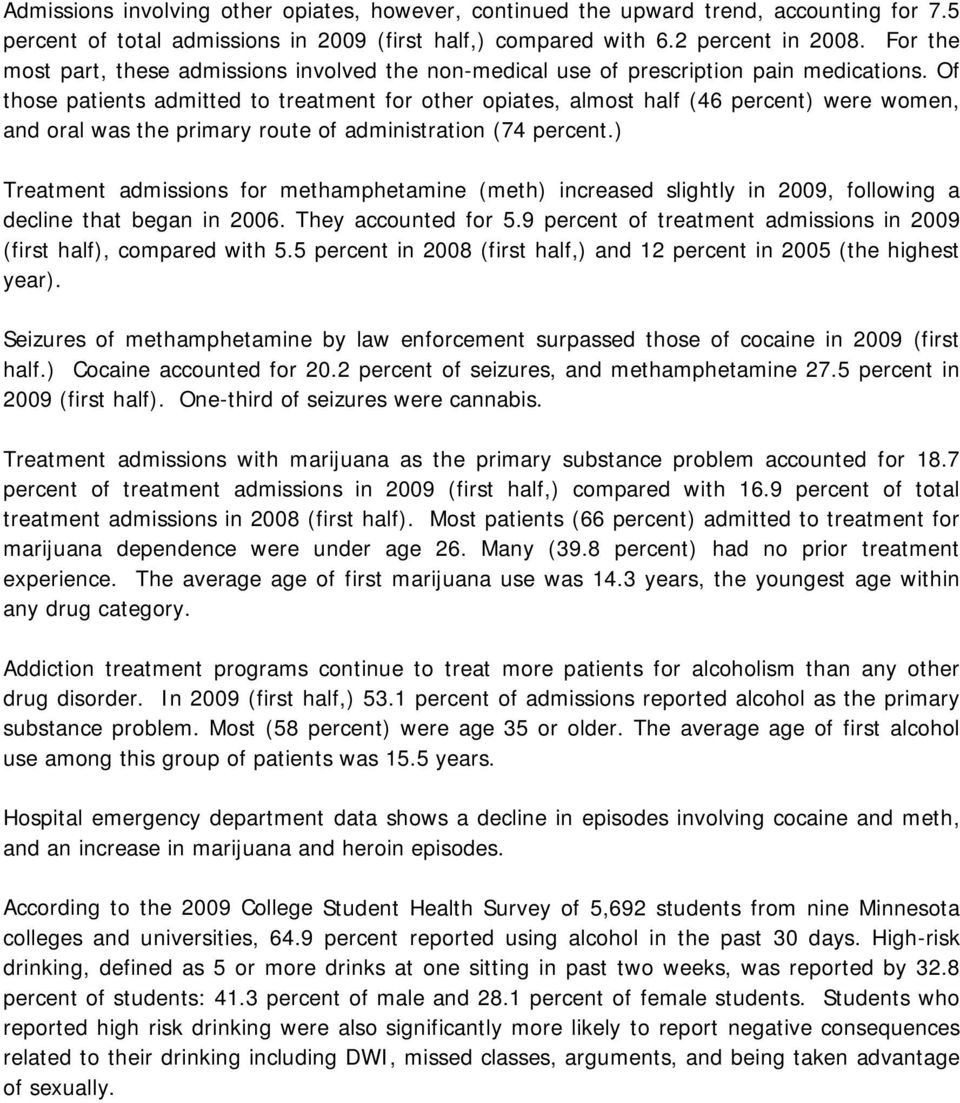
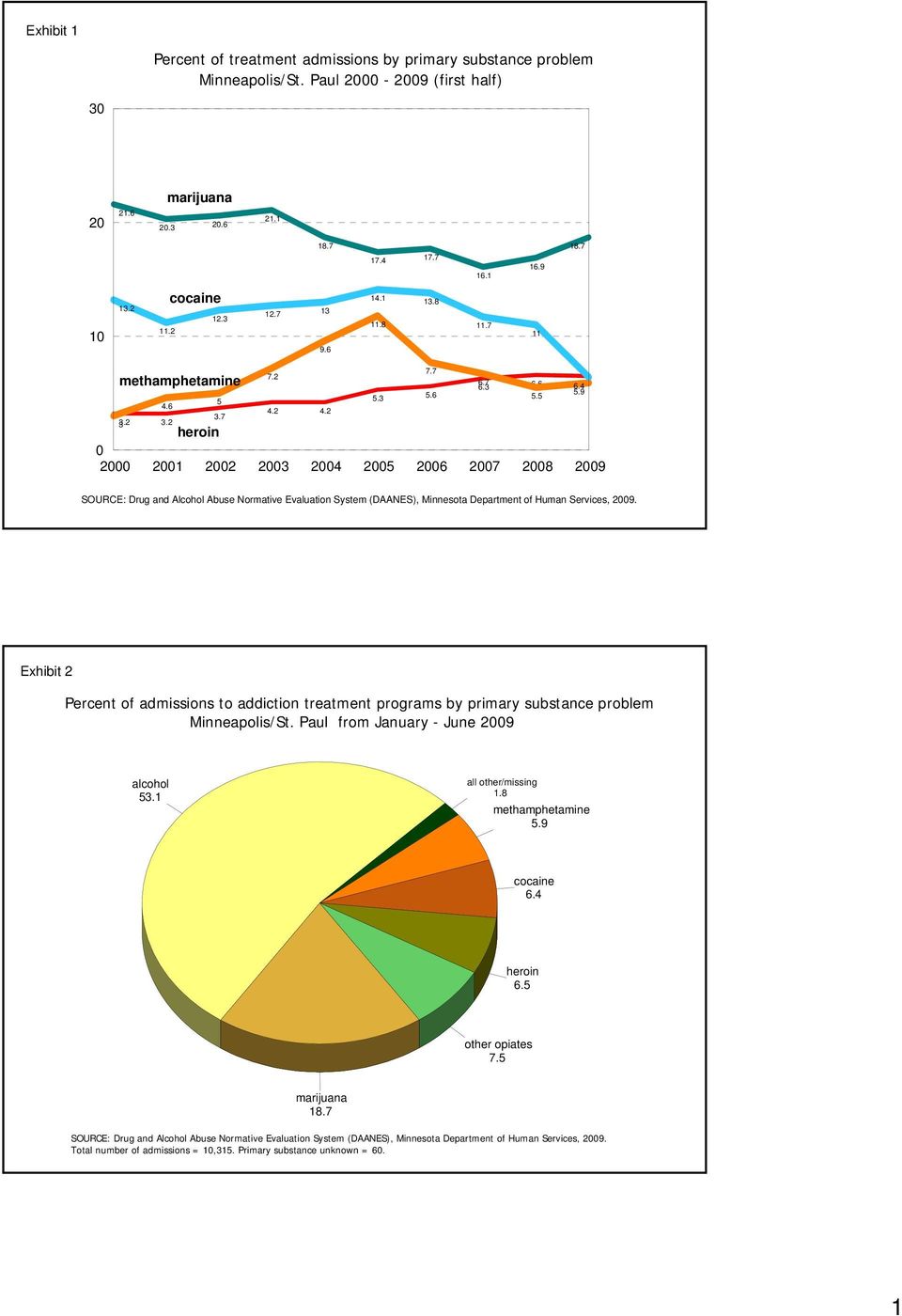
2 Background This report is produced twice annually for participation in the Community Epidemiology Work Group of the National Institute on Drug Abuse, an epidemiological surveillance network of researchers from 21 U.S. metropolitan areas, and is also available at: Area Description The Minneapolis/St. Paul ( Twin Cities ) metropolitan area includes Minnesota s largest city, Minneapolis (Hennepin County,) the capital city of St. Paul (Ramsey County,) and the surrounding counties of Anoka, Dakota, and Washington. Recent estimates of the population of each county are as follows: Anoka, 313,197; Dakota, 375,462; Hennepin, 1,239,837; Ramsey, 515,274; and Washington, 213,395, for a total of 2,557,165, or roughly one-half of the Minnesota State population. In the five-county metropolitan area, 84 percent of the population is White. African-Americans constitute the largest minority group in Hennepin County, while Asians are the largest minority group in Ramsey, Anoka, Dakota, and Washington Counties. Data Sources Treatment data are from addiction treatment programs (residential, outpatient) in the fivecounty Twin Cities metropolitan area as reported on the Drug and Alcohol Abuse Normative Evaluation System (DAANES) of the Minnesota Department of Human Services (through June 29). Hospital emergency department data are weighted estimates from the Drug Abuse Warning Network (DAWN,) administered by the Office of Applied Studies of the Substance Abuse and Mental Health Services Administration. Crime lab data are from the National Forensic Laboratory Information System (NFLIS), sponsored by the U.S. Drug Enforcement Administration. College student alcohol use data are from the 29 College Student Health Survey, conducted by Boynton Health Service, University of Minnesota. N = 5,692 students randomly selected from nine Minnesota colleges and universities. Drug Abuse Trends The most notable shift was the marked decline in cocaine-related treatment admissions in 29 (first half.) Cocaine was the primary substance problem for 6.4 percent of total treatment admissions in 29 (first half,) compared with 9.9 percent in 28, and 11.6 in 27. Most cocaine admissions were for crack cocaine and most patients (7 percent) were age 35 or older. Almost half (49 percent) were African American. Treatment admissions for both heroin and other opiates steadily increased since the turn of the century. Yet recently, heroin-related admissions were generally stable, accounting for 6.5 percent of total treatment admissions in 29 (first half,) compared with 6.7 percent in 28.
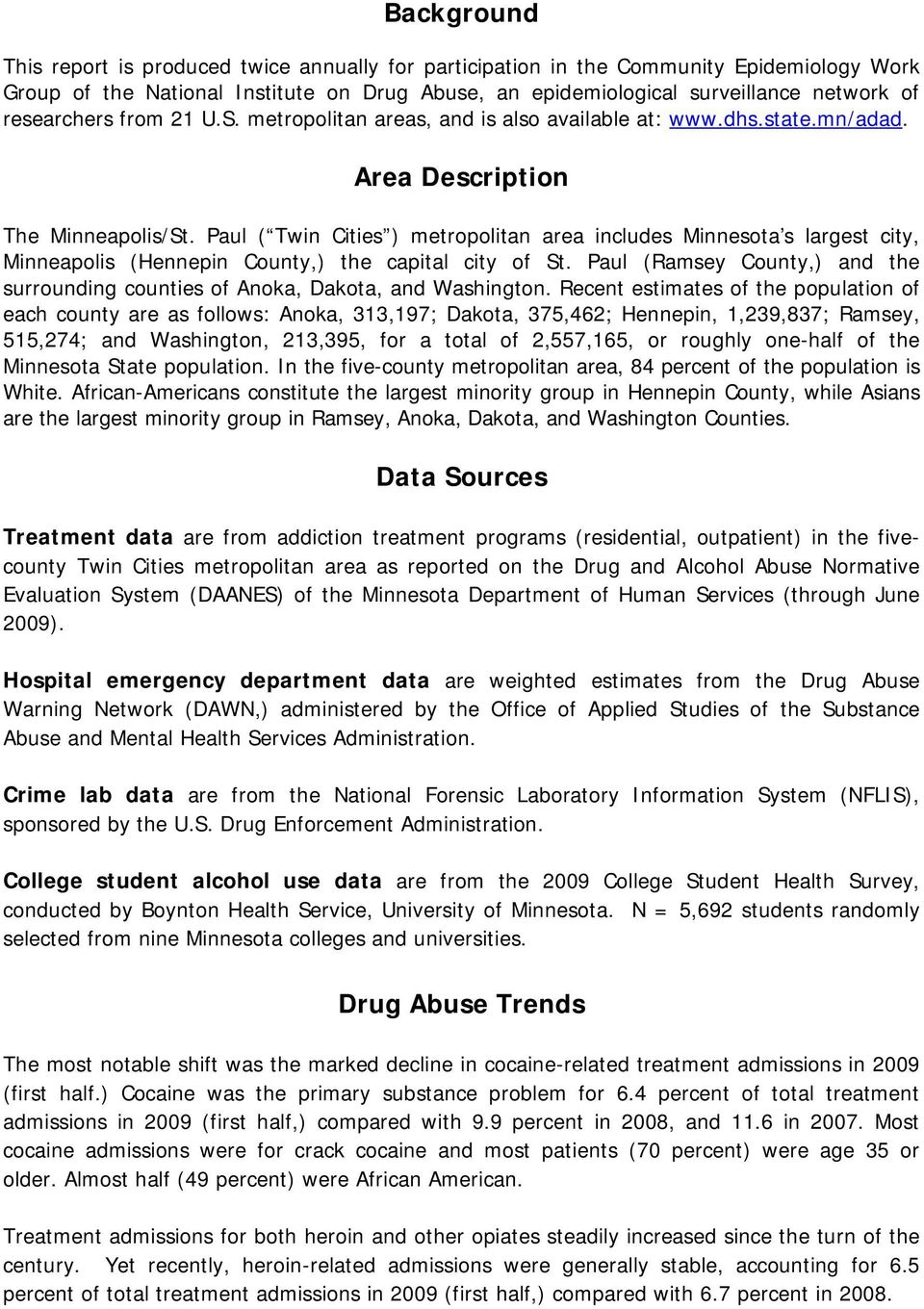
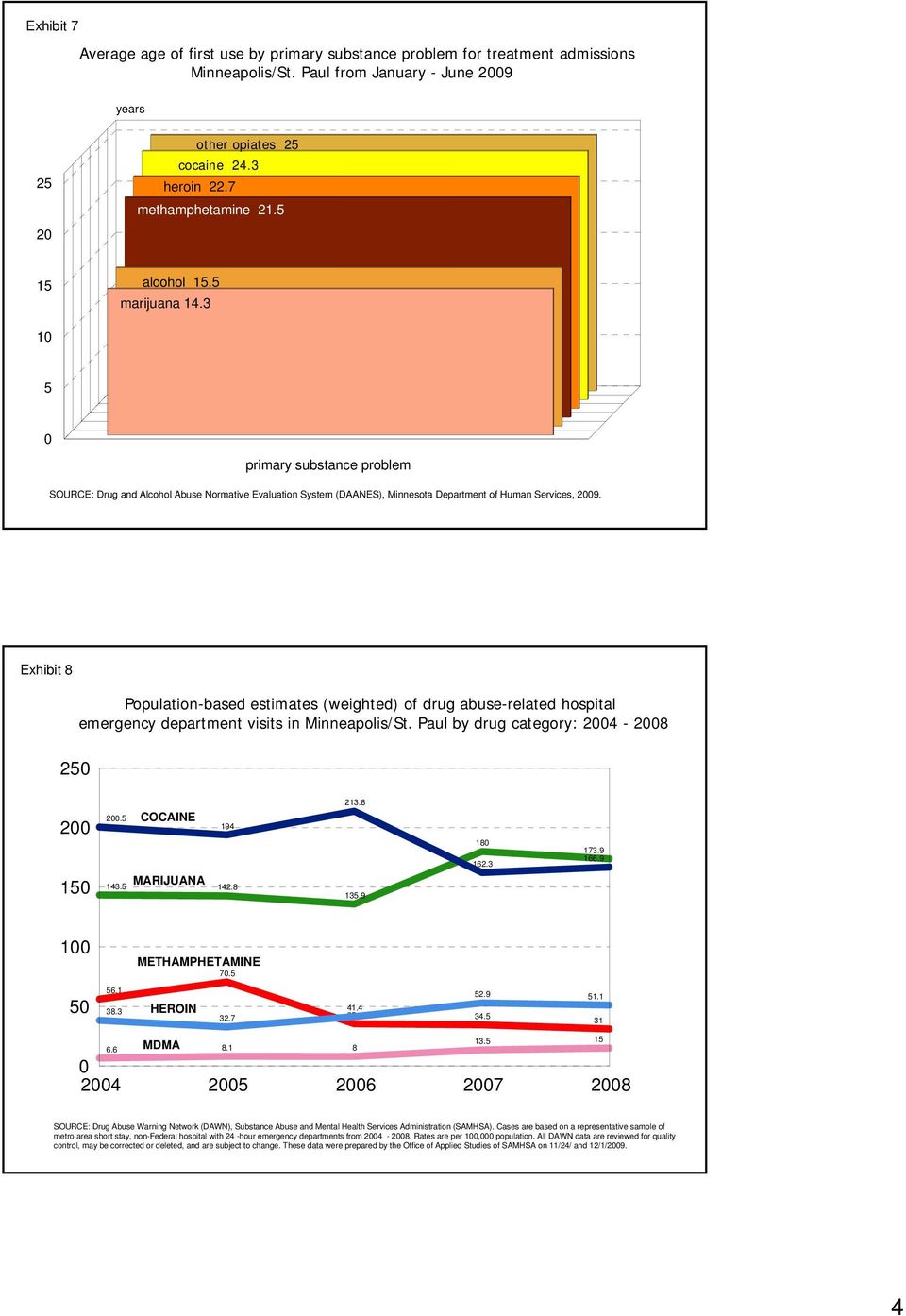
3 Admissions involving other opiates, however, continued the upward trend, accounting for 7.5 percent of total admissions in 29 (first half,) compared with 6.2 percent in 28. For the most part, these admissions involved the non-medical use of prescription pain medications. Of those patients admitted to treatment for other opiates, almost half (46 percent) were women, and oral was the primary route of administration (74 percent.) Treatment admissions for methamphetamine (meth) increased slightly in 29, following a decline that began in 26. They accounted for 5.9 percent of treatment admissions in 29 (first half), compared with 5.5 percent in 28 (first half,) and 12 percent in 25 (the highest year). Seizures of methamphetamine by law enforcement surpassed those of cocaine in 29 (first half.) Cocaine accounted for 2.2 percent of seizures, and methamphetamine 27.5 percent in 29 (first half). One-third of seizures were cannabis. Treatment admissions with marijuana as the primary substance problem accounted for 18.7 percent of treatment admissions in 29 (first half,) compared with 16.9 percent of total treatment admissions in 28 (first half). Most patients (66 percent) admitted to treatment for marijuana dependence were under age 26. Many (39.8 percent) had no prior treatment experience. The average age of first marijuana use was 14.3 years, the youngest age within any drug category. Addiction treatment programs continue to treat more patients for alcoholism than any other drug disorder. In 29 (first half,) 53.1 percent of admissions reported alcohol as the primary substance problem. Most (58 percent) were age 35 or older. The average age of first alcohol use among this group of patients was 15.5 years. Hospital emergency department data shows a decline in episodes involving cocaine and meth, and an increase in marijuana and heroin episodes. According to the 29 College Student Health Survey of 5,692 students from nine Minnesota colleges and universities, 64.9 percent reported using alcohol in the past 3 days. High-risk drinking, defined as 5 or more drinks at one sitting in past two weeks, was reported by 32.8 percent of students: 41.3 percent of male and 28.1 percent of female students. Students who reported high risk drinking were also significantly more likely to report negative consequences related to their drinking including DWI, missed classes, arguments, and being taken advantage of sexually.
4 Exhibit 1 Percent of treatment admissions by primary substance problem Minneapolis/St. Paul 2-29 (first half) 3 marijuana cocaine methamphetamine heroin SOURCE: Drug and Alcohol Abuse Normative Evaluation System (DAANES), Minnesota Department of Human Services, 29. Exhibit 2 Percent of admissions to addiction treatment programs by primary substance problem Minneapolis/St. Paul from January - June 29 alcohol 53.1 all other/missing 1.8 methamphetamine 5.9 cocaine 6.4 heroin 6.5 other opiates 7.5 marijuana 18.7 SOURCE: Drug and Alcohol Abuse Normative Evaluation System (DAANES), Minnesota Department of Human Services, 29. Total number of admissions = 1,315. Primary substance unknown = 6. 1
5 Exhibit 3 Number of treatment admissions with cocaine as the primary substance problem Minneapolis/St. Paul from (by quarter) SOURCE: Drug and Alcohol Abuse Normative Evaluation System (DAANES), Minnesota Department of Human Services, 29. Exhibit 4 Number of treatment admissions with heroin and other opiates as the primary substance problem Minneapolis/St.Paul from (by quarter) 5 heroin other opiates /27 2/27 3/27 4/27 1/28 2/28 3/28 4/28 1/29 2/29 SOURCE: Drug and Alcohol Abuse Normative Evaluation System (DAANES), Minnesota Department of Human Services, 29. 2

6 Exhibit 5 Number of treatment admissions with methamphetamine as the primary substance problem Minneapolis/St. Paul 2 through June 29 (by half year) # of admissions H-2 2H-2 1H-21 2H-21 1H-22 2H-22 1H-23 2H-23 1H-24 2H-24 1H-25 2H-25 1H-26 2H-26 1H-27 2H-27 1H-28 2H-28 1H-29 SOURCE: Drug and Alcohol Abuse Normative Evaluation System (DAANES), Minnesota Department of Human Services, 29. Exhibit 6 Characteristics of patients admitted to addiction treatment programs by primary substance problem: Minneapolis/St. Paul metro area: January - June 29 TOTAL ADMISSIONS = 9,846 GENDER ALCOHOL = 5,481 (53.1%) MARIJUANA = 1,929 (18.7%) COCAINE = 665 (6.4%) METH = 613 (5.9%) HEROIN = 672 (6.5%) OTHER OPIATES = 771 (7.5%) % male % female RACE/ETHNICITY % White % African Am % Am Indian % Hispanic % Asian-Pacific Is % Other AGE % 17 and under % % % ROUTE of ADMINISTRATION % oral % smoking % snorting/inhalation % injection % unknown SECONDARY DRUGS none - 45% alcohol - 52% alcohol - 44% alcohol - 31% cocaine - 23% other - 3% % MJ - 22% none - 26 % MJ - 23% MJ - 26% other opiates - 19% MJ - 2% other - 19% other - 1% none - 19% none - 22% MJ - 17% alcohol - 17 % No prior treatment 31.9 % 39.8% 16% 19.5% 15.6% 28% Average age 1st use (in years) SOURCE: Drug and Alcohol Abuse Normative Evaluation System (DAANES), Minnesota Department of Human Services, 29. 3

7 Exhibit 7 Average age of first use by primary substance problem for treatment admissions Minneapolis/St. Paul from January - June 29 years 25 2 other opiates 25 cocaine 24.3 heroin 22.7 methamphetamine alcohol 15.5 marijuana primary substance problem SOURCE: Drug and Alcohol Abuse Normative Evaluation System (DAANES), Minnesota Department of Human Services, 29. Exhibit 8 Population-based estimates (weighted) of drug abuse-related hospital emergency department visits in Minneapolis/St. Paul by drug category: COCAINE MARIJUANA METHAMPHETAMINE HEROIN MDMA SOURCE: Drug Abuse Warning Network (DAWN), Substance Abuse and Mental Health Services Administration (SAMHSA). Cases are based on a representative sample of metro area short stay, non-federal hospital with 24 -hour emergency departments from Rates are per 1, population. All DAWN data are reviewed for quality control, may be corrected or deleted, and are subject to change. These data were prepared by the Office of Applied Studies of SAMHSA on 11/24/ and 12/1/29. 4
8 Exhibit 9 Most frequently identified drug items seized by law enforcement in the Minneapolis/St.Paul area -- January through June 29 drug type (count) cannabis (673) 33.3 methamphetamine (555) 27.5 cocaine (49) 2.2 MDMA (75) 3.7 heroin (46) 2.3 oxycodone (39) 1.9 amphetamine (18).9 psilocybin (17).8 hydrocodone (16).8 all other (172) % of total SOURCE: National Forensic Laboratory Information System (NFLIS), U.S. Drug Enforcement Administration,12/1/29. Seven county metropolitan area. Exhibit 1 Current alcohol use and high-risk drinking among Minnesota college students by gender 1 percent 8 current use high-risk use all students males females SOURCE: 29 College Student Health Survey, Boynton Health Service, University of Minnesota. N = 5,692 students randomly selected from nine Minnesota colleges and universities. Current alcohol use = any alcohol use in past 3 days. High-risk drinking = 5 or more drinks at one sitting in past two weeks. 5

9 Exhibit 11 Selected negative consequences by high-risk drinking (HRD) status among Minnesota college students all students non-hrd students HRD students DWI Argument Missed class Taken advantage of sexually percent SOURCE: 29 College Student Health Survey, Boynton Health Service, University of Minnesota. N = 5,692 students randomly selected from nine Minnesota colleges and universities. High-risk drinking (HRD) = 5 or more drinks at one sitting in past two weeks. Consequence are based on reported experiences within the past 12 months. 6

Drug Use and Abuse in San Diego County, California: 2013
 Drug Use and Abuse in San Diego County, California: 213 Karla D. Wagner, Ph.D. 1 ABSTRACT The most significant change observed in drug use/abuse indicators in San Diego County in 213 was an increase in
The NJSAMS Report. Heroin Admissions to Substance Abuse Treatment in New Jersey. In Brief. New Jersey Substance Abuse Monitoring System.
 New Jersey Substance Abuse Monitoring System The NJSAMS Report May 2011 Admissions to Substance Abuse Treatment in New Jersey eroin is a semi-synthetic opioid drug derived from morphine. It has a high
Drug Abuse Patterns and Trends in the San Francisco Bay Area Update: June 2014
 Drug Abuse Patterns and Trends in the San Francisco Bay Area Update: June 24 Alice A. Gleghorn, Ph.D. ABSTRACT In San Francisco, increases in heroin consequence indicators (treatment admissions and Drug
Signs of Substance Abuse in Broward County, Florida
 Adult Summer 8 The chart below summarizes the severity and trends for indicators of drug use and abuse in Broward County, Florida. The Severity Index is based on the number of drug-related deaths, emergency
Drug Abuse Trends in the Seattle-King County Area: 2014
 Drug Abuse Trends in the Seattle-King County Area: 2014 June 12, 2015 Caleb Banta-Green 1, T. Ron Jackson 2, Steve Freng 3, Michael Hanrahan 4, Cynthia Graff 5, John Ohta 6, Mary Taylor 7, Richard Harruff
Drug Abuse Trends in Minneapolis/St. Paul: 2015
 Drug Abuse Trends in Minneapolis/St. Paul: 2015 Carol Falkowski Drug Abuse Dialogues St. Paul, Minnesota April 2015 ABSTRACT Adverse consequences related to heroin and other opiates continued their stronghold
Prescription drug abuse trends. Minnesota s Prescription Monitoring Program. Minnesota Rural Health Conference June 25, 2013 Duluth
 Prescription drug abuse trends Minnesota s Prescription Monitoring Program Carol Falkowski Drug Abuse Dialogues www.drugabusedialogues.com Barbara Carter, Manager MN Board of Pharmacy www.pmp.pharmacy.state.mn.us
Drug Abuse Trends in the Seattle/King County Area: 2013
 Drug Abuse Trends in the Seattle/King County Area: 2013 Caleb Banta-Green, 1 T. Ron Jackson, 2 Steve Freng, 3 Michael Hanrahan, 4 Cynthia Graff, 5 John Ohta, 6 Mary Taylor, 7 Richard Harruff, 8 Robyn Smith,
Drug Trends in Phoenix and Arizona: 2013
 Drug Trends in Phoenix and Arizona: 213 James K. Cunningham, Ph.D. 1 ABSTRACT Two key findings for the Phoenix area (Maricopa County) in 213 were a 5-year increase in treatment admissions for other opioids
How To Understand The Health Effects Of Prescription Drugs
 Miami-Dade, Broward and Palm Beach Counties, Florida Trends of Nonmedical Prescription Drug Misuse in Miami-Dade, Broward, Palm Beach Counties, and the State of Florida: 2010 James N. Hall 1 ABSTRACT The
New National Poll Reveals Public Attitudes on Substance Abuse, Treatment and the Prospects of Recovery
 New National Poll Reveals Public Attitudes on Substance Abuse, Treatment and the Prospects of Recovery Finds some significant differences in perceptions among various population groups. Nearly half of
Drug Abuse Trends in Miami-Dade County, Florida: 2009-2010
 Drug Abuse Trends in Miami-Dade County, Florida: 2009-2010 James N. Hall 1 ABSTRACT Cocaine consequences as a proportion of all drug problems continue to be higher in South Florida than in most of the
Treatment Episode Data Set (TEDS) Highlights - 2007 National Admissions to Substance Abuse Treatment Services
 Treatment Episode Data Set (TEDS) Highlights - 2007 National Admissions to Substance Abuse Treatment Services DEPARTMENT OF HEALTH AND HUMAN SERVICES Substance Abuse and Mental Health Services Administration
Substance Use, Treatment Need and Receipt of Treatment in Minnesota:
 Substance Use, Treatment Need and Receipt of Treatment in Minnesota: Results from Minnesota Student Survey, Minnesota Survey on Adult Substance Use, and Drug and Alcohol Abuse Normative Evaluation System
With Depression Without Depression 8.0% 1.8% Alcohol Disorder Drug Disorder Alcohol or Drug Disorder
 Minnesota Adults with Co-Occurring Substance Use and Mental Health Disorders By Eunkyung Park, Ph.D. Performance Measurement and Quality Improvement May 2006 In Brief Approximately 16% of Minnesota adults
Drug Abuse Trends in Miami-Dade and Broward Counties, South Florida: June 2013 James N. Hall 1
 Drug Abuse Trends in Miami-Dade and Broward Counties, South Florida: June 2013 James N. Hall 1 ABSTRACT Significant shifts in drug abuse patterns are underway. Cocaine consequences have stabilized or increased
TRENDS IN HEROIN USE IN THE UNITED STATES: 2002 TO 2013
 2013 to 2002 States: United the in Use Heroin in Trends National Survey on Drug Use and Health Short Report April 23, 2015 TRENDS IN HEROIN USE IN THE UNITED STATES: 2002 TO 2013 AUTHORS Rachel N. Lipari,
Drug Abuse Trends in the Seattle/King County Area: 2013
 Drug Abuse Trends in the Seattle/King County Area: 2013 Caleb Banta-Green 1, T. Ron Jackson 2, Steve Freng 3, Michael Hanrahan 4, Cynthia Graff 5, John Ohta 6, Mary Taylor 7, Richard Harruff 8, Robyn Smith
NATURE AND EXTENT OF THE ILLICIT DRUG PROBLEM IN MISSOURI
 NATURE AND EXTENT OF THE ILLICIT DRUG PROBLEM IN MISSOURI Department of Public Safety and Statistical Analysis Center Funding for this report was provided by the Edward Byrne Memorial Justice Assistance
King County, WA Drug Trends Through June 2014 Treatment and Mortality Caleb Banta-Green PhD MPH MSW Senior Research Scientist- Alcohol and Drug Abuse
 King County, WA Drug Trends Through June 2014 Treatment and Mortality Caleb Banta-Green PhD MPH MSW Senior Research Scientist- Alcohol and Drug Abuse Institute Affiliate Associate Professor- School of
Colorado Substance Abuse Treatment Clients with Co-Occurring Disorders, FY05
 Colorado Substance Abuse Treatment Clients with Co-Occurring Disorders, FY05 Introduction Many clients who have chronic substance use disorders often simultaneously suffer from a serious mental disorder.
States In Brief Substance Abuse and Mental Health Issues At-A-Glance
 kentucky States In Brief Substance Abuse and Mental Health Issues At-A-Glance A Short Report from the Office of Applied Studies Prevalence of Illicit Substance 1 and Alcohol Use The National Survey on
Santa Fe Recovery Center Follow Up Survey Form
 Santa Fe Recovery Center Follow Up Survey Form Clients Name Participant ID / Chart Number Discharge Date / / Date Telephone Survey was Completed / / Month Day Year Survey Type (Check one) 3 month follow
Patterns and Trends in Drug Abuse in Los Angeles County, California: 2013
 Patterns and Trends in Drug Abuse in Los Angeles County, California: 2013 Mary-Lynn Brecht, Ph.D. 1 ABSTRACT A key finding in the Los Angeles area in this reporting period was the continuing increase in
Behavioral Health Barometer. United States, 2014
 Behavioral Health Barometer United States, 2014 Acknowledgments This report was prepared for the Substance Abuse and Mental Health Services Administration (SAMHSA) by RTI International under contract No.
Client Population Statistics
 Client Population Statistics Fiscal Year 6-7 Introduction On the following pages, the reader will find information about the client population that Daytop served during the fiscal year 6-7 in its diverse
The Changing Face of Opioid Addiction:
 9th Annual Training and Educational Symposium September 6, 2012 The Changing Face of Opioid Addiction: A Review of the Research and Considerations for Care Mark Stanford, Ph.D. Santa Clara County Dept
Substance Abuse 2014-2015. Chapter 10: Substance Abuse
 Substance Abuse 214-215 Chapter 1: Substance Abuse 265 214-215 Health of Boston Substance Abuse Substance abuse involves the excessive use of alcohol or illicit substances (e.g., marijuana, cocaine, heroin,
1. Youth Drug Use More than 40% of Maryland high school seniors used an illicit drug in the past year.
 1. Youth Drug Use More than 4% of Maryland high school seniors used an illicit drug in the past year. Any Illicit Drug Alcohol Marijuana Ecstasy Cocaine Percentage of Maryland and U.S. high school seniors
Drug Abuse Trends in Miami-Dade and Broward Counties, South Florida: June 2014
 Drug Abuse Trends in Miami-Dade and Broward Counties, South Florida: June 2014 James N. Hall 1 ABSTRACT The key finding for this reporting period is that there has been substantial progress in reducing
7% fewer Basque youths began drug addiction treatments between 2009 and 2010
 7% fewer Basque youths began drug addiction treatments between 29 and 21 In 21, two in every thousand young people aged 15 to 29 started drug dependence treatments and, for the first time, the number of
+ + + + + ECSTASY. Trends in Drug Use and Related Harms in Australia, 2001 to 2013. National Drug and Alcohol Research Centre
 ALCOHOL PHARMACEUTICAL OPIOIDS HEROIN 21-212 COCAINE DRUG TRENDS CANNABIS + + + + + + ECSTASY Trends in Drug Use and Related Harms in Australia, 21 to 213 Medicine APC POP- UP STAND National Drug and Alcohol
Patterns and Trends in Drug Abuse in Denver and Colorado: 2013
 Patterns and Trends in Drug Abuse in Denver and Colorado: 2013 Bruce Mendelson, M.P.A. 1 ABSTRACT The key findings in the Denver area for the 2013 reporting period were increases in indicators for marijuana,
Special Report Substance Abuse and Treatment, State and Federal Prisoners, 1997
 U.S. Department of Justice Office of Justice Programs Bureau of Justice Statistics Special Report Substance Abuse and Treatment, and Prisoners, 1997 January 1999, NCJ 172871 By Christopher J. Mumola BJS
Drug Abuse Trends in the Seattle/King County Area: 2009
 Drug Abuse Trends in the Seattle/King County Area: 2009 Caleb Banta-Green 1, T. Ron Jackson 2, David Albert 3, Michael Hanrahan 4, Mary Taylor 5, Steve Freng 6, John Ohta 7, Margaret Soukup 8, Geoff Miller
Kathryn P. Jett Director
 Kathryn P. Jett Director California Department of Alcohol and Drug Programs ADP Mission To lead efforts to reduce alcoholism, drug addiction and problem gambling in California by developing, administering
DRAFT Metropolitan Detention Center (MDC) DWI Addiction Treatment Programs (ATP) Outcome Study Final Report UPDATED
 DRAFT Metropolitan Detention Center (MDC) DWI Addiction Treatment Programs (ATP) Outcome Study Final Report UPDATED Prepared for: The DWI Addiction Treatment Programs (ATP) Metropolitan Detention Center
Substance Abuse Treatment Admissions for Abuse of Benzodiazepines
 Treatment Episode Data Set The TEDS Report June 2, 2011 Substance Abuse Treatment Admissions for Abuse of Benzodiazepines Benzodiazepines are a class of central nervous system depressant drugs that are
Trends in Adult Female Substance Abuse Treatment Admissions Reporting Primary Alcohol Abuse: 1992 to 2007. Alcohol abuse affects millions of
 Treatment Episode Data Set The TEDS Report January 7, 2010 Trends in Adult Female Substance Abuse Treatment Admissions Reporting Primary Alcohol Abuse: 1992 to 2007 In Brief Between 1992 and 2007, the
Behavioral Health Barometer. United States, 2013
 Behavioral Health Barometer United States, 2013 Acknowledgments This report was prepared for the Substance Abuse and Mental Health Services Administration (SAMHSA) by RTI International under contract No.
2f: Specialist Treatment Centres: Durban/Pietermaritzburg (PMB)
 2f: Specialist Treatment Centres: Durban/Pietermaritzburg (PMB) Prof Arvin Bhana, Ms Leigh Adams & Ms Tara Carney Table 98: Proportion of Treatment Episodes (Durban/PMB) 50 SANCA Penthouse 53 70 52 59
opiates alcohol 27 opiates and alcohol 30 April 2016 drug addiction signs 42 Ranked #1 123 Drug Rehab Centers in New Jersey 100 Top 10 380
 opiates alcohol 27 opiates and alcohol 30 April 2016 drug addiction signs 42 ed #1 123 Drug Rehab Centers in New Jersey 100 Top 10 380 effects of alcohol in the brain 100 Top 30 698 heroin addiction 100
Monitoring Program (DMP) heroin purchase data (edited versions) were also utilized. Data were also obtained from the Threat Assessment Report
 Drug Abuse Trends in the Seattle/King County Area: 2011 Caleb Banta-Green 1, T. Ron Jackson 2, Steve Freng 3, Michael Hanrahan 4, Geoff Miller 8, Steve Reid 5, John Ohta 6, Mary Taylor 7, Richard Harruff
Outcomes for Opiate Users at FRN Facilities. FRN Research Report September 2014
 Outcomes for Opiate Users at FRN Facilities FRN Research Report September 2014 Introduction The illicit use of opioids has reached epidemic proportions in the United States (Alford, 2007; Meges et al,
CESAR BRIEFING Methamphetamine in Maryland
 March 2005 CESAR BRIEFING in Maryland CESAR Briefings are designed to provide concise answers and information on requested topics related to substance abuse and are available online at www.cesar.umd.edu.
The War on Drugs: Methamphetamine, Public Health and Crime. Carlos Dobkin, Nancy Nicosia
 The War on Drugs: Methamphetamine, Public Health and Crime Carlos Dobkin, Nancy Nicosia Government Has Three Strategies to Curb Illegal Drug Use Prevention: Education and community action Discourage people
Jane Maxwell, UT Addiction Research Institute, 512 232-0610. Prescription Pain Medications and Heroin: A Changing Picture
 Prescription Pain Medications and : A Changing Picture Jane Maxwell, Ph.D. Center for Social Work Research The University of Texas at Austin Disclosure to Participants Commercial Support: This educational
Metropolitan Detention Center (MDC) DWI Addiction Treatment Programs (ATP) Outcome Study for DWI Offenders
 Metropolitan Detention Center (MDC) DWI Addiction Treatment Programs (ATP) Outcome Study for DWI Offenders Prepared for: The DWI Addiction Treatment Programs (ATP) Metropolitan Detention Center Prepared
Drug- and Alcohol-Related Intoxication Deaths in Maryland, 2014
 Maryland Department of Health and Mental Hygiene Larry Hogan, Governor Boyd Rutherford, Lt. Governor Van Mitchell, Secretary May, 215 Drug- and Alcohol-Related Intoxication Deaths in Maryland, 214 Table
Results from the 2009 National Survey on Drug Use and Health: Volume I. Summary of National Findings
 Results from the 2009 National Survey on Drug Use and Health: Volume I. Summary of National Findings U.S. DEPARTMENT OF HEALTH AND HUMAN SERVICES Substance Abuse and Mental Health Services Administration
Table of Contents. I. Introduction... 2. II. Summary... 3. A. Total Drug Intoxication Deaths... 5. B. Opioid-Related Deaths... 9
 Table of Contents I. Introduction... 2 II. Summary... 3 III. Charts A. Total Drug Intoxication Deaths... 5 B. Opioid-Related Deaths... 9 C. Heroin-Related Deaths... 11 D. Prescription Opioid-Related Deaths...
Child & Adolescent Quality Access and Policy Committee Residential Treatment Centers Friday June 20, 2014
 Child & Adolescent Quality Access and Policy Committee Residential Treatment Centers Friday June 20, 2014 Residential Treatment Center Capacity Bed Capacity & Total Providers In State Residential Treatment
A Multiple Indicator Analysis of Heroin and Opiate Use in Missouri: 2001 to 2011
 A Multiple Indicator Analysis of Heroin and Opiate Use in Missouri: 2001 to 2011 Authored by: Kathleen Kane-Willis Stephanie J. Schmitz Marcia Bazan Vilmarie Fraguada Narloch Roosevelt University March
Treatment of Prescription Opioid Dependence
 Treatment of Prescription Opioid Dependence Roger D. Weiss, MD Chief, Division of Alcohol and Drug Abuse McLean Hospital, Belmont, MA Professor of Psychiatry, Harvard Medical School, Boston, MA Prescription
Strategic Plan for Alcohol and Drug Abuse
 Strategic Plan for Alcohol and Drug Abuse Fiscal Years 2016-2017 1 GARRETT COUNTY, MARYLAND STRATEGIC PLAN FOR ALCOHOL AND DRUG ABUSE Vision: Mission: A safe and drug free Garrett County To assist in promoting
Rural Substance Abuse Partnership (RSAP) State Profile: OKLAHOMA
 Rural Substance Abuse Partnership (RSAP) State Profile: OKLAHOMA Overview: The Rural Substance Abuse Partnership (RSAP), organized with the help of a U.S. Department of Justice, Office of Justice Programs
New Jersey Substance Abuse Monitoring System (NJ-SAMS) Substance Abuse Treatment Admissions 1/1/2013-12/31/2013 Resident of Cape May County
 New Jersey Substance Abuse Monitoring System (NJ-SAMS) Substance Abuse Treatment Admissions 1/1/2013-12/31/2013 Resident of Cape May County Primary Drug Highest School Grade Completed Alcohol 733 31% Completed
Karla Ramirez, LCSW Director, Outpatient Services Laurel Ridge Treatment Center
 Karla Ramirez, LCSW Director, Outpatient Services Laurel Ridge Treatment Center 1 in 4 Americans will have an alcohol or drug problems at some point in their lives. The number of alcohol abusers and addicts
Drug Abuse Trends in Palm Beach County Florida: July 2015
 Drug Abuse Trends in Palm Beach County Florida: July 2015 TABLE OF CONTENTS SECTION I. INTRODUCTION... 2 SECTION I A. REPORT HIGHLIGHTS... 2 SECTION I B. AREA DESCRIPTION... 3 SECTION I C. DATA SOURCES...
Proceedings of the Denver Epidemiology Work Group. Spring 2015 Report. Colorado Social Research Associates (Arapahoe House)
 Proceedings of the Denver Epidemiology Work Group Spring 2015 Report Colorado Social Research Associates (Arapahoe House) Table of Contents DEWG Spring 2015 Attendees... 3 Purpose and Distribution... 4
Epidemiological Profile of Substance Use + Related Factors in Minnesota s American Indian + Alaska Native Communities
 Epidemiological Profile of Substance Use + Related Factors in Minnesota s American Indian + Alaska Native Communities Developed by EpiMachine, LLC on behalf of the Minnesota State Epidemiological Outcomes
Quarterly Form (SAP Online), Page 1
 Page 1 of 6 Quarterly Form (SAP Online), Page 1 1) Please enter the total number of screenings that were performed. 1-a) Please enter the number of students referred for assessment by age group, sex, and
34 th Judicial District Substance Abuse Study Guide
 34 th Judicial District Substance Abuse Study Guide What is Drug Addiction? 2 It is characterized by intense and, at times, uncontrollable drug craving, along with compulsive drug seeking and use that
Drug Abuse Trends in the Seattle/King County Area: 2010
 Drug Abuse Trends in the Seattle/King County Area: 2010 Caleb Banta-Green 1, T. Ron Jackson 2, Steve Freng 3, Michael Hanrahan 4, Geoff Miller 8, Steve Reid 5, John Ohta 6, Mary Taylor 7, Richard Harruff
Boston Patterns and Trends in Drug Abuse: 2013
 Boston Patterns and Trends in Drug Abuse: 203 Daniel P. Dooley ABSTRACT The key finding for Boston for 203 was the continuing high level of abuse and continuing increasing indicators for heroin. Boston
Macomb County Office of Substance Abuse MCOSA. Executive Summary
 Macomb County Office of Substance Abuse MCOSA Executive Summary This report marks the second data profile of alcohol and illicit drugs burden in Macomb County. The first report produced in 2007 detailed
Massachusetts Population
 Massachusetts October 2012 POLICY ACADEMY STATE PROFILE Massachusetts Population MASSACHUSETTS POPULATION (IN 1,000S) AGE GROUP Massachusetts is home to more than 6.5 million people. Of these, more than
An integrated approach to addressing opiate abuse in Maine. Debra L. Brucker, MPA, PhD State of Maine Office of Substance Abuse October 2009
 An integrated approach to addressing opiate abuse in Maine Debra L. Brucker, MPA, PhD State of Maine Office of Substance Abuse October 2009 Background Defining the problem: Opiates pain relievers (OxyContin,
Drug Use, Testing, and Treatment in Jails By Doris James Wilson BJS Statistician
 U.S. Department of Justice Office of Justice Programs Revised 9/29/00 Bureau of Justice Statistics Special Report May 2000, NCJ 179999 Drug Use, Testing, and Treatment in Jails By Doris James Wilson BJS
In Brief UTAH. Adolescent Behavioral Health. A Short Report from the Office of Applied Studies
 UTAH Adolescent Behavioral Health In Brief A Short Report from the Office of Applied Studies Adolescence (12 to 17 years) is a critical and vulnerable stage of human development, during which males and
SASKATCHEWAN NNADAP TREATMENT SERVICES APPLICATION FORM Revised June, 2009 VAN LOONVCONSULTING
 SASKATCHEWAN NNADAP TREATMENT SERVICES APPLICATION FORM Revised June, 2009 VAN LOONVCONSULTING This application is the first step required to pre-screen applicants for adult treatment at any of the NNADAP
National Adolescent Health Information Center NAHIC NAHIC NAHIC NAHIC NAHIC NAHIC NAHIC NAHIC NAHIC NAHIC NAHIC NAHIC NAHIC NAHIC
 National Adolescent Health Information Center N 2007 Fact A H I C Sheet on Substance : Adolescents & Young Adults Highlights: 4 After an increase in the early 1990s, adolescent substance use has decreased
Substance Abuse Treatment Needs, Capacity and Costs
 1 W. Wilson St. P.O. Box 7851 Madison, WI 53707 608-267-7792 Bureau of Mental Health and Substance Abuse Services Substance Abuse Treatment Needs, Capacity and Costs 2004 Update Division of Disability