
Substance Misuse. See the Data Factsheets for more data and analysis:
|
|
|
- Timothy Blair
- 10 years ago
- Views:
Transcription
1 Substance Misuse See the Data Factsheets for more data and analysis: Problematic drug use Kensington and Chelsea has a similar rate of problem drug use to the London average According to prevalence figures based on research by Glasgow University, there were an estimated 1,386 problematic (opiate and crack cocaine) drug users in the borough in 2008/09, representing 1.1 per cent of the population, the same proportion as for London. 1 There are an increasing number of residents in the borough using more than one drug (especially alcohol) in addition to problematic drug use. 2 Thus, service users are presenting with increasingly complex health issues that require intensive treatment. Profile of drug users known to drug treatment services Average Age % Male % BME % of all service users Heroin Cannabis Crack Cocaine (not Crack) Methadone Other Opiates Other Drugs All Drugs 38 71per cent 31per cent 100per cent
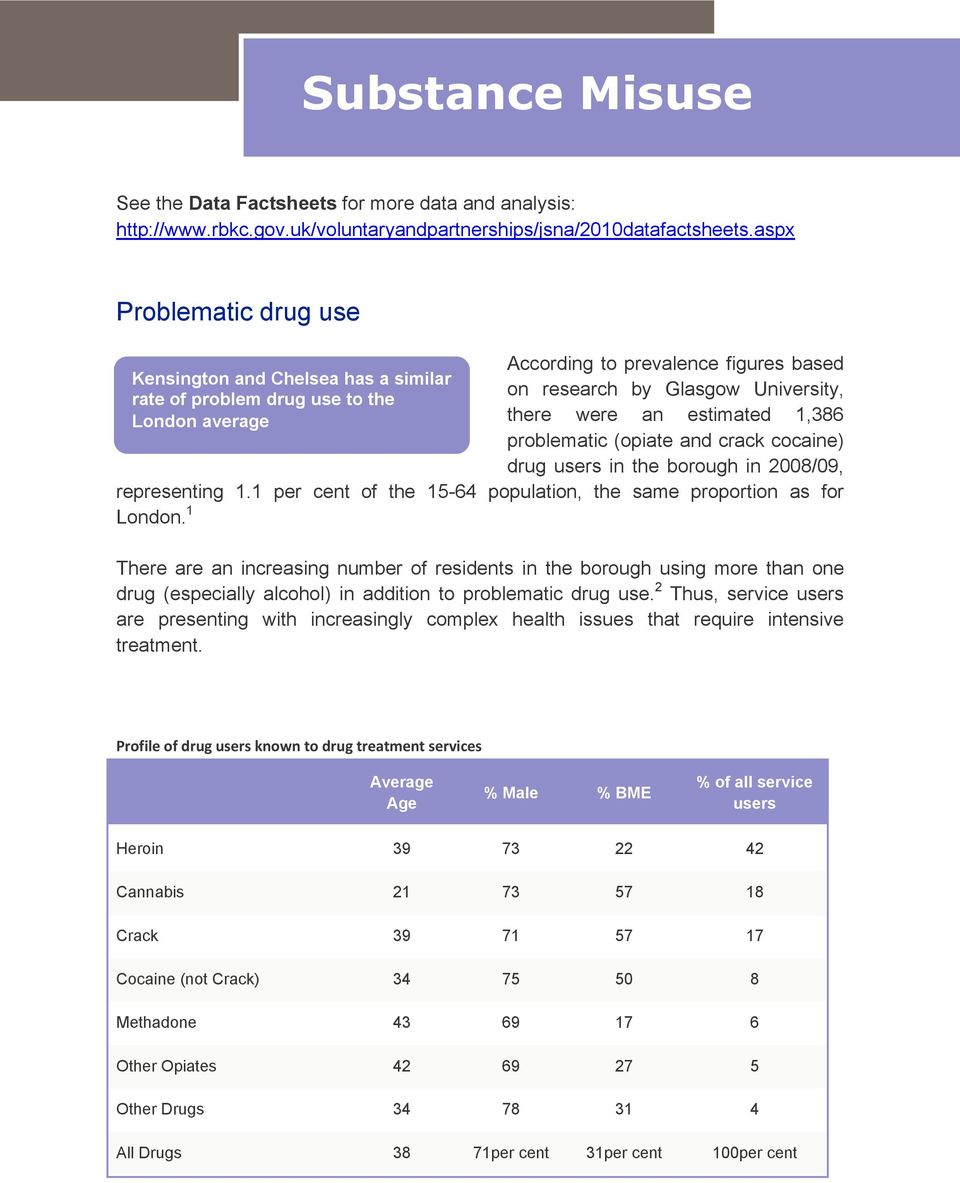
2 Heroin remains the main drug of choice for those accessing treatment, followed by cannabis and crack cocaine. There was a two-fold increase in the number of cannabis users referred to treatment in 2009/10 as compared to 2008/09, which is being explored to identify whether it is a recording issue or a real trend. There appears to be a reduction in the proportion of injecting drug users accessing treatment; this may be due to a reducing intravenous population in line with national trends. Cannabis users in treatment have a lower age profile - 21 years - compared to the profile of users of all the other drugs. Young people s specialist services report cannabis and alcohol as the main drugs of choice for their clients. There has been an increase in the use of psychoactive drugs legal highs, particularly crystal methamphetamine, by individuals presenting at sexual health clinics. This is currently not being reflected in those accessing treatment in local community-based treatment agencies, but may present as an area of concern in the future. Residents in the north of the borough experience very high levels of deprivation as compared to other parts and this is reflected in the high proportion of drug users in the north compared to more affluent parts of the borough. Although problematic drug use is highest in the North (W10) of the borough, Earl s Court (SW5) and West Chelsea (SW10) also have higher than average proportions of problematic drug use compared to the borough as a whole. Problematic drug use is highest in the north of the borough Number of 15+ year old residents per 1,000 population known to drug action services and using heroin, methadone, other opiates, or crack, 2009/ > K&C Average <
3 The highest number of hospital admissions for drug misuse occurs in Earl s Court and the north of the borough (St Charles and Notting Barns wards). Hospital admission rates in these wards are more than twice the borough average. However, numbers are still small, with 10 admissions over five years in St Charles ward (most drug-related hospital activity is managed within A&E departments, rather than requiring admission). 3 Number of 15+ year old residents per 1,000 population known to drug action services, 2009/ > K&C Average < The number of drug users accessing and completing treatment continues to increase There was a 27 per cent increase in referrals into treatment in 2009/10. The most frequent demographic was White British males aged between 25 and 44 years. Kensington and Chelsea has a higher proportion of problem drug users accessing treatment (69 per cent) than London (57 per cent). Drug treatment agencies in the borough have a very high retention rate, with 83 per cent of clients remaining for a 12 week period or more. Local services continue to see individuals within the national waiting times guidelines of three weeks. However, there continues to be an issue with drug users in the criminal justice system not accessing formal treatment. For those drug users in the criminal justice system who do access formal treatment, drop-out is higher than for those who access treatment voluntarily. Significant improvements have been made by specialist treatment agencies to ensure that drug users in the borough recover from their drug misuse: 92 per cent of opiate and crack cocaine users known to treatment in the last two years were effectively engaged in specialist treatment, compared to 89 per cent in London. Increasing numbers of drug users are recovering from their substance use (38 per cent of all those discharged between April and October 2010 as opposed to less than 30 per cent in 2009/10). All indications point to this proportion increasing further as local treatment agencies continue to focus on addressing the socio-economic and health needs of drug users. 3

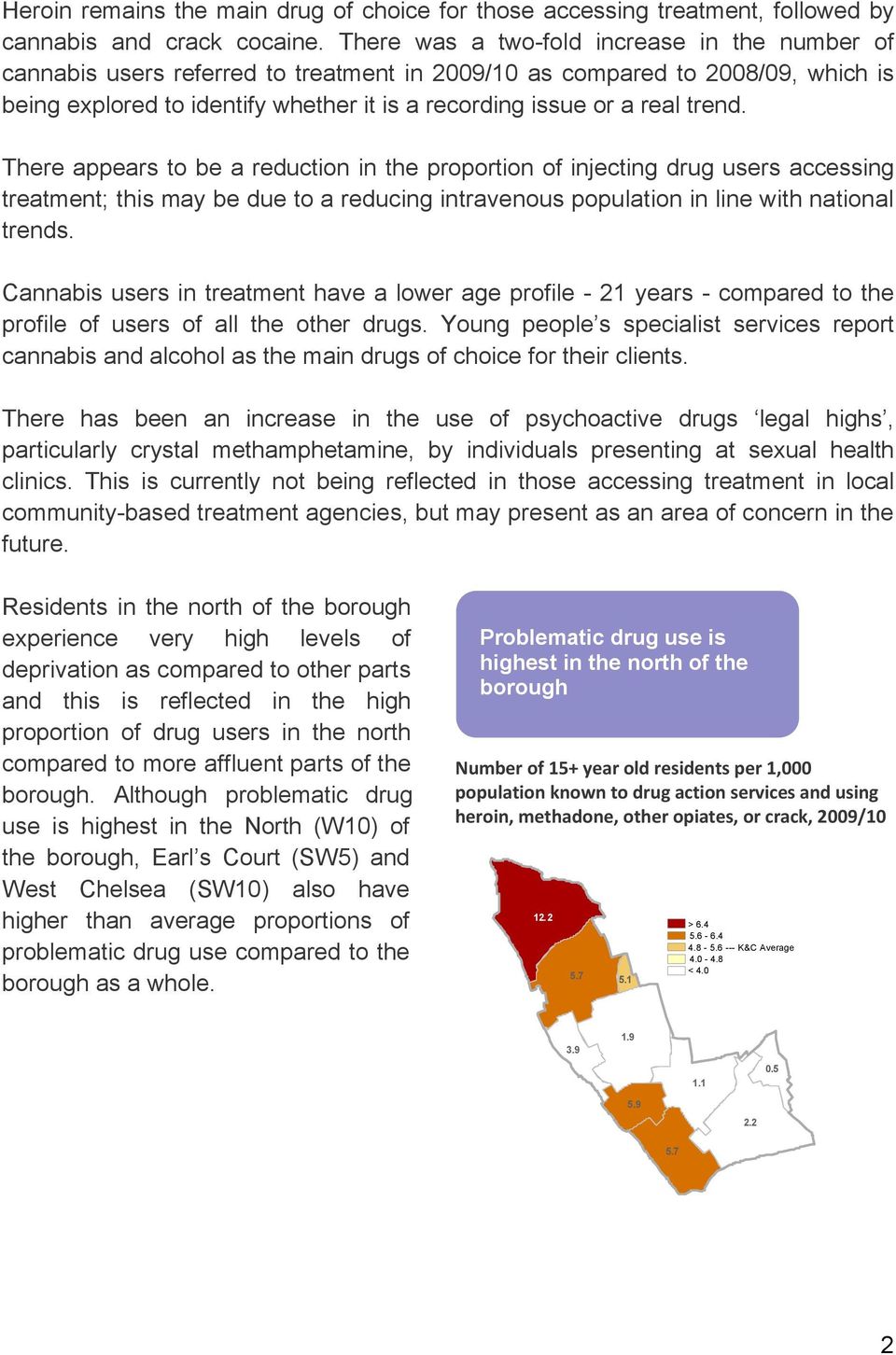
4 The borough has a nationally recognised education, employment and training service which empowers service users to develop a range of skills leading on to volunteering, courses and, in some cases, paid work. Access to this service continues to increase as it provides people with structured activity which in most cases supports abstinence from their drug use. Service user involvement is one of the main pillars of the treatment system Service users are involved in treatment planning, development, commissioning and monitoring of drug and alcohol services in the borough. The Service User Drug Reference Group (SUDRG) delivers a range of structured activities to individuals in the borough and continues to be an integral source of information and innovation in the continuous improvement of the local treatment system. Alcohol use in the borough Estimated levels of binge drinking in the borough (18 per cent) are high compared to London (14 per cent), with highest levels estimated to be in the centre of the borough. In addition, a high number of non-residents also socialise in the borough. 4 Estimates of percentage of residents who have been binge drinking in the previous 7 days 11.9% 10.7% 11.3% 13% 10.9% 12.9% 14.3% > 24.4% % highest in London 21.5% % 19.0% % 17.1% % < 17.1% % lowest in London Hospital admissions for alcohol use are also increasing in the borough (1,213 alcohol-related admissions per 100,000 population in 2009/10, an 11 per cent increase from 1,098 in 2008/09). However, the rise has been relatively slow compared to elsewhere (half the London rise and two thirds the England rise) and the current rate is low compared to London (1,702) and England (1,743). 5 13% 15.2% 21.9% 15.1% 16.9% 12.9% 15.3% 16.1% 16.1% 19.4% 13.3% 13. 5% 11.9% 10.6% 4
5 Number of residents per 100,000 population admitted to hospital for alcohol-specific causes, 2007/08 to 2009/ > K&C Average < Alcohol-specific admissions are highest in the north of the borough, particularly Notting Barns and Colville. The most common reasons for hospital admissions for alcohol-specific conditions were mental and behavioural disorders due to alcohol as well as alcoholic liver disease. The admission rate for under 18s is similar to London but substantially less than the England average Fewer residents in the borough are admitted for alcohol-related harm, alcohol-attributable recorded crimes, alcohol-related sexual offences and violent crimes as compared to London The alcohol-attributable mortality rates for men and women are lower than the London average, with almost half of all the alcohol-related deaths in the six most northerly wards. The majority of alcohol-related deaths are from chronic liver disease, which is more common among men. 7 Deaths relating to alcohol use over time in Kensington and Chelsea 5

6 An increasing number of alcohol misusers are accessing communitybased treatment Community-based specialist alcohol treatment agencies in the borough have more adults accessing treatment compared to London. The integrated direct access and formal treatment alcohol services at Alcohol Resource Centre, the A&E specialist nurse at Chelsea and Westminster Hospital, and the Older People s Alcohol Service are all experiencing an increase in those requiring treatment. The older people s service has a fairly even spread of residents from the north (52 per cent) and south (48 per cent). See the data factsheets for more data and analysis: 1 The Glasgow research project into prevalence of problem drug users 2 NDTMS data, provided by Kensington and Chelsea DAAT team, Dr Foster 2005/ / Synthetic estimates of binge drinking. Based on Community Health Profiles. Association of Public Health Observatories (APHO) 5 Local Alcohol profiles for England NI39 6 Dr Foster 2007/ /10 7 North West Public Health Observatory alcohol pages 6
2. Local Data to reduce Alcohol Related Harm and Comparison Groups
 Alcohol Treatment Needs Assessment 2012-2013 1. Introduction Using the JSNA Support pack for alcohol prevention, treatment & recovery, which presents data from the Local Alcohol Profiles for England (LAPE),
Alcohol data: JSNA support pack
 Alcohol data: JSNA support pack Technical definitions for the data to support planning for effective alcohol prevention, treatment and recovery in 2016-17 THE TECHNICAL DEFINITIONS The data in the JSNA
Addressing Alcohol and Drugs in the Community. Cabinet member: Cllr Keith Humphries - Public Health and Protection Services
 Wiltshire Council Cabinet 17 April 2012 Subject: Addressing Alcohol and Drugs in the Community Cabinet member: Cllr Keith Humphries - Public Health and Protection Services Key Decision: Yes Executive Summary
drug treatment in england: the road to recovery
 The use of illegal drugs in England is declining; people who need help to overcome drug dependency are getting it quicker; and more are completing their treatment and recovering drug treatment in ENGlaND:
Treatment data RDMD and NDTMS
 Treatment data RDMD and NDTMS The Regional Drugs Misuse Database, a "public health surveillance system for monitoring trends in problem drug users presenting for treatment has been in operation since 1990.
Substance Misuse Treatment Investment. Cost Benefit Analysis
 PP03 Appendix B Substance Misuse Treatment Investment Cost Benefit Analysis Sam Tearle, Principal Manager DAAT March 2011 1. Rates of Substance Misuse in West Sussex 1.1. It is estimated that in West Sussex
NHS Swindon and Swindon Borough Council. Executive Summary: Adult Alcohol Needs Assessment
 NHS Swindon and Swindon Borough Council Executive Summary: Adult Alcohol Needs Assessment Aim and scope The aim of this needs assessment is to identify, through analysis and the involvement of key stakeholders,
Protecting and improving the nation s health. Drug treatment in England 2013-14
 Protecting and improving the nation s health Drug treatment in England November 214 About Public Health England Public Health England exists to protect and improve the nation s health and wellbeing, and
The story of drug treatment
 EFFECTIVE TREATMENT CHANGING LIVES www.nta.nhs.uk www.nta.nhs.uk 1 The story of drug treatment The use of illicit drugs is declining in England; more and more people who need help with drug dependency
Adult drug treatment plan 2007/08 Part 1 Section A: Strategic summary Section B: National targets Section C: Partnership performance expectations
 name Adult drug treatment plan Part 1 Section A: Strategic summary Section B: National targets Section C: expectations Published by NTA: 2 October This strategic summary incorporating national targets
Details of need and our response can be found in the DAAT Treatment Plan which is available at http://www.plymouthdaat.info/
 SUBSTANCE MISUSE Problem Drug Use Adults: Summary: The Government define problem drug use (PDU) as those people in a defined locality using heroin and/or crack cocaine. This narrow definition forms the
Adult drug treatment plan 2009/10. Part 1: Strategic summary, needs assessment and key priorities
 Birmingham Drug and Alcohol Action Team Adult drug treatment plan 2009/10 Part 1: Strategic summary, needs assessment and key priorities The strategic summary incorporating the findings of the needs assessment,
Substance misuse among young people in England 2012-13
 Substance misuse among young people in England December 2013 About Public Health England Public Health England s mission is to protect and improve the nation s health and to address inequalities through
POWDER COCAINE: HOW THE TREATMENT SYSTEM IS RESPONDING TO A GROWING PROBLEM
 Effective treatment is available for people who have a powder-cocaine problem seven in ten of those who come into treatment either stop using or reduce their use substantially within six months POWDER
How To Find Out How Much Money Is Spent On Alcohol In Disford
 Information Request 01498 Please find Devon County Council s response below in bold text I am concerned that Exeter, according to the NHS / DoH Health Profiles for 2011, the worst rates for "Increasing
Focus on... Alcohol October 2012
 A project by: Focus on... Alcohol October 2012 Alcohol plays an important role in many aspects of society. The majority of people who drink, do so in a way that is unlikely to cause harm. However, a significant
Protecting and improving the nation s health. Specialist substance misuse treatment for young people in England 2013-14
 Protecting and improving the nation s health Specialist substance misuse treatment for young people in England 2013-14 January 2015 About Public Health England Public Health England exists to protect and
Alcohol treatment in England 2012-13
 Alcohol treatment in England 2012-13 October 2013 About Public Health England Public Health England s mission is to protect and improve the nation s health and to address inequalities through working with
Aim of presentation. Drug and Alcohol Services in Leicester. National Policy. Local Policy. Demographics. Aims and objectives of needs assessment
 Aim of presentation Drug and Alcohol Services in Leicester Joanne Atkinson, Consultant in Public Health Kate Galoppi, Head of Drug and Alcohol Action Team 19 th June 212 To introduce members to the issues
Protecting and improving the nation s health. Alcohol treatment in England 2013-14
 Protecting and improving the nation s health Alcohol treatment in England 2013-14 October 2014 About Public Health England Public Health England exists to protect and improve the nation s health and wellbeing,
Clinical Priorities for Alcohol and Drugs in Public Health
 Clinical Priorities for Alcohol and Drugs in Public Health What do we need to Measure up to? Dr Michael Kelleher Clinical Lead Alcohol and Drugs Team, Health and Wellbeing Directorate SMMGP 8 th Primary
APPENDIX 3 SERVICES LINKED WITH DUAL DIAGNOSIS TEAM
 APPENDIX 3 SERVICES LINKED WITH DUAL DIAGNOSIS TEAM Community Mental Health Teams (CMHTs)- five teams operate across RBKC offering assessment and care management services to people with severe and enduring
Milton Keynes Drug and Alcohol Strategy 2014-17
 Health and Wellbeing Board Milton Keynes Drug and Alcohol Strategy 2014-17 www.milton-keynes.gov.uk 2 Contents Foreword 4 Introduction 5 National context 6 Local context 7 Values and principles 9 Priorities
FALLING DRUG USE: THE IMPACT OF TREATMENT
 We have a policy which actually is working in Britain. Drugs use is coming down, the emphasis on treatment is absolutely right, and we need to continue with that to make sure we can really make a difference.
(Health Scrutiny Sub-Committee 9 March 2009)
 Somerset County Council Health Scrutiny Sub-Committee 9 March 2009 Drug and Alcohol Treatment Services Author: Amanda Payne Somerset DAAT Co-ordinator Contact Details: [email protected] Paper
Lincolnshire Alcohol and Drug Strategy
 ` Lincolnshire Alcohol and Drug Strategy 2014 2019 Foreword Alcohol and drug misuse is the cause of many health and social problems and can devastate families and communities. It is a significant driver
7% fewer Basque youths began drug addiction treatments between 2009 and 2010
 7% fewer Basque youths began drug addiction treatments between 29 and 21 In 21, two in every thousand young people aged 15 to 29 started drug dependence treatments and, for the first time, the number of
Dual Diagnosis. Dual Diagnosis Good Practice Guidance, Dept of Health (2002);
 Dual Diagnosis Dual Diagnosis is a challenging problem for both mental health and substance misuse services. People with mental health problems, who also suffer from substance misuse are at an increased
Statistics on Drug Misuse: England 2013
 Statistics on Drug Misuse: England 2013 Published 28 November 2013 Statistics on Drug Misuse: England 2013 This product may be of interest to the public, stakeholders and policy officials, to gain a comprehensive
Alcohol and drugs prevention, treatment and recovery: why invest?
 Alcohol and drugs prevention, treatment and recovery: why invest? 1 Alcohol problems are widespread 9 million adults drink at levels that increase the risk of harm to their health 1.6 million adults show
The NJSAMS Report. Heroin Admissions to Substance Abuse Treatment in New Jersey. In Brief. New Jersey Substance Abuse Monitoring System.
 New Jersey Substance Abuse Monitoring System The NJSAMS Report May 2011 Admissions to Substance Abuse Treatment in New Jersey eroin is a semi-synthetic opioid drug derived from morphine. It has a high
Young people and alcohol Factsheet
 IAS Factsheet Young people and alcohol Updated May 2013 Young people and alcohol Factsheet Institute of Alcohol Studies Alliance House 12 Caxton Street London SW1H 0QS Tel: 020 7222 4001 Email: [email protected]
Topic Area - Dual Diagnosis
 Topic Area - Dual Diagnosis Dual Diagnosis is a challenging problem for both mental health and substance misuse services. People with mental health problems, who also suffer from substance misuse are at
Joint Commissioning Panel for Mental Health
 Joint Commissioning Panel for Mental Health Guidance for commissioners of drug and alcohol services 1 www.jcpmh.info Guidance for commissioners of drug and alcohol services Practical mental health commissioning
About Public Health England
 Adult substance misuse statistics from the National Drug Treatment Monitoring System (NDTMS) 1 April 2014 to 31 March 2015 About Public Health England Public Health England exists to protect and improve
People affected by drug and alcohol misuse
 Fact Sheet Local Account of Adult Social Care 2013-14 What we spent in 2013-14 M s experience of rehab and aftercare Drug & Alcohol Expenditures 2% 18% 35% Community drug treatment 35% Specialist clinical
Sheffield Future Commissioning of Drug & Alcohol Community Treatment
 Sheffield Future Commissioning of Drug & Alcohol Community Treatment Magdalena Boo, Joint Commissioning Manager Scope of the Plan IN SCOPE Adults 18+ (young people s services are separately commissioned)
. Alcohol Focus Scotland. Response to Tackling poverty, Inequality and deprivation in Scotland
 . Alcohol Focus Scotland. Response to Tackling poverty, Inequality and deprivation in Scotland Introduction Problem drinking and social groupings. Alcohol prob.lems affect people from all social groups.
Middlesbrough Alcohol Harm Reduction Strategy 2010-2013
 Middlesbrough Alcohol Harm Reduction Strategy 2010-2013 Foreword Mayor Ray Mallon 1. Introduction This strategy aims to reduce the actual and potential harm caused by alcohol misuse to individuals and
Treatment System 101
 Treatment System 101 A brief overview for courtroom decision-makers and people working in criminal justice sectors March 11, 2015 West Toronto Human Services & Justice Coordinating Cttee. Agenda Introduction
Principles for commissioning a substance misuse treatment system
 Developing Recovery Communities: Treatment Plan Strategic Summary 2013/14 East Sussex Drug and Alcohol Action Team 1. The East Sussex Drug and Alcohol Action Team (DAAT) is the multi-agency partnership
Why invest? How drug treatment and recovery services work for individuals, communities and society
 Why invest? How drug treatment and recovery services work for individuals, communities and society What is drug addiction? Drug addiction is a complex but treatable condition Those affected use drugs compulsively,
BUILDING RECOVERY IN COMMUNITIES www.nta.nhs.uk
 For the small percentage of under- 18s who get into difficulties with drugs or alcohol, the problems can become significant SUBSTANCE MISUSE AMONG YOUNG PEOPLE 2011-12 BUILDING RECOVERY IN COMMUNITIES
No.1 Why reducing drug-related crime is important, and why the new government needs to act
 RAPt RESEARCH AND POLICY BRIEFING SERIES No.1 Why reducing drug-related crime is important, and why the new government needs to act 12th May 2015 FOREWORD This series of RAPt Research and Policy Briefings
A LONG-TERM STUDY OF THE OUTCOMES OF DRUG USERS LEAVING TREATMENT SEPTEMBER 2010
 National Treatment Agency for Substance Misuse Long-term results for those who have been treated in one year found that nearly half who leave neither need further treatment nor were found to be involved
drugs & alcohol Partnership Strategic Assessment 2009 Evidence for a Safer Leicestershire
 drugs & alcohol Partnership Strategic Assessment 2009 Evidence for a Safer Leicestershire Leicestershire Safer Communities Strategy Board Making Leicestershire Safer Reader Information Document Title Drugs
2007/08. Drug treatment in the North West of England. Results from the National Drug Treatment Monitoring System [ NDTMS ] Centre for Public Health
![2007/08. Drug treatment in the North West of England. Results from the National Drug Treatment Monitoring System [ NDTMS ] Centre for Public Health](/thumbs/27/10254900.jpg "2007/08. Drug treatment in the North West of England. Results from the National Drug Treatment Monitoring System [ NDTMS ] Centre for Public Health") Centre for Public Health Drug treatment in the North West of England 2007/08 Ayesha Hurst Adam Marr Jim McVeigh Mark A Bellis Results from the National Drug Treatment Monitoring System [ NDTMS ] National
Centre for Public Health Drug treatment in the North West of England 2007/08 Ayesha Hurst Adam Marr Jim McVeigh Mark A Bellis Results from the National Drug Treatment Monitoring System [ NDTMS ] National
Statistics from the National Drug Treatment Monitoring System (NDTMS) Statistics relating to young people England, 1 April 2010 31 March 2011
 Statistics from the National Drug Treatment Monitoring System (NDTMS) Statistics relating to young people England, 1 April 2010 31 March 2011 8 December 2011 Executive Summary 21,955 young people accessed
Northamptonshire Alcohol Harm Reduction Strategy 2010 2015
 Agenda Item 5 Northamptonshire Alcohol Harm Reduction Strategy 2010 2015 Version 10 (March 2010) Northamptonshire Alcohol Harm Reduction Strategy 1. Background 1.1 Introduction In Northamptonshire alcohol
Drugs and Alcohol - Commissioning for an integrated treatment, recovery support and care coordination service
 Drugs and Alcohol - Commissioning for an integrated treatment, recovery support and care coordination service Proposal and Integrated Impact Assessment Title of proposal Commissioning for an integrated
Alcohol and Re-offending Who Cares?
 January 2004 Alcohol and Re-offending Who Cares? This briefing paper focuses on the high level of alcohol misuse and dependence within the prison population. In recent years a great deal of time and money
THE STORY OF DRUG TREATMENT
 THE STORY OF DRUG TREATMENT EFFECTIVE TREATMENT CHANGING LIVES The story of drug treatment The goal of all treatment is for drug users to achieve abstinence from their drug or drugs of dependency. For
BUILDING RECOVERY IN COMMUNITIES www.nta.nhs.uk
 Parents with drug problems present real risks to their children. But drug treatment helps them to overcome their addiction and look after their children better PARENTS WITH DRUG PROBLEMS: HOW TREATMENT
1. Youth Drug Use More than 40% of Maryland high school seniors used an illicit drug in the past year.
 1. Youth Drug Use More than 4% of Maryland high school seniors used an illicit drug in the past year. Any Illicit Drug Alcohol Marijuana Ecstasy Cocaine Percentage of Maryland and U.S. high school seniors
Client Population Statistics
 Client Population Statistics Fiscal Year 6-7 Introduction On the following pages, the reader will find information about the client population that Daytop served during the fiscal year 6-7 in its diverse
Key trends nationally and locally in relation to alcohol consumption and alcohol-related harm
 Key trends nationally and locally in relation to alcohol consumption and alcohol-related harm November 2013 1 Executive Summary... 3 National trends in alcohol consumption and alcohol-related harm... 5
Gateshead PCT. Adult Drug and Alcohol Treatment Needs Assessment 2011/2012
 Gateshead PCT Adult Drug and Alcohol Treatment Needs Assessment 2011/2012 Contents Executive Summary Page 2-3 Introduction Page 4 5 Current Service Provision Page 6 8 Gateshead Demographics Page 9 12 Demographics
Impact of drugs and alcohol on individuals and the community
 Impact of drugs and alcohol on individuals and the community Introduction and overview Lynn Wilson Consultant in Public Health Overview and purpose Alcohol: The Problem Alcohol and Drug Service Review
Croydon Drug and Alcohol Action Team
 Croydon Drug and Alcohol Action Team Drug and Alcohol Substance Misuse Needs Assessment 2013 Ray Rajagopalan DAAT Data Manager Table of Contents 1 Introduction... 3 2 Data Sources... 3 3 Executive Summary...
2012-13 Trends in Drug Treatment
 Appendix: 3.4 MEETING: Clinical Commissioning Group Shadow Governing Body DATE: Thursday 22 November 2012 TITLE: Drug treatment performance report LEAD Dr Jeanelle de Gruchy, Director of Public Health
Profile of substance misuse in Wales 2012-13. Education, health and criminal justice data
 Profile of substance misuse in Wales 2012-13 Education, health and criminal justice data 1 Authors: Substance Misuse Programme, Health Protection Division, Public Health Wales. 2013 2 Contents 1.0 Introduction...
Special Report Substance Abuse and Treatment, State and Federal Prisoners, 1997
 U.S. Department of Justice Office of Justice Programs Bureau of Justice Statistics Special Report Substance Abuse and Treatment, and Prisoners, 1997 January 1999, NCJ 172871 By Christopher J. Mumola BJS
Linda Smith Public Health Specialist, KCC. Thanet Alcohol Plan Progress Update
 By: To: Linda Smith Public Health Specialist, KCC Thanet Health and Wellbeing Board Date: 12 th February 2015 Subject: Classification: Thanet Alcohol Plan Progress Update Unrestricted Purpose and summary
Massachusetts Population
 Massachusetts October 2012 POLICY ACADEMY STATE PROFILE Massachusetts Population MASSACHUSETTS POPULATION (IN 1,000S) AGE GROUP Massachusetts is home to more than 6.5 million people. Of these, more than
New Jersey Population
 New Jersey October 2012 POLICY ACADEMY STATE PROFILE New Jersey Population NEW JERSEY POPULATION (IN 1,000S) AGE GROUP New Jersey is home to nearly9 million people. Of these, more than 2.9 million (33.1
Oxfordshire Drug and Alcohol Treatment System
 Oxfordshire Drug and Alcohol Treatment System Overarching Principles Two overarching principles driving the change in drug and alcohol commissioning The best value for money for the tax payer. The best
TIME TO CALL TIME. Cumbria Alcohol Strategy 2008-11
 TIME TO CALL TIME Cumbria Alcohol Strategy 2008-11 ACKNOWLEDGEMENTS This strategy has been produced by Cumbria Drug and Alcohol Action Team, on behalf of Cumbria Strategic Partnership, with the active
Karla Ramirez, LCSW Director, Outpatient Services Laurel Ridge Treatment Center
 Karla Ramirez, LCSW Director, Outpatient Services Laurel Ridge Treatment Center 1 in 4 Americans will have an alcohol or drug problems at some point in their lives. The number of alcohol abusers and addicts
What Health Professionals Know and Do About Alcohol and Other Drug Use During Pregnancy
 What Health Professionals Know and Do About Alcohol and Other Drug Use During Pregnancy Trecia Wouldes, PhD Department of Psychological Medicine A Research Report in Collaboration with Executive Summary
Drugs and Alcohol in Primary Care Steve Brinksman Clinical Lead SMMGP
 Drugs and Alcohol in Primary Care Steve Brinksman Clinical Lead SMMGP Habit is habit, and not to be flung out of the window by any man, but coaxed down-stairs one step at a time. Samuel Langhorne Clemens