
drug treatment in england: the road to recovery
|
|
|
- Jonah Franklin
- 10 years ago
- Views:
Transcription
1 The use of illegal drugs in England is declining; people who need help to overcome drug dependency are getting it quicker; and more are completing their treatment and recovering drug treatment in ENGlaND: the ROAD to Recovery building recovery in communities

2 Drug treatment in England: the road to recovery The use of illegal drugs in England is declining; people who need help to overcome drug dependency are getting it quicker; and more are completing their treatment and recovering The illegal drug culture Illegal drug use in England is common but at its lowest level since first being measured 16 years ago. About 2.9 million people admit to having taken drugs in the past year. They include one in five young adults, who mostly used cannabis. Only a small number go on to develop dependency. Less than 0.5% of the population used heroin and crack, the most problematic Class A drugs. Most of these people will use only a handful of times and stop when they realise where it is heading, before becoming addicted. Around 7% of those in their late teens and early 20s currently use Class A drugs, mainly powder cocaine. While cocaine use has increased, most other drug use is declining. The typical drug user today is a young white urban male, single, who regularly visits clubs and pubs. While people who use cocaine, cannabis or ecstasy (the most common drugs) may experience problems, most do not become addicted. Drug treatment focuses on dependent users, who cause problems for themselves and others. The nature of drug misuse Drug dependency is a health disorder with social causes and consequences. In medical terms, it is a chronic condition characterised by relapse and remission. However, it does not fit the popular perception of diagnosis, treatment, and cure. There is no instant remedy. Dependent drug users are vulnerable to overdoses, blood-borne viruses and general 8Illegal drug use is common, but has been declining. Few people who use drugs go on to develop a problem 8The most problematic drugs are heroin and crack cocaine but very low numbers of people ever use them 8There were 306,000 heroin and crack users in England in More than half are in community drug treatment 2
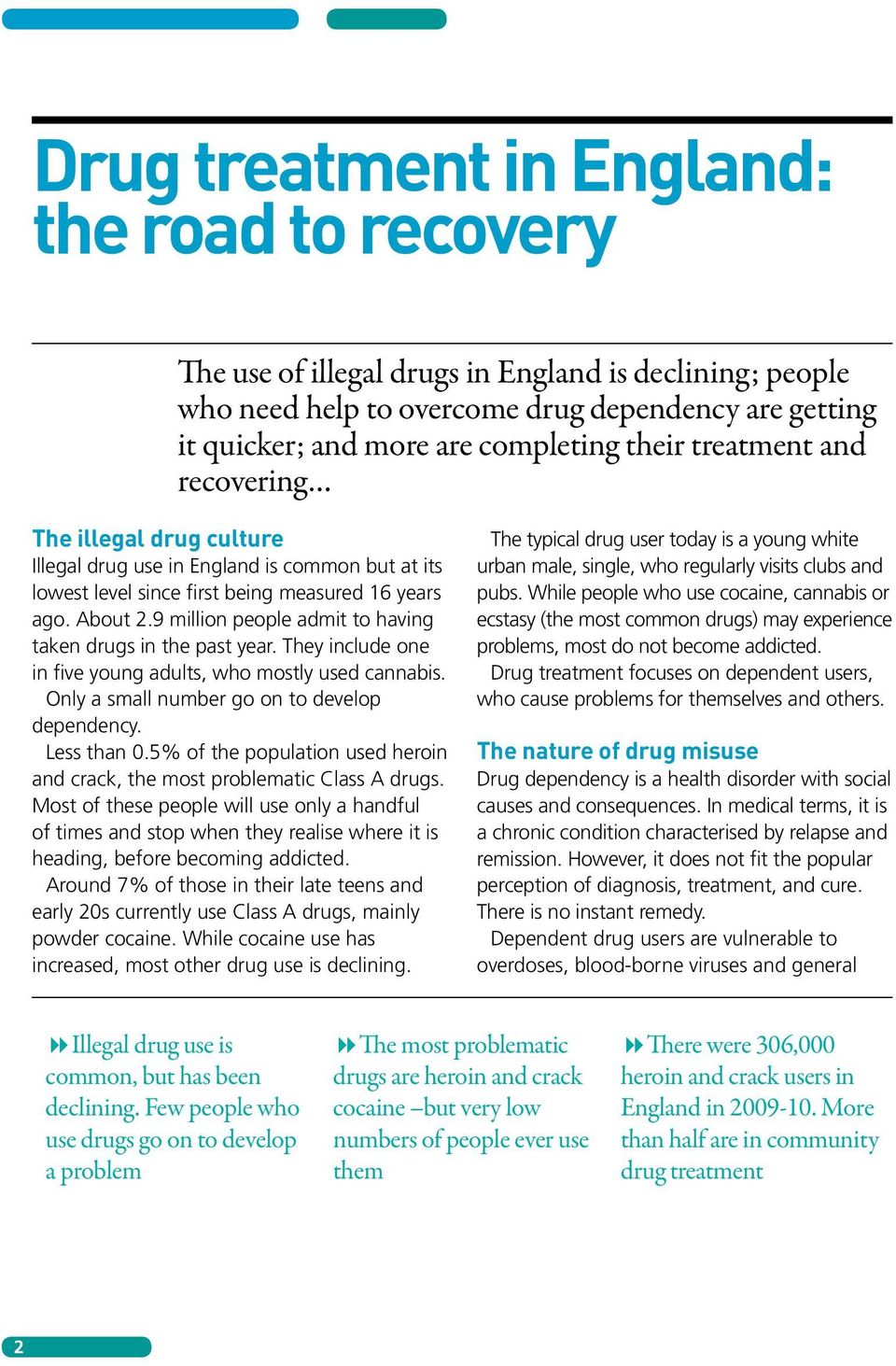
3 NTA 2012 One in three adults have taken drugs at some point in their lives poor health. Their employability declines, their families suffer distress, and they may neglect their children. Their communities often suffer crime and drug litter. So treatment for drug dependency needs to be combined with access to other health and care services that enable users to rebuild their social and personal capital. Over time, many drug users either overcome dependency, or manage it and lead normal lives. Treatment offers users the prospect of shortterm management and long-term recovery. It offers society immediate relief from the damage drug misuse causes. It also has a high level of public support. Surveys show 75% believe drug treatment is a good use of money; 80% think it makes society better and safer; and 66% fear without it crime would rise. Dependent drug users Estimates of the number of heroin and crack users in England fell from a peak of 332,000 in to 306,000 in More than half (172,139) are in community drug treatment and they make up 84% of the treatment population. However, the number of adults newly entering treatment for heroin and crack use has fallen by 15% in two years. The number of 18 to 24 year-olds in this category has halved over five years. As the drug-dependent population ages, the over-40s have become the largest age group starting treatment. They tend to be entrenched users. Drug-related deaths in England peaked at 1,697 in 2001, then stabilised. There were 1,625 in This flat trend is reassuring as the injecting population is growing older and more vulnerable. Dependent users in treatment remain less likely to die from an overdose than those outside. The role of treatment Drug workers doctors, nurses, counsellors and others help users overcome dependency. 8The average wait for treatment in was five days, and 96% started within three weeks 8The numbers dropping out of treatment early are falling, the proportion staying in long enough to benefit is rising 828,000 adults left drug treatment free from dependency in a 150% increase on the figure for
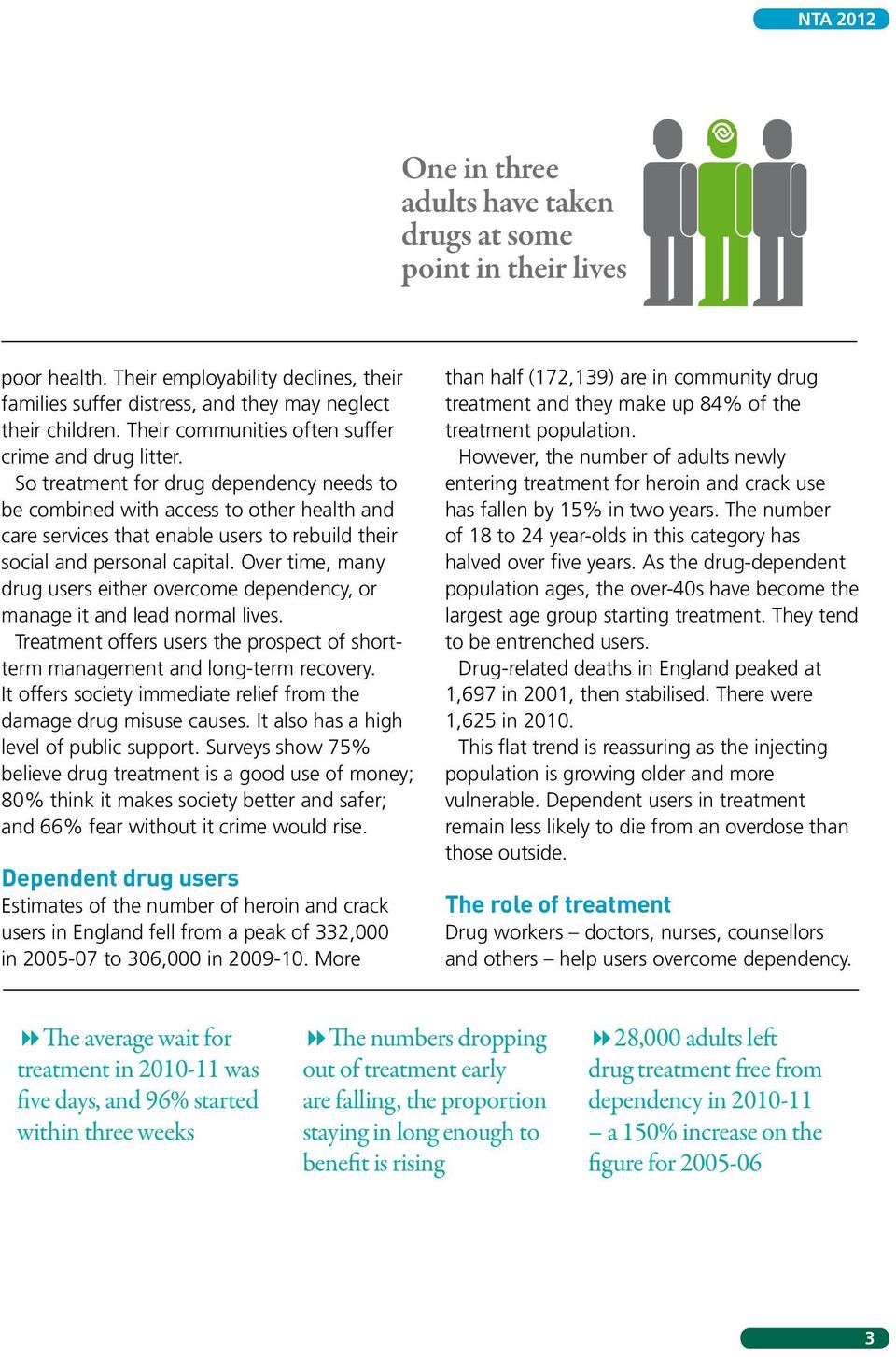
4 About one in ten adults have used drugs recently They also help them to become active citizens, take responsibility for their children, earn their own living and keep a stable home. Drug users who are parents get extra support to look after their children. While dependent users are in treatment they are less likely to use illegal drugs, to share needles and spread infections, or to steal and shoplift to fund their habit. Research shows that crimes committed by users are halved when they are in treatment. It also indicates that most need at least three months in treatment to significantly reduce or stop their drug use. It takes time for users to overcome addiction or manage it so they can lead normal lives. The average period in treatment is almost three years. Relapse is an ever-present risk. Facts and figures Drug treatment in England expanded to meet demand over the past decade and is now available to anyone who needs it. The number of adults in treatment in was 204,473, more than double the number in The average wait has fallen from nine weeks in 2002 to five days, and 96% start treatment within three weeks. Numbers peaked in but are now falling and likely to drop below 200,000 soon. Since waiting times remain low, the decline probably reflects reduced demand rather than any shortfall in services. Four out of five adults new to treatment either complete their programme or stay in long enough for them and society to feel the benefit. Overall, the proportion staying in long enough to benefit is rising, the numbers leaving free from dependency are rising, and the numbers dropping out early are falling. Successful completions more than doubled in five years to 27,969 in They went up by 150% compared to the figures for , and the improvement is likely to be sustained this year. 8While in treatment, dependent drug users are less likely to use drugs, to share needles, or commit crime 8The number of young people using drugs is falling, but around 22,000 were helped for misuse problems in Young people s drug use is usually a symptom, rather than cause, of their vulnerability and problems such as family breakdown 4

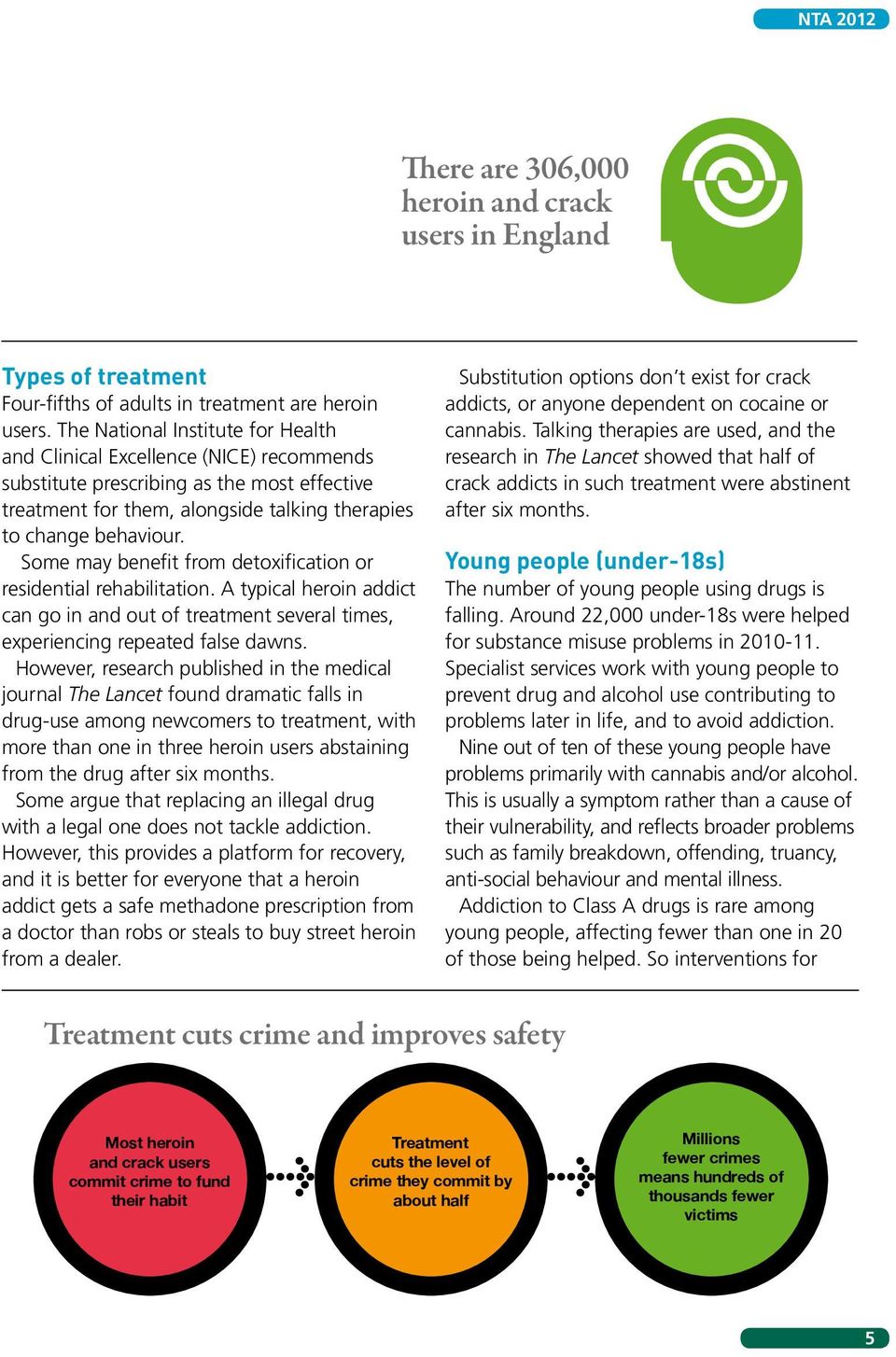
5 NTA 2012 There are 306,000 heroin and crack users in England Types of treatment Four-fifths of adults in treatment are heroin users. The National Institute for Health and Clinical Excellence (NICE) recommends substitute prescribing as the most effective treatment for them, alongside talking therapies to change behaviour. Some may benefit from detoxification or residential rehabilitation. A typical heroin addict can go in and out of treatment several times, experiencing repeated false dawns. However, research published in the medical journal The Lancet found dramatic falls in drug-use among newcomers to treatment, with more than one in three heroin users abstaining from the drug after six months. Some argue that replacing an illegal drug with a legal one does not tackle addiction. However, this provides a platform for recovery, and it is better for everyone that a heroin addict gets a safe methadone prescription from a doctor than robs or steals to buy street heroin from a dealer. Substitution options don t exist for crack addicts, or anyone dependent on cocaine or cannabis. Talking therapies are used, and the research in The Lancet showed that half of crack addicts in such treatment were abstinent after six months. Young people (under-18s) The number of young people using drugs is falling. Around 22,000 under-18s were helped for substance misuse problems in Specialist services work with young people to prevent drug and alcohol use contributing to problems later in life, and to avoid addiction. Nine out of ten of these young people have problems primarily with cannabis and/or alcohol. This is usually a symptom rather than a cause of their vulnerability, and reflects broader problems such as family breakdown, offending, truancy, anti-social behaviour and mental illness. Addiction to Class A drugs is rare among young people, affecting fewer than one in 20 of those being helped. So interventions for Treatment cuts crime and improves safety Most heroin and crack users commit crime to fund their habit Treatment cuts the level of crime they commit by about half Millions fewer crimes means hundreds of thousands fewer victims 5
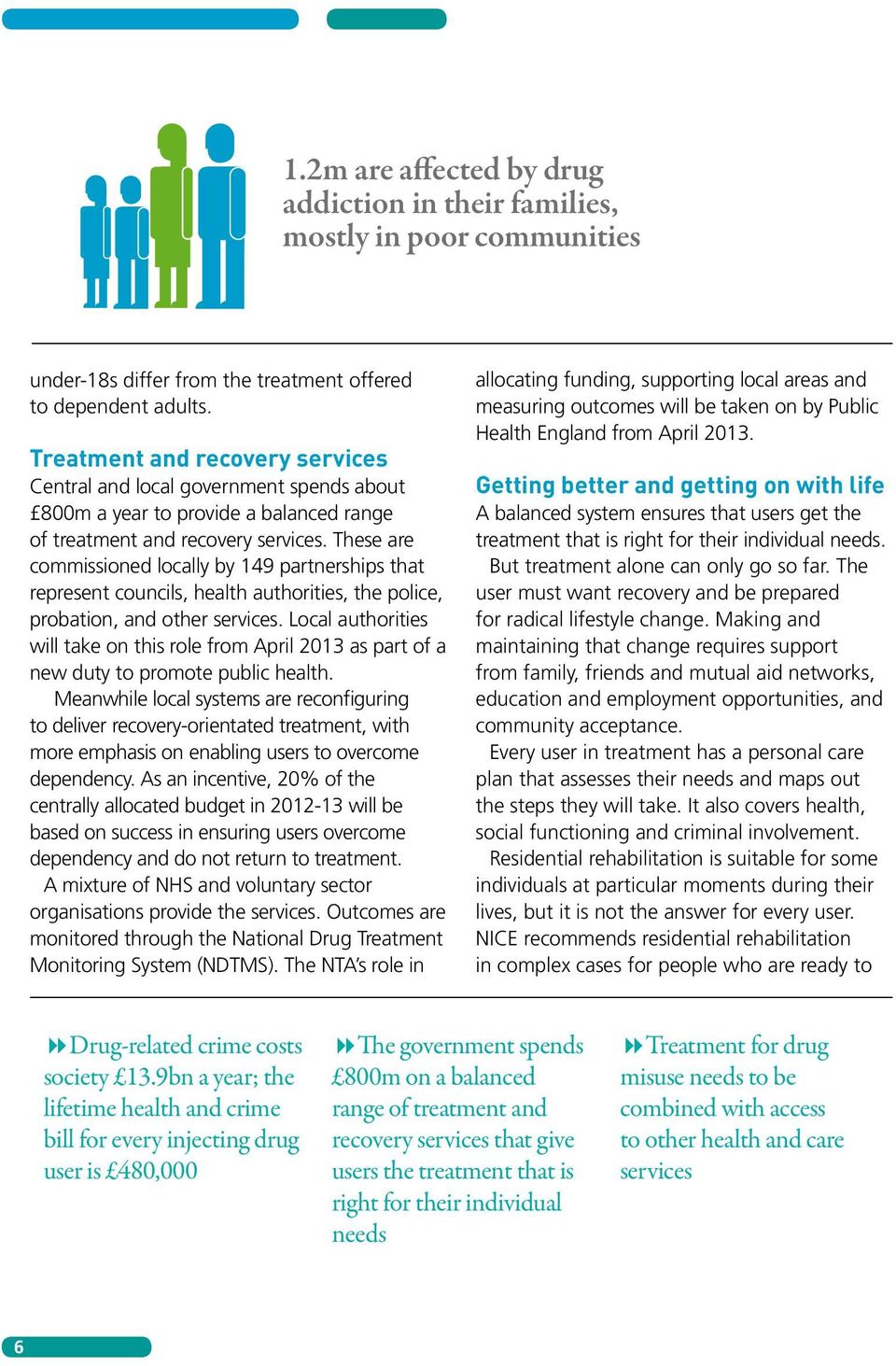
6 1.2m are affected by drug addiction in their families, mostly in poor communities under-18s differ from the treatment offered to dependent adults. Treatment and recovery services Central and local government spends about 800m a year to provide a balanced range of treatment and recovery services. These are commissioned locally by 149 partnerships that represent councils, health authorities, the police, probation, and other services. Local authorities will take on this role from April 2013 as part of a new duty to promote public health. Meanwhile local systems are reconfiguring to deliver recovery-orientated treatment, with more emphasis on enabling users to overcome dependency. As an incentive, 20% of the centrally allocated budget in will be based on success in ensuring users overcome dependency and do not return to treatment. A mixture of NHS and voluntary sector organisations provide the services. Outcomes are monitored through the National Drug Treatment Monitoring System (NDTMS). The NTA s role in allocating funding, supporting local areas and measuring outcomes will be taken on by Public Health England from April Getting better and getting on with life A balanced system ensures that users get the treatment that is right for their individual needs. But treatment alone can only go so far. The user must want recovery and be prepared for radical lifestyle change. Making and maintaining that change requires support from family, friends and mutual aid networks, education and employment opportunities, and community acceptance. Every user in treatment has a personal care plan that assesses their needs and maps out the steps they will take. It also covers health, social functioning and criminal involvement. Residential rehabilitation is suitable for some individuals at particular moments during their lives, but it is not the answer for every user. NICE recommends residential rehabilitation in complex cases for people who are ready to 8Drug-related crime costs society 13.9bn a year; the lifetime health and crime bill for every injecting drug user is 480,000 8The government spends 800m on a balanced range of treatment and recovery services that give users the treatment that is right for their individual needs 8Treatment for drug misuse needs to be combined with access to other health and care services 6
7 NTA 2012 Every 1 spent on drug treatment saves 2.50 in costs to society be drug-free, such as those who have been through detox but have not benefitted from community-based psychosocial treatments. The wider benefits of treatment Treatment aims to overcome dependency and reduce the harm drugs cause to users, their families and communities. Chiefly, while heroin and crack addicts are in treatment they use fewer illegal drugs and commit less crime to fund the purchase of drugs from street dealers. Less injecting, drug litter and blood-borne viruses also mean a reduced risk to public health. The UK now has one of the lowest rates of HIV among injecting drug users in the western world, and the incidence of hepatitis C among injectors in England is one of the lowest in Europe. The National Audit Office has endorsed research findings that every 1 invested in drug treatment saves society 2.50 in the crime and health costs of drug addiction. The Home Office estimates that drug-related crime costs society 13.9bn a year; NICE estimates the lifetime crime and health bill for every injecting drug user is 480,000. Additionally, users in treatment can cope better, can attend education and training, hold down jobs, and take care of their families. Drug users are also more likely to complete their recovery if they have wider support to rebuild their lives, such as support with employment prospects and access to stable accommodation. Many rough sleepers are drug users, for example, but their drug use usually reduces significantly when their housing problems are solved. Mental illness is also linked to drug use, and users are more likely to recover when treatment and mental health services work together. The results of treatment The National Drug Treatment Monitoring System (NDTMS) database is one of the most comprehensive in the NHS and has collected robust data for six years. What happens without drug treatment? Disease goes up Drug deaths go up Welfare dependence goes up Crime goes up 7

8 One in three starting treatment for the first time in the past three years left free of dependency The relapsing nature of addiction means we cannot assume all those who complete treatment will stay drug-free. However, we now have the ability to track the progress of everyone who went through the system across this six-year period. Of the 255,556 adult drug users who entered treatment for the first time between 2005 and 2011, 28% (71,887) left free of dependency and have not returned since. A further 33% (84,179) are still in treatment (although some may have left and subsequently returned). The remaining 39% (99,490) left without completing their treatment but never returned either. Although some of these will have been in prison, and a few may have died, we can assume a significant proportion have overcome their dependency and recovered, despite their unplanned discharge from treatment. For some, walking away from treatment is about shaking off their identity as an addict and escaping the drug subculture. The statistics reflect the often unpredictable nature of drug dependency and the ongoing cycles of relapse and remission. The most recent figures show that one in three individuals starting treatment for the first time in the past three years left free of dependency and have not returned. The first step on the road to recovery Increased investment expanded the availability of drug treatment and cut the time people waited for it. Having got record numbers of users into treatment quickly, the system is now responding to the recovery ambition of the 2010 Drug Strategy. Services are focused on moving people through treatment and getting them safely out the other end, with the aim of increasing the numbers recovering from dependency. Drug workers are increasingly ambitious for users. Their goal is to help people recover from dependency and reintegrate themselves into society. 828% of users starting treatment between 2005 and 2011 left free of dependency 8Drug services are focused more than ever on helping users to recover from dependency 8 National Treatment Agency for Substance Misuse, 6th Floor, Skipton House, 80 London Road, London, SE1 6LH T: F: E: [email protected] February 2012

The story of drug treatment
 EFFECTIVE TREATMENT CHANGING LIVES www.nta.nhs.uk www.nta.nhs.uk 1 The story of drug treatment The use of illicit drugs is declining in England; more and more people who need help with drug dependency
THE STORY OF DRUG TREATMENT
 THE STORY OF DRUG TREATMENT EFFECTIVE TREATMENT CHANGING LIVES The story of drug treatment The goal of all treatment is for drug users to achieve abstinence from their drug or drugs of dependency. For
FALLING DRUG USE: THE IMPACT OF TREATMENT
 We have a policy which actually is working in Britain. Drugs use is coming down, the emphasis on treatment is absolutely right, and we need to continue with that to make sure we can really make a difference.
Why invest? How drug treatment and recovery services work for individuals, communities and society
 Why invest? How drug treatment and recovery services work for individuals, communities and society What is drug addiction? Drug addiction is a complex but treatable condition Those affected use drugs compulsively,
BUILDING RECOVERY IN COMMUNITIES www.nta.nhs.uk
 For the small percentage of under- 18s who get into difficulties with drugs or alcohol, the problems can become significant SUBSTANCE MISUSE AMONG YOUNG PEOPLE 2011-12 BUILDING RECOVERY IN COMMUNITIES
BUILDING RECOVERY IN COMMUNITIES www.nta.nhs.uk
 Parents with drug problems present real risks to their children. But drug treatment helps them to overcome their addiction and look after their children better PARENTS WITH DRUG PROBLEMS: HOW TREATMENT
REVIEW OF DRUG TREATMENT AND REHABILITATION SERVICES: SUMMARY AND ACTIONS
 REVIEW OF DRUG TREATMENT AND REHABILITATION SERVICES: SUMMARY AND ACTIONS 1. INTRODUCTION 1.1 Review Process A Partnership for a Better Scotland committed the Scottish Executive to reviewing and investing
Alcohol and drugs prevention, treatment and recovery: why invest?
 Alcohol and drugs prevention, treatment and recovery: why invest? 1 Alcohol problems are widespread 9 million adults drink at levels that increase the risk of harm to their health 1.6 million adults show
POWDER COCAINE: HOW THE TREATMENT SYSTEM IS RESPONDING TO A GROWING PROBLEM
 Effective treatment is available for people who have a powder-cocaine problem seven in ten of those who come into treatment either stop using or reduce their use substantially within six months POWDER
Substance misuse among young people in England 2012-13
 Substance misuse among young people in England December 2013 About Public Health England Public Health England s mission is to protect and improve the nation s health and to address inequalities through
Protecting and improving the nation s health. Drug treatment in England 2013-14
 Protecting and improving the nation s health Drug treatment in England November 214 About Public Health England Public Health England exists to protect and improve the nation s health and wellbeing, and
DRUG TREATMENT 2012: PROGRESS MADE, CHALLENGES AHEAD
 Drug use is declining, more drug users are recovering. The original pool of heroin and crack addicts is shrinking. Even so, plenty of work remains to be done DRUG TREATMENT 2012: PROGRESS MADE, CHALLENGES
FROM ACCESS TO RECOVERY: ANALYSING SIX YEARS OF DRUG TREATMENT DATA
 341,741 unique individuals were treated for drug dependence at some point between 1 April 2005 to 31 March 2011. This report investigates what happened to them, offering a clear insight into the effectiveness
THE ROLE OF RESIDENTIAL REHAB IN AN INTEGRATED TREATMENT SYSTEM
 Drug treatment comes in a variety of forms and settings. The popular notion of a spell in rehab, beloved of the tabloids, is not representative of mainstream treatment and recovery services provided in
Adult drug treatment plan 2009/10. Part 1: Strategic summary, needs assessment and key priorities
 Birmingham Drug and Alcohol Action Team Adult drug treatment plan 2009/10 Part 1: Strategic summary, needs assessment and key priorities The strategic summary incorporating the findings of the needs assessment,
A LONG-TERM STUDY OF THE OUTCOMES OF DRUG USERS LEAVING TREATMENT SEPTEMBER 2010
 National Treatment Agency for Substance Misuse Long-term results for those who have been treated in one year found that nearly half who leave neither need further treatment nor were found to be involved
Getting help for a drug problem A guide to treatment
 Getting help for a drug problem A guide to treatment Who we are The National Treatment Agency for Substance Misuse is part of the National Health Service. We were set up in 2001 to increase the numbers
Protecting and improving the nation s health. Specialist substance misuse treatment for young people in England 2013-14
 Protecting and improving the nation s health Specialist substance misuse treatment for young people in England 2013-14 January 2015 About Public Health England Public Health England exists to protect and
Specialist Alcohol & Drug Services in Lanarkshire
 Specialist Alcohol & Drug Services in Lanarkshire This brochure describes what help is available within Lanarkshire s specialist treatment services. These include the North Lanarkshire Integrated Addiction
NATIONAL INSTITUTE FOR CLINICAL EXCELLENCE SPECIAL HEALTH AUTHORITY TENTH WAVE WORK PROGRAMME DRUG MISUSE. Psychosocial interventions in drug misuse
 Attachment B NATIONAL INSTITUTE FOR CLINICAL EXCELLENCE SPECIAL HEALTH AUTHORITY TENTH WAVE WORK PROGRAMME DRUG MISUSE Psychosocial interventions in drug misuse On 16 th June 2004 the Department of Health
Safer Stronger Communities Select Committee
 Safer Stronger Communities Select Committee Title Reduction in funding available for residential rehabilitation regarding drugs and alcohol: savings proposal COM 09 Author Date of meeting 22 January 2013
Milton Keynes Drug and Alcohol Strategy 2014-17
 Health and Wellbeing Board Milton Keynes Drug and Alcohol Strategy 2014-17 www.milton-keynes.gov.uk 2 Contents Foreword 4 Introduction 5 National context 6 Local context 7 Values and principles 9 Priorities
The Government's Drug Strategy
 Report by the Comptroller and Auditor General HC 297 SesSIon 2009 2010 march 2010 Tackling problem drug use Report by the Comptroller and Auditor General Tackling problem drug use HC 297 Session 2009-2010
Bsafe Blackpool Community Safety and Drugs Partnership. Drug and Alcohol treatment planning in the community for Young People and Adults 2012/13
 Bsafe Blackpool Community Safety and Drugs Partnership Drug and Alcohol treatment planning in the community for Young People and Adults 2012/13 Planning Framework Treatment plan Planning Framework Bsafe
No.1 Why reducing drug-related crime is important, and why the new government needs to act
 RAPt RESEARCH AND POLICY BRIEFING SERIES No.1 Why reducing drug-related crime is important, and why the new government needs to act 12th May 2015 FOREWORD This series of RAPt Research and Policy Briefings
Addressing Alcohol and Drugs in the Community. Cabinet member: Cllr Keith Humphries - Public Health and Protection Services
 Wiltshire Council Cabinet 17 April 2012 Subject: Addressing Alcohol and Drugs in the Community Cabinet member: Cllr Keith Humphries - Public Health and Protection Services Key Decision: Yes Executive Summary
Treatments for drug misuse
 Understanding NICE guidance Information for people who use NHS services Treatments for drug misuse NICE clinical guidelines advise the NHS on caring for people with specific conditions or diseases and
Principles for commissioning a substance misuse treatment system
 Developing Recovery Communities: Treatment Plan Strategic Summary 2013/14 East Sussex Drug and Alcohol Action Team 1. The East Sussex Drug and Alcohol Action Team (DAAT) is the multi-agency partnership
Substance Misuse. See the Data Factsheets for more data and analysis: http://www.rbkc.gov.uk/voluntaryandpartnerships/jsna/2010datafactsheets.
 Substance Misuse See the Data Factsheets for more data and analysis: http://www.rbkc.gov.uk/voluntaryandpartnerships/jsna/2010datafactsheets.aspx Problematic drug use Kensington and Chelsea has a similar
Joint Committee on Health and Children
 Houses of the Oireachtas Joint Committee on Health and Children A Submission From Homeless & Drugs Services Homeless & Drugs Services September 15 th 2011 1 CONTENTS Page no. 0.1 Introduction 3 0.2 Structure
Reducing Drug Use, Reducing Reoffending Are programmes for problem drug-using offenders in the UK supported by the evidence?
 Bringing evidence and analysis together to inform UK drug policy Reducing Drug Use, Reducing Reoffending Are programmes for problem drug-using offenders in the UK supported by the evidence? Summary Over
Alcohol treatment in England 2012-13
 Alcohol treatment in England 2012-13 October 2013 About Public Health England Public Health England s mission is to protect and improve the nation s health and to address inequalities through working with
THE DRUG DETOX UNIT AT MOUNTJOY PRISON A REVIEW
 1 THE DRUG DETOX UNIT AT MOUNTJOY PRISON A REVIEW By Dr. Des Crowley, General Practitioner INTRODUCTION The Drug Detox Unit was opened in July 1996 at Mountjoy Prison in response to the escalating drug
Consultation Paper on Commissioning Adults and Young People s Drug and Alcohol Services in Somerset
 Consultation Paper on Commissioning Adults and Young People s Drug and Alcohol Services in Somerset Date: September 2012 Authors: SDAP Staff Team Closing Date for Consultation Submissions: Friday 2 nd
Directory for Substance Misuse Services in Caerphilly
 Directory for Substance Misuse s in Caerphilly Background Substance Misuse services use a tiered approach in their approach and delivering of drug/alcohol services. These are as follows: Tier 1 Interventions
Drug Treatment System in the UK. Dr. Lisa Luger, LLC Consultancy CIC, London
 Drug Treatment System in the UK Dr. Lisa Luger, LLC Consultancy CIC, London History of drug treatment in the UK (The British System) 1920 Dangerous Drugs Act 1926 Rolleston Committee Report 1961 1 st Brain
Specialist drug and alcohol services for young people a cost benefit analysis
 Research Report DFE-RR087 Specialist drug and alcohol services for young people a cost benefit analysis Frontier Economics This research report was commissioned before the new UK Government took office
Sheffield Future Commissioning of Drug & Alcohol Community Treatment
 Sheffield Future Commissioning of Drug & Alcohol Community Treatment Magdalena Boo, Joint Commissioning Manager Scope of the Plan IN SCOPE Adults 18+ (young people s services are separately commissioned)
People affected by drug and alcohol misuse
 Fact Sheet Local Account of Adult Social Care 2013-14 What we spent in 2013-14 M s experience of rehab and aftercare Drug & Alcohol Expenditures 2% 18% 35% Community drug treatment 35% Specialist clinical
Antisocial personality disorder
 Understanding NICE guidance Information for people who use NHS services Antisocial personality disorder NICE clinical guidelines advise the NHS on caring for people with specific conditions or diseases
REVISED SUBSTANCE ABUSE GRANTMAKING STRATEGY. The New York Community Trust April 2003
 REVISED SUBSTANCE ABUSE GRANTMAKING STRATEGY The New York Community Trust April 2003 1 I. INTRODUCTION Substance Abuse is defined as the excessive use of addictive substances, especially narcotic drugs,
Models of care for treatment of adult drug misusers: Update 2006
 Models of care for treatment of adult drug misusers: Update 2006 National Treatment Agency for Substance Misuse July 2006 The National Treatment Agency for Substance Misuse The National Treatment Agency
SOMERSET DUAL DIAGNOSIS PROTOCOL OCTOBER 2011
 SOMERSET DUAL DIAGNOSIS PROTOCOL OCTOBER 2011 This document is intended to be used with the Somerset Dual Diagnosis Operational Working guide. This document provides principles governing joint working
Clinical Priorities for Alcohol and Drugs in Public Health
 Clinical Priorities for Alcohol and Drugs in Public Health What do we need to Measure up to? Dr Michael Kelleher Clinical Lead Alcohol and Drugs Team, Health and Wellbeing Directorate SMMGP 8 th Primary
TITLE: REVIEW OF DRUG USE IN HARLOW (PART 2 OF 2) LYNN SEWARD, HEAD OF COMMUNITY WELLBEING (01279) 446119 TEAM MANAGER (01279) 446115
 REPORT TO: SCRUTINY COMMITTEE DATE: 22JANUARY 2014 TITLE: REVIEW OF DRUG USE IN (PART 2 OF 2) LEAD OFFICER: CONTRIBUTING OFFICER: LYNN SEWARD, HEAD OF COMMUNITY WELLBEING (01279) 446119 MARYSIA RUDGLEY,
(Health Scrutiny Sub-Committee 9 March 2009)
 Somerset County Council Health Scrutiny Sub-Committee 9 March 2009 Drug and Alcohol Treatment Services Author: Amanda Payne Somerset DAAT Co-ordinator Contact Details: [email protected] Paper
Treatment Approaches for Drug Addiction
 Treatment Approaches for Drug Addiction [NOTE: This is a fact sheet covering research findings on effective treatment approaches for drug abuse and addiction. If you are seeking treatment, please call
Protocol for Accessing Residential Detoxification & Rehabilitation
 Protocol for Accessing Residential Detoxification & Rehabilitation Protocol - working group members: Julie Murray, Alcohol & Drugs Partnership Co-ordinator Lynda Mays, Clinical Services Manager, Addictions,
2012-13 Trends in Drug Treatment
 Appendix: 3.4 MEETING: Clinical Commissioning Group Shadow Governing Body DATE: Thursday 22 November 2012 TITLE: Drug treatment performance report LEAD Dr Jeanelle de Gruchy, Director of Public Health
About Public Health England
 Adult substance misuse statistics from the National Drug Treatment Monitoring System (NDTMS) 1 April 2014 to 31 March 2015 About Public Health England Public Health England exists to protect and improve
Topic Area - Dual Diagnosis
 Topic Area - Dual Diagnosis Dual Diagnosis is a challenging problem for both mental health and substance misuse services. People with mental health problems, who also suffer from substance misuse are at
Treatment Approaches for Drug Addiction
 Treatment Approaches for Drug Addiction NOTE: This is a fact sheet covering research findings on effective treatment approaches for drug abuse and addiction. If you are seeking treatment, please call 1-800-662-HELP(4357)
Commissioning for recovery Drug treatment, reintegration and recovery in the community and prisons: a guide for drug partnerships
 Commissioning for recovery Drug treatment, reintegration and recovery in the community and prisons: a guide for drug partnerships EFFECTIVE TREATMENT CHANGING LIVES www.nta.nhs.uk About this document Title
The Recovery Pathway Service forms a key component of the Sunderland Integrated Substance Misuse Service, as illustrated below:
 SERVICE SPECIFICATION LOT 1 RECOVERY PATHWAY 1.0 SERVICE MODEL The Recovery Pathway Service forms a key component of the Sunderland Integrated Substance Misuse Service, as illustrated below: Recovery Outcomes
DRUG STRATEGY 2010-2015. On 8 December the government launched its new drug strategy.
 DRUG STRATEGY 2010-2015 On 8 December the government launched its new drug strategy. Reducing Demand, Restricting Supply, Building Recovery : Supporting People to Live a Drug Free Life The strategy sets
Drugs and Alcohol in Primary Care Steve Brinksman Clinical Lead SMMGP
 Drugs and Alcohol in Primary Care Steve Brinksman Clinical Lead SMMGP Habit is habit, and not to be flung out of the window by any man, but coaxed down-stairs one step at a time. Samuel Langhorne Clemens
Drugs and Alcohol - Commissioning for an integrated treatment, recovery support and care coordination service
 Drugs and Alcohol - Commissioning for an integrated treatment, recovery support and care coordination service Proposal and Integrated Impact Assessment Title of proposal Commissioning for an integrated
Pioneering Detox and Rehab Choice
 Pioneering Detox and Rehab Choice TTP: Pioneering Detox and Rehab Choice Over years of providing treatment for alcohol and drug addiction, one thing has always been clear. Everyone is different. Different
DrugFacts: Treatment Approaches for Drug Addiction
 DrugFacts: Treatment Approaches for Drug Addiction NOTE: This is a fact sheet covering research findings on effective treatment approaches for drug abuse and addiction. If you are seeking treatment, please
Leeds Drug and Alcohol Strategy and Action Plan (2013 2016)
 1 Leeds Drug and Alcohol Strategy and Action Plan (2013 2016) Leeds is a city that promotes a responsible attitude to alcohol and where individuals, families and communities affected by the use of drugs
Alcohol and Re-offending Who Cares?
 January 2004 Alcohol and Re-offending Who Cares? This briefing paper focuses on the high level of alcohol misuse and dependence within the prison population. In recent years a great deal of time and money
NTA business plan 2010-11
 Effective drug treatment enables addicts to turn round their lives and brings benefits not only to themselves but also to their families and society. Treatment gives individuals the opportunity to overcome
National Drug Treatment Monitoring System (NDTMS) NDTMS DATA SET H
 National Drug Treatment Monitoring System (NDTMS) NDTMS DATA SET H BUSINESS DEFINITION FOR ADULT DRUG TREATMENT PROVIDERS Author M. Hinchcliffe Approver M. Roxburgh Date 01/03/2011 Version 8.03 REVISION
Working towards recovery
 Bringing evidence and analysis together to inform UK drug policy Working towards recovery Getting problem drug users into jobs Summary This is a summary of the main findings from a review looking at getting
Prescribing Heroin to Heroin Addicts: A Drug Policy in Search of a Disaster? Neil McKeganey. Professor of Drug Misuse Research. University of Glasgow
 Prescribing Heroin to Heroin Addicts: A Drug Policy in Search of a Disaster? Neil McKeganey Professor of Drug Misuse Research University of Glasgow 89 Dumbarton Road Glasgow G11 6PW [email protected]
Adult drug treatment plan 2007/08 Part 1 Section A: Strategic summary Section B: National targets Section C: Partnership performance expectations
 name Adult drug treatment plan Part 1 Section A: Strategic summary Section B: National targets Section C: expectations Published by NTA: 2 October This strategic summary incorporating national targets
Joint Commissioning Panel for Mental Health
 Joint Commissioning Panel for Mental Health Guidance for commissioners of drug and alcohol services 1 www.jcpmh.info Guidance for commissioners of drug and alcohol services Practical mental health commissioning
Dual Diagnosis. Dual Diagnosis Good Practice Guidance, Dept of Health (2002);
 Dual Diagnosis Dual Diagnosis is a challenging problem for both mental health and substance misuse services. People with mental health problems, who also suffer from substance misuse are at an increased
Research Note RN 00/91 1 November 2000 DRUG COURTS
 Research Note RN 00/91 1 November 2000 DRUG COURTS There will be a Scottish National Party debate on Drug Courts on Thursday 2 November 2000. This brief research note gives information on the background