
Impacts of Electric Vehicles - Deliverable 4. Economic analysis and business models
|
|
|
- Nickolas Doyle
- 10 years ago
- Views:
Transcription
1 Impacts of Electric Vehicles - Deliverable 4 Economic analysis and business models Report Delft, April 2011 Author(s): Bettina Kampman (CE Delft) Willem Braat (CE Delft) Huib van Essen (CE Delft) Duleep Gopalakrishnan (ICF)

2 Publication Data Bibliographical data: Bettina Kampman, Willem Braat, Huib van Essen, Duleep Gopalakrishnan Impacts of Electric Vehicles - Deliverable 4 Economic analysis and business models Delft, CE Delft, April 2011 Electric Vehicles / Production / Government / Industry / Investment / Research / Market / Economy / Analysis Publication number: CE-publications are available from Commissioned by: European Commission. This study has been produced by outside contractors for the Climate Action Directorate- General and represents the contractors' views on the matter. These views have not been adopted or in any way endorsed by the European Commission and should not be relied upon as a statement of the views of the European Commission. The European Commission does not guarantee the accuracy of the data included in this study, nor does it accept responsibility for any use made thereof. Further information on this study can be obtained from the contact person Huib van Essen. CE Delft Committed to the Environment CE Delft is an independent research and consultancy organisation specialised in developing structural and innovative solutions to environmental problems. CE Delft s solutions are characterised in being politically feasible, technologically sound, economically prudent and socially equitable. 2 April Impacts of Electric Vehicles - Deliverable 4

3 Contents Summary 5 1 Introduction Introduction to the project Contents of this report 8 2 Electrification will change costs of mobility Cost structure of Electric Vehicles Comparison with costs of ICEVs 12 3 Government policies that may affect the economics of EVs Introduction Financial policies Non-financial policies Future developments in EV government policy Potential impact of government policies on EV economics and market uptake 22 4 Business models for EVs Introduction Possible business models for EVs 26 5 The future uptake of EVs from an economic perspective Total cost of ownership comparison crucial to market uptake Potential market uptake 30 Annex A Assumptions for the calculations in this report 33 A.1 Data needed for the calculations 33 A.2 Input data 33 3 April Impacts of Electric Vehicles - Deliverable 4
4 4 April Impacts of Electric Vehicles - Deliverable 4

5 Summary Introduction This report focuses on the economics of Electric Vehicles, and the role that government policies and business models can play to make the economics more attractive to potential owners and users. One of the main barriers to short- and medium-term uptake of Electric Vehicles (EVs) are their cost, in particular the cost of the batteries, and uncertainties regarding vehicle and battery lifetime. Even though the cost per kilometre (vehicle use) is generally lower, the current high battery costs typically result in both a different cost structure and in unfavourable total cost of ownership (TCO), compared to conventional vehicles (ICEVs) of comparable size. Total cost of ownership In order to compare vehicles that have different cost structures, one should use the TCO over the lifetime of the vehicle rather than only look at purchase costs significant differences in cost of use are then taken into account. However, there are quite a large number of variables involved in these calculations, ranging from vehicle cost, vehicle taxes and subsidies, fuel and electricity use per kilometre and cost per unit, annual kilometres, battery lifetime, etc. As many of these parameters are still relatively uncertain, especially the cost and performance data related to the Electric Vehicles, it is difficult to provide an accurate prediction of developments of TCO. In order to still provide insight into the trends and developments that might be expected, a basic set of assumptions was derived, for all the parameters needed for this TCO calculation. These data result in TCO curves for the different types of vehicles investigated in this project: ICEV, PHEV, EREV and FEV. Some illustrative results are shown in Figure 1, where the calculated TCO is shown for medium-size petrol cars. Clearly, the ICEV has the lowest TCO in during the whole time frame analysed, but, as it is assumed that the purchase cost of the EVs reduce over time and vehicle (and battery) lifetime increases, the TCO of the EVs move towards that of the ICEVs. With the assumptions used, the additional cost of PHEVs is lower than that of the vehicles types with more batteries on board (EREV and FEV), resulting in a more competitive position at an earlier time. Note that no government subsidies or vehicle taxes are assumed in this graph. These can obviously change the relative cost of the various vehicle types. Also, external developments may well affect the outcome of these calculations. A sensitivity analysis shows that especially a cost reduction of the vehicles (either due to reduced vehicle cost or due to government incentives) and a fuel price increase may have quite significant impact on the TCO comparison. 5 April Impacts of Electric Vehicles - Deliverable 4

6 Figure 1 Illustration of the TCO of medium petrol vehicles compared to the TCO of a comparable ICEV (ICEV=100%) with fuel and electricity taxes but without vehicle taxes or subsidies 200% 150% 100% 50% ICE PHEV EREV FEV 0% Government policies Throughout the EU, there are quite a number of both financial and nonfinancial policies in place, aimed at promoting EV market uptake, R&D and charging point developments. The financial policies are implemented on member state or regional level, and vary from no incentives to several thousand Euro per car in some countries. This can be a subsidy, or (more often) due to CO 2 -differentiated vehicle registration and/or circulation tax. On a local level, policies such as free parking spaces of free charging points are also applied. These type of policies typically impact on the TCO of the vehicles. On EU level, various policies have been implemented that support the development and market uptake of EVs, including the CO 2 and cars regulation and the current development of charging standardisation. These policies are in many cases relatively recent, and It is very likely that especially the national and regional policies will remain dynamic for some time as they are adapted to market developments. Business models Due to the relatively high up-front battery purchase cost and the current uncertainties associated with these cost (because of limited experience regarding lifetime, resale value, etc.), a number of new business models are being derived, aimed at minimising the financial risk and uncertainty for potential buyers. Currently, there are still a number of options open, and the nature of future EV ownership and usage models is still uncertain. In the short medium term at least, they are likely to focus around a business model where batteries are excluded from the up-front cost of the vehicle and incorporated into an on-going usage-related service charge. EV economics and their market uptake The economics of the EVs will not be the only parameter that determines market uptake of these vehicles, but it is expected to be the main driver for EV sales. As long as the performance of the vehicles is similar of less than that of comparable ICEVs (and there is no reason to believe that this will change in the near future), their market share will only increase significantly if the TCO is lower than that of the ICEVs. Government policies, investments in R&D and charging infrastructure are all needed to reduce TCO and make these vehicles an attractive alternative for consumers. 6 April Impacts of Electric Vehicles - Deliverable 4

7 1 Introduction 1.1 Introduction to the project Electric Vehicles (EVs) are a promising technology for drastically reducing the environmental burden of road transport. More than a decade ago and also more recently, they were advocated by various actors as an important element in reducing CO 2 emissions of particularly passenger cars and light commercial vehicles as well as emissions of pollutants and noise. At the same time, EVs are still far from proven technology. There exist many uncertainties with respect to crucial issues like: The battery technology (energy capacity in relation to vehicle range, charging speed, durability, availability and environmental impacts of materials). Well to-wheel impacts on emissions. Interaction with the electricity generation. Cost and business case of large scale introduction. For EU policy makers, it is important to get a reliable and independent assessment of the state of the art of these issues in order to develop targeted and appropriate GHG reduction policy for transport. Therefore DG CLIMA commissioned CE Delft, ICF and Ecologic to carry out a study on the potential impacts of large scale market penetration of EVs in the EU, with a focus on passenger cars and light commercial vehicles. This study includes an assessment of both the transport part (e.g. composition of vehicle fleet) and electricity production and the impacts on well-to-wheel GHG emissions, pollutant emissions, other environmental impacts, costs, etc. In this study three types of EVs are distinguished: Full Electric Vehicles (FEVs) that have an electric engine and no internal combustion engine (ICE). Plug-in Hybrid Electric Vehicles (PHEVs) that have both an ICE and an electric engine, with a battery that can be charged on the grid. Electric Vehicles with a Range Extender (EREVs) that have an electric engine and an ICE that can be used to charge the battery and so extend the vehicle s range. The battery of an EREV can be charged on the grid. The results of the study should help the Commission with developing GHG policy for transport, in particular in the field of EVs and in relation to the wider EU transport policy and EU policy for the electricity sector. The project is organised around seven work packages (WPs): WP 1 Current status of EV development and market introduction. WP 2 Assessment of vehicle and battery technology and cost. WP 3 Assessment of impacts on future energy sector. WP 4 Economic analysis and business models. WP 5 Workshop on developments and expectations. WP 6 Scenario analysis. WP 7 Policy implications. Figure 1 gives an overview of the main interactions between the various WPs. The approach for each WP is explained in the following paragraphs. 7 April Impacts of Electric Vehicles - Deliverable 4

8 Figure 1 Project overview WP 2 Assessment of vehicle and battery technology and cost WP 1 Current status EV development and market introduction WP 3 Assessment of impacts of future energy sector WP 5 Workshop on developments and expectations WP 7 Policiy implications WP 4 Economic analysis and business models WP 6 Scenario analysis The results of this project are presented in five deliverables: Deliverables 1 to 4 presenting the results of WP 1 to 4 and a final Deliverable 5 with the results of WP 5, 6 and 7. In addition there is a summary report, briefly summarizing the main results of the entire project. This report is the fourth deliverable of the project and includes the results of WP Contents of this report This report focuses on the economics of Electric Vehicles and the role that government policies and business models can play to make the economics more attractive to potential owners and users. As was discussed in the report of WP 1, cost of the vehicles, cost of purchase and possibly intermediate replacement of their batteries and cost of EV use differ from that of the cost of conventional vehicles. This is a barrier to further market uptake, in two respects: 1. Total cost of ownership (TCO) is currently in most cases higher than that of conventional cars. 2. The cost structure is different from ICEVs, with relatively high purchase cost and relatively low cost of use (cost per km). In addition, significant investments may be required during the lifetime of the vehicle, if the batteries need to be replaced. Resolving these barriers can be expected to be crucial to achieving significant market uptake in the future. The main aim of this report is to illustrate the developments of total cost of ownership over time that are currently expected and the potential impact of government policies on the economics of these vehicles. Business models that can help make Electric Vehicles more attractive to car owners are discussed, and the impact of these developments on market uptake are assessed 1. 1 This report assesses market uptake only in rather qualitative terms. A more detailed, quantitative analysis will be made in WP 6 of this project. 8 April Impacts of Electric Vehicles - Deliverable 4

9 In Chapter 2, we discuss and illustrate how the costs of mobility may change due to EVs. In the following chapter, we address government policies and assess how policies can provide effective incentives for the parties involved in the role-out of EVs: consumers (car buyers), car manufacturers and the electricity and infrastructure (grid) sector. There we also discuss expectations regarding future developments in policy. Business models for EVs will be discussed in Chapter 4. The economics will undoubtedly play an important role in the potential future market uptake of EVs, this is discussed in Chapter 5. 9 April Impacts of Electric Vehicles - Deliverable 4

10 10 April Impacts of Electric Vehicles - Deliverable 4

11 2 Electrification will change costs of mobility 2.1 Cost structure of Electric Vehicles As can be seen in Deliverable 1 and 2, various costs items of Plug-in Hybrid Vehicles (PHEV), Electric Vehicle with Range Extenders (EREV) an Full Electric Vehicle (FEV) are expected to be quite different than those of comparable conventional vehicles (with an internal combustion engine only, ICEVs): purchase costs of the vehicles are probably higher due to high battery cost, and energy costs per kilometre will be lower. However, alternative business models are also considered to bring the cost structure more in line with the current (ICEV) situation: if the battery pack is leased rather than bought by the car owner, for example, the initial purchase price of the vehicle (excl. battery packs) could be much lower. The battery cost could then be recovered by paying a fee per kwh, or per kilometre. It may also be expected that maintenance costs will be lower, especially in FEVs and EREVs as they have fewer moving parts, and electro-motors typically require less maintenance than the current combustion engines. Looking at total cost of ownership (TCO) of a vehicle, quite a number of parameters play a role: 1. Purchase cost of the vehicle, including taxes and subsidies. 2. Lifetime of the vehicle, or resale value after a certain number of years. 3. In case of battery purchase: lifetime of the battery and, possibly, residual value. 4. In case of battery lease: battery cost per kwh, or per kilometre. 5. Annual number of kilometres. 6. Fuel and/or electricity use per kilometre (in litre/km and kwh/km). a ICEVs will only use fuel, EVs only electricity but PHEVs and EREVs may use both, depending on the trip length and driving style. 7. Fuel cost, including taxes. 8. Electricity cost, including taxes. 9. Maintenance cost. 10. Insurance cost. 11. Circulation tax or other taxes related to car ownership. Parameters 1 and 2 determine the annual depreciation of the vehicle, the remaining parameters determine the annual cost of vehicle use (where 3 and 4 give annual battery depreciation, and 5, 6, 7 and 8 are related to energy use). In addition, car owners may have to invest in a charging point at their home. Currently, as costs of these Electric Vehicles, battery lifetime, etc. are still quite uncertain, it is difficult to predict the cost of both purchase and use of these vehicles. It is, however, very likely that consumers will be faced with changes in both the fixed and variable costs of their vehicles, when changing from ICEV to one of the electric type vehicles. They will have to familiarise themselves with the new situation and have to learn to compare total cost of ownership of vehicles rather than purchase price alone, as may car buyers do 11 April Impacts of Electric Vehicles - Deliverable 4

12 now. That will be the only way to realistically compare the cost of these different types of vehicles. 2.2 Comparison with costs of ICEVs To provide an indication of how the total cost of ownership of EVs compare with that of ICEVs of comparable size and performance, a baseline set of assumptions was derived, for all types of vehicles. These assumptions are based on the results of WP 1 and 2, on data from the Vehicle Emissions project (from Ricardo and TNO), on literature and, in some cases, on own assumptions. These assumptions are, of course, highly uncertain, and will be varied in the scenario study WP 6 to provide a much more comprehensive view of the potential future cost (and impacts) of EVs. The data shown here are therefore not intended to be accurate predictions of TCO, but rather to illustrate potential TCO developments. The impact of variation of some of these parameters on the TCO will be shown later in this section. A full list of the assumptions used in the calculations for this report can be found in Annex A. As can be seen, we distinguish three types of vehicles: small, medium and large (in line with the TREMOVE categories <1.4 l, l, >2.0 l), as well as between petrol and diesel vehicles. The latter is important because of different fuel prices, annual kilometres, etc. Note that we do not assume any vehicle registration or circulation taxes or purchase subsidies here, because these vary significantly between EU Member States (the potential effect of subsidies of differentiated taxes is illustrated in Section 3.5). However, fuel taxes are included and a VAT of 19% is assumed. Using these assumptions, we have calculated the development of the TCO for small, medium and large (petrol fuelled) ICEV, PHEV, EREV and FEVs. These are compared to the ICEV TCO in the following figures (expressed as a percentage, compared to the TCO of ICE). Figure 2 TCO of small petrol vehicles compared to the TCO of a comparable ICE (ICE=100%) 200% 150% 100% 50% ICE PHEV EREV FEV 0% NB. Including fuel and electricity taxes, excluding purchase or registration taxes and subsidies. 12 April Impacts of Electric Vehicles - Deliverable 4

13 Figure 3 TCO of medium petrol vehicles compared to the TCO of a comparable ICE (ICE=100%) 200% 150% 100% 50% ICE PHEV EREV FEV 0% NB. Including fuel and electricity taxes, excluding purchase or registration taxes and subsidies. Figure 4 TCO of large petrol vehicles compared to the TCO of a comparable ICE (ICE=100%) 200% 150% ICE 100% PHEV EREV FEV 50% 0% NB. Including fuel and electricity taxes, excluding purchase or registration taxes and subsidies. As a number of cost and performance improvements are assumed for the EVs, the currently relative high TCO of EVs will to reduce over time. In the small vehicles, the relative cost difference is the highest, in particular due to the high purchase cost and the relatively low annual mileage (a higher purchase price can be recovered due to the lower cost per kilometre). Comparing the three types of EV, the PHEVs have the lowest TCO, whereas the lifetime cost of FEVs and EREVs are quite comparable with the input data assumed here. The results also show that with the assumptions used, the TCO for any of the EVs will not be comparable to ICEs before In the medium and large segment the TCO of especially PHEVs become quite similar to that of ICEs in , but the lines do not cross. 13 April Impacts of Electric Vehicles - Deliverable 4

14 However, as the input values are based on averages of quite large vehicle categories (for example, medium sized petrol cars), comparable costs will mean in reality that the EVs will be cheaper than ICEs for half of the vehicle owners in that category, and more expensive for the other half. Of course, there are several external developments and government measures that may reduce the difference in TCO in the coming years and decades, such as: Government policies such as subsidies, differentiated vehicle taxes, etc. Technological breakthrough in EV cost, in particular the battery cost and, to a lesser extend, battery lifetime. Changes In transport fuel price or energy efficiency of the vehicles. The impact of government policies will be discussed further and illustrated in the next chapters. In the following graphs, the impact of different vehicle and fuel cost is shown in Figure 5 and Figure 6. Here, the medium petrol fuelled vehicle segment in the year 2020 is used as example. The base case assumptions (shown in Figure 3) are taken to be the 100% case in this graph. These results confirm that vehicle catalogue price and petrol prices are important factors in the TCO comparison. In this vehicle category and with the assumptions used here, a 40% decrease of PHEV catalogue prices can be expected to result in a match with the ICE TCO, whereas the FEVs and EREVs need a 55% and 50% reduction. A fuel price increase will also help the EVs to achieve competitiveness with the ICE, but the increases needed to achieve competitive TCOs are quite significant in this case. Figure 5 Catalogue price sensitivity analysis - medium petrol vehicles, % TCO 140% 120% 100% ICE PHEV EREV FEV 80% 50% 60% 70% 80% 90% 100% 110% 120% Catalogue price 14 April Impacts of Electric Vehicles - Deliverable 4

15 Figure 6 Fuel costs sensitivity analysis - medium petrol vehicles, % TCO 140% 120% 100% ICE PHEV EREV FEV 80% 50% 100% 150% 200% 250% 300% Petrol price The TCO comparison is much less sensitive to the price of electricity, as shown in Figure 7. Figure 7 Electricity price sensitivity analysis - medium petrol vehicles, % TCO 140% 120% 100% ICE PHEV EREV FEV 80% 50% 60% 70% 80% 90% 100% 110% 120% Electricity price Another still uncertain issue in EV TCO calculations is the battery life expectation. Our analysis shows that this parameter, even though it comprises a high share of the purchase price, does not influence TCO as much as the catalogue price or fuel costs (see Figure 8). As can be expected, the FEV TCO is influenced the most by the battery life since it has the largest battery pack of EVs and therefore has the highest share in vehicle costs compared to PHEVs and EREVs. 15 April Impacts of Electric Vehicles - Deliverable 4

16 Figure 8 Battery life sensitivity analysis - medium petrol vehicles, % TCO 140% 120% 100% ICE PHEV EREV FEV 80% 50% 60% 70% 80% 90% 100% 110% 120% Battery life 16 April Impacts of Electric Vehicles - Deliverable 4

17 3 Government policies that may affect the economics of EVs 3.1 Introduction There is a general consensus that without government policy, Electric Vehicles will not enter the market in any significant share, until, at some point in the future, oil prices increase so much that high petrol and diesel prices make EVs competitive. This may be partly because, at least until recently, the ICE technology and fuels were intrinsically superior to that of EVs and therefore more attractive to car buyers. The battery technologies we have known so far were technically less suited and more expensive for energy storage in a car or a truck than the petrol and diesel we use for ICEs. However, another reason for this is the many decades of intensive development of the ICEs, that resulted in huge advantages: high production volumes that result in relatively low cost, high reliability and driving range, well developed refuelling infrastructure and good performance. The world wide development of EVs has only just started 2, resulting in the current situation of low production volumes and thus high cost, limited recharging capabilities, etc. In order to achieve significant market uptakes of EVs at current oil prices (and at oil prices predicted for the coming decades), both issues need to be addressed: battery technology needs to improve, and the market needs to develop and grow in order to climb the learning curve and reduce cost by increasing the scale of production. As the benefits of EVs are largely for the society rather than for individuals, governments have to help this development by providing the right incentives. In recent years, we have seen an increasing number of government incentives being implemented throughout the EU, both financial and non-financial. These policies are implemented at different government levels, ranging from EU directives to national and local policies. Some of these policies are aimed at R&D to improve the technology, others are aimed at market uptake of the existing technology, standardisation of charging systems or at increasing the number of charging points. In many cases, it is expected that these incentives will only be needed temporarily, as costs and performances will improve once a certain market share and customer acceptation is achieved. It is currently not known whether the EVs will be able to fully compete with ICEs at some point or whether government policies will always be necessary to ensure a desired market share of EVs 3. In any case, the EV market developments in the coming one or two decades are considered to be strongly dependant on government policies and incentives. 2 3 Several car manufacturers have tried to develop EVs in the past decades, production volumes have never been significant. Note that government incentives could be justified also in the long term, for example because of lower CO 2 emissions, lower air pollutant and noise emissions, etc. 17 April Impacts of Electric Vehicles - Deliverable 4

18 In the following, we first provide an overview of the policies currently in place in the EU not with the aim to be comprehensive, but rather to illustrate the variety of policies in place. Then, we will discuss how these policies may affect the market uptake of EVs. We will assess potential policy developments in the future in the last section of this paragraph. 3.2 Financial policies Quite a number of financial policies are currently in place throughout Europe to encourage the development and sales of EVs. An overview of incentives for FEVs is provided in Table 1. In some of the countries listed in the table, CO 2 differentiation of vehicle registration and circulation taxes are the reason for the tax exemptions or discounts stated. In these cases, policies are technology independent. However, in other countries, the tax discounts (or other financial incentives) are specific to FEV. Table 1 Overview of financial policies implemented to promote FEVs Type of policy Aimed at Examples Subsidy for EV purchase Market uptake of the vehicles Austria, Belgium, Cyprus, Germany, France, Italy, various regions in Spain, Sweden, UK (also for Plug-in Hybrids) Discount on or exemption of vehicle registration tax Market uptake of the vehicles Tax exemption in the Austria, Netherlands, Denmark, Greece (also for Hybrids), Portugal, Romania; discount in Belgium, bonus in France due to low CO 2 emissions Discount on or exemption of vehicle circulation tax Market uptake of the vehicles Tax exemption in Austria, Czech Republic (EVs for business purposes only), the Netherlands, Ireland, Germany (first 5 years after purchase), Greece Reduction of VAT Market uptake Austria of the vehicles Favourable fiscal Market uptake Netherlands, UK treatment of leased cars of the vehicles Discount on or exemption Market uptake UK (London), Sweden (Stockholm) of congestion charge of the vehicles CO 2 differentiated fuel and energy tax Market uptake of the vehicles Free parking places for Electric Vehicles Market uptake of the vehicles Cities in Italy, the UK, Denmark, the Netherlands, Subsidies for the Charging point Cities in the Netherlands, UK, etc. installation of charging points availability Subsidies for R&D (car Improving Netherlands, UK, manufacturers and research institutes) technology, reducing cost Source of the country examples: ACEA, tax_overview.pdf, AVERE and own data. 18 April Impacts of Electric Vehicles - Deliverable 4

19 Clearly, most financial incentives are aimed at reducing the cost for consumers, in order to create a market for these vehicles despite their currently high cost. These are typical policies on a national and sometimes regional level. All types of taxation for vehicles can be used for this. In addition, various countries and local governments provide financial support (subsidies) for the installation of charging points, in some cases the local governments themselves install these charging points, making them available to all EV users. Note that in addition to these policies that are explicitly implemented for to provide incentives for EVs, the current rules on energy taxation in the EU provide a clear incentive as well: Directive 2003/96/EC fixes higher minimum tax rates for transport fuels than taxes on electricity, and these are reflected in higher national rates in almost all countries of the EU. In conjunction with the relatively low energy use of EVs (per kilometre), this leads to a much lower energy tax for EVs than for ICEs, per MJ but even more so per kilometre. So far, not much attention has been given to PHEVs and EREVs in policies, but this might change once their sales increase. However, even in the current tax systems, they can be expected to fall into lower tax categories for vehicle registration and circulation taxes, as these are differentiated to CO 2 In an increasing number of countries. The impact of VAT on vehicle cost The catalogue price of electric vehicle is currently significantly higher than that of comparable ICEs, and this is expected to remain the case at least in the near to medium term future. Since all EU member states levy VAT on the purchase of vehicles which is a percentage of the catalogue price, the VAT that has to be paid on these cars is higher than that of comparable conventional cars. For example, if an ICE costs 10,000 and the VAT is 20%, the VAT will amount to 2,000. If an electric vehicle of the same size costs 20,000, the VAT will add up to 4,000. The VAT will thus increase the additional cost of the electric vehicle by 2,000. This effect should thus be taken into account when assessing the potential impact of a subsidy or purchase tax differentiation. In this example, a subsidy or tax differentiation of would only compensate the higher VAT payment. A higher subsidy or level of differentiation is needed to reduce the actual difference in catalogue value. 3.3 Non-financial policies Besides direct financial incentives, governments may choose to implement non-financial incentives to encourage the sales and use of EVs. These are listed in Table 2, again with examples of countries were these are currently in force. These policies clearly range from local initiatives to EU directives. 19 April Impacts of Electric Vehicles - Deliverable 4
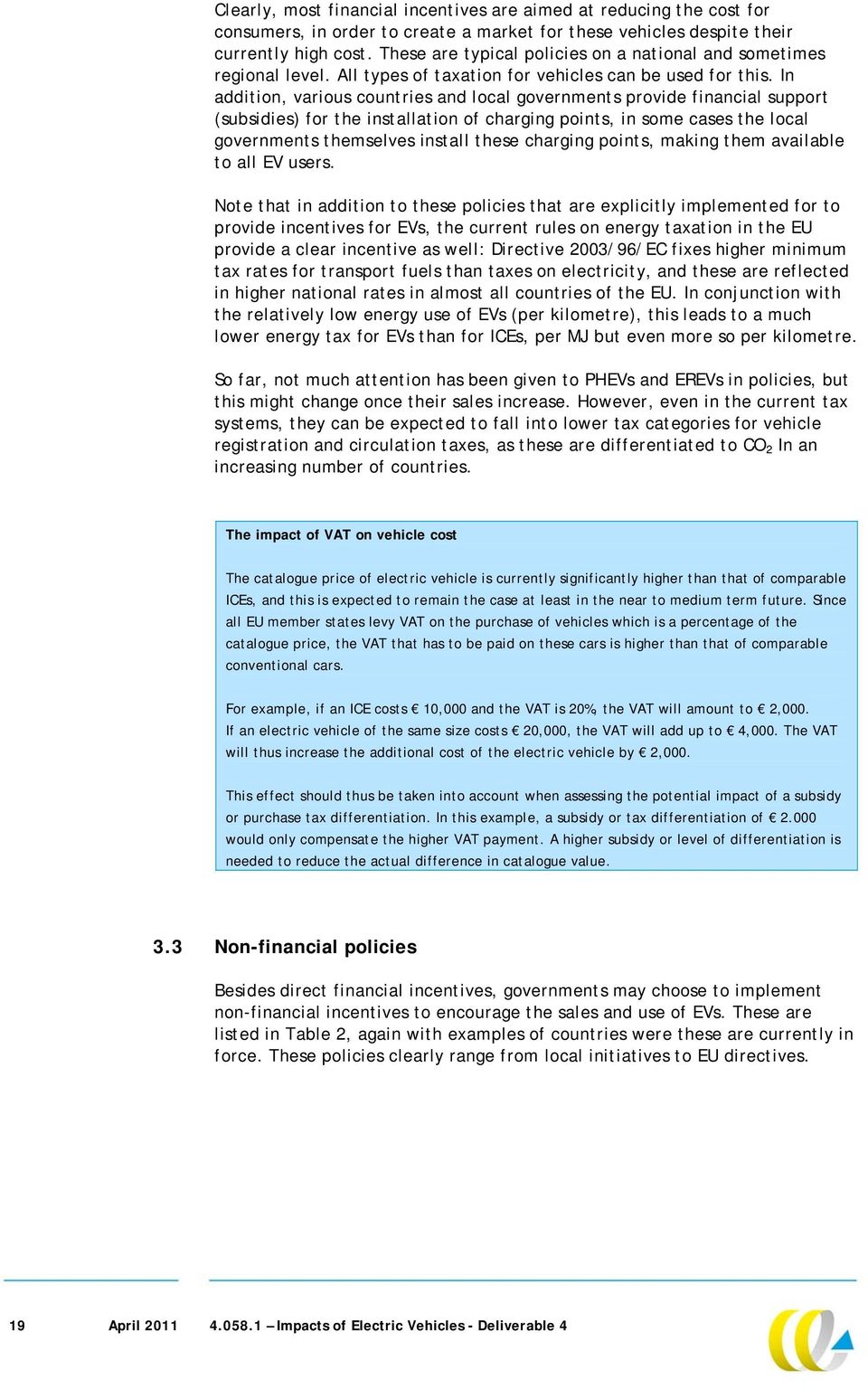
20 Table 2 Overview of non-financial policies implemented to promote EVs Type of policy Aimed at Examples CO 2 and cars regulation: super credits, counting EVs as zero emissions cars Fuel Quality Directive: CO 2 reduction over the fuel chain Standardisation of charging systems Access to restricted areas such as environmental zones in city centres More flexible access times for goods delivery in city centres Permission to use bus lanes Government procurement Obligation to install charging point infrastructure in new offices and industrial estates Supply of EU regulation vehicles Market uptake EU Directive of the vehicles? Enabling market EU (also some national initiatives) expansion Market uptake Some cities in Italy of the vehicles Market uptake Various cities in the Netherlands, of the vehicles? Market uptake Sweden of the vehicles Market uptake UK and supply of the vehicles Market uptake France (ref. Bains rapport) of the vehicles through charging point availability 3.4 Future developments in EV government policy As shown in the previous tables, policies may have different aims that can all contribute towards increasing the uptake of EVs in the coming decades. As the EV market is still in its infancy and many different barriers still exist (e.g., high cost, lack of charging points, etc.), many different types of policy are currently considered to be necessary to remove these barriers and to encourage industry and stakeholders to invest in these developments. The policies listed above address the following key issues of EV development: Improving charging point accessibility, i.e., the number of charging points available to EV users. Encouraging car manufacturers and OEMs to invest financial resources and effort into the development of EVs and their parts (e.g., batteries). Encouraging car manufacturers and OEMs to increase the production of EVs. Encouraging customers to buy EVs. Facilitating the market uptake by standardisation of, for example, charging systems. These are clearly currently the most relevant issues for governments to focus on. However, it is likely that over the coming years and decades, the policies will change. Firstly, policies will be adapted to changing market circumstances and political developments. Secondly, the currently policies can be expected to become much more expensive once the market share of EVs increases. 20 April Impacts of Electric Vehicles - Deliverable 4
21 Regarding changing market circumstances, governments will want to focus on different issues over time. Policies may aim to remove barriers to successful EV deployment, but once these hurdles are taken, these policies may be reduced, modified or stopped. Other barriers may then arise, which require different kind of policies. In the short term, policies will need to focus on creating a first market for these vehicles and on encouraging R&D efforts in the industry. Once production and sales of the EVs have increased, the need for incentives for consumers may reduce: cost should have gone down over time and the number of vehicles has increased so that installing charging point may start to become commercially viable. Once these developments occur, subsidies for EVs and charging points may be reduced. Governments may then need to rather focus on other issues, such as ensuring that the local power grids have sufficient capacity for larger scale EV charging. They may then also want to modify their taxation or road pricing policies in order to properly and fairly include these vehicles in the existing taxation system. For example, current registration and circulation taxes are often based on car CO 2 emissions, cylinder capacity or weight. FEVs, PHEVs and EREVs may need different bases to differentiate taxes on. If the cost of using EVs (i.e., kilometre cost) becomes much lower than that of current vehicles, there might also be a need to implement policies that prevent transport volume growth that might result from this, in order to limit transport energy use (and emissions) and to prevent negative impacts on accessibility. The second issue is related to government revenues and cost. Clearly, the cost to governments of subsidies and tax reduction per vehicle is still very limited in the early stages of market introduction of EVs, but increases once the market uptake increases. It can be expected that the policies will then gradually be reduced and perhaps even eliminated in the medium or long term. Both vehicle taxes and transport fuel taxes contribute significantly to government revenues, governments can be expected to adapt their policies once EVs become a success. As this would be done as production volumes increase, this might not be a problem for the EV market uptake: the incentives can then reduce in line with costs reductions, and overcompensation can be avoided. It may, however, result in a barrier to market uptake if costs of EVs do not go down as expected, for example because of increasing cost of materials. Potential negative impacts will also occur with non-financial incentives for EVs. Providing free parking spaces or access to bus lanes may be very effective in the short term, but may not be viable policies in the longer term. The same may hold for super credits for EVs in the CO 2 and cars regulation: these may have positive effects in the short term, but they are expected to lead to higher CO 2 emissions of road transport in the longer term as the car park will become less fuel efficient when the sales of EVs increases (CE, 2010). Note that in many cases, a different design of the policies can prevent or alleviate the negative impacts without reducing the incentive for EVs. For example, financial policies can be designed cost-neutral for governments, for example with a bonus-malus system or a differentiated tax rather than with a subsidy or a tax reduction only. Technology neutral tax differentiation, for example based on well-to-wheel CO 2 emissions could then potentially be an effective and financially sustainable policy. This differentiation would then need to be adapted in regular intervals to account for market changes. 21 April Impacts of Electric Vehicles - Deliverable 4
22 We would therefore expect that the current EV policies in the EU and its Member States are only a start, and that these will be refined and further developed over time. The resulting policies will depend on issues such as the EV market shares and cost development, on political developments such as climate goals, energy and taxation policies and on technical developments such as ICE fuel efficiency. In addition, there are still unanswered questions such as whether it will be possible to distinguish electricity use for transport and for other uses (e.g., households). If a monitoring system in the vehicles enable separate taxation for transport, governments would have the option to put a higher tax on electricity for road transport than for domestic use, and thus compensate for the reductions in fuel tax revenues in the longer term. If not, they may need to consider other options (e.g., road pricing or higher fixed taxes). It is probably too early to predict how these government policies will change in the future. In WP 6 of this project, some scenarios will be build that include different policy scenarios. 3.5 Potential impact of government policies on EV economics and market uptake As the EV policies vary significantly between EU Member States and are in fact still quite dynamic (as are the EV cost), we focus here on providing an illustration of the effects of government policies rather than exact data. Using the baseline assumptions introduced in Section 2.2 and listed in Annex A, the impact of a EV purchase subsidies on the TCO of these vehicles was determined. This subsidy could be a direct purchase subsidy or due to a CO 2 differentiation of the registration tax, the details of policy implementation do not affect the TCO comparison (they do affect the TCO of the vehicles, but not the difference in TCO between ICEs and EVs). The result is shown in Figure 9, for the medium-size petrol vehicles using the cost and performance assumptions of On the x-axis the purchase subsidy is varied as percentage of the catalogue price of the vehicle. Note that this graph is closely related to that of Figure 5 in Section 2.2, where the sensitivity of the TCO to changes in catalogue price of the vehicles was shown the impact of a vehicle cost reduction on the TCO will be equal to that of a vehicle subsidy. 22 April Impacts of Electric Vehicles - Deliverable 4
23 Figure 9 Influence of purchase subsidies on TCO for medium petrol vehicles 140% TCO 120% 100% ICE PHEV EREV FEV 80% 0% 10% 20% 30% 40% 50% Purchase subsidy as percentage of catalogue price This graph shows at what level of purchase subsidies (or tax differentiation) the TCO of the various EVs will be equal to that of the comparable ICEs: for PHEVs, about 40% of the catalogue price would be needed, EREVs and FEVs would need about 45-50% of the catalogue price. As these data are for the 2020 base case, the subsidies would need to be higher before that year if governments would aim to level the TCO to the ICE level the cost difference is much higher in the short term, see Figure 3 but can be slowly reduced over the years. 23 April Impacts of Electric Vehicles - Deliverable 4
24 24 April Impacts of Electric Vehicles - Deliverable 4
25 4 Business models for EVs 4.1 Introduction As the cost structures of Internal Combustion Engine (ICE) vehicles vary considerably from that of Electric Vehicles (EVs), it is likely that different business models will develop as the cost structure evolves through technology developments and increases in production volumes. ICE vehicles generally exhibit lower capital costs and higher operational (fuel) costs than EVs. The higher capital cost associated with EVs, largely due to the battery pack, contrasts with lower operational costs in the form of electricity and reduced maintenance costs in terms of engine, transmission and brake servicing. There are concerns that current business models focused around vehicle ownership may not be optimal for EVs. The key issues influencing future business models are: There is currently some uncertainty, or perception of uncertainty, around the longevity of the battery units. The need to replace a significant component of the vehicle before the end of its useful life will mean that second hand EV value will be closely linked to battery condition. This raises large uncertainties regarding resale values and annual depreciation of the whole vehicle. Most car buyers are currently not accustomed to evaluating the full lifetime costs of vehicle ownership. Customer focus remains largely on the purchase price, with less emphasis on assessing the operational costs. As such, the upfront cost seen by buyers of EVs will often be compared with that of ICE vehicles. Different actors are involved in the EV supply and operation chain, which opens up the likelihood of innovative business models evolving. For example, the market is characterised by having a greater number of smaller vehicle manufacturing companies, partnerships in new areas such as electronics and batteries, and, perhaps most significantly, electricity companies rather than oil companies providing the energy input. There is the need for investment in charging infrastructure, and perhaps even electricity infrastructure too as demand grows. Given the uncertainties over future market uptake and charging characteristics, these investment risks may influence the evolution of business models. In addition, the introduction of vehicle-to-grid (V2G) systems as a way to provide energy storage for the electricity system has implications for the battery life and, as such, is unlikely to be compatible with privately owned vehicle batteries. 25 April Impacts of Electric Vehicles - Deliverable 4
26 EVs reduced maintenance requirements will perhaps lead to a reduced ongoing role for vehicle manufacturers in servicing and maintenance. This could limit opportunities for downstream revenue generation and therefore have an influence on business models. 4.2 Possible business models for EVs There is considerable uncertainty over what business models will evolve to help overcome the high cost, limited lifespan of vehicle batteries and the additional issues described above. Innovative business models are expected to develop in order to create a package that is attractive to customers. These are likely to vary depending on the specific support mechanisms and incentives available in any particular country. Two distinct models of ownership are emerging as proposals along with a significant number of variations of in between models. The models focus on different options for ownership of the battery. Model 1 is similar to the conventional vehicle ownership model and is based around the concept of customers purchasing the entire vehicle, including the battery. The vehicle is then charged at home or at a charging station using infrastructure established by an electricity company. Model 2 involves an organisation that sells a mobility service rather than a product. The company owns the battery and sets up battery charging and battery exchange infrastructure and then charges the customer in order to cover the electricity consumption and battery amortisation. Figure 10 Potential ownership models Source: Ricardo, Under Model 2, the customer sees a sale price that is competitive with that of an ICE vehicle. In addition, risk, or perceptions of risk, associated with the longevity of the batteries are overcome as the battery is considered separately to the rest of the vehicle, therefore removing some uncertainty from the second-hand car market. 26 April Impacts of Electric Vehicles - Deliverable 4
27 The business model proposed by the organisation Better Place is a variation of Model 2. It is based around a model used in the mobile phone industry and involves the customer purchasing a vehicle at a subsidised price coupled with a subscription service that covers battery replacement, charging, and all running costs. A number of other in-between models are likely to emerge that have elements of the two models. Specific products will likely develop and vary as a result of specific support measures and costs of vehicle and battery production. They are likely to vary on extent of ownership and level of service included in the per usage charge. As well as the models of battery ownership described above, a move towards de-privatisation of mobility has already begun with internal combustion engine vehicles through car-club business models. Car-club models are generally based around an annual membership fee followed by hourly leasing charges that include fuel. This approach is growing in popularity particularly in urban areas and can help make Electric Vehicles attractive to customers by tackling the issues associated with battery cost and lifespan. A variation on this theme has been proposed by a UK consortium, Riversimple, which is currently developing a hydrogen fuel-cell based vehicle. This uses a mobility servicebased business model whereby the whole vehicle, including tax, maintenance, insurance and all fuel is included in a service package that is covered by a fixed monthly and per-mile charge. The company s stated objective is to drive forward the development of technology that demonstrates longevity and low running costs rather than obsolescence and high running costs. In summary, the exact nature of future EV ownership and usage models is uncertain. Successful models are likely to vary depending on the specific incentives available in a particular country. In the short-medium term at least, they are likely to focus around variations of Model 2, where batteries are excluded from the up-front cost of the vehicle and incorporated into an on-going usage-related service charge. 27 April Impacts of Electric Vehicles - Deliverable 4
28 28 April Impacts of Electric Vehicles - Deliverable 4
29 5 The future uptake of EVs from an economic perspective 5.1 Total cost of ownership comparison crucial to market uptake The economics of the EVs will not be the only parameter that determines market uptake of these vehicles, but it is expected to be the main driver for EV sales. The current vehicle market illustrates that the economics (purchase cost and TCO) is important for car buyers to base their purchase decision on. However, quite a number of other issues play a role as well, and consumers do not always opt for the most cost-efficient vehicle: vehicle appearance and status, performance characteristics such as engine power and acceleration, perceived risk/confidence in a brand, advice from and relationship with a specific dealer, size of the boot, comfort and appearance of the interior, etc. play an often important role as well. Environmental characteristics of a vehicle are typically not very important factors to car buyers, unless there are financial incentives associated with these impacts (see, for example, the ADAC review of the CO 2 labelling of passenger cars that concluded that the impact was very low, and compare this to the significant impact of tax incentives for low-co 2 cars on the sales of these vehicles in, for example the UK and NL 4 ). From a consumer/car buyer point of view, market uptake of EVs will therefore depend on quite a number of issues, such as purchase cost and total cost of ownership, car performance and comfort, driving range, charging time and charging infrastructure, etc. In addition, vehicle availability (i.e., how many EVs are on the market), information and communication (e.g., are EVs promoted by car dealers and can they provide sufficient information), vehicle attractiveness and perceived risk of the new technology will affect vehicle sales as well. The impact of environmental benefits can be expected to be limited. Comparing the short-term non-financial features of EVs with that of comparable ICEs, one can conclude that there seem to be only few non-financial reasons for consumers to choose an EV: The performance of current FEVs (speed, acceleration) is, on average, comparable or less than that of ICEs. This driving range of FEVs is still much lower than that of ICEs. FEVs are typically small, as costs increase significantly with vehicle weight due to the increasing battery demand. There is not yet much data on the performance of PHEVs, but if may be assumed that the driving characteristics and design of the PHEVs are comparable to that of the conventional hybrid cars, they will be quite comparable to ICEs of the same size. 4 ADAC, Study on the effectiveness of Directive 1999/94/EC relating to the availability of consumer information on fuel economy and CO2 emissions in respect of the marketing of new passenger cars, March April Impacts of Electric Vehicles - Deliverable 4
30 There is even less data on EREVs, but it seems reasonable to assume that their characteristics are rather comparable to that of EVs, except for the driving range. The environmental impact of all types of EVs is less than that of ICEs, as direct vehicle emissions and noise are zero. The well-to-wheel greenhouse gas emissions depend on the energy source, but are on average significantly lower than that of ICEs, and may be (close to) zero in case renewable electricity is used. This implies that at least in the short term, the performance, appearance, size, etc. of EVs will be comparable or less than that of their ICE counterparts. Only consumers that are attracted by the new technology and environmental benefits will be likely EV buyers as long as the TCO are higher than that of ICEs. The consumer group that is willing to accept higher cost for environmental benefits and innovation is typically relatively small 5. It is therefore expected that competitive TCOs are a prerequisite for an increasing market share of these vehicles. Only if the TCO of one or more types of EV, in one or more parts of the market, becomes close to or reduces below that of comparable ICEs, the large bulk of car buyers in these markets will consider the investment. Cost and market uptake are closely linked in two ways The EV market share depends strongly on the TCO: sales will only increase significantly once the TCO is comparable to that of ICEs. However, vice versa is just as true: the cost of the EVs is expected to reduce once sales volumes increase. This is due to both economy of scale and the learning curve that is being followed. This may lead to a potential stalemate - quite a common situation for any new technology - which may be resolved by government policies, as discussed in Chapter 3. Financial policies may (temporarily) reduce the TCO of the EVs, to ensure a market share increase. Over time, the financial incentive may then be reduced as the cost of the new technology reduces. Alternatively, regulation may demand from the market to produce and sell an increasing number of the new vehicle types. This can also be expected to lead to the cost reductions needed in the longer term. A more detailed assessment of policy options will be provided in WP 7 of this project. 5.2 Potential market uptake What does this mean for the future market uptake of EVs? From the consumer point of view, the following can be concluded. Firstly, the market of PHEVs, EREVs and FEVs will remain very limited unless the TCO of the vehicles approaches that of ICEs. Until then, the market will be limited to a small group of innovators that are interested in the new technology, to local or regional (subsidised) pilot projects and perhaps government procurement projects. Government policies are needed to increase the (economic) attractiveness of EVs for larger groups of consumers. Based on the data we used in this 5 See, for example, the relatively low share of organic products in the overall sales of foodstuff, or the low share of aviation passengers that chooses to pay extra to offset their climate impact of their flight (only 7%, according to a recent survey in the UK). 30 April Impacts of Electric Vehicles - Deliverable 4
31 report, the policies required are relatively limited for PHEVs, but more significant for FEVs and EREVs. These policies may be financial (subsidies, differentiated taxes, etc.) or non-financial (e.g., regulations) 6. Once the sales increase, costs of EVs are expected to reduce. Government incentives may then be reduced. More potential car buyers will be interested in these vehicles, as more vehicles are being developed, experience is gained and charging issues are being resolved. However, as long as the performance of EVs does not exceed that of ICEs, a significant market share can only be achieved if the TCO of EVs are comparable or lower than that of ICEs. Apart from cost, a large driving range, in combination with sufficient charging points and reasonable charging times, is expected to be the next important factor that determines the market uptake. If the range is limited and charging times are long, they will be attractive alternatives to ICE for only a relatively limited part of the potential market (city cars, second or third cars in a household). This criterion is mainly relevant for FEVs and, to a lesser extent, for EREVs. Car and battery manufacturers need to develop business models that make EVs attractive for consumers. This holds especially for FEVs and perhaps also for EREVs, as their batteries represent a relatively large value. To achieve the larger market shares, both the car industry and the electricity sector are likely to play a major role. For example: The car industry needs to invest in (battery) R&D and EV production, develop new, profitable business models for the industry, and ensure an increasing, attractive supply of EVs for various parts of the market. These activities should result in cost reductions and increased performance of EVs. Together with other parties, such as the transmission grid operators, local governments, etc., the electricity sector needs to invest in charging infrastructure and develop a strategy on how to profitably integrate EVs in the future grid. These developments can also be promoted by government policy. These developments towards an increasing EV market share are shown in a road map in Figure Note that a more detailed analysis is required to determine the actual incentives needed. The analysis here is for illustrational purposes only. 31 April Impacts of Electric Vehicles - Deliverable 4
32 Figure 11 A schematic road map that illustrates how an increasing EV market share can be achieved In WP 6 of this project, the market uptake of the various types of EVs is assessed in more detail and quantitatively, using various scenarios. 32 April Impacts of Electric Vehicles - Deliverable 4
33 Annex A Assumptions for the calculations in this report A.1 Data needed for the calculations Calculations of, for example, total cost of ownership of various vehicle types require quite a large amount of input data. In WP 6, a number of scenarios will be developed where these data are varied. In this report, we have included some results of calculations to illustrate The typical cost differences between the various vehicle types. Cost developments that might be expected in the coming years, and their impact on TCO. Sensitivity of the TCO to variations and uncertainties in various parameters. For the various vehicle types, the following data are required for TCO calculations: Vehicle purchase cost: catalogue price, vehicle registration tax, VAT, in some cases minus EV purchase subsidies. Vehicle registration tax. Vehicle lifetime or residual value after x years. In case the batteries of Electric Vehicles have lower lifetime than the rest of the car (i.e., will need to be replaced after some years): battery cost and lifetime. Kilometres per vehicle, per year. Average fuel use and/or electricity use per kilometre. This depends on urban or non-urban use of the car. Electricity price. Fuel price. Annual insurance and maintenance cost. To assess market uptake, other, non-financial performance data are also relevant. Especially range, and perhaps also acceleration, will also play a role in the choice of consumers to buy a specific vehicle type. The uncertainty regarding the future development of these parameters is quite significant, as earlier reports show (WP 1 and WP 2). In addition, the variation between individual vehicles and owners can be expected to be large. This makes generic and representative calculations quite difficult. In order to still provide some feeling for costs, sensitivities and trends, we have decided on a set of (realistic) input data for the calculations in this report, as shown in the following table. Please note that the results may be quite different if other parameters are assumed, as shown in the illustrative sensitivity analysis in section 2.2. A.2 Input data Cost data can be found in Table 1, other vehicle and user data are depicted in Table 2. We have assumed no vehicle taxes or subsidies in this report, except VAT, and where explicitly stated. 33 April Impacts of Electric Vehicles - Deliverable 4
34 Table 1 Cost-related input data Type Size Fuel Based on Catalogue price ( ) ICE Small Petrol 9,000 9,450 9,923 10,419 10,940 Assumptions, based on EU car prices report 2010 and 5% increase/5 years) ICE Medium Petrol 13,000 13,650 14,333 15,049 15,802 Assumptions, based on EU car prices report 2010 and 5% increase/5 years) ICE Large Petrol 19,000 19,950 20,948 21,995 23,095 Assumptions, based on EU car prices report 2010 and 5% increase/5 years) ICE Small Diesel 9,000 9,450 9,923 10,419 10,940 Assumptions, based on EU car prices report 2010 and 5% increase/5 years) ICE Medium Diesel 13,000 13,650 14,333 15,049 15,802 Assumptions, based on EU car prices report 2010 and 5% increase/5 years) ICE Large Diesel 19,000 19,950 20,948 21,995 23,095 Assumptions, based on EU car prices report 2010 and 5% increase/5 years) PHEV Small Petrol 22,000 20,900 19,855 18,862 17,919 Own estimates 2010, -5% every 5 years PHEV Medium Petrol 26,000 24,700 23,465 22,292 21,177 Own estimates 2010, -5% every 5 years PHEV Large Petrol 38,000 36,100 34,295 32,580 30,951 Own estimates 2010, -5% every 5 years PHEV Small Diesel 22,000 20,900 19,855 18,862 17,919 Own estimates 2010, -5% every 5 years PHEV Medium Diesel 26,000 24,700 23,465 22,292 21,177 Own estimates 2010, -5% every 5 years PHEV Large Diesel 38,000 36,100 34,295 32,580 30,951 Own estimates 2010, -5% every 5 years EREV Small Petrol 26,000 24,700 23,465 22,292 21,177 Own estimates 2010, -5% every 5 years EREV Medium Petrol 35,000 33,250 31,588 30,008 28,508 Own estimates 2010, -5% every 5 years EREV Large Petrol 50,000 47,500 45,125 42,869 40,725 Own estimates 2010, -5% every 5 years EREV Small Diesel 26,000 24,700 23,465 22,292 21,177 Own estimates 2010, -5% every 5 years EREV Medium Diesel 35,000 33,250 31,588 30,008 28,508 Own estimates 2010, -5% every 5 years EREV Large Diesel 50,000 47,500 45,125 42,869 40,725 Own estimates 2010, -5% every 5 years EV Small Electra 28,000 26,600 25,270 24,007 22,806 Own estimates 2010, -5% every 5 years EV Medium Electra 35,000 33,250 31,588 30,008 28,508 Own estimates 2010, -5% every 5 years EV Large Electra 50,000 47,500 45,125 42,869 40,725 Own estimates 2010, -5% every 5 years Residual value ( ) All vehicles 0 0 Fuel price petrol ( /l) EU oil bulletin, July 2010, EU average incl. taxes, following oil price increase as predicted in EU Energy Trends to 2030 Fuel price diesel ( /l) EU oil bulletin, July 2010, EU average incl. taxes, following oil price increase as predicted in EU Energy Trends to 2030 Electricty price ( /kwh) Eurostat data 2010, following electricity price increase as predicted in EU 0,16 0,18 0,20 0,22 0,24 Energy Trends to April Impacts of Electric Vehicles - Deliverable 4
35 Type Size Fuel Based on Maintenance costs ( /year) ICE Small ,56 557,08 615,06 679,08 CE Delft data ICE Medium , , , ,16 CE Delft data ICE Large , , , ,38 CE Delft data PHEV Small ,75 254,77 281,29 310,56 Based on ICEs, differentiated to size/cost ratio PHEV Medium ,51 509,54 562,57 621,13 Based on ICEs, differentiated to size/cost ratio PHEV Large ,36 765,53 845,21 933,17 Based on ICEs, differentiated to size/cost ratio EREV Small ,75 254,77 281,29 310,56 Based on ICEs, differentiated to size/cost ratio EREV Medium ,51 509,54 562,57 621,13 Based on ICEs, differentiated to size/cost ratio EREV Large ,36 765,53 845,21 933,17 Based on ICEs, differentiated to size/cost ratio EV Small ,75 254,77 281,29 310,56 Based on ICEs, differentiated to size/cost ratio EV Medium ,51 509,54 562,57 621,13 Based on ICEs, differentiated to size/cost ratio EV Large ,36 765,53 845,21 933,17 Based on ICEs, differentiated to size/cost ratio Insurance costs ( /year) ICE Small CE Delft data ICE Medium 1,240 1,369 1,512 1,669 1,843 CE Delft data ICE Large 1,958 2,162 2,387 2,635 2,909 CE Delft data PHEV Small 975 1,076 1,189 1,312 1,449 Based on ICEs, differentiated to size/cost ratio PHEV Medium 1,949 2,152 2,376 2,623 2,896 Based on ICEs, differentiated to size/cost ratio PHEV Large 2,924 3,228 3,564 3,935 4,345 Based on ICEs, differentiated to size/cost ratio EREV Small 975 1,076 1,189 1,312 1,449 Based on ICEs, differentiated to size/cost ratio EREV Medium 1,949 2,152 2,376 2,623 2,896 Based on ICEs, differentiated to size/cost ratio EREV Large 2,924 3,228 3,564 3,935 4,345 Based on ICEs, differentiated to size/cost ratio EV Small 975 1,076 1,189 1,312 1,449 Based on ICEs, differentiated to size/cost ratio EV Medium 1,949 2,152 2,376 2,623 2,896 Based on ICEs, differentiated to size/cost ratio EV Large 2,924 3,228 3,564 3,935 4,345 Based on ICEs, differentiated to size/cost ratio 35 April Impacts of Electric Vehicles - Deliverable 4
36 Table 2 Other input data Type Size Fuel Based on Vehicle lifetime (years) All vehicles Own estimate Battery lifetime (years) PHEV Own estimate, based on WP2 EREV Own estimate, based on WP 2 FEV Own estimate, based on WP 2 Vehicle kilometers (km/year) ICE Small Petrol 8,245 8,050 7,854 7,926 7,998 TREMOVE ICE Medium Petrol 10,525 10,487 10,449 10,589 10,728 TREMOVE ICE Large Petrol 12,204 12,116 12,027 12,186 12,344 TREMOVE ICE Small Diesel 20,623 19,835 19,047 19,253 19,458 TREMOVE ICE Medium Diesel 20,749 20,120 19,491 19,549 19,607 TREMOVE ICE Large Diesel 22,484 22,006 21,528 21,630 21,731 TREMOVE PHEV Small Petrol 7,421 7,245 7,069 7,133 7, * ICE value PHEV Medium Petrol 9,473 9,438 9,404 9,530 9, * ICE value PHEV Large Petrol 10,984 10,904 10,824 10,967 11, * ICE value PHEV Small Diesel 18,561 17,852 17,142 17,327 17, * ICE value PHEV Medium Diesel 18,674 18,108 17,542 17,594 17, * ICE value PHEV Large Diesel 20,236 19,805 19,375 19,467 19, * ICE value EREV Small Petrol 7,008 6,842 6,676 6,737 6, * ICE value EREV Medium Petrol 8,946 8,914 8,882 9,000 9, * ICE value EREV Large Petrol 10,373 10,298 10,223 10,358 10, * ICE value EREV Small Diesel 17,530 16,860 16,190 16,365 16, * ICE value EREV Medium Diesel 17,637 17,102 16,567 16,617 16, * ICE value EREV Large Diesel 19,111 18,705 18,299 18,385 18, * ICE value FEV Small Electra 6,596 6,440 6,283 6,341 6, * ICE petrol value FEV Medium Electra 8,420 8,390 8,359 8,471 8, * ICE petrol value FEV Large Electra 9,763 9,692 9,622 9,748 9, * ICE petrol value 36 April Impacts of Electric Vehicles - Deliverable 4
37 Type Size Fuel Based on Fuel use (litre/100 km) ICE Small Petrol 2010 data, efficiency improvement somewhat above CO2 regulation, post improvement 5% every 5 years ICE Medium Petrol ICE Large Petrol ICE Small Diesel ICE Medium Diesel ICE Large Diesel PHEV Small Petrol Assumption: : 0,4 * fuel use ICE; : 0,3 * fuel use ICE PHEV Medium Petrol PHEV Large Petrol PHEV Small Diesel PHEV Medium Diesel PHEV Large Diesel EREV Small Petrol Assumption: : 0,3 * fuel use ICE; : 0,2 * fuel use ICE EREV Medium Petrol EREV Large Petrol EREV Small Diesel EREV Medium Diesel EREV Large Diesel FEV All No fuel use 37 April Impacts of Electric Vehicles - Deliverable 4
38 Type Size Fuel Based on Electricity use (kwh/100 km) ICE All No electricity use PHEV Small Assumption: : 0,6 * electricity use_ev; : 0,7 PHEV Medium PHEV Large EREV Small Assumption: : 0,7 * electricity use_ev; : 0,8 EREV Medium Assumption: : 0,7 * electricity use_ev; : 0,8 EREV Large Assumption: : 0,7 * electricity use_ev; : 0,8 FEV Small Own estimate, 5% improvement every 5 years FEV Medium Own estimate, 5% improvement every 5 years FEV Large Own estimate, 5% improvement every 5 years Range (km) ICE All : Ricardo/TNO, : own assumption PHEV All : Ricardo/TNO, : own assumption EREV All : Ricardo/TNO, : own assumption FEV Small : Ricardo/TNO, : own assumption FEV Medium : Ricardo/TNO, : own assumption FEV Large : Ricardo/TNO, : own assumption 38 April Impacts of Electric Vehicles - Deliverable 4
OVERVIEW OF PURCHASE AND TAX INCENTIVES FOR ELECTRIC VEHICLES IN THE EU
 01.04.2014 OVERVIEW OF PURCHASE AND TAX INCENTIVES FOR ELECTRIC VEHICLES IN THE EU This table provides an overview of the incentives that are granted in the Member States of the European Union for the
Overview of vehicle taxation schemes (including incentives for electric vehicles), 2014. Content: 1. National vehicle taxation schemes Overview...
 Overview of vehicle taxation schemes (including incentives for electric vehicles), 2014 Content: 1. National vehicle taxation schemes Overview... 2 2. National vehicle taxation schemes Description... 4
EU study on company car taxation: presentation of the main results
 European Commission EU study on company car taxation: presentation of the main results Presentation in the OECD workshop on estimating support to fossil fuels, Paris 18-19 November 2010 Katri Kosonen European
Drive Towards Zero, Volvo Cars Manufacturing Engineering, Luc Semeese Issue date: 2010-04-20, Security Class: Propriety Page 1
 Page 1 Volvo Cars Electrification Strategy DRIVe Towards Zero Brussels April 20th 2010 Luc Semeese Director - Volvo Cars Manufacturing Engineering Page 2 Company philosophy : DRIVe towards Zero! Zero accidents
ALL-ELECTRIC CAR LEASING CHAIN
 ALL-ELECTRIC CAR LEASING CHAIN Since most car holders will change cars before the car s end of life, i.e. sell it if they own, or lease another if they lease, the car s residual value is crucial for most
Effective Fuel Management. How to minimise fuel spend - both now, and in the future. WHITE PAPER
 Effective Fuel Management How to minimise fuel spend - both now, and in the future. WHITE PAPER Table of contents 2. Executive summary 3. Establishing a fuel policy 3. Choosing the right cars for your
CO2 BASED MOTOR VEHICLE TAXES IN THE EU IN 2016
 CO2 BASED MOTOR VEHICLE TAXES IN THE EU IN 2016 AUSTRIA A fuel consumption tax (Normverbrauchsabgabe or NoVA) is levied upon the first registration of a passenger car. It is calculated as follows: (CO2
Key Solutions Thought Leadership
 GE Capital Fleet Services Company Car Trends Your essential guide to the latest developments in the fleet industry Key Solutions Thought Leadership Welcome Every quarter since 2004, GE Capital, Fleet Services
NEW PASSENGER CAR REGISTRATIONS BY ALTERNATIVE FUEL TYPE IN THE EUROPEAN UNION 1 Quarter 4 2015
 NEW PASSENGER CAR REGISTRATIONS BY ALTERNATIVE FUEL TYPE IN THE Quarter 4 2015 Alternative fuel vehicle (AFV) registrations: +20.0% in 2015; +21.1% in Q4 In the fourth quarter of 2015, total alternative
Consulting Consulting. Impact of government subsidies for electric vehicles on used market values
 Impact of government subsidies for electric vehicles on used market values 1 Introduction To encourage the take up of zero emission vehicles (ZEVs) and ultra-low emission vehicles (ULEVs), many governments
EV Ecosystem Policy Initiatives
 EV Ecosystem Policy Initiatives Riga Oct 2 nd 2015 1 Innovation Forum Elements of an Electromobility EcoSystem Infrastructure Education / PR Supply of EVs Incentives 2 Innovation Forum Elements of an Electromobility
Green Power for Electric Cars. Development of policy recommendations to harvest the potential of electric vehicles
 Green Power for Electric Cars Development of policy recommendations to harvest the potential of electric vehicles Report Delft, January 2010 Author(s): Bettina Kampman Cor Leguijt Dorien Bennink Lonneke
A Guide to Electric Vehicles
 A Guide to Electric Vehicles For commercial fleets, electric and hybrid electric vehicles offer reduced fuel, emission and operating costs. This guide provides a summary for Fleet Owners and Operators
The Hart report: The Economics of aeuropean Hydrogen Infrastructure for Automotive
 MEDIA BACKGROUNDER The Hart report: The Economics of aeuropean Hydrogen Infrastructure for Automotive Introduction In 24, Linde commissioned David Hart, of e4tech, Switzerland to assess the costs of a
CO2 BASED MOTOR VEHICLE TAXES IN THE EU IN 2015
 CO2 BASED MOTOR VEHICLE TAXES IN THE EU IN 2015 COUNTRY AT (AUSTRIA) BE (BELGIUM) BG (BULGARIA) CO2/FUEL CONSUMPTION TAXES A fuel consumption tax (Normverbrauchsabgabe or NoVA) is levied upon the first
Description. Understanding consumer attitudes and future trends in the UK motoring industry. Richard Barton Group Managing Director
 Automotive Main Title Trends 2015 Changing Lanes Description Understanding consumer attitudes and future trends in the UK motoring industry Richard Barton Group Managing Director Contents Executive summary
European Distribution System Operators for Smart Grids. Position paper on Electric Vehicles Charging Infrastructure
 European Distribution System Operators for Smart Grids Position paper on Electric Vehicles Charging Infrastructure European Distribution System Operators for Smart Grids Position paper on ELECTRIC VEHICLES
Key Solutions CO₂ assessment
 GE Capital Key Solutions CO₂ assessment CO₂ emissions from company car fleets across Europe s major markets between 2008 and 2010 www.gecapital.eu/fleet Contents Introduction and key findings Reduction
A fleet manager s guide to plug-in vehicles. learn how plug-in vehicles can work for you
 learn how plug-in vehicles can work for you Contents Types of plug-in vehicles 02 The business case for plug-in vehicles 03 Charging modes and types 04 Practicalities of running plug-in vehicles 05 Plugged-in
The Potential for Battery Electric Vehicles in New Zealand
 The Potential for Battery Electric Vehicles in New Zealand Dr Mike Duke 1, Timothy Anderson 2 1,2 Department of Engineering, The University of Waikato Keywords: Battery electric vehicles, New Zealand Abstract
SOLUTIONS Training Kit Cluster 6: Clean vehicles. www.urban-mobility-solutions.eu
 SOLUTIONS Training Kit Cluster 6: Clean vehicles www.urban-mobility-solutions.eu About SOLUTIONS SOLUTIONS aims to foster knowledge exchange and boost the uptake of innovative sustainable urban mobility
Summary of the Impact assessment for a 2030 climate and energy policy framework
 Summary of the Impact assessment for a 2030 climate and energy policy framework Contents Overview a. Drivers of electricity prices b. Jobs and growth c. Trade d. Energy dependence A. Impact assessment
How vehicle fuel economy improvements can save $2 trillion and help fund a long-term transition to plug-in vehicles Working Paper 9
 How vehicle fuel economy improvements can save $2 trillion and help fund a long-term transition to plug-in vehicles Working Paper 9 UNEP How vehicle fuel economy improvements can save $2 trillion and help
Low Carbon Vehicles Fleet Buy-in Factors
 PCWG-P-03-21 Low Carbon Vehicles Fleet Buy-in Factors Paper to LowCVP on Promoting Low Carbon Vehicles to the UK Fleet community prepared on behalf of ACFO (representing the demand side of the market)
DRIVING ELECTRIFICATION
 WHITE PAPER MAY 2014 DRIVING ELECTRIFICATION A GLOBAL COMPARISON OF FISCAL INCENTIVE POLICY FOR ELECTRIC VEHICLES Peter Mock and Zifei Yang www.theicct.org [email protected] BEIJING BERLIN BRUSSELS
Monitoring CO 2. emissions from new passenger cars in the EU: summary of data for 2012
 Monitoring CO 2 emissions from new passenger cars in the EU: summary of data for 212 Abstract Abstract For the third successive year, the European Environment Agency (EEA) has collected EU Member States'
Investigation into the Scope for the Transport Sector to Switch to Electric Vehicles and Plugin Hybrid Vehicles. October 2008
 Investigation into the Scope for the Transport Sector to Switch to Electric and Plugin Hybrid October 2008 Department for Business Enterprise and Regulatory Reform: Department for Transport Investigation
EUROTAXGLASS S WHITEPAPER SERIES ELECTRIC VEHICLES THE END OF THE HYPE? RESULTS OF THE 2012 CUSTOMER SURVEY
 EUROTAXGLASS S WHITEPAPER SERIES ELECTRIC VEHICLES THE END OF THE HYPE? RESULTS OF THE 2012 CUSTOMER SURVEY MAINTAL JANUARY 2013 INTRODUCTION Electric vehicles are a phenomenon. Customers and automotive
Energy Taxation in Europe, Japan and The United States
 Energy Taxation in Europe, Japan and The United States ENERGY TAXATION IN EUROPE, JAPAN AND THE UNITED STATES Summary of the energy taxation survey of electricity, fuels, district heat and transport in
Electricity and natural gas price statistics 1
 Electricity and natural gas price statistics 1 Source: Statistics Explained (http://epp.eurostat.ec.europa.eu/statistics_explained/) - 21/11/2011-09:11:44 Electricity and natural gas price statistics Data
Drive Electric Northern Colorado. Creating a Model Deployment Community
 Drive Electric Northern Colorado Creating a Model Deployment Community The Deployment Community Concept: To facilitate nationwide commercialization of plug-in electric vehicle (PEV) technology, the engagement
VAT Refunds Irrecoverable Tax A Country by Country Detailed Guide
 VAT Refunds Irrecoverable Tax A Country by Country Detailed Guide EC VAT refunds Irrecoverable Tax VAT incurred in other EC Member States may be recovered in certain circumstances. However, some claims
Electric Mobility in Europe. Dr. Gereon Meyer VDI/VDE Innovation + Technik GmbH Berlin, Germany [email protected]
 Electric Mobility in Europe Dr. Gereon Meyer VDI/VDE Innovation + Technik GmbH Berlin, Germany [email protected] EV and PHEV in Europe EV 2014 PHEV Country Motorbikes Passenger Vehicles Trucks
shecco input to EC public hearing on a European strategy on clean and energy efficient vehicles
 shecco input to EC public hearing on a European strategy on clean and energy efficient vehicles 11 march 2010 market research b2b platforms public affairs events management Brussels, 11 March 2010 In 1886,
How To Develop A More Sustainable Transport System In Europe
 Madrid/ Brussels 20th May 2011 NGVA Europe Position Paper: Minimum infrastructure needs for Methane (NG/biomethane) refuelling across Europe NGVA Europe In response to the Expert Group Meeting on Future
The economic impact of low-carbon vehicles in the Netherlands
 The economic impact of low-carbon vehicles in the Netherlands Final report for the Dutch Ministry for Infrastructure and the Environment September 2014 Cambridge Econometrics Covent Garden Cambridge CB1
CO 2 -based Motor Vehicle Tax
 CO 2 -based Motor Vehicle Tax 30 September 2011 Frieder Rubik and Lauren Mityorn (Institute for Ecological Economy Research) Key words: Mobility & good practice, mobility & policy instruments, vehicle
Cleantech in China The road to increasing electric vehicle adoption
 www.pwc.com/cleantech Cleantech in China The road to increasing electric vehicle adoption March 2013 China has held the title of world s largest auto market since 2009, when it surpassed the U.S. with
K. G. Duleep President, H-D Systems Presented at the Michelin Bibendum Berlin, May 2011
 K. G. Duleep President, H-D Systems Presented at the Michelin Bibendum Berlin, May 2011 Light-duty vehicles have received a lot of attention in the last 10 years and GHG reduction cost is understood. Only
Hybrid Electric and Battery Electric Vehicles. Buyers Guide
 Hybrid Electric and Battery Electric Vehicles Buyers Guide Buyers Guide for Electric and Hybrid Vehicles 27 Edition, Version 1 November 27 Table of contents 1 Electric vehicles 4 1.1 What are electric
Skatteudvalget 2013-14 SAU Alm.del Bilag 11 Offentligt. Vehicle taxes in the. 23 September 2013
 Skatteudvalget 2013-14 SAU Alm.del Bilag 11 Offentligt Vehicle taxes in the Netherlands Contents Green tax revenues Vehicle taxes Recent developments Eurovignette Fuel excise duties Environmental tax revenues
Synopsis of Phase 1 Results. February 2013
 Synopsis of Phase 1 Results February 213 Introduction FUEL CELL ELECTRIC VEHICLES (FCEVs) provide the potential to decarbonise road transport, create new economic opportunities, diversify national energy
H- 3: Composition of the road motor vehicle fleet by fuel type. 2) Relevance for environmental policy... 2
 H- 3: Composition of the road motor vehicle fleet by fuel type 1) General description... 2 1.1) Brief definition... 2 1.2) Units of measurement... 2 1.3) Context...2 2) Relevance for environmental policy...
A Government Perspective
 A Government Perspective Anna West Head of Consumer Incentives OLEV [email protected] 18 February 2014 ACFO EV Seminar 1. What is OLEV? Department for Energy & Climate Change Office for Low Emission
Car tax refund on export
 Car tax customer bulletin 13 Car tax refund on export www.tulli.fi 1 January 2015 Replaces the bulletin from August 2014 Car tax refund on export This bulletin applies to getting refund on export if a
Michael Bitter, Robert Bosch GmbH
 Perspective on CO 2 - Penetration in CV-Market Michael Bitter, Robert Bosch GmbH 1 CO 2 Emission [g/km] Perspective on CO 2 - Penetration in CV-Market Development of average CO 2 -emission in Europe Heavy
Fleet Selection Detailed Guide
 Fleet Selection Detailed Guide Version Control No Date Comment 1 December 2009 Original version 2 May 2010 Minor word changes Fleet Selection Detailed Guide Page 1 of 8 THE FLEET DECISION Introduction
How To Understand Factoring
 EIF Project "Jeremie" General Report on Factoring 1 Market analysis on Factoring in EU 25+2 prepared by International Factors Group (IFG) for European Investment Fund (EIF) project JEREMIE Preliminary
Progressive Performance Audi on the way to the leading premium brand
 Progressive Performance Audi on the way to the leading premium brand Axel Strotbek, Member of the Board of Management for Finance and Organization, AUDI AG Deutsche Bank Field Trip, June 3,2013 World car
Key Solutions CO2 Assessment
 GE Capital Key Solutions CO2 Assessment CO2 emissions from company cars across Europe s major markets between 2008 and 2012 GE imagination at work Contents Introduction and key findings 4 European overview
Transport Sector in India
 Transport Sector in India Carbon Emissions: Technology Mitigation Options through 2030 Ankur Chaudhary Indian Institute of Technology Delhi GHG emissions from the Transport Worldwide: Sector 23% of all
Vision Fleet: Fleet Assessment Overview Alternative fuel vehicles for fleets: Low Cost, Low Carbon, Low Hassle
 Vision Fleet: Fleet Assessment Overview Alternative fuel vehicles for fleets: Low Cost, Low Carbon, Low Hassle Overview: A Vision Fleet Opportunity Assessment is both quantitative and qualitative and will
Approved By: Sujith Kollamthodi (AEA) Date: 8 th December 2011. Signed:
 Report on the implementation of Directive 1999/94/EC relating to the availability of consumer information on fuel economy and CO 2 emissions in respect of the marketing of new passenger cars Final Report
How To Make A Car From A Car
 Powerplaza EV Technology & Global EV Mainstream Analysis Global Business Development / General Manager, Powerplaza Co., Ltd. Soo-Hyun Kwon Powerplaza EV Technology POWER PLAZA CO., LTD. Think Green Technology,
Leaseurope Position on the Evaluation Report on the Operation of the Automotive Block Exemption Regulation (EC No 1400/2002)
 Leaseurope Position on the Evaluation Report on the Operation of the Automotive Block Exemption Regulation (EC No 1400/2002) Leaseurope AISBL 267, Av. de Tervuren, B 1150 Bruxelles Tel. +32/2/778 05 60,
H2 MOBILITÉ FRANCE. Study for a Fuel Cell Electric Vehicle national deployment plan. v12
 H2 MOBILITÉ FRANCE Study for a Fuel Cell Electric Vehicle national deployment plan v12 FRANCE DEFINED ITS HYDROGEN MOBILITY IMPLEMENTATION PLAN Part of the Hydrogen Infrastructure for Transport (HIT) project
The innovation value chain:
 The innovation value chain: Context: where is the demand for demand-side innovation policy at in Europe? Lead Market Initiative: And lessons learned And future directions Henriette van Eijl EC, DG Enterprise,
Fleet CO2 and Efficient Mobility
 Fleet CO2 and Efficient Mobility CONTENTS An evolving policy landscape Vehicle selection, technology and alternative fuels Driver behaviour and eco-driving training Efficient maintenance arval.co.uk An
Measure 9: Updating the interoperability directives on high-speed and conventional railway networks First page:
 Measure 9: Updating the interoperability directives on high-speed and conventional railway networks First page: Policy package: 2A: Rail liberalisation and harmonisation Measure 9: Updating the interoperability
Electric Vehicles: Driving EVolution
 Electric Vehicles: Driving EVolution November 2014 Executive Summary Electric Vehicles (EVs) have the potential to provide a significant benefit to consumers and utilities, however as demonstrated in Ergon
Thinking of switching to an electric vehicle?
 What is Travel SMART? Travel SMART is an initiative from Surrey County Council that aims to help Surrey residents and businesses reduce carbon, calories and cost. The Travel SMART team want to encourage
Commercial vehicles and CO 2
 Commercial vehicles and European Automobile Manufacturers Association ACEA position Fuel Efficiency is Market Driven Fuel efficiency is one of the most important competitive factors in developing and selling
WORKSHOP 6: ROADMAP TO 100 G CO 2
 WORKSHOP 6: ROADMAP TO 100 G CO 2 /KM WELL-TO-WHEEL PANELISTS: Neville JACKSON, Ricardo, Chief Technology and Innovation offi cer Andre DOUAUD, Automobile & Energy consulting Joël FOUCARD, Michelin Jean-Jacques
Shades of Green. Shades of Green: Electric Cars Carbon Emissions Around the Globe. Shrink That Footprint. Lindsay Wilson.
 1 Shrink That Footprint is an independent research group devoted to helping people concerned about climate change understand, calculate and reduce their carbon footprints. In particular we focus on reducing
Better Bus Area Monitoring and Evaluation Framework
 Do Better Bus Area Monitoring and Evaluation Framework March 2014 The Department for Transport has actively considered the needs of blind and partially sighted people in accessing this document. The text
EUROPEAN UNION. Chapter prepared by. Marc Greven ([email protected])
 EUROPEAN UNION Chapter prepared by Marc Greven ([email protected]) ACEA Avenue des Nerviens 85 B 1040 Brussels Tel : + 32.2.732.55.50 Fax : + 32.2.738.73.10 www.acea.be TAX GUIDE 14 EU 1 MOTOR VEHICLE TAXATION:
P t ower rain 2020 Electric Vehicles Voice of the Customer Munich, 2010
 Powertrain 2020 Electric Vehicles Voice of the Customer Munich, 2010 Contents Page A. Background Scarce resources and global regulations drive the 4 electrification of the powertrain B. Some good news
SUMMARY OF THE IMPACT ASSESSMENT
 EN EN EN COMMISSION OF THE EUROPEAN COMMUNITIES Brussels, SEC(2008) 350/2 COMMISSION STAFF WORKING DOCUMENT accompanying the Proposal for a DIRECTIVE OF THE EUROPEAN PARLIAMENT AND OF THE COUNCIL facilitating
Adelaide City Council Administration Submission to the Ministerial Forum on Vehicle Emissions April 2016
 Adelaide City Council Administration Submission to the Ministerial Forum on Vehicle Emissions April 2016 This submission has been prepared by Adelaide City Council Administration based on existing Council
REPORT: WP1.6 ELECTRIC VEHICLE TOTAL COST OF OWNERSHIP
 ELECTRIC VEHICLES IN A DISTRIBUTED AND INTEGRATED MARKET USING SUSTAINABLE ENERGY AND OPEN NETWORKS REPORT: WP1.6 ELECTRIC VEHICLE TOTAL COST OF OWNERSHIP Type: Deliverable Identifier: D1.6.2 Classification:
Philippines Developing Automotive Fuel Economy Policy Regulatory Policies Economic Instruments Labeling References
 Philippines Developing Automotive Fuel Economy Policy Regulatory Policies Economic Instruments Labeling References 1.2 Background Motorization rates (in terms of vehicle ownership per 1000 people) in ASEAN
Impact of the climate change discussion on the
 Investor Visit, Credit Suisse, Ingolstadt, 19 May 2009 Impact of the climate change discussion on the Dr. Guido Haak Central Functions/Processes, Product Management, AUDI AG Facts regarding CO 2 and the
THE TAXATION OF COMPANY CARS. Calculating the cash equivalent
 THE TAXATION OF COMPANY CARS Company cars remain a popular employment-related benefit despite the fact that income tax charges on them are generally high. The benefit of having a company car available
Electricity North West Carbon Footprint Report 2013-2014
 Electricity North West Carbon Footprint Report 2013-2014 1. Introduction This report details the carbon consumption arising from the undertakings of Electricity North West Limited for the financial year
WP1 Task 1 The Drivers of Electricity Demand and Supply
 PROJECT NO 518294 SES6 CASES COST ASSESSMENT OF SUSTAINABLE ENERGY SYSTEMS Observatoire Méditerranéen de l Energie WP1 Task 1 The Drivers of Electricity Demand and Supply Version April 2007 1. Drivers
How To Tax Company Cars In The Uk
 Taxation of Company Cars Workshop An evaluation of the UK s shift to CO 2 based Company Car Taxation Stephen Potter Professor of Transport Strategy and member of the UK Green Fiscal Commission Context
A Strategic Insight Into Carsharing Market Developments and Dynamics Franck Leveque
 A Strategic Insight Into Carsharing Market Developments and Dynamics Franck Leveque Vice President Automotive & Transportation Europe September 21 st 2011 Agenda A review of the key urbanisation trends
Inventarisatie toepassing EU btw-regelgeving op hoveniersdiensten
 Inventarisatie toepassing EU btw-regelgeving op hoveniersdiensten Governments can stimulate citizens to contribute to ecological, social and economic goals. By using a reduced VAT-rate for private gardening
THE PETROL TAX DEBATE
 THE PETROL TAX DEBATE Zoë Smith THE INSTITUTE FOR FISCAL STUDIES Briefing Note No. 8 Published by The Institute for Fiscal Studies 7 Ridgmount Street London WC1E 7AE Tel 2 7291 48 Fax 2 7323 478 [email protected]
2015 European Traditional Carsharing Customer Value Leadership Award
 2015 European Traditional Carsharing Customer Value Leadership Award 2015 Contents Background and Company Performance... 3 Industry Challenges... 3 Customer Impact and Business Impact... 3 Conclusion...
Ultra Low Emission Vans study. Final Report. January 2012. Element Energy Limited
 Ultra Low Emission Vans study Final Report January 2012 Element Energy Limited Disclaimer Department for Transport Although this report was commissioned by the Department for Transport (DfT), the findings
Electric Automobility Revolution or Evolution?
 Electric Automobility Revolution or Evolution? Dr Paul Nieuwenhuis Centre for Automotive Industry Research & Electric Vehicle Centre of Excellence, Cardiff University Evs are older than either petrol or
carbon footprinting a guide for fleet managers
 carbon footprinting a guide for fleet managers Introduction For some organisations, carbon footprinting is perceived to be about reducing emissions purely for environmental reasons. But it is primarily
NEW BUSINESS MODELS FOR ELECTRIC CARS
 NEW BUSINESS MODELS FOR ELECTRIC CARS Results from the BeliEVe project Mats Williander VIKTORIA SWEDISH ICT A research institute Owned jointly by Swedish Industry and the Swedish Government Focus on sustainable
Saving fuel, saving costs
 Saving fuel, saving costs Impacts and reduction potential for corporate fleets 1 April 2015 4.E62.1 Saving fuel, saving costs Bibliographical data: Saving fuel, saving costs Impacts and reduction potential