
How To Use A Siebel Response On A Microsoft Ipa (Aipa) With A Pf-F2 (F2) And Pf.2A (F1) On A Mac
|
|
|
- Beatrice Ferguson
- 5 years ago
- Views:
Transcription
1 Siebel Administration Guide Siebel Innovation Pack 2013 Version 8.1/8.2 September 2013
2 Copyright 2005, 2013 Oracle and/or its affiliates. All rights reserved. This software and related documentation are provided under a license agreement containing restrictions on use and disclosure and are protected by intellectual property laws. Except as expressly permitted in your license agreement or allowed by law, you may not use, copy, reproduce, translate, broadcast, modify, license, transmit, distribute, exhibit, perform, publish, or display any part, in any form, or by any means. Reverse engineering, disassembly, or decompilation of this software, unless required by law for interoperability, is prohibited. The information contained herein is subject to change without notice and is not warranted to be errorfree. If you find any errors, please report them to us in writing. If this is software or related documentation that is delivered to the U.S. Government or anyone licensing it on behalf of the U.S. Government, the following notice is applicable: U.S. GOVERNMENT END USERS: Oracle programs, including any operating system, integrated software, any programs installed on the hardware, and/or documentation, delivered to U.S. Government end users are commercial computer software pursuant to the applicable Federal Acquisition Regulation and agency-specific supplemental regulations. As such, use, duplication, disclosure, modification, and adaptation of the programs, including any operating system, integrated software, any programs installed on the hardware, and/or documentation, shall be subject to license terms and license restrictions applicable to the programs. No other rights are granted to the U.S. Government. This software or hardware is developed for general use in a variety of information management applications. It is not developed or intended for use in any inherently dangerous applications, including applications that may create a risk of personal injury. If you use this software or hardware in dangerous applications, then you shall be responsible to take all appropriate fail-safe, backup, redundancy, and other measures to ensure its safe use. Oracle Corporation and its affiliates disclaim any liability for any damages caused by use of this software or hardware in dangerous applications. Oracle and Java are registered trademarks of Oracle and/or its affiliates. Other names may be trademarks of their respective owners. Intel and Intel Xeon are trademarks or registered trademarks of Intel Corporation. All SPARC trademarks are used under license and are trademarks or registered trademarks of SPARC International, Inc. AMD, Opteron, the AMD logo, and the AMD Opteron logo are trademarks or registered trademarks of Advanced Micro Devices. UNIX is a registered trademark of The Open Group. This software or hardware and documentation may provide access to or information on content, products, and services from third parties. Oracle Corporation and its affiliates are not responsible for and expressly disclaim all warranties of any kind with respect to third-party content, products, and services. Oracle Corporation and its affiliates will not be responsible for any loss, costs, or damages incurred due to your access to or use of third-party content, products, or services. Documentation Accessibility For information about Oracle's commitment to accessibility, visit the Oracle Accessibility Program website at Access to Oracle Support Oracle customers have access to electronic support through My Oracle Support. For information, visit or visit if you are hearing impaired.

3 Contents Siebel Administration Guide 1 Chapter 1: What s New in This Release Chapter 2: Overview of Siebel Response About Inbound and Outbound Communications 13 Fundamentals of Using Siebel Response 14 Features for Siebel Response 15 Server Components for Siebel Response 15 Timestamp Fields 16 Cryptographic Protocols and Communications Drivers 16 Structured and Unstructured Processing 17 Service-Level Agreements 18 Siebel Workflow and Routing and Queueing Methods 18 Spell Check 19 Multiple Organizations and Siebel Response 20 Contact Identification by Address 20 Smart Character Set 21 Methods for Deploying Siebel Response 21 Implementation Team 22 Siebel Response in a Global Environment 23 Siebel Response and Siebel Business Applications 23 Architecture for Siebel Response 24 Workflows for Siebel Response 24 Processing Incoming 25 Chapter 3: Planning Deployment of Siebel Response About Deployment Planning for Siebel Response 31 Business Analysis for Deployment of Siebel Response 31 Setup Information for Siebel Response 34 Requirements for Setting Up Siebel Response 36 About Implementing Routing and Queueing Processes 38 Comparison of Routing and Queueing Methods 39 Siebel Administration Guide Version 8.1/8.2 3

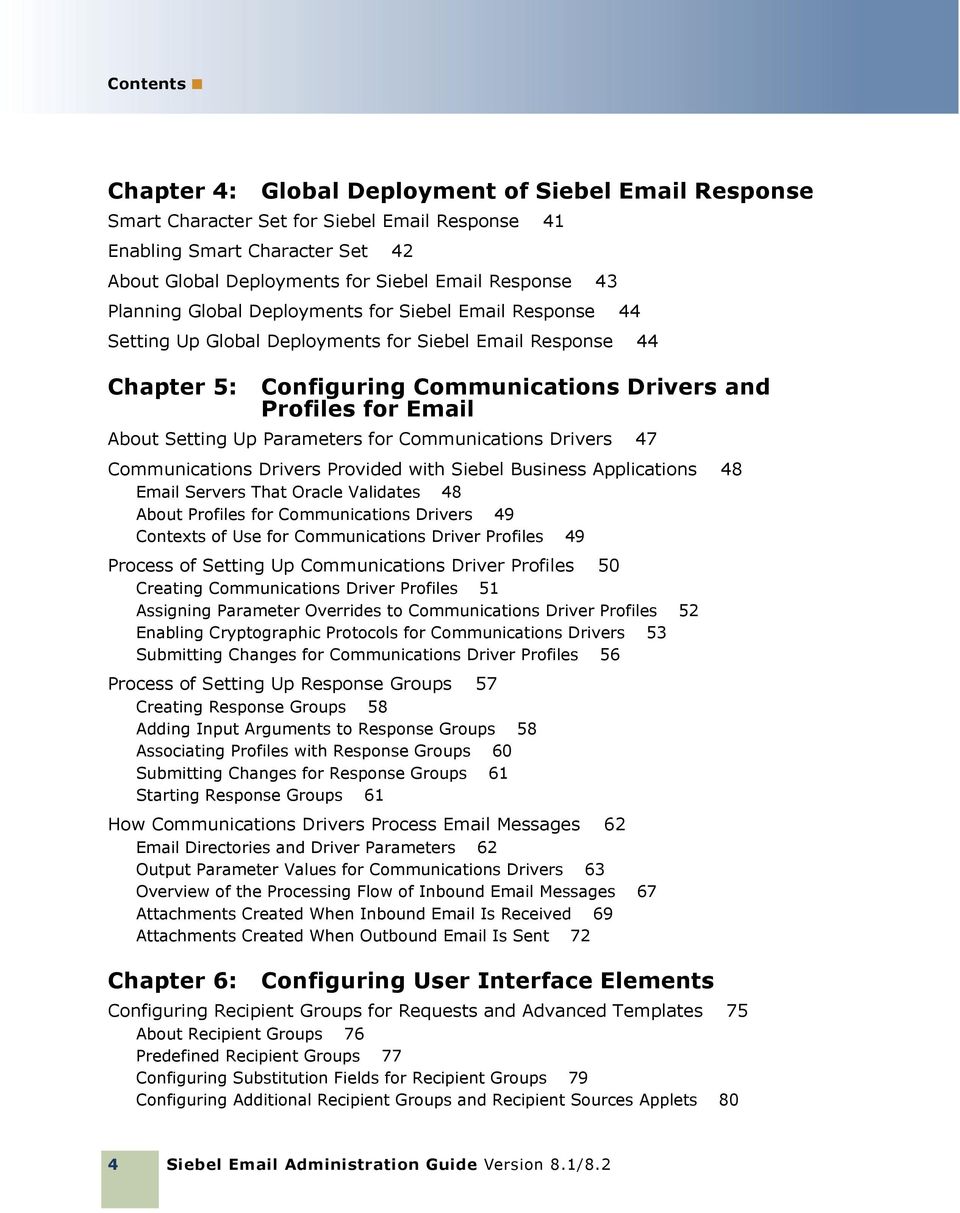
4 Contents Chapter 4: Global Deployment of Siebel Response Smart Character Set for Siebel Response 41 Enabling Smart Character Set 42 About Global Deployments for Siebel Response 43 Planning Global Deployments for Siebel Response 44 Setting Up Global Deployments for Siebel Response 44 Chapter 5: Configuring Communications Drivers and Profiles for About Setting Up Parameters for Communications Drivers 47 Communications Drivers Provided with Siebel Business Applications 48 Servers That Oracle Validates 48 About Profiles for Communications Drivers 49 Contexts of Use for Communications Driver Profiles 49 Process of Setting Up Communications Driver Profiles 50 Creating Communications Driver Profiles 51 Assigning Parameter Overrides to Communications Driver Profiles 52 Enabling Cryptographic Protocols for Communications Drivers 53 Submitting Changes for Communications Driver Profiles 56 Process of Setting Up Response Groups 57 Creating Response Groups 58 Adding Input Arguments to Response Groups 58 Associating Profiles with Response Groups 60 Submitting Changes for Response Groups 61 Starting Response Groups 61 How Communications Drivers Process Messages 62 Directories and Driver Parameters 62 Output Parameter Values for Communications Drivers 63 Overview of the Processing Flow of Inbound Messages 67 Attachments Created When Inbound Is Received 69 Attachments Created When Outbound Is Sent 72 Chapter 6: Configuring User Interface Elements Configuring Recipient Groups for Requests and Advanced Templates 75 About Recipient Groups 76 Predefined Recipient Groups 77 Configuring Substitution Fields for Recipient Groups 79 Configuring Additional Recipient Groups and Recipient Sources Applets 80 4 Siebel Administration Guide Version 8.1/8.2
5 Contents Configuring Recipients for Send Commands 83 Configuring Nonjoined Generic Recipients 85 Configuring Joined Generic Recipients 86 Configuring Default Templates for Send Command 87 Configuring the Retry Interval for Outbound 87 Configuring Invalid Characters or Symbols in Attachment Names 88 Process of Authenticating Sender Addresses 88 Authenticating Sender Addresses Using Employee Addresses 89 Authenticating Sender Addresses Using Alternate Addresses 91 Recapturing the Account ID 93 Chapter 7: Configuring Communications Templates About Communications Templates 95 Content and Formatting for Templates 96 Substitution Fields in Templates 97 Visibility and Access for Templates 98 About Catalogs and Categories for Siebel Response 99 About Solutions 100 Solutions and Templates Decision Table 101 Creating Simple Templates 102 Creating Advanced Templates 103 Editing and Formatting Controls for Text in Templates 105 Specifying Template Items for Advanced Templates 107 Modifying Files for Template Items 109 Copying or Deleting Templates and Template Items 109 Using Substitution Fields in Templates for Siebel Response 110 Creating a Catalog and Categories 112 Setting Up a Catalog for Siebel Response 112 Setting Up Categories for Siebel Response 112 Using Access Groups to Filter Objects 114 Process of Setting Up HTML Wrapper Templates 115 Creating Wrapper Templates 115 Creating Advanced Templates for Wrapper Templates 115 Modifying the Response - Client Send Workflow 116 Fields for Templates 117 Fields for the Templates List 117 Siebel Administration Guide Version 8.1/8.2 5

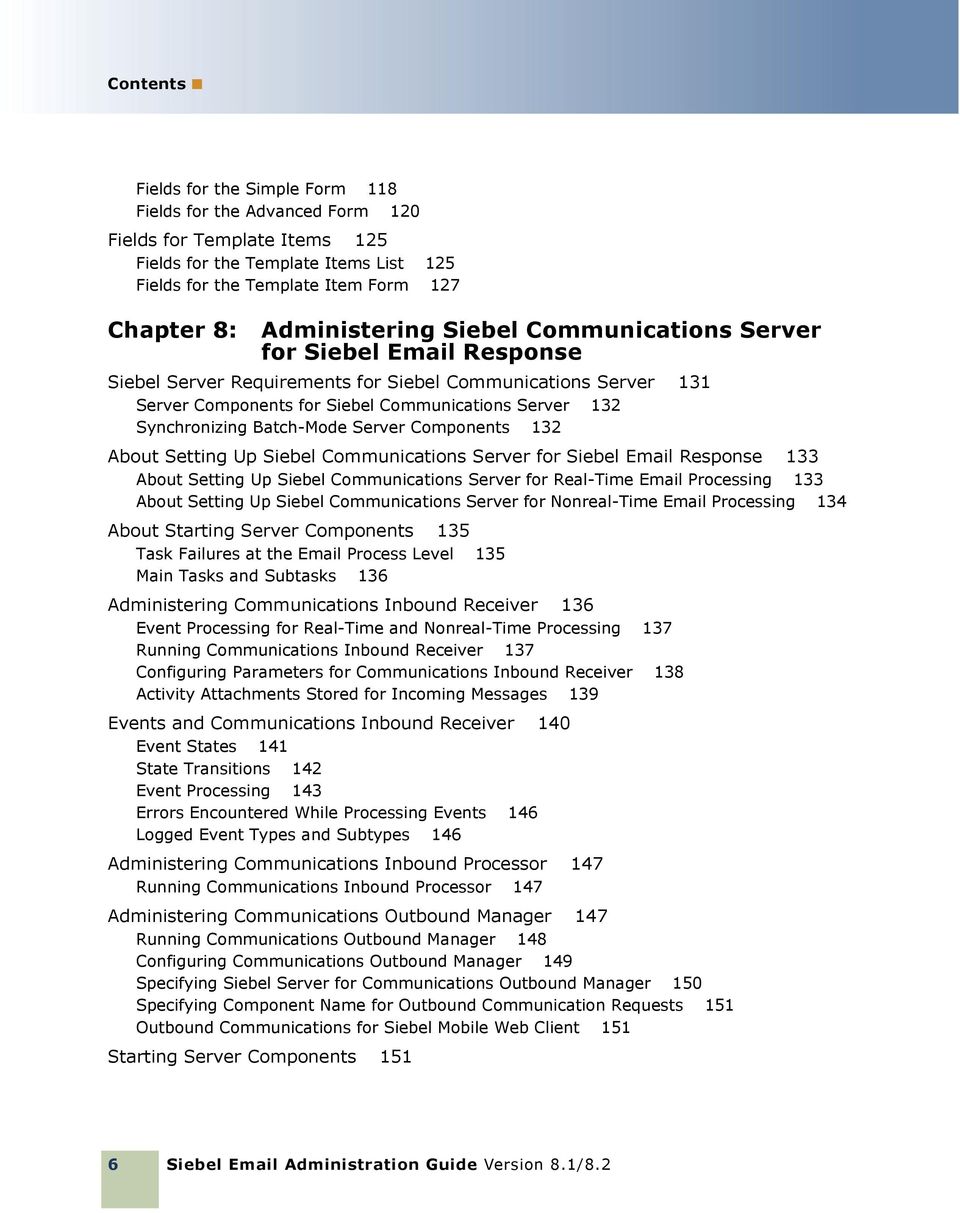
6 Contents Fields for the Simple Form 118 Fields for the Advanced Form 120 Fields for Template Items 125 Fields for the Template Items List 125 Fields for the Template Item Form 127 Chapter 8: Administering Siebel Communications Server for Siebel Response Siebel Server Requirements for Siebel Communications Server 131 Server Components for Siebel Communications Server 132 Synchronizing Batch-Mode Server Components 132 About Setting Up Siebel Communications Server for Siebel Response 133 About Setting Up Siebel Communications Server for Real-Time Processing 133 About Setting Up Siebel Communications Server for Nonreal-Time Processing 134 About Starting Server Components 135 Task Failures at the Process Level 135 Main Tasks and Subtasks 136 Administering Communications Inbound Receiver 136 Event Processing for Real-Time and Nonreal-Time Processing 137 Running Communications Inbound Receiver 137 Configuring Parameters for Communications Inbound Receiver 138 Activity Attachments Stored for Incoming Messages 139 Events and Communications Inbound Receiver 140 Event States 141 State Transitions 142 Event Processing 143 Errors Encountered While Processing Events 146 Logged Event Types and Subtypes 146 Administering Communications Inbound Processor 147 Running Communications Inbound Processor 147 Administering Communications Outbound Manager 147 Running Communications Outbound Manager 148 Configuring Communications Outbound Manager 149 Specifying Siebel Server for Communications Outbound Manager 150 Specifying Component Name for Outbound Communication Requests 151 Outbound Communications for Siebel Mobile Web Client 151 Starting Server Components Siebel Administration Guide Version 8.1/8.2
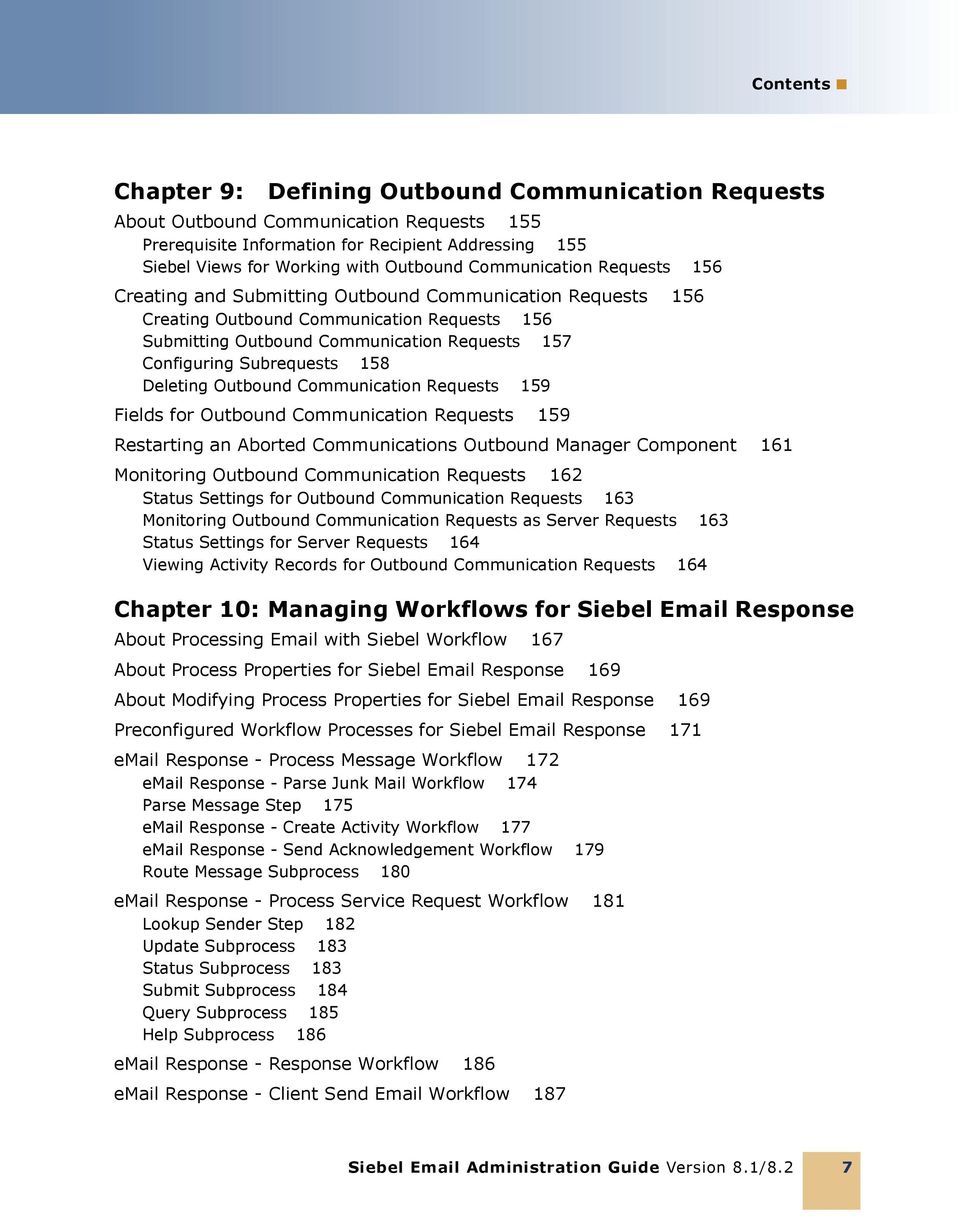
7 Contents Chapter 9: Defining Outbound Communication Requests About Outbound Communication Requests 155 Prerequisite Information for Recipient Addressing 155 Siebel Views for Working with Outbound Communication Requests 156 Creating and Submitting Outbound Communication Requests 156 Creating Outbound Communication Requests 156 Submitting Outbound Communication Requests 157 Configuring Subrequests 158 Deleting Outbound Communication Requests 159 Fields for Outbound Communication Requests 159 Restarting an Aborted Communications Outbound Manager Component 161 Monitoring Outbound Communication Requests 162 Status Settings for Outbound Communication Requests 163 Monitoring Outbound Communication Requests as Server Requests 163 Status Settings for Server Requests 164 Viewing Activity Records for Outbound Communication Requests 164 Chapter 10: Managing Workflows for Siebel Response About Processing with Siebel Workflow 167 About Process Properties for Siebel Response 169 About Modifying Process Properties for Siebel Response 169 Preconfigured Workflow Processes for Siebel Response 171 Response - Process Message Workflow 172 Response - Parse Junk Mail Workflow 174 Parse Message Step 175 Response - Create Activity Workflow 177 Response - Send Acknowledgement Workflow 179 Route Message Subprocess 180 Response - Process Service Request Workflow 181 Lookup Sender Step 182 Update Subprocess 183 Status Subprocess 183 Submit Subprocess 184 Query Subprocess 185 Help Subprocess 186 Response - Response Workflow 186 Response - Client Send Workflow 187 Siebel Administration Guide Version 8.1/8.2 7
8 Contents Managing Workflow Processes and Subprocesses 187 Setting the Log Levels for Workflow Steps 187 Revising Workflow Processes 188 Testing Workflow Processes 188 Activating Workflow Processes 189 Determining Workflow Subprocesses 189 Running the Process Simulator 191 Process of Modifying Workflow Processes 193 Setting Up Junk Mail Processing for Certain Messages 194 Parsing Message Text for the Campaign ID 194 Parsing Message Subjects for the Campaign ID 196 Parsing for Fields in Incoming 197 Adding Query Fields to the Search Spec Workflow 198 Chapter 11: Managing , Fax, and Other Communications Products Managing Integrations with and Fax Servers 201 Integrating with Server Products 202 Using HTML 202 Integrating with Fax Products 203 Configuring Fax Integration Elements in Siebel Tools 204 Settings for Internet SMTP/IMAP Server Driver 204 Settings for Internet SMTP/POP3 Server Driver 205 Parameters for Internet SMTP/IMAP Server Driver and Internet SMTP/POP3 Server Driver 205 Configuring Client-Side Integration for Send Command 225 Process of Configuring Third-Party Integrations 226 Creating and Configuring the Attachments Directory 227 About Installing Siebel Form 227 Installing Siebel Form for Lotus Notes 228 Installing Siebel Form for Microsoft Outlook 230 Overview of Completing Configuration for Client 231 Completing Configuration for Lotus Notes 231 Completing Configuration for Microsoft Outlook 233 Parameters for Client 235 Modem-Based TAP Paging Driver 238 Settings for Modem-Based TAP Paging Driver 239 Parameters for Modem-Based TAP Paging Driver 239 FTP Driver 241 Settings for FTP Driver Siebel Administration Guide Version 8.1/8.2
9 Contents Parameters for FTP Driver 242 Chapter 12: Using Communications Operations About Messages for Siebel Response 245 About Status Field Changes for Messages 245 Process of Managing Messages for Siebel Response 248 Replying to Incoming Messages 248 Resending Outgoing Messages 250 Resending Outgoing Messages That Have Failed Because of Incorrect Addresses 250 Using Templates in Outgoing Messages 251 Saving Drafts of Outgoing Messages 252 Retrieving Drafts of Outgoing Messages 253 Saving Messages as Templates 254 Specifying Preferences for Outbound Communications 256 Preference Settings for Outbound Communications 256 Creating Communications Profiles for Personal Use 260 Using Send Commands to Send Messages 261 About Send Commands 262 Sending Messages Using Native Siebel Client 263 Sending Messages Using Lotus Notes or Microsoft Outlook 265 Sending Messages Using an External Client in Siebel Open UI 267 Sending Faxes 269 Editing and Formatting Controls for Send and Send Fax Commands 271 Sending Wireless Messages 273 Sending Pages 275 Creating Activities for Send Commands 276 Activity Types for Send Commands 277 Contact Matching for Activity Records 278 Specifying Settings for Mobile Devices 278 Configuring Mobile Devices 279 Configuring Message Delivery 279 Configuring Mobile Alerts 280 Chapter 13: Using Wireless Messaging About Wireless Messaging 281 Configuring Wireless Messaging 281 Connecting Directly to Wireless Network Operators 282 Siebel Administration Guide Version 8.1/8.2 9

10 Contents Configuring Siebel Server Components for Wireless Messaging 282 Configuring Communications Drivers and Profiles for Wireless Messaging 282 Administering Mobile Devices 284 Specifying Information for Mobile Devices 284 Settings for Mobile Devices 285 Settings for Device Addresses 286 Chapter 14: Troubleshooting Siebel Response About Troubleshooting Siebel Response 287 Troubleshooting Siebel Response Issues 288 About Investigating and Reporting Processing Abnormalities 292 Process of Troubleshooting Siebel Response 292 Resolving Issues for Nonreal-Time Processing 292 Resubmitting Failed 293 Synchronizing Batch Components 294 Diagnosing Errors for Communications Inbound Receiver 294 Finding Last Encountered Error in Communications Inbound Receiver 294 Resolving Issues for Response Groups 295 Tagging Inbound Messages as Faxes 296 Appendix A: Business Service Methods for Siebel Response Siebel Response and Business Services 299 Inbound Manager Business Service 299 Input Arguments for Methods of Inbound Manager 301 Inbound Database Operations Business Service 303 Input Arguments for Methods of Inbound Database Operations 304 Outbound Communications Manager Business Service 307 Arguments for Methods of Outbound Communications Manager 309 Index 10 Siebel Administration Guide Version 8.1/8.2

11 1 What s New in This Release What s New in Siebel Administration Guide, Version 8.1/8.2 Table 1 lists the changes described in this version of the documentation to support this release of the software. The new features described in Table 1 are available in Siebel CRM version , Siebel CRM version , and later. Table 1. What s New in Siebel Administration Guide, Version 8.1/8.2 Topic About Messages for Siebel Response on page 245 Outbound Communications Manager Business Service on page 307 Description Modified topic. It includes updated information about Status field changes for messages. Modified topic. It includes updated information about Outbound Communications Manager methods. What s New in Siebel Administration Guide, Version 8.1, Rev. B Table 2 lists the changes described in this version of the documentation to support this release of the software. Table 2. Topic What s New in Siebel Administration Guide, Version 8.1, Rev. B Description Resending Outgoing Messages That Have Failed Because of Incorrect Addresses on page 250 New topic. Describes how to resend messages that failed because some of the recipients had an error in the address. Siebel Administration Guide Version 8.1/8.2 11

12 What s New in This Release 12 Siebel Administration Guide Version 8.1/8.2

13 2 Overview of Siebel Response This chapter provides an overview description of Oracle s Siebel Response. It includes the following topics: About Inbound and Outbound Communications on page 13 Fundamentals of Using Siebel Response on page 14 Features for Siebel Response on page 15 Methods for Deploying Siebel Response on page 21 Siebel Response and Siebel Business Applications on page 23 Architecture for Siebel Response on page 24 About Inbound and Outbound Communications NOTE: The procedures in this guide assume that you do not use left-hand navigation. However, you can set up left-hand navigation. For more information about left-hand navigation and about implementing it, see Siebel Fundamentals for Siebel Open UI. The following kinds of communications are supported for Siebel application users: Inbound communications. Supports integrating with third-party servers and processing inbound (when using Siebel Response). Outbound communications. Supports integrating with a variety of third-party communications products, such as servers, to send outbound communications. Outbound communications include the following activities: Supports the Send , Send Fax, and Send Wireless Message commands for Siebel application users. (The Send Page command uses Page Manager, not Siebel Communications Server.) Supports agents sending replies for Siebel Response. Supports users sending communications content to designated recipients using outbound communication requests. You can manually create and submit communication requests through a user interface described in this guide. Siebel Workflow and business services can also create and submit communications requests. Several Siebel modules invoke business service methods through workflows to send outbound communications. You can create custom drivers for third-party products using the Adaptive Communications API. NOTE: Your Siebel implementation might not include all the features described in this guide. The software modules that you purchase determine the available features. Siebel Administration Guide Version 8.1/8.2 13
14 Overview of Siebel Response Fundamentals of Using Siebel Response Fundamentals of Using Siebel Response Siebel Response enables organizations to manage and respond to a high volume of incoming . You can use Siebel Response with other Siebel Business Applications. Siebel Response and Siebel Communications Server are installed with the Siebel Server and work together to receive and send responses. Siebel Communications Server supports and integrates communications channels that are used to communicate with customers. The following components for Siebel Communications Server handle traffic to and from Siebel Response: Communications Inbound Receiver. Communications Inbound Receiver pulls from the server, converts the into event data, and creates a server request for the Server Request Broker component. Communications Inbound Processor. Communications Inbound Processor receives the events from Communications Inbound Receiver and processes them using workflows. Communications Outbound Manager. Communications Outbound Manager manages outbound communications with customers. Siebel Response uses the Communications Outbound Manager server component to send responses. In addition to handling traffic, Siebel Communications Server can support a multichannel toolbar. This toolbar includes buttons that agents use to access different communications channels, such as voice and . Products such as Siebel CTI and Siebel Response might use the communications toolbar to enable agents to initiate outgoing communications and accept incoming communications using supported communications channels. For information about the communications toolbar, see Siebel CTI Administration Guide. NOTE: The Siebel Bookshelf is available on Oracle Technology Network ( technetwork/indexes/documentation/index.html) and Oracle Software Delivery Cloud. It might also be installed locally on your intranet or on a network location. Siebel Response performs the following tasks: Monitors one or more mailboxes on your application. Parses an inbound message for various fields, such as Sender, Message Body, and the message attributes for further processing. Creates an activity record in the Siebel database for each inbound and stores the content of the in fields within the new record. Sends an acknowledgment message to let the sender know that the is received. Routes an inbound message to an agent by using parameters such as agent skills, when integrated with Siebel Workflow and Siebel Assignment Manager or a custom routing and queueing solution. Enables an agent to compose and send a response message using templates configured for your company needs. Templates save agents time and give them preapproved responses to send to customers. Includes a spell check feature to improve the accuracy of messages. 14 Siebel Administration Guide Version 8.1/8.2

15 Overview of Siebel Response Features for Siebel Response Accesses customer data and history in one customer information database. Provides global support for companies that receive messages from customers around the world with the following features: Support for many different international languages. For information about supported languages, see Siebel System Requirements and Supported Platforms on Oracle Technology Network. Unicode support. Organizations can deploy Siebel Response around the globe without needing separate databases and Siebel Enterprises. Features for Siebel Response This topic presents an overview of the following Siebel Response features: Server Components for Siebel Response on page 15 Timestamp Fields on page 16 Cryptographic Protocols and Communications Drivers on page 16 Structured and Unstructured Processing on page 17 Service-Level Agreements on page 18 Siebel Workflow and Routing and Queueing Methods on page 18 Spell Check on page 19 Multiple Organizations and Siebel Response on page 20 Contact Identification by Address on page 20 Smart Character Set on page 21 Server Components for Siebel Response You use the Communications Inbound Receiver component to receive inbound messages and the Communications Inbound Processor component to use business logic to process messages. These components process all inbound messages (Web-structured and unstructured). You use the Communications Outbound Manager component to send responses to messages. For more information about the Siebel Response architecture, see Architecture for Siebel Response on page 24. This architecture provides for better performance and greater scalability. Siebel Response can run continuously (24 hours a day, 7 days a week) with no manual restart when you change profiles and response groups. Depending on your business needs, you can run Siebel Response in realtime mode, with only the Communications Inbound Receiver component processing , or in nonreal-time mode, with both Communications Inbound Receiver and Communications Inbound Processor processing , using multiple instances of the server components on different Siebel Servers. Siebel Administration Guide Version 8.1/8.2 15
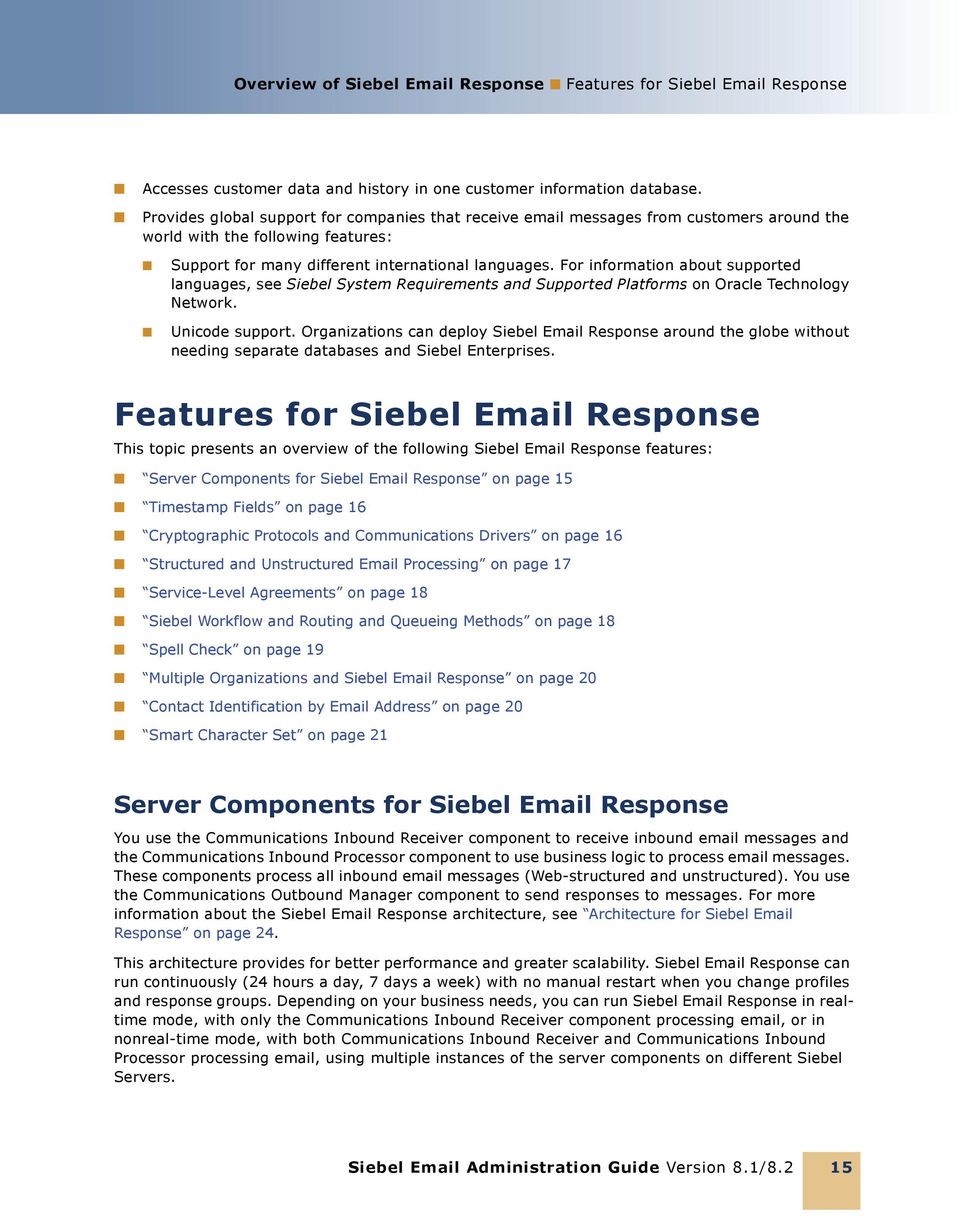
16 Overview of Siebel Response Features for Siebel Response Cleanup Utility for Siebel File System Communications Inbound Receiver and Communications Inbound Processor use the Siebel File System for temporary storage and to hold copies of any attached files. To clean up any orphan files (files with no corresponding record in the Siebel database) in the file attachment directory, you can use a command-line utility, sfscleanup.exe. However, to avoid accidentally removing any files that Communications Inbound Receiver creates, make sure that you do not use the /g option when using this utility. For information about using the sfscleanup.exe utility to clean up Siebel File System, and for a list of sfscleanup.exe parameters, see Siebel System Administration Guide. Timestamp Fields Siebel Response Analytics enables you to create multiple timestamps for an message as it moves through the different stages of processing. The timestamp fields are initially recorded at various points in the workflow and then written to the S_EM_RESP_TM table using the Update Analytics Record method in the Inbound Database Operations business service. Table 3 shows the timestamp fields. Table 3. Siebel Response Timestamp Fields Timestamp Field Received Processing Created Server Send Reply Agent Send Assigned Description The time that Siebel Response receives an . The time that Siebel Response begins processing an . The time that Siebel Response creates an activity for an . The time that Siebel Response sends an auto-acknowledgement or an auto-response for an . The time that an agent responds to an . The time that an agent sends out a response . The time that an event is assigned (through Assignment Manager or a custom routing and queueing solution) to an agent. Cryptographic Protocols and Communications Drivers Siebel Response enables the Internet SMTP/POP3 Server driver or the Internet SMTP/IMAP Server driver to work with servers that you enable for a connection using cryptographic protocols. Cryptographic protocols include Secure Sockets Layer (SSL) and Transport Layer Security (TLS). A connection that employs one of these protocols provides secure transmission of data between the Siebel Server and the server. For information about how to enable this connection, see Enabling Cryptographic Protocols for Communications Drivers on page Siebel Administration Guide Version 8.1/8.2
17 Overview of Siebel Response Features for Siebel Response For explicit SSL security, the client must issue a specific command to the server to establish the SSL link. For implicit SSL security, security is automatically enabled when the client connects to the server. Siebel Response supports explicit SSL, and not implicit SSL, for SMTP (Simple Mail Transport Protocol). Siebel Response supports explicit SSL for POP3 (Post Office Protocol) and IMAP (Internet Message Access Protocol) that uses TLS and implicit SSL for POP3 and IMAP that uses SSL. Structured and Unstructured Processing Siebel Response can process two types of the most common messages sent to many organizations, structured and unstructured. This topic describes how Siebel Response handles each type of message and the advantages and disadvantages of each type of message. Structured Processing Siebel Response uses the Response - Process Service Request workflow to process structured (keyword-based or Web-form) messages. You can use keywords (such as Help, Query, Status, Submit, and Update) when processing and creating service requests for keyword-based . To use structured processing, provide your customers with templates or with Web forms (Web-based forms on your Web sites). NOTE: You can create Web forms with the Web development product that you use to maintain your current Web site. Siebel Business Applications do not include a Web-form product. However, organizations using Siebel eservice can configure Web pages, views, and applets to meet many business needs. For more information, see Siebel eservice Administration Guide. Examples of incoming structured (keyword-based or Web-form) messages include: New service requests Status requests for pending service requests Updates for existing service requests Searches for specific service requests Structured messages are processed using the Response - Process Service Request workflow process. This workflow process creates service request records in the Siebel database that you can view on the Communications screen. Keyword-Based Processing For keyword-based , the subject headers of incoming messages need specific keywords to indicate different actions. For example, you can require Help, Status, Query, Submit, and Update keywords in the subject to initiate an action. The keyword enables Siebel Workflow to determine the appropriate process for an . In keyword-based messages, customers must understand and use the required format or the data is not parsed correctly. Siebel Administration Guide Version 8.1/8.2 17
18 Overview of Siebel Response Features for Siebel Response Web Forms Processing Web forms enable the customer to communicate the severity of an issue, enable Siebel Response to categorize the issue, and provide information that Siebel Assignment Manager can use to notify the appropriate service representatives in your organization. If you use Web forms, then administrators must build and maintain them. Unstructured Processing Unstructured (free-form) messages do not need any special subject or structure in the incoming . They provide for a broad range of communications, such as: Requests for general information Requests for information about a product or event Order requests Unstructured messages are processed using the Response - Process Message workflow process. This workflow process creates activity records in the Siebel database that you can view on the Communications screen. Unstructured processing is useful when Web forms are not available or when your customers must receive personalized service. However, automating the response process for free-form messages is difficult because customer frequently does not include all the information necessary to process a message. Service-Level Agreements Siebel Response can use information from your customer service-level agreements (SLAs) when processing incoming . For example, if your organization has two levels of support, standard and premier, then your Siebel Response administrator can implement the following service functionality: Customers with standard agreements can access full online support but do not receive any premier services. Customers with premier agreements can send an message and receive an immediate autoacknowledgment giving the date and time that they will receive a response. Siebel Workflow and Routing and Queueing Methods You can use Siebel Workflow with routing and queueing products or methods to further automate your interactions. Routing and queueing applications and methods assign incoming records to employees, positions, and organizations. For information about the routing and queueing methods as well as associated advantages and disadvantages, see Comparison of Routing and Queueing Methods on page 39. For more information about Siebel Response routing and queueing requirements, see About Implementing Routing and Queueing Processes on page Siebel Administration Guide Version 8.1/8.2
19 Overview of Siebel Response Features for Siebel Response Your company can manage your processes by using Siebel Workflow with one of the following routing and queueing methods: Manual routing. A user must manually assign every work item as it is created. This method is the most labor-intensive. Siebel Assignment Manager (optional). Assignment Manager assigns inbound work items such as opportunities, , or service requests to agents by using your business rules and agent skills, product expertise, language skills, availability, workload, and other criteria. You can change the rules as your business requirements change. Custom routing and queueing. You can implement a custom routing and queueing solution, such as a solution using third-party products. Spell Check Siebel Response uses a spell check feature that is available with Siebel Business Applications. This feature can identify many spelling errors in text communications (including , service requests, and solutions) before they are sent to customers. The spell check feature is automatically installed and enabled as part of the Siebel Server and Mobile Web Client installation processes. NOTE: In Siebel Open UI, the Siebel Response spell check feature is deprecated. If available, then use the spell check functionality enabled in your browser or use a third-party spell check plugin for your browser. By default, the spell check feature ignores HTML in outbound messages. You can change this option and other spell check options (for example, the option to automatically check spelling when an is sent) in the Spelling view of the User Preferences screen. For more information about setting user preferences, see Siebel Applications Administration Guide. Default Dictionary The spell check feature uses the dictionary for the default language your system administrator specifies during installation. During installation, dictionary files (lexicons) for the most common international languages are installed. Common dictionary files (two files for each language, with the TLX and CLX extension) are stored in the [ROOT]\lex directory during installation. All included language dictionaries are installed regardless of the default language your system administrator selects during installation. For information about supported languages, see Siebel System Requirements and Supported Platforms on Oracle Technology Network. In the User Preferences screen, agents can change the default language for the spell check feature. If you assign a default language in user preferences, then the spell check feature uses that default language to check the spelling in replies to inbound . For more information about user preferences, see Siebel Applications Administration Guide. Siebel Administration Guide Version 8.1/8.2 19

20 Overview of Siebel Response Features for Siebel Response Personal Dictionary An agent can add frequently used words to a personal dictionary (custom user dictionary) that is saved on the server so that the agent can access this dictionary from any workstation. This dictionary is stored in the following locations: [FILESERVERROOT]\userpref\[USERNAME&]\[USERNAME_LANGID].tlx [FILESERVERROOT]\crm\[USERNAME_LANGID].tlx Multiple Organizations and Siebel Response In Siebel Response, you can associate business entities with a specific organization. This association gives you a way to filter and access records. If your company consists of multiple organizations, then you can look up contacts by organization. Contact Identification by Address Siebel Response enables you to identify one contact with multiple addresses or multiple contacts that share one address. The Response - Process Message and Response - Process Service Request workflows support contact verification. One Contact with Multiple Addresses Many customers have multiple addresses. For example, customers might work from multiple locations (office, home, and other remote locations). When a customer contacts you, you must be able to identify the customer from the address. You can add a contact s alternate addresses in the More Info view of the Contacts screen. NOTE: In the Contacts screen, the Do Not check box applies to all addresses in the contact record. Multiple Contacts That Share One Address When Siebel Response receives an , it searches all contact records for the address of the sender and compares the address of the sender to the address in the field. When Siebel Response finds a match, it creates an activity record and associates this record with that contact record. If multiple contact records contain the address of the sender, then Siebel Response associates the with the first contact record found and creates an activity record for that contact. After Siebel Response creates an activity record, the following events occur: If routing is enabled, then one inbound is routed. In Siebel Response, an auto-acknowledgment response is sent to the sender. You must set an input argument for the response group to send no acknowledgment. The Response - Update Activity Status workflow process updates the activity status for the contact. 20 Siebel Administration Guide Version 8.1/8.2
![tlx [FILESERVERROOT]\crm\[USERNAME_LANGID].tlx Multiple Organizations and Siebel Email Response In Siebel Email Response, you can associate business entities with a specific organization.](/docs-images/40/534101/images/page_20.jpg "This association gives you a way to filter and access records. If your company consists of multiple organizations, then you can look up contacts by organization.")
21 Overview of Siebel Response Methods for Deploying Siebel Response The Response - Client Send workflow process updates the response activity status and inbound activity status for the contact. Smart Character Set The Smart Character Set feature enables you to receive, process, and reply to an in the same character set as the inbound . For information about this feature, see Smart Character Set for Siebel Response on page 41. Methods for Deploying Siebel Response You can implement Siebel Response in the following ways: To use only the Siebel Response features, another Siebel application such as Siebel Sales, Siebel Marketing, Siebel Service, or Siebel Call Center is required. Instead of configuring both Siebel Response and the other Siebel application, you can configure only Siebel Response. Using another Siebel application as a foundation for your deployment of Siebel Response can solve the immediate challenge of routing and processing a high volume of incoming and can be an interim step before you implement a larger, more integrated solution. The Siebel Response add-on module (integrated solution) includes Siebel Response features (without Siebel Service functionality). You can add this module to many other Siebel Business Applications, including Siebel Sales, Siebel Marketing, Siebel Service, and Siebel Call Center. For example, if you want only Siebel Marketing and Siebel Response, then purchase the Siebel Marketing application and the Siebel Response add-on module. Siebel Response is installed during the installation of your purchased Siebel application package and does not require separate installation. The following topics provide additional information about a Siebel Response deployment: Implementation Team on page 22 Siebel Response in a Global Environment on page 23 Siebel Administration Guide Version 8.1/8.2 21
22 Overview of Siebel Response Methods for Deploying Siebel Response Implementation Team Designate several people to serve as the Siebel Response deployment team. These people coordinate the setup and maintenance of the new application. They use the deployment planning information in this guide. For more information, see Chapter 3, Planning Deployment of Siebel Response. After the planning process is complete, the administrator sets up Siebel Response. For more information, see Chapter 5, Configuring Communications Drivers and Profiles for . Employees in the following roles might be on your Siebel Response implementation team: System administrator. Responsible for installing, configuring, and maintaining the network, including the server and the Siebel environment. The system administrator also administers and configures server components. Siebel Response administrator. Responsible for setting up and maintaining Siebel Response features, including profiles, drivers, response groups, catalogs, response categories, and templates. Developer. Responsible for configuring and customizing the Siebel application to meet your business requirements. This configuration and customizing includes view modifications and process automation. Business analyst. Responsible for: Mapping and developing your business processes in Siebel Business Process Designer. Developing response categories, solutions, and templates for agent use. Agent. Responsible for providing feedback to the system administrator and business analyst during the development process. NOTE: The same employee can have multiple roles. 22 Siebel Administration Guide Version 8.1/8.2
23 Overview of Siebel Response Siebel Response and Siebel Business Applications Siebel Response in a Global Environment Siebel Response supports Unicode and filtering templates by using language and locale settings in a single Siebel environment. Whether or not the Siebel database uses Unicode, incoming content is converted to Unicode. If the Siebel database uses Unicode, then all characters are saved in the Siebel database after the conversion. Any characters that the in-use code set does not support are not saved after the conversion. Table 4 describes the global deployment resources. Table 4. Global Deployment Resources for Siebel Response Topic About Global Deployment Configuring Siebel CRM for multiple languages. For general Unicode information, see the topics about global deployments. Setting up global deployment, including the Smart Character Set feature. Supported Siebel database code pages. Supported languages. Resource Siebel Global Deployment Guide Siebel Installation Guide for the operating system you are using Chapter 4, Global Deployment of Siebel Response Siebel System Requirements and Supported Platforms on Oracle Technology Network Siebel System Requirements and Supported Platforms on Oracle Technology Network Siebel Response and Siebel Business Applications You most frequently use Siebel Response with the following Siebel Business Applications: Siebel Sales. Agents can generate opportunities from Siebel Response that sales representatives can access. Siebel Marketing. Companies must be prepared to handle the large quantities of inbound messages that large outbound campaigns generate. Using the routing rules for the rest of your company, Siebel Response processes customer responses to the campaign and outgoing messages that are returned to your company because of incorrect addresses or overloaded servers. Siebel Service. This application schedules service requests, installations, projects, and preventive maintenance activities and dispatches these activities to the right person. When customers send requesting a service call status or a change request, Siebel Response routes the to the correct field agents, enabling them to respond and adjust their schedules immediately. Siebel Administration Guide Version 8.1/8.2 23
24 Overview of Siebel Response Architecture for Siebel Response Siebel Call Center. This unified, multichannel, desktop application includes voice and channels. This application includes Siebel Service, Siebel Sales, and optionally Siebel Response. You can configure Siebel Call Center to include channel integration so that an agent can use any available channel to communicate with customers. If the customer sends an , then the agent can reply using Siebel Response. If the customer calls on the phone, then the agent can switch to the voice channel to handle the phone call. Architecture for Siebel Response The Siebel Server and Siebel Response process incoming and handle the replies. Figure 1 provides a high-level overview of a typical process, which starts when a customer sends an and ends when Siebel Server components (either the Communications Inbound Receiver or the Communications Inbound Receiver and the Communications Inbound Processor) process the incoming and send a reply to the customer. Figure 1. Siebel Response Architecture Overview The following topics provide additional information about Siebel Response architecture: Workflows for Siebel Response on page 24 Processing Incoming on page 25 Workflows for Siebel Response The Siebel Response workflow begins when a customer sends an to your company over the Internet using that customer s software. The passes through the customer s server and communicates with your server using SMTP and POP3 or IMAP. Communications Inbound Receiver uses POP3 or IMAP to retrieve the inbound message. 24 Siebel Administration Guide Version 8.1/8.2
25 Overview of Siebel Response Architecture for Siebel Response Supported Sender Software and Servers The following guidelines describe the types of software a sender can use and the types of servers that your company can use: Sender s application. The sender can use any client and server that you can currently use on the Internet. Your server. The Oracle-provided Internet SMTP/POP3 Server driver and Internet SMTP/ IMAP Server driver are tested and certified with some servers. Although many servers support the SMTP and POP3 or IMAP communication protocols, it is recommended that you use a supported server for the following reasons: Oracle personnel certified and tested these servers. Oracle personnel can access these servers to support customer issues. Siebel Response supports servers that comply with certain RFC (Request for Comments) standards. For information about these RFC standards, see (Article ID) on My Oracle Support. For information about support for the application for your company, see Siebel System Requirements and Supported Platforms on Oracle Technology Network. Processing Incoming After a customer sends an to your company, your server, which is connected to the Siebel Server, receives the and passes it to Communications Inbound Receiver. Communications Inbound Receiver resides on the Siebel Server and has a primary role in the Siebel Response processes. processing uses workflow processes, which call other Siebel Server components, such as Assignment Manager. Communications Inbound Receiver uses the Internet SMTP/POP3 Server driver or Internet SMTP/IMAP Server driver to periodically connect to your server and check for new messages. When Communications Inbound Receiver detects a new message, it completes the following tasks: Downloads the message and attachments from the server. Parses the elements of the message (To:, CC:, Subject:, and body content) and places these elements in memory. Converts the data into event data that is saved in the Siebel database (if less than 15 KB) or in the Siebel File System (if greater than 15 KB). If you use nonreal-time processing, creates a server request for the Server Request Broker component to notify Communications Inbound Processor that a new event is created. If you use nonreal-time processing, passes the event data from memory to Communications Inbound Processor. NOTE: Communications Inbound Processor can start multiple subprocesses so that multiple instances of a workflow can operate in parallel. Siebel Administration Guide Version 8.1/8.2 25
26 Overview of Siebel Response Architecture for Siebel Response Real-Time and Nonreal-Time Processing Depending on your business requirements, you can process in one of the following ways: Real-Time Processing on page 26 Nonreal-Time Processing on page 27 Figure 2 provides examples of different configurations for Communications Inbound Receiver and Communications Inbound Processor in your Siebel Enterprise, as follows: Configuration A. Shows real-time processing for Communications Inbound Receiver on one Siebel Server. Configuration B. Shows Communications Inbound Receiver on one Siebel Server and Communications Inbound Processor divided between two Siebel Servers. Configuration C. Shows Communications Inbound Receiver and Communications Inbound Processor on two Siebel Servers. Figure 2. Examples of Configurations for Communications Inbound Receiver and Communications Inbound Processor Real-Time Processing Real-time processing uses only one server component, the Communications Inbound Receiver. Communications Inbound Receiver both receives and processes inbound messages. Communications Inbound Processor is not used in real-time processing. This type of processing is best for businesses with a low volume of customers or businesses that primarily use phone events because these events always use real-time processing. 26 Siebel Administration Guide Version 8.1/8.2
27 Overview of Siebel Response Architecture for Siebel Response Figure 3 describes the architecture for real-time processing. This figure shows that Communications Inbound Receiver (CIR) pulls from the server. CIR includes the Workflow Process Manager (WPM) and Server Request Broker (SRB), and CIR communicates with the Siebel File System (SFS) and with other entities, such as the driver and the user interface (UI). For information about how to enable real-time processing, see Enabling Real-Time Processing on page 152. For more information about processing in real time, see Events and Communications Inbound Receiver on page 140. Figure 3. Real-Time Processing Nonreal-Time Processing Nonreal-time processing has two server components, the Communications Inbound Receiver and the Communications Inbound Processor, running as separate server components. This type of processing enables you to have multiple instances of Communications Inbound Receiver and Communications Inbound Processor on different Siebel Servers, providing a distributed architecture that is more scalable and reliable. Siebel Administration Guide Version 8.1/8.2 27
28 Overview of Siebel Response Architecture for Siebel Response Figure 4 describes the architecture for nonreal-time processing. This figure shows that Communications Inbound Receiver (CIR) pulls from the server. CIR includes Server Request Broker (SRB), and Communications Inbound Processor (CIP) includes the Workflow Process Manager (WPM). CIR and CIP communicate with each other, with the Siebel File System (SFS), and with other entities, such as the driver and the user interface (UI). For information about how to enable nonreal-time processing, see Enabling Nonreal-Time Processing on page 153. Figure 4. Nonreal-Time Processing Siebel Workflow and Processing Incoming Communications Inbound Processor uses the Workflow Process Manager, part of Siebel Workflow, to process an message in several different ways, depending on the workflow process that you select to handle that type of message. Siebel Response includes several preconfigured workflow processes that provide processing features. For more information, see Chapter 10, Managing Workflows for Siebel Response. 28 Siebel Administration Guide Version 8.1/8.2
29 Overview of Siebel Response Architecture for Siebel Response You can set up the Workflow Process Manager to perform the following tasks: Determine the commit time (the time by which you must reply to the message) by using the customer s service-level agreement. Send the message to Assignment Manager for routing or to a custom routing and queueing solution. Write a record to your Siebel database if the message is routed to an agent for response. When integrated with routing and queueing software, route incoming to an agent by using defined parameters such as agent skills. The selected routing and queueing processes route and queue messages to the agent with the skills that are necessary to respond to the message. About Returning Replies to Customers The agent reviews the message using the Siebel client and composes and sends a reply using templates that users configure for your company s needs. When the agent sends the reply, the Communications Outbound Manager server component sends the reply through your server using the SMTP communication protocol. Your server then sends the over the Internet to the customer s server, and the customer s server delivers the to the customer s mailbox. Figure 1 on page 24 illustrates this process. Siebel Administration Guide Version 8.1/8.2 29
30 Overview of Siebel Response Architecture for Siebel Response 30 Siebel Administration Guide Version 8.1/8.2
31 3 Planning Deployment of Siebel Response This chapter covers planning a Siebel Response deployment. It includes the following topics: About Deployment Planning for Siebel Response on page 31 Business Analysis for Deployment of Siebel Response on page 31 Setup Information for Siebel Response on page 34 Requirements for Setting Up Siebel Response on page 36 About Implementing Routing and Queueing Processes on page 38 Comparison of Routing and Queueing Methods on page 39 About Deployment Planning for Siebel Response This chapter provides tools and resources to help you implement Siebel Response. Setting up Siebel Response for your business is easier if you: Use the provided planning tools. Follow the recommendations, unless your business needs dictate otherwise. This chapter includes guidelines for business analysis and setup planning. Content in each topic tells you what to do and why to do it, and it provides suggestions for obtaining more information. Your answers to questions in each topic consist of the data that you use to set up Siebel Response after installation. Business Analysis for Deployment of Siebel Response Before you set up Siebel Response, analyze your company s business needs. Often customers deploy Siebel Response to meet the needs of one group in an organization. After additional research, you might identify other groups that can benefit from the capabilities of Siebel Response. To analyze your company s business needs, answer the following questions: Which groups in your organization have the largest volume? Groups with the largest volume benefit most from using Siebel Response. Analyze all groups in your organization to determine which groups can benefit from using Siebel Response. server administrators in your organization can help you to identify the addresses that are most heavily used. Siebel Administration Guide Version 8.1/8.2 31
32 Planning Deployment of Siebel Response Business Analysis for Deployment of Siebel Response What addresses will you use for Siebel Response? Develop a list of current and new addresses that you want to use for all groups using Siebel Response. Specify the addresses that you must create to receive incoming . Your server administrator can tell you the addresses that your company currently uses. Designate each address to receive unstructured (free-form) or structured (keyword-based or Web-form) . Does your organization use structured (Web-form) or unstructured (free-form) messages? If your company uses many structured messages, then you might want to use Siebel eservice. This product can automate many of the processes that Web forms solve. For example, use Siebel eservice to automate service request submissions or status updates. Web forms. An example of a Web form is an order status form. Compile a list of Web forms that you might use. If you currently use Web forms, then gather examples with your standard responses. A Web form saves time because no human interaction is necessary to respond to the initial . However, you need special skills and time to set up and maintain Web forms with associated responses. You cannot use Web forms in every situation, but they are useful to handle high-volume communications that require standard responses. Free-form messages. Examples of free-form messages are a free-form for a customer s order status and a free-form for help with a product that the customer purchased. Agents must respond to each free-form . When you set up your workflow processes, decide which workflow you want to use to process incoming messages, Response - Process Message or Response - Process Service Request. What are the most frequently asked questions that you receive at each corporate address? Gather examples of the most common questions (and associated responses) and estimate how many of these questions you receive. You can modify templates, so concentrate on determining the most frequently asked questions you receive at present. One of the most valuable features of any response product is the ability to store templates that agents can use to respond to common questions. You can identify questions that templates can answer by asking customer service agents for a list of the most commonly asked questions and the appropriate response for each question. Another source of templates is FAQ (Frequently Asked Questions) documents that you develop for your customers. 32 Siebel Administration Guide Version 8.1/8.2
33 Planning Deployment of Siebel Response Business Analysis for Deployment of Siebel Response What solution documents do you currently use? A solution document can be any document you prepare for customers that provides a fix or a recommended approach to an issue. For information about when to use solution documents (called FAQs in Siebel eservice), when to use reply templates, and how solutions and templates compare to free-form replies, see Solutions and Templates Decision Table on page 101. Gather copies or make a list of these electronic documents and the network location of them. Specify new documents that you need and existing documents that you can convert to electronic documents. What categories do you want to associate with templates and solutions? Sort the templates and solutions into types of questions (categories) and assign a category to each solution and template. During Siebel Response setup, you associate solutions and templates with categories so that agents can insert solutions and templates into the body of Siebel Response replies. NOTE: Associate with a category only the templates that you intend use as body templates. Who will be responsible for template maintenance and developing maintenance procedures? Develop a process and specify a responsible person. Develop procedures for maintaining templates, for notifying agents that new or changed templates are available, and for using templates. You must review templates for needed changes if your business changes. For example, when you launch a new product or discontinue a product, you might want to review your templates for needed updates. Also, for example, you can add the URL of a new Web site to the signature line of an template. Do you want to automatically acknowledge receipt of incoming ? An auto-acknowledgment message sets reasonable customer expectations for a response and reduces the chance that customers send follow-up or communicate through other channels. Obtain a copy of any existing auto-acknowledgment message. An auto-acknowledgment message thanks the customer for the inquiry and tells the customer the time needed to respond. How do groups currently route messages? Why do you use the current routing approach? Determine how each of your target response groups (such as, Sales and Call Center) currently routes an incoming message to the agent best suited to handle the message. In most organizations, agents select messages from a list of messages that are sent to an address. How do you manage incoming queues and why? Siebel Administration Guide Version 8.1/8.2 33
34 Planning Deployment of Siebel Response Setup Information for Siebel Response Which routing and queueing method meets your needs for response? When using Siebel Response, you can choose from several methods to route messages to the correct agent. For information about different routing and queueing methods, see Comparison of Routing and Queueing Methods on page 39. The method that you use is based on the way that your business needs to route incoming . For example, if you must notify agents immediately after routing a message, then you need a custom routing and queueing solution. If CTI software is set up for your contact center, then you can use third-party routing and queueing technologies to make multiple media channels available to your agents. In this scenario, customer service representatives might handle telephone calls, but when they are not busy with telephone calls, they are assigned messages. What are your language support needs? Determine the languages in which you customers send , the languages in which you reply to , and if you have templates in multiple languages. For more information about supported languages, see Siebel System Requirements and Supported Platforms on Oracle Technology Network. Do you need to set up multiple organizations for your company? Setup Information for Siebel Response You gather setup information for Siebel Response by answering the following questions: Has your system administrator installed and configured a working Siebel Business Applications environment? You must have a working Siebel Business Applications environment. For more information, see the Siebel Installation Guide for the operating system you are using. Has your Communications Server administrator installed and configured your server? Your server must be installed and configured. What communications drivers and profiles will you use for Siebel Response? NOTE: Use the Internet SMTP/POP3 Server driver or Internet SMTP/IMAP Server driver for connecting to all supported servers. Create communications profile names that correspond to all the mailboxes that you monitor, for example, [email protected] and [email protected]. The values that you assign to driver parameters apply to every profile that uses that driver unless you add a profile parameter override value to the profile. Profile parameter overrides enable you to uniquely identify each profile. 34 Siebel Administration Guide Version 8.1/8.2
35 Planning Deployment of Siebel Response Setup Information for Siebel Response What profile parameter overrides and values do you need to establish for each profile ( address) that you assign to the communications driver? A profile parameter override is a setting that overrides the values on the driver that the profile uses. Note the following guidelines about profile parameter overrides: If you do not supply a profile parameter override, then the default parameter value on the driver is used. Some required parameters, such as POP3 Account Name and IMAP Account Name, do not have a default value. You must provide values for all required parameters. If you supply a profile parameter override, then the override value is used instead of the parameter value on the driver. Each profile has parameter overrides that are necessary to connect to the server account. For example, a common parameter override is From Address. The From Address parameter is passed to the SMTP server as the address that shows in the From field in an reply. Values that you assign uniquely identify each profile. You add profile parameter overrides during Siebel Response setup procedures. Which profiles (mailboxes) will receive Web-form messages and which will receive freeform messages? Separate your profiles into two groups, one group to receive Web-form messages (such as, service requests) and one group to receive free-form messages. For each of these two groups of profiles, separate the profiles into groups with the same types of behavior (input arguments). You associate each of these profiles with a single response group. These groups are the response groups and associated profiles that you create. For more information, see Process of Setting Up Communications Driver Profiles on page 50 and Process of Setting Up Response Groups on page 57. Choose the following values for each group: Name. Select a meaningful name for each response group. Administrator address. Select the address to which you want to direct unprocessed ( that cannot be processed due to a database error, a routing error, and so on) that is sent to the profiles in each response group. Description. Describe the types of behavior that each response group controls. This information prepares you to set up input arguments for each response group. What behaviors (input arguments) do you need for each profile type? Input arguments provide information to a business service so it can process incoming . Because input arguments control the way that is handled, all profiles in a response group must have the same input arguments. Using the response group description, assign the input arguments to each group of profiles. For information about available input arguments, see Appendix A, Business Service Methods for Siebel Response. Siebel Administration Guide Version 8.1/8.2 35
36 Planning Deployment of Siebel Response Requirements for Setting Up Siebel Response Do you need to modify the workflows included with Siebel Response? If you want to modify the predefined workflows, then you must activate them in the Administration - Business Process screen before starting Siebel Server and receiving incoming . For more information about predefined workflows, see About Processing with Siebel Workflow on page 167. For information about creating and modifying workflows, see Siebel Business Process Framework: Workflow Guide. CAUTION: If you modify a workflow, then the modification is not upgraded when you upgrade Siebel Response. You must re-create all modifications in the prebuilt workflows. Which routing and queueing method will you use to route incoming to agents? By default, messages are recorded in your Siebel database as activities or service requests. Identify the routing and queueing methods that you want to use, such as manual assignment, Siebel Assignment Manager, or custom routing and queueing. For information about the advantages and disadvantages of each method, see Comparison of Routing and Queueing Methods on page 39. For information about creating routing and queueing rules, see Siebel Assignment Manager Administration Guide. Do you want to process using real-time processing or nonreal-time processing? Depending on your business requirements, you can set up Siebel Response for real-time or nonreal-time processing. For more information, see Real-Time Processing on page 26 and Nonreal-Time Processing on page 27. Have you enabled your server for Secure Sockets Layer (SSL) or Transport Layer Security (TLS)? Siebel Response enables communications drivers to work with servers that you enable for SSL or TLS. For more information, see Cryptographic Protocols and Communications Drivers on page 16. Requirements for Setting Up Siebel Response This topic describes the tasks to complete before you set up Siebel Response. For information about the supported servers, see Siebel System Requirements and Supported Platforms on Oracle Technology Network. Before you set up Siebel Response, confirm that the following tasks are completed: Siebel Business Applications software is installed. The system administrator must install and configure a working Siebel environment before setting up Siebel Response. For more information, see the Siebel Installation Guide for the operating system you are using. During Siebel Business Applications installation, the following items are installed and configured: Siebel Gateway Name Server Siebel Server 36 Siebel Administration Guide Version 8.1/8.2
37 Planning Deployment of Siebel Response Requirements for Setting Up Siebel Response Siebel Database Configuration Utilities Siebel Enterprise Application Integration (The use of this item depends on the nature of your custom integration. You can use this item if you implement a custom routing and queueing solution.) Siebel Web Server Extension After Siebel Server installation and configuration, the following components are enabled: Communications Management (includes the Communications Inbound Receiver, the Communications Inbound Processor, and the Communications Outbound Manager) Siebel Call Center (includes Siebel Response and Siebel Service) Component groups can also be enabled after the Siebel Server installation. After Siebel Server installation, the spell check feature is installed. The spell check feature is automatically installed and enabled as part of the Siebel Server and Mobile Web Client installation processes. Spell check dictionaries are installed in several languages. For information about supported languages, see Siebel System Requirements and Supported Platforms on Oracle Technology Network. A third-party routing and queueing solution is installed (optional). If you want to use a third-party queueing solution, then install and configure it using the vendor documentation. The server is installed, configured, and tested. For installation and configuration information, see the installation instructions that you receive with your server. For information about supported servers, see Siebel System Requirements and Supported Platforms on Oracle Technology Network. Basic tests are performed. Before you set up Siebel Response, perform the following tests: Verify network connectivity by establishing the presence of the server from the Siebel Server. Test the server, and make sure that the server is properly set up by verifying that you can communicate to and from each account that you create. For each account, you can use any client to: Set up test accounts. Send from each test account to itself. Send from each test account to an account outside of your company. Your network administrator can help identify the person in your organization who performs each of the tasks in this topic. Siebel Administration Guide Version 8.1/8.2 37
38 Planning Deployment of Siebel Response About Implementing Routing and Queueing Processes About Implementing Routing and Queueing Processes Siebel Response workflows record incoming messages in your Siebel database, except for messages identified as junk . The Response - Process Message workflow creates an activity record and the Response - Process Service Request workflow creates a service request record. The Process Message and Process Service Request workflows can use the routing and queueing features in Siebel Assignment Manager to further automate your interactions. Routing and queueing choices include Siebel Assignment Manager and custom routing and queueing solutions. For information about determining the routing and queueing method to implement, see Business Analysis for Deployment of Siebel Response on page 31. Siebel Assignment Manager can assign ownership of activities and service requests. Your organization can use the preconfigured routing and queueing rules that Siebel Response provides, revise these preconfigured rules, or create new rules. Before you start Siebel Response and process your incoming messages, you must activate the Siebel Response workflows, make changes to the routing and queueing method that you choose to implement, and start the server tasks that are associated with that routing and queueing method. You can route using one of the following methods: Manual assignment. A user who is dedicated to the routing process manually assigns each incoming to an agent as it arrives, or agents select a message from a message queue. Siebel Assignment Manager. Use Siebel Assignment Manager to create new assignment rules that route to an agent who has the appropriate skills. For more information about Siebel Assignment Manager, see Siebel Assignment Manager Administration Guide. Use Assignment Manager to assign messages by setting the Enable Assignment Manager process property in the Response - Process Message workflow: If you set the process property to True, then Assignment Manager assigns messages for all response groups. If you set the process property to True for a response group, then Assignment Manager assigns messages for that response group. NOTE: When you create or update assignment rules, you must stop the Communications Inbound Receiver component to suspend the processing of new inbound . After you stop this component, you can create or update the assignment rules, release the assignment rules, and then restart this component. After enabling Assignment Manager, complete the following tasks: Verify that you assigned each employee in your Siebel database the appropriate skills to respond to incoming . For example, you might assign each employee an recipient address and define competencies, expertise level, and exception hours. Set up the service regions and associate each employee with a service region. Create new assignment rules, assign criteria, define employees, and release the rules. Activate Assignment Manager. 38 Siebel Administration Guide Version 8.1/8.2
39 Planning Deployment of Siebel Response Comparison of Routing and Queueing Methods Test your Assignment Manager setup. Custom routing and queueing solution. You can use a custom routing and queueing solution, such as a third-party product. Consult the documentation for that product for implementation instructions. Comparison of Routing and Queueing Methods Table 5 shows the advantages and disadvantages of each routing and queueing method. Table 5. Routing and Queueing Methods Comparison Routing Method or Product Advantages Disadvantages Manual routing Simple. Slow. A user must manually assign each to an agent. A user must be dedicated to the routing process. Custom routing and queueing Meets precise business requirements. Takes time to design and program. Can accommodate more complex business processes and hierarchies. Other possible disadvantages vary according to the specific solution. Other possible advantages vary according to the specific solution. Siebel Assignment Manager Skills-based routing. Workload-based routing. Rule maintenance in graphical user interface. No programming is required. No real-time notification using the communications toolbar. No blending of inbound communications in different channels. Siebel Administration Guide Version 8.1/8.2 39
40 Planning Deployment of Siebel Response Comparison of Routing and Queueing Methods 40 Siebel Administration Guide Version 8.1/8.2
41 4 Global Deployment of Siebel Response This chapter covers setting up and configuring Siebel Response for a multilingual, Unicode database, or non-unicode database deployment. It includes the following topics: Smart Character Set for Siebel Response on page 41 Enabling Smart Character Set on page 42 About Global Deployments for Siebel Response on page 43 Planning Global Deployments for Siebel Response on page 44 Setting Up Global Deployments for Siebel Response on page 44 Smart Character Set for Siebel Response Siebel Response uses the Smart Character Set feature to support global installations by receiving, displaying, and replying to all messages with no character corruption. This feature works with both double-byte and single-byte character sets (with and without HTML) and applies to the message body, MIME attachments, and the Subject line of the . The Smart Character Set feature saves the incoming character set so that it can be used later when replying to the sender. For example, if a customer sends an in Japanese (for example, using the ISO-2022-JP character set), then this information is saved and used when replying to the . By implementing Smart Character Set, all incoming messages from Microsoft Outlook and outgoing messages sent to Web-based clients (such as Yahoo! and Hotmail) appear properly. For information about supported clients, see Siebel System Requirements and Supported Platforms on Oracle Technology Network. Although you can set the character set on a driver, if you specify no character set, then the Smart Character Set feature replies in the character set of the incoming . For example, if you specify no character set, then an received in the UTF-8 character set is replied to in the UTF-8 character set. When an activity is received, Smart Character Set stores the character set in the activity table and contact record so that it can use the character set in F9 Send . Smart Character Set and F9 Send For F9 Send , Smart Character Set completes the following tasks: 1 Checks the driver parameter to determine the correct character set. Siebel Administration Guide Version 8.1/8.2 41
42 Global Deployment of Siebel Response Enabling Smart Character Set 2 Sends the in the UTF-8 character set if the driver parameter that specifies the character set has no value. NOTE: F9 Send is sent in the UTF-8 character set unless you specify a character set when setting the profile. Smart Character Set and Siebel Response For Siebel Response, Smart Character Set completes the following tasks: 1 Uses the message header of the inbound to determine the correct character set (for example, Content - Type:text/plain;charset=iso ). 2 Checks the driver parameter to determine the correct character set if no customer record exists. 3 Sends the in the UTF-8 character set if no driver parameter exists. Enabling Smart Character Set The following activities automatically use the same character set as the inbound Auto Response Auto Acknowledgement Server Request Reply NOTE: The MIME_CHAR_SET field in the S_EVT_MAIL table stores the incoming or outgoing character set. When you manually enable the Smart Character Set feature, you define the character set for all outbound using the profile. To enable Smart Character Set 1 Navigate to the Administration - Communications screen, then the Communications Drivers and Profiles view. 2 In the Communications Drivers list, select Internet SMTP/POP3 Server or Internet SMTP/IMAP Server. 3 Click the Driver Parameters view tab. 4 In the Charset parameter, enter a value. For information about supported character sets, see Siebel System Requirements and Supported Platforms on Oracle Technology Network. 42 Siebel Administration Guide Version 8.1/8.2
43 Global Deployment of Siebel Response About Global Deployments for Siebel Response About Global Deployments for Siebel Response If you want to use Siebel Response for global responses, then you must configure it accordingly. Siebel Response setup and configuration steps are the same for each deployment type. For more information, see Siebel Global Deployment Guide. In a global deployment of Siebel Response, you must set up an account (profile) and a response group for each language that your organization supports. For example, if your organization supports French and German, then set up two profiles and response groups. You might name the French profile and response group [email protected] and the German profile and response group [email protected]. Customers send messages to the address that processes their preferred language. In a Unicode deployment, the Siebel database is Unicode, and customers can send messages in different languages such as Japanese, Chinese, English, German, and so on. However, you still must set up a profile for each language. In a global environment, Siebel Response performs the following tasks: Monitors the response groups that you set up for each language that your organization supports. Creates an activity record in the Siebel database that stores the content of the along with the language of the message. The original message is also stored as an attachment to the record. Sends an acknowledgement message using the original language of the message. For example, if a user sends a message in French, then an acknowledgement message is sent to the user in French. Routes an inbound message to the agent who can best handle the message. The routing is based on assignment rules you define using Assignment Manager or based on criteria that a custom routing and queueing solution uses. For example, a French message is routed to an agent with a French language skill. For more information, see Siebel Assignment Manager Administration Guide. Enables an agent to compose and send messages using templates in a preferred language. Agents review messages using a Siebel client and compose and send response messages using response templates. The list of available templates consists of all templates in all languages. Templates are filtered by the language and locale values that the agent sets in the User Preferences screen. If the agent does not specify these user preference fields, then filtering is based on the language and locale of the object manager to which the agent is connected. For example, if the agent's browser is connected to the French object manager, then the templates are filtered by using the French language. NOTE: You translate templates and solutions into the supported languages that your organization selects during the deployment planning stage of your Siebel Response implementation. Siebel Administration Guide Version 8.1/8.2 43
44 Global Deployment of Siebel Response Planning Global Deployments for Siebel Response Checks spelling for the most common international languages. For more information, see Spell Check on page 19. Planning Global Deployments for Siebel Response Before deploying Siebel Response in a global environment, analyze your organization s requirements by answering the following questions: Do any groups in your organization receive messages in languages other than English? If so, do you have an address set up to receive international messages? How do you handle international messages? What code page does your Siebel Server support? How many languages does your organization plan to support? If your organization supports three languages (French, German, and Italian), then you must create one profile for each language. You also must create one response group for each language and add the appropriate profile to the response group. Each response group supports one language-specific profile. For example, to support French, the response group named [email protected] supports the profile named [email protected]. Which routing method will you use to route incoming to agents? For example, you can route activities using Assignment Manager and the language of the message. What communications templates will you use in Siebel Response replies? If your organization plans to support multiple languages and decides to add new templates, then you must translate the template text to the languages that you plan to support. For more information, see Templates for Global Deployments on page 46. Setting Up Global Deployments for Siebel Response Customers can deploy Siebel Response in a single environment using different languages if the languages are in the same code page. Agents that use templates for daily replies to inbound messages can filter templates by using the language and locale setting in user preferences. Requirements for Setting Up Global Deployments Before you set up global deployment for Siebel Response, complete the following tasks: If your organization plans to support multiple languages, then install the language packs for each of the supported languages. The language pack installs the Siebel Response templates in a specific language. For information about language pack installation, see the Siebel Installation Guide for the operating system you are using. 44 Siebel Administration Guide Version 8.1/8.2
45 Global Deployment of Siebel Response Setting Up Global Deployments for Siebel Response If you plan to use Siebel Assignment Manager to assign activities by using language, then enable the Assignment Management component group. For more information, see Siebel Assignment Manager Administration Guide. Language Packs and Communications Templates When you install the seed data for required languages into the Siebel database, the communications templates (containing the correct values for language and locale) associated with Siebel Response are installed. You can create additional templates to meet your business requirements. For more information, see Templates for Global Deployments on page 46. Accounts for Supported Languages Set up an account for each language that you plan to support. In your server, create one response group for each language. Each of these response groups handles messages in different languages. If your installation supports French and German messages, then set up two response groups (for example, and For French messages, users must send their messages to For German messages, users must send their messages to Response Groups for Global Deployments To be able to reply to messages in more than one language, you must create a response group for each language and associate a profile with the response group. For example, if you plan to receive French messages, then create a response group named FRA Response Group and associate the profile [email protected] with the response group. For information about how to create profiles, see Process of Setting Up Communications Driver Profiles on page 50. For information about how to create response groups, see Process of Setting Up Response Groups on page 57. Each response group monitors a language response group. Create one response group for each language. For example, Communications Inbound Receiver for French monitors the profiles that are associated with FRA Response Group. For each response group, you must pass the MsgDefaultLanguageCode input argument, which contains the default language of the message, to the following workflows: Response - Process Message Response - Process Service Request MsgDefaultLanguageCode is an argument in the workflow process. It specifies the language that the workflow process uses to set the language of a created activity record. For example, when a user sends an to [email protected], an activity record is created with a language of FRA. Assignment Manager can assign the activity to the agent who handles French by using the activity language. For information about the input parameters to configure for response groups, see Adding Input Arguments to Response Groups on page 58. Siebel Administration Guide Version 8.1/8.2 45
46 Global Deployment of Siebel Response Setting Up Global Deployments for Siebel Response Templates for Global Deployments When creating templates for a global deployment, follow the convention of naming the templates in English and including the language and locale to help maintain consistency. Oracle uses this naming convention for translating the standard templates the Siebel Response uses into the languages that Oracle supports. It is recommended that you follow the same naming convention. Additionally, if you create templates, then you must add logic to the workflow so that the workflow process can call the templates and so that Siebel Workflow is able to detect the language of the templates. For information about creating templates, see Creating Simple Templates on page 102 and Creating Advanced Templates on page 103. Language Support for Global Deployments Consider the following guidelines in a Siebel Response global deployment: Internet Addresses (delivery addresses) must contain ASCII characters. They cannot contain any non-ascii characters. Extended Internet Addresses can contain a display name in addition to a delivery address. The display name can contain non-ascii characters if these characters are encoded according to MIME standards to enable them to be transformed into ASCII characters. If these non-ascii characters in the display name can be transformed into ASCII characters, then the message can be transmitted. One response group can handle only one language. If you support multiple languages, then you must set up a response group for each language. Siebel Response does not perform language detection. If an message is sent to the wrong response group, then the language of the activity record is the default language that you specify in the input argument of the response group. For information about supported languages, see Siebel System Requirements and Supported Platforms on Oracle Technology Network. Messages that are in languages that are not in the Windows code page 1252 or code page appear as characters that cannot be displayed. When you work with a monolingual or multilingual deployment and a non-unicode database deployment, you might receive messages in languages that the environment does not support. Because the subject and body cannot be converted, they appear as characters that cannot be displayed. Siebel Response does not process this or create activities, and sends the as an attachment in format to the administrator for review (if you set up the administrator profile). The most widely-used character sets, including 1252 / Latin-1, Shift-JIS, ISO-2022-JP (mail JIS), EUC-JP, and UTF-8, are valid for Communications Inbound Receiver and Communications Inbound Processor. When Siebel Response replies to messages, the prefix strings are in English and not in the various supported languages. For information about supported languages, see Siebel System Requirements and Supported Platforms on Oracle Technology Network. 46 Siebel Administration Guide Version 8.1/8.2
47 5 Configuring Communications Drivers and Profiles for This chapter provides information about configuring communications drivers and profiles. It includes the following topics: About Setting Up Parameters for Communications Drivers on page 47 Communications Drivers Provided with Siebel Business Applications on page 48 Process of Setting Up Communications Driver Profiles on page 50 Process of Setting Up Response Groups on page 57 How Communications Drivers Process Messages on page 62 About Setting Up Parameters for Communications Drivers Siebel Response uses the Internet SMTP/POP3 Server driver or Internet SMTP/IMAP Server driver to send and receive messages. These drivers have several parameters that define their default behavior. Organizations might have multiple mailboxes to monitor such as and These mailboxes can share common parameters. For example, these mailboxes might have the same SMTP server parameter and POP3 or IMAP server parameter (mail.example.com). For more information, see How Communications Drivers Process Messages on page 62. Administrators can set default driver parameters for the Internet SMTP/POP3 Server driver or Internet SMTP/IMAP Server driver, instead of setting these values for each profile that they create. If, however, the administrator has another mailbox (such as that is on a different SMTP server and POP3 or IMAP server (such as japan.example.com), then the administrator must create profile parameter overrides for the Internet SMTP/POP3 Server driver or Internet SMTP/IMAP Server driver only for the [email protected] profile. The most common driver parameters that an administrator might change are parameters that are relatively consistent for most of an organization s mailboxes, such as those for the SMTP server and POP3 or IMAP server, or parameters that you change occasionally for all profiles. For example, if an administrator is troubleshooting the communications setup and wants to enable debug logging, then the administrator changes the LogDebug parameter to True. The administrator can set up a backup SMTP server, and define a parameter specifying the host name or IP address of the computer on which the backup SMTP server is running, as appropriate for your network configuration. This parameter is used when you implement a failover strategy for your SMTP server that handles outbound or fax communications. NOTE: Make sure that you use a supported communications driver. For more information about specific requirements, see Siebel System Requirements and Supported Platforms on Oracle Technology Network. Siebel Administration Guide Version 8.1/8.2 47
48 Configuring Communications Drivers and Profiles for Communications Drivers Provided with Siebel Business Applications Communications Drivers Provided with Siebel Business Applications Some communications drivers provided with Siebel Business Applications include: Internet SMTP/IMAP Server. Supports Internet mail servers that support the SMTP protocol for outbound , fax, or wireless messages or the IMAP protocol for inbound (for Siebel Response). This driver supports both plain-text and HTML . For more information, see Servers That Oracle Validates on page 48, and Managing Integrations with and Fax Servers on page 201. Internet SMTP/POP3 Server. Supports Internet mail servers that support the SMTP protocol for outbound , fax, or wireless messages or the POP3 protocol for inbound (for Siebel Response). This driver supports both plain-text and HTML . For more information, see Servers That Oracle Validates on page 48, and Managing Integrations with and Fax Servers on page 201. Modem-based TAP Paging. For Siebel Paging, supports paging over a modem using the Telocator Alphanumeric Paging (TAP) protocol for outbound communication requests. (The Send Page command does not use this driver.) For more information, see Modem-Based TAP Paging Driver on page 238. NOTE: Siebel Paging is included with all base applications of the Siebel Business Applications. FTP. Supports File Transfer Protocol (FTP). Siebel Marketing uses this driver to send contact lists to vendors who are contracted to execute campaigns. For more information, see FTP Driver on page 241. For information about files and database records for communications drivers and about developing new drivers, see Siebel CTI Administration Guide. Servers That Oracle Validates The Internet SMTP/IMAP Server and Internet SMTP/POP3 Server drivers are provided with Siebel Business Applications and are validated to work with several third-party servers. For more information about currently supported third-party servers and related products, see Siebel System Requirements and Supported Platforms on Oracle Technology Network and the third-party vendor documentation. For information about using the Internet SMTP/IMAP Server or Internet SMTP/POP3 Server driver to integrate Siebel Communications Server with servers, see Managing Integrations with and Fax Servers on page 201. The Internet SMTP/IMAP Server and Internet SMTP/POP3 Server drivers are compliant with the following RFC standards: 1894: delivery status notification 1939: POP3 (Internet SMTP/POP3 Server driver only) : MIME 2821: SMTP 2822: text message syntax 48 Siebel Administration Guide Version 8.1/8.2
49 Configuring Communications Drivers and Profiles for Communications Drivers Provided with Siebel Business Applications 3207: SMTP session encryption using SSL NOTE: Configure your servers appropriately to work with Siebel applications. For example, for security reasons, your SMTP server might restrict from which originating computers outbound messages can be relayed. In this scenario, you must configure the SMTP server to allow message relay from the Siebel Server computers running the Outbound Communications Manager server component. About Profiles for Communications Drivers You initially configure a communications driver by setting default parameter values for the driver in the Communications Drivers and Profiles view. You can make a communications driver available to serve a particular purpose by creating one or more profiles that reference the driver. For each profile, you can specify parameter values to override the parameters of the referenced driver or to provide values that not specified. Administrators can specify in the Communications Drivers and Profiles view the Siebel responsibilities and organizations that can see the profiles that users specify in some of the contexts of use. For more information, see Contexts of Use for Communications Driver Profiles on page 49. Profile visibility applies to the Send window (in the Siebel native client) and Send Fax window, to reply features for Siebel Response, and to outbound communication requests. Users can see only those profiles that are associated with both their responsibilities and their organizations, or the profiles they create themselves. If your company includes multiple organizations, then administrators can associate each profile with a responsibility and an organization. For example, Siebel Response might use this association to find the contact for an inbound message. Contexts of Use for Communications Driver Profiles Administrators or (in limited contexts) users can create communications driver profiles. They can specify communications driver profiles for use by administrators and users in many communicationsrelated contexts in the Siebel application. Administrator Contexts for Using Profiles Administrators specify profiles in the following contexts: When defining response groups for inbound communications to support Siebel Response. When configuring mobile devices associated with employees, contacts, or others. This configuration supports wireless messaging. These profiles are associated with device addresses for each mobile device for each person. Siebel Administration Guide Version 8.1/8.2 49
50 Configuring Communications Drivers and Profiles for Process of Setting Up Communications Driver Profiles User Contexts for Using Profiles In general, users specify profiles in the following contexts: When specifying a default or fax profile in the Outbound Communications view of the User Preferences screen. The profile specifies the message sender. To specify the sender when sending outbound communications using the Send command (for the native Siebel client) or the Send Fax command. When configuring mobile devices associated with the user. This configuration supports wireless messaging. Profiles are associated with device addresses for each mobile device for the user. Specialized users specify profiles in the following contexts: When defining communications templates for use with outbound communication requests. When defining contact lists for vendor campaign execution in Siebel Marketing. If the capability is provided to them, then users can create profiles for their own use by using the My Profiles view in the Communications screen. User-defined profiles support particular features, such as the Send or Send Fax command, for which the users can directly specify the profile to use. In any of the user contexts, an user can see only the profiles that meet one of the following conditions: The responsibility associated with the profile is one of the user s responsibilities and the organization associated with the profile includes the user s current position. The user created the profile. Process of Setting Up Communications Driver Profiles For Siebel Response, communications driver profiles map to individual accounts or mailboxes on a server. For example, [email protected] or [email protected] are valid accounts to which you can map a profile. Because you can use the same driver for many different profiles, you must create a unique profile to differentiate each of your server accounts. For example, [email protected] and [email protected] must have separate profiles. Although you can use any name, it is recommended that you use the address as the profile name to make each profile easier to identify. You can determine the profiles that are available in the From drop-down list on an reply by associating profiles with responsibilities. For example, you might want your support representatives to send replies only from [email protected] and your marketing representatives to send replies only from [email protected]. Create a responsibility for each group and associate each profile and agent with the appropriate responsibility. NOTE: A specific address can be associated with only one communications profile and a profile can only be associated with one response group. 50 Siebel Administration Guide Version 8.1/8.2
51 Configuring Communications Drivers and Profiles for Process of Setting Up Communications Driver Profiles Each profile has parameter overrides that assign unique behaviors to it. A common parameter override is Mail Password. This topic provides basic information for creating a communications driver profile. To set up a communications driver profile, perform the following tasks: 1 Creating Communications Driver Profiles on page 51 2 Assigning Parameter Overrides to Communications Driver Profiles on page 52 3 Enabling Cryptographic Protocols for Communications Drivers on page 53 4 Submitting Changes for Communications Driver Profiles on page 56 Repeat these tasks for each Siebel Response mailbox. CAUTION: Do not delete a profile from the Profiles list because Communications Outbound Manager might be using it to send a message, and messages might be lost. Delete a profile only from the response group. Creating Communications Driver Profiles You first create a communications driver profile. After you create the profile, you assign overrides to the profile. For more information, see Assigning Parameter Overrides to Communications Driver Profiles on page 52. To create this profile, you use the information that you gather during the planning process. For more information, see Setup Information for Siebel Response on page 34. This task is a step in Process of Setting Up Communications Driver Profiles on page 50. To create a communications driver profile 1 Navigate to the Administration - Communications screen, then the Communications Drivers and Profiles view. 2 In the Communications Drivers list, select Internet SMTP/POP3 Server or Internet SMTP/IMAP Server. Siebel Administration Guide Version 8.1/8.2 51
52 Configuring Communications Drivers and Profiles for Process of Setting Up Communications Driver Profiles 3 In the Profiles list, create a new record, and complete the necessary fields. The fields are described in the following table. Field Name Organization Description Type the name of the profile (the mailbox that you want to monitor). It is recommended that you use the address of the profile name. Select an organization to associate with the profile. If your company has only one organization, then do not change the default value. If your company has multiple organizations, then click the select button and select the appropriate organization in the Pick Organization dialog box. When an sender has contact records that exist in multiple organizations, Siebel Response can use the organization ID on the receiving profile to look up the sender. You must add an input argument named Lookup Sender By Organization to the response group and set the value to True. This value also determines the profile that shows in the drop-down list. Responsibilities Select the responsibilities for this profile in the Responsibilities dialog box. Responsibilities determine the profiles that show in the From dropdown list on an reply. Only the profiles that are associated with these responsibilities show for users whose personal profiles contain the same responsibilities. The profile is visible to a user in the profile s context of use. For example, in Siebel Response and in the Send and Send Fax commands, the profile is visible if it meets one of the visibility criteria. For more information about the visibility criteria, see Contexts of Use for Communications Driver Profiles on page 49. Assigning Parameter Overrides to Communications Driver Profiles You assign parameter overrides to the profile. To assign these overrides, you use the information that you gather during the planning process. For more information, see Setup Information for Siebel Response on page 34. Some driver parameters have no default value. If a parameter is required, then you must assign the value as a profile parameter override when you create the profile. If you use the Internet SMTP/IMAP Server or Internet SMTP/POP3 Server driver in an environment that supports multiple servers, then you must create different profiles for this driver. Each profile includes a different value for the SMTP Server parameter, which identifies the name of the server. 52 Siebel Administration Guide Version 8.1/8.2
53 Configuring Communications Drivers and Profiles for Process of Setting Up Communications Driver Profiles This task is a step in Process of Setting Up Communications Driver Profiles on page 50. To assign parameter overrides to a communications driver profile 1 Navigate to the Administration - Communications screen, then the Communications Drivers and Profiles view. 2 In the Communications Drivers list, select Internet SMTP/POP3 Server or Internet SMTP/IMAP Server. 3 Click the Profiles view tab, and select the appropriate profile. 4 In the Profile Parameter Overrides list, create a new record, and add the necessary parameter override fields: a In the Name drop-down list, select the name of the driver parameter for which you want to change the value. If you cannot see the entire name in the drop-down list, then move your cursor over it to make the full name appear. For descriptions of driver parameters, see Parameters for Internet SMTP/IMAP Server Driver and Internet SMTP/POP3 Server Driver on page 205. b Complete the Value field. Enabling Cryptographic Protocols for Communications Drivers Cryptographic protocols include SSL (Secure Sockets Layer) or TLS (Transport Layer Security). To configure cryptographic protocols for communications drivers and for communication between servers, complete the following procedures: Enabling SSL or TLS Connection for Communications Drivers on page 53 Setting Server Parameters for SSL or TLS on page 55 NOTE: You must use strong encryption if encryption is based on 128 bits or more. For more information about strong encryption, see Siebel Security Guide. This task is a step in Process of Setting Up Communications Driver Profiles on page 50. Enabling SSL or TLS Connection for Communications Drivers The procedure in this topic describes how to enable SSL or TLS connection for communications drivers. In this procedure, you define parameters that relate to the communications drivers. Siebel Administration Guide Version 8.1/8.2 53
54 Configuring Communications Drivers and Profiles for Process of Setting Up Communications Driver Profiles When you define the parameters, including SMTP Account Name and SMTP Account Password, an attempt is made to execute the AUTH LOGIN command at the start of the SMTP session. If the AUTH LOGIN command fails, then the session is terminated, a log file error message is generated, and the message is not sent. This occurrence is not a permanent fatal error for the driver, so the existing retry logic for Communications Outbound Manager applies, and another attempt is made to send the message at a later date. NOTE: The functionality for the parameters to enable TLS is provided in Accelerated Delivery Request (ADR) 569. To implement this functionality, you must install the required patch and perform postinstallation tasks. To implement this ADR, which is included in Siebel Fix Pack , see the applicable Siebel Maintenance Release Guide on My Oracle Support. To enable SSL or TLS connection for communications drivers 1 Navigate to the Administration - Communications screen, then the Communications Drivers and Profiles view. 2 In the Communications Drivers list, select Internet SMTP/POP3 Server or Internet SMTP/IMAP Server. 3 Click the Driver Parameters view tab, and complete the fields in the following table. Field Enable SSL for IMAP Enable SSL for POP3 Enable SSL for SMTP Enable TLS for IMAP Enable TLS for POP3 Enable TLS for SMTP IMAP Server Port Description If you select Internet SMTP/IMAP Server in Step 2, then type a value of True to enable SSL. If you select Internet SMTP/POP3 Server in Step 2, then type a value of True to enable SSL. Type a value of True to enable SSL. If you select Internet SMTP/IMAP Server in Step 2, then type a value of True to enable TLS. If you select Internet SMTP/POP3 Server in Step 2, then type a value of True to enable TLS. Type a value of True to enable TLS. If you select Internet SMTP/IMAP Server in Step 2, then change the IMAP port to 993 for secure SSL or TLS connections. Change the IMAP port to 143 (or your server port for IMAP) for nonsecure connections. Nonsecure connections are not recommended. The server uses its self-signed preconfigured certificates. The default value for this port is Siebel Administration Guide Version 8.1/8.2
55 Configuring Communications Drivers and Profiles for Process of Setting Up Communications Driver Profiles Field POP3 Server Port SMTP Account Name SMTP Account Password SMTP Backup Account Name SMTP Backup Account Password SMTP Server Port Description If you select Internet SMTP/POP3 Server in Step 2, then change the POP3 port to 995 for secure SSL or TLS connections. Change the POP3 port to 110 (or your server port for POP3) for nonsecure connections. Nonsecure connections are not recommended. The server uses its self-signed preconfigured certificates. The default value for this port is 110. Type the value for the SMTP account name. Type the value for the SMTP account password. Type the account name for the backup SMTP interface that requires user authentication. Type the account password for the backup SMTP interface that requires user authentication. Change the SMTP port to 465 for secure SSL or TLS connections. Change the SMTP port to 25 (or your server port for SMTP) for nonsecure connections. Nonsecure connections are not recommended. The server uses its self-signed preconfigured certificates. The default value for this port is 25. Setting Server Parameters for SSL or TLS To ensure secure transactions between the Siebel Server and the server, it is highly recommended that you set the SSL (Secure Sockets Layer) or TLS (Transport Layer Security) server parameters in the procedure in this topic. This procedure describes how to set these server parameters to enable cryptographic authentication. After completing this procedure, restart the Siebel server to implement the parameter changes. For more information about the parameters for SSL and TLS, see the Siebel Installation Guide for the operating system you are using and the topics in Siebel Security Guide about configuring encryption for Siebel Enterprise or Siebel Server. To set the SSL or TLS server parameters 1 Navigate to the Administration - Server Configuration screen, then the Servers view. 2 In the Servers list, select the Siebel Server. 3 Click the Parameters view tab. Siebel Administration Guide Version 8.1/8.2 55
56 Configuring Communications Drivers and Profiles for Process of Setting Up Communications Driver Profiles 4 Set the SSL or TLS parameters in the following table. Parameter CA certificate file name Certificate file name Peer Authentication Description Type the URL to the Cryptographic Authentication (CA) certificate file. You must set this value to enable CA of messages. An example of this URL is d:\siebel\admin\cacertfile.pem. Type the URL to the certificate file. Type a value of True. This parameter enables Cryptographic Authentication. NOTE: To enable authentication, you must at a minimum set the CACertFileName and PeerAuth parameters. Private key file name Private key file password Validate peer certificate Type the URL to the key file. Type the password of the key file. Type a value of False. This parameter enables authentication of the certification files. Submitting Changes for Communications Driver Profiles You submit any profile changes. When you submit profile changes, you unload the profile and profile configuration settings from all response groups that are loaded with the profile. You also load the profile in all of the response groups that you configure with the profile. Submit profile changes in the following situations: If you change only the parameters (or the underlying driver parameters) on a communications driver profile that at least one response group currently loads. NOTE: If you attempt to submit profile changes for a communications driver profile that a response group does not load, then your action has no effect. If you remove a profile from a response group and you want only the profile to unload without unloading and reloading all of the other profiles. Remove the profile from the response group and then submit profile changes so that the response group unloads the profile. If you want to move a communications driver profile between response groups. You must remove the profile from one response group and submit the change, and then add the same profile to another response group and submit the change. By submitting profile changes, you cause the communications driver profile to stop executing in one response group (the response group that you move the communications driver profile from) and start executing in the other response group (the response group that you move the communications driver profile to). This task is a step in Process of Setting Up Communications Driver Profiles on page Siebel Administration Guide Version 8.1/8.2
57 Configuring Communications Drivers and Profiles for Process of Setting Up Response Groups To submit changes for communications driver profiles 1 Navigate to the Administration - Communications screen, then the Communications Drivers and Profiles view. 2 In the Communications Drivers list, select Internet SMTP/POP3 Server or Internet SMTP/IMAP Server. 3 Click the Profiles view tab. 4 In the Profiles Menu drop-down list, select Submit Profile Changes. Process of Setting Up Response Groups A response group includes input arguments that define the behaviors for one or more profiles. Communications Inbound Receiver processes each item by using the input arguments in the response group. When Communications Inbound Receiver starts, it searches for all active response groups and starts them. Because Siebel Workflow manages Siebel Response functionality, response groups use the Workflow Process Manager business service and the RunProcess method for Siebel Response work items as defaults. You begin the process of setting up a response group by creating the response group. Then, you assign input arguments that tell Communications Inbound Receiver how to monitor incoming for all profiles in the response group. Input arguments enable you to define auto-acknowledgment messages, error messages, and business component fields. Each response group method has different input argument settings. NOTE: You cannot change the method name of a response group after you generate input arguments. After making any changes to a response group or profile, you must submit the response group changes so that these changes take effect. Then you associate the response group with profiles ( addresses). The input arguments that you assign to the response group control the processing of all that is sent to these profiles. CAUTION: Do not associate a profile with more than one active response group. Messages might be lost if you associate a profile with more than one active response group. To set up response groups, perform the following tasks: 1 Creating Response Groups on page 58 2 Adding Input Arguments to Response Groups on page 58 3 Associating Profiles with Response Groups on page 60 4 Submitting Changes for Response Groups on page 61 5 Starting Response Groups on page 61 CAUTION: Do not delete a response group from the Profiles list. Communications Outbound Manager might be using it to send a message, and messages might be lost. Delete a response group only from the response group. Siebel Administration Guide Version 8.1/8.2 57
58 Configuring Communications Drivers and Profiles for Process of Setting Up Response Groups Creating Response Groups First, create a response group. This task is a step in Process of Setting Up Response Groups on page 57. To create a response group 1 Navigate to the Administration - Communications screen, then the All Response Groups view. 2 In the Response Groups form, create a new record. 3 Using information you gather during the planning process, complete the necessary response group fields in the following table. Field Name Service Name Method Name Administrator Address Description Description Type the name of the response group. Do not change the default value of Workflow Process Manager. Do not change the default value of RunProcess. Type the address to which a notification is sent when server errors occur. Type notes about this response group. You can describe the behaviors that apply to all profiles in this response group. Adding Input Arguments to Response Groups Next, add input arguments to the response group. To add input arguments, you use the information that you gather during the planning process. For more information, see Setup Information for Siebel Response on page Siebel Administration Guide Version 8.1/8.2
59 Configuring Communications Drivers and Profiles for Process of Setting Up Response Groups Table 6 shows the input arguments for response groups. Table 6. Input Arguments for Response Groups Input Argument Type Description ProcessName None The name of the workflow process that processes Siebel Response inbound messages (for example, Response - Process Message). This input argument is required. Change the value to Response - Process Service Request for keywordbased response groups. ProcessInstanceId String The unique ID of this instance of the process. RowId String The unique ID of the response group in the Siebel database. Catalog Name String The name of a catalog to use. Disable Send Acknowledgement True or False A value to indicate if an acknowledgement message is sent. The default value is False. If you change this input argument to True, then no acknowledgement message is sent. Enable Assignment Manager True or False A value to indicate if Assignment Manager is disabled. The default value is False. Enable Lookup Sender By Organization True or False A value to indicate if sender lookup by organization is enabled. The default value is False. Enable Test Mode True or False A value to indicate of test mode is enabled. The default value is False. MsgDefaultLanguageCode None The assumed language for messages sent to mailboxes that the response group monitors. RealTime True or False The default value is True. This value enables processing of messages in real time. This task is a step in Process of Setting Up Response Groups on page 57. Siebel Administration Guide Version 8.1/8.2 59
60 Configuring Communications Drivers and Profiles for Process of Setting Up Response Groups To add input arguments to a response group 1 Navigate to the Administration - Communications screen, then the All Response Groups view. 2 In the Response Group list, select the response group for which you want to make changes. 3 Click the Input Arguments view tab. 4 In the Input Arguments list, click Generate Defaults. Default input arguments appear on the Input Arguments list. Default input arguments are based on the business service method. For information about the Siebel Response process properties that are used as input arguments, see About Modifying Process Properties for Siebel Response on page Select the Response - Process Message workflow, and add the Catalog Name input argument: a b c In the Input Argument list, create a new record. In the Name field, enter Catalog Name. In the Value field, enter the catalog name. For information about creating this catalog and its categories, see Setting Up a Catalog for Siebel Response on page Add other new input arguments: a b Create a new record. Enter the name and value of the input argument. You must enter the exact name of the input argument. For information about the names of the input arguments, see Appendix A, Business Service Methods for Siebel Response. 7 To delete an input argument record, click Delete. Associating Profiles with Response Groups Next, associate the profiles with the response group. To associate the profiles with the response group, you use the profiles that you gather during the planning process. For more information, see Setup Information for Siebel Response on page 34. This task is a step in Process of Setting Up Response Groups on page 57. To associate profiles with a response group 1 Navigate to the Administration - Communications screen, then the All Response Groups view. 2 In the Response Group list, select the response group for which you want to make changes. 3 Click the Profiles view tab. 4 In the Profiles list, create a new record. The Add Communication Profiles dialog box appears, listing existing profiles. 60 Siebel Administration Guide Version 8.1/8.2
61 Configuring Communications Drivers and Profiles for Process of Setting Up Response Groups 5 In the Add Communication Profiles dialog box, select the profiles. Only created profiles appear on the list. For information about adding more profiles, see Creating Communications Driver Profiles on page Click the drop-down arrow to view and select additional profiles. 7 Click OK to associate the selected profiles with the response group. The profiles appear in the Profiles list. Submitting Changes for Response Groups Most of the changes that you can make to a response group do not automatically take effect. For a change to take effect, you must click Submit Response Group Changes in the Response Groups menu drop-down list. Deleting a response group automatically takes effect. The types of changes that you can make are: Adding or deleting a profile Changing an input argument Changing a workflow NOTE: The Submit Response Group menu item does not work on the Siebel Mobile Web Client. If you make changes to the response group input parameters, then add a profile to the response group, or remove a profile from the response group, you must submit the response group changes for the changes to take effect. This task is a step in Process of Setting Up Response Groups on page 57. To submit changes for response groups 1 Navigate to the Administration - Communications screen, then the All Response Groups view. 2 In the Response Group list, select the response group for which you want to make changes. 3 In the Response Group form, verify that the Server field value is the Siebel Server name and the Startup field value is Active. 4 In the Response Groups menu drop-down list, select Submit Response Group Changes. Starting Response Groups You can automatically or manually start a response group. After you start a response group, the response group is in effect and its input arguments can control processing. When Communications Inbound Receiver starts, it looks at the Startup and Server field to determine if a response group must be started. When the Startup field for a response group changes from blank to Active, Communications Inbound Receiver picks up the change, and the response group is automatically started. Siebel Administration Guide Version 8.1/8.2 61
62 Configuring Communications Drivers and Profiles for How Communications Drivers Process Messages Each response group has one component task. For two or more response groups, two or more component tasks are automatically started. Communications Inbound Receiver can start multiple component tasks, one task for each response group. Each task has multiple subtasks, representing a workflow thread that can process inbound messages. This task is a step in Process of Setting Up Response Groups on page 57. To manually start a response group 1 Navigate to the Administration - Communications screen, then the All Response Groups view. 2 In the Response Group list, select the response group that you want to start. 3 In the Response Group form, verify that the Server field value is the Siebel Server name and the Startup field value is Active. 4 In the Response Groups menu drop-down list, select Submit Response Group Changes. How Communications Drivers Process Messages This topic contains some information about directories and driver parameters as well as an overview of how the communications drivers process messages. This topic contains the following information: Directories and Driver Parameters on page 62 Output Parameter Values for Communications Drivers on page 63 Overview of the Processing Flow of Inbound Messages on page 67 Attachments Created When Inbound Is Received on page 69 Attachments Created When Outbound Is Sent on page 72 Directories and Driver Parameters When the Internet SMTP/POP3 Server driver or Internet SMTP/IMAP Server driver starts, it creates the following directories: Failed Incoming Loopback Processed Sent 62 Siebel Administration Guide Version 8.1/8.2
63 Configuring Communications Drivers and Profiles for How Communications Drivers Process Messages By default, these directories are placed in the bin subdirectory of the Siebel Server installation directory if they do not exist. If you do not want to store messages in the bin subdirectory, then you can specify a different location by changing the values for the communications driver parameters. To change the locations where messages are stored, navigate to the Administration - Communications screen, then the Communications Drivers and Profiles view. In the Driver Parameters list, choose one of the following parameters for the directory location that you want to change, and enter a directory path in the Default Value column: Failed Directory Incoming Directory Loopback Directory Processed Directory Sent Directory The following parameters control processing of incoming and outgoing messages: Delete Processed Messages Save Sent Messages Return Attachments Process If Loopback Detected You can change processing for these messages by changing the default value of a driver parameter. For more information about the parameters in this topic, see Parameters for Internet SMTP/IMAP Server Driver and Internet SMTP/POP3 Server Driver on page 205. Output Parameter Values for Communications Drivers During processing, the Internet SMTP/POP3 Server driver or Internet SMTP/IMAP Server driver passes output parameter values to the Communications Inbound Receiver and Communications Inbound Processor server components. From these server components, these values are passed to the Siebel Response workflows in the form of properties for the EventFields property set. Table 7 provides a list of the output parameter values and a description of how you can modify handling behavior by accessing these values in the EventFields property set. Table 7. Output Parameters for Communications Drivers Parameter Name Attachments CcList Description The number of nonsupplemental attachments that are found. The default value is 0. The value of the CC: header field. This parameter must be semicolon delimited if it includes multiple recipients. Siebel Administration Guide Version 8.1/8.2 63
64 Configuring Communications Drivers and Profiles for How Communications Drivers Process Messages Table 7. Output Parameters for Communications Drivers Parameter Name DsnAction Description This parameter uses the RFC1894 protocol. For more information, see: DsnContent This parameter uses the RFC1894 protocol. For more information, see: DsnFinalRecipient This parameter uses the RFC1894 protocol. For more information, see: DsnOriginalEnvelopeId This parameter uses the RFC1894 protocol. For more information, see: DsnStatus This parameter uses the RFC1894 protocol. For more information, see: FileCharset%d FileIsInline%d FileIsSupplemental%d FileName%d FilePath%d FileSubtype%d FileType%d HasAttach HTMLBody The character set of the attachment file. If an incoming attachment file does not have an associated name, then the attachment file is considered inline. The user interface displays the attachment in the rich edit control and not in the attachment pane. If the incoming attachment file is a supplemental file that the driver creates, such as the original message.txt file, then this parameter is True. Otherwise this parameter is False. The name of the attachment file. You can specify this parameter in the MIME type or as synthesized by using the type and subtype of the attachment. The physical location of the attachment file on the local hard disk. If the response group that loads the driver does not process in real time, then this parameter is the location of the file on the Siebel File System. The MIME subtype of the attachment file. The MIME type of the attachment file. This parameter is True if the number of attachments is greater than or equal to 1. This parameter is set if the incoming text is HTML only or is multipart or alternative with HTML. 64 Siebel Administration Guide Version 8.1/8.2
65 Configuring Communications Drivers and Profiles for How Communications Drivers Process Messages Table 7. Output Parameters for Communications Drivers Parameter Name In-Reply-To Description The value of the In-Reply-To: header field. This parameter uses the RFC2822 protocol. For more information, see: IsDeliveryStatusNotification If the incoming is a delivery status notification as specified by the RFC1894 protocol, then this parameter is True. Otherwise, this parameter is False. For more information, see: Keywords The value of the Keywords: header field. This parameter uses the RFC2822 protocol. For more information, see: LocalFileToGlobal%d LoopbackCandidate Message-ID This parameter facilitates moving generated local files to the Siebel File System. For more information, see About Moving Generated Local Files to Siebel File System on page 67. This parameter facilitates moving generated local files to the Siebel File System. For more information, see About Moving Generated Local Files to Siebel File System on page 67. The value of the Message-ID: header field. This value is also used as the DriverTrackingID for the Siebel Communications API. For more information, see: MsgClass OrigMsgFile Prefix Priority Received ReceiverAddress This parameter is obsolete. If the response group that loads the driver does not process in real time, then this parameter is the location on file on the Siebel File System. The incoming MIME type is saved in this local file. For a forwarded message, this parameter is Fwd or Fw. For a message that is in reply to another message, this parameter is Re. Otherwise, this parameter is empty. This parameter is a number from 1 to 5 with 1 designating the highest priority and 5 designating the lowest priority. The default value is 3. This parameter is extracted from the X-Priority or the X-MSMail-Priority if available. The date that the is retrieved from the POP3 or IMAP server. The address that is extracted from the From Address communications profile input parameter. For example, the ReceiverAddress for Example Support <[email protected]> is [email protected]. Siebel Administration Guide Version 8.1/8.2 65
66 Configuring Communications Drivers and Profiles for How Communications Drivers Process Messages Table 7. Output Parameters for Communications Drivers Parameter Name ReceiverName References Description The proper name that is extracted from the From Address communications profile input parameter. If there is no proper name, then this parameter is set to the ReceiverAddress parameter. For example, the ReceiverName for Example Support is Example Support. The value of the References: header field. This parameter uses the RFC2822 protocol. For more information, see: SenderAddress SenderAddrType SenderName SenderReplyNames Sent SiebelChannelProfile SiebelChannelType SiebelChannelTypeString SiebelDriverNotifyWhenDone SiebelWorkItemID Subject Temp%d text/html charset text/plain charset The address that is extracted from the From: header field. For example, the SenderAddress for John Smith is This parameter is always empty. The workflows do not use this parameter. The proper name that is extracted from the From: header field. If there is no proper name, then this parameter is set to the SenderAddress parameter. For example, the SenderName for John Smith is John Smith. If the Reply-To: header field has a value, then this parameter is that value delimited by semicolons rather than commas. If Reply- To: has no value, then this parameter is the same value as the SenderAddress parameter. The date from the Date: header field. Media Manager generates this parameter. Media Manager generates this parameter. Media Manager generates this parameter. Media Manager generates this parameter. Media Manager generates this parameter. The value of the Subject: header field. If this parameter is True, then the person who accesses the file must assume ownership of the disk-based file, and in most cases the workflow that processes the incoming message must delete the file after it is stored in the Siebel File System. The IANA character set of the HTMLBody parameter. This parameter is the value of the charset parameter of the Content- Type: header field. The IANA character set of the TextNote parameter. This parameter is the value of the charset parameter of the Content-Type: header field. 66 Siebel Administration Guide Version 8.1/8.2
67 Configuring Communications Drivers and Profiles for How Communications Drivers Process Messages Table 7. Output Parameters for Communications Drivers Parameter Name TextNote ToList Description The text/plain message body text of the incoming message. The value of the To: header field. This parameter must be semicolon delimited if it includes multiple recipients. About Moving Generated Local Files to Siebel File System This topic describes how to direct Communications Inbound Receiver to move driver-generated local files to the Siebel File System. The processing of driver events can occur on a remote Communications Inbound Processor server only if you set the RealTime input parameter for the response group to False and nonreal-time processing applies. To enable workflows executing on a remote Communications Inbound Processor server to access driver-generated local files, Communications Inbound Receiver monitors EventFields with the following code: LocalFileToGlobalXXX=tag FiletoReplace where: XXX must start at 0 and increase contiguously. FiletoReplace is the file that is moved to the Siebel File System. This code is the key to a tag-value pair with FiletoReplace replaced with the actual Siebel File System file name that is generated when the file is moved to the Siebel File System. For example, the driver generates the following EventFields: LocalFileToGlobal0=OriginalMsgFile C:\OriginalMsgFile.txt OriginalMsgFile=C:\OriginalMsgFile.txt In this example, the local file C:\OriginalMsgFile.txt is moved to the Siebel File System. If this file receives the name ABCDEFG on the Siebel File System, then the EventFields is modified as follows before submitted to the workflow for processing: OriginalMsgFile=ABCDEFG Overview of the Processing Flow of Inbound Messages When the Internet SMTP/POP3 Server driver or Internet SMTP/IMAP Server driver starts, it creates required directories, such as a directory for incoming . The driver also creates a thread that polls the POP3 or IMAP server. The PollingInterval driver parameter controls the frequency with which the driver checks the POP3 or IMAP server for messages. Siebel Administration Guide Version 8.1/8.2 67
68 Configuring Communications Drivers and Profiles for How Communications Drivers Process Messages If messages exist for the POP3 server, then the driver retrieves and processes them one at a time, up to a maximum for each session equal to the value in the POP3 Batch Size driver parameter. If the current session with the POP3 server terminates abnormally, then all messages previously retrieved, processed, and deleted during the current session are restored, retrieved, and processed again the next time that the driver connects to the POP3 server. The smaller the value of the driver parameter, the fewer duplicate messages are created and processed if a restart occurs. Messages in a session are processed as shown in the following steps: 1 A retrieve command downloads and saves a message to the directory for incoming . For the POP3 server, the retrieve command is POP3 RETR. The name of the temporary file for the message is POP3_A_B_C_D_E_F.tmp. For more information about the files that the processing flow creates, see Attachments Created When Inbound Is Received on page A delete command deletes the message from the POP3 or IMAP server. For the POP3 server, the delete command is POP3 DELE. If the delete command fails, then the message that is stored in the directory for incoming is erased because it is retrieved again in the next POP3 or IMAP session. NOTE: Do not set up other clients to access the mailboxes that Siebel Response monitors because the driver deletes the messages from the POP3 or IMAP server when Siebel Response processes them. These deleted messages are not visible to another client. 3 The disk-based message is parsed. The parsing produces the following files in the directory for incoming a b c OriginalMessageText_A_B_C_D_E_F_G.txt. Any attachments parsed from message are given unique names as follows: ATT_A_B_C_D_E_F_G.dat. Any remaining text or HTML fragments are converted to attachments and are given unique names as follows: ATT_A_B_C_D_E_F_G.dat. CAUTION: Any errors that occur in the workflows can place the ATT_A_B_C_D_E_F_G.dat files in the directory for incoming . If this placement occurs when the Communications Inbound Receiver is not running, then the workflow that the Communications Inbound Receiver invokes fails to process a message event. To determine if you can delete an ATT_A_B_C_D_E_F_G.dat file in the directory for incoming , stop the Communications Inbound Receiver, and then look at the contents of all the queued Communications Inbound Receiver events in all response groups to make sure that the ATT_A_B_C_D_E_F_G.dat files are no longer referenced. 4 If an error occurs when the message is parsed, then the following events occur: a b The temporary file is moved to the directory for failed and any created attachments are deleted. The POP3 or IMAP session is immediately terminated with a quit command so that the error message is permanently deleted from the server. 68 Siebel Administration Guide Version 8.1/8.2
69 Configuring Communications Drivers and Profiles for How Communications Drivers Process Messages 5 If the Loopback Detection Interval parameter value is greater than zero, and the message sender is currently blocked, then the following events occur: If the Process If Loopback Detected parameter value is False, then the message is moved to the directory for loopback . If the Process If Loopback Detected parameter value is True, then the driver s Loopback Candidate flag is set to True, and the message continues processing. 6 If the message is not moved to the directory for loopback or flagged as a loopback candidate, then the temporary file is processed as follows: If the Delete Processed Messages parameter value is True, then the temporary file is deleted. If the Delete Processed Messages parameter value is False, then the temporary file is moved to the directory for processed . 7 The primary message text, header information (subject, to, cc, date, and so on), Loopback Candidate flag, and references to the attachments are passed to the driver's creator (usually Communications Inbound Receiver). 8 The Internet SMTP/POP3 Server driver or Internet SMTP/IMAP Server driver does not delete the OriginalMessageText file and all the attachments. The workflow that the Communications Inbound Receiver invokes deletes all the attachments. Attachments Created When Inbound Is Received The Internet SMTP/POP3 Server driver or Internet SMTP/IMAP Server driver creates several different files as a result of processing inbound and outbound messages. Some of these files are temporary, and some can be permanent depending on the profile parameters. All numbers in the file names are in Hexadecimal format. Siebel Response generates internal attachments when it receives plain text or HTML . These internally generated attachments appear in addition to any external attachments that the sender associates with the . No internally generated attachment is sent with a Reply, Reply to All, or Forward message. SMTP_A_B_C_D_E_F.tmp When the driver is used to send a message, it creates one file with the naming convention SMTP_A_B_C_D_E_F.tmp where: A is the process ID of the application that loads the driver. B is the Siebel Communications API handle of the driver. C is the Siebel Communications API handle of the service. D is the time when the service is created. E is the number of messages that this service sends. F is the number of milliseconds that elapsed since the application was started. Siebel Administration Guide Version 8.1/8.2 69
70 Configuring Communications Drivers and Profiles for How Communications Drivers Process Messages This file is the encoded MIME message that is sent to the SMTP server for delivery. This file is created under the bin/sent directory unless you specify the Sent Directory profile parameter. This file is deleted after the message is sent from the disk to the SMTP server unless the Save Sent Msg profile parameter is set to True. POP3_A_B_C_D_E_F.tmp When the driver is used to retrieve a message from a POP3 server, it creates a file to store the incoming message with the naming convention POP3_A_B_C_D_E_F.tmp where: A is the process ID of the application that loads the driver. B is the Siebel Communications API handle of the driver. C is the Siebel Communications API handle of the service. D is the time when the service that received the message is created. E is the number of messages that are received during the current POP3 session. F is the number of milliseconds that elapsed since the application was started. This file is the MIME message that is retrieved from the POP3 server. This file stores the incoming message and is always created in the bin/incoming directory unless you specify the Incoming Directory profile parameter. If the Delete Processed Messages profile parameter is False, then these messages are moved to the bin/processed directory after they are processed, otherwise they are deleted. After a MIME message is downloaded to the bin/incoming directory, it is parsed and the results are usually passed to the Communications Inbound Receiver. This file is not reprocessed when the Communications Inbound Receiver is restarted. Therefore, if an application failure occurs, then one or more of these files might be placed in the bin/incoming directory. You can delete these files without consequence. The messages that the POP3_A_B_C_D_E_F.tmp files represent are reretrieved and not lost. ATT_A_B_C_D_E_F_G.dat When the driver is used to retrieve a message, it creates a file to store attachments that are parsed from the incoming message with the naming convention ATT_A_B_C_D_E_F_G.dat where: A is the process ID of the application that loads the driver. B is the Siebel Communications API handle of the driver. C is the Siebel Communications API handle of the service. D is the time when the service that received the message is created. E is the number of messages that are received during the current POP3 or IMAP session. F is the number of attachments that are found so far in the message. G is the number of milliseconds that elapsed since the application was started. When the message is parsed, all non-inline message parts and textual parts of the message are used to create the attachment files in the bin/incoming directory. 70 Siebel Administration Guide Version 8.1/8.2
71 Configuring Communications Drivers and Profiles for How Communications Drivers Process Messages Another special instance of this type of file is created when an embedded message is found in the message that is parsed. Embedded messages cause the creation of one of the following two types of files: A file with the internal name of EmbeddedMsgX.xml that contains the embedded message header and all plain text parts of the mail. The purpose of this file is the same as the purpose of the OriginalMessageText_A_B_C_D_E_F.txt file. A file with the internal name EmbeddedMsgX.eml that contains the MIME message of the embedded message. You can open this file with Microsoft Outlook Express. This file is created only if the Parse Embedded Messages profile parameter is explicitly set to False, and the EmbeddedMsgX.xml file is not created. OriginalMessageText_A_B_C_D_E_F_G.txt When the driver is used to retrieve a message, it creates a file to store the header and textual data from the incoming message with the naming convention OriginalMessageText_A_B_C_D_E_F.txt where: A is the process ID of the application that loads the driver. B is the Siebel Communications API handle of the driver. C is the Siebel Communications API handle of the service. D is the time when the service that received the message is created. E is the number of messages that are received during the current POP3 or IMAP session. F is the number of attachments that are found so far in the message. G is the number of milliseconds that elapsed since the application was started. The OriginalMessageText file contains the MIME format of the message that the Internet SMTP/POP3 Server driver or Internet SMTP/IMAP Server driver receives. The original message header and all text/plain message parts that are not inside an embedded message part and not marked as inline are written to a file in the UTF-8 character set. The Siebel Response workflows delete the ATT and OriginalMessageText files. If ATT or OriginalMessageText files exist in the bin/incoming directory, then the Communications Inbound Receiver process terminated abnormally or the events that created these files are not yet processed. Do not manually delete these temporary files until you verify that none of the events under the bin/queued directory reference the temporary files. Current_A_B.ids and Previous_A_B.ids To avoid retrieving duplicate messages when a POP3 or IMAP session is abnormally terminated, the unique message-ids associated with each processed message are stored (to keep track of previously retrieved messages) in two files with the naming conventions Current_A_B.ids and Previous_A_B.ids where: A is the POP3 or IMAP server name. B is the POP3 or IMAP account name. Siebel Administration Guide Version 8.1/8.2 71
72 Configuring Communications Drivers and Profiles for How Communications Drivers Process Messages The Current index file stores all the message IDs that are passed to the Communications Inbound Receiver for workflow processing in the current POP3 or IMAP session. If the session terminates abnormally, then the quit command is not executed and the delete commands for the current session are not executed. To avoid re-retrieving the messages from the previous session, the driver checks for a Current index file on startup, and if this file exists, then it is appended to the Previous index file. Before a message is retrieved from the POP3 or IMAP server, the Previous index file is checked to see whether that message is already processed. You can delete these files, but if a POP3 or IMAP session terminates abnormally and you delete these files, then messages with a POP3 Batch Size less 1 might be duplicated. These files never are large because they are erased each time a POP3 or IMAP session terminates normally. In addition, they are never larger than a certain number of bytes (POP3 Batch Size multiplied by 128). POP3SMTP_A_B_C_D_E.log or IMAPSMTP_A_B_C_D_E.log Each service instance can also create a log file if you set the LogDebug profile parameter to True. The error logging level determines the amount of tracing data in this log file. This log file is always created in the same directory as all the other Siebel log files. The naming convention of this file is POP3SMTP_A_B_C_D_E.log or IMAPSMTP_A_B_C_D_E.log where: A is the process ID of the application that loads the driver. B is the Siebel Communications API handle of the driver. C is the Siebel Communications API handle of the service. D is the time when the service that received the message is created. E is the number of milliseconds that elapsed since the application was started. Attachments Created When Outbound Is Sent When sending an outbound message, an internally generated attachment is created for an outbound message with a size greater than 16 KB (about 15,000 characters). This internally generated attachment is named SiebelLong Body and is stored with the activity record in the Siebel application but is not sent with the outbound message. Table 8 describes the formats for this attachment. Regardless of its size, the attachment contains the entire in the body of the message without any internally generated attachments. This attachment is created so that any message greater than 16 KB can be stored in the Siebel File System. A Siebel database maximum of 15,000 characters exists for any . Additionally, this attachment is sent to the recipient in the body of a single message. Users can see the entire text of the in the Outgoing Message form. 72 Siebel Administration Guide Version 8.1/8.2
73 Configuring Communications Drivers and Profiles for How Communications Drivers Process Messages You can generate a SiebelLong Body attachment file for an outbound message with a size less than 16 KB by setting the Save Body as Attachment user property for the Comm Outbound business component to True. Table 8. Formats of Outgoing Attachments Default Message Format HTML Plain Text Attachment Created for Greater than 16 KB SiebelLong Body.htm SiebelLong Body.txt NOTE: You set the Default Message Format in the Outbound Communications view of the User Preferences screen. Siebel Administration Guide Version 8.1/8.2 73
74 Configuring Communications Drivers and Profiles for How Communications Drivers Process Messages 74 Siebel Administration Guide Version 8.1/8.2
75 6 Configuring User Interface Elements This chapter provides information about configuring user interface elements for communications features. It includes the following topics: Configuring Recipient Groups for Requests and Advanced Templates on page 75 Configuring Recipients for Send Commands on page 83 Configuring Default Templates for Send Command on page 87 Configuring the Retry Interval for Outbound on page 87 Configuring Invalid Characters or Symbols in Attachment Names on page 88 Process of Authenticating Sender Addresses on page 88 Configuring Recipient Groups for Requests and Advanced Templates This topic describes configuring recipient groups for outbound communication requests and advanced templates. It contains the following information: About Recipient Groups on page 76 Predefined Recipient Groups on page 77 Configuring Substitution Fields for Recipient Groups on page 79 Configuring Additional Recipient Groups and Recipient Sources Applets on page 80 A recipient group is a group of people that you want to send communications to. Generally, you do not need to configure new recipient groups unless existing recipient groups do not meet your needs. Note the following information about recipient groups: For outbound communication requests, recipient groups determine the actual recipients of communications. For example, for the Opportunity Contacts recipient group, recipients include the contacts associated with one or more opportunities. For communications templates, which requests and other communications features use, recipient groups determine the Siebel objects that the template is associated with as follows: For advanced templates used for outbound communication requests, substitution fields for templates come from Siebel objects. For example, for the Opportunity Contacts recipient group, substitution fields come from the Opportunity and Contact business components. For simple templates used for replies in Siebel Response and for the Send commands in the File menu, substitution fields come from a specified business object. No configuration is necessary other than for the template itself. For more information, see Configuring Recipients for Send Commands on page 83. Siebel Administration Guide Version 8.1/8.2 75
76 Configuring User Interface Elements Configuring Recipient Groups for Requests and Advanced Templates Outbound communication requests use advanced templates to send , fax, or wireless messages in an automated fashion. Communication requests can support high-volume processing and output. For more information about working with recipient groups when creating advanced templates and requests, see Chapter 7, Configuring Communications Templates, and Chapter 9, Defining Outbound Communication Requests. A user can create and submit outbound communication requests, and Siebel Workflow or other modules can automatically create and submit outbound communications requests by invoking the methods of the Outbound Communications Manager business service. For more information about Siebel Workflow, see Siebel Business Process Framework: Workflow Guide. For more information about using business services with Siebel Communications Server, see Appendix A, Business Service Methods for Siebel Response. About Recipient Groups This topic describes concepts to help you to use or configure recipient groups used with advanced templates and outbound communication requests. For more information about working with business objects, business components, links, and other elements mentioned in this topic, see Configuring Siebel Business Applications and Siebel Developer s Reference. Each recipient group specifies a source business object, called the recipient source, such as Opportunity, Account, Action, Internal Division, and so on. The recipient group also specifies a recipient group business component, which must be a direct child of the primary business component for the recipient source business object. The actual recipients for a communication request come from the recipient group business component, such as Contact, Employee, and so on. The link between the primary and child business components defines these recipients. Note the following examples: A recipient group might be based on a recipient source that specifies one or more accounts and the contacts of these accounts (Account Contacts). A recipient group might be based on a recipient source that specifies one or more opportunities and the sales-team members of these opportunities (Opportunity Sales Team Members). A recipient group might be based on a recipient source that directly specifies one or more employees (Employees). NOTE: Make sure that you select Link Specification for the Primary Contact ID field in the parent business component. Recipient groups directly determine actual recipients only for outbound communication requests. For advanced communications templates, they determine the fields that are available for substitution data from the Siebel application when the template is sent to each specific recipient for the request. NOTE: If you create a new recipient group using a custom business component, and select the Create Activity check box for an advanced template that uses the recipient group, then you must create a System Activity object on the custom business component to specify the fields to log with activity logging. For more information about the description of the Create Activity check box, see Fields for Templates on page Siebel Administration Guide Version 8.1/8.2
77 Configuring User Interface Elements Configuring Recipient Groups for Requests and Advanced Templates Predefined Recipient Groups Several predefined recipient groups, and their underlying business objects and business components, are provided with Siebel Business Applications. If the predefined recipient groups do not meet all your business needs, then you can configure the Siebel application to extend or modify the available recipient groups. For more information, see Configuring Additional Recipient Groups and Recipient Sources Applets on page 80. Table 9 lists predefined recipient groups that users or administrators can select in the Recipient Group drop-down list in the end-user and administrator views for working with outbound communication requests, or in the end-user and administrator views for working with communications templates in the Advanced form. You can also specify these recipient groups in workflow processes that you create using Siebel Workflow. (In the Simple form of the templates views, the Object drop-down list displays business objects for which a primary business component is defined. These entries are not the same as the recipient groups described in this topic.) NOTE: The Recipient Group drop-down list (for requests or for advanced templates) contains the most up-to-date list of recipient groups for the standard Siebel applications. Your Siebel products might not contain all of the recipient groups in Table 9. Most of the recipient groups in the Recipient Group drop-down list apply to both requests and advanced templates, but some recipient groups apply only to templates. Recipient groups not applicable to requests display a star icon. Table 9 shows each recipient group along with the name of the source business object and recipient business component. For COMM_RECIP_SRC type in the List of Values view of the Administration - Data screen, the Parent LIC column corresponds to the source business object, and the Language- Independent Code column corresponds to the recipient business component. For more information about these elements, see About Recipient Groups on page 76. Table 9. Predefined Recipient Groups Recipient Group (Display Value) Source Business Object (Parent LIC) Recipient Business Component (Language-Independent Code) Account Contacts Account Contact Account Team Members Account Position Activity Contact Action Comm Contact Activity Contacts Action Contact(All) Activity Owner Action Employee (MM) Campaign Contacts/Prospects Campaign Campaign Recipient Campaign Team Members Campaign Campaign Position Contacts Contact Contact Siebel Administration Guide Version 8.1/8.2 77
78 Configuring User Interface Elements Configuring Recipient Groups for Requests and Advanced Templates Table 9. Predefined Recipient Groups Recipient Group (Display Value) Source Business Object (Parent LIC) Recipient Business Component (Language-Independent Code) Division Positions Internal Division Position Activity Receiver* Comm Outbound Comm Outbound Activity Sender Action Action Employees Employee Employee Expense Approver Expense Expense Report Approver Expense Owner Expense Expense Report Owner List Contacts/Prospects List Mgmt List Mgmt List Member Messaging Activity* Messaging Messaging Activity Messaging Activity Assignee Action Messaging Activity Assignee Messaging Assignee* Messaging Messaging Assignee Messaging Contacts* Messaging Messaging Opportunity Contacts Opportunity Contact Opportunity Key Contact Opportunity Opportunity Key Contact Opportunity Sales Team Members Opportunity Position Order Contact Order Entry Comm Contact Order Contact (Purchasing Mgr) Order Entry Contact (Purchasing Manager) Order Sales Team Members Order Entry Position Project Team Members Project PS Project Team Prospect Partner Channel Partner Prospect Partner Quote Contact Quote Comm Contact Quote Sales Rep Quote Position Service Request Contact Service Request Comm Contact Service Request Owner Service Request Comm Employee Time Sheet Approver Time Sheet TS Approver Time Sheet Owner Time Sheet TS Owner eevent Attendee eevents Event Attendee eevents Event Attendee 78 Siebel Administration Guide Version 8.1/8.2
79 Configuring User Interface Elements Configuring Recipient Groups for Requests and Advanced Templates Configuring Substitution Fields for Recipient Groups For the business components in a recipient group, all business component fields are generally listed as available substitutions. (System fields, hidden fields, and fields that have a dot in the name are not listed.) Fields are listed from both the recipient group business component and recipient source business component, if the fields are different. Note the following examples: For the Contacts recipient group, the available substitution fields are from the Contact business component in the form [Field Name]. For the Account Contacts recipient group, the available substitution fields are from both the Contact business component in the form [Field Name] and the Account business component in the form [Account.Field Name]. Although it is usually unnecessary, you can use Siebel Tools to explicitly specify the substitution fields to list for any business component. To configure a substitution field for a recipient group 1 Start Siebel Tools, then select the business component on which the recipient group is based. 2 In the Object Explorer, select Business Component User Prop. The Business Component User Properties applet appears. 3 Select Edit, then New Record. 4 Enter details for the new record as shown in the following table. In this field Enter Name Substitution Field # Replace # with the next number in the list of substitution fields. For example, if the name of the last created substitution field is Substitution Field 17, then the name of the new field is Substitution Field 18. Value The name of the business component field. 5 Step off the record to save your changes. NOTE: If you add one or more Substitution Field user properties, then only those business component fields that the user properties identify are listed as available substitution fields in the All Templates or My Templates view. No other fields are listed for the business component. For more information about specifying user properties, see Configuring Siebel Business Applications and Siebel Developer s Reference. For the Account Contacts recipient group, any Substitution Field user properties defined on the Accounts or the Contacts business component affect the substitution fields for only that business component. Siebel Administration Guide Version 8.1/8.2 79
80 Configuring User Interface Elements Configuring Recipient Groups for Requests and Advanced Templates Configuring Additional Recipient Groups and Recipient Sources Applets If the Recipient Group drop-down list does not contain the values you need, then complete the procedures in this topic. This topic describes how to configure your Siebel application to add or modify recipient groups or to modify user interface features for specifying recipients for outbound communication requests. For more information, see About Recipient Groups on page 76, Predefined Recipient Groups on page 77, and Configuring Substitution Fields for Recipient Groups on page 79. If the predefined recipient groups do not serve all your needs, then you must configure the List of Values for the Recipient Group drop-down list to add values you need or remove values you do not need. For more information, see Configuring the List of Values for Recipient Groups on page 80. If you want to add any items to the List of Values, then you must also configure the Recipient Sources applet to display records associated with the business objects and business components from which you want to specify recipients. The Recipient Sources applet is named Comm Source List Applet in Siebel Tools. For more information, see Configuring Recipient Sources Applets on page 81. Configure the Recipient Sources applet for the following views: Outbound Request Overview view of the Administration - Communications screen. The view name in Siebel Tools is Comm Request Source Recipient Admin View. My Outbound Request Overview view of the Communications screen. The view name in Siebel Tools is Comm Request Source Recipient Personal View. If you want to only remove a value from the List of Values, then you do not need to configure the applet in Siebel Tools. NOTE: If you customize a recipient group to include child business component fields, then the user properties of the business component must exist in the child business component and not in the parent business component. Configuring the List of Values for Recipient Groups This topic describes how to configure the List of Values for the Recipient Group drop-down list. For more information about configuring Lists of Values, see Siebel Applications Administration Guide. To configure the List of Values for the Recipient Group drop-down list 1 Navigate to the Administration - Data screen, then the List of Values view. 2 Optionally, complete the following steps to create a new List of Values item of the COMM_RECIP_SRC type, if one does not already exist that specifies the business object that serves as the recipient source for the recipient group you require: a b c Locate a record of the COMM_RECIP_SRC type for which the Parent LIC (Language-Independent Code) field contains no value. Copy the record. Set the Display Value and the Language-Independent Code fields for the new record to the business object name that represents the recipient source (for example, Campaign, Account, and so on). 80 Siebel Administration Guide Version 8.1/8.2
81 Configuring User Interface Elements Configuring Recipient Groups for Requests and Advanced Templates 3 Locate a record of the COMM_RECIP_SRC type for which the field Parent LIC is contains a value. 4 Copy the record. 5 Specify values for the new record as follows: a b c Set the Parent LIC field to the business object name that represents the recipient source, such as one you specified in Step 2. Set the Display Value field to any appropriate value. Set the Language-Independent Code field to the business component specified as the recipient group business component. Configuring Recipient Sources Applets This topic describes how to configure the Recipient Sources applet and associated applets. For more information about configuring applets, see Configuring Siebel Business Applications and Siebel Developer s Reference. To configure Recipient Sources applets 1 Start Siebel Tools. If the Comm Source bus_obj_name List Applet applet is defined, where bus_obj_name is the name of the business object that serves as the recipient source, then you do not need to create the applet in Step 2 and Step 3. 2 As necessary, create a new applet, or copy and modify an existing applet. For example, you can copy the Comm Source List Applet applet, which appears as the Recipient Sources applet. 3 Provide a name for the new applet in the form Comm Source bus_obj_name List Applet, where bus_obj_name is the name of the business object that serves as the recipient source. NOTE: You must specify the Comm Source bus_obj_name List Applet for recipient groups for communication requests. The recipient groups listed for communication requests are only those recipient groups for which applets with this naming convention are defined. For recipient groups to use only for communications templates, this naming convention is not required. The class of the new applet must be CSSFrameListCommSrc. 4 Specify the business component associated with your new applet. If you copied Comm Source List Applet or another existing applet, then you must also modify the business component that your new applet is associated with. 5 Add the new applet to the Applet Toggle list for the Comm Source List Applet. When a user selects the corresponding value from the Recipient Group drop-down list, as configured in the previous procedure, the Recipient Sources applet automatically functions like the new applet you define in this procedure. You define the recipient source business object using a label that appears on the right side of the applet header area. Siebel Administration Guide Version 8.1/8.2 81
82 Configuring User Interface Elements Configuring Recipient Groups for Requests and Advanced Templates 6 Create a new association applet for the new recipient source, or use an existing association applet, and set it into the new list applet. An association applet is the applet that appears in a dialog box when you add a new record in a fixed applet that allows association. For example, an association applet might be for associating an account with a communication request. Every list applet has an Assoc Applet property that you can set to an association applet. 7 Create a link between the Comm Request business component and the new recipient source business component, and use S_COMM_REQ_SRC as the intersection table. For examples, refer to the existing links defined for the Comm Request business object. 8 Add the new recipient source business component to the Comm Request business object, and specify the link from Step 7. 9 For outbound communication requests for , fax, or page, define the following user properties on the business component to use as the recipient group: Recipient First Name Field. The business component field containing the recipient s first name. Recipient Last Name Field. The business component field containing the recipient s last name. Recipient Preferred Medium Field. The business component field containing the recipient s communications channel preference. If the Only Send Preference setting is specified for a communication request, then a communications template is sent to a recipient if the template channel type corresponds to the value in the field that this user property indicates. For more information about the Only Send Preference, see Fields for Outbound Communication Requests on page 159. If you do not set this user property, then the preference is retrieved from the Preferred Communications field if the business component includes such a field. Recipient Address Field. The business component field containing the recipient s address data. For example, in the Contact business component, your application might use the Address field for address data. In this scenario, Recipient Address Field must specify the Address field. (This field is specified by default.) 82 Siebel Administration Guide Version 8.1/8.2
83 Configuring User Interface Elements Configuring Recipients for Send Commands Recipient Fax Address Field. The business component field containing the recipient s fax address data. For example, in the Contact business component, your application might use the Fax Phone # field for fax address data. However, the Recipient Fax Address Field must specify the Fax Address field. (This field is specified by default.) Fax Address is a calculated field that prepares fax addressing data obtained from the Fax Phone # field for use with your fax server. The formatting for fax-related fields depends on your fax server requirements. By default, the calculated field value for the Fax Address field contains fax formatting that applies to OpenText RightFax and specifies the account that the fax server monitors. You must modify all such field values as appropriate for your specific fax integration. For more information, see Integrating with Fax Products on page 203 and Configuring Fax Integration Elements in Siebel Tools on page 204. Recipient Fax Address Prefix. An optional prefix string for the recipient s fax address. Recipient Fax Address Suffix. An optional suffix string for the recipient s fax address. Recipient Pager Address Field. The business component field containing the recipient s pager address data. For more information about this field, see the Recipient Pager Address Field in the Employee business component for the correct pager address format. For outbound communication requests that use wireless messaging, the listed user properties are not used. Each recipient s mobile device address data is obtained from the Mobile Device Address business component using the recipient s ID stored in the S_PARTY table. System administrators enter mobile device address data in the Mobile Devices view of the Administration - Communications screen, and users enter mobile devise address data in the Mobile screen. For more information about wireless messaging, Chapter 13, Using Wireless Messaging. Configuring Recipients for Send Commands This topic describes how to specify user properties to configure generic recipients for messages that users send using the Send , Send Fax, and Send Wireless Message commands. The Send Wireless Message command uses generic recipients, but it does not use the user properties for nonjoined generic recipients. The Send Page command does not use generic recipients, and the user properties do not apply. For information about using the Send commands, see Using Send Commands to Send Messages on page 261. Siebel Administration Guide Version 8.1/8.2 83
84 Configuring User Interface Elements Configuring Recipients for Send Commands About Generic Recipients A generic recipient is associated with a business component and identifies a potential recipient related to a specific record. Generic recipients include the following types: Nonjoined generic recipients. With nonjoined generic recipients, addressing information is obtained directly from fields in the current business component. For more information, see Configuring Nonjoined Generic Recipients on page 85. For example, the Contact business component uses the nonjoined generic recipient type. If a contact record is selected when the user invokes the Send command, then the Send window appears, preaddressed to the selected recipient. Recipient data comes directly from the contact record. The Send Wireless Message command does not use the user properties for nonjoined generic recipients. The mobile address data for the wireless messaging recipient is obtained from the Mobile Device Address business component by using the recipient s ID stored in the S_PARTY table. Administrators enter mobile device data in the Mobile Devices view of the Administration - Communications screen, and users enter mobile device data in the Mobile screen. Mobile device data can be captured automatically. For more information about wireless messaging, see Chapter 13, Using Wireless Messaging. Joined generic recipients. With joined generic recipients, addressing information is obtained from fields in another business component that is joined to the current business component. For more information, see Configuring Joined Generic Recipients on page 86. For example, the Service Request business component uses the joined generic recipient type. If a service request record is selected when the user invokes the Send command, then the Recipient field allows the user to select Service Request Owner or Service Request Contact as the recipient. (The user can also select None and specify the recipient.) After the user selects the recipient (and other settings), the Send window appears, preaddressed to the appropriate recipient. For Service Request Owner, recipient data comes from an employee record. For Service Request Contact, recipient data comes from a contact record. In each case, recipient data comes from a record that is joined to the service request record. For Send Wireless Message, mobile device address data is obtained without using the user properties for nonjoined generic recipients. However, the user properties for joined generic recipients user are used. 84 Siebel Administration Guide Version 8.1/8.2
85 Configuring User Interface Elements Configuring Recipients for Send Commands User Interface Context for the Recipient Field The user interface context for the Recipient field is as follows for the Send , Send Fax, and Send Wireless Message commands: For Send using the native Siebel client, or for Send Fax and Send Wireless Message, the Recipient field is part of the Pick Recipient dialog box. If invoking the Send command does not require the user to select from this field, such as when the current business component uses nonjoined generic recipients for Send or Send Fax, or any time the user invokes Send Wireless Message, then the Pick Recipient dialog box does not appear. The Send , Send Fax, or Send Wireless Message window appears. For Send using Lotus Notes or Microsoft Outlook, the Recipient field is part of the Recipient or Template dialog box. If invoking the Send command does not require the user to select from this field, such as when the current business component uses nonjoined generic recipients for Send , then the Recipient or Template dialog box appears without the Recipient field. After the user selects a template, the Lotus Notes or Microsoft Outlook window appears. Configuring Nonjoined Generic Recipients To configure nonjoined generic recipients for a business component, specify values for the following business component user properties: Recipient Address Field. The business component field from which address data is obtained for the Send command. For example, in the Contact business component, your application might use the Address field for address data. In this scenario, Recipient Address Field must specify the Address field. (This field is specified by default.) Recipient Fax Address Field. The business component field from which fax address data is obtained for the Send Fax command. For example, in the Contact business component, your application might use the Fax Phone # field for fax address data. However, Recipient Fax Address Field must specify the Fax Address field. (This field is specified by default.) Fax Address is a calculated field that prepares fax addressing data obtained from the Fax Phone # field for use with your fax server. The formatting for fax-related fields depends on your fax server requirements. By default, the calculated field value for the Fax Address field contains fax formatting that applies to OpenText RightFax and specifies the account that the fax server monitors. You must modify all such field values as appropriate for your specific fax integration. For more information, see Integrating with Fax Products on page 203 and Configuring Fax Integration Elements in Siebel Tools on page 204. Siebel Administration Guide Version 8.1/8.2 85
86 Configuring User Interface Elements Configuring Recipients for Send Commands Additional Requirement for Nonjoined Generic Recipients When you configure nonjoined generic recipients, the business component must belong to the Messaging Recipient business object. (The Contact and Employee business components already belong to this business object.) Configuring Joined Generic Recipients To configure joined generic recipients for a business component, specify values for the following business component user property: Recipient Id Field N (where N is an integer). A comma-delimited list of three required values, and an optional fourth value, that points to records in the joined business component. The Send , Send Fax, and Send Wireless Message commands use this user property. For example, the Service Request Contact joined generic recipient type is defined for the Service Request business component using the Contact Id, Contact, Service Request Contact value. The value for this user property includes the following elements: The foreign key field in the parent business component that points to records in the joined business component. In this example, this field is Contact Id, a field in the Service Request business component that corresponds to the Id field in the Contact business component. The joined business component. In this example, the joined business component is Contact. The text of the label to appear for this generic recipient in the Recipient field. In this example, this text is Service Request Contact. An optional fourth element that identifies the primary key field in the target business component to join to. By default, the field name is assumed to be Id. Include this element in the user property value if the field name is other than Id. (In this example, this element is unnecessary because the Contact business component uses the Id field.) You can specify multiple joined generic recipients for a business component. That is, you can define the Recipient Id Field 1 user property to specify one joined generic recipient (such as Service Request Contact), Recipient Id Field 2 to specify another recipient (such as Service Request Owner), and so on. The order of the integers in the user property names determines the order in which the joined generic recipients are listed in the Recipient field. Additional Requirements for Joined Generic Recipients When you configure joined generic recipients, also consider the following requirements: For Send and Send Fax, the user properties of the nonjoined type must be set in the joined business component, such as in the Contact business component, joined from the Service Request business component. For information about the user properties of the nonjoined type, see Configuring Nonjoined Generic Recipients on page 85. The joined business component, such as Contact, must belong to the Messaging Recipient business object. (The Contact and Employee business components already belong to this business object.) 86 Siebel Administration Guide Version 8.1/8.2
87 Configuring User Interface Elements Configuring Default Templates for Send Command If a business component has user properties defined to specify both nonjoined and joined generic recipients, then the joined recipients take precedence. If any user property definitions of Recipient Id Field N are specified as inactive in Siebel Tools, then all such definitions with higher numbers are also inactive. Configuring Default Templates for Send Command This topic describes how to configure a default communications template for an applet. You use this communications template with the Send command (F9 shortcut). A default template is preselected and populates the message area when the Send command is invoked. The default template is based on the current (active) applet at the time the command is invoked. For more information about communications templates, see Chapter 7, Configuring Communications Templates. To specify that a specific template is the default for a given applet, specify the template name as the value for the Mail Template applet property for the applet. You do this in Siebel Tools. For more information about using Siebel Tools, see Using Siebel Tools, Configuring Siebel Business Applications, and Siebel Developer s Reference. For example, by default, the template Service Request Assignment is associated in this manner with the applet Service Request List Applet and with other applets that display service request records in the Service screen. When the Mail Template applet property is set for an applet, and the repository changes are compiled and distributed, users do not need to explicitly select the template from the Body drop-down list when they use the Send command and this applet is active. Setting a default template for the Send command overrides template visibility by channel. For example, if a template is specified as the default template for Change Request applets, then this same template is also the default template for these applets for the fax and wireless message channels (using the Send Fax and Send Wireless Message commands). Configuring the Retry Interval for Outbound When users send an outgoing , sometimes the processing does not complete because, for example, the recipient address on the is invalid. An attempt is made to send the again at an interval (in minutes) that you can designate. The default value for this retry interval is 15 minutes, but you can change this default value. To configure the retry interval for outbound 1 In Siebel Tools Object Explorer, select the Business Component object. 2 In the Business Components list, select the Comm Outbound business component, and check out the project. Siebel Administration Guide Version 8.1/8.2 87
88 Configuring User Interface Elements Configuring Invalid Characters or Symbols in Attachment Names 3 Select the Send Retry Interval user property for this business component. 4 Change the value for this user property. 5 Check in the project. 6 Compile and distribute the new SRF (Siebel Repository File). Configuring Invalid Characters or Symbols in Attachment Names By default, if the file name for an attachment contains a designated invalid character, then the character is replaced with an underscore ( _ ). Although you cannot delete the default invalid characters, you can add additional invalid characters to these default invalid characters. You can also change the default replacement character from the underscore to another valid character or symbol. The default invalid characters and symbols follow: Backslash (\) Quotation mark (") Slash (/) Less than symbol (<) Colon (:) Greater than symbol (>) Asterisk (*) Vertical bar ( ) Question mark (?) Tab character (\t) To configure the invalid characters or symbols in attachment names 1 In Siebel Tools Object Explorer, select the Business Service object. 2 In the Business Service list, select the Inbound Manager business service, and check out the project. 3 Select the InvalidAttachmentFileNameCharacters user property for this business service, and add additional characters or symbols to the existing invalid characters or symbols. If this user property does not exist, then you can create it. Define the invalid characters or symbols in hexadecimal format, and separate each character or symbol with a semicolon. 4 Select the InvalidFilenameReplacementChar user property for this business service, and change the existing replacement character (the underscore) to another valid character or symbol. 5 Check in the project. 6 Compile and distribute the new SRF (Siebel Repository File). Process of Authenticating Sender Addresses To authenticate a sender s address, perform the following tasks: 88 Siebel Administration Guide Version 8.1/8.2
89 Configuring User Interface Elements Process of Authenticating Sender Addresses Authenticating Sender Addresses Using Employee Addresses on page 89 Authenticating Sender Addresses Using Alternate Addresses on page 91 Recapturing the Account ID on page 93 The Response - Process Service Request workflow process authenticates inbound sender addresses during the Lookup Sender step. For more information, see Response - Process Service Request Workflow on page 181. NOTE: Many customers can deploy Siebel Response without further customizing. For customers with more complex needs, this topic contains information that they can use to customize Response - Process Service Request workflow. CAUTION: Changes to one step in a workflow process can affect other steps later in the process. Therefore, be careful when customizing any workflow, and test all customized workflow processes thoroughly before implementing them in a production environment. Authenticating Sender Addresses Using Employee Addresses When authenticating a sender s address using the employee address, returning the Account Id value is not useful. Therefore, you might want to change the Value Fields argument to Id to return the row ID of the employee who has access. You might decide to use the value in the workflow to set the Owner Id field of the service request record. Before changing any workflow, make sure that you are familiar with the procedures and guidelines for changing workflows. For more information, see Siebel Business Process Framework: Workflow Guide. Perform the following procedures to customize the workflow to authenticate the sender s address: Changing the Lookup Sender Step to Capture Employee Addresses on page 89 Changing Related Workflows and Subprocesses on page 90 This task is a step in Process of Authenticating Sender Addresses on page 88. Changing the Lookup Sender Step to Capture Employee Addresses If employees must be authenticated using , then you can modify the Lookup Sender step input arguments by setting the Business Object field to Employee, the Business Component field to Employee, and the Query field to Addr (the field in the Employee business component that stores the address). To change the Lookup Sender step to find the employee address 1 In the Siebel Tools Object Explorer, select the Workflow Processes object. 2 In the Workflow Processes list, query for a process name of Response - Process Service Request. Siebel Administration Guide Version 8.1/8.2 89
90 Configuring User Interface Elements Process of Authenticating Sender Addresses 3 In the Workflow Processes list, select Response - Process Service Request and then click Revise. The status of the workflow process changes to In Progress. 4 In the Workflow Processes list, right-click Response - Process Service Request and choose Edit Workflow Process. The Business Process Designer appears. 5 Right-click the Lookup Sender step and choose Show Input Arguments. 6 In the Input Argument list, make the changes in the following table. Input Argument Type Value Business Object Literal Employee Business Component Literal Employee Address Process Property Addr Query Literal Addr Value Literal Id 7 Right-click the Lookup Sender step and choose Show Output Arguments. 8 In the Output Arguments list, delete Account Id. NOTE: For information about recapturing the Account Id, see Recapturing the Account ID on page Right-click the Lookup Sender step and choose Show Process Properties. 10 In the WF Process Props list, add a new process property named Employee ID and change the value in the Data Type field to String. 11 Right-click the Lookup Sender step and choose Show Output Arguments. 12 In the Output Arguments list, modify the Contact Id output argument by changing the Property Name field to Employee Id instead of Contact Id. 13 In the History Toolbar, click Back to return to Siebel Tools. 14 In the Workflow Processes list, right-click Response - Process Service Request and choose Validate. 15 In the Workflow Processes list, right-click Response - Process Service Request and click Deploy. Changing Related Workflows and Subprocesses After you change the Lookup Sender step, you must also change other steps in the Response - Process Service Request workflow and any of its subprocesses that use the Employee ID process property value. Make sure that you set the appropriate fields in the service request or activity records so that they use the row ID of the employee record that the Lookup Sender step finds. 90 Siebel Administration Guide Version 8.1/8.2
91 Configuring User Interface Elements Process of Authenticating Sender Addresses For the outbound acknowledgement , the preconfigured workflow uses an template for which the contact ID is assigned to the service request record. In this example, you modify the Lookup Sender step of the workflow to assign the employee ID. To prevent the acknowledgement step in the Response - SR Submit workflow process from failing, change the acknowledgement to use a template that uses the Service Request Owner recipient group or assign the contact ID to the service request record. The procedure in this topic provides an example of how to set up an employee ID in a subprocess workflow. To set up an employee ID in a subprocess workflow 1 Add a process property named Employee ID to Response - SR Submit. 2 Add an input argument named Employee ID to the Submit Subprocess step of Response - Process Service Request and set the process property to Employee ID. 3 Add an input argument named Field: Owned By ID to the Create Service Request step of Response - SR Submit and set the process property to Employee ID. NOTE: The employee who submits the is the owner of the new service request record. Authenticating Sender Addresses Using Alternate Addresses You might want to store more than one address for each contact in the Siebel database. You can use the Alternate Address field in the Contact business component. This field has multiple values, and the data is stored in the Address field of the Communication Address business component. The following procedures describe how to change standard workflow processes so that they check the Alternate Address field to authenticate the sender of inbound Using Siebel Tools to Create New Business Objects on page 91 Changing the Lookup Sender Step to Capture Alternate Addresses on page 92 This task is a step in Process of Authenticating Sender Addresses on page 88. Using Siebel Tools to Create New Business Objects Because the Alternate Address field in the Contact business component is a multivalue field, you can use Siebel Tools to determine the destination business component and the destination field that stores the data. To find the destination business component, check the multivalue link for the field. The destination field is defined as a field parameter. In this example, the Alternate Address field in the Contact business component uses the data in the Address field of the Communication Address business component. These values are used to define the input arguments in the Lookup Sender step. Siebel Administration Guide Version 8.1/8.2 91
92 Configuring User Interface Elements Process of Authenticating Sender Addresses Before you can use the Communication Address business component in the workflow, you must define it as part of a business object in the repository. Because Communication Address is not defined as part of a business object in preconfigured workflows, you must create a new business object in Siebel Tools. For more information about creating business objects, see Using Siebel Tools. To use Siebel Tools to create a new business object 1 In Siebel Tools Object Explorer, select the Business Object object. 2 Create a new business object named Communication Address. 3 Add the Contact and the Communication Address business object components to the new business object. 4 Set the link parameter on the Communication Address business object component to Contact/ Communication Address. 5 Navigate back to the new business object, and set the primary business component to Contact. 6 Compile and distribute the SRF (Siebel Repository File) that the Siebel Server uses. Typically this file is the siebel.srf file located in the [SIEBSRVR]\objects directory on the Siebel Server. Changing the Lookup Sender Step to Capture Alternate Addresses After you recompile the SRF (Siebel Repository File) and restart the Siebel Server, perform the following steps to change the Lookup Sender step. To change the Lookup Sender step to find the alternate address 1 In the Siebel Tools Object Explorer, select the Workflow Processes object. 2 In the Workflow Processes list, query for a process name of Response - Process Service Request. 3 In the Workflow Processes list, select Response - Process Service Request and then click Revise. The status of the workflow process changes to In Progress. 4 In the Workflow Processes list, right-click Response - Process Service Request and choose Edit Workflow Process. The Business Designer appears. 5 Right-click the Lookup Sender step and choose Show Input Arguments. 92 Siebel Administration Guide Version 8.1/8.2
93 Configuring User Interface Elements Process of Authenticating Sender Addresses 6 In the Input Arguments list, make the changes in the following table. Input Argument Type Value Business Object Literal Communication Address Business Component Literal Communication Address Address Process Property Address Query Literal Address Value Literal Person Id (the foreign key that stores the row ID of the contact) 7 Right-click the Lookup Sender step and choose Show Output Arguments. 8 In the Output Arguments list, make the following changes: a Delete Account Id. NOTE: For information about recapturing the Account Id, see Recapturing the Account ID on page 93. b Change the argument from Object Id to Person Id. Recapturing the Account ID When you delete the Account Id output argument, Response - Process Service Request no longer captures the account ID for the contact. You can use the Contact Id process property to obtain the account ID using the procedure in this topic. For more information, see Siebel Business Process Framework: Workflow Guide. NOTE: This procedure is optional. This task is a step in Process of Authenticating Sender Addresses on page 88. To recapture the account ID 1 Create a new business service step in the workflow process named Find Contact Account. Set the business service to Inbound Siebel Operation and the method to FindRecord. 2 Connect the Lookup Sender to the Find Contact Account step instead of the Get Subject Keyword step. 3 Connect the Find Contact Account step to the Get Subject Keyword step. Siebel Administration Guide Version 8.1/8.2 93
94 Configuring User Interface Elements Process of Authenticating Sender Addresses 4 In the Find Contact Account step, create the input arguments in the following table. Input Argument Type Value Business Object Literal Contact Business Component Literal Contact Query Fields Literal Id Value Fields Literal Account Id Object ID Process Property Contact Id 5 Create an output argument named Account Id and set its value to Account Id. 94 Siebel Administration Guide Version 8.1/8.2
95 7 Configuring Communications Templates This chapter provides information about configuring and managing communications templates. It includes the following topics: About Communications Templates on page 95 About Catalogs and Categories for Siebel Response on page 99 Creating Simple Templates on page 102 Creating Advanced Templates on page 103 Editing and Formatting Controls for Text in Templates on page 105 Specifying Template Items for Advanced Templates on page 107 Modifying Files for Template Items on page 109 Copying or Deleting Templates and Template Items on page 109 Using Substitution Fields in Templates for Siebel Response on page 110 Creating a Catalog and Categories on page 112 Using Access Groups to Filter Objects on page 114 Process of Setting Up HTML Wrapper Templates on page 115 Fields for Templates on page 117 Fields for Template Items on page 125 About Communications Templates Communications templates are sent to outbound communications recipients in various scenarios. The following features use each of the two types of templates: Replies to inbound messages in Siebel Response use simple templates. For more information, see Creating Simple Templates on page 102. The Send , Send Fax, Send Wireless Message, and Send Page commands use simple templates. For more information, see Creating Simple Templates on page 102. Outbound communication requests use advanced templates. Only advanced templates support template items. For more information, see Creating Advanced Templates on page 103 and Specifying Template Items for Advanced Templates on page 107. NOTE: Usually your Siebel database contains the same repository data as the SRF (Siebel Repository File). However, if you create templates on a local database, such as on a Mobile Web Client, then the templates are available in the drop-down list only when you access the local database. Siebel Administration Guide Version 8.1/8.2 95
96 Configuring Communications Templates About Communications Templates Templates provide both structure and content for outbound messages. Content can include both explicitly specified text and Siebel field values substituted into the outbound message. Field data can be substituted for all supported Siebel data types. In an end-user context of using the Send commands or replying to inbound messages, the user can also specify additional content. For outbound communication requests, which can include multiple templates for each request, each template is associated with a communications profile that determines how the template message is delivered. For more information about outbound communication requests, see Chapter 9, Defining Outbound Communication Requests. A set of templates supporting different communication channels is provided with Siebel Business Applications. You can use these templates or adapted them for use with the Send command or Siebel Response, outbound communication requests, Siebel Workflow, and so on. For information about configuring a list of values for a custom channel type, see Siebel CTI Administration Guide. NOTE: Either administrators or advanced users can perform the procedures described in this chapter. This topic contains the following information: Content and Formatting for Templates on page 96 Substitution Fields in Templates on page 97 Visibility and Access for Templates on page 98 Content and Formatting for Templates Templates can include any of the following content: A single block of template text in the Text field. One or more template items providing component parts for the template. A template item can be based on a Siebel literature item or a text file. A combination of template text and template items. NOTE: Template users can work with literature items or files only if the Siebel File System is properly configured. For or fax messages, you can specify that the content of a template item appears in the body of a message or as an attachment. Both plain-text and HTML content are supported for or fax templates, but fax templates have some limitations. Standard HTML tagging options can support text formatting, images, hyperlinks, tables, and so on. HTML Formatting For or fax templates, you can define HTML in the template text or, for advanced templates, in template items. (Only advanced templates support template items. Advanced templates are sent using outbound communication requests.) 96 Siebel Administration Guide Version 8.1/8.2
97 Configuring Communications Templates About Communications Templates You can format template text as HTML by using the controls in the Text field. When you save the template, formatting of text in this field is preserved only if you select the HTML Template check box for the template. For advanced templates, select the HTML Template check box to specify that HTML text from template items for the message body is sent as HTML. If the HTML Template check box is not selected, then the text is converted to plain text before the message is sent. If the default message format (in the Send group in the Outbound Communications view of the User Preferences screen) is set to HTML, then HTML formatting is enabled for the Send and Send Fax windows. Only HTML templates appear in the Body drop-down list. Similarly, if the default message format setting for Siebel Response is set to HTML (also in the Outbound Communications view of the User Preferences screen), then HTML formatting is enabled for replies in the Outbound Messages form of the Communications screen. Only HTML templates appear in the Body drop-down list. Related Topics Visibility and Access for Templates on page 98 Preference Settings for Outbound Communications on page 256 Editing and Formatting Controls for Text in Templates on page 105 Editing and Formatting Controls for Send and Send Fax Commands on page 271 Chapter 9, Defining Outbound Communication Requests Using HTML on page 202 Substitution Fields in Templates Field values from Siebel database records can be substituted into the structure of the template for each recipient of a communication that uses the template. Field substitution can apply to text entered directly into the template, to text in the subject line, and to literature items and files. Available fields for substitution correspond to the fields that apply to the recipient group or business object for the template as follows: For simple templates, which you use with Siebel Response replies or Send commands, you can specify a business object that has a primary business component, for example, Account. For advanced templates, which you use with outbound communication requests, you can specify a predefined recipient group that corresponds to one of the recipient groups you can specify for requests, for example, Account Team Members. You can insert fields from the Account business component into template text (for simple or advanced templates) or into template items (for only advanced templates). For a template item, you can use advanced field substitution, where you specify an iteration child business component from which to substitute field values for a template item. Each template item repeats, in iterative fashion, for every applicable child record. Siebel Administration Guide Version 8.1/8.2 97
98 Configuring Communications Templates About Communications Templates For example, assume that the recipient group is Account Team Members and the Iteration Child Business Component field for the template item is Opportunity. In the outgoing message, the content of the template item is repeated once for each opportunity (child business component) that is associated with the account (parent business component). Field substitution is supported in plain-text or HTML templates or in template items. (Template items that specify files in other formats, such as RTF or Microsoft Word, do not support field substitution.) In an HTML template or a template item, for example, you can specify a row containing substitution fields in a single-row HTML table to align field data. If you specify an iteration child business component, then the tables repeat, and you can align field data from multiple records. Field substitution functions correctly for an outbound communication request if the request specifies the same recipient group that the template specifies. If the recipient groups are different, then the field names (with enclosing brackets) might appear in each message as literal character strings without substitution. Substitution still occurs for fields that are applicable to the recipient group of the request. Siebel Repository Requirement for Using Substitution Fields The Siebel repository applicable to where you create templates must be consistent with the repository applicable to where you use the templates. Otherwise, field substitution behavior might not occur as expected. For example, if you use the Siebel Mobile Web Client (connected to a local database), then create templates only if the applicable business objects and business components (and substitution fields) in that environment are consistent with those in the enterprise repository. Visibility and Access for Templates You can create templates for only your personal use, or you can make them publicly available to all users of the applicable communications features. NOTE: In general, advanced users who have administrator privilege must create, modify, and review templates for group. Such users work with templates in the All Templates view of the Administration - Communications screen. Depending on the context of use, the templates that appear to a user, such as in the Body drop-down list, depends on the following factors: The setting of the Public check box for the template. A user cannot access templates for which the Public check box is not selected. Templates the user creates in the My Templates view of the Communications screen are not subject to this limitation. The specified channel (such as or fax, or wireless message) for the template. A user can access only the templates that are applicable to the feature. For example, only templates are available for Send and other features. The specified template type, such as Greeting, Body, or Closing. For the Send commands, a user can access the Body template type in the Body drop-down list. For replies, a user can access each template type in a different drop-down list. (The template type does not apply to communication requests.) 98 Siebel Administration Guide Version 8.1/8.2
99 Configuring Communications Templates About Catalogs and Categories for Siebel Response The specified language and locale for the template. For the Send , Send Fax, and Send Wireless Message commands, a user can access only the templates for which the language and locale correspond to the outbound communications preferences of the user. If these user preferences have no values, then the language and locale for the Application Object Manager apply (as for all Siebel client types). For the Send command and for replies, the user can specify overrides for the language and locale settings to access a different set of templates. In a global deployment, you create some templates in specific languages and locales. Because you can see only templates that you create for the language and locale setting, you create each template that you want to use for another language and locale in that language and locale. For simple templates used with the Send commands, the specified object (such as Account) for the template. A user can access only templates for which the specified business object corresponds to the business component (such as Account) for the current applet when the user selects the Send command. A user can also access templates with no specified object. For templates used with the Send or Send Fax commands, or with replies, the setting of the HTML Template check box for the template. In the Outbound Communications view of the User Preferences screen, users can specify a default message format of either Plain Text or HTML. They specify this user preference setting separately for Send and Send Fax and for Siebel Response. Note the following information about this preference setting: If the preference setting is HTML, then the user can access only the templates for which HTML Template is selected. If the preference setting is Plain Text, then the user can access only the templates for which HTML Template is not selected. Access groups that are used to filter objects. For more information, see Using Access Groups to Filter Objects on page 114. About Catalogs and Categories for Siebel Response The templates that appear to an agent depend on the agent s Outbound Communications user preference settings and how the templates are filtered. For more information about setting user preferences, see Siebel Applications Administration Guide. Templates are filtered using catalogs and categories. A catalog is the name that you give to a group of categories. For information about creating catalogs and categories, see Creating a Catalog and Categories on page 112. You can define one or more catalogs for use with Siebel Response as follows: You need only one catalog if everyone in your organization can share the same categories. You need multiple catalogs if users in your organization cannot use some categories. A company might have two groups that share one catalog and a third group that has its own catalog. Siebel Administration Guide Version 8.1/8.2 99
100 Configuring Communications Templates About Catalogs and Categories for Siebel Response You must define a catalog as a response group input argument. A catalog contains categories that you can associate with templates and solutions. During the planning process, you gather and categorize templates and solutions. You associate templates and solutions that contain answers to similar questions with a single category. When agents use categories, they do not need to review all templates and solutions to find the information that they want to send to a customer. They can use Search Center to look through the templates and solutions that are grouped in the appropriate categories. To use Search Center for this purpose, the you must index categories. For more information, see Siebel Search Administration Guide. About Solutions You can use Solutions and Templates objects as templates in Siebel Response. For information about determining when to use solutions, when to use templates, and how each compares to a freeform reply, see Solutions and Templates Decision Table on page 101. Solutions appear to customers over the Web through Siebel eservice and to employees through products such as Siebel Call Center. You use solutions for answers to questions that customer communications channels share. For information about creating and storing solutions, see Siebel Applications Administration Guide. You might discover that you answer some questions in and service requests many times. Storing responses to frequently asked questions enables you to reuse the answers without performing duplicate research. Siebel Response uses solutions as a type of template that does not have substitution fields. Solutions contain information and instructions for customers that departments or channels share. When you maintain information in one place, maintenance is minimized and customers receive the most current information. An agent can import solutions into the body of a Siebel Response reply when you associate the solutions with a category. An agent can use solutions when responding to telephone, , and service requests. NOTE: If Siebel Response and Siebel eservice share your solutions, and if your solutions contain URLs or other HTML tags, then enable HTML formatting for Siebel Response. You enable HTML formatting in the Outbound Communications view of the User Preferences screen. For more information about enabling HTML formatting for Siebel Response, see Siebel Applications Administration Guide. 100 Siebel Administration Guide Version 8.1/8.2
101 Configuring Communications Templates About Catalogs and Categories for Siebel Response Solutions and Templates Decision Table Table 10 helps you to determine when to use solution documents (called FAQs in Siebel eservice), when to use reply templates, and how solutions and templates compare to a free-form reply. Table 10. Solutions and Templates Decision Table Free-Form Reply Template Solution Personalized. Less personal than free-form. Less personal than free-form. Time-consuming. Faster than free-form. Faster than free-form. More error-prone. Does not use substitution fields. A onetime effort that you cannot share with other customers unless you re-create the . You can attach files to an . Legal and other departments can verify and approve content before using. You can select identified fields from an incoming and insert them in predefined places in your template. You can include multilevel substitution fields using the Advanced Template form, such as links to service requests, orders, and opportunities. You can send to any customer by selecting the template in Siebel Response. You can attach a file to an that contains a template. However, Siebel Response does not support adding attachments to templates. Legal and other departments can verify and approve content before using. Does not use substitution fields. You can share the same solution files in different channels. You update solutions only once, and then all users can access the most current information. An agent can insert the contents of a solution file into the body of an message (in Siebel Response), use solutions to reply to a customer request in a telephone call (in Siebel Call Center), and publish solutions on a service Web site (in Siebel eservice). You can attach a file to an that contains a solution. However, Siebel Response does not support automatically adding attachments from solutions. Siebel Administration Guide Version 8.1/
102 Configuring Communications Templates Creating Simple Templates Creating Simple Templates Simple templates apply to replies in Siebel Response. You also use simple templates for the Send , Send Fax, or Send Page, or Send Wireless Message commands. You access these commands from the File application-level menu, from the communications toolbar, or by using keyboard shortcuts. For information about the fields for the Templates list and the Simple form, see Fields for Templates on page 117. You can complete the procedure this topic to create a simple template. You can also create a simple template by saving a message as a template. For more information, see Saving Messages as Templates on page 254. To create a simple template 1 Navigate to the Communications screen, then the My Templates view. Administrators and other advanced users can navigate to the All Templates view of the Communications screen. 2 In the Templates list, complete the following steps: a b c d e Add a new record. (Alternatively, you can add the record in the Simple form.) Specify the name of the template for the new record. Specify the channel type, such as , Fax, Pager, or Wireless Message. Specify the language and locale that is applicable to the template. Optionally, provide a short description for the template. 3 In the Simple form, complete the following steps: a b c Specify the name of the template if you did not already do so in the Templates list. Specify the channel type for the template if you did not already do so in the Templates list. Specify the template type, such as Greeting, Body, or Closing: When replying to an inbound message using Siebel Response, users can select templates with each type to insert into the reply. d e When using the Send , Send Fax, or Send Page, or Send Wireless Message command, users can select templates with a Body template type to insert into the message. Specify the language and locale for the template if you did not already do so in the Templates list. For an or fax template, specify whether this template is an HTML template or a plain-text template. For a simple template, this setting determines if the template appears in the Body drop-down list. Templates appear in the list only when they correspond to the user preference setting for Default Message Format. For more information, see Visibility and Access for Templates on page 98. f For a template that is intended for public use, select the Public check box when the template is ready for publicly availability. 102 Siebel Administration Guide Version 8.1/8.2
103 Configuring Communications Templates Creating Advanced Templates g Optionally, specify for Pick Available Substitutions the appropriate business object (Object) for the recipient group of the template: The primary business component of the business object that you specify determines the substitution fields that are available for the template text. The available business components serve as the primary business component for a business object. For more information, see Substitution Fields in Templates on page 97. For the Send commands, the recipient group helps determine when users can specify the template. For more information, see Visibility and Access for Templates on page 98. The actual recipients are determined when the using the template. h Specify a subject line for the template, as applicable for the channel type. The subject line is overridden by any subject line the user specifies when using the template, for example, when sending an message in the Send window, or when replying to an message in Siebel Response. i Enter the template text. As appropriate, copy and paste fields from the list of available field substitutions. Include the brackets around the field names. The Text field allows you to use editing and formatting controls. For an HTML or fax template, formatting you apply is preserved. For a plaintext template, formatting is eliminated when you save the template. For more information, see Editing and Formatting Controls for Text in Templates on page 105. The Available Substitutions list is populated with field names. For more information, see Fields for Templates on page 117 (for the Simple form). 4 Test the template to verify that it functions as required and that field substitution behavior works correctly. To test a template, send it in the intended usage context, for example, by using the applicable Send command, or by specifying a test reply for Siebel Response. Perform this test before you make a template publicly available. Creating Advanced Templates You specify advanced templates for outbound communication requests. You can manually specify advanced temples, or a module like Siebel Workflow that can invoke business service methods can specify them. For information about the fields for the Templates list and the Advanced form, see Fields for Templates on page 117. Advanced templates have the following characteristics that simple templates do not have: You can associate a delivery profile with an advanced template. You specify a recipient group for an advanced template. (You specify a business object is for a simple template.) You can specify to create activities for requests that use the advanced template. You can specify to include a bookmark URL for the recipient source record. Siebel Administration Guide Version 8.1/
104 Configuring Communications Templates Creating Advanced Templates You can create template items for advanced template. For more information, see Specifying Template Items for Advanced Templates on page 107. NOTE: For an advanced template, a communications profile you specify as the delivery profile must already exist before you can specify it for the template. For more information about creating profiles, see Process of Setting Up Communications Driver Profiles on page 50. To create an advanced template 1 Navigate to the Communications screen, then the My Templates view. Administrators and other advanced users can navigate to the All Templates view of the Communications screen. 2 In the Templates list, complete the following steps: a b c d e Add a new record. (Alternatively, you can add the record in the Advanced form.) Specify the name of the template for the new record. Specify the channel type, such as , Fax, Pager, or Wireless Message. Specify the language and locale that is applicable to the template. Optionally, provide a short description for the template. 3 Click the Advanced view tab. 4 In the Advanced form, complete the following steps: a b c d e Specify the name of the template if you did not already do so in the Templates list. Specify the channel type for the template if you did not already do so in the Templates list. Specify the delivery profile for the template. Specify the language and locale for the template if you did not already do so in the Templates list. For an or fax template, specify whether this template is an HTML template or a plain-text template. NOTE: The HTML Template setting affects the text you enter in the Text field. It does not affect template items. f g h i For a template that is intended for public use, select the Public check box when the template is ready for public availability. For an template, specify whether to include a Siebel bookmark with the message. Select the Create Activity check box if you want to set activity logging for any outbound communication request that specifies this template. Optionally, specify the recipient group, which determines the kind of recipients that the template is sent to. The recipient group you specify determines only the substitution fields that are available for the template text. The actual recipients are determined when using the template for a communication request. j Specify a subject line for the template, as applicable for the channel type. 104 Siebel Administration Guide Version 8.1/8.2
105 Configuring Communications Templates Editing and Formatting Controls for Text in Templates k Optionally, enter the template text. As appropriate, copy and paste fields from the list of available substitution fields. Include the brackets around the field names. The Text field allows you to use editing and formatting controls. For an HTML or fax template, formatting you apply is preserved. For a plaintext template, formatting is eliminated when you save the template. For more information, see Editing and Formatting Controls for Text in Templates on page 105. The Available Fields list is populated with field names. For more information, see Fields for Templates on page 117 (for the Advanced form). A template that includes template items does not have to include template text. 5 Optionally, add template items to the template. A template that does not include template text must generally include one or more template items to provide content. You can combine template text and template items in the same template. The template text appears in the message body before the content for the specified template items. For more information, see Specifying Template Items for Advanced Templates on page Test the template to verify that it functions as required and that field substitution behavior works correctly. To test a template, send it in the intended usage context, for example, by creating and submitting an outbound communication request. Perform this test before you make a template publicly available. Editing and Formatting Controls for Text in Templates For or fax templates, you can edit and format template text by using controls in an editing bar that appears when you click in the Text field in the Simple form or Advanced form. NOTE: HTML formatting does not apply to templates for channels other than or fax, even if the HTML Template check box is selected. Any formatting is eliminated when you use such a template. You can use the editing controls, such as controls for clipboard operations, without applying HTML formatting. For an HTML or fax template, formatting you apply in the Text field is preserved when you save the template. For a plain-text template, such formatting is eliminated when you save the template. NOTE: If you change the setting of the HTML Template check box, then the change is not apparent until you step off the record to display another template record and then reselect the record. If you clear this check box, then the HTML formatting controls are still available, and formatted text is not immediately converted to plain text. However, when you save the template, any formatting you applied is removed. Siebel Administration Guide Version 8.1/
106 Configuring Communications Templates Editing and Formatting Controls for Text in Templates Managing Line Breaks for HTML and Plain-Text Templates The following behavior regarding line breaks applies to both plain-text and HTML templates: Pressing ENTER creates a new paragraph. Pressing SHIFT+ENTER creates a new line. Managing Links and HTML Elements from Other Sources For messages, you can directly enter URL or mailto links, and they are automatically converted to links if the template is saved as HTML. (This behavior might not apply to sent using thirdparty clients.) Examples of these links follow: ftp://ftp.example.gov mailto:[email protected] You might select graphics or other tag-based elements that appear on Web pages, such as horizontal rules or tables, by dragging the mouse pointer. In some cases, you can copy and paste such elements into the template text. NOTE: You cannot add content other than text or HTML tag elements directly to the template text. For example, you cannot copy and paste graphics or other files into the template text. (For advanced templates, you can specify graphics by using template items.) Editing and Formatting Options This topic lists the editing and formatting options for template text in the order in which they appear from left to right in the user interface. The following editing and formatting options are available: Find or Replace. Click the arrow to display the Find controls above the editing bar or to hide these controls. When the Find controls appear above the editing bar, click the arrow on the left to toggle between the Find controls and the Find and Replace controls. Enter text to find, or enter replacement text, and then click Go. Find operations are not case-sensitive. Cut. Click to cut selected text to the clipboard. Copy. Click to copy selected text to the clipboard. Paste. Click to paste text from the clipboard into the template text. Depending on the source, the text you paste might include HTML formatting. Font. Select a font from a drop-down list to apply to selected text. Available fonts include Arial (the default), Verdana, Times New Roman, and Courier. Size. Select a font size from a drop-down list to apply to selected text. Point sizes include 8 (the default), 10, 12, 14, 18, 24, and 36. Font Color. Click the arrow to display font colors above the editing bar, and then click to select a color to apply to selected text. Bold. Click to apply bold formatting to selected text or to remove bold formatting. 106 Siebel Administration Guide Version 8.1/8.2
107 Configuring Communications Templates Specifying Template Items for Advanced Templates Italic. Click to apply italic formatting to selected text or to remove italic formatting. Underline. Click to apply underlining to selected text or to remove underlining. Ordered List. Click to apply numbering to selected text or to remove numbering. Apply numbering to make the text an ordered list. Unordered List. Click to apply bullets to selected text or to remove bullets. Apply bullets to make the text an unordered list. Bullets appear differently at different levels of indenting. Indent. Click to increase indenting for selected paragraphs. Outdent. Click to decrease indenting for selected paragraphs. Left Align. Click to left-align selected paragraphs. Center Align. Click to center selected paragraphs. Right Align. Click to right-align selected paragraphs. Specifying Template Items for Advanced Templates You can specify template items to construct templates in modular fashion by using literature items or files. Also, you can use template items to use advanced field substitution (iteration child business component), to specify content for both the message body and attachments, and to specify plain text or HTML versions of the message body (for only). You can combine template text and template items in the same advanced template. A template that does not include template text must include at least one template item. If you include template text, then this text appears in the message body before any content for template items. You must select either a literature item or a file to include for the template item. Select the HTML Template check box for a template to specify that HTML text from template items for the message body is sent as HTML. If the HTML Template check box is not selected, then the text is converted to plain text before the message is sent. For more information about template item fields, see Fields for Template Items on page 125. To specify template items for an advanced template 1 Navigate to the Communications screen, then the My Templates view. Administrators and other advanced users can navigate to the All Templates view of the Communications screen. 2 In the Templates list, select the advanced template for which you want to add template items. 3 For an HTML template, verify that the HTML Template check box is selected. 4 Click the Template Items view tab. Siebel Administration Guide Version 8.1/
108 Configuring Communications Templates Specifying Template Items for Advanced Templates 5 In the Template Items list, add a new record for each template item. To add a file, perform one of the following actions: Click New File (recommended), and choose a file from the Choose File dialog box. Go to Step 6, then go to Step 9. Click New (or choose New Record from the menu). Go to Step 6, then go to Step 7. To add a literature item, click New (or choose New Record from the menu). Go to Step 6, then go to Step 8. 6 Specify a sequence integer number for the template item. The default value is the lowest positive integer that is not assigned to an existing template item. 7 To finish adding the file (begun in Step 5), complete the following steps: a b Click the select button for the Attachment Name field. In the Add Attachment dialog box, click Browse, specify a file from the operating system, then click Add. Go to Step 9. 8 To finish adding the literature item (begun in Step 5), complete the following steps: a b Click the select button for the Literature Name field. In the Pick Literature dialog box, specify a literature item, then click OK. 9 To designate a template item as an attachment to an or fax message, specify a label in the Attachment Label field. 10 In the Template Item form, complete the following steps: a Optionally, specify an iteration child business component from which you can specify substitution fields. For more information, see Fields for Template Items on page 125. b Select the Substitute Values check box if you want to use field substitution for the file or literature item you specified for the template item in previous steps. The Available Fields list is populated with field names. c Select the Message Body check box, as appropriate: For an or fax template, select the Message Body check box to include the template item content in the message body. Otherwise, the template item content is an attachment to the or fax message. For a wireless message or page template, select the Message Body check box to include the template item in the message body. For a wireless message template, template item content that you do not specify for the message body is ignored. For a page template, the message fails if you do not specify any template item for the message body. (Template items must be plain-text files or literature items.) 108 Siebel Administration Guide Version 8.1/8.2
109 Configuring Communications Templates Modifying Files for Template Items Modifying Files for Template Items You can modify a file you add to a template item. To modify a file for a template item if the original operating system file still exists 1 Open the file in the operating system environment. 2 Modify the file, and save it to the operating system. 3 Delete the template item record to which you added the file. 4 Create a new template item record, and add the modified version of the file. Nonexistent Original Operating Systems If the original operating system file does not exist, then complete the procedure in this topic. To modify a file for a template item if the original operating system file does not exist 1 Open the file from the template item record by clicking the hyperlink in the Attachment Name field. 2 Modify the file, and save it to the operating system. 3 Delete the template item record to which you added the file. 4 Create a new template item record and add the modified version of the file. Copying or Deleting Templates and Template Items You can copy or delete a template, copy a template item in a template, or delete a template item from a template. Copying Templates and Template Items When you copy a template, you must specify a new name for the new template. As appropriate, you can modify existing settings such as the delivery profile, specify different template text, or add template items. No template items are automatically associated with the new template. When you copy a template item in a template, the copy is identical to the template item that you copy, except that its sequence number is one higher than the highest sequence number for all the other template items. As appropriate, you can modify existing settings. For example, you can specify a different file or literature item, change whether the content in the template item appears in the message body, or change the value-substitution settings. NOTE: Copying a communications template created for use with one channel type and modifying the template for use with another channel type might not always work as intended. Siebel Administration Guide Version 8.1/
110 Configuring Communications Templates Using Substitution Fields in Templates for Siebel Response Deleting Templates and Template Items When you delete a template, its template items are also deleted. However, the files or literature items for the template items are not deleted from the Siebel File System. When you delete a template item, the file or literature item for the template item is not deleted from the Siebel File System. Each user can delete any template that the user created, or delete template items from such a template. A Siebel administrator can delete any template or template item. Using Substitution Fields in Templates for Siebel Response Templates can include substitution fields that obtain data directly from your Siebel database, such as a customer name or a service request status. You insert a substitution field by selecting it in the Available Substitutions list, copying the substitution, and pasting it into the Template Text field where you want the value to appear. In a template, you can use substitution fields from only one recipient group. Setting Up Workflow to Use Substitution Fields Templates in Siebel Response can include substitution fields from any business component that has a correctly configured relationship to the Comm Outbound business component. Business components with this relationship include Account, Campaign, Contact, Opportunity, and Service Request. Before you attempt to set up templates that include substitution fields other than a default active business component, you must modify the Response - Response workflow. To set up a workflow to use substitution fields 1 In the Siebel Tools Object Explorer, select the Workflow Processes object. 2 In the Workflow Processes list, query for a process name of Response - Response Workflow. 3 In the Workflow Processes list, select Response - Response Workflow, and click Revise. 4 In the Workflow Processes list, right-click Response - Response Workflow and choose Edit Workflow Process. The Business Process Designer appears. 5 Right-click the Get Response Text business service step and choose Show Input Arguments. 6 In the Input Arguments list, add the input arguments in the following table. Input Argument Type Value Property Name ActivityBusComp Literal Action None ActivityBusObj Literal Action None SourceId Process Property None Object Id 110 Siebel Administration Guide Version 8.1/8.2
111 Configuring Communications Templates Using Substitution Fields in Templates for Siebel Response 7 Right-click the Expand Template Text business service step and choose Show Input Arguments. 8 In the Input Arguments list, add the input argument in the following table. Input Argument Type Value Property Name Expand Template Literal Y None 9 In the History Toolbar, click Back to return to Siebel Tools. 10 In the Workflow Processes list, right-click Response - Response Workflow and choose Validate. 11 In the Workflow Processes list, select Response - Response Workflow and click Deploy. NOTE: Use Siebel Tools to enable additional business components for template substitutions. For more information, see Using Siebel Tools. Setting Up Additional Business Components for Substitution Fields Recipient groups are based on business objects. When you create a template, you associate it with a recipient group. Siebel Response checks the recipient group that you assign to the template to determine the associated business object. For example, the Service Request Contact recipient group is based on the Service Request business object, and the Opportunity Sales Team recipient group is based on the Opportunity business object. You can use fields from any business component within the related business object as substitution fields in a template. Siebel Response looks at the user properties defined on the Comm Outbound business component for a record that describes the relationship between the Comm Outbound business component and the target business object. Any business object that has a primary business component can be chosen. In Table 11, the user property record shows that the Comm Outbound business component is related to the Account business object, using the Account Id field from the Comm Outbound business component as the foreign key: Table 11. Comm Outbound business component BusComp User Prop Source Id Field: Account Value Account Id In procedure below, you will configure the Order Entry business object that will be used for substitution fields. The Order Entry business object has a primary business component, Order Entry - Orders. To set up other business objects for substitution fields 1 In Siebel Tools, extend the Comm Outbound business component to expose a custom field that stores the Order Id. Siebel Administration Guide Version 8.1/
112 Configuring Communications Templates Creating a Catalog and Categories 2 Add a new user property to the Comm Outbound business component as follows: BusComp User Prop Source Id Field: Order Entry Value Order Id In this example, Order Entry is the name of the business object, and Order Id is the name of the foreign key between Comm Outbound business component and the Order - Order Entry business component. Creating a Catalog and Categories Complete the following procedures to create a catalog and categories: Setting Up a Catalog for Siebel Response on page 112 Setting Up Categories for Siebel Response on page 112 Setting Up a Catalog for Siebel Response You must set up a catalog for Siebel Response so that agents can use templates and solutions in replies to customers. To create a catalog for the Response - Process Message workflow 1 Navigate to the Administration - Catalog screen, then the Catalog Administration view. 2 In the Catalogs list, create a new record. 3 In the Name field, enter the catalog name you want to use. NOTE: Catalog names must be unique. The new catalog appears in the Catalogs list. Setting Up Categories for Siebel Response After creating the catalog, you must set up categories for Siebel Response. To set up categories, complete the procedures in this topic. When setting up categories, first create the categories in a catalog. To create a category in a catalog 1 Navigate to the Administration - Catalog screen, then the Catalog Administration view. 2 In the Catalogs list, select the appropriate catalog, and click the link in the Name field. 112 Siebel Administration Guide Version 8.1/8.2
113 Configuring Communications Templates Creating a Catalog and Categories 3 In the Categories list, create a new record, and complete the fields as appropriate. Some fields are described in the following table. Field Name Display Name Effective Start Date Effective End Date Description Type the name of the category. Enter the name that you assign to your templates and solutions during the planning process. Enter a name that clearly describes the templates to associate with the category. Type the category name as you want it to appear to the agents. Select the dates that determine when the category is in effect. Associating Templates with Categories Next, associate a template with a category. You can associate a template with more than one category. You identify these templates during the planning process. For more information, see Business Analysis for Deployment of Siebel Response on page 31. To associate a template with a category 1 Navigate to the Administration - Catalog screen, then the Catalog Administration view. 2 In the Catalogs list, select the appropriate catalog, and click the link in the Name field. 3 Select the category with which you want to associate a template. 4 In the Categories form, click the drop-down arrow to find the Response Template view. 5 In the Response Templates list, create a new record. 6 In the Add Templates dialog box, scroll to find and select one or more templates that you want to associate with the category. 7 Click OK. The Response Templates list shows the templates that you select to associate with the category. Associating Solutions with Categories Next, associate a solution with a category. You identify these solutions during the planning process. For more information, see Business Analysis for Deployment of Siebel Response on page 31. To associate a solution with a category 1 Navigate to the Administration - Catalog screen, then the Catalog Administration view. 2 In the Catalogs list, select the appropriate catalog, and click the link in the Name field. 3 Select the category with which you want to associate a solution. 4 In the Categories form, click the drop-down arrow to find the Solutions view. Siebel Administration Guide Version 8.1/
114 Configuring Communications Templates Using Access Groups to Filter Objects 5 In the Solution list, create a new record. 6 In the Add Solutions dialog box, scroll to find and select one or more solutions that you want to associate with the category. 7 Click OK. The Solutions list shows the solutions that you select to associate with the category. Repeat the these three procedures for each category that you create during the planning process. NOTE: To delete a record from the list of associated templates or solutions, select the record, and click Delete. Using Access Groups to Filter Objects Access groups enable you to restrict visibility to various objects. By adding an access group to catalogs, you can filter objects by using the user s access group, division, or organization. Using access groups, you can also filter catalogs and corresponding response templates and solutions. For more information about access groups, divisions, and organizations, see Siebel Security Guide. To assign an access group to a catalog 1 Navigate to the Administration - Catalog screen, then the Catalog Administration view. 2 In the Catalogs list, select the appropriate catalog, and click the link in the Name field. 3 Click the Access Groups view tab, and create a new record. 4 In the Add Access dialog box, select the groups that need visibility to this catalog and click OK. NOTE: You can create new access groups in the Access Group screen. 5 Click the Private Flag field. Assigning Access Groups to Categories By adding an access group to categories, you can filter objects by using the user s access group, division, or organization. Using access groups, you can also filter categories and corresponding response templates and solutions. To assign an access group to a category 1 Navigate to the Administration - Catalog screen, then the Catalog Administration view. 2 In the Catalogs list, select the appropriate catalog, and click the link in the Name field. 3 Select an existing category or create a record and complete the fields. 4 Click the Access Groups view tab, and create a new record. 114 Siebel Administration Guide Version 8.1/8.2
115 Configuring Communications Templates Process of Setting Up HTML Wrapper Templates 5 In the Access Group dialog box, select the groups that need visibility to this category and click OK. NOTE: You can create new access groups in the Access Group screen. Process of Setting Up HTML Wrapper Templates You can set up a special template containing HTML features that serves as a wrapper around outbound messages, even when Siebel communications features do not directly support HTML. A wrapper template can contain links to your Web site, marketing messages, and so on. Agents do not need to change the way in which they reply to incoming messages through Siebel Response. When an agent clicks Send, the is embedded in the wrapper template and sent to the message recipient. Auto-acknowledgment messages and messages that users send using Send (F9) do not use wrapper templates. To set up a wrapper template for use with Siebel Response replies, perform the following tasks: 1 Creating Wrapper Templates on page Creating Advanced Templates for Wrapper Templates on page Modifying the Response - Client Send Workflow on page 116 Creating Wrapper Templates First, use any HTML editor to create a wrapper template. This task is a step in Process of Setting Up HTML Wrapper Templates on page 115. To create an HTML wrapper template 1 Using any HTML editor, create an HTML template. 2 Make sure that the template contains the substitution value of [ Body] where you want your body to appear. Creating Advanced Templates for Wrapper Templates Next, create an advanced template. This task is a step in Process of Setting Up HTML Wrapper Templates on page 115. To create an advanced template for a wrapper template 1 Navigate to the Administration - Communications screen, then the All Templates view. 2 In the Templates list, select a template. Siebel Administration Guide Version 8.1/
116 Configuring Communications Templates Process of Setting Up HTML Wrapper Templates 3 Click the Advanced view tab. 4 In the Templates form, select Activity Receiver in the Recipient Group field. 5 Click the Template Items view tab. 6 In the Template Item form, select the Substitute Values and Message Body check boxes. 7 Add the wrapper template and associated graphics files to items in the Template Items view. Modifying the Response - Client Send Workflow After creating the HTML wrapper template and your communications template, modify the Response - Client Send workflow. NOTE: In addition to completing the procedure in this topic, you must complete an additional step for advanced templates. Change the SendMessage method to the CreateRequest method for the Outbound Communications Manager business service in the Send Response step of the Response - Client Send workflow process. All processing that depends on this workflow uses the wrapper template. This task is a step in Process of Setting Up HTML Wrapper Templates on page 115. To modify the Client Send workflow 1 In the Siebel Tools Object Explorer, select the Workflow Processes object. 2 In the Workflow Processes list, query for a process name of Response - Client Send . 3 In the Workflow Processes list, select Response - Client Send and click Revise. 4 In the Workflow Processes list, right-click Response - Client Send , and choose Edit Workflow Process. The Business Process Designer appears. 5 Right-click the Send Response business service and choose Show Input Arguments. 6 In the Input Arguments list, add the input arguments in the following table. Input Argument Type Other Columns Comm Template Name List Recipient Business Component Source Business Object Literal Literal Literal Value: [Siebel template name that contains your HTML template (without the HTML file extension)] Value: Comm Outbound Value: Comm Outbound 116 Siebel Administration Guide Version 8.1/8.2
117 Configuring Communications Templates Fields for Templates Input Argument Type Other Columns Comm Profile Override Source Id List Business Component Process Property Business Component Name: Comm Outbound Business Component Field: Sender Name Property Name: Object Id Property Data Type: String 7 In the History Toolbar, click Back to return to Siebel Tools. 8 In the Workflow Processes list, select Response - Client Send and choose Validate. 9 In the Workflow Processes list, select Response - Client Send and click Deploy. Fields for Templates This topic contains descriptions for the fields in the My Templates or All Templates view. You specify these fields when you create templates. The fields are organized according to where you specify them. For information about the fields for template items, see Fields for Template Items on page 125. This topic contains the following information: Fields for the Templates List on page 117 Fields for the Simple Form on page 118 Fields for the Advanced Form on page 120 Fields for the Templates List The following fields are available in the Templates list: Name (required). Specify a unique name for the template. Channel Type (required). Select from a drop-down list the type of communication channel for the template. Predefined values include , Fax, Pager, and Wireless Message. For templates to use with outbound communication requests, the channel type can help determine how to deliver a template, such as for fax messages. The Default Preference setting you can specify when creating requests (for use with the Only Send Preference check box) generally corresponds to the Channel Type setting for the included templates. For the Send commands and for replies in Siebel Response, the channel type also determines if the template appears in the Body drop-down list. For more information, see Visibility and Access for Templates on page 98. Status. Select the status of the template. Select Draft or Active. Only templates with a status of Active are available for selection in the Body field of the outgoing message form. Siebel Administration Guide Version 8.1/
118 Configuring Communications Templates Fields for Templates Language (required). Specify the language for the template. This setting filters the templates that are available for use. The field value defaults to the current language in effect for the user s session. For more information, see Visibility and Access for Templates on page 98 and Preference Settings for Outbound Communications on page 256. Locale (required). Specify the locale for the template. This setting filters the templates that are available for use. The field value defaults to the current locale in effect for the user s session. For more information, see Visibility and Access for Templates on page 98 and Preference Settings for Outbound Communications on page 256. Description. Enter a brief description of the template. Fields for the Simple Form This topic describes the template fields you specify in the Simple form. These fields are for simple templates. Template Properties The following fields are grouped under Template Properties: Name (required). For more information, see Fields for the Templates List on page 117. Channel Type (required). For more information, see Fields for the Templates List on page 117. Template Type. Specify the type of template. This option helps users choose templates with the appropriate function. Default values include Greeting, Body, and Closing. Consider the following points when you specify a template type: A reply message for Siebel Response can use all of these template types. Greeting and closing templates are generic in Siebel Response. You do not associate them with a category. The Send commands use templates with the Body template type. You associate body templates with a category. Language (required). For more information, see Fields for the Templates List on page 117. Locale (required). For more information, see Fields for the Templates List on page 117. HTML Template. Select this option to specify that an or fax template is an HTML template. Do not select this check box if the template is plain text. If this check box is not selected, then any formatting you apply in the Text field is eliminated when you save the template. If the HTML Template check box is not selected, then the text is converted to plain text before the message is sent. For information about HTML formatting in the Text field, see Editing and Formatting Controls for Text in Templates on page 105. This setting and the outbound communications user preference setting for default message format (for Send or Send Fax, or for replies for Siebel Response) determine if the template is available for usage. For more information, see Visibility and Access for Templates on page 98 and Preference Settings for Outbound Communications on page Siebel Administration Guide Version 8.1/8.2
119 Configuring Communications Templates Fields for Templates Public. Select this option to make this template available for all users to specify when using the template, such as when using the Send commands or when sending replies. Do not select this check box to make the template available only to the current user and to administrators. Pick Available Substitutions The following fields are grouped under Pick Available Substitutions: Object. Select from a drop-down list the type of recipient group (object) for the template. The recipient groups you can choose correspond to business objects for which a primary business component is specified, such as Account, Opportunity, Contact, and so on. The object you specify for the template is optional and is used to obtain values for the Available Substitutions list. The recipient group you specify determines only the substitution fields that are available for the template text. The actual recipients are determined when using the template, such as when using the Send commands or when sending replies. Available Substitutions. Displays the business component fields that are valid for substitution. You can copy and paste such fields into the Text field for the template. The fields available for substitution are from the primary business component of the business object in the Object field. All substitution fields must be enclosed in brackets ([ ]) in the template text. For example, available substitution fields for Contact include [Contact.Last Name], while fields for Account include [Account.Name]. NOTE: For an HTML template, make sure that the enclosing brackets and text of any substitution field text do not include any tagging changes. For example, do not change from bold to regular text in the enclosing brackets of a substitution field. Doing so might prevent proper data substitution. If your template must contain a literal bracket character ([ or ]), then insert a backslash character (\) before the bracket to escape the bracket character so that the character is correctly interpreted. NOTE: If a substitution field is not enclosed in brackets, or if you enclose the substitution field some other notation, such as percentage characters (%), then Communications Outbound Manager cannot perform substitution for the field. Siebel Administration Guide Version 8.1/
120 Configuring Communications Templates Fields for Templates Compose Template The following fields are grouped under Compose Template: Subject. Enter text for a subject line for the template. Text in the Subject field can also include substitutions from the Available Substitutions list. The value in the Object field determines the available substitutions. Note the following points about the text in this field: For a new message (and not for a reply), the text from this field is used in the Subject line of the message. For a reply message in Siebel Response, the subject-line text is derived from the subject line of the original inbound message. For a fax, the text from this field appears on the cover page of the faxed message. NOTE: If you use OpenText RightFax with the Unicode patch, then the subject text appears on the fax cover page only for ENU (U.S. English) software. For all other languages, the subject text appears on a second page of the faxed message. For more information, see Integrating with Fax Products on page 203. For a page or wireless message, the text from this field is not used. Text. Specify text for the template. As appropriate, you can copy and paste fields from the available substitutions. All template text appears at the start of the message body. For information about editing and formatting in this field, see Editing and Formatting Controls for Text in Templates on page 105. Fields for the Advanced Form This topic describes the template fields you specify in the Advanced form. These fields are for advanced templates. Template Properties The following fields are grouped under Template Properties: Name (required). For more information, see Fields for the Templates List on page 117. Channel Type (required). For more information, see Fields for the Templates List on page Siebel Administration Guide Version 8.1/8.2
121 Configuring Communications Templates Fields for Templates Delivery Profile. Select the communications profile to use to deliver the template to recipients. The profile must support the specified channel type. You must specify the delivery profile for any template that is sent using an outbound communication request, except for templates for the Wireless Message channel, for which specification is optional. For templates with the Wireless Message channel type that you use for outbound communication requests, note the following points: If a template has a profile, then, (for each recipient) Communications Outbound Manager identifies the highest priority mobile device that has a corresponding profile and sends the message to the associated address using that profile. If there is no match, then no message is sent to that recipient. If a template does not have a profile, then, (for each recipient) Communications Outbound Manager identifies the highest priority mobile device and that device s highest priority address and uses the associated profile to send the message to that device. For more information, see Process of Setting Up Communications Driver Profiles on page 50. Language (required). For more information, see Fields for the Templates List on page 117. Locale (required). For more information, see Fields for the Templates List on page 117. HTML Template. Select this option to specify that an or fax template is an HTML template. Do not select this check box if the template is plain text. If this check box is not selected, then any formatting you apply in the Text field is eliminated when you save the template. For information about HTML formatting in the Text field, see Editing and Formatting Controls for Text in Templates on page 105. Public. Select this option to make this template available for all users to specify when using the template, such as when sending outbound communication requests. Do not select this check box to make the template available only to the current user and to administrators. NOTE: The Public field is ignored for any template that is sent using an outbound communication request that Siebel Workflow initiates. In this scenario, any defined template can be specified. Siebel Administration Guide Version 8.1/
122 Configuring Communications Templates Fields for Templates Attach Bookmark. Select this option to include a Siebel bookmark in communication requests sent using the template. A Siebel bookmark is a URL that links to a specific record in the Siebel application. A bookmark included in an message allows a user to click the link to navigate directly to this record. If you specify this option, then a bookmark is included in outbound messages sent using this template. The bookmark URL is appended to the message body. The bookmark URL functions as a link whether the template is HTML or plain text. For example, if you are sending to account team members, then a bookmark URL is included in the and provides access to the account record that is the recipient source for the communication request. You can include bookmarks in messages sent using templates of any applicable channel. However, only bookmarks in messages allow the recipient to click the link to navigate to the target record in the Siebel application. If the recipient user is running the Siebel application, then the bookmark record can open in the application window or can open in another browser window. If the user is not logged in, then the user is prompted to log in before the user can access the record. NOTE: You can manually insert a bookmark in an message or document by choosing the Create Bookmark command from the applet-level menu. Before you specify to include bookmarks, note the following requirements: The Siebel administrator must specify a value for the WebServer server component parameter for Communications Outbound Manager. To access the bookmarked record, the recipient users must have access to the Web server and Application Object Manager that this parameter specifies. For more information, see Administering Communications Outbound Manager on page 147. For each business component representing a type of record for supported bookmarks, a developer must verify that the Default Bookmark View user property is appropriately defined. This user property specifies the Siebel application view in which the bookmark record must open for the user, who is in this scenario the recipient. The specified view must be an user view that is available to the intended recipients. This user property is already defined for many key business components. For example, for the Account business component, the default bookmark view is Account List View. For more information about configuring user properties for business components, see Configuring Siebel Business Applications and Siebel Developer s Reference. 122 Siebel Administration Guide Version 8.1/8.2
123 Configuring Communications Templates Fields for Templates Create Activity. Select this option to set activity logging for outbound communication requests that include the template. For more information about activity logging, see Viewing Activity Records for Outbound Communication Requests on page 164. If the Create Activity check box is selected for the template, then one activity is created for each recipient after the message is sent to that recipient. For each activity record, the text from the template Subject field appears in the Description field, and the text from the template message body appears in the Comments field. Sending a message to a large number of recipients generates an equally large number of activity records. The user who starts the Siebel Server running Communications Outbound Manager is the owner of each created activity. Typically, the user ID for this user is SADMIN. NOTE: If you create a new recipient group using a custom business component, and select the Create Activity check box for an advanced template that uses the recipient group, then you must create a System Activity object on the custom business component to specify fields to log with activity logging. For more information, see Configuring Recipient Groups for Requests and Advanced Templates on page 75. Pick Available Substitutions The following fields are grouped under Pick Available Substitutions: Recipient Group. Select the type of recipient group for the template. The recipients might be, for example, all contacts associated with an opportunity. This particular group is identified as Opportunity Contacts. The recipient group for the template is optional and is used to obtain values for the Available Fields list. The recipient group you specify determines only the field substitutions that are available for the template text. The actual recipient group, and actual recipients, are determined when using the template for a communication request. The Recipient Group drop-down list displays recipient groups for many major business objects and business components. For predefined values, see Predefined Recipient Groups on page 77. You can customize the list of values for the Recipient Group drop-down list to add or remove recipient groups. For more information, see Configuring Recipient Groups for Requests and Advanced Templates on page 75. In any greeting or closing templates that are set up as defaults in the Outbound Communications view of the User Preferences screen, only field substitutions from the Action recipient group appear correctly for the recipient group. For more information about setting user preferences, see Siebel Applications Administration Guide. Siebel Administration Guide Version 8.1/
124 Configuring Communications Templates Fields for Templates Available Fields. Displays the business component fields that are valid for substitution. You can copy and paste such fields into the Text field for the template. The fields available for substitution are from the recipient business component that the Recipient Group (such as Contact, for Account Contacts) specifies, or from the primary business component in the recipient source business object (such as Account, for Account Contacts). The business component name, followed by a period, prefaces the fields for the primary business component. All substitution fields must be enclosed in brackets ([ ]) in the template text. For example, available substitution fields for Account Contacts include [Last Name], from the Contact business component, and [Account.Name], from the Account business component. NOTE: For an HTML template (with HTML text in the Text field) or an HTML template item, make sure that the enclosing brackets and text of any substitution field text do not include any tagging changes. For example, do not change from bold to regular text in the enclosing brackets of a substitution field. Doing so might prevent proper data substitution. If your template must contain a literal bracket character ([ or ]), then insert a backslash character (\) before the bracket to escape the bracket character so that the character is correctly interpreted. NOTE: If a substitution field is not enclosed in brackets, or you enclose the substitution field in some other notation, such as percentage characters (%), then Communications Outbound Manager cannot perform substitution for the field. Compose Template The following fields are grouped under Compose Template: Subject. Enter text for a subject line for the template. Text in the Subject field can also include substitutions from the Available Fields list. The recipient group determines the available substitutions. Note the following points about the text in this field. For an message sent using a communication request, the text from this field is used in the Subject line of the message. For a fax sent using a communication request, the text from this field appears on the cover page of the faxed message. NOTE: If you use OpenText RightFax with the Unicode patch, then the subject text appears on the fax cover page only for ENU (U.S. English) software. For all other languages, the subject text appears on a second page of the faxed message. For more information, see Integrating with Fax Products on page 203. For a page or wireless message, the text from this field is not used. Text. Specify text for the template. As appropriate, you can copy and paste fields from the available substitutions. All template text appears at the start of the message body. For information about editing and formatting in this field, see Editing and Formatting Controls for Text in Templates on page Siebel Administration Guide Version 8.1/8.2
125 Configuring Communications Templates Fields for Template Items Fields for Template Items This topic describes the fields you can specify for a template item. Template items apply to only advanced templates. The fields are organized according to where you specify them. For information about the fields for templates, see Fields for Templates on page 117. This topic contains the following information: Fields for the Template Items List on page 125 Fields for the Template Item Form on page 127 Fields for the Template Items List The following fields are available in the Template Items list: Sequence (required). A sequence number is automatically assigned the template item. The sequence number is used to assemble the template items for the communication. The default sequence value for a new template item is the lowest positive number that is not assigned to an existing template item for the same template. For template items for the message body, messages to deliver to recipients are constructed as follows: All plain-text template items are concatenated in sequence to form the plain-text message body for the message. (This constructions applies to , fax, page, and wireless message templates.) All HTML template items are concatenated in sequence to form the HTML message body for the message. If HTML template text is defined, then the HTML template items for the message body appends this text. (This construction applies to templates only.) Only template items that have the Message Body check box selected form the plain-text message body or (for only) the HTML message body. For an message, the recipient s client displays the HTML version of the message body if it can do so; otherwise, the client displays the plain-text version of the message body. Sending separate plain-text and HTML versions of the same message body is called MIME multipart or alternative support. (MIME stands for Multipurpose Internet Mail Extension.) NOTE: For a fax template, specify HTML template items as attachments only. Do not specify HTML template items for the message body. (The text in the Text field can be either HTML or plain text.) You can change the sequence number for a template item, but you cannot specify a sequence number that another template item uses. Instead, you must shift the numbers to make space for the one you want to modify. For example, if you have sequences 1 and 2, then to swap the numbers you can change 1 to 3, change 2 to 1, and then change 3 to 2. Siebel Administration Guide Version 8.1/
126 Configuring Communications Templates Fields for Template Items Attachment Label. Specify a label for a template item to attach to an or fax message. In this context, an attachment is any template item for which the Message Body check box is not selected. For a template item that you add as an attachment to an or fax message, the Attachment Label field provides an optional string to name the attachment. If you do not specify an attachment label, then the file name and extension are used as the attachment label. For an HTML template item that you add as an attachment to an or fax message, note the following points about the attachment label: The Attachment Label field specifies a string that is used for embedding the template item into the HTML. The string must exactly match a reference in the HTML markup so that the HTML content can provide recipients access to the template item content, such as an embedded picture. The client for an recipient, or the server for your fax gateway, matches these strings to correctly locate and display or process each embedded attachment. For example, for a my_picture.jpg attachment label (without enclosing quotes), the matching HTML reference for the embedded picture file follows: <IMG SRC="my_picture.jpg"> If you do not specify an attachment label, then the attachment is a true attachment to the HTML or fax message and is not embedded in the HTML message. NOTE: If you specify an attachment label that does not exactly match a reference in the HTML markup, then clients, or the server for your fax gateway, might not be able to access the template item. The template item is an embedded attachment for which the HTML markup provides no access. For more information, see the description for the Attachment Name field in this topic. Embedding pictures or other referenced files in HTML makes an message larger and makes sending an message take longer, or makes fax gateway processing take longer for a fax. For an message, you can also make a file available on the Internet and include its URL in the HTML. In this scenario, do not also add the files as template items. Recipients can view the images only if they are connected to the Internet when they read the message. Literature Name. Specify a literature item from the Siebel File System. For information about adding a literature item for a template item, see Specifying Template Items for Advanced Templates on page 107. For a literature item you specify, values are substituted using the business component fields in the Available Fields list if the Substitute Values check box is selected. You can specify a template item containing a literature item for the message body for the template, or specify a template item as an attachment. You can drill down on the literature item to navigate to another view where you can open the item. For information about adding literature items to the Siebel File System, see Siebel Applications Administration Guide. 126 Siebel Administration Guide Version 8.1/8.2
127 Configuring Communications Templates Fields for Template Items Attachment Name. Specify the name of an operating system file. The file can be a text file, an HTML file, a graphics file, or another type of file. For information about adding a file for a template item, see Specifying Template Items for Advanced Templates on page 107. After you specify a file, its name (without the file extension) appears in the Attachment Name field. (The file extension appears in the File Type field.) You must add any graphics (picture) file for an HTML message as a file and specify the file as an attachment to the message. You cannot specify the file for the message body. You must specify an attachment label for the file. For more information, see the description of the Attachment Label field in this topic. For a file you specify, values are substituted using the business component fields in the Available Fields list if the Substitute Values check box is selected. You can specify a template item containing a file for the message body for the template, or specify a template item as an attachment. NOTE: When you specify a file for a template item, the file is automatically added to the Siebel File System. Then, the operating system file is not referenced. When you send the file, you send the version in the Siebel File System. File Type. (read only) Displays the extension of a file you add. The file name, without the extension, appears in the Attachment Name field. File Size. (read only) Displays the size, in kilobytes, of a file you add. Fields for the Template Item Form The following fields are available in the Template Item form. Template Item Commands The following fields are grouped under Template Item Commands: Substitute Values. Select this option to enable value substitution for the template item. For more information, see the descriptions for the Available Fields list and for the Iteration Child Business Component field. Siebel Administration Guide Version 8.1/
128 Configuring Communications Templates Fields for Template Items Message Body. Select this option to specify that the template item content is used in the message body of the template message. Multiple plain-text or HTML template items marked for the message body are concatenated into a single message body for each of these types, in the sequence that their sequence numbers determines. For more information, see the description for the Sequence field in this chapter. NOTE: For a fax template, specify HTML template items as attachments only. Do not specify HTML template items for the message body. If a template item is part of the message body, then it must be either a plain-text or HTML file. Communications Outbound Manager uses the file extension to distinguish if a template item file is in HTML format. Any file with an extension containing htm (such as.htm,.html, or.shtml) is recognized as an HTML file. The setting of the HTML Template check box also determines how HTML template items are handled. For more information, see Fields for Templates on page 117. You can specify a file or literature item, for which values are substituted using business component fields, for the message body or as an attachment. (When you specify a file or literature item for the message body, files or literature items must be plain-text or HTML files only; other file types are not supported and might produce unacceptable results.) If Message Body check box is not selected, then the current template item is an attachment to the message, and the template item uses the label you specify in the Attachment Label field. For templates of the Fax channel type, any template items you do not specify for the message body are subject to the support of the sending fax server. Some fax servers support only certain types of attachments; some fax servers might not support any attachments. For templates of Wireless Messaging channel type, any template items you do not specify for the message body are ignored. For templates of e Pager channel type, any template that has one or more template items that you do not specify for the message body is not sent. 128 Siebel Administration Guide Version 8.1/8.2
129 Configuring Communications Templates Fields for Template Items Pick Available Substitutions The following fields are grouped under Pick Available Substitutions: Iteration Child Business Component. Select the name of a business component from which you want to include record data. The available business components you can specify are direct children of the recipient source business object for the Recipient Group. NOTE: In the source business object, any business component that you want to specify in the Iteration Child Business Component field must have a link in which the parent business component is the primary business component on the business object. If the Substitute Values check box is selected, and you specify a child business component, then the template item is appended to the message body or attachment once for each record in the child business component, in iterative fashion. Business component field values are substituted for each record. A template item can include fields from the child business component for which values are substituted. The Template Item form displays the available substitutions. For example, if you target a template to Account Team Members, and you want to include a list of opportunities for the account, then you can choose Opportunity as the iteration child business component for a template item. If the file or literature item for the template item includes any of the field names in the Available Fields list, then the values for these fields, for all opportunities that are children of the account, are included in the message body or attachment. In this example, values for opportunity name and expected revenue figures might be substituted. Available Fields. Displays the business component fields that are valid for substitution. You can use the Available Fields list for reference, or copy and paste such fields into a template file or literature item that you use for the template item. The fields in the Available Fields list come from one of the following sources: The recipient business component for the Recipient Group (such as Contact, for Account Contacts), or the primary business component in the recipient source business object (such as Account, for Account Contacts). The business component name, followed by a period, prefaces the fields for the primary business component. These business component fields appear in the Available Fields list if the Iteration Child Business Component field is empty. The business component in the Iteration Child Business Component field that represents a child (such as Account Note) of the recipient source business object (such as Account). The business component name, followed by a period, prefaces the fields for the iteration child business component. All substitution fields must be enclosed in brackets ([ ]) in the template item file or literature item. Siebel Administration Guide Version 8.1/
130 Configuring Communications Templates Fields for Template Items Note the following examples: Available substitution fields for the Account recipient group (for a simple template) include [Account.Name], [Account.Last Name], [Account.Location], and so on, from the Account business component, which is the primary business component for the Account business object. Available substitution fields for the Account Contacts recipient group (advanced template) include: [Last Name], [City] and so on, from the Contact business component [Account.Name], [Account.Last Name], [Account.Location], and so on, from the Account business component Available substitution fields for the Account Note iteration child business component include [Note], [Note Type], and so on, from the Note business component. NOTE: For an HTML template (HTML text in the Text field) or an HTML template item, make sure that the enclosing brackets and text of any substitution field text do not include any tagging changes. For example, do not change from bold to regular text in the enclosing brackets of a substitution field. Doing so might prevent proper data substitution. If your template must contain a literal bracket character ([ or ]), then insert a backslash character (\) before the bracket to escape the bracket character, so that the character is correctly interpreted. NOTE: If a substitution field is not enclosed in brackets, or you enclose the substitution field in some other notation, such as percentage characters (%), then Communications Outbound Manager cannot perform substitution for the field. 130 Siebel Administration Guide Version 8.1/8.2
131 8 Administering Siebel Communications Server for Siebel Response This chapter describes how to configure and run the components for Siebel Communications Server. It includes the following topics: Siebel Server Requirements for Siebel Communications Server on page 131 About Setting Up Siebel Communications Server for Siebel Response on page 133 About Starting Server Components on page 135 Administering Communications Inbound Receiver on page 136 Events and Communications Inbound Receiver on page 140 Administering Communications Inbound Processor on page 147 Administering Communications Outbound Manager on page 147 Starting Server Components on page 151 Siebel Server Requirements for Siebel Communications Server To use Siebel Communications Server in your enterprise, note the following basic requirements relating to Siebel Server: The Siebel Server installation must include the Communications Management (CommMgmt) component group. After installation, the Communications Management component group must be enabled. For information about using Siebel Server load balancing with Siebel Communications Server and about the architecture of Siebel Communications Server, see Siebel CTI Administration Guide. This topic contains the following information: Server Components for Siebel Communications Server on page 132 Synchronizing Batch-Mode Server Components on page 132 Siebel Administration Guide Version 8.1/
132 Administering Siebel Communications Server for Siebel Response Siebel Server Requirements for Siebel Communications Server Server Components for Siebel Communications Server This guide includes information about the following server components in the Communications Management component group: Communications Inbound Receiver (CommInboundRcvr). Receives inbound work items and, in some deployments, queues them for Communications Inbound Processor processing. Work items can include messages for Siebel Response. For more information, see Administering Communications Inbound Receiver on page 136. For real-time work items, such as messages for most deployments of Siebel Response, Communications Inbound Receiver processes the work items it receives. Communications Inbound Processor is not used. For nonreal-time work items, such as messages for some high-volume deployments of Siebel Response, Communications Inbound Receiver queues the work items it receives for further Communications Inbound Processor processing. Communications Inbound Processor (CommInboundProcessor). For deployments of Siebel Response supporting nonreal-time work items, processes inbound work items that Communications Inbound Receiver queues. For more information, see Administering Communications Inbound Receiver on page 136 and Administering Communications Inbound Processor on page 147. Communications Outbound Manager (CommOutboundMgr). Processes outbound communications for , fax, wireless message, or page channels. This component directly supports communication requests or supports them through Siebel Workflow. This component also supports outbound capabilities for Siebel Response and for the Send , Send Fax, and Send Wireless Message commands. For more information, see Administering Communications Outbound Manager on page 147. Page Manager (PageMgr). Sends pages. The Send Page command uses this component. Some workflow processes in Siebel Workflow also use this component. For more information about setting up and using Page Manager, see Siebel Business Process Framework: Workflow Guide. Manager (MailMgr). Sends . Some workflow processes in Siebel Workflow use this component. For more information about setting up and using Manager, see Siebel Business Process Framework: Workflow Guide. Synchronizing Batch-Mode Server Components Communications Inbound Receiver, Communications Inbound Processor, and Communications Outbound Manager are batch-mode components. You need to synchronize batch-mode server components between the Siebel Gateway Name Server and the Siebel database when you perform any of the following actions: Create new server components. Create new component jobs. Modify existing server components. Delete server components. 132 Siebel Administration Guide Version 8.1/8.2
133 Administering Siebel Communications Server for Siebel Response About Setting Up Siebel Communications Server for Siebel Response Enable server components. Disable server components. For more information about synchronizing batch-mode server components, see Siebel System Administration Guide. About Setting Up Siebel Communications Server for Siebel Response Siebel Communications Server supports many communication channels that you use to communicate with customers by using server components such as the Communications Inbound Receiver, the Communications Inbound Processor, and the Communications Outbound Manager. NOTE: If you change the number of tasks or threads for a server component, then make sure that the Maximum Tasks parameter is greater than or equal to the number of response groups multiplied by the number of threads. A thread is represented by a task and three subtasks. This topic contains the following information: About Setting Up Siebel Communications Server for Real-Time Processing on page 133 About Setting Up Siebel Communications Server for Nonreal-Time Processing on page 134 About Setting Up Siebel Communications Server for Real-Time Processing When you use real-time processing, you use only the Communications Inbound Receiver server component to receive and process . For information about enabling real-time processing, see Enabling Real-Time Processing on page 152. Communications Inbound Receiver monitors accounts ( addresses) by using communications driver profiles to check for inbound messages. When Communications Inbound Receiver detects an inbound , it receives the message and sends the message through the Workflow Process Manager for processing. After the is processed and an activity is created, the message is stored in the Siebel database (if the message is less than 16 KB) or the Siebel File System (if the message is larger than 16 KB). The Server Request Broker component receives inbound requests from some other component. For example, when you submit profile or response group changes, the Server Request Broker component executes these commands. Siebel Administration Guide Version 8.1/
134 Administering Siebel Communications Server for Siebel Response About Setting Up Siebel Communications Server for Siebel Response About Setting Up Siebel Communications Server for Nonreal-Time Processing When you use nonreal-time processing, Communications Inbound Receiver monitors accounts ( addresses) by using communications driver profiles to check for inbound messages. For information about enabling nonreal-time processing, see Enabling Nonreal-Time Processing on page 153. When Communications Inbound Receiver detects an inbound , it gets the from the server, converts the into event data, and creates a server request for the Server Request Broker component to inform Communications Inbound Processor of the new event. Communications Inbound Processor uses workflows to process and route the event. Communications Outbound Manager uses communications driver profiles to handle outbound communications to customers. You set up communications drivers and profiles to connect the Siebel Server to your server. Communications drivers. Drivers specify the protocol to use to access the server, and driver parameters control the behavior of each driver. For example, the Internet SMTP/POP3 Server driver logs in to the POP3 server and checks for new at an interval that you set in the PollingInterval driver parameter. You can use the same communications driver for different purposes. For example, you can use the same communications driver to perform the following tasks: Monitor multiple accounts (addresses). Monitor addresses for other departments in your organization, such as an emarketing outbound campaign. Although you can use the same communications driver for multiple purposes, make sure that you set up a unique address and response group for each group and purpose. NOTE: Changes that you make to a communications driver s parameters affect everyone who uses that driver. Therefore, it is recommended that the person in your organization who maintains communications drivers makes or approves all changes. Communications driver profile. A driver profile specifies a specific mailbox for monitoring and rules (profile parameter overrides) for the way the driver behaves while monitoring that mailbox. Communications drivers and profiles for Siebel Response enable Communications Inbound Receiver to monitor mailboxes for inbound messages. Other communications channels, such as voice, use different communications drivers and profile types. Each communications driver profile for Siebel Response processes both incoming and outgoing . Therefore, you must configure each driver profile for both. To set up Siebel Communications Server for Siebel Response: Set up your communications driver parameters to establish defaults for all profiles that use the driver. Create a communications driver profile for each account that Siebel Response monitors. This process includes creating profile parameter overrides. For more information, see Process of Setting Up Communications Driver Profiles on page Siebel Administration Guide Version 8.1/8.2
135 Administering Siebel Communications Server for Siebel Response About Starting Server Components Create at least one response group. This process includes creating input arguments and associating a profile with the response group. For more information, see Process of Setting Up Response Groups on page 57. About Starting Server Components For the Communications Inbound Receiver and the Communications Inbound Processor server components, a single component instance has multiple subtasks that run at the same time as the server component task. The Communications Inbound Receiver and the Communications Inbound Processor server component tasks and subtasks must be running before Siebel Response can process incoming . Therefore, you must start all Communications Inbound Receiver and Communications Inbound Processor server component tasks and subtasks. For more information about enabling component groups when you configure the Siebel Server, see the Siebel Installation Guide for the operating system you are using and Siebel System Administration Guide. Before starting any Communications Inbound Receiver or Communications Inbound Process component tasks, note the following guidelines: If you try to start the same Communications Inbound Receiver or Communications Inbound Processor component task twice, then the second attempt is rejected. However, the first instance is running as usual. You can always increase the number of subtasks for each component task if you have a high volume of incoming messages. One component task can have multiple associated subtasks, and the subtasks route the . The component task acts like a controller to coordinate its subtasks. NOTE: The preconfigured number of maximum threads is five. If you change the number of threads for a server component, then make sure that the Maximum Tasks parameter is greater than or equal to the number of response groups multiplied by the number of threads. A thread is represented by a task and three subtasks. If you change the Siebel Response setup after you implement Siebel Response, then you must stop and restart the Communications Inbound Receiver and the Communications Inbound Processor server components for your changes to take effect. For some changes, you must stop and restart these server components only if you want your changes to take effect immediately. For example, for changes to a workflow process take effect, you can submit them without stopping these server components. For information about submitting profile changes, see Submitting Changes for Communications Driver Profiles on page 56. For information about submitting requests, see Resubmitting Failed on page 293. Task Failures at the Process Level When a task fails, the following events occur: An message is sent to the address in the Administrator Address field of the response group. The administrator checks the log files that are attached to the and identifies possible causes of the server component task failure. Siebel Administration Guide Version 8.1/
136 Administering Siebel Communications Server for Siebel Response Administering Communications Inbound Receiver If the cause is a workflow step error, then the administrator fixes the workflow. If the cause is a profile error, then the administrator verifies that the profile for the response group is valid. The administrator manually restarts the server component task. Main Tasks and Subtasks Each time you start an instance of Communications Inbound Receiver, Siebel Response starts one main task and five subtasks. The main task is assigned the first (lowest) task number (for example, 1318). The five subtasks are assigned the next numbers in sequence (for example, 1319, 1320, 1321, 1322, and 1323). The main task manages the subtasks and the message queue. The subtasks process inbound messages by pulling the inbound messages from the queue and passing them to the appropriate workflow. Communications Inbound Processor has only one main task. Administering Communications Inbound Receiver The Communications Inbound Receiver server component receives and processes inbound work items, such as messages. Depending on your deployment, it might queue them for further Communications Inbound Processor processing. The short name for this component is CommInboundRcvr. This topic contains the following information: Event Processing for Real-Time and Nonreal-Time Processing on page 137 Running Communications Inbound Receiver on page 137 Configuring Parameters for Communications Inbound Receiver on page 138 Activity Attachments Stored for Incoming Messages on page Siebel Administration Guide Version 8.1/8.2
137 Administering Siebel Communications Server for Siebel Response Administering Communications Inbound Receiver Event Processing for Real-Time and Nonreal-Time Processing For both real-time processing and nonreal-time processing, inbound is saved as event data to the local disk in a file with the.evt file extension. Message content and attachments are also saved to the Siebel File System. For more information, see Activity Attachments Stored for Incoming Messages on page 139. How the inbound event is then processed depends on whether you use real-time processing or nonreal-time processing: Real-time processing. In real-time processing, in which Communications Inbound Receiver performs all event processing, additional files are created on the local disk that represent different states of processing or represent error conditions. For more information about the processing of these files, see Events and Communications Inbound Receiver on page 140. Extensions for these files include the following: XEVT. Events that are ready for workflow processing. ERROR. Events that generated known errors and that can be retried. CRASH. Events that failed for unknown reasons and must not be retried. Nonreal-time processing. In nonreal-time processing, Communications Inbound Receiver writes event data to the Siebel database (in the S_CM_INBND_EVT table) and to the Siebel File System, and submits a request to Server Request Processor and Server Request Broker. Communications Inbound Processor retrieves this request and processes the event. You can track nonreal-time events that are submitted to Communications Inbound Processor using the Communications Inbound Events view of the Administration - Communications screen. You can manually resubmit events that are not fully processed due to transient errors from this view. You cannot track real-time events. Valid status for events in the Communications Inbound Events view include: Queued. Communications Inbound Receiver submitted the event for Communications Inbound Processor processing. CIP Processing. Communications Inbound Processor received the event and is currently processing the event. Error. Event processing failed due to a known error. You can resubmit the event for processing using the Submit Request command in the applet menu. Fatal. Event processing failed due to an unknown error and must not be resubmitted. Running Communications Inbound Receiver When the Communications Management component group is enabled, the Communications Inbound Receiver component starts automatically. For any computer on which you do not want to run Communications Inbound Receiver, configure the Siebel Server to not start it. Communications Inbound Receiver restarts automatically if the Siebel Server fails and is brought back up. Siebel Administration Guide Version 8.1/
138 Administering Siebel Communications Server for Siebel Response Administering Communications Inbound Receiver Communications Inbound Receiver is a batch-mode server component, although it also has characteristics of other component types. It relies on the services of the Server Request Broker and Server Request Processor server components. These components must be running on the Siebel Server for communications to process successfully. As a batch-mode component, Communications Inbound Receiver has requirements. For more information, see Synchronizing Batch-Mode Server Components on page 132. For more information about configuring, starting, and stopping Siebel Server components, see Siebel System Administration Guide. To provide greater availability and reliability for your deployment of the Communications Inbound Receiver server component, you can update active response groups and individual profiles loaded in active response groups without stopping and restarting the server component as follows: Update profiles by using the Submit Profile Changes command for the profile. Update response groups (and all profiles in the response group) by using the Submit Response Group Changes command for the response group. Configuring Parameters for Communications Inbound Receiver You can specify values for the following parameters for the Communications Inbound Receiver server component: Administrator Address (alias Admin Address). Specify a value for the Administrator Address parameter to provide an administrator address to send messages to when inbound communications processing errors occur and no such address is defined for the response group. Default Administrator Address (alias DefaultAdminAddress). Specify a value for the Default Administrator Address parameter to provide an administrator address to send messages to when server errors, such as a broken database connection, occur. Event Queue Directory (alias EventQueueDirectory). Specify a value for the Event Queue Directory parameter to provide the name of the directory in which to store queued events. Use this parameter to specify a value to override the default location in the bin/queued directory. Maximum Tasks (alias MaxTasks). Specify a value for the Maximum Tasks parameter to configure the maximum number of tasks for this component. (This parameter is part of the Process Management subsystem.) NOTE: Maximum Tasks must always be a value greater than the value of Max Threads. Max Threads (alias MaxThreads). Specify a value for the Max Threads parameter to configure the maximum number of threads for this component. The value that you specify determines the number of threads that Communications Inbound Receiver can create at the same time to process . When specifying the value for MaxThreads, consider the CPU capacity available on the computer that hosts Communications Inbound Receiver. SMTP Server Name (alias SMTPServer). Specify a value for the SMTP Server Name parameter to provide the name of the SMTP server that is used to send to the administrator. SMTP Server Port (alias SMTPServerPort). Specify a value for the SMTP Server Port parameter to provide the port for the SMTP server that is used to send to the administrator. 138 Siebel Administration Guide Version 8.1/8.2
139 Administering Siebel Communications Server for Siebel Response Administering Communications Inbound Receiver Activity Attachments Stored for Incoming Messages For each inbound message that Communications Inbound Receiver or Communications Inbound Processor processes, an activity record is created by using the - Inbound activity type. The original content is saved in the form of one or more attachments to this activity record. The entire original message content (the entire MIME-encoded message that the POP3 or IMAP server receives) is saved in an attachment file named Original_Msg.txt. If the original message is more than 16,000 characters long (including any HTML markup), then the full message is saved as another attachment named SiebelLong Body.txt (for plain-text messages) or SiebelLong Body.htm (for HTML messages). If the original message is less than 16,000 characters long (including any HTML markup), then you can save the SiebelLong Body attachment by setting the Save Body as Attachment user property for the Mail Agent Activity business component to TRUE. Additional files might be created and saved as attachments to the activity, depending on the existence of embedded message content and on the setting of the Parse Embedded Messages parameter for the communications driver. For more information about this parameter, see Parameters for Internet SMTP/IMAP Server Driver and Internet SMTP/POP3 Server Driver on page 205. Note the following behavior for different settings of the Parse Embedded Messages parameter: When Parse Embedded Messages is FALSE, the following behavior applies: For each embedded message, a single attachment file is created that contains the entire MIME embedded message. This file is named EmbeddedMsgpartspecifier.eml, where partspecifier represents the file s placement in the original message s structure, for example, EmbeddedMsg01.eml, EmbeddedMsg3.4.eml, and so on. You can open these files using any application that can read an EML file, such as Microsoft Outlook Express. When Parse Embedded Messages is TRUE (the default), the following behavior applies: For a plain-text message, all text components are saved in one or more attachment files. These files are named textplainpartspecifier.txt, where partspecifier represents the file s placement in the original message s structure, for example, textplain01.txt, textplain3.4.txt, and so on. For an HTML message, all HTML components are saved in one or more attachment files. These files are named texthtmlpartspecifier.htm, where partspecifier represents the file s placement in the original message s structure, for example, texthtml01.htm, texthtml3.4.htm, and so on. Any attachments to the original message are also saved as attachments to the activity record. These files have their original file names. Siebel Administration Guide Version 8.1/
140 Administering Siebel Communications Server for Siebel Response Events and Communications Inbound Receiver Events and Communications Inbound Receiver When Communications Inbound Receiver is started, it loads the communications drivers that its processing response groups require. Each response group can use multiple communications profiles. Each communications profile requires a communications driver. The communications driver retrieves messages and passes them to Communications Inbound Receiver in the proper format. The communications drivers pass tag-value pairs, which define the content of the incoming messages, to Communications Inbound Receiver. Any attachments that are associated with the incoming message are stored on the server. References to these attachments are included in the name-value pairs that the communications drivers pass to Communications Inbound Receiver. The workflows that Communications Inbound Receiver invoke delete all file attachments when these attachments are no longer needed. Communications Inbound Receiver takes the incoming message data and serializes it to a disk-based queue. The disk is used instead of memory for the following reasons: Persistence. If the computer fails, then the queued events are not lost. Memory. Storing on disk reduces Communications Inbound Receiver memory requirements. Capacity. Disk space is essentially unlimited, so the queue size is unbounded. Events are stored in folders underneath the queued directory. The folders are named after the response group that generates the events. Events are in the UTF-8 character set, which translates 16-bit Unicode characters into 8-bit characters. Each event always has a file name prefix of CIR. If necessary, then you can shut down the Communications Inbound Receiver and the Communications Inbound Processor components. For information about shutting down Siebel Server components, see Siebel System Administration Guide. Related Topics Event States on page 141 State Transitions on page 142 Event Processing on page 143 Errors Encountered While Processing Events on page 146 Logged Event Types and Subtypes on page Siebel Administration Guide Version 8.1/8.2
141 Administering Siebel Communications Server for Siebel Response Events and Communications Inbound Receiver Event States The disk-based events have special file extensions that represent the event s current state. Table 12 shows these file extensions and corresponding states. Table 12. Event States for Response File Extension.evt Event State An event that is queued and waiting for processing by a work queue thread (normally a workflow)..xevt An event is that is currently being processed by a work queue thread. (A workflow is executing.).paused.error.retry.evt retry.xevt.crash.failed An event that is executing when a transitory error (like a database failure) occurs. An event with this extension is reprocessed every five minutes. An event that causes a workflow error. An event with this extension is reprocessed every five minutes. An event that is queued for a second time because an abnormal termination of Communications Inbound Receiver interrupts the initial processing. The abnormal termination might be related to the processing of this event. An event that is queued for a second time and is currently being processed by a work queue thread. (A workflow is executing.) An event that is processed by the workflow during two abnormal Communications Inbound Receiver terminations. It is likely that the processing of this event is causing the abnormal termination. You can reprocess this event by changing the.crash file extension to.evt and reloading the response group. To enable the event execution without reloading the response group, rename the event with the.paused extension. An event for which a non-transitory error occurs during processing. You can reprocess this event by changing the.failed extension to.evt and reloading the response group. To enable the event execution without reloading the response group, rename the event with the.paused extension. Siebel Administration Guide Version 8.1/
142 Administering Siebel Communications Server for Siebel Response Events and Communications Inbound Receiver State Transitions Table 13 describes the state transitions for events. Table 13. State Transitions for Events for Response Transition.evt to.xevt.xevt to event deletion.paused to.evt.xevt to.paused.evt to.paused.xevt to failed event deletion.xevt to.error.xevt to.failed.xevt to.retry.evt Reason for Transition Before a workflow processes a message, an event is renamed with a.xevt extension so that if a failure occurs, on Communications Inbound Receiver restart it is possible to tell which messages were in-process. An event is deleted from the disk if a workflow processes the event with no errors. Every five minutes the queue directory is scanned for.paused events. Found events are renamed with the.evt extension and processed again. When Communications Inbound Receiver begins processing a response group, it looks on the disk for any messages with a.paused extension. These events were paused when Communications Inbound Receiver was previously stopped. These events are renamed with the.evt extension, reloaded, and processed again. An event is paused and renamed with the.paused extension if a transitory error (for example, a database failure) occurs while the event is being processed. Within five minutes, the event is reprocessed. An event is paused and renamed with.paused extension if a transitory error occurs before an event can be processed. Within five minutes, another attempt is made to process the event. If an event cannot be deleted after it is processed, then an error message is logged and an is sent warning the administrator of the impending reprocessing of an event. When the server restarts, the.xevt event is requeued as a.retry.evt event. An event is given a.error extension if a workflow returns an error while processing the event. An event is given a.failed extension if a non-transitory error occurs while processing the event. When Communications Inbound Receiver begins processing a response group, it looks on the disk for any messages with a.xevt extension. These events were in-process when Communications Inbound Receiver failed abnormally so it cannot be determined if they are directly responsible for the failure. To avoid discarding events that do not cause the failure, the events are requeued with a.retry.evt extension. However, if the server fails while processing the.retry.evt event, then it is possible to determine that the message is already party to one failure, which indicates that it might have caused the failure. This determination can help to avoid infinite requeueing of such events. 142 Siebel Administration Guide Version 8.1/8.2
143 Administering Siebel Communications Server for Siebel Response Events and Communications Inbound Receiver Table 13. State Transitions for Events for Response Transition.retry.evt to.retry.xevt.retry.evt to.crash retry.xevt to.error Reason for Transition An event that might have previously caused a failure is renamed with a retry.xevt extension before workflow processing. An event that is party to two abnormal Communications Inbound Receiver failures is renamed with a.crash extension. An event that might have previously caused a failure, which then causes a workflow error, is renamed to with an.error extension. Event Processing This topic gives one example of how you can use Communications Inbound Receiver events. You can use Communications Inbound Receiver events differently, depending on your business requirements. Events are stored in a subfolder in the bin/queued directory. The subfolder name is based on the response group name. You can override the root directory, bin/queued, using the EventQueueDirectory server parameter for Communications Inbound Receiver. Figure 5 illustrates event processing. Each of the subtopics in this topic explains one letter notation in this illustration. Figure 5. Event Processing Typical Communications Inbound Receiver Events The following process describes processing of a typical Communications Inbound Receiver event: Siebel Administration Guide Version 8.1/
144 Administering Siebel Communications Server for Siebel Response Events and Communications Inbound Receiver 1 The driver generates an event for Communications Inbound Receiver. 2 Communications Inbound Receiver creates a.evt file that stores the driver event. 3 Communications Inbound Receiver renames the.evt file to.xevt immediately before workflow execution. 4 The workflow executes without any errors and the.xevt file is deleted. Figure 5 on page 143 illustrates this process in the illustration lines with a notation of A. Errors During Communications Inbound Receiver Processing The following process describes a processing error during Communications Inbound Receiver processing: 1 The driver generates an event for Communications Inbound Receiver. 2 Communications Inbound Receiver creates a.evt file that stores the driver event. 3 Communications Inbound Receiver renames the.evt file to.xevt immediately before workflow execution. 4 The workflow returns an error that causes the event to be renamed from.xevt to.error. 5 An is sent to the administrator, and the following error is logged: Error invoking method %1 on event %2. Event will be reprocessed within %3 seconds. 6 Within five minutes, the event is renamed from.error to.evt and requeued. Figure 5 on page 143 illustrates this process in the illustration lines with a notation of B. Database Failures During Communications Inbound Receiver Processing The following process describes what happens when a Siebel database fails during Communications Inbound Receiver processing: 1 The driver generates an event for Communications Inbound Receiver. 2 Communications Inbound Receiver creates a.evt file that stores the driver event. 3 Communications Inbound Receiver renames the.evt file to.xevt immediately before workflow execution. 4 The workflow returns an error, and Communications Inbound Receiver determines the Siebel database is down. 5 Communications Inbound Receiver renames the.xevt file to.paused. 6 Within five minutes, the event is renamed from.paused to.evt and requeued. Figure 5 on page 143 illustrates this process in the illustration lines with a notation of C. 144 Siebel Administration Guide Version 8.1/8.2
145 Administering Siebel Communications Server for Siebel Response Events and Communications Inbound Receiver Failure Errors During Communications Inbound Receiver Processing The following process describes what happens when a failure error occurs during Communications Inbound Receiver processing: 1 The driver generates an event for Communications Inbound Receiver. 2 Communications Inbound Receiver creates a.evt file that stores the driver event. 3 Communications Inbound Receiver renames the.evt file to.xevt immediately before workflow execution. 4 A failure occurs during processing. 5 When Communications Inbound Receiver restarts, the.xevt file is found and renamed to.retry.evt. 6 The following warning message is logged: Event %s may have caused crash, requeueing event for one retry. 7 The event is requeued for processing. Figure 5 on page 143 illustrates this process in the illustration lines with a notation of D. Typical Processing of an Event that Previously Caused a Failure The following process describes the typical processing of an event that previously caused a failure: 1 Communications Inbound Receiver renames retry.evt to retry.xevt immediately before workflow execution. 2 The workflow executes without error and retry.xevt is deleted. Figure 5 on page 143 illustrates this process in the illustration lines with a notation of D1. Processing of an Event that Caused a Second Failure The following process describes what happens the second time an event causes a failure: 1 Communications Inbound Receiver renames retry.evt to retry.xevt immediately before workflow execution. 2 A failure occurs during workflow execution. 3 When Communications Inbound Receiver restarts, the retry.xevt file is found and renamed to.crash. 4 An is sent to the administrator, and the following error message is logged: Event %s may have caused crash, change.crash extension to.evt to requeue on restart. Figure 5 on page 143 illustrates this process in the illustration lines with a notation of D2. NOTE: The event is not reprocessed because it is assumed to have caused the failure. To reprocess the event, change the.crash extension to.evt. Siebel Administration Guide Version 8.1/
146 Administering Siebel Communications Server for Siebel Response Events and Communications Inbound Receiver Errors Encountered While Processing Events Any error encountered while processing events never results in the termination of the Communications Inbound Receiver component. All errors are logged and messages are sent for the following conditions: An event deletion failure. A workflow error. An event that is in-process during two abnormal Communications Inbound Receiver terminations. An event that causes two workflow errors. An event that causes one workflow error and is in-process during an abnormal Communications Inbound Receiver termination. Logged Event Types and Subtypes When incoming messages are logged on the server, a logged event type and subtype are created for each event. You can filter the quantity and detail of logged messages. Table 14 describes the logged event types for Siebel Response. Table 14. Event Types for Response Event Type EMR_Performance EMR_Tracking EMR_Data EMR_Log LogEvent Description Set to 2 or higher to see performance logging. Set to 2 or higher to see information that is useful for tracking the flow of driver events. Set to 2 or higher to see detail about the actual event data. Use for general purpose logging. Use for logging information about the events. Table 15 describes the event subtypes for event types. Table 15. Event Subtypes for Response Event Subtype LogDebug (5) LogDetail (4) LogError (1) LogFatal (0) Description Logs debug information including function entry and exit points. Logs all information except function entry and exit points. Logs all errors. Logs terminal errors. 146 Siebel Administration Guide Version 8.1/8.2
147 Administering Siebel Communications Server for Siebel Response Administering Communications Inbound Processor Table 15. Event Subtypes for Response Event Subtype LogInfo (3) LogWarning (2) Description Logs information that is helpful for performance issues. Logs messages that warn of possible issues. To change the log level, you can enter the following srvrmgr command: change evtloglvl LogEvent=X for comp CommInboundRcvr where: X is one of the numbers in parentheses in Table 15. Administering Communications Inbound Processor The Communications Inbound Processor server component processes inbound work items, such as messages, that Communications Inbound Receiver previously received and queued. The short name for this component is CommInboundProcessor. NOTE: Communications Inbound Processor is used for nonreal-time event processing, but not for real-time event processing. For more information about real-time processing and nonreal-time processing, see Processing Incoming on page 25. Running Communications Inbound Processor When the Communications Management component group is enabled, the Communications Inbound Processor component starts automatically. For any computer on which you do not want to run Communications Inbound Processor, configure the Siebel Server to not start it. Communications Inbound Processor restarts automatically if the Siebel Server fails and is brought back up. Communications Inbound Processor is a batch-mode server component. It relies on the services of the Server Request Broker and Server Request Processor server components. These components must be running on the Siebel Server for communications to process successfully. As a batch-mode component, Communications Inbound Processor has requirements. For more information, see Synchronizing Batch-Mode Server Components on page 132. For more information about configuring, starting, and stopping Siebel Server components, see Siebel System Administration Guide. Administering Communications Outbound Manager This topic describes how to administer the Communications Outbound Manager server component. The alias for this component is CommOutboundMgr. Siebel Administration Guide Version 8.1/
148 Administering Siebel Communications Server for Siebel Response Administering Communications Outbound Manager Communications Outbound Manager processes outbound communications for , fax, wireless message, or page channels. It supports outbound capabilities for Siebel Response and for the Send , Send Fax, and Send Wireless Message commands. It also supports communication requests, whether users directly create and submit them, or Siebel Workflow creates and submits them. For more information, see Chapter 9, Defining Outbound Communication Requests. For this server component, you can configure a parameter that specifies how Siebel bookmarks are generated, and you can configure a logging parameter. Otherwise, this component uses generic parameters and you do not need to configure it. For more information, see Configuring Communications Outbound Manager on page 149 and Configuring Shared or Separate Logging on page 149. This topic contains the following information: Running Communications Outbound Manager on page 148 Configuring Communications Outbound Manager on page 149 Specifying Siebel Server for Communications Outbound Manager on page 150 Specifying Component Name for Outbound Communication Requests on page 151 Outbound Communications for Siebel Mobile Web Client on page 151 Running Communications Outbound Manager When the Communications Management component group is enabled, the Communications Outbound Manager component is started automatically. For any computer on which you do not want to run Communications Outbound Manager, configure the Siebel Server to not start it. Communications Outbound Manager is a batch-mode server component. It relies on the services of the Server Request Broker and Server Request Processor server components. These components must be running on the Siebel Server for communication requests to dispatch successfully. NOTE: If a messaging system server, such as an server, is restarted, then the Communications Outbound Manager server component that connects to it must also be restarted. As a batch-mode component, Communications Outbound Manager is subject to requirements. For more information, see Synchronizing Batch-Mode Server Components on page 132. For more information about configuring, starting, and stopping Siebel Server components, see Siebel System Administration Guide. If Communications Outbound Manager is not synchronized, as appropriate, then users who submit outbound communication requests might receive the following error message: Unable to find definition for component CommOutboundMgr For more information about monitoring communication requests and server requests, see Monitoring Outbound Communication Requests on page 162 and Monitoring Outbound Communication Requests as Server Requests on page Siebel Administration Guide Version 8.1/8.2
149 Administering Siebel Communications Server for Siebel Response Administering Communications Outbound Manager Configuring Communications Outbound Manager For Communications Outbound Manager, you can configure a parameter that specifies how Siebel bookmarks are generated, configure a parameter that specifies whether logging must use shared or separate files, and configure logging levels. For more information about configuring logging for server components, see Siebel System Administration Guide. Configuring Siebel Bookmarks To support the Attach Bookmark setting for advanced communications templates, the Siebel administrator must specify a value for the WebServer server component parameter for Communications Outbound Manager. This parameter specifies a string that identifies the Web server and Application Object Manager to include in the URL. The URL has the following form: To access the bookmarked record, the recipient users must have access to the specified Web server and Application Object Manager. For more information about using the Attach Bookmark setting for advanced templates, see Fields for Templates on page 117. Configuring Shared or Separate Logging An administrator can review log files for the Communications Outbound Manager component to monitor its performance and to monitor user activities that invoke this component. Depending on how you configure the Communications Outbound Manager server component, a single log file might be generated for all requests, or a separate log file might be generated for each request (the default). The parameter that modifies this setting is called LogUseSharedFile. Log files are written to the log subdirectory of the Siebel Server installation directory. Set LogUseSharedFile according to how the server component is generally used as follows: For miscellaneous uses, including supporting the Send commands, sending autoacknowledgement messages and replies for Siebel Response, and sending several outbound requests to a small number of recipients, you can set LogUseSharedFile to TRUE to reduce clutter in your log directory. For high-volume outbound communication requests, however, you can leave this parameter set to FALSE to generate a single log file for each request that you can analyze. LogUseSharedFile is FALSE by default. The log file names vary according to how you set LogUseSharedFile as follows: When a single log file is generated for all requests, the file name is in the form CommOutboundMgr_xxx.log, where xxx is the ID number for the main Communications Outbound Manager task. When a separate log file is generated for each request, the file names are in the form CommOutboundMgr_xxx.log, where xxx is the ID number for the Communications Outbound Manager task applicable to the specific communication request. Siebel Administration Guide Version 8.1/
150 Administering Siebel Communications Server for Siebel Response Administering Communications Outbound Manager The Outbound Communications Manager business service, run on the Siebel Server, uses the same naming convention to generate log files in the same location. Configuring Log Levels for Communications Outbound Manager An administrator can set logging levels for Communications Outbound Manager to specify the degree of detail captured in the logs. Logging levels include: CommSrvrError (level 1). Lowest level of logging. The most severe errors are logged. Level 1 is the default. CommSrvrWarning (2). Moderate level of logging. More detail than level 1 is logged. Use this level for production. CommSrvrTrace (3). Moderately high level of logging. More detail than level 2 is logged. CommSrvrDebug (4). Highest level of logging. All errors and warnings and other events are logged. Use this level for testing purposes. To configure log levels for Communications Outbound Manager 1 Navigate to the Administration - Server Configuration screen, then the Servers view. 2 Specify the Siebel Server on which Communications Outbound Manager runs. 3 In the Components list, select the record for the Communications Outbound Manager component. 4 Click the Events tab. 5 Select the record for the CommServer event type. 6 Specify one of the values described in this topic. Specifying Siebel Server for Communications Outbound Manager If you have more than one Siebel Server, and you want all outbound communications that are processed using a particular communications driver or profile to use a specific Siebel Server, then you can configure a parameter to specify the server name. You set the value of the Siebel Server driver parameter (generally, using a profile parameter override) to the name of the Siebel Server that is to handle the delivery of the outbound communications. This parameter supports outbound communications sent (using the Communications Outbound Manager server component) using communications drivers that support outbound communications. NOTE: The value of the Siebel Server parameter must exactly match the actual name of the Siebel Server. 150 Siebel Administration Guide Version 8.1/8.2
151 Administering Siebel Communications Server for Siebel Response Starting Server Components As with other driver parameters, you can either specify a default value or provide an override value for a particular communications profile. For more information about the driver parameters, see Chapter 11, Managing , Fax, and Other Communications Products. NOTE: If an outbound communication request includes multiple templates, and this parameter value exists for the delivery profile associated with any of the templates, then you cannot specify a different value for this parameter for the profiles of any of the other templates in the same request. Specifying Component Name for Outbound Communication Requests When you create an outbound communication request, you can specify the name of the server component that is to process the request. The default component name is CommOutboundMgr (for Communications Outbound Manager). If you configure new server components that are based on CommOutboundMgr, then you can give them other names. Then, when you create requests, you can provide the applicable component name in the Component Name field for the request. When Siebel Server load-balancing is in effect, you can create multiple components using the same name. You might create the same name for a subset of your total set of Siebel Servers. If different Siebel Servers use different SRFs (Siebel Repository Files), then you can use this mechanism to make sure that a specified set of Siebel Servers process certain types of requests. For more information about the description for the Component Name field, see Fields for Outbound Communication Requests on page 159. Outbound Communications for Siebel Mobile Web Client Outbound communications sent from Siebel Web Client are processed immediately. When you are connected to the local database and disconnected from the enterprise database, communications sent from Siebel Mobile Web Client are saved until you synchronize. The Communications Outbound Manager server component then processes them for delivery. Starting Server Components Depending on your server architecture and business requirements for processing , start the following server components for Siebel Response: Communications Inbound Receiver Communications Inbound Receiver and Communications Inbound Processor (if you use nonrealtime processing) Communications Outbound Manager Siebel Administration Guide Version 8.1/
152 Administering Siebel Communications Server for Siebel Response Starting Server Components If you make any changes (other than profile or response group changes) to your Siebel Response setup after implementation, then you must stop and restart these server components so that your changes take effect. If you make profile or response group changes, then you can submit them without stopping the server components. For more information about enabling component groups when you configure Siebel Server, see the Siebel Installation Guide for the operating system you are using and Siebel System Administration Guide. This topic contains the following procedures: Automatically Restarting Server Components on page 152 Enabling Real-Time Processing on page 152 Enabling Nonreal-Time Processing on page 153 Automatically Restarting Server Components If Communications Inbound Receiver or Communications Inbound Processor fails, then a new process is started automatically for the server component if the AutoRestart component parameter is True. The new process looks through all the response groups in the Siebel database and picks those records in which Startup is Active and Siebel Server is the current Siebel Server name. (The Siebel Server field cannot be blank.) Then the new process starts a Communications Inbound Receiver or Communications Inbound Processor component task for each record. You can access the status page for Communications Inbound Receiver by navigating to: where: hostname is the name of the Siebel Server on which Communications Inbound Receiver is running. To verify Communications Inbound Receiver or Communications Inbound Processor auto-restart 1 Navigate to the Administration - Server Management screen, then the Servers view. 2 In the servers list, select the appropriate server, and click the Tasks view tab. 3 In the Tasks list, query for the components named Communications Inbound Receiver or Communications Inbound Processor. 4 If the Status field value is not Active, then refresh the view by clicking another view tab and then clicking the Server view tab. When the value in the Status field changes to Active, auto-restart is complete. Enabling Real-Time Processing If you are processing inbound in real-time mode, then start only Communications Inbound Receiver. Complete the procedure in this topic to enable real-time processing. For information about real-time processing, see Real-Time Processing on page Siebel Administration Guide Version 8.1/8.2
153 Administering Siebel Communications Server for Siebel Response Starting Server Components To enable real-time processing 1 Navigate to the Administration - Communications screen, then the All Response Groups view. 2 In the Response Groups list, select the response group for which you want to enable real-time processing. 3 Click the Input Arguments view tab. 4 In the Name field, enter the RealTime input argument, and in the Value field enter True. This value is the default for this input argument. Enabling Nonreal-Time Processing If you are processing inbound in nonreal-time mode, then you start both Communications Inbound Receiver and Communications Inbound Processor. Complete the procedure in this topic to enable nonreal-time processing. For information about nonreal-time processing, see Nonreal-Time Processing on page 27. To enable nonreal-time processing 1 Navigate to the Administration - Communications screen, then the All Response Groups view. 2 In the Response Groups list, select the response group for which you want to enable nonrealtime processing. 3 Click the Input Arguments view tab. 4 In the Name field, enter the RealTime input argument, and in the Value field enter False. Siebel Administration Guide Version 8.1/
154 Administering Siebel Communications Server for Siebel Response Starting Server Components 154 Siebel Administration Guide Version 8.1/8.2
155 9 Defining Outbound Communication Requests This chapter provides information about creating and submitting outbound communication requests and about monitoring the status of outbound communication requests. It includes the following topics: About Outbound Communication Requests on page 155 Creating and Submitting Outbound Communication Requests on page 156 Fields for Outbound Communication Requests on page 159 Restarting an Aborted Communications Outbound Manager Component on page 161 Monitoring Outbound Communication Requests on page 162 About Outbound Communication Requests An outbound communication request is a defined request to send content from communications templates (optionally with field substitution) to recipients associated with business objects, such as to contacts associated with an account. Requests are sent using , fax, wireless message, pager, or other channels, as defined in the specified templates and as supported for your communications infrastructure. Outbound communication requests use only advanced templates. You can create and submit requests, or Siebel Workflow and business services can create and submit them. NOTE: Administrators or advanced users can perform the procedures described in this chapter. This topic contains the following information: Prerequisite Information for Recipient Addressing on page 155 Siebel Views for Working with Outbound Communication Requests on page 156 Prerequisite Information for Recipient Addressing An outbound communication request succeeds when the business component records, or other associated records, for the recipients of the communication have the appropriate contact information. address, fax number, and pager fields for contacts, employees, partners, prospects, or other potential recipients must contain valid data. For information about specifying the business component fields that contain addressing information, see Configuring Recipient Sources Applets on page 81. Siebel Administration Guide Version 8.1/
156 Defining Outbound Communication Requests Creating and Submitting Outbound Communication Requests Siebel Views for Working with Outbound Communication Requests Users can create and submit communication requests in the following views in the Communications screen: My Outbound Requests My Outbound Request Overview Administrators can create and submit communication requests in the following views in the Administration - Communications screen: All Outbound Requests Outbound Request Overview Users see only the requests they create. Administrators see all requests. NOTE: The procedures in the topics in this chapter apply to a nonadministrator who uses the My Outbound Requests and My Outbound Request Overview views of the Communications screen. Creating and Submitting Outbound Communication Requests The procedures to create and submit an outbound communications request are the same for users and administrators, but administrators generally use different views for this activity. For information about dividing high-volume requests into subrequests for efficient processing, see Configuring Subrequests on page 158. For information about configuring a list of values for a custom channel type, see Siebel CTI Administration Guide. Communication requests submitted from Siebel Web Client are processed immediately. When you are connected to the local database and disconnected from the enterprise database, requests submitted from Siebel Mobile Web Client are saved until you synchronize. The Communications Outbound Manager server component then processes them for delivery. This topic contains the following information: Creating Outbound Communication Requests on page 156 Submitting Outbound Communication Requests on page 157 Configuring Subrequests on page 158 Deleting Outbound Communication Requests on page 159 Creating Outbound Communication Requests This topic describes how to create an outbound communication request. 156 Siebel Administration Guide Version 8.1/8.2
157 Defining Outbound Communication Requests Creating and Submitting Outbound Communication Requests To create an outbound communication request 1 Navigate to the Communications screen, then the My Outbound Request Overview view. 2 Add a new record in the Communication Request form. 3 Provide information for the new communication request by completing the following steps. a b Specify a type of recipient group, such as Opportunity Contacts. Specify at least one instance of the recipient source (such as an opportunity) to determine the actual recipient group for the request. For more information, see Fields for Outbound Communication Requests on page Add templates for the request by completing the following steps: a b c Click the Request Templates view tab. In the Request Templates list, add a new record. Choose one or more existing templates from the dialog box that appears. In the dialog box, a user can see the templates for which the primary business component of the associated recipient group matches the business component of the recipient group for the request. That user created the listed templates, or the listed templates are publicly accessible. In the dialog box, an administrator can see all templates. In the requests views, records for templates are read-only. You can modify the template in the end-user or administrator views for templates. For more information, see Chapter 7, Configuring Communications Templates. 5 Optionally, specify the number of subrequests for the request by completing the following steps: a b Click Subrequests on the Communication Request form or the Communication Requests list. In the dialog box that appears, specify a number between 2 and 26 to indicate the number of subrequests that must process the parent request. For more information, see Configuring Subrequests on page 158: 6 Submit the request. For more information, see Submitting Outbound Communication Requests on page 157. Submitting Outbound Communication Requests This topic describes how to submit an outbound communication request that you create. NOTE: If the Communications Outbound Manager component aborts, then a communication request that is already submitted can be resumed automatically when restarting the Siebel Server. Alternatively, you can resubmit the request to process it from start to finish. For more information, see Restarting an Aborted Communications Outbound Manager Component on page 161, Monitoring Outbound Communication Requests on page 162, and Monitoring Outbound Communication Requests as Server Requests on page 163. Siebel Administration Guide Version 8.1/
158 Defining Outbound Communication Requests Creating and Submitting Outbound Communication Requests To submit an outbound communication request 1 Navigate to the Communications screen, then the My Outbound Requests view. 2 In the Communication Requests list, select the record for a communication request to submit. A user can see the requests that user created. An administrator can see all requests. 3 From the Show drop-down list, choose My Outbound Request Overview. 4 Verify that the request is correctly configured and includes the intended templates, and modify the request, as appropriate. 5 Click Submit in the Communication Request form. If the Server Request Processor, Server Request Broker, and Communications Outbound Manager server components correctly process the communication request, then the request is passed to the appropriate messaging applications for delivery to the intended recipients. 6 Monitor the progress of the request, as appropriate. For information about monitoring requests, see Monitoring Outbound Communication Requests on page 162 and Monitoring Outbound Communication Requests as Server Requests on page 163. Configuring Subrequests You can divide an outbound communication request into subrequests. More than one instance of the Communications Outbound Manager server component can process the subrequests to achieve greater scalability for requests with a large number of recipients or high processing demands. You can specify from two to 26 subrequests for a request. Subrequests are allocated by using the last name of each recipient. For example, if you specify two subrequests, then one subrequest handles all recipients with last names A through M, and the second subrequest handles all recipients with last names N through Z. If you specify three subrequests, then recipients are allocated to three alphabetical groupings (A through I, J through R, and S through Z). If you specify four subrequests, then recipients are allocated to four alphabetical groupings (A through F, G through M, N through S, and T through Z), and so on. Subrequests are distributed to multiple instances of the server component with a name that you specify for the request. This approach load-balances your communication requests to achieve scalability objectives, particularly when subrequests are divided among multiple Siebel Server computers. Server Request Processor and Server Request Broker distribute requests. If you click the Subrequests button after you specify subrequests, then the number of subrequests appears. After a request is processed, the Communication Subrequests view tab displays a list of the subrequests for the request. The form that appears below the Communication Subrequests list includes the Recipient Search Specification field. This field might display information about how the set of recipients for the subrequest is defined. 158 Siebel Administration Guide Version 8.1/8.2
159 Defining Outbound Communication Requests Fields for Outbound Communication Requests To configure your application for optimal processing of high-volume outbound communication requests using subrequests, you can designate Siebel Server instances running on multiple server computers to run Communications Outbound Manager. For more information about Communications Outbound Manager, see Administering Communications Outbound Manager on page 147. NOTE: You cannot specify subrequests for any outbound communication request with more than one recipient source object. For example, for a request that is based on the Campaign Contacts recipient group, specify only one campaign record if you want to specify subrequests for the request. Subrequest SQL File Option Depending on the requirements for your deployment, your company might choose to implement alternative SQL for processing subrequests. In this scenario, you create a SQL file to be read in place of the default Siebel method of processing subrequests. You must name this file commoutboundmgr.cfg and place it in the CMS subdirectory of the Siebel File System directory. For example, depending on your installation, the full path might be as follows: C:\sba82\FS\CMS\commoutboundmgr.cfg If no file with this name exists in the designated location, then the default hardcoded SQL from Oracle is used to process subrequests. Deleting Outbound Communication Requests You can delete a record for an outbound communication request. A user can delete any request the user creates. A Siebel administrator can delete any request. If you delete a request, and the request is processing (the status changed from Submitted to Processing), then the request continues processing until completion. Fields for Outbound Communication Requests This topic describes the fields for outbound communication requests. Several fields are read only, and you reference them for tracking purposes. NOTE: All fields do not appear in all of the outbound request views. Check the application user interface for the specific views in which a particular field appears. The following fields apply to outbound communication requests: Description. Enter a description for the request. Request #. (read only) A unique ID for each request. This ID is generated when you create the request. Siebel Administration Guide Version 8.1/
160 Defining Outbound Communication Requests Fields for Outbound Communication Requests Recipient Group. Select from a drop-down list the group of intended recipients for the communication. The recipients might be, for example, all contacts associated with an opportunity. This group is Opportunity Contacts. After you specify the recipient group, the Recipient Sources list in My Outbound Request Overview changes to reflect the business object, such as Opportunities, that represents the source from which the recipients are derived. The source business object for the recipients is identified using a label that appears on the right side of the applet header area. You add records to the Recipient Sources list, which is renamed to reflect the specified business object, to specify one or more instances of the primary business component for this business object, such as particular opportunities. The read-only Recipients list, which appears below the Recipient Sources list, shows every individual recipient to whom a separate instance of the communication is sent, such as the Opportunity Contacts for each opportunity. NOTE: The Recipient Group drop-down list displays recipient group types for many major business objects and business components. For a list of the predefined values and the business object and business component associated with each recipient group, see Predefined Recipient Groups on page 77. You can customize the values that appear in the Recipient Group drop-down list. For more information, see Configuring Recipient Groups for Requests and Advanced Templates on page 75. Default Preference. Specify a default delivery type to use for communication requests to each recipient if the Only Send Preference check box is selected for the request, and no communications preference is specified for the recipient. For more information, see the description for Only Send Preference. Only Send Preference. Select this option to send to each recipient only the templates that match the recipient s communications preference, if this preference is specified, or that match the channel preference in the Default Preference field. If you construct a communication request that contains templates of more than one channel type, and you select this option, then a recipient can receive communications only for a single channel type. The communications preference field that the Only Send Preference check box affects generally corresponds to the setting of the Recipient Preferred Medium Field user property for the business component. For example, for both employees and contacts, the Preferred Communications field is the default field containing the channel preference. (For contacts, the caption for this field is Contact Method.) If you do not define this user property, then the preference is retrieved from the Preferred Communications field if the business component includes such a field. For more information, see Siebel Applications Administration Guide. If the communications preference is not specified for a recipient, and the Only Send Preference check box is selected, then the preference in the Default Preference field is used for that recipient. Start Time. (read only) The time that the Communications Outbound Manager server component starts to process the request. 160 Siebel Administration Guide Version 8.1/8.2
161 Defining Outbound Communication Requests Restarting an Aborted Communications Outbound Manager Component End Time. (read only) The time that the request is fulfilled. Created. (read only) The time that the request is created. Created By. (read only) The user who creates the request. Status. (read only) The current status of the request. For more information, see Monitoring Outbound Communication Requests on page 162. Status Message. (read only) Status message text, if any, that the Communications Outbound Manager server component for the request generates. For more information, see Monitoring Outbound Communication Requests on page 162. Comments. Enter comments about the request. Component Name. The name of the server component that is to process the outbound communication request. For more information, see Administering Communications Outbound Manager on page 147 and Siebel System Administration Guide. The default component name is CommOutboundMgr (for Communications Outbound Manager). If you configure any new server components that are based on CommOutboundMgr, then you can specify another component name in this field. For example, if you create and configure the CommOutboundMgr2 server component, and you want an instance of this component to process the current request, then specify this new component name in this field. NOTE: If your Siebel application deployment involves different SRFs (Siebel Repository Files), then run differently named server components that are based on CommOutboundMgr for each different repository file used by one or more Siebel Server. Otherwise, field data might not be correctly substituted in your communications templates. NOTE: According to your environment configuration, more than one server task (for the server component designated to handle a request) might process subrequests for the request. For more information about subrequests, see Configuring Subrequests on page 158. Restarting an Aborted Communications Outbound Manager Component If the Siebel Server aborts (or the host computer stops) while the Communications Outbound Manager component is processing a communication request, then Communications Outbound Manager creates a file in the Siebel File System containing information about the last sent message. The file is named CommOutboundMgrxxx.crf, where xxx is the ID number for the request. If, later, a request with the same request ID is submitted, then Communications Outbound Manager detects the corresponding file CRF file and resumes processing the request where it stopped processing. If a user modifies the request or the template data after the request was originally submitted, then the total message output of the resumed request plus the aborted request might not exactly match the output that the original request would have generated if the Communications Outbound Manager did not abort the original request. Siebel Administration Guide Version 8.1/
162 Defining Outbound Communication Requests Monitoring Outbound Communication Requests You can delete the CRF file if you do not need it. If you delete the CRF file and resubmit the request, then the request is processed completely from start to finish. The restart capability described in this topic applies only when the Communications Outbound Manager component aborts while processing a valid communication request. It does not apply when the component stops processing a request due to an error, such as incorrectly specified recipients. In such a scenario, Communications Outbound Manager does not abort and can continue to receive and process requests. Monitoring Outbound Communication Requests In the views for working with outbound communication requests, you can monitor outbound communication requests that users or administrators initiate. These views display the status of each communication request that the Communications Outbound Manager component processes. NOTE: It is recommended that you specify text for the Comments field when you create requests. Such comment text can help you to identify or differentiate requests or subrequests that you monitor. For more information about monitoring requests, see the following content: Status Settings for Outbound Communication Requests on page 163 Monitoring Outbound Communication Requests as Server Requests on page 163 Status Settings for Server Requests on page 164 Viewing Activity Records for Outbound Communication Requests on page 164 To monitor outbound communication requests 1 Navigate to one of the following views: Administration - Communications screen, then the All Outbound Requests view Communications screen, then the My Outbound Requests view 2 In the Communication Requests list, query the listed communication requests for all records matching certain criteria, and check the status for these requests. For example, you might want to find all requests with a particular status, all requests that a particular user created or submitted, or all requests submitted to a specific server component. 3 As applicable, in the Communications Subrequests list, browse the listed subrequests for a submitted request, and check the status for each subrequest. 162 Siebel Administration Guide Version 8.1/8.2
163 Defining Outbound Communication Requests Monitoring Outbound Communication Requests Status Settings for Outbound Communication Requests For each outbound communication request record, or subrequest record, detailed status information might appear in the Status Message field. In addition, the Status field displays one of the following values: In Progress. The request is created but not yet submitted for the Communications Outbound Manager server component processing. Submitted. The request is submitted to the Communications Outbound Manager server component. The request has this status even if Communications Outbound Manager has not yet received it. Processing. Communications Outbound Manager received and is processing the request. Done. Communications Outbound Manager successfully completed processing the request. Incomplete. The request was not fully processed because it did not include all necessary information, for example, one or more recipients were not resolved, no templates were specified for the request, or a template was invalid. A request with subrequests might have the status Incomplete if only some of the subrequests were correctly processed. Each subrequest has its own status. Resubmit any subrequest that is not processed. NOTE: If address information, such as the address, is not available for any of the recipients of a communication request, then the request status after processing is Incomplete. However, this status does not indicate that Communications Outbound Manager did not deliver to the recipients with available addresses. Monitoring Outbound Communication Requests as Server Requests In the Jobs view of the Administration - Server Management screen, an administrator can monitor outbound communication requests that users or administrators initiate. This view displays the status of a request that is sent as a server request to the Communications Outbound Manager component for processing as a communication request. For more information about server requests, see Siebel System Administration Guide. When a user or an administrator clicks the Submit button to submit an outbound communication request that Communications Outbound Manager sends, a Siebel Server request is created. The Server Request Processor and Server Request Broker server components initially process the request, then pass it to the Communications Outbound Manager server component for further processing. NOTE: Server Request Processor and Server Request Broker must be running for Communications Outbound Manager to operate. Request processing depends on the availability of these components. Delays in request processing might be due to intermittent availability of these components. In addition to submitting a request, the administrator can perform the following actions on a request: Hold. Hold back a request from the queue. Siebel Administration Guide Version 8.1/
164 Defining Outbound Communication Requests Monitoring Outbound Communication Requests Resume. Place a request back in the queue. Cancel. Cancel a request that is currently in the queue. To monitor outbound communication requests as server requests 1 Navigate to the Administration - Server Management screen. 2 Click the Jobs link. 3 In the Jobs list or the Job Detail form, query for all server request records in which the value for the Component or Job field is Communications Outbound Manager (or the component name for your implementation). Status Settings for Server Requests For each outbound communication request record, the Status field in the Jobs view displays one of the following values: Queued. Server Request Processor and Server Request Broker queued the request, and the request is not yet passed to the Communications Outbound Manager server component. Active. The request is currently processing. Success. The request successfully processed. On Hold. An administrator placed the request on hold. Placing a request on hold removes it from the queue. Cancelled. An administrator cancelled the request. NOTE: After an outbound communication request is submitted for processing, you can cancel it as a server request only from the Jobs view. You can cancel a request only if it has a status of On Hold or Queued. Error. An error occurred during request processing, and Server Request Processor and Server Request Broker did not successfully pass the request to Communications Outbound Manager. NOTE: If a request has the Error status, then use one of the communication request views to obtain more detailed status information. For more information, see Monitoring Outbound Communication Requests on page 162. Viewing Activity Records for Outbound Communication Requests Users and administrators can monitor and troubleshoot communication requests that include particular templates by viewing activity logs or Siebel Communications Server logs. You specify activity logging by selecting the Create Activity check box when you create an advanced template. You view activity records in the Activities screen. For more information, see Fields for Templates on page Siebel Administration Guide Version 8.1/8.2
165 Defining Outbound Communication Requests Monitoring Outbound Communication Requests The procedure in this topic for the All Templates view of the Administration - Communications screen also applies to the My Templates view of the Communications screen. If the Create Activity check box is selected for a template, then one activity is generated for each recipient after the message is sent to that recipient. The message body text (and some other data, such as the sender name and the To line) appears in the Body field, up to a size of at least 16,000 characters. (The actual length depends on your Siebel database). NOTE: When a message is sent to a large number of recipients, an equally large number of activity records is generated. To set activity logging for any requests using a particular template 1 Navigate to the Administration - Communications screen, then the All Templates view. 2 In the Templates list, select a template to include in an outbound communication request. 3 Click the Advanced tab. 4 Select the Create Activity check box. Any outbound communication requests that include this template generate activity records. Viewing Activity Records for Requests Complete the procedure in this topic to view activity records for requests. To view activity records for requests 1 Navigate to the Activities screen, then the Activity List view. 2 Choose All Activities. 3 In the All Activities view, query activities by searching for all relevant activity records. For example, the Activity Type differentiates Communications Outbound Manager activities as follows: For activities logged for templates, - Outbound is the activity type. For activities logged for fax templates, Fax - Outbound is the activity type. For activities logged for pager templates, Paging is the activity type. Siebel Administration Guide Version 8.1/
166 Defining Outbound Communication Requests Monitoring Outbound Communication Requests 166 Siebel Administration Guide Version 8.1/8.2
167 10 Managing Workflows for Siebel Response This chapter provides information about Siebel Response workflows. It includes the following topics: About Processing with Siebel Workflow on page 167 About Process Properties for Siebel Response on page 169 About Modifying Process Properties for Siebel Response on page 169 Preconfigured Workflow Processes for Siebel Response on page 171 Response - Process Message Workflow on page 172 Response - Process Service Request Workflow on page 181 Response - Response Workflow on page 186 Response - Client Send Workflow on page 187 Managing Workflow Processes and Subprocesses on page 187 Running the Process Simulator on page 191 Process of Modifying Workflow Processes on page 193 About Processing with Siebel Workflow This chapter contains information about how Siebel Response works with Siebel Workflow, particularly the Workflow Process Manager component, to process incoming . It also describes the following inbound workflow processes included with Siebel Response: Response - Process Message Response - Process Service Request Siebel Response processes each inbound message using Siebel Workflow. Workflow processes are also used for user interface operations. Understanding Siebel Workflow and the way Siebel Response uses it is critical to a successful deployment. It is strongly recommended that you learn the basics of Siebel Workflow before implementing Siebel Response. For information about how to use Siebel Workflow and the Siebel Business Process Designer, see Siebel Business Process Framework: Workflow Guide. Siebel Response includes some preconfigured workflows that route messages to the right agent at the right time. You can see a list of the preconfigured Siebel Response workflows by querying for Response* in the Name field of the Workflow Processes view in the Administration - Business Process screen. You must activate preconfigured workflows before using them. For more information, see Activating Workflow Processes on page 189. Siebel Administration Guide Version 8.1/
168 Managing Workflows for Siebel Response About Processing with Siebel Workflow To use a workflow process, you must specify the Workflow Process Manager business service and RunProcess method in the response group and the workflow process name in the ProcessName input argument of the response group. You can use Siebel Workflow with Siebel Assignment Manager or a third-party routing and queueing solution to further automate your interactions. Regardless of the routing method you use, the routing process sets the Owned By field in the activity record so that the agent can view the on the My Communications screen. For more information about Siebel Workflow and Siebel Assignment Manager, see Siebel Business Process Framework: Workflow Guide and Siebel Assignment Manager Administration Guide Workflow Processes for Siebel Response and Mobile Web Client When you log in to the Mobile Web Client, only a subset of the workflow processes for the Siebel Response Web Client are available in the Workflow Processes list. The preconfigured Siebel Response workflows available through the Mobile Web Client include: Response - Client Send Response - Update Activity Status Response - Response Workflow Response - Append Thread Id Terms for Workflow Processes The following terms appear frequently in the workflow processes used for Siebel Response: New message. A new work item entering the Siebel Response workflow for the first time. The message does not have a thread ID. Follow-up message. An work item that has a thread ID. Decision point. The place in a workflow process at which a work item branches to other steps depending on a set of conditions. It includes possible branches for that point in the business process. Each branch consists of one or more conditions that must be met for a work item to follow that branch. A workflow process definition can have one or more decision points. Business service. An activity in a workflow process. Business services are logically linked together to create a workflow process definition. Subprocess. A workflow process that is embedded in another workflow process as part of the workflow process definition. Status Values for Workflow Processes Workflows initially have a status of Inactive, but a workflow can have the following statuses: Inactive. Preconfigured Siebel Response workflows have a status of Inactive. You must activate inactive workflows before using them. In Progress. You must change the status of a workflow process to In Progress before you can change the workflow. 168 Siebel Administration Guide Version 8.1/8.2
169 Managing Workflows for Siebel Response About Process Properties for Siebel Response Active. An activated workflow is used to process Siebel Response work items. Only one workflow for each process can be active. Outdated. An outdated workflow is a workflow that is no longer used in Siebel Response. About Process Properties for Siebel Response A process property is a place to store values that the workflow process retrieves from your Siebel database or obtains during or after a processing step. You can add process properties (as input arguments) to a business service step in a workflow. When a business service process ends, the final value of a process property is available as an output argument. Process properties can be either of the following types: Configurable. These process properties enable the administrator to control the behavior of message processing. You change them frequently during setup. Enable Test Mode? is an example of a configurable process property. The default value is False. If you set this process property to True, then the Response - Process Message workflow loads a sample message from a file, rather than a live server, enabling the administrator to test the workflow using the Process Simulator. For more information about running the Response - Process Message workflow in the Process Simulator, see Siebel Business Process Framework: Workflow Guide. NOTE: Do not use test mode when you run the workflow process during normal operations. Use test mode only when you run the workflow process in Process Simulator mode. Nonconfigurable. These process properties primarily store variables. Application administrators rarely modify them. MsgBody is an example of a nonconfigurable process property. The body of the inbound message is stored in this variable. No default value is available. About Modifying Process Properties for Siebel Response You can modify process properties in the following ways: Process properties for Siebel Business Process Designer. If you modify process properties in the Process Properties view, then the changes apply to all instances of the workflow. Input arguments for response groups for Siebel Communications Server. You can override process properties using input arguments for response groups. This override applies only to messages that are processed using that response group. For more information, see Process of Setting Up Response Groups on page 57. Siebel Administration Guide Version 8.1/
170 Managing Workflows for Siebel Response About Modifying Process Properties for Siebel Response In the Response - Process Message workflow, you can change the process properties in a typical Siebel Response deployment. Table 16 shows the process properties for the workflow. Table 16. Process Message - Process Properties Name Default Value Description AckTextTemplateName AckHtmlTemplateName Response - Auto Acknowledge Response - Auto Acknowledge The name of the template for an autoacknowledgement message. This process property is used for plain text messages. The name of the template for an autoacknowledgement message. This process property is used for HTML messages. Catalog Name KB The name of the catalog that stores the solutions and templates that you use to respond to inbound messages. CommOutboundMgrName None The name of the Siebel Server on which the Communications Outbound Manager runs. Commit Time Entitlement ID Enable Assignment Manager None False The workflow calculates the appropriate commit time by using an entitlement. Set to True to enable Assignment Manager for routing. Enable Test Mode False Set to True to enable test mode so that you can use the workflow in the Process Simulator. You must also specify the XMLTestFileName process property. Enable Lookup Sender By Organization False Set to True to restrict contact lookup to a specific organization. XmlTestFileName None The file path and file name of the XML file that is used for test mode. Disable Auto Acknowledgement False Set to True to disable sending autoacknowledgement . This property is actually a response group input argument. 170 Siebel Administration Guide Version 8.1/8.2
171 Managing Workflows for Siebel Response Preconfigured Workflow Processes for Siebel Response In the Response - Process Service Request workflow, you can change the process properties in a typical Siebel Response deployment. Table 17 shows the process properties for the workflow. Table 17. Process Service Request - Process Properties Name Default Value Description SRHelpAckName Response - SR Help The template that is used to respond when the Help keyword is processed. SRQueryAckName Response - SR Query The template that is used to respond when the Query keyword is processed. SRStatusAckName Response - SR Status The template that is used to respond when the Status keyword is processed. SRStatusErrorAckName Response - SR Status Error The template that is used to respond when the Status keyword is processed and an error is detected. SRSubmitAckName Response - SR Submit The template that is used to respond when the Submit keyword is processed. SRUpdateAckName Response - SR Update The template that is used to respond when the Update keyword is processed. SRUpdateErrorAckName Response - SR Update Error The template that is used to respond when the Update keyword is processed and an error is detected. Preconfigured Workflow Processes for Siebel Response Siebel Business Applications provide the following two types of workflow processes with Siebel Response: Message processing workflows. When each inbound message is received, the Communications Inbound Processor server component executes these workflows. The primary message processing workflows are: Response - Process Message Workflow on page 172. Use this workflow primarily for unstructured messages. This workflow processes each inbound message and ultimately creates an activity record. Response - Process Service Request Workflow on page 181. Use this workflow for structured or Web-form messages. The workflow searches the subject of each inbound message for specific keywords, such as update or status. The workflow uses this keyword to call the appropriate subprocess. Siebel Administration Guide Version 8.1/
172 Managing Workflows for Siebel Response Response - Process Message Workflow User interface workflows. Each time an agent clicks specified buttons in Siebel Response, these workflows are executed. The primary user interface workflows are: Response - Response Workflow on page 186. Click the Reply, Reply to All, and Forward buttons on the My, My Team s, and All Communications screens to call this workflow. Response - Client Send Workflow on page 187. Click the Send button in Siebel Response to call this workflow. Message processing and user interface workflows can call subprocesses to accomplish subtasks. You can use Siebel Business Process Designer to customize preconfigured workflows or design new ones. CAUTION: If you use scripts to customize Siebel Response workflows, then do not attach any scripts to the BusComp_WriteRecord event. The script might execute more than once because a single process can write to a record multiple times. For information about scripting, see Siebel Tools Online Help. Siebel Response uses business services in its workflow processes. For information about Siebel Response business services, methods, and input arguments, see Appendix A, Business Service Methods for Siebel Response. Response - Process Message Workflow The Response - Process Message workflow processes unstructured messages. For information about setting up the Response - Process Message workflow, see Managing Workflow Processes and Subprocesses on page 187 and Siebel Business Process Framework: Workflow Guide. 172 Siebel Administration Guide Version 8.1/8.2
173 Managing Workflows for Siebel Response Response - Process Message Workflow This workflow is called when your organization receives an message. Figure 6 illustrates this process. Figure 6. Response - Process Message Workflow Workflow Description. This workflow performs the following actions: 1 Record Processing Time. This step records a timestamp for the message. 2 Test Mode Enabled? This step determines the value in the Enable Test Mode process property. 3 Load From XML File. If the value in the Enable Test Mode process property is True, then this step loads a sample message from a file enabling the administrator to text the workflow using the Process Simulator. 4 Load From Message. If the value in the Enable Test Mode process property is False, then this step loads the message from the server. 5 Find Junk . This step calls the Response - Parse Junk Mail workflow to find junk . For more information, see Response - Parse Junk Mail Workflow on page Junk? This step determines if the message is junk . 7 Delete Temporary Files. If the message is junk , then this step deletes the temporary files. 8 Parse Message. This step parses the message for the [THREAD ID: text. For more information, see Parse Message Step on page Create Activity Process. This step calls the Response - Create Activity workflow to create an activity record for the message. For more information, see Response - Create Activity Workflow on page Record Created Time. This step records that time that the activity record is created. 11 Activity Not Created? This step determines if an activity record was not created. Siebel Administration Guide Version 8.1/
174 Managing Workflows for Siebel Response Response - Process Message Workflow Response - Parse Junk Mail Workflow The Response - Parse Junk workflow finds junk . You can configure workflows to screen out many junk messages. A junk message is any message that you do not want to route to an agent for processing. Administrators can define keywords in workflow decision steps that detect junk messages. A message that is identified as junk mail is not stored in your Siebel database, and workflow processing stops. The Find Junk Mail step in the Response - Process Message workflow calls this workflow as a subprocess. Figure 7 illustrates this workflow. Figure 7. Response - Parse Junk Workflow Workflow Description. This workflow performs the following actions: 1 Bad Sender? This step examines the Sender field of an message to find keywords that the administrators specifies. 2 Bad Subject? If no keywords are found in the Sender field of the message, then this field examines the Subject field of the message to find keywords that the administrator specifies. 3 Bad Body? If no keywords are found in the Subject field of the message, then this field examines the message body of the message to find keywords that the administrator specifies. 4 Set Junk Type . If any of the steps in this workflow find a keyword that the administrator specifies, then this step flags the message as junk . About Adding Keywords to Decision Points Examples of keywords and keyword phrases that you might use to detect junk messages include: Sender: [email protected] Subject: out of office 174 Siebel Administration Guide Version 8.1/8.2
175 Managing Workflows for Siebel Response Response - Process Message Workflow Body: [specified objectionable language] NOTE: Important messages might be lost unless administrators consider each keyword carefully. It is recommended that only experienced administrators add keywords to the junk message processing workflow. You can add keywords to decision points in the junk message processing workflow. The decision point you modify depends on the field you want to examine. You also can create decision points to examine other fields for keywords. For information about modifying decision steps for junk mail processing, see Setting Up Junk Mail Processing for Certain Messages on page 194. Decision points are the diamond-shaped steps in the Process Designer view of the Administration - Business Process screen. Each decision point contains a Next Steps list, a Conditions list, and a Values list. For information about working with decision points, see Siebel Business Process Framework: Workflow Guide. The Next Steps list includes the following fields: Branch Name. This field can be N (conditions are not met) or Y (conditions are met). If the conditions for Branch Name Y are met, then the work item is passed to the workflow step in the Next Step field. If the conditions for Branch Name N are not met, then the work item is passed to the Next Step field on the Branch Name N record. Next Step. This field specifies the workflow step where the message is passed after branch conditions are examined. In the Next Steps list, a branch can have one or more conditions in the Conditions list and each condition has a value in the Values list. For information about operators, expressions, and conditions, see Using Siebel Tools. Parse Message Step Siebel Response uses the following features to process Threading. Maintains an association with related messages that are sent between a customer and an organization. Parsing. Analyzes an message to look for predefined, structured fields that are typically used to process Web-form messages. The Parse Message step in the Response - Process Message workflow provides both of these features. By default, this step parses an message for the [THREAD ID: text. When that text is found, the workflow copies all the characters before the right bracket (]). These characters are stored in the Thread ID process property. The Response - Process Message workflow uses the thread ID in the following functionality: In an agent s Communications views, the thread ID enables all messages with the same thread ID to appear in the History view. Siebel Administration Guide Version 8.1/
176 Managing Workflows for Siebel Response Response - Process Message Workflow Messages that have a thread ID are treated as follow-up messages. Automatic responses are never sent in response to follow-up messages. NOTE: Spell check does not review misspelled words that appear after the [THREAD ID: tag. An example of message threading follows: The customer sends a new incoming message. From: [email protected] To: [email protected] Subject: Help Please help. - Customer NOTE: A thread ID does not appear at the bottom of the message. The company sends a response to customer. From: [email protected] To: [email protected] Subject: RE: Help Attached is the answer to your question. - Support [THREAD ID:1234] NOTE: A thread ID appears at the bottom of the response. The customer replies to the response with a follow-up question. From: [email protected] To: [email protected] Subject: RE: Help I already tried that. Any other ideas? - Customer -----Original Message----- From: [email protected] To: [email protected] Subject: RE: Help Attached is the answer to your question. - Support [THREAD ID:1234] NOTE: A thread ID appears at the bottom of the response. In this example, each message is associated with the same thread ID (1234). The Parse Message step identifies messages as part of the same thread by looking for the text [THREAD ID:1234]. Each of these messages appears in the History view on the Communications screen. 176 Siebel Administration Guide Version 8.1/8.2
177 Managing Workflows for Siebel Response Response - Process Message Workflow About Parsing for New Fields In addition to the preconfigured capabilities of the Parse Message step, you can modify the step to identify additional fields in an message. After these fields are extracted from a message, you can modify other steps in the workflow to use these values. One example is parsing an message for a campaign code. In marketing campaigns, a code is often included in the bottom of the message so that agents can perform a marketing analysis. For information about parsing messages for campaign codes, see Parsing Message Text for the Campaign ID on page 194 and Parsing Message Subjects for the Campaign ID on page 196. For information about the ParseText method and its input arguments, see Inbound Manager Business Service on page 299. An example of an outgoing marketing message follows: From: [email protected] To: [email protected] Subject: Important marketing message Please visit our Web site for information about Siebel Response. - Oracle Marketing [CID:1234] NOTE: A campaign ID appears at the bottom of the . An example of a response to the marketing message that a customer might send follows: From: [email protected] To: [email protected] Subject: RE: Important marketing message Please have a sales representative contact me. Thanks. - Customer -----Original Message----- From: [email protected] To: [email protected] Subject: Important marketing message Please visit our Web site for information about Siebel Response. - Oracle Marketing [CID:1234] NOTE: The campaign ID still appears at the bottom of the customer s inquiry. Response - Create Activity Workflow The Response - Create Activity workflow creates activity records from inbound messages. Agents review these activity records on the Communications screen. Siebel Administration Guide Version 8.1/
178 Managing Workflows for Siebel Response Response - Process Message Workflow To create activity records, the list of values for event status (EVENT_STATUS) must contain the following values at a minimum: Done, Cancelled, Queued, and In Progress. In Siebel Response, these minimum values and other values are included in the list of values for event status. If you inactivate any of these minimum values, then you cannot successfully create activity records. The Create Activity step in the Response - Process Message workflow calls this workflow as a subprocess. Figure 8 illustrates this workflow. Figure 8. Response - Create Activity Workflow Workflow Description. This workflow performs the following actions: 1 Identify Language. This step performs a language detection process on the message to identify the language of the inbound message. The language is used to route the message to an agent with the appropriate language skills. 2 Set Language Code. This step sets the language code for the identified language. 3 Get Parent Activity SR Owner Id. This step retrieves the ID for the owner of the service request if the message is associated with a service request. Consequently, follow-up messages can be associated with the service request. 4 Has SR Owned By Id. This step determines of the service request has an ID for its owner. 5 Set Activity Owned By Id. If the service request has an ID for its owner, then this step sets the ID for the owner of the activity. 6 Lookup By Org? If the service request does not have an ID for its owner, then this step determines the value in the Lookup Sender By Organization process property. 7 Lookup by Sender. If the value in the Lookup Sender By Organization process property is N, then this step looks for a contact that matches the address of the sender. For more information, see Lookup Sender Step on page Siebel Administration Guide Version 8.1/8.2
179 Managing Workflows for Siebel Response Response - Process Message Workflow 8 Get Organization Id. If the value in the Lookup Sender By Organization process property is Y, then this step identifies the organization that is associated with the profile (mailbox) in which the message is received. If you set up multiple organizations, then you can restrict the contact lookup to a specific organization. For more information, see Chapter 5, Configuring Communications Drivers and Profiles for . 9 Lookup Sender By Org. This step looks for a contact who is a member of the organization identified in the Step Get Entitlement Id. This step calls the Response - Get Entitlement Id workflow to retrieve the ID of the entitlement that is associated with the service request. 11 Has Entitlement Id? This step determines if the service request is associated with an ID for an entitlement. 12 Calculate Commit Time. If the service request is associated with an ID for an entitlement, then this step uses the entitlement to calculate the commit time for the service request. 13 Create Activity. This step creates an activity record for the message. 14 Add Attachments. This step stores the original message and attachments as activity attachments in your Siebel database. 15 Is Real Time. This step determines if the activity is created in real time. 16 Update Event Table. This step updates the event table. Response - Send Acknowledgement Workflow When organizations receive messages, they want to acknowledge the customer s message and tell the customer that they are working on the issue. Siebel Workflow calls the Response - Send Acknowledgement workflow when an auto-response message is not sent. An auto-response message is not sent if an organization does not want to use auto-response or the message is a follow-up. Figure 9 illustrates this workflow. Figure 9. Response - Send Acknowledgement Workflow Workflow Description. This workflow performs the following actions: 1 Is Loop Candidate? This step determines if an acknowledgement message is already sent. Siebel Administration Guide Version 8.1/
180 Managing Workflows for Siebel Response Response - Process Message Workflow 2 Append Thread Id. If an acknowledgement message is not already sent, then this step calls the Append Thread Id workflow to determine the thread ID of the original message. 3 Append Original Message. This step appends the original message to the acknowledgement message. 4 Send Acknowledgement. This step sends the customer the acknowledgement message stating that the organization received the customer s message. After the acknowledgement message is sent, the inbound message is routed to an agent for further review. Route Message Subprocess messages usually are routed to agents by setting the Owned By field in the activity record, enabling an agent to see the message in the Communications List view. New messages and follow-up messages are routed differently. The routing and queueing methods that you use to identify the correct agent also determine how messages are routed. New Message Routing. New messages do not have thread IDs. Therefore, new messages are identified by the absence of a thread ID in the message. When a new message is found, the workflow determines the routing process that is employed (Assignment Manager, custom routing and queueing, or manual routing) on the Enable Assignment Manager process property. Assignment Manager. If the Enable Assignment Manager process property is True, then Siebel Assignment Manager assigns messages to the appropriate agent. Using assignment rules and criteria, Assignment Manager assigns specific activities to employees by using their skills, competencies, and other assignment attributes. Assignment Manager can assign to employees dynamically or interactively, and can assign a batch of to an agent. Manual routing. If the Enable Assignment Manager process property is False, then agents manually route each message to the appropriate agent. The default value for this process property is False. Follow-up message routing. A follow-up message is an incoming message containing a thread ID. By default, a follow-up message is routed to the agent who handled the original message. For example, if Casey Cheng is routed the initial message, then the follow-up message is routed to Casey Cheng if the thread ID is detected in the response from the customer. However, if the agent escalates the message to a service request and assigns the service request to a different person, then the message is routed to the service request owner, not to the original owner. Assignment Manager. If the initial agent is not available, then Assignment Manager can route the to another agent who, because of defined assignment criteria, can handle the message. Manual routing. Agents manually route each follow-up message to the appropriate agent. 180 Siebel Administration Guide Version 8.1/8.2
181 Managing Workflows for Siebel Response Response - Process Service Request Workflow Response - Process Service Request Workflow The Response - Process Service Request workflow processes structured or Web-form messages, which must be submitted in plain text. This workflow attempts to identify a contact record that matches the sender s address and processes the messages by identifying a keyword at the beginning of the subject line of the inbound message. This workflow ignores the other words in the subject line. For information about setting up the Response - Process Service Request workflow, see Managing Workflow Processes and Subprocesses on page 187, and Siebel Business Process Framework: Workflow Guide. This workflow is called when your organization receives an message. Figure 10 illustrates this workflow. Figure 10. Response - Process Service Request Workflow Workflow Description. This workflow performs the following actions: 1 Extract Event Fields. This step extracts fields from the message. 2 Look Up Org? This step determines the value in the Lookup Sender By Organization process property. 3 Lookup Sender. If the value in the Lookup Sender By Organization process property is N, then this step looks for a contact that matches the address of the sender. For more information, see Lookup Sender Step on page 182. Siebel Administration Guide Version 8.1/
182 Managing Workflows for Siebel Response Response - Process Service Request Workflow 4 Get Organization Id. If the value in the Lookup Sender By Organization process property is Y, then this step identifies the organization that is associated with the profile (mailbox) in which the message is received. For more information, see Chapter 5, Configuring Communications Drivers and Profiles for . 5 Lookup Sender By Org. This step looks for a contact who is a member of the organization identified in the Step 4. 6 Send Lookup Error . This step sends an error if the Lookup Sender, Get Organization Id, or Lookup Send By Org step returns a lookup error. 7 Get Subject Keyword. This step gets the text of the subject line of the message and returns the first word in the subject line. 8 Subject Keyword =?. This step uses the subject keyword to call the appropriate Service Request (SR) subprocess. 9 Update Sub Process. If the subject key word is Update, then this step calls the Response - SR Update workflow to update a service request record in the form of an activity associated with the service request. For more information, see Update Subprocess on page Status Sub Process. If the subject key word is Status, then this step calls the Response - SR Status workflow to request the current status of the service request record. For more information, see Status Subprocess on page Query Sub Process. If the subject key word is Query, then this step calls the Response - SR Query workflow to find service request records in your Siebel database. For more information, see Query Subprocess on page Submit Sub Process. If the subject key word is Submit, then this step calls the Response - SR Submit workflow to create a service request record in your Siebel database. For more information, see Submit Subprocess on page Help Sub Process. If the subject key word is not Update, Status, Query, or Submit, then this step calls the Response - SR Help workflow to send instructions for the supported keywords. For more information, see Help Subprocess on page Delete Temporary Files. This step deletes the temporary files. Lookup Sender Step This step uses the inbound sender's address to search the list of contact records in the Siebel database for a matching address. When the match is found, the step returns the row ID of the contact and the row ID of the contact's primary account and continues processing the request. The Response - Process Service Request workflow uses the row ID values in the following ways: The Submit and Update subprocesses use the row ID values to set values for the service request and activity records. The Status subprocess uses the row ID values to find the service request record. If the workflow finds no records, then the workflow branches to an error condition and sends the inbound sender a notification that authentication failed. 182 Siebel Administration Guide Version 8.1/8.2
183 Managing Workflows for Siebel Response Response - Process Service Request Workflow The Lookup Sender step uses the FindRecord method in the Inbound Siebel Operation business service to query a specific business object and business component. The step uses developer-defined input arguments to specify the business object, the business component, the field, the value to search the field with, and the field to provide the return value. The output argument of the step maps a process property from the workflow process to the value field that the query returns. In the standard workflow process, the Lookup Sender step finds the Mail Agent Contact business component in the Mail Agent Activity business object. In the Mail Agent Contact business component, the step gets the value from the Address field and compares this value to the MsgSenderAddress process property. When the step finds a matching contact record, it returns the Account ID field value and ID field value from that record. In some cases, users might need to modify the authentication logic so that the processing is based on a different business component, a different field, and so on. Update Subprocess The Response - Process Service Request workflow calls the Response - SR Update workflow when it detects the Update keyword as the first word in the Subject line of an incoming . This workflow parses the subject of the message for a service request number. If it finds a service request number, then the workflow creates an activity record containing the contents of the message and associates the record with the service request. If a customer sends an to update the service request, and the contains an attachment, then the attachment is associated with the service request record. Siebel Response sends an message notifying the customer that the update is received. If the workflow does not identify a service request, then it sends an error message to the customer. An example of an incoming Web-form Update message follows: From: [email protected] To: [email protected] Subject: Update 2-1CR Here is the update to my service request. An example of a response that you might send to a customer follows: From: [email protected] To: [email protected] Subject: RE: Update Your update was submitted successfully. Status Subprocess The Response - Process Service Request workflow calls the Response - SR Status workflow when it detects the Status keyword as the first word in the Subject line of an incoming . Siebel Administration Guide Version 8.1/
184 Managing Workflows for Siebel Response Response - Process Service Request Workflow This workflow parses the subject of the message for a service request number. It then sends the status of the service request in the subject line to the customer in an message. If the workflow does not identify a service request, then it sends an error message to the customer. An example of an incoming Web-form Status message follows: From: [email protected] To: [email protected] Subject: Status 2-1CR An example of a response that you might send to a customer follows: From: [email protected] To: [email protected] Subject: RE: Status The current status for service request number 2-1CR is: Status: Open Sub-Status: Assigned Area: Network Severity: 1-Critical Abstract: Important issue Submit Subprocess The Response - Process Service Request workflow calls the Response - SR Submit workflow when it detects the Submit keyword as the first word in the Subject line of an incoming . This workflow parses the body of the message for a set of structured fields that it uses to create the service request. This workflow works with the Abstract, Area, Description, and Severity fields in the Mail Agent Service Request business component, but administrators can configure this workflow to work with other fields in that business component. For more information about modifying this workflow to process other keywords, see Parsing for Fields in Incoming on page 197. For information about extending the Mail Agent Service Request business component, see Using Siebel Tools. NOTE: The Mail Agent Service Request business component and the Service Request business component are based on the same table. Therefore, they share some fields. After parsing the message, the workflow looks for an entitlement record, using the Get Entitlement ID subprocess, and calculates a commit time for the service request. For more information, see Response - Create Activity Workflow on page 177. The workflow creates a new service record, adds attachments that are received with the incoming message to the service request, and notifies the sender that a service request is created. An example of an incoming Web-form Submit message follows: From: [email protected] To: [email protected] Subject: Submit 184 Siebel Administration Guide Version 8.1/8.2
185 Managing Workflows for Siebel Response Response - Process Service Request Workflow [Severity] 1 - Critical [Area] Usage The Response - Process Service Request workflow generates a service request, stores it in the Siebel database, and sends a notification to the customer confirming that the message is received. An example of a response that you might send to a customer follows: From: [email protected] To: [email protected] Subject: Your was received. Your reference number is 2-1CR. Please use the number for future reference. Query Subprocess The Response - Process Service Request workflow calls the Response - SR Query workflow when it detects the Query keyword as the first word in the Subject line of an incoming . This workflow parses the body of the message for a set of structured fields that it uses to find a set of matching service requests and sends an message to the customer with a list of the matching service requests. This workflow queries the Abstract, Area, Description, and Severity fields in the Mail Agent Service Request business component, but administrators can configure the workflow to query other fields in that business component. For more information about modifying this workflow to query other fields, see Adding Query Fields to the Search Spec Workflow on page 198. NOTE: The Mail Agent Service Request business component and the Service Request business component are based on the same table. Therefore, they share some fields. An example of an incoming Web-form Query message follows: From: [email protected] To: [email protected] Subject: Query [Severity] 1 - Critical [Area] Usage An example of a response that you might send to a customer follows: From: [email protected] To: [email protected] Subject: RE: Query The following is a list of service requests that match your criteria. They appear in comma-delimited format. Siebel Administration Guide Version 8.1/
186 Managing Workflows for Siebel Response Response - Response Workflow 2-1CR, 12:51 9/13/2001, Open, Assigned, Important issue 2-1CY, 12:51 9/15/2001, Closed, Closed, Very important issue Help Subprocess The Response - Process Service Request workflow calls the Response - SR Help workflow when it does not detect a matching keyword as the first word in the Subject line of an incoming . If the workflow does not find a contact in the Siebel database with a matching address, then it sends an error notification to the sender, stating that a contact is not identified. Response - Response Workflow The Response - Response workflow creates the outbound message and navigates agents to the view where they can compose a response message. In addition to creating the activity, this workflow also appends the original message to the bottom of the message. This workflow is called when users click the Reply, Reply to All, and Forward buttons on the Communications screen. Figure 11 illustrates this workflow. Figure 11. Response - Response Workflow 186 Siebel Administration Guide Version 8.1/8.2
187 Managing Workflows for Siebel Response Response - Client Send Workflow Response - Client Send Workflow The Response - Client Send workflow performs message validation steps, updates the status of the inbound message to Done, and sends the message. This workflow is called when users click the Send button on the Siebel Response Reply view. Figure 12 illustrates this workflow. Figure 12. Response - Client Send Workflow Managing Workflow Processes and Subprocesses Workflow processes using Siebel Workflow control the way incoming is processed. Siebel Response has some predefined workflow processes that enable organizations to deploy Siebel Response without needing to create an entire workflow. This topic contains the following procedures: Setting the Log Levels for Workflow Steps on page 187 Revising Workflow Processes on page 188 Testing Workflow Processes on page 188 Activating Workflow Processes on page 189 Determining Workflow Subprocesses on page 189 Setting the Log Levels for Workflow Steps The Workflow Step Execution Log Level enables you to monitor the steps in a workflow as the workflow processes an . Siebel Administration Guide Version 8.1/
188 Managing Workflows for Siebel Response Managing Workflow Processes and Subprocesses To set the Workflow Step Execution Log Level 1 Navigate to the Administration - Server Configuration screen, then the Servers view. 2 In the Siebel Servers list, select the server containing the workflow that you want to monitor. 3 Click the Components view tab. 4 Query for Communications Inbound Receiver. 5 In the Components list, select Communications Inbound Receiver. 6 Click the Events subview tab. 7 In the Event Type list, query for Workflow Step Execution. 8 Select Workflow Step Execution and set the log level to 5. Revising Workflow Processes Some organizations might want to use one or more workflows with a few modifications. An organization with complex needs might want to revise one of the existing workflows or create its own custom workflow. After you complete your revisions, you must activate the workflow processes in Siebel Response. For more information about creating and revising a workflow process, see Siebel Business Process Framework: Workflow Guide. This topic contains general information about revising workflow processes. For information about revising specific workflow processes, see Process of Modifying Workflow Processes on page 193. To revise a workflow process 1 In the Siebel Tools Object Explorer, select the Workflow Processes object. 2 In the Workflow Processes list, query for a process name of *. 3 In the Workflow Processes list, select the workflow process that you want to change and click Revise. The status of the workflow process changes to In Progress. 4 Right-click the workflow process that you want to change and choose Edit Workflow Process. The Business Process Designer appears. 5 In the Business Process Designer, change to the workflow process and return to Siebel Tools. 6 Right-click the workflow process that you change and choose Validate. 7 In the Workflow Processes list, select the workflow process that you change and click Deploy. Testing Workflow Processes Before activating a workflow process, you can test it to make sure that the workflow functions correctly. 188 Siebel Administration Guide Version 8.1/8.2
189 Managing Workflows for Siebel Response Managing Workflow Processes and Subprocesses The InsertRecord method in the Inbound Database Operation business service calls 5 other actions to complete the operation. When you test (or simulate) a workflow with a step that calls this method, you must click the Next button in the Process Simulator to advance to the next action for the method in the step. After you click the Next button, it might appear that the step processing terminates, but actually step processing continues. For more information about the Process Simulator, see Running the Process Simulator on page 191 and Siebel Business Process Framework: Workflow Guide. To test a workflow process 1 In the Siebel Tools Object Explorer, select the Workflow Processes object. 2 In the Workflow Processes list, query for a process name of *. 3 Right-click the workflow process that you want to test and choose Simulate Workflow Process. Activating Workflow Processes You must activate all Siebel Response workflows before starting Siebel Response. From Siebel Response, you can only view and activate workflow processes. If you want to change workflow processes, then you must use Siebel Tools. A server parameter (Workflow Version Checking Interval) controls how often the server component checks for recently activated versions of each process definition. Workflows are refreshed approximately every hour. After each refresh, recently activated workflows are available. For information about how to generate a list of predefined Siebel Response workflows, see About Processing with Siebel Workflow on page 167. To activate workflow processes 1 Navigate to the Administration - Business Process screen, then the Workflow Deployment view. 2 In the Repository Workflow Processes list, query for Siebel Response workflow processes with a status of Completed. 3 Select the workflow process that you want to activate and click Activate. In the Repository Workflow Processes list, the status of the workflow process changes to Active. 4 Repeat Step 1 through Step 3 for each Siebel Response workflow that you want to use. Determining Workflow Subprocesses Some preconfigured workflow processes use other preconfigured workflow processes to complete specific tasks. These processes, which are part of the primary workflow process, are workflow subprocesses. Siebel Administration Guide Version 8.1/
190 Managing Workflows for Siebel Response Managing Workflow Processes and Subprocesses Table 18 shows the primary Siebel Response workflow processes and associated workflow subprocesses. You must activate all associated subprocesses for a primary process to function. Table 18. Response Workflows and Subprocess Workflows Primary Process Response - Client Send Response - Create Activity Response - Process Message Response - Process Service Request Response - Response Workflow Response - SR Query Response - SR Submit Response - Send Auto Response Associated Subprocesses Response - Update Activity Status Response - Get Entitlement Id Response - Identify Language Response - Analyze Message Response - Create Activity Response - Parse Junk Response - Route Response - Send Acknowledgement Response - Send Auto Response Response - SR Help Response - SR Query Response - SR Status Response - SR Submit Response - SR Update Response - Append Thread Id Response - Update Activity Status Response - Search Spec Response - Get Entitlement Id Response - Append Thread Id Response - Update Activity Status To determine the workflow subprocesses that are associated with a workflow process 1 Navigate to the Administration - Business Process screen, then the Workflow Processes view. 2 In the Workflow Processes list, query for and select the required workflow process. 3 Scroll down and click the Process Designer view tab. 4 In the Designer drop-down list, select Steps. 5 In the Steps list, query for steps of type Sub Process. 6 For each of the steps of type Sub Process, click the link in the Name field. The Subprocess view appears. The value in the Subprocess field is the name of the workflow subprocess. You can activate this workflow subprocess from the Workflow Deployment view. 190 Siebel Administration Guide Version 8.1/8.2
191 Managing Workflows for Siebel Response Running the Process Simulator Running the Process Simulator After modifying a workflow, test the changes to make sure they are working properly. To modify and test changes to the workflow process, use the Process Simulator. To use the Process Simulator, the administrator must set up the Response - Process Message workflow to run in test mode. For more information about the Process Simulator, see Siebel Business Process Framework: Workflow Guide. In the production environment, Communications Inbound Processor executes the Response - Process Message workflow. In test mode, process properties for the workflow are loaded from an XML file, not dynamically loaded by the Communications Inbound Processor server component, to enable the administrator to modify each parameter individually. To modify test XML files (example) 1 Copy the test XML files from the sample database subdirectory (sample\applications\ _response). NOTE: Test XML files are installed when you install the Sample Database. 2 Create a new directory on your Siebel Server (for example, C:\testmode). NOTE: You do not need to use this exact location on your Siebel Server as long as you modify the XML file to reference the new directory. If the directory in which you copy the test mode files is not C:\testmode, then you must modify the OrigMsgFile parameter in the XML file to match the directory that you create for the files. 3 Copy the test files from the sample database subdirectory to your new directory. 4 Open the testmode.xml file in the text editor that you use for these files. NOTE: If files with the XML extension are mapped to open in your Web browser, open the text editor, and then open the file from the text editor. 5 Modify the required parameters in the following table. Output Argument Example of a Value Description Optional. A semicolondelimited list of addresses in the CC field of the message, enclosed in double quotation marks. HasAttach N Do not modify. Loopback_spcCandidate N Optional. Change to Y if the message is a loop-back candidate. MsgClass IPM.Note Do not modify. OrigMsgFile C:\testmode\OriginalMessageText _3B88245D txt Optional. A file path pointing to the original message file. Siebel Administration Guide Version 8.1/
192 Managing Workflows for Siebel Response Running the Process Simulator Output Argument Example of a Value Description Prefix None Do not modify. Received 08/25/11 15:20:40 Optional. The time the server receives the message. ReceiverAddress [email protected] Required. The address of a working Siebel Communications Server profile on your server. ReceiverName [email protected] Required. The name of a working Siebel Communications Server profile on your server. SenderAddress [email protected] Required. The address of the sender of the message. SenderAddrType None Optional. The type of sender address. SenderName Casey Cheng Required. The text name of the message sender. SenderReplyNames The customer s name The text name of the person to whom the reply is sent. Sent 08/25/11 15:20:26 Optional. The time that the message is sent. SiebelChannelProfile [email protected] Required. Same as the ReceiverAddress field. SiebelChannelType Do not modify. SiebelChannelTypeString POP3SMTP Do not modify. SiebelDriverEventName MsgRead Do not modify. SiebelDriverNotifyWhen Done 0 Do not modify. SiebelWorkItemID 10-3SYAC## :1 Do not modify. Subject This subject is a test. Optional. The text in the subject line of an message. TextNote Fundamentally, computers just deal with numbers. Optional. The plain text version of the message body. 192 Siebel Administration Guide Version 8.1/8.2
193 Managing Workflows for Siebel Response Process of Modifying Workflow Processes Output Argument Example of a Value Description TextNoteCharset us-ascii Do not modify. ToList [email protected] Required. The address to which the message is sent. 6 Save and close the XML file. Setting Up Test Mode Process After modifying the XML file, the administrator must use Siebel Tools to set up the Enable Test Mode process. To set up the Enable Test Mode process 1 In Siebel Tools Object Explorer, select the Workflow Processes object. 2 In the Workflow Processes list, query for a process name of Response - Process Message. 3 In the Workflow Processes list, select Response - Process Message and then click Revise. The status of the workflow changes to In Progress. 4 In the WF Processes list, right-click Response - Process Message and choose Edit Workflow Process. The Business Process Designer appears. 5 In the Workflow Process Props list, select XmlTestFileName. 6 In the Default String field, enter the complete directory path and the file name of the test XML file. NOTE: You must include the complete directory path to this file. 7 In the History Toolbar, click Back to return to Siebel Tools. 8 In the Workflow Processes list, right-click Response - Process Message and choose Simulate Workflow Process. The Process Simulator starts. Process of Modifying Workflow Processes To modify workflows, perform the following tasks: Setting Up Junk Mail Processing for Certain Messages on page 194 Parsing Message Text for the Campaign ID on page 194 Parsing Message Subjects for the Campaign ID on page 196 Siebel Administration Guide Version 8.1/
194 Managing Workflows for Siebel Response Process of Modifying Workflow Processes Parsing for Fields in Incoming on page 197 Adding Query Fields to the Search Spec Workflow on page 198 Setting Up Junk Mail Processing for Certain Messages Use the procedure in this topic to revise the Response - Parse Junk workflow to detect messages that are sent from an account. This task is a step in Process of Modifying Workflow Processes on page 193. To set up junk message processing for certain messages 1 In Siebel Tools Object Explorer, select the Workflow Processes object. 2 In the Workflow Processes list, query for a process name of Response - Parse Junk . 3 In the Workflow Processes list, select Response - Parse Junk and then click Revise. The status of the workflow changes to In Progress. 4 In the Workflow Processes list, right-click Response - Parse Junk and choose Edit Workflow Process. The Business Process Designer appears. 5 Right-click each decision step that you want to modify (such as Bad Sender?) and add the new value to compare with Process Property. For example, you can create a condition with the values in the following table. Compare To Operation Property Name Process Property One Must Match (Ignore Case) MsgSenderAddress In this example, the MsgSenderAddress property name is compared to Process Property. To complete this condition, enter the junk address (for example, junk. @example.com). 6 In the History Toolbar, click Back to return to Siebel Tools. 7 In the Workflow Processes list, right-click Response - Parse Junk and choose Validate. NOTE: For information about validating workflow processes, see Running the Process Simulator on page In the Workflow Processes list, select Response - Parse Junk and click Deploy. Parsing Message Text for the Campaign ID You can modify the Response - Process Message workflow to look for a Campaign ID field in the message body or subject. Use the procedure in this topic to complete this task. For more information, see Siebel Business Process Framework: Workflow Guide. 194 Siebel Administration Guide Version 8.1/8.2
195 Managing Workflows for Siebel Response Process of Modifying Workflow Processes When the workflow receives a message with the specified field, the text is copied into the new process property (CampaignID). Using this same approach, you can modify the Response - Create Activity Process workflow and associate the activity record with the appropriate campaign. You can also parse an message generated from a Web form. The Parse Message step can look for a first name, last name, and telephone number, and then use this data to create a contact record. This task is a step in Process of Modifying Workflow Processes on page 193. To parse text for the campaign ID 1 In Siebel Tools Object Explorer, select the Workflow Processes object. 2 In the Workflow Processes list, query for a process name of Response - Process Message. 3 In the Workflow Processes list, select Response - Process Message and then click Revise. The status of the workflow changes to In Progress. 4 In the Workflow Processes list, right-click Response - Process Message and choose Edit Workflow Process. The Business Process Designer appears. 5 Right-click the Parse Message step and choose Show Process Properties. 6 In the WF Process Props list, add a new record with Name field of CampaignID. 7 Right-click the Parse Message step and choose Show Input Arguments. 8 In the Input Arguments list, add the input argument in the following table. Input Argument Type Value CampaignID Literal [CID:%s] 9 Right-click the Parse Message step and choose Show Output Arguments. 10 In the Output Arguments list, add the output argument in the following table. Property Name Type Output Argument CampaignID Output Argument CampaignID NOTE: This output argument name must match the input argument name that you create in Step In the History Toolbar, click Back to return to Siebel Tools. 12 In the Workflow Processes list, right-click Response - Process Message and choose Validate. NOTE: You can also make sure the workflow works correctly by starting Communications Inbound Processor and sending test messages. For information about validating workflow processes, see Running the Process Simulator on page In the Workflow Processes list, select Response - Process Message and click Deploy. Siebel Administration Guide Version 8.1/
196 Managing Workflows for Siebel Response Process of Modifying Workflow Processes Parsing Message Subjects for the Campaign ID You can modify the Response - Process Message workflow to look for a Campaign ID field in the subject line of messages. Use the procedure in this topic to complete this task. For more information, see Siebel Business Process Framework: Workflow Guide. This task is a step in Process of Modifying Workflow Processes on page 193. To parse message subject for the campaign ID 1 In Siebel Tools Object Explorer, select the Workflow Processes object. 2 In the Workflow Processes list, query for a process name of Response - Process Message. 3 In the Workflow Processes list, select Response - Process Message and click Revise. The status of the workflow changes to In Progress. NOTE: This example uses the version of the workflow with a status of Completed. 4 In the Workflow Processes list, right-click Response - Process Message and choose Edit Workflow Process. The Business Designer appears. 5 In the WF Process Props list, add a new record with Name field of CampaignID. 6 Navigate to the Process Designer view and add a new business service step. For information about adding business service steps, see Siebel Business Process Framework: Workflow Guide. 7 Right-click the new business service step and complete the fields in the following table. Name Business Service Method Parse Subject for Campaign Inbound Manager Parse Text 8 Right-click the Parse Subject for Campaign business service step and choose Show Input Arguments. 9 In the Input Arguments list, add the input argument in the following table. Input Argument Type Property Name Property Data Type Text Process Property MsgSubject String 10 In the Input Arguments list, add the input argument in the following table. Input Argument Type Value Property Name Property Data Type CampaignID Literal [CID:%s] MsgSubject String 196 Siebel Administration Guide Version 8.1/8.2
197 Managing Workflows for Siebel Response Process of Modifying Workflow Processes 11 Right-click the Parse Subject for Campaign business service step and choose Show Output Arguments. 12 In the Output Argument list, add the output argument in the following table. Property Name Type Output Argument CampaignID Output Argument CampaignID NOTE: This output argument name must match the input argument name that you create in Step Use the Connector tool to connect the new step (Parse Subject for Campaign) that you create in Step 7 to the Response - Process Message workflow. 14 In the History Toolbar, click Back to return to Siebel Tools. 15 In the Workflow Processes list, right-click Response - Process Message and choose Validate. 16 In the Workflow Processes list, select Response - Process Message and click Deploy. Parsing for Fields in Incoming You can modify the Response - SR Submit workflow to process other keywords in the Service Request business component. Identify the additional fields that you want to parse from incoming and locate them in the Service Request business component. In the following example, you want to look for the Priority field. Verify that the field is available in the Mail Agent Service Request business component. If the field is not in the business component, then extend the business component. For information about extending the Mail Agent Service Request business component, see Using Siebel Tools. For more information, see Siebel Business Process Framework: Workflow Guide. This task is a step in Process of Modifying Workflow Processes on page 193. To parse for other fields in incoming 1 In Siebel Tools Object Explorer, select the Workflow Processes object. 2 In the Workflow Processes list, query for a process name of Response - SR Submit. 3 In the Workflow Processes list, select Response - SR Submit and click Revise. The status of the workflow changes to In Progress. 4 In the Workflow Processes list, right-click Response - SR Submit and choose Edit Workflow Process. The Business Process Designer appears. 5 Right-click the Extract SR Fields step and choose Show Input Arguments. Siebel Administration Guide Version 8.1/
198 Managing Workflows for Siebel Response Process of Modifying Workflow Processes 6 In the Input Argument list, create the input argument in the following table. Input Argument Type Value Priority Literal [Priority]%s[ 7 Right-click the Extract SR Fields step and choose Show Output Arguments. 8 Create the output argument in the following table. Property Name Type Output Argument Priority Output Argument Priority 9 Right-click the Create Service Request business service step and choose Show Input Arguments. 10 In the Input Arguments list, add the input argument in the following table. Input Argument Type Property Name Priority Process Property Priority 11 In the History Toolbar, click Back to return to Siebel Tools. 12 In the Workflow Processes list, right-click Response - SR Submit and choose Validate. 13 In the Workflow Processes list, select Response - SR Submit and click Deploy. Adding Query Fields to the Search Spec Workflow If you want to change the Response - SR Query workflow to query using the Priority field, then modify the Response - Search Spec workflow. The following example describes the steps for modifying the Response - Search Spec workflow. For more information, see Siebel Business Process Framework: Workflow Guide. This task is a step in Process of Modifying Workflow Processes on page 193. To add query fields to the Search Spec workflow 1 In Siebel Tools Object Explorer, select the Workflow Processes object. 2 In the Workflow Processes list, query for a process name of Response - Search Spec. 3 In the Workflow Processes list, select Response - Search Spec and click Revise. The status of the workflow changes to In Progress. 4 In the Workflow Processes list, right-click Response - Search Spec and choose Edit Workflow Process. The Business Process Designer appears. 198 Siebel Administration Guide Version 8.1/8.2
199 Managing Workflows for Siebel Response Process of Modifying Workflow Processes 5 In the WF Process Props list, add a new record with a Name field of Priority. 6 Right-click the Extract SR Fields step and choose Show Input Arguments. 7 In the Input Arguments list, add the input argument in the following table. Input Argument Type Value Priority Literal [Priority]%s[ 8 Right-click the Extract SR Fields step and choose Show Output Arguments. 9 In the Output Arguments list, add the output argument in the following table. Property Name Type Output Argument Priority Output Argument Priority 10 Right-click the Get Search Criteria step and choose Show Input Arguments. 11 In the Input Arguments list, add the input argument in the following table. Input Argument Type Property Name Priority Process Property Priority 12 In the History Toolbar, click Back to return to Siebel Tools. 13 In the Workflow Processes list, right-click Response - Search Spec and choose Validate. 14 In the Workflow Processes list, select Response - Search Spec and click Deploy. Siebel Administration Guide Version 8.1/
200 Managing Workflows for Siebel Response Process of Modifying Workflow Processes 200 Siebel Administration Guide Version 8.1/8.2
201 11 Managing , Fax, and Other Communications Products This chapter provides information about configuring and managing integrations with servers, fax servers, and other communications products. It includes the following topics: Managing Integrations with and Fax Servers on page 201 Configuring Client-Side Integration for Send Command on page 225 Process of Configuring Third-Party Integrations on page 226 Modem-Based TAP Paging Driver on page 238 FTP Driver on page 241 Managing Integrations with and Fax Servers Siebel Business Applications include communications drivers that support and fax. These drivers are the Internet SMTP/IMAP Server driver and the Internet SMTP/POP3 Server driver. For more information about specifying recipients for or fax messages, see Configuring Recipient Groups for Requests and Advanced Templates on page 75 and Configuring Recipients for Send Commands on page 83. For more information about communications drivers, see Communications Drivers Provided with Siebel Business Applications on page 48 and Process of Setting Up Communications Driver Profiles on page 50. The Internet SMTP/IMAP Server driver and the Internet SMTP/POP3 Server driver support inbound for Siebel Response and support outbound and fax messages for other Siebel application modules and features. Outbound and fax messages are sent using: Siebel Response ( only). Send and Send Fax commands. Outbound communication requests views in the Administration - Communications screen (for administrators) and Communications screen (for users). Workflow policies and workflow processes that you create using Siebel Workflow. Any module that invokes methods of the Outbound Communications Manager business service to send or fax messages. Siebel Administration Guide Version 8.1/
202 Managing , Fax, and Other Communications Products Managing Integrations with and Fax Servers Integrating with Server Products Sending outbound messages and receiving inbound messages using Siebel Communications Server requires that you integrate your server products. You must configure profiles for the Internet SMTP/IMAP Server driver or the Internet SMTP/POP3 Server driver by using the parameters described in Table 21 on page 206. For information about supported third-party products, see Siebel System Requirements and Supported Platforms on Oracle Technology Network. NOTE: After an outbound message is sent to the server, the Communications Outbound Manager server component might indicate in the log file that the is successfully sent. However, the log file cannot indicate whether the is sent to a valid address. If the server subsequently fails to deliver the message, then a nondelivery report is sent from the server to the sending mailbox. Client-side integration with Lotus Notes or Microsoft Outlook, options for the Send command, does not use Siebel Communications Server. For more information, see Configuring Client-Side Integration for Send Command on page 225. Using HTML HTML messages are supported for both outbound and inbound and for all Siebel application features that use Siebel Communications Server to process . For inbound , the HTML is rendered in the browser (running the Siebel client) according to the capabilities of the browser. For outbound , HTML tagging is applied in various ways or by various features, including any combination of the following: The Web browser might apply tagging when you use HTML editing controls with the Send command with Siebel Response replies, or when you edit template text. Tagging might be included in text or other elements you copy from a browser and paste into an message or template text. You might manually apply tagging to template items for advanced templates. You might specify tagging in HTML wrapper templates. User preferences determine whether users can access editing controls for formatting HTML outbound . When you specify HTML, the tags that the HTML editing controls apply are subject to the capabilities of the supported browser. You specify the HTML editing preference separately for Send or for Siebel Response. Some tags are implicitly inserted, regardless of whether a user uses any specific HTML editing controls. The browser applies, or removes, other tags as the user formats the text using these controls. If HTML outbound is generated, then an message that is actually sent might be constructed as a MIME multipart or alternative message, containing an HTML version and a plain-text version of the message. You can specify this behavior by setting the Create Plain Text From HTML parameter to TRUE for the Internet SMTP/IMAP Server driver (or the Internet SMTP/POP3 Server driver) or for applicable profiles. 202 Siebel Administration Guide Version 8.1/8.2
203 Managing , Fax, and Other Communications Products Managing Integrations with and Fax Servers The Ignore HTML Tags setting, in the Spelling view of the User Preferences screen, causes the spell check features to ignore any text enclosed in angle brackets (< and >), even text that did not originate from HTML tags. If a left angle bracket (<) appears in the text, then the spell check feature ignores all subsequent message text because it expects a matching right angle bracket (>). Related Topics Content and Formatting for Templates on page 96 Editing and Formatting Controls for Text in Templates on page 105 Preference Settings for Outbound Communications on page 256 Editing and Formatting Controls for Send and Send Fax Commands on page 271 Parameters for Internet SMTP/IMAP Server Driver and Internet SMTP/POP3 Server Driver on page 205 Integrating with Fax Products Sending outbound fax messages requires that you integrate your server products with Siebel Communications Server and integrate your fax server with your server. In addition, you must prepare your Siebel applications to format fax addressing data correctly. Siebel applications do not directly send any fax messages. Instead, they send an message to an address that is formatted to include the recipient fax number. The -fax gateway server passes this to the fax server. The fax server converts the to a fax and sends it to the recipient fax number. For information about supported third-party products, see Siebel System Requirements and Supported Platforms on Oracle Technology Network. NOTE: After a fax is sent to the server for submission to the fax server, the Communications Outbound Manager server component might indicate in the log file that the fax is successfully sent. However, this log file message does not indicate whether the fax is sent to a valid fax number. Most fax software sends a notification message when a fax is not transmitted to the destination. You can set up some fax software to send a notification when a fax is transmitted successfully. If you configure the fax server to send notifications to the sender, then the notification appears in the mailbox that corresponds to the profile that is used to send the fax. You must configure your fax software, such as OpenText RightFax, to communicate with the server over a configured gateway connection (or communications link). For example, when installing OpenText RightFax, use the gateway for SMTP, IMAP, or POP3. For more information about -fax gateways, see the documentation for your fax software. You must also create an account (mailbox) that only the fax server monitors. For example, messages addressed to the account that OpenText RightFax uses are transmitted through the gateway connection, and the fax server automatically retrieves them, converts them into faxes, and sends them. Each OpenText RightFax gateway for SMTP, IMAP, or POP3 can monitor a single such account. NOTE: If you use Siebel Communications Server with OpenText RightFax, then to support Unicode configurations, download the Unicode patch for OpenText RightFax. For more information, see Siebel System Requirements and Supported Platforms on Oracle Technology Network. Siebel Administration Guide Version 8.1/
204 Managing , Fax, and Other Communications Products Managing Integrations with and Fax Servers Configuring Fax Integration Elements in Siebel Tools Siebel Business Applications contain default configuration data for sending messages for OpenText RightFax processing. You must modify the configuration data in Siebel Tools to process fax recipient information correctly for your fax server, as necessary, and to work with your account for the fax server. For more information about configuring user properties and working with Siebel Tools, see Configuring Siebel Business Applications and Siebel Developer s Reference. For each business component from which you want to extract fax addressing information for recipients, set the Recipient Fax Address Field user property to the appropriate field, such as the Fax Address field for the Contact business component. For example, in views that are based on the Contact business component, users might enter customer fax information in the Fax Phone # field. The Fax Address field is a calculated field that prepares fax addressing data obtained from the Fax Phone # field for use with your fax server. In this scenario, specify the Fax Address field in the Recipient Fax Address Field user property. The formatting for fax-related fields depends on your fax server requirements. By default, the calculated field value for the Fax Address field or equivalent fields contains fax formatting that applies to OpenText RightFax and specifies the account that the fax server monitors. You must modify all such field values as appropriate for your specific fax integration. For example, for OpenText RightFax, the calculated value must specify the account that the fax server monitors and the field, such as Fax Phone #, that contains the specific fax address for the recipient. By default, the Fax Address field for the Contact business component, for example, contains the following value for the Calculated Value field in Siebel Tools: IIF([Fax Phone #] IS NOT NULL, '"/fax='+tochar([fax Phone #])+'/" <[email protected]>', "") For OpenText RightFax, modify [email protected] to specify the address for your fax integration. Retain the <> brackets enclosing the address. Also make sure that a space character precedes the open bracket (<) that precedes the address. Settings for Internet SMTP/IMAP Server Driver Table 19 lists the settings for the driver record for the Internet SMTP/IMAP Server driver. These settings appear in the Communications Drivers and Profiles view of the Administration - Communications screen. CAUTION: The values in Table 19 are for reference only. Do not modify the predefined values for this driver. Table 19. Internet SMTP/IMAP Server Driver Settings Field Name Name Channel Type Value Internet SMTP/IMAP Server 204 Siebel Administration Guide Version 8.1/8.2
205 Managing , Fax, and Other Communications Products Managing Integrations with and Fax Servers Table 19. Internet SMTP/IMAP Server Driver Settings Field Name Inbound Outbound Interactive Channel String Library Name Value On On Off IMAPSMTP sscmmail Settings for Internet SMTP/POP3 Server Driver Table 20 lists the settings for the driver record for the Internet SMTP/POP3 Server driver. These settings appear in the Communications Drivers and Profiles view of the Administration - Communications screen. CAUTION: The values in Table 20 are for reference only. Do not modify the predefined values for this driver. Table 20. Internet SMTP/POP3 Server Driver Settings Field Name Name Channel Type Inbound Outbound Interactive Channel String Library Name Value Internet SMTP/POP3 Server On On Off POP3SMTP sscmmail Parameters for Internet SMTP/IMAP Server Driver and Internet SMTP/POP3 Server Driver Table 21 lists the supported parameters for the Internet SMTP/IMAP Server and Internet SMTP/POP3 Server communications drivers. Some parameters apply only to inbound processing of messages retrieved from an IMAP server or a POP3 server (for Siebel Response). Some parameters apply only to outbound sent using an SMTP server. NOTE: Required parameters might be required only for profiles used for inbound IMAP or POP3 messages, or only for profiles used for outbound SMTP messages, The applicable profiles depend on the function of the parameter. Siebel Administration Guide Version 8.1/
206 Managing , Fax, and Other Communications Products Managing Integrations with and Fax Servers Table 21. Internet SMTP/IMAP Server and Internet SMTP/POP3 Server Driver Parameters Name Required Default Value Description Charset No UTF-8 The character set that might apply to an outbound message. For more information about character sets and how they apply to Siebel Business Applications, see Siebel Global Deployment Guide. For an outbound message that is a reply to an inbound message, this parameter has effect only when the character set of the inbound message cannot be determined. For all other outbound messages, the value of this parameter for the driver profile determines the character set. If you do not define this parameter, then the UTF-8 character set applies. When an inbound message is received that uses a specific character set, the character set is stored on the activity record for the inbound message. When an agent replies to this message, the character set is retrieved from the activity record, so the reply uses the same character set. If, however, the character set of the inbound message cannot be determined, then the character set for the value of the Charset parameter for the driver profile is used. If you do not define this parameter, then the UTF-8 character set applies. Convert Incoming To Plain Text No FALSE A value that specifies whether incoming HTML is converted to text/plain format. You can set this parameter to TRUE, for example, if your incoming accounts receive HTML spam messages that are image-based and consequently cannot be easily filtered out. When this setting is TRUE, such images do not appear for your contact center agents. 206 Siebel Administration Guide Version 8.1/8.2
207 Managing , Fax, and Other Communications Products Managing Integrations with and Fax Servers Table 21. Internet SMTP/IMAP Server and Internet SMTP/POP3 Server Driver Parameters Name Required Default Value Description Create Plain Text From HTML No FALSE A value that specifies whether plain text is created from HTML. If this parameter is TRUE, and an outbound message contains text tagged with HTML but no plain text, then the plain text is synthesized (extracted) from the HTML and sent as an alternate to the HTML. This situation might apply in the following scenarios: A user sends using Send command when Send Default Message Format is set to HTML in the Outbound Communications view of the User Preferences screen. A user sends reply using Siebel Response when Response: Default Message Format is set to HTML in the Outbound Communications view of the User Preferences screen. A user sends outbound communication request for the channel, for which a template contains either or both of the following: HTML template text At least one HTML template item. Sending separate plain-text and HTML versions of the same message body is called MIME multipart or alternative support. To increase performance when sending HTML messages to recipients known to use clients that can read or convert HTML messages, set this parameter to FALSE. For more information about HTML , see Using HTML on page 202. For more information about setting outbound communications user preferences, see Preference Settings for Outbound Communications on page 256. NOTE: When you set this parameter to TRUE, the results might not be compatible with all major clients. Consider this factor before you set this parameter to TRUE. Siebel Administration Guide Version 8.1/
208 Managing , Fax, and Other Communications Products Managing Integrations with and Fax Servers Table 21. Internet SMTP/IMAP Server and Internet SMTP/POP3 Server Driver Parameters Name Required Default Value Description Delete Processed Messages No TRUE A value that specifies whether processed messages are deleted. If you set this parameter to TRUE, then messages are deleted from the incoming directory after they are processed. If you set this parameter to FALSE, then messages are moved to the processed directory after they are processed. For more information, see the descriptions of the Incoming Directory and Processed Directory parameters. Delivery Status Domain No Not applicable The domain name for the server that handles delivery status notification messages. Such messages might be generated in response to outbound mail messages sent using this profile. This parameter and the Delivery Status Mailbox parameter specify the address for delivery status notification messages that the SMTP command MAIL FROM uses. NOTE: Use these parameters only if delivery status notification messages are processed on a separate server than the server that processes normal customer responses. Regular customer responses to outbound messages are sent to the address in the Reply-To Address or From Address parameters. For more information, see the description of the Delivery Status Mailbox parameter. Delivery Status Mailbox No Not applicable The address, in the domain for the Delivery Status Domain parameter, that receives delivery status notification messages. For more information, see the description of the Delivery Status Domain parameter. 208 Siebel Administration Guide Version 8.1/8.2
209 Managing , Fax, and Other Communications Products Managing Integrations with and Fax Servers Table 21. Internet SMTP/IMAP Server and Internet SMTP/POP3 Server Driver Parameters Name Required Default Value Description Enable SSL for Backup SMTP No FALSE A value that specifies whether SSL (Secure Sockets Layer) is used to encrypt the SMTP session (for the backup SMTP server) between the server and the Siebel Server. Use the SMTP Backup Server parameter to specify the backup SMTP server name. For more information, see the descriptions of the Enable SSL for SMTP, Use EHLO, and SMTP Backup Server parameters. Enable SSL for IMAP (Internet SMTP/ IMAP Server driver only) Enable SSL for POP3 (Internet SMTP/ POP3 Server driver only) Enable SSL for SMTP No FALSE A value that specifies whether SSL (Secure Sockets Layer) is used to encrypt the IMAP session between the server and the Siebel Server. If an SSL session cannot be negotiated, then the IMAP connection is aborted. IMAP over SSL normally uses port 993. No FALSE A value that specifies whether SSL (Secure Sockets Layer) is used to encrypt the POP3 session between the server and the Siebel Server. If an SSL session cannot be negotiated, then the POP3 connection is aborted. POP3 over SSL normally uses port 995. No FALSE A value that specifies whether SSL (Secure Sockets Layer) is used to encrypt the SMTP session between the server and the Siebel Server. The STARTTLS command executes after the EHLO command executes successfully. If the STARTTLS command fails, then the connection is aborted. An attempt is made to use the backup SMTP server instead. Use the SMTP Server parameter to specify the SMTP server name. For more information, see the descriptions of the Enable SSL for Backup SMTP and Use EHLO parameters. Siebel Administration Guide Version 8.1/
210 Managing , Fax, and Other Communications Products Managing Integrations with and Fax Servers Table 21. Internet SMTP/IMAP Server and Internet SMTP/POP3 Server Driver Parameters Name Required Default Value Description Enable TLS for Backup SMTP No FALSE A value that specifies whether TLS (Transport Security Layer) is used to encrypt the SMTP session (for the backup SMTP server) between the server and the Siebel Server. Use the SMTP Backup Server parameter to specify the backup SMTP server name. For more information, see the descriptions of the Enable TLS for SMTP, Use EHLO, and SMTP Backup Server parameters. NOTE: Oracle provides the parameters for enabling TLS functionality that this guide describes as part of an accelerated delivery request (ADR). To use this functionality, you must install the required patch, and perform the postinstallation configuration tasks. To implement an ADR that is included in Siebel Fix Pack , see the applicable Siebel Maintenance Release Guide on My Oracle Support. Enable TLS for IMAP (Internet SMTP/ IMAP Server driver only) No FALSE A value that specifies whether TLS (Transport Security Layer) is used to encrypt the IMAP session between the server and the Siebel Server. If a TLS session cannot be negotiated, then the IMAP connection is aborted. IMAP over TLS normally uses port 143. NOTE: Oracle provides the parameters for enabling TLS functionality that this guide describes as part of an accelerated delivery request (ADR). To use this functionality, you must install the required patch, and perform the postinstallation configuration tasks. To implement an ADR that is included in Siebel Fix Pack , see the applicable Siebel Maintenance Release Guide on My Oracle Support. 210 Siebel Administration Guide Version 8.1/8.2
211 Managing , Fax, and Other Communications Products Managing Integrations with and Fax Servers Table 21. Internet SMTP/IMAP Server and Internet SMTP/POP3 Server Driver Parameters Name Required Default Value Description Enable TLS for POP3 (Internet SMTP/ POP3 Server driver only) No FALSE A value that specifies whether TLS (Transport Security Layer) is used to encrypt the POP3 session between the server and the Siebel Server. If a TLS session cannot be negotiated, then the POP3 connection is aborted. POP3 over TLS normally uses port 110. NOTE: Oracle provides the parameters for enabling TLS functionality that this guide describes as part of an accelerated delivery request (ADR). To use this functionality, you must install the required patch, and perform the postinstallation configuration tasks. To implement an ADR that is included in Siebel Fix Pack , see the applicable Siebel Maintenance Release Guide on My Oracle Support. Enable TLS for SMTP No FALSE A value that specifies whether TLS (Transport Security Layer) is used to encrypt the SMTP session between the server and the Siebel Server. The STARTTLS command executes after the EHLO command executes successfully. If the STARTTLS command fails, then the connection is aborted. An attempt is made to use the backup SMTP server instead. Use the SMTP Server parameter to specify the SMTP server name. For more information, see the descriptions of the Enable TLS for Backup SMTP and Use EHLO parameters. NOTE: Oracle provides the parameters for enabling TLS functionality that this guide describes as part of an accelerated delivery request (ADR). To use this functionality, you must install the required patch, and perform the postinstallation configuration tasks. To implement an ADR that is included in Siebel Fix Pack , see the applicable Siebel Maintenance Release Guide on My Oracle Support. Siebel Administration Guide Version 8.1/
212 Managing , Fax, and Other Communications Products Managing Integrations with and Fax Servers Table 21. Internet SMTP/IMAP Server and Internet SMTP/POP3 Server Driver Parameters Name Required Default Value Description Failed Directory No Not applicable The directory where failed incoming messages retrieved from the IMAP or POP3 server are stored. An incoming message is a failed message if any error or exception occurs while the message is parsed. The communications driver breaks down the MIME data and mail structure content of each message into event fields and message properties. This process is called parsing. By default, failed messages are saved to the bin/failed subdirectory of the Siebel Server installation directory. From Address Yes Not applicable The sender s default address for outbound communications. Use one of the following forms: [email protected] sender_display_name <[email protected]> Use the second form if you want the recipient to see a display name for the sender, in addition to the address. The specified address is passed to the SMTP server in the MAIL FROM command within the SMTP message transmission envelope, and is used as the From: address in the message header. NOTE: Users who create or fax profiles for personal use can use a profile parameter override to specify their own address for the From Address parameter. For more information, see Creating Communications Profiles for Personal Use on page 260. If no parameter value is available, then the driver tries to use the SenderAddress that is passed to it when it composes and sends an . NOTE: For a profile for inbound communications, the From Address parameter represents the recipient s address. You specify this profile for a response group. 212 Siebel Administration Guide Version 8.1/8.2
213 Managing , Fax, and Other Communications Products Managing Integrations with and Fax Servers Table 21. Internet SMTP/IMAP Server and Internet SMTP/POP3 Server Driver Parameters Name Required Default Value Description IMAP Account Name Yes Not applicable The account name for the IMAP mailbox from which to retrieve inbound communications. (Internet SMTP/ IMAP Server driver only) IMAP Account Password Yes Not applicable The password for the IMAP mailbox account. The maximum length is 250 characters. (Internet SMTP/ IMAP Server driver only) IMAP Server (Internet SMTP/ IMAP Server driver only) Yes Not applicable The host name or IP address of the computer on which the IMAP server runs. NOTE: If you specify a host name instead of an IP address for this parameter value, then you must include a corresponding entry in your DNS server or the local hosts file. If an IP address parameter value works correctly, but a problem occurs when you specify a host name parameter value, then consult your network system administrator to verify that host name lookup is correctly configured. IMAP Server Port (Internet SMTP/ IMAP Server driver only) IMAP Timeout (Internet SMTP/ IMAP Server driver only) No 143 The port the IMAP server uses to listen for new socket connections. No 60 The number of seconds to wait for a response from the IMAP server before timing out. Siebel Administration Guide Version 8.1/
214 Managing , Fax, and Other Communications Products Managing Integrations with and Fax Servers Table 21. Internet SMTP/IMAP Server and Internet SMTP/POP3 Server Driver Parameters Name Required Default Value Description Incoming Directory No Not applicable The directory where messages retrieved from the IMAP or POP3 server are stored prior to processing. By default, incoming messages are saved to the bin/incoming subdirectory of the Siebel Server installation directory. Messages move to the processed directory after processing. If Delete Processed Messages is TRUE, then messages are deleted from the processed directory. For more information, see the descriptions of the Delete Processed Messages and Processed Directory parameters. NOTE: When inbound messages are processed, they are saved in a series of formats and filenames in the incoming directory and related directories. Corresponding attachment files to the - Inbound activity record are saved to the Siebel File System. For more information, see Activity Attachments Stored for Incoming Messages on page 139. LogDebug No FALSE The amount of detail in the log file. When the value is TRUE, data output in the log file is more detailed than when the value is FALSE. The additional detail in the log file can help you to troubleshoot. Log files are created in the log subdirectory of the Siebel Server installation directory as follows: Log files for the Internet SMTP/IMAP Server driver have the following name: IMAPSMTP_xxxxxxxxxxxxxxxx.log, where xxxxxxxxxxxxxxxx is a unique string of numerals. Log files for the Internet SMTP/POP3 Server driver have the following name: POP3SMTP_xxxxxxxxxxxxxxxx.log, where xxxxxxxxxxxxxxxx is a unique string of numerals. 214 Siebel Administration Guide Version 8.1/8.2
215 Managing , Fax, and Other Communications Products Managing Integrations with and Fax Servers Table 21. Internet SMTP/IMAP Server and Internet SMTP/POP3 Server Driver Parameters Name Required Default Value Description Loopback Detection Interval No 90 An integer value that specifies the number of seconds between receipt an inbound message and receipt of a previous message from a sender with the same address. Inbound messages with this parameter value or less are flagged as loopback messages. A message is a loopback message if the following factors apply: The value for Loopback Detection Interval is greater than 0 (zero), and The message is received no later than the specified number of seconds after a previous message was received from the same address. This parameter is based on the premise that a message received within a short period of time is probably an auto-response. For example, if you receive a message, and an autoacknowledgement is sent, then that autoacknowledgement message can generate a return auto-response when the recipient processes it. Setting this parameter can prevent message looping that can occur in this scenario. If you set this parameter value too high, then you might reject valid follow-up messages. If you set this parameter value too low, then the driver might not correctly detect an inbound message that is an autoresponse. Loopback messages are not auto-acknowledged or auto-responded. They might be moved to a loopback directory or processed like other messages. For more information, see the descriptions of the Loopback Directory and Process If Loopback Detected parameters. Siebel Administration Guide Version 8.1/
216 Managing , Fax, and Other Communications Products Managing Integrations with and Fax Servers Table 21. Internet SMTP/IMAP Server and Internet SMTP/POP3 Server Driver Parameters Name Required Default Value Description Loopback Directory No Not applicable The directory where messages that are loopback messages are stored, if they are not to be processed. By default, loopback messages are saved to the bin/ loopback subdirectory of the Siebel Server installation directory. For more information, see the description of the Loopback Detection Interval and Process If Loopback Detected parameters. Max Line Length No 74 An integer value that specifies the maximum line length, in characters, for outbound messages sent using this profile. The parameter value is enforced only if you use a text/plain encoding or text/html encoding parameter value of None, 7bit, or 8bit, and one or more text lines exceed 998 bytes without a carriage return line feed. (The character set in use also determines the line length in bytes.) The value must be between 40 and 124. If you specify no value, then the default line length is 74 characters. If the encoding in effect is quoted-printable or base64, then the Max Line Length parameter is not enforced. For more information, see the descriptions of the text/html encoding, text/plain encoding, and Charset parameters. Max Sends Per Session No 0 An integer value that forces the driver to log off of the SMTP server after sending the number of messages in this parameter. The driver then logs on again for the next send request. Some SMTP servers might have problems sending a large number (1000 or more) of messages in one session. A value of 0 (zero) means that the driver never logs off of the SMTP server. 216 Siebel Administration Guide Version 8.1/8.2
217 Managing , Fax, and Other Communications Products Managing Integrations with and Fax Servers Table 21. Internet SMTP/IMAP Server and Internet SMTP/POP3 Server Driver Parameters Name Required Default Value Description Parse Embedded Messages No TRUE A value that specifies whether embedded messages are parsed to display inbound message content as attachments in the Siebel application. If you set this parameter to FALSE, then embedded messages are not parsed, but are instead turned into attachments with the EML file extension. You can use programs that can view MIME files, including Microsoft Outlook Express, to view EML files. For more information, see Activity Attachments Stored for Incoming Messages on page 139. PollingInterval No 30 The number of seconds the communications driver waits between consecutive POP3 and IMAP sessions before checking again for new inbound on the POP3 or IMAP mail server. It is recommended that you set the PollingInterval parameter to 120 when you assign parameter overrides for a communications driver profile. Increase the time in this way so that all messages on the POP3 or IMAP proxy server are polled successfully, regardless of the message size. POP3 Account Name Yes Not applicable The account name for the POP3 mailbox from which to retrieve inbound communications. (Internet SMTP/ POP3 Server driver only) POP3 Account Password Yes Not applicable The password for the POP3 mailbox account. The maximum length is 250 characters. (Internet SMTP/ POP3 Server driver only) POP3 Server (Internet SMTP/ POP3 Server driver only) Yes Not applicable The host name or IP address of the computer on which the Internet POP3 server runs. NOTE: If you specify a host name instead of an IP address for this parameter value, then you must include a corresponding entry in your DNS server or the local hosts file. If an IP address parameter value works correctly, but a problem occurs when you specify a host name parameter value, then consult your network system administrator to verify that host name lookup is correctly configured. Siebel Administration Guide Version 8.1/
218 Managing , Fax, and Other Communications Products Managing Integrations with and Fax Servers Table 21. Internet SMTP/IMAP Server and Internet SMTP/POP3 Server Driver Parameters Name Required Default Value Description POP3 Server Port (Internet SMTP/ POP3 Server driver only) POP3 Timeout (Internet SMTP/ POP3 Server driver only) No 110 The port the Internet POP3 server uses to listen for new socket connections. No 60 The number of seconds to wait for a response from the POP3 server before timing out. Priority No 3 The priority level for an outbound message, such as a reply to an inbound message for a customer. Depending on the client program a customer uses, additional information might appear with the message that the customer receives. For example, an exclamation point might appear for a high-priority message. You can specify the priority level using an Internet standard number scheme (1 through 5) or the Microsoft priority scheme (Low, Normal, or High). Processed Directory No Not applicable The directory where messages retrieved from the IMAP or POP3 server are moved after they are processed, unless they are to be deleted instead. The Delete Processed Messages parameter determines whether processed messages are deleted or moved to this directory. By default, if the Delete Processed Messages parameter is FALSE, then the processed directory is the bin/processed subdirectory of the Siebel Server installation directory. For more information, see the description of the Delete Processed Messages parameter. 218 Siebel Administration Guide Version 8.1/8.2
219 Managing , Fax, and Other Communications Products Managing Integrations with and Fax Servers Table 21. Internet SMTP/IMAP Server and Internet SMTP/POP3 Server Driver Parameters Name Required Default Value Description Process If Loopback Detected No TRUE A value that specifies how to handle an incoming message that is a loopback message. If you set this parameter to TRUE, then Communications Inbound Receiver, Communications Inbound Processor, and associated workflows process the loopback message like any other message. If you set this parameter to FALSE, then the loopback message is saved to the loopback directory. Loopback messages are not auto-acknowledged or auto-responded. The Loopback Detection Interval parameter determines whether a message is flagged as a loopback message. For more information, see the descriptions of the Loopback Detection Interval and Loopback Directory parameters. Reply-To Address No Not applicable An optional reply-to address for the message, if the address is different than the address for the From Address parameter. You can specify multiple addresses. Separate the address with semicolons. If you specify a reply-to address, then outgoing messages have a Reply-To: header field added to the message envelope with the specified value. Use one of the following forms: [email protected] sender_display_name <[email protected]> Use the second form if you want the recipient to see a display name for the sender, in addition to the address. Siebel Administration Guide Version 8.1/
220 Managing , Fax, and Other Communications Products Managing Integrations with and Fax Servers Table 21. Internet SMTP/IMAP Server and Internet SMTP/POP3 Server Driver Parameters Name Required Default Value Description Return Attachments No TRUE A value that specifies whether to accept or discard attachments. If you set this parameter to TRUE, then any attachments parsed from the incoming message are passed into the Siebel application. If you set this parameter to FALSE, then the attachments are discarded. Save Sent Messages No FALSE A value that specifies whether to save sent messages. If you set this parameter to TRUE, then sent messages are saved into the sent directory. If you set this parameter to FALSE, then sent messages are not saved. Each message is saved as a separate, MIME-encoded file in the exact format in which it was sent to the SMTP server. For more information, see the description of the Sent Directory parameter. Sent Directory No Not applicable The directory where sent messages are saved, if the Save Sent Messages parameter is TRUE. By default, if Save Sent Messages is TRUE, then messages are saved into the bin/sent subdirectory of the Siebel Server installation directory. For more information, see the description of the Save Sent Messages parameter. Siebel Server No Not applicable The name of the Siebel Server that handles the delivery of outbound communications sent using this profile. For more information, see Specifying Siebel Server for Communications Outbound Manager on page Siebel Administration Guide Version 8.1/8.2
221 Managing , Fax, and Other Communications Products Managing Integrations with and Fax Servers Table 21. Internet SMTP/IMAP Server and Internet SMTP/POP3 Server Driver Parameters Name Required Default Value Description SMTP Account Name No Not applicable The account name to use for logging in to the Internet SMTP server. Use the AUTH LOGIN command to log in. Use this parameter if your SMTP server requires authentication. When you define this parameter, also specify a password in the SMTP Account Password parameter. Using the SMTP Server parameter to specify the SMTP server name NOTE: You can use authentication independent of SSL or TLS encryption using the Enable SSL for SMTP or Enable TLS for SMTP parameter. If you use both authentication and SSL or TLS encryption for SMTP, then the session is encrypted before authentication, so the account name and password are not sent in clear text. For more information, see the descriptions of the Enable SSL for SMTP, Enable TLS for SMTP, and SMTP Server parameters. SMTP Account Password No Not applicable The password for the account to use for logging in to the Internet SMTP server. For more information, see the description of the SMTP Account Name parameter. SMTP Backup Account Name No Not applicable The account name to use for logging in to the backup Internet SMTP server. Use the AUTH LOGIN command to log in. Use this parameter if your backup SMTP server requires authentication. When you define this parameter, also specify a password in the SMTP Backup Account Password parameter. Use the SMTP Backup Server parameter to specify the SMTP server name. For more information, see the description of the SMTP Account Name parameter. For more information, see the descriptions of the Enable SSL for Backup SMTP, Enable TLS for Backup SMTP, and SMTP Backup Server parameters. Siebel Administration Guide Version 8.1/
222 Managing , Fax, and Other Communications Products Managing Integrations with and Fax Servers Table 21. Internet SMTP/IMAP Server and Internet SMTP/POP3 Server Driver Parameters Name Required Default Value Description SMTP Backup Account Password No Not applicable The password for the account to use for logging in to the backup Internet SMTP server. For more information, see the description of the SMTP Backup Account Name parameter. SMTP Backup Server No Not applicable The host name or IP address of the computer on which the backup Internet SMTP server runs. You use this parameter when you implement a failover strategy for your SMTP server handling of outbound or fax communications. If the primary SMTP server fails, then outbound communications that use profiles that include these parameters are sent to the backup SMTP server instead, until the primary SMTP server restarts. Note the following points: If you implement failover support for your SMTP server, then you must use both the SMTP Server and SMTP Backup Server parameters. If you do not implement failover support for your SMTP server, then use only the SMTP Server parameter. Do not define the SMTP Backup Server parameter. NOTE: If a message cannot be sent to an SMTP server because it is unavailable, then the driver returns a message to Communications Outbound Manager. Later, another attempt is made to send the message. (This behavior is not specific to a failover configuration.) For more information, see the description of the SMTP Server parameter. SMTP Backup Server Port No 25 An integer value that specifies the port to use for connecting to the backup Internet SMTP server. For more information, see the description of the SMTP Backup Server parameter. 222 Siebel Administration Guide Version 8.1/8.2
223 Managing , Fax, and Other Communications Products Managing Integrations with and Fax Servers Table 21. Internet SMTP/IMAP Server and Internet SMTP/POP3 Server Driver Parameters Name Required Default Value Description SMTP Server Yes Not applicable The host name or IP address of the computer on which the Internet SMTP server runs. NOTE: If a message cannot be sent to an SMTP server because it is unavailable, then the driver returns a message to Communications Outbound Manager. Later, another attempt is made to send the message. NOTE: If you specify a host name instead of an IP address for this parameter value, then you must include a corresponding entry in your DNS server or the local hosts file. If an IP address parameter value works correctly, but a problem occurs when you specify a host name parameter value, then consult your network system administrator to verify that host name lookup is correctly configured. For more information, see the description of the SMTP Backup Server parameter. SMTP Server Port No 25 The port the Internet SMTP server uses to listen for new socket connections. If you use Secure Sockets Layer (SSL), then set this parameter to 25. If you use Transport Layer Security (TLS), then set this parameter to 465. SMTP Timeout No 60 The number of seconds to wait for a response from the Internet SMTP server before timing out. This parameter applies to both the primary SMTP server and the backup SMTP server. Siebel Administration Guide Version 8.1/
224 Managing , Fax, and Other Communications Products Managing Integrations with and Fax Servers Table 21. Internet SMTP/IMAP Server and Internet SMTP/POP3 Server Driver Parameters Name Required Default Value Description text/html encoding No Auto The content-transfer encoding behavior for text/html message parts. You can specify one of the following values: base64, quoted-printable, 7bit, 8bit, Auto, or None. Auto is the default value if you do not specify this parameter, or you do not specify one of these values. For the Auto value, the driver uses the simplest encoding that can safely be transported over SMTP, without needing to wrap the text. Note the following points. If no line exceeds 998 bytes, and all characters are 7-bit, then 7-bit, then encoding is used. If the character stream exceeds the SMTP transport restriction of 998 bytes for each line, and most of the character data is 7-bit, then quoted-printable encoding is used. If most of the character data is 8-bit, then base-64 encoding is used. For the None value, the driver uses 7-bit or 8-bit encoding and wraps the text, if necessary, so that it can be safely transported over SMTP. Note the following points: If the character data is all 7-bit, then 7-bit encoding is used. If any of the character data is 8-bit, then 8-bit encoding is used. In each case, if the character stream exceeds the SMTP transport restriction of 998 bytes for each line, then hard carriage return line feeds are inserted, so no line has more than the number of characters in the Max Line Length parameter. For more information, see the description of the Max Line Length parameter. 224 Siebel Administration Guide Version 8.1/8.2
225 Managing , Fax, and Other Communications Products Configuring Client-Side Integration for Send Command Table 21. Internet SMTP/IMAP Server and Internet SMTP/POP3 Server Driver Parameters Name Required Default Value Description text/plain encoding No Auto The content-transfer encoding behavior for text/plain message parts. NOTE: For a detailed description of valid options, see the description of the text/html encoding parameter. Use EHLO No TRUE A value that specifies whether to user the EHLO command. Set this parameter to TRUE if you use SMTP extension (ESMTP) commands on a particular server. With this setting, the first command sent to the server is EHLO. Consequently, the extension commands are available. Set this parameter to FALSE if you use an SMTP server that cannot handle the EHLO command. Configuring Client-Side Integration for Send Command You can deploy the Send command to support three different client options. You can configure users to use Lotus Notes or Microsoft Outlook to send outbound messages to use the native Siebel client. For information about supported versions of third-party software, see Siebel System Requirements and Supported Platforms on Oracle Technology Network. NOTE: The third-party client integrations for Lotus Notes or Microsoft Outlook are supported for only users on Microsoft Windows client computers using the legacy ActiveX Siebel Web Client. Users on UNIX client computers must use the native Siebel client. The following list describes the assumptions for Send integrations: Send integrations for Microsoft Outlook use Microsoft Exchange Server as the server. Send integrations for Lotus Notes use Lotus Domino as the server. The third-party client integration options use client software on each user s client computer and do not use Siebel Communications Server. By contrast, the native Siebel client integrates with your server by using Siebel Communications Server and the Internet SMTP/IMAP Server or Internet SMTP/POP3 Server communications driver. If you do not configure third-party client integration, then the Siebel application uses the native Siebel client. For more information, see Managing Integrations with and Fax Servers on page 201. Siebel Administration Guide Version 8.1/
226 Managing , Fax, and Other Communications Products Process of Configuring Third-Party Integrations You can configure your application so that all users use the same client for the Send command. Alternatively, you can support multiple clients, and let individual users specify their preferred client. For information about using the Send command with a third-party client integration, see Sending Messages Using Lotus Notes or Microsoft Outlook on page 265. For information about activity records and , see Creating Activities for Send Commands on page 276. NOTE: If you use Microsoft Outlook for the Send command, then communications between Microsoft Outlook and the Siebel application, which scripts handle for the form, might cause alert messages to appear. Whether such messages appear, and the messages that appear, depends on the current security settings for Microsoft Outlook. -related error messages that users receive use the language applicable to the source of the message. For example, an error message returned from a French version of Microsoft Outlook is in French. Errors generated from the Siebel application might use the language and locale of the Siebel Server, such as when executing a script in the form, or use the language and locale the user specifies as a user preference or temporary setting for sending messages. NOTE: For Microsoft Outlook, use separate forms for each code page. Configure each form according to the requirements for using each language version of Microsoft Windows that you support. Process of Configuring Third-Party Integrations To configure third-party client integrations, perform the following general steps: 1 Create and configure one or more directories to use for temporary storage of attachment files. For more information, see Creating and Configuring the Attachments Directory on page Install the Siebel form for Lotus Notes or Microsoft Outlook. For more information, see the following topics: Installing Siebel Form for Lotus Notes on page 228 Installing Siebel Form for Microsoft Outlook on page As appropriate for your Siebel client deployment, set component parameter values for the Application Object Manager, or set parameter values for the application configuration file, such as uagent.cfg for Siebel Call Center. For more information, see the following topics: Completing Configuration for Lotus Notes on page 231 Completing Configuration for Microsoft Outlook on page (Optional) Set user preferences for each user. For more information, see the topics listed for Step 3 and Preference Settings for Outbound Communications on page Siebel Administration Guide Version 8.1/8.2
227 Managing , Fax, and Other Communications Products Process of Configuring Third-Party Integrations Creating and Configuring the Attachments Directory If you configure the Send command to generate activity records, then when a Siebel user sends an message using Lotus Notes or Microsoft Outlook, attachment files are used to create attachment records for the activity record. You must define a temporary storage directory to facilitate transferring attachments in this manner. When the message is sent, the form invokes a script that invokes a Siebel business service method that transfers the files from this attachments directory to the Siebel Server and deletes the files from this directory. For more information about activity records and , see Creating Activities for Send Commands on page 276 and Specifying Preferences for Outbound Communications on page 256. The attachments directory is typically located on the Siebel Server computer. For users on the Siebel Mobile Web Client who use Lotus Notes or Microsoft Outlook for the Send command when disconnected from the network, an attachments directory on each local client must be specified. The attachments directory must be accessible from each Microsoft Windows computer where the Siebel client might run. Configure access to this directory as follows: For all Siebel users on applicable client computers, provide write access. Do not provide read and execute access. For the system user login that starts the Siebel Server, provide read and execute access. You later specify the attachments directory you configure in this topic for use for all users or for individual users. For more information, see Overview of Completing Configuration for Client on page 231. Next, install the Siebel form for Lotus Notes or Microsoft Outlook. About Installing Siebel Form Users can use either Lotus Notes or Microsoft Outlook for the Send command if you copy Siebel-customized files described in this topic to designated locations on server or client computers, and you make applicable forms available to your users. For each of these client programs, an form is installed. This form is set up for use with Siebel Business Applications. Initiating an message from the form invokes a script that interacts with the Siebel application. The script updates the activity record for the message and generates attachment records for this activity record by using any attachment files. If the is canceled, then the activity is deleted. You later specify for use the Lotus Notes or Microsoft Outlook form you install in this topic for all users or for individual users. For more information, see Overview of Completing Configuration for Client on page 231. NOTE: Oracle does not support customizing the Lotus Notes or Microsoft Outlook forms. Siebel Administration Guide Version 8.1/
228 Managing , Fax, and Other Communications Products Process of Configuring Third-Party Integrations Locations of Source Files for Siebel Forms The Siebel form for Lotus Notes is part of a Lotus Notes database file. The Siebel form for Microsoft Outlook is part of a Microsoft Outlook template file. When you create a Siebel network image from Siebel media files, the Siebel7 .nsf Lotus Notes database file is extracted to the following directory: Windows\Client_Ancillary\Send_ _Client\enu\lotus_notes You install Siebel7 .nsf from this location. This database file supports only ENU (U.S. English) in the user interface. However, error messages reflect the currently deployed supported language, if you choose to use this file in deployments other than ENU. For information about how to create a Siebel network image, see the Siebel Installation Guide for the operating system you are using. NOTE: Siebel Business Applications do not provide the Microsoft Outlook template file containing the Siebel form. For more information about how to configure the form, see (Article ID) on My Oracle Support. This document was previously published as Siebel Alert 522. Installing Siebel Form for Lotus Notes This topic describes how to install the Siebel form for Lotus Notes. You can install the form on the server computer where Lotus Domino runs or on each client computer where Lotus Notes runs. For users on the Siebel Mobile Web Client who use Lotus Notes for the Send command when disconnected from the network, the form must be installed locally on the client computer. If you deploy the form on local client computers, then you must redistribute any subsequent updates to all client computers. NOTE: For additional deployment options for the Lotus Notes database and form, contact your administrator for Lotus Notes and Lotus Domino. The Siebel form for Lotus Notes, Siebel Memo, is in the Siebel7 .nsf Lotus Notes database file. You can rename the default Siebel form, or add to this database additional Siebel forms that are based on the default. For either of these actions, make sure that the names of all supported Siebel forms are included in the List of Values type for the Siebel/Lotus Form drop-down list. This list is located in the Outbound Communications view of the User Preferences screen. To specify a custom form as a global default, you must also specify its name using the Siebel/Lotus Form server component parameter (for Siebel Web Client deployments) or the LotusForm configuration file parameter (for Siebel Mobile Web Client). For more information, see Parameters for Client on page 235. To install the Siebel form for Lotus Notes 1 Locate the Siebel7 .nsf Lotus Notes database file on the Siebel network image. For more information, see About Installing Siebel Form on page Siebel Administration Guide Version 8.1/8.2
229 Managing , Fax, and Other Communications Products Process of Configuring Third-Party Integrations 2 Copy the file to the clipboard. 3 Paste the file into the appropriate destination location by performing one of the following steps: On the Lotus Domino server computer, paste the file into the appropriate subdirectory in the Lotus Domino installation directory. An example directory follows: D:\Lotus\Domino\Data\Siebel On each client computer, paste the file into the Data subdirectory in the Lotus Notes client installation directory. An example directory follows: D:\Lotus\Notes\Data\Siebel 4 Right-click the Siebel7 .nsf file, select Properties, clear the check box for the Read-only attribute to allow read-write access, and click OK. NOTE: If the Read-only attributes is set in the file, then error messages might appear to users when they use the Send command. 5 On each client computer, add a line to the notes.ini file in your Lotus Notes installation to indicate the location of the Siebel7 .nsf Lotus Notes database file by performing one of the following steps: If you paste the file onto the Lotus Domino server computer, then add an entry like the following (on one line): SIEBELFORMPATH = dominoserver_hostname\dominoserver_name:siebel\siebel7 .nsf where dominoserver_hostname is the name of the host computer on which the Lotus Domino server runs and dominoserver_name is the name of the Lotus Domino server. In this example, a Siebel subdirectory is created in the Data directory. A variable definition in this form is appropriate for an actual location, such as the following path on the Lotus Domino server computer: D:\Lotus\Domino\Data\Siebel\Siebel7 .nsf If you paste the file onto each client computer, then add an entry like one of the following (on one line): SIEBELFORMPATH = Siebel7 .nsf SIEBELFORMPATH = :D:\Lotus\Notes\Data\Siebel\Siebel7 .nsf The first example shows that you can specify the name of the file if it is located in the Lotus Notes database directory. CAUTION: If you specify a full path on the client computer as the value for SIEBELFORMPATH, then you must define this variable using a leading colon (:). Otherwise, you cannot open the file. (If you add the file to mail files of users on each client computer, then you might not need to define the SIEBELFORMPATH variable. For more information, see your third-party vendor documentation for Lotus Notes.) The form for Lotus Notes, Siebel Memo, is now ready for use. To finish configuring your use of Lotus Notes, see Overview of Completing Configuration for Client on page 231. Siebel Administration Guide Version 8.1/
230 Managing , Fax, and Other Communications Products Process of Configuring Third-Party Integrations Installing Siebel Form for Microsoft Outlook This topic describes how to install the Siebel form for Microsoft Outlook. You can install the form on the server computer where Microsoft Exchange Server runs or on each client computer. For users on the Siebel Mobile Web Client who use Microsoft Outlook for the Send command when disconnected from the network, the form must be installed locally on the client computer. Deploying the form on local client computers has implications for subsequent updates. Also, a form in the Personal Form Library takes precedence over a form of the same name in the Organizational Form Library. NOTE: For additional deployment options for the Microsoft Outlook template and form, contact your administrator for Microsoft Outlook and Microsoft Exchange Server. The default name for the Siebel form for Microsoft Outlook is IPM.Note.Siebel. This form must be in a Microsoft Outlook template file. For more information, see About Installing Siebel Form on page 227. You can rename the default Siebel form when you publish it, or publish additional Siebel forms that are based on the default. For either of these actions, make sure that the names of all supported Siebel forms are included in the List of Values type for the Siebel/Outlook Form drop-down list. This list is located in the Outbound Communications view of the User Preferences screen. To specify a custom form as a global default, you must also specify its name using the Siebel/Outlook Form server component parameter (set on the Application Object Manager component, for Siebel Web Client deployments) or the OutlookForm configuration file parameter (for Siebel Mobile Web Client). For more information, see Parameters for Client on page 235. To install the Siebel form for Microsoft Outlook 1 Locate the Microsoft Outlook template file that contains the Siebel form. For more information, see About Installing Siebel Form on page Optionally, you can copy this file to the clipboard, and paste it to the network before continuing. 3 Publish the form to the Organizational Form Library on Microsoft Exchange Server or to the Personal Form Library on a local client computer by completing the following steps: a b c d e On the server computer or on the client computer, double-click the Siebel7Outlook.oft template file. At the prompt, specify Enable Macros. In Microsoft Outlook, choose Tools, Forms, and then Publish Form As. From Look In, choose Organizational Form Library (for installation on the Exchange Server computer) or choose Personal Form Library (for installation on a client computer). Specify the Siebel display name for this form, then save the form. The actual name of the form is IPM.Note.Siebel. f At the prompt, specify to not send the form definition to recipients. 230 Siebel Administration Guide Version 8.1/8.2
231 Managing , Fax, and Other Communications Products Process of Configuring Third-Party Integrations g Close the Microsoft Outlook window without saving a message draft. The Microsoft Outlook form is now ready for use. To finish configuring your use of Microsoft Outlook, see Overview of Completing Configuration for Client on page 231. Overview of Completing Configuration for Client To configure third-party integration using Lotus Notes or Microsoft Outlook, you must set several parameter values, according to your Siebel client deployment as follows: For Siebel Web Client deployments, configuration is on the Application Object Manager. For Siebel Mobile Web Client deployments, configuration is in the Siebel client s configuration file. For more information about setting parameters for Siebel Server, including specifying component parameters using the Siebel Server Manager (GUI or command-line interface), see Siebel System Administration Guide. For more information about specifying Siebel client parameters in the configuration file, see Siebel System Administration Guide. Completing Configuration for Lotus Notes This topic describes the remaining steps for configuring Siebel Business Applications to use Lotus Notes for the Send command. To complete configuration for Lotus Notes client 1 Set the EnableWebClientAutomation parameter to TRUE to enable Web client automation. For Siebel Web Client deployments, specify this parameter as a component parameter for the Application Object Manager component, such as Call Center Object Manager for Siebel Call Center. For Siebel Mobile Web Client deployments, specify this parameter as a parameter in the application configuration file, such as uagent.cfg for Siebel Call Center. This parameter is located in the [InfraUIFramework] section of the configuration file. By default, this parameter is FALSE. This parameter allows the Siebel desktop integration object (ActiveX control) to be downloaded. (The source CAB file of this object is SiebelAx_Desktop_Integration.cab. The downloaded object name is Siebel Desktop Integration.) For more information about the CAB file and ActiveX control, see Siebel System Administration Guide. 2 Set the Enable ClientAutomation parameter to TRUE to enable client automation. For Siebel Web Client deployments, specify this parameter as a component parameter for the Application Object Manager component, such as Call Center Object Manager for Siebel Call Center. Siebel Administration Guide Version 8.1/
232 Managing , Fax, and Other Communications Products Process of Configuring Third-Party Integrations For Siebel Mobile Web Client deployments, specify this parameter as a parameter in the application configuration file, such as uagent.cfg for Siebel Call Center. This parameter is located in the [InfraUIFramework] section of the configuration file. By default, this parameter is FALSE. This parameter allows the Siebel automation object (ActiveX control) to be downloaded. (The source CAB file of this object is SiebelAx_OutBound_mail.cab. The downloaded object name is Siebel Support for Microsoft Outlook and Lotus Notes.) For more information about the CAB file and ActiveX control, see Siebel System Administration Guide. 3 As appropriate, specify a global default designating Lotus Notes as the client your users use for the Send command. Use the following information: Default Client. For Siebel Web Client deployments, specify this parameter as a component parameter for the Application Object Manager. DefaultMailClient. For Siebel Mobile Web Client deployments, specify this parameter in the [ ] section of the application configuration file, such as uagent.cfg for Siebel Call Center. If you do not specify a global default, then the Siebel native client is the default. For more information, see Parameters for Client on page Specify a global default designating Siebel Memo as the name of the form you use with Lotus Notes. Use the following information: Siebel/Lotus Form. For Siebel Web Client deployments, specify this parameter as a component parameter for the Application Object Manager. LotusForm. For Siebel Mobile Web Client deployments, specify this parameter in the [ ] section of the local Siebel client configuration file. For more information, see Parameters for Client on page Specify a global default specifying where attachments are temporarily stored. Use the following information: Temporary Attachment Location. For Siebel Web Client deployments, specify this parameter as a component parameter for the Application Object Manager. SiebelExtMailClientAttDir. For Siebel Mobile Web Client deployments, specify this parameter in the [ ] section of the local Siebel client configuration file. For more information, see Creating and Configuring the Attachments Directory on page 227 and Parameters for Client on page 235. As appropriate for your deployment, users might specify Siebel user preference settings for their client. Users might set user preferences, for example, if you support more than one client option for Send . For more information, see Preference Settings for Outbound Communications on page 256. The global defaults apply if no user preference is set. User preferences override the corresponding global defaults that the Default Client or Siebel/Lotus Form parameters specify. For more information about these parameters, see Table Siebel Administration Guide Version 8.1/8.2
233 Managing , Fax, and Other Communications Products Process of Configuring Third-Party Integrations Applicable user preferences in the Send section of the Outbound Communications view of the User Preferences screen follow: Client. Set to Lotus Notes. Siebel/Lotus Form. Set to Siebel Memo. Completing Configuration for Microsoft Outlook This topic describes the remaining steps for configuring Siebel Business Applications to use Microsoft Outlook for the Send command. To complete configuration for Microsoft Outlook client 1 Set the EnableWebClientAutomation parameter to TRUE to enable Web client automation. For Siebel Web Client deployments, specify this parameter as a component parameter for the Application Object Manager component, such as Call Center Object Manager for Siebel Call Center. For Siebel Mobile Web Client deployments, specify this parameter as a parameter in the application configuration file, such as uagent.cfg for Siebel Call Center. This parameter is located in the [InfraUIFramework] section of the configuration file. By default, this parameter is FALSE. This parameter allows the Siebel desktop integration object (ActiveX control) to be downloaded. (The source CAB file of this object is SiebelAx_Desktop_Integration.cab. The downloaded object name is Siebel Desktop Integration.) For more information about the CAB file and ActiveX control, see Siebel System Administration Guide. 2 Set the Enable ClientAutomation parameter to TRUE to enable client automation. For Siebel Web Client deployments, specify this parameter as a component parameter for the Application Object Manager component, such as Call Center Object Manager for Siebel Call Center. For Siebel Mobile Web Client deployments, specify this parameter as a parameter in the application configuration file, such as uagent.cfg for Siebel Call Center. This parameter is located in the [InfraUIFramework] section of the configuration file. By default, this parameter is FALSE. This parameter allows the Siebel automation object (ActiveX control) to be downloaded. (The source CAB file of this object is SiebelAx_OutBound_mail.cab. The downloaded object name is Siebel Support for Microsoft Outlook and Lotus Notes.) For more information about the CAB file and ActiveX control, see Siebel System Administration Guide. 3 As appropriate, specify a global default designating Microsoft Outlook as the client your users use for the Send command. Use the following information: Default Client. For Siebel Web Client deployments, specify this parameter for the Application Object Manager. Siebel Administration Guide Version 8.1/
234 Managing , Fax, and Other Communications Products Process of Configuring Third-Party Integrations DefaultMailClient. For Siebel Mobile Web Client deployments, specify this parameter in the [ ] section of the application configuration file, such as uagent.cfg for Siebel Call Center. If you do not specify a global default, then the Siebel native client is the default. For more information, see Parameters for Client on page Specify a global default designating IPM.Note.Siebel as the name of the form you use with Microsoft Outlook. Use the following information: Siebel/Outlook Form. For Siebel Web Client deployments, specify this parameter for the Application Object Manager. OutlookForm. For Siebel Mobile Web Client deployments, specify this parameter in the [ ] section of the local Siebel client configuration file. For more information, see Parameters for Client on page Specify a global default specifying where attachments are temporarily stored. Use the following information: Temporary Attachment Location. For Siebel Web Client deployments, specify this parameter as a component parameter for the Application Object Manager. SiebelExtMailClientAttDir. For Siebel Mobile Web Client deployments, specify this parameter in the [ ] section of the local Siebel client configuration file. For more information, see Creating and Configuring the Attachments Directory on page 227 and Parameters for Client on page 235. As appropriate for your deployment, users might specify Siebel user preference settings for their client. Users might set user preferences, for example, if you support more than one client option for Send . For more information, see Preference Settings for Outbound Communications on page 256. The global defaults apply if no user preference is set. User preferences override the corresponding global defaults that the Default Client or Siebel/Outlook Form parameters specify. For more information about these parameters, see Table 22. Applicable user preferences in the Send section of the Outbound Communications view of the User Preferences screen follow: Client. Set to Microsoft Outlook. Siebel/Outlook Form. Set to IPM.Note.Siebel. 234 Siebel Administration Guide Version 8.1/8.2
235 Managing , Fax, and Other Communications Products Process of Configuring Third-Party Integrations Parameters for Client Table 22 describes the parameters to specify settings applicable to your client-side integration. You set these parameters either as server component parameters or as parameters in the [ ] section of the configuration file, depending on your Siebel client type. For more information about user preferences, see Preference Settings for Outbound Communications on page 256. Table 22. Client Parameters Component Parameter for Application Object Manager Parameter in [ ] Section of Configuration File Description Default Client DefaultMailClient The default client. Set this parameter to one of the following values: Siebel Mail Client Lotus Notes Microsoft Outlook The default value is Siebel Mail Client. If the value is Lotus Notes or Microsoft Outlook, then you must use other parameters to specify the name of the applicable form. This parameter corresponds to the Outbound Communications user preference of Client. The parameter setting is in effect unless this user preference overrides it. Siebel Administration Guide Version 8.1/
236 Managing , Fax, and Other Communications Products Process of Configuring Third-Party Integrations Table 22. Client Parameters Component Parameter for Application Object Manager Parameter in [ ] Section of Configuration File Description Client Debug Level DebugLevel The level of debugging information to log when you use Lotus Notes or Microsoft Outlook for Send . Set this parameter to one of the following values: 0. No logging occurs for the client. 1. Logging occurs for ActiveX and JavaScript (Siebel escript) associated with the client. Debugging information is logged to the siebelmail.log file on each user s desktop. The siebelmail.log file tracks the execution of scripts associated with the Lotus Notes or Microsoft Outlook form. When this parameter is 1, client debugging information is logged as follows: For Microsoft Outlook, the siebelmail.log file is overwritten for each new message that is sent. Additional debugging data appears as messages in the user s mail, with a subject line in the form SiebelDebugLog_activity_ID. For Lotus Notes, additional debugging data is logged to the Siebel dbg.log file on in the Lotus Notes directory. NOTE: For a development or test environment, set this parameter to 1. For a production environment, set it to Siebel Administration Guide Version 8.1/8.2
237 Managing , Fax, and Other Communications Products Process of Configuring Third-Party Integrations Table 22. Client Parameters Component Parameter for Application Object Manager Temporary Attachment Location Parameter in [ ] Section of Configuration File SiebelExtMailClientAttDir Description The name of the directory to use to temporarily store attachments. Specify the name in the following general form (on one line): clientpath;serverpath where clientpath identifies the server computer and path to the attachments directory as accessed from client computers, and serverpath identifies the same directory as accessed from the server. Note the following examples: If the server computer runs Microsoft Windows, then the two elements you define must be identical. For example: \\servername\attachment; \\servername\attachment If the server computer runs on a supported UNIX platform, then the left element represents how Windows clients access the directory, and the right element represents the path on the UNIX server computer. For example: \\aixhost\attachment; /export/user/attachment For Siebel Mobile Web Client deployments on Microsoft Windows platforms, a local attachments directory is required if users run the Siebel application when disconnected from the network. The two elements you define must be identical. For example: C:\temp;C:\temp For more information, see Creating and Configuring the Attachments Directory on page 227. Siebel Administration Guide Version 8.1/
238 Managing , Fax, and Other Communications Products Modem-Based TAP Paging Driver Table 22. Client Parameters Component Parameter for Application Object Manager Parameter in [ ] Section of Configuration File Description Siebel/Lotus Form LotusForm The name of the form to use as a global default when Lotus Notes is the client. Typically, set this parameter to Siebel Memo. This parameter corresponds to the Outbound Communications user preference of Siebel/Lotus Form. The parameter setting is in effect unless this user preference overrides it. For more information, see topics applicable to Lotus Notes and About Installing Siebel Form on page 227. NOTE: This parameter is not available in Siebel Open UI. Siebel/Outlook Form OutlookForm The name of the form to use as a global default when Microsoft Outlook is the client. Typically, set this parameter to IPM.Note.Siebel. This parameter corresponds to the Outbound Communications user preference of Siebel/Outlook Form. The parameter setting is in effect unless this user preferences overrides it. For more information, see topics applicable to Microsoft Outlook and About Installing Siebel Form on page 227. NOTE: This parameter is not available in Siebel Open UI. Modem-Based TAP Paging Driver The Modem-Based TAP Paging communications driver is a feature of Siebel Paging. For more information about communications drivers, see Communications Drivers Provided with Siebel Business Applications on page 48 and Process of Setting Up Communications Driver Profiles on page 50. NOTE: Siebel Paging is included with all base applications of the Siebel Business Applications. 238 Siebel Administration Guide Version 8.1/8.2
239 Managing , Fax, and Other Communications Products Modem-Based TAP Paging Driver Settings for Modem-Based TAP Paging Driver Table 23 lists the settings for the driver record for the Modem-Based TAP Paging driver. These settings appear in the Communications Drivers and Profiles view of the Administration - Communications screen. CAUTION: The values in Table 23 are for reference only. Do not modify the predefined values for this driver. Table 23. Modem-Based TAP Paging Driver Settings Field Name Name Channel Type Inbound Outbound Interactive Channel String Library Name Value Modem-Based TAP Paging Page Off On Off TAP sscmtapm Parameters for Modem-Based TAP Paging Driver Table 24 lists the supported parameters for the Modem-Based TAP Paging communications driver. This driver supports the TAP (Telocator Alphanumeric Paging) protocol. When using CommOutboundMgr with the Modem-Based TAP Paging communications driver, the following error message might appear: Unable to connect to the paging host system. The phone line may be busy or the phone number may be invalid. Check the paging phone number the modem dials, including area code. If 9 is required, make sure that it is included in the number. Unable to open the communication port. Verify the communications settings for your application. Error communication profile profile_name for CommSrvr paging. An error occurred using a specific profile (profile_name) for the communications driver Modem- Based TAP Paging. Verify that driver and profile parameter values are defined appropriately for your application. Siebel Administration Guide Version 8.1/
240 Managing , Fax, and Other Communications Products Modem-Based TAP Paging Driver Table 24. Modem-Based TAP Paging Driver Parameters Name Required Default Value Description Dial Prefix No 9 The prefix for outbound dialing. Local Area Code No Not applicable The area code of the phone line for sending pages. There is no default value for this parameter, but a user must specify a value at the customer site to dial local numbers successfully. LogDebug No FALSE The amount of detail in the log file. When the value is TRUE, data output in the log file is more detailed than when the value is FALSE. Log files are created in the log subdirectory of the Siebel Server installation directory. Long Distance Prefix No 1 The long-distance prefix to add to longdistance calls. Modem Dial String No ATDT The modem command for dialing a phone number. Modem Hangup String No ATH The modem command for hanging up. Modem Init String No AT&FQ0V1 The modem command for initializing the modem. You might need to change the default value to work with different modems. For example, some modems expect a numeric value such as AT&F1Q0V1 after the &F string. Consult your modem s manual for valid modem commands and values. You might need to add other commands to initialize your modem properly. For example, you might need to disable any compression or speed-enhancing features on your modem. Consult your modem s manual for more information. 240 Siebel Administration Guide Version 8.1/8.2
241 Managing , Fax, and Other Communications Products FTP Driver Table 24. Modem-Based TAP Paging Driver Parameters Name Required Default Value Description Modem Port No COM1 The computer s communications port to which the modem is attached. The exact value for Modem Port depends on the platform and on the specific devices. For example, for Oracle Solaris, you can use the following value: /dev/cua/a For AIX, you can use the following value: /dev/tty1 Modem Reset String No ATZ The modem command for resetting the modem. Modem Restore String No AT&F The modem command for restoring the default settings of the modem. Siebel Server No Not applicable The name of the Siebel Server that handles the delivery of the communications. For more information, see Specifying Siebel Server for Communications Outbound Manager on page 150. FTP Driver Siebel Marketing uses the FTP communications driver to send contact lists to vendors who are contracted to execute campaigns. You can also use it to send outbound communication requests from any Siebel application. For more information about Siebel Marketing, see Siebel Marketing Installation and Administration Guide. For more information about communications drivers, see Communications Drivers Provided with Siebel Business Applications on page 48 and Process of Setting Up Communications Driver Profiles on page 50. NOTE: This feature sends files to the root directory of the specified user. This feature does not support specifying a particular target directory on the remote FTP server. Siebel Administration Guide Version 8.1/
242 Managing , Fax, and Other Communications Products FTP Driver Settings for FTP Driver Table 25 lists the settings for the driver record for the FTP driver. These settings appear in the Communications Drivers and Profiles view of the Administration - Communications screen. CAUTION: The values in Table 25 are for reference only. Do not modify the predefined values for this driver. Table 25. FTP Driver Settings Field Name Name Channel Type Inbound Outbound Interactive Channel String Library Name Value FTP FTP Off On Off FTP sscmftp Parameters for FTP Driver Table 26 lists the supported parameters for the FTP communications driver. This driver supports FTP (File Transfer Protocol). Note the following requirements for sending files using the FTP driver: You must identify (in the hosts file or equivalent on the Siebel Server computer) the name of the FTP server computer (such as a vendor s FTP server) to which the files are sent using FTP. You must define the user (that the Username and Password FTP driver parameters specify) as a user locally on the FTP server to which the files are sent using FTP. Table 26. FTP Driver Parameters Name Required Default Value Description Filename No Not applicable Hostname No Not applicable The name of a specific file to upload each time the profile for this driver is used. The fully qualified domain name of the computer to which the FTP connection is established. NOTE: You must define either Hostname or IP Address for any profile that you create for this driver. 242 Siebel Administration Guide Version 8.1/8.2
243 Managing , Fax, and Other Communications Products FTP Driver Table 26. FTP Driver Parameters Name Required Default Value Description IP Address No Not applicable The IP address of the computer to which the FTP connection is established. NOTE: You must define either Hostname or IP Address for any profile that you create for this driver. LogDebug No FALSE The amount of detail in the log file. When the value is TRUE, data output in the log file is more detailed than when the value is FALSE. Log files are created in the log subdirectory of the Siebel Server installation directory. Password Yes Not applicable The password for the user account that accesses the FTP server. Port No 21 The port that the FTP server uses. Siebel Server No Not applicable Username Yes Not applicable The name of the Siebel Server that handles the delivery of the communications. For more information, see Specifying Siebel Server for Communications Outbound Manager on page 150. The login name for the account that accesses the FTP server. Siebel Administration Guide Version 8.1/
244 Managing , Fax, and Other Communications Products FTP Driver 244 Siebel Administration Guide Version 8.1/8.2
245 12 Using Communications Operations This chapter provides information for agents about managing messages. It includes the following topics: About Messages for Siebel Response on page 245 Process of Managing Messages for Siebel Response on page 248 Specifying Preferences for Outbound Communications on page 256 Creating Communications Profiles for Personal Use on page 260 Using Send Commands to Send Messages on page 261 Creating Activities for Send Commands on page 276 Specifying Settings for Mobile Devices on page 278 About Messages for Siebel Response Agents receive incoming messages in the Communications screen in the Communications List view. They select incoming messages from their communications list. Their deployment might allow them to accept messages using the communications toolbar. In replying to messages, agents can select appropriate templates and solutions, or they can compose free-form content. For more information, see Process of Managing Messages for Siebel Response on page 248. An agent can attach useful literature or files to a reply and use the spell check feature to find spelling errors. For more information about the spell check feature, see Spell Check on page 19. Whether or not the Siebel database uses Unicode, incoming content is converted to Unicode. If the Siebel database uses Unicode, then all characters are saved in the Siebel database after the conversion. Any characters that the in-use code set does not support are not saved after the conversion. When agents reply to incoming , the Smart Character Set feature determines the character set of the reply. For information about this feature, see Smart Character Set for Siebel Response on page 41. About Status Field Changes for Messages The Set Parent Status business service controls the Status field changes in an original message (the parent ) and in subsequent messages that are associated with the original message (child ). Siebel Administration Guide Version 8.1/
246 Using Communications Operations About Status Field Changes for Messages Table 27 shows user actions and the resulting values in the Status field of parent and child for parent outbound messages. For the user actions in this table, child messages are always outbound. Table 27. Status Field Values for Parent Outbound User Action Action 1: Click the Reply, Reply to All, or Forward button for an outbound parent with a Status field value of Done. Result: A child is created. Action 2A: Click the Save as Draft button for the child with a Status field value of In Progress. Action 2B: Step off the child with a Status field value of In Progress. Action 3A: Click the Resume button for the child with a Status field value of Draft. Action 3B: Step off the child with a Status field value of Partial. Action 4: Select Undo Record from the menu for the child with a Status field value of In Progress. Result: All changes to the child are reversed. Action 5A: Click the Delete button for the child with a Status field value of In Progress. Result: The child record is deleted. Action 5B: Click the Send button for the child with a Status field value of In Progress. Action 6: Assume the Status field value for the child is Cancelled. Click the Re Send button for the child with a Status field value of Cancelled. Action 7A: Assume the Status field value for the child is Partial. Click the Resume button for the child with a Status field value of Partial. Action 7B: Select the Recipient with the Status Failed. Correct the failed address, then Click Send. Parent Status Done Done Done Done Done Done Done Done Done Partial or Done Done or Partial Child Status In Progress Draft Draft In Progress Draft In Progress None Queued then, Done Queued then, Done or Cancelled Partial or In Progress. Queued then, Done or Cancelled 246 Siebel Administration Guide Version 8.1/8.2
247 Using Communications Operations About Status Field Changes for Messages Table 28 shows user actions and the resulting values in the Status field of parent and child for parent inbound messages. For the user actions in this table, child messages are always outbound. Table 28. Status Field Values for Parent Inbound User Action Parent Status First Child Status Second Child Status Third Child Status Action 1: Click the Reply, Reply to All, or Forward button for an inbound parent with a Status field value of Not Started. Result: The first child is created. Action 2: Click the Save as Draft button for the first child with a Status field value of In Progress. Action 3: Click the Reply, Reply to All, or Forward button for the parent with a Status field value of In Progress. The second child is created. Action 4: Click the Send button for the second child with a Status field value of In Progress. Action 5: Click the Resume button for the first child with a Status field value of Draft. Action 6: Select Undo Record from the menu for the first child with a Status field value of In Progress. Result: All changes to the first child are reversed. Action 7: Click the Delete button for the first child with a Status field value of In Progress. Result: The first child is deleted Action 8: Click the Reply, Reply to All, or Forward button for the inbound parent with a Status field value of Done. Result: The third child is created. In Progress In Progress None None In Progress Draft None None In Progress Draft In Progress None In Progress Draft Done None In Progress In Progress Done None In Progress In Progress Done None Done None Done None In Progress None Done Draft Siebel Administration Guide Version 8.1/
248 Using Communications Operations Process of Managing Messages for Siebel Response Table 28. Status Field Values for Parent Inbound User Action Parent Status First Child Status Second Child Status Third Child Status Action 9A: Select Delete Record from the menu for the third child with a Status field value of Draft. The third child is deleted. Action 9B: Assume the Status field value for the first child is Queued. Select Delete Record from the menu for the third child with a Status field value of Draft. The third child is deleted. Done None Done None In Progress Queued Done None Process of Managing Messages for Siebel Response To manage messages, perform the following tasks: Replying to Incoming Messages on page 248 Resending Outgoing Messages on page 250 Resending Outgoing Messages That Have Failed Because of Incorrect Addresses on page 250 Using Templates in Outgoing Messages on page 251 Saving Drafts of Outgoing Messages on page 252 Retrieving Drafts of Outgoing Messages on page 253 Saving Messages as Templates on page 254 Replying to Incoming Messages After you send or cancel an outgoing message: If you select the Remain on Same View After Send (Cancel) field in the Outbound Communications view of the User Preferences screen, then the outgoing message form continues to appear. You must navigate to the Communications List view to see a record of the sent message. If you do not select the Remain on Same View After Send (Cancel) field in the Outbound Communications view of the User Preferences screen, then the Communications List view appears. Complete the procedure in this topic to reply to an incoming message. 248 Siebel Administration Guide Version 8.1/8.2
249 Using Communications Operations Process of Managing Messages for Siebel Response This task is a step in Process of Managing Messages for Siebel Response on page 248. To reply to an incoming message 1 Navigate to the Communications screen, then the Communications List view. 2 Select Inbox in the Saved Queries field of the toolbar. 3 In the list of messages, select the incoming message to which you want to reply. 4 To see more details about this message you can: Click the Body view tab to review the main text of the incoming message. Click the Attachments view tab, and then click the Name field in the list of attachments to review the content of an attachment for the incoming message. The original message also appears in the list of attachments. (Optional) Click the More Info view tab to review information about the header, customer, attributes, and transmission of the incoming message. (Optional) Click the History view tab to review any other messages that have the same thread ID as the incoming message. (Optional) Drill down on the Last Name field for the message to review information about the contact for the message. 5 Navigate to the outgoing message form: Click Reply to respond to only the individual who sent the message. Click Reply to All to respond to the individual who sent the message and to the individuals in the Cc: field of the message. Click Forward to respond to the individuals whom you select in the outgoing message form. The form for the incoming message appears at the top of the screen. To show or hide the body of the incoming message, you can click the show more or show less button in the topright corner of the incoming message form. The form for your outgoing message appears below the form for the incoming message. 6 (Optional) Link additional data to the thread for the outgoing message. a b Click the select button in the SR # (number), Opportunity, Contact, or Account field of the outgoing message form. Select the appropriate record, and click OK. If the SR # (number), Opportunity, Contact, or Account field already contains a value, then click the preview button to view more details about that value. 7 Enter text for the outgoing message in the area of the message body that is above the Thread ID reference. At the top or bottom of the outgoing message form, click Delete if you want to delete the outgoing message. To expedite text entry, you can use templates. For more information, see Using Templates in Outgoing Messages on page 251. Siebel Administration Guide Version 8.1/
250 Using Communications Operations Process of Managing Messages for Siebel Response 8 (Optional) At the top or bottom of the outgoing message form, click Check Spelling to verify the spelling in the outgoing message. 9 (Optional) In the list of Outgoing Attachments that appears below the outgoing message form, insert the supporting documents in your outgoing message: To add an attachment, click the Attachment icon (the paperclip), navigate to the attachment, and select it. To add literature, click the Add Literature icon (the sheet of paper), select the document from the list, and click Add. 10 At the top or bottom of the outgoing message form, click Send after you finish composing the outgoing message. The outgoing message is sent. 11 (Optional) To view the record for the sent message, select Sent Items in the Saved Queries field of the toolbar. Resending Outgoing Messages When Communications Outbound Manager fails to send an outgoing message, the Status field of the outgoing message changes to Cancelled. You can resend these cancelled messages. This task is a step in Process of Managing Messages for Siebel Response on page 248. To resend an outgoing message 1 Navigate to the Communications screen, then the Communications List view. 2 Select Cancelled Items in the Saved Queries field of the toolbar. 3 In the list of messages, select the outgoing message that you want to resend. 4 Click Re-Send. Resending Outgoing Messages That Have Failed Because of Incorrect Addresses When Communications Manager fails to send an outgoing message to multiple recipients in which some of the recipients have incorrect addresses, the Status field of the outgoing message changes to Partial. You can resend these messages to those recipients who failed on the first attempt. This task is a step in Process of Managing Messages for Siebel Response on page 248. To resend an outgoing message that failed because of incorrect address 1 Navigate to the Communications screen, then the Communications List view. 250 Siebel Administration Guide Version 8.1/8.2
251 Using Communications Operations Process of Managing Messages for Siebel Response 2 In the list of messages, select the outgoing message with a Partial status that you want to resend. 3 Click Recipients and look for a Failed status. 4 Click Resume to navigate to the outgoing message form. 5 Correct the address. 6 Click Send. Using Templates in Outgoing Messages To expedite entry of greeting, body, and closing text in outgoing messages, agents can use templates. Before using a template for body text, you must create the template, associate the template with a category, and include the category in a catalog. For more information about creating templates, see Creating Simple Templates on page 102. For more information about catalogs and categories, see About Catalogs and Categories for Siebel Response on page 99. To use a template, you insert the template text into the outgoing message. Then you can change that text, if necessary. You can also delete that text, and insert other template text. You insert text for a solution into an outgoing message in the same way that you insert any other template text. This task is a step in Process of Managing Messages for Siebel Response on page 248. To use a template in an outgoing message 1 Navigate to the Communications screen, then the Communications List view. 2 In the list of messages, select the message for which you want to use a template. 3 Navigate to the outgoing message form: If the message that you select does not have a status of Draft, perform one of the following actions: Click Reply to respond to only the individual who sent the message. Click Reply to All to respond to the individual who sent the message and to the individuals in the Cc: field of the message. Click Forward to respond to the individuals whom you select in the outgoing message form. If the message that you select has a status of Draft, then click Resume. The form for the incoming message appears at the top of the screen. To show or hide the body of the incoming message, you can click the show more or show less button in the topright corner of the incoming message form. The form for your outgoing message appears below the form for the incoming message. Siebel Administration Guide Version 8.1/
252 Using Communications Operations Process of Managing Messages for Siebel Response 4 If you want to insert template text for the greeting of the message, then select the template in the Greeting field of the outgoing message form. The greeting template text appears at the beginning of the outgoing message. If you select another greeting template, then the template text replaces the greeting text of the outgoing message. If you delete the greeting template text and want to reinsert the same text, then you must clear the Greeting field, and then reselect the template in the Greeting field. 5 If you want to insert template text for the body of the message: a b In the Categories field of the outgoing message form, select the category that applies to the body template. Select the template in the Body field of the outgoing message form. The body template text appears after the text for the greeting template. If you enter greeting or body text before you insert the template text for the body of the message, then the body template text appears after the text that you enter. c If necessary, insert other body template text. The text for each selected template appears below the text for the previously selected template. If you delete the body template text and want to reinsert the same text, then you must reselect the category that applies to the template, and then reselect the template in the Body field. 6 If you want to insert template text for the closing of the message, then select the template in the Closing field of the outgoing message form The closing template text appears at the end of the outgoing message above the Thread ID reference. If you select another closing template, then the template text replaces the closing text of the outgoing message. If you delete the closing template text and want to reinsert the same text, then you must clear the Closing field, and then reselect the template in the Closing field. Saving Drafts of Outgoing Messages When composing an outgoing message, agents might not have the time or information that they need to complete the message and then send it. They can save this incomplete message, and then later retrieve this draft to complete the message before sending it. For more information, see Retrieving Drafts of Outgoing Messages on page 253. You can also save a draft of a sent message. After you save a draft of an outgoing message: If you select the Remain on Same View After Send (Cancel) field in the Outbound Communications view of the User Preferences screen, then the outgoing message form continues to appear. You must navigate to the Communications List view to see a record of the draft of the outgoing message. 252 Siebel Administration Guide Version 8.1/8.2
253 Using Communications Operations Process of Managing Messages for Siebel Response If you do not select the Remain on Same View After Send (Cancel) field in the Outbound Communications view of the User Preferences screen, then the Communications List view appears. This task is a step in Process of Managing Messages for Siebel Response on page 248. To save a draft of an outgoing message 1 Navigate to the Communications screen, then the Communications List view. 2 Select Inbox or Sent Items in the Saved Queries field of the toolbar. 3 In the list of messages, select the message that you want to save as a draft. 4 Navigate to the outgoing message form: Click Reply to respond to only the individual who sent the message. Click Reply to All to respond to the individual who sent the message and to the individuals in the Cc: field of the message. Click Forward to respond to the individuals whom you select in the outgoing message form. The form for the incoming message appears at the top of the screen. To show or hide the body of the incoming message, you can click the show more or show less button in the topright corner of the incoming message form. The form for your outgoing message appears below the form for the incoming message. 5 Enter text for the outgoing message in the area of the message body that is above the Thread ID reference. At the top or bottom of the outgoing message form, click Delete if you want to delete the outgoing message. To expedite text entry, you can use templates. For more information, see Using Templates in Outgoing Messages on page At the top of the outgoing message form, click Save As Draft. 7 If you want to make further changes to the draft, then click Resume, enter the changes, and click Save As Draft again. The message is saved as a draft. NOTE: If you do not click Save As Draft, then the message is still saved as a draft when you navigate to another screen or view in Siebel Response. 8 (Optional) To view the record for the draft message, select Drafts in the Saved Queries field of the toolbar. Retrieving Drafts of Outgoing Messages When composing an outgoing message, agents might not have the time or information that they need to complete the message and then send it. They can save this incomplete message, and then later retrieve this draft to complete the message before sending it. For more information, see Saving Drafts of Outgoing Messages on page 252. Siebel Administration Guide Version 8.1/
254 Using Communications Operations Process of Managing Messages for Siebel Response This task is a step in Process of Managing Messages for Siebel Response on page 248. To retrieve a draft of an outgoing message 1 Navigate to the Communications screen, then the Communications List view. 2 Select Drafts in the Saved Queries field of the toolbar. 3 In the list of messages, select the draft message. 4 Click Resume to navigate to the outgoing message form for the draft. The form for the incoming message appears at the top of the screen. To show or hide the body of the incoming message, you can click the show more or show less button in the top-right corner of the incoming message form. The form for your outgoing message appears below the form for the incoming message, and this form contains the draft text. 5 If necessary, change the content in the draft message. NOTE: If you want to rescind your changed content, then you must delete that content. Do not click Delete to rescind your changed content. Click Delete only if you want to delete the draft message. 6 To save the draft message, click Save As Draft at the top of the outgoing message form. 7 If you want to make further changes to the draft, then click Resume, enter the changes, and click Save As Draft again. The message is saved as a draft. NOTE: If you do not click Save As Draft, then the message is still saved as a draft when you navigate to another screen or view in Siebel Response. 8 To send the draft message, click Send at the top or bottom of the outgoing message form. The outgoing message is sent. 9 (Optional) To view the record for the sent message, select Sent Items in the Saved Queries field of the toolbar. Saving Messages as Templates An agent might decide that the content of a message is likely to apply to replies for future incoming messages. The agent can save the message as a simple template, so that the agent or other agents can use that simple template to expedite text entry in future outgoing messages. 254 Siebel Administration Guide Version 8.1/8.2
255 Using Communications Operations Process of Managing Messages for Siebel Response After you save a message as a template, the Status field of the template is Draft. You must change this field to Active, so that when agents create outgoing messages, this template is available for selection in the Body field of the outgoing message form. Also, templates are available for selection in the Body field of the outgoing message form only after you associate them with a category and include that category in a catalog. For more information about associating a template with a category and about including a category in a catalog, see Setting Up a Catalog for Siebel Response on page 112. When you save a message as a template, the Thread ID reference from the message is not included in the template. To save a message as a template, you select an initial message, and then navigate to the outgoing message form. When you save a message as a template, you also create a draft of that message. You can delete this draft message, or you can use this draft message to respond to the initial message that you select. This task is a step in Process of Managing Messages for Siebel Response on page 248. To save a message as a template 1 Navigate to the Communications screen, then the Communications List view. 2 Select Inbox, Sent Items, or Drafts in the Saved Queries field of the toolbar. 3 In the list of messages, select the message for which you want to save a message template. 4 Navigate to the outgoing message form: If the message that you select does not have a status of Draft, then perform one of the following actions: Click Reply to respond to only the individual who sent the message. Click Reply to All to respond to the individual who sent the message and to the individuals in the Cc: field of the message. Click Forward to respond to the individuals whom you select in the outgoing message form. If the message that you select has a status of Draft, then click Resume. The form for the incoming message appears at the top of the screen. To show or hide the body of the incoming message, you can click the show more or show less button in the topright corner of the incoming message form. The form for your outgoing message appears below the form for the incoming message. 5 At the top of the outgoing message form, click Save as Template. The Templates dialog box appears. 6 Change the fields and message text in the Templates dialog box as necessary, and click OK. The template is created, and the form for your outgoing message appears again below the form for the incoming message. Siebel Administration Guide Version 8.1/
256 Using Communications Operations Specifying Preferences for Outbound Communications 7 To view the record for the template, navigate to the Communications screen, then the My Templates view. 8 Change the Status field of the template record from Draft to Active to make the template available to other users. Specifying Preferences for Outbound Communications This topic describes how users can specify outbound communications preferences. To specify preferences for outbound communications 1 From the application-level menu, choose Tools, then User Preferences. 2 From the link bar, choose Outbound Communications. 3 Specify the preferences. For more information about preference settings, see Preference Settings for Outbound Communications on page As necessary for the particular setting, log out of the Siebel application, and log in again. The descriptions for each user preference setting indicate whether this step is required. Preference Settings for Outbound Communications This topic describes the preferences in the Outbound Communications view of the User Preferences screen. The preference settings are grouped by category. Each preference applies only to certain communications features. Preferences for Send Category This topic contains information about the outbound communications preferences in the Send category. These preferences apply to using some or all of the following Send commands: Send , Send Fax, Send Wireless Message, or Send Page. Also refer to the settings under the Advanced Features category. The Send category includes the following preferences: Upon Sending Messages Generate. Specifies activity generation for messages sent using the Send , Send Fax, Send Wireless Message, and Send Page commands. For more information, see Creating Activities for Send Commands on page 276. The drop-down list displays the following values: Public activities. Sets the Internal flag to FALSE for activity records that sent outbound messages generate. The Internal flag restricts visibility of activity records. 256 Siebel Administration Guide Version 8.1/8.2
257 Using Communications Operations Preference Settings for Outbound Communications Private activities. Sets the Internal flag to TRUE for activity records that sent outbound messages generate. No activities. Specifies that sent outbound messages do not generate activity records. Default Profile. Specifies the default communications profile for a user for the Send and Send Fax commands. The default profile information is copied to the From field in the Send and Send Fax windows. Alternatively, agents can specify the profile. The profile provides access to the communications driver (the Internet SMTP/IMAP Server or Internet SMTP/POP3 Server driver) that serves as the interface from the Siebel Business Applications deployment to the or fax server. For the Send and Send Fax commands, the profile handles outbound communications using the SMTP protocol. The visibility applicable to the user determines the profiles that are available for selection. A profile is available in the following scenarios: The user created the profile for personal use in the My Profiles view of the Communications screen. The user s responsibility is one of the responsibilities associated with the profile. In the Mobile screen, you associate profiles applicable to wireless messages with the recipient s mobile device. For more information, see Specifying Settings for Mobile Devices on page 278. Default Recipient Class. Specifies the default choice for where recipient or fax address information is populated for the Send and Send Fax commands. Choices are To, Cc, and Bcc. For example, an individual user might generally want to populate recipients to the To field. However, depending on the user s typical activities and on your company s business needs, it might be more appropriate to populate recipients to the Cc or Bcc field instead of the To field. Client. Specifies whether to use a supported third-party client application for the Send command. If you do not specify a third-party option, then you can use the native Siebel client. (You do not need to specify any value if the administrator sets a global setting.) Available options follow: Lotus Notes. Specifies that you use Lotus Notes for the Send command. Microsoft Outlook. Specifies that you use Microsoft Outlook for the Send command. Siebel Client. Specifies that you do not use a third-party client. You use the client option that Siebel Business Applications provide. This option is also referred to as the native Siebel client. External Client. Specifies that you use an external client for the Send command. The administrator must perform additional configuration and integration steps for each option. For more information, see Managing Integrations with and Fax Servers on page 201 and Configuring Client-Side Integration for Send Command on page 225. NOTE: The Send Fax command does not support Lotus Notes or Microsoft Outlook. Siebel Administration Guide Version 8.1/
258 Using Communications Operations Preference Settings for Outbound Communications Siebel Or Outlook Form. Specifies the Microsoft Outlook form you use if you specify Microsoft Outlook for the Client setting. The name you specify must match the name of the form the administrator installs and specifies. (You do not need to specify any value if the administrator sets a global setting.) Siebel Or Lotus Form. Specifies the Lotus Notes form you use if you specify Lotus Notes for the Client setting. The name you specify must match the name of the form the administrator installs and specifies. (You do not need to specify any value if the administrator sets a global setting.) Default Message Format. Specifies whether you can format and send or fax messages composed in the Send or Send Fax windows using HTM or only plain text. Specify the HTML option to enable HTML editing controls for Send and Send Fax, or specify Plain Text to edit and send messages as only plain text. When the default message format is HTML, formatting is preserved for and fax messages you send. messages are sent as HTML messages. Fax messages are, of course, sent as facsimiles. This preference also specifies the templates you can select for Send and Send Fax. These templates are based on the setting of the HTML Template check box for each applicable template. HTML templates are listed when the default message format is HTML, and plain-text templates are listed when the default message format is Plain Text. Related Topics Sending Messages Using Native Siebel Client on page 263 Sending Messages Using Lotus Notes or Microsoft Outlook on page 265 Sending Faxes on page 269 Editing and Formatting Controls for Send and Send Fax Commands on page 271 Chapter 7, Configuring Communications Templates Preferences for Response Category This topic contains information about the outbound communications preferences in the Response category. These preferences apply only to using Siebel Response. Also refer to the settings under the Advanced Features category. The Response category includes the following preferences: Default Greeting Template. Specifies a communications template (for the channel) to use as a greeting for an reply sent using Siebel Response. The template content is automatically inserted into the message. Default Closing Template. Specifies a communications template (for the channel) to use as a closing for an reply sent using Siebel Response. The template content is automatically inserted into the message. 258 Siebel Administration Guide Version 8.1/8.2
259 Using Communications Operations Preference Settings for Outbound Communications Default Message Format. Specifies whether you can format and send replies to inbound messages using HTML or only plain text. Specify the HTML option to enable HTML editing controls in the Outbound Message form, or specify Plain Text to edit and send messages as only plain text. When the default message format is HTML, formatting is preserved for messages you send. Messages are sent as HTML messages. This preference also specifies the templates that appear in the Body drop-down list in the Outbound Message form. These templates are based on the setting of the HTML Template check box for each applicable template. HTML templates are listed when the default message format is HTML, and plain-text templates are listed when the default message format is Plain Text. For more information, see Chapter 7, Configuring Communications Templates. Include Original Message in Reply. Specifies if the content of the original inbound message is included in a reply to that message. Remain on Same View After Send (Cancel). Specifies that, after clicking Send or Cancel in the Outbound Message form, the agent stays in the same view, and is not automatically navigated to the Communications list. If the agent clicks Send, then the next record in the current list of communications appears. Preferences for Advanced Features Category This topic contains information about the outbound communications preferences in the Advanced Features category. These settings apply to both the Send command and replies you compose using Siebel Response. The Advanced Features category includes the following preferences: Language. Specifies the language that determines the templates that appear in the Body dropdown list for each of the Send commands or for the Outbound Message form for replies. For more information about setting up languages, see Siebel Global Deployment Guide and Siebel Applications Administration Guide. Templates appear only if the language you specify matches the language for the template. Template filtering is based on both the language and locale as well as other factors. For more information, see Visibility and Access for Templates on page 98. If this field is blank, then template filtering applies to the language in effect for the Application Object Manager. You can override this setting at runtime in the window for the Send command or in the Outbound Message form to display other templates. Siebel Administration Guide Version 8.1/
260 Using Communications Operations Creating Communications Profiles for Personal Use Locale. Specifies the locale that determines the templates that appear in the Body drop-down list for each of the Send commands or for the Outbound Message form for replies. For more information about setting up locales, see Siebel Global Deployment Guide and Siebel Applications Administration Guide. Templates appear only if the locale you specify matches the locale for the template. Template filtering is based on both the language and locale as well as other factors. For more information, see Visibility and Access for Templates on page 98. If this field is blank, then template filtering applies to the locale in effect for the Application Object Manager. You can override this setting at runtime in the window for the Send command or in the Outbound Message form to display other templates. Related Topics Sending Messages Using Native Siebel Client on page 263 Sending Messages Using Lotus Notes or Microsoft Outlook on page 265 Chapter 7, Configuring Communications Templates Creating Communications Profiles for Personal Use Each user can create profiles for personal use in the My Profiles view of the Communications screen. Such profiles are available to only the user who creates them. NOTE: By default, end-user responsibilities such as Response Agent and Universal Agent do not have access to the My Profiles view (CommSrv CM Profile Personal View). Administrators can add this view to any responsibility, as required. Profiles that users create are generally applicable only to the Send and Send Fax commands. Administrators must generally create profiles for the Send Wireless Message command. For more information about using these commands, see Using Send Commands to Send Messages on page 261. Communications administrators, who create communications profiles for various purposes, can provide guidance to users about creating personal profiles. These administrators can address the following issues: Naming personal profiles. The drivers for which to create profiles. For more information about communications drivers and profiles, see Communications Drivers Provided with Siebel Business Applications on page 48 and Process of Setting Up Communications Driver Profiles on page 50. The profile parameters and the override values. For more information about communications drivers provided with Siebel Business Applications and about driver parameters for which you can provide override values in profiles, see Chapter 11, Managing , Fax, and Other Communications Products. 260 Siebel Administration Guide Version 8.1/8.2
261 Using Communications Operations Using Send Commands to Send Messages Using personal profiles. To create a communications profile for personal use 1 Navigate to the Communications screen, then the My Profiles view. The Profiles list displays the profiles that you created. 2 In the Profiles list, add a new record. 3 Enter the name of the profile. The name can be any unique name among existing profiles. Existing profiles include the profiles that you cannot view. Typically, you specify your address as the name. You also specify this name as a parameter override value for the From Address parameter. 4 Specify a communications driver on which to base this profile. For profiles for or fax, select Internet SMTP/IMAP Server or Internet SMTP/POP3 Server. 5 Specify parameter override values for the profile by performing the following steps: a b In the Profile Parameter Overrides list, add a new record. For the Name field, specify a driver parameter name for which you want to provide an override value. For example, if you want to add the From Address parameter, then you might also want to provide a value for the Reply-To Address parameter. In some cases, your administrator might instruct you to add the SMTP Server parameter. c For the Value field, specify the value for the parameter. Note the following examples: For From Address, specify your own address, using the appropriate form. For Reply-To Address, specify a reply address if it differs from the From Address. For SMTP Server, specify the name of the SMTP server that is to process your outbound communications. Using Send Commands to Send Messages This topic describes using the Send , Send Fax, Send Wireless Message, and Send Page commands. It contains the following information: About Send Commands on page 262 Sending Messages Using Native Siebel Client on page 263 Sending Messages Using Lotus Notes or Microsoft Outlook on page 265 Sending Messages Using an External Client in Siebel Open UI on page 267 Sending Faxes on page 269 Editing and Formatting Controls for Send and Send Fax Commands on page 271 Siebel Administration Guide Version 8.1/
262 Using Communications Operations Using Send Commands to Send Messages Sending Wireless Messages on page 273 Sending Pages on page 275 About Send Commands By default, the Send , Send Fax, Send Wireless Message, and Send Page commands are available in the File application-level menu for Siebel Business Applications users. Apart from the Send Page command, these commands use communications drivers and profiles and are available when the communications infrastructure is in place. (The Send command does not use communications drivers and profiles when it is integrated with Microsoft Outlook or Lotus Notes.) Employees can access these menu commands without a communications configuration. When you use the Send commands, you can specify communications templates to provide content. Siebel field data might be substituted in these templates. Alternatively, you can directly enter text or (for or fax) attachments. Other users can create the templates for you, or you can create your own templates. For information about creating your own templates, see Chapter 7, Configuring Communications Templates. When you use the Send (with the native Siebel client) or Send Fax commands, you can specify a profile to indicate who is sending the message. The profile might exist for your individual use or for group use, and typically includes your own address or another address as the sender. Alternatively, users might be allowed to create their own profiles. Among the profiles available to you, you can specify a default profile as a user preference. For information about creating your own profiles for or fax, see Creating Communications Profiles for Personal Use on page 260. For information about specifying communications preferences for the Send commands, such as a preferred default profile, see Specifying Preferences for Outbound Communications on page 256. For more information about user preferences, see Siebel Applications Administration Guide. NOTE: When you use the Send command, information about the , such as recipients for To or CC or Bcc fields, is stored as an activity in the S_EVT_MAIL extension table. The base table for this extension table is S_EVT_ACT. Communications sent from the Siebel Web Client are processed immediately. When you are connected to the local database and disconnected from the enterprise database, communications for , wireless message, or fax sent from the Siebel Mobile Web Client are saved until you synchronize. The Communications Outbound Manager server component then processes them for delivery. Settings in the Spelling tab of the User Preferences screen generally apply to all of the Send commands. However, note the following exceptions: The Always Check Spelling Before Sending setting applies to only Siebel Response. The Ignore HTML Tags setting applies to only Siebel Response, Send , and Send Fax. 262 Siebel Administration Guide Version 8.1/8.2
263 Using Communications Operations Using Send Commands to Send Messages Sending Messages Using Native Siebel Client This topic describes using the Send command when your default client is the native Siebel client. You can send to any recipient. Optionally, you can include Siebel application content in the . addresses are retrieved from the Siebel database for to employees or contacts. For more information about editing and formatting controls for Send message text, see Editing and Formatting Controls for Send and Send Fax Commands on page 271. Whether the Pick Recipient dialog box appears after Step 2 in the following procedure depends on the kind of data that currently has the focus when you choose the Send command. Note the following points: If the current record is a person, such as a contact or employee, then the Pick Recipient dialog box does not appear. The Send window appears. If the current record is an element, such as a service request or account, then the Pick Recipient dialog box appears if generic recipients are configured. Choose generic recipients, such as the contacts associated with the current service request. NOTE: Users must generally select a single record before invoking Send when using templates for which field substitution is performed. If they select multiple records, then selected generic recipients are drawn from all the selected records. However, field substitution applies only to the first selected record, and a single message is sent to all recipients. If the current record is a Siebel attachment or literature item, then the Pick Recipient dialog box does not appear. The Send window appears, and the item is added as an attachment to the pending message. (Siebel attachments with a URL type are not added as attachments.) To send messages using the native Siebel client 1 Optionally, select one or more records of contacts, employees, or other persons for whom addresses are defined in the Siebel database. Alternatively, select one or more records of attachments or literature items to send as attachments to the message. 2 Perform one of the following steps: From the application-level menu, choose File, then Send . Press F9. Click to the right of Initiate Work Item on the communications toolbar, then click Send , or click Initiate Work Item when Send is the displayed ToolTip text. If you do not specify recipients in Step 1, then the Pick Recipient dialog box appears. If you specify recipients before invoking the command, then the Send window appears. If the Send window appears, then go to Step 4. Siebel Administration Guide Version 8.1/
264 Using Communications Operations Using Send Commands to Send Messages 3 In the Pick Recipient dialog box, specify the recipient or specify no recipient yet. The available recipients to choose from depend on the application context. For example, if Send is invoked from a Service Requests list, then the choices are Service Request Contact and Service Request Owner. The Send window appears. 4 For the From field, specify the profile to represent who is sending the message. The listed profiles are the profiles created for communications drivers that support , such as Internet SMTP/IMAP Server or Internet SMTP/POP3 Server. In some cases, a profile might be automatically inserted into this field. You can specify a default profile in the Outbound Communications view of the User Preferences screen. 5 For the To, Cc, or Bcc fields, perform one or more of the following steps: Verify any recipients that were automatically inserted in previous steps. Type any additional recipient addresses. The addresses you enter are not automatically validated. You must verify that the addresses you enter are valid. Use the address book to enter additional recipients. Click To, Cc, or Bcc and explicitly specify individual persons from the address book dialog box. For each intended recipient, select the To, CC, or BCC check box. After specifying all recipients, click OK. Verify that the addresses appear correctly. 6 Optionally, for the Body drop-down list, choose the name of a communications template (with a Body type) to insert into the message body. You can configure a template to insert automatically, according to where you invoked the Send command. For more information, see Configuring Default Templates for Send Command on page 87. Field substitution applies to template text when you insert the text into a message. Substitution functions correctly if the fields must in the current list or form (containing focus) in the Siebel application. Field substitution applies to only a single selected record. You can insert more than one template. Any template you choose is appended to the existing text. The listed templates are subject to filtering that is based on several factors, including channel, language, locale, and whether the template is HTML or plain text. For more information, see Visibility and Access for Templates on page Click Change Language or Locale to change the language or locale, as necessary. Setting the language and locale changes the list of available templates to those associated with the language and locale you specify. 8 Optionally, verify or enter text for the subject line. Text might be automatically inserted into the subject line when you select a template. 9 Optionally, enter and format free-form text to modify or add to the template text. For information about the available text-editing controls, see Editing and Formatting Controls for Send and Send Fax Commands on page Siebel Administration Guide Version 8.1/8.2
265 Using Communications Operations Using Send Commands to Send Messages 10 Optionally, if you edit in plain text mode, then you can click Remove HTML Tags on the upper right to remove any HTML tagging in your message text. 11 Optionally, click the icons on the lower right to specify the operating system files (paper clip icon) or literature items (document icon) as attachments to the message. The attachments icon lets you specify files from the operating system as attachments and displays a list of all files and literature items you previously specified for the message. The literature icon displays a list of literature items you can specify as attachments. The Attachments field displays the most recently specified attachment if you specify more than one attachment. All attachments are saved as attachments to the activity record that is updated when the message is sent. 12 Optionally, check the spelling for your message. 13 Click Send, or click Cancel if you decide not to send the message. NOTE: If you cancel the , then the corresponding Siebel activity record (created to track the send operation) is deleted. Sending Messages Using Lotus Notes or Microsoft Outlook This topic describes using the Send command when your default client is set to Lotus Notes or Microsoft Outlook. You can send to any recipient. Optionally, you can include Siebel application content in the . addresses are retrieved from the Siebel database for to employees or contacts. For additional information about using Lotus Notes or Microsoft Outlook, see your documentation for these third-party products. For more information about setting user preferences for using third-party clients, see Preference Settings for Outbound Communications on page 256. Whether the Recipient field appears in the Recipient or Template dialog box after Step 2 in the following procedure depends on the kind of data that currently has the focus when you choose the Send command. Note the following points: If the current record is a person, such as a contact or employee, then the Recipient field does not appear. If the current record is an element, such as a service request or account, then the Recipient field appears if generic recipients are configured. Choose generic recipients, such as the contacts associated with the current service request. NOTE: Users must generally select a single record before invoking Send when using templates for which field substitution is performed. If they select multiple records, then selected generic recipients are drawn from all the selected records. However, field substitution applies only to the first selected record, and a single message is sent to all recipients. If the current record is a Siebel attachment or literature item, then the Recipient field appears if generic recipient are configured. The item is added as an attachment to the pending message. (Siebel attachments with a URL type are not added as attachments.) Siebel Administration Guide Version 8.1/
266 Using Communications Operations Using Send Commands to Send Messages To send messages using Lotus Notes or Microsoft Outlook 1 Optionally, select one or more records of contacts, employees, or other persons for whom addresses are defined in the Siebel database. Alternatively, select one or more records of attachments or literature items to send as attachments to the message. 2 Perform one of the following steps: From the application-level menu, choose File, then Send . Press F9. Click to the right of Initiate Work Item on the communications toolbar, then click Send , or click Initiate Work Item when Send is the displayed ToolTip text. For more information about initiating work items, see Siebel CTI Administration Guide. 3 In the Recipient or Template dialog box, perform the following steps: a From the Recipient field, specify the recipient or specify no recipient yet. If you select recipients before invoking the command, then the Recipient field does not appear. The available recipients to choose from depend on the application context. For example, if Send is invoked from a Service Requests list, then the choices are Service Request Contact and Service Request Owner. b From the Message Template field, choose the name of a communications template (with a Body type) to insert into the message body. Field substitution applies to template text when you insert the text into a message. Substitution functions correctly if the fields exist in the current list or form (containing focus) in the Siebel application. Field substitution applies to only a single selected record. The listed templates are subject to filtering that is based on several factors, including channel, language, locale, and whether the template is HTML or plain text. For more information, see Visibility and Access for Templates on page 98. NOTE: If the current record type (business component) has a default template associated with it, then you do not need to specify a template. If you specify a template, then its text is appended to the default template text in the message. Consult your administrator, or verify the software behavior to see whether a default template is configured. c From the Attachments field, specify literature items from the Siebel database to add as attachments. The literature icon (paper clip icon) displays a list of Siebel literature items you can specify as attachments. The Attachments field displays the most recently specified attachment if you specify more than one attachment. You can add file attachments later from the Lotus Notes or Microsoft Outlook window. All attachments are saved as attachments to the activity record that is created when the message is sent. 266 Siebel Administration Guide Version 8.1/8.2
267 Using Communications Operations Using Send Commands to Send Messages d Click Change Language or Locale to change the language or locale, as necessary. Setting the language and locale changes the list of available templates to those associated with the language and locale you specify. e In the Recipient or Template dialog box, click OK to continue to the message window for Lotus Notes or Microsoft Outlook. 4 In the Lotus Notes or Microsoft Outlook message window, complete the following steps: a For the To, Cc, or Bcc fields, perform one or more of the following steps: Verify any recipients that were automatically inserted in previous steps. b Specify any additional recipient addresses from the directories available through your client program. Optionally, verify or enter text for the subject line. Text might be automatically inserted into the subject line when you select a template. c d Optionally, enter and format free-form text to modify or add to the template text. Optionally, specify operating system files as attachments to the message. Siebel literature items you previously specified are also saved as attachments for the message. All attachments are saved as attachments to the activity record that is updated when the message is sent. e f Optionally, check the spelling for your message, according to the support of your client program. Send the message, or cancel the message if you decide not to send the message. NOTE: If you cancel the , then the corresponding Siebel activity record (created to track the send operation) is deleted. Sending Messages Using an External Client in Siebel Open UI This topic describes using the Send command when you are running Siebel Response in Siebel Open UI mode and want to send an using the default client as defined by your operating system. For more information about selecting an external client, see Specifying Preferences for Outbound Communications on page 256. For more information about setting user preferences for using third-party clients, see Preference Settings for Outbound Communications on page 256. The invocation of the default client is done through the use of a mailto URL. Mailto URLs have the following characteristics: They do not provide a mechanism to pass HTML to the client. Only plain text templates work with the defined External Client. Siebel Administration Guide Version 8.1/
268 Using Communications Operations Using Send Commands to Send Messages They do not allow for attachments to be passed to the client. If attachments are required, then the user must manually attach them after the client opens. To send messages using an External Client 1 Select a record or set of records in the Siebel application. NOTE: Users must generally select a single record before invoking Send when using templates for which field substitution is performed. If they select multiple records, then selected generic recipients are drawn from all the selected records. However, field substitution applies only to the first selected record, and a single message is sent to all recipients. 2 Perform one of the following steps: From the application-level menu, choose File, then Send . Press F9. Click to the right of Initiate Work Item on the communications toolbar, then click Send , or click Initiate Work Item when Send is the displayed ToolTip text. For more information about initiating work items, see Siebel CTI Administration Guide. 3 In the Recipient or Template dialog box, perform the following steps: a If the Recipient field is shown, then specify the recipient or specify no recipient yet. NOTE: Whether the Recipient field appears depends on the kind of data that currently has the focus when you choose the Send command. If the current record is a person, such as a contact or employee, then the Recipient field does not appear. If the current record is some other entity, such as a service request or opportunity, then the Recipient field appears if recipients are configured for that object. The type of recipients varies by object, such as the contacts associated with the current service request or the employees associated with an opportunity. b If necessary, click Change Language or Locale to change the language or locale, as necessary. Setting the language and locale changes the list of available templates to those associated with the language and locale you specify. c From the Message Template field, choose the name of a communications template to insert into the message body. The listed templates are subject to filtering that is based on several factors, including channel, language, locale, and whether the template is HTML or plain text. For more information, see Visibility and Access for Templates on page 98. NOTE: If the current record type (business component) has a default template associated with it, then you do not need to specify a template. If you specify a template, then its text is appended to the default template text in the message. Consult your administrator, or verify the software behavior to see whether a default template is configured. d In the Recipient or Template dialog box, click OK to continue to the message window for the external client. 268 Siebel Administration Guide Version 8.1/8.2
269 Using Communications Operations Using Send Commands to Send Messages 4 In the external client, complete the following steps: a For the To, Cc, or Bcc fields, perform one or more of the following steps: Verify any recipients that were automatically inserted in previous steps. b c d e f Specify any additional recipient addresses from the directories available through your client program. Optionally, verify or enter text for the subject line. Text might be automatically inserted into the subject line when you select a template. Optionally, enter and format free-form text to modify or add to the template text. Optionally, specify operating system files as attachments to the message. Optionally, check the spelling for your message, according to the support of your client program. Send the message, or cancel the message if you decide not to send the message. NOTE: After the mailto URL is invoked and the external mail client opens, there is no feedback to the Siebel application as to whether the was modified, sent, or cancelled. Siebel Response does not update the Siebel activity record in the Siebel database with user changes. Sending Faxes You can send a fax to any recipient. Optionally, you can include Siebel application content in the fax. Fax addresses are retrieved from the Siebel database for faxes to employees or contacts. Whether the Pick Recipient dialog box appears after Step 2 in the following procedure depends on the kind of data that currently has the focus when you choose the Send Fax command. Note the following points: If the current record is a person, such as a contact or employee, then the Pick Recipient dialog box does not appear. The Send Fax window appears. NOTE: The fax activity record is associated with a recipient derived from the current record (such as a contact or employee) if a user does not change the fax addressing information in the To, Cc, or Bcc line. In addition, the fax addressing field must be configured in Siebel Tools for your deployment. If the current record is an element, such as a service request or account, then the Pick Recipient dialog box appears if generic recipients are configured. Choose generic recipients, such as the contacts associated with the current service request. If the current record is a Siebel attachment or literature item, then the Pick Recipient dialog box does not appear. The Send Fax window appears, and the item is added as an attachment to the pending fax message. (Siebel attachments with a URL type are not added as attachments.) Siebel Administration Guide Version 8.1/
270 Using Communications Operations Using Send Commands to Send Messages To send a fax 1 Optionally, select one or more records of contacts, employees, or other persons for whom fax numbers are defined in the Siebel database. Alternatively, select one or more records of attachments or literature items to send as attachments to the fax message. 2 Perform one of the following steps: From the application-level menu, choose File, then Send Fax. Press Ctrl+F9. Click to the right of Initiate Work Item on the communications toolbar, then click Send Fax, or click Initiate Work Item when Send Fax is the displayed ToolTip text. For more information about initiating work items, see Siebel CTI Administration Guide. If you do not specify recipients in Step 1, then the Pick Recipient dialog box appears. If you specify recipients before invoking the command, then the Send Fax window appears. If the Send Fax window appears, then go to Step 4. 3 In the Pick Recipient dialog box, specify the recipient or specify no recipient yet. The available recipients to choose from depend on the application context. For example, if Send Fax is invoked from a Service Requests list, then the choices are Service Request Contact and Service Request Owner. The Send Fax window appears. 4 For the From field, specify the profile to represent who is sending the message. The listed profiles are the profiles created for communications drivers that support or fax, such as Internet SMTP/IMAP Server or Internet SMTP/POP3 Server. In some cases, a profile might be automatically inserted into this field. You can specify a default profile in the Outbound Communications view of the User Preferences screen. 5 For the To, Cc, or Bcc fields, perform one or more of the following steps: Verify any recipients that were automatically inserted in previous steps. Type any additional recipient fax addresses, using the appropriate format for your fax integration. Use the address book to enter additional recipients. Click To, Cc, or Bcc and explicitly specify individual persons from the address book dialog box. For each intended recipient, select the To, CC, or BCC check box. After specifying all recipients, click OK. Verify that the addresses appear correctly. 270 Siebel Administration Guide Version 8.1/8.2
271 Using Communications Operations Using Send Commands to Send Messages 6 Optionally, for the Body drop-down list, choose the name of a communications template (with a Body type) to insert into the message body. You can configure a template to insert automatically, according to where you invoke the Send Fax command. For more information, see Configuring Default Templates for Send Command on page 87. Field substitution applies to template text when you insert the text into a message. Substitution functions correctly if the fields exist in the current list or form (containing focus) in the Siebel application. You can insert more than one template. Any template you choose is appended to the existing text. The listed templates are subject to filtering that is based on several factors, including channel, language, locale, and whether the template is HTML or plain text. For more information, see Visibility and Access for Templates on page Optionally, verify or enter text for the subject line. Text might be automatically inserted into the subject line when you select a template. 8 Optionally, enter and format free-form text to modify or add to the template text. For information about the available text-editing controls, see Editing and Formatting Controls for Send and Send Fax Commands on page Optionally, if you edit in plain text mode, then you can click Remove HTML Tags on the upper right to remove any HTML tagging in your message text. 10 Optionally, click the icons on the lower right to specify operating system files (paper clip icon) or literature items (document icon) as attachments to the fax message. The attachments icon lets you specify files from the operating system as attachments and displays a list of all files and literature items you previously specified for the fax message. The literature icon displays a list of literature items you can specify as attachments. The Attachments field displays the most recently specified attachment if you specify more than one attachment. All fax attachments are saved as attachments to the activity record that is created when the message is sent. 11 Optionally, check the spelling for your message. 12 Click Send, or click Cancel if you decide not to send the fax. NOTE: If you cancel the fax, then the corresponding Siebel activity record (created to track the send operation) is deleted. Editing and Formatting Controls for Send and Send Fax Commands For the Send command (native Siebel client only) and for the Send Fax command, you can edit and format your message text before sending it by using controls in an editing bar that appears when you click in the message area of the Send or Send Fax window. Siebel Administration Guide Version 8.1/
272 Using Communications Operations Using Send Commands to Send Messages The editing bar appears only when HTML is the setting for the Send Default Message Format preference in the Outbound Communications view of the User Preferences screen. For more information about this user preference setting, see Preference Settings for Outbound Communications on page 256. NOTE: If you use Lotus Notes or Microsoft Outlook for the Send command, then the third-party vendor provides the editing and formatting capabilities. The Siebel application attempts to specify an editing environment by using to the user s Send Default Message Preference setting. However, the behavior of the third-party client software is not guaranteed. Users can also specify editing preferences in Lotus Notes or Microsoft Outlook. For messages, message recipients who cannot view HTML messages in their client program can instead view a plain-text version of each message. Formatting is eliminated from this plain-text version. Managing Line Breaks for HTML Messages When HTML editing is enabled, note the following behavior regarding line breaks: Pressing ENTER creates a new paragraph. Pressing SHIFT+ENTER creates a new line. Managing Links and HTML Elements from Other Sources For messages, when HTML editing is enabled, you can directly enter URL or mailto links, and they are automatically converted to links in the HTML output. Examples of these links follow: ftp://ftp.example.gov mailto:[email protected] You might select graphics or other tag-based elements that appear on Web pages, such as horizontal rules or tables, by dragging the mouse pointer. In some cases, you can copy and paste such elements into the Send or Fax message body. If you use plain-text mode in the Send or Send Fax window, then you can remove any remnant HTML formatting by clicking the Remove HTML Tags button. NOTE: You cannot add content other than text or HTML tag elements directly to the message text. For example, you cannot copy and paste graphics or other files into the message text. You cannot drag and drop text, but you can cut and paste text. 272 Siebel Administration Guide Version 8.1/8.2
273 Using Communications Operations Using Send Commands to Send Messages Editing and Formatting Options This topic lists HTML formatting options in the order in which they appear from left to right in the user interface. The following HTML formatting options are available: Find Or Replace. Click the arrow to display the Find controls above the editing bar or to hide these controls. When the Find controls appear above the editing bar, click the arrow on the left to toggle between the Find controls and the Find and Replace controls. Enter text to find, or enter replacement text, and then click Go. Find operations are not case-sensitive. Cut. Click to cut selected text to the clipboard. Copy. Click to copy selected text to the clipboard. Paste. Click to paste text from the clipboard into the message area. Depending on the source, the text you paste might include HTML formatting. Font. Choose a font from a drop-down list to apply to selected text. Available fonts include Arial (the default), Verdana, Times New Roman, and Courier. Size. Choose a size from a drop-down list to apply to selected text. Point sizes include 8 (the default), 10, 12, 14, 18, 24, and 36. Font Color. Click the arrow to display font colors above the editing bar, and then click to choose a color to apply to selected text. Bold. Click to apply bold formatting to selected text or to remove bold formatting. Italic. Click to apply italic formatting to selected text or to remove italic formatting. Underline. Click to apply underlining to selected text or to remove underlining. Ordered List. Click to apply numbering to selected text or to remove numbering. Apply numbering to make the text an ordered list. Unordered List. Click to apply bullets to selected text or to remove bullets. Apply bullets to make the text an unordered list. Bullets appear differently at different levels of indenting. Indent. Click to increase indenting for selected paragraphs. Outdent. Click to decrease indenting for selected paragraphs. Left Align. Click to left-align selected paragraphs. Center Align. Click to center selected paragraphs. Right Align. Click to right-align selected paragraphs. Sending Wireless Messages You can send a wireless message to any recipient whose mobile device and device address information is stored in the Siebel database. Optionally, you can include Siebel application content in the wireless message. Siebel Administration Guide Version 8.1/
274 Using Communications Operations Using Send Commands to Send Messages Whether the Pick Recipient dialog box appears after Step 2 in the following procedure depends on the kind of data that currently has the focus when you choose the Send Wireless Message command. Note the following points: If the current record is a person, such as a contact or employee, then the Pick Recipient dialog box does not appear. The Send Wireless Message window appears. If the current record is an element, such as a service request or account, then the Pick Recipient dialog box appears if generic recipients are configured. Choose generic recipients, such as the contacts associated with the current service request. To send a wireless message 1 Optionally, select one or more records for contacts, employees, or other persons for whom mobile device information is defined in the Siebel database. 2 Perform one of the following steps: From the application-level menu, choose File, then Send Wireless Message. Press Alt+F9. Click to the right of Initiate Work Item on the communications toolbar, then click Send Wireless Message, or click Initiate Work Item when Send Wireless Message is the displayed ToolTip text. For more information about initiating work items, see Siebel CTI Administration Guide. If you do not specify recipients in Step 1, then the Pick Recipient dialog box appears. If you specify recipients before invoking the command, then the Send Wireless Message window appears. If the Send Wireless Message window appears, then go to Step 4. 3 In the Pick Recipient dialog box, specify the recipient or specify no recipient yet. The available recipients to choose from depend on the application context. For example, if Send Wireless Message is invoked from a Service Requests list, then the choices are Service Request Contact and Service Request Owner. The Send Wireless Message window appears. 4 For the To field, perform one or more of the following steps: Verify any recipients that were automatically inserted in previous steps. (No more than one recipient appears in the To line, but all specified recipients receive the message.) Click the select button to the right of the To field, and explicitly specify individual persons from the Siebel database for the To field. 274 Siebel Administration Guide Version 8.1/8.2
275 Using Communications Operations Using Send Commands to Send Messages 5 Optionally, from the Body drop-down list, choose the name of a communications template (with a Body type) to insert into the message body. Field substitution applies to template text when you insert the text into a message. Substitution functions correctly if the fields exist in the current list or form (containing focus) in the Siebel application. You can insert more than one template. Any template you choose is appended to the existing text. The listed templates are subject to filtering that is based on several factors, including channel, language, and locale. For more information, see Visibility and Access for Templates on page Optionally, enter free-form text to modify or add to the template text. NOTE: Wireless network operators and wireless messaging protocols impose limits of message text length. Customers must consult their network operators to find out the limits that apply, and then observe the limits. 7 Optionally, check the spelling for your message. 8 Click Send, or click Cancel if you decide not to send the wireless message. NOTE: If you cancel the wireless message, then the corresponding Siebel activity record (created to track the send operation) is deleted. Sending Pages You can send a page to any recipient whose paging data is stored in the Siebel database. Optionally, you can include Siebel application content in the page. The Send Page command requires the Page Manager server component. For more information about setting up and using Page Manager, see Siebel Business Process Framework: Workflow Guide. Siebel Paging, and not the Send Page command, uses the Modem-based TAP Paging driver. To send a page 1 Optionally, select a record for a contact, an employee, or another person for whom paging data is defined in the Siebel database. 2 Perform one of the following steps: From the application-level menu, choose File, then Send Page. Press Shift+F9. Click to the right of Initiate Work Item on the communications toolbar, then click Send Page, or click Initiate Work Item when Send Page is the displayed ToolTip text. For more information about initiating work items, see Siebel CTI Administration Guide. 3 For the To field, perform one or more of the following steps: Verify any recipient that was automatically inserted in previous steps. Siebel Administration Guide Version 8.1/
276 Using Communications Operations Creating Activities for Send Commands Click the select button to the right of the To field, and explicitly specify an individual person from the Siebel database for the To field. 4 Specify page addressing information, including the pager company, paging phone number, and pager PIN, as appropriate. 5 Optionally, from the Body drop-down list, choose the name of a communications template (with a Body type) to insert into the message body. Field substitution applies to template text when you insert the text into a message. Substitution functions correctly if the fields exist in the current list or form (containing focus) in the Siebel application. You can insert more than one template. Any template you choose is appended to the existing text. The listed templates are subject to filtering that is based on channel and other factors. For more information, see Visibility and Access for Templates on page Optionally, enter free-form text to modify or add to the template text. 7 Optionally, check the spelling for your message. 8 Click Send. Creating Activities for Send Commands Activity records can be generated for all of the Send commands that you use to send outbound communications. These Send commands include Send , Send Fax, Send Wireless Message, and Send Page. For more information about using the Send commands, see Using Send Commands to Send Messages on page 261. This topic contains the following information: Activity Types for Send Commands on page 277 Contact Matching for Activity Records on page 278 In the Outbound Communications view of the User Preferences screen, you can specify whether to generate activity records for the Send commands and, if so, whether the activity records are public or private. For more information about setting the Upon Sending Messages Generate preference, see Preference Settings for Outbound Communications on page 256. Each activity record documents a communication initiated in the Siebel application. Generally, this activity is also a child record of another record that was current when the command was invoked. For example, if the Send command is invoked when a service request record was active, then the activity record for the message is a child of the service request record and you can access it from the service request. You can populate other fields to complete the activity record to accommodate your company s use of activities. NOTE: For an activity that the Send command generates, the Status field is set to Done when the message is sent. If the message is sent to an invalid address, then the sender is notified by that the message was not delivered. However, the Status field is not updated in this scenario. The activity record is not updated to indicate that a message was not delivered. 276 Siebel Administration Guide Version 8.1/8.2
277 Using Communications Operations Creating Activities for Send Commands The owner for an activity that a Send command generates is the sender of the communication. If the Siebel application can match activity recipients with persons in the Siebel database, then the recipients are contacts. For more information, see Contact Matching for Activity Records on page 278. Activity Types for Send Commands Table 29 shows the types for activity records that each Send command generates. For Siebel Response, activity records for inbound messages use the - Inbound activity type, and activity records for outbound messages use the - Outbound activity type. For more information about activity records and attachments, see Administering Communications Inbound Receiver on page 136. Table 29. Activity Records for Send Commands Send Command Send Send Fax Send Wireless Message Send Page Activity Type - Outbound Fax - Outbound Wireless Message Paging Text from the Subject line of the message appears in the Description field of the activity record. (For wireless messages and pages, this text comes from the Subject field of the template.) Message body text appears in the Comments field of the activity record. This text can have a maximum possible size of 1,500 characters. For the Send and Send Fax commands, message body text appears in the Body field. This text can have a size of at least 16,000 characters. (The actual length depends on your Siebel database.) For the Send and Send Fax commands, message body content that is longer than the Body field allowance is saved as activity attachments. The attachment files are named SiebelLong Body.txt (for plain-text messages) or SiebelLong Body.htm (for HTML messages). If you use Microsoft Outlook as your client, then RTF messages are saved in HTML format. For the Send and Send Fax commands, attachments (such as files or literature items) to or fax messages are saved as attachments to the activity record. Siebel Administration Guide Version 8.1/
278 Using Communications Operations Specifying Settings for Mobile Devices Contact Matching for Activity Records If the Siebel application can match activity recipients with persons in the Siebel database, then the recipients are contacts. For the Send command, this matching is based primarily on the address. If more than one record that includes the same address exists in the Siebel database, then the first such record is associated with the activity as a contact. For a third-party integration with Lotus Notes, an address for Lotus Notes is passed back to the Siebel application to match recipients to contacts and to associate these contacts with the activity. If no match is found in the Siebel database, then the recipients are not associated with the activity as contacts. For a third-party integration with Microsoft Outlook, an address might not be passed back to the Siebel application to match recipients to contacts and to associate these contacts with the activity. If the address is not passed back, then the Siebel application tries to match recipients to contacts by using the first and last names of the recipient, or by using the first, middle, and last names. If no match is found in the Siebel database, then the recipients are not associated with the activity as contacts. NOTE: When Collaborative Data Object (CDO) is included on a client computer that runs Microsoft Outlook, the address (not just the name) is passed to the Siebel application for matching purposes. Specifying Settings for Mobile Devices In the Mobile screen, you can manage your mobile devices and wireless messaging addresses for these devices. You can perform the following actions: Register your mobile devices and specify device priority. Specify mobile device addresses and specify address priority. Specify the types of wireless messages you want to receive automatically from the Siebel application. You can access the Mobile screen in the following Siebel applications: Siebel Call Center, Siebel Sales, Siebel Service, and Siebel Partner Portal. However, this screen requires a license for Siebel Wireless. NOTE: You can access the Mobile screen from your Siebel Business Application running the Siebel Web Client. The Siebel Mobile Web Client does not support the Mobile screen. To specify settings for mobile devices 1 Navigate to the Mobile screen. The Message Delivery view appears (the default view in this screen). 2 In the Mobile Devices list, select the mobile device you want to work with, or, if necessary, create a new mobile device record. 3 Configure the selected device as described in the following topics: Configuring Mobile Devices on page 279 (Message Delivery view) 278 Siebel Administration Guide Version 8.1/8.2
279 Using Communications Operations Specifying Settings for Mobile Devices Configuring Message Delivery on page 279 (Message Delivery view) Configuring Mobile Alerts on page 280 (Mobile Alerts view) Configuring Mobile Devices In the Message Delivery view, you can register your mobile devices and establish the device priority. The Mobile Devices list includes the following fields to support wireless messaging: Device Name. Enter any name you want for your device. It can be any descriptive name, for example, John Cheng s Nokia cell phone. The mobile device name must be unique for each device that you register. Device Priority. Select a priority, from 1 - Highest to 6 - Unranked, for each mobile device you register. Wireless messages are generally sent to the mobile device with the highest device priority. To guarantee message delivery, make sure that only one registered device is assigned the highest device priority. Only one device registered for a particular user can have a device priority set to 1 - Highest. Any other registered devices must have the device priority set to 2 or a higher number. Do not attempt to register any additional devices if a device with priority 6 already exists. Configuring Message Delivery In the Message Delivery view, you can enter wireless messaging address information for each of your mobile devices. You must enter information in the following fields to define a wireless messaging address: Message Delivery Profile. Select a profile. The profile describes the network and message type to use to send wireless messages to your device. For example, your device is connected to the ABC wireless network operator. ABC can accept messages using the SMTP protocol. ABC then transmits the messages to your mobile device using the SMS protocol. This transmission can occur if your administrator creates a message delivery profile, such as ABC Network SMTP, for the Internet SMTP/IMAP Server or Internet SMTP/POP3 Server communications driver. To receive messages, you must associate the appropriate profile with your mobile device if your administrator has not done so. Consult your administrator for guidance about the profile to choose, or to have a profile added for your device. For more information about using communications profiles for message delivery, see Configuring Communications Drivers and Profiles for Wireless Messaging on page 282. Device Address. Enter a unique identifier for a particular mobile device. This identifier enables messages to be sent to this device. Frequently, the device address is the phone number. Siebel Administration Guide Version 8.1/
280 Using Communications Operations Specifying Settings for Mobile Devices Address Priority. Select a priority, from 1 - Highest to 6 - Unranked, for each address of each mobile device. Wireless messages are sent to the device with the highest device priority and to the highest priority address for that device. To guarantee message delivery, make sure that only one device address is assigned the highest address priority. Only one address for a particular mobile device can have an address priority set to 1 - Highest. Any other address must have the address priority set to 2 or a higher number. Do not attempt to define any additional addresses if an address with priority 6 already exists. Configuring Mobile Alerts In the Mobile Alerts view, you can select the types of event-driven wireless message alerts that you want to receive on your device. Before configuring mobile alerts, you must configure your mobile device. For more information, see Configuring Mobile Devices on page 279 and Configuring Message Delivery on page 279. Normally, all event-driven alert messages are sent to the highest priority device and address for a recipient. In this scenario, individual settings for receiving alerts are ignored. However, if your system administrator allows it, then you can override the device priority settings in the Mobile Alerts list and specify that a specific device receives an alert. When you enable an alert for a particular device in the Mobile Alerts list, the alert is sent to the highest priority address for that device. Existing priority settings for the device are ignored. For information about alert configuration in your organization, consult your system administrator. For example, your system administrator can activate an alert so that you automatically receive a wireless message alert each time you are assigned a new activity. In this scenario, you can enable or disable this specific alert for a mobile device by creating a record in the Mobile Alerts list for each alert and setting the alert s status to On or Off. NOTE: Alternatively, your company might manually send some alert messages to your highest priority device and address by using the Send Wireless Message command. A manual alert message is not event-driven. You cannot customize such alerts through the Mobile Alerts list. The following settings are available in the Mobile Alerts list: Alert Name. Select the particular alert you want to enable or disable for the selected device in the Mobile Devices list. To see more alerts from which you can select, contact your system administrator. Status. For each mobile alert that you add to a device, specify whether the alert is activated or deactivated as follows: To enable an alert so you receive wireless message alerts of the specified type on this device, set the value to On. To disable an alert so you do not receive message alerts of the specified type on any device, set the value to Off. NOTE: Disabling an alert for one of your devices disables it for all of your devices if the alert is not enabled for any other device. If you want to receive a particular alert on a particular device, then set the Status to On. 280 Siebel Administration Guide Version 8.1/8.2
281 13 Using Wireless Messaging This chapter provides information about implementing wireless messaging in Siebel Business Applications. It includes the following topics: About Wireless Messaging on page 281 Configuring Wireless Messaging on page 281 Administering Mobile Devices on page 284 About Wireless Messaging Siebel users can send one-way (outbound) wireless messages automatically or manually from various Siebel application modules and features. These outbound wireless messages are sent to various kinds of recipients in the following scenarios: A user selects File, then Send Wireless Message from the application-level menu to manually invoke the Send Wireless Message command. For more information, see Sending Wireless Messages on page 273. A user can invoke the Send Wireless Message command from the communications toolbar. For more information about using the communications toolbar, see Siebel CTI Administration Guide. To specify outbound communication requests, an administrator uses the views in the Administration - Communications screen, and a user uses the views in the Communications screen. For more information, see Chapter 9, Defining Outbound Communication Requests. Any module that invokes the methods of the Outbound Communications Manager business service can send outbound communications for the wireless message channel. Configuring Wireless Messaging This topic describes how to configure wireless messaging. It contains the following information: Connecting Directly to Wireless Network Operators on page 282 Configuring Siebel Server Components for Wireless Messaging on page 282 Configuring Communications Drivers and Profiles for Wireless Messaging on page 282 Siebel Administration Guide Version 8.1/
282 Using Wireless Messaging Configuring Wireless Messaging Connecting Directly to Wireless Network Operators For outbound wireless messaging, you must connect to all the operators required to reach the entire population of wireless message recipients. You can use outbound wireless messaging only if the network operators make public a connection to an SMTP server. This SMTP server receives a message in format from the Siebel application, converts it to SMS format, and forwards it to the wireless message recipient that the Siebel application specifies. Configuring Siebel Server Components for Wireless Messaging Siebel applications that can send wireless messages use the Communications Outbound Manager (alias CommOutboundMgr) server component. This component is part of the Communications Management (alias CommMgmt) component group. To send wireless messages, you must first enable the Communications Management component group on the Siebel Server. You can enable component groups when installing the Siebel Server or after the Siebel Server installation. Make sure that the state of Communications Outbound Manager is online. For more information, see Chapter 8, Administering Siebel Communications Server for Siebel Response and Siebel System Administration Guide. Configuring Communications Drivers and Profiles for Wireless Messaging Siebel applications use the Internet SMTP/IMAP Server or Internet SMTP/POP3 Server communications driver to send wireless messages to the SMTP server that the wireless network operator of the wireless message recipient makes available. Contact your wireless network operator for more information. For more information about communications drivers, see Communications Drivers Provided with Siebel Business Applications on page 48 and Process of Setting Up Communications Driver Profiles on page 50. To complete configuring wireless messaging, you must create a separate communications driver profile for each wireless network operator that contains recipients to whom you want to send wireless messages. The procedure in this topic describes how to configure a profile for recipients on XYZ wireless network. For information about how to configure each recipient, see Administering Mobile Devices on page 284. NOTE: After a wireless message is sent to a wireless messaging gateway using the Internet SMTP/ IMAP Server or Internet SMTP/POP3 Server communications driver, the Communications Outbound Manager server component might indicate in a log file that the message was successfully sent. However, the log file cannot indicate if the wireless messaging gateway ultimately delivered the wireless message to a valid wireless messaging address. 282 Siebel Administration Guide Version 8.1/8.2
283 Using Wireless Messaging Configuring Wireless Messaging To configure a profile for wireless messaging 1 Navigate to the Administration - Communications screen, then the Communications Drivers and Profiles view. 2 In the Communications Drivers list, select the Internet SMTP/IMAP Server or Internet SMTP/ POP3 Server communications driver. 3 Click the Profiles view tab, create a new record, and complete the necessary fields. The fields are described in the following table. Field Name Organization Responsibilities Description Enter a name for the profile. For example, XYZ_wireless_SMTP. (Optional). Select the organization to which you want to restrict access to the profile. By default, the default organization is assigned to the profile. Select another organization to override the default setting. (Optional). Select a responsibility to which you want to restrict access to the profile. For example, you might want only the users with the Siebel Administrator responsibility to access the profile. 4 In the Profile Parameters Overrides subview, create new records for the parameters in the following table, and enter the described values. For this parameter SMTP Server From Address Enter The name of the SMTP server on which the network operator for wireless message recipients opened a connection to receive messages. The sender s default address for outbound communications. Use one of the following two forms: [email protected] sender_display_name <[email protected]> Use the second form if you want the recipient to see a display name for the sender in addition to the address for the sender. The specified address is passed to the SMTP server in the MAIL FROM command within the SMTP message transmission envelope, and is used as the From: address in the message header. Siebel Administration Guide Version 8.1/
284 Using Wireless Messaging Administering Mobile Devices Administering Mobile Devices Siebel users must enter and store the following mobile device address information required to send wireless messages to their employees, customers (contacts), and partners: Mobile devices. Users might specify device names for each person in the Siebel database. Mobile devices are stored in the S_MBL_DVC table. Device addresses. Users might specify device addresses for each mobile device. Each device must have a minimum of one associated address. Device addresses are stored in the S_MBL_DVC_ADDR table. Mobile device and device address information can be entered in the Siebel database in any of the following ways: Using the Mobile Devices view in the Administration - Communications screen. This view allows system administrators to enter and edit mobile device and address information for all persons defined in the Siebel database. For information about using the Mobile Devices view, see Specifying Information for Mobile Devices on page 284. Using the Mobile screen. This screen allows individual employees and partners to update information about their own mobile devices and device addresses defined in the Siebel database. For information about using the Mobile screen, see Specifying Settings for Mobile Devices on page 278. In batch mode using Siebel Enterprise Integration Management (EIM) or similar methods. For more information, see Siebel Enterprise Integration Manager Administration Guide. In the user interface, address information for wireless messages appears with common naming conventions. Specifying Information for Mobile Devices A system administrator enters mobile device data required to send wireless messages in the Mobile Devices view in the Administration - Communications screen. This view allows you to associate one or more wireless devices with a person and to associate one or more addresses with each wireless device. To specify information for a mobile device 1 Navigate to the Administration - Communications screen, then the Mobile Devices view. The Mobile Devices view displays the Persons list, the Mobile Devices list, and the Device Addresses list. 2 In the Persons list, select the person to whom you want to assign a mobile device. 3 In the Mobile Devices list, create a new record, and complete the mobile device information. You can associate multiple mobile devices with a particular person. Specifying a mobile device for a person is also known as registering the device. For each person, each device name must be unique. For more information about mobile devices, see Settings for Mobile Devices on page Siebel Administration Guide Version 8.1/8.2
285 Using Wireless Messaging Administering Mobile Devices 4 In the Mobile Devices list, select the device for which you want to establish the address. 5 In the Device Addresses list, create a new record, and complete the address information for the selected device. You can associate multiple addresses with a particular device. For more information about mobile device addresses, see Settings for Device Addresses on page 286. Settings for Mobile Devices For each person in the Siebel database, the Mobile Device list in the Mobile Devices view contains settings for device name, login preference, and device priority for each mobile device that receives wireless messages. Mobile device information includes the following data: Device Name. The name to assign to the mobile device. It can be any descriptive name. For each person, each device name must be unique. Login Preference. The Auto Login level for the mobile device. You can set the value for each registered device to any of the following values: Automatic Login Password Only User Name and Password Device Priority. The priority of the mobile device. Select a priority, from 1 - Highest to 6 - Unranked, for each mobile device you register. Wireless messages are generally sent to the mobile device with the highest priority for each user. To guarantee message delivery, make sure that only one registered device is assigned the highest device priority. Only one device registered for a particular user can have a device priority set to 1 - Highest. Any other registered devices must have the device priority set to 2 or a higher number. Do not attempt to register any additional devices if a device with priority 6 already exists. NOTE: Normally, all messages are sent to the highest priority device and address for a recipient. However, users might override the device priority settings in the Mobile Alerts view of the Mobile screen. When a user enables an alert for a particular device, the alert is sent to that device, regardless of the device priority settings established for the user. For information about configuring mobile alerts, see Specifying Settings for Mobile Devices on page 278. Comments. Comments you can enter about a particular mobile device. Siebel Administration Guide Version 8.1/
286 Using Wireless Messaging Administering Mobile Devices Settings for Device Addresses The Device Addresses list in the Mobile Devices view contains settings for message delivery profile, device address, and address priority for each mobile device that receives wireless messages. Device address information includes the following data: Message Delivery Profile. Specify a message delivery profile. This profile describes the network and message type that to use to send wireless messages to the mobile device. For information about configuring the Internet SMTP/IMAP Server or Internet SMTP/POP3 Server communications driver and profiles to receive wireless messages on the mobile device, see Configuring Communications Drivers and Profiles for Wireless Messaging on page 282. Device Address. Specify a unique identifier for a particular mobile device. This identifier enables messages to be sent to the device. Generally, you enter the phone number of the device. Address Priority. Select a priority, from 1 - Highest to 6 - Unranked, for each address of each mobile device, for each applicable recipient. Wireless messages are sent to the device with the highest device priority and to the highest priority address for that device. To guarantee message delivery, make sure that only one device address is assigned the highest address priority. Only one address for a particular mobile device can have an address priority set to 1 - Highest. Any other address must have the address priority set to 2 or a higher number. Do not attempt to define any additional addresses if an address with priority 6 already exists. Comments. Comments you can enter about a particular mobile device address. 286 Siebel Administration Guide Version 8.1/8.2
287 14 Troubleshooting Siebel Response This chapter explains how to diagnose and resolve many Siebel Response issues. It includes the following topics: About Troubleshooting Siebel Response on page 287 Troubleshooting Siebel Response Issues on page 288 About Investigating and Reporting Processing Abnormalities on page 292 Process of Troubleshooting Siebel Response on page 292 Resolving Issues for Nonreal-Time Processing on page 292 Resubmitting Failed on page 293 Synchronizing Batch Components on page 294 Diagnosing Errors for Communications Inbound Receiver on page 294 Finding Last Encountered Error in Communications Inbound Receiver on page 294 Resolving Issues for Response Groups on page 295 Tagging Inbound Messages as Faxes on page 296 About Troubleshooting Siebel Response If you encounter issues using the Siebel Response client, then use this chapter to try to resolve the issues. This chapter details some of the common issues encountered when setting up and using Siebel Response. It provides solutions and workarounds for these issues to make it easier for you to use Siebel Response. Siebel Administration Guide Version 8.1/
288 Troubleshooting Siebel Response Troubleshooting Siebel Response Issues Troubleshooting Siebel Response Issues Table 30 provides solutions for Siebel Response symptoms and error messages. Table 30. Solutions for Siebel Response Issues Problem Cause Solution When I activate Siebel Response workflows in the Administration - Business Process screen, the following error appears: Cannot activate workflow process 'ProcessName' version [VersionNumber]. Make sure it has 'In Progress' status. The Communications Inbound Receiver and Communications Inbound Processor server tasks stop and nonreal-time processing stops. Reprocessing in siebsrvr/bin/queued is not working automatically. Unable to find definition for CommOutboundMgr component. Communications Inbound Receiver error. You cannot activate a workflow process unless it has a status of In Progress. Unknown An fails after not processing correctly. The Communications Outbound Manager server component is not synchronized correctly. Unknown Verify the status of the workflow process that you want to activate. If the status of the workflow is not Active, then activate the workflow. For more information, see Activating Workflow Processes on page 189. Use the Communications Inbound Events view to begin diagnosing nonreal-time processing errors. For more information, see Resolving Issues for Nonreal-Time Processing on page 292. Resubmit the failed . For information, see Resubmitting Failed on page 293. Synchronize the batch components on the Siebel Server. For more information, see Synchronizing Batch Components on page 294. Use the State Value view for components to trace the last encountered error in Communications Inbound Receiver. For more information, see Finding Last Encountered Error in Communications Inbound Receiver on page Siebel Administration Guide Version 8.1/8.2
289 Troubleshooting Siebel Response Troubleshooting Siebel Response Issues Table 30. Solutions for Siebel Response Issues Problem Cause Solution I set up and start my response group. However, I do not see a reply to an inbound . Possible causes for this issue are: The POP3 or IMAP parameters are incorrect. Review the possible solutions for this issue. For information about the possible solutions for this issue, see Resolving Issues for Response Groups on page 295. Communications Outbound Manager is not running. Communications Outbound Manager is running, but you still do not see any reply . Communications Inbound Processor is not running. I set up multiple response groups and want to increase this number. However, I find that I reach a limit of response groups that I can create. I believe I set up everything correctly for Fax, but I cannot see the incoming fax when I use F9 Fax. Possible causes for this issue are: Resource limitations. Each response group can spawn a preconfigured number of threads. The thread limitation might play a role. The fax server or fax machine might be incorrectly set up. The number of resource groups that you can create is limited only by the resources available for each response group. Two possible solutions to this issue are: Dial the fax number to see whether it actually reaches the fax machine. Send an using a working client with the exact syntax from Send Fax. Then, check to see whether you receive the fax. Siebel Administration Guide Version 8.1/
290 Troubleshooting Siebel Response Troubleshooting Siebel Response Issues Table 30. Solutions for Siebel Response Issues Problem Cause Solution I create an outbound or fax request, but the intended recipient does not receive the or fax. I perform an F9 Send Mail from Microsoft Outlook on a contact. After I send the , the activity still has a status of Queued. Possible causes for this issue are: Communications Outbound Manager is not running. Communications Outbound Manager is running, but sending results in an error. Communications Outbound Manager is running, but the is sent to the wrong recipient. Because you see an , an activity is created. You must determine if the right contact is associated with the . Possible solutions to this issue are: Check the outbound request to see whether it has a status of Success. If the status is not Success, then check for errors in the Request view or the log file. If the log file indicates an error, but does not provide enough information about the error, then increase the event log level for Communications Outbound Manager. A possible way to diagnose and solve this issue is: When you press F9 Send Mail and go into Microsoft Outlook before sending the , you create an activity. You can go back to the contact where you press F9 Send Mail and drill down on the contact name, and then click the Activity view tab. You see a new activity with a status of Queued. After you send the , the status of the activity changes to Done. If the activity status remains Queued, and you do not see an error after clicking the Send button, then close all Internet browsers, and clear all downloaded objects. To delete all objects from Internet Explorer, navigate to Tools, Internet Options, Settings, and then View Objects. You might need to remove all objects from C:\WINNT\Downloaded Program Files, and then restart the Siebel application. 290 Siebel Administration Guide Version 8.1/8.2
291 Troubleshooting Siebel Response Troubleshooting Siebel Response Issues Table 30. Solutions for Siebel Response Issues Problem Cause Solution I perform an F9 Send Mail on a contact from Microsoft Outlook. After I send the , I do not see an activity associated with the . Previously created activity records are removed. Two possible solutions to this issue are: An activity record is created when you press F9 Send Mail and go into Microsoft Outlook. After finishing your and possibly adding or removing a contact, you click the Send button to send the . After you send the , a script in the form notifies the Siebel Server to update all information including the contact list, the subject, and the content. In a preconfigured Siebel application, the script first removes all existing contacts from the activity, and then adds any new contacts by using the new contact list from Microsoft Outlook. The contact information from Microsoft Outlook can be in the following format: Firstname LastName Firstname LastName< @example.com > some @example.com On the server side, the server code uses Firstname, Lastname, and the address as search criteria in the contact table. For a match (either single or multiple), the server code also associates the first found contact with the activity. Therefore, if you think no association to the contact of your choice exists, then check your Siebel database for multiple entries of the same first name, last name, or address. Siebel Administration Guide Version 8.1/
292 Troubleshooting Siebel Response About Investigating and Reporting Processing Abnormalities About Investigating and Reporting Processing Abnormalities Communications Inbound Receiver and Communications Inbound Processor do not stop if an incoming work item (such as an or a phone call) causes abnormal behavior during processing. Instead, a log file entry is created for the abnormal behavior. An example of abnormal behavior is a missing From address in an . The log files are: Comminboundrcvr.log for Communications Inbound Receiver Comminboundprocessor_xxxxx.log for Communications Inbound Processor To investigate abnormal behavior during processing, access the Administration - Communications screen, Communications Inbound Events, and then the Components view and make sure entries exist for each that is processing. After an is successfully processed, the entry is deleted. If the is not successfully processed, then make sure that the status and comments are correct. Also check the URL to make sure that the name is correct. For information about resubmitting a failed for processing, see Resubmitting Failed on page 293. Before reporting any abnormal behavior during processing, make sure CommInboundRcvr and CommInboundProcessor are set to the proper debugging level and MIME message. Attach both of these files to the abnormal behavior when reporting the issue. Process of Troubleshooting Siebel Response To troubleshoot Siebel Response, perform the following tasks: Resolving Issues for Nonreal-Time Processing on page 292 Resubmitting Failed on page 293 Synchronizing Batch Components on page 294 Diagnosing Errors for Communications Inbound Receiver on page 294 Finding Last Encountered Error in Communications Inbound Receiver on page 294 Resolving Issues for Response Groups on page 295 Tagging Inbound Messages as Faxes on page 296 Resolving Issues for Nonreal-Time Processing The procedure in this topic describes how to resolve some of the common nonreal-time processing issues. This task is a step in Process of Troubleshooting Siebel Response on page Siebel Administration Guide Version 8.1/8.2
293 Troubleshooting Siebel Response Resubmitting Failed To resolve issues for nonreal-time processing 1 Navigate to the Administration - Communications screen, then the Communications Inbound Events view. 2 In the Communications Inbound Events list, review the fields and the possible causes in the following table. Field Value Possible Cause SRM Request Id Id If null, then the issue might be in Communications Inbound Receiver. Status Queued CIP Processing Error CIP Fatal If not null, then the issue might be in Communications Inbound Processor. If the value is Queued or CIP Processing, then no issues exist for the processing. If the value is Error or CIP Fatal, then the is not processed. Receiving Siebel Server Siebel Server Name If the Siebel Server name is in this field, then Communications Inbound Processor received the event. Activity Id Id If this field is not null, then the error might be in one of the steps in the workflow after creating the activity. Comments Description Use the DriverTrackID to find the location of the error in the log files. Resubmitting Failed You can resubmit a failed by completing the procedure in this topic. This task is a step in Process of Troubleshooting Siebel Response on page 292. To resubmit a failed 1 Navigate to the Administration - Communications screen, then the Communications Inbound Events view. 2 From the Communications Inbound Events menu drop-down list, choose Submit Request. Siebel Administration Guide Version 8.1/
294 Troubleshooting Siebel Response Synchronizing Batch Components Synchronizing Batch Components The procedure in this topic describes how to synchronize Siebel Server batch components. For more information about performing this task, see Siebel System Administration Guide. This task is a step in Process of Troubleshooting Siebel Response on page 292. To synchronize the Siebel Server batch components 1 Navigate to the Administration - Server Configuration screen, then the Enterprises view. 2 In the Enterprise Servers list, select the Siebel Server for which you want to synchronize batch components. 3 Click the Synchronize view tab. 4 Select the batch components that you want to synchronize and then click Synchronize. NOTE: You do not need to stop and restart the Siebel Server process. Diagnosing Errors for Communications Inbound Receiver The procedure in this topic describes how to diagnose Communications Inbound Receiver errors using the Component Statistics and State Value views. This task is a step in Process of Troubleshooting Siebel Response on page 292. To diagnose error for Communications Inbound Receiver 1 Navigate to the Administration - Server Management screen, then the Components view. 2 In the Components list, query for Communications Inbound Receiver. 3 Click the State Values view tab. All currently loaded response groups appear. 4 Click the Statistics view tab. The number of response groups, profiles loaded, real-time events processed, and processing times appear. Finding Last Encountered Error in Communications Inbound Receiver The procedure in this topic describes how to find the last error encountered in Communications Inbound Receiver. This task is a step in Process of Troubleshooting Siebel Response on page Siebel Administration Guide Version 8.1/8.2
295 Troubleshooting Siebel Response Resolving Issues for Response Groups To find the last error encountered in Communications Inbound Receiver 1 Navigate to the Administration - Server Management screen, then the Tasks view. 2 In the Tasks list, query for Communications Inbound Receiver. 3 Click the State Values view tab. 4 In the State Value list, select Last Real Time Error, and check the Description field for information about the last encountered error in Communications Inbound Receiver. Resolving Issues for Response Groups After setting up and starting a response group, you might not see a reply to an inbound . Actions that you can take for this issue include: Check in the server/bin directory (where: server is the name of the server) to see whether a POP3SMTP*.log file or IMAPSMTP*.log file exists. Check the log file with the closest timestamp to the time the error occurred to see whether an obvious error exists on the POP3 or IMAP side. Set up a POP3 or IMAP account in Microsoft Outlook using the same profile information, and perform a test to see whether you are using good information. Determine if the server can actually see your server. Determine the current users on the mailing list by sending an (asking for a response) to the mailing list. Use an IP address instead of a hostname. Perform an F9 Send Mail from a contact and determine if you can see the outbound . If you see an error about no definition for Communications Outbound Manager, then perform a batch component synchronization. For information about performing this procedure, see Synchronizing Batch Components on page 294. Navigate to the Administration - Server Management screen, then the Jobs view to see whether a Communications Outbound Manager request is created. Examine the record to determine the status of the request. If the status is Queued, then the request is created and is awaiting Communications Outbound Manager retrieval. If the status is Active, then Communications Outbound Manager is executing the request. If the status is Error, then you must determine the type of error. If you use nonreal-time processing, Communications Inbound Processor processes . Navigate to the Administration - Communications screen, then the Communications Inbound Events view and determine the status of the . Each inbound that is processed in nonreal-time mode has an entry if the processing is not started or the processing results in an error. If everything seems correct, then determine if the actually reaches the server. Log in to the POP3 server and check the following information: Siebel Administration Guide Version 8.1/
296 Troubleshooting Siebel Response Tagging Inbound Messages as Faxes command: telnet server pop3 where: server is the name of the server. response: +OK Microsoft Exchange 2000 POP3 server version (smtdl380exch1.esexch1.oracle.com) ready. NOTE: The version information depends on the Exchange Server that you use. command: user qatest99 NOTE: You do not see the characters that you enter. response: +OK command: pass resource response: +OK User successfully logged on. command: stat response: +OK 0 0 NOTE: This value indicates no pending . The first 0 is the number of messages. The second 0 is total size of all messages. command: quit Test the IMAP server using the following commands: telnet server 143 where: server is the name of the server. LOGIN username password SELECT Inbox LIST "" "INBOX" LOGOUT If your POP3 or IMAP server has messages but your Siebel application POP3 or IMAP driver is not retrieving them, then set the POP3 or IMAP driver to a LogDebug value of True and resubmit the profile changes. After setting this parameter, a log file named POP3SMTP*.log or IMAPSMTP*.log is generated. Check the log file for any errors. This task is a step in Process of Troubleshooting Siebel Response on page 292. Tagging Inbound Messages as Faxes In some cases, you might want to mark inbound messages as faxes received using the Communications List. However, you must make several changes in Siebel Tools so that these faxes appear in the refreshed Communications List. To make sure that inbound faxes are accepted and appear in the Communications List, complete the following procedures: Changing the Allowed Activity Type on page Siebel Administration Guide Version 8.1/8.2
297 Troubleshooting Siebel Response Tagging Inbound Messages as Faxes Adding a Conditional Step to the Create Activity Workflow on page 297 If you do not make these changes, when you query for items in the Communications List with an activity type of Fax - Inbound, then an error message appears, and you cannot view inbound faxes. This task is a step in Process of Troubleshooting Siebel Response on page 292. Changing the Allowed Activity Type To display inbound faxes in the Communications List, you must change the Allowed Activity Type user property of the Comm Inbound Item List applet to include Fax - Inbound activities. To change the Allowed Activity Type for the Comm Inbound Item List applet 1 In the Siebel Tools Object Explorer, select the Applet object. 2 In the List Editor, query for the Comm Inbound Item List applet. 3 Select the Comm Inbound Item List applet, and check out the project. 4 Click Applet User Property link in the Object Explorer, and in the List Editor, select the Allowed Activity Types user property. 5 In the Value field, change the existing values to include Fax - Inbound. After completing this procedure, you must add a conditional step to the Create Activity workflow. Adding a Conditional Step to the Create Activity Workflow After you provide for Fax - Inbound activity type display in the Communications List, you must add a conditional step to the Response - Create Activity workflow. This step determines if an inbound item is an message or fax depending on the item s receiving address, and tags the inbound item accordingly. For more information about the Response - Create Activity workflow process, see Response - Create Activity Workflow on page 177. To add a conditional step to the Response - Create Activity Workflow 1 In the Siebel Tools Object Explorer, select the Workflow object. 2 In the List Editor, query for the Response - Create Activity workflow. 3 Select the Response - Create Activity workflow, and check out the project. 4 Right click the Response - Create Activity workflow, and select Edit Workflow Process. 5 Add a conditional step before the Create Activity step that: a b Determines if the inbound item is a fax or an depending on the item s Receiving Address. Tags the inbound item as - Inbound or Fax - Inbound. 6 Check in all open projects. 7 Compile and distribute the new SRF (Siebel Repository File). Siebel Administration Guide Version 8.1/
298 Troubleshooting Siebel Response Tagging Inbound Messages as Faxes 298 Siebel Administration Guide Version 8.1/8.2
299 A Business Service Methods for Siebel Response This appendix provides information about business services for Siebel Response and other outbound communications, and it also includes information about applicable methods and arguments. It includes the following topics: Siebel Response and Business Services on page 299 Inbound Manager Business Service on page 299 Inbound Database Operations Business Service on page 303 Outbound Communications Manager Business Service on page 307 Siebel Response and Business Services Siebel Response uses business services to interact with your Siebel database. A business service provides a new top-level object (such as a business object or applet) that you can use to implement reusable business logic and to implement business rule capabilities. For more information about business services, see Using Siebel Tools. Inbound Manager Business Service Table 31 lists the methods for the Inbound Manager business service. Table 31. Inbound Manager Methods Method Name AddAttachments AddCategories DeleteTempFiles GetCategories GetEventCategories GetPreference Comment Creates attachment records for the attachments in EventFields. Associates categories with an activity record. Deletes temporary files specified in EventFields. Gets the list of categories and scores that are associated with an activity. Enumerates the categories in EventFields and returns them in a hierarchy. Gets the value of a user preference. Siebel Administration Guide Version 8.1/
300 Business Service Methods for Siebel Response Inbound Manager Business Service Table 31. Inbound Manager Methods Method Name GetResponseText GetSearchSpec GetTokens ParseText Comment Gets the auto-suggest response text for a set of categories by using the scores and thresholds for the categories. Creates a search specification by using the fields included as input arguments. For example, if Abstract and Area are input arguments, then the search specification named [Area]= Installation AND [Abstract]= Production is called the SRSearchSpec output argument. Gets a specified number of tokens from a string. The tokens are returned in output properties such as Token 1, Token 2, and so on. Extracts response properties from the . The input arguments of this method include a fixed argument named Text, which contains the text to parse, and one additional argument of the Literal type for each response property to extract. The values indicate the patterns to match and are in the following format: expression=exp "Last("{prefix}%s[{suffix}]")" For example: expression=exp "Last("Billing Account Number%s\n")" where: "Last(" and ")" are optional and indicate that the last occurrence of the pattern is used if multiple occurrences exist. If you do not specify these values, then the first occurrence is used. {prefix} is any literal that marks the beginning of the pattern and is required. In the example, Billing Account Number is the literal prefix. %s marks the value to extract and is required. {suffix} is any literal that marks the end of the pattern. If you do not specify this value, then all the text between the prefix and the end of line is extracted. In the example, \n is a suffix that indicates that the text is parsed to the end of the line. You must implement the \n suffix to parse the text between the prefix and the end of line. If you do not implement this suffix, then all text in the message that follows the prefix is parsed. Therefore, in the example, the last occurrence of the Billing Account Number text is extracted, along with the text to the end of the line in which this value is present. The workflow process uses the extracted response properties. 300 Siebel Administration Guide Version 8.1/8.2
301 Business Service Methods for Siebel Response Inbound Manager Business Service Table 31. Inbound Manager Methods Method Name ReturnPropSet SetResponseFields Comment Returns a hierarchy that contains the input properties and properties from the input hierarchy. Constructs To, CC, and BCC lines for outbound by using corresponding lines from inbound . Input Arguments for Methods of Inbound Manager Table 32 lists and describes the input arguments for each method of the Inbound Manager business service. Table 32. Input Arguments for Inbound Manager Methods Method Input Argument Name Comment AddAttachments Business Component Business component in which attachment records are created. Business Object EventFields Business object in which attachment records are created. Hierarchy that contains the file properties, such as FileName0, FilePath0, FileName1, FilePath1, and so on. AddCategories ActivityID ID of the activity record with which categories are associated. BusComp BusObj Catalog Categories Business component in which category associations are created. Business object in which category associations are created. Catalog that contains the categories. List of the categories and the corresponding scores. DeleteTempFiles EventFields Hierarchy that contains the file properties, such as FilePath0, FilePath1, and so on. Siebel Administration Guide Version 8.1/
302 Business Service Methods for Siebel Response Inbound Manager Business Service Table 32. Input Arguments for Inbound Manager Methods Method Input Argument Name Comment GetCategories ActivityID ID of the activity record from which categories are obtained. BusComp BusObj Categories Business component of the associated categories. Business object of the associated categories. List of the categories and the corresponding scores. GetEventCategories Categories List of the categories that are extracted from EventFields. EventFields Event fields that contain category properties with a CATEGORY prefix. GetPreference Category Category of the preference. Preference Value Name of the preference. Value of the preference. GetResponseText Catalog ID ID of the catalog in which the categories are stored. If the Catalog ID input argument contains a value, then the Catalog ID input argument is used to locate the catalog. Categories CheckThreshold CatalogName ClosingTemplate Format GreetingTemplate MaximumSections ResponseText List of the categories and the corresponding scores. If Y, checks category scores against the threshold to determine if response text for a category is used. If N, gets the response text by using scores alone. Name of the catalog in which the categories are stored. If the Catalog ID input argument contains a value, then the Catalog Name input argument is ignored. Name of the template that is used for the closing section of the . Format in which the is sent, that is, plain text or HTML. Name of the template that is used for the greeting section of the . Maximum number of categories for which response text is returned. Response text for the set of categories. 302 Siebel Administration Guide Version 8.1/8.2
303 Business Service Methods for Siebel Response Inbound Database Operations Business Service Table 32. Input Arguments for Inbound Manager Methods Method Input Argument Name Comment GetSearchSpec [Name of a business component field] The name of a business component field, such as Area or Extract. GetTokens Delimiter One or more characters that separate a token from the surrounding characters. The default value is the space character. NumTokens Text Number of tokens to obtain. The default value is 1. Text from which the tokens are obtained. ParseText Text String to parse. ReturnPropSet PropSetType Type of the output hierarchy. SetResponseFields Input BccLine BCC line in the inbound . Input CcLine Input ToLine InputMsgReceiveAddress InputMsgSenderAddress InputResponseType Output BccLine Output CcLine Output ToLine CC line in the inbound . To line in the inbound . Receiver address in the inbound . Sender address in the inbound . Type of response. Values include Reply, Reply to All, and Forward. BCC line for the outbound . CC line for the outbound . To line for the outbound . Inbound Database Operations Business Service This business service performs database-level actions. Table 33 lists the methods for the Inbound Database Operations business service. Table 33. Inbound Database Operations Methods Method Name AttachFile DeleteRecord ExpandBCTemplate Comment Creates an attachment record. Deletes a record. Substitutes values in a template. Siebel Administration Guide Version 8.1/
304 Business Service Methods for Siebel Response Inbound Database Operations Business Service Table 33. Inbound Database Operations Methods Method Name FindRecord FindRecordEx GetFieldValues GetRecordList InsertRecord UseLocale Comment Finds a record. This method recognizes the CaseInsensitive parameter in the CFG file. By default, the CFG file is configured to perform case-sensitive searches. Matches contacts when processing inbound . Only Siebel Response uses this business service. This business service finds all contacts in the Siebel database with a primary or alternate address that matches the From address of the inbound and then associates each contact with the activity record. Gets the field values from a record. Gets a list of records. Inserts a record. Designates the hour clock for the server. A value of False (the default) indicates the server runs on a 24-hour clock. A value of True indicates the server runs on a 12-hour clock. The Run Process workflow receives the date (Planned) from the driver in 24-hour format. Workflow executes the request on the server side. Siebel Server can run on a computer using a 12-hour or 24-hour clock. Input Arguments for Methods of Inbound Database Operations Table 34 lists and describes the input arguments for each method of the Inbound Database Operations business service. Table 34. Input Arguments for Inbound Database Operations Methods Method Input Argument Name Comment AttachFile BusComp Name of the attachment business component. BusObj ErrorMessage FatalErrCode FileName FilePath Name of the business object. Error message if an error occurs during method execution. Error code if a fatal error occurs during method execution. Name of the file to attach. Path of the file to attach. 304 Siebel Administration Guide Version 8.1/8.2
305 Business Service Methods for Siebel Response Inbound Database Operations Business Service Table 34. Input Arguments for Inbound Database Operations Methods Method Input Argument Name Comment DeleteRecord BusComp Name of the business component from which to delete a record. BusObj ErrorMessage FatalErrCode ID Name of the business object. Error message if an error occurs during method execution. Error code if a fatal error occurs during method execution. ID of the record to delete. ExpandBCTemplate BusComp Name of the business component used to get values for template substitutions. ReplyMessage ReplyTemplate Reply message with the substituted values. Reply template. FindRecord BusComp Name of the business component from which to find a record. FindRecordEx BusObj ErrorMessage FatalErrCode ID QueryFields ValueFields Contact Alternate Address QueryField: Address Name of the business object. Error message if an error occurs during method execution. Error code if a fatal error occurs during method execution. ID of a found record. List of comma-separated fields to query. Query values are passed in additional arguments, with one argument for each field. List of comma-separated fields from which to get values. Each field is passed back in one output argument, with the name set to the field name, and the value set to the field value. Alternate address for the contact. Siebel Administration Guide Version 8.1/
306 Business Service Methods for Siebel Response Inbound Database Operations Business Service Table 34. Input Arguments for Inbound Database Operations Methods Method Input Argument Name Comment GetFieldValues BusComp Name of the business component from which to get record values. BusObj ErrorMessage FatalErrCode ID IDField ValueFields Name of the business object. Error message if an error occurs during method execution. Error code if a fatal error occurs during method execution. ID of record from which to get values. Field on which to query for the ID. List of comma-separated fields from which to get values. Each field is passed back in one output argument, with the name set to the field name, and the value set to the field value. GetRecordList BusComp Name of the business component from which to get record values. BusObj ErrorMessage FatalErrCode NumberofRows QueryFields ValueFields Name of the business object. Error message if an error occurs during method execution. Error code if a fatal error occurs during method execution. Number of records returned. The default value is 10. List of comma-separated fields on which to query. Query values are passed in the additional argument fields, with one argument for each field. List of comma-separated fields from which to get values. Each field is passed back in one output argument, with the name set to the field name, and the value set to the field value. 306 Siebel Administration Guide Version 8.1/8.2
307 Business Service Methods for Siebel Response Outbound Communications Manager Business Service Table 34. Input Arguments for Inbound Database Operations Methods Method Input Argument Name Comment InsertRecord BusComp Name of the business component to insert record into. Each field value to be set is passed as an additional input argument with the name set to Field: followed by the field name. BusObj ErrorMessage FatalErrCode ID Name of the business object. Error message if an error occurs during method execution. Error code if a fatal error occurs during method execution. ID of the new record if the insert is successful. Outbound Communications Manager Business Service This business service provides an interface to the outbound communications functionality of the Communications Outbound Manager server component, and it runs on the Siebel Server on which the Communications Outbound Manager server component runs. For more information about the Siebel application features for creating and submitting communication requests, see Chapter 9, Defining Outbound Communication Requests. This topic primarily shows the display names (Method Display Name) for each method. The internal names (Method Name) are also shown. Use internal names in any scripts that invoke these methods. All of the methods use profiles for a communications driver such as Internet SMTP/IMAP Server or Internet SMTP/POP3 Server. Siebel Administration Guide Version 8.1/
308 Business Service Methods for Siebel Response Outbound Communications Manager Business Service Table 35 lists the methods for the Outbound Communications Manager business service. Table 35. Outbound Communications Manager Methods Method Display Name and Method Name Create and Submit Request (CreateRequest) Create and Submit Synchronous Request (CreateRequestSync) Comment Creates a record for a communication request, then submits it to the Communications Outbound Manager server component. This method uses the Action business component to create recipient activity records for any template that creates activities. Creates a record for a communication request, then submits it to the Communications Outbound Manager server component. This method waits until the current request is processed before continuing to the next request. The response from the Communication Outbound Manager includes the ActivityIDList argument, which lists addresses and activity IDs. This method uses the Action business component to create recipient activity records for any template that creates activities. NOTE: You can determine the Activity ID for a particular address by parsing the output string. Send Message (SendMessage) Sends a message to recipients in explicit semicolon-delimited lists of addresses (To list, CC list, and BCC list). This method accepts only literal subject and message body text, and does not support field substitution. This method supports file attachments. Argument values are provided directly, such as from a workflow process or a script. Send SMTP Message (SendSmtpMessage) Sends an SMTP message to recipients in explicit semicolon-delimited lists of addresses (To list, CC list, and BCC list). This method accepts only literal subject and message body text, and does not support field substitution or file attachments. Unlike the Send Message method, this method does not require a specified communications profile. The profile Default SMTP Profile is used. Argument values are provided directly, such as from a workflow process or a script. 308 Siebel Administration Guide Version 8.1/8.2
309 Business Service Methods for Siebel Response Outbound Communications Manager Business Service Table 35. Outbound Communications Manager Methods Method Display Name and Method Name Submit Request (SubmitRequest) Comment Submits a communication request by using the name or ID of a request that was previously created. Submits the request to the Communications Outbound Manager server component. This method uses the Action business component to create recipient activity records for any template that creates activities. Submit Synchronous Request (SubmitRequestSync) Submits a communication request by using the name or ID of a request that was previously created. Submits the request to the Communications Outbound Manager server component. This method waits until the current request is processed before continuing to the next request. The response from the Communication Outbound Manager includes the ActivityIDList argument, which lists addresses and activity IDs. This method uses the Action business component to create recipient activity records for any template that creates activities. NOTE: You can determine the Activity ID for a particular address by parsing the output string. Arguments for Methods of Outbound Communications Manager This topic lists the arguments for each method of the Outbound Communications Manager business service. NOTE: Oracle Siebel Tools might include arguments omitted from these lists. Disregard any arguments that are flagged as Hidden or Inactive. Siebel Administration Guide Version 8.1/
310 Business Service Methods for Siebel Response Outbound Communications Manager Business Service Arguments for Create and Submit Request Method Table 36 lists the arguments for the Create and Submit Request (CreateRequest) method. Table 36. Arguments for Create and Submit Request Method Argument Display Name and Data Type Argument Name Type Req d Comment # of Recipients (type: String) # of Tasks (type: String) Child Recipient Search Spec (type: String) Comm Profile Override (type: String) Comm Template Name List (type: String) Comments (type: String) Create Only (type: String) Default Preference (type: String) NumRecipients Input No Estimated total number of recipients. Used as a hint for auto-adjustment of number of subtasks. (Not available from the user interface for creating outbound requests.) NumTasks Input No Number of subtasks to run. This number is based on each recipient s last name. ChildRecipSearchSpec Input No Search specification to filter iteration child business component in the form child_bc_name: child_recip_search_spec. CommProfileOverride Input No Communications profile to use for all communications templates in this request. PackageNameList Input Yes Semicolon-delimited list of communications template names. Comments Input No Comments for the request. Corresponds to Comments field for the request. CreateOnly Input No Creates the communication request without any associated source, recipient, or template records specified. Used when creating a parent request. RequestDefaultMedium Input No Communications channel to use if Only Send Preference is selected for the request and the channel preference is not specified for a recipient. Corresponds to Default Preference field for the request. 310 Siebel Administration Guide Version 8.1/8.2
311 Business Service Methods for Siebel Response Outbound Communications Manager Business Service Table 36. Arguments for Create and Submit Request Method Argument Display Name and Data Type Argument Name Type Req d Comment Defined Component (type: String) Message Reply Address List (type: String) Only Send Preference Flag (type: String) Recipient Group (type: String) Recipient Search Spec (type: String) Request End Date (type: String) Request ID (type: String) DefinedComponent Input No Name of the defined Siebel Server component to receive this request. This name is based on CommOutboundMgr. Corresponds to Component Name field for the request. MsgReplyAddressList Input No Semicolon-delimited list of addresses. Recipients of messages generated by the request can use this list. The list specifies addresses that the recipient can reply to. RequestSendFlag Input No (Currently you can set this argument only from the user interface for creating outbound requests.) Corresponds to Only Send Preference field for the request. RecipientGroup Input Yes Source business object and recipient business component that is selected from the Recipient Group drop-down list. Corresponds to Recipient Group field for the request. RecipSearchSpec Input No Search specification to filter the recipients that the recipient business component returns. EndDate Output No Date or time that the request finished. Corresponds to End Time field for the request. CommRequestId Output No ID for this communication request. A request must use either Request ID or Request Name. Corresponds to Request # field for the request. Siebel Administration Guide Version 8.1/
312 Business Service Methods for Siebel Response Outbound Communications Manager Business Service Table 36. Arguments for Create and Submit Request Method Argument Display Name and Data Type Argument Name Type Req d Comment Request Language Code (type: String) RequestLanguageCode Input No Language applicable to this request. The value for this argument is derived, in priority order, from: A value explicitly specified for this parameter, such as in a workflow process, or The language specified for the first template for the request, or The language applicable to the current Application Object Manager. It is assumed that all recipients for a request share a common language and locale. Request Locale Code (type: String) RequestLocaleCode Input No Locale applicable to this request. The value for this argument is derived, in priority order, from: A value explicitly specified for this parameter, such as in a workflow process, or The locale specified for the first template for the request, or The locale applicable to the current Application Object Manager. It is assumed that all recipients for a request share a common language and locale. Request Name (type: String) RequestName Input No Name for this communication request. A request must use either Request ID or Request Name. Corresponds to Description field for the request. 312 Siebel Administration Guide Version 8.1/8.2
313 Business Service Methods for Siebel Response Outbound Communications Manager Business Service Table 36. Arguments for Create and Submit Request Method Argument Display Name and Data Type Argument Name Type Req d Comment Request Parent ID (type: String) Request Start Date (type: String) Source ID List (type: String) SRM Request ID (type: String) Status (type: String) Status Message (type: String) Task Recipient Minimum (type: String) CommRequestParentId Input No ID for the parent request of this communication request (when current request is a subrequest). Corresponds to Request # field for the request. StartDate Output No Date or time the request started. Corresponds to Start Time field for the request. SourceIdList Input Yes Semicolon-delimited list of IDs for recipient source records. SRMRequestId Output No ID for the server request for this communication request, as known to Server Request Broker. Status Output No Status of the request. Corresponds to Status field for the request. StatusMessage Output No Request status message. Corresponds to Status Message field for the request. TaskRecipMin Input No Preferred minimum number of recipients for a subtask. A warning issued if this number is not met. (Not available from the user interface for creating outbound requests.) Siebel Administration Guide Version 8.1/
314 Business Service Methods for Siebel Response Outbound Communications Manager Business Service Table 36. Arguments for Create and Submit Request Method Argument Display Name and Data Type Argument Name Type Req d Comment Test Address (type: String) TestAddress Input No Recipient address (for the To line) to use for testing. This address overrides all other addresses. If set to Null (case insensitive), then communications drivers are not loaded and messages are note sent. Web Server (type: String) WebServer Input No Web server to use for Siebel bookmarks (URLs). This argument corresponds to the WebServer parameter for Communications Outbound Manager. For more information, see Configuring Communications Outbound Manager on page 149. For information about the description for the Create Bookmark check box for advanced templates, see Fields for Templates on page 117. Arguments for Send Message Method Table 37 lists the arguments for the Send Message (SendMessage) method. Table 37. Arguments for Send Message Method Argument Display Name and Data Type Argument Name Type Req d Comment Bcc Address List (type: String) Cc Address List (type: String) Communication Profile (type: String) MsgBccList Input No Semicolon-delimited list of addresses for the BCC line. MsgCcList Input No Semicolon-delimited list of addresses for the CC line. CommProfile Input Yes Name of the communications profile used to send the message. 314 Siebel Administration Guide Version 8.1/8.2
315 Business Service Methods for Siebel Response Outbound Communications Manager Business Service Table 37. Arguments for Send Message Method Argument Display Name and Data Type Argument Name Type Req d Comment Message Body (type: String) MsgBody Input No message body content. This content might be specified from a workflow process or script. Content processing depends in part on whether the argument type is Expression or Literal. For example, when the type is Expression, you can enter operators such as +, specify field names for substitution, and enclose literal strings in quotes. You must enclose carriage returns to include in output in quotes, such as in the following example: "New Quote" + " " + [Quote Number] For more information, see Siebel Business Process Framework: Workflow Guide. Message Subject (type: String) Mobile Media Type (type: String) Reply to Address List (type: String) To Address List (type: String) MsgSubject Input No Descriptive subject line for the message. MobileMediaType Input No For a wireless message, set this argument to Wireless. This argument must be empty in all other cases. MsgReplyAddressList Input No Semicolon-delimited list of addresses to use for all recipients. The list specifies addresses that the recipient can reply to. MsgToList Input No Semicolon-delimited list of addresses for the To line. For a wireless message, this argument must contain a list of contact IDs to send the message to. Siebel Administration Guide Version 8.1/
316 Business Service Methods for Siebel Response Outbound Communications Manager Business Service Arguments for Send SMTP Message Method Table 38 lists the arguments for the Send SMTP Message (SendSmtpMessage) method. Table 38. Arguments for Send SMTP Message Method Argument Display Name and Data Type Bcc Address List (type: String) Cc Address List (type: String) From Address Argument Name Type Req d Comment MsgBccList Input No Semicolon-delimited list of addresses for the BCC line. MsgCcList Input No Semicolon-delimited list of addresses for the CC line. FromAddress Input Yes address of the sender. (type: String) Message Body (type: String) MsgBody Input No message body content. This content might be specified from a workflow process or script. Content processing depends in part on whether the argument type is Expression or Literal. For example, when the type is Expression, you can enter operators such as +, specify field names for substitution, and enclose literal strings in quotes. You must enclose carriage returns to include in output in quotes, such as in the following example: "New Quote" + " " + [Quote Number] For more information, see Siebel Business Process Framework: Workflow Guide. Message Subject (type: String) To Address List (type: String) MsgSubject Input No Descriptive subject line for the message. MsgToList Input No Semicolon-delimited list of addresses for the To line. 316 Siebel Administration Guide Version 8.1/8.2
317 Business Service Methods for Siebel Response Outbound Communications Manager Business Service Arguments for Submit Request Method Table 39 lists the arguments for the Submit Request (SubmitRequest) method. Table 39. Arguments for Submit Request Method Argument Display Name and Data Type Argument Name Type Req d Comment # of Recipients (type: String) # of Tasks (type: String) Child Recipient Search Spec (type: String) Comm Profile Override (type: String) Defined Component (type: String) Recipient Search Spec (type: String) Request End Date (type: String) Request ID (type: String) NumRecipients Input No Estimated total number of recipients. Used as a hint for auto-adjustment of number of subtasks. (Not available from user interface.) NumTasks Input No Number of subtasks to run. This number is based on each recipient s last name. ChildRecipSearchSpec Input No Search specification to filter iteration child business component in the form child_bc_name: child_recip_search_spec. CommProfileOverride Input No Communications profile to use for all communications templates in this request. DefinedComponent Input No Name of the defined Siebel Server component to receive this request. This name is based on CommOutboundMgr. Corresponds to Component Name field for the request. RecipSearchSpec Input No Search specification to filter the recipients that the recipient business component returns. EndDate Output No Date or time the request finished. Corresponds to End Time field for the request. CommRequestId Input No ID for this communication request. A request must use either Request ID or Request Name. Corresponds to Request # field for the request. Siebel Administration Guide Version 8.1/
318 Business Service Methods for Siebel Response Outbound Communications Manager Business Service Table 39. Arguments for Submit Request Method Argument Display Name and Data Type Argument Name Type Req d Comment Request Language Code (type: String) RequestLanguageCode Input No Language applicable to this request. The value for this argument is derived, in priority order, from: A value explicitly specified for this parameter, such as in a workflow process, or The language specified for the first template for the request, or The language applicable to the current Application Object Manager. It is assumed that all recipients for a request share a common language and locale. Request Locale Code (type: String) RequestLocaleCode Input No Locale applicable to this request. The value for this argument is derived, in priority order, from: A value explicitly specified for this parameter, such as in a workflow process, or The locale specified for the first template for the request, or The locale applicable to the current Application Object Manager. It is assumed that all recipients for a request share a common language and locale. 318 Siebel Administration Guide Version 8.1/8.2
319 Business Service Methods for Siebel Response Outbound Communications Manager Business Service Table 39. Arguments for Submit Request Method Argument Display Name and Data Type Argument Name Type Req d Comment Request Name (type: String) Request Parent ID (type: String) Request Start Date (type: String) Status (type: String) Status Message (type: String) Task Recipient Minimum (type: String) RequestName Input No Name for this communication request. A request must use either Request ID or Request Name. Corresponds to Description field for the request. CommRequestParentId Input No ID for the parent request of this communication request (when current request is a subrequest). Corresponds to Request # field for the request. StartDate Output No Date or time the request started. Corresponds to Start Time field for the request. Status Output No Status of the request. Corresponds to Status field for the request. StatusMessage Output No Request status message. Corresponds to Status Message field for the request. TaskRecipMin Input No Preferred minimum number of recipients for a subtask. A warning issued if this number is not met. (Not available from the user interface for creating outbound requests.) Siebel Administration Guide Version 8.1/
320 Business Service Methods for Siebel Response Outbound Communications Manager Business Service Table 39. Arguments for Submit Request Method Argument Display Name and Data Type Argument Name Type Req d Comment Test Address (type: String) Web Server (type: String) TestAddress Input No Address to use for testing. This address overrides all other addresses. If it is set to Null (case insensitive), then communications drivers are not loaded and message are note sent. WebServer Input No Web server to use for Siebel bookmarks (URLs). This argument corresponds to the WebServer parameter for Communications Outbound Manager. For more information, see Configuring Communications Outbound Manager on page 149. For information about the description for the Create Bookmark check box for advanced templates, see Fields for Templates on page Siebel Administration Guide Version 8.1/8.2
321 Index A access groups using to filter objects 114 activity records contact matching for 278 viewing for communication requests 164 activity types changing allowed 297 for Send commands 277 Advanced Features category, preferences for 259 advanced form, fields for 120 advanced templates configuring recipient groups for 75 creating 103 creating for HTML wrapper templates 115 specifying template items for 107 architecture, for Siebel Response 24 ATT_A_B_C_D_E_F_G.dat file 70 attachment names, configuring invalid characters or symbols for 88 attachments created for incoming messages 69 created for outgoing messages 72 attachments directory, creating and configuring 227 B batch components, synchronizing 294 bookmarks, configuring 149 business components, setting up for substitution fields 111 Business Process Designer, about modifying process properties 169 business services and Siebel Response 299 Inbound Database Operations 303 Inbound Manager 299 Outbound Communications Manager 307 C catalogs about for Siebel Response 99 creating 112 categories about for Siebel Response 99 creating 112 Charset driver parameter 206 cleanup utility, for Siebel File System 16 Client Send workflow about and process diagram 187 modifying 116 communications driver profiles about 49 about setting up 134 assigning parameter overrides to 52 contexts of use for 49 creating 51 process of setting up 50 submitting changes for 56 communications drivers about setting up 134 about setting up parameters for 47 and cryptographic protocols 16 and message processing 62 enabling cryptographic protocols for 53 output parameter values for 63 provided with Siebel Business Applications 48 Communications Inbound Processor administering 147 running 147 Communications Inbound Receiver administering 136 configuring parameters for 138 diagnosing errors for 294 events and 140 finding last encountered error in 294 running 137 Communications Outbound Manager administrating 147 configuring 149 configuring log levels for 150 restarting an aborted 161 running 148 specifying Siebel Server for 150 communications profiles, creating for personal use 260 communications templates about 95 for global deployments 45 configurable processes, about 169 contact matching, for activity records 278 Siebel Administration Guide Version 8.1/
322 Index D contacts, about identifying using addresses 20 Convert Incoming To Plain Text driver parameter 206 Create Activity workflow about and process diagram 177 adding conditional step to 297 Create and Submit Request method, arguments for 310 Create Plain Text From HTML driver parameter 207 cryptographic protocols and communications drivers 16 enabling for communications drivers 53 Current_A_B.ids file 71 customers, about returning replies to 29 D database failures, during Communications Inbound Receiver processing 144 DebugLevel parameter in CFG file 236 default dictionaries, about 19 Default Client component parameter 235 default templates, configuring for Send commend 87 DefaultMailClient parameter in CFG file 235 Delete Processed Messages driver parameter 208 Delivery Status Domain driver parameter 208 Delivery Status Mailbox driver parameter 208 deployment of Siebel Response business analysis for 31 setup information for 34 deployment planning, about for Siebel Response 31 Dial Prefix driver parameter 240 dictionaries default 19 personal 20 draft messages retrieving 253 saving 252 driver parameters for FTP 242 for Internet SMTP/IMAP Server 205 for Internet SMTP/POP3 Server 205 for Modem-based TAP Paging 239 E accounts for supported languages 45 addresses about identifying contacts by using 20 Lookup Sender for 182 process of authenticating sender 88 client overview of completing configuration for 231 parameters for 235 Client Debug Level component parameter 236 integrations, process of configuring 226 messages about for Response 245 about Status field changes for 245 process of managing for Siebel Response 248 sending using external in Open UI 267 sending using external in Siebel Open UI 267 sending using Lotus Notes or Microsoft Outlook 265 sending using native Siebel client 263 Response category, preferences for 258 sender addresses authenticating using alternate addresses 91 authenticating using employee addresses 89 Lookup Sender step for authenticating 182 process of authenticating 88 sender software, supported 25 server products, integrating with 202 servers managing integrations with 201 supported 25 that Oracle validates 48 Temporary Attachment Location component parameter 237 Enable SSL for Backup SMTP driver parameter 209 Enable SSL for IMAP driver parameter 209 Enable SSL for POP3 driver parameter 209 Enable SSL for SMTP driver parameter 209 Enable TLS for Backup SMTP driver parameter 210 Enable TLS for IMAP driver parameter 210 Enable TLS for POP3 driver parameter 211 Enable TLS for SMTP driver parameter 211 Enable ClientAutomation parameter 231, 233 EnableWebClientAutomation parameter 231, Siebel Administration Guide Version 8.1/8.2
323 Index F errors, during Communications Inbound Receiver processing 144 events Communications Inbound Receiver and 140 errors encountered while processing 146 processing for typical 143 processing of 143 state transitions for 142 states for 141 subtypes for 146 types for 146 F Failed Directory driver parameter 212 failed , resubmitting 293 failure errors, during Communications Inbound Receiver processing 145 fax integration elements, configuring in Siebel Tools 204 fax products, integrating with 203 fax servers, managing integrations with 201 faxes, sending 269 Filename driver parameter 242 free-form messages, about 18 From Address driver parameter 212 FTP driver about 241 described 48 parameters for 242 settings for 242 G generic recipients configuring joined 86 configuring nonjoined 85 global deployments about for Siebel Response 43 language support for 46 planning for Siebel Response 44 requirements for setting up 44 response groups for 45 setting up for Siebel Response 44 Siebel Response in 23 templates for 46 H Help Subprocess, about 186 Hostname driver parameter 242 HTML , using 202 HTML wrapper templates creating 115 creating advanced templates for 115 modifying Client Send workflow for 116 process of setting up 115 I IMAP Account Name driver parameter 213 IMAP Account Password driver parameter 213 IMAP Server driver parameter 213 IMAP Server Port driver parameter 213 IMAP Timeout driver parameter 213 IMAPSMTP_A_B_C_D_E.log file 72 implementation team, list of members 22 inbound communications, about 13 Inbound Database Operations business service input arguments for 304 methods for 303 Inbound Manager business service input arguments for 301 methods for 299 Incoming Directory driver parameter 214 incoming , processing for 25 incoming messages activity attachments stored for 139 processing overview 67 replying to 248 tagging as faxes 296 Internet SMTP/IMAP Server driver described 48 driver parameters for 62 directories for 62 incoming message processing and 67 parameters for 205 settings for 204 Internet SMTP/POP3 Server driver described 48 driver parameters for 62 directories for 62 incoming message processing and 67 parameters for 205 settings for 205 invalid characters or symbols, configuring for attachment names 88 IP Address driver parameter 243 J junk about configuring to find 174 adding keywords to decision points for 174 setting up processing for 194 Siebel Administration Guide Version 8.1/
324 Index K K keyword-based processing, about 17 L language packs, for global deployments 45 languages accounts for supported 45 support for global deployments 46 Local Area Code driver parameter 240 log levels configuring for Communications Outbound Manager 150 setting for workflow steps 187 LogDebug driver parameter 214, 240, 243 logging, configuring 149 Long Distance Prefix driver parameter 240 Lookup Sender step about 182 changing to capture alternate addresses 92 changing to capture employee addresses 89 Loopback Detection Interval driver parameter 215 Loopback Directory driver parameter 216 Lotus Notes completing configuration for 231 installing Siebel form for 228 using to send 265 LotusForm parameter in CFG file 238 M main tasks, about 136 Max Line Length driver parameter 216 Max Sends Per Session driver parameter 216 message delivery, configuring 279 message processing workflows, about 171 messages, saving as templates 254 Microsoft Outlook completing configuration for 233 installing Siebel form for 230 using to send 265 mobile alerts, configuring 280 mobile devices address settings for 286 administering 284 configuring 279 settings for 285 specifying information for 284 specifying settings for 278 Modem Dial String driver parameter 240 Modem Hangup String driver parameter 240 Modem Init String driver parameter 240 Modem Port driver parameter 241 Modem Reset String driver parameter 241 Modem Restore String driver parameter 241 Modem-based TAP Paging driver about 238 described 48 parameters for 239 settings for 239 multiple organizations, and Siebel Response 20 N nonconfigurable processes, about 169 nonreal-time processing about 26 about setting up Siebel Communications Server for 134 enabling 153 event processing for 137 resolving issues for 292 O Open UI external using to send 267 OriginalMessageText_A_B_C_D_E_F_G.txt file 71 outbound communication requests about 155 creating 156 creating and submitting 156 deleting 159 fields for 159 monitoring 162 monitoring as server requests 163 Siebel views for working with 156 specifying component name for 151 status settings for 163 submitting 157 viewing activity records for 164 outbound communications about 13 for Siebel Mobile Web Client 151 preference settings for 256 specifying preferences for 256 Outbound Communications Manager business service arguments for 309 methods for 307 outgoing messages attachments created for 72 resending Siebel Administration Guide Version 8.1/8.2
325 Index P resending failed messages that have incorrect addresses 250 saving drafts of 252 using templates in 251 OutlookForm parameter in CFG file 238 P pages, sending 275 Parse Embedded Messages driver parameter 217 Parse Message step about and example 175 parsing for new fields, about and example 177 parsing message subjects for campaign ID, example 196 parsing message text for campaign ID, example 194 parsing process , about 175 Password driver parameter 243 personal dictionaries, about 20 PollingInterval driver parameter 217 POP3 Account Name driver parameter 217 POP3 Account Password driver parameter 217 POP3 Server driver parameter 217 POP3 Server Port driver parameter 218 POP3 Timeout driver parameter 218 POP3_A_B_C_D_E_F.tmp file 70 POP3SMTP_A_B_C_D_E.log file 72 Port driver parameter 243 Previous_A_B.ids file 71 Priority driver parameter 218 Process If Loopback Detected driver parameter 219 Process Message workflow Create Activity workflow, about and process diagram 177 details of 172 Parse Junk workflow, about 174 Parse Message step, about and example 175 process properties for 170 Process Simulator, running 191 Route Message subprocess, about 180 Send Acknowledgement workflow, about and process diagram 179 process properties modifying 169 types of 169 Process Service Request workflow about and process diagram 181 about Lookup Sender step in 182 changing 90 Help Subprocess, about 186 process properties for 171 Query Subprocess, about and example 185 recapturing account ID 93 Status Subprocess, about and example 183 Submit Subprocess, about and example 184 Update Subprocess, about and example 183 using Siebel Tools to create business object for 91 Process Simulator, running 191 Processed Directory driver parameter 218 processing abnormalities about investigating 292 about reporting 292 Q Query Subprocess about and example 185 example, adding query fields to Search Spec workflow 198 example, request processing 198 queueing methods, list of 18 R real-time processing about 26 about setting up Siebel Communications Server for 133 enabling 152 event processing for 137 recipient addressing, prerequisite information for 155 recipient groups about 76 configuring additional 80 configuring for requests and advanced templates 75 predefined 77 recipient sources applets, configuring additional 80 replies, about returning to customers 29 Reply-To Address driver parameter 219 requests, configuring recipient groups for 75 response groups about modifying process properties for 169 adding input arguments to 58 associating profiles with 60 creating 58 for global deployments 45 process of setting up 57 resolving issues for 295 Siebel Administration Guide Version 8.1/
326 Index S starting 61 submitting changes for 61 Response workflow, about and process diagram 186 retry interval, configuring for outbound 87 Return Attachments driver parameter 220 Route Message subprocess, about 180 routing and queueing methods, comparison of 39 routing and queueing processes, about implementing 38 routing methods, list of 18 S Save Sent Messages driver parameter 220 Secure Sockets Layer enabling connection for communications drivers 53 setting server parameters for 55 Send Acknowledgement workflow, about and process diagram 179 Send commands about 262 activity types for 277 configuring recipients for 83 creating activities for 276 using to send messages 261 Send category, preferences for 256 Send command configuring client-side integration for 225 configuring default templates for 87 editing and formatting controls for 271 using 263, 265, 267 Send Fax command editing and formatting controls for 271 using 269 Send Message method, arguments for 314 Send Page command, using 275 Send SMTP Message method, arguments for 316 Send Wireless Message command, using 273 Sent Directory driver parameter 220 server components about starting 135 automatically restarting 152 for Siebel Response 15 starting 151 synchronizing batch-mode 132 server requests, status settings for 164 service-level agreements, about 18 Siebel Business Applications, and Siebel Response 23 Siebel Communications Server about setting up for nonreal-time processing 134 about setting up for real-time processing 133 about setting up for Siebel Response 133 server components for 132 Siebel Server requirements for 131 Siebel form about installing 227 installing for Lotus Notes 228 installing for Microsoft Outlook 230 Siebel Response and Siebel Business Applications 23 architecture for 24 features for 15 fundamentals of 14 methods for deploying 21 requirements for setting up 36 workflows for 24 Siebel Open UI external using to send 267 Siebel Server requirements for Siebel Communications Server 131 specifying for Communications Outbound Manager 150 synchronizing batch components in 294 Siebel Server driver parameter 220, 241, 243 Siebel Workflow about processing with 167 and processing incoming 28 and routing and queueing methods 18 Siebel/Lotus Form component parameter 238 Siebel/Outlook Form component parameter 238 SiebelExtMailClientAttDir parameter in CFG file 237 simple form, fields for 118 simple templates, creating 102 Smart Character Set about 21, 41 enabling 42 SMTP Account Name driver parameter 221 SMTP Account Password driver parameter 221 SMTP Backup Account Name driver parameter 221 SMTP Backup Account Password driver parameter Siebel Administration Guide Version 8.1/8.2
327 Index T SMTP Backup Server driver parameter 222 SMTP Backup Server Port driver parameter 222 SMTP Server driver parameter 223 SMTP Server Port driver parameter 223 SMTP Timeout driver parameter 223 SMTP_A_B_C_D_E_F.tmp file 69 solutions about 100 decision table for 101 spell check, about 19 status settings for outbound communication requests 163 for server requests 164 Status Subprocess, about and example 183 structured processing, about 17 Submit Request method, arguments for 317 Submit Subprocess about and example 184 example, parsing fields in incoming 197 subprocesses for primary workflows 189 managing 187 subrequests, configuring for outbound communication requests 158 substitution fields in templates 97 setting up business components for 111 setting up workflow to use 110 using in templates 110 subtasks, about 136 T task failures, about 135 template item form, fields for 127 template items copying or deleting 109 fields for 125 modifying files for 109 specifying for advanced templates 107 Template Items list, fields for 125 templates content and formatting for 96 copying or deleting 109 decision table for 101 editing and formatting controls for text in 105 fields for 117 for global deployments 46 process of setting up HTML wrapper 115 substitution fields in 97 using in outgoing messages 251 using substitution fields in 110 visibility and access for 98 Templates list, fields for 117 text/html encoding driver parameter 224 text/plain encoding driver parameter 225 threading process , about 175 timestamp fields, about 16 Transport Layer Security enabling connection for communications drivers 53 setting server parameters for 55 troubleshooting Siebel Response about 287 error messages while 288 process of 292 solutions while 288 symptoms while 288 U unstructured processing, about 18 Update Subprocess, about and example 183 Use EHLO driver parameter 225 user interface workflows, about 172 Username driver parameter 243 W Web forms processing, about 18 wireless messages, sending 273 wireless messaging about 281 administering mobile devices 284 configuring 281 configuring communications drivers and profiles for 282 configuring Siebel Server components for 282 wireless network operations, connecting directly to 282 workflow processes activating 189 managing 187 Mobile Web Client and 168 preconfigured 171 Process Message workflow 172 process of managing 193 Process Service Request workflow 181 revising 188 status values for 168 terms for 168 testing 188 X XML files, modifying test XML files 191 Siebel Administration Guide Version 8.1/
328 Index X 328 Siebel Administration Guide Version 8.1/8.2
Siebel Application Deployment Manager Guide. Siebel Innovation Pack 2013 Version 8.1/8.2 September 2013
 Siebel Application Deployment Manager Guide Siebel Innovation Pack 2013 Version 8.1/8.2 September 2013 Copyright 2005, 2013 Oracle and/or its affiliates. All rights reserved. This software and related
Oracle Enterprise Manager
 Oracle Enterprise Manager System Monitoring Plug-in Installation Guide for Microsoft Active Directory Release 12.1.0.1.0 E28548-04 February 2014 Microsoft Active Directory, which is included with Microsoft
Siebel Social Media Guide. Siebel Innovation Pack 2013 Version 8.1/8.2 September 2013
 Siebel Social Media Guide Siebel Innovation Pack 2013 Version 8.1/8.2 September 2013 Copyright 2005, 2013 Oracle and/or its affiliates. All rights reserved. This software and related documentation are
Siebel Correspondence, Proposals, and Presentations Guide. Siebel Innovation Pack 2013 Version 8.1/8.2 September 2013
 Siebel Correspondence, Proposals, and Presentations Guide Siebel Innovation Pack 2013 Version 8.1/8.2 September 2013 Copyright 2005, 2013 Oracle and/or its affiliates. All rights reserved. This software
Siebel Installation Guide for Microsoft Windows. Siebel Innovation Pack 2013 Version 8.1/8.2, Rev. A April 2014
 Siebel Installation Guide for Microsoft Windows Siebel Innovation Pack 2013 Version 8.1/8.2, Rev. A April 2014 Copyright 2005, 2014 Oracle and/or its affiliates. All rights reserved. This software and
Siebel Installation Guide for UNIX. Siebel Innovation Pack 2013 Version 8.1/8.2, Rev. A April 2014
 Siebel Installation Guide for UNIX Siebel Innovation Pack 2013 Version 8.1/8.2, Rev. A April 2014 Copyright 2005, 2014 Oracle and/or its affiliates. All rights reserved. This software and related documentation
Oracle Enterprise Manager
 Oracle Enterprise Manager System Monitoring Plug-in Installation Guide for Microsoft Internet Information Services Release 12.1.0.2.0 E28547-05 February 2014 This document provides a brief description
NetFlow Collection and Processing Cartridge Pack User Guide Release 6.0
 [1]Oracle Communications Offline Mediation Controller NetFlow Collection and Processing Cartridge Pack User Guide Release 6.0 E39478-01 June 2015 Oracle Communications Offline Mediation Controller NetFlow
Siebel Business Process Framework: Workflow Guide. Siebel Innovation Pack 2013 Version 8.1/8.2 September 2013
 Siebel Business Process Framework: Workflow Guide Siebel Innovation Pack 2013 Version 8.1/8.2 September 2013 Copyright 2005, 2013 Oracle and/or its affiliates. All rights reserved. This software and related
Oracle Retail Customer Engagement Cloud Service (Relate) Release Notes Release 11.4. March 2015
 Oracle Retail Customer Engagement Cloud Service (Relate) Release Notes Release 11.4 March 2015 Oracle Retail Customer Engagement Cloud Service (Relate), Release Notes, Release 11.4 Copyright 2015, Oracle
Introduction to Virtual Datacenter
 Oracle Enterprise Manager Ops Center Configuring a Virtual Datacenter 12c Release 1 (12.1.1.0.0) E27347-01 June 2012 This guide provides an end-to-end example for how to use Oracle Enterprise Manager Ops
Oracle Enterprise Manager. Introduction to the Oracle Virtual Networking Plug-in. Requirements. Supported Versions
 Oracle Enterprise Manager System Monitoring Plug-in Installation Guide for Oracle Virtual Networking Release 12.1.0.2.0 E40873-02 October 2013 This document describes how to install and use the System
Oracle Fusion Middleware. 1 Oracle Identity Management Templates
 Oracle Fusion Middleware Domain Reference for Oracle Identity and Access Management 11g Release 2 (11.1.2) E35961-01 July 2012 This chapter describes the WebLogic domain and extension templates that are
Oracle Beehive. Using iphone or ipad with Oracle Beehive Release 2 (2.0.1.6)
 Oracle Beehive Using iphone or ipad with Oracle Beehive Release 2 (2.0.1.6) November 2011 Document updated November 4, 2011 This page contains instructions on how to access Oracle Beehive from your iphone
Oracle Communications Network Charging and Control. Release: 4.4
 Oracle Communications Network Charging and Control SMS Email Interface Release: 4.4 June 2011 Copyright Copyright 2011, Oracle and/or its affiliates. All rights reserved. This software and related documentation
Pre-Installation Instructions
 Agile Product Lifecycle Management PLM Mobile Release Notes Release 2.0 E49504-02 October 2014 These Release Notes provide technical information about Oracle Product Lifecycle Management (PLM) Mobile 2.0.
Integrating Oracle Sales Cloud, Release 9 with JD Edwards EnterpriseOne release 9.1 Implementation Guide
 December 2014 Integrating Oracle Sales Cloud, Release 9 with JD Edwards EnterpriseOne release 9.1 Implementation Guide Doc version 1.0 Copyright 2005, 2014 Oracle and/or its affiliates. All rights reserved.
About Contract Management
 Contract Management System Architecture Data Sheet June 2015 About Contract Management Oracle Primavera Contract Management is a multi-user, multi-project Web-based application that manages all aspects
Oracle Enterprise Manager
 Oracle Enterprise Manager System Monitoring Plug-in Installation Guide for Apache Tomcat Release 12.1.0.1.0 E28545-04 February 2014 This document provides installation instructions and configuration information
StorageTek Library Attach for Window Servers
 StorageTek Library Attach for Window Servers Release Notes Version 1.4.3 Part Number: 316138001 May 2010, Revision AA Submit comments about this document by clicking the Feedback [+] link at: http://docs.sun.com
http://support.oracle.com/
 Contract Management System Architecture Data Sheet October 2012 Legal Notices Copyright 1997, 2012, Oracle and/or its affiliates. All rights reserved. Oracle and Java are registered trademarks of Oracle
Siebel HelpDesk Guide. Version 8.0, Rev. C March 2010
 Siebel HelpDesk Guide Version 8.0, Rev. C March 2010 Copyright 2005, 2010 Oracle and/or its affiliates. All rights reserved. The Programs (which include both the software and documentation) contain proprietary
Oracle Communications Connector for Microsoft Outlook
 Oracle Communications Connector for Microsoft Outlook Release Notes Release 9.0 E63672-01 September 2015 This document provides release notes for Oracle Communications Connector for Microsoft Outlook,
Oracle Retail MICROS Stores2 Functional Document Tax Free - Manual Receipt Number Assignment Release 1.35. September 2015
 Oracle Retail MICROS Stores2 Functional Document Tax Free - Manual Receipt Number Assignment Release 1.35 September 2015 Oracle Retail MICROS Stores2 Functional Document Tax Free - Manual Receipt Number
Oracle Cloud E66330-01
 Oracle Cloud Known Issues for Oracle Data Visualization Cloud Service E66330-01 November 2015 Describes information about known software issues and their workarounds for this release of Oracle Data Visualization
Oracle Retail MICROS Stores2 Functional Document Sales - Reasons Release 1.34. September 2015
 Oracle Retail MICROS Stores2 Functional Document Sales - Reasons Release 1.34 September 2015 Oracle Retail MICROS Stores2 Functional Document, Sales - Reasons, Release 1.34 Copyright 2015, Oracle and/or
Oracle Cloud E37404-05
 Oracle Cloud Known Issues for Oracle Business Intelligence Cloud Service E37404-05 November 2015 Describes information about known software issues and their workarounds for this release of Oracle Business
PeopleSoft Enterprise Campus Solutions 9.0 Enrollment Web Services
 PeopleSoft Enterprise Campus Solutions 9.0 Enrollment Web Services DEVELOPER'S GUIDE July 2011 ORACLE PROPRIETARY AND C ONFIDENTIAL P AGE 1 OF 26 Enrollment Web Services Developer s Guide for PeopleSoft
Required Ports and Protocols. Communication Direction Protocol and Port Purpose Enterprise Controller Port 443, then Port 11165 Port 8005
 Oracle Enterprise Manager Ops Center Ports and Protocols Guide 12c Release 2 (12.2.2.0.0) E51942-04 December 2014 This document contains the latest information on the ports and protocols that Oracle Enterprise
Oracle Hospitality OPERA Cloud Services Security Guide Release 1.20 Part Number: E69079-01. April 2016
 Oracle Hospitality OPERA Cloud Services Security Guide Release 1.20 Part Number: E69079-01 April 2016 Copyright 2016, Oracle and/or its affiliates. All rights reserved. This software and related documentation
Oracle Audit Vault Administrator s Guide Oracle Audit Vault Auditor s Guide Oracle Enterprise Manager Cloud Control Administrator s Guide
 Oracle Enterprise Manager System Monitoring Plug-in Installation Guide for Oracle Audit Vault Release 12.1 (12.1.0.2.0) E26595-02 September 2012 Oracle Audit Vault is used to transparently collect and
Siebel CRM Desktop for Microsoft Outlook Administration Guide. Version 8.0, Rev A June 2011
 Siebel CRM Desktop for Microsoft Outlook Administration Guide Version 8.0, June 2011 Copyright 2005, 2011 Oracle and/or its affiliates. All rights reserved. This software and related documentation are
Oracle Virtual Desktop Client for Android. Release Notes for Release 1.2
 Oracle Virtual Desktop Client for Android Release Notes for Release 1.2 E35974-01 February 2013 Oracle Virtual Desktop Client for Android: Release Notes for Release 1.2 Copyright 2013, Oracle and/or its
Note : It may be possible to run Test or Development instances on 32-bit systems with less memory.
 Oracle Enterprise Data Quality Customer Data Services Pack Installation Guide Release 11g R1 (11.1.1.7) E40736-01 October 2013 1 Installation This guide explains how to install Oracle Enterprise Data Quality
Oracle Sales Cloud Reporting and Analytics Overview. Release 13.2 Part Number E51666-02 January 2014
 Oracle Sales Cloud Reporting and Analytics Overview Release 13.2 Part Number E51666-02 January 2014 Copyright 2005, 2014 Oracle and/or its affiliates. All rights reserved. This software and related documentation
Oracle Enterprise Manager Ops Center. Introduction. Tuning Monitoring Rules and Policies 12c Release 1 (12.1.1.0.0)
 Oracle Enterprise Manager Ops Center Tuning Monitoring Rules and Policies 12c Release 1 (12.1.1.0.0) E27340-01 August 2012 This guide provides an end-to-end example for how to use Oracle Enterprise Manager
JD Edwards EnterpriseOne Tools. 1 Understanding JD Edwards EnterpriseOne Business Intelligence Integration. 1.1 Oracle Business Intelligence
 JD Edwards EnterpriseOne Tools Embedded Business Intelligence for JD Edwards EnterpriseOne Release 8.98 Update 4 E21426-02 March 2011 This document provides instructions for using Form Design Aid to create
1 Changes in this release
 Oracle SQL Developer Oracle TimesTen In-Memory Database Support Release Notes Release 4.0 E39883-01 June 2013 This document provides late-breaking information as well as information that is not yet part
Oracle Field Service Cloud SmartCollaboration Administration Panel. Release 4.5
 Oracle Field Service Cloud SmartCollaboration Administration Panel Release 4.5 Copyright 2015 Oracle and/or its affiliates. All rights reserved. Part Number E62377-02. This software and related documentation
Siebel Clinical Trial Management System Guide. Siebel Innovation Pack 2013 Version 8.1/8.2 October 2013
 Siebel Clinical Trial Management System Guide Siebel Innovation Pack 2013 Version 8.1/8.2 October 2013 Copyright 2005, 2013 Oracle and/or its affiliates. All rights reserved. This software and related
Oracle Cloud. What s New for Oracle Compute Cloud Service (IaaS) Topics. July 2016. What's New for Oracle Compute Cloud Service (IaaS) Release 16.
 Oracle Cloud What's New for Oracle Compute Cloud Service (IaaS) Release 16.3 E71882-05 July 2016 What s New for Oracle Compute Cloud Service (IaaS) Learn about the new and changed features of Oracle Compute
Version 15.5. Using Oracle Commerce Cloud Service Agent Console
 Version 15.5 Using Oracle Commerce Cloud Service Agent Console Using Oracle Commerce Cloud Service Agent Console Product version: 15.5 Release date: 10-28-15 Document identifier: UsingCCAgent1511110401
Oracle CRM On Demand Connected Mobile Sales Administration Guide. Version 1.0.3 March 2012
 Oracle CRM On Demand Connected Mobile Sales Administration Guide March 2012 Copyright 2005, 2012 Oracle and/or its affiliates. All rights reserved. This software and related documentation are provided
IBM WebSphere Portal Reference Guide Release 9.2
 [1]JD Edwards EnterpriseOne IBM WebSphere Portal Reference Guide Release 9.2 E53620-03 March 2016 Describes how to use this guide to supplement the use of the IBM WebSphere Portal with Oracle JD Edwards
Oracle Retail MICROS Stores2 Functional Document Customers - Online Centralized Customer Management Release 1.34.1. September 2015
 Oracle Retail MICROS Stores2 Functional Document Customers - Online Centralized Customer Management Release 1.34.1 September 2015 Oracle Retail MICROS Stores2 Functional Document, Customers - Online Centralized
Oracle Retail MICROS Stores2 Functional Document General - License Control Release 1.37.1. September 2015
 Oracle Retail MICROS Stores2 Functional Document General - License Control Release 1.37.1 September 2015 Oracle Retail MICROS Stores2 Functional Document General - License Control, Release 1.37.1 Copyright
Third Party System Management Integration Solution
 Third Party System Management Integration Solution Oracle Hardware Management Connector Update Catalog 1.1 for Microsoft System Center Configuration Manager 2007 A complete list of currently supported
Oracle Enterprise Manager Ops Center. Ports and Protocols. Ports and Protocols 12c Release 3 (12.3.0.0.0)
 Oracle Enterprise Manager Ops Center Ports and Protocols 12c Release 3 (12.3.0.0.0) E59963-01 June 2015 This document contains the latest information on the ports and protocols that Oracle Enterprise Manager
Oracle Cloud. Creating a Business Intelligence Cloud Extract 11.1.1.10.1 E59934 01
 Oracle Cloud Creating a Business Intelligence Cloud Extract 11.1.1.10.1 E59934 01 June 2015 Oracle Cloud Creating a Business Intelligence Cloud Extract, 11.1.1.10.1 E59934 01 Copyright 2014, 2015, Oracle
Reviewing Employee History
 COPYRIGHT & TRADEMARKS Copyright 1998, 2009, Oracle and/or its affiliates. All rights reserved. Oracle is a registered trademark of Oracle Corporation and/or its affiliates. Other names may be trademarks
Siebel Marketing User Guide. Siebel Innovation Pack 2013 Version 8.1/8.2 September 2013
 Siebel Marketing User Guide Siebel Innovation Pack 2013 Version 8.1/8.2 September 2013 Copyright 2005, 2013 Oracle and/or its affiliates. All rights reserved. This software and related documentation are
Oracle Business Intelligence Publisher. 1 Oracle Business Intelligence Publisher Certification. Certification Information 10g Release 3 (10.1.3.4.
 Oracle Business Intelligence Publisher Certification Information 10g Release 3 (10.1.3.4.2) E12692-08 September 2011 This document outlines the certified hardware and software configurations for Oracle
Functional Enhancements
 Oracle Retail Brand Compliance Management Cloud Service Release Notes Release 1.10 E64138-01 November 2015 Note: The rebranding for the latest version of this documentation set is in development as part
New Features in Primavera Contract Management 14.1
 New Features in Primavera Contract Management 14.1 July 2014 COPYRIGHT & TRADEMARKS Copyright 2014 Oracle and/or its affiliates. All rights reserved. Oracle is a registered trademark of Oracle Corporation
Review Employee Leave Balances
 COPYRIGHT & TRADEMARKS Copyright 1998, 2009, Oracle and/or its affiliates. All rights reserved. Oracle is a registered trademark of Oracle Corporation and/or its affiliates. Other names may be trademarks
Oracle Fusion Middleware
 Oracle Fusion Middleware Getting Started with Oracle Business Intelligence Publisher 11g Release 1 (11.1.1) E28374-02 September 2013 Welcome to Getting Started with Oracle Business Intelligence Publisher.
1 What Are Web Services?
 Oracle Fusion Middleware Introducing Web Services 11g Release 1 (11.1.1.6) E14294-06 November 2011 This document provides an overview of Web services in Oracle Fusion Middleware 11g. Sections include:
Collections Manager Release 7.5
 [1]Oracle Communications Billing and Revenue Management Collections Manager Release 7.5 E16698-09 October 2014 Oracle Communications Billing and Revenue Management Collections Manager, Release 7.5 E16698-09
Oracle Utilities Work and Asset Management
 Oracle Utilities Work and Asset Management User Guide Release 2.1.0 E61870-01 May 2015 Oracle Utilities Work and Asset Management User Guide Release 2.1.0 E61870-01 May 2015 Documentation build: 4.30.2015
Copyright http://support.oracle.com/
 Primavera Portfolio Management 9.0 Security Guide July 2012 Copyright Oracle Primavera Primavera Portfolio Management 9.0 Security Guide Copyright 1997, 2012, Oracle and/or its affiliates. All rights reserved.
Oracle Taleo Enterprise Scheduling Center Configuration Guide
 Oracle Taleo Enterprise Scheduling Center Configuration Guide Feature Pack 15A Part Number: E64232-01 June 19, 2015 Scheduling Center Configuration Guide Part Number: E64232-01 Copyright 2015, Oracle and/or
Contents Legal Notices... 2 Preface... 5 Introduction... 7 Installation Instructions... 8
 Unifier File Transfer Utility Instructions Release 9.13.0.0 August 2013 Legal Notices Oracle Primavera Unifier File Transfer Utility Instructions Copyright 1998, 2013, Oracle and/or its affiliates. All
Oracle Utilities Integration for Device Operations
 Oracle Utilities Integration for Device Operations Release Notes Oracle Utilities Meter Data Management v2.0.1.8 Oracle Utilities Operational Device Management v2.0.1 E36211-01 October 2012 Oracle Utilities
Hardware and Software Requirements
 Oracle Retail Allocation Release Notes Release 14.1 E58971-01 December 2014 This document highlights the major changes for Release 14.1 of Oracle Retail Allocation. Overview A retailer's most important
MySQL and Virtualization Guide
 MySQL and Virtualization Guide Abstract This is the MySQL and Virtualization extract from the MySQL Reference Manual. For legal information, see the Legal Notices. For help with using MySQL, please visit
Oracle Virtual Desktop Client. Release Notes for Release 3.2
 Oracle Virtual Desktop Client Release s for Release 3.2 E36350-03 January 2013 Oracle Virtual Desktop Client: Release s for Release 3.2 Copyright 2013, Oracle and/or its affiliates. All rights reserved.
Oracle Fusion Transactional Business Intelligence 11.1.1.8.0
 Oracle Fusion Transactional Business Intelligence 11.1.1.8.0 Payroll Payroll Run Results Real Time Subject Area November 2014 Contents Payroll Payroll Run Results Real Time... 3 Description... 3 This subject
Oracle Order to Activate Integration Pack for Siebel CRM and Oracle Communications Order and Service Management
 Oracle Order to Activate Integration Pack for Siebel CRM and Oracle Communications Order and Service Management 2.5: Installation Guide Addendum Release 2.5 E18738-03 January 2012 Oracle Order to Activate
Oracle FLEXCUBE Direct Banking Release 12.0.1.0.0 Help Desk User Manual. Part No. E52306-01
 Oracle FLEXCUBE Direct Banking Release 12.0.1.0.0 Help Desk User Manual Part No. E52306-01 Help Desk User Manual Table of Contents 1. Transaction Host Integration Matrix... 3 2. Introduction... 4 3. Advance
Oracle Human Capital Management Cloud Securing Oracle HCM Cloud. Release 10
 Oracle Human Capital Management Cloud Release 10 Oracle Human Capital Management Cloud Part Number E61339-03 Copyright 2011-2015, Oracle and/or its affiliates. All rights reserved. Authors: Suzanne Kinkead,
Introduction. Document Conventions. Administration. In This Section
 MS Project Integration Guide March 2014 Contents Introduction... 5 Document Conventions... 5 Administration... 5 MS Project Template... 6 MS Project Template Usage... 6 Project Metadata... 6 Project WBS/Assignments...
Oracle VM. Paravirtual Drivers Installation Guide for Microsoft Windows for Release 3.1.1. E27311-02 May 2012
 Paravirtual Drivers Installation Guide for Microsoft Windows for Release 3.1.1 E27311-02 May 2012 Copyright 2011, 2012, Oracle and/or its affiliates. All rights reserved. Oracle and Java are registered
PeopleSoft Customer Relationship Management 9.1 Hardware and Software Requirements Guide
 PeopleSoft Customer Relationship Management 9.1 Hardware and Software Requirements Guide June 2012 PeopleSoft Customer Relationship Management 9.1 Hardware and Software Requirements Guide SKU crm91hwsw
Oracle Retail Clearance Optimization Engine. Overview. About Patch Releases. Release Notes Release 14.0.1
 Oracle Retail Clearance Optimization Engine Release Notes Release 14.0.1 E53504-01 May 2014 Oracle Retail Clearance Optimization Engine (COE) Release 14.0.1 is a patch release for COE 14.0. COE 14.0.1
Oracle Java Micro Edition Software Development Kit
 Oracle Java Micro Edition Software Development Kit Release Notes Release 3.0.5 for Windows E25309-04 April 2012 Contents Release Highlights Prerequisites Installation Installation and Runtime Security
CRM On Demand. Oracle CRM On Demand CTI Developer s Guide
 CRM On Demand Oracle CRM On Demand CTI Developer s Guide Release 19 September 2011 Copyright 2005, 2011 Oracle and/or its affiliates. All rights reserved. This software and related documentation are provided
Oracle Fusion Middleware
 Oracle Fusion Middleware Release Notes for Oracle HTTP Server 11g Release 1 (11.1.1) E55728-01 April 2015 This document describes issues and release-specific user information associated with Oracle HTTP
Report Writer's Guide Release 14.1
 Prime Report Writer's Guide Release 14.1 March 2014 Contents Understanding and Working With the Reporting User's Schema... 5 Understanding The Reporting User's Schema... 5 Working With the Reporting User's
Oracle Enterprise Manager
 Oracle Enterprise Manager System Monitoring Plug-in Installation Guide for EMC Symmetrix DMX System Release 12.1.0.2.0 E27543-03 February 2014 This document provides installation and configuration instructions
1 Review Information About this Guide
 Oracle Database Client Quick Installation Guide 11g Release 2 (11.2) for Microsoft Windows x64 (64-Bit) E49700-03 December 2014 This guide describes how to quickly install the Oracle Database Client product
JD Edwards World. Database Audit Manager Release A9.3 E21957-02
 JD Edwards World Database Audit Manager Release A9.3 E21957-02 April 2013 JD Edwards World Database Audit Manager, Release A9.3 E21957-02 Copyright 2013, Oracle and/or its affiliates. All rights reserved.
JD Edwards EnterpriseOne Applications
 JD Edwards EnterpriseOne Applications Customer Relationship Management Fundamentals Implementation Guide Release 9.1 E15092-03 November 2012 JD Edwards EnterpriseOne Applications Customer Relationship
Vendor Performance Summary Report
 COPYRIGHT & TRADEMARKS Copyright 1998, 2009, Oracle and/or its affiliates. All rights reserved. Oracle is a registered trademark of Oracle Corporation and/or its affiliates. Other names may be trademarks
Oracle Virtual Desktop Client for ipad. User Guide for Version 1.0
 Oracle Virtual Desktop Client for ipad User Guide for Version 1.0 Oracle Virtual Desktop Client for ipad: User Guide for Version 1.0 Published June 2011 Abstract Part Number: E23350-01 This manual describes
Oracle Audit Vault Oracle FLEXCUBE Universal Banking Release 12.0.3.0.0 [April] [2014]
![Oracle Audit Vault Oracle FLEXCUBE Universal Banking Release 12.0.3.0.0 [April] [2014]](/thumbs/27/11310169.jpg "Oracle Audit Vault Oracle FLEXCUBE Universal Banking Release 12.0.3.0.0 [April] [2014]") Oracle Audit Vault Oracle FLEXCUBE Universal Banking Release 12.0.3.0.0 [April] [2014] Table of Contents 1. INTRODUCTION... 1-1 1.1 SCOPE... 1-1 1.2 INTRODUCTION OF ORACLE AUDIT VAULT... 1-1 1.2.1 Advantages...
Oracle Audit Vault Oracle FLEXCUBE Universal Banking Release 12.0.3.0.0 [April] [2014] Table of Contents 1. INTRODUCTION... 1-1 1.1 SCOPE... 1-1 1.2 INTRODUCTION OF ORACLE AUDIT VAULT... 1-1 1.2.1 Advantages...
Application Interface Services Server for Mobile Enterprise Applications Configuration Guide Tools Release 9.2
 [1]JD Edwards EnterpriseOne Application Interface Services Server for Mobile Enterprise Applications Configuration Guide Tools Release 9.2 E61545-01 October 2015 Describes the configuration of the Application
Configuring Secure Network Communications for SAP
 Configuring Secure Network Communications for SAP Part No: 821 2598 March 2011 Copyright 2008, 2011, Oracle and/or its affiliates. All rights reserved. License Restrictions Warranty/Consequential Damages
Revenue/Expenses Balance by Fund
 COPYRIGHT & TRADEMARKS Copyright 1998, 2009, Oracle and/or its affiliates. All rights reserved. Oracle is a registered trademark of Oracle Corporation and/or its affiliates. Other names may be trademarks
Oracle Cloud E66791-05
 Oracle Cloud Using Oracle Managed File Transfer Cloud Service 16.2.5 E66791-05 June 2016 Oracle Managed File Transfer (MFT) is a standards-based, endto-end managed file gateway. Security is maintained
Ticketing. User Guide
 Ticketing Version 10.1.2 User Guide Oracle ATG One Main Street Cambridge, MA 02142 USA ATG Ticketing User Guide Product version: 10.1.2 Release date: 12-17-12 Document identifier: TicketingGuide1404301402
Oracle WebCenter Sites. Backup and Recovery Guide 11g Release 1 (11.1.1)
 Oracle WebCenter Sites Backup and Recovery Guide 11g Release 1 (11.1.1) April 2012 Oracle WebCenter Sites Backup and Recovery Guide, 11g Release 1 (11.1.1) Copyright 2012 Oracle and/or its affiliates.
P R O V I S I O N I N G O R A C L E H Y P E R I O N F I N A N C I A L M A N A G E M E N T
 O R A C L E H Y P E R I O N F I N A N C I A L M A N A G E M E N T, F U S I O N E D I T I O N R E L E A S E 1 1. 1. 1.x P R O V I S I O N I N G O R A C L E H Y P E R I O N F I N A N C I A L M A N A G E
Oracle Virtual Desktop Client. Release Notes for Version 3.0
 Oracle Virtual Desktop Client Release s for Version 3.0 Oracle Virtual Desktop Client: Release s for Version 3.0 Published August 2011 Abstract Part Number: E23537-01 This manual provides information about
PeopleSoft Enterprise CRM 9.1 Multichannel Applications PeopleBook
 PeopleSoft Enterprise CRM 9.1 Multichannel Applications PeopleBook October 2009 PeopleSoft Enterprise CRM 9.1 Multichannel Applications PeopleBook SKU crm91pbr0 Copyright 2001, 2009, Oracle and/or its
Oracle Banking Current Accounts and Savings Accounts
 Oracle Banking Current Accounts and Savings Accounts Functional Overview Release 2.2.0.0.0 E51323-01 December 2013 Oracle Banking Current Accounts and Savings Accounts Functional Overview, Release 2.2.0.0.0
Oracle Cloud E54561-04
 Oracle Cloud Known Issues for Trial and Paid Subscriptions Release 15.3 E54561-04 August 2015 Documentation for Oracle Cloud administrators that lists the known issues related to subscription of Oracle
Oracle Banking Digital Experience
 Oracle Banking Digital Experience Dashboard Widgets Loans User Manual Release 15.1.0.0.0 Part No. E66313-01 October 2015 Dashboard Widgets Loans User Manual October 2015 Oracle Financial Services Software
Oracle Virtual Desktop Infrastructure. VDI Demo (Microsoft Remote Desktop Services) for Version 3.2
 Oracle Virtual Desktop Infrastructure VDI Demo (Microsoft Remote Desktop Services) for Version 2 April 2011 Copyright 2011, Oracle and/or its affiliates. All rights reserved. This software and related
MySQL Installer Guide
 MySQL Installer Guide Abstract This document describes MySQL Installer, an application that simplifies the installation and updating process for a wide range of MySQL products, including MySQL Notifier,
Oracle Hospitality Payment Gateway Services Release Notes Release 6.0.2 Part Number: E70291-01. January 2016
 Oracle Hospitality Payment Gateway Services Release Notes Release 6.0.2 Part Number: E70291-01 January 2016 Copyright 2006, 2016, Oracle and/or its affiliates. All rights reserved. This software and related