
Siebel Clinical Trial Management System Guide. Siebel Innovation Pack 2013 Version 8.1/8.2 October 2013
|
|
|
- Amanda Boyd
- 10 years ago
- Views:
Transcription
1 Siebel Clinical Trial Management System Guide Siebel Innovation Pack 2013 Version 8.1/8.2 October 2013

2 Copyright 2005, 2013 Oracle and/or its affiliates. All rights reserved. This software and related documentation are provided under a license agreement containing restrictions on use and disclosure and are protected by intellectual property laws. Except as expressly permitted in your license agreement or allowed by law, you may not use, copy, reproduce, translate, broadcast, modify, license, transmit, distribute, exhibit, perform, publish, or display any part, in any form, or by any means. Reverse engineering, disassembly, or decompilation of this software, unless required by law for interoperability, is prohibited. The information contained herein is subject to change without notice and is not warranted to be errorfree. If you find any errors, please report them to us in writing. If this is software or related documentation that is delivered to the U.S. Government or anyone licensing it on behalf of the U.S. Government, the following notice is applicable: U.S. GOVERNMENT END USERS: Oracle programs, including any operating system, integrated software, any programs installed on the hardware, and/or documentation, delivered to U.S. Government end users are commercial computer software pursuant to the applicable Federal Acquisition Regulation and agency-specific supplemental regulations. As such, use, duplication, disclosure, modification, and adaptation of the programs, including any operating system, integrated software, any programs installed on the hardware, and/or documentation, shall be subject to license terms and license restrictions applicable to the programs. No other rights are granted to the U.S. Government. This software or hardware is developed for general use in a variety of information management applications. It is not developed or intended for use in any inherently dangerous applications, including applications that may create a risk of personal injury. If you use this software or hardware in dangerous applications, then you shall be responsible to take all appropriate fail-safe, backup, redundancy, and other measures to ensure its safe use. Oracle Corporation and its affiliates disclaim any liability for any damages caused by use of this software or hardware in dangerous applications. Oracle and Java are registered trademarks of Oracle and/or its affiliates. Other names may be trademarks of their respective owners. Intel and Intel Xeon are trademarks or registered trademarks of Intel Corporation. All SPARC trademarks are used under license and are trademarks or registered trademarks of SPARC International, Inc. AMD, Opteron, the AMD logo, and the AMD Opteron logo are trademarks or registered trademarks of Advanced Micro Devices. UNIX is a registered trademark of The Open Group. This software or hardware and documentation may provide access to or information on content, products, and services from third parties. Oracle Corporation and its affiliates arenot responsible for and expressly disclaim all warranties of any kind with respect to third-party content, products, and services. Oracle Corporation and its affiliates will not be responsible for any loss, costs, or damages incurred due to your access to or use of third-party content, products, or services. Documentation Accessibility For information about Oracle's commitment to accessibility, visit the Oracle Accessibility Program website at Access to Oracle Support Oracle customers have access to electronic support through My Oracle Support. For information, visit or visit if you are hearing impaired.

3 Contents Siebel Clinical Trial Management System Guide 1 Chapter 1: What s New in This Release Chapter 2: About Siebel Clinical 17 Product Modules and Options 18 Chapter 3: Overview of Siebel Clinical Trial Management System Setting Up Siebel Clinical About Setting Up Siebel Clinical 19 Configuring Siebel Clinical Properties in Siebel Tools 20 Enabling or Disabling Siebel Open UI for Siebel Clinical 20 Enabling Server Component Groups for Siebel Clinical 20 Activating Workflow Policies for Siebel Clinical 21 Configuring Web Services for Siebel Clinical 23 Setting Up Mobile Integration for Siebel Clinical Trip Reports 24 Setting Up Siebel Clinical for Integration with a Third-Party Payments Application 24 Administrative Setup Tasks for Siebel Clinical 24 About the My Team s Filter 26 Using Assignment Manager in Siebel Clinical 26 Predefined Assignment Objects 27 Contact Assignments in Siebel Clinical 28 Contact Denormalization Mode in Siebel Life Sciences 28 Setting Up Mobile Web Clients for Position Rollup 29 Setting Up Left-Hand Navigation 30 Chapter 4: Setting Up a Clinical Trial About Setting Up a Clinical Trial 31 Scenario for Clinical Trials 32 Process of Managing Clinical Trials 33 Siebel Clinical Trial Management System Guide Version 8.1/8.2 3

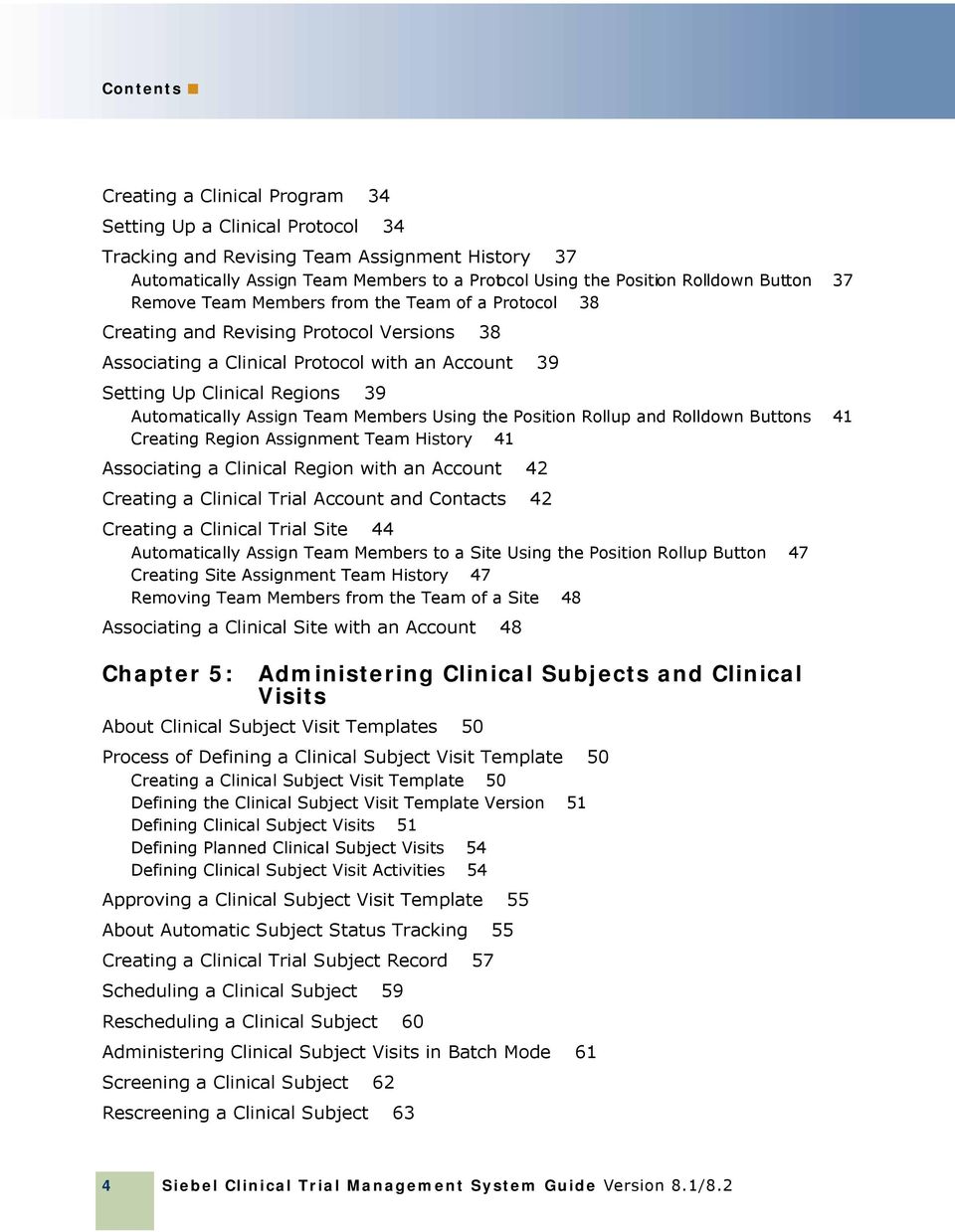
4 Contents Creating a Clinical Program 34 Setting Up a Clinical Protocol 34 Tracking and Revising Team Assignment History 37 Automatically Assign Team Members to a Protocol Using the Position Rolldown Button 37 Remove Team Members from the Team of a Protocol 38 Creating and Revising Protocol Versions 38 Associating a Clinical Protocol with an Account 39 Setting Up Clinical Regions 39 Automatically Assign Team Members Using the Position Rollup and Rolldown Buttons 41 Creating Region Assignment Team History 41 Associating a Clinical Region with an Account 42 Creating a Clinical Trial Account and Contacts 42 Creating a Clinical Trial Site 44 Automatically Assign Team Members to a Site Using the Position Rollup Button 47 Creating Site Assignment Team History 47 Removing Team Members from the Team of a Site 48 Associating a Clinical Site with an Account 48 Chapter 5: Administering Clinical Subjects and Clinical Visits About Clinical Subject Visit Templates 50 Process of Defining a Clinical Subject Visit Template 50 Creating a Clinical Subject Visit Template 50 Defining the Clinical Subject Visit Template Version 51 Defining Clinical Subject Visits 51 Defining Planned Clinical Subject Visits 54 Defining Clinical Subject Visit Activities 54 Approving a Clinical Subject Visit Template 55 About Automatic Subject Status Tracking 55 Creating a Clinical Trial Subject Record 57 Scheduling a Clinical Subject 59 Rescheduling a Clinical Subject 60 Administering Clinical Subject Visits in Batch Mode 61 Screening a Clinical Subject 62 Rescreening a Clinical Subject 63 4 Siebel Clinical Trial Management System Guide Version 8.1/8.2
5 Contents Enrolling a Clinical Subject 63 Randomizing a Clinical Subject 64 Overriding Initial Clinical Subject Status 65 Creating an Unscheduled Subject Visit 65 Terminating a Clinical Subject s Trial Early 66 Applying Protocol Amendments to Clinical Sites and Subjects 67 Applying a Revised Subject Visit Template to a Site 67 Applying a Revised Subject Visit Template to a Subject 68 Rules for Applying Protocol Amendments 69 Rules for Deleting Visits Deemed Non-applicable by Early Termination 70 About Subject Enrollment Information RollUp 70 Viewing Clinical Subject Status Accruals for a Site 72 Viewing Clinical Subject Status Accruals for a Region 73 Viewing Clinical Subject Status Accruals for a Protocol 73 Monitoring Clinical Subject Enrollment Rates 73 Monitoring Clinical Subject Status Accruals by Visit Type 74 Using Audit Trail for Clinical Subject Status 75 Generating Oracle BI Publisher Reports for Clinical Site Enrollment Status 76 Chapter 6: Managing Clinical Trial Sites and Clinical Contacts About Managing Clinical Trial Sites and Clinical Contacts 78 Scenario for Managing Clinical Trial Sites and Clinical Contacts 78 Process of Managing Clinical Trial Site and Contact Information 79 Creating a Clinical Protocol Site Template 80 Creating Contact and Account Assessment Templates 81 Maintaining Contact and Account Information 81 Associating Contracts with a Clinical Trial Site 81 Associating Accounts with a Clinical Trial Site Contract 82 Creating and Managing Clinical Trial Site Visits 83 Creating and Updating Site, Contact, and Account Records 84 Capturing Different Types of Addresses for Each Site 85 Assigning Employees to the Site Team 85 Siebel Clinical Trial Management System Guide Version 8.1/8.2 5

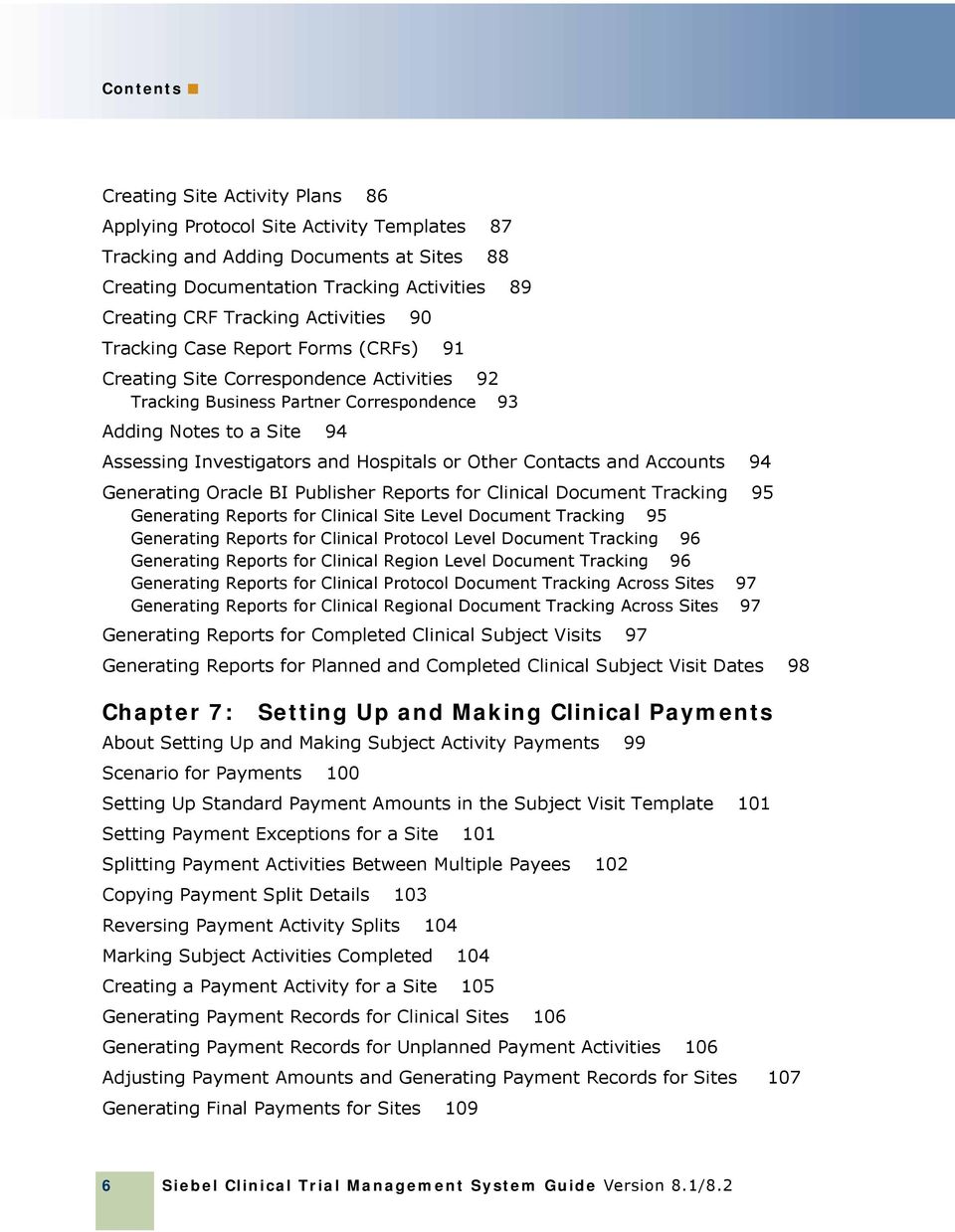
6 Contents Creating Site Activity Plans 86 Applying Protocol Site Activity Templates 87 Tracking and Adding Documents at Sites 88 Creating Documentation Tracking Activities 89 Creating CRF Tracking Activities 90 Tracking Case Report Forms (CRFs) 91 Creating Site Correspondence Activities 92 Tracking Business Partner Correspondence 93 Adding Notes to a Site 94 Assessing Investigators and Hospitals or Other Contacts and Accounts 94 Generating Oracle BI Publisher Reports for Clinical Document Tracking 95 Generating Reports for Clinical Site Level Document Tracking 95 Generating Reports for Clinical Protocol Level Document Tracking 96 Generating Reports for Clinical Region Level Document Tracking 96 Generating Reports for Clinical Protocol Document Tracking Across Sites 97 Generating Reports for Clinical Regional Document Tracking Across Sites 97 Generating Reports for Completed Clinical Subject Visits 97 Generating Reports for Planned and Completed Clinical Subject Visit Dates 98 Chapter 7: Setting Up and Making Clinical Payments About Setting Up and Making Subject Activity Payments 99 Scenario for Payments 100 Setting Up Standard Payment Amounts in the Subject Visit Template 101 Setting Payment Exceptions for a Site 101 Splitting Payment Activities Between Multiple Payees 102 Copying Payment Split Details 103 Reversing Payment Activity Splits 104 Marking Subject Activities Completed 104 Creating a Payment Activity for a Site 105 Generating Payment Records for Clinical Sites 106 Generating Payment Records for Unplanned Payment Activities 106 Adjusting Payment Amounts and Generating Payment Records for Sites 107 Generating Final Payments for Sites Siebel Clinical Trial Management System Guide Version 8.1/8.2
7 Contents Reverting a Payment Record 109 Generating Oracle BI Publisher Reports for Siebel Clinical Payments 110 Chapter 8: Administering and Using Clinical Trip Reports About Administering and Using Clinical Trip Reports 113 Scenario for Managing Clinical Trip Reports 114 Creating Clinical Trip Report Questions Using Siebel SmartScript 115 Creating a Clinical Trip Report Template 116 Applying a Clinical Trip Report Template 117 Completing a Clinical Trip Report 117 Completing a Clinical Trip Report Questionnaire 119 Deleting Unanswered Questions from a Clinical Trip Report Questionnaire 120 Tracking Case Report Forms 120 Automated Validation and Notification Messages for Clinical Trip Reports 121 Tracking Clinical Trip Report Completion Status 124 Tracking Subject Status Accruals for a Site 126 Viewing Universal Inbox Notifications for Clinical Trip Report Action Items 127 Reviewing a Clinical Trip Report 128 Approving a Clinical Trip Report 129 Viewing Clinical Trip Report Geographical Location Details 129 Using Audit Trail for Clinical Trip Report Reviews and Approvals 130 Using Audit Trail for Clinical Trip Report Changes 131 Deleting a Clinical Trip Report 132 Generating BI Publisher Reports for Clinical Site Visits 133 Chapter 9: Managing Clinical Projects About Managing Clinical Projects 135 Scenario for Managing Clinical Projects 135 Process of Managing Clinical Projects 136 Creating a Project Activity Template 137 About Setting Up Employee Profiles 137 Setting Up Position Types and Rate Lists for Billing 138 Siebel Clinical Trial Management System Guide Version 8.1/8.2 7

8 Contents Creating a Project 139 Associating People and Accounts with Projects 139 Creating Activities and Tasks for a Project 141 Monitoring Project Costs 142 Managing Risk 142 About Views in the Projects Screen 143 Chapter 10: Setting Up and Configuring Clinical Trial Site Visit Data Integration Overview of Clinical Trial Site Visit Data Integration 145 Customizing Clinical Trial Site Visit Data Integration Web Services 146 Process of Setting Up Clinical Trial Site Visit Data Integration for Siebel Clinical 146 Activating Workflows for Clinical Trial Site Visit Data Integration 146 Configuring Web Services for Clinical Trial Site Visit Data Integration 147 Enabling Siebel Server Component Groups for Clinical Trial Site Visit Data Integration 147 Exporting Clinical Trial Site Visit Data from Siebel Clinical 148 Exporting Clinical Trial Site Geographical Location Details to Siebel Clinical 150 Viewing Clinical Trial Site Visit Geographical Location Details in the Trip Report 152 Chapter 11: Setting Up and Configuring Mobile Integration for Siebel Clinical Trip Reports Overview of Mobile Integration for Siebel Clinical Trip Reports 155 Customizing Siebel Clinical Trial Management System Mobile Integration Web Services 155 Process of Setting Up Mobile Integration for Siebel Clinical Trip Reports 156 Setting Up Trial Site Visit Data Integration Prerequisites 156 Activating the LS Clinical Workflow for Mobile Integration 156 Configuring Web Services for Mobile Integration 157 Exporting List of Value Records for Mobile Integration 157 Exporting Clinical Template Details for Mobile Integration 159 Exporting Siebel Clinical Users for Mobile Integration 159 Adding Users to the Assigned To MVG 160 Exporting Clinical Site Contact Records 160 Exporting Subject Visit Records for Mobile Integration Siebel Clinical Trial Management System Guide Version 8.1/8.2

9 Contents Exporting Site Records for Mobile Integration 161 Exporting and Importing Clinical Trip Report Records for Mobile Integration 161 Exporting Clinical Trip Report State Transition Data 162 Chapter 12: Setting Up and Configuring Clinical Data Management System Integration Overview of Integrating Siebel Clinical with a Clinical Data Management System 163 Customizing Clinical Data Management System Integration Web Service 164 Process of Setting Up Clinical Data Management System Integration for Siebel Clinical 164 Configuring Siebel Tools for Clinical Data Management System Integration 165 Activating Workflows for Clinical Data Management System Integration 166 Setting Up the LS Clinical Integration Workflow Monitor Agent for Clinical Data Management System Integration 166 Configuring Web Services for Clinical Data Management System Integration 167 Creating the Directory Structure on the Siebel Server for Clinical Data Management System Integration 167 Creating the Oracle WebLogic Full Client JAR for Clinical Data Management System Integration 168 Creating the JNDI Properties File for Clinical Data Management System Integration 168 Configuring the JVM Subsystem for Clinical Data Management System Integration 169 Configuring Java Message Service Parameters for Clinical Data Management System Integration 170 Populating Domain Value Maps 171 Siebel Clinical and Oracle Clinical Integration Entities 173 Integrating an Oracle Clinical Study with a Siebel Clinical Protocol 174 Integrating Investigator Data 176 Integrating Clinical Visit Data with Activity Data 177 Activating the Synchronization of Protocol Site Data 178 Viewing Protocols Enabled for Synchronization 180 About Synchronizing Sites 180 How Subject Data Is Integrated 180 About the Integration of Activity Completion Data 181 Chapter 13: Setting Up and Configuring Clinical Trial Payments Integration Overview of Integrating Clinical Trial Payments 183 Siebel Clinical Trial Management System Guide Version 8.1/8.2 9

10 Contents Customizing Clinical Trial Payments Integration Web Service 185 Process of Setting Up Clinical Trial Payments Integration for Siebel Clinical 185 Configuring Siebel Tools for Clinical Trial Payments Integration 185 Activating Workflows for Clinical Trial Payments Integration 187 Configuring the Clinical Trial Payments Inbound Web Service 188 Configuring Java Message Service Parameters 188 Sending a Payment Request from Siebel Clinical to a Third-Party Application 189 Withdrawing a Payment Request 189 Viewing Feedback for Payment Requests 190 Verifying Processed Payments 190 Appendix A: Siebel Clinical Developer s Reference Overview of User Properties for Siebel Clinical 191 Siebel Clinical Business Component User Property Reference 192 Siebel Clinical Business Service User Property Reference 206 Siebel Clinical Applet Property Reference 207 Siebel Clinical Field Property Reference 208 Siebel Clinical Workflow Reference 209 Siebel Clinical Web Services Reference 212 Index 10 Siebel Clinical Trial Management System Guide Version 8.1/8.2

11 1 What s New in This Release What s New in Siebel Clinical Trial Management System Guide, Version 8.1/8.2 Table 1 describes the changes in this version of the documentation to support the new features in Siebel CRM version and Siebel CRM version NOTE: Oracle provides the functionality that this revision describes as part of Siebel Innovation Pack To complete the Siebel Innovation Pack 2013 prerequisite installation and setup tasks, and postinstallation configuration tasks, see the applicable Siebel Maintenance Release Guide on My Oracle Support. Table 1. What s New in Siebel Clinical Trial Management System Guide, Version 8.1/8.2 Topic Creating a Clinical Trial Subject Record on page 57 Description Modified topic. It has been updated to include the following fields: Subject ID Encounter Date Subject ID has replaced the Subject Initials field. Encounter Date has replaced the Subject DOB field. These changes have been made to remove personally identifiable information from Oracle s Siebel Clinical Trial Management System. The application labels for these fields have been changed, but the application logic remains the same. Upgrading to Siebel Innovation Pack 2013 from a previous version will not delete existing values for these fields. The Screening Number is now automatically generated from the Subject ID field and the Encounter Date field. Associating Accounts with a Clinical Trial Site Contract on page 82 Splitting Payment Activities Between Multiple Payees on page 102 Copying Payment Split Details on page 103 New topic. It describes how to associate an account with a clinical trial site contract. Multiple accounts can be associated with a clinical trial site contract. New topic. It describes how to split a payment activity between multiple contracts and payees. New topic. It describes how to copy the details of a split payment to multiple payment activities. Payment activity splits are copied at the Payment Exceptions level. Siebel Clinical Trial Management System Guide Version 8.1/8.2 11

12 What s New in This Release Table 1. What s New in Siebel Clinical Trial Management System Guide, Version 8.1/8.2 Topic Reversing Payment Activity Splits on page 104 Creating a Payment Activity for a Site on page 105 Description New topic. It describes how to reverse a payment activity split. Modified topic. It has been updated to include contract, account, and payee details for a clinical site payment record. The following fields have been added to the Payment Activities view: Account Contract Payee First Name Payee Last Name Generating Final Payments for Sites on page 109 Modified topic. It has been updated to include the following fields: Account VAT Amount Reverting a Payment Record on page 109 New topic. It describes how to revert a payment record to modify the payment details. The Revert button is enabled when a single payment record with one of the following statuses is selected: In Progress To Be Processed Creating Clinical Trip Report Questions Using Siebel SmartScript on page 115 Creating a Clinical Trip Report Template on page 116 Applying a Clinical Trip Report Template on page 117 Completing a Clinical Trip Report Questionnaire on page 119 Deleting Unanswered Questions from a Clinical Trip Report Questionnaire on page 120 New topic. It describes how to create clinical trip report questionnaires using Siebel SmartScript. New topic. It describes how to create a trip report template in the new Trip Report Templates view of the Administration - Clinical screen. Modified topic. It has been updated to describe support for SmartScript questionnaires. New topic. It describes how to complete a clinical trip report questionnaire. The questionnaire is launched in the SmartScript player from the Trip Report Questions applet. New topic. It describes how to delete unanswered questions from a clinical trip report questionnaire. 12 Siebel Clinical Trial Management System Guide Version 8.1/8.2

13 What s New in This Release Table 1. What s New in Siebel Clinical Trial Management System Guide, Version 8.1/8.2 Topic Tracking Case Report Forms on page 120 Description Modified topic. The following fields have been added to the Case Report Forms Tracking applet: Charts Reviewed Date Forms Signed Date Page Numbers Verified Tracking Clinical Trip Report Completion Status on page 124 New topic. It describes how to track the real-time status details for a clinical trip report in the Summary view. The status is tracked for the following clinical trip report elements: Checklists Completed Questions Answered Current Follow-Ups Completed All Follow-Ups Completed CRF Tracking Completed Total Attendees Tracking Subject Status Accruals for a Site on page 126 Reviewing a Clinical Trip Report on page 128 New topic. It describes how to track the progress of a clinical site by creating a real-time system snapshot of the current subject status accruals for a site. Modified topics. Access control has been added for the following fields: Approving a Clinical Trip Report on page 129 Reviewer Comments Approver Comments Setting Up the LS Clinical Integration Workflow Monitor Agent for Clinical Data Management System Integration on page 166 New topic. It describes how to set up the LS Clinical Integration workflow monitor agent for clinical data management system integration. The workflow policies for clinical data management system integration were moved to a new policy group for improved performance. Siebel Clinical Trial Management System Guide Version 8.1/8.2 13

14 What s New in This Release Table 1. What s New in Siebel Clinical Trial Management System Guide, Version 8.1/8.2 Topic Activating the Synchronization of Protocol Site Data on page 178 Description Modified topic. The following integration fields have been added: Locale Maximum Enrollment Number Time Zone Siebel Clinical Business Component User Property Reference on page 192 Modified topic. The following business component user properties have been added: LS Amount Rollup Field 3 LS Amount Rollup On Status 1 LS Clinical Enable Revert On Status Named Method 1 Additional Changes Siebel Clinical Trial Management System Guide is a new guide on the Siebel Bookshelf. The Siebel Clinical Trial Management System content has been moved from Siebel Life Sciences Guide to Siebel Clinical Trial Management System Guide. The following topics have also been added for this revision: Generating Reports for Completed Clinical Subject Visits on page 97 Generating Reports for Planned and Completed Clinical Subject Visit Dates on page Siebel Clinical Trial Management System Guide Version 8.1/8.2

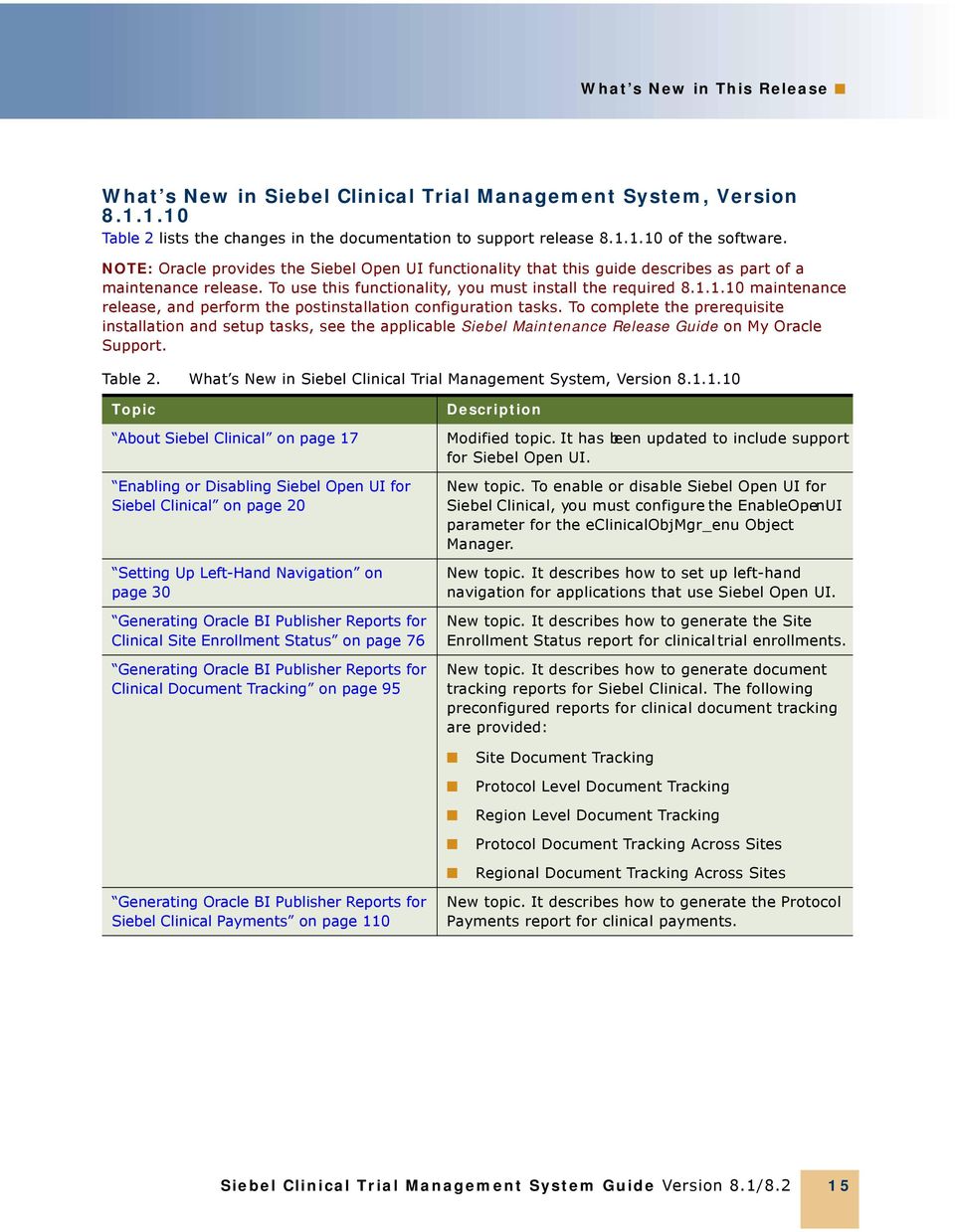
15 What s New in This Release What s New in Siebel Clinical Trial Management System, Version Table 2 lists the changes in the documentation to support release of the software. NOTE: Oracle provides the Siebel Open UI functionality that this guide describes as part of a maintenance release. To use this functionality, you must install the required maintenance release, and perform the postinstallation configuration tasks. To complete the prerequisite installation and setup tasks, see the applicable Siebel Maintenance Release Guide on My Oracle Support. Table 2. What s New in Siebel Clinical Trial Management System, Version Topic About Siebel Clinical on page 17 Enabling or Disabling Siebel Open UI for Siebel Clinical on page 20 Setting Up Left-Hand Navigation on page 30 Generating Oracle BI Publisher Reports for Clinical Site Enrollment Status on page 76 Generating Oracle BI Publisher Reports for Clinical Document Tracking on page 95 Description Modified topic. It has been updated to include support for Siebel Open UI. New topic. To enable or disable Siebel Open UI for Siebel Clinical, you must configure the EnableOpenUI parameter for the eclinicalobjmgr_enu Object Manager. New topic. It describes how to set up left-hand navigation for applications that use Siebel Open UI. New topic. It describes how to generate the Site Enrollment Status report for clinical trial enrollments. New topic. It describes how to generate document tracking reports for Siebel Clinical. The following preconfigured reports for clinical document tracking are provided: Site Document Tracking Protocol Level Document Tracking Region Level Document Tracking Protocol Document Tracking Across Sites Regional Document Tracking Across Sites Generating Oracle BI Publisher Reports for Siebel Clinical Payments on page 110 New topic. It describes how to generate the Protocol Payments report for clinical payments. Siebel Clinical Trial Management System Guide Version 8.1/8.2 15
16 What s New in This Release 16 Siebel Clinical Trial Management System Guide Version 8.1/8.2

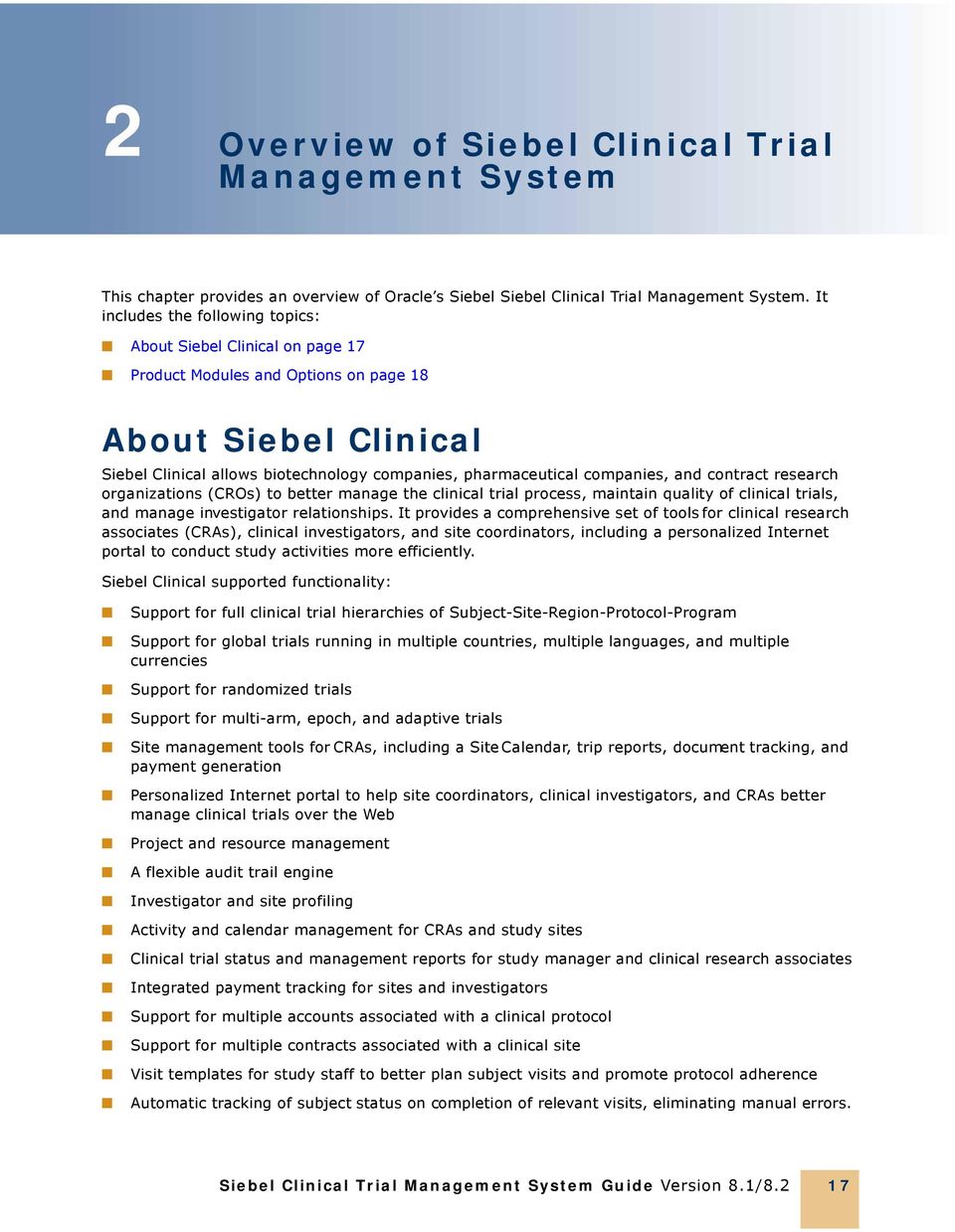
17 2 Overview of Siebel Clinical Trial Management System This chapter provides an overview of Oracle s Siebel Siebel Clinical Trial Management System. It includes the following topics: About Siebel Clinical on page 17 Product Modules and Options on page 18 About Siebel Clinical Siebel Clinical allows biotechnology companies, pharmaceutical companies, and contract research organizations (CROs) to better manage the clinical trial process, maintain quality of clinical trials, and manage investigator relationships. It provides a comprehensive set of tools for clinical research associates (CRAs), clinical investigators, and site coordinators, including a personalized Internet portal to conduct study activities more efficiently. Siebel Clinical supported functionality: Support for full clinical trial hierarchies of Subject-Site-Region-Protocol-Program Support for global trials running in multiple countries, multiple languages, and multiple currencies Support for randomized trials Support for multi-arm, epoch, and adaptive trials Site management tools for CRAs, including a Site Calendar, trip reports, document tracking, and payment generation Personalized Internet portal to help site coordinators, clinical investigators, and CRAs better manage clinical trials over the Web Project and resource management A flexible audit trail engine Investigator and site profiling Activity and calendar management for CRAs and study sites Clinical trial status and management reports for study manager and clinical research associates Integrated payment tracking for sites and investigators Support for multiple accounts associated with a clinical protocol Support for multiple contracts associated with a clinical site Visit templates for study staff to better plan subject visits and promote protocol adherence Automatic tracking of subject status on completion of relevant visits, eliminating manual errors. Siebel Clinical Trial Management System Guide Version 8.1/8.2 17
18 Overview of Siebel Clinical Trial Management System Product Modules and Options Clinical trip report templates for CRAs to facilitate compliance with good clinical practice (GCP) Automated notification s sent to trip report owner, reviewer, and approver Audit trail for trip report reviews and approvals Clinical trip report approver verification Mobile support for clinical trip report remote updates Support for the Siebel high interactivity framework and Siebel Open UI framework. Siebel Clinical was designed to allow clinical research organizations, pharmaceutical and biotech companies, and other clinical trial sponsors to: Deploy a Web-based clinical trial management system to internal and external users Make better decisions throughout the clinical trials process, leading to more efficient use of resources and faster time to market Increase productivity of CRAs and their managers by automating repetitive tasks and allowing real-time information sharing Create sustainable competitive advantage by allowing customers to provide breakthrough service to sites and investigators Provide a solution integrated with Siebel Pharma Sales and Siebel Pharma Service to allow customers to deploy one customer management system across the entire enterprise Siebel Clinical supports the 21 CFR Part 11 industry standard. Product Modules and Options You can purchase many Siebel Business Applications modules and use them with Siebel Clinical Trial Management System and Siebel Life Sciences. In addition, you can purchase the optional modules that are specific to Siebel Life Sciences to provide enhanced functionality for various business processes. For information about the optional modules to use with Siebel Life Sciences and Siebel Clinical Trial Management System, contact your Oracle sales representative. This guide documents Siebel Life Sciences with the optional modules installed. In addition, the Sample database includes data for optional modules. If your installation does not include some of these modules, your software interface will differ from that described in some sections of this guide. The exact configuration of Siebel Life Sciences screens and views depends on your company s configuration of the application. For more information on Siebel Life Sciences, see Siebel Life Sciences Guide. For introductory information on using the Siebel Life Sciences interface, see Siebel Fundamentals on the Siebel Bookshelf. NOTE: The Siebel Bookshelf is available on Oracle Technology Network ( technetwork/indexes/documentation/index.html) and Oracle Software Delivery Cloud. 18 Siebel Clinical Trial Management System Guide Version 8.1/8.2

19 3 Setting Up Siebel Clinical This chapter covers setting up Siebel Clinical. It includes the following topics: About Setting Up Siebel Clinical on page 19 Configuring Siebel Clinical Properties in Siebel Tools on page 20 Enabling or Disabling Siebel Open UI for Siebel Clinical on page 20 Enabling Server Component Groups for Siebel Clinical on page 20 Activating Workflow Policies for Siebel Clinical on page 21 Configuring Web Services for Siebel Clinical on page 23 Setting Up Mobile Integration for Siebel Clinical Trip Reports on page 24 Setting Up Siebel Clinical for Integration with a Third-Party Payments Application on page 24 Administrative Setup Tasks for Siebel Clinical on page 24 About the My Team s Filter on page 26 Using Assignment Manager in Siebel Clinical on page 26 Setting Up Mobile Web Clients for Position Rollup on page 29 Setting Up Left-Hand Navigation on page 30 About Setting Up Siebel Clinical This chapter lists the applications administration tasks that are specific to Siebel Clinical. Use this chapter in combination with Siebel Applications Administration Guide, the main guide for performing administrative tasks. Siebel Applications Administration Guide covers the setup tasks that are common to all Siebel Business Applications, such as using license keys, defining employees, and defining your company s structure. It also provides the information you will need to implement, configure, and monitor the Sales, Service, and Marketing products and to perform Data Administration and Document Administration tasks. Some tasks listed in this chapter might replace those in the administration guide whereas others might be additional tasks. Make sure you review Table 3 on page 24 before following the procedures in Siebel Applications Administration Guide. This guide assumes that you have already installed Siebel Clinical or completed an upgrade from another Siebel Business Application. If you have not, refer to the Installation/Upgrade section of the Siebel Bookshelf and click the links to the guides that are relevant to your company s implementation. Siebel Clinical Trial Management System Guide Version 8.1/8.2 19

20 Setting Up Siebel Clinical Configuring Siebel Clinical Properties in Siebel Tools The Siebel database server installation script creates a Siebel administrator account that can be used to perform the tasks described in this guide. For information about this process, see the Siebel Installation Guide for the operating system you are using for the operating system you are using, and Siebel System Administration Guide. CAUTION: Do not perform system administration functions on your local database, as it can cause data conflicts, an overly large local database, or a large number of additional transactions to route. Configuring Siebel Clinical Properties in Siebel Tools User properties are object definitions that are added to an applet, business component, control, field, or list column to enable and configure specialized behavior. Some Siebel Clinical features are driven by user properties. You can customize these features through their respective user properties. With user properties, you can control UI behavior, change default settings or leave them as they are, and enable or disable features. For information on enabling and configuring the Tools object definitions required for Siebel Clinical, see Appendix A, Siebel Clinical Developer s Reference. Enabling or Disabling Siebel Open UI for Siebel Clinical To enable or disable Siebel Open UI for Siebel Clinical, you must configure the EnableOpenUI parameter for the eclinicalobjmgr_enu Object Manager. Siebel Open UI is disabled by default. For information on configuring the Object Manager to enable Siebel Open UI, see the Siebel Installation Guide for the operating system you are using. Enabling Server Component Groups for Siebel Clinical This system administration task describes how to activate the component groups that are required for Siebel Clinical. To enable server component groups for Siebel Clinical 1 Navigate to the Administration - Server Configuration screen, and then the Component Groups view. 2 Query for the Workflow Management Component Group. 3 On the Component Groups applet, click the Enable button. 4 Query for the EAI Component Group. 5 On the Component Groups applet, click the Enable button 20 Siebel Clinical Trial Management System Guide Version 8.1/8.2
21 Setting Up Siebel Clinical Activating Workflow Policies for Siebel Clinical 6 Navigate to the Administration Server Management screen, then the Servers and Component Groups view. 7 Verify that the State value for the Workflow Management and EAI Component Groups is set to Online. 8 Navigate to Administration Server Configuration screen, then the Enterprises and Synchronize view. 9 Click Synchronize. 10 Restart the Siebel Server. Activating Workflow Policies for Siebel Clinical This system administration task describes how to activate the workflows and workflow policies required for Siebel Clinical. For a full list of workflows provided for Siebel Clinical, see Table 21 on page 209. To activate the workflow policies for Siebel Clinical 1 Navigate to the Business Process Administration screen, then the Workflow Deployment view. 2 Query for and activate all of the following workflows: Clinical* LS Clinical* 3 Verify that each activated workflow is added to the Active Workflow Processes list view at the bottom of the screen. 4 Navigate to the Runtime Events Administration screen and reload runtime events from the menu. 5 Navigate to the Business Process Administration screen, then the Workflow Policies view and perform the following: a b c Query workflow policies for LS Clinical* Set the activation date to one day before today s date for all policies. Check that expiration date is NULL for all policies. 6 Navigate to the Server Management Administration screen, then the Jobs view and generate triggers for the workflow policies returned from your query as follows: a Define a job for component Generate Triggers with the following parameters: EXEC=True Mode=ALL Privileged User=<%SADMIN%> Privileged User Password=<%PASSWORD%> Siebel Clinical Trial Management System Guide Version 8.1/8.2 21
22 Setting Up Siebel Clinical Activating Workflow Policies for Siebel Clinical b Start the job and query until the status is Success. 7 From the srvrmgr command utility, create a component definition for the policy group LS Clinical Rollup as follows: Component definition: LSCLIN Component type: WorkMon Component group: Workflow Run mode: Background Full name: LS Clinical Description: Monitors LS Clinical Workflow Manager events Parameter DfltTasks=1, GroupName=LS Clinical Rollup, SleepTime=30 NOTE: When working with component definition commands, launch and run the srvrmgr program for the enterprise; that is, do not start srvrmgr with the /s (or -s for UNIX). The component alias must be unique across the enterprise, and must not be more than 30 characters in length. Also be careful not to use keywords in the component description, such as for or component, unless they are enclosed in quotes. The component definition command starts a task to perform actions on LS Clinical Rollup group policy as a result of updates on the corresponding tables monitored by the database triggers. The SleepTime parameter represents the time in seconds for processing requests. The default value is 20 seconds. Setting the SleepTime user property to a low value or zero can have serious negative performance consequences. 8 Enter the following in the srvrmgr command utility to enable the LS Clinical Rollup component: enable component definition LSCLIN 9 From the srvrmgr command utility, create a component definition for the policy group LS Clinical Trip Report as follows: Component definition: LSCLIN_TRIP Component type: WorkMon Component group: Workflow Run mode: Background Full name: LS ClinicalTrip Report Description: Monitors LS Clinical Trip Reportl Workflow Manager events Parameter DfltTasks=1, GroupName=LS Clinical Trip Report, SleepTime=30 The component definition command starts a task to perform actions on LS Clinical Trip Report group policy as a result of updates on the corresponding tables monitored by the database triggers. 22 Siebel Clinical Trial Management System Guide Version 8.1/8.2
23 Setting Up Siebel Clinical Configuring Web Services for Siebel Clinical 10 Enter the following in the srvrmgr command utility to enable the LS Clinical Trip Report component: enable component definition LSCLIN_TRIP 11 Navigate to the Server Configuration Administration screen, then the Synchronize view and click Synchronize. 12 Check that the Workflow Monitor Agent is running. If it is not activated, start the Workflow Monitor Agent task again. 13 Navigate to the Administration - Server Management screen, then the Tasks view. 14 Select the Parameters tab in the lower applet. The Server Task view displays. 15 In the Server Task list applet, query for the Workflow Monitor Agent in the Component Field. 16 In Server Task-Parameter list applet, query for Action Interval in the Parameter field and set the value to 10. Configuring Web Services for Siebel Clinical This task describes how to configure Web services for Siebel Clinical. NOTE: It is recommended that you use HTTPS authentication. For information on configuring Secure Sockets Layer (SSL) for HTTPS authentication, see Siebel Security Guide. To configure Web services for Siebel Clinical 1 Navigate to the Administration - Web Services screen, then the Inbound Web Services view. 2 Query for the ClinicalSubject Inbound Web service. 3 On the Service Ports applet, update the Address variable to point to your Web server. 4 Configure the Language variable. 5 Query for the SWILSClinicalQueryProtocolSite_SiteVisits Web service. 6 On the Service Ports applet, update the Address variable to point to your Web server. 7 Configure the Language variable. 8 Query for the SWILSClinicalCreateSiteVisitGeoLocation Web service. 9 On the Service Ports applet, update the Address variable to point to your Web server. 10 Configure the Language variable. 11 Click Clear Cache on the Inbound Web Services applet. For more information on configuring Web Services, see Integration Platform Technologies: Siebel Enterprise Application Integration on the Siebel Bookshelf. Siebel Clinical Trial Management System Guide Version 8.1/8.2 23
24 Setting Up Siebel Clinical Setting Up Mobile Integration for Siebel Clinical Trip Reports Setting Up Mobile Integration for Siebel Clinical Trip Reports For information on setting up mobile integration for Siebel Clinical trip reports, s e Process of Setting Up Mobile Integration for Siebel Clinical Trip Reports on page 156. Setting Up Siebel Clinical for Integration with a Third-Party Payments Application For information on setting up Siebel Clinical for integration with a third-party payments application, see Process of Setting Up Clinical Trial Payments Integration for Siebel Clinical on page 185. Administrative Setup Tasks for Siebel Clinical Table 3 lists the administrative setup procedures that are specific to Siebel Clinical and procedures that might differ from those of the other Siebel Business Applications. The table also directs you to documentation containing information about each task. When setting up your application, use Table 3 in combination with the main resource, Siebel Applications Administration Guide. Table 3. Siebel Clinical Administration Tasks Administrative Task Description For More Information Managing Accounts Contacts in Life Sciences Activating workflows for accounts contacts Enabling server components for accounts contacts Siebel Life Sciences Guide Generating column maps for accounts contacts list Creating product data to display in accounts contacts List Creating a Clinical Program Creating a protocol Revising protocols Setting up regions (Optional) Defining a subject visit template Chapter 4, Setting Up a Clinical Trial Chapter 5, Administering Clinical Subjects and Clinical Visits Chapter 6, Managing Clinical Trial Sites and Clinical Contacts 24 Siebel Clinical Trial Management System Guide Version 8.1/8.2
25 Setting Up Siebel Clinical Administrative Setup Tasks for Siebel Clinical Table 3. Siebel Clinical Administration Tasks Administrative Task Description For More Information Managing Sites Creating a protocol site template Creating contact and account templates Chapter 6, Managing Clinical Trial Sites and Clinical Contacts Setting Up Clinical Payments Maintaining contact and account information Setting up site contracts Setting up standard payment amounts in subject visit templates Adjusting payment amounts and generating payments for sites Chapter 7, Setting Up and Making Clinical Payments Creating Trip Report Templates Creating trip report templates Approving trip report templates Chapter 8, Administering and Using Clinical Trip Reports Creating Project Templates Creating project templates Chapter 9, Managing Clinical Projects Importing Data Importing data with EIM Siebel Life Sciences Guide Importing, extracting, and routing syndicated data Charting denormalized syndicated data Configuring Siebel Clinical Configuring Siebel Clinical Business Component User Properties Appendix A, Siebel Clinical Developer s Reference Configuring Siebel Clinical Business Service User Properties Configuring Siebel Clinical Applet Properties Configuring Siebel Clinical Field Properties Configuring Siebel Clinical Workflows Customizing Siebel Clinical Web Services Siebel Clinical Trial Management System Guide Version 8.1/8.2 25
26 Setting Up Siebel Clinical About the My Team s Filter About the My Team s Filter The Show drop-down list is found on many screens. It provides a list of filters such as My Contacts, My Team s Contacts, and All Contacts. These filters determine what records appear in the view. The behavior of the My Team s filter varies from screen to screen. In some screens, this filter displays those records where the primary member of the team reports to the user. In other screens, the filter displays records where any of the team members reports to the user. This behavior is determined in the business component by the Manager List Mode user property. If the Manager List Mode user property is active and set to Team, the My Team s filter displays all records where the user s subordinate is on the team but is not necessarily the primary member. Table 4 lists the default setting of the Manager List Mode user property for some Siebel Clinical screens and business components. Table 4. The Default Setting for the Manager List Mode Use Property Screen Business Component Manager List Mode Accounts Accounts Inactive Contacts Contact Inactive Protocols Clinical Protocol Active Site Management Clinical Protocol Site Active Using Assignment Manager in Siebel Clinical Siebel Assignment Manager allows the Siebel administrator to automatically assign tasks to specific people. To do this, however, the Siebel administrator must first define assignment rules for each task. For more information on using and implementing Siebel Assignment Manager, see Siebel Assignment Manager Administration Guide. For additional information on creating territories and running territory realignments, see Siebel Territory Management Guide. This topic provides Siebel Assignment Manager information that is specific to Siebel Clinical. 26 Siebel Clinical Trial Management System Guide Version 8.1/8.2
27 Setting Up Siebel Clinical Using Assignment Manager in Siebel Clinical Predefined Assignment Objects Some of the predefined assignment objects and underlying criteria described in Siebel Assignment Manager Administration Guide have been modified in Siebel Life Sciences to support pharmaceutical business processes. Table 5 describes the assignment objects that are changed in Siebel Life Sciences. NOTE: Assignment Item Type Industry Name is not supported. This assignment rule is defined for Siebel Business Applications and currently conflicts with Siebel Life Sciences assignment rules. Siebel Life Sciences uses the assignment item type Industry SIC Code. Table 5. Assignment Objects Changes in Siebel Life Sciences Assignment Object Account Modifications The assignment criteria SIC Code has been renamed Account Class of Trade. Its assignment criteria are: Account City State Country Account Brick Account Brick source table has been changed to S_CON_ADDR and source column has been changed to BRICK_ID. Contact This assignment object was created specifically for Siebel Life Sciences and is not described in Siebel Assignment Manager Administration Guide. The assignment criteria are: Contact Contact Medical Specialty Code Contact Wildcard Contact City Contact State Contact Country Contact Zip Code Contact City State Country Contact Brick Medical Specialty Organization Position Siebel Clinical Trial Management System Guide Version 8.1/8.2 27
28 Setting Up Siebel Clinical Using Assignment Manager in Siebel Clinical Contact Assignments in Siebel Clinical In most Siebel Business Applications, assignment of contacts is based on primary address. This process is different for Siebel Life Sciences. A Siebel Life Sciences contact can have multiple addresses, and each representative on the contact s sales team can indicate a different primary address for the same contact. For this reason, do not base the assignment of contacts on the primary address. For example, Representative A might indicate a hospital address as the primary address, while Representative B might indicate a private-office address as primary. In the All Contacts and My Team s Contacts views, the primary address that appears is the one assigned by the primary team member. For more information, see Predefined Assignment Objects on page 27. Contact Denormalization Mode in Siebel Life Sciences Contact Denormalization mode in Siebel Life Sciences differs from the description in Siebel Assignment Manager Administration Guide in the following ways: It denormalizes positions from the account team table to the contact team table for all contacts directly affiliated with an account. Users can specify a direct affiliation between a contact and an account by selecting: The Direct field in the Contacts, Account Affiliations view tab The Direct field in the Accounts, Contact Affiliations view tab For more information, see Siebel Life Sciences Guide. It does not denormalize positions from the opportunity team table to the contact team table. It must be run after running batch mode jobs for contacts and accounts separately. Run three separate batch mode jobs in this order: Contacts Accounts Contact Denormalization Contact Denormalization in Siebel Life Sciences has the following additional important rules, requirements, and exceptions: Running Contact Denormalization mode in Dynamic mode. To activate the Contact Denormalization Policy, set the expiration date to a future date or leave it blank. Then generate the database triggers by running Generate Triggers. Running Contact Denormalization mode in Batch mode. Remember to specify the parameters: Object Name = Contact Denormalization Assignment Mode = Denorm 28 Siebel Clinical Trial Management System Guide Version 8.1/8.2
29 Setting Up Siebel Clinical Setting Up Mobile Web Clients for Position Rollup Contact Denormalization mode does not evaluate rules. Therefore, it is not necessary to create a Contact Denormalization rule-based object to run Assignment Manager in this mode. Also, because it does not evaluate rules, Contact Denormalization mode does not set the pr imary team position. Contact Denormalization assigns contacts to employees who are on the Account Team for which the contacts are directly affiliated. In order to reduce the number of contact-toposition relationship (S_POSTN_CON) rows routed to the manager's local database, the value of the ASGN_DNRM_FLG field is set to N. With this default setting, the contacts that team members have been assigned by the Contact Denormalization process will not be visible to managers on their local databases. However, if the desired behavior is for managers to see all contacts that are assigned to their team members, regardless the assignment method, set the ASGN_DNRM_ Y. Setting Up Mobile Web Clients for Position Rollup In Siebel Clinical, a clinical research associate (CRA) can create sites and assign employees to positions at the site level. When the CRA clicks the position rollup button, these positions become visible at the region and protocol levels. Typically, the CRA works in a disconnected mode, on a laptop computer. The administrator must set up each mobile Web client to allow position rollups. The setup requires the following steps in Siebel Clinical: The administrator exports workflow processes and data maps from the server database to XML files. The administrator connects to a local client, imports the XML files to the client database and activates the workflow processes on the local client. NOTE: Users of the local client must have Workflow Process Definition, EAI DATA Map View, and EAI Data Map Editor in their user responsibilities to accept imported workflow processes and data maps. To export the workflow processes to the local client 1 Export the Clinical Assign Position From Region and Clinical Assign Position From Site workflows to XML files. 2 Import the two XML files to the local client and activate the workflows. For information about exporting and importing workflow processes, see Siebel Business Process Framework: Workflow Guide. To export DTE data maps from the server database to an XML file 1 In Siebel Clinical, connect to the server database. 2 Navigate to the Administration - Integration screen, then the Data Maps view. Siebel Clinical Trial Management System Guide Version 8.1/8.2 29
30 Setting Up Siebel Clinical Setting Up Left-Hand Navigation 3 In the Integration Object Map list, query for Clinical*. The query returns four records Clinical Region Position to Protocol Position Map, Clinical Site Position to Account Position Map, Clinical Site Position to Protocol Position Map, and Clinical Site Position to Region Position Map. 4 In the drop-down menu, select Export Data Map. 5 In the dialog box, check Export All Rows in Current Query and click Export. 6 In the dialog box, select Save to Disk, select a location, and save the data maps as PositionRollupDataMap.xml. To import DTE data maps to a local client from an XML file 1 In Siebel Clinical, connect to the local client. 2 Navigate to the Administration - Integration screen, then the Data Maps view. 3 In the Integration Object Map list, select Import Data Map from the drop-down menu. 4 In the dialog box, select Browse and find PositionRollupDataMap.xml created in the second procedure in this topic, To export DTE data maps from the server database to an XML file on page In the Integration Object Map list, query for Clinical*Position*. Setting Up Left-Hand Navigation The procedures in this guide assume that you do not use left-hand navigation. However, you can set up left-hand navigation for applications that use Siebel Open UI. For more information about lefthand navigation and about implementing it, see Siebel Fundamentals for Siebel Open UI. 30 Siebel Clinical Trial Management System Guide Version 8.1/8.2
31 4 Setting Up a Clinical Trial This chapter describes how to set up a clinical program, protocol, region, and site in Siebel Clinical. It includes the following topics: About Setting Up a Clinical Trial on page 31 Scenario for Clinical Trials on page 32 Process of Managing Clinical Trials on page 33 Creating a Clinical Program on page 34 Setting Up a Clinical Protocol on page 34 Tracking and Revising Team Assignment History on page 37 Creating and Revising Protocol Versions on page 38 Associating a Clinical Protocol with an Account on page 39 Setting Up Clinical Regions on page 39 Associating a Clinical Region with an Account on page 42 Creating a Clinical Trial Account and Contacts on page 42 Creating a Clinical Trial Site on page 44 Associating a Clinical Site with an Account on page 48 About Setting Up a Clinical Trial This chapter describes the main steps involved in carrying out a clinical trial using Siebel Clinical. Following the procedures given in this chapter you will be able to: Create a clinical program and clinical protocols Set up document tracking at the protocol, region, and site levels, and for accounts and contacts Set up and revise subject visit templates for a protocol Enter data on accounts, sites, and contacts Screen and enroll subjects View charts showing subject status and enrollment rates Review payments made to the protocol Siebel Clinical Trial Management System Guide Version 8.1/8.2 31
32 Setting Up a Clinical Trial Scenario for Clinical Trials Figure 1 illustrates the important hierarchical relationship of programs, protocols, regions, and sites. In this example, the Bristol General Hospital in the USA region is participating in the AMXN protocol, which is being carried out as part of the Anemia program. Figure 1. Siebel Clinical Hierarchical Relationships Scenario for Clinical Trials This scenario is an example process performed by the director of clinical trials, clinical study manager, and the clinical research associates (CRAs). Your company might follow a different process according to its business requirements. In this scenario, the clinical director and the study manager, working for a clinical research organization, or pharmaceutical, biotech, or medical device company, have administrator responsibilities in Siebel Clinical to: Set up a new treatment study program. Create one or more protocols designed to assess the safety and efficacy of certain compounds in the treatment of the disease. Set up the geographic regions where the protocols are to be carried out. Compile a list of documents that are critical to the study and implement tracking at the protocol, region, and site levels, and for accounts and contacts. Create a subject visit template to facilitate consistent application of the protocol across sites and subjects. This template is used to set up subject visit schedules and activities according to the guidelines laid out in the protocol. When the program, protocol, and subject visit templates have been set up, the CRAs who are the end users of the Siebel Clinical product do the following: Enter data about the: Sites where the protocols are carried out. Members to be assigned to the teams at the site, region, and protocol levels. 32 Siebel Clinical Trial Management System Guide Version 8.1/8.2
33 Setting Up a Clinical Trial Process of Managing Clinical Trials Accounts, institutions such as hospitals and clinics where the studies are conducted. Contacts, site personnel such as investigators, site coordinators, and nurse practitioners who carry out the protocols. Subjects recruited for the clinical trial. Screen and enroll subjects and, if necessary, rescreen the subjects. Use the subject visit template to set up detailed schedules for the subjects visits to the sites. Track required documents at the protocol, region, or site level, or for accounts or contacts. NOTE: The tasks of entering subject data, and setting up screening and enrollment visit schedules for subjects, can also be performed by the site personnel using Site Portal Web site. For more information about Siebel Site Portal, see Siebel Life Sciences Portals Guide. At various times after subjects have been enrolled in the trial, the clinical director, study manager, or CRAs can use the charting features of Siebel Clinical to review the progress of the trial. Two informative metrics are the subject status and enrollment rate. These are plotted for an individual site, for a region, and for the protocol. Process of Managing Clinical Trials This topic details sample tasks often performed by administrators and end-users when managing clinical trials. Your company might follow a different process according to its business requirements. In the following examples, tasks are carried out in the order presented. For example, a protocol must exist before its subject visit template can be created. Administrator Procedures The following list shows tasks administrators typically perform to manage a clinical trial. These tasks are typically performed in the following order: 1 Creating a Clinical Program on page Setting Up a Clinical Protocol on page Tracking and Revising Team Assignment History on page 37 4 Creating and Revising Protocol Versions on page (Optional) Setting Up Clinical Regions on page 39. End-User Procedures The following list shows tasks end users typically perform when managing a clinical trial. The procedures are performed by the CRA at the site level and are typically performed in the following order: 1 (Optional) Creating a Clinical Trial Account and Contacts on page Creating a Clinical Trial Site on page 44. Siebel Clinical Trial Management System Guide Version 8.1/8.2 33
34 Setting Up a Clinical Trial Creating a Clinical Program Creating a Clinical Program The clinical program is the highest-level initiative in Siebel Clinical. Protocols, regions, sites, and subjects must be associated with a program. Multiple regulatory applications can be associated with a program. To create a new clinical program 1 Navigate to the Clinical Programs screen, then the Program List view. 2 In the Clinical Programs list, create a new record, and complete the necessary fields. NOTE: Before you can create an application, the associated product must be correctly defined. For more information about defining products, see Siebel Life Sciences Guide. Some fields are described in the following table. Field Application Comments A multi-value field containing details of the application. Filed. Whether the application has been filed with the specified regulatory agency. Indication. The clinical indication for the application. Number. The number assigned to the application when submitted to the regulatory agency, for example the (A)NDA or IND number. Product. This field must be completed before a protocol can be created for the program. Sub-Type. Who filed the application. For example, a company or an investigator. Type. The type of application, such as CTN, IND, or CTX. Mechanism Program Partners associated with the clinical program. The name of the clinical program. 3 (Optional) Drill down on the new record and associate files with the clinical program. Setting Up a Clinical Protocol Multiple protocols can be associated with a program. When you have created a protocol record, you can also add extra information about the protocol, such as financial information, central lab information, and so on. 34 Siebel Clinical Trial Management System Guide Version 8.1/8.2
35 Setting Up a Clinical Trial Setting Up a Clinical Protocol To create a clinical protocol record 1 Navigate to the Administration - Clinical screen, then the Protocol List view. 2 In the Protocols list, create a new record, and complete the necessary fields. (To access more fields, drill down on the name field of the protocol and select the More Info tab view.) Some fields are described in the following table. Field Description # Planned Sites Number of sites planned for the protocol. # Planned Subjects Number of subjects planned for the protocol. Actual End Date Actual Start Date Approval Date Central Lab CRO Currency Code The date on which the study concludes. The date on which the study begins. The date on which the protocol was approved by the regulatory authority. The name of the laboratory associated with the study. This is entered through the Accounts screen. Name of the Clinical Research Organization that is sponsoring the trial. The currency that is used to display the payments, costs, and budgets for the protocol. The default value is USD (United States dollars). NOTE: It is important to specify the Currency Code for the protocol. Design Exchange Date Objective Phase Planned End Date Planned Start Date Product Program Protocol # Information about the type of study. The date that determines the exchange rate of the currency used. By default, the exchange date for the protocol is the date the protocol is created. The objective for the clinical trial. Phase of clinical trial, such as Phase I, II, or III. The planned end date for the study. The planned start date for the study. Only products that have been associated with the clinical program, through the Application field in the Clinical Programs view, can be selected from the Clinical Product and Indication dialog box. For more information about creating a clinical program, see To create a new clinical program on page 34. Name of the clinical trial program. Identifying number assigned to the protocol. Siebel Clinical Trial Management System Guide Version 8.1/8.2 35
36 Setting Up a Clinical Trial Setting Up a Clinical Protocol Field Regions Required Description Flag to indicate the sites for this protocol must belong to a region. For information on regions, see Setting Up Clinical Regions on page 39. When this flag is selected, you cannot create sites directly under protocols. You must create regions first and then create sites that are associated with regions. Sponsor Status Team Title Type Withholding Amount Withholding Percentage The clinical trial sponsor. The status of the protocol, such as planned, in progress, or completed. Enter the names of those who need access to the protocol, the study manager and others who monitor the clinical trial. Descriptive title for the protocol. Purpose of the protocol. The amount to be withheld from each of the payments to the investigators until the trial is complete. This can be overwritten at the Region and Site levels. The percentage to be withheld from each of the payments to the investigators until the trial is complete. This can be overwritten at the Region and Site levels. 3 To add team members to the protocol, click the Select button in the Team field to open the Team dialog. 4 Select a name in the Team picklist, and click Add to move the member to the Selected pane. 5 Click Position Rolldown. Multiselected team members are added to the protocol as well as to all regions and sites belonging to the protocol. 6 Click OK. Each time a member is added to the team of a protocol, a tracking record is created in the Team History view with a proper start date for this Tracking record. For more information, see Automatically Assign Team Members to a Protocol Using the Position Rolldown Button on page 37. If a member is removed from the team of a protocol, the end date of this record will be automatically filled in. For more information, see Remove Team Members from the Team of a Protocol on page Click the Team History tab to view the details of the team member that was automatically added to the protocol in the previous step. From the Team History tab you can administer and track team members who have worked on the protocol. It also provides details about what the role was as well as the start and end dates. To administer and track the history of team members who have worked on a protocol and to determine what their role was, see Tracking and Revising Team Assignment History on page Siebel Clinical Trial Management System Guide Version 8.1/8.2
37 Setting Up a Clinical Trial Tracking and Revising Team Assignment History Tracking and Revising Team Assignment History A typical clinical trial can span many months to years and often requires changes of study members. Clinical organizations are required by rules and regulation to keep records of study team assignments, and to promote tight access controls so that only those who are assigned roles and responsibilities for a trial have the proper access to trial data. When a person is no longer part of the clinical trial team, all access rights to the trial data cease as well. When necessary, the study manager can also manually create a tracking record independent of the team assignment. Similar functionality applies to Region and Site team assignment. The Team History view allows you to administer and track who has worked on the protocol, region, or site. It also provides details about what the role was as well as the start and end dates. To manually create protocol assignment team history 1 Navigate to the Administration - Clinical screen, then the Protocol List view. 2 In the Protocols list, drill down on the Protocol # of the protocol for which you want to create a new team assignment history. 3 In the Team History tab view, create a new record, and complete the necessary fields. Field Role Start Date End Date Lock Record Comments Select the value that best describes each individual s role. If a team member is added from the Team of a Protocol (either manually or by using the Position Rollup mechanism), the start date defaults to the system date, and the end date is blank. If a team member is removed from the Team of a Protocol (either manually or through reverse of Position Rollup mechanism), the end date of the team member s record is auto-populated with the system date. The system date overrides whatever date exists in the End Date field if the record is not set to read-only. When checked, the record becomes read-only, and the End Date field becomes a required field. Automatically Assign Team Members to a Protocol Using the Position Rolldown Button When a team member is added to a protocol, click the Position Rolldown button to allow the member to be added to all regions and all sites under the Protocol. You can add a member to the team only once. Siebel Clinical Trial Management System Guide Version 8.1/8.2 37
38 Setting Up a Clinical Trial Creating and Revising Protocol Versions When you use the Position Rolldown button to add a member to the team of a Protocol, a record is created, where applicable, in each of the Team History views for all regions and all sites belonging to the Protocol. The Position Rolldown mechanism automates the addition of team members to the Site Team History and Region Team History views as if they had been assigned manually. Remove Team Members from the Team of a Protocol When you remove a team member from the protocol, the team member is removed from either the Protocol, or from all protocols, regions and sites belonging to the protocol. When a member is removed from the team of a Protocol (either manually or through Position Rollup or Position Rolldown), the End Date of the team member s record, if present, is overridden with the system date. However, if the record is already read-only, the initial End Date is not updated. The Position Rolldown mechanism automates the update of the End Date of the assignment records as if they are manually removed from the Team of the sites and regions. NOTE: The system prompts whether to remove the member from only the Protocol or from All (Protocol, Region, and Sites belonging to the Protocol). Creating and Revising Protocol Versions Protocol versions can be tracked and managed using Siebel Clinical. The study manager can create a tracking record for the original protocol as well as for each subsequent version. To create a new protocol version 1 Navigate to the Administration - Clinical screen, then the Protocol List view. 2 In the Protocols list, drill down on the Protocol # of the protocol for which you want to create a new protocol version. 3 In the Protocol Versions tab view, create a new record, and complete the necessary fields. Some fields are described in the following table: Field Original Version Comments If this is the first version of the protocol, check this field. If this field is checked, the Amendment Version field becomes read-only. Amedment Version The version number of the protocol version. For example, Version 1, Version 2, and so on. Date The date on which the new version was approved. 38 Siebel Clinical Trial Management System Guide Version 8.1/8.2
39 Setting Up a Clinical Trial Associating a Clinical Protocol with an Account Associating a Clinical Protocol with an Account An account is the institution from which clinical trials are managed. Typically, it is the facility where the investigators conduct the trials. IRBs (institutional review boards), central labs, CROs (clinical research organizations), and other subcontractors can also be tracked as accounts. A clinical protocol can be associated with multiple accounts. To associate a clinical protocol with an account 1 Navigate to the Administration - Clinical screen, then the Protocol List view. 2 In the Protocols list, drill down on the Protocol # of the protocol that you want to associate with an account. 3 Select the Accounts tab. 4 In the Accounts applet, create a new record, and complete the necessary fields. Some fields are described in the following table. Field Description Mandatory Account The name of the account. Yes Central IRB Regional CRO Type A Boolean flag to indicate if a central institutional review board is used across all study sites. A Boolean flag to indicate if a clinical research organization is providing services to all sites in the clinical region. The type of account, such as IRB, CRO, or vendor. The Type pick list is configurable. No No Yes Setting Up Clinical Regions Clinical trials are often global, taking place in multiple countries. It is useful to track and view study data by country and region. The region level in Siebel Clinical allows you to do this. Regions are optional for protocols. However, if you choose to use regions, by flagging the Regions Required field in the protocol record, then each site associated with the protocol must belong to a region. One of the advantages of using regions is that it provides another way of grouping sites and subjects. For example, you can chart subject enrollment by region in addition to by protocol and by site. NOTE: You cannot create regions for a protocol unless the Regions Required flag has been selected for the protocol. See Regions Required on page 36. Siebel Clinical Trial Management System Guide Version 8.1/8.2 39
40 Setting Up a Clinical Trial Setting Up Clinical Regions To create region records for a protocol 1 Navigate to the Administration - Clinical screen, then the Region List view. 2 In the Regions list, create a new record, and complete the necessary fields. Some fields are described in the following table. Field Currency Code Exchange Date No Site Info Protocol # Comments The currency that is used to display the payments, costs, and budgets in the Regions screen. The default value is USD (United States dollars). The date that determines the exchange rate of the currency used. By default, the exchange date for the region is the date the region is created. This date can be changed in response to changes in currency rates. However, changes made to the exchange date at the regionlevel take effect only when the exchange date also changes at the system level. For more information, see Siebel Applications Administration Guide. Check this flag when there is no site information available under a region. Only summary information on enrollment is available for such a region. Only protocols where regions are required are listed in the Pick Protocol dialog box. # Planned Sites Number of sites planned for the region. # Planned Subjects Number of subjects planned for the region. Protocol Region Region Team Withholding Amount Withholding Percentage A name for the region. This is automatically filled in with the protocol number and the region name. Geographic region to which the site belongs. Team members associated with the protocol to which the region belongs. See Step 3 for information on entering. The amount to be withheld from each of the payments to the investigators until the trial is complete. The default value is the Protocol Withholding Amount. However, the Protocol Withholding Amount can be overwritten here at the Region level. The percentage to be withheld from each of the payments to the investigators until the trial is complete. The default value is the Protocol Withholding Amount. However, the Protocol Withholding Percentage can be overwritten here at the Region level. 3 To add team members to the region, click the Select button in the Team field to open the Team dialog. 4 Select a name in the Team picklist, and click Add to move the member to the Selected pane. 40 Siebel Clinical Trial Management System Guide Version 8.1/8.2
41 Setting Up a Clinical Trial Setting Up Clinical Regions 5 Click Position Rolldown. Multiselected team members are automatically added to all the site teams of this region. NOTE: The Position Rolldown button for region applies only to the sites below a region. 6 Click Position Rollup. Multiselected team members are automatically added to the protocol to which the region belongs. To administer and track the history of team members who have worked on a protocol in a region and what their role was, see Tracking and Revising Team Assignment History on page Create a region record for each country or geographical area where there are or will be sites participating in the protocol. 8 (Optional) Drill down on the region field and add extra information using the More Info tab view. NOTE: It is important to specify the Currency Code for each region if multiple currencies will be used for the trial. Automatically Assign Team Members Using the Position Rollup and Rolldown Buttons When you use the Position Rolldown and Position Rollup button, a record is created, where applicable, in each of the Team History views for the Protocol and all Sites belonging to the Region. The Position Rolldown mechanism automates the addition of teammembers to the Site Team History and Protocol Team History views as if they had been assigned manually. To remove a team member from the Protocol, see Remove Team Members from the Team of a Protocol on page 38. Creating Region Assignment Team History The Team History view allows you to administer and track who has worked in the region. It also provides details about what the role was as well as the start and end dates. To manually create region assignment team history 1 Navigate to the Administration - Clinical screen, then the Region List view. 2 In the Region list, drill down on the Region for which you want to create a new team assignment history. 3 In the Team History tab view, create a new record, and complete the necessary fields. Siebel Clinical Trial Management System Guide Version 8.1/8.2 41
42 Setting Up a Clinical Trial Associating a Clinical Region with an Account Associating a Clinical Region with an Account An account is the institution from which clinical trials are managed. Typically, it is the facility where the investigators conduct the trials. IRBs (institutional review boards), central labs, CROs (clinical research organizations), and other subcontractors can also be tracked as accounts. A clinical region can be associated with multiple accounts. To associate a clinical region with an account 1 Navigate to the Administration - Clinical screen, then the Region List view. 2 In the Region list, drill down on the Region 3 In the Region list, drill down on the Region that you want to associate with an account. 4 Select the Accounts tab. 5 In the Accounts applet, create a new record, and complete the necessary fields. Some fields are described in the following table: Field Description Mandatory Account The name of the account. Yes Central IRB Regional CRO Type Select this option if a central institutional review board is used across all study sites. Select this option to indicate that a clinical research organization is providing services to all sites in the clinical region. The type of account, such as IRB, CRO, or vendor. The Type pick list is configurable. No No Yes Creating a Clinical Trial Account and Contacts An account is the institution from which clinical trials are managed. Typically, it is the facility where the investigators conduct the trials. More than one site can be associated with an account and one account can carry out multiple protocols. IRBs (institutional review boards), central labs, CROs (clinical research organizations), and other subcontractors can also be tracked as accounts. Contacts is the term used for personnel working at clinical sites. This includes the investigators, typically medical professionals who are also researchers and site coordinators, who might be the practicing nurses administering the treatment plan according to the clinical protocol. Bulk loading of data on accounts and contacts is generally performed by the Siebel administrator, but end users can create and modify these records as needed. For information on importing data into your Siebel Life Sciences database, see Siebel Life Sciences Guide. 42 Siebel Clinical Trial Management System Guide Version 8.1/8.2
43 Setting Up a Clinical Trial Creating a Clinical Trial Account and Contacts To create an account 1 Navigate to the Accounts screen, then the Accounts List view. 2 In the Accounts list, create a new record, and complete the necessary fields. (To access more fields, click the more info button in the account form.) Some fields are described in the following table. Field Account Type Address Line 1 Site Synonyms Comments Hospital, Clinic, IRB, and so on. Allows you to add addresses for the account by picking from existing addresses or by entering new addresses. Avoid duplicating addresses by checking if the address exists before entering a new one. Description of the location or function of the account, suchas headquarters or corporate or San Francisco. Allows you to refer to accounts in the way that you prefer. For example, an account named A/B Products, Inc., might have the following synonyms: AB, A/B, and AB Products. When you search for an account or enter an account in another part of your Siebel Business Application, you can use a synonym instead of the actual name. Team Multiple users can be assigned to the account team. The team member who creates the account record is indicated as primary team member. 3 Use the views tabs to access other views such as Account Team, Activities, Addresses, and so on to add more information to the account record. For more information about creating and maintaining account affiliations, seesiebel Life Sciences Guide. To create a contact record 1 Navigate to the Contacts screen, then the Contacts List view. Siebel Clinical Trial Management System Guide Version 8.1/8.2 43
44 Setting Up a Clinical Trial Creating a Clinical Trial Site 2 In the Contacts list, create a new record, and complete the necessary fields. Some fields are described in the following table. Field My Address Team Comments The contact can have more than one address. One address must be specified as primary. Each CRA assigned to the contact can specify a different address as primary. For example, one CRA might specify a private office as the primary address, while another CRA might specify a hospital department as the primary address. Multiple CRAs can be assigned to the contact. The team member whocreated the record is indicated as primary. 3 Add or associate additional information with the contact s record, using the other views on the screen. For example, use the Relationships view to associate site coordinators and other site personnel with the contact. For more information about creating and maintaining contact records, see Siebel Life Sciences Guide. Creating a Clinical Trial Site The site is the group at an account, headed by a principal investigator, who carries out a particular protocol. In Siebel Clinical, a separate site record must exist for each unique combination protocol, account, and principal investigator. To create a clinical trial site 1 Navigate to the Site Management screen, then the Protocol Site List view. 2 In the Sites list, create a new record, and complete the necessary fields. Some fields are described in the following table. Field Account Currency Code Exchange Date Comments The institution where the protocol is to be carried out. The currency that is used to display the payments, costs, and budgets for the site. The date that determines the exchange rate of the currency used. By default, the exchange date for the site is the date the site is created. This date can be changed in response to changes in currency rates. However, changes made to the exchange date at the site level take effect only when the exchange date also changes at the system level. For more information, see Siebel Applications Administration Guide. 44 Siebel Clinical Trial Management System Guide Version 8.1/8.2
45 Setting Up a Clinical Trial Creating a Clinical Trial Site Field Last Completed Visit Date Comments Select this option to use the last completed clinical visit date for rescheduling subject visits. Deselect this option to prompt the user to enter a new start date for rescheduled visits. All uncompleted subject visits will be rescheduled based on the new date. No Subject Info PI Last Name Check this flag when there is no subject information available for a site. Only summary information on subject enrollment is available for such a site. Last name of the principal investigator. If an account has already been specified for the site, use Affiliated Contacts in the Pick Contacts dialog box to view only those who are affiliated with the account. Protocol # Region Site # Status Team Select from list of existing protocols in the Pick Protocol dialog box. If regions are required for this protocol, enter a region name. The number that is to be assigned to the site. The Site # field is not required when the site status is Planned or Not Initiated. The Site # field becomes required after a site has been initiated. Planned, Initiated, Enrolling, and Closed. A state model is preconfigured to make sure structured state transition. The Primary flag defaults to the creator of the site record. The flag can only be changed by the manager of the team through the My Team s Sites view. It is recommended that resource management is a manager s responsibility. See Step 3 for information on entering. Versions Withholding Amount Withholding Percentage See Step 4 for information on entering. The amount of the total payment to be withheld from the investigators until the trial is complete. The default value is that of the region or protocol, but can be overwritten at the Site level. The percentage of the total payment to be withheld from the investigators until the trial is complete. The default value can be set at the region or protocol level, but can be overwritten at the Site level. 3 To enter team members, click the Select button in the Team field, select a team member in the Team picklist and click OK. If you multi-select Team members and click Position Rollup, then if the region required flag is checked, the team members are added to the region that the site belongs to and are added to the protocol to which the site belongs. 4 Click the Select button in the MVG Version field and do the following: Siebel Clinical Trial Management System Guide Version 8.1/8.2 45
46 Setting Up a Clinical Trial Creating a Clinical Trial Site a Enter the version for the subject visit template to be used at the site. The template versions are filtered to display only those related to your protocol. b Enter the IRB Approval Date for the selected version. The template version cannot be activated without the IRB approval date. c Click the Active field to make the selected version the active version at the site. Only one version can be active at a time. The active template is used when activities are generated for a subject. NOTE: The IRB Approval Date must be entered before the template can be activated. For more information about protocol versions, see Tracking and Revising Team Assignment History on page Create records for the principal investigator and other key site personnel. For information, see To associate contacts with a site on page (Optional) Drill down on the Site # field, and add extra information using the More Info tab view. Field Address Contract Amount # Early Terminated Earned To Date First Subject Enrolled Last Subject Off Study Paid To Date #Screen Failure Comments Select one of the principal investigator s addresses as the site address. Lists the sum of all contract amounts for the site. This field is read-only. For more information, see Associating Contracts with a Clinical Trial Site on page 81. The number of subjects who have terminated the study before it has been completed. The amount of money earned to date by the investigators. The date that the first subject was enrolled to the study. (This field is automatically rolled-up from the subject data.) The date that the last of the subjects has completed the study. (This field is automatically rolled-up from the subject data.) The amount of money paid to date to the investigators. Number of subjects that have failed the screening. 46 Siebel Clinical Trial Management System Guide Version 8.1/8.2
47 Setting Up a Clinical Trial Creating a Clinical Trial Site Field Primary Site Address Comments This field sets the primary protocol site location for the study in Siebel Clinical, and is populated by the Pick Location applet. The Pick Location applet displays all addresses that have been defined for the Protocol Site. This field is required for integration with Oracle Clinical, and is used to populate the site address when the site is created in Oracle Clinical. Activate for Synchronization This field is required for integration with Oracle Clinical. When this field is checked, it triggers the sending of a New Protocol Site integration object to Oracle Clinical. The integration object creates the Site in Oracle Clinical, or updates the Site, if it already exists. This field is read-only until the following conditions are met: The Protocol s Synchronize Active Study Sites field is set to true. The Primary Site Address field has been populated. Automatically Assign Team Members to a Site Using the Position Rollup Button When a member is added to the team for a Site (either manually or through the Position Rollup mechanism), a record is created in the Team History view, with the Start Date set to the system date by default, and with the End Date displayed as blank. To remove a team member from the Protocol, see Remove Team Members from the Team of a Protocol on page 38. Creating Site Assignment Team History The Team History view allows you to administer and track who has worked on the site. It also provides details about what the role was as well as the start and end dates. To manually create site assignment team history 1 Navigate to the Site Management screen, then the Protocol Site List view. 2 In the Protocol Site List view, drill down on the Site # of the site for which you want to create a new team assignment history. 3 In the Team History tab view, create a new record, and complete the necessary fields. Siebel Clinical Trial Management System Guide Version 8.1/8.2 47
48 Setting Up a Clinical Trial Associating a Clinical Site with an Account Removing Team Members from the Team of a Site When a member is removed from the team of a Site (either manually or through Position Rollup), the End Date of the team member s record, if present, is updated with the system date. However, if the record is already read-only, the initial End Date is not updated. The Position Rollup mechanism automates the update of the End Date of the assignment record as if it was manually removed from the Team. NOTE: The system prompts whether the member should be removed from only the Site or from All (Sites, Region and Protocol) Sites including both these particular sites as well as all other sites within this protocol that this user is a team member. Associating a Clinical Site with an Account An account is the institution from which clinical trials are managed. Typically, it is the facility where the investigators conduct the trials. IRBs (institutional review boards), central labs, CROs (clinical research organizations), and other subcontractors can also be tracked as accounts. A clinical site can be associated with multiple accounts. To associate a clinical site with an account 1 Navigate to the Site Management screen, then the Protocol Site List view. 2 In the Protocol Site List view, drill down on the Site # of the clinical site that you want to associate with an account. 3 Select the Accounts tab. 4 In the Accounts applet, create a new record, and complete the necessary fields. 48 Siebel Clinical Trial Management System Guide Version 8.1/8.2
49 5 Administering Clinical Subjects and Clinical Visits This chapter covers administering clinical subjects and clinical visits. It includes the following topics: About Clinical Subject Visit Templates on page 50 Process of Defining a Clinical Subject Visit Template on page 50 Approving a Clinical Subject Visit Template on page 55 About Automatic Subject Status Tracking on page 55 Creating a Clinical Trial Subject Record on page 57 Scheduling a Clinical Subject on page 59 Rescheduling a Clinical Subject on page 60 Administering Clinical Subject Visits in Batch Mode on page 61 Screening a Clinical Subject on page 62 Rescreening a Clinical Subject on page 63 Enrolling a Clinical Subject on page 63 Randomizing a Clinical Subject on page 64 Overriding Initial Clinical Subject Status on page 65 Creating an Unscheduled Subject Visit on page 65 Terminating a Clinical Subject s Trial Early on page 66 Applying Protocol Amendments to Clinical Sites and Subjects on page 67 About Subject Enrollment Information RollUp on page 70 Viewing Clinical Subject Status Accruals for a Site on page 72 Viewing Clinical Subject Status Accruals for a Region on page 73 Viewing Clinical Subject Status Accruals for a Protocol on page 73 Monitoring Clinical Subject Enrollment Rates on page 73 Monitoring Clinical Subject Status Accruals by Visit Type on page 74 Using Audit Trail for Clinical Subject Status on page 75 Generating Oracle BI Publisher Reports for Clinical Site Enrollment Status on page 76 Siebel Clinical Trial Management System Guide Version 8.1/8.2 49
50 Administering Clinical Subjects and Clinical Visits About Clinical Subject Visit Templates About Clinical Subject Visit Templates Subject visit templates allow you to set up a template clinical visits schedule based on the clinical protocol. The template is then used to generate screening, rescreening, and enrollment schedules for each subject, according to the subject s screening, rescreening, and enrollment dates. If the protocol is amended, you will need to create new versions of the subject visit template to reflect the modifications made to the protocol. Process of Defining a Clinical Subject Visit Template To define a clinical subject visit template for scheduling clinical subject visits, perform the following tasks: Creating a Clinical Subject Visit Template on page 50 Defining the Clinical Subject Visit Template Version on page 51 Defining Clinical Subject Visits on page 51 Defining Planned Clinical Subject Visits on page 54 Defining Clinical Subject Visit Activities on page 54 Creating a Clinical Subject Visit Template This topic describes how to create a clinical subject visit template. This task is a step in Process of Defining a Clinical Subject Visit Template on page 50. To create a clinical subject visit template 1 Navigate to the Administration - Clinical screen, then the Visit Templates view. 2 In the Subject Visit Templates list, create a new record, and complete the necessary fields. Some fields are described in the following table. Field Name Protocol # (number) Title Comments Description Name of the new subject visit template. Protocol to which this subject visit template is to be associated. Select from list of existing protocols in the Pick Protocol dialog box. Tied to the Protocol number (#) field. Text field for comments. 50 Siebel Clinical Trial Management System Guide Version 8.1/8.2
51 Administering Clinical Subjects and Clinical Visits Process of Defining a Clinical Subject Visit Template Defining the Clinical Subject Visit Template Version This topic describes how to version a clinical subject visit template. This task is a step in Process of Defining a Clinical Subject Visit Template on page 50. To define the clinical subject visit template version 1 Navigate to the Administration - Clinical screen, then the Visit Templates view. 2 In the Template Versions list, create a new template version record or select a version that you have created using the Versions view. Some fields are described in the following table. Field Description Mandatory Version The version of the subject visit template. Yes Start Date The start date for creating the subject visit template. No End Date Status The date by which the subject visit template needs to be completed. The status of the subject visit template. The following status options are provided: No Yes In Progress Approved Obsolete Approval Date Change Summary When a new version of the subject visit template is created, the Status defaults to In Progress. Date on which this version of the subject visit template was approved. A summary of changes made to this version of the subject visit template. No No Comments Text field with a maximum character length of 250 characters. This field is not copied when the subject visit template is copied. No Defining Clinical Subject Visits This topic describes how to define clinical subject visits in a subject visit template. This task is a step in Process of Defining a Clinical Subject Visit Template on page 50. To define clinical subject visits 1 Navigate to the Administration - Clinical screen, then the Visit Templates view. Siebel Clinical Trial Management System Guide Version 8.1/8.2 51
52 Administering Clinical Subjects and Clinical Visits Process of Defining a Clinical Subject Visit Template 2 For the new template version record, in the Visits list, create a visit record for each visit that a subject is to make to the site. Some fields are described in the following table. Field Description # CRF Pages Number of CRF pages. Lead Lead Units Max The lead time from the start date. The start date is defined in the Schedule Date field when scheduling the subject. Units for lead time. The time after the lead time that the visit can take place. For example, if Max=2 and Min/Max Units = days, the visit can take place up to two days after the scheduled visit. Do not leave this field blank. Min The time before the lead time that the visit can take place. For example, if Min=1 and Min/Max Units = days, the visit can take place one day before the scheduled date. Do not leave this field empty. Min/Max Units Units for the Min and Max values. Do not leave this field empty. Name Planned Sequence Status Name of the visit; for example, screening or baseline. Select this option to define a subject visit as a planned visit. This option is selected by default. Sequence number of the visits. Typically, the first visit that will be made has order number 1. The following clinical subject status options are provided: Screened Screen Failure Randomized Enrolled Completed Early Terminated Re-screened Withdrawn The Status field is not copied when the subject visit template is copied to the subject s visit plan. 52 Siebel Clinical Trial Management System Guide Version 8.1/8.2
53 Administering Clinical Subjects and Clinical Visits Process of Defining a Clinical Subject Visit Template Field Status Tracking Visit Description Select this option to enable automatic tracking of the status in the Subject Status MVG for each visit type. Only one visit can be set as the status tracking visit for each visit type, for example, if a Treatment visit type has TreatmentPhase1, TreatmentPhase2, and TreatmentPhase3 clinical visits defined, only TreatmentPhase3 can be set as the status tracking visit. When the Status Tracking Visits option is selected for a visit, the following status records are automatically created in the Status MVG when each predefined visit type is processed: A Visit Type value of Screening creates a Screened status record in the Status MVG. A Visit Type value of Re-Screening creates a Re-screened status record in the Status MVG. A Visit Type value of Enrollment creates an Enrolled status record in the Status MVG. A Visit Type value of End of Study creates a Completed status record in the Status MVG. You can manually override the automatic value in the Status list. Any create, update, or delete operations on the tracked status fields trigger automatic create, update, and delete operations in the Subject Status MVG. Automatic status tracking is not enabled for custom options in the Visit Type list. The Status Tracking Visit option can only be edited in the subject status template. This field is read-only when copied to the subject s visit plan. If you do not enable automatic status tracking for a clinical visit, you can manually create, update, and delete status records in the Status MVG. The following conditions apply: Only one status record can be created for each visit type. Multiple status records for the same visit type are not permitted. If Visit Type is not null, then it must be unique. When Visit Type is null, the status value must be unique. Multiple status records with the same Status value, and a null Visit Type, are not permitted. The value pair of Visit Type and Status must be unique. Siebel Clinical Trial Management System Guide Version 8.1/8.2 53
54 Administering Clinical Subjects and Clinical Visits Process of Defining a Clinical Subject Visit Template Field Visit Type Description This field indicates the type of clinical visit. The following preconfigured clinical visit type options are available: Screening Rescreening Enrollment End of Study Visit Type options can be added, modified, or deleted. Defining Planned Clinical Subject Visits This task describes how to define planned subject visits for the clinical trial. This option can be used, for example, to define whether treatment visits or surgery visits are planned for a subject. This task is a step in Process of Defining a Clinical Subject Visit Template on page 50. To define planned clinical subject visits 1 Navigate to the Administration - Clinical screen, then the Visit Templates view. 2 In the Visits list, define the planned subject visits using one of the following methods: a b To define all the subject visits as planned visits, click Plan All. To define selected subject visits as planned visits, select the Planned option for each visit. Defining Clinical Subject Visit Activities This task describes how to define clinical subject visits activities for the clinical trial. This task is a step in Process of Defining a Clinical Subject Visit Template on page 50. To define subject visit activities 1 Navigate to the Administration - Clinical screen, then the Visit Templates view. 54 Siebel Clinical Trial Management System Guide Version 8.1/8.2
55 Administering Clinical Subjects and Clinical Visits Approving a Clinical Subject Visit Template 2 For each visit record, in the Activities record, create a set of activity records to describe the procedures and tasks required for the visit. Some fields are described in the following table. Field Duration Payment Amount Payment Flag Comments Length of time the activity is estimated to take. The standard amount that the investigator is to be paid for this activity. This amount can be adjusted for each site or each individual. This flag is selected by default. It indicates that the investigator is to be paid for this activity. For more information about payments, see Chapter 7, Setting Up and Making Clinical Payments. Approving a Clinical Subject Visit Template Setting the status of a subject visit template to approved sets the subject visit template as readonly. Only the Approved Date field of an approved subject visit template can be modified. To approve a clinical subject visit template 1 Navigate to the Administration - Clinical screen, then the Visit Templates view. 2 Select the version of the template to approve in the Template Versions applet. 3 Enter the Approval Date. 4 Select Approved from the Status list. About Automatic Subject Status Tracking This topic describes the fields that are used by the automatic subject status tracking mechanism, and the automatic operations that they trigger in the Subject Status MVG. The Subject Status MVG is a multi-value field that contains a history of the subject s status. It contains the following fields. Date. The date the status was changed or updated. Status. The status of the subject, for example, Screened, Enrolled, or Re-screened. Primary. This flag sets the current status, which displays in the Status field of the Subjects view. Comments. Comments about the subject s status. Visit Type. The type of clinical subject visit, such as Screening or Enrollment. This field is null for status records such as Randomized and Withdrawn. Siebel Clinical Trial Management System Guide Version 8.1/8.2 55
56 Administering Clinical Subjects and Clinical Visits About Automatic Subject Status Tracking Status Tracking Fields that Trigger Create and Delete Operations on Subject Status MVG Records Table 6 lists the status tracking fields that trigger create and delete operations on Subject Status MVG records. The Subject Status MVG records are automatically updated as follows: Populating a status tracking field listed in Table 6 automatically creates the corresponding status record in the Subject Status MVG, including Status, Date, and Visit Type fields, where applicable Deleting a status tracking field listed in Table 6 automatically deletes the entire corresponding status record in the Subject Status MVG, including the Status, Date, and Visit Type fields, where applicable. Table 6. Status Tracking Fields that Trigger Create and Delete Operations on Subject Status MVG Records Status Tracking Field Random ID Screen Failure Reason Withdrawn Reason Early Termination Reason Missed Completed Override Status Subject Status MVG Record Automatically Created or Deleted Randomized Screen Failure Withdrawn Early Terminated Missed [Status defined by the Status value in the Visits list for that visit] Missed or [Status defined by the Status value in the Visits list for that visit] Status Tracking Fields that Trigger Update Operations on Subject Status MVG Fields Table 7 lists the status tracking fields that trigger update operations on Subject Status MVG Date and Status fields. The Subject Status MVG fields are automatically updated as follows: Populating or updating a status tracking field listed in Table 7 automatically triggers an update to the corresponding Date or Status field value in the Subject Status MVG. Deleting a status tracking field listed in Table 7 automatically triggers a delete operation on the corresponding Date or Status field value in the Subject Status MVG. Table 7. Status Tracking Fields that Trigger Update Operations on Subject Status MVG Fields Status Tracking Field Randomized Date Screen Failure Date Withdrawn Date Subject Status MVG Field Automatically Updated Date field in the Randomized Subject Status MVG record Date field in the Screen Failure Subject Status MVG record Date field in the Withdrawn Subject Status MVG record 56 Siebel Clinical Trial Management System Guide Version 8.1/8.2
57 Administering Clinical Subjects and Clinical Visits Creating a Clinical Trial Subject Record Table 7. Status Tracking Fields that Trigger Update Operations on Subject Status MVG Fields Status Tracking Field Early Terminated Date Completed Date Override Status Subject Status MVG Field Automatically Updated Date field in the Early Terminated Subject Status MVG record Date field in the Subject Status MVG Subject Status MVG record Status field in the Subject Status MVG is updated to Missed or [Status value defined in the Visits list for that visit] Creating a Clinical Trial Subject Record CRAs can enter information about clinical trial subjects. When the subject record has been created, the subject visit template active for the site can be applied to set up a schedule of visits and activities for the subject. To create a clinical trial subject record 1 Navigate to the Site Management screen, then the Protocol Site List view. 2 In the Sites list, drill down on the site for which you want to add subjects. 3 Click the Subjects view tab. Siebel Clinical Trial Management System Guide Version 8.1/8.2 57
58 Administering Clinical Subjects and Clinical Visits Creating a Clinical Trial Subject Record 4 In the Subjects list, create a new record, and complete the necessary fields. Some fields are described in the following table. Field Early Termination Reason Comments This field records the reason the subject s participation in the trial was terminated early. The following options are provided: Adverse Event Completed Death Lack of Efficacy Lost to Follow-Up Non-Compliance with Study Drug Other Physician Decision Pregnancy Progressive Disease Protocol Violation Recovery Screen Failure Study Terminated by Sponsor Technical Problems Withdrawal by Subject Not Done Early Terminated Date Encounter Date Enrollment ID Informed Consent Date Last Completed Visit Date This field records the date on which the subject s participation in the trial was terminated. This field records the date on which the subject was first registered for the trial. This is the principal ID number for the subject. The date on which the subject signed the informed consent form for participation in the clinical trial. Informed consent must be obtained prior to initiation of any clinical screening procedures. Select this option to use the last completed clinical visit date for rescheduling clinical visits. 58 Siebel Clinical Trial Management System Guide Version 8.1/8.2
59 Administering Clinical Subjects and Clinical Visits Scheduling a Clinical Subject Field Randomization ID Randomized Date Screen Failure Date Screen Failure Reason Screening Number Status Comments An ID number for the subject, which can be used in randomized studies where both an enrollment ID and a randomization ID are required. This field records the date on which the subject was randomized into an arm of the trial. This field records the date on which the subject failed screening. This field records the reason why the subject failed screening. The Screening Number (#) is generated from the Subject ID field and the Encounter Date field. The Screening Number is automatically generated after the Subject ID field and the Encounter Date field are entered, and the record is saved. A multi-value field that contains a history of the subject s status. Date. The date the status was changed or updated. Status. The status of the subject, for example, screened, enrolled, or re-screened. Primary. This flag sets the current status, which displays in the Status field of the Subjects view. Comments. Comments about the subject s status. Visit Type. The type of clinical subject visit, such as Screening or Enrollment. The user can override automatic status updates. Subject ID Withdrawn Date Withdrawn Reason This field contains a unique identifier for the subject. This field records the date on which the subject withdrew from the clinical trial. This field records the reason the subject withdrew from the clinical trial. Scheduling a Clinical Subject Scheduling a subject applies the activated subject visit template. A single start date is entered for all subject visit types in the Schedule Date field. Siebel Clinical Trial Management System Guide Version 8.1/8.2 59
60 Administering Clinical Subjects and Clinical Visits Rescheduling a Clinical Subject To schedule a clinical subject 1 Navigate to the Site Management screen, then the Protocol Site List view. 2 In the Sites list, drill down on the site for which you want to schedule subjects. 3 Click on the Subjects tab. 4 In the Subjects list, select the subject to be scheduled. 5 Click Schedule. The Schedule applet is launched. 6 Select a date in the Schedule Date field, and click OK. The Subject Visits record updates as follows: All the visits defined in the active subject visit template are copied to the Visits list. The Visit Type, Name, Start Date, Planned, Status Tracking Visit, and Status fields are copied from the subject visit template. The Planned Dates and Due Dates are calculated based on the Lead time defined in the subject visit template, and the start date defined in the Schedule Date field. The planned dates and due dates are calculated as follows: Planned/Due Date = Schedule Date + Lead time. NOTE: You can also schedule subjects through workflows. Set the business component property Enroll Screen Rescreen Through WorkFlow to true to execute the schedule subject tasks in workflows instead of executing these tasks through applets and business component methods. If the Enroll Screen Rescreen Through WorkFlow user property is set to true, workflows in other user properties get executed based upon context. Workflow names can be changed to execute custom workflows. You can also modify other workflows and business service methods according to your needs. For more information about the Enroll Screen Rescreen Through WorkFlow user property, see Table 17 on page 192. Rescheduling a Clinical Subject Clinical subject visits can be rescheduled based on a fixed date, or based on the delay between the Planned Date and Completed Date for the last completed visit. The Last Completed Visit Date option is selected to base the rescheduling of subject visits on the date of the last completed visit, and is deselected to base the rescheduling of subject visits on a fixed date. The rescheduling mechanism can be defined at the site level. The rescheduling option selected at the subject level will override the option selected at the site level. To reschedule a clinical subject 1 Navigate to the Site Management screen, then the Protocol Site List view. 2 In the Sites list, drill down on the site for which you want to reschedule subjects. 3 Click on the Subjects tab. 4 In the Subjects list, select the subject to be rescheduled, and do one of the following: 60 Siebel Clinical Trial Management System Guide Version 8.1/8.2
61 Administering Clinical Subjects and Clinical Visits Administering Clinical Subject Visits in Batch Mode Deselect Last Completed Visit Date to reschedule subject visits based on a fixed date. Select Last Completed Visit Date to reschedule subject visits based on the date of the last completed visit. 5 Click Reschedule. 6 To reschedule subject visits based on a fixed date, enter a date in the Reschedule Date applet. The subject visit dates are rescheduled as follows: Reschedule Option Fixed Date Last Completed Visit Date Reschedule Mechanism The remaining subject visit dates are rescheduled based on the date entered in the Reschedule Date applet. The remaining subject visit dates are rescheduled based on the delay between Planed Date and Completed Date for the last completed visit. The rescheduled dates for the planned dates and due sates are calculated as follows: Planned/Due Date = Planned Date/Due Date + Delay Administering Clinical Subject Visits in Batch Mode The Visit Types view displays the subject visit plan by visit type. Each distinct visit type for that subject is listed in the Visit Types applet, with a read-only field indicating whether or not each visit type is planned for the subject. Associated visits for each visit type are listed for batch administration, and associated activities for each visit are also listed. The Visit Types view provides the following administration options: Viewing clinical visit types for each subject, the associated visits, and associated visit activities. Planning and unplanning clinical visits in batch mode, by visit type. Deleting clinical visits in batch mode, by visit type. To administer clinical subject visits in batch mode 1 Navigate to the Site Management screen, then the Protocol Site List view. 2 In the Sites list, drill down on the site for which you want to schedule subjects. 3 Click on the Subjects tab. 4 In the Subjects list, select the subject for which you want to administer visits. Siebel Clinical Trial Management System Guide Version 8.1/8.2 61
62 Administering Clinical Subjects and Clinical Visits Screening a Clinical Subject 5 Click on the Visit Types tab. The visit types, associated visits, and associated activities are displayed. 6 Do one of the following: To plan all visits associated with a visit type, select the visit type, and click Plan. To unplan all visits associated with a visit type, select the visit type, and click Unplan. To delete a visit type and all associated visits, select the visit type, and click Delete Visits. Screening a Clinical Subject The screening visits can be scheduled when the subject signs the informed consent form. The Subject Status MVG is automatically updated for the screening visit that was selected as the Status Tracking Visit in the subject visit template. To screen a subject 1 Navigate to the Site Management screen, then the Protocol Site List view. 2 In the Sites list, drill down on the site for which you want to screen subjects. 3 Click the Subjects tab. 4 In the Subjects list, select the subject to be screened. 5 Enter the informed consent date: a b Click the Select button in the Informed Consent Dates field to openthe Informed Consent dialog box. Click New. The versions of the subject visit template appear in the drop-down list of the Add Informed Consent dialog box. Make sure to select the version before entering the informed consent date. c d Click Add. In the Informed Consent Dates dialog box, enter an informed consent date for the subject and close the Informed Consent Dates dialog box. 6 Click the hyperlink in the Screening number (#) field of the subject. The Visits view of the Subjects screen appears. 7 (Optional) Edit subject visit dates or activities. For example, you might want to edit some subject visit dates so that visits are not scheduled on weekends. If the rescheduled date falls outside the range specified by the subject visit template, the application displays a warning message, but still reschedules the visit according to the new date. 8 Select the Completed option for the Screening visit in the Visits list. 62 Siebel Clinical Trial Management System Guide Version 8.1/8.2
63 Administering Clinical Subjects and Clinical Visits Rescreening a Clinical Subject 9 Enter the completion date in the Completed Date field. If the subject clinical visit is a status tracking milestone visit, the Subject record automatically updates as follows: A Screening Visit Type record is added to the Subject Status MVG. The Status field is updated to Screened. The Subject Status MVG Date field is populated with the date entered in the Visits list Completed Date field. Rescreening a Clinical Subject A subject who initially fails screening can be rescreened. The Re-screening visit type must be defined in the visit plan for the subject. The Subject Status MVG is automatically updated for the re-screening visit that was selected as the Status Tracking Visit in the subject visit template. To rescreen a clinical subject 1 Navigate to the Subjects screen. 2 Click the hyperlink in the Screening number (#) field of the subject who has failed screening. The Visits view of the Subjects screen appears. 3 (Optional) Edit subject visit dates or activities. 4 Select the Completed option for the Re-screening visit in the Visits list. 5 Enter the completion date in the Completed Date field. If the subject clinical visit is a status tracking milestone visit, the Subject record automatically updates as follows: A Re-screening Visit Type record is added to the Subject Status MVG. The Status field is updated to Re-screened. The Subject Status MVG Date field is populated with the date entered in the Visits list Completed Date field. Enrolling a Clinical Subject A subject who has successfully passed screening or rescreening is then enrolled in the study. The Subject Status MVG is automatically updated for the enrollment visit that was selected as the Status Tracking Visit in the subject visit template. To enroll a clinical subject 1 Navigate to the Subjects screen. 2 Drill down on the Screening number (#) for the subject. Siebel Clinical Trial Management System Guide Version 8.1/8.2 63
64 Administering Clinical Subjects and Clinical Visits Randomizing a Clinical Subject 3 Click the Visits view tab. 4 (Optional) Edit subject visit dates or activities. 5 Enter the Enrollment ID in the Subjects applet. 6 Select the Completed option for the Enrollment visit in the Visits list. 7 Enter the completion date in the Completed Date field. If the subject clinical visit is a status tracking milestone visit, the Subject record automatically updates as follows: An Enrollment Visit Type record is added to the Subject Status MVG. The Status field is updated to Enrolled. The Subject Status MVG Date field is populated with the date entered in the Visits list Completed Date field. Randomizing a Clinical Subject This topic describes how to randomize a subject for a randomized clinical trial. To randomize a clinical subject 1 Navigate to the Site Management screen, then the Protocol Site List view. 2 In the Sites list, drill down on the site for which you want to randomize subjects. 3 Click the Subjects tab. 4 In the Subjects list, select the subject to be randomized, and complete the required fields. Some fields are described in the following table. Field Randomization ID Randomized Date Comments The ID number assigned to the subject for the randomized trial. The date on which the subject was randomized into an arm of the trial. 5 Save the record. The Subject record automatically updates as follows: A Randomized status record is added to the Subject Status MVG, and the Randomized Date value is copied to the Subject Status MVG Date field. The Status field is updated to Randomized. 64 Siebel Clinical Trial Management System Guide Version 8.1/8.2
65 Administering Clinical Subjects and Clinical Visits Overriding Initial Clinical Subject Status Overriding Initial Clinical Subject Status You can override the initial subject status for a status tracking clinical visit by selecting a new status from the Override Status list. For example, a status tracking clinical visit that has been set to Missed can subsequently be set to Completed using the Override Status list. When the Completed option is selected from the Override Status list, the previous Missed status value is updated to the status value defined for that visit in the Visits list, for example, the status value for the Screening visit type is updated to Screened. When the Missed option is selected from the Override Status list, the previous status record for that visit is updated to Missed. To override initial clinical subject status 1 Navigate to the Subjects screen. 2 Drill down on the Screening number (#) for the subject. 3 Click the Visits view tab. 4 Select one of the following options from the Override Status list: Completed Missed 5 For a completed visit, enter the completion date in the Completed Date field. Creating an Unscheduled Subject Visit On occasion, it might be necessary to create an unscheduled subject visit. This can be done in the Subjects screen, or in the Site Calendar. To create a subject visit from the Subjects screen 1 Navigate to the Subjects screen, then the Subject List view. 2 In the Subjects list, drill down on the screening number of the subject for whom you want to add an unscheduled visit. 3 Click the Visits View tab. 4 In the Visits list, create a new record, and complete the necessary fields. The type of the visit is automatically populated as an Unscheduled Visit. To create a subject visit from the Site Calendar 1 Navigate to the Site Management screen, then the Protocol Site List view. 2 In the Sites list, drill down on the site for which you want to add subject visits. 3 Click the Calendar view tab. Siebel Clinical Trial Management System Guide Version 8.1/8.2 65
66 Administering Clinical Subjects and Clinical Visits Terminating a Clinical Subject s Trial Early 4 Click New Subject Visit to create a new record, and complete the necessary fields. The Calendar details view is displayed. Some fields are described in the following table. Field Assigned To Completed Completed Date Due Lock Assignment Comments Person to whom the subject visit is assigned. Indicates whether or not the visit has taken place. Indicates the date on which the visit took place. Date on which the subject visit is due. Determine whether the Lock Assignment field should be selected. If the activity is locked, Assignment Manager will not access it. If it is unlocked, Assignment Manager can reassign it. Terminating a Clinical Subject s Trial Early On occasion, it might be necessary to terminate a subject s participation in a trial before completion of the trial. For example, the subject no longer wants to take part in the trial or because the subject failed a screening. To terminate a clinical subject s trial early 1 Navigate to the Subjects screen, then the Subject List view. 2 In the Subjects list, Drill down on the Screening number (#) of the subject whose trial you want to terminate. 3 Enter the reason for terminating the subject s trial using one of the following methods: To indicate that the subject failed the screening, enter the reason in the Screen Failure Reason field. To indicate that the subject was withdrawn from the trial, enter the reason in the Withdrawn Reason field. To indicate that the subject s trial was terminated early, select the reason in the Early Termination Reason list. 4 Enter the date for terminating the subject s trial using one of the following methods: To indicate that the subject failed the screening, enter the date in the Screen Failure Date field. To indicate that the subject was withdrawn from the trial, enter the date in the Withdrawn Date field. To indicate that the subject s trial was terminated early, enter the date in the Early Terminated Date field. 66 Siebel Clinical Trial Management System Guide Version 8.1/8.2
67 Administering Clinical Subjects and Clinical Visits Applying Protocol Amendments to Clinical Sites and Subjects 5 Save the record. Subject Termination Event Screen Failure Automatic Status Updates The Subject record automatically updates as follows: A Screen Failure status record is added to the Subject Status MVG, and the Screen Failure Date value is copied to the Subject Status MVG Date field. The Status field is updated to Screen Failure. Early Terminated The Subject record automatically updates as follows: An Early Terminated status record isadded to the Subject Status MVG, and the Early Terminated Date value is copied to the Subject Status MVG Date field. The Status field is updated to Early Terminated. Withdrawn The Subject record automatically updates as follows: A Withdrawn status record is added to the Subject Status MVG, and the Withdrawn Date value is copied to the Subject Status MVG Date field. The Status field is updated to Withdrawn. When a Screen Failure or Early Terminated event occurs, all remaining visits for the subject are deleted. Applying Protocol Amendments to Clinical Sites and Subjects When a protocol is revised mid-study, you need to apply the protocol amendments and update: The subject visit template version associated with the site. The visit schedules of any subjects who are still in the study. Applying a Revised Subject Visit Template to a Site This topic describes how to apply a new version of the subject visit template to a site when a protocol has been revised mid-study. When the new version of the subject visit template has been activated at the site, the Schedule button is enabled in the Subjects view. To apply a revised subject visit template to a site 1 Navigate to the Site Management screen, then the Protocol Site List view. 2 In the Sites list, select the site for which you want to apply a new version of the visit template. Siebel Clinical Trial Management System Guide Version 8.1/8.2 67
68 Administering Clinical Subjects and Clinical Visits Applying Protocol Amendments to Clinical Sites and Subjects 3 Enter the new version of the subject visit template in the Version field. 4 Enter the IRB Approval Date for the new version. 5 Select the Active flag. Applying a Revised Subject Visit Template to a Subject This topic describes how to apply a new version of the subject visit template for a subject when a protocol has been revised mid-study. When the new version of the subject visit template has been activated at the site, the Schedule button is enabled in the Subjects view. To apply a revised subject visit template for an enrolled subject 1 Navigate to the Site Management screen, then the Protocol Site List view. 2 In the Sites list, drill down on the Site number (#) for which you want to update subject visits. 3 Click the Subjects view tab. 4 Click Apply Active Version. This creates new records for the new version of the template in the Informed Consent Dates field for all subjects in this site except for those whose status is Early Terminated or Completed. 5 Navigate to the Subjects screen and drill down on Screening number (#) of the enrolled subject whose schedule you want to update for the revised subject visit template. 6 Click the Visits view tab. 7 Enter the informed consent date for the newer version. 8 In the Subjects form, click Schedule. 9 Enter the Schedule Date. A dialog box prompts if you want to delete uncompleted visits from the old version of the subject visit template, and completed visits from the new version of the subject visit template. Nonapplicable visits are those visits generated from the old template version that are scheduled to take place after the new Informed Consent Date and those visits generated by the new template version that have due dates prior to the new Informed Consent Date. 10 Do one of the following: Click OK. If you click OK, the non-applicable visits are deleted. Click Cancel. If you click cancel, the new visits for the new protocol version are appended to the existing Visits list. No visits are deleted. Typically, if you select this option, you can return at a later stage to the Visits list and delete: Future-scheduled visits from the original subject visit template version. Past-scheduled visits from the new subject visit template version. See Rules for Applying Protocol Amendments on page 69 for more information. The Subject Visits record updates as follows: 68 Siebel Clinical Trial Management System Guide Version 8.1/8.2
69 Administering Clinical Subjects and Clinical Visits Applying Protocol Amendments to Clinical Sites and Subjects All the visits defined in the new active subject visit template are copied to the Visits list. The Visit Type, Name, Start Date, Planned, Status Tracking Visit, and Status fields are copied from the subject visit template. The Planned Dates and Due Dates are calculated based on the Lead time defined in the subject visit template, and the start date defined in the Schedule Date field. The planned dates and due dates are calculated as follows: Planned/Due Date = Schedule Date + Lead time. See Rules for Applying Protocol Amendments on page 69 for more information. Rules for Applying Protocol Amendments If you choose Cancel in response to the delete uncompleted visits from the old version and completed visits from the new version dialog, the application creates a new set of visits, and adds them on top of the visits already created from prior versions. If you choose OK, the application creates a new set of visits, compares the two sets of visits, and deletes the non-applicable visits when the following conditions are satisfied: 1 The application uses the Subject's Informed Consent date for the new version as a cut-off date for transitioning from the old version to the newer version. 2 Equivalent Visits are those that have the same Visit Name. 3 For an old visit (created from the old template version) that has the Completed date filled in: a b If the Completed date is less than the Informed Consent date, then the old completed visit is left intact, and the corresponding visit from the more recent amended version is deleted. In other words, visits under the old version that are completed before an amendment takes effect are preserved, and the equivalent visits from the new version are deleted. If the Completed date is greater than or equal to the Informed Consent date, there the following rules apply: If the Due date of the corresponding new visit is less than the Informed Consent date, the old completed visit is left intact. In other words, visits that are scheduled under the old version to complete before an amendment takes place but are actually completed later are also preserved. The equivalent visits from the new version are deleted. If the Due date of the corresponding new visit is greater than or equal to the Informed Consent date, the visits from the old version are deleted, but the completed dates are copied to the equivalent visits from the new version. In addition, all children activities of the completed visits are set to Completed and have the same completed date of the parent visit. This rule applies in situations where the Subject has already switched to the new version before the application is setup in time to cater for such a scenario. In such a case, the visit records generated under the old version are marked Complete instead of the visits from the new version. 4 For an old clinical visit that does not have the Completed date filled in: Siebel Clinical Trial Management System Guide Version 8.1/8.2 69
70 Administering Clinical Subjects and Clinical Visits About Subject Enrollment Information RollUp a b If the Due date is greater than or equal to the Informed Consent date, the visit generated from the old subject visit template version is deleted. In other words, future visits generated from the old version that have not yet been completed are deleted, and their equivalent visits from the new version are preserved. If the Due date is less than the Informed Consent date, the visit from the old version is left intact. In other words, visits under the old version that have not been completed (those are presumably the visits that a Subject has missed in the past) are preserved, and the equivalent visit from the new version is deleted. 5 For a new visit generated under the new template version: a b If the Due date is less than the Informed Consent date, the new visit is deleted. If the Due date is greater than or equal to the Informed Consent date, the new visit is left intact, although it could still be deleted based on other rules specified above. Rules for Deleting Visits Deemed Non-applicable by Early Termination In addition to automatically deleting non-applicable visits for each protocol amendments, the application applies the following automation rules to delete visits deemed non-applicable by early termination. 1 Delete non-applicable visits after a subject terminates the study. When the Status of a Subject is changed to Early Terminated and the Early Terminated date is filled in, all the remaining visits are deleted. The remaining visits are identified as visits with Due date, and then Early Terminated date. 2 Delete non-applicable visits after a Subject fails screening. When the Status of a Subject is changed to Screen Failure and the Screen Failure date is filled in), all future visits are deleted. Future visits are defined as visits with Due date, and then Screen Failure date. About Subject Enrollment Information RollUp One of the key capabilities of Siebel Clinical is supporting clinical organizations to better manage their trials in real-time enrollment status tracking. This is implemented though rolling-up subject information from Site to Region and then to protocol or directly from Site to Protocol. However, it is often the case that this data is not available to the clinical organization, which presents significant business challenges. For example, if trials are out sourced to CROs, it is not always possible for the clinical organization to receive subject level information. The enhanced subject rollup functionality allows accurate subject enrollment data to be available at Region and Protocol level, even when subject level information is not available for each site, or when site level information is not available for each region. 70 Siebel Clinical Trial Management System Guide Version 8.1/8.2
71 Administering Clinical Subjects and Clinical Visits About Subject Enrollment Information RollUp Characteristics of Trials Where Subject-level Data is Available for each Site Trials, for which subject-level information is available for each site, display the following rollup characteristics: Subject enrollment information is automatically rolled-up from Subject to Site, from Subject to Region, and from Subject to Protocol. When a subject is the first subject to enroll to a Site, Region, or Protocol, the First Subject Enrolled Date for that Site, Region, or Protocol, is automatically populated. When a subject is the last subject to complete or drop off the trial for the Site, Region, or Protocol, the Last Off Study Date for that Site, Region or Protocol is automatically populated. Characteristics of Trials Where Subject-level Data is not Available for each Site Trials, for which subject-level information is not available for a site, display the following characteristics: Sites that do not have subject-level information available can be check-marked as having No Subject Info. The following information can be entered by CRAs for sites that do not have subject or site level information: # Subjects Screened # Subjects Re-screened # Subjects Screen Failure # Subjects Enrolled # Subjects Completed # Subjects Early Terminated First Subject Enrolled Date Last Subject Off Study Date Site Initiated Date Site Terminated Date Information manually entered for sites without subject data is rolled-up in the same manner as that for sites with subject data. Characteristics of Trials Where Site-level Data is not Available for a Region Trials, for which site-level information is not available for a region, display the following characteristics: Regions that do not have site-level information available should be check-marked as having No Site Info. You do not need to check-mark No Subject Info. Siebel Clinical Trial Management System Guide Version 8.1/8.2 71
72 Administering Clinical Subjects and Clinical Visits Viewing Clinical Subject Status Accruals for a Site The following information can be entered by CRAs for regions that do not have site-level information: # Subjects Screened # Subjects Re-screened # Subjects Screen Failure # Subjects Enrolled # Subjects Completed # Subjects Early Terminated First Subject Enrolled Date Last Subject Off Study Date Site Initiated Date Site Terminated Date First Site Initiated Date Last Site Terminated Date Information manually entered for regions without site data is rolled-up in the same manner as that for regions with subject data. Viewing Clinical Subject Status Accruals for a Site Clinical subject data is automatically rolled up to the clinical site record. This task describes how to view accrued clinical subjects for each subject status and clinical visit type, for a specified clinical site. To view clinical subject status accruals for a site 1 Navigate to the Site Management screen, then the Protocol Site List view. 2 In the Sites list, drill down on the Site for which you want to view subject accruals. 3 Select the Subject Status Accruals tab. The Subject Status Accruals view displays the number of accrued subjects for each subject status and visit type assigned to that site. 72 Siebel Clinical Trial Management System Guide Version 8.1/8.2
73 Administering Clinical Subjects and Clinical Visits Viewing Clinical Subject Status Accruals for a Region Viewing Clinical Subject Status Accruals for a Region Clinical subject data is automatically rolled up to the clinical region record. This task describes how to view accrued clinical subjects for each subject status and clinical visit type, for a specified clinical region. To view clinical subject status accruals for a region 1 Navigate to the Regions screen, then the Region List view. 2 In the Region list, drill down on the Region for which you want to view subject accruals. 3 Select the Subject Status Accruals tab. The Subject Status Accruals view displays the number of accrued subjects for each subject status and visit type assigned to that region. Viewing Clinical Subject Status Accruals for a Protocol Clinical subject data is automatically rolled up to the clinical Protocol record. This task describes how to view accrued clinical subjects for each subject status and clinical visit type, for a specified clinical protocol. To view clinical subject status accruals for a protocol 1 Navigate to the Protocols screen, then the Protocol List view. 2 In the Protocol list, drill down on the Protocol # for which you want to view subject accruals. 3 Select the Subject Status Accruals tab. The Subject Status Accruals view displays the number of accrued subjects for each subject status and visit type assigned to that protocol. Monitoring Clinical Subject Enrollment Rates The Subject Enrollment Analysis feature in the Charts view provides a graphical representation of subject enrollment rates. The charts can be displayed by protocol, region, or site, and can be displayed in a variety of pie chart and bar chart formats. To monitor clinical subject enrollment rates 1 Navigate to the Protocols, Regions, or Site Management screen. Siebel Clinical Trial Management System Guide Version 8.1/8.2 73
74 Administering Clinical Subjects and Clinical Visits Monitoring Clinical Subject Status Accruals by Visit Type 2 In the list, select the record for which you want to create the charts. The Charts view displays. 3 From the first drop-down menu, select Subject Status. 4 From the second drop-down menu, select Subject Enrollment Analysis. 5 From the third drop-down menu, select the time frame for which you want to generate enrollment charts. 6 From the fourth drop-down menu, select the display type, such as bar chart or pie chart. The following options are available: 2dBar 2dStackedBar 2dHorizBar 2dPie 3dBar 3dStackedBar 3dHorizBar 3dPie 7 Click Go. Monitoring Clinical Subject Status Accruals by Visit Type The Subject Status Analysis feature in the Charts view provides a graphical representation of subject status accruals by visit type. The charts can be displayed by protocol, region, or site, and can be displayed in a variety of pie chart and bar chart formats. To monitor clinical subject status accruals by visit type 1 Navigate to the Protocols, Regions, or Site Management screen. 2 In the list, select the record for which you want to create the charts. 3 Select the Charts tab. The Charts view displays. 4 From the first drop-down menu, select Subject Status Analysis. 5 From the second drop-down menu, select Subject Accruals. 6 From the third drop-down menu, select the time frame. 7 From the fourth drop-down menu, select the display type, such as bar chart or pie chart. The following options are available: 74 Siebel Clinical Trial Management System Guide Version 8.1/8.2
75 Administering Clinical Subjects and Clinical Visits Using Audit Trail for Clinical Subject Status 2dBar 2dStackedBar 2dHorizBar 2dPie 3dBar 3dStackedBar 3dHorizBar 3dPie 8 Click Go. Using Audit Trail for Clinical Subject Status The Status Audit Trail view provides a detailed history of the changes that have been made to Subject Status records, including the dates and times of changes, and the details of the users who completed the changes. To use the audit trail for subject status changes 1 Navigate to the Subjects screen, then the Subject List view. 2 In the Subjects list, drill down on the screening number of the required subject. 3 Select the Status Audit Trail tab. The Audit Trail applet displays. Some fields are described in the following table. Field Base Table Business Component Column Date Employee ID Employee Login Field Group ID Description Displays the name of the primary database table where the database change occurred. Displays the business component for the record where the database change occurred. Displays the name of the column in which the change occurred. Displays the timestamp of the change. Displays the unique identifier of the user who changed the record. Displays the username of the user who changed the record. Displays the name of the field where the change occurred. Displays the unique identifier of the group to which the user who changed the record belonged. Siebel Clinical Trial Management System Guide Version 8.1/8.2 75
76 Administering Clinical Subjects and Clinical Visits Generating Oracle BI Publisher Reports for Clinical Site Enrollment Status Field New Value Node Old Value Operation Record ID Row ID Table Description Displays the value in the field after the database change occurred. Displays the name of the database table node where the change occurred. Displays the value in the field before the database change occurred. Displays the type of operation that was performed, for example, New Record, or Modify. Displays the unique identifier of the record that was changed. Displays the unique identifier of the row in which the change occurred. Displays the name of table to which the selected field belongs in the Siebel database. Generating Oracle BI Publisher Reports for Clinical Site Enrollment Status Siebel Clinical can be integrated with Oracle Business Intelligence Publisher (BI Publisher) for generating reports. You can generate, view, and schedule preconfigured Oracle BI Publisher reports in Siebel Clinical. The preconfigured Site Enrollment Status report is provided for clinical trial enrollments. For more information on using Siebel Reports, and integrating with Oracle BI Publisher, see Siebel Reports Guide. To generate an Oracle BI Publisher report for clinical site enrollment status 1 Navigate to the Protocols screen. 2 In the Protocols List view, drill down on the Protocol number (#) of the protocol for which you want to generate an Oracle BI Publisher report. 3 Select the Sites tab. 4 On the application toolbar, click the Reports icon. 5 From the BI Publisher section of the Reports menu, select Site Enrollment Status. 6 In the Output Type dialog box, select the output format. 7 Click Submit. The report opens in a new browser window. 76 Siebel Clinical Trial Management System Guide Version 8.1/8.2
77 6 Managing Clinical Trial Sites and Clinical Contacts This chapter describes how to manage clinical trial sites and clinical contacts. It contains the following topics: About Managing Clinical Trial Sites and Clinical Contacts on page 78 Scenario for Managing Clinical Trial Sites and Clinical Contacts on page 78 Process of Managing Clinical Trial Site and Contact Information on page 79 Creating a Clinical Protocol Site Template on page 80 Creating Contact and Account Assessment Templates on page 81 Maintaining Contact and Account Information on page 81 Associating Contracts with a Clinical Trial Site on page 81 Associating Accounts with a Clinical Trial Site Contract on page 82 Creating and Managing Clinical Trial Site Visits on page 83 Creating and Updating Site, Contact, and Account Records on page 84 Capturing Different Types of Addresses for Each Site on page 85 Assigning Employees to the Site Team on page 85 Creating Site Activity Plans on page 86 Applying Protocol Site Activity Templates on page 87 Tracking and Adding Documents at Sites on page 88 Creating Documentation Tracking Activities on page 89 Creating CRF Tracking Activities on page 90 Tracking Case Report Forms (CRFs) on page 91 Creating Site Correspondence Activities on page 92 Adding Notes to a Site on page 94 Assessing Investigators and Hospitals or Other Contacts and Accounts on page 94 Generating Oracle BI Publisher Reports for Clinical Document Tracking on page 95 Generating Reports for Completed Clinical Subject Visits on page 97 Generating Reports for Planned and Completed Clinical Subject Visit Dates on page 98 Siebel Clinical Trial Management System Guide Version 8.1/8.2 77
78 Managing Clinical Trial Sites and Clinical Contacts About Managing Clinical Trial Sites and Clinical Contacts About Managing Clinical Trial Sites and Clinical Contacts This chapter describes the tasks that the administrator and end users perform to update and maintain information about: Clinical trial sites Contacts (investigators and other site personnel) Accounts (hospitals and clinics where the trials are carried out) Employees on the site team Regulatory documentation relevant to recording the trials Contracts associated with individual sites Siebel Adverse Events and Complaints Management feature set allows you to record the relationships among these six entities. This chapter also describes setting up and using: Site activity plans Account and contact assessments Scenario for Managing Clinical Trial Sites and Clinical Contacts This scenario provides an example of a process performed by the administrator and the clinical research associates (CRAs). Your company might follow a different process according to its business requirements. In preparation for the clinical trial, the administrator sets up templates to generate site activity plans for site initiation and to track documents. The administrator also creates templates that the CRA uses towards the end of the trial to assess contacts and accounts associated with the trial. Contact and account information might need to be updated by the administrator before the CRA can begin work on the site. Another important task that the administrator might have to carry out is to associate contracts with a site. Often, multiple contracts need to be associated with individual sites. When the CRAs begin work on a new clinical trial, they must set up a number of site visits that will dictate whether the site can be used to carry out the trial. After this, they add new information and update existing information about accounts, contacts, and sites, and about the affiliations and associations among them. Maintaining accurate data is critical to successful clinical trials. When a new contact is entered, the CRAs request that the administrator enter the contact s primary specialty. Data cannot be entered to this fields from the CRAs views. After this, the CRAs must appoint a team of employees that is to be assigned to that site. This allows the study manager to keep track of the members of each site team. 78 Siebel Clinical Trial Management System Guide Version 8.1/8.2
79 Managing Clinical Trial Sites and Clinical Contacts Process of Managing Clinical Trial Site and Contact Information CRAs need to plan how the protocol will be carried out at the site. This is done by creating a site activity plan, which determines how the trial is conducted. The CRAs use the clinical protocol site template that has been created by the administrator. CRAs also track any number of extra documents that are associated with a site. This can include regulatory or clinical trial documentation. From time to time, CRAs enter account or contact records incorrectly or they discover that some account or contact records have become obsolete. The CRA then puts in a request to the administrator to have those accounts and contacts deleted. CRAs do not have the permissions needed to delete these records. Before the clinical trial ends, the administrator or the study manager creates a contact assessment template that each CRA can use to evaluate the performance of the investigators at the conclusion of the trial. CAUTION: In some countries, it is not permitted to evaluate the performance of site personnel. Please obtain legal advice before using the contact assessment feature in Siebel Clinical. Process of Managing Clinical Trial Site and Contact Information This topic details sample tasks often performed by administrators and end-users when managing site and contact information. Your company might follow a different process according to its business requirements. NOTE: The administrative tasks described in this topic must be performed before the related enduser task can be performed. For example, a clinical protocol site template must exist before the corresponding site activity plan can be created. Administrator Procedures The following list shows tasks administrators typically perform to manage site and contact information: Creating a Clinical Protocol Site Template on page 80. An administrator creates templates that detail the activities that must be performed at all sites that are carrying out the same protocol. Creating Contact and Account Assessment Templates on page 81. The administrator or the study manager creates assessment templates that define weighted attributes for assessing a contact or account. Maintaining Contact and Account Information on page 81. An administrator maintains records of contact license numbers and deletes erroneous or obsolete account and contact data. Associating Contracts with a Clinical Trial Site on page 81. The administrator or a study manager enters details about the contracts for a site and the payment details for each contract. End-User Procedures The following list shows tasks end users typically perform when managing site and contact information: Siebel Clinical Trial Management System Guide Version 8.1/8.2 79
80 Managing Clinical Trial Sites and Clinical Contacts Creating a Clinical Protocol Site Template Creating and Managing Clinical Trial Site Visits on page 83. CRAs create site visits to evaluation, initiate, monitor, and close-out sites. Creating and Updating Site, Contact, and Account Records on page 84. CRAs record details about contacts, accounts, and sites. Assigning Employees to the Site Team on page 85. Managers or CRAs add employees to the team associated with the site. Creating Site Activity Plans on page 86. CRAs use the clinical protocol site template that has been created by an administrator to plan a list of activities for each site. Tracking and Adding Documents at Sites on page 88. CRAs and regional study managers post clinical trial and regulatory documentation for review at site, region, and protocol levels. Creating Documentation Tracking Activities on page 89. Documents can be attached and tracked at the protocol, region, and site levels, or for accounts or contacts. Assessing Investigators and Hospitals or Other Contacts and Accounts on page 94. CRAs score contacts and accounts, based on the attributes defined in an assessment template. Creating a Clinical Protocol Site Template Activities can be associated directly with sites. For example, all sites carrying out the same protocol need to perform similar site initiation activities and submit similar documents to the regulatory agencies. When many activities are common to multiplesites, the clinical protocol site template helps CRAs create site activities. The clinical site protocol template is one of a number of activity templates used in Siebel Clinical. Others are subject visit templates ( About Clinical Subject Visit Templates on page 50), trip report templates ( Creating a Clinical Trip Report Template on page 116), contact and account assessment templates ( Creating Contact and Account Assessment Templates on page 81). When an activity template is of type, Clinical Protocol Site, and is not associated with a Protocol Title, the template can be applied to all sites in the Clinical Protocol Site Activity Plan View (Site Management screen, then the Activity Plans). If an activity plan of type, Clinical Protocol Site, is associated with a Protocol Title, the activity plan can be applied only to sites under this Protocol. NOTE: Unlike trip report templates, clinical protocol site templates are protocol-specific. To use a clinical site template in association with more than one protocol, either duplicate the record, and then edit the Protocol Title field, or remove the Protocol Title to make the Template available to all Sites. To create a clinical protocol site template Create an activity template of type Clinical Protocol Site. Make sure that Protocol Title field is completed and correct. For information about how to create activity templates, see Siebel Applications Administration Guide. 80 Siebel Clinical Trial Management System Guide Version 8.1/8.2
81 Managing Clinical Trial Sites and Clinical Contacts Creating Contact and Account Assessment Templates Creating Contact and Account Assessment Templates The purpose of the assessment is to determine a single total score or a percentage that can be used to rank a contact or account. To create an assessment template Follow the procedure for creating an assessment template in the Siebel Applications Administration Guide. For contact assessment templates, make sure to set the template type to Contact. For account assessment templates, make sure to set the template type to Account. Maintaining Contact and Account Information The end users are responsible for much of the day-to-day maintenance of their account and contact data. However, there are a few tasks for which the administrator is responsible. These are: Entering data into the primary specialty field for contacts. Deleting contact and account records that were created in error or are obsolete. For information on managing contacts and accounts, see Siebel Life Sciences Guide. Associating Contracts with a Clinical Trial Site Contracts that define the total payments that are to be made to a site can be associated with each site. Some sites might only need one contract that will govern the entire payment for the site. However, depending on the site in question, it might be necessary to associate multiple contracts with the site. There can also be multiple payees associated with each contract. It is possible to associate multiple contracts and multiple payees with a site through the Contracts view tab in the Site Management screen. To associate a clinical contract with a site 1 Navigate to the Site Management screen, then the Protocol Site List view. 2 Drill down on the Site # of the site with which you want to associate a contract. Siebel Clinical Trial Management System Guide Version 8.1/8.2 81
82 Managing Clinical Trial Sites and Clinical Contacts Associating Accounts with a Clinical Trial Site Contract 3 In the Contracts view tab, create a new record, and complete the necessary fields. Some fields are described in the following table. Field Contract Number Type Contract Amount Payee Last Name Address Comments The number assigned to this contract. This field is automatically populated. The type of contract that is to be associated with the site. The amount of money that this contract is worth. If multiple contracts are entered, then the total value of all Contract Amounts is equal to the total contract amount for the site. This total can be seen in the Contract Amount field on the site form. The name of the person to whom the payments for this contract are to be made. This is a multi-value field and multiple payees for the contract can be entered using the multi-value picklist. The address associated with the payee. Associating Accounts with a Clinical Trial Site Contract This topic describes how to associate accounts witha clinical trial site contract. Multiple accounts can be associated with a clinical trial site contract. Accounts are associated with a contract by adding them to the selected list in the Accounts MVG. One account must be set as the primary account. The first account added to the Accounts MVG is set as the primary account by default. The primary account can be changed by setting the Primary flag in the Accounts MVG. To associate an account with a clinical trial site contract 1 Navigate to the Site Management screen, then the Protocol Site List view. 2 Drill down on the Site number (#) of the required site. 3 Click the Contracts tab. 4 Select the Account field to display the Account MVG. 5 Click Show Available to list all available accounts. 6 Select an account to be associated with the contract, and click Add. 7 Click Show Selected to display all accounts that have been associated with the site contract. The first account that was associated with the contract is set as the primary account by default. 8 Configure the primary account for the site contract by setting the Primary flag, and click OK. 82 Siebel Clinical Trial Management System Guide Version 8.1/8.2
83 Managing Clinical Trial Sites and Clinical Contacts Creating and Managing Clinical Trial Site Visits Creating and Managing Clinical Trial Site Visits CRAs typically need to carry out five types of visits to a site as follows: Site evaluation. A site visit to evaluate a site s qualification for a study Site initiation. A site visit to initiate a site Site monitoring. A site visit to monitor study progress and to monitor and retrieve case report forms (CRFs) Site close-out. A site visit to close-out or terminate a site at the conclusion of a study Unscheduled. (Optional) An unexpected site visit that a CRA can carry out CRAs need to create these visits for each site for which they are responsible. When a CRA creates a site visit, it appears in the CRA s calendar, the site investigator s calendar, and the study manager s calendar. This means that the study manager can keep track of all site visits for all CRAs. It also acts as a useful reminder for investigators of when site visits are to be made. Site visits are created using the Site Management screen, then the Protocol Site List view. From this view, it is possible for CRAs to view all their site visits and all follow-up activities that arise from the visits. It is also possible to view all site visits in the system and follow-up activities associated with these visits. Study managers can also filter site visits to see what visits are assigned to their teams and view follow-up activities in order to assess what the most pressing issues are. To create a clinical trial site visit 1 Navigate to the Site Management screen, then the Protocol Site List view. 2 In the Sites list, drill down on the Site # for the site with which you want to create a visit and click the Site Visits tab. Some fields are described in the following table. Field Assigned To Trip Report Completed Comments User ID for the person to whom the clinical trial site visit is assigned. The date on which the trip report for this visit has been completed. Siebel Clinical Trial Management System Guide Version 8.1/8.2 83
84 Managing Clinical Trial Sites and Clinical Contacts Creating and Updating Site, Contact, and Account Records Field Trip R eport Status Comments The status of the trip report. The status options include the following: Not Started In Progress Completed Submitted Approved Rejected A state model is preconfigured to allow for structured state transition.for more information on Trip Reports, see Chapter 8, Administering and Using Clinical Trip Reports Visit Name Visit Start Visit Status A descriptive name for the visit. The date on which the visit is due to take place. When you drill down on this field, you are brought to the trip report for the visit. The status of the clinical trial site visit. Monitoring Site Visits Using the Calendar All CRA visits to a site can also be monitored from the Calendar tab. The calendar can be used to view visits on a daily, weekly, or monthly basis. Creating and Updating Site, Contact, and Account Records It is important to maintain accurate information in the Siebel Clinical database. End users need to keep data about their sites, accounts, and investigators up to date. To do this, they create new records, modify existing records, and request that their administrator delete obsolete records. In addition, they create and maintain the relationships (affiliations) among their contacts, accounts, and sites. For more information, see the following topics: To create an account on page 43 To create a contact record on page 43 To create a clinical trial site on page 44 To associate contacts with a site 1 Navigate to the Site Management screen, then the Protocol Site List view. 84 Siebel Clinical Trial Management System Guide Version 8.1/8.2
85 Managing Clinical Trial Sites and Clinical Contacts Capturing Different Types of Addresses for Each Site 2 In the Sites list, drill down on the Site # for the site with which you want to associate contacts. 3 Click the Contacts view tab. 4 In the Contacts list, create a new record, and complete the necessary fields. Some fields are described in the following table. Field Last Name Comments Affiliated Contacts filters the names in the Pick Contacts dialog box, displaying only those contacts associated with the site s account. Capturing Different Types of Addresses for Each Site Users can add a specific type of addresses for each site. To add an address type for a site 1 Navigate to the Site Management screen, then the Protocol Site List view. 2 In the Protocol Site list, drill down on the Site # of the protocol site for which you want to add an address type. 3 In the Addresses tab view, create a new record, and complete the necessary fields. Some fields are described in the following table. Field Description Address Type Address Line 1 Comments Enter a description for the address. Select an address type from the list of values to associate with the site. Select the appropriate site location from the MVG. Assigning Employees to the Site Team CRAs assign employees to the site team. The team members can be rolled up and made visible at the region and protocol levels. NOTE: If the CRA is working from a mobile Web client, the administrator must set up position rollup on the Web client. For more information, see Setting Up Mobile Web Clients for Position Rollup on page 29. Before an employee can be added to the site team, an administrator must set up the employee record. For more information, see Siebel Security Guide. Siebel Clinical Trial Management System Guide Version 8.1/8.2 85
86 Managing Clinical Trial Sites and Clinical Contacts Creating Site Activity Plans To assign employees to the site team 1 Navigate to the Site Management screen, then the Protocol Site List view. 2 In the Sites list, select the site to which you want to add employees. 3 In the list, edit the Team field. The employees are added to the protocol site team and can be rolled up to Region and Protocol levels also. NOTE: You can also automatically assign an employee to the site team using the Position Rollup button or Position Rolldown button. For more information, see Automatically Assign Team Members to a Site Using the Position Rollup Button on page 47. For more information about removing employees from the site team, see Removing Team Members from the Team of a Site on page 48. Creating Site Activity Plans A site activity plan is a list of activities and documents associated with the site. Although activities can be created without a template, using a clinical protocol site template as described here makes creating site activity plans more efficient. For information on creating templates, see To create a clinical protocol site template on page 80. To assign activities to a site using a template 1 Navigate to the Site Management screen, then the Protocol Site List view. 2 In the Sites list, drill down on the Site # of the site to which you want to assign activities. 3 Click the Activity Plans view tab. 4 In the Activity Plans list, create a new record, and complete the necessary fields. Some fields are described in the following table. Field Planned Start Lock Assignment Template Comments Make sure that this date is correct before you choose a template. The due dates for the template-generated activities are based on this start date and on the lead time set in the template. Determine whether the Lock Assignment field should be selected. If the activity is locked, Assignment Manager will not access it. If it is unlocked, Assignment Manager can reassign it. Only templates whose type is Clinical Protocol Site and whose protocol matches the protocol at the site are displayed. Only activities with type Document or Site Initiation are shown in the document tracking views. 86 Siebel Clinical Trial Management System Guide Version 8.1/8.2
87 Managing Clinical Trial Sites and Clinical Contacts Applying Protocol Site Activity Templates 5 Edit the activities in the Activities list or create more activities. Some fields are described in the following table. Field Expiration Date Expected Date Received Date Sent Date Status Displayed In Comments This field is tied to the Status field. When a date is entered in this field, the status field is automatically set to Done. For document tracking: The date that the signed document is expected to come back from the site. For document tracking: The date that the signed document returns from the site. For document tracking: The date that the document is sent to the site. This field is tied to the Completed Date field. When this field is set to Done, the Completed Date field is automatically set to the current date. A check mark in this field indicates that the activity does not appear on the user s calendar. NOTE: To view additional fields in this list, click the menu button and select Columns Displayed. Applying Protocol Site Activity Templates You can simultaneously apply one or multiple site-activity templates across one or multiple sites for a study. Activity records of type, document and site initiation, are displayed in the Site Management screen, then the Document Tracking view. Correspondence activity types are displayed in the Site Management screen, then the Activities view. The templates applied through this action are also displayed in the Site Management screen, then the Activity Plans view for each of the sites selected. To simultaneously apply one or multiple activity templates to multiple sites in a region 1 Navigate to the Regions screen, then the Region List view. 2 In the Regions list, drill down on the Region for which you want to apply an activity template. 3 In the Sites tab view, select the sites for which you want to apply an activity template. 4 Click Apply Template and from the Templates dialog, select one or multiple activity templates that you want to apply to the selected site. 5 Click OK. Siebel Clinical Trial Management System Guide Version 8.1/8.2 87
88 Managing Clinical Trial Sites and Clinical Contacts Tracking and Adding Documents at Sites To simultaneously apply one or multiple activity templates to multiple sites in a protocol 1 Navigate to the Protocol screen, then the Protocol List view. 2 In the Protocols list, drill down on the Protocol for which you want to apply an activity template. 3 In the Sites tab view, select the sites for which you want to apply an activity template. 4 Click Apply Template and from the Templates dialog, select one or multiple activity templates that you want to apply to the selected site. 5 Click OK. Tracking and Adding Documents at Sites During the life of a clinical trial, CRAs need to collect and track numerous documents, including critical regulatory documents. CRAs can take advantage of the activity plans to generate a list of documents for tracking. In the document tracking views, they can also create their own lists of activities to track important dates. NOTE: Regional study managers can use similar procedures to add and track documents at the Region level in the Regions screen. To track documentation milestones 1 Navigate to the Site Management screen, then the Protocol Site List view. 2 In the Sites list, drill down on the Site # of the site for which you want to track documentation. 3 Click the Document Tracking view tab. A list of documents associated with the clinical trial appear. 4 Query for the document of interest and complete the necessary fields. Some fields are described in the following table. Field Activity Assigned To Expected Date Expiration Date Lock Assignment Name Comments By default, the activity is Document. The person to whom responsibility for the document has been assigned. The date that the signed document is expected to come back from the site. The date the document expires. Determine whether the Lock Assignment field should be selected. If the activity is locked, Assignment Manager will not access it. If it is unlocked, Assignment Manager can reassign it. The name of the document. This field is a hypertext link to the Attachments tab. 88 Siebel Clinical Trial Management System Guide Version 8.1/8.2
89 Managing Clinical Trial Sites and Clinical Contacts Creating Documentation Tracking Activities Field Received Date Sent Date Comments The date that the signed document returns from the site. The date that the document is sent to the site. To add a document to a site 1 Navigate to the Site Management screen, then the Protocol Site List view. 2 In the Sites list, drill down on the Site # of the site for which you want to track documentation. 3 Click the Document Tracking view tab. A list of documents associated with the clinical trial appears. 4 Create a new record and complete the necessary fields. 5 Step off the record you have just added and drill down on the Name hyperlink. The Attachment view appears. 6 Create a new record and in the Name field specify the file name or URL. 7 Check the Auto Update flag if you want to have the file automatically updated during synchronization. This applies only to local files. If a file is not local, it cannot be updated during synchronization. Creating Documentation Tracking Activities Numerous documents are collected during clinical trials, either as electronic files or as paper. These documents must be tracked and periodically updated. Documents can be associated with sites, regions, protocols, contacts, or accounts. To create documentation tracking activities 1 Navigate to the Document Tracking screen. Siebel Clinical Trial Management System Guide Version 8.1/8.2 89
90 Managing Clinical Trial Sites and Clinical Contacts Creating CRF Tracking Activities 2 In the Document Tracking list, create a new record, and complete the necessary fields. NOTE: A document tracking activity can be associated with only one of the available tracking levels or entities. Some fields are described in the following table. Field Name Description The document name. In the Document Tracking list view, this field links to the associated Attachments view. Site, Region, Protocol, Contact, or Account. Assign the document tracking activity to one of these five levels. In the Document Tracking list view, the selected field links to the Activities view. To review, update, and add existing documentation for tracking 1 Navigate to the Document Tracking screen. 2 In the Document Tracking list, query for the document you want to update. 3 Click the document name hyperlink. The associated Attachment view appears. 4 In the Attachment list, query for the document and click the document name. 5 Open, update, and save the document. 6 Use the thread bar to return to the document record on the Document Tracking list. 7 Copy the original document record and revise the associated site, region, protocol, contact, or account field. Alternatively, documentation tracking activities can be created and reviewed in the Document Tracking view tab for a site. Similarly, document tracking activities at the protocol and region levels can be created and reviewed in the Document Tracking view tab for the protocol and region. Creating CRF Tracking Activities Numerous case report forms (CRFs) are collected during clinical trials, either as electronic files or as paper. These forms must be tracked and periodically updated. CRFs can be associated with sites, regions, or protocols. CRF Tracking records are created when you apply a subject visit template in addition to subject visit records. You can also create a CRF Tracking Activity from the Protocol Site CRF Tracking View. 90 Siebel Clinical Trial Management System Guide Version 8.1/8.2
91 Managing Clinical Trial Sites and Clinical Contacts Tracking Case Report Forms (CRFs) To view CRF tracking activities 1 Navigate to the Document Tracking screen. 2 Select the CRF Tracking tab. The CRF Tracking list displays all of the tracking records in the system. NOTE: A CRF tracking activity can be associated with only one of the available tracking levels or entities. Some fields are described in the following table. Field Name Site, Region, or Protocol Description The name of the subject visit for which case report forms were collected. CRF tracking can be assigned to the clinical Site, Region, or Protocol. To review, update, and add existing CRFs for tracking 1 Navigate to the Document Tracking screen. 2 In the CRF Tracking list, query for the document you want to update. 3 Open, update, and save the CRF. 4 Use the thread bar to return to the CRF record on the CRF Tracking list. 5 Copy the original CRF record, and revise the associated site, region, protocol, contact, or account field. Alternatively, you can create and review CRF tracking activities from the CRF Tracking view tab for a site. Similarly, at the protocol and region levels, you can also create and review CRF tracking activities from the CRF Tracking view tab. Tracking Case Report Forms (CRFs) Users can create and track CRFs as part of a protocol, site and region. Relevant information, such as whether the CRFs are source verified, retrieved from a site, in-house, or by a data management process, is captured for each CRF record within a protocol, site and region. When you apply a subject visit template, in addition to creating subject visit records and the children activities records as existed in the current product, a duplicate set of visit records with Type = Case Report Form are created (with # Pages as specified in the template). These visit records with # CRF pages are listed in the Site Management screen, Protocol Site List, and then the CRF Tracking view. You can also create records for CRF tracking in this view To track case report forms 1 Navigate to the Site Management screen, then the Protocol Site List view. Siebel Clinical Trial Management System Guide Version 8.1/8.2 91
92 Managing Clinical Trial Sites and Clinical Contacts Creating Site Correspondence Activities 2 In the Protocol Site list, drill down on the Site number of the protocol site for which you want to track CRFs. 3 In the CRF Tracking tab view, click New to create a new record, and complete the necessary fields. Some fields are described in the following table. Field Activity Activity Type CRF Pages Number Retrieved Retrieved Date Received in House Received by Data Management Source Verified Source Verified Date Comments Description Lists the activities associated with the site. Defaults to CRF activity type. Only activity records with CRF activity type are displayed in this view. The number (#) of pages contained in the CRF. Checked if the CRA was retrieved by Data Management. Date when the CRF was retrieved. Date when the CRA retrieved the CRF in house. Date when the CRA retrieved the CRF by data management. Indicates whether the CRF is a verified source document. The date when the CRF was source verified. Enter a relevant comment about the CRF. Creating Site Correspondence Activities You can track all correspondence (phone, fax, , and letters delivered by the postal service) between a site and a study team member as site correspondence activities. You can create such activities for multiple sites. This feature provides an easy way of capturing all forms of communication between a site and an employee, or between business partners, such as a clinical research organization, or central lab. For each correspondence activity created, an activity record is created in Contact screen, then the Activities view for each of the contacts. To create a correspondence activity for a site 1 Navigate to the Site Management screen, then the Protocol Site List view. 2 In the Protocol Site list, drill down on the Site # of the protocol site for which you want to create a correspondence activity. 92 Siebel Clinical Trial Management System Guide Version 8.1/8.2
93 Managing Clinical Trial Sites and Clinical Contacts Creating Site Correspondence Activities 3 In the Activities tab view, create a new record, and complete the necessary fields. Some fields are described in the following table. Field Activity Activity Type Comments Defaults to Correspondence activity for the site. Select from one of the following activity types: Case Report Form Fax Mail Phone Description Screen # Comments Last Name Enter a brief description for the correspondence activity. The number of screens for the correspondence. Enter a relevant comment about the correspondence activity. Enter the Last name of the creator of the Correspondence activity. This is a required field. To create a new role correspondence for a site 1 Navigate to the Protocol screen, then the Protocol List view. 2 In the Protocols list, drill down on the Protocol # of the protocol for which you want to create a new role. 3 In the Sites tab view, select one or multiple sites for which you want to apply a new role for the correspondence. 4 Click New Correspondence and from the Roles of Contacts dialog box, select the role or multiselect the roles that best describe the individual s role, and click OK. Tracking Business Partner Correspondence You can track all correspondence (phone, fax, , and letters delivered by the postal service) between business partners, such as a CRO, or Central Lab. To create a correspondence activity between business partners 1 Navigate to the Site Management screen, then the Protocol Site List view. 2 In the Protocol Site list, drill down on the Protocol # of the protocol site for which you want to create a business partner correspondence activity. 3 In the Activities tab view, create a new record, and complete the necessary fields. Siebel Clinical Trial Management System Guide Version 8.1/8.2 93
94 Managing Clinical Trial Sites and Clinical Contacts Adding Notes to a Site Adding Notes to a Site When you are working with site records, you often find that you need to make notes. In the Notes view, you can enter public notes or private notes. Use the link bar in the Notes view to switch between public and private notes. A public note can be seen by anyone who has access to the record. A private note can be seen only by the person who enters the note. To add private and public notes to a site 1 Navigate to the Site Management screen, then the Protocol Site List view. 2 In the Protocol Site list, drill down on the Site # of the protocol site for which you want to add notes. 3 Click the Notes view, and select Private Notes or Public Notes 4 Click New, and complete the fields for the new record. The Created By Name and the Created Date fields are automatically completed with the creator s User ID and system date. 5 In the Type field, select the note type. Examples of note types are Exclusion, Pre-existing Condition, Permanent, System, Temporary, Business Description, Regional Plans, and Contracts Process. 6 In the Description field, enter the note text. 7 Use the Check Spelling button to make sure your note has no spelling errors. Assessing Investigators and Hospitals or Other Contacts and Accounts Assessments allow end users to calculate a single numerical value that expresses the fitness of a contact or account, according to a set of attributes defined in the assessment template. For example, an investigator can be assessed to determine competence to carry out a large scalephase III clinical trial or a hospital can be assessed to determine suitability to carry out a similar trial. The results of this assessment help CRAs find suitable investigators and hospitals for subsequent trials. NOTE: The application automatically updates the score values in the Assessment Attributes list and the (total) score value in the Assessments list. For information on creating templates, see To create an assessment template on page 81. To assess a contact or account 1 Do one of the following, depending on whether you want to assess a contact or account: Navigate to the Contacts screen, then the Contacts List view. In the Contacts list, drill down on the contact whom you want to assess. 94 Siebel Clinical Trial Management System Guide Version 8.1/8.2
95 Managing Clinical Trial Sites and Clinical Contacts Generating Oracle BI Publisher Reports for Clinical Document Tracking Navigate to the Accounts screen, then the Accounts List view. In the Accounts list, drill down on the account that you want to assess. 2 Click the Assessments view tab. 3 In the Assessments list, create a new record. 4 In the Template Name field, select the assessment template that has been prepared for you. (For more information, see Creating Contact and Account Assessment Templates on page 81.) The application fills in other fields in the record when the record is saved. 5 In the Assessment Attributes list, for each attribute: a b Enter a Value by selecting from the Pick Attribute Value dialog box. Add or edit comments in the Comment field of the attribute. Generating Oracle BI Publisher Reports for Clinical Document Tracking Siebel Clinical can be integrated with Oracle Business Intelligence Publisher (BI Publisher) for generating reports. You can generate, view, and schedule preconfigured BI Publisher reports in Siebel Clinical. The following preconfigured clinical document tracking reports are provided: Site Document Tracking Protocol Level Document Tracking Region Level Document Tracking Protocol Document Tracking Across Sites Regional Document Tracking Across Sites For more information on using Siebel Reports, and integrating with Oracle BI Publisher, see Siebel Reports Guide. Generating Reports for Clinical Site Level Document Tracking This topic describes how to generate the preconfigured Clinical Site Document Tracking BI Publisher report. To generate a report for clinical site level document tracking 1 Navigate to the Site Management screen. 2 In the Protocol Site List view, drill down on the Site number (#) of the site for which you want to generate a BI Publisher report. Siebel Clinical Trial Management System Guide Version 8.1/8.2 95
96 Managing Clinical Trial Sites and Clinical Contacts Generating Oracle BI Publisher Reports for Clinical Document Tracking 3 Select the Document Tracking tab. 4 On the application toolbar, click the Reports icon. 5 From the BI Publisher section of the Reports menu, select Site Document Tracking. 6 In the Output Type dialog box, select the output format, and click Submit. Generating Reports for Clinical Protocol Level Document Tracking This topic describes how to generate the preconfigured Clinical Protocol Level Document Tracking BI Publisher report. To generate a report for clinical protocol level document tracking 1 Navigate to the Protocols screen. 2 In the Protocols List view, drill down on the Protocol number (#) of the protocol for which you want to generate a BI Publisher report. 3 Select the Document Tracking tab. 4 On the application toolbar, click the Reports icon. 5 From the BI Publisher section of the Reports menu, select Protocol Level Document Tracking. 6 In the Output Type dialog box, select the output format, and click Submit. Generating Reports for Clinical Region Level Document Tracking This topic describes how to generate the preconfigured Clinical Region Level Document Tracking BI Publisher report. To generate a report for clinical region level document tracking 1 Navigate to the Regions screen. 2 In the Region List view, drill down on the Region for which you want to generate a BI Publisher report. 3 Select the Document Tracking tab. 4 On the application toolbar, click the Reports icon. 5 From the BI Publisher section of the Reports menu, select Region Level Document Tracking. 6 In the Output Type dialog box, select the output format, and click Submit. 96 Siebel Clinical Trial Management System Guide Version 8.1/8.2
97 Managing Clinical Trial Sites and Clinical Contacts Generating Reports for Completed Clinical Subject Visits Generating Reports for Clinical Protocol Document Tracking Across Sites This topic describes how to generate the preconfigured Clinical Protocol Document Tracking Across Sites BI Publisher report. To generate a report for clinical protocol document tracking across sites 1 Navigate to the Site Management screen. 2 On the application toolbar, click the Reports icon. 3 From the BI Publisher section of the Reports menu, select Protocol Document Tracking Across Sites. 4 In the Output Type dialog box, select the output format, and click Submit. Generating Reports for Clinical Regional Document Tracking Across Sites This topic describes how to generate the preconfigured Clinical Regional Document Tracking Across Sites BI Publisher report. To generate a report for clinical regional document tracking across sites 1 Navigate to the Site Management screen. 2 On the application toolbar, click the Reports icon. 3 From the BI Publisher section of the Reports menu, select Regional Document Tracking Across Sites. 4 In the Output Type dialog box, select the output format, and click Submit. Generating Reports for Completed Clinical Subject Visits This topic describes how to generate the preconfigured Actual Visits BI Publisher report, which lists the completed subject visits for a site. To generate a report for completed clinical subject visits 1 Navigate to the Site Management screen. 2 In the Protocol Site List view, drill down on the Site number (#) of the site for which you want to generate a BI Publisher report. 3 On the application toolbar, click the Reports icon. Siebel Clinical Trial Management System Guide Version 8.1/8.2 97
98 Managing Clinical Trial Sites and Clinical Contacts Generating Reports for Planned and Completed Clinical Subject Visit Dates 4 From the BI Publisher section of the Reports menu, select Actual Visits. 5 In the Output Type dialog box, select the output format, and click Submit. Generating Reports for Planned and Completed Clinical Subject Visit Dates This topic describes how to generate the preconfigured Planned vs Actual Patient Dates BI Publisher report, which lists the planned and completed subject visit dates for a site. To generate a report for planned and completed clinical subject visit dates 1 Navigate to the Site Management screen. 2 In the Protocol Site List view, drill down on the Site number (#) of the site for which you want to generate a BI Publisher report. 3 On the application toolbar, click the Reports icon. 4 From the BI Publisher section of the Reports menu, select Planned vs Actual Patient Dates. 5 In the Output Type dialog box, select the output format, and click Submit. 98 Siebel Clinical Trial Management System Guide Version 8.1/8.2
99 7 Setting Up and Making Clinical Payments This chapter describes how to set up and make clinical payments. It includes the following topics: About Setting Up and Making Subject Activity Payments on page 99 Scenario for Payments on page 100 Setting Up Standard Payment Amounts in the Subject Visit Template on page 101 Setting Payment Exceptions for a Site on page 101 Splitting Payment Activities Between Multiple Payees on page 102 Copying Payment Split Details on page 103 Reversing Payment Activity Splits on page 104 Marking Subject Activities Completed on page 104 Creating a Payment Activity for a Site on page 105 Generating Payment Records for Clinical Sites on page 106 Generating Payment Records for Unplanned Payment Activities on page 106 Adjusting Payment Amounts and Generating Payment Records for Sites on page 107 Reverting a Payment Record on page 109 Generating Final Payments for Sites on page 109 Generating Oracle BI Publisher Reports for Siebel Clinical Payments on page 110 About Setting Up and Making Subject Activity Payments Payments to investigators and sites are set and adjusted at three levels: Standard payment amounts are set by the financial administrator through the subject visit template Exceptions to standard payment amounts are set according to agreements negotiated by individual sites Payments can be further adjusted on a one-off only basis before the payment is generated Not all subject activities have payment amounts associated with them. For example, obtaining informed consent might be a subject activity for which the site is not paid, but a site would be paid for performing a blood test. Subject activities for which the site can be paid are referred to as payment subject activities. (In the Siebel Clinical interface, these activities are indicated by the Payment Flag.) Siebel Clinical Trial Management System Guide Version 8.1/8.2 99
100 Setting Up and Making Clinical Payments Scenario for Payments In addition to subject activities, sites can be paid for other activities created at the site level, such as IRB fees and equipment costs. Those activities can be flagged as payable to the site with the Payment Flag. NOTE: For information about managing budgets at the protocol level, see Chapter 9, Managing Clinical Projects. You can use multiple currencies for a protocol. Currencies and exchange rate dates are set at three levels: Protocol level. A single currency code and exchange date is associated with a protocol record. All payments made to sites for the protocol are converted to and rolled up in the protocol currency. Region level. If regions are used for the protocol, youshould set a currency code and exchange date for the region. All site payments made in that region are converted to and rolled up in the region s currency. Site level. You should set a currency code and exchange date for each site. When you use a subject visit template to create subject visits and activities, all payment activities are converted to the currency specified for the site on the exchange date that is set at the site level. For more information on setting up currency conversions, see Siebel Applications Administration Guide. Scenario for Payments This scenario is an example process performed by the financial administrator for your company. Your company might follow a different process according to its business requirements. Based on the input from the clinical contract or grant negotiations group, the financial administrator sets up the standard payment amounts for procedures and tasks that the site performs. A major pain-point for clinical organizations is managing investigator payments. Often investigators are paid for activities that they have not carried out, or for activities that they have carried out but that are not to the satisfaction of the sponsor. By specifying a withholding amount and a withholding percentage, it is possible to withhold payments from an investigator to make sure that all activities are carried out. This will guarantee that investigators are motivated to carry out all activities so that they get paid in full. The CRAs set up the payment exceptions for sites where different payments have been negotiated for subject activities. (In some organizations, this task is done by study manager instead of the CRA.) As the sites carry out the procedures, the financial administrator verifies successful completion of the procedures and tasks and generates payments for these activities. A payment (minus the withholding amount or percentage) is generated when an activity is completed. If all activities for a site are completed, then the investigator will be paid the full amount for all activities including the amount or percentage withheld. 100 Siebel Clinical Trial Management System Guide Version 8.1/8.2
101 Setting Up and Making Clinical Payments Setting Up Standard Payment Amounts in the Subject Visit Template Occasionally, the sponsor or CRO (clinical research organization) needs to make an additional payment to a site, a payment which is not directly associated with subject activities. These are unplanned payments, for example, reimbursement for an unscheduled visit. NOTE: As the clinical trial progresses, the sites carry out the subject activities for which they are paid. Typically, site personnel at the sites enter completed dates for subject activities using the Site Portal application. For more information about Siebel Site Portal, see Siebel Life Sciences Portals Guide. Setting Up Standard Payment Amounts in the Subject Visit Template Payment amounts can be set up when the subject visit template is created (as described in About Clinical Subject Visit Templates on page 50) or can be added later following the procedure described here. Payments at the site level can be entered in any currency. All payment amounts made at the site level are converted to the currency designated for the site and rolled up into the currency that is designated for the region. If a region is not required, payment amounts at the site level are rolled up into the currency that is designated for the protocol. NOTE: This task requires administrator privileges. To set up standard payment amounts for subject activities 1 Navigate to the Administration - Clinical screen, then the Visit Templates view. 2 Select the Subject Visit Template and Template Version for which you want to add payment amounts. 3 For each visit and each activity that the sites will be paid for: a Set the Payment Flag. If the Payment Flag is not selected, the activity will not appear in the Payment Activities view and a payment cannot be generated. b In the Payment Amount field, use the currency calculator to enter the amount and currency code. Setting Payment Exceptions for a Site The amount paid to individual sites for a particular procedure can differ from the standard amount set in the subject visit template ( Setting Up Standard Payment Amounts in the Subject Visit Template on page 101), or the currency used at the site might differ from the currency used for the standard amount. The procedure below explains how to use payment exceptions to change the standard amount paid for a payment subject activity for an individual site. Siebel Clinical Trial Management System Guide Version 8.1/
102 Setting Up and Making Clinical Payments Splitting Payment Activities Between Multiple Payees Once the payment exception has been set for an activity associated with the given site, visit, and template version, each time the activity is generated for a subject the activity will show the sitespecific amount. NOTE: When a new subject visit template becomes active, payment exceptions need to be set for the new template. To set site-specific payment amounts for subject visit activities 1 Navigate to the Site Management screen, then the Protocol Site List view. 2 In the Sites list, drill down on the Site # of the site for which you want to set up payment exceptions. 3 Click the Payment Exceptions view tab. 4 In the Payment Exceptions list, create a new record. The Payment Exceptions dialog box filters payment subject activities to show only those for the current protocol version. However, you can query from the set of all subject payment activities with Payment Flag selected across all versions and protocols. This way, you can set payment exceptions for activities in protocol version 2 and in protocol version 1, for example, if the site is expected to transition to the newer version in the near future. 5 In the Payment Exceptions dialog box, select all activities for which you want to set payment exceptions and click OK. 6 In the Exception Amount fields, enter the new amounts that are to be paid to this site for each activity. NOTE: The Exception Amount to be paid at the site level might be in a different currency than the currency designated in the subject visit template or for the site. When subject activities are created at a site, the currency is converted to the currency designated for the site. Splitting Payment Activities Between Multiple Payees A payment activity can be split between multiple contracts and payees. Each contract and payee combination for each payment activity split must be unique for the payment. Payment activity splits are defined at the Payment Exceptions level in the Split Details applet. Payment activity splits can also be defined in the Split Details view for payments that do not have any payment exceptions. Scheduling a subject for the corresponding site applies the template and creates a payment activity for each split payment defined in the Split Details applet. To split a payment activity between multiple payees 1 Navigate to the Site Management screen, then the Protocol Site List view. 2 In the Sites list, drill down on the Site number of the site for which you want to set up split payments. 102 Siebel Clinical Trial Management System Guide Version 8.1/8.2
103 Setting Up and Making Clinical Payments Copying Payment Split Details 3 Click the Payment Exceptions tab. 4 In the Payment Exceptions list, select the record for which you want to create split payments. 5 Navigate to the Split Details applet. 6 Create a new record for each payment split, and complete the necessary fields. Some fields are described in the following table. Field Contract Account Payee First Name Payee Last Name Split Percentage Description Select the payee contract from the list of site contracts. The contract and payee combination for each payment split must be unique for the payment. This field is automatically populated with the primary account for the selected contract. Select the payee first name from the list. Select the payee last name from the list. The list displays all primary account contacts for the selected contract. Enter the split percentage for each payment split. The total split percentage for all of the payment splits must be one hundred percent. The split percentage is automatically calculated if you enter the amount manually in the Split Amount field. Split Amount This field is automatically calculated based on the split percentage of the total payment amount. You can also enter the amount manually. 7 When all payment splits have been created, verify that the Split Status icon in the Payment Exceptions view is green, to indicate that the total splits for the payment amount to one hundred percent. Copying Payment Split Details The details of a split payment activity can be copied to multiple payment activities. Payment activity splits are copied at the Payment Exceptions level. To copy payment split details to multiple payment activity records 1 Navigate to the Site Management screen, then the Protocol Site List view. 2 In the Sites list, drill down on the Site number of the site for which you want to copy split payment details. 3 Click the Payment Exceptions tab. 4 In the Payment Exceptions list, select the record which you want to copy. Siebel Clinical Trial Management System Guide Version 8.1/
104 Setting Up and Making Clinical Payments Reversing Payment Activity Splits 5 Click Apply Split to Other. The Payment Activities Select Applet is displayed. 6 Select the payment activities to which you wish to apply the split details, and click OK. The split details are created in the Split Details applet for all of the selected payment activities. 7 Navigate to the Split Details applet and make any required amendments. Reversing Payment Activity Splits This topic describes how to reverse a payment activity split. The split details for each payment are deleted from the Split Details applet. To reverse a payment activity split 1 Navigate to the Site Management screen, then the Protocol Site List view. 2 In the Sites list, drill down on the Site number of the site for which you want to reverse payment activity splits. 3 Click the Payment Exceptions tab. 4 In the Payment Exceptions list, select the records that you want to reverse. 5 Click Unsplit. 6 Click OK to delete the split details for the selected payment activities. The split details for each selected payment activity are deleted from the Split Details applet. Marking Subject Activities Completed Usually the site personnel will use the Site Portal Web site to enter when subjects complete activities. However, this task can also be performed by the CRA using Siebel Clinical, as shown in To mark subject activities as completed on page 104. To mark subject activities as completed 1 Navigate to the Subjects screen, then the Subjects List view. 2 Drill down on Screening # of the subject whose activities have been completed. 3 Click the Visits view tab. 4 In the Visits list, select the visit that has just been completed and click Complete Activities. This marks the selected visit and all of its activities as completed: The Completed flag is selected. The Completed Dates of all activities of the selected visit are also filled in with the same Completed Date as that of the parent visit. 104 Siebel Clinical Trial Management System Guide Version 8.1/8.2
105 Setting Up and Making Clinical Payments Creating a Payment Activity for a Site The Status is set to Done. 5 If necessary, edit the fields for the visit in the Activities list. Creating a Payment Activity for a Site This task describes how to create a payment activity record for a clinical site, including the contract, account, and payee details. To create a payment activity for a clinical site 1 Navigate to the Site Management screen, then the Protocol Site List view. 2 In the Sites list, drill down on the Site number (#) of the site for which you want to create a payment activity. 3 Select the Payment Activities tab. 4 In the Payment Activities list, create a new record, and complete the necessary fields. Some fields are described in the following table. Field Payment Standard Amount Description This field must be selected to define the activity as a payment activity. The payment amount prior to any adjustment. The Actual Amount is calculated as follows: Standard Amount + Deviation Amount = Actual Amount Deviation Amount Adjust the Actual Amount by entering a value in the Deviation Amount field. The Actual Amount is calculated as follows: Standard Amount + Deviation Amount = Actual Amount Actual Amount The actual amount to be paid to the site. The Actual Amount is calculated as follows: Standard Amount + Deviation Amount = Actual Amount Contract Account Payee First Name Payee Last Name Select the payee contract from the list of site contracts. This field is automatically populated with the primary account for the selected contract. Select the payee first name from the list. Select the payee last name from the list. The list displays all primary account contacts for the selected contract. Siebel Clinical Trial Management System Guide Version 8.1/
106 Setting Up and Making Clinical Payments Generating Payment Records for Clinical Sites Generating Payment Records for Clinical Sites This topic describes how to generate payment records from payment activities. Payments are generated for each unique contract, account and payee combination for the payment activities that are marked as Completed. To generate a payment record for a clinical site 1 Navigate to the Site Management screen, then the Protocol Site List view. 2 In the Sites list, drill down on the Site number of the site for which you want to generate a payment. 3 Click the Payment Activities tab. 4 Select the Completed option for each payment activity to be used for generating the payment record. 5 Click Generate Payment. The completed payments are removed from the Payment Activities list. Payment records for each unique contract, account and payee combination are generated in the Payments list. Generating Payment Records for Unplanned Payment Activities Unplanned payments not associated with subject activities can be created for clinical sites. To generate a payment record for an unplanned payment 1 Navigate to the Site Management screen, then the Protocol Site List view. 2 In the Sites list, drill down on the Site # of the site for which you want to generate a payment. 3 Click the Payment Activities tab. 4 In the Payment Activities list, create a new record, and complete the necessary fields. Some fields are described in the following table. Field Payment Comments This field must be selected to define the activity as a payment activity. 106 Siebel Clinical Trial Management System Guide Version 8.1/8.2
107 Setting Up and Making Clinical Payments Adjusting Payment Amounts and Generating Payment Records for Sites Field Completed Standard Amount Comments This field must be selected. The Generate Payment task uses only payment activity records which are completed to generate payment records. The payment amount prior to any adjustment. The Actual Amount is calculated as follows: Standard Amount + Deviation Amount = Actual Amount 5 Click Generate Payment. The application removes the completed payments from the Payment Activities list, and creates the payment record in the Payments list. 6 To complete the payment, follow Step 6 on page 108 to Step 8 on page 108 in the procedure To make final adjustments to the payment amounts and generate payment record. Adjusting Payment Amounts and Generating Payment Records for Sites Although payments are generally set on per-site basis ( Setting Payment Exceptions for a Site on page 101), occasionally the financial administrator might want to make additional adjustments to the amount paid for a given payment activity. When the financial administrator has finalized the amounts, payments are generated for all completed payment subject activities in the currency specified for the site. Each payment record is given a unique identity number. Other information, such as check number, check date, and check amount, can be entered later, either manually or by importing the data from a back-office finance system. NOTE: This task requires administrator privileges. To make final adjustments to the payment amounts and generate payment record 1 Navigate to the Site Management screen, then the Protocol Site List view. 2 In the Sites list, drill down on the Site # of the site for which you want to generate payments. 3 Click the Payment Activities view tab. This view lists all scheduled payment subject activities for subjects associated with the site. 4 (Optional) Adjust the Actual Amount to be paid to the site by entering a value in the Deviation Amount field. Standard Amount + Deviation Amount = Actual Amount 5 Check Completed and click Generate Payment. The application removes the completed payments from the Payment Activities list. Siebel Clinical Trial Management System Guide Version 8.1/
108 Setting Up and Making Clinical Payments Adjusting Payment Amounts and Generating Payment Records for Sites 6 Click the Payments view tab. The payment generated in Step 5 appears in the Payments list. 7 Complete the fields in the Payments record. Some fields are described in the following table. Field Account Check Amount Description This field is read-only and displays the primary account for the contract that the payment record is associated with. The amount of money for which the check is to be made out. This is usually, but does not have to be, the same as the Earned Amount. The sum of all values in the Check Amount fields for a site is equal to the Paid to Date value of the site. Check Date Check Number Contract # Earned Amount The date on which the check was issued. The number assigned to the check. The contract with which the payment is associated. The sum of the Actual Payment amounts for the completed payment activities. The sum of all values in the Earned Amount column equals the Earned to Date value of the site. Payment # Requested Amount The application automatically generates this unique number. The requested amount of payment for the payment activities carried out at this site. This field is calculated as follows: Requested Amount = Earned Amount X [(100 - Withholding Percentage/100) - Withholding Amount] Type For payment subject activities that are generated from the Generate Payment button, this field defaults to Interim Payments. For payment subject activities that are generated from a back office system, this field defaults to Initial Payments. Status VAT Amount The status of the payment record, for example, To be Processed, In Progress, Processed, and so on. A preconfigured state model is supplied to allow for a structured state transition. Enter the value added tax for the clinical site payment. The total VAT amount for all payments is rolled up to the Region, Protocol, and Program levels, and displayed in the VAT to Date field. Information can also be automatically loaded from a back-office finance system. 8 (Optional) Click the hyperlink in the Payment # field to view the payment activities associated with this payment. 108 Siebel Clinical Trial Management System Guide Version 8.1/8.2
109 Setting Up and Making Clinical Payments Generating Final Payments for Sites Generating Final Payments for Sites Final payments can be made to sites when all payment activities have been completed. NOTE: All prior final payments to sites must be completed and information for these payments updated in the system before new final payments can be generated. To generate final payments for a site 1 Navigate to the Site Management screen, then the Protocol Site List view. 2 In the Sites list, drill down on the Site # of the site for which you want to generate a payment. 3 Click the Payments view tab. 4 Make sure that all Check Amounts for past payments are up to date. 5 In the Payment list, create a new record, and complete the necessary fields. Some fields are described in the following table. Field Account Contract Check Amount Check Date Check Number Status Type VAT Amount Description This field is read-only and displays the primary account for the contract that the payment record is associated with. Select the payee contract from the list of site contracts. The amount of money for which the check is to be made out. This is usually, but does not have to be, the same as the Earned Amount. The date on which the check was issued. The number assigned to the check. This field defaults to the status To Be Processed. You must set this field to Final Payment. When this field is set, the Requested Amount for the final payment is automatically calculated as equal to the Earned to Date Amount minus the Paid to Date Amount for the site. Enter the value added tax for the clinical site payment. The total VAT amount for all payments is rolled up to the Region, Protocol, and Program levels, and it is displayed in the VAT to Date field. When you step-off and save the record, the requested amount field is automatically updated by subtracting the site s total Paid Amount to date (that is, Check Amount) from its total Earned Amount to date. Reverting a Payment Record A payment record can be reverted to modify the payment details. The Revert button is enabled when a single payment record with one of the following statuses is selected: Siebel Clinical Trial Management System Guide Version 8.1/
110 Setting Up and Making Clinical Payments Generating Oracle BI Publisher Reports for Siebel Clinical Payments In Progress To Be Processed The Revert button is disabled for other statuses, and if multiple records are selected. Your system administrator can modify the payment status values for which the Revert button is enabled by configuring the LS Clinical Enable Revert On Status property in Siebel Tools. For more information, see Siebel Clinical Business Component User Property Reference on page 192. A reverted payment activity record is removed from the Payments view and returned to the Payment Activities view. To revert a payment for a site 1 Navigate to the Site Management screen, then the Protocol Site List view. 2 In the Sites list, drill down on the Site number (#) of the site for which you want to revert a payment. 3 Click the Payments view tab. 4 Select the payment to be reverted. 5 Click Revert. The Payment records and split Payment Activities are updated as follows: The reverted payment activity record is removed from the Payments view and returned to the Payment Activities view for further processing. If the payment record consisted of multiple payment activities, and if only some of the payment activities have been reverted, then the Earned Amount and Requested Amount fields are recalculated for the Payment record. Generating Oracle BI Publisher Reports for Siebel Clinical Payments Siebel Clinical can be integrated with Oracle Business Intelligence Publisher (BI Publisher) for generating reports. You can generate, view, and schedule preconfigured BI Publisher reports in Siebel Clinical. The preconfigured Protocol Payments report is provided for clinical payments. For more information on using Siebel Reports, and integrating with Oracle BI Publisher, see Siebel Reports Guide. To generate an Oracle BI Publisher report for clinical payments 1 Navigate to the Protocols screen. 2 In the Protocols List view, drill down on the Protocol number (#) of the protocol for which you want to generate a BI Publisher report. 3 Select the Payments tab. 4 On the application toolbar, click the Reports icon. 110 Siebel Clinical Trial Management System Guide Version 8.1/8.2
111 Setting Up and Making Clinical Payments Generating Oracle BI Publisher Reports for Siebel Clinical Payments 5 From the BI Publisher section of the Reports menu, select Protocol Payments. 6 In the Output Type dialog box, select the output format. 7 Click Submit. The report opens in a new browser window. For more information about the Siebel Report Viewer, see Siebel Fundamentals. Siebel Clinical Trial Management System Guide Version 8.1/
112 Setting Up and Making Clinical Payments Generating Oracle BI Publisher Reports for Siebel Clinical Payments 112 Siebel Clinical Trial Management System Guide Version 8.1/8.2
113 8 Administering and Using Clinical Trip Reports This chapter describes how to set up and use clinical trip reporting in Siebel Clinical. It includes the following topics: About Administering and Using Clinical Trip Reports on page 113 Scenario for Managing Clinical Trip Reports on page 114 Creating Clinical Trip Report Questions Using Siebel SmartScript on page 115 Creating a Clinical Trip Report Template on page 116 Applying a Clinical Trip Report Template on page 117 Completing a Clinical Trip Report on page 117 Completing a Clinical Trip Report Questionnaire on page 119 Deleting Unanswered Questions from a Clinical Trip Report Questionnaire on page 120 Tracking Case Report Forms on page 120 Automated Validation and Notification Messages for Clinical Trip Reports on page 121 Tracking Clinical Trip Report Completion Status on page 124 Tracking Subject Status Accruals for a Site on page 126 Viewing Universal Inbox Notifications for Clinical Trip Report Action Items on page 127 Reviewing a Clinical Trip Report on page 128 Approving a Clinical Trip Report on page 129 Viewing Clinical Trip Report Geographical Location Details on page 129 Using Audit Trail for Clinical Trip Report Reviews and Approvals on page 130 Using Audit Trail for Clinical Trip Report Changes on page 131 Deleting a Clinical Trip Report on page 132 Generating BI Publisher Reports for Clinical Site Visits on page 133 About Administering and Using Clinical Trip Reports The study managers or clinical administrators can set up templates for trip reporting. These templates are then used by the clinical research associates (CRAs) when they create trip reports to record their visits to sites. Advantages of using the trip reports in Siebel Clinical are: Siebel Clinical Trial Management System Guide Version 8.1/
114 Administering and Using Clinical Trip Reports Scenario for Managing Clinical Trip Reports Trip reports are made consistent across the organization and are based on GCP (good clinical practice) and SOPs (standard operating procedures) CRAs save time planning trips and writing trip reports Managers save time reviewing trip reports A formatted, tamper-proof report for print or PDF can be generated from the trip report record A central repository for all trip reports Scenario for Managing Clinical Trip Reports This scenario is an example process performed by the clinical administrator and the clinical research associates (CRAs). Your company might follow a different process according to its business requirements. Clinical Administrator In this scenario, a clinical administrator prepares a set of trip report templates for the CRAs to use when preparing for and writing up their visits to clinical sites. The clinical administrator prepares four templates, one for each type of site visit the CRAs are typically required to perform: Site evaluation Site initiation Site monitoring Site close-out For more information on clinical study site visits, see Creating and Managing Clinical Trial Site Visits on page 83. CRA The CRA is the end user of the Siebel Clinical product. Before visiting a site, the CRA uses the trip report feature to prepare for the visit. The follow-up items list reminds the CRA of the open activities arising from previous visits that need to be closed. After preparing a draft trip report, the CRA makes a hard copy of the report and takes this copy on the site visit. The report can be used as a reference to help keep track of the activities that are carried out while at the site. Upon return from a site visit, the CRA completes the trip report and generates a final report. This report is then submitted to the study manager for approval. The manager reviews the report and approves it if it is satisfactory. If the manager approves the trip report, it is then locked to prevent the CRA from making any further changes. If the trip report is not satisfactory, the manager can reject the report and return it to the CRA for further attention. 114 Siebel Clinical Trial Management System Guide Version 8.1/8.2
115 Administering and Using Clinical Trip Reports Creating Clinical Trip Report Questions Using Siebel SmartScript Creating Clinical Trip Report Questions Using Siebel SmartScript Siebel SmartScript can be used for creating clinical trip report questionnaires. For information on how to create questions using Siebel SmartScript, see Siebel SmartScript Administration Guide. Some SmartScript question settings listed in Siebel SmartScript Administration Guide are not applicable for clinical trip reports.table 8 lists the question settings that are not applicable for clinical trip reports. Table 8. Exceptions for SmartScript Question Settings Question Setting Answer Type Auto Sub Parm Search Spec Save Business Object Save Bus Comp Save Field Save User Parameters Save Currency Field Pick Applet Mvg Applet Detail Applet Save Answer Table Currency Clinical Trip Report Questionnaire Exception The Currency data type is not supported. This setting is not applicable. This setting is not applicable. This setting is not applicable because the answers to clinical trip report questionnaires are automatically saved as part of the clinical trip report. This setting is not applicable because the answers to clinical trip report questionnaires are automatically saved as part of the clinical trip report. This setting is not applicable because the answers to clinical trip report questionnaires are automatically saved as part of the clinical trip report. This setting is not applicable. This setting is not applicable because the answers to clinical trip report questionnaires are automatically saved as part of the clinical trip report. This setting is not supported. This setting is not supported. This setting is not supported. This setting is not applicable because the answers to clinical trip report questionnaires are automatically saved as part of the clinical trip report. This setting is not applicable. A SmartScript questionnaire can be assigned to a clinical trip report template once it has been released using Siebel SmartScript. For information on how to release a script using Siebel SmartScript, see Siebel SmartScript Administration Guide. Siebel Clinical Trial Management System Guide Version 8.1/
116 Administering and Using Clinical Trip Reports Creating a Clinical Trip Report Template Creating a Clinical Trip Report Template Typically, the clinical administrator prepares a number of generic trip report templates, perhaps one designed for each of the different stages in the study. This topic describes how to create a clinical trip report. Additional activities, such as follow-up tasks that need to be completed after the visit to the clinical site, can be defined in the Trip Report Template Details view. To create a clinical trip report template 1 Navigate to the Administration - Clinical screen, and then the Trip Report Templates view. 2 Select New, and complete the necessary fields. Some fields are described in the following table. Field Name Protocol Number Region SmartScript Description The name of the clinical trip report template. Select the Protocol for the clinical site. Select the Region for the clinical site. Assign a SmartScript questionnaire to the trip report template. The questionnaire is copied to the Questions tab of the Trip Report when the Trip Report Template is applied to the Trip Report. The questionnaire uses branching logic to dynamically determine the flow of questions, based on answers to prior questions. The question hierarchy is determined by the Siebel Clinical Trial Management System administrator using Siebel SmartScript. For more information on Siebel SmartScript, see Siebel SmartScript Administration Guide. Visit Type The type of clinical site visit, forexample, Site Evaluation, Site Initiation, or Site Monitoring. 3 Drill down on the trip report template name to display the Trip Report Template Details view. 4 Create new records for any trip report activities that need to be defined. Some fields are described in the following table. Field Activity Description The type of clinical trip report activity. The following options are provided: Checklist Follow-Up Issues Priority The priority of the trip report activity. 116 Siebel Clinical Trial Management System Guide Version 8.1/8.2
117 Administering and Using Clinical Trip Reports Applying a Clinical Trip Report Template Applying a Clinical Trip Report Template The Template field of the Site Visits view displays all of the trip report templates that are applicable for that clinical site visit s Protocol, Region, and Visit Type details. When a Trip Report Template is applied to a Trip Report, all of the Trip Report Template details are copied to the Trip Report. Checklist and Follow-Up activities defined in the Trip Report Template Details tab of the Trip Report Template are copied to the Trip Report, and overwrite any existing Checklist and Follow-Up activities defined in the Trip Report. SmartScript questionnaires defined in the SmartScript field of the Trip Report Template are applied to the Trip Report, and are displayed in the Questions view. For performance reasons, the SmartScript questionnaire is not displayed in the Questions view until after the SmartScript questionnaire has been launched by the user. For more information on SmartScript questionnaires, see Completing a Clinical Trip Report Questionnaire on page 119. To apply a clinical trip report template 1 Navigate to the Site Visits screen, and then the Clinical Site Visits List view. 2 In the Clinical Site Visits List view, drill down on the Visit Start date of the site visit to which you want to apply a trip report template. The Trip Report view for the selected site visit is displayed. 3 In the Template field, select the name of the trip report template that you want to apply. A list of templates are displayed that correspond to the Site's Protocol, Region, and Visit Type details. When you save the Template field, the activities defined in the template appear in the Checklist Activities list and Follow-Up Items list. Completing a Clinical Trip Report After the site visit, the trip report details are recorded, such as: Which of the planned activities were completed What additional activities were carried out Which site personnel they met Any follow-up items arising from the trip Comments on any of the above The records in the Trip Report Detail view can be updated and edited at any time. For this reason, it is likely that the end user will want to create a static report at the completion of the site visit, using the Siebel Report Viewer. This read-only document is ideal for archiving: as a printed document, as a file, or as an attachment to the site record in the Siebel Life Sciences database. Siebel Clinical Trial Management System Guide Version 8.1/
118 Administering and Using Clinical Trip Reports Completing a Clinical Trip Report To complete a clinical site visit trip report 1 Navigate to the Site Visits screen, and then the Clinical Site Visits List view. 2 In the Clinical Site Visits List view, drill down on the Visit Start date of the site visit for which you want to complete a trip report. The Trip Report view for the selected site visit is displayed. 3 Complete or edit fields in the Trip Report form. Some fields are described in the following table. Field Attendees Approver Approver Comments Assigned To Completed Reviewer Reviewer Comments Site Visit Status Trip Report Completed Visit Type Description The contacts (site personnel) whom you met during the visit. The user assigned to approve the trip report. An automated notification is sent to the approver when the status of the trip report is updated to Submitted for Approval. This field must be populated if an approver submits a trip report with status Rejected. Multiple users can be assigned to the trip report. The team member who creates the trip report is indicated as the primary owner. The date and time when the site visit was completed. This field defaults to the system date and time when the Visit Status field is updated to Done. The filter in the All Follow-Up Items view uses this date to determine which closed follow-up items to display. The user assigned to review the trip report. An automated notification is sent to the reviewer when the status of the trip report is updated to Submitted. This field must be populated if a reviewer submits a trip report with status Rejected. The status of the site visit, for example, Planned or Completed. The date when the trip report is complete and ready for submission. This field defaults to the system date when the trip report Status field is updated to Completed. The nature of the visit, for example, prestudy, site initiation, or site monitoring. 4 In the CheckList list, complete the Status and Comments fields for planned activities and add any unplanned activities that you might have carried out. 5 In the Current Trip Follow-Up Items list, add any follow-up activities resulting from the site visit. 6 In the Current Trip Follow-Up Items list, from the drop-down menu, select All Follow-Up Items and click Filter to display all open follow-up items and those closed between the current and previous trip. 118 Siebel Clinical Trial Management System Guide Version 8.1/8.2
119 Administering and Using Clinical Trip Reports Completing a Clinical Trip Report Questionnaire 7 Update the records for those follow-up items that were addressed during the site visit. Some fields are described in the following table. Field Completed Date Status Comments The resolution date of the follow-up issue. It is important that this date be filled in. The filter in the All Follow-Up Items list uses this date to determine which closed follow-up items to display. This field automatically changes to Done when a completed date is entered for the item. 8 Set Trip Report Status to Submitted. This submits the report to the reviewer for review. Completing a Clinical Trip Report Questionnaire This topic describes how to complete a clinical trip report questionnaire. The questionnaire is launched in the SmartScript player from the Trip Report Questions applet. Questions and responses are saved in the Questions applet. To complete a clinical trip report questionnaire 1 Navigate to the Site Visits screen, and then the Clinical Site Visits List view. 2 In the Clinical Site Visits List view, drill down on the Visit Start date of the site visit for the required trip report. The Trip Report view for the selected site visit is displayed. 3 Select the Questions tab. 4 Select Answer to launch the trip report questionnaire in the SmartScript player. 5 Complete the questionnaire and click Finish, or Finish Later. The responses are saved with the questions in the Questions applet. You can filter questions as follows: To display only those questions that have been answered, select Show Answered To display all questions in the trip report questionnaire, select Show All. Siebel Clinical Trial Management System Guide Version 8.1/
120 Administering and Using Clinical Trip Reports Deleting Unanswered Questions from a Clinical Trip Report Questionnaire Deleting Unanswered Questions from a Clinical Trip Report Questionnaire This topic describes how to delete unanswered questions from a clinical trip report questionnaire, using the LS Clinical Questions Batch Clean-up repository workflow process. NOTE: This task requires administrator privileges. To delete unanswered questions from a clinical trip report questionnaire 1 Navigate to the Server Management screen, and then the Jobs view. 2 Click on New 3 Set Component/Job to Workflow Process Manager. 4 Save the record. 5 Navigate to Job Parameters applet, and click New. 6 Set Name to Workflow Process Name. 7 Set the Value to LS Clinical Questions Batch Clean-up. 8 Save the record 9 Select the record in the Jobs list applet and click Submit Job. 10 Refresh the screen and verify that the State updates to Success. All unanswered questions in the clinical trip report questionnaire are now deleted. Tracking Case Report Forms This task describes how to create a case report forms tracking activity. Relevant information, such as review date and page numbers verified, is captured for each CRF record. To track case report forms 1 Navigate to the Site Visits screen, and then the Clinical Site Visits List view. 2 In the Clinical Site Visits List view, drill down on the Visit Start date of the site visit for which you want to track case report forms. The Trip Report summary view for the selected site visit is displayed. 3 Select the Case Report Forms Tracking tab. 120 Siebel Clinical Trial Management System Guide Version 8.1/8.2
121 Administering and Using Clinical Trip Reports Automated Validation and Notification Messages for Clinical Trip Reports 4 In the Case Report Forms Tracking applet, create a new record. Some fields are described in the following table. Field Charts Reviewed Date Forms Signed Date Page Numbers Verified Retrieved Source Document Verified Description The date on which the clinical charts were reviewed. The date on which the case report forms were signed. The list of CRF page numbers that have been verified. This field is checked when the CRA retrieves the case report forms from the site. This field is checked when the casereport form has b en verified against the source document. Automated Validation and Notification Messages for Clinical Trip Reports The state model for the trip report provides the order of transition for Trip Report Status values, to indicate the progress of the trip report. The values for the Trip Report Status field, update type (such as automatic or user), trip report validation, and the automated notification s sent to the assignee s Universal Inbox for each status, where applicable, are described in Table 9. Table 9. Trip Report Status, Validation, and Messages Trip Report Status Description Update Type Validation Automated Notification Not Started The trip report has been created, but processing has not yet started. This status is the initial default value for all trip reports. System Not applicable. Not applicable. In Progress The author has started to work on the trip report, and it is not yet complete. System update if the trip report is created using a template. Not applicable. Not applicable. User update if the trip report is not created using a template. Siebel Clinical Trial Management System Guide Version 8.1/
122 Administering and Using Clinical Trip Reports Automated Validation and Notification Messages for Clinical Trip Reports Table 9. Trip Report Status, Validation, and Messages Trip Report Status Description Update Type Validation Automated Notification Completed The trip report is complete and ready to be submitted for review. User The Completed Date is a prerequisite for selecting Completed. Not applicable. The trip report is validated to ensure that the Completed Date has been populated. Submitted This trip report has been submitted to the reviewer for review. User The trip report is validated to ensure that a reviewer has been assigned. The following automated is sent to the reviewer: Review Trip Report [Trip Report Name]. If the reviewer is changed when the trip report status is Submitted, the above notification is sent to the new reviewer. Reviewed with Comments The reviewer or approver has added review comments requiring a modification to the trip report. User Not applicable. The following automated is sent to the trip report owner: Rectify Trip Report [Trip Report Name]. 122 Siebel Clinical Trial Management System Guide Version 8.1/8.2
123 Administering and Using Clinical Trip Reports Automated Validation and Notification Messages for Clinical Trip Reports Table 9. Trip Report Status, Validation, and Messages Trip Report Status Description Update Type Validation Automated Notification Rejected The reviewer or approver has rejected the trip report. User The trip report is validated to ensure that one of the following fields has been completed: Reviewer Comments The following automated message is sent to the trip report owner: Rectify Trip Report [Trip Report Name]. Approver Comments Revised The rejected trip report is being modified, and has not yet been resubmitted for review. User Not applicable. Not applicable. Siebel Clinical Trial Management System Guide Version 8.1/
124 Administering and Using Clinical Trip Reports Tracking Clinical Trip Report Completion Status Table 9. Trip Report Status, Validation, and Messages Trip Report Status Description Update Type Validation Automated Notification Submitted for Approval The reviewer submits the trip report for formal review, without comments, or with comments that do not require a change to the trip report. User The trip report is validated to ensure that an approver has been assigned. The following automated is sent to the approver: Approve Trip Report [Trip Report Name]. If the approver is changed when the trip report status is Submitted for Approval, the above notification is sent to the new approver. Approved The trip report has been approved by the assigned approver, and is now read-only. When the Approved button is clicked, the system updates the Trip Report Status value to Approved. System Not applicable. Not applicable. Tracking Clinical Trip Report Completion Status This task describes how to track the real-time progress for a trip report in the Summary view. Status is tracked for the following trip report elements: Checklists Completed Questions Answered Current Follow-Ups Completed All Follow-Ups Completed 124 Siebel Clinical Trial Management System Guide Version 8.1/8.2
125 Administering and Using Clinical Trip Reports Tracking Clinical Trip Report Completion Status CRF Tracking Completed Total Attendees The drill-down links from the Summary view to the related records are supported for Siebel Open UI, and are not supported for Siebel High Interactivity. To track clinical trip report completion status 1 Navigate to the Site Visits screen, and then the Clinical Site Visits List view. 2 In the Clinical Site Visits List view, drill down on the Visit Start date of the site visit for which you want to track trip report status. The Trip Report view for the selected site visit is displayed. 3 Click the Summary tab. The summary status is displayed in the Summary applet. Some fields are described in the following table. Field Checklists Completed Questions Answered Description This field displays the number of completed checklists, and the total number of checklists. The drill-down links to the Checklist Activities view. All checklists in the Checklist Activities view that have a Status of Done or Completed are listed as completed in the Summary view. This field displays the number of questions that have been answered, the total number of SmartScript questions assigned to the trip report, and the SmartScript questionnaire status. The value ranges are as follows: 0 of 0, Not Assigned. A SmartScript questionnaire has not been assigned to the trip report. 0 of 0, Not Started. A SmartScript questionnaire has been assigned to the trip report. It has not yet been launched by the user. [Total Answered] of [Total Questions], In Progress. The SmartScript questionnaire has been launched by the user and is in progress. [Total Answered] of [Total Questions], Finished. The user has completed answering all of the questions. The drill-down links to the Questions view. Siebel Clinical Trial Management System Guide Version 8.1/
126 Administering and Using Clinical Trip Reports Tracking Subject Status Accruals for a Site Field Current Follow-Ups Completed All Follow-Ups Completed CRF Tracking Completed Total Attendees Description This field displays the number of completed follow-up activities, and the total number of follow-up activities, for the current trip report. The drill-down links to the Current Trip Follow-Up Items view in the Follow-Up Items tab. All follow-ups in the Current Trip Follow-Up Items view that have been assigned a Completed Date are listed as completed in the Summary view. This field displays the number of completed follow-up activities, and the total number of follow-up activities, for all trip reports that have been assigned to the clinical site. The drill-down links to the All Follow-Up Items view in the Follow-Up Items tab. All follow-ups in the All Follow-Up Items view that been assigned a Completed Date are listed as completed in the Summary view. This field displays the number of completed case report form tracking activities, and the total number of case report form tracking activities. The drill-down links to the Case Report Forms Tracking view. All CRF tracking activities in the Case Report Forms Tracking view that have a status of Source Verified are listed as completed in the Summary view. This field displays the total number of attendees assigned to the trip report. Tracking Subject Status Accruals for a Site This task describes how to track the subject status accruals progress of a clinical site by creating a real-time system snapshot of the current subject status accruals for a site. The CRA can use the system snapshot to verify against the subject status data that is manually recorded during a site visit. To track subject status accruals for a Site 1 Navigate to the Site Visits screen, and then the Clinical Site Visits List view. 2 In the Clinical Site Visits List view, drill down on the Visit Start date of the site visit for which you want to track subject status accruals. The Trip Report view for the selected site visit is displayed. 3 Click the Summary tab. 4 Navigate to the Subject Status Snapshot applet. 126 Siebel Clinical Trial Management System Guide Version 8.1/8.2
127 Administering and Using Clinical Trip Reports Viewing Universal Inbox Notifications for Clinical Trip Report Action Items 5 Click Capture to generate a real-time snapshot of subject status accruals. Some fields are described in the following table. Field Read-Only Description Accruals Number Yes The automatically generated total number of accrued subject statuses in the Siebel Clinical Trial Management System application. Actual Number No The total number of accrued subject statuses that the CRA manually records during the site visit. Comments No Text field to describe any discrepancy between Accruals Total and Actual Total. Reviewer Comments No Text field for trip report reviewer comments. Only the assigned reviewer can modify this field. Status Code Yes The subject status. The following subject visit statuses are preconfigured in the application: Screened Screen Failure Randomized Enrolled Completed Early Terminated Re-screened Withdrawn Time Stamp Yes The date and time when the snapshot was generated. Visit Type Yes The type of clinical visit. The following clinical visit types are preconfigured in the application: Screening Rescreening Enrollment End of Study Viewing Universal Inbox Notifications for Clinical Trip Report Action Items The Inbox provides a centralized list of items requiring your attention, such as clinical trip reports requiring review, revision, and approval. Siebel Clinical Trial Management System Guide Version 8.1/
128 Administering and Using Clinical Trip Reports Reviewing a Clinical Trip Report To view Universal Inbox notifications for clinical trip report action items 1 From the application-level menu, choose Navigate, then Site Map. 2 Click Inbox. 3 The Site Map displays the views available for the Inbox. 4 Click Inbox Items List. The list of notifications for your trip reports is displayed. The action required for each trip report is listed in the Name column. 5 Drill down on the Name hyperlink to view each trip report requiring action. Reviewing a Clinical Trip Report Trip reports with a status of Submitted can be reviewed by the user assigned in the Reviewer field of the Trip Report view. An automated notification is sent to the reviewer when the tripreport s status is updated to Submitted. Access control is applied to the Reviewer Comments field. Only the user assigned in the Reviewer field of the Trip Report view can edit the Reviewer Comments field. To review a clinical trip report 1 Navigate to the Site Visits screen. 2 Select My Team s Site Visits in the Site Visits list. All site visits for your team are displayed. 3 Query the list for site visits whose status is set to Submitted or Submitted for Approval. 4 For the required report, drill down on the hyperlink in the Visit Start field. The Trip Report view is displayed. 5 Review the report. 6 Set the Trip Report Status field to one of the following: Reviewed with Comments. Use this option if minor changes to the trip report are required. Enter the required corrections in the Reviewer Comments field. Rejected. Use this option if major changes to the trip report are required. Enter the required corrections in the Reviewer Comments field. Submitted for Approval. Use this option if the trip report does not require additional changes, and is ready for review by the approver. The date and time of the clinical trip report review are recorded in the Reviewed Date field. 128 Siebel Clinical Trial Management System Guide Version 8.1/8.2
129 Administering and Using Clinical Trip Reports Approving a Clinical Trip Report Approving a Clinical Trip Report Trip reports with a status of Submitted for Approval can be approved by the assigned approver. Only the user assigned to the Approver field of the Trip Report has approval permissions. An automated notification is sent to the approver when the trip report s status is updated to Submitted for Approval. If you set the Trip Report Status to Rejected, the CRA will have the opportunity to revise the report and then resubmit it for approval. NOTE: The User Authentication applet for trip report approver verification is not enabled by default. To enable this functionality, your system administrator needs to set the Enable Verification option to Y in Siebel Tools. For more information, see the Named Method 2 property in Siebel Clinical Business Component User Property Reference on page 192. Access control is applied to the Approver Comments field. Only the user assigned in the Approver field of the Trip Report view can edit the Approver Comments field. To approve a clinical trip report 1 Navigate to the Site Visits screen. 2 Select My Team s Site Visits in the Site Visits list. All site visits for your team are displayed. 3 Query the list for site visits whose status is set to Submitted or Submitted for Approval. 4 For the required report, drill down on the hyperlink in the Visit Start field. The Trip Report view is displayed. 5 Review the report. 6 (Optional) Add approval comments in the Approver Comments field. 7 Click Approve. The User Authentication view is displayed to verify the approver s credentials. 8 Enter user credentials and click Verify. The Trip Report Status field is updated to Approved, the approval date and time are recorded in the Approved Date field, and the Site Visit record and Trip Report become read only. Viewing Clinical Trip Report Geographical Location Details Clinical study site visit dates, times, and site geographical location details are recorded in the trip report for each site monitor's visit to each clinical study site. Multiple site monitors can create multiple clinical study site visit records in the Trip Report for the same site visit. Each site monitor can create multiple clinical study site visit records in the Trip Report for different times on the same site visit. Siebel Clinical Trial Management System Guide Version 8.1/
130 Administering and Using Clinical Trip Reports Using Audit Trail for Clinical Trip Report Reviews and Approvals To view clinical trip report geographical location details 1 Navigate to the Site Visits screen, and then the Clinical Site Visits List view. 2 In the Clinical Site Visits List view, drill down on the Visit Start date of the site visit for which you want to view geographical location details. The Trip Report view for the selected site visit is displayed. 3 Select the Geo Location Details tab in the Trip Report to view the site monitor details and clinical study site geographical location details for the site visit. The following details are recorded: Name Description Editable Field User ID Latitude Longitude Comments Date User ID of the study site monitor who logged the geographical location details in the third-party clinical application. Latitude coordinates are represented in decimal degree format. The range of acceptable values is -90 to +90. Northern hemisphere latitudes are represented by a positive number. The number is preceded by a minus sign to represent southern hemisphere latitudes. Longitude coordinates are represented in decimal degree format. The range of acceptable values is -180 to Eastern hemisphere latitudes are represented by a positive number. The number is preceded by a minus sign to represent western hemisphere longitudes. This field is populated by the site monitor with any comments relating to the site visit. Date and time the geographical location details were logged in the third-party clinical application. No No No Yes No Using Audit Trail for Clinical Trip Report Reviews and Approvals The Approvals view provides a summary audit trail of the changes that have been made to the trip report status, including the dates and times of review and approval operations, and the details of the users who completed those operations. To view the summary audit trail for clinical trip report reviews and approvals 1 Navigate to the Site Visits screen, and then the Clinical Site Visits List view. 2 In the Clinical Site Visits List view, drill down on the Visit Start date of the site visit for the required trip report. The Trip Report view for the selected site visit is displayed. 130 Siebel Clinical Trial Management System Guide Version 8.1/8.2
131 Administering and Using Clinical Trip Reports Using Audit Trail for Clinical Trip Report Changes 3 Select the Approvals tab to review the audit trail summary for trip report reviews and approvals. The Approvals applet displays. Some fields are described in the following table. Field Login Status Old Status Updated Description The login credentials of the user who modified the field. The value in the Trip Report Status field after the change occurred. The value in the Trip Report Status field before the change occurred. The date and time that the field was modified. Using Audit Trail for Clinical Trip Report Changes The Audit Trail view provides a detailed history of the changes that have been made to trip report records. The trip report audit trail records create and modify operations for the following: Comments Reviewer Login Reviewer Comments Approver Login Approver Comments Trip Report Status To use audit trail for clinical trip report changes 1 Navigate to the Site Visits screen, and then the Clinical Site Visits List view. 2 In the Clinical Site Visits List view, drill down on the Visit Start date of the site visit for the required trip report. The Trip Report view for the selected site visit is displayed. 3 Select the Audit Trail tab. The Audit Trail applet displays. Some fields are described in the following table. Field Base Table Business Component Column Date Description Displays the name of the primary database table where the database change occurred. Displays the business component for the record where the database change occurred. Displays the name of the column in which the change occurred. Displays the timestamp of the change. Siebel Clinical Trial Management System Guide Version 8.1/
132 Administering and Using Clinical Trip Reports Deleting a Clinical Trip Report Field Employee Login Field Group ID New Value Old Value Operation Record ID Row ID Table Description Displays the username of the user who changed the record. Displays the name of the field where the change occurred. Displays the unique identifier of the group to which the user who changed the record belonged. Displays the value in the field after the database change occurred. Displays the value in the field before the database change occurred. Displays the type of operation that was performed, for example, New Record, or Modify. Displays the unique identifier of the record that was changed. Displays the unique identifier of the row in which the change occurred. Displays the name of table to which the selected field belongs in the Siebel database. Deleting a Clinical Trip Report A trip report can be deleted if the Trip Report Status field is set to one of the following: Not Started In Progress Rejected To delete a trip report 1 Navigate to the Site Visits screen, and then the Clinical Site Visits List view. 2 In the Clinical Site Visits List view, drill down on the Visit Start date of the site visit for which you want to delete a trip report. The Trip Report view for the selected site visit is displayed. 3 Click Delete. The following warning message is displayed: Are you sure you want to delete the selected trip report? 4 Click OK. 132 Siebel Clinical Trial Management System Guide Version 8.1/8.2
133 Administering and Using Clinical Trip Reports Generating BI Publisher Reports for Clinical Site Visits Generating BI Publisher Reports for Clinical Site Visits Siebel Clinical can be integrated with Oracle Business Intelligence Publisher (BI Publisher) for generating reports. You can generate, view, and schedule preconfigured BI Publisher reports in Siebel Clinical. The following preconfigured reports are provided for clinical site visits: Clinical Trip Report With CRF Clinical Trip Report Without CRF For more information on using Siebel Reports, and integrating with BI Publisher, see Siebel Reports Guide. To generate a BI Publisher report for a clinical site visit 1 Navigate to the Site Visits screen, and then the Clinical Site Visits List view. 2 In the Clinical Site Visits List view, drill down on the Visit Start date of the site visit for which you want to generate a BI Publisher report. 3 Click Reports. 4 From the BI Publisher section of the Reports menu, select one of the following preconfigured reports: Clinical Trip Report With CRF Clinical Trip Report Without CRF 5 The Trip Report view for the selected site visit is displayed. 6 In the Output Type dialog box, select the output format. 7 Click Submit. The report opens in a new browser window. For more information about the Siebel Report Viewer, see Siebel Fundamentals. Siebel Clinical Trial Management System Guide Version 8.1/
134 Administering and Using Clinical Trip Reports Generating BI Publisher Reports for Clinical Site Visits 134 Siebel Clinical Trial Management System Guide Version 8.1/8.2
135 9 Managing Clinical Projects This chapter describes how to manage clinical projects. It includes the following topics: About Managing Clinical Projects on page 135 Scenario for Managing Clinical Projects on page 135 Process of Managing Clinical Projects on page 136 Creating a Project Activity Template on page 137 About Setting Up Employee Profiles on page 137 Setting Up Position Types and Rate Lists for Billing on page 138 Creating a Project on page 139 Associating People and Accounts with Projects on page 139 Creating Activities and Tasks for a Project on page 141 Monitoring Project Costs on page 142 Managing Risk on page 142 About Views in the Projects Screen on page 143 About Managing Clinical Projects This chapter is meant to be used as a supplement to the chapter on project management in Siebel Project and Resource Management Administration Guide. Siebel Clinical Projects is designed to help project managers manage clinical trial projects. The projects are associated with individual protocols. Timelines, milestones, costs, and resources can be entered, viewed, and updated from the Projects screen. Scenario for Managing Clinical Projects This scenario is an example process performed by the administrator and the project manager (PM) for the clinical trial. Your company might follow a different process according to its business requirements. The PM works for a large clinical research organization (CRO) that has been awarded a contract to carry out a clinical trial for a pharmaceutical company and is responsible for setting up and running the clinical trial project. Siebel Clinical Trial Management System Guide Version 8.1/
136 Managing Clinical Projects Process of Managing Clinical Projects Setup and Staffing First, the PM enters some basic information about the project into Siebel Clinical and determines which employees should have visibility to the project data by entering them in the project access list. To optimize the resource assignment, the PM first enters the resource requirements in the team workbook and then uses Siebel Assignment Manager to help with the staffing. The PM specifies the roles, skills, competencies, and availability required for the team and lets Resource Manager find the best candidate for the roles. For this large project the CRO might need some subcontractors to complete certain aspects of the project. Because the subcontractors are paid on an hourly rate, the PM associates the appropriate billing rate list to the project. The PM also needs to add employees of the subcontracting company to the subcontractor resource list. Other external contacts and accounts can also be added to the project. For example, information about the central laboratory and the primary contact at this laboratory are added. Tasks, Activities, and Risks Milestones can be set as tasks or activities. The PM can create them within Siebel Clinical Projects. Each Siebel activity has a budget and the actual costs of these activities are updated as the project progresses. Periodically, the PM reviews these project costs, making sure that the project is staying within budget. Payments made to sites for subject activities are rolled up to the project costs. Project risks are documented as they arise, as well as the resolution activities to address the risks. Process of Managing Clinical Projects This topic details sample tasks often performed by administrators and end users when managing clinical projects. Your company might follow a different process according to its business requirements. Administrator Tasks The following list shows tasks administrators typically perform to manage clinical projects. The procedures that an administrator needs to carry out in support of projects depends upon which features of the Projects will be used by the organization. You might not need to perform all the procedures listed here. These tasks must occur before the project manager creates the project: Creating a Project Activity Template on page 137. These templates are used by many project managers carrying out similar clinical trials. About Setting Up Employee Profiles on page 137. Maintain the employee profiles of skills and competencies that are used by Siebel Assignment Manager. Setting Up Position Types and Rate Lists for Billing on page 138. The position types and rate lists are required to allow subcontractors (and employees) to bill the project for their time. Creating a Project on page Siebel Clinical Trial Management System Guide Version 8.1/8.2
137 Managing Clinical Projects Creating a Project Activity Template End-User Procedures These tasks can be performed only after the administrator has completed the required preparatory work described in the preceding topics. These tasks can be carried out according to your company s business needs: Creating a Project on page 139. Associating People and Accounts with Projects on page 139. Give employees access to the project; add contacts and accounts to the project s team workbook. Creating Activities and Tasks for a Project on page 141. Monitoring Project Costs on page 142. Managing Risk on page 142. Document project risks and resolution activities. Creating a Project Activity Template Activities can be created within (Siebel) Projects screen. If the study managers are primarily entering activities through the Projects screen, then creating project activity templates will be advantageous. Typically, the administrator prepares a number of project templates, perhaps each designed for a different stage in the life of a study. The project is an activity template of type Project. Other activity templates used in Siebel Clinical are subject visit templates ( About Clinical Subject Visit Templates on page 50), clinical site templates ( Creating a Clinical Protocol Site Template on page 80), trip report templates ( Creating a Clinical Trip Report Template on page 116), and contact assessment templates ( Creating Contact and Account Assessment Templates on page 81). To create a project activity template Create an activity template of type Project. The Protocol Type field is optional: a project activity template can be applied to any project, regardless of the protocol associated with the project. In the Activity Template Details list, create records to describe activities and milestones for the project. For information about how to create activity templates, see Siebel Applications Administration Guide. About Setting Up Employee Profiles The end user can usesiebel Assignment Manager to automatically search the employee database for the available employees whose skills best fit the needs of the project. Siebel Assignment Manager requires that profiles of skills and competencies be set up for employees. For information on using Siebel Assignment Manager, see Siebel Assignment Manager Administration Guide. Siebel Clinical Trial Management System Guide Version 8.1/
138 Managing Clinical Projects Setting Up Position Types and Rate Lists for Billing Use of Siebel Assignment Manager is not required. The end user can assign team members directly into the Team Workbook view, without using Siebel Assignment Manager. Setting Up Position Types and Rate Lists for Billing If project team members are to bill their time to the project through the Team Workbook view, position types and rate lists should be set. Position types, such as consultant, are set up as products and flagged as resources. Lists of hourly rates for the position types are then set up. When the rate list is applied to the project, the hourly rates for the team members are automatically supplied in the team workbook. For more information about position types and rate lists for Professional Services, see Siebel Applications Administration Guide. To create position types as products 1 Navigate to the Administration - Product screen, then the Products view. 2 In the Products list, create a new record, and complete the necessary fields. Some fields are described in the following table. Field Product Project Resource Comments A product (resource) name, for example, Consultant. Check this field. To create a rate list 1 Navigate to the Administration - Pricing screen, then the Rate List view. 2 In the Rate Lists list, create a new record, and complete the necessary fields. 3 In the Rate Lists list, drill down on the Rate List hyperlink. 4 In the Rate List Line Items list, create a new record. 5 In the Add Position Types dialog box, select the Position Type and click OK. This list of resources has been created as a product. 6 In the Rate List Line Items list, complete the remaining fields. 138 Siebel Clinical Trial Management System Guide Version 8.1/8.2
139 Managing Clinical Projects Creating a Project Creating a Project The first step is to create the project record and to associate a protocol with the project. NOTE: It is recommended that only one project be associated with a protocol. However, the application does not prevent the association of a protocol to multiple projects. In this case, costs associated with payments to sites are rolled up to each project. To create a project 1 Navigate to the Projects screen, then the List view. 2 In the Projects list, create a new record. a b c Enter the Start date and End date for the project. Associate a protocol with the project. Complete the remaining fields as necessary. Some fields are described in the following table. Field Account Actual Cost Budgeted Cost Revenue Project ID Protocol # Rate List Comments For example, enter the name of the pharmaceutical company for whom this project is being carried out. This field is calculated by summing the actual costs of all the tasks, activities, and site payments associated with the project. This field is calculated by summing the budgeted costs of all the tasks, activities, and site payments associated with the project. The total Revenue for the project. Click the select button for this field to enter the amount of revenue, the currency, and the exchange date for the currency. A unique identification number for the project. All protocols in the database can be selected from this drop-down menu. The creator of the project is not required to be a member of the protocol team. If a rate list has been set up for the project team members, enter it in this field. Use the more button if this field is not visible. (See Setting Up Position Types and Rate Lists for Billing on page 138.) Associating People and Accounts with Projects Employees. Employees in Siebel Clinical can be given access to the project and added to the team workbook. Siebel Clinical Trial Management System Guide Version 8.1/
140 Managing Clinical Projects Associating People and Accounts with Projects Contacts. Contacts can be associated with projects through the Contacts view and the Organizational Analysis view. The same contacts appear in the Contacts view and the Organizational Analysis view. Accounts. Accounts can be associated with projects through the Partners view and the Subcontractors view. Adding accounts to the Subcontractors view allows you to add employees from the subcontracting accounts to the project s team workbook. (For more information about adding subcontractors, see Siebel Project and Resource Management Administration Guide.) To add employees to a project 1 Give employees visibility to a project by adding them to the Access view. For more information about providing access to a project, see Siebel Project and Resource Management Administration Guide. 2 Allow employees and subcontractors to be assigned to activities and to bill time to the project by adding them to the Team Workbook view. If a rate list has been set up, make sure that the Resource field on the Resource Detail form of the Team Workbook view is set for the team members. For more information about the team workbook for projects management, see Siebel Project and Resource Management Administration Guide. To add a contact to a project using the Organization Analysis view 1 Navigate to the Projects screen, then the List view. 2 Drill down on the Name of a project. 3 Click the Organization Analysis view tab. 4 From the Organization Analysis drop-down list, select Contacts. 5 In the Contacts list, create a new record, and complete the necessary fields. 6 From the Contacts drop-down list, select Organization Analysis. An organization chart of the contacts appears. Any employee-manager relationships set in Step 5 are indicated. To add a partner account to a project 1 Navigate to the Projects screen, then the List view. 2 Drill down on the Name of a project. 3 Click the Partners view tab. 140 Siebel Clinical Trial Management System Guide Version 8.1/8.2
141 Managing Clinical Projects Creating Activities and Tasks for a Project 4 In the Partners list, create a new record, and complete the necessary fields. Some fields are described in the following table. Field Site Comments This is the account site, a unique identifier for the account. It is not related to the sites where clinical trials are carried out. Creating Activities and Tasks for a Project Activities can be created for the project in a variety of ways: Enter activities in the Activities view. Generate activities in the Activity Plan view by applying a project activity template. (See To create an activity for a project using a project activity template on page 141.) Enter activities manually in the Activity Plan view. These activities must be associated with an activity plan based on a template. Create a task in the Task view and associate activities with the task. (See To create a task and associate activities to it on page 141.) A task is a container for activities. Activities associated with tasks are different from regular standalone activities. Activities that belong to tasks cannot be generated by project activity templates. They can only be created manually from within the Project Task Activity view. A standalone activity cannot be added to a task, nor can a task activity be disassociated from the task. For more information, see about creating activities and tasks for projects management in Siebel Project and Resource Management Administration Guide. To create an activity for a project using a project activity template 1 Navigate to the Projects screen, then the List view. 2 Drill down on the Name of the project. 3 Click the Activity Plans view tab. 4 In the Activity Plans list, create a new record. 5 In the Template field, select a template from the drop-down list. The activities associated with the activity plan appear in the Activities list subview. NOTE: Activities can also be created manually in the Activities view. To create a task and associate activities to it 1 Navigate to the Projects screen, then the List view. 2 Drill down on the Name of the project. Siebel Clinical Trial Management System Guide Version 8.1/
142 Managing Clinical Projects Monitoring Project Costs 3 Click the Tasks view tab. 4 In the Tasks list, create a new record, and complete the necessary fields. 5 In the Tasks list, drill down on the Name hyperlink. 6 In the Activities list, create a new record, and complete the necessary fields. Monitoring Project Costs The Cost view provides the end user with a valuable summary of all costs associated with a particular project and protocol. The cost items are displayed in three lists: Project Activities. Displays those activities from the Activities view where the Cost field is selected. Project Tasks. Displays those tasks from the Tasks view where the Cost field for the task is selected. The actual cost and budgeted cost for a task are determined by summing the costs of the activities contained in the task. Clinical Payments. Displays payments made to the sites associated with the protocol. These payment amounts are rolled up into the actual cost field in the Project form. End users cannot create, modify, or delete records in this view. NOTE: All costs in this view are in the default currency set for the project. To view costs associated with a project 1 Navigate to the Projects screen, then the List view. 2 Drill down on the Name of the project. 3 Click the Costs view tab. 4 Click a hyperlink in the Clinical Payments or Project Tasks list to see the activities associated with a cost item. Managing Risk An important aspect of project management is risk management. The features of the Risks view allow the end user to enter information about project risks and create and assign resolution activities to address the risks. For more information, about assessing risks for projects management, see Siebel Project and Resource Management Administration Guide. To create risk and resolution activities for a project 1 Navigate to the Projects screen, then the List view. 142 Siebel Clinical Trial Management System Guide Version 8.1/8.2
143 Managing Clinical Projects About Views in the Projects Screen 2 Drill down on the Name of the project. 3 Click the Risks view tab. 4 In the Risks list, create a new record, and complete the necessary fields 5 In the Risks list, drill down on the Name hyperlink. 6 In the Resolution Activities list, create a new record, and complete the necessary fields. About Views in the Projects Screen There are many views in the Projects screen for the standard Siebel Clinical application. Many implementations can choose to use only a subset of these views. Refer to Table 10 for a brief description of each of the views that are available in the Projects screen. Table 10. View Access Activities Views in the Projects Screen Comments Use this view to provide project visibility. Add the names of theproject team members and also managers or executives who want visibility to monitor the progress of the project. The Access view has a similar function to the Team field in other screens. This view lists activities associated with the project. Activities in this view might have been created manually or by project activity templates. Activities belonging to tasks do not appear in this view. Activity Plans Attachments Calendar Contacts Financial Profile Invoices Use this view to generate activities from project activity templates. Additional activities can be added manually to the activities already associated with an activity plan. Attach project documents in this view. For general information about attachments, see Siebel Fundamentals. This view shows a monthly calendar of the activities associated with the project. Activities belonging to tasks and standalone activities appear in this view. For general information about the calendar views, see Siebel Fundamentals. Use this view to maintain a list of contacts associated with the project. Enter names of employees in subcontracting or partner organizations. Use this view to gain an overall perspective of a project s financial information, status, and progress. Use this view to change the Delivery status for the project (green, yellow, or red). For more information, see Siebel Project and Resource Management Administration Guide. Use this view to create invoices for time and expenses logged against a project. For more information, see Siebel Project and Resource Management Administration Guide. Siebel Clinical Trial Management System Guide Version 8.1/
144 Managing Clinical Projects About Views in the Projects Screen Table 10. View Notes Orders Views in the Projects Screen Comments Use this view to keep private and public notes about the project. For general information about the Notes view, see Siebel Fundamentals. Use this view to create a product or material order and associate it with the project. For more information, see Siebel Project and Resource Management Administration Guide. Organizational Analysis Partners This view displays an organizational chart of contacts, showing the relationships between them. Use this view to maintain a list of partner accounts associated with the project. Use this view to keep a list of accounts associated with the project, such as vendors who handle printing of the clinical trial materials or the shipping of sample drugs. Because the Partners, Subcontractors, and Clinical Contacts views contain account information, depending on your business process, you can use one or more of these views to keep track of accounts associated with project. Risks Status Report Subcontractors Tasks Team W orkbook Time & Expense Use this view to maintain a list of the risks associated with the project and resolution activities required to address those risks. Use this view to create a status report summarizing the project s progress, forecast, and issues. For more information, see Siebel Project and Resource Management Administration Guide. Use this view to keep a list of subcontractors associated with the project. (See also Partners on page 144 in this table.) Use this view to create and modify tasks for the project. Use this view to assign team members to roles in the project. This can be done manually or it can be done automatically using Siebel Assignment Manager. Team members must be listed in the workbook before they can be assigned to activities. Use this view to adjust and summarize time sheets and expense reports associated with the project. For more information, see about time sheets and expense reporting in Siebel Project and Resource Management Administration Guide. 144 Siebel Clinical Trial Management System Guide Version 8.1/8.2
145 10 Setting Up and Configuring Clinical Trial Site Visit Data Integration This chapter covers setting up and configuring Siebel Clinical for clinical trial site visit data integration with a third-party clinical application, including an on-site mobile application. It includes the following topics: Overview of Clinical Trial Site Visit Data Integration on page 145 Customizing Clinical Trial Site Visit Data Integration Web Services on page 146 Process of Setting Up Clinical Trial Site Visit Data Integration for Siebel Clinical on page 146 Exporting Clinical Trial Site Visit Data from Siebel Clinical on page 148 Exporting Clinical Trial Site Geographical Location Details to Siebel Clinical on page 150 Viewing Clinical Trial Site Visit Geographical Location Details in the Trip Report on page 152 Overview of Clinical Trial Site Visit Data Integration This integration supports regulatory requirements to track completion of clinical trial site visits. Siebel Clinical supports integration with third-party applications, including mobile applications, to integrate clinical trial site visit data. Web service support is provided to export the following data from Siebel Clinical to a third-party application: Clinical protocol details Site ID and address details Site visit and trip report details Investigator details Web service support is provided to export the following records from a third-party application, including an on-site mobile application, to Siebel Clinical: Site visit ID Site visit date and time User ID of the site monitor Latitude coordinates of the site Longitude coordinates of the site Comments on the trial site visit Siebel Clinical Trial Management System Guide Version 8.1/
146 Setting Up and Configuring Clinical Trial Site Visit Data Integration Customizing Clinical Trial Site Visit Data Integration Web Services Customizing Clinical Trial Site Visit Data Integration Web Services Integration Web services can be customized for integration with any third-party clinical application, or for specific business requirements. The following Web services are provided for third-party application integration: SWILSClinicalQueryProtocolSite_SiteVisits SWILSClinicalCreateSiteVisitGeoLocation For more information on customizing Siebel Web services, see Siebel CRM Web Services Reference. Process of Setting Up Clinical Trial Site Visit Data Integration for Siebel Clinical To set up clinical trial site visit data integration for Siebel Clinical, perform the following tasks: Activating Workflows for Clinical Trial Site Visit Data Integration on page 146 Configuring Web Services for Clinical Trial Site Visit Data Integration on page 147 Enabling Siebel Server Component Groups for Clinical Trial Site Visit Data Integration on page 147 Activating Workflows for Clinical Trial Site Visit Data Integration This task describes how to activate the workflows that are required for clinical trial site visit data integration. You can modify the workflows to suit your own business model, using Siebel Business Process Designer. For more information, see Siebel Business Process Framework: Workflow Guide. This task is a step in Process of Setting Up Clinical Trial Site Visit Data Integration for Siebel Clinical on page 146. To activate workflows for clinical trial site visit data integration 1 Navigate to the Administration - Business Process screen, then the Workflow Deployment view. 2 Query for and activate each of the following workflows: SWI LS Clinical Query Protocol Site_Site Visits SWI LS Clinical Create Site Visit Geo Location 3 Verify that each activated workflow is added to the Active Workflow Processes view at the bottom of the screen. 146 Siebel Clinical Trial Management System Guide Version 8.1/8.2
147 Setting Up and Configuring Clinical Trial Site Visit Data Integration Process of Setting Up Clinical Trial Site Visit Data Integration for Siebel Clinical Configuring Web Services for Clinical Trial Site Visit Data Integration This task describes how to configure the inbound Web services that are required for clinical trial site visit data integration. This task is a step in Process of Setting Up Clinical Trial Site Visit Data Integration for Siebel Clinical on page 146. NOTE: It is recommended that you use HTTPS authentication. For information on configuring Secure Sockets Layer (SSL) for HTTPS authentication, see Siebel Security Guide. To configure Web services for clinical trial site visit data integration 1 Navigate to the Administration - Web Services screen, then the Inbound Web Services view. 2 Query for the SWILSClinicalQueryProtocolSite_SiteVisits Web service. 3 On the Service Ports applet, update the Address variable to point to your Web server. 4 Configure the Language variable. 5 Query for the SWILSClinicalCreateSiteVisitGeoLocation Web service. 6 On the Service Ports applet, update the Address variable to point to your Web server. 7 Configure the Language variable. 8 Click Clear Cache on the Inbound Web Services applet. For more information on configuring Web Services, see Integration Platform Technologies: Siebel Enterprise Application Integration on the Siebel Bookshelf. Enabling Siebel Server Component Groups for Clinical Trial Site Visit Data Integration This task describes how to activate the component groups that are required for clinical trial site visit data integration. This task is a step in Process of Setting Up Clinical Trial Site Visit Data Integration for Siebel Clinical on page 146. To enable Siebel Server component groups for clinical trial site visit data integration 1 Navigate to the Administration - Server Configuration screen, and then the Component Groups view. 2 Query for the Workflow Management Component Group. 3 On the Component Groups applet, click the Enable button. 4 Query for the EAI Component Group. 5 On the Component Groups applet, click the Enable button. Siebel Clinical Trial Management System Guide Version 8.1/
148 Setting Up and Configuring Clinical Trial Site Visit Data Integration Exporting Clinical Trial Site Visit Data from Siebel Clinical 6 Restart the Siebel Server. 7 Navigate to the Administration Server Management screen, then the Servers and Component Groups view. 8 Verify that the State value for the Workflow Management and EAI Component Groups is set to Online. Exporting Clinical Trial Site Visit Data from Siebel Clinical The SWILSClinicalQueryProtocolSite_SiteVisits Web service is used by third-party applications to request site monitor, clinical trial site, and site visit records from Siebel Clinical. The third-party application submits the data queries to Siebel Clinical in XML format. Table 11 lists the XML queries supported by the SWILSClinicalQueryProtocolSite_SiteVisits Web service for exporting clinical trial site visit data to a third-party application. Table 11. SWILSClinicalQueryProtocolSite_SiteVisits XML Queries Supported for Exporting Clinical Trial Site Visit Data Third-Party XML Query Description Validation <ls:userid>siaadmin</ ls:userid> <ls:protocolnumber>*</ ls:protocolnumber> <ls:userid>*</ls:userid> <ls:protocolnumber>amxn 9374</ls:ProtocolNumber> <ls:userid>siaadmin</ ls:userid> <ls:protocolnumber>amxn 9374</ls:ProtocolNumber> <ls:userid>*</ls:userid> <ls:protocolnumber>*</ ls:protocolnumber> When Siebel Clinical receives a validated Siebel User ID in the Web service request, the Siebel Web service response provides the records for the clinical trial sites, site visits, and protocols which that User ID is associated with. When Siebel Clinical receives a validated Siebel protocol number in the Web service request, the Siebel Web service response provides the records for the sites and site visits which that protocol number is associated with. When Siebel Clinical receives a validated Siebel User ID and protocol number in the Web service request, the Siebel Web service response provides the records for the sites and site visits which that User ID and protocol number are associated with. The Siebel Web service response returns the records for all clinical sites and site visits. User ID must be a trial site visit team member listed in the Assigned To list for the site visit. For more information on the site visit Assigned To list, see Creating and Managing Clinical Trial Site Visits on page 83. Not applicable. User ID must be a trial site visit team member listed in the Assigned To list for the site visit. Not applicable. 148 Siebel Clinical Trial Management System Guide Version 8.1/8.2
149 Setting Up and Configuring Clinical Trial Site Visit Data Integration Exporting Clinical Trial Site Visit Data from Siebel Clinical Example of Configuring SWILSClinicalQueryProtocolSite_SiteVisits Web Service Request This extract provides an example of configuring the SWILSClinicalQueryProtocolSite_SiteVisits Web service request. It returns all clinical trial site and site visit records associated with user SIAADMIN. <soapenv:envelope xmlns:soapenv=" xmlns:cus=" xmlns:ls=" LS%20Clinical%20Protocol%20Site_Site%20Visits%20Input%20IO"> <soapenv:header> <UsernameToken xmlns=" <PasswordText xmlns=" <SessionType xmlns=" </soapenv:header> <soapenv:body> <cus:query_input> <ls:listoflsclinicalprotocolsite_sitevisitsinputio> <ls:clinicalprotocolsitequery> <ls:userid>siaadmin</ls:userid> <ls:protocolnumber>*</ls:protocolnumber> </ls:clinicalprotocolsitequery> </ls:listoflsclinicalprotocolsite_sitevisitsinputio> <cus:pagesize>2</cus:pagesize> <cus:startrownum>0</cus:startrownum> </cus:query_input> </soapenv:body> </soapenv:envelope> For more information on configuring the Web service SWILSClinicalQueryProtocolSite_SiteVisits, see Siebel CRM Web Services Reference. Siebel Clinical Trial Management System Guide Version 8.1/
150 Setting Up and Configuring Clinical Trial Site Visit Data Integration Exporting Clinical Trial Site Geographical Location Details to Siebel Clinical Exporting Clinical Trial Site Geographical Location Details to Siebel Clinical The Web service SWILSClinicalCreateSiteVisitGeoLocation supports regulatory requirements to track completion of clinical trial site visits. Support is provided to export clinical trial site visit and site geographical location details from a third-party application, including an on-site mobile application, to Siebel Clinical. Table 12 lists the clinical trial site visit records that can be exported to Siebel Clinical from a thirdparty application. The logged in user must be a site visit team member listed in the Assigned To list for the site visit. For more information on the Assigned To list, see Creating and Managing Clinical Trial Site Visits on page 83. Table 12. Clinical Trial Site Visit Records Exported to Siebel Clinical Name Description Validation Required SiteVisitId This field is populated with the Site Visit ID. Each separate visit to the site is assigned a separate ID number. Must be a valid site visit ID. Yes VisitDate This field is populated with the trial site visit date and time. Must be a valid time and date in the format yyyy-mmdd hh:mm:ss Yes UserId The user ID of the clinical trial site monitor. The UserID must be a site visit team member listed in the Assigned To list for the site visit. Yes Latitude Latitude coordinates in decimal degree format. Northern hemisphere latitudes must be input as a positive number. The number is preceded by a minus sign to represent southern hemisphere latitudes. The value must be within the range 90 to +90. No NOTE: Using the letters N and S to indicate north and south is not supported, and will result in an error. Northern hemisphere values must be preceded by a + (plus) symbol. Southern hemisphere values must be preceded by a - (minus) symbol. 150 Siebel Clinical Trial Management System Guide Version 8.1/8.2
151 Setting Up and Configuring Clinical Trial Site Visit Data Integration Exporting Clinical Trial Site Geographical Location Details to Siebel Clinical Table 12. Clinical Trial Site Visit Records Exported to Siebel Clinical Name Description Validation Required Longitude Longitude coordinates in decimal degree format. Eastern hemisphere latitudes must be input as a positive number. The number is preceded by a minus sign to represent western hemisphere longitudes. The value must be within the range 180 to No NOTE: Using the letters E and W to indicate east and west is not supported, and will result in an error. Eastern hemisphere values must be preceded by + a (plus) symbol. Western hemisphere values must be preceded by a - (minus) symbol. Comments This field is populated by the site monitor with any comments relating to the clinical trial site visit. Not applicable. The comments field is truncated if it exceeds 250 characters. No Example of SWILSClinicalCreateSiteVisitGeoLocation Web Service Request This extract provides an example of configuring the SWILSClinicalCreateSiteVisitGeoLocation Web service request. It exports clinical trial site visit and geographical location details for user SIAADMIN to Siebel Clinical. <?xml version="1.0" encoding="utf-8"?> - <soapenv:envelope xmlns:soapenv=" xmlns:cus=" xmlns:ls=" LS%20Clinical%20Site%20Visits%20Geo%20Loc%20IO"> <soapenv:header> <UsernameToken xmlns=" <PasswordText xmlns=" <SessionType xmlns=" </soapenv:header> <soapenv:body> <cus:insert_input> Siebel Clinical Trial Management System Guide Version 8.1/
152 Setting Up and Configuring Clinical Trial Site Visit Data Integration Viewing Clinical Trial Site Visit Geographical Location Details in the Trip Report <ls:listoflsclinicalsitevisitsgeolocio> <!-- Zero or more repetitions: --> - <ls:lsclinicalsitevisitlocation> - <!-- Optional: --> <ls:latitude>89</ls:latitude> - <!-- Optional: --> <ls:longitude>91</ls:longitude> <ls:sitevisitid>88-22x7m</ls:sitevisitid> <ls:visitdate> :09:09</ls:VisitDate> - <!-- Optional: --> <ls:comments>clinical trial site monitoring visit tracking complete</ls:comments> <ls:userid>1sia-8fki</ls:userid> </ls:lsclinicalsitevisitlocation> </ls:listoflsclinicalsitevisitsgeolocio> </cus:insert_input> </soapenv:body> </soapenv:envelope> For more information on configuring the SWILSClinicalCreateSiteVisitGeoLocation Web service, see Siebel CRM Web Services Reference. Viewing Clinical Trial Site Visit Geographical Location Details in the Trip Report Clinical trial site visit dates, times, and site geographical location details are recorded in the trip report for each site monitor's visit to each clinical trial site. Multiple site monitors can create multiple clinical trial site visit records in the Trip Report for the same site visit. Each site monitor can create multiple clinical trial site visit records in the Trip Report for different times on the same site visit. For more information on clinical trial site visits, see Creating and Managing Clinical Trial Site Visits on page Siebel Clinical Trial Management System Guide Version 8.1/8.2
153 Setting Up and Configuring Clinical Trial Site Visit Data Integration Viewing Clinical Trial Site Visit Geographical Location Details in the Trip Report To view clinical trial site visit geographical location details in the trip report 1 Navigate to the Site Visits screen, and then the Clinical Site Visits List view. 2 In the Clinical Site Visits List view, drill down on the Visit Start date of the site visit for which you want to view geographical location details. The Trip Report view for the selected site visit is displayed. 3 Select the Geo Location Details tab in the Trip Report to view the site monitor details and clinical trial site geographical location details for the site visit. The following details are recorded: Name Description Editable Field User ID Latitude Longitude Comments Date User ID of the trial site monitor who logged the geographical location details in the third-party clinical application. Latitude coordinates are represented in decimal degree format. The range of acceptable values is -90 to +90. Northern hemisphere latitudes are represented by a positive number. The number is preceded by a minus sign to represent southern hemisphere latitudes. Longitude coordinates are represented in decimal degree format. The range of acceptable values is -180 to Eastern hemisphere latitudes are represented by a positive number. The number is preceded by a minus sign to represent western hemisphere longitudes. This field is populated by the site monitor with any comments relating to the site visit. Date and time the geographical location details were logged in the third-party clinical application. No No No Yes No Siebel Clinical Trial Management System Guide Version 8.1/
154 Setting Up and Configuring Clinical Trial Site Visit Data Integration Viewing Clinical Trial Site Visit Geographical Location Details in the Trip Report 154 Siebel Clinical Trial Management System Guide Version 8.1/8.2
155 11 Setting Up and Configuring Mobile Integration for Siebel Clinical Trip Reports This chapter covers setting up and configuring Siebel Clinical Trip Reports for mobile integration. It includes the following topics: Overview of Mobile Integration for Siebel Clinical Trip Reports on page 155 Customizing Siebel Clinical Trial Management System Mobile Integration Web Services on page 155 Process of Setting Up Mobile Integration for Siebel Clinical Trip Reports on page 156 Exporting List of Value Records for Mobile Integration on page 157 Exporting Clinical Template Details for Mobile Integration on page 159 Exporting Siebel Clinical Users for Mobile Integration on page 159 Adding Users to the Assigned To MVG on page 160 Exporting Clinical Site Contact Records on page 160 Exporting Subject Visit Records for Mobile Integration on page 160 Exporting Site Records for Mobile Integration on page 161 Exporting and Importing Clinical Trip Report Records for Mobile Integration on page 161 Exporting Clinical Trip Report State Transition Data on page 162 Overview of Mobile Integration for Siebel Clinical Trip Reports Siebel Clinical trip reports can be integrated with a third-party mobile application. The provided Web services can be used by third-party applications to request clinical trip report details from Siebel Clinical, and to remotely update clinical trip report details in Siebel Clinical. Customizing Siebel Clinical Trial Management System Mobile Integration Web Services Siebel Clinical mobile integration Web services can be customized for integration with any third-party mobile application, or for specific business requirements. The following Web services are provided for mobile integration: SWILSClinicalGetStateModelService SWILSClinicalGetSubjectVisitDetails Siebel Clinical Trial Management System Guide Version 8.1/
156 Setting Up and Configuring Mobile Integration for Siebel Clinical Trip Reports Process of Setting Up Mobile Integration for Siebel Clinical Trip Reports SWILSClinicalProtocolSiteGetSites SWILSClinicalTripReportInterfaceService SWILSClinicalActivityTemplate SWILSClinicalGetEmployees SWILSClinicalGetSiteContacts SWILSClinicalInsertEmployees SWILSClinicalListOfValues For more information on customizing Siebel Web services, see Siebel CRM Web Services Reference. Process of Setting Up Mobile Integration for Siebel Clinical Trip Reports To set up mobile integration for Siebel Clinical trip reports, perform the following tasks: Setting Up Trial Site Visit Data Integration Prerequisites on page 156 Activating the LS Clinical Workflow for Mobile Integration on page 156 Configuring Web Services for Mobile Integration on page 157 Setting Up Trial Site Visit Data Integration Prerequisites The trial site visit data integration features are a prerequisite for setting up mobile integration for Siebel Clinical Trip Reports. For more information on setting up trial site visit data integration, see Process of Setting Up Clinical Trial Site Visit Data Integration for Siebel Clinical on page 146. Activating the LS Clinical Workflow for Mobile Integration This task describes how to activate the workflow that is required for mobile integration. You can modify the workflows to suit your own business model, using Siebel Business Process Designer. For more information, see Siebel Business Process Framework: Workflow Guide. This task is a step in Process of Setting Up Mobile Integration for Siebel Clinical Trip Reports on page 156. To activate the LS Clinical workflow for mobile integration 1 Navigate to the Administration - Business Process screen, then the Workflow Deployment view. 2 Query for and activate the following workflow: LS Clinical Protocol Site Get Sites 156 Siebel Clinical Trial Management System Guide Version 8.1/8.2
157 Setting Up and Configuring Mobile Integration for Siebel Clinical Trip Reports Exporting List of Value Records for Mobile Integration 3 Verify that the activated workflow is added to the Active Workflow Processes view at the bottom of the screen. Configuring Web Services for Mobile Integration This task describes how to configure the inbound Web services that are required for mobile integration. This task is a step in Process of Setting Up Mobile Integration for Siebel Clinical Trip Reports on page 156. NOTE: It is recommended that you use HTTPS authentication. For information on configuring Secure Sockets Layer (SSL) for HTTPS authentication, see Siebel Security Guide. To configure Web services for mobile integration 1 Navigate to the Administration - Web Services screen, then the Inbound Web Services view. 2 Query for each of the following Web services, and update the language and address variables: SWILSClinicalGetStateModelService SWILSClinicalGetSubjectVisitDetails SWILSClinicalProtocolSiteGetSites SWILSClinicalTripReportInterfaceService SWILSClinicalActivityTemplate SWILSClinicalGetEmployees SWILSClinicalGetSiteContacts SWILSClinicalInsertEmployees SWILSClinicalListOfValues 3 Click Clear Cache on the Inbound Web Services applet. For more information on configuring Web Services, see Integration Platform Technologies: Siebel Enterprise Application Integration on the Siebel Bookshelf. Exporting List of Value Records for Mobile Integration The SWILSClinicalListOfValues Web service is used by third-party applications to request list of value (LOV) records from Siebel Clinical Trial Management System. Support is provided for exporting the following list of value records: Visit Types Visit Status Siebel Clinical Trial Management System Guide Version 8.1/
158 Setting Up and Configuring Mobile Integration for Siebel Clinical Trip Reports Exporting List of Value Records for Mobile Integration Trip Report Status Activity Activity Type Status Display In The third-party application submits the data queries to Siebel Clinical in XML format. Table 13 lists the XML queries supported by the SWILSClinicalListOfValues Web service for exporting list of value records to a third-party application. Table 13. SWILSClinicalListOfValues XML Queries Supported for Exporting List of Value Records Third-Party XML Query Example <asi:lovquerybyexample_input> <list:type>aag*</list:type> <asi:lovquerypage_input> <asi:pagesize>100</asi:pagesize> <list:listoflistofvalues> <list:listofvalues> <list:id>*</list:id> <list:language>*</list:language> <list:languagename>*</list:languagename> <list:modifiabl>*</list:modifiable> <list:multilingual>*</list:multilingual> <list:name>*</list:name> Description When Siebel Clinical receives a validated value for Type in the Web service request, the Siebel Web service response provides all the LOV records for the specified Type. When Siebel Clinical receives a validated value for PageSize and Type in the Web service request, the Siebel Web service response provides the LOV records for the specified type, page size, and starting row. A PageSize value of 100 and StartRowNum value of 50 will return 100 records, starting at row 50. The page size is a required argument, and cannot be greater than the MaximumPageSize set on the server. StartRowNum is an optional argument, and the default value is 0. <list:replicationlevel>*</list:replicationlevel> <list:translate>*</list:translate> <list:type>aag*</list:type> <list:value>*</list:value> <asi:startrownum>50</asi:startrownum> 158 Siebel Clinical Trial Management System Guide Version 8.1/8.2
159 Setting Up and Configuring Mobile Integration for Siebel Clinical Trip Reports Exporting Clinical Template Details for Mobile Integration Exporting Clinical Template Details for Mobile Integration The SWILSClinicalActivityTemplate Web service is used by third-party applications to request clinical template details from Siebel Clinical Trial Management System. This Web service returns template details for each of the following clinical template types: Clinical protocol Clinical site Clinical region Clinical trip report The following data is exported for each template type: Name Type Description Protocol title Automatic trigger flag Public flag Exporting Siebel Clinical Users for Mobile Integration The SWILSClinicalGetEmployees Web service is used by third-party applications to request user records from Siebel Clinical. The exported data is then added to or deleted from the Assigned To MVG using theswilsclinicalinsertemployees Web service. The Web service response includes the following user data: Division Employee ID First Name Job Title Last Name Primary Responsibility User ID Siebel Clinical Trial Management System Guide Version 8.1/
160 Setting Up and Configuring Mobile Integration for Siebel Clinical Trip Reports Adding Users to the Assigned To MVG Work Phone# Adding Users to the Assigned To MVG The SWILSClinicalInsertEmployees Web service is used to populate the Assigned To MVG with the records exported by the SWILSClinicalGetEmployees Web service. The external application can invoke this Web service using any valid Siebel application user credentials for authentication. This Web service is used to populate the Assigned To MVG in the following clinical trip report applets: Site Visits Checklist Items Trip Follow-Up Items Exporting Clinical Site Contact Records The SWILSClinicalGetSiteContacts Web service is used by third-party applications to request clinical site contact records from Siebel Clinical. The external application can invoke this Web service using any valid Siebel application user credentials for authentication. The Web service response includes the following site contact data: Role First Name Last Name Address City State Country Postal Code Main Phone Main Fax Specialty Exporting Subject Visit Records for Mobile Integration The SWILSClinicalGetSubjectVisitDetails Web service is used by third-party applications to request subject visit records from Siebel Clinical Trial Management System. This Web service returns the following subject visit data: 160 Siebel Clinical Trial Management System Guide Version 8.1/8.2
161 Setting Up and Configuring Mobile Integration for Siebel Clinical Trip Reports Exporting Site Records for Mobile Integration Screen # Visit Type Visit Version # CRF Pages Exporting Site Records for Mobile Integration The SWILSClinicalProtocolSiteGetSites Web service is used by third-party applications to request clinical site records from Siebel Clinical Trial Management System. This Web service returns the site records displayed in the My Sites view for the user credentials provided in the Web service request. This Web service does not return the site records displayed in the All Sites and My Team s Sites views for the user. Support is provided for exporting the following site data: Site number Site Study Site region Site version Site IRB approval dates Site contract amount Site account details Site contact details Exporting and Importing Clinical Trip Report Records for Mobile Integration The SWILSClinicalTripReportInterfaceService Web service is used by third-party applications to request clinical trip report details from Siebel Clinical, and to update clinical trip report details in Siebel Clinical. The user credentials of a member of the site visit team must be used to invoke this Web service from an external application. This Web service provides support for updating the following clinical records: Trip report data Checklist items Trip report follow-up items Case report form tracking data Geo location data Siebel Clinical Trial Management System Guide Version 8.1/
162 Setting Up and Configuring Mobile Integration for Siebel Clinical Trip Reports Exporting Clinical Trip Report State Transition Data Exporting Clinical Trip Report State Transition Data The SWILSClinicalGetStateModelService Web service is used by third-party applications to request state model transitions for a given field. To support mobile integration for completion, review, and approval of clinical trip reports, this Web service can be used to request the state model transitions for the trip report Status field. The external application can invoke this Web service using any valid Siebel application user credentials for authentication. The Web service response includes the following state model transition data: From State To S tate Public Rule Field Rule Operator Rule Value Rule Expression 162 Siebel Clinical Trial Management System Guide Version 8.1/8.2
163 12 Setting Up and Configuring Clinical Data Management System Integration This chapter covers setting up and configuring Siebel Clinical for integration with a clinical data management system. It includes the following topics: Overview of Integrating Siebel Clinical with a Clinical Data Management System on page 163 Customizing Clinical Data Management System Integration Web Service on page 164 Process of Setting Up Clinical Data Management System Integration for Siebel Clinical on page 164 Siebel Clinical and Oracle Clinical Integration Entities on page 173 Integrating an Oracle Clinical Study with a Siebel Clinical Protocol on page 174 Integrating Investigator Data on page 176 Integrating Clinical Visit Data with Activity Data on page 177 Activating the Synchronization of Protocol Site Data on page 178 Viewing Protocols Enabled for Synchronization on page 180 About Synchronizing Sites on page 180 How Subject Data Is Integrated on page 180 About the Integration of Activity Completion Data on page 181 Overview of Integrating Siebel Clinical with a Clinical Data Management System The following integration processes are provided for clinical trial integration: Protocol site integration. Protocol Site information can be sent to other systems, such as clinical data management systems (CDMS). A Process Integration Pack exists for integration with Oracle Clinical to take the information sent by Siebel Clinical and create investigators, sites and study sites in Oracle Clinical. Study subject integration. A Siebel Clinical Web service creates screening and enrollment subjects, and enables screening and enrolling against the active subject visit template. A Process Integration Pack exists for Siebel Clinical and Oracle Clinical that uses this Web service to create subjects in Siebel Clinical when screening or enrollment data is entered in Oracle Clinical. Activity completion data integration. The Process integration Pack for Siebel Clinical and Oracle Clinical uses a Siebel Clinical Web service to update the completion dates of visits and activities in the subject visit template. The Siebel Clinical visit and activity completion data is updated based on changes to the patient data that is entered in Oracle Clinical. Siebel Clinical Trial Management System Guide Version 8.1/
164 Setting Up and Configuring Clinical Data Management System Integration Customizing Clinical Data Management System Integration Web Service This integration enables the timely exchange of data between Siebel Clinical and the Clinical Data Management System (CDMS), such as Oracle Clinical. Data sent from Siebel Clinical to Oracle Clinical, including investigator details and site details, facilitates the automatic creation of a study site, and removes the necessity of creating site, investigator, and study site data manually. Data sent from Oracle Clinical to Siebel Clinical, including the number of patients and Oracle Clinical completion items such as visits, Data Collection Instruments (DCIs), Data Collection Modules (DCMs), and questions, facilitates more efficient and accurate tracking of patient numbers and activity completion in Siebel Clinical. The automation of these processes enables the timely and accurate payments to investigators. It also provides a means to more accurately track and respond to issues relating to site performance and protocol adherence. Customizing Clinical Data Management System Integration Web Service ClinicalSubject Inbound Web service can be customized for integration with any third-party clinical study application, or for specific business requirements. For more information on customizing Siebel Web services, see Siebel CRM Web Services Reference. Process of Setting Up Clinical Data Management System Integration for Siebel Clinical To set up clinical data management system integration for Siebel Clinical, perform the following tasks: Configuring Siebel Tools for Clinical Data Management System Integration on page 165 Activating Workflows for Clinical Data Management System Integration on page 166 Setting Up the LS Clinical Integration Workflow Monitor Agent for Clinical Data Management System Integration on page 166 Configuring Web Services for Clinical Data Management System Integration on page 167 Creating the Directory Structure on the Siebel Server for Clinical Data Management System Integration on page 167 Creating the Oracle WebLogic Full Client JAR for Clinical Data Management System Integration on page 168 Creating the JNDI Properties File for Clinical Data Management System Integration on page 168 Configuring the JVM Subsystem for Clinical Data Management System Integration on page 169 Configuring Java Message Service Parameters for Clinical Data Management System Integration on page 170 Populating Domain Value Maps on page Siebel Clinical Trial Management System Guide Version 8.1/8.2
165 Setting Up and Configuring Clinical Data Management System Integration Process of Setting Up Clinical Data Management System Integration for Siebel Clinical Configuring Siebel Tools for Clinical Data Management System Integration This task describes how to configure Siebel Tools to activate the fields that are required for clinical data management system integration. NOTE: This Tools configuration task is not required in version and later. This task is a step in Process of Setting Up Clinical Data Management System Integration for Siebel Clinical on page 164. To configure Siebel Tools for clinical data management system integration 1 In Siebel Tools, lock the following projects: LS Clinical Protocol LS Clinical Protocol Site 2 Lock the following objects: Clinical Protocol Admin Form Applet Clinical Protocol Form Applet Clinical Protocol Site Entry Applet 3 Right click on Clinical Protocol Admin Form Applet and select Edit Weblayout. 4 Right click on Integration and select View Properties. 5 Set the Visible option to True for each of the following: CDMS Study ID Synchronize Active Study Sites 6 Right click on Clinical Protocol Form Applet and select Edit Weblayout. 7 Right click on Integration and select View Properties. 8 Set the Visible option to True for each of the following: CDMS Study ID Synchronize Active Study Sites 9 Right click on Clinical Protocol Site Entry Applet and select Edit Weblayout. 10 Right click on Integration and select View Properties. 11 Set the Visible option to True for each of the following: Integration Activate for Synchronization Primary Site Address 12 Compile the locked projects. Siebel Clinical Trial Management System Guide Version 8.1/
166 Setting Up and Configuring Clinical Data Management System Integration Process of Setting Up Clinical Data Management System Integration for Siebel Clinical Activating Workflows for Clinical Data Management System Integration This task describes how to activate the workflows that are required for clinical data management system integration. You can modify the workflows to suit your own business model, using Siebel Business Process Designer. For more information, see Siebel Business Process Framework: Workflow Guide. This task is a step in Process of Setting Up Clinical Data Management System Integration for Siebel Clinical on page 164. To activate workflows for clinical data management system integration 1 Navigate to the Administration - Business Process screen, then the Workflow Deployment view. 2 Query for and activate each of the following workflows: LS Clinical Protocol Site New LS Clinical Protocol Site Update SWI LS Clinical Subject Inbound - Subject SWI LS Clinical Subject Inbound - Activity SWI - Protocol Number Lookup LS Clinical - DeleteNonAppVisits Process 3 Verify that each activated workflow is added to the Active Workflow Processes view at the bottom of the screen. Setting Up the LS Clinical Integration Workflow Monitor Agent for Clinical Data Management System Integration This topic describes how to set up thels Clinical Integration workflow monitor agent for clinical data management system integration. This task is a step in Process of Setting Up Clinical Data Management System Integration for Siebel Clinical on page 164. To set up the LS Clinical Integration workflow monitor agent for clinical data management system integration 1 Navigate to the Administration - Server Configuration screen, and then the Enterprises view. 2 In the Component Definitions tab, query for Workflow*. 3 Make a copy of the Workflow Monitor Agent component definition, and change the name to LS Clinical Integration. 4 Change the Alias name to LSClinicalInteg. 166 Siebel Clinical Trial Management System Guide Version 8.1/8.2
167 Setting Up and Configuring Clinical Data Management System Integration Process of Setting Up Clinical Data Management System Integration for Siebel Clinical 5 Set Component Group to Workflow Management. 6 Under Component Parameters, query for Group Name and change the Group Name to LS Clinical Site Integration in the Component Parameter applet. 7 Change the Action Interval to 5. 8 Change the Sleep Time to 15. (Select the Advanced button.) 9 Change the Default Task to 1. (Select the Advanced button.) 10 Click the Activate button to change the status of the new component to Active. 11 Synchronize the components. 12 Restart the Siebel server. Configuring Web Services for Clinical Data Management System Integration This task describes how to configure the inbound Web services that are required for clinical data management system integration. This task is a step in Process of Setting Up Clinical Data Management System Integration for Siebel Clinical on page 164. NOTE: It is recommended that you use HTTPS authentication. For information on configuring Secure Sockets Layer (SSL) for HTTPS authentication, see Siebel Security Guide. To configure Web services for clinical data management system integration 1 Navigate to the Administration - Web Services screen, then the Inbound Web Services view. 2 Query for the ClinicalSubject Inbound Web service. 3 On the Service Ports applet, update the Address variable to point to your Web server. 4 Click Clear Cache on the Inbound Web Services applet. For more information on configuring Web Services, see Integration Platform Technologies: Siebel Enterprise Application Integration on the Siebel Bookshelf. Creating the Directory Structure on the Siebel Server for Clinical Data Management System Integration This task describes how to set up the directory structure required for JMS communication with the Oracle WebLogic Server. This task is a step in Process of Setting Up Clinical Data Management System Integration for Siebel Clinical on page 164. Siebel Clinical Trial Management System Guide Version 8.1/
168 Setting Up and Configuring Clinical Data Management System Integration Process of Setting Up Clinical Data Management System Integration for Siebel Clinical To create the directory structure on the Siebel Server for clinical data management system integration 1 Create the following directory for storing the JNDI properties file and JAR files on the Siebel Server: D:\WLSJMS. 2 Create the following directory for storing the log file on the Siebel Server: D:\WLSJMS\log. 3 Copy Siebel.jar and SiebelJI_enu.jar from the Siebel installation directory to D:\WLSJMS. Creating the Oracle WebLogic Full Client JAR for Clinical Data Management System Integration This task describes how to create the Oracle WebLogic full client JAR required for clinical data management system integration. You use the Oracle WebLogic JarBuilder tool to generate the full client JAR. The JAR file is then added to the classpath. This task is a step in Process of Setting Up Clinical Data Management System Integration for Siebel Clinical on page 164. To create the Oracle WebLogic full client JAR for clinical data management system integration 1 Log on to the Oracle WebLogic server. 2 Change the directory to the server/lib directory, using the following command: cd WL_HOME/server/lib 3 Create wlfullclient.jar in the server/lib directory, using one of the following commands. JDK Version Version 1.5 Version 1.6 Command java -jar wljarbuilder.jar -profile wlfullclient5 java -jar wljarbuilder.jar 4 To add the Oracle WebLogic full client JAR to the classpath, copy it to the D:\WLSJMS directory on the Siebel Server. Creating the JNDI Properties File for Clinical Data Management System Integration This task describes how to create the JNDI properties file required for clinical data management system integration. This task is a step in Process of Setting Up Clinical Data Management System Integration for Siebel Clinical on page 164. To create the JNDI properties file for clinical data management system integration 168 Siebel Clinical Trial Management System Guide Version 8.1/8.2
169 Setting Up and Configuring Clinical Data Management System Integration Process of Setting Up Clinical Data Management System Integration for Siebel Clinical 1 Create the file, D:\WLSJMS\jndi.properties, on the Siebel Server. 2 Add the following JNDI properties to the file: java.naming.factory.initial=weblogic.jndi.wlinitialcontextfactory java.naming.provider.url=t3://host IP Address:Port where: Host IP Address is the IP address of the AIA server. Port is the port where the Web server instance is listening for connections. NOTE: Make sure there are no spaces at the end of the lines in the file jndi.properties. Spaces will cause the connection to fail. Configuring the JVM Subsystem for Clinical Data Management System Integration This task describes how to configure the JVM subsystem required for clinical data management system integration. This task is a step in Process of Setting Up Clinical Data Management System Integration for Siebel Clinical on page 164. To configure the JVM Subsystem for clinical data management system integration 1 In the Siebel application, navigate to the Administration - Server Configuration screen, Enterprises view. 2 In the top list applet, select the Enterprise Server that you want to configure. 3 In the middle applet, click the Profile Configuration tab. 4 Click New to create a new component profile. 5 Set the following parameters. Name Profile Alias Subsystem Type Value JAVA JAVA JVMSubsys Siebel Clinical Trial Management System Guide Version 8.1/
170 Setting Up and Configuring Clinical Data Management System Integration Process of Setting Up Clinical Data Management System Integration for Siebel Clinical 6 Set the following parameters in the Profile Parameters list applet. Name Alias Data Type Value JVM Classpath CLASSPATH String Set the classpath value as follows: Windows. The files in the classpath must be separated by semicolons (;) and end with a semicolon and period (;.), for example: D:\WLSJMS;D:\WLSJMS\Siebel.jar;D:\WLSJ MS\SiebelJI_enu.jar;D:\WLSJMS\wlfullcl ient.jar;. UNIX. The files in the classpath must be separated by colons (:) and end with a colon and period (:.), for example: /usr/wlsjms:/usr/wlsjms/siebel.jar:/ usr/wlsjms/siebelji_enu.jar:/usr/ wlsjms:. JVM DLL Name DLL String Set the path to the JVM library file, for example: Windows: <JAVA_HOME>/jdk/jre/bin/server/jvm.dll UNIX: <JAVA_HOME>/jre/lib/sparc/client/ libjvm.so JVM Options VMOPTIONS String Set the JVM-specific options for the log file, for example: Windows: -Djms.log=D:\WLSJMS\log\jms.log UNIX: -Xusealtsigs -Xrs -Djms.log=/usr/ wlsjms/log/jms.log Configuring Java Message Service Parameters for Clinical Data Management System Integration This task describes how to configure Java Message Service parameters required for clinical data management system integration. This task is a step in Process of Setting Up Clinical Data Management System Integration for Siebel Clinical on page Siebel Clinical Trial Management System Guide Version 8.1/8.2
171 Setting Up and Configuring Clinical Data Management System Integration Process of Setting Up Clinical Data Management System Integration for Siebel Clinical To configure Java Message Service parameters for clinical data management system integration 1 In the Siebel client, navigate to the Administration - Server Configuration screen, then the Enterprises view. 2 Select the Enterprise Server that you want to configure. 3 Click the Profile Configuration tab. 4 Click New to create a new component profile. 5 Set the following parameters. Name Profile Alias Subsystem Type Value JMSParameters_study JMSParameters_study JMSSubsys 6 Set the following parameters in the Profile Parameters list applet. Name ConnectionFactory SendQueue SendUsername Value jms/aia/aia_siebelclinical_clinicalstudyjmsqueuecf jms/aia/aia_siebelclinical_clinicalstudyjmsqueue Set the value to the Oracle WebLogic server user name. NOTE: The Oracle WebLogic user must have access to the JMS queue. SendPassword Set the value to the Oracle WebLogic server user password. The password is visible in plain text until the profile is saved and refreshed. 7 Restart the Siebel Server. Populating Domain Value Maps This task describes how to configure domain value maps required for clinical data management system integration. This task is a step in Process of Setting Up Clinical Data Management System Integration for Siebel Clinical on page 164. You must populate the domain value maps (DVMs) before integrating Siebel Clinical with Oracle Clinical. Siebel Clinical provides a list of values for states and countries that each company can customize. Siebel Clinical Trial Management System Guide Version 8.1/
172 Setting Up and Configuring Clinical Data Management System Integration Process of Setting Up Clinical Data Management System Integration for Siebel Clinical Domain value maps are a standard feature of the Or acle SOA Suite and enable you to map equivalent entities in different applications. Domain value maps are static. Administrators can add additional domain value maps, as required. Transactional business processes never update domain value maps: they only read from them. The domain value maps are stored in XML files and cached in memory at run time. You must update domain value maps before synchronizing data between Siebel Clinical and Oracle Clinical. Table 14 describes the domain value mappings for integrating Siebel Clinical with Oracle Clinical. Administrators can extend the list of mapped values by adding more domain value maps. To add, modify, or delete a domain value map, use the Oracle Enterprise Service Bus Control DVM user interface. For more information on domain value maps (DVMs), see Oracle Enterprise Service Bus Developer's Guide 10g on My Oracle Support. Table 14. Domain Value Maps for Integrating Siebel Clinical with Oracle Clinical DVM Type Enterprise Service Bus DVM Column Name Description Country COMMON, SEBLCLIN_01, OC_O1 This DVM maps the country codes between Siebel Clinical and Oracle Clinical. State COMMON, SEBLCLIN_01, OC_O1 This DVM maps the state codes between Siebel Clinical and Oracle Clinical. ClinicalStudySubject_Status COMMON, SEBLCLIN_01, OC_01 This DVM maps the patient statuses defined by customers in Oracle Clinical to subject statuses in Siebel Clinical. 172 Siebel Clinical Trial Management System Guide Version 8.1/8.2
173 Setting Up and Configuring Clinical Data Management System Integration Siebel Clinical and Oracle Clinical Integration Entities Siebel Clinical and Oracle Clinical Integration Entities Table 15 lists the entities that are involved in the areas of the Siebel Clinical and Oracle Clinical applications that are supported for integration, and describes the entity mapping between Siebel Clinical and Oracle Clinical. Table 15. Siebel Clinical and Oracle Clinical Integration Entities Siebel Clinical Entity Oracle Clinical Entity Description Protocol Study A document that describes the objectives, design, methodology, statistical considerations, and organization of a clinical trial. In Siebel Clinical, protocol is synonymous with study. Protocol site Study site A protocol site, or study site, is the site at which an investigator carries out a clinical trial. It is used for planning, budgeting, and payments related to a clinical trial. In Siebel Clinical, sites are created at the protocol level to associate accounts (locations) with investigators (physicians). Oracle Clinical uses study sites at a protocol level to associate sites (locations) with investigators (physicians). Account address Site The organization that the investigator on the study is associated with. This entity is not associated with a study. An account is not equivalent to a site in Oracle Clinical. In Siebel Clinical, the account includes all the locations of an organization. In Oracle Clinical, a site is a particular location where a clinical study can be conducted. In Oracle Clinical, the same site cannot be included in the study with different principal investigators. In Siebel Clinical, an account can belong to multiple protocol sites in a protocol with a different principal investigator assigned to each one. The account and primary address for the protocol site is used to create a site in Oracle Clinical. Principal investigator (PI) Investigator The physician or clinician responsible for conducting the trial. Siebel Clinical Trial Management System Guide Version 8.1/
174 Setting Up and Configuring Clinical Data Management System Integration Integrating an Oracle Clinical Study with a Siebel Clinical Protocol Table 15. Siebel Clinical and Oracle Clinical Integration Entities Siebel Clinical Entity Oracle Clinical Entity Description Not applicable Patient position In Oracle Clinical, an identifier is a placeholder for a participant in a clinical study. Patient positions are created using the target enrollment in a study and assigned to a study site. As each subject is enrolled, or data is collected for that subject, the subject is assigned to a patient position. Subject Patient Persons recruited by investigators. Patients participate in a clinical trial at a study site. Subject visit template Data Collection Instrument (DCI) Book The expected events that are conducted during the clinical trial, as specified in the study protocol. Expected events include visits and activities or procedures. Subject visit schedule Not applicable The planned schedule of events for a particular subject at a site, defined in the subject visit template. After the events occur, the information in the Siebel Subject Visit Schedule is updated, and the subject visit activities are marked as complete. Not applicable Completion criteria A set of parameters that is defined in Oracle Clinical. The parameters are based on responses to the following: visit, clinical planned event, received Data Collection Instrument, received Data Collection Module, or question responses that can be used to assign a completion date to a Siebel Clinical activity. Activity Not applicable In Siebel Clinical, required procedures or tasks in the visit schedule. Integrating an Oracle Clinical Study with a Siebel Clinical Protocol The CDMS Study ID field in Siebel Clinical maps a Protocol in Siebel Clinical to a Study in Oracle Clinical. The Synchronize Active Study Sites field enables integration between the two applications. Multiple protocols can be associated with a clinical program in Siebel Clinical. When you create a protocol record, you can also add extra information about the protocol, such as financial information, central laboratory information, and so on. 174 Siebel Clinical Trial Management System Guide Version 8.1/8.2
175 Setting Up and Configuring Clinical Data Management System Integration Integrating an Oracle Clinical Study with a Siebel Clinical Protocol To create a Siebel Clinical protocol record and activate it for integration 1 Navigate to the Administration - Clinical screen, then the Protocol List view. 2 In the Protocols list, create a new record. 3 Complete the necessary fields (use the More Info tab to view hidden fields). Some fields are described in the following table. Field Description Required CDMS Study ID Central Lab CRO Currency Code The Oracle Clinical Study ID. This field is required for integration with Oracle Clinical and links a protocol in Siebel Clinical to a study in Oracle Clinical. The name of the laboratory associated with the study. You enter this name in the Accounts screen. The name of the clinical research organization (CRO) that is sponsoring the trial. The currency that is used to display the payments, costs, and budgets for the protocol. The default value is USD (United States dollars). NOTE: You must specify the currency code for the protocol. Yes No No No Design Information about the type of study. No Exchange Date The date that determines the exchange rate of the currency used. By default, the exchange date for the protocol is the date the protocol is created. No Phase The phase of the clinical trial, such as Phase I or II. Yes Planned Sites Number The number of sites planned for the protocol. Yes Planned Subjects Number The number of subjects planned for the protocol. Yes Product The name of the clinical product associated with the study. Only products that have been associated with the clinical program, through the Application field in the Clinical Programs view, can be selected from the Clinical Product and Indication dialog box. Yes Program The name of the clinical trial program. Yes Protocol Number The number assigned to the protocol. For integrating data with the Oracle Clinical study site code, this field must not be more than ten characters in length. Yes Siebel Clinical Trial Management System Guide Version 8.1/
176 Setting Up and Configuring Clinical Data Management System Integration Integrating Investigator Data Field Description Required Regions Required Status Synchronize Active Study Sites Team The flag to indicate that the sites for this protocol must belong to a region. When this flag is selected, you cannot create sites directly under protocols. You must create regions first, and then create sites that are associated with regions. The protocol status, such as Planned, In Progress, Completed. This flag must be checked to enable the protocol for integration with Oracle Clinical. You can review all protocols that are currently set up for synchronization by navigating to the Protocols tab, and reviewing the Integration section for each protocol. Enter the names of those who require access to the protocol, the study manager, and others who monitor the clinical trial. No Yes Yes No Title The descriptive title for the protocol. Yes Type The purpose of the protocol. Yes Withholding Amount Withholding Percentage The amount to be withheld from each of the payments to the investigators until the trial is complete. This amount can be overwritten at the region and site levels. The percentage to be withheld from each of the payments to the investigators until the trial is complete. This percentage can be overwritten at the region and site levels. No No 4 Navigate to the Integration section in the More Info tab. 5 Enter the Oracle Clinical Study ID in the CDMS Study ID field. 6 Select Synchronize Active Study Sites. Integrating Investigator Data Siebel Clinical controls the integration of investigator data between Siebel Clinical and Oracle Clinical. When Siebel Clinical triggers thesynchronization of protocol sites, and a protocol site is synchronized between Siebel Clinical and Oracle Clinical, the investigator is created in Oracle Clinical if it does not exist, or it is updated if the investigator name or phone number has changed. Deleting investigator data in Siebel Clinical does not trigger the same operation in Oracle Clinical. Investigator data for Siebel Clinical and Oracle Clinical is integrated and processed as follows: 176 Siebel Clinical Trial Management System Guide Version 8.1/8.2
177 Setting Up and Configuring Clinical Data Management System Integration Integrating Clinical Visit Data with Activity Data Principal investigator. In Siebel Clinical, the principal investigator (PI) is stored directly with the protocol site, the PI Last Name is used to search for the row ID at the contact level. This row ID is the UID for the investigator that is used in Oracle Clinical for the investigator ID. However, if the row ID is more than 10 characters long, the system ID from Oracle Clinical for the investigator will be used as the ID for the investigator. Investigator phone number. This field is required in Oracle Clinical, but it is an optional field in Siebel Clinical. The principal investigator phone number must be populated in Siebel Clinical so that the integration can create the investigator in Oracle Clinical. Investigator data deleted in Siebel Clinical does not trigger a deletion in Oracle Clinical. If the contact specified as the principal investigator for the protocol site in Siebel Clinical is deleted, this deletion will not trigger the deletion of the investigator in Oracle Clinical. The investigator might have been assigned to another study that is not participating in the integration. Start date. This value, which does not exist by default in Siebel Clinical, is set in Oracle Clinical to the date on which the principal investigator was assigned to the study site by the integration. End date. This value, which does not exist by default in Siebel Clinical, is set in Oracle Clinical to the date on which a different investigator was assigned to the study site by the integration. That is, the start date of the newly assigned investigator also serves as the end date for the previously assigned investigator. The end date for a given investigator cannot be prior to the corresponding start date. All investigators transferred as active. All investigators transferred by the integration are created with a status of Active. Updates in Oracle Clinical to investigator data might be overwritten. Any updates made in Oracle Clinical to the investigator data assigned to a study site in an integrated study might be overwritten by updates from Siebel Clinical. Updates in the Contacts screen to the principal investigator. Updates made to the principal investigator on the Siebel Clinical Contacts screen, such as a name or phone number, will not be sent to Oracle Clinical until a change is made to a protocol site that the principal investigator is assigned to, or the principal investigator is assigned to a protocol site that is synchronized. Integrating Clinical Visit Data with Activity Data Subject visit templates allow you to set up a template schedule. The template schedule is based on the protocol document. You use the template schedule to generate screening, rescreening, and enrollment schedules for each subject, according to the subject s screening, rescreening, and enrollment dates. The Clinical Item Integration field in the subject visit template is used for integrating visit data with activity data between Siebel Clinical and Oracle Clinical. To verify that the Visits and Activities applets are configured for integration 1 Navigate to the Administration - Clinical screen, then the Visit Templates view. Siebel Clinical Trial Management System Guide Version 8.1/
178 Setting Up and Configuring Clinical Data Management System Integration Activating the Synchronization of Protocol Site Data 2 In the Subject Visit Templates list, create a new record, and complete the necessary fields. The Clinical Item fields in the Visits and Activities applets are populated automatically. 3 Verify that the Clinical Item fields in the Visits and Activities applets are populated as specified in the following table. Field Visits - Clinical Item Description When a visit is created, the clinical item in the Visits applet is populated with the name of the visit. The clinical item value will be used to define the completion criteria for the visit in Oracle Clinical. If multiple versions of the subject visit template exist, and some visits are the same in both template versions, the same clinical item value can be specified. This feature allows both visits to have the same completion criteria in Oracle Clinical. NOTE: The clinical item value for a visit must be unique within a subject visit template version. Activities - Clinical Item When a visit activity is created, the clinical item in the Activities applet is populated with the value in the Activities Description field. The clinical item value is used to define the completion criteria for the activity in Oracle Clinical. The same activity is often carried out at multiple visits, therefore the user can assign the same clinical item value to each activity, and then define the completion criteria only once in Oracle Clinical. NOTE: The clinical item value for an activity must be unique within a visit in a subject visit template version. Activating the Synchronization of Protocol Site Data Siebel Clinical controls the synchronization of protocol site data. When a protocol site is created in Siebel Clinical, the integration triggers the creation of a study site in Oracle Clinical. The investigator and site data are also created in Oracle Clinical if they do not already exist. Updates in Siebel Clinical to the protocol site, principal investigator, and primary address data are exported to the study sites, investigators, and sites, respectively, in Oracle Clinical. Deleting data in Siebel Clinical does not trigger deletions in Oracle Clinical. The following fields in Siebel Clinical must be populated for integration with Oracle Clinical: account name, primary protocol site address, investigator name, and site number (#). Oracle Clinical uses this information to create investigators, sites, and study sites for the corresponding study in Oracle Clinical. 178 Siebel Clinical Trial Management System Guide Version 8.1/8.2
179 Setting Up and Configuring Clinical Data Management System Integration Activating the Synchronization of Protocol Site Data To activate the synchronization of a protocol site 1 Navigate to the Site Management screen, then the Protocol Site List view. 2 Query for the correct protocol. 3 Drill down on the Site number (#) field. 4 Complete the integration fields in the More Info tab. The integration fields are described in the following table. Field Description Required Locale Maximum Enrollment Number Primary Site Address Time Zone Activate for Synchronization This field defines the locale for the clinical protocol site. This field defines the maximum number of subjects that can be enrolled for the clinical protocol site. The value should be greater than or equal to the number of planned subjects for the site. This field sets the primary protocol site location for the study in Siebel Clinical, and is populated by the Pick Location applet. The Pick Location applet displays all addresses that have been defined for the protocol site. This field is also used to populate the site address when the site is created in Oracle Clinical. This field sets the time zone for the clinical protocol site. When this field is checked, it triggers the sending of a new protocol site integration object to Oracle Clinical. The integration object creates the site in Oracle Clinical or updates the site if it already exists. This field is read-only until the following conditions are met: No No Yes No Yes The Synchronize Active Study Sites field of the protocol is set to True. The Primary Site Address field has been populated. Siebel Clinical Trial Management System Guide Version 8.1/
180 Setting Up and Configuring Clinical Data Management System Integration Viewing Protocols Enabled for Synchronization Viewing Protocols Enabled for Synchronization You can review all protocols that are currently set up for synchronization by navigating to the Protocols List view, and reviewing the Integration section for each protocol. To view all protocols enabled for synchronization 1 Navigate to the Protocols screen, then the Protocol List view. 2 Click More Info to view the Integration applet. The Integration applet displays the synchronization status for each protocol. About Synchronizing Sites Oracle Clinical and Siebel Clinical use different definitions for sites and study sites. In Oracle Clinical, a site is a physical location where studies can be conducted. A site in Oracle Clinical can have only one address and phone number. In Oracle Clinical, a study site denotes a site where a principal investigator has carried out a particular study. In order to create the necessary site in Oracle Clinical, Siebel Clinical uses the combination of the account specified for the protocol site and the primary address of the protocol site. To specify a primary address for a protocol site in Siebel Clinical, a new field has been created, the Primary Site Address flag, to indicate the primary address of the site. You cannot delete a site after it has been assigned as a study site in Oracle Clinical. If you delete the primary address, you must reassign the primary address to another address. Updates to integrated protocol sites in Siebel Clinical will be applied to the corresponding study site in Oracle Clinical. How Subject Data Is Integrated Oracle Clinical controls the integration of subject data between Siebel Clinical and Oracle Clinical. When patients are assigned to patient positions in Oracle Clinical, or patient data is entered for a patient position, the integration triggers the creation of a subject in Siebel Clinical. Updates to the information for the patient in Oracle Clinical are exported to Siebel Clinical. Deleted data in Oracle Clinical is not reflected in Siebel Clinical. Patient data for Oracle Clinical and subject data for Siebel Clinical is integrated as follows: Subject messages. When a subject message is received by Siebel Clinical from Oracle Clinical, Siebel Clinical evaluates it to determine if a new subject must be created or if an existing subject must be updated. Siebel Clinical searches for the system ID of the subject. If the system ID does not exist, then Siebel Clinical creates a new subject. If it does exist, then Siebel Clinical updates the subject. Enrollment Date Specified. If an enrollment date is entered for a patient in Oracle Clinical, a subject is created in Siebel Clinical if it does not already exist, and the subject will be enrolled using the active subject visit template for the protocol site. 180 Siebel Clinical Trial Management System Guide Version 8.1/8.2
181 Setting Up and Configuring Clinical Data Management System Integration About the Integration of Activity Completion Data Enrollment Date Not Specified. When a patient has data entered in Oracle Clinical, but no enrollment date has been specified, a subject with a status of Screened will be created in Siebel Clinical, and the subject will be screened against the active subject visit template for the protocol site. Patient Initials. Siebel Clinical does not record the subject s initials, or any personally identifiable information. The Patient Initials field in Oracle Clinical is mapped to the Subject ID field in Siebel Clinical. The user must change the exported value in Siebel Clinical. Patient Initials is an optional field in Oracle Clinical. Subject ID field is a mandatory field in Siebel Clinical. If patient initials were not entered in Oracle Clinical, the Subject ID field in Siebel Clinical will be populated with the Oracle Patient Position ID. The Birth Date. Siebel Clinical does not record the subject s date of birth, or any personally identifiable information. The patient s Birth Date field in Oracle Clinical is mapped to the Encounter Date field in Siebel Clinical. The user must change the exported value in Siebel Clinical. Birth date is an optional field in Oracle Clinical. Encounter Date is a mandatory field in Siebel Clinical. If birth date was not entered in Oracle Clinical, the Encounter Date in Siebel Clinical will default to Jan 1, Screen Date. If no screening date is collected in Oracle Clinical, the screening date will default to the subject s birth date. Users must correct the Screen Date field in Siebel Clinical and screen the subject again using the correct screening date. Informed Consent Date. Informed Consent Date is required for enrolled patients in Siebel Clinical but is an optional field in Oracle Clinical. If no informed consent date is specified in Oracle Clinical, the informed consent date will default to Jan 1, The user must change any defaulted informed consent dates in Siebel Clinical to reflect the date when the informed consent form was signed. Informed consent date is used when enrolling a subject against a new subject visit template version and needs to be accurate. About the Integration of Activity Completion Data Oracle Clinical controls the integration of activity completion data between Siebel Clinical and Oracle Clinical. In Oracle Clinical, when patient data is entered that complies with the criteria defined for the clinical item value for a visit or activity, Siebel Clinical receives a message containing a completion date. The visit or activity is updated with the status of Complete, and the completion date is populated. If the message from Oracle Clinical does not contain a completion date, and the visit or activity in Siebel Clinical already has a status of Complete, no change is made to the completion date or status in Siebel Clinical. Oracle Clinical and Siebel Clinical integrate activity completion data as follows: Siebel Clinical searches for the subject using the unique subject identifier (row ID). When the subject is found, it searches for the activity as follows: Siebel Clinical searches for the activity using the clinical item defined for the visit and the clinical item defined for the visit activity as follows: Siebel Clinical Trial Management System Guide Version 8.1/
182 Setting Up and Configuring Clinical Data Management System Integration About the Integration of Activity Completion Data If the clinical item in the update corresponds to a subject visit, the completed date for that visit is updated. If the clinical item in the update corresponds to a subject visit activity, the completed date for that subject activity is updated. If the clinical item sent from Oracle Clinical cannot be mapped to a Siebel Clinical activity completion item, an error is generated to indicate that the update has failed. 182 Siebel Clinical Trial Management System Guide Version 8.1/8.2
183 13 Setting Up and Configuring Clinical Trial Payments Integration This chapter covers setting up and configuring Siebel Clinical for integration with a third-party payments application. It includes the following topics: Overview of Integrating Clinical Trial Payments on page 183 Customizing Clinical Trial Payments Integration Web Service on page 185 Process of Setting Up Clinical Trial Payments Integration for Siebel Clinical on page 185 Sending a Payment Request from Siebel Clinical to a Third-Party Application on page 189 Withdrawing a Payment Request on page 189 Viewing Feedback for Payment Requests on page 190 Verifying Processed Payments on page 190 Overview of Integrating Clinical Trial Payments Siebel Clinical provides the ability to integrate the processing of Siebel Clinical payments with thirdparty applications. The following integration processes are provided: Sending a payment request for processing. The Siebel Clinical Trial payment request records can be sent to a third-party application for processing and payment. The Status field for the payment request is updated to Waiting for Acknowledgement when the payment request has been submitted. Capturing the delivery status of a payment request. The delivery status of the payment request is processed as follows: Waiting for Acknowledgement. This Status field for the payment request is updated to Waiting for Acknowledgement when the Siebel workflow successfully writes the payment message to the JMS queue. Request Failed. This Status field for the payment request is updated to Request Failed when writing to the JMS queue fails, and an error message is displayed. Submitted. This Status field for the payment request is updated to Submitted when the payment request has been successfully delivered to the third-party application from the JMS queue. Capturing feedback for a payment request. Feedback information from the third-party application is captured in the Feedback field for the payment request. Capturing final payment data. Final payment information, such as check number, and check amount, is captured from the third-party application, and the Status field for the payment request is updated to Paid. Siebel Clinical Trial Management System Guide Version 8.1/
184 Setting Up and Configuring Clinical Trial Payments Integration Overview of Integrating Clinical Trial Payments The Status field for the payment request tri gers the integration processes. The status values for the integration are described in Table 16. Table 16. Status Payment Request Status for Clinical Trial Payments Integration Description To Be Processed In Progress To Be Submitted Waiting for Acknowledgement Submitted Request Failed Withdraw The payment request has been created, but processing has not yet started. This status is the default value for all new payment requests. The payment request has not yet been submitted to the third-party application. Processing of the payment request is in progress. The payment request has not yet been submitted to the third-party application. The payment request is ready to be submitted to the thirdparty application for processing. This status value triggers the LS Clinical Payments Outbound workflow to send the payment request to the third-party application. The Status field for the payment request is automatically updated to Waiting for Acknowledgement when the payment request has been submitted This value is automatically populated when the payment request has been successfully delivered to the third-party application from the Java Message Service (JMS) queue. This value is automatically populated when writing to the JMS queue fails. This value is manually populated. A payment request that has a status of Waiting for Acknowledgement or Submitted can be set to Withdraw. Rejected Paid Processed Update Failed This value is automatically populated when the third-party application has rejected the payment request. You cannot change this value manually. This value is automatically populated by the third-party application when a payment has been made. The Status field for the payment request becomes read-only after it has been set to Paid. This value is not applicable to the integration. This value is not applicable to Siebel Clinical payments integration. 184 Siebel Clinical Trial Management System Guide Version 8.1/8.2
185 Setting Up and Configuring Clinical Trial Payments Integration Customizing Clinical Trial Payments Integration Web Service Customizing Clinical Trial Payments Integration Web Service SWI LS Clinical Payment Inbound Web service can be customized for integration with any third-party payments system, or for specific business requirements. For more information on customizing Siebel Web services, see Siebel CRM Web Services Reference. Process of Setting Up Clinical Trial Payments Integration for Siebel Clinical To set up the integration of clinical trial payments between Siebel Clinical and a third-party processing application, perform the following tasks: Configuring Siebel Tools for Clinical Trial Payments Integration on page 185 Activating Workflows for Clinical Trial Payments Integration on page 187 Configuring the Clinical Trial Payments Inbound Web Service on page 188 Configuring Java Message Service Parameters on page 188 Configuring Siebel Tools for Clinical Trial Payments Integration This task describes how to create and configure Siebel Tools objects that are required for Siebel Clinical payments integration. The status value that triggers the workflow to send the payment request to the third-party application can be configured in Siebel Tools. This task is a step in Process of Setting Up Clinical Trial Payments Integration for Siebel Clinical on page 185. To configure Siebel Tools for clinical trial payments integration 1 In Siebel Tools, lock the project LS Clinical Payments. 2 Select Business Component Object type in the object explorer. 3 Query for Clinical Payments. 4 Select Business Component User property under Business Component in the object explorer. Siebel Clinical Trial Management System Guide Version 8.1/
186 Setting Up and Configuring Clinical Trial Payments Integration Process of Setting Up Clinical Trial Payments Integration for Siebel Clinical 5 Create the following user properties: Business Component User Property Name Value Description Named Method n On Field Update Invoke n "SendPayment", "INVOKESVC", "Clinical Payments", "Workflow Process Manager", "RunProcess", ' "ProcessName" ', ' "LS Clinical Payments Outbound" ', " 'Object Id' ", " [Id] " "", "Clinical Payments", "SendPayment", "[Status] = LookupValue('FUNDRQ_STAT US','To Be Submitted') AND [Status] IS NOT NULL" This property is used to configure the LS Clinical Payments Outbound workflow. This property sets the status trigger for the LS Clinical Payments Outbound workflow. By default, a payment request status of To Be Submitted will trigger the LS Clinical Payments Outbound workflow to send the payment request to the thirdparty application. This property can be configured to use a different Status value to trigger the LS Clinical Payments Outbound workflow. 186 Siebel Clinical Trial Management System Guide Version 8.1/8.2
187 Setting Up and Configuring Clinical Trial Payments Integration Process of Setting Up Clinical Trial Payments Integration for Siebel Clinical Business Component User Property Name Value Description Status Confirmation Popup 1 Status Confirmation Popup 2 "Status", "Waiting for Acknowledgement", "In Progress", "FUNDRQ_STATUS", "<optional custom status message>" "Status", "Waiting for Acknowledgement", "Withdraw", "FUNDRQ_STATUS", "<optional custom message>" This property adds In Progress to the Status value list for manual configuration. The <optional custom message> field can be customized to override the following default warning message: A payment request is in the process of being sent to the target system. Changing the status may lead to a duplicate payment request being sent in the future. Do you want to continue? This property adds Withdraw to the Status value list for manual configuration. A payment request is in the process of being sent to the target system. Changing the status may lead to a duplicate payment request being sent in the future. Do you want to continue? 6 Compile the locked and updated projects. For information on compiling projects, see Developing and Deploying Siebel Business Applications. Activating Workflows for Clinical Trial Payments Integration This task describes how to activate the workflows required for Siebel Clinical payments integration. This task is a step in Process of Setting Up Clinical Trial Payments Integration for Siebel Clinical on page 185. To activate workflows for clinical trial payments integration 1 Navigate to the Administration - Business Process screen, then the Workflow Deployment view. 2 Query for, and activate, each of the following workflows: Siebel Clinical Trial Management System Guide Version 8.1/
188 Setting Up and Configuring Clinical Trial Payments Integration Process of Setting Up Clinical Trial Payments Integration for Siebel Clinical LS Clinical Payments Outbound SWI LS Clinical Payments Inbound LS Clinical State Validation 3 Verify that each activated workflow is added to the Active Workflow Processes view at the bottom of the screen. NOTE: You perform this procedure only the first time that you want to access the integration feature for the clinical trial payments. The workflow remains activated. Configuring the Clinical Trial Payments Inbound Web Service This task describes how to configure the SWI LS Clinical Payment Inbound Web service, which is required for Siebel Clinical payments integration. This task is a step in Process of Setting Up Clinical Trial Payments Integration for Siebel Clinical on page 185. NOTE: It is recommended that you use HTTPS authentication. For information on configuring Secure Sockets Layer (SSL) for HTTPS authentication, see Siebel Security Guide. To configure the clinical trial payments inbound Web service 1 Navigate to the Administration - Web Services screen, and then the Inbound Web Services view. 2 Query for the SWI LS Clinical Payment Inbound Web service. 3 On the Service Ports applet, update the Address variable to point to your Web server. 4 Configure the Language variable. 5 Click Clear Cache on the Inbound Web Services applet. 6 Restart the Siebel Server. Configuring Java Message Service Parameters This task describes how to configure Java Message Service parameters required for Siebel Clinical payments integration. This task is a step in Process of Setting Up Clinical Trial Payments Integration for Siebel Clinical on page 185. To configure Java Message Service parameters 1 In the Siebel client, navigate to the Administration - Server Configuration screen, then the Enterprises view. 2 Select the Enterprise Server that you want to configure. 188 Siebel Clinical Trial Management System Guide Version 8.1/8.2
189 Setting Up and Configuring Clinical Trial Payments Integration Sending a Payment Request from Siebel Clinical to a Third-Party Application 3 Click the Profile Configuration tab. 4 Query for the profile alias JMSParameter. 5 Set the value of SendUsername to the user name for the WebLogic server. 6 Set the value of SendPassword to the password for the WebLogic server. 7 Restart the Siebel Server. 8 Verify the CLASSPATH and jndi.properties configurations. For information on verifying the CLASSPATH and jndi.properties configurations, see Transports and Interfaces: Siebel Enterprise Application Integration. Sending a Payment Request from Siebel Clinical to a Third-Party Application This topic describes sending the payment request records in Siebel Clinical to a third-party application for processing and payment. To send a payment request from Siebel Clinical to a third-party application 1 Navigate to the Site Management screen, then the Protocol Site List view. 2 In the Sites list, drill down on the site number (#) of the site for which you want to send a payment request. 3 Click the Payments tab. This view lists all scheduled payment requests for the subject visit activities associated with the site. 4 Set the Status field as follows: To Be Submitted. This step sends the payment request record to the third-party application. The (System) LS Clinical Payments Outbound workflow submits the payment data to the JMS queue and updates the Status field, as follows: Waiting for Acknowledgement. This status is displayed when the Siebel workflow successfully writes the payment message to the JMS queue. Request Failed. This value is automatically populated when writing to the JMS queue fails. Failed payment requests can be resubmitted to the third-party application. Submitted. This value is automatically populated when the payment request has been successfully delivered to the third-party application from the JMS queue. Withdrawing a Payment Request You can withdraw a payment request that has a status of Waiting for Acknowledgement or Submitted. Siebel Clinical Trial Management System Guide Version 8.1/
190 Setting Up and Configuring Clinical Trial Payments Integration Viewing Feedback for Payment Requests To withdraw a payment request 1 Navigate to the Site Management screen, then the Protocol Site List view. 2 In the Sites list, drill down on the site number (#) of the site for which you want to withdraw a payment request. 3 Click the Payments view tab. 4 Set the Status field to Withdraw. 5 Click OK to execute the status change. Viewing Feedback for Payment Requests You use the Feedback field to capture feedback for payment requests from the third-party application, such as why a payment was rejected. To view feedback for a payment request 1 Navigate to the Site Management screen, then the Protocol Site List view. 2 In the Sites list, drill down on the site number (#) of the site for which you want to view the payment details. 3 Click the Payments view tab. The Feedback field displays the payment request feedback data returned by the third-party application. Verifying Processed Payments The Status value is automatically updated to Paid by the third-party application when a payment has been made. The Status field for the payment request becomes read-only after it has been set to Paid. To verify processed payments 1 Navigate to the Site Management screen, then the Protocol Site List view. 2 In the Sites list, drill down on the site number (#) of the site for which you want to view the payment details. 3 Click the Payments view tab. The Status is displayed as Paid. The Check Number, Check Date, and Check Amount fields display the payment details returned by the third-party application. 190 Siebel Clinical Trial Management System Guide Version 8.1/8.2
191 A Siebel Clinical Developer s Reference This appendix contains information on configuring and customizing the Siebel Clinical application using Siebel Tools, and customizing Siebel Clinical Web services. It assumes that you are familiar with the processes and conventions of working with Siebel Tools to change one or more object properties. For further information about changing properties in Siebel Tools, see Configuring Siebel Business Applications. This appendix contains the following topics: Overview of User Properties for Siebel Clinical on page 191 Siebel Clinical Business Component User Property Reference on page 192 Siebel Clinical Business Service User Property Reference on page 206 Siebel Clinical Applet Property Reference on page 207 Siebel Clinical Field Property Reference on page 208 Siebel Clinical Workflow Reference on page 209 Siebel Clinical Web Services Reference on page 212 Overview of User Properties for Siebel Clinical User properties are object definitions that are added as children to an applet, business component, control, field, or list column to configure specialized behavior beyond what is configured in the properties of the parent object definition. Some Siebel Clinical functionalities are driven by user properties. You can customize these functionalities through their respective user properties. With user properties, you can control UI behavior, change default settings or leave them as they are, and enable or disable functionalities. This topic lists user properties that are specific to Siebel Clinical. For more information about user properties, and user properties that apply to all Siebel Business Applications, see the chapter on user properties in Siebel Developer s Reference. Siebel Clinical Trial Management System Guide Version 8.1/
192 Siebel Clinical Developer s Reference Siebel Clinical Business Component User Property Reference Siebel Clinical Business Component User Property Reference Table 17 describes the business component user properties that are used to enable and configure functionality for Siebel Clinical. Table 17. Clinical Business Component User Properties Property Apply Templates WorkFlow Process Name Automatic Missed Status Tracking Business Component LS Subject Schedule Date VBC Visit Plan Description This property defines the workflow process that is invoked when the property Enroll Screen Rescreen Through WorkFlow is set to Y, and when the property Disable Delete Non App Visit is set to N. The default value is LS Clinical - ApplyTemplates Process. If the user clicks No on the pop-up message enabled by the Disable Delete Non App Visit property, then LS Clinical - ApplyTemplates Process is invoked, and the subject visit template is applied. This property is used to configure whether or not Missed status is automatically tracked in the Subject Status MVG for status tracking visits. The status tracking visit for each visit type is configured in the subject visit template. This property is configured as follows: To enable automatic tracking of Missed status for status tracking visits, set the value to Y. To disable automatic tracking of Missed status for status tracking visits, set the value to N. The default value is Y. Completed Status Code Visit Plan This property is used for automatic status tracking. The default value is as follows: Completed. NOTE: This value must not be changed. 192 Siebel Clinical Trial Management System Guide Version 8.1/8.2
193 Siebel Clinical Developer s Reference Siebel Clinical Business Component User Property Reference Table 17. Clinical Business Component User Properties Property Delete NonApp WorkFlow Process Name Business Component LS Subject Schedule Date VBC Description This property defines the workflow process that is invoked when the property Enroll Screen Rescreen Through WorkFlow is set to Y, and when the property Disable Delete Non App Visit is set to N. The default value is LS Clinical - DeleteNonAppVisits Process. If the user clicks OK on the pop-up message enabled by the Disable Delete Non App Visit property, then LS Clinical - DeleteNonAppVisits Process is invoked to delete incomplete clinical visits in the previous subject visit template version. Disable Delete Non App Visit Clinical Subject This property is used to turn deletion of non applicable clinical subject visits on or off. When clinical subject visits are scheduled using a revised subject visit template, a popup message is displayed to confirm if incomplete visits in the previous template version should be deleted, and if complete visits in the new template version should be deleted. Clicking OK in the pop-up message will delete the non applicable subject visits. Clicking Cancel will retain the non applicable subject visits. The value is configured as follows: To enable deletion of non applicable subject visits, set the value to N. To disable deletion of non applicable subject visits, set the value to Y. The default value is N. Siebel Clinical Trial Management System Guide Version 8.1/
194 Siebel Clinical Developer s Reference Siebel Clinical Business Component User Property Reference Table 17. Clinical Business Component User Properties Property Enroll Screen Rescreen Through WorkFlow Business Component LS Subject Schedule Date VBC Description This property specifies whether subject visit scheduling tasks are executed through workflows or business component methods. The value is configured as follows: To execute subject visit scheduling tasks through workflows, set the value to Y. To execute subject visit scheduling tasks through business component methods, set the value to N. The default value is N. The workflows used to execute the scheduling tasks are configured in the following business component properties: WorkFlow Process Name Apply Templates WorkFlow Process Name Delete NonApp WorkFlow Process Name LS Amount Rollup Field 1 Clinical Payments This property is used for automatic rollup of Amount Paid To Date from the Clinical Payments record to the protocol Site record. The value takes the following parameters: "<Source BC Field Name>", "<Target BC Field Name>", "<Rollup Parent Buscomp Name>" The value is set as follows: "Amount Paid To Date", "Amount Paid To Date", "Rollup Parent Buscomp Name" NOTE: This value must not be changed. 194 Siebel Clinical Trial Management System Guide Version 8.1/8.2
195 Siebel Clinical Developer s Reference Siebel Clinical Business Component User Property Reference Table 17. Clinical Business Component User Properties Property Business Component Description LS Amount Rollup Field 2 Clinical Payments This property is used for automatic rollup of Amount Earned To Date from the Clinical Payments record to the protocol Site record. The value takes the following parameters: "<Source BC Field Name>", "<Target BC Field Name>", "<Rollup Parent Buscomp Name>" The value is set as follows: "Amount Earned To Date", "Amount Earned To Date", "Rollup Parent Buscomp Name" NOTE: This value must not be changed. LS Amount Rollup Field 3 Clinical Payments This property is used for automatic rollup of VAT amounts from the Clinical Payments record to the protocol Site record. The value takes the following parameters: "<Source BC Field Name>", "<Target BC Field Name>", "<Rollup Parent Buscomp Name>" The value is set as follows: "VAT Amount", "VAT Amount", "Rollup Parent Buscomp Name" NOTE: This value must not be changed. LS Amount Rollup Field 3 Clinical Protocol Site This property is used for automatic rollup of VAT amounts from the Site record to the clinical Region record. The value takes the following parameters: "<Source BC Field Name>", "<Target BC Field Name>", "<Rollup Parent Buscomp Name>" The value is set as follows: "VAT Amount", "VAT Amount", "Rollup Parent Buscomp Name" NOTE: This value must not be changed. Siebel Clinical Trial Management System Guide Version 8.1/
196 Siebel Clinical Developer s Reference Siebel Clinical Business Component User Property Reference Table 17. Clinical Business Component User Properties Property Business Component Description LS Amount Rollup Field 3 Clinical Region This property is used for automatic rollup of VAT amounts from the Region record to the clinical Protocol record. The value takes the following parameters: "<Source BC Field Name>", "<Target BC Field Name>", "<Rollup Parent Buscomp Name>" The value is set as follows: "VAT Amount", "VAT Amount", "Rollup Parent Buscomp Name" NOTE: This value must not be changed. LS Amount Rollup Field 3 Clinical Protocol This property is used for automatic rollup of VAT amounts from the Protocol record to the Program record. The value takes the following parameters: "<Source BC Field Name>", "<Target BC Field Name>", "<Rollup Parent Buscomp Name>" The value is set as follows: "VAT Amount", "VAT Amount", "Rollup Parent Buscomp Name" NOTE: This value must not be changed. LS Amount Rollup On Status 1 Clinical Payments This property defines the payment status values that are used to calculate the Paid to Date amount. By default, only payments with a status of Paid are used to calculate the Paid to Date amount. This property takes a comma delimited list of values, as follows: "Amount Paid to Date","Paid" 196 Siebel Clinical Trial Management System Guide Version 8.1/8.2
197 Siebel Clinical Developer s Reference Siebel Clinical Business Component User Property Reference Table 17. Clinical Business Component User Properties Property LS Clinical Enable Revert On Status Business Component Clinical Payments Description This property defines the payment status values for which the Revert button is enabled. The value takes a comma delimited list of payment statuses, as follows: "<Status1>", "<Status2>" By default, the Revert button is enabled for the following payment Status values: In Progress To Be Processed Missed Status Code Visit Plan This property is used for automatic status tracking. The value is set to Missed. NOTE: This value must not be changed. Named Method 1 Named Method 1 Action (No Owner Lock) LS Clinical Subject Status Snapshot This property is used for generating payment records. The value string is set as follows: "GenerateNewPayment", "INVOKESVC", "Action (No Owner Lock)", "LS SubjectVisits Service", "GeneratePayment", "'Site Id'", "[Protocol Site Id]", "'srcbuscomp'", "'Action (No Owner Lock)'", "'srcbusobj'", "'Clinical Protocol Site'", "'tgtbusobj'", "'Clinical Payments'", "'tgtbuscomp'", "'Clinical Payments'" NOTE: This value must not be changed. This property is used for generating the subject status snapshot for a clinical site. The value string is set as follows: "SiteSnap", "INVOKESVC", "LS Clinical Subject Status Snapshot", "LS Clinical Trip Report Svc", "GetSiteSnapshot", '"SVId"', "ParentFieldValue('Id')" NOTE: This value must not be changed. Siebel Clinical Trial Management System Guide Version 8.1/
198 Siebel Clinical Developer s Reference Siebel Clinical Business Component User Property Reference Table 17. Clinical Business Component User Properties Property Named Method 2 Business Component Clinical Trip Report Description This property is used to turn trip report approver verification on or off. When enabled, the User Verification screen is launched during the trip report approval process, to verify the user logon credentials of the approver. The value is configured as follows: To enable this property, set the value as follows: "ValidateUser", "INVOKESVCSEL", "Clinical Trip Report", "Workflow Process Manager", "RunProcess", "ProcessName", "LS Clinical Trip Report Approval", "RowId", "[Id]", "Enable Verification", "Y" To disable this property, set the value as follows: "ValidateUser", "INVOKESVCSEL", "Clinical Trip Report", "Workflow Process Manager", "RunProcess", "ProcessName", "LS Clinical Trip Report Approval", "RowId", "[Id]", "Enable Verification", "N" This property is disabled by default, and cannot be null. 198 Siebel Clinical Trial Management System Guide Version 8.1/8.2
199 Siebel Clinical Developer s Reference Siebel Clinical Business Component User Property Reference Table 17. Clinical Business Component User Properties Property Status Field RollUp n Business Component Clinical Subject Status Description This property is used to collate subject numbers for each status value. It can also be configured to collate subjects status and visit type value pairs. The subject accruals data is rolled up to the site record. The following comma-delimited parameter configurations are supported: [Subject Status], [Business Component Field Name], [Visit Type] [Subject Status], [Business Component Field Name], [Null] [Subject Status], [Business Component Field Name] The Subject Status and Business Component Field Name parameters are mandatory. The Visit Type parameter is optional. The Visit Type value is not populated by default. The following example provides the default configuration for the Enrolled status, and collates the subjects with status Enrolled for automatic rollup to the site record: "Enrolled", "# Enrolled" Siebel Clinical Trial Management System Guide Version 8.1/
200 Siebel Clinical Developer s Reference Siebel Clinical Business Component User Property Reference Table 17. Clinical Business Component User Properties Property Status RollUp Fields:Protocol n Business Component Clinical Protocol Site Description This property is used to collate subject numbers for each status value. It can also be configured to collate subjects status and visit type value pairs. The subject accruals data is rolled up to the protocol record. The following comma-delimited parameter configurations are supported: [Subject Status], [Business Component Field Name], [Visit Type] [Subject Status], [Business Component Field Name], [Null] [Subject Status], [Business Component Field Name] The Subject Status and Business Component Field Name parameters are mandatory. The Visit Type parameter is optional. The Visit Type value is not populated by default. The following example provides the default configuration for the Enrolled status, and collates the subjects with status Enrolled for automatic rollup to the protocol record: "Enrolled", "# Enrolled" 200 Siebel Clinical Trial Management System Guide Version 8.1/8.2
201 Siebel Clinical Developer s Reference Siebel Clinical Business Component User Property Reference Table 17. Clinical Business Component User Properties Property Status RollUp Fields:Region n Business Component Clinical Protocol Site Description This property is used to collate subject numbers for each status value. It can also be configured to collate subject status and visit type value pairs. The subject accruals data is rolled up to the region record. The following comma-delimited parameter configurations are supported: [Subject Status], [Business Component Field Name], [Visit Type] [Subject Status], [Business Component Field Name], [Null] [Subject Status], [Business Component Field Name] The Subject Status and Business Component Field Name parameters are mandatory. The Visit Type parameter is optional. The Visit Type value is not populated by default. The following example provides the default configuration for the Enrolled status, and collates the subjects with status Enrolled for automatic rollup to the region record: "Enrolled", "# Enrolled" Siebel Clinical Trial Management System Guide Version 8.1/
202 Siebel Clinical Developer s Reference Siebel Clinical Business Component User Property Reference Table 17. Clinical Business Component User Properties Property Business Component Description Status Tracking Field n Clinical Subject This property is used to configure automatic status tracking for clinical subject status. By, default, automatic subject status tracking is provided for fields related to the following subject statuses: Screen Failure Randomized Withdrawn Early Terminated Additional custom subject statuses can be tracked by configuring additional values for this property type. This property takes the following comma-delimited list of parameters: [Business Component Field Name], [Date Field], [Status Value] [Business Component Field Name] is the name of the business component field that will be tracked for automatic status tracking, for example, Randomization ID. [Date Field] is the name of the corresponding date field that will be tracked for automatic status tracking, for example, Randomized Date. [Status Value] is the corresponding status value that will be tracked for automatic status tracking, for example, Randomized. Status Tracking Field 1 Clinical Subject This property is used for automatic status tracking for the Randomized clinical subject status. The default value is as follows: "Randomization Id", "Randomized Date", "Randomized" To track additional custom subject statuses, see Status Tracking Field n. 202 Siebel Clinical Trial Management System Guide Version 8.1/8.2
203 Siebel Clinical Developer s Reference Siebel Clinical Business Component User Property Reference Table 17. Clinical Business Component User Properties Property Business Component Description Status Tracking Field 2 Clinical Subject This property is used for automatic status tracking for the Screen Failure clinical subject status. The default value is as follows: "Reason Excluded", "Screen Failure Date", "Screen Failure" To track additional custom subject statuses, see Status Tracking Field n. Status Tracking Field 3 Clinical Subject This property is used for automatic status tracking for the Withdrawn clinical subject status. The default value is as follows: "Withdrawn Reason", "Withdrawn Date", "Withdrawn" To track additional custom subject statuses, see Status Tracking Field n. Status Tracking Field 4 Clinical Subject This property is used for automatic status tracking for the Early Terminated clinical subject status. The default value is as follows: Early Termination Reason, "Early Terminated Date", "Early Terminated" To track additional custom subject statuses, see Status Tracking Field n. Validate Field LS Subject Enrollment Date VBC NOTE: This property is deprecated in version and later. Represents the name of the field to be validated. The default value is Enrollment ID. Siebel Clinical Trial Management System Guide Version 8.1/
204 Siebel Clinical Developer s Reference Siebel Clinical Business Component User Property Reference Table 17. Clinical Business Component User Properties Property Validate On 1 Business Component Clinical Trip Report Description This property is used to turn validation on or off for trip reports that have a status of Rejected. When enabled, trip reports that have a status of Rejected are validated to ensure that one of the following fields has been completed: Reviewer Comments Approver Comments The value is configured as follows: To enable the property, set the value as follows: Rejected, Y To disable the property, set the value as follows: Validate On 2 Clinical Trip Report Rejected, N This property is enabled by default. This property is used to turn validation on or off for trip reports that have a status of Submitted. When enabled, trip reports that have a status of Submitted are validated to ensure that a Reviewer has been assigned to the trip report. The value is configured as follows: To enable this property, set the value as follows: Submitted, Y To disable this property, set the value as follows: Submitted, N This property is enabled by default. 204 Siebel Clinical Trial Management System Guide Version 8.1/8.2
205 Siebel Clinical Developer s Reference Siebel Clinical Business Component User Property Reference Table 17. Clinical Business Component User Properties Property Validate On 3 Business Component Clinical Trip Report Description This property is used to turn validation on or off for trip reports that have a status of Submitted for Approval. When enabled, trip reports that have a status of Submitted for Approval are validated to ensure that an Approver has been assigned to the trip report. The value is configured as follows: To enable this property, set the value as follows: Submitted for Approval, Y To disable this property, set the value as follows: WorkFlow Process Name LS Subject Schedule Date VBC Submitted for Approval, N This property is enabled by default. This property defines the workflow process that is invoked when the property Enroll Screen Rescreen Through WorkFlow is set to Y. The default value is LS Clinical - SubjectVisits Process. This workflow process applies the approved subject visit template to the subject. If the subject visit template being applied is different to the previous subject template version that was applied, and if the business component property Disable Delete Non App Visit is set to N, a pop-up message is displayed to confirm if incomplete visits in the previous template version should be deleted, and if complete visits in the new template version should be deleted. Clicking OK in the pop-up message will delete the non applicable subject visits. Clicking Cancel will retain the non applicable subject visits. Siebel Clinical Trial Management System Guide Version 8.1/
206 Siebel Clinical Developer s Reference Siebel Clinical Business Service User Property Reference Siebel Clinical Business Service User Property Reference Table 18 describes the business service user properties that are used to enable and configure functionality for Siebel Clinical. Table 18. Property Clinical Business Service User Properties Business Service Project Description Data Rollup Is On LS Data Rollup LS Clinical Enhancement This property is used to configure rollup of subject status data to sites, regions, and protocols. The value is configured as follows: To enable this property, set the value to Y. To disable this property, set the value to N. This property is enabled by default. 206 Siebel Clinical Trial Management System Guide Version 8.1/8.2
207 Siebel Clinical Developer s Reference Siebel Clinical Applet Property Reference Siebel Clinical Applet Property Reference Table 19 describes the applet properties that are used to enable and configure functionality for Siebel Clinical. Table 19. Clinical Applet Properties Property Applet Description History Target BC (Internal) Clinical Protocol Team M vg Applet This property specifies the target business component. The default values are as follows: Clinical Protocol Site Team Assignment History BC Clinical Region Team Mvg Applet Clinical Protocol Team Assignment History BC Clinical Region Team Assignment History BC The information about the positions added to or deleted from the team list is added to the specified business component. Search Specification Clinical Protocol Site Template Version Assoc Applet The Search Specification property is used to configure which subject visit template versions are displayed in the Site Management Versions MVG. This property is configured as follows: To display only the subject visit template versions with a status of Approved, set the value as follows: [Status Cd] = LookupValue("CLNCL_VERSION_STATUS","Approved ") To display subject visit templates with a status of Reviewed or Approved, set the value as follows: [Status Cd] = LookupValue("CLNCL_VERSION_STATUS","Approved ") OR [Status Cd] = LookupValue("CLNCL_VERSION_STATUS"," Reviewed") The default configuration displays only subject visit templates with a status of Approved in the Site Management Versions MVG. Siebel Clinical Trial Management System Guide Version 8.1/
208 Siebel Clinical Developer s Reference Siebel Clinical Field Property Reference Siebel Clinical Field Property Reference Table 20 lists the Field properties that are used to enable and configure functionality for Siebel Clinical. Table 20. Clinical Field Properties Property Parent Field Description Append All Activities Enrollment Date Screen Date Rescreen Date NOTE: This property is deprecated in version and later. This property is used to configure whether or not the clinical visit activities in the subject visit template can be copied multiple times. This property is configured as follows: Set the value to Y to allow the clinical visit activities in the subject visit template to be copied multiple times. Set the value to N to disallow the clinical visit activities in the subject visit template to be copied multiple times. The default property value for each field is as follows: Enrollment Date = N Screen Date = N Rescreen Date = Y 208 Siebel Clinical Trial Management System Guide Version 8.1/8.2
209 Siebel Clinical Developer s Reference Siebel Clinical Workflow Reference Table 20. Clinical Field Properties Property Parent Field Description Subject Consent Required Screen Date This property is used to configure whether or not subject informed consent is mandatory when scheduling a clinical subject. When enabled, the system checks if the Informed Consent Date field has been populated when the user clicks Schedule. This property is configured as follows: To set the Informed Consent Date as a mandatory field when scheduling a clinical subject, set the value to Y. To set the Informed Consent Date as an optional field when scheduling a clinical subject, set the value to N. Template Type Code] Enrollment Date Screen Date Rescreen Date The default value is N. NOTE: This property is deprecated in version and later. This property is used to configure which subject visit template type is used when applying a template. The following are the default configurations: Screen Date = Screening Rescreen Date = Re-Screening Enrollment Date = Enrollment Siebel Clinical Workflow Reference Table 21 lists the workflows that are required for Siebel Clinical core functionality, and for integrating with third-party applications. You can modify the workflows to suit your own business model, using Siebel Business Process Designer. For information on configuring workflows, see Siebel Business Process Framework: Workflow Guide. Table 21. Siebel Clinical Workflows Workflow Name Clinical Assign Position From Protocol Clinical Assign Position From Region Rolldown Clinical Assign Position From Region Clinical Assign Position From Site Rollup Clinical Assign Position From Site Siebel Clinical Functionality Clinical Protocol Clinical Region Clinical Region Clinical Site Clinical Site Siebel Clinical Trial Management System Guide Version 8.1/
210 Siebel Clinical Developer s Reference Siebel Clinical Workflow Reference Table 21. Siebel Clinical Workflows Workflow Name Clinical Protocol Position History Update Clinical Region Delete Rollup Clinical Region First Site Initiation Date Upsert Rollup Clinical Region First Subject Enrolled Date Upsert Rollup Clinical Region Last Site Terminated Date Upsert Rollup Clinical Region Last Subject Off Study Date Upsert Rollup Clinical Region Position History Update Clinical Region Status Fields Rollup Clinical Remove Position From Protocol Clinical Remove Position From Region Clinical Remove Position From Site Clinical Rollup Batch Process Clinical Site Delete Rollup to Protocol Clinical Site Delete Rollup to Region Clinical Site Delete Rollup Clinical Site First Subject Enrolled Date Upsert Rollup Clinical Site Initiation Completed Date Upsert Rollup Clinical Site Last Subject Off Study Date Upsert Rollup Clinical Site Position History Update Clinical Site Status Fields Rollup Clinical Site Termination Date Upsert Rollup (With Subject Info) Clinical Site Termination Date Upsert Rollup (Without Subject Info) Clinical Status Delete Rollup Clinical Status Upsert Rollup Clinical Subject Delete Rollup LS Clinical - ApplyTemplates Process LS Clinical - DeleteNonAppVisits Process LS Clinical - SubjectVisits Process LS Clinical Contract Rollup Siebel Clinical Functionality Clinical Protocol Clinical Region Clinical Region Clinical Region Clinical Region Clinical Region Clinical Region Clinical Region Clinical Protocol Clinical Region Clinical Site Clinical Site Clinical Site Clinical Site Clinical Site Clinical Subject Clinical Site Clinical Site Clinical Site Clinical Site Clinical Site Clinical Site Clinical Subject Clinical Subject Clinical Subject Clinical Template Clinical Subject Visits Clinical Subject Visits Clinical Contract 210 Siebel Clinical Trial Management System Guide Version 8.1/8.2
211 Siebel Clinical Developer s Reference Siebel Clinical Workflow Reference Table 21. Siebel Clinical Workflows Workflow Name LS Clinical Create Inbox Item for New Trip Report Owner LS Clinical Create Inbox Item for Trip Report Approver LS Clinical Create Inbox Item for Trip Report Owner LS Clinical Create Inbox Item for Trip Report Reviewer LS Clinical Earned To Date Rollup LS Clinical Paid To Date Rollup LS Clinical Payment Delete Rollup LS Clinical Payments Outbound LS Clinical Protocol Delete Rollup LS Clinical Protocol Site Get Sites LS Clinical Protocol Site Get User Position LS Clinical Site Accruals Rollup LS Clinical Site Subject Delete Accruals Rollup LS Clinical State Validation LS Clinical Trip Report Approval LS ClinicalProtocolSite Outbound - NewSite LS ClinicalProtocolSite Outbound - UpdatedSite SWI LS Clinical Create Site Visit Geo Location SWI LS Clinical Payments Inbound SWI LS Clinical Query Protocol Site_Site Visits SWI LS Clinical Subject Inbound - Activity SWI LS Clinical Subject Inbound - Subject SWI LS Clinical Subject Inbound SWI - Protocol Number Lookup Siebel Clinical Functionality Clinical Trip Report Clinical Trip Report Clinical Trip Report Clinical Trip Report Clinical Payments Clinical Payments Clinical Payments Third-party payments application integration Clinical Protocol Clinical Site Clinical Site Clinical Site Clinical Subject Third-party payments application integration Clinical Trip Report Clinical study site visit data integration Clinical Protocol Clinical study site visit data integration Third-party payments application integration Clinical study site visit data integration Clinical Data Management System integration Clinical Data Management System integration Clinical Data Management System integration Clinical Data Management System integration Siebel Clinical Trial Management System Guide Version 8.1/
212 Siebel Clinical Developer s Reference Siebel Clinical Web Services Reference Siebel Clinical Web Services Reference Siebel Clinical Web services can be customized for integration with any third-party clinical application, or for specific business requirements. For information on customizing Siebel Web services, see Siebel CRM Web Services Reference. Table 22 lists the Clinical Web services that are provided for mobile and third-party application integration. Table 22. Siebel Clinical Web Services Web Service Name ClinicalSubject SWI LS Clinical Payments Inbound SWILSClinicalActivityTemplate SWILSClinicalCreateSiteVisitGeoLocation SWILSClinicalGetEmployees SWILSClinicalGetSiteContacts SWILSClinicalGetStateModelService SWILSClinicalGetSubjectVisitDetails SWILSClinicalInsertEmployees SWILSClinicalListOfValues SWILSClinicalProtocolSiteGetSites SWILSClinicalQueryProtocolSite_SiteVisits SWILSClinicalTripReportInterfaceService Siebel Clinical Feature Clinical Data Management System integration Third-party payments application integration Mobile integration Clinical study site visit data integration Mobile Integration Mobile Integration Mobile Integration Mobile Integration Mobile Integration Mobile Integration Mobile Integration Clinical study site visit data integration Mobile Integration 212 Siebel Clinical Trial Management System Guide Version 8.1/8.2
213 Index A account team about visibility and Contact Denormalization process 28 accounts clinical trial, adding for 42, 87 projects, about associating with 139 activities project, adding to using a project activity template 141 task, creating and associating activities 141 activity payments about 99 currencies and exchange rate dates, about setting 100 standard payment amounts, setting up in the subject visit template 101 adding contact to a project 140 employees to project 140 new clinical program 34 new protocol record 34, 174 partner account to a project 140 region records for a protocol 39 sites for clinical trial 44 address type add for site 85 addresses capturing different types for each site 94 administrator tasks list 24 Manager List Mode user property, default settings 26 My Team s filter, about 26 adverse event and complaints management integration with a safety system 145, 155 Applying Templates 44 Applying Templates to a Site 44 assessment template creating 81 assigning tasks contact assignments, about and example 28 Contact Denormalization mode, rules, requirements, and exceptions 28 predefined assignment objects, about and table of 27 Siebel Assignment Manager, about using 26 Assignment Item Type Industry Name about support of 27 Assignment Manager See Siebel Assignment Manager assignment objects about and table of 27 B Batch mode about running Contact Denormalization in 28 billing setting up position types and rate lists 138 C calendar using to monitor site visits 84 case report form tracking activity creating 120, 125, 126 charts graphical charts, creating for clinical trials 73, 74 clinical contract associating with a site 81 clinical data management system integration with Siebel Clinical 163 clinical program adding new clinical program 34 clinical projects, managing activities, defined 141 activity, adding to a project using a project activity template 141 contact, adding to a project 140 employee profiles, setting up 137 managing, about 135 partner account, adding to a project 140 people and accounts, about associating with projects 139 position types and rate lists, about setting up for billing 138 process example 136 project activity template, creating 137 project costs, about and displaying cost items 142 project costs, viewing associated with a project 142 Project screen views 143 Siebel Clinical Trial Management System Guide Version 8.1/
214 Index D project, adding employees to 140 project, creating 139 risk and resolution activities, adding to a project 142 scenario 135 task, creating and associating activities to the task 141 task, defined 141 clinical protocol site template, creating 80 clinical study integration about 163 activity completion data integration, about 181 clinical sites, synchronizing 180 clinical visit data, integrating 177 integrating a protocol and a study 174 integration entities 173 investigator data, integrating 176 populating domain value maps 171 protocol site data, synchronizing 178 subject data integration, about 180 synchronized protocols, viewing 180 clinical trial payments integration about 183 JMS parameters, configuring 188 payment request, sending 189 payment request, viewing 190 payment request, withdrawing 189 setting up for Siebel Clinical 185 Siebel Tools, configuring 185 Web services, configuring 188 workflows, activating 187 clinical trial, setting up and carrying out account, adding 42, 87 contact, adding 43 documentation tracking activities, creating 89 existing documentation, updating and adding for tracking 90, 91 graphical charts, creating 73, 74 hierarchical relationship of programs, protocols, regions, and sites 31 new clinical program, adding 34 new protocol record, adding 34, 174 new protocol version, creating 38 process managing clinical trials example 33 regions, adding to a protocol 39 scenario 32 site visits, creating and managing 83 site, adding 44 subject enrollment information rollup, about 70 subject visit template, adding a subject visit template 50 subject visit template, applying a new version for an enrolled subject 68 subject visit template, applying new version to a site 67 subject visit template, examples 177 subject, enrolling in study 63, 65 subject, rescreening a subject 63 subject, terminating trial early 66 team assignment history, creating 37 clinical trip reports, administering and using about 113 case report form tracking activity, creating 120, 125, 126 clinical research associates scenario 114 scenario 114 trip report template, creating 116 trip report template, selecting before site visit 117 trip report, completing after site visit 117 trip reports, approving 129 contact assignments about and example 28 Contact Denormalization mode rules, requirements, and exceptions 28 contacts accessing contacts 94 clinical trial, adding for 43 project, adding 140 projects, about associating with 139 viewing all regardless of assignment method 28 contracts clinical contacts, associating with a site 81 site, associating with 84 currencies setting for protocols 100 D documentation existing documentation, updating and adding for tracking 90, 91 tracking activities, creating 89 documents milestones, tracking 88 tracking and adding at sites 89 DTE maps exporting from the server database to an XML file 29 importing to local client from an XML file 30 Dynamic mode about running Contact Denormalization in Siebel Clinical Trial Management System Guide Version 8.1/8.2
215 Index E E employees profiles, setting up 137 project, adding to 140 projects, associating with 139 site team, assigning 85 exchange dates setting for protocol 100 exporting DTE data maps from the server database to an XML file 29 workflow processes to local client 29 H hospitals, accessing 94 I importing DTE maps to a local client from an XML file 30 investigators, accessing 94 L local client exporting workflow processes to 29 M Manager List Mode user property default settings 26 mobile Web clients setting up for position rollup 29 Monitor and Retrieve Case Report Forms (CRFs) 94 My Team s filter, behavior of 26 O Organization Analysis view using to add a contact to a project 140 P partner account adding to a project 140 payment amounts final adjustments, making and generate payment 107 final payments for sites, generating 109 subject visit activities, setting site-specific payment amounts 101 unplanned payments, generating 106 Payment Flag about using to indicate payment subject activities 99 payment subject activities about 99 position rollup setting up for mobile Web clients 29 position types, setting up 138 product issues logging for safety system integration 148, 150 project activity template activity, using to add to a project 141 creating 137 project costs, monitoring about and displaying cost items 142 costs, viewing associated with a project 142 Project screen view 143 projects activity, adding to project using a project activity template 141 contact, adding 140 creating 139 employees, adding to project 140 partner account, adding to 140 people and accounts, about associating with projects 139 protocols currencies and exchange rate dates, about setting 100 new protocol record, adding 34, 174 new protocol version, creating 38 project, about associating with 139 regions, adding to 39 team assignment history, creating and revising 37 R rate lists, setting up 138 regions, setting up protocol, adding regions to 39 resolution activities adding to a project 142 risk activities, adding to project 142 S safety system integration about 145, 155 product issue, logging 148, 150 sending a product issue to the safety system 152 server component groups, enabling 147 setting up for Siebel Medical 146, 156 Web services, configuring 147, 157 workflows, activating 146 Siebel Clinical Trial Management System Guide Version 8.1/
216 Index T Siebel Assignment Manager about 26 contact assignments, about and example 28 Contact Denormalization mode, rules, requirements, and exceptions 28 predefined assignment objects, about and table of 27 Siebel Clinical setting up mobile Web clients for position rollup 29 site activity plans creating 86 site team assigning employees 85 sites clinical trial, adding for 44 document milestones, tracking 88 documents, tracking and adding 89 final payments for sites, generating 109 payment amounts for subject visit activities, setting site-specific 101 payment amounts, making final adjustments and generating payments 107 subject visit template, applying new version to a site 67 trip report template, selecting before visit 117 unplanned payments, generating 106 sites and clinical contacts, managing administrator and end user tasks 78 assessment template, creating 81 clinical contract, associating with a site 81 clinical protocol site template, creating 80 contracts, associating with a site 84 document milestones, tracking 88 documents, tracking and adding at sites 89 employees, assigning to the site team 85 information, process of maintaining 81 information, process of managing 79 investigators and hospitals, accessing 94 scenario 78 site activity plans, creating 86 sites visits creating a site visit 83 creating and managing, about 83 monitoring using the calendar 84 standalone activities, about 141 subject activity payments, setting up and making activity payment amounts, about 99 currency and exchange rate dates, about setting 100 final payments for sites, generating 109 payment amounts, making final adjustments and generate payments 107 scenario 100 standard payment amounts, setting up in the subject visit template 101 subject activities, marking as completed 104 subject visit activities, setting site-specific payment amounts 101 unplanned payments, generating 106 subject visit template adding a subject visit template 50 examples 177 new version, applying for an enrolled subject 68 new version, applying to a site 67 setting up standard payment amounts 101 subjects enrolling in study 63, 65 enrollment information rollup, about 70 rescreening a subject 63 subject activities, marking as completed 104 subject visit template, applying new version for an enrolled subject 68 terminating trial early 66 T tasks creating and associating activities to the task 141 defined 141 templates assessment template, creating 81 clinical protocol site template, creating 80 project activity template, creating 137 project activity template, using to add an activity to a project 141 site activity plans, creating 86 subject visit template, adding 50 subject visit template, applying new version for an enrolled subject 68 subject visit template, applying new version to a site 67 subject visit template, examples 177 subject visit template, setting up standard payment amounts 101 trip report template, creating 116 trip report template, selecting before site visit 117 Tracking Case Report Forms (CRFs) 94 trip report template creating 116 site visit, selecting before 117 trip reports administering and using, about Siebel Clinical Trial Management System Guide Version 8.1/8.2
217 Index W approving 129 case report form tracking activity, creating 120, 125, 126 clinical research associates scenario 114 completing a trip report 117 scenario 114 trip report template, creating 116 trip report template, selecting before site visit 117 W workflow processes, exporting to local client 29 X XML file DTE maps, exporting from the server database to an XML file 29 DTE maps, importing from a local client 30 Siebel Clinical Trial Management System Guide Version 8.1/
218 Index X 218 Siebel Clinical Trial Management System Guide Version 8.1/8.2
Oracle Enterprise Manager
 Oracle Enterprise Manager System Monitoring Plug-in Installation Guide for Microsoft Active Directory Release 12.1.0.1.0 E28548-04 February 2014 Microsoft Active Directory, which is included with Microsoft
Siebel Installation Guide for UNIX. Siebel Innovation Pack 2013 Version 8.1/8.2, Rev. A April 2014
 Siebel Installation Guide for UNIX Siebel Innovation Pack 2013 Version 8.1/8.2, Rev. A April 2014 Copyright 2005, 2014 Oracle and/or its affiliates. All rights reserved. This software and related documentation
Oracle Enterprise Manager
 Oracle Enterprise Manager System Monitoring Plug-in Installation Guide for Microsoft Internet Information Services Release 12.1.0.2.0 E28547-05 February 2014 This document provides a brief description
Integrating Oracle Sales Cloud, Release 9 with JD Edwards EnterpriseOne release 9.1 Implementation Guide
 December 2014 Integrating Oracle Sales Cloud, Release 9 with JD Edwards EnterpriseOne release 9.1 Implementation Guide Doc version 1.0 Copyright 2005, 2014 Oracle and/or its affiliates. All rights reserved.
Siebel Application Deployment Manager Guide. Siebel Innovation Pack 2013 Version 8.1/8.2 September 2013
 Siebel Application Deployment Manager Guide Siebel Innovation Pack 2013 Version 8.1/8.2 September 2013 Copyright 2005, 2013 Oracle and/or its affiliates. All rights reserved. This software and related
Siebel Correspondence, Proposals, and Presentations Guide. Siebel Innovation Pack 2013 Version 8.1/8.2 September 2013
 Siebel Correspondence, Proposals, and Presentations Guide Siebel Innovation Pack 2013 Version 8.1/8.2 September 2013 Copyright 2005, 2013 Oracle and/or its affiliates. All rights reserved. This software
Siebel Installation Guide for Microsoft Windows. Siebel Innovation Pack 2013 Version 8.1/8.2, Rev. A April 2014
 Siebel Installation Guide for Microsoft Windows Siebel Innovation Pack 2013 Version 8.1/8.2, Rev. A April 2014 Copyright 2005, 2014 Oracle and/or its affiliates. All rights reserved. This software and
Oracle Fusion Middleware. 1 Oracle Identity Management Templates
 Oracle Fusion Middleware Domain Reference for Oracle Identity and Access Management 11g Release 2 (11.1.2) E35961-01 July 2012 This chapter describes the WebLogic domain and extension templates that are
Siebel Social Media Guide. Siebel Innovation Pack 2013 Version 8.1/8.2 September 2013
 Siebel Social Media Guide Siebel Innovation Pack 2013 Version 8.1/8.2 September 2013 Copyright 2005, 2013 Oracle and/or its affiliates. All rights reserved. This software and related documentation are
NetFlow Collection and Processing Cartridge Pack User Guide Release 6.0
 [1]Oracle Communications Offline Mediation Controller NetFlow Collection and Processing Cartridge Pack User Guide Release 6.0 E39478-01 June 2015 Oracle Communications Offline Mediation Controller NetFlow
Siebel Business Process Framework: Workflow Guide. Siebel Innovation Pack 2013 Version 8.1/8.2 September 2013
 Siebel Business Process Framework: Workflow Guide Siebel Innovation Pack 2013 Version 8.1/8.2 September 2013 Copyright 2005, 2013 Oracle and/or its affiliates. All rights reserved. This software and related
Note : It may be possible to run Test or Development instances on 32-bit systems with less memory.
 Oracle Enterprise Data Quality Customer Data Services Pack Installation Guide Release 11g R1 (11.1.1.7) E40736-01 October 2013 1 Installation This guide explains how to install Oracle Enterprise Data Quality
Pre-Installation Instructions
 Agile Product Lifecycle Management PLM Mobile Release Notes Release 2.0 E49504-02 October 2014 These Release Notes provide technical information about Oracle Product Lifecycle Management (PLM) Mobile 2.0.
Introduction to Virtual Datacenter
 Oracle Enterprise Manager Ops Center Configuring a Virtual Datacenter 12c Release 1 (12.1.1.0.0) E27347-01 June 2012 This guide provides an end-to-end example for how to use Oracle Enterprise Manager Ops
Oracle Taleo Enterprise Scheduling Center Configuration Guide
 Oracle Taleo Enterprise Scheduling Center Configuration Guide Feature Pack 15A Part Number: E64232-01 June 19, 2015 Scheduling Center Configuration Guide Part Number: E64232-01 Copyright 2015, Oracle and/or
Oracle Cloud. Creating a Business Intelligence Cloud Extract 11.1.1.10.1 E59934 01
 Oracle Cloud Creating a Business Intelligence Cloud Extract 11.1.1.10.1 E59934 01 June 2015 Oracle Cloud Creating a Business Intelligence Cloud Extract, 11.1.1.10.1 E59934 01 Copyright 2014, 2015, Oracle
Oracle Field Service Cloud SmartCollaboration Administration Panel. Release 4.5
 Oracle Field Service Cloud SmartCollaboration Administration Panel Release 4.5 Copyright 2015 Oracle and/or its affiliates. All rights reserved. Part Number E62377-02. This software and related documentation
Oracle Audit Vault Administrator s Guide Oracle Audit Vault Auditor s Guide Oracle Enterprise Manager Cloud Control Administrator s Guide
 Oracle Enterprise Manager System Monitoring Plug-in Installation Guide for Oracle Audit Vault Release 12.1 (12.1.0.2.0) E26595-02 September 2012 Oracle Audit Vault is used to transparently collect and
Oracle Enterprise Manager
 Oracle Enterprise Manager System Monitoring Plug-in Installation Guide for Apache Tomcat Release 12.1.0.1.0 E28545-04 February 2014 This document provides installation instructions and configuration information
Oracle Retail MICROS Stores2 Functional Document Sales - Reasons Release 1.34. September 2015
 Oracle Retail MICROS Stores2 Functional Document Sales - Reasons Release 1.34 September 2015 Oracle Retail MICROS Stores2 Functional Document, Sales - Reasons, Release 1.34 Copyright 2015, Oracle and/or
Oracle Fusion Middleware
 Oracle Fusion Middleware Getting Started with Oracle Business Intelligence Publisher 11g Release 1 (11.1.1) E28374-02 September 2013 Welcome to Getting Started with Oracle Business Intelligence Publisher.
IBM WebSphere Portal Reference Guide Release 9.2
 [1]JD Edwards EnterpriseOne IBM WebSphere Portal Reference Guide Release 9.2 E53620-03 March 2016 Describes how to use this guide to supplement the use of the IBM WebSphere Portal with Oracle JD Edwards
Oracle Retail MICROS Stores2 Functional Document Tax Free - Manual Receipt Number Assignment Release 1.35. September 2015
 Oracle Retail MICROS Stores2 Functional Document Tax Free - Manual Receipt Number Assignment Release 1.35 September 2015 Oracle Retail MICROS Stores2 Functional Document Tax Free - Manual Receipt Number
Application Interface Services Server for Mobile Enterprise Applications Configuration Guide Tools Release 9.2
 [1]JD Edwards EnterpriseOne Application Interface Services Server for Mobile Enterprise Applications Configuration Guide Tools Release 9.2 E61545-01 October 2015 Describes the configuration of the Application
Oracle Utilities Work and Asset Management
 Oracle Utilities Work and Asset Management User Guide Release 2.1.0 E61870-01 May 2015 Oracle Utilities Work and Asset Management User Guide Release 2.1.0 E61870-01 May 2015 Documentation build: 4.30.2015
Oracle Sales Cloud Reporting and Analytics Overview. Release 13.2 Part Number E51666-02 January 2014
 Oracle Sales Cloud Reporting and Analytics Overview Release 13.2 Part Number E51666-02 January 2014 Copyright 2005, 2014 Oracle and/or its affiliates. All rights reserved. This software and related documentation
Oracle Enterprise Manager. Introduction to the Oracle Virtual Networking Plug-in. Requirements. Supported Versions
 Oracle Enterprise Manager System Monitoring Plug-in Installation Guide for Oracle Virtual Networking Release 12.1.0.2.0 E40873-02 October 2013 This document describes how to install and use the System
1 Changes in this release
 Oracle SQL Developer Oracle TimesTen In-Memory Database Support Release Notes Release 4.0 E39883-01 June 2013 This document provides late-breaking information as well as information that is not yet part
Oracle Cloud E66330-01
 Oracle Cloud Known Issues for Oracle Data Visualization Cloud Service E66330-01 November 2015 Describes information about known software issues and their workarounds for this release of Oracle Data Visualization
ORACLE USER PRODUCTIVITY KIT USAGE TRACKING ADMINISTRATION & REPORTING RELEASE 3.6 PART NO. E17087-01
 ORACLE USER PRODUCTIVITY KIT USAGE TRACKING ADMINISTRATION & REPORTING RELEASE 3.6 PART NO. E17087-01 FEBRUARY 2010 COPYRIGHT Copyright 1998, 2009, Oracle and/or its affiliates. All rights reserved. Part
About Contract Management
 Contract Management System Architecture Data Sheet June 2015 About Contract Management Oracle Primavera Contract Management is a multi-user, multi-project Web-based application that manages all aspects
JD Edwards EnterpriseOne Tools. 1 Understanding JD Edwards EnterpriseOne Business Intelligence Integration. 1.1 Oracle Business Intelligence
 JD Edwards EnterpriseOne Tools Embedded Business Intelligence for JD Edwards EnterpriseOne Release 8.98 Update 4 E21426-02 March 2011 This document provides instructions for using Form Design Aid to create
Oracle Retail MICROS Stores2 Functional Document General - License Control Release 1.37.1. September 2015
 Oracle Retail MICROS Stores2 Functional Document General - License Control Release 1.37.1 September 2015 Oracle Retail MICROS Stores2 Functional Document General - License Control, Release 1.37.1 Copyright
Siebel CRM Desktop for Microsoft Outlook Administration Guide. Version 8.0, Rev A June 2011
 Siebel CRM Desktop for Microsoft Outlook Administration Guide Version 8.0, June 2011 Copyright 2005, 2011 Oracle and/or its affiliates. All rights reserved. This software and related documentation are
Oracle Retail Customer Engagement Cloud Service (Relate) Release Notes Release 11.4. March 2015
 Oracle Retail Customer Engagement Cloud Service (Relate) Release Notes Release 11.4 March 2015 Oracle Retail Customer Engagement Cloud Service (Relate), Release Notes, Release 11.4 Copyright 2015, Oracle
P R O V I S I O N I N G O R A C L E H Y P E R I O N F I N A N C I A L M A N A G E M E N T
 O R A C L E H Y P E R I O N F I N A N C I A L M A N A G E M E N T, F U S I O N E D I T I O N R E L E A S E 1 1. 1. 1.x P R O V I S I O N I N G O R A C L E H Y P E R I O N F I N A N C I A L M A N A G E
Oracle Enterprise Manager Ops Center. Introduction. Tuning Monitoring Rules and Policies 12c Release 1 (12.1.1.0.0)
 Oracle Enterprise Manager Ops Center Tuning Monitoring Rules and Policies 12c Release 1 (12.1.1.0.0) E27340-01 August 2012 This guide provides an end-to-end example for how to use Oracle Enterprise Manager
Revenue/Expenses Balance by Fund
 COPYRIGHT & TRADEMARKS Copyright 1998, 2009, Oracle and/or its affiliates. All rights reserved. Oracle is a registered trademark of Oracle Corporation and/or its affiliates. Other names may be trademarks
Review Employee Leave Balances
 COPYRIGHT & TRADEMARKS Copyright 1998, 2009, Oracle and/or its affiliates. All rights reserved. Oracle is a registered trademark of Oracle Corporation and/or its affiliates. Other names may be trademarks
Customer Order Portal Created on 9/24/2009 12:45 PM
 Created on 9/24/2009 12:45 PM COPYRIGHT & TRADEMARKS Copyright 1998, 2009, Oracle and/or its affiliates. All rights reserved. Oracle is a registered trademark of Oracle Corporation and/or its affiliates.
Oracle Cloud E37404-05
 Oracle Cloud Known Issues for Oracle Business Intelligence Cloud Service E37404-05 November 2015 Describes information about known software issues and their workarounds for this release of Oracle Business
Oracle Transactional Business Intelligence Enterprise for Human Capital Management Cloud Service 11.1.1.10
 Oracle Transactional Business Intelligence Enterprise for Human Capital Management Cloud Service 11.1.1.10 Human Resources Workforce Learning Enrollment and Completion July 2015 Contents Human Resources
Oracle WebLogic Server
 Oracle WebLogic Server Creating Templates and Domains Using the pack and unpack Commands 10g Release 3 (10.3) November 2008 Oracle WebLogic Server Oracle Workshop for WebLogic Oracle WebLogic Portal Oracle
Oracle CRM On Demand Connected Mobile Sales Administration Guide. Version 1.0.3 March 2012
 Oracle CRM On Demand Connected Mobile Sales Administration Guide March 2012 Copyright 2005, 2012 Oracle and/or its affiliates. All rights reserved. This software and related documentation are provided
Oracle Cloud E54561-04
 Oracle Cloud Known Issues for Trial and Paid Subscriptions Release 15.3 E54561-04 August 2015 Documentation for Oracle Cloud administrators that lists the known issues related to subscription of Oracle
Oracle Human Capital Management Cloud Securing Oracle HCM Cloud. Release 10
 Oracle Human Capital Management Cloud Release 10 Oracle Human Capital Management Cloud Part Number E61339-03 Copyright 2011-2015, Oracle and/or its affiliates. All rights reserved. Authors: Suzanne Kinkead,
Oracle Retail Clearance Optimization Engine. Overview. About Patch Releases. Release Notes Release 14.0.1
 Oracle Retail Clearance Optimization Engine Release Notes Release 14.0.1 E53504-01 May 2014 Oracle Retail Clearance Optimization Engine (COE) Release 14.0.1 is a patch release for COE 14.0. COE 14.0.1
Copyright http://support.oracle.com/
 Primavera Portfolio Management 9.0 Security Guide July 2012 Copyright Oracle Primavera Primavera Portfolio Management 9.0 Security Guide Copyright 1997, 2012, Oracle and/or its affiliates. All rights reserved.
Oracle Hospitality OPERA Cloud Services Security Guide Release 1.20 Part Number: E69079-01. April 2016
 Oracle Hospitality OPERA Cloud Services Security Guide Release 1.20 Part Number: E69079-01 April 2016 Copyright 2016, Oracle and/or its affiliates. All rights reserved. This software and related documentation
http://support.oracle.com/
 Contract Management System Architecture Data Sheet October 2012 Legal Notices Copyright 1997, 2012, Oracle and/or its affiliates. All rights reserved. Oracle and Java are registered trademarks of Oracle
Siebel Marketing User Guide. Siebel Innovation Pack 2013 Version 8.1/8.2 September 2013
 Siebel Marketing User Guide Siebel Innovation Pack 2013 Version 8.1/8.2 September 2013 Copyright 2005, 2013 Oracle and/or its affiliates. All rights reserved. This software and related documentation are
Oracle Transactional Business Intelligence Enterprise for Human Capital Management Cloud Service 11.1.1.10
 Oracle Transactional Business Intelligence Enterprise for Human Capital Management Cloud Service 11.1.1.10 Human Resources Talent Profile Subject Area July 2015 Contents Human Resources Talent Profile
COPYRIGHT & TRADEMARKS
 COPYRIGHT & TRADEMARKS Copyright 1998, 2009, Oracle and/or its affiliates. All rights reserved. Oracle is a registered trademark of Oracle Corporation and/or its affiliates. Other names may be trademarks
Oracle Cloud. What s New for Oracle Compute Cloud Service (IaaS) Topics. July 2016. What's New for Oracle Compute Cloud Service (IaaS) Release 16.
 Oracle Cloud What's New for Oracle Compute Cloud Service (IaaS) Release 16.3 E71882-05 July 2016 What s New for Oracle Compute Cloud Service (IaaS) Learn about the new and changed features of Oracle Compute
Oracle Retail MICROS Stores2 Functional Document Customers - Online Centralized Customer Management Release 1.34.1. September 2015
 Oracle Retail MICROS Stores2 Functional Document Customers - Online Centralized Customer Management Release 1.34.1 September 2015 Oracle Retail MICROS Stores2 Functional Document, Customers - Online Centralized
Oracle FLEXCUBE Direct Banking Release 12.0.1.0.0 Help Desk User Manual. Part No. E52306-01
 Oracle FLEXCUBE Direct Banking Release 12.0.1.0.0 Help Desk User Manual Part No. E52306-01 Help Desk User Manual Table of Contents 1. Transaction Host Integration Matrix... 3 2. Introduction... 4 3. Advance
Oracle Fusion Transactional Business Intelligence 11.1.1.8.0
 Oracle Fusion Transactional Business Intelligence 11.1.1.8.0 Payroll Payroll Run Results Real Time Subject Area November 2014 Contents Payroll Payroll Run Results Real Time... 3 Description... 3 This subject
Functional Enhancements
 Oracle Retail Brand Compliance Management Cloud Service Release Notes Release 1.10 E64138-01 November 2015 Note: The rebranding for the latest version of this documentation set is in development as part
Oracle Order to Activate Integration Pack for Siebel CRM and Oracle Communications Order and Service Management
 Oracle Order to Activate Integration Pack for Siebel CRM and Oracle Communications Order and Service Management 2.5: Installation Guide Addendum Release 2.5 E18738-03 January 2012 Oracle Order to Activate
StorageTek Library Attach for Window Servers
 StorageTek Library Attach for Window Servers Release Notes Version 1.4.3 Part Number: 316138001 May 2010, Revision AA Submit comments about this document by clicking the Feedback [+] link at: http://docs.sun.com
Reviewing Employee History
 COPYRIGHT & TRADEMARKS Copyright 1998, 2009, Oracle and/or its affiliates. All rights reserved. Oracle is a registered trademark of Oracle Corporation and/or its affiliates. Other names may be trademarks
Version 15.5. Using Oracle Commerce Cloud Service Agent Console
 Version 15.5 Using Oracle Commerce Cloud Service Agent Console Using Oracle Commerce Cloud Service Agent Console Product version: 15.5 Release date: 10-28-15 Document identifier: UsingCCAgent1511110401
Oracle Communications Connector for Microsoft Outlook
 Oracle Communications Connector for Microsoft Outlook Release Notes Release 9.0 E63672-01 September 2015 This document provides release notes for Oracle Communications Connector for Microsoft Outlook,
Oracle Java Micro Edition Software Development Kit
 Oracle Java Micro Edition Software Development Kit Release Notes Release 3.0.5 for Windows E25309-04 April 2012 Contents Release Highlights Prerequisites Installation Installation and Runtime Security
JD Edwards World. Database Audit Manager Release A9.3 E21957-02
 JD Edwards World Database Audit Manager Release A9.3 E21957-02 April 2013 JD Edwards World Database Audit Manager, Release A9.3 E21957-02 Copyright 2013, Oracle and/or its affiliates. All rights reserved.
Introduction. Document Conventions. Administration. In This Section
 MS Project Integration Guide March 2014 Contents Introduction... 5 Document Conventions... 5 Administration... 5 MS Project Template... 6 MS Project Template Usage... 6 Project Metadata... 6 Project WBS/Assignments...
Oracle WebCenter Sites. Backup and Recovery Guide 11g Release 1 (11.1.1)
 Oracle WebCenter Sites Backup and Recovery Guide 11g Release 1 (11.1.1) April 2012 Oracle WebCenter Sites Backup and Recovery Guide, 11g Release 1 (11.1.1) Copyright 2012 Oracle and/or its affiliates.
Oracle Beehive. Using iphone or ipad with Oracle Beehive Release 2 (2.0.1.6)
 Oracle Beehive Using iphone or ipad with Oracle Beehive Release 2 (2.0.1.6) November 2011 Document updated November 4, 2011 This page contains instructions on how to access Oracle Beehive from your iphone
Third Party System Management Integration Solution
 Third Party System Management Integration Solution Oracle Hardware Management Connector Update Catalog 1.1 for Microsoft System Center Configuration Manager 2007 A complete list of currently supported
Oracle Enterprise Manager
 Oracle Enterprise Manager System Monitoring Plug-in Installation Guide for EMC Symmetrix DMX System Release 12.1.0.2.0 E27543-03 February 2014 This document provides installation and configuration instructions
Oracle Communications Network Charging and Control. Release: 4.4
 Oracle Communications Network Charging and Control SMS Email Interface Release: 4.4 June 2011 Copyright Copyright 2011, Oracle and/or its affiliates. All rights reserved. This software and related documentation
PeopleSoft Enterprise Campus Solutions 9.0 Enrollment Web Services
 PeopleSoft Enterprise Campus Solutions 9.0 Enrollment Web Services DEVELOPER'S GUIDE July 2011 ORACLE PROPRIETARY AND C ONFIDENTIAL P AGE 1 OF 26 Enrollment Web Services Developer s Guide for PeopleSoft
Oracle Cloud E66791-05
 Oracle Cloud Using Oracle Managed File Transfer Cloud Service 16.2.5 E66791-05 June 2016 Oracle Managed File Transfer (MFT) is a standards-based, endto-end managed file gateway. Security is maintained
Ticketing. User Guide
 Ticketing Version 10.1.2 User Guide Oracle ATG One Main Street Cambridge, MA 02142 USA ATG Ticketing User Guide Product version: 10.1.2 Release date: 12-17-12 Document identifier: TicketingGuide1404301402
New Features in Primavera P6 Professional 15.1
 New Features in Primavera P6 Professional 15.1 COPYRIGHT & TRADEMARKS Copyright 2015, Oracle and/or its affiliates. All rights reserved. Oracle is a registered trademark of Oracle Corporation and/or its
Oracle. Human Capital Management Cloud Using Workforce Reputation Management. Release 11. This guide also applies to on-premise implementations
 Oracle Human Capital Management Cloud Using Workforce Reputation Management Release 11 This guide also applies to on-premise implementations Oracle Human Capital Management Cloud Part Number E67266-01
1 What Are Web Services?
 Oracle Fusion Middleware Introducing Web Services 11g Release 1 (11.1.1.6) E14294-06 November 2011 This document provides an overview of Web services in Oracle Fusion Middleware 11g. Sections include:
Collections Manager Release 7.5
 [1]Oracle Communications Billing and Revenue Management Collections Manager Release 7.5 E16698-09 October 2014 Oracle Communications Billing and Revenue Management Collections Manager, Release 7.5 E16698-09
Hardware and Software Requirements
 Oracle Retail Allocation Release Notes Release 14.1 E58971-01 December 2014 This document highlights the major changes for Release 14.1 of Oracle Retail Allocation. Overview A retailer's most important
Report Writer's Guide Release 14.1
 Prime Report Writer's Guide Release 14.1 March 2014 Contents Understanding and Working With the Reporting User's Schema... 5 Understanding The Reporting User's Schema... 5 Working With the Reporting User's
ORACLE GOLDENGATE BIG DATA ADAPTER FOR FLUME
 ORACLE GOLDENGATE BIG DATA ADAPTER FOR FLUME Version 1.0 Oracle Corporation i Table of Contents TABLE OF CONTENTS... 2 1. INTRODUCTION... 3 1.1. FUNCTIONALITY... 3 1.2. SUPPORTED OPERATIONS... 4 1.3. UNSUPPORTED
Oracle WebCenter Content Service for Microsoft Exchange
 Oracle WebCenter Content Service for Microsoft Exchange Installation and Upgrade Guide 10g Release 3 (10.3) November 2008 Oracle WebCenter Content Service for Microsoft Exchange Installation and Upgrade
Oracle Enterprise Single Sign-on Logon Manager How-To: Configuring ESSO-LM Event Logging with Microsoft SQL Server 2005 Release 11.1.1.2.
 Oracle Enterprise Single Sign-on Logon Manager How-To: Configuring ESSO-LM Event Logging with Microsoft SQL Server 2005 Release 11.1.1.2.0 20413-01 December 2010 8B Oracle Enterprise Single Sign-on Logon
1 Review Information About this Guide
 Oracle Database Client Quick Installation Guide 11g Release 2 (11.2) for Microsoft Windows x64 (64-Bit) E49700-03 December 2014 This guide describes how to quickly install the Oracle Database Client product
ORACLE GOLDENGATE BIG DATA ADAPTER FOR HIVE
 ORACLE GOLDENGATE BIG DATA ADAPTER FOR HIVE Version 1.0 Oracle Corporation i Table of Contents TABLE OF CONTENTS... 2 1. INTRODUCTION... 3 1.1. FUNCTIONALITY... 3 1.2. SUPPORTED OPERATIONS... 4 1.3. UNSUPPORTED
Oracle Endeca Server. Cluster Guide. Version 7.5.1.1 May 2013
 Oracle Endeca Server Cluster Guide Version 7.5.1.1 May 2013 Copyright and disclaimer Copyright 2003, 2013, Oracle and/or its affiliates. All rights reserved. Oracle and Java are registered trademarks of
Oracle Fusion Middleware. 1 Oracle Team Productivity Center Server System Requirements. 2 Installing the Oracle Team Productivity Center Server
 Oracle Fusion Middleware Installation Guide for Oracle Team Productivity Center Server 11g Release 2 (11.1.2.1.0) E17075-02 September 2011 This document provides information on: Section 1, "Oracle Team
JD Edwards EnterpriseOne Applications
 JD Edwards EnterpriseOne Applications Customer Relationship Management Fundamentals Implementation Guide Release 9.1 E15092-03 November 2012 JD Edwards EnterpriseOne Applications Customer Relationship
MySQL and Virtualization Guide
 MySQL and Virtualization Guide Abstract This is the MySQL and Virtualization extract from the MySQL Reference Manual. For legal information, see the Legal Notices. For help with using MySQL, please visit
Vendor Performance Summary Report
 COPYRIGHT & TRADEMARKS Copyright 1998, 2009, Oracle and/or its affiliates. All rights reserved. Oracle is a registered trademark of Oracle Corporation and/or its affiliates. Other names may be trademarks
Job Scheduler Oracle FLEXCUBE Universal Banking Release 11.3.83.02.0 [April] [2014] Oracle Part Number E53607-01
![Job Scheduler Oracle FLEXCUBE Universal Banking Release 11.3.83.02.0 [April] [2014] Oracle Part Number E53607-01](/thumbs/27/11655446.jpg "Job Scheduler Oracle FLEXCUBE Universal Banking Release 11.3.83.02.0 [April] [2014] Oracle Part Number E53607-01") Job Scheduler Oracle FLEXCUBE Universal Banking Release 11.3.83.02.0 [April] [2014] Oracle Part Number E53607-01 Table of Contents Job Scheduler 1. ABOUT THIS MANUAL... 1-1 1.1 INTRODUCTION... 1-1 1.1.1
Job Scheduler Oracle FLEXCUBE Universal Banking Release 11.3.83.02.0 [April] [2014] Oracle Part Number E53607-01 Table of Contents Job Scheduler 1. ABOUT THIS MANUAL... 1-1 1.1 INTRODUCTION... 1-1 1.1.1
Required Ports and Protocols. Communication Direction Protocol and Port Purpose Enterprise Controller Port 443, then Port 11165 Port 8005
 Oracle Enterprise Manager Ops Center Ports and Protocols Guide 12c Release 2 (12.2.2.0.0) E51942-04 December 2014 This document contains the latest information on the ports and protocols that Oracle Enterprise
How To Customize An Orgsync App On Anorus Mobile Security Suite On A Microsoft Ipad Oracle 2.5 (Ios) On A Pc Orca 2.2 (Iphone) On An Android Orca2 (Ip
 Oracle Fusion Middleware Customization and Branding Guide for Oracle Mobile Security Suite Release 3.0 E51967-01 February 2014 Oracle Mobile Security Suite enhances employee productivity by allowing secure
Oracle Business Intelligence Publisher. 1 Oracle Business Intelligence Publisher Certification. Certification Information 10g Release 3 (10.1.3.4.
 Oracle Business Intelligence Publisher Certification Information 10g Release 3 (10.1.3.4.2) E12692-08 September 2011 This document outlines the certified hardware and software configurations for Oracle
Siebel HelpDesk Guide. Version 8.0, Rev. C March 2010
 Siebel HelpDesk Guide Version 8.0, Rev. C March 2010 Copyright 2005, 2010 Oracle and/or its affiliates. All rights reserved. The Programs (which include both the software and documentation) contain proprietary
Contents Legal Notices... 2 Preface... 5 Introduction... 7 Installation Instructions... 8
 Unifier File Transfer Utility Instructions Release 9.13.0.0 August 2013 Legal Notices Oracle Primavera Unifier File Transfer Utility Instructions Copyright 1998, 2013, Oracle and/or its affiliates. All
Oracle FLEXCUBE Direct Banking Android Tab Client Installation Guide Release 12.0.3.0.0
 Oracle FLEXCUBE Direct Banking Android Tab Client Installation Guide Release 12.0.3.0.0 Part No. E52543-01 April 2014 Oracle Financial Services Software Limited Oracle Park Off Western Express Highway
Oracle Sales Cloud Securing Oracle Sales Cloud. Release 10
 Oracle Sales Cloud Securing Release 10 Oracle Sales Cloud Securing Part Number E61255-03 Copyright 2011-2015, Oracle and/or its affiliates. All rights reserved. Authors: Shannon Connaire, Scott Dunn, David
Oracle Virtual Desktop Client for Android. Release Notes for Release 1.2
 Oracle Virtual Desktop Client for Android Release Notes for Release 1.2 E35974-01 February 2013 Oracle Virtual Desktop Client for Android: Release Notes for Release 1.2 Copyright 2013, Oracle and/or its
Oracle VM. Paravirtual Drivers Installation Guide for Microsoft Windows for Release 3.1.1. E27311-02 May 2012
 Paravirtual Drivers Installation Guide for Microsoft Windows for Release 3.1.1 E27311-02 May 2012 Copyright 2011, 2012, Oracle and/or its affiliates. All rights reserved. Oracle and Java are registered