
SB 155 Reference Materials
|
|
|
- Erica Goodwin
- 10 years ago
- Views:
Transcription


1 SB 155 Reference Materials ( ) Kansas Career & Technical Education A Guide to the Tuition Reimbursement & Credential Incentive Legislation

2 TABLE OF CONTENTS Governor s Secondary/Postsecondary CTE Initiative...3 Frequently Asked Questions...5 Qualifying Certifications/Credentials Chart...15 Contact Information for Certifications...19 Career Marketing Fact Sheets

3 Governor s Secondary/Postsecondary Career Technical Education Initiative In January 2012, Governor Brownback announced a bold and innovative plan to enhance career technical education in Kansas and better prepare high school students for college and careers. The legislatures responded with Senate Bill 155 which provides new state dollars to pay college tuition for high school students earning college credits in technical courses and at the same time, earn an industry credential valued by employers. The free college tuition applies to any and all technical courses in approved programs at public community and technical colleges. The key components of the CTE initiative include: Student Tuition Support - $11.75 million for career technical programs School Transportation Costs to transport high school students to their local community or technical college Incentives to High Schools for Certificates Earned in Key Occupations - $1.5 million for high schools who increase the number of students earning an industry-recognized credential in key occupations Marketing Career Technical Education programs to students and families to increase participation - $50,000 This plan encourages high school students to pursue college level courses in technical fields preparing them for high demand and high wage careers. Additionally, the initiative aligns a student s junior or senior high school year with college and postsecondary education. The student is on a fast track to a technical career and the family saves money on college tuition. Technical careers offer the student many benefits: Swift - ready to work in a chosen career field in two years or less. Diverse a variety of technical careers are available including energy to healthcare, technology and engineering to construction. Rewarding starting salaries for career technical education graduates range from $25,000 to $45,000 Focused technical education programs study only what is relevant and pertinent to the career Hands-on learn by doing using real tools and technology in real-life applications Affordable average tuition cost for Kansas public technical and community colleges is $2,665 per year and now Kansas high school students can enroll in technical courses tuition free Accommodating students completing technical programs may be ready for work or transfer the credits toward a bachelor s degree and above. 3

4 More than 64 percent of future Kansas jobs will require some level of college education. The Governor s Secondary/Postsecondary Technical Education plan prepares students for a future of economic prosperity, prepares a qualified and talented workforce for business and promotes a robust economy for Kansas. 4

5 Secondary/Postsecondary CTE Initiative Frequently Asked Questions (For the purposes of Tuition for Technical Education and the Career Technical Education Incentive Program (SB 155) funding, the definition of an Eligible Postsecondary Institution is any Kansas public Community College, Technical College or the Washburn Institute of Technology.) Tuition: Eligible courses 1. Will the payment for secondary student credit hours apply only to courses in programs on the high-demand list? Response: No. The secondary tuition for technical education funding will be applied to postsecondary credit hours generated by secondary students enrolled in a postsecondary tiered technical course which is part of any approved technical program at an eligible postsecondary institution. The funding rate for secondary credit hours in tiered technical courses will be 100% of the KBOR composite rate for tiered courses (not the state share rate applied to postsecondary credit hours). 2. What about non-tiered courses? Response: No. Secondary student college credit hours in a non-tiered course (regardless of the program) will not be included in the secondary tuition for technical education funding distribution. Institutions should continue current practice with regard to tuition for non-tiered courses for both secondary and postsecondary students. 3. Will courses included in short-term (SAPP) programs qualify for higher education reimbursement if taken by high school students? I would also like to know if CTE courses taken during the summer semester by high school students would qualify for both our institution as well as high schools (if the programs meet the high school funding criteria). Response: Yes. As a general rule if the SAPP is comprised of a course or courses tied or linked to an approved technical program, the credit hours generated are eligible for funding regardless of whether the student is secondary or postsecondary or semester in which the credit hours are generated. The only difference is which funding source tiered technical, secondary tuition for technical education, or non-tiered course credit hour grants. Tiered technical course credit hours earned by eligible high school students during the summer months will be reported during fall. As for the high school, the district determines whether the course counts for graduation purposes; and KSDE determines high school funding criteria. 5

6 4. If we have a high school student taking a CNA course, this would be considered a SAPP program at our institution. An example of a course that they would take would be NAID1229. I looked at this course and it is currently a tiered course (Tier 1, composite rate of $227). So, based on the fact that the course is tied or linked to a technical program, and is tiered, we would receive funding for these high school students from the HS funding source. Is that correct? Response: Yes. The plan is to fund eligible high school student credit hours in tiered technical courses beginning July 1 or after at the KBOR composite rate (100%) from the secondary tuition for technical education fund. 5. If a high school student enrolls in a course designated as tiered (T) but the course is currently being funded at the NT (non-tiered) rate for our college, will we receive the composite tier rate for those credit hours? Response: No. For a tiered course to be eligible for the tiered funding rate, the course must be tied or linked to an approved technical program. Likewise, to receive the composite rate for high school student credit hours the course must be tiered AND tied or linked to an approved technical program. Tiered courses funded at the non-tier rate are usually the result of the course not being tied or linked to an approved technical certificate or AAS degree (other than AAS in Technical Studies). 6. For purposes of high school courses, must we have a technical program that has that course in it for it to fall under this program or could it be a technical course the high school requests that is not part of a program? Response: To be eligible for the secondary tuition for technical education funding, the high school student must be earning postsecondary credit in a tiered technical course that is part of an approved technical program conducted by the postsecondary institution. Secondary student credit hours in courses not part of an approved technical program are not eligible for secondary tuition for technical education funding. 7. What constitutes a college-level CTE class? Response: For the purposes of this legislation, a college-level course is a postsecondary tiered technical course that is part of a technical program approved by Kansas Board of Regents and delivered by a college or institute of technology. 8. Are high school students taking a college-level CTE class that is also part of an approved secondary pathway eligible for the tuition reimbursement? Response: Colleges and the institute of technology are eligible to receive tuition funding for the postsecondary credit hours generated by a high school student enrolling in a postsecondary tiered technical course that is part of any approved technical program at the college or institute of technology. 6

7 9. Can a college level CTE class that is part of an approved pathway qualify for the 0.5 weighted funding? Do we earn 0.5 funding AND the student gets free tuition, or is it one or the other? Response: CTE courses taken by high school students will NOT qualify for both the 0.5 vocational funding AND the college tuition payment. If the student takes a course delivered by the high school as part of the state approved high school pathway, the course will generate only the 0.5 vocational funding, if applicable, for the district. If the CTE course is delivered by a college or institute of technology and the high school student earns college credit the course will be eligible for the tuition payment at the college but will not receive the 0.5 weighted vocational funding. 10. Do the CTE college courses have to be part of a pathway to earn the free tuition? Response: To qualify for the tuition payment, the CTE course must be a tiered technical course in a Kansas Board or Regents approved technical program at a college or institute of technology. 11. If we have secondary students taking college credit CTE classes outside the normal school day schedule, are they eligible for the no tuition program? Response: For the course to be eligible for the secondary tuition funding, the high school student must be earning postsecondary credit in a tiered technical course that is part of an approved technical program conducted by the postsecondary institution. The legislation does not say that the courses have to be taken during normal school hours. 12. Under SB155, can a high school work with any postsecondary institution of their choice to qualify for the tuition reimbursement, or do they have to work within the postsecondary service area that the high school is located in? Response: If a secondary school has a program they would like to align with an eligible postsecondary institution, it s important for the secondary school to make an effort to reach out to the post-secondary institution in their service area to discuss alignment. If the secondary and postsecondary institutions cannot work out an agreement to align or the postsecondary institution does not have the program, the secondary school is free to pursue other postsecondary institutions for alignment purposes. This is only for face-to-face instruction. If the program is virtual or online, the secondary school may partner with any eligible postsecondary institution offering such a program. Tuition: Eligible High School Students 13. If we have a high school student that is not a resident of KS, would we still receive reimbursement for the student if they were enrolled in a Tiered course? Response: No. The high school student must reside within the state of Kansas. 14. What about a student that dropped out of high school and is currently enrolled in a GED program? Are they considered high school students? 7

8 Response: No. The legislation defines a secondary student as a pupil who: (1) Has not attained a high school diploma or a general educational development (GED) credential; and (ii) is regularly enrolled in and attending a public or private secondary school. 15. What about high school students that are enrolled in the Kansas Online High School? I am being told it is an accredited high school within KS. I assume that these students would be included as high school students? Response: Yes, but only if the online programs are being offered through a public school district. 16. If a student graduated from high school this last spring, are they still considered a high school student during the summer session and convert to non-high school student starting fall? Will we receive reimbursement from KBOR for a student who graduated from high school in the spring if they are taking summer classes starting after July 1? Does a high school student lose their high school status as soon as they graduate? Response: Question 1 No. Once a student graduates from high school they would be no longer be considered a high school student. Question 2 Yes, at that point the student would be a postsecondary student and their credit hours would be supported through the regular tiered technical or non-tiered course funding streams. Question 3 Yes, a student loses their high school status at the time of graduation. 17. Will colleges receive the tuition payment for high school students enrolled in private high schools or home schooled students? Response: Colleges and the Washburn Institute of Technology are eligible to receive the tuition funding for secondary students regularly enrolled and attending a private high school or are home schooled that enroll in a KBOR approved career technical education course or program conducted by a community college, technical college, or institute of technology. 18. We have a high school student currently being home-schooled who wants to enroll in one of our programs. Would their tuition reimbursement from KBOR be calculated any differently than a high school student enrolled in a USD? Response: No. The tuition calculation for a home schooled student would be calculated the same. The full KBOR composite rate calculation is applied to all high school student college credit hours in tiered technical courses. 19. Is there an age limit on students taking advantage of the tuition waiver? Must the student have achieved sophomore or higher status? Does the student have to be at least 16 years old? What about the rare occasion where a 14 year-old home schooled students wants to enroll in a technical course? Response: SB 155 does not stipulate a specific grade or age requirement. However, the intent of the legislation is for payment of tuition for 11 th and 12 th grade high school students enrolling in tiered technical courses at a postsecondary institution. Grade level requirements for concurrent enrollment, including concurrent enrollment partnerships, are defined in K.S.A a03, K.A.R , and KBOR policy Chapter 4. 8

9 In any instance, colleges need to be mindful that under this initiative high school students earn transcripted college credit at the time the course is taken. This may impact (positively or negatively) additional college options for the student in the future based on the student s ability to perform well in college-level courses. 20. Can a student at the high school sophomore level or below take college-level CTE classes and be eligible for the no tuition program? Response: The intent of the legislation is for payment of tuition for 11 th and 12 th grade high school students enrolling in tiered technical courses at a postsecondary institution. 21. Must high school students be enrolled in an accredited high school for their credit hours to be eligible for the tuition reimbursement? Response: The legislation does not address high school accreditation but defines a secondary student as one whom: 1) has not attained a high school diploma or GED, and 2) is regularly enrolled in and attending a public or private secondary school. Alternative schools could be considered private secondary schools and, as such, college credit hours earned by these high school students would be eligible for tuition reimbursement. 22. If a high school student fails a college technical course that was funded through SB 155 and the student signs up to take the course again, will it still be covered under SB 155 or would the student be responsible for payment the second time? Response: The intent of this initiative is to pay the tuition for high school students taking collegelevel technical courses for credit. It is hoped that only high school students with the ability to be successful in college-level courses would be enrolled in these courses. As stated earlier, high school students earn transcripted college credit at the time the course is taken which may impact (positively or negatively) additional college options for the student in the future based on the student s ability to perform well in college-level courses. However, should a high school student be unsuccessful in a college-level technical course, the college s policy regarding course retakes shall be applied. 23. If a high school senior enrolls in an SB155 eligible course prior to graduation, but completes the course after graduation would the postsecondary institution be reimbursed for the tuition? Response: Yes. The eligible postsecondary institution would receive tuition reimbursement for any high school student who began the postsecondary course prior to their high school graduation. Incentive Award/Qualifying Credentials 24. When can schools anticipate the annual list of critical career and technical education programs being available? (The $1,000 incentive for high schools) Response: The list of high-demand occupations and associated industry credentials that qualify for the incentive awards will be available on the KBOR and KSDE websites by August 1 st of each school year. 9

10 25. Is the incentive funding applicable to students from private high schools or are home schooled? Response: Colleges and the institute of technology may request incentive funding from KBOR to cover ½ of the cost of a credentialing exam for secondary students regularly enrolled and attending a private high school or are home schooled, and are currently or were previously admitted to an approved career technical education course or program conducted by the institution. No college or institute of technology is required to pay ½ the cost for three or more industry-recognized certification assessments that are substantially the same for any student failing to earn the certification on two previous attempts. 26. There are industry-recognized certifications that exist in my CTE area but are not listed on the incentivized certification list. Why aren t those certifications listed? Response: Only certifications associated with high demand occupations (as identified by the Kansas Department of Labor) were identified for the incentive award. Not all occupations are high demand occupations for Kansas. 27. Why were the listed certifications the only ones listed for those occupations? Response: For some high demand occupations multiple certifications were identified; for others only one certification was selected. The credentials selected were based on professional requirements for the occupation, age limitations, and whether or not high school CTE pathways and/or postsecondary CTE programs offer courses that prepare students for the specific certifications. Many of the identified credentials are approved certifications established through the postsecondary program alignment project. 28. If a student earned a certification from the approved list prior to July 1, 2012, but will not graduate until a later date, will this qualify for the $1000 incentive? Response: No. The certification must have been earned after the onset of the SB155 legislation, which was July 1, Keep in mind that to be eligible for the incentive funding the student must not only have earned a credential after July 1, 2012, but must also have graduated. 29. How and when do schools report certifications earned to the state? Response: School districts are required to maintain records of qualified certifications earned by their students. Once the student graduates from high school, the district will submit the list of certifications earned to KSDE and the incentive dollars will then be paid to the district. The state auditors will check the records kept on file at the district level to verify that the list submitted is accurate. 30. Does it matter where, when, or through whom a student earns the qualifying certification? Response: The location or the time of day the student takes the course to earn the certification does not matter. It could be taken in the summer time, at night, etc. and the school would still receive the $1000 if the student earns the certification while in HS and then graduates. It also does not matter who 10

11 is sponsoring the class that leads to the certification (i.e. postsecondary institution or private organization/industry). Transportation 31. If a college offers a qualifying CTE course at a high school, can a neighboring school transport students to that high school and get reimbursed for transportation? Response: Yes, as long as the course(s) meet the requirements of the law for the paid tuition. 32. If the school does not provide transportation for students to travel off-campus for collegelevel CTE classes, can students/parents be reimbursed for transportation costs? Response: The legislation will only reimburse local school districts for transportation provided for 11 th & 12 th grade students attending courses that qualify under this legislation for the tuition payments. 33. Is there a student minimum for transportation reimbursement? Response: No, there is no student minimum required for transportation reimbursement. 34. Is there a maximum mileage reimbursement? Response: No, there is no maximum mileage reimbursement. Form 196 CTE State Aid for Transportation to Community College/Technical Colleges is available on the KSDE website for schools to submit payment requests. 35. Does the CTE Course(s) taken have to be part of a pathway to earn the transportation reimbursement? Response: If the course(s) taken qualifies for the tuition payment, it will also qualify for the transportation reimbursement 36. Where is the Transportation Reimbursement form for school vehicles taking students to college classes? Response: Transportation for college CTE courses will be reported on the Local Effort Form. All Board Clerks work with this form and the CTE transportation has been added to the form. If you have questions, please contact Sara Barnes at KSDE, [email protected]. Other Questions 37. What will happen if a large number of high school students enter postsecondary technical courses and the appropriated funds run out? Response: Institutions would receive a pro rata share of the funding that is available. 11

12 38. Do colleges have the legal right to charge USD s or high school students an additional fee to make up for the loss in funds from the secondary funding stream? Response: As stated in Section 8 of SB 155, secondary students admitted to a career technical education course or program conducted by a community college, technical college or institute of technology may be charged fees, but shall not be charged tuition. The section also defines Fees as those charges assessed against a student... for student services, such as health clinics, athletic activities and technology services, or for books, supplies or other materials necessary for a particular course or program, the expense of which is not covered by tuition. Tuition is then defined as those charges assessed against a student... on a per credit hour, per course or per term basis, and that are charged to cover the general expense of providing instructional services. The statute does not address local school districts. 48. Can eligible postsecondary institutions get access to the annual list of tiered courses prior to July 1 st of each year? Response: Yes, however you need to remember the annual data does not lock until mid-september and is not certified until the end of September up until that time institutions have the opportunity to request changes to courses and programs. To access the data log-in to the data system, select the academic year, and click on the Program Inventory tab. From that point, click on the course maintenance link. From the course maintenance page there is a link to download an excel spreadsheet. This download will provide a spreadsheet listing all courses in a college. From there you can sort by course ID, by T/N status, etc If a college A requires a high school diploma as a pre-requisite to a technical course and neighboring college B does not have this requirement for the same technical course, can college B deliver the technical course to students residing in college A s district? Can college B deliver the course in college A s service area? Response: It is anticipated that such issues would be resolved during discussions between the school district and college A for this particular technical course. If however, the school district and college B applied for permission to deliver the technical course in the specified service area, the Board would consider the ability, willingness, and intention of college A to deliver the requested technical course in any potential decisions regarding approval for delivery of the course by college B within college A s service area. 50. Under this program, do faculty members teaching a college course at a high school site have to have a K-12 license if some of the students in the class are taking the course for high school credit only? Does the state require a faculty also be licensed by the state under the K-12 licensure requirements to meet the highly qualified standard? Response: Each college establishes the credentialing requirements for faculty members hired by the college. Likewise, school districts establish credentialing requirements for teachers within their respective districts utilizing the spectrum of licensures established by the Kansas Board of Education which include Technical Education Certification and Visiting Scholar Licensure. 12

13 51. How do the postsecondary institutions access the funds for tuition reimbursement? How should high school students be reported in KSPD? Response: Postsecondary institutions will submit and certify student files for the Fall Census submission (mid- December) as usual utilizing the flag to designate high school students. Individual student records for both secondary and postsecondary students enrolled in postsecondary institutions are uploaded to the KHEDS system. 52. What about High School students that are currently receiving some sort of third party assistance for their classes such as WIA support. How do we handle these students? Should they refuse the additional support and we would collect from the state for their enrollment? Response: Federal workforce investment act funding can provide students broader support than only tuition expenses. The state funding should be utilized for tuition support. If you have any questions, please contact your local one-stop provider. Kansas Workforce ONE Elmore Center 631 E. Crawford, Suite 206 Salina, KS Phone: Toll Free: Workforce Partnership 9221 Quivira Road Overland Park, KS (913) Heartland Works, Inc SW 28th St # 100 Topeka, KS (785) Workforce Alliance of South Central Kansas 150 N. Main Street, Suite 200 Wichita, KS Tel: KansasWorks Local Area V Workforce Investment Board (WIB) Area Administrative Office (AAO) 200 Arco Place, Box 120, Suite 103 Independence, KS (620) What is the impact on the credit hour limitation for concurrent enrollment hours? Will CTE be exempt from this limit? Response: The credit hour limit for concurrent enrollment credits (24 semester credit hours) applies only to those credits earned through concurrent enrollment partnership (CEP) courses. These are college courses taught by a high school teacher at the high school during the high school day for which students earn college credit. Current KBOR policy exempts tiered technical college courses from the credit hour limit for CEP courses. Key Statutes Related to SB155 K.S.A Study for implementing individual career plan of study K.S.A Career technical education incentive program K.S.A Career technical education programs located outside service area K.S.A Statewide articulation agreement, development K.S.A Study of state aid for career technical education programs 13

14

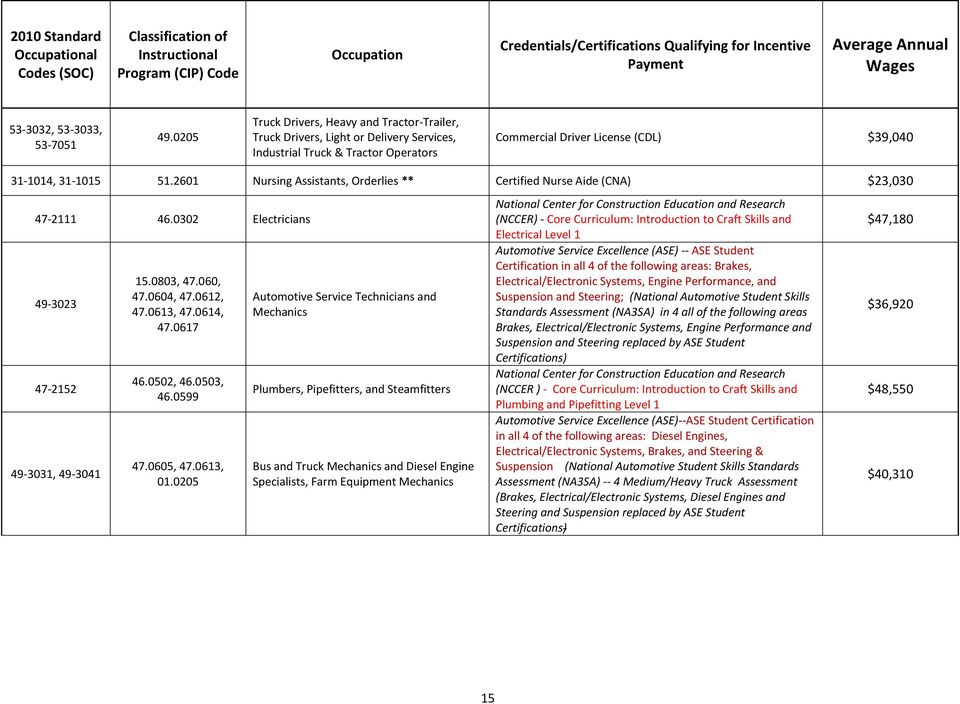
15 2010 Standard Occupational Codes (SOC) Classification of Instructional Program (CIP) Code Occupation Credentials/Certifications Qualifying for Incentive Payment Average Annual Wages , , Truck Drivers, Heavy and Tractor-Trailer, Truck Drivers, Light or Delivery Services, Industrial Truck & Tractor Operators Commercial Driver License (CDL) $39, , Nursing Assistants, Orderlies ** Certified Nurse Aide (CNA) $23, Electricians , , , , , , , , , , , Automotive Service Technicians and Mechanics Plumbers, Pipefitters, and Steamfitters Bus and Truck Mechanics and Diesel Engine Specialists, Farm Equipment Mechanics National Center for Construction Education and Research (NCCER) - Core Curriculum: Introduction to Craft Skills and Electrical Level 1 Automotive Service Excellence (ASE) -- ASE Student Certification in all 4 of the following areas: Brakes, Electrical/Electronic Systems, Engine Performance, and Suspension and Steering; (National Automotive Student Skills Standards Assessment (NA3SA) in 4 all of the following areas Brakes, Electrical/Electronic Systems, Engine Performance and Suspension and Steering replaced by ASE Student Certifications) National Center for Construction Education and Research (NCCER ) - Core Curriculum: Introduction to Craft Skills and Plumbing and Pipefitting Level 1 Automotive Service Excellence (ASE)--ASE Student Certification in all 4 of the following areas: Diesel Engines, Electrical/Electronic Systems, Brakes, and Steering & Suspension (National Automotive Student Skills Standards Assessment (NA3SA) -- 4 Medium/Heavy Truck Assessment (Brakes, Electrical/Electronic Systems, Diesel Engines and Steering and Suspension replaced by ASE Student Certifications) $47,180 $36,920 $48,550 $40,310 15
16 , , , Computer Support Specialists ** Heating, Air Conditioning, and Refrigeration Mechanics and Installers , Welders, Cutters, Solderers, and Brazers Carpenters , Assemblers and Fabricators, All Other , Machinists Cisco--Certified Entry Networking Technician; CompTIA - A+; CompTIA --Network +; Certified Network Associate; Certified Network Professional Microsoft--Microsoft Technology Associate (MTA); Microsoft Certified Solutions Associate (MCSA) ICE --Core +Residential Air Conditioning & Heating or Light Commercial Air Conditioning & Heating or Commercial Refrigeration; North American Technician Excellence (NATE) --Core + 1 one of the following speciality areas: Air Conditioning, Air Distribution, Air-to Air Heat Pumps, Gas Furnaces, Oil Furnaces, Hydronics Gas, Light Commercial Refrigeration, Commercial Refrigeration, Ground Source Heat Pump Loop Installer; HVAC Excellence --Core Areas (Electrical & Refrigeration Theory) + one of the following speciality areas: Air Conditioning, Gas Heat, & Electrical or Light Commercial Air Conditioning, Gas Heat & Electrical or Light Commercial Refrigeration & Electrical; National Center for Construction Education and Research (NCCER)--Core + HVAC Levels 1 & 2 American Welding Society (AWS) -- 3 Position Qualifications (AWS - 1F, 2F and 1G); American Society of Mechanical Engineers (ASME) Section 9 Standards (6G level) National Center for Construction Education and Research (NCCER) - Core Curriculum: Introduction to Craft Skills and Carpentry Level 1 Manufacturing Skills Standards Council ( MSSC ) - Certified Production Technician (CPT), National Institute for Metalworking Skills (NIMS) - Machining Level I Manufacturing Skills Standards Council ( MSSC ) - Certified Production Technician (CPT), National Institute for Metalworking Skills (NIMS) - Machining Level 1 $44,000 $43,430 $34,650 $40,170 $43,150 $37,740 16

17 Industrial Machinery Mechanics , Petroleum Pump System Operators, Refinery Operators, and Gaugers , Sheet Metal Workers Manufacturing Skills Standards Council ( MSSC ) - Certified Production Technician (CPT), National Center for Construction Education and Research (NCCER ) -- Core Curriculum: Introduction to Craft Skills and Industrial Maintenance Level I National Center for Construction Education and Research (NCCER ) - Core Curriculum: Introduction to Craft Skills and Control Center Operations Manufacturing Skills Standards Council ( MSSC ) - Certified Production Technician (CPT), National Center for Construction Education and Research (NCCER ) - Core Curriculum: Introduction to Craft Skills and Sheet Metal Level 1, National Institute for Metalworking Skills (NIMS) - Metal Forming I $42,720 $55,470 $41, Agricultural Equipment Operators Commercial Driver License (CDL) $32, , , Farmers, Ranchers, and Other Agricultural Managers ** First-line Supervisors/Managers of Food Preparation and Serving Workers Computer-Controlled Machine Tool Operators, Metal and Plastic Automotive Body and Related Repairers Kansas Department of Agriculture (KDA) -- KS Commercial Pesticide Applicators Certificate, Kansas Department of Agriculture (KDA) -- Agriculture Skills and Competencies Certificate National Restaurant Association Educational Foundation - ProStart National Certificate of Achievement Manufacturing Skills Standards Council ( MSSC ) - Certified Production Technician (CPT), National Institute for Metalworking Skills (NIMS) - Machining Level 1 Automotive Service Excellence (ASE)--ASE Student Certification on any of the following areas: Painting & Refinishing, Structural Analysis & Damage Repair, Non- Structural Analysis & Damage Repair, or Mechanical & Electrical; Inter-Industry Conference on Auto Collision Repair (I-CAR)--Refinish Technician ProLevel 1 $68,060*** $27,620 $33,370 $39,570 17

18 2014 Phase Out Occupations: Occupations on the 2013 SB155 Certifications/Credentials List but no longer meet the In-Demand criteria (Only for students who started courses in ; Credential must be earned before December 2014) , , Construction Laborers Cement Masons and Concrete Finishers , Structural Metal Fabricators and Fitters National Center for Construction Education and Research (NCCER) - Core Curriculum: Introduction to Craft Skills and Construction Laborer National Center for Construction Education and Research (NCCER ) - Core Curriculum: Introduction to Craft Skills and Concrete Finishing, National Center for Construction Education and Research (NCCER ) --Core Curriculum: Introduction to Craft Skills and Introduction to Masonry Level 1 Manufacturing Skills Standards Council ( MSSC ) - Certified Production Technician (CPT), National Center for Construction Education and Research (NCCER ) - Core Curriculum: Introduction to Craft Skills and Sheet Metal Level 1, National Institute for Metalworking Skills (NIMS) - Metal Forming I ** Stackable Credentials *** Entry Level Salary - reflects the occupation listed which requires bachelor s degree and/or substantial experience in the field. This salary is not likely achievable for students completing the associated credential $29,920 $36,140 $37,920 18

19 CONTACT INFORMATION FOR THE CERTIFICATIONS THAT MEET THE LEGISLATED CREDENTIAL INCENTIVE HIGH DEMAND CAREER CERTIFICATION CONTACT INFORMATION Truck Drivers, Heavy and Tractor Trailer, Truck Drivers, Light or Delivery Services, Industrial Truck & Tractor Operators Commercial Driver s License (CDL) Students must enroll in a CDL course at a community or technical college Nursing Assistants, Orderlies Electrician Construction Laborers Automotive Service Technicians & Mechanics Plumbers, Pipefitters, & Steamfitters Bus & Truck Mechanics and Diesel Engine Specialists Computer User Support Specialist Certified Nurse Aide (CNA) NCCER Core Curriculum: Introduction to Craft Skills AND Electrical Level 1 NCCER Core Curriculum: Introduction to Craft Skills AND Construction Laborer National Automotive Student Skills Standards Assessment (NA3SA) 4 automotive assessments (Brakes, Electrical/Electronic Systems, Engine Performance, and Suspension & Steering) Automotive Service Excellence (ASE) Automotive Service Technician Level 1 NCCER Core Curriculum: Introduction to Craft Skills AND Plumbing & Pipefitting Level 1 National Automotive Student Skills Standards Assessment (NA3SA) 4 Medium/Heavy Truck Assessments (Brakes, Electrical/Electronic Systems, Diesel Engines, and Steering & Suspension) Automotive Service Excellence (ASE) Medium & Heavy Truck (Diesel) CISCO Certified Entry Networking Technician Credentialing offered through the Kansas Department of Health & Environment. Website: Cloys Bayless [email protected] Cloys Bayless [email protected] Developed by ASE in partnership with AYES & NATEF. Website: ASE Website: Cloys Bayless [email protected] Developed by ASE in partnership with AYES & NATEF. Website: ASE Website: Available through various vendors such as Certiport ( ), Global Knowledge 19

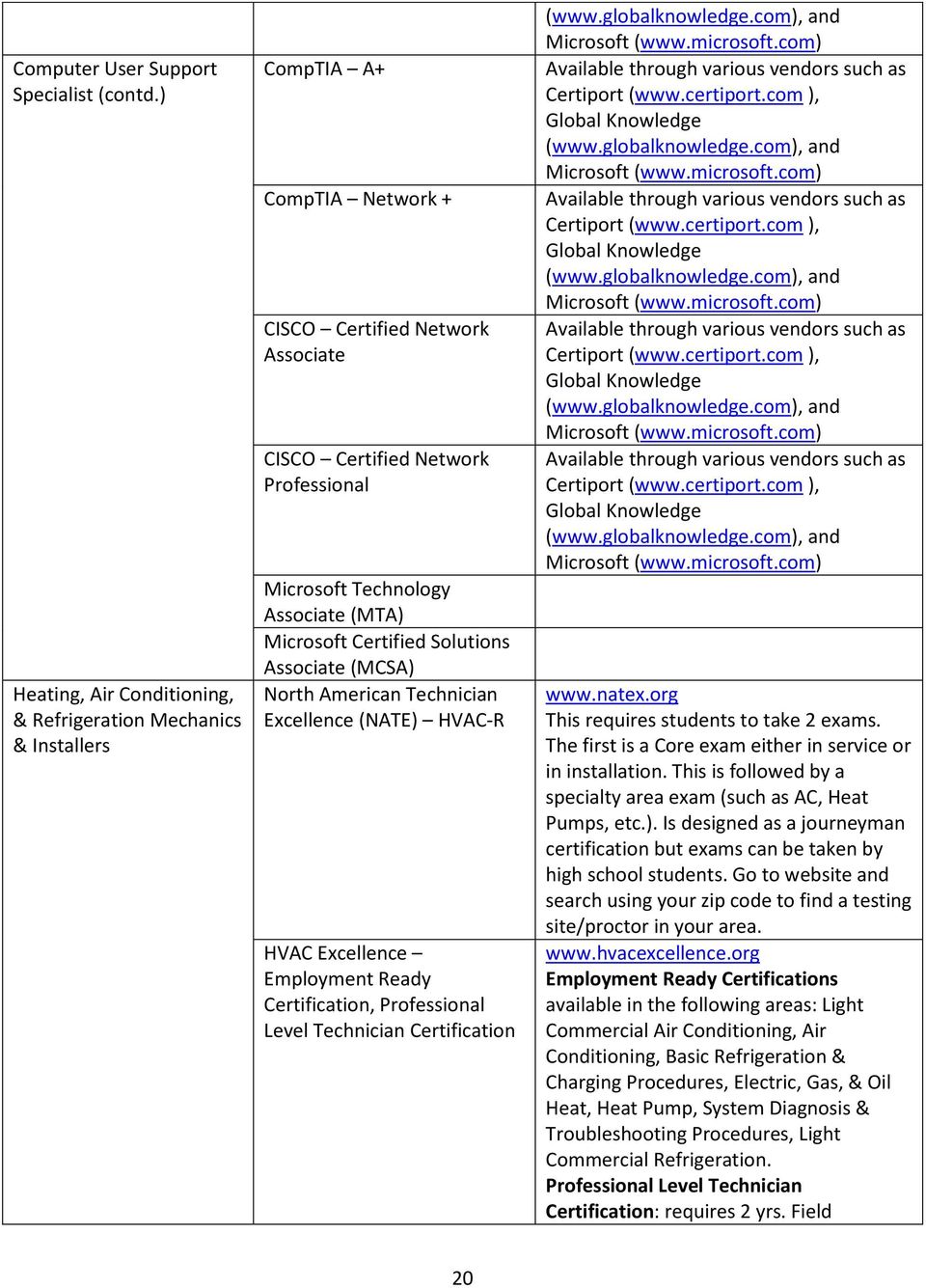
20 Computer User Support Specialist (contd.) Heating, Air Conditioning, & Refrigeration Mechanics & Installers CompTIA A+ CompTIA Network + CISCO Certified Network Associate CISCO Certified Network Professional Microsoft Technology Associate (MTA) Microsoft Certified Solutions Associate (MCSA) North American Technician Excellence (NATE) HVAC-R HVAC Excellence Employment Ready Certification, Professional Level Technician Certification ( and Microsoft ( Available through various vendors such as Certiport ( ), Global Knowledge ( and Microsoft ( Available through various vendors such as Certiport ( ), Global Knowledge ( and Microsoft ( Available through various vendors such as Certiport ( ), Global Knowledge ( and Microsoft ( Available through various vendors such as Certiport ( ), Global Knowledge ( and Microsoft ( This requires students to take 2 exams. The first is a Core exam either in service or in installation. This is followed by a specialty area exam (such as AC, Heat Pumps, etc.). Is designed as a journeyman certification but exams can be taken by high school students. Go to website and search using your zip code to find a testing site/proctor in your area. Employment Ready Certifications available in the following areas: Light Commercial Air Conditioning, Air Conditioning, Basic Refrigeration & Charging Procedures, Electric, Gas, & Oil Heat, Heat Pump, System Diagnosis & Troubleshooting Procedures, Light Commercial Refrigeration. Professional Level Technician Certification: requires 2 yrs. Field 20
21 Heating, Air Conditioning, & Refrigeration Mechanics & Installers (Contd.) Welders, Cutters, Solderers & Brazers Carpenters Assemblers & Fabricators Machinists Industry Competency Exams (ICE) Residential, Light Commercial or Commercial HVAC (3 separate exams) American Welding Society (AWS) 3 Position Qualifications (AWS 1F, 2F, & 1G) American Society of Mechanical Engineers (ASME) Section 9 Standards (6G Level) NCCER Core Curriculum: Introduction to Craft Skills AND Carpentry Level 1 Manufacturing Skills Standards Council (MSSC) Certified Production Technician National Institute for Metalworking Skills (NIMS) Machining Level 1 Manufacturing Skills Standards Council (MSSC) Certified Production Technician experience and must pass Core exam and one of the following specialties: Heating, Air conditioning, or Light Commercial HVAC Designed for entry-level certification. Exam is online through AHRI (Air Cond., Heating, & Refrigeration Institute). Cost is $30. Three exams are available: Residential, Light Commercial, & Commercial. Someone (not the instructor) must register as a Chief Examiner (proctor) for the school. Contact person is Kristen Fleming [email protected] Website Website: Cloys Bayless [email protected] Student must pass four assessments to attain the CPT Certification. Assessments are: Safety; Quality Practices & measurement; Manufacturing Processes & Production; Maintenance Awareness. Standards being assessed are available on the website. Requires both a performance test & a theory test. Requires a $40 student registration fee, then the Performance exam is free. The Theory exam is $35 for Level 1 Student must pass four assessments to attain the CPT Certification. Assessments are: Safety; Quality Practices & measurement; Manufacturing Processes & Production; Maintenance Awareness. Standards being assessed are available on 21
22 Industrial Machinery Mechanics Petroleum Pump System Operators, Refinery Operators, and Gaugers Sheet Metal Workers Cement Masons & Concrete Finishers National Institute for Metalworking Skills (NIMS) Machining Level 1 Manufacturing Skills Standards Council (MSSC) Certified Production Technician NCCER Core Curriculum: Introduction to Craft Skills AND Industrial Maintenance Level 1 NCCER Core Curriculum: Introduction to Craft Skills AND Control Center Operations Manufacturing Skills Standards Council (MSSC) Certified Production Technician NCCER Core Curriculum: Introduction to Craft Skills and Sheet Metal Level 1 National Institute for Metalworking Skills (NIMS) Metal Forming 1 NCCER Core Curriculum: Introduction to Craft Skills AND Concrete Finishing NCCER Core Curriculum: Introduction to Craft Skills AND Introduction to Masonry the website. Requires both a performance test & a theory test. Requires a $40 student registration fee, then the Performance exam is free. The Theory exam is $35 for Level 1 Student must pass four assessments to attain the CPT Certification. Assessments are: Safety; Quality Practices & Measurement; Manufacturing Processes & Production; Maintenance Awareness. Standards being assessed are available on the website. Cloys Bayless [email protected] Cloys Bayless [email protected] Student must pass four assessments to attain the CPT Certification. Assessments are: Safety; Quality Practices & measurement; Manufacturing Processes & Production; Maintenance Awareness. Standards being assessed are available on the website. Cloys Bayless [email protected] Requires both a performance test & a theory test. Requires a $40 student registration fee, then the Performance exam is free. The Theory exam is $35 for Level 1 Cloys Bayless [email protected] Cloys Bayless [email protected]
23 Structural Metal Fabricators & Fitters Agricultural Equipment Operators Farmers, Ranchers, & Other Agricultural Managers First-line Supervisors/Managers of Food Preparation and Serving Workers Computer Controlled Machine Tool Operators, Metal and Plastic Level 1 Manufacturing Skills Standards Council (MSSC) Certified Production Technician National Institute for Metalworking Skills (NIMS) Metal Forming 1 NCCER Core Curriculum: Introduction to Craft Skills AND Sheet Metal Level 1 Commercial Driver s License (CDL) KS Dept. of Agriculture (KDA) KS Private Pesticide Applicators Certificate KDA Agriculture Skills and Competencies Certificate National Restaurant Association Educational Foundation ProStart National Certification of Achievement Manufacturing Skills Standards Council (MSSC) Certified Production Technician National Institute for Metalworking Skills (NIMS) Machining Level 1 Student must pass four assessments to attain the CPT Certification. Assessments are: Safety; Quality Practices & measurement; Manufacturing Processes & Production; Maintenance Awareness. Standards being assessed are available on the website. Requires both a performance test & a theory test. Requires a $40 student registration fee, then the Performance exam is free. The Theory exam is $35 for Level 1 Cloys Bayless [email protected] Students must enroll in a CDL course at a community or technical college Jeanne Fox - [email protected] Kate Bormann - [email protected] Vsiit: for general information. Neeley Carlson: [email protected] for info on the program agreement. [email protected] to purchase curriculum. Student must pass four assessments to attain the CPT Certification. Assessments are: Safety; Quality Practices & Measurement; Manufacturing Processes & Production; Maintenance Awareness. Standards being assessed are available on the website. Requires both a performance test & a theory test. Requires a $40 student registration fee, then the Performance exam is free. The Theory exam is $35 for 23
24 Automotive Body and Related Repairers Automotive Service Excellence (ASE) ASE Student Certification on any of the following areas: Painting & Refinishing, Structural Analysis & Damage Repair, Non-Structural Analysis & Damage Repair, or Mechanical & Electrical; Inter-Industry Conference on Auto Collision Repair (I-CAR)-- Refinish Technician ProLevel 1 Level 1 Pricing: $15 per student, per academic year. The fee allows for a SINGLE attempt at any or all tests in a series. Must utilize I-Car curriculum, from an I- CAR certified school. 24
25 Career Marketing Fact Sheets The following pages contain individual Fact Sheets for each occupation listed on the Qualifying Certifications/Credentials Chart found on page 17 of this document. Each Fact Sheet lists: Job Description Types of Available Jobs National & Kansas Job Outlook Skills Required for the Occupation Education / Training Required for the Occupation High School Pathways that Offer the Training College Programs that Offer the Training Apprenticeship Opportunities Scholarship/Financial Assistance Opportunities Available Certifications These sheets can be used as marketing tools to be distributed to students, parents, Advisory Committee members, and other stakeholders. 25
26 Kansas State Department of Education Career and Technical Education (CTE) Fact Sheet on Assemblers & Fabricators Training, & Certification What does an Assembler/Fabricator do? Assemblers & Fabricators assemble both finished products and the parts that go into them. They use tools, machines, and their hands to make engines, computers, aircraft, toys, electronic devices, and more. Closely related occupations include Structural Metal Fabricators and Fitters. In this occupation workers cut, align, and fit together structural metal parts and may help weld or rivet the parts together. What types of jobs are available? Assemblers and Fabricators usually work for manufacturing companies that produce items such as engines, computers, automobiles, large appliances, etc. What is the national job outlook? It is estimated that there will be 28,700 new workers needed in this industry by The national job growth rate for assemblers/fabricators by 2020 is +11%, with a median salary of $27,040 per year. Structural Metal Fabricators & Fitters will be needed to fill 12,700 positions by 2020, which shows a job growth rate of +16%. The median salary is $34,530. What is the job outlook in Kansas? Assemblers, Fabricators, Structural Metal Fabricators and Fitters are on the list of High Demand Jobs for Kansas. The median salary for Assemblers and Fabricators in Kansas is $54,419 per year. Due to new positions and retirements, Kansas is expected to need 790 new workers in this occupation by Structural Metal Fabricators and Fitters have a median salary of $38,976. Due to new positions and retirements, Kansas is expected to need 460 new workers in this occupation by What skills are required for Assemblers/Fabricators? The physical skills required of an assembler/fabricator include good color vision, dexterity, physical strength, and stamina. Other skills include mathematics, attention to detail, process monitoring, and the ability to understand technical manuals and schematics. What type of training/education do these jobs require? Assemblers/Fabricators can obtain technical training through a high school pathway, an apprenticeship, and/or 1-2 years of training at a technical or community college. Does my high school offer the training? Many Kansas high schools have approved career and technical education pathways that include teaching assembling & fabricating skills. Check with your high school counselor to see if these skills are included in your high school s Manufacturing Production or Manufacturing Maintenance pathways. What college programs offer this training? Some Kansas technical colleges and community colleges offer 1-2 year programs for these occupations. Check with your local postsecondary institutions for programs/degrees in the following areas: Manufacturing Technology Welding Technology Sheet Metal Technology Apprenticeship opportunities for Assemblers/Fabricators can be located through the Kansas Registered Apprenticeship Program at or Are scholarships available? All Kansas postsecondary institutions offer some type of scholarships. Check with the institution you are interested in attending to see what is available and what you qualify for. What other financial assistance is available? If you are a Kansas high school student and choose to attend a technical training program at a Kansas technical or community college while in high school, some or all of your tuition may be covered under Senate Bill 155, recently passed into legislation. Contact your high school counselor for details. What Certifications are available? There are several certifications available to workers in this field. Professional organizations that offer certification testing include: Manufacturing Skills Standards Council (MSSC) Natl. Center for Construction Educ. & Research (NCCER) National Institute for Metalworking Skills (NIMS) KSDE Fact Sheet Created 8/2012 The KSDE does not discriminate on the basis of race, color, national origin, sex, disability, or age in its programs and activities. The following person has been designated to handle inquiries regarding the non-discrimination policies: KSDE General Counsel; 120 SE 10th Ave Topeka, KS; 66612; Data collected from the KS Occupational Outlook Study and the National Occupational Outlook Handbook.
27 Kansas State Department of Education Career and Technical Education (CTE) Fact Sheet on Automotive Body and Related Repairers What does an Automotive Body Repairer do? Automotive Body & Related Repairers restore, refinish, and replace vehicle bodies and frames, windshields, and window glass. Although they repair all types of vehicles, most work primarily on cars, sport utility vehicles, and small trucks. What types of jobs are available? Automotive Service Technicians usually work for private companies including automotive dealerships, although many are self-employed. What is the national job outlook? It is estimated that there will be 32,700 job openings in this industry by The national job growth rate for Automotive Body Repairers by 2020 is +19%, with a median salary of $38,130 per year. What is the job outlook in Kansas? Automotive Body Repairers are on the list of High Demand Jobs for Kansas. The median salary for these workers in Kansas is $35,090 per year. Due to new positions and retirements, Kansas is expected to need 518 new workers in this occupation by This is a job growth of 8%. What skills are required for an Automotive Body Repairer? The physical skills required of an Automotive Body Repairer include the ability to lift heavy parts and tools. They also need excellent manual dexterity and eye-hand coordination and the ability to work in awkward & cramped positions. Following safety procedures and practices is a necessity to prevent injury. Repair technicians work indoors in body shops, which are often noisy, but well-ventilated to disperse dust and paint fumes. Other skills include welding, the ability to listen, follow directions, communicate with customers and clients, problem solving, understand safety requirements, use of hand and power tools, and knowledge of handling, recycling and disposal of hazardous materials. What type of training/education do these jobs require? Automotive Body Repairers can obtain technical training through a high school pathway, an apprenticeship, and/or training at a technical or community college. Does my high school offer the training? Many Kansas high schools have approved career and technical education pathways that include teaching automotive body repair and refinishing skills. Check with your high school counselor to see if these skills are included in your high school s Mobile Equipment Maintenance pathway. What college programs offer this training? Some Kansas technical colleges and community colleges offer short and/or long-term programs for these occupations. Check with your local postsecondary institutions for programs/degrees in the following areas: Automotive Collision Repair Automotive Collision Technology Apprenticeship opportunities for Automotive Body Repairers can be located through the Kansas Registered Apprenticeship Program at or Are scholarships available? All Kansas postsecondary institutions offer some type of scholarships. Check with the institution you are interested in attending to see what is available and what you qualify for. What other financial assistance is available? If you are a Kansas high school student and choose to attend a technical training program at a Kansas technical or community college while in high school, some or all of your tuition may be covered under Senate Bill 155, recently passed into legislation. Contact your high school counselor for details. What Certifications are available? There are certifications available to workers in this field. Professional organizations that offer certification testing are: Automotive Service Excellence (ASE) Inter-Industry Conference on Auto Collision Repair (I-CAR) KSDE Fact Sheet Created 7/2013 The KSDE does not discriminate on the basis of race, color, national origin, sex, disability, or age in its programs and activities. The following person has been designated to handle inquiries regarding the non-discrimination policies: KSDE General Counsel; 120 SE 10th Ave Topeka, KS; 66612; Data collected from the KS Occupational Outlook Study and the National Occupational Outlook Handbook.
28 Kansas State Department of Education Career and Technical Education (CTE) Fact Sheet on Automotive Service Technician Training, & Certification What does an Automotive Service Technician do? Automotive Service Technicians inspect, maintain, and repair cars and light trucks. They test parts and systems, identify mechanical problems, use computerized diagnostic equipment, and perform basic automotive maintenance tasks. What types of jobs are available? Automotive Service Technicians usually work for private companies including automotive dealerships, although approximately 18% are self-employed. What is the national job outlook? It is estimated that there will be 124,800 available jobs in this industry by The national job growth rate for Automotive Service Technicians by 2020 is +17%, with a median salary of $35,790 per year. What is the job outlook in Kansas? Automotive Service Technicians are on the list of High Demand Jobs for Kansas. The median salary for these workers in Kansas is $33,883 per year. Due to new positions and retirements, Kansas is expected to need 1,540 new workers in this occupation by This is a job growth of 4%. What skills are required for an Automotive Service Technician? The physical skills required of an Automotive Service Technician include the ability to lift heavy parts and tools. They also need excellent manual dexterity and eye-hand coordination. Following safety procedures and practices is a necessity. Other skills include the ability to listen, follow directions, communicate with customers and clients, problem solving, understand safety requirements, use of hand and power tools, knowledge of computerized diagnostic tools, and knowledge of handling, recycling and disposal of hazardous materials. What type of training/education do these jobs require? Automotive Service Technicians can obtain technical training through a high school pathway, an apprenticeship, and/or training at a technical or community college. Does my high school offer the training? Many Kansas high schools have approved career and technical education pathways that include teaching automotive service technician skills. Check with your high school counselor to see if these skills are included in your high school s Mobile Equipment Maintenance pathway. What college programs offer this training? Some Kansas technical colleges and community colleges offer short and/or long-term programs for these occupations. Check with your local postsecondary institutions for programs/degrees in the following areas: Automotive Technology Diesel Technology Apprenticeship opportunities for Automotive Service Technicians can be located through the Kansas Registered Apprenticeship Program at or Are scholarships available? All Kansas postsecondary institutions offer some type of scholarships. Check with the institution you are interested in attending to see what is available and what you qualify for. What other financial assistance is available? If you are a Kansas high school student and choose to attend a technical training program at a Kansas technical or community college while in high school, some or all of your tuition may be covered under Senate Bill 155, recently passed into legislation. Contact your high school counselor for details. What Certifications are available? There are certifications available to workers in this field. Professional organizations that offer certification testing are: Natl. Auto Student Skills Standards Assessment (NATEF) Automotive Service Technician (ASE) KSDE Fact Sheet Created 9/2012 The KSDE does not discriminate on the basis of race, color, national origin, sex, disability, or age in its programs and activities. The following person has been designated to handle inquiries regarding the non-discrimination policies: KSDE General Counsel; 120 SE 10th Ave Topeka, KS; 66612; Data collected from the KS Occupational Outlook Study and the National Occupational Outlook Handbook.
29 What does a Carpenter do? Kansas State Department of Education Career and Technical Education (CTE) Fact Sheet on Carpenter Training, & Certification A Carpenter constructs and repairs building frameworks and structures such as stairways, doorframes, partitions, and rafters made from wood and other materials. They may also install kitchen cabinets, siding, and drywall, or even help construct bridges. Carpenters are one of the most versatile construction occupations, with workers usually doing a variety of tasks. What types of jobs are available? There are, basically, three types of carpenters. Residential Carpenters specialize in home, townhome, and condominium building and remodeling. Commercial Carpenters remodel and help build commercial office buildings, hospitals, hotels, schools, shopping malls, etc. Industrial Carpenters work in civil and industrial settings where they put up scaffolding and build and set forms for pouring concrete. What is the national job outlook? It is estimated that there will be 196,000 available jobs in this industry by The national job growth rate for construction laborers by 2020 is +20%, with a median salary of $39,530 per year. What is the job outlook in Kansas? Carpenters are on the list of High Demand Jobs for Kansas. The median salary for these workers in Kansas is $36,434 per year. Due to new positions and retirements, Kansas is expected to need 1,690 new workers in this occupation by This is a job growth of 4.4%. What skills are required for a Carpenter? The physical skills required of a Carpenter may require work at great heights or outdoors in all kinds of weather. Physical strength and stamina are necessary. Other skills include the ability to listen, follow directions, understand safety requirements, blueprint reading, measurement mathematics, use of hand and power tools, and constant awareness of the surroundings. What type of training/education do these jobs require? Carpenters can obtain technical training through a high school pathway, an apprenticeship, and/or training at a technical or community college. Does my high school offer the training? Many Kansas high schools have approved career and technical education pathways that include teaching carpentry skills. Check with your high school counselor to see if these skills are included in your high school s Construction pathway. What college programs offer this training? Some Kansas technical colleges and community colleges offer short and/or long-term programs for this occupation. Check with your local postsecondary institutions for programs/degrees in the following areas: Construction Trades Carpentry / Carpenter Apprenticeship opportunities for Carpenters can be located through the Kansas Registered Apprenticeship Program at or Are scholarships available? All Kansas postsecondary institutions offer some type of scholarships. Check with the institution you are interested in attending to see what is available and what you qualify for. What other financial assistance is available? If you are a Kansas high school student and choose to attend a technical training program at a Kansas technical or community college while in high school, some or all of your tuition may be covered under Senate Bill 155, recently passed into legislation. Contact your high school counselor for details. What Certifications are available? There are certifications available to workers in this field. A professional organization that offers certification testing is: Natl. Center for Construction Education & Research (NCCER) KSDE Fact Sheet Created 9/2012 The KSDE does not discriminate on the basis of race, color, national origin, sex, disability, or age in its programs and activities. The following person has been designated to handle inquiries regarding the non-discrimination policies: KSDE General Counsel; 120 SE 10th Ave Topeka, KS; 66612; Data collected from the KS Occupational Outlook Study and the National Occupational Outlook Handbook.
30 Kansas State Department of Education Career and Technical Education (CTE) Fact Sheet on Cement Mason / Finisher, Training, & Certification What does a Cement Mason do? Cement Masons & Finishers set the forms that hold wet concrete, and spread, level and smooth concrete for residential, commercial and industrial applications. Concrete is used in floors, driveways, sidewalks, retaining walls, building foundations and roads. Some entire buildings are made of concrete. Closely related occupations include stone masons and brick masons. These occupations use a cement mortar to build walls, floors and sidewalks out of stone and brick. What types of jobs are available? Many concrete masons are self-employed or are laborers for small companies that mainly perform residential and commercial work. Larger companies have positions for managers and supervisors. What is the national job outlook? It is estimated that there will be 72,900 job openings in this industry by The national job growth rate for Cement Masons/Finishers by 2020 is 29%, which is growth much faster than average. The median salary for a Cement Mason is $35,600 per year. Stone and Brick Masons have a projected job growth of 29% by 2020, with a median salary of $46, 800. There are 54,500 projected job openings in this occupation by What is the job outlook in Kansas? Cement Masons & Finishers are on the list of High Demand Jobs for Kansas. The Kansas job growth rate for this occupation is 6% by 2018, with a median salary of $34,651 per year. Due to new positions and retirements, Kansas is expected to need 720 new workers in this occupation by Stone & Brick Masons have a projected Kansas job growth rate of 5%, with a median salary of $45,914. Due to new positions and retirements, Kansas is expected to need 370 new workers in this occupation by What skills are required for a Cement Mason/Finisher? The physical skills required of a cement mason include good manual dexterity, trunk strength, coordination, visualization, and flexibility. Other skills include knowledge of building and construction materials and methods, mechanical tool usage, blueprint reading, safety, critical thinking, mathematics, communications, decision making, and time management. Cement Masons who are self-employed must also have a background in business skills. What type of training/education do these jobs require? Cement Masons/Finishers can obtain technical training through a high school pathway, an apprenticeship, and/or 1 year of training at a technical or community college. Although there are some stand-alone certificate programs in Bricklaying/Stone Mason at Kansas colleges, masonry skills are usually taught within a broader construction program. Does my high school offer the training? Many Kansas high schools have an approved career and technical education Construction pathway that includes teaching masonry skills. Check with your high school construction instructor or your high school counselor to see if these skills are included in your high school s pathway. What college programs offer this training? Some Kansas technical colleges and community colleges offer one year certificate programs for these stone and brick masons. As with the high schools, Cement Mason skills are usually taught within a 1-2 year Construction program. Check with your local postsecondary institutions for programs/degrees in the Construction field. Apprenticeship opportunities for Cement, Stone, & Brick Masons can be located through the Kansas Registered Apprenticeship Program at or Are scholarships available? All Kansas postsecondary institutions offer some type of scholarships. Check with the institution you are interested in attending to see what is available and what you qualify for. What other financial assistance is available? If you are a Kansas high school student and choose to attend a technical training program at a Kansas technical or community college while in high school, some or all of your tuition may be covered under Senate Bill 155, recently passed into legislation. Contact your high school counselor for details. What Certifications are available? While there are no professional certifications required for employment as a Cement Mason in Kansas, there is a certification available through NCCER. Check with your local high school or college instructor for details. The OSHA 10 Hour Construction Safety Course/Certification may be a job requirement for some companies. KSDE Fact Sheet Created 8/2012 The KSDE does not discriminate on the basis of race, color, national origin, sex, disability, or age in its programs and activities. The following person has been designated to handle inquiries regarding the non-discrimination policies: KSDE General Counsel; 120 SE 10th Ave Topeka, KS; 66612; Data collected from the KS Occupational Outlook Study and the National Occupational Outlook Handbook.
31 Kansas State Department of Education Career and Technical Education (CTE) Fact Sheet on Nursing Assistants & Orderlies Training, & Certification What do Nursing Assistants, Orderlies, & Attendants do? Nursing Assistants, Orderlies, & Attendants help provide basic care for patients in hospitals and residents of longterm care facilities, such as nursing homes. Care provided may include taking and recording vital signs, bathing patients, changing bedding, serving meals, and providing personal care assistance. What types of jobs are available? Jobs are available for these positions in hospitals, rehabilitation facilities, nursing homes, and companies that provide home health care. What is the national job outlook? It is estimated that there will be 302,000 new workers needed in this industry by The national job growth rate for nursing aides, orderlies, and attendants by 2020 is +20%, with a median salary of $24,010 per year. What is the job outlook in Kansas? Nursing Aides, Orderlies & Attendants are on the list of High Demand Jobs for Kansas. The expected job growth rate is +18% and the median salary for these occupations in Kansas is $22,059 per year. Due to new positions and retirements, Kansas is expected to need 5,490 new workers in this occupation by What skills are required for Nursing Assistants, Orderlies, and Attendants? The physical skills required of a nursing assistant, orderly, or attendant include good physical strength, and stamina. Other skills include communication, attention to detail, and monitoring. Some workers may dispense medications, depending upon the state and the skill/certification level. What type of training/education do these jobs require? Nursing Aides, Orderlies & Attendants can obtain technical training through a high school pathway, an apprenticeship, and/or 1 year of training at a technical or community college. People in these occupations often continue their education to become Certified Medical Assistants, Licensed Practical Nurses or Registered Nurses. Does my high school offer the training? Many Kansas high schools have approved career and technical education Health Science pathways that include teaching the needed skills for these occupations. Check with your high school counselor to see if these skills are included in your high school s Health Science Pathway. What college programs offer this training? Some Kansas technical colleges and community colleges offer stand-alone short-term programs and/or 1 year programs for these and related occupations. Check with your local postsecondary institutions for programs/degrees in the following areas: Certified Nursing Assistant Certified Medical Assistant Medical/Clinical Assistant Clinical/Medical Laboratory Assistant Physical Therapist Assistant Home Health Aide Pharmacy Technician/Assistant Are scholarships available? All Kansas postsecondary institutions offer some type of scholarships. Check with the institution you are interested in attending to see what is available and what you qualify for. What other financial assistance is available? If you are a Kansas high school student and choose to attend a technical training program at a Kansas technical or community college while in high school, some or all of your tuition may be covered under Senate Bill 155, recently passed into legislation. Contact your high school counselor for details. What Certifications are available? There are several certifications available to workers in this field. Professional certifications include: Certified Nursing Assistant Certified Medical Assistant Home Health Aide Pharmacy Assistant KSDE Fact Sheet Created 9/2012 The KSDE does not discriminate on the basis of race, color, national origin, sex, disability, or age in its programs and activities. The following person has been designated to handle inquiries regarding the non-discrimination policies: KSDE General Counsel; 120 SE 10th Ave Topeka, KS; 66612; Data collected from the KS Occupational Outlook Study and the National Occupational Outlook Handbook.
32 Kansas State Department of Education Career and Technical Education (CTE) Fact Sheet on Computer Support Specialist Training, & Certification What does a Computer Support Specialist do? Computer support specialists provide help and advice to people and organizations using computer software or equipment. They test and evaluate network systems, perform regular maintenance, and troubleshoot local area networks (LANs), wide area networks (WANs), and Internet Systems. What types of jobs are available? Some, called Technical Support Specialists, support information technology (IT) employees within their organization. Others, called Help-Desk Technicians, assist non-it users who are having computer problems. What is the national job outlook? It is estimated that there will be 110,000 available jobs in this industry by The national job growth rate for Computer Support Specialists by 2020 is +18%, with a median salary of $46,260 per year. What is the job outlook in Kansas? Computer Support Specialists are on the list of High Demand Jobs for Kansas. The median salary for these workers in Kansas is $39,767 per year. Due to new positions and retirements, Kansas is expected to need 730 new workers in this occupation by This is a job growth of 13%. What skills are required for an Automotive Service Technician? The physical skills required of a Computer Support Specialist include the ability to sit for long periods of time. They need good manual dexterity and are prone to carpal tunnel syndrome and eye strain. Other needed skills include specialized computer skills (both hardware and software), and the ability to troubleshoot, problem solve and manage time well. What type of training/education do these jobs require? Computer Support Specialists can obtain technical training through a high school pathway, an apprenticeship, and/or training at a technical or community college. Does my high school offer the training? Many Kansas high schools have approved career and technical education pathways that include teaching computer support specialist skills. Check with your high school counselor to see if these skills are included in your high school s Information Support & Services Pathway or Network Systems Pathway. What college programs offer this training? Some Kansas technical colleges and community colleges offer short and/or long-term programs for these occupations. Check with your local postsecondary institutions for programs/degrees in the following areas: Computer Installation & Repair Technology Computer & information Science Computer Systems Networking Apprenticeship opportunities for Computer Support Specialists may be located through the Kansas Registered Apprenticeship Program at or Are scholarships available? All Kansas postsecondary institutions offer some type of scholarships. Check with the institution you are interested in attending to see what is available and what you qualify for. What other financial assistance is available? If you are a Kansas high school student and choose to attend a technical training program at a Kansas technical or community college while in high school, some or all of your tuition may be covered under Senate Bill 155, recently passed into legislation. Contact your high school counselor for details. What Certifications are available? There are certifications available to workers in this field that include: Cisco Certified Entry Networking Technician, Certified Network Associate, and Certified Network Professional CompTIA A+, and Network + KSDE Fact Sheet Created 9/2012 The KSDE does not discriminate on the basis of race, color, national origin, sex, disability, or age in its programs and activities. The following person has been designated to handle inquiries regarding the non-discrimination policies: KSDE General Counsel; 120 SE 10th Ave Topeka, KS; 66612; Data collected from the KS Occupational Outlook Study and the National Occupational Outlook Handbook.
33 Kansas State Department of Education Career and Technical Education (CTE) Fact Sheet on Construction Laborer Training, & Certification What does a Construction Laborer do? A Construction Laborer does many basic tasks that require physical labor on construction sites. Duties may include such things as compacting soil, dig trenches, set up and dismantle barricades, forms and scaffolding, remove debris and hazards, operate equipment such as cement mixers, or load and unload building materials. They may work as helpers for a variety of crafts persons such as brickmasons, carpenters, electricians, painters, pipefitters, and roofers. What types of jobs are available? Construction laborers work in a variety of construction areas including, building homes and businesses, tearing down buildings, hazardous material removal, building highways and roads, and digging tunnels & mine shafts. What is the national job outlook? It is estimated that there will be 212,400 available jobs in this industry by The national job growth rate for construction laborers by 2020 is +21%, with a median salary of $29, 280 per year. What is the job outlook in Kansas? Construction Laborers are on the list of High Demand Jobs for Kansas. The median salary for these workers in Kansas is $27,988 per year. Due to new positions and retirements, Kansas is expected to need 2,410 new workers in this occupation by This is a job growth of 12.7%. What skills are required for a Construction Laborer? The physical skills required of a construction laborer are very demanding and may require work at great heights or outdoors in all kinds of weather. Physical strength and stamina are necessary. Other skills include the ability to listen, follow directions, understand safety requirements, and constant awareness of the surroundings. What type of training/education do these jobs require? Construction laborers can obtain technical training through a high school pathway, an apprenticeship, and/or short-term training at a technical or community college. Many construction laborers will continue to gain skills to become a carpenter, brick mason, electrician, painter, pipefitter, or other skilled craftsperson. Does my high school offer the training? Many Kansas high schools have approved career and technical education pathways that include teaching machinist skills. Check with your high school counselor to see if these skills are included in your high school s Construction pathway. What college programs offer this training? Some Kansas technical colleges and community colleges offer short and/or long-term programs for these occupations. Check with your local postsecondary institutions for programs/degrees in the following areas: Construction Trades Carpentry / Carpenter Construction/ Heavy Equipment/ Earthmoving Equipment Operation Apprenticeship opportunities for Construction laborers can be located through the Kansas Registered Apprenticeship Program at or Are scholarships available? All Kansas postsecondary institutions offer some type of scholarships. Check with the institution you are interested in attending to see what is available and what you qualify for. What other financial assistance is available? If you are a Kansas high school student and choose to attend a technical training program at a Kansas technical or community college while in high school, some or all of your tuition may be covered under Senate Bill 155, recently passed into legislation. Contact your high school counselor for details. What Certifications are available? There are certifications available to workers in this field. A professional organization that offers certification testing is: Natl. Center for Construction Education & Research (NCCER) KSDE Fact Sheet Created 9/2012 The KSDE does not discriminate on the basis of race, color, national origin, sex, disability, or age in its programs and activities. The following person has been designated to handle inquiries regarding the non-discrimination policies: KSDE General Counsel; 120 SE 10th Ave Topeka, KS; 66612; Data collected from the KS Occupational Outlook Study and the National Occupational Outlook Handbook.
34 What does a Bus & Truck Mechanic / Diesel Engine Specialist do? Kansas State Department of Education Career and Technical Education (CTE) Fact Sheet on Bus & Truck Mechanics / Diesel Engine Specialist Training, & Certification Bus & Truck Mechanics / Diesel Engine Specialists (Diesel Service Technicians) inspect, repair, or overhaul buses, trucks, and anything else with a diesel engine. They diagnose malfunctions, perform routine maintenance, replace malfunctioning components, inspect brake, electrical, steering, transmission, and engine systems, and test effectiveness of repairs. What types of jobs are available? Diesel Service Technicians are usually employed full time to work in shops that may be open seven days a week, including evenings to accommodate over-the-road trucks that run long hours. Some shops offer road-side maintenance and repair services 24-hours a day. Related occupational fields include automotive service technician, heavy vehicle and mobile equipment service technician, and small engine mechanic. What is the national job outlook? It is estimated that there will be 35,200 available jobs in this industry by The national job growth rate for this occupation by 2020 is +15%, with a median salary of $40,850 per year. What is the job outlook in Kansas? Diesel Service Technicians are on the list of High Demand Jobs for Kansas. The median salary for these workers in Kansas is $37,802 per year. Due to new positions and retirements, Kansas is expected to need 1,010 new workers in this occupation by This is a job growth of just under 6%. What skills are required for a Diesel Service Technician? The physical skills required of a Diesel Service Technician require the ability to lift heavy parts and tools. They also need excellent manual dexterity and eye-hand coordination. Following safety procedures and practices is a necessity. Other skills include the ability to listen, follow directions, communicate with customers and clients, problem solving, understand safety requirements, use of hand and power tools, knowledge of computerized diagnostic tools, and knowledge of handling, recycling and disposal of hazardous materials. What type of training/education do these jobs require? Diesel Service Technicians can obtain technical training through a high school pathway, an apprenticeship, and/or training at a technical or community college. Does my high school offer the training? Many Kansas high schools have approved career and technical education pathways that include teaching automotive service and repair skills. Check with your high school counselor to see if these skills are included in your high school s Mobile Equipment Maintenance pathway. What college programs offer this training? Some Kansas technical colleges and community colleges offer short and/or long-term programs for these occupations. Check with your local postsecondary institutions for programs/degrees in the following areas: Diesel Technology Automotive Technology Apprenticeship opportunities for Diesel Service Technicians may be available and can be located through the Kansas Registered Apprenticeship Program at or Are scholarships available? All Kansas postsecondary institutions offer some type of scholarships. Check with the institution you are interested in attending to see what is available and what you qualify for. What other financial assistance is available? If you are a Kansas high school student and choose to attend a technical training program at a Kansas technical or community college while in high school, some or all of your tuition may be covered under Senate Bill 155, recently passed into legislation. Contact your high school counselor for details. What Certifications are available? There are certifications available to workers in this field. They include: Natl. Auto Student Skills Standards Assessment (NATEF) Medium & Heavy Truck Service Technician (ASE) KSDE Fact Sheet Created 9/2012 The KSDE does not discriminate on the basis of race, color, national origin, sex, disability, or age in its programs and activities. The following person has been designated to handle inquiries regarding the non-discrimination policies: KSDE General Counsel; 120 SE 10th Ave Topeka, KS; 66612; Data collected from the KS Occupational Outlook Study and the National Occupational Outlook Handbook.
35 Kansas State Department of Education Career and Technical Education (CTE) Fact Sheet on Electrician Careers, Training, & Certification What do Electricians do? Electricians install and maintain, electrical wiring and lighting systems in residential, commercial and industrial settings. They are also responsible for installation and maintenance of security systems and fire detection systems, as well as performing large motor repair and other industrial maintenance jobs. They sometimes also install telephone and computer system wiring. What types of jobs are available? Jobs are available in: Electrical Industrial Maintenance Wholesale Electrical Supply Sales Building Inspection What is the national job outlook? According to the Occupational Outlook Handbook, the national job growth rate for Electricians by 2020 is +23%, which is growth faster than average. The national median salary in 2010 was $23.20 per hour. What is the job outlook in Kansas? Electricians are on the list of High Demand Jobs for Kansas. The Kansas job growth rate for this occupation by 2018 is +7%, with a median salary of $21.21 per hour. Sales representatives are projected to have a Kansas job growth rate of +9% by 2018 and have a median salary of $29.18 per hour. Building Inspectors are projected to have a Kansas job growth rate of +20% by 2018 and have a median salary of $21.97 per hour. What kind of skills do I need? An electrician is required to have skilled knowledge in the trade which in addition to the hands-on skills, includes reading blueprints & schematics, technical mathematics, material and job estimating, use of hand and power tools, use of various types of voltage meters, and knowledge of local, state & national electrical codes. Those who are selfemployed must also have a good working knowledge of business practices including accounting, invoicing, and marketing. Retail & wholesale sales requires a business training background and knowledge of the parts and uses of electrical supplies and materials. Building Inspectors work for local municipalities and require knowledge of both building and electrical codes. What type of training/education do these jobs require? Many electricians learn their trade through apprenticeships, although many high school pathways and postsecondary technical and community college programs offer courses that teach entry-level skills for these occupations. Does my high school offer the training? Many Kansas high schools have approved career and technical education pathways that may include the courses you need. Check with your high school counselor to see if either of the following pathways are offered at your school and include the necessary courses: Construction Manufacturing Maintenance What other opportunities are available for this training? Many Kansas technical colleges, community colleges and universities offer one-year certification and/or two-year associate degree options for this occupation. Check with your local postsecondary institutions for programs/degrees in the following areas: Electrical Technology Industrial Maintenance & Installation The Kansas Registered Apprenticeship Program also has opportunities available, and can be contacted at or Other apprenticeship opportunities can be located by contacting the Kansas Department of Commerce or Are scholarships available? All Kansas postsecondary institutions offer some type of scholarships. Check with the institution you are interested in attending to see what is available and what you qualify for. What other financial assistance is available? If you are a Kansas high school student and choose to attend a technical training program at a Kansas technical or community college while in high school, some or all of your tuition may be covered under Senate Bill 155, recently passed into legislation. Contact your high school counselor for details. What Certifications are available? The National Center for Construction Education and Research (NCCER) has professional certifications available for electricians. Once a student earns the NCCER certification for Introduction to Craft Skills, they can then work toward earning the certification in Electrical Level 1. This certification can be earned through skills programs & pathways at local high schools, Kansas Technical Colleges and Kansas Community Colleges. Check with your local secondary and postsecondary institutions for certification availability. Are there other job requirements? Electrician is a licensed occupation. An apprentice license can be obtained through your local city licensing office. To become a journeyman or master electrician requires passing the Pro-Metric National Licensing exam. A passing grade on this exam will allow you to obtain a journeyman or master license through your local city licensing office. KSDE Fact Sheet Created 8/2012 The KSDE does not discriminate on the basis of race, color, national origin, sex, disability, or age in its programs and activities. The following person has been designated to handle inquiries regarding the non-discrimination policies: KSDE General Counsel; 120 SE 10th Ave Topeka, KS; 66612;
36 What do Farmers, Ranchers & Other Agricultural Managers do? Workers in this industry run establishments that produce crops, livestock, and dairy products. They spend a considerable amount of time working outdoors performing many strenuous physical activities, and most maintain and operate machinery. What types of jobs are available? Farmers and Ranchers usually own their own land and manage it themselves. As the cost of running smaller farms & ranches increases, many farmers have developed successful market niches with opportunities in horticulture and organic food production. Agricultural Managers usually work for larger consolidated farming and ranching organizations, where the owner may not reside on the property. What is the national job outlook? As more farms and ranches consolidate, the projected outlook on the national level shows a decline by 2020 of about 96,000 workers. The median salary for persons in this industry is $60,750 per year. What is the job outlook in Kansas? What skills are required for a Farmer, Rancher, and Other Agricultural Manager? The physical skills required for this industry include stamina to work long hours, and physical strength to lift heavy loads. Other skills include ability to safely use & maintain farm machinery and hand & power tools, knowledge in handling and disposing of hazardous chemicals, agricultural science, and use of computer and GIS technology. What type of training/education do these jobs require? Many Farmers, Ranchers and Other Agricultural Managers typically gain skills through work experience and usually have at least a high school diploma. As farm and land management has grown more complex, more farmers and ranchers now have a bachelor s degree in agriculture or a related field. Kansas State Department of Education Career and Technical Education (CTE) Fact Sheet on Farmer, Rancher, & Other Agricultural Manager Training, & Certification Does my high school offer the training? Many Kansas high schools have approved career and technical education pathways that include teaching agricultural skills. Check with your high school counselor to see if these pathways are offered at your school: Power, Structural & Technical Systems Plant Systems Agriculture Science What college programs offer this training? Some Kansas technical colleges, community colleges and universities offer 1-4 year programs for these occupations. Check with your local postsecondary institutions for programs/degrees in the following areas: Agribusiness Agriculture & Food Products Processing Agriculture Production Apprenticeship opportunities for farming & ranching occupations can be located through the Kansas Registered Apprenticeship Program at or Are scholarships available? All Kansas postsecondary institutions offer some type of scholarships. Check with the institution you are interested in attending to see what is available and what you qualify for. What other financial assistance is available? If you are a Kansas high school student and choose to attend a technical training program at a Kansas technical or community college while in high school, some or all of your tuition may be covered under Senate Bill 155, recently passed into legislation. Contact your high school counselor for details. What Certifications are available? There are several certifications available to workers in this field. Professional organizations that offer certification testing include: Kansas Dept. of Agriculture: -KS Commercial Pesticide Applicators Certificate -Agriculture Skills & Competencies Certificate KSDE Fact Sheet Created 9/2012 The KSDE does not discriminate on the basis of race, color, national origin, sex, disability, or age in its programs and activities. The following person has been designated to handle inquiries regarding the non-discrimination policies: KSDE General Counsel; 120 SE 10th Ave Topeka, KS; 66612; Data collected from the KS Occupational Outlook Study and the National Occupational Outlook Handbook.
37 What does a Firefighter do? Kansas State Department of Education Career and Technical Education (CTE) Fact Sheet on Firefighter Careers, Training, & Certification Firefighters protect the public by responding to fires and other emergencies. They are frequently the first emergency personnel on the scene of an accident and most calls responded to are medical, not fire, emergencies. What types of jobs are available? Some firefighters specialize in a particular area such as fighting forest fires or working with hazardous material removal. Since most calls are for medical emergencies, firefighters are also trained Emergency Medical Technicians (EMT) and some are also paramedics. Advanced firefighter careers include fire inspectors and investigators and firefighter trainers. What is the national job outlook? It is estimated that there will be 26,600 new jobs in this industry by The national job growth rate firefighters by 2020 are +9% and for related protective service occupations it is +11%. The median salary for firefighters is $45,250 per year. The national job growth rate for Fire Inspectors and Investigators is +9% with a median salary of $52,230 per year. What is the job outlook in Kansas? Firefighters are on the list of High Demand Jobs for Kansas. The Kansas job growth rate for Firefighters by 2018 is +18.6%, with a median salary of $34,302 per year. Between the growth in new jobs for firefighters and replacement of retiring firefighters, Kansas is expected to need 1670 new firefighters by Emergency Medical Technicians are expecting a job growth of +8% with a median salary of $24,637 per year. For all protective service occupations the expected job growth is +11% with median salary of $32,624 per year. Is this a high tech occupation? Firefighting requires a high level of knowledge in the fields of science and health care. To perform the medical job duties, a firefighter must have a background in anatomy & physiology to obtain the EMT certification. In addition, knowledge of physics, chemistry and medical mathematics are very important. Firefighters must also be in very good physical condition to carry out the duties required to work in hazardous conditions, wear heavy equipment and protective gear, and to lift heavy loads. What type of training/education do these jobs require? Firefighters require technical training through a high school pathway, an apprenticeship, and/or 1-2 years of training at a technical or community college. In addition, they must obtain the national/state firefighter certification, along with the EMT certification. Does my high school offer the training? Some Kansas high schools have an approved career and technical education pathway in Emergency and Fire Management Services, through which you can obtain both the EMT and Firefighter One certifications. Many high schools also offer an approved Health Science pathway which may offer the EMT training. What college programs offer this training? Many Kansas technical colleges, community colleges and universities offer training for these occupations. Check with your local postsecondary institutions for programs/degrees in the following areas: Fire Science Paramedic EMT Are scholarships available? All Kansas postsecondary institutions offer some type of scholarships. Check with the institution you are interested in attending to see what is available and what you qualify for. What other financial assistance is available? If you are a Kansas high school student and choose to attend a technical training program at a Kansas technical or community college while in high school, some or all of your tuition may be covered under Senate Bill 155, recently passed into legislation. Contact your high school counselor for details. What Certifications are available? The Firefighter One certification is offered through the Kansas Fire & Rescue Training Institute, housed at the University of Kansas. Other applicable certifications that are available include EMT and Paramedic. All occupations listed here require a certification for employment. KSDE Fact Sheet Created 8/2012 The KSDE does not discriminate on the basis of race, color, national origin, sex, disability, or age in its programs and activities. The following person has been designated to handle inquiries regarding the non-discrimination policies: KSDE General Counsel; 120 SE 10th Ave Topeka, KS; 66612; Data collected from the KS Occupational Outlook Study and the National Occupational Outlook Handbook.
38 Kansas State Department of Education Career and Technical Education (CTE) Fact Sheet on First-Line Supervisors/Managers of Food Preparation and Serving Workers What does a Food Service Manager do? First-line Supervisors/Managers of Food Preparation and Serving Workers are responsible for the daily operations of restaurants and other establishments that prepare and serve food and beverages to customers. Managers ensure that customers are satisfied with their dining experience. What types of jobs are available? Food Service Managers may work for a variety of local and/or national chain restaurants, hospitals, government institutions, hotels, etc. What is the national job outlook? Nationally, employment of Food Service Managers is expected to decline by 3% by Despite these reductions, new employment opportunities will emerge in grocery stores and other retail and recreation industries to meet the growing demand for quick food in a variety of settings. The median salary is $48,130 per year. What is the job outlook in Kansas? Food Service Managers are on the list of High Demand Jobs for Kansas. The median salary for these workers in Kansas is $25,610 per year. Due to new positions and retirements, Kansas is expected to need 2,819 new workers in this occupation by This is a job growth of 8%. What skills are required for a Food Service Manager? The skills required of an Food Service Manager are varied and include hiring and monitoring of employees, monitoring food preparation, resolving complaints, staff scheduling, coordinating activities of all staff, keeping employee records, complying with state and federal laws pertaining to the food industry and employees, and supply and equipment purchases. Training in both food service and business management are essential. What type of training/education do these jobs require? Food Service managers can obtain technical training through a high school pathway, and/or training at a technical or community college. Many are required to continue their education to include a Bachelor s degree. Does my high school offer the training? Many Kansas high schools have approved career and technical education pathways that include teaching culinary, restaurant management, and business management skills. Check with your high school counselor to see if these skills are included in your high school s Hospitality & Tourism, and/or Business Management & Entrepreneurship Pathways. What college programs offer this training? Some Kansas technical colleges and community colleges offer short and/or long-term programs for these occupations. Check with your local postsecondary institutions for programs/degrees in the following areas: Cooking & Culinary Arts Business Management Restaurant Management Hospitality/Culinary Arts Are scholarships available? All Kansas postsecondary institutions offer some type of scholarships. Check with the institution you are interested in attending to see what is available and what you qualify for. What other financial assistance is available? If you are a Kansas high school student and choose to attend a technical training program at a Kansas technical or community college while in high school, some or all of your tuition may be covered under Senate Bill 155, recently passed into legislation. Contact your high school counselor for details. What Certifications are available? There are certifications available to workers in this field. Professional organizations that offer certification testing are: National Restaurant Association ProStart Certification KSDE Fact Sheet Created 7/2013 The KSDE does not discriminate on the basis of race, color, national origin, sex, disability, or age in its programs and activities. The following person has been designated to handle inquiries regarding the non-discrimination policies: KSDE General Counsel; 120 SE 10th Ave Topeka, KS; 66612; Data collected from the KS Occupational Outlook Study and the National Occupational Outlook Handbook.
39 Kansas State Department of Education Career and Technical Education (CTE) Fact Sheet on HVAC-R Careers, Training, & Certification What is HVAC-R? HVAC-R stands for Heating, Ventilation, Air Conditioning and Refrigeration. According to the HVACR Industry Alliance it is the 2 nd fastest growing mechanical trade in the nation. What types of jobs are available? Jobs are available in installation, maintenance, environmental & building design, sales, and marketing. What is the national job outlook? It is estimated that there will be 136,000 new jobs in this industry by The national job growth rate for HVAC-R mechanics by 2018 is 26%, which is growth much faster than average. What is the job outlook in Kansas? HVAC-R Mechanics and installers are on the list of High Demand Jobs for Kansas. The Kansas job growth rate for HVAC-R Mechanics by 2018 is 9%, with a median salary of $20.49 per hour. Wholesale Sales Representatives are expecting a job growth of 9% with a median salary of $29 per hour. Sales & Marketing Managers are expecting a job growth of 11% - 16% with median salaries in the $40 per hour range. Environmental Engineering Technicians are expecting a job growth of 40% with a median salary of $17.50 per hour. Is this a high tech occupation? New HVAC systems are highly technical and are now controlled by computers. Many systems allow you to control the heat and air in your home from your cell phone. What type of training/education do these jobs require? HVAC-R Installers & Mechanics require technical training through a high school pathway, an apprenticeship, and/or 1-2 years of training at a technical or community college. In addition, a professional certification is required to handle any type of refrigerant. Certifications are available through your educational or apprenticeship training. Sales Representative positions require technical training through a high school business pathway and/or 1-2 years of training at a technical or community college. Sales Marketing Manager positions usually require a 4- year business degree at a university. Environmental Engineering Technician positions require a 2 year degree through a technical or community college. Does my high school offer the training? Many Kansas high schools have approved career and technical education pathways that may include the courses you need. Check with your high school counselor to see if any of the following pathways are offered at your school: Construction Business Entrepreneurship and Management Engineering & Applied Mathematics Manufacturing Maintenance Marketing What college programs offer this training? Many Kansas technical colleges, community colleges and universities offer training for these occupations. Check with your local postsecondary institutions for programs/degrees in the following areas: Business Management Business Marketing HVAC & Refrigeration Industrial Engineering Industrial Maintenance & Installation Are scholarships available? All Kansas postsecondary institutions offer some type of scholarships. Check with the institution you are interested in attending to see what is available and what you qualify for. Scholarships are also available through the Air Conditioning, Heating & Refrigeration Institute (AHRI). Check out their website at: What other financial assistance is available? If you are a Kansas high school student and choose to attend a technical training program at a Kansas technical or community college while in high school, some or all of your tuition may be covered under Senate Bill 155, recently passed into legislation. Contact your high school counselor for details. What Certifications are available? There are several professional certifications available for trained HVAC-R Mechanics & Installers that validate your skill levels. Each is available through a professional HVAC organization and up to half the cost of the certification exam may be paid for by your high school. Some of the organizations offering certification are North American Technician Excellence (NATE), HVAC Excellence, and the Air Conditioning, Heating, & Refrigeration Institute (AHRI). KSDE Fact Sheet Created 8/2012 The KSDE does not discriminate on the basis of race, color, national origin, sex, disability, or age in its programs and activities. The following person has been designated to handle inquiries regarding the non-discrimination policies: KSDE General Counsel; 120 SE 10th Ave Topeka, KS; 66612; Data collected from the KS Occupational Outlook Study and the National Occupational Outlook Handbook.
40 Kansas State Department of Education Career and Technical Education (CTE) Fact Sheet on Industrial Machinery Mechanic Training, & Certification What does an Industrial Machinery Mechanic do? Industrial Machinery Mechanics maintain and repair factory equipment and other industrial machinery, such as conveying systems, production machinery, and packaging equipment. They diagnose problems and repair or replace malfunctioning components, adjust and calibrate equipment, and perform routine maintenance. What types of jobs are available? Machinists usually work for manufacturing companies utilize conveyor belts, robotic arms, hydraulic lifts, and other large pieces of machinery that must be kept running smoothly. Related job titles include Machinery Maintenance Worker, Maintenance Machinist, Industrial Machinery Repairers, and Millwrights. What is the national job outlook? It is estimated that there will be 66,400 available jobs in this industry by The national job growth rate for industrial machinery mechanics by 2020 is +22%, with a median salary of $45,420 per year. What is the job outlook in Kansas? Industrial Machinery mechanics are on the list of High Demand Jobs for Kansas. The median salary for industrial machinery mechanics in Kansas is $40,014 per year. Due to new positions and retirements, Kansas is expected to need 410 new workers in this occupation by 2018, which represents a job growth of +11%. What skills are required for an Industrial Machinery Mechanic? The physical skills required of an Industrial Machinery Mechanic include good manual dexterity, selective attention, depth perception, and careful observation abilities. Other skills include ability to read schematics and repair manuals, communication, use of lathes, grinders and drill presses, electrical and computer programming skills, attention to detail, and use of hand and power tools. What type of training/education do these jobs require? Industrial Machinery Mechanics can obtain technical training through a high school pathway, an apprenticeship, and/or 1-2 years of training at a technical or community college. Does my high school offer the training? Many Kansas high schools have approved career and technical education pathways that include teaching industrial machinery mechanic skills. Check with your high school counselor to see if these skills are included in your high school s Manufacturing Maintenance pathway. What college programs offer this training? Some Kansas technical colleges and community colleges offer 1-2 year programs for these occupations. Check with your local postsecondary institutions for programs/degrees in the following areas: Industrial Engineering Technology Mechanical Technology Industrial Electronics Technician Apprenticeship opportunities for Industrial Machinery mechanics can be located through the Kansas Registered Apprenticeship Program at or Are scholarships available? All Kansas postsecondary institutions offer some type of scholarships. Check with the institution you are interested in attending to see what is available and what you qualify for. What other financial assistance is available? If you are a Kansas high school student and choose to attend a technical training program at a Kansas technical or community college while in high school, some or all of your tuition may be covered under Senate Bill 155, recently passed into legislation. Contact your high school counselor for details. What Certifications are available? There are several certifications available to workers in this field. Professional organizations that offer certification testing include: Manufacturing Skills Standards Council (MSSC) National Center for Construction Education & Research (NCCER) Industrial Maintenance KSDE Fact Sheet Created 9/2012 The KSDE does not discriminate on the basis of race, color, national origin, sex, disability, or age in its programs and activities. The following person has been designated to handle inquiries regarding the non-discrimination policies: KSDE General Counsel; 120 SE 10th Ave Topeka, KS; 66612; Data collected from the KS Occupational Outlook Study and the National Occupational Outlook Handbook.
41 Kansas State Department of Education Career and Technical Education (CTE) Fact Sheet on Machinist/ CNC Machine Tool Operators Training, & Certification What does a Machinist / CNC Operator do? Machinists and Tool & Die Makers set up and operate a variety of computer-controlled or mechanically-controlled tools, such as lathes, milling machines, and grinders, to produce precision metal parts, instruments, and tools. Closely related occupations include Tool Makers, Die Makers, and Maintenance Machinists. What types of jobs are available? Machinists usually work for manufacturing companies that produce items such as bolts, screws, hydraulic parts, anti-lock brakes, automobile pistons, and aircraft parts. What is the national job outlook? It is estimated that there will be 31,500 available jobs in this industry by The national job growth rate for machinists by 2020 is +8%, with a median salary of $18.52 per hour. What is the job outlook in Kansas? Machinists are on the list of High Demand Jobs for Kansas. The median salary for sheet metal workers in Kansas is $35,828 per year. Due to new positions and retirements, Kansas is expected to need 600 new workers in this occupation by What skills are required for a Machinist? The physical skills required of a Machinist include good manual dexterity, selective attention, depth perception, visualization, and stamina including the ability to stand in place for long periods of time. Other skills include mathematical computations using a micrometer, communication, blueprint/schematic reading, attention to detail, ability to meet product specifications, follow inspection procedures, and ability to utilize CAD and CAM files. What type of training/education do these jobs require? Machinists can obtain technical training through a high school pathway, an apprenticeship, and/or 1-2 years of training at a technical or community college. Does my high school offer the training? Many Kansas high schools have approved career and technical education pathways that include teaching machinist skills. Check with your high school counselor to see if these skills are included in your high school s Production pathway. What college programs offer this training? Some Kansas technical colleges and community colleges offer 1-2 year programs for these occupations. Check with your local postsecondary institutions for programs/degrees in the following areas: Manufacturing Technology / Technician Machine Tool Technology / Machinist Machine Shop Technology / Assistant Apprenticeship opportunities for Machinists can be located through the Kansas Registered Apprenticeship Program at or Are scholarships available? All Kansas postsecondary institutions offer some type of scholarships. Check with the institution you are interested in attending to see what is available and what you qualify for. What other financial assistance is available? If you are a Kansas high school student and choose to attend a technical training program at a Kansas technical or community college while in high school, some or all of your tuition may be covered under Senate Bill 155, recently passed into legislation. Contact your high school counselor for details. What Certifications are available? There are several certifications available to workers in this field. Professional organizations that offer certification testing include: Manufacturing Skills Standards Council (MSSC) National Institute for Metalworking Skills (NIMS) KSDE Fact Sheet Created 9/2012 The KSDE does not discriminate on the basis of race, color, national origin, sex, disability, or age in its programs and activities. The following person has been designated to handle inquiries regarding the non-discrimination policies: KSDE General Counsel; 120 SE 10th Ave Topeka, KS; 66612; Data collected from the KS Occupational Outlook Study and the National Occupational Outlook Handbook.
42 Kansas State Department of Education Career and Technical Education (CTE) Fact Sheet on Plumbers, Pipefitters, & Steamfitters Careers, Training, & Certification What do plumbers, pipefitters & steamfitters do? Plumbers, Pipefitters, & Steamfitters install, maintain, and repair many different types of pipe systems in residential, commercial and industrial settings. Some of these systems carry water, dispose of waste, supply gas to ovens, or heat and cool buildings. Other systems, such as those in power plants, carry the steam that powers huge turbines. Pipes also are used in manufacturing plants to move acids, gases, and waste byproducts through the production process. About 14% of plumbers, pipefitters and steamfitters are self-employed. What types of jobs are available? Jobs are available in: Plumbing Gasfitting Sprinkler Systems Steamfitting Pipefitting What is the national job outlook? According to the Occupational Outlook Handbook, the national job growth rate for Plumbers, Pipefitters, and Steamfitters by 2020 is +26%, which is growth much faster than average. The national median salary in 2010 was $22.43 per hour. What is the job outlook in Kansas? Plumbers, Pipefitters & Steamfitters are on the list of High Demand Jobs for Kansas. The Kansas job growth rate for these occupations by 2018 is +11%, with a median salary of $20.15 per hour. What kind of skills do I need? These occupations require skilled knowledge in the trade which in addition to the hands-on skills, includes reading blueprints & schematics, technical mathematics, material and job estimating, use of hand and power tools, soldering, and knowledge of local, state & national building codes. Those who are self-employed must also have a good working knowledge of business practices including accounting, invoicing, and marketing. What type of training/education do these jobs require? Many Plumbers, Pipefitters and Steamfitters learn their trade through apprenticeships, although many high school pathways and postsecondary technical and community college programs offer courses that teach entry-level skills for these occupations. Does my high school offer the training? Many Kansas high schools have approved career and technical education pathways that may include the courses you need. Check with your high school counselor to see if either of the following pathways are offered at your school and include the necessary courses: Construction Manufacturing Maintenance What other opportunities are available for this training? Many Kansas technical colleges, community colleges and universities offer one-year certification and/or two-year associate degree options for these occupations. Check with your local postsecondary institutions for programs/degrees in the following areas: Plumbing Technology Industrial Maintenance & Installation The Plumbers & Pipefitters Apprenticeship Training of Kansas (located in Wichita) also has opportunities available, and can be contacted at The Kansas Registered Apprenticeship Program also has opportunities available, and can be contacted at or Other apprenticeship opportunities can be located by contacting the Kansas Department of Commerce. Are scholarships available? All Kansas postsecondary institutions offer some type of scholarships. Check with the institution you are interested in attending to see what is available and what you qualify for. What other financial assistance is available? If you are a Kansas high school student and choose to attend a technical training program at a Kansas technical or community college while in high school, some or all of your tuition may be covered under Senate Bill 155, recently passed into legislation. Contact your high school counselor for details. What Certifications are available? The National Center for Construction Education and Research (NCCER) has professional certifications available in these career areas. Once a student earns the NCCER certification for Introduction to Craft Skills, they can then work toward earning the certification in Plumbing & Pipefitting. These certifications can be earned through skills programs & pathways at local high schools, Kansas Technical Colleges and Kansas Community Colleges. Check with your local secondary and postsecondary institutions for certification availability. KSDE Fact Sheet Created 8/2012 The KSDE does not discriminate on the basis of race, color, national origin, sex, disability, or age in its programs and activities. The following person has been designated to handle inquiries regarding the non-discrimination policies: KSDE General Counsel; 120 SE 10th Ave Topeka, KS; 66612; Data collected from the KS Occupational Outlook Study and the National Occupational Outlook Handbook.
43 What does a Sheet Metal Worker do? Kansas State Department of Education Career and Technical Education (CTE) Fact Sheet on Sheet Metal Worker Training, & Certification Sheet Metal Workers fabricate, assemble, install and repair sheet metal products and equipment, such as ducts, control boxes, drain pipes, and furnace casings. The work requires some soldering and welding. Closely related occupations include HVAC Sheet Metal Installer and HVAC Technician. What types of jobs are available? Sheet Metal Workers may work for large manufacturing companies that produce items such as furnaces and air conditioners, or they may work for companies that repair and install HVAC systems. What is the national job outlook? It is estimated that there will be 47,000 new jobs in this industry by The national job growth rate for sheet metal workers by 2020 is %, with a median salary of $42,730 per year. What is the job outlook in Kansas? Sheet Metal Workers are on the list of High Demand Jobs for Kansas. The median salary for sheet metal workers in Kansas is $35,958 per year. Due to new positions and retirements, Kansas is expected to need 1,020 new workers in this occupation by HVAC Technicians have a projected Kansas job growth rate of 26%, with a median salary of $40,388. Due to new positions and retirements, Kansas is expected to need 1,130 new workers in this occupation by What skills are required for a Sheet Metal Worker? The physical skills required of a Sheet Metal Worker include good manual dexterity, selective attention, depth perception, visualization, and good close vision. Other skills include controlling machinery, critical thinking, decision making, mathematics, communication, blueprint reading, attention to detail, process monitoring, and time management. Sheet Metal Workers use a variety of hand tools, and if working in manufacturing, they will be required to operate large metal cutting and forming machinery. What type of training/education do these jobs require? Sheet Metal Workers can obtain technical training through a high school pathway, an apprenticeship, and/or 1-2 years of training at a technical or community college. Does my high school offer the training? Many Kansas high schools have approved career and technical education pathways that include teaching sheet metal skills. Check with your high school counselor to see if these skills are included in your high school s Construction, Production or Manufacturing maintenance pathways. What college programs offer this training? Some Kansas technical colleges and community colleges offer 1-2 year programs for these occupations. Check with your local postsecondary institutions for programs/degrees in the following areas: Industrial Maintenance HVAC Technician Sheet Metal Technology Apprenticeship opportunities for Sheet Metal Workers can be located through the Kansas Registered Apprenticeship Program at or Are scholarships available? All Kansas postsecondary institutions offer some type of scholarships. Check with the institution you are interested in attending to see what is available and what you qualify for. What other financial assistance is available? If you are a Kansas high school student and choose to attend a technical training program at a Kansas technical or community college while in high school, some or all of your tuition may be covered under Senate Bill 155, recently passed into legislation. Contact your high school counselor for details. What Certifications are available? There are several certifications available to workers in this field. Professional organizations that offer certification testing include: Manufacturing Skills Standards Council (MSSC) Natl. Center for Construction Educ. & Research (NCCER) National Institute for Metalworking Skills (NIMS) KSDE Fact Sheet Created 8/2012 The KSDE does not discriminate on the basis of race, color, national origin, sex, disability, or age in its programs and activities. The following person has been designated to handle inquiries regarding the non-discrimination policies: KSDE General Counsel; 120 SE 10th Ave Topeka, KS; 66612; Data collected from the KS Occupational Outlook Study and the National Occupational Outlook Handbook.
44 What is Truck Driving? Kansas State Department of Education Career and Technical Education (CTE) Fact Sheet on Truck Driving Careers, Training, & Certification Heavy, light, service and tractor-trailer truck drivers transport goods from one location to another. Most tractor-trailer drivers are long-haul drivers and operate trucks with a capacity of at least 26,001 pounds per gross vehicle weight (GVW). The light truck and delivery services drivers will often deliver goods in local areas while heavy truck drivers deliver over intercity routes, sometimes spanning several states and can be away from home for days or weeks at a time. What types of jobs are available? Jobs are available as heavy truck operators, tractortrailer truck drivers, light truck drivers, bus drivers, delivery services drivers and agricultural equipment operators. What is the national job outlook? It is estimated that there will be 330,100 new jobs in this industry by The national job growth rate for truck drivers by 2020 is 21%, which is about as fast as average. The median wage for a Heavy and Tractor-Trailer Truck Driver is $37,770 per year. What is the job outlook in Kansas? Truck drivers are on the list of High Demand Jobs for Kansas. The Kansas job growth rate for drivers by 2018 is 15% with over 24,630 current jobs existing in the state. Drivers with moderate work experience (1-5 years) could expect a median salary of $17.96 per hour or $37,400 annual wage. Entry level drivers are expecting a median salary of $11.00 per hour or $22,900 annual wage. Experienced level drivers are expecting a median salary of $28.53 per hour or $59,300 annual wage. Is this a high tech occupation? Truck driving is not generally considered a high technology related occupation, but high technical skill and knowledge requirements increase in expertise and with added technology to trucks and buses. What type of training/education do these jobs require? This occupation requires a commercial driver s license (CDL) from your state department of transportation, but additional training or education may be required depending on the type of truck driven or goods transported from location to location. Drivers may choose to enroll in industry recognized training/schools to acquire the necessary driving skills to operate heavy or tractor-trailer trucks, which may last several weeks to a few months. Light and service truck drivers or bus drivers often receive onthe-job training. Does my high school offer the training? Kansas high schools do not currently have approved career and technical education pathways that include the courses you need. A student must be 18 years of age to participate in training for these careers. What college programs offer this training? Many Kansas technical colleges, community colleges and universities offer training for these occupations. Check with your local postsecondary institutions for programs/degrees in the following area: CDL Training Are scholarships available? All Kansas postsecondary institutions offer some type of scholarships. Check with the institution you are interested in attending to see what is available and what you qualify for. What other financial assistance is available? If you are a Kansas high school student, 18 years of age, and choose to attend a truck driving technical training program at a Kansas technical or community college while in high school, some or all of your tuition may be covered under Senate Bill 155, recently passed into legislation. Contact your high school counselor for details. What Certifications are available? The main professional certifications available for trained truck drivers is a commercial drivers' license (CDL), but additional certifications may be required in accordance with other state and federal laws that apply to cargo type and weight/size restrictions. KSDE Fact Sheet Created 10/2012 The KSDE does not discriminate on the basis of race, color, national origin, sex, disability, or age in its programs and activities. The following person has been designated to handle inquiries regarding the non-discrimination policies: KSDE General Counsel; 120 SE 10th Ave Topeka, KS; 66612;
45 Kansas State Department of Education Career and Technical Education (CTE) Fact Sheet on Welding, Soldering, & Brazing Careers, Training, & Certification What is Welding? Welding is a process that joins materials, usually metals or thermoplastics, into a single form through coalescence. This process often uses high heat to melt the work pieces and then by adding a filler material to the mix of molten material becomes a single piece of metal or thermoplastic when it cools. What types of jobs are available? Jobs are available as welding inspector, pipe welder, aviation, refrigeration, HVAC, structural steel, plumbing, underwater welder, research engineer, auto manufacturing, electrical/mechanical & and robotics. What is the national job outlook? It is estimated that there will be 50,700 new jobs in this industry by The national job growth rate for Welders by 2020 is 15%, which is about as fast as average. What is the job outlook in Kansas? Welders, Solders, & Braziers are on the list of High Demand Jobs for Kansas. The Kansas job growth rate for Welders by 2018 is.2% with over 6,000 current jobs existing in the state. Welders with moderate work experience could expect a median salary of $16.66 per hour or $34,650 annual wage. With new job openings and retirements, Kansas will need up to 1,860 new welders by Entry level welders are expecting a median salary of $11.96 per hour or $24,870 annual wage. Experienced level welders are expecting a median salary of $19.01 per hour or $39,540 annual wage. Is this a high tech occupation? Welding, soldering, brazing is not generally considered a high technology related occupation, but high technical skill and knowledge requirements increase in expertise and with the fields of thermoplastics, aviation, and research engineering. What type of training/education do these jobs require? Welders, Solders, & Braziers require technical training through a high school pathway, an apprenticeship, and/or 6 months to 1 year of training at a technical or community college. In addition, a professional certification is beneficial for commercial and production welding. Welders may choose to attend a variety of workshops and training to become an AWS certified welder (CW) in structural steel, pipe, and a variety of specialty welding Does my high school offer the training? Many Kansas high schools have approved career and technical education pathways that may include the courses you need. Check with your high school counselor to see if any of the following pathways are offered at your school: Manufacturing Production Manufacturing Maintenance Power, Structural & Technical Systems Business Entrepreneurship & Management What college programs offer this training? Many Kansas technical colleges, community colleges and universities offer training for these occupations. Check with your local postsecondary institutions for programs/degrees in the following areas: Welding Technology Automotive Technology Aviation Building Trades Electro-Mechanical Technologies Pipefitting Research Engineer Mechanical/Structural Apprenticeship opportunities for Sheet Metal Workers can be located through the Kansas Registered Apprenticeship Program at or Are scholarships available? All Kansas postsecondary institutions offer some type of scholarships. Check with the institution you are interested in attending to see what is available and what you qualify for. What other financial assistance is available? If you are a Kansas high school student and choose to attend a technical training program at a Kansas technical or community college while in high school, some or all of your tuition may be covered under Senate Bill 155, recently passed into legislation. Contact your high school counselor for details. What Certifications are available? There are several professional certifications available for trained welders that validate your skill levels. Each is available through a professional welding organization and up to half the cost of the certification exam may be paid for by your high school. A major organization offering certifications is the American Welding Society (AWS). types. KSDE Fact Sheet Created 9/2012 The KSDE does not discriminate on the basis of race, color, national origin, sex, disability, or age in its programs and activities. The following person has been designated to handle inquiries regarding the non-discrimination policies: KSDE General Counsel; 120 SE 10th Ave Topeka, KS; 66612; Data collected from the KS Occupational Outlook Study and the National Occupational Outlook Handbook.
2015 CSSP Occupations List
 High-Wage-In-Demand Criteria and Expanatory Notes 1. High Demand means the occupation is expected to have at least 20 openings per year between 2012 and 2022. 3. Some occupations are not listed due to
Manufacturing, Construction Crafts and Logistics: Act 833-Eligible Students
 Manufacturing, Construction Crafts and Logistics: Act 833-Eligible Students Act 833-Eligible Students Pathway The Manufacturing, Construction Crafts and Logistics graduation pathway is an Act 833 pathway.
11-3011 Administrative Services Managers 11-3021 Computer and Information Systems Managers 11-3031.00 Financial Managers 11-3071 Transportation,
 Soc Code Job Title 11-3011 Administrative Services Managers 11-3021 Computer and Information Systems Managers 11-3031.00 Financial Managers 11-3071 Transportation, Storage, and Distribution Managers 11-9013
GILES COUNTY TECHNOLOGY CENTER STUDENT/PARENT PLANNING GUIDE 2016-2017
 GILES COUNTY TECHNOLOGY CENTER STUDENT/PARENT PLANNING GUIDE 2016-2017 Giles County Technology Center The Career and Technical Education (CTE) programs at Giles County Technology Center offers students
CTE PROGRAMS WITH MORE THAN ONE SUBJECT AREA (FORMERLY KNOWN AS DIVERSIFIED OCCUPATIONS)
 CTE PROGRAMS WITH MORE THAN ONE SUBJECT AREA (FORMERLY KNOWN AS DIVERSIFIED OCCUPATIONS) Program Title: Career and Technical Education- Special Needs Students: special education identified special needs
Approved Career Credentials by Program for the SQRP
 Approved Career Credentials by Program for the SQRP Agricultural Sciences: Non-Eligible Agricultural Business Food Handler Sanitation Agricultural Mechanics & Technology Animal Science Food Science Horticulture
Demand Occupations - Approved by Board 8.20.15 - for Distribution. Page 1 of 7
 11-1021 General & Operations Managers Includes Entrepreneurial Training. 11-3011 Administrative Services Managers 11-3021 Computer and Information Systems Managers 11-3031 Financial Managers 11-3051 Industrial
2015 MACOMB/ST. CLAIR DEMAND OCCUPATIONS
 2015 MACOMB/ST. CLAIR DEMAND OCCUPATIONS PI 15-06 Attachment A To be listed as a demand occupation, the occupation must meet the growth criteria in the economic forecast region of Southeast Michigan. The
Occupations by Educational Attainment and Classification
 Occupations by Educational Attainment and Classification September 2006 Southern Alleghenies Workforce Investment Board 541 58 th Street Altoona, PA 16602 (814) 949-6507 Acknowledgements: The Occupations
Chapter 74 Guide for Preliminary Vocational Technical Teacher Licensure
 Chapter 74 Guide for Preliminary Vocational Technical Teacher Licensure Massachusetts Department of Elementary and Secondary Education Office of Educator Licensure Atten: Vocational Technical Educator
Mississippi Teacher Technology Competency Assessment and Mississippi Teacher Occupational Competency Assessment
 Mississippi Teacher Technology Competency Assessment and Mississippi Teacher Occupational Competency Assessment License/Endorsement Code and Title Technology Competency Assessment Occupational Competency
CAREER DEVELOPMENT FUND 2015-2016 Jump Start Technical Course Grid
 CAREER DEVELOPMENT FUND 2015-2016 Jump Start Technical Course Grid Graduation Pathway Course Code Course Name with Credits Automobile Service 310300 Automotive Technician I (1 credit) 310305 Automotive
Career and Technical Education (CTE) Academy
 Career and Technical Education (CTE) Academy Sioux Falls School District Mission: to educate and prepare each student to succeed in a changing world. What is the CTE Academy? CTE Academy background Career-focused
Agriculture Tech. Integrated Pathway. Agriculture Tech Graduation Pathway: Sections. Pathway
 Integrated Pathway The graduation pathway is an Integrated pathway. Students must: 1) pass 9 Carnegie credits of courses from this pathway; 2) including at least one Career Readiness course (one Carnegie
Welcome. For Audio: Call-in number: 1-866-620-7326 Conference code: 738-288-5249
 Welcome For Audio: Call-in number: 1-866-620-7326 Conference code: 738-288-5249 Accelerating Opportunity: Kansas Proviso Guidance May 9, 2014 House Bill 2506 Senate Substitute for House Bill 2506 included
Program Creation Process Check List
 Program Creation Process Check List Program Title: Associate in Science Degree in Air Conditioning & Refrigeration Technology Division: BSS Proposing Faculty name(s): Mark Likeness - Foothill P/T Faculty
Required Credentials and NOCTI Exemptions for CTE Teachers
 Required Credentials and NOCTI Exemptions for CTE Teachers Please use the Industry Required Credentials listed in this document to determine NOCTI exemptions. Donna Burge-Tetrick, Ph.D. Executive Director
ST. JOHNS RIVER STATE COLLEGE ADMINISTRATIVE SALARY SCHEDULE 2015-2016
 ADMINISTRATIVE SALARY SCHEDULE ADMINISTRATIVE - 12 MONTH CONTRACT Twelve (12) month administrative salaries are determined by formal education, teaching or administrative experience, job responsibilities,
My tasks include: WHAT MAKES MY JOB HOT?
 Automotive Service Technician and Mechanic WHAT MAKES MY JOB HOT? Short-term : Technicians usually need a high school diploma or HSE and completion of formal. Training programs are typically 6 months to
2014-15 Preliminary Florida Statewide Demand Occupations List (Attachment A)
 113011 HSHW Administrative Services Managers 1.64 398 48.99 30.02 4 Yes No 413011 Advertising Sales Agents 0.59 462 22.51 12.21 3 Yes No 493011 HSHW Aircraft Mechanics and Service Technicians 0.75 371
Mississippi Department of Education Office of Educator Licensure
 Mississippi Department of Education Office of Educator Licensure Guidelines and Clarification of Requirements for Issuance of Career and Technical Education (Occupational Educator) Licenses July 1, 2013
Fastest Growing Occupations 2008 2018
 Fastest Growing Occupations Fifty five percent of the top 20 fastest growing occupations pay over $15.00 an hour. Almost all of the top 20 fastest growing occupations require some type of education or
Note: All programs eligible to participate in the Articulation Agreement must be currently NATEF certified.
 Nancy S. Grasmick State Superintendent of Schools 200 West Baltimore Street Baltimore, MD 21201 410-767-0100 410-333-6442 TTY/TDD STATEWIDE ARTICULATION AGREEMENT BETWEEN THE COMMUNITY COLLEGE OF BALTIMORE
Mississippi Department of Education Office of Educator Licensure
 Mississippi Department of Education Office of Educator Licensure Guidelines and Clarification of Requirements for Issuance of Career and Technical Education (Occupational Educator) Licenses August 1, 2014
955 Career Pathway: Management 956 Career Pathway: Marketing and Economics 971 Career Pathway: Teacher Academy
 CAREER PATHWAY TEACHER LICENSURE REQUIREMENTS SUPPLEMENTAL ENDORSEMENTS The following three endorsements are supplemental or add on since they require the applicant to hold a current Mississippi educator
POLICY ISSUES IN BRIEF
 ISSUES AND SOLUTIONS for Career and Technical Education in Virginia 2015 Educators and business representatives from across Virginia, along with 10 organizations representing Career and Technical Education
Idaho Division of Professional Technical Education, State Approved Technical Skill Assessments Updated 09/29/2015
 Idaho Division of Professional Technical Education, State Approved Technical Skill Assessments Updated 09/29/2015. CIP Code Cluster Source of Assessment e.g. NATEF, IBOL, Board of Nursing, NOCTI Assessment
CAREER CLUSTER GUIDANCE HANDBOOK
 CAREER CLUSTER GUIDANCE HANDBOOK Kansas Career & Technical Education Kansas Career Cluster Pathway Design Models Effective School Year 2016-2017 KANSAS CAREER & TECHNICAL EDUCATION Kansas secondary Career
Mayfield/Graves County Area Technology Center 710 Douthitt St Mayfield, KY 42066 (270) 247-4710 phone (270) 247-4721 fax Mike Miller, Principal
 Mayfield/Graves County Area Technology Center 710 Douthitt St Mayfield, KY 42066 (270) 247-4710 phone (270) 247-4721 fax Mike Miller, Principal 2013/2014 Graduating Seniors 13 Carpentry Kevin Hutchens
AUTOMOTIVE TECHNOLOGY
 AUTOMOTIVE TECHNOLOGY AUTOMOTIVE TECHNOLOGY AT PRAIRIE STATE COLLEGE A career in automotive technology offers students an opportunity to learn high-tech skills using computerized diagnostic tools and engine
Academies of Cosmetology. Academies of Cosmetology. Fortis. Indian River State College. State College. Indian River. State College.
 Barber Academies of CPAt Test 1200 hrs. Certificate Academies of CPAt Test 1,200 hrs. Certificate Heating, Ventilation, Air Conditioning and Refrigeration Fortis 15 mo. AS Degree Radiologic Technologists
Starting a good career requires making preparations and wise
 Job outlook by education, Starting a good career requires making preparations and wise decisions decisions based, in part, on information about the job market. The U.S. Bureau of Labor Statistics (BLS)
Instructional Programs Eligible for College Occupational Grant Program Minnesota Two-Year State Colleges Active Programs in Fall Semester 2016 for
 Instructional Programs Eligible for College Occupational Grant Program Minnesota Two-Year State Colleges Active Programs in Fall Semester 2016 for Hennepin Technical College This list was posted December
CLASSES STUDENTS. Guide for. High School. Taking College
 Guide for High School STUDENTS Taking College CLASSES GET A Jump Start on your College Career while still attending high school by taking courses at Butler Community College Pure Learning Power 2 GUIDE
Dixie District Schools. Career & Technical Education Programs. Preparing students for success in the future world of work
 Dixie District Schools Career & Technical Education Programs Preparing students for success in the future world of work Career and Technical Education 16077 NE 19 Highway Cross City, Florida 32628 Telephone
Subject Area - Industrial and Engineering Systems
 Page 1 March 2007 - Industrial and Engineering Systems Type Code Grade Manufacturing Foundations A one-year 9th and/or 10th grade CTA HS - High School (7-12) 100000-General Industrial Technology 7-12 AD
CITY OF BRIDGEPORT, CONNECTICUT
 CITY OF BRIDGEPORT, CONNECTICUT The City of Bridgeport, CT is now accepting submissions for the position of FLEET MECHANIC SALARY: $58,364.00 - $59,364.00 - $60,877.00 - $62,246.00 The qualifications and
& Industrial Technology Careers
 Engineering, Manufacturing & Industrial Technology Careers MCC is a smart pathway into Engineering, Manufacturing & Industrial Technology Careers For more information, visit www.mcc.edu or call (810) 762-0200
Industrial Management Technology Associate in Science Degree at Valencia
 20-2 See your Career Program Advisor to help you get in the right classes. Associate in Science Degree at Valencia Set Yourself Up for a Great Career The A.S. degree program is an articulated program with
Wisconsin Fast Forward - Blueprint for Prosperity Initiative High School Pupil Award Summary
 Wisconsin Fast Forward - Blueprint for Prosperity Initiative High School Pupil Award Summary Executive Summary 2013 Special Session AB 2, referred to as the "Blueprint for Prosperity" initiative, was signed
HVAC and Plumbing Technology
 HVAC and Plumbing Technology Expansion of Existing Program State Submission Mark Wilson, President May 2013 TABLE OF CONTENTS Executive Summary... 2 Identification and Description of the Program... 2 Objectives
Iowa Valley Community College District. Dual Credit Student Manual Policies & Procedures 2015-2016
 Iowa Valley Community College District Dual Credit Student Manual Policies & Procedures 2015-2016 Introduction Welcome to Iowa Valley Community College District, which operates Marshalltown Community College,
This is a competitive application process, please follow directions completely.
 Opportunity Grant Scholarship 2015-2016 Supports low income students pursuing technical programs that will result in high demand, high wage occupations. This is a competitive application process, please
Heating Ventilation, Air Conditioning and Refrigeration Associate in Applied Science Field of Study Code: HVACR.AAS.CONTRA
 Heating Ventilation, Air Conditioning and Refrigeration Associate in Applied Science Field of Study Code: HVACR.AAS.CONTRA Catalog Description: The Contractor degree provides the technical and business
MID-MAINE TECHNICAL CENTER
 MID-MAINE TECHNICAL CENTER Mid-Maine Technical Center is a regional school that offers the students of Lawrence, Messalonskee, Waterville, and Winslow High Schools twenty-four Career and Technical Education
Adult Diploma Program Recommendations. Submitted to Governor Kasich, Senate President Faber and Ohio House of Representatives Speaker Batchelder
 Adult Diploma Program Recommendations Submitted to Governor Kasich, Senate President Faber and Ohio House of Representatives Speaker Batchelder December 2014 Adult Diploma Program December 2014 Page 1
SMUHSD CTE Incentive Grant Application
 2016-17 CTE Incentive Grant - SMUHSD Approved Application Overview SMUHSD has been allocated $1,133,057.00 from the California Department of Education to support and develop highly qualified career technical
TRANSPORTATION MANUFACTURING CAREER PATHWAY
 TRANSPORTATION MANUFACTURING CAREER PATHWAY The work of the Talent Pipeline Task Force was inspired by our community s existing assets in the areas of education and workforce. Members consist of a diverse
Agriculture Tech: Act 833-Eligible Students
 Act 833-Eligible Students Pathway The Agriculture Tech graduation pathway is an Act 833 pathway. Students must: 1) pass 9 Carnegie credits of courses from this pathway; 2) including at least one Career
Automotive Collision Repair
 H. Councill Trenholm State Technical College 83 Location: Trenholm Campus Program Information The program is designed to educate and train persons to become qualified to repair damaged vehicles. Students
Occupational Endorsement Aligned Requirements
 Occupational Endorsement Aligned Endorsement Name and Code 2-4 Cycle Engines 775 Previous Endorsements 568 Equipment Engine Training Certification, EETC Pathway Options Associate s degree in 2-4 cycle
Occupational License Information 101
 Occupational Licensure Changes (Sept. 1, 2015) The purpose of educator licensure is to ensure that individuals who serve in Tennessee classrooms and schools meet minimum standards. In order to obtain,
KOSSA and Industry Certifications 2014-2015
 KOSSA and Industry Certifications 2014-2015 A certification must meet the criteria identified below to be considered for federal Perkins Accountability and the Career Readiness component for Kentucky Department
Occupational Licensure Changes (Sept. 1, 2015) Overview of New Occupational Licensure Policy (SBE 5.502)
 Occupational Licensure Changes (Sept. 1, 2015) The purpose of educator licensure is to ensure that individuals who serve in Tennessee classrooms and schools meet minimum standards. In order to obtain,
Exploring Skilled Trades & Apprenticeship. This project is funded by the Government of Canada s Sector Council Program
 Exploring Skilled Trades & Apprenticeship This project is funded by the Government of Canada s Sector Council Program Do you WANT Respect? Opportunity? Good Pay? What about a career in SKILLED TRADES?
Career Majors with KOSSA or Other Acceptable Industry Certifications
 Career Majors with KOSSA or Other AGRICULTURE ANIMAL SCIENCE SYSTEMS [01.0901] Production Livestock AGRIBUSINESS [01.0101] Agribusiness Production Livestock; Production AGRIBIOTECHNOLOGY [26.1200] Crop;
Northern Virginia Workforce Area #11 2015 2017 Credential Attainment Summary and Projections
 Northern Virginia Workforce Area #11 2015 2017 Credential Attainment Summary and Projections Submitted to the Secretary of Commerce & Trade Commonwealth of Virginia October 31, 2014 Introduction The Northern
HIGH SCHOOL APPRENTICESHIP PROGRAM (HSAP) Your pathway to a career in the trades
 HIGH SCHOOL APPRENTICESHIP PROGRAM (HSAP) Your pathway to a career in the trades Are you in Grade 10, 11 or 12 and thinking about a career in the trades? If you are, then you should know about the High
HVAC/R Technology AAS Degree
 HVAC/R Technology AAS Degree State Submission Mark Wilson, President January 2014 Table of Contents EXECUTIVE SUMMARY... 2 IDENTIFICATION AND DESCRIPTION OF THE PROGRAM... 3 OBJECTIVES AND PURPOSE OF THE
Kirkwood Regional Center at the University of Iowa
 Kirkwood Regional Center at the University of Iowa What is a regional center and why build it here? http://youtu.be/tyfrppwqb5g Why? 70% of all new jobs require postsecondary education Individual schools
Technical Assistance Paper Offering Career Education Courses in Department of Juvenile Justice Education Programs
 FLORIDA DEPARTMENT OF EDUCATION DPS: 2010-131 Date: August 13, 2010 Dr. Eric J. Smith Commissioner of Education Technical Assistance Paper Offering Career Education Courses in Department of Juvenile Justice
CTE Program Review. Heating, Ventilating, Air Conditioning and Refrigeration HVACR. Vic Cafarchia
 CTE Program Review Heating, Ventilating, Air Conditioning and Refrigeration HVACR Vic Cafarchia 1. How strong is the occupational demand for the program? How has the demand changed in the past 5 years
About Auto Body & Collision Repair Technician Training
 About Auto Body & Collision Repair Technician Training Earn Your Auto Body Collision Repair Certificate in just eight months! or replace trim pieces, and much more. People get into accidents every day
BUILDING RENOVATION TECHNICIAN PROGRAM (T110)
 BUILDING RENOVATION TECHNICIAN PROGRAM (T110) PROGRAM NAME COURSE CODE SCHOOL CENTRE LOCATION DURATION Building Renovation Technician T110 Construction Engineering Technology Casa Loma Campus 2 years (4