
The Visual Internet of Things System Based on Depth Camera
|
|
|
- Merry Willis
- 10 years ago
- Views:
Transcription
1 The Visual Internet of Things System Based on Depth Camera Xucong Zhang 1, Xiaoyun Wang and Yingmin Jia Abstract The Visual Internet of Things is an important part of information technology. It is proposed to strength the system with atomic visual label by taking visual camera as the sensor. Unfortunately, the traditional color camera is greatly influenced by the condition of illumination, and suffers from the low detection accuracy. To solve that problem, we build a new Visual Internet of Things with depth camera. The new system takes advantage of the illumination invariant of depth information and rich texture of color information to label the objects in the scene. We use Kinect as the sensor to get the color and depth information of the scene, modify the traditional computer vision technology for the combinatorial information to label target object, and return the result to user interface. We set up the hardware platform and the real application validates the robust and high precision of the system. Keywords Vision Internet of Things Kinect depth camera detection 1 Introduction The Internet of Things (IoT) leads the trend of the next information technology and creates the communication between things. Most of the Internet of things systems utilize the RFID or other non-contact wireless technology as their sensor and achieved successes in the past. However, the RFID label has to be attached on every object for recognition, which cannot be implemented in some situations. Be- 1 Xucong Zhang( ) the Seventh Research Division and the Department of Systems and Control, Beijing University of Aeronautics and Astronautics F907, Xinzhu Building, NO 37 Xueyuan Road, Haidian District, Beijing, China [email protected]
2 2 X.Zhang Writer et al. sides, the cost of RFID labels should under consideration when there are huge amounts of objects. The Visual Internet of Things (VIoT) is proposed to provide a visual method to access the object labels. With the help of visual cameras, the VIoT can get the object location via image information of the scene, and attach the visual label to the object, then return the label to the information network. The color camera used by VIoT based on the passive light source, can be greatly influenced by the change of illumination condition, and may result in the serious performance decline. The average precision of the best object detection [1] based on the color image is still in a low stage according to the Pascal VOC challenge. So the object detection based on the color image can not match the requests of the real application in the VIoT. To overcome the shortcoming of color image provided by current visual camera, we proposed to take depth camera as the sensor of VIoT. The depth camera can generate the depth image of the scene, in which every pixel indicates the distance between the point and camera. The depth camera offers a new dimension of the scene and will change the detection strategy profoundly. The depth camera we used is the Microsoft Kinect sensor [2]. The Kinect obtain the depth information of the scene by the light code technology with active light source. Besides, the Kinect equipped with another color camera, so we can obtain the depth image and color image of the scene at the same time. In the process of building the new VIoT, we restrict our attention to the monocular case, where a serial image processing is to analyze the image and detect the target from the depth and color image. Once we get the location of the target, the visual labels will be attached on it and return the information to the system, thus we achieve the function of integrate VIoT. 2 System architecture of VIoT According to the mainstream VIT, our VIoT include three parts: perception, information processing and application. The Fig.2.1 shows the whole architecture of our VIoT, and the following is detailed introduction. Fig System architecture of VIoT

3 The Visual Internet of Things System Based on Depth Camera 3 3 Perception The perception part of traditional VIT consists of RFID or other wireless sensor, while we use the Kinect as the sensor of our novel VIoT. The Kinect is illustrated in Fig.3.1. Fig Kinect The Kinect sensor can real-time get the color image and the depth image of the scene at the same time. Each image is VGA (480*640), and the color image is three channels while the depth image is only one channel. Every pixel of the depth image indicates the distance between the point of scene and camera with millimeter precision. First, we make the calibration between color and depth image, because the initial data provided by Kinect is not calibrated. Second, we find that the initial depth data provided by Kinect is very noisy and incomplete. Noisy refers to variations between 2 to 4 different discrete depth levels. And the incomplete data which means the 0 value points of the depth data, will appears on the specular surface, edge of object, black region etc. We smooth the depth data by taking the mean over 9 depth frames for the noisy region. For incomplete regions we use a modified median filter: for every zero value point, we collect the depth value with a 5x5 pixel window and calculate the median of non-zero value as the new value of this point. After the two steps, we get the depth image ready for the next processing. On the other hand, the color image just smoothed by a single general Gaussian filtration. The Fig.2.3 shows the color picture and depth picture after the steps above. Fig Color image and depth image

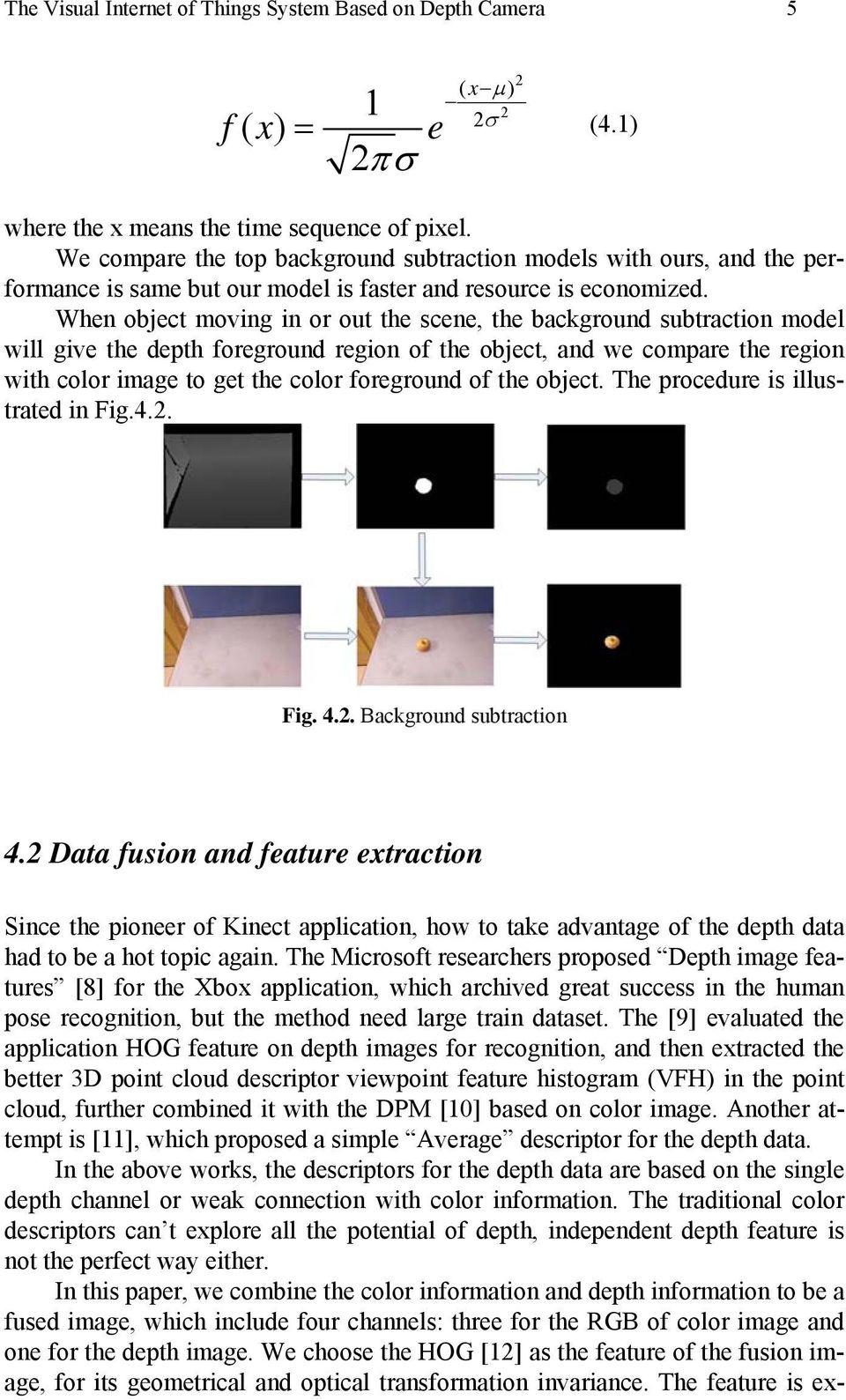
4 4 X.Zhang Writer et al. 4 Information Processing The procedure of information processing is illustrated in Fig.4.1. Fig Procedure of information processing We separate the data from Kinect to be color image and depth image. The color image is just smoothed by the methods introduced before. For the depth image, the depth information is obtained by the active light source, so it is independent of illumination condition and shadow. We take full advantage of it to use the depth image to build the background subtraction model. For the color image and depth image is calibrated, the foreground region of them have the same location in the image, so we can get the foreground region of the color image by contrasting with depth image. We fuse the color and depth information carefully to achieve both the rich feature and illumination variant. Then the modified HOG feature is extracted on the fused data. On the last step of information processing, we will implement the object detection with a trained model, which learned from the labeled samples with support vector machine (SVM) [3]. In the following, we will introduce the important parts of the information processing. 4.1 Background subtraction model The background subtraction model has been researched for decades, the recent stat-of-art methods are the Gaussian mixture model Maddalena [4], Zivkovic[5] and Barnich [6] according to the [7]. But all the methods applied for the color image will be great influenced by the illumination condition and shadow. The flash and other external interference will also be fatal for those methods. For the illumination invariant of the depth image, it will be the perfect source data for the background subtraction model. Although there are still much noise in the depth image from Kinect sensor, but that kind of noise will be eliminated easily. For the depth information of the image will changes only if there is really something moving in the scene, so we utilized the simply Gaussian model for the background, which can be described as a Gaussian function:

5 The Visual Internet of Things System Based on Depth Camera 5 f( x) 2 2 ( x ) 1 2 e (4.1) 2 where the x means the time sequence of pixel. We compare the top background subtraction models with ours, and the performance is same but our model is faster and resource is economized. When object moving in or out the scene, the background subtraction model will give the depth foreground region of the object, and we compare the region with color image to get the color foreground of the object. The procedure is illustrated in Fig.4.2. Fig Background subtraction 4.2 Data fusion and feature extraction Since the pioneer of Kinect application, how to take advantage of the depth data had to be a hot topic again. The Microsoft researchers proposed Depth image features [8] for the Xbox application, which archived great success in the human pose recognition, but the method need large train dataset. The [9] evaluated the application HOG feature on depth images for recognition, and then extracted the better 3D point cloud descriptor viewpoint feature histogram (VFH) in the point cloud, further combined it with the DPM [10] based on color image. Another attempt is [11], which proposed a simple Average descriptor for the depth data. In the above works, the descriptors for the depth data are based on the single depth channel or weak connection with color information. The traditional color descriptors can t explore all the potential of depth, independent depth feature is not the perfect way either. In this paper, we combine the color information and depth information to be a fused image, which include four channels: three for the RGB of color image and one for the depth image. We choose the HOG [12] as the feature of the fusion image, for its geometrical and optical transformation invariance. The feature is ex-
6 6 X.Zhang Writer et al. tracted for each channel of every point and cascaded to a vector. Thus the feature consists of color feature and depth feature. For the scale invariance, we resize the fusion image for HOG extracting and cascade all features to be a long vector as the description of the point. 4.3 Object detection We train the object model on the positive and negative samples, which can be collect off-line. Besides, our VIoT allow the on-line training, which means the user can select the object samples and random negative samples in the scene for training the model. We use the LibSVM [13] to train the model. In detection, although the background subtraction model gives the foreground, we still should give the window of image to the model and get a confidence score when more than one objects in the scene. The traditional way to get the windows is sliding a fixed scale window in pyramid image. It is timeconsuming. Inspired by [14], we utilize the image segmentation to get the independent parts of the foreground based on the fusion image. We build the frequency histogram for every channel of every part in foreground. If the difference between neighbor histograms is larger than threshold, the neighbor parts will merge to be one along with their frequency histogram. The segmentation result is illustrated in Fig.4.3. Fig Image segmentation based on fusion image With the help of image segmentation, we take the independent parts to object model and get confident scores, which determine whether the part is targeted. 5 Application After obtaining the object location, the information communication and feedback become an easy task. We program the user interface with C++ to achieve function of VIoT, including operation of Kinect sensor, information processing, collecting samples in the scene, parameter setting and object detection. The main interface of the system is illustrated in Fig.5.1.

7 The Visual Internet of Things System Based on Depth Camera 7 Fig Main interface of VIoT The system will get the color image and depth image of the scene, and we can select the object we want to train, as show in Fig.5.2, where the left picture is the color image, the down-right picture is the depth image, and the top-right picture is the color foreground. Fig Function of VIoT Fig Object detection In the detection, the system will detect the target object in the scene and label it with yellow rectangle, as shown in the Fig.5.3. The number of target object is on the down-left of the interface.

8 8 X.Zhang Writer et al. 6 Conclusion In this paper, the depth camera is first applied in the Visual Internet of Things. The proposed VIoT can get the color and depth information of the scene, and take full advantage of them to get the target object location in the scene. Besides, the fusion of color and depth has been discussed and the feature extraction method has been modified for the novel fusion image. The real application validates the robust and high precision of the system. 7 Reference 1. Van de Sande, K.E.A. and Uijlings, J.R.R. and Gevers, T. and Smeulders, A.W.M.(2011) Segmentation as Selective Search for Object Recognition, Computer Vision (ICCV), 2011 IEEE International Conference on 2. Microsoft Corp J. A. K. Suykens(2001) Support vector machines: A nonlinear modelling and control perspective, Eur. J. Control 2001, 7, L. Maddalena and A. Petrosino.(2008) A self-organizing approach to background subtraction for visual surveillance applications. IEEE Transactions on Image Processing, 17(7): Z. Zivkovic and F. van der Heijden.(2006) Efficient adaptive density estimation per image pixel for the task of background subtraction. Pattern Recognition Letters, 27: O. Barnich and M. Van Droogenbroeck.(2009) Vibe: A powerful random technique to estimate the background in video sequences. In IEEE Int. Conf. on Acoustics, Speech and Signal Processing, pages Brutzer, S., Hoferlin, B. and Heidemann, G.(2011) Evaluation of background subtraction techniques for video surveillance, Computer Vision and Pattern Recognition (CVPR), 2011 IEEE Conference on J. Shotton, A. Fitzgibbon, M. Cook, T. Sharp, M. Finocchio, R. Moore, A. Kipman, and A. Blake.(2011) Real-time human pose recognition in parts from single depth images. In Computer Vision and Pattern Recognition (CVPR), 2011 IEEE Conference on, pages IEEE, W. Susanto, M. Rohrbach, and B. Schiele. 3D object detection with multiple kinects. In Computer Vision ECCV Workshops and Demonstrations, pages Springer, P.F. Felzenszwalb, R.B. Girshick, D. McAllester, and D. Ramanan. Object detection with discriminatively trained part-based models. Pattern Analysis and Machine Intelligence, IEEE Transactions on, 32(9): , L. Jourdheuil, Allezard.N, Chateau.T, and Chesnais.T. Heterogeneous adaboost with realtime constraints - application to the detection of pedestrians by stereovision. In VISAPP (1), pages SciTePress, Dalal, N. and Triggs, B.(2005) Histograms of oriented gradients for human detection, Computer Vision and Pattern Recognition, CVPR IEEE Computer Society Conference on, 1, C.-C. Chang and C.-J. Lin. LIBSVM(2011) : a library for support vector machines. ACM Transactions on Intelligent Systems and Technology, 2:27:1--27: Felzenszwalb, P.F. and Huttenlocher, D.P.(2004) Efficient graph-based image segmentation, International Journal of Computer Vision, 2(59),

Semantic Recognition: Object Detection and Scene Segmentation
 Semantic Recognition: Object Detection and Scene Segmentation Xuming He [email protected] Computer Vision Research Group NICTA Robotic Vision Summer School 2015 Acknowledgement: Slides from Fei-Fei
VEHICLE LOCALISATION AND CLASSIFICATION IN URBAN CCTV STREAMS
 VEHICLE LOCALISATION AND CLASSIFICATION IN URBAN CCTV STREAMS Norbert Buch 1, Mark Cracknell 2, James Orwell 1 and Sergio A. Velastin 1 1. Kingston University, Penrhyn Road, Kingston upon Thames, KT1 2EE,
Lecture 6: CNNs for Detection, Tracking, and Segmentation Object Detection
 CSED703R: Deep Learning for Visual Recognition (206S) Lecture 6: CNNs for Detection, Tracking, and Segmentation Object Detection Bohyung Han Computer Vision Lab. [email protected] 2 3 Object detection
Scalable Object Detection by Filter Compression with Regularized Sparse Coding
 Scalable Object Detection by Filter Compression with Regularized Sparse Coding Ting-Hsuan Chao, Yen-Liang Lin, Yin-Hsi Kuo, and Winston H Hsu National Taiwan University, Taipei, Taiwan Abstract For practical
Recognizing Cats and Dogs with Shape and Appearance based Models. Group Member: Chu Wang, Landu Jiang
 Recognizing Cats and Dogs with Shape and Appearance based Models Group Member: Chu Wang, Landu Jiang Abstract Recognizing cats and dogs from images is a challenging competition raised by Kaggle platform
Tracking performance evaluation on PETS 2015 Challenge datasets
 Tracking performance evaluation on PETS 2015 Challenge datasets Tahir Nawaz, Jonathan Boyle, Longzhen Li and James Ferryman Computational Vision Group, School of Systems Engineering University of Reading,
Local features and matching. Image classification & object localization
 Overview Instance level search Local features and matching Efficient visual recognition Image classification & object localization Category recognition Image classification: assigning a class label to
Human Pose Estimation from RGB Input Using Synthetic Training Data
 Human Pose Estimation from RGB Input Using Synthetic Training Data Oscar Danielsson and Omid Aghazadeh School of Computer Science and Communication KTH, Stockholm, Sweden {osda02, omida}@kth.se arxiv:1405.1213v2
Practical Tour of Visual tracking. David Fleet and Allan Jepson January, 2006
 Practical Tour of Visual tracking David Fleet and Allan Jepson January, 2006 Designing a Visual Tracker: What is the state? pose and motion (position, velocity, acceleration, ) shape (size, deformation,
Tracking in flussi video 3D. Ing. Samuele Salti
 Seminari XXIII ciclo Tracking in flussi video 3D Ing. Tutors: Prof. Tullio Salmon Cinotti Prof. Luigi Di Stefano The Tracking problem Detection Object model, Track initiation, Track termination, Tracking
An Energy-Based Vehicle Tracking System using Principal Component Analysis and Unsupervised ART Network
 Proceedings of the 8th WSEAS Int. Conf. on ARTIFICIAL INTELLIGENCE, KNOWLEDGE ENGINEERING & DATA BASES (AIKED '9) ISSN: 179-519 435 ISBN: 978-96-474-51-2 An Energy-Based Vehicle Tracking System using Principal
Automatic 3D Reconstruction via Object Detection and 3D Transformable Model Matching CS 269 Class Project Report
 Automatic 3D Reconstruction via Object Detection and 3D Transformable Model Matching CS 69 Class Project Report Junhua Mao and Lunbo Xu University of California, Los Angeles [email protected] and lunbo
Cees Snoek. Machine. Humans. Multimedia Archives. Euvision Technologies The Netherlands. University of Amsterdam The Netherlands. Tree.
 Visual search: what's next? Cees Snoek University of Amsterdam The Netherlands Euvision Technologies The Netherlands Problem statement US flag Tree Aircraft Humans Dog Smoking Building Basketball Table
Pedestrian Detection with RCNN
 Pedestrian Detection with RCNN Matthew Chen Department of Computer Science Stanford University [email protected] Abstract In this paper we evaluate the effectiveness of using a Region-based Convolutional
A PHOTOGRAMMETRIC APPRAOCH FOR AUTOMATIC TRAFFIC ASSESSMENT USING CONVENTIONAL CCTV CAMERA
 A PHOTOGRAMMETRIC APPRAOCH FOR AUTOMATIC TRAFFIC ASSESSMENT USING CONVENTIONAL CCTV CAMERA N. Zarrinpanjeh a, F. Dadrassjavan b, H. Fattahi c * a Islamic Azad University of Qazvin - [email protected]
Deformable Part Models with CNN Features
 Deformable Part Models with CNN Features Pierre-André Savalle 1, Stavros Tsogkas 1,2, George Papandreou 3, Iasonas Kokkinos 1,2 1 Ecole Centrale Paris, 2 INRIA, 3 TTI-Chicago Abstract. In this work we
Circle Object Recognition Based on Monocular Vision for Home Security Robot
 Journal of Applied Science and Engineering, Vol. 16, No. 3, pp. 261 268 (2013) DOI: 10.6180/jase.2013.16.3.05 Circle Object Recognition Based on Monocular Vision for Home Security Robot Shih-An Li, Ching-Chang
Tracking and Recognition in Sports Videos
 Tracking and Recognition in Sports Videos Mustafa Teke a, Masoud Sattari b a Graduate School of Informatics, Middle East Technical University, Ankara, Turkey [email protected] b Department of Computer
Automatic Traffic Estimation Using Image Processing
 Automatic Traffic Estimation Using Image Processing Pejman Niksaz Science &Research Branch, Azad University of Yazd, Iran [email protected] Abstract As we know the population of city and number of
Edge Boxes: Locating Object Proposals from Edges
 Edge Boxes: Locating Object Proposals from Edges C. Lawrence Zitnick and Piotr Dollár Microsoft Research Abstract. The use of object proposals is an effective recent approach for increasing the computational
Vision based Vehicle Tracking using a high angle camera
 Vision based Vehicle Tracking using a high angle camera Raúl Ignacio Ramos García Dule Shu [email protected] [email protected] Abstract A vehicle tracking and grouping algorithm is presented in this work
The Dynamic Background Generation Scheme Using an Image Frame
 The Dynamic Background Generation Scheme Using an Image Frame Statistical Comparison Method *1, Corresponding Author Wen-Yuan Chen, Department of Electronic Engineering, National Chin-Yi University of
A Study on SURF Algorithm and Real-Time Tracking Objects Using Optical Flow
 , pp.233-237 http://dx.doi.org/10.14257/astl.2014.51.53 A Study on SURF Algorithm and Real-Time Tracking Objects Using Optical Flow Giwoo Kim 1, Hye-Youn Lim 1 and Dae-Seong Kang 1, 1 Department of electronices
Privacy Preserving Automatic Fall Detection for Elderly Using RGBD Cameras
 Privacy Preserving Automatic Fall Detection for Elderly Using RGBD Cameras Chenyang Zhang 1, Yingli Tian 1, and Elizabeth Capezuti 2 1 Media Lab, The City University of New York (CUNY), City College New
EXPLORING IMAGE-BASED CLASSIFICATION TO DETECT VEHICLE MAKE AND MODEL FINAL REPORT
 EXPLORING IMAGE-BASED CLASSIFICATION TO DETECT VEHICLE MAKE AND MODEL FINAL REPORT Jeffrey B. Flora, Mahbubul Alam, Amr H. Yousef, and Khan M. Iftekharuddin December 2013 DISCLAIMER The contents of this
Spatio-Temporally Coherent 3D Animation Reconstruction from Multi-view RGB-D Images using Landmark Sampling
 , March 13-15, 2013, Hong Kong Spatio-Temporally Coherent 3D Animation Reconstruction from Multi-view RGB-D Images using Landmark Sampling Naveed Ahmed Abstract We present a system for spatio-temporally
Behavior Analysis in Crowded Environments. XiaogangWang Department of Electronic Engineering The Chinese University of Hong Kong June 25, 2011
 Behavior Analysis in Crowded Environments XiaogangWang Department of Electronic Engineering The Chinese University of Hong Kong June 25, 2011 Behavior Analysis in Sparse Scenes Zelnik-Manor & Irani CVPR
A Genetic Algorithm-Evolved 3D Point Cloud Descriptor
 A Genetic Algorithm-Evolved 3D Point Cloud Descriptor Dominik Wȩgrzyn and Luís A. Alexandre IT - Instituto de Telecomunicações Dept. of Computer Science, Univ. Beira Interior, 6200-001 Covilhã, Portugal
Mean-Shift Tracking with Random Sampling
 1 Mean-Shift Tracking with Random Sampling Alex Po Leung, Shaogang Gong Department of Computer Science Queen Mary, University of London, London, E1 4NS Abstract In this work, boosting the efficiency of
Colorado School of Mines Computer Vision Professor William Hoff
 Professor William Hoff Dept of Electrical Engineering &Computer Science http://inside.mines.edu/~whoff/ 1 Introduction to 2 What is? A process that produces from images of the external world a description
Building an Advanced Invariant Real-Time Human Tracking System
 UDC 004.41 Building an Advanced Invariant Real-Time Human Tracking System Fayez Idris 1, Mazen Abu_Zaher 2, Rashad J. Rasras 3, and Ibrahiem M. M. El Emary 4 1 School of Informatics and Computing, German-Jordanian
Human behavior analysis from videos using optical flow
 L a b o r a t o i r e I n f o r m a t i q u e F o n d a m e n t a l e d e L i l l e Human behavior analysis from videos using optical flow Yassine Benabbas Directeur de thèse : Chabane Djeraba Multitel
AN IMPROVED DOUBLE CODING LOCAL BINARY PATTERN ALGORITHM FOR FACE RECOGNITION
 AN IMPROVED DOUBLE CODING LOCAL BINARY PATTERN ALGORITHM FOR FACE RECOGNITION Saurabh Asija 1, Rakesh Singh 2 1 Research Scholar (Computer Engineering Department), Punjabi University, Patiala. 2 Asst.
Are we ready for Autonomous Driving? The KITTI Vision Benchmark Suite
 Are we ready for Autonomous Driving? The KITTI Vision Benchmark Suite Philip Lenz 1 Andreas Geiger 2 Christoph Stiller 1 Raquel Urtasun 3 1 KARLSRUHE INSTITUTE OF TECHNOLOGY 2 MAX-PLANCK-INSTITUTE IS 3
3D Model based Object Class Detection in An Arbitrary View
 3D Model based Object Class Detection in An Arbitrary View Pingkun Yan, Saad M. Khan, Mubarak Shah School of Electrical Engineering and Computer Science University of Central Florida http://www.eecs.ucf.edu/
3D Vehicle Extraction and Tracking from Multiple Viewpoints for Traffic Monitoring by using Probability Fusion Map
 Electronic Letters on Computer Vision and Image Analysis 7(2):110-119, 2008 3D Vehicle Extraction and Tracking from Multiple Viewpoints for Traffic Monitoring by using Probability Fusion Map Zhencheng
Modelling, Extraction and Description of Intrinsic Cues of High Resolution Satellite Images: Independent Component Analysis based approaches
 Modelling, Extraction and Description of Intrinsic Cues of High Resolution Satellite Images: Independent Component Analysis based approaches PhD Thesis by Payam Birjandi Director: Prof. Mihai Datcu Problematic
Object Recognition. Selim Aksoy. Bilkent University [email protected]
 Image Classification and Object Recognition Selim Aksoy Department of Computer Engineering Bilkent University [email protected] Image classification Image (scene) classification is a fundamental
Learning Detectors from Large Datasets for Object Retrieval in Video Surveillance
 2012 IEEE International Conference on Multimedia and Expo Learning Detectors from Large Datasets for Object Retrieval in Video Surveillance Rogerio Feris, Sharath Pankanti IBM T. J. Watson Research Center
Colour Image Segmentation Technique for Screen Printing
 60 R.U. Hewage and D.U.J. Sonnadara Department of Physics, University of Colombo, Sri Lanka ABSTRACT Screen-printing is an industry with a large number of applications ranging from printing mobile phone
Finding people in repeated shots of the same scene
 Finding people in repeated shots of the same scene Josef Sivic 1 C. Lawrence Zitnick Richard Szeliski 1 University of Oxford Microsoft Research Abstract The goal of this work is to find all occurrences
An Active Head Tracking System for Distance Education and Videoconferencing Applications
 An Active Head Tracking System for Distance Education and Videoconferencing Applications Sami Huttunen and Janne Heikkilä Machine Vision Group Infotech Oulu and Department of Electrical and Information
Neural Network based Vehicle Classification for Intelligent Traffic Control
 Neural Network based Vehicle Classification for Intelligent Traffic Control Saeid Fazli 1, Shahram Mohammadi 2, Morteza Rahmani 3 1,2,3 Electrical Engineering Department, Zanjan University, Zanjan, IRAN
How does Person Identity Recognition Help Multi-Person Tracking?
 How does Person Identity Recognition Help Multi-Person Tracking? Cheng-Hao Kuo and Ram Nevatia University of Southern California, Institute for Robotics and Intelligent Systems Los Angeles, CA 90089, USA
Assessment. Presenter: Yupu Zhang, Guoliang Jin, Tuo Wang Computer Vision 2008 Fall
 Automatic Photo Quality Assessment Presenter: Yupu Zhang, Guoliang Jin, Tuo Wang Computer Vision 2008 Fall Estimating i the photorealism of images: Distinguishing i i paintings from photographs h Florin
Optical Flow. Shenlong Wang CSC2541 Course Presentation Feb 2, 2016
 Optical Flow Shenlong Wang CSC2541 Course Presentation Feb 2, 2016 Outline Introduction Variation Models Feature Matching Methods End-to-end Learning based Methods Discussion Optical Flow Goal: Pixel motion
FACE RECOGNITION BASED ATTENDANCE MARKING SYSTEM
 Available Online at www.ijcsmc.com International Journal of Computer Science and Mobile Computing A Monthly Journal of Computer Science and Information Technology IJCSMC, Vol. 3, Issue. 2, February 2014,
Detection and Recognition of Mixed Traffic for Driver Assistance System
 Detection and Recognition of Mixed Traffic for Driver Assistance System Pradnya Meshram 1, Prof. S.S. Wankhede 2 1 Scholar, Department of Electronics Engineering, G.H.Raisoni College of Engineering, Digdoh
A Method of Caption Detection in News Video
 3rd International Conference on Multimedia Technology(ICMT 3) A Method of Caption Detection in News Video He HUANG, Ping SHI Abstract. News video is one of the most important media for people to get information.
Analecta Vol. 8, No. 2 ISSN 2064-7964
 EXPERIMENTAL APPLICATIONS OF ARTIFICIAL NEURAL NETWORKS IN ENGINEERING PROCESSING SYSTEM S. Dadvandipour Institute of Information Engineering, University of Miskolc, Egyetemváros, 3515, Miskolc, Hungary,
Real-Time Tracking of Pedestrians and Vehicles
 Real-Time Tracking of Pedestrians and Vehicles N.T. Siebel and S.J. Maybank. Computational Vision Group Department of Computer Science The University of Reading Reading RG6 6AY, England Abstract We present
Classifying Manipulation Primitives from Visual Data
 Classifying Manipulation Primitives from Visual Data Sandy Huang and Dylan Hadfield-Menell Abstract One approach to learning from demonstrations in robotics is to make use of a classifier to predict if
Convolutional Feature Maps
 Convolutional Feature Maps Elements of efficient (and accurate) CNN-based object detection Kaiming He Microsoft Research Asia (MSRA) ICCV 2015 Tutorial on Tools for Efficient Object Detection Overview
Speed Performance Improvement of Vehicle Blob Tracking System
 Speed Performance Improvement of Vehicle Blob Tracking System Sung Chun Lee and Ram Nevatia University of Southern California, Los Angeles, CA 90089, USA [email protected], [email protected] Abstract. A speed
Distributed Vision Processing in Smart Camera Networks
 Distributed Vision Processing in Smart Camera Networks CVPR-07 Hamid Aghajan, Stanford University, USA François Berry, Univ. Blaise Pascal, France Horst Bischof, TU Graz, Austria Richard Kleihorst, NXP
Image Normalization for Illumination Compensation in Facial Images
 Image Normalization for Illumination Compensation in Facial Images by Martin D. Levine, Maulin R. Gandhi, Jisnu Bhattacharyya Department of Electrical & Computer Engineering & Center for Intelligent Machines
Bildverarbeitung und Mustererkennung Image Processing and Pattern Recognition
 Bildverarbeitung und Mustererkennung Image Processing and Pattern Recognition 1. Image Pre-Processing - Pixel Brightness Transformation - Geometric Transformation - Image Denoising 1 1. Image Pre-Processing
How does the Kinect work? John MacCormick
 How does the Kinect work? John MacCormick Xbox demo Laptop demo The Kinect uses structured light and machine learning Inferring body position is a two-stage process: first compute a depth map (using structured
LIBSVX and Video Segmentation Evaluation
 CVPR 14 Tutorial! 1! LIBSVX and Video Segmentation Evaluation Chenliang Xu and Jason J. Corso!! Computer Science and Engineering! SUNY at Buffalo!! Electrical Engineering and Computer Science! University
CS 534: Computer Vision 3D Model-based recognition
 CS 534: Computer Vision 3D Model-based recognition Ahmed Elgammal Dept of Computer Science CS 534 3D Model-based Vision - 1 High Level Vision Object Recognition: What it means? Two main recognition tasks:!
Face Recognition in Low-resolution Images by Using Local Zernike Moments
 Proceedings of the International Conference on Machine Vision and Machine Learning Prague, Czech Republic, August14-15, 014 Paper No. 15 Face Recognition in Low-resolution Images by Using Local Zernie
Interactive person re-identification in TV series
 Interactive person re-identification in TV series Mika Fischer Hazım Kemal Ekenel Rainer Stiefelhagen CV:HCI lab, Karlsruhe Institute of Technology Adenauerring 2, 76131 Karlsruhe, Germany E-mail: {mika.fischer,ekenel,rainer.stiefelhagen}@kit.edu
C# Implementation of SLAM Using the Microsoft Kinect
 C# Implementation of SLAM Using the Microsoft Kinect Richard Marron Advisor: Dr. Jason Janet 4/18/2012 Abstract A SLAM algorithm was developed in C# using the Microsoft Kinect and irobot Create. Important
Signature Region of Interest using Auto cropping
 ISSN (Online): 1694-0784 ISSN (Print): 1694-0814 1 Signature Region of Interest using Auto cropping Bassam Al-Mahadeen 1, Mokhled S. AlTarawneh 2 and Islam H. AlTarawneh 2 1 Math. And Computer Department,
Removing Moving Objects from Point Cloud Scenes
 1 Removing Moving Objects from Point Cloud Scenes Krystof Litomisky [email protected] Abstract. Three-dimensional simultaneous localization and mapping is a topic of significant interest in the research
An Efficient Geometric feature based License Plate Localization and Stop Line Violation Detection System
 An Efficient Geometric feature based License Plate Localization and Stop Line Violation Detection System Waing, Dr.Nyein Aye Abstract Stop line violation causes in myanmar when the back wheel of the car
Vehicle Tracking by Simultaneous Detection and Viewpoint Estimation
 Vehicle Tracking by Simultaneous Detection and Viewpoint Estimation Ricardo Guerrero-Gómez-Olmedo, Roberto López-Sastre, Saturnino Maldonado-Bascón, and Antonio Fernández-Caballero 2 GRAM, Department of
Video Surveillance System for Security Applications
 Video Surveillance System for Security Applications Vidya A.S. Department of CSE National Institute of Technology Calicut, Kerala, India V. K. Govindan Department of CSE National Institute of Technology
SIGNATURE VERIFICATION
 SIGNATURE VERIFICATION Dr. H.B.Kekre, Dr. Dhirendra Mishra, Ms. Shilpa Buddhadev, Ms. Bhagyashree Mall, Mr. Gaurav Jangid, Ms. Nikita Lakhotia Computer engineering Department, MPSTME, NMIMS University
Advanced Methods for Pedestrian and Bicyclist Sensing
 Advanced Methods for Pedestrian and Bicyclist Sensing Yinhai Wang PacTrans STAR Lab University of Washington Email: [email protected] Tel: 1-206-616-2696 For Exchange with University of Nevada Reno Sept. 25,
Journal of Industrial Engineering Research. Adaptive sequence of Key Pose Detection for Human Action Recognition
 IWNEST PUBLISHER Journal of Industrial Engineering Research (ISSN: 2077-4559) Journal home page: http://www.iwnest.com/aace/ Adaptive sequence of Key Pose Detection for Human Action Recognition 1 T. Sindhu
How To Filter Spam Image From A Picture By Color Or Color
 Image Content-Based Email Spam Image Filtering Jianyi Wang and Kazuki Katagishi Abstract With the population of Internet around the world, email has become one of the main methods of communication among
Image Classification for Dogs and Cats
 Image Classification for Dogs and Cats Bang Liu, Yan Liu Department of Electrical and Computer Engineering {bang3,yan10}@ualberta.ca Kai Zhou Department of Computing Science [email protected] Abstract
A Reliability Point and Kalman Filter-based Vehicle Tracking Technique
 A Reliability Point and Kalman Filter-based Vehicle Tracing Technique Soo Siang Teoh and Thomas Bräunl Abstract This paper introduces a technique for tracing the movement of vehicles in consecutive video
EFFICIENT VEHICLE TRACKING AND CLASSIFICATION FOR AN AUTOMATED TRAFFIC SURVEILLANCE SYSTEM
 EFFICIENT VEHICLE TRACKING AND CLASSIFICATION FOR AN AUTOMATED TRAFFIC SURVEILLANCE SYSTEM Amol Ambardekar, Mircea Nicolescu, and George Bebis Department of Computer Science and Engineering University
Semantic Video Annotation by Mining Association Patterns from Visual and Speech Features
 Semantic Video Annotation by Mining Association Patterns from and Speech Features Vincent. S. Tseng, Ja-Hwung Su, Jhih-Hong Huang and Chih-Jen Chen Department of Computer Science and Information Engineering
Automotive Applications of 3D Laser Scanning Introduction
 Automotive Applications of 3D Laser Scanning Kyle Johnston, Ph.D., Metron Systems, Inc. 34935 SE Douglas Street, Suite 110, Snoqualmie, WA 98065 425-396-5577, www.metronsys.com 2002 Metron Systems, Inc
Robot Perception Continued
 Robot Perception Continued 1 Visual Perception Visual Odometry Reconstruction Recognition CS 685 11 Range Sensing strategies Active range sensors Ultrasound Laser range sensor Slides adopted from Siegwart
ACCURACY ASSESSMENT OF BUILDING POINT CLOUDS AUTOMATICALLY GENERATED FROM IPHONE IMAGES
 ACCURACY ASSESSMENT OF BUILDING POINT CLOUDS AUTOMATICALLY GENERATED FROM IPHONE IMAGES B. Sirmacek, R. Lindenbergh Delft University of Technology, Department of Geoscience and Remote Sensing, Stevinweg
Analysis of Preview Behavior in E-Book System
 Analysis of Preview Behavior in E-Book System Atsushi SHIMADA *, Fumiya OKUBO, Chengjiu YIN, Misato OI, Kentaro KOJIMA, Masanori YAMADA, Hiroaki OGATA Faculty of Arts and Science, Kyushu University, Japan
Color Segmentation Based Depth Image Filtering
 Color Segmentation Based Depth Image Filtering Michael Schmeing and Xiaoyi Jiang Department of Computer Science, University of Münster Einsteinstraße 62, 48149 Münster, Germany, {m.schmeing xjiang}@uni-muenster.de
Probabilistic Latent Semantic Analysis (plsa)
 Probabilistic Latent Semantic Analysis (plsa) SS 2008 Bayesian Networks Multimedia Computing, Universität Augsburg [email protected] www.multimedia-computing.{de,org} References
International Journal of Innovative Research in Computer and Communication Engineering. (A High Impact Factor, Monthly, Peer Reviewed Journal)
 Video Surveillance over Camera Network Using Hadoop Naveen Kumar 1, Elliyash Pathan 1, Lalan Yadav 1, Viraj Ransubhe 1, Sowjanya Kurma 2 1 Assistant Student (BE Computer), ACOE, Pune, India. 2 Professor,
An Approach for Utility Pole Recognition in Real Conditions
 6th Pacific-Rim Symposium on Image and Video Technology 1st PSIVT Workshop on Quality Assessment and Control by Image and Video Analysis An Approach for Utility Pole Recognition in Real Conditions Barranco
Terrain Traversability Analysis using Organized Point Cloud, Superpixel Surface Normals-based segmentation and PCA-based Classification
 Terrain Traversability Analysis using Organized Point Cloud, Superpixel Surface Normals-based segmentation and PCA-based Classification Aras Dargazany 1 and Karsten Berns 2 Abstract In this paper, an stereo-based
International Journal of Advanced Information in Arts, Science & Management Vol.2, No.2, December 2014
 Efficient Attendance Management System Using Face Detection and Recognition Arun.A.V, Bhatath.S, Chethan.N, Manmohan.C.M, Hamsaveni M Department of Computer Science and Engineering, Vidya Vardhaka College
Big Data: Image & Video Analytics
 Big Data: Image & Video Analytics How it could support Archiving & Indexing & Searching Dieter Haas, IBM Deutschland GmbH The Big Data Wave 60% of internet traffic is multimedia content (images and videos)
MusicGuide: Album Reviews on the Go Serdar Sali
 MusicGuide: Album Reviews on the Go Serdar Sali Abstract The cameras on mobile phones have untapped potential as input devices. In this paper, we present MusicGuide, an application that can be used to
3D Scanner using Line Laser. 1. Introduction. 2. Theory
 . Introduction 3D Scanner using Line Laser Di Lu Electrical, Computer, and Systems Engineering Rensselaer Polytechnic Institute The goal of 3D reconstruction is to recover the 3D properties of a geometric
A Learning Based Method for Super-Resolution of Low Resolution Images
 A Learning Based Method for Super-Resolution of Low Resolution Images Emre Ugur June 1, 2004 [email protected] Abstract The main objective of this project is the study of a learning based method
Virtual Mouse Using a Webcam
 1. INTRODUCTION Virtual Mouse Using a Webcam Since the computer technology continues to grow up, the importance of human computer interaction is enormously increasing. Nowadays most of the mobile devices