
Detection and Recognition of Mixed Traffic for Driver Assistance System
|
|
|
- Rolf Hodges
- 10 years ago
- Views:
Transcription
1 Detection and Recognition of Mixed Traffic for Driver Assistance System Pradnya Meshram 1, Prof. S.S. Wankhede 2 1 Scholar, Department of Electronics Engineering, G.H.Raisoni College of Engineering, Digdoh hill, Nagpur, India 2 Faculty, Department of Electronics Engineering, G.H.Raisoni College of Engineering, Digdoh hill, Nagpur, India - [email protected] ABSTRACT- Driver-assistance systems that monitor driver intent, warn drivers or assist in vehicle guidance are all being actively considered. This paper present computer vision system designed for recognizing road boundary and a number of objects of interest including vehicles, pedestrians, motorcycles and bicycles. The system is designed using Hough transform and Kalman filters to improve the accuracy as well as robustness of the road environment recognition. A Kalman filter object can be configured for each physical object for multiple object tracking. To use the Kalman filter, the moving object must be track. The results are then used as the road contextual information for the following procedure, in which, particular objects of interest, including vehicles, pedestrians, motorcycles and bicycles, are recognized by using a multi-class object detector. The results in various typical but challenging scenarios show the effectiveness of the system. Keywords Computer vision toolbox, Video processing, Hough transform,kalman filters,region of interest, Object track,driver assistance system, Intelligent vehicles. INTRODUCTION Within the last few years, research into intelligent vehicles has expanded into applications that work with or for the human user. Computer vision system should be able to detect the drivable road boundary and obstacles. For some higher-level functions, it is also necessary to identify particular objects of interest, such as vehicles, pedestrians, motorcycles, and bicycles. The detection and recognition of such information are crucial for the successful deployment of the future intelligent vehicular technologies in the practical mixed traffic, in which, the intelligent vehicles have to share the road environment with all road users, such as pedestrians, motorbikes, bicycles and vehicles driven by human beings. Whereas computer vision can deliver a great amount of information, making it a powerful means for sensing the structure of the road environment and recognizing the on-road objects and traffic information. Therefore, computer vision is necessary and promising for the road detection and other applications related to intelligent vehicular technologies. The novelty of this paper lies in the following two aspects: First, we formulize the drivable road boundary detection using Hough transform which not only improves the accuracy but also enhances the robustness for the estimation of the drivable road boundary. The detected road boundaries are used to verify which ones are needed to be tracked and which ones are not. Second, we recognize particular objects of interest by using the Kalman filter. It is use to predict a physical object's future location, to reduce noise in the detected location. The system development in order to improve traffic safety with respect to the road users Such framework can improve not only the accuracy but also the efficiency of the road environment recognition REVIEW OF LITERATURE Chunzhao Guo and Seiichi Mita, in their study, they recognizing a number of objects of interest in mixed traffic, in which, the host vehicle have to drive inside the road boundary and interact with other road First, it formulize the drivable road boundary detection as a global optimization problem in a Hidden Markov Model (HMM) associated with a semantic graph of the traffic scene Second, it recognize particular objects of interest by using the road contextual correlation based on the semantic graph with the detected road boundary Such framework can improve not only the accuracy but also the efficiency of the road environment recognition. Joel C. McCall and Mohan M. Trivedi, in their study, motivate the development of the novel video-based lane estimation and tracking (VioLET) system. The system is designed using steerable filters for robust and accurate lane-marking detection. Steerable 201
2 filters provide an efficient method for detecting circular- reflector markings, solid-line markings, and segmented-line markings under varying lighting and road conditions. They help in providing robustness to complex shadowing, lighting changes from overpasses and tunnels, and road-surface variations. They are efficient for lane-marking extraction because by computing only three separable convolutions, we can extract a wide variety of lane markings There are three major objectives of this paper The first is to present a framework for comparative discussion and development of lane-detection and position-estimation algorithms. The second is to present the novel video-based lane estimation and tracking (VioLET) system designed for driver assistance. The third is to present a detailed evaluation of the VioLET system Michael Darms, Matthias Komar and Stefan Lueke, The paper presents an approach to estimate road boundaries based on static objects bounding the road. A map based environment description and an interpretation algorithm identifying the road boundaries in the map are used. Two approaches are presented for estimating the map, one based on a radar sensor, one on a mono video camera. Besides that two fusion approaches are described. The estimated boundaries are independent of road markings and as such can be used as orthogonal information with respect to detected markings. Results of practical test using the estimated road boundaries for a lane keeping system are presented. Akihito Seki and Masatoshi Okutomi, in their study,understanding the general road environment is a vital task for obstacle detection in complicated situations. That task is easier to perform for highway environments than for general roads because road environments are well-established in highways and obstacle classes are limited. On the other hand, general roads are not always well-established and various small obstacles, as well as larger ones, must be detected. For the purpose of discerning obstacles and road patterns, it is important to determine the relative positions of the camera and the road surface. This paper presents an efficient solution using a stereo-vision-based obstacle detection method for general roads. The relative position is estimated dynamically even without any clear lane markings. Additionally, obstacles are detected without applying explicit models. We present experimental results to demonstrate the effectiveness of our proposed method under various conditions. Zehang Sun, George Bebis, and Ronald Miller,in their study, presents a review of recent vision-based on-road vehicle detection systems. Our focus is on systems where the camera is mounted on the vehicle rather than being fixed such as in traffic/driveway monitoring systems. First, we discuss the problem of on-road vehicle detection using optical sensors followed by a brief review of intelligent vehicle research worldwide. Then, we discuss active and passive sensors to set the stage for vision-based vehicle detection. Methods aiming to quickly hypothesize the location of vehicles in an image as well as to verify the hypothesized locations are reviewed next. Integrating detection with tracking is also reviewed to illustrate the benefits of exploiting temporal continuity for vehicle detection Akihiro Takeuchi, Seiichi Mita, David McAllester, in their study,proposes a novel method for vehicle detection and tracking using a vehicle-mounted monocular camera. In this method, features of vehicles are learned as a deformable object model through the combination of a latent support vector machine (LSVM) and histograms of oriented gradients (HOG). The vehicle detector uses both global and local features as the deformable object model. Detected vehicles are tracked by using a particle filter with integrated likelihoods, such as the probability of vehicles estimated from the deformable object model and the intensity correlation between different picture frames
3 SYSTEM DESIGN ARCHITECTURE : Figure shows the diagram of the proposed Approach system.the system lies in two ways :Right image and Left image. The system is design using Hough transform and Kalman filter. With the Hough transform, we find the drivable road boundary. The resultant road boundary is then used as the road contextual information to enhance the performance for each processing step of the multi-object recognition, which detects the objects of interest by using Kalman filter. Fig. flow diagram of the proposed work A) ROAD BOUNDARY DETECTION AND TRACKING : Computer vision-based methods are widely used for road detection. They are more robust than the all. The detection of road boundary an Hough transform is used. It is detect boundary in the current video frame and finally localize the road boundary using the colour red and green. The current goal is to find the edges of road in which human driver have to drive. By using the Hough transform, the proposed approach finds the edges of road. The detected road boundary are used to verify which ones are needed to be tracked and which ones are not. The approach can still find the accurate drivable road boundary robustly from the figure. Fig. 1. Road boundary detection
4 B) MULTI-OBJECT RECOGNITION : As mentioned previously, the intelligent vehicles have to share the road environment with all road users, such as pedestrians, motorbikes, bicycles, and other vehicles. The system development of different types of detection systems in order to improve traffic safety with respect to the road users.in the proposed system, particular objects of interest, including vehicles, pedestrians, motorcycles and bicycles, are recognized with the context information. Object identification is challenging in that objects present dramatic appearance changes according to camera viewpoints and environment conditions. The detection of object an kalman filter is used. The Kalman filter object is designed for tracking. It is use to predict a physical object's future location, to reduce noise in the detected location, or to help associate multiple physical objects with their corresponding tracks. A Kalman filter object can be configured for each physical object for multiple object tracking. The flowchart of this object detection system is shown in fig 2. and its main steps are discussed in the following section. The first step is to collect database of video file. There is masking of all the image and foreground detection. Then block is analysis.after the analysis of all the block it read all the frames of image. All the previous frames is delete and create a new frame. It detect the object track and predict frames. Database of videofile Foreground detection Block analysis Bound box Track object Fig 2. Flow chart of object detector Object tracking is often performed to avoid false detections over time and predict future target positions. However, it is unnecessary to keep tracking the targets which are out of the collision range Particular objects of interest, including vehicles, pedestrians, motorcycles, and bicycles, are recognized, which will be provided to the behavioural and motion planning systems of the intelligent vehicles for high-level functions. Some example results in various scenarios for different on-road objects are shown in Figure which substantiated that the proposed system can successfully detect the objects of interest with various sizes, types, colours. 1) Vehicle detection:- Original video Segmented video 204
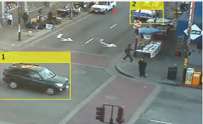
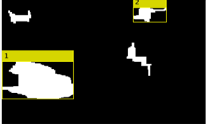
5 2) Pedestrians detection :- Original video Segmented video 3) Vehicle and pedestrian detection:- Original video Segmented video CONCLUSION : We present a vision-based approach for estimating the road boundary and recognizing a number of road users. Our first contribution is road detection using Hough transform. It allows the used to verify which ones are needed to be tracked and which ones are not. it will help the human driver to go on a particular road boundary.our second contribution is the use of road contextual correlation for enhancing the object recognition performance. The Kalman filter object is designed for tracking. It is use to predict object's future location. The system development in order to improve traffic safety with respect to the road users All of these contributions improve the accuracy as well as robustness of the road environment recognition. REFERENCES: [1] Chunzhao Guo, Member, IEEE, and Seiichi Mita, Member, IEEE Semantic-based Road Environment Recognition in Mixed Traffic for Intelligent Vehicles and Advanced Driver Assistance Systems [2] M.Nieto and L.Salgado, Real time vanishing point estimation in sequences using adaptive steerable filter bank, in proc. Advanced concepts for intelligent vision system,lncs 2007,pp. [3] J.C.McCall and M.M.Trivedi, Video-Based Lane Estimation and Tracking for Driver Assistance: Survey, System, and Evaluation, IEEE Trans.Intell.Transp.Syst.,vol 7,no.1,pp ,Mar 2006 [4] J. McCall, D. Wipf, M. M. Trivedi, and B. Rao, Lane change intent analysis using robust operators and sparse Bayesian learning, in Proc. IEEE Int. Workshop Machine Vision Intelligent Vehicles/IEEE Int. Conf. Computer Vision and Pattern Recognition, San Diego, CA, Jun. 2005, pp
6 [5] M.darms,M.Komar, and S. Lueke, Map based Road Boundary Estimation, in proc.ieee Intelligent vehicle symposium,2010,pp [6] A.seki and M. Okutomi Robust Obstacle Detection in General Road Environment Based on Road Extraction and Pose Estimation, in proc. IEEE Intelligent Vehicles Symposium, 2006, pp [7] S. Kubota, T. Nakano and Y. Okamoto, A Global Optimization Algorithm for Real-Time On-Board Stereo Obstacle Detection Systems, in proc. IEEE Intelligent Vehicles Symposium, 2007, pp 7-12 [8] F. Han, Y. Shan, R. Cekander, H. S. Sawhney, and R. Kumar, A two-stage approach to people and vehicle detection with HOGbased SVM, in Performance Metrics for Intelligent Systems 2006 Workshop, pp , Aug [9] K. Kluge, Performance evaluation of vision-based lane sensing: Some preliminary tools, metrics, and results, in Proc. IEEE Intelligent Transportation Systems Conf., Boston, MA, 1997, pp [10] M.Bertozzi, A. Broggi, and A. Fascioli, Obstacle and Lane Detection on Argo Autonomous Vehicle, IEEE Intelligent Transportation Systems, [11] z.sun,g.bebis,and R.miller,on-Road Vehicle Detect ion: A Review, IEEE Trans. Pattern Analysis and Machine Intelligence, vol. 28, no. 5,pp , 2006 [12] D.geronimo,A.M.lopez,A.D.sappa and T.Graf, survey on pedestrian detection for advance driver assistance system, IEEE Trans. Pattern Analysis and machine intelligence, vol. 32, no. 7,pp ,2010 [13] A. Takeuchi, S. Mita, and D. McAllester, On-road vehicle tracking using Deformable Object Model and Part icle Filter with Integrated Likelihoods_ _ in Proc. IEEE Intelligent Vehicles Symposium, 2010, pp [14] K. Fürstenberg, D. Linzmeier, and K. Dietmayer, Pedestrian recognition and tracking of vehicles using a vehicle based multilayer laser scanner, Proc. of 10th World Congress on ITS 2003, Madrid, Spain, November
An Energy-Based Vehicle Tracking System using Principal Component Analysis and Unsupervised ART Network
 Proceedings of the 8th WSEAS Int. Conf. on ARTIFICIAL INTELLIGENCE, KNOWLEDGE ENGINEERING & DATA BASES (AIKED '9) ISSN: 179-519 435 ISBN: 978-96-474-51-2 An Energy-Based Vehicle Tracking System using Principal
Vision-Based Blind Spot Detection Using Optical Flow
 Vision-Based Blind Spot Detection Using Optical Flow M.A. Sotelo 1, J. Barriga 1, D. Fernández 1, I. Parra 1, J.E. Naranjo 2, M. Marrón 1, S. Alvarez 1, and M. Gavilán 1 1 Department of Electronics, University
VEHICLE LOCALISATION AND CLASSIFICATION IN URBAN CCTV STREAMS
 VEHICLE LOCALISATION AND CLASSIFICATION IN URBAN CCTV STREAMS Norbert Buch 1, Mark Cracknell 2, James Orwell 1 and Sergio A. Velastin 1 1. Kingston University, Penrhyn Road, Kingston upon Thames, KT1 2EE,
A Reliability Point and Kalman Filter-based Vehicle Tracking Technique
 A Reliability Point and Kalman Filter-based Vehicle Tracing Technique Soo Siang Teoh and Thomas Bräunl Abstract This paper introduces a technique for tracing the movement of vehicles in consecutive video
Static Environment Recognition Using Omni-camera from a Moving Vehicle
 Static Environment Recognition Using Omni-camera from a Moving Vehicle Teruko Yata, Chuck Thorpe Frank Dellaert The Robotics Institute Carnegie Mellon University Pittsburgh, PA 15213 USA College of Computing
Neural Network based Vehicle Classification for Intelligent Traffic Control
 Neural Network based Vehicle Classification for Intelligent Traffic Control Saeid Fazli 1, Shahram Mohammadi 2, Morteza Rahmani 3 1,2,3 Electrical Engineering Department, Zanjan University, Zanjan, IRAN
REAL TIME TRAFFIC LIGHT CONTROL USING IMAGE PROCESSING
 REAL TIME TRAFFIC LIGHT CONTROL USING IMAGE PROCESSING Ms.PALLAVI CHOUDEKAR Ajay Kumar Garg Engineering College, Department of electrical and electronics Ms.SAYANTI BANERJEE Ajay Kumar Garg Engineering
A Vision-Based Tracking System for a Street-Crossing Robot
 Submitted to ICRA-04 A Vision-Based Tracking System for a Street-Crossing Robot Michael Baker Computer Science Department University of Massachusetts Lowell Lowell, MA [email protected] Holly A. Yanco
Efficient Background Subtraction and Shadow Removal Technique for Multiple Human object Tracking
 ISSN: 2321-7782 (Online) Volume 1, Issue 7, December 2013 International Journal of Advance Research in Computer Science and Management Studies Research Paper Available online at: www.ijarcsms.com Efficient
Tracking performance evaluation on PETS 2015 Challenge datasets
 Tracking performance evaluation on PETS 2015 Challenge datasets Tahir Nawaz, Jonathan Boyle, Longzhen Li and James Ferryman Computational Vision Group, School of Systems Engineering University of Reading,
EFFICIENT VEHICLE TRACKING AND CLASSIFICATION FOR AN AUTOMATED TRAFFIC SURVEILLANCE SYSTEM
 EFFICIENT VEHICLE TRACKING AND CLASSIFICATION FOR AN AUTOMATED TRAFFIC SURVEILLANCE SYSTEM Amol Ambardekar, Mircea Nicolescu, and George Bebis Department of Computer Science and Engineering University
Circle Object Recognition Based on Monocular Vision for Home Security Robot
 Journal of Applied Science and Engineering, Vol. 16, No. 3, pp. 261 268 (2013) DOI: 10.6180/jase.2013.16.3.05 Circle Object Recognition Based on Monocular Vision for Home Security Robot Shih-An Li, Ching-Chang
The Visual Internet of Things System Based on Depth Camera
 The Visual Internet of Things System Based on Depth Camera Xucong Zhang 1, Xiaoyun Wang and Yingmin Jia Abstract The Visual Internet of Things is an important part of information technology. It is proposed
Vision based Vehicle Tracking using a high angle camera
 Vision based Vehicle Tracking using a high angle camera Raúl Ignacio Ramos García Dule Shu [email protected] [email protected] Abstract A vehicle tracking and grouping algorithm is presented in this work
LOCAL SURFACE PATCH BASED TIME ATTENDANCE SYSTEM USING FACE. [email protected]
 LOCAL SURFACE PATCH BASED TIME ATTENDANCE SYSTEM USING FACE 1 S.Manikandan, 2 S.Abirami, 2 R.Indumathi, 2 R.Nandhini, 2 T.Nanthini 1 Assistant Professor, VSA group of institution, Salem. 2 BE(ECE), VSA
automatic road sign detection from survey video
 automatic road sign detection from survey video by paul stapleton gps4.us.com 10 ACSM BULLETIN february 2012 tech feature In the fields of road asset management and mapping for navigation, clients increasingly
Speed Performance Improvement of Vehicle Blob Tracking System
 Speed Performance Improvement of Vehicle Blob Tracking System Sung Chun Lee and Ram Nevatia University of Southern California, Los Angeles, CA 90089, USA [email protected], [email protected] Abstract. A speed
Real time vehicle detection and tracking on multiple lanes
 Real time vehicle detection and tracking on multiple lanes Kristian Kovačić Edouard Ivanjko Hrvoje Gold Department of Intelligent Transportation Systems Faculty of Transport and Traffic Sciences University
Extended Floating Car Data System - Experimental Study -
 2011 IEEE Intelligent Vehicles Symposium (IV) Baden-Baden, Germany, June 5-9, 2011 Extended Floating Car Data System - Experimental Study - R. Quintero, A. Llamazares, D. F. Llorca, M. A. Sotelo, L. E.
FLEXSYS Motion-based Traffic Analysis and Incident Detection
 FLEXSYS Motion-based Traffic Analysis and Incident Detection Authors: Lixin Yang and Hichem Sahli, IBBT/VUB-ETRO Contents.1 Introduction......................................... 1.2 Traffic flow modelling
How cloud-based systems and machine-driven big data can contribute to the development of autonomous vehicles
 How cloud-based systems and machine-driven big data can contribute to the development of autonomous vehicles David Fidalgo- Altran Senior Business Manager CONTENTS I. Altran Group/ Intelligence Systems
Automatic Labeling of Lane Markings for Autonomous Vehicles
 Automatic Labeling of Lane Markings for Autonomous Vehicles Jeffrey Kiske Stanford University 450 Serra Mall, Stanford, CA 94305 [email protected] 1. Introduction As autonomous vehicles become more popular,
Traffic Flow Monitoring in Crowded Cities
 Traffic Flow Monitoring in Crowded Cities John A. Quinn and Rose Nakibuule Faculty of Computing & I.T. Makerere University P.O. Box 7062, Kampala, Uganda {jquinn,rnakibuule}@cit.mak.ac.ug Abstract Traffic
Low-resolution Character Recognition by Video-based Super-resolution
 2009 10th International Conference on Document Analysis and Recognition Low-resolution Character Recognition by Video-based Super-resolution Ataru Ohkura 1, Daisuke Deguchi 1, Tomokazu Takahashi 2, Ichiro
Automatic Traffic Estimation Using Image Processing
 Automatic Traffic Estimation Using Image Processing Pejman Niksaz Science &Research Branch, Azad University of Yazd, Iran [email protected] Abstract As we know the population of city and number of
Human Behavior Analysis in Intelligent Retail Environments
 Human Behavior Analysis in Intelligent Retail Environments Andrea Ascani, Emanuele Frontoni, Adriano Mancini, Primo Zingaretti 1 D.I.I.G.A., Università Politecnica delle Marche, Ancona - Italy, {ascani,
EXPLORING IMAGE-BASED CLASSIFICATION TO DETECT VEHICLE MAKE AND MODEL FINAL REPORT
 EXPLORING IMAGE-BASED CLASSIFICATION TO DETECT VEHICLE MAKE AND MODEL FINAL REPORT Jeffrey B. Flora, Mahbubul Alam, Amr H. Yousef, and Khan M. Iftekharuddin December 2013 DISCLAIMER The contents of this
Real-time Traffic Congestion Detection Based on Video Analysis
 Journal of Information & Computational Science 9: 10 (2012) 2907 2914 Available at http://www.joics.com Real-time Traffic Congestion Detection Based on Video Analysis Shan Hu a,, Jiansheng Wu a, Ling Xu
False alarm in outdoor environments
 Accepted 1.0 Savantic letter 1(6) False alarm in outdoor environments Accepted 1.0 Savantic letter 2(6) Table of contents Revision history 3 References 3 1 Introduction 4 2 Pre-processing 4 3 Detection,
3D Vehicle Extraction and Tracking from Multiple Viewpoints for Traffic Monitoring by using Probability Fusion Map
 Electronic Letters on Computer Vision and Image Analysis 7(2):110-119, 2008 3D Vehicle Extraction and Tracking from Multiple Viewpoints for Traffic Monitoring by using Probability Fusion Map Zhencheng
A General Framework for Tracking Objects in a Multi-Camera Environment
 A General Framework for Tracking Objects in a Multi-Camera Environment Karlene Nguyen, Gavin Yeung, Soheil Ghiasi, Majid Sarrafzadeh {karlene, gavin, soheil, majid}@cs.ucla.edu Abstract We present a framework
Colorado School of Mines Computer Vision Professor William Hoff
 Professor William Hoff Dept of Electrical Engineering &Computer Science http://inside.mines.edu/~whoff/ 1 Introduction to 2 What is? A process that produces from images of the external world a description
Practical Tour of Visual tracking. David Fleet and Allan Jepson January, 2006
 Practical Tour of Visual tracking David Fleet and Allan Jepson January, 2006 Designing a Visual Tracker: What is the state? pose and motion (position, velocity, acceleration, ) shape (size, deformation,
Multimodal Biometric Recognition Security System
 Multimodal Biometric Recognition Security System Anju.M.I, G.Sheeba, G.Sivakami, Monica.J, Savithri.M Department of ECE, New Prince Shri Bhavani College of Engg. & Tech., Chennai, India ABSTRACT: Security
Challenges for the European Automotive Software Industry
 Challenges for the European Automotive Software Industry Viewpoint of a safety supplier 28 th April 2010 Franck Lesbroussart What Trends do we see? Integration of functions Functionalities are expanding
A PHOTOGRAMMETRIC APPRAOCH FOR AUTOMATIC TRAFFIC ASSESSMENT USING CONVENTIONAL CCTV CAMERA
 A PHOTOGRAMMETRIC APPRAOCH FOR AUTOMATIC TRAFFIC ASSESSMENT USING CONVENTIONAL CCTV CAMERA N. Zarrinpanjeh a, F. Dadrassjavan b, H. Fattahi c * a Islamic Azad University of Qazvin - [email protected]
Tracking and Recognition in Sports Videos
 Tracking and Recognition in Sports Videos Mustafa Teke a, Masoud Sattari b a Graduate School of Informatics, Middle East Technical University, Ankara, Turkey [email protected] b Department of Computer
A Study on SURF Algorithm and Real-Time Tracking Objects Using Optical Flow
 , pp.233-237 http://dx.doi.org/10.14257/astl.2014.51.53 A Study on SURF Algorithm and Real-Time Tracking Objects Using Optical Flow Giwoo Kim 1, Hye-Youn Lim 1 and Dae-Seong Kang 1, 1 Department of electronices
Navigation Aid And Label Reading With Voice Communication For Visually Impaired People
 Navigation Aid And Label Reading With Voice Communication For Visually Impaired People A.Manikandan 1, R.Madhuranthi 2 1 M.Kumarasamy College of Engineering, [email protected],karur,india 2 M.Kumarasamy
HIMA - project update: Human detection. Sensor Technologies for Autonomous Work Machines Jukka Laitinen VTT Technical Research Centre of Finland
 HIMA - project update: Human detection Sensor Technologies for Autonomous Work Machines Jukka Laitinen VTT Technical Research Centre of Finland 2 Topics HIMA - review Camera systems Radars (Juhana Ahtiainen)
Object Tracking System Using Motion Detection
 Object Tracking System Using Motion Detection Harsha K. Ingle*, Prof. Dr. D.S. Bormane** *Department of Electronics and Telecommunication, Pune University, Pune, India Email: [email protected] **Department
Visibility optimization for data visualization: A Survey of Issues and Techniques
 Visibility optimization for data visualization: A Survey of Issues and Techniques Ch Harika, Dr.Supreethi K.P Student, M.Tech, Assistant Professor College of Engineering, Jawaharlal Nehru Technological
Tracking in flussi video 3D. Ing. Samuele Salti
 Seminari XXIII ciclo Tracking in flussi video 3D Ing. Tutors: Prof. Tullio Salmon Cinotti Prof. Luigi Di Stefano The Tracking problem Detection Object model, Track initiation, Track termination, Tracking
Removing Moving Objects from Point Cloud Scenes
 1 Removing Moving Objects from Point Cloud Scenes Krystof Litomisky [email protected] Abstract. Three-dimensional simultaneous localization and mapping is a topic of significant interest in the research
Urban Vehicle Tracking using a Combined 3D Model Detector and Classifier
 Urban Vehicle Tracing using a Combined 3D Model Detector and Classifier Norbert Buch, Fei Yin, James Orwell, Dimitrios Maris and Sergio A. Velastin Digital Imaging Research Centre, Kingston University,
Distributed Vision Processing in Smart Camera Networks
 Distributed Vision Processing in Smart Camera Networks CVPR-07 Hamid Aghajan, Stanford University, USA François Berry, Univ. Blaise Pascal, France Horst Bischof, TU Graz, Austria Richard Kleihorst, NXP
Journal of Industrial Engineering Research. Adaptive sequence of Key Pose Detection for Human Action Recognition
 IWNEST PUBLISHER Journal of Industrial Engineering Research (ISSN: 2077-4559) Journal home page: http://www.iwnest.com/aace/ Adaptive sequence of Key Pose Detection for Human Action Recognition 1 T. Sindhu
Object Recognition. Selim Aksoy. Bilkent University [email protected]
 Image Classification and Object Recognition Selim Aksoy Department of Computer Engineering Bilkent University [email protected] Image classification Image (scene) classification is a fundamental
Behavior Analysis in Crowded Environments. XiaogangWang Department of Electronic Engineering The Chinese University of Hong Kong June 25, 2011
 Behavior Analysis in Crowded Environments XiaogangWang Department of Electronic Engineering The Chinese University of Hong Kong June 25, 2011 Behavior Analysis in Sparse Scenes Zelnik-Manor & Irani CVPR
Real-time Stereo Vision Obstacle Detection for Automotive Safety Application
 Real-time Stereo Vision Obstacle Detection for Automotive Safety Application D. Perrone L. Iocchi P.C. Antonello Sapienza University of Rome Dipartimento di Informatica e Sistemistica E-mail: [email protected],
Face Recognition in Low-resolution Images by Using Local Zernike Moments
 Proceedings of the International Conference on Machine Vision and Machine Learning Prague, Czech Republic, August14-15, 014 Paper No. 15 Face Recognition in Low-resolution Images by Using Local Zernie
Simultaneous Gamma Correction and Registration in the Frequency Domain
 Simultaneous Gamma Correction and Registration in the Frequency Domain Alexander Wong [email protected] William Bishop [email protected] Department of Electrical and Computer Engineering University
A Wide Area Tracking System for Vision Sensor Networks
 A Wide Area Tracking System for Vision Sensor Networks Greg Kogut, Mohan Trivedi Submitted to the 9 th World Congress on Intelligent Transport Systems, Chicago, Illinois, October, 2002 Computer Vision
Traffic Estimation and Least Congested Alternate Route Finding Using GPS and Non GPS Vehicles through Real Time Data on Indian Roads
 Traffic Estimation and Least Congested Alternate Route Finding Using GPS and Non GPS Vehicles through Real Time Data on Indian Roads Prof. D. N. Rewadkar, Pavitra Mangesh Ratnaparkhi Head of Dept. Information
3D Vision An enabling Technology for Advanced Driver Assistance and Autonomous Offroad Driving
 3D Vision An enabling Technology for Advanced Driver Assistance and Autonomous Offroad Driving AIT Austrian Institute of Technology Safety & Security Department Manfred Gruber Safe and Autonomous Systems
CCTV - Video Analytics for Traffic Management
 CCTV - Video Analytics for Traffic Management Index Purpose Description Relevance for Large Scale Events Technologies Impacts Integration potential Implementation Best Cases and Examples 1 of 12 Purpose
Vision-based Real-time Driver Fatigue Detection System for Efficient Vehicle Control
 Vision-based Real-time Driver Fatigue Detection System for Efficient Vehicle Control D.Jayanthi, M.Bommy Abstract In modern days, a large no of automobile accidents are caused due to driver fatigue. To
Tracking and integrated navigation Konrad Schindler
 Tracking and integrated navigation Konrad Schindler Institute of Geodesy and Photogrammetry Tracking Navigation needs predictions for dynamic objects estimate trajectories in 3D world coordinates and extrapolate
3D Model based Object Class Detection in An Arbitrary View
 3D Model based Object Class Detection in An Arbitrary View Pingkun Yan, Saad M. Khan, Mubarak Shah School of Electrical Engineering and Computer Science University of Central Florida http://www.eecs.ucf.edu/
Original Research Articles
 Original Research Articles Researchers Mr.Ramchandra K. Gurav, Prof. Mahesh S. Kumbhar Department of Electronics & Telecommunication, Rajarambapu Institute of Technology, Sakharale, M.S., INDIA Email-
Real-Time Tracking of Pedestrians and Vehicles
 Real-Time Tracking of Pedestrians and Vehicles N.T. Siebel and S.J. Maybank. Computational Vision Group Department of Computer Science The University of Reading Reading RG6 6AY, England Abstract We present
Human behavior analysis from videos using optical flow
 L a b o r a t o i r e I n f o r m a t i q u e F o n d a m e n t a l e d e L i l l e Human behavior analysis from videos using optical flow Yassine Benabbas Directeur de thèse : Chabane Djeraba Multitel
Robust Vision based Lane Tracking using Multiple Cues and Particle Filtering 1
 Robust Vision based Lane Tracking using Multiple Cues and Particle Filtering 1 Nicholas Apostoloff Department of Engineering Sciences University of Oxford Oxford, United Kingdom [email protected] Alexander
Detecting and positioning overtaking vehicles using 1D optical flow
 Detecting and positioning overtaking vehicles using 1D optical flow Daniel Hultqvist 1, Jacob Roll 1, Fredrik Svensson 1, Johan Dahlin 2, and Thomas B. Schön 3 Abstract We are concerned with the problem
Tracking of Moving Objects from a Moving Vehicle Using a Scanning Laser Rangefinder
 Tracking of Moving Objects from a Moving Vehicle Using a Scanning Laser Rangefinder Robert A. MacLachlan, Member, IEEE, Christoph Mertz Abstract The capability to use a moving sensor to detect moving objects
Scalable Traffic Video Analytics using Hadoop MapReduce
 Scalable Traffic Video Analytics using Hadoop MapReduce Vaithilingam Anantha Natarajan Subbaiyan Jothilakshmi Venkat N Gudivada Department of Computer Science and Engineering Annamalai University Tamilnadu,
Segmentation of building models from dense 3D point-clouds
 Segmentation of building models from dense 3D point-clouds Joachim Bauer, Konrad Karner, Konrad Schindler, Andreas Klaus, Christopher Zach VRVis Research Center for Virtual Reality and Visualization, Institute
Fall detection in the elderly by head tracking
 Loughborough University Institutional Repository Fall detection in the elderly by head tracking This item was submitted to Loughborough University's Institutional Repository by the/an author. Citation:
Multisensor Data Fusion and Applications
 Multisensor Data Fusion and Applications Pramod K. Varshney Department of Electrical Engineering and Computer Science Syracuse University 121 Link Hall Syracuse, New York 13244 USA E-mail: [email protected]
3D Vision An enabling Technology for Advanced Driver Assistance and Autonomous Offroad Driving
 3D Vision An enabling Technology for Advanced Driver Assistance and Autonomous Offroad Driving AIT Austrian Institute of Technology Safety & Security Department Christian Zinner Safe and Autonomous Systems
Analecta Vol. 8, No. 2 ISSN 2064-7964
 EXPERIMENTAL APPLICATIONS OF ARTIFICIAL NEURAL NETWORKS IN ENGINEERING PROCESSING SYSTEM S. Dadvandipour Institute of Information Engineering, University of Miskolc, Egyetemváros, 3515, Miskolc, Hungary,
ROBUST VEHICLE TRACKING IN VIDEO IMAGES BEING TAKEN FROM A HELICOPTER
 ROBUST VEHICLE TRACKING IN VIDEO IMAGES BEING TAKEN FROM A HELICOPTER Fatemeh Karimi Nejadasl, Ben G.H. Gorte, and Serge P. Hoogendoorn Institute of Earth Observation and Space System, Delft University
Edge tracking for motion segmentation and depth ordering
 Edge tracking for motion segmentation and depth ordering P. Smith, T. Drummond and R. Cipolla Department of Engineering University of Cambridge Cambridge CB2 1PZ,UK {pas1001 twd20 cipolla}@eng.cam.ac.uk
Self-Compressive Approach for Distributed System Monitoring
 Self-Compressive Approach for Distributed System Monitoring Akshada T Bhondave Dr D.Y Patil COE Computer Department, Pune University, India Santoshkumar Biradar Assistant Prof. Dr D.Y Patil COE, Computer
International Journal of Innovative Research in Computer and Communication Engineering. (A High Impact Factor, Monthly, Peer Reviewed Journal)
 Video Surveillance over Camera Network Using Hadoop Naveen Kumar 1, Elliyash Pathan 1, Lalan Yadav 1, Viraj Ransubhe 1, Sowjanya Kurma 2 1 Assistant Student (BE Computer), ACOE, Pune, India. 2 Professor,
Automated Process for Generating Digitised Maps through GPS Data Compression
 Automated Process for Generating Digitised Maps through GPS Data Compression Stewart Worrall and Eduardo Nebot University of Sydney, Australia {s.worrall, e.nebot}@acfr.usyd.edu.au Abstract This paper
Density Based Traffic Signal System
 ISSN (Online) : 2319-8753 ISSN (Print) : 2347-6710 International Journal of Innovative Research in Science, Engineering and Technology Volume 3, Special Issue 3, March 2014 2014 International Conference
Signature Segmentation from Machine Printed Documents using Conditional Random Field
 2011 International Conference on Document Analysis and Recognition Signature Segmentation from Machine Printed Documents using Conditional Random Field Ranju Mandal Computer Vision and Pattern Recognition
VEHICLE TRACKING AND SPEED ESTIMATION SYSTEM CHAN CHIA YIK. Report submitted in partial fulfillment of the requirements
 VEHICLE TRACKING AND SPEED ESTIMATION SYSTEM CHAN CHIA YIK Report submitted in partial fulfillment of the requirements for the award of the degree of Bachelor of Computer System & Software Engineering
DESIGN OF CLUSTER OF SIP SERVER BY LOAD BALANCER
 INTERNATIONAL JOURNAL OF REVIEWS ON RECENT ELECTRONICS AND COMPUTER SCIENCE DESIGN OF CLUSTER OF SIP SERVER BY LOAD BALANCER M.Vishwashanthi 1, S.Ravi Kumar 2 1 M.Tech Student, Dept of CSE, Anurag Group
VISION BASED ROBUST VEHICLE DETECTION AND TRACKING VIA ACTIVE LEARNING
 VISION BASED ROBUST VEHICLE DETECTION AND TRACKING VIA ACTIVE LEARNING By VISHNU KARAKKAT NARAYANAN A THESIS PRESENTED TO THE GRADUATE SCHOOL OF THE UNIVERSITY OF FLORIDA IN PARTIAL FULFILLMENT OF THE
PHOTOGRAMMETRIC TECHNIQUES FOR MEASUREMENTS IN WOODWORKING INDUSTRY
 PHOTOGRAMMETRIC TECHNIQUES FOR MEASUREMENTS IN WOODWORKING INDUSTRY V. Knyaz a, *, Yu. Visilter, S. Zheltov a State Research Institute for Aviation System (GosNIIAS), 7, Victorenko str., Moscow, Russia
DESIGN OF DIGITAL SIGNATURE VERIFICATION ALGORITHM USING RELATIVE SLOPE METHOD
 DESIGN OF DIGITAL SIGNATURE VERIFICATION ALGORITHM USING RELATIVE SLOPE METHOD P.N.Ganorkar 1, Kalyani Pendke 2 1 Mtech, 4 th Sem, Rajiv Gandhi College of Engineering and Research, R.T.M.N.U Nagpur (Maharashtra),