
Tome 3. Operating manual System management- Operation administration- Installer data M6501 IP PBX / M6540 IP PBX / NeXspan C-S-L
|
|
|
- Ella Hart
- 10 years ago
- Views:
Transcription
1 Tome 3 Operating manual System management- Operation administration- Installer data M6501 IP PBX / M6540 IP PBX / NeXspan C-S-L PS8149KENAA01 09/2004
2 EADS Defence and Security Networks SAS Rue JP Timbaud - Montigny Le Bretonneux St Quentin Yvelines Cedex - France Tél : (0) Fax : (0) Page 2 15/09/2004 PS8149KENAA01
3 CONTENTS 1. ABOUT THIS DOCUMENT PURPOSE OF THIS DOCUMENT TARGET AUDIENCE OF THIS DOCUMENT SCOPE OF THIS DOCUMENT CONTENTS OF THIS DOCUMENT TERMINOLOGY TERMS AND EXPRESSIONS ABBREVIATIONS REFERENCE DOCUMENTS REMINDER CONCERNING THE LAW ON INFORMATION TECHNOLOGY MENUS SYSTEM MANAGEMENT MENU OPERATION ADMINISTRATION MENU INSTALLER DATA MENU DATA MANAGEMENT (MENU 2) SYSTEM MANAGEMENT (MENU 3) DATE AND TIME MANAGEMENT (MENU 3-1) DATE AND TIME DEFINITION PROGRAMMING A CHANGE OF TIME CARD MANAGEMENT (MENU 3-2) CARD TYPE AND STATUS PROCEDURE FOR INSTALLING A CARD M6501L/R IP PBX CARDS M6504/M6540 CARDS XL/XS/XC CARDS MENU 3-3) HARDWARE CONFIGURATION (M6501 L/R IP PBX AND M6504/M6540 IP PBX) (MENU 3-3-1) RECORD ANNOUNCEMENTS SVF-BVF BOARD ACCESS CONFIGURATION (F6) (MENU 3-3-2) GENERAL CHARACTERISTICS OF IVS IVB (F6) (MENU 3-3-3) TERMINAL MANAGEMENT (MENU 3-4) TERMINAL CONNECTION M6501L/R IP PBX (OCT4), M6504/M6540 IP PBX AND XL/XS/XC PS8149KENAA01 15/09/2004 Page 3

4 3.5 PASSWORD MANAGEMENT (MENU 3-5) M6501L/R IP PBX, M6504/M6540 IP PBX, XL, XS, XC COMPACT FORMAT WITH PASSWORD PARAMETER MANAGEMENT (MENU 3-6) MULTI-SITE MANAGEMENT (MENU 3-7) SOFTWARE LOCK MANAGEMENT (MENU 3-8) UNLOCK SA FUNCTIONS (MENU 3-8-1) DISPLAY SA FUNCTIONS (MENU 3-8-2) INTEGR. BUFFER MANAGEMENT (MENU 3-9) PARAMETER MANAGEMENT (MENU 3-9-1) RESET FLASH (MENU 3-9-2) OPERATION ADMINISTRATION (MENU 4) ADMINISTRATION PARAMETERS (MENU 4-1) OVERALL DISPLAY OF CHARGE COUNTERS (MENU 4-2) DISPLAY EXTENSION COUNTERS (MENU 4-2-1) DISPLAY TRUNK LINE COUNTERS (MENU 4-2-2) DISPLAY TRUNK GROUP COUNTERS (MENU 4-2-3) DISPLAY OPERATOR CONSOLE COUNTERS (MENU 4-2-4) DISPLAY DEPARTMENT COUNTERS (MENU 4-2-5) RESET COUNTERS (MENU 4-2-6) CHARGING OF INDIVIDUAL SUBSCRIBERS (MENU 4-3) LOGBOOK DISPLAY (MENU 4-4) HARDWARE EVENTS RECORDED IN THE LOGBOOK LOGICAL SECURITY BLOCKS DELETE LOGBOOK (MENU 4-5) DISPLAY STATUSES (MENU 4-6) STATUS OF EXTENSIONS (MENU 4-6-1) STATUS OF EXTERNAL TRUNKS (MENU 4-6-2) STATUS OF DYNAMIC TRUNK GROUPS (MENU 4-6-3) STATUS OF DATA LINKS (MENU 4-6-4) MAINTENANCE STATUS (MENU 4-6-5) ROAMING STATUS OF MOBILES (MENU 4-6-6) FILLING STATUS OF TABLES (MENU 4-6-7) STATUS OF TCP TUNNEL CONNECTIONS (MENU 4-6-8) STATUS OF INTEGRATED VOICE BOXES (MENU 4-6-9) TRAFFIC OBSERVATION (MENU 4-7) DEFINE TRUNK GROUP OBSERVATION (MENU 4-7-1) DISPLAY TRUNK GROUP OBSERVATION (MENU 4-7-2) BASE STATION OBSERVATION (MENU 4-7-3) BASE STATION TRUNK OBSERVATION (MENU 4-7-4) MOBILE OBSERVATION (MENU 4-7-5) RESET WIRELESS OBSERVATION (MENU 4-7-6) INTEGRATED VOICE BOX PARAMETERS (MENU 4-7-7) Page 4 15/09/2004 PS8149KENAA01

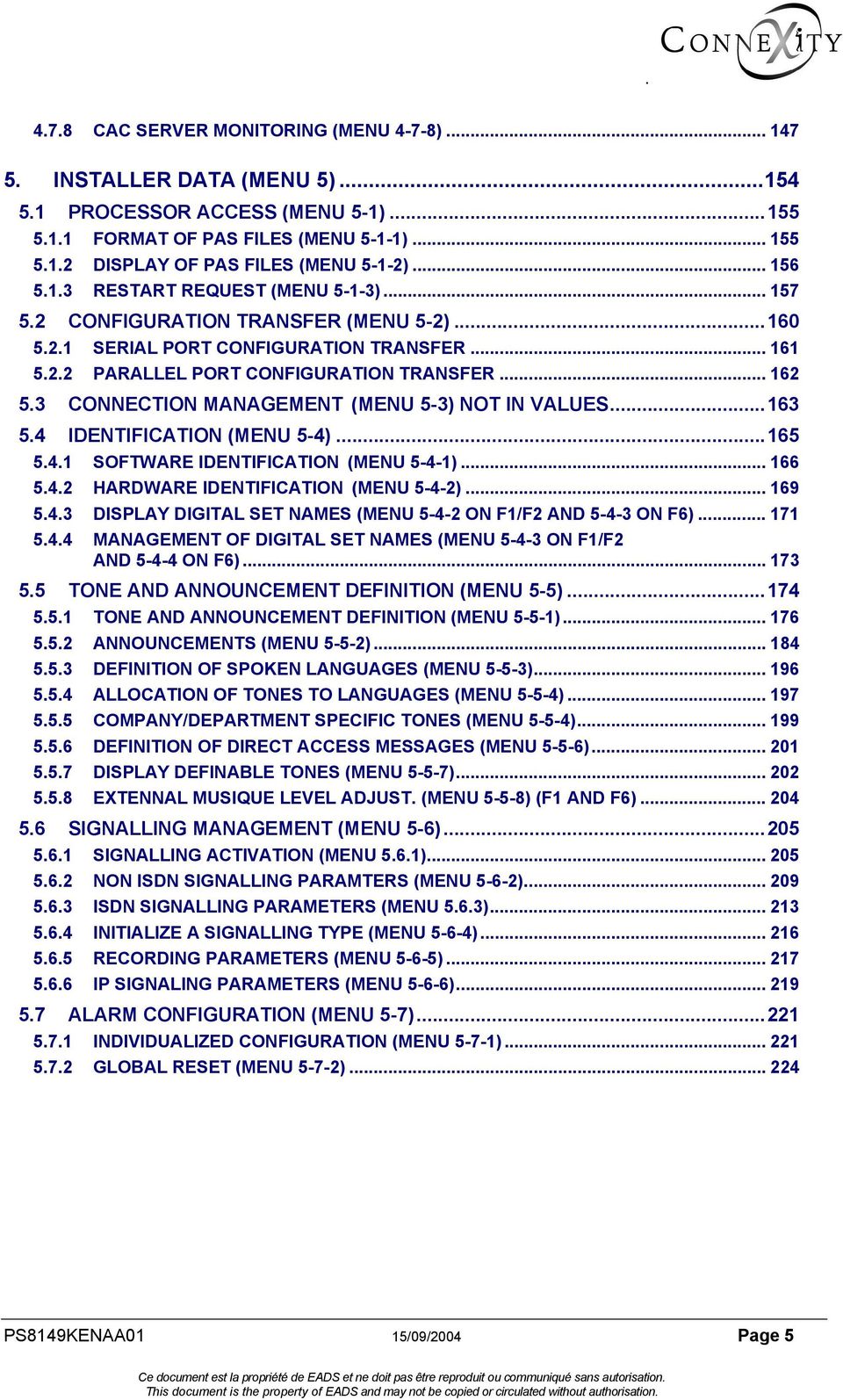
5 4.7.8 CAC SERVER MONITORING (MENU 4-7-8) INSTALLER DATA (MENU 5) PROCESSOR ACCESS (MENU 5-1) FORMAT OF PAS FILES (MENU 5-1-1) DISPLAY OF PAS FILES (MENU 5-1-2) RESTART REQUEST (MENU 5-1-3) CONFIGURATION TRANSFER (MENU 5-2) SERIAL PORT CONFIGURATION TRANSFER PARALLEL PORT CONFIGURATION TRANSFER CONNECTION MANAGEMENT (MENU 5-3) NOT IN VALUES IDENTIFICATION (MENU 5-4) SOFTWARE IDENTIFICATION (MENU 5-4-1) HARDWARE IDENTIFICATION (MENU 5-4-2) DISPLAY DIGITAL SET NAMES (MENU ON F1/F2 AND ON F6) MANAGEMENT OF DIGITAL SET NAMES (MENU ON F1/F2 AND ON F6) TONE AND ANNOUNCEMENT DEFINITION (MENU 5-5) TONE AND ANNOUNCEMENT DEFINITION (MENU 5-5-1) ANNOUNCEMENTS (MENU 5-5-2) DEFINITION OF SPOKEN LANGUAGES (MENU 5-5-3) ALLOCATION OF TONES TO LANGUAGES (MENU 5-5-4) COMPANY/DEPARTMENT SPECIFIC TONES (MENU 5-5-4) DEFINITION OF DIRECT ACCESS MESSAGES (MENU 5-5-6) DISPLAY DEFINABLE TONES (MENU 5-5-7) EXTENNAL MUSIQUE LEVEL ADJUST. (MENU 5-5-8) (F1 AND F6) SIGNALLING MANAGEMENT (MENU 5-6) SIGNALLING ACTIVATION (MENU 5.6.1) NON ISDN SIGNALLING PARAMTERS (MENU 5-6-2) ISDN SIGNALLING PARAMETERS (MENU 5.6.3) INITIALIZE A SIGNALLING TYPE (MENU 5-6-4) RECORDING PARAMETERS (MENU 5-6-5) IP SIGNALING PARAMETERS (MENU 5-6-6) ALARM CONFIGURATION (MENU 5-7) INDIVIDUALIZED CONFIGURATION (MENU 5-7-1) GLOBAL RESET (MENU 5-7-2) PS8149KENAA01 15/09/2004 Page 5
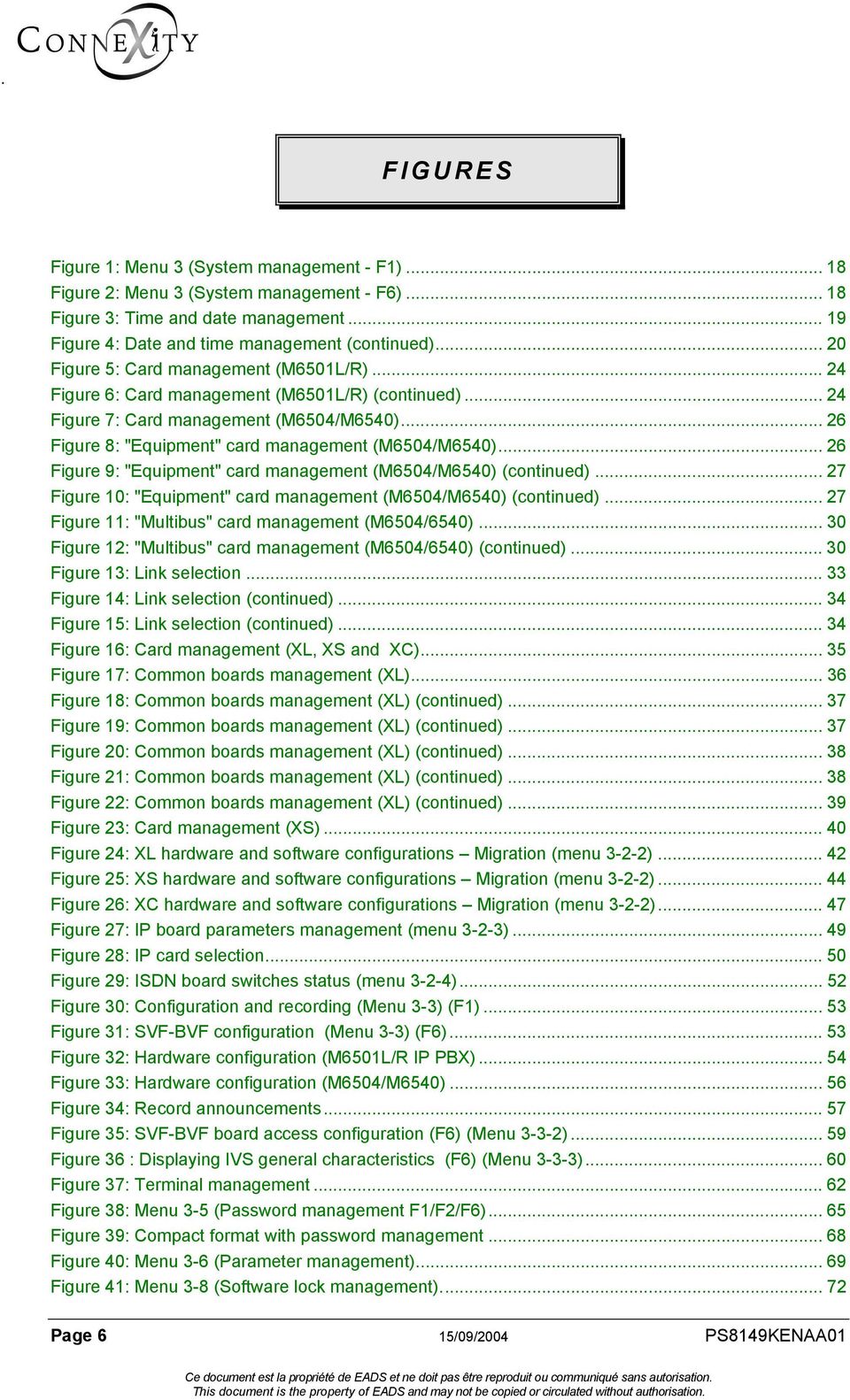
6 FIGURES Figure 1: Menu 3 (System management - F1) Figure 2: Menu 3 (System management - F6) Figure 3: Time and date management Figure 4: Date and time management (continued) Figure 5: Card management (M6501L/R) Figure 6: Card management (M6501L/R) (continued) Figure 7: Card management (M6504/M6540) Figure 8: "Equipment" card management (M6504/M6540) Figure 9: "Equipment" card management (M6504/M6540) (continued) Figure 10: "Equipment" card management (M6504/M6540) (continued) Figure 11: "Multibus" card management (M6504/6540) Figure 12: "Multibus" card management (M6504/6540) (continued) Figure 13: Link selection Figure 14: Link selection (continued) Figure 15: Link selection (continued) Figure 16: Card management (XL, XS and XC) Figure 17: Common boards management (XL) Figure 18: Common boards management (XL) (continued) Figure 19: Common boards management (XL) (continued) Figure 20: Common boards management (XL) (continued) Figure 21: Common boards management (XL) (continued) Figure 22: Common boards management (XL) (continued) Figure 23: Card management (XS) Figure 24: XL hardware and software configurations Migration (menu 3-2-2) Figure 25: XS hardware and software configurations Migration (menu 3-2-2) Figure 26: XC hardware and software configurations Migration (menu 3-2-2) Figure 27: IP board parameters management (menu 3-2-3) Figure 28: IP card selection Figure 29: ISDN board switches status (menu 3-2-4) Figure 30: Configuration and recording (Menu 3-3) (F1) Figure 31: SVF-BVF configuration (Menu 3-3) (F6) Figure 32: Hardware configuration (M6501L/R IP PBX) Figure 33: Hardware configuration (M6504/M6540) Figure 34: Record announcements Figure 35: SVF-BVF board access configuration (F6) (Menu 3-3-2) Figure 36 : Displaying IVS general characteristics (F6) (Menu 3-3-3) Figure 37: Terminal management Figure 38: Menu 3-5 (Password management F1/F2/F6) Figure 39: Compact format with password management Figure 40: Menu 3-6 (Parameter management) Figure 41: Menu 3-8 (Software lock management) Page 6 15/09/2004 PS8149KENAA01
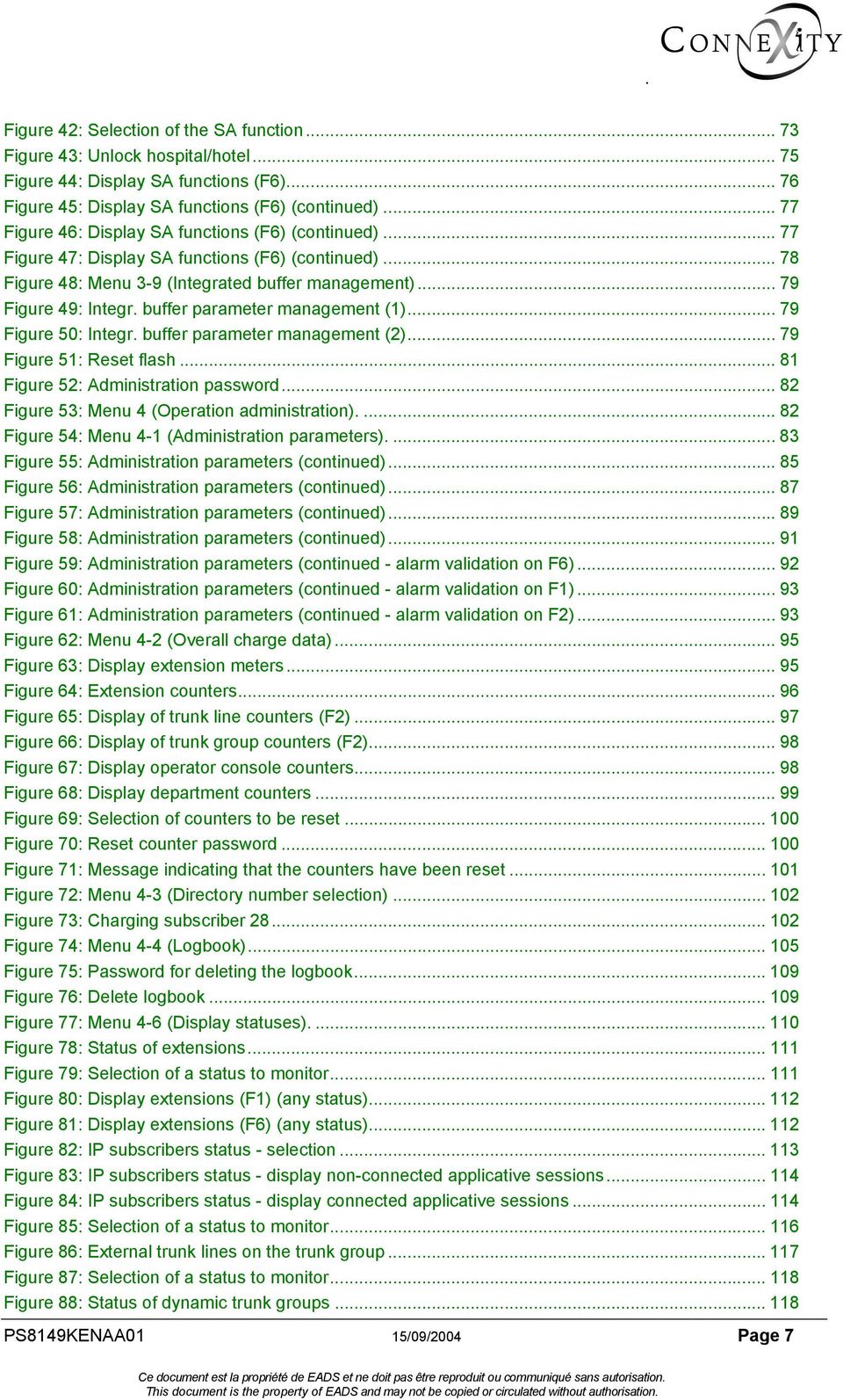
7 Figure 42: Selection of the SA function Figure 43: Unlock hospital/hotel Figure 44: Display SA functions (F6) Figure 45: Display SA functions (F6) (continued) Figure 46: Display SA functions (F6) (continued) Figure 47: Display SA functions (F6) (continued) Figure 48: Menu 3-9 (Integrated buffer management) Figure 49: Integr. buffer parameter management (1) Figure 50: Integr. buffer parameter management (2) Figure 51: Reset flash Figure 52: Administration password Figure 53: Menu 4 (Operation administration) Figure 54: Menu 4-1 (Administration parameters) Figure 55: Administration parameters (continued)...85 Figure 56: Administration parameters (continued)...87 Figure 57: Administration parameters (continued)...89 Figure 58: Administration parameters (continued)...91 Figure 59: Administration parameters (continued - alarm validation on F6) Figure 60: Administration parameters (continued - alarm validation on F1) Figure 61: Administration parameters (continued - alarm validation on F2) Figure 62: Menu 4-2 (Overall charge data) Figure 63: Display extension meters Figure 64: Extension counters Figure 65: Display of trunk line counters (F2) Figure 66: Display of trunk group counters (F2) Figure 67: Display operator console counters Figure 68: Display department counters Figure 69: Selection of counters to be reset Figure 70: Reset counter password Figure 71: Message indicating that the counters have been reset Figure 72: Menu 4-3 (Directory number selection) Figure 73: Charging subscriber Figure 74: Menu 4-4 (Logbook) Figure 75: Password for deleting the logbook Figure 76: Delete logbook Figure 77: Menu 4-6 (Display statuses) Figure 78: Status of extensions Figure 79: Selection of a status to monitor Figure 80: Display extensions (F1) (any status) Figure 81: Display extensions (F6) (any status) Figure 82: IP subscribers status - selection Figure 83: IP subscribers status - display non-connected applicative sessions Figure 84: IP subscribers status - display connected applicative sessions Figure 85: Selection of a status to monitor Figure 86: External trunk lines on the trunk group Figure 87: Selection of a status to monitor Figure 88: Status of dynamic trunk groups PS8149KENAA01 15/09/2004 Page 7
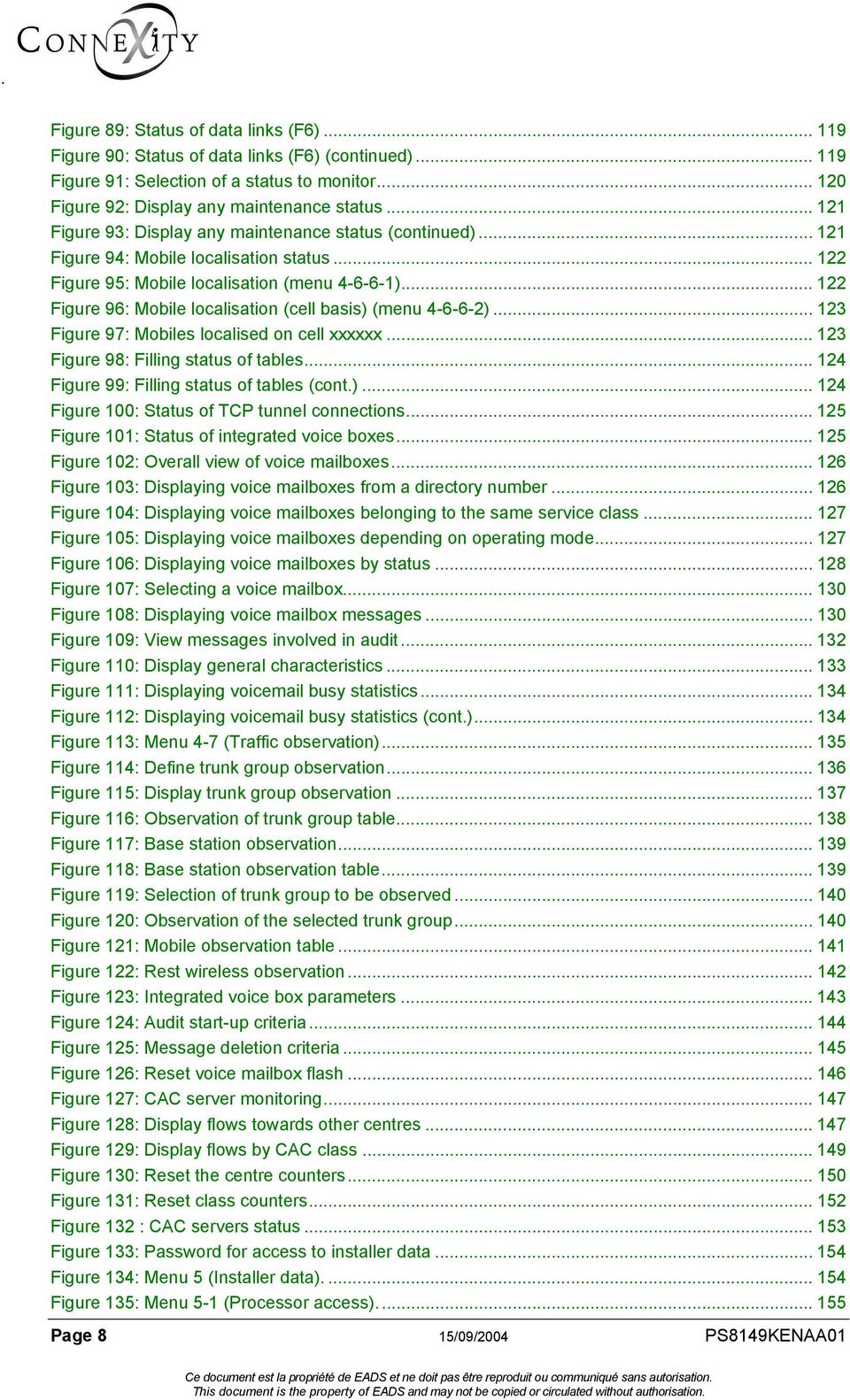
8 Figure 89: Status of data links (F6) Figure 90: Status of data links (F6) (continued) Figure 91: Selection of a status to monitor Figure 92: Display any maintenance status Figure 93: Display any maintenance status (continued) Figure 94: Mobile localisation status Figure 95: Mobile localisation (menu ) Figure 96: Mobile localisation (cell basis) (menu ) Figure 97: Mobiles localised on cell xxxxxx Figure 98: Filling status of tables Figure 99: Filling status of tables (cont.) Figure 100: Status of TCP tunnel connections Figure 101: Status of integrated voice boxes Figure 102: Overall view of voice mailboxes Figure 103: Displaying voice mailboxes from a directory number Figure 104: Displaying voice mailboxes belonging to the same service class Figure 105: Displaying voice mailboxes depending on operating mode Figure 106: Displaying voice mailboxes by status Figure 107: Selecting a voice mailbox Figure 108: Displaying voice mailbox messages Figure 109: View messages involved in audit Figure 110: Display general characteristics Figure 111: Displaying voic busy statistics Figure 112: Displaying voic busy statistics (cont.) Figure 113: Menu 4-7 (Traffic observation) Figure 114: Define trunk group observation Figure 115: Display trunk group observation Figure 116: Observation of trunk group table Figure 117: Base station observation Figure 118: Base station observation table Figure 119: Selection of trunk group to be observed Figure 120: Observation of the selected trunk group Figure 121: Mobile observation table Figure 122: Rest wireless observation Figure 123: Integrated voice box parameters Figure 124: Audit start-up criteria Figure 125: Message deletion criteria Figure 126: Reset voice mailbox flash Figure 127: CAC server monitoring Figure 128: Display flows towards other centres Figure 129: Display flows by CAC class Figure 130: Reset the centre counters Figure 131: Reset class counters Figure 132 : CAC servers status Figure 133: Password for access to installer data Figure 134: Menu 5 (Installer data) Figure 135: Menu 5-1 (Processor access) Page 8 15/09/2004 PS8149KENAA01
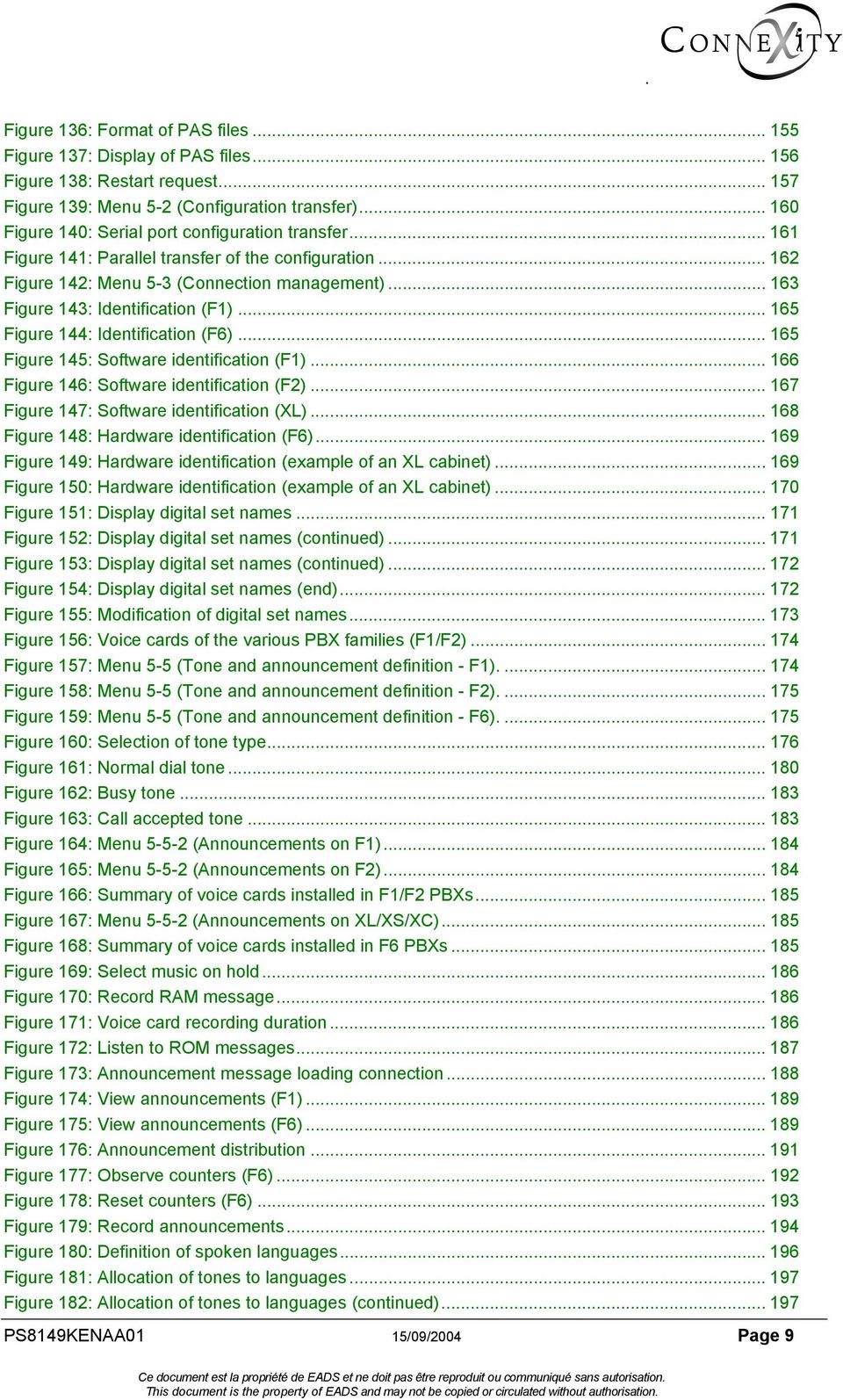
9 Figure 136: Format of PAS files Figure 137: Display of PAS files Figure 138: Restart request Figure 139: Menu 5-2 (Configuration transfer) Figure 140: Serial port configuration transfer Figure 141: Parallel transfer of the configuration Figure 142: Menu 5-3 (Connection management) Figure 143: Identification (F1) Figure 144: Identification (F6) Figure 145: Software identification (F1) Figure 146: Software identification (F2) Figure 147: Software identification (XL) Figure 148: Hardware identification (F6) Figure 149: Hardware identification (example of an XL cabinet) Figure 150: Hardware identification (example of an XL cabinet) Figure 151: Display digital set names Figure 152: Display digital set names (continued) Figure 153: Display digital set names (continued) Figure 154: Display digital set names (end) Figure 155: Modification of digital set names Figure 156: Voice cards of the various PBX families (F1/F2) Figure 157: Menu 5-5 (Tone and announcement definition - F1) Figure 158: Menu 5-5 (Tone and announcement definition - F2) Figure 159: Menu 5-5 (Tone and announcement definition - F6) Figure 160: Selection of tone type Figure 161: Normal dial tone Figure 162: Busy tone Figure 163: Call accepted tone Figure 164: Menu (Announcements on F1) Figure 165: Menu (Announcements on F2) Figure 166: Summary of voice cards installed in F1/F2 PBXs Figure 167: Menu (Announcements on XL/XS/XC) Figure 168: Summary of voice cards installed in F6 PBXs Figure 169: Select music on hold Figure 170: Record RAM message Figure 171: Voice card recording duration Figure 172: Listen to ROM messages Figure 173: Announcement message loading connection Figure 174: View announcements (F1) Figure 175: View announcements (F6) Figure 176: Announcement distribution Figure 177: Observe counters (F6) Figure 178: Reset counters (F6) Figure 179: Record announcements Figure 180: Definition of spoken languages Figure 181: Allocation of tones to languages Figure 182: Allocation of tones to languages (continued) PS8149KENAA01 15/09/2004 Page 9
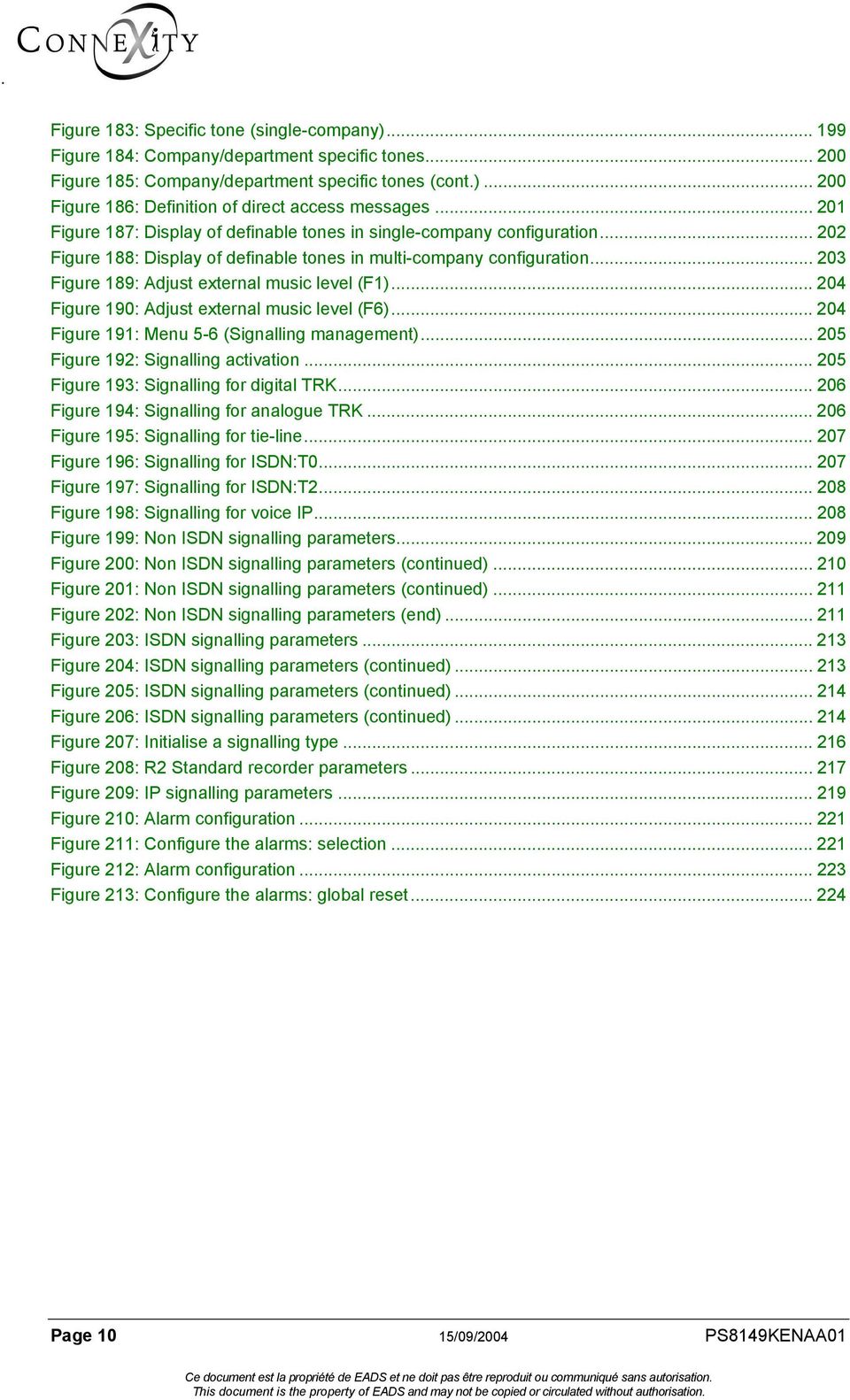
10 Figure 183: Specific tone (single-company) Figure 184: Company/department specific tones Figure 185: Company/department specific tones (cont.) Figure 186: Definition of direct access messages Figure 187: Display of definable tones in single-company configuration Figure 188: Display of definable tones in multi-company configuration Figure 189: Adjust external music level (F1) Figure 190: Adjust external music level (F6) Figure 191: Menu 5-6 (Signalling management) Figure 192: Signalling activation Figure 193: Signalling for digital TRK Figure 194: Signalling for analogue TRK Figure 195: Signalling for tie-line Figure 196: Signalling for ISDN:T Figure 197: Signalling for ISDN:T Figure 198: Signalling for voice IP Figure 199: Non ISDN signalling parameters Figure 200: Non ISDN signalling parameters (continued) Figure 201: Non ISDN signalling parameters (continued) Figure 202: Non ISDN signalling parameters (end) Figure 203: ISDN signalling parameters Figure 204: ISDN signalling parameters (continued) Figure 205: ISDN signalling parameters (continued) Figure 206: ISDN signalling parameters (continued) Figure 207: Initialise a signalling type Figure 208: R2 Standard recorder parameters Figure 209: IP signalling parameters Figure 210: Alarm configuration Figure 211: Configure the alarms: selection Figure 212: Alarm configuration Figure 213: Configure the alarms: global reset Page 10 15/09/2004 PS8149KENAA01
11 1. ABOUT THIS DOCUMENT 1.1 PURPOSE OF THIS DOCUMENT This document describes the MMCs of the PBX from software release 3.2, with the exception of the MMCs relating to data transmission which are dealt with in a separate manual. 1.2 TARGET AUDIENCE OF THIS DOCUMENT This document is intended for installation technicians who configure the PBX and implement the telephone features introduced by this software release. 1.3 SCOPE OF THIS DOCUMENT This document applies to M6501 IP PBX, M6501L IP PBX, M6501R IP PBX, M6504 IP PBX, M6540 IP PBX, NeXspan C-S-L running software release 3.2 or later. 1.4 CONTENTS OF THIS DOCUMENT This document describes all the means available to the operator for management of the M6501 IP PBX, M6501L IP PBX, M6501R IP PBX, M6504 IP PBX, M6540 IP PBX and NeXspan C-S-L from an operating terminal. The set of Man Machine Commands (MMCs) described in this manual enable you to operate and manage M6501 IP PBX, M6501L IP PBX, M6501R IP PBX, M6504 IP PBX, M6540 IP PBX and NeXspan C-S-L. This manual is composed of chapters ordered according to the tree structure of the MMCs as presented on the screen of the operating console. 1.5 TERMINOLOGY TERMS AND EXPRESSIONS Not applicable ABBREVIATIONS F1 F2 F 5 F6 PBX range comprising M6501 L/R IP PBX PBX range comprising M6504 IP PBX, M6504 L IP PBX, M6540 IP PBX Software application (Call Manager) PBX range comprising NeXspan C (XC), NeXspan S (XS) and NeXspan L (XL) PS8149KENAA01 15/09/2004 Page 11
12 1.6 REFERENCE DOCUMENTS The information contained in this manual refers to the following documents: M6501L/R IP PBX Installation manual M6504 Installation manual M6504L IP PBX Installation manual M6540 IP PBX Installation manual NeXspan range (XL/XS/XC) Installation and Maintenance Manual Telephone sets manual 1.7 REMINDER CONCERNING THE LAW ON INFORMATION TECHNOLOGY The user is reminded that commissioning PBXs in the workplace must comply with the recommendations of the IT law in force. The user's attention is also drawn to any clauses applicable in laws relating to the confidentiality of calls transmitted by means of telecommunications. Page 12 15/09/2004 PS8149KENAA01

13 2. MENUS 2.1 SYSTEM MANAGEMENT MENU PBX MANAGEMENT 1 - TELEPHONY MANAGEMENT 2 - DATA MANAGEMENT 3 - SYSTEM MANAGEMENT 4 - OPERATION ADMINISTRATION 5 - INSTALLER DATA Password "INSTA" SYSTEM MANAGEMENT 1 DATE AND TIME MANAGEMENT 2 CARD MANAGEMENT 3 - CONFIGURATION AND RECORDING (F1) 3 HARDWARE CONFIGURATION MANAGEMENT (F2) 3 - FVS-BVS CONFIGURATION (F6) 4 TERMINAL MANAGEMENT 5 PASSWORD MANAGEMENT 6 PARAMETER MANAGEMENT 7 MULTI-SITE MANAGEMENT 8 SOFTWARE LOCK MANAGEMENT 9 INTEGRAT. BUFFER MANAGEMENT MANAGEMENT OF DATE AND TIME Menu 3-1 CARD MANAGEMENT (F1) Menu 3-2 CARD MANAGEMENT (F2) Menu EQUIPMENT CARD SLOTS 2 - MULTIBUS SLOTS CARD MANAGEMENT (F6) Menu COMMON BOARDS MANAGEMENT 2 - MOTHER BOARD MANAGEMENT - MIGRATION 3 - IP BOARD PARAMETERS MANAGEMENT 4 - ISDN BOARD SWITCHES STATUS CONFIGURATION AND RECORDING (F1) Menu HARDWARE CONFIGURATION 2 - BVF: RECORDING MESSAGES HARDWARE CONFIGURATION MANAGEMENT (F2) Menu 3-3 FVS-BVS CONFIGURATION (F6) Menu SVF-BVF: RECORDING MESSAGES 2 - SVF-BVF BOARD ACCESS CONFIGURATION TERMINAL MANAGEMENT Menu 3-4 PS8149KENAA01 15/09/2004 Page 13

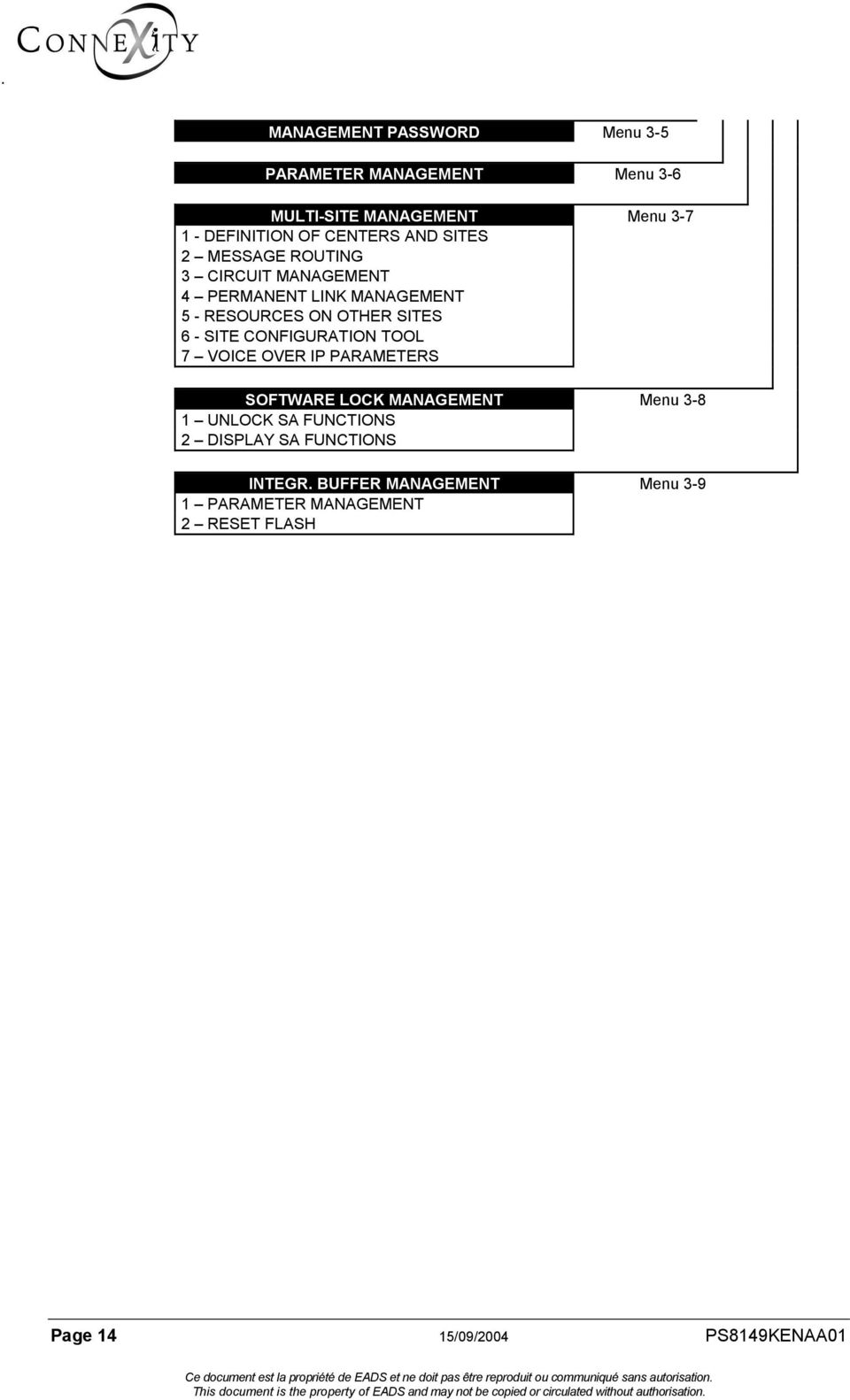
14 MANAGEMENT PASSWORD Menu 3-5 PARAMETER MANAGEMENT Menu 3-6 MULTI-SITE MANAGEMENT Menu DEFINITION OF CENTERS AND SITES 2 MESSAGE ROUTING 3 CIRCUIT MANAGEMENT 4 PERMANENT LINK MANAGEMENT 5 - RESOURCES ON OTHER SITES 6 - SITE CONFIGURATION TOOL 7 VOICE OVER IP PARAMETERS SOFTWARE LOCK MANAGEMENT Menu UNLOCK SA FUNCTIONS 2 DISPLAY SA FUNCTIONS INTEGR. BUFFER MANAGEMENT Menu PARAMETER MANAGEMENT 2 RESET FLASH Page 14 15/09/2004 PS8149KENAA01
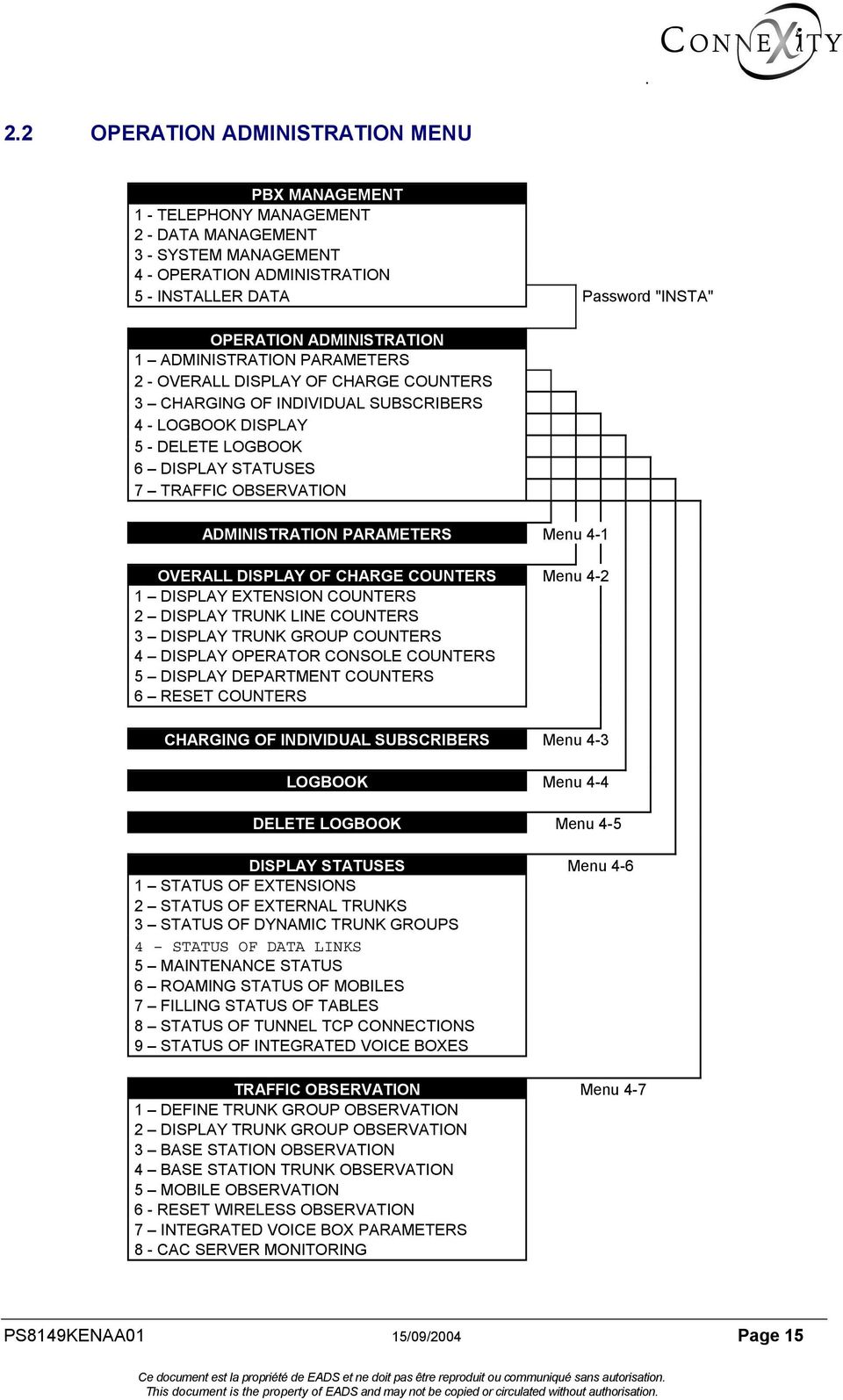
15 2.2 OPERATION ADMINISTRATION MENU PBX MANAGEMENT 1 - TELEPHONY MANAGEMENT 2 - DATA MANAGEMENT 3 - SYSTEM MANAGEMENT 4 - OPERATION ADMINISTRATION 5 - INSTALLER DATA Password "INSTA" OPERATION ADMINISTRATION 1 ADMINISTRATION PARAMETERS 2 - OVERALL DISPLAY OF CHARGE COUNTERS 3 CHARGING OF INDIVIDUAL SUBSCRIBERS 4 - LOGBOOK DISPLAY 5 - DELETE LOGBOOK 6 DISPLAY STATUSES 7 TRAFFIC OBSERVATION ADMINISTRATION PARAMETERS Menu 4-1 OVERALL DISPLAY OF CHARGE COUNTERS Menu DISPLAY EXTENSION COUNTERS 2 DISPLAY TRUNK LINE COUNTERS 3 DISPLAY TRUNK GROUP COUNTERS 4 DISPLAY OPERATOR CONSOLE COUNTERS 5 DISPLAY DEPARTMENT COUNTERS 6 RESET COUNTERS CHARGING OF INDIVIDUAL SUBSCRIBERS Menu 4-3 LOGBOOK Menu 4-4 DELETE LOGBOOK Menu 4-5 DISPLAY STATUSES Menu STATUS OF EXTENSIONS 2 STATUS OF EXTERNAL TRUNKS 3 STATUS OF DYNAMIC TRUNK GROUPS 4 STATUS OF DATA LINKS 5 MAINTENANCE STATUS 6 ROAMING STATUS OF MOBILES 7 FILLING STATUS OF TABLES 8 STATUS OF TUNNEL TCP CONNECTIONS 9 STATUS OF INTEGRATED VOICE BOXES TRAFFIC OBSERVATION Menu DEFINE TRUNK GROUP OBSERVATION 2 DISPLAY TRUNK GROUP OBSERVATION 3 BASE STATION OBSERVATION 4 BASE STATION TRUNK OBSERVATION 5 MOBILE OBSERVATION 6 - RESET WIRELESS OBSERVATION 7 INTEGRATED VOICE BOX PARAMETERS 8 - CAC SERVER MONITORING PS8149KENAA01 15/09/2004 Page 15
16 2.3 INSTALLER DATA MENU PBX MANAGEMENT 1 - TELEPHONY MANAGEMENT 2 - DATA MANAGEMENT 3 - SYSTEM MANAGEMENT 4 - OPERATION ADMINISTRATION 5 - INSTALLER DATA Password "INSTA" INSTALLER DATA 1 PROCESSOR ACCESS 2 CONFIGURATION TRANSFER 3 CONNECTION MANAGEMENT 4 IDENTIFICATION 5 TONE AND ANNOUNCEMENT DEFINITION 6 SIGNALLING MANAGEMENT 7 ALARM CONFIGURATION PROCESSOR ACCESS Menu FORMAT OF PAS FILES 2 DISPLAY OF PAS FILES 3 RESTART REQUEST CONFIGURATION TRANSFER Menu 5-2 CONNECTION MANAGEMENT Menu 5-3 IDENTIFICATION (F1) Menu SOFTWARE IDENTIFICATION 2 DISPLAY DIGITAL SET NAMES 3 MANAGEMENT OF DIGITAL SET NAMES IDENTIFICATION (F6) Menu SOFTWARE IDENTIFICATION 2 - HARDWARE IDENTIFICATION 3 DISPLAY DIGITAL SET NAMES 4 MANAGEMENT OF DIGITAL SET NAMES TONE AND ANNOUNCEMENT DEFINITION Menu TONE DEFINITION 2 ANNOUNCEMENTS 3 DEFINITION OF SPOKEN LANGUAGES 4 ALLOCATION OF TONES TO LANGUAGES 5 COMPANY/DEPARTMENT SPECIFIC TONES 6 DEFINITION OF DIRECT ACCESS MESSAGES 7 DISPLAY DEFINABLE TONES 8 EXTENNAL MUSIQUE LEVEL ADJUST. Page 16 15/09/2004 PS8149KENAA01

17 SIGNALlING MANAGEMENT Menu SIGNALLING ACTIVATION 2 - NON ISDN SIGNALLING PARAMETERS 3 - ISDN SIGNALLING PARAMETERS 4 - INITIALIZE A SIGNALLING TYPE 5 - RECORDING PARAMETERS 6 - IP SIGNALLING PARAMETERS ALARM CONFIGURATION Menu INDIVIDUALIZED CONFIGURATION 2 - GLOBAL RESET 2.4 DATA MANAGEMENT (MENU 2) Since the data management functions are of great importance, they are not described in this manual, and are dealt with in a separate manual (reference PS8720ENJAA01). PS8149KENAA01 15/09/2004 Page 17

18 3. SYSTEM MANAGEMENT (MENU 3) SYSTEM MANAGEMENT 1 DATE AND TIME MANAGEMENT 2 CARD MANAGEMENT 3 CONFIGURATION AND RECORDING 4 TERMINAL MANAGEMENT 5 MANAGEMENT PASSWORD 6 PARAMETER MANAGEMENT 7 MULTI-SITE MANAGEMENT 8 SOFTWARE LOCK MANAGEMENT 9 INTEGR. BUFFER MANAGEMENT ENTER YOUR CHOICE Figure 1: Menu 3 (System management - F1) SYSTEM MANAGEMENT 1 DATE AND TIME MANAGEMENT 2 CARD MANAGEMENT 3.SVF-BVF CONFIGURATION 4 TERMINAL MANAGEMENT 5 PASSWORD MANAGEMENT 6 PARAMETER MANAGEMENT 7 MULTI-SITE MANAGEMENT 8 SOFTWARE LOCK MANAGEMENT 9 INTEGRAT. BUFFER MANAGEMENT ENTER YOUR CHOICE Figure 2: Menu 3 (System management - F6) For the Call Manager (F5): Menu 3 (System management) levels 3 (Configuration and recording), 4 (Terminal management), and 9 (Integr. buffer management) are not available. Page 18 15/09/2004 PS8149KENAA01

19 3.1 DATE AND TIME MANAGEMENT (MENU 3-1) For the Call Manager (F5): Menu 3-1 (Date and time management) DATE AND TIME DEFINITION MANAGEMENT OF DATE AND TIME PRESENT TIME AND DATE - TIME (format hh mm ss) DATE (format dd mm yyyy) NEXT PROGRAMMED TIME CHANGE NO TIME (FORMAT HH MM SS) Figure 3: Time and date management Enter the hour (hh), minutes (mm) and seconds (ss) using 2 digits for each value. DATE (FORMAT DD MM YYYY) Enter the day (dd) and month (mm), using 2 digits for each value, and the year (yyyy), using 4 digits. NEXT PROGRAMMED TIME CHANGE NO YES This menu is used to switch to day light-saving time or to local standard time on the requested date: this avoids having to carry out these changes on the customer site on the day in question. When you select this option, 3 other fields are displayed (see the section below). Note: In this release, the customer can make the change himself using the interactive menu on an attendant console or a digital set declared as a maintenance set. PS8149KENAA01 15/09/2004 Page 19
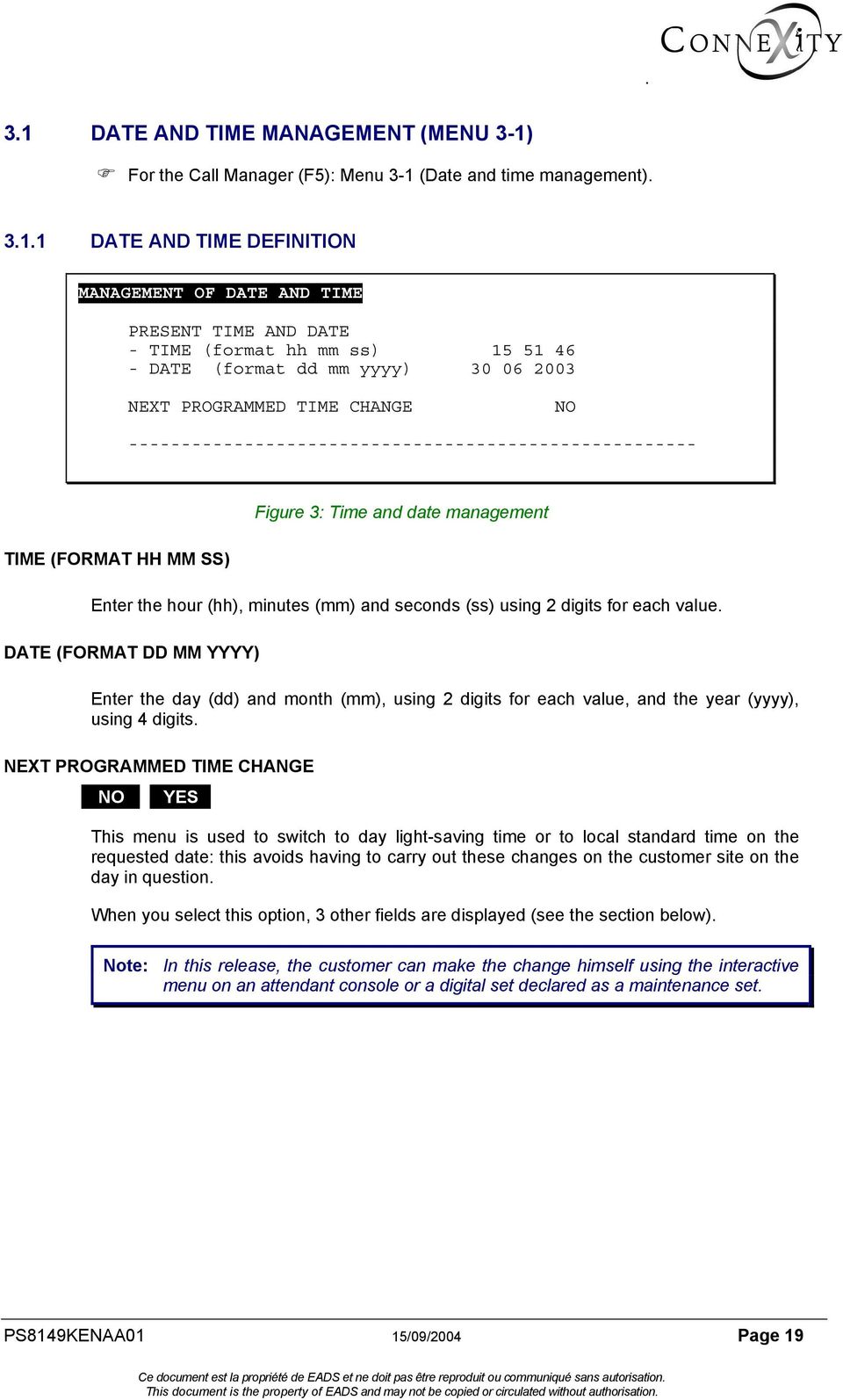
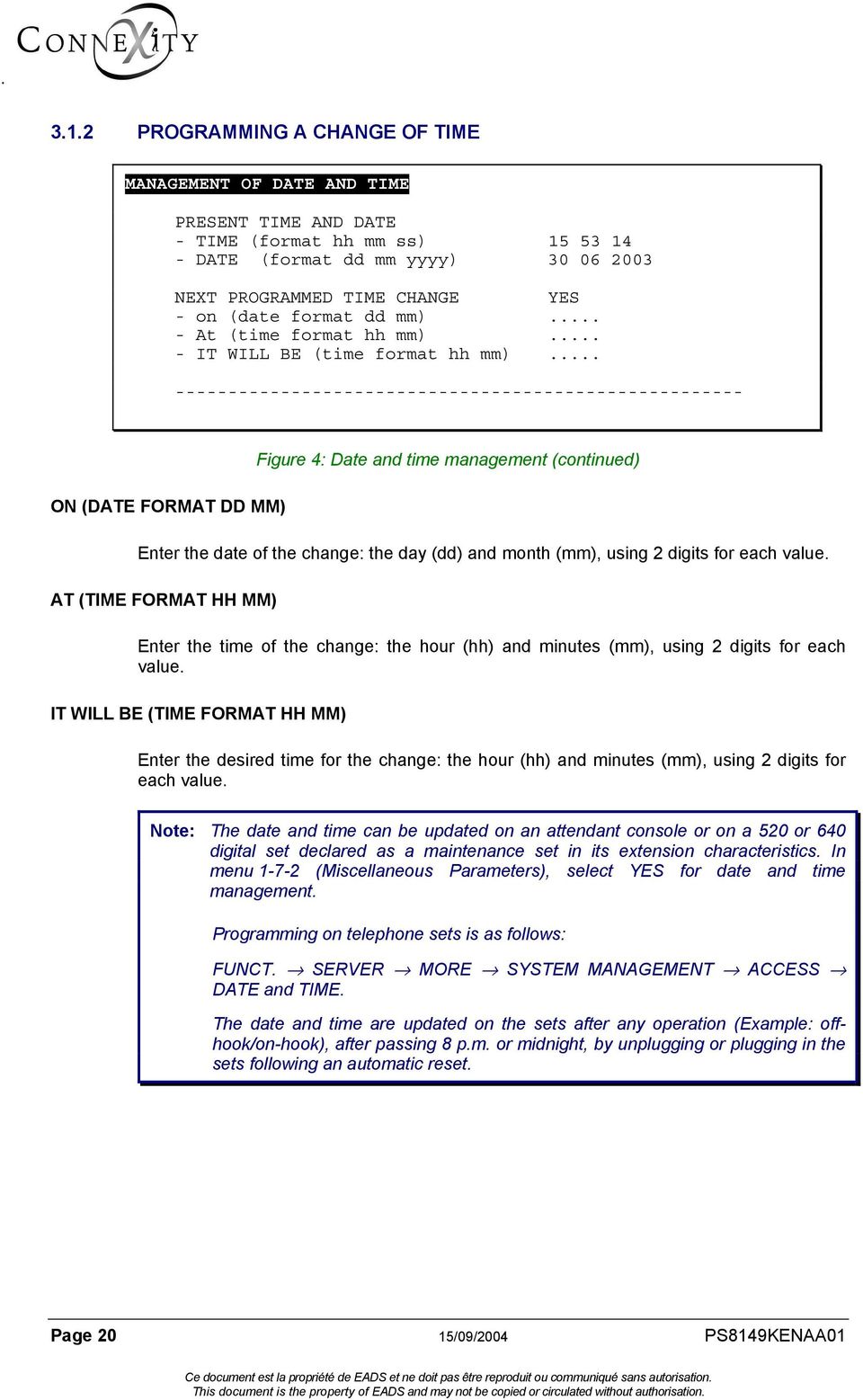
20 3.1.2 PROGRAMMING A CHANGE OF TIME MANAGEMENT OF DATE AND TIME PRESENT TIME AND DATE - TIME (format hh mm ss) DATE (format dd mm yyyy) NEXT PROGRAMMED TIME CHANGE YES - on (date format dd mm)... - At (time format hh mm)... - IT WILL BE (time format hh mm) ON (DATE FORMAT DD MM) Figure 4: Date and time management (continued) Enter the date of the change: the day (dd) and month (mm), using 2 digits for each value. AT (TIME FORMAT HH MM) Enter the time of the change: the hour (hh) and minutes (mm), using 2 digits for each value. IT WILL BE (TIME FORMAT HH MM) Enter the desired time for the change: the hour (hh) and minutes (mm), using 2 digits for each value. Note: The date and time can be updated on an attendant console or on a 520 or 640 digital set declared as a maintenance set in its extension characteristics. In menu (Miscellaneous Parameters), select YES for date and time management. Programming on telephone sets is as follows: FUNCT. SERVER MORE SYSTEM MANAGEMENT ACCESS DATE and TIME. The date and time are updated on the sets after any operation (Example: offhook/on-hook), after passing 8 p.m. or midnight, by unplugging or plugging in the sets following an automatic reset. Page 20 15/09/2004 PS8149KENAA01
21 3.2 CARD MANAGEMENT (MENU 3-2) For the Call Manager (F5): Menu 3-2 (Card management) CARD TYPE AND STATUS Depending on the system installed (M6501L/R IP PBX, XL, XS, XC M6504/M6540 IP PBX), a screen which displays the various cards installed on the PBX appears: the card type and status are displayed. Note: Menu 3-2 (Card management) proposes 4 sub-menus for the X range. To declare a card in an XL/XS/XC, select menu (see section 3-2-5). TYPE STATUS This field indicates the type of card in the specified location when the PBX is powered on or on TOTAL RESET. This field indicates the card status: IN SERVICE: DISABLED: NOT EQUIP.: FAULTY: NET ALARM: Card being used in the PBX. Card disabled because of a change being made. Card absent from the system or used by an MMC to replace one card with another of a different type (for example, replacing an analogue card with a digital card). Card previously in service and has been removed from the system. LSB status for NETWORK cards (in particular PTx/PVI) which indicates network disconnection (IP, ISDN, etc.). PS8149KENAA01 15/09/2004 Page 21
22 3.2.2 PROCEDURE FOR INSTALLING A CARD Warning: Before disabling a card, all the equipment interfaces on that card must first be disabled. A card which supports an attendant console, a night console trunk group declared in a trunk group cannot be changed to the status NOT EQUIP. This equipment must be deleted beforehand. If no network link is connected to the PTx card, no TCP gateway link can be enabled. IMPORTANT: Always switch off your device before installing or uninstalling a card, unless it is an LA16X or LN16X card in an XL cabinet (F6) F1/F2 1. Set all the equipment interfaces on the card out of service (DISABLED). 2. Delete all the directory numbers assigned to the equipment interfaces on the card in menu (Extension characteristics). 3. Change the status of the carte from In service to Not equip. 4. Power off the PBX (Switch on the face plate of the power supply module) in the main cabinet or the expansion cabinet. 5. Remove the card from the PBX. 6. Insert the new card. 7. Power on the PBX (Switch on the face plate of the power supply module) in the main cabinet or the expansion cabinet. 8. Select the card type and validate the status In service (wait until the download is complete). 9. If you are installing a subscriber card, redefine the directory numbers in menu (Extensions characteristics). Note: Changing the status of the card from In service to Not equip. destroys all the links previously created. For a PT2 card to keep the links created when changing from x channels to y channels, change the status of the card from In service to Disabled (instead of Not equip.). Page 22 15/09/2004 PS8149KENAA01
23 F6 Replacing an "old generation" card with an "old generation" card: 1. Set all the equipment interfaces on the card out of service (DISABLED). 2. Delete all the directory numbers assigned to the equipment interfaces on the card in menu (Extension characteristics). 3. Change the status of the carte from In service to Not equip. 4. Power off the PBX (the main cabinet and the expansion cabinet(s)). 5. If it is an XS, open the cabinet. Note: For further information on installing and replacing a card in an XL, XS or XC cabinet, refer to X-range Installation and Maintenance Guide. 6. Remove the card from the PBX. 7. Insert the new card. 8. If it is an XS, close the cabinet. 9. Power on the PBX again (the main cabinet and the expansion cabinet(s). 10. Select the card type and validate the status In service (wait until the download is complete). 11. If you are installing a subscriber card, redefine the directory numbers in menu (Extensions characteristics). Replacing an "old generation" card with a "new generation" card (LA16X, LN16X): 1. Change the (LA8, LN8) card status from In service to Disabled. 2. Power off the PBX (the main cabinet and the expansion cabinet(s)). 3. If it is an XS, open the cabinet. Note: For further information on installing and replacing a card in an XL, XS or XC cabinet, refer to X-range Installation and Maintenance Guide. 4. Remove the card from the PBX. 5. Insert the new card. Note: In an XL cabinet, you can hot plug or unplug an LA16X or LN16X card. For further information on an XL, XS or XC cabinet, refer to X-range Installation and Maintenance Guide. 6. If it is an XS, close the cabinet. 7. Power on the PBX again (the main cabinet and the expansion cabinet). 8. Select card type and confirm the status In service. 9. Define all the directory numbers for the additional equipment interfaces on the card in menu (Extension characteristics). PS8149KENAA01 15/09/2004 Page 23
24 3.2.3 M6501L/R IP PBX CARDS The M6501L has two cabinets: the main cabinet (0) and the expansion cabinet (1). The slot number is therefore preceded by the cabinet number. Example: Card 0-2 (second card of type 8 MIXD EXT. in cabinet 0) Figure 5: Card management (M6501L/R) Figure 6: Card management (M6501L/R) (continued) When the system is powered on, the cards which do not have a processor, and which are installed in the PBX, are identified and displayed automatically. The cards which have a processor, such as CA1, LS1, CP1, CS1, are signalled as being in download status. Slot 0-7 is used for the digital extensions of the OCT4 card. Page 24 15/09/2004 PS8149KENAA01
25 Slots 2-0 to 3-7 are used on the M6501L IP PBX (double cabinet). If the equipment interface has LD4 or LT2 cards, these must be put in service using this menu. The LT2 card is fitted for T2 or S2 (PRI). The LS2 or LT2 card can only be installed in slot 04 or 05 (and 00 and 01 for 4 T2). You can therefore use the LS2 card in two ways: ISDN:T2 Signalling - (telephone mode) QSIG signalling - (multi-site links) Example: You can use an LS2 card for ISDN:T2 in slot 5 and another LS2 card for QSIG signalling in slot 04. CAUTION: An LT2 or LS2 card placed in eq1 requires a TMOCT4 card. CARD (CABINET NUMBER SLOT NUMBER): TYPE Use the terminal space bar to select a card type. 4 AB. ANAL. LA4 card for 4 analogue extensions. 4 AB. BOTHWAY LM4 card for 4 mixed extensions. 4 AB. COMMON LN4 card for 4 digital extensions. 8 AB. ANAL. LA8 card for 8 analogue extensions. 8 AB. BOTHWAY LM8 card for 8 mixed extensions. 8 AB. COMMON LN8 card for 8 digital extensions. 2 ANAL TK LR1 card with 2 analogue trunk line equipment interfaces. 4 ANAL TK LR4 card with 4 analogue trunk line equipment interfaces. ISDN 2S0 LS1 card, 2 S0 equipment interfaces configuration. ISDN T0-S0 LS1 card, 1 T0 + 1 S0 equipment interface configuration. ISDN 2T0 LS1 card, 2 T0 equipment interfaces configuration. LD4 T0/S0 card for 2- or 4-channel radio base stations. TIE LINE IA1/LI1 card for 2- or 4-wire tie-line equipment interfaces. CA1 Card for 4 V24 asynchronous links. CS1 Card for 2 X25 asynchronous links. CP1 Packet circuit coupler card with two equipment interfaces. LB4 Card with 4 CT2 radio base station equipment interfaces. LS2 LS2 card with ISDN T2 (PRI) and QSIG signalling. LT2 Card fitted for S2, T2 (PRI), PCM or reduced. CC1 BVF PTx Card with synchronous announcements. Card with IVB and synchronous announcements. PTx card which manages links (maximum 16) and carries out gateway functions (TCP/IP-X25) and tunnelling (X25 over IP). CAUTION: No PTx card can be enabled unless the network cable is connected. PS8149KENAA01 15/09/2004 Page 25
26 3.2.4 M6504/M6540 CARDS Figure 7: Card management (M6504/M6540) EQUIPMENT CARD SLOTS The M6504/M6540 has two cabinets: the main cabinet (0) and the expansion cabinet (1). The slot number is therefore preceded by the cabinet number. Example: Card 0-2 (second card of type PCM LRN-2 in cabinet 0). CABINET 0 Main cabinet with an FP04PD back plane (TELEPHONE + DATA). Figure 8: "Equipment" card management (M6504/M6540) Page 26 15/09/2004 PS8149KENAA01
27 CABINET 1 Figure 9: "Equipment" card management (M6504/M6540) (continued) Expansion cabinet with an FP04MD (TELEPHONE + DATA) or a FP04ER back plan (TELEPHONE only). For card management in the system, the main cabinet back plane (FP04MD) is divided in two: EQUIPMENT side for the EQT card type. (example: LRN or LAE type cards), MULTIBUS side for CLX card type (example: ADP (T2) or ADB (T0/S0) type cards. Figure 10: "Equipment" card management (M6504/M6540) (continued) PS8149KENAA01 15/09/2004 Page 27
28 CARD TYPE ON TELEPHONE BUS SIDE CARD X-XX: TYPE Use the terminal space bar to select a card type. LRN 1 PCM LRN card with 2 PCM (64 TSs), in 1 PCM (PCM0) configuration. LRN 2 PCM LRN card with 2 PCM (64 TSs), in 2 PCM (PCM0-PCM1) configuration. 16 AB. ANAL. LAB card FOR 16 Z interface analogueue extensions. 16 AB. COMMON LAI card for 16 I interface digital extensions. 16 AB. NUM + DATA LAN.D card with 16 digital extensions (telephone + data). 32 AB. ANAL. LAE card for 32 Z interface analogue extensions. 32 AB. COMMON LAJ card for 32 I interface digital extensions. ISDN 8T0 ISDN 6T0-2S0 ISDN 4T0-4S0 ISDN 2T0-6S0 ISDN 8S0 LAS card, 8 T0 equipment interfaces configuration. LAS card, 6 T0 + 2 S0 equipment interfaces configuration. LAS card, 4 T0 +4 S0 equipment interfaces configuration. LAS card, 2 T0 +6 S0 equipment interfaces configuration. LAS card, 8 S0 equipment interfaces configuration. 8 AN / 4 DIG / 4 TK LAR card with 8 analogue extensions + 4 digital extensions + 4 analogue trunk line equipment interfaces. 8 ANAL. TK.LRA/LRD LRD or LRA card with 8 analogue trunk line equipment interfaces. 8 ANAL.TK.LRB LRB or LRA card with 8 analogue trunk line equipment interfaces. 4 TIE LINE-A LIA card with four 2-wire tie-line equipment interfaces. 4 TIE LINE-B LIB card with four 2- or 4-wire tie-line equipment interfaces, and voice frequency signalling. 4 TIE LINE-C LIC card with four 2- or 4-wire tie-line equipment interfaces, and E&M signalling. 4 TIE LINE-D LID card, specific AVS 2000 application. 8 TIE LINE-E LIE card with eight 2- or 4-wire tie-line equipment interfaces, and E&M signalling. 16 RADIO BASES LAC card, used to connect 16 CT2 wireless base stations. CONFER 1 PCM CCB card Used to connect digital sets for the multi-conference application. CCB card where one PCM used to connect a digital tape recorder and CONFER 2 PCM a second PCM is used to connect digital sets for multi-conference application. CCA 16 ANNOUNCEMENT CCS 1 PCM CCS 2 PCM CCA card with spoken announcements and conference circuits. CCS card with synchronised messages, in 1 PCM configuration. CCS card with synchronised messages, in 2 PCM configuration. Note: The LRN 1 or 2 PCM field only appears for card slots 01 and 02 in the main cabinet. Page 28 15/09/2004 PS8149KENAA01
29 Reminder: The LAS card is used to connect 8 BRIs (type T0 or S0) to ISDN terminals (8 interfaces, each with 2 B channels (64 kb/s) + 1 D channel (16 kb/s). For LAS card operation, an IFS link must be declared (+ LAS - CLF wire plugged in): see "Configuring "IFS" links". CABINET 2 Cabinet with an FP04E back plane (TELEPHONE). CARD TYPE ON TELEPHONE BUS SIDE CARDS 01 TO 16: TYPE Use the terminal space bar to select a card type. 16 ANALOG EXT. LAB card with 16 Z interface analogue extensions. 16 DIGITAL EXT. LAI card with 16 I interface digital extensions. DIGITAL EXT.+TDD ISDN 8S0 LAN.D card with 16 I interface + data digital extensions. LAS card, 8 S0 equipment interfaces configuration. 8 ANAL. TK.LRA/LRD LRD or LRA card with 8 analogue trunk line equipment interfaces. 4 TIE LINE A 4 TIE LINE-B 4 TIE LINE-C 8 TIE LINE-E 8 AN / 4 DIG / 4 TK LIA card with 4 tie-line equipment interfaces and 50 Hz type or E&M signalling. LIB card with four 2- or 4-wire tie-line equipment interfaces and voice frequency signalling. LIC card with four 2- or 4-wire tie-line equipment interfaces and E&M signalling. LIE card with eight 2- or 4-wire tie-line equipment interfaces and 50 Hz, E&M or 2E&2M signalling. LAR card with 8 Z interface analogue extensions, 4 I interface digital extensions, and 4 analogue trunk line equipment interfaces. Note: The telephone expansion cabinet 2 supports LAS 8S cards only. EQT positions 13 and 14 support LRD and LIX cards only. Reminder: The LAS card is used to connect 8 T0 BRIs to the ISDN (NUMERIS) or type S0 to ISDN terminals. 8 circuits each having 2 B channels (64 kbit/s) + 1 D channel (16 kbit/s). PS8149KENAA01 15/09/2004 Page 29
30 "MULTIBUS" SLOTS The M6504/M6540 has two cabinets: the main cabinet (0) and the expansion cabinet (1). The slot number is therefore preceded by the cabinet number. Example: Card 0-2 (second card of type CCP in cabinet 0). CABINET 0 Main cabinet with an FP04P back plane (TELEPHONE). CABINET 1 Figure 11: "Multibus" card management (M6504/6540) Expansion cabinet with an FP04PD mixed back plane (TELEPHONE + DATA). Figure 12: "Multibus" card management (M6504/6540) (continued) Page 30 15/09/2004 PS8149KENAA01
31 CARD TYPE ON MULTIBUS SIDE CARDS 0-C1 TO 0-C4: TYPE Use the terminal space bar to select the CLx card type. ISDN ADP T2 ADP card, in T2 configuration with 30 equipment interfaces, each with its own 64 kb/s B channel + (64 kb/s D channel). ISDN ADP S2 ISDN ADQ T2 ADP card, in S2 configuration with 1 equipment interfaces to which the thirty 64 kb/s channels + (64 kb/s D channel) are allocated. ADQ card with T2 interface for the public network. ISDN ADQ S2 ADQ1 T1 ADQ2 T1 ADQ1 PRI ADB 4T0-1S0 ADB 4T0-2S0 ADB 5T0 ADB 5T0-1S0 ADB 6T0 8ACCES LDS 16ACCES LDS CLD CARD CLM CARD CLE CARD CLF CARD CCP CARD LAT CARD CRI CARD PVI ADQ card with S2 interface for a terminal in the system. ADQ card with 1 T1 interface for the public network. ADQ card with 2 T1 interface for the public network. ADQ card with PRI (Primary Rate Interface). ADB card, 4 T0 + 1 S0 equipment interfaces configuration. ADB card, 4 T0 + 2 S0 equipment interfaces configuration. ADB card, 5 T0 equipment interfaces configuration. ADB card, 5 T0 + 1 S0 equipment interfaces configuration. ADB card, 6 T0 equipment interfaces configuration. LDSB card with 8 T0/S0 interfaces and 2/4 channel DECT base stations. LDSA card with 16 T0/S0 interfaces and 2- or 4 channel DECT base stations. CLD card with 16 V24 asynchronous interfaces, V28 electrical mode. CLM card with 16 V24 asynchronous interfaces, V28 electrical mode, (replaces the CLD card). CLE card with 4 asynchronous or synchronous line interfaces (HDLC, X25, SNA type), V11 electrical mode. CLF card with 4 serial asynchronous or synchronous line interfaces (HDLC, X25, SNA type), V10 electrical mode (compatible with V28). CCP card: packet circuit coupler with four 64 kb/s synchronous serial interfaces. LAT card with 4 Z interface analogue extensions + 4 I interface digital extensions + 4 asynchronous line interfaces (electrical mode) and 2 T0 equipment interfaces. CRI card which manages links (maximum 16), and carries out gateway functions (TCP/IP-X25) and tunnelling (X25 over IP). PVI card, 1 Ethernet/IP interface and voice over IP gateway (VOIP4-8/16/32 daughter cards). CAUTION: No PVI card can be enabled unless the network cable is connected. PS8149KENAA01 15/09/2004 Page 31
32 Note: The CLA card is a reduced version of the CLM card, with 4 asynchronous V24 interfaces (channels: 0, 1, 14, 15). It is downloaded using the CLM field The CCP card can only be fitted in cabinet 0. Reminder: The ADB card is used to connect 6 T0 BRIs to the ISDN (NUMERIS), of which 2 interfaces can be converted to S0 for ISDN terminals. There are six interfaces, each with two 64 kb/s B channels and one 16 kb/s D channel. This card is put in service automatically. SOFTWARE SW. CLD CARD SW. CLE CARD SW. CLM CARD SW. CLF CARD This field indicates the software to be downloaded according to the CLx card type selected on the Type field. CAUTION: There is no compatibility check between the software requested and the card to be downloaded. THIS FIELD MUST BE USED WITH CARE. STATUS OUT OF SERVICE IN SERVICE NOT EQUIP. NET. ALARM IN SERVICE OUT OF SERVICE NOT EQUIP. NET. ALARM Status assigned automatically on Total Reset: this only applies to cards identified as ANALOG, DIGITAL, DIGITAL + DATA, ANALOG TK., ISDN T0 (ADB card) and ISDN T2 (ADP card). For the PCM LRN-1, PCM LRN- 2, TIE-LINE A, B, C, D, ISDN T0/S0 (LAS), T2/S2, or CLX cards, validate the status by pressing RETURN or ENVOI. This status is used to put a card temporarily out of service. The equipment interfaces connected are also put OUT OF SERVICE. This status is important because it is used to replace one card with another of a different type (for example, replacing an analogue card with a digital one, etc.). LSB status for NETWORK cards (in particular PVI) which indicates network disconnection (IP, ISDN, etc.). PUTTING THE LAS CARD IN SERVICE IMPORTANT: Before putting the LAS card in service, you must first configure the IFS link (see below). Page 32 15/09/2004 PS8149KENAA01
33 Proceed as follows to put in service an LAS card (ISDN T0/S0): 1. Select card type. 2. Check the connection of the cable (IFS link) between the LAS card and a junction (00 to 03) on the CLF card. 3. Select the CLF card on the line: Card x-xx: Type 4. Set the CLF card In service and wait until the download is complete, then check the LED VC Temps réel ("Real Time") on the CLF card. 5. Go to the menu DATA MANAGEMENT to define the characteristics of the IFS link (LAS-CLF): see "Configuring "IFS" links" CONFIGURING "IFS" LINKS The IFS link must be configured before setting the LAS card in service (see the previous section). When you enter your password, display menu (Link selection). Figure 13: Link selection PS8149KENAA01 15/09/2004 Page 33
34 BY EQUIPMENT NUMBER Enter a link name (CLF card) in this field, defined by the cabinet number (0 or 1), the card slot in the cabinet (C1 to C4), and the junction number (00 to 03) on the CLF card. When you validate this field, the following screen is displayed: LINK TYPE Figure 14: Link selection (continued) In this field, select the link type IFS: The following screen is displayed: NAME Figure 15: Link selection (continued) Enter the name of the link: 8 characters maximum (for example: LASIFS). LAS LOCATION (CABINET CARD) In this field, enter the location of the LAS card (cabinet number and card slot in cabinet): the link is set service when the last parameter has been entered. Go back to menu 3.2 (Card management) to put an ISDN T0/S0 type card in service. Page 34 15/09/2004 PS8149KENAA01
35 3.2.5 XL/XS/XC CARDS CARD MANAGEMENT 1 COMMON BOARDS MANAGEMENT 2 - MOTHER BOARD MANAGEMENT - MIGRATION 3 IP BOARD PARAMETERS MANAGEMENT 4 ISDN BOARD SWITCHES STATUS ENTER YOUR CHOICE Figure 16: Card management (XL, XS and XC) Menu 3-2 (Card management) proposes the following 4 sub-menus for X range (XL, XS and XC): Common boards management (Menu 3-2-1) This menu is used to declare the cards in an XL/XS cabinet (card type and status). Mother board management Migration (Menu 3-2-2) This menu is used to display device hardware and software configurations, and change from one device to another. IP board parameters management (Menu 3-2-3) This menu is used to modify the parameters for each PTx installed. ISDN board switches status (Menu 3-2-4) This menu shows the jumper status for each ISDN access. PS8149KENAA01 15/09/2004 Page 35
36 COMMON BOARDS MANAGEMENT (MENU 3-2-1) XL XL consists of one main cabinet and, if necessary, one or two expansion cabinets. The equipment number is, therefore, preceded by the number of the cabinet in which it is located: 1 = main cabinet 2 = 1 st expansion cabinet 3 = 2 nd expansion cabinet Example: Card 1-03 (card in slot 03 of the main cabinet) each cabinet contains 14 slots numbered from 00 to 13, corresponding to the following physical positions: UCT-L (RUCT-L) COMMON BOARDS MANAGEMENT CARD 1-00 : TYPE LT2 ISDN T2 : FAULTY... CARD 1-01 : TYPE 32-CHANNEL PTx : IN SERVICE... CARD 1-02 : TYPE... CARD 1-03 : TYPE 08-CHANNEL PTx : NOT EQUIPPED... CARD 1-04 : TYPE... CARTD 1-05 : TYPE... CARD 1-06 : TYPE LN16X 16 DS.SUB. : IN SERVICE... CARD 1-07 : TYPE LA16X 16 ANAL.SUB : IN SERVICE Figure 17: Common boards management (XL) Page 36 15/09/2004 PS8149KENAA01
37 COMMON BOARDS MANAGEMENT CARD 1-08 : TYPE... CARD 1-09 : TYPE... CARD 1-10 : TYPE... CARD 1-11 : TYPE... CARD 1-12 : TYPE... CARD 1-13 : TYPE Figure 18: Common boards management (XL) (continued) COMMON BOARDS MANAGEMENT CARD 2-00 : TYPE... CARD 2-01 : TYPE... CARD 2-02 : TYPE... CARD 2-03 : TYPE... CARD 2-04 : TYPE... CARTD 2-05 : TYPE... CARD 2-06 : TYPE... CARD 2-07 : TYPE Figure 19: Common boards management (XL) (continued) PS8149KENAA01 15/09/2004 Page 37
38 COMMON BOARDS MANAGEMENT CARD 2-08 : TYPE... CARD 2-09 : TYPE... CARD 2-10 : TYPE... CARD 2-11 : TYPE... CARD 2-12 : TYPE... CARD 2-13 : TYPE Figure 20: Common boards management (XL) (continued) COMMON BOARDS MANAGEMENT CARD 3-00 : TYPE... CARD 3-01 : TYPE... CARD 3-02 : TYPE... CARD 3-03 : TYPE... CARD 3-04 : TYPE... CARTD 3-05 : TYPE... CARD 3-06 : TYPE... CARD 3-07 : TYPE Figure 21: Common boards management (XL) (continued) Page 38 15/09/2004 PS8149KENAA01
39 COMMON BOARDS MANAGEMENT CARD 3-08 : TYPE... CARD 3-09 : TYPE... CARD 3-10 : TYPE... CARD 3-11 : TYPE... CARD 3-12 : TYPE... CARD 3-13 : TYPE Figure 22: Common boards management (XL) (continued) When the system is powered on, the cards which do not have a processor, and which are installed in the PBX, are identified and displayed automatically. The cards which have a processor, such as CA1, LS1, CP1, CS1, are signalled as being in download status. PS8149KENAA01 15/09/2004 Page 39
40 XS XS consists of one main cabinet and possibly one expansion cabinet. The equipment number is, therefore, preceded by the number of the cabinet in which it is located: 1 = main cabinet 2 = expansion cabinet Example: Card 1-01 (card in slot 01 of the main cabinet) Each cabinet contains 3 slots numbered from 00 to 02, corresponding to the following physical positions: UCT-S (RUCT-S) COMMON BOARDS MANAGEMENT CARD 1-00 : TYPE... CARD 1-01 : TYPE LN16X 16 DS.SUB : IN SERVICE... CARD 1-02 : TYPE 32-CHANNEL PTX : IN SERVICE... CARD 2-00 : TYPE... CARD 2-01 : TYPE... CARD 2-02 : TYPE Figure 23: Card management (XS) Page 40 15/09/2004 PS8149KENAA01
41 XC XC consists of one main cabinet. It cannot be fitted with expansion cards, the subscriber sockets and the T0/S0 interfaces are built into the CPU card. Menu "Common boards management" is, therefore, empty. CARD (CABINET NUMBER SLOT NUMBER): TYPE Use the terminal space bar to select a card type. LN8 8DG.EXT. LN16X 16DS.SUB. LM8 8MIXD. EXT. LA8 8ANAL.EXT. LN8 card for 8 digital extensions. LN16 card for 16 digital extensions. LM8 card for 4 digital extensions and 4 analogue extensions. LA8 card for 8 analogue extensions. LA16X 16ANAL.SUB LA16X card for 16 analogue extensions. LR4 4ANAL.TK. LR4A 4SUPPL.LR TIE LINE CA1 CS1 CP1 LT2 ISDN T2 (24tS) REDUCED LT2 S2 ISDN LT2 LR4 card with 4 analogue trunk line equipment interfaces. LR4 card with 4 analogue trunk line equipment interfaces. LI1 card for 2- or 4-wire tie-line equipment interfaces. Card for 4 V24 asynchronous links. Card for 2 X25 asynchronous links. Packet circuit coupler card with two equipment interfaces. LT2 card in T2 configuration. LT2 card in reduced configuration (limited to 16TS). LT2 card in S2 configuration. PRI ISDN LT2 (24 ts) LT2 card in PRI ISDN configuration PCM LT2 (32it) T1 PCM LT2 LD4 LT2 card in PCM configuration LT2 card in T1 PCM configuration LD4 card for T0/S0 access, 2- or 4-channel radio base stations. 00 CHANNEL PTx PTx card which performs gateway (TCP/IP-X25) and tunnelling (X25 tun. over IP) functions. CAUTION: No PTx card can be enabled unless the network cable is connected. 08 CHANNEL PTx PTx card which performs gateway (TCP/IP-X25), tunnelling (X25 tun. over IP) and 8 voice over IP circuit management functions. CAUTION: No PTx card can be enabled unless the network cable is connected. PS8149KENAA01 15/09/2004 Page 41
42 16-CHANNEL PTx 32-CHANNEL PTx 16-channel PTx card which performs gateway (TCP/IP-X25), tunnelling (X25 tun. over IP) and 16 voice over IP circuit management functions. CAUTION: No PTx card can be enabled unless the network cable is connected. 32-channel PTx card which performs gateway (TCP/IP-X25), tunnelling (X25 tun. over IP) and 32 voice over IP circuit management functions. CAUTION: No PTx card can be enabled unless the network cable is connected MOTHER BOARD MANAGEMENT MIGRATION (MENU 3-2-2) This MMC is used to display device hardware and software configurations, and change from one device to another. The hardware view corresponds to the actual platform and cannot be modified. The software view corresponds to the database content and cannot be modified. In general, the hardware and software configurations are identical. They may vary in the following cases: if you add or remove an XS or XL expansion cabinet if you carry out a back-up / restore operation (for instance XS configuration backup and restore on an XL) if you change from one device to another. XL MOTHER BOARD MANAGEMENT - MIGRATION UCT: HARDWARE VIEW XL CONFIGURATION SOFTWARE VIEW XL PTX EN 0-04: IN SERVICE... HSCX EN 0-05 : IN SERVICE... BVF EN 0-06 : IN SERVICE... CLASS SERVICE TYPE V23 TMS VC5409 TYPE 5409:SUBSC.+SUBSC. STAT: IN SERVICE Figure 24: XL hardware and software configurations Migration (menu 3-2-2) Page 42 15/09/2004 PS8149KENAA01
43 UCT: HARDWARE VIEW XL CONFIGURATION Read-only field. Used to view the device hardware configuration (one XL-cabinet, two XXL-cabinet, three XXXL-cabinet configuration). PTX EN 0-04: STATUS HSCX EN 0-05: STATUS MEVO EN 0-06: STATUS Read-only field which indicates the position and status of virtual cards (IN SERVICE, DISABLED, FAULTY). SOFTWARE VIEW XL XXL XXXL Used to view the device software configuration (one XL-cabinet, two XXL-cabinet, three XXXL-cabinet configuration). You can modify this field in order to change from one device to another (add or remove one expansion cabinet). IN SERVICE DISABLED... IN SERVICE Used to activate the virtual card in the PBX. DISABLED A virtual card has the same functions as an expansion card but is installed on the CPU card (HSCX = CP1). CLASS SERVICE TYPE Used to deactivate the virtual card for replacement.... Used to maintain the virtual card status. Note: This line is only displayed for a configuration using both set types. V23 DTMF CLASS service allows analogue terminals to receive the following information about the current call: Caller number (if there is no call offering restriction) and date and time of call (only available in V23 mode). Select V23 for standard European class sets and DTMF for Danish class sets. TMS VC5409: TYPE 5409 : EXTENSION 5409 : SUBSC. + SOCOTEL 5409 : SUBSC. + R2.. Select the right TMS type. STAT: IN SERVICE Field which indicates the TMS status. The following transitions are possible: IN SERVICE NOT EQUIP. DISABLED.. PS8149KENAA01 15/09/2004 Page 43
44 XS MOTHER BOARD MANAGEMENT - MIGRATION UCT: hardware view software view XXS CONFIGURATION XXS DIG. EN 0-00: IN SERVICE... ANAL EN 0-01: IN SERVICE... S/T0 EN 0-02: IN SERVICE... T0 EN 0-03 : IN SERVICE... PTX EN 0-04: IN SERVICE... HSCX EN 0-05: IN SERVICE... BVF EN 0-06: IN SERVICE... DIGITAL SET: 8 8 ANALOG SET: 8 8 ONLY T0 ACCESS : 2 2 CLASS SERVICE TYPE V23 TMS VC5402 TYPE 5402 : EXTENSION STAT: IN SERVICE Figure 25: XS hardware and software configurations Migration (menu 3-2-2) Page 44 15/09/2004 PS8149KENAA01
45 UCT: HARDWARE VIEW SOFTWARE VIEW XXS CONFIGURATION Read-only field. Used to view the device configuration (one XS-cabinet or two XXScabinet configuration) XS XXS XL XXL XXXL GX-GLOBAL Used to view the device software configuration (one XS-cabinet or two XXS-cabinet configuration). You can modify this field in order to change from one device to another (add or remove one expansion cabinet, change from an XS cabinet to an XL cabinet). GX-GLOBAL is a software view used for XS => XL migration and to display the position of XS on the CPU card, as well as the common positions of XL. It is thus possible to request the transfer of the extensions located on the XS CPU card to a new location on the XL. Once the extensions are transferred, we recommend that you realign the software view and the hardware view. NUM DIG. EN 0-00: STATUS ANAL EN 0-01: STATUS S/T0 EN 0-02: STATUS T0 EN 0-03: STATUS PTX EN 0-04: STATUS HSCX EN 0-05: STATUS BVF EN 0-06: STATUS Read-only field which indicates the position and status of virtual cards (IN SERVICE, DISABLED, FAULTY). A virtual card has the same functions as an expansion card but is installed on the CPU card (HSCX = CP1, S/T0 and T0 = LD4). IN SERVICE DISABLED... IN SERVICE Used to activate the virtual card in the PBX. DISABLED Used to deactivate the virtual card for replacement.... Used to maintain the virtual card status. DIGITAL SETS: 8 Indicates the number of digital sets on the CPU card. 8 Indicates the number of digital sets using the software. PS8149KENAA01 15/09/2004 Page 45
46 UCT: HARDWARE VIEW ANALOGUE SETS: 8 Indicates the number of analogue sets on the CPU card. ACCES UNIQUEMENT T0 : 2 Indicates the number of T0 accesses on the CPU card. SOFTWARE VIEW 8 2 Indicates the number of analogue sets using the software. Indicates the number of T0 accesses using the software. CLASS SERVICE TYPE Note: This line is only displayed for a configuration using both set types. V23 DTMF CLASS service allows analogue terminals to receive the following information about the current call: Caller number (if there is no call offering restriction) and date and time of call (only available in V23 mode). Select V23 for standard European class sets and DTMF for Danish class sets. TMS VC5402: TYPE Select the right TMS type : EXTENSION.. STAT: IN SERVICE Field which indicates the TMS status. The following transitions are possible: IN SERVICE NOT EQUIP. DISABLED.. Page 46 15/09/2004 PS8149KENAA01
47 XC MOTHER BOARD MANAGEMENT - MIGRATION UCT: hardware view software view XC CONFIGURATION XC DIG. EN 0-00: IN SERVICE... ANAL EN 0-01: IN SERVICE... S/T0 EN 0-02: IN SERVICE... T0 EN 0-03: DISABLED... PTX EN 0-04: IN SERVICE... HSCX EN 0-05: IN SERVICE... BVF EN 0-06: IN SERVICE... DIGITAL SET: 4 4 ANALOG SET: 4 4 ONLY T0 ACCESS : 0 0 CLASS SERVICE TYPE V23 TMS VC5402 TYPE 5402 : EXTENSION STAT: IN SERVICE Figure 26: XC hardware and software configurations Migration (menu 3-2-2) UCT: HARDWARE VIEW SOFTWARE VIEW XC CONFIGURATION XC XS XXS XL XXL XXXL GX-GLOBAL Read-only field. Used to view the device configuration (one XC-cabinet configuration). Used to view the device software configuration (one XC-cabinet configuration). You can modify this field in order to change from one device to another (change from an XC cabinet to an XS cabinet). GX-GLOBAL is a software view used for XC => XS or XC => XL migration and to display the position of XC on the CPU card, as well as the common positions of XS or XL. It is thus possible to request the transfer of the extensions located on the XC CPU card to a new location on the XS or XL. Once the extensions are transferred, we recommend that you realign the software view and the hardware view. PS8149KENAA01 15/09/2004 Page 47
48 NUM DIG. EN 0-00: STATUS ANAL EN 0-01: STATUS S/T0 EN 0-02: STATUS T0 EN 0-03: STATUS PTX EN 0-04: STATUS HSCX EN 0-05: STATUS BVF EN 0-06: STATUS Read-only field which indicates the position and status of virtual cards (IN SERVICE, DISABLED, FAULTY). A virtual card has the same functions as an expansion card but is installed on the CPU card (HSCX = CP1, S/T0 = LD4). DIGITAL SETS: 4 Indicates the number of digital sets on the CPU card. ANALOGUE SETS: 4 Indicates the number of analogue sets on the CPU card. ONLY TO ACCESS T0 : 0 Indicates the number of T0 accesses on the CPU card. IN SERVICE DISABLED... IN SERVICE Used to activate the virtual card in the PBX. DISABLED Used to deactivate the virtual card for replacement.... Used to maintain the virtual card status. 4 Indicates the number of digital sets using the software. 4 Indicates the number of analogue sets using the software. 0 Indicates the number of T0 accesses using the software. CLASS SERVICE TYPE Note: This line is only displayed for a configuration using both set types. V23 DTMF CLASS service allows analogue terminals to receive the following information about the current call: Caller number (if there is no call offering restriction) and date and time of call (only available in V23 mode). Select V23 for standard European class sets and DTMF for Danish class sets. TMS VC5402: TYPE 5402 : EXTENSION.. Select the right TMS type. STAT: IN SERVICE Field which indicates the TMS status. The following transitions are possible: IN SERVICE NOT EQUIP. DISABLED.. Page 48 15/09/2004 PS8149KENAA01
49 IP BOARD PARAMETERS MANAGEMENT (MENU 3-2-3) IP BOARD PARAMETERS MANAGEMENT EQUI IP ADDRESS SUB-NETWORK ADD SELECT THE IP BOARD LOC Figure 27: IP board parameters management (menu 3-2-3) This menu is used to view all the declared PTX cards (including the virtual card fitted on the UCT card corresponding to position 0-04), the IP addresses and the associated subnetwork masks. The last line is used to select one of the cards in order to display and modify its characteristics. Indicates the card's position in the cabinet. The equipment number is preceded by the number of the cabinet in which it is located: 0 : position on the CPU card (PTx virtual card in 0-04) 1 : position in the main cabinet (XL and XS) 2 : position in the expansion cabinet (XXL and XXS) 3 : position in the second expansion cabinet (XXXL) Example: EQUIP 0-04 (position 04 in the CPU card) EQUIP 2-03 (position 03 in the expansion cabinet) IP ADDRESS Card IP address over 4 bytes. This address is displayed as decimal values separated by points. Note: The integrated IP port on the UCT CPU card is declared automatically (predefined IP address = and sub-network mask = ). This function is used to manage the PBX (after a TOTAL Reset) internally via a management tool (M7420 or M7425) connected to the Ethernet port of the UCT CPU card using a twisted cable. You can then re-configure the UCT IP address. PS8149KENAA01 15/09/2004 Page 49
50 SUB-NETWORK ADD The number of the sub-network and the number of the set on the sub-network. The sub-network address and IP address must respect the following relations: if the first bit of the IP address is 0 (class A), the sub-network address must be in the form: 255.xxx.xxx.xxx, SELECT THE IP BOARD if the first 2 bits of the IP address are 10 (class B), the sub-network address must be in the form: xxx.xxx, if the first 3 bits of the IP address are 110 (class C), the sub-network address must be in the form: xxx. Using the space bar, select in this drop-down menu the position of a card to display and modify its characteristics. Press Enter to confirm. Note: Position 0-04 indicates the IP address position on the CPU card. IP BOARD PARAMETRES 0-04 IP ADDRESS MASK DEFAULT ROUTER UDP PORT TCP PORTS: FIRST NUMBER LAST NUMBER ETHERNET ADDRESS D LINK TYPE 10 Mb HALF DUPLEX IP ADDRESS Figure 28: IP card selection The title indicates the card's position (cabinet number and position of the card in the cabinet). Card IP address on 4 bytes. Example: Example: , and are not valid addresses. Note: The decimal value of the first byte must not be greater than 223; if it is, the MMC displays the message: SYNTAX ERROR. Page 50 15/09/2004 PS8149KENAA01
51 PTX CARD SLOT : DEFAULT ROUTER UDP PORT TCP PORTS The IP address mask which comprises the number of the sub-network and the number of the set on the sub-network. The mask and IP address must respect the following rules: if the first bit of the IP address is 0 (class A), the mask must be in the form: 255.xxx.xxx.xxx, if the first two bits of the IP address are 10 (class B), the mask must be in the form: xxx.xxx, if the first three bits of the IP address are 110 (class C), the mask must be in the form: xxx. Router address. Only the IP address is mandatory: non provided data are at 0. Port number (5 digits maximum): value between 2050 and (by default, the port is set at 40000). - FIRST NUMBER Port number (5 digits maximum): value between 0 and (by default, the port is set at 41000). - LAST NUMBER Port number (5 digits maximum): value between 0 and (by default, the port is set at 41999). The difference between the first and last number of the port must be at least equal to 500. If this difference is not respected, the second number is automatically updated to restore this difference. ETHERNET ADDRESS LINK TYPE ETHERNET or MAC address of card over 6 bytes. This address is displayed as hexadecimal values separated by dashes. Example: F If the card is not in service, the Ethernet address is replaced by: "..." Indicates the type of IP link connected to a PTx card:. (no link present, card not connected or disabled ) 10 Mb Half Duplex 10 Mb Full Duplex 100 Mb Half Duplex 100 Mb Full Duplex PS8149KENAA01 15/09/2004 Page 51
52 ISDN BOARD SWITCHES STATUS (MENU 3-2-4) ISDN BOARD SWITCHES STATUS EQT NO. TYPE DIR NUM. / FX AUTO-SUPPLY S0 300 YES DECT FBORNE0 YES T0 FT0-ETSI NO T0 FT0-ETSI NO EQT NO. TYPE DIR NUM. / FX AUTO-SUPPLY Figure 29: ISDN board switches status (menu 3-2-4) This menu indicates the jumper status for each ISDN access of the UCT-S (XS) and UCT- C (XC) cards. Indicates the ISDN access equipment number (cabinet, card, equipment). The S/T0 subscribers on the CPU card (XS and XC) are used in positions to Indicates the ISDN subscriber type: T0 (trunk group), S0 (set), DECT (DECT base station). Indicates the associated trunk group (for network, DECT base station) or directory number (for S0 set). Indicates whether the access is auto-supplied. Page 52 15/09/2004 PS8149KENAA01
53 3.3 MENU (3-3) For the Call Manager (F5): this menu is not available. F2: Menu 3-3 (Hardware configuration management) F1: Menu 3-3 (Configuration and recording) CONFIGURATION AND MESSAGE 1 HARDWARE CONFIGURATION 2 BVF: RECORD ANNOUNCEMENTS ENTER YOUR CHOICE. Figure 30: Configuration and recording (Menu 3-3) (F1) F6 (XL/XS/XC): Menu 3-3 (SVF-BVF configuration) SVF-BVF CONFIGURATION 1 SVF-BVF: RECORD ANNOUNCEMENTS 2 SVF-BVF BOARD ACCESS CONFIGURATION GENERAL CHARACTERISTICS OF IVS IVB ENTER YOUR CHOICE Figure 31: SVF-BVF configuration (Menu 3-3) (F6) PS8149KENAA01 15/09/2004 Page 53
54 3.3.1 HARDWARE CONFIGURATION (M6501 L/R IP PBX AND M6504/M6540 IP PBX) (MENU 3-3-1) M6501L/R IP PBX CONFIG. MANAGEMENT CLASS SERVICE TYPE V23 TMS BASIC: : TYPE SUBSC.+SUBSC. : STATUS IN SERVICE TMS TOCT: : TYPE SUBSC.+SUBSC. : STATUS IN SERVICE CLASS SERVICE TYPE Figure 32: Hardware configuration (M6501L/R IP PBX) Note: This line is only displayed for a configuration using both set types. V23 DTMF CLASS service allows analogue terminals to receive the following information about the current call: Caller number (if there is no call offering restriction) and date and time of call (only available in V23 mode). Analogue terminals using the Class service are special terminals with a display. V23 TMS BASIC: DTMF Selection for standard European Class sets Selection for Danish Class sets TYPE EXTENSION NETWORK 1 NETWORK 2 For OCT4B This field cannot be modified because the standard TMS is configured as EXTENSION For OCT4 Page 54 15/09/2004 PS8149KENAA01
55 STATUS TMS TOCT: TYPE IN SERVICE OUT OF SERVICE NOT EQUIP. This state is selected automatically on Total Reset. The system takes account of the TMS and downloads them. OUT OF SERVICE Put 1 TMS out of service. IN SERVICE Used for downloading new TMS software. EXTENSION NETWORK 1 NETWORK 2 For OCT4 The TMS TOCT is an additional TMS for a TOCT daughter card TMOCT4 (OCT4). For the configuration, select TMS TOCT: EXTENSION RAM or NETWORK M6504/M6540 IP PBX Hardware description The OCI is equipped by default with a TOCH2 card (HJ2723A), with 2 RAM TMSs and one MOCI card. These 2 TMSs can be downloaded by programming either in EXTENSION RAM code (DTMF transmitters and receivers) or in NETWORK RAM code (MF SOCOTEL transmitters and receivers). On system start up, the 2 TMs are automatically configured EXTENSION RAM. The TMS configured as EXTENSION RAM can manage: 1 x 330 Hz tone generator (-8 dbmo) 2 x 440 Hz tone generators (-11 dbmo) 1 x 330/440 Hz tone generator 2 x 330/440 Hz tone detectors 2 x 4-party conferences 2 x DTMF transmitters 2 x DTMF receivers The TMS configured as NETWORK RAM 2 can manage: 1 x 330 Hz tone generator (-8 dbmo) 1 x 440 Hz tone generator (-11 dbmo) 1 x 330/440 Hz tone detector 2 x 4-party conferences 2 MF SOCOTEL transmitters 2 MF SOCOTEL receivers 2 x R2 code receivers 2 x R2 code transmitters PS8149KENAA01 15/09/2004 Page 55
56 The TMS configured as NETWORK RAM can manage: 1 x 330 Hz tone generator (-8 dbmo) 1 x 440 Hz tone generator (-11 dbmo) 2 x 330/440 Hz tone detectors 2 x 4-party conferences 4 MF SOCOTEL transmitters 4 x MF SOCOTEL receivers A second TOCH2 card can be fitted to the OCI card (optional). Figure 33: Hardware configuration (M6504/M6540) For each TMS TOCH1 (DSP2 and DSP3), TMS TOCH2 (DSP4 and DSP5), you must select the DSP type and state. TYPE EXTENSION RAM NETWORK RAM NETWORK RAM 2 For the DSP2, do not modify the default field EXTENSION RAM. STATUS IN SERVICE OUT OF SERVICE NOT EQUIP. IN SERVICE OUT OF SERVICE NOT EQUIP. Takes into account the TSMs and downloads them. Put 1 TMS out of service. Used for downloading new TMS software. LRN SYNC FOR 1 ST PCM ONLY NO YES Set YES for a public operator PCM and a PRIVATE PCM. Page 56 15/09/2004 PS8149KENAA01
57 EXTENSION CABINET ABSENT DATA + TEL. TELEPHONE On system start up, this field is configured automatically according to the type of expansion cabinet. The composition of the data + telephone expansion cabinet is identical to that of the basic cabinet. The telephone expansion cabinet has 14 slots for telephone cards RECORD ANNOUNCEMENTS F1: Menus and (BVF: Recording messages) F6 (XL/XS/XC): Menus and (SVF-BVF: Recording messages) RECORD ANNOUNCEMENTS PHYSICAL SLOT OF SOURCE BOARD PHYSICAL EQUIPMENT CATALOGUE NUM/GUIDE - LABEL.. - DURATION IN SEC. RECORDING PARAMETERS - CATALOGUE-MIXED GUIDE - RECORDING LEVEL - ATTENUATE MUSIC BY VOICE YES start recording YES Figure 34: Record announcements This menu is used to record customised announcements using a digital or analogue set, and to replace the pre-configured announcements on the card with new announcements. Updating messages (also called announcements): requires the utility MCTOOLS Messages, on a CSS type card (F2) requires the utility MCTOOLS Messages, on a CC1 type card (F1) requires the utility M7420 Music Manager on a UTC card (F6). For messages written in Flash PROM, a list showing the location and length of each message is displayed. Synchronised messages are broadcast from the beginning. This menu can therefore be used to listen to the different message on the card without having to temporarily define a definable tone. Note: Accessing this menu puts the set out of service: it is therefore not recommended to access this menu unnecessarily. PHYSICAL SLOT OF SOURCE Enter the equipment number of the set from which the announcement will be recorded (four digits for F1 and five digits for F6). PS8149KENAA01 15/09/2004 Page 57
58 BOARD PHYSICAL EQUIPMENT Enter the equipment number of the card containing the pre-configured announcements (4 digits for F1 and 006 for F6). Note: For F6, the voice mail system's virtual card on the UCT card contains preconfigured annoncements. Its equipment number is 006. CATALOGUE NUM/GUIDE Enter the catalogue number (if different from 0) and the announcement number (value between 1 and 255). When the bothway connection is made with the first time interval allocated to the message function, you can listen to the selected message. Note: To view the number of an announcement, display the announcement list. LABEL When the announcement number is validated, enter the message name. DURATION IN SEC. When the announcement number is validated, enter the message duration. RECORDING PARAMETERS CATALOGUE-MIXED GUIDE Enter the catalogue number (if different from 0) and the number of the announcement to be mixed (value between 1 and 255). This field is only filled in if mixing is requested. Therefore, the announcement which will be combined with another announcement must logically be a background melody on which another message is to be superimposed. RECORDING LEVEL Enter the recording level (value between 1 and 255). ATTENUATE MUSIC BY VOICE NO YES Select YES to lower the music level when someone speaks: this parameter is also known as fading. START RECORDING NO YES Select YES to start recording the message. During the operation, the message "Work In Progress" is displayed. When the card detects the end of the operation, the recording stops and the message is played back. After playback, you can make further recordings with different recording and sound levels. Page 58 15/09/2004 PS8149KENAA01
59 3.3.3 SVF-BVF BOARD ACCESS CONFIGURATION (F6) (MENU 3-3-2) SVF-BVF BOARD ACCESS CONFIGURATION DIR. IN SERVICE IVS. DISABLED... SCRIPT GROUP 0 USED BY IN GROUP SCRIPT SCRIPT 1. SCRIPT 2. SCRIPT 3. SCRIPT 4. SCRIPT 5. SCRIPT 6. SCRIPT 7. SCRIPT 8. SCRIPT 9. SCRIPT xx: STATUS Figure 35: SVF-BVF board access configuration (F6) (Menu 3-3-2) This MMC is used to ENABLE / DISABLE IVS accesses. It is also possible to assign script groups to the IVS accesses and to divide the scripts into different groups. Indicates the position and status of the physical access on cards which support spoken announcements ( ) and voice prompts ( ). You can proceed as follows: IN SERVICE IN SERVICE DISABLED DISABLED Physical access being used in the PBX. Physical access disabled. SCRIPT GROUPS A script group is a set of scripts present on a card. Assign a script group to the physical accesses. Note: By default, the number of group "0" is assigned to the physical accesses. SCRIPTX USED BY IN GROUP Indicates for each script, the logical subscriber(s) used and the group to which it/they belongs. Note: To assign or modify the script group numbers, you need to DISABLE the IVS accesses. PS8149KENAA01 15/09/2004 Page 59
60 3.3.4 GENERAL CHARACTERISTICS OF IVS IVB (F6) (MENU 3-3-3) DISPLAY IVS GENERAL CHARACTERISTICS BVF BOARD SLOT: FLASH SIZE (MEGABYTES) FIRMWARE VERSION NEF RECORDING LAW A LAW - COUNTRY CODE XF - COUNTRY INDEX 0 - ECHO CANCELLATION DEPTH (MS) FLASH SIZE Figure 36 : Displaying IVS general characteristics (F6) (Menu 3-3-3) This MMC is used to display the hardware information of the BVF board's interactive voice response server. Size of the flash memory in megabytes. FIRMWARE VERSION RECORDING LAW COUNTRY CODE COUNTRY INDEX 16 alphanumeric characters max. A law or MU law. 2-character value indicating the country's code (XF for France, GE for Germany, GB for Great Britain, etc.). Not used. ECHO CANCELLATION DEPTH (MS) Value associated to the DTMF detector and expressed in milliseconds. Page 60 15/09/2004 PS8149KENAA01
61 3.4 TERMINAL MANAGEMENT (MENU 3-4) For the Call Manager (F5): this menu is not available TERMINAL CONNECTION M6501L/R IP PBX WITH OCT4 CARD The OCT4 card offers the following connection possibilities: a CONSOLE in VT100 emulation connected to the J10 connector of the OCT4 card or a PC in VT100 Emulation with communication software (example: CROSSTALK, HYPERTERMINAL, PROCOM+, BBTH, etc.) connected to the J10 connector of the OCT4 card to carry out configuration programming, backup or restore a printer connected to the J2 connector of the OCT4 card To connect a Minitel terminal (French Videotex terminal) directly, use an analogue subscriber line by calling from the modem (79 or 799) M6504/M6540 IP PBX XL/XS/XC The terminals are connected to the IOCK card via the multi-purpose connector on the distribution frame (see M6504/M6540 installation manual). The UCT card offers the following connection possibilities: a CONSOLE in VT100 emulation connected to the J6A connector of the UCT card or a PC in VT100 Emulation with communication software (example: CROSSTALK, HYPERTERMINAL, PROCOM+, BBTH, etc.) connected to the J9B connector of the UCT card to program, back up or restore the configuration a printer connected to the J6B connector of the UCT card. To connect a Minitel terminal (French Videotex terminal) directly, use an analogue subscriber line by calling from the modem (799). For further information on terminal connection, refer to the Maintenance and Installation Manual. PS8149KENAA01 15/09/2004 Page 61
62 3.4.2 M6501L/R IP PBX (OCT4), M6504/M6540 IP PBX AND XL/XS/XC TERMINAL MANAGEMENT CONSOLE: - SPEED NO - DONGLE ON SERIAL PORT YES - REMOTE OPER. ACCESS, VIRTUAL PAD YES - COMPACT_FORMAT HANDLING ACCESS VT100 OR PC - ACCESS MODE RHM VT100 - ACTIVE SERVICE AT INIT. MODEM: - REMOTE OPER. ACCESS, VIRTUAL PAD NO - ACCESS MODE VT100 PRINTER: V SPEED 40 - FLOW CONTROL WAIT IN SECONDS TERMINAL MANAGEMENT VIRTUAL PAD CONNECTION REMAINS NO CONSOLE THROUGHPUT Figure 37: Terminal management This Terminal Management menu is used to define the connection and access mode between the PBX and its peripherals devices (console, modem, printer). V V V V V V V V V Select a transmission speed. Note: By default, the PBX is configured to operate at a transmission speed of 9600 bauds. However, this speed can be changed to synchronise the link with the terminal connected (see the installation manual). DONGLE ON SERIAL PORT NO YES Select YES to declare a demonstration dongle. Page 62 15/09/2004 PS8149KENAA01
63 REMOTE OPER. ACCESS, VIRTUAL PAD NO YES Select YES for remote access to the console. The QUIT command (Escape + Q, then Y to confirm) is displayed on screen: 10 operation VT100 (11 Minitel terminal operation) 30 remote operation VT100 (31 remote Minitel terminal operation) is used to call the remote site (multi-site operation) to carry out remote operation via the MMC server 40 remote server VT100 (41 remote server Minitel = used to call certain PBX internal servers (AFISER, SRVRHM, KITAXE, MUFACT, SRVANN). Note: The operation of VT100, Minitel, or Windows depends on the choice made in ACCESS MODE. COMPACT FORMAT HANDLING ACCESS NO YES ACCESS MODE This line is specific to the Management Centre. VT100 VT100 or PC MINITEL or VT100 MINITEL or PC or VT100 This field is used to define the console access mode. ACTIVE SERVICE AT INIT. MODEM VT100 MMC Selecting " " connects the Management Centre to the PBX as soon as the latter initialises. REMOTE OPER. ACCESS, VIRTUAL PAD NO YES Select YES for remote access to the modem. ACCESS MODE MINITEL MINITEL or VT100 MINITEL or PC or VT100 VT100 This field defines the remote access mode. PS8149KENAA01 15/09/2004 Page 63
64 PRINTER RATE V V V V Transmission speed selection for the printer. FLOW CONTROL WAIT IN SECONDS Wait duration is seconds, set by default at 40 seconds (maximum 99 seconds). The wait duration must be selected according to the printer connected and its management type. Some printers only reply with code "XON" (character transmission restart) after a total dump of their internal buffers. In this case, transmission is suspended for 20 or 30 seconds or more. Other printers authorise transmission restart as soon as there is memory space available. The message "printer unavailable" only appears at the end of the wait period. If a value is too small, the printout is aborted, and the diagnostic message is displayed (incorrectly). It is therefore advisable to adjust this parameter according to the configuration encountered. VIRTUAL PAD CONNECTION REMAINS NO YES Select YES to maintain a virtual-pad in "inactive" status: this PAD is disconnected at the end of non-use timeout. Page 64 15/09/2004 PS8149KENAA01
65 3.5 PASSWORD MANAGEMENT (MENU 3-5) For the Call Manager (F5): Menu 3-3 (Password management) M6501L/R IP PBX, M6504/M6540 IP PBX, XL, XS, XC Figure 38: Menu 3-5 (Password management F1/F2/F6) This screen is used to define passwords to protect operation: access to management (telephony, data, system) and operation administration. The system has 4 passwords which are used to access the defined menus: DONNE > Password for telephony management (menu 1), data management (menu 2), and system management (menu 3). SUIVI > Password for operation administration (menu 4). INSTA > Password only for PBX installers (menu 5) > Password for mobile phone management. This configuration operation is strongly recommended to guard against other users modifying your programming options using the password INSTA. Note: If you accidentally lose or forget your password, contact your technical assistance department. On TOTAL RESET of the system, the password is reset as INSTA. PS8149KENAA01 15/09/2004 Page 65
66 MANAGEMENT PASSWORD READ-PROTECTED WRITE-PROTECTED Enter the password using 5 alphanumeric characters (by default, DONNE). Note: The date and time of the last access are displayed as read access. READ-PROTECTED WRITE NOT PROTECTED Enter the password using 5 alphanumeric characters (by default, DONNE). READ-PROTECTED WRITE FORBIDDEN Enter the password using 5 alphanumeric characters (by default, DONNE). READ NORMAL WRITE NORMAL Enter the password using 5 alphanumeric characters (by default, DONNE). READ NORMAL WRITE FORBIDDEN Enter the password using 5 alphanumeric characters (by default, DONNE). ADMINISTRATION PASSWORD READ: CHARGE COUNTER + LOG RESET Enter the password using 5 alphanumeric characters (by default, SUIVI). Note: The date and time of the last access are displayed as read access. LIRE. REINIT TAXES Enter the password using 5 alphanumeric characters (by default, SUIVI). READ: CLEAR FORBIDDEN Enter the password using 5 alphanumeric characters (by default, SUIVI). INSTALLER PASSWORD Enter the password using 5 alphanumeric characters (by default, INSTA). Note: The date and time of the last access are displayed as read access. Page 66 15/09/2004 PS8149KENAA01
67 PASSWORD RECORD. MOBILE Enter the password using 5 alphanumeric characters (by default, 12345). Note: This password gives access to wireless management. MANAGEMENT PASSWORD MANUFACTURER PASSWORD ***** - LAST ACCESS DD/MM/YY at HH :mm MANUFACTURER PASSWORD LAST ACCESS ON DD /MM/YY AT HH:MM As of release 2.1 it is possible to change the manufacturer password. Enter the 5-character password. IMPORTANT: These lines only appear if the user enters the menu using an MPC or MPP password (privileged access rights) PS8149KENAA01 15/09/2004 Page 67
68 3.5.2 COMPACT FORMAT WITH PASSWORD MANAGEMENT PASSWORD COMPACT FORMATS MANAGEMENT (CF) - MANAGEMENT CENTER TYPE M PASSWORD PROTECTION NO PASSWORD USED.. Figure 39: Compact format with password management Regardless of the type of PBX, you can protect all the compact formats with a specific password. Note: A compact format indicates an ASCII format, grouping parameters together in a condensed form (header + body): it is used principally for management by applications external to the PBX. COMPACT FORMATS MANAGEMENT (CF) - MANAGEMENT CENTER TYPE M7425 M7430 Used to select the type of Management Centre connected to the PBX. - PASSWORD PROTECTION NO YES Select YES to protect all the compact formats with an installer password. PASSWORD USED Enter the password using 5 alphanumeric characters (by default, EXPFC). Note: This password can be modified if the installer password was used for the password management value. <COMPACT FORMAT NAME> NO YES Select YES to protect the compact format specified by the installer password. Page 68 15/09/2004 PS8149KENAA01
69 3.6 PARAMETER MANAGEMENT (MENU 3-6) For the Call Manager (F5): Menu 3-4 (Parameter management). PARAMETER MANAGEMENT MULTI-COMPANY MANAGEMENT YES - TEL. CALL BETWEEN COMPANIES YES - DATA CALL BETWEEN COMPANIES NO MULTI-SITE MANAGEMENT YES OPERATOR GROUP AUDIT ACTIVATED NO TYPE OF WIRELESS MANAGEMENT DECT CONSOLE TIME-OUT (SECONDS) 600 CURRENT LANGUAGE LANGUAGE 1 INSTALL. NAME... NUMBER OF RECORDS (current) (requested) - TELEPHONY TYPE DATA TYPE SERVICE TYPE SUPERVISION TYPE OBSERVATION TYPE Figure 40: Menu 3-6 (Parameter management). This menu is used to define management and the desired language. MULTI-COMPANY MANAGEMENT NO YES Select YES to display all the multi-company menus. On start up, the system is configured in single-company configuration. Note: If you select NO, the single-company configuration characteristics are reestablished: no company other than company 0 no department other than department 0 of company 0 no routing code other than code 0 no abbreviated number code other than code 0 If you select these conditions, you will have to make other modifications before you can delete the created names. This field is only changed from YES to NO in very rare circumstances. PS8149KENAA01 15/09/2004 Page 69
70 COM. CALL BETWEEN COMPANIES NO YES This field is displayed if multi-company configuration is used. YES NO for a real multi-company configuration. this option means that the multi-company type is false: there is no consistency check carried out on the company extension numbers which can be in a call. COM. DATA CALL BETWEEN COMPANIES NO YES This field appears if multi-company configuration is selected: it authorises data transmission between the various companies. MULTI-SITE MANAGEMENT NO YES Select YES to open multi-company configuration. CONSOLE TIME-OUT (SECONDS) Time-out duration set by a default as 600 seconds maximum (10 minutes). At the end of this period the idle menu is displayed automatically. CURRENT LANGUAGE LANGUAGE 1 LANGUAGE 2 Press the space bar to select the language you require. To begin with, only the current line is translated, then all the text in the menus. After this operation is complete, the shortcut commands change to correspond with the language selected (ESC + first letter of command). Page 70 15/09/2004 PS8149KENAA01
71 Example: ENGLISH FRENCH Load session Session Session Delete field Delete Delete Delete repeated line Clear Clear Return to first menu Origin Source Print menu Hardcopy Hardcopy First line of menu Begin Begin Go to next screen More More Last line of menu End End Select printout Type Type Select value Find Value Repetition Repeat Repeat Print all menus Listing Listing Previous element /Next element Previous / Next Previous /Next Simple validation Yes Yes Add/Delete Add / Delete Add/Delete Begin First Begin Change session Jump Jump Agent log out Leave Exit INSTALL. NAME This field is used to enter the name of your systems, using 24 ASCII characters. The system name is then displayed at the bottom of the screen and acts as a separator between the Menu part and the Title part on all screens. In remote operation (by Modem or X25 server), it reminds the operator of the site he is connected to. NUMBER OF RECORDS (CURRENT) (REQUESTED) The storage buffers can hold a maximum of 128 records. The request is only taken into account after restarting the system: the current values then become equal to the requested values. PS8149KENAA01 15/09/2004 Page 71
72 3.7 MULTI-SITE MANAGEMENT (MENU 3-7) Since the multi-site management functions are of great importance, they are not described in this manual, and are dealt with in a separate manual (reference PS8719AHA01). 3.8 SOFTWARE LOCK MANAGEMENT (MENU 3-8) For the Call Manager (F5): Menu 3-8 (Software lock management). This menu is menu 3-7 when the PBX is used with mono-site configuration (see PARAMETER MANAGEMENT menu). This menu is menu 3-8 when the PBX is used with multi-site configuration (see PARAMETER MANAGEMENT menu). Figure 41: Menu 3-8 (Software lock management). Page 72 15/09/2004 PS8149KENAA01
73 3.8.1 UNLOCK SA FUNCTIONS (MENU 3-8-1) For the Call Manager (F5): Menu (Unlock SA functions). This menu allows the installer to unlock the functions acquired by the customer (SA: Sales Administration) Figure 42: Selection of the SA function BY CODE (M6501 L/R IP PBX AND M6540 IP PBX) HOSPITAL/HOTEL IAE_DE_RENVOI CALL DIST LISTEN/INTRUSION LCR DISA RECORD > 128 AVS2000 MULTISITE BASIC DIRECTORY 4-DEVICE CSTA 8-DEVICE CSTA INTEGRATED BUFFER 16-DEVICE CSTA 32-DEVICE CSTA 64-DEVICE CSTA 128-DEVICE CSTA 256-DEVICE CSTA 512-DEVICE CSTA 1024-DEVICE CSTA 2048-DEVICE CSTA IVB IVS V24 2 ACCESSES IVS V24 4 ACCESSES IVS V24 8 ACCESSES IVS V24 16 ACCESSES IVS V24 S2 32 ACCESSES IVS V24 S2 64 ACCESSES IVS DTMF 2 ACCESSES IVS DTMF 4 ACCESSES IVS DTMF 8 ACCESSES IVS DTMF 16 ACCESSES IVS DTMF 32 ACCESSES IVS DTMF 64 ACCESSES IVS DTMF +2 ACCESSES IVS DTMF +4 ACCESSES IVS DTMF +8 ACCESSES IVS DTMF +16 ACCESSES IVS DTMF +32 ACCESSES IVS DTMF +64 ACCESSES SGML/OPCO 2 SESSIONS SGML/OPCO 4 SESSIONS SGML/OPCO 8 SESSIONS SGML/OPCO 16 SESSIONS SGML/OPCO 32 SESSIONS SGML/OPCO 64 SESSIONS 10 IP TERMINALS 25 IP TERMINALS 50 IP TERMINALS 75 IP TERMINALS 100 IP TERMINALS 150 IP TERMINALS 200 IP TERMINALS 250 IP TERMINALS Select a code. PS8149KENAA01 15/09/2004 Page 73
74 BY CODE (FOR CALL MANAGER) HOSPITAL HOTEL CALL DIST LISTEN/INTRUSION RECORD > 128 DIRECTORY 5000 DIRECTORY FORWARD IAE 4-DEVICE CSTA 8-DEVICE CSTA 16-DEVICE CSTA 32-DEVICE CSTA 64-DEVICE CSTA 128-DEVICE CSTA 10 IP TERMINALS 25 IP TERMINALS 50 IP TERMINALS 75 IP TERMINALS 100 IP TERMINALS 150 IP TERMINALS 200 IP TERMINALS 250 IP TERMINALS 300 IP TERMINALS 350 IP TERMINALS 400 IP TERMINALS 450 IP TERMINALS 500 IP TERMINALS 600 IP TERMINALS 700 IP TERMINALS 750 IP TERMINALS 800 IP TERMINALS 900 IP TERMINALS 960 IP TERMINALS Select a code. BY CODE (XL/XS/XC) HOSPITAL/HOTEL IAE_DE_RENVOI CALL DIST LISTEN/INTRUSION LCR DISA RECORD > 128 AVS2000 MULTISITE 4-DEVICE CSTA 8-DEVICE CSTA 16-DEVICE CSTA 32-DEVICE CSTA 64-DEVICE CSTA 128-DEVICE CSTA 256-DEVICE CSTA 512-DEVICE CSTA 1024-DEVICE CSTA 2048-DEVICE CSTA IVB AUTOMATED ATTENDANT IVS V24 2 ACCESSES IVS V24 4 ACCESSES IVS V24 8 ACCESSES IVS V24 16 ACCESSES IVS V24 S2 32 ACCESSES IVS V24 S2 64 ACCESSES IVS DTMF 2 ACCESSES IVS DTMF 4 ACCESSES IVS DTMF 8 ACCESSES IVS DTMF 16 ACCESSES IVS DTMF 32 ACCESSES IVS DTMF 64 ACCESSES IVS DTMF +2 ACCESSES IVS DTMF +4 ACCESSES IVS DTMF +8 ACCESSES IVS DTMF +16 ACCESSES IVS DTMF +32 ACCESSES IVS DTMF +64 ACCESSES SGML/OPCO 2 SESSIONS SGML/OPCO 4 SESSIONS SGML/OPCO 8 SESSIONS SGML/OPCO 16 SESSIONS SGML/OPCO 32 SESSIONS SGML/OPCO 64 SESSIONS 10 IP TERMINALS 25 IP TERMINALS 50 IP TERMINALS 75 IP TERMINALS 100 IP TERMINALS 150 IP TERMINALS 200 IP TERMINALS 250 IP TERMINALS Select a code. Page 74 15/09/2004 PS8149KENAA01
75 BY STATUS LOCK CLE CARD ALLOWED UNLOCK Select a status. indicates all statuses. LOCK functions are not open and have no key code. CLE CARD the key code is entered (function not available). ALLOWED functions are allowed. UNLOCK functions are unlocked and the key is entered. UNLOCK HOSPITAL/HOTEL FUNCTION Figure 43: Unlock hospital/hotel PS8149KENAA01 15/09/2004 Page 75
76 ID NUMBER Corresponds to the machine identification number (code stored in the dongle). STATUS OF FUNCTION LOCK CLE CARD ALLOWED UNLOCK Used to select the status of SA functions. indicates all statuses. LOCK functions are not open and have no key code. CLE CARD the key code is entered (function not available). ALLOWED functions are allowed when there is a demonstration dongle installed. UNLOCK functions are unlocked and the key is entered. LIST OF ELEMENTARY FEATURES The list of elementary features which are part of the function DISPLAY SA FUNCTIONS (MENU 3-8-2) For the Call Manager (F5): Menu (Display SA functions). DISPLAY SA FUNCTIONS FUNCTION STATUS HOSPITAL/HOTEL ALLOWED FORWARD IAE ALLOWED C. DIST. ALLOWED LISTEN/INTERVENTION ALLOWED LCR ALLOWED DISA ALLOWED RECORD > 128 BYTES ALLOWED AVS2000 ALLOWED MULTISITE ALLOWED 4-DEVISE CSTA ALLOWED 8-DEVISE CSTA ALLOWED 16-DEVISE CSTA ALLOWED 32-DEVISE CSTA ALLOWED 64-DEVISE CSTA ALLOWED Figure 44: Display SA functions (F6) Page 76 15/09/2004 PS8149KENAA01
77 DISPLAY SA FUNCTIONS 128-DEVISE CSTA ALLOWED 256-DEVISE CSTA ALLOWED 512-DEVISE CSTA ALLOWED 1024-DEVISE CSTA ALLOWED 2048-DEVISE CSTA ALLOWED IVB ALLOWED AUTOMATIC OPERATOR ALLOWED IVS V24 2 ACCESSES ALLOWED IVS V24 4 ACCESSES ALLOWED IVS V24 8 ACCESSES ALLOWED IVS V24 16 ACCESSES ALLOWED IVS V24 S2 32 ACCESSES ALLOWED IVS V24 S2 64 ACCESSES ALLOWED IVS DTMF 2 ACCESSES ALLOWED IVS DTMF 4 ACCESSES ALLOWED IVS DTMF 8 ACCESSES ALLOWED Figure 45: Display SA functions (F6) (continued) DISPLAY SA FUNCTIONS IVS DTMF 16 ACCESSES ALLOWED IVS DTMF 32 ACCESSES ALLOWED IVS DTMF 64 ACCESSES ALLOWED IVS DTMF+ 2 ACCESSES ALLOWED IVS DTMF+ 4 ACCESSES ALLOWED IVS DTMF+ 8 ACCESSES ALLOWED IVS DTMF+ 16 ACCESSES ALLOWED IVS DTMF+ 32 ACCESSES ALLOWED IVS DTMF+ 64 ACCESSES ALLOWED SGML/OPCO 2 SESSIONS ALLOWED SGML/OPCO 4 SESSIONS ALLOWED SGML/OPCO 8 SESSIONS ALLOWED SGML/OPCO 16 SESSIONS ALLOWED SGML/OPCO 32 SESSIONS ALLOWED SGML/OPCO 64 SESSIONS ALLOWED 10 IP TERMINALS ALLOWED Figure 46: Display SA functions (F6) (continued) PS8149KENAA01 15/09/2004 Page 77
78 DISPLAY SA FUNCTIONS 25 IP TERMINALS ALLOWED 50 IP TERMINALS ALLOWED 75 IP TERMINALS ALLOWED 100 IP TERMINALS ALLOWED 150 IP TERMINALS ALLOWED 200 IP TERMINALS ALLOWED 250 IP TERMINALS ALLOWED Figure 47: Display SA functions (F6) (continued) Page 78 15/09/2004 PS8149KENAA01
79 3.9 INTEGR. BUFFER MANAGEMENT (MENU 3-9) For the Call Manager (F5): this menu is not available. INTEGR. BUFFER MANAGEMENT 1 PARAMETER MANAGEMENT 2 RESET FLASH ENTER YOUR CHOICE Figure 48: Menu 3-9 (Integrated buffer management) PARAMETER MANAGEMENT (MENU 3-9-1) For the Call Manager (F5): this menu is not available. PARAMETER MANAGEMENT FUNCTIONAL STATUS STAT: OPERATIONAL mode MODE: NORMAL TOTAL MEMORY CAPACITY SIZE REQUIRED FOR BACKUP 2 MB SUSPENDED FALLBACK (Fold) 6 MB MUFACT CALL NUMBER MUFACT CALL PROFILE. START/END MARKER Figure 49: Integr. buffer parameter management (1) PARAMETER MANAGEMENT STORAGE BLOCKS OF RECORD TYPES - TELEPHONY TYPE BLOCK 0 - PACKET DATA TYPE BLOCK 1 - CIRCUIT DATA TYPE BLOCK 2 - SERVICE TYPE (AND ALARMS) BLOCK 3 - SUPERVISION TYPE BLOCK 4 - MONITORING TYPE BLOCK 5 BLOCK n CHARACTERISTICS - TOTAL SIZE (KB) 6 MB - FALLBACK MODE SIZE (KB) 2 MB - FILLING RATE (%) 50 - MANAGEMENT MODE. - SATURATION THRESHOLD(%) 75 DELETE ALL RECORDS YES Figure 50: Integr. buffer parameter management (2) These screens are used to configure the integrated buffer and in particular the different file blocks it contains. PS8149KENAA01 15/09/2004 Page 79
80 FUNCTIONAL STATUS STATUS OPERATIONAL mode SUSPENDED Select a functional status for the integrated buffer. Note: You must select the status SUSPENDED if you want to modify the integrated buffer parameters. MODE NORMAL FALLBACK EST FALLBACK IN PROG. Select a mode for the integrated buffer. MUFACT CALL NUMBER Enter a directory number. MUFACT CALL PROFILE Enter the record type. START/END MARKER NO YES Select YES to validate the presence of a start marker and an end marker. STORAGE BLOCKS OF RECORD TYPES Note: There can only be one record type in a single storage block. - TELEPHONY TYPE Enter the storage block for the call records. - PACKET DATA TYPE Enter the storage block for the packet data communication records. - CIRCUIT DATA TYPE Enter the storage block for the circuit data communication records. - SERVICE TYPE (AND ALARMS) Enter the storage block for the service records. - SUPERVISION TYPE Enter the storage block for the supervision records. Page 80 15/09/2004 PS8149KENAA01
81 - OBSERVATION TYPE Enter the storage block for the observation records. BLOC N CHARACTERISTICS (0 TO 5) - TOTAL SIZE Enter the total size of the buffer (in Kbytes). - SIZE IN FALLBACK MODE Enter the size of the buffer in fallback mode (in Kbytes). Note: The fallback size is the reduced size of the block, to enable software downloading. - FILLING RATE Enter the saturation rate as a percentage. - MANAGEMENT MODE PERM. CONNECTION NON PERM. CONNECTION Enter the block management mode. - SATURATION THRESHOLD Enter the saturation threshold as a percentage (by default, 75%). DELETE ALL RECORDS NO YES If you select YES, all records are deleted. Note: You must confirm the operation by entering the Installer password RESET FLASH (MENU 3-9-2) For the Call Manager (F5): this menu is not available. RESET INTEGRATED BUFFER FLASH PASSWORD INSTA Figure 51: Reset flash When you validate the password, a reset of the flash memory on the integrated buffer is activated: the message "Reset requested" appears. PS8149KENAA01 15/09/2004 Page 81
82 4. OPERATION ADMINISTRATION (MENU 4) Figure 52: Administration password Figure 53: Menu 4 (Operation administration). For the Call Manager (F5): Menu 4 (Operation administration). Page 82 15/09/2004 PS8149KENAA01
83 4.1 ADMINISTRATION PARAMETERS (MENU 4-1) For the Call Manager (F5): Menu 4-1 (Administration parameters). ADMINISTRATION PARAMETERS PRE-PAYMENT PARAMETERS IN CURRENCY UNIT - CREDIT AND CHARGE UNIT (ROUNDED) 1/10 - CUMULATIVE SUM (ROUNDED OFF) 1 No. OF DECIMALS DISPLAYED 2 CHARGE UNIT PRICE EURO/NATIONAL CURRENCY CHARGE RECORDS USE OF FORMAT 4500 NO STEP BY STEP DEFINITION OUTPUT CHANNEL SITE NUMBER OVERRIDDEN IN RECORD Figure 54: Menu 4-1 (Administration parameters). PREPAYMENT PARAMETERS IN CURRENCY UNIT CREDIT AND CHARGE UNIT (ROUNDED) 1/ /100 1/20 Select the measuring scale before modifying the prepayment counters. In countries where the monetary unit is divisible by 100, the unit charge can be expressed in hundredths (1/100), rounded off to 5 hundredths (1/20) or to 10 hundredths (1/10). CUMULATIVE SUM (ROUNDED OFF) /100 1/20 1/10 Select the rounded off cumulative sums. For example, to round off to the nearest dollar, enter 1; to the nearest cent, enter 1/100 etc. The cumulative prepayment instalments is displayed in menu 4-3: Charging of individual subscribers. NO. OF DECIMALS DISPLAYED Value between 0 and 4. This field defines the display format for the various amounts, independently from the specified value to be rounded off to. You must check the consistency of your request. In the USA, for example, if the unit charge is rounded off to the nearest cent, 2 decimals must be displayed. PS8149KENAA01 15/09/2004 Page 83
84 CHARGE UNIT PRICE Enter in this field the price per charge unit. If the value 1/100 is selected in the field "Credit and charge unit (rounded)", enter 0.75 to indicate a unit of 75 cents.. EURO/NATIONAL CURRENCY CONVER. The Euro value is given in 6 figures (7 characters with a decimal point). CHARGE RECORDS USE OF FORMAT 4500 NO YES If you enter YES, the record format can either be printed or processed by SMDR. STEP BY STEP DEFINITION SMDR on a single line in format PRINTER on several lines in format The above parameters only appear if you have selected YES in the previous line. OUTPUT CHANNEL PAD LINK Billing data output is carried out on the CPU card serial port in «format 6500». If you are using PAD link, records are processed by an asynchronous link connected to the KITAXE or MUFACT server, in "format 6500". CAUTION: If the message "SMDR active" is displayed, set the parameters as follows: Call records Step by step output NO Data records Output packet data NO Output circuit data NO Service record output Agenda/alarm family Loggbook Prepayment family Logbook.. Roaming family Logbook Monitoring records Step by step output NO Alarm management Generation of a service record NO Step by step definition OUTPUT CHANNEL Page 84 15/09/2004 PS8149KENAA01
85 PRINT HEADER PRINT FOOTER ZZ 40 characters 40 characters These fields are used to customise records on the printer for output in «format 4500». The same fields can also be used in the case of an OXAL charge meter to note the ZZ synchronisation characters (only «format 4500» and step by step: «PRINTER» are visible). The printed record is in the following form: BEACH HOTEL 10:30 11/07/98 FROM 19:30 08/07 PHONE 20 COST COST (EURO) 3.92 THANKS FOR YOUR VISIT PLEASE CALL AGAIN The field displaying the cost in Euros is not featured if the Euro value is not assigned. SITE NUMBER OVERRIDDEN IN RECORD The site number overridden by the record. ADMINISTRATION PARAMETERS CALL RECORDS STEP BY STEP OUTPUT OUTPUT FORMAT TRUNK IDENTIFIED BY TRUNCATE LAST 4 DIGITS CALL TYPE DELETE RECORDS W/OUT CHARGING DATA RECORDS OUTPUT PACKET DATA OUTPUT CIRCUIT DATA YES EXTENDED FORMAT V1 CARD/CHANNEL YES INCOMING AND OUTGOING NO NO NO Figure 55: Administration parameters (continued) PS8149KENAA01 15/09/2004 Page 85
86 CALL RECORDS STEP BY STEP OUTPUT NO YES OUTPUT FORMAT If you enter YES, all charged and non-charged call records (according to the parameter "delete records w/out charging") are output on the printer or on the PAD LINK, by means of the Kitaxe or Mufact call (with the sub-address for the PAD). If you enter NO, the records are not printed out. EXTENDED FORMAT V0 (112 characters) EXTENDED FORMAT V1 (128 characters) EXTENDED FORMAT V2 (210 characters) EXTENDED FORMAT V3 (256 characters) Enter the output format (V0, V1, V2, or V3). TRUNK IDENTIFIED BY CARD/CHANNEL CARD/CHANNEL EQUIPMENT EQUIPMENT Number of the card and equipment channel. NTL (logic terminal number): see menu (Display trunks) for the number correspondence. TRUNCATE LAST 4 DIGITS NO YES If you enter YES, the last 4 digits of the number dialled are masked. CALL TYPE INCOM. AND OUTGO. INCOMING OUTGOING Which call records are print out in real time. Real time (step by step) output must be validated. INCOM. AND OUTGO. INCOMING OUTGOING Incoming and outgoing calls are printed out. Incoming calls are printed out. Outgoing calls are printed out. DELETE RECORDS W/OUT CHARGING NO YES CAUTION: If you select YES, incoming calls will also be deleted. Page 86 15/09/2004 PS8149KENAA01
87 DATA RECORDS OUTPUT PACKET DATA NO YES Data record output is only available in format 6500 by means of the Kitaxe or Mufact call with the sub-address 10. If you enter YES, the field "Output format" is displayed. OUTPUT CIRCUIT DATA² NO YES Data record output is only available in format 6500 by means of the Kitaxe or Mufact call with the sub-address 20. If you enter YES, the field "Output format" is displayed. ADMINISTRATION PARAMETERS SERVICE RECORD OUTPUT OUTPUT FORMAT AGENDA/ALARM FAMILY PREPAYMENT FAMILY MONITORING FAMILY FEATURE FAMILY C.DIST. FAMILY ROAMING FAMILY TRUNK IDENTIFIED BY EXTENDED FORMAT V1 LOGBOOK LOGBOOK LOGBOOK LOGBOOK LOGBOOK STEP BY STEP CARD/CHANNEL Figure 56: Administration parameters (continued) SERVICE RECORD OUTPUT OUTPUT FORMAT EXTENDED FORMAT V0 (112 characters) EXTENDED FORMAT V1 (128 characters) Enter the output format (V0 or V1). PS8149KENAA01 15/09/2004 Page 87
88 AGENDA/ALARM FAMILY LOG BOOK PROGRESSIVELY STEP BY STEP AND LOG DUMMY LOG BOOK PROGRESSIVELY STEP BY STEP AND LOG DUMMY Enables all wake-up services to be used as output from the logbook: wake-up programming, wake-up cancellation, wake-up, no answer to wake-up. Same function as described above with a link on the output channel or PAD, by means of the Kitaxe or Mufact call with the sub-address 30. Same function as described above, with a link on the output channel or PAD by means of the Kitaxe or Mufact call with the sub-address 30. Wake-up call data is not acknowledged by the PBX. PREPAYMENT FAMILY LOG BOOK PROGRESSIVELY STEP BY STEP AND LOG DUMMY Prepayment processing: credit, prepayment balance, end of current balance. MONITORING FAMILY FEATURE FAMILY C.DIST. FAMILY LOG BOOK PROGRESSIVELY STEP BY STEP AND LOG DUMMY Message output when the TRACE key is pressed (nuisance call). Message output for a long call (parameter 38 - Menu Miscellaneous Parameters). LOG BOOK PROGRESSIVELY STEP BY STEP AND LOG DUMMY Indicator for validated or cancelled message in home automation function message lamp on set. LOG BOOK PROGRESSIVELY STEP BY STEP AND LOG DUMMY Message output on the call distribution set in or out of service (or on a set in a hunt group). Printout example: 3 CV A CV : Veilleuse CH : Hors Veilleuse Poste demandeur de l'action Date h / mn / s Poste En/Hors Veilleuse Page 88 15/09/2004 PS8149KENAA01
89 ROAMING FAMILY LOG BOOK PROGRESSIVELY STEP BY STEP AND LOG DUMMY Message output used for monitoring a mobile phone. The roaming record is a tool used to observe the operation of DECT terminals. Printout example: 3 LL TO C 123 S L CR LF 100 CR LF TRUNK IDENTIFIED BY 3 = Service ticket LL = Wireless service CDR - Roaming TO = Subscriber C = Cell S = Status (roaming, G = Mislaid, P = Lost) CARD/CHANNEL EQUIPMENT This field determines whether the record is printed with the circuit number or with the card and channel number. ADMINISTRATION PARAMETERS MONITORING RECORDS STEP BY STEP OUTPUT YES ---- SUBSCRIBER MANAGEMENT CALL TYPE INCOMING AND OUTGOING ---- JUNCTOR MANAGEMENT TRUNK IDENTIFIED BY CARD/CHANNEL CALL TYPE INCOMING AND OUTGOING - "SELECTION" PHASE YES - "RINGING" PHASE YES - "SPEECH" PHASE YES - "RELEASE" PHASE YES MONITORING TICKETS MONITORING TICKET GENERATION NO Figure 57: Administration parameters (continued) PS8149KENAA01 15/09/2004 Page 89
90 MONITORING RECORDS STEP BY STEP OUTPUT (IF SIMPLE OR EXTENDED FORMAT) NO YES Select YES to output monitoring records for subscribers and/or lines by means of the Kitaxe or Mufact server with the sub-address 40. This selection depends on the selections made in the following fields. SUBSCRIBER MANAGEMENT CALL TYPE INCOM. AND OUTGO. INCOMING OUTGOING Monitoring is possible according to the call type and for each subscriber. To implement monitoring, validate the SUBSCRIBER MONITORING (RECORDS) line as YES in the menu: Extension characteristics. JUNCTOR MANAGEMENT TRUNK IDENTIFIED BY See explanation above. A record can be printed for each transition: Selection, Ringing, Conversation, Release. This field displays the transitions on a line or TS. For each line or TS (menu 1-2-4), validate "Transitions monitoring" by entering YES. Page 90 15/09/2004 PS8149KENAA01
91 OBSERVATION RECORDS GENERATING OBSERVATION RECORDS NO YES YES validates output of a data observation ticket. ADMINISTRATION PARAMETERS ALARM MANAGEMENT GENERATION OF A SERVICE RECORD NO - MONITOR TEL. EXTENSION YES - REPORTED TO NUMBER AND ACKNOWLEDGED BY CODE... - TO CENTRALIZING SITE YES - SITE... - SITE... SNMP MANAGER IP ADDRESS... X25 ADDRESS No 1... X25 ADDRESS No Figure 58: Administration parameters (continued) ALARM MANAGEMENT GENERATION OF A SERVICE TICKET NO YES Alarm record output on the printer or PAD is only possible in format SUPERVISION ON TEL. EXT. NO YES This field is used to monitor alarms on the ATDC or digital set. The digital set must be declared as a maintenance set in Extension characteristics (menu 1-1-1). Alarm management must also be authorised in menu REPORTED TO NUMBER Enter in this field the directory number of the local or remote set which is activated on reception of alarm signal (only the dry loop alarm). AND ACKNOWLEDGED BY CODE This is used to program the acknowledgement code indicating reception of an alarm by the internal or remote set. PS8149KENAA01 15/09/2004 Page 91
92 TO CENTRALISING SITE (MULTI SITE OPERATION) NO YES Select YES to retransmit alarms to existing remote sites. SITE Enter the name(s) of the existing site(s). SNMP MANAGER IP ADDRESS Enter the SNMP manager IP address: field of 15 characters in standard format for an IP address, made up of 4 decimal values and separated by decimal points: If the IP address is modified, a message is sent to the SNMP requesting information. SNMP MANAGER CARD SLOT This indicates in 2 characters (cabinet, card) the location of the PTx card which is forwarding alarms: this location is only displayed if the information indicated is not 0. X25 ADDRESS NO. 1 AND NO. 2 Enter the X25 address number of the integrated buffer monitor. - NUMBER OF ATTEMPTS Enter the number of authorised attempts. - DELAY BETWEEN ATTEMPTS Enter in minutes the delay between two authorised attempts. ALARM VALIDATION ADMINISTRATION PARAMETERS ALARM VALIDATION DRY LOOP ALARM MANAGEMENT 0 - ALARM BEGIN. IF OPEN LOOP YES DRY LOOP ALARM MANAGEMENT 1 - ALARM BEGIN. IF OPEN LOOP NO DRY LOOP ALARM MANAGEMENT 2 DRY LOOP ALARM MANAGEMENT 3 RECORD PARKED EXTENSIONS IN LOGBOOK LOGBOOK OUTPUT ON PRINTER NO NO NO NO YES NO Figure 59: Administration parameters (continued - alarm validation on F6) Page 92 15/09/2004 PS8149KENAA01
93 ADMINISTRATION PARAMETERS ALARM VALIDATION ALARM MANAGEMENT STANDARD S10-20 NO - ALARM BEGIN. IF OPEN LOOP NO RECORD PARKED EXTENSIONS IN LOGBOOK YES LOGBOOK OUTPUT ON PRINTER NO Figure 60: Administration parameters (continued - alarm validation on F1) ADMINISTRATION PARAMETERS ALARM VALIDATION RECTIFIER ALARM NO OCCURRENCE FREQUENCY NO MAINS OR BATTERY ALARM NO FAN UNIT ALARM NO OCCURRENCE FREQUENCY YES alarm management STANDARD S ALARM BEGIN. IF OPEN LOOP NO RECORD PARKED EXTENSIONS IN LOGBOOK YES LOGBOOK OUTPUT ON PRINTER NO RECTIFIER ALARM (F2) Figure 61: Administration parameters (continued - alarm validation on F2) NO YES If you enter YES, logbook and printer output: the mains is connected but there is a rectifier malfunction. OCCURRENCE FREQUENCY (F2) Alarm output frequency: minimum 30 minutes, maximum 240 minutes. MAINS OR BATTERY ALARM (F2) NO YES If you enter YES, logbook and printer output: this indicates a switch from MAINS to BATTERY power. FAN UNIT ALARM (F2) NO YES If you enter YES, logbook and printer output: this indicates that the fans are stopped. PS8149KENAA01 15/09/2004 Page 93
94 OCCURRENCE FREQUENCY (F2) Alarm output frequency: minimum 30 minutes, maximum 240 minutes. ALARM MANAGEMENT STANDARD S10-20 (F1 AND F2) NO YES If you enter YES, an alarm is set off when 50% of the external trunk lines in service are faulty. DRY LOOP ALARM MANAGEMENT NO. (F6) NO YES If you enter YES, an alarm is set off when 50% of the external trunk lines in service are faulty. Note: You can generate 4 dry loops on F6. - ALARM BEGIN. IF OPEN LOOP NO YES IMPORTANT: This line is only displayed if the "Dry loop alarm management" field (for F6) or the "Alarm management standard S10-S20" field (for F1/F2) is set to YES. This line is used to configure the alarm direction. On F6, there are 4 "dry loop" relays that can return an alarm (a "dry loop" on F1 and F2). The nature of the alarms varies and depends on the physical connection made to these relays: a connection may start an alarm when the loop is closed and stop the alarm when the loop is opened. Select YES so that an alarm starts when the loop is opened (and stops when the loop is closed) and select NO so that an alarm starts when the loop is closed (and stops when the loop is opened). RECORD PARKED EXTENSIONS IN LOGBOOK NO YES If you enter YES, parked sets are recorded in the logbook; if you enter NO, there in no logbook output. LOGBOOK OUTPUT ON PRINTER NO YES Select YES to obtain step by step logbook output on a printer. Note: Since the logbook is of a limited size, it is recommended not to congest it with messages which simply show that digital sets are not connected to a card (sub-equipping). Page 94 15/09/2004 PS8149KENAA01
95 4.2 OVERALL DISPLAY OF CHARGE COUNTERS (MENU 4-2) Figure 62: Menu 4-2 (Overall charge data) For the Call Manager (F5): Menu 4-2 (Overall display of charge counters). Levels 2 (Display trunk line counters), 3 (Display trunk group counters), and 4 (Display operator console counters) are not available. Note: The service counters can only be displayed in multi-company configuration DISPLAY EXTENSION COUNTERS (MENU 4-2-1) For the Call Manager (F5): Menu (Display extension counters). DISPLAY EXTENSION COUNTERS COMPANY SELECTION ******** DISPLAYED COUNTERS THRESHOLD... DIRECTORY BEGINNING WITH COMPANY SELECTION Figure 63: Display extension meters xxxxxxxx CMPNY.0 This field only appears if the multi-company configuration is selected. Select xxxxxxx to display the extension counters for all companies and departments. If you have already created company names, these are displayed here. PS8149KENAA01 15/09/2004 Page 95
96 DISPLAYED COUNTERS THRESHOLD Counter threshold number: the threshold criterion is used to display extension counters equal to or greater than the entered threshold value. DIRECTORY BEGINNING WITH Enter a digit (or number). All directory numbers that start with this digit (or number) will be displayed. EXTEN. COUNTERS DN SUBSC. NAME SINCE CU FORRAINE C 00/ / / GENERAL PURPOSE JP 00/ / / LOUIS V 00/ BOUDARD T 00/ MARTIN B 00/00 57 INCOMPLETE DISPLAY 1000/ USERS CUMULATED CU Figure 64: Extension counters EXTEN. COUNTERS This screen displays all the counters for all the extensions connected to the PBX. You cannot modify this information. As of release 2.1 it is possible to display 1456 subscribers on a Call Manager (F5). The table shows: the directory number the subscriber number the date of the last reset of the charge counter (DAY/MONTH) the number of CUs (Charge Units) the number of extensions connected to the PBX the total number of CUs for all extensions Note: The "Incomplete display" line is an information line indicating that a certain number of subscribers are not displayed (display menu limited to 1000 lines). All directory numbers are in this list, including secondary numbers for multi-line sets and ISDN sets on S0 bus. Page 96 15/09/2004 PS8149KENAA01
97 4.2.2 DISPLAY TRUNK LINE COUNTERS (MENU 4-2-2) For the Call Manager (F5): this menu is not available. DISPLAY TRUNK LINE COUNTERS DISPLAYED COUNTERS THRESHOLD 10. FIRST PHYSICAL EQUIPMENT DISPLAYED COUNTERS THRESHOLD Counter threshold number: the threshold criterion is used to display trunk line counters equal to or greater than the entered threshold value. FIRST PHYSICAL EQUIPMENT The trunk line counters are displayed starting with the first position indicated. Figure 65: Display of trunk line counters (F2) This screen displays all trunk lines (analogue, ISDN, and PCM) connected to the PBX. You cannot modify this information. This screen shows: the equipment location and access the trunk group to which the external trunk line belongs the date of the last reset of the charge counter (DAY/MONTH) the number of CUs (Charge Units) PS8149KENAA01 15/09/2004 Page 97
98 4.2.3 DISPLAY TRUNK GROUP COUNTERS (MENU 4-2-3) For the Call Manager (F5): this menu is not available. Figure 66: Display of trunk group counters (F2) This screen displays all trunk groups declared in the PBX. You cannot modify this information. This screen shows: the trunk group name the number of lines, the date of the last reset of the charge counter (DAY/MONTH) the number of CUs (Charge Units) DISPLAY OPERATOR CONSOLE COUNTERS (MENU 4-2-4) For the Call Manager (F5): this menu is not available. Figure 67: Display operator console counters This screen displays the counters of the operator consoles declared in the PBX. You cannot modify this information. This screen shows: the operator console directory number the date of the last reset of the charge counter (DAY/MONTH) the number of CUs (Charge Units) Page 98 15/09/2004 PS8149KENAA01
99 4.2.5 DISPLAY DEPARTMENT COUNTERS (MENU 4-2-5) For the Call Manager (F5): Menu (Display department counters). Figure 68: Display department counters This screen displays all counters by company/department pair declared in the PBX. You cannot modify this information. The table shows: the company name the department name, or for "all other departments" the number of extensions in the department the date of the last reset of the charge counter (DAY/MONTH) the number of CUs (Charge Units) Note: The department counters can only be displayed in multi-company configuration. PS8149KENAA01 15/09/2004 Page 99
100 4.2.6 RESET COUNTERS (MENU 4-2-6) For the Call Manager (F5): Menu (Reset counters). Figure 69: Selection of counters to be reset There are 3 types of counters which can be reset: extension and department counters: of company operator counters: reserved for operator network and trunk GP counters: of trunk group You can also select the extension and department counters associated with company x, the operator counters reserved for operator y, and the network counters of trunk group z. Figure 70: Reset counter password Page /09/2004 PS8149KENAA01
101 Figure 71: Message indicating that the counters have been reset PS8149KENAA01 15/09/2004 Page 101
102 4.3 CHARGING OF INDIVIDUAL SUBSCRIBERS (MENU 4-3) For the Call Manager (F5): Menu 4-3 (Charging of individual subscribers). Figure 72: Menu 4-3 (Directory number selection) DIRECTORY NUMBER The extension is accessed by its directory number. When you validate this number the following screen is displayed: PREPAYMENT EXTENSION WITH PREPAYMENT Figure 73: Charging subscriber 28 NO YES If you enter YES, the set will have the prepayment feature. In this case, a credit allowance can be assigned to it: this credit allowance is reduced as each charge unit is recorded (call limitation). If you enter NO, the set will not have the prepayment feature: it is not, therefore, affected by a credit sum (no call limitation). Page /09/2004 PS8149KENAA01
103 EXTENSION WITH MULTI-CHARGING NO YES Enter YES for multi-user extensions: users must then enter their password for outgoing calls. ACCOUNT CLOSED NO YES If you enter YES, the account corresponding to the set is closed. If you enter NO, the account corresponding to the set is in credit. Note: A closed account can be set to NO even if the account has been credited. In this case, the lines BALANCE and CUMULATED INSTALMENTS are reset (for a customer wishing to settle his bill). BALANCE This field is reset when an amount is displayed on the line AMOUNT TO PAY: this balance is reduced as calls are made. CUMULATED INSTALMENTS This field gives the total of the amounts displayed on the line AMOUNT TO PAY. AMOUNT TO PAY Enter the amount (maximum 4 digits) of credit the set is allowed. After validating, the amount is displayed in "Balance": the "Account Closed" field changes to NO. DATE OF LAST RESET This field indicates the date (dd/mm) and time (hh/mm) of the last reset of extension counter. COUNTER VALUE This field indicates the total number of CUs (Charge Units) recorded for the extension. PS8149KENAA01 15/09/2004 Page 103
104 COUNTER RESET NO YES If you enter NO, the counter is not reset. If you enter YES, the counter is reset (total number of CUs recorded). Note: If the prepayment feature is used, the PBX requests the ISDN network to continually retransmit charge units. The calls made are increased by one charge unit, corresponding to activation of this service (unless this service is part of the subscription). By default, when the user's balance falls below n currency units during a call, 3 beeps are emitted every 7 seconds to warn the user that the call will soon be cut off (see parameter 9 in table 56). The prepayment feature is not used with ISDN sets. Page /09/2004 PS8149KENAA01
105 4.4 LOGBOOK DISPLAY (MENU 4-4) For the Call Manager (F5): Menu 4-4 (Logbook display). Figure 74: Menu 4-4 (Logbook) The logbook is used to display information about PBX operations. The logbook can store up to 80 lines of information on 8 to 20 pages, according to page content. The logbook indicates hardware and software errors and faults: hardware data can be interpreted by the user software data is interpreted by the manufacturer The logbook can also display service records: agenda/alarm family prepayment family monitoring family feature family C.Dist family alarms The logbook displays the most recent recorded messages first: the title indicates the page number displayed and the total number of pages in the log. The key N (next page) and P (previous page) are used to navigate in the logbook: Position the cursor on the first page and use the "Listing" command to print the whole logbook. Use the "Hardcopy" command to print the current page. Note: When the logbook is saturated (i.e. when the number of messages in the logbook mailbox reaches 40), the logbook switches over to "congestion" mode, which means that the reception of all the messages is no longer guaranteed (some messages may be deleted). The message "Logbook: congestion" is displayed in the logbook. When the logbook returns to normal mode, the message "Logbook: normal lost: xx" appears, specifying the number of messages deleted during the congestion phase. PS8149KENAA01 15/09/2004 Page 105
106 Example of a logbook display: ** LOGBOOK PAGE 1/ 4 17:52:43 04/01/90 ******MSGV: 4-3 **EN SERVICE** 17:53:19 04/01/90 **DSP*POCZ: 4- **EN SERVICE** 17:54:05 04/01/90 *******CCS: 4-4 **SOUS OPER.** 17:54:06 04/01/90 ******MSGV: 4-3 **SOUS OPER.** 17:54:40 04/01/90 *******CCS: 4-4 **EN SERVICE** JOURNAL DE BORD PAGE 2/ 4 17:54:41 04/01/90 ******MSGV: 4-3 **EN SERVICE** 17:54:44 04/01/90 *******CCS: 4-4 **SOUS OPER.** 17:54:44 04/01/90 ******MSGV: 4-3 **SOUS OPER.** 17:55:16 04/01/90 **DSP*POCZ: 4- **EN SERVICE** 17:59:28 04/01/90 *******CCS: 4-4 **EN SERVICE** JOURNAL DE BORD PAGE 3/ 4 17:59:28 04/01/90 ******MSGV: 4-3 **EN SERVICE** 23:58:28 06/01/90 JOURNAL DE BORD PAGE 4/ 4 DEP.CAPACITE 23:58:40 06/01/90 * SERVICE NORMAL * 23:58:44 06/01/90 ********Uc: I5 **EN SERVICE** 23:58 06/01/90 DEMARRAGE:INI STANDARD 23:59:24 06/01/90 **DSP*POCZ: 4- **EN SERVICE** 00:00:34 07/01/90 **DSP*POCZ: 4- **EN SERVICE** 00:27:44 07/01/90 FCT:... DEVERROUILLEE 00:28:55 07/01/90 ANNTIA : Serveur TIS en service S=01 G=02 GRP Page /09/2004 PS8149KENAA01
107 4.4.1 HARDWARE EVENTS RECORDED IN THE LOGBOOK 1. Total reset, indication that the LAS card has been recognised correctly, indication of a PARKED extension (digital set not connected to PBX). 2. PBX time reset after an auto reset. 3. Analogue set switched to permanent off hook position (PARKED) and end of line lockout (PARK END). 4. Card switched to faulty state following removal with power on, or a card problem. 5. Wake-up appointment reminder report. (Not shown in diagram above). 6. Card set to faulty status if it is removed from cabinet while the system is powered on, or if there is a problem on the card. (Not shown in diagram above). Example of item 3 for an MC 6504 logbook display: 14:11:35 13/06/91 time date Extn. : PARKED cabinet network equipment EVENT DIAGNOSTIC 02:58: 02/01/90 ERASE LOG T0 ALARM T0 (BRI) put in service on a DNT 02:58:19 02/01/90 that is not active ERROR: 3E00 T0: or not connected :58:55 02/01/90 T0 ALARM T0: OCW ALARM START Link cut-off during conversation re-established. 03:02:59 02/01/90 T0: OCW ALARM END Bad electrical connection check contacts CF Clock loss RM Sync loss ER Error date AIS Alarm indicator signal RAI Remote alarm indicator FA Remote frame alarm LFA Frame lock loss PS8149KENAA01 15/09/2004 Page 107
108 4.4.2 LOGICAL SECURITY BLOCKS Automatic system maintenance sees the configuration as a set of hierarchically arranged logical security blocks (LSB). When there is a malfunction this arrangement enables the system to identify the faulty element and take the appropriate action: when an error is detected, automatic maintenance can take fail safe action. This involves changing the status of the security block that covers the defective hardware element. Example: ******LA8 :0, 0,.. ** EN FAUTE ** The fail-safe action report is recorded in the logbook and contains the following information: the type of security block that changed status the security block number new security block status LIST OF SECURITY BLOCK STATUSES The security block statuses have the following meaning: NOT EQUIP. OUT OF SRV The LSB is not defined in the associated configuration table. The LSB is inaccessible by the software and cannot take part in network operations. This occurs, for example, when the LSB one step up in the hierarchy is faulty. This status is also the initial status of all LSBs before startup. DOWNLOAD IN SERVICE FAULTY DISABLED The processor associated with the LSB is being downloaded. The LSB is working. One of the LSB functions is defective. The LSB is removed from normal operation by automatic maintenance. The maintenance operator has withdrawn the LSB from normal operation using an operator command. Other special statuses: PARKED The telephone subscriber has not gone on-hook (permanent off-hook condition). Page /09/2004 PS8149KENAA01
109 4.5 DELETE LOGBOOK (MENU 4-5) For the Call Manager (F5): Menu 4-5 (Delete logbook). Figure 75: Password for deleting the logbook LOGBOOK PASSWORD Enter the password. When you validate this password, the logbook is deleted and reset to zero. When the operation is complete, the following screen is displayed: Figure 76: Delete logbook PS8149KENAA01 15/09/2004 Page 109
110 4.6 DISPLAY STATUSES (MENU 4-6) DISPLAY STATUSES 1 STATUS OF EXTENSIONS 2 STATUS OF EXTERNAL TRUNKS 3 STATUS OF DYNAMIC TRUNK GROUPS 4 STATUS OF DATA LINKS 5 MAINTENANCE STATUS 6 ROAMING STATUS OF MOBILES 7 FILLING STATUS OF TABLES 8 STATUS OF CONNECTIONS TCP TUNNEL 9 STATUS OF INTEGRATED VOICE BOXES ENTER YOUR CHOICE Figure 77: Menu 4-6 (Display statuses). For the Call Manager (F5): Menu 4-6 (Display statuses). Levels 2 (Status of external trunks), 3 (Status f dynamic trunk groups), and 9 (Status of integrated voice boxes) are not available. Note: The status of the integrated voice mailboxes is only available on M6501 IP PBX and XL/XS/XC. Page /09/2004 PS8149KENAA01
111 4.6.1 STATUS OF EXTENSIONS (MENU 4-6-1) For the Call Manager (F5): Menu (Status of extensions). STATUS OF EXTENSIONS 1 STATUS OF EXTENSIONS 2 IP SUBSCRIBERS STATUS ENTER YOUR CHOICE Figure 78: Status of extensions STATUS OF EXTENSIONS (MENU ) For the Call Manager (F5): Menu (Status of extensions) SELECTION OF A STATUS TO MONITOR SEARCH STATUS ANY DIRECTORY BEGINNING WITH Figure 79: Selection of a status to monitor SEARCH STATUS ANY FREE PERMNT. BUSY UNSTABLE PERM OFF- HOOK COND. OUT OF SERVICE RECORD WAITING DISCONNECT Press the space bar until the status you require is displayed. When you validate your selection the user interface displays the list of extensions in the selected status. The following information is given for each extension: DN, equipment number; type, and status. ANY FREE PERMNT. BUSY UNSTABLE PERM OFF-HOOK COND. OUT OF SERVICE RECORD WAITING DISCONNECT To display a list of all extensions and their current status. To display a list of all extensions in service and free. To display a list of all extensions currently in the conversation phase. To display a list of all extensions currently setting up a call. To display a list of analogue sets off hook and digital sets not connected. To display a list of all extensions put in service by an MMC. To display a list of all extensions waiting to be registered. To display a list of all the sets or extensions not located PS8149KENAA01 15/09/2004 Page 111
112 DIRECTORY BEGINNING WITH Enter a digit (or number). All sets with directory numbers that start with this digit (or number) will be displayed. Example 1: On an F1, display of extensions in any status, with no particular conditions as to the directory number. EXTENSIONS (ANY STATUS) NO. EQT NO TYPE STATUS SET N PERM. OFF-HOOK COND FREE FREE FREE FREE SET N PERM. OFF-HOOK COND FREE SET N PERM. OFF-HOOK COND FREE SET N PERM. OFF-HOOK COND SET N PERM. OFF-HOOK COND SET N PERM. OFF-HOOK COND. INCOMPLETE DISPLAY 1000/ Figure 80: Display extensions (F1) (any status) Example 2: On an F6, display of extensions in any status with a directory number beginning with 7. EXTENSIONS (ANY STATUS) NO. EQT NO TYPE STATUS IP DS FREE STANDAR FREE STANDAR FREE SET B FREE FREE FREE INT MSG. FREE FREE SET N PERM. OFF-HOOK COND N FREE Figure 81: Display extensions (F6) (any status) Note: The "Incomplete display" line is an information line indicating that a certain number of subscribers are not displayed (display menu limited to 1000 lines). As of release 2.1 it is possible to display 1024 subscribers on a Call Manager (F5). Page /09/2004 PS8149KENAA01
113 IP SUBSCRIBERS STATUS (MENU ) For the Call Manager (F5): Menu (IP subscribers status) APPLICATION STATUS SELECTION TYPE OF SET APPLICATIV SESSION ETHERSET UNCONNECT DIRECTORY BEGINNING WITH: TYPE OF SET Figure 82: IP subscribers status - selection This menu is used to display all IP sets declared on the site on the basis of several criteria (type of set, status of set's applicative session, directory number). IP DS TDPC ETHERSET.. Select the type of IP set you want. Only those IP sets of the type selected declared on the site will be displayed. To display all the IP sets (IP DS, TD PC and ETHERSET) declared on the site, select "..". APPLICATIV SESSION CONNECT. UNCONNECT... Select the status of the set's applicative session. Sets whose applicative session status is the same as the status selected will be displayed. To display all sessions, select "..". DIRECTORY BEGINNING WITH Enter a digit (or number). All IP sets declared on the site with directory numbers that start with this digit (or number) will be displayed. When you have selected the search criteria, press Enter to confirm. Two examples of IP set display are given below: PS8149KENAA01 15/09/2004 Page 113
114 Example 1: SUBSCRIBERS...NOT CONNECT. STATUS DN TYPE SESSION CAC COMPLEMENTARY INFORMATIONS TDPC UNCONNECT ETHERSET UNCONNECT Lines of complementary information: L1: Site Cluster CLX board no. L2: IP address Begin More Port RTP Location nb Figure 83: IP subscribers status - display non-connected applicative sessions Example 2: SUBSCRIBERS...CONNECT. STATUS DN MODEL SESSION CAC COMPLEMENTARY INFORMATIONS CONNECT SITE LOC 02 (0-00) : ETHERSET CONNECT SITE 3 02 (01) : Lines of complementary information: L1: Site Cluster CLX board no. L2: IP address Begin More Port RTP Location nb Figure 84: IP subscribers status - display connected applicative sessions DN Shows the directory number of the IP sets matching the search criteria. Note: For a multi-line subscriber, only the main directory number is displayed. MODEL Shows the type of IP set. For an IP DS set, gives the model of the set connected. SESSION Shows the status of the set's applicative session. Page /09/2004 PS8149KENAA01
115 CAC Shows the CAC center number (the center containing the main CAC server) and class number of the IP set. When the search criteria concern applicative sessions other than non-connected sessions, the following complementary information is given. SITE Shows the site where the IP signalling point is located. CLUSTER CLX BOARD NO. Shows the cluster where the IP signalling point is located. Shows the card where the IP signalling point is located. If the IP signalling point is located in the same site as the card, this number is decoded. In this way the card's equipment number is obtained (cabinet-card). Otherwise it is not possible to decode the number as it is displayed. PROC NB (CLX BOARD) IP ADDRESS PORT RTP LOCATION NB Shows the processor number of the card where the IP signalling point is located. Using the processor number, if the IP signalling point is located on the local site, the MMC will decode the processor number on the card slot (cabinet card) in order to make this processor number easily comprehensible. Otherwise, the processor number cannot be decoded. Shows the set s IP address. Shows the set's RTP port number. Note: This menu is only displayed in a USA configuration. The location number identifies the geographical area of the subnet for an IP terminal connection. It is used to manage the number 911. It may be the same for two geographically close networks. PS8149KENAA01 15/09/2004 Page 115
116 4.6.2 STATUS OF EXTERNAL TRUNKS (MENU 4-6-2) For the Call Manager (F5): this menu is not available. SELECTION OF A STATUS TO MONITOR SEARCH STATUS ANY ON TRUNK GROUP... FIRST PHYSICAL EQUIPMENT Figure 85: Selection of a status to monitor SEARCH STATUS ANY FREE BUSY PERM OFF-HOOK COND. OUT OF SERVICE ALARM FREE LOCKING MONITORI NG ON SERVICE WAITING LOCKING FREE INCOMING FREE CALLBACK Select a status and then a trunk group. When you validate your selection, the user interface displays the list of extensions in the selected status on the selected trunk group. ANY FREE BUSY PERM OFF-HOOK COND. FREE INCOMING OUT OF SERVICE LOCKING ALARM MONITORING FREE LOCKING FREE CALLBACK ON SERVICE WAITING To display the list of all lines with their current status. To display the list of all lines in service and free. To display the list of all lines in conversation phase (call in progress). To display the list of all lines in permanent off-hook position. To display the list of all incoming leased lines in service and free. To display the list of all lines disabled by an MMC. To display the list of all lines in blocking status with respect to the public network. To display the list of all lines with no T0 access activated. To display the list of all lines in fault status with respect to the PBX. To display the list of all lines in free state, but which will receive automatic call-back. To display the list of trunks waiting to be IN SERVICE. Page /09/2004 PS8149KENAA01
117 ON TRUNK GROUP Name of the trunk group. FIRST PHYSICAL EQUIPMENT The external trunk lines on the trunk group are displayed starting with the first position indicated. Example: Display of the external trunk lines on the trunk group. LINES ANY TO... eqt ACCESS TK GR STATUS IT.PH :064 BRI.TG FREE 2-0 :065 BRI.TG FREE 3-0 :088 BRI.TG ALARM 3-0 :089 BRI.TG ALARM 3-1 :092 BRI.TG ALARM 3-1 :093 BRI.TG ALARM Figure 86: External trunk lines on the trunk group PS8149KENAA01 15/09/2004 Page 117
118 4.6.3 STATUS OF DYNAMIC TRUNK GROUPS (MENU 4-6-3) For the Call Manager (F5): this menu is not available. The selection screen displays the status and name of the trunk group you wish to view. SELECTION OF A STATUS TO MONITOR STATUS SEARCHED ANY OVER THE DYNAMIC TRUNK GP DYN S Figure 87: Selection of a status to monitor On the screen Selection of a status to monitor, select: in the field "State searched", the status of the trunk group required in the field "Over the dynamic trunk GP", the name of the trunk group When you validate your selection, the following display menu shows the physical trunk groups used by the specified dynamic trunk group. LINES <TRUNK GROUP STATUS> OVER <TRUNK GROUP NAME> eqt ACCESS Tk gp STATUS IT.PH PCM.TG BUSY IS AND M6501 IP PBX Source Session Hardcopy Begin More Figure 88: Status of dynamic trunk groups Page /09/2004 PS8149KENAA01
119 4.6.4 STATUS OF DATA LINKS (MENU 4-6-4) For the Call Manager (F5): Menu (Status of data links). Example: Display of data links. STATUS OF DATA LINKS EQT NO. TYPE DN. STATUS NO.LC AFISER0 SERVER 010 FREE SERVTL1 SERVER 011 FREE KITAXE2 SERVER 012 FREE SAESAE3 SERVER 013 FREE MUFACT4 SERVER 014 FREE SERV 5 SERVER 015 FREE SERGIC6 SERVER 0062 IN.CALL 1 SRVRHM7 SERVER 017 FREE DEBUG 8 SERVER 018 FREE TELBOR9 SERVER 019 FREE ERF 0 SERVER 020 FREE BUFTIC1 SERVER 021 FREE ANISDN2 SERVER 022 FREE STATUS OF DATA LINKS Figure 89: Status of data links (F6) SVMEVO3 SERVER 023 FREE LLP T OUT OF SE IP GWY FREE IP TUN 1101 FREE IP TUN 1102 FREE IP GWY 030 FREE IP TUN 0401 IN.COM CP1 031 DISCONNECT Figure 90: Status of data links (F6) (continued) OUT OF SERVICE DISCONNECTED RECOVERY FREE BUSY IN COMM To display a list of links out of service and in disabled status. To display the list of links in service but cut off (terminal switched off, level 2 not established, etc.). To display the list of links in course of level 3 restart procedure. To display the list of links in service and waiting for calls. To display the list of links with a call set up: the number of communications is shown by the NO.LC parameter. To display the list of links with a call set up. PS8149KENAA01 15/09/2004 Page 119
120 4.6.5 MAINTENANCE STATUS (MENU 4-6-5) For the Call Manager (F5): Menu (Maintenance status). A selection menu is used to define the state to be displayed. The names used to identify the devices are those used in the logbook. SELECTION OF A STATUS TO MONITOR SEARCH STATUS ANY POSITION OF FIRST CARD Figure 91: Selection of a status to monitor SEARCH STATUS ANY FAULTY LOCKED DISABLED OUT OF SERVICE DOWNLOAD IN SERVICE NET. ALARM The software maintenance program manages the status of each PBX: a card is a device, an equipment interface is a device of a lower order. A device can be in the following statuses: ANY FAULTY LOCKED DISABLED OUT OF SERVICE The status of all existing devices Cannot be used following a hardware problem encountered on a device. Device temporarily unavailable (for example: defective release). Cannot be used following a request made by the operator. Cannot be used because a device of a higher hierarchical level cannot be used (DISABLED or FAULTY). This device of a higher hierarchical level must be rectified in order to set the device which is out of service back in service. IN SERVICE Available for application software. NET. ALARM LSB status for NETWORK cards (in particular PTx/PVI) which indicates network disconnection (IP, ISDN, etc.). POSITION OF FIRST CARD Enter the number of the first card in the display table. When you validate the status of the first number, the following screen is displayed. Page /09/2004 PS8149KENAA01
121 Example: Display of the cards in maintenance status. Figure 92: Display any maintenance status Figure 93: Display any maintenance status (continued) PS8149KENAA01 15/09/2004 Page 121
122 4.6.6 ROAMING STATUS OF MOBILES (MENU 4-6-6) For the Call Manager (F5): Menu (Roaming status of mobiles). MOBILE LOCALIZATION STATUS 1 MOBILE BASIS 2 CELL BASIS ENTER YOUR CHOICE MOBILE BASIS (MENU ) Figure 94: Mobile localisation status This menu is used to display the status and localisation of all the mobiles. MOBILE LOCALIZATION NO DIR REF.CELL. CELL STAT.CP LEV Figure 95: Mobile localisation (menu ) The following information is displayed: The mobile's directory number the REF.CELL is not used the number of extensions in the group the last cell in which the mobile was located: if the cell is internal, the field gives the cell ID; if the cell is remote, the field gives the number of the remote site followed by the cell ID Mobile status: located (INTERNAL) or lost (REMOTE) the counter indicating the failed calls made to the mobile (the number of calls made when the mobile is called while it is outside coverage area or turned off) LEV is not used Page /09/2004 PS8149KENAA01
123 CELL BASIS (MENU ) This menu is used to display, for a given cell, all the mobiles attached to this cell. MOBILE LOCALIZED ON CELL SELECT THE CELL Figure 96: Mobile localisation (cell basis) (menu ) Select the cell. Press Enter to confirm. MOBILE LOCALIZED ON CELL CELL 0 EQUIP NUM. DIR NUM. SITE STATUS Figure 97: Mobiles localised on cell xxxxxx The following information is displayed: Base station slot Base station number Directory number of mobile attached to base station Site name Mobile status: located, busy, etc. PS8149KENAA01 15/09/2004 Page 123
124 4.6.7 FILLING STATUS OF TABLES (MENU 4-6-7) For the Call Manager (F5): Menu (Filling status of tables). FILLING STATUS OF TABLES PROGRAMMING KEYS 219 / 4600 PERSONAL ABREV. NUMBER 0 / 255 PREDEFINED FORWARD 0 / 100 IMMEDIATE FORWARD 1 / 600 FORWARD ON BUSY 0 / 600 FORWARD ON NO ANSWER 2 / 600 RECORDED CALL 0 / 128 IMMEDIATE CALL 0 / 128 DELAYED CALL 0 / 128 MANAGER LINE 2 / 128 WAKE-UP 0 / 500 DID DIRECTORY NUMBER 0 / 400 MULTILINE DIRECTORY NUMBER 4 / 256 DIGITAL SETS 18 / 1024 MOBILES 0 / Figure 98: Filling status of tables FILLING STATUS OF TABLES NUMBERING PLAN : TREE 34 / 356 NUMBERING PLAN : DATA 100 / 384 NETWORK PLAN : TREE 2 / 228 NETWORK PLAN : DATA 2 / 320 OUTGOING TRANSLATOR : TREE 1 / 128 OUTGOING TRANSLATOR : DATA 3 / 64 INCOMING TRANSLATOR : TREE 1 / 128 INCOMING TRANSLATOR : DATA 1 / Figure 99: Filling status of tables (cont.) This menu is used to display the filling status of the feature tables and the quantity used for each table. Note: It is important to check availability before offering or selling certain features. Page /09/2004 PS8149KENAA01
125 4.6.8 STATUS OF TCP TUNNEL CONNECTIONS (MENU 4-6-8) For the Call Manager (F5): Menu (Status of TCP tunnel connections) STATUS OF CONNECTIONS TCP TUNNEL NAME DN STATUS LC NO S04>S CONNECT. IN PROGRS S04>S CONNECT. IN PROGRS S04>S CONNECTED Figure 100: Status of TCP tunnel connections This menu is used to display the status of TCP connections. It displays in table format the name of the connections, their directory number, their status, and the number of logical channels they have in busy status (if the connection is valid). STATUS The Status column displays the following connection statuses: CONNECT. IN PROGRS CONNECT DISCONNECT Waiting for connection and system requesting connection. Valid connection. Connection failed and disconnected STATUS OF INTEGRATED VOICE BOXES (MENU 4-6-9) For the Call Manager (F5): this menu is not available. STATUS OF INTEGRATED VOICE BOXES 1.BVF OVERALL DISPLAY 2 MESSAGES IN A BOX DISPLAY 3 DISPLAY MESSAGES INVOLVED IN AUDIT 4 DISPLAY OF THE GENERAL CHARACTERISTICS 5 BUSY STATISTICS DISPLAY ENTER YOUR CHOICE Figure 101: Status of integrated voice boxes This menu is used to display the status of integrated voice mailboxes: display of all the voice mailboxes, listing of the messages in a mailbox, display of hardware characteristics and message occupation statistics in the flash memory. PS8149KENAA01 15/09/2004 Page 125
126 OVERALL VIEW OF VOICE BOXES (MENU ) For the Call Manager (F5): this menu is not available. When you select this feature, the following screen is displayed: VOICE MAIL BOXES DISPLAY FROM NUMBER... FOR THE SERVICE CLASS... FOR THE FUNCTIONAL MODE... FOR THE STATUS Figure 102: Overall view of voice mailboxes FROM NUMBER This menu is used to display all or part of the integrated voice mailboxes: A list of the voice mailboxes can be displayed in ascending order, from the directory number of any voice mailbox. Enter a directory number. When you validate this number, the following screen is displayed: GLOBAL VOICE MAIL DISPLAY BVF FUNCTION STATUS: IN SERVICE VOICE MAIL NUMBER: 16 RANGE/VOICE MAIL TOTAL NUMBER : 100% RANGE OF USED FLASH : 38% NUM STATUS MSG GREET. NGM NRM DURAT AVAIL RS STANDARD : AVAIL RS STANDARD : DISPO RS BVF PERSONAL MESSAGE : AVAIL RS STANDARD : AVAIL RS STANDARD :18: AVAIL RS STANDARD :02: AVAIL RS STANDARD :18: AVAIL RS STANDARD :07: Figure 103: Displaying voice mailboxes from a directory number Page /09/2004 PS8149KENAA01
127 FOR THE SERVICE CLASS A list of the voice mailboxes belonging to the same service class can be displayed. Select the name of the class (select "----" to display all the voice mailboxes). When you validate the selection, the following screen is displayed (read only): VOICE MAIL DISPLAY FOR THE CLASS : BVI 0 BVF FUNCTION STATUS: IN SERVICE VOICE MAIL NUMBER: 2 RANGE/VOICE MAIL TOTAL NUMBER : 12% RANGE OF USED FLASH : 0% NUM STATUS MSG GREET. NGM NRM DURAT AVAIL RS STANDARD : AVAIL RS STANDARD : TOTALS: :01: Figure 104: Displaying voice mailboxes belonging to the same service class FOR THE FUNCTIONAL MODE A list of the voice mailboxes can be displayed depending on their operating mode: View all voice mailboxes RE RS View voice mailboxes in Announcement and Recording mode View voice mailboxes in Announcement mode Select a voice mailbox operating mode. When you validate the selection, the following screen is displayed (read only): GLOBAL VOICE MAIL DISPLAY BVF FUNCTION STATUS: IN SERVICE VOICE MAIL NUMBER: 15 RANGE/VOICE MAIL TOTAL NUMBER : 93% RANGE OF USED FLASH : 37% NUM STATUS MSG GREET. NGM NRM DURAT AVAIL RS STANDARD : AVAIL RS STANDARD : DISPO RS BVF PERSONAL MESSAGE : AVAIL RS STANDARD : AVAIL RS STANDARD :18: AVAIL RS STANDARD :02: AVAIL RS STANDARD :18: AVAIL RS STANDARD :07: Figure 105: Displaying voice mailboxes depending on operating mode PS8149KENAA01 15/09/2004 Page 127
128 Note: When the cursor is positioned on a voice mailbox number, a zoom command (ESC Z) can be used to display the details of the messages in the voice mailbox (see menu ). FOR THE STATUS A list of the voice mailboxes can be displayed depending on their status: View voice mailboxes with space available to receive new messages D_SAT M_SAT View voice mailboxes with no more recording space available View voice mailboxes with maximum number of authorised messages Select a status. When you validate the selection, the following screen is displayed (read only): GLOBAL VOICE MAIL DISPLAY BVF FUNCTION STATUS: IN SERVICE VOICE MAIL NUMBER: 1 RANGE/VOICE MAIL TOTAL NUMBER : 6% RANGE OF USED FLASH : 4% NUM STATUS MSG GREET. NGM NRM DURAT D SAT RS STANDARD : TOTALS: :20: BVF FUNCTION STATUS: Figure 106: Displaying voice mailboxes by status Indicates the status of the announcement and recording function. LOCKED IN SERVICE The announcement and recording function is locked. Until the unlocking code is entered (menu Unlock SA functions), the voic operates in announcement mode for all the voice mailboxes declared. The answering and recording function is unlocked (menu Unlock SA functions). All the mailboxes are in announcement and recording mode. The user can then choose the configuration for his voice mailbox and reactivate basic answering machine mode. VOICE MAIL NUMBER: Indicates the total number of voice mailboxes meeting the selection criteria. Page /09/2004 PS8149KENAA01
129 RANGE/VOICE MAIL TOTAL NUMBER : Indicates the percentage of voice mailboxes meeting the selection criteria out of the total number of voice mailboxes declared. RANGE OF USED FLASH : NUMBER: STAT: Indicates the occupation rate of the flash memory for all messages listed on the basis of the criteria selected. Voice mailbox directory number (same as the directory number of the user with this mailbox). Status of the voice mailbox: AVAIL D SAT M SAT DISA. Voice mailbox not full (place available) Voice mailbox saturated in terms of duration Voice mailbox saturated in terms of messages. Voice mailbox inaccessible (for example, card absent) MOD: Voice mailbox operating mode: RE RS Announcement and Recording mode Announcement mode GREET.: : STANDARD NAME BVF PERSONAL MSG SVF PERSONAL MSG Standard message (voice mailbox number) Simple customised message (name of mailbox owner) Detailed customised message (greeting message in announcement and recording mode) Detailed customised message (greeting message in announcement mode) NGM: Total number of greeting messages for each voice mailbox listed. NRM: Total number of messages left in each voice mailbox listed. PS8149KENAA01 15/09/2004 Page 129
130 DURAT.: Total duration of all messages recorded in the voice mailbox (messages left + greeting messages). TOTALS: - Total number of recorded messages (NGM and NRM) in all the voice mailboxes. - Total duration of all messages in all voice mailboxes VIEW MESSAGES IN A BOX (MENU ) For the Call Manager (F5): this menu is not available. When you select this feature, the following screen is displayed: SELECT A VOICE BOX VOICE MAIL NUMBER Figure 107: Selecting a voice mailbox This menu is used to display all the messages contained in a selected voice mailbox. VOICE MAIL NUMBER Displays the messages in a voice mailbox by entering its number. DISPLAY DISPLAY : 203 CLASS : BVI 1 NUM DATE ACCESS STATUS DURAT BVF PERSONAL MESSAGE 00:10 1 NAME 00:05 2 SVF PERSONAL MESSAGE 00: /05/03 13:36 LEFT 00: TOTAL: 00:00: Figure 108: Displaying voice mailbox messages Page /09/2004 PS8149KENAA01
131 The recorded messages are of two types: NUM Message number. first part of menu: greeting messages (maximum of 3 types per voice mailbox) second part of menu: messages left DATE Date on which the message was left (dd/mm/yy hh:mm). ACCESS Type of greeting active: STANDARD Greeting by voice mailbox number NAME BVF PERSONAL MSG Greeting by name Announcement and recording mode customised greeting SVF PERSONAL MSG Announcement mode customised greeting STATUS Message status (for messages left only): LEFT A message has been left but not read READ The message left has been read DURATION Duration of the message recorded in minutes/seconds. TOTAL Total duration of all the messages (greetings and messages left) in the voice mailbox. PS8149KENAA01 15/09/2004 Page 131
132 VIEW MESSAGES INVOLVED IN AUDIT (MENU ) For the Call Manager (F5): this menu is not available. When you select this feature, the following screen is displayed: DISPLAY MESSAGES INVOLVED IN AUDIT BOX MSG DATE STATUS DURATION /05/03 13 :36 LEFT 00: /05/03 13 :35 READ 00: /04/03 13 :35 LEFT 00: /04/03 13 :34 READ 00: TOTALS: 00:00:25 BUSY RANGE : 0% Figure 109: View messages involved in audit This menu is used to display all the messages which will be deleted when the audit is activated. BOX The voice mailbox number. MSG Number of messages in the voice mailbox. DATE Date on which the message was left (dd/mm/yy hh:mm). STATUS Message status: left: a message has been left but not read read: the message left has been read. DURATION Duration of the message recorded in minutes/seconds. TOTALS Total duration of messages selected on the basis of certain criteria. BUSY RANGE Rate of occupation of flash memory by messages selected on the basis of certain criteria. Page /09/2004 PS8149KENAA01
133 DISPLAY GENERAL CHARACTERISTICS (MENU ) For the Call Manager (F5): this menu is not available. When you select this feature, the following screen is displayed: DISPLAY GENERAL CHARACTERISTICS IVB/FRV CARD SLOT: X-X FLASH FILLING RATE 10% - FLASH STEPS (IN SECOND) 18 - TAILLE FLASH (MEGA OCTETS) 32 - VERSION FIRMWARE - CATALOGUE LIST OF VOICE ANNOUNCEMENTS: CATALOGUE 0 BXF003CD.CAT CATALOGUE 1 XXXX CATALOGUE N XXXX Figure 110: Display general characteristics This menu is used to display the card characteristics. IVB CARD SLOT Location of the IVB/FVB2 card in the device (F1). VOIC CARD SLOT: 0-06 Position of virtual voic card integrated in the CPU card (F6). FLASH FILLING RATE Filling rate (as a percentage) of the message area card signature. FLASH STEPS (IN SECOND) Messages recorded in the flash memory are stored in sections. The "step" represents the duration of recording per section (expressed in seconds). FLASH SIZR (MEGABYTES) Size of the flash memory in megabytes. FIRMWARE VERSION Version number in 8 alphanumeric character. CATALOGUE LIST OF VOICE ANNOUNCEMENTS Name of specified catalogues (from 0 to n) in 12 alphanumeric characters. PS8149KENAA01 15/09/2004 Page 133
134 DISPLAY BUSY STATISTICS (MENU ) For the Call Manager (F5): not available When you select this feature, the following screen is displayed: BUSY STATISTICS DISPLAY ALL KIND OF MESSAGES TOTAL BOX NUM. MSG NUM.DURATION RATE(%) :38:53 38 ANNOUNCEMENT GREETING DURATIONS GREETING TYPE MSG. NUM DURATION RATE(%) NAME 8 00:03:36 0 BVF PERS 6 00:02:06 0 svf PERS 6 00:08: Figure 111: Displaying voic busy statistics BUSY STATISTICS DISPLAY RECORDED MESSAGES DURATIONS MSG STAT MSG NUM; DURATION RATE(%) LEFT 97 01:17:06 18 READ 23 01:06: Figure 112: Displaying voic busy statistics (cont.) This menu gives an overall view of the occupation state of the flash memory: Display of all recorded messages (greeting messages + recorded messages) Display of greeting messages according to type (name, customised) Display of recorded messages according to status (read, not read) Page /09/2004 PS8149KENAA01
135 4.7 TRAFFIC OBSERVATION (MENU 4-7) TRAFFIC OBSERVATION 1 DEFINE TRUNK GROUP OBSERVATION 2 DISPLAY TRUNK GROUP OBSERVATION 3 BASE STATION OBSERVATION 4 BASE STATION TRUNK OBSERVATION 5 MOBILE OBSERVATION 6 RESET WIRELESS OBSERVATION 7 INTEGRATED VOICE BOX PARAMETERS 8 CAC SERVER MONITORING ENTER YOUR CHOICE Figure 113: Menu 4-7 (Traffic observation) For the Call Manager (F5): Menu 4-7 (Traffic observation). Levels 1 (Define trunk group observation), 2 (Display trunk group observation), 3 (Base station observation), 4 (base station trunk observation), 7 (Integrated voice box parameters) are not available. Traffic observation is currently limited to trunk groups and mobiles. Traffic observation of mobiles is limited to output of counters on request and manual reset of the counters. A maximum of 8 trunk groups can be observed at a particular given moment. Periodic observation can be achieved by taking 10-, 20-, 30- or 60-minute samples. A maximum of 256 samples can be stored. When a total of 256 samples is reached, the oldest samples are deleted by the new samples. Only significant samples are stored, and the minimum busy rate is set by the operator. Observation duration is defined in hours, beginning at the start date (infinite if no duration is declared). PS8149KENAA01 15/09/2004 Page 135
136 4.7.1 DEFINE TRUNK GROUP OBSERVATION (MENU 4-7-1) For the Call Manager (F5): this menu is not available. SAMPLING TIME Figure 114: Define trunk group observation This menu is used to identify the trunk group(s) to be observed, to select the sampling time, to set observation duration (optional), and to reset the sampling memory. 10 MIN 20 MIN 30 MIN 60 MIN 1MIN (test) Select the required sampling time. OBSERVATION PERIOD IN HOURS START DATE Enter the observation period (hh). The observation period is infinite if this field is not filled in. Observation start date (read only). MINIMUM RATE OF RECORDING Busy status percentage (in 2 digits) above which samples are stored. This is to avoid a significant sample being deleted by a non-significant sample. LIST OF TRUNK GROUP MONITORED Lists from 1 to 8 BRI.TG ANA.TG Select the trunk group to be observed. Page /09/2004 PS8149KENAA01
137 4.7.2 DISPLAY TRUNK GROUP OBSERVATION (MENU 4-7-2) For the Call Manager (F5): this menu is not available. Figure 115: Display trunk group observation This menu is used to select the trunk group to be observed and to display the characteristics of the trunk lines in service. TRUNK GROUP SELECTION Select a trunk group. MINIMUM BUSY RATE The minimum busy rate required to display samples of a given trunk group. This rate is only active if the trunk group selection is set at. Note: The minimum busy rate selected is only relevant if the value selected is at least equal to the busy rate value requested for storage. (See Minimum rate of recording). PS8149KENAA01 15/09/2004 Page 137
138 RATE IN ERLANGS NO YES Select the rate in Erlangs. Example: Display of trunk group observations. Figure 116: Observation of trunk group table This screen displays the hour, minutes, and date of the observation and a table showing the characteristics of the trunk group observed, including the number of lines in service. DIRECTION : D: Outgoing or A: incoming to : Busy rate for lines in the trunk group NC : Number of calls in the trunk group SA : Saturation (significant in outgoing mode only). BU : Busy (number of incoming calls for <busy subscribers>) RE : Free (number of incoming calls for <free subscribers>) SP : Conversation (number of voice communications) QR : Quality rate is equal to SP X 100): NC The first line (5) is not always significant for calculation of the busy rate. Example: Calculation is as follows for an outgoing and incoming call on the same trunk group: busy rate for all lines in the trunk group in service multiplied by 100, divided by the reference time, and multiplied by the number of lines in service. In the above table, busy time is from 08:36 to 08:37, that is, 1 minute, and the reference time is 1 MIN (test). The number of lines is 2, so we have 60 sec. x 100: 60 sec. x 2 = 50% busy rate for the trunk group lines. The trunk group can be observed by entering the minimum rate. Use the commands "Next" and "Previous" to move from overall trunk group observation, from busy rate to another rate. Page /09/2004 PS8149KENAA01
139 4.7.3 BASE STATION OBSERVATION (MENU 4-7-3) For the Call Manager (F5): this menu is not available. Figure 117: Base station observation TRUNK GROUP SELECTION BASE TG0 Select the trunk group to be observed. Figure 118: Base station observation table This screen displays all the calls presented, made, or cut off on the base stations in a selected trunk group since the last reset. The base stations are identified by the cabinet/card/equipment numbers. PS8149KENAA01 15/09/2004 Page 139
140 4.7.4 BASE STATION TRUNK OBSERVATION (MENU 4-7-4) For the Call Manager (F5): this menu is not available. Figure 119: Selection of trunk group to be observed TRUNK GROUP SELECTION BASE TG0 Select the trunk group to be observed. Figure 120: Observation of the selected trunk group Page /09/2004 PS8149KENAA01
141 INCOMING CALLS PRESENTED Number of incoming calls presented since the last reset. FAILURE DUE TO CONGESTION Number of failed calls since the last reset. INCOMING CALLS ESTABLISHED Number of incoming calls set up since the last reset. ROAMING requests Number of roaming requests made since the last reset. ROAMING request CONGESTION Number of roaming request congestions since the last request. Note: To reset, see RESET WIRELESS OBSERVATION MOBILE OBSERVATION (MENU 4-7-5) For the Call Manager (F5): Menu (Mobile observation). Figure 121: Mobile observation table For each terminal, this screen displays the directory number and the number of incoming calls with or without roaming. PS8149KENAA01 15/09/2004 Page 141
142 4.7.6 RESET WIRELESS OBSERVATION (MENU 4-7-6) For the Call Manager (F5): Menu (Reset wireless observation). Figure 122: Rest wireless observation This screen is used to define all counters to be reset. The date and time of the operation is given for each correspondent. MOBILES COUNTERS NO YES If you select YES, the mobile counters are reset. RADIO STATION COUNTERS NO YES If you select YES, the counters connected to one ore more base station trunk groups are reset. CONFIRMATION NO YES Select YES to confirm the deletion of the specified counters and to record the date and time of the operation. Page /09/2004 PS8149KENAA01
143 4.7.7 INTEGRATED VOICE BOX PARAMETERS (MENU 4-7-7) For the Call Manager (F5): this menu is not available. IVB INTEGRATED VOICE BOX PARAMETERS 1 AUDIT START-UP CRITERIA 2 MESSAGE SELECTION CRITERION 3 RESET FLASH ENTER YOUR CHOICE Figure 123: Integrated voice box parameters This menu is used to select the parameters for starting the audit and deleting messages, audit start up, message deletion, and to reset the flash memory. PS8149KENAA01 15/09/2004 Page 143
144 AUDIT START-UP CRITERIA (MENU ) For the Call Manager (F5): this menu is not available. When you select this feature, the following screen is displayed: AUDIT START-UP CRITERIA FREQUENCY: HOURLY 0 FREQUENCY: DAILY 1 TIME OF START-UP 0 STAT: ACTIVE ACTION:... Figure 124: Audit start-up criteria This menu is used to define the audit start-up criteria. Auditing is set to be carried out periodically (hourly or daily) beginning at a start date. If the frequency fields are set at 0, auditing will not be carried out. FREQUENCY: HOURLY FREQUENCY: DAILY TIME OF START-UP STATUS ACTION Hourly (hh: from 0 to 23). Daily (dd: from 1 to 31). Time the audit will start (hh: from 0 to 23). This field displays the current state of the audit, ACTIVE or INACTIVE. MODIFY CREATE SUPPRIMER This field is used to create or delete an audit. It is also used to change the parameters for running the active audit with new parameters. Page /09/2004 PS8149KENAA01
145 MESSAGE SELECTION CRITERIA (MENU ) For the Call Manager (F5): this menu is not available. When you select this feature, the following screen is displayed: MESSAGE SELECTION CRITERION OR CRITERIA VALUES - CONDITION: FOR MESSAGE STATUS... - AND THE LENTH OF SERVICE (DAYS) 0 - AND THE DURATION (SECONDS) 0 - AND THE SERVICE CLASS... OR CRITERIA VALUES - CONDITION: FOR MESSAGE STATUS... - AND THE LENTH OF SERVICE (DAYS) 0 - AND THE DURATION (SECONDS) 0 - AND THE SERVICE CLASS... OR CRITERIA VALUES - CONDITION: FOR MESSAGE STATUS... - AND THE LENTH OF SERVICE (DAYS) 0 - AND THE DURATION (SECONDS) 0 - AND THE SERVICE CLASS... OR CRITERIA VALUES - CONDITION: FOR MESSAGE STATUS... - AND THE LENTH OF SERVICE (DAYS) 0 - AND THE DURATION (SECONDS) 0 - AND THE SERVICE CLASS... Figure 125: Message deletion criteria This menu is used to define four conditions for a message to be selected or destroyed when the sudit starts. For each condition you can specify 4 criteria: the message status (read or left), the length of time it has been in the voice mailbox (in days), its duration (in seconds) and its service class. FOR MESSAGE STATUS READ LEFT Whatever the message status READ Message left and read LEFT Message left but not read AND THE LENTH OF SERVICE (DAYS) In days. The selected (or deleted) message has reached or exceeded the maximum length of time a message is allowed to remain in the voice mailbox. PS8149KENAA01 15/09/2004 Page 145
146 AND THE DURATION (IN SECONDS) In seconds. The duration of the selected (or deleted) message has exceeded the specified limit. AND THE SERVICE CLASS Select the name of the class or "------" (whatever the class). Note: If no criteria are selected in a particular block, the audit will not be run on this block RESET FLASH (MENU ) For the Call Manager (F5): this menu is not available. When you select this feature, the following screen is displayed: RESET VOICE BOX FLASH PASSWORD xxxxx Figure 126: Reset voice mailbox flash This menu is used to delete all the recorded messages in the card flash memory (both greeting messages and messages left). IMPORTANT: For F1/F2s, set the voice mail system out of service before resetting (menu "Extension characteristics"). For F6s, reset the PBX after the voice mail system has been reset so that the messages are deleted from the flash memory. PASSWORD xxxxx Enter your password in this field. Page /09/2004 PS8149KENAA01
147 4.7.8 CAC SERVER MONITORING (MENU 4-7-8) For the Call Manager (F5): Menu (CAC server monitoring) CAC SERVER MONITORING 1 DISP. FLOW TOWARDS OTHER CENTRES 2 DISP. FLOW PER CLASS 3 CENTERS COUNTERS REINITIALIZATION 4 CENTERS COUNTERS REINITIALIZATION 5 CAC SERVERS STATUS ENTER YOUR CHOICE Figure 127: CAC server monitoring This menu is used to access the menus for displaying and resetting current flow tables for the active server. Note: The active server is the server used to control inter-centre and/or intra-class flows. The server name may therefore be either the main server or secondary server DISPLAYING FLOWS TOWARDS OTHER CENTRES (MENU ) For the Call Manager (F5): Menu (Disp. flow towards other centres) IMPORTANT: This menu only appears if the PBX is configured in multi-site mode (menu Parameters management). DISP. FLOW TOWARDS OTHER CENTRES ACTIVE SERVER: 001-SITE LOC, CCU: 2 CENTER FLOW MAX. NO CRIT NB REF center 2 0* 0* center center Figure 128: Display flows towards other centres This menu is used to display the current server counters on a centre-by-centre basis. Only the counters of the centres to which the flow is limited are displayed. These counters are read in the active server PS8149KENAA01 15/09/2004 Page 147
148 ACTIVE SERVER: XXXXX, CCU: ZZ This line shows the name of the site where the active server is located (counters read in this server) and the cluster number (cluster no. 2 for "single-cluster" systems). CENTER FLOW Shows the name of the centre. Shows the current flow (in kbit/s). Note: If a centre is attached to a transit centre, its current flow is in fact that of the transit centre. If this is the case, the symbol * is displayed. MAX Shows the maximum current flow reached. Note: If a centre is attached to a transit centre, its maximum current flow is in fact that of the transit centre. If this is the case, the symbol * is displayed. NO CRIT NB REF Shows the number of calls in a critical area. Shows the number of calls refused. Page /09/2004 PS8149KENAA01
149 DISPLAY FLOWS BY CAC CLASS (MENU ) For the Call Manager (F5): Menu (Disp. flow per class) DISP. FLOW PER CLASS ACTIVE SERVER: 001-SITE LOC, CCU: 2 CLASS THROUGPT MAX. CRIT NB REF NB Figure 129: Display flows by CAC class Only CAC class counters with limited flow are displayed. These counters are read in the active server ACTIVE SERVER: XXXXX, CCU: ZZ CLASS THROUGPT MAX NO CRIT NB REF This line shows the name of the site where the active server is located (counters read in this server) and the cluster number (cluster no. 2 for "single-cluster" systems). shows the number of the class. Shows the current flow (in kbit/s). Shows the maximum current flow reached. Shows the number of calls in a critical area. Shows the numer of calls refused. PS8149KENAA01 15/09/2004 Page 149
150 CENTERS COUNTERS REINITIALIZATION (MENU ) For the Call Manager (F5): Menu (Centers counters reinitialization) IMPORTANT: This menu only appears if the PBX is configured in multi-site mode (menu Parameters management). CENTERS COUNTERS REINITIALIZATION ACTIVE SERVER: 001-SITE LOC, CCU: 2 COUNTRES:MAXIMUM FLOW REACHED YES CRITICAL AREA CALLS COUNTERS NO REFUSED CALL COUNTERS NO FOR THE CENTRE 02-centre_2 CONFIRMATION YES Figure 130: Reset the centre counters This menu is used to reset all or some of the CAC server counters on a centre-by-centre basis. Current throughput counters cannot be reset. ACTIVE SERVER: XXXXX, CCU: ZZ This line shows the name of the site where the active server and cluster number are located. Note: The user resets the counters of the site and cluster indicated in this line and in this way does not have to change the status of the local tables. COUNTRES:MAXIMUM FLOW REACHED NO YES If you select YES the counters are reset. CRITICAL AREA CALLS COUNTERS NO YES If you select YES the counters are reset. Page /09/2004 PS8149KENAA01
151 REFUSED CALL COUNTERS NO YES FOR THE CENTRE If you select YES the counters are reset. Select the name of a centre from those available. If you wish to reset the tables for all centres, simply select ".". CONFIRMATION NO YES If you select YES reset of the desired counters is confirmed. PS8149KENAA01 15/09/2004 Page 151
152 CAC CLASS COUNTERS REINITIALIZATION (MENU ) For the Call Manager (F5): Menu (Class counters reinitialization) CLASS COUNTERS REINITIALIZATION ACTIVE SERVER: 001-SITE LOC, CCU: 2 COUNTRES:MAXIMUM FLOW REACHED YES CRITICAL AREA CALLS COUNTERS NO REFUSED CALL COUNTERS YES FOR THE CLASS... CONFIRMATION YES Figure 131: Reset class counters This menu is used to reset all or some of the CAC server counters on a CAC class basis. Current throughput counters cannot be reset. ACTIVE SERVER: XXXXX, CCU: ZZ This line shows the name of the site where the active server and cluster number are located. Note: The user resets the counters of the site and cluster indicated in this line and in this way does not have to change the status of the local tables. COUNTRES:MAXIMUM FLOW REACHED NO YES If you select YES the counters are reset. CRITICAL AREA CALLS COUNTERS NO YES If you select YES the counters are reset. REFUSED CALL COUNTERS NO YES If you select YES the counters are reset. Page /09/2004 PS8149KENAA01
153 FOR THE CLASS Select the name of a class from those available. If you wish to reset the tables for all CAC classes, simply select ".". CONFIRMATION NO YES If you select YES reset of the desired counters is confirmed CAC SERVERS STATUS (MENU ) For the Call Manager (F5): Menu (CAC servers status) IMPORTANT: This menu only appears if the PBX is configured in multi-site mode (menu Parameters management). CAC SERVERS STATUS CENTER MAIN SECONDARY CENTRE1 001-SITE1 002-SITE2 02-CENTRE2 001-SITE1 002-SITE2 03-CENTRE3 003-SITE3 004-SITE4 04-CENTRE CENTRE CENTRE Figure 132 : CAC servers status This menu is used to display the status of all the CAC servers in a multi-site configuration. For each center, the site containing the main CAC server and the site containing the secondary CAC server are displayed. PS8149KENAA01 15/09/2004 Page 153
154 5. INSTALLER DATA (MENU 5) Figure 133: Password for access to installer data INSTALLER DATA 1 PROCESSOR ACCESS 2 CONFIGURATION TRANSFER 3 CONNECTION MANAGEMENT 4 IDENTIFICATION 5 TONE AND ANNOUNCEMENT DEFINITION 6 SIGNALING MANAGEMENT 7 ALARM CONFIGURATION ENTER YOUR CHOICE Figure 134: Menu 5 (Installer data). For the Call Manager (F5): Menu 5 (Installer data) Levels 2 (Configuration transfer), 3 (Connection management), and 6 (Signaling management) are not available Note: Installer data is only available using the Installer access password. To access functions for telephony data, and system management and to access system administration functions, the manufacturer password is required. Page /09/2004 PS8149KENAA01
155 5.1 PROCESSOR ACCESS (MENU 5-1) For the Call Manager (F5): Menu 5-1 (Processor access). PROCESSOR ACCESS 1 FORMAT OF PAS FILES 2 DISPLAY OF PAS FILES 3 RESTART REQUEST ENTER YOUR CHOICE Figure 135: Menu 5-1 (Processor access) FORMAT OF PAS FILES (MENU 5-1-1) For the Call Manager (F5): Menu (Format of PAS files). Figure 136: Format of PAS files PAS files are data files which describe the installation configuration. This menu is therefore used to display these files by entering the PAS descriptor or the start rank of the table. All the PAS files are displayed in a fixed list with the descriptor number and name. PS8149KENAA01 15/09/2004 Page 155
156 5.1.2 DISPLAY OF PAS FILES (MENU 5-1-2) For the Call Manager (F5): Menu (Display of PAS files). Figure 137: Display of PAS files This MMC is used to display the address and contents of an element in a given table. Selection is by entering the PAS descriptor, the table number, and element rank (giving the element rank is optional). If the rank is not specified, the MMC selects the first element in the table. For a key code table, the screen displays both the address and the contents of the key code and the address and contents of the structure associated with the key code. At the top of the screen, the user interface indicates the format of the table (see previous paragraph). Tables with two indexes are displayed in the same way as tables with a single index: the number is the result of multiplying the two indexes together. For key code tables and tables with two indexes, the key code section of the table which is common to x elements in the sub-table is repeated for each element (customised abbreviated number, etc.). Page /09/2004 PS8149KENAA01
157 5.1.3 RESTART REQUEST (MENU 5-1-3) For the Call Manager (F5): Menu (Restart request). RESTART REQUEST ACTIVE DATA DATA FILE 0 -F6V151 DonF.1AedH 03 FRA 01/01/00 00:02 INACTIVE DATA DATA FILE 1 -F6V152 DonF.2AedR 03 FRA 03/01/00 02:30 R.ACTIVE VALID F.1AedH 01/01/00 00:01 R.INACTIVE... F.1CedD... RESTART TYPE LOADED DATA RESTART CONFIRMATION SECURISATION STANDARD SAVED RAM YES NOT ACTIVATED Figure 138: Restart request ACTIVE DATA DATA FILE 0 FILE NAME SOFTWARE RELEASE DATE TIME Read-only line. Indicates the name of the active file and the date and time when the file was last saved. INACTIVE DATA DATA FILE 1 FILE NAME SOFTWARE RELEASE DATE TIME Read-only line. Indicates the name of the inactive file and the date and time when the file was last saved. R.ACTIVE STATUS COMMERCIAL CODE DATE TIME Read-only line. Indicates the status of the active directory (validated, test) and the corresponding commercial code as well as the date and time of the validation. R.INACTIVE STATUS COMMERCIAL CODE DATE TIME Read-only line. Indicates the status of the inactive directory (validated, test) and the corresponding commercial code as well as the date and time of the validation. CONFIRM ACTIVE NO YES Select YES to validate the active directory. The new version is accepted and moves from test status to validated status. PS8149KENAA01 15/09/2004 Page 157
158 DIRECTORY ACTION CONFIRM NO YES Select YES to confirm the action on the active directory. RESTART TYPE STANDARD LOADED DATA Select Standard as the restart type. Read-only line indicating the data to be saved. RESTART CONFIRMATION NO YES SECURISATION Select YES to confirm the restart: the PBX will restart automatically. Note: This line is only displayed for the NeXspan C/S/L range. In the NeXspan C/S/L range, you may be required to restart the system in secure mode during update, restore, patch loading and switchover management operations from M7425 Enterprise (for further information, see the M7425 Enterprise User Manual Basic functions). On NeXspan C/S/L, two versions are kept in the memory: an active version and an inactive version. During a switchover, version N-1 is kept on the PBX as inactive version, which makes it possible, in case of failure, to return to the previous version. When the secured mode is started, a test phase takes place. The duration of the test period, as well as the time remaining before software release validation, is then displayed. At the end of the test phase, if the tests are positive, version N is validated, otherwise there is a return to version N-1. This line, in read-only mode, is used to view the security mode started from the management center: INACTIVATE Secured restart not activated. IMPLICIT VALIDATION BACKWARD At the end of the test phase, if the tests are positive, version N is automatically validated. At the end of the test phase, there is automatic return to version N-1. Page /09/2004 PS8149KENAA01
159 TO PERFORM A TOTAL RESET: IMPORTANT: A total reset clears all data from existing programming. The system is then configured automatically with the equipment installed. 1. On the line "Restart type", select "Standard" and press Enter to confirm. 2. On the line "Restart confirmation", select "YES" and press Enter to confirm. 3. Enter "CO" while the startup tests are being performed. 4. Several tests are displayed then the system requests a password. Enter the default password "TOTAL". Press Enter to confirm. Note: If no password is requested, repeat the reset operation. 5. Wait for the system to run the test series, detect the installed cards, and configure itself automatically. This will take a few minutes. The system has reset successfully when the main menu is displayed. PS8149KENAA01 15/09/2004 Page 159
160 5.2 CONFIGURATION TRANSFER (MENU 5-2) For the Call Manager (F5): this menu is not available. Figure 139: Menu 5-2 (Configuration transfer) RAM DISK1 and 2 areas contain the DATA (including directory data). These fields indicate the date and time of the last locked RAM restore/backup operations. The FLASH EPROM area indicates the date and time of the FLASH EPROM restore/backup operations. This area contains the software application code. TRANSFER MEDIUM SERIAL PORT PARALLEL PORT Select the transfer medium: serial port: via a CPU card connector parallel port: using an additional loading card DIRECTION OF TRANSFER FULL BACKUP RESTORE Select the transfer direction: full backup or restore. Page /09/2004 PS8149KENAA01
161 5.2.1 SERIAL PORT CONFIGURATION TRANSFER When you validate the serial port as the transfer medium, the following screen is displayed: Figure 140: Serial port configuration transfer THROUGHPUT Select the transfer rate (in bauds). IDENTIFICATION Enter in this field the identification of the item to be transferred. CONFIRMATION NO YES Select YES to validate the throughput and the item identification. Note: On restart, the system will reset automatically. PS8149KENAA01 15/09/2004 Page 161
162 5.2.2 PARALLEL PORT CONFIGURATION TRANSFER When you validate the parallel port as the transfer medium, the following screen is displayed. CONFIGURATION TRANSFER transfer medium DIRECTION OF TRANSFER IDENTIFICATION RAM DISK TRANSFER FLASH PROM TRANSFER CONFIRMATION PARALLEL PORT FULL BACKUP.. YES YES NO Figure 141: Parallel transfer of the configuration IDENTIFICATION Enter in this field the identification of the item to be transferred. RAM DISK TRANSFER NO YES If you enter YES, customer data is transferred. FLASH PROM TRANSFER NO YES If you enter YES, the application software is transferred. CAUTION: This file can be up to several megabytes in size. Page /09/2004 PS8149KENAA01
163 5.3 CONNECTION MANAGEMENT (MENU 5-3) NOT IN VALUES For the Call Manager (F5): this menu is not available. CONNECTION MANAGEMENT CALL 1 - PHYSICAL SLOT A.. - PHYSICAL SLOT B.. - PHYSICAL SLOT C.. - TONE SILENCE - COMMAND TYPE disconnect. CALL 2 - PHYSICAL SLOT A.. - PHYSICAL SLOT B.. - PHYSICAL SLOT C.. - TONE SILENCE - COMMAND TYPE disconnect Figure 142: Menu 5-3 (Connection management) This menu is used to set up unilateral, bilateral or 3-party connections between designated circuits on tones, on demand. This menu offers the possibility of setting up 2 separate calls and to check the PBX transmission plan, between TRK -> SET and SET -> TRK (PSTN check). CALL 1 PHYSICAL SLOT A Indicate the physical slot of the first equipment for the first call. PHYSICAL SLOT B Indicate the physical slot of the second equipment for the first call. PHYSICAL SLOT C Indicate the physical slot of the third equipment for the first call. TONE SILENCE TONE 330 HZ TONE 440 HZ HIGH TONE 440 HZ LOW TONE HZ INTERNAL MUSIC EXTERNAL MUSIC Select the type of tone (call 1). PS8149KENAA01 15/09/2004 Page 163
164 COMMAND TYPE DISCONNECT. CONNECT A --> B CONNECTION B --> A CONNECTION A <--> B CONNECTION TONE --> A CONFERENCE A-B-C CONF A TR, B/C REC A LOOP B1 CHANNEL A LOOP B2 CHANNEL On this line, indicate the type of connection to be set up (call 1). CALL 2 PHYSICAL SLOT A Indicate the physical slot of the first equipment for the second call. PHYSICAL SLOT B Indicate the physical slot of the second equipment for the second call. PHYSICAL SLOT C Indicate the physical slot of the third equipment for the second call. TONE SILENCE TONE 330 HZ TONE 440 HZ HIGH TONE 440 HZ LOW TONE HZ INTERNAL MUSIC EXTERNAL MUSIC Select the type of tone (call 2). COMMAND TYPE DISCONNECT. CONNECT A --> B CONNECTION B --> A CONNECTION A <--> B CONNECTION TONE --> A CONFERENCE A-B-C CONF A TR, B/C REC A LOOP B1 CHANNEL A LOOP B2 CHANNEL On this line, indicate the type of connection to be set up (call 2). Page /09/2004 PS8149KENAA01
165 5.4 IDENTIFICATION (MENU 5-4) IDENTIFICATION 1 SOFTWARE IDENTIFICATION 2 DISPLAY DIGITAL SET NAMES 3 MANAGEMENT OF DIGITAL SET NAMES ENTER YOUR CHOICE Figure 143: Identification (F1) IDENTIFICATION 1 SOFTWARE IDENTIFICATION 2 HARDWARE IDENTIFICATION 3 DISPLAY DIGITAL SET NAMES 4 MANAGEMENT OF DIGITAL SET NAMES ENTER YOUR CHOICE Figure 144: Identification (F6) For the Call Manager (F5): Menu 5-2 (Identification). The menus "Hardware identification", "Display digital set names" and "Management of digital set names" are not available. PS8149KENAA01 15/09/2004 Page 165
166 5.4.1 SOFTWARE IDENTIFICATION (MENU 5-4-1) For the Call Manager (F5): Menu 5-2 (Identification) M6501L/R IP PBX (F1) SOFTWARE IDENTIFICATION IDENTIFICATION M SYSTEM PROM OT3V116 Gen.B6Aed3 02 FRA BOOT PROM. APPLIC. F1VV116 GenB.6Bed2 02 FRA 0-0 S0 S0 ISDN HX2456 Gen2.1Aed3 02 FRA 0-1 S0 S0 ISDN HX2456 Gen2.1Aed3 02 FRA 0-5 LS2 ISDN T HX3612 Gen2.1Aed2 02 FRA 1-0 CA1 HX2457 Gen1.3Aed1 02 FRA MMI LANGUAGE: DS. LANGUAGE : FR-Francais GB-English FrancaisEnglish Deutsch Figure 145: Software identification (F1) Note: For M6501L/R PBXs, this screen also indicates the software release installed on the coprocessor cards if they are not downloaded. Example: 0-0 S0 S0 ISDN HX2456 Gen 2.1- ed3 Card position Card Type Card PROM identifier Software generation Page /09/2004 PS8149KENAA01
167 M6504/M6540 IP PBX (F2) SOFTWARE IDENTIFICATION IDENTIFICATION M SYSTEM PROM ODYV116 Gen.B6Aed3 02 FRA BOOT PROM. APPLIC. FOVV116 GenB.6Bed2 02 FRA MMI LANGUAGE: FR-Francais GB-English DS. LANGUAGE : FrancaisEnglish Deutsch Figure 146: Software identification (F2) This screen indicates the software release installed on the OCx card (OCI). IDENTIFICATION M75XY_Z: indicates the software identification 75 : software type XY: installable declaration year Z: version SYSTEM PROM This field indicates the software release of the PROM system installed on the OCx card. The Identifier GX. YA. ed.. n. FF. PP is interpreted as follows: G: generation X: functional range A: production edition n: edition correction step FF: product family code PP: country code APPLIC. PROM This field indicates the software application loaded in flash EPROM (same identifier as for the SYSTEM PROM field). MMI LANGUAGE This field shows the two languages available for the MMIs. DS. LANGUAGE This field shows the three languages available on digital sets. PS8149KENAA01 15/09/2004 Page 167
168 XL, XS ET XC (F6) SOFTWARE IDENTIFICATION BOOT PROM. BOOT BUT1V11Gen1.1AedB 03 FRA ACTIVE DIRECTORY Soft.Rel. 3.1 VALID 000 UT1V151GenF.1AedJ 03 FRA SYSTEM F6V151 GenF.1AedJ 03 FRA APPLIC F6V151 RamF.1AedJ 03 FRA RAMDISK + MMI LANGUAGE: DS. LANGUAGE : FR-Francais GB-English FrancaisEnglish Deutsch 0-08 TMS TMS 3 XF01 V PTx 32 VOI PT2V41 Gen4.1Aed7 02 FRA 1-07 LA16X 16 A ANA XF01 V Figure 147: Software identification (XL) This menu shows: the software release installed on the card the composition of the active directory (production, elementary ML overloads, patches) and its status (validated, test) the two languages available for the MMIs the three languages available on digital sets the software releases of the cards. Page /09/2004 PS8149KENAA01
169 5.4.2 HARDWARE IDENTIFICATION (MENU 5-4-2) For the Call Manager (F5): this menu is not available. IMPORTANT: This menu is only displayed for XL/XS/XC systems (F6). This menu is used to display the hardware status of a PBX (slots of cards installed in PBX, card type, item code, serial number, quantity, etc.) HARDWARE IDENTIFICATION FROM THE EQUIPMENT FROM THE EQUIPMENT Figure 148: Hardware identification (F6) Enter the slot from which the hardware identification is made. For a hardware identification of the entire PBX (including CPU card), leave the field empty and press Enter to validate. Note: In an XL, the slots are numbered from 100 to 113 (main cabinet), from 200 to 213 (first expansion cabinet) and from 300 to 313 (second expansion cabinet). In an XS, the slots are numbered from 100 to 102 (main cabinet) and from 200 to 202 (expansion cabinet). Press Enter to confirm. The following window opens. HARDWARE IDENTIFICATION UCT.-UCT1L CNMHJ4612AA01 NMNMP LAN 1 1 SYNC 1 1 HDLC 1 1 TMS 3 1 MEVO 1 4 MEMO ITTS 1 24 MEMF LPT 1 1 RAM FLASH SRAM DPRAM Figure 149: Hardware identification (example of an XL cabinet) PS8149KENAA01 15/09/2004 Page 169
170 HARDWARE IDENTIFICATION 1-01-PTx 32 CHANNELS 1-06-LN16XI CNMHJ4475AB01 NUM LA16XI CNMHJ4431AA01 ANA 1 16 NMNMP NMNMP Figure 150: Hardware identification (example of an XL cabinet) The cards installed in the PBX are listed from the slot selected. The following information is displayed for each slot occupied: Example: position of the card in the PBX (no slot indicated for UCT card) card type (UCT, LA16X, PTx, etc.) card item code serial number resource name variant number (factory number) quantity Card position CNMHHJ4475AB01 item code NUM Resource LN16X Type of card NMNMP Serial number 1 Variant 16 Quantity Page /09/2004 PS8149KENAA01
171 5.4.3 DISPLAY DIGITAL SET NAMES (MENU ON F1/F2 AND ON F6) For the Call Manager (F5): this menu is not available. Figure 151: Display digital set names Figure 152: Display digital set names (continued) PS8149KENAA01 15/09/2004 Page 171
172 Figure 153: Display digital set names (continued) Figure 154: Display digital set names (end) These screens display the correspondence between the model numbers of the digital sets and the names by which they are identified. MODEL No. The set model number. NAME The name allocated to the model number. Page /09/2004 PS8149KENAA01
173 5.4.4 MANAGEMENT OF DIGITAL SET NAMES (MENU ON F1/F2 AND ON F6) For the Call Manager (F5): this menu is not available. MODEL NO. Figure 155: Modification of digital set names This menu is used to add new names to the list in the event of release of new telephones on the market or to customise the set names according to the distributor. Each set model is designated by a name which is shown when the extension characteristics are displayed. Enter the model number using 3 digits. Note: If the number has not already been defined, the associated name is displayed automatically. NAME TO BE ASSIGNED Enter the name to be assigned to the model using up to 20 characters. ACTION Select the current type of action: add modify, or delete. Note: The name is assigned when the field Action is validated. PS8149KENAA01 15/09/2004 Page 173
174 5.5 TONE AND ANNOUNCEMENT DEFINITION (MENU 5-5) For the Call Manager (F5): Menu 5-3 (Tone and announcement definition). Levels 1 (Tone definition), 2 (Announcements on VOCT CC1 BVF) and 8 (External music level adjust.) are not available. Pre-recorded messages are sound files (.wav) linked to system tones. The tones correspond to the different states of a telephone call. A pre-recorded message or music can be linked to each PBX system tone. The PBX supports 128 tones (numbered from 0 to 127) divided up as follows: 80 so-called system tones (from 0 to 63 and 112 to 127) 48 definable tones (from 64 to 111) for customising pre-recorded messages depending on the spoken language or the company/department pair. Menu 5-5 is used to configure the various tones, taking into account the fact that the voice cards which manage the messages differ according to the PBX generation and family (F1/F2/F6). F1/F2 If the first generation proposes a static character to manage the connection matrix, the second generation will manage this matrix with a dynamic character. PBX Type 1st gen. card 2nd gen. card Daughter card F1: M6501L/R IP PBX VOCT BVF/BVF2 FBVF/FBVF2 F2: M6504/M6540 IP PBX VOCH CCS Figure 156: Voice cards of the various PBX families (F1/F2) The optional daughter card features a melody, a recordable RAM message of variable duration (16, 32, or 64 seconds), and 8 PROM messages. The tone can be replaced by an announcement which comes from various origins: an optional card, an analogue subscriber card, or a CCS card (F2). The CCS card features synchronised messages: the user therefore hears the message from the beginning. TONE AND ANNOUNCEMENT DEFINITION 1 TONE DEFINITION 2 ANNOUNCEMENTS ON VOCT CC1 BVF 3 DEFINITION OF SPOKEN LANGUAGES 4 ALLOCATION OF TONES TO LANGUAGES 5 COMPANY/DEPARTMENT SPECIFIC TONES 6 DEFINITION OF DIRECT ACCESS MESSAGES 7 DISPLAY DEFINABLE TONES 8 EXTENNAL MUSIQUE LEVEL ADJUST. ENTER YOUR CHOICE Figure 157: Menu 5-5 (Tone and announcement definition - F1). Page /09/2004 PS8149KENAA01
175 TONE AND ANNOUNCEMENT DEFINITION 1 TONE DEFINITION 2 ANNOUNCEMENT MESSAGES ON SVF-BVF 3 DEFINITION OF SPOKEN LANGUAGES 4 ALLOCATION OF TONES TO LANGUAGES 5 COMPANY/DEPARTMENT SPECIFIC TONES 6 DEFINITION OF DIRECT ACCESS MESSAGES 7 DISPLAY DEFINABLE TONES ENTER YOUR CHOICE Figure 158: Menu 5-5 (Tone and announcement definition - F2). F6 (XL, XS and XC) In XL/XS/XC cabinets, the pre-recorded messages and announcements are integrated in the CPU card: PBX Type CPU card Daughter card XL UCT-L 2 FMEVO XS UCT-S 1 FMEVO XC UCT-C Table 1: X range (XL, XS and XC) voice cards FMEVO daughter cards do not alter the capacity of synchronous announcements (they each provide 2 additional IVB voic channels). TONE AND ANNOUNCEMENT DEFINITION 1 TONE DEFINITION 2 ANNOUNCEMENT MESSAGES ON SVF-BVF 3 DEFINITION OF SPOKEN LANGUAGES 4 ALLOCATION OF TONES TO LANGUAGES 5 COMPANY/DEPARTMENT SPECIFIC TONES 6 DEFINITION OF DIRECT ACCESS MESSAGES 7 DISPLAY DEFINABLE TONES 8 EXTENNAL MUSIQUE LEVEL ADJUST. ENTER YOUR CHOICE Figure 159: Menu 5-5 (Tone and announcement definition - F6). PS8149KENAA01 15/09/2004 Page 175
176 5.5.1 TONE AND ANNOUNCEMENT DEFINITION (MENU 5-5-1) For the Call Manager (F5): this menu is not available. Figure 160: Selection of tone type Menu is used to configure the various tones and link them to pre-recorded messages, by indicating the card type supporting the messages (CC1, BVF, CCS, SVF- BVF), the slot number of the card in the PBX and the number of the message linked to the tone. INTERNAL NORMAL DIAL TONE EXTERNAL DIAL TONE INTERNAT. DIAL TONE ROUTING ON BUSY INTERNAL ON HOLD TONE INTRUSION TONE WARNING INTERN. RINGBACK TONE NETWORK RINGBACK INTERNAL EXT. O.S. EXTERNAL O.S.. TONE RESTRICTION FAIL PROGRAM AGENDA TONE CALL ACCEPTED TONE CONGESTION TONE UNKNOWN NUMBER TONE ENTER PASSWORD WAKE-UP RECALL MSG IN BOX ZERO CREDIT MINIMUM CREDIT CONSULT. CALL INTRUS. SINGLE CALL INTRUSION CONSULT. CALL NO SINGLE CALL NO INTR. D.N.D ACTIV INTR. VAR FRWD ACTIV AUTO CALLBACK ACTIV PREDEF. CBACK ACTIV DISA PASSWORD DIRECTORY ENQUIRY Page /09/2004 PS8149KENAA01
177 NORMAL DIAL TONE Internal tone EXTERNAL DIAL TONE INTERNAT. DIAL TONE ROUTING ON BUSY INTERNAL ON HOLD TONE INTRUSION TONE WARNING INTERN. RINGBACK TONE NETWORK RINGBACK TONE INTERNAL EXT. O.S. EXTERNAL O.S.. RESTRICTION FAIL PROGRAM AGENDA TONE CALL ACCEPTED TONE CONGESTION TONE UNKNOWN number TONE ENTER PASSWORD WAKE-UP RECALL MSG IN BOX ZERO CREDIT MINIMUM CREDIT CONSULT. CALL INTRUS. SINGLE CALL INTRUSION CONSULT. CALL NO INTR. Dial tone on external line International dial tone Call routing in progress (silence) Busy Internal on-hold tone Interrupt during call Warning Automatic internal callback Automatic network or tie-line callback Internal extension out of service External line out of service Barred number, call not allowed Programmed reminder Function accepted Overflow, call cannot be connected Number unknown Personal code Automatic callback requested Voic waiting Prepayment empty Prepayment nearly empty Enquiry call with intrusion privilege Single call with intrusion privilege Enquiry call without intrusion privilege PS8149KENAA01 15/09/2004 Page 177
178 SINGLE CALL NO INTR. D.N.D ACTIV VAR FRWD ACTIV AUTO CALLBACK ACTIV PREDEF. CBACK ACTIV DISA PASSWORD DIRECTORY ENQUIRY Single call without intrusion privilege Do not disturb activated Variable forwarding activated Automatic callback activated Predefined automatic callback activated Personal code for DISA Directory enquiry Select an internal tone. OR NETWORK EXTERNAL DIAL TONE INTERNAL ON HOLD TONE NETWORK HOLD BF ANS: EXT FREE BF ANS: FWD OPCO FREE AF ANS: EXT free AF ANS: opco FREE BF ANS: ext busy AP REP AB OCC BF DAY RING BF NIGHT RING MEET-ME PAGING BF ANS: DAY DISSUA BF ANS: NIGHT DISSUA AF ANS: DAY DISSUA AF ANS: NIGHT DISSUA EXTERNAL DIAL TONE INTERNAL ON HOLD TONE NETWORK HOLD BF ANS: EXT free BF ANS: fwd OPco free AF ANS: EXT FREE Dial tone on external line Internal on-hold tone Network on-hold tone Ringing before answer on free extension (subscriber or operator) Ringing before answer on free CAP (Central Answering Position) or night console extension number Ringing after answer on free extension (subscriber or operator) AF ANS: OPCO FREE Ringing after answer on free CAP or night console extension number Page /09/2004 PS8149KENAA01
179 BF ANS: EXT BUSY AP REP AB OCC BF DAY RING BF NIGHT RING MEET-ME PAGING BF ANS: DAY DISSUA BF ANS: NIGHT DISSUA AF ANS: DAY DISSUA AF ANS: NIGHT DISSUA Ringing before answer on busy extension Tone after answer on busy extension Ringing before answer on day service Ringing before answer on night service Awaiting response from person paged Dissuasion before answer on day service Dissuasion before answer on night service Dissuasion after answer on day service Dissuasion after answer on night service Select a network tone. Note: The tones can be customised in multi-company configuration in the same was as announcements can be customised according to the user's language. OR DEFINABLE, NUMBER (64 TO 111) Enter the number of a definable tone in 3 digits (from 64 to 111). These tones are unused on system start-up. When created, a definable tone replaces an existing tone. To select a definable tone you need to run the following MMCs: menu Allocation of tones to languages menu Company/department specific tones These allocations are valid for both operation types: single and multi-company. PS8149KENAA01 15/09/2004 Page 179
180 SELECTION OF A TONE SIGNAL TYPE Figure 161: Normal dial tone TONE ANNOUNCE MENT ANNOUNCEMENT OR TONE MULTISITE ANNOUNCEMENT Select the signal type. IMPORTANT: When you select DIAL TONE, you can combine origins (numbers 1 and 2) in the menu. However, when you select ANNOUNCEMENT, you only have one origin ANNOUNCEMENT FROM. In this latter case, this new selection appears on screen. ORIGIN NUMBER 1 TONE 330 HZ TONE 440 HZ HIGH TONE 440 HZ LOW TONE HZ *MUSIC **MUSIC SILENCE Select origin number 1 or modify the existing origin. * INTERNAL MUSIC (1 melody) ** EXTERNAL MUSIC on M6504/M6540 IP PBX PEAK DURATION (UNIT 10 MS) Number of 10 ms units for defining peak duration. TROUGH DURATION (UNIT 10 MS) Number of 10 ms units for defining trough duration. Page /09/2004 PS8149KENAA01
181 ORIGIN NUMBER 2 TONE 330 HZ TONE 440 HZ HIGH TONE 440 HZ LOW TONE HZ *MUSIC **MUSIC UNDEFINED SILENCE Select origin number 2 or modify the existing origin. * INTERNAL MUSIC (1 melody) ** EXTERNAL MUSIC on M6504/M6540 IP PBX PEAK DURATION (UNIT 10 MS) Number of 10 ms units for defining peak duration. TROUGH DURATION (UNIT 10 MS) Number of 10 ms units for defining peak duration. ANNOUNCEMENT FROM The origin of the announcement. This field presents different options depending on the PBX family (M6501L/R IP or M6504/M6540 IP or XL/XS/XC). M6501L/R IP PBX MUSIC EXT. ANALOGUE ROM MESSAGE VOCT3 RAM MESSAGE CC1/BVF M6504/M6540 IP PBX INTERNAL MUSIC EXT. ANALOGUE VOCH ROM MESSAGE VOCH RAM MESSAGE CCS Note: INTERNAL MUSIC corresponds to one of 8 melodies on the VOCH card (M6504/M6540 IP PBX). XL/XS/XC EXTERNAL MUSIC ANALOG EXTENS. FVS-BVF SLOT/CARD/EQT OR MESSAGE NUMBER This line is displayed when ANALOG EXTENS. is selected (M6501 L/R IP PBX and XL/XS/XC), CC1/BVF (M6501 L/R IP PBX), SVF-MEVO (XL, XS, XC) or CCS (M6504/M6540 IP PBX). Enter the card/equipment number to be connected or the message number (from 1 to 8). PS8149KENAA01 15/09/2004 Page 181
182 OPTION: CAB/CARD/EQT - LISTEN.DEV. (M6501L/R IP PBX AND XL/XS/XC) This option is used to set up a connection between the equipment which emits the tone (analogue or digital set) and the control equipment. Enter the cabinet number and the listening device card number (5 digits). Note: The field E-TONE indicates that the tone can be put in service. Use a prefix to request that a message be replaced by a tone or vice-versa (see the menu for accessing voice announcement features). ANNOUNCEMENT DURATION (SEC) By default the duration is unlimited. To limit the duration, enter the desired duration here (limiting the listening time releases TSs more rapidly for other synchronised use). It is advisable to take account of the length of the recorded message. OVERFLOW ON COMMON TIMESLOTS ALLOWED YES NO Select YES to specify whether the TS output search can use the common TSs on the card (CCS, BVF, SVF-MEVO). ORIGIN SITE (SIGNAL TYPE: MULTISITE ANNOUNCEMENT) Select an origin site. ORIGIN CLUSTER (SIGNAL TYPE: MULTISITE ANNOUNCEMENT) Enter a numerical value from 2 to 99. Note: The MMC does not check that there is a device in the cluster site specified. For an internal site, the cluster number is 2. DEVICE NUMBER (SIGNAL TYPE: MULTISITE ANNOUNCEMENT) Enter a numerical value from 0 to 767. Page /09/2004 PS8149KENAA01
183 NUMBER OF AUTHORISED CONNECTIONS (SIGNAL TYPE: MULTISITE ANNOUNCEMENT) Enter a numerical value from 0 to 32. Example: Signal type - Tone Figure 162: Busy tone Example: Signal type Announcement or Tone Figure 163: Call accepted tone PS8149KENAA01 15/09/2004 Page 183
184 5.5.2 ANNOUNCEMENTS (MENU 5-5-2) For the Call Manager (F5): this menu is not available. Menu shows the functions used to manage the messages and announcements recorded on the various voice cards fitted in the different families of PBXs (M6501 L/R IP PBX, M6504/40 IP PBX and XL/XS/XC). Note: Card names in this menu may differ depending on your system (see the summary table for the voice cards on the various PBXs). M6501L/R IP PBX (F1) and M6504/M6540 IP PBX (F2) ANNOUNCEMENTS ON VOCT - CC1 BVF 1 VOCT: RECORD RAM MESSAGE 2 VOCT: LISTEN TO ROM MESSAGES 3 CC1: ANN MSG LOADING CONNECTION 4 CC1-BVF: VIEW ANNOUNCEMENTS 5 CC1-BVF: ANNOUNCEMENT ALLOCATION 6 CC1-BVF: OBSERVE COUNTERS 7 CC1-BVF: COUNTERS RESET 8 BVF: RECORD ANNOUNCEMENTS ENTER YOUR CHOICE Figure 164: Menu (Announcements on F1) ANNOUNCEMENT MESSAGES ON VOCH OR CCS 1 VOCH: SELECT MUSIC ON HOLD 2 VOCH: RECORD RAM MESSAGE 3 VOCH: LISTEN TO ROM MESSAGES 4 CCS: VIEW ANNOUNCEMENTS 5 CCS: ANNOUNCEMENT ALLOCATION 6 CCS: OBSERVE COUNTERS 7 CCS: COUNTERS RESET ENTER YOUR CHOICE Figure 165: Menu (Announcements on F2) Each optional daughter card features a melody, a recordable RAM message of variable duration (16, 32, or 64 seconds), and 8 PROM messages. The VOCH card has 8 additional announcements. The tone can be replaced by an announcement which comes from various origins: an optional card, an analogue subscriber card, or a CCS card (F2). The CCS card features synchronised messages: the user therefore hears the message from the beginning. Page /09/2004 PS8149KENAA01
185 PBX Type 1st gen. card 2nd gen. card Daughter card F1: M6501L/R IP PBX VOCT BVF FBVF F2: M6504/M6540 IP PBX VOCH CCS Figure 166: Summary of voice cards installed in F1/F2 PBXs XL/XS/XC ANNOUNCEMENT MESSAGES ON SVF-BVF 1 SVF-BVF: VIEW ANNOUNCEMENTS 2 SVF-BVF: ANNOUNCEMENT ALLOCATION 3 SVF-BVF: OBSERVE COUNTERS 4 SVF-BVF: RESET COUNTERS 5 SVF-BVF: RECORD ANNOUNCEMENTS ENTER YOUR CHOICE Figure 167: Menu (Announcements on XL/XS/XC) The recorded messages and announcements are integrated in the CPU card: PBX Type CPU card Daughter card XL (F6) UCT-L 2 FMEVO XS (F6) UCT-S 1 FMEVO XC (F6) UCT-C Figure 168: Summary of voice cards installed in F6 PBXs PS8149KENAA01 15/09/2004 Page 185
186 SELECT MUSIC ON HOLD (F2 MENU ) On all PBXs you can select the music-on-hold. VOCH: SELECT MUSIC ON HOLD PHYSICAL SLOT OF LIST. DEVICE other music on hold.. YES PHYSICAL SLOT OF LIST. DEVICE Figure 169: Select music on hold Enter the cabinet number and the listening device card number (5 digits). OTHER MUSIC ON HOLD NO YES Select YES to listen to the different melodies RECORD RAM MESSAGE (F1 AND F2) For M6501 L/R IP PBXs (F1): menu (VOCT: record RAM message). For M6504/M6540 IP PBXs (F2): menu (VOCH: record RAM message). VOCH: RECORD RAM MESSAGE PHYSICAL SLOT OF LIST. DEVICE RECORDING (16 SECONDS).. NO Figure 170: Record RAM message This menu is used to check the RAM on the voice card and is used to record a message several seconds long either on an analogue or digital set or on an external machine (resistance 600 Ω). PBX family: voice card Duration (secs) F1: VOCT 64 F2: VOCH 16 Figure 171: Voice card recording duration Page /09/2004 PS8149KENAA01
187 PHYSICAL SLOT OF LIST. DEVICE Enter the cabinet number and the listening device card number (5 digits). When you validate this field, the connection between the RAM and the listening device is established. MIXING LEVEL (F1) MUSIC LEVEL (F1) NO PARITY WITH MUSIC PROM WITH EXTERNAL ORIGIN Select a mixing type. LOW AVERAGE HIGH Select the volume. RECORDING (16/32 SECONDS) NO YES Select YES to record 16- or 32-seconds messages immediately. The recorded message is played back after recording. Note: When the RAM is recorded, you must define the tone to be allocated to this message. On system start-up this RAM has no tone allocated to it LISTEN TO ROM MESSAGES (F1 AND F2) For M6501 L/R IP PBXs (F1): menu (VOCT: Listen to ROM messages) For M6504/M6540 IP PBXs (F2): menu (VOCH: Listen to ROM messages) VOCH: LISTEN TO ROM MESSAGES PHYSICAL SLOT OF LIST. DEVICE.. other ANNOUNCEMENT NO Figure 172: Listen to ROM messages This menu is used to listen to the 8 messages on the card: VOCT on M6501L/R PBXs VOCH on M6504/M6540 PBXs PS8149KENAA01 15/09/2004 Page 187
188 PHYSICAL SLOT OF LIST. DEVICE Enter the cabinet number and card number of the listening device using 5 digits. OTHER ANNOUNCEMENT NO YES Select YES to listen to the various messages. The first message you connect to is message number ANN MSG LOADING CONNECTION (F1 MENU ) CC1: ANN MSG LOADING CONNECTION PHYSICAL SLOT OF SOURCE... PHYSICAL SLOT OF CC1 CARD... CONNECTION TYPE disconnect. Figure 173: Announcement message loading connection This menu is used to load announcement messages on the CC1 card. The CC1 card differs from the CCS card in that it does not have a facility for connecting a physical set. This MMC is therefore used to declare the set to download the announcement messages. PHYSICAL SLOT OF SOURCE Enter in this filed the physical slot of the source (5 digits). PHYSICAL SLOT OF CC1 CARD COMMAND TYPE Enter the cabinet number and slot number of the card. DISCONNECT. CONNECTION Validate the connection. Page /09/2004 PS8149KENAA01
189 VIEW ANNOUNCEMENTS For M6501 L/R IP PBXs (F1): menu (CC1 BVF: View announcements) For M6504/M6540 IP PBXs (F2): menu (CCS: View announcements) For XL/XS/XC (F6): menu (SVF-BVF: View announcements) CC1-BVF: VIEW ANNOUNCEMENTS MSG LOC NAME DUR SY NS TO DUR AVIVALDI.WAV AXF54.WAV AXF511.WAV AXF512.WAV AXF513.WAV AXF514.WAV AXF515.WAV AXF516.WAV AXF517.WAV AXF518.WAV AXF551.WAV AXF552.WAV AXF553.WAV AXF554.WAV Figure 174: View announcements (F1) SVF-BVF: VIEW ANNOUNCEMENTS MSG LOC NAME DUR SY NS TO DUR AVIVALDI.WAV AXF511.WAV AXF512.WAV AXF513.WAV AXF514.WAV AXF515.WAV AXF516.WAV AXF517.WAV AXF518.WAV AXF521.WAV AXF522.WAV AXF53.WAV AXF54.WAV AXF551.WAV Figure 175: View announcements (F6) PS8149KENAA01 15/09/2004 Page 189
190 This menu is used to: display the messages in the voice cards (BVF, CCS, SVF-BVF) list the various uses of messages summarise the allocation of TSs to messages The table displays the following details SYNC (location): LOC (message): card slot in the cabinet message number NAME: DUR: SY: NS: TO: DUR: message label duration of the recording number of TSs reserved for synchronised messages number of TSs reserved for unsynchronised messages number of the first tone using the message duration of message playback Note: Messages not defined, not used, or with no TS allocated are not displayed. Page /09/2004 PS8149KENAA01
191 ANNOUNCEMENT DISTRIBUTION For M6501 L/R IP PBXs (F1): menu (CC1 BVF: Announcement allocation) For M6504/M6540 IP PBXs (F2): menu (CCS: Announcement allocation) For XL/XS/XC (F6): menu (SVF-BVF: Announcement allocation) ANNOUNCEMENT ALLOCATION BOARD PHYSICAL SLOT-MSG NUMBER NUMBER OF SYNCHRONIZED OUTPUTS 0. EXISTENCE OF NOT SYNC. OUTPUT YES NUMBER OF COMMON OUTPUTS Figure 176: Announcement distribution BOARD PHYSICAL SLOT-MSG NUMBER Enter the cabinet number, card number, and message number (6 characters). This field is used to identify the message initialised in the cabinet and card. Note: In an XL/XS/XC, the slot number of the virtual MEVO card is 006. Enter the message number. NUMBER OF SYNCHRONIZED OUTPUTS Enter the number of synchronised outputs in 2 digits. Note: This field only appears if the first field has been validated. EXISTENCE OF NOT SYNC. OUTPUT NO YES Select YES to confirm the existence of unsynchronised outputs. Note: This field only appears if the first field has been validated. PS8149KENAA01 15/09/2004 Page 191
192 NUMBER OF COMMON OUTPUTS Read-only line. Enter 2 digits to indicate the number of remaining common TSs updated by the modification of the other fields. Note: The message "Full Table" only appears if there are no more common TSs OBSERVE COUNTERS For M6501 L/R IP PBXs (F1): menu (CC1 BVF: Observe counters). For M6504/M6540 IP PBXs (F2): menu (CCS: Observe counters). For XL/XS/XC (F6): menu (SVF-BVF: Observe counters). SVF-BVF: OBSERVE COUNTERS COMMON SYNC MSG TONE LOC FAILED NOT SYNC Figure 177: Observe counters (F6) This menu displays the number of connections per tone number, and is used to optimise TS distribution. The table displays the following details COMMON (tone): Tone number SYNC (location): Card rack position LOC (message): Message number TONE (synchronisation): Number of connections on synchronised TS LOC (common): : Number of connections on common TS FAILED (not synchronised): : Number of connections on not synchronised TS NOT SYNC (failed): Number of failed connections Note: Only tones using a CCS message are displayed, maximum 128 lines. Page /09/2004 PS8149KENAA01
193 RESET COUNTERS For M6501 L/R IP PBXs (F1): menu (CC1 BVF: Reset counters) M6504/M6540 IP PBX (F2): menu (CCS: Reset counters) For XL/XS/XC (F6): menu (SVF-BVF: Reset counters) SVF-BVF: COUNTERS RESET COMMON SYNC MSG TONE LOC FAILED NOT SYNC Figure 178: Reset counters (F6) This menu displays the number of connections, and is used to reset the counters. The table displays the following details COMMON (tone): Tone number SYNC (location): Card rack position LOC (message): Message number TONE (synchronisation): Number of connections on synchronised TS LOC (common): : Number of connections on common TS FAILED (not synchronised): : Number of connections on not synchronised TS NOT SYNC (failed): Number of failed connections PS8149KENAA01 15/09/2004 Page 193
194 RECORD ANNOUNCEMENTS (F1 AND F6) For M6501 L/R IP PBXs (F1): menu and (BVF: Record announcements) For XL/XS/XC (F6): menu and (SVF-BVF: Record announcements) RECORD ANNOUNCEMENTS PHYSICAL SLOT OF SOURCE BOARD PHYSICAL EQUIPMENT CATALOGUE NUM/GUIDE - LABEL.. - DURATION IN SEC. RECORDING PARAMETERS - CATALOGUE-MIXED GUIDE - RECORDING LEVEL - ATTENUATE MUSIC BY VOICE YES start recording YES Figure 179: Record announcements This menu is used to record customised announcements using a digital or analogue set, and to replace the pre-configured announcements on the card with new announcements. Updating messages (also called announcements): requires the utility MCTOOLS Messages, on a CSS type card (F2) requires the utility MCTOOLS Messages, on a CC1 type card (F1) requires the utility M7420 Music Manager on a UTC card (F6). For messages written in Flash PROM, a list showing the location and length of each message is displayed. Synchronised messages are broadcast from the beginning. This menu can therefore be used to listen to the different message on the card without having to temporarily define a definable tone. Note: Accessing this menu puts the set out of service: it is therefore not recommended to access this menu unnecessarily. PHYSICAL SLOT OF SOURCE Enter the equipment number of the set from which the announcement will be recorded (four digits for F1 and five digits for XL/XS/XC). Page /09/2004 PS8149KENAA01
195 BOARD PHYSICAL EQUIPMENT Enter the equipment number of the card containing the pre-configured announcements (4 digits for F1 and 006 for XL/XS/XC). Note: For XL/XS/XC, the voice mail system's virtual card on the UCT board contains pre-configured annoncements. Its equipment number is 006. CATALOGUE NUM/GUIDE Enter the catalogue number (if different from 0) and the announcement number (value between 1 and 255). When the bothway connection is made with the first time interval allocated to the message function, you can listen to the selected message. Note: To view the number of an announcement, display the announcement list. LABEL When the announcement number is validated, enter the message name. DURATION IN SEC. When the announcement number is validated, enter the message duration. RECORDING PARAMETERS CATALOGUE-MIXED GUIDE Enter the catalogue number (if different from 0) and the number of the announcement to be mixed (value between 1 and 255). This field is only filled in if mixing is requested. Therefore, the announcement which will be combined with another announcement must logically be a background melody on which another message is to be superimposed. RECORDING LEVEL Enter the recording level (value between 1 and 255). ATTENUATE MUSIC BY VOICE NO YES Select YES to lower the music level when someone speaks: this parameter is also known as fading. PS8149KENAA01 15/09/2004 Page 195
196 START RECORDING NO YES Select YES to start recording the message. During the operation, the message "Work In Progress" is displayed. When the card detects the end of the operation, the recording stops and the message is played back. After playback, you can make further recordings with different recording and sound levels DEFINITION OF SPOKEN LANGUAGES (MENU 5-5-3) For the Call Manager (F5): Menu (Definition of spoken languages). DEFINITION OF SPOKEN LANGUAGES LANGUAGE NAMED FRENCH WITH REGARD TO EXTENSION CORRESPONDS TO LANGUAGE NAMED ENGLISH. WITH REGARD TO EXTENSION CORRESPONDS TO LANGUAGE NAMED DEUTCH.. WITH REGARD TO EXTENSION CORRESPONDS TO LANGUAGE NAMED... LANGUAGE NAMED... LANGUAGE NAMED... LANGUAGE NAMED... LANGUAGE NAMED... Figure 180: Definition of spoken languages The MMC is used to associate a code number with a language name. The languages are used for messages from a broadcasting device connected to analogue sets. These messages are allocated to definable tones according to their use. LANGUAGE NAMED Enter the language name on this line (maximum 8 characters). WITH REGARDS TO EXT CORRESPONDS TO Enter a language code on 2 digits: for example, the first language name defined takes code 0, the second takes code 1, and so on. Allocation of the created language is carried out for each user in menu (Extension Characteristics) in the field "Spoken Language" which appears after definition has been complete in this menu. Page /09/2004 PS8149KENAA01
197 5.5.4 ALLOCATION OF TONES TO LANGUAGES (MENU 5-5-4) For the Call Manager (F5): Menu (Allocation of tones to languages). ALLOCATION OF TONES TO LANGUAGES FOR LANGUAGE Figure 181: Allocation of tones to languages This menu is used to replace the standard tone of a function (0 to 63 and 112 to 127) with a definable tone (64 to 111), for a given language: This assumes that customised announcements can be connected to analogue set interfaces. FOR LANGUAGE FRENCH ENGLISH DEUTSCH Select a language (defined in menu 5.5.3). The following window opens. ALLOCATION OF TONES TO LANGUAGES FOR LANGUAGE ENGLISH AND TONE RESTRICTION FAILED IDENTIFIED BY THE NUMBER 25. IS REPLACED BY DEFINABLE TONE NUMBER (64 to 111) Figure 182: Allocation of tones to languages (continued) PS8149KENAA01 15/09/2004 Page 197
198 AND TONE INTERNAL ON HOLD TONE EXT. INTERNAL O.S. EXTERNAL O.S. RESTRICTION FAIL PROGRAM WAKE- UP CALL ACCEPTED TONE CONGESTION TONE UNKNOWN NUMBER TONE ENTER PASSWORD WAKE-UP RECALL MSG IN BOX ZERO CREDIT MINIMUM CREDIT CONSULT. CALL INTRUS. SINGLE CALL INTRUSION CONSULT. CALL NO INTR. SINGLE CALL NO INTR. D.N.D. ACTIV AUTO CALLBACK ACTIV PREDEF. CBACK ACTIV Select the tone to be modified. IDENTIFIED BY THE NUMBER A number linked to the tone previously selected is displayed. To select a tone not in the above list and for definable tones (dual criteria company-dept/language), enter the tone number in three digits IS REPLACED BY DEFINABLE TONE (NUMBER 64 TO 111) Enter the number of the definable tome (3 digits) which will replace the tone selected. Page /09/2004 PS8149KENAA01
199 5.5.5 COMPANY/DEPARTMENT SPECIFIC TONES (MENU 5-5-4) For the Call Manager (F5): Menu (Company/department specific tones). This MMC enables you to replace network tones with definable tones (single-company or multi-company configuration) SINGLE-COMPANY CONFIGURATION SPECIFIC TONE TONE EXTERNAL DIAL TONE IS REPLACED BY DEFINABLE TONE NUMBER (64 to 111)... TONE Figure 183: Specific tone (single-company) EXTERNAL DIAL TONE INTERNAL ON HOLD TONE NETWORK HOLD BF ANS: EXT FREE BF ANS: FWD OPCO FREE AF ANS: EXT FREE AF ANS: opco FREE BF ANS: ext busy AP REP AB OCC BF DAY RING BF NIGHT RING MEET-ME PAGING BF ANS: DAY DISSUA BF ANS: NIGHT DISSUA AF ANS: DAY DISSUA AF ANS: NIGHT DISSUA Select the network tone to be allocated to the definable tone. IS REPLACED BY DEFINABLE TONE (NUMBER 64 TO 111) Enter the number of the definable tome (3 digits) which will replace the tone selected. PS8149KENAA01 15/09/2004 Page 199
200 MULTI-COMPANY CONFIGURATION This menu is used to link a network tone with a definable tone for a company/department pair. COMPANY/DEPARTMENT SPECIFIC TONES COMPANY NAME CMPNY Figure 184: Company/department specific tones COMPANY NAME Select a company. The following screen is displayed. SPECIFIC TONE CMPNY 0 AND DEPARTMENT DEPT 0 TONE EXTERNAL DIAL TONE IS REPLACED BY DEFINABLE TONE NUMBER (64 to 111) Figure 185: Company/department specific tones (cont.) AND DEPARTMENT Select a department. TONE EXTERNAL DIAL TONE INTERNAL ON HOLD TONE NETWORK HOLD BF ANS: EXT FREE BF ANS: FWD OPCO FREE AF ANS: EXT FREE AF ANS: opco FREE BF ANS: ext busy AP REP AB OCC BF DAY RING BF NIGHT RING MEET-ME PAGING BF ANS: DAY DISSUA BF ANS: NIGHT DISSUA AF ANS: DAY DISSUA AF ANS: NIGHT DISSUA Select the network tone to be allocated to the definable tone. IS REPLACED BY DEFINABLE TONE (NUMBER 64 TO 111) Enter the number of the definable tome (3 digits) which will replace the tone selected. Page /09/2004 PS8149KENAA01
201 5.5.6 DEFINITION OF DIRECT ACCESS MESSAGES (MENU 5-5-6) For the Call Manager (F5): Menu (Definition of direct access messages). Figure 186: Definition of direct access messages This menu is used to set up correspondence between a direct message and a definable tone. Listen to the message by dialling a prefix (see volume 1, Feature class). FOR MESSAGE N DEFINABLE TONE NO. Enter the definable tone number. Note: Several messages can use the same tone. A direct access message can reach an announcement or a tone directly (for example: an internal speaking clock). LISTENING TIME (SEC) Length of message (in seconds). PS8149KENAA01 15/09/2004 Page 201
202 5.5.7 DISPLAY DEFINABLE TONES (MENU 5-5-7) For the Call Manager (F5): Menu (Display definable tones) SINGLE COMPANY OPERATION Figure 187: Display of definable tones in single-company configuration This screen is used to display the definable tones of a single company. Note: In single-company configuration, the company name displayed is not significant. Example: Display of the definable tones used by the company-department: tone 068 is reserved for NETWORK HOLD tone 069 is reserved for BF ANS: EXT FREE (pre-response) tone 111 is reserved for BF ANS: EXT BUSY (pre-response) Page /09/2004 PS8149KENAA01
203 MULTICOMPANY OPERATION Figure 188: Display of definable tones in multi-company configuration This screen is used to display the definable tones for the departments of more than one company. Example: Display of the definable tones used by COMPANY 0/1, DEPARTMENT 0/1. tone 068 is reserved for COMPANY 0 and DEPARTMENT 0 tone 069 is reserved for COMPANY 1 and DEPARTMENTS 0 and 1 tone 111 is reserved for COMPANY 0 and DEPARTMENT 0 PS8149KENAA01 15/09/2004 Page 203
204 5.5.8 EXTENNAL MUSIQUE LEVEL ADJUST. (MENU 5-5-8) (F1 AND F6) For the Call Manager (F5): this menu is not available. Music-on-hold is specific to the OCT4 (F1) and UCT (F6) cards (external and internal music) and is adjusted by an electronic potentiometer using this MMC. EXTENNAL MUSIQUE LEVEL ADJUST. PHYSICAL SLOT OF LIST. DEVICE... SOUND LEVEL MIN Figure 189: Adjust external music level (F1) EXTENNAL MUSIQUE LEVEL ADJUST. PHYSICAL SLOT OF LIST. DEVICE... ATTENUATE LEVEL (Db) 16 SOUND LEVEL MIN Figure 190: Adjust external music level (F6) PHYSICAL SLOT OF LIST. DEVICE Enter the set's equipment number (cabinet no. + card slot no. + card equipment no.) from which the music is played (5 digits). ATTENUATE LEVEL (DB) SOUND LEVEL Line read only, appears only on F6. Gives the attenuation level at a given moment. MIN. MAX. MORE LESS This choice is used to increase the volume of the music. Selecting MORE or LESS increases or decreases the volume by 1 Db. Selecting MIN. and MAX. sets the minimum and maximum volume respectively. Page /09/2004 PS8149KENAA01
205 5.6 SIGNALLING MANAGEMENT (MENU 5-6) For the Call Manager (F5): this menu is not available. SIGNALlING MANAGEMENT 1 SIGNALING ACTIVATION 2 NON ISDN SIGNALING PARAMETERS 3 ISDN SIGNALING PARAMETERS 4 INITIALIZE A SIGNALING TYPE 5 RECORDING PARAMETERS 6 IP SIGNALING PARAMETERS ENTER YOUR CHOICE Figure 191: Menu 5-6 (Signalling management) SIGNALLING ACTIVATION (MENU 5.6.1) For the Call Manager (F5): this menu is not available. This MMC is used to activate only the signalling used for each type of trunk card present in the system. SIGNALLING ACTIVATION FOR THE PHYSICAL TYPE DIGITAL TRE Figure 192: Signalling activation FOR THE PHYSICAL TYPE (FIX FORMAT BELOW) DIGITAL TRK ANALOG TRK TIE LINE ISDN:T0 ISDN:T2 VOICE IP Select a trunk type. Note: Digital TRK, TIE-LINE and ISDN T2 are available on M6501L/R / M6540 IP PBXs and XL / XS /XC. PS8149KENAA01 15/09/2004 Page 205
206 SIGNALLING FOR DIGITAL TRK Figure 193: Signalling for digital TRK Set each signalling type In service or Out of service SIGNALLING FOR ANALOGUE TRK Figure 194: Signalling for analogue TRK Set each signalling type In service or Out of service. Page /09/2004 PS8149KENAA01
207 SIGNALLING FOR TIE-LINE Figure 195: Signalling for tie-line Set each signalling type In service or Out of service SIGNALLING FOR ISDN:T0 SIGNALING FOR ISDN: T0 ISDN: T0 IN SERVICE 1 TR6 T0 OUT OF SERV. BELGIQUE T0 OUT OF SERV. SUISSE T0 OUT OF SERV. ETSI T0 IN SERVICE QSIG ISDN IN SERVICE VN2+ T0 IN SERVICE Figure 196: Signalling for ISDN:T0 Set each signalling type In service or Out of service. PS8149KENAA01 15/09/2004 Page 207
208 SIGNALLING FOR ISDN:T2 Figure 197: Signalling for ISDN:T2 Set each signalling type In service or Out of service SIGNALLING FOR VOICE IP SIGNALING FOR IP VOICE MOVACS H323 IN SERVICE IN SERVICE Figure 198: Signalling for voice IP Set each signalling type In service or Out of service. Page /09/2004 PS8149KENAA01
209 5.6.2 NON ISDN SIGNALLING PARAMTERS (MENU 5-6-2) For the Call Manager (F5): this menu is not available. All signalling for connection to the public network, or recommended by the public carrier for connection of PBXs, is specified in standards. However, since carriers may differ from country to country even in the smallest amount, and even if the signalling set-up remains the same, the signalling values require modification (for example, Export). IMPORTANT: Only modify the default values if you are entitled to do so. Figure 199: Non ISDN signalling parameters PS8149KENAA01 15/09/2004 Page 209
210 FOR THE PHYSICAL TYPE (FIX FORMAT BELOW) DIGITAL TRK ANALOG TRK TIE LINE Select a trunk type. Note: DIGITAL TRK is available on M6501L/R / M6504 PBXs and XL/XS using an LT2 card. When you validate the screen Non ISDN signalling parameters, the following screen is displayed: Figure 200: Non ISDN signalling parameters (continued) Page /09/2004 PS8149KENAA01
211 Figure 201: Non ISDN signalling parameters (continued) Figure 202: Non ISDN signalling parameters (end) These screens are used to define most timeouts linked to non ISDN signalling. For each timeout, you are reminded of the unit of measurement: seconds (sec), milliseconds (ms), or minutes (min). PS8149KENAA01 15/09/2004 Page 211
212 SEIZURE COLLISION Enter a duration (in ms). IF EXTERNAL TONE EXPECTED - WAIT DELAY Enter a duration (in sec). - CONFIRM. PRESENCE DURATION Enter a duration (in ms). - TRANSMIT 1 ST DIGIT AFTER Enter a duration (in ms). ELSE TRANSMIT 1 ST DIGIT AFTER Enter a duration (in sec). INTERMEDIATE TONE DELAY IN DTMF: TRANSMIT DIGIT DURATION IN DTMF: TRANSMIT SILENCE DURATION IN DEC.: TRANSMIT NEXT DIGIT IN AUTO. DIALLING: SHORT PAUSE IN AUTO. DIALLING: LONG PAUSE IN OPEN DIALLING: DIGIT DELAY SET UP TIME-OUT IN CLOSED DIALLING: DIGIT DELAY END OF SELECTION DELAY ANSWER DELAY REMOTE ANSWER SIMULATION AFTER Enter a duration (in sec). Enter a duration (in ms). Enter a duration (in ms). Enter a duration (in ms). Enter a duration (in sec). Enter a duration (in sec). Enter a duration (in sec). Enter a duration (in ms). Enter a duration (in sec). Enter a duration (in sec). Enter a duration (in min). Enter a duration (in sec). INCOMING - TONE SENDING DELAY TIME-OUT Enter a duration (in ms). - DIGIT DELAY Enter a duration (in sec). - ANSWER SENDING DELAY TIME-OUT Enter a duration (in ms). ACK OF RELEASE DELAY REPEAT RELEA. REQUEST OUTG. TRK REPEAT RELEA. REQUEST BOTHWAY TRK WAIT CHARGE UNIT AFTER RELEASE WAIT RELEASE AFTER HANG-UP BOTHWAY INCOMING PRIORITY OUTGOING TRK INCOMING PRIORITY Enter a duration (in ms). Enter a duration (in sec). Enter a duration (in sec). Enter a duration (in ms). Enter a duration (in sec). Enter a duration (in ms). Enter a duration (in ms). RESPONSE DURING RINGING OFF NO YES. CANCEL TX OF FREQ. DIAL TONE SIGN. NO YES. CANCEL TX OF PULSE DIAL TONE SIGN. NO YES. IN R2: NO REC. REJECT NOT ASSIGNED NO YES. Page /09/2004 PS8149KENAA01
213 5.6.3 ISDN SIGNALLING PARAMETERS (MENU 5.6.3) For the Call Manager (F5): this menu is not available. All signalling for connection to the public network, or recommended by the public carrier for connection of PBXs, is specified in standards. However, private ISDN signalling requires modification of the signalling characteristics for some special applications. IMPORTANT: Only modify the default values if you are entitled to do so. Figure 203: ISDN signalling parameters FOR THE PHYSICAL TYPE (FIX FORMAT BELOW) ISDN:T0 ISDN:T2 Select a trunk type. Figure 204: ISDN signalling parameters (continued) PS8149KENAA01 15/09/2004 Page 213
214 Figure 205: ISDN signalling parameters (continued) Figure 206: ISDN signalling parameters (continued) Page /09/2004 PS8149KENAA01
215 LEVEL 2 BREAK - WITH HOLD CALL NO YES. - ALARM REPORTED AFTER Enter a duration (in sec). - PBX RECOVERY NO YES. - AFTER ALARM MONITORING Enter a duration (in sec). NUMBER OF SUCCESSIVE TRANSITS 2 digits CHARGING DISPLAY MODE NO YES. - INFORMATION TYPE 4 CHARACTERS - IDENTIFIER LENGTH 2 digits - START IDENTIFIER 2 CHARACTERS - LOCATED 4 CHARACTERS USER TO USER INFORMATION (SUU) NO YES. TRT MESSAGE STATUS NO YES. TIME-OUT T301 TO T322 Enter a duration (in sec). Note: The default values vary depending on the signalling, and are recorded in a table (they cannot be accessed). T301 T302 T303 T304 T305 T308 T309 T310 T313 T316 T322 ISDN QSIG ETSI TR REMOTE TONE MONITORING - FLAG PROGRESSION 1 TO 8 NO YES FOR THE SIGNALLING ISDN: T0 VN2+_T0 VN2+_T2 Select the line signalling. PS8149KENAA01 15/09/2004 Page 215
216 5.6.4 INITIALIZE A SIGNALLING TYPE (MENU 5-6-4) For the Call Manager (F5): this menu is not available. To define new signalling derived from an existing signalling without modifying it, you can copy the existing signalling and make any modifications required on the copy. This MMC is used to make a copy of the existing signalling and give a name to this new signalling. When you have made the necessary modifications, you can initialise the new signalling and allocate it to the trunk group concerned. IMPORTANT: Only modify this MMC if you are entitled to do so. Figure 207: Initialise a signalling type FOR THE PHYSICAL TYPE (FIX FORMAT BELOW) DIGITAL TRK ANALOG TRK TIE LINE ISDN:T0 ISDN:T2 Select a trunk type. COPY SIGNALLING Select the outgoing signalling. IN SIGNALLING Select the incoming signalling. WHICH WILL BE CALLED Give a name to the new signalling. Page /09/2004 PS8149KENAA01
217 5.6.5 RECORDING PARAMETERS (MENU 5-6-5) For the Call Manager (F5): this menu is not available. Figure 208: R2 Standard recorder parameters This menu is used to configure the parameters of a recorder. Note: The only type of recorder that can currently be configured is the R2 type. INCOMING, CODE TRANS; BY PBX BX FREE EXTENSION Select a number: from 0 to 9 NUMBER NOT ASSIGNED Select a number: from 0 to 9 CONGESTION TONE Select a number: from 0 to 9 REMOTE IDENTIFICATION NO AT END DURING Select an identification. PS8149KENAA01 15/09/2004 Page 217
218 RECEIVED DIGITS NUMBER Select a number: from 1 to 20 Note: This field is only displayed if the previous field is set as DURING: this specifies when the identification request will be made. The recorder knows that this request is not made after the number dialled is received. OUTGOING, CODE REC. BY PBX BX N INTERPRETED AS IGNORE EXTENSION BUSY EXTENS. NO NOT ASSIGNED CONGESTION TONE Select how you want the n codes to be interpreted. Note: These fields indicate the PBX how to interpret the codes received during an outgoing call. Page /09/2004 PS8149KENAA01
219 5.6.6 IP SIGNALING PARAMETERS (MENU 5-6-6) For the Call Manager (F5): this menu is not available. IP SIGNALING PARAMETERS BYTES TOS VOICE (hexa) BYTES TOS SIGNALING (hexa) A0 B8 TIME TO LIVE OF THE IP DATAGRAM 1.. ARP INPUTS NUMBER 50. TIME TO LIVE OF THE ARP INPUT sec TIME-OUT NETWORK ALARM START sec TIME-OUT NETWORK ALARM END sec Figure 209: IP signalling parameters This menu is used to modify the parameters used by the PTx cards linked to IP signalling. BYTES TOS VOICE (HEXA) Note: TOS (Type Of Service) is intrinsic data within an IP message used to determine the priority of the IP packet containing this value, compared to other IP messages passing through the TCP/IP network. The PBX manages two types of IP messages (a marking message for voice, and a signalling message). The PBX assigns a value for the TOS that is specific to the transmitted IP message. The two lines below are used to modify the TOS value used for voice and signalling. Default value in hexadecimal of the TOS bit (IP segment header) used for RTP and RTCP packets. This value can be between 0x20 and 0xFF and is initialised at 0xB8 (low order byte of parameter 0 in the table). BYTES TOS SIGNALING (HEXA) Default value in hexadecimal of the TOS bit of an IP datagram, conveying a signalling TCP segment. This value can be between 0x20 and 0xFF and is initialised at 0xA0 (high order byte of parameter 0 in the table). TIME TO LIVE OF THE IP DATAGRAM Maximum number of hops an IP datagram can make (number of routers it can cross). This value can be between 1 and 255 and is initialised at 16 (parameter 15 in the table). ARP INPUTS NUMBER Default value of the size of the ARP cache. This value can be between 1 and 500 and is initialised at 50 (parameter 5 in the table). PS8149KENAA01 15/09/2004 Page 219
220 TIME TO LIVE OF THE ARP INPUT SEC Default value in seconds of the service life of an ARP cache input. This value can be between 1 and seconds and is initialised at 600 (10 minutes) (parameter 4 in the table). TIME-OUT NETWORK ALARM START SEC Timeout value used before an ethernet link is deemed to be disconnected (no LINK), which will put the data links and VOIP trunks out of service. This value can be between 1 and seconds and is initialised at 120 (2 minutes) (parameter 7 in the table). TIME-OUT NETWORK ALARM END SEC Timeout value used before an ethernet link is deemed to be reconnected (LINK reenabled), which will put the data links and VOIP trunks back in service. This value can be between 1 and seconds and is initialised at 30 (parameter 8 in the table). Page /09/2004 PS8149KENAA01
221 5.7 ALARM CONFIGURATION (MENU 5-7) For the Call Manager (F5): Menu 5-4 (Alarm configuration). ALARM CONFIGURATION 1 INDIVIDUALIZED CONFIGURATION 2 GLOBAL RESET ENTER YOUR CHOICE Figure 210: Alarm configuration INDIVIDUALIZED CONFIGURATION (MENU 5-7-1) For the Call Manager (F5): Menu (Individualized configuration) ALARM CONFIGURATION: SELECTION DETECTION IN BY SBL GROUP LOCAL SITE ANAL TRK CARD OF ALARM... ROUTED TO RECORD DETECTION IN Figure 211: Configure the alarms: selection This screen is used to fully configure the alarms, identified by their origin SBL group, and by type (alarm number in the SBL group). During installation, the alarms are programmed with a specific number in the SBL group to which they belong (alarm number in the SBL group). Select a local site or another site. Note: This field only appears in multi-site configuration. PS8149KENAA01 15/09/2004 Page 221
222 BY SBL GROUP.. SUPPLY PROCESSOR ANAL. TRK CARD DIG TRK CARD DATA CARD SUBSCR CARD CONFER CARD ANAL TRK DEV DIG TRK DEV DATA DEVICE SUBSCR.DEV MANAGEMENT FALLBACK ACCESS BILLING SUBSCR ACTION DRY LOOP SUPERVISION CPU_STARTUP INTEGR. BUFFER BUFFER_BLOCK_0 BUFFER_BLOCK_1 BUFFER_BLOCK_ 2 BUFFER_BLOCK_3 BUFFER_BLOCK_4 CAC SERVER Select an SBL group from the list. OF ALARM Select the alarm to be processed in the selected SBL group. ROUTED TO RECORD KEY SET CENTRALISING X25 ADDRESS NO. 1 X25 ADDRESS NO. 2 X25 ADDRESS Select an output medium. RECORD KEY SET CENTRALISING Triggers the transmission of an alarm service record. Triggers an LED to light up on a digital set. Triggers a call to a set (or diverter). Routes the alarm to a centralising site (management centre or external set). X25 ADDRESS NO. 1 Transmits the alarm to X25 address number 1. X25 ADDRESS NO. 2 Transmits the alarm to X25 address number 2. X25 ADDRESS Transmits the alarm to both X25 addresses. Note: The Centralising option is not available in mono-site configuration. You can configure X25 addresses number 1 and number 2 in menu 4-1 (Administration parameters). Page /09/2004 PS8149KENAA01
223 Press Enter to confirm. The following screen is displayed: <SBL GROUP NAME> TO <OUTPUT MEDIUM> ALARM: NOT EQUIP. ALARM: DOWNLOAD ALARM: DISABLED ALARM: IN SERVICE ALARM: OUT OF SRV ALARM: FAULTY ALARM: HW-FAULT ALARM: LOCKED KEYING KEYING KEYING KEYING KEYING KEYING NOT TRANS. KEYING Figure 212: Alarm configuration ALARM: TYPE KEYING NOT TRANS. NOT URGENT URGENT Select a processing type for each alarm. PS8149KENAA01 15/09/2004 Page 223
224 5.7.2 GLOBAL RESET (MENU 5-7-2) For the Call Manager (F5): Menu (Global reset) ALARMS CONFIGURATION RESET DETECTION IN REPORTED TO SET REPORTED TO KEY REPORTED TO TICKET REPORTED TO CENTRAL. REPORT TO X25 ADDRESS RESET CONFIRMATION LOCAL SITE NOT TRANS. NOT TRANS. NOT URGENT NOT URGENT NOT TRANS. YES Figure 213: Configure the alarms: global reset This reset menu is used to define default processing for all LSB groups and alarms. DETECTION IN LOCAL SITE ANOTHER SITE Select the local site if the reset is for alarms detected locally, or another site if the reset is for alarms detected in other sites and due to centralisation of the logbook. Note: This field only appears in multi-site configuration. REPORTED TO SET / KEY / TICKET / CENTRAL. KEYING NOT TRANS. NOT URGENT URGENT ADDRESS 1 ADDRESS 2 TO 2 ADDR Define for each output the default processing for all LSB groups and alarms. REPORT TO X25 ADDRESS NOT TRANS. ADDRESS 1 ADDRESS 2 TO 2 ADDR Define for the X.25 Address output the default processing for all LSB groups and alarms. RESET CONFIRMATION YES NO Select YES to reset and press Enter to confirm. Page /09/2004 PS8149KENAA01
IP PBX system USER MANUAL. ver. 2.01.02
 IP PBX system USER MANUAL ver. 2.01.02 Platan Prima IP PBX is a product manufactured by: PLATAN Sp. z o.o. sp.k., 81-855 Sopot, ul. Platanowa 2, Poland tel. +48 58 555 88 00, fax +48 58 555 88 01 e-mail:
PRImaGate Switch RACK 3U
 From 8 to 32 channels Integrated LCR / Router Voice Call Back SMS Server VOIP RACK 3U SMS PRESENTATION Specially designed for big companies, call-centres and companies whom GSM traffic is high, PRImaGate
Table of Contents. Mitel 3000 Getting Started Guide
 Get Started Guide Table of Contents GUIDE TO SYSTEM DOCUMENTATION...1...1 Phone Quick Reference Guide...1 Administrator s Manual...1 Broadband Module Manual...1 IP Phone Quick Reference Guide...1 Documentation
Link Gate SIP. (Firmware version 1.20)
 Link Gate SIP (Firmware version 1.20) User guide v1.0 1 Content 2 1. Technical parameters - Dimensions 133 x 233 x 60 mm - Weight 850 g - Operating position various - Operating condition temperature: +5
Installation and setup guide V 1.0
 V o I P G S M G A T E BlueGate SIP 1 Installation and setup guide V 1.0 1. General description 1.1 Technical parametres Dimensions 100 x 130 x 37 mm Weight 850 g Operating position various Operating condition
Auto Attendant & Voice Mail System Installation and Programming Manual. Version 7.1 April 2005
 Auto Attendant & Voice Mail System Installation and Programming Manual Version 7.1 April 2005 Table of Contents Table of Contents 1 Introduction... 1-1 1.1. Manual Audience and Contents... 1-1 2 General
Configuration Guide for connecting the Eircom Advantage 4800/1500/1200 PBXs to the Eircom SIP Voice platform.
 Configuration Guide for connecting the Eircom Advantage 4800/1500/1200 PBXs to the Eircom SIP Voice platform. 1 Contents Introduction.... 3 Installing the Applications Module... 4 Ordering a Licence for
Get Started User Guide
 GUIDE TO SYSTEM DOCUMENTATION 2 Get Started Guide 2 Phone Quick Reference Guide 2 Detailed User Manual 2 Detailed Broadband Module Manual 2 BT VERSATILITY WIZARD User Manual 2 SYSTEM DESCRIPTION 3 System
Table of Contents. Confidential and Proprietary
 Table of Contents About Toshiba Strata CIX and Broadvox SIP Trunking... 1 Requirements... 2 Purpose, Scope and Audience... 3 What is SIP Trunking?... 4 Business Advantages of SIP Trunking... 4 Technical
BlueGate SIP. VoIP GSM Gate. Quick Installation guide v 1.0
 ALPHATECH TECHNOLOGIES s.r.o. Jeremenkova 88, Praha 4, Czech Republic www.alphatechtechnologies.cz BlueGate SIP VoIP GSM Gate Quick Installation guide v 1.0 Technical parametres Dimensions Weight Operating
IP Office Essential Edition IP Office Essential Edition - Quick Version Phone Based Administration
 - Quick Version Phone Based Administration - Issue 3d - (31 May 2011) 2011 AVAYA All Rights Reserved. Notices While reasonable efforts have been made to ensure that the information in this document is
Product Guide A5000 R5.4 Multi-company Services - CONTENTS -
 - CONTENTS - 23. MULTI-COMPANY SERVICES... 2 23.1 MULTI-COMPANY APPLICATION IN AN IP NETWORK... 3 23.2 ABBREVIATED NUMBERS PER "COMPANY-DEPARTMENT" ENTITY... 4 23.3 NUMBERS BARRED FOR SPECIFIC "COMPANY-DEPARTMENT"
Mitel MiVoice Business 3300 Controllers
 Mitel MiVoice Business 3300 Controllers Purpose Built Hardware Designed to Address a Variety of Business Needs Your business is unique, therefore it has unique needs. This could entail the requiring of
MITEL 3300 CONTROLLERS
 DATA SHEET MITEL 3300 CONTROLLERS Providing feature-rich IP communication and advanced user applications to corporate local and wide area networks MITEL 3300 CONTROLLERS 3300 CX II / Maximum number of
Getting Started KX-TDA5480
 4-Channel VoIP Gateway Card Getting Started KX-TDA5480 Model KX-TDA0484 Thank you for purchasing the Panasonic 4-Channel VoIP Gateway Card, KX-TDA5480/KX-TDA0484. Please read this manual carefully before
Telecommunications Switching Systems (TC-485) PRACTICAL WORKBOOK FOR ACADEMIC SESSION 2011 TELECOMMUNICATIONS SWITCHING SYSTEMS (TC-485) FOR BE (TC)
 PRACTICAL WORKBOOK FOR ACADEMIC SESSION 2011 TELECOMMUNICATIONS SWITCHING SYSTEMS (TC-485) FOR BE (TC) Department of Electronic Engineering NED University of Engineering and Technology, Karachi LABORATORY
4. H.323 Components. VOIP, Version 1.6e T.O.P. BusinessInteractive GmbH Page 1 of 19
 4. H.323 Components VOIP, Version 1.6e T.O.P. BusinessInteractive GmbH Page 1 of 19 4.1 H.323 Terminals (1/2)...3 4.1 H.323 Terminals (2/2)...4 4.1.1 The software IP phone (1/2)...5 4.1.1 The software
Voice Processing Features
 Voice Processing Features CONTENTS PAGE 1. Introduction........................................................ 4-3 A. Voice Processing Applications....................................... 4-3 B. Time Slot
3300 Controllers. Providing feature-rich IP communication and advanced user applications to corporate local and wide area networks.
 DATA SHEET MITEL 3300 Controllers Providing feature-rich IP communication and advanced user applications to corporate local and wide area networks 3300 Controllers 3300 CX II / 3300 CXi II MXe III Standard
Businesses Save Money with Toshiba s New SIP Trunking Feature
 TOSHIBA Strata CIX Product Bulletin PBCIX-0056 Dec. 7, 2007 Businesses Save Money with Toshiba s New SIP Trunking Feature For business trying to save money on telecommunications tariffs, conventional technology
TDS Series. Enterprise Class Hybrid IP Communication System. A High Performance Communication System for Midsize to Large Enterprises 40 TO1280 PORTS
 TDS Series Enterprise Class Hybrid IP Communication System A High Performance Communication System for Midsize to Large Enterprises 40 TO1280 PORTS TDS Series Enterprise Class Communication System Support
Providing feature-rich IP communication and advanced user applications to corporate local and wide area networks. 3300 MXe II Standard
 DATA SHEET MITEL Controllers Providing feature-rich IP communication and advanced user applications to corporate local and wide area networks Controllers of devices including software agents 1 of IP phones
MITEL MiVOICE BUSINESS 3300 CONTROLLERS
 DATA SHEET MITEL MiVOICE BUSINESS 3300 CONTROLLERS Mitel MiVoice Business (formerly Mitel Communications Director) deployed on Mitel 3300 Controller provides businesses with a feature-rich IP communication
Technical Manual Fifth Edition
 Technical Manual Fifth Edition SPECIAL NOTICE TOLL RESTRICTION The Toll Restriction feature of the Iwatsu Enterprise-CS / ADIX APS is one method of preventing fraud (i.e., the making of unauthorized toll
16. MULTI-SITE SERVICES WITH MOVACS SIGNALLING...
 - CONTENTS - 16. MULTI-SITE SERVICES WITH MOVACS SIGNALLING... 2 16.1 GLOBAL OFFER POSITIONING AND NETWORKING... 4 16.2 AASTRA - MOVACS MULTI-SITE SOLUTION... 5 16.2.1 Transparency of services... 5 16.2.2
Firmware version: 1.10 Issue: 7 AUTODIALER GD30.2. Instruction Manual
 Firmware version: 1.10 Issue: 7 AUTODIALER GD30.2 Instruction Manual Firmware version: 2.0.1 Issue: 0.6 Version of the GPRS transmitters configurator: 1.3.6.3 Date of issue: 07.03.2012 TABLE OF CONTENTS
Avaya IP Office 500 Combo Card with 4 Analog Trunks, 6 digital extensions, 2 analog extensions
 Installation also available! Call for details! Avaya IP Office 500 Control Unit with 4 slots for VOIP, extension or trunk cards, with 2 Port Ethernet Switch (10/100Base-T) 1 Door Phone Entry Relay Port
Adapter GL386. User Manual is available in other languages at
 Adapter GL386 User Manual is available in other languages at www.glipfone.com GL386 User Manual Contents: Chapter 1 Introduction ---------------------------------------------------------------- 1 Chapter
Getting Started. 16-Channel VoIP Gateway Card. Model No. KX-TDA0490
 16-Channel VoIP Gateway Card Getting Started Model No. KX-TDA0490 Thank you for purchasing a Panasonic 16-Channel VoIP Gateway Card. Please read this manual carefully before using this product and save
MITEL SX3300 AX Controller w/ NSU or Internal T1 Card
 Avaya Modular Messaging Configuration Note 88035 Version C (7/09) MITEL SX3300 AX Controller w/ NSU or Internal T1 Card T1/QSIG MITEL 3300 AX w/outboard NSU or internal T1 card Avaya MM The PBX and MM
IP Office Basic Edition IP Office Basic Edition - Quick Mode Phone Based Administration
 - Quick Mode Phone Based Administration - Issue 4c - (28 November 2011) 2011 AVAYA All Rights Reserved. Notices While reasonable efforts have been made to ensure that the information in this document is
... 10 ... 14 ... 15 ... 16 ... 17 ... 17 ... 18 ... 19 ... 19 ... 19 ... 20 ... 20 ... 20... 20 ... 20 ... 21 ... 21 ... 21 ... 21 ... 21 ...
 Owner s Manual CONTENTS INTRODUCTION TO YOUR BT VERSATILITY SYSTEM...9 System description... 9 System options... 10 BT Contact Details:... 10 Using this Manual... 11 Introducing the Featurephones... 13
Hicom 300 optiset E standard optiset E advance / advance plus optiset E memory
 s Hicom 300 optiset E standard optiset E advance / advance plus optiset E memory 2 User Guide Introduction... 5 Executive / Secretary Features... 7 Dial Executive / Dial Secretary... 7 Answering Calls
AudioCodes Mediant 1000 Configuration Guide
 AudioCodes Mediant 1000 Configuration Guide 2010 FaxBack, Inc. All Rights Reserved. NET SatisFAXtion and other FaxBack products, brands and trademarks are property of FaxBack, Inc. Other products, brands
How To Use The Meridian 1 Option 61C On A Microsoft V2.2.1 (Ios) With A Microtower (Microtower) And A Microsonic (Microsonic) Phone (Micros) With An
 Meridian 1 Option 61C PBX General Information: https://en.wikipedia.org/wiki/nortel_meridian Google Images: https://www.google.com/search?q=meridian+1+61c++pbx&biw=1421&bih=901&source=lnms&tbm=isch& sa=x&ved=0cagq_auoamovchmiy9uhhtpaxgivcxg-
MAX Communication Server Release 7.5
 MAX Communication Server Release 7.5 Polycom IP Phone Configuration Guide Intended audience: AltiGen Authorized Partners September 30, 2014 Contents Introduction... 3 Prerequisites... 3 Supported Polycom
SmartPTT Tutorial Telephone Interconnect
 SmartPTT Tutorial Telephone Interconnect Telephone Interconnect Overview Telephone Interconnect is the service included into SmartPTT Radioserver to establish interconnection between Radio and Telephone
Getting Started. 16-Channel VoIP Gateway Card. Model No. KX-TDA0490
 16-Channel VoIP Gateway Card Getting Started Model No. KX-TDA0490 Thank you for purchasing a Panasonic 16-Channel VoIP Gateway Card. Please read this manual carefully before using this product and save
61200796L1-31B February 2008. NetVanta 7100 Administrator s Guide
 61200796L1-31B February 2008 NetVanta 7100 Administrator s Guide NetVanta 7100 Administrator s Guide Conventions Notes provide additional useful information. Cautions signify information that could prevent
Mitel MiVoice Business 3300 Controllers. Purpose Built Hardware Designed to Address a Variety of Business Needs
 Mitel MiVoice Business 3300 Controllers Purpose Built Hardware Designed to Address a Variety of Business Needs When it comes to your communications solution, sometimes it needs to provide support for more
User Guide. Nortel Networks. i2004 Internet Telephone
 User Guide Nortel Networks i2004 Internet Telephone Table of Contents Description of the i2004 Internet Telephone 1 Control keys... 1 Display screen... 1 Description of keys...2 Notification of message
SL1100 Installation Instructions. This Installation Packet is Organized into Five Chapters:
 Thank you for choosing NEC SL1100 Distributors! This Installation Packet is Organized into Five Chapters: BLUE: Hardware Installation Overview (Block Wiring, Music On-Hold, Paging, Door Box & Relays) GREEN:
Positron G-320 Business Phone System Setup Guide
 Positron G-320 Business Phone System Setup Guide 5101 Buchan Street, Suite 200 Montreal, Quebec H4P 2R9 Phone: (514)-345-2220 Support: (514)-664-4719 July 2011 Steps Once your Positron G-320 unit hardware
3300 IP Communications Platform
 DATA SHEET MITEL 00 IP Communications Platform Providing feature-rich IP communication and advanced user applications to corporate local and wide area networks Controllers 00 CX / CXi 00 MXe II Standard
Function Description Ascom IP-DECT System
 Function Description Contents 1 Introduction... 1 1.1 Abbreviations and Glossary... 1 2 Technical Solution... 2 2.1 System Size... 2 2.2 LDAP Server... 3 2.3 Supported Protocols... 3 2.4 Power the Base
Providing feature-rich IP communication and advanced user applications to corporate local and wide area networks
 DATA SHEET Mitel 3300 Controllers Providing feature-rich IP communication and advanced user applications to corporate local and wide area networks Mitel 3300 Controllers 3300 CX II / Maximum number of
360-80 SNMP Network Node Manager (NNM) Setup Guide
 Telecommunications Group Section 360 386 N01 Equipment Issue 1 Printing 2, October 2004 360-80 SNMP Network Node Manager (NNM) Setup Guide CONTENTS PAGE Part 1. GENERAL.............................................................................
Setting Up the Cisco Unified IP Phone
 CHAPTER 3 This chapter includes the following topics, which help you install the Cisco Unified IP Phone on an IP telephony network: Before You Begin, page 3-1 Understanding the Cisco Unified IP Phone 7962G
! encor en etworks TM
 ! encor en etworks TM Version A, March 2010 2013 Encore Networks, Inc. All rights reserved. Configuring the BANDIT III s T1 E1 Card for a PCM Voice Network The T1 E1 card fits into the expansion slot on
SD Memory Card Installation/Upgrade Guide
 KX-TDA0820/KX-TDA0920 KX-TDA3820/KX-TDA3920 KX-TDA6920 SD Memory Card Installation/Upgrade Guide Table of Contents Preparation... 2 Installing a New Hybrid IP-PBX... 6 Upgrading a Hybrid IP-PBX from a
Procedure: You can find the problem sheet on Drive D: of the lab PCs. Part 1: Router & Switch
 University of Jordan Faculty of Engineering & Technology Computer Engineering Department Computer Networks Laboratory 907528 Lab. 2 Network Devices & Packet Tracer Objectives 1. To become familiar with
OfficeServ 7000 Series Software Version 4.30i General Availability
 OfficeServ 7000 Series Software Version 4.30i General Availability is pleased to announce the release of V4.30i system software for the OfficeServ 7000 Series Systems. Effective June 8, 2009, all software
Feature Manual KX-TVM50 KX-TVM200. Voice Processing System. Model
 Voice Processing System Feature Manual Model KX-TVM50 KX-TVM200 Thank you for purchasing a Panasonic Voice Processing System. Please read this manual carefully before using this product and save this manual
Broadband Phone Gateway BPG510 Technical Users Guide
 Broadband Phone Gateway BPG510 Technical Users Guide (Firmware version 0.14.1 and later) Revision 1.0 2006, 8x8 Inc. Table of Contents About your Broadband Phone Gateway (BPG510)... 4 Opening the BPG510's
ESI SIP Trunking Installation Guide
 ESI SIP Trunking Installation Guide 0450-1227 Rev. B Copyright 2009 ESI (Estech Systems, Inc.). Information contained herein is subject to change without notice. ESI products are protected by various U.S.
Inter-Tel. 3000 IP Phone Quick Reference Guide
 Inter-Tel 3000 IP Phone Quick Reference Guide Introduction to your IP Phone The Inter-Tel 3000 IP Phone provides the same functionality as the Inter-Tel 3000 digital telephone sets. It can be connected
How To Program A Talkswitch Phone On A Cell Phone On An Ip Phone On Your Ip Phone (For A Sim Sim) On A Pc Or Ip Phone For A Sim Phone On Iphone Or Ipro (For An Ipro) On
 TALKSWITCH DOCUMENTATION ADDING IP PHONES TO TALKSWITCH RELEASE 6.50 CT.TS005.008104 ANSWERS WITH INTELLIGENCE COPYRIGHT INFORMATION Copyright 2011 Fortinet, Inc. All rights reserved. Fortinet, FortiGate,
Application Notes for Configuring QuesCom 400 IP/GSM Gateway with Avaya IP Office using H.323 trunks Issue 1.0
 Avaya Solution & Interoperability Test Lab Application Notes for Configuring QuesCom 400 IP/GSM Gateway with Avaya IP Office using H.323 trunks Issue 1.0 Abstract These Application Notes describe the configuration
System Administration Guide. Model KS 832. Expandable up to 1664
 System Administration Guide Model KS 832 Expandable up to 1664 Introduction 4 Installation Hints 4 System Programming 5 - System Password 5 - Changing Password 5 Exchange Line Set up 6 - Caller Display
Features Voice Mail System
 Features Voice Mail System Automatic Call Distributor Voice Messaging Automatic Paging Audio Bulletin Board Automated Receptionist Reach Out Caller Interactive Voice Response Automatic Call Distributor
TOTAL RECALL MAX Potential Connection Diagrams CALL RECORDING. Product Specifications YOU NEED TOTAL RECALL MAX
 Product Specifications TOTAL RECALL MAX Potential Connection Diagrams When your business depends on CALL RECORDING YOU NEED TOTAL RECALL MAX VoIP Connectivity Diagram 1 Port Mirroring In a VOIP telephony
MAGIC TH6. System Configuration SW Version 2.000
 MAGIC TH6 System Configuration SW Version 2.000 1 Basic Settings Starting the Windows PC Software Line interface settings Operating Mode Audio lines Hold Signal Signal Processing Database Connection 2
MAX T1/E1. Quick Start Guide. VoIP Gateway. Version 1.0
 MAX T1/E1 TM VoIP Gateway Quick Start Guide Version 1.0 Contents INTRODUCTION 1 Hardware Needed Software Needed 1 1 NET2PHONE MAX SET UP Hardware Set Up Software Set Up Set Up Internet Protocol (IP) Address
INTRODUCTION TO YOUR COMMANDER CONNECT SYSTEM...7 System description...7 System options...8 Commander Contact Details...8 USING THIS HANDBOOK...
 INTRODUCTION TO YOUR COMMANDER CONNECT SYSTEM...7 System description...7 System options...8 Commander Contact Details...8 USING THIS HANDBOOK...9 INTRODUCING THE KEYSTATIONS...10 Standard Keystation...10
Vertex VoIP Caller ID (Version 1.5)
 Vertex VoIP Caller ID (Version 1.5) Introduction The Vertex unit is designed to capture Caller ID and other telephony signaling on VoIP phone calls and send this information to computers. Depending on
Voice over IP Basics for IT Technicians
 Voice over IP Basics for IT Technicians White Paper Executive summary The IP phone is coming or has arrived on desk near you. The IP phone is not a PC, but does have a number of hardware and software elements
IP SERIAL DEVICE SERVER
 IP SERIAL DEVICE SERVER ( 1 / 2 / 4 serial port ) Installation guide And User manual Version 1.0 1Introduction... 5 1.1Direct IP mode...5 1.2Virtual COM mode...5 1.3Paired mode...6 1.4Heart beat... 6
SmartPTT File Transfer User's Guide. Version 2.0
 SmartPTT File Transfer User's Guide Version 2.0 Introduction 2 Introduction SmartPTT File Transfer was designed to transfer files over-the-air by means of MOTOTRBO radios. It is an easy-to-use and very
Model PBX816ex. Programming & User Guide
 Model PBX816ex Programming & User Guide 1 Introduction... 5 Installation hints... 5 Expanding Your System 5 System programming... 6 System password... 6 Changing the password... 6 Exchange line set up...
Karel MS48. Telephone System. Programming Guide. Edition 3.2
 Karel MS48 Telephone System Programming Guide Edition 3.2 CONTENTS SECTION CODE PAGE INTRODUCTION 1 GENERAL DEFINITIONS 3 ABBREVIATIONS 4 SYSTEM PROGRAMMING I. PROGRAMMING MODE 5 I.1. PROGRAMMING MODE
ABOUT YOUR BT QUANTUM SYSTEM...
 Contents CONTENTS... 2 USING THIS DOCUMENT... 1 BT CONTACT DETAILS... 1 ABOUT YOUR BT QUANTUM SYSTEM... 2 BT QUANTUM HARDWARE... 2 Digital Base Module... 3 IP Base Module... 3 Telephony Expansion Module
CPEi 800/825 Series. User Manual. * Please see the Introduction Section
 CPEi 800/825 Series User Manual * Please see the Introduction Section Contents Introduction...iii Chapter 1: CPEi 800/825 User Guide Overview... 1-1 Powerful Features in a Single Unit... 1-2 Front of the
Benefits Of Upgrading To The Latest CIX Processor
 Benefits Of Upgrading To The Latest CIX Processor The Bits: This document is a reference to help you discover the benefits of selling existing Strata CIX system upgrading to release 4 processor: ACTU3A,
Technical Notes TN 1 - ETG 3000. FactoryCast Gateway TSX ETG 3021 / 3022 modules. How to Setup a GPRS Connection?
 FactoryCast Gateway TSX ETG 3021 / 3022 modules How to Setup a GPRS Connection? 1 2 Table of Contents 1- GPRS Overview... 4 Introduction... 4 GPRS overview... 4 GPRS communications... 4 GPRS connections...
5330 IP Phone Quick Reference User Guide
 5330 IP Phone Quick Reference User Guide Introduction to your Mitel 5330 IP Phone The Mitel 5330 IP Phone provides the similar functionality as the Mitel 3000 Feature Phone. It can be connected directly
Internet Telephony Terminology
 Internet Telephony Terminology Understanding the business phone system world can be a daunting task to a lay person who just wants a system that serves his or her business needs. The purpose of this paper
Operation Manual Voice Overview (Voice Volume) Table of Contents
 Operation Manual Voice Over (Voice Volume) Table of Contents Table of Contents Chapter 1 Voice Over... 1-1 1.1 Introduction to VoIP... 1-1 1.1.1 VoIP System... 1-1 1.1.2 Basic VoIP Call Flow... 1-2 1.1.3
CHECKLIST FOR CDR INTEGRATIONS
 CHECKLIST FOR CDR INTEGRATIONS HOW TO PREPARE CDR INTEGRATIONS This document is intended to provide an overview of the requirements for preparing and configuring CDR integrations for the CyberTech Recording
OfficeMaster Gate (Virtual) Enterprise Session Border Controller for Microsoft Lync Server. Quick Start Guide
 OfficeMaster Gate (Virtual) Enterprise Session Border Controller for Microsoft Lync Server Quick Start Guide October 2013 Copyright and Legal Notice. All rights reserved. No part of this document may be
With 360 Cloud VoIP, your company will benefit from more advanced features:
 Voice over IP (VoIP) has emerged as the new leader in cost-effective standards based communications. 360 Cloud VoIP enables customers have the benefits of an Enterprise PBX for a fraction of the cost of
Telephone User Guide. 02921 678 544/[email protected]
 Telephone User Guide seethelight.co.uk 02921 678 544/[email protected] Contents and Introduction 1. Your fibre equipment 3 2. Setting up your telephone 6 2.1 A connection through a telephone
SIP Proxy Server. Administrator Installation and Configuration Guide. V2.31b. 09SIPXM.SY2.31b.EN3
 SIP Proxy Server Administrator Installation and Configuration Guide V2.31b 09SIPXM.SY2.31b.EN3 DSG, DSG logo, InterPBX, InterServer, Blaze Series, VG5000, VG7000, IP590, IP580, IP500, IP510, InterConsole,
How To Use A Telephone In European Europe
 ISDN-Telephone Integral TS 13 connected to Integral 33 systems Operating Instructions We give you the edge. Familiarise yourself with your telephone Important notes What you should definitely read -- Your
Part No. P0993139 05 March 24, 2004. Business Communications Manager. Call Detail Recording System Administration Guide
 Part No. P0993139 05 March 24, 2004 Business Communications Manager Call Detail Recording System Administration Guide 2 Copyright 2004 Nortel Networks All rights reserved. March 24, 2004. The information
Voice Mail. Objectives. When you finish this module, you will be able to:
 Voice Mail 23 Objectives When you finish this module, you will be able to: Verify that the Embedded Voice Mail (EVM) application can record and play messages. Check the EVM health. Maintain the EVM system.
LifeSize Networker Installation Guide
 LifeSize Networker Installation Guide November 2008 Copyright Notice 2006-2008 LifeSize Communications Inc, and its licensors. All rights reserved. LifeSize Communications has made every effort to ensure
MAXCS Release 7.0. Application Note: Remote MultiVoIP Gateway Configuration. Intended audience: AltiGen Authorized Partners
 MAXCS Release 7.0 Application Note: Remote MultiVoIP Gateway Configuration Intended audience: AltiGen Authorized Partners March 4, 2014 Contents Introduction... 3 Requirements... 3 MultiVoIP Gateway Configuration...
How To Get A Phone In The United States
 Telephone Systems COMP476 Home Telephones Plain Old Telephone Service (POTS) provides a twisted pair connection from your phone to the central office. You own your home wiring and the telephone company
VIP-102B IP Solutions Setup Tool Reference Manual
 VIP-102B IP Solutions Setup Tool Reference Manual Table of Contents Overview...5 System Requirements for Managed VoIP Products...6 Term Definitions...7 Main Application Window...8 Legend Description...9
Voice over IP (VoIP) Basics for IT Technicians
 Voice over IP (VoIP) Basics for IT Technicians VoIP brings a new environment to the network technician that requires expanded knowledge and tools to deploy and troubleshoot IP phones. This paper provides
Gigaset DX800A all in one New and updated functions
 Gigaset DX800A all in one / en / A31008-xxxx-xxxx-x-xxxx / DX800A-aio-III-ReleaseNotesIVZ.fm / 08.11.2011 Gigaset DX800A all in one New and updated functions Gigaset DX800A all in one New and updated functions
VCL-PRI ISDN VALIANT COMMUNICATIONS LIMITED. Primary Rate (Euro-ISDN) Multiplexer. Product Brochure & Data Sheet
 VALIANT COMMUNICATIONS LIMITED VCL-PRI ISDN Primary Rate (Euro-ISDN) Multiplexer Product Brochure & Data Sheet 1 INDEX S.No. Particulars Pg. No. 1. Product Overview - VCL-PRI ISDN (Euro ISDN Multiplexer)
Setup Reference guide
 Setup Reference guide for KX-NS1000 to E1 PRI/R2 Gateway interconnection Panasonic PBX (KX-NS1000 series), Media5 Digital Gateway 3631(Mediatrix 3000 series) Revision 0.2(PSNJ) October.14, 2012 Attention:
Mediatrix 4404 Step by Step Configuration Guide June 22, 2011
 Mediatrix 4404 Step by Step Configuration Guide June 22, 2011 Proprietary 2011 Media5 Corporation Table of Contents First Steps... 3 Identifying your MAC Address... 3 Identifying your Dynamic IP Address...
Link Link sys E3000 sys RE1000
 User Guide High Performance Extender Wireless-N Router Linksys Linksys RE1000 E3000Wireless-N Table of Contents Contents Chapter 1: Product Overview 1 Front 1 Top 1 Bottom 1 Back 2 Chapter 2: Advanced
IP PBX. SD Card Slot. FXO Ports. PBX WAN port. FXO Ports LED, RED means online
 1 IP PBX SD Card Slot FXO Ports PBX LAN port PBX WAN port FXO Ports LED, RED means online 2 Connect the IP PBX to Your LAN Internet PSTN Router Ethernet Switch FXO Ports 3 Access the PBX s WEB GUI The
CONNECTING PHONES, FAXS & DEVICES TO TALKSWITCH
 TALKSWITCH QUICK GUIDE CONNECTING PHONES, FAXS & DEVICES TO TALKSWITCH CONNECTING PHONES, FAXES & DEVICES TO TALKSWITCH CT.TS005.504.EN - 03 TalkSwitch Back Panel TalkSwitch 48-CA/ 48-CVA shown here. Model
Digital Trunks. Objectives. When you finish this module, you will: Understand the different types of digital trunks.
 Digital Trunks 20 Objectives When you finish this module, you will: Understand the different types of digital trunks. Be able to connect digital trunks to the controller. Configure digital trunks. Synchronize
Nokia and Nokia Connecting People are registered trademarks of Nokia Corporation
 Nokia and Nokia Connecting People are registered trademarks of Nokia Corporation Nokia E70 Configuring connection settings Nokia E70 Configuring connection settings Legal Notice Copyright Nokia 2006. All
Ethernet Radio Configuration Guide
 Ethernet Radio Configuration Guide for Gateway, Endpoint, and Repeater Radio Units April 20, 2015 Customer Service 1-866-294-5847 Baseline Inc. www.baselinesystems.com Phone 208-323-1634 FAX 208-323-1834