
CATALOG Everest Institute CC-TX-EVI
|
|
|
- Horatio Simon
- 10 years ago
- Views:
Transcription
1 CATALOG Everest Institute 9100 US Hwy. 290 East, Bldg 1, Ste 100 Austin, TX (512) (512) (fax) A branch of Everest Institute, Southfield, MI Everest Institute 9700 Bissonnet Street, Ste 1400 Houston, TX (713) (713) (fax) A branch of Everest College, Renton, WA Everest Institute 255 Northpoint Drive, Ste 100 Houston, TX (281) (281) (fax) A branch of Everest Institute, San Antonio, TX Everest Institute 7151 Office City Drive, Ste 100 Houston, TX (713) (713) A branch of Everest Institute, San Antonio, TX Everest Institute 6550 First Park Ten Blvd San Antonio, Texas (210) (210) (fax) CATALOG Everest Institute CC-TX-EVI

2 Publishing Date January 1, 2014 Copyright 2014 by Corinthian Colleges, Inc., Santa Ana, California Effective January 1, 2014, through December 31, 2015 ii

3 PRESIDENT S MESSAGE We would like to welcome you to Everest Institute, a school that provides a friendly, small-campus atmosphere where our dedicated staff can take a personal interest in the progress of each student. This caring attitude, combined with progressive curricula, affords our students a meaningful higher education experience, as well as effective preparation for a wide variety of careers. Obtaining a postsecondary education gives our graduates a competitive edge in their career field and will make the difference when they are considered for professional advancement. Our programs are designed for employment in the state of Texas as well as other progressive areas throughout the country. Our goal is to provide our students with quality instruction, a sense of professional responsibility, a desire for lifelong learning, and the essential skills and abilities to qualify them for their chosen career. We have made every effort to fulfill our obligations to those who have entrusted their educational and career goals to Everest. We invite all interested parties, therefore, to visit our campus and review our programs. Our experienced admissions officers will assist in the important process of identifying the program best suited for the candidate s special interests, talents, and goals. Benjamin Franklin once said, If a man empties his purse into his head, no man can take it away from him. An investment in knowledge always pays the best interest. All additional addenda become an integral part of this catalog as of their effective date. The information contained in this catalog, supplements and addenda (if applicable) is true and correct to the best of my knowledge. Any addenda become an integral part of this catalog as of their effective date. Sincerely, Troy Malovey Campus President, Austin Campus Anthonie Rich Campus President, Greenspoint Campus Bobby Wilmore Campus President, Bissonnet Campus Kimberley Ito Campus President, Hobby Campus Stephanie Bryd Campus President, San Antonio Campus iii

4 TABLE OF CONTENTS ABOUT EVEREST INSTITUTE... 1 CORINTHIAN COLLEGES, INC MISSION... 1 OBJECTIVES... 1 SCHOOL HISTORY AND DESCRIPTION... 1 Everest Institute - Austin... 1 Everest Institute Bissonnet... 1 Everest Institute - Greenspoint... 2 Everest Institute - Hobby... 2 Everest Institute - San Antonio... 2 INSTITUTIONAL ACCREDITATION... 2 APPROVALS AND MEMBERSHIPS... 2 ADMISSIONS INFORMATION... 3 REQUIREMENTS AND PROCEDURES... 3 PROGRAM SPECIFIC ADMISSIONS REQUIREMENTS... 3 CRIMINAL BACKGROUND CHECK... 3 ACADEMIC SKILLS ASSESSMENT... 3 ABILITY TO BENEFIT GRANDFATHERING POLICY... 3 Ability to Benefit Passing Test Scores... 4 Ability to Benefit Advising... 4 ACADEMIC POLICIES... 4 EVEREST REGULATIONS... 4 MAXIMUM CLASS SIZE... 4 DEFINITION OF CREDIT... 4 OUT OF CLASS ASSIGNMENTS... 4 TRANSFER OF CREDIT INTO EVEREST... 5 Academic Time Limits... 5 Required Grades... 5 Maximum Transfer Credits Accepted... 5 Coursework Completed at Foreign Institutions... 5 Transfer Credit for Learning Assessment... 5 Transfer Credit for Proficiency Examination. 5 Experiential Learning Portfolio... 5 Notice Concerning Transferability of Credits and Credentials Earned at Our Institution... 5 Transfer to Other Everest Locations... 6 Everest Consortium Agreement... 6 Transfer Center Assistance... 6 GRADING SYSTEM AND PROGRESS REPORTS... 6 GPA AND CGPA CALCULATIONS... 7 STANDARDS OF SATISFACTORY ACADEMIC PROGRESS (SAP)... 7 Evaluation Periods for SAP... 7 Rate of Progress Toward Completion... 7 Maximum Time Frame to Complete... 7 Satisfactory Academic Progress Tables... 7 Application of Grades and Credits to SAP... 8 SAP Advising... 9 Financial Aid Warning... 9 Notification of Financial Aid Warning... 9 Financial Aid Probation... 9 Notification of Financial Aid Probation... 9 Academic Progress Plan Evaluation of Progress SAP Advising or SAP Met Status SAP Not Met Status and/or Dismissal SAP Re-Entry Retaking Passed Coursework Retaking Failed Coursework ATTENDANCE POLICY Establishing Attendance / Verifying Enrollment Monitoring Student Attendance Consecutive Absence Rule (All Programs) 12 Percentage Absence Rule (Modular Programs) Re-entry Date of Withdrawal Date of Determination (DOD) Attendance Records LEAVE OF ABSENCE POLICY (MODULAR PROGRAMS ONLY) Re-Admission Following a Leave of Absence Extension of LOA Failure to Return from a Leave of Absence 13 Possible Effects of Leave of Absence EXTERNSHIP TRAINING WITHDRAWAL PROCEDURES MAKE-UP WORK REQUIREMENTS FOR GRADUATION VETERAN S EDUCATION BENEFITS Prior Credit for Education and Training Benefit Overpayments Academic Standards for Students Receiving VA Benefits APPEALS POLICIES Student Academic Appeals Policy Assignments/ Test Grades Final Course Grades Satisfactory Academic Progress (SAP) Appeals FINANCIAL INFORMATION STATEMENT OF FINANCIAL OBLIGATION TUITION AND FEES TUITION CHARGES FOR RE-ENTRY TEXTBOOKS ADDITIONAL FEES AND EXPENSES VOLUNTARY PREPAYMENT PLAN BUYER S RIGHT TO CANCEL OFFICIAL WITHDRAWALS DATE OF WITHDRAWAL VERSUS DATE OF DETERMINATION (DOD) FEDERAL FINANCIAL AID RETURN POLICY. 17 Return of Title IV Funds Calculation and Policy Time frame within which Institution is to Return Unearned Title IV Funds Effect of Leave of Absence on Returns REFUND POLICIES Institutional Pro Rata Refund Calculation and Policy TEXAS REFUND POLICY (TEXAS EDUC. CODE ) TEXTBOOKS AND EQUIPMENT RETURN/REFUND POLICY iv

5 EFFECT OF LEAVE OF ABSENCE ON REFUNDS TIME FRAME WITHIN WHICH INSTITUTION IS TO ISSUE REFUNDS INSTITUTIONAL REFUND POLICY FOR STUDENTS CALLED TO ACTIVE MILTARY DUTY Newly Admitted Students Continuing Students Continuing Modular Diploma Students STUDENT FINANCING OPTIONS Financial Assistance Student Eligibility Federal Financial Aid Programs Alternative Loan Programs GRANTS AND SCHOLARSHIPS Dream Award Program and Scholarships.. 21 Imagine America Scholarship MILITARY SCHOLARSHIPS ADMINISTRATIVE POLICIES STATEMENT OF NON-DISCRIMINATION DISABILITY DISABILITY ACCOMMODATION PROCEDURE DISABILITY GRIEVANCE PROCEDURES CODE OF STUDENT CONDUCT Conduct Affecting the Safety of the Campus Community Other Prohibited Conduct Limitations on Students with Pending Disciplinary Matters Inquiry by the School President Conduct Which Does Not Warrant a Suspension or Dismissal Conduct Which Warrants a Suspension or Dismissal ALCOHOL AND SUBSTANCE ABUSE STATEMENT STUDENT USE OF INFORMATION TECHNOLOGY RESOURCES POLICY COPYRIGHT POLICY SEXUAL HARASSMENT POLICY SANCTIONS APPEAL PROCESS RECORD OF DISCIPLINARY MATTER STUDENT COMPLAINT PROCEDURE DRESS CODE NOTIFICATION OF RIGHTS UNDER FERPA.. 27 STUDENT RECORDS TRANSCRIPT AND DIPLOMA RELEASE CAMPUS SECURITY AND CRIME AWARENESS POLICIES DRUG-FREE SCHOOLS POLICY STATISTICAL INFORMATION CAMPUS COMPLETION RATE REPORTS STUDENT SERVICES ORIENTATION HEALTH SERVICES HOUSING STUDENT ADVISING EVEREST CARE PROGRAM PLACEMENT ASSISTANCE PROGRAMS BY LOCATION BUSINESS ACCOUNTING CARPENTRY DENTAL ASSISTANT ELECTRICAL TECHNICIAN HEATING, VENTILATION AND AIR- CONDITIONING INFORMATION TECHNOLOGY SUPPORT SPECIALIST MEDICAL ADMINISTRATIVE ASSISTANT MEDICAL ASSISTANT MEDICAL INSURANCE BILLING AND CODING PLUMBING TECHNOLOGY CORINTHIAN COLLEGES, INC STATEMENT OF OWNERSHIP ADMINISTRATION STAFF AUSTIN BISSONNET GREENSPOINT HOBBY SAN ANTONIO FACULTY APPENDIX A: TUITION AND FEES AUSTIN BISSONNET GREENSPOINT HOBBY SAN ANTONIO APPENDIX B: CALENDARS AUSTIN BISSONNET GREENSPOINT HOBBY SAN ANTONIO APPENDIX C: OPERATING HOURS AUSTIN BISSONNET GREENSPOINT HOBBY SAN ANTONIO APPENDIX D: PROGRAM DISCLOSURES v

6 ABOUT EVEREST INSTITUTE CORINTHIAN COLLEGES, INC. Everest Institute is a part of Corinthian Colleges, Inc. (CCi). CCi was formed in 1995 to own and operate schools across the nation that focus on high-demand, specialized curricula. CCi is continually seeking to provide the kind of educational programs that will best serve the changing needs of students, business and industry. With headquarters in Santa Ana, California, and schools in various states, CCi provides job-oriented education and training in high-growth, high-technology areas of business and industry. The curricular focus is on allied health, business, and other programs that have been developed based on local employer needs. Students use modern equipment and facilities, similar to the kind they can expect to find on the job. CCi provides people entering or reentering today's competitive market with practical, skill-specific education vital to their success. Corinthian Colleges, Inc. is dedicated to providing education and training that meets the current needs of business and industry. Under CCi ownership, the School maintains its long-standing reputation for innovation and high-quality private education. MISSION The mission of the Institute is to prepare students to enter, prosper in, and meet the needs of the employment community served. To accomplish this purpose, the Institute offers a variety of career-oriented instructional programs and academic counseling services. The Institute believes that preparing students for participation in the working community is an important mission and a service to society. The Institute is dedicated to the ideal that all students should have the opportunity to reach their full potential. The Institute is concerned with developing, in all students, the quest for knowledge and skills necessary for life-long learning in their chosen field. OBJECTIVES To assess industry trends continually and develop compatible classroom academic practices and experiential learning opportunities; To develop curriculum programs that allow students the opportunity to master entry-level career skills; To provide faculty who are professionally prepared to teach in a career-oriented environment; To create an atmosphere of learning, partnership, trust, and support among students, administrators, and staff; To provide students with opportunities for membership in supportive peer activities to encourage the development of self-sufficiency and leadership qualities; and To provide career-long placement assistance. SCHOOL HISTORY AND DESCRIPTION Everest Institute - Austin The Austin campus is a branch campus of Everest Institute in Southfield, Michigan. The main campus was originally a member of RETS Electronic School, which was established in National Education Corporation acquired the school in 1978, and in 1979 it was made a part of the Technical Schools group. In 1983 the name was changed to National Education Center - National Institute of Technology Campus. In December 1995, Corinthian Schools, Inc. acquired the school. The name of the school was changed to National Institute of Technology in June In May 2002, the main campus moved to its present location in Southfield, Michigan. The Austin branch opened in September In October of 2006 the names of both the main and branch campus were changed to Everest Institute. The Austin campus is conveniently located on U.S. Highway 290 East. The campus has over 50,000 square feet containing classrooms, administrative offices, computer, trades, medical and dental assisting laboratories, lecture rooms, student lounge, restrooms and a library containing reference and reading materials related to the academic programs. Several classrooms are designed and equipped for laboratory instruction. This institution, the facilities it occupies and the equipment it uses comply with all federal, state and local ordinances and regulations, including those related to fire safety, building safety and health. Everest Institute Bissonnet This campus is a branch of Bryman College, 981 Powell Ave., SW Suite 200, Renton, Washington The main campus was part of the Bryman Colleges that were founded in 1960 by Mrs. Esther Bryman as the Los Angeles Colleges of Medical and Dental Assistants. Bryman College, formerly known as the Career Floral Design Institute, was acquired by Corinthian Colleges, Inc. on June 30, 1996, and the name was changed to Bryman School. In 1996, following a review of the need for trained allied health professionals; the Medical Administrative Assistant program was approved. In February 1997, Bryman College moved its main school to the SeaTac area of Seattle. In response to the demand for trained allied health professionals, Bryman College added the Medical Assistant program to begin upon the opening of the new Seattle facility. The Dental Assistant program was added in August From June 1

7 2002 through October 2007, a branch campus operated in Lynnwood, WA. The Renton campus moved into a new larger facility at its current location in March of This additional space allowed for the addition of a fourth program, Pharmacy Technician. In April of 2007 the name of the Renton Campus was changed to Everest College. The Bissonnet campus is conveniently located in the Westwood Technology Center on Bissonnet Street, just west of U.S. Highway 59. The campus has 60,000 square feet containing classrooms, allied health, trade and technology lecture and lab facilities, administrative offices, student lounge, restrooms and a library containing reference and reading materials related to the academic programs. Several classrooms are designed and equipped for laboratory instruction. This institution, the facilities it occupies and the equipment it uses comply with all federal, state and local ordinances and regulations, including those related to fire safety, building safety and health. Everest Institute - Greenspoint The Greenspoint campus, on the north side of Houston, Texas, began classes on January 31, 2000, as a branch campus of Everest Institute in San Antonio, Texas. The Houston Greenspoint campus is conveniently located at the intersection of Northpoint and Northchase Roads approximately one-half mile south of the Greenspoint Shopping Mall. Major freeways in the immediate area are Beltway 8 and I-45. Bus transportation is available. This facility occupies approximately 27,000 square feet comprised of classrooms, laboratories and administrative offices. This institution, the facilities it occupies and the equipment it uses comply with all federal, state and local ordinances and regulations, including those related to fire safety, building safety and health. Everest Institute - Hobby The Hobby campus is located in Houston, Texas, at 7151 Office City Drive and opened in 2001 as a branch campus of Everest Institute in San Antonio, Texas. The Houston Hobby campus is conveniently located just north of the intersection of I-45 and the South Loop of 610 and can be reached by taking the Woodridge Drive exit off I-45 and going East one block to Office City Drive and then South approximately one half mile, the campus is on your left. It is the sole occupant of the building and is currently using 30,732 square feet on the first and second floors. This facility includes computer and medical assistant and dental assistant laboratories, lecture rooms, resource center and administrative offices. This institution, the facilities it occupies and the equipment it uses comply with all federal, state and local ordinances and regulations, including those related to fire safety, building safety and health. Everest Institute - San Antonio The San Antonio campus was originally a member of RETS Electronic School which was established in The school was acquired by National Education Corporation in 1978 and in 1979 was made part of the Technical Schools group. In 1983 the name was changed to National Education Center - National Institute of Technology Campus. In October 1987, the curriculum was expanded to include a Medical Assistant program. Corinthian Schools Inc. acquired the school in July The school name was changed to National Institute of Technology in November 1996 and to Everest Institute in October of The school is conveniently located along the IH 10 access road at the First Park Ten exit ramp. The school moved to its current location in January The building has 66,000 square feet containing classrooms, administrative offices, a student lounge, restrooms, and a resource center containing reference and reading materials related to the academic programs. Several of the classrooms are designed and equipped for laboratory instruction. The institution, the facilities it occupies and the equipment it uses comply with all the federal, state, and local ordinances and regulations, including those related to fire safety, building safety and health. INSTITUTIONAL ACCREDITATION The campuses of Everest Institute are accredited by the Accrediting Commission of Career Schools and Colleges. The Accrediting Commission of Career Schools and Colleges is listed by the U.S. Department of Education as a nationally recognized accrediting agency. The Accrediting Commission of Career Schools and Colleges (ACCSC) is located at 2101 Wilson Blvd. Suite 302, Arlington, Virginia APPROVALS AND MEMBERSHIPS Approved and regulated by the Texas Workforce Commission, Career Schools and Colleges, Austin, Texas. Approved for the training of Veterans and eligible persons under the provisions of Title 38, United States Code. Approved and registered with the Texas Department of Licensing and Regulation for the Texas Electrician Apprenticeship Program, Registration Number 143. (Austin) The Medical Assistant diploma program is accredited by the Accrediting Bureau of Health Education Schools (ABHES), 7777 Leesburg Pike, Suite 314 N, Falls Church, VA 22043, (Bissonnet and Greenspoint). Member, American Academy of Professional Coders (Austin and Hobby) Member, National Association for Health Professionals (Austin) 2

8 Member, Career Colleges and Schools of Texas The Carpentry, Electrical Technician and Plumbing Technology programs are approved by the National Center for Construction Education and Research (NCCER), (Bissonnet) Member, Association of Private Sector Colleges and Universities (Austin) The Institute does not imply, promise, or guarantee that it will maintain its affiliation with any accrediting agency for the duration of the student s enrollment and expressly reserves the right to terminate any such affiliation upon one month s notice to students. Copies of accreditation, approval and membership documentation are available for inspection at the campus. Please contact the campus president to review this material. ADMISSIONS INFORMATION All admissions materials, including program disclosures and enrollment agreements are presented in English only, since all programs are taught in English. Each admissions representative conducts interviews with prospective enrollees in English only as the method to determine that the prospective enrollee understands and can function in English. We do not make any accommodations to present materials or instruct courses in any other language. REQUIREMENTS AND PROCEDURES High school diploma or a recognized equivalent such as the GED. Students must submit proof of high school graduation or a recognized equivalency certificate (GED) to the institution by providing the institution with the diploma, transcript confirming graduation, GED certificate or other equivalent documentation, a copy of which will be placed in the student file. Applicants are informed of their acceptance status shortly after all required information is received and the applicants qualifications are reviewed. Applicants who determine that they would like to apply for admission will complete an enrollment agreement. Students may apply for entry at any time. Students are responsible for meeting the requirements of the catalog in effect at the time of enrollment. Students automatically come under the current catalog at reentrance after not attending for a full academic term. PROGRAM SPECIFIC ADMISSIONS REQUIREMENTS CRIMINAL BACKGROUND CHECK Students enrolled in certain programs may be subject to a criminal background check prior to enrollment to ensure they are qualified to meet occupational or employment requirements, clinical or internship/externship placement requirements or licensure standards for many programs, including but not limited to those in the allied health or criminal justice fields. Enrollment for students may not be granted when the background check identifies a conviction, pending case, or unresolved deferral/diversion for any felonies or misdemeanors. A student s inability to obtain criminal background clearance may prohibit opportunities for program completion and job placement. It is the student's responsibility to contact the agency to verify conditions. The school cannot contact the background check agency. All students re-entering a program shall be required to complete a Criminal Background Attestation, attesting that they do not have a criminal background that would preclude them from obtaining licensure, externship or placement in their desired career field. ACADEMIC SKILLS ASSESSMENT All students are required to go through the institution s assessment process. Students may be exempt from the assessment test if they provide official composite score of at least 15 on the ACT, a combined score on reading and math of at least 700 on the SAT, or proof of successful completion of a minimum of 36.0 quarter hours or 24.0 semester hours of earned college credit at an accredited postsecondary institution. ABILITY TO BENEFIT GRANDFATHERING POLICY Ability to Benefit students who were enrolled in an eligible educational program of study any time before July 1, 2012, may continue to be considered Title IV eligible under either the ATB test or credit hour standards if they meet the following two-part test set forth below: 1. The student attended, or was registered and scheduled to attend, a Title IV eligible program at an eligible institution prior to July 1, 2012; and 2. The student established qualification as an ATB student by documenting one of the two following ATB alternatives: a. Passing an independently administered, Department of Education (DOE) approved ATB test; or 3

9 b. Successful completion of at least six credit hours, or the equivalent coursework (225 clock hours) that are applicable toward a certificate offered by the school. NOTE: The number of students enrolled under the Ability to Benefit Provision is limited to only certain diploma programs offered. Please check with your admission representative regarding the programs that accept ATB students. The school reserves the right to reject applicants based on test scores and ability to benefit limitations, or as necessary to comply with any applicable local, state or federal laws, statutes or regulations. This policy is applicable to all campuses except Bissonnet. Ability to Benefit Passing Test Scores ATB students must achieve or exceed the minimum passing scores in all subtests at one administration. Minimum ATB qualifying scores for CPAt, COMPASS, ASSET, CPT/Accuplacer and the Wonderlic Basic Skills Test as defined in the table below. ATB Test CPAt COMPASS ASSET CPT/Accuplacer Wonderlic Required Passing Scores: Language: 42 Reading: 43 Numerical: 41 Reading: 62 Writing: 32 Numerical: 25 Reading: 35 Writing: 35 Numerical: 33 Reading: 55 Sentence Skills: 60 Arithmetic: 34 Verbal: 200 Quantitative: 210 Former CCi ATB students re-entering on or after July 1, 2012, under the limited circumstances outlined above will not be required to retake and pass the ATB test if the official score sheet from the test publisher is in the student s academic file. Students transferring from a non-cci institution that previously qualified for Title IV eligibility via successfully passing an approved ATB exam at another institution will be required to re-take and pass an approved ATB-exam through CCi subject to Test Publisher s retest policies. Ability to Benefit Advising The school will provide academic support services necessary for the success of each student in the ATB program and to ensure that following completion of the program the student is ready for placement. All ATB students shall receive academic and career advising after each grading/evaluation period (i.e. term, module, phase, level, or quarter). ACADEMIC POLICIES EVEREST REGULATIONS Each student is given the school catalog, which sets forth the policies and regulations under which the institution operates. It is the responsibility of the student to become familiar with these policies and regulations and to comply accordingly. Ignorance of or lack of familiarity with this information does not serve as an excuse for noncompliance or infractions. Everest reserves the right to modify its tuition and fees; to add or withdraw members from its faculty and staff; to revise its academic programs; and to withdraw subject courses, and programs if registration falls below the required number. The total hours specified in each area of the program total is the minimum requirements for completion. MAXIMUM CLASS SIZE To provide instruction and training, classes are limited in size. Standard lecture classes average 24 students. The maximum class size is 30 students. In the trade and medical assistant programs (Bissonnet and Greenspoint) the maximum class size in the laboratory is 20 students, unless a second instructor or lab assistant are present. DEFINITION OF CREDIT Everest awards credit in the form of quarter credits. One quarter credit is equivalent to a minimum of 10 clock hours of theory or lecture instruction, a minimum of 20 clock hours of supervised laboratory instruction, or a minimum of 30 clock hours of externship/internship practice. OUT OF CLASS ASSIGNMENTS Students in diploma programs will be expected to complete assigned homework and other out-of-class assignments in order to successfully meet course objectives as set forth in the course/program syllabi. 4

10 TRANSFER OF CREDIT INTO EVEREST Everest has constructed its transfer credit policy to recognize both traditional college credit and non-traditional learning. In general, Everest considers the following criteria when determining if transfer credit should be awarded: Accreditation of the institution; The comparability of the scope, depth, and breadth of the course to be transferred; and The applicability of the course to be transferred to the student s desired program. This includes the grade and age of the previously earned credit. If the learning was obtained outside a formal academic setting, through a nationally administered proficiency exam, an IT certificate exam, or military training, Everest will evaluate and award transfer credit using professional judgment and the recommendations for credit issued by the American Council on Education (ACE). Academic Time Limits The following time limits apply to a course being considered for transfer credit: College Core and General Education course indefinite; Major Core course (except health science course within ten (10) years of completion; and Military training, proficiency exams (e.g. DANTES, AP, CLEP, Excelsior, etc.) and IT certificate exams the same academic time limits as College Core and General Education courses. Note: Due to certain programmatic accreditation criteria, health science core courses are eligible for transfer within five (5) year of completion. Required Grades For diploma programs, a letter grade of C (70%) or better is required for transfer credit to be awarded. Maximum Transfer Credits Accepted Students enrolled in a diploma program must complete at least 25% of the program in residency at the institution awarding the degree or diploma. The remaining 75% of the program may be any combination of transfer credit, national proficiency credit, Everest developed proficiency credit, or prior learning credit. Coursework Completed at Foreign Institutions All coursework completed at a foreign institution must be evaluated by a member of the National Association of Credential Evaluation Services (NACES) or a member of the Association of International Credentials Evaluators (AICE). An exception to this may be allowed for students transferring from Canada with prior approval from the Transfer Center. Transfer Credit for Learning Assessment Everest accepts appropriate credits transferred from the College Level Examination Program (CLEP), DANTES subject testing, and certain other professional certification examination programs. Contact the campus Academic Dean/Director of Education for the current list of approved exams and minimum scores required for transfer. Transfer Credit for Proficiency Examination Undergraduate students may attempt to challenge the requirement to certain selected courses by demonstrating a proficiency level based on special qualifications, skills, or knowledge obtained through work or other experience that is sufficient to warrant the granting of academic credit for a course through a Proficiency Examination. Similarly, Everest may award some credits toward undergraduate, associate, and diploma level courses for achievement of professional certifications such as CNE, MCSE, etc. For more information, please contact the Academic Dean or Director of Education. Experiential Learning Portfolio Students may earn credit for experiential learning through the Prior Learning Assessment program. This program is designed to translate personal and professional experiences into academic credit. Procedures for applying for credit through experiential learning are available in the Academic Dean's/Director of Education s office. Notice Concerning Transferability of Credits and Credentials Earned at Our Institution The transferability of credits earned at Everest is at the complete discretion of an institution to which a student may seek to transfer. Acceptance of the degree, diploma or certificate earned in the program in which the student is enrolling is also at the complete discretion of the institution to which a student may seek to transfer. If the credits or degree, diploma or certificate that was earned at this institution are not accepted at the institution to which a student seeks to transfer, the student may be required to repeat some or all of his/her coursework at that institution. For this reason, the student should make certain that attendance at this institution will meet his/her educational goals. This may include contacting an institution to which a student may seek to transfer after attending Everest to determine if the credits or degree, diploma or certificate will transfer. 5

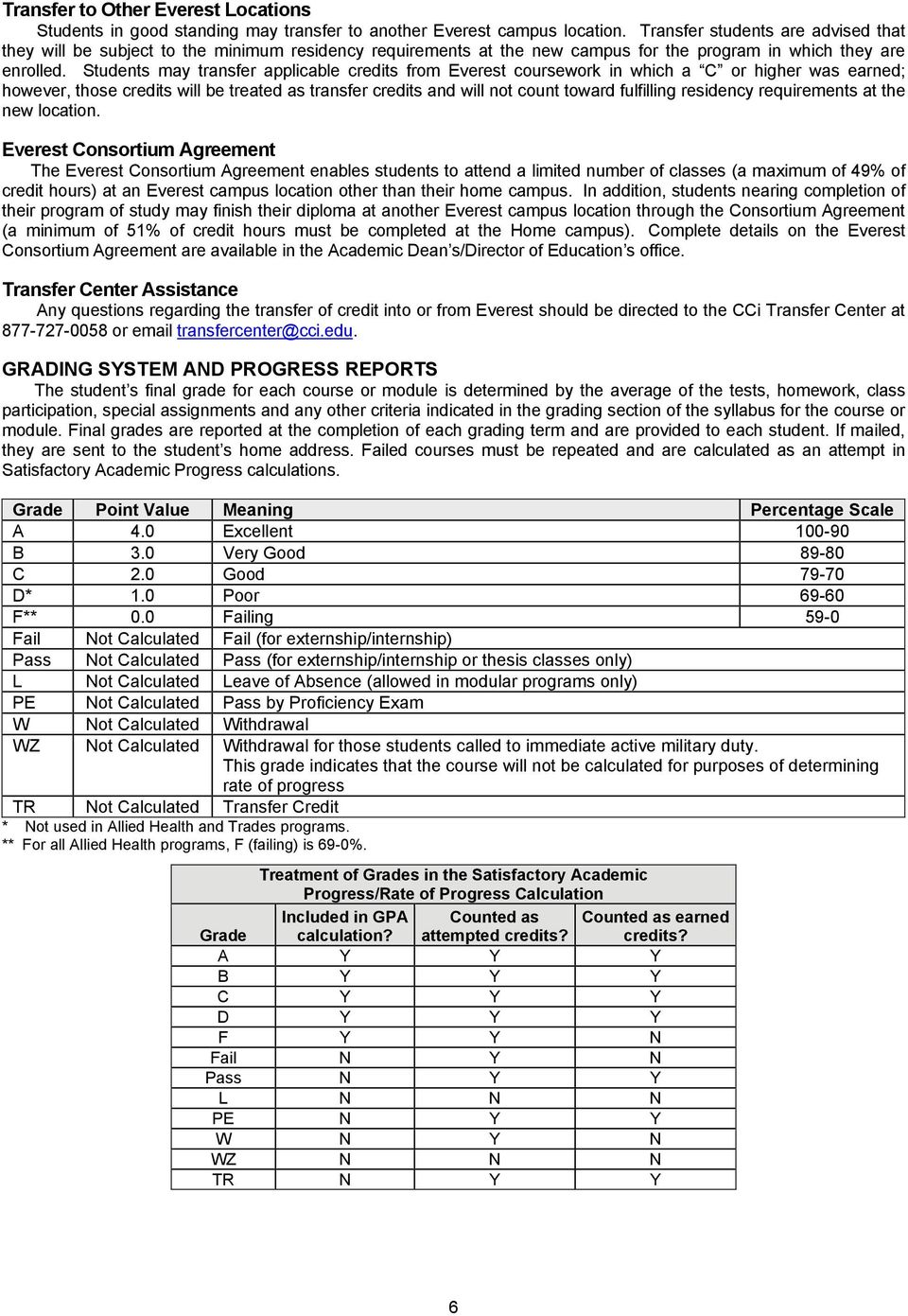
11 Transfer to Other Everest Locations Students in good standing may transfer to another Everest campus location. Transfer students are advised that they will be subject to the minimum residency requirements at the new campus for the program in which they are enrolled. Students may transfer applicable credits from Everest coursework in which a C or higher was earned; however, those credits will be treated as transfer credits and will not count toward fulfilling residency requirements at the new location. Everest Consortium Agreement The Everest Consortium Agreement enables students to attend a limited number of classes (a maximum of 49% of credit hours) at an Everest campus location other than their home campus. In addition, students nearing completion of their program of study may finish their diploma at another Everest campus location through the Consortium Agreement (a minimum of 51% of credit hours must be completed at the Home campus). Complete details on the Everest Consortium Agreement are available in the Academic Dean s/director of Education s office. Transfer Center Assistance Any questions regarding the transfer of credit into or from Everest should be directed to the CCi Transfer Center at or [email protected]. GRADING SYSTEM AND PROGRESS REPORTS The student s final grade for each course or module is determined by the average of the tests, homework, class participation, special assignments and any other criteria indicated in the grading section of the syllabus for the course or module. Final grades are reported at the completion of each grading term and are provided to each student. If mailed, they are sent to the student s home address. Failed courses must be repeated and are calculated as an attempt in Satisfactory Academic Progress calculations. Grade Point Value Meaning Percentage Scale A 4.0 Excellent B 3.0 Very Good C 2.0 Good D* 1.0 Poor F** 0.0 Failing 59-0 Fail Not Calculated Fail (for externship/internship) Pass Not Calculated Pass (for externship/internship or thesis classes only) L Not Calculated Leave of Absence (allowed in modular programs only) PE Not Calculated Pass by Proficiency Exam W Not Calculated Withdrawal WZ Not Calculated Withdrawal for those students called to immediate active military duty. This grade indicates that the course will not be calculated for purposes of determining rate of progress TR Not Calculated Transfer Credit * Not used in Allied Health and Trades programs. ** For all Allied Health programs, F (failing) is 69-0%. Treatment of Grades in the Satisfactory Academic Progress/Rate of Progress Calculation Grade Included in GPA calculation? Counted as attempted credits? Counted as earned credits? A Y Y Y B Y Y Y C Y Y Y D Y Y Y F Y Y N Fail N Y N Pass N Y Y L N N N PE N Y Y W N Y N WZ N N N TR N Y Y 6
12 GPA AND CGPA CALCULATIONS The Grade Point Average (GPA) is calculated for all students. The GPA for each term and Cumulative Grade Point Average (CGPA) are calculated on courses taken in residence at Everest The Grade Point Average (GPA) is calculated at the end of each evaluation period by dividing the quality points earned by the total credits attempted for that evaluation period. The Cumulative Grade Point Average (CGPA) is calculated by dividing the total cumulative quality points earned by the total cumulative credits attempted for cumulative evaluation periods. The number of quality points awarded for each course is determined by multiplying the points listed for each letter grade by the number of credits of the course. STANDARDS OF SATISFACTORY ACADEMIC PROGRESS (SAP) Students must maintain satisfactory academic progress in order to remain eligible as regularly enrolled students and to continue receiving federal financial assistance. The accreditor and federal regulations require that all students progress at a reasonable rate toward the completion of their academic program. Satisfactory academic progress is measured by: The student s cumulative grade point average (CGPA) The student s rate of progress toward completion (ROP) The maximum time frame (MTF) allowed to complete the academic program (150% for all programs). Evaluation Periods for SAP Satisfactory academic progress is measured for all students at the end of each grading period (i.e., at the end of each term, module, phase, level, quarter and payment period). Rate of Progress Toward Completion The school catalog contains a schedule designating the minimum percentage or amount of work that a student must successfully complete at the end of each evaluation period to complete their educational program within the maximum time frame (150%). Quantitative progress is determined by dividing the number of credit hours earned by the number of credit hours attempted. Credit hours attempted include completed hours, transfer credits, withdrawals, and repeated courses. Maximum Time Frame to Complete The maximum time frame for completion of any program is limited by federal regulation to 150% of the published length of the program. School shall calculate maximum time frame using credit hours attempted. All credit hours attempted, which include completed credits, transfer credits, withdrawals, and repeated classes, count toward the maximum number of credits allowed to complete the program. Satisfactory Academic Progress Tables 48 Quarter Credit Hour Program. Total credits that may be attempted: 72 (150% of 48). Total Credits Attempted SAP Advising if CGPA is below SAP Not Met if CGPA is below SAP Advising if Rate of Progress is Below SAP Not Met if Rate of Progress is Below % % 25% % 40% % 50% % 55% % 60% % 55 Quarter Credit Hour Program. Total credits that may be attempted: 82 (150% of 55). Total Credits Attempted SAP Advising if CGPA is below SAP Not Met if CGPA is below SAP Advising if Rate of Progress is Below SAP Not Met if Rate of Progress is Below % % % 60% % 60% % 60% % 7

13 Total Credits Attempted 59 Quarter Credit Hour Program. Total credits that may be attempted: 88 (150% of 59). SAP Advising if CGPA is below SAP Not Met if CGPA is below SAP Advising if Rate of Progress is Below SAP Not Met if Rate of Progress is Below % % % 60% % 60% % 60% % 60 Quarter Credit Hour Program. Total credits that may be attempted: 90 (150% of 60). Total Credits Attempted 72 Quarter Credit Hour Program. Total credits that may be attempted: 108 (150% of 72). SAP Advising if CGPA is below SAP Not Met if CGPA is below SAP Advising if Rate of Progress is Below SAP Not Met if Rate of Progress is Below % % % 50% % 60% % 65% % 76 Quarter Credit Hour Program. Total credits that may be attempted: 115 (150% of 76). Total Credits Attempted SAP Advising if CGPA is below SAP Not Met if CGPA is below SAP Advising if Rate of Progress is Below SAP Not Met if Rate of Progress is Below Total Credits Attempted SAP Advising if CGPA is below SAP Not Met if CGPA is below SAP Advising if Rate of Progress is Below SAP Not Met if Rate of Progress is Below % % 25% % 40% % 50% % 55% % 60% % 65% % % % % 50% % 60% % 65% % Application of Grades and Credits to SAP Grades A through F are included in the calculation of CGPA and are included in the Total Number of Credit Hours Attempted. Transfer credits (TR) are not included in the calculation of CGPA but are included in the Total Number of Credit Hours Attempted and Earned in order to determine the required levels for CGPA and rate of progress. Courses with grades of Pass and PE are not included in the CGPA calculation but do count as credit hours successfully completed for the rate of progress calculation. For calculating rate of progress, F grades and W grades are counted as hours attempted but are not counted as hours successfully completed. Grades of IP will also be counted as hours attempted but not as hours successfully completed. When a course is repeated, the higher of the two grades is used in the calculation of CGPA, and the total credit hours for the original course and the repeated course are included in the Total Credit Hours Attempted (in the SAP charts) in order to determine the required rate of progress level. The credit hours for the original attempt are considered as not successfully completed. When a student returns from a leave of absence and completes the course from which the student withdrew, the hours for which the student receives a passing grade are counted as earned; the grade, hours, and attendance for the original attempt prior to the official leave of absence are not counted for purpose of the rate of progress toward completion calculation and the original grade is not counted in the CGPA calculation. When a student transfers between programs, all attempts of courses common to both programs are included in the CGPA and ROP of the new program. Students graduating from one program and continuing on to another will have all successfully completed courses common to both programs included in the SAP calculations of the new program. Courses not in the new program, including grades of W or F, are excluded from all SAP calculations. 8

14 SAP Advising SAP Advising is the period of time during which a student is advised and monitored for progress for the remainder of the term. During the SAP advising period, the student is eligible for financial aid. Academic advising shall be documented using the Academic Advising Form. The form shall be kept in the student s academic file. The Academic Dean/Director of Education (or designee) must provide a written notice of SAP Advising status. The following timelines apply for all students placed on SAP Advising status: For linear programs with an Add/Drop period: o Students must receive the notification by the first day of the term; and o Must be advised within fourteen (14) calendar days after the term start. NOTE: For terms without a break week, students must receive the notification within seven (7) calendar days after the term start and be advised within twenty-one (21) calendar days after the term start. For modular programs: o Students must receive the notification by the third (3) calendar day of the subsequent module; and o Must be advised within ten (10) calendar days after the module start. Financial Aid Warning SAP is evaluated at the end of each term and all students with a cumulative grade point average (CGPA) and/or rate of progress (ROP) below the required academic progress standards as stated in the school s catalog will move into SAP NOT MET status. Students not meeting SAP and with a previous SAP status: SAP MET or SAP ADVISING will be issued FA Warning letter and be advised that unless they improve their CGPA and/or rate of progress toward completion, they may be withdrawn from their program and lose eligibility for federal financial aid. Notification of Financial Aid Warning The Academic Dean/Director of Education (or designee) must provide the written notice of FA Warning status to all students with a previous SAP status: SAP Advising or SAP Met. The following timelines apply to all students receiving an FA Warning: For linear programs with an Add/Drop period: o Students must receive the notification by the first day of the term; and o Must be advised within fourteen (14) calendar days after the term start. NOTE: For terms without a break week, students must receive the notification within seven (7) calendar days after the term start and be advised within twenty-one (21) calendar days after the term start. For modular programs: o Students must receive the notification by the third (3) calendar day of the next module; and o Must be advised within ten (10) calendar days after the module start. Financial Aid Probation At the end of each term following a SAP evaluation, students with an immediate SAP NOT MET status and who are SAP NOT MET again according to the academic progress standards stated in the school s catalog, will be notified with a SAP NOT MET letter indicating that they will be withdrawn unless they successfully appeal by written request within five (5) calendar days after the notification in accordance with the Academic Appeals Policy. Appeals shall only be granted for the following reasons: the death of a family member; an illness or injury suffered by the student; special circumstances of an unusual nature which are not likely to recur. The Academic Dean/Director of Education (or designee) must provide written notice of all students placed on SAP NOT MET status: For linear programs with an Add/Drop period: o Students must receive the notification by the first day of the term; o If the student appeals this status and the appeal is approved, the student must receive an Academic Progress Plan within ten (10) calendar days after the appeal s approval. NOTE: For terms without a break week, students must receive the notification within seven (7) calendar days after the term start. For modular programs: o o Students must receive the notification by the third (3) calendar day of the next module; If the student appeals this status and the appeal is approved, the student must receive an Academic Progress Plan within seven (7) calendar days after the appeal s approval. Notification of Financial Aid Probation FA Probation is the term for which the student s appeal has been accepted and progress is monitored under an Academic Progress Plan. Students must be notified in writing of their probationary status within three (3) calendar day of the change in status in the student information system. During the period of FA probation students will continue to be eligible for financial aid. While on FA probation, unless students improve their CGPA and /or rate of progress toward completion, in accordance with their Academic Progress Plan, they will be withdrawn from their program and become ineligible for 9

15 further financial aid. All students on FA probation must be placed on an Academic Progress Plan. A student will remain on FA probation as long as he or she is meeting the requirements of his or her Academic Progress Plan when evaluated at the end of each evaluation period on the Plan. Academic Progress Plan Students on FA Probation must agree to the requirements of an Academic Progress Plan (APP) as a condition of their FA probation. Each student shall receive a copy of his or her APP. A copy of each student s APP shall be kept in the student s permanent academic file. The APP may extend over one (1) or multiple terms, as defined at the initiation of the APP. At the end of the first evaluation period on the APP, the student will meet with the Academic Dean/Director of Education (or designee)/online Designee for an evaluation of progress of the plan s requirements. If on a single-term plan and the student has met the requirement(s) of the plan, the student must be in SAP Advising or SAP Met status, and the student s APP shall be considered fulfilled and closed. If on a multi-term plan and the student has met the requirement(s) of the first evaluation period, then new requirement will be set and the student will be placed manually into SAP Meeting APP Status and will adhere to the subsequent term requirements of the APP. If at the end of any SAP evaluation period on the plan (APP) the student does not meet the plan s requirement(s), the student will receive a dismissal letter and will be dismissed from the program. Students who have violated their FA Probation and have been dismissed from a program are not eligible for readmission to that program if they have exceeded, or may exceed, the maximum time frame of completion until they re-establish appropriate Satisfactory Academic Progress standing. Evaluation of Progress At the end of each evaluation period encompassed by the APP, the student will meet with the Academic Dean/Director of Education (or designee) for an evaluation of progress of the plan s requirements. Determination of the student s success at meeting APP requirement(s) must be completed no later than the second (2 nd ) calendar day of the module or term. SAP Advising or SAP Met Status If the student has met the requirements of a one-term plan, the student must be in SAP Advising or SAP MET status and the student s APP shall be considered fulfilled and closed. The student will be provided with either a SAP Advising or Return to Academic Good Standing Letter. In the case of SAP Advising, the student will be advised with the Academic Advising form and will be FA eligible. The Academic Dean/Director of Education (or designee) must provide a written notice of Return to Academic Good Standing or SAP Advising status. The following timelines apply for all students placed on SAP Advising status: For linear programs with an Add/Drop period: o Students must receive the notification by the first day of the term; and o Must complete the Evaluation of Progress form within fourteen (14) calendar days after the notification. NOTE: For terms without a break week, students must receive the notification within seven (7) calendar days after the term start and must complete the Evaluation of Progress form within twenty-one (21) calendar days after the notification. For modular programs: o Students must receive the notification by the third (3) calendar day of the subsequent module; and o Must complete the Evaluation of Progress form within seven (7) calendar days after the notification. SAP Not Met Status and/or Dismissal If on a multi-term plan, it is likely the student will remain SAP NOT MET for the second (and ensuing) evaluation periods. At the end of each evaluation period, the student will be notified, evaluated for progress, and if the APP requirements are met, will be manually assigned SAP Meeting APP status and continue on the APP. New requirements for the second (or ensuing) evaluation period will be defined using the Evaluation of Progress form. The Academic Dean/Director of Education (or designee) must provide a written notice of SAP NOT MET status. The following timelines apply for all students placed on SAP NOT MET status: For linear programs with an Add/Drop period: o Students must receive the notification by the first day of the term; and o Must complete the Evaluation of Progress form within fourteen (14) calendar days after the notification. NOTE: For terms without a break week, students must receive the notification within seven (7) calendar days after the term start and must complete the Evaluation of Progress form within twenty-one (21) calendar days after the notification. For modular programs: o Students must receive the notification by the third (3) calendar day of the subsequent module; and o Must complete the Evaluation of Progress form within seven (7) calendar days after the notification. If the student does not meet the Plan s requirements at the end of an evaluation period, the student will be dismissed from the program. If the student has not met the benchmark, the student must be dropped with the correct 10

16 DOD (no later than second calendar day of module or term). The student must be notified of dismissal no later than the second calendar day of module or term. NOTE: If the student has make-up work, and the campus is willing to accept it, it must be completed within four (4) calendar days of grades being entered (as long as this doesn t extend beyond ten (10) calendar days after mod- or term-end), or the student must be dropped with the correct DOD. SAP Re-Entry Students who have violated FA Probation and have been dismissed shall not be readmitted if they cannot complete the program within the maximum time frame or re-establish appropriate Satisfactory Academic Progress (SAP) standing. Retaking Passed Coursework Students may repeat coursework as long as such coursework does not include more than a single repetition of a previously passed course. Each attempt counts in the calculation of the students rate of progress and successful completion percentages. All repeated courses will appear on the student s transcript, but only the highest grade earned will be included in the calculation of their cumulative grade point average. Retaking Failed Coursework For the purpose of improving academic standing and establishing institutional grade point average, students must repeat any failed coursework. Failed courses may be repeated more than twice, so long as repeating the coursework does not jeopardize the students maximum time frame of completion. Pre-requisite modules in diploma programs may not be repeated more than three (3) attempts. Each attempt counts in the calculation of the students rate of progress and successful completion percentages. All repeated coursework will appear on the student s transcript, but only the highest grade earned, will be included in the calculation of their cumulative grade point average. Attendance in successfully repeated classes/modules will also replace attendance in prior unsuccessful attempts. ATTENDANCE POLICY Regular attendance and punctuality will help students develop good habits necessary for successful careers. Satisfactory attendance is established when students are present in the assigned classroom for the scheduled amount of time. Faculty are responsible for monitoring student attendance and advising students who have been absent from their classes. Tardies and leave earlies are recorded in minutes and are calculated as equivalent absences. Students who have been absent from all of their scheduled classes for 14 consecutive calendar days OR in excess of 10 consecutive scheduled school days (whichever is earlier) will be dropped from the training program. Students who miss 15% of the total program hours (including all attempted hours) will be advised that they are at risk of being dropped from the program. Students who miss an excess of 20% of the total program hours (including all attempted hours) will be advised that they will be dropped from the program. Students who have been dropped from the program may apply for reentry. The school is not required to withdraw a student based on lack of attendance if a refund would not be due. Should a student s absences exceed 20% of the hours in the program (including all attempted hours), the student shall be dismissed unless the student is in the last quarter of the program and not refund is due according to the Texas Refund Policy. Establishing Attendance / Verifying Enrollment In Texas, student attendance is monitored on the basis of the percentage of classes missed as a percentage of the total program hours. The student s minutes of attendance in each class are recorded and retained as part of the student record. Whether a student must be dismissed for an attendance violation depends on whether a refund is due. Should a student s absences exceed 20% of the hours in the program (including all attempted hours), the student shall be dismissed, unless the student is in the last quarter/module of the program and no refund is due. The schools will take attendance each class session beginning with the first day of scheduled classes. For programs with an add/drop period, the taking of attendance for a student enrolling during the add/drop period shall begin the first scheduled class session following the student s enrollment. In programs without an add/drop period, students registered for a class shall attend by the second scheduled class session, or be withdrawn. Monitoring Student Attendance Faculty shall monitor student attendance on the basis of both consecutive absences (the Consecutive Absence Rule ) and absences as a percentage of the hours in the class/program (the Percentage Absence Rule ). The Date of Withdrawal shall be the earlier of a violation of the Consecutive Absence Rule or the Percentage Absence Rule. 11

17 Consecutive Absence Rule (All Programs) When a student is absent from school for fourteen (14) consecutive calendar days excluding holidays and scheduled breaks OR in excess of 10 consecutive scheduled school days (whichever is earlier), the faculty shall notify the Academic Dean/Director of Education. The following guidelines shall be followed: All students who state they will not return to school shall be promptly withdrawn; All students who state they will return must attend their next scheduled class session; Any student who has promised to return to school, but does not attend the next scheduled class session shall be withdrawn from all courses and dismissed from school. NOTE: For modular programs, the consecutive absence rule is applied to days missed in the total program. Percentage Absence Rule (Modular Programs) For students who have not previously been dismissed from the program for violating the attendance policy, the following rule shall apply: Percentage 15% of the total program hours (including all attempted hours) missed Exceeds 20% of the total program hours (including all attempted hours)missed Action Taken Attendance warning letter sent Dismissed from the program Re-entry For any students who apply for reentry, the following rule shall apply: Percentage 15% of the remaining program hours (including all attempted hours) missed Exceeds 20% of the remaining program hours (including all attempted hours) missed Action Taken Attendance warning letter sent Dismissed from the program Date of Withdrawal When a student is withdrawn for consecutive absences within the term or module, the date of the student s withdrawal shall be the student s last date of attendance (LDA). When a student is withdrawn for violating the applicable percentage absence rule, the Date of Withdrawal shall be the date of the violation. Note: The Date of Withdrawal shall be the earlier of a violation of the Consecutive Absence Rule or the Percentage Absence Rule. Date of Determination (DOD) The Date of Determination (DOD) shall be the date the school determined the student would not return to class. This is the date used to determine the timeliness of the refund. The DOD is the earliest of the following three (3) dates: The date the student notifies the school (verbally or in writing) that s/he is not returning to class; The date the student violates the published attendance policy; No later than the 14th calendar day after the LDA; scheduled breaks are excluded when calculating the DOD. Attendance Records The computer attendance database is the official record of attendance. LEAVE OF ABSENCE POLICY (MODULAR PROGRAMS ONLY) Everest permits students to request a leave of absence (LOA) as long as the leave does not exceed a total of 180 days during any 12-month period, starting from the first day of the first leave, and as long as there are documented, legitimate extenuating circumstances that require the students to interrupt their education. Students requesting an LOA must submit a completed Leave of Absence Request Form prior to the beginning date of the leave. If unforeseen circumstances prevent the student from submitting the request in advance, the leave may still be granted, but only if: a) the school documents the unforeseen circumstances, and b) the student submits a completed Leave of Absence Request Form by the tenth (10 th ) calendar day of the leave. Note: Everest does not permit leaves of absence for students enrolled in quarter-based programs. Students experiencing circumstances that may make it necessary to interrupt their attendance temporarily should see the Academic Dean/Director of Education. 12

18 A student must return from a LOA on the first day of any appropriate module or prior to the expiration of his or her leave. A student who goes on leave prior to the end of a module shall receive a grade of L (leave) which shall remain on his or her transcript until the student returns from an LOA, retakes the entire module and earns a grade. The module with a grade of L shall not be included in the calculation of Rate of Progress (ROP), Maximum Time Frame (MTF) or attendance. Re-Admission Following a Leave of Absence Upon return from leave, the student will be required to repeat the module, if it had been interrupted, and receive final grades. The student will not be charged any fee for the repeat of any module from which the student took leave or for students reentering from a leave of absence. The date the student returns to class is normally scheduled for the beginning of a module. When a student is enrolled in a modular program, the student may return at any appropriate module, not only the module from which the student withdrew. Extension of LOA A student on an approved LOA may submit a request to extend the LOA without returning to class. Such a request may be approved by the Academic Dean/Director of Education provided: The student submits a completed LOA Extension Request Form before the end date of the current leave. There is a reasonable expectation the student will return. The number of days in the leave as extended, when added to all other approved leaves, does not exceed 180 calendar days in any twelve (12) month period calculated from the first day of the student s first leave. Appropriate modules required for completion of the program will be available to the student on the date of return. If the extension request is approved, the end date of the student s current leave will be changed in the official student information system to reflect the new end date. If the request is denied, the student will be withdrawn and the withdrawal date will be the student s last date of attendance (LDA). Failure to Return from a Leave of Absence A student who fails to return from a LOA on or before the date indicated in the written request will be terminated from the program, and the institution will invoke the refund policy. As required by federal statute and regulations, the student s last date of attendance prior to the approved LOA will be used in order to determine the amount of funds the institution earned and make any refunds that may be required under federal, state, or institutional policy. The L grade in the LOA beginning module shall be changed to W (withdraw). The module with a grade of W shall be included as an attempt in the calculation of Rate of Progress and Maximum Time Frame. Possible Effects of Leave of Absence Students who are contemplating a LOA should be cautioned that one or more of the following factors may affect the length of time it will take the student to graduate. Students returning from a LOA are not guaranteed that the module required to maintain the normal progress in their training program will be available at the time of reentry; They may have to wait for the appropriate module to be offered; Financial aid may be affected. EXTERNSHIP TRAINING Upon successful completion of all classroom requirements, students in programs that require an externship are expected to begin the externship portion of their programs within 14 calendar days (excluding holidays and regularly scheduled breaks). If a student does not begin externship training within 14 calendar days, he/she must be dropped from the program. A leave of absence (LOA) may only be approved if the student s reason meets the criteria of the LOA Policy. Students may only miss 14 consecutive calendar days once they start externship or they must be dropped from the program. Each student has approximately 120 calendar days to complete their externship. Any modular student who does not complete externship training within 120 calendar days should meet with the Academic Dean/Director of Education to approve the time remaining to complete the externship. Students who drop from externship either prior to starting or during externship and/or delay the completion of their externship for more than 30 days from the last days of attendance must have their skills evaluated by a program instructor or director/chair prior to re-entry to ensure they are still competent to perform skills safely in the externship setting. 13

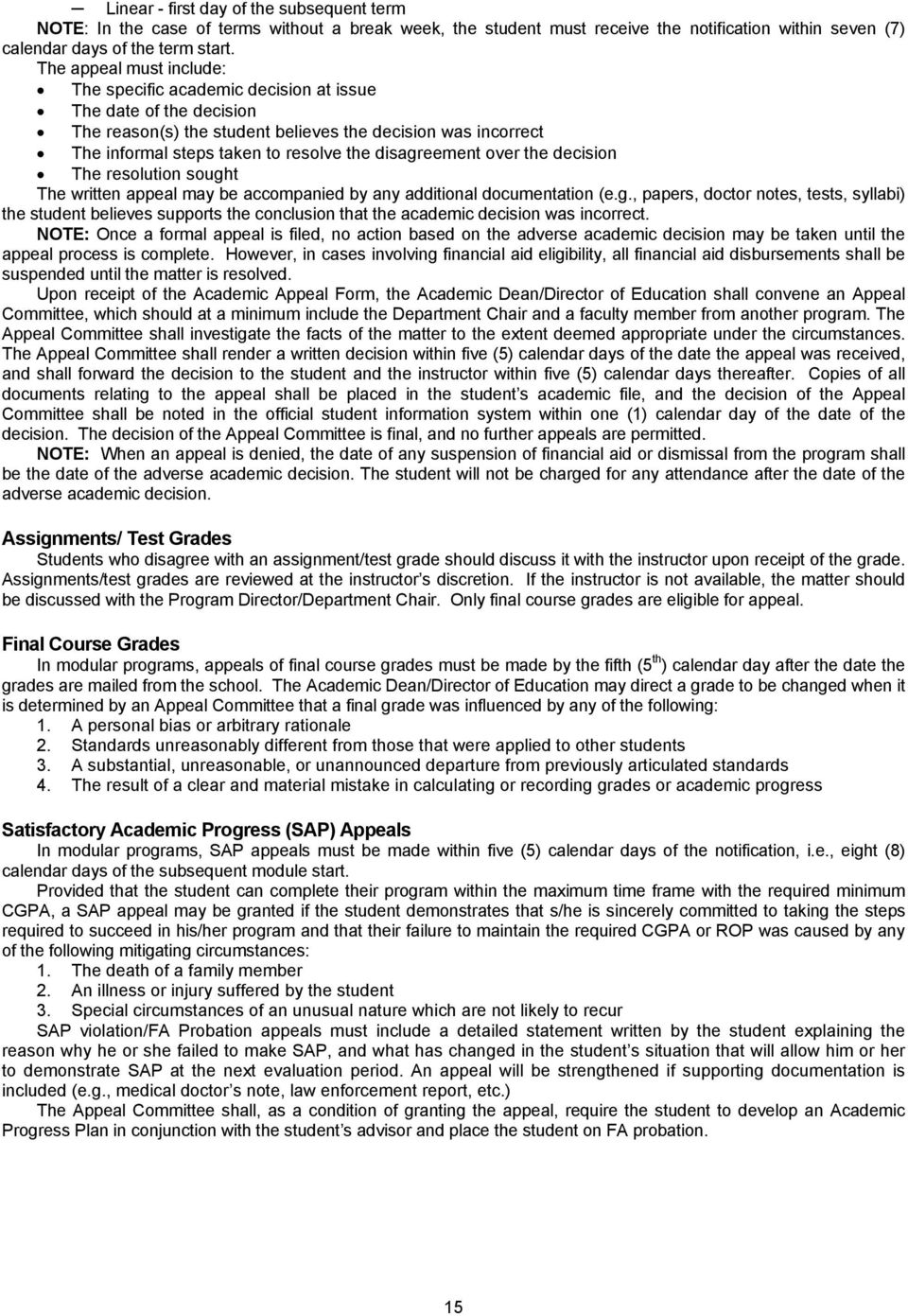
19 WITHDRAWAL PROCEDURES Students who intend to withdraw from school are requested to notify the Academic Dean/Director of Education by telephone, in person, by or in writing to provide official notification of their intent to withdraw and the date of withdrawal. Timely notification by the student will result in the student being charged tuition and fees for only the portion of the payment period or period of enrollment that he/she attended as well as ensuring a timely return of federal funds and any other refunds that may be due. Students requesting a withdrawal from school must complete a financial aid exit interview. Students who have withdrawn from school may contact the school s Education Department about reentry. MAKE-UP WORK At the instructor s discretion, make-up work may be provided to students who have missed class assignments or tests. Make-up work must be completed within 10 calendar days after the end of the term/module. REQUIREMENTS FOR GRADUATION Successfully complete all courses in the program with a 2.0 (70%) cumulative grade point average within the maximum time frame for completion as stated in the school catalog. Successfully complete all externship requirements (if applicable). Meet any additional program-specific requirements as stated in the catalog. Commencement exercises are held at least once a year. Upon graduation, all students who are current with their financial obligation to the school shall receive their diploma. VETERAN S EDUCATION BENEFITS Prior Credit for Education and Training All VA beneficiaries are required to disclose prior postsecondary school attendance, military education and training, and provide transcripts for such education and training. Students are expected to provide the school with official transcripts evidencing prior postsecondary school attendance, military education and training for the purposes of evaluating and granting, as appropriate, any such credit. The school is responsible for evaluating transcripts of previous education and experience, granting credit, as appropriate, notifying the student, and shortening the program certified accordingly. Prior credit must be evaluated within the first two terms of the enrollment period. The VA will not pay VA education benefits past the third term of enrollment, if the transcript is not received and prior credit has not been evaluated. Benefit Overpayments Schools are required to promptly report changes in the enrollment status of all students receiving VA education benefits in order to minimize overpayments. Generally overpayments of VA benefits are the responsibility of the student. However, there are instances under the Post 9/11 GI Bill when an overpayment is created on a school and funds need to be returned to the VA. Academic Standards for Students Receiving VA Benefits Students receiving Veterans education benefits are subject to the same academic standards applicable to all students at the school. To receive VA education benefits, a student must maintain Satisfactory Academic Progress, attendance standards and adhere to the Code of Student Conduct. APPEALS POLICIES Student Academic Appeals Policy Academic appeals include those appeals related to Satisfactory Academic Progress violations, final grades and academic or financial aid eligibility. In all instances, with the exception of SAP, Everest expects that initially every attempt will be made to resolve such disputes informally through discussions by all relevant parties prior to initiating formal appeals. All formal academic appeals must be submitted in writing on an Academic Appeal Form to the Academic Dean/Director of Education within five (5) calendar days of the date the student has notice of the adverse academic decision: Notice of final grades: Modular - the date the grade(s) are mailed from the school Linear - first day of the subsequent term Notice of SAP violation (FA probation SAP Not Met 2 nd consecutive term): Modular third calendar day of the subsequent module 14

20 Linear - first day of the subsequent term NOTE: In the case of terms without a break week, the student must receive the notification within seven (7) calendar days of the term start. The appeal must include: The specific academic decision at issue The date of the decision The reason(s) the student believes the decision was incorrect The informal steps taken to resolve the disagreement over the decision The resolution sought The written appeal may be accompanied by any additional documentation (e.g., papers, doctor notes, tests, syllabi) the student believes supports the conclusion that the academic decision was incorrect. NOTE: Once a formal appeal is filed, no action based on the adverse academic decision may be taken until the appeal process is complete. However, in cases involving financial aid eligibility, all financial aid disbursements shall be suspended until the matter is resolved. Upon receipt of the Academic Appeal Form, the Academic Dean/Director of Education shall convene an Appeal Committee, which should at a minimum include the Department Chair and a faculty member from another program. The Appeal Committee shall investigate the facts of the matter to the extent deemed appropriate under the circumstances. The Appeal Committee shall render a written decision within five (5) calendar days of the date the appeal was received, and shall forward the decision to the student and the instructor within five (5) calendar days thereafter. Copies of all documents relating to the appeal shall be placed in the student s academic file, and the decision of the Appeal Committee shall be noted in the official student information system within one (1) calendar day of the date of the decision. The decision of the Appeal Committee is final, and no further appeals are permitted. NOTE: When an appeal is denied, the date of any suspension of financial aid or dismissal from the program shall be the date of the adverse academic decision. The student will not be charged for any attendance after the date of the adverse academic decision. Assignments/ Test Grades Students who disagree with an assignment/test grade should discuss it with the instructor upon receipt of the grade. Assignments/test grades are reviewed at the instructor s discretion. If the instructor is not available, the matter should be discussed with the Program Director/Department Chair. Only final course grades are eligible for appeal. Final Course Grades In modular programs, appeals of final course grades must be made by the fifth (5 th ) calendar day after the date the grades are mailed from the school. The Academic Dean/Director of Education may direct a grade to be changed when it is determined by an Appeal Committee that a final grade was influenced by any of the following: 1. A personal bias or arbitrary rationale 2. Standards unreasonably different from those that were applied to other students 3. A substantial, unreasonable, or unannounced departure from previously articulated standards 4. The result of a clear and material mistake in calculating or recording grades or academic progress Satisfactory Academic Progress (SAP) Appeals In modular programs, SAP appeals must be made within five (5) calendar days of the notification, i.e., eight (8) calendar days of the subsequent module start. Provided that the student can complete their program within the maximum time frame with the required minimum CGPA, a SAP appeal may be granted if the student demonstrates that s/he is sincerely committed to taking the steps required to succeed in his/her program and that their failure to maintain the required CGPA or ROP was caused by any of the following mitigating circumstances: 1. The death of a family member 2. An illness or injury suffered by the student 3. Special circumstances of an unusual nature which are not likely to recur SAP violation/fa Probation appeals must include a detailed statement written by the student explaining the reason why he or she failed to make SAP, and what has changed in the student s situation that will allow him or her to demonstrate SAP at the next evaluation period. An appeal will be strengthened if supporting documentation is included (e.g., medical doctor s note, law enforcement report, etc.) The Appeal Committee shall, as a condition of granting the appeal, require the student to develop an Academic Progress Plan in conjunction with the student s advisor and place the student on FA probation. 15
21 FINANCIAL INFORMATION STATEMENT OF FINANCIAL OBLIGATION A student who has applied, is accepted, and has begun classes at Everest assumes a definite financial obligation. Each student is legally responsible for his or her own educational expenses for the period of enrollment. A student who is enrolled and has made payments in full or completed other financial arrangements and is current with those obligations, is entitled to all the privileges of attending classes, taking examinations, receiving grade reports, securing course credit, being graduated, and using the Career Services Office. Any student who is delinquent in a financial obligation to the school, or any educational financial obligation to any third party, including damage to school property, library fines, and payment of tuition and fees, is subject to exclusion from any or all of the usual privileges of the school. Everest may, in its sole discretion, take disciplinary action on this basis, including suspension or termination of enrollment. TUITION AND FEES Tuition and fee information can be found in the Appendix A: Tuition and Fees section of the catalog. Modular programs are offered throughout the year on a schedule independent of the standard quarter calendar. When a student begins enrollment in a modular program, tuition will be charged in the full tuition amount, or in increments based on state policy, for each academic year. Students' financial obligations will be calculated in accordance with the refund policy in the Enrollment Agreement and this school catalog. For modular programs, the Enrollment Agreement obligates the student and the school for the entire program of instruction. Student may make payments by cash or by the following accepted credit cards: Visa, MasterCard or Discover. TUITION CHARGES FOR RE-ENTRY Students re-entering a linear program will be charged tuition at the current cost per credit/quarter. Students re-entering a modular program within 180 days: Same Program (Same/New Program Version): Will be charged tuition at the original tuition rate reflected on the original enrollment agreement less the amount charged on the prior period of enrollment (Charges plus or minus any tuition adjustments) Same Program (New Program Version of Different Credits/Length of Program): Will be charged tuition at the current catalog rate for the program of enrollment less the amount charged on the prior period of enrollment (Charges plus or minus any tuition adjustments). Different / New Program (Program Change): Will be charged tuition at the current catalog rate for the program of enrollment. A tuition credit will be determined for the student s prior period of enrollment Students re-entering greater than 180 days less than 365 days: Same Program (Same/New Program Version): Will be charged tuition at the current catalog rate for the program of enrollment less the amount charged on the prior period of enrollment (Charges plus or minus any tuition adjustments) Same Program (New Program Version of Different Credits/Length of Program): Will be charged tuition at the current catalog rate for the program of enrollment less the tuition credit from the prior period of enrollment. Determine which re-entry credit for the prior period of enrollment is in the student s best interest by referring to the Enrollment Agreement Guidelines Different / New Program (Program Change): Will be charged tuition at the current catalog rate for the program of enrollment. A tuition credit will be determined for the student s prior period of enrollment. NOTE: Any student who has a prior unpaid balance or account that has been referred to a collection agency will not be eligible for re-entry until the unpaid balance has been resolved. TEXTBOOKS Textbooks and workbooks are sold through the bookstore in accordance with Everest policies. At the time of issuance, textbooks become the responsibility of the students. Everest is not responsible for replacing lost textbooks; however, students may purchase replacements from the campus bookstore. Students are responsible for the cost of their textbooks and the cost of any shipping charges. ADDITIONAL FEES AND EXPENSES Charges for textbooks, uniforms and equipment are separate from tuition. The institution does not charge for books, uniforms and equipment until the student purchases and receives the items. Incidental supplies, such as paper and pencils are to be furnished by the students. 16
22 VOLUNTARY PREPAYMENT PLAN The school provides a voluntary prepayment plan to students and their families to help reduce the balance due upon entry. Details are available upon request from the Student Finance Office. BUYER S RIGHT TO CANCEL The applicant s signature on this Enrollment Agreement (Agreement) does not constitute admission into The School until the student has been accepted for admission by an official of The School. If the applicant is not accepted by The School, all monies paid will be refunded. A full refund will be made to any student who cancels the enrollment contract within 72 hours (until midnight of the third day excluding Saturdays, Sundays and legal holidays) after the enrollment contract is signed or within the student s first three scheduled class days. Applicants who have not visited The School prior to enrollment may also cancel within three business days following The School s regularly scheduled orientation procedures or a tour of The School s facilities and inspection of equipment, where training and services are provided, and receive a full refund. The School is required to provide a tour on or before the first scheduled class day. Cancellation will occur when the student gives a signed and dated written notice of cancellation to the Director of Admissions or President at the address shown on the front of this Agreement. The written notice of cancellation need not take any particular form, and, however expressed, is effective if signed and dated by the student and states that the student no longer wishes to be bound by the Agreement. A notice of cancellation may be given by mail or hand delivery. The notice of cancellation, if sent by mail, is effective when deposited in the mail, properly addressed, with postage prepaid. OFFICIAL WITHDRAWALS An official withdrawal is considered to have occurred on the earlier of a) the date that the student provides to The School official notification of his or her intent to withdraw, or b) the date that the student begins the withdrawal process. Students who must withdraw from The School are requested to notify the office of the Academic Dean/ Director of Education by telephone, in person, or in writing, to provide official notification of their intent to withdraw. Students will be asked to provide the official date of withdrawal and the reason for withdrawal in writing at the time of official notification. When the student begins the process of withdrawal, the student or the office of the Academic Dean/Director of Education will complete the necessary form(s). Modular Programs: Although there is no add/drop period in modular programs, for students who officially withdraw within the first five class days (or for weekend classes within seven calendar days from the date they started class, including the day they started class), all monies paid will be refunded. DATE OF WITHDRAWAL VERSUS DATE OF DETERMINATION (DOD) The effective date of withdrawal for refund purposes will be the earliest of the following: (a) The last day of attendance, if the student is terminated by The School; (b) The date of receipt of written notice from the student; or (c) Ten school days following the last date of attendance. The date of determination is the earlier of the date the student officially withdraws, provides notice of cancellation or the date the school determines the student has violated an academic standard. For example, when a student is withdrawn for violating an academic rule, the date of the student s withdrawal shall be the student s last date of attendance. The date of determination shall be the date the school determines the student has violated the academic rule, if the student has not filed an appeal. If the student files an appeal and the appeal is denied, the date of determination is the date the appeal is denied. If the student ceases attendance without providing official notification, the DOD shall be no more than 14 days from the student s last date of attendance. FEDERAL FINANCIAL AID RETURN POLICY Return of Title IV Funds Calculation and Policy The School is required to determine earned and unearned portions of Title IV aid for students who cancel, withdraw, drop out, are dismissed, or take a leave of absence prior to completing 60% of a payment period or term. The Return of Title IV Funds calculation (Return calculation) is based on the percentage of earned aid using the following calculation: Percentage of payment period or term completed equals the number of days completed up to the withdrawal date divided by the total days in the payment period or term. (Any break of five days or more is not counted as part of the days in the term.) This percentage is also the percentage of earned aid. Funds are returned to the appropriate federal program based on the percentage of unearned aid using the following formula: Aid to be returned equals (100% of the aid that could be disbursed minus the percentage of earned aid) multiplied by the total dollar amount of aid that could have been disbursed during the payment period or term. The School must return the lesser of: 1. The amount of Title IV program funds that the student did not earn; or 17
23 2. The amount of institutional charges that the student incurred for the payment period or period of enrollment multiplied by the percentage of funds that were not earned. The student (or parent, if a Federal PLUS loan) must return or repay the amount by which the original overpayment amount exceeds 50% of the total grant funds received by the student for the payment period or period of enrollment, if the grant overpayment is greater than $50. (Note: If the student cannot repay the grant overpayment in full, the student must make satisfactory arrangements with the U.S. Department of Education to repay any outstanding grant balances. The Student Financial Aid Department will be available to advise the student in the event that a student repayment obligation exists. The individual will be ineligible to receive additional student financial assistance in the future if the financial obligation(s) is not satisfied.) The School must return the Title IV funds for which it is responsible in the following order: 1. Unsubsidized Direct Stafford loans (other than PLUS loans) 2. Subsidized Direct Stafford loans 3. Federal Perkins loans 4. Direct PLUS loans 5. Federal Pell Grants for which a return of funds is required 6. Academic Competitiveness Grants for which a return of funds is required 7. National Smart Grants for which a return of funds is required 8. Federal Supplemental Educational Opportunity Grants (FSEOG) for which a return of funds is required If a student withdraws after the 60% point-in-time, the student has earned all Title IV funds that he/she was scheduled to receive during the period and, thus, has no unearned funds; however, The School must still perform a Return calculation. If the student earned more aid than was disbursed to him/her, the institution would owe the student a post-withdrawal disbursement, which must be paid within 180 days of the DOD. If a student earned less aid than was disbursed, The School would be required to return a portion of the funds, and the student would be required to return a portion of the funds. Any outstanding student loans that remain are to be repaid by the student according to the terms of the student s promissory notes. After a Return calculation has been made and a state/institutional refund policy, if applicable, has been applied, any resulting credit balance (i.e. earned Title IV funds exceed institutional charges) must be paid within 14 days from the date that The School performs the Return calculation and will be paid in one of the following manners: 1. Pay authorized charges at the institution; 2. With the student s permission, reduce the student s Title IV loan debt (not limited to the student s loan debt for the period of enrollment); 3. Return to the student. Time frame within which Institution is to Return Unearned Title IV Funds The School must return the amount of unearned Title IV funds for which it is responsible within 45 days after the DOD. Effect of Leave of Absence on Returns If a student does not return from an approved leave of absence on the date indicated on the written request, the withdrawal date is the student s last day of attendance. For more information, see the Leave of Absence section in The School catalog. REFUND POLICIES If a state refund policy can provide a larger refund to the student than The School s refund policy, a refund worksheet using both policies will be included in each student s file, and the student will be given the benefit of the refund policy that results in the larger refund to the student. Institutional Pro Rata Refund Calculation and Policy When a student withdraws, The School must determine how much of the tuition and fees it is eligible to retain. The Pro Rata Refund Calculation and Policy is an institutional policy and is different from the Federal Financial Aid Return Policy and Return calculation; therefore, after both calculations are applied, a student may owe a debit balance (i.e. the student incurred more charges than he/she earned in Title IV funds) to The School. The School will perform the Pro Rata Refund Calculation for students who terminate their training before completing the period of enrollment. Under the Pro Rata Refund Calculation, The School is entitled to retain only the percentage of charges (tuition, fees, room, board, etc.) proportional to the period of enrollment completed by the student. The period of enrollment completed by the student is calculated by dividing the total number of calendar days in the period of enrollment into the calendar days in the period as of the student s last date of attendance. The period of enrollment for students enrolled in modular programs is the academic year. The period of enrollment for students enrolled in quarter-based programs is the quarter. The refund is calculated using the following steps: 1. Determine the total charges for the period of enrollment. 18
24 2. Divide this figure by the total number of calendar days in the period of enrollment. 3. The answer to the calculation in step 2 is the daily charge for instruction. 4. The amount owed by the student, for the purposes of calculating a refund, is derived by multiplying the total calendar days in the period as of the student s last date of attendance by the daily charge for instruction and adding in any book or equipment charges. 5. The refund shall be any amount in excess of the figure derived in step 4 that was paid by the student. TEXAS REFUND POLICY (TEXAS EDUC. CODE ) 1. Refund computations will be based on scheduled course time of class attendance through the last date of attendance. Leaves of absence, suspensions and school holidays will not be counted as part of the scheduled class attendance. 2. The effective date of termination for refund purposes will be the earliest of the following: (a) The last day of attendance, if the student is terminated by the school; (b) The date of receipt of written notice from the student; or (c) Ten school days following the last date of attendance. 3. If tuition and fees are collected in advance of entrance, and if after expiration of the 72 hour cancellation privilege the student does not enter school, not more than $100 in nonrefundable administrative fees shall be retained by the school for the entire residence program or synchronous distance education course. 4. If a student enters a residence or synchronous distance education program and withdraws or is otherwise terminated, the school or college may retain not more than $100 in nonrefundable administrative fees for the entire program. The minimum refund of the remaining tuition and fees will be the pro rata portion of tuition, fees, and other charges that the number of hours remaining in the portion of the course or program for which the student has been charged after the effective date of termination bears to the total number of hours in the portion of the course or program for which the student has been charged, except that a student may not collect a refund if the student has completed 75 percent or more of the total number of hours in the portion of the program for which the student has been charged on the effective date of termination. 5. Refunds for items of extra expense to the student, such as books, tools, or other supplies should be handled separately from refund of tuition and other academic fees. The student will not be required to purchase instructional supplies, books and tools until such time as these materials are required. Once these materials are purchased, no refund will be made. For full refunds, the school can withhold costs for these types of items from the refund as long as they were necessary for the portion of the program attended and separately stated in the enrollment agreement. Any such items not required for the portion of the program attended must be included in the refund. 6. A student who withdraws for a reason unrelated to the student s academic status after the 75 percent completion mark and requests a grade at the time of withdrawal shall be given a grade of incomplete and permitted to reenroll in the course or program during the 12-month period following the date the student withdrew without payment of additional tuition for that portion of the course or program. 7. A full refund of all tuition and fees is due and refundable in each of the following cases: (a) An enrollee is not accepted by the school; (b) If the course of instruction is discontinued by the school and this prevents the student from completing the course; or (c) If the student's enrollment was procured as a result of any misrepresentation in advertising, promotional materials of the school, or representations by the owner or representatives of the school. A full or partial refund may also be due in other circumstances of program deficiencies or violations of requirements for career schools and colleges. 8. REFUND POLICY FOR STUDENTS CALLED TO ACTIVE MILITARY SERVICE A student of the school or college who withdraws from the school or college as a result of the student being called to active duty in a military service of the United States or the Texas National Guard may elect one of the following options for each program in which the student is enrolled: (a) if tuition and fees are collected in advance of the withdrawal, a pro rata refund of any tuition, fees, or other charges paid by the student for the program and a cancellation of any unpaid tuition, fees, or other charges owed by the student for the portion of the program the student does not complete following withdrawal; (b) a grade of incomplete with the designation "withdrawn-military" for the courses in the program, other than courses for which the student has previously received a grade on the student's transcript, and the right to re-enroll in the program, or a substantially equivalent program if that 19
25 (c) program is no longer available, not later than the first anniversary of the date the student is discharged from active military duty without payment of additional tuition, fees, or other charges for the program other than any previously unpaid balance of the original tuition, fees, and charges for books for the program; or the assignment of an appropriate final grade or credit for the courses in the program, but only if the instructor or instructors of the program determine that the student has: (1) satisfactorily completed at least 90 percent of the required coursework for the program; and (2) demonstrated sufficient mastery of the program material to receive credit for completing the program. 9. The payment of refunds will be totally completed such that the refund instrument has been negotiated or credited into the proper account(s), within 60 days after the effective date of termination. TEXTBOOKS AND EQUIPMENT RETURN/REFUND POLICY A student who was charged for and paid for textbooks, uniforms, or equipment may return the unmarked textbooks, unworn uniforms, or new equipment within 30 days following the date of the student s cancellation, termination, or withdrawal. The School shall then refund the charges paid by the student. Uniforms that have been worn cannot be returned because of health and sanitary reasons. If the student fails to return unmarked textbooks, unworn uniforms or new equipment within 30 days, The School may retain the cost of the items that has been paid by the student. The student may then retain the equipment without further financial obligation to The School. EFFECT OF LEAVE OF ABSENCE ON REFUNDS If a student does not return from an approved leave of absence (when applicable) on the date indicated on the written request, monies will be refunded. The refund calculation will be based on the student s last date of attendance. The DOD is the date the student was scheduled to return. TIME FRAME WITHIN WHICH INSTITUTION IS TO ISSUE REFUNDS Refunds will be issued within 30 days of either the date of determination or from the date that the applicant was not accepted by The School, whichever is applicable. INSTITUTIONAL REFUND POLICY FOR STUDENTS CALLED TO ACTIVE MILTARY DUTY Newly Admitted Students Students who are newly admitted to the school and are called to active military duty prior to the first day of class in their first term/module shall receive a full refund of all tuition and fees paid. Textbook and equipment charges shall be refunded to the student upon return of the textbooks/unused equipment to the school. Continuing Students Continuing students called to active military duty are entitled to the following: If tuition and fees are collected in advance of the withdrawal, a strict pro rata refund of any tuition, fees, or other charges paid by the student for the program and a cancellation of any unpaid tuition, fees, or other charges owed by the student for the portion of the program the student does not complete following withdrawal for active military service ( WZ ). Continuing Modular Diploma Students Continuing modular diploma students who have completed 50% or less of their program are entitled to a full refund of tuition, fees, and other charges paid. Such students who have completed more than 50% of their program are entitled to a strict pro rata refund. STUDENT FINANCING OPTIONS The school offers a variety of student financing options to help students finance their educational costs. Detailed information regarding financing options available and the Financial Aid process can be obtained from the school s Student Financial Planning Literature. Information regarding other sources of financial assistance such as benefits available through the Bureau of Indian Affairs, Division of Vocational Rehabilitation, Veterans Assistance and State Programs can be obtained through those agencies. Financial Assistance Financial assistance (aid) in the form of grants and loans is available to eligible applicants who have the ability and desire to benefit from the specialized program/training offered at the school. 20
26 Student Eligibility To receive financial assistance, you must: 1. Usually, have financial need; 2. Be a U.S. citizen or eligible noncitizen; 3. Have a social security number; 4. If male, be registered with the Selective Service (if applicable); 5. If currently attending school, be making Satisfactory Academic Progress; 6. Be enrolled as a regular student in any of the school s eligible programs; 7. Not be in default on any federally-guaranteed loan; 8. Have a high school diploma or its equivalent, have completed homeschooling at the secondary level as defined by state law or qualify for admissions under the Ability to Benefit Grandfathering Policy. Federal Financial Aid Programs The following is a list of the Federal Financial Aid Programs available at the school. Additional information regarding these programs, eligibility requirements, the financial aid process and disbursement of aid can be obtained through the Student Financial Planning Literature, the Student Finance Office, and the U.S. Department of Education s Guide to Federal Student Aid, which provides a detailed description of these programs. The guide is available online at: Federal Pell Grant Federal Supplemental Educational Opportunity Grant (FSEOG) Federal Work Study (FWS) Federal Direct Stafford Loans (DL) Federal Direct Parent Loan for Undergraduate Students (PLUS) Alternative Loan Programs If your primary financing option does not fully cover your program costs, alternative financing options can help bridge that financial gap. Private loan programs are convenient, affordable and easy to use. There are alternative loans provided by private lenders. The rate may be variable and the loan approved and origination fees may be based on credit. Repayment terms may vary based on lender programs. Student may apply on their own or with a co-borrower. Please see one of the Student Finance Planners for further information. GRANTS AND SCHOLARSHIPS Dream Award Program and Scholarships Graduates of any Corinthian Colleges, Inc. (CCi) school may be nominated for the CCi-sponsored Dream Award program. Scholarship awards must be used within two years of the award and they are not transferrable nor can they be exchanged for cash. Campus Dream Award: Each campus will nominate one recent graduate from the campus to represent the campus in the award competition. Nominations are accepted from April 1 to June 30 each year. Selection of the nominee is based on a review of recent graduates within the past three years by the Campus Selection Committee. The selected nominee should be a graduate whose life story could have gone in any direction, but whose decision to attend a CCi school was a turning point for them. The selected nominee should be an inspiration and motivation to other students. Each Campus Dream Award recipient will receive: 1. A scholarship worth $2,500 that may be used at any CCi campus for training that is more advanced than the one from which the nominee has graduated, and 2. A plaque 3. $100 Visa gift card Regional & National Dream Award: Following the close of the nomination period for the Campus Dream Award, the regional and national recipients will be selected from the campus nominees by the divisional leadership and the executive management team. The regional winners will be selected from the pool of campus winners and will receive: 1. A regional trophy 2. $1,000 Visa gift card The national award will be given to the nominee with the most compelling story and highest level of achievement. The award will be announced to the winner by the end of August and will be presented at the Fall CCi Presidents Meeting. The award will include: 21
27 1. A full scholarship that may be used at any CCi campus for training that is more advanced than the program from which the recipient has graduated, 2. An all-expense paid trip to the Fall Presidents Meeting, 3. $2,500 Visa gift card, 4. A trophy, 5. A letter of recognition, and 6. A nomination to the Association of Private Sector Colleges and Universities (APSCU) Great Award. Additional information regarding this award and scholarship program may be requested from the Campus President. Imagine America Scholarship The campus participates in the Imagine America scholarship program administered by the Imagine America Foundation. The Imagine America scholarships are valued at $1,000 each and may be awarded to graduating seniors from participating high schools. Applicants must graduate high school with a GPA of 2.5 or above and may be requested to demonstrate commitment to community service and/or demonstrate financial need. The high school guidance counselor and the high school principal select the students of their choice to receive the award. Certificates have to be signed by the counselor and principal to be valid. Applicants may apply for this scholarship online at Applicants may apply for this scholarship beginning January 1 st of the year in which they graduate and scholarship certificates will be accepted until December 31 st of the year in which they are awarded. Imagine America scholarship certificates are to be given to the Student Finance Office prior to class commencement and are non-transferable and cannot be exchanged for cash. The scholarship cannot be used in conjunction with any of the other scholarships offered at the campus. MILITARY SCHOLARSHIPS As a sign of appreciation to our friends in uniform and their families, the following are eligible to apply for the Military Scholarship: military personnel serving in the Armed Forces, which include the U.S. Army, Navy, Marines, Air Force, Activated Guard/Reserve and U.S. Coast Guard, military spouses of active military personnel serving in the Armed Forces, veterans using Veterans Affairs ( VA ) education benefits, and spouses or other dependents using VA education benefits. The Scholarship includes a quarterly tuition stipend applied as a credit to the student's account and no cash payments will be awarded to the student. Scholarship funds are set at the beginning of each fiscal year and are awarded on a continuing basis until funds for the fiscal year are depleted. Scholarship awards may not exceed 50% of tuition charged for the term. The scholarship is non-transferrable and non-substitutable and cannot be combined with any other program. The scholarship or program with the greatest benefit to the student will be applied. Applications may be requested from the Admissions Office. Eligibility: Applicants must meet entrance requirements for their program of study. Applicants must meet the eligibility requirements listed above and provide proof of eligibility by submitting a copy of official military documentation with their application. Proof of eligibility includes valid military identification card, Leave and Earnings Statement, DD214, Certificate of Eligibility. The scholarship may be renewed from quarter-to-quarter so long as the recipient continues to meet the eligibility requirements, remains enrolled, maintains satisfactory academic progress, and maintains a 2.50 cumulative grade point average. Payment Schedule: Member Status U.S. Military Service Member Army, Navy, Air Force, Marines, Coast Guard, Activated National Guard or Activated Reservist Veteran veteran using VA or other military education benefits Military Spouse spouse of active-duty military personnel serving in the Armed Forces Military spouse or dependent spouse or dependent using military education benefits Other service member, veteran or family member not listed above and using military education benefits Military Scholarship Amount 50% of tuition 10% of tuition 10% of tuition 10% of tuition 10% of tuition 22
28 ADMINISTRATIVE POLICIES STATEMENT OF NON-DISCRIMINATION Everest does not discriminate on the basis of race, color, religion, age, disability, sex, sexual orientation, national origin, citizenship status, gender identity or status, veteran or marital status in the administration of its educational and admissions policies, scholarship and loan programs, or other school-administered programs. In compliance with the Americans with Disabilities Act of 1990, as amended and Section 504, Everest provides qualified applicants and students who have disabilities with reasonable accommodations that do not impose undue hardship. DISABILITY Everest complies with federal laws including Section 504 of the Rehabilitation Act of 1973 and the Americans with Disabilities Act of 1990, as amended. The Campus President has been designated the Section 504/ADA Coordinator and will coordinate the efforts of Everest to comply with all relevant disability laws. Inquiries should be directed to this person at the campus contact information located in this catalog. DISABILITY ACCOMMODATION PROCEDURE Everest s disability accommodation procedure is a collaborative and interactive process between the student and the Section 504/ADA Coordinator. The student will meet with the Section 504/ADA Coordinator on campus to request and submit an Accommodation Request form and discuss disability related needs. The Section 504/ADA Coordinator is available to the student to assist with questions and provide assistance in filling out the Accommodations Request form. The student will provide a completed Accommodations Request form and documentation of their medical condition to the Section 504/ADA Coordinator for review. The documentation of a medical condition may be from a licensed medical doctor, psychologist, audiologist, speech pathologist, registered nurse, licensed clinical social worker, marriage and family therapist, rehabilitation counselor, physical therapist, learning disability specialist, or other appropriate health professional. This documentation should verify the medical condition and suggest appropriate accommodations for the student. If the accommodation is denied, the student is informed of their right to appeal the decision and the necessary steps to file an appeal. To file an appeal the student should supply documentation and/or other evidence to substantiate the need for the denied accommodation(s). The evidence is submitted to the Section 504/ADA Coordinator with a new accommodation form marked appeal. DISABILITY GRIEVANCE PROCEDURES A student initiates the Disability Grievance Procedure by contacting the Section 504/ADA Coordinator. The Section 504/ADA Coordinator will explain the complaint procedures and assist the student in filing a complaint. The complaint need only be a written letter containing allegations that specifically identify the discriminatory conduct, the person(s) who did it, and all witnesses the student believes can support the allegations. A complaint should be made as soon as the student believes he/she has been discriminated against, but no later than within 180 days of the date that the alleged discrimination occurred, or the date on which the student could reasonably have learned of the discrimination. When a complaint is filed, the Section 504/ADA Coordinator begins an investigation within 14 days. The student, the accused, and any witnesses they identify are interviewed. Any relevant documents identified by these persons are reviewed. Within 45 days of the complaint, the Section 504/ADA Coordinator informs the student and accused in writing of sufficient or insufficient evidence to confirm the student s allegations, states the key facts, reasons why that conclusion was reached, and outlines any proposed resolution or corrective action if applicable. The student is also notified of the right to appeal the investigation conclusion. An appeal must be made in writing to the CCi Director of Academic Services, who may be reached at the Student Help Line number or address below within 15 days of receiving notice about the investigation conclusion. Within 15 days of receiving the appeal, the CCi Director of Academic Services reviews the matter and provides a decision in writing. Complaints are investigated in a manner that protects the privacy and confidentiality of the parties to the extent possible. No employee or agent of the school may intimidate, threaten, coerce or otherwise discriminate or retaliate against any individual because he or she has filed a complaint or participated in the complaint resolution process. If a student believes any such retaliation has occurred, a complaint of retaliation should be filed according to the procedure described above. If the 504/ADA Coordinator is the subject of the grievance, the student should contact the Student Help Line at (800) or via at [email protected]. The Student Helpline in consultation with the appropriate Academic Services team member(s) will provide guidance to the student for initiating and submitting their grievance in writing to [email protected]. 23
29 CODE OF STUDENT CONDUCT The Code of Student Conduct applies at all times to all students. As used in this Code, a student is any individual who has been accepted or is enrolled in school. Student status lasts until an individual graduates, is withdrawn, or is otherwise not in attendance for more than 180 consecutive calendar days. Everest seeks to create an environment that promotes integrity, academic achievement, and personal responsibility. All schools should be free from violence, threats and intimidation, and the rights, opportunities, and welfare of students must be protected at all times. To this end, this Code sets forth the standards of behavior expected of students as well as the process that must be followed when a student is accused of violating those standards. Reasonable deviations from the procedures contained herein will not invalidate a decision or proceeding unless, in the sole discretion of the school, the deviation(s) significantly prejudice the student. The School President (or designee) is responsible for appropriately recording and enforcing the outcome of all disciplinary matters. Conduct Affecting the Safety of the Campus Community Everest reserves the right to take all necessary and appropriate action to protect the safety and well-being of the campus community. The School President (or designee) may immediately suspend any student whose conduct threatens the health and/or safety of any person(s) or property. The suspension shall remain in effect until the matter is resolved through the disciplinary process. Such conduct includes, but is not limited to: Possessing alcohol or other intoxicants, drugs, firearms, explosives, weapons, dangerous devices, or dangerous chemicals on school premises Theft Vandalism or misuse of school, or another s property Harassment or intimidation of others Endangerment, assault, or infliction of physical harm Other Prohibited Conduct Additionally, disciplinary action may be initiated against any student(s) based upon reasonable suspicion of attempting to commit, or assisting in the commission of any of the following prohibited forms of conduct: Cheating, plagiarism, or other forms of academic dishonesty Forgery, falsification, alteration or misuse of documents, funds, or property Any disruptive or obstructive actions, including: The use of cell phones or other electronic devices for voice or text communication in the classroom, unless permitted by the instructor The inappropriate use of electronic or other devices to make an audio, video, or photographic record of any person while on school premises without his/her prior knowledge or effective consent Failure to comply with school policies or directives Any other action(s) that interfere with the learning environment or the rights of others Violations of local, state, provincial, or federal law Note: This list is not exhaustive, but rather offers examples of unacceptable behavior which may result in disciplinary action. Limitations on Students with Pending Disciplinary Matters Any student with a pending disciplinary matter shall not be allowed to: Enroll or attend classes at another Corinthian Colleges Inc. (CCi) school; Graduate or participate in graduation ceremonies; or Engage in any other activities proscribed by the School President. Additionally, if a student withdraws from school at any point during the disciplinary process, the student is not eligible for readmission to any CCi school prior to resolving the outstanding disciplinary issue. Inquiry by the School President If the School President (or designee), in his or her sole discretion, has reason to believe that a student has violated the Code of Student Conduct, the School President (or designee) shall conduct a reasonable inquiry and determine an appropriate course of action. If the School President (or designee) determines that a violation has not occurred, no further action shall be taken. Conduct Which Does Not Warrant a Suspension or Dismissal If the School President (or designee), in his or her sole discretion, determines that the student s behavior may have violated this Code but does not warrant a suspension or dismissal, the School President (or designee) shall promptly provide the student with a written warning. Multiple written warnings may result in a suspension or dismissal. 24
30 Conduct Which Warrants a Suspension or Dismissal If the School President (or designee), in his or her sole discretion, determines that the student s behavior warrants a suspension or dismissal, the School President (or designee) shall promptly provide the student with a written notice of the following: The conduct for which the sanction is being imposed; The specific sanction being imposed; The right to appeal if a written request is filed by the student within (5) calendar days of the date of the written notice. ALCOHOL AND SUBSTANCE ABUSE STATEMENT Everest does not permit or condone the use or possession of marijuana, alcohol, or any other illegal drug, narcotic, or controlled substance by students. Possession of these substances on campus is cause for dismissal. STUDENT USE OF INFORMATION TECHNOLOGY RESOURCES POLICY IT resources may only be used for legitimate purposes, and may not be used for any other purpose which is illegal, unethical, dishonest, damaging to the reputation of the school, or likely to subject the school to liability. Impermissible uses include, but are not limited to: Harassment; Libel or slander; Fraud or misrepresentation; Any use that violates local, state/provincial, or federal law and regulation; Disruption or unauthorized monitoring of electronic communications; Disruption or unauthorized changes to the configuration of antivirus software or any other security monitoring software; Unauthorized copying, downloading, file sharing, or transmission of copyright-protected material, including music; Violations of licensing agreements; Accessing another person s account without permission; Introducing computer viruses, worms, Trojan Horses, or other programs that are harmful to computer systems, computers, or software; The use of restricted access computer resources or electronic information without or beyond a user s level of authorization; Providing information about or lists of CCi users or students to parties outside CCi without expressed written permission; Downloading or storing company or student private information on portable computers or mobile storage devices; Making computing resources available to any person or entity not affiliated with the school; Posting, downloading, viewing, or sending obscene, pornographic, sexually explicit, hate related, or other offensive material; Academic dishonesty as defined in the Code of Student Conduct; Use of CCi logos, trademarks, or copyrights without prior approval; Use for private business or commercial purposes. COPYRIGHT POLICY It is the intention of Everest to strictly enforce a policy of zero tolerance for copyright violations and to comply with all applicable laws and regulations. Any student who engages in the unauthorized distribution of copyrighted material, including unauthorized peer-to-peer file sharing, is subject to disciplinary actions by the school, or any applicable actions in conjunction with federal and state law. SEXUAL HARASSMENT POLICY Everest strives to provide and maintain an environment free of all forms of harassment. Behavior toward any student by a member of the staff, faculty, or student body that constitutes unwelcome sexual advances will be dealt with quickly and vigorously and will result in disciplinary action up to and including dismissal. Any student who believes that he or she is a victim of sexual harassment should immediately notify the office of the School President. The School President will conduct an investigation of all allegations. Information surrounding all complaints will be documented and kept strictly confidential. SANCTIONS Sanctions should be commensurate with the nature of the student s conduct. All sanctions imposed should be designed to discourage the student from engaging in future misconduct and whenever possible should draw upon educational resources to bring about a lasting and reasoned change in behavior. 25
31 Suspension A sanction by which the student is not allowed to attend class for a specific period of time. Satisfactory completion of certain conditions may be required prior to the student s return at the end of the suspension period. During a period of suspension, a student shall not be admitted to any other CCi school. Note: Student absences resulting from a suspension shall remain in the attendance record regardless of the outcome of any disciplinary investigation or the decision of the Student Conduct Committee. Dismissal A sanction by which the student is withdrawn from school. Such students may only reapply for admission with the approval of the School President. Students dismissed from the school remain responsible for any outstanding balance owed to the school. APPEAL PROCESS Students are entitled to appeal any sanction which results in suspension or dismissal. The appeal must be in writing and filed within five (5) calendar days of the date of the written notice. If the student files a timely appeal, the School President (or designee) shall convene a Student Conduct Committee to conduct the hearing. The Committee shall generally include the School President, the Academic Dean/Director of Education, a Program or Department Chair or a faculty member. The members of the Committee shall select a Chair. If the alleged violation involves allegations of sexual misconduct committed against faculty or staff, the Committee must include a representative from Corporate or Division Human Resources. The Committee Chair shall timely schedule a hearing date, and provide written notice to the student. The notice must be mailed or otherwise delivered to the student at least two (2) calendar days prior to the scheduled hearing date, and include notice that the student may: Appear in person, but is not required to appear Submit a written statement Respond to evidence and question the statements of others Invite relevant witnesses to testify on his/her behalf Submit written statements signed by relevant witnesses The Student Conduct Committee shall issue a written decision to the student within five (5) calendar days of the date of the hearing which may: Affirm the finding and sanction imposed by the Campus President (or designee) Affirm the finding and modify the sanction. Sanctions may only be reduced if found to be grossly disproportionate to the offense Disagree with the previous finding and sanction and dismiss the matter. A matter may be dismissed only if the original finding is found to be arbitrary and capricious The decision of the Student Conduct Committee is final, and no further appeal is permitted. RECORD OF DISCIPLINARY MATTER All disciplinary files shall be kept separate from the student academic files until resolved. Disciplinary files for students who have violated the Code of Student Conduct shall be retained as part of the student s academic file and considered education records as appropriate, pursuant to the Family Educational Rights and Privacy Act (FERPA). Disciplinary records shall be retained in the student s academic file permanently and a note shall be included in the official student information system indicating the date of the disciplinary decision and the sanction imposed. When circumstances warrant, disciplinary matters shall be referred to the appropriate law enforcement authorities. Additionally, disciplinary records shall be reported to third parties as applicable (e.g. Veteran s Administration). STUDENT COMPLAINT PROCEDURE Complaints are defined as any student concern regarding school programs, services, or staff not addressed by other school policies. Students have the right to file a complaint with the school at any time. Students are encouraged to first attempt to informally resolve their complaint with the instructor or staff member in the department most directly connected with their complaint. Students who are unable to resolve their complaint informally should submit their complaint in writing to the School President. The President will meet with the student to discuss the complaint and provide the student with a written response within seven (7) calendar days of the meeting. Students who are not satisfied with the response of the President may contact the Student Help Line at (800) or at [email protected]. Schools accredited by the Accrediting Commission of Career Schools and Colleges must have a procedure and operational plan for handling student complaints. If a student does not feel that the school has adequately addressed a complaint or concern, the student may consider contacting the Accrediting Commission. All complaints reviewed by the Commission must be in written form and should grant permission for the Commission to forward a copy of the complaint to the school for a response. This can be accomplished by filing the ACCSC Complaint Form. The complainant(s) will be kept informed as to the status of the complaint as well as the final resolution by the Commission. Please direct all inquiries to: 26
32 Accrediting Commission of Career Schools and Colleges 2101 Wilson Boulevard, Suite 302 Arlington, VA (703) A copy of the ACCSC Complaint Form is available at the school and may be obtained by contacting the School President or online at If you have followed the above guidelines and still feel that your concern has been improperly addressed, students may also contact and file a complaint with the state s agency and the state s Attorney General s office at the following mailing addresses: Texas Workforce Commission Career Schools and Colleges 101 East 15 th Street Austin, TX Office of the Attorney General P.O. Box Austin, Texas Main Phone: Consumer Protection Hotline: Website: DRESS CODE Students must adhere to the campus dress code standards and are expected to dress in a manner that would not be construed as detrimental to the student body, the educational process or wear any clothing which has expressed or implied offensive symbols or language. Students should always be cognizant of the first impression of proper dress code and grooming, and note that Everest promotes a professional atmosphere. In addition, students may be required to wear uniforms that present a professional appearance. NOTIFICATION OF RIGHTS UNDER FERPA The Family Educational Rights and Privacy Act (FERPA) affords students certain rights with respect to their education records. These rights include: 1. The right to inspect and review the student s education records within 45 days of the day the institution receives a request for access. A student should submit to the Registrar s Office a written request that identifies the record(s) the student wishes to inspect. The Registrar will make arrangements for access and will notify the student of the time and place where the records may be inspected. If the records are not maintained by the Registrar, the Registrar shall advise the student of the correct official to whom the request should be addressed. 2. The right to request the amendment of the student s education records that the student believes are inaccurate, misleading or otherwise in violation of the student s privacy rights under FERPA. A student who wishes to ask the institution to amend a record should write to the Registrar, clearly identify the part of the record the student wants changed, and specify why it should be changed. If the institution decides not to amend the record as requested, the institution will notify the student in writing of the decision and the student s right to a hearing regarding the request for amendment. Additional information regarding the hearing procedures will be provided to the student when notified of the right to a hearing. 3. The right to provide written consent before the institution discloses personally identifiable information from the student s education records, except to the extent that FERPA authorizes disclosure without consent. The institution discloses education records without a student s prior written consent under the FERPA exception for disclosure to school officials with legitimate educational interests. A school official is a person employed by the institution in an administrative, supervisory, academic or research, or support staff position (including law enforcement unit personnel and health staff); a person or company with whom the institution has contracted as its agent to provide a service instead of using institution employees or officials (such as an attorney, auditor or collection agent, campus security personnel and a health provider); a person serving the institution in an advisory capacity; or a student serving on an official committee, such as a disciplinary or grievance committee, or assisting another school official in performing his or her tasks, or an accreditor or an official of the state s department of education. Please note that in certain circumstances, such as with an infectious disease health threat or security threat, the school may disclose individually identifiable information without notice. A school official has a legitimate educational interest if the official needs to review an education record in order to fulfill his or her professional responsibilities for the institution. 27
33 Everest is committed to the protection of student education information. While Everest does not publish a student directory, from time to time the school publishes communications, such as graduation and honor roll lists, that include Everest-designated directory information. Everest expressly limits its designated directory information to students names, graduation dates, programs of study, degrees, diplomas, certificates and honors/awards received. A student who wishes not to be included in the campus publications referenced above must obtain an Opt-Out form from the Registrar s Office and submit the completed form to the Registrar. 4. The right to file a complaint with the U.S. Department of Education concerning alleged failures by the institution to comply with the requirements of FERPA. The name and address of the office that administers FERPA is: Family Policy Compliance Office, U.S. Department of Education, 400 Maryland Avenue, SW, Washington, D.C STUDENT RECORDS All student academic records are retained, secured, and disposed of in accordance with local, state, and federal regulations. Everest maintains complete records for each student, including grades, attendance, prior education and training, placement, financial aid and awards received. Student records should be maintained on campus for five years. TRANSCRIPT AND DIPLOMA RELEASE Student academic transcripts are available upon written request by the student. Student records may be released only to the student or his/her designee as directed by the Family Educational Rights and Privacy Act of Transcript and diploma requests must be made in writing to the Office of the Registrar. Official transcripts will be released to students who are current with their financial obligation to the school. Diplomas will be released to students who are current with their financial obligation upon completion of their school program. CAMPUS SECURITY AND CRIME AWARENESS POLICIES As required by Public Law , as amended by Public Law , Title II, Crime Awareness and Campus Security Act of 1990, Section 294, Policy and Statistical Disclosures, Everest has established policies regarding campus security. Everest strives to provide its students with a secure and safe environment. Classrooms and laboratories comply with the requirements of the various federal, state and local building codes, with the Board of Health and Fire Marshal regulations. Most campuses are equipped with alarm systems to prevent unauthorized entry. Facilities are opened each morning and closed each evening by administrative personnel. In emergency situations, students should call 911 for an immediate response from the local law enforcement agency. Thereafter, the crime should be reported to the Campus President (or designee). In non-emergency situations, the crime should be reported as soon as possible to the Campus President (or designee) and the local law enforcement agency. All students are encouraged to report all crimes and public safety incidents to the Campus President (or designee) in a timely manner. The Campus President (or designee) shall document each incident reported and determine an appropriate response based on the nature of the incident. All victims of crime that occur on campus shall be provided with the opportunity to report the incidents to the local law enforcement authority. Students are responsible for their own security and safety both on-campus and off-campus and must be considerate of the security and safety of others. The school has no responsibility or obligation for any personal belongings that are lost, stolen or damaged, whether on or off school premises or during any school activities. On May 17, 1996, the President of the United States signed Megan s Law into federal law. As a result, local law enforcement agencies in all 50 states must notify schools, day care centers, and parents about the presence of dangerous offenders in their area. Students are advised that the best source of information on the registered sex offenders in the community is the local sheriff s office or police department. The following link will provide you with a list of the most recent updated online information regarding registered sex offenders by state and county: DRUG-FREE SCHOOLS POLICY The Drug-Free Schools and Communities Act of 1989, Public Law , requires institutions receiving financial assistance to implement and enforce drug prevention programs and policies. Students shall receive a copy of the Drug-Free Schools/Drug-Free Workplace Annual Disclosure upon enrollment, and thereafter no later than January 31 st of each calendar year they are enrolled. The information and referral line that directs callers to treatment centers in the local community is available through Student Services. Everest prohibits the manufacture and unlawful possession, use or distribution of illicit drugs or alcohol by students on its property and at any school activity. If students suspect someone to be under the influence of any drug or alcohol, they should immediately bring this concern to the attention of the Academic Dean/Director of Education or Campus President. Students who violate the school s prohibitions against alcohol, controlled substances, and drugs are subject to disciplinary action up to and including dismissal from the school. Information on the disciplinary 28
34 process may be found in the school catalog. When circumstances warrant, a violation of this policy may also be referred to the appropriate law enforcement authorities. In certain cases, students may be referred to counseling sources or substance abuse centers. If such a referral is made, continued enrollment is subject to successful completion of any prescribed counseling or treatment program. STATISTICAL INFORMATION Everest is required to report to students the occurrence of various criminal offenses on an annual basis. On or before October 1 st of each year, the school will distribute a security report to students containing the required statistical information on campus crimes committed during the previous three years. A copy of this report is available to prospective students upon request. CAMPUS COMPLETION RATE REPORTS Under the Student Right to Know Act (20 U.S.C. 1092(a)), Everest is required to annually prepare completion or graduation rate data respecting the institution s first-time, full-time undergraduate students (34 CFR (a)(1)). Everest is required to make this completion or graduation rate data readily available to students approximately 12 months after the 150% point for program completion or graduation for a particular cohort of students. This completion rate report is available to students and prospective students upon request. STUDENT SERVICES ORIENTATION New students participate in an orientation program prior to beginning classes. This program is designed to acquaint students with the policies of the school and introduce them to staff and faculty members who will play an important part in the students academic progress. HEALTH SERVICES Everest does not provide health services. HOUSING Everest does not provide on-campus housing; however, it does assist students in locating suitable housing off campus. For a list of available housing, students should contact the campus. STUDENT ADVISING Academic advising is coordinated by the Academic Dean/Director of Education and includes satisfactory academic progress and attendance. The Registrar and Academic Program Directors serve as advisors and assist students in course selection and registration, dropping and adding courses, change of major, and meeting graduation requirements. EVEREST CARE PROGRAM The Everest CARE Student Assistance program is a free personal-support program for our students and their families. This program provides enrolled students direct and confidential access to professional counseling. For more information, please visit the website or call (888) PLACEMENT ASSISTANCE Everest maintains an active Career Services Office to assist graduates in locating entry-level, educationally related career opportunities. The Career Services Office works directly with business, industry, and advisory board members to assist all students with access to the marketplace. Everest does not, in any way, guarantee employment. It is the goal of the Career Services Office to help all students realize a high degree of personal and professional development and successful employment. Specific information on job opportunities and basic criteria applicable to all students and graduates utilizing placement services is available in the Career Services Office. 29
35 PROGRAMS BY LOCATION Austin Houston Bissonnet Houston Greenspoint Houston Hobby San Antonio Business Accounting Carpentry Dental Assistant Electrical Technician Heating, Ventilation and Air Conditioning Information Technology Support Specialist Medical Administrative Assistant Medical Assistant Medical Insurance Billing and Coding Plumbing Technology 30
36 BUSINESS ACCOUNTING Diploma Program Austin Campus 36 Weeks 900 Hours, 72 Credits V 3-0 This program consists of two pre-requisite modules, five self-contained modules, a capstone module, and a certification preparation module for Microsoft Excel and QuickBooks. Each student must successfully complete the pre-requisite modules before moving on to the next five modules and complete those five before moving on to the capstone and certification preparation modules. The accounting field offers a variety of interesting and challenging career opportunities to graduates of the Business Accounting program. In this program, students will receive training in the basic skills required of entry-level bookkeepers and accounting support workers using modern computerized accounting systems. In addition to covering basic accounting principles, the program includes coursework in a variety of related areas, including Payroll & Corporate Accounting, Computer Applications, Ethics & Etiquette in the workplace, and Job Search / Interviewing skills. This program prepares the student for an entry-level position in an accounting department of a large company or as a bookkeeper in a small business. Each module is four (4) weeks in length. Program Objectives: Demonstrate proficiency with personal computer hardware and software. Explore the uses, scope and functions of accounting processes used to convert data into relevant financial information. Understand basic accounting standards, business math and top line data analysis. Explain how managers use accounting to make critical business decisions. Develop essential Microsoft Excel skills to accomplish the objectives of accounting and auditing. Develop essential skills with the QuickBooks software package to accomplish basic accounting functions. Explain the fundamentals of business and taxation. Demonstrate familiarity with the bookkeeping process. Develop professional skills appropriate for a workplace environment. Course Number Course Title Clock Hours (Lec/Lab/Ext) Total Quarter Credits ACCT 1001 Basic Computing 60/40/ ACCT 1002 Accounting Foundations 60/40/ ACCT 2001 Accounting II 60/40/ ACCT 2002 Spreadsheet Applications 60/40/ ACCT 2005 QuickBooks 60/40/ ACCT 2006 Introduction to Business and Taxation 60/40/ ACCT 2007 Bookkeeping and Payroll 60/40/ ACCT 3001 Capstone 60/40/ ACCT 3002 Certification Preparation 60/40/ Program Total 540/360/ ACCT Basic Computing 8.0 Quarter Credits Entry-level topics related to the functionality, use, and troubleshooting of personal computer hardware and software will be examined. Out-of-class activities will be assigned and assessed as part of this module. Prerequisites: None Lecture Hours: 60 Lab Hours: 40 Other Hours: 00 ACCT Accounting Foundations 8.0 Quarter Credits In this module, students will explore the uses, scope and functions of accounting processes commonly used to convert economic data into relevant financial information. Students will be introduced to the basic accounting standards, business math and top line data analysis with an emphasis on making sound financial decisions in actual business situations. Topics will include the recording of basic transactions, double entry accounting, and completing the accounting cycle. Out-of-class activities will be assigned and assessed as part of this module. Prerequisites: None Lecture Hours: 60 Lab Hours: 40 Other Hours: 00 ACCT Accounting II 8.0 Quarter Credits Students in this Module will learn how managers use accounting to make critical business decisions by using various industry standard reporting and analysis methodologies. Students will focus on the use of accounting information for planning and control, measuring performance, statement of cash flows, financial statement analysis, and making financially sound decisions. Out-of-class activities will be assigned and assessed as part of this module. Prerequisites: ACCT 1001, ACCT 1002 Lecture Hours: 60 Lab Hours: 40 Other Hours: 00 31
37 ACCT Spreadsheet Applications 8.0 Quarter Credits In this Module students will discover how Microsoft Excel can be used to accomplish the objectives of accounting and auditing. Students will learn how to utilize Excel in common accounting tasks such as calculating depreciation, payroll, accounts payable, calculating financial statement ratios and inventory management. Students will also be exposed to additional industry standard accounting and spreadsheet programs commonly used in businesses. Outof-class activities will be assigned and assessed as part of this module. Prerequisites: ACCT 1001, ACCT 1002 Lecture Hours: 60 Lab Hours: 40 Other Hours: 00 ACCT QuickBooks 8.0 Quarter Credits In this Module, students will be introduced to using the QuickBooks software package to accomplish basic accounting functions. Students will cover the entire accounting cycle for a company using QuickBooks including sales, invoicing and receivables, payables and purchases, general accounting, financial statements, and end-ofperiod procedures. Training exercises will let students practice the entries for recording of sales, purchases, receivables, payables, and other common events. Out-of-class activities will be assigned and assessed as part of this module. Prerequisites: ACCT 1001, ACCT 1002 Lecture Hours: 60 Lab Hours: 40 Other Hours: 00 ACCT Introduction to Business and Taxation 8.0 Quarter Credits This Module will introduce the student to the environment in which business is conducted, including examples of business industries, legal forms of business, stakeholders of a business, and the impact of the legal environment upon a business. Students will also learn how taxes affect decisions by studying sales and property taxes, calculating payroll taxes and preparing a basic individual tax return. Out-of-class activities will be assigned and assessed as part of this module. Prerequisites: ACCT 1001, ACCT 1002 Lecture Hours: 60 Lab Hours: 40 Other Hours: 00 ACCT Bookkeeping and Payroll 8.0 Quarter Credits In this Module, students will be introduced to the bookkeeping process. Topics covered include journalizing and posting, special journals, financial statements, and completing the bookkeeping cycle. Students will also be exposed to basic payroll functions including processing payroll and maintaining personnel and payroll information in accordance to established laws. Out-of-class activities will be assigned and assessed as part of this module. Prerequisites: ACCT 1001, ACCT 1002 Lecture Hours: 60 Lab Hours: 40 Other Hours: 00 ACCT Capstone 8.0 Quarter Credits In this Module, students will work on a Microsoft Excel project by demonstrating a mastery of accounting principles that will help prepare you to pursue a career and certification in the accounting field. Out-of-class activities will be assigned and assessed as part of this module. Prerequisites: ACCT 2001, ACCT 2002, ACCT 2005, ACCT 2006, ACCT 2007 Lecture Hours: 60 Lab Hours: 40 Other Hours: 00 ACCT Certification Preparation 8.0 Quarter Credits In this Module, students will work on a QuickBooks project by demonstrating a mastery of accounting principles that will help prepare you to pursue a career and certification in the accounting field. Out-of-class activities will be assigned and assessed as part of this module. Prerequisites: ACCT 2001, ACCT 2002, ACCT 2005, ACCT 2006, ACCT 2007 Lecture Hours: 60 Lab Hours: 40 Other Hours: 00 32
38 CARPENTRY Diploma Program Bissonnet Campus 36 Weeks 720 Hours, 55 Credits V 1 The construction industry is constantly changing as new technologies are invented and embraced by the marketplace. These technologies must be supported by skilled technicians who understand fundamental carpentry principles. The Carpentry program teaches these skills by exploring carpentry history, blueprint reading, framing structures with wood and metal, and interior and exterior finishing, constructing stairs, installing windows and doors and installing cabinets, and countertops. Laboratory experiences are an integral part of the program. Graduates of the program are qualified for entry-level positions as carpenters, door and window installers, cabinet installers, framers, and roofers found in residential new construction settings as well as residential remodeling. Upon successful completion of all program modules, students will be awarded a diploma. Course Number Course Title Clock Hours (Lec/Lab/Ext) Total Quarter Credits CON 1010 Basic Construction Core 60/20/ CAR 1050 Intro to Carpentry, Tools and Building Materials 40/40/ CAR 1100 Reading Plans and Site Layout 40/40/ CAR 1150 Framing Floors and Walls 40/40/ CAR 1200 Framing Roofs and Roof Coverings 40/40/ CAR 2000 Windows and Doors and Exterior Finishes 40/40/ CAR 2050 Stairs, Interior Walls and Ceilings 40/40/ CAR 2100 Cabinets and Countertops 40/40/ CAR 2150 Flooring and Interior Finishes 40/40/ Program Total 380/340/ CON Basic Construction Core 7.0 Quarter Credits This course introduces students to the construction field. The student will learn basic job safety concepts and regulatory requirements; basic math used in the construction trades; the use of common hand and power tools; an introduction to blueprint reading; basic rigging; communication and employability skills. Students will also learn techniques for studying and test-taking. Out-of-class activities will be assigned and assessed as part of this module. Prerequisite: None Lecture Hours: 60 Lab Hours: 20 Other Hours: 00 CAR Intro to Carpentry, Tools and Building Materials This course introduces the student to the carpentry trade. The student will learn various aspects of the construction industry, building codes, estimating and scheduling and construction safety and health. The student will also learn how to use the hand and power tools used in the industry. The student will also learn about various building materials including lumber, engineered lumber and paneling. Out-of-class activities will be assigned and assessed as part of this module. Prerequisite: CON 1010 Lecture Hours: 40 Lab Hours: 40 Other Hours: 00 CAR Reading Plans and Site Layout This course covers blueprint reading and interpretation. The student will learn information and techniques relevant to the carpentry trade for reading construction drawings and specifications. The student will also learn the principles, equipment and methods used to perform the site layout tasks of distance measurement and differential leveling. Out-of-class activities will be assigned and assessed as part of this module. Prerequisite: CON 1010 Lecture Hours: 40 Lab Hours: 40 Other Hours: 00 CAR Framing Floors and Walls The student will learn techniques used in framing a house including floors, walls and ceilings. The student will also learn different types of framing and framing materials including wood and steel. Out-of-class activities will be assigned and assessed as part of this module. Prerequisite: CON 1010 Lecture Hours: 40 Lab Hours: 40 Other Hours: 00 CAR Framing Roof and Roof Coverings The student will learn techniques used in framing roofs including layout and construction of rafters. The student will also learn techniques for covering roofs, including shingles. Out-of-class activities will be assigned and assessed as part of this module. Prerequisite: CON 1010 Lecture Hours: 40 Lab Hours: 40 Other Hours: 00 CAR Windows and Doors and Exterior Finishes The student will learn techniques and materials used in the installation of interior and exterior doors, windows. The student will also learn techniques used in finish work for exterior surfaces. Out-of-class activities will be assigned and assessed as part of this module. Prerequisite: CON 1010 Lecture Hours: 40 Lab Hours: 40 Other Hours: 00 33
39 CAR Stairs, Interior Walls and Ceilings The student will learn materials and techniques used in the construction of stairs. The student will also learn techniques for construction of interior walls and ceilings, including drywall. Out-of-class activities will be assigned and assessed as part of this module. Prerequisite: CON 1010 Lecture Hours: 40 Lab Hours: 40 Other Hours: 00 CAR Cabinets and Countertops The student will learn techniques and materials used in the construction and installation of cabinets and countertops. Out-of-class activities will be assigned and assessed as part of this module. Prerequisite: CON 1010 Lecture Hours: 40 Lab Hours: 40 Other Hours: 00 CAR Flooring and Interior Finishes The student will learn about materials and techniques used in the installation of flooring, including vinyl sheet, hardwood, and ceramic tile. The student will also learn the installation of various types of door, window, base and ceiling trim. Out-of-class activities will be assigned and assessed as part of this module. Prerequisites: CON 1010 Lecture Hours: 40 Lab Hours: 40 Other Hours: 00 34
40 DENTAL ASSISTANT Diploma Program Austin, Bissonnet, Greenspoint, and Hobby Campuses 33 Weeks 760 Hours, 48 Credits V 1 Dental assistants have become indispensable to the dental care field, and dentists have become more reliant upon the dental assistant to perform a wide range of patient procedures. And, as the need for their services continue to grow, so too does the role and responsibilities of the dental assistant also continues to expand. The goal of the Dental Assistant program is to provide graduates with the skills and knowledge that will enable them to qualify for entry-level positions as dental assistants. Since they are trained in clinical, radiographic and administrative procedures, their services are also sought by dental schools, dental supply manufacturers, hospital dental departments and insurance companies. Graduates are also capable of filling entry-level positions such as dental receptionist, dental insurance clerk, dental supply salesperson and administrative assistant. The objective of the Dental Assistant program is to provide the student with the appropriate didactic theory and hands-on skills required and necessary to prepare them for entry level positions as dental assistants in today s modern health and dental care offices, dental clinics, and facilities. Students will study diagnostic and procedural terminology as it relates to the accurate completion of dental examinations, procedures, and daily tasks. The combination of introduced skills taught in this program will prepare students for the ever-changing field of dentistry and orthodontics. Students study dental administrative procedures, dental radiography, dental sciences, operatory dentistry, laboratory procedures, dental anatomy and orthodontics, and dental health. Completion of the Dental Assistant program, including the classroom training and externship, is acknowledged by the awarding of a diploma. NOTE: Effective 9/1/06, to apply to become a registered dental assistant, a student must complete a mandatory short course approved by The Texas State Board of Dental Examiners. An approved provider list can be found on the TSBDE website: By law a dental assistant must register with TSBDE in order to take x- rays at a dentist s office. Module Code Module Title Clock Hours (Lec/Lab/Ext) Total Quarter Credits Module A Dental Office Emergencies and Compliance 40/40/ Module B Dental Radiography 40/40/ Module C Dental Specialties 40/40/ Module D Operatory Dentistry 40/40/ Module E Laboratory Procedures 40/40/ Module F Dental Anatomy and Orthodontics 40/40/ Module G Dental Health 40/40/ Module X Dental Assistant Externship 00/00/ Program Total 280/280/ Module A Dental Office Emergencies and Compliance In this module, students are introduced to Occupational Safety and Health Administration (OSHA) Standards for infection control and hazard communication. Topics include microbiology, contagious diseases concerning the dental team, universal precautions, barrier techniques and handling hazardous chemicals. Students practice stepby-step instrument decontamination using approved sterilization agents and methods. Students learn operatory disinfection using approved agents and methods. Methods for taking and recording vital signs and blood pressure are introduced. Students also learn about CPR for the Healthcare Provider and how to management emergencies that may occur in the dental office. Related dental terminology is studied. Basic concepts of psychology and communication are discussed with emphasis on helping dental patients overcome anxieties related to dental treatment. Special considerations for the medically and physically compromised patients are presented. Career development skills are also taught. Out-of-class activities will be assigned and assessed as part of this module. Prerequisite: None Lecture Hours: 40 Lab Hours: 40 Other Hours: 00 Module B Dental Radiography Module B introduces students to the basic anatomy of the head and teeth in order to familiarize students with the anatomical structures involved in dental radiographs. Radiation protection and the hazards of X-ray radiation are studied. Emphasis is placed on maintaining radiation safety while obtaining the best possible diagnostic quality on dental radiographs. Students are also introduced to digital radiography. Theory, laboratory skills and clinical practice meet state guidelines for a Radiation Safety Certificate and comply with federal regulations for certifying radiographic operators. Students practice techniques of film exposure and mounting in equipped dental operatories with industry-approved structural and monitoring devices. Exposure techniques include bitewing, 35
41 bisecting and parallel techniques and are performed on a patient simulator manikin. Upon successful completion of practice, students produce radiographs on site for clinical patients as prescribed by a licensed dentist. Students process film using a fully equipped darkroom or automatic processor. Students are also required to mount processed radiographs and to evaluate the diagnostic quality according to established criteria. Students retake non-diagnostic films. Professional responsibilities regarding the state radiation safety certificate are introduced as well as quality assurance and infection control. Related dental terminology is also taught. Out-of-class activities will be assigned and assessed as part of this module. Prerequisite: None Lecture Hours: 40 Lab Hours: 40 Other Hours: 00 Module C Dental Specialties In this module, students study cranial anatomy as it relates to anesthesia administration and pain control. Methods for taking and recording vital signs and blood pressure are introduced. Skills performed by the dental assistant in the specialty areas of Oral Surgery and Endodontics (root canals) are presented, including procedures for the administration of topical and local anesthetics. Students practice acquired skills on training manikins (Typodonts), placing instruments and materials. Children s dentistry (Pediatric Dentistry) as a specialty is presented. Related dental terminology is studied. Out-of-class activities will be assigned and assessed as part of this module. Prerequisite: None Lecture Hours: 40 Lab Hours: 40 Other Hours: 00 Module D Operatory Dentistry This module introduces students to chair-side assisting duties and techniques practiced in general dentistry with emphasis on sit-down, four-handed dentistry. Students learn how to handle and transfer dental instruments and place materials on models. Properties and manipulation of common dental materials, including amalgam, composites, glass ionomers and sealants, are presented. Students practice required RDA procedures such as placement, wedging and removal of matrices, placement of cement bases and liners, and placement of temporary sedative dressing on Typodont manikins. Basic concepts of psychology and communication are discussed with emphasis on helping dental patients overcome anxieties related to dental treatment. Students also study related dental terminology. Out-of-class activities will be assigned and assessed as part of this module. Prerequisite: None Lecture Hours: 40 Lab Hours: 40 Other Hours: 00 Module E Laboratory Procedures In this module, the student will learn how to take impressions and construct study and master casts and perform dental procedures. Students are exposed to a variety of impression and gypsum materials and procedures for their use. The casts are then used to practice dental procedures such as the fabrication of custom trays and temporary crowns. Prosthodontics as a specialty is presented with instruction in crown and bridge procedures and full and partial dentures. Students are introduced to dental implants and the various types of mouth guards such as nightguards, sports guards and bleaching trays. Laboratory safety and infection control are presented. Related dental terminology is studied. Out-of-class activities will be assigned and assessed as part of this module. Prerequisite: None Lecture Hours: 40 Lab Hours: 40 Other Hours: 00 Module F Dental Anatomy and Orthodontics This module focuses on orthodontics as a specialty. Students receive hands-on training in practicing orthodontic measurements, placement of separators, sizing bands and placement and ligation of arch wires. Theory on orthodontic assistant duties, office routine and malocclusion classifications are presented. In addition, students learn to chart the oral conditions of patients in compliance with state guidelines for mouth mirror inspection. Introduction of tooth morphology, oral structures, and oral pathology are presented. Related spelling and terminology is studied throughout the module. Out-of-class activities will be assigned and assessed as part of this module. Prerequisite: None Lecture Hours: 40 Lab Hours: 40 Other Hours: 00 Module G Dental Health Specialty areas of oral pathology and periodontics are studied. The student will learn how to place periodontal surgical dressings according to RDA criteria and will perform coronal polish procedures. Preventive dentistry is emphasized. Related areas of nutrition and fluorides are presented. Students also study related dental terminology. Coronal polish theory and procedures are taught and practiced on manikins and then on clinical patients under the direct supervision of a licensed dentist. Completion of coronal polish requirements will permit the assistant to perform the procedure after obtaining the Registered Dental Assistant license (California programs only). Out-of-class activities will be assigned and assessed as part of this module. Prerequisite: None Lecture Hours: 40 Lab Hours: 40 Other Hours: 00 Module X Dental Assistant Externship This module is 200 hours of unpaid, supervised, practical in-service in a dental office or clinic in which the student practices direct application of all administrative and clinical functions of dental assisting. Prerequisite: Completion of Modules A-G. Lecture Hours: 00 Lab Hours: 00 Other Hours:
42 ELECTRICAL TECHNICIAN Diploma Program Austin and Bissonnet Campuses 36 Weeks 720 Hours, 59 Credits V 1 The commercial and residential electrical industries are constantly evolving as new industry demands require increased skill sets. Graduates need the necessary core and specialty skills to successfully meet electrical standards and be embraced by the marketplace. Through the Electrical Technician diploma program, students will learn skills of electrical safety, tools and theory, the National Electrical Code (NEC), conduit bending, residential and commercial wiring, power distribution, advanced code concepts and motors, industrial controls, Programmable Logic Controllers (PLCs), personal development, jobsite management, fire and security alarms, voice, data, TV, signaling systems and fiber optics. Laboratory experience is an integral part of the program. Graduates of the Electrical Technician diploma program are qualified for entry-level positions such as commercial and residential electrical technicians, preventive maintenance electrical technicians, industrial maintenance electrical technician, maintenance technician, field service technicians, and installation technicians in any manufacturing industry and market sector that has a need for electrical technicians. Upon successful completion of all program modules, students will be awarded a diploma. Course Number Course Title Clock Hours (Lec/Lab/Ext) Total Quarter Credits EEV 1031 Electrical Theory 80/00/ EEV 1176 NEC/Safety/Hand Tools and Conduit Bending 40/40/ EEV 1174 Residential, Commercial and NEC Requirements 40/40/ EEV 1271 Transformer Principles and Test Equipment 40/40/ EEV 1208 Power Distribution 60/20/ EEV 2193 Hazardous Locations and Renewable Energy 60/20/ EEV 2034 Motor Concepts 60/20/ EEV 2038 Advanced Industrial Controls 40/40/ EEV 2039 Solid State Controls and Industrial Automation 40/40/ Program Total 460/260/ EEV Electrical Theory 8.0 Quarter Credits This course introduces students to fundamentals of electrical theory, Ohm s Law, magnetism, voltage, resistance, inductance, capacitance, units of electrical measurement and basic electrical math. Students will study concepts of energy, Kirchoff s law, Norton s and Thevenin s theorems, basic trigonometry, inductance, capacitance, series and parallel circuits, power and power factor, electrical efficiency, direct current (DC) and alternating current (AC) circuits, and personal development topics. Students will also learn techniques for studying and test-taking. Out-ofclass activities will be assigned and assessed as part of this module. Prerequisite: None Lecture hours: 80 Lab Hours: 00 Other Hours: 00 EEV NEC/Safety/Hand Tools and Conduit Bending This course introduces students to definitions, terms and organization of the National Electrical Code (NEC), and conduit bending by calculation. Students will learn NEC requirements for residential, raceway types, boxes and fittings, commercial, industrial installations, materials, motorized tools, digging techniques, Material Safety Data Sheets (MSDS) and first aid. Students will develop math and layout techniques required to accurately and efficiently bend conduit. Students will also be introduced to the importance of safety, and common hand and power tools. Outof-class activities will be assigned and assessed as part of this module. Prerequisite: None Lecture hours: 40 Lab Hours: 40 Other Hours: 00 EEV Residential, Commercial and NEC Requirements Students will learn wiring and protection methods, conductor installation, raceway fill, ambient temperature, voltage drops, blueprint reading, electrical installation, connections, markings, enclosures, boxes and fittings, junction boxes, gutters, flexible cord, underground feeder and branch circuits, cables, supported and open wiring, residential/commercial wiring, signaling circuits, smoke detectors, ground fault circuit interrupters (GFCIs), doorbells, and service changes. Out-of-class activities will be assigned and assessed as part of this module. Prerequisite: None Lecture Hours: 40 Lab Hours: 40 Other Hours: 00 EEV Transformer Principles and Test Equipment Students will learn about meters, test equipment, harmonics, grounding, single-phase, three-phase, auto and specialty transformer principles, cable and generator testing, measuring devices, high-voltage cables, insulators and test equipment. Out-of-class activities will be assigned and assessed as part of this module. Prerequisite: EEV 1031 Lecture Hours: 40 Lab Hours: 40 Other Hours: 00 37
43 EEV Power Distribution 7.0 Quarter Credits Students will learn about hazardous locations, health care facilities, intermediate and advanced grounding, overcurrent protection, load calculations, balancing phases and neutrals, surge arrestors, transient voltage surge suppression (TVSS), color codes, circuit identification, panel rating, phase converters, capacitors, and single-phase and three-phase power distribution concepts. Out-of-class activities will be assigned and assessed as part of this module. Prerequisite: EEV 1176 Lecture Hours: 60 Lab Hours: 20 Other Hours: 00 EEV Hazardous Locations and Renewable Energy 7.0 Quarter Credits Students will learn about power conditioning and emergency systems, generators, battery systems, fan controllers, lighting concepts, uninterruptible power supply (UPS), transfer switches, dimmer systems, voice-data-tv, computer cabling, structured wiring, fiber optics, special equipment, fire alarms, security alarms, signaling, rigging and renewable energy. Out-of-class activities will be assigned and assessed as part of this module. Prerequisite: EEV 1174 Lecture Hours: 60 Lab Hours: 20 Other Hours: 00 EEV Motor Concepts 7.0 Quarter Credits Students will learn National Electrical Code (NEC) motor concepts, construction, rotor windings, starting configuration, megohmmeter, insulation testing, squirrel cage motor, single-phase and three-phase motors, AC/DC motor concepts, applications, mechanical clutches, magnetic drives, pulleys, direct drives, offset drives, and jobsite management. Out-of-class activities will be assigned and assessed as part of this module. Prerequisite: EEV 1271 Lecture Hours: 60 Lab Hours: 20 Other hours: 00 EEV Advanced Industrial Controls Students will learn solid state relays, timing relays, variable frequency drives, programmable solid state relays, pneumatic timers, solid state motor control, dynamic braking, NFPA 79, control transformers, HVAC controls, and starting methods. Out-of-class activities will be assigned and assessed as part of this module. Prerequisite: EEV 1271 Lecture Hours: 40 Lab Hours: 40 Other Hours: 00 EEV Solid State Controls and Industrial Automation Students will learn solid state devices, semiconductors, digital logic, industrial automation, programmable logic controller (PLC), hardware, applications, HMI, binary, octal, hexadecimal, grey code and PLC operation. Out-ofclass activities will be assigned and assessed as part of this module. Prerequisite: EEV 1271 Lecture Hours: 40 Lab Hours: 40 Other Hours: 00 38
44 HEATING, VENTILATION AND AIR-CONDITIONING Diploma Program Austin, Bissonnet, and San Antonio Campuses 36 Weeks 720 Hours, 55 Credits V 3 The Heating, Ventilation and Air-Conditioning (HVAC) program provides students the skills required to specialize in the field of heating and air conditioning service and repair. Most areas of the world require some residential climate control, therefore basic electricity, electronic control mechanisms, air conditioning, refrigeration fundamentals, and heating systems are taught in the program. The HVAC program consists of nine modules. Upon successful completion of all modules of the program, students will be awarded a diploma. Graduates of the program can seek employment as entry-level technicians in the heating, ventilation and air conditioning field, including Sheet Metal Fabrication, Furnace Installation and Repair, Furnace Cleaner, A/C Mechanic, and A/C Installation/Service. Intermediate and advanced positions include Electrical Heat Assembler, Heating & Air Conditioning Installation/Service, Gas Furnace Installation and Repair, Sheet Metal Mechanic, Sheet Metal Lay-Out, Sheet Metal Machine Operator, Sheet Metal Fabricator, Sheet Metal Installer, A/C Unit Tester, A/C Technician, and A/C Mechanic. Course Number Course Title Clock Hours (Lec/Lab/Ext) Total Quarter Credits CON 1010 Basic Construction 60/20/ ACR 1010 Basic Electricity 40/40/ ACR 1060 Air Conditioning 40/40/ ACR 1110 Fuel Heating Systems 40/40/ ACR 1160 Air Distribution 40/40/ ACR 2010 Systems Controls 40/40/ ACR 2060 Heat Pumps 40/40/ ACR 2110 System Application and Design 40/40/ ACR 2160 HVAC Diagnostics 40/40/ Program Total 380/340/ CON Basic Construction 7.0 Quarter Credits This course introduces students to the construction field. The course of instruction will cover basic job safety concepts and regulatory requirements; basic math used in the construction trades; the use of common hand and power tools; an introduction to blueprint reading; basic rigging; communication and employability skills. Students will also learn techniques for studying and test-taking. Out-of-class activities will be assigned and assessed as part of this module. Prerequisite: None Lecture Hours: 60 Lab Hours: 20 Other Hours: 00 ACR Basic Electricity This course of instruction will cover basic job safety concepts, history of electricity, electrical theory, electrical power, electrical measuring, applications and electrical components. Power sources, component operation and circuit diagrams are studied. Students use this theory, integrated with objective specific hands-on lab exercises to practice typical equipment manufacturer s diagnostic techniques. Testing instruments and wiring diagrams are used for systems problem-solving projects. Out-of-class activities will be assigned and assessed as part of this module. Prerequisite: None Lecture Hours: 40 Lab Hours: 40 Other Hours: 00 ACR Air Conditioning This course of instruction will cover basic laws of physics and cooling theory, terms, definitions, air conditioning cycles, component operations, mechanical and electrical diagrams, standard and high efficiency air conditioning systems. Pressure/temperature charts, refrigerant piping specifications and installation will also be covered. Usages of various tools are covered. Structured lab projects allow students to learn industry-approved diagnostics, service and repair procedures. Out-of-class activities will be assigned and assessed as part of this module. Prerequisite: None Lecture Hours: 40 Lab Hours: 40 Other Hours: 00 ACR Fuel Heating Systems This course of instruction will cover combustion and various hydrocarbon fuels. Appliance heaters and warm air furnaces will be covered. Operation of controls, testing and servicing equipment, installation and operation is also covered. Fuel heating system diagnosis and wiring diagrams are explored. Structured lab projects allow students to learn industry-approved diagnostics, service and repair procedures. Out-of-class activities will be assigned and assessed as part of this module. Prerequisite: None Lecture Hours: 40 Lab Hours: 40 Other Hours: 00 39
45 ACR Air Distribution Students in this course of study will learn to read blue prints, use shop math, perform load calculations, indoor air quality, and system air balancing and apply the fundamentals of air distribution to system design. In structured lab projects, students will use the tools and equipment necessary to service and repair HVAC air distribution systems. Out-of-class activities will be assigned and assessed as part of this module. Prerequisite: None Lecture Hours: 40 Lab Hours: 40 Other Hours: 00 ACR Systems Controls This course presents electrical and electronics theory, terms, definitions, symbols, circuits, laws and formulas. Power sources, component operation and circuit diagrams are studied. Students use this theory, integrated with objective specific hands-on lab exercises to practice typical equipment manufacturer s diagnostic techniques. Testing instruments and wiring diagrams are used for systems problem-solving projects. Out-of-class activities will be assigned and assessed as part of this module. Prerequisites: ACR 1010 Lecture Hours: 40 Lab Hours: 40 Other Hours: 00 ACR Heat Pumps Air properties related to HVAC and heat pump systems design are studied in this course. Component operation, systems diagrams and industry approved troubleshooting are discussed and reinforced with structured lab exercises. Out-of-class activities will be assigned and assessed as part of this module. Prerequisites: ACR 1010 and ACR 1060 Lecture Hours: 40 Lab Hours: 40 Other Hours: 00 ACR System Application and Design This course introduces students to various HVAC system applications. Various HVAC designs, joining and sizing of various types of piping and tubing, system charging, load calculations, wiring, safety and proper diagnostics procedures, EPA Section 608, refrigerant handling and containment (recovery, recycling and reclaiming) and certification requirements are discussed in this course. Students will participate in structured lab exercises including inspection, diagnostics, service, troubleshooting and repair of residential gas heating systems. Out-of-class activities will be assigned and assessed as part of this module. Prerequisites: ACR 1010, ACR 1060, ACR 1160 and ACR 2010 Lecture Hours: 40 Lab Hours: 40 Other Hours: 00 ACR HVAC Diagnostics This course introduces students to HVAC diagnostic fundamentals. Emphasis is placed on testing equipment, gas identifiers, wiring diagrams, refrigerant schematics, systems testing, load distribution and controls operation. Mechanical components, gas pipe sizing, wiring, safety and proper diagnostic procedures are taught. Students will participate in structured lab exercises including inspection, diagnostics, service, troubleshooting and repair of HVAC systems. Out-of-class activities will be assigned and assessed as part of this module. Prerequisite: ACR 1010, ACR 1060, ACR 1160 and ACR 2010 Lecture Hours: 40 Lab Hours: 40 Other Hours: 00 40
46 INFORMATION TECHNOLOGY SUPPORT SPECIALIST Diploma Program Austin, Hobby and Greenspoint Campuses 42 Weeks 1,020 Hours, 76 Credits V 1-0 The IT Support Specialist program is a uniquely designed Work-Force Ready IT training program aimed to deliver what employers are looking for today: 1) Work Experience 2) IT Certifications 3) Soft Skills / Professionals Skills 4) an Education. The IT Support Specialist program provides students the basic foundation and technical skill sets required for an entry level IT job. Not only does the curriculum explore the soft and professional skills for the IT professional, it also teaches and prepares students for key certification exams widely recognized in the I.T. field. The program also includes an internship which provides students with valuable real world work experience. The IT Support Specialist program helps prepare students for careers such as PC Technician, IT Technician, IT Support Specialist, Desktop Support Technician, Technical Support Representative, and Help Desk Support Technician. This program consists of eight units of learning called modules plus a certification preparation module and an internship. Course Number Course Title Clock Hours (Lec/Lab/Ext) Total Quarter Credits ITSS 1001 Basic Computing 60/40/ ITSS 1002 Operating System Fundamentals - Windows 60/40/ ITSS 1003 Operating System Fundamentals Linux & Mac 60/40/ ITSS 1004 CompTIA A+ I 60/40/ ITSS 2001 CompTIA A+ II 60/40/ ITSS 2002 CompTIA Network+ 60/40/ ITSS 2003 MTA Windows Server and Security Fundamentals 60/40/ ITSS 2004 Help Desk Support and Customer Service 60/40/ ITSS 3001 Certification Preparation 60/40/ ITSS 4001 Support Desk or PC Technician Internship* 05/00/ Program Total 545/360/115 1, *The Internship is arranged by the Program Chair or Internship Coordinator. Everest has internship agreements with various locations; each student will be placed at one of these locations. The Internship site agreement is in possession of Campus Administration. The Internship is supervised by the Program Chair & Site Manager (with occasional visits from the assigned faculty member). The Internship is unpaid (occasional extenuating circumstances; see Academic Dean/Director of Education for details). ITSS Basic Computing 8.0 Quarter Credits Entry-level topics related to the functionality, use, and troubleshooting of personal computer hardware and software will be examined. Out-of-class activities will be assigned and assessed as part of this module. Prerequisite: None Lecture Hours: 60 Lab Hours: 40 Other hours: 00 ITSS Operating System Fundamentals - Windows 8.0 Quarter Credits This Module introduces students to the Microsoft Windows operating system. Students will gain working knowledge in a Windows-based operating system, including practicing essential configuration and administration skills. Out-ofclass activities will be assigned and assessed as part of this module. Prerequisite: None Lecture Hours: 60 Lab Hours: 40 Other hours: 00 ITSS Operating System Fundamentals Linux & Mac 8.0 Quarter Credits This Module introduces students to the Linux and Mac operating systems. Students will gain working knowledge in each operating system, becoming familiar with the essentials and basic administration skills. Out-of-class activities will be assigned and assessed as part of this module. Prerequisite: None Lecture Hours: 60 Lab Hours: 40 Other hours: 00 ITSS CompTIA A+ I 8.0 Quarter Credits This Module explores both personal computer hardware and operating systems software to help prepare students for the CompTIA A+ Essentials exam. Students will learn to troubleshoot, repair, maintain, network, and operate various types of computer hardware and at least one mainstream operating system. Various aspects of computer hardware and software security will also be explored. Out-of-class activities will be assigned and assessed as part of this module. Prerequisite: None Lecture Hours: 60 Lab Hours: 40 Other hours: 00 41
47 ITSS CompTIA A+ II 8.0 Quarter Credits This Module builds upon the foundation of the CompTIA A+ I Module to explore the hands-on skills needed to help prepare students for the CompTIA A+ Practical Application exam. Students will practice installing, configuring, maintaining and troubleshooting personal computer hardware components through the use of various real-world scenarios. Out-of-class activities will be assigned and assessed as part of this module. Prerequisite: ITSS 1004 Lecture Hours: 60 Lab Hours: 40 Other hours: 00 ITSS CompTIA Network+ 8.0 Quarter Credits This Module helps prepare students for the CompTIA Network+ exam. Students will be introduced to various network technologies, topologies, protocols, media, and devices. Students will learn the skills needed to effectively manage, configure, secure, and troubleshoot networks while using various tools. Out-of-class activities will be assigned and assessed as part of this module. Prerequisite: ITSS1001, ITSS1002, ITSS1004 Lecture Hours: 60 Lab Hours: 40 Other hours: 00 ITSS MTA Windows Server and Security Fundamentals 8.0 Quarter Credits This Module helps prepare students for the Microsoft Windows Server Administration Fundamentals (98-365) and Microsoft Technology Associate (MTA) Security Fundamentals (98-367) exams. Students will be introduced to the fundamentals of managing the Windows Server operating system and associated hardware, users, and essential services including file and print services. Server monitoring and troubleshooting issues will also be detailed. Additionally, client/server network security issues and best-practices will be explored including authenticating users, implementing security policy, and protecting the client and server from various types of attacks. Out-of-class activities will be assigned and assessed as part of this module. Prerequisite: ITSS1001, ITSS1002, ITSS1004 Lecture Hours: 60 Lab Hours: 40 Other hours: 00 ITSS Help Desk Support and Customer Service 8.0 Quarter Credits This Module provides students with essential help desk support and customer service skills needed for various information technology (IT) careers. Students will learn the soft skills needed to provide exceptional end-user support for both internal and external customers by practicing essential listening and communication skills to provide efficient responses and ultimately create customer satisfaction. Additionally, students will learn and practice essential customer service skills through real-world IT case studies and scenarios. Out-of-class activities will be assigned and assessed as part of this module. Prerequisite: ITSS1001, ITSS1002, ITSS1004 Lecture Hours: 60 Lab Hours: 40 Other hours: 00 ITSS Certification Preparation 8.0 Quarter Credits This Module provides students with a hands-on review of the information technology (IT) certification objectives necessary to help students pass the IT certifications detailed within related certification-centric Modules. The structure and domain matrices of the various certification exams will be reviewed and students will practice taking sample certification exams to help prepare them to get certified. Out-of-class activities will be assigned and assessed as part of this module. Prerequisite: ITSS1001, ITSS1002, ITSS1003, ITSS1004 Lecture Hours: 60 Lab Hours: 40 Other hours: 00 ITSS Support Desk or PC Technician Internship 4.0 Quarter Credits As part of the preparation for an I.T. career, students are directed to complete an internship in a for-profit, not-for profit, government or private business organization. Preparation and guidance during the internship includes assignment of duties, hours, and monitoring satisfactory working conditions. Prerequisite: ITSS 3001 Lecture Hours: 5.0 Lab Hours: 00 Other Hours:
48 MEDICAL ADMINISTRATIVE ASSISTANT Diploma Program Austin, Bissonnet, Greenspoint, Hobby, and San Antonio Campuses 33 Weeks 760 Hours, 48 Credits V 1 The Medical Administrative Assistant program is designed to prepare students for entry-level positions as medical administrative assistants in a variety of health care settings. Students learn various administrative procedures related to the medical office, including patient processing and assessment, processing medical insurance claims, bill collections, and general office procedures utilized in various medical offices. In addition to acquiring manual and hands-on administrative skills, students will acquire computer and keyboarding skills which enables them to become work with the computerized technology that is becoming more visible in the 21 st century medical office environment. The medical professionals have come to rely upon well-trained medical administrative assistants for their ability to handle managed-care insurance claims and the general financial functions of the medical office. This diploma prepares the graduate to fill entry-level positions in various medical facilities i.e.) doctors offices and medical clinics and insurance companies. The program is divided into eight learning units called modules. Student must complete modules A through G before starting Module X which is externship. A student can start with any module and continue in any sequence until all seven modules are successfully completed. Modules A through G stands alone as units of study and is not dependent upon previous training. If students do not complete any portion of one of these modules, the entire module must be repeated. Upon successful completion of modules A through G, students participate in a 200-clock hour externship (Module X). Completion of the Medical Administrative Assistant Program is acknowledged by the awarding of a diploma. Module Code Module Title Clock Hours (Lec/Lab/Ext) Total Quarter Credits Module A Office Finance 40/40/ Module B Patient Processing and Assisting 40/40/ Module C Medical Insurance 40/40/ Module D Insurance Plans and Collections 40/40/ Module E Office Procedures 40/40/ Module F Patient Care and Computerized Practice Management 40/40/ Module G Dental Administrative Procedures 40/40/ Module X Medical Administrative Assistant Externship 00/00/ Program Total 280/280/ Module A - Office Finance Module A introduces accounting functions essential to a medical environment. Students learn basic bookkeeping procedures and apply them to a bookkeeping project and accounting system. Students will also complete assignments writing payroll checks and keeping check registers. Patient billing is an integral portion of the module, including tracing delinquent claims and insurance problem solving. Students learn essential medical terminology, build on keyboarding and word processing skills, and become familiar with the self directed job search process by learning how to cultivate the right on-the-job attitude, assembling a working wardrobe and identifying the strategies it takes to become the best in your new job so that you can advance in your career. Students will be able to define essential medical terminology. Out-of-class activities will be assigned and assessed as part of this module. Prerequisite: None Lecture Hours: 40 Lab Hours: 40 Other Hours: 00 Module B - Patient Processing and Assisting In Module B, students learn to set up patient records and maintain and organize them manually and electronically. Students become familiar with records management systems and develop skills in alphabetic filing and indexing, and appointment scheduling. The basics of health insurance are introduced, as well the basic of coding with CPT and ICD-9 codes. Students are trained to take a patient s vital signs, and a cardiopulmonary resuscitation (CPR) course is taught. Students learn essential medical terminology, build on keyboarding and word processing skills, and become familiar with the self-directed job search process by identifying their personal career objective. Out-ofclass activities will be assigned and assessed as part of this module. Prerequisite: None Lecture Hours: 40 Lab Hours: 40 Hours Other Hours: 00 43
49 Module C - Medical Insurance Module C develops student proficiency in preparing and processing insurance claims. Students study insurance programs, including HMOs, PPOs, and worker s compensation plans. National coding systems used for claims processing are studied. Students learn to obtain information from patient charts and ledgers to complete insurance forms accurately. Students are given hypothetical insurance billing situations and select appropriate forms, codes, and procedures to process insurance claims for optimal reimbursement. Office & insurance collection strategies are also included. Students learn essential medical terminology, build on keyboarding and word processing skills, and know about the self-directed job search process by developing career networking techniques that will assist you in being successful in the medical field. Out-of-class activities will be assigned and assessed as part of this module. Prerequisite: None Lecture Hours: 40 Lab Hours: 40 Other Hours: 00 Module D - Insurance Plans and Collections Module D develops student proficiency in preparing and processing insurance claims. The Medicaid, Medicare, TRICARE, and CHAMPVA programs are discussed. Students learn to obtain information from patient charts and ledgers to complete insurance forms accurately. They also focus on important aspects of the collection process including collection letters, telephone calls, and collection servicing agencies. They will also learn about Occupational Safety and Health Administration (OSHA) standards and the use of universal precautions in the medical office. Medical ethics and law are also included. Students learn essential medical terminology, build on keyboarding and word processing skills, and know about the self-directed job search process by identifying and demonstrating what a successful job interview contains and how to answer common interview questions accurately. Out-of-class activities will be assigned and assessed as part of this module. Prerequisite: None Lecture Hours: 40 Lab Hours: 40 Other Hours: 00 Module E - Office Procedures In Module E, students are introduced to dictation and transcription. Emphasis is also placed on correspondence and mail processing, health information management and the medical facility environment. Students will also become familiar with disability income insurance and legal issues affecting insurance claims. In addition, students learn about the Health Insurance Accountability and Portability Act (HIPAA). Students learn essential medical terminology, build on keyboarding and word processing skills, and know about the self-directed job search by learning how to set their own career goals. Out-of-class activities will be assigned and assessed as part of this module. Prerequisite: None Lecture Hours: 40 Lab Hours: 40 Other Hours: 00 Module F - Patient Care and Computerized Practice Management Module F emphasizes computerized practice management, including file maintenance, patient records, bookkeeping and insurance. Students will learn the health insurance claim form and managed care systems. Hospital billing is introduced this module. Students will also learn about the history of the healthcare industry and the Medical Assistant Profession. In addition, students learn basic techniques for taking patients vital signs. They learn OSHA standards and the use of universal precautions in the medical office. Students learn essential medical terminology, build on keyboarding and word processing skills, and know about the self-directed job search process by learning all about how to become and learn from mentoring. Out-of-class activities will be assigned and assessed as part of this module. Prerequisite: None Lecture Hours: 40 Lab Hours: 40 Other Hours: 00 Module G - Dental Administrative Procedures Module G focuses on basic administrative procedures performed in the dental office. Students are introduced to the dental health team with emphasis on the tasks performed by the administrative support staff. Specialized procedures including appointment scheduling, bookkeeping, dental charting, processing patients, insurance billing and coding, and law and ethics are presented. Students are also given an introduction to radiography and radiation safety. Students will do vital signs. They discuss interpersonal skills and human relations, telephone techniques, and patient reception techniques. Students build on keyboarding and word processing skills, know about essential dental terminology, and know about the self-directed job search process by learning how to dress for success. Out-of-class activities will be assigned and assessed as part of this module. Prerequisite: None Lecture Hours: 40 Lab Hours: 40 Other Hours: 00 Module X - Medical Administrative Assistant Externship Upon successful completion of modules A through G, students participate in a 200-hour externship at an approved facility. This course is 200 hours of supervised, practical, in-service experience in a medical office or clinic in which the student practices direct application of all administrative functions of the medical administrative assistant. Prerequisite: Completion of Modules A-G Lecture Hours: 00 Lab Hours: 00 Other Hours:
50 MEDICAL ASSISTANT Diploma Program Austin, Bissonnet, Greenspoint, Hobby, and San Antonio Campuses 41 Weeks 920 Hours, 60 Credits V 2.0 The Medical Assistant diploma program is designed to prepare students for entry-level positions as medical assistants in a variety of health care settings. Students learn the structure and function of the major body systems in conjunction with medical terminology, diagnostic and therapeutic procedures, computer skills, administrative processes, bookkeeping and accounting practices, and the processing of medical insurance forms and claims. In recent years, the medical assisting profession has become indispensable to the health care field. Physicians have become more reliant on medical assistants for their front and back office skills. Medical offices and ambulatory care providers, clinics, urgent care centers, and insurance providers, are seeking their services. The goal of the Medical Assistant Program is to prepare competent entry-level medical assistants in the cognitive (knowledge), psychomotor (skills), and affective (behavior) learning domains required and necessary to prepare them for entry level positions such as clinical or administrative assistant, medical receptionist, and medical insurance biller. Module Code Module Title Clock Hours (Lec/Lab/Ext) Total Quarter Credits Module 40/40/ Introduction to Medical Assisting MAINTRO Module A Integumentary, Sensory, and Nervous Systems, Patient Care 40/40/ and Communication Module B Muscular System, Infection Control, Minor Office Surgery, and 40/40/ Pharmacology Module C Digestive System, Nutrition, Financial Management, and First 40/40/ Aid Module D Cardiopulmonary Systems, Vital Signs, Electrocardiography, 40/40/ and CPR Module E Urinary, Blood, Lymphatic, and Immune Systems and 40/40/ Laboratory Procedures Module F Endocrine, Skeletal, and Reproductive Systems, Pediatrics, and 40/40/ Geriatrics Module G Medical Law and Ethics, Psychology, and Therapeutic 40/40/ Procedures Module H Health Insurance Basics, Claims Processing, and Computerized 40/40/ Billing Module X Medical Assistant Externship 00/00/ Program Total 360/360/ Module Descriptions Module descriptions include the module number, title, and synopsis, a listing of the lecture hours, laboratory hours, externship hours and credit units. Module MAINTRO - Introduction to Medical Assisting Module MAINTRO introduces students to the medical assisting profession, medical terminology, interpersonal skills, study techniques, and basic clinical skills. Students are introduced to the rules needed to build, spell, and pronounce health care terms, basic prefixes, suffixes, word roots, combining forms, and terms associated with body structure and directional terminology. Students study the professional qualities and professional personal appearance of a medical assistant. They learn about the administrative and clinical duties performed by a medical assistant. Additionally, students study the purpose of accreditation and the significance of becoming credentialed professional. Students also study the importance of interpersonal skills and the application of these skills with patients and fellow employees. Students will gain knowledge of basic medical insurance billing, coding concepts, and the use of coding reference books. Students are introduced to the basic clinical skills of obtaining vital signs, drawing and processing blood samples, and preparing and administering injections procedures that they will continue to practice throughout the remaining modules. Students learn how to use knowledge of multiple intelligences to enhance studying and learning and how to make their personality type work for them. Successful note-taking and listening skills are reviewed, as well as techniques for remembering. Students also gain knowledge of test-taking strategies, including methods that can be used for reducing test anxiety. Out-of-class activities will be assigned and assessed as part of this module. Prerequisite: None Lecture Hours: 40 Lab Hours: 40 Other Hours: 00 45
51 Module A - Integumentary, Sensory, and Nervous Systems, Patient Care and Communication Module A emphasizes patient care, including physical examinations and procedures related to the eyes and ears, the nervous system, and the integumentary system. Students will have an opportunity to work with and review patient charts and perform front office skills related to records management, appointment scheduling, and bookkeeping. Students gain skills in communication (verbal and nonverbal) when working with patients both on the phone and in person. Students develop working knowledge of basic anatomy and physiology of the special senses (eyes and ears), nervous and integumentary system, common diseases and disorders, and medical terminology related to these systems. Students check vital signs, obtain blood samples, and prepare and administer injections. Also introduced are strategies for dealing with change, setting goals, and getting motivated. Students learn how to prepare an attractive business letter, along with demonstrating increasing speed and accuracy on the computer keyboard and in medical transcription. Students build on their keyboarding and word processing skills related to word processing and spreadsheet programs, with acceptable progress through the identified text(s). Out-of-class activities will be assigned and assessed as part of this module. Prerequisite: MAINTRO Lecture: 40 Hours (20 in Theory/10 in Clinical Lab/10 in Computer) Lab: 40 Hours (30 in Clinical Lab/10 in Computer Lab) Other Hours: 00 Module B - Muscular System, Infection Control, Minor Office Surgery, and Pharmacology Module B stresses the importance of asepsis and sterile technique in today s health care environment, along with the proper use of personal protective equipment. Students learn about basic bacteriology and its relationship to infection and disease control. Students identify the purpose and expectations of the Occupational Health and Safety Administration (OSHA) and the Clinical Laboratory Improvement Amendments (CLIA) regarding disease transmission in the medical facility. Students study basic math concepts to prepare for medication dosage calculations. Students learn the principles and various methods of administering medication. Basic pharmacology and the uses, inventory, classification, and effects of therapeutic drugs are included. Students participate in the positioning and draping of patients for various examinations and prepare for assisting with minor office surgical procedures. Students gain knowledge of basic anatomy and physiology of the muscular system, common diseases and disorders, and medical terminology related to this system. Students check vital signs, obtain blood samples, and prepare and administer injections. Also introduced are strategies for setting and accomplishing personal goals, along with how to succeed in accomplishing these goals. Students describe how to handle numbers, symbols, and abbreviations in transcribed material and demonstrate increasing speed and accuracy on the computer keyboard and in medical transcription. Students build on their keyboarding and word processing skills related to word processing and spreadsheet programs, with acceptable progress through the identified text(s). Out-of-class activities will be assigned and assessed as part of this module. Prerequisite: MAINTRO Lecture: 40 Hours (20 in Theory/10 in Clinical Lab/10 in Computer) Lab: 40 Hours (30 in Clinical Lab/10 in Computer Lab) Other Hours: 00 Module C - Digestive System, Nutrition, Financial Management, and First Aid Module C introduces students to the health care environment, office emergencies, and first aid, with an emphasis on bandaging techniques for wounds and injuries. Students will discuss types of disasters and the medical assistant s role in emergency preparedness and assisting during and after a disaster. Students learn bookkeeping procedures, accounts receivable and payable, financial management, banking, and check-writing procedures essential to the successful operation of the medical office. Students study the administrative and clinical uses of the electronic health record. Students develop working knowledge of good health, nutrition, weight control, and strategies in promoting good health in patients. They acquire knowledge of basic anatomy and physiology, common diseases and disorders, and medical terminology of the digestive system. Students check vital signs, obtain blood samples, and prepare and administer injections. They are introduced to strategies for building active reading and comprehension skills, along with techniques for managing time. Students practice transcribing accurate medical record notes and correcting erroneous entries, along with demonstrating increasing speed and accuracy on the computer keyboard and in medical transcription. Students build on their keyboarding and word processing skills related to word processing and spreadsheet programs, with acceptable progress through the identified text(s). Out-of-class activities will be assigned and assessed as part of this module. Prerequisite: MAINTRO Lecture: 40 Hours (20 in Theory/10 in Clinical Lab/10 in Computer) Lab: 40 Hours (30 in Clinical Lab/10 in Computer Lab) Other Hours: 00 Module D - Cardiopulmonary Systems, Vital Signs, Electrocardiography, and CPR Module D examines the circulatory and respiratory systems, including the structure and function of the heart and lungs, along with diseases, disorders, diagnostic tests, anatomy and physiology, and medical terminology associated with these systems. Students apply knowledge of the electrical pathways of the heart muscle in preparation for applying electrocardiography leads and recording a 12-lead electrocardiogram (ECG). Students receive instruction in cardiopulmonary resuscitation (CPR) and the use of an automated external defibrillator (AED), which enables them to respond to cardiac emergencies. Students check vital signs and differentiate between normal values for pediatric and 46
52 adult patients. Students obtain blood samples and prepare and administer injections. Students will discuss how to apply critical and creative thinking skills to analyzing and problem solving in the workplace and everyday life. Students study the preparation of a History and Physical examination report, along with demonstrating increasing speed and accuracy on the computer keyboard and in medical transcription. Students build on their keyboarding and word processing skills related to word processing and spreadsheet programs, with acceptable progress through the identified text(s). Out-of-class activities will be assigned and assessed as part of this module. Prerequisite: MAINTRO Lecture: 40 Hours (20 in Theory/10 in Clinical Lab/10 in Computer) Lab: 40 Hours (30 in Clinical Lab/10 in Computer Lab) Other Hours: 00 Module E - Urinary, Blood, Lymphatic, and Immune Systems and Laboratory Procedures Module E introduces microbiology and laboratory procedures commonly performed in a physician s office or medical clinic. Students learn specimen identification, collection, handling and transportation procedures and practice venipuncture and routine diagnostic hematology. Maintenance and care of laboratory equipment and supplies are discussed. Students gain working knowledge of radiology and nuclear medicine, in addition to various radiological examinations and patient preparation for these exams. Anatomy and physiology of the urinary system and the body s immunity, including the structure and functions, as well as common diagnostic exams and disorders related to these systems, is presented. Students perform common laboratory tests, check vital signs, and perform selected invasive procedures. Students learn essential medical terminology related to the body systems and topics introduced in the module. Students learn the skills involved in organizing and writing a paper. Students transcribe miscellaneous medical reports, along with demonstrating increasing speed and accuracy on the computer keyboard and in medical transcription. Students build on their keyboarding and word processing skills related to word processing and spreadsheet programs, with acceptable progress through the identified text(s). Out-of-class activities will be assigned and assessed as part of this module. Prerequisite: MAINTRO Lecture: 40 Hours (20 in Theory/10 in Clinical Lab/10 in Computer) Lab: 40 Hours (30 in Clinical Lab/10 in Computer Lab) Other Hours: 00 Module F - Endocrine, Skeletal, and Reproductive Systems, Pediatrics, and Geriatrics Module F covers general anatomy and physiology, including an overview of the study of biology and the various body structures and systems. This module also examines the anatomy, physiology, and functions of the skeletal, endocrine, and reproductive systems, along with medical terminology associated with these systems. Students learn about child growth and development. They develop working knowledge of the skills necessary to assist in a pediatrician s office and learn the important differences that are specific to the pediatric field. Some of the skills students learn in this area are height and weight measurements and restraining techniques used for infants and children. They check vital signs, assist with diagnostic examinations and laboratory tests, and instruct patients regarding health promotion practices. Students gain knowledge of signs and symptoms of possible child abuse or neglect. Students also become familiar with human development across the life span. They will discuss normal and abnormal changes that are part of the aging process and the medical assistant s responsibilities related to the older person. Students check vital signs, obtain blood samples, and prepare and administer injections. Students discuss the importance of the ability to compose business documents and reports and practice composing business documents and s. Students demonstrate increasing speed and accuracy on the computer keyboard and in medical transcription. Students build on their keyboarding and word processing skills related to word processing and spreadsheet programs, with acceptable progress through the identified text(s). Out-of-class activities will be assigned and assessed as part of this module. Prerequisite: MAINTRO Lecture: 40 Hours (20 in Theory/10 in Clinical Lab/10 in Computer) Lab: 40 Hours (30 in Clinical Lab/10 in Computer Lab) Other Hours: 00 Module G - Medical Law, and Ethics, Psychology, and Therapeutic Procedures Module G covers the history and science of the medical field, as well as the medical assisting profession. Students gain working knowledge of concepts related to patient reception in the medical office and preparing for the day. They discuss the importance of professional behavior in the workplace. Students learn what it takes to become an office manager and the responsibilities an office manager has to the office, the staff, and the physician. Students are introduced to medical office safety, security, and emergency provisions. They study how to maintain equipment and inventory. The functions of computers in the medical office are discussed. Students also talk about the role ergonomics plays in the health of the staff and patients. Students learn how to provide mobility assistance and support to patients with special physical and emotional needs, and various physical therapy modalities are discussed. Also introduced are the basic principles of psychology, psychological disorders, diseases, available treatments, and medical terminology related to mental and behavioral health. Medical law and ethics in relation to health care are discussed. Skills and attitudes necessary for success in the workforce are introduced, along with how to create a résumé, and follow through with the job search. Students check vital signs, obtain blood samples, and prepare and administer injections. Students demonstrate increasing speed and accuracy on the computer keyboard and build on their keyboarding and word processing skills related to word processing and spreadsheet programs, with acceptable progress through the identified text(s). Out-of-class activities will be assigned and assessed as part of this module. 47
53 Prerequisite: MAINTRO Lecture: 40 Hours (20 in Theory/10 in Clinical Lab/10 in Computer) Lab: 40 Hours (30 in Clinical Lab/10 in Computer Lab) Other Hours: 00 Module H Health Insurance Basics, Claims Processing, and Computerized Insurance Billing Module H introduces students to insurance billing and provides an in-depth exposure to diagnostic and procedural coding. Students gain working knowledge of the major medical insurances and claims form processing. They are introduced to types and sources of insurance, health insurance basics, traditional insurance plans, managed care, Medicare, Medicaid, military carriers, and Worker s Compensation and Disability insurance. This module covers the format of the ICD-9-CM manual, the CPT-4 and HCPCS manuals, and their relationship to the process of insurance claims submission. Patient expectations of the medical practice in regard to billing and collections and patient confidentiality are covered. Students gain knowledge of how to enter patient information and schedule appointments electronically, along with processing insurance claims both manually and electronically. Students continue to develop basic clinical skills by taking vital signs, obtaining blood samples, and preparing and administering injections. Out-ofclass activities will be assigned and assessed as part of this module. Prerequisite: MAINTRO Lecture: 40 Hours (20 in Theory/10 in Clinical Lab/10 in Computer) Lab: 40 Hours (30 in Clinical Lab/10 in Computer Lab) Other Hours: 00 Module X - Medical Assistant Diploma Program Externship Upon successful completion of all modules, medical assisting students participate in a 200-hour externship at an approved facility. The externship provides the student an opportunity to apply principles and practices learned in the program and utilize entry-level medical assisting skills in working with patients. Medical Assisting Diploma Program externs work under the direct supervision of qualified personnel at the participating externship sites, and under general supervision of the school staff. Supervisory personnel at the site evaluate externs at 100- and 200-hour intervals. Completed evaluation forms are placed in the students permanent records. Students must successfully complete their externship experience in order to fulfill requirements for graduation. Prerequisite: MAINTRO, Modules A-H Lecture: 00 Hours Lab: 00 Hours Other: 200 Hours 48
54 MEDICAL INSURANCE BILLING AND CODING Diploma Program Austin, Bissonnet, Hobby, and Greenspoint Campuses 33 Weeks 760 Hours, 48 Credits V 2 Medical Insurance Billing and Coding professionals perform a variety of administrative health information functions, including those associated with organizing, analyzing, and technically evaluating health insurance claim forms and coding diseases, surgeries, medical procedures, and other therapies for billing and collection. The objective of the Medical Insurance Billing and Coding program is to provide the student with the appropriate didactic theory and hands-on skills necessary to prepare them for entry-level positions as medical insurance billers and coders in today s health care offices, clinics, and facilities. Students will study diagnostic and procedural terminology as it relates to the accurate completion of medical insurance claims. Utilizing a format of medical specialties, relevant terms will also be introduced and studied. The Medical Insurance Billing and Coding program is a 760 clock hour/48.0 credit unit course of study, consisting of seven individual learning units, called modules. Students are required to complete all modules, starting with Module MEDINTRO and continuing in any sequence until all seven modules have been completed. After the MEDINTRO Introductory Module is completed, the remaining six modules stand alone as units of study. If students do not complete any portion of one of these modules, the entire module must be repeated. Upon successful completion all modules, students participate in an externship. This consists of 200 clock hours of hands-on experience working either in a tutorial classroom setting called a practicum or in an outside facility in the field of medical insurance billing and coding. Module Code MEDINTRO MIBCL MIBGU MIBIE MIBMS MIBRG MIBSN MIBPC MIBXT Program Total Module Title Introduction to Medical Terminology, Keyboarding, Word Processing, Basic Math, Insurance Coding, and Administrative Duties of Medical Personnel Anatomy & Physiology, Medical Terminology, Diagnostic and Procedural Coding of the Cardiovascular and Lymphatic Systems Anatomy & Physiology, Medical Terminology, Diagnostic and Procedural Coding of the Genitorurinary System Anatomy & Physiology, Medical Terminology, Diagnostic and Procedural Coding of the Integumentary and Endocrine Systems, and Pathology Anatomy & Physiology, Medical Terminology, Diagnostic and Procedural Coding of the Musculoskeletal System Anatomy & Physiology, Medical Terminology, Diagnostic and Procedural Coding of the Respiratory and Gastrointestinal Systems Anatomy & Physiology, Medical Terminology, Diagnostic and Procedural Coding of the Sensory and Nervous Systems, and Psychology Practicum OR Externship Clock Hours (Lec/Lab/Ext) Total Quarter Credits 40/40/ /40/ /40/ /40/ /40/ /40/ /40/ /00/ /280/ Module MEDINTRO - Introduction to Medical Terminology, Keyboarding, Word Processing, Basic Math, Insurance Coding, and Administrative Duties of Medical Personnel This module presents basic prefixes, suffixes, word roots, combining forms, special endings, plural forms, abbreviations, and symbols. Also covered is medical jurisprudence and medical ethics. Legal aspects of office procedure are covered, including a discussion of various medical/ethical issues in today s medical environment. Students will learn basic computer skills and acquire knowledge of basic medical insurance billing and coding. Students are provided exposure to computer software applications used in the health care environment including basic keyboarding, Word and Excel. In addition, basic guidelines and coding conventions in ICD-9 and CPT are covered with focus on the professional (outpatient) guidelines, as well as an introduction to the use of the coding reference books. Basic math is introduced. Career skills and development of proper study and homework habits are introduced as well as professionalism needed in the healthcare environment. Out-of-class activities will be assigned and assessed as part of this module. Prerequisite: None Lecture Hours: 40 Lab Hours: 40 Other Hours: 00 49
55 Module MIBCL Anatomy & Physiology, Medical Terminology, Diagnostic and Procedural Coding of the Cardiovascular and Lymphatic Systems This module presents a study of basic medical terminology focused on the cardiovascular system and the lymphatic system. A word-building systems approach is used to learn word parts for constructing or analyzing new terms. Emphasis is placed on spelling, definition, usage, and pronunciation. Abbreviations are introduced as related terms are presented within the module. A study of the human body s diseases and disorders, including signs, symptoms, etiology, diagnosis, and treatment, is accomplished following the modular subject areas. Students are provided exposure to computer software applications used in the health care environment, including medical billing software, Word and Excel. The major medical insurances and claims form processing is presented in an ongoing approach to build this skill set. It will include information on national and other common insurance plans as well as claim form completion and ICD and CPT coding. Problem solving and managed care systems will also be discussed. Daily financial practices to include patient fee determining, credit arrangements and bookkeeping and bank-keeping procedures will be discussed. Computer use in the ambulatory environment will also be taught. Basic and advanced guidelines and coding conventions in CPT will be taught with focus on the professional (outpatient) guidelines. The evaluation and management documentation guidelines will be discussed, as well as the proper use of modifiers. Basic guidelines and coding conventions in ICD-9-CM diagnosis coding and medical necessity with CPT pairing will be stressed, as well as the use of a natural language encoder program. Various aspects of pharmacology will be discussed including a study of the medications prescribed for the treatment of illnesses and diseases within the modular subject area. Included in this are drug actions and medication uses in relation to body systems and medical terminology. To prepare the student to comprehend the complexity of the health care system and the life cycle of a medical practice, areas that will be discussed include personnel management, compliance, technology, and the many roles of office management. Out-of-class activities will be assigned and assessed as part of this module. Prerequisite: MEDINTRO Lecture Hours: 40 Lab Hours: 40 Other Hours: 00 Module MIBGU Anatomy & Physiology, Medical Terminology, Diagnostic and Procedural Coding of the Genitourinary System This module presents a study of basic medical terminology focused on the genitourinary system. A word-building systems approach is used to learn word parts for constructing or analyzing new terms. Emphasis is placed on spelling, definition, usage, and pronunciation. Abbreviations are introduced as related terms are presented within the module. A study of the human body s diseases and disorders, including signs, symptoms, etiology, diagnosis, and treatment, is accomplished following the modular subject areas. Students are provided exposure to computer software applications used in the health care environment, including medical billing software, Word and Excel. The major medical insurances and claims form processing is presented in an ongoing approach to build this skill set. It will include information on national and other common insurance plans as well as claim form completion and ICD and CPT coding. Problem solving and managed care systems will also be discussed. Daily financial practices to include patient fee determining, credit arrangements and bookkeeping and bank-keeping procedures will be discussed. Computer use in the ambulatory environment will also be taught. Basic and advanced guidelines and coding conventions in CPT will be taught with focus on the professional (outpatient) guidelines. The evaluation and management documentation guidelines will be discussed, as well as the proper use of modifiers. Basic guidelines and coding conventions in ICD-9-CM diagnosis coding and medical necessity with CPT pairing will be stressed, as well as the use of a natural language encoder program. Various aspects of pharmacology will be discussed including a study of the medications prescribed for the treatment of illnesses and diseases within the modular subject area. Included in this are drug actions and medication uses in relation to body systems and medical terminology. To prepare the student to comprehend the complexity of the health care system and the life cycle of a medical practice, areas that will be discussed include personnel management, compliance, technology, and the many roles of office management. Out-of-class activities will be assigned and assessed as part of this module. Prerequisite: MEDINTRO Lecture Hours: 40 Lab Hours: 40 Other Hours: 00 Module MIBIE Anatomy & Physiology, Medical Terminology, Diagnostic and Procedural Coding of the Integumentary and Endocrine Systems, and Pathology This module presents a study of basic medical terminology focused on the integumentary system, the endocrine system, and pathology. A word-building systems approach is used to learn word parts for constructing or analyzing new terms. Emphasis is placed on spelling, definition, usage, and pronunciation. Abbreviations are introduced as related terms are presented within the module. A study of the human body s diseases and disorders, including signs, symptoms, etiology, diagnosis, and treatment, is accomplished following the modular subject areas. Students are provided exposure to computer software applications used in the health care environment, including medical billing software, Word and Excel. The major medical insurances and claims form processing is presented in an ongoing approach to build this skill set. It will include information on national and other common insurance plans as well as claim form completion and ICD and CPT coding. Problem solving and managed care systems will also be discussed. Daily financial practices to include patient fee determining, credit arrangements and bookkeeping and bank-keeping procedures will be discussed. Computer use in the ambulatory environment will also be taught. Basic and advanced guidelines and coding conventions in CPT will be taught with focus on the professional (outpatient) guidelines. The evaluation and management documentation guidelines will be discussed, as well as the proper use of modifiers. Basic guidelines and coding conventions in ICD-9-CM diagnosis coding and medical necessity with CPT pairing will 50
56 be stressed, as well as the use of a natural language encoder program. Various aspects of pharmacology will be discussed including a study of the medications prescribed for the treatment of illnesses and diseases within the modular subject area. Included in this are drug actions and medication uses in relation to body systems and medical terminology. To prepare the student to comprehend the complexity of the health care system and the life cycle of a medical practice, areas that will be discussed include personnel management, compliance, technology, and the many roles of office management. Out-of-class activities will be assigned and assessed as part of this module. Prerequisite: MEDINTRO Lecture Hours: 40 Lab Hours: 40 Other Hours: 00 Module MIBMS Anatomy & Physiology, Medical Terminology, Diagnostic and Procedural Coding of the Musculoskeletal System This module presents a study of basic medical terminology focused on the musculoskeletal system. A word-building systems approach is used to learn word parts for constructing or analyzing new terms. Emphasis is placed on spelling, definition, usage, and pronunciation. Abbreviations are introduced as related terms are presented within the module. A study of the human body s diseases and disorders, including signs, symptoms, etiology, diagnosis, and treatment, is accomplished following the modular subject areas. Students are provided exposure to computer software applications used in the health care environment, including medical billing software, Word and Excel. The major medical insurances and claims form processing is presented in an ongoing approach to build this skill set. It will include information on national and other common insurance plans as well as claim form completion and ICD and CPT coding. Problem solving and managed care systems will also be discussed. Daily financial practices to include patient fee determining, credit arrangements and bookkeeping and bank-keeping procedures will be discussed. Computer use in the ambulatory environment will also be taught. Basic and advanced guidelines and coding conventions in CPT will be taught with focus on the professional (outpatient) guidelines. The evaluation and management documentation guidelines will be discussed, as well as the proper use of modifiers. Basic guidelines and coding conventions in ICD-9-CM diagnosis coding and medical necessity with CPT pairing will be stressed, as well as the use of a natural language encoder program. Various aspects of pharmacology will be discussed including a study of the medications prescribed for the treatment of illnesses and diseases within the modular subject area. Included in this are drug actions and medication uses in relation to body systems and medical terminology. To prepare the student to comprehend the complexity of the health care system and the life cycle of a medical practice, areas that will be discussed include personnel management, compliance, technology, and the many roles of office management. Out-of-class activities will be assigned and assessed as part of this module. Prerequisite: MEDINTRO Lecture Hours: 40 Lab Hours: 40 Other Hours: 00 Module MIBRG Anatomy & Physiology, Medical Terminology, Diagnostic and Procedural Coding of the Respiratory and Gastrointestinal Systems This module presents a study of basic medical terminology focused on the respiratory system and the gastrointestinal system. A word-building systems approach is used to learn word parts for constructing or analyzing new terms. Emphasis is placed on spelling, definition, usage, and pronunciation. Abbreviations are introduced as related terms are presented within the module. A study of the human body s diseases and disorders, including signs, symptoms, etiology, diagnosis, and treatment, is accomplished following the modular subject areas. Students are provided exposure to computer software applications used in the health care environment, including medical billing software, Word and Excel. The major medical insurances and claims form processing is presented in an ongoing approach to build this skill set. It will include information on national and other common insurance plans as well as claim form completion and ICD and CPT coding. Problem solving and managed care systems will also be discussed. Daily financial practices to include patient fee determining, credit arrangements and bookkeeping and bank-keeping procedures will be discussed. Computer use in the ambulatory environment will also be taught. Basic and advanced guidelines and coding conventions in CPT will be taught with focus on the professional (outpatient) guidelines. The evaluation and management documentation guidelines will be discussed, as well as the proper use of modifiers. Basic guidelines and coding conventions in ICD-9-CM diagnosis coding and medical necessity with CPT pairing will be stressed, as well as the use of a natural language encoder program. Various aspects of pharmacology will be discussed including a study of the medications prescribed for the treatment of illnesses and diseases within the modular subject area. Included in this are drug actions and medication uses in relation to body systems and medical terminology. To prepare the student to comprehend the complexity of the health care system and the life cycle of a medical practice, areas that will be discussed include personnel management, compliance, technology, and the many roles of office management. Out-of-class activities will be assigned and assessed as part of this module. Prerequisite: MEDINTRO Lecture Hours: 40 Lab Hours: 40 Other Hours: 00 Module MIBSN Anatomy & Physiology, Medical Terminology, Diagnostic and Procedural Coding of the Sensory and Nervous Systems, and Psychology This module presents a study of basic medical terminology focused on the sensory system, the nervous system, and psychology. A word-building systems approach is used to learn word parts for constructing or analyzing new terms. Emphasis is placed on spelling, definition, usage, and pronunciation. Abbreviations are introduced as related terms are presented within the module. A study of the human body s diseases and disorders, including signs, symptoms, etiology, diagnosis, and treatment, is accomplished following the modular subject areas. Students are provided exposure to computer software applications used in the health care environment, including medical billing software, Word and Excel. Students will learn the major medical insurances and claims form processing in an ongoing 51
57 approach to include information on national and other common insurance plans as well as claim form completion and ICD and CPT coding. Problem solving and managed care systems will also be discussed. Students will perform daily financial practices to include patient fee determining, credit arrangements and bookkeeping and bank-keeping procedures. Computer use in the ambulatory environment will also be taught. Basic and advanced guidelines and coding conventions in CPT will be taught with focus on the professional (outpatient) guidelines. The evaluation and management documentation guidelines will be discussed, as well as the proper use of modifiers. Basic guidelines and coding conventions in ICD-9-CM diagnosis coding and medical necessity with CPT pairing will be stressed, as well as the use of a natural language encoder program. Various aspects of pharmacology will be discussed including a study of the medications prescribed for the treatment of illnesses and diseases within the modular subject area. Included in this are drug actions and medication uses in relation to body systems and medical terminology. To prepare the student to comprehend the complexity of the health care system and the life cycle of a medical practice, areas that will be discussed include personnel management, compliance, technology, and the many roles of office management. Out-of-class activities will be assigned and assessed as part of this module. Prerequisite: MEDINTRO Lecture Hours: 40 Lab Hours: 40 Other Hours: 00 Once a student has completed all modules, he or she will be placed in their final module of training, as chosen by the school administration, in an on-campus practicum experience or out in the field in an approved externship facility. Module MIBPC - Practicum Upon successful completion of Modules MIBINTRO MIBCL, MIBGU, MIBIE, MIBMS, MIBRG, and MIBSN, Medical Insurance Billing and Coding students participate in a 200 hour practicum on-campus. The practicum provides the student an opportunity to apply principles and practices learned in the program and utilize entry-level skills in working with insurance companies and processing claims. Medical insurance billing and coding students work under the direct supervision of the school staff. Students are evaluated by an instructor or Department Chair at 100 and 200 hour intervals. Completed evaluation forms are placed in the students permanent records. Students must successfully complete their practicum experience in order to fulfill requirements for graduation. Prerequisite: Successful completion of Modules MIBINTRO MIBCL, MIBGU, MIBIE, MIBMS, MIBRG, and MIBSN. Lecture Hours: 00 Lab Hours: 00 Other Hours: 200 Module MIBXT - Externship Upon successful completion of Modules MIBINTRO MIBCL, MIBGU, MIBIE, MIBMS, MIBRG, and MIBSN, medical insurance billing/coding students participate in a 200-hour unpaid externship. Students are expected to work a fulltime (40 hours per week) schedule if possible. Serving in an externship at an approved facility gives externs an opportunity to work with the principles and practices learned in the classroom. Externs work under the direct supervision of qualified personnel in participating institutions and under general supervision of the school staff. Supervisory personnel will evaluate externs at 100 and 200-hour intervals. Completed evaluation forms are placed in the students permanent records. Students must successfully complete their externship training in order to fulfill requirements for graduation. Prerequisite: Successful completion of Modules MIBINTRO, MIBCL, MIBGU, MIBIE, MIBMS, MIBRG, and MIBSN. Lecture Hours: 00 Lab Hours: 00 Other Hours:
58 PLUMBING TECHNOLOGY Diploma Program Bissonnet Campus 36 Weeks 720 Hours, 55 Credits V 2 The plumbing industry is changing as new technologies and techniques are implemented across the occupation. These new methods must be supported by skilled technicians who understand fundamental plumbing principles. Students will explore plumbing history, uniform plumbing code, plumbing piping systems, blueprint reading, and heating systems. Laboratory experiences are an integral part of the program. Graduates are qualified for entry level positions as plumbers and plumbing service technicians. Graduates of this program can seek employment as entry level residential or commercial plumbing technicians, entry level pipe fitters, and entry level fire suppression sprinkler fitters. Graduates can also seek employment as entry level residential natural gas installers, and entry level medical gas system installers found in construction and local plumbing companies. Upon successful completion of all program modules, students will be awarded a diploma. Course Number Course Title Clock Hours (Lec/Lab/Ext) Total Quarter Credits CON 1010 Basic Construction 60/20/ PLU 1010 Pipe Fitting 60/20/ PLU 1060 Fixtures 60/20/ PLU 1100 Installing Drain, Waste, Vent, and Water Supply Systems 20/60/ PLU 1150 Installing Valves, Fixtures and Water Heaters 20/60/ PLU 2000 Servicing Vent and Waste Systems 40/40/ PLU 2050 Sizing Water Supply Systems and Backflow Prevention 40/40/ PLU 2110 Servicing Plumbing Systems 40/40/ PLU 2160 Infrastructure and Water Treatment 40/40/ Program Total 380/340/ CON Basic Construction 7.0 Quarter Credits This course introduces students to the construction field. Students will learn basic job safety concepts and regulatory requirements; basic math used in the construction trades; the use of common hand and power tools; an introduction to blueprint reading; basic rigging; communication and employability skills. Students will also learn techniques for studying and test-taking. Out-of-class activities will be assigned and assessed as part of this module. Prerequisite: None Lecture Hours: 60 Lab Hours: 20 Other Hours: 00 PLU Pipe Fitting 7.0 Quarter Credits This course introduces the student to the plumbing trade. Students will learn the history of plumbing from ancient times to present, tools specific to the trade, basic math for plumbers, basic blueprint reading skills and pipe fittings made from the various materials used in the trade such as copper, plastic and steel. Out-of-class activities will be assigned and assessed as part of this module. Prerequisite: None Lecture Hours: 60 Lab Hours: 20 Other Hours: 00 PLU Fixtures 7.0 Quarter Credits Students will learn basic job safety concepts, basic installation and servicing of fixtures, faucets and valves. This module will also cover water heater and fuel gas installation. This module will also cover the Uniform Plumbing Code and its application to these systems. Out-of-class activities will be assigned and assessed as part of this module. Prerequisite: None Lecture Hours: 60 Lab Hours: 20 Other Hours: 00 PLU Installing Drain, Waste, Vent and Water Supply Systems 5.0 Quarter Credits Students will learn basic job safety concepts, basic Drain Waste and Vent Systems, Storm Drain Systems and basic Water Supply Systems. This module will also cover the Uniform Plumbing Code and its application to these systems. Out-of-class activities will be assigned and assessed as part of this module. Prerequisite: None Lecture Hours: 20 Lab Hours: 60 Other Hours: 00 PLU Installing Valves, Fixtures and Water Heaters 5.0 Quarter Credits This course introduces various types of valves and installations. Students learn how to install valves, fixtures including water heaters and fuel-gas systems in a lab environment. Valve and fixture servicing and all applicable code requirements are addressed. Out-of-class activities will be assigned and assessed as part of this module. Prerequisite: CON 1010 Lecture Hours: 20 Lab Hours: 60 Other Hours: 00 PLU Servicing Vent and Waste Systems Students will learn applied math, venting, indirect and special wastes. This module will also cover the Uniform Plumbing Code and its application to these systems. Out-of-class activities will be assigned and assessed as part of this module. Prerequisite: CON 1010 and PLU 1010 Lecture Hours: 40 Lab Hours: 40 Other Hours: 00 53
59 PLU Sizing Water Supply Systems and Backflow Prevention Students will learn sewage and sump pumps, sizing water supplies, backflow prevention and water pressure boosters and recirculation systems. This module will also cover the Uniform Plumbing Code and its application to these systems. Out-of-class activities will be assigned and assessed as part of this module. Prerequisite: CON 1010 and PLU 1010 Lecture Hours: 40 Lab Hours: 40 Other Hours: 00 PLU Servicing Plumbing Systems Students will learn servicing piping systems, valves, fixtures, appliances, traps and interceptors. Students will also learn business math for plumbers, drain waste sizing, vent, storm systems sizing, private water supply, private sewage systems and code requirements. This module will also cover estimating job costs and pricing. Out-of-class activities will be assigned and assessed as part of this module. Prerequisite: CON 1010 and PLU 1010 Lecture Hours: 40 Lab Hours: 40 Other Hours: 24 PLU Infrastructure and Water Treatment Students will learn locating buried water and sewer lines, hydronic and solar heating, water supply treatment, swimming pools and hot tubs, compressed air systems and mobile homes and mobile home parks. Out-of-class activities will be assigned and assessed as part of this module. Prerequisite: CON 1010 and PLU 1010 Lecture Hours: 40 Lab Hours: 40 Other Hours: 00 54
60 CORINTHIAN COLLEGES, INC. The following schools in the United States are owned by Corinthian Colleges, Inc.: Everest College Alhambra, CA (main campus) Anaheim, CA (main campus) Arlington, TX (additional location of Everest Institute, Rochester, NY) Aurora, CO (additional location of Everest College, Thornton, CO) Atlanta West, GA (branch of Everest College, Reseda, CA) Bedford Park, IL (branch of Everest College, Alhambra, CA) Bremerton, WA (main campus) Burr Ridge, IL (branch of Everest College, Skokie, IL) Chesapeake, VA (additional location of Everest College, Newport News, VA) City of Industry, CA (branch of WyoTech, Long Beach, CA) Colorado Springs, CO (main campus) Dallas, TX (additional location of Everest College, Portland, OR) Everett, WA (additional location of Everest College, Bremerton, WA) Fort Worth, TX (additional location of Everest College, Salt Lake City, UT) Fort Worth South, TX (additional location of Everest College, Colorado Springs, CO) Gardena, CA (main campus) Henderson, NV (main campus) Kansas City, MO (additional location of Everest University, Pompano Beach, FL) McLean, VA (additional location of Everest College, Colorado Springs, CO) Melrose Park, IL (branch of Everest College, Skokie, IL) Merrillville, IN (branch of Everest Institute, Grand Rapids, MI) Merrionette Park, IL (additional location of Everest University, Pompano Beach, FL) Newport News, VA (main campus) North Aurora, IL (branch of Everest Institute, Brighton, MA) Ontario, CA (main campus) Ontario (Metro), CA (additional location of Everest College, Springfield, MO) Portland, OR (main campus) Renton, WA (main campus) Reseda, CA (main campus) Salt Lake City, UT (main campus) San Bernardino, CA (main campus) Santa Ana, CA (additional location of Everest College, Colorado Springs, CO) Seattle, WA (main campus) Skokie, IL (main campus) Springfield, MO (main campus) St. Louis (Earth City), MO (additional location of Everest College, Bremerton, WA) Tacoma, WA (additional location of Everest College, Bremerton, WA) Thornton, CO (main campus) Torrance, CA (main campus) Vancouver, WA (additional location of Everest College, Portland, OR) Vancouver, WA (additional location of Everest College, Seattle, WA) West Los Angeles, CA (main campus) Everest College Phoenix Phoenix, AZ (main campus) Mesa, AZ (branch of Everest College Phoenix, AZ) Everest Institute Austin, TX (branch of Everest Institute, Southfield, MI) Bensalem, PA (additional location of Everest College, Seattle, WA) Brighton, MA (main campus) Detroit, MI (branch of Everest Institute, Southfield, MI) Eagan, MN (branch of Everest Institute, Cross Lanes, WV) Gahanna, OH (branch of Everest College, Ontario, CA) Grand Rapids, MI (main campus) Houston (Bissonnet), TX (branch of Everest College, Renton, WA) Houston (Greenspoint), TX (branch of Everest Institute, San Antonio, TX) Houston (Hobby), TX (branch of Everest Institute, San Antonio, TX) Jonesboro, GA (branch of Everest College, Ontario, CA) Kalamazoo, MI (branch of Everest Institute, Grand Rapids, MI) Marietta, GA (branch of Everest College, Reseda, CA) Miami (Kendall), FL (main campus) Miami, FL (main campus) Norcross, GA (branch of Everest College, Gardena, CA) Pittsburgh, PA (main campus) Portland (Tigard), OR (additional location of Everest College, Seattle, WA) Rochester, NY (main campus) San Antonio, TX (main campus) Southfield, MI (main campus) South Plainfield, NJ (branch of Everest Institute, Southfield, MI) Silver Spring, MD (additional location of Everest College, Portland, OR) Everest University Tampa (Brandon), FL (additional location of Everest University Tampa, FL) Jacksonville, FL (additional location of Everest University, Largo, FL) Lakeland, FL (additional location of Everest University, Largo, FL) Largo, FL (main campus) Melbourne, FL (additional location of Everest University, North Orlando, FL) North Orlando, FL (main campus) Orange Park, FL (additional location of Everest University, Tampa, FL) Pompano Beach, FL (main campus) South Orlando, FL (additional location of Everest University, North Orlando, FL) Tampa, FL (main campus) WyoTech Blairsville, PA (branch of WyoTech, Laramie, WY) Daytona Beach, FL (main campus) Fremont, CA (main campus) Laramie, WY (main campus) Long Beach, CA (main campus) Heald College Concord, CA (main campus) Fresno, CA (main campus) Hayward, CA (main campus) Honolulu, HI (branch of Heald College, San Francisco) Modesto, CA (branch of Heald College, Hayward) Portland, OR (branch of Heald College, San Francisco) Rancho Cordova, CA (main campus) Roseville, CA (main campus) Salinas, CA (main campus) San Francisco, CA (main campus) San Jose, CA (Milpitas) (main campus) Stockton, CA (main campus) 55
61 Chelsea, MA (branch of Everest College, Alhambra, CA) Cross Lanes, WV (main campus) Dearborn, MI (branch of Everest Institute, Southfield, MI) The following schools in Canada are owned by Corinthian Colleges, Inc.: Everest College of Business, Technology, and Healthcare Nepean, Ontario All Canadian locations listed below are branches of Everest New Market, Ontario College Canada, Inc. North York, Ontario Barrie, Ontario Ottawa-East, Ontario Brampton, Ontario Scarborough, Ontario Hamilton City Centre, Ontario Sudbury, Ontario Hamilton Mountain, Ontario Thunder Bay, Ontario Kitchener, Ontario Toronto College Park (South), Ontario London, Ontario Windsor, Ontario Mississauga, Ontario 56
62 STATEMENT OF OWNERSHIP This campus is owned and operated by Corinthian Schools, Inc., a Delaware corporation, which is a wholly owned subsidiary of Corinthian Colleges, Inc., a Delaware corporation. Corporate offices are located at 6 Hutton Centre Drive, Suite 400, Santa Ana, CA CORINTHIAN COLLEGES, INC. DIRECTORS OFFICERS Jack D. Massimino Jack D. Massimino Terry Hartshorn Kenneth S. Ord Paul St. Pierre Robert Bosic Linda Arey Skladany Beth Wilson Hank Adler William Buchanan Alice Kane Stan A. Mortensen Robert Lee Robert C. Owen Tim Sullivan Anna Marie Dunlap John Dionisio Jim Wade Sharon P. Robinson Richard Simpson Marc H. Morial Rodger Van Duinen Kim Dean Carmella Cassetta Melissa Flores Mark Ferguson Nikee Carnagey Darren Gold Rupert Altschuler Michael Stiglich CORINTHIAN SCHOOLS, INC. DIRECTORS OFFICERS Jack D. Massimino Jack D. Massimino Kenneth S. Ord Kenneth S. Ord Beth A. Wilson Beth A. Wilson Stan A. Mortensen Robert C. Owen TITLE Chairman and Chief Executive Officer Executive Vice President and Chief Administrative Officer Executive Vice President and Chief Operating Officer Executive Vice President Executive Vice President, Marketing and Admissions Executive Vice President, General Counsel and Corporate Secretary Executive Vice President and Chief Financial Officer Senior Vice President, Investor and Public Relations Senior Vice President, Human Resources Senior Vice President and Chief Academic Officer Senior Vice President, Marketing Senior Vice President, Student Financial Services President of Corinthian Online Services Division President, Everest East Division President, Everest Central Division President, Everest West Division President, Heald Division President, Everest Canada Division President, WyoTech TITLE Chairman of the Board, President and Chief Executive Officer Executive Vice President and Chief Administrative Officer Executive Vice President Executive Vice President, General Counsel and Corporate Secretary Executive Vice President, Chief Financial Officer, Treasurer and Assistant Secretary 57
63 ADMINISTRATION STAFF AUSTIN ADMINISTRATION Troy Malovey Madellaine Bart Kevin Kerr Michelle Clark Angela McWethy Clover Walker Cody Thomas Benjamin Jones III Thomas Birwell BISSONNET ADMINISTRATION Bobby Wilmore OPEN Lea A. Hiett Aaron Barksdale Raul Carrillo OPEN Tommy Shaw OPEN Patrick Rose Rajiv Sharma GREENSPOINT ADMINISTRATION Anthonie D. Rich Belinda Sierra Darrius Jones George Broussard Patrick Francis Filecha Lucas HOBBY ADMINISTRATION Kimberly Ito OPEN Marilyn Edwards OPEN Bruce Ware Delilah Olivares SAN ANTONIO ADMINISTRATION Stephanie Byrd Anthony Blackwell Shannon Young Jammah Tyler Kendall Pope Valerie Parker President Director of Education Associate Director of Education Director of Admissions Admissions Manager Director of Student Finance Student Finance Manager Career Services Director Career Services Manager President Director of Education Associate Director of Education Director of Admissions Director of Student Finance Director of Career Services Admissions Manager Admissions Manager Student Services Coordinator Evening Manager Campus President Director of Education Director of Admissions Admissions Manager Director Student of Finance Director of Career Services Campus President Director of Education Director of Admissions Admissions Manager Director of Student Finance Director of Career Services President Director of Education Director of Admissions Director of Student Finance Director of Career Services Student Services Coordinator FACULTY Please see the Catalog Supplement for current information related to the faculty listing. 58
64 AUSTIN APPENDIX A: TUITION AND FEES Textbooks and Equipment (estimated) Total Cost (estimated) Program Program Length Credit Units Tuition Business Accounting 36 Weeks 72 $15,400 $2,007 $17,407 Dental Assistant 33 Weeks 48 $18,089 $1,013 $19,102 Electrical Technician 36 Weeks 59 $17,210 $2,449 $19,659 Heating, Ventilation and Air Conditioning 36 Weeks 55 $17,210 $1,906 $19,116 Information Technology Support Specialist 42 Weeks 76 $16,324 $1,585 $17,909 Medical Administrative Assistant 33 Weeks 48 $16,426 $1,843 $18,269 Medical Assistant 41 Weeks 60 $17,810 $1,999 $19,809 Medical Insurance Billing and Coding 33 Weeks 48 $15,962 $2,112 $18,074 Effective for students starting January 1, 2014 or later BISSONNET Textbooks and Equipment (estimated) Total Cost (estimated) Program Program Length Credit Units Tuition Carpentry 36 Weeks 55 $17,683 $1,452 $19,135 Dental Assistant 36 Weeks 48 $18,578 $1,031 $19,609 Electrical Technician 36 Weeks 59 $17,666 $2,526 $20,192 Heating, Ventilation and Air Conditioning 36 Weeks 55 $17,684 $2,002 $19,686 Medical Administrative Assistant 33 Weeks 48 $17,700 $1,864 $19,564 Medical Assistant 41 Weeks 60 $18,500 $2,036 $20,536 Medical Insurance Billing and Coding 33 Weeks 48 $17,590 $2,133 $19,723 Plumbing Technology 36 Weeks 55 $17,684 $2,118 $19,802 Effective for students starting January 1, 2014 or later GREENSPOINT Textbooks and Equipment (estimated) Total Cost (estimated) Program Program Length Credit Units Tuition Dental Assistant 33 Weeks 48 $18,578 $1,034 $19,612 Information Technology Support Specialist 42 Weeks 76 $16,632 $1,585 $18,217 Medical Administrative Assistant 33 Weeks 48 $17,700 $1,864 $19,564 Medical Assistant 41 Weeks 60 $18,500 $2,036 $20,536 Medical Insurance Billing and Coding 33 Weeks 48 $17,590 $2,133 $19,723 Effective for students starting January 1, 2014 or later HOBBY Textbooks and Equipment (estimated) Total Cost (estimated) Program Program Length Credit Units Tuition Dental Assistant 33 Weeks 48 $18,578 $1,031 $19,609 Information Technology Support Specialist 42 Weeks 76 $16,632 $1,585 $18,217 Medical Administrative Assistant 33 Weeks 48 $17,700 $1,786 $19,486 Medical Assistant 41 Weeks 60 $18,500 $2,036 $20,536 Medical Insurance Billing and Coding 33 Weeks 48 $17,590 $2,133 $19,723 Effective for students starting January 1, 2014 or later SAN ANTONIO Textbooks and Equipment (estimated) Total Cost (estimated) Program Program Length Credit Units Tuition Medical Administrative Assistant 33 Weeks 48 $17,527 $1,786 $19,313 Medical Assistant 41 Weeks 60 $18,486 $2,036 $20,522 Heating, Ventilation and Air Conditioning 36 Weeks 55 $18,697 $1,916 $20,613 Effective for students starting January 1, 2014 or later 59
65 APPENDIX B: CALENDARS AUSTIN Business Accounting, Business Office Administration, Business Sales and Customer Service, Dental Assistant, Electrical Technician, Heating, Ventilation and Air Conditioning, Information Technology, Medical Administrative Assistant, Medical Assistant, Medical Insurance Billing and Coding Weekday Schedule Start Dates End Dates 10/21/13 11/15/13 11/18/13 12/17/13 12/18/13 1/27/14 1/28/14 2/25/14 2/26/14 3/27/14 3/28/14 4/24/14 4/28/14 5/23/14 5/27/14 6/23/14 6/25/14 7/23/14 7/25/14 8/21/14 8/22/14 9/19/14 9/22/14 10/17/14 10/20/14 11/14/14 11/17/14 12/16/14 12/17/14 1/26/15 1/27/15 2/24/15 2/26/15 3/27/15 3/30/15 4/24/15 4/27/15 5/22/15 5/26/15 6/22/15 Holidays/Student Breaks Business Accounting, Business Office Administration, Business Sales and Customer Service Holidays/Student Breaks Start Date End Date Labor Day 8/31/13 9/2/13 Thanksgiving Holiday 11/28/13 12/1/13 Christmas Break 12/23/13 1/1/14 Martin Luther King Day 1/20/14 1/20/14 Dental Assistant, Electrical Technician, Heating, Ventilation and Air Conditioning, Medical Administrative Assistant, Medical Assistant, Medical Insurance Billing and Coding Weekend Schedule Start Dates End Dates 10/12/13 11/3/13 11/9/13 12/8/13 12/14/13 1/12/14 1/18/14 2/9/14 2/15/14 3/9/14 3/15/14 4/6/14 4/12/14 5/11/14 5/17/14 6/15/14 6/21/14 7/20/14 7/26/14 8/17/14 8/23/14 9/21/14 9/27/14 10/19/14 10/25/14 11/16/14 11/22/14 12/21/14 1/10/15 2/1/15 2/7/15 3/1/15 3/7/15 3/29/15 4/11/15 5/3/15 5/9/15 6/7/15 Holidays/Break Schedule Christmas Break December 23, 2013 January 1, 2014 Martin Luther King Day January 20, 2014 Presidents Day February 17, 2014 Student Break March 13-14, 2014 Easter Break April 19-20, 2014 Student Break April 25, 2014 Memorial Day May 24-26, 2014 Student Break June 24, 2014 Independence Day July 4-6, 2014 Student Break July 24, 2014 Labor Day August 30, 2014 September 1, 2014 Thanksgiving Holiday November 27-30, 2014 Christmas Break December 24, 2014 January 4, 2015 Martin Luther King Day January 19, 2015 Presidents Day February 16, 2015 Student Break February 25, 2015 Student Break March 19-20, 2015 Easter Break April 4-5, 2015 Memorial Day May 23-25, 2015 Student Break June 23, 2015 Independence Day July 3-5,
66 BISSONNET Carpentry & Plumbing Mod All Shifts Start Dates End Dates 11/18/13 12/16/13 12/17/13 1/28/14 1/29/14 2/26/14 2/27/14 3/26/14 3/27/14 4/23/14 4/28/14 5/22/14 5/27/14 6/23/14 6/25/14 7/22/14 7/24/14 8/20/14 8/21/14 9/18/14 9/22/14 10/16/14 10/20/14 11/13/14 11/17/14 12/15/14 12/17/14 1/28/15 Carpentry and Plumbing Technology, Medical Assistant Weekday Schedule 4 day Start Dates End Dates 11/25/13 1/6/14 Carpentry and Plumbing Technology Mod All Shifts 2014 Start Dates End Dates 1/8/14 2/5/14 2/6/14 3/5/14 3/10/14 4/3/14 4/7/14 5/1/14 5/5/14 6/2/14 6/4/14 7/1/14 7/7/14 7/31/14 8/4/14 8/28/14 9/3/14 9/30/14 10/2/14 10/29/14 11/3/14 12/1/14 12/3/14 1/13/15 Electrician Technician, Heating Ventilation and Air Conditioning, Medical Assistant, Medical Administrative Assistant, Medical Insurance Billing and Coding Mod All Shifts Start Dates End Dates 11/15/13 12/16/13 12/17/13 1/28/14 1/29/14 2/26/14 2/27/14 3/26/14 3/27/14 4/23/14 4/25/14 5/22/14 5/27/14 6/23/14 6/25/14 7/23/14 7/24/14 8/20/14 8/21/14 9/18/14 9/22/14 10/17/14 10/20/14 11/14/14 11/17/14 12/16/14 12/17/14 1/28/15 Medical Assistant, Electrical Technician, Heating, Ventilation and Air Conditioning Weekend Start Dates End Dates 12/7/13 1/5/14 1/11/14 2/2/14 2/8/14 3/2/14 3/8/14 3/30/14 4/5/14 5/4/14 5/10/14 6/1/14 6/7/14 6/29/14 7/12/14 8/3/14 8/9/14 8/31/14 9/6/14 9/28/14 10/4/14 10/26/14 11/1/14 11/23/14 12/6/14 1/11/15 Holidays/Student Breaks Mod All Shifts 2013 Holidays/Student Breaks Start Date End Date Thanksgiving Holiday 11/28/13 11/29/13 Christmas Break 12/23/13 1/3/14 Holidays/Student Breaks Weekend 2013 Holidays/Student Breaks Start Date End Date Thanksgiving Holiday 11/30/13 12/1/13 Christmas Break 12/23/13 1/3/14 61
67 Weekend Holidays/Break Schedule Winter Break December 23, 2013 January 3, 2014 Easter Break April 19-20, 2014 Independence Day Weekend July 5-6, 2014 Thanksgiving Holiday November 29-30, 2014 Medical Assistant, Medical Administrative Assistant, Medical Insurance Billing and Coding, Electrical Technician, Heating, Ventilation and Air Conditioning Mod All Shifts 2014 Start Dates End Dates 1/8/14 2/5/14 2/6/14 3/6/14 3/10/14 4/4/14 4/7/14 5/2/14 5/5/14 6/2/14 6/4/14 7/1/14 7/7/14 8/1/14 8/4/14 8/29/14 9/3/14 9/30/14 10/2/14 10/29/14 11/3/14 12/2/14 12/3/14 1/13/15 Weekday Holidays/Break Schedule Winter Break December 23, 2013 January 3, 2014 Martin Luther King Day January 20, 2014 Presidents Day February 17, 2014 Student Break April 24, 2014 Student Break May 23, 2014 Memorial Day May 26, 2014 Student Break June 24, 2014 Independence Day July 4, 2014 Labor Day September 1, 2014 Student Break September 19, 2014 Thanksgiving Holiday November 27-28, 2014 Christmas Break December 22, 2014 January 2, 2015 Holidays/Break Schedule Christmas Break December 23, 2013 January 3, 2014 Martin Luther King Day January 20, 2014 Presidents Day February 17, 2014 Student Break March 7, 2014 Memorial Day May 26, 2014 Student Break June 3, 2014 Student Break July 2-3, 2014 Independence Day July 4, 2014 Labor Day September 1, 2014 Student Break September 2, 2014 Student Break October 1, 2014 Student Break October 30-31, 2014 Thanksgiving Holiday November 27 30, 2014 Christmas Break December 20, 2014 January 5, 2015 Medical Assistant, Electrician Technician Heating, Ventilation and Air Conditioning Weekend 2014 Start Dates End Dates 1/11/14 2/2/14 2/8/14 3/2/14 3/8/14 3/30/14 4/5/14 5/4/14 5/10/14 6/1/14 6/7/14 6/29/14 7/12/14 8/3/14 8/9/14 8/31/14 9/6/14 9/28/14 10/4/14 10/26/14 11/1/14 11/23/14 12/6/14 1/11/15 Holidays/Break Schedule Weekend December 23, 2013 Christmas Break January 3, 2014 Easter Break April 19 20, 2014 Independence Day July 5 6, 2014 Thanksgiving Holiday November 29 30,
68 GREENSPOINT Medical Assistant, Medical Administrative Assistant, Dental Assistant Weekday Schedule Start Dates End Dates 11/12/13 12/12/13 12/13/13 1/24/14 Information Technology Support Specialist Mod All Shifts 2014 Start Dates End Dates 1/6/14 2/3/14 2/4/14 3/4/14 3/6/14 4/7/14 4/8/14 5/6/14 5/8/14 6/5/14 6/9/14 7/7/14 7/8/14 8/4/14 8/6/14 9/3/14 9/4/14 10/1/14 10/6/14 10/31/14 11/3/14 12/3/14 12/4/14 1/13/15 Dental Assistant, Information Technology Support Specialist, Medical Administrative Assistant, Medical Assistant, Medical Insurance Billing and Coding Mod All Shifts 2014 Start Dates End Dates 1/27/14 2/24/14 2/25/14 3/26/14 3/27/14 4/24/14 4/28/14 5/23/14 5/27/14 6/23/14 6/24/14 7/22/14 7/23/14 8/19/14 8/20/14 9/17/14 9/18/14 10/15/14 10/16/14 11/12/14 11/13/14 12/15/14 12/16/14 1/26/15 Medical Assistant 2.0 Mod All Shifts 2013 Start Dates End Dates 11/12/13 12/12/13 12/13/13 1/24/14 Information Technology Off Start Mod All Shifts Start Dates End Dates 11/20/13 12/20/13 1/6/2014 2/3/14 Weekday Holidays/Break Schedule December 23, 2013 January Winter Break 3, 2014 Holidays/Break Schedule Information Technology Support Specialist 2014 Student Break March 5, 2014 Student Break March 19, 2014 Student Break March 20-21, 2014 Student Break May 7, 2014 Student Break June 6, 2014 Student Break August 5, 2014 Student Break October 2-3, 2014 Holidays/Break Schedule 2014 Martin Luther King Day January 20, 2014 Presidents Day February 17, 2014 Student Break March 20-21, 2014 Good Friday April 18, 2014 Student Break April 25, 2014 Memorial Day May 26, 2014 Independence Day July 4, 2014 Labor Day September 1, 2014 Thanksgiving Holiday November 26-28, 2014 Christmas Break December 23, 2014 January 2, 2015 Holidays/Student Breaks Holidays/Student Breaks Start Date End Date Christmas Break 12/23/13 1/3/14 Information Technology Support Specialist Mod All Shifts 2013 Start Dates End Dates 11/12/13 12/12/13 12/13/13 01/24/14 63
69 HOBBY Dental Assistant, Information Technology, Medical Administrative Assistant, Medical Assistant, Medical Insurance Billing and Coding Mod All Shifts Start Dates End Dates 12/16/13 1/23/14 1/27/14 2/24/14 2/25/14 3/26/14 3/27/14 4/24/14 4/28/14 5/23/14 5/27/14 6/23/14 6/24/14 7/22/14 7/23/14 8/19/14 8/20/14 9/17/14 9/18/14 10/15/14 10/16/14 11/12/14 11/13/14 12/15/14 12/16/14 1/27/15 Holidays/Break Schedule December 23, 2013 January Christmas Break 1, 2014 Martin Luther King Day January 20, 2014 Student Break January 24, 2014 Presidents Day February 17, 2014 Student Break March 13, 2014 March 14, 2014 Good Friday April 18, 2014 Student Break April 25, 2014 Memorial Day May 26, 2014 Independence Day July 4, 2014 Labor Day September 1, 2014 Thanksgiving Holiday November 26-28, 2014 Christmas Break December 22, 2014 January 4,
70 SAN ANTONIO Medical Assistant, Medical Administrative Assistant, Heating, Ventilation and Air Conditioning Weekday Schedule Start Dates End Dates 11/18/13 12/17/13 12/18/13 1/27/14 1/28/14 2/25/14 2/26/14 3/25/14 3/26/14 4/22/14 4/24/14 5/21/14 5/22/14 6/19/14 6/23/14 7/21/14 7/22/14 8/18/14 8/19/14 9/16/14 9/18/14 10/16/14 10/20/14 11/17/14 11/18/14 12/17/14 12/18/14 1/27/15 1/28/15 2/25/15 2/26/15 3/27/15 3/30/15 4/27/15 4/28/15 5/26/15 5/27/15 6/23/15 6/25/15 7/23/15 7/27/15 8/21/15 8/24/15 9/21/15 9/22/15 10/20/15 10/21/15 11/18/15 11/19/15 12/18/15 12/21/15 1/27/16 Holidays/Break Schedule All Programs Christmas Break December 23, 2013 January 1, 2014 New Year's Day January 1, 2014 Martin Luther King Day January 20, 2014 Presidents Day February 17, 2014 Memorial Day May 26, 2014 Independence Day July 4, 2014 Labor Day September 1, 2014 Columbus Day October 13, 2014 Veterans Day November 11, 2014 Thanksgiving Holiday November 27-28, 2014 Christmas Break December 23, 2014 January 1, 2015 New Year's Day January 1, 2015 Martin Luther King Day January 19, 2015 President's Day February 16, 2015 Good Friday April 3, 2015 Memorial Day May 25, 2015 Faculty In-Service June 24, 2015 Independence Day July 3, 2015 Faculty In-Service July 24, 2015 Labor Day September 7, 2015 Columbus Day October 12, 2015 Veterans Day November 11, 2015 Thanksgiving Holiday November 26-27, 2015 Christmas Break December 25-31, 2015 New Year's Day January 1, 2016 Martin Luther King Day January 18,
71 AUSTIN Office 8:00AM to 8:00PM Monday through Thursday 8:00 AM to 5:00PM Friday 9:00AM to 2:00PM Saturday APPENDIX C: OPERATING HOURS MA, MAA, DA, MIBC, ELEC, HVAC, M-F ITSS M-F ITSS M-F Bus. Acctg., Bus. Office Admin., Bus Sales & Cust Serv M-F MA, MAA, DA, MIBC, ELEC, HVAC, ITSS M-F MA, MAA, DA, MIBC, ELEC, HVAC M-F MA, MAA, DA, MIBC, ELEC, HVAC, M-F ITSS, Bus. Acctg., Bus. Office Admin., Bus Sales & Cust Serv M-F ALL PROGRAMS SAT SUN (Early (Early (Early (Mid- (Afternoon) Morning) Morning) Morning) Morning) (Afternoon) (Evening) (Evening) 6:00-6:50 7:00-7:50 1:00 1:50 8:00 8:50 10:00-10:50 2:00-2:50 6:00 6:50 6:00 6:50 8:00-8:50 7:00-7:50 8:00-8:50 2:00 2:50 9:00 9:50 11:00-11:50 3:00-3:50 7:00-7:50 7:00-7:50 9:00-9:50 8:00-8:50 9:00-9:50 3:00 3:50 10:00 10:50 12:00-12:50 4:00-4:50 8:00-8:50 8:00-8:50 10:00-10:50 9:00-9:50 10:00-10:50 4:00 4:50 11:00 11:50 1:00-1:50 5:00-5:50 9:00-9:50 9:00-9:50 11:00-11:50 11:00 11:50 5:00 5:50 12:00 12:50 10:00-10:50 12:10-1:00 1:10-2:00 2:10-3:00 3:10-4:00 4:10-5:00 5:10-6:00 Breaks Breaks Breaks Breaks Breaks Breaks Breaks Breaks Breaks: 6:50-7:00 7:50-8:00 1:50 2:00 8:50 9:00 10:50-11:00 2:50-3:00 6:50-7:00 6:50-7:00 8:50-9:00 7:50-8:00 8:50-9:00 2:50 3:00 9:50 10:00 11:50-12:00 3:50-4:00 7:50-8:00 7:50-8:00 9:50-10:00 8:50-9:00 9:50 10:00 3:50 4:00 10:50 11:00 12:50-1:00 4:50-5:00 8:50-9:00 8:50-9:00 10:50-11:00 9:50-10:00 10:50 11:00 4:50 5:00 11:50 12:00 1:50-2:00 5:50-6:00 9:50-10:00 9:50-10:00 11:50 12:10 11:50 12:00 5:50 6:00 12:50 1:00 10:50 11:00 1:00 1:10 2:00 2:10 3:00-3:10 4:00-4:10 5:00-5:10 66
72 MA,MIBC, HVAC, ELEC, MAA M-Fri BISSONNET Office Classes 8:00 AM to 8:00 PM Monday through Thursday 6:00 AM to 11:00 PM Monday through Thursday 8:00 AM to 5:00 PM Friday 6:00 AM. to 10:00 PM Monday through Friday 9:00 AM to 1:00 PM Saturday 8:00 AM to 6:00 PM Saturday through Sunday MA, MIBC, MAA M-Fri PLUMB, ELEC, HVAC, CARP M-Th MA, MIBC, MAA, ELEC, HVAC, PLUMB,CARP M-Fri MA M-Th ALL PROGRAMS M-TH MA, MIBC, MAA, HVAC, ELEC, PLUMB, CARP M-F ALL PROGRAMS M-F MA, MIBC, HVAC,ELEC SAT -SUN Early Morning Morning Morning Mid-Morning Mid-Afternoon Evening Late Afternoon Evening 6:00-6:50 8:00-8:50 8:00-8:50 10:00-10:50 12:30-1:20 6:00-6:50 2:00-2:50 6:00-6:50 8:00-8:50 7:00-7:50 9:00-9:50 9:00-9:50 11:00-11:50 1:30-2:20 7:00-7:50 3:00-3:50 7:00-7:50 9:00-9:50 8:10-9:00 10:10-11:00 10:00-10:50 12:10-1:00 2:40-3:30 8:10-9:00 4:00-4:50 8:10-9:00 10:00-10:50 9:10-10:00 11:10-12:00 11:10-12:00 1:10-2:00 3:40-4:30 9:10-10:00 5:00-5:50 9:10-10:00 11:00-11:50 12:10-1:00 4:40-5:30 10:10-11:00 12:10-1:00 1:10-2:00 2:10-3:00 3:10-4:00 4:10-5:00 5:10-6:00 Breaks: Breaks: Breaks: Breaks: Breaks: Breaks: Break Breaks: Breaks: 6:50-7:00 8:50-9:00 8:50-9:00 10:50-11:00 1:20-1:30 6:50-7:00 2:50-3:00 6:50-7:00 8:50-9:00 7:50-8:10 9:50-10:10 9:50-10:00 11:50-12:10 2:20-2:40 7:50-8:10 3:50-4:00 7:50-8:10 9:50-10:00 9:00-9:10 11:00-11:10 10:50-11:10 1:00-1:10 3:30-3:40 9:00-9:10 4:50-5:00 9:00-9:10 10:50-11:00 12:12:10 4:30-4:40 10:00-10:10 5:50-6:00 11:50-12:10 1:00 1:10 2:00 2:10 3:00-3:10 4:00-4:10 5:00-5:10 GREENSPOINT Office 7:00AM to 8:00PM Monday through Thursday 8:00 AM to 5:00PM Friday 9:00AM to 2:00PM Saturday MA, MAA, DA M-TH MA, MAA, DA M-TH MA, MAA, DA M-TH MA, MAA, DA M-TH All Programs SAT -SUN MA M-TH MA M-TH 8:00-8:50 (Early Morning) (Morning) (Mid-Morning) (Afternoon) (Early-Evening) (Evening) 9:00-9:50 6:00-6:50 8:00-8:50 9:30-10:20 12:00-12:50 4:00-4:50 6:00-6:50 10:00-10:50 7:00-7:50 9:00-9:50 10:30-11:20 1:00-1:50 5:00-5:50 7:00-7:50 11:00-11:50 8:10-9:00 10:10-11:00 11:40-12:30 2:10-3:00 6:10-7:00 8:10-9:00 12:10-1:00 9:10-10:00 11:10-12:00 12:40-1:30 3:10-4:00 7:10-8:00 9:10-10:00 1:10-2:00 10:10-11:00 12:10-1:00 1:40-2:30 4:10-5:00 8:10-9:00 2:10-3:00 3:10-4:00 4:10-5:00 5:10-6:00 Breaks Breaks Breaks Breaks Breaks Breaks Breaks: 6:50-7:00 8:50-9:00 10:20-10:30 12:50-1:00 4:50-5:00 6:50-7:00 8:50-9:00 7:50-8:10 9:50-10:10 11:20-11:40 1:50-2:10 5:50-6:10 7:50-8:10 9:50-10:00 9:00-9:10 11:00-11:10 12:30-12:40 3:00-3:10 7:00-7:10 9:00-9:10 10:50-11:00 10:00-10:10 12:00-12:10 1:30-1:40 4:00-4:10 8:00-8:10 10:50-11:00 11:50 12:10 1:00 1:10 2:00 2:10 3:00-3:10 4:00-4:10 5:00-5:10 67
73 HOBBY Office 8:00AM to 8:00PM 8:00AM to 5:00PM 9:00AM to 1:00PM Monday through Thursday Friday Saturday All Programs M-F All Programs M-F All Programs M-F All Programs M-F Early Morning Morning Afternoon Evening 6:00-6:50 10:00-10:50 2:00-2:50 6:00-6:50 7:00-7:50 11:00-11:50 3:00-3:50 7:00-7:50 8:10-9:00 12:10-1:00 4:10-5:00 8:10-9:00 9:10-10:00 1:10-2:00 5:10-6:00 9:10-10:00 Breaks Breaks: Breaks Breaks 6:50-7:00 10:50-11:00 2:50-3:00 6:50-7:00 7:50-8:10 11:50-12:10 3:50-4:10 7:50-8:10 9:00-9:10 1:00-1:10 5:00-5:10 9:00-9:10 SAN ANTONIO Office 7:30AM to 8:00PM Monday through Thursday 7:30 AM to 6:00PM Friday 9:00AM to 1:00PM Saturday All Programs All Programs All Programs All Programs (Early Morning) (Morning) (Afternoon) (Evenings) 6:00 6:50 10:00 10:50 2:00 2:50 6:00 6:50 7:00 7:50 11:00 11:50 3:00 3:50 7:00 7:50 8:00 8:50 12:00 12:50 4:00 4:50 8:00 8:50 9:00 9:50 1:00 1:50 5:00 5:50 9:00 9:50 Breaks: Breaks: Breaks: Breaks: 6:50 7:00 10:50 11:00 2:50 3:00 6:50 7:00 7:50 8:00 11:50 12:00 3:50 4:00 7:50 8:00 8:50 9:00 12:50 1:00 4:50 5:00 8:50 9:00 9:50 10:00 1:50 2:00 5:50 6:00 9:50 10:00 68
74 APPENDIX D: PROGRAM DISCLOSURES EVEREST INSTITUTE, AUSTIN The following program disclosures are provided pursuant to federal law. "Occupation" data reflects the type of occupations the program generally prepares students to enter. (For government data regarding occupations, please navigate to To the extent permitted under the standards of the applicable accrediting agency or state agency, the placement rates reported below may reflect students who completed the program and obtained employment in one of the occupations listed in the standard occupational titles below or other occupations that utilize the core skills taught in the program. "On-Time Completion Rate" reflects the percent of graduates between July 1, 2012, and June 30, 2013, who completed their program within 100 percent of the normal time frame as described in the school catalog or enrollment agreement. "Costs to Students" reflects the costs of the academic program for students completing the program on time, including tuition and fees, estimated books and supplies, and if applicable, room and board. Costs do not reflect potential increases and are current as of the publication date of this disclosure. "Placement Rates" reflects the percent of graduates securing employment as calculated pursuant to the required calculation methodologies and time frames of the applicable state agencies, institutional accrediting agencies or programmatic accrediting agencies. Each agency has different criteria in determining what constitutes a placement, and these placements may or may not be listed in the standard occupations listed below. (For more information about calculations and time frames, refer to the descriptions at the end of this disclosure.) "Median Loan Debt" reflects the median loan debt incurred by students who completed the program, between July 1, 2011, and June 30, 2012, including Title IV program loans, private educational loans and institutional financing plans. Unless otherwise noted below, the data included in this disclosure are for the entire educational institution as defined by the Department of Education, which may include a number of individual campus locations (even in different states) and both online and physical delivery modalities. See footnotes for a list of the campuses included in the institution. In many cases, the on-time completion rate, the cost to students, the placement rate and the median loan debt may differ (often significantly) between these physical locations and delivery modalities. The data below reflect averages for all students in all locations and delivery modalities (or, in the case of program cost, the ranges of program costs) across all locations and delivery modalities. Business Accounting (Diploma) Occupation(Title, SOC Code) Bookkeeping, Accounting, & Auditing Clerks Cost to Students Tax Preparers Institutions Tuition and Fees $13,000 to $16,023 Books and Supplies $1,811 to $1,967 Austin Campus Tuition and Fees $15,400 Books and Supplies $1,967 On-Time Completion Rate Placement Rates(See footnotes) Institutions Institutional Accreditor State Austin Campus Institutional Accreditor State 69
75 Business Accounting (Diploma) Median Loan Debt Title IV Program Loans Private Education Loans Institutional Financing Plans Business Office Administration (Diploma) Occupation(Title, SOC Code) All Other Business Operations & Human Resources Specialist Data Entry Keyers Executive Secretaries and Executive Administrative Assistants First-Line Supervisors of Office and Administrative Support Workers Office and Administrative Support Workers Office Clerks, General Procurement Clerks Receptionists and Information Clerks Secretaries and Administrative Assistants, Except Legal, Medical, and Executive Word Processors and Typists Cost to Students Institutions Tuition and Fees $13,470 to $15,400 Books and Supplies $1,411 to $1,457 Austin Campus Tuition and Fees $15,400 Books and Supplies $1,457 On-Time Completion Rate Placement Rates(See footnotes) Institutions Institutional Accreditor State Austin Campus Institutional Accreditor State Median Loan Debt Title IV Program Loans Private Education Loans Institutional Financing Plans Business Sales and Customer Service (Diploma) Occupation(Title, SOC Code) Customer Service Representatives First-Line Supervisor / Managers of Non-Retail Sales Workers
76 Business Sales and Customer Service (Diploma) First-Line Supervisor / Managers of Retail Sales Workers Managers, All Other Sales & Related Workers, All Other Sales Representatives, Services, All Other Sales Representatives, Wholesale & Mfg, except Tech. & Scientific Products Sales Representatives, Wholesale & Mfg, Tech. & Scientific Products Secretaries and Administrative Assistants, Except Legal, Medical, and Executive Cost to Students Institutions Tuition and Fees $13,470 to $15,400 Books and Supplies $1,554 to $1,617 Austin Campus Tuition and Fees $15,400 Books and Supplies $1,617 On-Time Completion Rate Placement Rates(See footnotes) Institutions Institutional Accreditor State Austin Campus Institutional Accreditor State Median Loan Debt Title IV Program Loans Private Education Loans Institutional Financing Plans Dental Assistant (Diploma) Occupation(Title, SOC Code) Dental Assistants Cost to Students Institutions Tuition and Fees $16,516 to $17,393 Books and Supplies $910 to $912 Austin Campus Tuition and Fees $17, Books and Supplies $ On-Time Completion Rate 18.45% 71
77 Dental Assistant (Diploma) Placement Rates(See footnotes) Institutions Institutional Accreditor 70% to 73% State 42.5% to 73% Austin Campus Institutional Accreditor 70% State 66.4% Median Loan Debt Title IV Program Loans $9,454 Private Education Loans $2,085 Institutional Financing Plans $0 Electrician (Diploma) Occupation(Title, SOC Code) Electricians Electricians Helpers Cost to Students Institutions Tuition and Fees $16,548 to $16,853 Books and Supplies $2,345 to $2,360 Austin Campus Tuition and Fees $16, Books and Supplies $2, On-Time Completion Rate 74.41% Placement Rates(See footnotes) Institutions Institutional Accreditor 78% to 82% State 71% Austin Campus Institutional Accreditor 82% State 71% Median Loan Debt Title IV Program Loans $9,454 Private Education Loans $2,635 Institutional Financing Plans $0 Heating, Ventilation and Air Conditioning (Diploma) Occupation(Title, SOC Code) Cost to Students Heating, Air Conditioning, & Refrigeration Mechanics & Installers Institutions Tuition and Fees $16,548 Books and Supplies $1,921 Austin Campus Tuition and Fees $16,
78 Heating, Ventilation and Air Conditioning (Diploma) Books and Supplies $1, On-Time Completion Rate 91.74% Placement Rates(See footnotes) Institutions Institutional Accreditor 73% State 61.2% Austin Campus Institutional Accreditor 73% State 61.2% Median Loan Debt Title IV Program Loans $9,454 Private Education Loans $3,057 Institutional Financing Plans $0 Information Technology Support Specialist (Diploma) Occupation(Title, SOC Code) Computer Network Support Specialist Computer User Support Specialist Cost to Students Institutions Tuition and Fees $15,400 to $15,450 Books and Supplies $1,451 to $1,530 Austin Campus Tuition and Fees $15, Books and Supplies $1, On-Time Completion Rate Placement Rates(See footnotes) Institutions Institutional Accreditor State Austin Campus Institutional Accreditor State Median Loan Debt Title IV Program Loans Private Education Loans Institutional Financing Plans Medical Administrative Assistant (Diploma) Occupation(Title, SOC Code) Medical Assistants Medical Secretaries Cost to Students 73
79 Medical Administrative Assistant (Diploma) Institutions Tuition and Fees $15,496 to $16,516 Books and Supplies $1,489 to $1,601 Austin Campus Tuition and Fees $15, Books and Supplies $1, On-Time Completion Rate 23.39% Placement Rates(See footnotes) Institutions Institutional Accreditor 70% to 73% State 47.72% to 68.23% Austin Campus Institutional Accreditor 71% State 60.8% Median Loan Debt Title IV Program Loans $9,454 Private Education Loans $1,692 Institutional Financing Plans $0 Medical Assistant (Diploma) Occupation(Title, SOC Code) Medical Assistants Cost to Students Institutions Tuition and Fees $15,720 to $17,506 Books and Supplies $1,230 to $1,595 Austin Campus Tuition and Fees $15, Books and Supplies $1, On-Time Completion Rate 25.66% Placement Rates(See footnotes) Institutions Institutional Accreditor 70% to 76% Programmatic Accreditor 53.12% to 60.14% State 46.96% to 72.79% Austin Campus Institutional Accreditor 73% State 60.5% Median Loan Debt Title IV Program Loans $9,454 Private Education Loans $1,501 Institutional Financing Plans $0 74
80 Medical Insurance Billing and Coding (Diploma) Occupation(Title, SOC Code) Medical Records and Health Information Technicians Cost to Students Institutions Tuition and Fees $15,348 to $16,516 Books and Supplies $1,858 to $2,016 Austin Campus Tuition and Fees $15, Books and Supplies $1, On-Time Completion Rate 20.17% Placement Rates(See footnotes) Institutions Institutional Accreditor 70% to 83% State 41.17% to 67.34% Austin Campus Institutional Accreditor 70% State 61.6% Median Loan Debt Title IV Program Loans $9,454 Footnotes: Private Education Loans $2,031 Institutional Financing Plans $0 Institutional Accreditor - ACCSC outcomes are calculated by program length, tracking start cohorts from their start date through graduation. Employment is calculated by taking the total graduates placed in field divided by the total number of graduates minus graduates waived for employment because of continuing education, military, health, incarceration, foreign students or death. Time Frame - To determine the cohort date range, the ACCSC calculation counts backwards from the report date as follows: program length times 1.5 plus 3 months for placement activity. Programmatic Accreditor - ABHES uses the following formula to calculate placement for accredited institutions: graduates placed in a field of study plus placed in a field related to study divided by the number of graduates and completers minus those unavailable for work. Time Frame: July 1, 2011 through June 30, State - Michigan Proprietary School calculation for placement rate: number of student placements divided by the number of student completions. Time Frame: July 1, June 30, 2011 State - Texas Workforce Commission calculation for placement rate: number of graduates placed divided by total graduates less exemptions (students continuing their education, in military service, incarcerated or deceased). Time Frame: September 1, 2010 through August 31, Placement Rate - There is no data to disclose because this program is too new or is not required to be calculated. On-Time Completion - Per Education Department guidance, data not provided due to fewer than ten completers or program is too new. Median Load Debt - Per Education Department guidance, data not provided due to fewer than ten completers or program is too new. This Institution Includes: Everest Institute, Austin Everest Institute, Dearborn Everest Institute, Detroit Everest Institute, South Plainfield Everest Institute, Southfield 75
81 EVEREST INSTITUTE, HOUSTON BISSONNET The following program disclosures are provided pursuant to federal law. "Occupation" data reflects the type of occupations the program generally prepares students to enter. (For government data regarding occupations, please navigate to To the extent permitted under the standards of the applicable accrediting agency or state agency, the placement rates reported below may reflect students who completed the program and obtained employment in one of the occupations listed in the standard occupational titles below or other occupations that utilize the core skills taught in the program. "On-Time Completion Rate" reflects the percent of graduates between July 1, 2012, and June 30, 2013, who completed their program within 100 percent of the normal time frame as described in the school catalog or enrollment agreement. "Costs to Students" reflects the costs of the academic program for students completing the program on time, including tuition and fees, estimated books and supplies, and if applicable, room and board. Costs do not reflect potential increases and are current as of the publication date of this disclosure. "Placement Rates" reflects the percent of graduates securing employment as calculated pursuant to the required calculation methodologies and time frames of the applicable state agencies, institutional accrediting agencies or programmatic accrediting agencies. Each agency has different criteria in determining what constitutes a placement, and these placements may or may not be listed in the standard occupations listed below. (For more information about calculations and time frames, refer to the descriptions at the end of this disclosure.) "Median Loan Debt" reflects the median loan debt incurred by students who completed the program, between July 1, 2011, and June 30, 2012, including Title IV program loans, private educational loans and institutional financing plans. Unless otherwise noted below, the data included in this disclosure are for the entire educational institution as defined by the Department of Education, which may include a number of individual campus locations (even in different states) and both online and physical delivery modalities. See footnotes for a list of the campuses included in the institution. In many cases, the on-time completion rate, the cost to students, the placement rate and the median loan debt may differ (often significantly) between these physical locations and delivery modalities. The data below reflect averages for all students in all locations and delivery modalities (or, in the case of program cost, the ranges of program costs) across all locations and delivery modalities. Carpentry (Diploma) Occupation(Title, SOC Code) Carpenters Cost to Students Carpenters Helpers Institutions Tuition and Fees $17,003 Books and Supplies $1,365 Houston Bissonnet Campus Tuition and Fees $17, Books and Supplies $1, On-Time Completion Rate 84.62% Placement Rates(See footnotes) Institutions Institutional Accreditor 93% State 78.9% Houston Bissonnet Campus Institutional Accreditor 93% State 78.9% Median Loan Debt Title IV Program Loans $9,454 Private Education Loans $1,651 76
82 Carpentry (Diploma) Institutional Financing Plans $0 Dental Assistant (Diploma) Occupation(Title, SOC Code) Dental Assistants Cost to Students Institutions Tuition and Fees $15,750 to $18,578 Books and Supplies $913 to $1,007 Houston Bissonnet Campus Tuition and Fees $18,578 Books and Supplies $1,007 On-Time Completion Rate 16.67% Placement Rates(See footnotes) Institutions Institutional Accreditor 80% State Houston Bissonnet Campus State Median Loan Debt Title IV Program Loans Private Education Loans Institutional Financing Plans Electrician (Diploma) Occupation(Title, SOC Code) Electricians Electricians Helpers Cost to Students Institutions Tuition and Fees $16,987 Books and Supplies $2,433 Houston Bissonnet Campus Tuition and Fees $16, Books and Supplies $2, On-Time Completion Rate 71.19% Placement Rates(See footnotes) Institutions Institutional Accreditor 74% State 75.9% Houston Bissonnet Campus Institutional Accreditor 74% State 75.9% 77
83 Electrician (Diploma) Median Loan Debt Title IV Program Loans $9,454 Private Education Loans $3,151 Institutional Financing Plans $0 Heating, Ventilation and Air Conditioning (Diploma) Occupation(Title, SOC Code) Cost to Students Heating, Air Conditioning, & Refrigeration Mechanics & Installers Institutions Tuition and Fees $17,004 Books and Supplies $2,013 Houston Bissonnet Campus Tuition and Fees $17, Books and Supplies $2, On-Time Completion Rate 85.35% Placement Rates(See footnotes) Institutions Institutional Accreditor 74% State 62.7% Houston Bissonnet Campus Institutional Accreditor 74% State 62.7% Median Loan Debt Title IV Program Loans $9,454 Private Education Loans $3,730 Institutional Financing Plans $0 Medical Administrative Assistant (Diploma) Occupation(Title, SOC Code) Medical Assistants Medical Secretaries Cost to Students Institutions Tuition and Fees $15,667 to $16,698 Books and Supplies $1,411 to $1,521 Houston Bissonnet Campus Tuition and Fees $16, Books and Supplies $1, On-Time Completion Rate 35.16% Placement Rates(See footnotes) Institutions Institutional Accreditor 65% to 72% 78
84 Medical Administrative Assistant (Diploma) State 78.1% Houston Bissonnet Campus Institutional Accreditor 72% State 78.1% Median Loan Debt Title IV Program Loans $9,454 Private Education Loans $1,711 Institutional Financing Plans $0 Medical Assistant (Diploma) Occupation(Title, SOC Code) Medical Assistants Cost to Students Institutions Tuition and Fees $17,023 to $17,646 Books and Supplies $1,512 to $1,580 Houston Bissonnet Campus Tuition and Fees $17, Books and Supplies $1, On-Time Completion Rate 36.64% Placement Rates(See footnotes) Institutions Institutional Accreditor 58% to 77% Programmatic Accreditor 44.48% to 55.17% State 67.4% Houston Bissonnet Campus Institutional Accreditor 77% Programmatic Accreditor 55.17% State 67.4% Median Loan Debt Title IV Program Loans $9,454 Private Education Loans $1,822 Institutional Financing Plans $0 Medical Insurance Billing and Coding (Diploma) Occupation(Title, SOC Code) Medical Records and Health Information Technicians Cost to Students Institutions Tuition and Fees $14,748 to $16,594 Books and Supplies $1,946 to $2,012 Houston Bissonnet Campus Tuition and Fees $16, Books and Supplies $2,
85 Medical Insurance Billing and Coding (Diploma) On-Time Completion Rate 21.54% Placement Rates(See footnotes) Institutions Institutional Accreditor 70% to 72% State 68.4% Houston Bissonnet Campus Institutional Accreditor 72% State 68.4% Median Loan Debt Title IV Program Loans $9,454 Private Education Loans $1,863 Institutional Financing Plans $0 Plumbing Technology (Diploma) Occupation(Title, SOC Code) Plumbers Plumbers Helpers Cost to Students Institutions Tuition and Fees $17,004 Books and Supplies $2,018 Houston Bissonnet Campus Tuition and Fees $17, Books and Supplies $2, On-Time Completion Rate 91.67% Placement Rates(See footnotes) Institutions Institutional Accreditor 80% State 58.7% Houston Bissonnet Campus Institutional Accreditor 80% State 58.7% Median Loan Debt Title IV Program Loans $9,454 Footnotes: Private Education Loans $2,286 Institutional Financing Plans $0 Institutional Accreditor - ACCSC outcomes are calculated by program length, tracking start cohorts from their start date through graduation. Employment is calculated by taking the total graduates placed in field divided by the total number of graduates minus graduates waived for employment because of continuing education, military, health, incarceration, foreign students or death. Time Frame - To determine the cohort date range, the ACCSC calculation counts backwards from the report date as follows: program length times 1.5 plus 3 months for placement activity. Programmatic Accreditor - ABHES uses the following formula to calculate placement for accredited institutions: graduates placed in a field of study plus placed in a field related to study divided by the number of graduates and completers minus those unavailable for work. Time Frame: July 1, 2011 through June 30,
86 Programmatic Accreditor - CAAHEP/MAERB uses the following formula to calculate placement for accredited institutions: number of graduates employed full or part-time in a related field, as well as those continuing their education or serving in the military, divided by number of graduates. Time Frame: July 1, 2011 through June 30, State - Texas Workforce Commission calculation for placement rate: number of graduates placed divided by total graduates less exemptions (students continuing their education, in military service, incarcerated or deceased). Time Frame: September 1, 2010 through August 31, Placement Rate - There is no data to disclose because this program is too new or is not required to be calculated. Median Load Debt - Per Education Department guidance, data not provided due to fewer than ten completers or program is too new. This Institution Includes: Everest College, Renton Everest Institute, Houston Bissonnet EVEREST INSTITUTE, HOUSTON GREENSPOINT The following program disclosures are provided pursuant to federal law. "Occupation" data reflects the type of occupations the program generally prepares students to enter. (For government data regarding occupations, please navigate to To the extent permitted under the standards of the applicable accrediting agency or state agency, the placement rates reported below may reflect students who completed the program and obtained employment in one of the occupations listed in the standard occupational titles below or other occupations that utilize the core skills taught in the program. "On-Time Completion Rate" reflects the percent of graduates between July 1, 2012, and June 30, 2013, who completed their program within 100 percent of the normal time frame as described in the school catalog or enrollment agreement. "Costs to Students" reflects the costs of the academic program for students completing the program on time, including tuition and fees, estimated books and supplies, and if applicable, room and board. Costs do not reflect potential increases and are current as of the publication date of this disclosure. "Placement Rates" reflects the percent of graduates securing employment as calculated pursuant to the required calculation methodologies and time frames of the applicable state agencies, institutional accrediting agencies or programmatic accrediting agencies. Each agency has different criteria in determining what constitutes a placement, and these placements may or may not be listed in the standard occupations listed below. (For more information about calculations and time frames, refer to the descriptions at the end of this disclosure.) "Median Loan Debt" reflects the median loan debt incurred by students who completed the program, between July 1, 2011, and June 30, 2012, including Title IV program loans, private educational loans and institutional financing plans. Unless otherwise noted below, the data included in this disclosure are for the entire educational institution as defined by the Department of Education, which may include a number of individual campus locations (even in different states) and both online and physical delivery modalities. See footnotes for a list of the campuses included in the institution. In many cases, the on-time completion rate, the cost to students, the placement rate and the median loan debt may differ (often significantly) between these physical locations and delivery modalities. The data below reflect averages for all students in all locations and delivery modalities (or, in the case of program cost, the ranges of program costs) across all locations and delivery modalities. Dental Assistant (Diploma) Occupation(Title, SOC Code) Dental Assistants Cost to Students Institutions Tuition and Fees $17,526 Books and Supplies $930 to $933 Houston Greenspoint Campus Tuition and Fees $17, Books and Supplies $ On-Time Completion Rate 26.63% 81
87 Dental Assistant (Diploma) Placement Rates(See footnotes) Institutions Institutional Accreditor 75% State 62.6% to 69.9% Houston Greenspoint Campus Institutional Accreditor 75% State 69.9% Median Loan Debt Title IV Program Loans $9,454 Private Education Loans $2,930 Institutional Financing Plans $0 Information Technology Support Specialist (Diploma) Occupation(Title, SOC Code) Computer Network Support Specialist Computer User Support Specialist Cost to Students Institutions Tuition and Fees $15,400 Books and Supplies $1,530 Houston Greenspoint Campus Tuition and Fees $15, Books and Supplies $1, On-Time Completion Rate Placement Rates(See footnotes) Institutions Institutional Accreditor State Houston Greenspoint Campus Institutional Accreditor State Median Loan Debt Title IV Program Loans Private Education Loans Institutional Financing Plans Medical Administrative Assistant (Diploma) Occupation(Title, SOC Code) Medical Assistants Medical Secretaries Cost to Students Institutions Tuition and Fees $16,229 to $16,698 Books and Supplies $1,450 to $1,521 82
88 Medical Administrative Assistant (Diploma) Houston Greenspoint Campus Tuition and Fees $16, Books and Supplies $1, On-Time Completion Rate 40.1% Placement Rates(See footnotes) Institutions Institutional Accreditor 51% to 58% State 60% to 64.9% Houston Greenspoint Campus Institutional Accreditor 51% State 60% Median Loan Debt Title IV Program Loans $9,454 Private Education Loans $1,609 Institutional Financing Plans $0 Medical Assistant (Diploma) Occupation(Title, SOC Code) Medical Assistants Cost to Students Institutions Tuition and Fees $16,291 to $17,023 Books and Supplies $1,454 to $1,512 Houston Greenspoint Campus Tuition and Fees $17, Books and Supplies $1, On-Time Completion Rate 37.07% Placement Rates(See footnotes) Institutions Institutional Accreditor 56% to 64% Programmatic Accreditor 53.63% to 59.32% State 53.4% to 60.4% Houston Greenspoint Campus Institutional Accreditor 64% Programmatic Accreditor 53.63% State 54.9% Median Loan Debt Title IV Program Loans $9,454 Private Education Loans $1,823 Institutional Financing Plans $0 Medical Insurance Billing and Coding (Diploma) Occupation(Title, SOC Code) Medical Records & Health Information Technicians
89 Medical Assistant (Diploma) Cost to Students Institutions Tuition and Fees $16,594 to $16,698 Books and Supplies $2,012 to $2,048 Houston Greenspoint Campus Tuition and Fees $16, Books and Supplies $2, On-Time Completion Rate 55.77% Placement Rates(See footnotes) Institutions Institutional Accreditor 59% State 49.1% Houston Greenspoint Campus Median Loan Debt Title IV Program Loans Private Education Loans Footnotes: Institutional Financing Plans Institutional Accreditor - ACCSC outcomes are calculated by program length, tracking start cohorts from their start date through graduation. Employment is calculated by taking the total graduates placed in field divided by the total number of graduates minus graduates waived for employment because of continuing education, military, health, incarceration, foreign students or death. Time Frame - To determine the cohort date range, the ACCSC calculation counts backwards from the report date as follows: program length times 1.5 plus 3 months for placement activity. Programmatic Accreditor - ABHES uses the following formula to calculate placement for accredited institutions: graduates placed in a field of study plus placed in a field related to study divided by the number of graduates and completers minus those unavailable for work. Time Frame: July 1, 2011 through June 30, State - Texas Workforce Commission calculation for placement rate: number of graduates placed divided by total graduates less exemptions (students continuing their education, in military service, incarcerated or deceased). Time Frame: September 1, 2010 through August 31, Placement Rate - There is no data to disclose because this program is too new or is not required to be calculated. On-Time Completion - Per Education Department guidance, data not provided due to fewer than ten completers or program is too new. Median Load Debt - Per Education Department guidance, data not provided due to fewer than ten completers or program is too new. This Institution Includes: Everest Institute, Houston Greenspoint Everest Institute, Houston Hobby Everest Institute, San Antonio 84
90 EVEREST INSTITUTE, HOUSTON HOBBY The following program disclosures are provided pursuant to federal law. "Occupation" data reflects the type of occupations the program generally prepares students to enter. (For government data regarding occupations, please navigate to To the extent permitted under the standards of the applicable accrediting agency or state agency, the placement rates reported below may reflect students who completed the program and obtained employment in one of the occupations listed in the standard occupational titles below or other occupations that utilize the core skills taught in the program. "On-Time Completion Rate" reflects the percent of graduates between July 1, 2012, and June 30, 2013, who completed their program within 100 percent of the normal time frame as described in the school catalog or enrollment agreement. "Costs to Students" reflects the costs of the academic program for students completing the program on time, including tuition and fees, estimated books and supplies, and if applicable, room and board. Costs do not reflect potential increases and are current as of the publication date of this disclosure. "Placement Rates" reflects the percent of graduates securing employment as calculated pursuant to the required calculation methodologies and time frames of the applicable state agencies, institutional accrediting agencies or programmatic accrediting agencies. Each agency has different criteria in determining what constitutes a placement, and these placements may or may not be listed in the standard occupations listed below. (For more information about calculations and time frames, refer to the descriptions at the end of this disclosure.) "Median Loan Debt" reflects the median loan debt incurred by students who completed the program, between July 1, 2011, and June 30, 2012, including Title IV program loans, private educational loans and institutional financing plans. Unless otherwise noted below, the data included in this disclosure are for the entire educational institution as defined by the Department of Education, which may include a number of individual campus locations (even in different states) and both online and physical delivery modalities. See footnotes for a list of the campuses included in the institution. In many cases, the on-time completion rate, the cost to students, the placement rate and the median loan debt may differ (often significantly) between these physical locations and delivery modalities. The data below reflect averages for all students in all locations and delivery modalities (or, in the case of program cost, the ranges of program costs) across all locations and delivery modalities. Dental Assistant (Diploma) Occupation(Title, SOC Code) Dental Assistants Cost to Students Institutions Tuition and Fees $17,526 Books and Supplies $930 to $933 Houston Hobby Campus Tuition and Fees $17, Books and Supplies $ On-Time Completion Rate 26.63% Placement Rates(See footnotes) Institutions Institutional Accreditor 75% State 62.6% to 69.9% Houston Hobby Campus Institutional Accreditor State 62.6% Median Loan Debt Title IV Program Loans $9,454 Private Education Loans $2,930 Institutional Financing Plans $0 85
91 Information Technology Support Specialist (Diploma) Occupation(Title, SOC Code) Cost to Students Institutions Tuition and Fees $15,400 Books and Supplies $1,530 Houston Hobby Campus Tuition and Fees $15, Books and Supplies $1, On-Time Completion Rate Placement Rates(See footnotes) Institutions Institutional Accreditor State Houston Hobby Campus Median Loan Debt Title IV Program Loans Private Education Loans Institutional Financing Plans Medical Administrative Assistant (Diploma) Occupation(Title, SOC Code) Medical Assistants Medical Secretaries Cost to Students Institutions Tuition and Fees $16,229 to $16,698 Books and Supplies $1,450 to $1,521 Houston Hobby Campus Tuition and Fees $16, Books and Supplies $1, On-Time Completion Rate 40.1% Placement Rates(See footnotes) Institutions Institutional Accreditor 51% to 58% State 60% to 64.9% Houston Hobby Campus Institutional Accreditor 58% State 62.7% Median Loan Debt Title IV Program Loans $9,454 Private Education Loans $1,609 86
92 Medical Administrative Assistant (Diploma) Institutional Financing Plans $0 Medical Assistant (Diploma) Occupation(Title, SOC Code) Medical Assistants Cost to Students Institutions Tuition and Fees $16,291 to $17,023 Books and Supplies $1,454 to $1,512 Houston Hobby Campus Tuition and Fees $17, Books and Supplies $1, On-Time Completion Rate 37.07% Placement Rates(See footnotes) Institutions Institutional Accreditor 56% to 64% Programmatic Accreditor 53.63% to 59.32% State 53.4% to 60.4% Houston Hobby Campus Institutional Accreditor 59% Programmatic Accreditor 59.32% State 53.4% Median Loan Debt Title IV Program Loans $9,454 Private Education Loans $1,823 Institutional Financing Plans $0 Medical Insurance Billing and Coding (Diploma) Occupation(Title, SOC Code) Medical Records and Health Information Technicians Cost to Students Institutions Tuition and Fees $16,594 to $16,698 Books and Supplies $2,012 to $2,048 Houston Hobby Campus Tuition and Fees $16, Books and Supplies $2, On-Time Completion Rate 55.77% Placement Rates(See footnotes) Institutions Institutional Accreditor 59% State 49.1% 87
93 Medical Insurance Billing and Coding (Diploma) Houston Hobby Campus Institutional Accreditor 59% State 49.1% Median Loan Debt Title IV Program Loans $9,454 Footnotes: Private Education Loans $2,616 Institutional Financing Plans $0 Institutional Accreditor - ACCSC outcomes are calculated by program length, tracking start cohorts from their start date through graduation. Employment is calculated by taking the total graduates placed in field divided by the total number of graduates minus graduates waived for employment because of continuing education, military, health, incarceration, foreign students or death. Time Frame - To determine the cohort date range, the ACCSC calculation counts backwards from the report date as follows: program length times 1.5 plus 3 months for placement activity. Programmatic Accreditor - ABHES uses the following formula to calculate placement for accredited institutions: graduates placed in a field of study plus placed in a field related to study divided by the number of graduates and completers minus those unavailable for work. Time Frame: July 1, 2011 through June 30, State - Texas Workforce Commission calculation for placement rate: number of graduates placed divided by total graduates less exemptions (students continuing their education, in military service, incarcerated or deceased). Time Frame: September 1, 2010 through August 31, Placement Rate - There is no data to disclose because this program is too new or is not required to be calculated. Median Load Debt - Per Education Department guidance, data not provided due to fewer than ten completers or program is too new. This Institution Includes: Everest Institute, Houston Greenspoint Everest Institute, Houston Hobby Everest Institute, San Antonio EVEREST INSTITUTE, SAN ANTONIO The following program disclosures are provided pursuant to federal law. "Occupation" data reflects the type of occupations the program generally prepares students to enter. (For government data regarding occupations, please navigate to To the extent permitted under the standards of the applicable accrediting agency or state agency, the placement rates reported below may reflect students who completed the program and obtained employment in one of the occupations listed in the standard occupational titles below or other occupations that utilize the core skills taught in the program. "On-Time Completion Rate" reflects the percent of graduates between July 1, 2012, and June 30, 2013, who completed their program within 100 percent of the normal time frame as described in the school catalog or enrollment agreement. "Costs to Students" reflects the costs of the academic program for students completing the program on time, including tuition and fees, estimated books and supplies, and if applicable, room and board. Costs do not reflect potential increases and are current as of the publication date of this disclosure. "Placement Rates" reflects the percent of graduates securing employment as calculated pursuant to the required calculation methodologies and time frames of the applicable state agencies, institutional accrediting agencies or programmatic accrediting agencies. Each agency has different criteria in determining what constitutes a placement, and these placements may or may not be listed in the standard occupations listed below. (For more information about calculations and time frames, refer to the descriptions at the end of this disclosure.) "Median Loan Debt" reflects the median loan debt incurred by students who completed the program, between July 1, 2011, and June 30, 2012, including Title IV program loans, private educational loans and institutional financing plans. Unless otherwise noted below, the data included in this disclosure are for the entire educational institution as defined by the Department of Education, which may include a number of individual campus locations (even in different states) and both online and physical delivery modalities. See footnotes for a list of the campuses included in the institution. In many cases, the on-time completion rate, the cost to students, the placement rate and the median loan debt may differ (often significantly) between these physical locations and delivery modalities. The data below reflect averages for all students in 88
94 all locations and delivery modalities (or, in the case of program cost, the ranges of program costs) across all locations and delivery modalities. Heating, Ventilation and Air Conditioning (Diploma) Occupation(Title, SOC Code) Cost to Students Heating, Air Conditioning, & Refrigeration Mechanics & Installers Institutions Tuition and Fees $17,312 Books and Supplies $1,929 San Antonio Campus Tuition and Fees $17, Books and Supplies $1, On-Time Completion Rate 77.09% Placement Rates(See footnotes) Institutions Institutional Accreditor 57% State 62.1% San Antonio Campus Institutional Accreditor 57% State 62.1% Median Loan Debt Title IV Program Loans $9,454 Private Education Loans $3,058 Institutional Financing Plans $0 Medical Administrative Assistant (Diploma) Occupation(Title, SOC Code) Medical Assistants Medical Secretaries Cost to Students Institutions Tuition and Fees $16,229 to $16,698 Books and Supplies $1,450 to $1,521 San Antonio Campus Tuition and Fees $16, Books and Supplies $1, On-Time Completion Rate 40.1% Placement Rates(See footnotes) Institutions Institutional Accreditor 51% to 58% State 60% to 64.9% San Antonio Campus Institutional Accreditor 53% 89
95 Medical Administrative Assistant (Diploma) State 64.9% Median Loan Debt Title IV Program Loans $9,454 Private Education Loans $1,609 Institutional Financing Plans $0 Medical Assistant (Diploma) Occupation(Title, SOC Code) Medical Assistants Cost to Students Institutions Tuition and Fees $16,291 to $17,023 Books and Supplies $1,454 to $1,512 San Antonio Campus Tuition and Fees $16, Books and Supplies $1, On-Time Completion Rate 37.07% Placement Rates(See footnotes) Institutions Institutional Accreditor 56% to 64% Programmatic Accreditor 53.63% to 59.32% State 53.4% to 60.4% San Antonio Campus Institutional Accreditor 56% State 60.4% Median Loan Debt Title IV Program Loans $9,454 Footnotes: Private Education Loans $1,823 Institutional Financing Plans $0 Institutional Accreditor - ACCSC outcomes are calculated by program length, tracking start cohorts from their start date through graduation. Employment is calculated by taking the total graduates placed in field divided by the total number of graduates minus graduates waived for employment because of continuing education, military, health, incarceration, foreign students or death. Time Frame - To determine the cohort date range, the ACCSC calculation counts backwards from the report date as follows: program length times 1.5 plus 3 months for placement activity. Programmatic Accreditor - ABHES uses the following formula to calculate placement for accredited institutions: graduates placed in a field of study plus placed in a field related to study divided by the number of graduates and completers minus those unavailable for work. Time Frame: July 1, 2011 through June 30, State - Texas Workforce Commission calculation for placement rate: number of graduates placed divided by total graduates less exemptions (students continuing their education, in military service, incarcerated or deceased). Time Frame: September 1, 2010 through August 31, Placement Rate - There is no data to disclose because this program is too new or is not required to be calculated. This Institution Includes: Everest Institute, Houston Greenspoint Everest Institute, Houston Hobby Everest Institute, San Antonio 90
2011-2013 CATALOG Everest Institute CC-TX-EVI
 2011-2013 CATALOG http://www.everest.edu Everest Institute 9100 US Hwy. 290 East, Bldg 1, Ste 100 Austin, TX 78724 (512) 928-1933 (512) 927-8587 (fax) A branch of Everest Institute, Southfield, MI Everest
2014 2016 CATALOG Everest Institute CC-317-EVI
 SOUTH PLAINFIELD CATALOG 2014-2016 Everest Institute, South Plainfield Campus 5000 Hadley Road, Suite 100 South Plainfield, NJ 07080 (908) 222-9300, (908) 222-7377 (fax) A Branch of Everest Institute,
2013-2015 CATALOG Everest Institute CC-331-EVI
 EAGAN CATALOG 2013-2015 Everest Institute, Eagan Campus 1000 Blue Gentian Road, Suite 250 Eagan, Minnesota 55121 Phone: (651) 688-2145 Fax: (651) 686-8029 A Branch of Everest Institute, Cross Lanes, WV
2012-2014 CATALOG Everest College CC-339-EVE
 MELROSE PARK CATALOG 2012-2014 EVEREST COLLEGE, MELROSE PARK A Branch of Everest College, Skokie IL 1101 W. North Avenue, Suite 1 Melrose Park, IL 60160 708-731-4400 708-344-7328(fax) www.everest.edu 2012-2014
2014-2016 CATALOG Everest Institute CC- 335-EVI
 SOUTHFIELD CATALOG 2014-2016 Southfield Campus 21107 Lahser Road Southfield, Michigan 48033-4400 Phone: (248) 799-9933 Fax: (248) 799-2912 Toll Free: (877) 782-1290 www.everest.edu 2014-2016 CATALOG Everest
2014-2016 CATALOG Everest College CC-320-EVE
 KANSAS CITY CATALOG 2014-2016 Everest College, Kansas City Campus 1740 W 92 nd Street Kansas City, MO 64114 (816) 423-8600 Fax (816) 363-0893 www.everest.edu 2014-2016 CATALOG Everest College CC-320-EVE
2012-2014 CATALOG Everest Institute CC-359-EVI
 NORCROSS CATALOG 2012-2014 Everest Institute, Norcross Campus A Branch of Everest College, Gardena, CA 1750 Beaver Ruin Rd. Suite 500 Norcross, GA 30093 (770) 921-1085 (770) 923-4533 (fax) www.everest.edu
2014-2016 CATALOG Everest College CC-397-EVE
 BREMERTON CATALOG 2014-2016 Everest College, Bremerton Campus 155 Washington Avenue, Suite 200 Bremerton, WA 98337 (360) 473-1120 (360) 792-2404 (fax) www.everest.edu This school is licensed under Chapter
2012-2014 CATALOG Everest College CC-184-EVE
 SAN JOSE CATALOG 2012-2014 Everest College, San Jose Campus 1245 S. Winchester Blvd. Suite 102 San Jose, CA 95128 (408) 246-4171 (408) 557-9874 (fax) www.everest.edu 2012-2014 CATALOG Everest College CC-184-EVE
2013-2015 CATALOG Everest University CC-733-EVU
 JACKSONVILLE CATALOG 2013-2015 Everest University, Jacksonville Campus Additional Location of Everest University, Largo, FL 8226 Philips Highway Jacksonville, FL 32256 (904) 731-4949 Fax (904) 731-0599
How To Get A Good Grade At A College
 NORTH AURORA CATALOG 2011-2013 Everest College, North Aurora Campus 150 South Lincolnway, Suite 100 North Aurora, IL 60542 (630) 896-2140; (630) 896-2144 (fax) A Branch of Everest Institute, Brighton,
2014-2016 CATALOG Everest College CC-534-EVE
 SPRINGFIELD CATALOG 2014-2016 Everest College, Springfield Campus 1010 W. Sunshine St. Springfield, Missouri 65807 (417) 864-7220 (417) 864-5697 (fax) www.everest.edu 2014-2016 CATALOG Everest College
2011-2013 CATALOG Everest College CC-341-EVE
 SKOKIE CATALOG 2011-2013 Everest College, Skokie Campus 9811 Woods Drive, Suite 200 Skokie, Illinois 60077 (847) 470-0277; (847) 470-0266 (fax) www.everest.edu 2011-2013 CATALOG Everest College CC-341-EVE
2013-2014 CATALOG Everest Institute CC-394-EVI
 TIGARD CATALOG 2013-2014 Everest Institute, Tigard Campus 9600 Southwest Oak Street, 4 th Floor Tigard, OR 97223 (503) 892-8100 (503) 892-8871 (fax) www.everest.edu 2013-2014 CATALOG Everest Institute
2014-2016 CATALOG Everest Institute CC-345-EVI
 GRAND RAPIDS CATALOG 2014-2016 Grand Rapids Campus 1750 Woodworth Street, N.E. Grand Rapids, MI 49525 (616) 364-8464 (616) 364-5454 (fax) www.everest.edu 2014-2016 CATALOG Everest Institute CC-345-EVI
2013-2015 CATALOG Everest University CC-763-EVU
 LARGO CATALOG 2013-2015 Everest University, Largo Campus 1199 East Bay Drive Largo, FL 33770-2556 (727) 725-2688 Fax (727) 373-4412 www.everest.edu 2013-2015 CATALOG Everest University CC-763-EVU Published
2014-2016 CATALOG Everest College CC-323--EVE
 NEWPORT NEWS CATALOG 2014-2016 Everest College, Newport News Campus 803 Diligence Drive Newport News, VA 23606 (757) 873-1111 Fax: (757) 873-0728 www.everest.edu 2014-2016 CATALOG Everest College CC-323--EVE
2014-2016 CATALOG Everest College CC -349-EVE
 MERRILLVILLE CATALOG 2014-2016 Everest College, Merrillville Campus 8585 Broadway, Suite 200 Merrillville, IN 46410 (219) 756-6811; (219) 756-6812 (fax) A Branch of Everest Institute, Grand Rapids, MI
2014-2016 CATALOG Everest College CC-581-EVE
 Henderson Catalog 2014-2016 Everest College, Henderson Campus 170 North Stephanie St. Henderson, NV 89074 (702) 567-1920 (702) 566-9725 (fax) www.everest.edu 2014-2016 CATALOG Everest College CC-581-EVE
2014-2016 CATALOG Everest College CC-520-EVE
 COLORADO SPRINGS CATALOG 2014-2016 Everest College, Colorado Springs Campus 1815 Jet Wing Drive Colorado Springs, CO 80916 (719) 638-6580 (719) 638-6818 (fax) www.everest.edu 2014-2016 CATALOG Everest
2014-2016 CATALOG Everest College CC-398-EVE
 TACOMA CATALOG 2014-2016 Everest College, Tacoma Campus Additional Location of Everest College, Bremerton, WA 2156 Pacific Avenue Tacoma, WA 98402 (253) 207-4000 (253) 207-4031 (fax) www.everest.edu This
2012-2014 CATALOG Everest College CC-520-EVE
 COLORADO SPRINGS CATALOG 2012-2014 Everest College, Colorado Springs Campus 1815 Jet Wing Drive Colorado Springs, CO 80916 (719) 638-6580 (719) 638-6818 (fax) www.everest.edu 2012-2014 CATALOG Everest
2013 2015 CATALOG Everest University CC-767-EVU
 NORTH ORLANDO CATALOG 2013-2015 Everest University, North Orlando Campus 5421 Diplomat Circle Orlando, FL 32810 (407) 628-5870 Fax (407) 628-1344 www.everest.edu 2013 2015 CATALOG Everest University CC-767-EVU
2013-2015 CATALOG Everest University CC-729-EVU
 MELBOURNE CATALOG 2013-2015 Everest University, Melbourne Campus Additional Location of Everest University, N. Orlando, FL 2401 North Harbor City Blvd Melbourne, FL 32935 (321) 253-2929 Fax (321) 255-2017
2013 2015 CATALOG Everest University CC-762-EVU
 TAMPA CATALOG 2013-2015 Everest University, Tampa Campus 3319 West Hillsborough Ave. Tampa, FL 33614 (813) 879-6000 Fax (813) 871-2483 www.everest.edu 2013 2015 CATALOG Everest University CC-762-EVU Published
2012-2014 CATALOG Everest College CC-173-EVE
 RESEDA CATALOG 2012-2014 Everest College, Reseda Campus 18040 Sherman Way Suite 400 Reseda, CA 91335 818.774.0550 818.774.1577 (fax) www.everest.edu 2012-2014 CATALOG Everest College CC-173-EVE i Publishing
2012-2014 CATALOG Everest College CC-564-EVE
 ONTARIO METRO CATALOG 2012-2014 Everest College, Ontario Metro Campus An Additional Location of Everest College, Springfield, MO 1819 South Excise Avenue Ontario, CA 91761-8525 (909) 484-4311 (909) 484-1162
2014-2016 CATALOG Everest Institute CC 656-EVI
 PITTSBURGH CATALOG 2014-2016 Everest Institute, Pittsburgh Campus Town Place, Suite 1200, 100 Forbes Avenue Pittsburgh, Pennsylvania 15222 (412) 261-4520 (412) 261-4546 (fax) www.everest.edu 2014-2016
Everest University South Orlando campus 2011-2012 catalog, revision date 061711 Addenda
 ADDENDUM, effective July 1, 2011. The Tuition and Fees table is updated for on-ground modular programs. Program Program Length Credit Units Tuition Estimated Textbooks and Supplies Costs Massage Therapy
2013-2015 CATALOG CC- 627-EVI
 SILVER SPRING CATALOG 2013-2015 8757 Georgia Avenue Silver Spring, MD 20910 (301) 495-4400 (301) 495-4465 (fax) www.everest.edu 2013-2015 CATALOG CC- 627-EVI Publishing Date July 1, 2013 Copyright 2013
2012-2013 CATALOG Everest Institute CC-720-EVI
 2012-2013 Catalog Kendall Campus 9020 SW 137th Avenue Miami, FL 33186 (305) 386-9900 (305) 388-1740 (fax) www.everest.edu 2012-2013 CATALOG Everest Institute CC-720-EVI Published January 1, 2012 Copyright
2014-2015 CATALOG. 2014-2015 CATALOG Everest College CC-TX-EVE. http://www.everest.edu. Everest College
 2014-2015 CATALOG Everest College 5237 North Riverside Drive, Suite 100 Fort Worth, TX 76137 (817) 838-3000 (817) 838-2040 (fax) An Additional Location of Everest College 3280 West 3500 South Salt Lake
SOUTH ORLANDO COURSE CATALOG 2011-2012. Publishing Date: January 1, 2011. Copyright 2011 by Corinthian Colleges, Inc.
 SOUTH ORLANDO COURSE CATALOG 2011-2012 2011-2012 CATALOG Publishing Date: January 1, 2011 Copyright 2011 by Corinthian Colleges, Inc. Santa Ana, CA Everest University South Orlando campus is located at
SOUTH ORLANDO COURSE CATALOG 2010-2011
 SOUTH ORLANDO COURSE CATALOG 2010-2011 Publishing Date: October 1, 2010 Copyright 2010 by Corinthian Colleges, Inc. Santa Ana, CA Everest University South Orlando campus is located at 9200 South Park Center
BRANDON COURSE CATALOG 2010-2011
 BRANDON COURSE CATALOG 2010-2011 Publishing Date: October 1, 2010 Copyright 2010 by Corinthian Colleges, Inc. Santa Ana, CA Everest University Brandon campus is located at 3924 Coconut Palm Drive, Tampa,
2013-2015 CATALOG Everest University CC-784-EVU
 POMPANO BEACH CATALOG 2013-2015 Everest University, Pompano Beach Campus 225 North Federal Highway Pompano Beach, FL 33062 (954) 783-7339 Fax (954) 783-7964 www.everest.edu 2013-2015 CATALOG Everest University
Everest University - Brandon campus 2011-2012 catalog, revision date 093011 Addendum
 ADDENDUM, effective September 30, 2011. Tuition and fees listed below for fully online students only are current as of the effective date of this addendum and will be charged for the student s first quarter
2013-2015 CATALOG Everest University CC-768-EVU
 S. ORLANDO CATALOG 2013-2015 Everest University, S. Orlando Campus Additional Location of Everest University, N. Orlando, FL 9200 South Park Center Loop Orlando, FL 32819 (407) 851-2525 Fax (407) 851-1477
2008-2009 CATALOG Everest COLLEGE 1214-575-576
 Phoenix Campus 10400 N. 25th Ave, Suite 190 Phoenix, AZ 85021 Tel. (602) 942-4141 Fax. (602) 943-0960 2008-2009 CATALOG Phoenix Mesa 010209 Everest College Online 8160 S. Hardy Drive, Suite 102 Tempe,
Admission Policies (This language replaces the Admission Policies on pages 8-9)
 Campuses: Bellevue, KY; Madisonville, KY; Owensboro, KY; Online Daymar College Catalog 2014 2015 Addendum Admission Policies (This language replaces the Admission Policies on pages 8-9) Admission Procedures
Anthem College 9001 State Line Road Kansas City, MO 64114
 Anthem College 9001 State Line Road Kansas City, MO 64114 Addendum to March 1, 2013 Academic Catalog This bulletin is an integral part of the College s Academic Catalog. The purpose of this bulletin is
2013-2015 CATALOG Everest University CC-764-EVU
 BRANDON CATALOG 2013-2015 Everest University, Brandon Campus Additional Location of Everest University, Tampa, FL 3924 Coconut Palm Drive Tampa, FL 33619 (813) 621-0041 Fax (813) 623-5769 www.everest.edu
ADMISSION REQUIREMENTS AND PROCEDURES
 ADMISSION REQUIREMENTS AND PROCEDURES Changes to some admission requirements have occurred, edits are indicated below in red. Santa Fe University of Art and Design is an academically challenging institution
Non-Accredited or Unlicensed Training Provider Application Supplemental Requirements. Instructions
 Non-Accredited or Unlicensed Training Provider Application Supplemental Requirements Policy and Education Coordinator PO Box 44329 Olympia WA 98504-4329 Phone: Fax: (360) 902-6362 (360) 902-6706 Instructions
Table of Contents. Page 1
 Table of Contents SOUTHERN CAREERS INSTITUTE LOCATIONS... 2 ADMINISTRATIVE AND CAMPUS OPERATIONS... 4 ACCREDITATIONS, LICENSES, AND APPROVALS... 5 HISTORY OF SOUTHERN CAREERS INSTITUTE... 6 OWNERSHIP...
School Information Guide
 School Information Guide Accreditation and Approval Information Hamrick School is accredited by the Accrediting Commission of Career Schools and Colleges (ACCSC). Additionally, the School is approved by
Catalog Addendum. 2015-2016 Academic Year. Nightingale College.
 4155 Harrison Blvd #100 Ogden, UT 84403 (801) 689-2160 Main Office (801) 689-3114 Fax www.nightingale.edu Nightingale College Catalog Addendum 2015-2016 Academic Year Copyright Nightingale College 2015.
2013-2015 CATALOG EVEREST COLLEGE PHOENIX CC-575-576-ECP
 2013-2015 CATALOG Phoenix, Mesa, Online Phoenix Campus Main Campus 10400 N. 25th Ave, Suite 190 Phoenix, AZ 85021 Tel. (602) 942-4141 Fax. (602) 943-0960 Mesa Campus A branch of the Phoenix Campus 5416
ADMISSIONS 2 0 1 4-2 0 1 7 A C A D E M I C C ATA L O G
 ADMISSIONS 2 0 1 4-2 0 1 7 A C A D E M I C C ATA L O G ADMISSIONS CBS grants admission to Christians who complete the application process, have at least a high school diploma or equivalent, are generally
1 P a g e. Art Institute Regionally Accredited Schools Transfer Credit Policy - June 2015. The Policy: TRANSFER OF CREDIT
 Art Institute Regionally Accredited Schools Transfer Credit Policy - June 2015 The Policy: TRANSFER OF CREDIT The sections below describe the various conditions under which credits might be transferred
Admissions ADMISSION REQUIREMENTS
 Admissions Admission to Northwest University is granted to applicants meeting the University admissions requirements without regard to sex, race, color, age, national or ethnic origin, or physical disability.
ENROLLMENT AGREEMENT
 1 *Please Print All Information. Name SHEPHERD UNIVERSITY 3200 N. San Fernando Rd., Los Angeles CA 90065 Tel.: (323) 550-8888; Fax: (323) 550-1313 School webpage: shepherduniversity.edu ENROLLMENT AGREEMENT
Regulations for Military Student Success
 Regulations for Military Student Success This regulation provides a framework for the constituent institutions of the University of North Carolina to develop and maintain a comprehensive network of services
DEGREE REQUIREMENTS & ACADEMIC GUIDELINES
 Sam Houston State University 1 DEGREE REQUIREMENTS & ACADEMIC GUIDELINES Graduate Degree Requirements (p. 1) Academic Expectations and Guidelines (p. 3) Graduate programs are typically regarded as either
IPEK UNIVERSITY UNDERGRADUATE EDUCATION, TRAINING AND EXAMINATION REGULATIONS SECTION ONE. Purpose, Scope, Basis and Definitions
 From Ipek University IPEK UNIVERSITY UNDERGRADUATE EDUCATION, TRAINING AND EXAMINATION REGULATIONS SECTION ONE Purpose, Scope, Basis and Definitions Purpose ARTICLE 1 (1) The purpose of this Regulation
GEDIZ UNIVERSITY UNDERGRADUATE EDUCATION AND EXAMINATION REGULATIONS PART ONE
 GEDIZ UNIVERSITY UNDERGRADUATE EDUCATION AND EXAMINATION REGULATIONS PART ONE Aim, Scope, Basis and Definitions Aim ARTICLE 1 (1) The aim of these regulations is to stipulate the procedure and principles
InterCoast Career Institute. School Catalog (207) 822-9802
 InterCoast Career Institute School Catalog 207 Gannett Drive S. Portland, Maine 04106 and Kittery Auxiliary Classroom 275 US Rt. 1, Kittery, ME 03904 (207) 822-9802 November 20, 2014 to June 30, 2015 Website:
UNIVERSIDAD CATÓLICA NORDESTANA UCNE SATISFACTORY ACADEMIC PROGRESS POLICY
 UNIVERSIDAD CATÓLICA NORDESTANA UCNE SATISFACTORY ACADEMIC PROGRESS POLICY INTRODUCTION According to the Code of Federal Regulations of the United States, (Section-E, 668.16, 668.32 (f), 668.34 of the
Online Programs Enrollment Agreement Graduate Programs
 Online Programs Enrollment Agreement Graduate Programs This entire form must be completed and submitted as part of your Kaplan University record and should be faxed to your Admissions Advisor s e-fax number.
ACADEMIC POLICIES. Academic Appeals. Academic Progress. Academic Support Services. Attendance Audit CLAST GPA. Grading Policies
 Academic Policies Academic Appeals Academic Progress Academic Support Services Attendance Audit CLAST GPA Grading Policies ACADEMIC POLICIES A C A D E M I C P O L I C I E S 65 Academic Policies Academic
NGTC Catalog / Student Handbook 2013-2014
 NGTC Catalog / Student Handbook 2013-2014 Academic Affairs Academic Affairs North Georgia Technical College strives to provide a quality education and to assist students in making progress toward graduation
Academic Information. Academic Credit. Credit Earned at Carl Sandburg College. Credit for Courses Completed at Other Colleges and Universities
 Carl Sandburg College 1 Academic Information Academic Credit Credit Earned at Carl Sandburg College The unit of credit measure is the semester hour which approximates the effort expended in 50 minutes
Art Institute Nationally Accredited Schools Transfer Credit Policy- June 2015
 Art Institute Nationally Accredited Schools Transfer Credit Policy- June 2015 The Policy: Transfer Credit Contact the office of The Dean of Academic Affairs for all matters related to Transfer Credit and
ACADEMIC REGULATIONS FOR MASTER'S DEGREE PROGRAMS
 Additional Requirements 1. At least six hours of electives must be completed to present a minimum total of 120 semester hours. 2. A cumulative grade point average of 2.0, including a minimum of 2.0 in
STUDENT RECORDS POLICIES
 STUDENT RECORDS POLICIES ACADEMIC RECORDS The management of student records is under the supervision of the Director of Admissions and Records. The records are the property of the College; however, the
To be making satisfactory academic progress, a student must comply following criteria.
 SATISFACTORY ACADEMIC PROGRESS Federal regulations require that all students who receive financial aid must maintain satisfactory academic progress and work towards an eligible degree or certificate. In
TITLE 135 LEGISLATIVE RULE WEST VIRGINIA COUNCIL FOR COMMUNITY AND TECHNICAL COLLEGE EDUCATION
 TITLE 135 LEGISLATIVE RULE WEST VIRGINIA COUNCIL FOR COMMUNITY AND TECHNICAL COLLEGE EDUCATION SERIES 35 CORRESPONDENCE, BUSINESS, OCCUPATIONAL, and TRADE SCHOOLS SECTION 1. GENERAL 1.1 Scope - Rule regarding
Blinn College Dual Credit Student Handbook
 Blinn College Dual Credit Student Handbook 2015-2016 1 Blinn College Dual Credit Program Table of Contents Table of Contents Welcome... 3 Introduction...3 Student Records... 4 FERPA 4 Annual Notification
Medical Assisting Program 2015 Application Packet
 Medical Assisting Program 2015 Application Packet The goal of the medical assisting program is to prepare competent, entry-level medical assistants in the cognitive (knowledge), psychomotor (skills), and
saved from url=http://swtjc.edu/tinybrowser/files/registrar/2014-2016catalog57swtjc.pdf#page=77
 Example: SWTJC Associate s Degree = 62 Hours X 150% = 93 hours. 93 hours is the maximum that can be attempted for this program and receive financial aid. TRANSFER STUDENTS Transfer students entering SWTJC
Financial Aid @ Austin Grad Overview & Policies
 Financial Aid @ Austin Grad Overview & Policies Financial Aid Director Dave Arthur (512) 476-2772 x 105 [email protected] CONTENTS Financing your Austin Grad Education 2 The FAFSA 3 Helpful websites
The Masters of Arts Program in Politics The Wilf Family Department of Politics Graduate School of Arts & Science New York University.
 The Masters of Arts Program in Politics The Wilf Family Department of Politics Graduate School of Arts & Science New York University Student Handbook Last Revised August 2014 Welcome to the Wilf Family
Massage Therapy Educational Program Application for Basic 500-Hour Program
 Professional Licensing & Certification Unit Massage Therapy Licensing Program P.O. Box 149347, Mail Code 1982 Austin, Texas 78714-9347 (512) 834-6616 www.dshs.state.tx.us/massage Massage Therapy Educational
ADMISSION REQUIREMENTS BY PROGRAM
 ADMISSION REQUIREMENTS BY PROGRAM MASTER OF ARTS IN COUNSELING Candidates for admission to the Master of Arts in Counseling program must meet the following criteria: 1. Have earned an undergraduate degree
CATALOG ADDENDUM. Catalog 2010-2011 CATALOG REVISIONS
 CATALOG ADDENDUM Catalog 2010-2011 CATALOG REVISIONS 1 Page 84 Insert following Course Load section Coursework Taken Outside a Student s Degree Program Students enroll in a degree program and the courses
ENROLLMENT AGREEMENT *Please Print All Information. Student Name(First, Middle initial, Last) Email Address Student ID #
 1 SHEPHERD UNIVERSITY 3200 N. San Fernando Rd., Los Angeles CA 90065 Tel.: (323) 550-8888; Fax: (323) 550-1313 School webpage: shepherduniversity.edu ENROLLMENT AGREEMENT *Please Print All Information.
ROCKLAND COMMUNITY COLLEGE NURSING REGISTRATION, PROGRESSION, GRADING AND TESTING POLICIES FOR CORE NURSING PROCESS COURSES
 ROCKLAND COMMUNITY COLLEGE NURSING REGISTRATION, PROGRESSION, GRADING AND TESTING POLICIES FOR CORE NURSING PROCESS COURSES All students enrolled in courses at Rockland Community College are required to
Tuition and Fees 2014-2015. Academic and Registration Info
 Tuition and Fees 2014-2015 Academic and Registration Info North Idaho College 31 2014-2015 REGISTRATION Registration is the official process of enrolling in classes. NIC is on a 16-week Fall/Spring Semester,
Admissions 13 ADMISSIONS
 Admissions 13 South Piedmont Community College subscribes to the open door policy established by the North Carolina Community College System. The College will admit all applicants who: Are 18 years old
ENROLLMENT AGREEMENT
 1 *Please Print All Information. Name SHEPHERD UNIVERSITY 3200 N. San Fernando Rd., Los Angeles CA 90065 Tel.: (323) 550-8888; Fax: (323) 550-1313 School webpage: shepherduniversity.edu ENROLLMENT AGREEMENT
HIM 2012. Baccalaureate Degree. Standards and Interpretations for Accreditation of Baccalaureate Degree Programs in Health Information Management
 HIM 2012 Baccalaureate Degree Standards and Interpretations for Accreditation of Baccalaureate Degree Programs in Health Information Management Who We Are The Commission on Accreditation for Health Informatics
GIRNE AMERICAN UNIVERSITY TEACHING AND EXAMINATION BY LAW FOR ASSOCIATE AND BACHELOR S DEGREES
 GIRNE AMERICAN UNIVERSITY TEACHING AND EXAMINATION BY LAW FOR ASSOCIATE AND BACHELOR S DEGREES Name 1. This by law is referred to as the Girne American University Teaching and Examination By law for Associate
Course registration Students may register for courses of study and drop or add courses only with the approval of the MLS director.
 Master of Liberal Studies (MLS) graduate students must meet the following minimums, deadlines and course or grade requirements to graduate in good standing from the university. These policies are based
CHAPTER SIX STANDARDS FOR NURSING EDUCATION PROGRAMS
 Agency #067.00 CHAPTER SIX STANDARDS FOR NURSING EDUCATION PROGRAMS SECTION I APPROVAL OF PROGRAMS This chapter presents the Standards established by the Arkansas State Board of Nursing for nursing education
ACADEMIC POLICIES AND PROCEDURES
 ACADEMIC POLICIES AND PROCEDURES Governing Catalog The college catalog is the official document that describes the policies, academic programs and requirements for students attending Valencia College.
APPLYING FOR FINANCIAL AID
 APPLYING FOR FINANCIAL AID Application Steps 1. Gather documents to complete FAFSA. a. Student, Spouse, and Parent (if dependent) Federal Tax Forms b. W-2 Forms c. Records of untaxed income d. Current