
CATALOG Everest University CC-729-EVU
|
|
|
- Gavin Glenn
- 10 years ago
- Views:
Transcription
1 MELBOURNE CATALOG Everest University, Melbourne Campus Additional Location of Everest University, N. Orlando, FL 2401 North Harbor City Blvd Melbourne, FL (321) Fax (321) CATALOG Everest University CC-729-EVU

2 Published April 30, 2013 Copyright 2013 by Corinthian Colleges, Inc., Santa Ana, California Effective April 30, 2013, through June 1, 2015 ii

3 PRESIDENT S MESSAGE We would like to welcome you to Everest University, whose location provides a friendly, small-campus atmosphere where our dedicated staff can take a personal interest in the progress of each student. This caring attitude, combined with progressive curricula from diplomas to associate and bachelor s degrees to graduate-level programs, affords our students a meaningful higher education experience, as well as effective preparation for a wide variety of careers. Obtaining a college education gives our graduates a competitive edge in their career field and will make the difference when they are considered for professional advancement. Our programs are designed for employment in the state of Florida as well as other progressive areas throughout the country. Our goal is to provide our students with quality instruction, a sense of professional responsibility, a desire for lifelong learning, and the essential skills and abilities to qualify them for their chosen career. Building on the traditions of Tampa College (the oldest business college in Florida, founded in 1890), we have made every effort to fulfill our obligations to those who have entrusted their educational and career goals to Everest University. Therefore, we invite all interested parties to visit our campus and review our wide variety of programs. Our experienced admissions officers will assist in the important process of identifying the program best suited for the candidate s special interests, talents, and goals. Benjamin Franklin once said, If a man empties his purse into his head, no man can take it away from him. An investment in knowledge always pays the best interest. iii

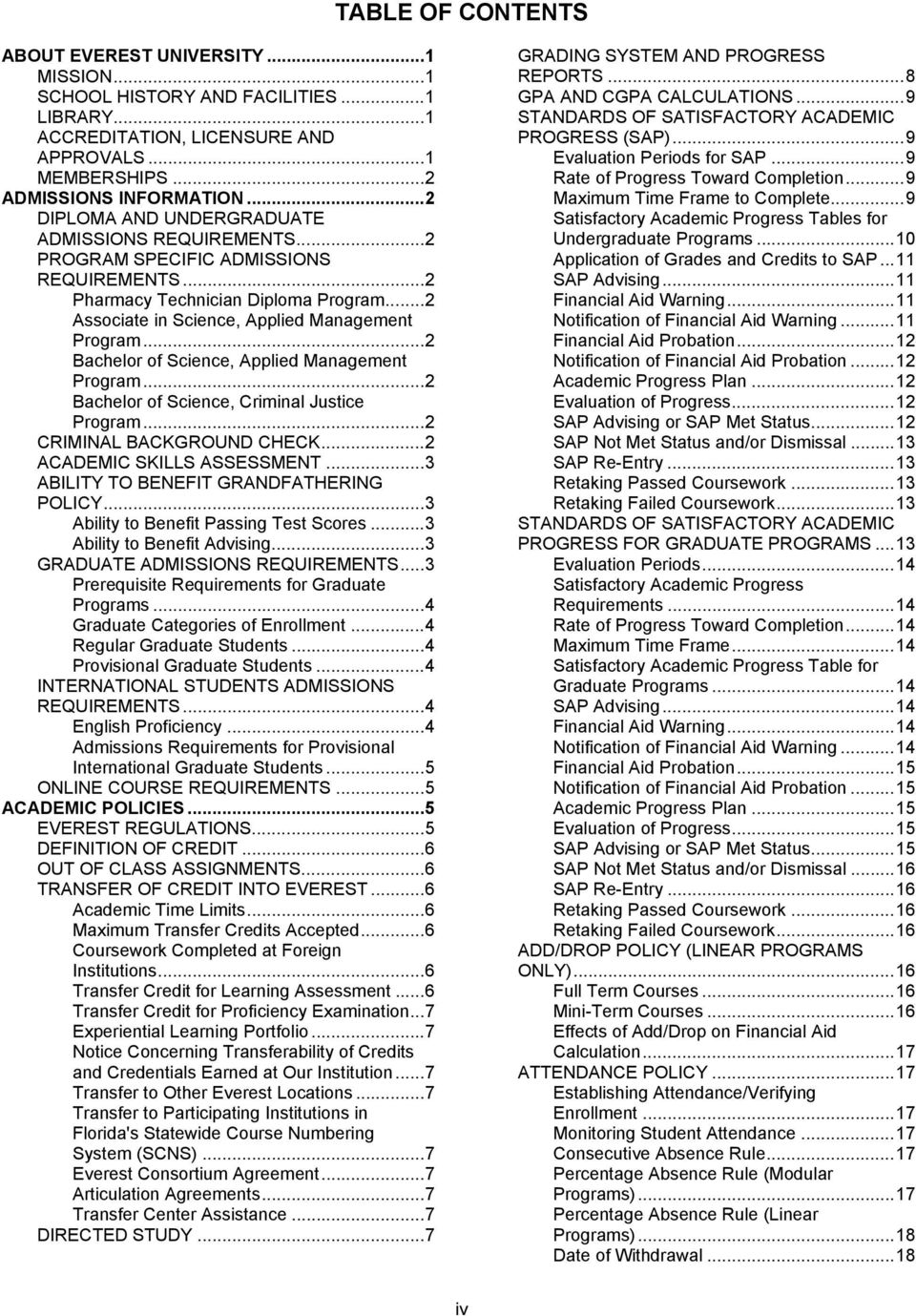
4 TABLE OF CONTENTS ABOUT EVEREST UNIVERSITY... 1 MISSION... 1 SCHOOL HISTORY AND FACILITIES... 1 LIBRARY... 1 ACCREDITATION, LICENSURE AND APPROVALS... 1 MEMBERSHIPS... 2 ADMISSIONS INFORMATION... 2 DIPLOMA AND UNDERGRADUATE ADMISSIONS REQUIREMENTS... 2 PROGRAM SPECIFIC ADMISSIONS REQUIREMENTS... 2 Pharmacy Technician Diploma Program... 2 Associate in Science, Applied Management Program... 2 Bachelor of Science, Applied Management Program... 2 Bachelor of Science, Criminal Justice Program... 2 CRIMINAL BACKGROUND CHECK... 2 ACADEMIC SKILLS ASSESSMENT... 3 ABILITY TO BENEFIT GRANDFATHERING POLICY... 3 Ability to Benefit Passing Test Scores... 3 Ability to Benefit Advising... 3 GRADUATE ADMISSIONS REQUIREMENTS... 3 Prerequisite Requirements for Graduate Programs... 4 Graduate Categories of Enrollment... 4 Regular Graduate Students... 4 Provisional Graduate Students... 4 INTERNATIONAL STUDENTS ADMISSIONS REQUIREMENTS... 4 English Proficiency... 4 Admissions Requirements for Provisional International Graduate Students... 5 ONLINE COURSE REQUIREMENTS... 5 ACADEMIC POLICIES... 5 EVEREST REGULATIONS... 5 DEFINITION OF CREDIT... 6 OUT OF CLASS ASSIGNMENTS... 6 TRANSFER OF CREDIT INTO EVEREST... 6 Academic Time Limits... 6 Maximum Transfer Credits Accepted... 6 Coursework Completed at Foreign Institutions... 6 Transfer Credit for Learning Assessment... 6 Transfer Credit for Proficiency Examination... 7 Experiential Learning Portfolio... 7 Notice Concerning Transferability of Credits and Credentials Earned at Our Institution... 7 Transfer to Other Everest Locations... 7 Transfer to Participating Institutions in Florida's Statewide Course Numbering System (SCNS)... 7 Everest Consortium Agreement... 7 Articulation Agreements... 7 Transfer Center Assistance... 7 DIRECTED STUDY... 7 GRADING SYSTEM AND PROGRESS REPORTS... 8 GPA AND CGPA CALCULATIONS... 9 STANDARDS OF SATISFACTORY ACADEMIC PROGRESS (SAP)... 9 Evaluation Periods for SAP... 9 Rate of Progress Toward Completion... 9 Maximum Time Frame to Complete... 9 Satisfactory Academic Progress Tables for Undergraduate Programs Application of Grades and Credits to SAP SAP Advising Financial Aid Warning Notification of Financial Aid Warning Financial Aid Probation Notification of Financial Aid Probation Academic Progress Plan Evaluation of Progress SAP Advising or SAP Met Status SAP Not Met Status and/or Dismissal SAP Re-Entry Retaking Passed Coursework Retaking Failed Coursework STANDARDS OF SATISFACTORY ACADEMIC PROGRESS FOR GRADUATE PROGRAMS Evaluation Periods Satisfactory Academic Progress Requirements Rate of Progress Toward Completion Maximum Time Frame Satisfactory Academic Progress Table for Graduate Programs SAP Advising Financial Aid Warning Notification of Financial Aid Warning Financial Aid Probation Notification of Financial Aid Probation Academic Progress Plan Evaluation of Progress SAP Advising or SAP Met Status SAP Not Met Status and/or Dismissal SAP Re-Entry Retaking Passed Coursework Retaking Failed Coursework ADD/DROP POLICY (LINEAR PROGRAMS ONLY) Full Term Courses Mini-Term Courses Effects of Add/Drop on Financial Aid Calculation ATTENDANCE POLICY Establishing Attendance/Verifying Enrollment Monitoring Student Attendance Consecutive Absence Rule Percentage Absence Rule (Modular Programs) Percentage Absence Rule (Linear Programs) Date of Withdrawal iv
5 Date of Determination (DOD) Attendance Records LEAVE OF ABSENCE POLICY (MODULAR PROGRAMS ONLY) Re-Admission Following a Leave of Absence Extension of Leave of Absence Failure to Return from a Leave of Absence. 19 Possible Effects of Leave of Absence EXTERNSHIP TRAINING WITHDRAWAL PROCEDURES MAKE-UP WORK REQUIREMENTS FOR GRADUATION VETERANS EDUCATION BENEFITS Prior Credit for Education and Training Benefit Overpayments Academic Standards for Students Receiving VA Benefits Additional Requirements for Veteran Students (Modular Programs Only) APPEALS POLICIES Student Academic Appeals Policy Assignments/Test Grades Final Course Grades Attendance Violation Appeals Policy Satisfactory Academic Progress (SAP) Appeals Policy FINANCIAL INFORMATION STATEMENT OF FINANCIAL OBLIGATION TUITION AND FEES TUITION CHARGES FOR RE-ENTRY TEXTBOOKS ADDITIONAL FEES AND EXPENSES VOLUNTARY PREPAYMENT PLAN BUYER S RIGHT TO CANCEL OFFICIAL WITHDRAWALS DATE OF WITHDRAWAL VERSUS DATE OF DETERMINATION (DOD) FEDERAL FINANCIAL AID RETURN POLICY Student Financial Aid (SFA) Return of Title IV Funds Calculation and Policy Title IV Credit Balances Effects of Leaves of Absence on Returns Time Frame within which Institution is to Return Unearned Title IV Funds REFUND POLICIES Institutional Pro Rata Refund Calculation and Policy TEXTBOOK AND EQUIPMENT RETURN/REFUND POLICY EFFECTS OF LEAVES OF ABSENCE ON REFUNDS TIME FRAME WITHIN WHICH INSTITUTION IS TO ISSUE REFUNDS STUDENTS CALLED TO ACTIVE MILITARY DUTY Continuing Modular Diploma Students Continuing Quarter-Based Students STUDENT FINANCING OPTIONS Financial Assistance Student Eligibility Federal Financial Aid Programs Alternative Loan Programs GRANTS AND SCHOLARSHIPS Workforce Scholarships and Grants, including Youth, Adult and Displaced Workers Florida Student Assistance Grant (FSAG) Graduate Opportunity Scholarship Dream Award Program and Scholarships Florida Bright Futures Scholarship Program 27 High School Scholarships Florida High School Principal Scholarships. 28 Other High School Scholarships Everest University Annual Scholarships Florida Association of Proprietary Schools and Colleges (FAPSC) Scholarship Imagine America Scholarship Veteran s Assistance Programs ADMINISTRATIVE POLICIES STATEMENT OF NON-DISCRIMINATION DISABILITY DISABILITY ACCOMMODATION PROCEDURE30 DISABILITY GRIEVANCE PROCEDURES CODE OF STUDENT CONDUCT Conduct Affecting the Safety of the Campus Community Other Prohibited Conduct Limitations on Students with Pending Disciplinary Matters Inquiry by the Campus President Conduct Which Does Not Warrant a Suspension or Dismissal Conduct Which Warrants a Suspension or Dismissal ALCOHOL AND SUBSTANCE ABUSE STATEMENT STUDENT USE OF INFORMATION TECHNOLOGY RESOURCES POLICY COPYRIGHT POLICY SEXUAL HARASSMENT POLICY SANCTIONS APPEAL PROCESS RECORD OF DISCIPLINARY MATTER STUDENT COMPLAINT PROCEDURE DRESS CODE NOTIFICATION OF RIGHTS UNDER FERPA STUDENT RECORDS TRANSCRIPT AND DIPLOMA RELEASE CAMPUS SECURITY AND CRIME AWARENESS POLICIES DRUG-FREE SCHOOLS POLICY STATISTICAL INFORMATION CAMPUS COMPLETION RATE REPORTS STUDENT SERVICES ORIENTATION HEALTH SERVICES HOUSING STUDENT ADVISING EVEREST CARE PROGRAM PLACEMENT ASSISTANCE v

6 PROGRAMS OFFERED MODULAR PROGRAMS BUSINESS OFFICE ADMINISTRATION MEDICAL ADMINISTRATIVE ASSISTANT MEDICAL ASSISTANT MEDICAL INSURANCE BILLING AND CODING47 PHARMACY TECHNICIAN ASSOCIATE S DEGREE PROGRAMS ACCOUNTING, ASSOCIATE IN SCIENCE DEGREE APPLIED MANAGEMENT, ASSOCIATE IN SCIENCE DEGREE BUSINESS, ASSOCIATE IN SCIENCE DEGREE COMPUTER INFORMATION SCIENCE, ASSOCIATE IN SCIENCE DEGREE CRIMINAL JUSTICE, ASSOCIATE IN SCIENCE DEGREE MEDICAL INSURANCE BILLING AND CODING, ASSOCIATE IN SCIENCE DEGREE.. 61 PARALEGAL, ASSOCIATE IN SCIENCE DEGREE PHARMACY TECHNICIAN, ASSOCIATE IN SCIENCE DEGREE BACHELOR S DEGREE PROGRAMS ACCOUNTING, BACHELOR OF SCIENCE DEGREE APPLIED MANAGEMENT, BACHELOR OF SCIENCE DEGREE BUSINESS, BACHELOR OF SCIENCE DEGREE COMPUTER INFORMATION SCIENCE, BACHELOR OF SCIENCE DEGREE CRIMINAL JUSTICE, BACHELOR OF SCIENCE DEGREE HEALTH CARE ADMINISTRATION, BACHELOR OF SCIENCE DEGREE PARALEGAL, BACHELOR OF SCIENCE DEGREE MASTER S DEGREE PROGRAMS BUSINESS ADMINISTRATION, MASTER OF BUSINESS ADMINISTRATION DEGREE FLORIDA S STATEWIDE COURSE NUMBERING SYSTEM COURSE DESCRIPTIONS ACADEMIC DEGREE PROGRAMS CORINTHIAN COLLEGES, INC STATEMENT OF OWNERSHIP ADMINISTRATION CATALOG SUPPLEMENT TUITION AND FEES ACADEMIC CALENDARS APPENDIX A: PROGRAM DISCLOSURES vi

7 ABOUT EVEREST UNIVERSITY MISSION The mission of the institution is to provide a high-quality educational experience to qualified undergraduate and graduate students through the delivery of traditional and online career-oriented diploma, associate s, bachelor s and master s degree programs delivered through a personalized teaching and learning environment that is designed to support students personal and professional career development. In support of its mission, Everest has adopted the following goals: Academics - To provide challenging and relevant accredited programs in a variety of career-oriented disciplines, incorporating effective educational methodologies, modern technology, and traditional and alternative instructional delivery systems, characterized by effective teaching and a student-centered atmosphere. Educational Support Services - To provide a variety of programs and services that support its educational goals and purpose, are consistent with student needs, encourage student success, enhance diversity, and improve the quality of life for students. Enrollment - To manage the controlled growth of a diverse student body through the use of effective and ethical recruitment and retention methods and initiatives, and to support the quality of educational opportunities for all students, while meeting the school s fiscal needs. Business and Finance - To manage and increase resources in accordance with sound business practices, regulatory standards, and applicable laws. Physical Resources - To ensure that the physical resources, including buildings and equipment, are adequate to serve the needs of the institution, support its purpose, and contribute to an atmosphere for effective learning. Continuous Improvement - To continuously improve the quality of programs and services to meet the needs of its students, communities, and other key stakeholders. SCHOOL HISTORY AND FACILITIES The Melbourne campus opened in 1995 and was formerly known as Florida Metropolitan University. It was renamed Everest University in The Melbourne campus is located at 2401 North Harbor City Blvd in Melbourne, Florida 32935, across from the Intracoastal Waterway and ten minutes from the Atlantic Ocean. This facility is comprised of approximately 15,300 square feet and contains classrooms, computer labs, a library, a student lounge and administrative offices. The campus also has a Campus Addition located at 2190 Sarno Road, Melbourne, Florida The Sarno location is comprised of approximately 19,700 square feet and includes classrooms, medical and computer labs, a student lounge and administrative offices. Both facilities and the equipment used comply with all federal, state, and local, ordinances and regulations, including those related to fire safety, building safety and health. LIBRARY The library is designed to support the programs offered at the campus. Students and faculty have access to a wide variety of resources such as books, periodicals, computers and on-line resources to support its curriculum. The library is staffed with trained professionals to assist in the research needs of students and faculty, and it is conveniently open to accommodate class schedules. ACCREDITATION, LICENSURE AND APPROVALS Accredited by the Accrediting Council for Independent Colleges and Schools to award diplomas, associate s, bachelor s, and master s degrees. The Accrediting Council for Independent Colleges and Schools (ACICS) is listed as a nationally recognized accrediting agency by the United States Department of Education and is recognized by the Council for Higher Education Accreditation. The Accrediting Council for Independent Colleges and Schools is located at 750 First Street, NE, Suite 980, Washington, D.C ; (202) The Medical Assistant diploma program is accredited by the Commission on Accreditation of Allied Health Education Programs ( upon the recommendation of the Medical Assisting Education Review Board (MAERB). The Commission on Accreditation of Allied Health Education Programs is located at 1361 Park Street, Clearwater, FL 33756, (727) Everest University, Melbourne, an additional location of the Orlando North campus is licensed by means of accreditation by the Commission for Independent Education, Florida Department of Education, 325 West Gaines Street, Suite 1414, Tallahassee, FL , toll free number (888) (License #2594) The Pharmacy Technician program is accredited by the American Society of Health-System Pharmacists, 7272 Wisconsin Avenue, Bethesda, MD 20814, , 1
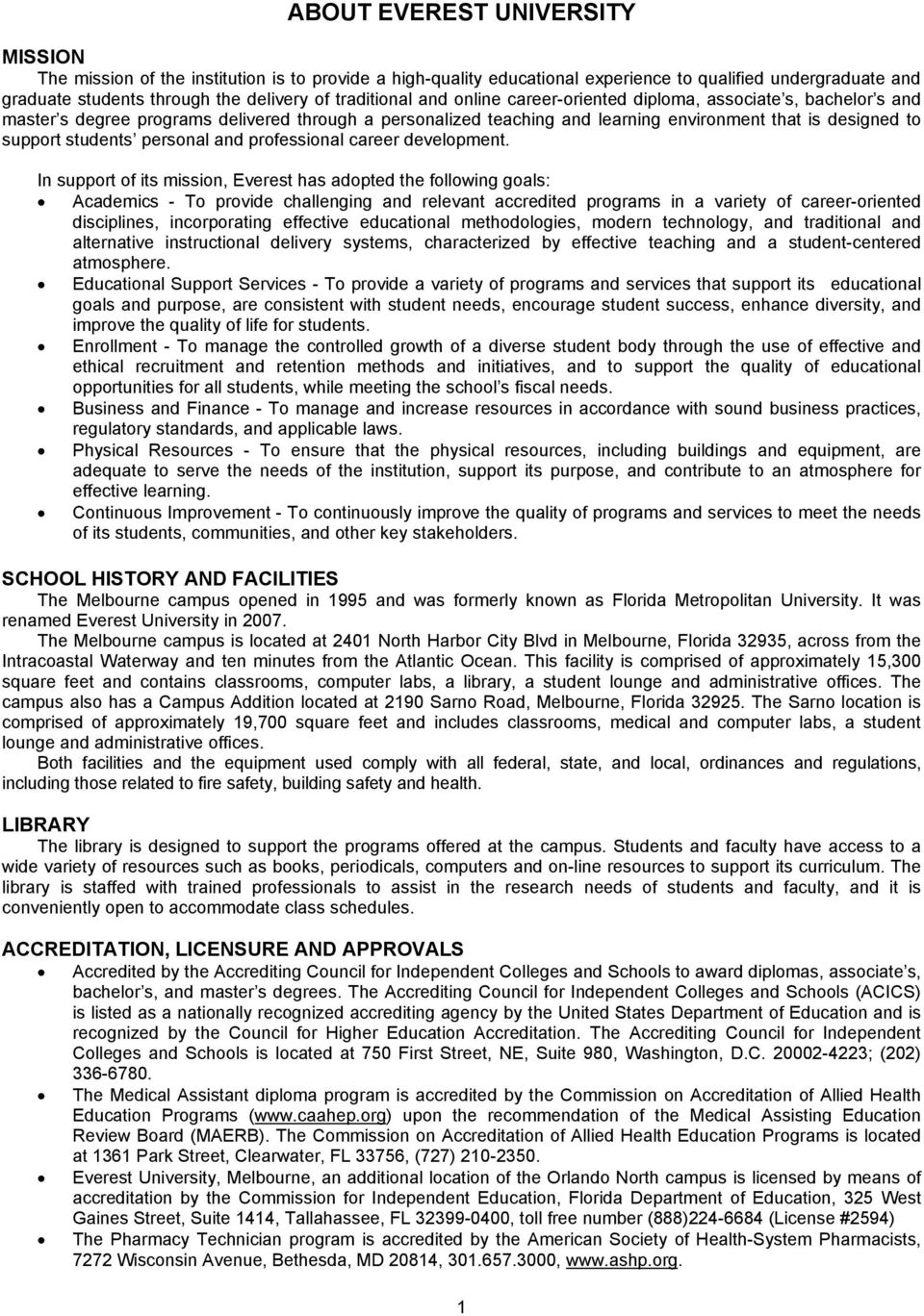
8 Approved for the training of Veterans and eligible persons under the provisions of Title 38, United States Code. This campus is authorized under federal law to enroll non-immigrant alien students. MEMBERSHIPS This campus is a member of the Florida Association of Postsecondary Schools and Colleges. This campus is a member of the Association of Private Sector Colleges and Universities. Copies of accreditation, approval and membership documentation are available for inspection at the campus. Please contact the Campus President to review this material. ADMISSIONS INFORMATION All admissions materials, including program disclosures and enrollment agreements are presented in English only, since all programs are taught in English. Each admissions representative conducts interviews with prospective enrollees in English only as the method to determine that the prospective enrollee understands and can function in English. We do not make any accommodations to present materials or instruct courses in any other language. No English as a second language courses are offered by the campus. DIPLOMA AND UNDERGRADUATE ADMISSIONS REQUIREMENTS High school diploma or a recognized equivalent such as the GED. Applicants will be required to sign an Attestation Regarding High School Graduation or Equivalency indicating they meet the school s requirements for admission unless they submit proof of high school graduation or a recognized equivalency certificate (GED) to the school by providing the school with the diploma, transcript confirming graduation, GED certificate or other equivalent documentation. High school seniors who are accepted on a conditional basis must sign an Attestation Regarding High School Graduation or Equivalency following graduation and prior to starting classes. Applicants are informed of their acceptance status shortly after all required information is received and the applicants qualifications are reviewed. Upon acceptance into the school, applicants who are enrolling will complete an enrollment agreement. Students may apply for entry at any time. Students are responsible for meeting the requirements of the catalog in effect at the time of enrollment. Re-entry students are subject to all program requirements, policies, and procedures as stated in the school catalog in effect at the time of re-entry. All re-entering students must sign a new enrollment agreement. PROGRAM SPECIFIC ADMISSIONS REQUIREMENTS Pharmacy Technician Diploma Program Applicants must reach 18 years of age on or prior to the expected date of graduation. Students must meet with the Program Director in their first term. Associate in Science, Applied Management Program Applicants must have successfully completed a diploma or certificate program from an accredited postsecondary institution. Bachelor of Science, Applied Management Program Applicants must have successfully completed an accredited certificate, diploma, AS, or AAS degree in a field of applied science from an accredited post-secondary institution. Bachelor of Science, Criminal Justice Program Applicants must have completed 36.0 or more quarter (24.0 semester) transferable college credits. Students who do not have the requisite number of credits for direct admission into the bachelor s program may be admitted into the Criminal Justice Associate in Science program. CRIMINAL BACKGROUND CHECK Students enrolled in certain programs may be subject to a criminal background check prior to enrollment to ensure they are qualified to meet occupational or employment requirements, clinical or internship/externship 2

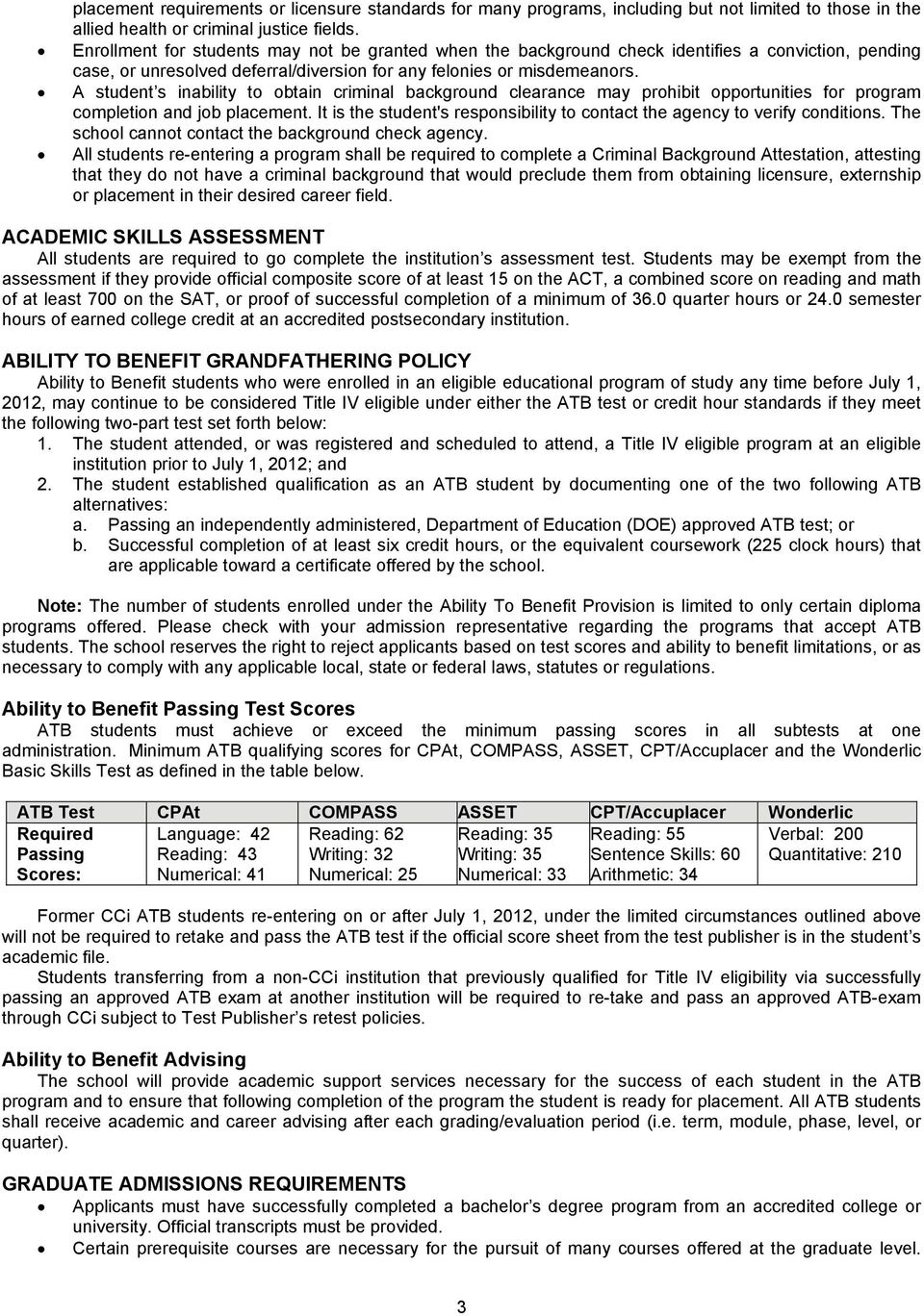
9 placement requirements or licensure standards for many programs, including but not limited to those in the allied health or criminal justice fields. Enrollment for students may not be granted when the background check identifies a conviction, pending case, or unresolved deferral/diversion for any felonies or misdemeanors. A student s inability to obtain criminal background clearance may prohibit opportunities for program completion and job placement. It is the student's responsibility to contact the agency to verify conditions. The school cannot contact the background check agency. All students re-entering a program shall be required to complete a Criminal Background Attestation, attesting that they do not have a criminal background that would preclude them from obtaining licensure, externship or placement in their desired career field. ACADEMIC SKILLS ASSESSMENT All students are required to go complete the institution s assessment test. Students may be exempt from the assessment if they provide official composite score of at least 15 on the ACT, a combined score on reading and math of at least 700 on the SAT, or proof of successful completion of a minimum of 36.0 quarter hours or 24.0 semester hours of earned college credit at an accredited postsecondary institution. ABILITY TO BENEFIT GRANDFATHERING POLICY Ability to Benefit students who were enrolled in an eligible educational program of study any time before July 1, 2012, may continue to be considered Title IV eligible under either the ATB test or credit hour standards if they meet the following two-part test set forth below: 1. The student attended, or was registered and scheduled to attend, a Title IV eligible program at an eligible institution prior to July 1, 2012; and 2. The student established qualification as an ATB student by documenting one of the two following ATB alternatives: a. Passing an independently administered, Department of Education (DOE) approved ATB test; or b. Successful completion of at least six credit hours, or the equivalent coursework (225 clock hours) that are applicable toward a certificate offered by the school. Note: The number of students enrolled under the Ability To Benefit Provision is limited to only certain diploma programs offered. Please check with your admission representative regarding the programs that accept ATB students. The school reserves the right to reject applicants based on test scores and ability to benefit limitations, or as necessary to comply with any applicable local, state or federal laws, statutes or regulations. Ability to Benefit Passing Test Scores ATB students must achieve or exceed the minimum passing scores in all subtests at one administration. Minimum ATB qualifying scores for CPAt, COMPASS, ASSET, CPT/Accuplacer and the Wonderlic Basic Skills Test as defined in the table below. ATB Test CPAt COMPASS ASSET CPT/Accuplacer Wonderlic Required Passing Scores: Language: 42 Reading: 43 Numerical: 41 Reading: 62 Writing: 32 Numerical: 25 Reading: 35 Writing: 35 Numerical: 33 Reading: 55 Sentence Skills: 60 Arithmetic: 34 Verbal: 200 Quantitative: 210 Former CCi ATB students re-entering on or after July 1, 2012, under the limited circumstances outlined above will not be required to retake and pass the ATB test if the official score sheet from the test publisher is in the student s academic file. Students transferring from a non-cci institution that previously qualified for Title IV eligibility via successfully passing an approved ATB exam at another institution will be required to re-take and pass an approved ATB-exam through CCi subject to Test Publisher s retest policies. Ability to Benefit Advising The school will provide academic support services necessary for the success of each student in the ATB program and to ensure that following completion of the program the student is ready for placement. All ATB students shall receive academic and career advising after each grading/evaluation period (i.e. term, module, phase, level, or quarter). GRADUATE ADMISSIONS REQUIREMENTS Applicants must have successfully completed a bachelor s degree program from an accredited college or university. Official transcripts must be provided. Certain prerequisite courses are necessary for the pursuit of many courses offered at the graduate level. 3
10 Such prerequisites must have been completed before entrance into a specific course. Prerequisite Requirements for Graduate Programs Applicants whose undergraduate degrees are in fields outside the program area are invited to apply, but foundation work will be required before certain higher level courses may be taken. All graduate students must meet certain prerequisite requirements prior to enrolling in Managerial Economics, International Economic Systems, Quantitative Methods, Financial Management, and certain graduate-level accounting courses. Graduate Categories of Enrollment Applicants to the graduate programs may be classified in one of two categories: Regular Graduate Student or Provisional Graduate Student. Regular Graduate Students Applicants must have achieved a cumulative grade point average of not less than 3.0 for all undergraduate upper-level division work; or must score not less than 470 on the Graduate Management Admission Test (GMAT); or must achieve a comparable score on the Graduate Record Examination (GRE) to become a candidate for a master s degree. Provisional Graduate Students Applicants who do not meet the requirements to be classified as a Regular Graduate Student may enroll and matriculate as a Provisional Graduate Student by having achieved a grade point average of not less than 2.0 for all undergraduate upper division work. The provisional status will remain in effect until the student has earned a score of not less than 470 on the GMAT, a comparable score on the GRE, or has satisfactorily completed 16.0 credits of graduate course work at the University with at least a 3.0 CGPA for these 16.0 graduate credits. INTERNATIONAL STUDENTS ADMISSIONS REQUIREMENTS Provide a certified secondary school transcript or high school diploma as defined by the student s country of origin. Provide proof of English proficiency (if the student s first language is not English, an official test score on an approved English proficiency test is required). Proof of financial ability to meet expenses. Such evidence may be one of the following: a) Bank letter verifying student s available funds (self-sponsoring). b) Bank letter verifying sponsor s available funds if sponsor is not a citizen or a legal permanent resident of the U.S. c) Form I-134 if sponsor is a citizen or legal permanent resident of the U.S. d) If the applicant is sponsored by his/her home country, a statement of sponsorship. Be eligible for a student visa (F-1 or M-1). Enroll as a full time student (for undergraduates, at least 12 quarter credit hours; for graduate students at least 8 quarter credit hours; for Intensive English students and modular program students, at least 18 clock hours of attendance per week). Pay the required minimum tuition deposit. Pay the non-refundable SEVIS processing fee (if done through the school). International students must meet the same programmatic entrance requirements as domestic students. Note: M-1 students may not enroll in online courses. F-1 students may enroll in no more than one (1) online course per term. English Proficiency All international students whose first language is not English must provide proof of English proficiency. English proficiency may be established by providing documentation of one of the following: Passing score on an English skills assessment test (see below) Graduation from an American/International high school program where the curriculum is taught in English Graduation from a high school in the U.S. as an exchange student Graduation from a high school in a country where English is the official language The acceptable skills assessment tests for diploma and undergraduate programs are the Test of English as a Foreign Language (TOEFL), the Michigan English Language Assessment Battery (MELAB), the International English Language Testing System Exam (IELTS), and the English Language School Center (ELS) test. The required passing score on each test is as follows: 4

11 Test: TOEFL MELAB IELTS ELS Score: 45 Internet Based 133 Computer Based 450 Paper Based Completion of Level 107 The acceptable skills assessment tests for graduate programs are the TOEFL, the MELAB, and the IELTS. The required passing score on each test is as follows: Test: TOEFL MELAB IELTS Score: 79 Internet Based 213 Computer Based 550 Paper Based Admissions Requirements for Provisional International Graduate Students Students who have not achieved the minimum TOEFL or IELTS score may be evaluated for equivalent English proficiency by the Graduate Academic Committee. Those students who successfully pass the evaluation may be granted Provisional Student admissions status. For international students admitted with Provisional Graduate Student status by the Graduate Academic Committee, the status will remain in effect until the student has earned the required minimum score on one of the tests described above or has completed 16.0 credits of graduate course work at the school with a minimum GPA of 3.0. Failure to reach Regular Graduate Student status within 16.0 credits of graduate work at the school will result in the student being dismissed from the school. Students admitted on a provisional basis will be admitted as Regular Graduate Student status only upon evaluation and favorable action by the Committee on Admissions for the graduate program. ONLINE COURSE REQUIREMENTS Online courses are offered at the campus through the Online Division of CCi using the ecollege platform via the Internet. Online courses have the same course objectives and outcomes as courses taught on-ground, although more individual focus and initiative is required to successfully master the material. Online courses are designated on the class schedule so students register during the normal registration period. Students registering for an online course must obtain prior approval from their Program Director or the Academic Dean. To maximize success within the online courses, students must have available to them a computer with a system profile that meets or exceeds the following: Windows Systems Windows 7, XP, or Vista 56K modem or higher Sound Cards & Speakers Firefox, Chrome, or Microsoft Internet Explorer Mac Systems Mac OS X or higher (in classic mode) 56K modem or higher Sound Cards & Speakers Apple Safari, Chrome, Firefox In addition, students taking online courses must: Check quarterly to make sure they are maintaining the correct systems profile; Have Internet access and an established account; Verify account/address with Online Coordinator at the time of registration each quarter; Commence online course work as soon as students have access to the courses; Participate in classes and complete learning and graded activities weekly throughout the course. ACADEMIC POLICIES EVEREST REGULATIONS Each student is given the school catalog, which sets forth the policies and regulations under which the institution operates. It is the responsibility of the student to become familiar with these policies and regulations and to comply accordingly. Ignorance of or lack of familiarity with this information does not serve as an excuse for noncompliance or infractions. 5

12 Everest reserves the right to change instructors, textbooks, accreditation, schedules, or cancel a course or program for which there is insufficient enrollment. The student will receive a full refund for courses or programs that are cancelled. The school also reserves the right to change course curricula, prerequisites and requirements upon approval by the school s accrediting agency and state licensing board. DEFINITION OF CREDIT Everest awards credit in the form of quarter credits. One quarter credit is equivalent to a minimum of 10.0 class hours of theory or lecture instruction a minimum of 20.0 hours of supervised laboratory instruction, or a minimum of 30.0 hours of externship practice. OUT OF CLASS ASSIGNMENTS Students in degree programs should plan to spend a minimum of up to two hours per day outside of class completing homework assignments as directed by the instructor Students in diploma programs will be expected to complete assigned homework and other out-of-class assignments in order to successfully meet course objectives as set forth in the course/program syllabi TRANSFER OF CREDIT INTO EVEREST Everest has constructed its transfer credit policy to recognize both traditional college credit and non-traditional learning. In general, Everest considers the following criteria when determining if transfer credit should be awarded: Accreditation of the institution; The comparability of the scope, depth and breadth of the course to be transferred; and The applicability of the course to be transferred to the student s desired program. This includes the grade and age of the previously earned credit. If the learning was obtained outside a formal academic setting, through a nationally administered proficiency exam, an IT certificate exam or military training, Everest will evaluate and award transfer credit using professional judgment and the recommendations for credit issued by the American Council on Education (ACE). Academic Time Limits The following time limits apply to a course being considered for transfer credit: College Core and General Education course indefinite; Major Core course (except health science and Computer Information Science courses) within ten (10) years of completion; and Due to certain programmatic accreditation criteria, health science core courses are eligible for transfer within five (5) years of completion. Due to the pace of technology change, Computer Information Science courses are eligible for transfer within five (5) years of completion. Military training, proficiency exams (e.g. DANTES, AP, CLEP, Excelsior, etc.) and IT certificate exams the same academic time limits as College Core and General Education courses. Maximum Transfer Credits Accepted Students enrolled in a diploma, associate or bachelor s degree program must complete at least 25% of the program in residency at the institution awarding the degree or diploma. The remaining 75% of the program may be any combination of transfer credit, national proficiency credit, Everest developed proficiency credit or prior learning credit. A student attempting to transfer a graduate-level course from another accredited institution must provide evidence that the course is related in content to the program of study at the school. The school will accept no more than 24.0 graduate-level hours in transfer, and no graduate-level course may be transferred in which the student received a grade below a B. Coursework Completed at Foreign Institutions All coursework completed at a foreign institution must be evaluated by a member of the National Association of Credential Evaluation Services (NACES). An exception to this may be allowed for students transferring from Canada with prior approval from the Transfer Center. Transfer Credit for Learning Assessment Everest accepts appropriate credits transferred from the College Level Examination Program (CLEP), DANTES subject testing, and certain other professional certification examination programs. Contact the campus Academic Dean/Director of Education for the current list of approved exams and minimum scores required for transfer. 6

13 Transfer Credit for Proficiency Examination Undergraduate students may attempt to challenge the requirement to certain selected courses by demonstrating a proficiency level based on special qualifications, skills, or knowledge obtained through work or other experience that is sufficient to warrant the granting of academic credit for a course through a Proficiency Examination. Similarly, Everest may award some credits toward undergraduate, associate, and diploma level courses for achievement of professional certifications such as CNE, MCSE, etc. For more information, please contact the Academic Dean or Director of Education. Experiential Learning Portfolio Students may earn credit for life experience through the Prior Learning Assessment program. This program is designed to translate personal and professional experiences into academic credit. Procedures for applying for credit through experiential learning are available in the Academic Dean's/Director of Education s office. Notice Concerning Transferability of Credits and Credentials Earned at Our Institution The transferability of credits earned at Everest is at the complete discretion of an institution to which a student may seek to transfer. Acceptance of the degree, diploma or certificate earned in the program in which the student is enrolling is also at the complete discretion of the institution to which a student may seek to transfer. If the credits or degree, diploma or certificate that was earned at this institution are not accepted at the institution to which a student seeks to transfer, the student may be required to repeat some or all of his/her coursework at that institution. For this reason, the student should make certain that attendance at this institution will meet his/her educational goals. This may include contacting an institution to which a student may seek to transfer after attending Everest to determine if the credits or degree, diploma or certificate will transfer. Transfer to Other Everest Locations Students in good standing may transfer to another Everest campus location. Transfer students are advised that they will be subject to the minimum residency requirements at the new campus for the program in which they are enrolled. Students may transfer applicable credits from Everest coursework in which a C or higher was earned; however, those credits will be treated as transfer credits and will not count toward fulfilling residency requirements at the new location. Transfer to Participating Institutions in Florida's Statewide Course Numbering System (SCNS) Everest University is a participating institution in the Florida Statewide Course Numbering System (SCNS). Please see the disclosure and explanation of the course numbering system and the benefits of this participation that are provided in the Florida s Statewide Course Numbering System section of the catalog. Everest Consortium Agreement The Everest Consortium Agreement enables students to attend a limited number of classes (a maximum of 49% of credit hours) at an Everest campus location other than their home campus. In addition, students nearing completion of their program of study may finish their degree at another Everest campus location through the Consortium Agreement (a minimum of 51% of credit hours must be completed at the Home campus). Complete details on the Everest Consortium Agreement are available in the Academic Dean s/director of Education s office. Articulation Agreements Everest University has articulation agreements with the following institutions: CompuCollege, CDI College, Elmira Business Institute, Mountain State University, Nova Southeastern University and University of Phoenix. Students should contact their Everest University campus Academic Dean for additional information on articulation agreement transfer terms and conditions. Transfer Center Assistance Any questions regarding the transfer of credit into or from Everest should be directed to the CCi Transfer Center at (877) or [email protected]. DIRECTED STUDY Students unable to take a specific required course due to work schedule conflicts, emergency situations, or course scheduling conflicts may request permission to complete a course through directed study. Associate degree students may apply a maximum of 8.0 quarter credit hours earned through directed study to the major core of study. Bachelor s degree students may apply a maximum of 16.0 quarter credits of directed study to the major core of study. 7
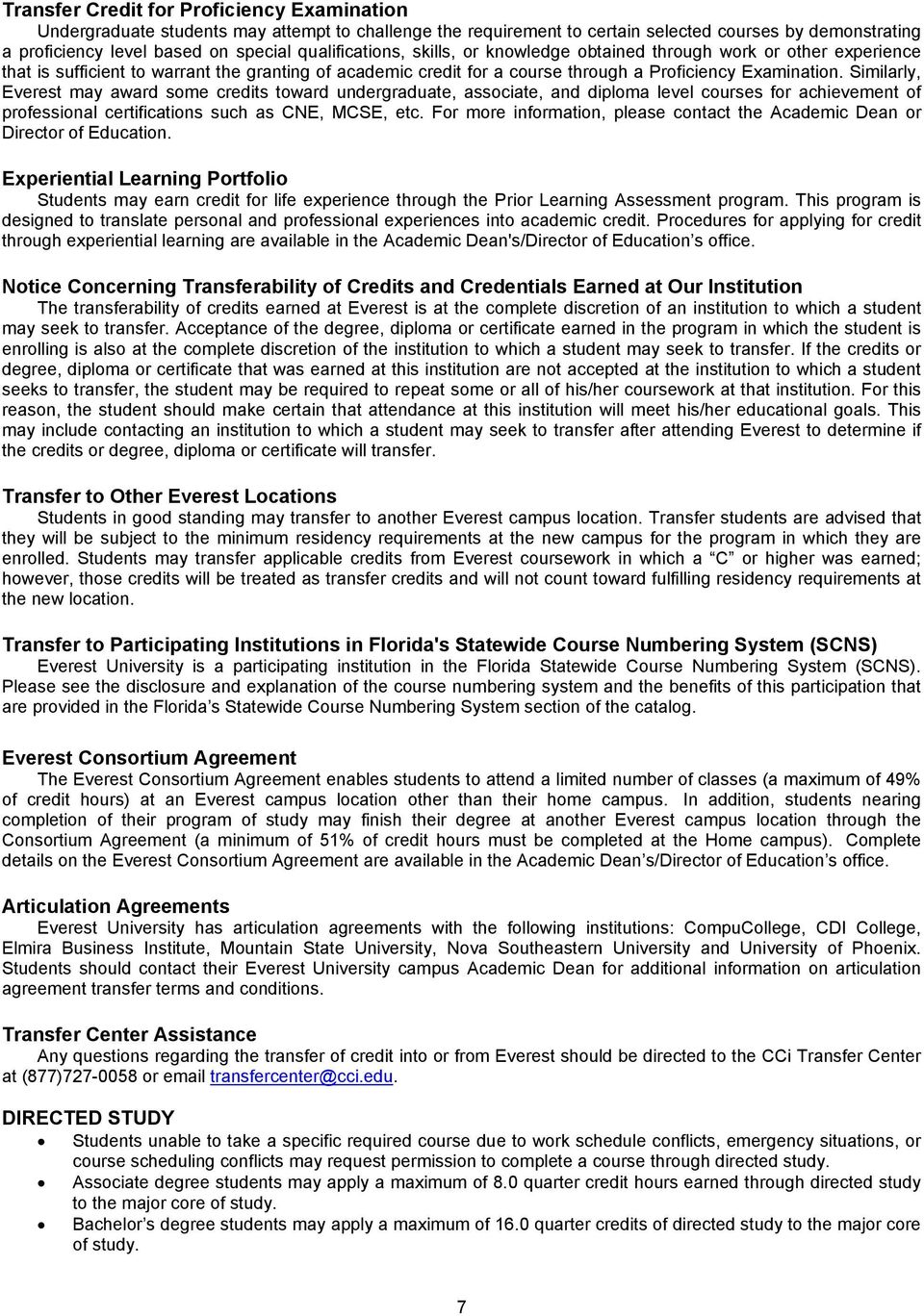
14 Graduate students may complete a maximum of one course (4.0 quarter credits) through directed study. Students may not take more than one directed study course in a single academic term. The student must have at least a 2.0 CGPA to be eligible to take a directed study course. The student must have at least a grade of C in any previous directed study course(s). Diploma students are not eligible for Directed Study GRADING SYSTEM AND PROGRESS REPORTS The student s final grade for each course or module is determined by the average of the tests, homework, class participation, special assignments and any other criteria indicated in the grading section of the syllabus for the course or module. Final grades are reported at the completion of each grading term and are provided to each student. If mailed, they are sent to the student s home address. Failed courses must be repeated and are calculated as an attempt in Satisfactory Academic Progress calculations. Grade Point Value Meaning Percentage Scale A 4.0 Excellent B 3.0 Very Good C 2.0 Good D* 1.0 Poor F** 0.0 Failing 59-0 Fail Not Calculated Fail (for externship/internship) Pass Not Calculated Pass (for externship/internship) IP*** Not Calculated In Progress (for linear externship/internship/modular clinic courses or thesis courses only) L Not Calculated Leave of Absence (allowed in modular programs only) EL Not Calculated Experiential Learning PE Not Calculated Proficiency Exam PF Not Calculated Preparatory Fail PP Not Calculated Preparatory Pass W Not Calculated Withdrawal WZ Not Calculated Withdrawal for those students called to immediate active military duty. This grade indicates that the course will not be calculated for purposes of determining rate of progress TR Not Calculated Transfer Credit *Not used in Allied Health Programs. **For Allied Health Programs, F (Failing) is 69-0%. ***If the required linear externship/internship hours are not completed within one term, the student will receive an IP (In Progress) grade and a zero credit Externship/Internship Extension course will be scheduled in the following term. Once the required hours are completed, the student s grade will be entered in both courses. 8

15 Treatment of Grades in the Satisfactory Academic Progress/Rate of Progress Calculation Grade Included in GPA calculation? Counted as attempted credits? Counted as earned credits? A Y Y Y B Y Y Y C Y Y Y D Y Y Y F Y Y N Fail N Y N Pass N Y Y IP N Y N L N N N EL N Y Y PE N Y Y PF N N N PP N N N W N Y N WZ N N N TR N Y Y GPA AND CGPA CALCULATIONS The Grade Point Average (GPA) is calculated for all students. The GPA for each term and Cumulative Grade Point Average (CGPA) are calculated on courses taken in residence at Everest The Grade Point Average (GPA) is calculated at the end of each evaluation period by dividing the quality points earned by the total credits attempted for that evaluation period. The Cumulative Grade Point Average (CGPA) is calculated by dividing the total cumulative quality points earned by the total cumulative credits attempted for cumulative evaluation periods. The number of quality points awarded for each course is determined by multiplying the points listed for each letter grade by the number of credits of the course. STANDARDS OF SATISFACTORY ACADEMIC PROGRESS (SAP) Students must maintain satisfactory academic progress in order to remain eligible as regularly enrolled students and to continue receiving federal financial assistance. The accreditor and federal regulations require that all students progress at a reasonable rate toward the completion of their academic program. Satisfactory academic progress is measured by: The student s cumulative grade point average (CGPA); The student s rate of progress toward completion (ROP); and The maximum time frame (MTF) allowed to complete the academic program (150% for all programs). Evaluation Periods for SAP Satisfactory academic progress is measured for all students at the end of each grading period (i.e., at the end of each term, module, phase, level, quarter and payment period). Rate of Progress Toward Completion The school catalog contains a schedule designating the minimum percentage or amount of work that a student must successfully complete at the end of each evaluation period to complete their educational program within the maximum time frame (150%). Quantitative progress is determined by dividing the number of credit hours earned by the number of credit hours attempted. Credit hours attempted include completed hours, transfer credits, withdrawals, and repeated courses. Non-credit remedial courses have no effect on the student s ROP. Maximum Time Frame to Complete The maximum time frame for completion of all programs below the master s level is limited by federal regulation to 150% of the published length of the program. School shall calculate maximum time frame using credit hours attempted. All credit hours attempted, which include completed credits, transfer credits, withdrawals, and repeated classes, count toward the maximum number of credits allowed to complete the program. Non-credit remedial courses have no effect on the student s maximum time frame. 9

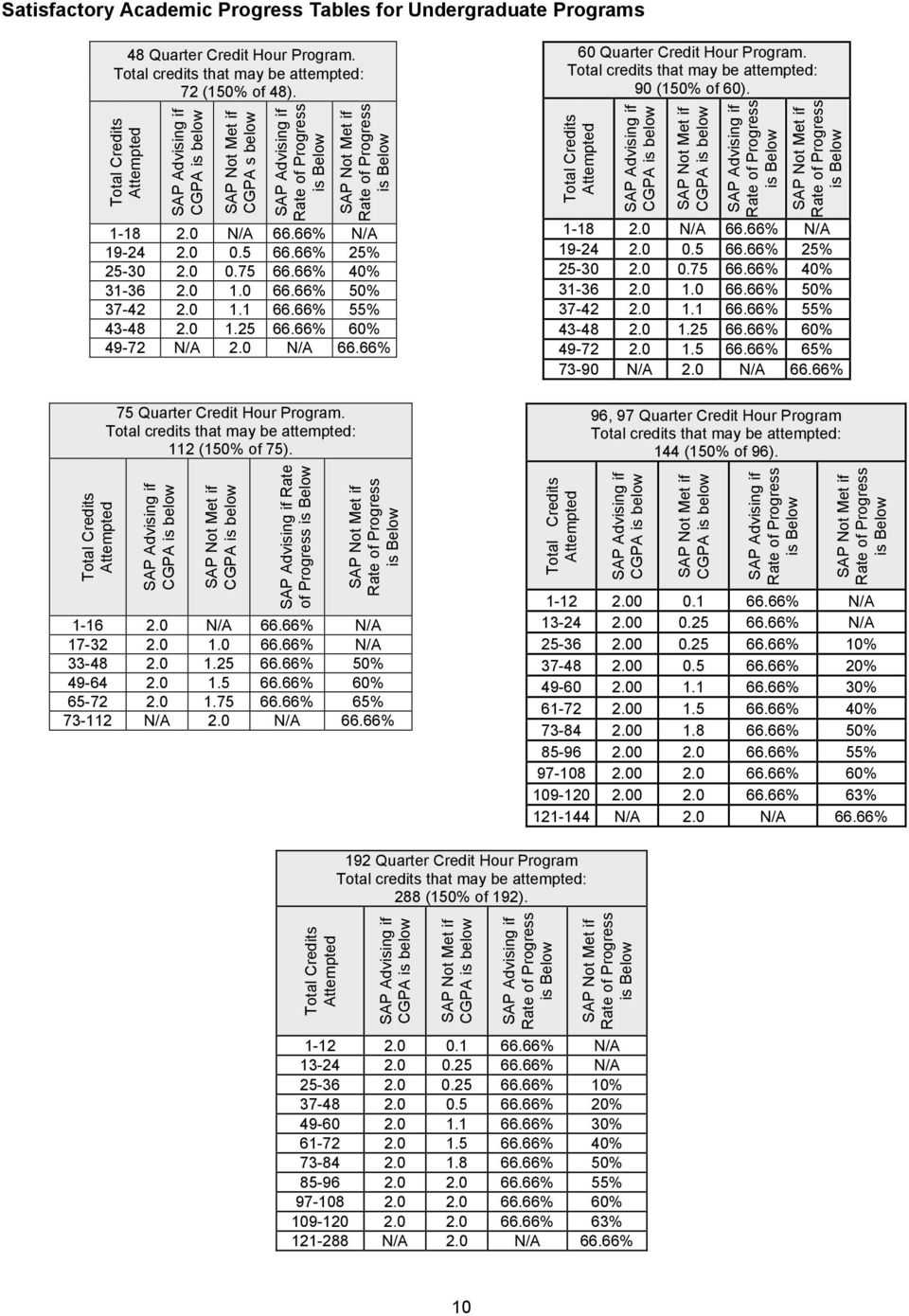
16 Satisfactory Academic Progress Tables for Undergraduate Programs 48 Quarter Credit Hour Program. Total credits that may be attempted: 72 (150% of 48). 60 Quarter Credit Hour Program. Total credits that may be attempted: 90 (150% of 60). Total Credits Attempted SAP Advising if CGPA is below SAP Not Met if CGPA s below SAP Advising if Rate of Progress is Below SAP Not Met if Rate of Progress is Below N/A 66.66% N/A % 25% % 40% % 50% % 55% % 60% N/A 2.0 N/A 66.66% Total Credits Attempted SAP Advising if CGPA is below SAP Not Met if CGPA is below SAP Advising if Rate of Progress is Below SAP Not Met if Rate of Progress is Below N/A 66.66% N/A % 25% % 40% % 50% % 55% % 60% % 65% N/A 2.0 N/A 66.66% 75 Quarter Credit Hour Program. Total credits that may be attempted: 112 (150% of 75). 96, 97 Quarter Credit Hour Program Total credits that may be attempted: 144 (150% of 96). Total Credits Attempted SAP Advising if CGPA is below SAP Not Met if CGPA is below SAP Advising if Rate of Progress is Below SAP Not Met if Rate of Progress is Below N/A 66.66% N/A % N/A % 50% % 60% % 65% N/A 2.0 N/A 66.66% Total Credits Attempted SAP Advising if CGPA is below SAP Not Met if CGPA is below SAP Advising if Rate of Progress is Below SAP Not Met if Rate of Progress is Below % N/A % N/A % 10% % 20% % 30% % 40% % 50% % 55% % 60% % 63% N/A 2.0 N/A 66.66% 192 Quarter Credit Hour Program Total credits that may be attempted: 288 (150% of 192). Total Credits Attempted SAP Advising if CGPA is below SAP Not Met if CGPA is below SAP Advising if Rate of Progress is Below SAP Not Met if Rate of Progress is Below % N/A % N/A % 10% % 20% % 30% % 40% % 50% % 55% % 60% % 63% N/A 2.0 N/A 66.66% 10
17 Application of Grades and Credits to SAP Grades A through F are included in the calculation of CGPA and are included in the Total Number of Credit Hours Attempted. Transfer credits (TR) are not included in the calculation of CGPA but are included in the Total Number of Credit Hours Attempted and Earned in order to determine the required levels for CGPA and rate of progress. Courses with grades of Pass, EL and PE are not included in the CGPA calculation but do count as credit hours successfully completed for the rate of progress calculation. For calculating rate of progress, F grades and W grades are counted as hours attempted but are not counted as hours successfully completed. Grades of IP will also be counted as hours attempted but not as hours successfully completed. When a course is repeated, the higher of the two grades is used in the calculation of CGPA, and the total credit hours for the original course and the repeated course are included in the Total Credit Hours Attempted (in the SAP charts) in order to determine the required rate of progress level. The credit hours for the original attempt are considered as not successfully completed. When a student returns from a leave of absence and completes the course from which the student withdrew, the hours for which the student receives a passing grade are counted as earned; the grade, hours, and attendance for the original attempt prior to the official leave of absence are not counted for purpose of the rate of progress toward completion calculation and the original grade is not counted in the CGPA calculation. When a student transfers between programs, all attempts of courses common to both programs are included in the CGPA and ROP of the new program. Students graduating from one program and continuing on to another will have all successfully completed courses common to both programs included in the SAP calculations of the new program. Courses not in the new program, including grades of W or F, are excluded from all SAP calculations. Non-punitive grades are not used and non-credit and remedial courses are not offered. SAP Advising SAP Advising is the period of time during which a student is advised and monitored for progress for the remainder of the term. During the SAP advising period, the student is eligible for financial aid. Academic advising shall be documented using the Academic Advising Form. The form shall be kept in the student s academic file. The Academic Dean/Director of Education (or designee) must provide a written notice of SAP Advising status. The following timelines apply for all students placed on SAP Advising status: For linear programs with an Add/Drop period: o Students must receive the notification by the first day of the term; and o Must be advised within fourteen (14) calendar days after the term start. Note: For terms without a break week, students must receive the notification within seven (7) calendar days after the term start and be advised within twenty-one (21) calendar days after the term start. For modular programs: o Students must receive the notification by the third (3) calendar day of the subsequent module; and o Must be advised within ten (10) calendar days after the module start. Financial Aid Warning SAP is evaluated at the end of each term and all students with a cumulative grade point average (CGPA) and/or rate of progress (ROP) below the required academic progress standards as stated in the school s catalog will move into SAP NOT MET status. Students not meeting SAP and with a previous SAP status: SAP MET or SAP ADVISING will be issued FA Warning letter and be advised that unless they improve their CGPA and/or rate of progress toward completion, they may be withdrawn from their program and lose eligibility for federal financial aid. Notification of Financial Aid Warning The Academic Dean/Director of Education (or designee) must provide the written notice of FA Warning status to all students with a previous SAP status: SAP Advising or SAP Met. The following timelines apply to all students receiving an FA Warning: For linear programs with an Add/Drop period: o Students must receive the notification by the first day of the term; and o Must be advised within fourteen (14) calendar days after the term start. Note: For terms without a break week, students must receive the notification within seven (7) calendar days after the term start and be advised within twenty-one (21) calendar days after the term start. For modular programs: o Students must receive the notification by the third (3) calendar day of the next module; and o Must be advised within ten (10) calendar days after the module start. 11
18 Financial Aid Probation At the end of each term following a SAP evaluation, students with a previous SAP NOT MET status and who are still SAP NOT MET according to the academic progress standards stated in the school s catalog, will be notified with a SAP NOT MET letter indicating that they will be withdrawn unless they successfully appeal by written request within five (5) calendar days after the notification in accordance with the Academic Appeals Policy. Appeals shall only be granted for the following reasons: the death of a family member; an illness or injury suffered by the student; special circumstances of an unusual nature which are not likely to recur. The Academic Dean/Director of Education (or designee) must provide written notice of all students placed on SAP NOT MET status: For linear programs with an Add/Drop period: o Students must receive the notification by the first day of the term; o If the student appeals this status and the appeal is approved, the student must receive an Academic Progress Plan within ten (10) calendar days after the appeal s approval. Note: For terms without a break week, students must receive the notification within seven (7) calendar days after the term start. For modular programs: o o Students must receive the notification by the third (3) calendar day of the next module; If the student appeals this status and the appeal is approved, the student must receive an Academic Progress Plan within seven (7) calendar days after the appeal s approval. Notification of Financial Aid Probation FA Probation is the term for which the student s appeal has been accepted and progress is monitored under an Academic Progress Plan. Students must be notified in writing of their probationary status within three (3) calendar day of the change in status in the student information system. During the period of FA probation students will continue to be eligible for financial aid. While on FA probation, unless students improve their CGPA and /or rate of progress toward completion, in accordance with their Academic Progress Plan, they will be withdrawn from their program and become ineligible for further financial aid. All students on FA probation must be placed on an Academic Progress Plan. A student will remain on FA probation as long as he or she is meeting the requirements of his or her Academic Progress Plan when evaluated at the end of each evaluation period on the Plan. Academic Progress Plan Students on FA Probation must agree to the requirements of an Academic Progress Plan (APP) as a condition of their FA probation. Each student shall receive a copy of his or her APP. A copy of each student s APP shall be kept in the student s permanent academic file. The APP may extend over one (1) or multiple terms. At the end of the first evaluation period on the APP, the student will meet with the Academic Dean/Director of Education (or designee) for an evaluation of progress of the plan s requirements. If on a single-term plan and the student has met the requirement(s) of the plan, the student will move into SAP Advising or SAP Met status, and the student s APP shall be considered fulfilled and closed. If on a multi-term plan and the student has met the requirement(s) of the first evaluation period, then new requirement will be set and the student will be placed on FA Probation status again and will continue to adhere to the requirements of the APP. If at the end of any SAP evaluation period on the plan (APP) the student does not meet the plan s requirement(s), the student will receive a dismissal letter and will be dismissed from the program. Students who have violated their FA Probation and have been dismissed from a program are not eligible for readmission to that program if they have exceeded, or may exceed, the maximum time frame of completion until they re-establish appropriate Satisfactory Academic Progress standing. Evaluation of Progress At the end of each evaluation period encompassed by the APP, the student will meet with the Academic Dean/Director of Education (or designee) for an evaluation of progress of the plan s requirements. Determination of the student s success at meeting APP requirement(s) must be completed no later than the second (2 nd ) calendar day of the module or term. SAP Advising or SAP Met Status If the student has met the requirements of a one-term plan, the student will move into a SAP Advising or SAP MET status and the student s APP shall be considered fulfilled and closed. The student will be provided with either a SAP Advising or Return to Academic Good Standing Letter. In the case of SAP Advising, the student will be advised with the Academic Advising form and will be FA eligible. The Academic Dean/Director of Education (or designee) must provide a written notice of Return to Academic Good Standing or SAP Advising status. The following timelines apply for all students placed on SAP Advising status: 12

19 For linear programs with an Add/Drop period: o Students must receive the notification by the first day of the term; and o Must complete the Evaluation of Progress form within fourteen (14) calendar days after the notification. Note: For terms without a break week, students must receive the notification within seven (7) calendar days after the term start and must complete the Evaluation of Progress form within twenty-one (21) calendar days after the notification. For modular programs: o Students must receive the notification by the third (3) calendar day of the subsequent module; and o Must complete the Evaluation of Progress form within seven (7) calendar days after the notification. SAP Not Met Status and/or Dismissal If on a multi-term plan, it is likely the student will remain SAP NOT MET for the second (and ensuing) evaluation periods. At the end of each evaluation period, the student will be notified, evaluated for progress, and if the APP requirements are met, will remain in FA Probation and continue on the APP. New requirements for the second (or ensuing) evaluation period will be defined using the Evaluation of Progress form. The Academic Dean/Director of Education (or designee) must provide a written notice of SAP NOT MET status. The following timelines apply for all students placed on SAP NOT MET status: For linear programs with an Add/Drop period: o o Students must receive the notification by the first day of the term; and Must complete the Evaluation of Progress form within fourteen (14) calendar days after the notification. Note: For terms without a break week, students must receive the notification within seven (7) calendar days after the term start and must complete the Evaluation of Progress form within twenty-one (21) calendar days after the notification. For modular programs: o Students must receive the notification by the third (3) calendar day of the subsequent module; and o Must complete the Evaluation of Progress form within seven (7) calendar days after the notification. If the student does not meet the Plan s requirements at the end of an evaluation period, the student will be dismissed from the program. If the student has not met the benchmark, the student must be dropped with the correct DOD (no later than second calendar day of module or term). The student must be notified of dismissal no later than the second calendar day of module or term. Note: If the student has make-up work, and the campus is willing to accept it, it must be completed within four (4) calendar days of grades being entered (as long as this doesn t extend beyond ten (10) calendar days after mod- or term-end), or the student must be dropped with the correct DOD. SAP Re-Entry Students who have violated FA Probation and have been dismissed shall not be readmitted if they cannot complete the program within the maximum time frame or re-establish appropriate Satisfactory Academic Progress (SAP) standing. Retaking Passed Coursework Students may repeat coursework as long as such coursework does not include more than a single repetition of a previously passed course. Each attempt counts in the calculation of the students rate of progress and successful completion percentages. All repeated courses will appear on the student s transcript, but only the highest grade earned will be included in the calculation of their cumulative grade point average. Retaking Failed Coursework For the purpose of improving academic standing and establishing institutional grade point average, students must repeat any failed coursework. Failed courses may be repeated more than twice, so long as repeating the coursework does not jeopardize the students maximum time frame of completion. Each attempt counts in the calculation of the students rate of progress and successful completion percentages. All repeated coursework will appear on the student s transcript, but only the highest grade earned will be included in the calculation of their cumulative grade point average. STANDARDS OF SATISFACTORY ACADEMIC PROGRESS FOR GRADUATE PROGRAMS Accreditor and federal regulations for receiving title IV financial assistance require that students enrolled in a graduate program meet certain qualitative and quantitative standards in order to continue their studies. The qualitative and quantitative standards must be cumulative and must include all periods of the student s enrollment regardless of whether or not financial aid was received. Completion of prerequisite requirements for admission to a 13

20 master s program does not count toward the credit requirement for a master s degree. Therefore, these credits do not count toward meeting SAP requirements. Evaluation Periods School shall evaluate academic progress for all graduate students at the end of each academic term. Satisfactory Academic Progress Requirements Graduate students must maintain a minimum CGPA of 3.0. When a student repeats a course, the student s CGPA will be recalculated based on the higher of the two grades earned. Withdrawals and transfer credits have no effect on the student s CGPA. Rate of Progress Toward Completion Graduate students must maintain a minimum cumulative completion rate of two-thirds of credits attempted (67%). ROP is determined by dividing the number of credit hours earned by the number of credit hours attempted. Credit hours attempted include completed credits, transfer credits, withdrawals, and repeated courses. Maximum Time Frame The maximum time frame for completion of all graduate programs is limited to 150% of the published length of the program. Additionally, all requirements for graduate degrees must be completed within five (5) calendar years from the start of the initial term of enrollment. Satisfactory Academic Progress Table for Graduate Programs GRADUATE DEGREES QUARTER CREDITS SAP SAP Not SAP Advising Met if Advising if if CGPA is CGPA is rate of below below progress is Total Credits Attempted* SAP Not Met if rate of progress is below below N/A 66.66% N/A % 50% % 60% % 65% SAP Advising SAP Advising is the period of time during which a student is advised and monitored for progress for the remainder of the term. During the SAP advising period, the student is eligible for financial aid. Academic advising shall be documented using the Academic Advising Form, which shall be kept in the student s academic file. The Academic Dean/Director of Education (or designee) must provide a written notice of SAP Advising status. The following timelines apply for all students placed on SAP Advising status: Students must receive the notification by the first day of the term; and Must be advised within fourteen (14) calendar days after the term start. Note: For terms without a break week, students must receive the notification within seven (7) calendar days of the term start and be advised within twenty-one (21) calendar days after the term start. Financial Aid Warning SAP is evaluated at the end of each term and all students with a cumulative grade point average (CGPA) and/or rate of progress (ROP) below the required academic progress standards as stated in the school s catalog will move into SAP NOT MET status. Students not meeting SAP and with a previous SAP status: SAP MET or SAP ADVISING will be issued FA Warning letter and be advised that unless they improve their CGPA and/or rate of progress toward completion, they may be withdrawn from their program and lose eligibility for federal financial aid. Notification of Financial Aid Warning The Academic Dean/Director of Education (or designee) must provide the written notice of FA Warning status to all students with a previous SAP status: SAP ADVISING or SAP MET. The following timelines apply for all students receiving an FA Warning: Students must receive the notification by the first day of the term; and Must be advised within fourteen (14) calendar days after the term start. Note: For terms without a break week, students must receive the notification within seven (7) calendar days of the term start and be advised within twenty-one (21) calendar days of the term start. 14

21 Financial Aid Probation At the end of each term following a SAP evaluation, students with a previous SAP NOT MET status and who are still SAP NOT MET according to the academic progress standards stated in the school s catalog, will be notified with a SAP NOT MET letter indicating that they will be withdrawn unless they successfully appeal by written request within five (5) calendar days of the notification in accordance with the Academic Appeals Policy. The Academic Dean/Director of Education (or designee) must provide written notice of all students placed on SAP NOT MET status: Students must receive the notification by the first day of the term; If the student appeals this status and the appeal is approved, the student must receive an Academic Progress Plan within ten (10) calendar days of the appeal s approval. Note: For terms without a break week, students must receive the notification within seven (7) calendar days of the term start. Notification of Financial Aid Probation FA Probation is the term for which the student s appeal has been accepted and progress is monitored under an Academic Progress Plan. Students must be notified in writing of their probationary status within three (3) calendar day of the change in status in the student information system. During the period of FA probation students will continue to be eligible for financial aid. While on FA probation, unless students improve their CGPA and /or rate of progress toward completion, in accordance with their Academic Progress Plan, they will be withdrawn from their program and become ineligible for further financial aid. All students on FA probation must be placed on an Academic Progress Plan. A student will remain on FA probation as long as he or she is meeting the requirements of his or her Academic Progress Plan when evaluated at the end of each evaluation period on in the Plan. Academic Progress Plan Students on FA Probation must agree to the requirements of an Academic Progress Plan as a condition of their FA probation. Each student shall receive a copy of his or her Academic Progress Plan. A copy of each student s Academic Progress Plan shall be kept in the student s permanent academic file. The APP may extend over one (1) or multiple terms. At the end of the first evaluation period on the APP, the student will meet with the Academic Dean/Director of Education (or designee) for an evaluation of progress of the plan s requirements. If on a single-term plan and the student has met the requirement(s) of the plan, the student will move into SAP Advising or SAP Met status, and the student s APP shall be considered fulfilled and closed. If on a multi-term plan and the student has met the requirement(s) of the first evaluation period, then new requirement will be set and the student will be placed on FA Probation status again and will continue to adhere to the requirements of the APP. If at the end of any SAP evaluation period on the plan (APP) the student does not meet the plan s requirement(s), the student will receive a dismissal letter and will be dismissed from the program. Students who have violated their FA Probation and have been dismissed from a program are not eligible for readmission to that program if they have exceeded, or may exceed, the maximum time frame of completion until they re-establish appropriate Satisfactory Academic Progress standing. Evaluation of Progress At the end of each evaluation period encompassed by the APP, the student will meet with the Academic Dean/Director of Education (or designee) for an evaluation of progress of the plan s requirements. Determination of the student s success at meeting APP requirement(s) must be completed no later than the second (2 nd ) calendar day of the term. SAP Advising or SAP Met Status If the student has met the requirements of a one-term plan, the student will move into a SAP Advising or SAP MET status and the student s APP shall be considered fulfilled and closed. The student will be provided with either a SAP Advising or Return to Academic Good Standing Letter. In the case of SAP Advising, the student will be advised with the Academic Advising form and will be FA eligible. The Academic Dean/Director of Education (or designee) must provide a written notice of Return to Academic Good Standing or SAP Advising status. The following timelines apply for all students placed on SAP Advising status: Students must receive the notification by the first day of the term; and Must complete the Evaluation of Progress form within fourteen (14) calendar days after the notification. Note: For terms without a break week, students must receive the notification within seven (7) calendar days after the term start and must complete the Evaluation of Progress form within twenty-one (21) calendar days after the notification. 15
22 SAP Not Met Status and/or Dismissal If on a multi-term plan, it is likely the student will remain SAP NOT MET for the second (and ensuing) evaluation periods. At the end of each evaluation period, the student will be notified, evaluated for progress, and if the APP requirements are met, will remain in FA Probation and continue on the APP. New requirements for the second (or ensuing) evaluation period will be defined using the Evaluation of Progress form. The Academic Dean/Director of Education (or designee) must provide a written notice of SAP NOT MET status. The following timelines apply for all students placed on SAP NOT MET status: Students must receive the notification by the first day of the term; and Must complete the Evaluation of Progress form within fourteen (14) calendar days after the notification. Note: For terms without a break week, students must receive the notification within seven (7) calendar days after the term start and must complete the Evaluation of Progress form within twenty-one (21) calendar days after the notification. If the student does not meet the Plan s requirements at the end of an evaluation period, the student will be dismissed from the program. If the student has not met the benchmark, the student must be dropped with the correct DOD (no later than second calendar day of term). The student must be notified of dismissal no later than the second calendar day of term. Note: If the student has make-up work, and the campus is willing to accept it, it must be completed within four (4) calendar days of grades being entered (as long as this doesn t extend beyond ten (10) calendar days after term-end), or the student must be dropped with the correct DOD. SAP Re-Entry Students who have violated FA Probation and have been dismissed shall not be readmitted if they cannot complete the program within the maximum time frame or re-establish appropriate Satisfactory Academic Progress (SAP) standing. Retaking Passed Coursework Students may repeat coursework so long as such coursework does not include more than a single repetition of a previously passed course. Each attempt counts in the calculation of the students rate of progress and successful completion percentages. All repeated courses will appear on the student s transcript, but only the highest grade earned will be included in the calculation of their cumulative grade point average. Retaking Failed Coursework For the purpose of improving academic standing and establishing institutional grade point average, students must repeat any failed coursework. Failed courses may be repeated more than twice, so long as repeating the coursework does not jeopardize the students maximum time frame of completion. Each attempt counts in the calculation of the students rate of progress and successful completion percentages. All repeated coursework will appear on the student s transcript, but only the highest grade earned will be included in the calculation of their cumulative grade point average. ADD/DROP POLICY (LINEAR PROGRAMS ONLY) Students may add or drop courses during the add/drop period without academic penalty. However, they must first obtain the permission of the Academic Dean/Director of Education (or designee) and the Director of Student Finance (or designee). Students are not permitted to add a course after the end of the add/drop period. Students who attend a course after the add/drop period shall be charged for the course pursuant to the refund policy as stated in this catalog. Students who drop a course after the add/drop period shall receive a grade of W (Withdraw) and be charged for the course pursuant to the refund policy as stated in this catalog. Full Term Courses The add/drop period for full term courses is the first fourteen (14) calendar days of the term, excluding holidays and regularly scheduled breaks. The taking of attendance of students who enroll during the add/drop period shall begin the first scheduled class session following the student s enrollment. Therefore, students who enroll in a full-term course during the add/drop period must attend class by the earlier of the 21 st calendar day of the term or the 14 th calendar day after enrollment, or be dropped from the course. Mini-Term Courses The registration period for second mini-term courses occurs well in advance prior to the start of the second miniterm. Continuing students, who are already enrolled in full term courses, should complete registration for upcoming second mini-term courses by the close of business on day twenty (20) of the full-term. Additionally, students must sign a Mini-Term Consent Form when registering for the upcoming second mini-term courses. Once the mini-term has begun, the add/drop period for mini-term courses is the first seven (7) calendar days of the term, excluding holidays and regularly scheduled breaks. The taking of attendance of students who enroll during 16
23 the add/drop period shall begin the first scheduled class session following the student s enrollment. Students who enroll in mini-term courses during the add/drop period must attend class by the 14 th calendar day of the mini-term, or be dropped from the course. Effects of Add/Drop on Financial Aid Calculation Adding or dropping a course may affect a student s enrollment status, and therefore the amount of financial aid for which the student is eligible. The Director of Student Finance is responsible for advising a student of the financial consequences of a change in registration. In order for second mini-term courses to be considered in the determination of a student s enrollment status for Pell grant purposes only, a student must register for the second mini-term courses by the close of business on day twenty (20) of the start of the full term, i.e. prior to the Census date. ATTENDANCE POLICY Attendance in class is critical to student academic success. This policy sets standards that provide for the withdrawal and dismissal of students whose absences exceed a set rate. Normally, a student is considered present if he or she is in the assigned classroom for the scheduled amount of time, i.e., neither late for class (tardy) nor leaving before the end of class (leave early). However, an instructor may consider a student present who does not attend the entire class session if (a) the criteria used to make the determination are stated in the course syllabus and (b) the amount of time missed does not exceed 50% of the class session. Establishing Attendance/Verifying Enrollment For programs with an add/drop period, the taking of attendance for a student enrolling during the add/drop period shall begin the first scheduled class session following the student s enrollment. In programs without an add/drop period, new students registered for a class shall attend by the second scheduled class session or be withdrawn. Monitoring Student Attendance Faculty shall monitor student attendance on the basis of both consecutive absences (the Consecutive Absence Rule ) and absences as a percentage of the hours (minus externship hours) in the term/program (the Percentage Absence Rule ). A student may appeal an attendance dismissal pursuant to the Student Academic Appeals Policy. Should an appeal be granted, the student is not dismissed, but shall be placed on probation and monitored with an advising plan. Should an appeal not be granted, the student shall be withdrawn from all courses and dismissed from school, and shall not be charged for attending while the appeal was pending. Students dismissed due to an attendance violation must reapply for admission to the school. Consecutive Absence Rule When a student is absent from school for fourteen (14) consecutive calendar days excluding holidays and scheduled breaks, the faculty shall notify the Academic Dean/Director of Education. The following guidelines shall be followed: All students who state they will not return to school shall be promptly withdrawn; All students who state they will return must: 1. Attend their next scheduled class session; 2. File an appeal within five (5) calendar days of the violation; 3. Have perfect attendance while the appeal is pending; and Any student who has promised to return to school, but does not attend the next scheduled class session shall be withdrawn from all courses and dismissed from school. Note: For linear programs, the consecutive absence rule is applied to days missed in a single term. For modular programs, the consecutive absence rule is applied to days missed in the total program. Percentage Absence Rule (Modular Programs) For students who have not previously violated the attendance policy: Percentage Action Taken 15% of the total classroom hours missed Attendance warning letter sent 20% of the total classroom hours missed Withdrawn from the module and dismissed from school For students who have been dismissed for violating the attendance policy, or would have been dismissed but for a successful appeal, the following rule shall apply: 17
24 Percentage Action Taken 15% of the remaining classroom hours missed Attendance warning letter sent 20% of the remaining classroom hours missed Withdrawn from the module and dismissed from school Percentage Absence Rule (Linear Programs) The following rule shall apply: Percentage Action Taken 25% of the total hours for all courses in a term Attendance warning letter sent 40% of the total hours for all courses in a term Withdrawn from all courses and dismissed from school Should a student violate the applicable Percentage Absence Rule, the following guidelines shall be followed: All students who state they will not return to school shall be promptly withdrawn; All students who state they will return must: 1. Attend class within five (5) calendar days of the violation; 2. File an appeal within five (5) calendar days of the violation; 3. Have perfect attendance while the appeal is pending; and Any student who has promised to return to school, but who does not return within five (5) calendar days of the violation shall be withdrawn from all courses and dismissed from school. Date of Withdrawal When a student is withdrawn for consecutive absences within the term or module, the date of the student s withdrawal shall be the student s last date of attendance (LDA). When a student is withdrawn for violating the applicable percentage absence rule, the Date of Withdrawal shall be the date of the violation. Note: The Date of Withdrawal shall be the earlier of a violation of the Consecutive Absence Rule or the Percentage Absence Rule. Date of Determination (DOD) The Date of Determination (DOD) shall be the date the school determined the student would not return to class. This is the date used to determine the timeliness of the refund. The DOD is the earliest of the following three (3) dates: The date the student notifies the school (verbally or in writing) that s/he is not returning to class; The date the student violates the published attendance policy; or No later than the 14 th calendar day after the LDA; scheduled breaks are excluded when calculating the DOD. Attendance Records The computer attendance database is the official record of attendance. The official record may be challenged by filing an attendance appeal according to the Student Academic Appeal Policy. Without an appeal, after the 14th calendar day following the end of the term/module, the computer attendance database shall be considered final. LEAVE OF ABSENCE POLICY (MODULAR PROGRAMS ONLY) Everest permits students to request a leave of absence (LOA) as long as the leave does not exceed a total of 180 days during any 12-month period, starting from the first day of the first leave, and as long as there are documented, legitimate extenuating circumstances that require the students to interrupt their education. Students requesting an LOA must submit a completed Leave of Absence Request Form prior to the beginning date of the leave. If unforeseen circumstances prevent the student from submitting the request in advance, the leave may still be granted, but only if: a) the school documents the unforeseen circumstances, and b) the student submits a completed Leave of Absence Request Form by the tenth (10 th ) calendar day of the leave. Note: Everest does not permit leaves of absence for students enrolled in quarter-based programs. Students experiencing circumstances that may make it necessary to interrupt their attendance temporarily should see the Academic Dean/Director of Education. Re-Admission Following a Leave of Absence Upon return from leave, the student will be required to repeat the module, if it had been interrupted, and receive final grades. The student will not be charged any fee for the repeat of any module from which the student took leave or for students returning from a leave of absence. 18
25 The date the student returns to class is normally scheduled for the beginning of a module. When a student is enrolled in a modular program, the student may return at any appropriate module, not only the module from which the student withdrew. Extension of Leave of Absence A student on an approved LOA may submit a request to extend the LOA without returning to class. Such a request may be approved by the Academic Dean/Director of Education provided: The student submits a completed LOA Extension Request Form before the end date of the current leave. There is a reasonable expectation the student will return. The number of days in the leave as extended, when added to all other approved leaves, does not exceed 180 calendar days in any 12-month period calculated from the first day of the student s first leave. Appropriate modules required for completion of the program will be available to the student on the date of return. If the extension request is approved, the end date of the student s current leave will be changed in the official student information system to reflect the new end date. If the request is denied, the student will be withdrawn and the withdrawal date will be the student s last date of attendance (LDA). Failure to Return from a Leave of Absence A student who fails to return from an LOA on or before the date indicated in the written request will be terminated from the program, and the institution will invoke the refund policy. As required by federal statute and regulations, the student s last date of attendance prior to the approved LOA will be used in order to determine the amount of funds the institution earned and make any refunds that may be required under federal, state, or institutional policy. Possible Effects of Leave of Absence Students who are contemplating an LOA should be cautioned that one or more of the following factors may affect the length of time it will take the student to graduate. Students returning from an LOA are not guaranteed that the module required to maintain the normal progress in their training program will be available at the time of re-entry They may have to wait for the appropriate module to be offered Financial aid may be affected EXTERNSHIP TRAINING Upon successful completion of all classroom requirements, students in programs that require an externship are expected to begin the externship portion of their programs within 14 calendar days (excluding holidays and regularly scheduled breaks). If a student does not begin externship training within 14 calendar days, he/she must be dropped from the program. A leave of absence (LOA) may only be approved if the student s reason meets the criteria of the LOA Policy. Students may only miss 14 consecutive calendar days once they start externship or they must be dropped from the program. Each student has approximately 120 calendar days to complete their externship. Any modular student who does not complete externship training within 120 calendar days should meet with the Academic Dean/Director of Education to approve the time remaining to complete the externship. Students who drop from externship either prior to starting or during externship and/or delay the completion of their externship for more than 30 days from the last days of attendance must have their skills evaluated by a program instructor or director/chair prior to re-entry to ensure they are still competent to perform skills safely in the externship setting. WITHDRAWAL PROCEDURES Students who intend to withdraw from school are requested to notify the Academic Dean/Director of Education by telephone, in person, by or in writing to provide official notification of their intent to withdraw and the date of withdrawal. Timely notification by the student will result in the student being charged tuition and fees for only the portion of the payment period or period of enrollment that he/she attended as well as ensuring a timely return of federal funds and any other refunds that may be due. Students requesting a withdrawal from school must complete a financial aid exit interview. Students who have withdrawn from school may contact the school s Education Department about re-entry. MAKE-UP WORK At the instructor s discretion, make-up work may be provided to students who have missed class assignments or tests. Make-up work must be completed within 10 calendar days after the end of the term/module. 19
26 REQUIREMENTS FOR GRADUATION Successfully complete all courses in the program with a 2.0 (70%) cumulative grade point average (for master s degrees a 3.0 CGPA) within the maximum time frame for completion as stated in the school catalog. Successfully complete all externship requirements (if applicable). Meet any additional program specific requirements as stated in the catalog. Commencement exercises are held at least once a year. Upon graduation, all students who are current with their financial obligation to the school shall receive their diploma. VETERANS EDUCATION BENEFITS Prior Credit for Education and Training All VA beneficiaries are required to disclose prior postsecondary school attendance, military education and training, and provide official transcripts for such education and training. The student is responsible for ensuring that all transcripts are submitted to the school. The school is responsible for evaluating official written transcripts of previous education and experience, granting credit where appropriate, notifying the student, and shortening the program certified accordingly. Prior credit must be evaluated within the first two terms of the enrollment period. The VA may not pay VA education benefits past the third term of enrollment, if prior credit has not been evaluated. Benefit Overpayments Schools are required to promptly report changes in the enrollment status of all students receiving VA education benefits in order to minimize overpayments. Generally overpayments of VA benefits are the responsibility of the student. However, there are instances under the Post 9/11 GI Bill when an overpayment is created on a school and funds need to be returned to the VA. Academic Standards for Students Receiving VA Benefits Student receiving Veterans education benefits are subject to the same academic standards applicable to all students at the schools. To receive VA education benefits, a student must maintain Satisfactory Academic Progress, attendance standards and adhere to the Code of Student Conduct. Additional Requirements for Veteran Students (Modular Programs Only) For Veteran students who have not previously been dismissed from the program for violating the attendance policy, the following rule shall apply: Percentage Action Taken 15% of the cumulative hours attempted Attendance warning letter sent 20% of the cumulative hours attempted Dismissed from the program For Veteran students who have been dismissed for violating the attendance policy, or would have been dismissed but for a successful appeal, the following rule shall apply: Percentage Action Taken 15% of the remaining cumulative hours attempted Attendance warning letter sent 20% of the remaining cumulative hours attempted Dismissed from the program The Veterans Administration (VA) requires that students receiving funds based on their enrollment in school complete their course of studies in the standard length of the program. In order to meet this requirement, students must attend class on a regular basis. The VA requires that it be notified when a veteran student s enrollment status changes; such notification may result in the termination of veteran benefits. All dismissals and successful appeals by students funded through the VA shall be reported to the VA by the certifying official for the school. APPEALS POLICIES Student Academic Appeals Policy Academic appeals include those appeals related to Satisfactory Academic Progress violations, final grades, attendance violations, and academic or financial aid eligibility. In all instances, with the exception of SAP, Everest expects that initially every attempt will be made to resolve such disputes informally through discussions by all relevant parties prior to initiating formal appeals. 20
27 All formal academic appeals must be submitted in writing (or electronically via for students enrolled in an online course) on an Academic Appeal Form to the Academic Dean/Director of Education within five (5) calendar days of the date the student has notice of the adverse academic decision: Notice of final grades: Modular - the date the grade(s) are mailed from the school Linear - first day of the subsequent term Notice of Attendance violation is the date of the violation Notice of SAP violation (FA probation SAP Not Met 2 nd consecutive term): Modular third calendar day of the subsequent module Linear - first day of the subsequent term Note: In the case of terms without a break week, the student must receive the notification within seven (7) calendar days of the term start. The appeal must include: The specific academic decision at issue The date of the decision The reason(s) the student believes the decision was incorrect The informal steps taken to resolve the disagreement over the decision The resolution sought The written appeal may be accompanied by any additional documentation (e.g., papers, doctor notes, tests, syllabi) the student believes supports the conclusion that the academic decision was incorrect. Note: Once a formal appeal is filed, no action based on the adverse academic decision may be taken until the appeal process is complete. However, in cases involving financial aid eligibility, all financial aid disbursements shall be suspended until the matter is resolved. Upon receipt of the Academic Appeal Form, the Academic Dean/Director of Education shall convene an Appeal Committee, which should at a minimum include the Department Chair, a member of the Student Services Staff, and a faculty member from another program. The Appeal Committee shall investigate the facts of the matter to the extent deemed appropriate under the circumstances. The Appeal Committee shall render a written decision within five (5) calendar days of the date the appeal was received, and shall forward the decision to the student and the instructor within five (5) calendar days thereafter. Copies of all documents relating to the appeal shall be placed in the student s academic file, and the decision of the Appeal Committee shall be noted in the official student information system within one (1) calendar day of the date of the decision. The decision of the Appeal Committee is final, and no further appeals are permitted. Note: When an appeal is denied, the date of any suspension of financial aid or dismissal from the program shall be the date of the adverse academic decision. The student will not be charged for any attendance after the date of the adverse academic decision. Assignments/Test Grades Students who disagree with an assignment/test grade should discuss it with the instructor upon receipt of the grade. Assignments/test grades are reviewed at the instructor s discretion. If the instructor is not available, the matter should be discussed with the Program Director/Department Chair/Online Academic Designee. Only final course grades are eligible for appeal. Final Course Grades In modular programs, appeals of final course grades must be made by the fifth (5 th ) calendar day after the date the grades are mailed from the school. In linear programs, appeals of final course grades must be made by the sixth (6 th ) calendar day of the subsequent term. The Academic Dean/Director of Education/Online Academic Designee may direct a grade to be changed when it is determined by an Appeal Committee that a final grade was influenced by any of the following: 1. A personal bias or arbitrary rationale 2. Standards unreasonably different from those that were applied to other students 3. A substantial, unreasonable, or unannounced departure from previously articulated standards 4. The result of a clear and material mistake in calculating or recording grades or academic progress Attendance Violation Appeals Policy Appeals of attendance violations must be made within five (5) calendar days of the violation. In order for an attendance appeal to be considered, the student must: 1. Attend school: The next scheduled class period (Consecutive Absence Rule violations) Within five (5) calendar days of the violation (Percentage Absence Rule violations) 2. Have perfect attendance while the appeal is pending 3. Submit a written plan to improve attendance with the Appeal Form 21
28 Provided that no applicable state requirement would be violated by doing so, an attendance appeal may be granted if the student demonstrates that the absence was caused by: 1. The death of a family member 2. An illness or injury suffered by the student 3. Special circumstances of an unusual nature which are not likely to recur The Appeal Committee may, as a condition of granting the appeal, require the student to make up assignments and develop an Academic Advising Plan in conjunction with his or her advisor. Satisfactory Academic Progress (SAP) Appeals Policy In modular programs, SAP appeals must be made within five (5) calendar days of the notification, i.e., eight (8) calendar days of the subsequent module start. In linear programs, SAP appeals must be made by the sixth (6 th ) calendar day of the subsequent term. Provided that the student can complete their program within the maximum time frame with the required minimum CGPA, a SAP appeal may be granted if the student demonstrates that s/he is sincerely committed to taking the steps required to succeed in his/her program and that his or her failure to maintain the required CGPA or ROP was caused by any of the following mitigating circumstances: 1. The death of a family member 2. An illness or injury suffered by the student 3. Special circumstances of an unusual nature which are not likely to recur SAP violation/fa Probation appeals must include a detailed statement written by the student explaining the reason why he or she failed to make SAP, and what has changed in the student s situation that will allow him or her to demonstrate SAP at the next evaluation period. An appeal will be strengthened if supporting documentation is included (e.g., medical doctor s note, law enforcement report, etc.) The Appeal Committee shall, as a condition of granting the appeal, require the student to develop an Academic Progress Plan in conjunction with the student s advisor and place the student on FA probation. FINANCIAL INFORMATION STATEMENT OF FINANCIAL OBLIGATION A student who has applied, is accepted, and has begun classes at Everest assumes a definite financial obligation. Each student is legally responsible for his or her own educational expenses for the period of enrollment. A student who is enrolled and has made payments in full or completed other financial arrangements and is current with those obligations, is entitled to all the privileges of attending classes, taking examinations, receiving grade reports, securing course credit, being graduated, and using the Career Services Office. Any student who is delinquent in a financial obligation to the school, or any educational financial obligation to any third party, including damage to school property, library fines, and payment of tuition and fees, is subject to exclusion from any or all of the usual privileges of the school. Everest may, in its sole discretion, take disciplinary action on this basis, including suspension or termination of enrollment. TUITION AND FEES Tuition and fee information can be found in Tuition and Fees section of the catalog. Modular programs are offered throughout the year on a schedule independent of the standard quarter calendar. When a student begins enrollment in a modular program, tuition will be charged in the full tuition amount, or in increments based on state policy, for each academic year. Quarter-based programs will be charged for the student's first quarter (or mini-term quarter start) in attendance. Tuition and fees for subsequent quarters will be charged at the published rate in effect at the beginning of that quarter. The minimum full-time course load is 12 credits per quarter for undergraduate programs and 8 credits per quarter for graduate programs. Non-credit-bearing coursework will be charged at the same rate as credit-bearing coursework. Textbook costs per quarter are dependent upon the classes for which the student is registered. All credits for which a student is registered are charged at the current rate, including any courses being repeated. The student's total tuition for a given quarter is determined by multiplying the number of credit hours for which the student is registered at the end of the Add/Drop period by the then current tuition rate for that number of credit hours. Students' financial obligations will be calculated in accordance with the refund policy in the Enrollment Agreement and this school catalog. For modular programs, the Enrollment Agreement obligates the student and the school for the entire program of instruction. For quarter-based programs, the Enrollment Agreement obligates the student and the school for tuition by quarter. Student may make payments by cash or by the following accepted credit cards: Visa, MasterCard or Discover. 22
29 TUITION CHARGES FOR RE-ENTRY Students re-entering a linear program will be charged tuition at the current cost per credit/quarter. Students re-entering a modular program within 180 days will be charged tuition at the original tuition rate reflected on the original enrollment agreement. Students re-entering a modular program outside of 180 days will be charge current tuition rate. If the student is entering into a modular program that charges tuition by the academic year and is re-entering in the second academic year, no tuition increase is applied to the first academic year, since that year has already been completed. The tuition increase will be calculated for the second academic year as follows: o Tuition increase divided by the number of academic credits in the program equals to cost per credit. Cost per credit multiplied by the number of credits in the second academic year equals the amount of tuition increase. Note: Any student who has a prior unpaid balance or account that has been referred to a collection agency will not be eligible for re-entry until the unpaid balance has been resolved. TEXTBOOKS Textbooks and workbooks are sold through the bookstore in accordance with Everest policies. At the time of issuance, textbooks become the responsibility of the students. Everest is not responsible for replacing lost textbooks; however, students may purchase replacements from the campus bookstore. Students are responsible for the cost of their textbooks and the cost of any shipping charges. ADDITIONAL FEES AND EXPENSES Charges for textbooks, uniforms and equipment are separate from tuition. The institution does not charge for books, uniforms and equipment until the student purchases and receives the items. Incidental supplies, such as paper and pencils are to be furnished by the students. VOLUNTARY PREPAYMENT PLAN The school provides a voluntary prepayment plan to students and their families to help reduce the balance due upon entry. Details are available upon request from the Student Finance Office. BUYER S RIGHT TO CANCEL The applicant s signature on the Enrollment Agreement (Agreement) does not constitute admission into the school until the student has been accepted for admission by an official of the school. If the applicant is not accepted, all monies paid will be refunded. After the applicant has signed the Agreement, the applicant may request cancellation by submitting a written notice either prior to the start of the first scheduled class or by midnight of the third business day following the signing of the Agreement, whichever is later, and the applicant will receive a full refund of all monies paid. Applicants who have signed the Agreement but have not yet visited the school may also cancel within three business days following either the school s regularly scheduled orientation procedures or a tour of the school s facilities and inspection of equipment, where training and services are provided. Cancellation will occur when the student gives a signed and dated written notice of cancellation to the Director of Admissions or President at the address shown on the Agreement. The written notice of cancellation need not take any particular form and, however expressed, is effective if signed and dated by the student and states that the student no longer wishes to be bound by the Agreement. A notice of cancellation may be given by mail or hand delivery. The notice of cancellation, if sent by mail, is effective when deposited in the mail, properly addressed, with postage prepaid. OFFICIAL WITHDRAWALS An official withdrawal is considered to have occurred on the date that the student provides to the school official notification of his or her intent to withdraw. Students who must withdraw from the school are requested to notify the office of the Academic Dean/Director of Education in writing to provide official notification, including the official date and reason, of their intent to withdraw. When the student begins the process of withdrawal, the student or the office of the Academic Dean/Director of Education will complete the necessary form(s). Quarter-based Programs: After the cancellation period, students in quarter-based programs who officially withdraw from the school prior to the end of the school s official add/drop period will be dropped from enrollment, and all monies paid will be refunded. Modular Programs: Although there is no add/drop period in modular programs, for students who officially withdraw within the first five class days (or for weekend classes within seven calendar days from the date they started class, including the day they started class), all monies paid will be refunded. 23
30 DATE OF WITHDRAWAL VERSUS DATE OF DETERMINATION (DOD) The date of withdrawal for students who officially withdraw is the same date as determined under official withdrawals above. If the student officially rescinds his or her official notification of withdrawal and then withdraws within the same quarter, the withdrawal date is the student s original withdrawal date from the previous official notification. If the student ceases attendance without providing official notification due to circumstances beyond the student s control, the withdrawal date is as follows: If the withdrawal is due to circumstances beyond the student s control, the date of withdrawal is the date the school determines is related to the circumstance beyond the student s control; otherwise, the withdrawal date is the midpoint of the quarter or the last documented date of attendance at an academic activity, whichever is later. For a student who officially withdraws, the DOD is the student s withdrawal date or date of notification, whichever is later. For a student who withdraws without notification, the DOD is the date that the school becomes aware that the student has ceased attendance. For a student who withdraws after rescinding an official withdrawal, the DOD is the date the school becomes aware that the student did not, or will not, complete the period of enrollment. FEDERAL FINANCIAL AID RETURN POLICY Student Financial Aid (SFA) The school is certified by the U.S. Department of Education as an eligible participant in the Federal Student Financial Aid (SFA) programs established under the Higher Education Act of 1965 (HEA), as amended (Title IV programs). The school is required to determine earned and unearned portions of Title IV aid for students who cancel, withdraw, drop out, are dismissed, or take a leave of absence prior to completing 60% of a payment period or term. Return of Title IV Funds Calculation and Policy The Return of Title IV Funds calculation (Return calculation) is based on the percentage of earned aid using the following calculation: Percentage of payment period or term completed equals the number of scheduled hours (clockhour programs) or days (credit-hour programs) completed up to the withdrawal date divided by the total number of hours (clock-hour programs) or days (credit-hour programs) in the payment period or term. For credit-hour programs, any scheduled break of five days or more is not counted as part of the days in the term. This percentage is also the percentage of earned aid. Funds are returned to the appropriate federal program based on the percentage of unearned aid using the following formula: Aid to be returned equals (100% of the aid that could be disbursed minus the percentage of earned aid) multiplied by the total dollar amount of aid that could have been disbursed during the payment period or term. The school must return the lesser of: 1. The amount of Title IV program funds that the student did not earn; or 2. The amount of institutional charges that the student incurred for the payment period or period of enrollment multiplied by the percentage of funds that were not earned. The student (or parent, if a federal PLUS loan) must return or repay the amount by which the original overpayment amount exceeds 50% of the total grant funds received by the student for the payment period or period of enrollment, if the grant overpayment is greater than $50. (Note: If the student cannot repay the grant overpayment in full, the student must make satisfactory arrangements with the U.S. Department of Education to repay any outstanding grant balances. The Student Financial Aid Department will be available to advise the student in the event that a student repayment obligation exists. The individual will be ineligible to receive additional student financial assistance in the future if the financial obligation(s) is not satisfied). The school must return the Title IV funds for which it is responsible in the following order: 1. Unsubsidized Direct Stafford Loans (other than PLUS loans) 2. Subsidized Direct Stafford Loans 3. Federal Perkins Loans 4. Direct PLUS Loans 5. Federal Pell Grants for which a return of funds is required 6. Academic Competiveness Grants for which a return of funds is required 7. National Smart Grants for which a return of funds is required 8. Federal Supplemental Educational Opportunity Grants (FSEOG) for which a return of funds is required If a student withdraws after the 60% point-in-time, the student has earned all Title IV funds that he/she was scheduled to receive during the period and, thus, has no unearned funds; however, the school must still perform a Return calculation. If the student earned more aid than was disbursed to him/her, the institution would owe the student a post-withdrawal disbursement, which must be paid within 180 days of the DOD. If a student earned less aid than was disbursed, the school would be required to return a portion of the funds, and the student would be required 24
31 to return a portion of the funds. Any outstanding student loans that remain are to be repaid by the student according to the terms of the student s promissory notes. Title IV Credit Balances After a Return calculation has been made and a state/institutional refund policy, if applicable, has been applied, any resulting credit balance (i.e. earned Title IV funds exceed institutional charges) must be paid within 14 days from the date that the school performs the Return calculation and will be paid in one of the following manners: 1. Pay authorized charges at the institution; 2. With the student s permission, reduce the student s Title IV loan debt (not limited to the student s loan debt for the period of enrollment); 3. Return to the student. Effects of Leaves of Absence on Returns If a student does not return from an approved leave of absence on the date indicated on the written request, the withdrawal date is the student s last day of attendance. For more information, see the Leave of Absence section in the school catalog. Time Frame within which Institution is to Return Unearned Title IV Funds The school must return the amount of unearned Title IV funds for which it is responsible within 45 days after the DOD. REFUND POLICIES Institutional Pro Rata Refund Calculation and Policy When a student withdraws, the school must determine how much of the tuition and fees he/she is eligible to retain. The Pro Rata Refund Calculation and Policy is an institutional policy and is different from the Federal Financial Aid Return Policy and Return calculation; therefore, after both calculations are applied, a student may owe a debit balance (i.e. the student incurred more charges than he/she earned Title IV funds) to the school. The school will perform the Pro Rata Refund Calculation for students who terminate their training before completing the period of enrollment. Under the Pro Rata Refund Calculation, the school is entitled to retain only the percentage of charges (tuition, room, board, etc.) proportional to the period of enrollment completed by the student. The period of enrollment completed by the student is calculated by dividing the total number of calendar days in the period of enrollment into the calendar days in the period as of the student s last date of attendance. The period of enrollment for students enrolled in modular programs is the academic year. The period of enrollment for students enrolled in quarter-based programs is the quarter. The refund is calculated using the following steps: 1. Determine the total charges for the period of enrollment. 2. Divide this figure by the total number of calendar days in the period of enrollment. 3. The answer to the calculation in step 2 is the daily charge for instruction. 4. The amount owed by the student for the purposes of calculating a refund is derived by multiplying the total calendar days in the period as of the student s last date of attendance by the daily charge for instruction and adding in any book or equipment charges. 5. The refund shall be any amount in excess of the figure derived in step 4 that was paid by the student. TEXTBOOK AND EQUIPMENT RETURN/REFUND POLICY A student who was charged for and paid for textbooks, uniforms or equipment may return the unmarked and unopened textbooks, unworn uniforms or new equipment within 30 days following the date of the student s cancellation, termination or withdrawal. The school shall then refund the charges paid by the student. Uniforms that have been worn cannot be returned because of health and sanitary reasons. If the student fails to return unmarked and unopened textbooks, unworn uniforms or new equipment within 30 days, the school may retain the cost of the items that has been paid by the student. The student may then retain the equipment without further financial obligation to the school. EFFECTS OF LEAVES OF ABSENCE ON REFUNDS If a student does not return from an approved leave of absence (where applicable) on the date indicated on the written request, monies will be refunded. The refund calculation will be based on the student s last date of attendance. The DOD is the date the student was scheduled to return. TIME FRAME WITHIN WHICH INSTITUTION IS TO ISSUE REFUNDS Refunds will be issued within 30 days of either the date of determination or from the date that the applicant was not accepted by the school, whichever is applicable. 25
32 STUDENTS CALLED TO ACTIVE MILITARY DUTY Continuing Modular Diploma Students Continuing modular diploma students who have completed 50% or less of their program are entitled to a full refund of tuition, fees, and other charges paid. Such students who have completed more than 50% of their program are entitled to a strict institutional pro rata refund. Continuing Quarter-Based Students If tuition and fees are collected in advance of the withdrawal, a strict institutional pro rata refund of any tuition, fees, or other charges paid by the student for the program and a cancellation of any unpaid tuition, fees, or other charges owed by the student for the portion of the program the student does not complete following withdrawal for active military service. STUDENT FINANCING OPTIONS Everest offers a variety of student financing options to help students finance their educational costs. Detailed information regarding financing options availability and the Student Financial Planning process can be obtained from the school s Student Financial Planning Brochure. Information regarding other sources of financial assistance such as benefits available through the Bureau of Indian Affairs, Division of Vocational Rehabilitation, Veterans Assistance and State Programs can be obtained through those agencies. Financial Assistance Financial assistance (aid) in the form of grants and loans is available to eligible applicants who have the ability and desire to benefit from the specialized program/training offered at the school. Student Eligibility To receive financial assistance you must: 1. Usually, have financial need; 2. Be a U.S. citizen or eligible noncitizen; 3. Have a social security number; 4. If male, be registered with the Selective Service (if applicable); 5. If currently attending school, be making Satisfactory Academic Progress; 6. Be enrolled as a regular student in any of the school s eligible programs; 7. Not be in default on any federally-guaranteed loan; 8. Have a high school diploma or its equivalent, have completed homeschooling at the secondary level as defined by state law or qualify for admissions under the Ability to Benefit Grandfathering Policy. Note: MBA students taking undergraduate courses as pre-requisites for graduate-level courses are ineligible to receive Title IV funding for those courses. Federal Financial Aid Programs The following is a list of the Federal Financial Aid Programs available at the school. Additional information regarding these programs, eligibility requirements, the financial aid process and disbursement of aid can be obtained through the Student Financial Planning Brochure, the Student Finance Office, and the U.S. Department of Education s Guide to Federal Student Aid, which provides a detailed description of these programs. The guide is available online at: Federal Pell Grant Federal Supplemental Educational Opportunity Grant (FSEOG) Federal Work Study (FWS) Federal Direct Stafford Loan (DL) Federal Direct Parent Loan for Undergraduate Students (PLUS) Alternative Loan Programs If your primary financing option does not fully cover your program costs, alternative financing options can help bridge that financial gap. Private loan programs are convenient, affordable and easy to use. There are alternative loans provided by private lenders. The interest rate may be variable and the loan approved and origination fees may be based on credit. Repayment terms may vary based on lender programs. Student may apply on their own or with a co-borrower. 26
33 Please see one of the Student Finance Planners for further information. GRANTS AND SCHOLARSHIPS Workforce Scholarships and Grants, including Youth, Adult and Displaced Workers Everest is recognized by many public and non-profit organizations as an approved institution to support state and local workforce education and employment initiatives. Therefore, if you are unemployed, under employed, or an otherwise eligible youth or adult, you may qualify for various workforce educational benefit programs. Eligibility criteria for workforce educational assistance and benefits available vary by state, community and school, so check with the funding organization to see if you qualify. Florida Student Assistance Grant (FSAG) The Florida Student Assistance Grant (FSAG) is available only to Florida residents demonstrating financial need and meeting certain academic requirements. The FSAG has an early application deadline and is not readily available to all. Students are advised when applications may be submitted. It is not available to any student who has received a Bachelor s degree Graduate Opportunity Scholarship Students enrolled as of June 30, 2012 in any modular program who ultimately graduate from those programs are entitled to receive a $3,500, non-transferrable scholarship to be used as a tuition credit for any Everest Institute or Everest University program in the State of Florida in which such student enrolls and starts within one year following his or her graduation from such original modular program. Students should speak to their financial aid representative during the enrollment process to determine eligibility. Dream Award Program and Scholarships Graduates of any Corinthian Colleges, Inc. (CCi) school may be nominated for the CCi-sponsored Dream Award program. Scholarship awards must be used within two years of the award and they are not transferrable nor can they be exchanged for cash. Campus Dream Award: Each campus will nominate one recent graduate from the campus to represent the campus in the award competition. Nominations are accepted from April 1 to June 30 each year. Selection of the nominee is based on a review of recent graduates within the past three years by the Campus Selection Committee. The selected nominee should be a graduate whose life story could have gone in any direction, but whose decision to attend a CCi school was a turning point for them. The selected nominee should be an inspiration and motivation to other students. Each Campus Dream Award recipient will receive: A scholarship worth $2,500 that may be used at any CCi campus for training that is more advanced than the one from which the nominee has graduated, and A trophy. Corinthian Dream Award: Following the close of the nomination period for the Campus Dream Award, the Corinthian Dream Award recipient will be selected from the campus nominees by the Corinthian Colleges Selection Committee, composed of the Executive Management Team of CCi. The award will be given to the nominee with the most compelling story and highest level of achievement. The award will be announced to the winner by the end of August and will be presented at the Fall CCi Presidents Meeting. The award will include: A full scholarship that may be used at any CCi campus for training that is more advanced than the program from which the recipient has graduated, An all expenses paid trip to the Fall Presidents Meeting, A trophy, A letter of recognition from the CCi CEO and COO, and A nomination to the Association of Private Sector Colleges and Universities (APSCU) Great Award. Additional information regarding this award and scholarship program may be requested from the Campus President. Florida Bright Futures Scholarship Program The Florida Bright Futures Scholarship Program establishes a lottery-funded scholarship to reward any Florida high school graduate who merits recognition of high academic achievement and who enrolls in an eligible Florida public or private post-secondary educational institution within three years of high school graduation. The program affects high school graduates as well as current award recipients who are now attending a post-secondary institution in Florida. Eligibility criteria for the scholarship awards vary based on cumulative high school grade point average and SAT or ACT scores. Applications are distributed to potential applicants by high school guidance counselors or by contacting the Technical Assistance Unit of the Florida Department of Education at (888)
34 The award levels for the three types of scholarships are as follows: Florida Academic Scholars Award An award equal to the amount required to pay tuition, fees and $600 annually (prorated if part time) for college-related expenses. The award may cover up to 45.0 semester or 67.0 quarter credit hours per academic year. A 3.0 cumulative GPA is required for renewal of the award each year. If a student receiving the award fails to achieve a 3.0 GPA but makes a 2.75 or higher, he or she will automatically be transferred to the Florida Merit Scholars Award level for the remainder of the college career. Florida Merit Scholars Award An award equal to the amount required to pay 75% of tuition and fees for up to 45.0 semester or 67.0 quarter credit hours per year. A 2.75 cumulative GPA is required for renewal of the award each year. Florida Gold Seal Vocational Scholars Award An award equal to the amount required to pay 75% of tuition and fees. This is a two-year scholarship. A student may use the scholarship for up to 90.0 semester or Quarter Credit Hours. However, a recipient may become eligible to continue to a four-year degree by transferring to a Merit Scholars award upon being accepted into an upper division program and having maintained a 2.75 or higher GPA. A Gold Seal Vocational Scholar may not transfer to an Academic Scholars award. A 2.75 cumulative GPA is also required for renewal of the Gold Seal award each year. High School Scholarships Everest University will make high school scholarships available to graduating seniors. Scholarships will be awarded annually. They are not transferable nor can they be exchanged for cash. Awards are determined by an independent panel. The application deadline for high school scholarships is no later than 30 days prior to the day that the student plans to commence his/her education. In addition, the student must apply within six months of graduation from high school to be eligible. Please review the current Everest University Scholarship Guidelines for further details (including application and testing deadlines) and conditions of this program. Scholarships will be awarded in the following circumstances: Florida High School Principal Scholarships Each of the campus locations of Everest University will award three High School Principal Scholarships of $2000 each. The principals of participating Florida high schools are invited to recommend a senior whose academic achievements and personal career goals have been recognized and would be enhanced by scholarship assistance. Recommended seniors must complete the application procedures, provide letters of recommendation, and submit an essay. Other High School Scholarships Everest University will award high school scholarships to graduating seniors, as follows: Some scholarships are valued at $2000 each, Some scholarships are valued at $500 each. High school seniors may obtain scholarship applications and guidelines from a participating high school guidance department, or they may call Everest University for an application. Students complete the application procedures, provide letters of recommendation and submit an essay. If a recipient chooses not to accept the award, the next qualified student, as determined by an independent panel, will receive the scholarship. Everest University Annual Scholarships Each Everest University campus annually awards honor scholarships at the end of each fall term. These honor scholarships consist of a $750 and a $500 tuition credit for two sophomores, two juniors and two seniors (annual scholarship awards total $1,250 per category). To be eligible for one of the scholarships, the student must: 1. Be a full-time student (minimum 36.0 credit hours per academic year) 2. Have earned a cumulative grade point average of 3.5 or better at the end of the summer term 3. Have completed an application for scholarship 4. Have been in attendance at the awarding campus for a minimum of two successive terms 5. Provide two letters of recommendation from faculty (one of the letters must be from a faculty member within the program of study) 6. Write an essay of 100 words minimum on why the applicant is deserving of the scholarship 7. Be enrolled in the subsequent winter quarter to qualify for the scholarship to be awarded. Applications are available in the Academic Dean's Office. Application deadline is December 15. Sophomore Honor Scholarship Applicants must have completed 48.0 credit hours. 28
35 1. A tuition credit of $750 is awarded to the highest qualified full-time sophomore student who has been selected based on meeting the described eligibility requirements during the freshman year at the University. 2. A tuition credit of $500 is awarded to the second highest qualified full-time sophomore student who has been selected based on meeting the described eligibility requirements during the freshman year at the University. Junior Honor Scholarship Applicants must have completed 96.0 credit hours. 1. A tuition credit of $750 is awarded to the highest qualified full-time junior student who has been selected based on meeting the described eligibility requirements during the sophomore year at the University. 2. A tuition credit of $500 is awarded to the second highest qualified full-time junior student who has been selected based on meeting the described eligibility requirements during the sophomore year at the University. Senior Honor Scholarship Applicants must have completed credit hours. 1. A tuition credit of $750 is awarded to the highest qualified full-time senior student who has been selected based on meeting the described eligibility requirements during the junior year at the University. 2. A tuition credit of $500 is awarded to the second highest qualified full-time senior student who has been selected based on meeting the described eligibility requirements during the junior year at the University. Florida Association of Proprietary Schools and Colleges (FAPSC) Scholarship Scholarships are available for graduating high school seniors and GED recipients. Applicants must complete an application, maintain a cumulative GPA of 2.0 or higher, and submit a 300-word essay answering three specific questions pertaining to the career field and institution they have chosen. Applicants may apply for no more than three scholarships at any single institution. Awarding of the scholarships is done through an evaluation committee assembled by FAPSC. Please contact the Student Finance Office for further details. Imagine America Scholarship The campus participates in the Imagine America scholarship program administered by the Imagine America Foundation. The Imagine America scholarships are valued at $1,000 each and may be awarded to graduating seniors from participating high schools. Applicants must graduate high school with a GPA of 2.5 or above and may be requested to demonstrate commitment to community service and/or demonstrate financial need. The high school guidance counselor and the high school principal select the students of their choice to receive the award. Certificates have to be signed by the counselor and principal to be valid. Applicants may apply for this scholarship online at Applicants may apply for this scholarship beginning January 1 st of the year in which they graduate and scholarship certificates will be accepted until December 31 st of the year in which they are awarded. Imagine America scholarship certificates are to be given to the Student Finance Office prior to class commencement and are non-transferable and cannot be exchanged for cash. The scholarship cannot be used in conjunction with any of the other scholarships offered at the campus. Veteran s Assistance Programs For information about U.S. Department of Veterans Affairs (VA) education benefits for veterans and their families, call (888)-GI-BILL-1 ( ) or visit Each of the major benefits programs is described in detail in its own section of the VA s site. The Montgomery GI Bill Active Duty: The Montgomery GI Bill Selected Reserve: Dependents Educational Assistance Program (DEA): Veterans Educational Assistance Program (VEAP): ch32_pamphlet.pdf Reserve Educational Assistance Program (REAP): The Post-9/11 GI Bill: U.S. Army: 29
36 U.S. Navy: U.S. Air Force: or Marine Corps: ADMINISTRATIVE POLICIES STATEMENT OF NON-DISCRIMINATION Everest does not discriminate on the basis of race, color, religion, age, disability, sex, sexual orientation, national origin, citizenship status, gender identity or status, veteran or marital status in the administration of its educational and admissions policies, scholarship and loan programs, or other school-administered programs. In compliance with the Americans with Disabilities Act of 1990, as amended and Section 504, Everest provides qualified applicants and students who have disabilities with reasonable accommodations that do not impose undue hardship. DISABILITY Everest complies with federal laws including Section 504 of the Rehabilitation Act of 1973 and the Americans with Disabilities Act of 1990, as amended. The Campus President has been designated the Section 504/ADA Coordinator and will coordinate the efforts of Everest to comply with all relevant disability laws. Inquiries should be directed to this person at the campus contact information located in this catalog. DISABILITY ACCOMMODATION PROCEDURE Everest s disability accommodation procedure is a collaborative and interactive process between the student and the Section 504/ADA Coordinator. The student will meet with the Section 504/ADA Coordinator on campus to request and submit an Accommodation Request form and discuss disability related needs. The Section 504/ADA Coordinator is available to the student to assist with questions and provide assistance in filling out the Accommodations Request form. The student will provide a completed Accommodations Request form and documentation of their medical condition to the Section 504/ADA Coordinator for review. The documentation of a medical condition may be from a licensed medical doctor, psychologist, audiologist, speech pathologist, registered nurse, licensed clinical social worker, marriage and family therapist, rehabilitation counselor, physical therapist, learning disability specialist, or other appropriate health professional. This documentation should verify the medical condition and suggest appropriate accommodations for the student. If the accommodation is denied, the student is informed of their right to appeal the decision and the necessary steps to file an appeal. To file an appeal the student should supply documentation and/or other evidence to substantiate the need for the denied accommodation(s). The evidence is submitted to the Section 504/ADA Coordinator with a new accommodation form marked appeal. DISABILITY GRIEVANCE PROCEDURES A student initiates the Disability Grievance Procedure by contacting the Section 504/ADA Coordinator. The Section 504/ADA Coordinator will explain the complaint procedures and assist the student in filing a complaint. The complaint need only be a written letter containing allegations that specifically identify the discriminatory conduct, the person(s) who did it, and all witnesses the student believes can support the allegations. A complaint should be made as soon as the student believes he/she has been discriminated against, but no later than within 180 days of the date that the alleged discrimination occurred, or the date on which the student could reasonably have learned of the discrimination. When a complaint is filed, the Section 504/ADA Coordinator begins an investigation within 14 days. The student, the accused, and any witnesses they identify are interviewed. Any relevant documents identified by these persons are reviewed. Within 45 days of the complaint, the Section 504/ADA Coordinator informs the student and accused in writing of sufficient or insufficient evidence to confirm the student s allegations, states the key facts, reasons why that conclusion was reached, and outlines any proposed resolution or corrective action if applicable. The student is also notified of the right to appeal the investigation conclusion. An appeal must be made in writing to the CCi Director of Academic Services, who may be reached at the Student Help Line number or address below within 15 days of receiving notice about the investigation conclusion. Within 15 days of receiving the appeal, the CCi Director of Academic Services reviews the matter and provides a decision in writing. Complaints are investigated in a manner that protects the privacy and confidentiality of the parties to the extent possible. No employee or agent of the school may intimidate, threaten, coerce or otherwise discriminate or retaliate against any individual because he or she has filed a complaint or participated in the complaint resolution process. If a student believes any such retaliation has occurred, a complaint of retaliation should be filed according to the procedure described above. 30
37 If the 504/ADA Coordinator is the subject of the grievance, the student should contact the Student Help Line at (800) or via at The Student Helpline in consultation with the appropriate Academic Services team member(s) will provide guidance to the student for initiating and submitting their grievance in writing to CODE OF STUDENT CONDUCT The Code of Student Conduct applies at all times to all students. As used in this Code, a student is any individual who has been accepted or is enrolled in school. Student status lasts until an individual graduates, is withdrawn, or is otherwise not in attendance for more than 180 consecutive calendar days. Everest seeks to create an environment that promotes integrity, academic achievement, and personal responsibility. All schools should be free from violence, threats and intimidation, and the rights, opportunities, and welfare of students must be protected at all times. To this end, the following Code of Student Conduct sets forth the standards of behavior expected of students as well as the process that must be followed when a student is accused of violating those standards. Reasonable deviations from the procedures contained herein will not invalidate a decision or proceeding unless, at the sole discretion of the Campus President, the deviation(s) significantly prejudice the student. The Campus President (or designee) is responsible for appropriately recording and enforcing the outcome of all disciplinary matters. Conduct Affecting the Safety of the Campus Community Everest reserves the right to take all necessary and appropriate action to protect the safety and well-being of the campus community. The Campus President (or designee) may immediately suspend any student whose conduct threatens the health and/or safety of any person(s) or property. The suspension shall remain in effect until the matter is resolved through the disciplinary process. Such conduct includes, but is not limited to: Possessing alcohol or other intoxicants, drugs, firearms, explosives, weapons, dangerous devices, or dangerous chemicals on school premises Theft Vandalism or misuse of school or another s property Harassment or intimidation of others Endangerment, assault, or infliction of physical harm Other Prohibited Conduct Additionally, disciplinary action may be initiated against any student(s) based upon reasonable suspicion of attempting to commit, or assisting in the commission of any of the following prohibited forms of conduct: Cheating, plagiarism, or other forms of academic dishonesty Forgery, falsification, alteration or misuse of documents, funds, or property Any disruptive or obstructive actions, including: - The use of cell phones or other electronic devices for voice or text communication in the classroom, unless permitted by the instructor - The inappropriate use of electronic or other devices to make an audio, video, or photographic record of any person while on school premises without his/her prior knowledge or effective consent Failure to comply with school policies or directives Any other action(s) that interfere with the learning environment or the rights of others Violations of local, state, provincial, or federal law Note: This list is not exhaustive, but rather offers examples of unacceptable behavior which may result in disciplinary action. Limitations on Students with Pending Disciplinary Matters Any student with a pending disciplinary matter shall not be allowed to: Enroll or attend classes at another Corinthian Colleges Inc. (CCi) school Graduate or participate in graduation ceremonies Engage in any other activities proscribed by the Campus President Additionally, if a student withdraws from school at any point during the disciplinary process, the student is not eligible for readmission to any CCi school prior to resolving the outstanding disciplinary issue. Inquiry by the Campus President If the Campus President (or designee), in his or her sole discretion, has reason to believe that a student has violated the Code of Student Conduct, the Campus President (or designee) shall conduct a reasonable inquiry and determine an appropriate course of action. If the Campus President (or designee) determines that a violation has not occurred, no further action shall be taken. 31
38 Conduct Which Does Not Warrant a Suspension or Dismissal If the Campus President (or designee), in his or her sole discretion, determines that the student s behavior may have violated this Code but does not warrant a suspension or dismissal, the Campus President (or designee) shall promptly provide the student with a written warning. Multiple written warnings may result in a suspension or dismissal. Conduct Which Warrants a Suspension or Dismissal If the Campus President (or designee), in his or her sole discretion, determines that the student s behavior warrants a suspension or dismissal, the Campus President (or designee) shall promptly provide the student with a written notice of the following: The conduct for which the sanction is being imposed The specific sanction being imposed; The right to appeal if a written request is filed by the student within five calendar days of the date of the written notice. ALCOHOL AND SUBSTANCE ABUSE STATEMENT Everest does not permit or condone the use or possession of marijuana, alcohol or any other illegal drug, narcotic or controlled substance by students. Possession of these substances on campus is cause for dismissal. STUDENT USE OF INFORMATION TECHNOLOGY RESOURCES POLICY IT resources may only be used for legitimate purposes, and may not be used for any other purpose which is illegal, unethical, dishonest, damaging to the reputation of the school, or likely to subject the school to liability. Impermissible uses include, but are not limited to: Harassment Libel or slander Fraud or misrepresentation Any use that violates local, state, or federal law and regulation Disruption or unauthorized monitoring of electronic communications Disruption or unauthorized changes to the configuration of antivirus software or any other security monitoring software Unauthorized copying, downloading, file sharing, or transmission of copyright-protected material, including music Violations of licensing agreements Accessing another person s account without permission Introducing computer viruses, worms, Trojan Horses, or other programs that are harmful to computer systems, computers, or software The use of restricted access computer resources or electronic information without or beyond a user s level of authorization Providing information about or lists of CCi users or students to parties outside CCi without expressed written permission Downloading or storing company or student private information on portable computers or mobile storage devices Making computing resources available to any person or entity not affiliated with the school Posting, downloading, viewing, or sending obscene, pornographic, sexually explicit, hate related, or other offensive material Academic dishonesty as defined in the Code of Student Code Use of CCi logos, trademarks, or copyrights without prior approval Use for private business or commercial purposes. COPYRIGHT POLICY It is the intention of Everest to strictly enforce a policy of zero tolerance for copyright violations and to comply with all applicable laws and regulations. Any student who engages in the unauthorized distribution of copyrighted material, including unauthorized peer-to-peer file sharing, is subject to disciplinary actions by the school, or any applicable actions in conjunction with federal and state law. SEXUAL HARASSMENT POLICY Everest strives to provide and maintain an environment free of all forms of harassment. Behavior toward any student by a member of the staff, faculty or student body that constitutes unwelcome sexual advances will be dealt with quickly and vigorously and will result in disciplinary action up to and including dismissal. Any student who believes that he or she is a victim of sexual harassment should immediately notify the office of the Campus President. 32
39 The Campus President will conduct an investigation of all allegations. Information surrounding all complaints will be documented and kept strictly confidential. SANCTIONS Sanctions should be commensurate with the nature of the student s conduct. All sanctions imposed should be designed to discourage the student from engaging in future misconduct and whenever possible should draw upon educational resources to bring about a lasting and reasoned change in behavior. Suspension A sanction by which the student is not allowed to attend class for a specific period of time. Satisfactory completion of certain conditions may be required prior to the student s return at the end of the suspension period. During a period of suspension, a student shall not be admitted to any other CCi school. Note: Student absences resulting from a suspension shall remain in the attendance record regardless of the outcome of any disciplinary investigation or the decision of the Student Conduct Committee. Dismissal A sanction by which the student is withdrawn from school. Such students may only reapply for admission with the approval of the Campus President. Students dismissed for violations of this Code remain responsible for any outstanding balance owed to the school. APPEAL PROCESS Students are entitled to appeal any sanction which results in suspension or dismissal. The appeal must be in writing and filed within five calendar days of the date of the written notice. If the student files a timely appeal, the Campus President (or designee) shall convene a Student Conduct Committee to conduct the hearing. The Committee shall generally include the Campus President, the Academic Dean/Director of Education, a Program or Department Chair, the Student Services Coordinator, or a faculty member. The members of the Committee shall select a Chair. If the alleged violation involves allegations of sexual misconduct committed against faculty or staff, the Committee must include a representative from the Campus Support Center or Division Human Resources. The Committee Chair shall schedule a timely hearing date and provide written notice to the student. The notice must be mailed or otherwise delivered to the student at least two calendar days prior to the scheduled hearing date and include notice that the student may: Appear in person, but is not required to appear Submit a written statement Respond to evidence and question the statements of others Invite relevant witnesses to testify on his/her behalf Submit written statements signed by relevant witnesses Attendance at the hearing is limited to those directly involved or those requested to appear. Hearings are not open to the public and are not recorded. The Student Conduct Committee shall: Provide the student a full and reasonable opportunity to explain his/her conduct Invite relevant witnesses to testify or submit signed statements Reach a decision based upon the information submitted prior to the hearing and the testimony and information of the student and witnesses at the hearing If the student does not appear, or elects not to appear, the Committee may proceed in the student s absence and the decision will have the same force and effect as if the student had been present The Student Conduct Committee shall issue a written decision to the student within five calendar days of the date of the hearing which may: Affirm the finding and sanction imposed by the Campus President (or designee) Affirm the finding and modify the sanction. Sanctions may only be reduced if found to be grossly disproportionate to the offense Disagree with the previous finding and sanction and dismiss the matter. A matter may be dismissed only if the original finding is found to be arbitrary and capricious The decision of the Student Conduct Committee is final, and no further appeal is permitted. RECORD OF DISCIPLINARY MATTER All disciplinary files shall be kept separate from the student academic files until resolved. Disciplinary files for students who have violated the Code of Student Conduct shall be retained as part of the student s academic file and considered education records as appropriate, pursuant to the Family Educational Rights and Privacy Act (FERPA). Disciplinary records shall be retained in the student s academic file permanently and a note shall be included in the official student information system indicating the date of the disciplinary decision and the sanction imposed. 33
40 When circumstances warrant, disciplinary matters shall be referred to the appropriate law enforcement authorities. Additionally, disciplinary records shall be reported to third parties as applicable (e.g. Veteran s Administration). STUDENT COMPLAINT PROCEDURE Complaints are defined as any student concern regarding school programs, services, or staff not addressed by other school policies. Students have the right to file a complaint with the school at any time. Students are encouraged to first attempt to informally resolve their complaint with the instructor or staff member in the department most directly connected with their complaint. Students who are unable to resolve their complaint informally should submit their complaint in writing to the Campus President. The President will meet with the student to discuss the complaint and provide the student with a written response within seven (7) calendar days of the meeting. Students who are not satisfied with the response of the President may contact the Student Help Line at (800) or at [email protected]. If a student feels that the school has not adequately addressed a complaint or concern, the student may consider contacting the Accrediting Council for Independent Colleges and Schools. All complaints considered by the Commission must be in written form, with permission from the complainant(s) for the Commission to forward a copy of the complaint to the school for a response. The complainant(s) will be kept informed as to the status of the complaint as well as the final resolution by the Commission. A copy of the Commission's Complaint Form is available at the school and may be obtained by contacting the Campus President. Please direct all inquiries to: Accrediting Council for Independent Colleges and School st Street NE, Suite 980 Washington, DC (202) , (202) (fax) Students may also contact and file a complaint with the state s agency and the state s Attorney General s office at the following mailing addresses: The Commission for Independent Education Florida Department of Education 325 West Gaines Street, Suite #1414 Tallahassee, FL Toll free number (888) Office of the Attorney General PL-01 The Capitol Tallahassee, FL Ph: Toll Free within Florida: Website: DRESS CODE Students must adhere to the campus dress code standards and are expected to dress in a manner that would not be construed as detrimental to the student body, the educational process or wear any clothing which has expressed or implied offensive symbols or language. Students should always be cognizant of the first impression of proper dress code and grooming, and note that Everest promotes a professional atmosphere. In addition, students may be required to wear uniforms that present a professional appearance. NOTIFICATION OF RIGHTS UNDER FERPA The Family Educational Rights and Privacy Act (FERPA) affords students certain rights with respect to their education records*. These rights include: 1. The right to inspect and review the student s education records within 45 days of the day the institution receives a request for access. A student should submit to the Registrar s Office a written request that identifies the record(s) the student wishes to inspect. The Registrar will make arrangements for access and will notify the student of the time and place where the records may be inspected. If the records are not maintained by the Registrar, the Registrar shall advise the student of the correct official to whom the request should be addressed. 2. The right to request the amendment of the student s education records that the student believes are inaccurate, misleading or otherwise in violation of the student s privacy rights under FERPA. A student who wishes to ask the institution to amend a record should write to the Registrar, clearly identify the part of the record the student wants changed, and specify why it should be changed. If the institution decides not to amend the record as requested, the institution will notify the student in writing of the decision and the student s right to a hearing regarding the request for amendment. Additional 34
41 information regarding the hearing procedures will be provided to the student when notified of the right to a hearing. 3. The right to provide written consent before the institution discloses personally identifiable information from the student s education records, except to the extent that FERPA authorizes disclosure without consent. The institution discloses education records without a student s prior written consent under the FERPA exception for disclosure to school officials with legitimate educational interests. A school official is a person employed by the institution in an administrative, supervisory, academic or research, or support staff position; a person or company with whom the institution has contracted as its agent to provide a service instead of using institution employees or officials (such as an attorney, auditor, collection agent, campus security personnel and a health provider); a person serving the institution in an advisory capacity; or a student serving on an official committee, such as a disciplinary or grievance committee, or assisting another school official in performing his or her tasks, or an accreditor or an official of the state s department of education. Please note that in certain circumstances, such as with an infectious disease health threat or security threat, the school may disclose individually identifiable information without notice. A school official has a legitimate educational interest if the official needs to review an education record in order to fulfill his or her professional responsibilities for the institution. Upon request, the institution also discloses education records without consent to officials of another school in which a student seeks or intends to enroll. From time to time the institution publishes communications, such as graduation and honor roll lists, that include students names and programs of study. A student who wishes not to be included should put that request in writing to the Registrar. 4. The right to file a complaint with the U.S. Department of Education concerning alleged failures by the institution to comply with the requirements of FERPA. The name and address of the office that administers FERPA is: Family Policy Compliance Office, U.S. Department of Education, 400 Maryland Avenue, SW, Washington, D.C *Note: The school does not publish a directory of education records. STUDENT RECORDS All student academic records are retained, secured, and disposed of in accordance with local, state, and federal regulations. Everest maintains complete records for each student, including grades, attendance, prior education and training, placement, financial aid and awards received. Student records are maintained on campus for five years. TRANSCRIPT AND DIPLOMA RELEASE Student academic transcripts are available upon written request by the student. Student records may be released only to the student or his/her designee as directed by the Family Educational Rights and Privacy Act of Transcript and diploma requests must be made in writing to the Office of the Registrar. Official transcripts will be released to students who are current with their financial obligation to the school. Each transcript request will be processed in 3-5 business days. Diplomas will be released to students who are current with their financial obligation upon completion of their school program. CAMPUS SECURITY AND CRIME AWARENESS POLICIES As required by Public Law , as amended by Public Law , Title II, Crime Awareness and Campus Security Act of 1990, Section 294, Policy and Statistical Disclosures, Everest has established policies regarding campus security. Everest strives to provide its students with a secure and safe environment. Classrooms and laboratories comply with the requirements of the various federal, state and local building codes, with the Board of Health and Fire Marshal regulations. Most campuses are equipped with alarm systems to prevent unauthorized entry. Facilities are opened each morning and closed each evening by administrative personnel. In emergency situations, students should call 911 for an immediate response from the local law enforcement agency. Thereafter, the crime should be reported to the Campus President (or designee). In non-emergency situations, the crime should be reported as soon as possible to the Campus President (or designee) and the local law enforcement agency. All students are encouraged to report all crimes and public safety incidents to the Campus President (or designee) in a timely manner. The Campus President (or designee) shall document each incident 35
42 reported and determine an appropriate response based on the nature of the incident. All victims of crime that occur on campus shall be provided with the opportunity to report the incidents to the local law enforcement authority. Students are responsible for their own security and safety both on-campus and off-campus and must be considerate of the security and safety of others. The school has no responsibility or obligation for any personal belongings that are lost, stolen or damaged, whether on or off school premises or during any school activities. On May 17, 1996, the President of the United States signed Megan s Law into federal law. As a result, local law enforcement agencies in all 50 states must notify schools, day care centers, and parents about the presence of dangerous offenders in their area. Students are advised that the best source of information on the registered sex offenders in the community is the local sheriff s office or police department. The following link will provide you with a list of the most recent updated online information regarding registered sex offenders by state and county: DRUG-FREE SCHOOLS POLICY The Drug-Free Schools and Communities Act of 1989, Public Law , requires institutions receiving financial assistance to implement and enforce drug prevention programs and policies. Students shall receive a copy of the Drug-Free Schools/Drug-Free Workplace Annual Disclosure upon enrollment, and thereafter no later than January 31 st of each calendar year they are enrolled. The information and referral line that directs callers to treatment centers in the local community is available through Student Services. Everest prohibits the manufacture and unlawful possession, use or distribution of illicit drugs or alcohol by students on its property and at any school activity. If students suspect someone to be under the influence of any drug or alcohol, they should immediately bring this concern to the attention of the Academic Dean/Director of Education or Campus President. Students who violate the school s prohibitions against alcohol, controlled substances, and drugs are subject to disciplinary action up to and including dismissal from the school. Information on the disciplinary process may be found in the school catalog. When circumstances warrant, a violation of this policy may also be referred to the appropriate law enforcement authorities. In certain cases, students may be referred to counseling sources or substance abuse centers. If such a referral is made, continued enrollment is subject to successful completion of any prescribed counseling or treatment program. STATISTICAL INFORMATION Everest is required to report to students the occurrence of various criminal offenses on an annual basis. On or before October 1st of each year, the school will distribute a security report to students containing the required statistical information on campus crimes committed during the previous three years. A copy of this report is available to prospective students upon request. CAMPUS COMPLETION RATE REPORTS Under the Student Right to Know Act (20 U.S.C. 1092(a)), Everest is required to annually prepare completion or graduation rate data respecting the institution s first-time, full-time undergraduate students (34 CFR (a)(1)). Everest is required to make this completion or graduation rate data readily available to students approximately 12 months after the 150% point for program completion or graduation for a particular cohort of students. This completion rate report is available to students and prospective students upon request. STUDENT SERVICES ORIENTATION New students participate in an orientation program prior to beginning classes. This program is designed to acquaint students with the policies of the school and introduce them to staff and faculty members who will play an important part in the students academic progress. HEALTH SERVICES Everest does not provide health services. HOUSING Everest does not provide on-campus housing; however, it does assist students in locating suitable housing off campus. For a list of available housing, students should contact the Student Services Department. STUDENT ADVISING Academic advising is coordinated by the Academic Dean/Director of Education and includes Satisfactory Academic Progress and attendance. The Registrar and Academic Program Directors serve as advisors and assist 36
43 students in course selection and registration, dropping and adding courses, change of major, and meeting graduation requirements. EVEREST CARE PROGRAM The Everest CARE Student Assistance Program is a free personal-support program for our students and their families. This program provides enrolled students direct and confidential access to professional counseling. For more information, please visit the website or call (888) PLACEMENT ASSISTANCE Everest maintains an active Career Services Office to assist graduates in locating entry-level, educationally related career opportunities. The Career Services Department works directly with business, industry, and advisory board members to assist all students with access to the marketplace. Everest does not, in any way, guarantee employment. It is the goal of the Career Services Department to help all students realize a high degree of personal and professional development and successful employment. Specific information on job opportunities and basic criteria applicable to all students and graduates utilizing placement services is available by contacting the Career Services Office. 37
44 PROGRAMS OFFERED Program Business Office Administration Medical Administrative Assistant Medical Assistant Medical Insurance Billing and Coding Pharmacy Technician Accounting Applied Management Business Computer Information Science Criminal Justice Medical Insurance Billing and Coding (no longer enrolling new students) Paralegal Pharmacy Technician (no longer enrolling new students) Accounting Applied Management Business Computer Information Science Criminal Justice Health Care Administration Paralegal Business Credential Diploma Diploma Diploma Diploma Diploma Associate in Science Associate in Science Associate in Science Associate in Science Associate in Science Associate in Science Associate in Science Associate in Science Bachelor of Science Bachelor of Science Bachelor of Science Bachelor of Science Bachelor of Science Bachelor of Science Bachelor of Science Master of Business Administration 38
45 MODULAR PROGRAMS BUSINESS OFFICE ADMINISTRATION Diploma Program 36 Weeks 900 Hours, 75 Credits V 1.0 The Business Office Administration program is a uniquely designed Work-Force Ready training program aimed to deliver what employers are looking for today: (1) business office administration fundamentals, (2) soft skills / professionals skills, (3) Microsoft certification, and (4) an education. The Business Office Administration program provides students the basic foundation and technical skill sets required for an entry level Business Office Administration job. The program explores the soft and professional skills for the Business Office Administration professional, and prepares students for key certification exams widely recognized in the business world. The Business Office Administration program helps prepare students for careers such as Secretary, Administrative Assistant / Associate, Office Assistant / Coordinator / Clerk, Office Manager / Supervisor, Executive Assistant / Secretary, Receptionist, Purchasing Assistant / Associate / Specialist, and Data Entry Operator to name a few. Module ID and Title Lecture Hours Lab Hours Total Hours Total Weeks Total Credits BUCO 1001 Computer Applications BUCO 1002 Introduction to Business Writing BUCO 2001 Introduction to Business BUCO 2002 Applied Word Processing BUCO 2003 Applied Spreadsheets BUCO 2004 Customer Relations and Servicing BUCO 3001 Certification Preparation BUOA 3001 Office and Administrative Management BUOA 3002 Keyboarding Total BUCO Computer Applications 8.0 Quarter Credit Units This course introduces the essential concepts necessary to make effective use of the computer. Students achieve an understanding of what a computer can do, how it works, and how it can be used to create documents using word processing and spreadsheet applications for personal and business use. Out-of-class activities will be assigned and assessed as part of this module. Lecture Hours: 60.0 Lab Hours: 40.0 Outside Hours: Prerequisites: None BUCO Introduction to Business Writing 8.0 Quarter Credit Units In this Module, students will explore business writing from the ground up. A comprehensive overview of basic sentence structure, grammar, punctuation, and capitalization punctuation is provided. In addition, students will explore the writing process and writing style as they both apply to the development, editing, and formatting of business documents. Students will create a variety of business documents including messages, memos, letters, business reports, proposals, and employment-related documents. Multimedia presentations and web-based communications are also discussed. Out-of-class activities will be assigned and assessed as part of this module. Lecture Hours: 60.0 Lab Hours: 40.0 Outside Hours: Prerequisites: None BUCO Introduction to Business 10.0 Quarter Credit Units This course is an introduction to the terminology, functions, and procedures related to the organization and operation of a business enterprise as an institution in an economic society. Particular emphasis is given to accounting, ownership, human resources, marketing, and managerial functions within the business enterprise. Out-of-class activities will be assigned and assessed as part of this module. Lecture Hours: Lab Hours: 0.0 Outside Hours: Prerequisites: BUCO 1001 & BUCO 1002 BUCO Applied Word Processing 8.0 Quarter Credit Units This course covers the various techniques used in intermediate to advanced word processing. Emphasis will be placed on using and creating templates, developing multi-page documents, building forms, and working with charts and diagrams. In addition, students will learn document collaboration techniques and customization with macros. Outof-class activities will be assigned and assessed as part of this module. Lecture Hours: 60.0 Lab Hours: 40.0 Outside Hours: Prerequisites: BUCO 1001 & BUCO 1002 BUCO Applied Spreadsheets 8.0 Quarter Credit Units This course covers the various techniques used in developing spreadsheet applications for business information 39
46 tracking and analysis. Course topics include using formulas, employing creative formatting, and using charts. Additional skills coverage includes use of graphics, developing pivot tables, and managing lists. Out-of-class activities will be assigned and assessed as part of this module. Lecture Hours: 60.0 Lab Hours: 40.0 Outside Hours: Prerequisites: BUCO 1001 & BUCO 1002 BUCO Customer Relations and Servicing 10.0 Quarter Credit Units Explores the basic functions relating to customers on a one-on-one basis. It teaches the skills needed to work with people to enhance the company, its public image, and satisfy the client or customer. Out-of-class activities will be assigned and assessed as part of this module. Lecture Hours: Lab Hours: 0.0 Outside Hours: Prerequisites: BUCO 1001 & BUCO 1002 BUCO Certification Preparation 7.0 Quarter Credit Units In this Module students will explore Microsoft Word and Microsoft Excel in a comprehensive manner. Each software application will be covered from basic document creation through advanced formatting and automation. This course is intended to prepare students for Microsoft Word and Microsoft Excel certification exams. Out-of-class activities will be assigned and assessed as part of this module. Lecture Hours: 40.0 Lab Hours: 60.0 Outside Hours: Prerequisites: BUCO 2001, BUCO 2002, BUCO 2003, BUCO BUOA Office and Administrative Management 10.0 Quarter Credit units In this Module students will explore a wide variety of strategies for office management, organization, and communication. Strategies related to office planning, personnel matters, and work processes are also addressed in detail. Students will also examine office technologies, records management, and various business-related controls as they relate to administrative office management. Out-of-class activities will be assigned and assessed as part of this module. Lecture Hours: Lab Hours: 0.0 Outside Hours: Prerequisites: BUCO 2001, BUCO 2002, BUCO 2003, BUCO BUOA Keyboarding 6.0 Quarter Credit Units This Module is designed to familiarize students with keyboarding fundamentals. Students will develop keyboarding skills necessary for a business office environment. Out-of-class activities will be assigned and assessed as part of this module. Lecture Hours: 20.0 Lab Hours: 80.0 Outside Hours: Prerequisites: BUCO 2001, BUCO 2002, BUCO 2003, BUCO
47 MEDICAL ADMINISTRATIVE ASSISTANT Diploma Program 33 Weeks 760 Hours, 48.0 Credits V 1.0 The objective of the Medical Administrative Assistant program is designed to prepare students for entry-level positions as medical administrative assistants in a variety of health care settings. Students study various administrative procedures related to the medical office. Students will learn accounting functions essential to a medical environment, set up patient records and maintain all filing and record keeping, basics of coding with CPT and ICD-9 codes, preparation and processing insurance claims, dictation and transcription, correspondence and mail processing and computerized practice management. In addition to acquiring manual and hands-on administrative skills, the program is designed to teach students computer and keyboarding skills which enables them to become familiar with the computerized technology that is becoming more visible in the twenty-first century medical office environment. Module Code Modular Title Contact Hours Quarter Credit Units Module A Office Finance Module B Patient Processing and Assisting Module C Medical Insurance Module D Insurance Plans and Collections Module E Office Procedures Module F Patient Care and Computerized Practice Management Module G Dental Administrative Procedures Module X Medical Administrative Assistant Externship Total Module A - Office Finance 6.0 Quarter Credit Hours Module A introduces accounting functions essential to a medical environment. Students learn basic bookkeeping procedures and apply them to a bookkeeping project and accounting system. Students will also complete assignments writing payroll checks and keeping check registers. Patient billing is an integral portion of the module, including tracing delinquent claims and insurance problem solving. Students study essential medical terminology, build on keyboarding and word processing skills, and become familiar with the self-directed job search process by learning how to cultivate the right on-the-job attitude, assembling a working wardrobe and identifying the strategies it takes to become the best in your new job so that you can advance in your career. They also become familiar with essential medical terminology Out-of-class activities will be assigned and assessed as part of this module. Prerequisites: None Lecture Hours: 40.0; Lab Hours: 40.0 Outside Hours: 20.0 Module B - Patient Processing and Assisting 6.0 Quarter Credit Hours In Module B, students learn to set up patient records and maintain and organize them manually and electronically. Students become familiar with records management systems and develop skills in alphabetic filing and indexing, and appointment scheduling. The basics of health insurance are introduced, as well the basic of coding with CPT and ICD-9 codes. Students are trained in vital signs, and a cardiopulmonary resuscitation (CPR) course is taught. Students study essential medical terminology, build on keyboarding and word processing skills, and become familiar with the self-directed job search process by identifying their personal career objective. Out-of-class activities will be assigned and assessed as part of this module. Prerequisites: None Lecture Hours: 40.0; Lab Hours: 40.0 Outside Hours: 20.0 Module C - Medical Insurance 6.0 Quarter Credit Hours Module C develops student proficiency in preparing and processing insurance claims. Students study insurance programs, including HMOs, PPOs, and worker s compensation plans. National coding systems used for claims processing are studied. Students learn to obtain information from patient charts and ledgers to complete insurance forms accurately. Students are given hypothetical insurance billing situations and select appropriate forms, codes, and procedures to process insurance claims for optimal reimbursement. Office & insurance collection strategies are also included. Students study essential medical terminology, build on keyboarding and word processing skills, and become familiar with the self-directed job search process by developing career networking techniques that will 41
48 assist you in being successful in the medical field. Out-of-class activities will be assigned and assessed as part of this module. Prerequisites: None Lecture Hours: 40.0; Lab Hours: 40.0 Outside Hours: 20.0 Module D - Insurance Plans and Collections 6.0 Quarter Credit Hours Module D develops student proficiency in preparing and processing insurance claims. The Medicaid, Medicare, TRICARE, and CHAMPVA programs are discussed. Students learn to obtain information from patient charts and ledgers to complete insurance forms accurately. They also focus on important aspects of the collection process including collection letters, telephone calls, and collection servicing agencies. They will also learn about Occupational Safety and Health Administration (OSHA) standards and the use of universal precautions in the medical office. Medical ethics and law are also included. Students study essential medical terminology, build on keyboarding and word processing skills, and become familiar with the self-directed job search process by identifying and demonstrating what a successful job interview contains and how to answer common interview questions accurately. Out-of-class activities will be assigned and assessed as part of this module. Prerequisites: None Lecture Hours: 40.0; Lab Hours: 40.0 Outside Hours: 20.0 Module E - Office Procedures 6.0 Quarter Credit Hours In Module E, students are introduced to dictation and transcription. Emphasis is also placed on correspondence and mail processing, health information management and the medical facility environment. Students will also become familiar with disability income insurance and legal issues affecting insurance claims. In addition, students learn about the Health Insurance Accountability and Portability Act (HIPAA). Students study essential medical terminology, build on keyboarding and word processing skills, and become familiar with the self-directed job search by learning how to set their own career goals. Out-of-class activities will be assigned and assessed as part of this module. Prerequisites: None Lecture Hours: 40.0; Lab Hours: 40.0 Outside Hours: 20.0 Module F - Patient Care and Computerized Practice Management 6.0 Quarter Credit Hours Module F emphasizes computerized practice management, including file maintenance, patient records, bookkeeping and insurance. Students will learn the health insurance claim form and managed care systems. Hospital billing is introduced this module. Students will also learn about the history of the healthcare industry and the Medical Assisting Profession. In addition, students learn basic techniques for taking patients vital signs. They learn OSHA standards and the use of universal precautions in the medical office. Students study essential medical terminology, build on keyboarding and word processing skills, and become familiar with the self-directed job search process. Out-of-class activities will be assigned and assessed as part of this module. Prerequisites: None Lecture Hours: 40.0; Lab Hours: 40.0 Outside Hours: 20.0 Module G - Dental Administrative Procedures 6.0 Quarter Credit Hours Module G focuses on basic administrative procedures performed in the dental office. Students are introduced to the dental health team with emphasis on the tasks performed by the administrative support staff. Students will be exposed to Electronic Health Records software applications used within the healthcare setting in both ambulatory and hospital environments. Specialized procedures including appointment scheduling, bookkeeping, dental charting, processing patients, insurance billing and coding, and law and ethics are presented. Students are also given an introduction to radiography and radiation safety. Students will do vital signs. They discuss interpersonal skills and human relations, telephone techniques, and patient reception techniques. Students build on keyboarding and word processing skills, become familiar with essential dental terminology, and become familiar with the self-directed job search process by learning how to dress for success. Out-of-class activities will be assigned and assessed as part of this module. Prerequisites: None Lecture Hours: 40.0; Lab Hours: 40.0 Outside Hours: 20.0 Module X - Medical Administrative Assistant Externship 6.0 Quarter Credit Hours This course is 200 hours of supervised, practical in-service experience in a medical office or clinic in which the student practices direct application of all administrative functions of the medical administrative assistant. Prerequisites: Completion of Modules A-G. Lecture Hours: 00.0; Lab Hours: 00.0; Other Hours:
49 MEDICAL ASSISTANT Diploma Program 41Weeks 920 Hours, 60 Credits V 2.0 In recent years, the medical assisting profession has become indispensable to the health care field. Physicians have become more reliant on medical assistants for their front and back office skills. Medical offices and ambulatory care providers, clinics, urgent care centers and insurance providers are seeking their services. The Medical Assistant diploma program is designed to prepare students for entry-level positions as medical assistants in a variety of health care settings. Students learn the structure and function of the major body systems in conjunction with medical terminology, diagnostic and therapeutic procedures, computer skills, administrative processes, bookkeeping and accounting practices, and the processing of medical insurance forms and claims. The goal of the Medical Assistant Diploma Program is to prepare competent entry-level medical assistants in the cognitive (knowledge), psychomotor (skills), and affective (behavior) learning domains required and necessary to prepare them for entry level positions such as clinical or administrative assistant, medical receptionist, and medical insurance biller. Note: Medical Assistant graduates are immediately eligible to sit for the Registered Medical Assistant Examination. Candidates who pass the exam are considered Registered Medical Assistants (RMA). Module Code Modular Title Clock Hours Quarter Credit Units Module Introduction to Medical Assisting MAINTRO Module A Integumentary, Sensory, and Nervous Systems, Patient Care and Communication Module B Muscular System, Infection Control, Minor Office Surgery, and Pharmacology Module C Digestive System, Nutrition, Financial Management, and First Aid Module D Cardiopulmonary Systems, Vital Signs, Electrocardiography, and CPR Module E Urinary, Blood, Lymphatic, and Immune Systems and Laboratory Procedures Module F Endocrine, Skeletal, and Reproductive Systems, Pediatrics, and Geriatrics Module G Medical Law and Ethics, Psychology, and Therapeutic Procedures Module H Health Insurance Basics, Claims Processing, and Computerized Billing Module X Medical Assistant Diploma Program Externship Total MODULE MAINTRO - Introduction to Medical Assisting 6.0 Quarter Credit Units Module MAINTRO introduces students to the medical assistant profession, medical terminology, interpersonal skills, study techniques, and basic clinical skills. Students are introduced to the rules needed to build, spell, and pronounce health care terms, basic prefixes, suffixes, word roots, combining forms, and terms associated with body structure and directional terminology. Students study the professional qualities and professional personal appearance of a medical assistant. They learn about the administrative and clinical duties performed by a medical assistant. Additionally, students study the purpose of accreditation and the significance of becoming credentialed professional. Students also study the importance of interpersonal skills and the application of these skills with patients and fellow employees. Students will gain knowledge of basic medical insurance billing, coding concepts, and the use of coding reference books. Students are introduced to the basic clinical skills of obtaining vital signs, drawing and processing blood samples, and preparing and administering injections - procedures that they will continue to practice throughout the remaining modules. Students learn how to use knowledge of multiple intelligences to enhance studying and learning and how to make their personality type work for them. Successful note-taking and listening skills are reviewed, as well as techniques for remembering. Students also gain knowledge of test-taking strategies, including methods that can be used for reducing test anxiety. Out-of-class activities will be assigned and assessed as part of this module. Lecture Hours: 40 Clinical Lab Hours: 40 Outside Hours: 20 Prerequisite: None 43
50 MODULE A - Integumentary, Sensory, and Nervous Systems, Patient Care and Communication 6.0 Quarter Credit Units Module A emphasizes patient care, including physical examinations and procedures related to the eyes and ears, the nervous system, and the integumentary system. Students will have an opportunity to work with and review patient charts and perform front office skills related to records management, appointment scheduling, and bookkeeping. Students gain skills in communication (verbal and nonverbal) when working with patients both on the phone and in person. Students develop working knowledge of basic anatomy and physiology of the special senses (eyes and ears), nervous and integumentary system, common diseases and disorders, and medical terminology related to these systems. Students check vital signs, obtain blood samples, and prepare and administer injections. Also introduced are strategies for dealing with change, setting goals, and getting motivated. Students learn how to prepare an attractive business letter, along with demonstrating increasing speed and accuracy on the computer keyboard and in medical transcription. Students build on their keyboarding and word processing skills related to word processing and spreadsheet programs, with acceptable progress through the identified text(s). Out-of-class activities will be assigned and assessed as part of this module. Lecture Hours: 40 Clinical Lab Hours: 30 Computer Lab Hours: 10 Outside Hours: 20 Prerequisite: MAINTRO MODULE B - Muscular System, Infection Control, Minor Office Surgery, and Pharmacology 6.0 Quarter Credit Units Module B stresses the importance of asepsis and sterile technique in today s health care environment, along with the proper use of personal protective equipment. Students learn about basic bacteriology and its relationship to infection and disease control. Students identify the purpose and expectations of the Occupational Health and Safety Administration (OSHA) and the Clinical Laboratory Improvement Amendments (CLIA) regarding disease transmission in the medical facility. Students study basic math concepts to prepare for medication dosage calculations. Students learn the principles and various methods of administering medication. Basic pharmacology and the uses, inventory, classification, and effects of therapeutic drugs are included. Students participate in the positioning and draping of patients for various examinations and prepare for assisting with minor office surgical procedures. Students gain knowledge of basic anatomy and physiology of the muscular system, common diseases and disorders, and medical terminology related to this system. Students check vital signs, obtain blood samples, and prepare and administer injections. Also introduced are strategies for setting and accomplishing personal goals, along with how to succeed in accomplishing these goals. Students describe how to handle numbers, symbols, and abbreviations in transcribed material and demonstrate increasing speed and accuracy on the computer keyboard and in medical transcription. Students build on their keyboarding and word processing skills related to word processing and spreadsheet programs, with acceptable progress through the identified text(s). Out-of-class activities will be assigned and assessed as part of this module. Lecture Hours: 40 Clinical Lab Hours: 30 Computer Lab Hours: 10 Outside Hours: 20 Prerequisite: MAINTRO MODULE C - Digestive System, Nutrition, Financial Management, and First Aid 6.0 Quarter Credit Units Module C introduces students to the health care environment, office emergencies, and first aid, with an emphasis on bandaging techniques for wounds and injuries. Students will discuss types of disasters and the medical assistant s role in emergency preparedness and assisting during and after a disaster. Students learn bookkeeping procedures, accounts receivable and payable, financial management, banking, and check-writing procedures essential to the successful operation of the medical office. Students study the administrative and clinical uses of the electronic health record. Students develop working knowledge of good health, nutrition, weight control, and strategies in promoting good health in patients. They acquire knowledge of basic anatomy and physiology, common diseases and disorders, and medical terminology of the digestive system. Students check vital signs, obtain blood samples, and prepare and administer injections. They are introduced to strategies for building active reading and comprehension skills, along with techniques for managing time. Students practice transcribing accurate medical record notes and correcting erroneous entries, along with demonstrating increasing speed and accuracy on the computer keyboard and in medical transcription. Students build on their keyboarding and word processing skills related to word processing and spreadsheet programs, with acceptable progress through the identified text(s). Out-of-class activities will be assigned and assessed as part of this module. Lecture Hours: 40 Clinical Lab Hours: 30 Computer Lab Hours: 10 Outside Hours: 20 Prerequisite: MAINTRO MODULE D - Cardiopulmonary Systems, Vital Signs, Electrocardiography, and CPR 6.0 Quarter Credit Units Module D examines the circulatory and respiratory systems, including the structure and function of the heart and lungs, along with diseases, disorders, diagnostic tests, anatomy and physiology, and medical terminology associated with these systems. Students apply knowledge of the electrical pathways of the heart muscle in preparation for applying electrocardiography leads and recording a 12-lead electrocardiogram (ECG). Students receive instruction in cardiopulmonary resuscitation (CPR) and the use of an automated external defibrillator (AED), which enables them to respond to cardiac emergencies. Students check vital signs and differentiate between normal values for pediatric and adult patients. Students obtain blood samples and prepare and administer injections. Students will discuss how to apply critical and creative thinking skills to analyzing and problem solving in the workplace and everyday life. Students study the preparation of a History and Physical examination report, along with demonstrating increasing 44
51 speed and accuracy on the computer keyboard and in medical transcription. Students build on their keyboarding and word processing skills related to word processing and spreadsheet programs, with acceptable progress through the identified text(s). Out-of-class activities will be assigned and assessed as part of this module. Lecture Hours: 40 Clinical Lab Hours: 30 Computer Lab Hours: 10 Outside Hours: 20 Prerequisite: MAINTRO MODULE E - Urinary, Blood, Lymphatic, and Immune Systems and Laboratory Procedures 6.0 Quarter Credit Units Module E introduces microbiology and laboratory procedures commonly performed in a physician s office or medical clinic. Students learn specimen identification, collection, handling and transportation procedures and practice venipuncture and routine diagnostic hematology. Maintenance and care of laboratory equipment and supplies are discussed. Students gain working knowledge of radiology and nuclear medicine, in addition to various radiological examinations and patient preparation for these exams. Anatomy and physiology of the urinary system and the body s immunity, including the structure and functions, as well as common diagnostic exams and disorders related to these systems, is presented. Students perform common laboratory tests, check vital signs, and perform selected invasive procedures. Students learn essential medical terminology related to the body systems and topics introduced in the module. Students learn the skills involved in organizing and writing a paper. Students transcribe miscellaneous medical reports, along with demonstrating increasing speed and accuracy on the computer keyboard and in medical transcription. Students build on their keyboarding and word processing skills related to word processing and spreadsheet programs, with acceptable progress through the identified text(s). Out-of-class activities will be assigned and assessed as part of this module. Lecture Hours: 40 Clinical Lab Hours: 30 Computer Lab Hours: 10 Outside Hours: 20 Prerequisite: MAINTRO MODULE F - Endocrine, Skeletal, and Reproductive Systems, Pediatrics, and Geriatrics 6.0 Quarter Credit Units Module F covers general anatomy and physiology, including an overview of the study of biology and the various body structures and systems. This module also examines the anatomy, physiology, and functions of the skeletal, endocrine, and reproductive systems, along with medical terminology associated with these systems. Students learn about child growth and development. They develop working knowledge of the skills necessary to assist in a pediatrician s office and learn the important differences that are specific to the pediatric field. Some of the skills students learn in this area are height and weight measurements and restraining techniques used for infants and children. They check vital signs, assist with diagnostic examinations and laboratory tests, and instruct patients regarding health promotion practices. Students gain knowledge of signs and symptoms of possible child abuse or neglect. Students also become familiar with human development across the life span. They will discuss normal and abnormal changes that are part of the aging process and the medical assistant s responsibilities related to the older person. Students check vital signs, obtain blood samples, and prepare and administer injections. Students discuss the importance of the ability to compose business documents and reports and practice composing business documents and s. Students demonstrate increasing speed and accuracy on the computer keyboard and in medical transcription. Students build on their keyboarding and word processing skills related to word processing and spreadsheet programs, with acceptable progress through the identified text(s). Out-of-class activities will be assigned and assessed as part of this module. Lecture Hours: 40 Clinical Lab Hours: 30 Computer Lab Hours: 10 Outside Hours: 20 Prerequisite: MAINTRO MODULE G - Medical Law, and Ethics, Psychology, and Therapeutic Procedures 6.0 Quarter Credit Units Module G covers the history and science of the medical field, as well as the medical assisting profession. Students gain working knowledge of concepts related to patient reception in the medical office and preparing for the day. They discuss the importance of professional behavior in the workplace. Students learn what it takes to become an office manager and the responsibilities an office manager has to the office, the staff, and the physician. Students are introduced to medical office safety, security, and emergency provisions. They study how to maintain equipment and inventory. The functions of computers in the medical office are discussed. Students also talk about the role ergonomics plays in the health of the staff and patients. Students learn how to provide mobility assistance and support to patients with special physical and emotional needs, and various physical therapy modalities are discussed. Also introduced are the basic principles of psychology, psychological disorders, diseases, available treatments, and medical terminology related to mental and behavioral health. Medical law and ethics in relation to health care are discussed. Skills and attitudes necessary for success in the workforce are introduced, along with how to create a résumé, and follow through with the job search. Students check vital signs, obtain blood samples, and prepare and administer injections. Students demonstrate increasing speed and accuracy on the computer keyboard and build on their keyboarding and word processing skills related to word processing and spreadsheet programs, with acceptable progress through the identified text(s). Out-of-class activities will be assigned and assessed as part of this module. Lecture Hours: 40 Clinical Lab Hours: 30 Computer Lab Hours: 10 Outside Hours: 20 Prerequisite: MAINTRO 45
52 MODULE H - Health Insurance Basics, Claims Processing, and Computerized Insurance Billing 6.0 Quarter Credit Units Module H introduces students to insurance billing and provides an in-depth exposure to diagnostic and procedural coding. Students gain working knowledge of the major medical insurances and claims form processing. They are introduced to types and sources of insurance, health insurance basics, traditional insurance plans, managed care, Medicare, Medicaid, military carriers, and Worker s Compensation and Disability insurance. This module covers the format of the ICD-9-CM manual, the CPT-4 and HCPCS manuals, and their relationship to the process of insurance claims submission. Patient expectations of the medical practice in regard to billing and collections and patient confidentiality are covered. Students gain knowledge of how to enter patient information and schedule appointments electronically, along with processing insurance claims both manually and electronically. Students continue to develop basic clinical skills by taking vital signs, obtaining blood samples, and preparing and administering injections. Out-ofclass activities will be assigned and assessed as part of this module. Lecture Hours: 40 Clinical Lab Hours: 30 Computer Lab Hours: 10 Outside Hours: 20 Prerequisite: MAINTRO MODULE X - Medical Assistant Diploma Program Externship 6.0 Quarter Credit Units Upon successful completion of all modules, medical assisting students participate in a 200-hour externship at an approved facility. The externship provides the student an opportunity to apply principles and practices learned in the program and utilize entry-level medical assisting skills in working with patients. Medical Assisting Diploma Program externs work under the direct supervision of qualified personnel at the participating externship sites, and under general supervision of the school staff. Supervisory personnel at the site evaluate externs at 100- and 200-hour intervals. Completed evaluation forms are placed in the students permanent records. Students must successfully complete their externship experience in order to fulfill requirements for graduation. Lecture Hours: 00 Lab Hours: 00 Other Hours: 200 Prerequisite: MAINTRO, Completion of Modules A-H 46
53 MEDICAL INSURANCE BILLING AND CODING Diploma Program 33 Weeks 760 Hours, 48 Credits V 2.0 Medical Insurance Billing and Coding professionals perform a variety of administrative health information functions, including those associated with organizing, analyzing, and technically evaluating health insurance claim forms and coding diseases, surgeries, medical procedures, and other therapies for billing and collection. The objective of the Medical Insurance Billing and Coding program is to provide the student with the appropriate didactic theory and hands-on skills necessary to prepare them for entry-level positions as medical insurance billers and coders in today s health care offices, clinics, and facilities. Students will learn diagnostic and procedural terminology as it relates to the accurate completion of medical insurance claims. Utilizing a format of medical specialties, relevant terms will also be introduced and studied. Module Code MEDINTRO MIBCL MIBGU MIBIE MIBMS MIBRG MIBSN Modular Title Introduction to Medical Terminology, Keyboarding, Word Processing, Basic Math, Insurance Coding, and Administrative Duties of Medical Personnel Anatomy & Physiology, Medical Terminology, Diagnostic and Procedural Coding of the Cardiovascular and Lymphatic Systems Anatomy & Physiology, Medical Terminology, Diagnostic and Procedural Coding of the Genitorurinary System Anatomy & Physiology, Medical Terminology, Diagnostic and Procedural Coding of the Integumentary and Endocrine Systems, and Pathology Anatomy & Physiology, Medical Terminology, Diagnostic and Procedural Coding of the Musculoskeletal System Anatomy & Physiology, Medical Terminology, Diagnostic and Procedural Coding of the Respiratory and Gastrointestinal Systems Anatomy & Physiology, Medical Terminology, Diagnostic and Procedural Coding of the Sensory and Nervous Systems, and Psychology Clock Credit Hours Units MIBPC Practicum OR MIBXT Externship Total Module MEDINTRO - Introduction to Medical Terminology, Keyboarding, Word Processing, Basic Math, Insurance Coding, and Administrative Duties of Medical Personnel 6.0 Quarter Credit Units This module presents basic prefixes, suffixes, word roots, combining forms, special endings, plural forms, abbreviations, and symbols. Also covered is medical jurisprudence and medical ethics. Legal aspects of office procedure are covered, including a discussion of various medical/ethical issues in today s medical environment. Students will learn basic computer skills and acquire knowledge of basic medical insurance billing and coding. Students are provided exposure to computer software applications used in the health care environment including basic keyboarding, Word and Excel. In addition, basic guidelines and coding conventions in ICD-9 and CPT with focus on the professional (outpatient) guidelines, as well as an introduction to the use of the coding reference books. Basic math is introduced. Career skills and development of proper study and homework habits are introduced as well as professionalism needed in the healthcare environment. Out-of-class activities will be assigned and assessed as part of this module. Prerequisite: None Lecture Hours: 40 Lab Hours: 40 Outside Hours: 20 Module MIBCL - Anatomy & Physiology, Medical Terminology, Diagnostic and Procedural Coding of the Cardiovascular and Lymphatic Systems 6.0 Quarter Credit Units This module presents a study of basic medical terminology focused on the cardiovascular system, and the lymphatic system. A word-building systems approach is used to learn word parts for constructing or analyzing new terms. Emphasis is placed on spelling, definition, usage, and pronunciation. Abbreviations are introduced as related terms are presented within the module. A study of the human body s diseases and disorders, including signs, symptoms, etiology, diagnosis, and treatment is accomplished following the modular subject areas. Students are provided exposure to computer software applications used in the health care environment including medical billing software, Word and Excel. The major medical insurances and claims form processing is presented in an ongoing approach to build this skill set. It will include information on national and other common insurance plans as well as claim form completion and ICD and CPT coding. Problem solving and managed care systems will also be discussed. Daily 47
54 financial practices to include patient fee determining, credit arrangements and bookkeeping and bank-keeping procedures will be discussed. Computer use in the ambulatory environment will also be taught. Basic and advanced guidelines and coding conventions in CPT will be taught with focus on the professional (outpatient) guidelines. The evaluation and management documentation guidelines will be discussed, as well as, the proper use of modifiers. Basic guidelines and coding conventions in ICD-9-CM diagnosis coding and medical necessity with CPT pairing will be stressed, as well as the use of a natural language encoder program. Various aspects of pharmacology will be discussed including a study of the medications prescribed for the treatment of illnesses and diseases within the modular subject area. Included in this are drug actions, and medication uses in relation to body systems and medical terminology. To prepare the student to comprehend the complexity of the health care system and the life cycle of a medical practice, areas that will be discussed include personnel management, compliance, technology, and the many roles of office management. Out-of-class activities will be assigned and assessed as part of this module. Prerequisite: MEDINTRO Lecture Hours: 40 Lab Hours: 40 Outside Hours: 20 Module MIBGU - Anatomy & Physiology, Medical Terminology, Diagnostic and Procedural Coding of the Genitourinary System 6.0 Quarter Credit Units This module presents a study of basic medical terminology focused on the genitourinary system. A word-building systems approach is used to learn word parts for constructing or analyzing new terms. Emphasis is placed on spelling, definition, usage, and pronunciation. Abbreviations are introduced as related terms presented within the module. A study of the human body s diseases and disorders, including signs, symptoms, etiology, diagnosis, and treatment is accomplished following the modular subject areas. Students are provided exposure to computer software applications used in the health care environment including medical billing software, Word, and Excel. The major medical insurances and claims form processing is presented in an ongoing approach to build this skill set. It will include information on national and other common insurance plans as well as claim form completion and ICD and CPT coding. Problem solving and managed care systems will also be discussed. Daily financial practices to include patient fee determining, credit arrangements, and bookkeeping and bank-keeping procedures will be discussed. Computer use in the ambulatory environment will also be taught. Basic and advanced guidelines and coding conventions in CPT will be taught with focus on the professional (outpatient) guidelines. The evaluation and management documentation guidelines will be discussed, as well as the proper use of modifiers. Basic guidelines and coding conventions in ICD-9-CM diagnosis coding and medical necessity with CPT pairing will be stressed, as well as the use of a natural language encoder program. Various aspects of pharmacology will be discussed including a study of the medications prescribed for the treatment of illnesses and diseases within the modular subject area. Included in this are drug actions, and medication uses in relation to body systems and medical terminology. To prepare the student to comprehend the complexity of the health care system and the life cycle of a medical practice, areas that will be discussed include personnel management, compliance, technology, and the many roles of office management. Out-of-class activities will be assigned and assessed as part of this module. Prerequisite: MEDINTRO Lecture Hours: 40 Lab Hours: 40 Outside Hours: 20 Module MIBIE - Anatomy & Physiology, Medical Terminology, Diagnostic and Procedural Coding of the Integumentary and Endocrine Systems, and Pathology 6.0 Quarter Credit Units This module presents a study of basic medical terminology focused on the genitourinary system. A word-building systems approach is used to learn word parts for constructing or analyzing new terms. Emphasis is placed on spelling, definition, usage, and pronunciation. Abbreviations are introduced as related terms presented within the module. A study of the human body s diseases and disorders, including signs, symptoms, etiology, diagnosis, and treatment is accomplished following the modular subject areas. Students are provided exposure to computer software applications used in the health care environment including medical billing software, Word, and Excel. The major medical insurances and claims form processing is presented in an ongoing approach to build this skill set. It will include information on national and other common insurance plans as well as claim form completion and ICD and CPT coding. Problem solving and managed care systems will also be discussed. Daily financial practices to include patient fee determining, credit arrangements and bookkeeping and bank-keeping procedures will be discussed. Computer use in the ambulatory environment will also be taught. Basic and advanced guidelines and coding conventions in CPT will be taught with focus on the professional (outpatient) guidelines. The evaluation and management documentation guidelines will be discussed, as well as the proper use of modifiers. Basic guidelines and coding conventions in ICD-9-CM diagnosis coding and medical necessity with CPT pairing will be stressed, as well as the use of a natural language encoder program. Various aspects of pharmacology will be discussed including a study of the medications prescribed for the treatment of illnesses and diseases within the modular subject area. Included in this are drug actions, and medication uses in relation to body systems and medical terminology. To prepare the student to comprehend the complexity of the health care system and the life cycle of a medical practice, areas that will be discussed include personnel management, compliance, technology, and the many roles of office management. Out-of-class activities will be assigned and assessed as part of this module. Prerequisite: MEDINTRO Lecture Hours: 40 Lab Hours: 40 Outside Hours: 20 Module MIBMS - Anatomy & Physiology, Medical Terminology, Diagnostic and Procedural Coding of the Musculoskeletal System 6.0 Quarter Credit Units This module presents a study of basic medical terminology focused on the musculoskeletal system. A word-building systems approach is used to learn word parts for constructing or analyzing new terms. Emphasis is placed on 48
55 spelling, definition, usage, and pronunciation. Abbreviations are introduced as related terms are presented within the module. A study of the human body s diseases and disorders, including signs, symptoms, etiology, diagnosis, and treatment is accomplished following the modular subject areas. Students are provided exposure to computer software applications used in the health care environment including medical billing software, Word and Excel. The major medical insurances and claims form processing is presented in an ongoing approach to build this skill set. It will include information on national and other common insurance plans as well as claim form completion and ICD and CPT coding. Problem solving and managed care systems will also be discussed. Daily financial practices to include patient fee determining, credit arrangements and bookkeeping and bank-keeping procedures will be discussed. Computer use in the ambulatory environment will also be taught. Basic and advanced guidelines and coding conventions in CPT will be taught with focus on the professional (outpatient) guidelines. The evaluation and management documentation guidelines will be discussed, as well as, the proper use of modifiers. Basic guidelines and coding conventions in ICD-9-CM diagnosis coding and medical necessity with CPT pairing will be stressed, as well as the use of a natural language encoder program. Various aspects of pharmacology will be discussed including a study of the medications prescribed for the treatment of illnesses and diseases within the modular subject area. Included in this are drug actions, and medication uses in relation to body systems and medical terminology. To prepare the student to comprehend the complexity of the health care system and the life cycle of a medical practice, areas that will be discussed include personnel management, compliance, technology, and the many roles of office management. Out-of-class activities will be assigned and assessed as part of this module. Prerequisite: MEDINTRO Lecture Hours: 40 Lab Hours: 40 Outside Hours: 20 Module MIBRG - Anatomy & Physiology, Medical Terminology, Diagnostic and Procedural Coding of the Respiratory and Gastrointestinal Systems 6.0 Quarter Credit Units This module presents a study of basic medical terminology focused on the respiratory system and the gastrointestinal system. A word-building systems approach is used to learn word parts for constructing or analyzing new terms. Emphasis is placed on spelling, definition, usage, and pronunciation. Abbreviations are introduced as related terms are presented within the module. A study of the human body s diseases and disorders, including signs, symptoms, etiology, diagnosis, and treatment is accomplished following the modular subject areas. Students are provided exposure to computer software applications used in the health care environment including medical billing software, Word and Excel. The major medical insurances and claims form processing is presented in an ongoing approach to build this skill set. It will include information on national and other common insurance plans as well as claim form completion and ICD and CPT coding. Problem solving and managed care systems will also be discussed. Daily financial practices to include patient fee determining, credit arrangements and bookkeeping and bank-keeping procedures will be discussed. Computer use in the ambulatory environment will also be taught. Basic and advanced guidelines and coding conventions in CPT will be taught with focus on the professional (outpatient) guidelines. The evaluation and management documentation guidelines will be discussed, as well as, the proper use of modifiers. Basic guidelines and coding conventions in ICD-9-CM diagnosis coding and medical necessity with CPT pairing will be stressed, as well as the use of a natural language encoder program. Various aspects of pharmacology will be discussed including a study of the medications prescribed for the treatment of illnesses and diseases within the modular subject area. Included in this are drug actions, and medication uses in relation to body systems and medical terminology. To prepare the student to comprehend the complexity of the health care system and the life cycle of a medical practice, areas that will be discussed include personnel management, compliance, technology, and the many roles of office management. Out-of-class activities will be assigned and assessed as part of this module. Prerequisite: MEDINTRO Lecture Hours: 40 Lab Hours: 40 Outside Hours: 20 Module MIBSN - Anatomy & Physiology, Medical Terminology, Diagnostic and Procedural Coding of the Sensory and Nervous Systems, and Psychology 6.0 Quarter Credit Units This module presents a study of basic medical terminology focused on the sensory system, the nervous system, and psychology. A word-building systems approach is used to learn word parts for constructing or analyzing new terms. Emphasis is placed on spelling, definition, usage, and pronunciation. Abbreviations are introduced as related terms are presented within the module. A study of the human body s diseases and disorders, including signs, symptoms, etiology, diagnosis, and treatment is accomplished following the modular subject areas. Students are provided exposure to computer software applications used in the health care environment including medical billing software, Word and Excel. The major medical insurances and claims form processing is presented in an ongoing approach to build this skill set. It will include information on national and other common insurance plans as well as claim form completion and ICD and CPT coding. Problem solving and managed care systems will also be discussed. Daily financial practices to include patient fee determining, credit arrangements and bookkeeping and bank-keeping procedures will be discussed. Computer use in the ambulatory environment will also be taught. Basic and advanced guidelines and coding conventions in CPT will be taught with focus on the professional (outpatient) guidelines. The evaluation and management documentation guidelines will be discussed, as well as, the proper use of modifiers. Basic guidelines and coding conventions in ICD-9-CM diagnosis coding and medical necessity with CPT pairing will be stressed, as well as the use of a natural language encoder program. Various aspects of pharmacology will be discussed including a study of the medications prescribed for the treatment of illnesses and diseases within the modular subject area. Included in this are drug actions, and medication uses in relation to body systems and medical terminology. To prepare the student to comprehend the complexity of the health care system and the life cycle of a 49
56 medical practice, areas that will be discussed include personnel management, compliance, technology, and the many roles of office management. Out-of-class activities will be assigned and assessed as part of this module. Prerequisite: MEDINTRO Lecture Hours: 40 Lab Hours: 40 Outside Hours: 20 Once a student has completed all modules, he or she will be placed in their final module of training, as chosen by the school administration, in an on-campus practicum experience or out in the field in an approved externship facility. Module MIBPC - Practicum 6.0 Quarter Credit Units Upon successful completion of Modules MEDINTRO, MIBCL, MIBGU, MIBIE, MIBMS, MIBRG, and MIBSN, medical insurance billing and coding students participate in a 200-hour practicum on-campus. The practicum provides the student an opportunity to apply principles and practices learned in the program and utilize entry-level skills in working with insurance companies and processing claims. Medical insurance billing and coding students work under the direct supervision of the school staff. An instructor or department chair evaluates students at 100 and 200 hour intervals. Completed evaluation forms are placed in the students permanent records. Students must successfully complete their practicum experience in order to fulfill requirements for graduation. Prerequisite: All classes in the Medical Insurance Billing and Coding diploma program must be completed prior to enrollment. Lecture Hours: 00 Lab Hours: 00 Other Hours: 200 Module MIBXT - Externship 6.0 Quarter Credit Units Upon successful completion of Modules MEDINTRO, MIBCL, MIBGU, MIBIE, MIBMS, MIBRG, and MIBSN, medical insurance billing/coding students participate in a 200-hour externship. Students are expected to work a full-time (40 hours per week) schedule if possible. Serving in an externship at an approved facility gives externs an opportunity to work with the principles and practices learned in the classroom. Externs work under the direct supervision of qualified personnel in participating institutions and under general supervision of the school staff. Supervisory personnel will evaluate externs at 100- and 200-hour intervals. Completed evaluation forms are placed in the students permanent records. Students must successfully complete their externship training in order to fulfill requirements for graduation. Prerequisite: All classes in the Medical Insurance Billing and Coding diploma program must be completed prior to enrollment. Lecture Hours: 00 Lab Hours: 00 Other Hours:
57 PHARMACY TECHNICIAN Diploma Program 33 Weeks 760 Hours, 48.0 Credits V 1.0 Pharmacy services have expanded and grown at an accelerated rate. Pharmacy Technicians play a major role in pharmacy operations and in the overall healthcare work force. As pharmacy services continue to grow, with new services being offered, new drugs entering the market, and as comprehensive drug information becomes a necessity, the need for highly-trained pharmacy technicians increases. Many of the traditional pharmacy functions, once performed by pharmacists, are now being performed by pharmacy technicians. Today s pharmacy technician has assumed a position which supports and enhances the progressive direction taken by pharmacy. The technician has also become the key person in assuring the smooth uninterrupted functioning of traditional pharmacy services. The Pharmacy Technician diploma program provides both technical and practical training which will enable the graduate, upon certification, licensure, or registration, to function as a competent entry-level pharmacy technician to the licensed pharmacist. The program provides the student with the basic knowledge of and practice in pharmacy calculations, drug distribution systems, and preparation of sterile dosage forms. Computer skills necessary in pharmacy practice will be utilized and both pharmaceutical and medical terminology and anatomy and physiology, are also covered. The program emphasizes theory, as well as hands-on practice, followed by an externship which prepares the student for the actual work setting. Upon completion of this program, the graduate will be prepared to take the national pharmacy technician certification exam offered by the Pharmacy Technician Certification Board (PTCB). Pharmacy is a dynamic field requiring an ongoing learning process. Graduates from this training program will become active participants in this growing field by exhibiting competence through knowledge and skills learned through the college. Note: In order to be employed as a pharmacy technician in the state of Florida, registration with the Florida Board of Pharmacy is required. Module Code Module A Modular Title Administration of Medications and Pharmacology of the Endocrine/Lymphatic Systems Contact Quarter Hours Credit Units Module B Aspects of Retail Pharmacy and Pharmacology of the Nervous System Module C Module D Module E Module F Module G History and Ethics of Pharmacy and Pharmacology of the Respiratory System & Nuclear and Oncology Pharmacy Practice Infection Control, Medication Errors and Alternative Medicine and Pharmacology of the Integumentary System and Senses Administrative Aspects of the Pharmacy Technician & Pharmacology of the G.I. and Muscular System Aspects of Hospital Pharmacy and Pharmacology of the Urinary and Reproductive System Home Health Care, Pharmacy Operations and Pharmacology of the Cardiovascular, Circulatory and Skeletal System Module X Clinical Externship Total
58 Module A - Administration of Medications and Pharmacology of the Endocrine and Lymphatic Systems 6.0 Quarter Credit Hours This module is designed to provide the student with an overall understanding of medication administration, safety and quality assurance. Included in this course is an overview and historical development of pharmacy. Body systems are covered in this module which includes the endocrine and lymphatic systems, and medications used to treat conditions of the endocrine system. Repackaging and compounding will be discussed and performed. Included in this course is use of policy and procedure manuals, materials management of pharmaceuticals, the pharmacy formulary system, computer applications in drug use control, receiving and processing medication orders. Preparation and utilization of patient profiles, handling medications, storage and delivery of drug products, records management and inventory control, and compensation and methods of payment for pharmacy services are discussed. Conversions and calculations used by pharmacy technicians will be discussed along with drug dosages in units and working with compounds, admixtures, and parenteral and IV medications. Hands-on skills in the laboratory practice setting are performed. Out-of-class activities will be assigned and assessed as part of this module. Prerequisites: None Lecture Hours: 40.0 Lab Hours: 40.0 Outside Hours: 20.0 Module B - Aspects of Retail Pharmacy and Pharmacology of the Nervous System 6.0 Quarter Credit Hours This module is designed to provide the student with responsibilities of a technician filling prescriptions, including the information required to fill prescription and typing the prescription label. This module also covers how to read a drug label. Medications for the respiratory and nervous system are covered including a study of medications for neurological conditions, mental disorders and a discussion on muscle relaxants. This module will include CPR certification. Hands-on skills in the laboratory practice setting are performed. Out-of-class activities will be assigned and assessed as part of this module. Prerequisites: None Lecture Hours: 40.0 Lab Hours: 40.0 Outside Hours: 20.0 Module C - History and Ethics of Pharmacy and Pharmacology of the Respiratory System & Nuclear and Oncology Pharmacy Practice 6.0 Quarter Credit Hours This module is designed to introduce the student to the professional aspects of working in pharmacy technology. Subjects covered include the history and changing roles of pharmacists and pharmacy technicians. This module covers the laws and ethics of pharmacy, which includes the Food and Drug Act, the 1970 Comprehensive Drug Abuse Prevention and Control Act, and other modern-day drug legislation. The respiratory system is discussed along with medications for respiratory tract disorders. Oncology agents are covered in this module along with HIV/AIDS. Calculations and dimensional analysis of drug dosages are covered. Hands-on skills in the laboratory practice setting are performed. Out-of-class activities will be assigned and assessed as part of this module. Prerequisites: None Lecture Hours: 40.0 Lab Hours: 40.0 Outside Hours: 20.0 Module D - Infection Control, Medication Errors and Alternative Medicine and Pharmacology of the Integumentary System and Senses 6.0 Quarter Credit Hours This module covers pharmacy technician registration and certification, including professionalism and communication in the pharmacy setting. Over-the-counter medications, vitamins, and skin-care products are discussed in this module. Medications for the integumentary system are covered, along with a discussion on medication calculations for the elderly. Also covered in this module are medications used for disorders of the eyes and ears. Students learn the most common medication errors, alternative medication, and food and drug interactions. Hands-on skills in the laboratory practice setting are performed. Out-of-class activities will be assigned and assessed as part of this module. Prerequisites: None Lecture Hours: 40.0 Lab Hours: 40.0 Outside Hours: 20.0 Module E - Administrative Aspects of the Pharmacy Technician & Pharmacology of the G.I. and Muscular System 6.0 Quarter Credit Hours In this module, emphasis is placed on the role and responsibilities of the pharmacy technician regarding parenteral dosages, including using proportions in calculating drug dosages for pediatrics. This module is designed to provide the student with an overall understanding of the administrative aspects and hands-on applications involved in working in a pharmacy. Medications for the G.I. and musculoskeletal systems are covered, along with medications for disorders of the musculoskeletal system, as well as a study of general operations of pharmacies at different settings. Subjects covered include safety in the workplace, using computers in the pharmacy, communications and interpersonal relations within the pharmacy. Students will learn about migraine headaches, analgesics, and drugs for NSAID. Use of computers in the pharmacy practice setting is covered. Hands-on skills in the laboratory practice setting are performed. Out-of-class activities will be assigned and assessed as part of this module. Prerequisites: None Lecture Hours: 40.0 Lab Hours: 40.0 Outside Hours: 20.0 Module F - Aspects of Hospital Pharmacy and Pharmacology of the Urinary and Reproductive System 6.0 Quarter Credit Hours This module is designed to provide the student with an overall understanding of anatomy and physiology as it relates to the urinary and reproductive systems. Students will learn common tasks performed by pharmacy technicians in the hospital practice setting, including policies and procedures, responsibilities of the inpatient pharmacy technician, and specific state requirements regulating the use of pharmacy technicians in various states. Students will familiarize themselves with intravenous flow rates of large volume and small volume IV, infusion of IV piggybacks, and the use of a heparin lock. Critical care flow rates and automated medication dispensing systems are discussed and calculated. Hands-on skills in the laboratory practice setting are performed. Out-of-class activities will be assigned and assessed as part of this module. Prerequisites: None Lecture Hours: 40.0 Lab Hours: 40.0 Outside Hours:
59 Module G - Home Health Care, Pharmacy Operations and Pharmacology of the Cardiovascular, Circulatory and Skeletal System 6.0 Quarter Credit Hours This module is designed to familiarize the student with all aspects of home health care, mail order pharmacy/epharmacy, and long-term care pharmacy. Also covered in this module is drug distribution systems utilized in the pharmacy to include pharmacy stocking and billing, inventory, and purchasing. This module will provide students with the understanding of the cardiovascular, circulatory, and skeletal systems and discuss medications for circulatory disorders and medications for the skeletal system. Hands-on skills in the laboratory practice setting are performed. Out-of-class activities will be assigned and assessed as part of this module. Prerequisites: None Lecture Hours: 40.0 Lab Hours: 40.0 Outside Hours: 20.0 Module X - Clinical Externship 6.0 Quarter Credit Hours This 200-hour module is designed to provide the student with supervised, practical, hands-on, and observational experiences in the working pharmacy. Students will be expected to gain experiences in either a hospital pharmacy or a community (retail) pharmacy. Students will gain exposure to on-the-job experiences and training in the pharmacy setting and practice of skills, gaining experiences in all aspects of drug preparation and distribution utilized by participating sites. Prerequisite: Completion of Didactic Program. Student must complete all modules prior to externship placement. Lecture Hours: 0.0 Lab Hours: 0.0 Other Hours:
60 ASSOCIATE S DEGREE PROGRAMS ACCOUNTING, ASSOCIATE IN SCIENCE DEGREE 24 Months 96.0 Credit Units V 1.0 Accounting is the language of business, and accounting procedures and records are the basic ingredients that provide students with a broad and diverse background in professional accounting, making a variety of entry-level positions in business, industry, and governmental accounting fields available to graduates of this program. Course Code Course Associate Degree Quarter Credit Hours COLLEGE CORE REQUIREMENTS SLS 1105 Strategies for Success 4.0 CGS 2060C Computer Applications 4.0 SLS 1321 Career Skills and Portfolio Development 2.0 Choose courses to total 8.0 credits from the following options: LIS 2004 Introduction to Internet Research 2.0 MAN 2031 Let s Talk Business 2.0 OST 2335 Business Communications 4.0 MTB 1103 Business Math 4.0 OST 1149L Keyboarding* 2.0 CGS 2573C Applied Spreadsheets 4.0 TOTAL COLLEGE CORE QUARTER CREDIT HOURS 18.0 MAJOR CORE REQUIREMENTS APA 2111 Principles of Accounting I 4.0 APA 2121 Principles of Accounting II 4.0 APA 2161 Introductory Cost/Managerial Accounting 4.0 ACG 2021 Introduction to Corporate Accounting 4.0 APA 2141 Computerized Accounting 4.0 ACO 1806 Payroll Accounting 4.0 ACG 2551 Non-Profit Accounting 4.0 TAX 2000 Tax Accounting 4.0 MAN 1030 Introduction to Business 4.0 BUL 2131 Applied Business Law 4.0 Choose courses to total of 8.0 credits from the following options: CGS 2573C Applied Spreadsheets 4.0 FIN 1103 Introduction to Finance 4.0 ACG 2178 Financial Statement Analysis 4.0 MAN 2021 Principles of Management 4.0 TOTAL MAJOR CORE QUARTER CREDIT HOURS 48.0 GENERAL EDUCATION CORE REQUIREMENTS ENC 1101 Composition I 4.0 ENC 1102 Composition II 4.0 MAT 1033 College Algebra 4.0 PSY 2012 General Psychology 4.0 SPC 2017 Oral Communications* 4.0 AML 2000 Introduction to American Literature 4.0 EVS 1001 Environmental Science 4.0 SLS 1505 Basic Critical Thinking 2.0 TOTAL GENERAL EDUCATION QUARTER CREDIT HOURS 30.0 TOTAL PROGRAM CREDIT HOURS 96.0 *Course not offered online. 54
61 APPLIED MANAGEMENT, ASSOCIATE IN SCIENCE DEGREE 24 Months 96.0 Credit Units V 1.0 The Associate in Science in Applied Management program is offered for those students who have completed a diploma program from an accredited post-secondary institution and whose career goals require a broad knowledge of the functional areas of business. All students will take coursework in the areas of accounting, general business, management, marketing, computer applications, and business law. The program prepares students for a variety of entry-level positions in areas such as sales, office supervision, and small business management. Course Code Course Associate Degree Quarter Credit Hours College Core Requirements SLS 1105 Strategies for Success 4.0 SLS 1321 Career Skills and Portfolio Development 2.0 CGS 2060C Computer Applications 4.0 TOTAL MAJOR CORE CREDIT HOURS 10.0 Major Core Requirements MAN 1030 Introduction to Business 4.0 MAN 2021 Principles of Management 4.0 APA 2111 Principles of Accounting I 4.0 BUL 2131 Applied Business Law 4.0 Major Core Electives* 36.0 Choose 8.0 units from the following: MAN 2300 Introduction to Human Resources 4.0 FIN 1103 Introduction to Finance 4.0 MAR 2305 Customer Relations and Servicing 4.0 MAR 1011 Introduction to Marketing 4.0 SBM 2000 Small Business Management 4.0 TOTAL MAJOR CORE CREDIT HOURS 60.0 General Education Requirements ENC 1101 Composition I 4.0 ENC 1102 Composition II 4.0 MAT 1033 College Algebra 4.0 SLS 1505 Basic Critical Thinking 2.0 PSY 2012 General Psychology 4.0 ECOP 1021 General Economics 4.0 EVS 1001 Environmental Science 4.0 TOTAL GENERAL EDUCATION CREDIT HOURS 26.0 TOTAL PROGRAM CREDIT HOURS 96.0 *Major Core Electives: Credit will be applied from the student s previously completed certificate, diploma, or associate program. Students who have fewer than 36.0 transferable major core credits will be required to select additional courses from the business and management areas. 55
62 BUSINESS, ASSOCIATE IN SCIENCE DEGREE 24 Months 96.0 Credit Units V 2.0 The Associate in Science in Business program is offered for those students whose career goals require a broad knowledge of the functional areas of business. All students will take coursework in the areas of accounting, general business, management, marketing, human resources, computer applications, and business law. In addition, students will choose an area of concentration that will comprise the balance of the courses in the major. The following describes each area of concentration. Business Administration The Business Administration concentration focuses on the structure, function, and procedures of standard business operations. The program prepares students for a variety of entry-level positions in areas such as sales, office supervision, and small business management. Management The Management concentration focuses on the fundamental business management principles utilized by today s businesses. The graduates of this program will be prepared for entry-level positions in supervisory roles in business and government. Marketing The concentration in Marketing is designed to provide students with a basic marketing background to prepare them for entry-level positions in business and government. International Business International business is an important aspect of the business world today. This concentration equips graduates for employment in entry-level positions with companies engaged in international commerce. Course Code Course Associate Degree Quarter Credit Hours COLLEGE CORE REQUIREMENTS SLS 1105 Strategies for Success 4.0 CGS 2060C Computer Applications 4.0 SLS 1321 Career Skills and Portfolio Development 2.0 Choose courses to total 4.0 credits from the following options: OST 1149L Keyboarding* 2.0 OST 2335 Business Communications 4.0 LIS 2004 Introduction to Internet Research 2.0 CGS 2501C Applied Word Processing 4.0 CGS 2573C Applied Spreadsheets 4.0 MTB 1103 Business Math 4.0 TOTAL COLLEGE CORE CREDIT HOURS 14.0 MAJOR CORE REQUIREMENTS: ALL CONCENTRATIONS MAN 1030 Introduction to Business 4.0 MAN 2021 Principles of Management 4.0 BUL 2131 Applied Business Law 4.0 MAN 2300 Introduction to Human Resources 4.0 MAR 1011 Introduction to Marketing 4.0 APA 2111 Principles of Accounting I 4.0 APA 2121 Principles of Accounting II 4.0 MANP 2501 Capstone Experience 4.0 And one of the following four concentrations: BUSINESS ADMINISTRATION CONCENTRATION ADDITIONAL MAJOR CORE REQUIREMENTS FIN 1103 Introduction to Finance 4.0 MAR 2305 Customer Relations and Servicing 4.0 Choose two of the following courses: MAN 2727 Strategic Planning for Business
63 ACG 2178 Financial Statement Analysis 4.0 ACG 2021 Introduction to Corporate Accounting 4.0 SBM 2000 Small Business Management 4.0 APA 2161 Introductory Cost/Managerial Accounting 4.0 TOTAL MAJOR CREDIT HOURS 48.0 OR MANAGEMENT CONCENTRATION ADDITIONAL MAJOR CORE REQUIREMENTS MAR 2305 Customer Relations and Servicing 4.0 FIN 1103 Introduction to Finance 4.0 SBM 2000 Small Business Management 4.0 MAN 2604 Introduction to International Management 4.0 TOTAL MAJOR CORE CREDIT HOURS 48.0 OR MARKETING CONCENTRATION ADDITIONAL MAJOR CORE REQUIREMENTS MAR 2320 Advertising 4.0 MAR 2141 Introduction to International Marketing 4.0 MAR 2720 Marketing on the Internet 4.0 SBM 2000 Small Business Management 4.0 TOTAL MAJOR CORE CREDIT HOURS 48.0 OR INTERNATIONAL BUSINESS CONCENTRATION ADDITIONAL MAJOR CORE REQUIREMENTS MAR 2141 Introduction to International Marketing 4.0 MAN 2604 Introduction to International Management 4.0 GEB 2353 International Competitiveness 4.0 BUL 2261 International Business Law 4.0 TOTAL MAJOR CORE CREDIT HOURS 48.0 GENERAL EDUCATION REQUIREMENTS ENC 1101 Composition I 4.0 ENC 1102 Composition II 4.0 MAT 1033 College Algebra 4.0 PSY 2012 General Psychology 4.0 SPC 2017 Oral Communications* 4.0 EVS 1001 Environmental Science 4.0 SLS 1505 Basic Critical Thinking 2.0 TOTAL GENERAL EDUCATION CREDIT HOURS 26.0 APPROVED ELECTIVE REQUIREMENT 8.0 To be selected in consultation with the Academic Advisor, Registrar, or Academic Dean to achieve a balanced education program in keeping with the personal objectives and career ambitions of the student. TOTAL PROGRAM CREDIT HOURS 96.0 *Course not offered online. 57
64 COMPUTER INFORMATION SCIENCE, ASSOCIATE IN SCIENCE DEGREE 24 Months 96.0 Credit Units V 2.0 The Associate in Science Degree in Computer Information Science is designed to provide the student with hands-on training in the latest data communications and computer operations technologies. Students in this program must complete the required coursework in the major core from one of the listed areas of concentration. The following describes each area of concentration. Programming This concentration provides coursework in computer programming and systems development, computer hardware and operating systems, as well as accounting and business courses that complement the businessoriented applications graduates will encounter in the work place. The graduate will be familiar with microcomputer applications, programming applications, and design in a programming language. This concentration prepares an individual to enter the information technology industry in a variety of job roles, including entry level programmer. Network Administration The Network Administration concentration enables students to build a solid foundation in the key technologies that drive many of today s corporate networks. Students in this concentration will gain hands-on experience with the hardware and software used in personal computers, learn to manage and direct network traffic, and will develop system support skills that focus on installing, administering, and troubleshooting commonly used network hardware and software. This concentration helps prepare graduates for careers as Network Administrators, Network Security Administrators, Database Administrators, Network Technicians, Help Desk Technicians, PC Support Specialists, Database Support Specialists, Technical Support Representatives, and more. Web Design The Web Design concentration covers the essential topics necessary to gain a complete understanding of the latest Internet and web site development technologies. Students learn all aspects of implementing an Internet and/or Intranet web site, including site planning and design, and will practice programming interactive web sites using the latest scripting languages and editing software. Graduates will develop a portfolio of their work and will have the opportunity to enter the job market as entry level web designers in a variety of related positions and job titles. Course Code Course Associate Degree Quarter Credit Hours College Core Requirements SLS 1105 Strategies for Success 4.0 SLS 1321 Career Skills and Portfolio Development 2.0 CGS 2060C Computer Applications 4.0 Choose one of following courses (students taking Web Design concentration must take Project Development and one of the other three choices): CEN 1056 Project Development 2.0 OST 1149L Keyboarding* 2.0 MAN 2031 Let s Talk Business 2.0 SLS 1505 Basic Critical Thinking 2.0 TOTAL QUARTER CREDIT HOURS 12.0 FOR WEB DESIGN STUDENTS 14.0 Major Core Requirements Programming Concentration APA 2111 Principles of Accounting I 4.0 APA 2121 Principles of Accounting II 4.0 BUL 2131 Applied Business Law 4.0 CNT 1003C Computer Networking Fundamentals 4.0 CTS 1110C Computer Operating Systems 4.0 CGS 1280C Computer Hardware Concepts 4.0 COP 2000C Programming Concepts 4.0 COP 2505C Fundamental Programming Techniques 4.0 CIS 2321 Introduction to the Systems Development Life Cycle 4.0 Approved IT Electives** 8.0 Choose one of the following two-course language sequences in Visual Basic or C++ or Java or C# (4.0 credits each). COP 2170C Computer Programming Visual Basic I
65 COP 2171C Computer Programming Visual Basic II 4.0 COP 2224C Computer Programming C++ I 4.0 COP 2228C Computer Programming C++ II 4.0 COP 2250C Computer Programming Java I 4.0 COP 2805C Computer Programming - Java II 4.0 COPP 2280C Computer Programming C# I 4.0 COPP 2281C Computer Programming - C# II 4.0 PROGRAMMING MAJOR CORE 52.0 Major Core Requirements Network Administration Concentration CTS 1110C Computer Operating Systems 4.0 CGS 1280C Computer Hardware Concepts 4.0 CNT 1003C Computer Networking Fundamentals 4.0 CTS 1327C Network Operating Systems-Client 4.0 CTS 1334C Network Operating Systems-Server 4.0 CET 1605C Network Routing I 4.0 CET 2607C Network Routing II 4.0 CTS 2383C Network Management 4.0 CTS 2386C Network Infrastructure 4.0 CTS 2303C Network Directory Services 4.0 CNT 2400C Network Security Fundamentals 4.0 Choose one of the following two-course network management sequences in Security or Database or other approved IT electives (4.0 credits each). CENP 2345C Network Security 4.0 CISP 2475C Designing Network Security 4.0 CENP 2420C Implementing and Administering Databases 4.0 CENP 2450C Database Design 4.0 NETWORK ADMINISTRATION MAJOR CORE 52.0 Major Core Requirements Web Design Concentration CNT 1003C Computer Networking Fundamentals 4.0 COP 2000C Programming Concepts 4.0 COP 2505C Fundamental Programming Techniques 4.0 CGS 1800C Web Site Design Methodology 4.0 CGS 1821C Web Content Development 4.0 COP 2840C Content Generation Scripting Languages 4.0 CGS 2820C Web Authoring 4.0 CGS 2877C Web Animation 4.0 GRA 2125C Graphic Design Using Adobe Photoshop 4.0 CGS 2177C E-Commerce Systems Administration 4.0 CGS 2910C Web Design Portfolio Project 2.0 Approved IT Electives** 8.0 WEB DESIGN MAJOR CORE 50.0 Approved Electives 8.0 To be selected in consultation with the Academic Advisor, Registrar or Academic Dean to achieve a balanced educational program in keeping with the personal objectives and career ambitions of the student. General Education Requirements ENC 1101 Composition I 4.0 ENC 1102 Composition II 4.0 SPC 2017 Oral Communications* 4.0 MAT 1033 College Algebra 4.0 PSY 2012 General Psychology 4.0 AML 2000 Introduction to American Literature 4.0 TOTAL GENERAL EDUCATION QUARTER CREDIT HOURS 24.0 TOTAL PROGRAM CREDIT HOURS 96.0 * Course not offered online. ** Approved IT Electives to be selected in consultation with the Academic Advisor, Registrar, or Academic Dean from available coursework in the major (typically those courses with CAP, CEN, CET, CGS, CIS, CNT, COP, CTS and GRA prefixes). 59
66 CRIMINAL JUSTICE, ASSOCIATE IN SCIENCE DEGREE 24 Months 96.0 Credit Units V 1.0 The Criminal Justice program includes a comprehensive study of the national criminal justice system, correctional organizations, and law enforcement agencies. Students learn the nature and extent of crime and delinquency and the cause and explanation of criminal behavior. Additional areas of study include rules of evidence, basic investigative techniques and the philosophy of criminal law. The Criminal Justice program is designed to prepare graduates for entry-level career opportunities in probation, corrections, law enforcement and/or security. Course Code Course Associate Degree Quarter Credit Hours COLLEGE CORE REQUIREMENTS SLS 1105 Strategies for Success 4.0 SLS 1321 Career Skills and Portfolio Development 2.0 CGS 2060C Computer Applications 4.0 TOTAL QUARTER CREDIT HOURS 10.0 MAJOR CORE REQUIREMENTS BUL 2131 Applied Business Law 4.0 CCJ 1017 Criminology 4.0 CCJ 1020 Introduction to Criminal Justice 4.0 CJL 2130 Criminal Evidence 4.0 CJL 2134 Criminal Procedure and the Constitution 4.0 CJE 1600 Criminal Investigations 4.0 CCJ 2358 Criminal Justice Communications 4.0 CJC 2000 Introduction to Corrections 4.0 CJE 2580 Introduction to Interviews and Interrogations 4.0 DSC 2002 Introduction to Terrorism 4.0 TOTAL QUARTER CREDIT HOURS 40.0 Students will take 12.0 credits from following courses CCJ 2501 Juvenile Justice 4.0 CJE 2100 Policing in America 4.0 CCJP 2288 Spanish for the Criminal Justice Professional* 4.0 CCJ 2679 Introduction to Victims Advocacy 4.0 CCJ 2943 Current Issues in Criminal Justice 4.0 CJE 2670 Introduction to Forensics 4.0 CCJ 1910 Career Choices in Criminal Justice 4.0 TOTAL QUARTER CREDIT HOURS 12.0 GENERAL EDUCATION CORE REQUIREMENTS ENC 1101 Composition I 4.0 ENC 1102 Composition II 4.0 SPC 2017 Oral Communications* 4.0 SYG 2000 Principles of Sociology 4.0 MAT 1033 College Algebra 4.0 PSY 2012 General Psychology 4.0 SLS 1505 Basic Critical Thinking 2.0 AML 2000 Introduction to American Literature 4.0 EVS 1001 Environmental Science 4.0 TOTAL GENERAL EDUCATION QUARTER CREDIT HOURS 34.0 TOTAL PROGRAM CREDIT HOURS 96.0 *Course not offered online. 60
67 MEDICAL INSURANCE BILLING AND CODING, ASSOCIATE IN SCIENCE DEGREE 24 Months 96.0 Credit Units No longer enrolling new students V 2.0 The Medical Insurance Billing and Coding Associate program is designed to provide comprehensive skills in the administrative, insurance billing, and coding area of study. The program will take the student beyond the basic information adding depth in the many specialty areas of the Medical Insurance Billing industry. The hands on practical approach will give the student the experience and confidence needed to succeed in this highly specialized field. The degree prepares the graduate to be an entry-level professional in medical offices, clinics, hospitals, and associated medical facilities. This program consists of 96.0 quarter credit hours including college core requirements, major core requirements, and general education requirements. In addition to completion of all didactic and hands-on courses, students are also required to participate in a 120-hour externship prior to graduation from the program. Course Code Course Associate Degree Quarter Credit Hours COLLEGE CORE REQUIREMENTS CGS 2060C Computer Applications 4.0 SLS 1105 Strategies for Success 4.0 SLS 1321 Career Skills and Portfolio Development 2.0 TOTAL COLLEGE CORE QUARTER CREDIT HOURS 10.0 MAJOR CORE REQUIREMENTS HIM 2326C Computer Applications for MIBC 4.0 HSC 1527 Medical Terminology 4.0 HSA 1550 Medical Law and Ethics 2.0 BSC 2080 Anatomy and Physiology of the Body Systems 4.0 HIM 2512 Medical Office Management and Compliance 4.0 HIM 2260C Introduction to Hospital Billing 4.0 HSC 1529 Diseases of the Human Body 4.0 HIM 2278C Medical Finance and Insurance 4.0 HIM 2272 Medical Insurance Billing 4.0 MEAP 1301 Introduction to ICD-9 Coding 4.0 MEAP 1302 Introduction to ICD-10 Coding 2.0 MEAP 1305 Introduction to CPT Coding 4.0 MEAP 2346 Advanced CPT Coding 4.0 MEAP 2345 Third Party Payers 4.0 MEAP 2246 Pharmacology for MIBC 4.0 MEAP 2808 Externship for MIBC* 4.0 TOTAL MAJOR CORE QUARTER CREDIT HOURS 60.0 GENERAL EDUCATION REQUIREMENTS ENC 1101 Composition I 4.0 ENC 1102 Composition II 4.0 SPC 2017 Oral Communications* 4.0 MAT 1033 College Algebra 4.0 PSY 2012 General Psychology 4.0 SLS 1505 Basic Critical Thinking 2.0 EVS 1001 Environmental Science 4.0 TOTAL GENERAL EDUCATION QUARTER CREDIT HOURS 26.0 TOTAL PROGRAM CREDIT HOURS 96.0 *Course not offered online. 61
68 PARALEGAL, ASSOCIATE IN SCIENCE DEGREE 24 Months 96.0 Credit Units V 1.0 Graduates of the Paralegal program are prepared, under the direction of an attorney, to interview, gather, review, and analyze factual situations; research the law; prepare and interpret legal documents; and conduct day-to-day operations of a legal office. Graduates of the program may find employment in legal offices, state and federal government agencies, corporate legal departments, consumer groups, insurance companies, banks, title companies, and legal aid societies. Course Code Course Associate Degree Quarter Credit Hours COLLEGE CORE REQUIREMENTS CGS 2060C Computer Applications 4.0 SLS 1105 Strategies for Success 4.0 SLS 1321 Career Skills and Portfolio Development 2.0 CGS 2501C Applied Word Processing 4.0 TOTAL COLLEGE CORE QUARTER CREDIT HOURS 14.0 MAJOR CORE REQUIREMENTS PLA 1003 Introduction to Paralegal 4.0 PLA 2363 Criminal Procedure and the Constitution 4.0 PLA 1105 Legal Research and Writing I 4.0 PLA 2106 Legal Research and Writing II 4.0 PLA 2273 Torts 4.0 PLA 2423 Contract Law 4.0 PLA 2600 Wills, Trusts, and Probate 4.0 PLA 2800 Family Law 4.0 PLA 2763 Law Office Management 4.0 PLA 2203 Civil Procedure 4.0 TOTAL MAJOR CORE QUARTER CREDIT HOURS 40.0 Students will select 8.0 credits from the following list: PLA 2460 Bankruptcy 4.0 PLA 2930 Contemporary Issues and Law 4.0 PLA 2433 Business Organizations 4.0 PLA 2483 Introduction to Administrative Law 4.0 PLA 2610 Real Estate Law 4.0 PLA 2631 Environmental Law 4.0 TOTAL QUARTER CREDIT HOURS 8.0 GENERAL EDUCATION CORE REQUIREMENTS ENC 1101 Composition I 4.0 ENC 1102 Composition II 4.0 SPC 2017 Oral Communications* 4.0 SYG 2000 Principles of Sociology 4.0 MAT 1033 College Algebra 4.0 PSY 2012 General Psychology 4.0 SLS 1505 Basic Critical Thinking 2.0 AML 2000 Introduction to American Literature 4.0 EVS 1001 Environmental Science 4.0 TOTAL GENERAL EDUCATION QUARTER CREDIT HOURS 34.0 TOTAL PROGRAM CREDIT HOURS 96.0 *Course not offered online. 62
69 PHARMACY TECHNICIAN, ASSOCIATE IN SCIENCE DEGREE 24 Months 97.0 Credit Units No longer enrolling new students V 1.0 Pharmacy services have expanded and grown at an accelerated rate. Pharmacy Technicians play a major role in pharmacy operations and in the overall healthcare workforce. The need for highly-trained pharmacy technicians increases as pharmacy services continue to grow with new services being offered, new drugs entering the market, and as comprehensive drug information becomes a necessity. The Pharmacy Technician program is designed to provide students with a broad academic and clinical background in the field of pharmacy technology, coupled with a solid understanding of basic general education concepts. The degree prepares the graduate for an entry-level position in health care facilities and/or retail establishments (i.e.: hospitals and medical centers, teaching facilities, out-patient clinics, urgent care centers, and retail and wholesale pharmacies). The Pharmacy Technician program provides both technical and practical training that will enable the technician, upon certification, licensure or registration, to function as a competent entry-level pharmacy technician under the licensed pharmacist. The program provides the student with the basic knowledge of and practice in pharmacy calculations, drug distribution systems, and preparation of sterile dosage forms. The program also provides skills and practice in computer skills; applicable pharmaceutical and medical terminology; and anatomy and physiology. The program emphasizes theory, as well as hands-on practice, followed by an externship that prepares the student for the actual work setting. Upon completion of this program, the graduate will be prepared to take the national pharmacy technician certification exam offered by the Pharmacy Technician Certification Board (PTCB). Note: In order to be employed as a pharmacy technician in the State of Florida, registration with the Florida Board of Pharmacy is required. Course Code Course Associate Degree Quarter Credit Hours COLLEGE CORE REQUIREMENTS CGS 2060C Computer Applications 4.0 MAN 2021 Principles of Management 4.0 OST 1149L Keyboarding* 2.0 SLS 1105 Strategies for Success 4.0 SLS 1321 Career Skills and Portfolio Development 2.0 TOTAL QUARTER CREDIT HOURS 16.0 MAJOR CORE REQUIREMENTS HUN 1001 Basic Nutrition 2.0 BSC 1086 Anatomy and Physiology II 4.0 HSC 1527 Medical Terminology 4.0 HSC 1529 Diseases of the Human Body 4.0 BSC 1085 Anatomy and Physiology I 4.0 PTN 1702 Administration of Medication and the History of Pharmacy* 4.0 PTN 1703 Pharmaceutical Calculations* 4.0 PTN 1704 Professional Aspects of Pharmacy Technology* 4.0 PTN 1740 Externship* 5.0 PTN 1780C Administrative and Practical Aspects of Pharmacy Technology* 4.0 PTNP 1200 Home Infusion Pharmacy* 2.0 PTNP 1300 Communication Skills in Pharmacy* 4.0 PTNP 2020 Pharmacology I* 4.0 PTNP 2030 Pharmacology II* 4.0 PTNP 2200 Pharmacy Technology Lab* 2.0 MAJOR CORE TOTAL QUARTER CREDIT HOURS 55.0 GENERAL EDUCATION REQUIREMENTS ENC 1101 Composition I 4.0 ENC 1102 Composition II 4.0 MAT 1033 College Algebra 4.0 SLS 1505 Basic Critical Thinking 2.0 PSY 2012 General Psychology 4.0 EVS 1001 Environmental Science 4.0 SPC 2017 Oral Communications* 4.0 GENERAL EDUCATION TOTAL QUARTER CREDIT HOURS: 26.0 TOTAL PROGRAM CREDIT HOURS 97.0 *Course not offered online. 63
70 BACHELOR S DEGREE PROGRAMS ACCOUNTING, BACHELOR OF SCIENCE DEGREE 48 Months Credit Units V 1.0 Accounting is the language of business, and accounting procedures and records are the basic ingredients that provide students with a broad and diverse background in professional accounting, making a variety of entry-level positions in business and governmental accounting fields available to graduates of this program. The Bachelor of Science in Accounting program prepares students to measure and communicate the financial position of an enterprise, to provide advice on taxation and management services, and to perform analysis of information systems. Course Code Course Bachelor s Degree Quarter Credit Hours COLLEGE CORE REQUIREMENTS SLS 1105 Strategies for Success 4.0 CGS 2060C Computer Applications 4.0 SLS 1321 Career Skills and Portfolio Development 2.0 Choose courses to total 10.0 credits from the following options LIS 2004 Introduction to Internet Research 2.0 MAN 2031 Let s Talk Business 2.0 OST 2335 Business Communications 4.0 MTB 1103 Business Math 4.0 OST 1149L Keyboarding* 2.0 CGS 2573C Applied Spreadsheets 4.0 TOTAL COLLEGE CORE QUARTER CREDIT HOURS 20.0 MAJOR CORE REQUIREMENTS APA 2111 Principles of Accounting I 4.0 APA 2121 Principles of Accounting II 4.0 APA 2161 Introductory Cost/Managerial Accounting 4.0 ACG 2021 Introduction to Corporate Accounting 4.0 APA 2141 Computerized Accounting 4.0 ACO 1806 Payroll Accounting 4.0 ACG 2551 Non-Profit Accounting 4.0 ACG 3103 Intermediate Accounting I 4.0 ACG 3113 Intermediate Accounting II 4.0 ACG 3123 Intermediate Accounting III 4.0 ACG 3341 Cost Accounting I 4.0 ACG 3351 Cost Accounting II 4.0 ACG 4201 Consolidation Accounting 4.0 ACGP 4632 Auditing I 4.0 TAX 4001 Federal Taxation I 4.0 TAX 4011 Federal Taxation II 4.0 BUL 2131 Applied Business Law - OR - BUL 3246 Business Law I** - OR
71 BUL 3247 Business Law II** TAX 2000 Tax Accounting 4.0 SLS 1354 Workplace Relationships 2.0 MAN 1030 Introduction to Business 4.0 MAN 3554 Workplace Continuity and Contingency Planning 4.0 Choose courses to total 8.0 credits from the following options : CGS 2573C Applied Spreadsheets 4.0 FIN 1103 Introduction to Finance 4.0 ACG 2178 Financial Statement Analysis 4.0 MAN 2021 Principles of Management 4.0 TOTAL MAJOR CORE QUARTER CREDIT HOURS 90.0 GENERAL EDUCATION CORE REQUIREMENTS ENC 1101 Composition I 4.0 ENC 1102 Composition II 4.0 MAT 1033 College Algebra 4.0 PSY 2012 General Psychology 4.0 SPC 2017 Oral Communications* 4.0 AML 2000 Introduction to American Literature 4.0 EVS 1001 Environmental Science 4.0 SLS 1505 Basic Critical Thinking 2.0 ECO 3007 Macroeconomics 4.0 ECO 3028 Microeconomics 4.0 AMH th Century American History 4.0 SYG 2000 Principles of Sociology 4.0 CPO 4003 Global Politics 4.0 SOP 4005 Social Psychology 4.0 STA 2014 Statistics 4.0 ENC 3211 Report Writing 4.0 TOTAL GENERAL EDUCATION QUARTER CREDIT HOURS 62.0 APPROVED ELECTIVE REQUIREMENTS 20.0 In consultation with the Academic Advisor, Registrar, or Academic Dean the Bachelor s degree student will select 20.0 elective credits to achieve a balanced educational program. A minimum of 8.0 credits must be selected from general business or accounting courses. TOTAL PROGRAM CREDIT HOURS *Course not offered online. **Students who plan to sit for the Florida CPA exam should take Business Law I and II, not Applied Business Law. 65
72 APPLIED MANAGEMENT, BACHELOR OF SCIENCE DEGREE 48 Months Credit Units V 1.0 The Bachelor of Science in Applied Management program integrates the technical knowledge gained through a diploma program or applied science degree with coursework designed to prepare the student for leadership roles in their chosen field. The curriculum emphasizes the critical thinking and analytical skills necessary to solve problems in today s complex work environment. The program is open to those who have earned an approved certificate, diploma, AS, or AAS degree in a field of applied science. Course Code Course Bachelor s Degree Quarter Credit Hours COLLEGE CORE CGS 2060C Computer Applications 4.0 MAN 2031 Let s Talk Business 2.0 TOTAL COLLEGE CORE CREDIT HOURS 6.0 MAJOR CORE MAN 2021 Principles of Management 4.0 FIN 1103 Introduction to Finance 4.0 MAR 1011 Introduction to Marketing 4.0 SBM 2000 Small Business Management 4.0 MAN 3344 Principles of Supervision 4.0 MAN 3554 Workplace Continuity and Contingency Planning 4.0 MAN 3100 Human Relations in Management 4.0 ACG 3073 Accounting for Managers 4.0 MAN 4701 Business Ethics 4.0 MAN 4302 Management of Human Resources 4.0 MAR 3310 Public Relations 4.0 MAN 4734 Contemporary Management 4.0 MANP 4501 Applied Management Senior Capstone Experience 4.0 Additional Major Core** 40.0 TOTAL MAJOR CORE CREDIT HOURS 92.0 GENERAL EDUCATION SLSP 3130 Principles and Applications of Adult Learning 4.0 ENC 1101 Composition I 4.0 ENC 1102 Composition II 4.0 SPC 2017 Oral Communications* 4.0 MAT 1033 College Algebra 4.0 SLS 1505 Basic Critical Thinking 2.0 PSY 2012 General Psychology 4.0 EVS 1001 Environmental Science 4.0 General Education Electives*** 24 Must include at least one course from each of the following subject areas: Communications/Humanities Math/Science Social Science TOTAL GENERAL EDUCATION CREDIT HOURS 54.0 ELECTIVE REQUIREMENT** 40.0 TOTAL PROGRAM CREDIT HOURS *This course is not offered online. **Additional Major Core: Credit will be applied from the student s previously completed certificate, diploma, or associates program. Students who have fewer than 40.0 transferable major core credits will be required to select additional courses from the business and management areas. 66
73 ***General Education Requirements: In addition to the courses specified in the General Education section of the program outline, students must complete a total of 24.0 credits from the following subject areas, with a minimum of 4.0 credits taken from each area: Communications/Humanities -may include ENC 3211, AML 2000 Social Sciences -may include SYG 2000, SOP 4005, CPO 4003, AMH 2030, POS 2041, ECO 3007, ECO 3028 Mathematics and Science -may include: STA 2014 In the event that a student transfers more than 40.0 major core credits, the Elective requirement may be reduced by an equivalent number of major core credits above the 40.0 credit requirement. For example, a student who transfers 50.0 major core credits may have his/her Elective requirement reduced by 10.0 credits. Upper Division Requirement: Students must complete a minimum of 60.0 Quarter Credit Hours in upper division coursework. The major core requires 36.0 credits of upper division, thus the remainder may come from the General Education and Elective areas. Upon admittance to the program, the student will work with an Academic Advisor to develop an approved plan to complete all requirements for the degree within the required time limits. This plan will be periodically evaluated and updated by the student and Academic Advisor. 67
74 BUSINESS, BACHELOR OF SCIENCE DEGREE 48 Months Credit Units V 2.0 The Bachelor of Science in Business program is offered for those students whose career goals require a broad knowledge of the functional areas of business. All students will take coursework in the areas of accounting, general business, management, marketing, human resources, computer applications, and business law. In addition, students will choose an area of concentration that will comprise the balance of the courses in the major. The following describes each area of concentration. Business Administration The Bachelor of Science in Business with Business Administration concentration offers additional coursework in finance and investments, management, strategic planning, and other advanced topics that will prepare the graduate of this program for entry- to mid-level positions in business and government. Management The Bachelor of Science in Business with Management concentration offers advanced coursework in management and related topics, helping to develop the diversity of knowledge and skills necessary to attain success in the business management field. Graduates of this program will be prepared for entry- to mid-level supervisory and management positions in business and government. Marketing The Bachelor of Science in Business with Marketing concentration offers additional studies in such areas as marketing research, consumer behavior, promotional strategies, and international marketing. The graduate of this program will be prepared for entry- to mid-level marketing positions in business and government. International Business The Bachelor of Science in Business with concentration in International Business provides students with business tools for understanding and dealing in foreign markets. The graduate of this program will be prepared for entry-level and middle-management positions in companies involved in international business. Course Code Course Bachelor s Degree Quarter Credit Hours COLLEGE CORE REQUIREMENTS CGS 2060C Computer Applications 4.0 TOTAL COLLEGE CORE CREDIT HOURS 4.0 MAJOR CORE REQUIREMENTS: ALL CONCENTRATIONS MAN 1030 Introduction to Business 4.0 MAN 2021 Principles of Management 4.0 BUL 2131 Applied Business Law 4.0 MAN 2300 Introduction to Human Resources 4.0 MAR 1011 Introduction to Marketing 4.0 APA 2111 Principles of Accounting I 4.0 APA 2121 Principles of Accounting II 4.0 ECO 3007 Macroeconomics 4.0 ECO 3028 Microeconomics 4.0 MAN 3554 Workplace Continuity & Contingency Planning 4.0 MANP 4501 Applied Management Senior Capstone Experience 4.0 And one of the following four concentrations: BUSINESS ADMINISTRATION CONCENTRATION ADDITIONAL MAJOR CORE REQUIREMENTS FIN 1103 Introduction to Finance 4.0 MAR 2305 Customer Relations and Servicing 4.0 FIN 3005 Principles of Finance
75 FIN 3501 Investments 4.0 MAR 3310 Public Relations 4.0 MAN 3344 Principles of Supervision 4.0 MAN 4701 Business Ethics 4.0 MAN 4764 Business Policy and Strategy 4.0 GEB 4361 Management of International Business 4.0 MAN 3100 Human Relations in Management 4.0 Choose courses to total 8.0 credits from the following options: MAN 2727 Strategic Planning for Business 4.0 ACG 2178 Financial Statement Analysis 4.0 ACG 2021 Introduction to Corporate Accounting 4.0 SBM 2000 Small Business Management 4.0 APA 2161 Introductory Cost/Managerial Accounting 4.0 TOTAL MAJOR CORE CREDIT HOURS 92.0 OR MANAGEMENT CONCENTRATION ADDITIONAL MAJOR CORE REQUIREMENTS MAR 2305 Customer Relations and Servicing 4.0 FIN 1103 Introduction to Finance 4.0 SBM 2000 Small Business Management 4.0 MAN 2604 Introduction to International Management 4.0 MAN 3100 Human Relations in Management 4.0 MAN 3344 Principles of Supervision 4.0 ACG 3073 Accounting for Managers 4.0 MAN 4701 Business Ethics 4.0 MAN 4302 Management of Human Resources 4.0 MAN 4400 Labor Relations and Collective Bargaining 4.0 MAN 4764 Business Policy and Strategy 4.0 MAR 3503 Consumer Behavior 4.0 TOTAL MAJOR CORE CREDIT HOURS 92.0 OR MARKETING CONCENTRATION ADDITIONAL MAJOR CORE REQUIREMENTS MAR 2320 Advertising 4.0 MAR 2141 Introduction to International Marketing 4.0 MAR 2720 Marketing on the Internet 4.0 SBM 2000 Small Business Management 4.0 MAR 3310 Public Relations 4.0 MAR 3400 Salesmanship 4.0 MAR 3503 Consumer Behavior 4.0 MAR 4333 Promotional Policies and Strategies 4.0 MAR 4613 Marketing Research 4.0 MAR 3156 Global Marketing 4.0 MAR 3231 Retailing 4.0 MAR 4200 Marketing Channels and Distribution 4.0 OR TOTAL MAJOR CORE CREDIT HOURS
76 INTERNATIONAL BUSINESS CONCENTRATION ADDITIONAL MAJOR CORE REQUIREMENTS MAR 2141 Introduction to International Marketing 4.0 MAN 2604 Introduction to International Management 4.0 GEB 2353 International Competitiveness 4.0 BUL 2261 International Business Law 4.0 FIN 3005 Principles of Finance 4.0 FIN 4602 International Business and Finance 4.0 GEB 4363 Import/Export Management 4.0 GEB 4352 International and Comparative Industrial Relations 4.0 GEB 4361 Management of International Business 4.0 MAR 3156 Global Marketing 4.0 MAR 4156 International Marketing Analysis 4.0 MAR 3310 Public Relations 4.0 TOTAL MAJOR CORE CREDIT HOURS 92.0 GENERAL EDUCATION REQUIREMENTS ENC 1101 Composition I 4.0 ENC 1102 Composition II 4.0 MAT 1033 College Algebra 4.0 PSY 2012 General Psychology 4.0 SPC 2017 Oral Communications* 4.0 EVS 1001 Environmental Science 4.0 SLS 1505 Basic Critical Thinking 2.0 SLSP 3130 Principles and Applications of Adult Learning 4.0 **General Education Requirements: Must include at least one course from each of the 24.0 following subject areas: Communications/Humanities, Math/Science, Social Science. TOTAL GENERAL EDUCATION QUARTER CREDIT HOURS 54.0 APPROVED ELECTIVE REQUIREMENT 42.0 To be selected in consultation with the Academic Advisor, Registrar, or Academic Dean to achieve a balanced education program in keeping with the personal objectives and career ambitions of the student. TOTAL PROGRAM CREDIT HOURS *This course is not offered online. **General Education Requirements: In addition to the courses specified in the General Education section of the program outline, students must complete a total of 24.0 credits from the following subject areas, with a minimum of 4.0 credits taken from each area: Communications/Humanities -may include ENC 3211, AML 2000 Social Sciences -may include SYG 2000, SOP 4005, CPO 4003, AMH 2030, POS 2041 Mathematics and Science -may include: STA 2014 Students with less than 36.0 credits upon admission to the BS program are required to take SLS1105 Strategies for Success as an elective in the first term of enrollment. 70
77 COMPUTER INFORMATION SCIENCE, BACHELOR OF SCIENCE DEGREE 48 Months Credit Units V 2.0 The Bachelor of Science degree in Computer Information Science offers graduates special training in the analysis, design, implementation, maintenance, and use of computer information systems and data base systems. The program focuses on the concepts, principles, goals, functions, and management of information-driven organizations, stressing the development of computer-based applications through the use of programming languages. Course Code Course Bachelor s Degree Quarter Credit Hours College Core Requirements SLS 1105 Strategies for Success 4.0 SLS 1321 Career Skills and Portfolio Development 2.0 CGS 2060C Computer Applications 4.0 Choose one of the following courses: CEN 1056 Project Development 2.0 OST 1149L Keyboarding* 2.0 MAN 2031 Let s Talk Business 2.0 SLS 1505 Basic Critical Thinking 2.0 TOTAL COLLEGE CORE QUARTER CREDIT HOURS: 12.0 Major Core Requirements Programming Concentration APA 2111 Principles of Accounting I 4.0 APA 2121 Principles of Accounting II 4.0 BUL 2131 Applied Business Law 4.0 CNT 1003C Computer Networking Fundamentals 4.0 CTS 1110C Computer Operating Systems 4.0 CGS 1280C Computer Hardware Concepts 4.0 COP 2000C Programming Concepts 4.0 COP 2505C Fundamental Programming Techniques 4.0 CIS 2321 Introduction to the Systems Development Life Cycle 4.0 Approved IT Electives** 8.0 Choose two of the two-course language sequences from the choices listed (4.0 credits 16.0 each). COP 2170C Computer Programming Visual Basic I 4.0 COP 2171C Computer Programming Visual Basic II 4.0 COP 2224C Computer Programming C++ I 4.0 COP 2228C Computer Programming C++ II 4.0 COP 2250C Computer Programming Java I 4.0 COP 2805C Computer Programming Java II 4.0 COPP 2280C Computer Programming C# I 4.0 COPP 2281C Computer Programming C# II 4.0 Required Upper Division Courses: CIS 3345 Database Concepts I 4.0 COP 3764C Structured Query Language 4.0 COP 4724C Database Application Development 4.0 CIS 3615 Designing Secure Software 4.0 CIS 3303C Object-Oriented Analysis and Design 4.0 CTS 4107 Survey of Operating Systems 4.0 CIS 4329C Senior Project Systems Analysis and Design
78 CIS 4328C Senior Project Systems Implementation and Integration 4.0 TOTAL PROGRAMMING MAJOR CORE CREDITS 92.0 Approved Electives 32.0 To be selected in consultation with the Academic Advisor, Registrar or Academic Dean to achieve a balanced educational program in keeping with the personal objectives and career ambitions of the student. 8.0 credits of the Approved Electives must be upper-division courses. General Education Requirements ENC 1101 Composition I 4.0 ENC 1102 Composition II 4.0 SPC 2017 Oral Communications* 4.0 MAT 1033 College Algebra 4.0 PSY 2012 General Psychology 4.0 AML 2000 Introduction to American Literature 4.0 SYG 2000 Principles of Sociology 4.0 AMH th Century American History 4.0 ECO 3007 Macroeconomics 4.0 ECO 3028 Microeconomics 4.0 STA 2014 Statistics 4.0 SOP 4005 Social Psychology 4.0 CPO 4003 Global Politics 4.0 ENC 3211 Report Writing 4.0 TOTAL QUARTER CREDIT HOURS 56.0 TOTAL QUARTER CREDIT HOURS REQUIRED FOR GRADUATION *Course not offered online. **Approved IT Electives to be selected in consultation with the Academic Advisor, Registrar, or Academic Dean from available coursework in the major (typically those courses with CEN, CIS, CGS, COP, CTS and CET prefixes). 72
79 CRIMINAL JUSTICE, BACHELOR OF SCIENCE DEGREE 48 Months Credit Units V 2.0 The Criminal Justice program provides a broad understanding of the criminal justice system and prepares graduates for entry-level and middle management positions in probation, corrections, immigration, law enforcement, and/or security. The program is offered for students who have 36.0 or more transferable quarter (24.0 semester) credits. Students who have earned an approved Associate of Arts degree may be enrolled with junior standing and can complete the Bachelors with an additional 96.0 credits. The Criminal Justice program is not a training program for law enforcement officers. Course Code Course Bachelor s Degree Quarter Credit Hours MAJOR CORE CCJ 1020 Introduction to Criminal Justice 4.0 CJL 2134 Criminal Procedure and the Constitution 4.0 CJE 1600 Criminal Investigations 4.0 CJL 2130 Criminal Evidence 4.0 CJC 2000 Introduction to Corrections 4.0 CJE 2580 Introduction to Interviews and Interrogations 4.0 DSC 2002 Introduction to Terrorism 4.0 CCJ 2358 Criminal Justice Communications 4.0 CCJ 3450 Criminal Justice Management 4.0 CCJ 4656 Gang Activity and Drug Operations 4.0 CCJ 3334 Alternatives to Incarceration 4.0 DSC 3214 Catastrophic Event Response Planning 4.0 CJE 4668 Computer Crime 4.0 CJL 3215 Concepts of Criminal Law 4.0 CCJP 4400 Criminal Justice Senior Capstone Experience 4.0 CCJ 3670 Women, Crime, and Criminal Justice 4.0 CCJ 3666 Victimology 4.0 CCJ 4054 Criminal Justice Ethics and Liability 4.0 CCJ 4129 Cultural Diversity for Criminal Justice Professionals 4.0 CCJ 4127 Criminal Justice in the Community --OR-- CCJP 4550 Criminal Justice Externship* 4.0 INVP 3100 Theoretical Aspects of Conspiracy Investigations 4.0 SCC 3004 Private Investigation I 4.0 INVP 3300 Methodology of Economic Crimes 4.0 TOTAL MAJOR CORE CREDIT HOURS 92.0 GENERAL EDUCATION SLSP 3130 Principles and Applications of Adult Learning 4.0 ENC 1101 Composition I 4.0 ENC 1102 Composition II 4.0 SPC 2017 Oral Communications* 4.0 MAT 1033 College Algebra 4.0 SLS 1505 Basic Critical Thinking 2.0 PSY 2012 General Psychology 4.0 EVS 1001 Environmental Science 4.0 General Education Electives** 24.0 Must include at least one course from each of the following subject areas: Communications/Humanities Math/Science Social Science TOTAL GENERAL EDUCATION CREDIT HOURS 54.0 APPROVED ELECTIVE REQUIREMENT 46.0 TOTAL PROGRAM CREDIT HOURS *This course is not offered online. 73
80 **General Education Requirements: In addition to the courses specified in the general education section of the program outline, students must complete a total of 24.0 credits from the following subject areas, with a minimum of 4.0 credits taken from each area: Communications/Humanities -may include ENC 3211, AML 2000 Social Sciences -may include SYG 2000, SOP 4005, CPO 4003, AMH 2030, POS 2041, ECO 3007, ECO 3028 Mathematics and Science -may include: STA 2014 Associate of Arts Transfer Students: Students who enroll with an approved Associate of Arts degree* will have 96.0 transfer credits applied to the overall degree requirement of quarter credits. Approval is based upon the degree being earned at an accredited institution, and includes a minimum of 36.0 semester or 54.0 quarter credits of general education coursework. Transfer students in this category have satisfied all elective and general education requirements, with the exception of SLSP Principles and Applications of Adult Learning. Students successfully completing the remaining 96.0 credits in the program will fulfill all course requirements for the Bachelor degree. All other students admitted to program: must complete the degree requirements as described below. Credits requirements for degree: students must complete a minimum of credits in the major core, general education, and elective categories. Elective Requirements: Students may fulfill the balance of the credit requirements for the degree by taking up to 46.0 credits in the electives category. 74
81 HEALTH CARE ADMINISTRATION, BACHELOR OF SCIENCE DEGREE 48 Months Credit Units v1.0 The Bachelor of Science in Health Care Administration degree program provides a broad-based background in health care, including management and finance courses. The program is designed to provide educational opportunities for students interested in gaining a knowledge base for positions in health care not requiring specialized clinical preparation and for individuals who have completed a health professions program who desire to broaden their education in health services. In addition, students will choose an area of concentration that will comprise the balance of the courses in the major. The following describes each area of concentration. Human Resources Professional The Human Resources concentration is designed to provide students with a basic human resources background to prepare for entry-level positions in hospitals, nursing homes, alternative care delivery systems, insurance and medical supply firms. General Management The General Management concentration focuses on the fundamental business management principles utilized by today s businesses. The graduate of this program will be prepared for positions in managed care, extended care, home care, out-patient facilities, medical office practices, drug or medical product companies, or acute care facilities. Course Code Course Bachelor s Degree Quarter Credit Hours COLLEGE CORE REQUIREMENTS SLS 1105 Strategies for Success 4.0 CGS 2060C Computer Applications 4.0 SLS 1321 Career Skills and Portfolio Development 2.0 Select 10.0 credit hours from the following list: CGS 2573C Applied Spreadsheets 4.0 MAN 2031 Let s Talk Business 2.0 MAR 2305 Customer Relations and Servicing 4.0 OST 2335 Business Communications 4.0 SLS 1354 Workplace Relationships 2.0 SYP 2742 Death and Dying 4.0 Total College Core Credit Hours 20.0 MAJOR CORE REQUIREMENTS: ALL CONCENTRATIONS APA 2111 Principles of Accounting I 4.0 APA 2121 Principles of Accounting II 4.0 APA 2161 Introductory Cost/Managerial Accounting 4.0 BUL 2131 Applied Business Law 4.0 HSA 2411 Demographic Aspects and Cultural Diversity in Health Care* 4.0 HSA 1100 Health Care Delivery Systems* 4.0 HSA 4170 Financial Management in Health Care* 4.0 HSA 2182 Health Care Organization & Administration* 4.0 HSC 3553 Legal Aspects/Legislation in Health Care* 4.0 HSA 4191C Information Systems & Computer Applications in Heath Care* 4.0 HSA 4751 Introduction to Health Statistics* 4.0 HIM 1213 Ancillary Health Facilities* 4.0 HSA 3140 Health Care Planning/Evaluation*
82 HSA 4502 Risk Management* 4.0 MAN 2021 Principles of Management 4.0 MAN 3344 Principles of Supervision 4.0 MAN 4764 Business Policy and Strategy 4.0 HSA 3150 Public Policy in Health Care* 4.0 MAN 2300 Introduction to Human Resources 4.0 TOTAL MAJOR CORE CREDIT HOURS 76.0 And one of the following two concentrations: HUMAN RESOURCES PROFESSIONAL HSA 4341 Conflict Management in Healthcare* 4.0 MAN 3100 Human Relations in Management 4.0 MAN 4400 Labor Relations and Collective Bargaining 4.0 MAN 4302 Management of Human Resources 4.0 MAN 4734 Contemporary Management 4.0 TOTAL CONCENTRATION CREDIT HOURS 20.0 Additional Approved Elective Requirements 26.0 GENERAL MANAGEMENT MAR 1011 Introduction to Marketing 4.0 MAR 3310 Public Relations 4.0 MAR 3503 Consumer Behavior 4.0 MAN 4302 Management of Human Resources 4.0 HSA 4341 Conflict Management in Healthcare* 4.0 Total Concentration Credit Hours 20.0 Additional Approved Elective Requirements 26.0 GENERAL EDUCATION REQUIREMENTS ENC 1101 Composition ENC 1102 Composition II 4.0 SPC 2017 Oral Communications* 4.0 AML 2000 Introduction to American Literature 4.0 MAT 1033 College Algebra 4.0 PSY 2012 General Psychology 4.0 SLS 1505 Basic Critical Thinking 2.0 STA 2014 Statistics 4.0 SOP 4005 Social Psychology 4.0 ENC 3211 Report Writing 4.0 EVS 1001 Environmental Science 4.0 ECO 3028 Microeconomics 4.0 ECO 3007 Macroeconomics 4.0 SYG 2000 Principles of Sociology 4.0 *Course not offered online TOTAL GENERAL EDUCATION CORE CREDIT HOURS 54.0 TOTAL PROGRAM CREDIT HOURS
83 PARALEGAL, BACHELOR OF SCIENCE DEGREE 48 months 192 Credit Units V 2.0 Graduates of the Paralegal program are prepared, under the direction of an attorney, to interview, gather, review and analyze factual situations; research the law; prepare and interpret legal documents, and conduct day to day operations of a legal office. Graduates of the program may find employment in legal offices, state and federal government agencies, corporate legal departments, consumer groups, insurance companies, banks, title companies, and legal aid societies. The Bachelor of Science degree in Paralegal enhances the study of law and legal research to permit graduates to further their legal knowledge while enhancing their opportunity for career advancement. The program is offered for students who have 36.0 or more transferable quarter (24.0 semester) credits. Students who have earned an approved Associate of Arts degree may be enrolled with Junior standing and can complete the bachelors with an additional 96.0 credits. The Paralegal program is a terminal degree in that it trains individuals for entry-level positions and is not a preparatory curriculum for law school. Course Code Course Bachelor s Degree Quarter Credit Hours MAJOR CORE Lower division PLA 1003 Introduction to Paralegal 4.0 PLA 2363 Criminal Procedure and the Constitution 4.0 PLA 1105 Legal Research and Writing I 4.0 PLA 2106 Legal Research and Writing II 4.0 PLA 2201 Civil Litigation I 4.0 PLA 2224 Civil Litigation II 4.0 PLA 2273 Torts 4.0 PLA 2423 Contract Law 4.0 MAJOR CORE LOWER DIVISION 32.0 Upper division PLA 3115 Legal Research and Writing III 4.0 PLA 3570 International Law 4.0 PLA 4473 Worker s Compensation and Employment Benefit Law 4.0 PLA 4116 Legal Research and Writing IV 4.0 PLA 4263 Rules of Evidence 4.0 PLA 4274 Advanced Tort Law 4.0 PLA 4523 Law and Medicine 4.0 PLAP 4483 Administrative Law 4.0 PLAP 3210 Elder Law 4.0 PLA 4470 Employment Law 4.0 CJL 3215 Concepts of Criminal Law 4.0 CCJ 4054 Criminal Justice Ethics and Liability 4.0 CCJ 4129 Cultural Diversity for Criminal Justice Professionals 4.0 SCC 3004 Private Investigations I OR 4.0 PLAP 4450 Paralegal Externship* PLAP 4400 Paralegal Senior Capstone Experience 4.0 Major Core Upper Division 60.0 TOTAL MAJOR CORE CREDIT HOURS 92.0 GENERAL EDUCATION SLSP 3130 Principles and Applications of Adult Learning 4.0 ENC 1101 Composition I 4.0 ENC 1102 Composition II 4.0 SPC 2017 Oral Communications* 4.0 MAT 1033 College Algebra 4.0 SLS 1505 Basic Critical Thinking 2.0 PSY 2012 General Psychology 4.0 EVS 1001 Environmental Science
84 General Education Electives** 24.0 Must include at least one course from each of the following subject areas: Communications/Humanities Math/Science Social Science TOTAL GENERAL EDUCATION CREDIT HOURS 54.0 APPROVED ELECTIVE REQUIREMENT 46.0 TOTAL QUARTER CREDIT HOURS REQUIRED FOR GRADUATION *This course is not offered online. **General Education Requirements: To include a minimum of 54.0 quarter credits of general education coursework taken from the Humanities, Social Sciences and Math/Science categories. In addition to the courses specified in the general education section of the program outline, students must complete a total of 24.0 credits from the following subject areas, with a minimum of 4.0 credits taken from each area: Communications/Humanities -may include ENCP 3211, AML 2000 Social Sciences -may include SYG 2000, SOP 4005, CPO 4003, AMH 2030, POS 2041, ECO 3007, ECO 3028 Mathematics and Science -may include: STA 2014 Associate of Arts Transfer Students: Students who enroll with an approved Associate of Arts degree will have 96.0 transfer credits applied to the overall degree requirement of quarter credits. Approval is based upon the degree being earned at an accredited institution, and includes a minimum of 36.0 semester or 54.0 quarter credits of general education coursework. Transfer students in this category have satisfied all elective and general education requirements, with the exception of SLSP 3130 Principles and Applications of Adult Learning. Students successfully completing the remaining 96.0 credits in the program will fulfill all course requirements for the bachelor s degree. All other students admitted to program: must complete the degree requirements as described below. Credits requirements for degree: students must complete a minimum of credits in the major core, general education, and elective categories. Elective Requirements: Students may fulfill the balance of the credit requirements for the degree by taking up to 46.0 credits in the electives category. 78
85 MASTER S DEGREE PROGRAMS BUSINESS ADMINISTRATION, MASTER OF BUSINESS ADMINISTRATION DEGREE 24 months credit units V 1.0 The Master of Business Administration program enhances the students effectiveness in business and industry through the continued acquisition and refinement of knowledge and skills. The MBA program emphasizes the development of critical thinking, initiative, independence, and responsibility necessary to achieve the heightened selfdiscipline, skill, and reasoning to become valued leaders in the business community. In addition, a graduate student may include an area of concentration by completing four courses, from any one concentration category listed: Accounting, Human Resources Management, International Business or General Management. Applicants whose undergraduate degrees are in a field outside the program areas are encouraged to apply. Note: Prerequisite foundation work may be required before selected higher-level coursework may be attempted. All graduate students must meet certain prerequisite requirements prior to enrolling in Managerial Economics, International Economic Systems, Quantitative Methods, Financial Management, and certain graduate-level accounting courses. Previous transcripted coursework in these areas at either the undergraduate or graduate level may be acceptable to suffice the prerequisite requirement. Course Code Course Quarter Credit Hours PREREQUISITES ACG 5027 Financial Accounting OR- 4.0 APA 2111 Principles of Accounting I* -AND- 4.0 APA 2121 Principles of Accounting II* 4.0 ECO 5010 Economic Analysis of the Firm -OR- 4.0 ECO 3028 Microeconomics* -OR- 4.0 ECO 3007 Macroeconomics * 4.0 QMB 5305 Statistics for Managers OR- 4.0 STA 2014 Statistics* 4.0 *In some instances, previous undergraduate coursework, or courses available at an Everest University campus, can suffice for or be taken in lieu of meeting graduate prerequisite course requirements. Prerequisites are not considered as credit toward the completion of the 56.0 quarter credit MBA program. Course Code Course Quarter Credit Hours GRADUATE CORE REQUIREMENTS (to be taken by all majors) MAN 5245 Organizational Behavior 4.0 MAN 6307 Management of Human Resources 4.0 QMB 5355 Quantitative Methods* 4.0 MAN 5910 Business Research 4.0 ISM 5026 Management Information Systems 4.0 MAN 5066 Managerial Ethics 4.0 FIN 6409 Financial Management* 4.0 ECP 5705 Managerial Economics* 4.0 MAR 5805 Marketing Management 4.0 MAN 6721 Business Policy and Strategy 4.0 TOTAL GRADUATE CORE CREDIT HOURS 40.0 *All graduate students must meet prerequisite requirements prior to enrolling in selected accounting, economics, and quantitative methods coursework. Please refer to the prerequisite section for specific information. 79
86 Course Code Course Quarter Credit Hours ACCOUNTING CONCENTRATION* Students enrolled in the Accounting concentration take a minimum of 16.0 Quarter Credit Hours from this list: ACG 5405 Accounting Information Systems 4.0 ACG 5216 Advanced Accounting Topics 4.0 TAX 6065 Tax Research and Planning 4.0 ACG 5647 Auditing II 4.0 ACG 5516 Governmental Accounting 4.0 TOTAL ACCOUNTING CONCENTRATION QUARTER CREDIT 16.0 HOURS HUMAN RESOURCES MANAGEMENT CONCENTRATION MAN 5140 Managerial Decision Making 4.0 MAN 5355 Managerial Assessment and Development 4.0 MAN 5266 Management of Professionals 4.0 MAN 5285 Organizational Development and Change 4.0 TOTAL HUMAN RESOURCES MANAGEMENT CONCENTRATION 16.0 QUARTER CREDIT HOURS INTERNATIONAL BUSINESS CONCENTRATION MAN 5601 International Business 4.0 ECO 5709 International Economic Systems 4.0 FIN 5609 International Finance 4.0 MAR 5153 International Marketing 4.0 TOTAL INTERNATIONAL BUSINESS CONCENTRATION 16.0 QUARTER CREDIT HOURS GENERAL MANAGEMENT CONCENTRATION Students enrolled in the MBA program can elect not to choose a concentration (general management) by taking 16.0 Quarter Credit Hours from any combination of the courses listed for the areas of concentration above. TOTAL GENERAL MANAGEMENT CONCENTRATION QUARTER 16.0 CREDIT HOURS TOTAL QUARTER CREDIT HOURS REQUIRED FOR 56.0 GRADUATION *Students pursuing this concentration in anticipation of meeting state of Florida CPA requirements must complete all elective coursework (5 courses) in the Accounting Concentration. 80
87 FLORIDA S STATEWIDE COURSE NUMBERING SYSTEM Courses in this catalog are identified by prefixes and numbers that were assigned by Florida s Statewide Course Numbering System (SCNS). This numbering system is used by all public postsecondary institutions in Florida and 27 participating nonpublic institutions. The major purpose of this system is to facilitate the transfer of courses between participating institutions. Students and administrators can use the online SCNS to obtain course descriptions and specific information about course transfer between participating Florida institutions. This information is at the SCNS website at Each participating institution controls the title, credit, and content of its own courses and recommends the first digit of the course number to indicate the level at which students normally take the course. Course prefixes and the last three digits of the course numbers are assigned by members of faculty discipline committees appointed for that purpose by the Florida Department of Education in Tallahassee. Individuals nominated to serve on these committees are selected to maintain a representative balance as to type of institution and discipline field or specialization. The course prefix and each digit in the course number have a meaning in the SCNS. The listing of prefixes and associated courses is referred to as the SCNS taxonomy. Descriptions of the content of courses are referred to as statewide course profiles. Example of Course Identifier Prefix Level Code Century Digit Decade Digit Unit Digit Lab Code (first digit) (second digit) (third digit) (fourth digit) ENC English Lower (Freshman) Freshman Freshman Freshman No laboratory Composition Level at this Composition Composition Composition component in institution Skills Skills I this course General Rule for Course Equivalencies Equivalent courses at different institutions are identified by the same prefixes and same last three digits of the course number and are guaranteed to be transferable between participating institutions that offer the course, with a few exceptions, as listed below in Exception to the General Rule for Equivalency. For example, a freshman composition skills course is offered by 59 different postsecondary institutions. Each institution uses ENC_101 to identify its freshman composition skills course. The level code is the first digit and represents the year in which students normally take the course at a specific institution. In the SCNS taxonomy, ENC means English Composition, the century digit 1 represents Freshman Composition, the decade digit 0 represents Freshman Composition Skills, and the unit digit 1 represents Freshman Composition Skills I. In the sciences and certain other areas, a C or L after the course number is known as a lab indicator. The C represents a combined lecture and laboratory course that meets in the same place at the same time. The L represents a laboratory course or the laboratory part of a course that has the same prefix and course number but meets at a different time or place. Transfer of any successfully completed course from one participating institution to another is guaranteed in cases where the course to be transferred is equivalent to one offered by the receiving institution. Equivalencies are established by the same prefix and last three digits and comparable faculty credentials at both institutions. For example, ENC 1101 is offered at a community college. The same course is offered at a state university as ENC A student who has successfully completed ENC 1101 at a Florida College System institution is guaranteed to receive transfer credit for ENC 2101 at the state university if the student transfers. The student cannot be required to take ENC 2101 again since ENC 1101 is equivalent to ENC Transfer credit must be awarded for successfully completed equivalent courses and used by the receiving institution to determine satisfaction of requirements by transfer students on the same basis as credit awarded to the native students. It is the prerogative of the receiving institution, however, to offer transfer credit for courses successfully completed that have not been designated as equivalent. NOTE: Credit generated at institutions on the quarter-term system may not transfer the equivalent number of credits to institutions on the semester-term system. For example, 4.0 quarter hours often transfers as 2.67 semester hours. 81
88 The Course Prefix The course prefix is a three-letter designator for a major division of an academic discipline, subject matter area, or subcategory of knowledge. The prefix is not intended to identify the department in which a course is offered. Rather, the content of a course determines the assigned prefix to identify the course. Section (7), Florida Statutes, states: Authority for Acceptance of Equivalent Courses Any student who transfers among postsecondary institutions that are fully accredited by a regional or national accrediting agency recognized by the United States Department of Education and that participate in the statewide course numbering system shall be awarded credit by the receiving institution for courses satisfactorily completed by the student at the previous institutions. Credit shall be awarded if the courses are judged by the appropriate statewide course numbering system faculty committees representing school districts, public postsecondary educational institutions, and participating nonpublic postsecondary educational institutions to be academically equivalent to courses offered at the receiving institution, including equivalency of faculty credentials, regardless of the public or nonpublic control of the previous institution. The Department of Education shall ensure that credits to be accepted by a receiving institution are generated in courses for which the faculty possess credentials that are comparable to those required by the accrediting association of the receiving institution. The award of credit may be limited to courses that are entered in the statewide course numbering system. Credits awarded pursuant to this subsection shall satisfy institutional requirements on the same basis as credits awarded to native students. Exceptions to the General Rule for Equivalency Since the initial implementation of the SCNS, specific disciplines or types of courses have been excepted from the guarantee of transfer for equivalent courses. These include courses that must be evaluated individually or courses in which the student must be evaluated for mastery of skill and technique. The following courses are exceptions to the general rule for course equivalencies and may not transfer. Transferability is at the discretion of the receiving institution. A. Courses not offered by the receiving institution. B. For courses at non-regionally accredited institutions, courses offered prior to the established transfer date of the course in question. C. Courses in the _ series are not automatically transferable, and must be evaluated individually. These include such courses as Special Topics, Internships, Apprenticeships, Practica, Study Abroad, Theses, and Dissertations. D. College preparatory and vocational preparatory courses. E. Graduate courses. F. Internships, apprenticeships, practica, clinical experiences, and study abroad courses with numbers other than those ranging from G. Applied courses in the performing arts (Art, Dance, Interior Design, Music, and Theatre) and skills courses in Criminal Justice (academy certificate courses) are not guaranteed as transferable. These courses need evidence of achievement (e.g., portfolio, audition, interview, etc.). Courses at Nonregionally Accredited Institutions The SCNS makes available on its home page ( a report entitled Courses at Nonregionally Accredited Institutions that contains a comprehensive listing of all nonpublic institution courses in the SCNS inventory, as well as each course s transfer level and transfer effective date. This report is updated monthly. Questions about the SCNS and appeals regarding course credit transfer decisions should be directed to Tinamarie Aguilar in the Transfer Center (877) or to the Florida Department of Education, Office of Articulation, 1401 Turlington Building, Tallahassee, Florida Special reports and technical information may be requested by calling the SCNS office at (850) or at 82
89 COURSE DESCRIPTIONS ACADEMIC DEGREE PROGRAMS ACG Introduction to Corporate Accounting This course defines financial accounting objectives and their relationship to business. Students are introduced to the fundamental principles of accounting and the accounting cycle as it applies to corporations. Prerequisites: APA2121 Lecture Hours: 40.0; Lab Hours: 00.0; Other Hours: 00.0 ACG Financial Statement Analysis The basics of financial statement analysis in directing a firm s operations are covered in this course. Students will gain an understanding of how funds are acquired in financial markets and the criteria used by investors in deciding where to place their funds. Prerequisites: None. Lecture Hours: 40.0, Lab Hours: 00.0, Other Hours: ACG Non-Profit Accounting In this course the student explores accounting systems unique to non-profit organizations. Accounting principles for hospitals and educational organizations are examined. Prerequisites: ACG2021 Lecture Hours: 40.0; Lab Hours: 00.0; Other Hours: 00.0 ACG Accounting for Managers This course teaches the student how to use and interpret accounting information in day to day management. Emphasis is placed on the general knowledge and decision making practices used by managers when addressing issues in service, financial, not-for-profit and manufacturing companies. Prerequisites: None Lecture Hours: 40.0; Lab Hours: 00.0; Other Hours: 00.0 ACG Intermediate Accounting I This is an upper Level course for the serious accounting student. It is a continuation and comprehensive study of financial accounting concepts, applications, and the presentation of information in financial statements. Emphasis is placed on review of the value of money and accounting for cash and receivables. Prerequisites: APA2161 Lecture Hours: 40.0; Lab Hours: 00.0; Other Hours: 00.0 ACG Intermediate Accounting II This is a continuation and comprehensive study of financial accounting theory and applications. Emphasis is placed on accounting for inventories, long-term assets and liabilities, and stockholders equity. Prerequisites: ACG3103 Lecture Hours: 40.0; Lab Hours: 00.0; Other Hours: 00.0 ACG Intermediate Accounting III This is a continuation and comprehensive study of financial accounting concepts, applications, and the presentation of information in financial statements. Emphasis is placed on special topics in income determination and financial reporting. Concepts of revenue recognition, leases, pensions, accounting for income taxes and earnings per share are among the subjects to be studied. Prerequisites: ACG3113 Lecture Hours: 40.0; Lab Hours: 00.0; Other Hours: 00.0 ACG Cost Accounting I This course examines the development and operation of cost accounting systems. Topics include basic cost accounting concepts and product costing techniques. Prerequisites: APA2161 Lecture Hours: 40.0; Lab Hours: 00.0; Other Hours: 00.0 ACG Cost Accounting II This is a continuation of Cost Accounting I and includes in-depth studies of techniques and issues surrounding cost allocation methods, cost and variance analysis, and complex accounting problems. Prerequisites: ACG3341 Lecture Hours: 40.0; Lab Hours: 00.0; Other Hours: 00.0 ACG Consolidation Accounting In this course students will study the major areas of emphasis in consolidation accounting which include business combinations, consolidation procedures, and foreign currency accounting. Prerequisites: ACG3123 Lecture Hours: 40.0; Lab Hours: 00.0; Other Hours: 00.0 ACG Financial Accounting This is a survey course designed to provide an introduction and understanding of financial accounting. This course will include the basic accounting process required to make informed decisions based on financial statement information. Accounting is the language and scorecard of business. Prerequisites: None Lecture Hours: 40.0; Lab Hours: 00.0; Other Hours: 00.0 ACG Advanced Accounting Topics A study of advanced accounting subjects including multinational corporations, real estate and franchise accounting, partnership formation and liquidation, not-for-profit and fiduciary accounting. Prerequisites: ACG3123 or equivalent Lecture Hours: 40.0; Lab Hours: 00.0; Other Hours:
90 ACG Accounting Information Systems Development and application of accounting information system, including analysis, design, control concepts, and implementation. Emphasis is placed upon developing students abilities to understand the processing of accounting data in the computer environment and the controls that are necessary to assure accuracy and reliability of the data processed by the accounting system. Prerequisites: ACG3123 or equivalent Lecture Hours: 40.0; Lab Hours: 00.0; Other Hours: 00.0 ACG Governmental Accounting An introduction to the fund-based theory and practice of accounting as applied to governmental entities and notfor-profit organizations. Prerequisites: ACG3123 or equivalent Lecture Hours: 40.0; Lab Hours: 00.0; Other Hours: 00.0 ACG Auditing II A continuation of ACGP4632. Advanced study of auditing in an EDP environment. Planning, evaluation of internal controls, use of computer audit techniques, statistical sampling, documentation, and communication of audit findings will be emphasized. Prerequisites: ACG3123 or equivalent Lecture Hours: 40.0; Lab Hours: 00.0; Other Hours: 00.0 ACGP Auditing I This course is an overview of financial statement auditing concepts and standards. It is an introduction to the principles and procedures that enable the auditor to express an opinion on the fairness and reliability of financial statements. Prerequisites: ACG3123 Lecture Hours: 40.0; Lab Hours: 00.0; Other Hours: 00.0 ACO Payroll Accounting This course provides students with a working knowledge of payroll laws, principles, practices, methods and systems. Students gain hands-on experience performing the payroll function. Prerequisites: APA2111 Lecture Hours: 30.0; Lab Hours: 20.0; Other Hours: 00.0 AMH th Century American History A survey of the events of the modern era of American history. The course begins with the Spanish American War, the watershed of the 20th Century, and covers the political, social and diplomatic developments including the populist movement, World War I, the Treaty of Versailles, the Jazz Age, the Great Depression, the New Deal, World War II, the Atomic Age, the Cold War, the Korean and Vietnam conflicts, the information age, civil rights and feminism. Prerequisites: None Lecture Hours: 40.0; Lab Hours: 00.0; Other Hours: 00.0 AML Introduction to American Literature This course concentrates on the major writers of modern American literature. Prerequisites: None Lecture Hours: 40.0; Lab Hours: 00.0; Other Hours: 00.0 APA Principles of Accounting I Accrual accounting based upon generally accepted accounting principles is stressed in this course. Analysis of income statement procedures, computerized accounting applications and the accounting cycle are highlighted. Prerequisites: None Lecture Hours: 40.0; Lab Hours: 00.0; Other Hours: 00.0 APA Principles of Accounting II This course emphasizes accounting theory and applications as they apply to the accounting cycle. Various aspects are explored in depth including cash analysis, bad debt, accounts receivable, notes receivable, accounts payable and payroll, notes payable, inventory cost flow methods and fixed asset allocations, intangible assets, and natural resources. Prerequisites: APA2111 Lecture Hours: 40.0; Lab Hours: 00.0; Other Hours: 00.0 APA Computerized Accounting This course emphasizes the practical application of fundamental accounting principles through the use of automated accounting software. Students will gain experience in integrated software designed to handle general ledger, accounts payable, accounts receivable, financial statement analysis, fixed assets, sales order processing, inventory, and payroll. Prerequisites: APA2121 Lecture Hours: 30.0; Lab Hours: 20.0; Other Hours: 00.0 APA Introductory Cost/Managerial Accounting This course examines the development and operation of cost accounting systems. Topics include basic cost concepts and product costing techniques including job order, process costing, and standard costing with emphasis on managerial application. Prerequisites: APA2121 Lecture Hours: 40.0; Lab Hours: 00.0; Other Hours: 00.0 BSC Anatomy and Physiology I This course is a scientific study of the structure of the human body and its parts including relationships and functions of the integumentary, skeletal, muscular, nervous system, special senses and the endocrine systems. Prerequisites: HSC1527 (Except for nursing students) Lecture Hours: 40.0; Lab Hours: 00.0; Other Hours: 00.0 BSC Anatomy and Physiology II This course is a study of the structure of the human body and its parts including relationships and functions of the cardiovascular, lymphatic, respiratory, digestive, urinary and reproductive systems. Prerequisites: BSC 1085 Lecture Hours: 40.0; Lab Hours: 00.0; Other Hours:
91 BSC Anatomy and Physiology of the Body Systems This course is the study of basic anatomy and physiology for the student who is preparing for a career in the health sciences. This course will provide the background science information needed for an understanding of anatomy and physiology. The content of this class begins with a description of a single cell and progresses through the various organ systems. Prerequisites: HSC1527 Lecture Hours: 40.0; Lab Hours: 00.0; Other Hours: 00.0 BUL Applied Business Law This course is designed to provide students with information on the essentials of the nature of law and the functions of the judicial system in the business environment. An overview of legal characteristics of a sole proprietorship, partnerships and corporations are discussed. Prerequisites: None Lecture Hours: 40.0; Lab Hours: 00.0; Other Hours: 00.0 BUL International Business Law This course provides a survey of international laws and regulations affecting the international business arena. A special emphasis will be placed on the evolving changes in international regulation and its impact on multinational companies. Prerequisites: None Lecture Hours: 40.0; Lab Hours: 00.0; Other Hours: 00.0 BUL Business Law I Law is studied in relation to the proper conduct of business, including consideration of the nature and source of law, courts, and courtroom procedure. The course includes a survey of the basic laws concerning contracts, agency, partnerships, and corporations. Prerequisites: None Lecture Hours: 40.0; Lab Hours: 00.0; Other Hours: 00.0 BUL Business Law II A study of the basic laws concerning bailments, sales, credit instruments, negotiable instruments, insurance, and Uniform Commercial Code. Prerequisites: BUL3246 Lecture Hours: 40.0; Lab Hours: 00.0; Other Hours: 00.0 CAP Biometrics This course introduces biometrics, the emerging human recognition technology. Three primary characteristics of biometrics will be explored: security, convenience, and cost. These characteristics will be applied in perspective to human beings and the efficiency of using such systems as authentication mechanisms. Prerequisite: CGS 2060C. Lecture Hours. 40.0; Lab Hours. 00.0; Other Hours CCJ Criminology The study of crime and causes of crime, the types of crime, and crime prevention strategies and society s response to crime. Prerequisites: None Lecture Hours: 40.0; Lab Hours: 00.0; Other Hours: 00.0 CCJ Introduction to Criminal Justice This course provides an overview and introduction to criminal justice. Focus on the nature of crime, law and criminal justice, the Police and Law Enforcement, the makeup of the courts, the adjudication system, the issues facing police, corrections, and a review of the nature and history of the juvenile justice system. Prerequisites: None Lecture Hours: 40.0; Lab Hours: 00.0; Other Hours: 00.0 CCJ Career Choices in Criminal Justice This course provides an overview of employment in the criminal justice field. Topics include nature of the work, employment opportunities, median income, training, opportunity for advancement, employment outlook for ten different general classifications. Prerequisites: CCJ1020 Lecture Hours: 40.0; Lab Hours: 00.0; Other Hours: 00.0 CCJ Criminal Justice Communications This course will introduce the students to proper communication techniques within the community and the law enforcement environment. Interviewing techniques; written communication, report writing; and testimony will be a part of this course. Prerequisites: None Lecture Hours: 40.0; Lab Hours: 00.0; Other Hours: 00.0 CCJ Juvenile Justice Examination of the historical development of concepts of delinquency and modern juvenile justice system. Theories of delinquency, juvenile court processes, intake services, remedial procedures and the effects of the system are included in this course. Prerequisites: CCJ1020 Lecture Hours: 40.0; Lab Hours: 00.0; Other Hours: 00.0 CCJ Introduction to Victims Advocacy This course examines criminal victimization in the United States. The topics include the historical treatment of victims of crime, the character and extent of modern criminal victimization, the nature of victimization experience, victim treatment at the hands of the criminal justice system. Prerequisites: CCJ1020 Lecture Hours: 40.0; Lab Hours: 00.0; Other Hours: 00.0 CCJ Current Issues in Criminal Justice This course presents an analysis of significant issues confronting modern day criminal justice practitioners including critical concepts of law enforcement, the courts, corrections, and juvenile justice. Prerequisite: CCJ 1020 for Criminal Justice majors (none for Criminal Investigation majors). Prerequisites: None Lecture Hours: 40.0; Lab Hours: 00.0; Other Hours: 00.0 CCJ Alternatives to Incarceration This course is an overview of contemporary non-institutional methods of correction utilized by the American correctional system. Prerequisites: CCJ1020 Lecture Hours: 40.0; Lab Hours: 00.0; Other Hours:
92 CCJ Criminal Justice Management An examination of front-line supervision, executive development, administrative leadership, and recent theories and research in criminal justice management. Prerequisites: CCJ1020 Lecture Hours: 40.0; Lab Hours: 00.0; Other Hours: 00.0 CCJ Victimology This course examines criminal victimization in the United States. Topics covered include the historical treatment of victims of crime, the character and extent of modern criminal victimization, the nature of the victimization experience, victim treatment at the hands of the justice system, and reforms implemented to enhance the justicesystem response to victimization. Prerequisites: CCJ1020 (None for Homeland Security Major) Lecture Hours: 40.0; Lab Hours: 00.0; Other Hours: 00.0 CCJ Women, Crime, and Criminal Justice This course provides an examination of the role women play as perpetrators of crime, crime victims, and professionals working in the criminal justice system. In addition, theories of female criminality and the general social forces influencing the treatment of women as offenders, victims, and justice system staff will be covered. Prerequisites: CCJ1020 (DSC2010 for Homeland Security Major) Lecture Hours: 40.0; Lab Hours: 00.0; Other Hours: 00.0 CCJ Criminal Justice Ethics and Liability The various forms of corruption, misconduct and abuse of authority that exist within the criminal justice system will be identified and analyzed. Areas of negligence, which lead to liability, will be explored. Prerequisites: CCJ1020 (PLA1003 for Paralegal major) Lecture Hours: 40.0; Lab Hours: 00.0; Other Hours: 00.0 CCJ Criminal Justice in the Community This course explores the interrelationships and role expectations among the various administrations of justice practitioners, their agencies and the public. Principal emphasis will be placed upon the professional image of the system of justice administration and the development of positive relationships between members of the system and the public. Prerequisites: CCJ1020 Lecture Hours: 40.0; Lab Hours: 00.0; Other Hours: 00.0 CCJ Cultural Diversity for Criminal Justice Professionals This course focuses on understanding various cultural perspectives and appropriate law enforcement policy as it pertains to diverse cultural expectations. Prerequisites: CCJ1020 (PLA1003 for Paralegal major) Lecture Hours: 40.0; Lab Hours: 00.0; Other Hours: 00.0 CCJ Gang Activity and Drug Operations This course focuses on the establishment of gangs, organizational structure, behavior patterns, and recruitment of members. The course also examines the criminal justice response to gang-related problems, including violence and drug trafficking. Prerequisites: CCJ1020 Lecture Hours: 40.0; Lab Hours: 00.0; Other Hours: 00.0 CCJP Spanish for the Criminal Justice Professional This course provides criminal justice professionals with a fundamental communication skill set in the Spanish language. Students will address Spanish phrases and terms that will enhance the ability to respond to emergencies and function in other justice related environments. Prerequisites: None Lecture Hours: 40.0; Lab Hours: 00.0; Other Hours: 00.0 CCJP Criminal Justice Senior Capstone Experience The Senior Capstone course is designed to: (1) help seniors integrate the knowledge gained from their other required criminal justice courses, (2) assist them in developing analytical thinking skills through focusing on selected topics using a seminar approach, and (3) to support them in gaining a better understanding of the criminal justice profession and the role they may play in it. The capstone course will support students in learning to pose significant questions grounded in existing theory and inquiry, select and use methods appropriate to the question and research context, produce appropriate evidence, subject the evidence to analysis, respond to critiques and provide advice and comments for other s research, organize oral and written presentations in response to fair and open critiques. Prerequisites: The student must be in good standing as stated in the Standards of Satisfactory Academic Progress and be in the last 24 credits of their program and/or have approval of the Department Chair. Lecture Hours: 40.0; Lab Hours: 00.0; Other Hours: 00.0 CCJP Criminal Justice Externship This course provides the student with the opportunity to directly apply the knowledge and skills learned in the program by working in a criminal justice agency or other suitable location for Hours. Prerequisites: The student must be in good standing as stated in the Standards of Satisfactory Academic Progress and be in the last 24 credits of their program and/or have approval of the Department Chair. Lecture Hours: 00.0; Lab Hours: 00.0; Other Hours: CEN Project Development 2.0 Quarter Credit Hours This course prepares students to administer and participate in effective project development. Emphasis will be on people, planning, processes, and communication. Students will work in teams to define project objectives, schedule, budget, and accomplish project objectives on time and within budget. Prerequisites: None Lecture Hours: 20.0; Lab Hours: 00.0; Other Hours:
93 CENP2345C - Network Security This course covers the fundamentals of security in networks and focuses on the implementation of security strategies and the configuration, maintenance, monitoring and troubleshooting of the available security features. Through a combination of lecture and hands-on labs, students learn how to plan and deploy secure communications for wireless networks, and remote applications. Prerequisites: CTS2303C, CTS2383C, CNT2400C Lecture Hours: 30.0; Lab Hours: 20.0; Other Hours: 00.0 CENP2420C - Implementing and Administering Databases This course covers essential topics necessary to enable students to set up and support a database server. Students build real world support skills by working via lessons and hands-on labs to gain practical experience with installing, administering and troubleshooting a database server. Prerequisites: CTS1327C, CTS1334C Lecture Hours: 30.0; Lab Hours: 20.0; Other Hours: 00.0 CENP2450C - Database Design This course builds on the fundamentals of database installation and administration and focuses upon the database objects present within a scalable database server. Students will become familiar with the programming objects available within a database and learn how to plan, design, create and manipulate the objects within a database. Prerequisites: CTS1327C, CTS1334C Lecture Hours: 30.0; Lab Hours: 20.0; Other Hours: 00.0 CET1605C - Network Routing I This course introduces students to internetworking using software and hardware developed by Cisco Systems Inc. Through a combination of lecture and hands-on labs, students will learn about a variety of topics related to network computing. Network architecture, network protocols, IP addressing, subnetting, the Cisco Router User Interface, switching technologies and the IP routing process are covered. Prerequisites: CNT1003C Lecture Hours: 30.0; Lab Hours: 20.0; Other Hours: 00.0 CET2607C - Network Routing II This course expands upon the topics covered in Network Routing I to enable the student to gain knowledge and experience with the design, installation, and configuration of networks in a business environment. Topics to be covered include Virtual LANs, WAN protocols, and managing a Cisco internetwork. Prerequisites: CET1605C Lecture Hours: 30.0; Lab Hours: 20.0; Other Hours: 00.0 CGS1280C - Computer Hardware Concepts Students will be introduced to a variety of hardware components and their related functions in personal computers. Topics included are installing, diagnosing, troubleshooting, and repairing PC hardware. By the end of this course, students should have the ability to build a fully functional personal computer from scratch, as well as diagnose and repair malfunctions in an existing machine. Prerequisites: None Lecture Hours: 30.0; Lab Hours: 20.0; Other Hours: 00.0 CGS1800C - Web Site Design Methodology This course provides the foundation for Web site design and Web page creation required by today s Web developers to design, implement and manage a Web site. The course includes Web design concepts, site development and management techniques, and basic Web technology concepts. Students will develop basic Web pages containing text, graphics, hyperlinks, tables, and frames using popular software production tools. Prerequisites: None Lecture Hours: 30.0; Lab Hours: 20.0; Other Hours: 00.0 CGS1821C - Web Content Development This course covers the essential topics and tools web designers use to develop Web pages. Using a text editor and a graphical user interface (GUI) editor, students will learn to create web pages containing text, hyperlinks, graphics, tables, forms and frames. Cascading Style Sheets (CSS) and the basics of Extensible Hypertext Markup Language (XHTML) will also be covered. Prerequisites: CGS1800C Lecture Hours: 30.0; Lab Hours: 20.0; Other Hours: 00.0 CGS2060C - Computer Applications This course introduces the essential concepts necessary to make effective use of the computer. Students achieve an understanding of what a computer can do, how it works, and how it can be used to create documents using word processing and spreadsheet applications for personal and business use. Prerequisites: None Lecture Hours: 30.0; Lab Hours: 20.0; Other Hours: 00.0 CGS2177C - E-Commerce Systems Administration This course provides an overview of how to conduct business online, as well as understand the technical issues associated with constructing an e-commerce Web site. Student will explore the similarities and differences between traditional commerce and e-commerce, and will identify e-commerce technologies at varying Levels of sophistication. Prerequisites: None Lecture Hours: 30.0; Lab Hours: 20.0; Other Hours: 00.0 CGS2501C - Applied Word Processing This course covers the various techniques used in intermediate to advanced word processing. Emphasis will be placed on using and creating templates, developing multi-page documents, building forms, and working with charts and diagrams. In addition, students will learn document collaboration techniques and customization with macros. Prerequisites: CGS2060C Lecture Hours: 30.0; Lab Hours: 20.0; Other Hours:
94 CGS2573C - Applied Spreadsheets This course covers the various techniques used in developing spreadsheet applications for business information tracking and analysis. Course topics include using formulas, employing creative formatting, and using charts. Additional skills coverage includes use of graphics, developing pivot tables, and managing lists. Prerequisites: CGS2060C Lecture Hours: 30.0; Lab Hours: 20.0; Other Hours: 00.0 CGS2820C - Web Authoring Students explore the use of graphics and multimedia to develop Web-based applications. This course covers techniques for developing rich media using fundamental graphic design concepts and tools, and web page content management techniques utilizing tables, links, and dynamic content. Prerequisites: CGS1800C Lecture Hours: 30.0; Lab Hours: 20.0; Other Hours: 00.0 CGS2877C - Web Animation This course provides an in-depth survey of the concepts and techniques used to create Web-based multimedia. Students will plan and design sophisticated web sites, adding motion to logos, photographs, and graphics. This course also includes designing, animating and broadcasting on the Web through a variety of animation projects. Prerequisites: CGS 2820C Lecture Hours: 30.0; Lab Hours: 20.0; Other Hours: 00.0 CGS2910C - Web Design Portfolio Project 2.0 Quarter Credit Hours This course is a capstone course for Web design students to combine their skills into a final portfolio project. Students will create a Web site using their Web authoring, design, content generation, animation, graphics, scripting, and e-commerce skills into a functional Web site. Prerequisites: GRA2125C, CGS2877C Lecture Hours: 10.0; Lab Hours: 20.0; Other Hours: 00.0 CGSP Introduction to Business Databases This course provides an overview of databases and their uses in today s business environments. Topics include fundamentals of the database modeling, design, creation, queries, database reports, and maintenance. Prerequisites: CGS 2060C. Lecture Hours: 30.0; Lab Hours: 20.0; Other Hours: 00.0 CGSP Project Management This course provides practical lessons in project management. Bringing together theory and practice, the course provides an understandable, integrated view of many concepts, skills, tools, and techniques involved in project management. Prerequisites: CGS 2060C and junior standing. Lecture Hours: 30.0; Lab Hours: 20.0; Other Hours: 00.0 CIS Ethics in Computing This course investigates the moral, ethical, and legal issues surrounding computer technology. Students will explore privacy, freedom of speech, computer failures, intellectual property, hacking; and current criticisms of technology. Prerequisites: CGS 2060C. Lecture Hours: 40.0; Lab Hours: 00.0; Other Hours: 00.0 CIS Introduction to the Systems Development Life Cycle This course presents an overview of the System Development Life Cycle (SDLC). It begins with problem identification and proceeds through feasibility analysis, requirements analysis, design, implementation, operation and maintenance. Prerequisites: None Lecture Hours: 40.0; Lab Hours: 00.0; Other Hours: 00.0 CIS Software Configuration Management This course provides an overview and understanding of the Software Configuration Management process (SCM) and how it impacts quality software. The students will learn how to create an SCM implementation plan, decide what additional SCM tools are needed, and understand how to evaluate SCM tools currently on the market. Prerequisites: CIS Lecture Hours: 30.0; Lab Hours: 20.0; Other Hours: 00.0 CIS Software Quality Assurance This course provides an overview of the role of SWQA in a software development organization. Basic principles of software quality, standards, and issues related to implementing/maintaining a Software Quality Assurance program are reviewed. An overview of typical tasks performed by SWQA is also presented. Upon completion, the student should have an understanding of the functions typically performed by a Software Quality Assurance program within a software development organization. Prerequisites: CIS Lecture Hours: 40.0; Lab Hours: 00.0; Other Hours: 00.0 CIS3303C - Object-Oriented Analysis and Design This course analyzes the concepts and methods used in object-oriented system development, which includes object-oriented concepts, tools, the development life cycle, modeling, analysis, design, and problem solving. Students will utilize UML (Unified Modeling Language) for object-oriented modeling. Prerequisites: CIS2321 and COP2170C or COP2224C or COP2250C or COPP2280C Lecture Hours: 30.0; Lab Hours: 20.0; Other Hours: 00.0 CIS Database Concepts I This course presents the basic information system management concepts needed to design, build, and maintain information delivery systems. Concepts of data modeling, data management, and the role of information technology in the corporation are also addressed. Prerequisites: CIS2321 Lecture Hours: 40.0; Lab Hours: 00.0; Other Hours:
95 CIS Designing Secure Software This course presents perspectives and techniques to help ensure the security of essential software. It emphasizes methodologies and principles that reduce security risk early in the development life cycle. Implementation- Level issues are discussed and applied through code samples. Secure software risk assessment, design, coding and testing are covered. Prerequisites: CIS3303 and (COP2171C or COP2228C or COPP2281 or COP2805C) Lecture Hours: 40.0; Lab Hours: 00.0; Other Hours: 00.0 CIS4328C - Senior Project: Systems Implementation and Integration This course is the second of two capstone courses that will involve students in the preparation and application of the systems development process. Through real-world clients or case studies, students will develop a prototype system for delivery and implementation. Higher- Level programming languages such as C++, Visual Basic, or Java will be used. Prerequisites: CIS3303C and Senior Standing Lecture Hours: 30.0; Lab Hours: 20.0; Other Hours: 00.0 CIS4329C - Senior Project: Systems Analysis and Design This course is the first of two capstone courses that will involve students in the preparation and application of the systems development process. Through real-world clients or case studies, students will select, examine, analyze, design and develop a prototype system. Systems concepts of the Systems Development Life Cycle (SDLC) will be applied. The client systems will be developed through application of the methodologies and tools of systems development. Prerequisites: CIS3303C and Senior Standing Lecture Hours: 30.0; Lab Hours: 20.0; Other Hours: 00.0 CISP2475C - Designing Network Security This course builds on the fundamentals of security in networks and focuses on the analysis of network security and the design of security features and strategies. Students learn how to design a secure network infrastructure to meet business requirements via Lecs and hands-on labs. Topics include assembling the design team, modeling threats, and analyzing security risks. Prerequisites: CTS2303C, CTS2383C, CNT2400C Lecture Hours: 30.0; Lab Hours: 20.0; Other Hours: 00.0 CISP Current Information Technology Topics Designed to provide opportunities through reading, lectures, discussions, and exercises for students to improve their proficiency as information technology professionals. Course may be repeated, but students may not take the same topic more than once. Prerequisites: Approval of Program Director. Lecture Hours: 30.0; Lab Hours: 20.0; Other Hours: 00.0 CISP Database Concepts II This course has a strong systems emphasis and covers several advanced concepts in database systems, database analysis and design and database management. A PC-based DBMS package will be used as the basis for projects in which students will implement various parts of a relational DBMS. Key concepts: heap files, buffer manager, B+ trees, hash indexes, various join methods, and class interfaces. Prerequisites: CIS Lecture Hours: 30.0; Lab Hours: 20.0; Other Hours: 00.0 CISP Information Systems Management This course teaches the information systems planning process. The relationship of business goals, policies, plans, management style, and industry conditions are emphasized. Prerequisites: CTS 1110C. Lecture Hours: 40.0; Lab Hours: 0.0; Other Hours: 00.0 CJC Introduction to Corrections This course will examine an overview of the history of corrections and punishment in America with a review of the correctional process including: probation, intermediate sanctions, restorative justice, imprisonment and the death penalty. The organization, management and operation of correctional facilities, inmate life and environment will be examined, including the legal foundation of prisoners rights. Prerequisites: None Lecture Hours: 40.0; Lab Hours: 00.0; Other Hours: 00.0 CJE Criminal Investigations Basic investigative techniques, taking witness statements, interviews and reports are covered. An overview of police procedures is also included. Prerequisites: None Lecture Hours: 40.0; Lab Hours: 00.0; Other Hours: 00.0 CJE Policing in America This course provides a solid foundation by tracking the historical development of policing in America from its English roots to the first organized municipal police departments in the 1830s. It describes various federal law enforcement organizations and how they relate to state and local police. There is examination of the police subculture, explanation of the manner in which police agencies are organized and managed, community policing and problem solving, patrol and criminal investigations, impact of technology on police and discussion of the future. Prerequisites: CCJ1020 Lecture Hours: 40.0; Lab Hours: 00.0; Other Hours:
96 CJE Introduction to Interviews and Interrogations Interviews and interrogation focuses on techniques and philosophies of conducting human communication in a criminal justice or legal environment in which the goal is to obtain accurate information. Students will learn and apply specialized techniques and approaches to interviews and interrogations as well as legal implications based on a variety of situations. Obtaining eyewitness information in an investigative environment is also discussed. Prerequisites: None Lecture Hours: 40.0; Lab Hours: 00.0; Other Hours: 00.0 CJE Introduction to Forensics This course will explore and explain the application of applied science to those criminal and civil matters that are investigated by various agencies. Prerequisites: CCJ1020 Lecture Hours: 40.0; Lab Hours: 00.0; Other Hours: 00.0 CJE Computer Crime This course focuses on the use of the computer in committing crimes, both within organizations and among private entities. It will also examine the justice system s response to this new form of deviance. Prerequisites: CCJ1020 or CGS2060C (for non-criminal Justice majors) Lecture Hours: 40.0; Lab Hours: 00.0; Other Hours: 00.0 CJL Criminal Evidence This course focuses on the nature of evidence as it relates to the pretrial and trial process, including: witnesses, hearsay, admissions and confessions, and the exclusionary rule. Emphasis is placed on specific types of evidence: circumstantial, documentary, physical, documentary and recorded. Prerequisites: CCJ1020 Lecture Hours: 40.0; Lab Hours: 00.0; Other Hours: 00.0 CJL Criminal Procedure and the Constitution There will be a discussion of the Constitutional aspects of criminal procedure. The student will learn procedural aspects of the criminal system from arrest or summons through pretrial motions, trial, post-conviction and appellate processes. A study of the Constitution at work in the court system with current applications. Prerequisites: None Lecture Hours: 40.0; Lab Hours: 00.0; Other Hours: 00.0 CJL Concepts of Criminal Law This course covers the historical development and philosophy of criminal law. Discussion includes definitions, legal classifications of crimes, Constitutional provisions, legal research, study of case law, and significance of law as a social force. Prerequisites: CCJ1020 (PLA1003 for Paralegal major) Lecture Hours: 40.0; Lab Hours: 00.0; Other Hours: 00.0 CNT1003C - Computer Networking Fundamentals This course provides an overview of the field of local area networking and internetworking. Students are introduced to the terminology, operating systems, hardware, and administration of various components of a computer network, including network topology, TCP/IP, the OSI reference model, and network security, among others. Students also learn and perform basic end-user functions and introductory administration operations of a network. Prerequisites: None Lecture Hours: 30.0; Lab Hours: 20.0; Other Hours: 00.0 CNT2400C - Network Security Fundamentals This course is an introduction to the components of network security. It takes a comprehensive look at network security and provides an organized view of the field, including the tools and techniques necessary to safeguard network data. Prerequisites: CNT1003C Lecture Hours: 30.0; Lab Hours: 20.0; Other Hours: 00.0 COP2000C - Programming Concepts This course provides the student with an introduction to the fundamentals of computer problems solving and programming. Students are introduced to structured and object-oriented programming concepts in a languageindependent manner. Basic programming concepts, specific control structures, and object-oriented design are explored. Prerequisites: None Lecture Hours: 40.0; Lab Hours: 00.0; Other Hours: 00.0 COP2170C - Computer Programming - Visual Basic I This course provides an introduction to the Visual Basic programming language. Students develop executable programs that utilize an interactive graphical-user interface in the Windows environment. Prerequisites: COP2505C Lecture Hours: 30.0; Lab Hours: 20.0; Other Hours: 00.0 COP2171C - Computer Programming - Visual Basic II This course is a continuation of COP2170C. It provides advanced concepts of the Visual Basic programming language, including the Windows API/Messaging System, OLE automation, and Internet-enabled applications. Prerequisites: COP2170C Lecture Hours: 30.0; Lab Hours: 20.0; Other Hours: 00.0 COP2224C - Computer Programming - C++ I This course emphasizes programming with C++ functions, arrays, pointers and strings. Students develop substantial applications that process lists and tables of data in arrays performing tasks such as searching and sorting data, and displaying graphical representations of data. The course presents a thorough discussion of pointers, including pointer-based string processing and passing data between functions using pointers. Prerequisites: COP2505C Lecture Hours: 30.0; Lab Hours: 20.0; Other Hours:
97 COP2228C - Computer Programming - C++ II This course is a continuation of COP2224C, emphasizing C++ s features and capabilities for object-oriented programming (OOP). Students focus on programming with predefined classes and extending the language by creating new classes. Key topics include classes, objects, encapsulation, inheritance, polymorphism, and using standard library classes to perform file input/output and string processing. Prerequisites: COP2224C Lecture Hours: 30.0; Lab Hours: 20.0; Other Hours: 00.0 COP2250C - Computer Programming - Java I This course teaches basic computer software development using the Java programming language. It introduces the principles and techniques of object-oriented programming and explains the concepts as they relate to Java. Prerequisites: COP2505C Lecture Hours: 30.0; Lab Hours: 20.0; Other Hours: 00.0 COP2505C - Fundamental Programming Techniques This course provides an introduction to programming using a primary programming language. Through hands-on practice, students will develop simple working programs. The course emphasizes fundamental programming concepts, algorithmic thinking, problem-solving techniques, pseudo code, diagramming algorithms, and introduces students to the object-oriented programming methodology. Prerequisites: COP2000C Lecture Hours: 30.0; Lab Hours: 20.0; Other Hours: 00.0 COP2805C - Computer Programming - Java II This course is a continuation of COP2250C. It covers advanced Java programming topics and methodologies with an emphasis on the graphical user environment. It also demonstrates how to provide more extensible and portable solutions to Web server-side applications. Prerequisites: COP2250C Lecture Hours: 30.0; Lab Hours: 20.0; Other Hours: 00.0 COP2840C - Content Generation - Scripting Languages This course covers the skills needed to design client-side, platform-independent solutions that greatly increase the value of a Web site. Students will learn how to use the most popular applications of JavaScript, including communicating with users, scripting for the JavaScript object model, controlling program flow, validating forms, animating images, targeting frames, and creating cookies. Prerequisites: CGS1821C, COP2505C Lecture Hours: 30.0; Lab Hours: 20.0; Other Hours: 00.0 COP3764C - Structured Query Language This course introduces the student to the basic operations of the Structure Query Language (SQL). Database creation, single table queries, multi-table queries, database restrictions, and using SQL with high- Level programming languages are discussed. Prerequisites: CIS3345 Lecture Hours: 30.0; Lab Hours: 20.0; Other Hours: 00.0 COP4724C - Database Application Development This course is an introduction to applications program development in a database environment with emphasis on loading, modifying, and querying the database using a host language. Prerequisites: COP2228C or COP2805C or COPP2281 or COP2171C Lecture Hours: 30.0; Lab Hours: 20.0; Other Hours: 00.0 COPP2280C - Computer Programming C# I This course teaches basic computer software development using the C# programming language. It introduces the principles and techniques of object-oriented programming and explains the concepts as they relate to C#. Prerequisites: COP2505C Lecture Hours: 30.0; Lab Hours: 20.0; Other Hours: 00.0 COPP2281C - Computer Programming C# II This course is a continuation of COPP2280C, emphasizing C# s features and capabilities for object-oriented programming (OOP). Students focus on programming with common library classes and extending the language by creating new classes. Prerequisites: COPP2280C Lecture Hours: 30.0; Lab Hours: 20.0; Other Hours: 00.0 COPP Advanced Programming This course provides an introduction to basic data structures, and algorithms for manipulating them, using an object-oriented programming language. It covers how to create and maintain various data structures, such as arrays, stacks, queues, linked lists, binary search trees, and hash tables. Prerequisites: Two of the following courses: COP2171C, COP2228C, COP2805C, COPP2281 and junior standing. Lecture hours: 30.0; Lab hours: 20.0; Other Hours: 00.0 COPP Network Programming This course provides the student with a comprehensive guide to creating networks-based applications. Students will focus on high-level application programming concepts, networking concepts, tools, and techniques to create robust, maintainable and efficient custom client/server applications. Basic programming concepts, networking concepts, TCP/IP, specific control structures, I/O functions, and object-oriented design are explored. Prerequisites: CNT 1003C and one of COP2171C or COP2228C or COP2805C or COPP2281. Lecture hours: 30.0; Lab hours: 20.0; Other Hours:
98 CPO Global Politics A study of the classical concepts and dynamic factors of international politics, and their reflection in the structures, institutions, and processes of contemporary international relations. Particular attention is paid to power, national interest, diplomacy, sovereignty, foreign policy formulation, alliances, war and peace, and the importance of ideological and economic factors. Prerequisites: None Lecture Hours: 40.0; Lab Hours: 00.0; Other Hours: 00.0 CTS1110C - Computer Operating Systems This course focuses on the software operating systems that run today s personal computers. Emphasis will be placed on commands, functions, and terminology through practical instruction in the installation, configuration, and upgrade of operating systems. Prerequisites: None Lecture Hours: 30.0; Lab Hours: 20.0; Other Hours: 00.0 CTS1327C - Network Operating Systems Client This course covers the essential topics necessary to enable students to set up and support the client side of a network operating system. Students build real world support skills by working via lessons and hands-on labs to gain practical experience with installing, administering, and troubleshooting a network operating system desktop environment. Prerequisites: CNT1003C Lecture Hours: 30.0; Lab Hours: 20.0; Other Hours: 00.0 CTS1334C - Network Operating Systems Server This course covers the essential topics necessary to enable students to set up and support the server side of a network operating system. Students build real world support skills by working via lessons and hands-on labs to gain practical experience with installing, administering and troubleshooting a network server. Prerequisites: CNT1003C Lecture Hours: 30.0; Lab Hours: 20.0; Other Hours: 00.0 CTS2303C - Network Directory Services This course provides the students with the steps necessary to plan, configure, and administer an Active Directory infrastructure. Topics include management methods for a large-scale network directory, group policies, active directory replication, and database maintenance. Prerequisites: CNT1003C Lecture Hours: 30.0; Lab Hours: 20.0; Other Hours: 00.0 CTS Linux Administration This course enables students to gain an understanding of the Linux operating system. Based upon the UNIX operating system, Linux has found a place among computer professionals as a stable and flexible platform for a variety of networking applications. Students learn about desktop environments that make it easy for them to configure Linux features and programs. Prerequisites: None. Lecture Hours: 30.0; Lab Hours: 20.0; Other Hours: 00.0 CTS Implementing and Supporting Services This course provides students the ability to set up and support network e mail services. Working via lessons and hands on labs, students gain practical experience installing, administering, and troubleshooting widely used e mail server software. Prerequisites: CTS1334. Lecture Hours: 30.0; Lab Hours: 20.0; Other Hours: 00.0 CTS2383C - Network Management Students will gain a basic understanding of the steps necessary to implement, manage and troubleshoot existing network and server environments. Students will focus on performing desktop and server installation and configuration tasks, as well as network and operating system management tasks in a Microsoft Windows environment. Prerequisites: CTS2303C, CTS2386C Lecture Hours: 30.0; Lab Hours: 20.0; Other Hours: 00.0 CTS2386C - Network Infrastructure This course covers the topics necessary for students to be able to deliver secure and reliable networking services to organizations utilizing Microsoft network operating systems. Working via lessons and hands on labs, students learn how to install, manage, and troubleshoot the network protocols and services utilized in the network operating system. Prerequisites: CNT1003C Lecture Hours: 30.0; Lab Hours: 20.0; Other Hours: 00.0 CTS Survey of Operating Systems This course provides a study of operating systems that includes memory management, processor management, disk management, scheduling, and resource retention. It addresses these topics from a workstation, server, and mainframe computer operating systems viewpoint. Prerequisites: CTS1110C Lecture Hours: 40.0; Lab Hours: 00.0; Other Hours: 00.0 DEP Developmental Psychology This course will explore the physical, cognitive and social- emotional processes across the life span. Readings and lecture will focus on how individuals and defined classes develop psychologically. Key emphasis will focus on the behaviors at various ages and stages of development and the influence of family, culture, and spiritual considerations in human development and transition. Prerequisites: None Lecture hours: 40.0; Lab hours: 00.0; Other hours: 00.0 DEP Adolescent Psychology This course examines the characteristics, needs, and problems of adolescents. The course examines the adolescent experience across cultures as well as adolescent experiences from past to present. Prerequisites: None Lecture Hours 40.0; Lab Hours 00.0; Other Hours
99 DSC Introduction to Terrorism Students in this course gain a valuable overview of terrorism: its history, current activities, and projected future. Topics include: domestic and international terrorism, terrorist training, weapons of mass destruction, defenses against terrorism, legal aspects, and the impact of the media. Prerequisites: None Lecture Hours: 40.0; Lab Hours: 00.0; Other Hours: 00.0 DSC Security: Principles, Planning and Procedures I This course, in part I, introduces participants to a broad, in-depth look at security planning and procedures. Students will learn to develop skills in interviewing and interrogation techniques, intelligence gathering, surveillances, perimeter and crime scene security, criminal evidence preservation and collection, and principles of crowd and riot control. Additional topics include threat assessment and response, and facility security and vulnerabilities. Prerequisites: None Lecture Hours: 40.0; Lab Hours: 00.0; Other Hours: 00.0 DSC Emergency Planning and Security Measures I This course introduces emergency planning and security measures for corporate security. Students will cover emergency planning models, contingency planning exercises, incident command systems, damage assessment and disaster recovery planning, resource accountability, asset security matters, economic responses from attack (FEMA, state and local assistance), employee evacuation planning, and the development of a security plan. Students will learn the skills necessary for developing data survival tactics, best practices for avoiding disasters and safeguarding corporate assets, conducting risk analysis, identifying and prioritizing assets, and will identify general models for facility protection. Prerequisites: None Lecture Hours: 40.0; Lab Hours: 00.0; Other Hours: 00.0 DSC Information Technology Security I This course introduces students to the components of information security best practices. Topics covered include types of attacks on information, information security services, policy and law with regard to information security, risk assessment, and how to analyze and manage risk. Prerequisites: None Lecture Hours: 40.0; Lab Hours: 00.0; Other Hours: 00.0 DSC Catastrophic Event Response Planning This course examines the response protocol, logistics, responsibilities, interagency support, and concepts of front end planning involved in preparation for a catastrophic event. Students will be introduced to the development of an Emergency Response Plan that will include concepts such as lookout; awareness; communications; escape; safety (LACES); training; and various agency relationships. Prerequisites: None Lecture Hours: 40.0; Lab Hours: 00.0; Other Hours: 00.0 ECO Macroeconomics This course is a study of economics and cultural changes within the economic system, its development by free competition under the capitalistic system, the nature and evolution of money, the banking system, price determination and wages, monopoly, the laws of supply and demand, and production control. Prerequisites: None Lecture Hours: 40.0; Lab Hours: 00.0; Other Hours: 00.0 ECO Microeconomics This course is the study of economic analysis and includes the market price theory, the theory of the firm, and the theories of production and distribution. Prerequisites: None Lecture Hours: 40.0; Lab Hours: 00.0; Other Hours: 00.0 ECO Economic Analysis of the Firm A comprehensive examination of economics with emphasis on the economic systems of the firm, its development, market pricing theory, theory of the firm, and theories of production and distribution. Prerequisites: None Lecture Hours: 40.0; Lab Hours: 00.0; Other Hours: 00.0 ECO International Economic Systems An overview of the major economic systems in the world economy. The course covers first-hand statistical and economic data, including capital, labor and trade; market mechanisms and non-market mechanisms; current economic crises; mixed economic systems; centrally planned economic systems; global economic interdependence, and characteristics of international economic order. Prerequisites: ECO3007 Lecture Hours: 40.0; Lab Hours: 00.0; Other Hours: 00.0 ECOP General Economics This course serves as an introduction to the principles of macro and microeconomics. Specific topics of study will include scarcity and choice, supply and demand, national income, foreign trade, inflation, unemployment, and the banking system. Prerequisites: None Lecture Hours: 40.0; Lab Hours: 00.0; Other Hours: 00.0 ECP Managerial Economics A comprehensive examination of microeconomic data employed in management analysis and decision rendering. Prerequisites: ECO3028 or ECO3007 or ECO5010 or equivalent Lecture Hours: 40.0; Lab Hours: 00.0; Other Hours:
100 ENC Composition I This course provides instruction and practice in expository writing and emphasizes grammatical and mechanical accuracy and proper essay form. Emphasis is placed on clarity, logical organization, unity, and coherence of central idea and supporting material. Prerequisites: None Lecture Hours: 40.0; Lab Hours: 00.0; Other Hours: 00.0 ENC Composition II This course builds on the foundation of the written communication skills developed in Composition I. It further develops the students skills in composing essays and other written communication, including the documented research paper. Prerequisites: ENC1101 Lecture Hours: 40.0; Lab Hours: 00.0; Other Hours: 00.0 ENC Report Writing Examination, analysis and preparation of written communicative techniques are presented. Emphasis is also placed on research gathering techniques, assimilation of data, and preparation of written reports. Prerequisites: ENC1102 Lecture Hours: 40.0; Lab Hours: 00.0; Other Hours: 00.0 EVS Environmental Science This non-laboratory course introduces students to environmental issues through an understanding of the interrelationships of humans and their planet. Attention is focused on ecosystems, pollution, energy, and improvement or prevention of problems. Environmental concerns are explored through readings, research, and discussion. Prerequisites: None Lecture Hours: 40.0; Lab Hours: 00.0; Other Hours: 00.0 FIN Introduction to Finance This course is a survey of the financial considerations encountered during life, including purchases, credit, banking, taxes, insurance, investments, retirement and estate planning. Prerequisites: None Lecture Hours: 40.0; Lab Hours: 00.0; Other Hours: 00.0 FIN Principles of Finance This course examines the financial decisions that impact management and corporate financial officers. It is also an introduction to financial theory, principles and terminology. Prerequisites: MAN 2021 Lecture Hours: 40.0; Lab Hours: 00.0; Other Hours: 00.0 FIN Investments This course is a study of securities and securities markets; analysis of various categories of corporate securities, public securities, and other investments; types of risks and taxes that affect investment policy timing, selection and investment values. Prerequisites: FIN1103 Lecture Hours: 40.0; Lab Hours: 00.0; Other Hours: 00.0 FIN International Business and Finance This course is a study of financing international trade, the transfer of international payments, trade and payments, trade and payment restrictions, foreign exchange rates and investments. A survey of the European Economic Community and developing nations with particular attention to the Caribbean and South America is also included. Prerequisites: FIN3005 Lecture Hours: 40.0; Lab Hours: 00.0; Other Hours: 00.0 FIN International Finance A study of the international dimensions of finance on both developed and underdeveloped nations, the role of multinational corporations, foreign exchange rates and markets, international sources of funds, cost of capital, financial structure, and capital budgeting for foreign projects. Prerequisites: None Lecture Hours: 40.0; Lab Hours: 00.0; Other Hours: 00.0 FIN Financial Management A study of the capital structure, its costs, availability, and selection. Emphasis is placed on all aspects of cash flow, particularly cash management and distribution. Prerequisites: ACG5027 or Accounting Principles (equivalent to APA2111 and APA2121) coursework at the undergraduate level Lecture Hours: 40.0; Lab Hours: 00.0; Other Hours: 00.0 GEB International Competitiveness A special study of international business with emphasis on cultural diversity and an overview of cultural similarities and differences among developing and developed countries. Prerequisites: None Lecture Hours: 40.0; Lab Hours: 00.0; Other Hours: 00.0 GEB International and Comparative Industrial Relations This course examines the various aspects of globalization, acquiring, and operating a small business or corporation in a global environment. It is a comprehensive discussion of problems encountered by businesses. A study of global management principles and procedures provides methods of resolving these problems. Prerequisites: None. Lecture Hours: 40.0, Lab Hours: 00.0, Other Hours: 00.0 GEB Management of International Business This course is a study of the characteristics, operation, and function of business in the global market of the 1990 s. The following topics are included in the course; political economy, political culture, international trade and investment, the global monetary system, and management and business structures for the international business environment. Prerequisites: MAN1030 or MAN2021 Lecture Hours: 40.0; Lab Hours: 00.0; Other Hours:
101 GEB Import/Export Management This course covers the functions and range of traffic management services performed by freight forwarders; changing governmental restrictions, rules and regulations applicable to different countries, ports, and trade routes; and provides complete documentation forms to facilitate and coordinate the movement of goods in international trade. Prerequisites: None Lecture Hours: 40.0; Lab Hours: 00.0; Other Hours: 00.0 GRA2125C - Graphic Design Using Adobe Photoshop This course covers the essentials of creating Web graphics using Adobe Photoshop. Technical fundamentals, tips and techniques for a wide range of graphics encountered in a typical Web design project are explored. Photos, line art, logos, banners, text-as-graphic, imported images, stock photos, and more are utilized. Prerequisite: CGS 1800C. Lecture hours: 30. Lab hours: 20. HIM Ancillary Health Facilities The student will study health record systems in non-hospital facilities and the appropriate technical aspects and functions of the health information management technician in this environment. Prerequisites: None Lecture Hours: 40.0; Lab Hours: 00.0; Other Hours: 00.0 HIM2260C - Introduction to Hospital Billing This course will cover the hospital-billing environment, including the completion of the UB-04 claim form using the software. Case studies will provide the student an opportunity to apply their skills as they complete inpatient and outpatient UB-04 claim forms. The hospital revenue cycle, medical insurance and payment systems will be discussed. ICD-9 procedural coding and prospective payment systems are introduced. Prerequisites: MEAP1301, HIM2272 Lecture Hours: 30.0; Lab Hours: 20.0; Other Hours: 00.0 HIM Medical Insurance Billing This course will train the student in the major medical insurance and claims forms processing. It will include information on national and other common insurance plans, as well as, claim form completion and ICD and CPT coding. Problem solving and managed care systems will also be discussed. Prerequisites: HSC1527 Lecture Hours: 40.0; Lab Hours: 00.0; Other Hours: 00.0 HIM2278C - Medical Finance and Insurance This course will train the student in the major medical insurances and claims forms processing. It will include information on national and other common insurance plans, as well as claim form completion and ICD and CPT coding. Problem solving and managed care systems will also be discussed. Daily financial practices to include patient fee determining, credit arrangements, bookkeeping, and bank-keeping procedures will be discussed. Additionally, the process of purchasing equipment and supplies will be covered. Computer use in the ambulatory environment will also be taught. Students will be exposed to Electronic Health Records software applications used within the healthcare setting in both ambulatory and hospital environments. Prerequisites: HIM2272 Lecture Hours: 30.0; Lab Hours: 20.0; Other Hours: 00.0 HIM2326C - Computer Applications for MIBC This course is designed to give the student basic computer skills and knowledge in medical insurance billing and coding. Students are provided exposure to computer software applications used in the health care environment. This course will provide students with guidelines for preparing claims, including the use of medical office management software. Students will be working from source documents to do data entry, code entry and assignment, and produce clean claims. Prerequisites: CGS2060C Lecture Hours: 30.0; Lab Hours: 20.0; Other Hours: 00.0 HIM Medical Office Management and Compliance This course covers a broad area of topics that are essential to the Medical Office Manager. This course will prepare the student to comprehend the complexity of the health care system and the life cycle of a medical practice. Areas that will be discussed include; Personnel management, compliance, technology and the many roles of the office manager. Prerequisites: None Lecture Hours: 40.0; Lab Hours: 00.0; Other Hours: 00.0 HSA Health Care Delivery Systems A survey of the programs, services, and facilities in the continuum of health care. Emphasis is placed on the interrelationships between institutions and agencies and their roles in the prevention, diagnosis and treatment of health problems. Prerequisites: None Lecture Hours: 40.0; Lab Hours: 00.0; Other Hours: 00.0 HSC Diseases of the Human Body This course is a scientific study of the human body s diseases and disorders, including signs and symptoms, etiology, diagnosis and treatment. Prerequisites: BSC2080 Lecture Hours: 40.0; Lab Hours: 00.0; Other Hours: 00.0 HSA Medical Law and Ethics 2.0 Quarter Credit Hours This course is designed to cover medical jurisprudence and medical ethics. Legal aspects of office procedures are covered, including a discussion of various medical and ethical issues in today s medical environment. Prerequisites: None Lecture Hours: 20.0; Lab Hours: 00.0; Other Hours:
102 HSA Health Care Organization and Administration Analyzes organizational patterns of various types of health care institutions. Introduces various administrative functions, including medical staff organization, departmental functions, policy formation, internal control systems, planning procedures, fiscal and personnel management, public relations, and the various information needs of administration. Prerequisites: None Lecture Hours: 40.0; Lab Hours: 00.0; Other Hours: 00.0 HSA Demographic Aspects and Cultural Diversity in Health Care This course is an introduction and overview of the demographic issues and cultural dimensions of human systems, including worldview, kinship and social organization, healthcare beliefs, and rules of reciprocity. The goal of this course is to prepare health care administrators to deal with the wide variety of culture rules and norms that are often present in providing systems of care for diverse populations. Prerequisites: None Lecture Hours: 40.0; Lab Hours: 00.0; Other Hours: 00.0 HSA Health Care Planning/Evaluation Introduces models for planning and program evaluation in a health care setting including methods for identifying, gathering, and utilizing data as information for decision making. Prerequisites: HSA2182 Lecture Hours: 40.0; Lab Hours: 00.0; Other Hours: 00.0 HSA Public Policy in Health Care Public policy is an integral aspect of the delivery of health care in this nation. This course examines policy formulation at the federal and state levels. Policy trends and regulatory issues are tracked and forecasted from the perspective of the provider and consumer with attention to issues of ethics and equal access. Prerequisites: None Lecture Hours: 40.0; Lab Hours: 00.0; Other Hours: 00.0 HSA Financial Management in Health Care Studies accounting and financial management principles and their application to operational problems in the health care environment. Includes budgeting and the purposes and techniques of forecasting financial results for individual projects and the entire institution. Prerequisites: APA 2111 Lecture Hours: 40.0; Lab Hours: 00.0; Other Hours: 00.0 HSA4191C - Information Systems and Computer Applications in Health Care Overview of health care information systems with emphasis on computer applications. Discussion of software and hardware requirements. Prerequisites: None Lecture Hours: 30.0; Lab Hours: 20.0; Other Hours: 00.0 HSA Conflict Management in Health Care This course focuses upon identifying conditions in the health care field that cause conflict, modifying those conditions that contribute to escalation, and identifying appropriate methods of intervention for effective resolutions. Prerequisites: None Lecture Hours: 40.0; Lab Hours: 00.0; Other Hours: 00.0 HSA Risk Management Safety, liability and loss control issues with emphasis on risk retention, risk reduction, and risk transfer in health care. Prerequisites: None Lecture Hours: 40.0; Lab Hours: 00.0; Other Hours: 00.0 HSA Introduction to Health Statistics Use of health record database for statistical and reporting purposes. Topics include inputting data and preparing reports as related to health care services. Prerequisites: MAT1033, STA2014 Lecture Hours: 40.0; Lab Hours: 00.0; Other Hours: 00.0 HSC Medical Terminology This course presents a study of basic medical terminology. Prefixes, suffixes, word roots, combining forms, special endings, plural forms, abbreviations, and symbols are included in the content. A word building, systems approach is used to learn word parts for constructing or analyzing new terms. Emphasis is placed on spelling, definition, usage, and pronunciation. Abbreviations are introduced as related terms are presented with each unit. Prerequisites: None Lecture Hours: 40.0; Lab Hours: 00.0; Other Hours: 00.0 HSC Legal Aspects/Legislation in Health Care Introduces the legislation and various legal issues affecting the health care industry. Includes legal obligations of the administration and medical staff, consent for treatment, patients rights, admission and discharge of patients, negligence and malpractice, licensure, privacy and confidentiality and decision making. Prerequisites: BUL2131 Lecture Hours: 40.0; Lab Hours: 00.0; Other Hours: 00.0 HUN Basic Nutrition 2.0 Quarter Credit Hours This course is a study of basic nutrition including a discussion of vitamins and minerals necessary to maintain good health, cultural and religious differences that affect nutrition, and an analysis of medical diets utilized in the treatment of disease and the maintenance of good health. Prerequisites: None Lecture Hours: 20.0; Lab Hours: 00.0; Other Hours: 00.0 INVP Theoretical Aspects of Conspiracy Investigations This course is designed to provide students with a basic and philosophical understanding of the investigatory process regarding conspiracy crime(s). The students will explore the fundamental and advanced features of investigation, duties and responsibilities of relevant criminal justice entities, information-gathering skills, collection, preservation, and testing of evidence, use of technology, and types of evidence. Prerequisites: None Lecture Hours: 40.0; Lab Hours: 00.0; Other Hours:
103 INVP Methodology of Economic Crimes This course will explore current trends in economic crimes and the investigative techniques used to combat these offenses. Relationships between victims and offenders will be examined. Students will understand motives and common methods of operation associated with economic crimes. Prerequisites: None Lecture Hours: 40.0; Lab Hours: 00.0; Other Hours: 00.0 ISM Management Information Systems A comprehensive overview of information systems and the management of these functions. Emphasis on introducing computer hardware, software, procedures, systems, and human resources. Prerequisites: None Lecture Hours: 40.0; Lab Hours: 00.0; Other Hours: 00.0 LIS Introduction to Internet Research 2.0 Quarter Credit Hours Provides instruction on the basic use of the Internet and the use of search engines. Students will have hands on access to the Internet. Prerequisites: None Lecture Hours: 10.0; Lab Hours: 20.0; Other Hours: 00.0 MAN Introduction to Business This course is an introduction to the terminology, functions, and procedures related to the organization and operation of a business enterprise as an institution in an economic society. Particular emphasis is given to accounting, ownership, human resources, marketing, and managerial functions within the business enterprise. Prerequisites: None Lecture Hours: 40.0; Lab Hours: 00.0; Other Hours: 00.0 MAN Principles of Management The course covers an analysis of fundamental management principles integrated with concepts of the behavioral sciences. Management processes, resources, and organizational structure are introduced. Prerequisites: None Lecture Hours: 40.0; Lab Hours: 00.0; Other Hours: 00.0 MAN Let's Talk Business 2.0 Quarter Credit Hours Designed to provide opportunities through reading, discussions, and exercises for students to improve their proficiency as communicators in business environments. Prerequisites: None Lecture Hours: 20.0; Lab Hours: 00.0; Other Hours: 00.0 MAN Introduction to Human Resources This course is an introduction to the workings of the human resources aspect of a business operation. It includes a discussion of wage and salary considerations, performance evaluations, benefits, employee hiring and firing, and policy and procedure implementation. Prerequisites: None Lecture Hours: 40.0; Lab Hours: 00.0; Other Hours: 00.0 MAN Introduction to International Management A comparative study of international management thoughts and practices with special attention to the transferability of these practices across border lines. Prerequisites: None Lecture Hours: 40.0; Lab Hours: 00.0; Other Hours: 00.0 MAN Strategic Planning for Business Designed to help students to understand how to integrate knowledge of the various business disciplines and apply that knowledge to planning and managing strategic business activities. Following an examination of policy and strategy concepts, the student will complete studies, which integrate and apply what is learned. Prerequisites: MAN1030, FIN1103, APA2121 Lecture Hours: 40.0; Lab Hours: 00.0; Other Hours: 00.0 MAN Human Relations in Management A study of individual interpersonal, group, intergroup, and intragroup problems in business organizations. Prerequisites: MAN2021 Lecture Hours: 40.0; Lab Hours: 00.0; Other Hours: 00.0 MAN Principles of Supervision A study of various aspects of the supervisor's job including work planning, organizing, leadership, decision making, and effective communication. Prerequisites: MAN2021 Lecture Hours: 40.0; Lab Hours: 00.0; Other Hours: 00.0 MAN Workplace Continuity and Contingency Planning This course presents an introduction to workplace continuity and contingency planning. Topics include the need for planning, analyzing the worksite, employee safety and evacuation, risk and threat analysis, operational factors, back up of systems and data, government and corporate planning, prevention, incident response, relocation, and disaster recovery. Prerequisites: None Lecture Hours: 40.0; Lab Hours: 00.0; Other Hours: 00.0 MAN Management of Human Resources An advanced analysis of personnel functions including manpower planning, recruiting and selecting, evaluating, performance appraisal, training and development, and wage and salary considerations. Prerequisites: MAN2300 or MAN3100 (HSA2182 for Health Care Administration program). Lecture Hours: 40.0; Lab Hours: 00.0; Other Hours: 00.0 MAN Labor Relations and Collective Bargaining A study of the environmental, historical, and legal framework of union-management relations; union structure at all levels; and collective bargaining, with an emphasis on issues of wages, economic supplements, and union security. Prerequisites: MAN2021 or HFT1211 Lecture Hours: 40.0; Lab Hours: 00.0; Other Hours:
104 MAN Business Ethics This course applies the ethnical dimension to business decisions in today s complex political, social, economic and technological environment. Prerequisites: None Lecture Hours: 40.0; Lab Hours: 00.0; Other Hours: 00.0 MAN Contemporary Management This course involves the examination and review of classical and modern managerial thought in strategy formulation, planning, leadership, and decision-making. Prerequisites: MAN2021 Lecture Hours: 40.0; Lab Hours: 00.0; Other Hours: 00.0 MAN Business Policy and Strategy This course is a study of long-term strategy and planning management as it relates to the decision making process. Strategic management is introduced as the set of decisions and actions that will result in the design and activation of strategies to achieve the objectives of an organization. Prerequisites: MAN2021 Lecture Hours: 40.0; Lab Hours: 00.0; Other Hours: 00.0 MAN Managerial Ethics This course offers a comprehensive, integrated approach to business ethics which incorporates the principles of critical and ethical thinking and applies them to selected case studies. The course addresses ethics from the management, social, economic, and legal perspectives. An objective method of ethical analysis is emphasized for managerial decision making. The course provides a conceptual, systematic and practical study of ethics in business with an emphasis on the moral responsibilities of managers and organizations. Prerequisites: None. Lecture Hours: 40.0, Lab Hours: 00.0, Other Hours: 00.0 MAN Managerial Decision Making A comprehensive overview of decisions and the decision making process used by management in a number of situations. Financial management, personnel management, production, marketing and other aspects of a business environment will be utilized to develop sound decision making practices. The course also uses an integrated approach to study the application of the concepts of management to managerial decision making and the decision making process. Student acquires hands-on experience through the use of contemporary case studies. Prerequisites: None Lecture Hours: 40.0; Lab Hours: 00.0; Other Hours: 00.0 MAN Organizational Behavior This course covers the concepts relevant to the understanding of organizational behavior theory as applied to business. Concepts such as motivation, group dynamics, leadership, communication, goal setting and organizational culture related to business will be covered. Prerequisites: None Lecture Hours: 40.0; Lab Hours: 00.0; Other Hours: 00.0 MAN Management of Professionals Organizational behavior of professional employees is investigated through available theories and concepts. Concentration is placed on the manager s role, especially that of matching organizational demands with individual talents and expectations. Prerequisites: None Lecture Hours: 40.0; Lab Hours: 00.0; Other Hours: 00.0 MAN Organizational Development and Change Theory and research related to management efforts to design and implement continual developmental activities to alter climate and improve productivity and effectiveness in organizations. Prerequisites: None Lecture Hours: 40.0; Lab Hours: 00.0; Other Hours: 00.0 MAN Managerial Assessment and Development Foundations of measurement of managerial performance and development. Analysis of research in competence, style, ratings, and performance. Prerequisites: None Lecture Hours: 40.0; Lab Hours: 00.0; Other Hours: 00.0 MAN International Business An analysis of the managerial aspects of business administration from an international perspective, including organization, production, human resources, technology, finance, marketing, accounting, capital markets, and the latest trends and strategies in global operations. Prerequisites: None Lecture Hours: 40.0; Lab Hours: 00.0; Other Hours: 00.0 MAN Business Research An in-depth study of business research methods and practices vital to the business professional. Prerequisites: None Lecture Hours: 40.0; Lab Hours: 00.0; Other Hours: 00.0 MAN Management of Human Resources This course explores and analyzes the principles, strategies, and practices of human resources management, including the various functions such as recruitment, planning, supervision, promotion, management, and control of personnel in organizational settings. Prerequisites: None Lecture Hours: 40.0; Lab Hours: 00.0; Other Hours: 00.0 MAN Business Policy and Strategy Business Policy and Strategy is intended to be the capstone course in strategic management for the MBA program. The course is a thorough coverage of the seismic strategy-related changes in the business environment and explores the challenges in business strategies, business organizations, and business practices being altered by globalization, the Internet, and dot-com companies. This course must be taken within the final two quarters prior to program completion. Prerequisites: None Lecture Hours: 40.0; Lab Hours: 00.0; Other Hours:
105 MANP Capstone Experience This course, to be taken within the student s last 24.0 credits, utilizes a portfolio approach to help document their academic achievements and knowledge acquired from their other business and management courses. This capstone course is a culminating experience in which students, through the development of a professional development portfolio, demonstrate attainment of core business competencies, and connect theory and application in preparation for entry into their chosen career. Prerequisites: To be taken within the student s last 24.0 credits Lecture Hours: 30.0; Lab Hours: 20.0; Other Hours: 00.0 MANP Applied Management Senior Capstone Experience The Senior Capstone course utilizes a portfolio approach to help seniors integrate the knowledge gained from their other required business and management courses. Students will conduct research on current industry trends in their chosen career field and will apply relevant business concepts to gain a better understanding of the factors that may affect long-term viability and growth. In addition, students will create a professional development plan tailored for their career field. Prerequisites: MAN2021 Lecture Hours: 40.0; Lab Hours: 00.0; Other Hours: 00.0 MAR Introduction to Marketing The course deals with the distribution of goods from producer to consumer and covers such topics as characteristics of markets for consumer goods, marketing functions and the organizations that perform them, marketing methods and techniques, price policies, and the cost of marketing. Prerequisites: None Lecture Hours: 40.0; Lab Hours: 00.0; Other Hours: 00.0 MAR Introduction to International Marketing Examines the basic principles of marketing in an international environment. Major areas of the cultural, political and economic environments affecting multinational marketing management are reviewed for analysis of international marketing problems. Prerequisites: MAR1011 Lecture Hours: 40.0; Lab Hours: 00.0; Other Hours: 00.0 MAR Customer Relations and Servicing This course explores the basic functions relating to customers on a one-on-one basis. It teaches the people skills needed to work with people to enhance the company, its public image, and satisfy the client or customer. Prerequisites: None Lecture Hours: 40.0; Lab Hours: 00.0; Other Hours: 00.0 MAR Advertising A study of the principles and institutions involved in mass selling techniques. The student is introduced to the role of advertising as a sales and communications tool for business. Prerequisites: None Lecture Hours: 40.0; Lab Hours: 00.0; Other Hours: 00.0 MAR Marketing on the Internet A study of the use of the Internet as a marketing and advertising medium. A study of the types of businesses and services utilizing the medium, as well as the advantages and disadvantages of doing business on the Internet. Prerequisites: MAR1011 Lecture Hours: 30.0; Lab Hours: 20.0; Other Hours: 00.0 MAR Global Marketing The study of essential issues and unique considerations confronting the marketing decision makers in a global environment. Comparative advantages, disadvantages, the interdependence of global marketing, and the importance of global research and market perceptions will be analyzed. Prerequisites: MAR1011 or MAR2141 Lecture Hours: 40.0; Lab Hours: 00.0; Other Hours: 00.0 MAR Retailing This course gives an introduction to the nature and scope of retail merchandising as seen within the total economic structure of the market. Emphasis is placed on the many functions of a retail business, including employee relations and customer relations. Prerequisites: MAN1030 or MAR1011 Lecture Hours: 40.0; Lab Hours: 00.0; Other Hours: 00.0 MAR Public Relations This course is a study of the principles and techniques involved in creating and maintaining a favorable public image. Various methods and factors involved in public relations are examined and discussed. Prerequisites: MAR1011 Lecture Hours: 40.0; Lab Hours: 00.0; Other Hours: 00.0 MAR Salesmanship A study of the basic principles and techniques of selling. Effective presentations and communications in selling are emphasized. Selling is studied as a marketing process in retail and industrial markets. Prerequisites: None Lecture Hours: 40.0; Lab Hours: 00.0; Other Hours: 00.0 MAR Consumer Behavior An extensive study of the behavioral aspects of the marketing process from producer to consumer. Emphasis is placed on the analysis of consumer motivation and factors leading to ultimate consumer buying decisions. Prerequisites: MAR1011 or MAR2320 Lecture Hours: 40.0; Lab Hours: 00.0; Other Hours: 00.0 MAR International Marketing Analysis Analysis of the structure of international markets. Study of the environmental factors affecting international market opportunities, threats and strategies. Application of the principles of marketing and marketing management on an international scale. Prerequisites: MAR2141 or MAR1011 Lecture Hours: 40.0; Lab Hours: 00.0; Other Hours:
106 MAR Marketing Channels and Distribution An in-depth study of the physical distribution process, factors which determine selection of particular distribution modes, and marketing activities and relationships within channels. Emphasis is placed on the development of an understanding of the roles of agents, representatives, wholesalers, and brokers. Prerequisites: MAR1011 Lecture Hours: 40.0; Lab Hours: 00.0; Other Hours: 00.0 MAR Promotional Policies and Strategies An examination of the principles and techniques involved in establishing effective promotional policies and strategies employed in successful marketing. Included is a study of various promotional activities designed to influence consumer buying decisions. Prerequisites: MAR1011 and MAR2320 Lecture Hours: 40.0; Lab Hours: 00.0; Other Hours: 00.0 MAR Marketing Research Research methods are applied to the functions of marketing, including sampling, collection, analysis and reporting of data, sales forecasting, and market analysis. Prerequisites: MAR1011 Lecture Hours: 40.0; Lab Hours: 00.0; Other Hours: 00.0 MAR International Marketing This course discusses the environment of international marketing. Primary emphasis is on international marketing research; product, promotion, distribution and pricing strategies; and present issues in international marketing. Prerequisites: None Lecture Hours: 40.0; Lab Hours: 00.0; Other Hours: 00.0 MAR Marketing Management A comprehensive study of marketing strategies and tactics. Essential elements are analyzed and include strategic planning and marketing; identifying and understanding the target market; market research; consumer behavior; organizational buying; market mix and segmentation. Product planning and development; advertising and sales promotion; distribution and pricing strategies are evaluated. The marketing of services and global marketing issues are also explored. Prerequisites: None Lecture Hours: 40.0; Lab Hours: 00.0; Other Hours: 00.0 MAT College Algebra The algebra of linear and quadratic equations, graphing, functions, inequalities, rational expressions, radicals, and system of equations. The course emphasizes critical thinking and problem-solving skills. Prerequisites: None Lecture Hours: 40.0; Lab Hours: 00.0; Other Hours: 00.0 MEAP Introduction to ICD-9 Coding This course will cover the basic guidelines and coding conventions in ICD-9-CM. This course will focus on the professional (outpatient) guidelines. The proper diagnostic assignment based on documentation will be discussed, as well as, the proper use of multiple codes, 3 digit, 4 digit and 5 digit specificity. Prerequisites: HSC1527, BSC2080. May be taken with co-requisite of HSC1529 Lecture Hours: 40.0; Lab Hours: 00.0; Other Hours: 00.0 MEAP Introduction to ICD-10 Coding 2.0 Quarter Credit Hours This course will cover the basic guidelines and coding conventions in ICD-10-CM with a primary focus on the professional (outpatient) guidelines and code applications. The differences between the current ICD-9-CM and the ICD-10-CM systems will be explored and the impact on the healthcare environment. Prerequisite: MEAP1301 Lecture Hours: 20.0: Lab Hours: 00.0: Other Hours: 00.0 MEAP Introduction to CPT Coding This course will cover the basic guidelines and coding conventions in CPT. This course will focus on the professional (outpatient) guidelines. The evaluation and management documentation guidelines will be discussed, as well as, the proper use of procedure codes and associated modifiers. Prerequisites: HSC1527, HSC1529, BSC2080 Lecture Hours: 40.0; Lab Hours: 00.0; Other Hours: 00.0 MEAP Pharmacology for MIBC Various aspects of clinical pharmacology are discussed including a study of associated medical terminology, anatomy and physiology and diseases based on a systems method. Various medications currently prescribed for treatment of these will be introduced as they relate to the associated systems and absorption, excretion and distribution of these drugs will be introduced as well. Prerequisites: None Lecture Hours: 40.0; Lab Hours: 00.0; Other Hours: 00.0 MEAP Third Party Payers This course will cover the third party payers (Managed Care, Medicare, Medicaid, Tricare and Worker s Compensation) and its related terminology. This course will give the billing and coding students, an in depth look at how third party payer s bill. It will cover the following information, rule and regulation, submission of the correct claim form, the criteria needed for each payer, the federal laws for each payer, identification of benefits or nonbenefits for each third party payer, how to calculate payment, and scenario. Prerequisites: HIM2272 Lecture Hours: 40.0; Lab Hours: 00.0; Other Hours: 00.0 MEAP Advanced CPT Coding This course will cover advanced guidelines and coding conventions in CPT. This course will focus on the professional (outpatient) guidelines. The evaluation and management documentation guidelines will be discussed, as well as, the proper use of modifiers. Prerequisites: MEAP1305 Lecture Hours: 40.0; Lab Hours: 00.0; Other Hours:
107 MEAP Abstract Case Coding 2.0 Quarter Credit Hours This course will cover the abstracting guidelines and coding conventions in ICD-9-CM, CPT and HCPCS coding. This course will focus on the professional (outpatient) guidelines. The evaluation and management documentation guidelines will be discussed, as well as, the proper use of cross coding diagnoses with procedures. Prerequisites: MEAP2346 Lecture Hours: 20.0; Lab Hours: 00.0; Other Hours: 00.0 MEAP Externship for MIBC This course is 120 Hours of unpaid, supervised, practical, and in-service in a medical coding position at a medical clinic, medical office or billing service setting in which the student practices direct application of all administrative and coding functions of the medical biller and coder. Prerequisites: All classes in the MIBC CORE must be completed prior to enrollment Lecture Hours: 00.0; Lab Hours: 00.0; Other Hours: MTB Business Math This course presents a comprehensive review of computational skills as they apply to the business world. Topics include fractions, decimals, banking and credit card transactions, equations, percents, discounting process (trade and cash), markups and markdowns, simple and compound interest, and payroll functions. Prerequisites: None Lecture Hours: 40.0; Lab Hours: 00.0; Other Hours: 00.0 OST1149L - Keyboarding 2.0 Quarter Credit Hours Designed to familiarize the student with basic keyboarding and develop minimum typing skills. Prerequisites: None Lecture Hours: 00.0; Lab Hours: 40.0; Other Hours: 00.0 OST Business Communications Practical written communication skills for business are studied in this advanced course. This course includes the mechanics and principles of effective letter writing and methods of researching and compiling reports. Focus is on a better understanding of writing styles appropriate to the business world. Prerequisites: ENC1102 Lecture Hours: 40.0; Lab Hours: 00.0; Other Hours: 00.0 PLA Introduction to Paralegal This course introduces students to the paralegal s role and the nature of a career as a legal assistant. Legal procedures are presented in real-world context with a basic introduction to necessary skills, such as legal research, law office operations, technology in the law, and litigation. Vocabulary is learned in context. In-depth coverage is begun on legal ethics, professional regulation, trends and issues in the field, and the legal system. Career management for paralegal professionals is covered thoroughly. Prerequisites: None Lecture Hours: 40.0; Lab Hours: 00.0; Other Hours: 00.0 PLA Legal Research and Writing I This course covers the basics of legal research, legal writing, and legal analysis for the legal assistant. Students learn to use a law library, perform legal research, analyze legal problems, and write a legal memorandum. Students are taught to locate and use primary, secondary, and CALR legal research sources to solve legal problems. Prerequisites: PLA1003 Lecture Hours: 30.0; Lab Hours: 20.0; Other Hours: 00.0 PLA Legal Research and Writing II This course covers advanced aspects of legal research, legal writing, and legal analysis for the legal assistant, with an emphasis on legal writing and analysis of complex issues. Students strengthen their legal research skills using a variety of primary and secondary sources, analyze complex legal problems, and write a persuasive memorandum or brief. Students also develop skills in computer assisted legal research and are introduced to feebased services such as Westlaw, LEXIS as well as free Internet legal sources. Prerequisites: PLA1105 Lecture Hours: 30.0; Lab Hours: 20.0; Other Hours: 00.0 PLA Civil Litigation I This course provides the student with an introduction and overview to the civil litigation process, starting from the initial client interview, setting up a client file, overview of the laws governing civil procedure, drafting of pleadings, review of evidence, interviewing and investigation through the initial discovery process. Prerequisites: PLA1003 Lecture Hours: 40.0; Lab Hours: 00.0; Other Hours: 00.0 PLA Civil Procedure This course provides the student with an introduction and overview to the procedures applicable to and governing civil matters, including procedures related to pleading, motions, discovery, trial practice, post-trial motions and other issues. Prerequisites: PLA1003 Lecture Hours: 40.0; Lab Hours: 00.0; Other Hours: 00.0 PLA Civil Litigation II This course follows PLA2201, providing the student with a more in-depth exploration of the discovery process, including depositions, requests for admissions, request for medical examination, review and selection of expert witnesses, and discovery motions, such as motion to compel. Thus leading into pre-trial preparation, including pretrial conference, pre-trial motion, jury investigation, trial notebook and exhibit preparation, ending with alternatives to trial, such as settlement, and alternative dispute resolution, and appeal procedures. Prerequisites: PLA2201 Lecture Hours: 40.0; Lab Hours: 00.0; Other Hours:
108 PLA Torts This course provides an introduction to the substantive law of torts, including elements, defenses, and damages applicable to intentional torts, and to unintentional torts based on negligence, product liability, strict liability, and professional malpractice. The course provides opportunities for students to practice and improve their interviewing, investigation, document drafting, negotiation, and contract interpretation skills. Prerequisites: None Lecture Hours: 40.0; Lab Hours: 00.0; Other Hours: 00.0 PLA Criminal Procedure and the Constitution There will be a discussion of the Constitutional aspects of criminal procedure. The student will learn procedural aspects of the criminal system from arrest or summons through pretrial motions, trial, post-conviction and appellate processes. A study of the Constitution at work in the court system with current applications. Prerequisites: None Lecture Hours: 40.0; Lab Hours: 00.0; Other Hours: 00.0 PLA Contract Law The principles of contract law are addressed and discussed in this course including the major provisions of the Uniform Commercial Code. Basic contract provisions and drafting techniques are explained and practiced through the drafting of various types of contracts. Contract Litigation is also covered. Prerequisites: PLA1003 Lecture Hours: 40.0; Lab Hours: 00.0; Other Hours: 00.0 PLA Business Organizations This course covers the principles of Business Organizations, including the formation, operation, and dissolution of various types of business organizations. Topics include sole proprietorships, corporations, partnerships, the law of agency, and employment agreements. Prerequisites: None Lecture Hours: 40.0; Lab Hours: 00.0; Other Hours: 00.0 PLA Bankruptcy Bankruptcy law and procedure, including commencement of a case, preparing schedules, operating and liquidating procedures, adversary matters and litigation in bankruptcy court, debtors' and creditors' rights and obligations, technical terminology, and practical direction for paralegals. Forms used in bankruptcy court and proceedings under Chapter 7, Chapter 13, and, to a lesser extent, Chapter 11 and proceedings under Chapters 9 and 12 are also covered. The rights of creditors, including secured transactions, consensual and nonconsensual liens, UCC transactions, and the unique position of real estate, will be reviewed. The course also teaches garnishments and other judicial attachments of property. Prerequisites: None Lecture Hours: 40.0; Lab Hours: 00.0; Other Hours: 00.0 PLA Introduction to Administrative Law This course examines basic concepts of law and procedure in federal and state administrative agencies, with emphasis on the paralegal s role in the administrative process. Students will learn both formal and informal advocacy techniques, including representing clients before administrative bodies. Substantive topics will include administrative delegation of power, rulemaking, agency discretionary powers, remedies, open government, and judicial review. Procedural topics will include agency operation, adjudication, hearing preparation, and administrative and judicial appeals. Prerequisites: None Lecture Hours: 40.0; Lab Hours: 00.0; Other Hours: 00.0 PLA Wills, Trusts, and Probate This course examines legal concepts of wills, trusts, intestacy, guardianships, and conservatorships: analysis of client needs: drafting of simple wills: and study of various types of trusts and their application to particular client needs. Study of probate procedures, the administration of assets, methods of compiling both probate and nonprobate estate and simple tax implications. Prerequisites: None Lecture Hours: 40.0; Lab Hours: 00.0; Other Hours: 00.0 PLA Real Estate Law This course is an introduction to Real Estate law. Topics include property rights, principles of land ownership, sale, financing and conveyance, contracts, liens, mortgage financing, mortgages or deeds of trust, deeds, recording, settlement concepts, condominiums and cooperatives, leasing and other property concepts. Prerequisites: None Lecture Hours: 40.0; Lab Hours: 00.0; Other Hours: 00.0 PLA Environmental Law This course examines the substantive and procedural laws that govern environmental litigation, including the history of environmental law and the procedural and practical skills required of an environmental paralegal. Prerequisites: None Lecture Hours: 40.0; Lab Hours: 00.0; Other Hours: 00.0 PLA Law Office Management This course examines the fundamentals of law office management and organization. Subjects covered include basic principles and structure of law practice management, law practice structures, organization, and governance, client systems, timekeeping and accounting systems, human resources, marketing and strategic planning, administrative and substantive systems in the law office, and law practice technology. Prerequisites: PLA1003 Lecture Hours: 40.0; Lab Hours: 00.0; Other Hours:
109 PLA Family Law Students are instructed in the theory of law governing marriage, divorce, annulment, property settlement agreements, child custody and support obligations, paternity, adoption, alimony, pre-nuptial agreements, name changes, and domestic violence. Students will be introduced to state-specific procedures and prepare various pleadings or documents related to these topics. Prerequisites: None Lecture Hours: 40.0; Lab Hours: 00.0; Other Hours: 00.0 PLA Contemporary Issues and Law This course examines contemporary law, including contemporary legal issues as well as practicing law in today s environment. Prerequisites: PLA1003 Lecture Hours: 40.0; Lab Hours: 00.0; Other Hours: 00.0 PLA Legal Research and Writing III A study of legal writing techniques and formats is presented in this course. Students practice drafting complex legal memoranda and briefs. Emphasis is placed on developing the student s ability to research federal and state law both manually and using online legal resources. Prerequisites: PLA2106 Lecture Hours: 30.0; Lab Hours: 20.0; Other Hours: 00.0 PLA International Law This course examines the following: International agreements; status of states and individuals; recognition; jurisdiction; international claims; expropriation; human rights sovereign immunity; war and peace; law of the sea; presidential congressional power. Prerequisites: None Lecture Hours: 40.0; Lab Hours: 00.0; Other Hours: 00.0 PLA Legal Research and Writing IV This course provides a comprehensive review of the entire legal researching process. The further development of legal researching and writing skills is fostered with special emphasis on preparing appellate briefs for either the state or federal court system. Prerequisites: PLA3115 Lecture Hours: 30.0; Lab Hours: 20.0; Other Hours: 00.0 PLA Rules of Evidence Introduces students to the rules of evidence as they pertain to both civil and criminal proceedings. Students are introduced to procedures for gathering evidence within the realm of legally admissible evidence rules. Prerequisites: None Lecture Hours: 40.0; Lab Hours: 00.0; Other Hours: 00.0 PLA Advanced Tort Law A continuation of PLA2273. This is an advanced course in the complexities of tort law in the area of product liability, professional malpractice law, negligence, invasion of privacy, and business torts. Prerequisites: PLA2273 Lecture Hours: 40.0; Lab Hours: 00.0; Other Hours: 00.0 PLA Employment Law State and federal regulation of employment relationships with primary focus upon harassment laws; workers disability, unemployment compensation, wrongful discharge and discrimination. Prerequisites: None Lecture Hours: 40.0; Lab Hours: 00.0; Other Hours: 00.0 PLA Worker's Compensation and Employment Benefit Law This course will identify the concepts of workman s compensation and benefit law for the paralegal. The student will compare and contrast concepts including master-servant, principal-agent, and independent contractor relationships. Statutory and regulatory matters will be discussed including Workman s Compensation, Occupational Safety and Health Act, functions of the Occupational Safety and Health Review commission and ERISA. Students will develop and understanding of work related injuries and legal consequences. Prerequisites: None Lecture Hours: 40.0; Lab Hours: 00.0; Other Hours: 00.0 PLA Law and Medicine This course addresses the ethical and legal issues in medical law for the paralegal professional. Students will address the issues of malpractice and standard of care. Students will also develop understanding of legal standards of medical issues such as records, including patient charts, the use of records in courts and the rules regarding mandated reporting of maltreatment. Prerequisites: None Lecture Hours: 40.0; Lab Hours: 00.0; Other Hours: 00.0 PLAP Elder Law Students will be introduced to topics in the law affecting older persons. Such topics as financial and estate planning, health care, personal planning, and protection, and consumer protection are covered. Prerequisites: None Lecture Hours: 40.0; Lab Hours: 00.0; Other Hours: 00.0 PLAP Paralegal Senior Capstone Experience This course is designed to equip students for transition from matriculation to legal employment. Focus is placed on the completion and assembly of court and client documents that will be the basis of a portfolio representing the principle components of a Paralegal s scope of work. Documents are prepared in the various areas of law practice including federal and state civil litigation, discovery, appellate, family law, criminal law, contracts, probate, and business associations. Prerequisites: Student must be in final two quarters of the program. Lecture Hours: 40.0; Lab Hours: 00.0; Other Hours:
110 PLAP Paralegal Externship This course provides the student with the opportunity to directly apply the knowledge and skills learned in the program by working in a law office or other suitable location in which Paralegals are typically employed. Prerequisites: None Lecture Hours: 00.0; Lab Hours: 00.0; Other Hours: PLAP Administrative Law Workers Compensation and Social Security are examined in this course. The law regarding governmental agencies and their enforcement authority, with emphasis in the special problems of state administrative law, is discussed. Prerequisites: None Lecture Hours: 40.0; Lab Hours: 00.0; Other Hours: 00.0 POS American National Government A study of the Constitutional structure and dynamics of the American Federal system; included is an examination of the current structure, organization, powers, and procedures of the American national government. Prerequisites: None Lecture Hours: 40.0; Lab Hours: 00.0; Other Hours: 00.0 PSY General Psychology This course is designed to provide students with an understanding of the general principles of psychology and theories underlying modern psychology. Prerequisites: None Lecture Hours: 40.0; Lab Hours: 00.0; Other Hours: 00.0 PTN Administration of Medication and the History of Pharmacy This course is designed to provide the student with an overall understanding and orientation to the field of pharmacy technology. Included in this course is an overview and historical development of pharmacy and health care, organizational structure and function of the hospital, an introduction to home health care and long-term care, an overview of regulatory standards in pharmacy practice, and law and ethics as it relates to the profession of pharmacy. A brief overview of pharmacy calculations are covered and an overview of body systems. Requirements for prescription processing and over-the-counter medications are explained. In addition, aseptic technique, pharmacy stock and billing and professional organizations are reviewed. Prerequisites: None Lecture Hours: 40.0; Lab Hours: 00.0; Other Hours: 00.0 PTN Pharmaceutical Calculations In this course, students will be introduced to pharmaceutical calculations. Subjects covered include systems of measurements and conversions between each, actual pharmaceutical calculations of drug dosages, and working with compounds, admixtures, and parenteral and IV medications. Prerequisites: PTN1704 Lecture Hours: 30.0; Lab Hours: 20.0; Other Hours: 00.0 PTN Professional Aspects of Pharmacy Technology This course is designed to introduce the student to the professional aspects of working in pharmacy technology. Students will learn about the Ambulatory, Institutional and Home Care practice settings. Student will review pharmaceutical terminology, medical abbreviations, pharmaceutical dosage forms, and pharmaceutical calculations. Students are introduced to basic biopharmaceutics, pharmacokinetics, pharmacodynamics, understanding physiology, drug classifications and pharmacologic actions. Aseptic technique, sterile compounding, and intravenous admixture is discussed. Students will discuss medication errors and what can be done to prevent medication errors. The use of computer technology in today s pharmacies is discussed. Prerequisites: PTN1702 Lecture Hours: 30.0; Lab Hours: 20.0; Other Hours: 00.0 PTN Externship 5.0 Quarter Credit Hours This 160-hour course is designed to provide the student with supervised, practical hands-on and observational experience in the working pharmacy. Students will be expected to gain experiences in either a hospital pharmacy or a community (retail) pharmacy. Students will gain exposure to on-the-job experience and training in the pharmacy setting and practice of skills and gaining experiences in all aspects of drug preparation and distribution utilized by participating sites. Prerequisites: Completion of didactic program Lecture Hours: 00.0; Lab Hours: 00.0; Other Hours: 160 PTN1780C - Administrative and Practical Aspects of Pharmacy Technology This course is designed to provide the student with an overall understanding of the practical aspects and hands-on applications involved in working in a pharmacy. Included in this course are practical aspects of pharmacy dispensing including reading and interpreting prescription and medication orders, labeling dispensed products, handling controlled substances, setting beyond-use dates for both manufactured and compounded products, patient consultation and drug utilization review, and general pharmaceutical calculations. As so reviewed in this course is the pharmacy formulary system, computer applications in drug-use control, receiving and processing medication orders and medication errors, preparation and utilization of patient profiles, handling medications, storage and delivery of drug products, records management and inventory control. This course emphasis in on pharmaceutical compounding including dosage forms and their usage instructions with a review of description of ingredients, calculations, procedures, compatibility and stability evaluations, quality control procedures, and patient consultations. Prerequisites: PTN1702 Lecture Hours: 30.0; Lab Hours: 20.0; Other Hours:
111 PTNP Home Infusion Pharmacy 2.0 Quarter Credit Hours This course will include a study of intravenous delivery of therapy in the home setting, as well as other therapies to include arterial, intraosseous, epidural, and intrathecal. It will focus on patients and their clinical needs, physician treatment plans, and the input of a variety of healthcare providers. The foundation of infusion therapy will be discussed, including anatomy, physiology, and infection control. Treatment modalities will include parenteral fluids, pharmacologic agents, nutritional solutions, and antineoplastic agents. Legal and ethical aspects of infusion practice will also be reviewed. Prerequisites: PTNP2020, PTNP2030 Lecture Hours: 20.0; Lab Hours: 00.0; Other Hours: 00.0 PTNP Communication Skills in Pharmacy This course is designed to provide the student with the foundation to define interpersonal communication and its various components. Students will better understand the complex process involved in effective communication. This course will provide a strong focus on the practical application of communication skills in pharmacy practice. Prerequisites: None Lecture Hours: 40.0; Lab Hours: 00.0; Other Hours: 00.0 PTNP Pharmacology I This course will include a study of the introduction to pharmacology, biological factors affecting the action of drugs, the various medications prescribed for treatment of illness and diseases; including uses, side effects, and precautions. The course is designed to include math review and dosage calculations, geriatric pharmacology, drug effects on the nervous system, skeletal muscle relaxants, local anesthetics, antipsychotics, antiepileptics, antiparkinson agents, narcotic analgesics and anti-inflammatory drugs. Prerequisites: BSC1086, HSC1527, BSC1085, PTN1703 Lecture Hours: 40.0; Lab Hours: 00.0; Other Hours: 00.0 PTNP Pharmacology II This course is designed to provide the student with an overall understanding and orientation of the variety of drugs and their effects on different systems, indications, adverse effects, and contraindications. This will include a study of antianginal drugs, pharmacology of vascular and renal systems, diuretics, antihypertensive drugs, anticoagulants, vitamins, minerals, hypolipidemic drugs, bile acid sequestrants, drugs that affect the respiratory system, therapy of gastrointestinal disorders, introduction to the endocrine system, antimicroorganism agents, and immunopharmacology. Prerequisites: BSC1086, HSC1527, BSC1085, PTN1703, PTNP2020 Lecture Hours: 40.0; Lab Hours: 00.0; Other Hours: 00.0 PTNP Pharmacy Technology Lab 2.0 Quarter Credit Hours This course is designed to provide students with practical hands-on experiences in the pharmacy lab. Designed for students to practice and acquire various skills learned in the pharmacy technician program, under the direct supervision of the pharmacy instructor. Students will be checked off of skills as they are mastered, including but not limited to receiving, interpreting and filling of prescriptions/medication orders for the inpatient and outpatient practice setting, I.V. Admixture of large volume and I.V. Piggyback, and syringe doses, using the laminar flow hood, inventory control systems, and patient information/profile systems. Skill competencies assigned by the instructor must be completed to pass the course. Prerequisites: HSC1527, PTN 1702, PTN 1703, PTN1780C Lecture Hours: 00.0; Lab Hours: 40.0; Other Hours: 00.0 QMB Statistics for Managers A comprehensive introduction to statistical business methods in decision making. Prerequisites: None Lecture Hours: 40.0; Lab Hours: 00.0; Other Hours: 00.0 QMB Quantitative Methods Statistical theory and problems relating to business and industry in supporting administrative decision making. Prerequisites: QMB5305 or equivalent Lecture Hours: 40.0; Lab Hours: 00.0; Other Hours: 00.0 SBM Small Business Management This course acquaints the student with principles of small business management. It introduces tools needed for effective planning, organizing, directing and controlling of small business ownership. The course helps to prepare the student for management and/or ownership of a small business. Prerequisites: None Lecture Hours: 40.0; Lab Hours: 00.0; Other Hours: 00.0 SCC Business & Ethics for Security Specialists This course introduces the student to business management, organizational leadership and business ethics. Topics will include corporate structure and values, strategic management, leadership, ethical values, and models of ethical decision making. Additional topics include leadership strategies, team development, corporate compliance issues, and ethical scenarios. Application projects will emphasize how business knowledge will help a Homeland Security Specialist. Prerequisites: None Lecture Hours: 40.0; Lab Hours: 00.0; Other Hours: 00.0 SCC Private Investigation I Upon successful completion of the course, the students will be able to understand the history of private investigations. The students will be able to compare and contrast the role of a private investigator to the role of government investigators. The students will also learn to identify strategies for business development and environment and be able to analyze ethical and liability issues involving private investigations. The student will develop skills for practice techniques and surveillance. Prerequisites: None Lecture Hours: 40.0; Lab Hours: 00.0; Other Hours:
112 SLS Strategies for Success This course is designed to equip students for transitions in their education and life. The course includes an introduction to the school and its resources, study skills, and personal resource management skills. Students will be actively involved in learning and integrating practical applications to promote success. Prerequisites: None Lecture Hours: 40.0; Lab Hours: 00.0; Other Hours: 00.0 SLS Career Skills and Portfolio Development 2.0 Quarter Credit Hours A course designed to assist students with personal and professional development for successful employment with a concentration on developing a positive self-image, assessing competitiveness strengths, career expectations, learning job search techniques, in addition to written skills and current resume preparation. Prerequisites: None Lecture Hours: 20.0; Lab Hours: 00.0; Other Hours: 00.0 SLS Workplace Relationships 2.0 Quarter Credit Hours This course provides students the opportunity to study the building of appropriate interpersonal business relationships with coworkers, supervisors, and customers. Specific focus will be on developing and practicing effective customer service principles for building successful business networks. Prerequisites: None Lecture Hours: 20.0; Lab Hours: 00.0; Other Hours: 00.0 SLS Basic Critical Thinking 2.0 Quarter Credit Hours This course introduces the students to the concepts of critical thinking. Topics covered include self-critique and understanding, fair-minded thinking, the levels of thinking, the parts and standards for thinking, and developing ethical and strategic thinking. Students will examine effective ways to think more critically, and will apply these tools in course assignments. Prerequisites: None Lecture Hours: 20.0; Lab Hours: 00.0; Other Hours: 00.0 SLSP Principles and Applications of Adult Learning This course offers an exploration of the principles and applications of adult learning theory, including goal-directed orientations to learning, participation factors for adult learners, and adult learner demographics. The course also addresses the connection between memory, cognition, and the brain, as they relate to the adult learning process. Prerequisites: None Lecture Hours: 40.0; Lab Hours: 00.0; Other Hours: 00.0 SOP Social Psychology Many aspects of human interaction are investigated in this course, including topics such as aggression, attraction and love, conformity, sexual behavior, and group dynamics. Prerequisites: PSY2012 Lecture Hours: 40.0; Lab Hours: 00.0; Other Hours: 00.0 SPC Oral Communications This course is designed to develop students ability to communicate effectively. Emphasis is placed upon the basic elements of communication in order to strengthen students interpersonal and professional speaking skills. Prerequisites: None Lecture Hours: 40.0; Lab Hours: 00.0; Other Hours: 00.0 SPCP Fundamentals of Interpersonal Communications The dynamics of interaction between people in personal, social and workplace situations are explored to better understand how interpersonal communication shapes relationships. Exploration will occur through readings, discussion, and application exercises. Prerequisites: None Lecture Hours: 40.0; Lab Hours: 00.0; Other Hours: 00.0 STA Statistics This course introduces students to statistical techniques. Methods of describing, summarizing, and analyzing data are presented. Prerequisites: MAT1033 Lecture Hours: 40.0; Lab Hours: 00.0; Other Hours: 00.0 SYG Principles of Sociology A study of cultural heritage, of the cultural influence of human nature and personality, and of social interaction. Prerequisites: None Lecture Hours: 40.0; Lab Hours: 00.0; Other Hours: 00.0 SYG Addictions An analysis of addictive behaviors concerning all relevant bio-psychosocial elements. This course will examine the commonalities of the abuse of alcohol, tobacco, food and drugs, and the therapeutic process instigated by community clinicians and their commitment to change. The purpose of this course is to introduce students to practice and policy aspects of addictions counseling. From a strengths perspective, biological, psychological, social, and spiritual factors will be considered as they relate to substance abuse issues. Prerequisites: None Lecture Hours 40.0; Lab Hours 00.0; Other Hours 00.0 SYP Death and Dying This course examines the issues related to death and dying. Beliefs, rituals, and behaviors of a variety of cultures (past and present) will be examined. Special emphasis will be placed on current topics such as euthanasia, cryogenics and other individual options. Prerequisites: None Lecture Hours: 40.0; Lab Hours: 00.0; Other Hours: 00. SYPP Crime and Delinquency A study of such pertinent issues as social movements, drug abuse, interpersonal violence, sexual deviance, and poverty, with particular reference to the juvenile population. Prerequisites: None Lecture Hours 40.0; Lab Hours 00.0; Other Hours
113 TAX Tax Accounting This is a survey course covering the laws, procedures, returns, and subsidiary schedules involved in the preparation of Federal personal tax returns. Prerequisites: None Lecture Hours: 30.0; Lab Hours: 20.0; Other Hours: 00.0 TAX Federal Taxation I A thorough study of federal income tax law and its application to individuals, partnerships, and corporations. Taxable income and deductible expenditures are given special emphasis. Sample returns and problems are used in the development of skills needed to prepare tax returns, particularly individual tax returns. Prerequisites: APA2161 Lecture Hours: 40.0; Lab Hours: 00.0; Other Hours: 00.0 TAX Federal Taxation II A thorough study of federal income tax law and its application to corporations and other business entities. Special topics include property transactions, alternative minimum tax, accounting periods and methods, and international aspects of taxation. Prerequisites: TAX4001 Lecture Hours: 40.0; Lab Hours: 00.0; Other Hours: 00.0 TAX Tax Research and Planning A study of the legislative, administrative, and judicial sources of federal tax law. Emphasis on the use of tax research tools in locating, interpreting, and communicating tax law and on the complementary relationship between legal research and quantitative decision making. Prerequisites: TAX4011 Lecture Hours: 40.0; Lab Hours: 00.0; Other Hours:
114 CORINTHIAN COLLEGES, INC. The following schools in the United States are owned by Corinthian Colleges, Inc.: Everest College Alhambra, CA (main campus) Anaheim, CA (main campus) Arlington, TX (additional location of Everest Institute, Rochester, NY) Aurora, CO (additional location of Everest College, Thornton, CO) Atlanta West, GA (branch of Everest College, Reseda, CA) Bedford Park, IL (branch of Everest College, Alhambra, CA) Bremerton, WA (main campus) Burr Ridge, IL (branch of Everest College, Skokie, IL) Chesapeake, VA (additional location of Everest College, Newport News, VA) City of Industry, CA (branch of WyoTech, Long Beach, CA) Colorado Springs, CO (main campus) Dallas, TX (additional location of Everest College, Portland, OR) Everett, WA (additional location of Everest College, Bremerton, WA) Fort Worth, TX (additional location of Everest College, Salt Lake City, UT) Fort Worth South, TX (additional location of Everest College, Colorado Springs, CO) Gardena, CA (main campus) Henderson, NV (main campus) Kansas City, MO (additional location of Everest University, Pompano Beach) McLean, VA (additional location of Everest College, Colorado Springs, CO) Melrose Park, IL (branch of Everest College, Skokie, IL) Merrillville, IN (branch of Everest Institute, Grand Rapids, MI) Merrionette Park, IL (additional location of Everest University, Pompano Beach, FL) Milwaukee, WI (additional location of Everest University, Tampa, FL) Newport News, VA (main campus) North Aurora, IL (branch of Everest Institute, Brighton, MA) Ontario, CA (main campus) Ontario (Metro), CA (additional location of Everest College, Springfield, MO) Portland, OR (main campus) Renton, WA (main campus) Reseda, CA (main campus) Salt Lake City, UT (main campus) San Bernardino, CA (main campus) Santa Ana, CA (additional location of Everest College, Colorado Springs, CO) Seattle, WA (main campus) Skokie, IL (main campus) Springfield, MO (main campus) St. Louis (Earth City), MO (additional location of Everest College, Bremerton, WA) Tacoma, WA (additional location of Everest College, Bremerton, WA) Thornton, CO (main campus) Torrance, CA (main campus) Vancouver, WA (additional location of Everest College, Portland, OR) West Los Angeles, CA (main campus) Woodbridge, VA (additional location of Everest College, Seattle, WA) Everest College Phoenix Phoenix, AZ (main campus) Mesa, AZ (branch of Everest College Phoenix, AZ) Everest Institute Austin, TX (branch of Everest Institute, Southfield, MI) Bensalem, PA (additional location of Everest College, Seattle, Detroit, MI (branch of Everest Institute, Southfield, MI) Eagan, MN (branch of Everest Institute, Cross Lanes, WV) Gahanna, OH (branch of Everest College, Ontario, CA) Grand Rapids, MI (main campus) Hialeah, FL (additional location of Everest Institute, Miami, FL) Houston (Bissonnet), TX (branch of Everest College, Renton, WA) Houston (Greenspoint), TX (branch of Everest Institute, San Antonio, TX) Houston (Hobby), TX (branch of Everest Institute, San Antonio, TX) Jonesboro, GA (branch of Everest College, Ontario, CA) Kalamazoo, MI (branch of Everest Institute, Grand Rapids, MI) Marietta, GA (branch of Everest College, Reseda, CA) Miami (Kendall), FL (main campus) Miami, FL (main campus) Norcross, GA (branch of Everest College, Gardena, CA) Pittsburgh, PA (main campus) Portland (Tigard), OR (additional location of Everest College, Seattle, WA) Rochester, NY (main campus) San Antonio, TX (main campus) Southfield, MI (main campus) South Plainfield, NJ (branch of Everest Institute, Southfield, MI) Silver Spring, MD (additional location of Everest College, Portland, OR) Everest University Tampa (Brandon), FL (additional location of Everest University Tampa, FL) Jacksonville, FL (additional location of Everest University, Largo, FL) Lakeland, FL (additional location of Everest University, Largo, FL) Largo, FL (main campus) Melbourne, FL (additional location of Everest University, North Orlando, FL) North Orlando, FL (main campus) Orange Park, FL (additional location of Everest University, Tampa, FL) Pompano Beach, FL (main campus) South Orlando, FL (additional location of Everest University, North Orlando, FL) Tampa, FL (main campus) WyoTech Blairsville, PA (branch of WyoTech, Laramie, WY) Daytona Beach, FL (main campus) Fremont, CA (main campus) Laramie, WY (main campus) Long Beach, CA (main campus) Sacramento, CA (branch of WyoTech, Laramie, WY) Heald College Concord, CA (main campus) Fresno, CA (main campus) Hayward, CA (main campus) Honolulu, HI (branch of Heald College, San Francisco) Modesto, CA (branch of Heald College, Hayward) Portland, OR (branch of Heald College, San Francisco) Rancho Cordova, CA (main campus) Roseville, CA (main campus) Salinas, CA (main campus) San Francisco, CA (main campus) San Jose, CA (Milpitas) (main campus) Stockton, CA (main campus) 108
115 WA) Brighton, MA (main campus) Chelsea, MA (branch of Everest College, Alhambra, CA) Cross Lanes, WV (main campus) Dearborn, MI (branch of Everest Institute, Southfield, MI) The following schools in Canada are owned by Corinthian Colleges, Inc.: Everest College of Business, Technology, and Healthcare All Canadian locations listed below are branches of Everest College Canada, Inc. Barrie, Ontario Brampton, Ontario Hamilton City Centre, Ontario Hamilton Mountain, Ontario Kitchener, Ontario London, Ontario Mississauga, Ontario New Market, Ontario North York, Ontario Ottawa West, Ontario Ottawa East, Ontario Scarborough, Ontario Sudbury, Ontario Thunder Bay, Ontario Toronto College Park (South), Ontario Windsor, Ontario 109
116 STATEMENT OF OWNERSHIP Everest University is owned and operated by Florida Metropolitan University, Inc., a Florida Corporation. Florida Metropolitan University, Inc., is a wholly owned subsidiary of Rhodes Colleges, Inc., a Delaware Corporation. Rhodes Colleges, Inc., is a wholly owned subsidiary of Corinthian Colleges, Inc., a Delaware corporation. CORINTHIAN COLLEGES, INC. DIRECTORS OFFICERS Jack D. Massimino Jack D. Massimino Terry O. Hartshorn Kenneth S. Ord Paul R. St. Pierre Robert Bosic Linda Arey Skladany Beth A. Wilson Hank Adler Mark L. Pelesh Alice T. Kane William Buchanan Robert Lee Stan Mortensen Tim Sullivan Robert C. Owen John Dionisio Anna Marie Dunlap Sharon Robinson Carmella Cassetta Jim Wade Richard Simpson Roger Van Duinen Kim Dean Melissa Flores David Poldoian Mark Ferguson Nikee Carnagey Eeva Deshon Rupert Altschuler Michael Stiglich RHODES COLLEGES, INC. DIRECTORS Jack D. Massimino Kenneth S. Ord Beth A. Wilson OFFICERS Jack D. Massimino Kenneth S. Ord Beth A. Wilson Stan A. Mortensen Robert C. Owen FLORIDA METROPOLITAN UNIVERSITY, INC. DIRECTORS Jack D. Massimino Kenneth S. Ord Beth A. Wilson OFFICERS Jack D. Massimino Kenneth S. Ord Beth A. Wilson Stan A. Mortensen Robert C. Owen TITLE Chairman and Chief Executive Officer Executive Vice President and Chief Administrative Officer Executive Vice President, Operations Executive Vice President Executive Vice President, Legislative and Regulatory Affairs Executive Vice President, Marketing and Admissions Executive Vice President, General Counsel and Corporate Secretary Executive Vice President and Chief Financial Officer Senior Vice President, Investor and Public Relations Senior Vice President and Chief Information Officer Senior Vice President, Human Resources Senior Vice President and Chief Academic Officer Senior Vice President, Marketing Senior Vice President, Student Financial Services Division President, Everest East Division President, CCi Online Division President, Everest Central Division President, Everest West Division President, Heald Division President, Everest Canada Division President, WyoTech TITLE Chairman of the Board, President and Chief Executive Officer Executive Vice President and Chief Administrative Officer Executive Vice President Executive Vice President, General Counsel and Corporate Secretary Executive Vice President, Chief Financial Officer, Treasurer and Assistant Secretary TITLE Chairman of the Board, President and Chief Executive Officer Executive Vice President and Chief Administrative Officer Executive Vice President Executive Vice President, General Counsel and Corporate Secretary Executive Vice President, Chief Financial Officer, Treasurer and Assistant Secretary ADMINISTRATION ADMINISTRATION Shane Clem Jennie Lesser Timothy Alexander Catherine Mallozzi Bryan Capps Stacey Jacquot President Academic Dean Director of Admissions Director of Career Services Director of Student Finance Director of Student Services CATALOG SUPPLEMENT See the catalog supplement for information related to the faculty listing. 110
117 TUITION AND FEES QUARTER-BASED PROGRAMS Program Associate Degree in: Accounting, Applied Management, Business, Computer Information Science, Criminal Justice, Medical Insurance Billing and Coding*, Paralegal, Pharmacy Technician* Bachelor s Degree in: Accounting, Applied Management, Business, Computer Information Science, Criminal Justice, Health Care Administration, Paralegal Tuition Per Estimated Books Credit Hour Per Quarter $412 $550 $390 $425 Master of Business Administration $535 $1,750 Effective April 16, 2013 *No longer enrolling new students MODULAR PROGRAMS Program Program Length Credit Units Tuition Estimated Textbooks and Supplies Costs Business Office Administration 36 weeks 75 $13,740 $1,411 Medical Administrative Assistant 33 weeks 48 $13,441 $1,835 Medical Assistant 41 weeks 60 $16,450 $1,949 Medical Insurance Billing and Coding 33 weeks 48 $12,936 $2,003 Pharmacy Technician 33 weeks 48 $14,031 $964 Effective April 1,
118 ACADEMIC CALENDARS MODULAR PROGRAMS Modular Programs Calendar Schedule Start Dates End Dates Holidays/Breaks 4/29/13 5/24/13 5/28/13 6/24/13 5/27/13 6/26/13 7/24/13 7/4/13 7/26/13 8/22/13 8/23/13 9/20/13 9/2/13 9/23/13 10/18/13 10/21/13 11/15/13 11/18/13 12/17/13 11/28/13-11/29/13 12/18/13 1/28/14 12/23/13-1/2/14; 1/20/14 1/29/14 2/26/14 2/17/14 2/27/14 3/26/14 3/28/14 4/28/14 4/10/14 4/12/14 4/29/14 5/27/14 5/26/14, 5/28/14 5/29/14 6/25/14 6/26/14 6/27/14 7/25/14 7/4/14 7/28/14 8/22/14 8/25/14 9/22/14 9/1/14 9/23/14 10/20/14 10/21/14 11/17/14 11/18/14 12/17/14 11/27/13-11/28/13 12/18/14 1/27/15 12/24/13-1/2/14; 1/19/15 1/28/15 2/25/15 2/16/15 2/26/15 3/25/15 3/26/15 3/27/15 4/27/15 4/9/15-4/10/15 4/29/15 5/27/15 5/25/15 5/28/15 6/24/15 6/25/15 6/26/15 7/24/15 7/3/15 7/27/15 8/21/15 8/24/15 9/21/15 9/7/15 9/23/15 10/20/15 10/22/15 11/18/15 11/19/15 12/18/15 11/26/15-11/27/15 12/21/15 1/27/16 12/24/15-1/1/16; 1/18/16 112
119 QUARTER-BASED PROGRAMS Academic Calendar Summer Term Starts July Summer Term Drop/Add July 29 Deadline 2012 Mini-Term Starts August Mini-Term Drop/Add Deadline September Labor Day Holiday September Micro-Term Starts September Summer Term Ends October Fall Break From: October To: October Fall Term Start October Fall Term Drop/Add Deadline October Thanksgiving Day Holiday From: November To: November Mini-Term Starts November Mini-Term Drop/Add Deadline December Micro-Term Starts December Winter Holiday From: December To: January Classes Resume January Fall Term Ends January Winter Term Starts January M.L. King Jr. Birthday Holiday January Winter Term Drop/Add Deadline January Presidents' Day February Mini-Term Starts February Mini Term Drop/Add Deadline March Micro-Term Starts March Winter Term Ends April Spring Vacation From: April To: April Spring Term Starts April Spring Term Drop/Add Deadline April Memorial Day Holiday May Mini-Term Starts May Mini Term Drop/Add Deadline June Micro-Term Starts June Independence Day Holiday July Spring Term Ends July Summer Vacation From: July To: July
120 Academic Calendar Summer Term Starts July Summer Term July 28 Drop/Add Deadline 2013 Mini-Term Starts August Mini-Term Drop/Add Deadline September Labor Day Holiday September Micro-Term Starts September Summer Term Ends October Fall Break From: October To: October Fall Term Start October Fall Term Drop/Add Deadline October Mini-Term Starts November Thanksgiving Day Holiday From: November To: November Mini-Term Drop/Add Deadline December Micro-Term Starts December Winter Holiday From: December To: January Classes Resume January Fall Term Ends January Winter Term Starts January M.L. King Jr. Birthday Holiday January Winter Term Drop/Add Deadline January Presidents' Day February Mini-Term Starts February Mini Term Drop/Add Deadline March Micro-Term Starts March Winter Term Ends April Spring Vacation From: April To: April Spring Term Starts April Spring Term Drop/Add Deadline April Memorial Day Holiday May Mini-Term Starts May Mini Term Drop/Add Deadline June Micro-Term Starts June Independence Day Holiday July Spring Term Ends July Summer Vacation From: July To: July Academic Calendar Summer Term Starts July Summer Term Drop/Add July 27 Deadline 2014 Mini-Term Starts August Mini-Term Drop/Add Deadline August Labor Day Holiday September Micro-Term Starts September Summer Term Ends October Fall Break From: October To: October Fall Term Start October Fall Term Drop/Add Deadline October Mini-Term Starts November Thanksgiving Day Holiday From: November To: November Mini-Term Drop/Add Deadline December Micro-Term Starts December Winter Holiday From: December To: January Classes Resume January Fall Term Ends January Winter Term Starts January M.L. King Jr. Birthday Holiday January Winter Term Drop/Add Deadline January Presidents' Day February Mini-Term Starts February Mini Term Drop/Add Deadline March Micro-Term Starts March Winter Term Ends April Spring Vacation From: April To: April Spring Term Starts April Spring Term Drop/Add Deadline April Memorial Day Holiday May Mini-Term Starts May Mini Term Drop/Add Deadline June Micro-Term Starts June Independence Day Holiday From: July To: July Spring Term Ends July Summer Vacation From: July To: July
121 Academic Calendar Summer Term Starts July Summer Term Drop/Add Deadline July Mini-Term Starts August Mini-Term Drop/Add 2015 Deadline August 31 Labor Day Holiday September Micro-Term Starts September Summer Term Ends October Fall Break From: October To: October Fall Term Start October Fall Term Drop/Add 2015 Deadline October 26 Mini-Term Starts November Thanksgiving Day Holiday From: November To: November Mini-Term Drop/Add 2015 Deadline December 7 Micro-Term Starts December Winter Holiday From: December To: January Classes Resume January Fall Term Ends January Winter Term Starts January M.L. King Jr. Birthday 2016 Holiday January 18 Winter Term Drop/Add 2016 Deadline January 25 Presidents' Day February Mini-Term Starts February Mini Term Drop/Add 2016 Deadline February 29 Micro-Term Starts March Winter Term Ends April Spring Vacation From: April To: April Spring Term Starts April Spring Term Drop/Add 2016 Deadline April 25 Memorial Day Holiday May Mini-Term Starts May Mini Term Drop/Add 2016 Deadline May 31 Micro-Term Starts June Spring Term Ends July Independence Day Holiday July Summer Vacation From: July To: July Academic Calendar Summer Term Starts July Summer Term Drop/Add Deadline July Mini-Term Starts August Mini-Term Drop/Add 2016 Deadline August 29 Labor Day Holiday September Micro-Term Starts September Summer Term Ends October Fall Break From: October To: October Fall Term Start October Fall Term Drop/Add 2016 Deadline October 24 Mini-Term Starts November Thanksgiving Day 2016 Holiday From: November 24 To: November Mini-Term Drop/Add 2016 Deadline November 28 Micro-Term Starts December Winter Holiday From: December To: January Classes Resume January Fall Term Ends January Winter Term Starts January M.L. King Jr. Birthday 2017 Holiday January 16 Winter Term Drop/Add 2017 Deadline January 23 Presidents' Day February Mini-Term Starts February Mini Term Drop/Add 2017 Deadline February 28 Micro-Term Starts March Winter Term Ends April Spring Vacation From: April To: April Spring Term Starts April Spring Term Drop/Add 2017 Deadline April 24 Memorial Day Holiday May Mini-Term Starts May Mini Term Drop/Add 2017 Deadline May 30 Micro-Term Starts June Spring Term Ends July Independence Day 2017 Holiday July 4 Summer Vacation From: July To: July
122 APPENDIX A: PROGRAM DISCLOSURES Everest University, Melbourne The following program disclosures are provided pursuant to federal law. "Occupation" data reflects the type of occupations the program generally prepares students to enter. (For government data regarding occupations, please navigate to To the extent permitted under the standards of the applicable accrediting agency or state agency, the placement rates reported below may reflect students who completed the program and obtained employment in one of the occupations listed in the standard occupational titles below or other occupations that utilize the core skills taught in the program. "On-Time Completion Rate" reflects the percent of graduates between July 1, 2010, and June 30, 2011, who completed their program within 100 percent of the normal time frame as described in the school catalog or enrollment agreement. "Costs to Students" reflects the costs of the academic program for students completing the program on time, including tuition and fees, estimated books and supplies, and if applicable, room and board. Costs do not reflect potential increases and are current as of the publication date of this disclosure. "Placement Rates" reflects the percent of graduates securing employment as calculated pursuant to the required calculation methodologies and time frames of the applicable state agencies, institutional accrediting agencies or programmatic accrediting agencies. Each agency has different criteria in determining what constitutes a placement, and these placements may or may not be listed in the standard occupations listed below. (For more information about calculations and time frames, refer to the descriptions at the end of this disclosure.) "Median Loan Debt" reflects the median loan debt incurred by students who completed the program, between July 1, 2011, and June 30, 2012, including Title IV program loans, private educational loans and institutional financing plans. Unless otherwise noted below, the data included in this disclosure are for the entire educational institution as defined by the Department of Education, which may include a number of individual campus locations (even in different states) and both online and physical delivery modalities. See footnotes for a list of the campuses included in the institution. In many cases, the on-time completion rate, the cost to students, the placement rate and the median loan debt may differ (often significantly) between these physical locations and delivery modalities. The data below reflect averages for all students in all locations and delivery modalities (or, in the case of program cost, the ranges of program costs) across all locations and delivery modalities. Accounting (Associate) Occupation (Title, SOC Code) Bookkeeping, Accounting, & Auditing Clerks Tax Preparers Cost to Students Institution Tuition and Fees $34,400 to $39,552 Books and Supplies $0 to $3,400 Room and Board N/A Melbourne Campus Tuition and Fees $39, Books and Supplies $3, Room and Board N/A On-Time Completion Rate 9.43% Placement Rates (See footnotes) Institution Institutional Accreditor 67.7% to 100% 116
123 Accounting (Associate) State 6.67% to 100% Melbourne Campus Institutional Accreditor 100% State 100% Median Loan Debt Title IV Program Loans $29,030 Private Education Loans $0 Institutional Financing Plans $0 Accounting (Bachelor) Occupation (Title, SOC Code) Accountants and Auditors Cost to Students Institution Tuition and Fees $68,800 to $74,880 Books and Supplies $0 to $6,800 Room and Board N/A Melbourne Campus Tuition and Fees $74, Books and Supplies $6, Room and Board N/A On-Time Completion Rate 73.91% Placement Rates (See footnotes) Institution Institutional Accreditor 80% to 100% State 33.33% to 100% Melbourne Campus Institutional Accreditor 100% State 100% Median Loan Debt Title IV Program Loans $38,061 Private Education Loans $0 Institutional Financing Plans $0 Applied Management (Associate) Occupation (Title, SOC Code) Business Operations Specialists Managers Cost to Students Institution Tuition and Fees $34,400 to $39,552 Books and Supplies $0 to $3,400 Room and Board N/A Melbourne Campus Tuition and Fees $39, Books and Supplies $3,
124 Applied Management (Associate) Room and Board N/A On-Time Completion Rate N/A Placement Rates (See footnotes) Institution Institutional Accreditor 100% State 0% to 100% Melbourne Campus Institutional Accreditor 100% State 100% Median Loan Debt Title IV Program Loans $28,507 Private Education Loans $0 Institutional Financing Plans $0 Applied Management (Bachelor) Occupation (Title, SOC Code) Management Analysts Managers Cost to Students Institution Tuition and Fees $68,800 to $74,880 Books and Supplies $0 to $6,800 Room and Board N/A Melbourne Campus Tuition and Fees $74, Books and Supplies $6, Room and Board N/A On-Time Completion Rate N/A Placement Rates (See footnotes) Institution Institutional Accreditor 100% State 0% to 100% Melbourne Campus Institutional Accreditor 100% State 100% Median Loan Debt Title IV Program Loans $29,092 Private Education Loans $0 Institutional Financing Plans $0 Business (Associate) Occupation (Title, SOC Code) First-Line Supervisors/Managers of Non-Retail Sales Workers First-Line Supervisors/Managers of Retail Sales Workers
125 Business (Associate) Managers Sales & Related Workers Sales Representatives, Services Cost to Students Institution Tuition and Fees $34,400 to $39,552 Books and Supplies $0 to $3,400 Room and Board N/A Melbourne Campus Tuition and Fees $39, Books and Supplies $3, Room and Board N/A On-Time Completion Rate 18.35% Placement Rates (See footnotes) Institution Institutional Accreditor 85.2% to 100% State 0% to 85.7% Melbourne Campus Institutional Accreditor 100% State 85.7% Median Loan Debt Title IV Program Loans $28,507 Private Education Loans $0 Institutional Financing Plans $0 Business (Bachelor) Occupation (Title, SOC Code) First-Line Supervisors/Managers of Non-Retail Sales Workers First-Line Supervisors/Managers of Retail Sales Workers Managers Sales & Related Workers Sales Representatives, Services Cost to Students Institution Tuition and Fees $68,800 to $74,880 Books and Supplies $0 to $6,800 Room and Board N/A Melbourne Campus Tuition and Fees $74, Books and Supplies $6,
126 Business (Bachelor) Room and Board N/A On-Time Completion Rate 79.63% Placement Rates (See footnotes) Institution Institutional Accreditor 88.9% to 100% State 0% to 100% Melbourne Campus Institutional Accreditor 88.9% State 100% Median Loan Debt Title IV Program Loans $29,092 Private Education Loans $0 Institutional Financing Plans $0 Business Administration (Master) Occupation (Title, SOC Code) General and Operations Managers Cost to Students Management Analysts Managers Institution Tuition and Fees $29,960 to $30,688 Books and Supplies $0 to $4,081 Room and Board N/A Melbourne Campus Tuition and Fees $29, Books and Supplies $2, Room and Board N/A On-Time Completion Rate 32.76% Placement Rates (See footnotes) Institution Institutional Accreditor 82.6% to 94.7% State 0% to 88.9% Melbourne Campus Institutional Accreditor 88.9% State 88.9% Median Loan Debt Title IV Program Loans $8,457 Private Education Loans $0 Institutional Financing Plans $0 Business Office Administration (Diploma) Occupation (Title, SOC Code) 120
127 Business Office Administration (Diploma) Cost to Students Institution Tuition and Fees $13,740 Books and Supplies $1,411 Room and Board N/A Melbourne Campus Tuition and Fees $13, Books and Supplies $1, Room and Board N/A On-Time Completion Rate Placement Rates (See footnotes) Institution Melbourne Campus Median Loan Debt Title IV Program Loans N/A Private Education Loans Institutional Financing Plans N/A N/A Computer Information Science (Associate) Occupation (Title, SOC Code) Computer Specialists Cost to Students Institution Tuition and Fees $34,400 to $39,552 Books and Supplies $0 to $3,400 Room and Board N/A Melbourne Campus Tuition and Fees $39, Books and Supplies $3, Room and Board N/A On-Time Completion Rate 23.68% Placement Rates (See footnotes) Institution Institutional Accreditor 33.3% to 66.7% State 0% to 60% Melbourne Campus Institutional Accreditor 33.3% State 50% Median Loan Debt Title IV Program Loans $28,281 Private Education Loans $0 Institutional Financing Plans $0 Computer Information Science (Bachelor) 121
128 Computer Information Science (Bachelor) Occupation (Title, SOC Code) Computer Software Engineers, Applications Computer Software Engineers, Systems Software Computer Specialists Cost to Students Institution Tuition and Fees $68,800 to $74,880 Books and Supplies $0 to $6,800 Room and Board N/A Melbourne Campus Tuition and Fees $74, Books and Supplies $6, Room and Board N/A On-Time Completion Rate 72.73% Placement Rates (See footnotes) Institution Institutional Accreditor 0% to 75% State 0% to 75% Melbourne Campus Institutional Accreditor 0% State 0% Median Loan Debt Title IV Program Loans $39,179 Private Education Loans $3,117 Institutional Financing Plans $0 Criminal Justice (Associate) Occupation (Title, SOC Code) Security Officer/ Guards Cost to Students Institution Tuition and Fees $34,400 to $39,552 Books and Supplies $0 to $3,400 Room and Board N/A Melbourne Campus Tuition and Fees $39, Books and Supplies $3, Room and Board N/A On-Time Completion Rate 29.34% Placement Rates (See footnotes) Institution Institutional Accreditor 57.1% to 66.7% State 0% to 69.6% Melbourne Campus Institutional Accreditor 66.7% 122
129 Criminal Justice (Associate) State 60% Median Loan Debt Title IV Program Loans $27,438 Private Education Loans $0 Institutional Financing Plans $0 Criminal Justice (Bachelor) Occupation (Title, SOC Code) First-Line Supervisors/Managers, Protective Service Workers, All Other Protective Service Workers, All Other Security Officer/ Guards Cost to Students Institution Tuition and Fees $68,800 to $74,880 Books and Supplies $0 to $6,800 Room and Board N/A Melbourne Campus Tuition and Fees $74, Books and Supplies $6, Room and Board N/A On-Time Completion Rate 88.52% Placement Rates (See footnotes) Institution Institutional Accreditor 55.6% to 75.8% State 0% to 75.8% Melbourne Campus Institutional Accreditor 55.6% State 50% Median Loan Debt Title IV Program Loans $36,352 Private Education Loans $0 Institutional Financing Plans $0 Health Care Administration (Bachelor) Occupation (Title, SOC Code) Medical and Health Services Managers Cost to Students Institution Tuition and Fees $74,880 Books and Supplies $6,800 Room and Board N/A Melbourne Campus Tuition and Fees $74,
130 Health Care Administration (Bachelor) Books and Supplies $6, Room and Board N/A On-Time Completion Rate 76.92% Placement Rates (See footnotes) Institution Institutional Accreditor 50% to 85.7% State 0% to 85.7% Melbourne Campus Institutional Accreditor 50% State 0% Median Loan Debt Title IV Program Loans $46,639 Private Education Loans $2,405 Institutional Financing Plans $0 Medical Administrative Assistant (Diploma) Occupation (Title, SOC Code) Medical Assistants Medical Secretaries Cost to Students Institution Tuition and Fees $15,407 to $17,102 Books and Supplies $1,476 to $1,496 Room and Board N/A Melbourne Campus Tuition and Fees $15, Books and Supplies $1, Room and Board N/A On-Time Completion Rate 40.54% Placement Rates (See footnotes) Institution Institutional Accreditor 57.5% to 71.4% State 0% to 70% Melbourne Campus Institutional Accreditor N/A State N/A Median Loan Debt Title IV Program Loans $9,454 Private Education Loans $3,476 Institutional Financing Plans $0 Medical Assistant (Diploma) Occupation (Title, SOC Code) Medical Assistants Cost to Students 124
131 Medical Assistant (Diploma) Institution Tuition and Fees $19,000 to $20,357 Books and Supplies $1,587 to $1,603 Room and Board N/A Melbourne Campus Tuition and Fees $20, Books and Supplies $1, Room and Board N/A On-Time Completion Rate 42.5% Placement Rates (See footnotes) Institution Institutional Accreditor 65.5% to 66.5% Programmatic Accreditor 60.98% to 67% State 64.9% to 75% Melbourne Campus Institutional Accreditor 65.8% Programmatic Accreditor 60.98% State 64.9% Median Loan Debt Title IV Program Loans $9,454 Private Education Loans $1,460 Institutional Financing Plans $0 Medical Insurance Billing and Coding (Associate) Occupation (Title, SOC Code) Medical Records & Health Information Technicians Cost to Students Institution Tuition and Fees $34,400 to $39,552 Books and Supplies $0 to $3,400 Room and Board N/A Melbourne Campus Tuition and Fees $39, Books and Supplies $3, Room and Board N/A On-Time Completion Rate 16.36% Placement Rates (See footnotes) Institution Institutional Accreditor 54.5% to 76.9% State 0% to 76.9% Melbourne Campus Institutional Accreditor 54.5% State 50% Median Loan Debt Title IV Program Loans $29,
132 Medical Insurance Billing and Coding (Associate) Private Education Loans $0 Institutional Financing Plans $0 Medical Insurance Billing and Coding (Diploma) Occupation (Title, SOC Code) Cost to Students Institution Tuition and Fees $12,936 Books and Supplies $2,003 to $2,016 Room and Board N/A Melbourne Campus Tuition and Fees $12, Books and Supplies $2, Room and Board N/A On-Time Completion Rate Placement Rates (See footnotes) Institution Melbourne Campus Median Loan Debt Title IV Program Loans N/A Private Education Loans Institutional Financing Plans N/A N/A Paralegal (Associate) Occupation (Title, SOC Code) Legal Support Workers Paralegals & Legal Assistants Cost to Students Institution Tuition and Fees $34,400 to $39,552 Books and Supplies $0 to $3,400 Room and Board N/A Melbourne Campus Tuition and Fees $39, Books and Supplies $3, Room and Board N/A On-Time Completion Rate 18.99% Placement Rates (See footnotes) Institution Institutional Accreditor 44.4% to 60% State 0% to 45% Melbourne Campus Institutional Accreditor 60% 126
133 Paralegal (Associate) State 42.9% Median Loan Debt Title IV Program Loans $29,262 Private Education Loans $0 Institutional Financing Plans $0 Paralegal (Bachelor) Occupation (Title, SOC Code) Legal Support Workers Paralegals & Legal Assistants Cost to Students Institution Tuition and Fees $68,800 to $74,880 Books and Supplies $0 to $6,800 Room and Board N/A Melbourne Campus Tuition and Fees $74, Books and Supplies $3, Room and Board N/A On-Time Completion Rate 86.11% Placement Rates (See footnotes) Institution Institutional Accreditor 40% to 100% State 0% to 80% Melbourne Campus Institutional Accreditor 40% State 40% Median Loan Debt Title IV Program Loans $39,274 Private Education Loans $0 Institutional Financing Plans $0 Pharmacy Technician (Diploma) Occupation (Title, SOC Code) Pharmacy Technicians Cost to Students Institution Tuition and Fees $17,018 Books and Supplies $906 to $918 Room and Board N/A Melbourne Campus Tuition and Fees $17, Books and Supplies $ Room and Board N/A On-Time Completion Rate 53.66% 127
134 Pharmacy Technician (Diploma) Placement Rates (See footnotes) Institution Institutional Accreditor 73.7% State 0% to 74.2% Melbourne Campus Institutional Accreditor N/A State N/A Median Loan Debt Title IV Program Loans $9,454 Private Education Loans $2,732 Institutional Financing Plans $0 Footnotes: Institutional Accreditor - ACICS uses the following formula to calculate placement for accredited institutions: placed in a field of study plus placed in a field related to study divided by the number of graduates and completers minus those unavailable for work. Placed in a field of study involves the direct use of the skills taught in the program. Placed in a field related to study involves an indirect use of the skills taught in the program. Time Frame: July 1, 2009 through June 30, Programmatic Accreditor - CAAHEP/MAERB uses the following formula to calculate placement for accredited institutions: number of graduates employed full or part-time in a related field, as well as those continuing their education or serving in the military, divided by number of graduates. Time Frame: July 1, 2009 through June 30, State - Commission on Independent Education calculation for placement rate: number of graduates placed divided by number of graduates less employed in military or continuing education. Time Frame: July 1, 2010 through June 30, State - Kansas Private Postsecondary and Out of State Education Annual Report: number of graduates placed in related field divided by the number of graduates less any students continuing education or military service. Time Frame: July 1, 2010 through June 30, Placement Rate N/A - There is no data to disclose because this program is too new or is not required to be calculated. On-Time Completion N/A - Per Education Department guidance, data not provided due to fewer than ten completers or program is too new. Median Load Debt N/A - Per Education Department guidance, data not provided due to fewer than ten completers or program is too new. This Institution Includes: Everest University, Melbourne Everest University, North Orlando Everest University, South Orlando 128
135 FLORIDA PHARMACY TECHNICIAN DISCLOSURE This disclosure includes important information for students enrolling in Everest s Pharmacy Technician program. Pharmacy technicians are required to be registered with and be certified by the Florida Board of Pharmacy prior to obtaining employment as a pharmacy technician in the state of Florida. This disclosure provides information on registration requirements. Please review this information and be sure that you understand it. If you have any questions, please contact Everest or the Florida Board of Pharmacy for additional information. If you plan to seek employment in a state other than Florida, please contact that state s board of pharmacy, or equivalent agency, for any relevant licensure or registration requirements. The Pharmacy Technician program at Everest meets requirements as a recognized course of training by the Florida State Board of Pharmacy. In addition to statemandated minimum requirements, Everest s Pharmacy Technician curriculum includes a variety of additional skills focused subjects, as well as coursework in Pharmacology. Pharmacy Technicians must be registered with the Florida Board of Pharmacy. To gain registration a pharmacy technician must complete a training program approved by the Board of Pharmacy. The board shall register each applicant who is at least 17 years of age, has completed a pharmacy technician training program approved by the Board of Pharmacy, completed the application form, and has remitted a registration fee set by the board at $105. The fee is composed of the following: a non-refundable application processing fee of $50; initial registration fee of $50 and unlicensed activity fee of $5.00. Checks are to be made payable to the Department of Health and applications will be reviewed within 30 days. As a condition of biennial registration renewal, a registered pharmacy technician shall submit a $55 renewal fee and complete 20 hours of continuing education courses approved by the board or the Accreditation Council for Pharmacy Education, of which 4 hours must be via live presentation and 2 hours must be related to the prevention of medication errors and pharmacy law. Additionally, for the first renewal of registration a registered pharmacy technician must complete 1 hour of continuing education on the topic of HIV/AIDS. Applications must be completed online through the Florida Board of Pharmacy website: 129
2013 2015 CATALOG Everest University CC-767-EVU
 NORTH ORLANDO CATALOG 2013-2015 Everest University, North Orlando Campus 5421 Diplomat Circle Orlando, FL 32810 (407) 628-5870 Fax (407) 628-1344 www.everest.edu 2013 2015 CATALOG Everest University CC-767-EVU
2013-2015 CATALOG Everest University CC-763-EVU
 LARGO CATALOG 2013-2015 Everest University, Largo Campus 1199 East Bay Drive Largo, FL 33770-2556 (727) 725-2688 Fax (727) 373-4412 www.everest.edu 2013-2015 CATALOG Everest University CC-763-EVU Published
2013-2015 CATALOG Everest University CC-733-EVU
 JACKSONVILLE CATALOG 2013-2015 Everest University, Jacksonville Campus Additional Location of Everest University, Largo, FL 8226 Philips Highway Jacksonville, FL 32256 (904) 731-4949 Fax (904) 731-0599
2013 2015 CATALOG Everest University CC-762-EVU
 TAMPA CATALOG 2013-2015 Everest University, Tampa Campus 3319 West Hillsborough Ave. Tampa, FL 33614 (813) 879-6000 Fax (813) 871-2483 www.everest.edu 2013 2015 CATALOG Everest University CC-762-EVU Published
2014-2016 CATALOG Everest College CC-323--EVE
 NEWPORT NEWS CATALOG 2014-2016 Everest College, Newport News Campus 803 Diligence Drive Newport News, VA 23606 (757) 873-1111 Fax: (757) 873-0728 www.everest.edu 2014-2016 CATALOG Everest College CC-323--EVE
2014-2016 CATALOG Everest College CC-534-EVE
 SPRINGFIELD CATALOG 2014-2016 Everest College, Springfield Campus 1010 W. Sunshine St. Springfield, Missouri 65807 (417) 864-7220 (417) 864-5697 (fax) www.everest.edu 2014-2016 CATALOG Everest College
SOUTH ORLANDO COURSE CATALOG 2011-2012. Publishing Date: January 1, 2011. Copyright 2011 by Corinthian Colleges, Inc.
 SOUTH ORLANDO COURSE CATALOG 2011-2012 2011-2012 CATALOG Publishing Date: January 1, 2011 Copyright 2011 by Corinthian Colleges, Inc. Santa Ana, CA Everest University South Orlando campus is located at
2014-2016 CATALOG Everest College CC-397-EVE
 BREMERTON CATALOG 2014-2016 Everest College, Bremerton Campus 155 Washington Avenue, Suite 200 Bremerton, WA 98337 (360) 473-1120 (360) 792-2404 (fax) www.everest.edu This school is licensed under Chapter
SOUTH ORLANDO COURSE CATALOG 2010-2011
 SOUTH ORLANDO COURSE CATALOG 2010-2011 Publishing Date: October 1, 2010 Copyright 2010 by Corinthian Colleges, Inc. Santa Ana, CA Everest University South Orlando campus is located at 9200 South Park Center
2014-2016 CATALOG Everest College CC-520-EVE
 COLORADO SPRINGS CATALOG 2014-2016 Everest College, Colorado Springs Campus 1815 Jet Wing Drive Colorado Springs, CO 80916 (719) 638-6580 (719) 638-6818 (fax) www.everest.edu 2014-2016 CATALOG Everest
2014-2016 CATALOG Everest Institute CC- 335-EVI
 SOUTHFIELD CATALOG 2014-2016 Southfield Campus 21107 Lahser Road Southfield, Michigan 48033-4400 Phone: (248) 799-9933 Fax: (248) 799-2912 Toll Free: (877) 782-1290 www.everest.edu 2014-2016 CATALOG Everest
2013-2015 CATALOG Everest Institute CC-331-EVI
 EAGAN CATALOG 2013-2015 Everest Institute, Eagan Campus 1000 Blue Gentian Road, Suite 250 Eagan, Minnesota 55121 Phone: (651) 688-2145 Fax: (651) 686-8029 A Branch of Everest Institute, Cross Lanes, WV
2014-2016 CATALOG Everest College CC-581-EVE
 Henderson Catalog 2014-2016 Everest College, Henderson Campus 170 North Stephanie St. Henderson, NV 89074 (702) 567-1920 (702) 566-9725 (fax) www.everest.edu 2014-2016 CATALOG Everest College CC-581-EVE
2012-2014 CATALOG Everest College CC-339-EVE
 MELROSE PARK CATALOG 2012-2014 EVEREST COLLEGE, MELROSE PARK A Branch of Everest College, Skokie IL 1101 W. North Avenue, Suite 1 Melrose Park, IL 60160 708-731-4400 708-344-7328(fax) www.everest.edu 2012-2014
2014-2016 CATALOG Everest College CC-320-EVE
 KANSAS CITY CATALOG 2014-2016 Everest College, Kansas City Campus 1740 W 92 nd Street Kansas City, MO 64114 (816) 423-8600 Fax (816) 363-0893 www.everest.edu 2014-2016 CATALOG Everest College CC-320-EVE
2014 2016 CATALOG Everest Institute CC-317-EVI
 SOUTH PLAINFIELD CATALOG 2014-2016 Everest Institute, South Plainfield Campus 5000 Hadley Road, Suite 100 South Plainfield, NJ 07080 (908) 222-9300, (908) 222-7377 (fax) A Branch of Everest Institute,
2012-2014 CATALOG Everest Institute CC-359-EVI
 NORCROSS CATALOG 2012-2014 Everest Institute, Norcross Campus A Branch of Everest College, Gardena, CA 1750 Beaver Ruin Rd. Suite 500 Norcross, GA 30093 (770) 921-1085 (770) 923-4533 (fax) www.everest.edu
2014-2016 CATALOG Everest College CC-398-EVE
 TACOMA CATALOG 2014-2016 Everest College, Tacoma Campus Additional Location of Everest College, Bremerton, WA 2156 Pacific Avenue Tacoma, WA 98402 (253) 207-4000 (253) 207-4031 (fax) www.everest.edu This
2012-2014 CATALOG Everest College CC-184-EVE
 SAN JOSE CATALOG 2012-2014 Everest College, San Jose Campus 1245 S. Winchester Blvd. Suite 102 San Jose, CA 95128 (408) 246-4171 (408) 557-9874 (fax) www.everest.edu 2012-2014 CATALOG Everest College CC-184-EVE
Everest University South Orlando campus 2011-2012 catalog, revision date 061711 Addenda
 ADDENDUM, effective July 1, 2011. The Tuition and Fees table is updated for on-ground modular programs. Program Program Length Credit Units Tuition Estimated Textbooks and Supplies Costs Massage Therapy
2014-2016 CATALOG Everest College CC -349-EVE
 MERRILLVILLE CATALOG 2014-2016 Everest College, Merrillville Campus 8585 Broadway, Suite 200 Merrillville, IN 46410 (219) 756-6811; (219) 756-6812 (fax) A Branch of Everest Institute, Grand Rapids, MI
2011-2013 CATALOG Everest College CC-341-EVE
 SKOKIE CATALOG 2011-2013 Everest College, Skokie Campus 9811 Woods Drive, Suite 200 Skokie, Illinois 60077 (847) 470-0277; (847) 470-0266 (fax) www.everest.edu 2011-2013 CATALOG Everest College CC-341-EVE
2012-2014 CATALOG Everest College CC-520-EVE
 COLORADO SPRINGS CATALOG 2012-2014 Everest College, Colorado Springs Campus 1815 Jet Wing Drive Colorado Springs, CO 80916 (719) 638-6580 (719) 638-6818 (fax) www.everest.edu 2012-2014 CATALOG Everest
2012-2014 CATALOG Everest College CC-564-EVE
 ONTARIO METRO CATALOG 2012-2014 Everest College, Ontario Metro Campus An Additional Location of Everest College, Springfield, MO 1819 South Excise Avenue Ontario, CA 91761-8525 (909) 484-4311 (909) 484-1162
How To Get A Good Grade At A College
 NORTH AURORA CATALOG 2011-2013 Everest College, North Aurora Campus 150 South Lincolnway, Suite 100 North Aurora, IL 60542 (630) 896-2140; (630) 896-2144 (fax) A Branch of Everest Institute, Brighton,
2014-2016 CATALOG Everest Institute CC-345-EVI
 GRAND RAPIDS CATALOG 2014-2016 Grand Rapids Campus 1750 Woodworth Street, N.E. Grand Rapids, MI 49525 (616) 364-8464 (616) 364-5454 (fax) www.everest.edu 2014-2016 CATALOG Everest Institute CC-345-EVI
BRANDON COURSE CATALOG 2010-2011
 BRANDON COURSE CATALOG 2010-2011 Publishing Date: October 1, 2010 Copyright 2010 by Corinthian Colleges, Inc. Santa Ana, CA Everest University Brandon campus is located at 3924 Coconut Palm Drive, Tampa,
2013-2014 CATALOG Everest Institute CC-394-EVI
 TIGARD CATALOG 2013-2014 Everest Institute, Tigard Campus 9600 Southwest Oak Street, 4 th Floor Tigard, OR 97223 (503) 892-8100 (503) 892-8871 (fax) www.everest.edu 2013-2014 CATALOG Everest Institute
2012-2014 CATALOG Everest College CC-173-EVE
 RESEDA CATALOG 2012-2014 Everest College, Reseda Campus 18040 Sherman Way Suite 400 Reseda, CA 91335 818.774.0550 818.774.1577 (fax) www.everest.edu 2012-2014 CATALOG Everest College CC-173-EVE i Publishing
2012-2013 CATALOG Everest Institute CC-720-EVI
 2012-2013 Catalog Kendall Campus 9020 SW 137th Avenue Miami, FL 33186 (305) 386-9900 (305) 388-1740 (fax) www.everest.edu 2012-2013 CATALOG Everest Institute CC-720-EVI Published January 1, 2012 Copyright
2014-2016 CATALOG Everest Institute CC 656-EVI
 PITTSBURGH CATALOG 2014-2016 Everest Institute, Pittsburgh Campus Town Place, Suite 1200, 100 Forbes Avenue Pittsburgh, Pennsylvania 15222 (412) 261-4520 (412) 261-4546 (fax) www.everest.edu 2014-2016
2014-2015 CATALOG Everest Institute CC-TX-EVI
 2014-2015 CATALOG Everest Institute 9100 US Hwy. 290 East, Bldg 1, Ste 100 Austin, TX 78724 (512) 928-1933 (512) 927-8587 (fax) A branch of Everest Institute, Southfield, MI Everest Institute 9700 Bissonnet
2013-2015 CATALOG CC- 627-EVI
 SILVER SPRING CATALOG 2013-2015 8757 Georgia Avenue Silver Spring, MD 20910 (301) 495-4400 (301) 495-4465 (fax) www.everest.edu 2013-2015 CATALOG CC- 627-EVI Publishing Date July 1, 2013 Copyright 2013
2011-2013 CATALOG Everest Institute CC-TX-EVI
 2011-2013 CATALOG http://www.everest.edu Everest Institute 9100 US Hwy. 290 East, Bldg 1, Ste 100 Austin, TX 78724 (512) 928-1933 (512) 927-8587 (fax) A branch of Everest Institute, Southfield, MI Everest
2014-2015 CATALOG. 2014-2015 CATALOG Everest College CC-TX-EVE. http://www.everest.edu. Everest College
 2014-2015 CATALOG Everest College 5237 North Riverside Drive, Suite 100 Fort Worth, TX 76137 (817) 838-3000 (817) 838-2040 (fax) An Additional Location of Everest College 3280 West 3500 South Salt Lake
2013-2015 CATALOG Everest University CC-768-EVU
 S. ORLANDO CATALOG 2013-2015 Everest University, S. Orlando Campus Additional Location of Everest University, N. Orlando, FL 9200 South Park Center Loop Orlando, FL 32819 (407) 851-2525 Fax (407) 851-1477
2013-2015 CATALOG Everest University CC-764-EVU
 BRANDON CATALOG 2013-2015 Everest University, Brandon Campus Additional Location of Everest University, Tampa, FL 3924 Coconut Palm Drive Tampa, FL 33619 (813) 621-0041 Fax (813) 623-5769 www.everest.edu
2013-2015 CATALOG Everest University CC-784-EVU
 POMPANO BEACH CATALOG 2013-2015 Everest University, Pompano Beach Campus 225 North Federal Highway Pompano Beach, FL 33062 (954) 783-7339 Fax (954) 783-7964 www.everest.edu 2013-2015 CATALOG Everest University
2008-2009 CATALOG Everest COLLEGE 1214-575-576
 Phoenix Campus 10400 N. 25th Ave, Suite 190 Phoenix, AZ 85021 Tel. (602) 942-4141 Fax. (602) 943-0960 2008-2009 CATALOG Phoenix Mesa 010209 Everest College Online 8160 S. Hardy Drive, Suite 102 Tempe,
2013-2015 CATALOG EVEREST COLLEGE PHOENIX CC-575-576-ECP
 2013-2015 CATALOG Phoenix, Mesa, Online Phoenix Campus Main Campus 10400 N. 25th Ave, Suite 190 Phoenix, AZ 85021 Tel. (602) 942-4141 Fax. (602) 943-0960 Mesa Campus A branch of the Phoenix Campus 5416
ADMISSION REQUIREMENTS AND PROCEDURES
 ADMISSION REQUIREMENTS AND PROCEDURES Changes to some admission requirements have occurred, edits are indicated below in red. Santa Fe University of Art and Design is an academically challenging institution
Everest University - Brandon campus 2011-2012 catalog, revision date 093011 Addendum
 ADDENDUM, effective September 30, 2011. Tuition and fees listed below for fully online students only are current as of the effective date of this addendum and will be charged for the student s first quarter
ACADEMIC REGULATIONS FOR MASTER'S DEGREE PROGRAMS
 Additional Requirements 1. At least six hours of electives must be completed to present a minimum total of 120 semester hours. 2. A cumulative grade point average of 2.0, including a minimum of 2.0 in
Admissions ADMISSION REQUIREMENTS
 Admissions Admission to Northwest University is granted to applicants meeting the University admissions requirements without regard to sex, race, color, age, national or ethnic origin, or physical disability.
Admission Policies (This language replaces the Admission Policies on pages 8-9)
 Campuses: Bellevue, KY; Madisonville, KY; Owensboro, KY; Online Daymar College Catalog 2014 2015 Addendum Admission Policies (This language replaces the Admission Policies on pages 8-9) Admission Procedures
1 P a g e. Art Institute Regionally Accredited Schools Transfer Credit Policy - June 2015. The Policy: TRANSFER OF CREDIT
 Art Institute Regionally Accredited Schools Transfer Credit Policy - June 2015 The Policy: TRANSFER OF CREDIT The sections below describe the various conditions under which credits might be transferred
Art Institute Nationally Accredited Schools Transfer Credit Policy- June 2015
 Art Institute Nationally Accredited Schools Transfer Credit Policy- June 2015 The Policy: Transfer Credit Contact the office of The Dean of Academic Affairs for all matters related to Transfer Credit and
ENROLLMENT AGREEMENT
 1 *Please Print All Information. Name SHEPHERD UNIVERSITY 3200 N. San Fernando Rd., Los Angeles CA 90065 Tel.: (323) 550-8888; Fax: (323) 550-1313 School webpage: shepherduniversity.edu ENROLLMENT AGREEMENT
POLICY FOR APPLICANTS FOR UNDERGRADUATE ADMISSION: Degree and Non-Degree 11/16/2015. Policy Statement
 OFFICIAL POLICY 12.1.6 POLICY FOR APPLICANTS FOR UNDERGRADUATE ADMISSION: Degree and Non-Degree 11/16/2015 Policy Statement Undergraduate Admissions Policy Statement: In support of the statement of institutional
Coastal Carolina University Catalog 2004/2005 ADMISSIONS
 ADMISSIONS 25 ADMISSION INFORMATION The Office of Admissions is committed to marketing the University and attracting students who seek to attend a comprehensive liberal arts institution. As a team, we
ADMISSIONS Mr. Walter Peacock Director of Admissions and Enrollment Management 1413 North Patterson Street
 ADMISSIONS Mr. Walter Peacock Director of Admissions and Enrollment Management 1413 North Patterson Street The admission policy of Valdosta State University is designed to admit those students whose academic
ADMISSIONS 2 0 1 4-2 0 1 7 A C A D E M I C C ATA L O G
 ADMISSIONS 2 0 1 4-2 0 1 7 A C A D E M I C C ATA L O G ADMISSIONS CBS grants admission to Christians who complete the application process, have at least a high school diploma or equivalent, are generally
Academic Information. Academic Credit. Credit Earned at Carl Sandburg College. Credit for Courses Completed at Other Colleges and Universities
 Carl Sandburg College 1 Academic Information Academic Credit Credit Earned at Carl Sandburg College The unit of credit measure is the semester hour which approximates the effort expended in 50 minutes
Admissions. Admissions Application Procedures. Visiting Campus. English Language Competency Requirement for All Applicants
 University of Illinois at Chicago 1 Admissions Mailing Address: Office of Undergraduate Admissions (MC 018) University of Illinois at Chicago Suite 1100 Student Services Building 1200 West Harrison Street
GIRNE AMERICAN UNIVERSITY TEACHING AND EXAMINATION BY LAW FOR ASSOCIATE AND BACHELOR S DEGREES
 GIRNE AMERICAN UNIVERSITY TEACHING AND EXAMINATION BY LAW FOR ASSOCIATE AND BACHELOR S DEGREES Name 1. This by law is referred to as the Girne American University Teaching and Examination By law for Associate
Florida Gulf Coast University General Graduate Academic Policies
 I. Graduate Admission Policies Florida Gulf Coast University General Graduate Academic Policies A. Graduate Admission Requirements Applicants to graduate degree programs or post-baccalaureate professional
Regulation of Florida A&M University
 Regulation of Florida A&M University 2.015 Admissions. (1) General Policies. (a) Florida A&M University (FAMU) uses the common application form for undergraduate admission to any one of the state universities.
Online Programs Enrollment Agreement Graduate Programs
 Online Programs Enrollment Agreement Graduate Programs This entire form must be completed and submitted as part of your Kaplan University record and should be faxed to your Admissions Advisor s e-fax number.
Admission to the College
 Admission to the College Admission of Curriculum Students College of The Albemarle follows the open door admissions policy of the State Board of Community Colleges. This policy provides for the admission
ADMISSION REQUIREMENTS BY PROGRAM
 ADMISSION REQUIREMENTS BY PROGRAM MASTER OF ARTS IN COUNSELING Candidates for admission to the Master of Arts in Counseling program must meet the following criteria: 1. Have earned an undergraduate degree
GEDIZ UNIVERSITY UNDERGRADUATE EDUCATION AND EXAMINATION REGULATIONS PART ONE
 GEDIZ UNIVERSITY UNDERGRADUATE EDUCATION AND EXAMINATION REGULATIONS PART ONE Aim, Scope, Basis and Definitions Aim ARTICLE 1 (1) The aim of these regulations is to stipulate the procedure and principles
Graduate Programs Manual Shawnee State University
 Graduate Programs Manual Shawnee State University INTRODUCTION The following is a guide to graduate programs at Shawnee State University (SSU). SSU retains the right to change its course offerings, academic
Master of Science in Health Care Administration Accelerated Program
 Master of Science in Health Care Administration Accelerated Program Thank you for your interest in the Master of Science in Health Care Administration Accelerated Program. Included in this package you
Non-Accredited or Unlicensed Training Provider Application Supplemental Requirements. Instructions
 Non-Accredited or Unlicensed Training Provider Application Supplemental Requirements Policy and Education Coordinator PO Box 44329 Olympia WA 98504-4329 Phone: Fax: (360) 902-6362 (360) 902-6706 Instructions
Department of Computer Science Academic Policies
 Department of Computer Science Academic Policies Version 4 August 2008 This manual describes the academic policies for the Master of Science Degree in Computer Science, Master of Science Degree in Computer
Regulations for Military Student Success
 Regulations for Military Student Success This regulation provides a framework for the constituent institutions of the University of North Carolina to develop and maintain a comprehensive network of services
Doctorate Degree Program (DBA) Objectives. Doctoral Program Committee. Applicant Qualifications. Application Material
 Doctorate Degree Program (DBA) The School of Business and Information Technology offers one professionally-oriented doctorate degree program: Doctor of Business Administration (DBA) The doctorate degree
The Office of Admissions Sheeler Lawson, Director
 The Office of Admissions Sheeler Lawson, Director Programs of Study The UNCSA college division is accredited by the Commission on Colleges of the Southern Association of Colleges and Schools to award the
ACADEMIC POLICIES. Academic Appeals. Academic Progress. Academic Support Services. Attendance Audit CLAST GPA. Grading Policies
 Academic Policies Academic Appeals Academic Progress Academic Support Services Attendance Audit CLAST GPA Grading Policies ACADEMIC POLICIES A C A D E M I C P O L I C I E S 65 Academic Policies Academic
Financial Aid Satisfactory Academic Progress Policy for Undergraduate Students
 Satisfactory Academic Progress (SAP) is the term used to define successful completion of degree requirements to maintain eligibility for federal and state financial aid. As required by regulations, Marshall
Anthem College 9001 State Line Road Kansas City, MO 64114
 Anthem College 9001 State Line Road Kansas City, MO 64114 Addendum to March 1, 2013 Academic Catalog This bulletin is an integral part of the College s Academic Catalog. The purpose of this bulletin is
IPEK UNIVERSITY UNDERGRADUATE EDUCATION, TRAINING AND EXAMINATION REGULATIONS SECTION ONE. Purpose, Scope, Basis and Definitions
 From Ipek University IPEK UNIVERSITY UNDERGRADUATE EDUCATION, TRAINING AND EXAMINATION REGULATIONS SECTION ONE Purpose, Scope, Basis and Definitions Purpose ARTICLE 1 (1) The purpose of this Regulation
ACADEMIC POLICIES AND PROCEDURES
 ACADEMIC POLICIES AND PROCEDURES Governing Catalog The college catalog is the official document that describes the policies, academic programs and requirements for students attending Valencia College.
Tuition and Fees 2014-2015. Academic and Registration Info
 Tuition and Fees 2014-2015 Academic and Registration Info North Idaho College 31 2014-2015 REGISTRATION Registration is the official process of enrolling in classes. NIC is on a 16-week Fall/Spring Semester,
Admission Information and Requirements
 Admission Information and Requirements Admission Contacting the Office of Admission Office of Admission Butler University 4600 Sunset Ave. Indianapolis, IN 46208-3485 Local: (317) 940-8100 Fax: (317) 940-8150
Admission to the College of Graduate Studies
 30 Admission to the College of Graduate Studies Admission to the College of Graduate Studies The University welcomes applications from individuals qualified for graduate study. Admission to graduate studies
An academic adviser is a member of the college who helps and advises a student solely on academic matters.
 Accredited: Accredited refers to the recognition of an education institution by an official agency or professional associate as maintaining certain quality standards. Academic Adviser: An academic adviser
Graduate Programs. Bunce School of Education Emerson E. Evans School of Business College of Professional and Applied Studies
 Anniversary Hall 740.245.7167 office; 740.245.7175 fax Bob Evans Farms Hall 740.245.7167 office; 740.245.7175 fax 740.245.7352 office; 740.245.7123 fax Graduate Programs Bunce School of Education Emerson
ENROLLMENT AGREEMENT
 1 *Please Print All Information. Name SHEPHERD UNIVERSITY 3200 N. San Fernando Rd., Los Angeles CA 90065 Tel.: (323) 550-8888; Fax: (323) 550-1313 School webpage: shepherduniversity.edu ENROLLMENT AGREEMENT
A T I S F A C T O R Y A C A D E M I C P R O G R E S S ( S A P )
 S PART 5: A T I S F A C T O R Y A C A D E M I C P R O G R E S S ( S A P ) To maintain your eligibility to be considered for financial aid, you must meet the standards set forth in Howard University s financial
Master of Science in Occupational Therapy
 Master of Science in Occupational Therapy Applicant Handbook (entering 202-20) Occupational Therapy: Living Life to Its Fullest Philadelphia University 420 Henry Avenue Philadelphia, PA 944-5497 25.95.29
Admission to the University
 Admission to the University General Admission Policies and Procedures NHU selects candidates on the basis of educational preparation, intellectual capacity, and motivation. Candidates should show evidence
Graduate Admission. Application Process
 Graduate Admission Students are admitted into graduate study at Sacred Heart University using a portfolio approach. This allows the University to review an application using a variety of factors such as
InterCoast Career Institute. School Catalog (207) 822-9802
 InterCoast Career Institute School Catalog 207 Gannett Drive S. Portland, Maine 04106 and Kittery Auxiliary Classroom 275 US Rt. 1, Kittery, ME 03904 (207) 822-9802 November 20, 2014 to June 30, 2015 Website:
DOCTORAL DEGREES ADMISSION REQUIREMENTS
 DOCTORAL DEGREES Ball State University offers programs leading to the doctor of philosophy degree (PhD), the doctor of education degree (EdD), the doctor of arts degree (DA), and the doctor of audiology
Admission to the College
 Admission to the College OFFICE OF ADMISSIONS Director: Ms. Alba N. Cancetty Assistant Director: Mr. Thomas Bracken Loew Hall, Room 224 Phone: (718) 289-5895 GENERAL ADMISSIONS INFORMATION Bronx Community
Southeastern Oklahoma State University. Graduate Studies Handbook. for. Master of Education Degree in Reading Specialist
 Southeastern Oklahoma State University Graduate Studies Handbook for Master of Education Degree in Reading Specialist Revised: April, 2009 Reading Specialist Program Handbook Department of Educational
APPLICATION FOR ADMISSION
 APPLICATION FOR ADMISSION TO MBA PROGRAMS APPLICATION CHECK LIST As you complete the application process, it may be useful to keep a record of the compiled materials. Please use this check list for your
ADMISSION POLICIES ENROLLMENT MANAGEMENT
 ADMISSION POLICIES ENROLLMENT MANAGEMENT The Division of Enrollment Management exists to identify, enroll, and retain motivated and qualified students who are committed to leadership, the liberal arts,
Department of Computer Science Academic Policies
 Department of Computer Science Academic Policies January 2012 This manual describes the academic policies for the Master of Science Degree in Computer Science, Master of Science Degree in Computer Information