
How To Improve The Un'S Business Operations Strategy
|
|
|
- Gyles Freeman
- 5 years ago
- Views:
Transcription

1 United Nations in Lesotho UN Business Operations Strategy The BoS provides a strategic focus on operational support services and initiatives aimed at reinforcing linkages between UN Programmes (UNDAF) and operational support to UN programmes, reducing transaction costs of UN Operations and enhancing overall quality of operational support to programme delivery. It allows for multi-year planning of operations and facilitates strategic planning of the operational effort. The suite of operational instruments it comes with allow for enhanced identification of cost benefits of different initiatives, allowing facts based decision making and prioritization by the UNCT in Lesotho. It facilitates monitoring, evaluation and reporting on the operational support function to programme delivery at the country level. 1 UN Business Operations Strategy (BOS) -Lesotho

2 Table of Contents 1.EXECUTIVE SUMMARY SIGNATORY PAGE FOREWORD BACKGROUND CONTEXT THE BUSINESS OPERATIONS STRATEGY What is the Business Operations Strategy in Lesotho Principles of the Business Operations Strategy Lesotho Objectives of Business Operations Strategy Lesotho Scope of the BoS in Lesotho OPERATIONS ANALYSIS Results Baseline Analysis Results Needs Analysis Results Cost Benefit Analysis (CBA) STRATEGIC PLANNING:RESULTS FRAMEWORK & RESULTS NARRATIVE Results Narrative Business Operations MONITORING, EVALUATION AND REPORTING ON BUSINESS OPERATIONS MANAGEMENT AND ACCOUNTABILITY BUSINESS OPERATIONS BUDGETARY FRAMEWORK BUSINESS OPERATIONS OPERATIONALIZING THE BUSINESS OPERATIONS STRATEGY UN Business Operations Strategy (BOS) -Lesotho

3 1. Executive Summary The General Assembly and various ECOSOC resolutions i have consistently requested the UN System to harmonize Business Operations with the aim to reduce operational transaction cost and duplication of the operational support to programme delivery. The QCPR requests the UN to pursue higher-quality, more effective and cost-efficient support services in all programme countries by reducing the duplication of functions, and administrative and transaction costs through the consolidation of support services at the country level. In addition, the latest assessments executed in preparation for the QCPR ii and the Secretary General's Report in preparation for the QCPR, call for enhanced strategic planning and analytical processes to strengthen strategic focus and prioritization of harmonization efforts with a focus on the highest value added harmonization efforts, while improving Monitoring and Evaluation and Reporting mechanisms to demonstrate results achieved in the area of Business Operations harmonization. The UNDG strategic priorities focus on the development of operational models to facilitate the harmonization agenda at country level. The Business Operations Strategy (BoS) is the UNDG response to the results requested by the GA through the QCPR The Business Operations Strategy (BoS) is a voluntary framework focusing on Common Business Operations which allows UN Country Teams to take a strategic, results oriented approach to planning, management and implementation of Common Business Operations at the country level. The BoS outlines how common UN operations will support the UNDAF programme implementation. The BoS reflects Common UN Operations (mainly Common Services) and as such it complements the agency specific operations. The BoS is largely based on existing guidance iii, simplified and integrated in a single, coherent framework, supplemented with a limited number of instruments facilitating quantified cost benefit analysis and reinforced results-based planning and monitoring and evaluation of Common Business Operations. The BoS model allows flexibility to scope the BoS to Lesotho s needs and capacity, allowing for a localized approach matching specific country needs and capacity (principle of scalability). Successful development and implementation of the Business Operations Strategy in Lesotho requires a level of commitment, capacity and skills of the UNCT and OMT in Lesotho. Apart from technical operations skills, some degree of business analysis skills and RBM related skills are useful. In most cases, the work required is in addition to agency-specific responsibilities. Therefore, it is highly recommended for UNCTs/OMTs to consider the capacity and skills available to the OMT before deciding to engage in the BoS development. The gains in terms of efficiency and (cost) effectiveness associated with the design of Common Operations solutions should ensure a positive rate of return on this investment in staff and financial resources. The UN System in Lesotho is hoping to have achieved cost reduction, eliminated redundancies and achieved maximum efficiency in the area of ICT, Common Premises Management, Procurement, Human Resources and Finance by the end of 2017 in line with the LUNDAP. 3 UN Business Operations Strategy (BOS) -Lesotho

4 2. Signatory Page In witness thereof, the undersigned, being duly authorized, have signed the Business Operations Strategy on 27 of September, 2013 in Maseru, Lesotho. For and on Behalf of the United Nations in Lesotho, 4 UN Business Operations Strategy (BOS) -Lesotho

5 3. Foreword As a Delivering as One self-starter, the cost reduction and efficiency gains at the country level has become a top priority for the entire UN Team, including our dedicated colleagues at the Operations Management Team. More importantly, it has become something our partners expect. This Business Operations Strategy (BoS) therefore constitutes an essential complement to the United Nations Kingdom of Lesotho United Nations Development Assistance Plan and its action plan for Building on increasingly successful inter-agency coordination on operations which has secured a good track record on joint UN team deliverables through Common Services in the past years, this strategy takes our efforts to a new level, by adding a long-term perspective. While this strategy proposes innovative solutions that fit the country context of Lesotho, it also selectively integrates some of the most useful elements of the rich global guidance and lessons learned. The harmonization of business practices can have multiple benefits, such as a reduction of costs, savings in staff time or increased quality and timeliness of procurement. However, the important ultimate objective of this Business Operations Strategy is to further enhance the positive impact of the UN s work on the lives of the people of Lesotho. In this regard, I am convinced that together we will be able to significantly increase our collective value for money and our programme impact in the coming five years. Karla Robin Hershey Resident Coordinator UN System in Lesotho 5 UN Business Operations Strategy (BOS) -Lesotho

6 4. Background The TCPR 2007 and the subsequent ECOSOC resolution on Operational activities of the United Nations for international development cooperation (2011) call for identification and acceleration of the implementation of those business processes that promise the highest return from simplification and harmonization and encourages United Nations system organizations within their existing planning, budget and evaluation systems to report on their cost savings resulting from improvement of their business operations 1. Business Operations is a critical enabler for effective delivery of UN development programmes. Enhancing the link between UN programming efforts and the operational implications deriving from that programme effort enhances efficient and effective programme delivery of the UN in Lesotho. In addition, the ECOSOC resolution requests the UN to explore further ways to enhance cooperation, collaboration and coordination, including through the greater harmonization of strategic frameworks, instruments, modalities and partnership arrangements, emphasizing the importance of ensuring, greater consistency between the strategic frameworks developed by the United Nations agencies, funds and programmes 2. Along similar lines, the Secretary Generals 5 year Plan of Action (2012) called for a Second Generation of DaO, providing continued focus on reduction of transaction costs and increasingly efficient business operations. This Plan of Action was supplemented by the Secretary General's Report in anticipation of the QCPR , which urged for enhanced analysis and strategic planning and reporting of the Harmonization of Business Operations at the country level 3. Business Operations harmonization offers significant potential for transaction cost reductions. The results of harmonization, simplification or integration into common approaches include monetary gains such as cost reductions or non-monetary gains such as staff time cost reductions 1, enhanced reputation and quality of processes. The UNDG strategic priorities seek to operationalize these mandates by emphasizing the need for efficient business operations through simplification and harmonization where it adds value in order to provide better support to development effectiveness and impact of programmes. The UNDG Joint Funding and Business Operations Network 4 developed guidance and instruments in 2012 to operationalize the resolution with the aim to reinforce the linkages between the UN Programme (UNDAF) and UN Operations, enhance operational monitoring, evaluation and reporting efforts of said harmonization initiatives and advance the harmonization of Business Operations at the country level. 6 UN Business Operations Strategy (BOS) -Lesotho

7 5. Context The United Nations System in Lesotho, as a of self-starter to the Delivering as One (DaO) approach, has repeatedly voiced, through its Country Team the need for a results-based, easy-to-use, measurable and strategic framework to guide operational activities and harmonization efforts, led on the strategic level by the United Nations Country Team (UNCT) and on the operational level by the Operations Management Team (OMT), a platform of the UNCT that brings together operations staff members of all resident UN Agencies. The Lesotho Business Operations Strategy provides a strategic, medium term focus on common UN operations processes that add value to the UN system operating in the Kingdom of Lesotho. It focuses on areas including common ICT services, common procurement services, common human resource services, common finance services, common logistics and transport services, common premises and common security services. It is an easy applicable and practical instrument for the use by United Nations Country Team (UNCT) and Operations Management Team (OMT), allowing a multi-year strategic plan for business operations in support of program delivery. It also offers a clear commitment of the UNCT and OMT to reduce the operations costs, enhance the quality of common operations and increase the efficiency of selected business operations. The Lesotho Business Operations Strategy has been developed jointly by the members of the Operations Management Team (OMT), with strategic support of the United Nations Country Team (UNCT) and under guidance of the United Nations Development Group (UNDG). The following agencies of the United Nations System in the Kingdom of Lesotho have participated on the elaboration of the Business Operations Strategy: Food and Agriculture Organization (FAO); Joint United Nations Programme on HIV/AIDS (UNAIDS); United Nations Development Programme (UNDP); United Nations Population Fund (UNFPA); United Nations Children s Fund (UNICEF); World Food Programme (WFP); World Health Organization (WHO). Non-resident agencies are invited to join this Strategy wherever it is of relevance. 7 UN Business Operations Strategy (BOS) -Lesotho

8 6. The Business Operations Strategy 6.1 What is the Business Operations Strategy in Lesotho The Business Operations Strategy outlines the medium term strategic focus of UN Business Operations at the country level in one or more of the above mentioned categories in support of UNDAF implementation. It reflects high level outcomes of joint Business Operations iv (not the agency level operations) that identify the intended result, and provides a breakdown of these high level results into lower level outputs. The Business Operations strategy provides the basis for annual work planning of the Operations Management Team and facilitates monitoring and evaluation, division of labor, accountabilities and resource mobilization in support of more strategic, cost effective business operations. The Business Operations Strategy has three components: A. Business Operations Results Framework, reflecting medium term outcomes and outputs in line with the UNDAF cycle in Lesotho; B. Monitoring and Evaluation Framework, reflecting outcome and output level indicators allowing for progress monitoring and evaluation of impact of harmonized business operations in Lesotho; C. Management Arrangements of UN Business Operations outlining the way the UN in Lesotho organizes itself in order to deliver cost effective operational support that meets UN Programme requirements; For the purpose of the Business Operations Strategy, Business Operations are defined as jointly executed back-office support processes that support UN programme implementation at the country level v. 6.2 Principles of the Business Operations Strategy Lesotho The Business Operations Strategy is based on the following principles: 1. The Business Operations Strategy is a voluntary instrument to be used at the country level by UNCTs/OMTs, to be developed in conjunction with the UNDAF; 2. The Business Operations Strategy in Lesotho focuses on Common UN operations, e.g. operational processes that add value to the UN System as a whole. In addition to these system wide services, agencies may decide to continue agency-specific operational support services. UN Business Operations supplement these agency level operations; 3. The UN in Lesotho commits to harmonization of Business Operations where this yields added value to the UN System and its partners, where added value is defined as reduction of costs (either direct monetary cost or time cost) or enhanced quality of services provided; 4. The Business Operations Strategy provides strategic, medium term focus and prioritization based on quantitative and qualitative Cost Benefit Analysis; 8 UN Business Operations Strategy (BOS) -Lesotho

9 5. The Business Operations Strategy provides the basis for Monitoring and Reporting on progress and results of BO initiatives ; 6. The Business Operations Strategy provides the basis for Evaluation of implemented practices for further optimization if needed and for purposes of knowledge sharing; 7. The Business Operations Strategy provides the basis for Resource Mobilization (financial and human resources) in support of harmonization of Business Operations at the country level; 8. The UN commits to the principles of the Paris Declaration, including the use of national systems for operational services where possible. 6.3 Objectives of Business Operations Strategy Lesotho The development of the Business Operations Strategy supports the development of harmonized Business Operations to achieve the following results: Enhanced linkages Programmes and Operations: The BoS has two components of operational support services - those deriving from UNDAF/programme and ongoing operations that do not derive directly from the programme. By analyzing the programme strategy through an operational lens and identifying the operations required to deliver the programme, the linkages between programme and operations are established. As both the UN Programme Strategy (UNDAF) and the Business Operations Strategy are on the same cycle, the development of the Business Operations Strategy enhances the linkages between the UNDAF and UN operations support to that programme strategy; Reduced Costs: The BoS provides a strategic focus on operational support services and initiatives aimed at harmonizing and/or simplifying business operations. It allows for multi-year planning of operations and facilitates strategic planning of the operational effort. The suite of operational instruments it comes with allow for enhanced identification of cost benefits of different initiatives, allowing facts based decision making and prioritization. It also facilitates monitoring and evaluation of the operational effort at the country level. It focuses on reduced lead times to execute processes through streamlining operational process, and reduced direct monetary cost for example by leveraging UN System wide bargaining position when procuring goods and services. Anticipated cost reductions include: - Reduction of duplication of work processes at the agency level by providing the service through a single channel, rather than decentralized at the agency level (example ICT, Travel and building maintenance); - Reduction of transaction costs (time spent on activities) for the UN and partners, including the host government, due to harmonized operational procedures and standing agreements with vendors (e.g. VISA processes and Joint Long Term Agreements); - Enhanced leverage of UN bargaining position when procuring goods in larger quantities (ex. Office bulk goods, printing services). 9 UN Business Operations Strategy (BOS) -Lesotho

10 Enhanced Quality: By jointly procuring services in larger volumes, the UN increases it bargaining power with the service provider and enhances its ability to monitor and evaluate overall quality of service delivery of that service provider. Enhanced Operational Focus and prioritization: Instruments like Cost Benefit Analysis, Transaction Cost Analysis and Business Process Analysis provide light, easy to use tools to identify and prioritize high impact harmonization initiatives and facilitating monitoring and evaluation of harmonization initiatives against pre-established baselines. 6.4 Scope of the BoS in Lesotho The BoS in Lesotho covers 26 Common Operations initiatives in support of the UNDAF, clustered in 8 main areas of Operations: Common ICT Services Common Procurement Services Common Human Resources Services Common Finance Services Common Logistics and Transport Services Common Premises Common Security Services HACT 1. Telephone System/Switch 2. Common Wireless System 3. Radio Communication 4. Joint Business Continuity Plan- ICT 5. Common Procurement and Long Term Agreements 6. UN Consultant Rosters 7. UN Learning Systems 8. UN Induction Course 9. Common Banking 10. Travel Services 11. Airport Pick-up Services 12. Common Mail Room/Registry 13. Common reception 14. Catering Services 15. Cleaning Services 16. Medical Services (Dispensary) 17. Maintenance (AC, Lifts/Electrical System) 18. Common security services 19. Access Control System 20. Guard Services 21. Alarm Monitoring 22. Security Response Services 23. Fire Response Services 24. HACT Micro Assessment 25. Capacity Plan for IPs for HACT 26. Full HACT compliance 10 UN Business Operations Strategy (BOS) -Lesotho

11 7. Operations Analysis The Operations Analysis is a critical analysis aimed to identify which harmonization initiatives add value to the country offices and prioritize the different initiatives that are identified as adding value to country level Business Operations. The Operations Analysis includes the following analysis: Business Operations Analysis 1. Baseline Analysis: Current Service Offering (Supply) o Existing Business Operations Harmonization initiatives (incl. Common Services) Baseline analysis 2. Needs Analysis (Demand) o Programme related Needs (deducted from the UNDAF) o Non-programme related Needs (corporate requirements) 3. Cost Benefit Analysis (based on a Simplified Transaction Cost Analysis) for potential Business Operations Harmonization initiatives (including Common Services); 4. Last, the OMT prioritized the added value harmonization initiatives; Based on the results of the Operations Analysis, the UNCT/OMT prepared the Results Matrix and the M&E framework, which guide Business Operations harmonization in Lesotho for the coming programme cycle. 11 UN Business Operations Strategy (BOS) -Lesotho

12 7.1 Results Baseline Analysis Baseline Analysis includes a stock-taking and assessment of the current Business Operations Harmonization initiatives (including Common Services). Based on the performance of each Common Service, the Operations Management Team assessed the benefit of the Common Service to the UN System, which formed the basis for the results framework and any recommended actions. Performance is measured against the agreed Key Performance Indicators. Common Service (existing) Working well 1 Finance- Banking 2 Common House- Catering 3 Common House- Cleaning 4 Common House- Reception 5 Joint UN Activities UN Cares & UN Day Needs Attention 6 Common House- Medical (Clinic) 7 ICT- Common Telephone System 8 Joint BCP 9 HACT Needs Urgent Attention 10 Management UN Compound 11 Security 12 ICT- Radio Communication 13 Procurement-Travel Status UN Lesotho has a common banking which operates from the UN House. The bank offers a variety of services as detailed in the Annex A 1.1, having the banking service assists in the reduction of staff time and transaction costs to the UN. The Common Services cover Catering, Cleaning and Reception and Joint UN Activities. A catering company provides for catering for UN staff and workshops; a cleaning company provides cleaning services for all UN agencies in the UN House; UN House has a common reception catering for all agencies through a common telephone system and other reception services. The UN House has an on-site UN Dispensary, which provides basic medical services to UN Staff Members and their dependents. The aim is to review the common premises and services with the view to reduce costs and increase efficacy. Common management of the UN House covers general maintenance of the UN building which includes amongst others; Electricity, Plumbing, and Air conditioning. Currently the UN House has a common telephone system however some agencies still utilize an independent system, this leads to high communication cost and duplication of efforts. All staff are provided with VHF/HF communication radios as stipulated under MOSS a great need to sensitize staff to participate in the weekly radio checks. Security services are provided by a private security company. Security services need to be stream lined to enhance efficiency in a cost effective manner. There is a joint BCP for all UN Agencies with the aim of providing continuity of operation services in 12 UN Business Operations Strategy (BOS) -Lesotho

13 times of crisis. Currently UN Lesotho is not HACT compliant; there is an urgent need for HACT to be implemented in order to reduce transaction cost for the UN and its implementing partners. A Long Term Agreement was signed with two travel agents, however the full benefit of the LTA was not realized because there was no agreement on the reference point for charging the fees, and this hindered the main purpose of the LTA which was to reduce travel costs and transaction cost. 7.2 Results Needs Analysis The Needs and Requirements Analysis identifies the need for operational support at the country level (demand). It identifies and describes the need for existing and desired (new) joint operational support services deriving from the baseline assessment of the existing common services and the need for new common services. The Needs Analysis also outlines the parameters, which the service needs to meet in terms of quality, timeliness, or cost effectiveness, often expressed in the form of Key Performance Indicators (KPI s). The below is a summary table of both the existing common services and the planned common services: On common procurement, UN Lesotho will establish LTAs to reduce transaction costs related to the processes for travel, AC maintenance, hotels and conference venues, stationery, printing, vehicle maintenance and security access system. A common wireless internet service is required for all UN Agencies, to serve as a backup to the VSAT Link that is currently used. Under Human Resources the following activities will be established: Common Induction and training Programs will be available to all new staff from all agencies, including Cultural Induction and UN systems introduction. Training needs will be Identified and procured jointly in advance. A Common Consultants Database would reflect data on consultants providing services in areas of common UN interest. 13 UN Business Operations Strategy (BOS) -Lesotho
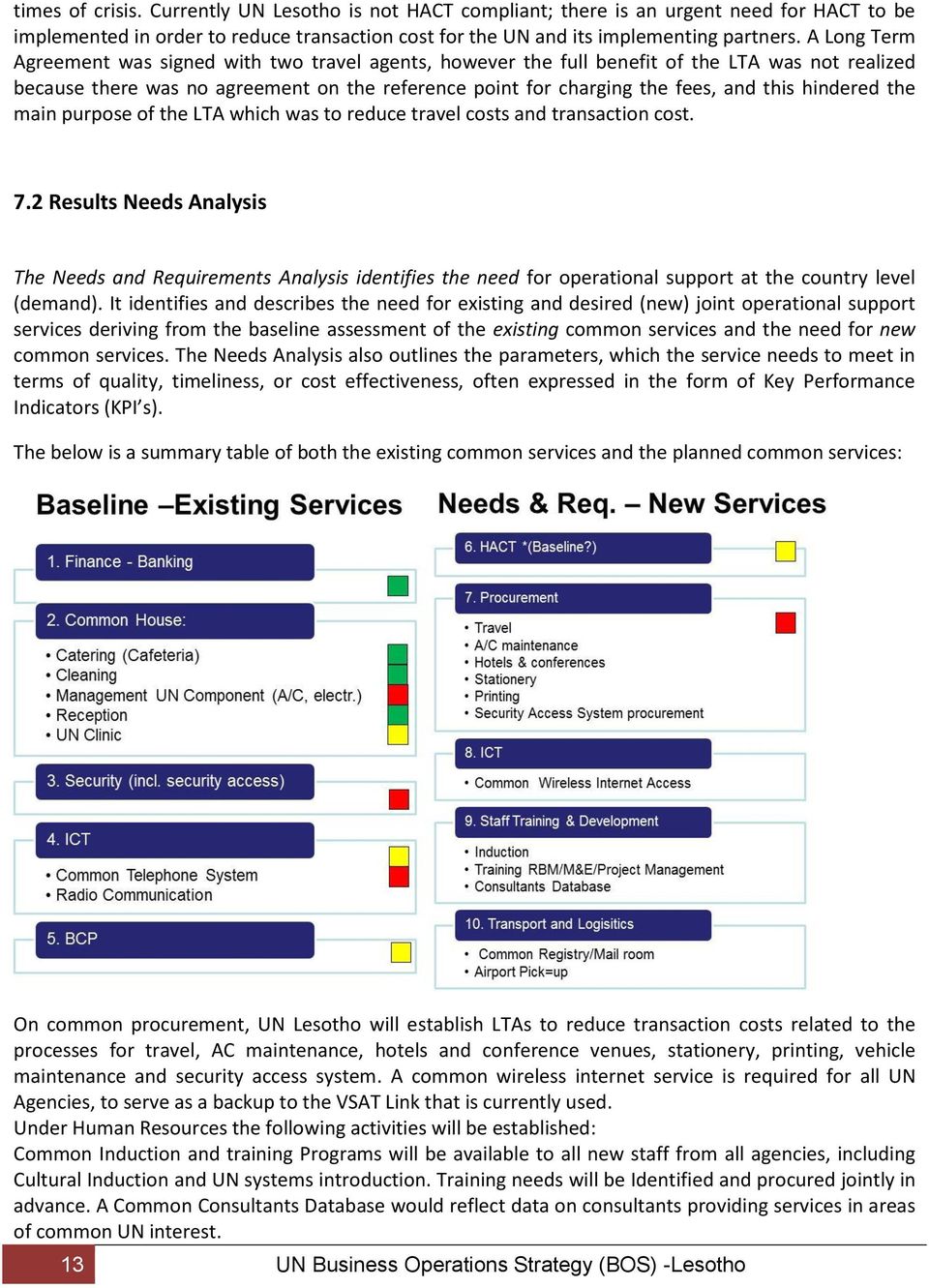
14 On transport and logistics the UN aims to reduce costs of fuel, vehicle maintenance, staff time, and overtime and DSA payments, while maintaining high quality and secure services through implementing common UN Airport transport service, carpooling and common Registry/Mail Room services. The effective management of the UN Compound would result in a cost effective, reliable and well maintained air conditioning system in all offices, improved energy efficiency, ensuring timely, efficient and quality response to any plumbing emergencies. The UN dispensary will provide basic medical services to all UN staff members with the aim to have a more efficient and quality medical healthcare to UN Staff. The UN ensures security of UN staff and its premises through a control access installed in UN House, with a rapid response to any fire emergency through efficient fire detection and reporting system. 7.3 Results Cost Benefit Analysis (CBA) The cost benefit analysis aims to assess the cost effectiveness of a proposed solution vi : It also aims to provide sufficient, rather than exhaustive, overview of the main cost elements that are involved in any process: cost of the process ($ value) and the labor cost, or time spent on executing the different actions that make up a process. The UN Lesotho CBA therefore analyzed three types of costs and benefits associated with each suggested Business Operations harmonization/(common) initiative in the areas of Procurement, ICT, Human Resources, Finance, Transport and Logistics, Security and HACT into: 1. Monetary Costs & Benefits- Direct Cost ($ value) 2. Labor costs (Non-Monetary Cost- time spent) 3. Other costs/benefits. The total cost of establishing LTAs is estimated at US$ 87,251 and these LTA s will include the following on: Stationery, Air, Hotel / Conference Facilities, Printing Security and Human Resources, as per appendix A UN Business Operations Strategy (BOS) -Lesotho

15 8. Strategic Planning: Results Framework and Results Narrative The Business Operations results framework is the basis for the Annual Work Plans which the OMT develops every year. It provides the focus of Business Operations by tying the Annual Work Plans to a strategic framework over a longer period of time, and allows for monitoring and evaluating the results achieved and focus interventions aimed enhancing under-performing services. The Results Framework in UN Lesotho translates the business solutions identified in the Cost Benefit Analysis in specific result statements (outcomes, outputs) and adds a short narrative for each results area, drawing from chapter 2. It also adds a required budget per outcome/output. 8.1 Results Narrative Business Operations The content for the Results matrix is directly drawn from the Operations Analysis (chapter 2): the Baseline Assessment existing Common Services (2.1) identifies the existing Business Solutions (incl. Common Services) in place and that are to be continued; The Needs and Requirements Analysis provide the result statements (outcome and outputs) for the proposed Business Solutions; The Cost Benefit Analysis provides the basis for prioritisation of proposed business solutions. UN Lesotho Business Operations Strategy would have 5 Pillars, for each thematic area in Business Operations. The number of pillars depends on the results of Operations Analysis (e.g. the choice by the UNCT/OMT to develop and implement specific harmonization initiatives (incl. Common Services) vii : See appendix B Pillar 1: Common ICT In the area of common ICT, UN Lesotho aims at having, by 2017, a cost effective and reliable internet connectivity in the compound, including a backup internet solution and wireless internet connection, with not more than 96 hours of connectivity downtime per year; additionally its goal is a reduction of connectivity costs by 15% due to negotiation power of approaching the ISPs as one. The UN in Lesotho also focuses on the resilience in connectivity, through enhancing business continuity and disaster recovery. In the area of phone communication, UN Lesotho strives for having by 2017 realized 20% reduction in telephone communication cost through the installation of IP based telephony system shared by all UN Agencies, itemizing telephony billing system for personal calls and official calls. Pillar 2: Common Services In the area of common services, the outcome is to maintain a cost-effective Common Premises Management System yet providing quality service in areas of catering service, cleaning service, reception service, UN clinic, electricity cost, maintenance of air conditioners, water and plumbing maintenance. 15 UN Business Operations Strategy (BOS) -Lesotho

16 Pillar 3: Common Procurement In the area of common procurement, the outcome is an efficient reduction of the UN Lesotho s overall expenditure in the area of procurement by 15% between 2013 and 2017 while maintaining quality services. Specifically, it aims at reduction of the cost of airline tickets; improvement of security access to UN House; reduction in the cost of stationary acquisition; reduction of printing costs and its improved quality and time delivery time and reduction in hotel costs. Pillar 4: Common Human Resources In the area of common human resources, UN Lesotho aims at having access to harmonized, high quality efficient staff development programme and staff pool by Specifically, it plans to reduce training costs on common training initiatives by 15 % by 2017 and increase their positive rating to least 80% of participants; to harmonize induction programme. Additionally, it aims at adopting and using a harmonized Consultants roster. Pillar 5: Common Finance The UN System in Lesotho strives to reduce by 2017 the risk of national implementation modality and increase the use of national systems, using the Harmonized Approach to Cash Transfers (HACT). 16 UN Business Operations Strategy (BOS) -Lesotho

17 9. Monitoring, Evaluation and Reporting on Business Operations Each Common Service has a set of max 3-5 indicators which reflect the progress against the work items and the on-going effectiveness of the harmonization effort. Note that for the current Business Operations Harmonization initiatives (including Common Services) elements of the Results Framework, the Key Performance Indicators should be reflected in the M&E matrix, as they provide a solid basis for the quality of the Services provided. The M&E section describes the M&E structures supporting the BoS, including the responsible entity, the planning and the frequency of M&E efforts and the relation to national M&E efforts and systems and follows the following principles: M&E Structure The OMT chair in Lesotho is a permanent member of UNCT. OMT Team Leadership is rotational between OMT members and appointment is on an annual basis. The OMT Task Forces working on Specific Business Operations Harmonization initiatives will appoints chairperson as M&E focal person representing working groups. Chairmanship of these working groups is rotated annually and leadership is currently as follows: Thematic Area o ICT WHO o Common Premises UNDP Chairmanship o Procurement UNICEF o Finance and HACT UNFPA o HR WFP Programme Management Team (PMT) forms part of M&E Group. Roles and Responsibilities within the M&E Structure OMT Chair o The OMT chair reports on a regular basis to the UNCT on progress and issues regarding the implementation of the activities supporting each of the operations outcomes. Progress updates are based on the indicators and targets as reflected in the Business Operations Strategy M&E Framework. Chairmanship of Technical Working groups/thematic Areas o o o o o Technical Working Group (TWG) chair has to ensure timely monitoring and implementation of the outputs and reports progress to OMT chair. TWG Chair ensures compliance by all agencies and alert UNCT through OMT Chair on non-compliance. TWG Chair to liaise with program team on areas of concern. TWG Chair responsible for management of information relating to the areas. TWG Chair is responsible for monitoring savings related to implementation of BOS. 17 UN Business Operations Strategy (BOS) -Lesotho

18 o TWG Chair is responsible for elaboration of summary report identifying achievements, savings and to identify challenges and bottlenecks that needs to be addressed by UNCT. Programme Management Team (PMT) contributes to annual review of BOS OMT work plans. M&E Framework Technical working group to meet every month to review progress on outcomes and report during monthly OMT meeting. Monthly OMT to consolidate report to UNCT. Quarterly OMT and PMT meeting to review work plans progress. BOS reviewed annually by both OMT and PMT around November. Review to be endorsed by UNCT. Annual Work Plans with clearly defined targets with budget allocations to be developed following annual BOS review. Revised BOS document clearly stipulating budget requirements to be presented to UNCT during the annual retreat in December. End of cycle review of BOS to be conducted by an independent party recommendations of which will feed into the development of the next BOS. The OMT reports to the UNCT with the same frequency as the programme units reports against their UNDAF. At the end of the cycle, the OMT executes an evaluation of the results reflected in the log frame, at the same time as the UNDAF evaluation takes place. 18 UN Business Operations Strategy (BOS) -Lesotho

19 10. Management and Accountability Business Operations The governance structure for BoS in UN Lesotho is constituted of UNCT, OMT and Technical working groups of various thematic areas. The graph below reflects the UN Lesotho governance structure, with an Operations Management Team in charge of the day-to-day management of Business Operations, on behalf of the UNCT, supported by functional Task Teams that deal with specific specialist areas. The performance appraisal of the staff member involved in any of the below platforms reflects their role and results to be achieved, as this plays a critical role in terms of incentive and accountability. UNCT Operation Management Team (OMT) Resident Coordinator s Office TWG Procurement TWG ICT TWG HR TWG Common Service TWG Finance & HACT Figure 1 Governance structure Business Operations UN Country Team (UNCT) The UN Country Team holds the ultimate decision power for all matters related to Business Operations; The UNCT is ultimately responsible for the achievement and reporting on results reflected in the Results matrix of the Business Operations Strategy and the BoS Annual Work Plan; UNCT outlines the medium term vision for Business Operations and provides guidance to the Operations Management Team (OMT) with regards to the operationalization of that vision in the Business Operations Strategy (BoS); In case of disagreement within the OMT, the UNCT serves as the final platform for escalation. 19 UN Business Operations Strategy (BOS) -Lesotho

20 Operations Management Team (OMT) The Operations Management Team manages and coordinates the development and implementation of the Business Operations Strategy; The OMT provides oversight over the implementation of existing Business Operations Harmonization initiatives (including Common Services) by the Service provider, with the aim to ensure service delivery is in line with the agreed Key Performance Indicators; The OMT develops annual work plans, based on the Business Operations Strategy, which guide the OMT activities and financial needs for that particular year; The OMT operates on the basis of the results matrices for Business Operations as reflected in the Business Operations Strategy and an integrated annual work plan guiding the different OMT activities; The OMT chair reports on a regular basis to the UNCT viii on progress and issues regarding the implementation of the activities supporting each of the operations outcomes. Progress updates are based on the indicators and targets as reflected in the Business Operations Strategy M&E framework; The OMT has different Task Forces working on Specific Business Operations Harmonization initiatives (including Common Services) topics relevant for the country. These could include for example Task Force on Common Premises, ICT, HR, Procurement, Security, Travel etc.; The OMT has a dedicated M&E focal point that represents the OMT in the joint M&E group. M&E focal points plan and organise the M&E activities for the outcomes that are part of the Business Operations Strategy and the integrated work plan; The OMT has a dedicated M&E focal point that is responsible for the M&E activities for each of the items. OMT Task Forces The OMT has different Task Forces working on Specific Business Operations Harmonization initiatives (including Common Services) topics relevant for the country. These could include for example Task Force on Procurement, ICT, Human Resources, Finance, Logistics & Admin etc.; Task Forces are responsible for a well-defined subset of the OMT s work plan, usually for those work items that require specific technical expertise; Task Force have a lead agency that guides the work of the Task Force on behalf of the chair of the OMT; The Task Force lead reports to the OMT on behalf of the task Force on progress against the Task Forces part of the OMT work plan. Other stakeholders Programme staff work together with Operations staff to determine the impact and needs of the programme planning for Business Operations Harmonization initiatives (including Common Services), such as procurement, and HR requirements, ensuring operations are aligned with programme priorities and needs; The Resident Coordinators Office (RCO) often plays a crucial role in support of the Operation Management Team. Depending on the capacity and profile of the RC Office this role varies from coordination and logistics support, to substantive support such as preparatory analysis for new Business Operations Harmonization initiatives (including Common Services). 20 UN Business Operations Strategy (BOS) -Lesotho

21 Service Provider The service provider provides the actual service to the customer, in this case the agencies who are participating in the common service. The service provider can be external (outsourced service) or internal. In many cases the service provider is UNDP given their relative capacity at the country level, but other agencies can act as service providers for different services, depending on comparative advantage and the cost ix against which the agency can provide the service; The service provider implements the service on behalf of the OMT and reports to the OMT on a regular basis. Evaluation of the service provider happens on an annual basis against Key Performance Indicators which are part of the design of each Common Service (ref chapter 5 of this document). 21 UN Business Operations Strategy (BOS) -Lesotho
22 11. Budgetary Framework Business Operations A resource mobilization effort for Business Operations in Lesotho has been earmarked for internal a source which is aimed at UN agencies, using cost sharing arrangements. The modality has always been adopted through- out the years and the system has worked well. The resource requirements, available resources and resource gap take the format of a table summarizing the financial requirements for each harmonized Business Operations outcome identified in the Business Operations Strategy for the five years of the programme cycle. It includes the commitment by UN system agencies to raise additional resources for the BoS, subject to donor funding. The table below includes estimated amounts, and actual amounts will depend on availability of UN system agencies' resources: Outcome Cost per outcome US$ over 4 years Total UN Resources committed Total UN Resources- (Core) cost shared Budget US$ Total UN Resources (Non Core) Resource Gap BoS Procurement 198,000 Nothing 198,000 committed for BoS outcomes in 2013 commitment for training only from OMT budget. Human Resources ,600 ICT 362, ,000 Common Service 1,010, , ,000 Finance & HAC 87,000 87,000 TOTAL 1,744, ,152 1,533,960 Table 1 Budgetary Framework Resource Table 22 UN Business Operations Strategy (BOS) -Lesotho
23 12. Operationalizing the Business Operations Strategy Successful development and implementation of the Business Operations Strategy requires some level of capacity and skills in the OMTs. Apart from technical operations skills, some degree of business analysis skills and RBM related skills are useful. In most cases, the work required is in addition to agency-specific responsibilities. Therefore, it is highly recommended for UNCTs/OMTs to consider the capacity and skills available to the OMT in terms of skills, competencies and time before deciding to engage in the BoS development. The gains in terms of efficiency and (cost) effectiveness associated with the design of Common Operations solutions should ensure a positive rate of return on this investment in staff and financial resources. Engaging the RC Office and UNCT early on is recommended as it would be useful for providing technical and coordination support. After the initial development, capacity should be available to the OMT and the Task Forces to deliver on the results outlined in the results matrix. There are a number of instruments in place to facilitate the operationalization of the Business Operations Strategy. Most of these instruments support the annual planning and management process of the OMT: OMT Integrated Annual Work Plan The Business Operations Strategy, being a medium term framework, usually covers only the outcomes (the "what"-high level) and outputs (specifies "How" the OMT plans to realize the outcome). The Annual Deliverable would be something you would see in the integrated Annual Work Plan of the OMT. The Annual Deliverable is a result realized for that particular year. It usually has a series of activities that need to be executed in order to realize the deliverable. The outcome, outputs and annual deliverables taken together are referred to as a" results chain. On an annual basis, the OMT develops a costed Work Plan which identified the prioritized work items for that year, including the budget estimates required to deliver on the results outlined in the Annual Work Plan. Common Services Budget and Common Services Account A common form of budgeting and financial management in support of joint Business Operations is the Common Services Budget: based on the Annual Work Plan, agencies cost-share the costs incurred through the implementation of the work plan. The Business Operations Harmonization initiatives (including Common Services) account x is used as a joint bank account that is used to pay for the expenditures incurred for the provision of particular Business Operations Harmonization initiatives (including Common Services). Usually agencies pay up-front for the anticipated costs for the Business Operations Harmonization initiatives (including Common Services), with differences in actual costs being reimbursed or credited against next year s charges. To facilitate the management of resources transferred by agencies based on the Common Services budget, the UNDG has developed an instrument referred to as the Common Services account. The Common Services account is an account which is managed by an AA (usually an agency at the Country Level) which manages the day-to-day management of the account and administrative management of 23 UN Business Operations Strategy (BOS) -Lesotho
24 the Common Business Operations portfolio, to the extent that portfolio is covered through the Common Services Account. Common Services MoU To facilitate the development of Common Business Solutions, more particularly Common Services, the UNDG has a standard template for Common Services, outlining the legal framework and management arrangements for individual services/business solutions. UNCT/OMTs are strongly encouraged to use this standard template as it will drastically reduce transaction costs as it does not require review and approval from individual agency legal departments. The MoU usually is supplemented with SLA's detailing the specific arrangements for a particular Common Service. 24 UN Business Operations Strategy (BOS) -Lesotho
25 A.1 Lesotho Baseline Analysis Type of existing Common Service effort Banking services - Local branch- Cash & Deposit Services - Foreign Currency - Corporate Banking agencies : payments and receipts Corp MoU & local SLA Managing Entity (Service Manager) UNDP Existing Clients (Agencies using service) UNDP, UNICEF, UNFPA, WFP, UNAIDS, FAO, UNDP, UNIC WB? Key Performance Indicators (KPI s) - Amount of change in transaction costs. Benchmark: M45 per month (transaction costs)0% of management fees. - Reduced waiting time for banking service. Benchmark: Currently waiting time- Deposit & Cash services are estimated between mins. 25 UN Business Operations Strategy (BOS) -Lesotho Performance Ranking against KPI s Met (green) Needs Attention (yellow) Urgent attention (red) Modality (Outsourced/ In House) Recommended Action (ref below) Continue As Is Discontinue Modification KPI met Outsourced Continue As it Is : 5 20 mins waiting time. Source: Common Services Survey UN cafeteria UNDP UNDP, Proportion of staff satisfied with Meets KPI Outsourced Inform supplier of
26 Type of existing Common Service effort Managing Entity (Service Manager) Existing Clients (Agencies using service) Key Performance Indicators (KPI s) Performance Ranking against KPI s Met (green) Needs Attention (yellow) Urgent attention (red) Modality (Outsourced/ In House) Recommended Action (ref below) Continue As Is Discontinue Modification Catering Staff Catering Events UNICEF, UNFPA, WFP, UNAIDS, FAO, WHO, UNDP, UNIC & World bank cafeteria and catering services Benchmark: > 80% staff content with price >80% staff rates quality as satisfactory : > 80% staff content with price >80% staff rates quality as satisfactory KPI s in writing Communication to staff on LTA and how to use it Reasonable quality staff Catering Events Benchmark: > 80% staff content with price >80% staff rates quality as satisfactory : > 80% staff content with price >80% staff rates quality as satisfactory Cleaning services Cleaning UNDP UNDP, UNICEF, UNFPA, Source: Common Services Survey # complaints Benchmark : Meets KPI Outsourced Complaint box installed in reception 26 UN Business Operations Strategy (BOS) -Lesotho
27 Type of existing Common Service effort Managing Entity (Service Manager) Existing Clients (Agencies using service) Key Performance Indicators (KPI s) Performance Ranking against KPI s Met (green) Needs Attention (yellow) Urgent attention (red) Modality (Outsourced/ In House) Recommended Action (ref below) Continue As Is Discontinue Modification Gardening Daily cleaning of offices and UN house surroundings. WHO UNAIDS, FAO, UNDP, UNIC & World bank On average about 5 complaints of staff received per month in total. : Max 3 complaints of staff received per month in total. Communication to staff on complaint box procedure and purpose Security services Guard Services Alarm System Monitoring & Response Fire Services Dispensary Medical services and Health awareness UNDP UNDP UNDP, UNICEF, UNFPA, WHO UNAIDS, FAO, UNDP, UNIC & World bank UNDP, UNICEF, UNFPA, WFP, UNAIDS, FAO, WHO,UNDP, UNIC & No. of incidents reported at staff residences. Benchmark : 3 incidents on compound or relevant residences reported in a year (2012 baseline). : Incidents reports reduced to 3 per annum. -Amount of time for staff to access Medical consultation Benchmark : Patients queue for service medical services for minutes : Needs urgent attention Outsourced Inform supplier on KPI s in writing Explore motion detector lights in offices (green office, security, lower cost) Needs Attention In House Introduction of an Appointment System. 27 UN Business Operations Strategy (BOS) -Lesotho
28 Type of existing Common Service effort Managing Entity (Service Manager) Existing Clients (Agencies using service) Key Performance Indicators (KPI s) Performance Ranking against KPI s Met (green) Needs Attention (yellow) Urgent attention (red) Modality (Outsourced/ In House) Recommended Action (ref below) Continue As Is Discontinue Modification World bank Waiting time reduced to 5 minutes. Awareness of staff on common health issues Benchmark: 4 awareness sessions Common telephone system - Switch Radio communication Agencies compliance to MOSS in relation to radio communication. UNDP UNDP UNDP, UNICEF, UNFPA, UNIC & UNAIDS UNDP, UNICEF, UNFPA, UNAIDS, FAO, WHO, UNIC, WFP, IMF & World bank : 4 per year No. of UN Agencies on a unified telephone system Benchmark : 4 out of 8 agencies included in the unified telephone system. : All agencies included. Radio check response rate Benchmark : Radio check response 20% : At least 80% radio check response achieved. Needs Attention In house Expansion: Technical feasib ility study assessing feasibility of WHO, FAO and WFP joining common telephone system Needs Urgent Attention In house Advocacy via the RC/DO. Agencies compliance to MOSS in relation to radio communication. Status lists to UNCT during UNCT meeting Ensure cost 28 UN Business Operations Strategy (BOS) -Lesotho
29 Type of existing Common Service effort Managing Entity (Service Manager) Existing Clients (Agencies using service) Key Performance Indicators (KPI s) Performance Ranking against KPI s Met (green) Needs Attention (yellow) Urgent attention (red) Modality (Outsourced/ In House) Recommended Action (ref below) Continue As Is Discontinue Modification Travel services UNICEF UNDP, UNICEF, UNFPA, WFP, UNAIDS, FAO, WHO,UNDP, UNIC & World bank Amount of change in travel costs: Benchmark: Currently commonly used routes are charged at an approximate rate as follows per route on full economy: New York - M 65, Nairobi M 22, Geneva M 32, Johannesburg M 5, Harare M 14, Addis Ababa M 20, Needs Urgent Attention Outsourced recovery Discontinue and enter into new LTA. : At least 5% cost reduction for all routes to all agencies. Management of common premises (maintenance of air con, lifts generator, x-ray machines, access UNDP UNDP, UNICEF, UNFPA, WFP, UNAIDS, FAO, WHO,UNDP, - Provision of travel services in cost effective manner. Amount of change in common premises and maintenance costs. Benchmark: 2012 expenditure M 1,863, : At least 10% cost reduction through negotiation for service Needs Urgent Attention outsourced Installation of solar system for lights and some of non- essentials. 29 UN Business Operations Strategy (BOS) -Lesotho
30 Type of existing Common Service effort Managing Entity (Service Manager) Existing Clients (Agencies using service) Key Performance Indicators (KPI s) Performance Ranking against KPI s Met (green) Needs Attention (yellow) Urgent attention (red) Modality (Outsourced/ In House) Recommended Action (ref below) Continue As Is Discontinue Modification control system, plumbing, electrical repairs and other repairs Joint UN activities (UN Cares & UN day) UNFPA & UNAIDS UNIC & World bank UNDP, UNICEF, UNFPA, WFP, UNAIDS, FAO, WHO,UNDP, UNIC provided. Proportion of staff attending major HIV/AIDS events Benchmark: UN Day commemoration, WAD and UN Family Day activities attendance and participation of staff has been over 70%. Meets KPI In house Needs further intervention The RC and UNCT Advocate for staff participation UN reception UNDP UNDP, UNICEF, UNFPA, UNAIDS, FAO, WHO,UNDP, UNIC & World bank : Over 90% coverage. No. of days in a year when the reception is not manned??? Benchmark: In the absence of receptionist, calls gets to different extensions at random. : Specific extensions be identified and programmed where calls will be routed to. Meets KPI In house Needs further intervention. 30 UN Business Operations Strategy (BOS) -Lesotho
31 Type of existing Common Service effort Managing Entity (Service Manager) Existing Clients (Agencies using service) Key Performance Indicators (KPI s) Performance Ranking against KPI s Met (green) Needs Attention (yellow) Urgent attention (red) Modality (Outsourced/ In House) Recommended Action (ref below) Continue As Is Discontinue Modification Business Continuity Plan HACT Implementation All UNICEF UNDP, UNICEF, UNFPA, WFP, UNAIDS, FAO, WHO,UNDP, UNIC & World bank UNDP, UNFPA, UNICEF No. Of times the BCP is updated. Benchmark: BCP developed and tested not yet updated. : Update to be done at least one month before deadline in May Indicator: Existence of HACT Benchmark: Letter from government not in place Macro-assessment executed Micro-assessment 0 /40 (TBC) executed Assurance Audit plan not in place Needs Attention In house Needs further intervention. Needs Attention In-House Outsourced (Micro Assessment) Expansion: Common secondary/backup Internet connectivity with extension to wireless to be included in BCP Joint Letter to government Finalise RfP/LTA Develop roll-out plan : Letter from government in place Macro-assessment executed Micro-assessment 100% executed Assurance Audit plan in place 31 UN Business Operations Strategy (BOS) -Lesotho
32 A.2 Lesotho Needs Analysis Name business operation/service Procurement Needs analysis narrative Need: Establishment of LTAs in the area of common procurement, to reduce the staff time and costs. Current Situation: One LTA established in 2011 in the area of travel; LTA was valid for 1 year, covering two travel agencies. LTAs did not work out due to misunderstanding between the UN and travel agent on the administration of the agreement. Agencies embark on individual procurement in common areas. Suggested solution: Establishment of LTAs in the area of travel, AC maintenance, hotels and conference venues, stationary, printing, and vehicle maintenance and security access system. Impact: Reduced transaction costs due to elimination of redundancies on procurement process. Bulk discounts negotiated with LTA signatories; improved response time to requests. Quality products/services will be provided due to collaboration with reputable companies. Key Performance Indicator (2-3 max) KPI: Man hours saved due to implementation of LTA procedures. Baseline: Average 4948 hrs per year based on areas in the suggested solution for 8 Agencies. : 50% reduction on time spent on processes by UN Business Operations Strategy (BOS) -Lesotho
33 Name business operation/service Common premises -ICT Needs analysis narrative Need: Establishment of one common wireless connection for all agencies Current Situation: Currently there is no wireless access in UNDP, UNFPA, UNAIDS, WB premises. Staff cannot access internet or web based services from these locations, causing a reduction in productivity and accessibility of staff when they are away from their desk. Other agencies (WHO, UNICEF, FAO, WFP) have wireless services that are available also to visiting UN Staff. Suggested Solution: Establishment of common wireless internet service to the remaining agencies that currently do not have this service. Impact: Productivity of staff enhanced due to increased flexibility and accessibility of web-based services including irrespective of location. Key Performance Indicator (2-3 max) KPI: Number of agencies using common wireless system Baseline: 4 : All (8) agencies have full access to reliable and fast wireless connection in all UN premises. Transport and logistics Common Transport and Logistics: Need: To reduce costs related to transport and logistics, including gasoline, vehicle maintenance, staff time, overtime and DSA payments, while maintaining high quality and secure services. 1. Common UN Airport pick-up: Baseline- establishment: last three months nr of airport pick-ups Current Situation: Agencies administer airport pick up individually using the official UN vehicles. Suggested Solution: Having an on-call shared driver, who can provide the service to all agencies. This service would include planning systemcommunicate service to agencies- client sends to transport 33 UN Business Operations Strategy (BOS) -Lesotho 1. KPI: Number of agencies using common airport pickup on a driver stand-by basis; fuel and overtime savings as a result of the measure. Baseline: 6 trips every weekend to the airport using 6 different vehicles : Two vehicles driving to the airport any given weekend.
34 Name business operation/service Needs analysis narrative coordinator- driver checks with transport coordinator every morning. Cost recovered through client. Impact: Cost reduction in terms of overtime, fuel and vehicle maintenance. Key Performance Indicator (2-3 max) 2. Common transport service Moshoeshoe Airport; Bloemfontein Airport, Johannesburg Current situation: Transport is provided by UN Agency drivers to/from the airport, to Bloemfontein airport and to Johannesburg. This arrangement proves to be costly due to overtime payment/dsa for drivers; fuel and vehicle maintenance. Suggested solution: Travel LTA should include an element relating to Airport pickups and drop-offs for staff and consultants. Impact: Cost savings on DSA, Fuel, Tollgate Fees and vehicle maintenance, as well as cost savings on the route (alternative to flight ticket). 2. KPI: % savings on transportation; number of trips made by land instead of flying Baseline: US$700/trip taken : 80% reduction in costs 3. Carpooling Current Situation: Whenever a meeting is called with participation of more than one agency, each agency provides its own transportation to the venue. Suggested service: Common registry will keep central record of trips to be made by UN Staff during the day and will facilitate carpooling whenever applicable. 34 UN Business Operations Strategy (BOS) -Lesotho 3. KPI: Number of trips taken using common carpooling service monthly. Baseline: 0 : 20 trips per month
35 Name business operation/service Needs analysis narrative Impact: Cost savings on fuel, vehicle maintenance, staff time; image of ONE UN; positive environmental impact. 4. Common Registry/Mail Room: Current situation: Multiple vehicles pick-up/deliver mail to various locations in Maseru. Mail brought to registry of each agency for distribution to its staff. Suggested solution: Central Registry. Mail pick-up remains at agency level. Registry distributes internally in the UN System. Registry handles outgoing mail centrally. Beyond this, registry deals with regular registry tasks, for all agencies. Registry distributes mail twice a day internally, morning and afternoon. Drivers distribute mail externally (outside UN House) twice a day. Impact: Savings on vehicle and gasoline costs; more environmental friendly, savings on staff time. Key Performance Indicator (2-3 max) 4. KPI: savings on staff time Baseline: 4,000hrs/year spent by 8 agencies : 10% reduction Human Resources Need 1: Harmonized Induction Program. Current situation: Each agency organizes its own induction program for its staff, resulting in different levels of coverage and quality of the induction, as well as limited coverage of interagency issues. Suggested solution: Develop a harmonized induction program available to all new staff from all agencies, including Cultural Induction (outsourced- 3 days),un system introduction; Program environment Operations; Security ; Medical; ICT; elaboration of an Induction guide Welcome to Lesotho ; Standardized information materials- UN Lesotho at a glance, FAQ UN in Lesotho, UNDAF Lesotho at a glance 35 UN Business Operations Strategy (BOS) -Lesotho 1. KPI: No. of induction courses Baseline : 0 : 4 KPI 2: No. of new staff inducted Baseline : 0 : 40p.a.
36 Name business operation/service Needs analysis narrative etc. Impact: All staff informed equally on selected issues, information on common policies. This results in time saving of staff ( for example security briefing done in group instead of individually); all staff feels well informed, which enhances his/her performance and shortens the period of adaptation; new staff informed on all interagency initiatives, which enhances his/her understanding and hence participation and ownership within the framework of Delivering as One. Need 2 : Common Training Program Current situation: Most training is conducted individually by each agency, within the framework of its mandate. This results in frequent duplication of trainings on the same issue. Source training in areas that all agencies need, yet procure individually. By procuring it jointly, the training costs can be shared and staff gets access to professional development program at a fraction of the cost for the agency. Suggested solution: Identify jointly training needs in advance and procure jointly training services. Open agency trainings to the staff of other agencies. Impact: Cost reduction per training; enhanced capacity of staff through participation on more trainings; enhanced knowledge of work of other agencies. Key Performance Indicator (2-3 max) 2. KPI 1:Perceived quality of the course Baseline: 0 : 80% of inductees rate course as adding value to their work and life KPI 2: Number of People trained per year Baseline : 0 : UN Business Operations Strategy (BOS) -Lesotho
37 Name business operation/service Needs analysis narrative Need 3: Establishment Consultants Database Current situation: Recruitment of consultants can be challenging to get a consultant with the right skill sets that deliver quality products. Agency share little to no data with regards to the existence of consultants or the performance of the consultants; at the same time, consultant rates can differ by agency and non-performing consultants can be recruited by another agency. Suggested Solution: A UN data base for consultants would reflect data on consultants providing services in areas of common UN interest (e.g. multiple agencies would have an interest in the area), such as evaluation, RBM/M&E, Gender, Human Rights etc. Staff that has recruited a consultant adds the CV of the consultant to a database. The data base is organized in thematic areas, allowing for clustering of consultants in specific areas, allowing easy access and information sharing regarding the existence of the consultant. The consultant is scored in accordance with his/her performance to allow for identification of quality consultants. During the recruitment process, HR informs consultants with good evaluation/standing (based on the ranking) of the opportunity stimulating them to apply. Impact: UN system has faster access to higher quality consultants and has a quality assurance system at its disposal, ensuring recruitment of appropriate quality consultants. Key Performance Indicator (2-3 max) 3. KPI1: Number of qualified consultants per area of specialty in the database Baseline: 0 : at least 2 per area of specialty KPI2: % of evaluations of performance of active consultants per year Baseline: 0 (database does not exist) : 100% HACT Need: Achieve full compliance with HACT. KPI: Number of HACT 37 UN Business Operations Strategy (BOS) -Lesotho
38 Name business operation/service Management of UN compound Needs analysis narrative Current Situation: Macro assessment has been carried out, micro assessments are currently being planned to roll out in Knowledge of HACT in program and support is limited. No assurance plans in place. Agencies are adopting different modalities to suit their processes and procedures. Face form is in use by respective agencies. Partner training has been provided on the use of face. Suggested solution: Conduct micro assessments; elaborate and implement assurance plans; train key program and support staff, as well as partners, on HACT compliance and ensure all corresponding agencies are HACT compliant and standardize their processes and procedures by Impact: The capacity of counterparts enhanced; risks reduced for UN participating agencies; costs are reduced as a result of joint implementation. Need 1: Ensure cost effective, reliable and well maintained air conditioning system in all offices. Current Situation: The air conditioning system is not functioning properly, it is not well maintained and its malfunctions cause that stuff purchase separate heating/ventilation, incurring on the price of electricity. Suggested solution: Outsource maintenance services to a company that would provide regular, not costly and efficient maintenance. Key Performance Indicator (2-3 max) compliant agencies Baseline: 0 : 3 1. KPI: Number of complaints received from UN Staff. Baseline: 10 complaints per month. : Less than 5 complaints. Impact: Air conditioning system well-functioning and reliable in all offices, ensuring staff has comfortable conditions for work; no purchase of additional heating/ventilation systems in offices is necessary, resulting 38 UN Business Operations Strategy (BOS) -Lesotho
39 Name business operation/service Needs analysis narrative in electricity cost reductions. Need 2: Reduce the electricity consumption and make current use more efficient and contribute to cost reduction. Current Situation: Electrical energy is not used in an efficient way both due to energy inefficient construction, staff behavior and lack of alternative sources of energy. Suggested solution: Make UN House more energy efficient implementing measures in the premises; enhance green initiatives and change management with UN Staff; install solar panels on UN house. Impact: UN House is more efficient, which results in cost savings and smaller environmental impact. Alternative sources of energy in coherence with the position of the UN on climate change, incentivizing people to replicate the environmental friendly behavior in their homes. Need 3: Provide more efficient, affordable and quality medical healthcare to UN Staff Current Situation: One nurse financed from common budget ensures the smooth functioning of the UN Dispensary for UN staff. The financial implications of the current set up have significant and unsustainable impact on the common budget. Suggested solution: UN Dispensary services are outsourced through procurement process to a medical doctor who will attend UN staff; reimbursement of expenses incurred by staff will be negotiated with their health insurance providers. Key Performance Indicator (2-3 max) 2. KPI: % reduction in electricity consumption Baseline: KW Consumption in 2012 : 20% consumption reduction through adoption of green initiatives. 3. KPI3: Decrease in UN common service dispensary costs Baseline: US$ 54, : 90% decrease in UN dispensary costs with in CS Budget Impact: Staff will be attended by medical practitioner instead of a nurse; 39 UN Business Operations Strategy (BOS) -Lesotho
40 Name business operation/service Security Needs analysis narrative the impact on common budget will be lower than in current setup. Need 4: Ensure timely, efficient and quality response to any plumbing emergency. Current Situation: Plumbing is not well maintained, service provider has not been identified and hence any emergency lacks in rapid and quality response. Suggested solution: Outsource plumbing services to a company that would provide requested quality and timely response. Impact: Any plumbing emergency is rapidly resolved. Need: Ensure security of UN staff and its premises through a control access installed in UN House. Ensure a rapid response to any fire emergency through efficient fire detection and reporting system. Current Situation: The access control and the fire system have not been functional for extended period mainly due to lack of maintenance. Suggested solution: Procure and install a new access and fire alarm systems (having previously revised if the current systems cannot be repaired); ensure local and regular maintenance through long term agreement. Impact: Security of UN staff and premises enhanced, complying with MOSS and other requirement Key Performance Indicator (2-3 max) 4. KPI4: % of plumbing emergencies addressed in quick and efficient manner Baseline: 0 : 100% KPI: Number of regular maintenance to functioning access control, alarm and fire systems Baseline: 0 : at least 2 maintenance calls for each system per annum. 40 UN Business Operations Strategy (BOS) -Lesotho
41 A.3 Template: Business Operations Strategy: Cost Benefit Analysis (excl. Priority Assessment) Proposed Business Solution Common Premises- Common ICT Wireless Assuming 256kb/s Monetary Costs Benefits ($) Labor Costs Benefits Other Costs/Benefits A B C D E F Anticipated Monetary Cost (One Time & Recurring $ Investment) One Time: 0 (free) Recurrent cost: M per month for all participants Anticipated Monetary Benefit (One Time & Recurring Benefits) One Time:0 Recurrent cost: WHO: M per month WFP: 0 M UNICEF: 250 M per month FAO: M per month UNDP: Anticipated Labor Cost- Time Investment (One Time & Recurring Labor costs) One Time: 1 week per agency/1 person (installation), GS 6 Recurrent Labor Cost: 1h per month per ICT staff per agency Anticipated Labor Benefit: Time Reduction (One Time & Recurring Labor benefits) One Time: None Recurrent Benefit: None Anticipated Significant Other Cost Anticipated Significant Other Benefits Because of standardized platform, support more flexible (staff can help various agencies)- Enhanced quality for lower price (faster access) Security benefit for externals- no longer need access to corporate networks, but stay in common wireless environment with access to internet but not to corporate networks Common Transport and Logistics- Airport Pick-Up Assumption max load- 3 trips per day, 7 days One Time- car 1 day 18,90 USD (27c per km/ km) Recurrent Cost: Fuel M444 per day (7 days with flights) One Time:0 One Time: 5,5h (NoB) Recurring 4,5h = 0,5 FTE (1,5h per trip, 3 trips per day) G2 driver 41 UN Business Operations Strategy (BOS) -Lesotho One Time: 0 Recurrent Benefit: on average 12 trips/weekend None Enhanced productivity staff due to continuous connection to web based services Reputation increaseefficient transport, lower environmental impact.
42 Common Transport and Logistics- Central Registry Excl. WFP One Time- Recurrent cost: car 1 day 18,90 USD (27c per km/ km) Fuel- (based on average fuel consumption per day per car) 2400M per month One Time: 0 Recurrent benefit: anticipated saving of US$ 45/day 1h G5 coordinator per day (3 days (3 days plane) One time: Central registry ToRcollect existing ToRs- Compile central ToR- 1 day NoB Process 1,5 day NoB Training 0,5 day NoB Recurrent labor: 1 registry 1 FTE G4 Recurring Benefit: 9 man hours/day saved Available space increase as registry integrates Common HR- Induction Program Split- advocacy materials One time: Recurrent Monetary cost Induction Materials: 600 USD annually Monetary cost might slightly increase as agencies supplement their agency induction program with the UN induction program 1 driver 0,5 FTE G2 One time: 2 days NoB Recurrent cost: 2 days per induction course 2 times a year = 4 days 1 NoB Agencies don t run individual induction courses Productivity gain as staff understand the UN System Less time lost Common HR- Common Training HR- Consultants Database Cultural induction: 140 USD Per course x 2 per year One Time Flight DSA trainers (1 week) 6500 USD p/p= USD Recurrent One Time - Recurrent One Time - Recurrent - One Time - Recurrent - One Time 40 staff annually NOB Recurrent - One Time 10 days GS 6 42 UN Business Operations Strategy (BOS) -Lesotho One Time - Recurrent - One Time Recurrent Increased productivity Personal development staff staff loyalty/staff morale Motivation/drive consultants (implications bad performance)
43 - Recurrent 15 min per consultant (upload CV, Rank performance, insert name) Less time identifying the consultant Enhanced quality consultants bad consultants don t get hired due to the performance ranking TRAVEL 1 Time: Advertise: Eoi(expression of interest) Training material (p/copying) Hospitality 1 time : baseline: total travel cost vs the LTA negotiated rate -3% reduction vs 2012 total travel expenditure of UN Lesotho 1 time: -Data collection for ToR, Eoi; RFP (ToR, advert, presentations, prop. evaluation, etc). -9 x staff: Gs6 NOB x 20 days (2 months). Recurring: Reduced frequency of reference price. Boycott by Travel agencies operating under current LTA Consultants availability information available Reputation of UN Strengthened vendor relations Recurring: -Evaluation & Monitoring of the LTA x quarterly x 2 dys of GS& max 45 min per ticket (15 min for referencing; 30 min for RFQ, booking inclusive). 2. SECURITY 1 time: Evaluation & temporary repair of current system LSL27 37K Recurrent: Maintenance of currently repaired system 1 Time: Cost saving on lost cards (50 pcs annually +/- LSL250) Recurrent: Considerably reduced frequency of maintenance costs (by 3 x). 1 Time: Solicitation process (Gs + NOC) Output 1: 15 days GS; Output 2: 20 days NOB GS6 1 Time: No more cards (min 8 days a yr of GS6). Recurrent: No impact 1 Time: Alterations costs on installation 1 Time: Reduced security risk thumb vs cards Increased security lost card vs coding. Risk of visitors roaming around is reduced. 1 Time 43 UN Business Operations Strategy (BOS) -Lesotho
44 Purchase of the new system LSL60K 3. STATIONERY Recurrent: Maintenance once a year after warrantee. 1 time: Advertising of potential vendors Training Materials Recurring cost: Discount x% per year 4. HOTELS 1 time: Travel & telephone costs to meet / negotiate with potential Service providers. Recurring: 1 time: No Recurring: No 1 Time: No Recurring: Reduced solicitation costs (telephone / fax / fuel, etc.). 1 time: To setup the LTA 9 staff G6 to NOB between 10 days Recurring: for the lead agency for monitoring and evaluation of the LTA every six months 1 Time: LTA preparation (min. once a year). Recurring: - Logistical arrangements prior to LTA implementation. - 1 Time: No Recurring: 3days of a G6-G7 time saved. 1 Time: Reduced staff time spend on solicitation processes, etc - 9 x staff: GS5 GS6 x 3 days Recurring: -Evaluation & Monitoring of the LTA x Half yearly x 2 days of GS & NO staff Special rates when booking for certain # especially for international big network meetings. Increase of reliability in terms of servicing events. - Reputation of UN - Strengthened vendor relations Min 20 minutes per hotel following up on RFQ or confirming a booking. 44 UN Business Operations Strategy (BOS) -Lesotho
45 B. Template Results Matrix Business Operations Strategy BoS Outcome 1: Common ICT Lead Agency UNDP Participating UN Agencies UNDP, UNICEF, WHO, FAO, UNAIDS, UNFPA, WFP Coordination Mechanisms ICTWG Outcome Budget US$ 192,000 Outcome Budget Gap US$ 124,000 Outcome 1 By 2017 UN Lesotho participating agencies realized costs of an effective and reliable Internet connectivity in the compound Outcome Indicators Amount of change in connectivity costs due to negotiation power of approaching the ISPs as one (bigger internet pipes for less) Source of Data Baseline 2014 No common backup internet Negotiation link. UNICEF, for lower WHO, WFP and rates with ICT reports on internet FAO have their the ISPs. connectivity own individual LTA signed backup links and common Current costs for backup link internet implemented connectivity are. estimated US $23,000 for all UN agencies % savings on connectivity costs 5% saving on connectivity costs 5% savings on connectivity costs Risk and Assumptions Budget No ICT Investment: Electricity failure Generator failure No ICT Personnel turnover. 45 UN Business Operations Strategy (BOS) -Lesotho
46 Output 1.1 Output Indicators - Existence of a common back up/secondary internet link Output 1.2 Output Indicators Availability of Internet anytime and anywhere for both visitors and staff A common backup/secondary internet link (failover link) established by 2017 Source of Data Baseline No common Alternate link backup internet LTA signed link. UNICEF, Backup link Backup link Backup link ICT reports on internet and link WHO, WFP and fully fully fully connectivity implemented FAO have their functional. functional. functional.. own individual backup links Implementation of common wireless internet connectivity in the UN compound implemented by 2017 Source of Data Baseline Internet Internet Internet Procurement available available available Currently, 3 of wireless across the across the across the Agencies have access ICT reports on internet whole UN whole UN whole UN reliable internet points to be connectivity compound compound compound available to staff deployed at (wireless (wireless (wireless and visitors the UN internet internet internet compound connection) connection connection) Risk and Assumptions Risk: Budget No ICT Investment: Assumption: No ICT Personnel turnover. Risk and Assumptions Risk: Budget No ICT Investment: Assumption: No ICT Personnel turnover. 46 UN Business Operations Strategy (BOS) -Lesotho
47 Lead Agency UNDP Participating UN Agencies UNDP, UNICEF, WHO, FAO, UNAIDS, UNFPA Coordination Mechanisms ICTWG Outcome Budget US$170, Outcome Budget Gap US$ 59, BoS Outcome 1: Common ICT Outcome 2 By 2017, UN Lesotho realized reduction in telephone communication cost Outcome Indicators Source of Data Baseline Risk and Assumptions IP-based telephony system shared by all Agencies Amount of change in telephone communication costs Output 2.1 Output Indicators Existence of a UN common telephone system Monthly telephone utilization bills Currently all UN Agencies spend USD $169, Realize 10% telephone communica tion cost Realize 10% telephone communicati on cost Realize 10% telephone communication cost Realize 10% telephone communica tion cost Risk: Budget No ICT Investment: Assumption: No ICT Personnel turnover. A UN Lesotho common telephone system established and VoIP activated. Source of Data Baseline Risk and Assumptions Acquisition UNDP, of related UNICEF, Feasibility hardware UNFPA study. Purchase and sharing a Voice and Common telephone PABX Network installation Services managemen acquired drawn. of the report t software. during 2001 Work Plan telephone Telephony and which is prepared system system not IP based. setup. 47 UN Business Operations Strategy (BOS) -Lesotho
48 BoS Outcome 2: Common Services Lead Agency UNDP Participating UN Agencies UNAIDS/FAO/WHO/UNFPA/UNICEF/UNDP/WFP Coordination Mechanisms COMMON SERVICE SUB-COMMITTEE OMT Outcome Budget US$ 1,010, over four years Outcome Budget Gap US$ 800, over four years Overall Outcome Outcome Indicators Percentage change in Common Service Costs % of staff that indicate positive rating of Common Services Output 2.1 Catering Services Output Indicators i) Percentage change in catering costs ii) % of staff that indicate positive rating of catering service Output 2.2 Cleaning Services Output Indicators Percentage change in cleaning service costs By 2017 UN Lesotho will have cost-effective Common Premises Management System providing quality services Source of Data Baseline 2014 Common Service Financial USD 252, % 2.5% 2.5% 2.5% Report Common Service 80% Survey Risk and Assumptions Risk: Lack of capacity for OMT Assumption: Common Service Budget adequately funded By 2017 UN Lesotho will have cost effective and quality catering services Source of Data Baseline Risk and Assumptions Lunch USD 2.5% 2.5% 2.5% UN Cafeteria % Price List Tea USD 4.5 Common Service Survey By 2017 UN Lesotho will have effective and quality cleaning services Source of Data Baseline 2014 Common Service Budget USD 30,583 p.a. 1.5% 80% Risk: Lack of profitability for cafeteria. Assumption: cafeteria will be sustainable Risk and Assumptions 1.5% 1% 1% Risk: Cleaning company cease operations due cash flow problems Assumption: Operating costs for cleaning services remain stable 48 UN Business Operations Strategy (BOS) -Lesotho
49 % of staff that indicate positive rating of cleaning services Output 2.3 Reception Service Output Indicators Percentage change in Reception Service costs % of staff that indicate positive rating of reception services Output 2.4 UN Clinic Output Indicators Percentage change in Clinic costs % of staff indicate positive rating of health services Output 2.5 Electricity Cost Output Indicators Percentage change in electricity cost Common Service Survey By 2017 UN Lesotho will have a cost effective and efficient reception service Source of Data Baseline Risk and Assumptions UN agencies USD financial 81,484p.a. records 2.5% 2.5% 2.5% 2.5% Common Service Survey 80% 80% Risk: Low morale of agencies receptionist due to fear of loss of original TOR. Agencies wanting to maintain the status quo. Assumption: all agencies agree to a common telephone system By 2017 UN Lesotho will provide cost effective health services Source of Data Baseline Risk and Assumptions Common Service Budget Common Service Survey USD 54,650 p.a. 2.5% 2.5% 2.5% 2.5% 80% Risk: Staff turnover and increase in medical costs Assumption: UN dispensary will continue to operate. LTA signed with medical supplier. By 2017 UN Lesotho will facilitate cost effective use of electricity. Source of Data Baseline Risk and Assumptions Risk: escalating electricity costs Common USD 69,116 Assumption: use of renewable Service 5% 5% 5% 5% p.a. energy; use of sensor lights and Budget staff made of electricity costs. 49 UN Business Operations Strategy (BOS) -Lesotho
50 Output 2.6 Maintenance of Air Conditioner Output Indicators Percentage change in air conditioner maintenance cost reduced by 10 % Number of agencies complaining about air conditioners per year Output 2.7 Water Output Indicators Percentage change in water costs Change in water storage capacity Output 2.8 Plumbing Maintenance Output Indicators Proportional change in maintenance costs for plumbing Length of time for provision of emergency plumbing repairs By 2017 UN Lesotho will provide a cost effective and reliable air conditioning system in all offices Source of Data Baseline 2014 Common Service USD 8,427 p.a 2.5 % 2.5% 2.5% 2.5 % Budget Common 8 agencies Reduced by Reduced Reduced Service complaints 2 by 2 by 2 Survey Risk and Assumptions Reduced by 2 Risk: No budget for major repairs of air conditioning system. Assumption: LTA will be signed for air condition maintenance. By 2017 UN Lesotho will have cost effective and reliable water supply. Source of Data Baseline Risk and Assumptions Common Risk: No budget for installation of USD 1,110 Service 2.5% 2.5% 2.5% 2.5% efficient water usage systems. p.a. Budget Common Service Budget 1 additional Tank 1 additional tank Assumption: UN House water storage capacity increase and efficient water usage systems installed. By 2017 UN Lesotho will provide cost effective and quality plumbing services Source of Data Baseline Risk and Assumptions Common Service USD3,258 p.a. 4% 4% 4% 4% Budget Common How many Service 24 hours hours currently Risk: design of UN House plumbing Survey system being prone to blockage. Assumption: LTA will be signed for plumbing maintenance. 50 UN Business Operations Strategy (BOS) -Lesotho
51 Output 2.9 General Maintenance Output Indicators Proportional change in General Maintenance costs Output 2.10 UN Conference Room Output Indicators Proportional change in Conference costs % of staff that indicate positive rating for management of UN Conference services. By 2017 UN Lesotho will provide a cost effective and quality general maintenance Source of Data Baseline Risk and Assumptions Common USD $ Risk: Cost of material for repair Service 12, in 4% 4% 4% 4% increase. Budget Assumption: LTA signed for general maintenance of UN House By 2017 UN Lesotho will have cost effective and quality Conference hall services. Source of Data Baseline Risk and Assumptions Common USD16,000 Service p.a. Budget 2.5% 2.5% 2.5% 2.5% Common Service Survey 80% Risk: number of items requiring replacement increased Assumption: There will budget provision for replacement of UN Conference Room furniture and equipment 51 UN Business Operations Strategy (BOS) -Lesotho
52 BoS Outcome 3: Common Procurement Lead Agency UNICEF Participating UN Agencies UNAIDS/FAO/WHO/UNFPA/UNICEF/UNDP/WFP Coordination Mechanisms PROCUREMENT SUB-COMMITTEE OMT Outcome Budget US$ 198,000 Outcome Budget Gap US$ 198,000 Overall Outcome 3 UN Lesotho will have efficiently reduced labor hours spent on procurement processes as well as overall reduction of procurement costs by Outcome Indicators i) Percentage change in annual labor costs and procurement expenditure of UN Lesotho ii) % of service users satisfied with procurement services. Output 3.1 Source of Data Baseline 2014 Agency ER P Systems (ATLAS / SAP) Monkey / user survey Risk and Assumptions % 3.5% 4% 4% Risk: Market price fluctuation / market limitation ; low response Zero. Common procurement service new Annual survey AIR TRAVEL UN Lesotho air travel costs reduced by Output Indicators Source of Data Baseline 2014 i) Max 15% of online ticket reference price. ii) Yearly reduction of air travel cost Online airfare sites - Within 15% of reference price Reduction by 15% Annual survey Annual survey Annual survey rate to the survey; and capacity to monitor results, Assumption: repair & maintenance successful Risk and Assumptions Within 15% Within 15% Within 15% of of reference of reference Risk: Boycott of RFP by previous reference price price LTA vendors price Assumption: LTA vendors accept to stay within the 15% reference price. Output 3.2 SECURITY Security access of UN House in Lesotho upgraded and sustainably maintained by Source of Output Indicators Data Baseline Risk and Assumptions 24/7 24/7 24/7 Risk: inadequate maintenance Number of hours the access control Security /7 Assumption: Adequate budget is operational Reader CPU for the new system 52 UN Business Operations Strategy (BOS) -Lesotho
53 LTA on security maintenance secured and new system installed. Existence of an LTA for security maintenance Output 3.3 Installation & maintenance Contract None STATIONERY - Cost of stationery for agencies reduced by 2017 Outcome Indicators KPI: percentage reduction in Man hours compared to 2012 baseline. Source of Data Baseline 2014 Agency ERP 4948 hrs for all Systems 5 % annual Agencies in (ATLAS / reduction 2012 SAP) LTA in place Risk: system passed its useful life, therefore may be unserviceable. Assumption: maintenance may not add value Risk and Assumptions 5 % annual reduction 5 % annual reduction 5 % annual reduction Number of LTAs signed with vendors per commodity. None 2 LTAs Risk: market price fluctuation; fluctuation in demand; Assumption: Buy-in of Agencies to support the LTA Output 3.4 PRINTING UN Lesotho reduced the cost of printing for agencies by Source of Output Indicators Data Baseline Risk and Assumptions (USD $ 2.5 % 2.5 % 2.5% annual Agency ERP. 70, annual annual reduction Systems 2.5 % annual Percentage change in costs of 2012 Agencies reduction reduction (ATLAS / reduction printing Expenditure SAP) LTAs signed with at least 2 vendors None Output 3.5 HOTEL UN Lesotho reduce Hotel and Conferencing costs by 2017 Source of Output Indicators Data Baseline 2014 Agency ERP $ 434, % annual. Percentage change in hotel and Systems 2012 Agencies cost conference costs (ATLAS / expenditure reduction SAP) LTA signed with at least 2 service providers per rating category None Risk: market price fluctuation; fluctuation in demand; Assumption: Buy-in of Agencies to support the LTA Risk and Assumptions 5% annual cost reduction 5% annual cost reduction 5% annual cost reduction Risk: market price fluctuation; fluctuation in demand; Assumption: Buy-in of Agencies to support the LTA 53 UN Business Operations Strategy (BOS) -Lesotho
54 Lead Agency WFP Participating UN Agencies UNDP, UNICEF, UNFPA, UNAIDS, WFP, WHO, FAO. Coordination Mechanisms HR Sub-Committee Outcome Budget US$ 86,600 Outcome Budget Gap US$ 86,600 BoS Outcome 4: Common HR Overall Outcome 4 By 2017, UN Lesotho has access to and utilizes a harmonized, high quality and efficient staff development program and consultants pool Outcome Indicators Percentage change in training costs on common training initiatives Training rated good by at least 80% of participants. Percentage of UN staff benefiting from the joint staff development program??? Output 4.1 Output Indicators No. of new staff provided with induction training per agency in 2012 Source of Data Baseline 2013 Harmonized Total Training Training Plan Agencies costs relating on common Training to common areas Expenditure initiatives in developed Reports (what are and adopted these costs?) by all agencies. Surveys and Training Evaluations. Trained staff feedback in % good rating % reduction in training costs 80% good rating % reduction in training costs 80% good rating UN Lesotho will adopted a harmonized induction program by Source of Data Baseline All new UN Staff All new Induction Members UN Staff Package inducted Common Members developed with Services inducted None and adopted same report with by all package, same agencies and package. package review % reduction in training costs 80% good rating 2016 All new UN Staff Members inducted with same package, and package review % reduction in training costs 80% good rating 2017 All new UN Staff Members inducted with same package, and package review. Risk and Assumptions Risks: Perceived workload burden due to competing priorities Assumption: Cost reduction. Risk and Assumptions Risks: Workload burden due to competing priorities for compilation of program. Assumption: Total Support and backing by UNCT. 54 UN Business Operations Strategy (BOS) -Lesotho
55 Output 4.2 Output Indicators Proportion of staff trained per year per Agency (including joint 2012 initiatives) Output 4.3 Output Indicators Percentage change in time for sourcing consultancies.. UN Lesotho adopted a harmonized training plan on common areas by 2017 Source of Data Baseline Harmonized At least At least At least Training Plan 80% of 80% of 80% of on common harmoniz harmoniz harmoniz Agencies areas ed ed ed Training developed training training training Plans. and adopted plan plan plan by all impleme impleme impleme agencies ntation. ntation. ntation. UN Lesotho adopted a harmonized Consultants roster by 2017 Source of Data Baseline Advert 10% 10% issued reduction reduction out to in time of in time of request G5 G5 How many HR reports Consult NOB for NOB for days/weeks or Common Service ant sourcing sourcing hours reports profiles consultan consultan currently? in cy - cy - speciali Labor Labor zed time time areas. saving. saving % reduction in time of G5 NOB for sourcing consultan cy - Labor time saving Risk and Assumptions At least 80% of harmonize d training plan implement ation. Risk: Funding Constraints for one training plan. Assumptions: Total Support and backing by UNCT Risk and Assumptions 10% reduction in time of G5 NOB for sourcing consultanc y - Labor time saving. Risks: Existence of roster may influence Consultants price hiking. Assumption: Availability of local expertise within the UN focus areas. 55 UN Business Operations Strategy (BOS) -Lesotho
56 Lead Agency UNFPA Participating UN Agencies UNDP, UNICEF, UNFPA, UNAIDS, WFP, WHO, FAO. Coordination Mechanisms HACT sub-committee Outcome Budget USD $ 87, Outcome Budget Gap USD $ 87, BoS Outcome 5: Finance and HACT Overall Outcome 5 By 2017 UN Lesotho will be fully HACT compliant with enhanced financial management capacity of National Systems. Outcome Indicators Percentage change in transaction and labor costs Consider: Proportion of relevant IPs utilizing common tools aimed at reducing transaction costs Source of Data Agencies financial records. Baseline 2012 individually incurred Agency cost What is the current transaction and labour cost? % towards HACT complianc e. (How many so far) Output 5.1 UN Lesotho declared HACT compliant by 2017 Output Indicators Number of Agencies that adopt a HACT approach. Source of Data Agencies financial information None Baseline 2013 Select Auditor to undertake Micro Assessme nt % reduction in costs. 5% reduction in costs Micro assessm ent complete. Develop ment of capacity develop ment plan Assuranc e Plan Develope d and Adopted. Fully HACT complaint. 5% reduction in costs Four Excom Agencies fully HACT compliant 2017 Risk and Assumptions 5% reduction in costs. Risks: IPs Financial management capacity and accountability level of engagement. Assumption: Cost sharing by participating Agencies Risk and Assumptions Four Excom Agencies fully HACT compliant Risks: Agency capacity and level of engagement. Assumption: Cost covered by common services budget 56 UN Business Operations Strategy (BOS) -Lesotho
57 Cost Benefit Analysis Calculations on the establishment of LTA s Appendix A 3.1 No. Item description Amount: LSL 1. Stationery: Advert (EoI): 1 time x 2 (newspaper issues) x M5,000 10,000 Setup: 7 x Gs6(191805/12/,15984/21 = 761) x 10 days 53,270 2 x NoB (286913/12,23909/21 = 1139) x 10 days 22,780 1 x OMT Chair (361798/12, 30150/21= 1436) x 2 days 2,871 Total: USD* Monitoring: 7 x Gs6( 761 x 2 days) x 3 2 x NOB (1139 x 2 days) x 3 31,962 13,668 TOTAL for Stationery 134,551 13, AIR Travel Advert (EoI): 1 time x 2 (newspaper issues) x M5,000 **Pre-bid meeting (Training material & hospitality for potential LTA contractors) : - Training: M200 x 12ppl Hospitality: 20ppl x 40ppl 10, ,540 45,560 2,871 Setup: 7 x Gs6(191805/12/,15984/21 = 761) x 20 days 2 x NoB (286913/12,23909/21 = 1139) x 20 days 1 x OMT Chair (361798/12, 30150/21= 1436) x 2 days Monitoring: 7 x Gs6 (761 x 2 days) x 3 31,962 13,668 2 x NOB (1139 x 2 days) x 3 TOTAL for Air Travel 172,500 17,250 3 Hotel / Conference Facilities Travel & communication ( District): Pilot Districts (Leribe, Berea, Maseru, Mohaleshoek, Qacha s Nek) DSA: 2sm x M5,380 Mileage: cost based on KMs travelled to $0.80 for both highlands and lowlands. Setup: 7 x Gs6 (761 x 10 days) 2 x NoB (1139 x 10 days) 10,760 11,680 53,270 22,780 Monitoring: 7 x Gs6 (761 x 2 days) x 3 2 x NOB (1139 x 2 days) x 3 31,962 13, UN Business Operations Strategy (BOS) -Lesotho
58 No. Item description Amount: Total: USD* LSL TOTAL for Hotels 114,120 11, Printing Advert: EoI 5,000 x 5 categories x 2 (newspaper issues) = 50,000 50,000 Setup: 7 x Gs6 (191805/12/,15984/21 = 761) x 10 days 2 x NoB (286913/12,23909/21 = 1139) x 10 days 1 x OMT Chair (361798/12, 30150/21= 1436) x 2 days 53,270 22, Monitoring: 7 x Gs6 ( 761 x 2 days) x 3 2 x NOB (1139 x 2 days) x 3 31,962 13,668 TOTAL for Printing 174,551 17, SECURITY 1 Time: Purchase of the new system 60,000 Setup: 7 x Gs6 (191805/12/,15984/21 = 761) x 10 days 53,270 22,780 2,871 2 x NoB (286913/12,23909/21 = 1139) x 10 days 2 1 x OMT Chair (361798/12, 30150/21= 1436) x 2 ds = Monitoring: 7 x Gs6 ( 761 x 2 days) x 3 31,962 2 x NOB (1139 x 2 days) x 3 13,668 Evaluation & temporary repair of current system 37,000 TOTAL for Security 189,589 18, HR Induction Material (once $600) 24,000 Cultural Induction ($ 140 X 2) x 4 11,200 Labour Cost: ( 2 days pc X 2p.a x $113.9) x 4 = $ 1824 Common HR Training Training Consultant ($13,000 x 4) 52,000 = $ HR Consultants Database Gs6 (761 x 15 days X 3ppl) x 4 = $13,698 TOTAL for HR 87,200 8, X-rate ** Need to hold pre-bid meeting & training (presentation on LTAs) for potential LTA contractors only those with IATA clearance. 58 UN Business Operations Strategy (BOS) -Lesotho
59 Appendix C: Results Based Management: Definition of Key Terms Results based management (RBM) Results-based management is a management strategy by which all actors, contributing directly or indirectly to achieving a set of results, ensure that their processes, products and services contribute to the desired results (outputs, outcomes and higher level goals or impact) and use information and evidence on actual results to inform decision making on the design, resourcing and delivery of programmes and activities as well as for accountability and reporting. Results Results are changes in a state or condition that derive from a cause-and-effect relationship. There are three types of such changes - outputs, outcomes and impact- that can be set in motion by a development intervention. The changes can be intended or unintended, positive and/or negative. Results chain The causal sequence for a development intervention that stipulates the necessary sequence to achieve desired results beginning with inputs, moving through activities and outputs, and culminating in outcomes, goal/impacts and feedback. It is based on a theory of change, including underlying assumptions. Impact Impact includes changes in programme delivery through enhanced operational support, and therefore ultimately, in people s lives - can include changes in knowledge, skills, behaviors, health or conditions for children, adults, families or communities. Positive and negative long-term effects on identifiable groups produced by a development intervention, directly or indirectly, intended or unintended. Goal The specific end results desired or expected to occur as a consequence, at least in part, of the intervention or activity. It is the higher order objective that will assure national capacity building to which a development intervention is intended to contribute. Outcome Outcomes represent changes in the institutional and behavioural capacities for development conditions that occur between the completion of outputs and the achievement of goals. 59 UN Business Operations Strategy (BOS) -Lesotho
60 Outputs Outputs are changes in skills or abilities, and capacities of individuals or institutions or the availability of new products and services that result from the completion of activities within a development intervention within the control of the organization. They are achieved with the resources provided and within the time-period specified. Activity Actions taken or work performed through which inputs, such as funds, technical assistance and other types of resources are mobilized to produce specific outputs. Inputs The financial, human, material, technological and information resources used for development interventions. Performance indicator A performance indicator is a unit of measurement that specifies what is to be measured along a scale or dimension but does not indicate the direction or change. Performance indicators are a qualitative or quantitative means of measuring an output or outcome, with the intention of gauging the performance of a programme or investment. Baseline Information gathered at the beginning of a project or programme from which variations found in the project or programme are measured. Specifies a particular value for an indicator to be accomplished by a specific date in the future. Total literacy rate to reach 85% among groups X and Y by the year Benchmark Reference point or standard including norms against which progress or achievements can be assessed. A benchmark refers to the performance that has been achieved in the recent past by other comparable organizations, or what can be reasonably inferred to have been achieved in similar circumstances. Results framework or matrix The results matrix explains how results are to be achieved, including causal relationships and underlying assumptions and risks. The results framework reflects a more strategic level across an entire organization, for a country programme, a programme component within a country programme, or even a project. 60 UN Business Operations Strategy (BOS) -Lesotho
61 Performance The degree to which a development intervention or a development partner operates according to specific criteria/standard/guidelines or achieves results in accordance with stated plans. Performance monitoring A continuous process of collecting and analyzing data for performance indicators, to compare how well a development intervention, partnership or policy reform is being implemented against expected results (achievement of outputs and progress towards outcomes). 61 UN Business Operations Strategy (BOS) -Lesotho
62 i sections 4; QCPR resolution A/C.2/67/L.14 sections DESA Business Operations Assessment (2012) and the SG Report in anticipation of the QCPR 2012 iii UNDG Common Services frameworks and the Process Approach Model to Business Operations iv Joint Business operations are Business Operations shared by one or more UN agencies. v The Business Operations strategy does not include individual agencies business operations, it only reflects those business operations processes that are jointly executed. vi Within the UN System this is often (erroneously) referred to as efficient solutions, which is incorrect. Efficiency is the extent to which the business solution has converted or is expected to convert its resources/inputs (such as funds, expertise, time, etc.) economically into results in order to achieve the maximum possible outputs, outcomes, and impacts with the minimum possible inputs vi. vii Please refer to section 4.3: What is a Business Operations Strategy for examples of harmonization initiatives in each category. viii It is recommended that the OMT chair sits as an observer on the UN Country Team ix The cost of the service is determined using the Business Process Mapping and Transaction Cost analysis tools that are part of the Operational UNDAF methodology. Both tools can be downloaded from the UNDG website x Often referred to as the Common Services Account 62 UN Business Operations Strategy (BOS) -Lesotho
Guidance note on developing the UN Business Operations Strategy
 Guidance note on developing the UN Business Operations Strategy The Business Operations Strategy (BoS) aims to enhance the cost effectiveness and quality of operations back office processes such as procurement,
Concept Note on Business Operations Strategy (BoS) Operations Management Team (OMT) December 2012
 Concept Note on Business Operations Strategy (BoS) Operations Management Team (OMT) December 2012 UN General Assembly as well as Economic and Social Council (ECOSOC) resolutions have consistently called
TOWARDS UNITY IN ACTION UNITED NATIONS REPUBLIC OF MOLDOVA PARTNERSHIP FRAMEWORK 2013 2017 BUSINESS OPERATIONS STRATEGY
 TOWARDS UNITY IN ACTION UNITED NATIONS REPUBLIC OF MOLDOVA PARTNERSHIP FRAMEWORK 2013 2017 BUSINESS OPERATIONS STRATEGY Foreword As the UN in Moldova moves towards Delivering as One, the realization of
TERMS OF REFERENCE. National Business Operations Strategy (BoS) Consultant. PROCUREMENT NOTICE No. UNDP/IC/2013/008
 TERMS OF REFERENCE National Business Operations Strategy (BoS) Consultant PROCUREMENT NOTICE No. UNDP/IC/2013/008 Country: Monrovia, Liberia with travel to UN joint field offices at the county level where
UNITED NATIONS Business Operations Strategy
 UNITED NATIONS Business Operations Strategy Version: December 2013 Introduction 1.1 Background The UN Country Team is committed to the use of UN resources in a manner that ensures that the organisation
Preparations for 2012 Quadrennial comprehensive policy review of the General Assembly
 Terms of Reference Preparations for 2012 Quadrennial comprehensive policy review of the General Assembly Study on Results-Based Management Office for ECOSOC Support and Coordination Department for Economic
Assessing the Cost and Benefits of Simplifying and Harmonizing Business Practices of UN Entities at the Country Level
 Assessing the Cost and Benefits of Simplifying and Harmonizing Business Practices of UN Entities at the Country Level Preparation for the 2012 Quadrennial Comprehensive Policy Review of Operational Activities
UN Country Team Concept Paper ONE UNITED NATIONS IN MOZAMBIQUE
 UN Country Team Concept Paper ONE UNITED NATIONS IN MOZAMBIQUE December 2006 The overall goal of the One UN Initiative in Mozambique is to improve programme delivery and results through a more coherent,
UN Tanzania. Business Operations Strategy
 UN Tanzania Business Operations Strategy FOREWORD First of all, on behalf of the UN Country Team, let me thank the UN Development Group for selecting Tanzania to pilot the Business Operations Strategy.
Joint Informal Consultation on the Simplification and Harmonization of Business Practices
 Joint Informal Consultation on the Simplification and Harmonization of Business Practices Presentation on behalf of UNDP, UNFPA, UNICEF, UNOPS, UN Women and WFP 7 January 2015 Overview Introduction Objectives
STANDARD OPERATIONAL FORMAT & GUIDANCE for REPORTING PROGRESS on the UNDAF. January 2010
 STANDARD OPERATIONAL FORMAT & GUIDANCE for REPORTING PROGRESS on the UNDAF January 2010 STANDARD OPERATIONAL FORMAT & GUIDANCE for REPORTING PROGRESS on the UNDAF January 2010 28 January 2010 UNDG Working
ONE UN RWANDA BUSINESS OPERATIONS STRATEGY 2013-2018.
 ONE UN RWANDA BUSINESS OPERATIONS STRATEGY 2013-2018. 1 Executive Summary The One UN Rwanda BoS 2013-2018 is a medium-term strategic plan that focus on One UN support services to the One UN UNDAP and on
Terms of Reference. Food Security. Sector Coordination-Lebanon
 Terms of Reference Food Security Sector Coordination-Lebanon Background Lebanon hosts the largest Syrian refugee population in the region. Since the outset of the influx in 2011, the Government of Lebanon
Sixth Meeting of Working Group III 29 April 2008 Human Resources Management Strategy and Policy
 Sixth Meeting of Working Group III 29 April 2008 Human Resources Management Strategy and Policy Background 1. In its report to the Conference, the Independent External Evaluation (IEE) team indicated that
1. Background and Overview 1 1.1 Why the addendum? 1 1.2 How should this addendum be used? 1 1.3 Organization of the addendum 2
 ADDENDUM june 2011 evaluation Updated guidance on EvalUAtion in the Handbook on Planning, Monitoring and EvalUAting for Development Results(2009) Table of Contents 1. Background and Overview 1 1.1 Why
Annex A: Administrative Agent Financial Report on One UN Coherence Fund for 2013
 Annex A: Administrative Agent Financial Report on One UN Coherence Fund for 2013 This chapter presents financial data and analysis of the Albania One UN Coherence Fund using the passthrough funding modality
Regulation on the implementation of the Norwegian Financial Mechanism 2009-2014
 Regulation on the implementation of the Norwegian Financial Mechanism 2009-2014 adopted by the Norwegian Ministry of Foreign Affairs pursuant to Article 8.8 of the Agreement between the Kingdom of Norway
4: Proposals for Best Practice Principles for GHP activities at country level
 DOC 2.05-8.1 From: WORKING GROUP ON GLOBAL HEALTH PARTNERSHIPS: REPORT --- BEST PRACTICE PRINCIPLES FOR GLOBAL HEALTH PARTNERSHIP ACTIVITIES AT COUNTRY LEVEL (Oct. 2005) 4: Proposals for Best Practice
UN JOINT COMMUNICATIONS STRATEGY AND WORKPLAN
 UN JOINT COMMUNICATIONS STRATEGY AND WORKPLAN 2010 UNITED NATIONS LIBERIA 1 UN LIBERIA JOINT COMMUNICATIONS STRATEGY AND WORKPLAN 2010 Communications Strategy and Workplan United Nations in Liberia 2010
Discussion Paper on Follow-up and Review of the Post-2015 Development Agenda - 12 May 2015
 Discussion Paper on Follow-up and Review of the Post-2015 Development Agenda - 12 May 2015 Introduction This discussion paper outlines some key elements on follow-up and review which have emerged from
Office of Internal Audit and Investigations (OIAI) Report 2012/27. Report on an Audit of the Budgeting Process in UNICEF.
 Office of Internal Audit and Investigations (OIAI) Report 2012/27 Report on an Audit of the Budgeting Process in UNICEF October 2012 Report on an Audit of the Budgeting Process in UNICEF (2012/27) 1 Executive
Internal Audit of the Georgia Country Office
 Internal Audit of the Georgia Country Office Office of Internal Audit and Investigations (OIAI) Report 2013/48 Internal Audit of the Georgia Country Office (2013/48) 2 Summary The Office of Internal Audit
Economic and Social Council
 United Nations E/ICEF/2010/13 Economic and Social Council Distr.: General 5 April 2010 Original: English For information United Nations Children s Fund Executive Board Annual session 2010 1-4 June 2010
Regulation on the implementation of the European Economic Area (EEA) Financial Mechanism 2009-2014
 the European Economic Area (EEA) Financial Mechanism 2009-2014 adopted by the EEA Financial Mechanism Committee pursuant to Article 8.8 of Protocol 38b to the EEA Agreement on 13 January 2011 and confirmed
IASC Inter-Agency Standing Committee
 IASC Inter-Agency Standing Committee Global Health Cluster Guidance Note Promotion and Advocacy for Stronger National and Local Capacities in Health Emergency Preparedness and Risk Reduction 1. Background
PARIS, 20 February 2009 Original: English BIENNIAL EVALUATION REPORT ON THE ACTIVITIES AND RESULTS OF ALL UNESCO DECENTRALIZED BODIES SUMMARY
 Executive Board Hundred and eighty-first session 181 EX/20 PARIS, 20 February 2009 Original: English Item 20 of the provisional agenda BIENNIAL EVALUATION REPORT ON THE ACTIVITIES AND RESULTS OF ALL UNESCO
Timor- Leste. United Nations Development Programme. Vacancy Announcement
 United Nations Development Programme Timor- Leste Vacancy Announcement Project Title: Strengthening Capacities for Disaster Risk Management in Timor Leste Post Title: National Administration and Finance
KPI UN Women Response Key Actions I. UN-Women s organisational effectiveness KPI 1: Providing direction for results
 KPI UN Women Response Key Actions I. UN-Women s organisational effectiveness KPI 1: Providing direction for results KPI 2: Corporate strategy and mandate KPI 3: Corporate focus on results KPI 4: Focus
How To Write Project Management Guidelines
 Project Management Guidelines July 2013 FOREWORD I have pleasure to present these BDT Project Management Guidelines 2013 that now supersedes the April 2008 version. These Guidelines are drawn up in accordance
20 % 10 % 70 % US$ 48 million
 INFORMATION NOTE 2014 Strengthening UNAIDS Secretariat to deliver on the global AIDS targets and position AIDS in the post-2015 development agenda US$ 48 million Cost reductions in the biennium 2012 2013
How To Help The Ghanian Hiv Recipe Cards
 UN AID S PROGRAM M E COORDIN AT ING BO ARD UNAIDS/PCB (32)/13.CRP 3 Issue date: 07 June 2013 THIRTY-SECOND MEETING Date: 25-27 June 2013 Venue: Executive Board Room, WHO, Geneva Agenda item 4 Joint United
Critical Systems Guidelines
 Architecture, Standards and Planning Branch Office of the CIO Province of BC Document Version 1.0 April 2015 Table of Contents 1.0 Document Control... 3 2.0 Introduction... 4 3.0 Roles and Responsibilities...
UNDP Programming Manual December 2000. Chapter 7: MONITORING, REPORTING AND EVALUATION Page 1
 Chapter 7: MONITORING, REPORTING AND EVALUATION Page 1 Contents Page 7.0 MONITORING, REPORTING AND EVALUATION See the New M & E Framework. 7.1 Policy framework 7.1.1 General policy statements 7.1.2 Coverage
UNITED NATIONS OFFICE FOR PROJECT SERVICES. ORGANIZATIONAL DIRECTIVE No. 33. UNOPS Strategic Risk Management Planning Framework
 UNOPS UNITED NATIONS OFFICE FOR PROJECT SERVICES Headquarters, Copenhagen O.D. No. 33 16 April 2010 ORGANIZATIONAL DIRECTIVE No. 33 UNOPS Strategic Risk Management Planning Framework 1. Introduction 1.1.
Scaling Up Nutrition (SUN) Movement Strategy [2012-2015]
![Scaling Up Nutrition (SUN) Movement Strategy [2012-2015]](/thumbs/27/12344538.jpg "Scaling Up Nutrition (SUN) Movement Strategy [2012-2015]") Scaling Up Nutrition (SUN) Movement Strategy [2012-2015] September 2012 Table of Contents Synopsis... 3 A: SUN Movement Vision and Goals... 4 B: Strategic Approaches and Objectives... 4 C: Principles of
Scaling Up Nutrition (SUN) Movement Strategy [2012-2015] September 2012 Table of Contents Synopsis... 3 A: SUN Movement Vision and Goals... 4 B: Strategic Approaches and Objectives... 4 C: Principles of
global Food Security Cluster INFORMATION MANAGEMENT FRAMEWORK
 global Food Security Cluster INFORMATION MANAGEMENT FRAMEWORK Updated April 2016 1 Contents 1.BACKGROUND... 3 2. OBJECTIVES AND BENEFITS... 4 3. PRINCIPLES... 6 4. CORE IM PRODUCTS... 7 2 1. BACKGROUND
Performance Measurement
 Brief 21 August 2011 Public Procurement Performance Measurement C O N T E N T S What is the rationale for measuring performance in public procurement? What are the benefits of effective performance management?
Road map to an integrated budget: cost classification and results-based budgeting. Joint report of UNDP, UNFPA and UNICEF
 Distr. Limited 19 July 2010 Original: English For action Executive Board of UNDP/UNFPA United Nations Children s Fund Second regular session 2010 Executive Board 30 August to 3 September 2010, New York
NAIT Guidelines. Implementation Date: February 15, 2011 Replaces: July 1, 2008. Table of Contents. Section Description Page
 Recommended by Emergency Preparedness Committee: January 26, 2011 Recommended by President s Council: February 11, 2011 Approved by Executive Committee: February 14, 2011 NAIT Guidelines CS1.1 Emergency
Resolution adopted by the General Assembly. [on the report of the Fifth Committee (A/63/648/Add.3)]
![Resolution adopted by the General Assembly. [on the report of the Fifth Committee (A/63/648/Add.3)]](/thumbs/27/10922828.jpg "Resolution adopted by the General Assembly. [on the report of the Fifth Committee (A/63/648/Add.3)]") United Nations A/RES/63/262 General Assembly Distr.: General 5 March 2009 Sixty-third session Agenda item 118 Resolution adopted by the General Assembly [on the report of the Fifth Committee (A/63/648/Add.3)]
United Nations A/RES/63/262 General Assembly Distr.: General 5 March 2009 Sixty-third session Agenda item 118 Resolution adopted by the General Assembly [on the report of the Fifth Committee (A/63/648/Add.3)]
Understanding The Benefits Of Unified Communications And Hosted VoIP
 Understanding The Benefits Of Unified Communications And Hosted VoIP oip Having Unified Communications (UC) in place can benefit not only your organisations but also your employees and customers. The Benefits
4 Project Implementation and Monitoring
 4 Project Implementation and Monitoring Version 3, 29 July 2014 Contents 4. Implementation and Monitoring... 2 4.1 Project Implementation... 3 4.1.1 Setting up project implementation... 3 4.1.2 Development
SUN Donor Network. I. Introduction
 SUN Donor Network I. Introduction Donors are one of five key constituencies supporting the global movement to Scale Up Nutrition. At the country level SUN donors usually form a coordination group, if this
WH+ST. Action Plan 2013-2015. UNESCO World Heritage and Sustainable Tourism Programme
 UNESCO World Heritage and Sustainable Tourism Programme WH+ST Action Plan 2013-2015 The new WH+ST Programme will bring together a broad set of World Heritage and tourism stakeholders in the implementation
Enhance State IT Contract Expertise
 Enhance State IT Contract Expertise Chris Estes State Chief Information Officer Office of Information Technology Services March 2015 1 P a g e Table of Contents 1. Legislative Request... 3 2. Introduction...
Ref: 044-2015/JF/pj New York, 14 July 2015
 Ref: 044-2015/JF/pj New York, 14 July 2015 Subject: UNDG LAC Support to UNDAF Dear Jorge, As you advance on the important exercise of formulating a new United Nations Development Assistant Framework (UNDAF)
United Nations Development Group Results-Based Management Handbook Strengthening RBM harmonization for improved development results
 United Nations Development Group Results-Based Management Handbook Strengthening RBM harmonization for improved development results The Handbook is spearheaded by the RBM/Accountability Team, UNDG WGPI
Common UN Procurement at the Country Level
 Harmonizing UN Procurement Common UN Procurement at the Country Level High-Level Committee on Management Procurement Network in collaboration with the United Nations Development Group May 2013, version
b) Annex II: Proposal Submission Form, to be completed and returned with your proposal; and
 Dear Sir/Madam, Subject: Request for Proposals for Translation Services: Project no. Multiple Proposal Ref: RE-RFP/12/002 1. The United Nations Office for Project Services (UNOPS) is seeking qualified
United Nations Industrial Development Organization
 - United Nations Industrial Development Organization Distr.: General 9 July 2010 Original: English Industrial Development Board Thirty-eighth session Vienna, 24-26 November 2010 Item 2 (c) of the provisional
Terms of Reference. One UN/UNDP Website Hosting Services for the One UN in Rwanda
 Terms of Reference One UN/UNDP Website Hosting Services for the One UN in Rwanda 1.0 Introduction As part of the overall UN reform process, the Delivering as One (DaO) in Rwanda was launched at the beginning
REQUEST FOR EXPRESSION OF INTEREST FOR HIRING THREE(3) EXPERT COACHES NO. 010/NCBS-BTC/S/2015-2016
 REPUBLIC OF RWANDA NATIONAL CAPACITY BUILDING SECRETARIAT- NCBS P. O. Box 7367 Kigali Rwanda Email: [email protected] Web site: www.ncbs.gov.rw REQUEST FOR EXPRESSION OF INTEREST FOR HIRING THREE(3) EXPERT
IT Governance Regulatory. P.K.Patel AGM, MoF
 IT Governance Regulatory Perspective P.K.Patel AGM, MoF Agenda What is IT Governance? Aspects of IT Governance What banks should consider before implementing these aspects? What banks should do for implementation
AUDIT REPORT INTERNAL AUDIT DIVISION. Audit of UNCTAD Technical Cooperation Project Strengthening the Debt Management Capacity of Developing Countries
 INTERNAL AUDIT DIVISION AUDIT REPORT Audit of UNCTAD Technical Cooperation Project Strengthening the Debt Management Capacity of Developing Countries Overall results relating to the effective management
REQUEST FOR EXPRESSIONS OF INTEREST (CONSULTANT SERVICES)
 REQUEST FOR EXPRESSIONS OF INTEREST (CONSULTANT SERVICES) Consultancy services for Systems Integration and IT project management Client: Central Bank of Yemen Country: Republic of Yemen Project: Financial
Final Report July 2012. Angela Bester
 Results-Based Management in the United Nations Development System: Progress and Challenges A report prepared for the United Nations Department of Economic and Social Affairs, for the Quadrennial Comprehensive
UNITED NATIONS COMMISSION ON SCIENCE AND TECHNOLOGY FOR DEVELOPMENT
 UNITED NATIONS COMMISSION ON SCIENCE AND TECHNOLOGY FOR DEVELOPMENT Chairman s draft recommendations on the basis of the consolidated version of the rolling document A. Shaping the outcomes of IGF meetings
END TO END DATA CENTRE SOLUTIONS COMPANY PROFILE
 END TO END DATA CENTRE SOLUTIONS COMPANY PROFILE About M 2 TD M2 TD is a wholly black Owned IT Consulting Business. M 2 TD is a provider of data center consulting and managed services. In a rapidly changing
Operational Risk Management - The Next Frontier The Risk Management Association (RMA)
 Operational Risk Management - The Next Frontier The Risk Management Association (RMA) Operational risk is not new. In fact, it is the first risk that banks must manage, even before they make their first
CAPITAL PLANNING GUIDELINES
 CAPITAL PLANNING GUIDELINES 1. INTRODUCTION... 2 2. EXTENSION OF EXISTING INFRASTRUCTURE PROJECTS... 2 3. NEW CAPITAL PROJECTS... 2 4. MINIMUM INFORMATION REQUIRED... 3 5. PREPARATORY WORK... 3 5.1 NEEDS
INDIVIDUAL CONSULTANT PROCUREMENT NOTICE
 INDIVIDUAL CONSULTANT PROCUREMENT NOTICE ADVERTISEMENT Coordinator Early recovery and Livelihoods Specialist/Post-disaster Needs Assessment Coordinator Date: 15.12.2014 Country: CABO VERDE Description
Rwanda Governance Board Ikigo cy Igihugu Gishinzwe Imiyoborere Office Rwandais de la Gouvernance JOB ANNOUNCEMENT
 Rwanda Governance Board Ikigo cy Igihugu Gishinzwe Imiyoborere Office Rwandais de la Gouvernance JOB ANNOUNCEMENT Reference made to the Cabinet resolution of 15th December 2014 which approved the new structure,
INDIVIDUAL CONSULTANT PROCUREMENT NOTICE
 INDIVIDUAL CONSULTANT PROCUREMENT NOTICE ADVERTISEMENT Date: August 26, 2014 Country: CAPE VERDE Description of the assignment: International Consultant - Integrating climate change risks and opportunities
Business Continuity Policy and Business Continuity Management System
 Business Continuity Policy and Business Continuity Management System Summary: This policy sets out the structure for ensuring that the PCT has effective Business Continuity Plans in place in order to maintain
2008-2009 Unified Budget and Workplan. Performance Monitoring and Evaluation Framework
 2008-2009 Unified Budget and Workplan Performance Monitoring and Evaluation Framework Secretariat UNAIDS UNHCR UNICEF WORLD BANK WFP UNDP WHO UNFPA UNESCO ILO UNODC 2 2008-2009 UBW Performance Monitoring
AUDIT OF INFORMATION TECHNOLOGY Management (Action Plan) Responses February 2005 # PRIORITY DESCRIPTION MANAGEMENT RESPONSE
 AUDIT OF INFORMATION TECHNOLOGY Management (Action Plan) Responses February 2005 # PRIORITY DESCRIPTION MANAGEMENT RESPONSE Ref: Chapter 3.1 GOVERNANCE FRAMEWORK Information Technology Steering Committee
Risk Management Strategy EEA & Norway Grants 2009-2014. Adopted by the Financial Mechanism Committee on 27 February 2013.
 Risk Management Strategy EEA & Norway Grants 2009-2014 Adopted by the Financial Mechanism Committee on 27 February 2013. Contents 1 Purpose of the strategy... 3 2 Risk management as part of managing for
National Health Research Policy
 National Health Research Policy The establishment of a Department of Health Research (DHR) in the Ministry of Health is recognition by the GOI of the key role that health research should play in the nation.
INDIVIDUAL CONSULTANT PROCUREMENT NOTICE. Description of the assignment: National Expert on Public Finance (Open to Thai National only)
 INDIVIDUAL CONSULTANT PROCUREMENT NOTICE Date: 1 July 2015 Country: UNDP CO Thailand Description of the assignment: National Expert on Public Finance (Open to Thai National only) Project name: UNDP CO-Thailand
All. The President may direct any Federal agency pursuant to the authorities in sections 402, 403, and 502 of the Stafford Act.
 Coordinating Agency: Department of Homeland Security/Federal Emergency Management Agency (Stafford Act declarations) Cooperating Agencies: All Federal agency requesting Federal-to- Federal support (non-stafford
Corporate Governance Guidelines
 Corporate Governance Guidelines 1. Introduction Entra ASA ( Entra ), and together with its subsidiaries, ( the group ) will be subject to the reporting requirements on corporate governance set out in 3
Introduction. World Food Programme (WFP) Support
 Terms of Reference for a Service Provider/Consultant to Develop and Provide a Framework for the Implementation of an Outsourced, Revised School Feeding Programme for the Ministry of Education and Training,
192 EX/6. Executive Board Hundred and ninety-second session
 Executive Board Hundred and ninety-second session 192 EX/6 PARIS, 31 July 2013 Original: English Item 6 of the provisional agenda PROPOSAL FOR A GLOBAL ACTION PROGRAMME ON EDUCATION FOR SUSTAINABLE DEVELOPMENT
Terms of Reference for the Education Sector Working Group - Lebanon
 Terms of Reference for the Education Sector Working Group - Lebanon Background Since April 2011, due to the conflict in Syria, people started fleeing to neighboring countries including Lebanon. Recent
REPORT 2016/047 INTERNAL AUDIT DIVISION. Audit of the operations in Egypt for the Office of the United Nations High Commissioner for Refugees
 INTERNAL AUDIT DIVISION REPORT 2016/047 Audit of the operations in Egypt for the Office of the United Nations High Commissioner for Refugees Overall results relating to the effective management of the
QUALITY POLICY. Our mission is to provide information, advice and support to those affected by someone else s substance misuse.
 QUALITY POLICY 1. OVERVIEW OF SPODA 1.1 Vision Our vision is for a community where everyone living with or affected by someone else s substance misuse can achieve a quality of life that promotes social
Network Management Services: A Cost-Effective Approach to Complexity
 Global Headquarters: 5 Speen Street Framingham, MA 01701 USA P.508.872.8200 F.508.935.4015 www.idc.com I D C E X E C U T I V E B R I E F Network Management Services: A Cost-Effective Approach to Complexity
Lead Provider Framework Draft Scope. NHS England / 13/12/13 Gateway Ref: 00897
 Lead Provider Framework Draft Scope NHS England / 13/12/13 Gateway Ref: 00897 1 Introduction The commissioning support lead provider framework is being developed in response to requests from CCGs for a
Digital Asset Manager, Digital Curator. Cultural Informatics, Cultural/ Art ICT Manager
 Role title Digital Cultural Asset Manager Also known as Relevant professions Summary statement Mission Digital Asset Manager, Digital Curator Cultural Informatics, Cultural/ Art ICT Manager Deals with
UoD IT Job Description
 UoD IT Job Description Role: Projects Portfolio Manager HERA Grade: 8 Responsible to: Director of IT Accountable for: Day to day leadership of team members and assigned workload Key Relationships: Management
Executive Board of the United Nations Entity for Gender Equality and the Empowerment of Women
 United Nations UNW/2015/CRP.8 Executive Board of the United Nations Entity for Gender Equality and the of Women Distr.: Limited 23 April 2015 Original: English Annual session of 2015 30 June - 2 July 2015
FRAMEWORK FOR IMPLEMENTING PERFORMANCE MANAGEMENT
 FRAMEWORK FOR IMPLEMENTING PERFORMANCE MANAGEMENT As amended on 26 May 2014 Framework for implementing performance management Adopted by the Mayoral Committee on 15 May 2013. Amendments adopted by the
Guide on Developing a HRM Plan
 Guide on Developing a HRM Plan Civil Service Branch June 1996 Table of Contents Introduction What is a HRM Plan? Critical Success Factors for Developing the HRM Plan A Shift in Mindset The HRM Plan in
INTERNAL AUDIT FRAMEWORK
 INTERNAL AUDIT FRAMEWORK April 2007 Contents 1. Introduction... 3 2. Internal Audit Definition... 4 3. Structure... 5 3.1. Roles, Responsibilities and Accountabilities... 5 3.2. Authority... 11 3.3. Composition...
CENTRAL BANK OF KENYA (CBK) PRUDENTIAL GUIDELINE ON BUSINESS CONTINUITY MANAGEMENT (BCM) FOR INSTITUTIONS LICENSED UNDER THE BANKING ACT
 CENTRAL BANK OF KENYA (CBK) PRUDENTIAL GUIDELINE ON BUSINESS CONTINUITY MANAGEMENT (BCM) FOR INSTITUTIONS LICENSED UNDER THE BANKING ACT JANUARY 2008 GUIDELINE ON BUSINESS CONTINUITY GUIDELINE CBK/PG/14