
How To Operate A Ribbon Mic Preamp
|
|
|
- Sheena Adams
- 5 years ago
- Views:
Transcription
1 Audio Engineering Associates STUDIO RIBBON MICS MIC POSITIONERS TALL STANDS ACCESSORIES TRP - The Ribbon Preamp Operating Manual By Wes Dooley May 2006 Basic Description The AEA TRP is a low-noise, high-gain, two-channel preamplifier for ribbon, moving coil, and tube microphones that do not use or want phantom power. With all of the features that a ribbon mic user ever needs, its minimum-path JFET design features ultra-high gain, and an 18,000 ohm input impedance. This brings out the best in all ribbon mics, especially those with narrow ribbons such as the RCA 77 and Royer Stereo, with their 1600 to 1800 ohm bass resonance peaks. When you plug a microphone into The Ribbon Pre you are taking a step back in time, to before phantom powering became ubiquitous. As you will discover in this manual and Appendixes A and B, it is not a good idea to use phantom power with mics that do not require it not even with moving-coil mics, such as a Shure SM57. The TRP first stage electronics are minimal path, so there are no phantom power blocking capacitors. The pre-amp is protected, but without the extra coloration that results from using capacitors. Zener diodes are used instead to clamp down on external phantom power voltages while staying out of circuit for microphone level signals. First stage gain is set from + 6 to + 63 db by a 12 position Grayhill switch. Another 21 db of gain is available after the output level potentiometer. Internal audio switching for polarity reversal and highpass filters is handled by gold-contact Aeromat relays. These high-end components help keep the audio patch short and simple for best sound. Each channel features a three-led level display. Green and red LEDs snap on to full brightness at -5 and +20 levels respectively. The amber LED increases in brightness between 0 and +20. Designed by Fred Forssell to handle extreme dynamics, the TRP recovers instantaneously from unexpected solid red overloads. Professional Neutrik 3 pin XLR and ¼ inch TRS phone connectors provide simultaneous balanced and unbalanced outputs. The balanced outputs deliver more than +28 dbu, and the unbalanced outputs exceed +22 dbu. All outputs will drive a 600 ohm load, but normal bridging loads of 5,000 ohms or more are recommended for maximum headroom. All inputs and outputs maintain proper polarity with each other and international standards. The 3 pin balanced mic input and line output connectors are wired Pin-2 + or high, and Pin-3 or low. The unbalanced outputs have the tip as the high or + side, with the ring and barrel connected as the or low side N. Allen Ave., Pasadena, CA Phone: (626) Fax: (626)

2 An external desktop power supply with a grounded AC plug is used with the TRP, so hum fields can be kept away from the high-gain electronics. The power supply uses a seven pin circular DIN connector for its output, which is the same as the Symetrix 300 series. Additional Details A Grayhill rotary switch and high precision resistors set first stage gain to ensure exceptional gain accuracy. The match between channels is typically within 1/100 of a db. 21 db of additional second and third stage gain is provided after the 5,000 ohm level control pot. A typical operating position for this potentiometer would be around 2 o clock. Except for fade outs, this control should not be used below its center position at 12 o clock. The high-pass filter is intended to moderate the bass boost proximity effect inherent with a ribbon microphone when used up close. With very close talkers, this bass lift can become excessive to the point that speech intelligibility suffers. The balanced output stage drivers allow either Pin-3 or Pin-2 to be tied to pin one, with a reduction of headroom being the major performance penalty. To preserve maximum headroom however, we recommend only using the XLR outputs to drive balanced, floating, or differential inputs. The unbalanced phone jack outputs can drive either balanced or unbalanced loads and compared with the balanced outputs, provide 6 db less gain. To minimize weight and preserve the TRP s good looks, the half-rack wide by one rack unit high chassis is aluminum with a tough gray and black powder coat finish. A single line schematic and the front and rear panel markings are permanently laser engraved on the chassis. The power supply transformer is not designed to be used outdoors or in a wet environment. It has two volt AC secondary windings, which are used within the TRP to provide three regulated DC voltages: bi-polar 18 volt currents are provided for the electronics and +12 volt currents for the Aeromat relays. Physical Specifications Electronics Specifications 83.5 db of gain -129 EIN noise figure for 150 Ω source -0.5 db at 160 khz No phantom power, 18,000 ohm input impedance Green and Red LEDs indicates channel level Balanced XLR, and Unbalanced ¼ inch TRS outputs External Features Switched Gain and Continuous Level Controls Phase reverse and high-pass switches Finish: Gray and Black powder coated aluminum User Interface: Laser engraved legends and single line schematic on chassis External power supply for minimum noise

3 i. Front view ii. Top view Audio Engineering Associates iii. Rear view Power B Mic In A Mic In No Phantom

4 Dimensions Half-rack wide, one rack unit high (8.5 x 8.5 x 1.7 ) Weight: Two pounds, power supply is 1.5 lbs The Ribbon Pre User Comments Allan Meyerson used The Ribbon Pre with AEA R84 mics while recording trombones for X Men III. Allan set up his pre-amps out on the stage with the mics and musicians. His only negative comment about using with the TRP was that he had to go into the studio to trim the gain. Shawn Murphy used the AEA TRP to record acoustic guitars for Disney s Invincible at Sony Scoring. He used it with R84 mics and reported The Ribbon Pre was quiet, and sounded good, even at its highest gain settings. This is an important detail for Shawn, as he knows some pre-amp s sound changes at higher gains. He ran the GAIN switch at maximum and the LEVEL pot at 12 o clock, which provided 65.5 db of channel gain with another 18.5 db in reserve. Note from the Author: Much of what I know is because others have shared their experiences with me. Thank you for the opportunity to pass along that knowledge to you. A glossary that covers many of the technical audio terms used throughout this manual can be found at Appendix A Ribbon Mics and Mic Pre-amps 2004, 2006 by Wes Dooley A RibbonMics.com Publication Studio ribbon microphones offer smooth and versatile performance that sounds good on a wide variety of music. They ve proven themselves in daily use for more than 70 years. However, to achieve this great sound quality, using them with the right mic preamplifier is essential. This presupposes an understanding of how mic pre-amps interact with mics, in this case, with an emphasis on ribbon and other dynamic mics. Which mic pre-amps are best? Although this appendix will present some criteria for you to evaluate them, you should trust your ears and start listening carefully to mic pre-amps you own, borrow, or are considering purchasing. As you gain experience, you ll discover that a quiet, distant, solo acoustic guitar, for example, will need 70 db or more of clean, quiet gain. Older classics such as the class A Neve units were designed to provide this gain. Likewise, many contemporary, stand-alone mic pre-amps sound good and can be ordered with extra gain. High performance, specialty pre-amps start at around $700, and choices multiply amazingly as you get to $1,000 per channel. Ribbon mics deliver extraordinary dynamic range, especially with percussion.

5 Your experiences will tell you whether a specialty pre-amp might help you best capture the sounds you value. Mic pre-amps with transformers tend to have a sound of their own and lower input impedance. Transformerless designs tend to be more neutral and open sounding, generally are quieter, and have higher input impedance. The input impedance should be at least 1,000 ohms for ribbon mics, although 1,500 ohms is better. The lower range of impedances influences wider ribbons less, such as those found in AEA and Coles mics. Narrower ribbons, such as in the RCA 77 and the Speiden/Royer stereo mics, are more susceptible. Ribbon microphones with integrated, DC-powered active electronics, such as the old Cambridge or the new Royer P48 powered ribbon mics, reduce the influence of a mic pre-amp s input impedance. Transformers are still used between the ribbon and the internal electronics, but these internal electronics keep the recording electronics from being affected by a ribbon s low frequency resonances. As always with P48 powering, the 6,800 ohm current limiting resistors place a limit on the maximum current or voltage available. Ribbon mics have the potential, especially on percussion, for handling extreme transients and dynamic ranges. Thus in many cases it is better to use a ribbon mic with usercontrolled external electronics. Completely transformer-less ribbon mic signal chains are possible, but their current requirements would be high enough that P48 powering would be impractical. Mic output loading is another term for the interaction between a mic s output impedance and a mic pre-amp s input impedance. Richard Werner of RCA published an AES paper in 1955 showing that the overall frequency response is altered by this interaction. He measured an RCA 77 s impedance variation with frequency, and an RCA mic pre-amp s input impedance at the same frequencies. His paper demonstrates how this changes the overall frequency response. The nominal source impedance of a balanced output professional mic can be as low as 20 ohms, is typically from 150 to 300 ohms, and occasionally is as high as 600 ohms. A balanced low impedance design minimizes hum pickup, and reduces high frequency loss and slew rate limiting caused by the higher capacitance of longer mic cables. Mics are not designed to drive a matching load. If your mic s output impedance is 300 ohms and the pre-amp s input load is 300 ohms, you re attenuating the mic s signal by six db. Raising the input impedance to 2700 ohms, reduces that attenuation to one db, and increases the system s signal to noise factor by five db. Mic output and pre-amp input impedances can vary with frequency, sometimes significantly. Richard Werner s AES paper documented a worse case scenario: He paired a 250 ohm output RCA 77D, narrow ribbon mic, with the 1,500 ohm input of a transformer-coupled tube mic pre-amp. The mic s nominal 250 ohm output impedance soared to 1300 ohms at its 50 Hz resonance. At this frequency the pre-amp s nominal 1500 ohm input impedance sagged to around 600 ohms. The result was a deep hole in the bass response of this combination below 100 Hz. To hear a mic as its designer intended, the pre-amp s input impedance should be at least 1,500 ohms and consistent across the audio band. Even in the ranges above and below the khz audio band, the input impedance should remain high, as out-of-band load changes can affect in-band sonics. A rule of thumb is that a mic s load impedance should be five or more times the mic s source impedance. For a

6 300 ohm mic, such as the Coles 4038, this would translate to a 1,500 ohm load. For a 150 ohm source mic, such as most Neumann mics, this would mean a minimum load of 750 ohms, however, higher is even better. Thus, microphone impedances and pre-amp loadings seem to be a perpetual source of confusion. Ideally the mic s source impedance should be as low as practical, and the load impedance it feeds should be as high as possible. Microphone pre-amplifier input impedances have been at 1,000 ohms or above now for decades. (Although 19th century voice-powered carbon telephone transmitters had to be loaded into matching 600 receivers for maximum power transfer, even the BBC abandoned that approach well before the 20th century ended.) As mentioned above, with such low impedance loads, P48 phantom powered electronics run out of current at high sound pressure levels. With such mics, the sound can improve significantly if loaded into a higher input impedance. The lower pre-amp input impedance a mic must drive, the harder it has to work. For condenser mics or others with built in electronics, driving too low of a load impedance is heard as decreased headroom, increased distortion, and especially when driving long mic cables, as high frequency limiting at high SPL. With the recent resurgence in popularity of vintage equipment, some contemporary mic pre-amp manufacturers provide selectable mic input impedances, as if this is a useful feature or a wonderful effect. Unless you are working with antique 30 or 50 ohm microphones, however, it is neither. Impedance matching is bad for signal to noise, increases distortion, and reduces headroom. The 1955 STC ohm version, built for the BBC was the last major studio microphone designed to be operated into a matching load. More recent versions have a 300-ohm source impedance. Both the 30 and 300- ohm versions, however, operate more efficiently with a bridging rather than a matching load, and the BBC has now recognized this. Studio mics are not designed to feed a matched impedance load. You don t get the sound you paid for when you force your mic to operate into loads that are less than five to ten times their own source impedance. In 1985 AEA built a limited run of transformer-coupled, stereo mic pre-amps with 84 db of gain. These pre-amps had a user adjustable input impedance switch so that different mics could achieve their best square wave response. A number of mic pre-amps now offer user adjustable input impedances. Such mic pre-amps can alter the load a mic drives in a variety of ways. These changes range from simply varying the resistive loading a mic must drive, to the complexity of changing the turns ratio (impedance transformation) of an input transformer, and / or its secondary loading. Changing the turns ratio and secondary loading of a mic input transformer, can change a mic s sound on transients from dull, to open, to ringing. Mic pre-amp designers typically aim for transients that are neither over-damped, i.e. dull and lifeless, nor under-damped with excessive ringing. However these designers have no control over which mics their pre-amps will be used with. Thus the same mic, used with different pre-amps, can yield a quite different sound. Transformers, like ribbon mics, look simple, but are deceptively complicated. Here are five common and uncommon events that will change the sound of any transformer. 1. When the source impedance (the mic output in this case) changes 2. When the turns ratio is changed 3. When the load on the transformer s output side (secondary) changes 4. When the audio is softer or louder than the transformer s linear operating range 5. If DC through a winding magnetizes the core material and it becomes less linear

7 These variables can alter a pre-amp s overall sound in quite complex ways, both in the 20-20kHz audio-band frequency response, and the frequency response above and below these points. Interestingly enough, changes in the out-of-band response will impact a pre-amp s sound, especially with regards to transient response. As with any signal processing, the judgment is yours whether this is a change for the better or worse. To summarize everything above, the most relevant aspects of a mic pre-amp s input impedance are: 1. How does it change the useable output level and linearity of a mic? 2. How does it alter the frequency and transient response of its mic? For more than forty years, I ve listened to, set up, used, repaired and manufactured ribbon mics. The RCA-44 and RCA-77, among others, were the high performance standard when I was young and began being supplanted by moving coil and condenser mics as I learned my craft. More recently ribbon mics have enjoyed a renaissance. Throughout all these years, however, a number of competent audio engineers have continued to use them daily. Why? Because they deliver a warm, flattering sound in a wide range of situations that cause them to be the mic of choice for engineers, producers and musicians. Appendix B The Perils of Phantom Power 2006 by Wes Dooley A RibbonMics.com Publication Phantom powering was developed in the mid 1960 s to power transistorized condenser mics without having to use special cables back to the power supply. Parallel powering, also known also as AB or T powering, was first introduced by Neumann, but they soon transitioned to 48 volt phantom powering. Schoeps, AKG and Sennheiser all soon developed transistorized condenser mics using some form of parallel or phantom power. The term Phantom is meant to reassure us that the operating current feeding a phantom powered to the condenser mic is invisible to ordinary tube, dynamic, and ribbon mics. This invisible power source was designed to not affect any balanced mics that might accidentally be plugged into phantom power. For convenience here I will refer to the microphone s balanced modulation output pins as two and three, and the ground pin as one. We will ignore earlier microphone connectors and their pin numbering schemes. Phantom power was a big improvement over parallel (AB or T) powering. Parallel powering applies 12 volts of very clean DC to the two signal pins of a mic s balanced output. Other mic types that have accidental encounters with parallel powering are unlucky. A DC voltage across pins two and three of any tube, moving coil, or ribbon mic that uses an output transformer changes the transformer s magnetic performance and will permanently change the sound of that mic. This is a permanent change, even after the voltage is removed, unless the transformer can be demagnetized. 12 volts across pins two and three of a moving coil or ribbon mic tries to turn it into a subwoofer. An SM57 diaphragm will survive this sort of abuse, but a ribbon will snap in two as it accelerates out of

8 the gap. Once the 12 volts is removed the SM57 will now sound subtly different, as it is a major event to magnetize a mic s output transformer. This holds true whether the mic is a Neumann U 47 tube or KM 84 FET mic. A ribbon mic will sound drastically differently: it will be silent! The essence of phantom power is that there is no voltage differential between pins two and three of the balanced mic circuit. Phantom powered mics are designed to draw the same amount of current in each wire of the balanced twisted pair. Thus the voltage drop across each of the two feed resistors and modulation conductors in the cable is identical. Because there is no difference between the voltages on pins two and three, phantom power is invisible to the mic s balanced audio output With both signal leads at the same potential, other mic types can be connected to a balanced phantom-powered input without damage. This assumes that the phantom power circuit is symmetrical and floating with no DC connection from either pin two or three of the modulation leads to the pin one ground reference. Perfect cables are assumed, because a short from either pin two or three to pin one will apply 48 volts DC across a mic s output and the problems are then the same as applying parallel power to a mic. To further complicate the issue, any dirt or corrosion on the pins of the connector also can add resistance and unbalance the equality of the voltage seen by the microphone, and introduce similar problems. The term phantom originated in telephone systems, and referred to a method of separately ringing three telephones on a common two-wire line. Around 1970, Gotham Audio Corporation, the exclusive U.S. Neumann importer, applied to register the word phantom and phantom powering as U.S. trademarks, both of which were granted in Thus other terms such as simplex or X/Y powering were sometimes used as alternative descriptions for phantom until Gotham Audio allowed their trademarks to expire. Phantom powering was first standardized in Germany as DIN in This defines the powering of a single mic, but does not describe or limit the circuit configuration of the mic, which has remained the exclusive responsibility of the manufacturer. The two most important specifications for phantom powering are the supply voltage and the value of the feed resistor[s]. The most common voltage is 48 volts. It is for historical reasons that this voltage is so high. Neumann s first phantom powered miniature mics, their KM80 series, used this 48 volt current to directly supply the capsule s polarizing voltage. This reduced current consumption to less than 1 ma and simplified their circuitry by eliminating an internal DC-to-DC converter. For a number of reasons, using such a high voltage today would no longer be a designer s first choice. However the proposal for 24 volt phantom powering arose too long after 48 volt phantom powering became a defacto standard, and is no longer being advocated. An alternate P12, 12 volt phantom powering standard exists, primarily for battery-operated equipment, but sees far less use than the P48, 48 volt standard. The value given for maximum current indicates the current per mic a phantom supply must be able to deliver for it to be in compliance with the standard. The actual current drawn depends on the design of the mic s electronics and is normally smaller. The voltage drop across the phantom supply s feed resistors is proportional to the current flowing through them. Thus the actual voltage between pins two and three of a mic s modulation leads and pin one can vary considerably. A very low current design such as the Neumann KM80s, which draw only 0.4 ma and need a high

9 voltage for capsule polarization, develops almost no IR drop across the P48 supply s typical 6.81 K resistors. Alternately an AKG C451E uses an internal Zener diode to pull enough current through these 6.81K resistors to bring the voltage on pins two and three down to around 9 volts referenced to pin one. Some electronics such as the Neumann TLM 170 initially need quite a bit of current during their turn on period to achieve operating stability, and then pull less current during normal operation. The voltage source for a phantom power supply is supposed to be stable and have negligible internal resistance. Many phantom power supplies on the market though, including some from well-known manufacturers, add additional current limiting resistors of several thousand Ohms. This is safer than with old Stewart 48 volt phantom supplies, which used a non-standard lower resistance value. AKG C451 mics used with these supplies would self-destruct from that much current. Whether these situations resulted from errors or just ignorance of the P48 standard, they create problems. An extra series resistance in the supply will cause the supply voltage to sag unacceptably as more or higher current mics are connected. Until around 1979 the P48 standard only required 2 ma to be available per mic. This was enough for the earliest phantom powered mics as they typically only used a single field effect transistor. However this means that an old phantom power supply might not supply enough current to operate all P48 microphones. For over 25 years now the maximum allowable current has been 10 ma per mic. Retrospectively, a value of 7 ma maximum per mic might make more sense, as this is the point at which the maximum power is delivered to the condenser mic. But some reserve capacity was desired, and some mics actually draw 10 ma. (Chris Woolf has published specifications for most of the microphones on the world market in his Mic Data Book.) You might think all current P48 phantom supplies would be built to power all P48 microphones properly that they meet the standard and are capable of delivering 10 ma of current per input from a volts supply. You would be wrong, however, because some manufacturers are not committed to building adequate phantom powering into their mixers and mic pre-amps. Their primary weak points are supply voltages that are too low and/or an insufficient current capability. The presence of such nonstandard products on the market means that not all microphones you hear are performing at their best. Not all the details of DIN have been included here. The details of the standard were only published in English as IEC standard A in Since a number of phantom powered products are not built to meet this standard, it seems apparent that even today these P48 phantom powering standards are not yet widely enough known by all microphone and pre-amp manufacturers or worse yet, maybe they simply don t care. After all, it is sad but true that commerce often drives technology, rather than vice versa. Notes from Joerg Wuttke, director of engineering for Schoeps microphones: Although improvements are always desirable, right now it would be major progress if all manufacturers would implement even the simplest form of phantom powering correctly (a stable voltage source plus two resistors). You can find further details in my paper The Feeble Phantom, which can be downloaded from The phantom power standard has never said anything up to now about the effect that a mic connected to one input might have on adjacent input channels. In theory there should be no such effect at all since

10 a voltage source has zero source impedance. But evidence could be brought to show that such problems sometimes do occur in practice. Other Products by Audio Engineering Associates: RCA Working Reproduction Microphones and replacement parts AEA R44C Microphone - Museum Quality Reproduction Our tribute to the classic RCA 44B using New Old Stock ribbon material AEA 44CX Microphone 6db more output for critical digital recordings AEA 44CNE Microphone Based on RCA LTD production - the same sound but easier to build AEA Ribbon Microphones R84 - Studio Ribbon Mic R88 - Stereo Ribbon Mic R92 - Studio Ribbon Mic specifically designed for close micing and guitar Modular Studio Microphone Stands and Booms Since 1983 we have imported and serviced the Coles 4038 studio ribbon microphone and the 4104B, lip mic for voice-over work in high noise environments. We sell and service the mics and stock replacement parts. In North America we also represent CB Electronics, a leading worldwide supplier of machine control equipment to the sound-for-picture industry. Their products specialize in professional control of and translation between bi-phase, 9-pin serial and time code machines. Their SR line provides low cost multiple machine remote controls for RS-422, Sony, and Tascam DA88 protocol machines. Audio Engineering STUDIO RIBBON MICS MIC POSITIONERS TALL STANDS Associates ACCESSORIES 1029 N. Allen Ave. Pasadena, CA Phone: (626) Fax: (626)

F(t) Forssell Technologies Inc
 F(t) Forssell Technologies Inc SMP-2Aa Microphone Preamplifier User Manual Forssell Technologies Inc Sandpoint Idaho USA (208) 263-0286 Introduction The Forssell Technologies Inc SMP-2A is a 2 channel,
Funktional Technologies. Model: Chocolate Box
 Funktional Technologies Model: Chocolate Box November 2013 The Funktional Technologies Chocolate Box is a 2U analog & digital professional audio device. It incorporates two Cadac K type analog input modules.
PERSONAL MONITOR MIXER/HEADPHONE AMP. S Class Signal Processors
 PERSONAL MONITOR MIXER/HEADPHONE AMP S Class Signal Processors Table Of Contents Features 3 Front and Rear Panel Layout 4 Operating the S monitor 5-7 Specifications 8 Wiring Guide 8 Copyright 2003, Samson
5 CHANNEL MIXER. S Class Signal Processors
 0 10 0 10 0 10 0 10 5 CHANNEL MIXER S Class Signal Processors Table Of Contents Introduction and Features 3 Front and Rear Panel Layout 4 Operating the S mix Setting up the S mix 5 Connecting the Input
ELECTRICAL AUDIO EApreq
 ELECTRICAL AUDIO EApreq (Preliminary Info) The EAPreq is a two channel transformer-based microphone preamp/equalizer. The preamp is designed to allow the character of the input transformer to color the
ZMR 80 STEREO MODULAR ZONER USERS MANUAL
 ZMR 80 STEREO MODULAR ZONER USERS MANUAL Lime Technologies http://limetechnologies.co.uk Tel: 08712 233127 ZMR80 Stereo Modular Zoner Mixer Introduction The modular construction of the ZMR80 allows it
Balanced vs. Unbalanced Audio Interconnections
 Revised 7/2/08 Balanced vs. Unbalanced Audio Interconnections In discussing the characteristics and performance of various interconnect systems; two points should be kept in mind. Balance is defined in
LOXONE 12 Channel Amplifier
 LOXONE 12 Channel Amplifier Item no.: 200110 Thank you for purchasing the Loxone Twelve Channel Amplifier. The versatility of the Amplifier makes it the perfect choice for almost every type of custom multi-room
User Guide FFFA001106. www.focusrite.com
 User Guide FFFA001106 www.focusrite.com TABLE OF CONTENTS OVERVIEW.... 3 Introduction...3 Features.................................................................... 3 Box Contents...3 System Requirements....4
PS 29M DUAL CHANNEL BELTPACK IN METAL CASE
 PS 29M DUAL CHANNEL BELTPACK IN METAL CASE USER MANUAL October 2013 This product is designed and manufactured by: ASL Intercom BV Zonnebaan 42 3542 EG Utrecht The Netherlands Phone: +31 (0)30 2411901 Fax:
Line Level Converter Box. S Class Signal Processors
 Line Level Converter Box S Class Signal Processors Table Of Contents Introduction and Features 3 Front and Rear Panel Layout 4 Operating the S convert Using the LEVEL controls 5 Typical Set-up 6 Wiring
1 All safety instructions, warnings and operating instructions must be read first.
 ONYX USER MANUAL 2 Dateq ONYX Manual Safety instructions EN Safety instructions 1 All safety instructions, warnings and operating instructions must be read first. 2 All warnings on the equipment must be
Routinely DIYers opt to make themselves a passive preamp - just an input selector and a volume control.
 The First Watt B1 Buffer Preamp Nelson Pass, June 2008 Side A So here we are in the New Millennium, and thanks to Tom Holman and THX we ve got lots of gain in our electronics. More gain than some of us
TELIKOU Intercom System. MS-500(4+1 channel) Main Station Instruction Manual
 TELIKOU Intercom System MS-500(4+1 channel) Main Station Instruction Manual TELIKOU Systems All Rights Reserved While TELIKOU makes every attempt to maintain the accuracy of the information contained in
eela-audio EA916 Journalist Unit USB Audio module with Telephone Hybrid User manual
 eela-audio EA916 Journalist Unit USB Audio module with Telephone Hybrid User manual EA Broadcast / Eela Audio, Het Riet 8 A, 5431NM Cuijk, The Netherlands http://www.eela-audio.com e-mail: [email protected]
INTRODUCTION. Please read this manual carefully for a through explanation of the Decimator ProRackG and its functions.
 INTRODUCTION The Decimator ProRackG guitar noise reduction system defines a new standard for excellence in real time noise reduction performance. The Decimator ProRackG was designed to provide the maximum
USER GUIDE PRO-EQ PLATINUM
 USER GUIDE PRO-EQ PLATINUM Welcome Thank you for making Fishman a part of your acoustic experience. We are proud to offer the finest acoustic amplification products available: high-quality professional-grade
MODEL 2202IQ (1991-MSRP $549.00)
 F O R T H E L O V E O F M U S I C F O R T H E L O V E O F M U S I C MODEL 2202IQ (1991-MSRP $549.00) OWNER'S MANUAL AND INSTALLATION GUIDE INTRODUCTION Congratulations on your decision to purchase a LINEAR
IMPORTANT SAFETY INSTRUCTIONS
 IMPORTANT SAFETY INSTRUCTIONS When using this electronic device, basic precautions should always be taken, including the following: 1. Read all instructions before using the product. 2. Do not use this
PSP3. Stereo M/S preamplifier. User manual
 PSP3 Stereo M/S preamplifier User manual AETA AUDIO 361, avenue du Général de Gaulle 92140 Clamart FRANCE Tél. +33 (0)1 41361212 Fax +33 (0)1 41361213 Telex 631178 Web : http://www.aetausa.com 55 000 020
Zone Mixer. 6 channels configurable from 24 inputs. 3 zone outputs. Expandable via Sys-Link TM Built-in comp/limiter, ducking and alarm functions
 GR 1 Zone Mixer W H E N Y O U R E M I X I N G W I T H P R O F E S S I O N A L S 6 channels configurable from 24 inputs. 3 zone outputs. Expandable via Sys-Link TM Built-in comp/limiter, ducking and alarm
THE MOST POWERFUL EON EVER
 E O N 5 1 0 E O N 5 1 5 E O N 5 1 8 S THE NEXT GENERATION E N THE MOST POWERFUL EON EVER For the past 14 years JBL has led the portable PA market with EON, the best selling powered speaker in professional
************* OWNER'S MANUAL BAMF800/2 BAMF1250/2 BAMF1800/2 BAMF2200/2 BAMF2600/2 BAMF1200/4 BAMF1600/4 BAMF2000/1D BAMF4000/1D BAMF5500/1D
 ************* OWNER'S MANUAL BAMF800/2 BAMF1250/2 BAMF1800/2 BAMF2200/2 BAMF2600/2 BAMF1200/4 BAMF1600/4 BAMF2000/1D BAMF4000/1D BAMF5500/1D INTRODUCTION Power Acoustik amplifiers provide high-performance
Turbo X. www.smartwireless.co.uk. 594 channel UHF true diversity
 Turbo X 594 channel UHF true diversity The new Turbo X series from Smart Wireless is the culmination of two years of research and development into advanced wireless technology. Using sophisticated RF design
Designing Microphone Preamplifiers. By Gary K. Hebert 129 th AES Convention San Francisco CA, November 2010
 Designing Microphone Preamplifiers By Gary K. Hebert 129 th AES Convention San Francisco CA, November 2010 The Tutorial Overview Section 1 Support Circuitry Section 2 The Amplifier 2 Simple Block Diagram
Basics. Mbox 2. Version 7.0
 Basics Mbox 2 Version 7.0 Copyright 2005 Digidesign, a division of Avid Technology, Inc. All rights reserved. This guide may not be duplicated in whole or in part without the express written consent of
Price List - including VAT - Effective October 2015 - US$ Pricing is excluding tax
 PAG 1/8 PREAMPLIFIERS - Class A FET Preamplifier 07X FET Phono Preamplifier 06X The Preamplifier 07X is Coda s flagship preamplifier, offering distortion-free preamplification and unsurpassed sonic performance
BXR. Owner, s Manual. One hundred BASS EXTENDED RANGE P/N 040695
 THE SOUND THAT CREATES LEGENDS BASS EXTENDED RANGE BXR One hundred Owner, s Manual P/N 040695 BXR 100 Owner s Manual Congratulations on your purchase of the Fender BXR 100 Bass amplifier. The Fender BXR
CX Zoner Installation & User Guide
 CX Zoner Installation & User Guide Cloud Electronics Limited 140 Staniforth Road, Sheffield, S9 3HF England Tel +44 (0)114 244 7051 Fax +44 (0)114 242 5462 e-mail [email protected] web site http://www.cloud.co.uk
Balanced and Unbalanced Connections Mike Rivers
 Balanced and Unbalanced Connections Mike Rivers The meaning and significance of balanced and unbalanced connections is one of the most misunderstood concepts in audio. It s also somewhat difficult to explain
PRO DI PRO D2. User Guide. Direct Box. Stereo Direct Box
 www.radialeng.com PRO DI Direct Box PRO D2 Stereo Direct Box User Guide 1638 Kebet Way, Port Coquitlam BC V3C 5W9 tel: 604-942-1001 fax: 604-942-1010 email: [email protected] web: www.radialeng.com PRO
MAPS - Bass Manager. TMH Corporation 2500 Wilshire Blvd., Suite 750 Los Angeles, CA 90057 ph: 213.201.0030 fx: 213.201.0031 www.tmhlabs.
 MAPS - Bass Manager TMH Corporation 2500 Wilshire Blvd., Suite 750 Los Angeles, CA 90057 ph: 213.201.0030 fx: 213.201.0031 www.tmhlabs.com Thankyou for purchasing the TMH Bass Manager. By this purchase
User Manual. Please read this manual carefully before using the Phoenix Octopus
 User Manual Please read this manual carefully before using the Phoenix Octopus For additional help and updates, refer to our website To contact Phoenix Audio for support, please send a detailed e-mail
VAT CALCULATED AT 23% (AS FROM 1/1/12)
 VAT CALCULATED AT 23% (AS FROM 1/1/12) AKG D5 The D 5 dynamic vocal microphone for lead and backing vocals delivers a powerful sound even on the noisiest stage. Its supercardioid polar pattern ensures
Contents. Safety Warnings... 1
 Contents Safety Warnings... 1 Unpacking the GQ600... 1 Introduction... 2 GQ600 Filter Characteristics... 2 1/3 Octave Centre Frequencies... 4 Front Panel Functions... 5 Rear Panel Functions... 6 Specifications...
SYSTEM MIX PLUS. Owner's Manual DIGITAL MUSIC CORPORATION
 SYSTEM MIX PLUS Owner's Manual 1 Table of Contents 1. Introduction.................. 2 1.1 Overview 1.2 Unpacking 2. Operation................... 3 2.1 Front Panel 2.2 Rear Panel 3. Mixer.....................
Model DB 750 Tube Bass Head
 Model DB 750 Tube Bass Head Congratulations on purchasing Aguilar Amplification s DB 750 Tube Bass Head! The DB 750 is a groundbreaking hybrid amplifier with a discrete Mosfet output section and an all
PRO MPA II. ART PRO MPA II Microphone Preamplifier USER S GUIDE
 PRO MPA II ART PRO MPA II Microphone Preamplifier USER S GUIDE IMPORTANT SAFETY INSTRUCTIONS READ FIRST This symbol, wherever it appears, alerts you to the presence of uninsulated dangerous voltage inside
Active Speaker System LX523 AUDAC PROFESSIONAL AUDIO EQUIPMENT. Active Speaker System with remote input LX523. User Manual & Installation Guide
 Active Speaker System LX523 AUDAC PROFESSIONAL AUDIO EQUIPMENT Active Speaker System with remote input LX523 User Manual & Installation Guide AUDAC PROFESSIONAL AUDIO EQUIPMENT User Manual & Installation
Ultimate USB & XLR Microphone for Professional Recording
 eti pro Ultimate USB & XLR Microphone for Professional Recording 3 desktop or studio, the possibilities are endless. Congratulations on your purchase of Yeti Pro, the first microphone to combine the exceptional
QUICK START GUIDE FOR DEMONSTRATION CIRCUIT 956 24-BIT DIFFERENTIAL ADC WITH I2C LTC2485 DESCRIPTION
 LTC2485 DESCRIPTION Demonstration circuit 956 features the LTC2485, a 24-Bit high performance Σ analog-to-digital converter (ADC). The LTC2485 features 2ppm linearity, 0.5µV offset, and 600nV RMS noise.
GCX. Guitar Audio Switcher OWNER S MANUAL
 GCX Guitar Audio Switcher OWNER S MANUAL Please visit our web site at: www.voodoolab.com Copyright 1998 by Digital Music Corporation. This publication is protected by copyright and all rights are reserved.
Without the pre amp, these microphones sound very good with tube equipment that provided a very high impedance load to the element.
 N9WB D-104 Project Revision 2 Pre Amp Modifications for higher load impedance. By Walter A. Breining, N9WB D-104 Discussion The D-104 has been around since the 30 s and is still popular today for communications.
The audio input connection on your computer
 This page helps you to connect your audio equipment to your PC so you can start using the xxxxxxx Sound Recorder and Editor and get your recordings to CD or MP3. You can use our software to digitize music
EET272 Worksheet Week 9
 EET272 Worksheet Week 9 answer questions 1-5 in preparation for discussion for the quiz on Monday. Finish the rest of the questions for discussion in class on Wednesday. Question 1 Questions AC s are becoming
Kit 106. 50 Watt Audio Amplifier
 Kit 106 50 Watt Audio Amplifier T his kit is based on an amazing IC amplifier module from ST Electronics, the TDA7294 It is intended for use as a high quality audio class AB amplifier in hi-fi applications
How To Use The Gr8A Power Amplifier
 GR8A 8 Channel Amplifier USER GUIDE Publication AP4298 Limited One Year Warranty This product has been manufactured in the UK by ALLEN & HEATH and is warranted to be free from defects in materials or workmanship
Congratulations! Thank you!
 TM-47 ORDERCODE D1370 Congratulations! You have bought a great, innovative product from DAP Audio. The DAP Audio Microphone range brings excitement to any venue. Whether you want simple plug-&-play action
Grounding Demystified
 Grounding Demystified 3-1 Importance Of Grounding Techniques 45 40 35 30 25 20 15 10 5 0 Grounding 42% Case 22% Cable 18% Percent Used Filter 12% PCB 6% Grounding 42% Case Shield 22% Cable Shielding 18%
Wireless. with Personal Mix Control and EP3 Dynamic Earphones
 Wireless In-Ear Monitor Systems with Personal Mix Control and EP3 Dynamic Earphones Why In-Ear Monitors? Clarity is first among the many reasons to make the switch from traditional floor monitors to wireless
KEYBOARD EXTENDED RANGE. Sixty Owner, s Manual P/N 049254
 THE SOUND THAT CREATES LEGENDS KEYBOARD EXTENDED RANGE Sixty Owner, s Manual P/N 049254 INTRODUCTION Your new Fender KXR 60 Keyboard Amplifier is the result of Fender s ongoing dialog with many of today
Silverado Special ELECTRONIC SPECIFICATIONS
 Silverado Special ELECTRONIC SPECIFICATIONS Note:All measurements were taken with a line voltage of 120 VAC All noise specifications are unweighted. All voltages and watts are RMS. All measurements taken
Supplemental to New Product Information (SNPI)
 Everything is designed to maximize headphone potential. Full-Analog Dual Monaural Headphone Amplifier Main Features A lavishing Class-A Amplifier for superior sound quality. (Full-analog Dual Monaural
TI-101 Telephone Interface Manual
 TI-101 Telephone Interface Manual 3/04 Page 1 Contents 1. INTRODUCTION... 4 1.1 2 Wire to 4 Wire Conversion... 4 1.2 Level Control... 4 1.3 Dynamic Range Control... 4 1.4 Equalization of Receive Signal...
To reduce the risk of electrical shocks, fire, and related hazards:
 Owner s Manual 1 Contents 1. Safety Notes 5 2. Introduction 6 3. Features 7 4. Installation Guide 8 5. Front Panel Explained 9 6. Rear Panel Explained 10 7. Software Control Panel 12 8. Advanced User Tips
UNBALANCED OUTPUT TO BALANCED INPUT WIRING METHODS
 MEASURING UNBALANCED DEVICES USING THE SIM-0 AUDIO ANALYZER audio devices and/or sources must sometimes be used within a sound reinforcement system, and integrated with balanced inputs and outputs. These
Hear The Future...Now! SIEM-2T/SIEM-2R
 Hear The Future...Now! SIEM-2T/SIEM-2R UHF PLL Mono In Ear Monitoring System 856 59508-03 ATTENTION Please pay high attention to the following information. The guideline published by Occupational Safety
Timing Errors and Jitter
 Timing Errors and Jitter Background Mike Story In a sampled (digital) system, samples have to be accurate in level and time. The digital system uses the two bits of information the signal was this big
Yamaha Power Amplifier. White Paper
 Yamaha Power Amplifier White Paper August 2008 Table of Contents 1. About EEEngine...2 1.1. Introduction...2 1.2. Explanation of different amplifier topologies...2 2. Yamaha technology...5 2.1. Dual mono-amplifier
Innkeeper PBX. Desktop Digital Hybrid. User Guide. JK Audio
 Innkeeper PBX Desktop Digital Hybrid User Guide JK Audio Introduction Innkeeper PBX will allow you to send and receive audio through your multi-line PBX, ISDN or analog telephone. While this may seem like
2 X 250Watt Class D Audio Amplifier Board IRS2092 User s Guide
 2 X 250Watt Class D Audio Amplifier Board IRS2092 User s Guide 2004-2013 Sure Electronics Inc. AA-AB32291_Ver1.0 2 X 250Watt Class D Audio Amplifier Board IR2092 Note: Please read this manual carefully
Universal Host. Desktop Digital Hybrid. User Guide. JK Audio
 Universal Host Desktop Digital Hybrid User Guide JK Audio Introduction Universal Host will allow you to send and receive audio through your multi-line PBX, ISDN, VoIP or analog telephone. While this may
Description. Output Stage. 5k (10k) - + 5k (10k)
 THAT Corporation Low Noise, High Performance Audio Preamplifier IC FEATURES Low Noise: 1 nv/hz input noise (60dB gain) 34 nv/hz input noise (0dB gain) (1512) Low THD+N (full audio bandwidth): 0.0005% 40dB
innkeeper PBX Desktop Digital Hybrid User Guide JK Audio Warranty
 Warranty Innkeeper PBX is covered by a 2-year warranty to be free from defective workmanship and materials. In the event that the innkeeper PBX needs repair, you must call us to get an authorization, and
Generating Element. Frequency Response. Polar Pattern. Impedance. Output Level
 Generating Element Frequency Response Polar Pattern Impedance Output Level Weight Pro 7: Dynamic Pro 7 ic: ic Electret Pro 7: 100 Hz - 12 khz Pro 7 ic: 35 Hz - 12 khz Pro 7: Heil Cardioid Pro 7 ic: Cardioid
MPA-101. WARNING: Improper installation could result in damage to the amplifier and/or speakers. Read all instructions before installation.
 MPA-101 WARNING: Improper installation could result in damage to the amplifier and/or speakers. Read all instructions before installation. The lightning flash with arrowhead, within an equilateral triangle,
LM1036 Dual DC Operated Tone/Volume/Balance Circuit
 LM1036 Dual DC Operated Tone/Volume/Balance Circuit General Description The LM1036 is a DC controlled tone (bass/treble), volume and balance circuit for stereo applications in car radio, TV and audio systems.
W a d i a D i g i t a l
 Wadia Decoding Computer Overview A Definition What is a Decoding Computer? The Wadia Decoding Computer is a small form factor digital-to-analog converter with digital pre-amplifier capabilities. It is
TELIKOU Intercom System. TM-200 Main Station. Instruction Manual
 Intercom System TM-200 Main Station Instruction Manual TELIKOU Systems All Rights Reserved I. Introduction Thank you for choosing TELIKOU intercom product. TM-200 main station is suitable for television
TS-770 SERIES CONFERENCE SYSTEM
 TS-770 SERIES CONFERENCE SYSTEM TOA Conference System with easy installation, use and expansion, plus remote participation capability Compact, high-performance conference system with clear sound and remote
innkeeper PBX Desktop Digital Hybrid User Guide JK Audio
 innkeeper PBX Desktop Digital Hybrid User Guide JK Audio Introduction Innkeeper PBX will allow you to send and receive audio through your multi-line PBX, ISDN or analog telephone. While this may seem like
innkeeper PBX Desktop Digital Hybrid User Guide JK Audio Warranty
 Warranty Innkeeper PBX is covered by a 2-year warranty to be free from defective workmanship and materials. In the event that the innkeeper PBX needs repair, you must call us to get an authorization, and
MPA SERIES MIXER-AMPLIFIER
 MPA SERIES MIXER-AMPLIFIER Installation and User Guide Contents Safety Information... 4 Safety Notes regarding Installation...4 Conformities... 4 Safety Considerations and Information...4 Caution - High
Radio for Everyone...
 Radio for Everyone... P R O D U C T I O N O N A I R C O N S O L E Eight dual inputs Built in auto Silence detector 4 USB in/out stereo channels Play out USB control section included AES 3 digital program
Radio for Ever yone...
 Radio for Ever yone... P R O D U C T I O N Eight dual inputs Built in auto Silence detector 4 USB in/out stereo channels Play out USB control section included AES 3 digital program output optional Drop
GUIDE TO CONSTANT-VOLTAGE SYSTEMS by the Crown Engineering staff
 GUIDE TO CONSTANT-VOLTAGE SYSTEMS by the Crown Engineering staff Electric-power companies have a good idea which has been applied to audio engineering. When they run power through miles of cable, they
The Pass Zen Amplifier: 10 Watts of Single-Stage Single-Ended Class A
 The Pass Zen Amplifier: 10 Watts of Single-Stage Single-Ended Class A I. "What is the sound of one transistor clapping?" There are two most essential principles to audio amplifier design. The first is
TOA 900 SERIES II MIXER POWER AMPLIFIER
 Operating Instructions TOA 900 SERIES II MIXER POWER AMPLIFIER A-903MK2 A-906MK2 A-912MK2 TO REDUCE THE RISK OF ELECTRICAL SHOCK, DO NOT REMOVE COVER. NO USER SERVICEABLE PARTS INSIDE. REFER SERVICING
OPERATING MANUAL VARIABLE ATTENUATOR AND INTERFACE BOX -12- AUDIO OUT CABLE WIRING HI-Z
 KACHINA DRAKE T4XB COLLINS S, S COLLINS KWMA AUDIO OUT CABLE WIRING COLLINS V, V, KWS Hallicrafters E.F. Johnson DRAKE TR7 + Mic - Mic 8 Pin Mic Connector Pin 8 Pin Mic Connector Pin 8 Pin Mic Connector
Telecommunication Line Protectors
 TN CR 0025 Telecommunication Line s 1.1 The nature of telecom surges The telecom services considered in this report are transported on twisted pair. Each service has two wires, or lines, sometimes called
Professional Tube Microphone Preamp
 TUBE MP Professional Tube Microphone Preamp USER S GUIDE Introduction Thank you for purchasing the TUBE MP-and congratulations: You now own one of the most sophisticated pieces of audio signal-processing
TELEPHONE LINE ANALYZER KIT
 TELEPHONE LINE ANALYZER KIT MODEL TT-400K Assembly and Instruction Manual Elenco Electronics, Inc. Copyright 1994 Elenco Electronics, Inc. Revised 2001 REV-C 753253 INTRODUCTION Are you planning to install
miditech Audiolink II
 miditech Audiolink II "Class Compliant" USB Audio Interface (WinXP/Vista/Win7/Mac OSX no drivers necessary) 16 Bit/ 48 khz resolution line stereo interface XLR Mic preamp with 48 V Phantom Power and gain
OWNER'S MANUAL HIGH PERFORMANCE AMPLIFIERS
 OWNER'S MANUAL HIGH PERFORMANCE AMPLIFIERS B2 has through years of dedication introduced our line of Ref 0.5 & Anno amplifiers. The B2 line up are made to fullfil our philosophy for amplifiers; A variety
Sweet Adelines Microphone and Sound System Guidelines
 Page 1 Sweet Adelines Microphone and Sound System Guidelines This document establishes a common source of microphone and sound system guidelines for the members of the Sweet Adelines. These guidelines
UB1 P R O F E S S I O N A L M I C R O P H O N E S
 UB1 P R O F E S S I O N A L M I C R O P H O N E S Table of Contents Introduction........................... 1 UB1 Features............................2 Installing the UB1......................3-6 Operating
The Effects Of Cable On Signal Quality
 The Effects Of Cable On Signal Quality By Jim Brown Audio Systems Group, Inc. [email protected] System designs often require output amplifier stages of microphones and line-level devices to drive
Germanium Diode AM Radio
 Germanium Diode AM Radio LAB 3 3.1 Introduction In this laboratory exercise you will build a germanium diode based AM (Medium Wave) radio. Earliest radios used simple diode detector circuits. The diodes
Mbox Basics Guide. Version 6.7 for LE Systems on Windows XP or Mac OS X. Digidesign
 Mbox Basics Guide Version 6.7 for LE Systems on Windows XP or Mac OS X Digidesign 2001 Junipero Serra Boulevard Daly City, CA 94014-3886 USA tel: 650 731 6300 fax: 650 731 6399 Technical Support (USA)
3 Slot Payphone Controller
 5A2 3 Slot Payphone Controller The 3 Slot Payphone -- Part of American History Building a Coin Relay Controller Version S1BX Instruction Manual and Safety Precautions It is very important that for your
LM 358 Op Amp. If you have small signals and need a more useful reading we could amplify it using the op amp, this is commonly used in sensors.
 LM 358 Op Amp S k i l l L e v e l : I n t e r m e d i a t e OVERVIEW The LM 358 is a duel single supply operational amplifier. As it is a single supply it eliminates the need for a duel power supply, thus
Black Lion Audio 1800 W Cuyler Ave., Suite 2 East Chicago, IL 60613 773-549-1885
 Black Lion Audio 1800 W Cuyler Ave., Suite 2 East Chicago, IL 60613 773-549-1885 1 V1.0 WARNING FOR YOUR SAFTEY, PLEASE READ THE FOLLOWING: GROUNDING: For your safety, do not defeat the grounding connection
THE MclNTOSH MC 2100 SOLID STATE STEREO POWER AMPLIFIER
 THE MclNTOSH MC 2100 SOLID STATE STEREO POWER AMPLIFIER Price $1.25 Your MC 2100 stereo amplifier will give you many years of pleasant and satisfactory performance. If you have any questions concerning
SESSION ACOUSTIC DI USER S GUIDE
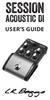 SESSION ACOUSTIC DI USER S GUIDE INTRODUCTION Inspired by the LR Baggs Handcrafted Video Sessions and our experience in some of Nashville s great studios, Session Acoustic DI brings our signature studio
Power Supplies. 1.0 Power Supply Basics. www.learnabout-electronics.org. Module
 Module 1 www.learnabout-electronics.org Power Supplies 1.0 Power Supply Basics What you ll learn in Module 1 Section 1.0 Power Supply Basics. Basic functions of a power supply. Safety aspects of working
HIGH PERFORMANCE CAR AUDIO MODEL:CR-82 8 CHANNEL ELECTRONIC CROSSOVER NETWORK SYSTEM. www.pyramidcaraudio.com
 HIGH PERFORMANCE CAR AUDIO MODEL:CR-82 8 CHANNEL ELECTRONIC CROSSOVER NETWORK SYSTEM 1 www.pyramidcaraudio.com INTRODUCTION This CR-82 is an Electronic Crossover Network with which you can install various
R S E R I E S M I X E R S R - 2 0 0 R - 1 6 0 4 R - 2 0 0 4
 R SERIES MIXERS R-200 R-1604 R-2004 THE R SERIES MIXERS The R Series of mixers from Wharfedale Professional are designed to offer a superior quality audio performance in an easy to use, great value package.
Description. 5k (10k) - + 5k (10k)
 THAT Corporation Low Noise, High Performance Microphone Preamplifier IC FEATURES Excellent noise performance through the entire gain range Exceptionally low THD+N over the full audio bandwidth Low power
C220 PRELIMINARY TUBE PREAMPLIFIER SERVICE MANUAL. SERIAL NO. WS1001 And Above C220. Serial Number W S1001 And Above CONTENTS
 Performance Specifications... 2 Notes... 2 Rear Panel... 3 Section Location... 3 Block Diagram... 5-6 Interconnection Diagram... 7-8 Main Schematic and PCB... 9-18 C220 TUBE PREAMPLIFIER CONTENTS Display
User Manual CABLE TESTER CT100. Professional 6-in-1 Cable Tester
 User Manual CABLE TESTER CT100 Professional 6-in-1 Cable Tester 2 CABLE TESTER CT100 User Manual 1. Introduction Congratulations! With the CT100, you have purchased an indispensable tool that enables you