
Algorithmic Trading, Market Efficiency and The Momentum Effect. Rafael Gamzo
|
|
|
- Mary Wilson
- 10 years ago
- Views:
Transcription
1 Algorithmic Trading, Markt Efficincy and Th Momntum Effct Rafal Gamzo Studnt Numbr: A rsarch rport submittd to th Faculty of Commrc, Law and Managmnt, Univrsity of th Witwatrsrand, in partial fulfilmnt of th rquirmnts for th dgr of Mastr of Managmnt in Financ & Invstmnt. Johannsburg, 2013 i

2 ד סב ABSTRACT Th vidnc put forward by Zhang (2010) indicats that algorithmic trading can potntially gnrat th momntum ffct vidnt in mpirical markt rsarch. In addition, upon analysis of th litratur, it is apparnt that algorithmic tradrs possss a comparativ informational advantag rlativ to rgular tradrs. Finally, th thortical modl proposd by Wang (1993), indicats that th informational diffrncs btwn tradrs fundamntally influncs th natur of asst prics, vn gnrating srial rturn corrlations. Thus, applid to th study, th thory holds that algorithmic trading would hav a significant ffct on scurity rturn dynamics, possibly vn ngndring th momntum ffct. This papr tsts such implications by proposing a thory to xplain th momntum ffct basd on th hypothsis that algorithmic tradrs possss Innovativ Information about a firm s futur prformanc. From this prspctiv, Innovativ Information can b dfind as th information drivd from th ability to accumulat, diffrntiat, stimat, analyz and utiliz colossal quantitis of data by mans of adpt tchniqus, sophisticatd platforms, capabilitis and procssing powr. Accordingly, an algorithmic tradr s accss to various complx computational tchniqus, infrastructur and procssing powr, togthr with th constraints to human information procssing, allow thm to mak judgmnts that ar suprior to th judgmnts of othr tradrs. This particular aspct of algorithmic trading rmains, to th bst of my knowldg, unxplord as an avnu or mchanism, through which algorithmic trading could possibly affct th momntum ffct and thus markt fficincy. Intrstingly, by incorporating this information variabl into a simplifid rprsntativ agnt modl, w ar abl to produc rturn pattrns consistnt with th momntum ffct in its ntirty. Th gnral thrust of our rsults, thrfor, is that algorithmic trading can hypothtically gnrat th rturn anomaly known as th momntum ffct. Our rsults giv crdnc to th assumption that algorithmic trading is having a dtrimntal ffct on stock markt fficincy. ii

3 ד סב DECLARATION I, Rafal Alon Gamzo, dclar that this rsarch rport is my own work xcpt as indicatd in th rfrncs and acknowldgmnts. It is submittd in partial fulfilmnt of th rquirmnts for th dgr of Mastr of Managmnt in Financ & Invstmnt in th Univrsity of th Witwatrsrand, Johannsburg. It has not bn submittd bfor for any dgr or xamination in this or any othr univrsity. Rafal Alon Gamzo: Signd at Wits Businss School On th 1st day of August 2013 iii
4 ד סב ACKNOWLEDGEMENTS My first apprciation gos to Hashm, G-d, King of th univrs, th most prcious thing in my lif. No words can fully xprss my dp affction, aw and rvrnc. My soul thirsts for You, my flsh longs for You, in a dry and wary land without watr. So may I look for You in th sanctuary to s Your powr and Your glory. Bcaus your lov is bttr than lif, my lips will glorify you. I will prais you as long as I liv, and in your nam I will lift up my hands. ( Thillim:63.) I would lik to xprss my gratitud to my rsarch suprvisor, Profssor Eric Schaling for his abl, insightful guidanc throughout th cours of my program. I would also lik to thank Profssor Frdrick Ahwirng-Obng and Profssor Christophr Malikan, from whom I hav bnfitd immnsly. I also xtnd my profound gratitud to all th staff at Wits Businss School for making my studis possibl. To Profssor Jann Zaidl-Rudolph and Profssor Michal Rudolph, your protction, car and wisdom hav bn a blssing to m. To my mothr and fathr, Yaron and Lindsay, whos xcptional slflssnss and ncouragmnt hav givn m mor than I could hav askd for. I am fortunat to call myslf your son. To my sistr Liat, whos unwavring support and blif has bn an inspiration to m. Last, but by no mans last, I would lik to thank my bautiful girlfrind Nisi, who has inspird m to bcom th prson I am today. For hr prayrs, patinc, lov and assistanc, I am truly gratful. iv

5 TABLE OF CONTENTS ABSTRACT II DECLARATION III ACKNOWLEDGEMENTS IV CHAPTER 1 : INTRODUCTION ) Purpos of th study ) Contxt of th study... 6 I. Th Efficint Markt Hypothsis... 6 II. Evolution and Forms of Markt Efficincy... 7 a. Wak-Form Efficincy... 8 b. Smi-strong Form Efficincy... 8 c. Strong-Form Efficincy... 8 III. Th Pric Adjustmnt Procss Implicit in th EMH... 9 IV. Markt Efficincy and th Momntum Effct V. Algorithmic Trading VI. Th Evolution of Algorithmic Trading VII VIII Algorithmic Trading and Financial Institutions Algorithmic Trading and th Momntum Effct ) Problm Statmnt ) Rsarch Objctivs... 18

6 1.6) Rsarch Qustions ) Significanc of th Study ) Structur of th Rsarch Chaptr 2: Litratur Rviw ) Introduction ) Rviw of th Currnt Litratur Concrning th EMH ) Rviw of th Currnt Litratur Concrning th Momntum Effct ) Possibl Explanations for th Momntum Effct a. Th Positiv Fdback Modl b. Th Ovrconfidnc Hypothsis ) Rational Modls and Information ) Concluding Rmarks on th Explanations for th Momntum Effct ) Rviw of th Currnt Litratur Concrning Algorithmic Trading a. Evidnc in Favour of Algorithmic Trading b. Evidnc Against Algorithmic Trading ) Th Intrplay Btwn Markt Participants and Information ) Algorithmic Trading and Asymmtric Information ) Information Driving Algorithmic Trading ) Othr Sourcs of Information Availabl to Algorithmic Tradrs ) A Possibl Explanation for Algorithmic Tradrs Informational Supriority ) Advancd Computational Tchniqus usd by Algorithmic Tradrs..47

7 ) Infrastructur and Procssing Powr ) Th Stylizd Facts about Algorithmic Tradrs ) Existing Thortical Modls ) Concluding Rmarks..63 Chaptr ) Introduction )Th Hypothsis ) Idntification of Rlvant Variabls and Stting Prior Expctations ) Rsarch Dsign and Modlling ) Rsarch Mthodology Chaptr 4: Th Modl ) A Rprsntativ Algorithmic Tradr-Agnt Modl ) Limitations..89 Chaptr 5: Discussion of th Rsults. 90 Chaptr 6 : Conclusion and Rcommndations ) Rcommndations for Furthr Rsarch 103 Rfrncs: APPENDIX A: 112

8 CHAPTER 1: INTRODUCTION Eugn Fama s (1970) Efficint Markt Hypothsis (EMH) has arguably bcom on of th most fascinating and highly contstd subjcts amongst financial profssionals and acadmics alik. Indd, th foundation of capital markt quilibrium lis on th Efficint Markt Hypothsis 1. Essntially, th Efficint Markt Hypothsis is an xtnsion of th zro profit comptitiv quilibrium condition from th crtainty world of classical pric thory to th dynamic bhavior of prics in spculativ markts undr conditions of uncrtainty 2 (Jnsn, 1978, p. 3). Inhrnt in th abov supposition is that givn th availabl information - scurity prics ar likly to xhibit unprdictabl bhavior. Accordingly, by and larg, no group of invstors should b abl to consistntly bat th markt by making consistnt positiv xcss rturns. Scurity rturn dynamics as wll as potntial trading stratgis ar fundamntally influncd by th natur and thus unprdictability of scurity prics, implicit in this Efficint Markt Hypothsis (Karmra, Ojah, & Col, 1999). Broadly spaking, th xtnt to which a financial markt is fficint has flicious consquncs for invstmnt and rsourc allocation in an conomy. This hypothsis has bn continuously and xtnsivly documntd, tstd and challngd vr sinc its incption 3. Howvr, thr has bn a growing body of financial litratur rcntly 4, highlighting aspcts of stock pric and rturn bhavior, which sm to dviat 1 It is of critical importanc that th (EMH) holds, or most of th statistical tchniqus in analyzing capital markt quilibrium such as th Capital Asst Pricing Modl (CAPM) ar opn to qustion (Huang & Yang, 1999). 2 Accordingly, a markt can b calld fficint whn prics always fully rflct availabl information (Fama, 1970, p. 383). 3 Its prominnc in financial litratur bcam most noticabl in th 1960s undr th rubric of th Random Walk Hypothss 4 Th growing availability of intraday data in th 80s and 90s allowd rsarchrs to tst informational ffcts on stock prics within minuts (Gosnll, Kown & Pinkrton, 1996). Howvr, this priod also
9 from what is considrd th norm, rgarding th traditional paradigm. Ths abnormalitis ar both baffling and difficult to rconcil with markt fficincy du to thir implications rgarding prdictability. Ths irrgularitis ar rfrrd to as markt anomalis. Among ths anomalis, th momntum ffct is probably th most difficult to xplain and rprsnt, prhaps, th strongst vidnc against th Efficint Markt Hypothsis 5. Following Hong and Stin (1999), th momntum ffct can b viwd as an umbrlla trm ncompassing two prvasiv, intrconnctd phnomna. That is, firstly, th phnomna of xcss stock rturns tnding to xhibit unconditional positiv srial corrlation in th short to mdium-run (short-trm momntum) and scondly, th phnomna of xcss rturns tnding to xhibit ngativ srial corrlation in th long-run (long-trm rvrsals). Takn togthr ths two intrconnctd phnomna rprsnt th momntum ffct in its ntirty. Indd, studis on this subjct hav bgun to viw short-trm momntum and long-trm rvrsals as insparabl phnomna. (Hong and Stin, 1999). This momntum ffct is rgardd as on of th most puzzling anomalis of financ. Qustions surrounding th undrlying causs for th abov anomaly hav bn and may rmain mpirically unrsolvd for a whil. Adding to th complxity of th issu, financial markts ar sn to hav undrgon trmndous structural changs sinc th aformntiond studis wr conductd. Rcnt tchnological innovations hav facilitatd an xtraordinary volution in capital markt structur, as wll as considrably altring th procsss undrlying scurity rturns. witnssd th intllctual dominanc of th fficint markt hypothsis bcoming far lss univrsal. For xampl, Kim and Stambaugh (1986) found stock prics can b prdictd using crtain forcast tchniqus basd on crtain prdtrmind variabls. 5 Ths abnormalitis cast a considrabl doubt on th validity of th Capital Asst Pricing Modl, and hnc, markt fficincy. (Alagidd & Panagiotidis, 2009, p. 9). Indd, Fama and Frnch (1996) point out that th momntum ffct constituts th main mbarrassmnt for thir thr-factor modl (s also Fama and Frnch (2008)) 2

10 All things considrd it sms indcorous to nglct ths tchnological innovations and its possibl ffcts on markt fficincy whn analyzing th issus highlightd abov - this rmains a cntral thm of our rsarch. On of th ky dvlopmnts stmming from ths tchnological advancs falls undr th rubric of algorithmic trading. According to Zhang (2010), as of 2009, algorithmic trading accountd for as much as 78% of all U.S. quity trading volum. Algorithmic trading is commonly dfind as th us of computr algorithms to automatically mak trading dcisions, submit ordrs, and manag thos ordrs aftr submission (T. Hndrshott & Riordan, 2009, p. 2). Algorithms hav volvd into som of th most sophisticatd trading programs, making us of cutting dg mathmatical modls and xtraordinary procssing powr in ordr to implmnt profitabl trading stratgis. Thy mploy rlvant statistical and conomtric tchniqus via advancd computr and communication systms at xtrmly high spds and ar capabl of anticipating and intrprting rlativly short-trm markt signals, in ordr to implmnt profitabl trading stratgis. A dbat comprising widly opposing opinions has transpird rgarding th bnfits and risks associatd with algorithmic trading. Th Jury is still out, howvr, rgarding its ovrall ffct on th fficincy of financial markts. Proponnts of algorithmic trading hav linkd its prsnc to incrasd liquidity 6 and/or improvd pric discovry 7 in both forign xchang and quity markts. (Hndrshott, Jons & Mnkvld, 2011; Chaboud, Hjalmarsson, Vga & 6 Hndrshott, Jons and Mnkvld (2011) argu that for all stocks, and spcially larg-cap stocks, automatd trading incrasd liquidity. Chaboud, Hjalmarsson,Vga and Chiquoin (2009), using th 1993 to 1997 priod, posit that automatd trading tnds to slightly incras liquidity provisions in th forign xchang markts aftr xognous markt vnts such as nws announcmnts. 7 Brogaard (2010) in his analysis on th impact of algorithmic trading on markt quality finds that algorithmic trading adds to th procss of pric discovry, but finds mixd rsults on its ability to supply liquidity to th markt. Hndrshott and Riordan (2011) xamind th impact of algorithmic trading on th pric discovry procss in US quity markts. Ovrall th authors obsrvd that marktabl algorithmic trads activly driv prics towards thir long-trm fundamntal valu, thrby aiding th pric discovry procss. 3
11 Chiquoin, 2009; Brogaard, 2010, and Hndrshott & Riordan, 2011). Whilst, opponnts argu that it crats an atmosphr of instability and information infficincy (Smith, 2010, and Zhang, 2010). Evidnc to dat is still inconclusiv. Consistnt with th momntum ffct, Zhang (2010) finds that algorithmic trading hindrs th incorporation of fundamntal information into asst prics. His papr rvals that prics dviat systmatically from thir fundamntal valus whn algorithmic trading is mor vidnt, rsulting in thir rgrssion in subsqunt priods. Rlying on U.S. quity markt data, Zhang showd that in trms of conomic magnitud, on standard dviation incras in algorithmic trading also incrasd pric raction to fundamntal information by 8%. Although not xplicitly considrd in his papr, th findings suggst th prsnc of a momntum ffct- which was prviously attributd to bhavioral factors such ovrconfidnc and subjctiv slf-attribution bias 8 - and that this ffct can b bttr xplaind by algorithmic trading. Morovr, Smith (2010) finds that algorithmic trading is influncing th microstructur of quity transactions, xhibiting drastically highr dgrs of slf-similarity 9. Evidnc thus far sms to lnd itslf to th possibility of a rlationship btwn algorithmic trading and th momntum ffct. Howvr, attributing causality- by accrditing algorithmic trading with ngndring th momntum ffct- rmains prmatur. 8 S for xampl, Danil, Hirshlifr and Subrahmanyam, 1998, or sction of this papr, possibl xplanations for th momntum ffct, for a mor dtaild dscription of ovrconfidnc and subjctiv slf-attribution bias. 9 Slf-similarity is usually calculatd using th Hurst xponnt, H, which masurs th rlativ dgr of slf-similarity from pur Markovian Browninan Motion. For mor information s Smith (2010). His analysis posits that, as a rsult of algorithmic trading, markts ar bginning to xhibit fdback ffcts at xtrmly short timscals. 4
12 In brif, th momntum ffct and thus rturn prdictability has dominatd discussions on th Efficint Markt Hypothsis, yt no clar rasons or causs of th phnomna hav bn stablishd. Th initial prcption fails to tak into account th trmndous changs that hav takn plac in financial markts, consquntly, nglcting th rol playd by algorithmic trading in this complx dynamic rlation. Furthr, th vidnc put forward by Zhang (2010) indicats that algorithmic trading can potntially gnrat th momntum ffct vidnt in th rsarch, howvr, du to algorithmic trading s rlativly rcnt mrgnc, th litratur is yt to xamin this dirctly. Mor prcisly, th litratur is yt to produc a thortical modl that invstigats whthr algorithmic trading can gnrat th momntum ffct. Thrfor, this rsarch intnds to invstigat th contmporanous and dynamic rlationship btwn algorithmic trading, th momntum ffct and stock markt fficincy by focusing, formost, on th impact algorithmic trading has on scurity pricing and rturn dynamics (markt fficincy). Mor spcifically, algorithmic trading s ability to gnrat short-run momntum and subsqunt long-trm rvrsals (th momntum ffct). If on taks into considration th wll documntd nxus btwn th momntum ffct and stock markt fficincy as wll as considring th possibility of algorithmic trading ngndring this obsrvd phnomnon, it sms appropriat to invstigat algorithmic trading, th momntum ffct and stock markt fficincy in unison. 1.2) Purpos of th Study Th main purpos of this rsarch is to xamin th availabl litratur on capital markt fficincy in ordr to provid a prmis with which to discuss and valuat th critical issus raisd by th anomalistic fatur of th Efficint Markt Hypothsis, namly, th momntum ffct. This analysis intnds to complmnt still inconclusiv acadmic litratur on ths topics by drawing upon both concptual framworks and indicativ 5

13 vidnc obsrvd in th U.S. markts. Mor importantly an assssmnt will b mad on whthr this obsrvd phnomnon can b xplaind by algorithmic trading in th capital markt. In an ffort to advanc on causality, this study will attmpt to produc a rprsntativ modl, incorporating faturs that fit wll with th stylizd facts about algorithmic trading. This is don in ordr to idntify th thortical mchanism through which algorithmic trading may possibly gnrat this obsrvd phnomnon. 1.3) Contxt of th Study i) Th Efficint Markt Hypothsis Whn Fama (1970) assmbld a comprhnsiv rviw of thortical and mpirical vidnc of markt fficincy h proposd a thory known as th Efficint Markt Hypothsis (EMH). Accordingly, a markt can b calld fficint whn prics always fully rflct availabl information (Fama, 1970, p. 383) Th concpt of an fficint markt can b illustratd by th following short story: A studnt and hr financ profssor ar both walking down th busy campus hall whn thy both notic a $100 not lying on th floor. As th studnt bnds down to pick up th mony sh notics a disappointd look on hr profssor s fac. Th profssor subsquntly says to th studnt, Don t bothr. If th mony was rally thr, somon ls would hav pickd it up alrady (Malkil, 2003). Th Efficint Markts Hypothsis is simpl in principl, but rmains lusiv. Undr th rubric of th Random Walk Hypothsis, th Efficint Markt Hypothsis suggsts that th path that a stock pric follows should display no discrnibl pattrn, thus prcluding any knowldg of past prics as a mans of prdicting futur stock prics. A simpl vrsion of th Random Walk Hypothsis is that th 6
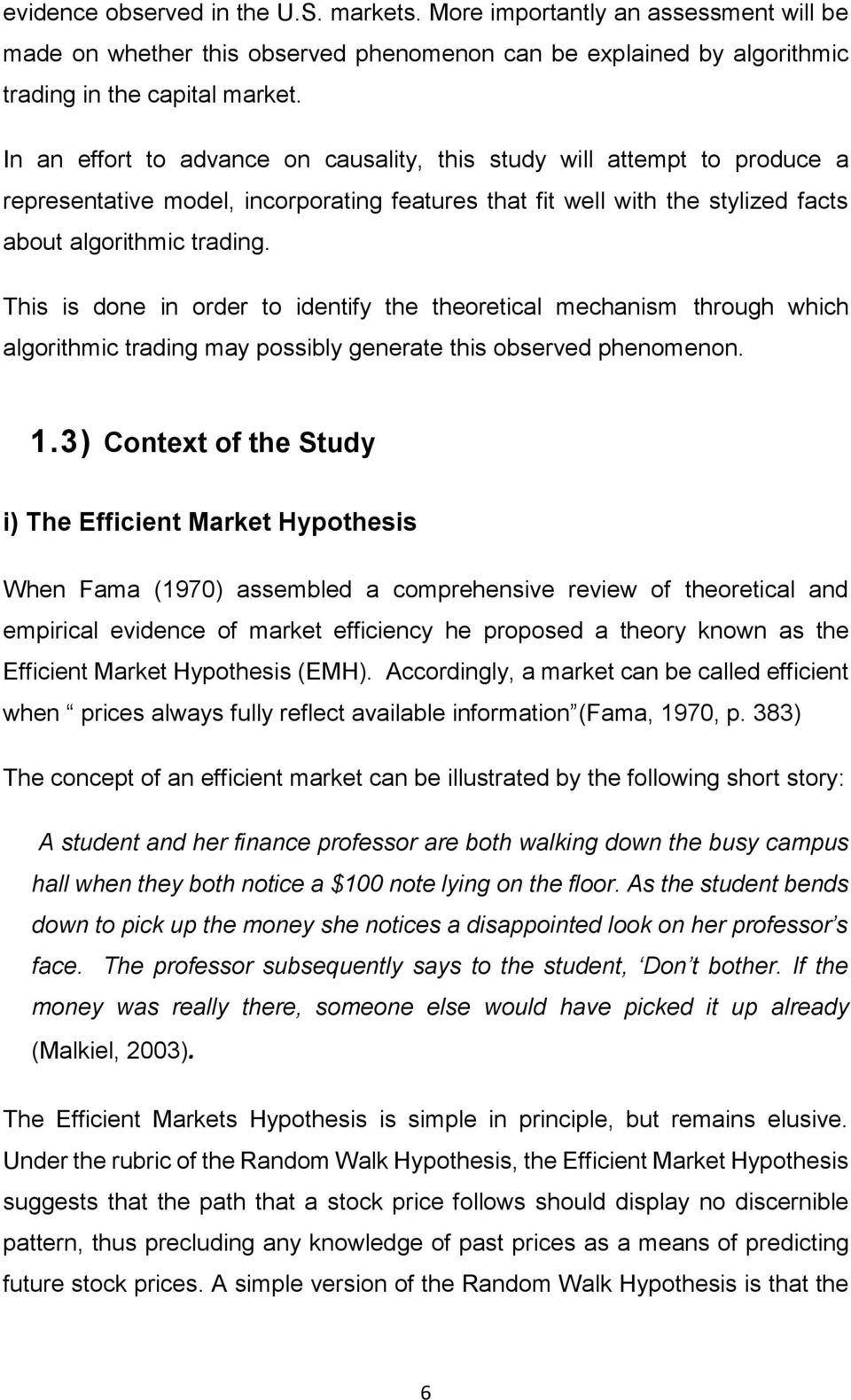
14 pric of a stock today is th pric of a stock ystrday plus an unprdictabl rror trm: Y t = a + Y t 1 + t Mor prcisly th abov quation is rfrrd to as a random walk with a drift 10. This ida has bn applid xtnsivly to thortical modls and mpirical studis of financial scuritis prics, gnrating considrabl controvrsy as wll as fundamntal insights into th pric-discovry procss 11. Th importanc of th Random Walk Hypothsis cannot b undrstatd. It is crucially important that th random walk hypothsis holds, or most of th statistical tchniqus in analyzing capital markt quilibrium such as CAPM ar opn to qustion (Huang & Yang, 1999, p. 3). ii) Evolution and Forms of Markt Efficincy A markt is said to b fficint rgarding som particular information if that information is not ffctiv in arning positiv xcss rturns. Historically th volution of mpirical work on markt fficincy bgan primarily with what is rfrrd to as wak form tsts. Hr, studis wr concrnd mrly with past pric (or rturn) historis. This typ of tst is considrd th outcom of random walk litratur. Aftr numrous tsts confirmd fficincy at this lvl, studis bgan to focus on smi-strong form tsts which wr concrnd with th tim takn for prics to adjust to all publically availabl information 12. Finally, strong form tsts, whr, monopolistic accss to information by any invstors, was of intrst. As a rsult thr diffrnt forms of markt fficincy mrgd. Ths forms ar laboratd blow: 10 In th tru random walk modl a would = If stock prics ar gnratd by a random walk (possibly with drift), thn, for xampl, th varianc of monthly sampld log-pric rlativs must b 4 tims as larg as th varianc of a wkly sampl. (Lo & MacKinlay, 1988, p. 53) 12 For xampl, dividnd announcmnts, sasond public offrings or stock splits. 7

15 A) Wak-Form Efficincy This typ of fficint markt suggsts that th currnt pric of a shar rflcts its own past prics. In othr words all information about historical prics has alrady bn incorporatd into th currnt shar pric. Thus prics fully rflct th historical information of past prics and rturns. B) Smi-Strong Form Efficincy Smi- strong form fficincy is rgardd as th most controvrsial fficincy form. It proposs that all publicly availabl information 13, including all historical information is rflctd in th shar pric. C) Strong-Form Efficincy With strong form fficincy, all information, both public and privat is rflctd in currnt markt prics. This form of fficincy is probably bst viwd as a bnchmark against which any dviations from markt fficincy can b analyzd. It is of particular intrst to not that any information st in th strong form includs th information st in th smi strong form, which in turn includs th information st in th wak form and thrfor th particular sts of information usd in th thr forms of markt fficincy ar considrd nstd. Figur 1, blow, displays th thr information sts for markt fficincy. 13 Information such as annual rports, nws announcmnts and conomic data. 8
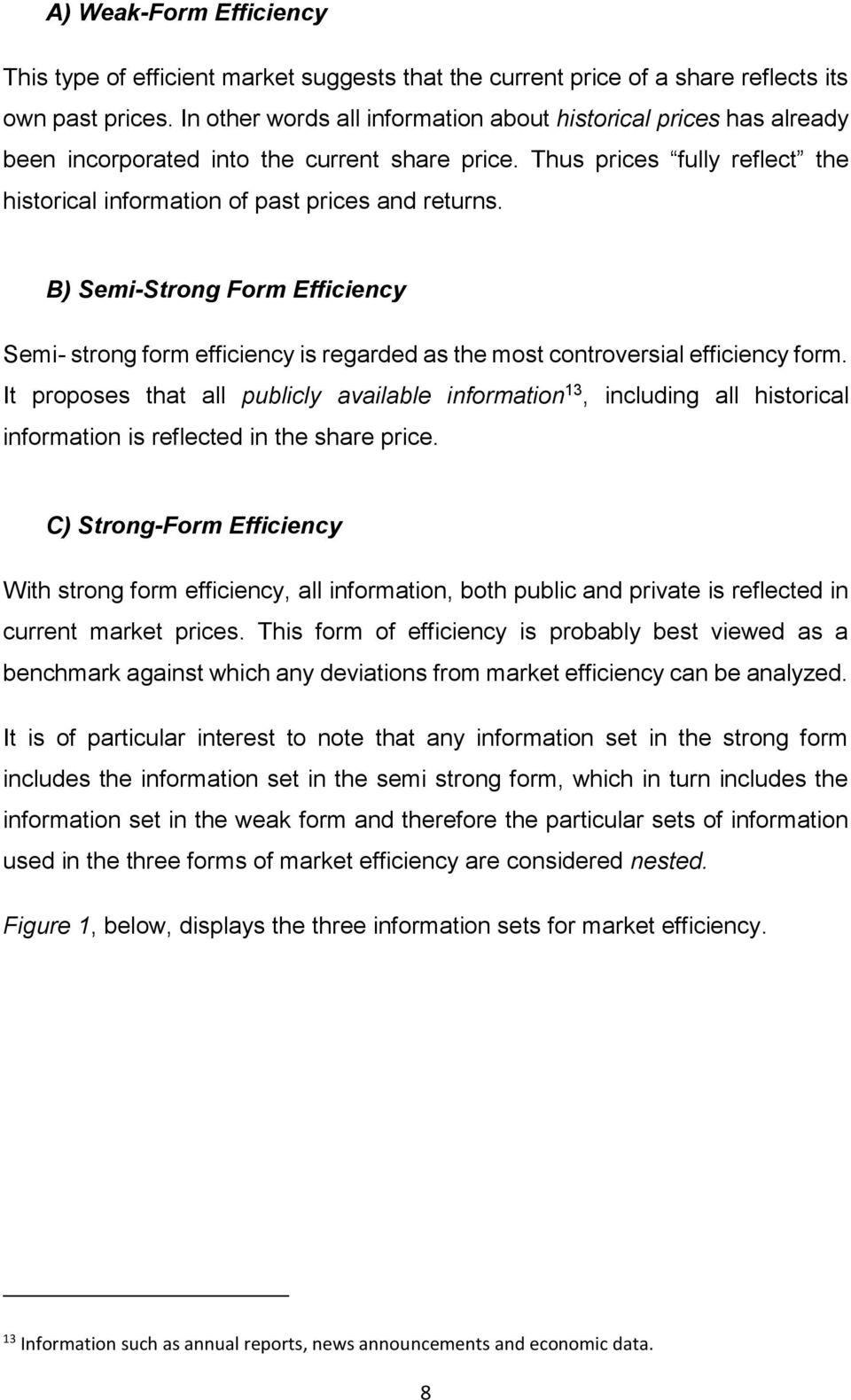

16 Figur 1 FIGURE 1- INFORMATION SETS FOR MARKET EFFICIENCY - SOURCE: FUNDAMENTALS OF INVESTMENTS, VALUATION AND MANAGEMENT P.229. iii) Th Pric Adjustmnt Procss Implicit in Efficint Markt Hypothsis Stock pric changs ar as a rsult of frqunt purchass and sal of shars. In an fficint markt, invstmnt dcisions ar basd on a dtrmination of a shar s fundamntal valu 14. According to th Efficint Markt Hypothsis any unxpctd firm-spcific nws announcmnt should rsult in an instantanous pric adjustmnt, whr th nw pric fully rflcts th availabl information, and hnc, its fundamntal valu. Unxpctd nws announcmnts might includ, for xampl, dividnd incras announcmnts. This typ of announcmnt is a positiv nws announcmnt 15 and should rsult in on of thr possibl pric adjustmnt procsss. Th thr possibl procsss ar as follows: 14. Fundamntal valu rfrs to th valu of a scurity which is intrinsic to or containd in th scurity itslf. It can b ascrtaind by calculating th prsnt valu of futur cash flows, discountd at th appropriat risk-fr rat. 15 Millr and Rock (1985) hypothsiz that invstors draw infrncs about implid changs in xpctd cash flows from corporat dividnd announcmnts, suggsting dividnd incrass rprsnt good nws for invstors. 9
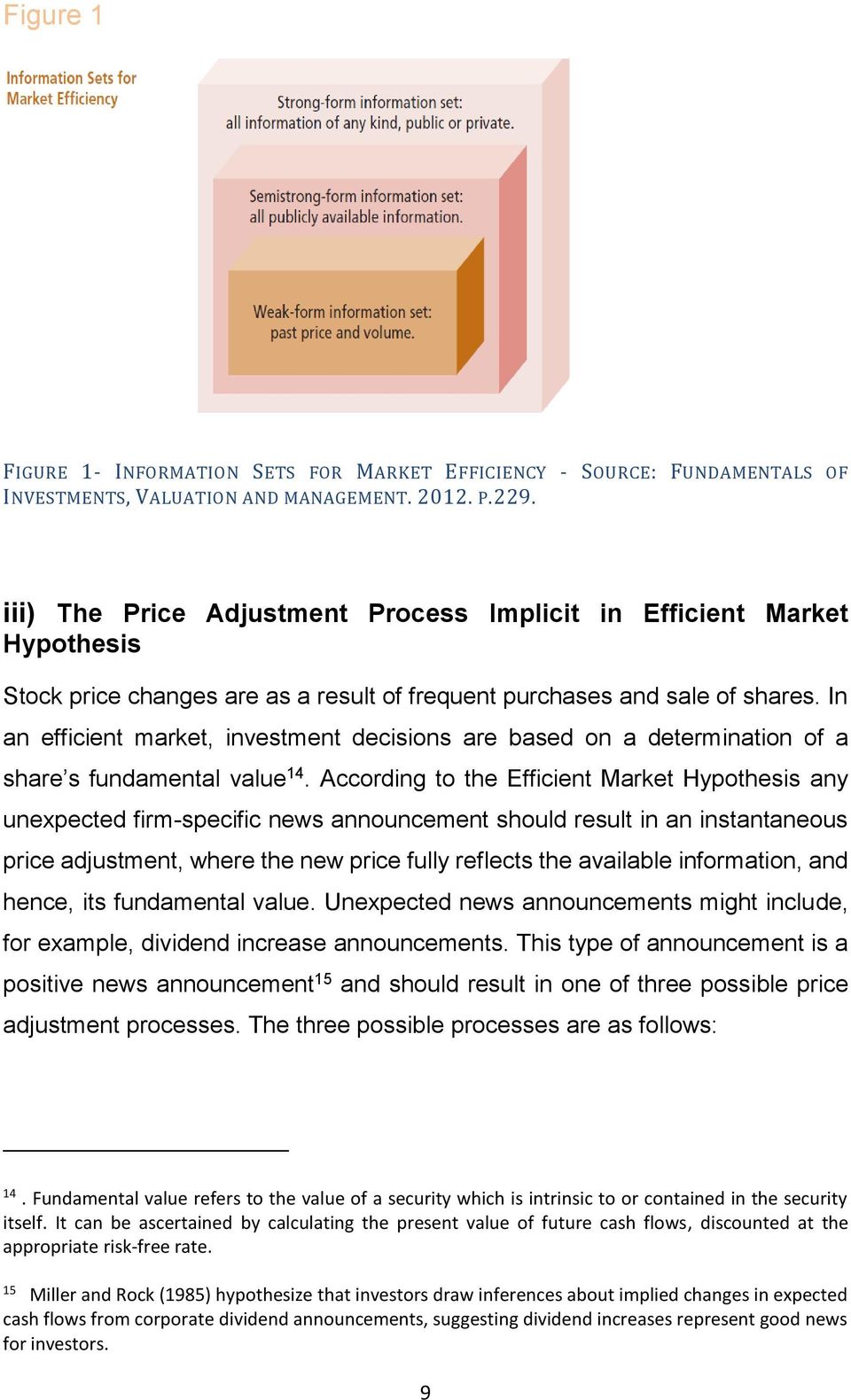

17 Efficint Markt Raction: Th pric should immdiatly adjust to its nw fundamntal valu which rflcts all availabl information. Thr should not b a tndncy toward subsqunt changs. Dlayd Pric Raction: Th pric displays partial adjustmnt and thrfor trnds towards its fundamntal valu. Howvr a significant amount of tim lapss bfor it rflcts this nw information. Ovrraction and Corrction: Th pric initially ovrracts to th nw information, vntually corrcting to its intrinsic valu. Figur (2) provids an xampl of th thr ways in which prics can ract to positiv unxpctd nws. Figur 2 FIGURE 2- POSSIBLE MARKET PRICE REACTIONS TO A NEWS ANNOUNCEMENT- SOURCE: FUNDAMENTALS OF INVESTMENTS, VALUATION AND MANAGEMENT P229 10
18 iv) Markt Efficincy and th Momntum Effct Dspit dcads of rsarch, an xtnsiv body of rcnt financial litratur has producd vidnc on scurity rturns that sharply contrasts th traditional viw that scuritis ar rationally pricd to rflct all publicly availabl information. Ths findings confirm th prsnc of a markt anomaly known as th momntum ffct. Evidnc of th momntum ffct amount to th most controvrsial aspct of th dbat on stock markt fficincy. Two of th mor prvasiv phnomna associatd with th momntum ffct hav thus far bn idntifid. 1) Positiv short to mdium trm autocorrlation of rturns (short-trm momntum). 2) Ngativ autocorrlation of prior short-trm rturns (long-trm rvrsal). In fact, prominnt thortical modls in this ara such as Barbris, Shlifr and Vishny (1998), Danil, Hirshlifr and Subrahmanyam (1998) and Hong and Stin (1999) all trat short-trm momntum and long-trm rvrsals as insparabl phnomna. Th longr trm aspct of th momntum ffct, long trm rvrsals, was first documntd by D Bondt and Thalr (1985). Thy show that ovr 3- to 5-yar holding priods stocks that wr xtrm losrs ovr th initial 3 to 5 yars achiv highr rturns than stocks that prformd wll ovr th sam priod. Following D Bondt and Thalr, Jgadsh and Titman (1993) provid vidnc of shortr-trm, rturn continuations. That is, prior to th ngativ rturn corrlations documntd by D Bondt and Thalr (1985), xcss rturns tndd to xhibit positiv srial corrlations in th short to mdium horizon. Thy show that stocks that prform bst ovr a 3 to 12 month priod tnd to continu to prform wll ovr th subsqunt 3 to 12 months and stocks that prform th worst ovr a 3 to 12 month priod tnd to continu to prform poorly ovr th subsqunt 3 to 12 months. 11
19 Th vidnc implis that th combinations of a positiv rturn corrlation at short horizons and vntual man rvrsion at long horizons constitut th momntum ffct in its ntirty. Howvr, th availabl litratur has found mixd mpirical vidnc rgarding th momntum ffct, dpnding on xchang spcific variabls, such as stag of dvlopmnt, rlativ tim and frquncy of transactions. Th availabl litratur has yt to pinpoint th xact mchanism through which this anomaly taks plac. V) Algorithmic Trading Rcnt tchnological innovations hav rvolutionizd th way in which financial markts oprat. Ths advancs hav rsultd in trmndous changs in th structur of financial markts and hav an important baring on th procsss undrpinning scurity pricing and rturn dynamics. Two important intrconnctd tchnological changs hav bn associatd with this dvlopmnt. Firstly, computr tchnology has nabld invstors th ability to automat thir trading procsss and scondly, xchangs hav r-organizd thmslvs to th xtnt that mostly all markts ar now lctronically opratd. Th procss by which th scuritis trading bcam lctronic can b tracd as far back as th 1970s, whn, NASDAQ 16, prviously known as th National Association of Scuritis Dalrs (NASD) mbarkd on a computr assistd systm for automatd quotation in th Unitd Stats (Frund, 1989). This ld to th obsolscnc of physical trading floors, allowing for automatd lctronic trading systms to dominat. Information tchnology has progrssd to such a lvl that it can now b found at vry stag of th trading procss. A ky dvlopmnt stmming from ths advancs falls undr th rubric of algorithmic trading. Essntially, algorithmic trading is computr-dtrmind trading, utilizing supr computrs and complx algorithms that dirctly intrfac 16 National Association of Scuritis Dalrs Automatd Quotations. 12

20 with trading platforms at high spd, placing ordrs without immdiat human intrvntion. Thy mploy rlvant statistical and conomtric tchniqus via advancd computr and communication systms and ar capabl of anticipating and intrprting rlativly short-trm markt signals in ordr to implmnt profitabl trading stratgis 17. Consquntly, algorithmic trading has bcom a crucial comptitiv factor for capabl markt participants. A distinctiv sub catgory of algorithmic trading that has grown rcntly is known as high frquncy trading. Howvr, to dat, thr has not bn a unanimously accptd acadmic or rgulatory dfinition of high frquncy trading 18. According to Brogaard (2010), high frquncy trading is computr dtrmind trading whrby stocks ar bought and sold by an automatd algorithm at high spds and hld for a vry short priod, usually sconds or millisconds. Howvr sinc th typical proprtis of high frquncy trading could also dfin algorithmic trading, it bcoms xtrmly challnging to distinguish btwn th two. Adding to th complxity of th issu, som high frquncy trading stratgis ar sn to hav no spcial spd rquirmnt. (Tradworx 2010a). In ordr to lucidat th distinction btwn algorithmic trading and high frquncy trading w tak a mor gnral approach, by assuming that algorithmic trading is a hyponym including all its substs, including but not limitd to high frquncy trading. This viw is supportd by Abrgl, Bouchaud, Foucault, Lhall, and Rosnbaum (2012). This approach allows us to avoid th fals dichotomy oftn associatd with algorithmic trading and high frquncy trading. Th focus thn bcoms on th natur of th trading stratgis codd by th algorithms thmslvs. Thrfor, to summariz, algorithmic trading is dfind as computr-dtrmind trading, utilizing supr computrs and complx algorithms which dirctly intrfac 17 Brogaard (2010) posits that algorithmic tradrs gnrat gross trading profits of approximatly $2.8 billion annually and sharp ratios of about S Gombr, Arndt, Lutat and Uhl (2011), Appndix II- Acadmic and Rgulatory Dfinitions of Algorithmic Trading, pp
21 with trading platforms at high spd, placing ordrs without immdiat human intrvntion. It (algorithmic trading) mploys cutting dg mathmatical modls, adpt computational tchniqus and xtraordinary procssing powr via advancd computr and communication systms and is capabl of anticipating and intrprting rlativly short-trm markt signals in ordr to implmnt profitabl trading stratgis. VI) Th Evolution of Algorithmic Trading Dtailing th progrssion of algorithmic trading rquirs that algorithms b classifid into four gnrations. This is basd on th work of Almgrn (2009) and includs information from Johnson (2010) and Linwbr (2009) as wll as, Gombr, Arndt, Lutat and Uhl (2011). First gnration trading algorithms wr th rsult of a natural progrssion in basic ordr slicing. Thy involvd th ralization of spcific pr-dtrmind bnchmarks, such as th Tim Wightd Avrag Pric (TWAP) 19. Ths arly algorithms wr likly statically drivn and basd on spcific trading schduls. Howvr, du to th anticipatory natur of ths trading schduls, markt participants would oftn tak advantag of thir rgular trading pattrns. Scond gnration algorithms wr mor multifarious than thir prdcssors and sought to manag th trad-off btwn markt impact and timing risk. Th most prominnt scond gnration algorithms wr implmntation shortfall algorithms. Implmntation shortfall algorithms trid to rduc th markt impact of larg ordrs by considring th possibility of advrs pric ractions during th xcution procss (timing risk). In ordr to avoid this, ths algorithms prdtrmin an xcution plan basd on historical data, and split an ordr into 19 An xampl is givn by Gombr, Arndt, Lutat and Uhl (2011): TWAP algorithms divid a larg ordr into slics that ar snt to th markt in qually distributd tim intrvals. Bfor th xcution bgins, th siz of th slics as wll as th xcution priod is dfind. For xampl, th algorithm could b st to buy 12,000 shars within on hour in blocks of 2,000 shars, rsulting in 6 ordrs for 2,000 shars which ar snt to th markt vry 10 minuts. TWAP algorithms can vary thir ordr sizs and tim intrvals to prvnt dtction by othr markt participants. ( p. 24) 14
22 as many as ncssary but as fw as possibl sub ordrs. (Gombr, Arndt, Lutat & Uhl, 2011) Third gnration algorithms, oftn rfrrd to as adaptiv algorithms, follow a much mor sophisticatd approach. Instad of following a pr-dtrmind schdul, thy ar adaptiv in natur. Maning thy ar abl to r-valuat and chang thir xcution schdul with changing markt conditions. Th most rcnt dvlopmnt in th algorithmic trading domain concrns th so calld fourth gnration algorithm. Ths algorithms us incrasing lvls of mathmatical and conomtric sophistication and includ modls of markt forcasting, markt impact and markt risk. Thy hav accss to a wid varity of scuritis and drivativs and combin quantitat and non-quantitat mthods in ordr to forcast rlativly short-trm markt movmnts. Ths complx algorithms ar capabl of accumulating, stimating and utilizing colossal quantitis of information in ordr to dtct th kind of pattrns and vnts that tradrs look for thmslvs. Howvr thy do this for hundrds or thousands of scuritis simultanously at vry high spd. Most importantly, thy sk to xploit information byond th traditional data, including nws, pr-nws and othr forms of information. (Linwbr, 2009) Considring that contmporary rlvanc dmands a notric prspctiv, w focus primarily on ths so calld fourth gnration algorithms. VII) Algorithmic Trading and Financial Institutions In ordr to gnrat additional incom, larg financial institutions and invstmnt banks incrasingly mploy stat-of-th-art algorithmic and information tchnology as part of thir trading activitis 20. In fact incom from ths trading activitis is progrssivly rplacing rvnu from traditional activitis such as 20 Concptually, a financial institution s trading portfolio contains rlativly short trm -liquid assts, ranging from as short as on day to on yar. 15
23 dposit taking and lnding 21. Institutional invstors utiliz advancd algorithms in ordr to conduct, for xampl, basic position trading and risk arbitrag. With position trading, institutions buy larg blocks of scuritis on th xpctation of a favorabl pric mov. Whil risk arbitrag ntails, purchasing blocks of scuritis in anticipation of som information rlas. Institutions that ngag in algorithmic trading us advancd computr programs to accss and procss vast amounts of data in ordr to succssfully initiat th abov trads. Also by utilizing algorithms thy ar abl to trad larg quantitis gradually ovr tim, thrby minimizing markt impact and implmntation costs (Saundrs & M. Corntt, 2011). VIII) Algorithmic Trading and th Momntum Effct Acadmic rsarch concrning th impact of algorithmic trading is still in its infancy and, as such, paprs documnting its association with spcific markt anomalis such as th momntum ffct rmain, rlativly unxplord. Howvr, that bing said, a rcnt papr by Frank Zhang (2010) quats to, prhaps, th closst work documnting this association. A short summary of th findings will b discussd blow. By using a sampl that contains all stocks covrd by th Cntr for Rsarch in Scurity Prics (CRSP) and th Thompson Rutrs Institutional Holdings databas btwn th 1st quartr of 1985 and th 2nd quartr of 2009, Zhang (2010), attmptd to xamin algorithmic trading s association with both pric volatility and th markt s ability to incorporat fundamntal nws into stock prics. 21 This rsults in financial institutions having to manag a growing arnings uncrtainty (markt risk). 16
24 As algorithmic trading is not dirctly obsrvabl, Zhang (2010) proposd a novl way of stimating it, that is, by quating it to all th trading activitis not includd in th 13f databas. Th rasoning bhind this approach is as follows. Th Unitd Stats Scuritis and Exchang Commission (SEC) rquir institutions with ovr $100 million in Assts undr Managmnt (AUM) to rport thir long trm holdings in th 13f quartrly rport of quity holdings. Ths institutions includ hdg funds, invstmnt companis, pnsion funds, insuranc companis, univrsity ndowmnts, banks and many othr typs of profssional invstmnt advisors. Crucially short positions ar not rquird to b disclosd and thus xcludd from th rport. Thus by masuring trading volum rlativ to institutional portfolio changs in quartrly 13f filings, Zhang (2010) was abl to captur trading frquncis gratr than thos of long trm traditional invstors (Scuritis and Exchang Commission, 2013). Ovrall, th vidnc indicatd that algorithmic trading incrass stock volatility. Th positiv corrlation btwn algorithmic trading and stock pric volatility is strongr for stocks in th invstabl univrs, strongr for stocks with high institutional holdings, and strongr during priods of high markt uncrtainty (Zhang, 2010, p. 24) Howvr, th rason that his rsarch quats to, prhaps, th closst work documnting th association btwn algorithmic trading, th momntum ffct is sn in th scond aspct of his invstigation, namly algorithmic trading s association with th markts ability to incorporat fundamntal nws into stock prics. By using analysts arnings rvisions and.arnings surpriss to proxy for fundamntal nws, Zhang dtrmind that algorithmic trading dtracts for th markts ability to incorporat nws into prics, whrby, prics tndd to ovrshoot thir fundamntal valus, rsulting in thir rgrssion in subsqunt priods. Intrstingly this algorithmic trading-rlatd pric raction and subsqunt rvrsal is consistnt with th momntum ffct documntd in financial markts. 17
25 Zhang s articl provids valuabl insight into th dynamic rlationship btwn algorithmic trading, th momntum ffct and stock markt fficincy. Howvr, th undrlying thortical mchanism bhind this rlationship rmains unknown, incrasing th ncssity for furthr invstigation. 1.4) Problm Statmnt Th momntum ffct and thus rturn prdictability has dominatd discussions on markt fficincy, yt no clar rasons or causs of th phnomna hav bn stablishd. Th initial prcption fails to tak into account th trmndous changs that hav takn plac in financial markts, consquntly, nglcting th rol playd by algorithmic trading in this complx dynamic rlation. Sub Problm Th vidnc put forward by Zhang (2010) indicats that algorithmic trading can potntially gnrat th momntum ffct vidnt in th rsarch, howvr, du to algorithmic trading s rlativly rcnt mrgnc, th litratur is yt to produc a thortical modl that xamins this rlation dirctly. 1.5) Rsarch Objctivs This rsarch intnds to invstigat th rlationship btwn algorithmic trading, th momntum ffct and stock markt fficincy by focusing, formost, on th impact algorithmic trading has on scurity pricing and rturn dynamics. Mor spcifically, algorithmic trading s association with short-run momntum and subsqunt long-trm rvrsal. Sub Aims To analyz from th litratur, th thortical mchanism through which, algorithmic trading can possibly gnrat th momntum ffct. Propos a thortical modl that is bttr suitd to dscrib th world of algorithmic trading. 18
26 Produc a rprsntativ modl, incorporating faturs that fit wll with th stylizd facts about algorithmic trading, in ordr to ascrtain whthr, thortically, algorithmic trading can gnrat th momntum ffct. 1.6) Rsarch Qustions Can algorithmic trading potntially gnrat th momntum ffct? If algorithmic trading can gnrat th momntum ffct, what is th undrlying mchanism? Can this mchanism b modlld by a rprsntativ agnt mod? 1.7) Significanc of th Study Th aim of this papr is to mak a contribution to th rsarch on markt fficincy and its associatd anomaly, th momntum ffct, by studying th impact of algorithmic trading on scurity pricing and rturn dynamics. Th main focus will b on U.S. quity markts. Primary invstigations into th Efficint Markt Hypothsis yild xtnsiv support for markt fficincy. Howvr, it is important to not that th majority of ths studis wr conductd bfor th advnt of algorithmic trading. Adding to this, thr has bn a growing body of mpirical litratur of lat which dos not support th fficint markt hypothsis. Could an analysis of algorithmic trading b a catalyst for th furthr growth of such contradictory vidnc? Prvious studis on th rlationship btwn markt fficincy and th momntum ffct hav bn limitd by thir xclusion of nw dvlopmnts such as algorithmic trading in thir analysis. Thus, thr is a nd for furthr invstigation that is consistnt with th currnt stat of th capital markt. 19
27 Du to algorithmic trading s rlativly rcnt mrgnc, this papr sms to b on of th first to dirctly invstigat whthr, thortically, algorithmic trading can gnrat th momntum ffct. Evaluating th rlationship btwn algorithmic trading and its rlativ ffcts on markt fficincy is of intrst to both invstmnt practitionrs and financial acadmics. In addition, th finding of th study is xpctd to assist policymakrs undrstand th rlativ impact algorithmic trading has had on financial markts in th U.S., thus allowing thm to gaug th rlativ risks associatd with it, in ordr to mak informd policy dcisions. 1.8) Structur of th Rsarch I. Chaptr 2 prsnts a rviw of th prvious works on markt fficincy, th momntum ffct and algorithmic trading, as wll as considring th thortical links btwn ths thr factors. II. Chaptr 3 provids an ovrviw of th rsarch dsign and mthodology utilizd in this study to ascrtain th ffcts of algorithmic trading on markt fficincy. Th conomtric mthodology is also discussd in this chaptr. III. Chaptr 4 prsnts a thortical modl IV. Chaptr 5 rports th rsults of th study. IV. Chaptr 6 provids th conclusion of th study and rcommndations for furthr rsarch. 20
28 CHAPTER 2: LITERATURE REVIEW 2.1) Introduction This sction provids a rviw of th prvious works on markt fficincy, th momntum ffct and algorithmic trading, as wll as considring thir thortical links. 2.2) Rviw of th Currnt Litratur Concrning th Efficint Markt Hypothsis According to Eugn F. Fama (1970): Th primary rol of th capital markt is allocation of ownrship of th conomy s capital stock. In gnral trms th idal is a markt in which prics provid accurat signals for rsourc allocation: That is, a markt in which firms can mak production -invstmnt dcisions, and invstors can choos among th scuritis that rprsnt ownrship of firms activitis undr th assumption that scurity prics at any tim fully rflct all availabl information. A markt in which prics always fully rflct availabl information is calld fficint. (p. 383). Th qustion, as to what th phras fully rflct mans, thus ariss. Its ambiguity rsults in a situation whr it lacks th ability to b mpirically tstabl. In ordr to crat a situation in which it is tstabl, thr is a nd for gratr spcification rgarding th pric formation procss. In dtrmining what is mant by th phras fully rflct, on could argu that markt quilibrium can b statd in trms of xpctd rturns, whrby, conditional on a spcific informational st, th quilibrium xpctd rturn is a function of its risk (Fama, 1970). Gnrally xpctd rturn thoris can b dscribd algbraically as follows: E(p j,t+1 θ t ) = [1 + E(r j,t+1 θ t )] p jt, 21
29 Whr: E = xpctd valu oprator p jt, = pric of scurity j at tim t p j,t+1 = pric of scurity j at tim t + 1 r j,t+1 = prcntag rturn at tim t + 1 θ t = th st of fully rflctd information in th pric at tim t Whr; p j,t+1 and r j,t+1 ar random variabls at tim t. Th spcific chosn xpctd rturn thory would dtrmin E(r j,t+1 θ t ), th valu of th xpctd rturn in quilibrium, on th basis of th information st θ t.th quation implis that th information in θ t is fully utilizd in dtrmining quilibrium xpctd rturns, thrfor θ t if fully rflctd in th formation of th pric p jt,. By assuming that conditions of markt quilibrium can b statd in trms of xpctd rturns and that quilibrium rturns ar formd on th basis of information in θ t has major mpirical implications: thy rul out th possibility of trading systms basd only on information in θ t that hav xpctd profits or rturns in xcss of quilibrium xpctd profits or rturns (Fama, 1970, p. 385). Th abov modl of markt fficincy is oftn rfrrd to as th xpctd rturn or fair gam modl. Howvr, th fair gam modl mrly says that conditions of markt quilibrium can b statd in trms of xpctd rturns, and it has littl to say about th stochastic procss gnrating rturns (Fama, 1970). Thrfor, th random walk modl, whr th squnc of past rturns is of no consqunc in dtrmining distributions of futur rturns, should b viwd as an xtnsion of th xpctd rturn modl. It crats a mor dtaild statmnt about th spcific conomic nvironmnt. Thr ar many variations of th random walk modl 22, but formally it is dfind as follows: 22 S pag 7 of this papr. 22
30 F(r j,t+1 θ t ) = F(r j,t+1 ), Whr futur pric changs ar indpndnt and idntically distributd. In his papr on stock pric bhavior, Eugn Fama (1970) rviwd th thortical and mpirical litratur on th fficint markts modl. His primary objctiv was to crat a clar, up-to-dat pictur of th work conductd thus far. His work stablishd th first cohrnt summary of th diffrnt aspcts of markt fficincy; in so doing, Fama (1970) cratd a formal sparation and catgorization of information substs into wak, smi-strong and strong form tsts of markt fficincy. Aftr thorough invstigation th argumnt was mad that thr was minimal (if any) vidnc against th strong form tst and no vidnc against th wak and smi-strong form tsts. Evidnc against th strong form tsts wr disrgardd bcaus, at th tim, thr was no indication of monopolistic accss to information bing a prvalnt issu among invstors. Intrstingly, th currnt qustions surrounding algorithmic tradr s accss to mor sophisticatd information sms to crat an atmosphr in which to contst th abov finding. Ar th abov rsults still applicabl, or could thy simply b a product of th tim instad of dscribing fundamntal rsults? At th tim, th majority of vidnc smd consistnt with th Efficint Markt Hypothsis. Any rsults indicating quity rturn prdictability wr summarily found insignificant, and prics wr viwd as following a random walk. Support for th Random Walk Hypothsis was vidnt from th rsults of Osborn (1959) and Cootnr (1964) whn tsting th hypothsis using historical data. Similarly, th srial corrlation tsts of Moor (1962) also smd to indicat vidnc in support of th modl. In th studis, succssiv pric changs displayd srial corrlation cofficints that wr xtrmly clos to zro, thus ruling out chang dpndncy. A plthora of subsqunt studis mrgd as a rsult of th strong support for th Efficint Markt Hypothsis. A common thm was to invstigat quity pric ractions to unxpctd nws announcmnts (Ball & Brown, 1968). Th rsults 23
31 typically showd that stock prics adjustd somwhat instantanously to th vnt, an infrnc that is in lin with th Efficint Markt Hypothsis. Th growing availability of intraday data in th 80s and 90s allowd rsarchrs to tst informational ffcts on stock prics within minuts (Gosnll, Kown, & Pinkrton, 1996).Howvr, this priod also witnssd th intllctual dominanc of th Efficint Markt Hypothsis bcoming far lss univrsal. Many financial conomists and statisticians bgan to bliv that stock prics ar at last partially prdictabl. Paprs bgan to uncovr mpirical vidnc pointing to stock rturn prdictability. For xampl, Kim and Stambaugh (1986) found stock prics can b prdictd using crtain forcast tchniqus basd on crtain prdtrmind variabls. In addition, Lo and MacKinlay (1999) rjct th Random Walk Hypothsis aftr finding svral statistically significant short-trm srial corrlations. A positiv srial corrlation in this contxt would b viwd as vidnc of short-trm momntum. This crats an opportunity for invstors to arn xcss rturns through an invstmnt stratgy of buying aftr priods with positiv rturns and slling aftr priods of ngativ rturns. 2.3) Rviw of th Currnt Litratur Concrning th Momntum Effct Dspit dcads of rsarch, an xtnsiv body of rcnt financial litratur has producd vidnc on scurity rturns that sharply contrasts th traditional viw that scuritis ar rationally pricd to rflct all publicly availabl information. Ths findings confirm th prsnc of a markt anomaly known as th momntum ffct. Evidnc of th momntum ffct amount to th most controvrsial aspct of th dbat on stock markt fficincy. Th prvasiv anomalous rturns associatd with th momntum ffct ar dscribd as bing anomalous bcaus thy cannot b xplaind by th capital asst pricing modl (CAPM) of Sharp (1964) and Lintr (1965). 24
32 Two of th mor prvasiv phnomna associatd with th momntum ffct hav thus far bn idntifid. 1) Positiv short to mdium trm autocorrlation of rturns (short-trm momntum). 2) Ngativ autocorrlation of prior short-trm rturns (long-trm rvrsal). In fact, prominnt thortical modls in this ara such as Barbris, Shlifr and Vishny (1998), Danil, Hirshlifr and Subrahmanyam (1998) and Hong and Stin (1999) all trat short-trm momntum and long-trm rvrsals as insparabl phnomna. Th longr-trm aspct of th momntum ffct, long trm rvrsals, was first documntd by D Bondt and Thalr (1985). Thy show that ovr 3 to 5 yar holding priods stocks that wr xtrm losrs ovr th initial 3 to 5 yars achiv highr rturns than stocks that prformd wll ovr th sam priod. Following D Bondt and Thalrs, Jgadsh and Titman (1993) provid vidnc of shortr-trm rturn continuations. That is, prior to th ngativ rturn corrlations documntd by D Bondt and Thalr (1985), xcss rturns tndd to xhibit positiv srial corrlations in th short to mdium horizon. Thy show that stocks that prform bst ovr a 3 to 12 month priod tnd to continu to prform wll ovr th subsqunt 3 to 12 months and stocks that prform th worst ovr a 3 to 12 month priod tnd to continu to prform poorly ovr th subsqunt 3 to 12 months. Th vidnc implis that th combinations of a positiv rturn corrlation at short horizons and vntual man rvrsion at long horizons constitut th momntum ffct in its ntirty. Subsquntly invstigating th momntum ffct in stock markts bcam a worldwid phnomnon (Kang, Liu & Ni, 2002; Hong, L & Swaminathan, 2003 ; Snyman 2011). Evidnc to dat sms to indicat that, in trms of countris, th momntum ffct is shown to b strongr in th dvlopd markts, than in 25
33 th mrging markts 23. This sms to suggst that stock markt dvlopmnt plays an important rol in th momntum ffct ) Possibl Explanations for th Momntum Effct Fama (1998) idntifid profitabl momntum stratgis as th on outstanding anomaly in modrn financ. On of th prmir xplanations for this anomaly rvolvs around invstor psychology and blongs to a fild of study aptly namd bhavioral financ. Bhavioral financ sks to bttr undrstand how motions and cognitiv rrors influnc invstors in th dcision-making procss. As prviously statd th momntum ffct ncompasss two intrconnctd phnomna. That is both short-trm momntum and long-trm rvrsals. Howvr modls consistnt with both ths ffcts ar rlativly scarc. Som bhavioral modls ar abl to xplain short-trm momntum but not longtrm rvrsals (Brk, Grn & Naik, 1999; Holdn & Subrahmanyam, 2002; Makarov & Rytchkov, 2012.) Othr modls can justify long-trm rvrsals but not short-trm momntum. For xampl, Wang (1993) prsnts a dynamic asst-pricing modl undr th assumption that invstor s possss diffrnt information rgarding th xpctd futur growth rat of rturns. By diffrntiating btwn informd and uninformd invstors, h dtrmins that information asymmtry among markt participants can rsult in highr pric volatility and ngativ autocorrlation in rturns. His discovry of an association btwn information asymmtry and ngativ auto corrlations provids significant insight into th possibl procss undrlying th rvrsal aspct of th momntum ffct. Wang (1993) attributs th ngativ srial corrlation to th man rvrsion in th undrlying variabls that affct xpctd xcss rturns. H assums that information asymmtry nhancs this ngativ corrlation whn uninformd participants only larn about ths stat variabls from ralizd rturns, thus incrasing xpctd futur rturns dpndnc on past rturns. (S also Lwlln & Shankn, 2002 and Fama & Frnch, 2008). 23 (Rouwnhorst, 1998; Griffin, Ji, & Martin, 2003; Muga & Santamaria, 2007.) 26
34 Howvr, rgarding th momntum ffct in its ntirty, thr ar a small numbr of modls consistnt with both ths phnomna. Two of th most notabl xcptions ar th positiv fdback modl of D Long, Shlifr, Summrs, and Waldmann (1990) and th invstor ovrconfidnc hypothsis of Danil, Hirshlifr and Subrahmanyam (1998). a) Th Positiv Fdback Modl D Long, Shlifr, Summrs, and Waldmann (1990) in thir study of invstor bhavior, prsnt an mpirically significant argumnt against th standard prcption that rational spculators stabiliz asst prics. Thir analysis posits that in th prsnc of positiv fdback tradrs 24, th actions of rational spculators can dstabiliz prics. Thy argu that whn thr ar numrous fdback tradrs in a spcific markt, actions of rational spculators xaggrat pric trnds. An xampl of this is givn by D Long t al. (1990). Accordingly, whn a rational spculator rcivs good nws, thy rcogniz that subsqunt trading on this information will rsult in a pric incras, which would incntiviz fdback tradrs to purchas th shars. In anticipation of such a raction, informd invstors buy mor today, and so thy driv prics up today mor than is implid by th fundamntal nws vnt. Tomorrow, th uninformd invstors buy in rspons to th prior pric incras and thus kp prics abov thir fundamntals, vn as rational invstors sll out thir positions and stabiliz prics. Thir modl gnrats a positiv corrlation of stock rturns at short horizons, as positiv fdback tradrs rspond to past pric incrass by flowing into th markt, and ngativ corrlations of stock rturns at long horizons, as prics vntually rturn to thir fundamntal (D Long t al,1990,p.381). Thus, thir modl is abl to gnrat th momntum ffct in its ntirty. 24 For xampl, invstors that purchas scuritis whn prics ris and sll whn prics fall. S D Long t al. (1990). 27
35 b) Th Ovrconfidnc Hypothsis Danil, Hirshlifr and Subrahmanyam (1998) postulat that scurity markts initial ovrraction and subsqunt rvrsal is a rsult of two wll-known prsonal psychological biass, namly: Invstor ovrconfidnc rgarding privat information and subjctiv slf-attribution. Accordingly, an ovrconfidnt invstor is on who ovrstimats th prcision of his privat information signal, but not of information signals publicly rcivd by all (Danil t al., 1998, p. 4). Slf-attribution bias 25 on th othr hand, suggsts that invstors attribut thir succss to thir own prsonal ability, yt failurs ar attributd to xtrnal uncontrollabl forcs, thus giving wight to thir achivmnts instad of thir failurs. By including slf-attribution bias in thir modl, confidnc lvls chang from bing fixd to an outcom dpndnt variabl. Thus, an invstor s confidnc riss if subsqunt public information confirms thir privat signal, but falls only by a small amount if th public information dos not confirm th privat signal. As a rsult, th slf-attribution bias will oftn rinforc ovrconfidnc. By dmonstrating that short-run positiv autocorrlations can b consistnt with long-run ngativ autocorrlations, thir analysis confirms th pattrns found by prvious litratur on th momntum ffct ) Rational Modls and Information With th xcption of a minor compndium of bhavioral modls, rational modls usually follow th informd/ uninformd- invstor paradigm (Grossman, 1976). According to Grossman (1976) informd invstors ar thos that hav information about th futur stats of th world, whil th uninformd invstors do not. This 25 A thory strongly rlatd to cognitiv dissonanc whr th individual disrgards information that conflicts with past choics. S Bm (1965). 28
36 diffrntial informdnss aspct of markts, commonly rfrrd to as information asymmtry, implis that som invstors ar bttr than othrs whn it coms to intrprting financial information and ar, as a consqunc, bttr at forcasting futur markt movmnts. According to Brown, Richardson and Schwagr (1987), this supriority is mostly drivn by informd invstor s accss to both mor timly information and a broadr st of information on which to bas forcasts. By and larg, th intrplay btwn markt participants and information has provn to b an important trnd in modl dvlopmnt and rsarch dsign. Th currnt approach mphasizs th information contnt of accounting data and its association with currnt and futur firm valu 26. This mthodology and philosophy highlights not only stock bhavior in raction to accounting data but also its association with futur arnings ) Concluding Rmarks on Explanations for th Momntum Effct Bhavioral financ sms to provid a plausibl xplanation for th obsrvd momntum ffct. Howvr bhavioral conomics is an volving disciplin, and as such, rquirs constant rvisions and adaptations in ordr to b applicabl in th currnt nvironmnt. In an nvironmnt whr up to 77% 27 of total volum tradd is a rsult of algorithmic trading, it sms somwhat inappropriat to nglct algorithmic trading and its possibl ffcts in th analysis of th momntum ffct. 26. Whr, th information contnt in accounting data is primarily masurd by th markt s raction to arning announcmnts. (Whit, 2006) 27 S Brogaard (2010). 29
37 2.4) Rviw of th Currnt Litratur Concrning Algorithmic Trading Th traditional papr systms that brokrs, dalrs, and spcialists usd during trading quickly lost its appal during th 1960s du to th massiv growth in trading volum. This paprwork crisis put significant prssur on floor tradrs and sriously affctd oprations on th NYSE. Th rsult was th introduction of th first lctronic ordr routing systm by Thn in th 1980 s th NYSE upgradd thir ordr systm to SuprDot. This dvlopmnt facilitatd th growth of a typ of programd trading, whr invstors could xcut larg ordrs of multipl trads simultanously. This typ of trading is not algorithmic trading, pr s, but shars many of its charactristics. By th 90s, th advancs in tlcommunications and computr tchnology rsultd in many xtnsiv changs. A ky xampl of this was th introduction of altrnativ trading platforms such as th ECN 28, whr buyrs and sllrs ordrs could b matchd at much fastr rats and without traditional brokrs or dalrs. In 2000, a truly groundbraking dvlopmnt occurrd. This was th dcimalization of th pric quots on US stocks. Dcimalization mad it much asir for computr algorithms to trad and conduct arbitrag. It cratd a platform in which algorithmic trading could thriv (Smith, 2010). Bing a rlativly nw phnomnon, rsarch that xamins algorithmic trading dirctly is still limitd. A srious obstacl in conducting rsarch on this topic is data availability. That bing said, a small but growing group of acadmic paprs hav bgun to addrss qustions surrounding algorithmic trading, mainly focusing on markt quality paramtrs and issus rgarding its profitability and fairnss. Th vidnc to dat is still inconclusiv. 28 Elctronic Communications Ntwork. 30
38 Th majority of vidnc indicats that algorithmic trading is having a positiv influnc on th markt. Yt thr is growing litratur which is smingly critical of algorithmic trading. Blow is a short rviw of th most notworthy vidnc in favour of and against algorithmic trading. a) Evidnc in Favour of Algorithmic Trading An important modl that xamins th thortical impact of algorithmic trading on markt quality 29 was conductd by Cvitanic and Kirilnko (2010).Thy crat a thortical modl that adds algorithmic tradrs (machins) into a markt populatd by non-algorithmic tradrs. In thir modl algorithmic tradrs do not possss any informational advantags ovr th traditional invstor. Th only diffrnc btwn normal and algorithmic tradrs machins is that th lattr hav th advantag of having th ability to submit and cancl ordrs at fastr rats than traditional tradrs Thy find that by introducing th algorithmic tradrs into th modl, transaction costs and thir distributions tnd to chang. Cvitanic and Kirilnko (2010) show that th introduction of th machin improvs th ovrall forcastability of transaction costs as thy ar mor cntrd around th man. In lin with th abov study, Jarncic and Snap (2010) catgoriz algorithmic tradrs into on of 6 groups. Th 6 catgoris ar as follows: Rtail invstors Low latncy 30 participants Small institutions Invstmnt banks Larg institutions Traditional markt makrs 29 Mor spcifically, invstigat th impact of algorithmic trading on transaction prics, trading volum and intr-trad duration. 30 High spd markt participants that ract to markt vnts in th milliscond nvironmnt. With latncy dfind as th tim takn to discovr an vnt. 31
39 Thir rsults indicat that algorithmic tradrs tnd to improv liquidity * ovr tim and ar mor likly to dampn volatility than incras it. Furthrmor, Angl, Harris and Spatt (2011) studid th impact of rgulatory and structural changs in U.S. quity markts for priod 1993 to Thy show that algorithmic trading has significantly improvd markt quality, pointing to th dramatic dcras in xcution spds and bid ask sprads. Thy also propos that trading costs hav dclind and liquidity has incrasd in th prsnc of algorithmic trading. On thir invstigation into low latncy trading (Algorithmic trading), Hasbroak and Saar (2011) obsrv that low latncy trading succssfully lowrs bid ask sprads, incrass quity markt dpth and lowrs short trm volatility. Thir work was consistnt with that of Chaboud, Hjalmarsson,Vga and Chiquoin (2009), who posit that automatd trading tnds to slightly incras liquidity provisions in th forign xchang markts aftr xognous markt vnts such as nws announcmnts during 1993 to Howvr, thy do not that algorithmic trading systms hav lss divrs stratgis and xhibit highr corrlation than thos of human tradrs. Also, in thn Euro-Dollar and Dollar-Yn markts, th two most tradd currncy pairs, algorithmic trading has lss impact on pric discovry than thir traditional human countrparts. Brogaard (2010), in his analysis on th impact of algorithmic trading on markt quality finds that algorithmic trading adds to th procss of pric discovry, but finds mixd rsults on its ability to supply liquidity to th markt. Brogaard (2010) also finds that algorithmic trading gnrats larg rvnus 31. Howvr h nglcts to tak into account how ths positiv xcss rturns impact markt fficincy. Intrstingly th findings suggst that a larg portion of algorithmic tradrs tnd to follow a pric rvrsal stratgy. 31 Gnrating gross trading profits of approximatly $2.8 billion annually and sharp ratios of about
40 Lastly Martinz and Rosu (2011) show that as algorithmic tradrs ntr th markt, th markt xhibits lss volatility and bcoms mor stabl. b) Evidnc Against Algorithmic Trading Prdominantly, algorithmic tradrs attmpt to forcast rlativly short-trm markt movmnts. Thrfor, it may b appropriat to bgin with a short rviw of th rsarch concrning th bhavior and thus, impact that short-trm trading has on markt fficincy. Thr hav bn svral acadmic paprs that hav focusd on short-trm trading and its rlativ impact on th quity markt. Th majority of ths studis wr conductd vn bfor th incption of algorithmic trading and rsultd in vidnc that was in sharp contrast to th classic Efficint Markt Hypothsis. Th two most influntial paprs ar brifly discussd blow. Froot, Scharfstin and Stin (1992) conductd rsarch mor than a dcad bfor th algorithmic trading ra, focusing primarily on th implications of shorttrm trading. Thy find that short-trm invstmnt horizons affct th natur of asst prics, lading to a spcific typ of informational infficincy. Accordingly, short-trm spculators sm to xhibit a form of hrding that may rsult in dcisions bing mad on th prmis of information unrlatd to th to th asst s fundamntal valu. Thy conclud that short-trm tradrs focus too havily on short trm information and, as a consqunc, thy dcras th informational quality of markt prics and advrsly affct th Efficint Markt Hypothsis. In a similar vin, D Long, Shlifr, Summrs and Waldmann (1990) conductd thir rsarch on th impact of short-trm invsting as wll as nois trading 32. Thy found that thir prsnc rsultd in asst prics divrging from thir fundamntal valus, implying that th traditional trading activitis of tradrs can b sn as a rspons to nois rathr than fundamntal information. 32 Nois trading is trading on nois as if it wr information. Black (1986, p.531) 33
41 Takn togthr, th abov vidnc sms an implicit suggstion that, in th currnt contxt, algorithmic trading would b dtrimntal to th informational quality of asst prics du to its short-trm natur. Evidnc against algorithmic trading spcifically will b discussd blow: A growing numbr of studis, som of which ar basd on mor rcnt and mor xtnsiv data ar producing rsults that ar critical of algorithmic trading. This growth is arguably a rsult of a singl vnt known as th Flash Crash of May th 6 th, Th Flash Crash rsultd in th largst singl-day point dclin in th history of th Dow Jons Industrial Avrag (998.5). For about 5 minuts approximatly $1 trillion in markt valu had disappard, only to bounc back just as quickly. Th two most affctd markts appard to b th futurs markt and th quitis markt. Although th xact dgr to which algorithmic trading was rsponsibl for th Crash rmains unknown, it sms clar from th vidnc blow that it was a major contributing factor. Th Flash Crash According to a rport publishd by th SEC (2010), two sparat liquidity incidnts occurrd on that day: Th liquidity crisis in broad indx lvl in th E-Mini futurs markt Th liquidity crisis in individual stocks Blow is a brif dscription dtailing th vnts that ld to th Flash Crash of May, 2010: On th 6 th of May 2010 a larg sll ordr 33 was initiatd by a tradr via an automatd trading algorithm, programd to fd ordrs into th E-Mini futurs 33 St to 9% of th trading volum calculatd ovr on minut arlir. S SEC (2010). 34
42 markt. This sll algorithm was st to ignor markt pric and markt timing and only focus on quantity. Th sll prssur was initially absorbd by 3 distinct markt participants: Othr algorithmic tradrs sking to profit from th subsqunt pric incrass. Traditional buyrs in th futurs markt. Cross markt arbitragrs (who transfrrd this sll prssur to th quitis markts by opportunistically buying E-Mini contracts and simultanously slling individual quitis in th S&P 500 Indx) Th abov nt buyrs subsquntly accumulatd tmporary long-trm positions. Howvr, about 60 % of algorithmic tradrs nt long positions wr sold. Th rsulting growth in volum promptd th initial sll algorithm to fd mor ordrs into th markt, vn though th prvious ordrs had not yt bn fully absorbd by th othr participants. Th rsult was a drop in E-Mini prics by about 3% in just 240 sconds. Nvrthlss, by 2:45 pm th Stop Logic Function saw a paus in trading for about 5 sconds, rsulting in a dcras in sll sid prssur and an incras in buy sid prssur. This was followd, almost immdiatly, by pric stabilization and rcovry. Ovrall in just th four and a half minuts from 2:41pm prics on th E-Mini had sunk by mor than 5%, only to rcovr momnts latr. 35
43 FIGURE 3- E-MINI VOLUME AND PRICE. SOURCE: SECURITIES, & COMMISSION, E. (2010). FINDINGS REGARDING THE MARKET EVENTS OF MAY 6, P. 19 Th othr liquidity criss occurrd in th quitis markt approximatly 30 sconds bfor trading rsumd in th E-Mini markt at about 2:45 pm. Around 8000 individual stocks wr tradd, with th majority displaying similar pric dclins and rvrsals as thos in th E-Mini futurs markt. Ovr 20,000 trads across mor than 300 scuritis wr xcutd at prics mor than 60% away from thir valus just momnts bfor ( SEC, 2010, p.1) By th nd of th day, major futurs and quitis indics rcovrd to clos at losss of about 3% from th prior day. Although an intra-day vnt, th Flash Crash of 2010 cannot b considrd inconsquntial. On th contrary, many hav argud that th Flash Crash of May th 6 th 2010 rprsnts th strongst vidnc in support of th hypothsis that algorithmic trading has a dstabilizing ffct on th markt. Prhaps th rarity of officially commissiond studis furthr mphasizs its importanc. Th SEC providd a short summary of th lssons to b larnt from th Flash Crash of 2010: 36
44 On ky lsson is that undr strssd markt conditions, th automatd xcution of a larg sll ordr can triggr xtrm pric movmnts, spcially if th automatd xcution algorithm dos not tak prics into account. Morovr, th intraction btwn automatd xcution programs and algorithmic trading stratgis can quickly rod liquidity and rsult in disordrly markts. As th vnts of May 6 dmonstrat, spcially in tims of significant volatility, high trading volum is not ncssarily a rliabl indicator of markt liquidity (SEC, 2010, p.6). Th Flash Crash brought to light algorithmic trading s ability to xacrbat pric movmnts in tims of financial strss. Th qustion now ariss as to whthr or not th sam can b said undr normal circumstancs. Zhang (2010) xamind th impact of algorithmic trading in a broadr conomic contxt using th priod Using data from th CRSP and th Thomson Rutrs Institutional Holdings databass in th U.S., h addrssd two important conomic issus surrounding algorithmic trading: Whthr algorithmic trading was associatd with pric volatility. Th ffct that algorithmic trading had on th markt s ability to incorporat nws concrning th firm s fundamntals into stock prics. Aftr controlling fundamntal firm-spcific volatility, as wll as othr xognous volatility variabls, Zhang found a positiv corrlation btwn algorithmic trading and stock pric volatility. H rvald that a on standard dviation incras in algorithmic trading activity is associatd with a 5.6% ris in volatility. Thn, by using dividnd surpriss and analysts forcast rvisions as proxis for firm fundamntal information nws, h providd vidnc that algorithmic trading was ngativly associatd with th markt s ability to incorporat nws about fundamntals into asst prics. His papr showd that prics smd to dviat systmatically from thir fundamntal valus whn algorithmic trading was mor vidnt. In fact, on standard dviation incras in algorithmic trading also incrasd pric raction to fundamntal information by 8%. 37
45 Although not xplicitly considrd in his papr, th findings suggst that th momntum ffct, which was prviously attributd to bhavioral factors such ovrconfidnc, could b bttr xplaind by algorithmic trading activitis. This rmains a cntral thm of th rsarch. In 2011, Biais, Foucault & Moinas (2011) analyzd th ffct of algorithmic trading on th markt as a whol. Thir work was on of th first to highlight th social impact 34 of algorithmic trading. By postulating a thortical modl, in which algorithmic tradrs hav a spd advantag ovr ordinary tradrs, thy found that th introduction of algorithmic trading can hav has two opposing ffcts. On th on hand it can incras an invstor s chanc of finding a countrparty to trad with, whilst, on th othr hand, it is capabl of gnrating informational asymmtris btwn slowr tradrs and algorithmic tradrs. From th abov it sms vidnt that information undrpins th majority of algorithmic trading impact dtrminations, such as th pric impact to information rlass or vn informational asymmtris btwn algorithmic tradrs and non-algorithmic tradrs. Thus, any analysis taking th informational aspcts of algorithmic trading into account sms appropriat ) Th Intrplay Btwn Markt Participants and Information By and larg, th intrplay btwn markt participants and information has provn to b an important trnd in financial markt rsarch. Apropos markt information, a larg amount litratur has bgun to addrss rlatd issus of information diffrntials and its subsqunt markt ffcts (Grossman, 1976). This information diffrntial, commonly rfrrd to as information asymmtry, ariss whn information is known to som, but not all markt participants. Th 34 In ordr to hav a positiv impact on socity, a financial markt should b fair, ordrly and transparnt and invstors should b abl to dtrmin th bst possibl pric for an asst with minimum ffort. This typ of markt would tnd to limit th information asymmtris btwn issurs, invstors and thir agnts that could lad to a loss of confidnc and dsir to participat. 38
46 currnt approach mphasizs th distinction btwn informd and uninformd markt participants. Rgarding this informd/ uninformd- invstor paradigm, informd invstors ar sn to b thos invstors that hav privat information about th futur stats of th world, whil th uninformd invstors ar thos that do not (Grossman, 1976). This sms to imply that som invstors ar bttr than othrs whn it coms to intrprting financial information and ar, as a consqunc, bttr at forcasting futur markt movmnts. According to Brown t al. (1987) this supriority or advantag is mostly drivn by informd invstor s accss to both mor accurat and timly information as wll as a broadr st of information on which to bas forcasts. Information asymmtry is closly rlatd to th problm of advrs slction. According to Grossman (1979): Th problm of advrs slction ariss as a manifstation of asymmtrical information in any markt in which buyrs and sllrs ar not qually informd about th charactristics of th htrognous commoditis thy xchang. (p.336) Consistnt with th litratur on information asymmtry, Wang (1993) prsnts a dynamic asst-pricing modl undr th assumption that invstors possss diffrnt information rgarding th xpctd futur growth rat of rturns. By diffrntiating btwn informd and uninformd invstors, h dtrmins that information asymmtry among markt participants can rsult in highr pric volatility and ngativ autocorrlation in rturns ) Algorithmic Trading and Asymmtric Information Acadmic rsarch concrning th impact of algorithmic trading is still in its infancy. A srious obstacl in conducting rsarch on this topic is data availability. That bing said, a small but growing group of acadmic paprs hav bgun to addrss qustions surrounding algorithmic trading, mainly focusing on markt quality paramtrs and issus rgarding its profitability and fairnss. Th vidnc to dat is still inconclusiv. Th vast majority of studis rgarding algorithmic trading hav coalscd around th ida that algorithmic tradrs possss a comparativ advantag rlativ to rgular tradrs. Th litratur 39
47 (Hndrshott & Riordan, 2011; Foucault, Biais & Monias, 2013; Brogaard, Hndrshott & Riordan, 2012) has typically focusd on a spd advantag. For xampl, Hndrshott and Riordan (2011) obsrv that ordrs initiatd by fast algorithmic tradrs hav mor of a prmannt impact on prics than thos initiatd by slowr, non-algorithmic tradrs, and that th advantag of bing abl to act on rlvant information bfor othr markt participants is sufficint to ovrcom th bid-ask sprad. Accordingly du to this spd advantag, Hndrshott and Riordan viw algorithmic tradrs as supriorly informd. Thir rsults ar consistnt with thos of Brogaard, Hndrshott and Riordan (2012) who suggst that algorithmic tradrs, as a rsult of thir spd advantag, impos advrs slction on rgular tradrs. In lin with th abov, Foucault, Biais and Monias (2013) indicat that this spd advantag allows ths tradrs (algorithmic tradrs) to forcast futur markt movmnts somwhat ffctivly. As writtn by Foucault, Biais and Monias (2013), th ability of fast tradrs to collct and procss markt information that will b also availabl to slow tradrs, but a fw sconds or millisconds latr, is a form of forknowldg. (p.6). Fittingly, Hirshlifr (1971) dfins forknowldg as th knowldg of vnts that will occur in du tim. Nvrthlss, apart from th spd dimnsion thr rmains an additional aspct inhrnt in algorithmic trading affording firms a comparativ advantag rlativ to traditional tradrs. In fact Kirilnko, Andri, Pt Kyl, Mhrdad Samadi, and Tugkan Tuzun (2011), writ that possibly du to thir spd advantag or suprior ability to prdict pric changs, algorithmic tradrs ar abl to buy just bfor th prics ar about to incras. (p.20). Thir analysis highlights th possibility of an altrnativ to th spd diffrntial bing th only sourc of inquity. Howvr th qustion ariss as to how, if not as rsult of thir spd advantag, algorithmic tradrs can b viwd as supriorly informd? In ordr to idntify and xplicat an altrnat sourc of inquality btwn algorithmic tradrs and non-algorithmic tradrs, w provid a brif ovrviw of 40
48 th informational sourcs availabl to algorithmic trading practitionrs, as wll as considring thir rlvanc to informational asymmtry ) Information Driving Algorithmic Trading Information is an indispnsabl componnt of th algorithmic trading organization, ssntially driving thir trading activitis. Th qustion ariss as to what kind of information is bing usd by algorithmic tradrs in thir dcision making procss. Brogaard (2011) was on of th first to highlight som of th diffrnt typs of information driving algorithmic trading activitis. Accordingly his work addrssd a varity of diffrnt information avnus availabl to th algorithmic tradrs. Information was summarily catgorizd as blonging to ithr lgitimat or illgitimat sourcs. According to Brogaard (2011), th most important lgitimat sourcs ar as follows: Ordr book dynamics Trad dynamics Past stock rturns Cross asst corrlations Cross stock corrlations Ordr Book Dynamics By listing intrstd transacting partis 35, th ordr book contains important information rgarding th supply and dmand aspcts of an asst. Rsarch has pointd out that ordr books contain significant prdictiv information (Parlour, 1998). Numbrs, Siz, Bst bid and offr proximity, Squnc, Duration and vn canclld ordrs ar all usful signals containd in ordr books. Thus, via th us of sophisticatd computrs that utiliz vry advancd mathmatical modls, algorithmic tradrs ar abl to analyz and utiliz all th information containd in ordr books, in quantitis that sm intrinsically impossibl for human tradrs. 35 B it thos who ar looking to buy or thos who ar willing to sll. 41
49 Trad Dynamics Information rlvant to th short trm dirctional pattrns of stock prics is oftn containd in actual trads. Data such as siz of past trads, numbr of trads pr priod and vn tim of day all provid usful information to algorithmic tradrs. Past Stock Rturns Past stock rturns provid valuabl insight into th stock pric discovry procss. Pric and rturn ractions to spcific vnts such as dividnd announcmnts can b usful, informativ dcision-making tools for algorithmic tradrs whn combind with past trad and ordr book dynamics. Cross Stock Corrlations Som stocks tnd to mov togthr. Indd a pairs trading stratgy is a wlldocumntd and profitabl initiativ. In ssnc pairs ar stocks that ar clos substituts according to a minimum-distanc critrion using a mtric in pric spac (Gatv, Gotzmann, & Rouwnhorst, 2006, p. 826). A pair trading stratgy is thought to b th brainchild of Nunzio Tataglia. In th mid-1980s, Tataglia assmbld a tam of physicists, mathmaticians and computr scintists to uncovr arbitrag opportunitis in financial markts. His group of formr acadmics usd sophisticatd statistical mthods to dvlop high-tch trading programs, xcutabl through automatd trading systms (Gatv t al., 2006, p. 799), ssntially rplacing th intrinsically limitd human procssing ability with sophisticatd computr trading programs. A significant discovry that had prviously ludd human tradrs was mad by th programs whn it idntifid pairs of scuritis whos prics tndd to mov togthr. This incntivizd Tataglia to follow a pairs trading stratgy said to hav gnratd clos to 50 million dollars. Pairs trading has sinc grown in popularity and is bing utilizd by many individual as wll as institutional tradrs. Today pairs trading is ssntially linkd to algorithmic trading, in that thy ar built on computrizd modls that us historical data mining and analysis tchniqus to idntify corrlatd stocks. 42
50 Cross Asst Corrlations Compard to cross stock corrlation, cross asst corrlation can display an vn strongr rlationship. Just lik with pairs trading, algorithmic tradrs can ngag in potntially profitabl trading stratgis bcaus of thir ability to idntify corrlatd assts. Most of th tim, cross asst corrlations simply induc rbalancing trads. In fact corrlations in asst rturns ar an ssntial lmnt of Markowitz s modrn portfolio thory ) Othr Sourcs of Information Availabl to Algorithmic Tradrs Brogaard s (2011) invstigation provids valuabl insight into informational capacitis of algorithmic tradrs. Howvr according to Linwbr (2009), algorithmic tradrs of today sk to xploit information byond th traditional data dscribd abov. This xtndd information st includs nws, pr-nws and othr influntial matrial. Many advancd algorithms currntly mploy complx analytical tchniqus to discrn th likly impact of nws announcmnts on th markt. Ths algorithms intgrat txtual systms with th mor stablishd markt data dscribd in Brogaard (2011) using incrasing lvls of mathmatical and conomtric sophistication as wll as sophisticatd data mining tchniqus. Th litratur (Gombr, Arndt, Lutat & Uhl, 2011) commonly rfrs to this typ of algorithm as a fourth gnration algorithm. Fourth Gnration Trading Algorithms and Information Trading on financial markts is strongly influncd by public firm-spcific, macroconomic and othr rlatd information flows. Markts ract snsitivly to txtual information updats nws which is announcd on a rcurrnt and intrmittnt basis. Howvr, thr is a limit to th amount of information a human tradr can analyz. This has promptd th dvlopmnt of so calld fourth 36 S Fabozzi, Gupta and Markowitz (2002). 43
51 gnration algorithms 37. Rcntly, major nws providrs hav startd offring algorithmic tradrs accss to low latncy, lctronically procssabl nws fds and provid algorithmic tradrs with valuabl numrical and txtual information. Algorithmic trading practitionrs mploy various advancd tchniqus to xtract actionabl information from ths numrical and txtual nws fds. Ths tchniqus includ - statistical mthods, tim sris analytics, artificial intllignc, machin larning, nutral ntworks, support vctor machins tools, data mining as wll as txt mining. Ths tchniqus mphasiz th importanc of txt basd rcognition and rasoning alongsid th analysis of numrical information. For xampl, arning announcmnts do not simply rlay numrical data, thy contain valuabl txt as wll. In fact, th txt containd in ths financial statmnts is crucial whn it coms to intrprting th data. Somtims footnots will vn chang th maning of th numbrs. Th discrtionary natur of incom rcognition 38 inhrnt in th U.S. gnrally accptd accounting practic (GAAP) oftn rsults in a dgr of managmnt manipulation whr th txt includd in th footnots of financial statmnts is frquntly th only indication of ths activitis. Two of th most noticabl trnds follow undr th guis of ithr incom smoothing or big bath accounting. Empirical vidnc indicats that managmnt can and do ngag in such bhavior. (Bartov 1993; Frid, Dov, Haim Mozs, Donna Rapaccioli, & Alln Schiff, 1996; Ronn & Sadan, 1981; Moss, 1987) 37 Ths automatd algorithms facilitat th us of nws in both procssd and raw forms. 38 S,.g. Whit (2011). 44
52 With incom smoothing, many firms rduc arnings in good yars and inflat arnings in bad yars in ordr to prsnt stabl arnings 39. With big bath accounting, th hypothsis suggsts that, unlik incom smoothing, managmnt will rport additional losss in bad yars in th hop that by taking on all availabl losss at on tim, thy will clar th dcks onc and for all. Crucially, this activity implis that futur rportd profits will ris. Importantly, rgarding algorithmic trading, th us of statistical mthods, tim sris analytics, artificial intllignc, machin larning, nutral ntworks, support vctor machins tools, data mining as wll as txt mining, provids algorithms with th ability to idntify ths subtl rrors and dficincis. By doing so, advancd algorithms ar abl to idntify hiddn layrs of information as wll as forcast possibl futur stock changs and shocks associatd with th vntual corrctions of ths rrors. This ability to procss txt as wll as numrical data from hundrds if not thousands of sourcs has givn ths algorithmic tradrs a comptitiv dg rlativ to traditional tradrs ) A Possibl Explanation for Algorithmic Tradrs Informational Supriority In gnral, with rgards to algorithmic trading, information asymmtry appars to occur bcaus som invstors hav ithr (a) suprior spd in accssing or xploiting information, or (b) mor advancd tchniqus, platforms and capabilitis. Traditionally, th markt microstructur litratur,.g., Foucault, Biais and Monias (2013), has mainly focusd on th first typ of information asymmtry. In contrast, th lattr componnt has rcivd littl attntion. Our papr fills th gap. 39 Concrning th arning rduction aspct of incom smoothing, som firms will dfr gains and rcogniz losss in ths so calld good yars. Whil in an attmpt to inflat arnings in bad yars, som firms attmpt to rcogniz gains and dfr losss. 45
53 Essntially, w tak a novl approach, and assum that algorithmic tradrs hav accss to an information variabl, which w trm Innovativ Information and this aspct affords algorithmic tradrs a comparativ advantag rlativ to traditional tradrs. Mor prcisly, w dfin Innovativ Information as: Th information drivd from th ability to accumulat, diffrntiat, stimat, analyz and utiliz colossal quantitis of data by mans of adpt tchniqus, sophisticatd platforms, capabilitis and procssing powr. From this prspctiv, an algorithmic tradr s accss to various complx computational tchniqus, infrastructur and procssing powr, togthr with th constraints to human information procssing, allow thm to mak judgmnts that ar suprior to th judgmnts of othr tradrs. In fact, according to Qin (2012), advancs in th capabilitis and procsss of computrs has fundamntally influncd th accuracy of forcasting. This is supportd by Easly, Lopz d Prado and O Hara (2012) who hypothsiz that an algorithmic tradr s rlativ advantag lis in thir suprior capabilitis and tchniqus. Thy argu that contrary to popular prcption, spd is not th dfining charactristic that sts algorithmic trading apart. In thir valuation, algorithmic trading is not charactrizd by a spd dimnsion, but rathr an ability to mak suprior stratgic dcisions via th us of advancd tchniqus 40. Rgarding th tchniqus utilizd by algorithmic tradrs, th natur of thir sophistication cannot b undrstatd. Indd, th us of adpt and complx tchniqus is a crucial componnt of an algorithmic practitionrs trading stratgy. 40 This is supportd by Das, Hanson, Kaphart and Tsauro (2001), who, by attmpting to dtrmin whthr computr tradrs can b considrd supriorly informd rlativ to thir human countrparts, dsignd a simulatd human vrsus machin xprimnt consisting of six challngs. By dividing th simulatd population into human tradrs, fast computr agnts and slow computr agnts, Das t al. (2001), dmonstrats that th computrizd agnts outprformd thir human countrparts in all six challngs. Intrstingly this rsult hld for both fast and slow computrizd agnt populations, indicating that spd was not th sol factor accounting for th agnts dg in prformanc. 46
54 Johnson (2010) is quotd as saying: Ths tchniqus offr th potntial to improv short-trm prdictions for ky markt variabls This is bcaus thy can incorporat a much widr rang of factors in thir forcast modls. Thy may also b abl to cop with today s mor complx marktplacs, whr trading is fragmntd btwn multipl vnus. (.p.489) In ffct, ths adpt computational tchniqus including statistical mthods, tim sris analytics, artificial intllignc, machin larning, nutral ntworks, support vctor machins tools, data mining as wll as txt mining ar all usd in prdiction of stock markts 41. Blow w summariz th adpt computational tchniqus a critical componnt of Innovativ Information - utilizd by algorithmic tradrs ) Advancd Computational Tchniqus usd by Algorithmic Tradrs Data\Txt Mining Data mining can b dfind as th practic of isolating lgitimat, unidntifid, cohrnt and actionabl information from larg databass and using it to mak critical businss dcisions. This typ of information may b infrrd from corrlations btwn assts, both in th sam markt, across diffrnt markts or vn diffrnt asst classs 42. (Johnson, 2010). Data mining can assist in th procss of discovring ths rlations, allowing on to gnrat forcasting modls basd on wid rangs of data. 41 As suggstd by Eibn and Smith (2003), ths tchniqus hav thr ovrarching functions. Mor spcifically, prdiction, asst rlationship idntification and stratgy gnration. 42 For xampl lad/lag rlationships may b found btwn diffrnt assts across diffrnt markts and classs. (S Johnson, 2010) 47
55 On th othr hand, txt mining concrns th automatd classification of txtual information by transforming unstructurd information into machin radabl format and using it to mak astut transactional dcisions. Artificial Intllignc Artificial Intllignc (AI) is a subst of computr scinc that sks to dvlop intllignt machins, capabl of making adroit dcisions. AI systms ar dsignd to adapt and larn from thir nvironmnt and ar abl to rsolv amnabl information procssing problms without any human intrvntion. It (AI) rlis on stat-of-th-art softwar and infrastructur, allowing for vast quantitis of informational variants to b tstd in paralll. In accordanc with Barry, two primary catgoris of AI can b idntifid, namly, convntional AI and computational intllignc. Convntional AI is a top down approach, basd on logic and a complx collction of ruls ach dsignd to mak informd dcisions. Computational Intllignc on th othr hand, taks a bottom up approach and is inspird by biological procsss such as nutral ntworks and support vctor machins. It applis an advancd vrsion of machin larning as part of its dcision making procss, i.. th us of computr systms to idntify dp pattrns in markt activity and mak intllignt dcisions basd on this. Databass with trillions of obsrvations ar now commonplac in financial firms. Machin larning mthods, such as Narst Nighbor or Multivariat Embdding algorithms sarch for pattrns within a library of rcordd vnts. This ability to procss and larn from what is known as big data only rinforcs th advantags of algorithmic trading. (Easly t al., 2012) Nutral Ntworks Nutral ntwork mthods hav gaind prominnc rcntly including plotting input-output vctors for cass whr traditional modls fail to hold. Nutral ntworks ar information procssing paradigms with a rmarkabl tolranc for nois, ambiguity and uncrtainty. Suhas and Patil (2011) xplain nutral 48
56 ntworks as a collction of mathmatical procssing units that mulat som of th obsrvd proprtis of biological nrvous systms and draw on th analogis of adaptiv biological larning (p.2). Nutral ntworks ar spcially usful for rcognizing rlationships in convolutd and complicatd data sts and ar only limitd by th powr of thir rlativ platform or infrastructur. Thir rmarkabl ability to driv maning from vast, complicatd and imprcis data allows thm to dtct pattrns and idntify trnds that ar too intricat to b noticd by humans alon. In fact in tsts against othr approachs, nural ntworks ar always abl to scor vry high (Brson, Smith and Tharling, 2000). In fact, rsarch has documntd thir ability to somwhat accuratly forcast futur markt movmnts for a varity of diffrnt instrumnts and markts. For instanc, Walczak (2001) obsrvs that a nural ntwork was abl to forcast forign xchang rats for a varity of currncis. Hutchinson, Lo and Poggio (1994) compos a nural ntwork for prdicting Standard & Poor s 500 futurs options prics. Whras, Castiglion (2001) construct nural ntwork modls to prdict a varity of financial tim sris. Thrfor by combining th sarch capabilitis with th modling powr of th nural ntworks, a robust, usabl prdictiv tool can b cratd. (Fostr, 2002) Support Vctor Machins In many ways support vctor machin modls shar many of th sam charactristics as nutral ntworks, although thir training is vry diffrnt. Essntially, a support vctor machin modl is an altrnativ training mthod for polynomial, radial basis function and multi-layr prcptron classifirs in which th wights of th ntwork ar found by solving a quadratic programming problm with linar constraints this is don instad of solving a non-convx, unconstraind minimization problm lik thos in standard nural ntwork 49
57 training. 43 Importantly, thir ability to cop with problms spanning multipl dimnsions maks thm an xcllnt prdiction tool for algorithmic tradrs in today s convolutd financial markts. For xampl, Van Gstl t al. (2001) usd a support vctor machin to forcast tim sris and associatd volatility for US short-trm intrst rats along with Grman DAX stock indx. Rgarding th sign of forthcoming rturns, support vctor machins provd to hav around 5% gratr prdictiv accuracy whn compard to traditional mthods. In addition, Mills (1991) found that support vctor machins ar a suprior forcasting mthod whn it cam to prdicting th wkly dirction of NIKKEI 225 Indx ) Infrastructur and Procssing Powr Evidntly, fourth gnration algorithms prform analytics at a vry granular lvl. This implis that thy hav to procss voluminous amounts of variabls in paralll. Howvr, th traditional rlational databas managmnt systms of th past cannot cop with such vast amounts of data as thir scalability is xtrmly limitd. To manag ths high data volums, many algorithmic trading practitionrs hav turnd to th larg-scal data procssing and xcution platform known as MapRduc. Indd, MapRduc riss in rcnt yars as th d-facto tool for big data procssing. (Qin, 2012, p.39) This sophisticatd procssing platform has sriously advancd algorithmic tradrs capabilitis and procssing powr. In ffct, th adpt computational tchniqus highlightd abov 44 ar usful only whn thy ar xcutd on advancd procssing platforms lik MapRduc. Rcall that this analysis intnds to valuat whthr th momntum ffct can b xplaind by algorithmic trading in th capital markt. To xplor this issu, 43 For a mor dtaild viw of support vctor machins s Bnntt and Campbll (2000). 44 Such as statistical mthods, tim sris analytics, artificial intllignc, machin larning, nutral ntworks, support vctor machins tools, data mining as wll as txt mining. 50
58 this papr will propos a thortical modl - incorporating faturs that fit wll with th stylizd facts about algorithmic trading - in ordr to ascrtain whthr, thortically, algorithmic trading can gnrat this ffct. In this contxt, following th litratur, w succinctly highlight th stylizd facts about algorithmic trading. This can b sn blow ) Stylizd Facts about Algorithmic Trading Quintssntially w dfin algorithmic trading 45 as computr-dtrmind trading whrby, supr-computrs and complx algorithms dirctly intrfac with trading platforms, placing ordrs without immdiat human intrvntion. It (algorithmic trading) mploys cutting dg mathmatical modls, adpt computational tchniqus and xtraordinary procssing powr via advancd computr and communication systms and is capabl of anticipating and intrprting rlativly short-trm markt signals in ordr to implmnt profitabl trading stratgis. Howvr, an ovrviw of th availabl acadmic and rgulatory dfinitions (as sn in Gombr, Arndt, Lutat & Uhl, 2011) indicat that thr is yt to b a unanimously accptd acadmic and rgulatory dfinition of algorithmic trading. Rathr than adding anothr dfinition to th list, w will try to xtract th main charactristics/facts from th xisting litratur - highlightd in this papr - that ar non-contradictiv with xisting dfinitions. This is don in ordr to xcrpt common notions that incorporat most of th xisting charactristics of algorithmic trading. Blow w dlinat th stylizd charactristics/facts about algorithmic trading idntifid from th litratur. Howvr, it is important to not that th first charactristic (blow), rprsnts th principal componnt of algorithmic trading. 45 Considring that contmporary rlvanc dmands a notric prspctiv, w focus primarily on so calld fourth gnration algorithms. 51
59 By implication, th succding facts can b viwd as somwhat scondary charactristics of algorithmic trading. This should bcom clarr as w procd. 1. Algorithmic tradrs hav a comparativ advantag rlativ to traditional tradrs. This comparativ advantag rlats to an informational advantag as a rsult of thir accss to Innovativ Information. Whr Innovativ Information is mor prcisly dfind as th information drivd from th ability to accumulat, diffrntiat, stimat, analyz and utiliz colossal quantitis of data by mans of adpt tchniqus, sophisticatd platforms, capabilitis and procssing powr. From this prspctiv, an algorithmic tradr s accss to various complx computational tchniqus, infrastructur and procssing powr, togthr with th constraints to human information procssing, allow thm to mak judgmnts that ar suprior to th judgmnts of othr tradrs. This informational paradigm mans that algorithmic tradrs ar capabl of anticipating and intrprting rlativly short-trm markt signals. In fact Kirilnko t al. (2011), writ that possibly du to thir suprior ability to prdict pric changs, algorithmic tradrs ar abl to buy bfor prics incras. In addition, according to Qin (2012), advancs in th capabilitis and procsss of computrs has fundamntally influncd th accuracy of forcasting. S sction (2.4.4) for mor on how algorithmic tradr s advancd informational capabilitis has allowd thm to somwhat accuratly forcast futur rturn and pric changs. 2. Algorithmic tradrs hav accss to a wid varity assts. Accordingly, thir accss to multipl markts allow thm to sarch through trillions of obsrvations and idntify laborat pattrns in markt activity this thn allows thm to implmnt profitabl trading stratgis without any dirct human intrvntion. Morovr, algorithms ar capabl of accumulating, stimating and utilizing colossal quantitis of information from diffrnt scuritis and in diffrnt markts in ordr to dtct th kind of pattrns and vnts that tradrs look for thmslvs. Howvr, thy do this for hundrds or 52
60 thousands of scuritis simultanously. According to Easly t al. (2012), an algorithmic tradr s ability to procss this bid data from multipl vnus only rinforcs thir advantag ovr traditional tradrs. 3. Algorithmic tradrs ar abl to idntify corrlations btwn assts, both in th sam markt, across diffrnt markts or vn diffrnt asst classs. In fact many of thir trading stratgis ar linkd to this capacity. Thir rmarkabl ability to driv maning from vast, complicatd and imprcis data allows thm to dtct pattrns and idntify trnds that ar too intricat to b noticd by humans alon. This ability allows thm to idntify corrlations btwn assts, both in th sam markt, across diffrnt markts or vn diffrnt asst classs. In this contxt algorithmic tradrs can ngag in potntially profitabl trading stratgis such as pairs trading. This is supportd by Brogaard (2011) who posits that pairs trading is ssntially linkd to algorithmic trading, in that thy ar built on computrizd modls that us complx computrizd tchniqus in ordr to idntify corrlatd stocks. Also, lik with pairs trading, algorithmic tradrs can ngag in potntially profitabl trading stratgis bcaus of thir ability to idntify corrlatd assts. Intrstingly, most of th tim cross asst corrlations simply induc rbalancing trads Algorithmic tradrs sk to xploit information byond th traditional data. This includs information drivd from nws and pr-nws sourcs. By mphasizing th importanc of txt basd rcognition and rasoning alongsid th analysis of traditional numrical information- both prior to, and in conjunction with nws announcmnts - ths tradrs ar abl to discrn th likly impact of ths announcmnts as wll as forcast futur possibl markt changs associatd with it. 46 Indd, asst rturn corrlations ar an ssntial lmnt of Markowitz s modrn portfolio. S.g. Fabozzi, Gupta and Markowitz (2002). 53
61 Empirical vidnc indicats that markts ract snsitivly to txtual information updats so calld nws which is announcd on a rcurrnt and intrmittnt basis. Howvr, thr is a limit to th amount of information a human tradr can analyz, both prior to, and during th vnt itslf. This has promptd th dvlopmnt of so calld fourth gnration algorithms 47. Rcntly, major nws providrs hav startd offring algorithmic tradrs accss to low latncy, lctronically procssabl nws fds and provid algorithmic tradrs with valuabl numrical and txtual information. Algorithmic trading practitionrs mploy various advancd tchniqus to xtract actionabl information from ths numrical and txtual nws fds. Ths tchniqus includ statistical mthods, tim sris analytics, artificial intllignc, machin larning, nutral ntworks, support vctor machins tools, data mining as wll as txt mining. Ths tchniqus mphasiz th importanc of txt basd rcognition and rasoning alongsid th analysis of numrical information. For xampl, nws vnts such as arning announcmnts do not simply rlay numrical data, thy contain valuabl txt as wll. In fact, th txt containd in ths financial statmnts is crucial whn it coms to intrprting th data. Somtims footnots will vn chang th maning of th numbrs. Th discrtionary natur of incom rcognition inhrnt in th U.S. gnrally accptd accounting practic (GAAP) oftn rsults in a dgr of managmnt manipulation. Indd, mpirical vidnc indicats that managmnt can and do ngag in somwhat srpntin activitis oftn falling undr th guis of ithr incom smoothing or big bath accounting (Bartov 1993; Frid, Dov, Haim Mozs, Donna Rapaccioli, & Alln Schiff, 1996; Ronn & Sadan, 1981; Moss, 1987). 47 Ths automatd algorithms facilitat th us of nws in both procssd and raw forms. 54
62 Oftn th txt includd in th footnots of financial statmnts is th only indication of ths activitis. Importantly, th us of adpt computational tchniqus provid algorithmic tradrs with th ability to idntify th subtl rrors and dficincis associatd with th somwhat srpntin rporting activitis accompanying arnings announcmnts. By doing so, advancd algorithms ar abl to idntify hiddn layrs of information as wll as forcast possibl futur stock changs and shocks associatd with th vntual corrctions of ths rrors. This ability to utiliz adpt computational tchniqus in anticipation of, and in conjunction with, nws announcmnts has givn ths algorithmic tradrs a comptitiv dg rlativ to traditional tradrs. As notd prviously, a major objctiv of this papr is to propos a thortical modl incorporating faturs that fit wll with th stylizd facts about algorithmic trading in ordr to ascrtain whthr, thortically, algorithmic trading can gnrat th momntum ffct. In ordr to propos such a modl, w nd to idntify xisting thortical modls consistnt with som of th abov mntiond facts/ charactristics of algorithmic trading. This will provid us with th thortical foundations ncssary for our distinct modl ) Existing Thortical Modls Consistnt with som of th Charactristics of Algorithmic Trading Blow w dlinat th individual stylizd facts about algorithmic trading accompanid by th dtails of xisting modls consistnt with ach stylizd fact. 1. Algorithmic tradrs hav a comparativ informational advantag rlativ to traditional tradrs. Evidntly, this comparativ informational advantag sms to lnd itslf to rlatd issus of information asymmtry. Apropos asymmtric information, a larg 55
63 amount litratur has bgun to addrss rlatd issus of information diffrntials, and its subsqunt markt ffcts (.g. Grossman, 1976). This information diffrntial ariss whn information is known to som, but not all, markt participants. Th currnt approach mphasizs th distinction btwn informd and uninformd markt participants. Rgarding this informd/ uninformd invstor paradigm, informd invstors ar sn to b ar thos invstors that hav privat information about th futur stats of th world, whil th uninformd invstors ar thos that do not (Grossman, 1976). This sms to imply that som invstors ar bttr than othrs whn it coms to intrprting financial information and ar, as a consqunc, bttr at forcasting futur markt movmnts. Consistnt with th litratur on information asymmtry, Wang (1993) prsnts a dynamic asst-pricing modl undr th assumption that invstors possss diffrnt information rgarding th xpctd futur growth rat of rturns. By diffrntiating btwn informd and uninformd invstors, Wang (1993) dtrmins that information asymmtry among markt participants can rsult in highr pric volatility and ngativ autocorrlation in rturns. Howvr, it is xtrmly important to not that in contxt of computrizd trading, this comparativ informational advantag rlats to an algorithmic tradrs accss to Innovativ Information. As statd prviously, Innovativ Information rfrs to th information drivd from th ability to accumulat, diffrntiat, stimat, analyz and utiliz colossal quantitis of data by mans of adpt tchniqus, sophisticatd platforms, capabilitis and procssing powr. From this prspctiv, an algorithmic tradr s accss to various complx computational tchniqus, infrastructur and procssing powr, togthr with th constraints to human information procssing, allow thm to mak judgmnts that ar suprior to th judgmnts of othr tradrs. For a papr consistnt with this so-calld advancd judgmnt paradigm, considr Danil and Titman s (2006) invstigation into long-trm rturn anomalis. Th authors propos an intrsting thory on obsrvd anomalis, rlating to how invstors assss and ract to diffrnt typs of information. 56
64 Spcifically, thy dcompos information into tangibl and intangibl componnts. Accordingly, tangibl information rlats to th xplicit, publicly disclosd, prformanc masurs which can b obsrvd dirctly by all and is availabl from th firms accounting statmnts. Whilst, on th othr hand, intangibl information rlats to th mor abstrus information about growth opportunitis judgd or intrprtd privatly by ownrs. Thir analysis indicats that long-trm rturn anomalis aris bcaus futur rturns ar crosssctionally rlatd to past ralizations of intangibl information. (Danil and Titman, 2006, p. 1638) On can thus tak th Innovativ Information as bing intangibl information. This information is not dirctly obsrvabl but rflcts th mor dcryptd information - signaling th firm s futur prformanc. It is availabl to algorithmic trading firms as a rsult of thir accss to various complx computational tchniqus, infrastructur and procssing powr and ssntially allows thm to mak judgmnts that ar suprior to th judgmnts of othr tradrs. Indd, an invstor s ability to valuat information that is rlativly vagu is consistnt with Danil and Titman s (2006) classification of intangibl information 48. Th Innovativ Information concpt is also rlatd to th rsarch conductd by Miao and Albuqurqu (2008). In thir papr thy prsnt a rational xpctations htrognous invstor modl with asymmtric information in ordr to addrss th trading bhavior of diffrnt typs of invstors whn som of thm possss advancd information information about a firm s futur prformanc, such as shocks to arnings - in a rational xpctations framwork. In th modl, invstors ar rgardd as bing ithr informd or uninformd. By assuming that informd invstors possss both privat information as wll as privat advancd information, thy attmpt to account for th undr raction and ovrraction phnomna. Accordingly, advancd information maks prics mov in ways that ar unrlatd to fundamntals. 48 S Danil and Titman (2006, p ) 57
65 To ritrat, for th sak of clarity, w mphasiz that this aspct an algorithmic tradr s accss to Innovativ Information - functions as th ky charactristic of algorithmic trading. 2. Algorithmic tradrs hav accss to a wid varity of assts. Th rcnt advnt of lctronic trading has undniably facilitatd th xpansion of markts. In fact, incrasing numbrs of ordr and xcution managmnt systms (OMS, EMS) now provid unifid platforms for trading across a wid rang of asst classs. Somwhat unsurprisingly, this xpansion has also ld to an incrasd lvl of markt complxity - as it invariably rsults in trading across diffrnt platforms, currncis and tim zons. Indd, with today s mor complx marktplacs, trading has bcom fragmntd btwn multipl vnus 49. Howvr, nw algorithmic trading tchnologis ar crating nw capabilitis that no human tradr could vr offr, such as assimilating and intgrating vast quantitis of data and making multipl accurat trading dcisions across multipl vnus. In fact, an algorithmic tradr s accss to multipl trading vnus is on of th ky advantags that algorithmic trading hold ovr traditional trading mthods. Th assumption that algorithmic tradrs hav accss to an xpandd opportunity st is consistnt with Mrton s (1987) Invstor Rcognition Hypothsis (IRH). In his papr, Mrton attmpts to rctify th variation in stock rturns that rmain unxplaind by fundamntal variabls, such as arnings and cash flows. In this contxt Mrton rfrs to th numbr of invstors who know about an asst as th dgr of invstor rcognition for that asst. Th ky bhavioral assumption invokd by Mrton s (1987) IRH is that invstors only us assts that thy know about in constructing thir optimal portfolios. H rvals that in cass whr a rlativly limitd numbr of invstors know about 49 Barry Johnson (2010) stats that algorithmic tradrs ar abl to cop with today s mor complx marktplacs, whr trading is fragmntd btwn multipl vnus. (p.489) 58
66 a particular asst, th only way for markts to clar is for ths invstors tak sizabl undivrsifid positions in th scurity. Ths invstors thn rquir highr xpctd rturns to compnsat thm for th incrasd idiosyncratic risk. Accordingly, th varying dgr of invstor rcognition affcts an assts quilibrium pricing. Crucially, th IRH implis that a subst of invstors 50 hav a largr invstibl univrs. This assumption is particularly prtinnt to algorithmic tradrs, with rgards to th abov mntiond xpandd opportunity st. 3. Algorithmic tradrs ar abl to idntify corrlations btwn assts, both in th sam markt, across diffrnt markts or vn diffrnt asst classs. Blow, w introduc two xisting modls that ar in thir own uniqu way, consistnt with this aspct of algorithmic trading. A scuritis markt prforms two important functions or rols. Mor prcisly, allocating risk and communicating information among invstors. How fficintly th markt prforms ths two functions crucially dpnds on markt structur. Yt, ovr tim, th structur of scuritis markts chang as nw scuritis ar introducd and tchnologis dvlop. (Huang and Wang, 1997). Th litratur primarily confronts th impact of ths changs on a markts informational rol. Howvr, according to Grossman (1995), this informational rol is intrinsically linkd to th markts abov mntiond allocational rol. With this in mind, Huang and Wang (1997) analyz th impact of markt structur dvlopmnt by considring th intraction btwn th allocational and informational rols of a scuritis markt. Using a fully rational xpctations framwork with htrognously informd invstors, Huang and Wang (1997) brak away from th traditional two-asst conomy, by including a third, non-tradd asst. In so doing, Huang and Wang 50 In our cas, algorithmic tradrs. 59
67 show that, in addition to providing information to lss informd tradrs 51, th introduction of a non-tradd asst changs th information contnt of xisting scurity prics - this sms to occur bcaus it changs allocational trading. Importantly, thir assumption that stock dividnds ar corrlatd with th nontradd assts rturns is particularly prtinnt to our analysis of algorithmic trading. In thir modl, th idntifid corrlation structur gnrats allocational trad in th markt. Morovr, thir analysis implis that in many cass - providd that stock dividnds ar idntifid by tradrs to b corrlatd with th non-tradd assts rturns - th introduction of a non-tradd asst can incras stock risk prmium and pric volatility undr asymmtric information. In a similar vin, Wang (1994) invstigats th rlation btwn th natur of invstor htrognity and th bhavior of trading volum, and its association with th markts undrlying pric dynamics. Rgarding th natur of invstor htrognity, Wang dvlops a modl in which invstors informd and uninformd - ar both informationally as wll as opportunistically htrognous. Mor spcifically, invstors ar htrognous in thir information as wll as thir privat invstmnt opportunitis. Rgarding uninformd invstors, thir invstmnt univrs consists of public assts only; a risky stock and a risk- fr bond. Informd invstors on th othr hand, can invst in both publicly tradd assts as wll as a privat invstmnt opportunity whos rturns ar idntifid to b positivly corrlatd with arnings. In th modl, informd invstors rationally trad for both informational and noninformational rasons. Informational trading occurs whn informd invstors rciv privat information about th stocks futur cash flow. Altrnativly, noninformational trad occurs whn informd invstors optimally rbalanc thir portfolio as thir privat invstmnt opportunity changs. Crucially, according to 51 Via th non-tradd assts prics 60
68 Wang (1994), th modl prdicts that informational trading and noninformational trading giv ris to a vry diffrnt dynamic rlation btwn volum and rturns. Dtail on this rlation is xtnsiv in his papr. Howvr, for th sak of associativ simplicity, w do not xhaust th rlativ findings. Instad, w focus on th aspct of noninformational trading an aspct most associatd with algorithmic tradrs ability to idntify corrlatd assts. From this prspctiv, w idntify th undrlying factor in his modl that givs ris to this noninformational trading. Thus, w focus on Wang s (1994) distribution assumptions. Mor prcisly, Wang assums that informd invstors hav idntifid a positiv corrlation btwn stock rturns and privat invstmnt rturns. By implication, th stock and th privat tchnology bcom substituts to th informd invstor. Consquntly, th informd invstor s stock dmand dpnds not only on th stocks xpctd rturn, but also on th privat invstmnts xpctd rturn. As th informd invstors privat opportunity changs ovr tim, thy optimally adjust thir privat invstmnt and stock holdings. Importantly this nd of portfolio rbalancing gnrats trad in th markt. By analyzing th noninformational trading paradigm, Wang (1994) gnrats nw insights into th dynamic rlation btwn volum and rturns. In th contxt of algorithmic trading, Wang s modl implis that - assuming algorithmic tradrs ar abl to idntify corrlatd assts - privat information about on stock may wll provid privat information about othr assts in th algorithmic tradr s portfolio and by ffct induc rbalancing trads. 4. Algorithmic tradrs sk to xploit information byond th traditional data. That is, information both prior to, and in conjunction with nws announcmnts. Charactrizing algorithmic tradrs us of information both in anticipation of and in conjunction with public announcmnts is a complicatd problm in th contxt of a rational modl of trad. Typically, modls of trad schw th abov 61
69 mntiond complication by supposing that invstors utiliz information ithr in anticipation of or in conjunction with public announcmnts. For xampl, many paprs bas thir analysis xclusivly on th assumption that invstors utiliz information in anticipation of an announcmnt. (E.g. Dmski & Fltham, 1994; McNichols & Truman, 1994; Abarbanll t al., 1995.) On th othr hand, Varian (1989), Holthausn and Vrrcchia (1990), and Indjjikian (1991), all bas thir analyss on th assumption of information in conjunction with announcmnts. In addition to bing lss rich as a dscription of ral markts, modls basd xclusivly on on typ of information ar oftn mpirically misspcifid. As mntiond abov, rational modls gnrally rstrict thmslvs to th analysis on typ of information variabl in isolation. Howvr, on xcption is Kim and Vrrcchia (1997), who ar abl to combin both variabls in a unifid mannr. In fact, Kim and Vrrcchia (1997) produc a rational trading modl that incorporats both information in anticipation of, as wll as, information in conjunction with public announcmnts - mor prcisly dfind by Kim and Vrrcchia (1997) as pr-announcmnt information and vnt-priod information rspctivly. In thir papr pr-announcmnt privat information rfrs to th information that invstors activly gathr prior to a nws rlas. Convrsly, vnt-priod information dnots th nw information arising from th intraction btwn information containd in th public announcmnt and privat information gathrd prior to th announcmnt, which bcoms usful only in conjunction with th announcmnt itslf. Intuitivly, advancd agnts would trad in th wak of an arnings announcmnt not just bcaus of th information containd in th announcmnt itslf, but also bcaus thir privat vnt-priod information lads thm to intrprt th rportd amounts diffrntly than othrs who lack this information. In fact, vnt-priod privat information is oftn dfind as uniquly 62
70 privatly infrrd information about futur arnings. (Barron, Harris & Stanford, p.404) According to Kim and Vrrcchia (1997): All anticipatd vnts or announcmnts motivat pr-announcmnt privat information gathring. In addition, vnt-priod privat information is usd in all announcmnts to provid a contxt or intrprtation to th disclosur. Consquntly, vnt-priod information also sms a prvasiv fatur of disclosur. (p. 396) Essntially, a public rlas of information triggrs agnts with divrs procssing capabilitis, to gnrat nw idiosyncratic information from th public announcmnt. Kim and Vrrcchia s (1997) rsults ar consistnt with th assumption that accounting disclosurs triggr th gnration of idiosyncratic information by lit information procssors such as algorithmic tradrs ) Concluding Rmarks Rcall that this papr intnds to dtrmin whthr, thortically, algorithmic trading is capabl of ngndring th momntum ffct. In this contxt, w proposd th dvlopmnt of a thortical modl - incorporating faturs that fit wll with th stylizd facts about algorithmic trading - in ordr to ascrtain whthr, thortically, algorithmic trading can gnrat this ffct. Summarily, following th litratur, w highlightd th stylizd facts about algorithmic trading. Howvr as should b clar by now, algorithmic tradr s accss to Innovativ Information is prsumably th most rprsntativ stylizd fact of algorithmic trading. This is bcaus, ssntially, all th all th othr charactristics rlat in som way or anothr to this componnt. 63
71 CHAPTER 3 3.1) Introduction Th rsarch mthodology usd in this study is introducd in this sction. Th hypothsis of this study, th rsarch dsign and idntification of rlvant variabls ar dfind and discussd. 3.2) Th Cntral Hypothsis of This Study Th vidnc put forward by Zhang (2010) indicats that algorithmic trading can potntially gnrat th momntum ffct vidnt in th rsarch. In addition, upon analysis of th litratur, it is apparnt that algorithmic tradrs possss a comparativ informational advantag rlativ to rgular tradrs. Finally, th thortical modl proposd by Wang (1993), indicats that th informational diffrncs btwn tradrs fundamntally influncs th natur of asst prics, vn gnrating srial rturn corrlations. Thus, applid to th study, th thory holds that algorithmic trading would hav a significant ffct on scurity rturn dynamics, possibly vn ngndring th momntum ffct. This papr tsts such implications by proposing a thory to xplain th momntum ffct basd on th hypothsis that algorithmic tradrs possss Innovativ Information about a firm s futur prformanc. Howvr, sinc our analysis nds to b rlvant to algorithmic trading, w follow Linwbr (2009) and dcompos Innovativ Information into (A) prannouncmnt Innovativ Information and (B) vnt-priod Innovativ Information. It should b notd at this tim howvr, that it is actually vnt-priod Innovativ Information that gnrats th momntum ffct. Nvrthlss, sinc vntpriod Innovativ Information is drivn by pr-announcmnt Innovativ Information in our modl, our hypothsis rmains appropriat. This will bcom clarr in th nxt sction as w procd with th modl. 64
72 In sction (3.2.1), w discuss th broadr maning of Innovativ Information bfor dtailing its composition (i.. pr-announcmnt, vnt-priod Innovativ Information) ) Idntification of Rlvant Variabls and Stting Prior Expctations Innovativ Information Proposing a thory to xplain th momntum ffct basd on th hypothsis that algorithmic tradrs possss Innovativ Information rquirs clarification. Spcifically, on what classifis as Innovativ Information. Acadmic rsarch concrning th impact of algorithmic trading is still in its infancy. A srious obstacl in conducting rsarch on this topic is data availability. That bing said, a small but growing group of acadmic paprs hav bgun to addrss qustions surrounding algorithmic trading, mainly focusing on markt quality paramtrs and issus rgarding its profitability and fairnss. Th vidnc to dat is still inconclusiv. Th vast majority of studis rgarding algorithmic trading hav coalscd around th ida that algorithmic tradrs possss a comparativ advantag rlativ to rgular tradrs. Th litratur (Hndrshott & Riordan, 2011; Biais Foucault & Monias, 2011; Brogaard, Hndrshott & Riordan, 2012) has typically focusd on a spd advantag. For xampl, Biais, Foucault & Monias (2011) analyzd th ffct of algorithmic trading on th markt as a whol. By postulating a thortical modl, in which algorithmic tradrs hav a spd advantag ovr ordinary tradrs, thy found that th introduction of algorithmic trading can hav has two opposing ffcts. On th on hand it can incras an invstor s chanc of finding a countrparty to trad with, whilst, on th othr hand, it is capabl of gnrating informational asymmtris btwn slowr tradrs and algorithmic tradrs. In addition, Hndrshott and Riordan (2011) obsrv that ordrs initiatd by fast algorithmic tradrs hav mor of a prmannt impact on prics than thos initiatd by slowr, non-algorithmic tradrs, and that th advantag of bing abl to act on rlvant information bfor othr markt participants is sufficint to ovrcom th bid-ask sprad. Accordingly du to this spd advantag, Hndrshott and Riordan 65
73 viw algorithmic tradrs as supriorly informd. Thir rsults ar consistnt with thos of Brogaard, Hndrshott and Riordan (2012) who suggst that algorithmic tradrs, as a rsult of thir spd advantag, impos advrs slction on rgular tradrs. Nvrthlss, apart from th spd dimnsion thr rmains an additional aspct inhrnt in algorithmic trading affording firms a comparativ advantag rlativ to traditional tradrs. In fact Kirilnko, Andri, Pt Kyl, Mhrdad Samadi, and Tugkan Tuzun (2011), writ that possibly du to thir spd advantag or suprior ability to prdict pric changs, algorithmic tradrs ar abl to buy just bfor th prics ar about to incras. (p.20). Thir analysis highlights th possibility of an altrnativ to th spd diffrntial bing th only sourc of inquity. Howvr th qustion aros as to how, if not as rsult of thir spd advantag, algorithmic tradrs can b viwd as supriorly informd? By drawing on infrncs from th litratur 52 w idntifid algorithmic tradr s accss to Innovativ Information as th possibl altrnat sourc of thir informational supriority. Mor prcisly w dfind Innovativ Information as: Th information drivd from th ability to accumulat, diffrntiat, stimat, analyz and utiliz colossal quantitis of data by mans of adpt tchniqus, sophisticatd platforms, capabilitis and procssing powr. From this prspctiv, an algorithmic tradr s accss to various complx computational tchniqus, infrastructur and procssing powr, togthr with th constraints to human information procssing, allow thm to mak judgmnts that ar suprior to th judgmnts of othr tradrs. In fact, according to Qin (2012), 52 S sction of this papr. 66
74 advancs in th capabilitis and procsss of computrs has fundamntally influncd th accuracy of forcasting. This is supportd by Easly, Lopz d Prado and O Hara (2012) who hypothsiz that an algorithmic tradr s rlativ advantag lis in thir suprior capabilitis and tchniqus. Thy argu that contrary to popular prcption, spd is not th dfining charactristic that sts algorithmic trading apart. In thir valuation, algorithmic trading is not charactrizd by a spd dimnsion, but rathr an ability to mak suprior stratgic dcisions via th us of advancd tchniqus. Considr Danil and Titman s (2006) invstigation into long-trm rturn anomalis. Thy propos an intrsting thory on obsrvd anomalis, rlating to how invstors assss and ract to diffrnt typs of information. Spcifically, thy dcompos information into tangibl and intangibl componnts. Accordingly, tangibl information rlats to th xplicit, publicly disclosd, prformanc masurs which can b obsrvd dirctly by all and is availabl from th firms accounting statmnts. Whilst, on th othr hand, intangibl information rlats to th mor abstrus information about growth opportunitis judgd or intrprtd privatly by ownrs. Thir analysis indicats that long-trm rturn anomalis aris bcaus futur rturns ar cross-sctionally rlatd to past ralizations of intangibl information. (p. 1638) On can thus tak th Innovativ Information as bing intangibl information. This information is not dirctly obsrvabl but rflcts th mor dcryptd information - signaling th firm s futur prformanc. It is availabl to algorithmic trading firms as a rsult of thir accss to various complx computational tchniqus, infrastructur and procssing powr and ssntially allows thm to mak judgmnts that ar suprior to th judgmnts of othr tradrs. Indd, an invstor s ability to valuat information that is rlativly vagu is consistnt with Danil and Titman s (2006) classification of intangibl information S Danil and Titman (2006, p ) 67
75 Th Innovativ Information concpt is also rlatd to th rsarch conductd by Miao and Albuqurqu (2008). In thir papr thy prsnt a rational xpctations htrognous invstor modl with asymmtric information in ordr to addrss th trading bhavior of diffrnt typs of invstors whn som of thm possss advancd information information about a firm s futur prformanc, such as shocks to arnings - in a rational xpctations framwork. In th modl, invstors ar rgardd as bing ithr informd or uninformd. By assuming that informd invstors possss both privat information as wll as privat advancd information, thy attmpt to account for th undr raction and ovrraction phnomna. Importantly, w can rlat our concpt of Innovativ Information to Miao and Albuqurqu s (2008) advancd privat information. Howvr, as notd in th forgoing, our analysis nds to b rlvant to algorithmic trading. Thus w tak things furthr, by dcomposing Innovativ Information into (A) pr-announcmnt Innovativ Information and (B) vntpriod Innovativ Information. This apportionmnt follows Kim and Vrrcchia (1997) and is drivn by th assumption that algorithmic tradrs utiliz information both prior to, and in conjunction with nws announcmnts (Linwbr, 2009). Pr-announcmnt Innovativ Information and vnt-priod Innovativ Information ar discussd blow: Pr-announcmnt Innovativ Information Pr-announcmnt Innovativ Information rfrs to information rlating to an xpctd rror in a forthcoming arnings announcmnt. Following Kim and Vrrcchia (1997), this rror ariss from th application of random, libral, or consrvativ accrual-basd accounting practics and stimats in announcmnts. Indd, concrning arnings announcmnts-as notd in sction ( ) of this papr- managmnt can and do ngag in th somwhat srpntin activitis such as incom smoothing and big bath accounting. Howvr, an 68
76 algorithmic tradrs ability to accumulat, diffrntiat, stimat, analyz and utiliz colossal quantitis of data by mans of adpt tchniqus, sophisticatd platforms, capabilitis and procssing powr (Innovativ Information) rsults in a situation in which algorithmic tradrs ar abl to idntify th subtl rrors and dficincis associatd with th abov mntiond srpntin practics. Statd diffrntly: Th us of Innovativ Information in th pr- announcmnt priod provid algorithmic tradrs with th ability to idntify th subtl rrors and dficincis accompanying th somwhat srpntin rporting activitis associatd with arnings announcmnts. By doing so, advancd algorithms ar abl to idntify hiddn layrs of information as wll as forcast possibl futur rrors. Evnt-priod Innovativ Information Evnt-priod Innovativ Information dnots th nw information that ariss as a rsult of th intraction btwn information containd in th public announcmnt itslf and th pr-announcmnt Innovativ Information gathrd prior to th announcmnt. As will bcom clar, onc arnings ar announcd, th pr-announcmnt Innovativ Information can b combind with th arnings announcmnt itslf to assss th tru valu of arnings not rportd in th announcmnt. Thus it triggrs a uniquly privat signal about th following priod s idiosyncratic shock in th form of vnt-priod Innovativ Information. Indd, as a rsult of thir ability to accumulat, diffrntiat, stimat, analyz and utiliz colossal quantitis of data by mans of adpt tchniqus, sophisticatd platforms, capabilitis and procssing powr advancd algorithms ar abl to idntify hiddn layrs of information as wll as forcast possibl futur stock changs and shocks associatd with th vntual corrctions of prior priod rrors. Intuitivly, algorithmic tradrs would trad in th wak of an arnings announcmnt not just bcaus of th information containd in th announcmnt itslf, but also bcaus thir pr-announcmnt Innovativ Information lads thm to intrprt th rportd amounts diffrntly than othrs who lack this information. 69
77 As notd arlir, an appropriat approach in making progrss on idntifying th xistnc of a rlationship btwn th momntum ffct and algorithmic trading, is to focus on th dtails of a thortical mchanism through which algorithmic trading could possibly gnrat this rturn anomaly and to documnt it s working. Thrfor w propos that th undrlying mchanism by which algorithmic trading can gnrat th momntum ffct is through thir accss to Innovativ Information. Mor prcisly, thir accss to pr-announcmnt Innovativ Information as wll as vnt-priod Innovativ Information. In ordr to tst such an assumption, w prsnt a simplifid singl agnt modl whr th rprsntativ agnt or algorithmic tradr posssss both pr-announcmnt Innovativ Information as wll as vnt-priod Innovativ Information. This is don in ordr to assss th impact of Innovativ Information spcifically. Th rlativ stylizd facts about algorithmic trading idntifid in sction (2.4.5) - that w hav not commntd on hr - will also b incorporatd into our uniqu modl. 3.3) Rsarch Dsign and Modlling Our modl is basd on th sminal study of Wang (1993). Howvr, sinc our analysis nds to b rlvant to algorithmic trading, w mak som additional assumptions corrsponding to th stylizd facts of algorithmic trading highlightd in sction (2.4.5) of this papr. Thrfor our modl is nstd in th study of Wang (1993). Th prsnc of ths stylizd facts complicats our analysis significantly and rquirs a solution tchniqu diffrnt from that in Wang (1993). Firstly, following stylizd fact (1), w assum that th algorithmic tradr has accss to what w dfin as Innovativ Information. This information variabl is similar to that of Danil and Titman s (2006), intangibl information and has many of th sam charactristics of Miao and Albuqurqu s (2008) privat advancd information. Scondly, w dcompos Innovativ Information into (A) pr announcmnt and (B) vnt- priod Innovativ Information. This rlats to Kim and Vrrcchia s (1997) pr- announcmnt and vnt-priod privat information and corrsponds to stylizd fact (4). Furthrmor, w follow Mrton (1987) and 70
78 assum that th algorithmic tradrs invstmnt univrs consists of a risky stock, a risklss bond and a privat invstmnt opportunity - stylizd fact (2). Also, and in lin with stylizd fact (3), w assum that rturns on th privat invstmnt opportunity ar positivly corrlatd with stock arnings. Thus, th privat invstmnt opportunity and th stock can b considrd substituts to th algorithmic tradr. Not that this corrlation is only idntifid at tim 1. Howvr, it is important to not that, unlik Wang s (1993) modl, which incorporats htrognous invstors, w propos a simplifid singl algorithmic tradr agnt modl in ordr to provid intuition into algorithmic trading s possibl association with th momntum ffct. Furthrmor this allows us to kp this analysis tractabl. 3.4) Rsarch Mthodology Poppr (1972) rationalizs that dfining what w obsrv must b ld by th formulation of thory and hypothss; thrfor scintific mthods involv tsting thoris in ways whr th rsults can possibly support thory. This rational is basd on th principl that thory prcds rsarch and statistical justification of conclusions dvlopd from mpirically tstabl hypothss form th fundamntal tnts of scintific knowldg advancmnt. Corrsponding with th abov philosophy, this papr will adopt what is known as th Rprsntativ Agnt paradigm approach in ordr to tst th hypothsis. Th thr commonly xprssd rationals for th us of rprsntativ agnt modling ar as follows: Rprsntativ agnt modls allow th rsarchr to avoid th Lucas critiqu 54, thy ar of hlp in th construction of Walrasian (gnral quilibrium) modls, and thy may b usd to stablish microfoundations for macroconomic analysis. (Grabnr, 2002). 54 Th shortcomings associatd with prdicting th impact of a chang in conomic policy xclusivly on th basis of rlationships obsrvd in historical data. 71
79 Th fact that thy form th microconomic groundwork ncssary for macroconomic studis rsonats as th prmir justification for this mthodology. In fact modrn macroconomics is formd xplicitly on microconomic grounds. Du to th particular natur of th subjct ara, this rsarch mthod is appropriat in isolating th ffcts of Innovativ Information in ordr to dtrmin algorithmic trading s rlationship with th momntum ffct. 72
80 CHAPTER 4: THE MODEL As prior notd, our modl is basd on th rprsntativ agnt approach. Howvr, as rprsntativ agnt modls ar wll stablishd in th litratur, w will b succicint in dscribing this paradigm. W bgin by taking a typical rational xpctations trading modl, basd on th xistnc of prannouncmnt privat information, and adapting it to includ vnt-priod privat information similar to th typ suggstd by Kim and Vrrcchia (1997). Thr ar four points in tim, tim 0, 1, 2 and 3 and thr assts in th conomy. Th assts compris of two publically tradd assts, as wll as a non-tradd, privat invstmnt opportunity. Th two tradd assts consist of a risklss bond and a riskir stock. This privat invstmnt opportunity is affordd to th agnt in th spirit of Mrton s (1987) Invstor Rcognition Hypothsis, 55 as wll as a ky stylizd fact of algorithmic trading. In our modl, tim 0 charactrizs th pr-announcmnt priod. In this priod, th agnt obtains and obsrvs privat information about an rror in a forthcoming public announcmnt, which w assum to b an arnings announcmnt. As discussd blow, w dfin this privat information as prannouncmnt Innovativ Information. Howvr, it is crucial to not that this information is only usful at tim 1(th vntpriod), in conjunction with th arnings announcmnt itslf. Thus, although prannouncmnt Innovativ Information is acquird in tim 0, w do not viw it as an actionabl signal until tim 1 whn it can b combind with th public announcmnt itslf. Additionally, sinc pr-announcmnt Innovativ Information is not informativ at tim 0, no trading occurs in th prannouncmnt priod. 55 Mrton s Invstor Rcognition Hypothsis concrns informd invstor s invstmnt opportunity st. It thorizs that informd invstors hav a largr invstibl univrs. S Mrton (1987). 73
81 Tim 1 charactrizs th vnt-priod. Thr important vnts occur during th vnt-priod. First a public announcmnt occurs at tim 1, this public announcmnt is assumd to b an arnings announcmnt. Scond, onc arnings ar announcd in tim 1, tim 0s pr-announcmnt Innovativ Information can b utilizd by th algorithmic tradr to form a uniquly privat information signal which w dfin as vnt-priod Innovativ Information. This information (vnt-priod Innovativ Information), concrns nw idiosyncratic information about an xpctd shock to arnings in tim t + 1 of th vnt-priod. Essntially, on can say that, by combining pr-announcmnt Innovativ Information with th announcmnt itslf, th algorithmic tradr is abl to gnrat nw idiosyncratic information from th public announcmnt in th form of vnt-priod Innovativ Information. Third, th agnt idntifis a ky corrlation structur btwn spcific assts. That is to say, a positiv corrlation btwn dividnds and th privat invstmnt rturns. By implication, th privat invstmnt opportunity and th stock bcom substituts to th agnt from tim 1 onwards. Thus, th algorithmic tradr s stock dmand dpnds not only on th stocks xpctd rturn, but also on th xpctd rturn on th privat invstmnt opportunity. Sinc trading only commncs in th vnt-priod, this assumption is rasonabl. Modl spcifics ar providd blow in sction (4.1). 4.1) A Rprsntativ Algorithmic Tradr-Agnt Modl Th Pr-Announcmnt Priod As discussd in th forgoing, tim 0 is subsumd undr th pr-announcmnt priod. In tim 0 w assum that th algorithmic tradr obtains privat prannouncmnt Innovativ Information in th form of an rror in a forthcoming public announcmnt. Accordingly, this announcmnt is st to occur in th vnt-priod (tim 1). Following Bizrat Hashm this rror ariss from th application of random, libral, or consrvativ accrual-basd accounting practics and stimats in 74
82 announcmnts. Indd, concrning arnings announcmnts-as notd in sction ( ) of this papr- managmnt can and do ngag in th somwhat srpntin activitis such as incom smoothing and big bath accounting. Howvr, an algorithmic tradrs ability to accumulat, diffrntiat, stimat, analyz and utiliz colossal quantitis of data by mans of adpt tchniqus, sophisticatd platforms, capabilitis and procssing powr rsults in a situation in which, for all intnds and purposs, algorithmic tradrs can b viwd as distinctly diffrnt to traditional markt participants. This is bcaus, unlik traditional markt participants, algorithmic tradrs hav th ability to idntify th subtl rrors and dficincis associatd with th abov mntiond srpntin practics. Statd diffrntly: Th us of Innovativ Information in th pr- announcmnt priod provid algorithmic tradrs with th ability to idntify th subtl rrors and dficincis accompanying th somwhat srpntin rporting activitis associatd with arnings announcmnts. By doing so, advancd algorithms ar abl to idntify hiddn layrs of information as wll as forcast possibl futur rrors. Thrfor, as applid to our modl, w assum that th agnt obtains a privat signal about this xpctd rror in th pr-announcmnt priod, tim 0. W dfin this privat information signal as pr-announcmnt Innovativ Information and dnot it by G 0 = L ε 2. Critically, G o = L ε 2 is only usful in th vnt-priod, at tim 1, in conjunction with th arnings announcmnt itslf, and is consquntly, of no us in th pr-announcmnt priod. Thrfor, th agnts actions and quilibrium ar unaffctd by this privat signal in th pr-announcmnt priod. Accordingly, 75
83 no trading occurs in this priod. Sinc no trading occurs in this priod, markt claring conditions ar automatically satisfid 56. Essntially, although G 0 is gathrd in th pr-announcmnt priod, w do not viw it as an actionabl signal until th vnt-priod (tim 1). Th Evnt-Priod Rcall that - du to th lack of trading activity - quilibrium rmains static in th pr-announcmnt priod. Thus, for th sak of simplicity w bgin to indx tim by th lttr t from th vnt-priod (tim 1) onwards. In addition sinc no trading occurs in th pr-announcmnt priod w ultimatly hav to contnd that th momntum ffct occurs in th vnt-priod following an arnings announcmnt. This givs crdnc to our abov tim classification. With no loss of gnrality, and in ordr to xtricat th vnt priod from th pr-announcmnt priod, w hncforth rfr to tim 1 and 2 of th vntpriod as t and t + 1 rspctivly. This simplifis our analysis significantly. This tim classification is a crucial componnt of our modl. A. Agnt Prfrncs Not that th prfrncs highlightd blow also apply to th prannouncmnt priod, howvr, sinc thr is no trading in th prannouncmnt priod, w hav dfind th agnt s prfrncs in th vntpriod. Th agnts utility is a constant absolut risk avrsion function drivd from th subsqunt priods walth, ω t+1. Prfrncs ar illustratd blow in quation (1): E t { е γω t+1} (1) 56 S D Long, Shlifr, Summrs and Waldmann s (1990) (B). 76
84 Whr E t is th xpctations oprator at tim t conditional on all availabl information, and γ, th cofficint of absolut risk avrsion or risk avrsion paramtr. B. Invstabl Univrs In th spirit of Mrton s invstor rcognition hypothsis 57, as wll as th documntd stylizd facts about algorithmic trading, th sophisticatd agnt has accss to two publicly tradd assts, in addition to a privat invstmnt opportunity. Th public assts includ a risk-fr storag tchnology (saf-asst) and a riskir stock. i) Th Risk-Fr Storag Tchnology Th risk-fr storag tchnology is assumd to hav an infinitly lastic supply at a positiv constant rat of rturn r. Lt R = 1 + r b th gross rat of rturn on th risk fr asst 58. W can thrfor assum that R > 1. ii) Th Risky Stock Th riskir stock gnrats a flow of output (dividnd) and is in fixd supply normalizd to on unit. Without a loss of gnrality, shars of th stock ar prfctly divisibl. Dividnd or arnings is dnotd by th uppr cas Roman lttr D t. Th undrlying mchanisms govrning th arnings procss forms a critical tnant of our modl and can b sn by our dcomposition of arnings into two componnts à la Wang (1993). Suppos that th dividnd procss, D t, is modld as th sum of a prmannt componnt, L t, and a tmporary componnt, ε D t. Equation (2), sn blow, illustrats th procss govrning D t : D t = L t + ε t D (2) 57 Mrton s invstor rcognition hypothsis concrns informd invstor s invstmnt opportunity st. It thorizs that informd invstors hav a largr invstibl univrs. S Mrton (1987). 58 Gnrally rcognizd as a short trm govrnmnt trasury bill. 77
85 With, L t = L L t 1 + ε t L, 0 < L < 1. (3) Whr prsistnc is givn by L. Also, ε t D = εt D+ ε 2,t. (3.1) It is important to not that ε t L and ε 2,t ar th prmannt and tmporary disturbancs in (or shocks to) th dividnd procss whil L t and ε t D ar th prmannt and tmporary componnts of th dividnd procss. Also, ε t L and ε 2,t hav mans of zro and variancs, σ 2 2 L and σ D rspctivly. Lt P t b th (x- dividnd) shar pric of th stock. Th stock ultimatly yilds a dividnd D t and a capital gain P t P t 1. W dfin X t,ri to b th xcss rturn on on shar of stock. This amounts to th rturn minus th financing cost at th risk fr rat. Thrfor, following Wang (1993), X t,ri X t,ri = P t + D t RP t Not that is th xcss rturn on on shar of stock and not th xcss rturn on on dollar invstd in th stock. Th xcss rturn on on shar of stock is th xcss shar rturn whil th xcss rturn on on dollar invstd in th stock is th xcss rat of rturn. Th rat of rturn is calculatd by dividing th shar rturn by th shar pric. iii) Th Privat Invstmnt Opportunity In addition to th public assts dscribd abov, a privat invstmnt 60 is also affordd to th algorithmic tradr. Th privat invstmnt has constant rturns to scal with its rturn btwn t and t + 1 rprsntd by R + X t+1,pri,, whr X t+1,pri is th xcss rat of rturn for t + 1. ( X t,pri should not b confusd with 59 S Wang (1993, p.254). 60 A non-tradd asst in Miao and Albuqurqu (2008). 78
86 , th xcss rturn on on shar of public stock ). X t+1,pri, or privat X t,ri invstmnt xcss rturns, satisfis: X t+1,pri X pri = J t + ε t+1 (4) X Whr ε t,pri t+1 is th tmporary componnt and J t is th prsistnt componnt. Assum J t follows an AR(1) procss: J t = J J t 1 + ε t J, 0 < J < 1. (5) X It is also assumd that shocks to th rspctiv variabls ε t,pri t+1 and ε t J ar 2 2 normal random variabls with mans of zro and variancs σ Xt,pri, σ J, rspctivly. By construction, assuming that 0 < J < 1, w ar also assuming that J t follows a stationary procss. Evnts in th Evnt-Priod Thr crucial vnts occur in th vnt-priod. Thy ar as follows: 1. A public announcmnt occurs at tim 1. This public announcmnt is an arnings announcmnt and communicats D t = L t + ε t D. 2. Tim 0s forcastd public announcmnt rror (pr-announcmnt- Innovativ Information) is utilizd by th algorithmic tradr, and, whn combind with th arnings announcmnt itslf, triggrs a uniquly privat signal in th form of vnt-priod Innovativ Information. This vnt-priod Innovativ Information concrns information about a firm s futur prformanc, such as futur shocks to arnings. 3. Th agnt idntifis a ky corrlation structur btwn spcific assts at tim 1. That is to say a positiv corrlation structur btwn dividnds and th rturns on th privat invstmnt opportunity (i.. σ Xt,ri, Xt,pri > 0) or E [ε t D, ε t X t,pri ] = σ D,X pri >0. This assumption is similar to that mad by 79
87 Wang (1993) and implis that th privat invstmnt and stock can b considrd substituts for on anothr. Th intuition for this follows a ky charactristic of algorithmic trading 61. By implication, th algorithmic tradr s stock dmand dpnds not only on th xpctd rturn on th stock in th vnt-priod, but also th xpctd rturn on thir privat invstmnt opportunity. Mor dtail is providd blow. As mntiond abov, tim 1 charactrizs th vnt-priod. In this vnt-priod a public arnings announcmnt occurs. This arnings announcmnt communicats D t = L t + ε t D. Onc arnings ar announcd and D t is known, G 0 = L ε 2, th forcastd rror in th public announcmnt (pr-announcmnt Innovativ Information), can b utilizd by th agnt. Thus, as notd prior, G 0 is only usful in th vntpriod - tim 1 - in conjunction with arnings announcmnt itslf. Whn combind with th arnings announcmnt, G 0 gnrats: D t - G 0 = ε D t + ε 2. Whr ε 2 has man zro and varianc σ 2 D. This is thn usd by th algorithmic tradr to assss th tru valu of arnings not rportd in th arnings announcmnt itslf. It triggrs a uniquly privat signal about E[D t+1 ]. Mor spcifically, it triggrs a uniquly privat signal about E[ε D t+1 ]. This privat signal is rfrrd to as vnt-priod Innovativ Information. Evnt-priod Innovativ Information is dnotd by H t and is modld as a noisy signal about tim t + 1 idiosyncratic shock: H t = ε D H t+1 + ε t (6) 61 S sction (2.4.5) of this papr. 80
88 Whr, ε t H is a normal variabl with man zro and varianc σh 2. W can now provid mor information about th invstor s xpctation about D t+1, whr: E t [D t+1 ] = E t [L t+1 + ε D t+1 ] = L L t + E t [ε D t+1 ] = L L t + σ D 2 σ 2 H +σ2 H t. D Thrfor, th public rlas of information in th vnt-priod triggrs nw privat information in th form of H t. In ssnc, following Kim and Vrrcchia (1997), on can say that agnts with advancd information-procssing capabilitis ar abl to gnrat nw idiosyncratic information from th public announcmnt. This nw idiosyncratic information concrns an xpctd shock to arnings at t + 1 of th vnt-priod. Indd, advancd algorithms ar abl to idntify hiddn layrs of information as wll as forcast possibl futur stock changs and shocks associatd with th vntual corrctions of prior priod rrors. Evnt-Priod Dcisions and Equilibrium Crucially, although pr-announcmnt Innovativ Information drivs vntpriod Innovativ Information, it is actually vnt-priod Innovativ Information in th vnt-priod that gnrats th momntum ffct (short-trm momntum and long-trm momntum). Thr ar two fundamntal principls hr that ar crucial to undrstanding our papr. Ths ar as follows: (1) Th agnt obtains pr-announcmnt Innovativ Information at tim 0, th pr-announcmnt priod. Howvr, pr-announcmnt Innovativ Information can only b utilizd by th tradr whn it is combind with th arning announcmnt itslf and this announcmnt is only st to occur in th vnt-priod (tim 1). Nonthlss, onc arnings ar announcd at tim 1, th combination of pr-announcmnt Innovativ Information and th announcmnt itslf produc vnt-priod Innovativ Information. 81
89 (2) Sinc trading only commncs in th vnt-priod, w contnd that th momntum ffct must occur following th arnings announcmnt. This indicats that th vnt-priod Innovativ Information is actually gnrating th momntum ffct. As a consqunc of th abov, for th rmaindr of th papr, w focus primarily on th vnt-priod. Assuming that prics ar takn as givn, th algorithmic tradr solvs th following problm in th vnt-priod: max E t [xp( Yω t+1 )] 62, Th agnt achivs this by choosing stock holdings, S, and privat asst holdings, α t, subjct to th constraint 63 : ω t+1 = S t (P t+1 + D t+1 ) + α t (R + X t+1,pri ) + (ω t (S t P t + α t )) R = S t X t+1,ri + α t X t+1,pri + ω t R (7) Whr lik Wang, w hav imposd a markt claring condition of S t = 1 PROSITION 1. Th conomy has a stady-stat rational xpctations quilibrium in which th quilibrium stock pric is P t = PV + Π t, It contains an intrinsic componnt and a prmium componnt. For proof s Appndix A. 62 Statd diffrntly, th algorithmic tradr maximizs Eq. (1), by choosing stock holdings, and privat asst holdings, subjct to th budgt constraint, Eq. (7). 63 Following (Albuqurqu & Miao, 2008, p.9, Eq. (12)). 82
90 PV = E t [ s=1 R s D t+s ] is th intrinsic componnt or fundamntal componnt, qual to th xpctd prsnt valu of futur cash flows 64 discountd at th appropriat risk fr rat (R f ). Whilst Π t is th risk prmium du to dividnd, privat asst rturns and finally, vnt-priod Innovativ Information signal risk. Th intrinsic componnt and th prmium componnt ar givn by L PV t = R 1 ( L 1 R 1 t + L And, σ D 2 σ H 2 +σ D 2 H t ) (8) Π t = Y (V X ri V X pri V X pri 2 V Xri X pri ) 1 R 1 V Xri R 1 V X pri X pri J t ( + σ H 1 R 1 t ), (9) J Whr: V Xri Var t ( X ri t+1 ), V X Var pri t (X ), prit+1 And, σ σ D X pri σ 2 2 H + σ, D 2 V X ri X Cov pri t (X ri, σ D X σ t+1 X pri H t+1,pri) = σ 2 2 H + σ, (10) D Not that σ D X > 0, thrfor, V pri Xri X > 0 and thus th public stock and privat pri asst ar substituts for on anothr 65. This rprsnts th algorithmic tradr s vnt-priod hdging incntiv to rbalanc his portfolio (th rason for trad). V Xri and V X ar also constant. (S Appndix A for thir drivation). pri Y (V X ri V X pri V X pri 2 V Xri X pri ) 1 R 1, in quation (9) rprsnts th discount rquird to compnsat th risk-avrs algorithmic tradr for baring dividnd risk. Th othr 64 Dividnd. 65 If σ D X pri < 0, thn th privat invstmnt and th stock ar complimnts sinc V Xri X pri < 0 by Eq. (10). 83
91 trms in quation (9) rval how uncrtainty affcts th risk prmium Π t. Both uncrtainty rgarding th xpctd rturn on th privat asst J t and vnt priod Innovativ Information signal, H t affct th risk prmium. Blow w will illustrat how changs ithr J t or H t rsult in rbalanc trads and thus impact stock prics. Th solution for th xcss stock rturns can thn b xprssd as: X t+1, ri = D t+1 + PV t+1 E t (D t+1 + PV t+1 ) + Π t+1 RΠ t, (11) From which conditional xpctd xcss rturn or risk prmium can b drivd. μ t,xri = E t [X ri t+1 ] = E t [Π t+1 RΠ t ] = Y (V Xri V X pri V X pri 2 V Xri X pri ) + V X ri X pri V X pri (J t + σ H t ) (12) Th quation abov highlights an important tnant of th modl by showing that, in th vnt-priod, following an arnings announcmnt, th xpctd xcss rturn varis and its chang is drivn by both th xpctd rturn on th privat asst, as wll as, vnt-priod Innovativ Information signal. Th fundamntal argumnt is mad that μ t,xri, th variation in xpctd rturn at tim t of th vnt-priod, is th dtrminant for momntum and rvrsal ffcts in stock rturns and, most importantly, it is drivn by th vnt-priod Innovativ Information H t. Thus, th vnt-priod Innovativ Information signal is th critical componnt in gnrating momntum and rvrsals from tim 1, onwards. To xprss th fundamntal argumnt numrically, w follow Miao and Albuqurqu (2008), and us th law of itratd xpctations to driv E {X ri X t+n +1 ri } = E {μ t X ri t+n X ri t }, for any n 0. W hav usd th Roman lowr-cas lttr n instad of th traditional n, to indicat that w ar rfrring to points in tim aftr th pr-announcmnt priod. Mor, spcifically, w ar rfrring to tim in th vnt-priod. Thn by using quation (12) w can driv that: 84
92 E{X ri Y(V X t+1 ri } = Xri t V X pri V X pri 2 V Xri X pri ) + V X ri X pri V X pri Cov(J t + σ H t, X ri t ) Var(X ri t ) X ri t, (13) E {X ri X t+n ri t } = Y(V X ri V X pri V X pri 2 V Xri X pri ) n + 1 V X ri J X pri V X pri Cov(J t +X ri Var(X ri t ) t ) X ri t, (14) For n 2. If Cov (X ri, X t+n ri n of th vnt-priod. If Cov (X ri t+n, X ri n of th vnt-priod. ) > 0, it says that xcss rturns xhibit momntum at horizon t ) < 0, it says that xcss rturns xhibit rvrsals at horizon t Importantly, quations (13) and (14) indicat that momntum and rvrsals occur in th vnt-priod and ar dtrmind by th signs of Cov(J t + X ri Cov (H t, X ri t ) and ). In ordr to show what happns whn vnt-priod Innovativ t Information is not prsnt in this priod, quation (11) is usd. Using (11), w calculat: Cov(J t, X ri ) = V X ri t X pri V X pri R J 1 R J 2 σ J 1 2 (15) J And, Cov(H t, X ri t ) = R 1 σ 2 2 D (1 ρ D X ) pri σ 2 H +σ 2 D (1 ρ2 DX ) pri (σ H 2 + σ D 2 ) > 0. (16) X Th conditional corrlation cofficint btwn ε t,pri t and ε t D is rprsntd by ρ DX pri (0,1). Thus crucially, without vnt-priod Innovativ Information, on can gt ithr momntum at all horizons or rvrsals at all horizons following a nws announcmnt. Th logic is that, whn, in th absnc of vnt-priod Innovativ Information, quation (14) would hold for all n 1. Sinc Cov(J t, X ri,t ) < 0 only if R J < 1, quation (14) implis that 85
93 Cov (X ri, X t+n ri t ) < 0 if and only if R J< 1, for all n 1. This mans that in th absnc of vnt-priod Innovativ Information, w can gt ithr momntum at all th horizons or rvrsals at all th horizons of th vntpriod. This contradicts th mpirical vidnc that momntum occurs in th short-trm and rvrsals in th long-trm. Considr a cas whr algorithmic tradrs possss vnt-priod Innovativ Information. Assuming R J < 1, w gt Cov (X ri quations (14) and (15). Bcaus Cov(H t, X ri t+n, X ri t ) < 0 for all n 2 by ) > 0 by quation (16), it follows from quation (13) that t vnt-priod Innovativ Information hlps gnrat a positiv corrlation btwn X ri t and X ri t+1. Whn J is sufficintly clos to 1/R from blow, Cov(J t + σ H t, X ri ) is t adquatly clos to Cov( σ H t, X ri t ) > 0. In this cas, w mak Cov(J t + σ H t, X ri t ) > 0 and hnc Cov(X ri t+1, X ri t ) > 0. Thus, by attributing vnt-priod Innovativ Information to th algorithmic tradr and allocating it to th modl, w can gnrat momntum and subsqunt rvrsals following an arnings announcmnt. Not that this rsult applis only to th vnt-priod (tim1) onwards. Essntially, tim 0 can b considrd mor of an information gathring or rfrnc priod. Concptually, assuming R J < 1, an incras in th stock pric in tim 1 would rsult in a highr X ri. This incras could potntially b xplaind by th low t xpctd privat asst rturn J t. Thus a lowr invstmnt would b mad in th privat asst. This would imply lss aggrgat risk bing born in quilibrium, consquntly driving down conditional xpctd xcss rturns (or risk prmium). Thrfor, high currnt xcss rturns would b associatd with low xpctd futur xcss rturns, gnrating rvrsals. 86
94 Howvr, whn an algorithmic tradr posssss vnt-priod Innovativ Information at tim 1, thn positiv nws about t + 1 s idiosyncratic shock would also rsult in an incras in th stock pric. Additionally, good vnt-priod Innovativ Information would provid a signal that th privat asst rturn is also highr in th futur as dividnd innovations ar positivly rlatd to innovations in privat asst rturns. Logically mor would b invstd in th privat asst, causing th invstor to bar mor aggrgat risk, which rsults in highr xpctd futur xcss rturns. Importantly, vnt-priod Innovativ Information hlps crat t + 1 momntum following an arnings announcmnt. A vry intrsting charactristic of vnt-priod Innovativ Information, is that onc it matrializs it bcoms unusabl. Thus, th futur stock pric would fall, causing n xcss rturns (n 2) to b ngativly srially corrlatd with currnt xcss rturns.g. Cov (X ri bing < 1., t+n X ri t ) < 0, for any n 2 subjct to R J Thrfor, an important contribution of th modl is that vnt-priod Innovativ Information can gnrat, in th vnt-priod, short-run momntum and longtrm rvrsals simultanously following a public announcmnt. Howvr, th abov mchanism is conditional on vnt-priod Innovativ Information inducing rbalancing trads 66. To s th drivation of th abov s Appndix A, whr w show in that: E{X ri t+1 X ri t } = E{μ X ri t X ri t } = Y (V X ri + V Xri X E{α pri t X ri }). (17) t Th xplanation for vnt-priod short-trm momntum is basd on th corrlation btwn α t and X. Rmmbr, α ri t t is th invstmnt in th privat asst, and X ri t V Xri Xpri is th tim 1, vnt-priod xcss stock rturns. Assuming > 0, momntum occurs if th algorithmic tradr invsts a gratr amount 87
95 of mony in th privat asst whn th currnt stock rturn is high. Thr is a high probability of this happning in th prsnc of vnt-priod Innovativ Information bcaus it drivs both futur rturns on th privat asst (X ), prit+1 and th tim 1 stock rturn (X ri ), in th sam dirction. t Now considr th logic bhind th condition R J < 1. Whn xpctd rturns in th privat asst, J t, incras, P t and X ri 88 t fall, ctris paribus. On th othr hand, a high J t tnds to follow a prviously high J t bcaus this procss is prsistnt. A prviously high J t causs th prvious stock pric and currnt xcss stock rturns X ri t to ris. Whn th prsistnc of J t, is low nough in that R J < 1, th first ffct dominats, causing ngativ corrlation btwn J t and X ri t and thus rvrsals in stock rturns. Othrwis, xcss stock rturns tnd to b positivly srially corrlatd. In summary, two conditions nd to b mt in ordr to gnrat short-trm momntum and long-trm rvrsals in th vnt-priod following an arnings announcmnt. Primarily, th prsistnc of J must b adquatly small. If it is too larg, w cannot gnrat long-trm rvrsals in th vnt-priod. Scondly, givn a small J w rquir Covarianc(H t, X ri cannot gnrat short-trm momntum in th vnt-priod. ) > 0 othrwis w t In conclusion, our analysis indicats that by attributing vnt-priod Innovativ Information to an algorithmic tradr and allocating it to th modl, w ar abl to gnrat th momntum ffct following a nws announcmnt. Intrstingly, w also idntify th origin of this vnt-priod Innovativ Information. That is to say, whn pr-announcmnt Information (collctd at tim 0) is combind with an arnings announcmnt at tim 1 w can produc vnt-priod Innovativ Information and thus, th momntum ffct following an arnings announcmnt. Our rprsntativ algorithmic tradr agnt modl in which tradrs hav accss to both Innovativ information in anticipation of, as wll as, as a rsult of an announcmnt is valuabl for undrstanding th conomic mchanism through
96 which algorithmic trading can possibly affct th momntum ffct in financial markts. Thus, th rprsntativ algorithmic tradr agnt modl with pr-announcmnt Innovativ Information and t + 1 in advanc, vnt-priod innovativ Information provids ky insights into th possibl undrlying mchanism bhind th momntum ffct. 4.2) Limitations Whil th rprsntativ agnt modl producd in this sction dmonstrats th rol of Innovativ Information in gnrating momntum and subsqunt rvrsals, it suffrs from a significant limitation. That is, th rprsntativ agnt framwork is a simplifying assumption and as such, ignors crucial intractions btwn diffrnt typs of invstors. 89
97 CHAPTER 5: DISCUSSION OF THE RESULTS Rcall that this rsarch intndd to invstigat th rlationship btwn stock markt fficincy, algorithmic trading and th momntum ffct, by focusing formost, on th impact that algorithmic trading has on scurity pricing and rturn dynamics. Mor spcifically, focusing on algorithmic trading s association with short-run momntum and subsqunt long-trm rturn rvrsals. This includd th idntification of a thortical mchanism through which algorithmic trading may possibly gnrat this obsrvd phnomnon To corroborat th infrncs drawn from th litratur 67, algorithmic tradr s accss to Innovativ Information was idntifid as th catalyst through which algorithmic trading could possibly impact th momntum ffct. (S sction for how th Innovativ Information componnt rlats to algorithmic tradrs). Thus, basd on this hypothsis, w producd a modl incorporating this Innovativ Information in an attmpt to ascrtain its validity. Mor prcisly, Innovativ Information was dcomposd it into (A) pr-announcmnt Innovativ Information and (B) vnt-priod Innovativ Information. From this prspctiv, pr-announcmnt Innovativ Information was attributd to an algorithmic tradr in a priod prcding an arnings announcmnt. Hr, pr-announcmnt Innovativ concrnd information about an xpctd rror in th upcoming arnings announcmnt. Sinc this announcmnt was only st to occur in th vnt-priod (tim 1), th pr-announcmnt Innovativ Information was considrd unusabl until it could b combind with th arnings announcmnt itslf at tim 1. Nvrthlss, whn combind with th arnings announcmnt itslf in th vnt-priod, pr-announcmnt Innovativ Information triggrd a uniquly privat information signal dfind as vnt-priod Innovativ Information. Hr, vnt-priod Innovativ Information concrnd nw idiosyncratic information 67 Wang (1993), Danil and Titman (2006), Miao and Albuqurqu (2008) and Brogaard (2011). 90
98 about an xpctd shock to arnings at tim t + 1 of th vnt-priod. Th intuition for this followd our assumption that advancd algorithms ar abl to idntify hiddn layrs of information as wll as forcast futur stock changs and shocks associatd with th vntual corrctions of prior priod rrors. Crucially, vnt-priod Innovativ Information was abl to ngndr rturn pattrns that closly rsmbl th momntum pattrns vidnt in financial markts. Th procdur issud in th prcding modl will b summarizd blow: W bgan by taking a typical rational xpctations trading modl, basd on th xistnc of pr-announcmnt privat information, and adapting it to includ vnt-priod privat information similar to th typ suggstd by Kim and Vrrcchia (1997). Thr wr four points in tim, tim 0, 1, 2 and 3 and thr assts in th conomy. That is, two publically tradd assts, as wll as, a non-tradd, privat invstmnt opportunity- whr th two publically tradd assts consistd of a risklss bond and a riskir stock. In our modl, tim 0 charactrizd th pr-announcmnt priod. In this priod, th agnt obtaind and obsrvd privat information about an rror in a forthcoming public announcmnt, which w assumd to b an arnings announcmnt - w dfind this privat information as pr- announcmnt Innovativ Information. Although pr-announcmnt Innovativ Information was acquird in tim 0, w did not viw it as an actionabl signal until tim 1(th vnt-priod) sinc only at tim 1 could this information b combind with th public announcmnt itslf. Additionally, sinc pr-announcmnt Innovativ Information was not usful at tim 0, no trading occurrd in th pr-announcmnt priod. Tim 1 charactrizd th vnt-priod. Thr important vnts occurrd during th vnt-priod. First a public arnings announcmnt occurrd at tim 1. Scond, onc arnings wr announcd in tim 1, tim 0s pr-announcmnt Innovativ Information was utilizd by th algorithmic tradr to form a uniquly 91
99 privat information signal in th form of vnt-priod Innovativ Information. This information (vnt-priod Innovativ Information), concrnd nw idiosyncratic information about an xpctd shock to arnings in tim t + 1 of th vnt-priod. Third, th agnt idntifid a ky corrlation structur btwn spcific assts. That is to say, a positiv corrlation btwn dividnds and th privat invstmnt rturns. By implication, th privat invstmnt opportunity and th stock bcam substituts to th agnt from tim 1 onwards. Thus, th algorithmic tradr s stock dmand dpndd not only on th stocks xpctd rturn, but also on th xpctd rturn on th privat invstmnt opportunity in th vnt-priod. This rprsntd th algorithmic tradr s vnt-priod hdging incntiv to rbalanc his portfolio. Furthr, by dfining th conomy as a stady-stat rational xpctations quilibrium, our quilibrium stock pric comprisd an intrinsic componnt as wll as a prmium componnt. Th intrinsic componnt or fundamntal componnt quald th xpctd prsnt valu of futur cash flows 68 discountd at th appropriat risk fr rat (R f ). Whilst th risk prmium componnt rprsntd th discount rquird to compnsat th risk-avrs algorithmic tradr for baring, dividnd, privat asst rturns and finally, vntpriod Innovativ Information signal risk. Nxt, w idntifid two sourcs of uncrtainty that affctd th risk prmium. That was, both uncrtainty rgarding th xpctd rturn on th privat asst, as wll as uncrtainty rgarding th vnt-priod Innovativ Information signal affctd th risk prmium. Th fundamntal argumnt was mad that th variation in xpctd rturns in th vnt-priod was th dtrminant for momntum and rvrsal ffcts in stock rturns in and, most importantly, it was drivn by th vnt-priod Innovativ 68 Dividnd. 92
100 Information H t. Thus, th vnt-priod Innovativ Information signal is th critical componnt in gnrating momntum and rvrsals from tim 1, onwards. Intuitivly, onc an algorithmic tradr attaind vnt-priod Innovativ Information at tim 1, thn positiv nws about t + 1 s idiosyncratic shock would also rsult in an incras in th stock pric. Additionally, good vnt-priod Innovativ Information would signal that th privat asst rturn is also highr in th futur as dividnd innovations wr idntifid to b positivly rlatd to innovations in privat asst rturns. Logically th algorithmic tradr would invst mor in th privat asst, causing th invstor to bar mor aggrgat risk, which rsults in highr xpctd futur xcss rturns. Importantly, vnt-priod Innovativ Information hlps crat t + 1 momntum following an arnings announcmnt. Howvr, a vry intrsting charactristic of vnt-priod Innovativ Information, was that onc it matrializs it bcam unusabl. Thrfor, an important contribution of our modl is that vnt-priod Innovativ Information can gnrat, in th vnt-priod, short-run momntum and long trm rvrsals simultanously, following a public announcmnt. This was, howvr, as notd abov, conditional on vnt-priod Innovativ Information inducing rbalancing trads form tim 1 onwards. In conclusion, our analysis indicats that by attributing vnt-priod Innovativ Information to an algorithmic tradr and allocating it to th modl, w ar abl to gnrat th momntum ffct following a nws announcmnt. Intrstingly, w also idntify th origin of this vnt-priod Innovativ Information. That is to say, whn pr-announcmnt Information (collctd at tim 0) is combind with an arnings announcmnt at tim 1 w can produc vnt-priod Innovativ Information and thus th momntum ffct following an arnings announcmnt. Thrfor, our rprsntativ algorithmic tradr agnt modl in which tradrs hav accss to both Innovativ information in anticipation of, as wll as, Innovativ Information as a rsult of an announcmnt is valuabl for 93
101 undrstanding th conomic mchanism through which algorithmic trading can possibly affct th momntum ffct in financial markts. 94
102 CHAPTER 6: CONCLUSION AND RECOMMENDATIONS Th Efficint Markt Hypothsis (EMH) has arguably bcom on of th most influntial concpts in financial markts. Its prominnc in financial litratur bcam most noticabl in th 1960s undr th rubric of th Random Walk Hypothsis. Quintssntially, th Efficint Markt Hypothsis is an xtnsion of th zro profit comptitiv quilibrium condition from th crtainty world of classical pric thory to th dynamic bhavior of prics in spculativ markts undr conditions of uncrtainty (Jnsn, 1978, p. 3). Th supposition has bn statd in a varity of diffrnt ways, but th asist and most rprsntativ way to xprss it is th following: A markt is fficint whn prics xhibit unprdictabl bhavior, givn th availabl information. (Karmra t al., 1999, p. 171). This mans that information is fully rflctd in prics and that ths prics do not display a prcptibl pattrn. Howvr, thr has bn a growing body of financial litratur rcntly, highlighting aspcts of stock pric bhavior, which sm to dviat from what is considrd th norm, rgarding th abov mntiond paradigm. Ths discovris confirm th prsnc of a markt anomaly known as th momntum ffct. Th momntum ffct prsnts a major challng to th EMH and to standard risk-basd modls. Two of th mor prvasiv phnomna hav thus far bn idntifid with th momntum ffct. That is, positiv short trm auto corrlations of rturns (short trm momntum) and th ngativ autocorrlations of prior short trm rturns (long trm rvrsals). To dat, th momntum ffct is rgardd as somwhat of an mpirical rgularity 69. What has bn contntious surrounds th causs of such an 69 Fama and Frnch (1996) point out that th momntum rsult of Jgadsh and Titman (1993) constituts th main mbarrassmnt for thir thr-factor modl. 95
103 anomaly. Adding to th complxity of th issu, svral acadmics hav proposd that nw tchnological dvlopmnts in quity markts hav affctd th fficincy of financial markts. By adding to th forgoing dbat on th causs of this momntum ffct, this study intndd to idntify whthr a rlationship xists btwn algorithmic trading, th most important of th tchnological dvlopmnts, and th momntum ffct. Following th litratur 70, w idntifid a possibl avnu through which algorithmic trading could gnrat th momntum ffct. That was through thir accss to Innovativ Information. W tstd this proposition by dvloping a singl agnt modl incorporating this informational variabl, as wll as othr stylizd facts about algorithmic trading in an attmpt to ascrtain its crdibility. Th intuition bhind Innovativ Information as wll as its rlvanc to algorithmic trading is as follows: In ffct, w dfind algorithmic trading as computr-dtrmind trading, whrby supr computrs and complx algorithms dirctly intrfac with trading platforms, placing ordrs without immdiat human intrvntion. It (algorithmic trading) mploys cutting dg mathmatical modls, adpt computational tchniqus and xtraordinary procssing powr via advancd computr and communication systms and is capabl of anticipating and intrprting rlativly short-trm markt signals in ordr to implmnt profitabl trading stratgis. Acadmic rsarch concrning th impact of algorithmic trading is still in its infancy. A srious obstacl in conducting rsarch on this topic is data availability. That bing said, a small but growing group of acadmic paprs hav bgun to addrss qustions surrounding algorithmic trading, mainly focusing on markt quality paramtrs and issus rgarding its profitability and fairnss. Th vidnc to dat is still inconclusiv. Th vast majority of studis rgarding 70 Wang (1993), Danil and Titman (2006), Miao and Albuqurqu (2008) and Brogaard (2011). 96
104 algorithmic trading hav coalscd around th ida that algorithmic tradrs possss a comparativ advantag rlativ to rgular tradrs. Th litratur (Hndrshott & Riordan, 2011; Biais Foucault & Monias, 2011; Brogaard, Hndrshott & Riordan, 2012) has typically focusd on a spd advantag. Nvrthlss, apart from th spd dimnsion thr rmains an additional aspct inhrnt in algorithmic trading affording firms a comparativ advantag rlativ to traditional tradrs. In fact Kirilnko, Andri, Pt Kyl, Mhrdad Samadi, and Tugkan Tuzun (2011), writ that possibly du to thir spd advantag or suprior ability to prdict pric changs, algorithmic tradrs ar abl to buy just bfor th prics ar about to incras. Thir analysis highlights th possibility of an altrnativ to th spd diffrntial bing th only sourc of inquity. By drawing on infrncs from th litratur 71, w idntifid algorithmic tradr s accss to Innovativ Information as th possibl altrnat sourc of algorithmic tradr s informational supriority. Mor prcisly w dfind Innovativ Information as: Th information drivd from th ability to accumulat, diffrntiat, stimat, analyz and utiliz colossal quantitis of data by mans of adpt tchniqus, sophisticatd platforms, capabilitis and procssing powr. From this prspctiv, an algorithmic tradr s accss to various complx computational tchniqus, infrastructur and procssing powr, togthr with th constraints to human information procssing, allow thm to mak judgmnts that ar suprior to th judgmnts of othr tradrs. Considr Danil and Titman s (2006) invstigation into long-trm rturn anomalis. Thy propos an intrsting thory on obsrvd anomalis, rlating to how invstors assss and ract to diffrnt typs of information. Spcifically, thy dcompos information into tangibl and intangibl componnts. Accordingly, tangibl information rlats to th xplicit, publicly disclosd, prformanc masurs which can b obsrvd 71 S sction (2.4.4) of this papr. 97
105 dirctly by all and is availabl from th firms accounting statmnts. Whilst, on th othr hand, intangibl information rlats to th mor abstrus information about growth opportunitis judgd or intrprtd privatly by ownrs. Thir analysis indicats that long-trm rturn anomalis aris bcaus futur rturns ar cross-sctionally rlatd to past ralizations of intangibl information. (Danil and Titman, p. 1638). On can thus tak th Innovativ Information as bing intangibl information. This information is not dirctly obsrvabl but rflcts th mor dcryptd information - signaling th firm s futur prformanc. It is availabl to algorithmic trading firms as a rsult of thir accss to various complx computational tchniqus, infrastructur and procssing powr and ssntially allows thm to mak judgmnts that ar suprior to th judgmnts of othr tradrs. Indd, an invstor s ability to valuat information that is rlativly vagu is consistnt with Danil and Titman s (2006) classification of intangibl information 72. Th Innovativ Information concpt is also rlatd to th rsarch conductd by Miao and Albuqurqu (2008). In thir papr thy prsnt a rational xpctations htrognous invstor modl with asymmtric information in ordr to addrss th trading bhavior of diffrnt typs of invstors whn som of thm possss advancd information information about a firm s futur prformanc, such as shocks to arnings - in a rational xpctations framwork. In th modl, invstors ar rgardd as bing ithr informd or uninformd. By assuming that informd invstors possss both privat information as wll as privat advancd information, thy attmpt to account for th undr raction and ovrraction phnomna. Importantly, w can rlat our concpt of Innovativ Information to Miao and Albuqurqu s (2008) advancd privat information. Howvr, as notd in th forgoing, and in an attmpt to b rlvant to algorithmic trading, w took things furthr, by dcomposing Innovativ Information into (A) pr-announcmnt Innovativ Information and (B) vnt- 72 S Danil and Titman (2006, p. 1640). 98
106 priod Innovativ Information. This apportionmnt followd Kim and Vrrcchia (1997) and is drivn by th assumption that algorithmic tradrs utiliz information both prior to, and in conjunction with nws announcmnts (Linwbr, 2009). In this contxt, pr-announcmnt Innovativ Information concrnd information about an rror in a forthcoming arning announcmnt. Following Kim and Vrrcchia (1997), this rror aros from th application of random, libral, or consrvativ accrual-basd accounting practics and stimats in announcmnts. Indd, concrning arnings announcmnts managmnt can and do ngag in th somwhat srpntin activitis such as incom smoothing and big bath accounting. Howvr, an algorithmic tradrs ability to accumulat, diffrntiat, stimat, analyz and utiliz colossal quantitis of data by mans of adpt tchniqus, sophisticatd platforms, capabilitis and procssing powr rsults in a situation in which algorithmic tradrs ar abl to idntify th subtl rrors and dficincis associatd with th abov mntiond srpntin practics. Statd diffrntly: Th us of Innovativ Information in th pr- announcmnt priod provid algorithmic tradrs with th ability to idntify th subtl rrors and dficincis accompanying th somwhat srpntin rporting activitis associatd with arnings announcmnts. By doing so, advancd algorithms ar abl to idntify hiddn layrs of information as wll as forcast possibl futur rrors. On th othr hand, vnt-priod Innovativ Information dnots th nw information that ariss as a rsult of th intraction btwn information containd in th public announcmnt itslf and th pr-announcmnt Innovativ Information gathrd prior to th announcmnt. Thus, onc arnings ar announcd, th pr-announcmnt Innovativ Information can b combind with th arnings announcmnt itslf to assss th tru valu of arnings not rportd in th announcmnt. Essntially, it triggrs a uniquly privat signal about th following priod s idiosyncratic shock in th form of vnt-priod Innovativ Information. Indd, as a rsult of thir ability to 99
107 accumulat, diffrntiat, stimat, analyz and utiliz colossal quantitis of data by mans of adpt tchniqus, sophisticatd platforms, capabilitis and procssing powr, advancd algorithms ar abl to idntify hiddn layrs of information as wll as forcast possibl futur stock changs and shocks associatd with th vntual corrctions of prior priod rrors. Intuitivly, algorithmic tradrs would trad in th wak of an arnings announcmnt not just bcaus of th information containd in th announcmnt itslf, but also bcaus thir pr-announcmnt Innovativ Information lads thm to intrprt th rportd amounts diffrntly than othrs who lack this information. As notd arlir, an appropriat approach in making progrss on idntifying th xistnc of a rlationship btwn th momntum ffct and algorithmic trading, is to focus on th dtails of a thortical mchanism through which algorithmic trading could possibly gnrat this rturn anomaly and to documnt it s working. Thrfor w hypothsiz that th undrlying mchanism by which algorithmic trading can gnrat th momntum ffct is through thir accss to Innovativ Information. Mor prcisly, thir accss to pr-announcmnt Innovativ Information as wll as vnt-priod Innovativ Information. In ordr to tst such an assumption, w prsnt a simplifid singl agnt modl whr th rprsntativ agnt or algorithmic tradr posssss both pr-announcmnt Innovativ Information as wll as vnt-priod Innovativ Information. Additionally, many of th rlativ stylizd facts about algorithmic trading idntifid in sction (2.4.5), wr also incorporatd into th modl. Our modl is basd on th sminal study of Wang (1993). W mad additional assumptions corrsponding to th abov mntiond stylizd facts of algorithmic trading. Firstly, following stylizd fact (1), w assum that th algorithmic tradr has accss to what w dfin as Innovativ Information. This information variabl is similar to that of Danil and Titman s (2006), intangibl information and has many of th sam charactristics of Miao and Albuqurqu s (2008) privat advancd 100
108 information. Scondly, w dcompos Innovativ Information into (A) pr announcmnt and (B) vnt- priod Innovativ Information. This rlats to Kim and Vrrcchia s pr- announcmnt and vnt-priod privat information and corrsponds to stylizd fact (4). Furthrmor, w follow Mrton (1987) and assum that th algorithmic tradrs invstmnt univrs consists of a risky stock, a risklss bond and a privat invstmnt opportunity - stylizd fact (2). Also, and in lin with stylizd fact (3), w assum that rturns on th privat invstmnt opportunity ar idntifid to b positivly corrlatd with stock arnings from th vnt-priod onwards. Thus, th privat invstmnt opportunity and th stock can b considrd substituts to th algorithmic tradr. Crucially, although pr-announcmnt Innovativ Information drivs vnt-priod Innovativ Information, it is actually vnt-priod Innovativ Information in th in th vnt-priod that gnrats th momntum ffct (short-trm momntum and long-trm momntum). Thr ar two fundamntal principls hr that ar crucial to undrstanding our papr. Ths ar as follows: (1) Th agnt obtains pr-announcmnt Innovativ Information at tim 0, th pr-announcmnt priod. Howvr, pr-announcmnt Innovativ Information can only b utilizd by th tradr whn it is combind with th arning announcmnt itslf and this announcmnt is only st to occur in th vntpriod (tim 1). Nonthlss, onc arnings ar announcd at tim 1, th combination of pr-announcmnt Innovativ Information and th announcmnt itslf produc vnt-priod Innovativ Information. (2) Sinc trading only commncs in th vnt-priod, w contnd that th momntum ffct must occur following th arnings announcmnt. This indicats that th vnt-priod Innovativ Information is actually gnrating th momntum ffct. In conclusion, our analysis indicats that by attributing vnt-priod Innovativ Information to an algorithmic tradr and allocating it to th modl, w ar abl to 101
109 gnrat th momntum ffct following a nws announcmnt. Intrstingly, w also idntify th origin of this vnt-priod Innovativ Information. That is to say, whn pr-announcmnt Information (collctd at tim 0) is combind with an arnings announcmnt at tim 1 w can produc vnt-priod Innovativ Information and thus th momntum ffct following an arnings announcmnt. Thus, our rprsntativ algorithmic tradr agnt modl in which tradrs hav accss to both Innovativ information in anticipation of, as wll as, as a rsult of an announcmnt is valuabl for undrstanding th conomic mchanism through which algorithmic trading can possibly affct th momntum ffct in financial markts. Considr an algorithmic tradr that rcivs Innovativ Information at tim 0, th pr-announcmnt priod, in th form of pr-announcmnt Innovativ Information. As this signal is only actionabl whn combind with th arnings announcmnt itslf, assum that th algorithmic tradr waits until th vnt priod (tim1), bfor making any trad dcisions. Nxt, assum that onc this arnings announcmnt com to fruition (tim1), th agnt combins pr-announcmnt Innovativ Information with th arnings announcmnt itslf, gnrating uniquly privat information in th form of an xpctd t + 1 vnt-priod shock. Suppos that this signal dfind as vntpriod Innovativ Information - rlays positiv nws about t + 1 dividnd innovations ( assum t + 1 of th vnt-priod). 73 This would rsult in an incras in stock pric. Also, good vnt-priod Innovativ Information would signal that th privat asst rturn is also highr in th futur bcaus futur dividnd innovations ar positivly rlatd to innovations in th privat asst rturns. Logically, th algorithmic tradr invsts mor in th privat asst causing him to bar mor aggrgat risk. Subsquntly, this rsults in 73 Rcall, for instanc, following undr th guis of Big Bath Accounting, srpntin rporting activitis oftn imply that futur rportd profits will ris. (S pag 45 of this papr). 102
110 highr xpctd futur xcss rturns. Thus vnt-priod Innovativ Information hlps crat t + 1 ahad momntum in th vnt-priod. In addition to triggring short-run momntum in xcss stock rturns, privat vnt-priod Innovativ Information may also induc long-run xcss stock rturn rvrsals in th vnt-priod. This is bcaus th impact of vnt-priod Innovativ Information on stock prics dis out quickly onc th information matrializs, and consquntly xcss rturns rvrt thmslvs whn th rturn on privat invstmnt opportunitis is not prsistnt. Gnrally, as long trm rvrsals ar dfind as a ngativ rturn autocorrlation following a prvious positiv rturn autocorrlation, w ar comfortabl rfrring to this scondary ffct as a long-trm rturn rvrsal. Thus, by assuming algorithmic tradrs hav accss to Innovativ Information, subsquntly allocating it to th modl in th form of pr-announcmnt and vnt-priod Innovativ Information, w can gnrat t + 1 ahad momntum followd by long-trm rvrsals following an arnings announcmnt. Th gnral thrust of our rsults, thrfor, is that algorithmic trading can hypothtically gnrat th rturn anomaly known as th momntum ffct. Our rsults giv crdnc to th assumption that algorithmic trading is having a dtrimntal ffct on stock markt fficincy. 6.1) Rcommndations for Furthr Rsarch Evidnc on th momntum anomaly rmains, prhaps, th strongst vidnc against th fficint markt hypothsis. Th qustions surrounding th undrlying causs for th abov anomaly hav bn and may rmain mpirically unrsolvd for a whil. Similarly, studis concrnd with th nxus btwn th momntum ffct and algorithmic trading ar xtrmly limitd. Adding to th forgoing, this rsarch taks an unconvntional and intrsting position towards th possibl causs of this anomaly. W attribut it to algorithmic tradr s accss to Innovativ Information. Th acadmic discours on this informational variabl bing th undrlying linkag btwn th momntum ffct 103
111 and algorithmic trading has largly bgun with this study. Howvr paucity of algorithmic trading data has had a limiting ffct. That bing said, as data bcoms availabl, furthr invstigations of th many outstanding issus not addrssd by this study will bcom mor fasibl. Thr ar many possibl xtnsions to this study for which futur rsarch is dsirabl. Thy includ, although not ncssarily limitd to th following: Firstly, th rsults could b nrichd by xtnding th singl agnt modl into a htrognous agnt modl in ordr to invstigat crucial intractions btwn algorithmic tradrs and non-algorithmic tradrs and assss its impact. Scondly, isolating, including and analyzing actual algorithmic trading transactions may prov to b xtrmly bnficial. This would allow th rsarchr to mak comparisons btwn th thortical assumptions of th modl and rality. 104
112 REFERENCES Abarbanll, J. S., Lann, W. N., & Vrrcchia, R. E. (1995). Analysts' forcasts as proxis for invstor blifs in mpirical rsarch. Journal of Accounting and Economics, 20(1), Abrgl, F., Bouchaud, J.-P., Foucault, T., Lhall, C.-A., & Rosnbaum, M. (2012). Markt Microstructur: Confronting Many Viwpoints: Wily. Alagidd, P., & Panagiotidis, T. (2009). Calndar anomalis in th Ghana stock xchang. Journal of Emrging Markt Financ, 8(1), Almgrn, Robrt, 2009, Quantitativ Challngs in Algorithmic Excution. accssd March 5, 2013). Angl, J. J., Harris, L. E., & Spatt, C. S. (2011). Equity trading in th 21st cntury. Th Quartrly Journal of Financ, 1(01), Ball, R., & Brown, P. (1968). An mpirical valuation of accounting incom numbrs. Journal of accounting rsarch, Barbris, N., Shlifr, A., & Vishny, R. (1998). A modl of invstor sntimnt. Journal of Financial Economics, 49(3), Barron, O. E., Harris, D. G., & Stanford, M. (2005). Evidnc that invstors trad on privat vntpriod information around arnings announcmnts. Th Accounting Rviw, 80(2), Bartov, E. (1993). Th timing of asst sals and arnings manipulation. Accounting Rviw, Bm, D. J. (1965). An xprimntal analysis of slf-prsuasion. Journal of Exprimntal Social Psychology. Bnntt, K. P., & Campbll, C. (2000). Support vctor machins: hyp or halllujah? ACM SIGKDD Explorations Nwslttr, 2(2), Brk, J. B., Grn, R. C., & Naik, V. (1999). Optimal invstmnt, growth options, and scurity rturns. Th Journal of Financ, 54(5), Brson, A., Smith, S., & Tharling, K. (2000). Building data mining applications for CRM: McGraw- Hill Nw York. Biais, B., Foucault, T., & Moinas, S. (2012). Equilibrium high-frquncy trading. Papr prsntd at th AFA 2013 San Digo Mtings Papr. Biais, B., Foucault, T., & Moinas, S. (2011). Equilibrium High Frquncy Trading. Black, F. (1986). Nois. Journal of Financ, 41(3),
113 Brogaard, J. (2010). High frquncy trading and its impact on markt quality. Northwstrn Univrsity Kllogg School of Managmnt Working Papr. Brogaard, J. (2011). High Frquncy Trading, Information, and Profits ~ UK Govrnmnt Offic for Scinc, Forsight Drivr Rviw- Th Futur of Computr Trading in Financial Markts. Brown, L. D., Richardson, G. D., & Schwagr, S. J. (1987). An information intrprtation of financial analyst supriority in forcasting arnings. Journal of accounting rsarch, 25(1), Brunnr, K., & Mltzr, A. (1983). Economtric Policy Evaluation: A Critiqu. Papr prsntd at th Thory, policy, institutions: paprs from th Carngi-Rochstr confrncs on public policy. Castiglion, F. (2001). Forcasting pric incrmnts using an artificial Nural Ntwork. Advancs in Complx Systms, 4(01), Chaboud, A., Hjalmarsson, E., Vga, C., & Chiquoin, B. (2009). Ris of th machins: Algorithmic trading in th forign xchang markt. FRB Intrnational Financ Discussion Papr(980). Cootnr, H. (1964). 1964, Th random charactr of stock markt prics. MIT Prss, 17, 78. Cvitanic, J., & Kirilnko, A. (2010). High frquncy tradrs and asst prics. Availabl at SSRN Danil, K., Hirshlifr, D., & Subrahmanyam, A. (1998). Invstor psychology and scurity markt undr and ovrractions. Th Journal of Financ, 53(6), Danil, K., & Titman, S. (2006). Markt ractions to tangibl and intangibl information. Th Journal of Financ, 61(4), Das, R., Hanson, J. E., Kphart, J. O., & Tsauro, G. (2001). Agnt-human intractions in th continuous doubl auction. Papr prsntd at th Intrnational Joint Confrnc on Artificial Intllignc. D BONDT, W. F. M., & THALER, R. (1985). Dos th Stock Markt Ovrract? Th Journal of Financ, 40(3). D Long, J. B., Shlifr, A., Summrs, L. H., & Waldmann, R. J. (1990). Nois Tradr Risk in Financial Markts. Th Journal of Political Economy, 98(4), D Long, J. B., Shlifr, A., Summrs, L. H., & Waldmann, R. J. (1990)(B). Positiv fdback invstmnt stratgis and dstabilizing rational spculation. Th Journal of Financ, 45(2), Dmski, J. S., & Fltham, G. A. (1994). Markt rspons to financial rports. Journal of Accounting and Economics, 17(1),
114 Easly, D., Lopz d Prado, M., & O'Hara, M. (2012). Th volum clock: Insights into th high frquncy paradigm. Th Journal of Portfolio Managmnt,(Fall, 2012) Forthcoming. Eibn, A. E., & Smith, J. E. (2003). Introduction: Springr. Fabozzi, F. J., Gupta, F., & Markowitz, H. M. (2002). Th lgacy of modrn portfolio thory. Th Journal of Invsting, 11(3), Fama, E. F. (1970). EFFICIENT CAPITAL MARKETS: A REVIEW OF THEORY AND EMPIRICAL WORK*. Th Journal of Financ, 25(2), Fama, E. F. (1998). Markt fficincy, long-trm rturns, and bhavioral financ. Journal of Financial Economics, 49(3), Fama, E. F., & Frnch, K. R. (1996). Multifactor Explanations of Asst Pricing Anomalis. Th Journal of Financ, 51(1), Fama, E. F., & Frnch, K. R. (2008). Disscting anomalis. Th Journal of Financ, 63(4), Fostr, E. A. (2002). Commodity futurs pric prdiction: an artificial intllignc approach. uga. Frund, W. C. (1989). Elctronic trading and linkags in intrnational quity markts. Financial Analysts Journal, 45(3), Froot, K. A., Scharfstin, D. S., & Stin, J. C. (1992). Hrd on th Strt: Informational Infficincis in a Markt with Short-Trm Spculation. Journal of Financ, Gatv, E., Gotzmann, W. N., & Rouwnhorst, K. G. (2006). Pairs trading: Prformanc of a rlativ-valu arbitrag rul. Rviw of financial studis, 19(3), Gombr, P., Arndt, B., Lutat, M., & Uhl, T. (2011). High-frquncy trading. Availabl at SSRN Gosnll, T. F., Kown, A. J., & Pinkrton, J. M. (1996). Th intraday spd of stock pric adjustmnt to major dividnd changs: Bid-ask bounc and ordr flow imbalancs. Journal of Banking & Financ, 20(2), Grabnr, M. (2002). Rprsntativ Agnts and th Microfoundations of Macroconomics. Griffin, J. M., Ji, X., & Martin, J. S. (2003). Momntum invsting and businss cycl risk: Evidnc from pol to pol. Th Journal of Financ, 58(6), Grossman, H. I. (1979). Advrs slction, dissmbling, and comptitiv quilibrium. Th Bll Journal of Economics, Grossman, S. (1976). On th fficincy of comptitiv stock markts whr trads hav divrs information. Th Journal of Financ, 31(2), Hasbrouck, J., & Saar, G. (2011). Low-latncy trading. Johnson School Rsarch Papr Sris( ). 107
115 Hndrshott, T., Jons, C. M., & Mnkvld, A. J. (2011). Dos algorithmic trading improv liquidity? Th Journal of Financ, 66(1), Hndrshott, T., & Riordan, R. (2009). Algorithmic trading and information. Manuscript, Univrsity of California, Brkly. Hndrshott, T. J., & Riordan, R. (2011). High frquncy trading and pric discovry. Availabl at SSRN Hirshlifr, J. (1971). Th privat and social valu of information and th rward to invntiv activity. Th Amrican conomic rviw, 61(4), Holdn, C. W., & Subrahmanyam, A. (2002). Nws Evnts, Information Acquisition, and Srial Corrlation*. Th Journal of Businss, 75(1), Holthausn, R. W., & Vrrcchia, R. E. (1990). Th ffct of informdnss and consnsus on pric and volum bhavior. Accounting Rviw, Hong, D., L, C., & Swaminathan, B. (2003). Earnings momntum in intrnational markts. Availabl at SSRN Huang, B. N., & Yang, C. W. (1999). An xamination of long-trm mmory using th intraday stock rturns: Tchnical Rport 99 03, Clarion Univrsity of Pnnsylvania, Clarion. Hutchinson, J. M., Lo, A. W., & Poggio, T. (1994). A nonparamtric approach to pricing and hdging drivativ scuritis via larning ntworks. Th Journal of Financ, 49(3), Indjjikian, R. J. (1991). Th impact of costly information intrprtation on firm disclosur dcisions. Journal of accounting rsarch, 29(2), Jgadsh, N., & Titman, S. (1993). Rturns to Buying Winnrs and Slling Losrs: Implications for Stock Markt Efficincy. Th Journal of Financ, 48(1), Jgadsh, N., & Titman, S. (2001). Momntum. SSRN Library. doi: /ssrn Jnsn, M. (1978). Som anomalous vidnc rgarding markt fficincy. Journal of Financial Economics, 6(2/3), Johnson, B. (2010). Algorithmic Trading & DMA: An introduction to dirct accss trading stratgis: 4Myloma Prss. Jordan., Millr., & Dolvin. (2012). Fundamntals of Invstmnts, Valuation and Managmnt (Sixth Edition d.). Kang, J., Liu, M. H., & Ni, S. X. (2002). Contrarian and momntum stratgis in th China stock markt: Pacific-Basin Financ Journal, 10(3), Karmra, D., Ojah, K., & Col, J. A. (1999). Random walks and markt fficincy tsts: vidnc from mrging quity markts. Rviw of Quantitativ Financ and Accounting, 13(2),
116 Kim, D. B., & Stambaugh, R. F. (1986). Prdicting rturns in th stock and bond markts. Journal of Financial Economics, 17(2), Kim, O., & Vrrcchia, R. E. (1997). Pr-announcmnt and vnt-priod privat information. Journal of Accounting and Economics, 24(3), Kirilnko, A., Kyl, A. S., Samadi, M., & Tuzun, T. (2011). Th flash crash: Th impact of high frquncy trading on an lctronic markt. Manuscript, U of Maryland. Linwbr, D. J. (2009). Nrds on Wall Strt: Math, machins and wird markts: John Wily and Sons. Lwlln, J., & Shankn, J. (2002). Larning, asst pricing tsts, and markt fficincy. Th Journal of Financ, 57(3), Lintnr, J. (1965). Th valuation of risk assts and th slction of risky invstmnts in stock portfolios and capital budgts. Th rviw of conomics and statistics, 47(1), Lo, A. W., & MacKinlay, A. C. (1988). Stock markt prics do not follow random walks: Evidnc from a simpl spcification tst. Rviw of financial studis, 1(1), Lo, A. W., & MacKinlay, A. C. (1999). A Non-Random Walk Down Wall Strt. Lucas, R. E. (1976). Economtric policy valuation: A critiqu. Papr prsntd at th Carngi- Rochstr confrnc sris on public policy. Makarov, I., & Rytchkov, O. (2012). Forcasting th forcasts of othrs: Implications for asst pricing. Journal of Economic Thory, 147(3), Malkil, B. G. (2003). Th fficint markt hypothsis and its critics. Journal of Economic Prspctivs, Martinz, V., & Rosu, I. (2011). High frquncy tradrs, nws and volatility. Nws and Volatility (Dcmbr 29, 2011). McNichols, M., & Truman, B. (1994). Public disclosur, privat information collction, and short-trm trading. Journal of Accounting and Economics, 17(1), Mrton, R. C. (1987). A simpl modl of capital markt quilibrium with incomplt information. Miao, J., & Albuqurqu, R. (2008). Advanc Information and Asst Prics. Papr prsntd at th 2008 Mting Paprs. MILLER, M. H., & ROCK, K. (1985). Dividnd Policy undr Asymmtric Information. Th Journal of Financ, 40(4), Mills, T. C. (1991). Nonlinar tim sris modls in conomics. Journal of Economic Survys, 5(3), Moor, A. B. (1962). A statistical analysis of common stock prics. Univrsity of Chicago. 109
117 Moss, O. D. (1987). Incom smoothing and incntivs: Empirical tsts using accounting changs. Accounting Rviw, Muga, L., & Santamaria, R. (2007). Th momntum ffct: omittd risk factors or invstor bhaviour? Evidnc from th Spanish stock markt. Quantitativ Financ, 7(6), Osborn, M. F. M. (1959). Brownian motion in th stock markt. Oprations rsarch, 7(2), Parlour, C. A. (1998). Pric dynamics in limit ordr markts. Rviw of financial studis, 11(4), Poppr, K. R. (1972). Objctiv knowldg: An volutionary approach: Clarndon Prss Oxford. Qin, X. (2012). Making us of th big data: nxt gnration of algorithm trading Artificial Intllignc and Computational Intllignc (pp ): Springr. Ronn, J., & Sadan, S. (1981). Smoothing incom numbrs: Objctivs, mans, and implications: Addison-Wsly Pub. Co.(Rading, Mass.). ROUWENHORST, K. G. (1998). Intrnational Momntum Stratgis. Th Journal of Financ, 53(1). SAUNDERS, A., & CORNETT, M. M. (2011). Financial institutions managmnt. Scuritis, & Commission, E. (2010). Findings Rgarding Th Markt Evnts Of May 6, Rport of th Staffs of th CFTC and SEC to th Joint Advisory Committ on Emrging Rgulatory Issus. SEC, Scuritis & Exchang Commission, Form 13F. ( Accssd Jun 11, 2013) Sharp, W. F. (1964). Capital Ast Prics: A Thory of Markt Equilibrium undr Conditions of Risk. Th Journal of Financ, 19(3), Smith, R. (2010). Is high-frquncy trading inducing changs in markt microstructur and dynamics. arxiv, Snap, M., & Jarncic, E. An Analysis of Trads by High Frquncy Participants on th London Stock Exchang. Snyman, H. A. (2011). Invstigating momntum on th Johannsburg Stock Exchang. Stllnbosch: Univrsity of Stllnbosch. Suhas Yadav, M., & Patil, S. (2011). Intllignt Larning Of Fuzzy Logic Controllrs Via Nural Ntwork And Gntic Algorithm. 110
118 Tradworx, 2010a, Tradworx, Inc. Public Commntary on SEC Markt Structur Concpt Rlas. Commnts on Concpt Rlas on Equity Markt Structur [Rlas No ; Fil No. S ]. 10/s pdf (accssd Novmbr 17, 2012). Van Gstl, T., Suykns, J. A., Bastas, D.-E., Lambrchts, A., Lanckrit, G., Vandal, B.,... Vandwall, J. (2001). Financial tim sris prdiction using last squars support vctor machins within th vidnc framwork. Nural Ntworks, IEEE Transactions on, 12(4), Varian, H. R. (1989). DIFFERENCES OF OPINION IN FINANCIAL MARKETS. Financial Risk: Thory, Evidnc and Implications, 1. Walczak, S. (2001). An mpirical analysis of data rquirmnts for financial forcasting with nural ntworks. Journal of managmnt information systms, 17(4), Wang, J. (1994). A modl of comptitiv stock trading volum. Journal of political Economy, Whit, G. (2006). THE ANALYSIS AND USE OF FINANCIAL STATEMENTS, (With CD): Wily. com. Zhang, F. (2010). Hi gh-frquncy Trading, Stock Volatility, and Pric Discovry. SSRN Elctronic Journal. doi: /ssrn
119 Appndix A A) Equilibrium Drivation Substituting (7) into (1), first-ordr conditions can b drivd: V Xri + α t V Xri,X pri = Y 1 μ Xri,t (A1) V Xri,X pri + α t V Xpri = Y 1 μ Xpri,t, (A2) Whr markt claring rquirs S t = 1. In th quations blow, w will show that V Xri, V Xpri aftr solving for th quilibrium pric. and V Xri,X pri ar constant μ Xri,t = E t [X t+1,ri ], μ t, Xpri = E t [X t+1, pri ], V Xri = Var t (X ri,t+1 ), V Xpri = Var t (X t+1, pri ), V Xri,X pri = Cov t (X t+1,pri, X t+1,ri, ). Using (A.1) rsults in: E{X t+1,ri X t,ri } = E {μ Xt,ri X t,ri } = Y (V Xt,ri + V Xri,X pri E{α t X t,ri }). Solving quations (A.1) and (A.2) rsults in: 112
120 μ α t = Y 1 X t,pri V Xpri V Xri,X pri V Xpri, (A3) V Xri μ t,xri =,X pri V Xpri μ Xt,pri Y ( 2 V Xri,X pri V Xpri V Xri ). (A4) With vnt-priod Innovativ Information concrning t + 1 of th vnt-priod dividnd innovations, μ Xt,pri X pri = J t + E {ε t+1 H t } = J t + σ H t, (A5) V Xpri X pri = Var {ε t+1 2 H t } = σ Xpri 2 σ D,Xpri σ 2 2 H + σ, D Whr σ = σd,x pri σ H 2 +σ D 2. By th dfinition of μ t,xri and W obtain E t [D t+1 ] = E t [L t+1 + ε D t+1 ] = L L t + σ H σ D σ D 2 H t, μ t,xri = E t [P t+1 ] + E t [D t+1 ] RP t = E t [P t+1 ] + L L t + σ D 2 σ H 2 + σ D 2 H t RP t. 113
121 W obtain a diffrnc quation for P t by using th abov quation and substituting (A.5) into (A.4): E t [P t+1 ] + L L t + σ D 2 σ 2 2 H + σ H t RP t = V X ri,x pri [J t + σ H t ] D V Xpri Y ( 2 V Xri,X pri V Xpri V Xri ) Solving th abov quation rsults in: V Xri V Xpri P t = Y 2 V Xri V Xpri,X pri R 1 1 R 1 + R 1 L 1 R 1 L L t R 1 V Xri,X pri V Xpri (1 R 1 J ) J t +R 1 [ σ H σ D σ D 2 V Xri,X pri V Xpri σ ] H t. (A6) W can comput PV t,th intrinsic componnt of P t,givn in quation (8). By using th abov pric quation w can obtain quation (9). Nxt, w can calculat th xcss stock rturn using (A.6): V Xri = Y X t+1,ri V Xpri 2 V Xri V Xpri,X pri 1 L + 1 R 1 ε t+1 + (ε D t+1 σ D 2 L σ 2 2 H + σ H t) D V Xpri R 1 V Xri,X pri (1 R 1 ε J t+1 J ) V Xri,X pri + (J V t + σ Xpri H t ) + R 1 [ σ H σ D σ D 2 V Xri,X pri V Xpri σ ] H t+1. Using this quation w can driv V Xri and V Xri,X pri. V Xri = σ L σ H (1 R 1 L ) 2 + σ D σ 2 H + σ2 + D ( V Xpri R 1 V Xri,X pri (1 R 1 J ) ) 2 σ J 2 + R 2 [ σ H σ D σ D 2 V Xri,X pri V Xpri σ ] 2 (σ 2 H + σ 2 D ), 114
122 And, V Xri,X pri = E t [(ε D t+1 E t ε D t+1 X pri ) (ε t+1 X pri E t ε t+1 )] = σ 2 DX pri σ H σ 2 H + σ D
Econ 371: Answer Key for Problem Set 1 (Chapter 12-13)
 con 37: Answr Ky for Problm St (Chaptr 2-3) Instructor: Kanda Naknoi Sptmbr 4, 2005. (2 points) Is it possibl for a country to hav a currnt account dficit at th sam tim and has a surplus in its balanc
Adverse Selection and Moral Hazard in a Model With 2 States of the World
 Advrs Slction and Moral Hazard in a Modl With 2 Stats of th World A modl of a risky situation with two discrt stats of th world has th advantag that it can b natly rprsntd using indiffrnc curv diagrams,
Gold versus stock investment: An econometric analysis
 Intrnational Journal of Dvlopmnt and Sustainability Onlin ISSN: 268-8662 www.isdsnt.com/ijds Volum Numbr, Jun 202, Pag -7 ISDS Articl ID: IJDS20300 Gold vrsus stock invstmnt: An conomtric analysis Martin
by John Donald, Lecturer, School of Accounting, Economics and Finance, Deakin University, Australia
 Studnt Nots Cost Volum Profit Analysis by John Donald, Lcturr, School of Accounting, Economics and Financ, Dakin Univrsity, Australia As mntiond in th last st of Studnt Nots, th ability to catgoris costs
Lecture notes: 160B revised 9/28/06 Lecture 1: Exchange Rates and the Foreign Exchange Market FT chapter 13
 Lctur nots: 160B rvisd 9/28/06 Lctur 1: xchang Rats and th Forign xchang Markt FT chaptr 13 Topics: xchang Rats Forign xchang markt Asst approach to xchang rats Intrst Rat Parity Conditions 1) Dfinitions
Asset set Liability Management for
 KSD -larning and rfrnc products for th global financ profssional Highlights Library of 29 Courss Availabl Products Upcoming Products Rply Form Asst st Liability Managmnt for Insuranc Companis A comprhnsiv
STATEMENT OF INSOLVENCY PRACTICE 3.2
 STATEMENT OF INSOLVENCY PRACTICE 3.2 COMPANY VOLUNTARY ARRANGEMENTS INTRODUCTION 1 A Company Voluntary Arrangmnt (CVA) is a statutory contract twn a company and its crditors undr which an insolvncy practitionr
Theoretical aspects of investment demand for gold
 Victor Sazonov (Russia), Dmitry Nikolav (Russia) Thortical aspcts of invstmnt dmand for gold Abstract Th main objctiv of this articl is construction of a thortical modl of invstmnt in gold. Our modl is
QUANTITATIVE METHODS CLASSES WEEK SEVEN
 QUANTITATIVE METHODS CLASSES WEEK SEVEN Th rgrssion modls studid in prvious classs assum that th rspons variabl is quantitativ. Oftn, howvr, w wish to study social procsss that lad to two diffrnt outcoms.
Intermediate Macroeconomic Theory / Macroeconomic Analysis (ECON 3560/5040) Final Exam (Answers)
 Intrmdiat Macroconomic Thory / Macroconomic Analysis (ECON 3560/5040) Final Exam (Answrs) Part A (5 points) Stat whthr you think ach of th following qustions is tru (T), fals (F), or uncrtain (U) and brifly
Long run: Law of one price Purchasing Power Parity. Short run: Market for foreign exchange Factors affecting the market for foreign exchange
 Lctur 6: Th Forign xchang Markt xchang Rats in th long run CON 34 Mony and Banking Profssor Yamin Ahmad xchang Rats in th Short Run Intrst Parity Big Concpts Long run: Law of on pric Purchasing Powr Parity
The example is taken from Sect. 1.2 of Vol. 1 of the CPN book.
 Rsourc Allocation Abstract This is a small toy xampl which is wll-suitd as a first introduction to Cnts. Th CN modl is dscribd in grat dtail, xplaining th basic concpts of C-nts. Hnc, it can b rad by popl
Basis risk. When speaking about forward or futures contracts, basis risk is the market
 Basis risk Whn spaking about forward or futurs contracts, basis risk is th markt risk mismatch btwn a position in th spot asst and th corrsponding futurs contract. Mor broadly spaking, basis risk (also
EFFECT OF GEOMETRICAL PARAMETERS ON HEAT TRANSFER PERFORMACE OF RECTANGULAR CIRCUMFERENTIAL FINS
 25 Vol. 3 () January-March, pp.37-5/tripathi EFFECT OF GEOMETRICAL PARAMETERS ON HEAT TRANSFER PERFORMACE OF RECTANGULAR CIRCUMFERENTIAL FINS *Shilpa Tripathi Dpartmnt of Chmical Enginring, Indor Institut
WORKERS' COMPENSATION ANALYST, 1774 SENIOR WORKERS' COMPENSATION ANALYST, 1769
 08-16-85 WORKERS' COMPENSATION ANALYST, 1774 SENIOR WORKERS' COMPENSATION ANALYST, 1769 Summary of Dutis : Dtrmins City accptanc of workrs' compnsation cass for injurd mploys; authorizs appropriat tratmnt
FACULTY SALARIES FALL 2004. NKU CUPA Data Compared To Published National Data
 FACULTY SALARIES FALL 2004 NKU CUPA Data Compard To Publishd National Data May 2005 Fall 2004 NKU Faculty Salaris Compard To Fall 2004 Publishd CUPA Data In th fall 2004 Northrn Kntucky Univrsity was among
Rural and Remote Broadband Access: Issues and Solutions in Australia
 Rural and Rmot Broadband Accss: Issus and Solutions in Australia Dr Tony Warrn Group Managr Rgulatory Stratgy Tlstra Corp Pag 1 Tlstra in confidnc Ovrviw Australia s gographical siz and population dnsity
Relationship between Cost of Equity Capital And Voluntary Corporate Disclosures
 Rlationship btwn Cost of Equity Capital And Voluntary Corporat Disclosurs Elna Ptrova Eli Lilly & Co, Sofia, Bulgaria E-mail: [email protected] Gorgios Gorgakopoulos (Corrsponding author) Amstrdam
C H A P T E R 1 Writing Reports with SAS
 C H A P T E R 1 Writing Rports with SAS Prsnting information in a way that s undrstood by th audinc is fundamntally important to anyon s job. Onc you collct your data and undrstand its structur, you nd
(Analytic Formula for the European Normal Black Scholes Formula)
 (Analytic Formula for th Europan Normal Black Schols Formula) by Kazuhiro Iwasawa Dcmbr 2, 2001 In this short summary papr, a brif summary of Black Schols typ formula for Normal modl will b givn. Usually
Free ACA SOLUTION (IRS 1094&1095 Reporting)
 Fr ACA SOLUTION (IRS 1094&1095 Rporting) Th Insuranc Exchang (301) 279-1062 ACA Srvics Transmit IRS Form 1094 -C for mployrs Print & mail IRS Form 1095-C to mploys HR Assist 360 will gnrat th 1095 s for
Architecture of the proposed standard
 Architctur of th proposd standard Introduction Th goal of th nw standardisation projct is th dvlopmnt of a standard dscribing building srvics (.g.hvac) product catalogus basd on th xprincs mad with th
Foreign Exchange Markets and Exchange Rates
 Microconomics Topic 1: Explain why xchang rats indicat th pric of intrnational currncis and how xchang rats ar dtrmind by supply and dmand for currncis in intrnational markts. Rfrnc: Grgory Mankiw s Principls
TIME MANAGEMENT. 1 The Process for Effective Time Management 2 Barriers to Time Management 3 SMART Goals 4 The POWER Model e. Section 1.
 Prsonal Dvlopmnt Track Sction 1 TIME MANAGEMENT Ky Points 1 Th Procss for Effctiv Tim Managmnt 2 Barrirs to Tim Managmnt 3 SMART Goals 4 Th POWER Modl In th Army, w spak of rsourcs in trms of th thr M
Global Sourcing: lessons from lean companies to improve supply chain performances
 3 rd Intrnational Confrnc on Industrial Enginring and Industrial Managmnt XIII Congrso d Ingniría d Organización Barclona-Trrassa, Sptmbr 2nd-4th 2009 Global Sourcing: lssons from lan companis to improv
Lecture 3: Diffusion: Fick s first law
 Lctur 3: Diffusion: Fick s first law Today s topics What is diffusion? What drivs diffusion to occur? Undrstand why diffusion can surprisingly occur against th concntration gradint? Larn how to dduc th
Remember you can apply online. It s quick and easy. Go to www.gov.uk/advancedlearningloans. Title. Forename(s) Surname. Sex. Male Date of birth D
 24+ Advancd Larning Loan Application form Rmmbr you can apply onlin. It s quick and asy. Go to www.gov.uk/advancdlarningloans About this form Complt this form if: you r studying an ligibl cours at an approvd
Traffic Flow Analysis (2)
 Traffic Flow Analysis () Statistical Proprtis. Flow rat distributions. Hadway distributions. Spd distributions by Dr. Gang-Ln Chang, Profssor Dirctor of Traffic safty and Oprations Lab. Univrsity of Maryland,
Fleet vehicles opportunities for carbon management
 Flt vhicls opportunitis for carbon managmnt Authors: Kith Robrtson 1 Dr. Kristian Stl 2 Dr. Christoph Hamlmann 3 Alksandra Krukar 4 Tdla Mzmir 5 1 Snior Sustainability Consultant & Lad Analyst, Arup 2
5 2 index. e e. Prime numbers. Prime factors and factor trees. Powers. worked example 10. base. power
 Prim numbrs W giv spcial nams to numbrs dpnding on how many factors thy hav. A prim numbr has xactly two factors: itslf and 1. A composit numbr has mor than two factors. 1 is a spcial numbr nithr prim
union scholars program APPLICATION DEADLINE: FEBRUARY 28 YOU CAN CHANGE THE WORLD... AND EARN MONEY FOR COLLEGE AT THE SAME TIME!
 union scholars YOU CAN CHANGE THE WORLD... program AND EARN MONEY FOR COLLEGE AT THE SAME TIME! AFSCME Unitd Ngro Collg Fund Harvard Univrsity Labor and Worklif Program APPLICATION DEADLINE: FEBRUARY 28
Sci.Int.(Lahore),26(1),131-138,2014 ISSN 1013-5316; CODEN: SINTE 8 131
 Sci.Int.(Lahor),26(1),131-138,214 ISSN 113-5316; CODEN: SINTE 8 131 REQUIREMENT CHANGE MANAGEMENT IN AGILE OFFSHORE DEVELOPMENT (RCMAOD) 1 Suhail Kazi, 2 Muhammad Salman Bashir, 3 Muhammad Munwar Iqbal,
A Project Management framework for Software Implementation Planning and Management
 PPM02 A Projct Managmnt framwork for Softwar Implmntation Planning and Managmnt Kith Lancastr Lancastr Stratgis [email protected] Th goal of introducing nw tchnologis into your company
Parallel and Distributed Programming. Performance Metrics
 Paralll and Distributd Programming Prformanc! wo main goals to b achivd with th dsign of aralll alications ar:! Prformanc: th caacity to rduc th tim to solv th roblm whn th comuting rsourcs incras;! Scalability:
GOAL SETTING AND PERSONAL MISSION STATEMENT
 Prsonal Dvlopmnt Track Sction 4 GOAL SETTING AND PERSONAL MISSION STATEMENT Ky Points 1 Dfining a Vision 2 Writing a Prsonal Mission Statmnt 3 Writing SMART Goals to Support a Vision and Mission If you
MONEY ILLUSION IN THE STOCK MARKET: THE MODIGLIANI-COHN HYPOTHESIS*
 MONEY ILLUSION IN THE STOCK MARKET: THE MODIGLIANI-COHN HYPOTHESIS* RANDOLPH B. COHEN CHRISTOPHER POLK TUOMO VUOLTEENAHO Modigliani and Cohn hypothsiz that th stock markt suffrs from mony illusion, discounting
High Interest Rates In Ghana,
 NO. 27 IEA MONOGRAPH High Intrst Rats In Ghana, A Critical Analysis IEA Ghana THE INSTITUTE OF ECONOMIC AFFAIRS A Public Policy Institut High Intrst Rats In Ghana, A Critical Analysis 1 by DR. J. K. KWAKYE
IMES DISCUSSION PAPER SERIES
 IMES DISCUSSIN PAPER SERIES Th Choic of Invoic Currncy in Intrnational Trad: Implications for th Intrnationalization of th Yn Hiroyuki I, Akira TANI, and Toyoichirou SHIRTA Discussion Papr No. 003-E-13
Over-investment of free cash flow
 Rv Acc Stud (2006) 11:159 189 DOI 10.1007/s11142-006-9012-1 Ovr-invstmnt of fr cash flow Scott Richardson Publishd onlin: 23 Jun 2006 Ó Springr Scinc+Businss Mdia, LLC 2006 Abstract This papr xamins th
Category 7: Employee Commuting
 7 Catgory 7: Employ Commuting Catgory dscription This catgory includs missions from th transportation of mploys 4 btwn thir homs and thir worksits. Emissions from mploy commuting may aris from: Automobil
A Theoretical Model of Public Response to the Homeland Security Advisory System
 A Thortical Modl of Public Rspons to th Homland Scurity Advisory Systm Amy (Wnxuan) Ding Dpartmnt of Information and Dcision Scincs Univrsity of Illinois Chicago, IL 60607 wxding@uicdu Using a diffrntial
Development of Financial Management Reporting in MPLS
 1 Dvlopmnt of Financial Managmnt Rporting in MPLS 1. Aim Our currnt financial rports ar structurd to dlivr an ovrall financial pictur of th dpartmnt in it s ntirty, and thr is no attmpt to provid ithr
Essays on Adverse Selection and Moral Hazard in Insurance Market
 Gorgia Stat Univrsity ScholarWorks @ Gorgia Stat Univrsity Risk Managmnt and Insuranc Dissrtations Dpartmnt of Risk Managmnt and Insuranc 8--00 Essays on Advrs Slction and Moral Hazard in Insuranc Markt
AP Calculus AB 2008 Scoring Guidelines
 AP Calculus AB 8 Scoring Guidlins Th Collg Board: Conncting Studnts to Collg Succss Th Collg Board is a not-for-profit mmbrship association whos mission is to connct studnts to collg succss and opportunity.
Dehumidifiers: A Major Consumer of Residential Electricity
 Dhumidifirs: A Major Consumr of Rsidntial Elctricity Laurn Mattison and Dav Korn, Th Cadmus Group, Inc. ABSTRACT An stimatd 19% of U.S. homs hav dhumidifirs, and thy can account for a substantial portion
Planning and Managing Copper Cable Maintenance through Cost- Benefit Modeling
 Planning and Managing Coppr Cabl Maintnanc through Cost- Bnfit Modling Jason W. Rup U S WEST Advancd Tchnologis Bouldr Ky Words: Maintnanc, Managmnt Stratgy, Rhabilitation, Cost-bnfit Analysis, Rliability
Keywords Cloud Computing, Service level agreement, cloud provider, business level policies, performance objectives.
 Volum 3, Issu 6, Jun 2013 ISSN: 2277 128X Intrnational Journal of Advancd Rsarch in Computr Scinc and Softwar Enginring Rsarch Papr Availabl onlin at: wwwijarcsscom Dynamic Ranking and Slction of Cloud
Online Price Competition within and between Heterogeneous Retailer Groups
 Onlin Pric Comptition within and btwn Htrognous Rtailr Groups Cnk Kocas Dpartmnt of Markting and Supply Chain Managmnt, Michigan Stat Univrsity [email protected] Abstract This study prsnts a modl of pric comptition
Use a high-level conceptual data model (ER Model). Identify objects of interest (entities) and relationships between these objects
 Chaptr 3: Entity Rlationship Modl Databas Dsign Procss Us a high-lvl concptual data modl (ER Modl). Idntify objcts of intrst (ntitis) and rlationships btwn ths objcts Idntify constraints (conditions) End
REPORT' Meeting Date: April 19,201 2 Audit Committee
 REPORT' Mting Dat: April 19,201 2 Audit Committ For Information DATE: March 21,2012 REPORT TITLE: FROM: Paul Wallis, CMA, CIA, CISA, Dirctor, Intrnal Audit OBJECTIVE To inform Audit Committ of th rsults
Category 11: Use of Sold Products
 11 Catgory 11: Us of Sold Products Catgory dscription T his catgory includs missions from th us of goods and srvics sold by th rporting company in th rporting yar. A rporting company s scop 3 missions
Analyzing the Economic Efficiency of ebaylike Online Reputation Reporting Mechanisms
 A rsarch and ducation initiativ at th MIT Sloan School of Managmnt Analyzing th Economic Efficincy of Baylik Onlin Rputation Rporting Mchanisms Papr Chrysanthos Dllarocas July For mor information, plas
June 2012. Enprise Rent. Enprise 1.1.6. Author: Document Version: Product: Product Version: SAP Version: 8.81.100 8.8
 Jun 22 Enpris Rnt Author: Documnt Vrsion: Product: Product Vrsion: SAP Vrsion: Enpris Enpris Rnt 88 88 Enpris Rnt 22 Enpris Solutions All rights rsrvd No parts of this work may b rproducd in any form or
Constraint-Based Analysis of Gene Deletion in a Metabolic Network
 Constraint-Basd Analysis of Gn Dltion in a Mtabolic Ntwork Abdlhalim Larhlimi and Alxandr Bockmayr DFG-Rsarch Cntr Mathon, FB Mathmatik und Informatik, Fri Univrsität Brlin, Arnimall, 3, 14195 Brlin, Grmany
Cost-Volume-Profit Analysis
 ch03.qxd 9/7/04 4:06 PM Pag 86 CHAPTER Cost-Volum-Profit Analysis In Brif Managrs nd to stimat futur rvnus, costs, and profits to hlp thm plan and monitor oprations. Thy us cost-volum-profit (CVP) analysis
Abstract. Introduction. Statistical Approach for Analyzing Cell Phone Handoff Behavior. Volume 3, Issue 1, 2009
 Volum 3, Issu 1, 29 Statistical Approach for Analyzing Cll Phon Handoff Bhavior Shalini Saxna, Florida Atlantic Univrsity, Boca Raton, FL, [email protected] Sad A. Rajput, Farquhar Collg of Arts
Performance Evaluation
 Prformanc Evaluation ( ) Contnts lists availabl at ScincDirct Prformanc Evaluation journal hompag: www.lsvir.com/locat/pva Modling Bay-lik rputation systms: Analysis, charactrization and insuranc mchanism
Expert-Mediated Search
 Exprt-Mdiatd Sarch Mnal Chhabra Rnsslar Polytchnic Inst. Dpt. of Computr Scinc Troy, NY, USA [email protected] Sanmay Das Rnsslar Polytchnic Inst. Dpt. of Computr Scinc Troy, NY, USA [email protected] David
Electronic Commerce. and. Competitive First-Degree Price Discrimination
 Elctronic Commrc and Comptitiv First-Dgr Pric Discrimination David Ulph* and Nir Vulkan ** Fbruary 000 * ESRC Cntr for Economic arning and Social Evolution (ESE), Dpartmnt of Economics, Univrsity Collg
OPTIONS AND FUTURES: A TECHNICAL APPRAISAL
 Pag 15 OPTIONS AND FUTURES: A TECHNICAL APPRAISAL by David J.S. Rutldg Papr prsntd to Sminar on Trading in Options: Opportunitis in th Intrnational Markt sponsord by Th Sydny Stock Exchang and Th Scuritis
B-285141. April 21, 2000. The Honorable Charles B. Rangel Ranking Minority Member Committee on Ways and Means House of Representatives
 Unit Stats Gnral Accounting Offic Washington, DC 20548 Halth, Eucation, an Human Srvics Division B-285141 April 21, 2000 Th Honorabl Charls B. Rangl Ranking Minority Mmbr Committ on Ways an Mans Hous of
Question 3: How do you find the relative extrema of a function?
 ustion 3: How do you find th rlativ trma of a function? Th stratgy for tracking th sign of th drivativ is usful for mor than dtrmining whr a function is incrasing or dcrasing. It is also usful for locating
Entity-Relationship Model
 Entity-Rlationship Modl Kuang-hua Chn Dpartmnt of Library and Information Scinc National Taiwan Univrsity A Company Databas Kps track of a company s mploys, dpartmnts and projcts Aftr th rquirmnts collction
Job Description. Programme Leader & Subject Matter Expert
 Job titl: Programm Ladr & Subjct Mattr xprt Arbitration Pathways, ducation and Training Dpartmnt Salary band: 47,500 to 56,500 (dpndnt upon xprinc) Hours: 35 hours a wk Trm: Full Tim, Prmannt Accountabl
A copy of the Consultation Paper is in the Members Library and further details are available at www.scotland~qov.umpublications/2012/12/5980
 To: CORPORATE SERVICES COMMITTEE NORTH LANARKSHIRE COUNCIL REPORT Subjct: CONSULTATION: CIVIL LAW OF DAMAGES - ISSUES IN PERSONAL INJURY From: HEAD OF LEGAL SERVICES Dat: 30 JANUARY 2013 Rf: AL LE CSN
content Fresh thinking for decision makers
 Roland Brgr Stratgy Consultants contnt Frsh thinking for dcision makrs Think your bank can maintain its liquidity vn undr xtrm strss? Fin, but thr's mor to stratgic liquidity managmnt than that Th prcis
ITIL & Service Predictability/Modeling. 2006 Plexent
 ITIL & Srvic Prdictability/Modling 1 2 Plxnt Th Company 2001 Foundd Plxnt basd on an Expandd ITIL Architctur, CMMI, ISO, and BS15000 - itdna 2003 Launchd itdna Srvic Offring 2003 John Groom, past Dirctor
Incomplete 2-Port Vector Network Analyzer Calibration Methods
 Incomplt -Port Vctor Ntwork nalyzr Calibration Mthods. Hnz, N. Tmpon, G. Monastrios, H. ilva 4 RF Mtrology Laboratory Instituto Nacional d Tcnología Industrial (INTI) Bunos irs, rgntina [email protected]
Presentation on Short-Term Certificates to the CAPSEE Conference. September 18, 2014
 Prsntation on Short-Trm Crtificats to th CAPSEE Confrnc Sptmbr 18, 2014 Th first goal of City Collgs Rinvntion is focusd on nsuring studnts arn crdntials of conomic valu Rinvntion Goals Incras numbr of
An Broad outline of Redundant Array of Inexpensive Disks Shaifali Shrivastava 1 Department of Computer Science and Engineering AITR, Indore
 Intrnational Journal of mrging Tchnology and dvancd nginring Wbsit: www.ijta.com (ISSN 2250-2459, Volum 2, Issu 4, pril 2012) n road outlin of Rdundant rray of Inxpnsiv isks Shaifali Shrivastava 1 partmnt
Economic Insecurity, Individual Behavior and Social Policy
 Economic Inscurity, Individual Bhavior and Social Policy By Indrmit S. Gill [email protected] and Nadm Ilahi [email protected] Th World Bank Washington, DC 20433 First Draft: March 27, 2000 Papr writtn
User-Perceived Quality of Service in Hybrid Broadcast and Telecommunication Networks
 Usr-Prcivd Quality of Srvic in Hybrid Broadcast and Tlcommunication Ntworks Michal Galtzka Fraunhofr Institut for Intgratd Circuits Branch Lab Dsign Automation, Drsdn, Grmany [email protected]
CARE QUALITY COMMISSION ESSENTIAL STANDARDS OF QUALITY AND SAFETY. Outcome 10 Regulation 11 Safety and Suitability of Premises
 CARE QUALITY COMMISSION ESSENTIAL STANDARDS OF QUALITY AND SAFETY Outcom 10 Rgulation 11 Safty and Suitability of Prmiss CQC Rf 10A 10A(1) Lad Dirctor / Lad Officr Rspons Impact Liklihood Lvl of Concrn
ANDREAS MAHENDRO KUNCORO S.T., University of Gadjah Mada, 2004 M.S., University of Cincinnati, 2009 M.S., University of Central Florida, 2010
 EMPLOYING QUALITY MANGEMENT PRINCIPLES TO IMPROVE THE PERFORMANCE OF EDUCATIONAL SYSTEMS: AN EMPIRICAL STUDY OF THE EFFECT OF ISO 9001 STANDARD ON TEACHERS AND ADMINISTRTORS PERFORMANCE IN THE INDONESIAN
Developing Software Bug Prediction Models Using Various Software Metrics as the Bug Indicators
 Dvloping Softwar Bug Prdiction Modls Using Various Softwar Mtrics as th Bug Indicators Varuna Gupta Rsarch Scholar, Christ Univrsity, Bangalor Dr. N. Ganshan Dirctor, RICM, Bangalor Dr. Tarun K. Singhal
SCHOOLS' PPP : PROJECT MANAGEMENT
 Rport Schools' PPP Sub Committ 22 April 2004 2 SCHOOLS' PPP : PROJECT MANAGEMENT 1 Rason for Rport To provid Mmbrs with information on th structur of th Schools' PPP Projct Tam 2 Background 21 Dumfris
FACILITY MANAGEMENT SCHEMES FOR SCHOOLS IN THE UK:A STUDY OF VARIATIONS IN SUPPORT SERVICES COSTS AND CAPITAL EFFICIENCY RATIOS
 FACILITY MANAGEMENT SCHEMES FOR SCHOOLS IN THE UK:A STUDY OF VARIATIONS IN SUPPORT SERVICES COSTS AND CAPITAL EFFICIENCY RATIOS By Rui PdroPrira Magalhas 1 Sptmbr 2013 A Dissrtation submittd in part fulfilmnt
EVALUATING EFFICIENCY OF SERVICE SUPPLY CHAIN USING DEA (CASE STUDY: AIR AGENCY)
 Indian Journal Fundamntal and Applid Lif Scincs ISSN: 22 64 (Onlin) An Opn Accss, Onlin Intrnational Journal Availabl at www.cibtch.org/sp.d/jls/20/0/jls.htm 20 Vol. (S), pp. 466-47/Shams and Ghafouripour
The Australian Rules Football Fixed Odds and Line Betting Markets: Econometric Tests for Efficiency and Simulated Betting Systems
 Th Australian Ruls Football Fixd Odds and Lin Btting Markts: Economtric Tsts for Efficincy and Simulatd Btting Systms by Adi Schnytzr and Guy Winbrg a Papr to b prsntd at: Th 4 th Binnial Equin Industry
5.3.2 APPROACH TO PERFORMANCE MANAGEMENT
 Chaptr 5: Prformanc Managmnt Systm 5. APPROACH TO PERFORMANCE MANAGEMENT Th Municipal Systms Act () rquirs municipalitis to dvlop a prformanc managmnt systm suitabl for thir own circumstancs. According
Managing Risk with Composite Information Systems
 Managing Risk with Composit Information Systms Ying-Sung Tay May 1990 WP # CIS-90-10 MANAGING RISK WITH COMPOSITE INFORMATION SYSTEMS Ying-Sung Tay May 31, 1990 Rsarch Assistantship Rport ABSTRACT With
Cisco Data Virtualization
 Cisco Data Virtualization Big Data Eco-systm Discussion with Bloor Group Bob Ev, David Bsmr July 2014 Cisco Data Virtualization Backgroundr Cisco Data Virtualization is agil data intgration softwar that
Resource Management and Audit Scrutiny Panel. Apologies for absence were received from Councillors Child, Gilchrist, Maginnis and O Donnell.
 + ED I N BVRG H + THE CITY OF EDINBURGH CUNClL Itm no 4 Committ Mi n Uts Rsourc Managmnt and Audit Scrutiny Panl Edinburgh, Prsnt:- Councillors Jackson (Convnr), Aldridg, Milligan, Munro, Paisly (substitut
Maintain Your F5 Solution with Fast, Reliable Support
 F5 SERVICES TECHNICAL SUPPORT SERVICES DATASHEET Maintain Your F5 Solution with Fast, Rliabl Support In a world whr chang is th only constant, you rly on your F5 tchnology to dlivr no mattr what turns
Review and Analysis of Cloud Computing Quality of Experience
 Rviw and Analysis of Cloud Computing Quality of Exprinc Fash Safdari and Victor Chang School of Computing, Crativ Tchnologis and Enginring, Lds Mtropolitan Univrsity, Hadinly, Lds LS6 3QR, U.K. {F.Safdari,
Have Debit Cards Changed Thai Consumer Shopping Behavior?
 Intrnational Journal of Markting Studis Novmbr, 2009 Hav Dbit Cards Changd Thai Consumr Shopping Bhavior? Chtsada Noknoi Economics and Businss Administration Faculty, Thaksin Univrsity 140 Moo 4, Kanajanavanit
Category 1: Purchased Goods and Services
 1 Catgory 1: Purchasd Goods and Srvics Catgory dscription T his catgory includs all upstram (i.., cradl-to-gat) missions from th production of products purchasd or acquird by th rporting company in th
Real-Time Evaluation of Email Campaign Performance
 Singapor Managmnt Univrsity Institutional Knowldg at Singapor Managmnt Univrsity Rsarch Collction L Kong Chian School Of Businss L Kong Chian School of Businss 10-2008 Ral-Tim Evaluation of Email Campaign
Key Management System Framework for Cloud Storage Singa Suparman, Eng Pin Kwang Temasek Polytechnic {singas,engpk}@tp.edu.sg
 Ky Managmnt Systm Framwork for Cloud Storag Singa Suparman, Eng Pin Kwang Tmask Polytchnic {singas,ngpk}@tp.du.sg Abstract In cloud storag, data ar oftn movd from on cloud storag srvic to anothr. Mor frquntly
CPS 220 Theory of Computation REGULAR LANGUAGES. Regular expressions
 CPS 22 Thory of Computation REGULAR LANGUAGES Rgular xprssions Lik mathmatical xprssion (5+3) * 4. Rgular xprssion ar built using rgular oprations. (By th way, rgular xprssions show up in various languags:
Policies for Simultaneous Estimation and Optimization
 Policis for Simultanous Estimation and Optimization Migul Sousa Lobo Stphn Boyd Abstract Policis for th joint idntification and control of uncrtain systms ar prsntd h discussion focuss on th cas of a multipl
Analysis of Trade Before and After the WTO: A Case Study of India
 Global Journal of Financ and Managmnt. ISSN 0975-6477 Volum 6, Numbr 8 (2014), pp. 801-808 Rsarch India Publications http://www.ripublication.com Analysis of Trad Bfor and Aftr th WTO: A Cas Study of India
Whole Systems Approach to CO 2 Capture, Transport and Storage
 Whol Systms Approach to CO 2 Captur, Transport and Storag N. Mac Dowll, A. Alhajaj, N. Elahi, Y. Zhao, N. Samsatli and N. Shah UKCCS Mting, July 14th 2011, Nottingham, UK Ovrviw 1 Introduction 2 3 4 Powr
Efficiency Losses from Overlapping Economic Instruments in European Carbon Emissions Regulation
 iscussion Papr No. 06-018 Efficincy Losss from Ovrlapping Economic Instrumnts in Europan Carbon Emissions Rgulation Christoph Böhringr, Hnrik Koschl and Ulf Moslnr iscussion Papr No. 06-018 Efficincy Losss
erkeley / uc berkeley extension Be YoUR Best / be est with berkeley / uc berkeley With BerkELEY exten xtension / be your best with berkele
 c rkley xtnsion yor st w rkly c rkley xtnsion st with rkly c rkley xtn Crtificat yor Program st in with rkly c rk xtnsion yor st with rkl c rkley xtnsion yor st w rkly Financial c Planning rkley xtnsion
Theoretical approach to algorithm for metrological comparison of two photothermal methods for measuring of the properties of materials
 Rvista Invstigación Cintífica, ol. 4, No. 3, Nuva época, sptimbr dicimbr 8, IN 187 8196 Thortical approach to algorithm for mtrological comparison of two photothrmal mthods for masuring of th proprtis