
PROFITABILITY AND CONCENTRATION IN THE UK GENERAL INSURANCE MARKET
|
|
|
- Marcus Johnson
- 10 years ago
- Views:
Transcription
1 ABI RESPONSE TO THE EUROPEAN COMMISSION INQUIRY INTO THE EUROPEAN BUSINESS INSURANCE SECTOR PROFITABILITY AND CONCENTRATION IN THE UK GENERAL INSURANCE MARKET Report by ABI Research Department 10 April 2007

2 PROFITABILITY AND CONCENTRATION IN THE UK GENERAL INSURANCE MARKET CONTENTS 1.0 Introduction and summary Background on insurance business in the UK Premiums, claims and profitability Combined ratios Investment income Profit margins Limitations of the combined ratio as a competitive benchmark Concentration levels Market shares in EU non-life insurance markets Concentration ratios in EU non-life insurance markets Entry barriers (and how regulation affects them) Conclusion 20 A1 Definitions 21 A1.1 Underwriting results 21 A1.2 Combined ratios 21 A1.3 Acronyms for countries 21 Bibliography 22 LIST OF FIGURES Figure 1 Foreign companies share of UK s general insurance market, Figure 2 Total net premium by type of general insurance, Figure 3 Total claims (by product line) and underwriting results, Figure 4 Expense ratio (commission and expenses/premiums) by type of business, Figure 5 UK underwriting results (% of net written premium) by type of general insurance business, Figure 6 Combined ratios in the UK general insurance market, Figure 7 Investment returns on assets (% of total assets), Figure 8 Net investment results (net investment income over net premium income) of UK s insurance industry by segment, Figure 9 Investment results, underwriting results and pre-tax profitability of UK s commercial general insurance market, Figure 10 Market share (%) and total premiums (Euro million) of the 5 largest general insurance groups in European countries. 15 Figure 11 Market share (%) and total premiums (Euro million) of the 5 largest general insurance groups in European countries. 15 Figure 12 Market share (%) and total premiums (Euro million) of the 10 largest general insurance groups in European countries. 16 1

3 REPORT BY ABI RESEARCH DEPARTMENT Figure 13 Market share (%) and total premiums (Euro million) of the 10 largest general insurance groups in European countries. 16 Figure 14 HHI of general insurance based on market shares of the 15 largest UK insurers, Figure 15 HHI of general insurance based on market shares (gross premiums) of the 5 largest non-life insurers, Figure 16 Market share of the 15 largest general insurance groups,

4 PROFITABILITY AND CONCENTRATION IN THE UK GENERAL INSURANCE MARKET 1.0 INTRODUCTION AND SUMMARY The European Commission (the Commission ) launched an inquiry into the European non-life business insurance sector in July This was followed by DG Competition s interim report in January In this paper we analyse the profitability and concentration levels in the UK s general (i.e. non-life) insurance industry, and cast doubt on some of the main conclusions set out in the Commission s interim report. We have taken general insurance as a proxy for business insurance, as reliable statistics are available. We accept that there are differences of scope, but we believe that the conclusions for general insurance hold good for business insurance. Our key findings can be summarised as follows: 1. The UK s general insurance market is highly competitive and contestable. The UK s insurance market is also attractive to foreign-owned insurers, which since 2002 accounted for at least 30% of annual net premium income; 2. The Commission s analysis of underwriting combined ratios is questionable. We conclude that the weighted combined ratio in the general insurance sector over the period is equal to 100%. In other words, the UK s general insurance sector broke even on its underwriting activity during that period; 3. The cyclical pattern of technical results is extremely important. While underwriting results improved in 2004 and 2005, the general insurance industry was making losses on its underwriting activity between By restricting its analysis to the period and putting more emphasis on industry results in 2005, the Commission provides an inaccurate and misleading picture of the sector; 4. Insurers investment returns are significantly lower than those used in the Commission s interim report. In particular the weighted net investment return of UK s general insurers over the period is 11.8% rather than the 16.8% used by the Commission. The ABI s estimate of average profitability is therefore substantially lower than the figure put forward by the Commission: a modest 9% over the period ; 5. The UK general insurance sector raises no competition or market failure concerns. The market share controlled by the largest general insurance groups is low, and the standard concentration measure (HHI) often used in antitrust policy analysis, indicates that the UK general insurance industry is highly fragmented. 3

5 REPORT BY ABI RESEARCH DEPARTMENT 2.0 BACKGROUND ON INSURANCE BUSINESS IN THE UK The Association of British Insurers (ABI) is the trade body that represents the collective interests of the UK s insurance industry. The ABI currently has around 400 members. These insurers provide nearly 94% of the domestic insurance services sold in the UK. ABI member companies are prominent institutional investors and account for almost 17% of investments in the London stock market. As at 31 December 2005, the insurance industry in Great Britain had about 1,330 billion invested in company shares and other assets on behalf of millions of savers and general insurance customers in the UK and elsewhere. The returns on financial and non-financial assets purchased with insurance premiums are discussed in more detail in Section 3.2. The UK insurance industry is the largest in Europe and the third largest in the world, accounting for nearly 8.8% of total worldwide premium income in 2005; see Swiss Re (2006b). In terms of Gross Domestic Product (GDP), the UK has the highest insurance penetration among industrialised countries, with premiums amounting to 12.5% of GDP in The market also shows a good degree of competition and choice, which enable customers to shop for the best premium-policy cover mix and to switch insurer easily. Insurers provide protection against uncertainty and loss, paying claims worth about 20 billion a year. In 2005 for example, UK insurers paid out 57 million per day in general insurance claims. This included 18.8 million in private motor claims, 9.2 million in liability claims (accidents at work, professional liability, and injuries to the public on commercial premises), 8.6 million to households, and 6.2 million to business on property damage. More information on annual claims and underwriting results by business sector can be found in Section 3. The UK insurance industry is highly competitive and contestable. On the demand side, consumers face low switching costs and web-based insurance comparison sites have generated important reductions in search costs for customers. In general insurance, for instance, the change is most clear for retail sales. Between 1995 and 2005 the proportion of people buying insurance through brokers has decreased from 54% to 32%, while the percentage buying directly from insurers increased from virtually nothing to 31%. On the supply side, low barriers to entry have led to the authorisation of 1,118 insurance companies by the Financial Services Authority (the UK s financial watchdog) to carry out insurance business in the UK. Of these, 836 insurers (75%) carry out general business (e.g. commercial general insurance). The number of general insurance brokers operating in the UK was calculated by the FSA to be 9,473 in The degree of openness of the British insurance sector is also captured by the importance of foreign capital in the domestic business. Foreign firms both compete directly with local insurers and UK firms. Figure 1 shows the proportion of the UK s general insurance 1 UK s insurance penetration in the third largest worldwide; Taiwan and South Africa occupy the first and second places, respectively (see Swiss Re, 2006b). 4

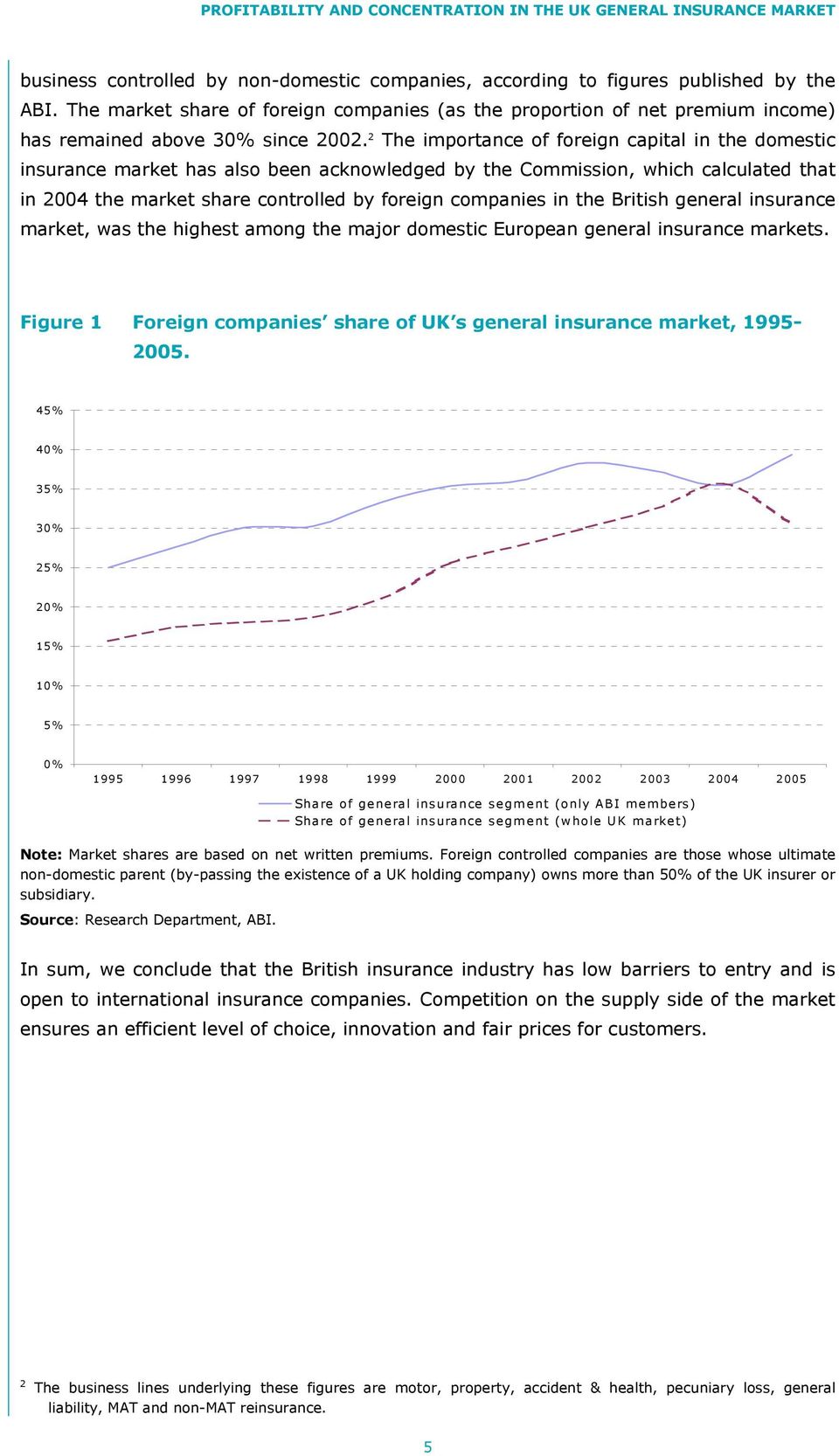
6 PROFITABILITY AND CONCENTRATION IN THE UK GENERAL INSURANCE MARKET business controlled by non-domestic companies, according to figures published by the ABI. The market share of foreign companies (as the proportion of net premium income) has remained above 30% since The importance of foreign capital in the domestic insurance market has also been acknowledged by the Commission, which calculated that in 2004 the market share controlled by foreign companies in the British general insurance market, was the highest among the major domestic European general insurance markets. Figure 1 Foreign companies share of UK s general insurance market, % 40% 35% 30% 25% 20% 15% 10% 5% 0% Share of genera l ins urance s egment (only ABI membe rs ) Share of general insurance segment (whole UK market) Note: Market shares are based on net written premiums. Foreign controlled companies are those whose ultimate non-domestic parent (by-passing the existence of a UK holding company) owns more than 50% of the UK insurer or subsidiary. Source: Research Department, ABI. In sum, we conclude that the British insurance industry has low barriers to entry and is open to international insurance companies. Competition on the supply side of the market ensures an efficient level of choice, innovation and fair prices for customers. 2 The business lines underlying these figures are motor, property, accident & health, pecuniary loss, general liability, MAT and non-mat reinsurance. 5
7 REPORT BY ABI RESEARCH DEPARTMENT 3.0 PREMIUMS, CLAIMS AND PROFITABILITY Most of the analysis contained in this section is based on accounting data provided to the ABI by its members. We also use accounting and financial data published by the FSA, and based on UK insurers returns. In 2005, total net premiums (i.e. written premium less reinsurance premiums paid by the insurer) for general insurance was 54.3 billion. This figure breaks down as follows: Motor: 11.9 billion; Property: 9.9 billion; Accident & Health (i.e. Personal Accident and Private Medical Insurance): 5.0 billion; Miscellaneous & Pecuniary Loss (e.g. Payment Protection, Legal Expenses, other financial losses): 4.4 billion; General Liability: 4.6 billion; Marine, Aviation & Transport (MAT) and Reinsurance: 8.6 billion. Figure 2 is based on ABI returns and displays the evolution of net premiums, by type of general insurance product, between 1995 and Motor, Property and Accident & Health represent the major sources of premium income for UK insurers, accounting for approximately three quarters (72%) of total premiums in This chart also indicates that the underlying composition of total net premiums has remained relatively stable throughout the decade, except for MAT and reinsurance that have decreased in importance. Figure 2 Total net premium by type of general insurance, ,000 30,000 25,000 20,000 15,000 10,000 5,000 0 Source: ABI (2007) Accident & Health General Liability Motor Misc & Pecuniary Loss Property MAT and Reinsurance Between 1995 and 2005, total claims payouts have increased by 68%, from 12.3 billion in 1995 to 20.7 billion in This is illustrated in Figure 3, which shows the evolution of claims by general insurance sector together with aggregate underwriting results over the period Insurance underwriting results stand for the profit or loss made by 6

8 PROFITABILITY AND CONCENTRATION IN THE UK GENERAL INSURANCE MARKET an insurer on its underwriting activity. It is calculated as the net premium income (i.e. net of reinsurance premiums) less the cost of claims and the insurer s expenses in connection with the business line (e.g., intermediaries commissions). A mathematical expression for the underwriting results can be found in Appendix A1. Figure 3 Total claims (by product line) and underwriting results, m 25,000 20,000 15,000 10,000 5, , Accident & Health General Liability Motor Misc & Pecuniary Loss Property MAT and Reinsurance Underwriting Result Source: ABI (2007). Figure 4 displays the evolution over the same period of the ratio of commissions and expenses to net written premiums for the main business lines and for the overall UK general insurance market. Figure 4 Expense ratio (commission and expenses/premiums) by type of business, % 35% 30% 25% 20% 15% 10% Source: Research Department, ABI. Motor Property Accident & Health Total General 7

9 REPORT BY ABI RESEARCH DEPARTMENT Figure 3 shows that in more recent years there has been an improvement in the underwriting results of UK insurers. This in part reflects a reduction in companies expenses (an efficiency drive) at the beginning of the century (see Figure 4), and the decision made by some companies to withdraw from unprofitable sectors of the general insurance market. The evolution of insurers underwriting results for five different general insurance business lines, expressed as a percentage of net premium income, is displayed in Figure 5. Figures 3, 4 and 5 highlight the importance of considering general insurance cycles when looking at market profitability. Cyclical patterns in underwriting profits are especially important in general insurance. 3 The business insurance market in particular has experienced periods of losses, insolvencies and lower levels of profitability. Therefore a snapshot of the industry s underwriting profits during a relatively short period of time, as was used by the Commission in its interim report, may lead to flawed conclusions either underestimation or overestimation of long-term returns. While underwriting results improved slightly during 2004 and 2005, it was common for UK general insurers to make operating losses during the second half of the 1990s. Negative returns on underwriting activities have often been offset by income from investments in the financial and non-financial markets (see Section 3.2). Figure 5 UK underwriting results (% of net written premium) by type of general insurance business, % 10% 0% -10% -20% -30% -40% Source: Research Department, ABI. Motor Property Pecuniary Loss Liability Accident & Health The above chart also highlights the potential inadequacy of averaging underwriting results across many different lines of general insurance. Operating profitability seems to exhibit substantial cross-product variation, which implies average figures may lead to inaccurate, misleading conclusions. 3 See, for example, Harrington and Niehaus (2000). 8

10 PROFITABILITY AND CONCENTRATION IN THE UK GENERAL INSURANCE MARKET 3.1 Combined ratios The Commission s report on the business insurance sector (EC, 2007) uses the combined ratio of the different lines of business in general insurance to proxy profitability measures across member states. Therefore in this section we reconsider some of the issues raised in EC (2007) by discussing the combined ratio of the UK s commercial general insurance over the period Figure 6 shows the evolution of the combined ratio for the whole general insurance market together with the breakdown between Motor and Non-motor lines of business. The combined ratio measures the amount of earned premium that an insurance company must pay to cover the claims and expenses generated by the business. 4 (The mathematical expression of the combined ratio can be found in Appendix A1.) A combined ratio of 100% thus means the insurance industry is breaking even on its (net) underwriting business. If the combined ratio is above 100%, the industry is making underwriting losses. Figure 6 Combined ratios in the UK general insurance market, % 120% 110% 100% Weig hted average 90% 80% 70% General insurance Motor Commerical general insurance Note: The above figures exclude MAT. The weighted average is in turn based on net premiums over the period. Source: Research Department, ABI. Once again Figure 6 illustrates the importance of taking into account the full cycle of the general insurance market, which normally lasts for 6 to 9 years. The period 2004 and 2005, which relates to the data used by the Commission, stands out as exceptional. It was only in 2004 and 2005 that the UK s general insurance market achieved underwriting profits; during the second half of the 1990s the combined ratio was above 100%, meaning the industry was making losses on its underwriting activity. The weighted 4 The combined ratio can also be calculated as one minus the underwriting result, expressed as a percentage of net premiums. 9

11 REPORT BY ABI RESEARCH DEPARTMENT average combined ratio (based on net premium income) of both general and commercial general insurance for the period equals 100%; put differently, on average the sector broke even on its underwriting business. The ABI s data confirms the EC finding that combined ratios have consistently decreased since Underlying the modest long-term performance of the business, though, is the healthy degree of competition existing in the UK insurance market. In its business insurance sector inquiry, the Commission estimated domestic combined ratios for the period , and concluded that UK profitability ratios were relatively high. However most of the Commission s findings rely on 2005 data, and do not account for poor performance in previous years or the cyclical nature of insurance markets. The Commission based its conclusions on the combined ratio of a relatively profitable year, thereby concluding that business insurance displays exceptional profitability, but failed to recognise the key cyclical nature of the business. That general insurance premiums and underwriting profits fluctuate cyclically is well understood, and has been documented in a number of academic studies; see Cummins and Outreville (1987) for example. 5 The ABI s previous analysis casts doubt on the conclusions reached by the Commission. The methodological problem is that the EC focused on a relatively profitable timeframe; taking a longer-term perspective that accounts for the underlying insurance business cycle, one finds that fierce domestic competition decreased the profitability of the underwriting business. As the other key determinant of insurance companies profitability is investment earnings, that is the return earned on financial and non-financial assets acquired with insurance premiums, we now turn to this important source of income. 3.2 Investment income Investment income comprises the financial returns on assets purchased with insurance premiums that are held by the company until claims and associated expenses eventually are paid. As noticed by the Commission in its interim report, investment earnings are a prominent source of revenue for insurers. In liability insurance, for example, there is a long time lag between receiving premiums and paying claims, and the accumulation of assets is thus large. Figure 7 displays the pattern of investment returns in UK s general insurance market over the period , calculated as the ratio of net investment income to market value of assets. The maximum value is 6.6% in 1990, and the minimum 3.3% in Fenn and Vencappa (2004) discuss the main analytical frameworks explaining the presence of business cycles in the insurance industry. 10

12 PROFITABILITY AND CONCENTRATION IN THE UK GENERAL INSURANCE MARKET Figure 7 Investment returns on assets (% of total assets), % 6% 5% 4% 3% 2% 1% 0% Source: Research Department, ABI. The Commission used combined ratios and net investment results to create a proxy for industry profitability. As surveyed companies were not required to provide net investment results for the purpose of the inquiry, the Commission used headline figures published in Swiss Re (2006a) to conclude that the annual net investment results of the UK non-life insurance industry over the period was equal to 16.8% of the annual premium income in the UK. According to Swiss Re this figure is based on aggregate data from 100 insurance companies in the UK, and represents the simple average of the 10-year period. Figure 8 Net investment results (net investment income over net premium income) of UK s insurance industry by segment, % 35% 30% 25% 20% Figure use by EC (2007) 15% 10% 5% 0% Life Non-life Source: Research Department, ABI. 11

13 REPORT BY ABI RESEARCH DEPARTMENT As can be seen in Figure 8, the average figure used by the Commission overestimates the actual investment returns obtained by British insurers. Effectively, the weighted net investment return of the UK general insurance industry over the period turns out to be 11.8% rather than the 16.8% assumed by the Commission. Moreover the bias in the EC estimate widens during the last 5 years. The figure of 16.8% used by the Commission, taken from the Swiss Re report, is a simple average and relates to the period Yet this period was characterised by high investment returns and the collapse of the stock market in Applying this rate of return to the decade is misleading, as recent investment returns are lower than those prevailing during the second half of the 1990s. This can be seen in Figure Profit margins In the European Commission s interim report, the assumed net investment result is added to the underwriting profitability in order to estimate pre-tax profit margins. Using this approach the Commission preliminarily concludes that the profitability is high in business insurance in the EU-25. Based on 2005 data, for example, the Commission concludes that on average the pre-tax profit in business insurance was around 26% across the three largest European insurance markets (i.e. France, Germany and the UK). The estimates included in this paper, however, cast doubt on the accuracy of the DG Competition estimates. To illustrate, following the Commission s methodology we summed up underwriting profitability ratios and net investment results of the UK general insurance sector to estimate the overall level of pre-tax profits. The result of our analysis is presented in Figure 9. Figure 9 Investment results, underwriting results and pre-tax profitability of UK s commercial general insurance market, % 20% 15% 15% 10% 10% 5% 5% 0% 0% -5% -5% -10% Investment result U nde rw riting re s ult Profitability -10% Source: Research Department, ABI. 12

14 PROFITABILITY AND CONCENTRATION IN THE UK GENERAL INSURANCE MARKET As can be observed, the UK insurance market seems to have gone through an almost complete business cycle during the period of time considered in Figure 9. Our conclusion is that the average profitability of British non-life insurers, calculated along similar lines to those used by the Commission, amounts to a modest 9% over the period Another drawback with the profitability measure used by the Commission is that it does not account for the risk level associated with the business activity. Profits remunerate the level of risk taken on by the insurance company. In this respect, there exist economic models that allow analysts to appropriately control for the risk level faced by the insurer (e.g., return on equity by line of business, or return on risk adjusted capital) Limitations of the combined ratio as a competitive benchmark While the combined ratio is a well-established performance measure within the insurance industry, it is worth mentioning that it represents a technical rather than a profitability indicator. To illustrate, the combined ratio does not take into account the insurer s investment income even though, in the case of some business segments, investment income may represent a significant part of the company s total income. The combined ratio may not be a good measure to base profitability comparisons across business lines on. The reason is that it does not contemplate claim frequency: for natural catastrophes or environmental liability, for example, there may be several consecutive years without claims and a single year with a relatively large claim when compared with annual premium income. On such occasions, a myopic approach to the combined ratio may result in misguided conclusions. As mentioned in Swiss Re (2006a), the conventional combined ratio or similar accountingbased measures present limitations for assessing the underlying underwriting profitability of insurers. In this respect, economic combined ratios are embedded with additional features that facilitate the understanding of insurance cycles and provide a more accurate estimation of insurance companies underwriting profitability. 6 An alternative methodology to estimate the cost of capital, based on the Capital Asset Pricing Model, can be found in Cummins and Phillips (2005). 13

15 REPORT BY ABI RESEARCH DEPARTMENT 4.0 CONCENTRATION LEVELS According to the economics of competition policy, profitability and concentration levels are intimately related variables. This is because control by a single (or a small number) of companies of a large portion of a given market is a necessary condition for the exercise of market power, that is, for the ability to raise prices above marginal cost. However, the existence of high concentration levels is a necessary but not sufficient condition for anticompetitive conduct, because low entry barriers or small switching costs for example, may make the market highly contestable. In such circumstances the ability of incumbents to raise prices above cost and make abnormally high profits, without inducing further competitive entry, is limited. Hence in this section we examine in more detail the degree of concentration in the UK general insurance industry. In addition we compare the British market structure with that prevailing in other main European countries. The main conclusion of our analysis is that UK s insurance industry exhibits a good degree of fragmentation, both in absolute terms and in comparison with markets of similar importance across Europe. Competitive forces at the domestic level successfully curb British insurers capacity to exercise market power to the detriment of retail and commercial customers. 4.1 Market shares in EU non-life insurance markets Figures 10 and 11 display the combined market share of the 5 largest general insurance groups (in terms of total premiums) in 2004 and 1993, respectively. The underlying data, published by the European insurance and reinsurance federation (CEA), are in the public domain. In particular, each figure shows the combination of aggregate market share and total premiums of the top five general insurance groups across fifteen European countries. (The list of acronyms for those countries can be found in Appendix 1.) Broadly speaking, market share and total premiums of the top-5 national insurance groups seem to be inversely correlated: lower market shares are associated with larger premiums. The average market share in each year was identified as a horizontal line; as can be observed, this mean moved from 49% in 1993 to 61% in As can be seen, during the 12-year period there have been widespread increases in the fraction of the national insurance markets captured by the five-biggest players the dots moved towards the north-east. However the fraction of the domestic market captured by the UK five largest non-life insurance groups remained relatively low from an international perspective. Effectively, the UK falls below the mean (and median) market share on both occasions. 14

16 PROFITABILITY AND CONCENTRATION IN THE UK GENERAL INSURANCE MARKET Figure 10 Market share (%) and total premiums (Euro million) of the 5 largest general insurance groups in European countries. 100% 90% FI SE 80% 70% PT DK IT 60% IE AT BE SW FR UK Mean: 61% 50% NL 40% EL ES DE 30% 20% 0 10,000 20,000 30,000 40,000 50,000 60,000 70,000 80,000 90,000 Source: CEA (2006). Figure 11 Market share (%) and total premiums (Euro million) of the 5 largest general insurance groups in European countries. 100% 90% FI SE 80% 70% 60% 50% DK PT IE SW AT BE Mean: 49% NL FR 40% EL IT UK 30% DE ES 20% 0 10,000 20,000 30,000 40,000 50,000 60,000 70,000 Source: CEA (2006). A roughly similar albeit less dispersed picture emerges when one looks at the combined market share of the 10 largest general insurance groups across these European countries. This can be seen in Figures 12 and 13, which show the combination of market share and total premiums controlled by the top-10 national groups in 2004 and 1993, respectively. The average market share in increased from 73% in 1993 to 77% in Again, the UK lies below the mean (and median) market share on both occasions. 15

17 REPORT BY ABI RESEARCH DEPARTMENT Figure 12 Market share (%) and total premiums (Euro million) of the 10 largest general insurance groups in European countries. 100% FI IE SE 90% 80% PT IT DK AT BE Mean: 77% 70% SW NL FR UK 60% 50% EL ES DE 40% 30% 20% 0 10,000 20,000 30,000 40,000 50,000 60,000 70,000 80,000 90,000 Source: CEA (2006). Figure 13 Market share (%) and total premiums (Euro million) of the 10 largest general insurance groups in European countries. 100% FI SE 90% IT 80% 70% IE DK SW PT AT BE NL FR UK Mean: 73% 60% ES 50% EL DE 40% 30% 20% 0 10,000 20,000 30,000 40,000 50,000 60,000 70,000 Source: CEA (2006). 4.2 Concentration ratios in EU non-life insurance markets While aggregate market shares are informative, a more standard measure of the level of fragmentation in an oligopolistic industry is the Herfindahl-Hirschman Index (HHI). Indeed 16

18 PROFITABILITY AND CONCENTRATION IN THE UK GENERAL INSURANCE MARKET this index is the concentration metric most often used in competition policy analysis on both sides of the Atlantic; see, for example, Motta (2004). The HHI is given by the sum of the squares of market shares of the firms in the industry, and so theoretically it can vary between 0 (an entirely fragmented market where each firm has a negligible fraction of the market) and 10,000 (a monopoly where a single firm serves 100% of the market). Thus the lower the HHI, the more fragmented the market. Estimating the market share of each single company in the industry often proves difficult owing to lack of information. Unfortunately we also faced this constraint in the case of the UK. Yet Figure 14 presents the evolution between 2001 and 2005 of the HHI based on the market shares (based on net written premiums) of the top-15 UK general insurers. This concentration index is not perfect, but it nevertheless represents a good approximation because the underlying insurance companies generated at least 80% of the net written premiums stemming from general business insurance in each year. As can be observed, throughout the period the 15-company HHI for the general insurance market remained below the threshold values of 1,000 (low concentration) and 1,800 (moderate concentration) considered by US Merger Guidelines. Figure 14 HHI of general insurance based on market shares of the 15 largest UK insurers, ,000 1,800 Moderate concentration 1,600 1,400 1,200 1,000 Low concentration General insurance Commercial general insurance Source: Research Department, ABI, based on CEA data. To put the above UK concentration figures into international perspective, in Figure 15 we display the HHI based on the market shares of the five largest general insurance groups in France, Germany, Italy, Netherlands, Spain and the UK in The values for 2004 look broadly similar although the CEA could not provide us with information for Germany and The Netherlands. 17

19 REPORT BY ABI RESEARCH DEPARTMENT Figure 15 HHI of general insurance based on market shares (gross premiums) of the 5 largest non-life insurers, ,400 1,200 1, France Germany Italy Netherlands Spain UK Source: Economics & Statistics, CEA. We have focused on these six countries because they are among the most important ones within Europe in terms of general insurance premiums. As an example, according to Swiss Re (2006b) these 6 countries comprise around 75% of the total general insurance premiums written in Europe and account for about 27% of the worldwide general insurance premium income in The concentration measures shown in Figure 15, which are in turn based on gross written premiums published by the CEA, suggest the UK insurance industry remains relatively fragmented even when compared with European markets of similar size. The above analysis only provides a snapshot of the level of concentration across different European countries at a specific point in time. To have a more dynamic picture, however, Figure 16 illustrates the evolution of the joint market share of the 15 largest non-life insurance groups in each of our 6 European countries between 1993 and For this exercise we used joint market shares rather than concentration indexes because we were not able to access data on individual market shares for this 10-year period. As can be observed in Figure 16, there was an upward shift in concentration levels across the main European countries. Despite this, the bottom-up ranking of countries in terms of total share of the domestic market controlled by the top-15 insurers has not changed significantly within the decade only German and Spanish general insurance groups exhibit lower market shares than British groups. 18

20 PROFITABILITY AND CONCENTRATION IN THE UK GENERAL INSURANCE MARKET Figure 16 Market share of the 15 largest general insurance groups, % 90% 80% 70% 60% 50% 40% 30% 20% 10% 0% Source: Economics & Statistics, CEA. Germany Spain France UK Italy Netherlands 4.3 Entry barriers (and how regulation affects them) Purchasers of general and health insurance products in the UK benefit from market regulation and scrutiny by the Financial Services Authority (FSA). This ensures certainty and fairness to insurance customers. EU Directives, which have been transposed into national law, give passport rights to several types of financial services firms, including life and general insurance. Statutory regulation of the sale and administration of the general insurance market was originally introduced to implement two EU Directives the Insurance Mediation Directive and the Distance Marketing Directive. In 2005 general insurance came under the regulatory remit of the FSA, which for example sets rules concerning the information insurers provide to their customers in the sales process. The FSA s regulatory framework covers three insurance sectors: Retail general insurance, such as household, motor, and travel; Commercial general insurance, such as employer s liability, property and business continuity; and Health protection insurance, such as private medical, critical illness and income protection. Research undertaken by the ABI found that most customers of general insurance products expressed increased confidence in making an insurance purchase as a result of the new regulatory regime [ABI (2006), CRA (2006)]. While the FSA rules implementing the EU Directives appear as overly prescriptive, existing evidence suggests that some customers buying more complex general insurance products have benefited from enhanced disclosure rules. The competitive atmosphere prevailing in the UK general and health insurance markets seem to be working well for customers. 19

21 REPORT BY ABI RESEARCH DEPARTMENT 5.0 CONCLUSION The ABI believes the Commission is correct to place the business insurance policyholder at the centre of the business insurance inquiry. However, the empirical analysis contained in this document challenges the Commission s conclusions regarding combined ratios and profitability of the business insurance sector. In particular we find the UK s general insurance sector made modest profits and on average broke even on its underwriting activity over the business cycle. Our analysis demonstrates that the net investment return of the UK general insurance industry over the period was 11.8% rather than the 16.8% assumed by the Commission. This implies the Commission s interim report substantially overestimated both investment returns and industry profitability over its period of analysis. We conclude the profitability of British general insurers, using the same methodology as the EC, was on average a modest 9% for the period Finally, the different concentration measures presented throughout this paper, which are based on data published by the CEA, suggest the UK insurance industry remains relatively fragmented even when compared with European markets of similar size. UK concentration levels remained low during the last 10 years. All this appears to indicate that there is an absence of market power and market failure in the business insurance industry. 20
22 PROFITABILITY AND CONCENTRATION IN THE UK GENERAL INSURANCE MARKET A1 DEFINITIONS A1.1 Underwriting results The underwriting result (UR) is the net premium income less the cost of claims and the insurer s expenses in connection with the specific business line. It can also be expressed as a percentage of the net written premium: UR NP ( C + E ) j j j j =, NPj where the subscript refers to the business line, NP stands for net earned premiums, and C and E represent claims and expenses payouts, respectively. A1.2 Combined ratios The combined ratio (CR) represents the fraction of premium income that an insurer must pay to cover the claims and expenses generated by the business. More formally; CR j C + E j j =. NP j A1.3 Acronyms for countries The acronyms for European countries used in this document are the following: AT Austria BE Belgium DE Germany DK Denmark EL Greece ES Spain FI Finland IE Ireland IT Italy NL The Netherlands PT Portugal SE Sweden SW Switzerland UK United Kingdom FR France 21
23 REPORT BY ABI RESEARCH DEPARTMENT BIBLIOGRAPHY ABI (2006): The Regulation of General Insurance Sales: One Year On, Association of British Insurers, March ABI (2007): UK Insurance Key Facts, Research Department, Association of British Insurers, January BIS (2001): Group of Ten Report on Consolidation in the Financial Sector, Bank of International Settlements, January CEA (2007): European Insurance in Figures, CEA Statistics No 24, June CRA (2006): Market impacts of regulating general insurance, CRA International, March Cummins, D. and Outreville, F. (1987): An International Analysis of Underwriting Cycles in Property-Liability Insurance, Journal of Risk and Insurance, Vol. 54, pp Cummins, J.D. and Phillips, R.D. (2005): Estimating the Cost of Equity Capital for Property-Liability Insurers, Journal of Risk and Insurance, Vol. 72 (3), pp EC (2007): Business Insurance Sector Inquiry Interim Report, European Commission, Competition DG, January Fenn, P. and Vencappa, D. (2004): Cycles in Insurance Underwriting Profits: Dynamic Panel Data Results, CRIS Discussion Paper 2005.I, Nottingham University Business School. Harrington and Niehaus (2000): Volatility and Underwriting Cycles, in Handbook of Insurance, Edited by G. Dionne, Boston: Kluwer Academic Publishers. Motta, M. (2004): Competition Policy Theory and Practice, Cambridge University Press, USA. Swiss Re (2006a): Measuring underwriting profitability of the non-life insurance industry, Sigma No 3/2006. Swiss Re (2006b): World insurance in 2005: moderate premium growth, attractive profitability, Sigma No5/
Response to European Commission inquiry into the European business insurance sector pursuant to Article 17 of Regulation 1/2003
 Response to European Commission inquiry into the European business insurance sector pursuant to Article 17 of Regulation 1/2003 Executive summary The ABI believes the Commission is correct to place business
UK Insurance Key Facts. September 2010
 UK Insurance Key Facts September 2010 The UK insurance industry is the third largest in the world and the largest in Europe. It is a vital part of the UK economy, managing investments amounting to 24%
ITALIAN INSURANCE IN FIGURES. Year 2015
 ITALIAN INSURANCE IN FIGURES Year 2015 The Italian insurance industry gives a significant contribution to the economy and to the society, offering a wide range of services aiming at risk protection: from
The Legal Protection Insurance Market in Europe. October 2013
 The Legal Protection Insurance Market in Europe October 2013 The Legal Protection Insurance Market in Europe October 2013 In its latest publication RIAD, the International Association of Legal Protection
2. The European insurance sector 1
 2. The European insurance sector 1 As discussed in Chapter 1, the economic conditions in European countries are still fragile, despite some improvements in the first half of 2013. 2.1. Market growth The
Non-Life Bancassurance in Europe: Motor and Household Insurance
 Non-Life Bancassurance in Europe: Motor and Household Insurance Report Prospectus November 2011 Finaccord, 2011 Web: www.finaccord.com. E-mail: [email protected] 1 Prospectus contents Page What is the
Mutual Insurance in Figures. Executive summary from the 2007 study produced by AMICE s predecessor association, AISAM
 Mutual Insurance in Figures Executive summary from the 2007 study produced by AMICE s predecessor association, AISAM Disclaimer AISAM 2007 all rights reserved The entire content of this AISAM-statistics
Association of British Insurers UK Insurance Key Facts. UK Insurance KEY FACTS
 September 2013 Association of British Insurers UK Insurance Key Facts UK Insurance KEY FACTS 2013 abi.org.uk @BritishInsurers 3 Association of British Insurers UK Insurance Key Facts September 2013 About
KEY FACTS 2015. UK Insurance & Long Term Savings. Key Facts 2015. Follow us on Twitter @BritishInsurers
 KEY FACTS 2015 UK Insurance & Long Term Savings Key Facts 2015 @BritishInsurers Follow us on Twitter @BritishInsurers ASSOCIATION OF BRITISH INSURERS The UK insurance and long term savings industry is
VOLUNTARY HEALTH INSURANCE AS A METHOD OF HEALTH CARE FINANCING IN EUROPEAN COUNTRIES
 VOLUNTARY HEALTH INSURANCE AS A METHOD OF HEALTH CARE FINANCING IN EUROPEAN COUNTRIES Marta Borda Department of Insurance, Wroclaw University of Economics Komandorska St. No. 118/120, 53-345 Wroclaw, Poland
Report on the Possibility for Insurance Companies to Use Hedge Funds 1
 CEIOPS-DOC-06/05 Rev.1 Report on the Possibility for Insurance Companies to Use Hedge Funds 1 December 2005 1. Introduction The purpose of this survey is to gather information at Community level on the
THE ROLE OF PUBLIC SUPPORT IN THE COMMERCIALISATION OF INNOVATIONS
 Flash Eurobarometer THE ROLE OF PUBLIC SUPPORT IN THE COMMERCIALISATION OF INNOVATIONS REPORT Fieldwork: January February 2014 Publication: May 2014 This survey has been requested by the European Commission,
IRISH FEDERATION FACTFILE INSURANCE. Irish Insurance Federation Factfile 2010 1
 IRISH INSURANCE FEDERATION 10 FACTFILE Irish Insurance Federation Factfile 2010 1 Who are we? The Irish Insurance Federation (IIF) is the representative body for insurance companies in Ireland representing
PUBLIC DEBT SIZE, COST AND LONG-TERM SUSTAINABILITY: PORTUGAL VS. EURO AREA PEERS
 PUBLIC DEBT SIZE, COST AND LONG-TERM SUSTAINABILITY: PORTUGAL VS. EURO AREA PEERS 1. Introduction This note discusses the strength of government finances in, and its relative position with respect to other
THE ANALYSIS OF PRIVATE HEALTH INSURANCE PENETRATION DEGREE AND DENSITY IN EUROPE
 THE ANALYSIS OF PRIVATE HEALTH INSURANCE PENETRATION DEGREE AND DENSITY IN EUROPE Gheorghe Matei, Professor Ph.D University of Craiova Faculty of Economics and Business Administration Craiova, Romania
UK INSURANCE KEY FACTS 2014. UK Insurance KEY FACTS. Follow us on Twitter @BritishInsurers
 UK INSURANCE KEY FACTS 2014 UK Insurance KEY FACTS 2014 3 @BritishInsurers Follow us on Twitter @BritishInsurers ASSOCIATION OF BRITISH INSURERS About the ABI The Association of British Insurers is the
How To Understand The Insurance Industry In The Uk
 UK Insurance Key Facts September 2012 UK INSURANCE KEY FACTS 3 The UK insurance industry is the third largest in the world and the largest in Europe. It is an essential part of the UK s economic strength,
INNOBAROMETER 2015 - THE INNOVATION TRENDS AT EU ENTERPRISES
 Eurobarometer INNOBAROMETER 2015 - THE INNOVATION TRENDS AT EU ENTERPRISES REPORT Fieldwork: February 2015 Publication: September 2015 This survey has been requested by the European Commission, Directorate-General
Comparison of annuity markets (OECD National Annuity Markets: Features and Implications, Rusconi 2008) Mercer
 May 2009 Retirement Income/Annuities Around the World What US Policy Makers Might Learn Barbara Marder, Baltimore Global Defined Contribution Consulting Leader www.mercer.com 1 Comparison of annuity markets
EUROPEAN SEMESTER THEMATIC FICHE ACCESS TO FINANCE
 EUROPEAN SEMESTER THEMATIC FICHE ACCESS TO FINANCE Access to finance is key to business development. Investment and innovation are not possible without adequate financing. A difficulty in getting finance
Report on impacts of raised thresholds defining SMEs
 Knowledge creating results--- DG Internal Market Report on impacts of raised thresholds defining SMEs Impact assessment on raising the thresholds in the 4th Company Law Directive (78/660/EEC) defining
How To Understand The Irish Insurance Market
 Fact File INSURANCE IRELAND About Us As the voice of insurance actively promoting the highest standards, Insurance Ireland represents 95% of the domestic market and 70% of Ireland s International life
The attractions of Spain as an insurance market
 The attractions of Spain as an insurance market Domingo Sugranyes, Executive Vice Chairman and CEO Goldman Sachs European Financials Conference Navigating the Sea of Change Puerto Banus, Spain, 8 June
User language preferences online. Analytical report
 Flash Eurobarometer 313 The Gallup Organization Flash Eurobarometer European Commission User language preferences online Analytical report Fieldwork: January 2011 Publication: May 2011 This survey was
FROM GOVERNMENT DEFICIT TO DEBT: BRIDGING THE GAP
 FROM GOVERNMENT DEFICIT TO DEBT: BRIDGING THE GAP Government deficit and debt are the primary focus of fiscal surveillance in the euro area, and reliable data for these key indicators are essential for
Life Bancassurance in Europe: Protection-Related Life Insurance
 Life Bancassurance in Europe: Protection-Related Life Insurance Report Prospectus November 2011 Finaccord, 2011 Web: www.finaccord.com. E-mail: [email protected] 1 Prospectus contents Page What is the
Broadband and i2010: The importance of dynamic competition to market growth
 Broadband and i2010: The importance of dynamic competition to market growth Richard Cadman & Chris Dineen 21 February 2005 Strategy and Policy Consultants Network Ltd Chapel House Booton Norwich NR10 4PE
Insurance corporations and pension funds in OECD countries
 Insurance corporations and pension funds in OECD countries Massimo COLETTA (Bank of Italy) Belén ZINNI (OECD) UNECE, Expert Group on National Accounts, Geneva - 3 May 2012 Outline Motivations Insurance
BMO Global Asset Management (Asia) Limited 11 February 2016
 Product Key Facts BMO MSCI EUROPE QUALITY HEDGED TO USD ETF BMO Global Asset Management (Asia) Limited 11 February 2016 Quick facts This is an exchange traded fund. This statement provides you with key
The Role of Banks in Global Mergers and Acquisitions by James R. Barth, Triphon Phumiwasana, and Keven Yost *
 The Role of Banks in Global Mergers and Acquisitions by James R. Barth, Triphon Phumiwasana, and Keven Yost * There has been substantial consolidation among firms in many industries in countries around
EXTERNAL DEBT AND LIABILITIES OF INDUSTRIAL COUNTRIES. Mark Rider. Research Discussion Paper 9405. November 1994. Economic Research Department
 EXTERNAL DEBT AND LIABILITIES OF INDUSTRIAL COUNTRIES Mark Rider Research Discussion Paper 9405 November 1994 Economic Research Department Reserve Bank of Australia I would like to thank Sally Banguis
Commercial Non-Life Insurance Brokers in Europe
 Commercial Non-Life Insurance Brokers in Europe Report Prospectus August 2014 Web: www.finaccord.com. E-mail: [email protected] 1 Prospectus contents Page What is the research? What methodology has been
The energy industry and energy price issues in Slovakia during recent years 1
 The energy industry and energy price issues in Slovakia during recent years 1 Ing. Mikulá Cár, PhD. National Bank of Slovakia The energy industry and energy prices are becoming a subject of political decisions
THE LOW INTEREST RATE ENVIRONMENT AND ITS IMPACT ON INSURANCE MARKETS. Mamiko Yokoi-Arai
 THE LOW INTEREST RATE ENVIRONMENT AND ITS IMPACT ON INSURANCE MARKETS Mamiko Yokoi-Arai Current macro economic environment is of Low interest rate Low inflation and nominal wage growth Slow growth Demographic
72/2015-21 April 2015
 72/2015-21 April 2015 Provision of deficit and debt data for 2014 - first notification Euro area and EU28 government deficit at 2.4% and 2.9% of GDP respectively Government debt at 91.9% and 86.8% In 2014,
RETAIL FINANCIAL SERVICES
 Special Eurobarometer 373 RETAIL FINANCIAL SERVICES REPORT Fieldwork: September 211 Publication: April 212 This survey has been requested by the European Commission, Directorate-General Internal Market
PROPERTY CASUALTY INSURANCE REGULATION IN THE UNITED KINGDOM. Richard Spiller, Esq. 011 44 171 556 4541. Introduction
 PROPERTY CASUALTY INSURANCE REGULATION IN THE UNITED KINGDOM This article considers: Richard Spiller, Esq. 011 44 171 556 4541 Introduction 1. What activities by an overseas insurer amount to the carrying
Financial market integration and economic growth: Quantifying the effects, Brussels 19/02/2003
 Financial market integration and economic growth: Quantifying the effects, Brussels 19/02/2003 Presentation of «Quantification of the Macro-Economic Impact of Integration of EU Financial Markets» by London
EXECUTIVE SUMMARY. Measuring money laundering at continental level: The first steps towards a European ambition. January 2011 EUROPEAN COMMISSION
 MONEY LAUNDERING IN EUROPE Measuring money laundering at continental level: The first steps towards a European ambition EXECUTIVE SUMMARY January 2011 EUROPEAN COMMISSION DG HOME AFFAIRS FIGHT AGAINST
Use of the BIS international banking statistics
 Use of the BIS international banking statistics FSB Data Gaps Workshop Basel 2-3 May 2012 Patrick McGuire Monetary and Economics Department Bank for International Settlements 1 Primary uses of BIS data
Capital Markets, Savings Division Annual Report 2011. Insurance
 Capital Markets, Insurance and Savings Division Annual Report 2011 Insurance Table of Contents 4.1 Non-life Insurance 76 4.1.1 Introduction 76 4.1.2 Insurance Premiums 77 4.1.3 Concentration Indices and
Monitoring the social impact of the crisis: public perceptions in the European Union (wave 6) REPORT
 Eurobarometer Monitoring the social impact of the crisis: public perceptions in the European Union (wave 6) REPORT Fieldwork: December 2011 Publication: April 2012 This survey has been requested by Directorate-General
INVESTING IN INTANGIBLES: ECONOMIC ASSETS AND INNOVATION DRIVERS FOR GROWTH
 Flash Eurobarometer INVESTING IN INTANGIBLES: ECONOMIC ASSETS AND INNOVATION DRIVERS FOR GROWTH REPORT Fieldwork: January February 213 Publication: May 213 This survey has been requested by the European
INNOVATION IN THE PUBLIC SECTOR: ITS PERCEPTION IN AND IMPACT ON BUSINESS
 Flash Eurobarometer INNOVATION IN THE PUBLIC SECTOR: ITS PERCEPTION IN AND IMPACT ON BUSINESS REPORT Fieldwork: February-March 22 Publication: June 22 This survey has been requested by the European Commission,
Broadband markets Digital Agenda Scoreboard 1 2014
 Broadband markets Digital Agenda Scoreboard 2014 1 Broadband coverage: Basic broadband is available to everyone in the EU, while fixed technologies cover 97% leaving 6 million homes unconnected. Next Generation
RETAIL FINANCIAL SERVICES
 Special Eurobarometer 373 RETAIL FINANCIAL SERVICES REPORT Fieldwork: September 211 Publication: March 212 This survey has been requested by Directorate-General Internal Market and Services and co-ordinated
The wine market: evolution and trends
 The wine market: evolution and trends May 2014 1 Table of contents 1. WINE CONSUMPTION 3 2. TRENDS IN WORLD WINE TRADE IN 20 6 3. TOP WINE EXPORTERS IN 20 7 4. TOP WINE IMPORTERS IN 20 9 5. THE FIVE LARGEST
Public Debt and Contingent Liabilities: A Cross-Country Comparison
 Public Debt and Contingent Liabilities: A Cross-Country Comparison Melchior Vella and Gevit Duca * 1. Contingent Liabilities 1.1 What are contingent liabilities? Contingent liabilities are obligations
Quantitative Impact Study 1 (QIS1) Summary Report for Belgium. 21 March 2006
 Quantitative Impact Study 1 (QIS1) Summary Report for Belgium 21 March 2006 1 Quantitative Impact Study 1 (QIS1) Summary Report for Belgium INTRODUCTORY REMARKS...4 1. GENERAL OBSERVATIONS...4 1.1. Market
Broadband Coverage in Europe Final Report 2009 Survey Data as of 31 December 2008. DG INFSO 80106 December 2009 IDATE 1
 Broadband Coverage in Europe Final Report 2009 Survey Data as of 31 December 2008 DG INFSO 80106 December 2009 IDATE 1 Table of contents 1. Methodological notes...5 2. Executive summary...7 3. European
EUROPEAN AREA OF SKILLS AND QUALIFICATIONS
 EUROPEAN AREA OF SKILLS AND QUALIFICATIONS REPORT Fieldwork: April - May 2014 Publication: June 2014 This survey has been requested by the European Commission, Directorate-General for Education and Culture
Premium Data Centre Europe - 2012 Pricing, Business Model & Services
 Premium Data Centre Europe - 2012 Pricing, Business Models & Services Premium Data Centre Europe - 2012 Pricing, Business Model & Services Table of Contents A list of figures used in this report 5 Methodology
HAS FINANCE BECOME TOO EXPENSIVE? AN ESTIMATION OF THE UNIT COST OF FINANCIAL INTERMEDIATION IN EUROPE 1951-2007
 HAS FINANCE BECOME TOO EXPENSIVE? AN ESTIMATION OF THE UNIT COST OF FINANCIAL INTERMEDIATION IN EUROPE 1951-2007 IPP Policy Briefs n 10 June 2014 Guillaume Bazot www.ipp.eu Summary Finance played an increasing
EBA REPORT ON ASSET ENCUMBRANCE JUNE 2016
 EBA REPORT ON ASSET ENCUMBRANCE JUNE 2016 1 Contents List of figures 3 Executive summary 4 Analysis of the asset encumbrance of European banks 6 Sample 6 Scope of the report 6 Total encumbrance 7 Encumbrance
BUSINESS-TO-BUSINESS ALTERNATIVE DISPUTE RESOLUTION IN THE EU
 Flash Eurobarometer BUSINESS-TO-BUSINESS ALTERNATIVE DISPUTE RESOLUTION IN THE EU REPORT Fieldwork: March-April 22 Publication: November 22 This survey has been requested by Directorate-General for Justice
Mobile in-market consolidation in Western Europe: impact of recent mergers on margins and market share
 About Analysys Mason 1 Mobile in-market consolidation in Western Europe: impact of recent mergers on margins and market share August 2013 Pablo Iacopino Executive summary Mobile in-market consolidation
RETAILERS ATTITUDES TOWARDS CROSS- BORDER TRADE AND CONSUMER PROTECTION
 Eurobarometer RETAILERS ATTITUDES TOWARDS CROSS- BORDER TRADE AND CONSUMER PROTECTION REPORT Fieldwork: September - October 2012 Publication: June 2013 This survey has been requested by the European Commission,
BANK FOR INTERNATIONAL SETTLEMENTS P.O. BOX, 4002 BASLE, SWITZERLAND
 BANK FOR INTERNATIONAL SETTLEMENTS P.O. BOX, 4002 BASLE, SWITZERLAND PRESS RELEASE CENTRAL BANK SURVEY OF FOREIGN EXCHANGE AND DERIVATIVES MARKET ACTIVITY IN APRIL 1998: PRELIMINARY GLOBAL DATA The BIS
The coverage rate of social benefits. Research note 9/2013
 Research note 9/2013 SOCIAL SITUATION OBSERVATORY INCOME DISTRIBUTION AND LIVING CONDITIONS APPLICA (BE), EUROPEAN CENTRE FOR THE EUROPEAN CENTRE FOR SOCIAL WELFARE POLICY AND RESEARCH (AT), ISER UNIVERSITY
THE ELECTRONIC CUSTOMS IMPLEMENTATION IN THE EU
 Flash Eurobarometer THE ELECTRONIC CUSTOMS IMPLEMENTATION IN THE EU REPORT Fieldwork: April-May 214 Publication: October 214 This survey has been requested by the European Commission, Directorate-General
PRESS RELEASE 3M 2015 results Ageas UK, 8 May 2015
 PRESS RELEASE 3M 2015 results Ageas UK, 8 May 2015 Profitable first quarter for Ageas UK Executive Summary Increased year on year profit reflecting benign weather impact Net profit of GBP 12.0 million
CONSUMERS ATTITUDES TOWARDS CROSS- BORDER TRADE AND CONSUMER PROTECTION
 Eurobarometer CONSUMERS ATTITUDES TOWARDS CROSS- BORDER TRADE AND CONSUMER PROTECTION REPORT Fieldwork: September 2011 Publication: May 2012 This survey has been requested by the European Commission, Directorate-General
Coverholders. Market Access Study. Capability Analysis. International Markets. Market Intelligence. April 2010 FOR MANAGING AGENTS AND BROKERS
 Disclaimer Coverholders Market Access Study Capability Analysis International Markets Market Intelligence April 200 FOR MANAGING AGENTS AND BROKERS Lloyd s Capability Analysis > The Model > Country Categories
Trends in the European Investment Fund Industry. in the Fourth Quarter of 2015. Results for the Full Year of 2015
 Quarterly Statistical Release February 2016, N 64 This release and other statistical releases are available on Efama s website (www.efama.org) Trends in the European Investment Fund Industry in the Fourth
PRESS RELEASE 9M 2015 results Ageas UK, 4 November 2015
 PRESS RELEASE 9M 2015 results Ageas UK, 4 November 2015 Ageas UK announces nine month profitable performance Executive Summary Solid year on year profit Net profit of GBP 46.9 million compared to an underlying
Charlene Hamrah (Investment Community) (212) 770-7074 Joe Norton (News Media) (212) 770-3144
 Contact: Charlene Hamrah (Investment Community) (212) 770-7074 Joe Norton (News Media) (212) 770-3144 AIG REPORTS FIRST QUARTER 2006 NET INCOME OF $3.20 BILLION NEW YORK, NY, May 10, 2006 American International
Forecasting Europe s Corporate Credit Risk 2013-2015
 Vienna, March 2013 Forecasting Europe s Corporate Credit Risk 2013-2015 - Abbreviated Hand-Out Version: Austria - Summary In this study, Quantic Risk Solutions (QRS) presents its innovative and unparalleled
Consumer Credit Worldwide at year end 2012
 Consumer Credit Worldwide at year end 2012 Introduction For the fifth consecutive year, Crédit Agricole Consumer Finance has published the Consumer Credit Overview, its yearly report on the international
W. R. Berkley Corporation Reports Record Net Income of $545 Million for 2005; Fourth Quarter 2005 Net Income Up 44% to $167 Million
 W. R. Berkley Corporation Reports Record Net Income of $545 Million for 2005; Fourth Quarter 2005 Net Income Up 44% to $167 Million GREENWICH, Conn.--(BUSINESS WIRE)--Feb. 13, 2006--W. R. Berkley Corporation
INSURANCE SUPERVISION DEPARTMENT INSURANCE SECTOR IN SERBIA
 INSURANCE SUPERVISION DEPARTMENT INSURANCE SECTOR IN SERBIA Third Quarter Report 2014 National Bank of Serbia Contents: 1. Insurance market... 4 1.1. Market participants... 4 Insurance companies... 4 Other
Social dumping and free movement: Overview of current issues from an economic point of view
 Social dumping and free movement: Overview of current issues from an economic point of view Prof. dr. Jozef Pacolet & Frederic De Wispelaere Design Charles & Ray Eames - Hang it all Vitra Statistics on
Bodily Injury Thematic Review
 2015 Bodily Injury Thematic Review ii Central Bank of Ireland Insurance Directorate 2015 BODILY INJURY THEMATIC REVIEW 1 Introduction 1.1 Overview and Context 4 1.2 Summary of Findings 5 1.3 Observations
Errors and omissions in the balance of payments statistics a problem?
 Errors and omissions in the balance of payments statistics a problem? BY GUNNAR BLOMBERG, LARS FORSS AND INGVAR KARLSSON The authors work in the Monetary Policy Department. The balance of payments statistics
Author Name(s): Abbe Williams, Stephanie Duff and Daniel Wisniewski Office for National Statistics
 Blue Book 2012: Improvements to the measurement of insurance services Author Name(s): Abbe Williams, Stephanie Duff and Daniel Wisniewski Office for National Statistics 1. SUMMARY Financial intermediation
Groupon Goods Global GmbH VENDOR INVOICE GUIDE. This Guide Applies to:
 VENDOR INVOICE GUIDE This Guide Applies to: Guide Introduction This guide contains important information to help you produce and provide Groupon Goods Global GmbH with invoices that are compliant with
EUROPEAN. Geographic Trend Report for GMAT Examinees
 2011 EUROPEAN Geographic Trend Report for GMAT Examinees EUROPEAN Geographic Trend Report for GMAT Examinees The European Geographic Trend Report for GMAT Examinees identifies mobility trends among GMAT
NN GROUP FINANCIAL SUPPLEMENT 1Q2016
 NN GROUP FINANCIAL SUPPLEMENT 1Q2016 NN GROUP FINANCIAL SUPPLEMENT 1Q2016 INTRODUCTION The Financial Supplement includes quarterly financial trend data and is published on a quarterly basis. Figures are
Insurance and Social Protection Area
 Insurance and Social Protection Area July 2015 1. Presentation This is the eleventh edition of the Ranking of the largest European Non-Life insurance groups published by FUNDACIÓN MAPFRE, for 2014 on this
Hiring and employment procedures for one-person-enterprises
 Flash Eurobarometer European Commission Hiring and employment procedures for one-person-enterprises Fieldwork: 2004 Publication: 2004 Flash Eurobarometer 163 - TNS Sofres / EOS Gallup Europe This survey
Household saving rate higher in the EU than in the USA despite lower income Household income, saving and investment, 1995-2007
 Economy and finance Authors: Peeter LEETMAA, Hervé RENNIE, Béatrice THIRY Statistics in Focus 29/2009 Household saving rate higher in the EU than in the A despite lower income Household income, saving
Final Report: 7 February 2000. Stephen Bond and Lucy Chennells. The Institute for Fiscal Studies
 Corporate Income Taxes and Investment: A Comparative Study Final Report: 7 February 2000 Stephen Bond and Lucy Chennells The Institute for Fiscal Studies 7 Ridgmount Street, London, WC1E 7AE, UK Acknowledgement:
Mobile Gadget Insurance in Europe
 Mobile Gadget Insurance in Europe Report Prospectus July 2011 Web: www.finaccord.com. E-mail: [email protected] 1 Prospectus contents Page What is the research? How does it fit into the wider series?
Insurance Ireland Factfile
 Fact Insurance Ireland Factfile 20 Contents 3 About Us 4 About Factfile 5 Executive Summary 7 The Irish Insurance Market 11 Life Assurance and Pensions Market 18 Non-Life Insurance Market 27 International
Arshil Jamal President and Chief Operating Officer Canada Life Capital Corporation
 Scotia Capital Financials Summit September 8, 2011 Arshil Jamal President and Chief Operating Officer Canada Life Capital Corporation Cautionary Note regarding Forward-looking Information This report contains
The road to tenure neutral policies
 The road to tenure neutral policies Stop promising universal home ownership Marja Elsinga September 11, 2012 1 Delft University of Technology Challenge the future The road to tenure neutral policies 2
Value of production of agricultural products and foodstuffs, wines, aromatised wines and spirits protected by a geographical indication (GI)
 Value of production of agricultural products and foodstuffs, wines, aromatised wines and spirits protected by a geographical indication (GI) TENDER N AGRI 2011 EVAL 04 Leaflet October 2012 The information
Guidance on Performance Attribution Presentation
 Guidance on Performance Attribution Presentation 2004 EIPC Page 1 of 13 Section 1 Introduction Performance attribution has become an increasingly valuable tool not only for assessing asset managers skills