
Stability criteria for large-scale time-delay systems: the LMI approach and the Genetic Algorithms
|
|
|
- William Sullivan
- 10 years ago
- Views:
Transcription
1 Control and Cybernetics vol 35 (2006) No 2 Stability criteria for large-scale time-delay systems: the LMI approach and the Genetic Algorithms by Jenq-Der Chen Department of Electronic Engineering National Kinmen Institute of Technology Jinning, Kinmen, Taiwan, 892, ROC tdchen@mailkmitedutw Abstract: This paper addresses the asymptotic stability analysis problem for a class of linear large-scale systems with time delay in the state of each subsystem as well as in the interconnections Based on the Lyapunov stability theory, a delay-dependent criterion for stability analysis of the systems is derived in terms of a linear matri inequality (LMI) Finally, a numerical eample is given to demonstrate the validity of the proposed result Keywords: delay-dependent criterion, large-scale systems, linear matri inequality, genetic algorithms 1 Introduction Time delay naturally arises in the processing of information transmission between subsystems and its eistence is frequently the main source of instability and oscillation in many important systems Many practical control applications are encountered, involving the phenomena in question, including electrical power systems, nuclear reactors, chemical process control systems, transportation systems, computer communication, economic systems, etc Hence, the stability analysis problem for time-delay systems has received considerable attention (Kim, 2001; Kolmanovskii and Myshkis, 1992; Kwon and Park, 2004; Li and De Souza, 1997; Niculescu, 2001; Park, 1999; Richard, 2003; Su et al, 2001) In the recent years, the problem of stability analysis for large-scale systems with or without time delay has been etensively studied by a number of authors Moreover, depending on whether the stability criterion itself contains the delay argument as a parameter, stability criteria for systems can be usually classified into two categories, namely the delay-independent criteria (Hmamed, 1986; Huang et al, 1995; Lyou et al, 1984; Michel and Miller, 1977; Schoen and Geering, 1995; Siljak, 1978; Wang et al, 1991) and the delay-dependent criterion (Tsay et al, 1996) In general, the latter ones are less conservative than

2 292 J-D CHEN the former ones, but the former ones are also important when the effect of time delay is small However, there are few papers to derive the delay-dependent and delay-independent stability criteria for a class of large-scale systems with time delays, to my knowledge This has motivated my study In this paper, delay-independent and delay-dependent criteria for such systems can be derived to guarantee the asymptotic stability for large-scale systems with time-delays in the state of each subsystem as well as in the interconnections Appropriate model transformation of original systems is useful for the stability analysis of such systems, and some tuning parameters, which satisfy the constraint on an LMI can be easily obtained by the GAs technique A numerical eample is given to illustrate that the proposed result is useful The notation used throughout this paper is as follows We denote the set of all nonnegative real numbers by R, the set of all continuous functions from [ H, 0 to R n by C 0, the transpose of matri A (respectively, vector ) by A T (respectively T ), the symmetric positive (respectively, negative) definite by A>0 (respectively A<0) We denote identity matri by I and the set {1, 2,, N} by N 2 Main results Consider the following large-scale time-delay systems, which is composed of N interconnected subsystems S i, i N Each subsystem S i, i N is described as ẋ i (t) =A i i (t) A ij j (t h ij ), t 0, (1a) where i (t) is the state of each subsystem S i, i N, then, A i, A ij, i,j N are known constant matrices of appropriate dimensions, and h ij, i, j N, are nonnegative time delays in the state of each subsystems as well as in the interconnections The initial condition for each subsystem is given by i (t) =θ i (t), t [ H, 0, H=ma {h ij}, i,j N, (1b) i,j where θ i (t), i N is a continuous function on [ H, 0 A model transformation is constructed for the large-scale time-delay systems of the form: d [ [ i (t) B ij j (s)ds = A i i (t) B ij j (t) dt (A ij B ij ) j (t h ij ), (2) where B ij R ni nj, i, j N are some matrices that can be chosen by GAs such that the matri Āi = A i B ij, i, j H is Hurwitz

3 Stability criteria for large-scale time-delay systems 293 Now, we present a delay-dependent criterion for asymptotic stability of system (1) Theorem 21 The system (1) is asymptotically stable for any constant time delays h ij satisfying 0 h ij h ij, i, j N under the condition that Ā i are Hurwitz and there eist symmetric positive definite matrices P i, R ij, T ij, V ij, and W ijk, i, j, k N such that the following LMI condition holds: Ξ 11 Ξ12 Ξ13 Ξ14 Ξ15 Ξ T 12 Ξ Ξ = Ξ T 13 0 Ξ < 0 (3) Ξ T Ξ 44 0 Ξ T Ξ 55 where Ψ 1 B21 T P 2 P 1 B 12 BN1 T P N P 1 B 1N P 2 B 21 B12P T 1 Ψ2 BN2 T Ξ 11 = P N P 2 B 2N P M B N1 B1N T P 1 P N B N2 B2N T P 2 ΨN Ψ i = ĀT i P i P i Ā i [ hji R ji V ij h ki (T kji W kji ), ˇΞ 12 = diag(γ 1,, Γ N ), Γ i =[ hi1 A T i P i B i1 hin A T i P i B in,, ˇΞ 22 = diag(ˆγ 1,, ˆΓ N ), ˆΓi = diag(r i1,,r in ), ˇΞ 13 = diag(π 1,, Π N ), Π i =[Π i1 Π in, Π ki =[ hi1 Bik T P ib i1 hin Bik T P ib in, ˇΞ 33 = diag(ˆπ 1,, ˆΠ N ), ˆΠi = diag(ˆπ i1 ˆΠ in ), ˆΠ ki = diag(t ik1,,t ikn ), ˇΞ 14 = diag(λ 1,, Λ N ), Λ i =[(A 1i B 1i ) T P 1 (A Ni B Ni ) T P N, ˇΞ 44 = diag(ˆλ 1,, ˆΛ N ), ˆΛi = diag(v 1i,,V Ni ), ˇΞ 15 = diag(ω 1,, Ω N ), Ω i =[Ω i1 Ω in, Ω ki =[ hi1 (A ik B ik ) T P i B i1 hin (A ik B ik ) T P i B in, ˇΞ 55 = diag(ˆω 1,, ˆΩ N ), ˆΩi = diag(ˆω i1 ˆΩ in ), ˆΩ ki = diag(w ik1,,w ikn )

4 294 J-D CHEN Proof From the Schur Complements of Boyd et al (1994), the condition (3) is equivalent to the following inequality: Ξ( h, P i,r ij,t ijk,v ij,w ijk )= φ 1 ( h) B21 T P 2 P 1 B 12 BN1 T P N P 1 B 1N P 2 B 21 B12P T 1 φ 2 ( h) BN2 T P N P 2 B 2N P M B N1 B1N T P 1 P N B N2 B2N T P 2 φ N ( h) < 0 (4) where h denotes { h ij,i,j N}, and φ i ( h) =ĀT i P i P i Ā i [ hij A T i P ib ij Rij 1 BT ij P ia i h ji R ji (A ji B ji ) T P j V 1 ji P j (A ji B ji )V ij [ hjk Bjk T P jb jk T 1 jik BT jk P jb ji h ki T kji h jk (A ji B ji ) T P j B jk W 1 jik BT jk P j(a ji B ji ) h ki W kji The Lyapunov functional is given by V ( t )=V 1 ( t )V 2 ( t )V 3 ( t ), (5a) where V 1 ( t )= V 2 ( t )= L i ( t ) T P L i ( t ),L i ( t ) i=1 = i (t) B ij j (s)ds, i N (A ij B ij ) T P i (V 1 ij V 3 ( t )= T j (s)[(s t h ij) R ij (5b) h ik B ik W 1 ijk BT ik)p i (A ij B ij ) j (s)ds, (5c) t h ik (s t h ik ) T k (s)(t ijk W ijk ) k (s)ds, (5d)

5 Stability criteria for large-scale time-delay systems 295 are the legitimate Lyapunov functional candidates The time derivatives of V i ( t ), i = 3, along the trajectories of the system (2) are given by V 1 ( t )= T i (t)(at i P i P i A i ) i (t) i=1 2 T i (t)a T i P i B ij j (s)ds 2 T j (t)bijp T i i (t) 2 T j (t)bt ij P ib ik k (s)ds t h ik 2 T j (t h ij )(A ij B ij ) T P i i (t) 2 T j (t h ij)(a ij B ij ) T P i B ik k (s)ds It is known fact that for any, y R n and Z R n n 2 T y T Z y T Z 1 y being true, we have > 0, the inequality V 1 ( t ) T i (t)(at i P i P i A i ) i (t) i=1 [ hij T i (t)a T i P i B ij R 1 ij BT ijp i A i i (t) [ T i (t)(bii T P i P i B ii ) i (t)2 i=1,j i T i (s)r ij j (s)ds T j (t)bt ij P i i (t) [ t hik T j (t)bijp T i B ik T 1 ijk BT ikp i B ij j (t) T k (s)t ijk k (s)ds t h ik [ T j ()(A ij B ij ) T P i V 1 P i (A ij B ij ) j ( ) T i (t)v ij i (t) ij [ hik T j ( )(A ij B ij ) T P i B ik W 1 ijk BT ikp i (A ij B ij ) j ( ) t h ik T k (s)w ijk k (s)ds
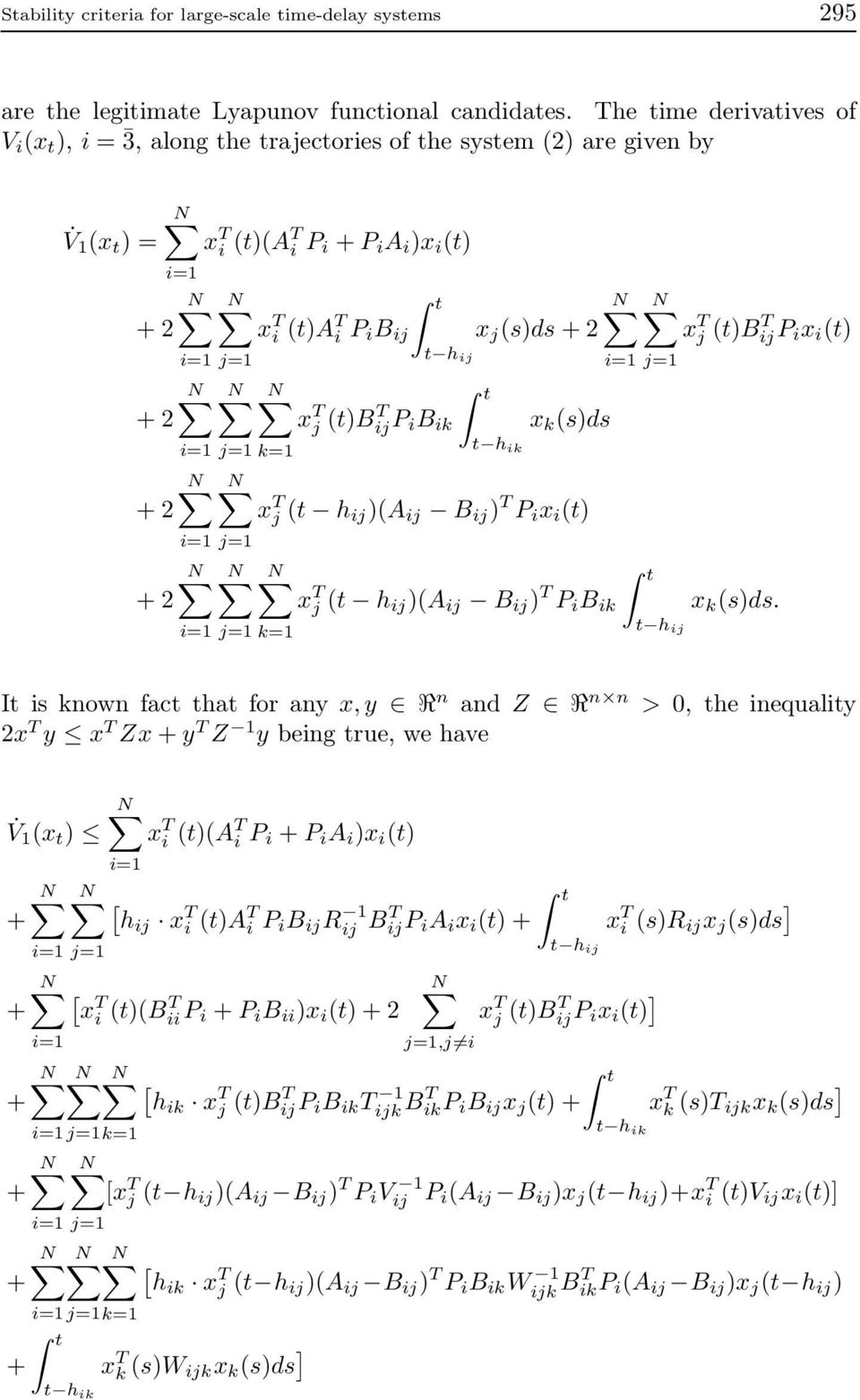
6 296 J-D CHEN V 2 ( t )= V 3 ( t )= { T j (t) [ h ij R ij (A ij B ij ) T P i (V 1 ij h ik B ik W 1 ijk BT ik)p i (A ij B ij ) j (t) T j (s)r ij j (s)ds T j (t h ij)[(a ij B ij ) T P i (V 1 ij h ik B ik W 1 ijk BT ik )P i(a ij B ij ) j (t h ij ) }, [ hik T k (t)(t ijk W ijk ) k (t) t h jk T k (s)(t ijk W ijk ) k (s)ds Now, considering that T j (t) [ h ij R ij (A ij B ij ) T P i V 1 ij P i (A ij B ij ) h ik B T ij P ib ik T 1 ijk BT ik P ib ij h ik (A ij B ij ) T P i B ik W 1 ijk BT ikp i (A ij B ij ) j (t) = T j (t)[h ji R ji (A ji B ji ) T P j V 1 ji P j (A ji B ji ) h jk B T jip j B jk T 1 jik BT jkp j B ji h jk (A ji B ji ) T P j B jk W 1 jik BT jkp j (A ji B ji ) i (t) H ik T k (t)(t ijk W ijk ) k (t) = h ki T i (t)(t kji W kji ) i (t)

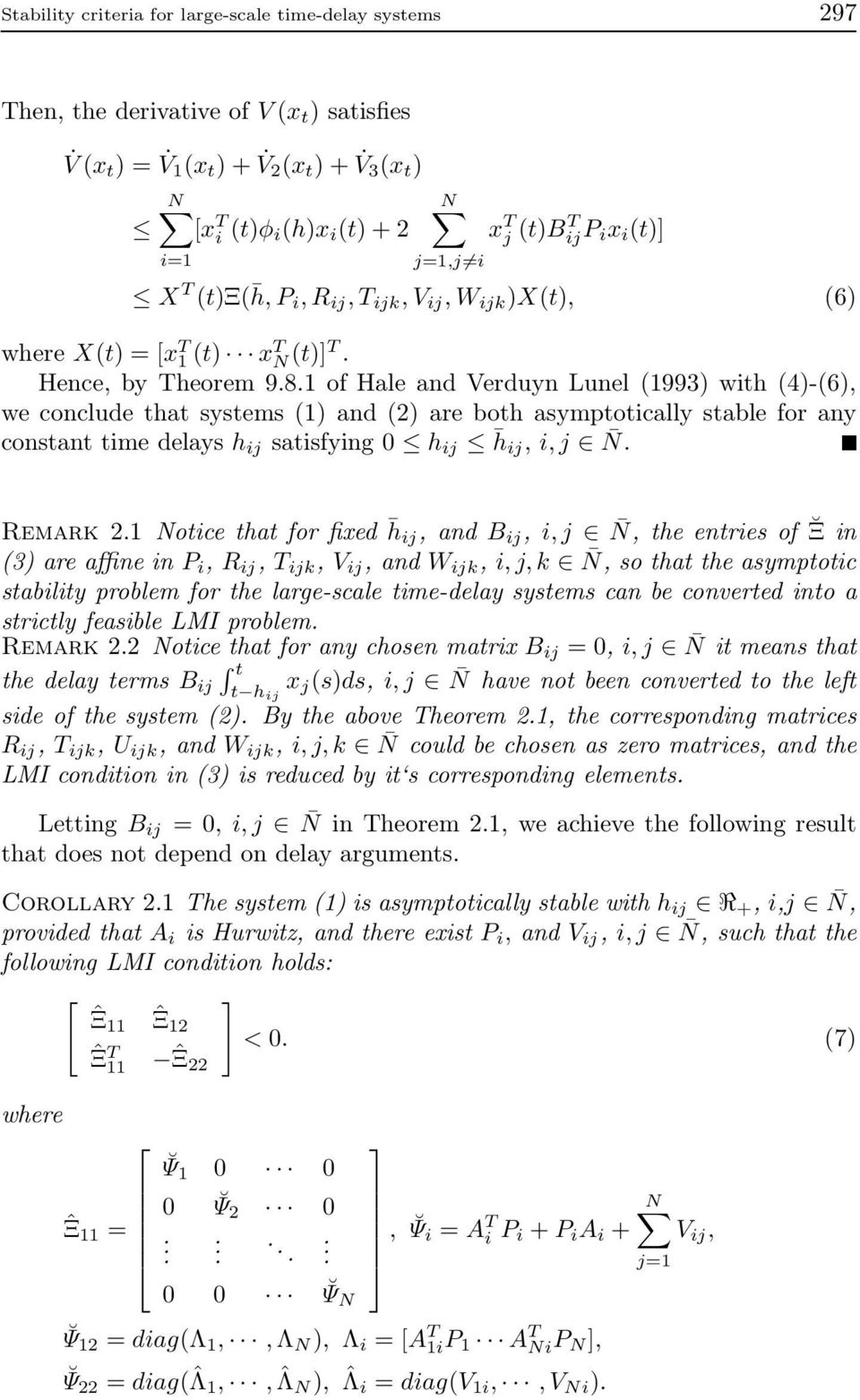
7 Stability criteria for large-scale time-delay systems 297 Then, the derivative of V ( t ) satisfies V ( t )= V 1 ( t ) V 2 ( t ) V 3 ( t ) [ T i (t)φ i(h) i (t)2 i=1,j i T j (t)bt ij P i i (t) X T (t)ξ( h, P i,r ij,t ijk,v ij,w ijk )X(t), (6) where X(t) =[ T 1 (t) T N (t)t Hence, by Theorem 981 of Hale and Verduyn Lunel (1993) with (4)-(6), we conclude that systems (1) and (2) are both asymptotically stable for any constant time delays h ij satisfying 0 h ij h ij, i, j N Remark 21 Notice that for fied h ij,andb ij, i, j N, theentriesof Ξ in (3) are affine in P i, R ij, T ijk, V ij,andw ijk, i, j, k N, so that the asymptotic stability problem for the large-scale time-delay systems can be converted into a strictly feasible LMI problem Remark 22 Notice that for any chosen matri B ij =0, i, j N it means that the delay terms B ij j (s)ds, i, j N have not been converted to the left side of the system (2) By the above Theorem 21, the corresponding matrices R ij, T ijk, U ijk,andw ijk, i, j, k N could be chosen as zero matrices, and the LMI condition in (3) is reduced by it s corresponding elements Letting B ij =0, i, j N in Theorem 21, we achieve the following result that does not depend on delay arguments Corollary 21 The system (1) is asymptotically stable with h ij R, i,j N, provided that A i is Hurwitz, and there eist P i, and V ij, i, j N, such that the following LMI condition holds: ˆΞ11 ˆΞ12 < 0 (7) ˆΞ T 11 ˆΞ 22 where Ψ Ψ2 0 ˆΞ 11 =, Ψi = A T i P i P i A i V ij, 0 0 ΨN Ψ 12 = diag(λ 1,, Λ N ), Λ i =[A T 1iP 1 A T NiP N, Ψ 22 = diag(ˆλ 1,, ˆΛ N ), ˆΛi = diag(v 1i,,V Ni )
8 298 J-D CHEN Remark 23 Suppose that for any chosen matri B ij = A ij, i, j N we have that the delay term A ij j (s)ds, i, j N, have been converted to the left side of the system (2) By the proof of Theorem 21, the corresponding matrices V ij,andw ijk, i, j, k N, could be chosen as zero matrices, and the LMI condition in (3) is reduced by its corresponding elements Choosing B ij = A ij, i, j N in Theorem 21 we achieve the following result that depends on delay arguments Corollary 22 The system (1) is asymptotically stable for any constant time delays h ij satisfying 0 h ij h ij, i, j N, provided that  i = A i A ii is Hurwitz and there eist symmetric positive definite matrices P i, R ij,andt ij, i, j N satisfying the following LMI condition: Ξ 11 Ξ12 Ξ13 Ξ T 12 Ξ 22 0 Ξ T 13 0 Ξ 33 < 0 (8) where Ψ 1 A T 21 P 2 P 1 A 12 A T N1 P N P 1 A 1N P 2 A 21 A T 12 Ξ 11 = P 1 Ψ2 A T N2 P N P 2 A 2N, P N A N1 A T 1N P 1 P N A N2 A T 2N P 2 ΨN Ψ 1 = ÂT i P i P i  i ( h ji R ji h ki T kji ), Ξ 12 = diag(γ 1,, Γ N ), Γ i =[ hi1 A T i P i A i1 hin A T i P i A in, Ξ 22 = diag(ˆγ 1,, ˆΓ N ), ˆΓi = diag(r i1,,r in ), Ξ 13 = diag(π 1,, Π N ), Π i =[Π i1 Π in, Π ki =[ hi1 A T ik P ia i1 hin A T ik P ia in, Ξ 33 = diag(ˆπ 1,, ˆΠ N ), ˆΠi = diag(ˆπ i1 ˆΠ in ), ˆΠ ki = diag(t ik1,,t ikn ) Now, we provide a procedure for testing the asymptotic stability of the system (1) Step 1 Choosing all B ij =0, i, j N the delay-independent criterion in Corollary 21 is applied to test the stability of the system (1) Step 2 If the condition in Corollary 21 cannot be satisfied, we choose all B ij = A ij, i, j N and the delay-dependent criterion in Corollary 22 is applied to test the stability of the system (1)

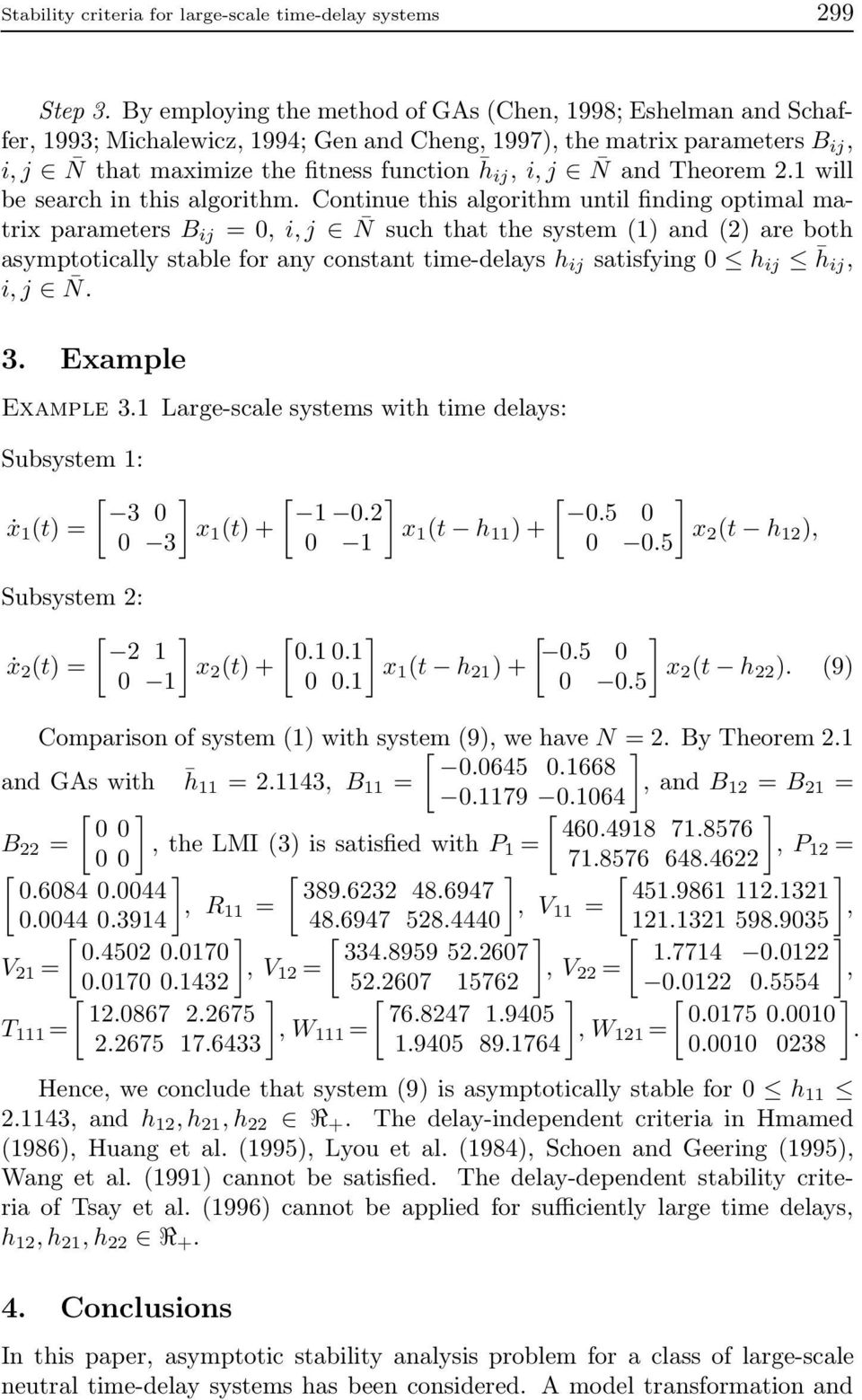
9 Stability criteria for large-scale time-delay systems 299 Step 3 By employing the method of GAs (Chen, 1998; Eshelman and Schaffer, 1993; Michalewicz, 1994; Gen and Cheng, 1997), the matri parameters B ij, i, j N that maimize the fitness function h ij, i, j N and Theorem 21 will be search in this algorithm Continue this algorithm until finding optimal matri parameters B ij =0, i, j N such that the system (1) and (2) are both asymptotically stable for any constant time-delays h ij satisfying 0 h ij h ij, i, j N 3 Eample Eample 31 Large-scale systems with time delays: Subsystem 1: ẋ 1 (t) = [ Subsystem 2: ẋ 2 (t) = [ (t) 2 (t) (t h 11 ) (t h 12 ), (t h 21 ) (t h 22 ) (9) Comparison of system (1) with system [ (9), we have N =2 By Theorem and GAs with h11 =21143, B 11 =,andb = B 21 = B 22 =, the LMI (3) is satisfied with P 00 1 =, P = , R =, V =, V 21 =, V =, V =, [ T 111 =, W =, W = Hence, we conclude that system (9) is asymptotically stable for 0 h , andh 12,h 21,h 22 R The delay-independent criteria in Hmamed (1986), Huang et al (1995), Lyou et al (1984), Schoen and Geering (1995), Wang et al (1991) cannot be satisfied The delay-dependent stability criteria of Tsay et al (1996) cannot be applied for sufficiently large time delays, h 12,h 21,h 22 R 4 Conclusions In this paper, asymptotic stability analysis problem for a class of large-scale neutral time-delay systems has been considered A model transformation and
10 300 J-D CHEN the Lyapunov stability theorem have been applied to obtain some stability criteria for such systems Furthermore, the computational programming LMI with GAs has been used to improve the proposed results Finally, it has been shown using a numerical eample that the result shown in this paper is fleible and sharp Acknowledgement The author would like to thank anonymous reviewers for their helpful comments The research reported here was supported by the National Science Council of Taiwan, ROC under grant NSC E References Boyd,S,Ghaoui,LEl,Feron,Eand Balakrishnan, V (1994) Linear Matri Inequalities In System And Control Theory SIAM, Philadelphia Chen, ZM, Lin, HS and Hung, CM (1998) The Design and Application of a Genetic-Based Fuzzy Gray Prediction Controller The Journal of Grey System 1, Eshelman, LJ and Schaffer, JD (1993) Real-Coded Genetic Algorithms and Interval Schemata In: LD Whitley, ed, Foundation of Genetic Algorithms-2, Morgan Kaufmann Publishers Gen, M and Cheng, RW (1997) Genetic Algorithms and Engineering Design John Wiley and Sons, New York Hale, JK and Verduyn Lunel, SM (1993) Introduction to functional differential equations Springer-Verlag, New York Hmamed, A (1986) Note on the stability of large scale systems with delays International Journal of Systems Science 17, Huang, SN, Shao, HH and Zhang, ZJ (1995) Stability analysis of largescale systems with delays Systems & Control Letters 25, Kim, J H (2001) Delay and its time-derivative dependent robust stability of time-delayed linear systems with uncertainty IEEE Transaction Automatic Control 46, Kolmanovskii, VB, and Myshkis, A (1992) Applied Theory of Functional Differential Equations Kluwer Academic Publishers, Dordrecht, Netherlands Kwon, OM, and Park, JH (2004) On improved delay-dependent robust control for uncertain time-delay systems IEEE Transaction Automatic Control 49, Li, X, and De Souza, CE (1997) Delay-dependent robust stability and stabilization of uncertain linear delay systems: a linear matri inequality approach IEEE Transaction Automatic Control 42,

11 Stability criteria for large-scale time-delay systems 301 Lyou, J, Kim, YS and Bien, Z (1984) A note on the stability of a class of interconnected dynamic systems International Journal of Control 39, Michalewicz, Z (1994) Genetic Algorithm Data Structures = Evolution Programs Springer-Verlag, New York Michel, AN and Miller, RK (1977) Qualitative Analysis of Large Scale Dynamic Systems Academic Press, New York Niculescu, SI (2001) Delay Effects on Stability A Robust Control Approach Springer-Verlag Park, P (1999) A delay dependent stability criterion for systems with uncertain time-invariant delays IEEE Transactions on Automatic Control 44, Richard, JP (2003) Time-delay systems: an verview of some recent advances and open problems Automatica 39, Schoen, GM and Geering, HP (1995) A note on robustness bounds for large-scale time-delay systems International Journal of Systems Science 26, Siljak, DD (1978) Large-Scale Dynamic Systems: Stability and Structure Elsevier North-Holland, New York Su, TJ, Lu, CY, and Tsai, JSH (2001) LMI approach to delay dependent robust stability for uncertain time-delay systems IEE Proceeding Control Theory Applications 148, Tsay, JT, Liu, PL and Su, TJ (1996) Robust stability for perturbed large-scale time-delay systems IEE Proceedings Control Theory Applications 143, Wang, WJ, Song, CC and Kao, CC (1991) Robustness bounds for large-scale time-delay systems with structured and unstructured uncertainties International Journal of Systems Science 22,
Example 4.1 (nonlinear pendulum dynamics with friction) Figure 4.1: Pendulum. asin. k, a, and b. We study stability of the origin x
 Lecture 4. LaSalle s Invariance Principle We begin with a motivating eample. Eample 4.1 (nonlinear pendulum dynamics with friction) Figure 4.1: Pendulum Dynamics of a pendulum with friction can be written
Lecture 7: Finding Lyapunov Functions 1
 Massachusetts Institute of Technology Department of Electrical Engineering and Computer Science 6.243j (Fall 2003): DYNAMICS OF NONLINEAR SYSTEMS by A. Megretski Lecture 7: Finding Lyapunov Functions 1
An interval linear programming contractor
 An interval linear programming contractor Introduction Milan Hladík Abstract. We consider linear programming with interval data. One of the most challenging problems in this topic is to determine or tight
Lecture 13 Linear quadratic Lyapunov theory
 EE363 Winter 28-9 Lecture 13 Linear quadratic Lyapunov theory the Lyapunov equation Lyapunov stability conditions the Lyapunov operator and integral evaluating quadratic integrals analysis of ARE discrete-time
STABILITY GUARANTEED ACTIVE FAULT TOLERANT CONTROL OF NETWORKED CONTROL SYSTEMS. Shanbin Li, Dominique Sauter, Christophe Aubrun, Joseph Yamé
 SABILIY GUARANEED ACIVE FAUL OLERAN CONROL OF NEWORKED CONROL SYSEMS Shanbin Li, Dominique Sauter, Christophe Aubrun, Joseph Yamé Centre de Recherche en Automatique de Nancy Université Henri Poincaré,
State Observer Design for a Class of Takagi-Sugeno Discrete-Time Descriptor Systems
 Applied Mathematical Sciences, Vol. 9, 2015, no. 118, 5871-5885 HIKARI Ltd, www.m-hikari.com http://dx.doi.org/10.12988/ams.2015.54288 State Observer Design for a Class of Takagi-Sugeno Discrete-Time Descriptor
A Passivity Measure Of Systems In Cascade Based On Passivity Indices
 49th IEEE Conference on Decision and Control December 5-7, Hilton Atlanta Hotel, Atlanta, GA, USA A Passivity Measure Of Systems In Cascade Based On Passivity Indices Han Yu and Panos J Antsaklis Abstract
Minimizing the Number of Machines in a Unit-Time Scheduling Problem
 Minimizing the Number of Machines in a Unit-Time Scheduling Problem Svetlana A. Kravchenko 1 United Institute of Informatics Problems, Surganova St. 6, 220012 Minsk, Belarus [email protected] Frank
Nonlinear Systems of Ordinary Differential Equations
 Differential Equations Massoud Malek Nonlinear Systems of Ordinary Differential Equations Dynamical System. A dynamical system has a state determined by a collection of real numbers, or more generally
CONTROLLABILITY. Chapter 2. 2.1 Reachable Set and Controllability. Suppose we have a linear system described by the state equation
 Chapter 2 CONTROLLABILITY 2 Reachable Set and Controllability Suppose we have a linear system described by the state equation ẋ Ax + Bu (2) x() x Consider the following problem For a given vector x in
Portfolio selection based on upper and lower exponential possibility distributions
 European Journal of Operational Research 114 (1999) 115±126 Theory and Methodology Portfolio selection based on upper and lower exponential possibility distributions Hideo Tanaka *, Peijun Guo Department
A New Nature-inspired Algorithm for Load Balancing
 A New Nature-inspired Algorithm for Load Balancing Xiang Feng East China University of Science and Technology Shanghai, China 200237 Email: xfeng{@ecusteducn, @cshkuhk} Francis CM Lau The University of
Optimal PID Controller Design for AVR System
 Tamkang Journal of Science and Engineering, Vol. 2, No. 3, pp. 259 270 (2009) 259 Optimal PID Controller Design for AVR System Ching-Chang Wong*, Shih-An Li and Hou-Yi Wang Department of Electrical Engineering,
OPTIMAL SELECTION BASED ON RELATIVE RANK* (the "Secretary Problem")
 OPTIMAL SELECTION BASED ON RELATIVE RANK* (the "Secretary Problem") BY Y. S. CHOW, S. MORIGUTI, H. ROBBINS AND S. M. SAMUELS ABSTRACT n rankable persons appear sequentially in random order. At the ith
Mathematics Course 111: Algebra I Part IV: Vector Spaces
 Mathematics Course 111: Algebra I Part IV: Vector Spaces D. R. Wilkins Academic Year 1996-7 9 Vector Spaces A vector space over some field K is an algebraic structure consisting of a set V on which are
AN EVALUATION METHOD FOR ENTERPRISE RESOURCE PLANNING SYSTEMS
 Journal of the Operations Research Society of Japan 2008, Vol. 51, No. 4, 299-309 AN EVALUATION METHOD FOR ENTERPRISE RESOURCE PLANNING SYSTEMS Shin-Guang Chen Tungnan University Yi-Kuei Lin National Taiwan
Mining changes in customer behavior in retail marketing
 Expert Systems with Applications 28 (2005) 773 781 www.elsevier.com/locate/eswa Mining changes in customer behavior in retail marketing Mu-Chen Chen a, *, Ai-Lun Chiu b, Hsu-Hwa Chang c a Department of
OPTIMAl PREMIUM CONTROl IN A NON-liFE INSURANCE BUSINESS
 ONDERZOEKSRAPPORT NR 8904 OPTIMAl PREMIUM CONTROl IN A NON-liFE INSURANCE BUSINESS BY M. VANDEBROEK & J. DHAENE D/1989/2376/5 1 IN A OPTIMAl PREMIUM CONTROl NON-liFE INSURANCE BUSINESS By Martina Vandebroek
Section 6.1 - Inner Products and Norms
 Section 6.1 - Inner Products and Norms Definition. Let V be a vector space over F {R, C}. An inner product on V is a function that assigns, to every ordered pair of vectors x and y in V, a scalar in F,
Some Research Problems in Uncertainty Theory
 Journal of Uncertain Systems Vol.3, No.1, pp.3-10, 2009 Online at: www.jus.org.uk Some Research Problems in Uncertainty Theory aoding Liu Uncertainty Theory Laboratory, Department of Mathematical Sciences
NOTES ON LINEAR TRANSFORMATIONS
 NOTES ON LINEAR TRANSFORMATIONS Definition 1. Let V and W be vector spaces. A function T : V W is a linear transformation from V to W if the following two properties hold. i T v + v = T v + T v for all
Two classes of ternary codes and their weight distributions
 Two classes of ternary codes and their weight distributions Cunsheng Ding, Torleiv Kløve, and Francesco Sica Abstract In this paper we describe two classes of ternary codes, determine their minimum weight
Optimization under fuzzy if-then rules
 Optimization under fuzzy if-then rules Christer Carlsson [email protected] Robert Fullér [email protected] Abstract The aim of this paper is to introduce a novel statement of fuzzy mathematical programming
Generating Valid 4 4 Correlation Matrices
 Applied Mathematics E-Notes, 7(2007), 53-59 c ISSN 1607-2510 Available free at mirror sites of http://www.math.nthu.edu.tw/ amen/ Generating Valid 4 4 Correlation Matrices Mark Budden, Paul Hadavas, Lorrie
On closed-form solutions of a resource allocation problem in parallel funding of R&D projects
 Operations Research Letters 27 (2000) 229 234 www.elsevier.com/locate/dsw On closed-form solutions of a resource allocation problem in parallel funding of R&D proects Ulku Gurler, Mustafa. C. Pnar, Mohamed
Minimizing Probing Cost and Achieving Identifiability in Probe Based Network Link Monitoring
 Minimizing Probing Cost and Achieving Identifiability in Probe Based Network Link Monitoring Qiang Zheng, Student Member, IEEE, and Guohong Cao, Fellow, IEEE Department of Computer Science and Engineering
Systems with Persistent Memory: the Observation Inequality Problems and Solutions
 Chapter 6 Systems with Persistent Memory: the Observation Inequality Problems and Solutions Facts that are recalled in the problems wt) = ut) + 1 c A 1 s ] R c t s)) hws) + Ks r)wr)dr ds. 6.1) w = w +
Equilibria and Dynamics of. Supply Chain Network Competition with Information Asymmetry. and Minimum Quality Standards
 Equilibria and Dynamics of Supply Chain Network Competition with Information Asymmetry in Quality and Minimum Quality Standards Anna Nagurney John F. Smith Memorial Professor and Dong (Michelle) Li Doctoral
7 Gaussian Elimination and LU Factorization
 7 Gaussian Elimination and LU Factorization In this final section on matrix factorization methods for solving Ax = b we want to take a closer look at Gaussian elimination (probably the best known method
DATA ANALYSIS II. Matrix Algorithms
 DATA ANALYSIS II Matrix Algorithms Similarity Matrix Given a dataset D = {x i }, i=1,..,n consisting of n points in R d, let A denote the n n symmetric similarity matrix between the points, given as where
4 Lyapunov Stability Theory
 4 Lyapunov Stability Theory In this section we review the tools of Lyapunov stability theory. These tools will be used in the next section to analyze the stability properties of a robot controller. We
Demand Forecasting Optimization in Supply Chain
 2011 International Conference on Information Management and Engineering (ICIME 2011) IPCSIT vol. 52 (2012) (2012) IACSIT Press, Singapore DOI: 10.7763/IPCSIT.2012.V52.12 Demand Forecasting Optimization
Direct Methods for Solving Linear Systems. Matrix Factorization
 Direct Methods for Solving Linear Systems Matrix Factorization Numerical Analysis (9th Edition) R L Burden & J D Faires Beamer Presentation Slides prepared by John Carroll Dublin City University c 2011
Further Study on Strong Lagrangian Duality Property for Invex Programs via Penalty Functions 1
 Further Study on Strong Lagrangian Duality Property for Invex Programs via Penalty Functions 1 J. Zhang Institute of Applied Mathematics, Chongqing University of Posts and Telecommunications, Chongqing
15 Limit sets. Lyapunov functions
 15 Limit sets. Lyapunov functions At this point, considering the solutions to ẋ = f(x), x U R 2, (1) we were most interested in the behavior of solutions when t (sometimes, this is called asymptotic behavior
A New Method for Multi-Objective Linear Programming Models with Fuzzy Random Variables
 383838383813 Journal of Uncertain Systems Vol.6, No.1, pp.38-50, 2012 Online at: www.jus.org.uk A New Method for Multi-Objective Linear Programming Models with Fuzzy Random Variables Javad Nematian * Department
A simple criterion on degree sequences of graphs
 Discrete Applied Mathematics 156 (2008) 3513 3517 Contents lists available at ScienceDirect Discrete Applied Mathematics journal homepage: www.elsevier.com/locate/dam Note A simple criterion on degree
The Henstock-Kurzweil-Stieltjes type integral for real functions on a fractal subset of the real line
 The Henstock-Kurzweil-Stieltjes type integral for real functions on a fractal subset of the real line D. Bongiorno, G. Corrao Dipartimento di Ingegneria lettrica, lettronica e delle Telecomunicazioni,
OPTIMAL CONTROL OF A COMMERCIAL LOAN REPAYMENT PLAN. E.V. Grigorieva. E.N. Khailov
 DISCRETE AND CONTINUOUS Website: http://aimsciences.org DYNAMICAL SYSTEMS Supplement Volume 2005 pp. 345 354 OPTIMAL CONTROL OF A COMMERCIAL LOAN REPAYMENT PLAN E.V. Grigorieva Department of Mathematics
Network Traffic Modelling
 University of York Dissertation submitted for the MSc in Mathematics with Modern Applications, Department of Mathematics, University of York, UK. August 009 Network Traffic Modelling Author: David Slade
Background: State Estimation
 State Estimation Cyber Security of the Smart Grid Dr. Deepa Kundur Background: State Estimation University of Toronto Dr. Deepa Kundur (University of Toronto) Cyber Security of the Smart Grid 1 / 81 Dr.
Fuzzy regression model with fuzzy input and output data for manpower forecasting
 Fuzzy Sets and Systems 9 (200) 205 23 www.elsevier.com/locate/fss Fuzzy regression model with fuzzy input and output data for manpower forecasting Hong Tau Lee, Sheu Hua Chen Department of Industrial Engineering
Closed-loop Load Balancing: Comparison of a Discrete Event Simulation with Experiments
 25 American Control Conference June 8-, 25. Portland, OR, USA ThB4.2 Closed-loop Load Balancing: Comparison of a Discrete Event Simulation with Experiments Zhong Tang, John White, John Chiasson, J. Douglas
By choosing to view this document, you agree to all provisions of the copyright laws protecting it.
 This material is posted here with permission of the IEEE Such permission of the IEEE does not in any way imply IEEE endorsement of any of Helsinki University of Technology's products or services Internal
Matrix Differentiation
 1 Introduction Matrix Differentiation ( and some other stuff ) Randal J. Barnes Department of Civil Engineering, University of Minnesota Minneapolis, Minnesota, USA Throughout this presentation I have
CONTROL SYSTEMS, ROBOTICS AND AUTOMATION Vol. XVI - Fault Accomodation Using Model Predictive Methods - Jovan D. Bošković and Raman K.
 FAULT ACCOMMODATION USING MODEL PREDICTIVE METHODS Scientific Systems Company, Inc., Woburn, Massachusetts, USA. Keywords: Fault accommodation, Model Predictive Control (MPC), Failure Detection, Identification
INPUT-TO-STATE STABILITY FOR DISCRETE-TIME NONLINEAR SYSTEMS
 INPUT-TO-STATE STABILITY FOR DISCRETE-TIME NONLINEAR SYSTEMS Zhong-Ping Jiang Eduardo Sontag,1 Yuan Wang,2 Department of Electrical Engineering, Polytechnic University, Six Metrotech Center, Brooklyn,
Dynamic Eigenvalues for Scalar Linear Time-Varying Systems
 Dynamic Eigenvalues for Scalar Linear Time-Varying Systems P. van der Kloet and F.L. Neerhoff Department of Electrical Engineering Delft University of Technology Mekelweg 4 2628 CD Delft The Netherlands
Approximability of Two-Machine No-Wait Flowshop Scheduling with Availability Constraints
 Approximability of Two-Machine No-Wait Flowshop Scheduling with Availability Constraints T.C. Edwin Cheng 1, and Zhaohui Liu 1,2 1 Department of Management, The Hong Kong Polytechnic University Kowloon,
Inner Product Spaces and Orthogonality
 Inner Product Spaces and Orthogonality week 3-4 Fall 2006 Dot product of R n The inner product or dot product of R n is a function, defined by u, v a b + a 2 b 2 + + a n b n for u a, a 2,, a n T, v b,
Factorization Theorems
 Chapter 7 Factorization Theorems This chapter highlights a few of the many factorization theorems for matrices While some factorization results are relatively direct, others are iterative While some factorization
PÓLYA URN MODELS UNDER GENERAL REPLACEMENT SCHEMES
 J. Japan Statist. Soc. Vol. 31 No. 2 2001 193 205 PÓLYA URN MODELS UNDER GENERAL REPLACEMENT SCHEMES Kiyoshi Inoue* and Sigeo Aki* In this paper, we consider a Pólya urn model containing balls of m different
Victims Compensation Claim Status of All Pending Claims and Claims Decided Within the Last Three Years
 Claim#:021914-174 Initials: J.T. Last4SSN: 6996 DOB: 5/3/1970 Crime Date: 4/30/2013 Status: Claim is currently under review. Decision expected within 7 days Claim#:041715-334 Initials: M.S. Last4SSN: 2957
Applications of improved grey prediction model for power demand forecasting
 Energy Conversion and Management 44 (2003) 2241 2249 www.elsevier.com/locate/enconman Applications of improved grey prediction model for power demand forecasting Che-Chiang Hsu a, *, Chia-Yon Chen b a
Lyapunov Stability Analysis of Energy Constraint for Intelligent Home Energy Management System
 JAIST Reposi https://dspace.j Title Lyapunov stability analysis for intelligent home energy of energ manageme Author(s)Umer, Saher; Tan, Yasuo; Lim, Azman Citation IEICE Technical Report on Ubiquitous
Similarity and Diagonalization. Similar Matrices
 MATH022 Linear Algebra Brief lecture notes 48 Similarity and Diagonalization Similar Matrices Let A and B be n n matrices. We say that A is similar to B if there is an invertible n n matrix P such that
Linear Maps. Isaiah Lankham, Bruno Nachtergaele, Anne Schilling (February 5, 2007)
 MAT067 University of California, Davis Winter 2007 Linear Maps Isaiah Lankham, Bruno Nachtergaele, Anne Schilling (February 5, 2007) As we have discussed in the lecture on What is Linear Algebra? one of
Scalar Valued Functions of Several Variables; the Gradient Vector
 Scalar Valued Functions of Several Variables; the Gradient Vector Scalar Valued Functions vector valued function of n variables: Let us consider a scalar (i.e., numerical, rather than y = φ(x = φ(x 1,
A Quality of Service Scheduling Technique for Optical LANs
 A Quality of Service Scheduling Technique for Optical LANs Panagiotis G. Sarigiannidis, Member, IEEE, Sophia G. Petridou, Member, IEEE, Georgios I. Papadimitriou, Senior Member, IEEE Department of Informatics
MATH 304 Linear Algebra Lecture 18: Rank and nullity of a matrix.
 MATH 304 Linear Algebra Lecture 18: Rank and nullity of a matrix. Nullspace Let A = (a ij ) be an m n matrix. Definition. The nullspace of the matrix A, denoted N(A), is the set of all n-dimensional column
Sampled-data iterative learning control for nonlinear systems with arbitrary relative degree
 Automatica 37 (2001) 283}289 Brief Paper Sampled-data iterative learning control for nonlinear systems with arbitrary relative degree Mingxuan Sun, Danwei Wang* School of Electrical and Electronic Engineering,
Classification of Cartan matrices
 Chapter 7 Classification of Cartan matrices In this chapter we describe a classification of generalised Cartan matrices This classification can be compared as the rough classification of varieties in terms
Decision-making with the AHP: Why is the principal eigenvector necessary
 European Journal of Operational Research 145 (2003) 85 91 Decision Aiding Decision-making with the AHP: Why is the principal eigenvector necessary Thomas L. Saaty * University of Pittsburgh, Pittsburgh,
Adaptive Control Using Combined Online and Background Learning Neural Network
 Adaptive Control Using Combined Online and Background Learning Neural Network Eric N. Johnson and Seung-Min Oh Abstract A new adaptive neural network (NN control concept is proposed with proof of stability
Continuity of the Perron Root
 Linear and Multilinear Algebra http://dx.doi.org/10.1080/03081087.2014.934233 ArXiv: 1407.7564 (http://arxiv.org/abs/1407.7564) Continuity of the Perron Root Carl D. Meyer Department of Mathematics, North
LOOP TRANSFER RECOVERY FOR SAMPLED-DATA SYSTEMS 1
 LOOP TRANSFER RECOVERY FOR SAMPLED-DATA SYSTEMS 1 Henrik Niemann Jakob Stoustrup Mike Lind Rank Bahram Shafai Dept. of Automation, Technical University of Denmark, Building 326, DK-2800 Lyngby, Denmark
2.3 Convex Constrained Optimization Problems
 42 CHAPTER 2. FUNDAMENTAL CONCEPTS IN CONVEX OPTIMIZATION Theorem 15 Let f : R n R and h : R R. Consider g(x) = h(f(x)) for all x R n. The function g is convex if either of the following two conditions
SYSTEMS WITH LARGE FLEXIBLE SERVER POOLS: INSTABILITY OF NATURAL LOAD BALANCING
 SYSTEMS WITH LARGE FLEXIBLE SERVER POOLS: INSTABILITY OF NATURAL LOAD BALANCING ALEXANDER L. STOLYAR AND ELENA YUDOVINA Abstract. We consider general large-scale service systems with multiple customer
The Matrix Elements of a 3 3 Orthogonal Matrix Revisited
 Physics 116A Winter 2011 The Matrix Elements of a 3 3 Orthogonal Matrix Revisited 1. Introduction In a class handout entitled, Three-Dimensional Proper and Improper Rotation Matrices, I provided a derivation
3. Reaction Diffusion Equations Consider the following ODE model for population growth
 3. Reaction Diffusion Equations Consider the following ODE model for population growth u t a u t u t, u 0 u 0 where u t denotes the population size at time t, and a u plays the role of the population dependent
The Australian Journal of Mathematical Analysis and Applications
 The Australian Journal of Mathematical Analysis and Applications Volume 7, Issue, Article 11, pp. 1-14, 011 SOME HOMOGENEOUS CYCLIC INEQUALITIES OF THREE VARIABLES OF DEGREE THREE AND FOUR TETSUYA ANDO
1 Introduction to Matrices
 1 Introduction to Matrices In this section, important definitions and results from matrix algebra that are useful in regression analysis are introduced. While all statements below regarding the columns
Systems of Linear Equations
 Systems of Linear Equations Beifang Chen Systems of linear equations Linear systems A linear equation in variables x, x,, x n is an equation of the form a x + a x + + a n x n = b, where a, a,, a n and
3. Linear Programming and Polyhedral Combinatorics
 Massachusetts Institute of Technology Handout 6 18.433: Combinatorial Optimization February 20th, 2009 Michel X. Goemans 3. Linear Programming and Polyhedral Combinatorics Summary of what was seen in the
On the Oscillation of Nonlinear Fractional Difference Equations
 Mathematica Aeterna, Vol. 4, 2014, no. 1, 91-99 On the Oscillation of Nonlinear Fractional Difference Equations M. Reni Sagayaraj, A.George Maria Selvam Sacred Heart College, Tirupattur - 635 601, S.India
The allocation algorithm for data centers in cloud computing architecture from security perspective
 The allocation algorithm for data centers in cloud computing architecture from security perspective *Chuan-Gang Liu 1,Hsin-Yi Lin, Kun-Ta Hsien Deparament of Information Technology, Chia Nan University
Nonlinear Systems and Control Lecture # 15 Positive Real Transfer Functions & Connection with Lyapunov Stability. p. 1/?
 Nonlinear Systems and Control Lecture # 15 Positive Real Transfer Functions & Connection with Lyapunov Stability p. 1/? p. 2/? Definition: A p p proper rational transfer function matrix G(s) is positive
Duplicating and its Applications in Batch Scheduling
 Duplicating and its Applications in Batch Scheduling Yuzhong Zhang 1 Chunsong Bai 1 Shouyang Wang 2 1 College of Operations Research and Management Sciences Qufu Normal University, Shandong 276826, China
Notes V General Equilibrium: Positive Theory. 1 Walrasian Equilibrium and Excess Demand
 Notes V General Equilibrium: Positive Theory In this lecture we go on considering a general equilibrium model of a private ownership economy. In contrast to the Notes IV, we focus on positive issues such
Mathematical finance and linear programming (optimization)
 Mathematical finance and linear programming (optimization) Geir Dahl September 15, 2009 1 Introduction The purpose of this short note is to explain how linear programming (LP) (=linear optimization) may
The Heat Equation. Lectures INF2320 p. 1/88
 The Heat Equation Lectures INF232 p. 1/88 Lectures INF232 p. 2/88 The Heat Equation We study the heat equation: u t = u xx for x (,1), t >, (1) u(,t) = u(1,t) = for t >, (2) u(x,) = f(x) for x (,1), (3)
From Binomial Trees to the Black-Scholes Option Pricing Formulas
 Lecture 4 From Binomial Trees to the Black-Scholes Option Pricing Formulas In this lecture, we will extend the example in Lecture 2 to a general setting of binomial trees, as an important model for a single
Stability Analysis of Nonlinear Systems with Linear Programming
 Stability Analysis of Nonlinear Systems with Linear Programming A Lyapunov Functions Based Approach Von der Fakultät für Naturwissenschaften - Institut für Mathematik der Gerhard-Mercator-Universität Duisburg
1 VECTOR SPACES AND SUBSPACES
 1 VECTOR SPACES AND SUBSPACES What is a vector? Many are familiar with the concept of a vector as: Something which has magnitude and direction. an ordered pair or triple. a description for quantities such
Game Theory: Supermodular Games 1
 Game Theory: Supermodular Games 1 Christoph Schottmüller 1 License: CC Attribution ShareAlike 4.0 1 / 22 Outline 1 Introduction 2 Model 3 Revision questions and exercises 2 / 22 Motivation I several solution