
Use of Acrodisc Syringe Filters for Analytical Sample Preparation; Including HPLC and Dissolution Testing
|
|
|
- Nickolas Copeland
- 10 years ago
- Views:
Transcription
1 Technical Guide Use of Acrodisc Syringe Filters for Analytical Sample Preparation; Including HPLC and Dissolution Testing Analytical Technical Guide For: Drug Binding Extractables Filter etention Efficiency

2 Introduction Pall Life Sciences offers a broad range of analytical sample preparation products to protect your analytical instruments and ensure the integrity of your analytical results. Within this Technical Guide, you'll find Pall quality certifications, performance studies, and useful selection criteria to help you choose the right product for your situation and provide documentation for its use in your lab. This technical guide is also ideal for reviewing filtration requirements and performance criteria with new lab personnel. This extensive information is designed to move your research forward and help you run a more efficient lab. We hope you find this tool useful in your lab. For further assistance, contact you local Pall Life Sciences Technical Service department or visit our Web site at The technical guide is divided into several useful sections. Pall's product quality assurance and certifications reassure you of our commitment to detail, pages 1-3. Why filtration is necessary, pages 4-7. Main considerations for choosing the best filter for your application, pages Improving HPLC column life by as much as 46 times through accurate pore size ratings, pages Minimizing the occurrence of extractables for less chromatographic interference, pages educing API (active pharmaceutical ingredients) adsorption, pages Introduction

3 Table of Contents QUALITY ASSUANCE AND CETIFICATIONS 1 ISO Certification 1 HPLC Certification 2 IC Certification 2 Automation Certification 2 Quality Assurance 3 NEED FO FILTATION 4 Solvent eservoir / Solvent Degassing 4 Pump 5 Injector 5 In-line Filters and Guard Columns 6 Columns 7 Detector 7 Tubing 7 EXTACTABLES AND MAINTAINING ANALYTICAL INTEGITY DUING SAMPLE PEPAATION 14 What Are Extractables and Where Do They Come From? 14 Why Are There so Many Different Acrodisc Syringe Filter Types? 14 When Are Extractables a Concern? 15 How to Avoid Extractables Detritus Effects? 15 What Contributes to an Acrodisc Syringe Filter s Quality? 15 What Confidence Can You Have in 15 our HPLC Certification? Experimental and Instrument Conditions 16 PVDF Syringe Tip Filters 16 GHP Hydrophilic Polypropylene and Other 17 Syringe Tip Filters PTFE Syringe Tip Filters 18 Nylon Syringe Tip Filters 19 Flush Volume Determination 20 HOW TO CHOOSE A FILTE 8 Automation Certified Filters 8 Filter Chemical Compatibility 8 Most Appropriate EFA (Effective Filtration Area) 9 Optimal Pore Size ating 10 EXTENDING HPLC COLUMN LIFE 11 Background on Column Failure 11 Methods 11 Test esults and Discussion 12 Function of Filtration to Extend HPLC Column Life 13 Conclusion 13 DUG BINDING STUDY 21 Drug Binding Study - Suitability of Various Filters 21 for Sample Preparation in Dissolution Testing Experimental 21 General Methodology 22 Filter Evaluation is Conducted Using the 23 Following Methodology esults 24 Filter Study 26 Discussion 27 Conclusion 27 PODUCT FEATUES 28 Features and Benefits for Pall Life Sciences Products 28 Materials of Construction 28 PODUCT SPECIFICATIONS 29 CHEMICAL COMPATIBILITY GUIDE 30 Table of Contents EFEENCES 31

4 QUALITY ASSUANCE AND CETIFICATIONS Over thirty years ago, Pall Life Sciences revolutionized sample preparation for analytical chemists with the development of the Acrodisc syringe filter. Today we produce high-quality filters for sample preparation and dissolution testing that meet the unique requirements of every lab we serve. Pall s microporous materials and filtration devices are manufactured under precise, highly controlled conditions. Our global manufacturing operations employ Lean Manufacturing and Six-Sigma principles, and internationally recognized Quality Management Systems to produce products of exceptional quality and value. Pall s device manufacturing facilities utilize the most advanced sealing technologies, vision systems and robotics platforms to ensure optimum lot-to-lot consistency. ead on to learn more about our quality assurance and certifications. ISO Certification - Speaks to The Quality of Pall All Pall manufacturing facilities adhere to uniform manufacturing procedures and have been granted International Standards Organization (ISO) certification to ISO This ensures that Pall filtration products and systems will perform exactly as specified, no matter where in the world they are purchased. Pall s Quality Management Systems are ISO 9001 registered. This represents the most comprehensive and rigorous standard in the ISO series of standards for quality management and quality assurance. Pall Life Sciences manufactures a wide range of filtration and separation products at its Ann Arbor site, including medical filters, sterilizing grade filters for asceptic processing, and laboratory filters. Quality Assurance 1

5 HPLC Certified for Low Extractables A filter for HPLC applications is designed to increase accuracy by removing unwanted particles. However, the wrong filter can be a source of contaminants in the form of extractables that elute into the sample from the filter device. These undesired artifacts can jeopardize analytical results. Some extractable concerns include coelution, false quantitation, and extraneous peaks. Pall Life Sciences specifically selects the highest grade of materials and performs rigorous extraction methods on our membrane products to eliminate the occurance of undesired artifacts. Pall Life Sciences HPLC certification ensures that analytical results will not be compromised by extractable filter materials. Our membranes have been tested for compatibility with common HPLC solvents (water, acetonitrile and methanol) using established HPLC procedures. In addition, to verify low levels of UV-detectable extractables, samples of the entire HPLC Acrodisc syringe filter line are evaluated prior to release. IC Certified for Low Levels of Inorganic Extractables Pall Life Sciences certifies that Ion Chromatography (IC) Acrodisc syringe filters have been tested using a highly sensitive IC protocol to monitor inorganic extractables. For Ion Chromatography applications, our IC Acrodisc polyethersulfone (PES) syringe filters are certified for low levels of inorganic extractables. Actual background levels of filter extractables are typically less than 20 ppb for chloride, 6 ppb for nitrate, 1 ppb for phosphate, and 10 ppb for sulfate. Automation Certification Pall Life Sciences has specifically designed and certified our Acrodisc PSF syringe filters to be fully compatible and reliable for use with Caliper automated equipment. The following special features make our syringe filters reliable for worry-free performance 24 hours a day: Smooth filter-to-filter release Consistent turret advancement Exceptional housing strength Strict outside filter geometry Acrodisc PSF syringe filters from Pall Life Sciences are the only syringe filters to receive Caliper Life Sciences Automation Certified guarantee. This certification is granted to syringe filters that meet the stringent requirements for automated dispensing and robotic handling. Pall is manufacturing these products working in close partnership with Caliper Life Sciences Manufacturing and Engineering teams to ensure proper fit, function, and compatibility with Caliper workstations. Caliper Life Sciences is the manufacturer of the Caliper TPW Workstation, the APW Workstation, the MultiDose Workstation, and the Prelude Workstation. These robotic workstations are uniquely designed to work best with Caliper Automation Certified filters for proper operation. Quality Assurance 2

6 Manufacturing Quality Assurance Manufacturing Environment Pall Life Sciences strictly adheres to cgmps and cleanroom practices. In addition, we are registered to the ISO 9001 Quality Systems Standards. Quality Control In addition to the HPLC Certification performed to evaluate UV extractables, Acrodisc syringe filters undergo several other detailed quality control tests. These tests ensure compliance with the product s specifications. The quality control tests include: visual quality tests liquid flow rates bubble point burst test liquid UV/IC extractables for certification UV Absorbing Extractables UV absorbing extractable testing is performed to verify that a product intended for use in HPLC sample preparation will not contribute a significant amount of UV extractable materials to the sample fluid. This test is intended for all filters that are HPLC Certified. For more information on extractables see page 14. Bubble Point Statistically representative samples from each lot of Acrodisc syringe filters are selected and tested by the bubble point test to confirm pore size and integrity of the membrane seal. A bubble point is the measure of the amount of air pressure required to force an air bubble through a wetted pore and is in inverse proportion to the size of the hole. The bubble point rating is determined when the largest pore yields a bubble; the larger the pore, the less pressure required to form the bubble. Bubble point is expressed in units of pounds/square inch (psi), bar or mbar, or kpa for membranes. (ASTM: F216-80) Burst/Pressure Test Acrodisc syringe filters are tested for resistance to pressure. This test is a quality and safety test to ensure the Acrodisc syringe filter housings will not rupture at their rated operating pressures. The maximum operating pressure listed in the product literature is well below the actual burst pressure. This pressure rating is tested on every lot of filters. Visual Examination A machine vision system inspects Acrodisc PSF syringe filters throughout the production process for cosmetic defects. Operators and technicians verify the pad printing on the Acrodisc syringe filters. Lettering quality, accuracy, and proper color-coding stamped on each device are inspected. Package labeling is examined for accuracy of label information. Ion Chromatography Extractables The IC Acrodisc filter is eluted with 18-MOhm water to determine that the quantity of ionic extractable materials are sufficiently low and that the product will yield accurate analytical results when used in Ion Chromatography experiments. This test is applicable to all filters certified for use in IC Chromatography. Liquid Flow ate Test Liquid flow-rate tests are performed to ensure that the Acrodisc product meets flow-rate specifications. To perform this procedure the syringe filter is attached to a regulated, pressurized source of test fluid and the flow rate is determined from the volume of fluid processed in a specific time interval. HPLC Certified Membranes from Pall Life Sciences Quality Assurance ecommended Uses Membrane Strong Bases Acids Aqueous Solutions Keytones GHP (hydrophilic polypropylene) x x x x Fluorodyne II (hydrophilic PVDF) x x Nylaflo (Nylon) x x x TF (PTFE) x x x IC Supor (PES) x x x Glass (boroscilicate glass fiber) x x x x Note: Be sure to review the Chemical Compatibility Guide on page 30 before choosing a filter. 3

7 NEED FO FILTATION Sample and mobile phase filtration are simple, economical practices that serve to extend the life of consumable HPLC parts, decrease system wear and tear, and preserve the integrity of the HPLC system. The adverse effects of improper filtration practices that occur to each component of the HPLC system are systematically and thoroughly explored in this section. By reviewing these consequences, the analyst can become familiar with the early warning signs of filtrationrelated problems and avoid the expense and downtime related to lengthy maintenance repairs and replacement costs. Sample and mobile phase filtration are simple, economical practices that serve to extend the life of consumable HPLC parts Serious problems in HPLC can be avoided by being alert to preliminary warning signs and performing routine maintenance. Most HPLC part replacement tasks, such as changing pump seals, are readily recognized as necessary maintenance; however, mobile phase and sample filtration are also maintenance practices. outine sample and mobile phase filtration are simple, inexpensive and convenient ways to decrease HPLC problems. egardless of the technical intricacies and cost of the system chosen, all HPLC systems have the same basic components, indicated in Figure 1. A basic HPLC system consists of a solvent reservoir, pump, injector, column, detector, and data recording system. Particles and microbial growth not removed by filtration interfere with nearly every system component. This paper serves as a troubleshooting guide to problems associated with inefficient filtration. It is ordered in sections corresponding to the specific HPLC component affected. Figure 1 A Basic HPLC System Configuration Solvent eservoir Pump Data ecording System Syringe Sample Injector Column Detector Solvent eservoir / Solvent Degassing The solvent reservoir traditionally includes an inert container, vented cap, PTFE solvent inlet line, and a 10 µm gross inlet sinker frit. The solvent reservoir is generally equipped to degas solvents by removing dissolved air. Frequent mobile phase degassing reduces erratic pump delivery of the solvent due to pressure fluctuations, and hence reduces detector noise. Degassing also removes dissolved oxygen that can result in oxidative degradation of the sample and mobile phases, and reduces the sensitivity and operating stability of ultra-violet, refractive index, electrochemical and fluorescence detectors. By filtering mobile phase, analysts can reduce debris capable of plugging the sinker and column frits, causing contamination, damaging pump valves, blocking capillaries, causing poor peak performance, and contributing extra peaks and excessive chromatographic noise. Figure 2 Mobile Phase Filtration Apparatus Mobile phase filtration is performed prior to placing the solvent into the solvent reservoir. Buffered mobile phase solvents require daily filtration with a 0.2 µm filter to eliminate microbial growth that could increase the baseline. A typical solvent filtration apparatus is depicted in Figure 2. Contamination concerns from the filtration apparatus deter many analysts from filtering solvents. By dedicating a reservoir to each solvent, and frequently changing and cleaning the reservoir bottle and sinker frit, contamination problems are reduced. The primary concern when choosing a solvent filter is solvent compatibility with the filter material. Pall offers several filters to accomodate the various types of HPLC solvents. Pall s GHP (hydrophilic polypropylene) membrane is a universal solvent membrane to reduce confusion with filter selection. Typical solvent filters range in size from 25 to 90 mm in diameter and are available in a 0.2 or 0.45 µm membrane pore size. Need for Filtration 4

8 Pump The pump is the single most important component in the HPLC system. eliable pump operation requires attention to system cleanliness, solvent and reagent quality, mobile phase filtration, and mobile phase degassing. The four most common pump problems involve 1) check valves, 2) pump seals, 3) blockage, and 4) air bubbles. Incorrect pump functioning results in increased baseline noise, irreproducible retention times and increased operating pressures. A pump delivers flow rates between 10 µl/min and 10 ml/min. Pumping fluid at 10 ml/min against a small particle column generates considerable pressure. When a pump will not deliver degassed solvent, particulate build-up is possible. Monitoring pressure changes allows quick assessment of blocked frits, or columns, through exaggerated pressures. etention times also may be affected. Bubbles form in the pump when mobile phase mixtures become air saturated. Bubbles interfere with piston and check valve operations, causing erratic flow and pressure fluctuations. To resolve blockage or bubbles, contact your system manufacturer for the best preventive maintenance procedures. Check valves control the solvent flow direction through the pump head and ensure steady pressures when sealed properly. Particulate in check valves can leak or stick causing flow and/or pressure problems. Check valve leakage is prevented by filtering HPLC-grade solvents, using a solvent line sinker frit, flushing the system daily with non-buffered mobile phase, and regularly replacing pump seals to remove particles and entrapped air causing leakage and pump pulsation noise. Pump pulsation noise is the flow change sensed by the detector from piston movement and check valve operation. Filtering the mobile phase solvent aids in decreasing this contribution to noise. A series of increasing polarity solvent flushes should be sufficient to remove problems due to sticking and particulates. Pump seal life can be extended by filtering the mobile phase solvents A pump seal facilitates piston movement in the pump head. Pump seals wear more quickly than other pump parts, and therefore require changing every three to six months. A failing pump seal is evident from an inability to pump at high pressures, leakage behind the pump head, and change in sample retention. Pump seal wear can result in sloughing seals and contamination from this material. Buffer crystals built up from evaporated mobile phase also will accelerate wear. Pump seal life can be extended by filtering the mobile phase solvents to remove the particles responsible for accelerated seal wear. Injector Need for Filtration Injecting clean samples prolongs injector and column life. Samples are cleared of particulate and bacteria with disposable syringe tip filters. Disposable filters range in size (3-25 mm) and pore size (0.2 to 1.0 µm). Syringe tip filters are membranes configured in plastic housings that attach to a syringe with a luer fitting. Samples are filtered by drawing fluid into the syringe, attaching the filter, and dispensing the sample through the filter into a vial. Table 1 lists various types of membrane filters incorporated in syringe tip housings, housing material, and prefilter materials. To reduce physical and chemical variability among manufacturers, sample and mobile phase filtration products should be purchased from the same manufacturer. Filtering your sample prior to injection can prolong your injector and column life Table 1 Standard Materials Incorporated in Syringe Tip Filters Membrane Material Nylon, PTFE, Polyvinylidene fluoride (PVDF), Cellulose (mixed esters, acetate), Nitrocellulose, Polysulfone, Polyethersulfone, Acrylic Copolymer, Polypropylene Housing Material Polypropylene (PP), Polyethylene (PE), Polyvinylchloride (PVC), Modified Acrylic, Nylon Prefilter Material Glass, Polypropylene, Cellulose Nitrate, Polyethersulfone 5

9 Injector (continued) Choosing the proper filter requires a knowledge of filter/solvent compatibility and the chemical/physical characteristics of the filter. These characteristics include pore size, pore distribution, filter thickness, extractables, hydrophobic/hydrophilic character, binding properties, pyrogenicity, gas and liquid flow rate, burst strength, autoclavability, absolute pore size, and nominal particulate retention. Typically for HPLC applications, the 0.45 µm pore size filter is selected, or the 0.2 µm filter for bacterial removal from buffers. For particulate-laden samples, Pall incorporates large pore size prefilters in one device with smaller pore size membranes. Low protein binding and sterile filters also are available. For detailed information on how to select the best filter for your application, see page 8. Sample and solvent filtration deters low-volume injector fittings from blockage, scratching and leakage HPLC injectors are available in several styles including a septum, septumless stop-flow device, and a valve system, either manual or automated. A valve injector is most typical. An injector should ensure reproducible sample introduction. Sample and solvent filtration deters low-volume injector fittings from blockage, scratching and leakage. Loop or waste line blockage results in high back pressure and loop filling difficulty. Low dead volume fittings, located between the valve injector and column to decrease band broadening, are also subject to blockage. Other contributors to HPLC problems include mismatched or damaged injector components, variable sample volumes, leaks, and increased system pressure. Backflushing is recommended prior to disassembly. With filtration, properly adjusted and clean injectors should last 5,000 injections. Autosamplers run unattended, so clean filtered samples will decrease malfunction. Clean sample vials, free of dust and other particulates, also contribute to clean samples. Particulate-free samples are essential to decrease blocked sample needles, connection tubing and injectors. Connection tube blockage results from sample particulate, septum fragments or small internal diameter tubing. Sample, mobile phase and in-line filtration products deter these situations. For blockage at the injector s low pressure side, the needle and needle valve tubing should be checked. Symptoms include smaller than expected peak heights and peak absence. On the high pressure side, find the location by loosening the connection fitting, starting at the column head, and working upstream. Once the blockage is located, backflush with a clean filtered solvent. In-line Filters and Guard Columns In-line filters and guard columns can remove particulate before the main column. These two filters are configured into the HPLC system as follows: sample injector in-line filter guard column main column. They are not intended to replace sample pretreatment, or sample and solvent filtration. Particulate-laden samples will quickly overload the in-line filter and guard column allowing particles to enter the main column. In-line filters are ideal because it is impossible to avoid particulate from system wear, such as polymeric seal wear from the pump and sample injector, except with an in-line filter. In-line filters function to reduce blockage of the column frit and the back pressure restrictor. The in-line filters should have removable frits of 0.45 to 2.0 µm for frequent replacement, and low dead volume housings. Guard columns can collect chemical and physical waste that block the main column inlet, cause column voids and degrade performance. The guard column retains irreversible and strongly retained components that degrade the column and decrease its lifetime, providing an inexpensive alternative to frequent column replacement. The frits of a guard column are typically 2.0 µm, which is not sufficient for particulate removal. Sample and mobile phase filtration will preserve the capacity of the guard column for its intended use: chemical contamination removal. Sample and mobile phase filtration will preserve the capacity of the guard column for its intended use Need for Filtration 6

10 Column Proper HPLC column selection is crucial for efficient compound separation and identification. High performance columns are composed of small particles of narrow size distribution. Optimal peak profiles depend on column operating characteristics and should be instrument independent. Columns, depending on sample type, sample preparation, and operator filtration practices, can handle a few to several thousand injections. Two significant problems with HPLC columns are chemical and physical changes. Chemical changes are prevented with guard columns. Physical changes involve blocked frits and channel voids. Voids are created by particulate matter and pressure shock. If poor peak shapes become evident by badly tailing, splitting, and non-gaussian bands, without a change in retention time, blocked frits or a column void has occurred. Tips from instrument manufacturers to prevent physical changes include: filtering solvents through a 0.2 or 0.45 µm filter, such as Pall Acrodisc syringe filter prefiltering mobile phase buffers daily with a 0.2 µm filter to remove bacterial growth, filtering samples through a 0.2 or 0.45 µm filter, utilizing a 0.5 µm in-line filter to trap injector and pump particulates. Prior to any action, ensure that the problem is from blockage or a void volume and not from a change in solvent strength, ph, temperature, or mobile phase additives, such as an ion-pairing reagent, which show the same effects. For more information on extending column life, see page 11. Detector Detectors for HPLC are classified as bulk property or solute property detectors. A bulk property detector measures the physical property difference of the solute in the mobile phase compared to the mobile phase alone. The solute property detector responds to physical or chemical properties of the solute and is independent of the mobile phase. Examples include spectrophotometry, fluorescence and electron capture detectors. Solutions for removing the negative effects of oxygen in detectors include filtering buffers through a Pall 0.2 or 0.45 µm membrane filter Insufficient mobile phase degassing causes pressure fluctuations and/or sharp noise spikes due to bubbles. Bubbles form when the mobile phase mixture becomes saturated with air. This interferes with detector operation. Degassing methods include mobile phase filtration followed by a continuous degassing through helium sparging, ultrasonic treatment, vacuum application, or heating with vigorous stirring. Air bubbles cause problems with detector response due to excessive oxygen interference. Solvent degassing removes dissolved oxygen from the mobile phase which may result in oxidative degradation of the sample, a reduction in sensitivity, and decreased operating stability of UV/VIS, fluorescence, refractive index, and electrochemical detectors. Solutions for removing the negative effects of oxygen in detectors include continuous sparging, filtering buffers through a Pall 0.2 or 0.45 µm membrane filter, and using HPLC-grade solvents. Tubing Need for Filtration Tubing length and internal diameter require careful selection to prevent system degradation. The internal diameter is dictated by pressure requirements and can vary from 0.18 to 1.0 mm depending on flow requirements. Injector-to-column and column-to-detector tubing, typically stainless steel or Teflon, is generally 0.25 mm. Applications where small peak volumes are required use microbore tubing. Small i.d. tubing blocks faster, but tube blockage is rare. More commonly, blockage occurs at in-line filters or frits. Effects of blockage include significant pressure rises, and fitting and seal leakage. Blockage, partial or complete, can be due to poorly filtered mobile phases, articles in the injected sample, pump/injector seal wear, leakage of silica particles from guard or analytical columns, precipitation of mobile phase salts, and any particulate matter in the HPLC system. 7

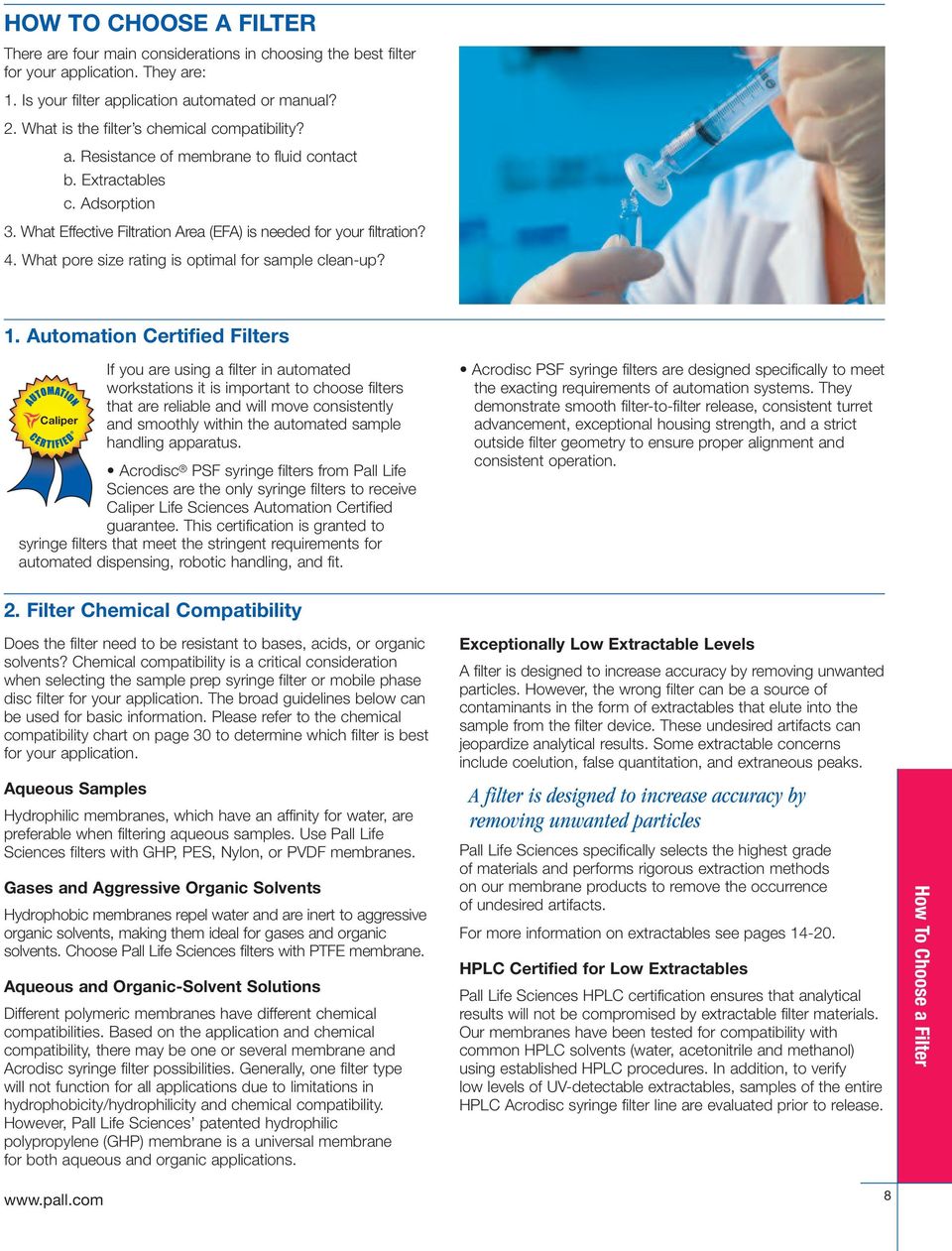
11 HOW TO CHOOSE A FILTE There are four main considerations in choosing the best filter for your application. They are: 1. Is your filter application automated or manual? 2. What is the filter s chemical compatibility? a. esistance of membrane to fluid contact b. Extractables c. Adsorption 3. What Effective Filtration Area (EFA) is needed for your filtration? 4. What pore size rating is optimal for sample clean-up? 1. Automation Certified Filters If you are using a filter in automated workstations it is important to choose filters that are reliable and will move consistently Caliper and smoothly within the automated sample handling apparatus. Acrodisc PSF syringe filters from Pall Life Sciences are the only syringe filters to receive Caliper Life Sciences Automation Certified guarantee. This certification is granted to syringe filters that meet the stringent requirements for automated dispensing, robotic handling, and fit. Acrodisc PSF syringe filters are designed specifically to meet the exacting requirements of automation systems. They demonstrate smooth filter-to-filter release, consistent turret advancement, exceptional housing strength, and a strict outside filter geometry to ensure proper alignment and consistent operation. 2. Filter Chemical Compatibility Does the filter need to be resistant to bases, acids, or organic solvents? Chemical compatibility is a critical consideration when selecting the sample prep syringe filter or mobile phase disc filter for your application. The broad guidelines below can be used for basic information. Please refer to the chemical compatibility chart on page 30 to determine which filter is best for your application. Aqueous Samples Hydrophilic membranes, which have an affinity for water, are preferable when filtering aqueous samples. Use Pall Life Sciences filters with GHP, PES, Nylon, or PVDF membranes. Gases and Aggressive Organic Solvents Hydrophobic membranes repel water and are inert to aggressive organic solvents, making them ideal for gases and organic solvents. Choose Pall Life Sciences filters with PTFE membrane. Aqueous and Organic-Solvent Solutions Different polymeric membranes have different chemical compatibilities. Based on the application and chemical compatibility, there may be one or several membrane and Acrodisc syringe filter possibilities. Generally, one filter type will not function for all applications due to limitations in hydrophobicity/hydrophilicity and chemical compatibility. However, Pall Life Sciences patented hydrophilic polypropylene (GHP) membrane is a universal membrane for both aqueous and organic applications. Exceptionally Low Extractable Levels A filter is designed to increase accuracy by removing unwanted particles. However, the wrong filter can be a source of contaminants in the form of extractables that elute into the sample from the filter device. These undesired artifacts can jeopardize analytical results. Some extractable concerns include coelution, false quantitation, and extraneous peaks. A filter is designed to increase accuracy by removing unwanted particles Pall Life Sciences specifically selects the highest grade of materials and performs rigorous extraction methods on our membrane products to remove the occurrence of undesired artifacts. For more information on extractables see pages HPLC Certified for Low Extractables Pall Life Sciences HPLC certification ensures that analytical results will not be compromised by extractable filter materials. Our membranes have been tested for compatibility with common HPLC solvents (water, acetonitrile and methanol) using established HPLC procedures. In addition, to verify low levels of UV-detectable extractables, samples of the entire HPLC Acrodisc syringe filter line are evaluated prior to release. How To Choose a Filter 8
12 2. Filter Chemical Compatibility (continued) IC Certified for Low Levels of Inorganic Extractables Pall Life Sciences certifies Ion Chromatography (IC) Acrodisc syringe filters have been tested using a highly sensitive IC protocol to monitor inorganic extractables. For ion chromatography applications, only the IC Acrodisc (PES) syringe filter is certified for low levels of inorganic extractables. Actual background levels of filter extractables are typically less than 20 ppb for chloride, 6 ppb for nitrate, 1 ppb for phosphate, and 10 ppb for sulfate. Sample Adsorption Unwanted drug binding as well as the presence of possible extractables eluted from the filter during routine pharmaceutical sample analysis can be a serious problem and cause out-ofspecification results. No single analytical method can provide reliable information on comparative filter properties and the full range of extractables for all filters. Therefore, choose a low adsorption filter such as the Acrodisc syringe filter with GHP membrane. GHP membrane is extremely low in biomolecule binding. Typical binding levels are far below 1%. See Drug Binding section pages How to Choose a Filter 3. Most Appropriate EFA The particulate contained within a fluid affects the life of a filter. As particles are removed from the fluid, they block pores and reduce the useable portion of the filter. Particulate-laden fluids generally plug a filter more quickly than "clean" fluids. Increasing the Effective Filtration Area (EFA) can lengthen the life of a filter. Filters come in a variety of sizes ranging from the area within a single well of a 96-well plate, to spin filters and syringe tip filters. 25 mm Acrodisc PSF syringe filters, as well as 13 and 4 mm diameters for smaller sample volumes, are available in a variety of membrane and pore size choices. Another aspect of choosing the right filter size is the hold-up volume. This is the volume of liquid remaining in the filter after use. A filter with a low hold-up volume is recommended for use with expensive fluids or those with limited availability. What device size will assure complete sample filtration with minimal hold-up volumes? Pall Life Sciences offers a broad range of device sizes. The minispike outlet, available on the 13 mm device, allows for minimal sample hold up and easy dispensing into autosampler vials. Additional options include the 4 mm Acrodisc syringe filter, the Nanosep MF centrifugal device, or AcroPrep filter plates. Syringe Filter and Spin Device Selection The table below outlines general guidelines to the appropriate filter size for different volumes of fluid. Table 2 Volume to Typical Hold-up be Filtered Filter Type Volume < 500 µl Nanosep MF Device < 2 µl < 2 ml 4 mm Acrodisc < 10 µl Syringe Filter < 10 ml 13 mm Acrodisc Syringe < 14 µl Filter (Minispike Outlet) < 10 ml 13 mm Acrodisc < 30 µl Syringe Filter < 125 ml 25 mm Acrodisc PSF < 200 µl Syringe Filter For difficult-to-filter samples, the Acrodisc PSF syringe filter with GxF multi-layered glass fiber prefilter is the best option Consider Prefiltration For difficult-to-filter samples, it is best to use a syringe filter with a glass fiber prefilter over the membrane. The Acrodisc PSF syringe filter with GxF multi-layered glass fiber prefilter is the best option for extremely particulate-laden samples. Our traditional Acrodisc syringe filters with GHP and Nylon membranes are also available with a single-layer glass fiber prefilter. Figure 3 Special rib design and proprietary weld ensure robust seal under high operating pressures. Free-floating prefilter prevents premature clogging. Multi-layered prefilter traps heterogeneous particulate throughout the matrix and on the surface, extending filter life. The Acrodisc PSF syringe filter has a serial glass fiber (GxF) prefilter to allow for maximum throughput and faster flow rates than standard glass fiber prefilter devices. The multi-layered prefilter, rated from > 40 to 1 µm, traps particulate, thereby extending filter life. Easy Identification Ample headspace for filter cake to build providing optimal throughput. Heat sealed final 0.45 µm membrane ensures particulate retention with no chance of breakthrough. 13 and 25 mm Acrodisc syringe filters and their packaging have color-coded printing with membrane type and pore size on each filter: GHP Nylon PTFE Glass Fiber PVDF Polyethersulfone (PES) 9

13 4. Optimal Pore Size ating To extend the life of your column and reduce maintenance due to particulate in the pumping system, thereby giving more analyses per dollar spent, a filter s pore size should be determined based on the column packing size. As you can see in Figure 4, the column packing particles touch each other. Ideally, you would not want contamination to fit into the space between the particles of packing. This space (labeled Flow Path) is identified in Figure 4 below. The idea is to find out how large that space is and remove particles that size. Figure 4 Figure 6 θ 3 µm Flow Path For example: start with a 3 µm packing size and draw a few well-placed equilateral triangles as suggested in Figure 5. Determine the largest particle capable of fitting through the column by circumscribing an equilateral triangle with a side length of 0.75 µm. Figure µm 3 µm 1.5 µm Now enlarge the diagram and look further. Visualize a series of equilateral triangles whose side length gets down to 0.75 µm. Figure 6 illustrates a right triangle whose short side describes the radius of the sphere. The angle θ is one half of 60º, or 30º. The horizontal side of this new right triangle has a length of µm (half of 0.75 µm). Calculating the tangent of 30º gives the ratio of the length of the opposite side over the adjacent side, in this case This means that the short side of the triangle is equal to 0.58 x or µm. Coincidentally, this is also the radius of the particle. So, if the column packing is 3 µm in diameter, the flow path is 0.43 µm. When an HPLC column has a packing size of 3 µm or smaller, you should use a 0.2 µm filter because a 0.45 µm filter may let particles through that will plug the column. Are You Concerned About Accurate etention of Particulate? For liquid chromatography systems using columns with larger than 3 µm packings, the filtration industry standard is 0.45 µm for syringe filters and mobile phase membranes. For columns with 3 µm or smaller packings, microbore columns, or when concerned about microbial growth, a 0.2 µm filter is recommended. Once the best pore size rating is chosen for the application, you must rely on the filter manufacturer to provide an accurate pore size rating. As shown in the article Column Protection, see pages 11-13, accurate pore size rating is important to the economics of the appropriate filter choice. How To Choose a Filter 10

14 EXTENDING HPLC COLUMN LIFE Injection of particulate-laden samples will plug High Performance Liquid Chromatography (HPLC) columns, shorten injector life, and result in extensive maintenance on pumps. Particulate finding its way into a column results in increased column backpressure, disrupted nominal band shape, and reduced plate number, consequently shortening column life and making analytical results difficult to interpret. Using Pall Acrodisc PSF syringe filters with GHP (hydrophilic polypropylene) membrane is the most efficient way to remove particulate and prolong the life of HPLC system components. Pall Acrodisc PSF syringe filters with GHP membrane are widely used for this purpose. The average retention efficiency of 0.45 µm rated Acrodisc PSF syringe filters with GHP membrane at removing 0.45 µm average diameter latex spheres is 94.9%. Compared to filters from two other manufacturers, Pall Acrodisc PSF syringe filters significantly prolonged HPLC column life with virtually no backpressure increase after 972 injections. Compared to other manufacturers, Pall Acrodisc PSF syringe filters significantly prolonged HPLC column life Background on Column Failure Of the four common causes for HPLC column failure (plugging, voids, adsorbed sample, and chemical attack), plugging is the most frequently encountered by analytical chemists or analysts. Injection of samples containing particulate will eventually block the column inlet, cause high column backpressure, and shorten the normal lifetime of the column. Operations of pump components, injectors, and detectors can be expected to be less troublesome when fluids are filtered. For HPLC applications, the 0.45 µm pore size filter is typically selected for removal of particulates. Although there are several seemingly equivalent such products on the market, lack of knowledge about the differences between filters leads to ore frequent column replacement and extensive operation downtime. Filtration as a preventative maintenance tool for HPLC analyses is well documented. It is commonly taken for granted that column life will be extended if samples are filtered prior to injection, but the extension of the column life has not been well quantified. It is the intent of this work to demonstrate that filter efficiency must be considered when choosing an HPLC sample-prep filter and that filtration will lengthen the life of a column. In this paper, retention efficiency of three effectively equivalent 0.45 µm rated syringe filters was examined using 0.45 µm average diameter latex spheres. This work was conducted with latex spheres to offer the best possible reproducibility in both sample preparation and filter efficiency measurements. In order to correlate the retention of spheres to the actual application, the quantitative effect of filtration on HPLC column life was investigated. This involved examining column life without filtration compared to column life when samples were filtered. It should be recognized that extending the column life is dependent on the particulate within the sample and actual column life extension may vary. Test Methods Column Protection Materials Latex spheres and surfactant were purchased from Sigma µm average diameter latex spheres: L/N 31K1123, Cat #: LB-5 Triton X-100 L/N: 121K0090, Cat #: X mm syringe filters with 0.45 µm pore size ratings were obtained from Pall, Company A, and Company B Pall Acrodisc PSF Syringe Filters with GHP membrane: P/N AP-4557, L/N: A , A , and A Company A syringe filters with PVDF membrane: L/N F2EN42569, F0BN28908, and F2NN83751 Company B syringe filters with PVDF membrane: L/N: 11067, 11146, and Instrumentation High Performance Liquid Chromatography (HPLC) Waters (Milford, MA, USA) 616 Pump Waters 600s Controller Waters 717plus Autosampler Ultraviolet/Visible Spectrophotometer (UV/VIS), HP 8452A Diode Array Columns Luna 5 µm C18(2), columns were purchased from Phenomenex (Torrance, CA, USA): Size: 30 x 3.0 mm, P/N: 00A-4252-Y0, S/N: , , , and

15 Test Methods (continued) Testing The UV/VIS Spectrophotometer was used for measuring absorbance of latex-sphere solutions. The maximum absorbance of the latex-sphere solution was observed at 272 nm, which was used to correlate latex sphere concentrations with absorbance. The surfactant solution, 0.1% Triton X-100 that is free of latex spheres, was measured as the blank at 272 nm. A series of standard solutions of %, %, %, and 0.01% 0.45 µm latex sphere concentrations were made and used for creating the calibration curve. The linear relationship between latex sphere concentrations and absorbance was established, which is in accordance with Beer s law. A correlation coefficient of was obtained. The 0.01% 0.45 µm average diameter latex spheres solution was used for the retention efficiency study. The challenge solution was passed through each individual syringe filter and a 3 ml eluted aliquot was collected and analyzed at 272 nm. Three different filters from each of the three lots were tested (i.e., nine filters from each manufacturer were individually analyzed). The HPLC was utilized for the column-plugging study. Column life was evaluated by comparing initial backpressure to backpressure after injections. A new LUNA C18(2) 00A-4252-Y0 column (S/N: ) was installed. The outlet of the column was disconnected from the detector and allowed to run to drain. This modification allowed quicker injections for a more efficient determination of column backpressure. Acetonitrile:Water (35:65, percentage by volume) was used as mobile phase, with a flow rate of 1 ml/min. Column temperature was controlled at 25 C. The system was set to automatically inject 50 µl each time. The column-plugging solution consisted of 0.05% (by weight) 0.45 µm average diameter latex spheres in 0.002% Triton X-100 solution. The first step was to inject this solution without any filtration to see how long the column would last without filtration. After the column was plugged (i.e., column backpressure reached 3500 psig, bar, kpa), a new LUNA C18(2) 00A-4252-Y0 column (S/N: ) was installed. This time the same latex-sphere solution was subjected to filtration using Company A filters. Thirty samples were generated with 30 Company A filters (ten from each of the three lots). The injections were carried out from sample vial one through vial 30 and then repeated in this sequence. The column backpressure was recorded with the number of injections. This procedure was repeated with new columns, S/N and , for studies with Company B and Pall filters, respectively. Test esults and Discussion Latex Sphere etention for Filters from Three Manufacturers Tables 3 to 5 list latex sphere retention capabilities of Pall, Company A, and Company B syringe filters. Pall Acrodisc syringe filters with GHP membrane are able to retain an average of 94.9% of the 0.45 µm average diameter latex spheres. By comparison, other syringe filters can only remove averages of 90.5% and 33.0% of the 0.45 µm average diameter latex spheres. Pall syringe filters show greater lot-to-lot consistency with a relative standard deviation (SD) of 3.5%. Table µm Latex Sphere etention Efficiency (in Percentage) with 0.45 µm Pall GHP Filters L/N: L/N: L/N: Filters A A A Filter Filter Filter Average from each lot Average from three 94.9/3.5 lots/sd Table µm Latex Sphere etention Efficiency (in Percentage) with 0.45 µm Company A Filters L/N: L/N: L/N: Filters F2EN42569 F0BN28908 F2NN83751 Filter Filter Filter Average from each lot Average from three 33.0/12.7 lots/sd These syringe filters from different manufacturers may appear similar and are all assigned a pore size rating of 0.45 µm from the manufacturer, but the test results show that they perform quite differently. Column Protection 12

16 Test esults and Discussion (continued) Table µm Latex Sphere etention Efficiency (in Percentage) with 0.45 µm Company B Filters Filters L/N: L/N: L/N: Filter Filter These syringe filters from different manufacturers may appear similar and are all assigned a pore size rating of 0.45 µm from the manufacturer, but the test results show that they perform differently. Filter Average from each lot Average from three 90.5/5.4 lots/sd Function of Filtration to Extend HPLC Column Life Figure 7 depicts the relationship between column backpressure and number of injections. Without filtration, the column failure due to plugging occurred after only 21 injections. After the 0.05% latex-sphere solution was filtered with competitive filters, the columns were plugged after 37 and 487 injections, respectively. In addition, the effluents from both competitive filters were hazy, indicating the presence of a significant number of latex spheres. When the 0.05% latex-sphere solution was filtered through Pall Acrodisc PSF syringe filters with GHP membrane and injected to the HPLC system, the column backpressure did not increase after even 972 injections. The clear effluents from the filters suggested a more successful retention of latex spheres. Figure 7 Effects of Filters on HPLC Column Life Column Backpressure, psig Unfiltered Company A Filters Company B Filters Pall Acrodisc PSF Filters Number of Injections Conclusion Among 0.45 µm rated filters from three manufacturers, the Pall Acrodisc PSF syringe filters with GHP membrane have the highest average retention efficiency (94.9%) of latex spheres, as well as greater lot-to-lot consistency. Using Pall Acrodisc PSF syringe filters with GHP membrane prolonged the column life 46 times with no increase in column backpressure Column Protection We have shown that it is imperative that samples be filtered prior to their introduction into an HPLC system. Apparently, equivalent filters from various manufacturers with the same removal rating differ in capabilities. Using Pall Acrodisc PSF syringe filters with GHP membrane prolonged the column life 46 times with no increase in column backpressure. 13

17 EXTACTABLES AND MAINTAINING ANALYTICAL INTEGITY DUING SAMPLE PEPAATION Pall Life Sciences manufactures a complete line of Acrodisc and Acrodisc PSF syringe filters for analytical sample preparation. Because High Performance Liquid Chromatography (HPLC) and other analytical methods are very sensitive and serve as qualitative and quantitative techniques, it is important to preserve the integrity of the sample. To demonstrate Pall Life Sciences quality product offering, an investigation to evaluate the amount of extractable materials added from analytical syringe filters follows. What are Extractables and Where Do They Come From? A syringe tip filter extractable is an undesired artifact contributed to the sample fluid from the filter device. This material may be a membrane or housing formulation component, or a component introduced during the manufacturing or packaging process. There are several mechanisms (solubility, particle displacement, chemical interaction, and diffusion) whereby extractable materials may leach into the sample during sample preparation. Of these mechanisms, solubility and particle displacement are more prevalent. The appearance of extractable materials from a syringe tip device depends on the solubility of device components in the sample fluid. The polymeric resins, solvents, pore formers and other chemical components such as housing materials utilized during device manufacturing may potentially extract. Solubility relates to chemical compatibility. As membrane and/or housing components become more soluble with sample fluid components, extractable materials will increase. To determine whether a syringe filter is compatible with the sample fluid, all sample constituents (both major and minor components) require consideration. Because solubility is dependent on temperature, concentration, and exposure time, all of these parameters are significant in determining chemical compatibility. Displacement can occur when residual manufacturing materials, once caught in the pore structure of the membrane, are dislodged. Pall Life Sciences performs rigorous extraction methods on their membrane products to hinder this occurrence. Why are There So Many Different Acrodisc Syringe Filter Types? Different polymeric membranes have different chemical compatibilities. Based on the application and chemical compatibility, there may be one or more Acrodisc or Acrodisc PSF syringe filter possibilities. For example, PVDF, GHP or PTFE membranes are recommended for sample fluids possessing strong acidic character. Nylon membrane is not recommended for such samples. Conversely, Nylon, GHP, or PTFE would make a better choice for fluids characterized as strong bases, and PVDF membrane is not suggested for these fluids. If the fluid contains aggressive organics, GHP or PTFE membranes are recommended. eviewing and understanding the Pall Life Sciences chemical compatibility guide will assist in making the best choice. (efer to the Chemical Compatibility Guide on page 30.) Generally, one filter type will not function for all applications due to limitations in hydrophobicity/hydrophilicity and chemical compatibility. However, Pall Life Sciences Hydrophilic Polypropylene (GHP) membrane comes very close to being a universal membrane for all applications. It has excellent chemical compatibility for aqueous and aggressive organic solvents. GHP membrane is hydrophilic and ideal when selection is difficult for complex sample matrices. The option of a built-in glass prefilter (GHP GF or GxF/GHP) is also available for heavily particulate-laden samples. There are two lines of Acrodisc syringe filters. From the perspective of extractables, the standard Acrodisc and the Acrodisc PSF syringe filters are identical, with the exception that the effective filtration area of the PSF product line is larger. It is 31% greater based on the 3.9 square centimeter EFA compared to the 2.8 square centimeters of the standard Acrodisc. This study will show that the extractable levels found in both filter versions are negligible and both product lines are appropriate for use in HPLC sample preparation. Pall Life Sciences GHP membrane can be considered a universal membrane for all applications Extractables 14

18 When are Extractables a Concern? Extractable materials can jeopardize analytical results. For chromatographic analysis, scenarios resulting from extractable materials include sample absorption, coelution, and extraneous peaks. Anomalous results are an analyst's nightmare as procedures typically require action to remedy or identify miscellaneous and unexpected peaks. If unknown peaks in a pharmaceutical chromatogram (extractables) equal 0.1% of the total area then they must be investigated. Extractable materials become even more of a concern as the amount of analyte diminishes. With recent HPLC column trends utilizing smaller inner-diameter columns (<1 mm for micro LC) and smaller packing sizes, the ability to separate and detect trace quantities of material is increasing. With these improvements comes increasing concern for the effects of extractable materials. How to Avoid Extractables' Detritus Effects? There are three primary methods to avoid the detritus effects of extractable materials. Application testing preserves analysis validity. To application test, analyze the sample fluid before it is filtered. Compare these results to the results obtained after the sample is filtered. If any quantitative or qualitative differences occur, select another filter type. Another method of application testing involves evaluating the results obtained from passing the matrix solvent through the syringe tip filter and evaluating the results. This will demonstrate if material will extract with the neat solvent. Flushing is a third method (see page 20). When excess sample fluid is available, discard the first few milliliters of fluid eluting from the syringe tip device. Generally, the amount of extractable materials eluted from the filter diminishes with the volume passed through the filter. As will be shown in this study, a 3 ml flush is usually adequate to reduce extractables to an acceptable level. What Contributes to an Acrodisc Syringe Filter's Quality? Membrane manufacturers use proprietary formulations and different manufacturing techniques. For this reason, Pall Life Sciences membranes, Acrodisc and Acrodisc PSF syringe filters are not the same as other look-a-like products. The specific quality of raw materials, amount of quality control, membrane extraction procedures and post treatments all affect the resultant membrane properties and amount of extractable materials. Pall Life Sciences specifically selects the highest grade of materials and performs several extractions to ensure that the product is free from extractable materials for sample preparation. Additionally, our polypropylene housing material, also used in Pall Life Sciences medical devices, is the highest grade of plastic with minimal additives, and passes United States Pharmacopeia (USP) Biological eactivity Test, In Vivo <88> plastics testing. What Confidence Can You Have in Our HPLC Certification? The following extractable experiments are provided to demonstrate the quality of the Acrodisc and Acrodisc PSF syringe filter product lines, which include PVDF, GHP, Nylon, and PTFE. To suit a broad audience, extractable experiments were performed under typical HPLC conditions with common mobile phases and extraction solvents. This information extends to the corresponding membrane disc for mobile phase filtration and other sizes of Acrodisc syringe filters, as the filter materials are the same. Extractables 15

19 Experimental and Instrument Conditions The first set of extractions represented by the enclosed chromatograms resulted from volumetrically collecting the first milliliter of solvent through the Acrodisc syringe filter. This step was repeated with two additional filters. All three extracts were combined in an autosampler vial and analyzed, so that three filters contributed to one sample. Three filters were selected to remove potential variability among the filters. By collecting only one milliliter of eluent per filter, the ability to detect extractable materials was enhanced. HPLC analysis was performed on all fluid extracts with a Waters System (Milford, MA, USA) consisting of a 616 Fluid Pump, 717 Plus Autoinjector, 600S Controller, 996 Photodiode Array (PDA) Detector and Millennium 2010 Software. The column, also supplied by Waters, was a NovaPak 4 µm C18, 4.6 mm x mm. All extraction and mobile phase fluids, acetronitrile, water, and methanol were HPLC Grade Solvents supplied by EM Science (Gibbstown, NJ, USA). Six manufacturers of 25 mm syringe tip filters were included in this analysis. Only the Pall Life Sciences products will be identified. For anonymity, the other manufacturers will be identified as Manufacturers A, B, C, M, and S. All filters were extracted according to the outlined procedure with three extraction solvents (methanol, acetonitrile, and water), and analyzed at three wavelengths (214, 254, and 280 nm). From this data set, the chromatograms that present the most useful information will be presented. In all studies the neat solvent was simultaneously analyzed. The solvent analysis, when compared to the other chromatograms, helps to determine if the peaks are from the solvent or the syringe tip device. In each category of membrane type (PVDF, hydrophilic polypropylene [GHP], Nylon, and PTFE) the intensity scales were uniformly adjusted to facilitate visual analysis of the amount of extractable material. The extracted fluid and neat solvent blanks, 100 µl, were analyzed under gradient mobile phase conditions. Initial conditions were held for three minutes, 95% water: 5% acetronitrile, and altered in a linear gradient over 40 minutes to the final conditions, 100% acetonitrile: 0% water, which were retained for five minutes. The system was equilibrated for 10 minutes before reinjecting. The wavelengths of interest, 214, 254, 280 nm, were acquired simultaneously with the PDA Detector. PVDF Syringe Tip Filters Figures 8-12 are HPLC chromatograms of acetonitrile extractions by the method described with PVDF syringe tip filters. To eliminate redundancy and maximize useful information, only the acetonitrile extractions at 280 nm are presented. Figure 8 is the chromatogram of the acetonitrile solvent. Any peaks that appear in Figures 9-12, which are not in Figure 8, are Figure 8 Acetonitrile Extraction: Blank extractable materials from the syringe tip filter. Figure 9 is Pall Life Sciences LC PVDF Acrodisc syringe filter. Figures are from Manufacturers A, B, and M respectively. The differences in the amount of extractables from the various manufacturers demonstrate differences in formulation, housing materials and washing procedures. Figure 9 Acetonitrile Extraction: Pall Life Sciences PVDF Acrodisc Syringe Filter AU AU Extractables Minutes Minutes 16

20 PVDF Syringe Tip Filters (continued) Figure 10 Acetonitrile Extraction: Manufacturer A Syringe Filter Figure 12 Acetonitrile Extraction: Manufacturer M Syringe Filter AU AU Minutes Minutes Figure 11 Acetonitrile Extraction: Manufacturer B Syringe Filter AU Minutes GHP Hydrophilic Polypropylene and Other Syringe Tip Filters Extractables Pall Life Sciences offers a GHP hydrophilic polypropylene membrane. A similar product, hydrophilic PTFE from Manufacturer M, was selected. Figure 13 represents the extraction solvent, Figure 14 the GHP Acrodisc syringe filter, Manufacturer M is displayed in Figure 15. Typically PTFE is a relatively clean material, based on the manufacturing process; therefore, the extractable materials in Figure 15 are potentially from the hydrophilic treatment or from the housing material. Figure 13 Acetonitrile Extraction: Blank AU Minutes 17

21 GHP Hydrophilic Polypropylene and Other Syringe Tip Filters (continued) Figure 14 Acetonitrile Extraction: Pall Life Sciences GHP Acrodisc Syringe Filters Figure 15 Acetonitrile Extraction: Manufacturer M Syringe Filter AU Minutes AU Minutes PTFE Syringe Tip Filters Figures provide examples of the neat methanol, and extractions of the Pall Life Sciences C PTFE Acrodisc syringe filter and Manufacturer B's syringe tip filter read at 214 nm. Once again, the results are indicative of the differences in membrane and housing materials, and manufacturers' procedures. Figure 16 Methanol: Blank Figure 17 Methanol: Pall Life Sciences C PTFE Acrodisc Syringe Filter AU AU Minutes Figure 18 Methanol: Manufacturer B Syringe Filter Minutes AU Extractables Minutes 18
22 Nylon Syringe Tip Filters Figures represent methanol extractions for three nylon filter brands read at 214 nm. Figure 19 represents methanol, the reference solvent. Any peaks in Figures which are not in Figure 19 are due to the syringe filters. Figure 20 is Pall Life Sciences Nylon Acrodisc syringe filter. Figures represent Manufacturers' C and S products, respectively. Figure 19 Methanol: Blank Figure 21 Methanol: Manufacturer C Syringe Filter AU 0.06 AU Minutes Minutes Figure 20 Methanol: Pall Life Sciences Nylon Acrodisc Figure 22 Methanol: Manufacturer S Syringe Filter AU 0.06 AU Minutes Minutes Extractactables Conclusion From perusal of Figures 8-22, it should be quite obvious that all syringe tip filters, although similar in design, are not similar with regard to extractable materials. Pall Life Sciences uses high quality raw materials and performs thorough post treatment processes on membranes that will be used in its HPLC product line to minimize the occurrence of extractables. To verify low levels of UV-detectable extractables, samples of the entire HPLC Acrodisc syringe filter product line are evaluated during the manufacturing process. The Pall Life Sciences HPLC Certification is additional assurance that Acrodisc and Acrodisc PSF syringe filters have been optimized to minimize extractable materials. This conveys to our customers that each and every lot meets the high standards demanded by Pall Life Sciences quality assurance department. It also means our customers can expect reliable, reproducible results without compromising the integrity of the sample being filtered. With little or no extractables from the filter, extraneous peak identification due to filtration can be eliminated. Application testing is recommended to determine the best membrane filter selection for specific applications. 19
23 Flush Volume Determination This study involves passing of the pure solvent composition (without active pharmaceutical ingredient (API)) directly through the filter and comparison of the elution profiles for each sequential 1 ml portion. It is found that a 3 ml flush volume is sufficient for the elution of possible extractables to below the interference level (equal to 0.1%). To determine an adequate flush volume, 10% Acetonitrile was pushed through an Acrodisc PSF with GxF glass over a PVDF membrane. The sequential 1 ml filter effluent aliquots were then injected into the HPLC to determine the volume of flush required to reduce the extractable peak(s) to an acceptable level (<0.1%). The chromatograms of the first three and the tenth 1 ml aliquots are shown in Figure 23. It is evident that the extractable peaks labeled 4 and 5 decrease considerably over the first 3 ml flush. The same instrumentation and chromatographic conditions cited in the Drug Binding section of this document were followed for the flush volume determination. Figure 23 Filter Extractables in Consecutive 1 ml Flush Fractions (Pall GxF/PVDF, Cat # AP-4310 in 10% Acetonitrile-containing Media) API Standard 1 ml 2 ml 3 ml 10 ml In pharmaceutics analysis, peaks greater than 0.1% are required to be identified. The discard volume, sufficient to reduce extractables below levels of interference with a drug purity determination, however, should be evaluated on a case-by-case basis. Changing the solvent or the filter composition may affect the required flush volume. Extractables 20
24 SUITABILITY OF VAIOUS FILTES FO SAMPLE PEPAATION IN DISSOLUTION TESTING, BASED ON DUG BINDING Filtration is a common method of sample preparation in dissolution testing, prior to HPLC injection. The purpose of sample filtration is to remove non-dissolved solids prior to HPLC injection. Non-dissolved solids interfere with the resulting chromatography by continuing to dissolve throughout the period of the analysis and also by plugging the HPLC column. It has already been shown that sample preparation using filtration does result in more reproducible chromatography and longer column life. There can be potential drawbacks with filtration as a preparation for HPLC analysis in dissolution testing. The first is that the filter may adsorb active pharmaceutical ingredients (API) from the drug mixture leaving the concentration in the filtrate too low and out-of-specification (OOS). Unwanted drug adsorption as well as the presence of possible extractables eluted from the filter during routine pharmaceutical sample analysis can be a serious problem and cause OOS results. No single analytical method can provide reliable information on comparative filter properties and the full range of extractables for all filters. Extractables have already been discussed, therefore, this study will evaluate filters for adsorption of API. The drug product selection and product formulations in this study represent a wide variety of compounds that differ in chemical structures, ionization properties, and molecular weights and therefore differ in binding propensity. Also, a broad range of medium for the sample preparation is matrixed into the study to evaluate elution profiles of each filter. All experiments are designed based on well-characterized (validated) United States Pharmacopoeia (USP) methods. We will demonstrate that correct selection and use of syringe filters makes the amount of API removed by the syringe filters too small to affect the HPLC determination. To do this, five drug products are each evaluated with four different syringe filters. The four different syringe filters contain three different hydrophilic polymeric membranes, plus one without glass prefilter. The five drug products represent a variety of molecular structures and chemistries and therefore are expected to demonstrate a range in adsorption to the different filter membranes. Experimental There are many HPLC sample preparation filters from which to choose. Table 6 lists the four choices of hydrophilic syringe filters reviewed in this paper. The materials of construction of the filters include a glass fiber prefilter over 0.45 µm hydrophilic polypropylene (GHP), polyvinylidene fluoride (PVDF), or polyethersulfone Supor (PES) membrane. The GHP membrane was also tested without the glass fiber prefilter. All syringe filters tested have polypropylene housings. The drugs (API s) used in this evaluation represent a range of different functionalities and structures and should therefore demonstrate a range of adsorption to membrane filters. As seen in Table 7, the chemical structures vary from single aromatic rings to multiple aromatic rings to a non-aromatic, polycyclic structure. Included in the study are an acid, a base, an amide, a urethane, an ester, and a lactone structure. The physical structures vary from a more flat and planar structure like that of acetaminophen to the flat but flexible structure of ibuprofen and ranitidine HCl, to the more rigid and distinct three-dimensional structure of simvastatin. Table 6 Filters Tested Product Membrane Glass ID # Manufacturer Name Cat # Lot # Type Fiber Prefilter Pall Life Sciences Acrodisc PSF AP-4424 A Supor (PES) YES Pall Life Sciences Acrodisc PSF AP-4557 A GHP YES Drug Binding Pall Life Sciences Acrodisc PSF AP-4310 A PVDF YES Pall Life Sciences Acrodisc PSF AP-4560 A GHP NO Membrane types: Supor (PES) Polyethersulfone GHP Hydrophilic polypropylene PVDF Hydrophilic polyvinylidene fluoride 21
25 Experimental (continued) Table 7 Pharmaceutical Products Drug Product Molecule Molecular HPLC (Brand Name) Type Structure Mobile Phase Acetaminophen Acetamide Methanol and water (Tylenol ) MW (25:75) Tablets Ibuprofen (Motrin ) Benzeneacetic acid Mixture of organic Tablets MW (ACN) and aqueous buffer ph 3.0 (80:20) anitidine HCl Hydrochloride salt Mixture of organic (Zantac ) Tablets MW (Methanol) and aqueous ammonium acetate buffer (85:15) ph 7.0 Simvastatin (Zocor ) Highly non-polar Mixture of organic (ACN) Tablets compound and aqueous sodium MW acetate buffer ph 4.0 (80:20) Loratidine (Claritin ) Pyperidine carboxylate Mixture of organic (ACN Tablets MW and MeOH) and aqueous buffer (40:40:20) General Methodology USP methods are intended for drug testing. Slight modifications to the sample handling in the methods are necessary for the purpose of filter comparison rather than drug testing. Well-characterized pharmaceutical samples are analyzed in duplicate and triplicate followed by statistical evaluation, which allows for increased reliability of the drawn conclusions on filter suitability. esults are obtained by HPLC analysis with UV detector at 238 nm for Simvastatin, 243 nm for acetaminophen, 254 nm for Ibuprofen and Loratadine and 322 nm for ranitidine HCl. All calculations are performed according to each specific USP procedure against the appropriate, well-characterized (certified) corresponding USP reference standard. Label claim percentage (%LC) of each drug is calculated as ratio of the amount of drug that is found during analysis in each filtrate to the amount known (or claimed) to be present in the tested solution, and expressed as percentage. ecovery of each drug upon filtration (i.e., %LC to centrifuged) is calculated as ratio of the amount that is found during analysis in each filtrate to the amount that is found in the centrifuged sample, and expressed as percentage. For the chosen well characterized pharmaceutical products, the value of the label claim percentage (%LC) is between % for the accurately carried testing procedure. Any additional handling of the samples (e.g. filtering or centrifugation) is a source of additional error or inaccuracy. Therefore, specifications for the filtered samples are set to meet wider % interval of acceptability. This criterion is set based on the assumption that handling of the filtering process should not add more than 1% error to the sample analysis regardless of the individual filter compatibility. This assumption was validated in the filter study. The data spread (% relative standard deviation (SD)), which is caused solely by filtration, is less than 1% for all filters (Table 15). Therefore, results outside the % interval are indicating out-of-specification results and signaling potential filter incompatibility. Each out-of-specification result (highlighted in yellow) is addressed individually in the discussion section of this report. Drug Binding 22
26 General Methodology (continued) All solvent compositions are given in Table 7. Drugs in easily soluble salt form are less adsorbed by a generally hydrophobic filter membrane and more likely to stay in solution than be attracted to a membrane. When the amount of organic component is high enough to suppress ionization (and hence solubility) of such compound, it might result in precipitation. Therefore anitidine Hydrochloride adsorption is studied in aqueous solutions with a low amount of organic component, to study pure adsorption effect rather than solid particle retention. Ibuprofen and two binary mixtures with high and low Acetonitrile content are chosen to demonstrate binding of a non-polar drug in the free form to a filter membrane in different media. Filter Evaluation is Conducted Using the Following Methodology The flush volume required for consistent sample analysis (flush study) is determined in three steps. A fourth and final step (filter study) is completed to verify that flush volumes are adequate. In step one, centrifuged samples of each drug are prepared in duplicate and analyzed in duplicate for average percent recovery of the active compound against the label claim. All testing follows USP methodology. Average results can be found in Table 9. In step two; 20 ml of the sample solution are run through each filter. The 1st, 2nd, 3rd, 5th, 10th, 15th and 20th 1 ml aliquots are collected and analyzed. The drug concentration is measured after filtration. Duplicate HPLC injections of the seven 1 ml aliquots are performed for each filter, with each drug evaluated (280 samples total). The flush volume evaluation from step two is determined as sufficient when the recovery value for the filtered sample is within % of the centrifuged sample. In step three, filtered aliquots (from step two) are compared with centrifuged samples (from step one). The recovery of each drug preparation is determined as a percentage of label claim and as a ratio of percentage of label claim to the centrifuged sample, according to USP methodologies. The average recovery of each drug with each filter is given in Tables In step four, triplicate sample filtrations of each drug solution with each filter are performed. The first 3 ml flush volume is discarded and subsequent 1 ml samples are collected and analyzed by HPLC in duplicate (120 samples total). The triplicate average of each filter with each drug is itemized in Table 15. esults are reported as a percentage of label claim for each drug along with the relative standard deviation found within the sample groups. The chromatographic conditions and standards are given below and in Table 8. Instrumentation A. Hitachi (San Jose, CA, USA) HPLC systems with the following components: - Hitachi L7200 Autosampler. - Hitachi L7400 UV Detector - Hitachi L7100 Gradient Pump. - Hitachi L7300 Column Oven. - Perkin-Elmer (Wellesley, MA, USA) 970A Interface. - Perkin-Elmer TotalChrom Data acquisition system and processing software. B. HPLC columns (as directed in each applied USP method) C. General laboratory equipment and Class A analytical glassware Table 8 eagents and eference Standards Used Acetaminophen USP S (lot J2C423) Ibuprofen USP S (lot ) Loratadine USP S (lot G0D344) Valerophenone (eagent grade) 4-Isobutylacetophenone (eagent grade) Chloroacetic Acid (eagent grade) Drug Binding anitidine USP S (lot H0B268) Simvastatin USP S (lot I0D382) Acetonitrile (HPLC grade) Methanol (HPLC grade) Ammonium Acetate (ACS-certified eagent) Glacial Acetic Acid (ACS-certified eagent) Sodium Hydroxide (ACS-certified eagent) Sodium Phosphate Monobasic (ACS-certified eagent) DI Water suitable for HPLC Ammonium Hydroxide (ACS certified eagent) 85% Phosphoric Acid (ACS-certified eagent) Potassium Phosphate Dibasic (ACS-certified eagent) 23
27 esults Table 9 esults Obtained for the Centrifuged Samples of Each Drug Product in Corresponding USP Method in Filter and Flush Studies. Acetaminophen Ibuprofen anitidine Loratadine Simvastatin (Tylenol ) (Motrin ) (Zantac ) (Claritin ) (Zocor ) Average %LC Average % LC Average % LC Average % LC Average % LC Flush Study (Optimization of the filtration parameters flush volume determination). Data from all flush studies are summarized in Tables Table 10 Amount of Acetaminophen in Filtered Samples ACETAMINOPHEN (TYLENOL) GxF/Supor * GxF/GHP* GxF/PVDF* GHP* Average Average % Average Average % Average Average % Average Average % Aliquot % LC Centrifuged % LC Centrifuged % LC Centrifuged % LC Centrifuged 1st ml nd ml rd ml th ml th ml th ml th ml Table 11 Amount of Ibuprofen in Filtered Samples IBUPOFEN (MOTIN) GxF/Supor* GxF/GHP* GxF/PVDF* GHP* Average Average % Average Average % Average Average % Average Average % Aliquot % LC Centrifuged % LC Centrifuged % LC Centrifuged % LC Centrifuged 1st ml nd ml rd ml th ml th ml th ml th ml Drug Binding 24
28 esults (continued) Table 12 Amount of anitidine HCl in Filtered Samples ANITIDINE HCL (ZANTAC ) GxF/Supor * GxF/GHP* GxF/PVDF* GHP* Average Average % Average Average % Average Average % Average Average % Aliquot % LC Centrifuged % LC Centrifuged % LC Centrifuged % LC Centrifuged 1st ml nd ml rd ml th ml th ml th ml th ml Table 13 Amount of Simvastatin in Filtered Samples SIMVASTATIN (ZOCO ) GxF/Supor* GxF/GHP* GxF/PVDF* GHP* Average Average % Average Average % Average Average % Average Average % Aliquot % LC Centrifuged % LC Centrifuged % LC Centrifuged % LC Centrifuged 1st ml nd ml rd ml th ml th ml th ml th ml Table 14 Amount of Loratadine in Filtered Samples LOATIDINE (CLAITIN ) Drug Binding GxF/Supor* GxF/GHP* GxF/PVDF* GHP* Average Average % Average Average % Average Average % Average Average % Aliquot % LC Centrifuged % LC Centrifuged % LC Centrifuged % LC Centrifuged 1st ml nd ml rd ml th ml th ml th ml th ml *1 Filter ID Pall Acrodisc PSF with glass fiber prefilter over Supor membrane, PN AP-4424 Lot A *2 Filter ID Pall Acrodisc PSF with glass fiber prefilter over GHP membrane, PN AP-4557 Lot A *3 Filter ID Pall Acrodisc PSF with glass fiber prefilter over PVDF membrane, PN AP-4310 Lot A *4 Filter ID Pall Acrodisc PSF with GHP membrane, PN AP-4560 Lot A
29 Filter Study (Finished Pharmaceutical Product Analysis) All tested filters perform comparably for the tested drugs and solvent compositions, and are found to be suitable for the assay of the tested drug products when a 3 ml flush volume is applied. It is noteworthy that the 3 ml discard volume is chosen as an amount that is sufficient to ensure accuracy. esults of the triplicate determination of a label claim (%LC) and data spread (%SD) for each drug and each filter are reported in Table 15. Table 15 Filter Study Summary with a 3 ml Preflush Acetaminophen Ibuprofen anitidine Loratadine Simvastatin Discarded (Tylenol ) (Motrin ) (Zantac ) (Claritin ) (Zocor ) Filter Filter Flush Average Average Average Average Average ID Description Volume (ml) %LC %SD %LC %SD %LC %SD %LC %SD %LC %SD Acrodisc PSF 3 ml Cat# AP-4424 Lot# A Supor w/glassfiber pre-filter Acrodisc PSF 3 ml Cat# AP-4557 Lot# A GHP w/glassfiber pre-filter Acrodisc PSF 3 ml Cat# AP-4310 Lot# A PVDF w/glassfiber pre-filter Acrodisc PSF 3 ml Cat# AP-4560 Lot# A GHP membrane Drug Binding 26
30 Discussion All tested filters perform comparably for the tested drugs. In this study the adsorption of an active ingredient on a filter is evaluated in successive aliquots of filtrate and compared to centrifuged samples. These experiments reveal feasibility of the applied methodology and allowed for determination of the filtration conditions with the least added error of handling. Subsequently, filter performance is compared in conditions resembling routine finished product analysis at the preferred handling conditions. The flush study demonstrates greater variations in the label claim percentage results in the first 1 ml effluent. Four out-of-specification results occur in the first 1 ml of filter eluate. The filter study demonstrates that all four Acrodisc PSF syringe filters are appropriate for each of these drugs based on acceptable results after a 3 ml flush. The out-of-specification result for the Ibuprofen (shown in bold in Table 11) is attributed to possible initial adsorption of the organic solvent by the filter membrane. This initial adsorption will cause the first aliquot to have an apparent concentration above the starting concentration, which causes the initial reading to be OOS, on the high side. Disposal of the first 3 ml of the effluent is the recommended resolution to allow use of this filter with this solvent system. The out-of-specification results for the Loratadine (shown in bold in Table 14) are attributed to the inconsistency incorporated into the study design. A flush size of 3 ml is found sufficient to avoid inherent inaccuracy of the human handling and remove any potential API binding concerns. The 3 ml discard volume is chosen as an amount that is sufficient to ensure accuracy and consistency of experimentation and environmentally responsible solvent usage. We believe that if more solvent is necessary for the analysis, the filter is not suitable for that particular application. esults of the triplicate determination of a label claim and %SD for each drug and each filter are reported in Table 15. The results confirm that filtration does not affect the finished drug product assay numerically and all tested filters are suitable for achieving % accuracy with the data spread (precision) less than 1%. Conclusion It is accepted that membrane and drug chemistry can affect the amount of adsorption of drug products in a negative manner. If the filter membrane adsorbs too much API, the results may be out-of-specification. Choosing and using filters correctly (to reduce the amount of adsorption) is critical for accurate HPLC in dissolution testing. This investigation demonstrates that Acrodisc PSF syringe filters with GHP, Acrodisc PSF syringe filters with GHP, PVDF, or Supor membrane, with and without glass prefilter layers have acceptable drug binding performance PVDF, or Supor membrane, with and without glass prefilter layers have acceptable drug binding performance in a wide variety of API structures and chemistries. A flush volume of 3 ml is sufficient to overcome procedural variation inherent within the methodology. As can be verified from the data in Table 15, the variation that is caused solely by filtration is less than 1% for all filters in all chemistries. Drug Binding 27
31 PODUCT FEATUES Features and Benefits for Pall Life Sciences' Products Feature Pall Life Sciences is a cgmp compliant facility and ISO 9001 certified. Acrodisc PSF is available with single-layer or built-in multi-layered glass fiber prefilter. Acrodisc PSF is designed for automation and Automation Certified by Caliper Life Sciences. Packaged with AutoPack packaging. Acrodisc filters are designed for high operating pressures with an integral membrane seal. Acrodisc filters offer better retention efficiency. Available with HPLC certification or IC certification. Pall Corporation is the largest membrane manufacturer in the world. Pall sells products into all aspects of the drug development pipeline from discovery to delivery. Benefit Superior quality systems in place to ensure highest quality products consistently. Easier filtration of difficult-to-filter solutions. Provides reliable and consistent performance in automated applications. Filters can be placed directly on the Caliper Life Sciences workstations. Assures high retention efficiency and housing will not burst during use. Longer HPLC column life. Less HPLC maintenance. Less chromatographic interference. More consistent chromatography with less extractable interference. We maintain control over membrane manufacturing to assure consistent membrane with the highest quality at all times. We have 50,000 material combinations to find a solution for every customer's needs. We fully understand customers needs and requirements, and share that knowledge across divisions. We are regularly audited by the FDA, and large pharmaceutical and biotechnology companies, with no 483 s in over ten years of successful audits. Materials of Construction HPLC & IC Certified Syringe Filters Housing Pure polypropylene Media Nylon: PVDF: PTFE: GHP: IC: hydrophilic nylon hydrophilic polyvinylidene fluoride hydrophobic polytetrafluoroethylene hydrophilic polypropylene Supor, hydrophilic polyethersulfone Glass Fiber: hydrophilic borosilicate glass fiber Fittings Female luer lock inlet; standard male luer or minispike outlets Product Features 28
32 ACODISC PSF (25 mm Syringe Filter) PODUCT SPECIFICATIONS Product Specifications Typical Hold-up Maximum Maximum Typical Product Pore Volume Operating Operating Water Numbers* Description Size (w/air purge) Temperature Pressure Flow ate AP-4305 GxF/GHP 0.2 µm < 200 µl 55 C (131 F) at 4.1 bar (410 kpa, 60 psi) 175 ml/min AP bar at C (70-75 F) at 2.1 bar AP-4306 (210 kpa, 30 psi) (210 kpa, 30 psi) AP-4557 GxF/GHP 0.45 µm < 200 µl 55 C (131 F) at 4.1 bar (410 kpa, 60 psi) 195 ml/min AP bar at C (70-75 F) at 2.1 bar AP-4558 (210 kpa, 30 psi) (210 kpa, 30 psi) AP-4527 GxF/Glass 1 µm < 125 µl 82 C (180 F) at 4.1 bar (410 kpa, 60 psi) 795 ml/min AP bar at C (70-75 F) at 1.0 bar AP-4529 (210 kpa, 30 psi) (100 kpa, 15 psi) AP-4548 GxF/Nylon 0.45 µm < 150 µl 55 C (131 F) at 4.1 bar (410 kpa, 60 psi) 215 ml/min AP bar at C (70-75 F) at 2.1 bar AP-4528 (210 kpa, 30 psi) (210 kpa, 30 psi) AP-4301 GxF/PTFE 0.45 µm < 125 µl 100 C (212 F) at 4.1 bar (410 kpa, 60 psi) 395 ml/min at 1.0 bar AP bar at C (70-75 F) (100 kpa, 15 psi) AP-4302 (210 kpa, 30 psi) (MeOH) AP-4309 GxF/PVDF 0.45 µm < 200 µl 82 C (180 F) at 4.1 bar (410 kpa, 60 psi) 144 ml/min AP bar at C (70-75 F) at 2.1 bar AP-4308 (210 kpa, 30 psi) (210 kpa, 30 psi) AP-4364 GHP 0.2 µm < 125 µl 55 C (131 F) at 4.1 bar (410 kpa, 60 psi) 215 ml/min AP bar at C (70-75 F) at 2.1 bar AP-4566 (210 kpa, 30 psi) (210 kpa, 30 psi) AP-4357 GHP 0.45 µm < 125 µl 55 C (131 F) at 4.1 bar (410 kpa, 60 psi) 300 ml/min AP bar at C (70-75 F) at 2.1 bar AP-4562 (210 kpa, 30 psi) (210 kpa, 30 psi) AP-4587 IC (PES) 0.45 µm < 125 µl 100 C (212 F) at 4.1 bar (410 kpa, 60 psi) 420 ml/min AP bar at C (70-75 F) at 2.1 bar AP-4785 (210 kpa, 30 psi) (210 kpa, 30 psi) AP-4437 Nylon 0.2 µm < 125 µl 55 C (131 F) at 4.1 bar (410 kpa, 60 psi) 115 ml/min AP bar at C (70-75 F) at 2.1 bar AP-4522 (210 kpa, 30 psi) (210 kpa, 30 psi) AP-4517 Nylon 0.45 µm < 125 µl 55 C (131 F) at 4.1 bar (410 kpa, 60 psi) 245 ml/min AP bar at C (70-75 F) at 2.1 bar AP-4502 (210 kpa, 30 psi) (210 kpa, 30 psi) AP-4520 PTFE 0.2 µm < 125 µl 100 C (212 F) at 4.1 bar (410 kpa, 60 psi) 245 ml/min at 1.0 bar AP bar at C (70-75 F) (100 kpa,15 psi) AP-4521 (210 kpa, 30 psi) (MeOH) AP-4518 PTFE 0.45 µm < 125 µl 100 C (212 F) at 4.1 bar (410 kpa, 60 psi) 510 ml/min at 1.0 bar AP bar at C (70-75 F) (100 kpa, 15 psi) AP-4501 (210 kpa, 30 psi) (MeOH) AP-4519 PVDF 0.45 µm < 125 µl 82 C (180 F) at 4.1 bar (410 kpa, 60 psi) 144 ml/min AP bar at C (70-75 F) at 2.1 bar AP-4500 (210 kpa, 30 psi) (210 kpa, 30 psi) *Product Numbers are listed per the following packaging configurations: AutoPack Tubes 25/200 Standard 50/200 Bulk Bag 1000/pkg 29
33 CHEMICAL COMPATIBILITY GUIDE Acetone Acetonitrile Acetic acid, glacial n-butanol Chloroform Dioxane Dimethyl formamide Dimethyl sulfoxide Ethanol Ethyl acetate Ethyl ether Freon TF Hydrochloric acid (1N) Hexane, dry Methanol Methylene chloride Methyl ethyl ketone N-Methylpyrrolidone Isopropanol Sodium hydroxide (3N) Tetrahydrofuran Tetrahydrofuran/water (50/50) Toluene Water Devices with GH Polypro (GHP) membrane (hydrophilic polypropylene) Devices with PTFE membrane (hydrophobic) 4 mm 13 & 25 mm, AcroPrep * * Devices with PVDF membrane (hydrophilic) Devices with Nylon membrane (hydrophilic) L * * * * * * N* N* N* * N N N N * * N * * * N * * L * Devices with Supor PES membrane (hydrophilic) Devices with Glass Fiber (hydrophilic) Disc Filters N L N N N N L L N N N N L L L * * * * L L L * GH Polypro FP Vericel (PVDF) Nylaflo (Nylon) TF (PTFE) N N N N N N N N L N * UV absorbance was set at 254 nm. Test Methods: The data presented in this chart is a compilation of testing by Pall Corporation with certain chemicals, manufacturer s data, or compatibility recommendations from the Compass Corrosion Guide, by Kenneth M. Pruett. This data is intended to provide expected results when filtration devices are exposed to chemicals under static conditions for 48 hours at 25 C (77 F), unless otherwise noted. This chart is intended only as a guide. Accuracy cannot be guaranteed. Users should verify chemical compatibility with a specific filter under actual use conditions. Chemical compatibility with a specific filter, under actual use conditions, is affected by many variables, including temperature, pressure, concentration, and purity. Various chemical combinations prevent complete accuracy. Note: = ESISTANT No significant change was observed in flow rate or bubble point of the membrane. L = LIMITED ESISTANCE Moderate changes in physical properties or dimension of the membrane were observed. The filter may be suitable for short term, non-critical use at room temperature. N = NOT ESISTANT The membrane is basically unstable. In most cases, extensive shrinkage or swelling occurs. The filter may gradually weaken or partially dissolve after extended exposure. = INSUFFICIENT DATA Information not available. Trial testing is recommended. Chemical Compatibility Guide 30
34 EFEENCES Azopharma Contract Pharmaceutical Services, Filter Evaluation Study eport Number 050T18B, (October 2005) (Internal Pall eport) B. Pearce and W.L. Thomas, Anal. Chem., 44, 1107 (1972). Ding W. and Scheer L., Syringe Filter Efficiency and the Effect of Filtration on HPLC Column Life, European Biopharmaceutical eview, p. 60, (2004). D. Parriott, A Practical Guide to HPLC Detection (Academic Press Inc, 1993). F.M. abel, J. Chromatogr. Sci., 18, 222 (1980). H. Spaans, H. Terol, and A. Onderwater, J. Chromatogr. Sci., 14, 246 (1976). J.A. Dean, Analytical Chemistry Handbook, McGraw-Hill, Inc. (1995). J.G. Nikelly and D.A. Ventura, Anal. Chem., 51, 1585 (1979). J. Merrill, American Laboratory, 19 (10), 74 (1987). Jones Chromatography Manual, Lakewood, CO, (1995). J.W. Dolan and L.. Snyder, Troubleshooting LC Systems, Humana Press Clifton, NJ, (1989). Lindenberg M., Wiegand C., Dressman B., Comparison of the Adsorption of Several Drugs to Typical Filter Materials, Dissolution Technologies, (2005). L.. Snyder, J.J. Kirkland, and J.L. Glajch, Practical HPLC Method Development, 2nd Edition, John Wiley & Sons, Inc. (1997). L.V. Berry and B.L. Karger, Anal. Chem., 45, 819A (1973)..W. Yost, L.S. Ettre, and.d. Conlon, Practical Liquid Chromatography. An Introduction, Perkin-Elmir, Norwalk, (1980). W.W. Yau, J.J. Kirkland, and D.D. Bly, Modern Size-Exclusion Liquid Chromatography, Wiley, New York, (1979). M.L. Mayer, LC. GC, 14 (10), 902 (1996). M.L. Mayer, American Laboratory, 29 (1), 1 (1997). M. Martin, G. Blu, C. Eon, and G. Guiochon, J. Chromatogr. Sci., 112, 399 (1975). P. Achener, S.. Abbott, and.l. Stevenson, J. Chromatogr. Sci, 130, 29 (1977)..E. Jentoft and T.H. Gouw, J. Chromatogr. Sci., 14, 246 (1976)..E. Majors, LC..GC, 13 (5), 364 (1995)..M. Cassidy and.w. Frei, Anal. Chem., 44, 2250 (1972)..W. Yost, L.S. Ettre, and.d. Conlon, Practical Liquid Chromatography. An Introduction, Perkin-Elmir, Norwalk, (1980). Snyder L.., Kirkland J.J. and Glajch J.L., Practical HPLC Method Development, 2nd Edition, John Wiley & Sons, Inc, (1997). USP 28 NF 23, page 1702, 1704 (anitidine Hydrochloride Monograph). Pharmacopeial Forum: Volume Number 30(6), page USP 28 NF 23, page 1770, 1771 (Simvastatin Monograph). Pharmacopeial Forum: Volume Number 30(5), page Pharmacopeial Forum: Volume Number 29(2), page 437. The Waters Chromatography Handbook, Milford, MA ( ). T.W. Smuts, D.J. Solms, F.A. Van Niekerk, and V. Petorius, J. Chromatogr. Sci., 7, 24 (1969). USP 28 NF 23, page 16, 17, 19 (Acetaminophen Monograph). Pharmacopeial Forum: Volume Number 27(3), page 2494, USP 28 NF 23, page 991, 993 (Ibuprofen Monograph). Pharmacopeial Forum: Volume Number 27(4), page USP 28 NF 23, page 1149, 1151 (Loratadine Monograph) USP 28 NF 23 Supplement: No. 2, page Pharmacopeial Forum: Volume Number 30(6), page Pharmacopeial Forum: Volume Number 29(4), page V.. Meyer, 2nd Edition, Practical HPLC, John Wiley and Sons LTD, (1994). W.W. Yau, J.J. Kirkland, and D.D. Bly, Modern Size-Exclusion Liquid Chromatography, Wiley, New York, (1979). eferences 31
35 Pall Life Sciences 600 South Wagner oad Ann Arbor, MI USA toll free in USA phone fax Australia Lane Cove, NSW Tel: (in Australia) Fax: Austria Wien Tel: Fax: Canada Ontario Tel: (in Canada) Fax: Canada Québec Tel: (in Canada) Fax: (in Canada) China P.., Beijing Tel: Fax: France St. Germain-en-Laye Tel: Fax: [email protected] Germany Dreieich Tel: Fax: [email protected] India Mumbai Tel: 91 (0) Fax: 91(0) Italy Milano Tel: Fax: or Japan Tokyo Tel: Fax: Korea Seoul Tel: Fax: Malaysia Selangor Tel: Fax: New Zealand Hamilton Tel: Fax: Poland Warszawa Tel: Fax: ussia Moscow Tel: Fax: Singapore Tel: (65) Fax: (65) South Africa Johannesburg Tel: Fax: Spain Madrid Tel: Fax: Sweden Lund Tel: (0) Fax: (0) Switzerland Basel Tel: Fax: Taiwan Taipei Tel: Fax: Thailand Bangkok Tel: Fax: United Kingdom Farlington Tel: Fax: [email protected] Visit us on the Web at us at [email protected] 2006, Pall Corporation. Pall,, Acrodisc, AutoPack, AcroPrep, Nanosep, Nylaflo, Supor, Vericel, Versapor, and Tuffryn are trademarks of Pall Corporation. indicates a trademark registered in the USA. is a service mark of Pall Corporation. Caliper, APW, TPW, MultiDose, and Prelude are trademarks of Caliper Life Sciences. Claritin is a registered trademark of Schering-Plough Healthcare Products Inc. Motrin and Tylenol are registered trademarks of McNeil Consumer Healthcare Division of McNeil- PPC, Inc. Teflon is a registered trademark of E.I. du Pont de Nemours and Company. Zantac is a registered trademark of Warner-Lambert Company. Zocor is a registered trademark of Merck & Co., Inc. Luna is a registered trademark of Phenomenex, Inc. 8/06, 15k, GN EU PN 33454
Acrodisc PSF Syringe Filters
 Acrodisc PSF Syringe Filters Ideal for HPLC and UHPLC automated sample processing and sample clarification Accurate pore size rating Acrodisc PSF syringe filters are more retentive than standard 25 mm
Waters Corporation. Waters 2690/5 USER & TROUBLESHOOTING GUIDE
 Waters Corporation Waters 2690/5 USER & TROUBLESHOOTING GUIDE Contents 2690/5 Theory Setup procedures. Troubleshooting the 2690/5 User maintenance of the 2690/5 Spare Parts 2 2690/5 Theory 2690/5 Solvent
Guide to Reverse Phase SpinColumns Chromatography for Sample Prep
 Guide to Reverse Phase SpinColumns Chromatography for Sample Prep www.harvardapparatus.com Contents Introduction...2-3 Modes of Separation...4-6 Spin Column Efficiency...7-8 Fast Protein Analysis...9 Specifications...10
[ Care and Use Manual ]
![[ Care and Use Manual ]](/thumbs/23/1846121.jpg "[ Care and Use Manual ]") The Waters GPC Cleanup System uses two Envirogel GPC Cleanup Columns to perform routine cleanup of environmental samples as specified by EPA Method 3640A, GPC Cleanup. The columns, 19 x 150 mm and 19 x
The Waters GPC Cleanup System uses two Envirogel GPC Cleanup Columns to perform routine cleanup of environmental samples as specified by EPA Method 3640A, GPC Cleanup. The columns, 19 x 150 mm and 19 x
for IonSwift TM MONOLITH ANION CONCENTRATOR (MAC)
 for IonSwift TM MONOLITH ANION CONCENTRATOR (MAC) IonSwift MAC-100 & MAC-200 Product Manual Page 1 of 16 PRODUCT MANUAL for IonSwift TM MONOLITH ANION CONCENTRATOR (MAC) MAC-100, 0.5 x 80mm (P/N 074702)
Chapter 28: High-Performance Liquid Chromatography (HPLC)
 Chapter 28: High-Performance Liquid Chromatography (HPLC) Scope Instrumentation eluants, injectors, columns Modes of HPLC Partition chromatography Adsorption chromatography Ion chromatography Size exclusion
Assembly and Installation Procedures
 Assembly and Installation Procedures for Pall Pharmaceutical Grade Capsule Assemblies 1. Introduction The following procedures must be followed for the installation of Pall pharmaceutical grade capsule
CONFIRMATION OF ZOLPIDEM BY LIQUID CHROMATOGRAPHY MASS SPECTROMETRY
 CONFIRMATION OF ZOLPIDEM BY LIQUID CHROMATOGRAPHY MASS SPECTROMETRY 9.1 POLICY This test method may be used to confirm the presence of zolpidem (ZOL), with diazepam-d 5 (DZP-d 5 ) internal standard, in
Chemistry 321, Experiment 8: Quantitation of caffeine from a beverage using gas chromatography
 Chemistry 321, Experiment 8: Quantitation of caffeine from a beverage using gas chromatography INTRODUCTION The analysis of soft drinks for caffeine was able to be performed using UV-Vis. The complex sample
Filter Vials. Product Knowledge. PTFE PVDF Nylon PES. Pat. US #7,790,117 Worldwide patents pending. Thomson Instrument Company Toll Free 800 541.
 Product Knowledge Filter Vials PTFE PVDF Nylon PES.2µm.45µm.2µm.45µm.2µm.45µm.2µm.45µm Pat. US #7,790,117 Worldwide patents pending Thomson Instrument Company Toll Free 800 541.4792 Email [email protected]
Develop a Quantitative Analytical Method for low (» 1 ppm) levels of Sulfate
 Cantaurus, Vol. 7, 5-8, May 1999 McPherson College Division of Science and Technology Develop a Quantitative Analytical Method for low (» 1 ppm) levels of Sulfate Janet Bowen ABSTRACT Sulfate is used in
Oasis HLB Cartridges and 96-Well Plates
 CONTENTS I. INTRODUCTION II. SAMPLE PRE-TREATMENT a. Biological Samples b. Solid Samples: Soil, Whole Foods, Tissue c. Aqueous Samples: Water, Beverages d. Non-Aqueous Liquid III. SOLID PHASE EXTRACTION
Empore. 96-Well Solid Phase Extraction Plates. Technical Information. Instructions for Use. Product Characteristics. Product Description
 Technical Information Empore 96-Well Solid Phase Extraction Plates Instructions for Use Product Description Empore 96-Well Solid Phase Extraction Plates are designed for high throughput solid phase extraction
TR40 Sterilizing Filtration of Gases A comparison with TR26 Sterilizing Filtration of Liquids
 TR40 Sterilizing Filtration of Gases A comparison with TR26 Sterilizing Filtration of Liquids Leesa McBurnie Sr. Microbiologist Meissner Filtration Products, Inc. The New England Chapter of the PDA June
EUROPEAN COMMISSION DIRECTORATE-GENERAL TAXATION AND CUSTOMS UNION TAX POLICY Excise duties and transport, environment and energy taxes
 EUROPEAN COMMISSION DIRECTORATE-GENERAL TAXATION AND CUSTOMS UNION TAX POLICY Excise duties and transport, environment and energy taxes Brussels, 18th May 2005 CED No 494 rev 2 Final TAXUD/3711/2004 POETRY:
ORGANIC SAMPLE PREPARATION
 ORGANIC SAMPLE PREPARATION W W W.LA BT E C H S R L.CO M WSPE MANUAL VACUUM MANIFOLD SPE Process control of the flow rate is critical to guarantee reproducible extractions. Differently then any other systems,
Thermo Scientific HyperSep Solid Phase Extraction Method Development Guide
 chromatography Thermo Scientific HyperSep Solid Phase Extraction Method Development Guide The following guide provides considerations, tips and general guidelines for developing SPE methods using the Thermo
for SolEx TM HRP Cartridges SolEx TM HRP RSLC Columns
 for SolEx TM HRP Cartridges SolEx TM HRP RSLC Columns Product Manual for SolEx TM HRP Cartridges and SolEx TM HRP RSLC Columns Page 1 of 15 Product Manual for SolEx TM HRP Cartridges SolEx HRP (P/N 074400)
1.1 This test method covers the qualitative and quantitative determination of the content of benzene and toluene in hydrocarbon wax.
 Standard Method for Analysis of Benzene and Toluene Content in Hydrocarbon Waxes by Headspace Gas Chromatography EWF METHOD 002/03 (Version 1 Reviewed 2015) 1 Scope 1.1 This test method covers the qualitative
How To Test For Contamination In Large Volume Water
 Automated Solid Phase Extraction (SPE) of EPA Method 1694 for Pharmaceuticals and Personal Care Products in Large Volume Water Samples Keywords Application Note ENV0212 This collaboration study was performed
World-Class Oil Sampling It is Possible
 www.lubecontrol.com.au World-Class Oil Sampling It is Possible Lube Control Pty Ltd Providing lubrication solutions! Unit 5/53 Norfolk Rd, Marion, SA 5043 t: (08) 8298 5563 f: (08) 8298 6253 e: [email protected]
The Theory of HPLC. Gradient HPLC
 The Theory of HPLC Gradient HPLC i Wherever you see this symbol, it is important to access the on-line course as there is interactive material that cannot be fully shown in this reference manual. Aims
Environmental Water Testing: Surface Water, Groundwater, Hard Water, Wastewater, & Seawater
 Document: AND Sol Env 08 2013 Environmental Water Testing: Surface Water, Groundwater, Hard Water, Wastewater, & Seawater Matrix specific sample preparation and testing methods for environmental waters
FILTRATION SOLUTIONS PhARmAceUTIcAL manufacturing FILTRATION SPecIALISTS
 FILTRATION SOLUTIONS Pharmaceutical Manufacturing filtration specialists Delivering quality filtration products As one of Europe s leading manufacturers of process filters, Amazon Filters is able to offer
Sterile Acrodisc Syringe Filters
 Product Data Sterile Acrodisc Syringe Filters Superior performance in a variety of sterile laboratory filtration applications Choose from a variety of membrane types, pore sizes, and effective filtration
Capillary HPLC Introduction
 Capillary HPLC Introduction Capillary HPLC Liquid chromatography/mass spectrometry, LC/MS, is a revolutionary tool in the chemical and life sciences. LC/MS is accelerating chemical research by providing
QUANTITATIVE AMINO ACID ANALYSIS. Aurélie Lolia Applications Manager, Biochrom Ltd
 QUANTITATIVE AMINO ACID ANALYSIS Aurélie Lolia Applications Manager, Biochrom Ltd QUANTITATIVE AMINO ACID ANALYSIS Principles of amino acid analysis Ion exchange chromatography The Biochrom 30 physiological
23 The Thermal Conductivity Detector
 23 The Thermal Conductivity Detector General Information TCD pneumatics Conditions that prevent the detector from operating Filament passivation Carrier, reference, and makeup gas Negative polarity Analyzing
How single-use connections advance aseptic processing: Increased process flexibility and reliability, reduced costs
 WHITE PAPER 7004 How single-use connections advance aseptic processing: Increased process flexibility and reliability, reduced costs By John Boehm Business Unit Manager Colder Products Company Today s
The Use of Micro Flow LC Coupled to MS/MS in Veterinary Drug Residue Analysis
 The Use of Micro Flow LC Coupled to MS/MS in Veterinary Drug Residue Analysis Stephen Lock AB SCIEX Warrington (UK) Overview A rapid, robust, sensitive and specific LC-MS/MS method has been developed for
LC-MS/MS Method for the Determination of Docetaxel in Human Serum for Clinical Research
 LC-MS/MS Method for the Determination of Docetaxel in Human Serum for Clinical Research J. Jones, J. Denbigh, Thermo Fisher Scientific, Runcorn, Cheshire, UK Application Note 20581 Key Words SPE, SOLA,
Tamsulosin Hydrochloride Capsules
 . nal Revision Bulletin Official October 1, 2011 Tamsulosin 1 standard solution, and shake well. Centrifuge at 1500 rpm for 10 min, and use the supernatant, passing it if Tamsulosin Hydrochloride Capsules
THERMAL DESORPTION. Introduction and Principles. Focusing on Volatiles
 THERMAL DESORPTION Introduction and Principles Thermal Desorption Thermal desorption is a simple extension of the technique of gas chromatography (GC) It involves the use of heat and a flow of inert gas
Step-by-Step Analytical Methods Validation and Protocol in the Quality System Compliance Industry
 Step-by-Step Analytical Methods Validation and Protocol in the Quality System Compliance Industry BY GHULAM A. SHABIR Introduction Methods Validation: Establishing documented evidence that provides a high
Dionex IonPac AS19-4µm
 Total Thermo Scientific Dionex IonPac AS9-4µm Column Product Manual P/N: September 203 Part of Thermo Fisher Scientific Product Manual for Dionex IonPac AS9-4µm Column Dionex IonPac AG9-4µm Capillary Guard
Purification of reaction mixtures using flash chromatography.
 Purification of reaction mixtures using flash chromatography. This technical note details the use of ISOLUTE Flash chromatography columns for the purification of reaction mixtures. What is flash chromatography?
Thermo Scientific Dionex AS-AP, AS-DV, and AS-HV Autosamplers. Automation, sample preparation. Autosamplers for Ion Chromatography
 Thermo Scientific Dionex AS-AP, AS-DV, and AS-HV Autosamplers Automation, sample preparation Autosamplers for Ion Chromatography Dionex AS-AP Autosampler Advanced Features Perform full-loop, partial-loop,
Successful HPLC Operation. A Troubleshooting Guide Version 1.1
 c h r o m a t o g r a p h y Successful HPLC Operation A Troubleshooting Guide Version 1.1 Analyze Detect Measure Control Table of Contents 1. Introduction 4 1.1 Purpose 4 1.2 Content 4 2. Troubleshooting
Automation of Solid Phase Extraction and Column Chromatographic Cleanup
 Automation of Solid Phase Extraction and Column Chromatographic Cleanup Haibin Wan Ltd. Problems with Manual Operation 1. Unstable flow rate affects reproducibility and throughput. 2. Not convenient for
INSTRUCTIONS 56-1190-98. Edition AC
 Sephacryl S-100 High Resolution Sephacryl S-200 High Resolution Sephacryl S-300 High Resolution Sephacryl S-400 High Resolution Sephacryl S-500 High Resolution INSTRUCTIONS Sephacryl High Resolution chromatography
HPLC Analysis of Acetaminophen Tablets with Waters Alliance and Agilent Supplies
 HPLC Analysis of Acetaminophen Tablets with Waters Alliance and Agilent Supplies Application Note Small Molecule Pharmaceuticals Authors Jignesh Shah, Tiantian Li, and Anil Sharma Agilent Technologies,
Application Note. Determination of Nitrite and Nitrate in Fruit Juices by UV Detection. Summary. Introduction. Experimental Sample Preparation
 Application Note Determination of Nitrite and Nitrate in Fruit Juices by UV Detection Category Food Matrix Fruit Juice Method HPLC Keywords Ion pair chromatography, fruit juice, inorganic anions AZURA
[ Care and Use Manual ]
![[ Care and Use Manual ]](/thumbs/40/21020062.jpg "[ Care and Use Manual ]") Analytical columns and cartridges i. Introduction Waters offers a large selection of analytical columns and cartridges packed with silica-based packing materials. Follow this instruction sheet to obtain
Analytical columns and cartridges i. Introduction Waters offers a large selection of analytical columns and cartridges packed with silica-based packing materials. Follow this instruction sheet to obtain
HPLC Basics, Equipment, and Troubleshooting
 HPLC Basics, Equipment, and Troubleshooting HPLC Basics, Equipment, and Troubleshooting explains chromatography in practical terms from the ground up HPLC Basics, Equipment, and Troubleshooting HPLC Basics,
Electrospray Ion Trap Mass Spectrometry. Introduction
 Electrospray Ion Source Electrospray Ion Trap Mass Spectrometry Introduction The key to using MS for solutions is the ability to transfer your analytes into the vacuum of the mass spectrometer as ionic
TECHNICAL BULLETIN. HIS-Select Nickel Affinity Gel. Catalog Number P6611 Storage Temperature 2 8 C
 HIS-Select Nickel Affinity Gel Catalog Number P6611 Storage Temperature 2 8 C TECHNICAL BULLETIN Product Description HIS-Select Nickel Affinity Gel is an immobilized metalion affinity chromatography (IMAC)
Solid Phase Extraction Products PAGE: 1. Introduction of Solid Phase Extraction (SPE) Why Choose Nano-Micro Tech SPE
 Solid Phase Extraction Products PAGE: 1 Introduction of Solid Phase Extraction (SPE) SPE has been used increasingly in chemical analysis and purification broadly, and become the most popular technology
Cal Water 1961 Petra Lane, Placentia, CA 92870 (800) CAL-WATER (800) 225-9283 FAX: (714) 792-0794 http://www.cal-water.com
 Industrial Water Purification MAINTAINING A STERILE HIGH PURITY WATER SYSTEM Introduction Maintaining a microbe free deionized water system is like trying to maintain a vacuum, and nature abhors a vacuum.
6.7L Diesel Fuel System Contamination Diagnosis and Service Procedure Job Aid (Revised March, 2012)
 6.7L Diesel Fuel System Contamination Diagnosis and Service Procedure Job Aid (Revised March, 2012) Fuel contamination on 6.7L diesel engines can damage fuel system components including the High Pressure
SIMULTANEOUS DETERMINATION OF TELMISARTAN AND HYDROCHLOROTHIAZIDE IN TABLET DOSAGE FORM USING REVERSE PHASE HIGH PERFORMANCE LIQUID CHROMATOGRAPHY
 CHAPTER 5 SIMULTANEOUS DETERMINATION OF TELMISARTAN AND HYDROCHLOROTHIAZIDE IN TABLET DOSAGE FORM USING REVERSE PHASE HIGH PERFORMANCE LIQUID CHROMATOGRAPHY CHAPTER 5 Simultaneous determination of Telmisartan
Diffusion and Fluid Flow
 Diffusion and Fluid Flow What determines the diffusion coefficient? What determines fluid flow? 1. Diffusion: Diffusion refers to the transport of substance against a concentration gradient. ΔS>0 Mass
Chromatograph Maintenance and Troubleshooting Class # 5050
 Chromatograph Maintenance and Troubleshooting Class # 5050 Shane Hale Business Development Manager Emerson Process Management Gas Chromatographs Division 5650 Brittmoore Drive Houston, TX 77041 USA Introduction
Sterilization methods and equipment Lab 1-2
 Sterilization methods and equipment Lab 1-2 PHT 434 Sterilization Sterilization a process that by which all viable M.O are removed or destroyed, based on a probability function. Sterilization concept Sterilization
ChromQuest 5.0 Chromatography Data System
 ChromQuest 5.0 Chromatography Data System User Guide for the Surveyor LC CHROM-97257 Revision A March 2008 2008 Thermo Fisher Scientific Inc. All rights reserved. Surveyor and ChromQuest are trademarks
SUCRALOSE. White to off-white, practically odourless crystalline powder
 SUCRALOSE Prepared at the 41st JECFA (1993), published in FNP 52 Add 2 (1993). Metals and arsenic specifications revised at the 63rd JECFA (2004). An ADI of 0-15 mg/kg bw was established at the 37th JECFA
Simultaneous determination of L-ascorbic acid and D-iso-ascorbic acid (erythorbic acid) in wine by HPLC and UV-detection (Resolution Oeno 11/2008)
 Method OIV-MA-AS313-22 Type II method Simultaneous determination of L-ascorbic acid and D-iso-ascorbic acid (erythorbic acid) in wine by HPLC and UV-detection (Resolution Oeno 11/2008) 1. Introduction
Dissolved and precipitated oxalate
 Accepted 2005 Process liquors from bleach plants Dissolved and precipitated oxalate Using Ion Chromatography 0 Introduction In bleach plants of pulp mills with a high degree of system closure, there is
Cartridge Filter Application Notes
 Industrial Water Purification (800) CAL-WATER Cal Water 1961 Petra Lane Placentia, CA 92870 FAX: (714) 792-0794 Web Page / Email: www.cal-water.com Cartridge Filter Application Notes Cal Water offers a
Standard Operating Procedure for Total Kjeldahl Nitrogen (Lachat Method)
 Standard Operating Procedure for Total Kjeldahl Nitrogen (Lachat Method) Grace Analytical Lab 536 South Clark Street 10th Floor Chicago, IL 60605 April 15, 1994 Revision 2 Standard Operating Procedure
Ultipleat High Flow Filter System
 Data Sheet PIUFFSENa Ultipleat igh Flow Filter System Description The Ultipleat igh Flow filter is a large diameter, coreless, single open ended, pleated cartridge with an inside-to-outside flow pattern.
Overview. Purpose. Methods. Results
 A ovel Approach to Quantify Unbound Cisplatin, Carboplatin, and xaliplatin in Human Plasma Ultrafiltrate by Measuring Platinum-DDTC Complex Using LC/M/M Min Meng, Ryan Kuntz, Al Fontanet, and Patrick K.
Reversed Phase High Presssure Liquid Chromatograhphic Technique for Determination of Sodium Alginate from Oral Suspension
 International Journal of PharmTech Research CODEN (USA): IJPRIF ISSN : 0974-4304 Vol.2, No.2, pp 1634-1638, April-June 2010 Reversed Phase High Presssure Liquid Chromatograhphic Technique for Determination
RECITATION NOTES FOR EXPERIMENT # 5 A&B THIN LAYER CHROMATOGRAPHY
 RECITATION NOTES FOR EXPERIMENT # 5 A&B THIN LAYER CHROMATOGRAPHY Have your lab textbook available for quick reference to specific pages, indicated in red. BASIC PRINCIPLES OF CHROMATOGRAPHY Chromatography
Method Development for Size-Exclusion Chromatography of Monoclonal Antibodies and Higher Order Aggregates
 Method Development for Size-Exclusion Chromatography of Monoclonal Antibodies and Higher Order Aggregates Paula Hong and Kenneth J. Fountain Waters Corporation, 34 Maple St., Milford, MA, USA APPLICATION
Anion chromatography using on-line recycled eluents
 Journal of Chromatography A, 1089 (2005) 82 86 Anion chromatography using on-line recycled eluents Takashi Yokoyama, Hitoe Maekubo, Asami Sakai, Michio Zenki Department of Chemistry, Faculty of Science,
Mitos P-Pump. product datasheet
 product datasheet page Product description 2 Main benefits 3 Why choose the Mitos P-Pump? 3 Closed-loop flow control 4 Product specifications 5 Accessories - overview 6 Mitos P-Pump Basic 7 Mitos P-Pump
Gas Chromatography Liner Selection Guide
 Gas Chromatography Liner Selection Guide Peter Morgan, Thermo Fisher Scientific, Runcorn, Cheshire, UK Technical Note 20551 Key Words Liner, focus Abstract The liner serves an important function in allowing
Flushing and Cleaning the A/C System
 Flushing and Cleaning the A/C System Once an AC system has been contaminated or has suffered a failure, the most important part of the AC service to restore the cooling performance to the system = FLUSHING
DIESEL FUEL CONDITIONING
 COD FILTRATION DIESEL FUEL CONDITIONING REMOVE WATER & PARTICLES TO EXTEND FUEL INJECTOR LIFE & INCREASE COMBUSTION ENGINE FUEL EFFICIENCY Remove free water to saturation point with high single pass efficiency
Rheodyne Manual Sample Injector Valves
 Rheodyne Manual Sample Injector Valves Rotor Seal Shaft End Rotor Seal Groove Stator Face Stator Stator Face Seal Rotor Seal Grooves Position A Rotor Seal Grooves Position B Position C Flow paths showing
Enhanced Organic Precursor Removals Using Aged Filter Media Page 1. Enhanced Organic Precursor Removals Using Aged Filter Media
 Enhanced Organic Precursor Removals Using Aged Media Page 1 Enhanced Organic Precursor Removals Using Aged Media O b j e c t i v e s The main goals of this project was to evaluate the dissolved organic
LifeASSURE PFS Series Filter Cartridge Integrity Testing
 LifeASSURE PFS Series Filter Cartridge Integrity Testing Introduction Integrity testing is the end user s method of confirming the structural integrity of a membrane filter before and after use. It is
Using a filter should not be difficult either.
 Filter Selection and Use Guide Innovative Products for Filtration Choosing a filter doesn t have to be complicated. has simplified the process. Just follow these four easy steps: Step 1: Match your application
Design of Purified Water and Water For Injection Systems. Hugh Hodkinson Engineers Ireland Chemical & Process Division
 Design of Purified Water and Water For Injection Systems Hugh Hodkinson Engineers Ireland Chemical & Process Division Introduction My Background What s this lecture about? What should you get out of it?
VALIDATION OF ANALYTICAL PROCEDURES: TEXT AND METHODOLOGY Q2(R1)
 INTERNATIONAL CONFERENCE ON HARMONISATION OF TECHNICAL REQUIREMENTS FOR REGISTRATION OF PHARMACEUTICALS FOR HUMAN USE ICH HARMONISED TRIPARTITE GUIDELINE VALIDATION OF ANALYTICAL PROCEDURES: TEXT AND METHODOLOGY
ENrich SEC 70 ENrich SEC 650 High-Resolution Size Exclusion Columns Instruction Manual
 ENrich SEC 70 ENrich SEC 650 High-Resolution Size Exclusion Columns Instruction Manual Catalog numbers 780-1070 780-1650 Please read these instructions before you use ENrich SEC high-resolution size exclusion
Project 5: Scoville Heat Value of Foods HPLC Analysis of Capsaicinoids
 Willamette University Chemistry Department 2013 Project 5: HPLC Analysis of Capsaicinoids LABORATORY REPORT: Formal Writing Exercises PRE-LAB ASSIGNMENT Read the entire laboratory project and section 28C
PP / PE X X X X (X) X PA (X) X
 1. Caution! During dispensing from cartridges and syringes, pressure will build up in the tubes. With incorrect handling, this can lead, in the worst case, to bursting of the cartridge or syringe. When
Determination of Calcium and Magnesium in Brine
 Application Note Determination of Calcium and Magnesium in Brine INTRODUCTION To prevent membrane poisoning, new membrane technology in chlor-alkali cells requires feed brine that is relatively free of
MEPS - Micro Extraction by Packed Sorbent Online SPE for GC and LC sample preparation - Extraction to injection in a single process
 - Micro Extraction by Packed Sorbent Online SPE for GC and LC sample preparation - Extraction to injection in a single process Save Hours in Sample Preparation Reduce the time to prepare and inject samples
PPB Dissolved Oxygen Measurement - Calibration and Sampling Techniques
 PPB Dissolved Oxygen Measurement - Calibration and Sampling Techniques Introduction The amount of dissolved oxygen in process water is continually gaining importance in many industries as a critical parameter
Thermo Scientific SOLA SPE cartridges and plates Technical Guide. Join the revolution. unparalleled performance
 Thermo Scientific SOLA SPE cartridges and plates Technical Guide Join the revolution unparalleled performance Join the revolution next-generation SPE Thermo Scientific SOLA products revolutionize Solid
Standard Analytical Methods of Bioactive Metabolitesfrom Lonicera japonica Flower Buds by HPLC-DAD and HPLC-MS/MS
 Standard Analytical Methods of Bioactive Metabolitesfrom Lonicera japonica Flower Buds by HPLCDAD and HPLCMS/MS Jongheon Shin College of Pharmacy Seoul National University Summary The standard analytical
Durapore. High Throughput Flow Rates. Durapore 0.2 µm hydrophilic
 Â Durapore CBR 0.2 µm Bioburden Reduction Filters Lenntech Tel. +31-15-261.09.00 Fax. +31-15-261.62.89 DAT A SHEET For fine filtration of deionized water, in vitro diagnostics, oral suspensions, bulk pharmaceutical
 Durapore CBR 0.2 µm Bioburden Reduction Filters Lenntech Tel. +31-15-261.09.00 Fax. +31-15-261.62.89 DAT A SHEET For fine filtration of deionized water, in vitro diagnostics, oral suspensions, bulk pharmaceutical
To meet the demands of a high-purity deionized (DI) water system, filters must:
 Ultrapure Water General Filter Requirements Achieving and maintaining ultrapure water (UPW) is extremely important in light of its widespread presence throughout the manufacture of semiconductor integrated
The Characterization of Perfume Fragrances Using GC/MS, Headspace Trap and Olfactory Port
 APPLICATION NOTE Gas Chromatography/ Mass Spectrometry Authors: Andrew Tipler Sheila Eletto PerkinElmer, Inc. Shelton, CT The Characterization of Perfume Fragrances Using GC/MS, Headspace Trap and Olfactory
Coating and Extraction of Honeycomb Denuders
 QSM Approval: Coating and Extraction of Honeycomb Denuders 1 INTRODUCTION 1.1 The following procedures are used for the coating of honeycomb denuders with citric acid and sodium carbonate solutions, and
1. Inspection and monitoring... 3
 1 Index 1. Inspection and monitoring... 3 1.1 Handling of new elements... 3 1.1.1 Storage of original packaged RO elements... 3 1.1.2 Packing... 3 1.2 Initial start- up checks of a plant... 3 1.2.1 Preparation
Standard Hydraulic Piping Flushing Procedure
 Page 1 of 6 1.0 Scope This procedure covers the minimum technical requirements for cleaning and flushing of Hydraulic and Piping, and related accessories. 2.0 Introduction In hydraulic fluid power systems,
Gas Chromatography. Let s begin with an example problem: SPME head space analysis of pesticides in tea and follow-up analysis by high speed GC.
 Gas Chromatography Let s begin with an example problem: SPME head space analysis of pesticides in tea and follow-up analysis by high speed GC. Samples in 10mL sealed glass vials were placed in the MPS-2
Paper Chromatography: Separation and Identification of Five Metal Cations
 Paper Chromatography: Separation and Identification of Five Metal Cations Objectives Known and unknown solutions of the metal ions Ag +, Fe 3+, Co 2+, Cu 2+ and Hg 2+ will be analyzed using paper chromatography.
Innovation and Progress in Water Treatment Technology
 Innovation and Progress in Water Treatment Technology Degree of separation of ultrafiltration Summary of the various processes The water will be pressed through the between the raw water side and the filtrate
RESOURCE Q, 1 ml and 6 ml RESOURCE S, 1 ml and 6 ml
 GE Healthcare Life Sciences Instructions 71-7146-00 AI Ion Exchange Columns RESOURCE Q, 1 ml and 6 ml RESOURCE S, 1 ml and 6 ml Introduction RESOURCE Q and S are pre-packed columns for separating biomolecules
Guidance for Industry
 Guidance for Industry Q2B Validation of Analytical Procedures: Methodology November 1996 ICH Guidance for Industry Q2B Validation of Analytical Procedures: Methodology Additional copies are available from:
Fast, Reproducible LC-MS/MS Analysis of Dextromethorphan and Dextrorphan
 Fast, Reproducible LC-MS/MS Analysis of and Kimberly Phipps, Thermo Fisher Scientific, Runcorn, Cheshire, UK Application Note 685 Key Words Accucore C18, dextromethorphan, dextrorphan, SOLA CX Abstract
SPE and HPLC. Dr Iva Chianella Lecturer in Analytical Chemistry Cranfield Health +44 (0) 1234 758322. [email protected].
 SPE and HPLC Dr Iva Chianella Lecturer in Analytical Chemistry Cranfield Health +44 (0) 1234 758322 [email protected] Solid-Phase Extraction- SPE Simple, fast and efficient sample preparation
On-line Dissolved Gas Analysis
 On-line Dissolved Gas Analysis accord. to IEC 567/ASTM 3612 Online-Monitoring of transformers Automatic on-line analysis of 11 gases The analysis is done in 2 steps with high selectivity and accuracy fully
Split / Splitless Injection for Capillary GC
 Split / Splitless Injection for Capillary GC Speakers John V Hinshaw CHROMacademy GC Dean GC Connections editor Moderator Tony Taylor CHROMacademy Trainer Technical Director, Crawford Scientific Dave Walsh