
MCP6V71/1U/2/ µa, 2 MHz Zero-Drift Op Amps. Description. Features. Package Types. Typical Applications. Design Aids.
|
|
|
- Prudence Cobb
- 10 years ago
- Views:
Transcription
1 17 µa, 2 MHz Zero-Drift Op Amps Features High DC Precision: - V OS Drift: ±15 nv/ C (maximum, ) - V OS : ±8 µv (maximum) - A OL : 126 db (minimum, ) - PSRR: 115 db (minimum, ) - CMRR: 117 db (minimum, ) - E ni :.45 µv P-P (typical), f =.1 Hz to 1 Hz - E ni :.15 µv P-P (typical), f =.1 Hz to 1 Hz Enhanced EMI Protection: - Electromagnetic Interference Rejection Ratio (EMIRR) at 1.8 GHz: 96 db Low Power and Supply Voltages: - I Q : 17 µa/amplifier (typical) - Wide Supply Voltage Range: 2V to 5.5V Small Packages: - Singles in SC7, SOT-23 - Duals in MSOP-8, 2x3 TDFN - Quads in TSSOP-14 Easy to Use: - Rail-to-Rail Input/Output - Gain Bandwidth Product: 2 MHz (typical) - Unity Gain Stable Extended Temperature Range: -4 C to +125 C Typical Applications Portable Instrumentation Sensor Conditioning Temperature Measurement DC Offset Correction Medical Instrumentation Design Aids FilterLab Software Microchip Advanced Part Selector (MAPS) Analog Demonstration and Evaluation Boards Application Notes Related Parts MCP6V11/1U/2/4: Zero-Drift, Low Power MCP6V31/1U/2/4 MCP6V61/1U: Zero-Drift 1 MHz MCP6V81/1U: Zero-Drift, 5 MHz MCP6V91/1U: Zero-Drift, 1 MHz Description The Microchip Technology Inc. MCP6V71/1U/2/4 family of operational amplifiers provides input offset voltage correction for very low offset and offset drift. These are low-power devices with a gain bandwidth product of 2 MHz (typical). They are unity-gain stable, have virtually no 1/f noise and have good Power Supply Rejection Ratio (PSRR) and Common Mode Rejection Ratio (CMRR). These products operate with a single supply voltage as low as 2V, while drawing 17 µa/amplifier (typical) of quiescent current. The MCP6V71/1U/2/4 family has enhanced EMI protection to minimize any electromagnetic interference from external sources. This feature makes it well suited for EMI sensitive applications such as power lines, radio stations and mobile communications, etc. The Microchip Technology Inc. MCP6V71/1U/2/4 op amps are offered in single (MCP6V71 and MCP6V71U), dual (MCP6V72) and quad (MCP6V74) packages. They were designed using an advanced CMOS process. Package Types V IN + 1 V SS V IN MCP6V71 SOT-23 V OUT 1 5 V DD V OUTA 1 V SS 2 V IN V IN V INA 2 V INA + 3 V SS 4 MCP6V71U SC7, SOT V DD V OUT V OUTA V INA V INA + V SS MCP6V72 MSOP MCP6V TDFN * EP 9 MCP6V74 TSSOP V OUTA 1 14 V OUTD V INA 2 V INA V IND 12 V IND + V DD 4 11 V SS V INB V INC + V INB 6 9 V INC V OUTB 7 8 V OUTC V DD V OUTB V INB V INB + V DD 7 V OUTB 6 V INB 5 V INB + * Includes Exposed Thermal Pad (EP); see Table Microchip Technology Inc. DS25385B-page 1

2 Typical Application Circuit V IN V DD /2 R 1 R 3 Offset Voltage Correction for Power Driver V OUT R 2 R 2 C 2 R 4 U 1 R 5 MCP6XXX U 2 V DD /2 MCP6V71 Figures 1 and 2 show input offset voltage versus ambient temperature for different power supply voltages. Input Offset Voltage (µv) Samples V DD = 2V Ambient Temperature ( C) FIGURE 1: Input Offset Voltage vs. Temperature with V DD = 2V. Input Offset Voltage (µv) Samples V DD = DD 5.5V 2V Ambient Temperature ( C) FIGURE 2: Input Offset Voltage vs. Temperature with. As seen in Figures 1 and 2, the MCP6V71/1U/2/4 op amps have excellent performance across temperature. The input offset voltage temperature drift (TC 1 ) shown is well within the specified maximum values of 15 nv/ C at and 3 nv/ C at V DD = 2V. This performance supports applications with stringent DC precision requirements. In many cases, it will not be necessary to correct for temperature effects (i.e., calibrate) in a design. In the other cases, the correction will be small. DS25385B-page Microchip Technology Inc.

3 1. ELECTRICAL CHARACTERISTICS 1.1 Absolute Maximum Ratings V DD V SS...6.5V Current at Input Pins...±2 ma Analog Inputs (V IN + and V IN -) (Note 1)...V SS 1.V to V DD +1.V All Other Inputs and Outputs...V SS.3V to V DD +.3V Difference Input Voltage... V DD V SS Output Short Circuit Current... Continuous Current at Output and Supply Pins...±3 ma Storage Temperature C to +15 C Maximum Junction Temperature C ESD protection on all pins (HBM, CDM, MM) MCP6V71/1U 4kV,1.5kV,4V MCP6V72/4 4kV,1.5kV,3V Notice: Stresses above those listed under Absolute Maximum Ratings may cause permanent damage to the device. This is a stress rating only, and functional operation of the device at those or any other conditions above those indicated in the operational listings of this specification is not implied. Exposure to maximum rating conditions for extended periods may affect device reliability. Note 1: See Section 4.2.1, Rail-to-Rail Inputs. 1.2 Specifications TABLE 1-1: DC ELECTRICAL SPECIFICATIONS Electrical Characteristics: Unless otherwise indicated, T A = +25 C, V DD = +2V to +5.5V, V SS = GND, V CM = V DD /3,V OUT =V DD /2, V L =V DD /2, R L = 2 kω to V L and C L = 3 pf (refer to Figures 1-4 and 1-5). Parameters Sym. Min. Typ. Max. Units Conditions Input Offset Input Offset Voltage V OS µv T A = +25 C Input Offset Voltage Drift with Temperature (Linear Temp. Co.) Input Offset Voltage Quadratic Temp. Co. TC nv/ C T A = -4 to +125 C, V DD = 2V (Note 1) T A = -4 to +125 C, (Note 1) TC 2-3 pv/ C 2 T A = -4 to +125 C, V DD = 2V -6 T A = -4 to +125 C, (Note 1) Input Offset Voltage Aging V OS ±.75 µv 48 hours Life Test at +15, measured at +25 C Power Supply Rejection Ratio PSRR db Note 1: For Design Guidance only; not tested. 2: Figure 2-19 shows how V CML and V CMH changed across temperature for the first production lot. 3: Parts with date codes prior to September 215 (week code 27) were screened to a +3 na maximum limit. 4: Parts with date codes prior to September 215 (week code 27) were screened to ±1 na minimum/maximum limits. 215 Microchip Technology Inc. DS25385B-page 3

4 TABLE 1-1: DC ELECTRICAL SPECIFICATIONS (CONTINUED) Electrical Characteristics: Unless otherwise indicated, T A = +25 C, V DD = +2V to +5.5V, V SS = GND, V CM = V DD /3,V OUT =V DD /2, V L =V DD /2, R L = 2 kω to V L and C L = 3 pf (refer to Figures 1-4 and 1-5). Parameters Sym. Min. Typ. Max. Units Conditions Input Bias Current and Impedance Input Bias Current I B -5 ±1 +5 pa Input Bias Current across I B +2 pa T A = +85 C Temperature I B na T A = +125 C (Note 3) Input Offset Current I OS -25 ±6 +25 pa Input Offset Current across I OS ±5 pa T A = +85 C Temperature I OS -8 ±5 +8 pa T A = +125 C (Note 4) Common Mode Input Impedance Z CM Ω pf Differential Input Impedance Z DIFF Ω pf Common Mode Common Mode V CML V SS.2 V (Note 2) Input Voltage Range Low Common Mode V CMH V DD +.3 V (Note 2) Input Voltage Range High Common Mode Rejection Ratio CMRR db V DD = 2V, V CM = -.2V to 2.3V (Note 2) CMRR db, V CM = -.2V to 5.8V (Note 2) Open-Loop Gain DC Open-Loop Gain (large signal) A OL db V DD =2V, V OUT =.3V to 1.8V A OL db V DD =5.5V, V OUT =.3V to 5.3V Output Minimum Output Voltage Swing V OL V SS V SS +35 V SS +121 mv R L =2kΩ, G = +2,.5V input overdrive V OL V SS +3.5 mv R L =2kΩ, G = +2,.5V input overdrive Maximum Output Voltage Swing V OH V DD 121 V DD 45 V DD mv R L =2kΩ, G = +2,.5V input overdrive V OH V DD 4.5 mv R L =2kΩ, G = +2,.5V input overdrive Output Short Circuit Current I SC ±9 ma V DD =2V I SC ±26 ma V DD =5.5V Power Supply Supply Voltage V DD V Quiescent Current per Amplifier I Q µa I O = POR Trip Voltage V POR V Note 1: For Design Guidance only; not tested. 2: Figure 2-19 shows how V CML and V CMH changed across temperature for the first production lot. 3: Parts with date codes prior to September 215 (week code 27) were screened to a +3 na maximum limit. 4: Parts with date codes prior to September 215 (week code 27) were screened to ±1 na minimum/maximum limits. DS25385B-page Microchip Technology Inc.

5 TABLE 1-2: AC ELECTRICAL SPECIFICATIONS Electrical Characteristics: Unless otherwise indicated, T A = +25 C, V DD = +2V to +5.5V, V SS = GND, V CM = V DD /3, V OUT =V DD /2, V L =V DD /2, R L =2kΩ to V L and C L = 3 pf (refer to Figure 1-4 and Figure 1-5). Parameters Sym. Min. Typ. Max. Units Conditions Amplifier AC Response Gain Bandwidth Product GBWP 2 MHz Slew Rate SR 1. V/µs Phase Margin PM 6 G = +1 Amplifier Noise Response Input Noise Voltage E ni.15 µv P-P f =.1 Hz to 1 Hz E ni.45 µv P-P f =.1 Hz to 1 Hz Input Noise Voltage Density e ni 21 nv/ Hz f < 2 khz Input Noise Current Density i ni 5 fa/ Hz Amplifier Distortion (Note 1) Intermodulation Distortion (AC) IMD 11 µv PK V CM tone = 1 mv PK at 1 khz, G N = 1 Amplifier Step Response Start Up Time t STR 2 µs G = +1,.1% V OUT settling (Note 2) Offset Correction Settling Time t STL 15 µs G = +1, V IN step of 2V, V OS within 1 µv of its final value Output Overdrive Recovery Time t ODR 4 µs G = -1, ±.5V input overdrive to V DD /2, V IN 5% point to V OUT 9% point (Note 3) EMI Protection EMI Rejection Ratio EMIRR 75 db V IN =.1 V PK, f = 4 MHz 89 V IN =.1 V PK, f = 9 MHz 96 V IN =.1 V PK, f = 18 MHz 98 V IN =.1 V PK, f = 24 MHz Note 1: These parameters were characterized using the circuit in Figure 1-6. In Figures 2-4 and 2-41, there is an IMD tone at DC, a residual tone at 1 khz and other IMD tones and clock tones. 2: High gains behave differently; see Section 4.3.3, Offset at Power Up. 3: t ODR includes some uncertainty due to clock edge timing. TABLE 1-3: TEMPERATURE SPECIFICATIONS Electrical Characteristics: Unless otherwise indicated, all limits are specified for: V DD = +2V to +5.5V, V SS = GND. Parameters Sym. Min. Typ. Max. Units Conditions Temperature Ranges Specified Temperature Range T A C Operating Temperature Range T A C (Note 1) Storage Temperature Range T A C Thermal Package Resistances Thermal Resistance, 5L-SC-7 JA 29 C/W Thermal Resistance, 5L-SOT-23 JA 21 C/W Thermal Resistance, 8L-2x3 TDFN JA 53 C/W Thermal Resistance, 8L-MSOP JA 211 C/W Thermal Resistance, 14L-TSSOP JA 1 C/W Note 1: Operation must not cause T J to exceed Maximum Junction Temperature specification (+15 C). 215 Microchip Technology Inc. DS25385B-page 5

6 1.3 Timing Diagrams 2V 2V to 5.5V V DD V t STR 1.1(V DD /3) V OUT.999(V DD /3) FIGURE 1-1: Amplifier Start Up. V IN t STL V OS +1µV V OS V OS 1µV FIGURE 1-2: Offset Correction Settling Time. V IN t ODR V DD t ODR V OUT V DD /2 V SS FIGURE 1-3: Output Overdrive Recovery. 1.4 Test Circuits The circuits used for most DC and AC tests are shown in Figures 1-4 and 1-5. Lay out the bypass capacitors as discussed in Section Supply Bypassing and Filtering. R N is equal to the parallel combination of R F and R G to minimize bias current effects. V IN V DD /3 R N MCP6V7X R G V DD 1µF 1 nf R F R ISO V OUT FIGURE 1-4: AC and DC Test Circuit for Most Noninverting Gain Conditions. V DD /3 V IN R N MCP6V7X R G V DD 1µF 1 nf R F FIGURE 1-5: AC and DC Test Circuit for Most Inverting Gain Conditions. The circuit in Figure 1-6 tests the input s dynamic behavior (i.e., IMD, t STR, t STL and t ODR ). The potentiometer balances the resistor network (V OUT should equal V REF at DC). The op amp s Common mode input voltage is V CM =V IN /2. The error at the input (V ERR ) appears at V OUT with a noise gain of 1 V/V. C L R ISO C L R L R L V L V L V OUT 11. kω 1 kω 5Ω.1%.1% 25 turn V REF =V DD /3 V IN V DD 1µF 1 nf MCP6V7X R ISO Ω V OUT C L R L 3 pf open V L 11. kω 1 kω 249Ω.1%.1% 1% FIGURE 1-6: Test Circuit for Dynamic Input Behavior. DS25385B-page Microchip Technology Inc.

7 2. TYPICAL PERFORMANCE CURVES Note: The graphs and tables provided following this note are a statistical summary based on a limited number of samples and are provided for informational purposes only. The performance characteristics listed herein are not tested or guaranteed. In some graphs or tables, the data presented may be outside the specified operating range (e.g., outside specified power supply range) and therefore outside the warranted range. Note: Unless otherwise indicated, T A =+25 C, V DD = +2V to 5.5V, V SS =GND, V CM =V DD /3, V OUT =V DD /2, V L =V DD /2, R L =2kΩ to V L and C L = 3 pf. 2.1 DC Input Precision Percentage of Occurences 5% 45% 4% 35% 3% 25% 2% 15% 1% 5% % 28 Samples T A = 25ºC FIGURE 2-1: Percentage of Occurances 6% 5% 4% 3% 2% 1% % FIGURE 2-2: Percentage of Occurrences 8% 7% 6% 5% 4% 3% 2% 1% V DD = 2V Input Offset Voltage (µv) 28 Samples T A = -4 C to +125 C Input Offset Voltage. V DD = 2V Input Offset Voltage Drift. FIGURE 2-3: Input Offset Voltage Quadratic Temp. Co Input Offset Voltage Drift; TC 1 (nv/ C) 28 Samples T A = -4 C to +125 C V DD = 2V % Input Offset Voltage Quadratric Temp Co; TC 2 (pv/ C 2 ) Input Offset Voltage (µv) T A = +125 C T A = +85 C T A = +25 C T A = - 4 C Power Supply Voltage (V) Representative Part V CM = V CML FIGURE 2-4: Input Offset Voltage vs. Power Supply Voltage with V CM =V CML. Input Offset Voltage (µv) FIGURE 2-5: Input Offset Voltage vs. Power Supply Voltage with V CM =V CMH. Input Offset Voltage (µv) T A = - 4 C T A = +25 C T A = +85 C T A = +125 C Power Supply Voltage (V) T A = +125 C T A = +85 C T A = +25 C T A = -4 C Representative Part V CM = V CMH Representative Part V DD = 2.V FIGURE 2-6: Input Offset Voltage vs. Output Voltage with V DD = 2.V Output Voltage (V) 215 Microchip Technology Inc. DS25385B-page 7

8 Note: Unless otherwise indicated, T A =+25 C, V DD = +2V to 5.5V, V SS = GND, V CM =V DD /3, V OUT =V DD /2, V L =V DD /2, R L =2kΩ to V L and C L = 3 pf. Input Offset Voltage (µv) T A = - 4 C T A = +25 C T A = +85 C T A = +125 C Representative Part Power Supply Voltage (V) FIGURE 2-7: Input Offset Voltage vs. Output Voltage with. Percentage of Occurrences 5% 45% 4% 35% 3% 25% 2% 15% 1% 5% % FIGURE 2-1: Ratio. Tester Data 617 Samples T A = +25ºC /CMRR (µv/v) V DD = 2V Common Mode Rejection Input Offset Voltage (µv) T A = +125 C T A = +85 C T A = +25 C T A = - 4 C -6 Representative Part V DD = 2.V Common Mode Input Voltage (V) FIGURE 2-8: Input Offset Voltage vs. Common Mode Voltage with V DD =2V. Percentage of Occurrences 6% 5% 4% 3% 2% 1% % FIGURE 2-11: Ratio. Tester Data 617 Samples T A = +25ºC /PSRR (µv/v) Power Supply Rejection Input Offset Voltage (µv) Representative Part T A = +125 C T A = +85 C T A = +25 C T A = -4 C Common Mode Input Voltage (V) FIGURE 2-9: Input Offset Voltage vs. Common Mode Voltage with V DD =5.5V. 6. Percentage of Occurrences 7% 6% 5% 4% 3% 2% 1% % FIGURE 2-12: Tester Data 617 Samples T A = +25ºC 1/A OL (µv/v) V DD = 2.V DC Open-Loop Gain. DS25385B-page Microchip Technology Inc.

9 Note: Unless otherwise indicated, T A =+25 C, V DD = +2V to 5.5V, V SS =GND, V CM =V DD /3, V OUT =V DD /2, V L =V DD /2, R L =2kΩ to V L and C L = 3 pf. CMRR, PSRR (db) V DD = 2V Ambient Temperature ( C) FIGURE 2-13: CMRR and PSRR vs. Ambient Temperature. DC Open-Loop Gain (db) V DD = 2V Ambient Temperature ( C) FIGURE 2-14: DC Open-Loop Gain vs. Ambient Temperature FIGURE 2-16: Input Bias and Offset Currents vs. Common Mode Input Voltage with T A = +125 C. Input Bias, Offset Currents (A) Input Bias and Offset Currents (pa) 1 1n 1p 1p 1p1.1p 25 V DD = 5.5 V T A = 125ºC Input Bias Current Input Offset Current Input Common Mode Voltage (V) V DD = 5.5 V Input Offset Current 55 Input Bias Current Ambient Temperature ( C) 15 FIGURE 2-17: Input Bias and Offset Currents vs. Ambient Temperature with V DD =+5.5V Input Bias and Offset Currents (pa) 1, , V DD = 5.5 V T A = 85ºC Input Bias Current Input Offset Current Input Common Mode Voltage (V) FIGURE 2-15: Input Bias and Offset Currents vs. Common Mode Input Voltage with T A = +85 C. Input Current Magnitude (A) 1m 1µ 1µ 1µ 1n T A = +125 C 1n T A = +85 C T A = +25 C 1n T A = -4 C 1p Input Voltage (V) FIGURE 2-18: Input Bias Current vs. Input Voltage (below V SS ). 215 Microchip Technology Inc. DS25385B-page 9

10 Note: Unless otherwise indicated, T A =+25 C, V DD = +2V to 5.5V, V SS = GND, V CM =V DD /3, V OUT =V DD /2, V L =V DD /2, R L =2kΩ to V L and C L = 3 pf. 2.2 Other DC Voltages and Currents Input Common Mode Voltage Headroom (V) Upper (V CMH V DD ) Lower (V CML V SS ) 1 Wafer Lot Ambient Temperature ( C) FIGURE 2-19: Input Common Mode Voltage Headroom (Range) vs. Ambient Temperature. Output Voltage Headroom (mv) V DD -V OH V OL -V SS V DD = 2V Output Current Magnitude (ma) FIGURE 2-2: Output Voltage Headroom vs. Output Current. Output Short Circuit Current (ma) 4 T A = +125 C 3 T A = +85 C T A = +25 C 2 T A =-4 C T A = +125 C T A = +85 C -3 T A = +25 C T A = -4 C FIGURE 2-22: Output Short Circuit Current vs. Power Supply Voltage. Quiescent Current (µa/amplifier) FIGURE 2-23: Supply Voltage. Power Supply Voltage (V) T A = +125 C T A = +85 C T A = +25 C T A = -4 C Power Supply Voltage (V) Supply Current vs. Power Output Voltage Headroom (mv) 9 8 R L = 2 kω V DD - V OH V OL - V SS V DD = 2V V DD - V OH Ambient Temperature ( C) FIGURE 2-21: Output Voltage Headroom vs. Ambient Temperature. Percentage of Occurences 1% 9% 8% 7% 6% 5% 4% 3% 2% 1% % FIGURE 2-24: Voltage POR Trip Voltage (V) 8 Samples 1 Wafer Lot T A = +25ºC Power-On Reset Trip 1.6 DS25385B-page Microchip Technology Inc.

11 Note: Unless otherwise indicated, T A =+25 C, V DD = +2V to 5.5V, V SS =GND, V CM =V DD /3, V OUT =V DD /2, V L =V DD /2, R L =2kΩ to V L and C L = 3 pf. POR Trip Voltage (V) Samples.4 1 Wafer Lot Ambient Temperature ( C) FIGURE 2-25: Power-On Reset Voltage vs. Ambient Temperature. 215 Microchip Technology Inc. DS25385B-page 11

12 Note: Unless otherwise indicated, T A =+25 C, V DD = +2V to 5.5V, V SS = GND, V CM =V DD /3, V OUT =V DD /2, V L =V DD /2, R L =2kΩ to V L and C L = 3 pf. 2.3 Frequency Response CMRR, PSRR (db) FIGURE 2-26: Frequency. Open-Loop Gain (db) PSRR- PSRR+ Representative Part CMRR k 1 1k 1 1k Frequency (Hz) CMRR and PSRR vs E+4 1k 1.E+5 1k 1.E+6 1M 1.E+7 1M f (Hz) FIGURE 2-27: Open-Loop Gain vs. Frequency with V DD =2V. Open-Loop Gain (db) Open-Loop Gain V DD = 2V C L = 3 pf Open-Loop Gain C L = 3 pf Open-Loop Phase Open-Loop Phase FIGURE 2-28: Open-Loop Gain vs. Frequency with V DD =5.5V E+4 1k 1.E+5 1k 1.E+6 1M 1.E+7 1M f (Hz) Open-Loop Phase ( ) Open-Loop Phase ( ) Gain Bandwidth Product (MHz) FIGURE 2-29: Gain Bandwidth Product and Phase Margin vs. Ambient Temperature. Gain Bandwidth Product (MHz) FIGURE 2-3: Gain Bandwidth Product and Phase Margin vs. Common Mode Input Voltage. Gain Bandwidth Product (MHz) PM GBWP V DD = 2V Ambient Temperature ( C) GBWP PM V DD = 2V Common Mode Input Voltage (V) PM GBWP V DD = 2V Output Voltage (V) FIGURE 2-31: Gain Bandwidth Product and Phase Margin vs. Output Voltage Phase Margin ( ) Phase Margin (º) Phase Margin (º) DS25385B-page Microchip Technology Inc.

13 Note: Unless otherwise indicated, T A =+25 C, V DD = +2V to 5.5V, V SS =GND, V CM =V DD /3, V OUT =V DD /2, V L =V DD /2, R L =2kΩ to V L and C L = 3 pf. Closed Loop Output Impedance ( ) ) 1 1k 1 1k 1 1k V DD = 2V 1 G N : 11 V/V 11 V/V 1 V/V 1 1.E+3 1k 1.E+4 1k 1.E+5 1k 1.E+6 1M 1.E+7 1M Frequency (Hz) FIGURE 2-32: Closed-Loop Output Impedance vs. Frequency with V DD =2V. EMIRR (db) V PK = 1 mv 1 1M 1M 1G 1 1G 1 Frequency (Hz) FIGURE 2-35: EMIRR vs Frequency. 1 1k Closed Loop Output Impedance (Ω) 1 1k 1 1k 1 G N : 11 V/V 11 V/V 1 V/V E+3 1k 1.E+4 1k 1.E+5 1k 1.E+6 1M 1.E+7 1M Frequency (Hz) FIGURE 2-33: Closed-Loop Output Impedance vs. Frequency with V DD =5.5V. Output Voltage Swing (V P-P ) 1 1 V DD = 2V k 1k 1k 1M 1M Frequency (Hz) FIGURE 2-34: Maximum Output Voltage Swing vs. Frequency. EMIRR (db) RF Input Peak Voltage (Vp) FIGURE 2-36: Voltage. Channel-to-Channel Separation; RTI (db) MHz 18 MHz 9 MHz 4 MHz EMIRR vs RF Input Peak V DD = 2.V 6 1.E+4 1k 1.E+5 1k 1.E+6 1M Frequency (Hz) FIGURE 2-37: Channel-to-Channel Separation vs. Frequency. 215 Microchip Technology Inc. DS25385B-page 13

14 Note: Unless otherwise indicated, T A =+25 C, V DD = +2V to 5.5V, V SS = GND, V CM =V DD /3, V OUT =V DD /2, V L =V DD /2, R L =2kΩ to V L and C L = 3 pf. 2.4 Input Noise and Distortion Input Noise Voltage Density; e ni (nv/ 1 1 1, green V DD = 2V, blue e ni E ni ( Hz to f) E+ 1 1.E E E+3 1k 1.E+4 1k 1.E+5 1k Frequency (Hz) 1 1 FIGURE 2-38: Input Noise Voltage Density and Integrated Input Noise Voltage vs. Frequency. Input Noise Voltage Density V DD = 2.V FIGURE 2-39: Input Noise Voltage Density vs. Input Common Mode Voltage. IMD Spectrum, RTI (V PK ) FIGURE 2-4: Intermodulation Distortion vs. Frequency with V CM Disturbance (see Figure 1-6). 1 Integrated Input Noise Voltage; E ni (µv P-P ) E+3 1m 1.E+2 1µ 1.E+1 1µ 1.E+ 1µ 1.E-1 1n Common Mode Input Voltage (V) G = 11 V/V V CM tone = 1 mv PK, f = 1 khz DC tone f < 2 khz V DD = 2.V Residual 1 khz tone (due to resistor mismatch) f = 64 Hz f = 2 Hz 1.E-2 1n 1.E+ 1 1.E E E+3 1k 1.E+4 1k 1.E+5 1k Frequency (Hz) IMD Spectrum, RTI (V PK ) 1.E+3 1m 1.E+2 1µ 1.E+1 1µ 1.E+ 1µ 1.E-1 1n f = 2 Hz 1.E-2 1n 1.E+ 1 1.E E E+3 1k 1.E+4 1k 1.E+5 1k Frequency (Hz) FIGURE 2-41: Intermodulation Distortion vs. Frequency with V DD Disturbance (see Figure 1-6). Input Noise Voltage; e ni (t) (.1 µv/div) FIGURE 2-42: Input Noise vs. Time with 1 Hz and 1 Hz Filters and V DD =2V. Input Noise Voltage; e ni (t) (.1 µv/div) G = 11 V/V V CM tone = 1 mv PK, f = 1 khz V DD = 2V DC tone V DD = 2.V Residual 1 khz tone (due to resistor mismatch) f = 64 Hz Time (s) NPBW = 1 Hz NPBW = 1 Hz Time (s) NPBW = 1 Hz NPBW = 1 Hz FIGURE 2-43: Input Noise vs. Time with 1 Hz and 1 Hz Filters and V DD =5.5V. DS25385B-page Microchip Technology Inc.

15 Note: Unless otherwise indicated, T A =+25 C, V DD = +2V to 5.5V, V SS =GND, V CM =V DD /3, V OUT =V DD /2, V L =V DD /2, R L =2kΩ to V L and C L = 3 pf. 2.5 Time Response Input Offset Voltage (µv) T 3 PCB V DD = 2V V -4 OS Temperature increased by -1 using heat gun for 5 seconds Time (s) FIGURE 2-44: Input Offset Voltage vs. Time with Temperature Change. PCB Temperature (ºC) Output Voltage (2 mv/div) FIGURE 2-47: Step Response. G = +1 V/V Time (µs) Non-inverting Small Signal Input Offset Voltage (mv) Time (ms) FIGURE 2-45: Time at Power-Up. V DD POR Trip Point G = +1 V/V V OS Input Offset Voltage vs Power Supply Voltage (V) Output Voltage (V) FIGURE 2-48: Step Response. V DD = 5.5 V G = +1 V/V Time (µs) Non-inverting Large Signal 6 Input, Output Voltages (V) V IN V DD = 5.5 V G = +1 V/V Time (5 µs/div) V OUT FIGURE 2-46: The MCP6V71/1U/2/4 Family Shows No Input Phase Reversal with Overdrive. Output Voltage (2 mv/div) Time (µs) FIGURE 2-49: Response. V DD = 5.5 V G = -1 V/V Inverting Small Signal Step 215 Microchip Technology Inc. DS25385B-page 15

16 Note: Unless otherwise indicated, T A =+25 C, V DD = +2V to 5.5V, V SS = GND, V CM =V DD /3, V OUT =V DD /2, V L =V DD /2, R L =2kΩ to V L and C L = 3 pf. Output Voltage (V) Time (µs/div) FIGURE 2-5: Response. V DD = 5.5 V G = -1 V/V Inverting Large Signal Step Overdrive Recovery Time (s) 1m.5V Input Overdrive t ODR, low V DD = 2.V 1µ 1µ t ODR, high 1µ Inverting Gain Magnitude (V/V) FIGURE 2-53: Output Overdrive Recovery Time vs. Inverting Gain. Slew Rate (V/µs) 2. Falling Edge, V 1.8 DD = 5.5V Rising Edge, Falling Edge, V DD = 2V Rising Edge, V DD = 2V Ambient Temperature ( C) FIGURE 2-51: Temperature. Slew Rate vs. Ambient 7 Input and Output Voltage (V) V OUT GV IN V DD = 5.5 V G = -1 V/V.5V Overdrive GV IN V OUT -1 Time (5 µs/div) FIGURE 2-52: Output Overdrive Recovery vs. Time with G = -1 V/V. DS25385B-page Microchip Technology Inc.

17 3. PIN DESCRIPTIONS Descriptions of the pins are listed in Table 3-1. TABLE 3-1: PIN FUNCTION TABLE MCP6V71 MCP6V71U MCP6V72 MCP6V74 SOT-23 SOT-23, Symbol Description 2 3 TDFN MSOP TSSOP SC V OUT, V OUTA Output (Op Amp A) V SS Negative Power Supply V IN +, V INA + Non-inverting Input (Op Amp A) V IN -, V INA - Inverting Input (Op Amp A) V DD Positive Power Supply V INB + Non-inverting Input (Op Amp B) V INB - Inverting Input (Op Amp B) V OUTB Output (Op Amp B) 8 V OUTC Output (Op Amp C) 9 V INC - Inverting Input (Op Amp C) 1 V INC + Non-inverting Input (Op Amp C) 12 V IND + Non-inverting Input (Op Amp D) 13 V IND - Inverting Input (Op Amp D) 14 V OUTD Output (Op Amp D) 9 EP Exposed Thermal Pad (EP); must be connected to V SS 3.1 Analog Outputs The analog output pins (V OUT ) are low-impedance voltage sources. 3.2 Analog Inputs The non-inverting and inverting inputs (V IN +, V IN -, ) are high-impedance CMOS inputs with low bias currents. 3.4 Exposed Thermal Pad (EP) There is an internal connection between the exposed thermal pad (EP) and the V SS pin; they must be connected to the same potential on the printed circuit board (PCB). This pad can be connected to a PCB ground plane to provide a larger heat sink. This improves the package thermal resistance (θ JA ). 3.3 Power Supply Pins The positive power supply (V DD ) is 2V to 5.5V higher than the negative power supply (V SS ). For normal operation, the other pins are between V SS and V DD. Typically, these parts are used in a single (positive) supply configuration. In this case, V SS is connected to ground and V DD is connected to the supply. V DD will need bypass capacitors. 215 Microchip Technology Inc. DS25385B-page 17

18 4. APPLICATIONS The MCP6V71/1U/2/4 family of zero-drift op amps is manufactured using Microchip s state of the art CMOS process. It is designed for precision applications with requirements for small packages and low power. Its low supply voltage and low quiescent current make the MCP6V71/1U/2/4 devices ideal for battery-powered applications. 4.1 Overview of Zero-Drift Operation Figure 4-1 shows a simplified diagram of the MCP6V71/1U/2/4 zero-drift op amp. This diagram will be used to explain how slow voltage errors are reduced in this architecture (much better V OS, V OS / T A (TC 1 ), CMRR, PSRR, A OL and 1/f noise). V IN + V IN Chopper Input Switches V OUT Main Amp. Aux. Amp. Output Buffer NC Low-Pass Filter Chopper Output Switches V REF The low-pass filter reduces high-frequency content, including harmonics of the chopping clock. The output buffer drives external loads at the V OUT pin (V REF is an internal reference voltage). The oscillator runs at f OSC1 = 2 khz. Its output is divided by two to produce the chopping clock rate of f CHOP = 1 khz. The internal POR part starts the part in a known good state, protecting against power supply brown-outs. The digital control block controls switching and POR events CHOPPING ACTION Figure 4-2 shows the amplifier connections for the first phase of the chopping clock and Figure 4-3 shows them for the second phase. Its slow voltage errors alternate in polarity, making the average error small. V IN + V IN Main Amp. Aux. Amp. NC Low-Pass Filter FIGURE 4-2: First Chopping Clock Phase; Equivalent Amplifier Diagram. Oscillator Digital Control POR V IN + FIGURE 4-1: Simplified Zero-Drift Op Amp Functional Diagram. V IN Main Amp. NC BUILDING BLOCKS The Main amplifier is designed for high gain and bandwidth, with a differential topology. Its main input pair (+ and - pins at the top left) is used for the higher frequency portion of the input signal. Its auxiliary input pair (+ and - pins at the bottom left) is used for the lowfrequency portion of the input signal and corrects the op amp s input offset voltage. Both inputs are added together internally. The Auxiliary amplifier, chopper input switches and chopper output switches provide a high DC gain to the input signal. DC errors are modulated to higher frequencies, while white noise is modulated to low frequencies. Aux. Amp. Low-Pass Filter FIGURE 4-3: Second Chopping Clock Phase; Equivalent Amplifier Diagram. DS25385B-page Microchip Technology Inc.

19 4.1.3 INTERMODULATION DISTORTION (IMD) These op amps will show intermodulation distortion (IMD) products when an AC signal is present. The signal and clock can be decomposed into sine wave tones (Fourier series components). These tones interact with the zero-drift circuitry s nonlinear response to produce IMD tones at sum and difference frequencies. Each of the square wave clock s harmonics has a series of IMD tones centered on it. See Figures 2-4 and Other Functional Blocks RAIL-TO-RAIL INPUTS The input stage of the MCP6V71/1U/2/4 op amps uses two differential CMOS input stages in parallel. One operates at low Common Mode Input Voltage (V CM, which is approximately equal to V IN + and V IN - in normal operation) and the other at high V CM. With this topology, the input operates with V CM up to V DD +.3V, and down to V SS.2V, at +25 C (see Figure 2-19). The input offset voltage (V OS ) is measured at V CM =V SS.2V and V DD +.3V to ensure proper operation Phase Reversal The input devices are designed to not exhibit phase inversion when the input pins exceed the supply voltages. Figure 2-46 shows an input voltage exceeding both supplies with no phase inversion. The input ESD diodes clamp the inputs when they try to go more than one diode drop below V SS. They also clamp any voltages well above V DD ; their breakdown voltage is high enough to allow normal operation, but not low enough to protect against slow overvoltage (beyond V DD ) events. Very fast ESD events (that meet the spec) are limited so that damage does not occur. In some applications, it may be necessary to prevent excessive voltages from reaching the op amp inputs; Figure 4-5 shows one approach to protecting these inputs. D 1 and D 2 may be small signal silicon diodes, Schottky diodes for lower clamping voltages or diodeconnected FETs for low leakage. V 1 D 1 V 2 D 2 V DD U 1 MCP6V7X V OUT FIGURE 4-5: Protecting the Analog Inputs Against High Voltages Input Voltage Limits In order to prevent damage and/or improper operation of these amplifiers, the circuit must limit the voltages at the input pins (see Section 1.1 Absolute Maximum Ratings ). This requirement is independent of the current limits discussed later. The ESD protection on the inputs can be depicted as shown in Figure 4-4. This structure was chosen to protect the input transistors against many (but not all) overvoltage conditions and to minimize input bias current (I B ). V DD Bond Pad V IN + Bond Pad Input Stage Bond Pad V IN V SS Bond Pad FIGURE 4-4: Structures. Simplified Analog Input ESD 215 Microchip Technology Inc. DS25385B-page 19

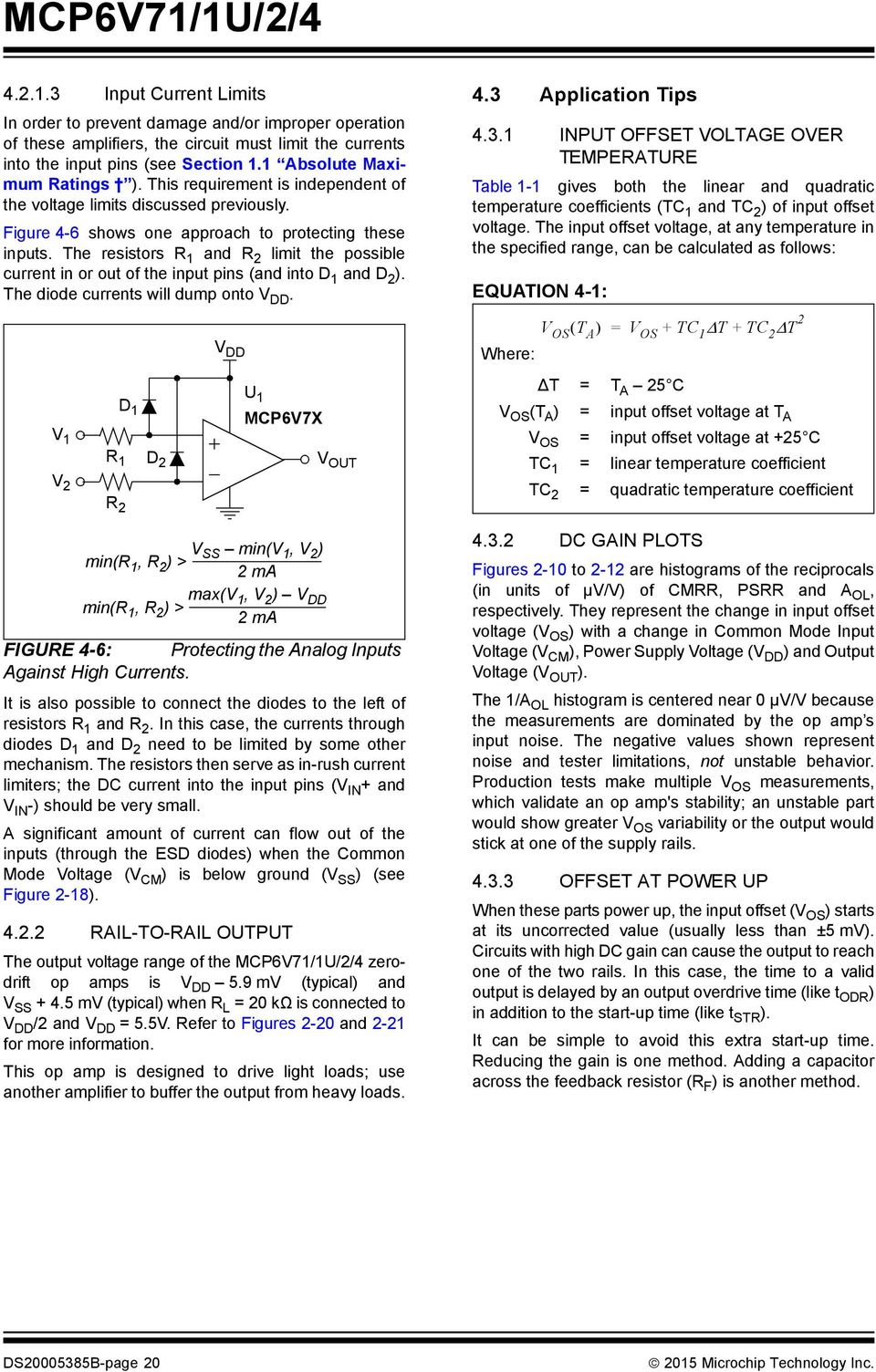
20 Input Current Limits In order to prevent damage and/or improper operation of these amplifiers, the circuit must limit the currents into the input pins (see Section 1.1 Absolute Maximum Ratings ). This requirement is independent of the voltage limits discussed previously. Figure 4-6 shows one approach to protecting these inputs. The resistors R 1 and R 2 limit the possible current in or out of the input pins (and into D 1 and D 2 ). The diode currents will dump onto V DD. D 1 V 1 R 1 D 2 V 2 R 2 V DD U 1 MCP6V7X min(r 1,R 2 )> V SS min(v 1,V 2 ) 2mA min(r 1,R 2 )> max(v 1,V 2 ) V DD 2mA FIGURE 4-6: Protecting the Analog Inputs Against High Currents. It is also possible to connect the diodes to the left of resistors R 1 and R 2. In this case, the currents through diodes D 1 and D 2 need to be limited by some other mechanism. The resistors then serve as in-rush current limiters; the DC current into the input pins (V IN + and V IN -) should be very small. A significant amount of current can flow out of the inputs (through the ESD diodes) when the Common Mode Voltage (V CM ) is below ground (V SS ) (see Figure 2-18) RAIL-TO-RAIL OUTPUT V OUT The output voltage range of the MCP6V71/1U/2/4 zerodrift op amps is V DD 5.9 mv (typical) and V SS mv (typical) when R L =2kΩ is connected to V DD /2 and. Refer to Figures 2-2 and 2-21 for more information. This op amp is designed to drive light loads; use another amplifier to buffer the output from heavy loads. 4.3 Application Tips INPUT OFFSET VOLTAGE OVER TEMPERATURE Table 1-1 gives both the linear and quadratic temperature coefficients (TC 1 and TC 2 ) of input offset voltage. The input offset voltage, at any temperature in the specified range, can be calculated as follows: EQUATION 4-1: V OS T A = V OS + TC 1 T+ TC 2 T 2 Where: T = T A 25 C V OS (T A ) = input offset voltage at T A V OS = input offset voltage at +25 C TC 1 = linear temperature coefficient TC 2 = quadratic temperature coefficient DC GAIN PLOTS Figures 2-1 to 2-12 are histograms of the reciprocals (in units of µv/v) of CMRR, PSRR and A OL, respectively. They represent the change in input offset voltage (V OS ) with a change in Common Mode Input Voltage (V CM ), Power Supply Voltage (V DD ) and Output Voltage (V OUT ). The 1/A OL histogram is centered near µv/v because the measurements are dominated by the op amp s input noise. The negative values shown represent noise and tester limitations, not unstable behavior. Production tests make multiple V OS measurements, which validate an op amp's stability; an unstable part would show greater V OS variability or the output would stick at one of the supply rails OFFSET AT POWER UP When these parts power up, the input offset (V OS ) starts at its uncorrected value (usually less than ±5 mv). Circuits with high DC gain can cause the output to reach one of the two rails. In this case, the time to a valid output is delayed by an output overdrive time (like t ODR ) in addition to the start-up time (like t STR ). It can be simple to avoid this extra start-up time. Reducing the gain is one method. Adding a capacitor across the feedback resistor (R F ) is another method. DS25385B-page Microchip Technology Inc.
21 4.3.4 SOURCE RESISTANCES The input bias currents have two significant components: switching glitches that dominate at room temperature and below and input ESD diode leakage currents that dominate at +85 C and above. Make the resistances seen by the inputs small and equal. This minimizes the output offset caused by the input bias currents. The inputs should see a resistance on the order of 1Ω to 1 kω at high frequencies (i.e., above 1 MHz). This helps minimize the impact of switching glitches, which are very fast, on overall performance. In some cases, it may be necessary to add resistors in series with the inputs to achieve this improvement in performance. Small input resistances may be needed for high gains. Without them, parasitic capacitances might cause positive feedback and instability SOURCE CAPACITANCE The capacitances seen by the two inputs should be small. Large input capacitances and source resistances, together with high gain, can lead to positive feedback and instability CAPACITIVE LOADS Driving large capacitive loads can cause stability problems for voltage feedback op amps. As the load capacitance increases, the feedback loop s phase margin decreases and the closed-loop bandwidth is reduced. This produces gain peaking in the frequency response, with overshoot and ringing in the step response. These zero-drift op amps have a different output impedance than most op amps, due to their unique topology. When driving a capacitive load with these op amps, a series resistor at the output (R ISO in Figure 4-7) improves the feedback loop s phase margin (stability) by making the output load resistive at higher frequencies. The bandwidth will be generally lower than the bandwidth with no capacitive load. G N is the circuit s noise gain. For non-inverting gains, G N and the Signal Gain are equal. For inverting gains, G N is 1+ Signal Gain (e.g., -1 V/V gives G N = +2 V/V). Recommended R ISO (Ω) G N : 1 V/V 1 V/V 1 V/V V DD = 5.5 V R L = 2 k 1 1.E-1 1p 1.E-9 1n 1.E-8 1n 1.E-7 1n 1.E-6 1µ Normalized Load Capacitance; C L / G N (F) FIGURE 4-8: Recommended R ISO values for Capacitive Loads. After selecting R ISO for your circuit, double check the resulting frequency response peaking and step response overshoot. Modify R ISO 's value until the response is reasonable. Bench evaluation is helpful STABILIZING OUTPUT LOADS This family of zero-drift op amps has an output impedance (Figures 2-32 and 2-33) that has a double zero when the gain is low. This can cause a large phase shift in feedback networks that have low-impedance near the part s bandwidth. This large phase shift can cause stability problems. Figure 4-9 shows that the load on the output is (R L +R ISO ) (R F +R G ), where R ISO is before the load (like Figure 4-7). This load needs to be large enough to maintain stability; it should be at least 1 kω. R G R F R ISO V OUT R L C L R ISO C L V OUT FIGURE 4-9: U 1 MCP6V7X Output Load. U 1 MCP6V7X FIGURE 4-7: Output Resistor, R ISO, Stabilizes Capacitive Loads. Figure 4-8 gives recommended R ISO values for different capacitive loads and gains. The x-axis is the normalized load capacitance (C L / G N ). The y-axis is the resistance (R ISO ). 215 Microchip Technology Inc. DS25385B-page 21
22 4.3.8 GAIN PEAKING Figure 4-1 shows an op amp circuit that represents non-inverting amplifiers (V M is a DC voltage and V P is the input) or inverting amplifiers (V P is a DC voltage and V M is the input). The capacitances C N and C G represent the total capacitance at the input pins; they include the op amp s Common Mode Input Capacitance (C CM ), board parasitic capacitance and any capacitor placed in parallel. The capacitance C FP represents the parasitic capacitance coupling the output and non-inverting input pins. V P V M FIGURE 4-1: Capacitance. R N Amplifier with Parasitic C G acts in parallel with R G (except for a gain of +1 V/V), which causes an increase in gain at high frequencies. C G also reduces the phase margin of the feedback loop, which becomes less stable. This effect can be reduced by either reducing C G or R F R G. C N and R N form a low-pass filter that affects the signal at V P. This filter has a single real pole at 1/(2πR N C N ). The largest value of R F that should be used depends on noise gain (see G N in Section Capacitive Loads ), C G and the open-loop gain s phase shift. An approximate limit for R F is: EQUATION 4-2: U 1 MCP6V7X R F C N C FP V OUT R G R F C G 12 pf 2 1 k G N C G Some applications may modify these values to reduce either output loading or gain peaking (step response overshoot). At high gains, R N needs to be small in order to prevent positive feedback and oscillations. Large C N values can also help REDUCING UNDESIRED NOISE AND SIGNALS Reduce undesired noise and signals with: Low bandwidth signal filters: - Minimize random analog noise - Reduce interfering signals Good PCB layout techniques: - Minimize crosstalk - Minimize parasitic capacitances and inductances that interact with fast switching edges Good power supply design: - Isolation from other parts - Filtering of interference on supply line(s) SUPPLY BYPASSING AND FILTERING With this family of operational amplifiers, the power supply pin (V DD for single supply) should have a local bypass capacitor (i.e.,.1 µf to.1 µf) within 2 mm of the pin for good high-frequency performance. These parts also need a bulk capacitor (i.e., 1 µf or larger) within 1 mm to provide large, slow currents. This bulk capacitor can be shared with other low-noise analog parts. In some cases, high-frequency power supply noise (e.g., switched mode power supplies) may cause undue intermodulation distortion with a DC offset shift; this noise needs to be filtered. Adding a resistor into the supply connection can be helpful PCB DESIGN FOR DC PRECISION In order to achieve DC precision on the order of ±1 µv, many physical errors need to be minimized. The design of the Printed Circuit Board (PCB), the wiring and the thermal environment have a strong impact on the precision achieved. A poor PCB design can easily be more than 1 times worse than the MCP6V71/1U/2/4 op amps minimum and maximum specifications PCB Layout Any time two dissimilar metals are joined together, a temperature dependent voltage appears across the junction (the Seebeck or thermojunction effect). This effect is used in thermocouples to measure temperature. The following are examples of thermojunctions on a PCB: Components (resistors, op amps, ) soldered to a copper pad Wires mechanically attached to the PCB Jumpers Solder joints PCB vias DS25385B-page Microchip Technology Inc.
23 Typical thermojunctions have temperature to voltage conversion coefficients of 1 to 1 µv/ C (sometimes higher). Microchip s AN1258 ( Op Amp Precision Design: PCB Layout Techniques ) contains in-depth information on PCB layout techniques that minimize thermojunction effects. It also discusses other effects, such as crosstalk, impedances, mechanical stresses and humidity Crosstalk DC crosstalk causes offsets that appear as a larger input offset voltage. Common causes include: Common mode noise (remote sensors) Ground loops (current return paths) Power supply coupling Interference from the mains (usually 5 Hz or 6 Hz) and other AC sources can also affect the DC performance. Nonlinear distortion can convert these signals to multiple tones, including a DC shift in voltage. When the signal is sampled by an ADC, these AC signals can also be aliased to DC, causing an apparent shift in offset. To reduce interference: - Keep traces and wires as short as possible - Use shielding - Use ground plane (at least a star ground) - Place the input signal source near to the DUT - Use good PCB layout techniques - Use a separate power supply filter (bypass capacitors) for these zero-drift op amps Miscellaneous Effects Keep the resistances seen by the input pins as small and as near to equal as possible to minimize biascurrent-related offsets. Make the (trace) capacitances seen by the input pins small and equal. This is helpful in minimizing switching glitch-induced offset voltages. Bending a coax cable with a radius that is too small causes a small voltage drop to appear on the center conductor (the triboelectric effect). Make sure the bending radius is large enough to keep the conductors and insulation in full contact. Mechanical stresses can make some capacitor types (such as some ceramics) output small voltages. Use more appropriate capacitor types in the signal path and minimize mechanical stresses and vibration. Humidity can cause electrochemical potential voltages to appear in a circuit. Proper PCB cleaning helps, as does the use of encapsulants. 4.4 Typical Applications WHEATSTONE BRIDGE Many sensors are configured as Wheatstone bridges. Strain gauges and pressure sensors are two common examples. These signals can be small and the Common mode noise large. Amplifier designs with high differential gain are desirable. Figure 4-11 shows how to interface to a Wheatstone bridge with a minimum of components. Because the circuit is not symmetric, the ADC input is single-ended and there is a minimum of filtering; the CMRR is good enough for moderate Common mode noise. V DD R R R R FIGURE 4-11: Simple Design RTD SENSOR The ratiometric circuit in Figure 4-12 conditions a twowire RTD for applications with a limited temperature range. U 1 acts as a difference amplifier with a lowfrequency pole. The sensor s wiring resistance (R W ) is corrected in firmware. Failure (open) of the RTD is detected by an out-of-range voltage. V DD R T 34.8 kω R W R RTD 1Ω R W R B 4.99 kω FIGURE 4-12:.2R.2R R N 1. kω U 1 MCP6V71 R G 1. kω 1. µf.1c 1R 1 nf R F 2. MΩ R F 2. MΩ 1 nf RTD Sensor. 1kΩ U 1 MCP6V71 V DD ADC 1. kω 1 nf V DD ADC 215 Microchip Technology Inc. DS25385B-page 23
24 4.4.3 OFFSET VOLTAGE CORRECTION Figure 4-13 shows MCP6V71 (U 2 ) correcting the input offset voltage of another op amp (U 1 ). R 2 and C 2 integrate the offset error seen at U 1 s input; the integration needs to be slow enough to be stable (with the feedback provided by R 1 and R 3 ). R 4 and R 5 attenuate the integrator s output; this shifts the integrator pole down in frequency. V IN R 1 R 3 V OUT V DD /2 R 2 R 2 C 2 R 4 U 1 R 5 MCP6XXX U 2 V DD /2 MCP6V71 FIGURE 4-13: Offset Correction PRECISION COMPARATOR Use high gain before a comparator to improve the latter s performance. Do not use MCP6V71/1U/2/4 as a comparator by itself; the V OS correction circuitry does not operate properly without a feedback loop. V IN U 1 MCP6V71 R 1 V DD /2 R2 R 3 R 4 R 5 V OUT U 2 MCP6541 FIGURE 4-14: Precision Comparator. DS25385B-page Microchip Technology Inc.
25 5. DESIGN AIDS Microchip provides the basic design aids needed for the MCP6V71/1U/2/4 family of op amps. 5.1 FilterLab Software Microchip s FilterLab software is an innovative software tool that simplifies analog active filter (using op amps) design. Available at no cost from the Microchip web site at the FilterLab design tool provides full schematic diagrams of the filter circuit with component values. It also outputs the filter circuit in SPICE format, which can be used with the macro model to simulate actual filter performance. 5.2 Microchip Advanced Part Selector (MAPS) MAPS is a software tool that helps efficiently identify Microchip devices that fit a particular design requirement. Available at no cost from the Microchip web site at MAPS is an overall selection tool for Microchip s product portfolio that includes Analog, Memory, MCUs and DSCs. Using this tool, a customer can define a filter to sort features for a parametric search of devices and export side-by-side technical comparison reports. Helpful links are also provided for data sheets, purchase and sampling of Microchip parts. 5.3 Analog Demonstration and Evaluation Boards Microchip offers a broad spectrum of Analog Demonstration and Evaluation Boards that are designed to help customers achieve faster time to market. For a complete listing of these boards and their corresponding user s guides and technical information, visit the Microchip web site at tools. Some boards that are especially useful are: MCP6V1 Thermocouple Auto-Zeroed Reference Design (P/N MCP6V1RD-TCPL) MCP6XXX Amplifier Evaluation Board 1 (P/N DS51667) MCP6XXX Amplifier Evaluation Board 2 (P/N DS51668) MCP6XXX Amplifier Evaluation Board 3 (P/N DS51673) MCP6XXX Amplifier Evaluation Board 4 (P/N DS51681) Active Filter Demo Board Kit User s Guide (P/N DS51614) 8-Pin SOIC/MSOP/TSSOP/DIP Evaluation Board (P/N SOIC8EV) 14-Pin SOIC/TSSOP/DIP Evaluation Board (P/N SOIC14EV) 5.4 Application Notes The following Microchip Application Notes are available on the Microchip web site at com/appnotes and are recommended as supplemental reference resources. ADN3: Select the Right Operational Amplifier for your Filtering Circuits, DS21821 AN722: Operational Amplifier Topologies and DC Specifications, DS722 AN723: Operational Amplifier AC Specifications and Applications, DS723 AN884: Driving Capacitive Loads With Op Amps, DS884 AN99: Analog Sensor Conditioning Circuits An Overview, DS99 AN1177: Op Amp Precision Design: DC Errors, DS1177 AN1228: Op Amp Precision Design: Random Noise, DS1228 AN1258: Op Amp Precision Design: PCB Layout Techniques, DS1258 These Application Notes and others are listed in the design guide: Signal Chain Design Guide, DS Microchip Technology Inc. DS25385B-page 25
26 6. PACKAGING INFORMATION 6.1 Package Marking Information 5-Lead SC7 (MCP6V71U) Example: Device MCP6V71UT-E/LTY Code DUNN DU56 5-Lead SOT-23 (MCP6V71, MCP6V71U) Example: XXXXY WWNNN Device MCP6V71T-E/OT MCP6V71UT-E/OT Code AAAYY AAAZY AAAY Lead MSOP (3x3 mm) (MCP6V72) Example 6V72E Legend: XX...X Customer-specific information Y Year code (last digit of calendar year) YY Year code (last 2 digits of calendar year) WW Week code (week of January 1 is week 1 ) NNN e3 Alphanumeric traceability code Pb-free JEDEC designator for Matte Tin (Sn) * This package is Pb-free. The Pb-free JEDEC designator ( e3 ) can be found on the outer packaging for this package. Note: In the event the full Microchip part number cannot be marked on one line, it will be carried over to the next line, thus limiting the number of available characters for customer-specific information. DS25385B-page Microchip Technology Inc.
27 8-Lead TDFN (2x3x.75 mm) (MCP6V72) Example Device Code MCP6V72T-E/MNY ACT Note: Applies to 8-Lead 2x3 TDFN. ACT Lead TSSOP (4.4 mm) (MCP6V74) Example XXXXXXXX YYWW NNN 6V74E/ST Microchip Technology Inc. DS25385B-page 27
28 5-Lead Plastic Small Outine Transistor (LTY) [SC7] Note: For the most current package drawings, please see the Microchip Packaging Specification located at D b E1 E 4 5 e e A A2 c A1 L Microchip Technology Drawing C4-83B DS25385B-page Microchip Technology Inc.
29 5-Lead Plastic Small Outine Transistor (LTY) [SC7] Note: For the most current package drawings, please see the Microchip Packaging Specification located at Microchip Technology Inc. DS25385B-page 29
30 N b E E e e1 D A A2 c φ A1 L L1 DS25385B-page Microchip Technology Inc.
31 Note: For the most current package drawings, please see the Microchip Packaging Specification located at Microchip Technology Inc. DS25385B-page 31
32 Note: For the most current package drawings, please see the Microchip Packaging Specification located at DS25385B-page Microchip Technology Inc.
33 Note: For the most current package drawings, please see the Microchip Packaging Specification located at Microchip Technology Inc. DS25385B-page 33
34 Note: For the most current package drawings, please see the Microchip Packaging Specification located at DS25385B-page Microchip Technology Inc.
35 Note: For the most current package drawings, please see the Microchip Packaging Specification located at Microchip Technology Inc. DS25385B-page 35
36 Note: For the most current package drawings, please see the Microchip Packaging Specification located at DS25385B-page Microchip Technology Inc.
37 215 Microchip Technology Inc. DS25385B-page 37
38 Note: For the most current package drawings, please see the Microchip Packaging Specification located at DS25385B-page Microchip Technology Inc.
39 Note: For the most current package drawings, please see the Microchip Packaging Specification located at Microchip Technology Inc. DS25385B-page 39
40 Note: For the most current package drawings, please see the Microchip Packaging Specification located at DS25385B-page Microchip Technology Inc.
41 MCP6V71/1U APPENDIX A: REVISION HISTORY Revision B (September 215) The following is the list of modifications: 1. Added new devices to the family: MCP6V72 and MCP6V74, and related information throughout the document. 2. Added Figure Updated Table 1-3 in Section 3. Pin Descriptions. 4. Added markings and specification drawings for the new packages in Section 6. Packaging Information. 5. Updated the Product Identification System section with the new packages. Revision A (March 215) Original Release of this Document. 215 Microchip Technology Inc. DS25385B-page 41
42 MCP6V71/1U NOTES: DS25385B-page Microchip Technology Inc.
43 MCP6V71/1U PRODUCT IDENTIFICATION SYSTEM To order or obtain information, e.g., on pricing or delivery, refer to the factory or the listed sales office. PART NO. [X] (1) X /XX Device Tape and Reel Temperature Range Package Device: MCP6V71T: Single Op Amp (Tape and Reel) (SOT-23 only) MCP6V71UT: Single Op Amp (Tape and Reel) (SC-7, SOT-23) MCP6V72: Dual Op Amp (MSOP, 2x3 TDFN) MCP6V72T: Dual Op Amp (Tape and Reel) (MSOP, 2x3 TDFN) MCP6V74: Quad Op Amp (TSSOP) MCP6V74T: Quad Op Amp (Tape and Reel) (TSSOP) Temperature Range: E = -4 C to +125 C (Extended) Package: LTY* = Plastic Small Outline Transistor, 5-lead SC7 OT = Plastic Small Outline Transistor, 5-lead SOT-23 MNY* = Plastic Dual Flat, No-Lead mm Body, 8-lead MS = Plastic Micro Small Outline, 8-lead ST = Plastic Thin Shrink Small Outline mm Body, 14-lead *Y = Nickel palladium gold manufacturing designator. Only available on the SC7 and TDFN packages. Examples: a) MCP6V71T-E/OT: Tape and Reel, Extended temperature, 5LD SOT-23 package a) MCP6V71UT-E/LTY: Tape and Reel Extended temperature, 5LD SC7 package b) MCP6V71UT-E/OT: Tape and Reel, Extended temperature, 5LD SOT-23 package a) MCP6V72-E/MS: Extended temperature, 8LD MSOP package b) MCP6V72T-E/MS: Tape and Reel, Extended temperature, 8LD MSOP package c) MCP6V72T-E/MNY: Tape and Reel, Extended temperature, 8LD 2x3 TDFN package a) MCP6V74-E/ST: Extended temperature, 14LD TSSOP package b) MCP6V74T-E/ST: Tape and Reel, Extended temperature, 14LD TSSOP package Note 1: Tape and Reel identifier only appears in the catalog part number description. This identifier is used for ordering purposes and is not printed on the device package. Check with your Microchip Sales Office for package availability with the Tape and Reel option. 215 Microchip Technology Inc. DS25385B-page 43
44 MCP6V71/1U NOTES: DS25385B-page Microchip Technology Inc.
45 Note the following details of the code protection feature on Microchip devices: Microchip products meet the specification contained in their particular Microchip Data Sheet. Microchip believes that its family of products is one of the most secure families of its kind on the market today, when used in the intended manner and under normal conditions. There are dishonest and possibly illegal methods used to breach the code protection feature. All of these methods, to our knowledge, require using the Microchip products in a manner outside the operating specifications contained in Microchip s Data Sheets. Most likely, the person doing so is engaged in theft of intellectual property. Microchip is willing to work with the customer who is concerned about the integrity of their code. Neither Microchip nor any other semiconductor manufacturer can guarantee the security of their code. Code protection does not mean that we are guaranteeing the product as unbreakable. Code protection is constantly evolving. We at Microchip are committed to continuously improving the code protection features of our products. Attempts to break Microchip s code protection feature may be a violation of the Digital Millennium Copyright Act. If such acts allow unauthorized access to your software or other copyrighted work, you may have a right to sue for relief under that Act. Information contained in this publication regarding device applications and the like is provided only for your convenience and may be superseded by updates. It is your responsibility to ensure that your application meets with your specifications. MICROCHIP MAKES NO REPRESENTATIONS OR WARRANTIES OF ANY KIND WHETHER EXPRESS OR IMPLIED, WRITTEN OR ORAL, STATUTORY OR OTHERWISE, RELATED TO THE INFORMATION, INCLUDING BUT NOT LIMITED TO ITS CONDITION, QUALITY, PERFORMANCE, MERCHANTABILITY OR FITNESS FOR PURPOSE. Microchip disclaims all liability arising from this information and its use. Use of Microchip devices in life support and/or safety applications is entirely at the buyer s risk, and the buyer agrees to defend, indemnify and hold harmless Microchip from any and all damages, claims, suits, or expenses resulting from such use. No licenses are conveyed, implicitly or otherwise, under any Microchip intellectual property rights unless otherwise stated. QUALITY MANAGEMENT SYSTEM CERTIFIED BY DNV == ISO/TS == Trademarks The Microchip name and logo, the Microchip logo, dspic, FlashFlex, flexpwr, JukeBlox, KEELOQ, KEELOQ logo, Kleer, LANCheck, MediaLB, MOST, MOST logo, MPLAB, OptoLyzer, PIC, PICSTART, PIC 32 logo, RightTouch, SpyNIC, SST, SST Logo, SuperFlash and UNI/O are registered trademarks of Microchip Technology Incorporated in the U.S.A. and other countries. The Embedded Control Solutions Company and mtouch are registered trademarks of Microchip Technology Incorporated in the U.S.A. Analog-for-the-Digital Age, BodyCom, chipkit, chipkit logo, CodeGuard, dspicdem, dspicdem.net, ECAN, In-Circuit Serial Programming, ICSP, Inter-Chip Connectivity, KleerNet, KleerNet logo, MiWi, motorbench, MPASM, MPF, MPLAB Certified logo, MPLIB, MPLINK, MultiTRAK, NetDetach, Omniscient Code Generation, PICDEM, PICDEM.net, PICkit, PICtail, RightTouch logo, REAL ICE, SQI, Serial Quad I/O, Total Endurance, TSHARC, USBCheck, VariSense, ViewSpan, WiperLock, Wireless DNA, and ZENA are trademarks of Microchip Technology Incorporated in the U.S.A. and other countries. SQTP is a service mark of Microchip Technology Incorporated in the U.S.A. Silicon Storage Technology is a registered trademark of Microchip Technology Inc. in other countries. GestIC is a registered trademark of Microchip Technology Germany II GmbH & Co. KG, a subsidiary of Microchip Technology Inc., in other countries. All other trademarks mentioned herein are property of their respective companies. 215, Microchip Technology Incorporated, Printed in the U.S.A., All Rights Reserved. ISBN: Microchip received ISO/TS-16949:29 certification for its worldwide headquarters, design and wafer fabrication facilities in Chandler and Tempe, Arizona; Gresham, Oregon and design centers in California and India. The Company s quality system processes and procedures are for its PIC MCUs and dspic DSCs, KEELOQ code hopping devices, Serial EEPROMs, microperipherals, nonvolatile memory and analog products. In addition, Microchip s quality system for the design and manufacture of development systems is ISO 91:2 certified. 215 Microchip Technology Inc. DS25385B-page 45
46 Worldwide Sales and Service AMERICAS ASIA/PACIFIC ASIA/PACIFIC EUROPE Corporate Office 2355 West Chandler Blvd. Chandler, AZ Tel: Fax: Technical Support: support Web Address: Atlanta Duluth, GA Tel: Fax: Austin, TX Tel: Boston Westborough, MA Tel: Fax: Chicago Itasca, IL Tel: Fax: Cleveland Independence, OH Tel: Fax: Dallas Addison, TX Tel: Fax: Detroit Novi, MI Tel: Houston, TX Tel: Indianapolis Noblesville, IN Tel: Fax: Los Angeles Mission Viejo, CA Tel: Fax: New York, NY Tel: San Jose, CA Tel: Canada - Toronto Tel: Fax: Asia Pacific Office Suites , 37th Floor Tower 6, The Gateway Harbour City, Kowloon Hong Kong Tel: Fax: Australia - Sydney Tel: Fax: China - Beijing Tel: Fax: China - Chengdu Tel: Fax: China - Chongqing Tel: Fax: China - Dongguan Tel: China - Hangzhou Tel: Fax: China - Hong Kong SAR Tel: Fax: China - Nanjing Tel: Fax: China - Qingdao Tel: Fax: China - Shanghai Tel: Fax: China - Shenyang Tel: Fax: China - Shenzhen Tel: Fax: China - Wuhan Tel: Fax: China - Xian Tel: Fax: China - Xiamen Tel: Fax: China - Zhuhai Tel: Fax: India - Bangalore Tel: Fax: India - New Delhi Tel: Fax: India - Pune Tel: Japan - Osaka Tel: Fax: Japan - Tokyo Tel: Fax: Korea - Daegu Tel: Fax: Korea - Seoul Tel: Fax: or Malaysia - Kuala Lumpur Tel: Fax: Malaysia - Penang Tel: Fax: Philippines - Manila Tel: Fax: Singapore Tel: Fax: Taiwan - Hsin Chu Tel: Fax: Taiwan - Kaohsiung Tel: Taiwan - Taipei Tel: Fax: Thailand - Bangkok Tel: Fax: Austria - Wels Tel: Fax: Denmark - Copenhagen Tel: Fax: France - Paris Tel: Fax: Germany - Dusseldorf Tel: Germany - Karlsruhe Tel: Germany - Munich Tel: Fax: Italy - Milan Tel: Fax: Italy - Venice Tel: Netherlands - Drunen Tel: Fax: Poland - Warsaw Tel: Spain - Madrid Tel: Fax: Sweden - Stockholm Tel: UK - Wokingham Tel: Fax: /14/15 DS25385B-page Microchip Technology Inc.
MCP6V61/1U/2/4. 80 µa, 1 MHz Zero-Drift Op Amps. Features. General Description. Package Types. Typical Applications. Design Aids.
 8 µa, 1 MHz ZeroDrift Op Amps Features High DC Precision: V OS Drift: ±15 nv/ C (maximum, V DD =5.5V) V OS : ±8 µv (maximum) A OL : 125 db (minimum, V DD =5.5V) PSRR: 117 db (minimum, V DD =5.5V) CMRR:
www.jameco.com 1-800-831-4242
 Distributed by: www.jameco.com 1-800-831-4242 The content and copyrights of the attached material are the property of its owner. LF411 Low Offset, Low Drift JFET Input Operational Amplifier General Description
LM118/LM218/LM318 Operational Amplifiers
 LM118/LM218/LM318 Operational Amplifiers General Description The LM118 series are precision high speed operational amplifiers designed for applications requiring wide bandwidth and high slew rate. They
What Does Rail-to-Rail Operation Really Mean?
 What Does Rail-to-Rail Operation Really Mean? 2004 Microchip Technology Incorporated. All Rights Reserved. What does Rail-to-Rail Operation really mean? 1 Agenda What does Rail-to-Rail output operation
Precision, Unity-Gain Differential Amplifier AMP03
 a FEATURES High CMRR: db Typ Low Nonlinearity:.% Max Low Distortion:.% Typ Wide Bandwidth: MHz Typ Fast Slew Rate: 9.5 V/ s Typ Fast Settling (.%): s Typ Low Cost APPLICATIONS Summing Amplifiers Instrumentation
Rail-to-Rail, High Output Current Amplifier AD8397
 Rail-to-Rail, High Output Current Amplifier AD8397 FEATURES Dual operational amplifier Voltage feedback Wide supply range from 3 V to 24 V Rail-to-rail output Output swing to within.5 V of supply rails
Features. Ordering Information. * Underbar marking may not be to scale. Part Identification
 MIC86 Teeny Ultra Low Power Op Amp General Description The MIC86 is a rail-to-rail output, input common-mode to ground, operational amplifier in Teeny SC7 packaging. The MIC86 provides 4kHz gain-bandwidth
PIN CONFIGURATION FEATURES ORDERING INFORMATION ABSOLUTE MAXIMUM RATINGS. D, F, N Packages
 DESCRIPTION The µa71 is a high performance operational amplifier with high open-loop gain, internal compensation, high common mode range and exceptional temperature stability. The µa71 is short-circuit-protected
LF412 Low Offset Low Drift Dual JFET Input Operational Amplifier
 LF412 Low Offset Low Drift Dual JFET Input Operational Amplifier General Description These devices are low cost high speed JFET input operational amplifiers with very low input offset voltage and guaranteed
High Common-Mode Rejection. Differential Line Receiver SSM2141. Fax: 781/461-3113 FUNCTIONAL BLOCK DIAGRAM FEATURES. High Common-Mode Rejection
 a FEATURES High Common-Mode Rejection DC: 00 db typ 60 Hz: 00 db typ 20 khz: 70 db typ 40 khz: 62 db typ Low Distortion: 0.00% typ Fast Slew Rate: 9.5 V/ s typ Wide Bandwidth: 3 MHz typ Low Cost Complements
TL082 Wide Bandwidth Dual JFET Input Operational Amplifier
 TL082 Wide Bandwidth Dual JFET Input Operational Amplifier General Description These devices are low cost high speed dual JFET input operational amplifiers with an internally trimmed input offset voltage
Supertex inc. HV256. 32-Channel High Voltage Amplifier Array HV256. Features. General Description. Applications. Typical Application Circuit
 32-Channel High Voltage Amplifier Array Features 32 independent high voltage amplifiers 3V operating voltage 295V output voltage 2.2V/µs typical output slew rate Adjustable output current source limit
DATA SHEET. TDA8560Q 2 40 W/2 Ω stereo BTL car radio power amplifier with diagnostic facility INTEGRATED CIRCUITS. 1996 Jan 08
 INTEGRATED CIRCUITS DATA SHEET power amplifier with diagnostic facility Supersedes data of March 1994 File under Integrated Circuits, IC01 1996 Jan 08 FEATURES Requires very few external components High
Wide Bandwidth, Fast Settling Difet OPERATIONAL AMPLIFIER
 Wide Bandwidth, Fast Settling Difet OPERATIONAL AMPLIFIER FEATURES HIGH GAIN-BANDWIDTH: 35MHz LOW INPUT NOISE: 1nV/ Hz HIGH SLEW RATE: V/µs FAST SETTLING: 24ns to.1% FET INPUT: I B = 5pA max HIGH OUTPUT
LM4992 420mW Stereo Cell Phone Audio Amplifier
 420mW Stereo Cell Phone Audio Amplifier General Description The is a stereo audio power amplifier primarily designed for demanding applications in mobile phones and other portable communication device
TLI4946. Datasheet TLI4946K, TLI4946-2K, TLI4946-2L. Sense and Control. May 2009
 May 2009 TLI4946 High Precision Hall Effect Latches for Industrial and Consumer Applications TLI4946K, TLI4946-2K, TLI4946-2L Datasheet Rev. 1.0 Sense and Control Edition 2009-05-04 Published by Infineon
TDA2040. 20W Hi-Fi AUDIO POWER AMPLIFIER
 20W Hi-Fi AUDIO POWER AMPLIFIER DESCRIPTION The TDA2040 is a monolithic integrated circuit in Pentawatt package, intended for use as an audio class AB amplifier. Typically it provides 22W output power
LM386 Low Voltage Audio Power Amplifier
 Low Voltage Audio Power Amplifier General Description The LM386 is a power amplifier designed for use in low voltage consumer applications. The gain is internally set to 20 to keep external part count
DATA SHEET. TDA1518BQ 24 W BTL or 2 x 12 watt stereo car radio power amplifier INTEGRATED CIRCUITS
 INTEGRATED CIRCUITS DATA SHEET File under Integrated Circuits, IC01 July 1994 GENERAL DESCRIPTION The is an integrated class-b output amplifier in a 13-lead single-in-line (SIL) plastic power package.
TS321 Low Power Single Operational Amplifier
 SOT-25 Pin Definition: 1. Input + 2. Ground 3. Input - 4. Output 5. Vcc General Description The TS321 brings performance and economy to low power systems. With high unity gain frequency and a guaranteed
Use and Application of Output Limiting Amplifiers (HFA1115, HFA1130, HFA1135)
 Use and Application of Output Limiting Amplifiers (HFA111, HFA110, HFA11) Application Note November 1996 AN96 Introduction Amplifiers with internal voltage clamps, also known as limiting amplifiers, have
High Speed, Low Cost, Triple Op Amp ADA4861-3
 High Speed, Low Cost, Triple Op Amp ADA486-3 FEATURES High speed 73 MHz, 3 db bandwidth 625 V/μs slew rate 3 ns settling time to.5% Wide supply range: 5 V to 2 V Low power: 6 ma/amplifier. db flatness:
AAT4280 Slew Rate Controlled Load Switch
 General Description Features SmartSwitch The AAT4280 SmartSwitch is a P-channel MOSFET power switch designed for high-side load switching applications. The P-channel MOSFET device has a typical R DS(ON)
Programmable Single-/Dual-/Triple- Tone Gong SAE 800
 Programmable Single-/Dual-/Triple- Tone Gong Preliminary Data SAE 800 Bipolar IC Features Supply voltage range 2.8 V to 18 V Few external components (no electrolytic capacitor) 1 tone, 2 tones, 3 tones
LM1084 5A Low Dropout Positive Regulators
 5A Low Dropout Positive Regulators General Description The LM1084 is a series of low dropout voltage positive regulators with a maximum dropout of 1.5 at 5A of load current. It has the same pin-out as
TL074 TL074A - TL074B
 A B LOW NOISE JFET QUAD OPERATIONAL AMPLIFIERS WIDE COMMONMODE (UP TO V + CC ) AND DIFFERENTIAL VOLTAGE RANGE LOW INPUT BIAS AND OFFSET CURRENT LOW NOISE e n = 15nV/ Hz (typ) OUTPUT SHORTCIRCUIT PROTECTION
High Speed, Low Power Monolithic Op Amp AD847
 a FEATURES Superior Performance High Unity Gain BW: MHz Low Supply Current:.3 ma High Slew Rate: 3 V/ s Excellent Video Specifications.% Differential Gain (NTSC and PAL).9 Differential Phase (NTSC and
LF442 Dual Low Power JFET Input Operational Amplifier
 LF442 Dual Low Power JFET Input Operational Amplifier General Description The LF442 dual low power operational amplifiers provide many of the same AC characteristics as the industry standard LM1458 while
Making Accurate Voltage Noise and Current Noise Measurements on Operational Amplifiers Down to 0.1Hz
 Author: Don LaFontaine Making Accurate Voltage Noise and Current Noise Measurements on Operational Amplifiers Down to 0.1Hz Abstract Making accurate voltage and current noise measurements on op amps in
Kit 106. 50 Watt Audio Amplifier
 Kit 106 50 Watt Audio Amplifier T his kit is based on an amazing IC amplifier module from ST Electronics, the TDA7294 It is intended for use as a high quality audio class AB amplifier in hi-fi applications
TRIPLE PLL FIELD PROG. SPREAD SPECTRUM CLOCK SYNTHESIZER. Features
 DATASHEET ICS280 Description The ICS280 field programmable spread spectrum clock synthesizer generates up to four high-quality, high-frequency clock outputs including multiple reference clocks from a low-frequency
Ultralow Input Bias Current Operational Amplifier AD549*
 a FEATURES Ultralow Bias Current: 6 fa max (AD49L) 2 fa max (AD49J) Input Bias Current Guaranteed Over Common-Mode Voltage Range Low Offset Voltage:.2 mv max (AD49K) 1. mv max (AD49J) Low Offset Drift:
HA-5104/883. Low Noise, High Performance, Quad Operational Amplifier. Features. Description. Applications. Ordering Information. Pinout.
 HA5104/883 April 2002 Features This Circuit is Processed in Accordance to MILSTD 883 and is Fully Conformant Under the Provisions of Paragraph 1.2.1. Low Input Noise Voltage Density at 1kHz. 6nV/ Hz (Max)
CA723, CA723C. Voltage Regulators Adjustable from 2V to 37V at Output Currents Up to 150mA without External Pass Transistors. Features.
 CA73, CA73C Data Sheet April 1999 File Number 788. Voltage Regulators Adjustable from V to 37V at Output Currents Up to 1mA without External Pass Transistors The CA73 and CA73C are silicon monolithic integrated
PowerAmp Design. PowerAmp Design PAD135 COMPACT HIGH VOLATGE OP AMP
 PowerAmp Design COMPACT HIGH VOLTAGE OP AMP Rev G KEY FEATURES LOW COST SMALL SIZE 40mm SQUARE HIGH VOLTAGE 200 VOLTS HIGH OUTPUT CURRENT 10A PEAK 40 WATT DISSIPATION CAPABILITY 200V/µS SLEW RATE APPLICATIONS
Low-Cost, Micropower, SC70/SOT23-8, Microphone Preamplifiers with Complete Shutdown
 9-9; Rev ; 4/ Low-Cost, Micropower, SC7/SOT23-8, Microphone General Description The are micropower op amps optimized for use as microphone preamplifiers. They provide the ideal combination of an optimized
How To Power A Power Generator With A Power Supply From A Powerstation
 LT636 Over-The-Top Micropower Rail-to-Rail Input and Output Op Amp FEATRES Rail-to-Rail Input and Output Micropower: 5µA I Q, 44V Supply Operating Temperature Range: 4 C to 25 C Over-The-Top : Input Common
450 µa, 5 MHz Rail-to-Rail Op Amp MCP6282 PDIP, SOIC, MSOP V OUTA 1 MCP6281 PDIP, SOIC, MSOP 5 V DD 2 V INA + 3 MCP6284 PDIP, SOIC, TSSOP V OUTA
 450 µa, 5 MHz Rail-to-Rail Op Amp Features Gain Bandwidth Product: 5 MHz (typical) Supply Current: I Q = 450 µa (typical) Supply Voltage: 2.2V to 6.0V Rail-to-Rail Input/Output Extended Temperature Range:
DESCRIPTION FEATURES TYPICAL APPLICATION. LT1097 Low Cost, Low Power Precision Op Amp APPLICATIONS
 LT97 Low Cost, Low Power Precision Op Amp FEATRES Offset Voltage µv Max Offset Voltage Drift µv/ C Max Bias Current pa Max Offset Current pa Max Bias and Offset Current Drift pa/ C Max Supply Current µa
ICS650-44 SPREAD SPECTRUM CLOCK SYNTHESIZER. Description. Features. Block Diagram DATASHEET
 DATASHEET ICS650-44 Description The ICS650-44 is a spread spectrum clock synthesizer intended for video projector and digital TV applications. It generates three copies of an EMI optimized 50 MHz clock
PS323. Precision, Single-Supply SPST Analog Switch. Features. Description. Block Diagram, Pin Configuration, and Truth Table. Applications PS323 PS323
 Features ÎÎLow On-Resistance (33-ohm typ.) Minimizes Distortion and Error Voltages ÎÎLow Glitching Reduces Step Errors in Sample-and-Holds. Charge Injection, 2pC typ. ÎÎSingle-Supply Operation (+2.5V to
Push-Pull FET Driver with Integrated Oscillator and Clock Output
 19-3662; Rev 1; 5/7 Push-Pull FET Driver with Integrated Oscillator General Description The is a +4.5V to +15V push-pull, current-fed topology driver subsystem with an integrated oscillator for use in
MAX14760/MAX14762/MAX14764 Above- and Below-the-Rails Low-Leakage Analog Switches
 19-652; Rev 1; 8/12 EVALUATION KIT AVAILABLE MAX1476// General Description The MAX1476// analog switches are capable of passing bipolar signals that are beyond their supply rails. These devices operate
Single-Supply, Rail-to-Rail, Low Power, FET Input Op Amp AD820
 Single-Supply, Rail-to-Rail, Low Power, FET Input Op Amp AD82 FEATURES True single-supply operation Output swings rail-to-rail Input voltage range extends below ground Single-supply capability from 5 V
DATA SHEET. TDA1510AQ 24 W BTL or 2 x 12 W stereo car radio power amplifier INTEGRATED CIRCUITS
 INTEGRATED CIRCUITS DATA SHEET 24 W BTL or 2 x 12 W stereo car radio File under Integrated Circuits, IC01 January 1992 GENERAL DESCRIPTION The is a class-b integrated output amplifier encapsulated in a
Chapter 12: The Operational Amplifier
 Chapter 12: The Operational Amplifier 12.1: Introduction to Operational Amplifier (Op-Amp) Operational amplifiers (op-amps) are very high gain dc coupled amplifiers with differential inputs; they are used
High-Speed, Low-Power, 3V/5V, Rail-to-Rail, Single-Supply Comparators MAX941/MAX942/ MAX944. General Description. Features. Ordering Information
 General Description The MAX941/MAX94/ are single/dual/quad highspeed comparators optimized for systems powered from a 3V or 5V supply. These devices combine high speed, low power, and rail-to-rail inputs.
Understanding the Terms and Definitions of LDO Voltage Regulators
 Application Report SLVA79 - October 1999 Understanding the Terms and Definitions of ltage Regulators Bang S. Lee Mixed Signal Products ABSTRACT This report provides an understanding of the terms and definitions
Features. Modulation Frequency (khz) VDD. PLL Clock Synthesizer with Spread Spectrum Circuitry GND
 DATASHEET IDT5P50901/2/3/4 Description The IDT5P50901/2/3/4 is a family of 1.8V low power, spread spectrum clock generators capable of reducing EMI radiation from an input clock. Spread spectrum technique
High Voltage Current Shunt Monitor AD8212
 High Voltage Current Shunt Monitor AD822 FEATURES Adjustable gain High common-mode voltage range 7 V to 65 V typical 7 V to >500 V with external pass transistor Current output Integrated 5 V series regulator
ZL40221 Precision 2:6 LVDS Fanout Buffer with Glitchfree Input Reference Switching and On-Chip Input Termination Data Sheet
 Features Inputs/Outputs Accepts two differential or single-ended inputs LVPECL, LVDS, CML, HCSL, LVCMOS Glitch-free switching of references On-chip input termination and biasing for AC coupled inputs Six
Programmable-Gain Transimpedance Amplifiers Maximize Dynamic Range in Spectroscopy Systems
 Programmable-Gain Transimpedance Amplifiers Maximize Dynamic Range in Spectroscopy Systems PHOTODIODE VOLTAGE SHORT-CIRCUIT PHOTODIODE SHORT- CIRCUIT VOLTAGE 0mV DARK ark By Luis Orozco Introduction Precision
LDS8720. 184 WLED Matrix Driver with Boost Converter FEATURES APPLICATION DESCRIPTION TYPICAL APPLICATION CIRCUIT
 184 WLED Matrix Driver with Boost Converter FEATURES High efficiency boost converter with the input voltage range from 2.7 to 5.5 V No external Schottky Required (Internal synchronous rectifier) 250 mv
100V - 100W DMOS AUDIO AMPLIFIER WITH MUTE/ST-BY THERMAL SHUTDOWN STBY-GND
 TDA7294 100V - 100W DMOS AUDIO AMPLIFIER WITH MUTE/ST-BY VERY HIGH OPERATING VOLTAGE RANGE (±40V) DMOS POWER STAGE HIGH OUTPUT POWER (UP TO 100W MU- SIC POWER) MUTING/STAND-BY FUNCTIONS NO SWITCH ON/OFF
SPREAD SPECTRUM CLOCK GENERATOR. Features
 DATASHEET ICS7152 Description The ICS7152-01, -02, -11, and -12 are clock generators for EMI (Electro Magnetic Interference) reduction (see below for frequency ranges and multiplier ratios). Spectral peaks
unit : mm With heat sink (see Pd Ta characteristics)
 Ordering number: EN1321E Monolithic Linear IC LA4261 3.5 W 2-Channel AF Power Amplifier for Home Stereos and Music Centers Features. Minimum number of external parts required (No input capacitor, bootstrap
Reading: HH Sections 4.11 4.13, 4.19 4.20 (pgs. 189-212, 222 224)
 6 OP AMPS II 6 Op Amps II In the previous lab, you explored several applications of op amps. In this exercise, you will look at some of their limitations. You will also examine the op amp integrator and
TDA2040. 20W Hi-Fi AUDIO POWER AMPLIFIER
 20W Hi-Fi AUDIO POWER AMPLIFIER DESCRIPTION The TDA2040 is a monolithic integrated circuit in Pentawatt package, intended for use as an audio class AB amplifier. Typically it provides 22W output power
A Collection of Differential to Single-Ended Signal Conditioning Circuits for Use with the LTC2400, a 24-Bit No Latency Σ ADC in an SO-8
 Application Note August 999 A Collection of Differential to Single-Ended Signal Conditioning Circuits for Use with the LTC00, a -Bit No Latency Σ ADC in an SO- By Kevin R. Hoskins and Derek V. Redmayne
LM1036 Dual DC Operated Tone/Volume/Balance Circuit
 LM1036 Dual DC Operated Tone/Volume/Balance Circuit General Description The LM1036 is a DC controlled tone (bass/treble), volume and balance circuit for stereo applications in car radio, TV and audio systems.
High Speed, Low Power Dual Op Amp AD827
 a FEATURES High Speed 50 MHz Unity Gain Stable Operation 300 V/ms Slew Rate 120 ns Settling Time Drives Unlimited Capacitive Loads Excellent Video Performance 0.04% Differential Gain @ 4.4 MHz 0.198 Differential
DRM compatible RF Tuner Unit DRT1
 FEATURES DRM compatible RF Tuner Unit DRT1 High- Performance RF Tuner Frequency Range: 10 KHz to 30 MHz Input ICP3: +13,5dBm, typ. Noise Figure @ full gain: 14dB, typ. Receiver Factor: -0,5dB, typ. Input
LTC1443/LTC1444/LTC1445 Ultralow Power Quad Comparators with Reference. Features. Description. Applications. Typical Application
 LTC/LTC/LTC Ultralow Power Quad Comparators with Reference Features n Ultralow Quiescent Current:.µA Max n Reference Output Drives.µF Capacitor n Adjustable Hysteresis (LTC/LTC) n Wide Supply Range Single:
Low Cost Instrumentation Amplifier AD622
 Data Sheet FEATURES Easy to use Low cost solution Higher performance than two or three op amp design Unity gain with no external resistor Optional gains with one external resistor (Gain range: 2 to 000)
LM101A LM201A LM301A Operational Amplifiers
 LM101A LM201A LM301A Operational Amplifiers General Description The LM101A series are general purpose operational amplifiers which feature improved performance over industry standards like the LM709 Advanced
Description. 5k (10k) - + 5k (10k)
 THAT Corporation Low Noise, High Performance Microphone Preamplifier IC FEATURES Excellent noise performance through the entire gain range Exceptionally low THD+N over the full audio bandwidth Low power
LM134-LM234-LM334. Three terminal adjustable current sources. Features. Description
 Three terminal adjustable current sources Features Operates from 1V to 40V 0.02%/V current regulation Programmable from 1µA to 10mA ±3% initial accuracy Description The LM134/LM234/LM334 are 3-terminal
28V, 2A Buck Constant Current Switching Regulator for White LED
 28V, 2A Buck Constant Current Switching Regulator for White LED FP7102 General Description The FP7102 is a PWM control buck converter designed to provide a simple, high efficiency solution for driving
Laboratory 4: Feedback and Compensation
 Laboratory 4: Feedback and Compensation To be performed during Week 9 (Oct. 20-24) and Week 10 (Oct. 27-31) Due Week 11 (Nov. 3-7) 1 Pre-Lab This Pre-Lab should be completed before attending your regular
LM139/LM239/LM339/LM2901/LM3302 Low Power Low Offset Voltage Quad Comparators
 Low Power Low Offset Voltage Quad Comparators General Description The LM139 series consists of four independent precision voltage comparators with an offset voltage specification as low as 2 mv max for
Quad, Rail-to-Rail, Fault-Protected, SPST Analog Switches
 19-2418; Rev ; 4/2 Quad, Rail-to-Rail, Fault-Protected, General Description The are quad, single-pole/single-throw (SPST), fault-protected analog switches. They are pin compatible with the industry-standard
Fully Differential CMOS Amplifier
 ECE 511 Analog Electronics Term Project Fully Differential CMOS Amplifier Saket Vora 6 December 2006 Dr. Kevin Gard NC State University 1 Introduction In this project, a fully differential CMOS operational
Dual 20W Audio Power Amplifier with Mute and Standby Modes
 LM1876 Overture Audio Power Amplifier Series Dual 20W Audio Power Amplifier with Mute and Standby Modes General Description The LM1876 is a stereo audio amplifier capable of delivering typically 20W per
AP331A XX G - 7. Lead Free G : Green. Packaging (Note 2)
 Features General Description Wide supply Voltage range: 2.0V to 36V Single or dual supplies: ±1.0V to ±18V Very low supply current drain (0.4mA) independent of supply voltage Low input biasing current:
Low Noise, Matched Dual PNP Transistor MAT03
 a FEATURES Dual Matched PNP Transistor Low Offset Voltage: 100 V Max Low Noise: 1 nv/ Hz @ 1 khz Max High Gain: 100 Min High Gain Bandwidth: 190 MHz Typ Tight Gain Matching: 3% Max Excellent Logarithmic
Low Cost, High Speed, Rail-to-Rail, Output Op Amps ADA4851-1/ADA4851-2/ADA4851-4
 Low Cost, High Speed, Rail-to-Rail, Output Op Amps ADA485-/ADA485-/ADA485-4 FEATURES Qualified for automotive applications High speed 3 MHz, 3 db bandwidth 375 V/μs slew rate 55 ns settling time to.% Excellent
1 TO 4 CLOCK BUFFER ICS551. Description. Features. Block Diagram DATASHEET
 DATASHEET 1 TO 4 CLOCK BUFFER ICS551 Description The ICS551 is a low cost, high-speed single input to four output clock buffer. Part of IDT s ClockBlocks TM family, this is our lowest cost, small clock
PAM8403. Description. Pin Assignments. Features. Applications. Typical Applications Circuit. A Product Line of. Diodes Incorporated
 FILTERLESS 3W CLASS-D STEREO AUDIO AMPLIFIER Description Pin Assignments The is a 3W, class-d audio amplifier. It offers low THD+N, allowing it to achieve high-quality sound reproduction. The new filterless
Op-Amp Simulation EE/CS 5720/6720. Read Chapter 5 in Johns & Martin before you begin this assignment.
 Op-Amp Simulation EE/CS 5720/6720 Read Chapter 5 in Johns & Martin before you begin this assignment. This assignment will take you through the simulation and basic characterization of a simple operational
Application Note 58 Crystal Considerations for Dallas Real-Time Clocks
 www.maxim-ic.com Application Note 58 Crystal Considerations for Dallas Real-Time Clocks OVERVIEW This application note describes crystal selection and layout techniques for connecting a 32,768Hz crystal
Quad Low Offset, Low Power Operational Amplifier OP400
 Data Sheet FEATURES Low input offset voltage: 5 µv maximum Low offset voltage drift over 55 C to 25 C:.2 μv/ C maximum Low supply current (per amplifier): 725 µa maximum High open-loop gain: 5 V/mV minimum
LH0091 True RMS to DC Converter
 LH0091 True RMS to DC Converter General Description The LH0091 rms to dc converter generates a dc output equal to the rms value of any input per the transfer function E OUT(DC) e 0 1 T T 0 E IN 2 (t) dt
LM833 LOW NOISE DUAL OPERATIONAL AMPLIFIER
 LOW NOISE DUAL OPERATIONAL AMPLIFIER LOW VOLTAGE NOISE: 4.5nV/ Hz HIGH GAIN BANDWIDTH PRODUCT: 15MHz HIGH SLEW RATE: 7V/µs LOW DISTORTION:.2% EXCELLENT FREQUENCY STABILITY ESD PROTECTION 2kV DESCRIPTION
DISCRETE SEMICONDUCTORS DATA SHEET. BLF244 VHF power MOS transistor
 DISCRETE SEMICONDUCTORS DATA SHEET September 1992 FEATURES High power gain Low noise figure Easy power control Good thermal stability Withstands full load mismatch Gold metallization ensures excellent
Description. Output Stage. 5k (10k) - + 5k (10k)
 THAT Corporation Low Noise, High Performance Audio Preamplifier IC FEATURES Low Noise: 1 nv/hz input noise (60dB gain) 34 nv/hz input noise (0dB gain) (1512) Low THD+N (full audio bandwidth): 0.0005% 40dB
LC2 MOS Quad 8-Bit D/A Converter AD7226
 a FEATURES Four 8-Bit DACs with Output Amplifiers Skinny 20-Pin DIP, SOIC and 20-Terminal Surface Mount Packages Microprocessor Compatible TTL/CMOS Compatible No User Trims Extended Temperature Range Operation
AVX EMI SOLUTIONS Ron Demcko, Fellow of AVX Corporation Chris Mello, Principal Engineer, AVX Corporation Brian Ward, Business Manager, AVX Corporation
 AVX EMI SOLUTIONS Ron Demcko, Fellow of AVX Corporation Chris Mello, Principal Engineer, AVX Corporation Brian Ward, Business Manager, AVX Corporation Abstract EMC compatibility is becoming a key design
Op Amp Circuit Collection
 Op Amp Circuit Collection Note: National Semiconductor recommends replacing 2N2920 and 2N3728 matched pairs with LM394 in all application circuits. Section 1 Basic Circuits Inverting Amplifier Difference
Advanced Monolithic Systems
 Advanced Monolithic Systems FEATURES Three Terminal Adjustable or Fixed oltages* 1.5, 1.8, 2.5, 2.85, 3.3 and 5. Output Current of 1A Operates Down to 1 Dropout Line Regulation:.2% Max. Load Regulation:.4%
Symbol Parameters Units Frequency Min. Typ. Max. 850 MHz 14.8 16.3 17.8
 Product Description Sirenza Microdevices SGC-689Z is a high performance SiGe HBT MMIC amplifier utilizing a Darlington configuration with a patented active-bias network. The active bias network provides
DESCRIPTIO. LT1226 Low Noise Very High Speed Operational Amplifier
 FEATRES Gain of Stable GHz Gain Bandwidth V/µs Slew Rate.6nV/ Hz Input Noise Voltage V/mV Minimum DC Gain, R L = Ω mv Maximum Input Offset Voltage ±V Minimum Output Swing into Ω ide Supply Range ±.V to
AN1258. Op Amp Precision Design: PCB Layout Techniques THERMOCOUPLE JUNCTION BEHAVIOR INTRODUCTION. Seebeck Effect. Key Words and Phrases
 Op Amp Precision Design: PCB Layout Techniques Author: INTRODUCTION Kumen Blake Microchip Technology Inc. This application note covers Printed Circuit Board (PCB) effects encountered in high (DC) precision
How To Control A Power Supply On A Powerline With A.F.F Amplifier
 INTEGRATED CIRCUITS DATA SHEET Sound I.F. amplifier/demodulator for TV File under Integrated Circuits, IC02 March 1986 GENERAL DESCRIPTION The is an i.f. amplifier with a symmetrical FM demodulator and
APPLICATION BULLETIN
 APPLICATION BULLETIN Mailing Address: PO Box 11400, Tucson, AZ 85734 Street Address: 6730 S. Tucson Blvd., Tucson, AZ 85706 Tel: (520) 746-1111 Telex: 066-6491 FAX (520) 889-1510 Product Info: (800) 548-6132
TL084 TL084A - TL084B
 A B GENERAL PURPOSE JFET QUAD OPERATIONAL AMPLIFIERS WIDE COMMONMODE (UP TO V + CC ) AND DIFFERENTIAL VOLTAGE RANGE LOW INPUT BIAS AND OFFSET CURRENT OUTPUT SHORTCIRCUIT PROTECTION HIGH INPUT IMPEDANCE
A1301 and A1302. Continuous-Time Ratiometric Linear Hall Effect Sensor ICs DESCRIPTION FEATURES AND BENEFITS. Packages:
 FEATURES AN BENEFITS Low-noise output Fast power-on time Ratiometric rail-to-rail output 4.5 to 6.0 V operation Solid-state reliability Factory-programmed at end-of-line for optimum performance Robust
Hardware Documentation. Data Sheet HAL 202. Hall-Effect Sensor. Edition Sept. 18, 2014 DSH000159_002EN
 Hardware Documentation Data Sheet HAL 202 Hall-Effect Sensor Edition Sept. 18, 2014 DSH000159_002EN HAL202 Copyright, Warranty, and Limitation of Liability The information and data contained in this document
LM108 LM208 LM308 Operational Amplifiers
 LM108 LM208 LM308 Operational Amplifiers General Description The LM108 series are precision operational amplifiers having specifications a factor of ten better than FET amplifiers over a b55 C toa125 C
Isolated AC Sine Wave Input 3B42 / 3B43 / 3B44 FEATURES APPLICATIONS PRODUCT OVERVIEW FUNCTIONAL BLOCK DIAGRAM
 Isolated AC Sine Wave Input 3B42 / 3B43 / 3B44 FEATURES AC averaging technique used to rectify, amplify, and filter 50 Hz to 400 Hz sine-wave signals. Accepts inputs of between 20 mv to 550 V rms to give