
Tips for Choosing an Early Care and Education Program
|
|
|
- Denis Ward
- 10 years ago
- Views:
Transcription
1 Tips for Choosing an Early Care and Education Program Part of the HIP on Health series

2 Locating an Early Care and Education (ECE) Program Many high quality programs have waiting lists, so begin your search early. Call the local experts --- your child care resource and referral (CCR&R) center. You can locate the CCR&R for your area by visiting CCR&Rs can give you facts about early care and education (ECE) programs and can provide a list of child care options in your area that may meet your needs. Families can call the CCR&R and give the criteria that are important to them, such as licensing or accreditation, location, hours of operation, and ages of children accepted (infants through school age), The CCR&R can provide a computerized search for programs that meet these criteria. Many CCR&Rs also have internet referral options where families can fill out their criteria online, and then see a list of programs meeting these requirements. You may also inquire about child care financial assistance programs available to qualifying families. The following pages provide guidance for selecting a quality ECE program for your child. Websites with additional recommendations are listed on the last page. For other checklists and resources, please visit additional websites such as these: Healthy Kids, Healthy Care National Resource Center for Health & Safety in Childcare nrc.uchsc.edu/resources/parentsguide.pdf American Academy of Pediatrics Child Care Aware 5 Steps to Choosing Quality Childcare National Association for Child Care Resource & Referral Agencies 13 indicators of quality childcare aspe.hhs.gov/hsp/ccquality%2dind02/ National Association for Family Childcare National Network for Childcare CHIPR Health and Safety Training HIP on Health Parent Information Healthy CHILDCare magazine National Program for Playground Safety Part of the HIP on Health Series by Charlotte M. Hendricks Illustrations by Nic Frising Healthy Childcare Consultants, Inc. Copyright 2007
3 Follow-up The work isn't over when you find good care for your child. You and your child s teacher are now partners. Regular sharing of information is important. Expect the teacher to greet you and your child each day. You should provide the teacher with necessary information, such as whether your child has eaten breakfast, or if the child will be picked up by a different person that day. Establish a routine for drop-off. The teacher should make your child feel welcome, and after good-bye kisses, immediately involve your child in an activity to make the daily transition easier. When you pick up your child, the teacher should be able to provide information about your child s day. With infants, this should include a written report (how much the infant ate, diaper changes, naptime). Children may have different teachers for morning and afternoon. Do teachers have a notebook or other system to share information and assure continuity of quality care? Caring for children is rewarding, but it also is hard work. Here are some ways families can be involved and help the teacher provide the best possible care. Attend parent-teacher meetings and ask questions Offer to volunteer time when needed, like participating in clean-up days or repairing furniture or broken toys. Participate in field trips or class parties. Occasionally visit your child at child care. Offer to read a book aloud. Quality Indicators Your CCR&R representative cannot make recommendations about specific early care and education programs. However, you can ask questions about indicators of quality, such as licensing. ECE programs can become licensed if they meet the minimum standards for healthy and safe care. Licensing requirements are specific for each state, and some states have different levels of licensing. Your CCR&R representative can inform you about licensing requirements and provide you with a list of ECE programs that are licensed. Some ECE providers also choose to become accredited. This is a voluntary process in which programs show that they meet a higher standard of care and quality. National accreditation is determined by the National Association for the Education of Young Children (NAEYC) or the National Association for Family Child Care (NAFCC). Some states also have a quality rating program, but this varies from state to state. Your local CCR&R representative should be able to provide this information and identify programs with a quality rating.

4 First Impressions You may need to visit several different ECE programs, either centers-based or family child care homes, before choosing the right one for your family. Call the program director and schedule an appointment Look around as you walk in. Are the entrances clean and free of clutter? Take a deep breath. Does it smell clean? Do you see laughing, caring, sharing, and generally happy children? What's your overall feeling about the program? Usually, your first instinct is the one to follow. Ask to visit the nursery or classroom where your child would be placed. Be aware that the teacher may not have time to talk with you at this time; her primary responsibility is to care for the children. Observe teachers and caregivers as they interact with the children and with each other. Family Involvement Forming positive relationships between the teacher and the family, as well between the teacher and the child, is essential to providing quality care. A parent or family member must feel free to discuss any concerns with the teacher. Families want to know what happens in the day to day occurrences in the life of their child. And, parents want to know that their child is important to the teacher. Does the program have an "open door" policy so families are welcome to drop by and visit at any time? Are families encouraged to participate in program planning and events? Do you see other families visiting or involved with children? Will you be regularly informed of your child's progress and daycare experiences? Will you be immediately notified if your child becomes ill or injured or if a problem arises? Are program policies and procedures available to you in writing?
5 Program and Curriculum Do teachers read stories to the children? Is TV-time kept to a minimum, and then only for educational programs and with supervision? Does the program or curriculum reflect a sensitivity and respect for those from diverse ethnic and cultural groups? Are there daily opportunities for creative and free play? Are there plenty of play and educational materials? Is there a balance between quiet and active, large and small group activities? Are there daily opportunities for outdoor or very active play? Is there an organized program or daily schedule? Is there supervised rest time? Do the activities promote growth in different areas of development including, physical growth, social skills, emotional growth, verbal skills, cognitive ability and creativity? Are children allowed to play outdoors every day, weather permitting? Are children allowed to get dirty? Are all children actively involved in some type of play? Caregivers and Teachers How many children are in the nursery or classroom? The smaller the group, the better. Is there a sufficient number of adults to meet the needs of all children in the classroom? Recommended ratios for adults to children are 1:3 for infants; 1:4 for young toddlers; and 1:5 for preschool age children. Ratios required for licensing may vary among states. Do teachers provide individual attention to each child? Do they quickly respond to children s needs, such as questions or crying? Do they treat children with respect, flexibility and patience? Are they warm and caring, meeting both developmental and emotional needs? Do they appear to be culturally sensitive and accepting of differences in ethnic backgrounds and customs? How is good behavior encouraged? If discipline and guidance are needed, do teachers use positive guidance and teach social skills (instead of criticizing or punishing)? Spanking and other forms of physical punishment should never be used in ECE programs.
6 Staff Qualifications You may ask specific questions about the teacher qualifications, such as: Does the program director have a degree in a child-related field? What are the educational backgrounds of teachers (i.e., associate or bachelor degree)? Do teachers participate in additional training activities, classes, or workshops throughout the year? Do teachers have experience working with children of different ages? How long have they been at the center? If choosing a home provider, how long has she been providing care in her home? Children form attachments and need consistency. Is there a low turn-over in staffing? Have all teachers gone through a background check? Meal Time and Snack Time Many ECE programs provide meals and snacks for children; however, some programs require that the family provide the food. If the ECE program provides the food, it is nutritious? Is it prepared in a way to appeal to children? If families provide the food, are children allowed to share foods? Is it assured that every child has food, even if the family occasionally forgets to send the meal or snack? Are foods handled in a sanitary manner? Are hot foods kept hot, and cold foods kept cold, both during preparation and storage? Are teachers aware of potential choking hazards with food? Do they take measures to prevent choking (i.e., cutting food into small pieces)? Are all teachers aware of food allergies that each child may have? What measures are taken to prevent food allergic reactions? For example, do they provide a peanut-free environment if a child has a severe peanut allergy? Do children and adults wash hands before and after meals? Are infants always held for bottle feeding? (Bottles should never be propped.) Are children encouraged, but not forced, to eat during meals and snack times?
7 Safety Measures Child safety must be a priority. You expect that the teacher will supervise each child, but children are curious and very fast! It seems that if you turn your back for just a second, a child can get into something. Therefore, it is essential that the ECE environment be free of potential hazards. Are pathways clear and uncluttered? Are exits clearly marked? Are doors free of pinch points? If windows can be opened, are there measures to prevent children from falling out? Is furniture sturdy and in good repair? Are shelves securely bolted to the wall? Are art supplies and other materials non-toxic? Are toys age-appropriate and in good condition? Are potentially toxic substances (cleaning supplies, medications) out of reach in locked cabinets? Are adults purses or backpacks (which may contain dangerous items) inaccessible to children? Are toilets appropriately sized for children? Can children easily and safely access hand washing sinks? Is the hot tap water temperature 120 degrees F or lower? Look for water hazards, such as buckets of water, wading pools, or swimming pools. What measures are taken to prevent access? Are children protected from over exposure to the sun and weather (too hot or too cold)? Facility During your visit, request a tour of the entire facility and look for the following: Are the entrances and hallways clean and uncluttered? Are classrooms airy, well-lit, and attractive? Do nurseries have safe individual cribs for infants? Are diapering areas clean and located in areas separate from play areas? Are classrooms furnished with child-sized furniture for toddlers and preschoolers? Are toys and materials plentiful, age appropriate, and in good repair? Visit the outside play area. Is there an enclosed (fenced) area large enough for children to play freely? Are there trees or other shade structures? Is the playground equipment safe and age appropriate? Is there soft surfacing under and around equipment? Are teachers actively involved in children s play, instead of sitting on a bench?

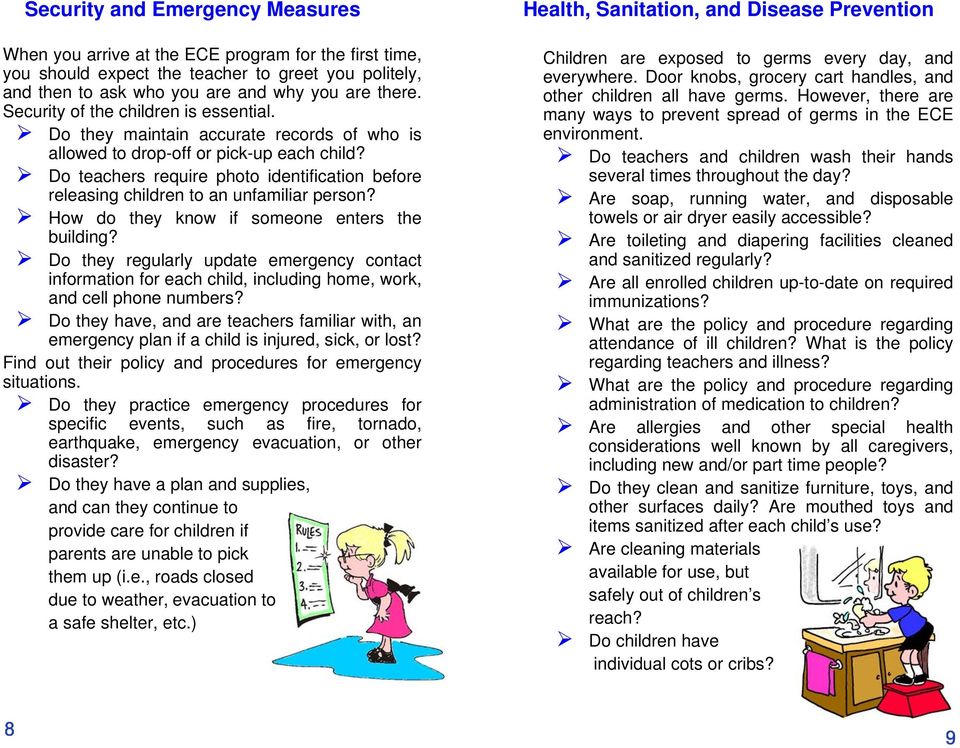
8 Security and Emergency Measures When you arrive at the ECE program for the first time, you should expect the teacher to greet you politely, and then to ask who you are and why you are there. Security of the children is essential. Do they maintain accurate records of who is allowed to drop-off or pick-up each child? Do teachers require photo identification before releasing children to an unfamiliar person? How do they know if someone enters the building? Do they regularly update emergency contact information for each child, including home, work, and cell phone numbers? Do they have, and are teachers familiar with, an emergency plan if a child is injured, sick, or lost? Find out their policy and procedures for emergency situations. Do they practice emergency procedures for specific events, such as fire, tornado, earthquake, emergency evacuation, or other disaster? Do they have a plan and supplies, and can they continue to provide care for children if parents are unable to pick them up (i.e., roads closed due to weather, evacuation to a safe shelter, etc.) Health, Sanitation, and Disease Prevention Children are exposed to germs every day, and everywhere. Door knobs, grocery cart handles, and other children all have germs. However, there are many ways to prevent spread of germs in the ECE environment. Do teachers and children wash their hands several times throughout the day? Are soap, running water, and disposable towels or air dryer easily accessible? Are toileting and diapering facilities cleaned and sanitized regularly? Are all enrolled children up-to-date on required immunizations? What are the policy and procedure regarding attendance of ill children? What is the policy regarding teachers and illness? What are the policy and procedure regarding administration of medication to children? Are allergies and other special health considerations well known by all caregivers, including new and/or part time people? Do they clean and sanitize furniture, toys, and other surfaces daily? Are mouthed toys and items sanitized after each child s use? Are cleaning materials available for use, but safely out of children s reach? Do children have individual cots or cribs?
TIPS FOR CHOOSING A CHILDCARE PROGRAM
 TIPS FOR CHOOSING A CHILDCARE PROGRAM www.childhealthonline.org Copyright 2006 Locating a Childcare Program Begin your search by calling your local experts your child care resource and referral (CCR&R)
A Guide for. Families. Using NAEYC Standards to Find Quality Programs for Young Children. www.rightchoiceforkids.org
 A Guide for Families Using NAEYC Standards to Find Quality Programs for Young Children www.rightchoiceforkids.org The National Association for the Education of Young Children (NAEYC) has set 10 standards
Interviewing Child Care Providers: Centers and Daycares
 Interviewing Child Care Providers: Centers and Daycares Program Setup 1) How long has the childcare program been in existence? 2) Is the program licensed? Registered? Accredited by the National Association
SUMMARY OF LICENSING STANDARDS FOR DAY CARE CENTERS
 SUMMARY OF LICENSING STANDARDS FOR DAY CARE CENTERS Illinois Department of Children & Family Services Introduction The Department of Children and Family Services (DCFS) is responsible for licensing day
STATE OF NEW JERSEY DEPARTMENT OF CHILDREN AND FAMILIES OFFICE OF LICENSING/ INSPECTION/VIOLATION REPORT
 Center Name: South Mountain YMCA- Clinton School STATE OF NEW JERSEY DEPARTMENT OF CHILDREN AND FAMILIES OFFICE OF LICENSING/ INSPECTION/VIOLATION REPORT Center ID#: County: Essex Address: 27 Berkshire
North Dakota Department of Human Services Early Childhood Services Division
 North Dakota Department of Human Services Early Childhood Services Division Welcome to North Dakota s Child Care Center Licensing Orientation Consider: Are you organized? Operating a successful child care
Child Care Licensing and Accreditation
 Matching the needs of your child and your own needs with the childcare available is a time-consuming process. It often takes extra time and effort to find high quality care. This section can help you to
A not-for profit organization
 A not-for profit organization EARLY CHILDHOOD DEVELOPMENT is a critical function on Prince Edward Island, recently given added recognition through the renaming of the Provincial Department of Education
EARLY CHILDHOOD ENVIRONMENT RATING SCALE REVISED (ECERS-R) Statements of Developmentally Appropriate Practice
 EARLY CHILDHOOD ENVIRONMENT RATING SCALE REVISED (ECERS-R) Statements of Developmentally Appropriate Practice SPACE AND FURNISHINGS 1. Indoor space Children need sufficient space that is well lit and has
SOUTHEAST MISSOURI STATE UNIVERSITY COURSE SYLLABUS. Title of Course: Child Health, Safety and Nutrition New: Fall 2000
 SOUTHEAST MISSOURI STATE UNIVERSITY COURSE SYLLABUS Department of: Human Environmental Studies Course No.: CF124 Title of Course: Child Health, Safety and Nutrition New: Fall 2000 I. Catalog Description
STATE OF NEW JERSEY DEPARTMENT OF CHILDREN AND FAMILIES OFFICE OF LICENSING/ INSPECTION/VIOLATION REPORT
 Center Name: Medford Methodist Pre-Kindergarten School STATE OF NEW JERSEY DEPARTMENT OF CHILDREN AND FAMILIES OFFICE OF LICENSING/ INSPECTION/VIOLATION REPORT Center ID#: County: Burlington Address: 2
The Best Practices for Managing Early Childhood Learning Centers and Playgrounds on Campus
 The Best Practices for Managing Early Childhood Learning Centers and Playgrounds on Campus Marsh Risk Consulting 44 Whippany Road P.O. Box 1966 Morristown, NJ 07962-1966 July 2011 The Best Practices for
A parent s guide to licensed child care in Toronto
 A parent s guide to licensed child care in Toronto Whether you need child care because you are working, attending school or simply because you would like an early learning experience for your child, a
CHILD CARE LICENSING REGULATION
 Province of Alberta CHILD CARE LICENSING ACT CHILD CARE LICENSING REGULATION Alberta Regulation 143/2008 With amendments up to and including Alberta Regulation 62/2013 Office Consolidation Published by
Western Wayne School District Planned Course. Days-Number 180 Grade(s) 11-12 Or Check One ( ) Quarter Semester XXX Full Year
 Western Wayne School District Planned Course Course Name: Early Childhood Education I Days-Number 180 Grade(s) 11-12 Or Check One ( ) Quarter Semester XXX Full Year Course Description: This course provides
Child Care Regulations in New Mexico
 Child Care Regulations in New Mexico Overview A summary of child care regulations in New Mexico. New Mexico Aim High Star Rating Child Care System Types of care that must be licensed Types of care that
Child Care Center Renewal Checklist SAMPLE REMOVE THIS COVER AND INSERT UNDER EACH SET FOR WRITING BOARD
 Child Care Center Renewal Checklist REMOVE THIS COVER AND INSERT UNDER EACH SET FOR WRITING BOARD Oregon Department of Education Early Learning Division Office of Child Care www.childcareinoregon.org CRT-122A
TABLE OF CONTENTS PREFACE. Chapter 1: GETTING STARTED. Overview of Child Care in North Carolina. How to Use this Handbook
 Overview of Child Care in North Carolina TABLE OF CONTENTS PREFACE i How to Use this Handbook Chapter 1: GETTING STARTED Available Resources to Get Started 1.1 Mandatory Prelicensing Workshop 1.2 Application
Sanitary Food Preparation & Safe Food Handling
 70 Feeding Infants 10 Sanitary Food Preparation & Safe Food Handling Babies are more susceptible to bacteria than older children, and unsanitary food conditions can cause serious infections. General cleanliness,
Safety Practices in the Classroom
 Safety Practices in the Classroom General Responsibilities for Child Care Personnel All child care center employees, including those who are not counted in child/staff ratios, must: Demonstrate competency,
The Learning Environment
 2 The Learning Environment The second component of the Creative Curriculum framework is the learning environment the use and organization of the space in your classroom, the daily schedule and routines,
INSPECTION OUTCOME REPORT
 Ref: I 05a Information on Service DCYA Ref. No Name of Service: 09lk0021 Nead Na Nog Address of Service: South Liberties G.A.A Club, Raheen, Ballyneety, Co Limerick Date of Issue of Report: 22/05/2013
Child Care Regulations in Florida
 Child Care Regulations in Florida Overview A summary of child care regulations in Florida. Types of care that must be licensed Types of care that must be registered Types of care that may operate without
Yorketown Community Children s Centre. Food Safety and Healthy Eating Policy
 Yorketown Community Children s Centre Food Safety and Healthy Eating Policy Policy Number 1 Link to CCQA Principles Family Day Care Quality Assurance (FDCQA) Quality Practices Guide (2004) Principle 4.2
CCEI Online College Credit Eligible CDA Certificate Family Child Care Program Syllabus
 CCEI Online College Credit Eligible CDA Certificate Family Child Care Program Syllabus Settings: Family Care Program Code: 1103-CDA Program Length: 151 Hours IACET CEU Value: 15.1 CEUs Program Start Date:
Children s Ministry Handbook
 Children s Ministry Handbook TRINITY BAPTIST CHURCH Reaching Locally, Effecting Globally, Through the Word of Life. 02.05.2013 MISSION STATEMENT The goal of Trinity Baptist Church s Children s Ministry
Orientation Package. for. Prospective Child Care Operators
 MINISTRY OF EDUCATION CHILD CARE LICENSING IN ONTARIO Orientation Package for Prospective Child Care Operators October 2014 TABLE OF CONTENTS Introduction 4 Child Care in Ontario 5 Ontario s Ministry of
Maniilaq Association Employment & Training P.O. Box 256 Kotzebue, AK 99752 1-800-478-3312 Ext: 7021 Fax: 1-866-832-9350 scholarships@maniilaq.
 Maniilaq Association Employment & Training P.O. Box 256 Kotzebue, AK 99752 1-800-478-3312 Ext: 7021 Fax: 1-866-832-9350 [email protected] We will not process applications without a background report,
Professional Resource File: Bringing it all Together
 Professional Resource File: Bringing it all Together What is the CDA Professional Resource File? A collection of 17 specific resource materials to help you in your work with children and families A way
Sample Child Care Policy Name Address Phone E-mail Site Name (If Any) Date
 Sample Child Care Policy Name Address Phone E-mail Site Name (If Any) Date Welcome to my child care home. This policy outlines the policies and procedures I use in my child care home. I have met the family
EARLY CHILDHOOD EDUCATION CENTER ENROLLMENT FORM
 EARLY CHILDHOOD EDUCATION CENTER ENROLLMENT FORM 55 PA CODE CHAPTERS 3270 123 & 181 (C): 3280 123 & 181 (C): 3290 123 & 181 (C) CHILD S FIRST NAME MIDDLE NAME LAST NAME BIRTH DATE START DATE WITHDRAWAL
City of Gardena Gardena Family Child Care Program Provider Network
 City of Gardena Gardena Family Child Care Program Provider Network Gardena Family Child Care Home Education Network (GFCC): GFCC contracts with licensed family child care providers who offer a quality
Planning to travel? Read Hannah recommendations for keeping your Pets happy and healthy while you are away:
 Planning to travel? Read Hannah recommendations for keeping your Pets happy and healthy while you are away: 1. First choice is to take your Pet with you. Kennel Training - Follow Hannah recommended kennel
GUIDELINES FOR CENTRE-BASED INFANT/TODDLER CARE SERVICES
 GUIDELINES FOR CENTRE-BASED INFANT/TODDLER CARE SERVICES EARLY CHILDHOOD DEVELOPMENT AGENCY 51 CUPPAGE ROAD #08-01 SINGAPORE 229469 ECDA WEBSITE: http://www.ecda.gov.sg CONTENTS PAGE PART A INTRODUCTION
SCHOOL OF NURSING CHILD CARE HEALTH LINKAGES EVALUATION PROJECT CENTER NUMBER/ID: CLASSROOM NAME/#: DATE: RESEARCH ASSISTANT: TIME BEGIN: AM / PM
 UNIVERSITY OF CALIFORNIA SAN FRANCISCO SCHOOL OF NURSING DEPARTMENT OF FAMILY HEALTH CARE NURSING CHILD CARE HEALTH LINKAGES EVALUATION PROJECT HEALTH AND SAFETY CHECKLIST CENTER NUMBER/ID: CLASSROOM NAME/#:
FISHERS UNITED METHODIST CHURCH EARLY CHILDHOOD MINISTRY TRAINING
 FISHERS UNITED METHODIST CHURCH EARLY CHILDHOOD MINISTRY TRAINING 1 TABLE OF CONTENTS Welcome to FUMC Early Childhood Ministry!...3 What to Expect as a Volunteer 4 Volunteer Training Checklist.6 Supplies
FAMILY ADULT DAY CARE CERTIFICATION STANDARDS CHECKLIST
 DEPARTMENT OF HEALTH SERVICES Division of Quality Assurance F-62611 (Rev. 07/08) STATE OF WISCONSIN FAMILY ADULT DAY CARE CERTIFICATION STANDARDS CHECKLIST NOTE: These standards apply when adult day care
A Parent s Guide To. Family-Friendly Child Care Centers
 A Parent s Guide To Family-Friendly Child Care Centers Support HOW DOES A GOOD CHILD CARE CENTER BECOME A GREAT CHILD CARE CENTER? Respect * Child care staff are listening to parents* in a way they may
Rules Regulating Child Care Centers
 Rules Regulating Child Care Centers 7.702 RULES REGULATING CHILD CARE CENTERS (LESS THAN 24-HOUR CARE) All child care centers must comply with the "General Rules for Child Care Facilities" as well as the
Competencies. The Children s Program Administrator Credential of NewYork State. Topic 1: Administering Children s Programs
 In cooperation with: New York State Child Care Coordinating Council and the New York State Association for the Education of Young Children Competencies The Children s Program Administrator Credential of
Signed by Ann Slater, Chair of Governors of: Harris Primary Academy Chafford Hundred and Harris Primary Academy Mayflower
 Educational Visits Policy Harris Primary Academy Chafford Hundred and Harris Primary Academy Mayflower Signed by Ann Slater, Chair of Governors of: Harris Primary Academy Chafford Hundred and Harris Primary
WELCOME TO THE AFFTON EARLY CHILDHOOD CENTER!
 WELCOME TO THE AFFTON EARLY CHILDHOOD CENTER! Dear Families: I would like to welcome you to the Affton Early Childhood Center. I am excited that you have enrolled your child in our preschool program and
Test Code: 7933 / Version 1
 Pennsylvania Customized Assessment Blueprint Test Code: 7933 / Version 1 Copyright 2013. All Rights Reserved. General Assessment Information Blueprint Contents General Assessment Information Written Assessment
Administration Of Medication
 Administration Of Medication STANDARD 3.081: Permissible Administration of Medication The administration of medicines at the facility shall be limited to: a) Prescribed medications ordered by a health
LifeCubby Aligns to FLORIDA's Early Learning and Development Standards
 LifeCubby Aligns to FLORIDA's Early Learning and Development Standards www.lifecubby.me 4990 Roberts Road, Hilliard OH 43026 614-432-4917 LifeCubby is a web-hosted software platform, with both Software-as-a-Service
WESTWOOD PRESCHOOL HANDBOOK 2014-2015
 WESTWOOD PRESCHOOL HANDBOOK 2014-2015 Hello! My name is Harshal Patwa and I am honored to be part of Poway Preschool. I love working with young children, and I love learning from them too. I have been
Early Childhood Education Program Policies and Procedures
 Early Childhood Education Program Policies and Procedures Parent Handbook Revised 2013 Excellence in education is when we do everything that we can to make sure they become everything that they can. Carol
BLOOMINGTON-NORMAL YMCA 2015 SUMMER CAMP PARENT HANDBOOK
 BLOOMINGTON-NORMAL YMCA 2015 SUMMER CAMP PARENT HANDBOOK Camp Sparrow: Be strong enough to stand Be free enough to soar About the YMCA The YMCA is for youth development, for healthy living, for social
ARIZONA CTE CAREER PREPARATION STANDARDS & MEASUREMENT CRITERIA EARLY CHILDHOOD EDUCATION, 13.1210.00
 EARLY CHILDHOOD EDUCATION, 13.1210.00 STANDARD 1.0 ANALYZE THE CONTINUUM OF PHYSICAL AND SENSORY DEVELOPMENT OF YOUNG 1.1 Analyze factors influencing prenatal development 1.2 Explain the general progression
PLEASE NOTE. For more information concerning the history of these regulations, please see the Table of Regulations.
 PLEASE NOTE This document, prepared by the Legislative Counsel Office, is an office consolidation of this regulation, current to November 8, 2005. It is intended for information and reference purposes
Child Care Regulations in Nevada
 Child Care Regulations in Nevada Overview A summary of child care regulations in Nevada. Types of care that must be licensed Types of care that may operate without a license Subsidized child care Whom
Helping Children Make Transitions between Activities
 Helping Children Make Transitions between Activities Project funded by the Child Care and Head Start Bureaus in the U.S. Department of Health and Human Services What Works Brief Training Kit #4 www.vanderbilt.edu/csefel/
How To Write An Early Childhood Competency
 Oklahoma Core Competencies for Early Childhood Practitioners Oklahoma Core Competencies for Early Childhood Practitioners 10/08 1 2 Table Of Contents Introduction 4 Content Areas Child Growth and Development
Natalie Brutto Infant and Toddler Provider 840 Hayes St. Apt. 3 San Francisco, CA 94117 PH: 415-863-4642 Fax: 415-874-9282 nbrutto@aol.
 Natalie Brutto Infant and Toddler Provider 840 Hayes St. Apt. 3 San Francisco, CA 94117 PH: 415-863-4642 Fax: 415-874-9282 [email protected] PARENT HANDBOOK Dear Parent/Guardian: Welcome to Giggles Galore!
Continuing The Journey. Best Practices. in Early Childhood Transition. A Guide for Families ELEMENTARY AND SECONDARY EDUCATION
 Continuing The Journey Best Practices in Early Childhood Transition A Guide for Families ELEMENTARY AND SECONDARY EDUCATION Acknowledgements This guide is the result of a collaborative effort between the
Esther Aloia. Brentwood High School Preschool Program 3601 Brownsville Road Pittsburgh, PA 15227 PROGRAM
 Brentwood High School Preschool Program 3601 Brownsville Road Pittsburgh, PA 15227 PROGRAM It is the philosophy of the Brentwood High School Preschool focuses on early childhood as an important time in
Fayetteville Technical Community College EARLY CHILDHOOD EDUCATION CENTER STAFF HANDBOOK
 Fayetteville Technical Community College EARLY CHILDHOOD EDUCATION CENTER STAFF HANDBOOK Current Version Originally Published September 2009 Last Revised: October 1, 2009 Proponent: Associate Vice President
Upcoming September dates: Dear Families, We are excited to be back at school and we look forward to sharing our summer stories with one another.
 BLUERIDGE ELEMENTARY SCHOOL 2650 Bronte Drive North Vancouver BC V7H 1M4 Telephone: 604 903 3250 Fax: 604 903 3251 Safe Arrival/Callback: 604 903 3252 blueridgea [email protected] Dear Families, We are
Parent Handbook 2014-2015
 Attleboro High School Early Education & Care Program Children s Learning Center 100 Rathbun Willard Drive Attleboro, MA 02703 508.222.5150 Extension 1317 Parent Handbook 2014-2015 Attleboro High School
Getting School Ready in Iowa
 Getting School Ready in Iowa I want to be ready for kindergarten. How can the kindergarten be ready for me? A guide for families and early care, health, and education providers caring for children who
Purpose: To develop physical and motor skills and promote health and well-being
 Purpose: To develop physical and motor skills and promote health and well-being The physical and motor development domain includes the physical and motor skills and abilities that emerge during the infant
Care service inspection report
 Care service inspection report Full inspection Community Playgroups (West Calder) Day Care of Children West Calder Community Centre Dickson Street West Calder Inspection completed on 24 May 2016 Service
CHILD CARE PROVIDER INFORMATION FORM
 CHILD CARE PROVIDER INFORMATION FORM Please complete all available fields. We will use this information to refer parents to child care programs that meets their family's specific needs. By providing us
Christian Learning Center
 Christian Learning Center at First United Methodist Church Milan, Tennessee Registration Packet Where we help your children grow and learn in a Christian environment! Revised November 2012 Check it out!
How To Ensure A Child Care Provider Meets The 14 National Standards
 Full day care National standards for under 8s day care and childminding Full day care Introduction The Government is committed to promoting the welfare and development of all our young children. Good
Child Care Regulations in Oregon
 Child Care Regulations in Oregon Overview A summary of child care regulations in Oregon. Types of care that must be certified Types of care that must be registered Types of care that may operate without
Education & Training Career Cluster Early Childhood Education II Course Number: 20.42400
 Education & Training Career Cluster Early Childhood Education II Course Number: 20.42400 Course Description: Early Childhood Education II is the second course in the Early Childhood Care and Education
National Quality Standard Assessment and Rating Instrument
 National Quality Assessment and Rating Instrument April 2012 Copyright The details of the relevant licence conditions are available on the Creative Commons website (accessible using the links provided)
Where we cater to the business of children and the business of children is play.
 Revised May, 2015 Welcome to the Austin Peay State University Child Learning Center! Where we cater to the business of children and the business of children is play. We welcome you to the Austin Peay State
Family Child Care Handbook
 Family Child Care Handbook A guide to Family Child Care on Table of Contents Welcome 3 Resource & Referral 3 Frequently Asked Questions 4 What is Family Child Care? 4 What Does Licensing Mean? 4 How Can
EARLY CHILDHOOD TRANSITION GUIDEBOOK. What You Need to Know Before Your Child s Third Birthday
 EARLY CHILDHOOD TRANSITION GUIDEBOOK What You Need to Know Before Your Child s Third Birthday Early Childhood Transition Guidebook What You Need to Know Before Your Child s Third Birthday PACER Center
DAY CARE INSPECTION REPORT
 DAY CARE INSPECTION REPORT URN EY225519 INSPECTION DETAILS Inspection Date 09/03/2005 Inspector Name Harpal Thandi SETTING DETAILS Day Care Type Setting Name Setting Address Full Day Care Roseacre Nursery
National Accreditation Commission for Early Care and Education Programs
 National Accreditation Commission for Early Care and Education Programs Contents Information Greetings Philosophy Overview History, Eligibility, Fees Process Three Step Process NAC Validators NAC Commissioners
What Is. Norovirus? Learning how to control the spread of norovirus. Web Sites
 Web Sites Centers for Disease Control and Prevention (CDC) http://www.cdc.gov/norovirus/index.html Your Local Health Department http://www.azdhs.gov/diro/lhliaison/countymap.htm What Is Ocument dn Norovirus?
Inspection report for early years provision. Unique Reference Number
 Inspection report for early years provision Unique Reference Number Inspection date Inspector 300088 07 February 2007 Yvonne Victoria Facey Type of inspection Type of care Childcare Childminding ABOUT
Comprehensive Nursing Home Checklist *
 Comprehensive Nursing Home Checklist * Nursing Home: Address: Phone Number: Website Address: Date of Visit: the Basics NOTES Is the nursing home Medicare-certified? How many beds are Medicare-certified?
Child Care Regulations in Colorado
 Child Care Regulations in Colorado Overview A summary of child care regulations in Colorado. Types of care that must be licensed Types of care that may operate without a license Age-group definitions Subsidized
EMERGENCY RESPONSE PLANNING FOR SCHOOLS AND CHILDCARE PROGRAMS
 EMERGENCY RESPONSE PLANNING FOR SCHOOLS AND CHILDCARE PROGRAMS Gregg Champlin (603) 223-3629 [email protected] School and Child Care Emergency Response Plans Requirements: K-12 Public and Nonpublic
The regulations that impact outdoor space, surfacing, fall zones, equipment, entrapments, hazards and supervision are:
 Small Group, Large Group and School Age Child Care Licensing POLICY STATEMENT: Playground Safety 6.06 CMR 7.07(7); 7.07(16)(e); 7.07(13); 7.10(10) According to the U. S. Consumer Product Safety Commission
REGISTRATION PROCESS FOR PROSPECTIVE SESSIONAL AND FULL DAY CARE PROVIDERS - GUIDANCE DOCUMENT
 REGISTRATION PROCESS FOR PROSPECTIVE SESSIONAL AND FULL DAY CARE PROVIDERS - GUIDANCE DOCUMENT The Children (NI) Order 1995 states the main purposes of registration are as follows: To protect Children
After School Ministry
 Viewmont Baptist Church After School Ministry Parent and Student Handbook 2013-2014 1246 2 nd. Street NE Hickory, NC 28601 Page 1 June 9, 2013 Viewmont Baptist Church After School Ministry WELCOME to the