
Oracle Fusion Middleware
|
|
|
- Brenda Booker
- 10 years ago
- Views:
Transcription
1 Oracle Fusion Middleware Using Oracle Managed File Transfer 12c Release (12.1.3) E August 2015 This document describes how to administer Oracle Managed File Transfer, how to design and monitor file transfers, and how to integrate Oracle Managed File Transfer with other applications.

2 Oracle Fusion Middleware Using Oracle Managed File Transfer, 12c Release (12.1.3) E Copyright 2014, 2015, Oracle and/or its affiliates. All rights reserved. Primary Author: Oracle Corporation. Contributing Authors: Oracle Corporation. Contributors: Oracle MFT development, product management, and quality assurance teams This software and related documentation are provided under a license agreement containing restrictions on use and disclosure and are protected by intellectual property laws. Except as expressly permitted in your license agreement or allowed by law, you may not use, copy, reproduce, translate, broadcast, modify, license, transmit, distribute, exhibit, perform, publish, or display any part, in any form, or by any means. Reverse engineering, disassembly, or decompilation of this software, unless required by law for interoperability, is prohibited. The information contained herein is subject to change without notice and is not warranted to be error-free. If you find any errors, please report them to us in writing. If this is software or related documentation that is delivered to the U.S. Government or anyone licensing it on behalf of the U.S. Government, then the following notice is applicable: U.S. GOVERNMENT END USERS: Oracle programs, including any operating system, integrated software, any programs installed on the hardware, and/or documentation, delivered to U.S. Government end users are "commercial computer software" pursuant to the applicable Federal Acquisition Regulation and agencyspecific supplemental regulations. As such, use, duplication, disclosure, modification, and adaptation of the programs, including any operating system, integrated software, any programs installed on the hardware, and/or documentation, shall be subject to license terms and license restrictions applicable to the programs. No other rights are granted to the U.S. Government. This software or hardware is developed for general use in a variety of information management applications. It is not developed or intended for use in any inherently dangerous applications, including applications that may create a risk of personal injury. If you use this software or hardware in dangerous applications, then you shall be responsible to take all appropriate fail-safe, backup, redundancy, and other measures to ensure its safe use. Oracle Corporation and its affiliates disclaim any liability for any damages caused by use of this software or hardware in dangerous applications. Oracle and Java are registered trademarks of Oracle and/or its affiliates. Other names may be trademarks of their respective owners. Intel and Intel Xeon are trademarks or registered trademarks of Intel Corporation. All SPARC trademarks are used under license and are trademarks or registered trademarks of SPARC International, Inc. AMD, Opteron, the AMD logo, and the AMD Opteron logo are trademarks or registered trademarks of Advanced Micro Devices. UNIX is a registered trademark of The Open Group. This software or hardware and documentation may provide access to or information about content, products, and services from third parties. Oracle Corporation and its affiliates are not responsible for and expressly disclaim all warranties of any kind with respect to third-party content, products, and services unless otherwise set forth in an applicable agreement between you and Oracle. Oracle Corporation and its affiliates will not be responsible for any loss, costs, or damages incurred due to your access to or use of third-party content, products, or services, except as set forth in an applicable agreement between you and Oracle.

3 Contents Preface... Audience... Documentation Accessibility... Related Documents... Conventions... ix ix ix ix x 1 Understanding Oracle Managed File Transfer 1.1 What You Can Do with Oracle Managed File Transfer Oracle Managed File Transfer, Oracle Service Bus, and Oracle B2B Oracle Managed File Transfer Functional Use Case Patterns Standalone Applications SOA Integration B2B Integration Healthcare Integration Oracle Service Bus Integration Hybrid Integration Oracle Managed File Transfer Architecture Components of Oracle Managed File Transfer Artifacts: Sources, Targets, and Transfers Embedded FTP and sftp Servers Monitoring and Reports Security Utilities Repository Interfaces Oracle Managed File Transfer User Roles File Handlers Designers Monitors Administrators Installing Oracle Managed File Transfer Screen Navigation in Oracle Managed File Transfer iii

4 1.8.1 Design, Monitoring, and Administration Pages Using the Left Panel Navigator Opening and Closing Dynamic Tabs Dragging and Dropping Sources and Targets into Transfers Expanding and Collapsing the Dashboard Regions Setting Language, Time Zone, and Accessibility Preferences Designing Artifacts: Transfers, Sources, and Targets 2.1 About Designing Transfers Getting Ready to Create a Transfer Designing End-to-End Flows Configuring a Transfer Adding a Source and Targets Setting Up Content Filters Configuring Target-Specific Transfer Settings Setting Up Transfer Preprocessing and Postprocessing Actions Duplicating an Existing Transfer Creating a Source Source Types Setting Up Source Processing Actions Archiving and Deleting Files Before Delivery Duplicating an Existing Source Creating a Target Target Types Moving and Renaming Files After Delivery Duplicating an Existing Target Retry Interval and Retry Count Setting Up Schedules Schedules with Polling Frequency and Minimum Age Deploying and Testing Transfers Deploying a Source, Target, or Transfer How to Tell If a Transfer Is Successful Importing and Exporting Transfers Processing Transfers with Custom Callouts 3.1 Understanding Custom Callouts Creating a Custom Callout: High-Level Steps Creating the Code Java Code Requirements and Tips Java Code for the Newline Conversion Example Creating the Callout Definition File Locating the Callout Directory Running the createcallouts Command iv

5 3.7 Testing the Callout Adding the Callout to a Source Adding the Callout to a Target Viewing the Report to Verify the Callout Action Updating the Callout Reference Files PreCalloutPlugin Interface PostCalloutPlugin Interface Callout Definition Schema Integrating Oracle Managed File Transfer with Other Products 4.1 Compatible Technologies and Integration Strategies Managing Domains Specifying the Tracking URL Integrating with Oracle SOA Suite Creating an MFT Reference for a SOA Source Creating an MFT Service for a SOA Target Interlinked SOA and MFT Reports Integrating with Oracle Service Bus Creating a Business Service for a Service Bus Source Creating a Proxy Service for a Service Bus Target Integrating with B2B Creating a Remote Trading Partner Channel for a B2B Source Configuring a B2B Domain for a B2B Target Interlinked B2B and MFT Reports Integrating with Healthcare Creating an Outbound Endpoint for a Healthcare Source Creating an Inbound Endpoint for a Healthcare Target Interlinked Healthcare and MFT Reports Integrating with Oracle Data Integrator Using the File System and FTP for ODI Integration Invoking a Web Service for an ODI Source Creating a Data Service for an ODI Target Integrating with Web Services MFT WSDL Files Monitoring Oracle Managed File Transfer 5.1 Monitoring Deployed Sources, Targets, and Transfers Disabling Sources, Targets, and Transfers Reenabling Sources, Targets, and Transfers Undeploying Sources, Targets, and Transfers Redeploying Sources, Targets, and Transfers Versioning Sources, Targets, and Transfers v
6 5.2 Monitoring Transfer Flows Using the Main Dashboard Interpreting Main Dashboard Metrics Using the File Finder Monitoring Active Deliveries Interpreting Dashboards for All Transfers, Sources, or Targets Interpreting Instance Messages Interpreting Dashboard Metrics Interpreting Single Artifact Transfer, Source, and Target Dashboards Interpreting Artifact Instance Messages Interpreting Artifact Information Interpreting Artifact Dashboard Metrics Interpreting Source, Transfer, and Target Reports Using the Flow Diagram Source Reports Transfer Reports Target Reports Pause and Restart a Transfer Resubmit a Transfer Diagnose File Delivery Failures Diagnose Transfer Errors Diagnosing Error Messages and Descriptions Administering Oracle Managed File Transfer 6.1 Changing Server Properties General Configuration Properties Performance Properties High Availability Properties Advanced Delivery Properties Importing and Exporting the MFT Configuration Increasing Memory to Improve Performance of Large File Transfers Oracle WebLogic Server Startup and Shutdown Transferring Files Through Firewalls Using the MFT FTP Proxy Server Managing Multiple Weblogic Servers and High Availability Configuring High Availability Preventing Cluster Startup Errors Load Balancing in Oracle Managed File Transfer Enabling Event Notifications Configuring an Driver for Notifications Configuring an SMS Driver for Notifications MFTExceptionQueue Configuring Oracle Managed File Transfer Error Processor Queues Configuring Oracle Managed File Transfer Loggers Oracle Managed File Transfer Loggers vi

7 6.12 Viewing Oracle Managed File Transfer Log Messages Moving Oracle Managed File Transfer to Another Environment Administering Oracle Managed File Transfer Embedded Servers 7.1 About Embedded FTP and sftp Servers Security Archiving and Purging Transfers and Files Embedded Server Configuration Re-configuring the Port Path Separators for Remote FTP and sftp Servers Other Embedded Server Settings Starting and Stopping Embedded Servers Managing Embedded Servers and High Availability Supported FTP and sftp Commands Oracle Managed File Transfer Security 8.1 User Authentication and Authorization Configuring Users Oracle Managed File Transfer Console Access Embedded Server User Access Granting Payload Access Embedded Server Security sftp (SSH-FTP) FTPS (FTP Over SSL) Integrating with Oracle Access Manager 11g for Single Sign-On Message Encryption Using PGP Managing Keystores Configuring the SSL Keystore Configuring the SSH Keystore Configuring the PGP Keystore Enabling Security Audit Logging Using Fusion Middleware Control to Enable Audit Logging Using WLST to Enable Audit Logging OWSM Security Policy Attachment Using Fusion Middleware Control for Global Policy Attachment Using WLST for Global Policy Attachment Using the MFT Console for Local Policy Attachment Using WLST for Local Policy Attachment How the Policy Is Applied at Runtime Policies and Artifact Life Cycle Management Verifying Policy Registration vii
8 9 Oracle Managed File Transfer Utilities 9.1 Running WLST Commands MFT WLST Command Summary viii

9 Preface This preface describes the intended audience, document accessibility features, and conventions used in this guide Oracle Fusion Middleware Using Oracle Managed File Transfer. Audience This document is intended for administrators, designers, deployers, and monitors of file deliveries implemented in Oracle Managed File Transfer. Familiarity with FTP (File Transfer Protocol) and web services is recommended for all users. For administrators, familiarity with Oracle WebLogic Server and Oracle Database administration is also recommended. For designers, familiarity with integrating products such as Oracle SOA Suite, Oracle Service Bus, and Oracle B2B for Healthcare is also recommended. Documentation Accessibility Related Documents For information about Oracle's commitment to accessibility, visit the Oracle Accessibility Program website at ctx=acc&id=docacc. Access to Oracle Support Oracle customers that have purchased support have access to electronic support through My Oracle Support. For information, visit topic/lookup?ctx=acc&id=info or visit topic/lookup?ctx=acc&id=trs if you are hearing impaired. For information about Oracle SOA Suite products, see the following: Oracle Fusion Middleware Developer's Guide for Oracle SOA Suite Oracle Fusion Middleware Administrator's Guide for Oracle SOA Suite and Oracle Business Process Management Suite Oracle Fusion Middleware Installation Guide for Oracle SOA Suite Oracle Fusion Middleware User's Guide for Technology Adapters Oracle Fusion Middleware Performance Guide ix

10 Conventions The following text conventions are used in this document: Convention boldface italic monospace Meaning Boldface type indicates graphical user interface elements associated with an action, or terms defined in text or the glossary. Italic type indicates book titles, emphasis, or placeholder variables for which you supply particular values. Monospace type indicates commands within a paragraph, URLs, code in examples, text that appears on the screen, or text that you enter. x
11 1 Understanding Oracle Managed File Transfer Oracle Managed File Transfer (MFT) is a high performance, standards-based, end-toend managed file gateway. It features design, deployment, and monitoring of file transfers using a lightweight web-based design-time console that includes file encryption, scheduling, and embedded FTP and sftp servers. This chapter describes basic Oracle Managed File Transfer concepts. This chapter includes the following sections: What You Can Do with Oracle Managed File Transfer Oracle Managed File Transfer_ Oracle Service Bus_ and Oracle B2B Oracle Managed File Transfer Functional Use Case Patterns Oracle Managed File Transfer Architecture Components of Oracle Managed File Transfer Oracle Managed File Transfer User Roles Installing Oracle Managed File Transfer Screen Navigation in Oracle Managed File Transfer 1.1 What You Can Do with Oracle Managed File Transfer This topic describes the various operations that you can perform by using Oracle Managed File Transfer. Oracle Managed File Transfer lets you perform the following operations during the transfer process: Scheduling Resubmitting Attaching inline or referencing Compression and decompression Encryption and decryption Archiving, renaming, and deletion Purging transfer instances and files Pausing and resuming Understanding Oracle Managed File Transfer 1-1

12 What You Can Do with Oracle Managed File Transfer For more information about resubmitting transfers, see Resubmit a Transfer. For more information about the other operations, see Designing Artifacts: Transfers_ Sources_ and Targets. Oracle Managed File Transfer lets you track and troubleshoot file deliveries (transfer instances) based on the following: Success, frequency, and failure statistics Metrics, recent errors, file finder, and active deliveries Error information table Active delivery progress table Reports for individual deliveries For more information, see Monitoring Oracle Managed File Transfer. Oracle Managed File Transfer lets you transfer files to and from many endpoint types: File and FTP based endpoint types: File: Transfer files from or to directories accessible to the Oracle Managed File Transfer server. FTP Embedded: Transfer files from the embedded MFT FTP (File Transfer Protocol) or FTPS (FTP with Secure Socket Layer) server by copying the file into one of the embedded server directories. sftp Embedded: Transfer files from the embedded sftp (Secure Shell FTP or SSH-FTP) server by copying the file into one of the embedded server directories. FTP Remote: Transfer files from or to a remote FTP or FTPS server. sftp Remote: Transfer files from or to a remote sftp server. SOAP web-services based endpoint types: SOAP: Transfer files from or to Simple Object Access Protocol web service endpoints inline or by reference to a folder location. SOA: Transfer files from or to Oracle SOA (Service-Oriented Architecture) web service endpoints. Service Bus (OSB): Transfer files from or to Oracle Service Bus web service endpoints. ODI: Transfer files from or to Oracle Data Integrator web service endpoints. B2B based endpoint types: B2B: Transfer files from or to Oracle B2B (Business to Business) trading partners. Healthcare: Transfer files from or to Oracle B2B for Healthcare endpoints. For examples of some of these transfers in context, see Oracle Managed File Transfer Functional Use Case Patterns. For full details on how to create these transfers, see Designing Artifacts: Transfers_ Sources_ and Targets. 1-2 Using Oracle Managed File Transfer
13 Oracle Managed File Transfer, Oracle Service Bus, and Oracle B2B 1.2 Oracle Managed File Transfer, Oracle Service Bus, and Oracle B2B Oracle Managed File Transfer, Oracle SOA Suite, and B2B have overlapping features, but each excels at different file transfer scenarios. Oracle Managed File Transfer is especially good for: Transfer of very large files limited in size only by the operating system and capacity of the file system. Transfer from a single source with fan-out to a large number of targets. Detailed auditing and recording of all transfers. Advanced security for transfers. Advanced transfer management, such as restart and pause/resume. Use of an embedded FTP or sftp server. Oracle SOA Suite is especially good for: Orchestration or complex integration, such as fan-in from multiple sources. Integration with enterprise systems such as messaging or ERP. Manual tasks, content based routing, or transformations. B2B is especially good for: Scenarios in which document format is relevant (for example, HL7, EDI, and so on). Scenarios in which additional semantics, such as AS2, are required. 1.3 Oracle Managed File Transfer Functional Use Case Patterns Oracle Managed File Transfer can help integrate applications by transferring files between them in complex use case patterns. This section describes some common use case patterns. For full details on how to integrate Oracle Managed File Transfer with other applications, see Integrating Oracle Managed File Transfer with Other Products Standalone Applications Figure 1-1 shows how Oracle Managed File Transfer can transfer files on its own using embedded FTP and sftp servers and the file systems to which it has access. Figure 1-1 Standalone Use Case Pattern A file transfer can have one or more targets. A multiple target use case pattern is called fan-out. The target of one transfer can also use the same endpoint as the source of another transfer, creating a chain. Understanding Oracle Managed File Transfer 1-3

14 Oracle Managed File Transfer Functional Use Case Patterns SOA Integration Figure 1-2 shows how Oracle Managed File Transfer can integrate with the web service interfaces of SOA applications. Figure 1-2 SOA Use Case Pattern B2B Integration A SOA application can be the source or target of a transfer. A SOA application can also be the common endpoint for the target of one transfer and the source of another. Figure 1-3 shows how Oracle Managed File Transfer can integrate with B2B trading partners. Figure 1-3 B2B Use Case Pattern Healthcare Integration A B2B application can be the source or target of a transfer. A B2B application can also be the common endpoint for the target of one transfer and the source of another. Figure 1-4 shows how Oracle Managed File Transfer can integrate with Healthcare endpoints. Figure 1-4 Healthcare Use Case Pattern A Healthcare application can be the source or target of a transfer. A Healthcare application can also be the common endpoint for the target of one transfer and the source of another Oracle Service Bus Integration Figure 1-5 shows how Oracle Managed File Transfer can integrate with Oracle Service Bus web service interfaces. 1-4 Using Oracle Managed File Transfer

15 Oracle Managed File Transfer Architecture Figure 1-5 Oracle Service Bus Use Case Pattern Hybrid Integration An Oracle Service Bus interface can be the source or target of a transfer. An Oracle Service Bus interface can also be the common endpoint for the target of one transfer and the source of another. Figure 1-6 shows how Oracle Managed File Transfer can integrate with multiple applications. Figure 1-6 Hybrid Use Case Pattern Oracle Managed File Transfer can be one participant in a web of data transfers that includes multiple application types. 1.4 Oracle Managed File Transfer Architecture Figure 1-7 shows the main components of Oracle Managed File Transfer, which include configuration data, the user-interface console, embedded FTP and sftp servers, security, and interfaces to various types of file transfer endpoints. Oracle Managed File Transfer can consist of multiple managed servers that provide high availability. Figure 1-7 Oracle Managed File Transfer Architecture Understanding Oracle Managed File Transfer 1-5

16 Components of Oracle Managed File Transfer For details about the console, see Screen Navigation in Oracle Managed File Transfer. For details about the other components, see Components of Oracle Managed File Transfer. 1.5 Components of Oracle Managed File Transfer This section explains most of the Oracle Managed File Transfer components shown in Figure 1-7 in more detail Artifacts: Sources, Targets, and Transfers When you create a file delivery structure using the Designer page of the Oracle Managed File Transfer Console, you create three types of artifacts: A source, which defines an origin of files A target, which defines a destination of files A transfer, which associates a source with one or more targets An artifact defines the configuration for parts of a file delivery structure. This is in contrast to a file delivery instance, which is an individual file delivery that follows the structure. Sources and targets can be reused in multiple transfers. When more than one transfer uses the same source, this is called transfer fan-out. When a transfer uses more than one target, this is called target fan-out. A source and all associated transfers and targets are collectively called a flow. Using various artifact properties, you can define additional file delivery behavior: Filters: Files with specific name and extension patterns can be included or excluded. Schedules: Transfers can be limited to specific times or time windows. Preprocessing actions: Files can be compressed, decompressed, encrypted, or decrypted. Postprocessing actions: Files can be decompressed. File operations: Files can be archived, renamed, moved, or deleted. For information about creating artifacts, see Designing Artifacts: Transfers_ Sources_ and Targets Embedded FTP and sftp Servers Two servers are embedded in Oracle Managed File Transfer: FTP and sftp. These two embedded servers can be source artifacts. You can configure various properties of these embedded servers, such as ports, security, and user access to directories. These servers are automatically deployed as part of the WebLogic Server Oracle Managed File Transfer deployment. For more information, see Administering Oracle Managed File Transfer Embedded Servers Monitoring and Reports Oracle Managed File Transfer provides a variety of tools in the Monitoring Dashboard: 1-6 Using Oracle Managed File Transfer

17 Components of Oracle Managed File Transfer Metrics: real-time displays of transfer status, including failure ratio, payload file size, transfer speed and the total time of the transfer. File Finder: a table that shows either a source or target instance based on the search type. Recent Errors: a searchable table of errors that occurred during the transfer. Active Deliveries: a table of in-progress, and recently completed file deliveries. Reports: detailed information about individual file deliveries from the perspective of the source, transfer, or target. For more information, see Monitoring Oracle Managed File Transfer Security Oracle Managed File Transfer provides security by: Limiting user access to the Oracle Managed File Transfer console Limiting user access to embedded FTP and sftp server directories Limiting user access to files in a specific transfer instance Securing HTTP endpoint access for web service source types Key-based authentication FTP over SSL and sftp transport Encryption of files For more information, see Oracle Managed File Transfer Security Utilities Oracle Managed File Transfer provides WLST command-line utilities for performing many of its functions. Command categories are: Artifact management Metadata management Key management Deployment history display Transfer management Embedded server management Callout management Event notification management Archiving of runtime instances and transferred files Purging of runtime instances and transferred files For more information, see Oracle Managed File Transfer Utilities. Understanding Oracle Managed File Transfer 1-7

18 Oracle Managed File Transfer User Roles Repository Interfaces Oracle Managed File Transfer stores configuration data in an Oracle Metadata Repository. You can edit, back up, and restore this configuration data. For more information, see Administering Oracle Managed File Transfer. Oracle Managed File Transfer uses a variety of standard interfaces to communicate with source and target endpoint types, including: FTP/SSH: interface for FTP servers, sftp servers, and file systems Web service: interface for SOAP, SOA, Oracle Service Bus, and ODI B2B: interface for B2B and Healthcare 1.6 Oracle Managed File Transfer User Roles File Handlers Designers Monitors Oracle Managed File Transfer has four user roles: file handlers, designers, monitors, and administrators. For information about how to create users in these roles, see User Authentication and Authorization. File handlers perform these tasks: Copy files to file transfer staging areas, which are called sources. Retrieve files from file transfer destinations, which are called targets. File handlers have no permissions to access Oracle Managed File Transfer itself. They have the permissions needed to access source and target directories and endpoints. Designers perform these tasks: Create, read, update and delete file transfer sources. Create, read, update and delete file transfer targets. Create, read, update and delete transfers, which link sources and targets in complete file delivery flows. Deploy and test transfers. Monitors perform these tasks: Use the Dashboard and reports to ensure that transfer instances are successful. Pause and resume lengthy transfers. Troubleshoot errors and resubmit transfers. View artifact deployment details and history. 1-8 Using Oracle Managed File Transfer

19 Installing Oracle Managed File Transfer Administrators View artifact dependence relationships. Enable and disable sources, targets, and transfers. Undeploy sources, targets, and transfers. Start and stop embedded FTP and sftp servers. Administrators perform these tasks: All file handler tasks All designer tasks All monitor tasks Add other users and determine their roles Configure user directory permissions Configure the Oracle Managed File Transfer server Configure embedded FTP and sftp servers, including security Configure B2B and Healthcare domains Back up and restore the Oracle Managed File Transfer configuration Purge transferred files and instance data Archive and restore instance data and payloads Import and export metadata 1.7 Installing Oracle Managed File Transfer You can install Oracle Managed File Transfer on its own or in the same Oracle WebLogic Server domain as Oracle SOA Suite. For more information, see Installing and Configuring Managed File Transfer. Supported system configurations are listed on the Oracle Technology Network web site at fusion-certification html. 1.8 Screen Navigation in Oracle Managed File Transfer The Oracle Managed File Transfer console allows you to open, close, hide, and expand areas so you can focus on a specific task. This section explains basic console operations Design, Monitoring, and Administration Pages In the center of the top banner of the console are links to the top-level pages. Which of these pages are accessible depends on your user role. For more information, see Oracle Managed File Transfer User Roles. The top-level pages are: Understanding Oracle Managed File Transfer 1-9

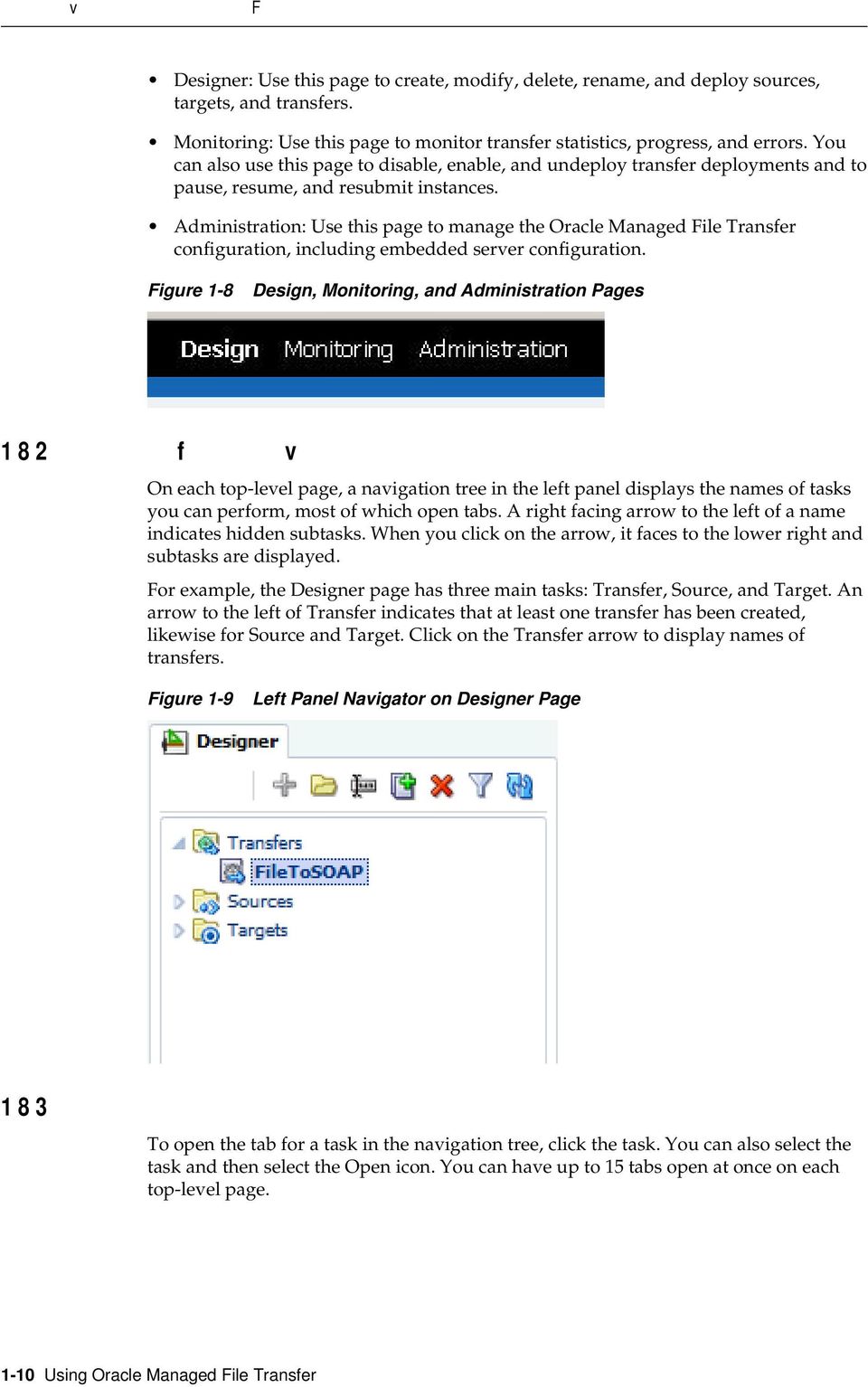
20 Screen Navigation in Oracle Managed File Transfer Designer: Use this page to create, modify, delete, rename, and deploy sources, targets, and transfers. Monitoring: Use this page to monitor transfer statistics, progress, and errors. You can also use this page to disable, enable, and undeploy transfer deployments and to pause, resume, and resubmit instances. Administration: Use this page to manage the Oracle Managed File Transfer configuration, including embedded server configuration. Figure 1-8 Design, Monitoring, and Administration Pages Using the Left Panel Navigator On each top-level page, a navigation tree in the left panel displays the names of tasks you can perform, most of which open tabs. A right facing arrow to the left of a name indicates hidden subtasks. When you click on the arrow, it faces to the lower right and subtasks are displayed. For example, the Designer page has three main tasks: Transfer, Source, and Target. An arrow to the left of Transfer indicates that at least one transfer has been created, likewise for Source and Target. Click on the Transfer arrow to display names of transfers. Figure 1-9 Left Panel Navigator on Designer Page Opening and Closing Dynamic Tabs To open the tab for a task in the navigation tree, click the task. You can also select the task and then select the Open icon. You can have up to 15 tabs open at once on each top-level page Using Oracle Managed File Transfer
21 Screen Navigation in Oracle Managed File Transfer Figure 1-10 Opening a Tab For example, on the Designer page, to create a new source, click Source, likewise for Transfer and Target. To edit an existing source, transfer, or target, click its name. To close the active tab, click the Close icon on the right side of the top banner. To close all tabs except the active tab, select Close Others from the drop-down menu to the right of the Close icon. To close all tabs, select Close All from this menu. Figure 1-11 Options for Closing Tabs Dragging and Dropping Sources and Targets into Transfers When you create a transfer and open its tab, <add source> and <add target> options are displayed. You can drag and drop a source icon and one or more target icons into the respective regions on the target page. You must drag and drop the icon; using the name does not work. Understanding Oracle Managed File Transfer 1-11
22 Screen Navigation in Oracle Managed File Transfer Figure 1-12 Dragging a Source Icon to Add a Source Expanding and Collapsing the Dashboard Regions The main tab on the Monitoring page is the Dashboard, which is always open. The Dashboard has four regions: Metrics, File Finder, Recent Errors, and Active Deliveries. In the top right corner of each region is an Expand icon. Clicking this icon expands the region to fill the entire console and displays additional details. To return to the Dashboard, click the Collapse icon in the top right corner of the expanded region. Figure 1-13 Expanding and Collapsing a Monitoring Region Setting Language, Time Zone, and Accessibility Preferences The steps for this process are: 1-12 Using Oracle Managed File Transfer
23 Screen Navigation in Oracle Managed File Transfer 1. On the right side of the top banner of Oracle Managed File Transfer, click Preferences. 2. On the left side of the Preferences window, select Language. 3. Select a language from the Language drop-down list. No Preference defaults to English. Note: You must log out and log in again for a language change to take effect. 4. Select a time zone for dashboards and alerts from the Time Zone drop-down list. No Preference defaults to coordinated universal time (UTC). 5. On the left side of the Preferences window, select Accessibility. You can also change accessibility settings from the login screen by clicking Accessibility in the upper right corner. 6. Select an option from the Mode Settings drop-down list: No Preference Enable screen reader mode Disable screen reader mode No Preference defaults to screen reader mode disabled. 7. Select an option from the Contrast Settings drop-down list: No Preference Use high contrast Use normal contrast No Preference defaults to normal contrast. 8. Select an option from the Font Settings drop-down list: No Preference Use large fonts Use normal fonts No Preference defaults to normal fonts. 9. Click Apply, then click OK. Oracle Enterprise Manager Fusion Middleware Control provides accessibility options for the pages on which you monitor and manage Oracle Managed File Transfer. Fusion Middleware Control supports screen readers and provides standard shortcut keys to support keyboard navigation. You can also view the console pages in high contrast or with large fonts for better readability. For information and instructions on Understanding Oracle Managed File Transfer 1-13
24 Screen Navigation in Oracle Managed File Transfer configuring accessibility in Fusion Middleware Control, see "Using Oracle Fusion Middleware Accessibility Options" in Administering Oracle Fusion Middleware Using Oracle Managed File Transfer
25 2 Designing Artifacts: Transfers, Sources, and Targets This chapter describes how to design file delivery structures consisting of sources, targets, and transfers using Oracle Managed File Transfer. This chapter includes the following sections: About Designing Transfers Configuring a Transfer Creating a Source Creating a Target Setting Up Schedules Deploying and Testing Transfers Importing and Exporting Transfers 2.1 About Designing Transfers Before designing a file transfer using the Design page in the Oracle Managed File Transfer console, you should design the transfer on paper or a whiteboard Getting Ready to Create a Transfer Transfers are an artifact that links a single source to one or more targets. Transfers can include content filters and other actions that affect the transfer. Before you create a transfer, you should determine the details of what the transfer should do. Consider these specifications: The origin location, from which files are transferred, called the source The destination locations, to which files are transferred, called the target Whether the origin and destinations are file system directories or web service endpoint URLs. The origin and destinations can also be in other applications such as B2B or Healthcare. If the file is large, you might want to pass a reference to the web service destination rather than the file. Access parameters for the origin and destinations: usernames, passwords, security certificates, and file system permissions The file format: binary, XML, or text Designing Artifacts: Transfers, Sources, and Targets 2-1
26 Configuring a Transfer Whether some files must be included or excluded based on format or name Whether files must be compressed or decompressed Whether files must be encrypted or decrypted Whether files must be renamed, moved, archived, or deleted Whether files must be scheduled for delivery at specific times or time ranges Note: You can use the Artifacts Search tab to see if a source, target, or transfer exists that you can reuse or recreate with modifications. For more information, see "Artifacts Search" in the Oracle Fusion Middleware MFT Online Help Designing End-to-End Flows Sources and targets can be reused in multiple transfers. When more than one transfer uses the same source, this is called transfer fan-out. When a transfer uses more than one target, this is called target fan-out. A source and all associated transfers and targets are collectively called a flow. You cannot use a source as a target or a target as a source. However, a target and a source can reference the same location. This allows the target of one transfer to be the source of another, creating a transfer chain. In addition to determining the specifications of each transfer, you should map out any fan-outs and chains needed in the overall file delivery structure. For examples, see Oracle Managed File Transfer Functional Use Case Patterns. 2.2 Configuring a Transfer You can create a transfer before or after you create the source and targets. However, you cannot deploy a transfer without a source and at least one target. The steps for this process are: 1. Create a transfer in one of these ways: Click Transfers in the left pane navigator. Select Transfers in the left pane navigator and click the Create icon. Right-click Transfers in the left pane navigator and select the Create command. The Transfers dialog opens. 2. Type a Name for the transfer. The name can include letters, numbers, dashes, and underscores. 3. Type a Description for the transfer. The description is optional. 4. Click the OK button. A tab for the transfer opens. 2-2 Using Oracle Managed File Transfer
27 Configuring a Transfer To avoid creating a transfer, click Cancel. 5. Add a source and one or more targets. See Adding a Source and Targets. 6. Add content filters. This is optional. See Setting Up Content Filters. 7. Add users, groups, and roles who can access the transfer payload. This is optional and applies only to web service pass by reference transfers. See Granting Payload Access. 8. Configure target-specific transfer settings. This is optional. See Configuring Target-Specific Transfer Settings. 9. Add a schedule. This is optional. See Setting Up Schedules. 10. Add preprocessing and postprocessing actions such as compression and encryption. This is optional and applies only to targets. Source actions are added directly in the source artifact. See Setting Up Transfer Preprocessing and Postprocessing Actions. 11. Click the Save button. To undo all changes since the last save, click Revert. 12. Click the Deploy button after saving. You can add an optional comment. If the associated source and target have not been previously deployed, deploying the transfer automatically deploys the associated source and target. If an existing transfer has most of the desired properties, you can duplicate it. See Duplicating an Existing Transfer Adding a Source and Targets The steps for this process are: 1. Click the arrow to the left of Transfers in the left pane navigator. The transfers are listed. Note that this step might have been completed in the previous section when creating the transfer. 2. Click the transfer name or right-click it and then select the Open menu item. The transfer tab opens. 3. Add a source in one of these ways: Click add source if you already created the source. Select the source to add, then select OK. Designing Artifacts: Transfers, Sources, and Targets 2-3
28 Configuring a Transfer Click create source to create a new source. Begin at step 2 in Creating a Source. Drag and drop a source from the navigation pane. See Dragging and Dropping Sources and Targets into Transfers for more information. 4. Add targets in one of these ways: Click add target if you already created the target. Select the target to add in the left column, then click the single arrow icon to move it to the column on the right. You can add more than one target. To select all targets, click the double arrow icon. Click OK. Click create target to create a new target. Begin at step 2 in Creating a Target. Drag and drop a target from the navigation pane. See Dragging and Dropping Sources and Targets into Transfers for more information. 5. Save and Deploy the transfer Setting Up Content Filters Content filters specify file name and extension pattern criteria for transfer. If no content filters are defined, all files at the source endpoint are transferred. The steps for this process are: 1. Click the arrow to the left of Transfers in the left pane navigator. The transfers are listed. 2. Click the transfer name or select it and then click the Open icon. The transfer tab opens. 3. Click the arrow to the left of Content Filters. The Content Filters settings are displayed. 4. Select Wildcard or Regular Expression to determine how the filter string is interpreted. 5. Type a pattern in the text field for the filter. If you selected Wildcard, use * as a wildcard. For example, *.xml specifies that XML files are transferred. To specify text or XML files, you can use *.(xml XML txt TXT). For example, File = "TXT XXXX.txt" where XXXX can be any four successive digits. Regexp Filter expression ="XT \\d{4}\\.txt". For more information about regular expressions, see The Java Tutorials: Regular Expressions. The pattern is for file names only. Filtering on directory names is not supported. 6. Click add filter to add another filter. Another text field is created and given a new number. 2-4 Using Oracle Managed File Transfer
29 Configuring a Transfer 7. Repeat steps 5 and 6 for each filter you want to add. To delete a filter, click the red X to the right of the filter. 8. Use the up and down arrows to the right of each filter to change the filter order. Lower numbered filters are performed first. 9. Save and Deploy the transfer Configuring Target-Specific Transfer Settings Depending on the target type, different optional target-specific transfer settings are displayed when you open a transfer tab and click the arrow to the left of a target. If the target type is File, FTP Remote, or sftp Remote, the subfolder setting is displayed. This adds a transfer-specific subfolder to the target location. If the target type is an HTTP SOA-based web service type (B2B, Healthcare, SOAP, SOA, Service Bus, or ODI), the following Delivery Preferences are displayed: Delivery Method: Specifies the delivery method: Inline or Reference (default). If Inline, the actual file is sent in the SOA message payload. If Reference, a link to the file is sent. Reference Type: Specifies the reference type: FTP (default), File, or sftp. Note that internal and external port numbers can be set in the Advanced Delivery Properties area of the Administration Server Properties page. Max Inline Size: Specifies the maximum size in bytes for inline deliveries Setting Up Transfer Preprocessing and Postprocessing Actions After you add a target to a transfer, you can edit the transfer to add preprocessing actions: compression, decompression (file type only), encryption or decryption. You can also add decompression as a postprocessing action for a target of type File. You can configure preprocessing for the source; see Setting Up Source Processing Actions. You can also create custom preprocessing and postprocessing actions; see Processing Transfers with Custom Callouts. Note: Postprocessing occurs after file delivery. Therefore, the Active Deliveries and File Finder views in the Dashboard tab on the Monitoring page show different statuses if file delivery succeeds but postprocessing fails. Specifically, the Active Deliveries view displays a Completed status but the File Finder view displays a Failed status. Designing Artifacts: Transfers, Sources, and Targets 2-5
30 Configuring a Transfer Note: If you add the same processing action to a source and a target that uses the source, the action is performed twice. For example, if you add compression to the source and the target, the transferred file is compressed twice. Multiple file preprocessing decompression is only supported for the target types SOAP, SOA, Service Bus, and ODI. For other target types, a preprocessing decompression error occurs if a compressed file has multiple entries. Note: If you copy a binary file to the source location using an FTP client external to Oracle Managed File Transfer, be sure to configure it for binary transfer. Otherwise the file might become corrupted. Processing actions such as compression and encryption might not work properly Compression and Decompression Preprocessing You can compress or decompress a file prior to a transfer delivering it to a target. You can specify either action in the transfer configuration. Multi-file decompression preprocessing is supported only for SOAP, SOA, Service Bus, and ODI type targets in which the Delivery Method is set to Reference. In this case, the files inside the ZIP file are extracted to a unique random directory, and only a reference to this directory is sent to the target. This directory is listed in the Target Pre- Processing section of the target report. See Target Reports for more information. Note: Any processing function added after the multi-file decompression is ignored. If the decompression preprocessing of other types of targets results in multiple files, the decompression action generates an error. The steps for this process are: 1. Click the arrow to the left of Transfers in the left pane navigator. The transfers are listed. 2. Click the transfer name or right-click it and then select the Open menu item. The transfer tab opens. 3. Click the arrow to the left of the target. The target settings are displayed. 4. Click add pre-processing actions. The Pre-Processing Actions dialog opens. 5. Select Compress or Decompress from the All Actions drop-down list. 2-6 Using Oracle Managed File Transfer
31 Configuring a Transfer 6. Click Add to List. To remove an action from the list, click the Delete icon to the right of the action. 7. If you selected Compress, select the compression level from the Level drop-down list: Best Compression, Default Compression, or Best Speed. For more information, see the java.util.zip package, especially the Deflater class and the referenced specifications. 8. Click OK. To cancel adding actions, click Cancel. 9. Save and Deploy the transfer Encryption and Decryption Preprocessing You can encrypt or decrypt a file prior to transfer. You can specify either action in the transfer configuration. Note: PGP keystores must be configured and certificates must be imported before you add an encryption or decryption action. If a payload is encrypted by a PGP tool outside of MFT using a key length or algorithm that is restricted, MFT decryption will fail. These restrictions are mostly specified at the JRE level in the JAVA_HOME\jre7\lib\security directory. The steps for this process are: 1. Click the arrow to the left of Transfers in the left pane navigator. The transfers are listed. 2. Click the transfer name or right-click it and then select the Open menu item. The transfer tab opens. 3. Click the arrow to the left of the target. The target settings are displayed. 4. Click add pre-processing actions. The Pre-Processing Actions dialog opens. 5. Select PGP Encryption or PGP Decryption from the All Actions drop-down list. 6. Click Add to List. To remove an action from the list, click the Delete icon to the right of the action. 7. If you selected PGP Encryption, select values from the Encryption Alias and Armored drop-down lists: Encryption Alias: the public key alias for encryption. For more information about key aliases, see Configuring the PGP Keystore. Designing Artifacts: Transfers, Sources, and Targets 2-7
32 Configuring a Transfer Armored: Binary or ASCII. Use ASCII if non-printing characters might be stripped in transit. 8. If you selected PGP Decryption, select the Decryption Alias from the drop-down list. This is the private key alias for decryption. For more information about key aliases, see Configuring the PGP Keystore. 9. Click OK. To cancel adding actions, click Cancel. 10. Save and Deploy the transfer Changing Encryption Algorithm for PGP To change encryption algorithm for PGP, follow these steps: 1. Step A a. Log in to Oracle Enterprise Manager Fusion Middleware Control. b. Expand the SOA node and select the soa-infra node. c. From the SOA Infrastructure menu, choose Administration > System MBean Browser. The System MBean Browser page is displayed. d. Under Application Defined MBeans, expand the server - oracle.as.soainfra.config node. For example, oracle.as.mftinfra.config node. e. Expand the Server: soa_server1 node For example, mft_server1 node. f. Expand the MFTConfig node. g. Click the MFT MBean. The properties of the MBean are displayed in the right pane. h. Click the Operations tab. i. Click addproperty operation in the list. Enter values for the key, value, and optional comments. 2. Step B i. Set Key value to "pgpencryptionalgorithm" ii. Set value. For example, set value as 2 for Triple DES, and click Invoke. a. In MFT, to change the encryption algorithm for PGP, set the "pgpencryptionalgorithm" MBean for MFT. This Mbean accepts int value and different values for the supported algorithms are listed below: i. Triple DES = 2; ii. CAST5 = 3; iii. Blowfish = 4; iv. DES = 6; v. AES 128 = 7; vi. AES 192 = 8; vii. AES 256 = 9; 2-8 Using Oracle Managed File Transfer
33 Configuring a Transfer viii. Twofish = 10; b. In FIPS mode, when MBean property PGPEncryptionAlgorithm is not defined, then the default algorithm is AES 256. Supported algorithms are: i.aes 128 ii.aes 192 iii.aes 256 c. In non-fips mode, when MBean property PGPEncryptionAlgorithm is not defined, then the default algorithm is CAST5. Supported algorithms are: i. Triple DES ii. Blowfish iii. DES iv. AES 192 v. AES 128 vi. AES 256 vii.twofish Decompression Postprocessing You can decompress a file after transfer only if the target type is File. You can specify this action in the transfer configuration. Multi-file decompression postprocessing is supported. In this case, the decompressed files are extracted to a directory under the target location having the name of the ZIP file without the extension. For example, if the target location is /tmp/mft and the transferred file with multiple entries is order.zip, decompressed files are extracted to /tmp/mft/order. Note: Any processing function added after the multi-file decompression is ignored. The steps for this process are: 1. Click the arrow to the left of Transfers in the left pane navigator. The transfers are listed. 2. Click the transfer name or right-click it and then select the Open menu item. The transfer tab opens. 3. Click the arrow to the left of the target. The target settings are displayed. 4. Click add post-processing actions. The Post-Processing Actions dialog opens. Designing Artifacts: Transfers, Sources, and Targets 2-9
34 Configuring a Transfer 5. Select Decompress from the All Actions drop-down list. 6. Click Add to List. To remove an action from the list, click the Delete icon to the right of the action. 7. Click OK. To cancel adding actions, click Cancel. 8. Save and Deploy the transfer Duplicating an Existing Transfer You can create a new file transfer by copying an existing one. The new transfer references the same source and targets as the copied transfer. The steps for this process are: 1. Duplicate a transfer in one of these ways: Select the transfer to copy and then the Duplicate icon in the left pane navigator. Right-click the transfer to copy in the left pane navigator and select the Duplicate command from the pop-up menu. The Duplicate Transfer dialog appears. 2. Type a Name for the transfer. The name can include letters, numbers, dashes, and underscores. 3. Click the Create button. A tab for the transfer opens, providing additional settings you can edit. For more information about these settings, see these sections: Adding a Source and Targets Setting Up Content Filters Granting Payload Access Configuring Target-Specific Transfer Settings Setting Up Schedules Setting Up Transfer Preprocessing and Postprocessing Actions To avoid creating a transfer, click Cancel. 4. Click the Save button after editing. To undo all changes since the last save, click Revert. 5. Click the Deploy button after saving. Deploying a transfer deploys the associated source and target automatically Using Oracle Managed File Transfer
35 Creating a Source 2.3 Creating a Source You can create a source with a minimum number of settings. After you create it, you can edit it to add more settings. The steps for this process are: 1. Create a source in one of these ways: Click create source in the transfer tab. Double click Sources in the left pane navigator. Select Sources in the left pane navigator and click the Create icon. Right-click Sources in the left pane navigator and select the Create command. Duplicate an existing source. The Sources dialog opens. 2. Type a Name for the source. The name can include letters, numbers, dashes, and underscores. 3. Type a Description for the source. The description is optional. 4. Select the source Type. This setting determines the other settings that appear. For more information about source types and their settings, see Source Types. 5. Type a value for the source location. For most source types, this is either: The Folder setting, which specifies a file system directory The URL setting, which specifies a web service endpoint The B2B and Healthcare source types have no source location setting in the Sources dialog. You must provide the source location after creating the source. 6. Type values for the required settings, which have blue asterisks next to them. The only source types with required settings in addition to the source location are the FTP Remote Source Type and sftp Remote Source Type. Some of these settings have defaults that you can accept and edit later. 7. Click the OK button. A tab for the source opens, providing additional settings you can edit. For more information about these settings, see the source type under Source Types, Setting Up Schedules, Setting Up Source Processing Actions, and Archiving and Deleting Files Before Delivery. To avoid creating a source, click Cancel. 8. Click the Save button after editing. To undo all changes since the last save, click Revert. Designing Artifacts: Transfers, Sources, and Targets 2-11
36 Creating a Source Source Types 9. Click the Deploy button after saving. You can add an optional comment. This step is optional. Deploying a transfer deploys the associated source and target automatically. If an existing source has most of the desired properties, you can duplicate it. See Duplicating an Existing Source. Oracle Managed File Transfer provides the following source types: FTP Embedded Source Type sftp Embedded Source Type FTP Remote Source Type sftp Remote Source Type File Source Type SOAP Web Service Source Type SOA Source Type Service Bus Source Type B2B Source Type Healthcare Source Type ODI Source Type FTP Embedded Source Type Using the FTP Embedded source type means uploading files to the FTP server embedded by Oracle Managed File Transfer, which transfers the files. The only required setting is Folder, which specifies the embedded FTP server directory from which to transfer files. Note: Files present in the embedded FTP source directory before the source is deployed or enabled are ignored. Only files uploaded to the directory after deployment or enabling are picked and transferred. For more information about other settings you can edit after you create the source, see "Source FTP Embedded" in the Oracle Fusion Middleware MFT Composer Help Online Help sftp Embedded Source Type Using the sftp Embedded source type means uploading files to the sftp server embedded by Oracle Managed File Transfer, which transfers the files. The only 2-12 Using Oracle Managed File Transfer
37 Creating a Source required setting is Folder, which specifies the embedded sftp server directory from which to transfer files. Note: Files present in the embedded sftp source directory before the source is deployed or enabled are ignored. Only files uploaded to the directory after deployment or enabling are picked and transferred. For more information about other settings you can edit after you create the source, see "Source sftp Embedded" in the Oracle Fusion Middleware MFT Composer Help Online Help FTP Remote Source Type Using the FTP Remote source type means transferring files from an FTP server outside of Oracle Managed File Transfer. Table 2-1 lists the settings in the Sources dialog specific to the FTP Remote type. Table 2-1 Setting Host Name Folder User Password Sources Dialog Settings for the FTP Remote Source Type Description Specifies the host name. Specifies the directory from which files are transferred. Specifies the user accessing the source. Specifies the user password. Confirm Password Control Port SSL Implicit SSL Confirms the user password. Specifies the port for the source. Specifies the use of SSL if checked. This is optional. Specifies the use of implicit SSL if checked. This is optional. For more information about other settings you can edit after you create the source, see "Source FTP Remote" in the Oracle Fusion Middleware MFT Composer Help Online Help FTP Remote Source Advance Properties for MVS Transfers When creating a FTP Remote source type for MVS Mainframe systems, you need to select MVS as List Parser Key in advance properties. For MVS FTP response formats, MVS can be configured to use HFS (Unix style) response or MVS native response formats. FTP Remote Source Settings for MVS Transfers Configure the FTP Remote source type as shown in figure below: Designing Artifacts: Transfers, Sources, and Targets 2-13
38 Creating a Source Note: The following properties must be selected in the format listed below: Change Directory= true Content Folder is a mandatary and must be in the format: 'FOLDER.' FTP Path Separator = Absolute Path Begin = List Parser Key = MVS sftp Remote Source Type Using the sftp Remote source type means transferring files from an sftp server outside of Oracle Managed File Transfer. Table 2-2 lists the settings in the Sources dialog specific to the sftp Remote type. Table 2-2 Setting Host Name Folder Sources Dialog Settings for the sftp Remote Source Type Description Specifies the host name. Specifies the directory from which files are transferred Using Oracle Managed File Transfer
39 Creating a Source Setting User Password Confirm Password Control Port Authentication Type Description Specifies the user accessing the source. Specifies the user password. Confirms the user password. Specifies the port for the source. Specifies the authentication type: Password or Public Key. For more information about other settings you can edit after you create the source, see "Source sftp Remote" in the Oracle Fusion Middleware MFT Composer Help Online Help File Source Type Using the File source type means transferring files from the local file system or from a network-attached system. The only required setting is Folder, which specifies the directory from which to transfer files. This directory must be accessible from Oracle Managed File Transfer. Oracle Managed File Transfer uses the same file adapter used by Oracle SOA Suite. For more information about other settings you can edit after you create the source, see "Source File" in the Oracle Fusion Middleware MFT Composer Help Online Help SOAP Web Service Source Type Using a SOAP web service type means transferring files from a web service endpoint. The only required setting is URL, which specifies the web service endpoint from which to transfer files. For more information about integrating with Oracle Managed File Transfer as a web service, see Integrating with Web Services. For more information about other settings you can edit after you create the source, see "Source SOAP" in the Oracle Fusion Middleware MFT Composer Help Online Help SOA Source Type Using the SOA source type means transferring files from the web service interface of a SOA application. The only required setting is URL, which specifies the web service endpoint from which to transfer files. For more information about integrating Oracle Managed File Transfer with Oracle SOA Suite, see Integrating with Oracle SOA Suite. For more information about other settings you can edit after you create the source, see "Source SOA" in the Oracle Fusion Middleware MFT Composer Help Online Help Service Bus Source Type Using the Service Bus source type means transferring files from the web service interface of an Oracle Service Bus application. The only required setting is URL, which specifies the web service endpoint from which to transfer files. For more information about integrating Oracle Managed File Transfer with Oracle Service Bus, see Integrating with Oracle Service Bus. Designing Artifacts: Transfers, Sources, and Targets 2-15
40 Creating a Source For more information about other settings you can edit after you create the source, see "Source Service Bus" in the Oracle Fusion Middleware MFT Composer Help Online Help B2B Source Type Using the B2B source type means transferring files from an Oracle B2B trading partner. No settings are required if B2B is collocated. The most important settings are Trading Partner Name, which specifies the endpoint from which to transfer files, and Domain Alias, which specifies the domain from which to transfer files. To define a trading partner in Oracle Managed File Transfer, see Integrating with B2B and Managing Domains. For more information about other settings you can edit after you create the source, see "Source B2B" in the Oracle Fusion Middleware MFT Composer Help Online Help Healthcare Source Type Using the Healthcare source type means transferring files from an Oracle B2B for Healthcare domain. The only required setting is Endpoint Name, which specifies the endpoint from which to transfer files. Another important setting is Domain Alias, which specifies the domain from which to retrieve files. To define a Healthcare domain in Oracle Managed File Transfer, see Integrating with Healthcare and Managing Domains. For more information about other settings you can edit after you create the source, see "Source Healthcare" in the Oracle Fusion Middleware MFT Composer Help Online Help ODI Source Type Using the ODI source type means transferring files from the web service interface of an Oracle Data Integrator application. The only required setting is URL, which specifies the web service endpoint from which to transfer files. To define an ODI domain in Oracle Managed File Transfer, see Integrating with Oracle Data Integrator and Managing Domains. For more information about other settings you can edit after you create the source, see "Source ODI" in the Oracle Fusion Middleware MFT Composer Help Online Help Setting Up Source Processing Actions After you create a source, you can edit it to add processing actions: compression, decompression, encryption or decryption. You can configure processing actions for the transfer; see Setting Up Transfer Preprocessing and Postprocessing Actions. You can also create custom preprocessing and postprocessing actions; see Processing Transfers with Custom Callouts. Note: If you add the same processing action to a source and a transfer that uses the source, the action is performed twice. For example, if you add compression to the source and the transfer, the transferred file is compressed twice. A preprocessing decompression error occurs if a compressed file has multiple entries Using Oracle Managed File Transfer
41 Creating a Source Note: If you copy a binary file to the source location using an FTP client external to Oracle Managed File Transfer, be sure to configure it for binary transfer. Otherwise the file might become corrupted. Processing actions such as compression and encryption might not work properly Compression and Decompression at the Source You can compress or decompress a file prior to transfer. You can specify either action in the source configuration. Note: Multi-file decompression is not supported for sources. It is supported only for SOAP, SOA, Service Bus, or ODI type targets as a preprocessing action or for File type targets as a postprocessing action. The steps for this process are: 1. Click the arrow to the left of Sources in the left pane navigator. The sources are listed. 2. Click the source name or right-click it and then select the Open menu item. The source tab opens. 3. Click the arrow to the left of Actions. The Actions section opens. 4. Click add processing actions. The Processing Actions dialog opens. 5. Select Compress or Decompress from the All Actions drop-down list. 6. Click Add to List. To remove an action from the list, click the Delete icon to the right of the action. 7. If you selected Compress, select the compression level from the Level drop-down list: Best Compression, Default Compression, or Best Speed. For more information, see the java.util.zip package, especially the Deflater class and the referenced specifications. 8. Click OK. To cancel adding actions, click Cancel. 9. Save and optionally Deploy the source Encryption and Decryption at the Source You can encrypt or decrypt a file prior to transfer. You can specify either action in the source configuration. Designing Artifacts: Transfers, Sources, and Targets 2-17
42 Creating a Source Note: PGP keystores must be configured and certificates must be imported before you add an encryption or decryption action. If a payload is encrypted by a PGP tool outside of MFT using a key length or algorithm that is restricted, MFT decryption will fail. These restrictions are mostly specified at the JRE level in the JAVA_HOME\jre7\lib\security directory. The steps for this process are: 1. Click the arrow to the left of Sources in the left pane navigator. The sources are listed. 2. Click the source name or right-click it and then select the Open menu item. The source tab opens. 3. Click the arrow to the left of Actions. The Actions section opens. 4. Click add processing actions. The Processing Actions dialog opens. 5. Select PGP Encryption or PGP Decryption from the All Actions drop-down list. 6. Click Add to List. To remove an action from the list, click the Delete icon to the right of the action. 7. If you selected PGP Encryption, select values from the Encryption Alias and Armored drop-down lists: Encryption Alias: the public key alias for encryption. For more information about key aliases, see Configuring the PGP Keystore. Armored: Binary or ASCII. Use ASCII if non-printing characters might be stripped in transit. 8. If you selected PGP Decryption, select the Decryption Alias from the drop-down list. This is the private key alias for decryption. For more information about key aliases, see Configuring the PGP Keystore. 9. Click OK. To cancel adding actions, click Cancel. 10. Save and optionally Deploy the source Archiving and Deleting Files Before Delivery After you create a source, you can edit it to add file operations: archiving and deleting. If a file is configured to be archived, it is copied to given physical target directory. If the file is configured for deletion, it is deleted. Note that the archive or delete action 2-18 Using Oracle Managed File Transfer
43 Creating a Source applies to the target system copy of the file, not the Oracle Managed File Transfer copy of the file. The steps for this process are: 1. Click the arrow to the left of Sources in the left pane navigator. The sources are listed. 2. Click the source name or right-click it and then select the Open menu item. The source tab opens. 3. Click the arrow to the left of Advanced Properties. The Advanced properties section opens. 4. Click the Operation subtab. The Operation subtab opens. 5. Select Archive, Delete, or Archive and Delete from the Action Type drop-down list. 6. If you selected Archive or Archive and Delete, type a path in the Physical Target Directory field. 7. Save and optionally Deploy the source Duplicating an Existing Source You can create a new source for file transfers by copying an existing one. The steps for this process are: 1. Duplicate a source in one of these ways: Select the source to copy and then the Duplicate icon in the left pane navigator. Right-click the source to copy in the left pane navigator and select the Duplicate command from the pop-up menu. The Duplicate Source dialog appears. 2. Type a Name for the source. The name can include letters, numbers, dashes, and underscores. 3. Type values for the required non-duplicated settings, which have blue asterisks next to them: Content Folder is required for sources of type File, FTP Remote, sftp Remote, FTP Embedded, or sftp Embedded. URL is required for sources of type SOAP, SOA, Service Bus, or ODI. Sources of type B2B or Healthcare have no required non-duplicated settings. 4. Click the Create button. A tab for the source opens, providing additional settings you can edit. For more information about these settings, see the source type under Source Types, Setting Up Source Processing Actions, and Archiving and Deleting Files Before Delivery. Designing Artifacts: Transfers, Sources, and Targets 2-19
44 Creating a Target 2.4 Creating a Target To avoid creating a source, click Cancel. 5. Click the Save button after editing. To undo all changes since the last save, click Revert. 6. Click the Deploy button after saving. This step is optional. Deploying a transfer deploys the associated source and target automatically. You can create a target with a minimum number of settings. After you create it, you can edit it to add more settings. The steps for this process are: 1. Create a target in one of these ways: Click create target in the transfer tab. Double click Targets in the left pane navigator. Select Targets in the left pane navigator and click the Create icon. Right-click Targets in the left pane navigator and select the Create command. The Targets dialog opens. 2. Type a Name for the target. The name can include letters, numbers, dashes, and underscores. 3. Type a Description for the target. The description is optional. 4. Select the target Type. This setting determines the other settings that appear. For more information about target types and their settings, see Target Types. 5. Type a value for the target location. For most target types, this is either: The Folder setting, which specifies a file system directory The URL setting, which specifies a web service endpoint The B2B and Healthcare target types have no target location setting in the Targets dialog. You must provide the target location after creating the target. 6. Type values for the required settings, which have blue asterisks next to them. The only target types with required settings in addition to the target location are FTP Remote Target Type and sftp Remote Target Type. Some of these settings have defaults that you can accept and edit later. 7. Click the OK button Using Oracle Managed File Transfer
45 Creating a Target Target Types A tab for the target opens, providing additional settings you can edit. For more information about these settings, see the target type under Target Types and Moving and Renaming Files After Delivery. To avoid creating a target, click Cancel. 8. Click the Save button after editing. To undo all changes since the last save, click Revert. 9. Click the Deploy button after saving. You can add an optional comment. This step is optional. Deploying a transfer deploys the associated source and target automatically. If an existing target has most of the desired properties, you can duplicate it. See Duplicating an Existing Target. Oracle Managed File Transfer provides the following target types: FTP Remote Target Type sftp Remote Target Type File Target Type SOAP Web Service Target Type SOA Target Type Service Bus Target Type B2B Target Type Healthcare Target Type ODI Target Type Oracle Managed File Transfer does not support embedded FTP or sftp server targets FTP Remote Target Type Using the FTP Remote target type means transferring files to an FTP server outside of Oracle Managed File Transfer. Table 2-3 lists the settings in the Targets dialog specific to the FTP Remote type. Table 2-3 Setting Host Name Folder User Password Targets Dialog Settings for the FTP Remote Target Type Description Specifies the host name. Specifies the directory to which files are transferred. Specifies the user as whom to access the target. Specifies the user password. Designing Artifacts: Transfers, Sources, and Targets 2-21
46 Creating a Target Setting Confirm Password Control Port SSL Implicit SSL Description Confirms the user password. Specifies the port for the target. Specifies the use of SSL if checked. This is optional. Specifies the use of implicit SSL if checked. This is optional. For more information about other settings you can edit after you create the target, see "Target FTP Remote" in the Oracle Fusion Middleware MFT Composer Help Online Help FTP Remote Target settings for MVS Transfers When creating a FTP Remote target type for MVS Mainframe systems, you need to select MVS as List Parser Key in advance properties. For MVS FTP response formats, MVS can be configured to use HFS (Unix style) response or MVS native response formats. If the target type uses MVS HFS (Unix style), you can configure the advanced Properties as you do with any other Unix system. For example, using / as the path separator. However, if the MVS system uses a MVS native response format only, then you must configure the FTP Remote target type with following mandatory properties: The Content Folder field is not used, however it is a mandatory field. You must enter some text as a placeholder and cannot be left as blank filed. For example, Content Folder = 'FOLDER.' The FTP Path Separator field must be left blank/empty. For example, FTP Path Separator = The File Naming Convention field specifies the absolute path to the file. You must include the filename in the path, and enclose it in single quotes. This field must be in the format, File Naming Convention= MFTOUT.MFT%SEQ%.CSV '. For example, 'QA.TEST.FILE '. Change the Default Date Format. For example, yyyy/mm/dd: Absolute Path Begin = List Parser Key = MVS You can configure the advance properties as shown in the figure listed below: 2-22 Using Oracle Managed File Transfer
47 Creating a Target sftp Remote Target Type Using the sftp Remote target type means transferring files to an sftp server outside of Oracle Managed File Transfer. Table 2-4 lists the settings in the Targets dialog specific to the sftp Remote type. Table 2-4 Setting Host Name Folder User Password Targets Dialog Settings for the sftp Remote Target Type Description Specifies the host name. Specifies the directory to which files are transferred. Specifies the user as whom to access the target. Specifies the user password. Confirm Password Control Port Authentication Type Confirms the user password. Specifies the port for the target. Specifies the authentication type: Password or Public Key. For more information about other settings you can edit after you create the target, see "Target sftp Remote" in the Oracle Fusion Middleware MFT Composer Help Online Help File Target Type Using the File target type means transferring files to the local file system or to a network-attached system. The only required setting is Folder, which specifies the directory to which to transfer files. This directory must be accessible from Oracle Managed File Transfer. Oracle Managed File Transfer uses the same file adapter used by Oracle SOA Suite. Designing Artifacts: Transfers, Sources, and Targets 2-23
48 Creating a Target For more information about other settings you can edit after you create the target, see "Target File" in the Oracle Fusion Middleware MFT Composer Help Online Help SOAP Web Service Target Type Using a SOAP web service type means transferring files to a web service. The only required setting is URL, which specifies the web service endpoint to which to transfer files. For more information about integrating with Oracle Managed File Transfer as a web service, see Integrating with Web Services. For more information about other settings you can edit after you create the target, see "Target SOAP" in the Oracle Fusion Middleware MFT Composer Help Online Help SOA Target Type Using the SOA target type means transferring files to the web service interface of a SOA application. The only required setting is URL, which specifies the web service endpoint to which to transfer files. For more information about integrating Oracle Managed File Transfer with Oracle SOA Suite, see Integrating with Oracle SOA Suite. For more information about other settings you can edit after you create the target, see "Target SOA" in the Oracle Fusion Middleware MFT Composer Help Online Help Service Bus Target Type Using the Service Bus target type means transferring files to the web service interface of an Oracle Service Bus application. The only required setting is URL, which specifies the web service endpoint to which to transfer files. For more information about integrating Oracle Managed File Transfer with Oracle Service Bus, see Integrating with Oracle Service Bus. For more information about other settings you can edit after you create the target, see "Target Service Bus" in the Oracle Fusion Middleware MFT Composer Help Online Help B2B Target Type Using the B2B target type means transferring files to an Oracle B2B trading partner. No settings are required if B2B is collocated. The most important settings are Trading Partner Name, which specifies the endpoint to which to transfer files, and Domain Alias, which specifies the domain to which to transfer files. To define a trading partner in Oracle Managed File Transfer, see Integrating with B2B and Managing Domains. For more information about other settings you can edit after you create the target, see "Target B2B" in the Oracle Fusion Middleware MFT Composer Help Online Help Healthcare Target Type Using the Healthcare target type means transferring files to an Oracle B2B for Healthcare domain. The only required setting is Endpoint Name, which specifies the endpoint to which to transfer files. Another important setting is Domain Alias, which specifies the domain to which to transfer files. To define a Healthcare domain in Oracle Managed File Transfer, see Integrating with Healthcare and Managing Domains Using Oracle Managed File Transfer
49 Creating a Target For more information about other settings you can edit after you create the target, see "Target Healthcare" in the Oracle Fusion Middleware MFT Composer Help Online Help ODI Target Type Using the ODI target type means transferring files to the web service interface of an Oracle Data Integrator application. The only required setting is URL, which specifies the web service endpoint to which to transfer files. To define an ODI domain in Oracle Managed File Transfer, see Integrating with Oracle Data Integrator and Managing Domains. For more information about other settings you can edit after you create the target, see "Target ODI" in the Oracle Fusion Middleware MFT Composer Help Online Help Moving and Renaming Files After Delivery After you create a File, FTP Remote, or sftp Remote target, you can edit it to add file operations: moving and renaming. The steps for this process are: 1. Click the arrow to the left of Targets in the left pane navigator. The targets are listed. 2. Click the target name or right-click it and then select the Open menu item. The target tab opens. 3. Click the arrow to the left of Advanced Properties. The Advanced properties section opens. 4. Click the Operation subtab. The Operation subtab opens. 5. Select Move, Rename, or Move and Rename from the Action Type drop-down list. 6. If you selected Move or Move and Rename, type a path in the Physical Target Directory field. 7. If you selected Rename or Move and Rename, type a file name pattern in the File Naming Convention field. You can use variables in the file name such as %yymmddhhmmsssss% for the timestamp or %SEQ% for an incrementing integer. For example, File%SEQ%.txt numbers files File1.txt, File2.txt, and so on. See "Specifying the Outbound File Naming Convention" in Understanding Technology Adapters for more information. 8. Save and optionally Deploy the target Duplicating an Existing Target You can create a new target for file transfers by copying an existing one. The steps for this process are: 1. Duplicate a target in one of these ways: Designing Artifacts: Transfers, Sources, and Targets 2-25
50 Setting Up Schedules Select the target to copy and then the Duplicate icon in the left pane navigator. Right-click the target to copy in the left pane navigator and select the Duplicate command from the pop-up menu. The Duplicate Target dialog appears. 2. Type a Name for the target. The name can include letters, numbers, dashes, and underscores. 3. Click the Create button. A tab for the target opens, providing additional settings you can edit. For more information about these settings, see the target type under Target Types and Moving and Renaming Files After Delivery. To avoid creating a target, click Cancel. 4. Click the Save button after editing. To undo all changes since the last save, click Revert. 5. Click the Deploy button after saving. This step is optional. Deploying a transfer deploys the associated source and target automatically Retry Interval and Retry Count After you create a target, you can edit the target type to add retry interval and retry count. Retry Interval: This specifies the number of seconds between attempts to retry delivery of a failed transfer. Retry Count: This specifies how many times retry of a failed transfer is attempted. 2.5 Setting Up Schedules You can schedule file deliveries so they occur only at specific times or time ranges. If no schedule is configured, the file is delivered as soon as it is processed by Oracle Managed File Transfer. You can configure a source schedule as part of source configuration or a target schedule as part of transfer configuration. If a schedule is defined for a listening source, the file is picked only when the schedule expires. For a non-listening source, the file is picked as soon as it arrives at the source location but remains with a status of Scheduled. When the schedule expires, the file is processed further and delivered. All transfers that reference the source happen only when the source schedule expires. If a schedule is defined for a target, the file is delivered only when the schedule expires. Before that it remains at the source location with a status of Scheduled. Targets referenced by the same transfer do not share schedules. Note: Before adding a schedule, test the transfer without one to ensure that it works properly. See Deploying and Testing Transfers Using Oracle Managed File Transfer
51 Setting Up Schedules Note: Oracle Managed File Transfer interacts with Oracle Enterprise Scheduler Service through the OracleSystemUser. Do not delete this user. If you do, clicking add schedule will result in an OracleSystemUser does not exist message, and Schedule Details may be blank in monitoring reports. For more information about users, see Configuring Users. The steps for this process are: 1. Click the arrow to the left of Sources or Transfers in the left pane navigator. The sources or transfers are listed. 2. Click the source or transfer name or right-click it and then select the Open menu item. The source or transfer tab opens. 3. If you don't see the add schedule option, you can display it. In the source tab, click the arrow to the left of Source Schedule. In the transfer tab, click the arrow to the left of the target. 4. Click add schedule. The Scheduler dialog opens. 5. Type a Name for the schedule. 6. Select a value from the Frequency drop-down list: Once, Hourly/Minute, Daily, Weekly, Monthly, Yearly, or Custom. If you selected Once, enter a date and time in the Start Date field. If you selected Hourly/Minute, specify the interval in hours and minutes. Enter a Start Date and optionally an End Date. If you selected Daily, specify the interval in days. Enter a Start Date and optionally an End Date. If you selected Weekly, specify the interval in weeks. Enter a Start Date and optionally an End Date. If you selected Monthly, select a Repeat option: By day: Select a Week of the Month and a Day of the Week. For the Week of the Month, you can select Last. By date: Select a day of the month or Last day of month. Enter a Start Date and optionally an End Date. If you selected Yearly, select a Month and a Repeat option: By day: Select a Week of the Month and a Day of the Week. For the Week of the Month, you can select Last. By date: Select a day of the month or Last day of month. Enter a Start Date and optionally an End Date. Designing Artifacts: Transfers, Sources, and Targets 2-27
52 Deploying and Testing Transfers Click the Date/Time icon to select a date and time instead of typing them or to select a different time zone. Click Customize Times to edit individual delivery times. 7. If you selected Custom from the Frequency drop-down list or clicked Customize Times, the Scheduler dialog expands and displays a table of times. To add a time, click Add Time, specify a date and time in the Add Time dialog, and click OK. Repeat for each time you want to add. To remove a time, click Remove Time. To restore a removed time, click Add Back. If you clicked Customize Times, you can cancel adding custom times by clicking Change Frequency. 8. To specify a time range in which file deliveries can occur, check Use Duration. Specify the duration in hours and minutes. The duration must be less than the Frequency. The duration is the range of time in which transfers occur. For example, if the Frequency is Weekly, the Start Date is a Monday at noon, and the Duration is one hour, then polling or transfers occur only on Mondays between noon and 1 pm. 9. Click OK. To cancel adding a schedule, click Cancel. 10. Save and Deploy the source or transfer Schedules with Polling Frequency and Minimum Age The minimum age applies to the listening source types listed below: Remote sftp Remote FTP File Storage Cloud Service Webcenter If a schedule is defined for any of these source types, polling frequency and minimum age applies only to the schedule duration. If the schedule ends before the expiration of polling frequency, then the listening source types will not be polled. Upon each polling occurrence or schedule expiration, MFT downloads only the files that have a last modified time to a value that is larger than minimum age. 2.6 Deploying and Testing Transfers After you create a transfer and its associated source and targets, you deploy the transfer to activate it, then test it to make sure it works as designed. Note: Before adding a schedule, test the transfer without one to ensure that it works properly. See Setting Up Schedules Using Oracle Managed File Transfer
53 Deploying and Testing Transfers Deploying a Source, Target, or Transfer Every artifact tab has a Deploy button. Before a transfer can deliver files, it must be deployed. You can deploy sources and targets separately to make them available for use in multiple transfers. The deployment process has three steps: 1. The deployment user interface displays the list of files to be deployed. 2. The files are validated. 3. If the validation is successful, the artifact is deployed. Deploying a transfer for the first time automatically deploys the associated source and targets if they have been saved but not deployed. However, after the initial deployment, each artifact must be separately redeployed after any modifications. Oracle Managed File Transfer maintains the version of the artifact. When an artifact is deployed, the current version of the artifact is deployed. The Oracle Managed File Transfer runtime engine operates only on the deployed version. You can monitor, disable, and undeploy artifacts that have been deployed; see Monitoring Deployed Sources_ Targets_ and Transfers How to Tell If a Transfer Is Successful To test a deployed transfer, copy to the source location a test file of the type the transfer is designed to deliver. If you applied a content filter, you can also verify that a file of the wrong type is not transferred. See Setting Up Content Filters. Note: If you copy a binary file to the source location using an FTP client external to Oracle Managed File Transfer, be sure to configure it for binary transfer. Otherwise the file might become corrupted. Processing actions such as compression and encryption might not work properly Locating Received Files You can verify that the transfer worked by verifying that the test file arrived at the target location. If you applied preprocessing or postprocessing actions such as compression or encryption, you can examine the delivered file to verify that these actions occurred. See Setting Up Source Processing Actions and Setting Up Transfer Preprocessing and Postprocessing Actions. You can also verify that actions such as moving and renaming occurred. See Archiving and Deleting Files Before Delivery and Moving and Renaming Files After Delivery. Watching Active Deliveries If your test file is large, you can watch its progress on the Dashboard tab of the Monitoring page. See Monitoring Active Deliveries. Designing Artifacts: Transfers, Sources, and Targets 2-29
54 Importing and Exporting Transfers 2.7 Importing and Exporting Transfers Exporting a transfer saves the transfer configuration and its associated source and target configurations to a ZIP file. Sources and targets cannot be exported separately. To export a transfer, click Export on the transfer tab and follow the file saving procedure for your operating system. You can import a transfer you have previously exported. The steps for this process are: 1. Open the Import/Export tab on the Administration page. 2. Click Browse. An operating system file uploading dialog box opens. 3. Select the directory from which to upload the file. 4. Select the ZIP file to upload. 5. Click Open. The full path to the file appears in the Import text box next to the Browse button. 6. Click Import. This overwrites a transfer artifact with the same name, and overwrites any associated source and targets with the same names Using Oracle Managed File Transfer
55 3 Processing Transfers with Custom Callouts This chapter describes how to create and use custom callouts for file transfer preprocessing and postprocessing in Oracle Managed File Transfer (MFT). To create callouts, you must be familiar with Java and XML code and with creating transfers as described in Designing Artifacts: Transfers_ Sources_ and Targets. This chapter includes the following sections: Understanding Custom Callouts Creating a Custom Callout: High-Level Steps Creating the Code Creating the Callout Definition File Locating the Callout Directory Running the createcallouts Command Testing the Callout Reference Files 3.1 Understanding Custom Callouts Oracle Managed File Transfer provides built-in compression, decompression, encryption, and decryption actions for transfer preprocessing and postprocessing. See Setting Up Transfer Preprocessing and Postprocessing Actions and Setting Up Source Processing Actions for details. You can create new preprocessing and postprocessing actions, which are called custom callouts. Examples of custom callout uses are as follows: Adding copyright headers or footers Validating content Notifying a separate application in case of delivery success or failure Invoking a separate application in case of delivery success or failure Adding custom headers or properties, which are persisted in the MFT database Adding an alternative encryption technique This chapter uses a Newline Conversion callout example. For additional callout samples, see index.html. Processing Transfers with Custom Callouts 3-1
56 Creating a Custom Callout: High-Level Steps Custom callouts can be associated with either the source or the target. The sequence of processing action execution during a transfer is as follows: 1. Source preprocessing actions 2. Target preprocessing actions 3. Payload delivery 4. Target postprocessing actions 5. Source postprocessing actions Note: In the MFT console, target processing actions are configured at the transfer. In Designing Artifacts: Transfers_ Sources_ and Targets, these actions are referred to as transfer processing actions. In this chapter, these actions are referred to as target processing actions. Note: Postprocessing occurs after file delivery. Therefore, the Active Deliveries and File Finder views in the Dashboard tab on the Monitoring page show different statuses if file delivery succeeds but postprocessing fails. Specifically, the Active Deliveries view displays a Completed status but the File Finder view displays a Failed status. Table 3-1 summarizes the types of callouts you can create. Table 3-1 Callout Types Callout Type Interface Name Payload Modification Header and Property Modification Preprocessing PreCalloutPlugi n Allowed Allowed Postprocessing PostCalloutPlugi n Not Allowed Allowed 3.2 Creating a Custom Callout: High-Level Steps The high-level steps for creating a custom callout are: 1. Create the Java source code based on the appropriate interface and package it in a JAR file. See Creating the Code. 2. Create a callout definition XML file based on the callout schema. See Creating the Callout Definition File. 3. Copy the JAR file and the XML file into the callout directory. See Locating the Callout Directory. 4. Run the createcallouts WLST command to configure the callout in MFT. See Running the createcallouts Command. 3-2 Using Oracle Managed File Transfer
57 Creating the Code 3.3 Creating the Code 5. Test the callout by using it in a file transfer. See Testing the Callout. The following sections describe these steps in detail using a Newline Conversion callout example. A newline, also known as a line break or end-of-line (EOL) marker, is a special character or sequence of characters signifying the end of a line of text. Unix operating systems use different newline characters than DOS (and Windows) operating systems. Using this callout, you can convert newline characters from DOS to Unix or from Unix to DOS. This section includes the following topics: Java Code Requirements and Tips Java Code for the Newline Conversion Example Java Code Requirements and Tips The Java code defines the callout actions. It must meet these minimum requirements: It must import the java.io.ioexception, java.io.inputstream, java.io.outputstream, and java.util.map classes. It must import the PluginOutput and PluginContext classes in the com.oracle.tip.mft.engine.processor.plugin package. It must implement the PreCalloutPlugin or PostCalloutPlugin interface in the com.oracle.callout package. See PreCalloutPlugin Interface or PostCalloutPlugin Interface for the contents of the interface. It must be packaged in a JAR file. You can include multiple callouts in the same JAR file or package them in separate JAR files. Javadoc pages for the PluginOutput and PluginContext classes and the PreCalloutPlugin and PostCalloutPlugin interfaces are available at To make a callout set header variables, use code like this: context.getcustompropertymap().put("name", "value"); context.gettransportheadermap().put("name", "value"); To make a callout change the payload file name, use code like this: PluginOutput poutput = new PluginOutput(); poutput.setnewfilename("abc.xyz"); return poutput; To make a callout perform different actions for source preprocessing, source postprocessing, target preprocessing, and target postprocessing, use code like this: if(message instanceof oracle.tip.mft.bean.sourcemessage){ // in case of source pre and post processing } else if(message instanceof oracle.tip.mft.bean.instance){ // in case of target pre } else if(message instanceof oracle.tip.mft.bean.targetmessage ){ Processing Transfers with Custom Callouts 3-3
58 Creating the Code } // in case of target post To compile the code, use a command like this, with the core MFT JAR file in the classpath: javac -classpath "wls_install_dir/mft/modules/oracle.mft_ /core jar" com/oracle/callout/newlineconversion.java To create the JAR file, use a command like this: jar cf newlineconversion.jar Java Code for the Newline Conversion Example The Java class for the Newline Conversion example performs these actions: 1. Specifies that the callout changes the payload. 2. Accepts the Type parameter value and determines whether it is Dos2Unix or Unix2Dos. 3. Returns null if no Type value is provided. 4. Uses the dolineconversion method to rewrite each line in the payload with the chosen newline characters. 5. Returns a copy of the payload file with the newlines changed. Example - Newline Conversion Code shows the Java class code for the Newline Conversion example. package com.oracle.callout.sample; import java.io.bufferedreader; import java.io.bufferedwriter; import java.io.datainputstream; import java.io.dataoutputstream; import java.io.ioexception; import java.io.inputstream; import java.io.inputstreamreader; import java.io.outputstream; import java.io.outputstreamwriter; import java.util.map; import oracle.tip.mft.engine.processsor.plugin.plugincontext; import oracle.tip.mft.engine.processsor.plugin.pluginoutput; import oracle.tip.mft.engine.processsor.plugin.precalloutplugin; public class NewlineConversion implements PreCalloutPlugin public boolean ispayloadchangerequired(plugincontext context, Map<String, String> calloutparams) { return true; public PluginOutput process(plugincontext context, InputStream input, OutputStream out, Map<String, String> calloutparams) { String type = calloutparams.get("type"); boolean isdos = false; 3-4 Using Oracle Managed File Transfer
59 Creating the Callout Definition File } if ("Unix2Dos".equals(type)) { isdos = true; } dolineconversion(input, out, isdos); return new public PluginOutput process(plugincontext context, InputStream input, Map<String, String> calloutparams) { return null; } public static final String DOS_NEW_LINE = "\r\n"; public static final String UNIX_NEW_LINE = "\n"; } private void dolineconversion(inputstream in, OutputStream out, boolean isdos) { String newlinechar = null; if (isdos) { newlinechar = DOS_NEW_LINE; } else { newlinechar = UNIX_NEW_LINE; } BufferedReader bufferin = null; BufferedWriter bufferout = null; try { DataInputStream datain = new DataInputStream(in); bufferin = new BufferedReader(new InputStreamReader(dataIn)); DataOutputStream dataout = new DataOutputStream(out); bufferout = new BufferedWriter(new OutputStreamWriter(dataOut)); // For each line in the un-normalized file String line; while ((line = bufferin.readline())!= null) { // Write the original line plus the operating-system dependent // newline bufferout.write(line); bufferout.write(newlinechar); } } catch (Exception e) { throw new RuntimeException(e); } finally { try { bufferin.close(); bufferout.close(); } catch (IOException e) { throw new RuntimeException(e); } } } 3.4 Creating the Callout Definition File The definition file specifies the callout structure in the MFT configuration. It must meet these requirements: It must conform to the XML format specified in the callout.xsd schema file. See Callout Definition Schema for the contents of the schema file. Processing Transfers with Custom Callouts 3-5
60 Locating the Callout Directory You can include multiple callouts in the same definition file or package them in separate definition files. The timeout attribute of the Callout element must have a value (in seconds) to prevent an insufficiently debugged callout with an infinite loop from running too long. The implementationclass attribute of the Callout element must reference the Java class name, including the package name. The libraryname attribute of the Callout element must reference the JAR file name. If the Java class has input parameters, corresponding Parameter elements must be specified. Example - Newline Conversion Callout Definition File shows the callout definition file for the Newline Conversion example. Example - Newline Conversion Callout Definition File <?xml version="1.0" encoding="utf-8"?> <mft:callouts xmlns:mft=" xmlns:xsi=" xsi:schemalocation=" callout.xsd "> <mft:callout description="new line conversion" helptext="new line conversion" groupname="source-pre,target-pre" timeout="300" implementationclass="com.oracle.callout.sample.newlineconversion" libraryname="newlineconversion.jar" name="new line conversion"> <mft:parameter description="type" mandatory="true" helptext="type" name="type" listvalue="dos2unix,unix2dos" parametertype="string" defaultvalue="dos2unix"/> </mft:callout> </mft:callouts> 3.5 Locating the Callout Directory After you have created the JAR file and the definition file, you must copy them into the MFT callout directory. The default location of this directory is as follows: FMW_HOME/user_projects/domains/soainfra/mft/callouts To verify the location, you can look at the MFT configuration. The steps for this process are: 1. Go to the Administration page. 2. In the left navigation pane, click Server Properties. 3. Look at the Callout Directory setting near the top of the page. 3.6 Running the createcallouts Command After you have copied the JAR file and the definition file into the MFT callout directory, you must use the createcallouts command to upload the callout definition to the MFT configuration. The steps for this process are: 3-6 Using Oracle Managed File Transfer
61 Testing the Callout 1. Start WLST using the steps described in Running WLST Commands. 2. Specify the full path to the callout definition file using the createcallouts command: crtcalls('/home/user_projects/domains/soainfra/mft/callouts/newline.xml') The example uses the crtcalls abbreviation. 3. Verify that the callout has been added using the listcallouts command: listcallouts() 3.7 Testing the Callout 4. Exit WLST using the steps described in Running WLST Commands. For more information about MFT WLST commands, see MFT WLST Command Summary and WLST Command Reference for SOA Suite. After you create the callout and upload its definition, you must test it to be sure it works as designed. The high-level steps for testing a custom callout are: 1. Add the callout to a source or target and deploy the associated transfer. See Adding the Callout to a Source or Adding the Callout to a Target. 2. After the transfer runs, look at the source or target report. See Viewing the Report to Verify the Callout Action. 3. Update the callout if you need to correct errors or make improvements. See Updating the Callout. Note: If you were logged into the MFT console when you ran the createcallouts command, you must log out and log in again before you can add the callout to a source or target Adding the Callout to a Source The steps for adding the Newline Conversion callout to a source are: 1. Click the arrow to the left of Sources in the left pane navigator. The sources are listed. 2. Click the source name or right-click it and then select the Open menu item. The source tab opens. 3. Click the arrow to the left of Actions. The Actions section opens. 4. Click add processing actions. The Processing Actions dialog opens. Processing Transfers with Custom Callouts 3-7
62 Testing the Callout 5. Select New line conversion from the All Actions drop-down list. 6. Click Add to List. To remove an action from the list, click the Delete icon to the right of the action. 7. Type Dos2Unix or Unix2Dos in the Type text box. 8. Click OK. To cancel adding actions, click Cancel. 9. Save and optionally Deploy the source. 10. Add the source to a transfer and Deploy the transfer. See Deploying and Testing Transfers for more information Adding the Callout to a Target The steps for adding the Newline Conversion callout to a target are: 1. Click the arrow to the left of Transfers in the left pane navigator. The transfers are listed. 2. Click the transfer name or right-click it and then select the Open menu item. The transfer tab opens. 3. Click the arrow to the left of the target. The target settings are displayed. 4. Click add preprocessing actions. The Pre-Processing Actions dialog opens. 5. Select New line conversion from the All Actions drop-down list. 6. Click Add to List. To remove an action from the list, click the Delete icon to the right of the action. 7. Type Dos2Unix or Unix2Dos in the Type text box. 8. Click OK. To cancel adding actions, click Cancel. 9. Save and Deploy the transfer. See Deploying and Testing Transfers for more information Viewing the Report to Verify the Callout Action To access the report for the source or target, go to the Monitoring page and see Interpreting Source_ Transfer_ and Target Reports. The New line conversion callout is listed in the Source Pre-Processing table in the source report or the Target Pre-Processing table in the target report. The Status column of either table shows the value Processed if the callout action was successful. 3-8 Using Oracle Managed File Transfer
63 Reference Files Updating the Callout 3.8 Reference Files In addition, the Advanced section of the report includes payloadmodified=yes in the Message Property field if the callout action was successful. See Source Reports or Target Reports for more information. Keep these points in mind when updating callouts: No MFT server restart is needed when creating or updating callouts. If you change only the Java code, and the parameters are unchanged, all you need to do is copy the new JAR file into the callouts directory. If you change the definition file, and the parameters are unchanged, all you need to do is use the updatecallouts command to reload the callout definition. If you add, delete, or modify callout parameters, you must perform these steps: 1. Delete the callout using the deletecallout command. 2. Recreate the callout using the createcallouts command. 3. Reconfigure the source or target to use the new callout version. For more information about MFT WLST commands, see MFT WLST Command Summary and WLST Command Reference for SOA Suite. This section lists the contents of the following files: PreCalloutPlugin Interface PostCalloutPlugin Interface Callout Definition Schema PreCalloutPlugin Interface Example - PreCalloutPlugin Interface shows the Java code for the com.oracle.callout.precalloutplugin interface. Example - PreCalloutPlugin Interface public interface PreCalloutPlugin { /** * Depending on the return of this function output stream for changing the * pay load content will be passed. Only if the payload change is required * return true. * context calloutparams */ public boolean ispayloadchangerequired(final PluginContext context, final Map<String, String> calloutparams); /** * This function will be called only if the ispayloadchangesrequired returns Processing Transfers with Custom Callouts 3-9
64 Reference Files * true. This method must write final pay load content to the output stream. * Any custom properties or the header properties can be set at the context * level. * context input out calloutparams */ public PluginOutput process(final PluginContext context, final InputStream input, OutputStream out, final Map<String, String> calloutparams); } /** * This function will be called only if the ispayloadchangesrequired returns * false. Any custom properties or the header properties can be set at the * context level. * context input out calloutparams */ public PluginOutput process(final PluginContext context, final InputStream input, final Map<String, String> calloutparams); PostCalloutPlugin Interface Example - PostCalloutPlugin Interface shows the Java code for the com.oracle.callout.postcalloutplugin interface. Example - PostCalloutPlugin Interface public interface PostCalloutPlugin { } /** * Any custom properties or the header properties can be set at the * context level. * context input out calloutparams */ public PluginOutput process(final PluginContext context, final InputStream input, final Map<String, String> calloutparams); Callout Definition Schema The callout.xsd file defines the format of the callout definition XML file. Example - Callout Definition Schema shows its contents. Example - Callout Definition Schema <?xml version="1.0" encoding="utf-8"?> <xsd:schema targetnamespace=" xmlns=" Using Oracle Managed File Transfer
65 Reference Files xmlns:xsd=" xmlns:mft=" elementformdefault="qualified"> <xsd:element name="callouts"> <xsd:complextype> <xsd:sequence> <xsd:element name="callout" minoccurs="0" maxoccurs="unbounded"> <xsd:complextype> <xsd:sequence> <xsd:element minoccurs="0" maxoccurs="unbounded" ref="mft:parameter"/> </xsd:sequence> <xsd:attribute name="name" use="required"> <xsd:simpletype> <xsd:restriction base="mft:non-empty-string"> <xsd:maxlength value="128"/> </xsd:restriction> </xsd:simpletype> </xsd:attribute> <!-- multiple values separated by comma are supported, possible values Source-pre,Target-pre, Source-post,Target-post --> <xsd:attribute name="groupname" type="mft:non-empty-string" use="optional"/> <xsd:attribute name="implementationclass" type="mft:non-emptystring"/> <!-- jar name --> <xsd:attribute name="libraryname" type="mft:non-empty-string"/> <xsd:attribute name="timeout" type="xsd:integer" use="optional" default="30"/> <xsd:attribute name="description" type="mft:non-empty-string"/> <xsd:attribute name="helptext" type="mft:non-empty-string"/> </xsd:complextype> <xsd:unique name="callout_uk"> <xsd:selector xpath="mft:callout"/> <xsd:field </xsd:unique> </xsd:element> </xsd:sequence> </xsd:complextype> </xsd:element> <xsd:element name="parameter"> <xsd:complextype> <xsd:attribute name="name" type="mft:non-empty-string" use="required"/> <xsd:attribute name="parametertype" type="mft:parametertypelov" use="required"/> <xsd:attribute name="basic" type="boolean" use="optional" default="false"/> <xsd:attribute name="mandatory" type="boolean" use="optional" default="false"/> <xsd:attribute name="hidden" type="boolean" use="optional" default="false"/> <!-- multiple values separated by comma is supported --> <xsd:attribute name="groupname" type="mft:non-empty-string" use="optional"/> <!-- sub-groups can have multiple values separated by comma. --> <xsd:attribute name="sub-groups" type="mft:non-empty-string" use="optional"/> <!-- VRule: defaultvalue and parametertypelov MUST match --> <xsd:attribute name="defaultvalue" type="mft:non-empty-string" use="optional"/> Processing Transfers with Custom Callouts 3-11
66 Reference Files <xsd:attribute name="listvalue" type="mft:non-empty-string" use="optional"/> <xsd:attribute name="mapvalue" type="mft:non-empty-string" use="optional"/> <!-- changed refvalue from IDREF to non-empty-string as IDREF does not allow ",". In the future refvalue can have value separated by ",". Ex: "xpathaparams, someotherparams" --> <xsd:attribute name="refvalue" type="mft:non-empty-string" use="optional"/> <!--attribute name="tpoverrideable" type="boolean" use="optional" default="true"/--> <xsd:attribute name="overridelevel" type="mft:overridelevellov" use="optional" default="all"/> <xsd:attribute name="displayname" type="mft:non-empty-string"/> <xsd:attribute name="description" type="mft:non-empty-string"/> <xsd:attribute name="helptext" type="mft:non-empty-string"/> </xsd:complextype> </xsd:element> <xsd:simpletype name="overridelevellov"> <xsd:restriction base="string"> <xsd:enumeration value="admin"/> <xsd:enumeration value="tp"/> <xsd:enumeration value="host"/> <xsd:enumeration value="tpa"/> <xsd:enumeration value="all"/> </xsd:restriction> </xsd:simpletype> <xsd:simpletype name="non-empty-string"> <xsd:restriction base="string"> <xsd:minlength value="1"/> </xsd:restriction> </xsd:simpletype> <xsd:simpletype name="parametertypelov"> <xsd:restriction base="string"> <xsd:enumeration value="float"/> <xsd:enumeration value="integer"/> <xsd:enumeration value="string"/> <xsd:enumeration value="boolean"/> <xsd:enumeration value="date"/> <xsd:enumeration value="so"/> <xsd:enumeration value="mo"/> <xsd:enumeration value="credential"/> <xsd:enumeration value="list"/> <xsd:enumeration value="map"/> <xsd:enumeration value="ref"/> <xsd:enumeration value="hex"/> </xsd:restriction> </xsd:simpletype> </xsd:schema> 3-12 Using Oracle Managed File Transfer
67 4 Integrating Oracle Managed File Transfer with Other Products This chapter describes how to use Oracle Managed File Transfer (MFT) in application integrations. This chapter includes the following sections: Compatible Technologies and Integration Strategies Managing Domains Integrating with Oracle SOA Suite Integrating with Oracle Service Bus Integrating with B2B Integrating with Healthcare Integrating with Oracle Data Integrator Integrating with Web Services MFT WSDL Files 4.1 Compatible Technologies and Integration Strategies Compatible Technologies and Integration Strategies summarizes the technologies compatible with Oracle Managed File Transfer and the basic strategies for integration. Table 4-1 Compatible Technologies and Integration Strategies for Oracle Managed File Transfer Technology Source and Target Types Integration Strategy File system Web services File, FTP Remote, sftp Remote, FTP Embedded, sftp Embedded SOAP, SOA, Service Bus, ODI Use standard file management and FTP or sftp commands. Configure the integrating application to recognize the source or target as a web service. B2B B2B, Healthcare Configure the integrating application to recognize the source or target as a trading partner channel or endpoint. Within each technology, each integrating application recognizes Oracle Managed File Transfer differently. Here are some examples: Integrating Oracle Managed File Transfer with Other Products 4-1
68 Managing Domains 4.2 Managing Domains A SOA source in Oracle Managed File Transfer corresponds to an MFT reference binding component in SOA. A SOA target in Oracle Managed File Transfer corresponds to an MFT service binding component in SOA. A Service Bus source in Oracle Managed File Transfer corresponds to a business service in Oracle Service Bus. A Service Bus target in Oracle Managed File Transfer corresponds to a proxy service in Oracle Service Bus. Some integrating applications, such as SOA, recognize Oracle Managed File Transfer with a specific component or setting. Others, such as Oracle Service Bus, recognize Oracle Managed File Transfer generically according to the technology. You must configure domains for SOA, Service Bus, B2B, Healthcare, and ODI sources and targets if these integrating applications are not collocated on the same Oracle WebLogic Server instance or cluster with Oracle Managed File Transfer. The steps for this process are: 1. Open the Domains tab on the Administration page. 2. Click the Add icon. An empty row is added to the domain table. 3. Enter the following information in the table cells: Domain Alias: The host name for connecting to the domain. The Domain Alias setting for a source or target maps to this alias. Connection URL: The service endpoint URL for connecting to B2B and Healthcare applications running on remote servers. These servers can be in the same Oracle WebLogic Server domain as Oracle Managed File Transfer or in a different domain. It is used to send messages to B2B and Healthcare targets. User: The user as whom to access the domain. Password: The user password. Confirm Password: The user password confirmation. Tracking URL: The URL for the source or target location from or to which files are transferred, if different from the Connection URL. See Specifying the Tracking URL for more information. Type: The domain type, B2B, Healthcare, SOA, Service Bus, or ODI. This is only an optional label. It does not determine which domains are available for which source and target types. Description: A text description of the domain. Example: t3://host:port (host and port details of the WLS Server where B2B is running). 4-2 Using Oracle Managed File Transfer
69 Managing Domains 4. Click Show Domain Details to display a list of referring sources and targets for the selected domain. By default, all source and target types are listed. You can uncheck B2B, Healthcare, SOA, Service Bus, or ODI to hide sources and targets of that type. 5. Click Save. To delete a domain, select the table row and click the Delete icon. To cancel all changes since you last saved, click Revert. After you create sources and targets that reference the domain aliases, you can select a domain and click Show Domain Details to see the referring sources and targets Specifying the Tracking URL The Tracking URL is the URL for the source or target location from or to which files are transferred, if different from the Connection URL. For all domain types, the tracking URL is the console URL used to access the respective reporting module for the product being integrated. This URL can be the load balancer IP or server address. It is used in generating the dynamic URL to open the respective reporting page from the Oracle Managed File Transfer monitoring module. For examples, see Interlinked SOA and MFT Reports, Interlinked B2B and MFT Reports, and Interlinked Healthcare and MFT Reports When you select a Domain Alias for a source or target, all configured domains are available for B2B and Healthcare targets, but only domains with a tracking URL are available for B2B and Healthcare sources and for SOA, Service Bus, and ODI sources and targets. The connection URL for B2B remote integration points to the B2B managed server. However, remote B2B report integration may use the HTTP URL of a load balancer instead, in which case you must specify a tracking URL. The connection URL for Oracle SOA Suite points to the SOA managed server. However, because Oracle Enterprise Manager Fusion Middleware Control runs on the administration server, the URL for flow trace navigation is different. Therefore, to ensure that report interlinking works as described in Interlinked SOA and MFT Reports, you must specify a tracking URL. Tracking URL syntax is as follows: The default for the optional domain_type is weblogic_domain. For example, if the MFT console URL is mft.example.com:8001 and both MFT and Fusion Middleware Control for SOA are in the same mft_domain, use this as the tracking URL: If the Fusion Middleware Control console URL is soa.example.com:21374 and Fusion Middleware Control is in the WLS_SOA domain, use this as the tracking URL: Integrating Oracle Managed File Transfer with Other Products 4-3
70 Integrating with Oracle SOA Suite 4.3 Integrating with Oracle SOA Suite Oracle JDeveloper provides a specialized MFT component under BPEL Services to represent an Oracle Managed File Transfer source or target in a BPEL process. After you create a source or target of type SOA in Oracle Managed File Transfer, you create a corresponding MFT component in your SOA application. Integration between SOA and MFT uses several WSDL files. See MFT WSDL Files for more information. You must configure a SOA domain in Oracle Managed File Transfer if Oracle SOA Suite is not collocated with MFT. To ensure that report interlinking works as described in Interlinked SOA and MFT Reports, you must specify a tracking URL. For more information, see Specifying the Tracking URL Creating an MFT Reference for a SOA Source A SOA source in Oracle Managed File Transfer corresponds to an MFT reference binding component in SOA. The SOA application sends the file. The steps for this process are: 1. Create a new SOA Application and project in Oracle JDeveloper. 2. With the project open, display the Technology section of the Component Palette. 3. Drag and drop the MFT component icon into the right Partner Link swimlane. The MFT Configuration Wizard opens. 4. On the MFT Adapter Reference page, specify a name or accept the default name of mftreferencenumber. Reference is selected as the binding. Click Next. 5. On the Adapter Interface page, select Define using a new MFT Reference. Click Next. 6. On the Service Connection page, select the connection to the Oracle WebLogic Server on which Oracle Managed File Transfer is installed from the AppServer Connection drop-down list. Select the managed server on which Oracle Managed File Transfer runs from the SOA Server drop-down list if it does not autofill. Click Test MFT to test the communication with Oracle Managed File Transfer. Click Next. 7. On the Reference Configuration page, select the MFT source name from the Source drop-down list. The endpoint location autofills in the Endpoint field. Click Finish. 8. The MFT component appears in the BPEL process. Work with it as you would any external reference Creating an MFT Service for a SOA Target A SOA target in Oracle Managed File Transfer corresponds to an MFT service binding component in SOA. The SOA application receives the file. The steps for this process are: 1. Create a new SOA Application and project in Oracle JDeveloper. 4-4 Using Oracle Managed File Transfer
71 Integrating with Oracle Service Bus 2. With the project open, display the Technology section of the Component Palette. 3. Drag and drop the MFT component icon into the left Partner Link swimlane. The MFT Configuration Wizard opens. 4. On the MFT Adapter Reference page, specify a name or accept the default name of mftservicenumber. Service is selected as the binding. Click Finish. 5. The MFT component appears in the BPEL process. Work with it as you would any exposed service Interlinked SOA and MFT Reports An Oracle Managed File Transfer instance report for a SOA source or target has a Correlation Flow ID link. Clicking this link opens the corresponding Flow Trace page in Oracle Enterprise Manager Fusion Middleware Control for the SOA instance. Likewise, a Fusion Middleware Control Flow Trace for Oracle Managed File Transfer has a Managed File Transfer link in the Trace section. Clicking this link opens the corresponding Oracle Managed File Transfer instance report. To ensure that report interlinking works when Oracle SOA Suite is not collocated with MFT, you must specify a tracking URL. For more information, see Specifying the Tracking URL. See Interpreting Source_ Transfer_ and Target Reports for more information about Oracle Managed File Transfer instance reports. 4.4 Integrating with Oracle Service Bus Oracle Service Bus uses a business service for outgoing data and a proxy service for incoming data. The corresponding endpoints in Oracle Managed File Transfer are a Service Bus source and a Service Bus target, respectively. You must configure a Service Bus domain in Oracle Managed File Transfer if Oracle Service Bus is not collocated with MFT. For more information, see Managing Domains Creating a Business Service for a Service Bus Source A Service Bus source in Oracle Managed File Transfer corresponds to a business service in Oracle Service Bus. Oracle Service Bus calls Oracle Managed File Transfer and Oracle Service Bus sends the file. You can create a business service from either Oracle JDeveloper or the Oracle Service Bus console. For more information, see Creating and Configuring Business Services in Developing Services with Oracle Service Bus Creating a Business Service in Oracle JDeveloper The steps for this process are: 1. Open or create the application and project to which you want to add the business service. 2. In the Application Navigator, right-click the project and select New > Business Service to display the Create Business Service wizard. On wizard pages not mentioned, you can accept the default values and click Next. 3. On the Business Service Create Service Page, type a name, and set the Definition to WSDL. Integrating Oracle Managed File Transfer with Other Products 4-5
72 Integrating with Oracle Service Bus 4. Click Browse. Navigate to the WLS_Home/mft/integration/wsdl directory and select the MFTAnyTypeService.wsdl file. Click OK. See MFT WSDL Files for more information about this file. 5. The WSDL settings appear on the Create Service Page. Click Next. 6. On the Business Service Transport Configuration Page, set the Protocol to ws. Set the Endpoint URI to match the URL setting in the Service Bus source. Click Create. 7. The Business Service Definition Editor appears with the general configuration of the new business service displayed Creating a Business Service in the Oracle Service Bus Console The steps for this process are: 1. Import the WSDL file for Oracle Managed File Transfer into your Oracle Service Bus project. The full path to this file is WLS_Home/mft/integration/wsdl/ MFTAnyTypeService.wsdl. See MFT WSDL Files for more information about this file. For instructions on the Service Bus side, see Importing and Exporting Resources and Configurations in Developing Services with Oracle Service Bus. 2. In the Resource panel, select the project to which you want to add a business service, and then click the down arrow next to the Create icon. 3. Select Business Service to display the Create Business Service wizard. 4. In the Create Service section of the Create page, enter a name for the business service. 5. In the Service Definition section of the Create page, select WSDL Based Service. 6. Click the Search icon to search for a WSDL resource. With all fields blank, click Search. This finds all imported WSDL files. Select the WSDL file for Oracle Managed File Transfer in the search results table. Click OK. 7. Once you specify the WSDL file, select the port or binding to use from the Port/ Binding field. Click Next. 8. On the Transport Page, set the Protocol to ws. Set the Endpoint URI to match the URL setting in the Service Bus target. Click Create. 9. The Business Service Definition Editor appears with the general configuration of the new business service displayed Creating a Proxy Service for a Service Bus Target A Service Bus target in Oracle Managed File Transfer corresponds to a proxy service in Oracle Service Bus. Oracle Managed File Transfer calls Oracle Service Bus and Oracle Service Bus receives the file. You can create a proxy service from either Oracle JDeveloper or the Oracle Service Bus console. For more information, see Creating and Configuring Proxy Services in Developing Services with Oracle Service Bus. 4-6 Using Oracle Managed File Transfer
73 Integrating with Oracle Service Bus Creating a Proxy Service in Oracle JDeveloper The steps for this process are: 1. Open or create the application and project to which you want to add the proxy service. 2. In the Application Navigator, right-click the project and select New > Proxy Service to display the Create Proxy Service wizard. On wizard pages not mentioned, you can accept the default values and click Next. 3. On the Proxy Service Create Service Page, type a name, and set the Definition to WSDL. 4. Click Browse. Navigate to the WLS_Home/mft/integration/wsdl directory and select the MFTAnyTypeService.wsdl file. Click OK. See MFT WSDL Files for more information about this file. 5. The WSDL settings appear on the Create Service Page. Click Next. 6. On the Proxy Service Transport Configuration Page, set the Protocol to ws. Set the Endpoint URI to match the URL setting in the Service Bus target. Click Create. 7. The Proxy Service Definition Editor appears with the general configuration of the new proxy service displayed Creating a Proxy Service in the Oracle Service Bus Console The steps for this process are: 1. Import the WSDL file for Oracle Managed File Transfer into your Oracle Service Bus project. The full path to this file is WLS_Home/mft/integration/wsdl/ MFTAnyTypeService.wsdl. See MFT WSDL Files for more information about this file. For instructions on the Service Bus side, see Importing and Exporting Resources and Configurations in Developing Services with Oracle Service Bus. 2. In the Resource panel, select the project to which you want to add a proxy service, and then click the down arrow next to the Create icon. 3. Select Proxy Service to display the Create Proxy Service wizard. 4. In the Create Service section of the Create page, enter a name for the proxy service. 5. In the Service Definition section of the Create page, select WSDL Based Service. 6. Click the Search icon to search for a WSDL resource. With all fields blank, click Search. This finds all imported WSDL files. Select the WSDL file for Oracle Managed File Transfer in the search results table. Click OK. 7. Once you specify the WSDL file, select the port or binding to use from the Port/ Binding field. Click Next. 8. On the Transport Page, set the Protocol to ws. Set the Endpoint URI to match the URL setting in the Service Bus target. Click Create. Integrating Oracle Managed File Transfer with Other Products 4-7
74 Integrating with B2B 4.5 Integrating with B2B 9. The Proxy Service Definition Editor appears with the general configuration of the new proxy service displayed. B2B recognizes Oracle Managed File Transfer as a Remote Trading Partner. B2B uses an external delivery channel to send files to Oracle Managed File Transfer. B2B requires no special configuration to receive files. Instead, you configure a B2B domain in Oracle Managed File Transfer Creating a Remote Trading Partner Channel for a B2B Source A B2B source in Oracle Managed File Transfer corresponds to an external delivery channel for a Remote Trading Partner in B2B. You can either configure a B2B domain in Oracle Managed File Transfer (see Managing Domains) or configure a channel in B2B. The steps for this process are: 1. Go to the Partners page in B2B. 2. Select the remote trading partner in the Partner pane, or create a new remote trading partner. 3. Select the Channels tab. 4. Type a Name for the new channel. 5. Select Generic MFT-1.0 from the Protocol drop-down list. 6. On the Transport Control Parameters tab, set the following parameters: URL: The URL for connecting to Oracle Managed File Transfer. User name: The username for connecting to Oracle Managed File Transfer. Password, Confirm Password: The password for connecting to Oracle Managed File Transfer. Source: The name of the B2B source in Oracle Managed File Transfer. Transfer: The name of the transfer associated with the B2B source. This is optional. Target: The name of the target associated with the B2B source. This is optional. Source is always required. URL, User name, and Password are required if B2B must connect to Oracle Managed File Transfer on a different server. 7. Click Save. 8. The external delivery channel is ready to send files to Oracle Managed File Transfer. For more information, see Configuring Channels in User's Guide for Oracle B2B Configuring a B2B Domain for a B2B Target A B2B target in Oracle Managed File Transfer calls the EJB for the Host Trading Partner in B2B. No B2B configuration is needed. However, you must configure a B2B 4-8 Using Oracle Managed File Transfer
75 Integrating with Healthcare domain in Oracle Managed File Transfer if B2B is not collocated. For more information, see Managing Domains Interlinked B2B and MFT Reports An Oracle Managed File Transfer instance report for a B2B source or target has a Correlation Flow ID link. Clicking this link opens the corresponding Business Message report for the B2B instance. Likewise, a B2B Business Message report for Oracle Managed File Transfer has an MFT Flow link in the Flow Trace column of the Result table. Clicking this link opens the corresponding Oracle Managed File Transfer instance report. See Interpreting Source_ Transfer_ and Target Reports for more information about Oracle Managed File Transfer instance reports. 4.6 Integrating with Healthcare Oracle SOA Suite for healthcare integration (Healthcare) recognizes Oracle Managed File Transfer as a Remote Endpoint. Healthcare uses an outbound endpoint to send files to Oracle Managed File Transfer and an inbound endpoint to receive files. You must also configure a Healthcare domain in Oracle Managed File Transfer. You must configure a Healthcare domain in Oracle Managed File Transfer if Healthcare is not collocated with MFT. For more information, see Managing Domains Creating an Outbound Endpoint for a Healthcare Source A Healthcare source in Oracle Managed File Transfer corresponds to an outbound endpoint for a Remote Endpoint in Healthcare. The steps for this process are: 1. In Healthcare, in the Configuration tab under the Design tab, click the Endpoint folder and then click the Create icon. 2. In the Create window, enter the following and click OK: Name: Type a name for the new endpoint. Transport Protocol: Select MFT. Direction: Select Outbound. Source: Type the MFT source name. The endpoint is displayed in the right panel of the Healthcare user interface. 3. Find the document to be transferred under the Document Protocol folder. 4. Drag and drop the document to be transferred into the Document to Send table. 5. Save the endpoint. For more information, see Working with Endpoints in Healthcare Integration User's Guide for Oracle SOA Suite. Integrating Oracle Managed File Transfer with Other Products 4-9
76 Integrating with Oracle Data Integrator Creating an Inbound Endpoint for a Healthcare Target A Healthcare target in Oracle Managed File Transfer corresponds to an inbound endpoint for a Remote Trading Partner in Healthcare. The steps for this process are: 1. In Healthcare, in the Configuration tab under the Design tab, click the Endpoint folder and then click the Create icon. 2. In the Create window, enter the following and click OK: Name: Type a name for the new endpoint. Transport Protocol: Select MFT. Direction: Select Inbound. The endpoint is displayed in the right panel of the Healthcare user interface. 3. Click the Transport Details button. 4. In the Transport Protocol Parameters window, enter the following and click OK: Source: Type the MFT source name. URL: Type the URL of the MFT source. Username: Type the MFT username. Password, Confirm Password: Type the password for the MFT username. The endpoint is updated. 5. Find the document to be transferred under the Document Protocol folder. 6. Drag and drop the document to be transferred into the Document to Receive table. 7. Save the endpoint. For more information, see Working with Endpoints in Healthcare Integration User's Guide for Oracle SOA Suite Interlinked Healthcare and MFT Reports An Oracle Managed File Transfer instance report for a Healthcare source or target has a Correlation Flow ID link. Clicking this link opens the corresponding report for the Healthcare endpoint. Likewise, a Healthcare endpoint instance report for Oracle Managed File Transfer has an MFT source or target icon. Clicking this icon opens the corresponding Oracle Managed File Transfer instance report. See Interpreting Source_ Transfer_ and Target Reports for more information about Oracle Managed File Transfer instance reports. 4.7 Integrating with Oracle Data Integrator Oracle Managed File Transfer can integrate with Oracle Data Integrator (ODI) in one of two ways: 4-10 Using Oracle Managed File Transfer
77 Integrating with Oracle Data Integrator Through the file system, using FTP or sftp if ODI is not collocated. Using the file system is the simplest and most common integration method. Through web services, using the OdiInvokeWebService tool for ODI sources or configuring data services for ODI targets. For the web service integration method, you must configure an ODI domain in Oracle Managed File Transfer if Oracle Data Integrator is not collocated with MFT. For more information, see Managing Domains. Using the file system is best for large files and batch processing, while using web services is more suited to smaller payloads for updates or trickle feeds Using the File System and FTP for ODI Integration When you use the file system for ODI integration, you don't use ODI source or target types. The procedures are as follows: ODI to MFT: ODI uses its file or FTP adapters to copy the payload to an MFT File, FTP Remote, sftp Remote, FTP Embedded, or sftp Embedded source location. MFT then transfers the payload to one or more targets. MFT to ODI: MFT transfers the payload to a File, FTP Remote, or sftp Remote target. ODI uses its file or FTP adapters to read the file from the MFT target location. These ODI transfers can use MFT features such as: Preprocessing, including encryption, decryption, and custom callouts that modify the payload Scheduling Resubmission Invoking a Web Service for an ODI Source An ODI source in Oracle Managed File Transfer is exposed as a web service that ODI can invoke using the OdiInvokeWebService tool. Using an ODI source has the following limitations: MFT doesn't support synchronous invocation. The response MFT sends to ODI includes only the MFT message ID. MFT doesn't notify ODI of whether the transfer was successful. However, you can create a custom callout to send a notification. See Processing Transfers with Custom Callouts for more information. The steps for this process are: 1. In MFT, create an ODI source and enter a URL for the location. 2. In ODI, in the Projects tree in the Designer Navigator, select the project and package that will send a file to MFT. 3. Create an OdiInvokeWebService tool step in the package and select it. 4. Click the General tab under Properties. Integrating Oracle Managed File Transfer with Other Products 4-11
78 Integrating with Oracle Data Integrator 5. Specify values for the following parameters: WSDL URL Specify the URL of the MFT ODI source WSDL file. This is the ODI source URL with a?wsdl suffix. For example: See MFT WSDL Files for more information. Port Type Specify MFTServicePortType. Operation Specify submit. XML Request Enter the web service payload, which includes SOAP headers and the file to be transferred. 6. Select File > Save to save the package. See Using the OdiInvokeWebService Tool in Developing Data Integrations with Oracle Data Integrator for more information Creating a Data Service for an ODI Target An ODI target in Oracle Managed File Transfer corresponds to a data service in ODI. ODI data services are specialized web services that provide access to data in datastores. ODI generates these data services and deploys them to the web services container in Oracle WebLogic Server. Using an ODI target has the following limitations: Input from the MFT source must adhere to the ODI data service schema. The message type must be XML and must match the ODI WSDL format. MFT cannot perform this validation. MFT doesn't support synchronous messaging. MFT cannot access data exposed by the ODI data services. The Attachment Payload Type and the By Reference Delivery Method are not supported. Small payloads, not large files, are recommended. The steps for this process are: 1. In ODI, in the Models tree in the Designer Navigator, select the model that contains the datastore. 2. Click the model to edit it. 3. Select Services. 4. Specify values for the following properties: Application server Specify the Oracle WebLogic Server host and port. For example: localhost:7003 Namespace Specify the MFT namespace: 4-12 Using Oracle Managed File Transfer
79 Integrating with Oracle Data Integrator Package name Specify the package name: com.oracle.mft Name of Data Source Enter a data source name. Name of Data Service Enter a data service name. Active Check the Active box next to the datastore to be exposed as a web service. Note the Web Service name and the Published entity. You need these to configure the MFT target. 5. Select File > Save to save the model. See Generating and Deploying Data Services in Administering Oracle Data Integrator for more information. After the data service is deployed in Oracle WebLogic Server, an MFT ODI target can invoke the change operations exposed by the data service. The steps for this process are: 1. In MFT, create a target of type ODI. 2. Specify the data service URL as the MFT target URL. For example: 3. Click the arrow to the left of Advanced Properties to display the properties. 4. Specify values for the following properties: Service Specify the Web Service name from the ODI model. Port Specify the port. By default, this is the Web Service name with a SoapPort suffix. Action Specify the web service method used to retrieve the transferred file. By default, this is the Published entity from the ODI model with an add prefix and a List suffix. You can display web service information in Oracle WebLogic Server or Oracle Enterprise Manager Fusion Middleware Control. See Developing JAX-WS Web Services in Developing JAX-WS Web Services for Oracle WebLogic Server for more information. Payload Type Select Inline. Message Type Select XML. 5. Save the target. 6. Add the target to a transfer. 7. In the transfer configuration, click the arrow to the left of Delivery Preferences to display the options. 8. Specify Inline as the Delivery Method. Integrating Oracle Managed File Transfer with Other Products 4-13
80 Integrating with Web Services 9. Save and Deploy the transfer. 4.8 Integrating with Web Services 4.9 MFT WSDL Files Any application that can integrate with web services can integrate with Oracle Managed File Transfer. Sources and targets of type SOAP are exposed as standard web service endpoints. The source and target settings you specify in Oracle Managed File Transfer are also the settings you specify in the integrating application to allow it to recognize the source or target. The file MFTAnyTypeService.wsdl is for any type of application that integrates with web services. See MFT WSDL Files for more information. For more information about web services, see Understanding Web Services. Oracle Managed File Transfer provides WSDL files, which integrating applications can use to create web service interfaces to Oracle Managed File Transfer. These files are located in WLS_Home/mft/integration/wsdl. Table 4-2 describes these files. Table 4-2 WSDL File Name MFT WSDL Files Purpose Operations Usage MFTAnyTypeSe rvice.wsdl Used in MFT SOAP sources and targets. Accepts SOAP messages, including generic messages. submitreference submitinline Both operations respond with the MFT Message ID and other tracking parameters. For submitreference, the FTP or FILE reference is required in the MFTServiceInput element of the SOAP body. The TargetFileName and contentidentifier are optional. For submitinline, the payload can be any valid XML code embedded directly under the SOAP body. MFTService.w sdl Used in MFT SOA sources and targets. Accepts SOA messages. submit Responds with the Message ID and other tracking parameters. An FTP or FILE reference or an inline or binary payload is required in the MFTServiceInput element of the SOAP body. The TargetFileName and contentidentifier are optional. MFTSOAServic e.wsdl An abstract WSDL for Oracle JDeveloper integration. Used for creating the MFT reference WSDL. submit Responds with the Message ID and other tracking parameters. Same as MFTService.wsdl Using Oracle Managed File Transfer
81 MFT WSDL Files WSDL File Name Purpose Operations Usage MFTDiscovery Service.wsdl Used by Oracle JDeveloper to query all MFT SOA sources. Used during MFT SOA source selection, MFT SOA reference design, and SOA composite application building. getsources Responds with the list of sources matching the type. A single string parameter representing the source type is required in the MFTServiceInput element of the SOAP body. Allowed values for MFTServiceInput are SOAP, SOA, OSB (for Service Bus), or ODI. MFTResubmitS ervice.wsdl Used to support resubmission of MFT source, transfer, and target instance messages. resubmitmessage Responds with true or false indicating success or failure. Required input parameters are MessageType and MessageID. Allowed values for MessageType are SOURCE, TARGET, or TRANSFER. User comments are optional. Headers of these WSDL files appear in the Source Report and Target Report for a transfer, which are accessible from the Monitoring page. For more information about these reports, see Interpreting Source_ Transfer_ and Target Reports. For more information about the WSDL file headers, see "Source Protocol Headers" and "Target Protocol Headers" in the Oracle Fusion Middleware MFT Composer Help Online Help. The MFT WSIL URL is as follows: The MFT Discovery Service URL is as follows: Note: Some SOAP clients automatically generate an input tag in the WSDL file, which MFT interprets as a payload and appends to the transferred file. If this tag is not needed, you can delete it. Note: Make sure the WSDL file has a valid value for MFTServicePort or you might see this error message: oracle.jdeveloper.webservices.model.webserviceexception: Service MFTService_soap contains no SOAP ports and cannot be used. Integrating Oracle Managed File Transfer with Other Products 4-15
82 MFT WSDL Files 4-16 Using Oracle Managed File Transfer
83 5 Monitoring Oracle Managed File Transfer This chapter explains the Monitoring page of the Oracle Managed File Transfer console. This page displays information about deployments of source, target, and transfer artifacts. This page also displays dashboards for all artifacts, for all artifacts of a specific type (source, transfer, or target), or for an individual artifact. Dashboards provide information about in-progress and completed file delivery instances. This chapter includes the following sections: Monitoring Deployed Sources_ Targets_ and Transfers Monitoring Transfer Flows Using the Main Dashboard Interpreting Dashboards for All Transfers_ Sources_ or Targets Interpreting Single Artifact Transfer_ Source_ and Target Dashboards Interpreting Source_ Transfer_ and Target Reports Pause and Restart a Transfer Resubmit a Transfer Diagnose File Delivery Failures Diagnose Transfer Errors 5.1 Monitoring Deployed Sources, Targets, and Transfers After you deploy source, transfer, or target artifacts, you can view them in the Deployments tab on the Monitoring page. You can select which artifacts to view: Order by time deployed, time updated, name, or artifact type, ascending or descending. Select a range using Deployed or Updated and From or To with dates and times. Select, Unselect, or Invert All. Inverting means selecting unselected artifacts and deselecting selected ones. Show Only Sources, Targets, or Transfers. You can show any or all types. Show Deployment Details shows labels and dependent artifacts for the selected artifact. The label is the name of the deployment corresponding to the artifact on the Oracle WebLogic Server managed server for Oracle Managed File Transfer. Artifacts associated with the same transfer are mutually dependent. Monitoring Oracle Managed File Transfer 5-1
84 Monitoring Deployed Sources, Targets, and Transfers Note: The Created timestamp refers to the creation of the label, not the artifact. Editing and redeploying an artifact creates a new label. To refresh the display according to these selections, click the Filter or Go icon. The Go icon appears when you change these selections. To clear these selections and display according to the defaults, click the Erase icon Disabling Sources, Targets, and Transfers All deployed artifacts are enabled by default. Disabling an artifact makes it inactive without undeploying it. The steps for this process are: 1. Check the box to the left of the artifact. 2. Click the Disable button. The Disable Deployments dialog appears, showing dependent artifacts affected by the proposed disabling. You can enter an optional comment. 3. Click the Yes button. The Disable Deployments dialog shows whether disabling was successful. 4. Click the OK button. If disabling was successful, the Status column entry for the artifact changes from Enabled in green to Disabled in red. Dependent artifacts may also be shown as disabled Reenabling Sources, Targets, and Transfers You can reenable a disabled artifact. The steps for this process are: 1. Check the box to the left of the artifact. 2. Click the Enable button. The Enable Deployments dialog appears. You can enter an optional comment. 3. Click the Yes button. The Enable Deployments dialog shows whether enabling was successful. 4. Click the OK button. If enabling was successful, the Status column entry for the artifact changes from Disabled in red to Enabled in green. Note: If dependent artifacts were disabled, you must reenable them separately. For example, if you disabled a source and the associated transfer was disabled, reenabling the source does not reenable the transfer. 5-2 Using Oracle Managed File Transfer
85 Monitoring Deployed Sources, Targets, and Transfers Undeploying Sources, Targets, and Transfers If you want to both inactivate and edit an artifact, undeploying it might be preferable to disabling it. Oracle Managed File Transfer maintains versions of its artifacts (source, transfer and target). When an artifact is deployed, the current version of the artifact is deployed. These versions are stored for future auditing. When you undeploy an artifact, the following occurs: The artifact becomes eligible for purging using a WLST command as described in Oracle Managed File Transfer Utilities. That version cannot be deployed again. You cannot roll it back to previous version. The steps for this process are: 1. Check the box to the left of the artifact. 2. Click the Undeploy button. The Remove Deployments dialog appears. You can enter an optional comment. 3. Click the Yes button. The Remove Deployments dialog shows whether undeployment was successful. 4. Click the OK button. If undeployment was successful, the artifact is removed from the Deployments tab. Note: You cannot undeploy a source or target if the associated transfer is deployed. The Undeploy button remains grayed out Redeploying Sources, Targets, and Transfers To redeploy an artifact, open its tab on the Design page and click Deploy. See Deploying a Source_ Target_ or Transfer Versioning Sources, Targets, and Transfers Oracle MFT uses MDS to store metadata. The MDS Repository maintains versions of the documents in a database-based repository. Versioning allows changes to metadata objects to be stored as separate versions rather than simply overwriting the existing data in the metadata repository. It provides version history, as well as the ability to label versions so that you can access the set of metadata as it was at a given point in time. An artifact can modified after deployment, however the original version will be used at runtime until the newer version is deployed. To activate and apply the latest changes, you must redeploy the artifact. You can use WLST commands to perform the following operations on the MDS Repository. getsourcedeploymenthistory used to list all the deployment history. exportdeployedartifact used to export the deployed versions of the artifact. Monitoring Oracle Managed File Transfer 5-3
86 Monitoring Transfer Flows Using the Main Dashboard deleteartifactdeployment used to delete the older deployment history. For detailed information on using the MDS Repository see Managing the Metadata Repository in Administering Oracle Fusion Middleware 5.2 Monitoring Transfer Flows Using the Main Dashboard The Dashboard tab on the Monitoring page is always open. The Main Dashboard displays real-time and recent file-delivery data in four views: Metrics: See Interpreting Main Dashboard Metrics. File Finder: See Using the File Finder. Recent Errors: See Diagnose Transfer Errors. Active Deliveries: See Monitoring Active Deliveries. You can expand each view to cover the entire tab by clicking the Expand icon in the upper right corner. To collapse the view and return to the Main Dashboard, click the Restore icon in the upper right corner of the expanded view. The Design page and the Deployments tab show source, transfer, and target artifacts, which structure how file deliveries happen. In contrast, the Main Dashboard shows source, transfer, and target instances, which are the individual file deliveries themselves Interpreting Main Dashboard Metrics The Metrics view displays a variety of statistics about recent transfers. You can use these statistics to determine which transfers are used frequently, failing, or taking a long time to complete. To determine how recent the transfers are, select one of these interval values from the View Data drop-down list: Last Hour Last 6 Hours Last 24 Hours (default) Last 3 Days Last Week The statistics displayed in the unexpanded view are: Transfers: Total, Completed, Active, and Failed Most Active Transfers: Transfers with the most instances in the selected interval Status: A pie chart of completed, active, and failed transfers Failure Ratio: The percentage of failed transfers Payload File Size: Average, Minimum, and Maximum in bytes Transfer Speed: Average, Minimum, and Maximum in bytes per second Total Time: Average, Minimum, and Maximum in milliseconds 5-4 Using Oracle Managed File Transfer
87 Monitoring Transfer Flows Using the Main Dashboard The expanded view adds an All Transfers table with these columns: Transfer: Click on the name to open a transfer report. See Transfer Reports. Refresh: Refresh the page with updated data. Eraser Icon: Clears a selection from the transfer table. The icon is enabled if any section of the pie chart is clicked causes the transfer table to be displayed. Sort By: Choose whether to sort by status or by name. Source: The source associated with the transfer. Click on the name to open a source report. See Source Reports. Status: Active, Failed, or Completed Substatus: The transfer substatus. The substatuses of Active are: Delivery In Progress In Progress Paused Pending Pending Delivery Post Processing Pre Processing Retrying Scheduled Substatuses of Failed are: Error Partial Error Post Processing Pre Processing Using the File Finder The only substatus of Completed is Successful. Initiation Time: The date and time that the transfer started Content Type: The type of the file transferred, for example, XML. Content filters define content types. See Setting Up Content Filters. The File Finder view provides a table that lets you search for transfer instances using names of associated files, sources, or targets as your search criteria. In the unexpanded view, you can search for a file name, a source or target name, or both. Searches are case-sensitive and use the Starts With operator. You can use % as a wildcard. Table columns are: Monitoring Oracle Managed File Transfer 5-5
88 Interpreting Dashboards for All Transfers, Sources, or Targets Source or Target: Click on the name to open a source or target report. See Source Reports or Target Reports. Status: Active, Failed, or Completed Create Time: The date and time that the file was written to the source or target location File: The name of the transferred file. The file might be renamed at the target; see Moving and Renaming Files After Delivery. Size: The size in bytes of the transferred file. Compression or encryption might change the file size at the target; see Setting Up Source Processing Actions and Setting Up Transfer Preprocessing and Postprocessing Actions. The expanded view provides additional features: A choice of operators: Starts With, Exact Match, or Contains A Case Sensitive check box An icon you can use to clear all search parameters Two additional table columns: Type, with these possible values: B2B, SOA, Healthcare, OSB, ODI, Source Resubmit, or External Sender, the name of the user that initiated the transfer Search fields for each column Note: Postprocessing occurs after file delivery. Therefore, the Active Deliveries and File Finder views show different statuses if file delivery succeeds but postprocessing fails. Specifically, the Active Deliveries view displays a Completed status but the File Finder view displays a Failed status Monitoring Active Deliveries The Active Deliveries view is the same unexpanded and expanded. For recent and inprogress deliveries, it displays: Transfer Name: Click on the name to open a transfer report. See Transfer Reports. Start Time: The date and time that the transfer started. Progress: The percent complete. If the progress is less than 100% and is not changing, this might indicate that the transfer is paused or has failed. See Pause and Restart a Transfer or Diagnose Transfer Errors. Refresh: Choose the refresh interval of active deliveries. 5.3 Interpreting Dashboards for All Transfers, Sources, or Targets A source, transfer, or target dashboard displays real-time and recent data for file deliveries, or instances, related to all artifacts of the same type. Unlike the Main 5-6 Using Oracle Managed File Transfer
89 Interpreting Dashboards for All Transfers, Sources, or Targets Dashboard, an all-artifact dashboard must be opened. Click Transfer Instances, Source Instances, or Target Instances in the left pane navigator. The views on an artifact dashboard are: Messages: See Interpreting Instance Messages. Summary Statistics: See Interpreting Dashboard Metrics. Unlike the views on the Main Dashboard, the views on the artifact dashboards have no Expand icons Interpreting Instance Messages The Messages view is a searchable table of file delivery instance messages for all artifact of the type for which the dashboard was opened. You can use % as a wildcard. This table displays: ID: Click on the ID link to open a single-artifact source, transfer, or target dashboard. See Interpreting Single Artifact Transfer_ Source_ and Target Dashboards. Name: The name of the artifact. Status: Active, Failed, or Completed. Substatuses of Active are: Delivery In Progress In Progress Paused Pending Pending Delivery Post Processing Pre Processing Retrying Scheduled Substatuses of Failed are: Error Partial Error Post Processing Pre Processing The only substatus of Completed is Successful. URI: The URI for the source location, in the source dashboard only. Type: The source or target type, in the source and target dashboards only. Create Time: The date and time that the file was written to the source or target location. Monitoring Oracle Managed File Transfer 5-7
90 Interpreting Single Artifact Transfer, Source, and Target Dashboards Interpreting Dashboard Metrics The Summary Statistics view displays a variety of statistics about recent transfers related to the artifact type for which the dashboard was opened. You can use these statistics to determine whether these transfers are used frequently, failing, or taking a long time to complete. To determine how recent the transfers are, select one of these interval values from the View Data drop-down list: Last Hour Last 6 Hours Last 24 Hours (default) Last 3 Days Last Week The statistics displayed are: Transfers: Total, Completed, Active, and Failed Status: A pie chart of completed, active, and failed transfers Most Active Artifacts: Names of the most active transfers, sources, or targets Failure Ratio: The percentage of failed transfers Payload File Size: Average, Minimum, and Maximum in bytes Transfer Speed: Average, Minimum, and Maximum in bytes per second Total Time: Average, Minimum, and Maximum in milliseconds 5.4 Interpreting Single Artifact Transfer, Source, and Target Dashboards A single-artifact source, transfer, or target dashboard displays real-time and recent data for file deliveries, or instances, related to a specific artifact. Unlike the Main Dashboard, an artifact dashboard must be opened. The steps for this process are: 1. Click the arrow to the left of Transfer Instances, Source Instances, or Target Instances in the left pane navigator. The artifacts of that type are listed. 2. Click the artifact name or right-click it and then select the Open menu item. The dashboard tab for the artifact opens. The views on an artifact dashboard are: Messages: See Interpreting Artifact Instance Messages. Artifact Information: See Interpreting Artifact Information. Summary Statistics: See Interpreting Artifact Dashboard Metrics. 5-8 Using Oracle Managed File Transfer
91 Interpreting Single Artifact Transfer, Source, and Target Dashboards Unlike the views on the Main Dashboard, the views on the artifact dashboards have no Expand icons Interpreting Artifact Instance Messages The Messages view is a searchable table of file delivery instance messages for the artifact for which the dashboard was opened. You can use % as a wildcard. This table displays: Report: Click on the report link to open a source, transfer, or target report. See Source Reports, Transfer Reports, or Target Reports. File Name: The name of the transferred file. The file might be renamed at the target; see Moving and Renaming Files After Delivery. Size: The size in bytes of the transferred file. Compression or encryption might change the file size at the target; see Setting Up Source Processing Actions and Setting Up Transfer Preprocessing and Postprocessing Actions. Create Time: The date and time that the file was written to the source or target location. Status: Active, Failed, or Completed. Substatuses of Active are: Delivery In Progress In Progress Paused Pending Pending Delivery Post Processing Pre Processing Retrying Scheduled Substatuses of Failed are: Error Partial Error Post Processing Pre Processing The only substatus of Completed is Successful Interpreting Artifact Information The Artifact Information view displays the following information, if applicable, for the artifact for which the dashboard was opened. For sources, information about referencing transfers is also displayed. For transfers, information about the referenced source and targets is also displayed. Monitoring Oracle Managed File Transfer 5-9
92 Interpreting Single Artifact Transfer, Source, and Target Dashboards Name: The artifact name. Category: The artifact category. URI: The endpoint location of a source or target. Binding Type: The source or target type. See Source Types and Target Types. Deployed: Whether the artifact is deployed, true or false. See Deploying a Source_ Target_ or Transfer. Label: The name of the deployed artifact on the Oracle WebLogic Server dedicated to Oracle Managed File Transfer. Status: Whether the deployed artifact is Enabled or Disabled. See Disabling Sources_ Targets_ and Transfers and Reenabling Sources_ Targets_ and Transfers. Version: The artifact version. Create Time: The date and time that the artifact was created. To open the artifact for which the dashboard was opened in a tab on the Designer page, click View Definition. See Creating a Source, Creating a Target, or Configuring a Transfer Interpreting Artifact Dashboard Metrics The Summary Statistics view displays a variety of statistics about recent transfers related to the artifact for which the dashboard was opened. You can use these statistics to determine whether these transfers are used frequently, failing, or taking a long time to complete. To determine how recent the transfers are, select one of these interval values from the View Data drop-down list: Last Hour Last 6 Hours Last 24 Hours (default) Last 3 Days Last Week The statistics displayed are: Transfers: Total, Completed, Active, and Failed Status: A pie chart of completed, active, and failed transfers Failure Ratio: The percentage of failed transfers Payload File Size: Average, Minimum, and Maximum in bytes Transfer Speed: Average, Minimum, and Maximum in bytes per second Total Time: Average, Minimum, and Maximum in milliseconds 5-10 Using Oracle Managed File Transfer
93 Interpreting Source, Transfer, and Target Reports 5.5 Interpreting Source, Transfer, and Target Reports A report provides a wealth of detailed information about the involvement of a source, transfer, or target in a specific file delivery instance. You can access a report from: The Transfer or Source column of the All Transfers table in the expanded Metrics view. See Interpreting Main Dashboard Metrics. The source or Target column in the File Finder view. See Using the File Finder. The Transfer Name column in the Active Deliveries view. See Monitoring Active Deliveries. The Report link in the Messages view of a source, transfer, or target dashboard. See Interpreting Artifact Instance Messages. Another report. See Using the Flow Diagram, Source Reports, Transfer Reports, and Target Reports. You can also perform operations on transfers from reports. See Pause and Restart a Transfer and Resubmit a Transfer Using the Flow Diagram At the top of every source, transfer, or target report is a flow diagram, which shows all artifacts related to the file delivery instance for which the report is generated. Figure 5-1 shows a typical flow diagram. Figure 5-1 Flow Diagram The source is highlighted, indicating that this flow diagram is for a source report. You can click on the transfer or target icon to go to the transfer or target report. Each artifact has a green check, which indicates successful file delivery at each stage. A down arrow to the right of an artifact indicates a fan-out. A flow diagram for a transfer with more than one target shows a fan-out at the target. Figure 5-2 shows a fan-out at the transfer, which means that more than one transfer uses the same source. Figure 5-2 Flow Diagram with Fan-Out The green gear on the source icon indicates that a preprocessing action, such as compression or encryption, is being performed at the source. To display a list of all the artifacts in the fan-out, click the down arrow as shown in Figure 5-3. You can then select from the list and go to the report for that artifact. Monitoring Oracle Managed File Transfer 5-11
94 Interpreting Source, Transfer, and Target Reports Figure 5-3 Flow Diagram with Fan-Out List A flow diagram can also indicate warnings, errors, and resubmission attempts. Figure 5-4 shows a flow diagram for a file delivery instance that was resubmitted at the source. Figure 5-4 Flow Diagram with Resubmission, Warning, and Error Icons Source Reports Transfer Reports The green circle with the black arrow around it on the source icon indicates that a resubmit occurred. The yellow triangles with exclamation points indicate that warnings occurred at the source and transfer. The red circle with the exclamation point indicates that an error occurred at the target. A source report includes the following sections: Flow Display and Control: The flow diagram, Refresh button, report title, and Resubmit Source button Summary: The file name, source location, payload size, resubmission count, and other basic information Error: The error code, level, category, instance ID, timestamp, description, and other information about the error, if one occurred Resubmitted Instances: The instance ID, user comment, user name, timestamp, and other information about the source resubmission, if one occurred Transfer Instances: Information about transfers associated with the source. Click on a transfer name to go to the transfer report. Source Processing: Information about preprocessing actions such as compression, decompression, and encryption Advanced: Less commonly accessed information such as the source label and internal ID Security: Information related to security, if applicable, such as algorithms, certificates, and encryption For full details about the information displayed in source reports, see "Source Report" in the Oracle Fusion Middleware MFT Composer Help Online Help. A transfer report includes the following sections: 5-12 Using Oracle Managed File Transfer
95 Pause and Restart a Transfer Target Reports Flow Display and Control: The flow diagram, Refresh button, report title, and Resubmit Transfer button Summary: The file name, status, resubmission count, and other basic information Error: The error code, level, category, instance ID, timestamp, description, and other information about the error, if one occurred Resubmitted Instances: The instance ID, user comment, user name, timestamp, and other information about the transfer resubmission, if one occurred Target Delivery: Information about targets associated with the transfer. Click on a target name to go to the target report. Advanced: Less commonly accessed information such as the internal ID Security: Information related to security, if applicable, such as algorithms, certificates, and encryption For full details about the information displayed in transfer reports, see "Transfer Report" in the Oracle Fusion Middleware MFT Composer Help Online Help. A target report includes the following sections: Flow Display and Control: The flow diagram, Refresh button, report title, Pause button, Resume button, and Resubmit Target button Summary: The file name, target location, total time, resubmission count, and other basic information Error: The error code, level, category, instance ID, timestamp, description, and other information about the error, if one occurred Resubmitted Instances: The instance ID, user comment, user name, timestamp, and other information about the target resubmission, if one occurred Target Pre-Processing: Information about preprocessing actions such as compression, decompression, and encryption Target Post-Processing: Information about postprocessing actions such as decompression Advanced: Less commonly accessed information such as the transfer and target labels and internal target ID Security: Information related to security, if applicable, such as algorithms, certificates, and encryption For full details about the information displayed in target reports, see "Target Report" in the Oracle Fusion Middleware MFT Composer Help Online Help. 5.6 Pause and Restart a Transfer You can pause an in-progress transfer from the target report. You can access the target report in these ways: In the File Finder view, change Search For to Target, search for the file or target name, then click the name of the target to open the report. Monitoring Oracle Managed File Transfer 5-13
96 Resubmit a Transfer In the Active Deliveries view, click the name of the transfer to open the transfer report, then click the target icon in the flow diagram to open the target report. Note: If a transfer has multiple targets, you must pause the transfer for each target separately. 5.7 Resubmit a Transfer From the target report, click Pause to pause the file delivery to the target. To restart file delivery, click Resume. You can resubmit a successful transfer to redeliver the file. You can resubmit it from the source, transfer, or target report. Click the Resubmit Source, Resubmit Transfer, or Resubmit Target button. If a transfer has a status of Failed, you can resubmit it to try again. Whether you resubmit from the source, transfer, or target report depends on where the failure occurred. For more information about errors, see Diagnose Transfer Errors. Resubmission occurs immediately and any schedule defined in the parent artifact is ignored. For example, if you resubmit from the target, any schedule defined at the target is ignored. However, if you resubmit from the source, a schedule defined at the target is still honored. The Resubmit button may be disabled for a number of reasons, including: The file to be transferred has been deleted. The transfer is still in progress. The transfer has a schedule and the delivery time is in the future. The target artifact has been disabled. You don't have permission to perform resubmit actions. You don't have permission to resubmit this particular transfer. 5.8 Diagnose File Delivery Failures Sometimes no error occurs, but a file does not arrive at the target location as expected. If this occurs, check the following settings: Content filters may exclude some files from delivery. See Setting Up Content Filters. Files may be moved or renamed after delivery. Look for Modified File Name or Target File Name in the report. See Source Reports, Transfer Reports, or Target Reports and Moving and Renaming Files After Delivery. File deliveries may occur only at specific dates and times. Look for a Status of Scheduled in the report. See Source Reports, Transfer Reports, or Target Reports and Setting Up Schedules Using Oracle Managed File Transfer
97 Diagnose Transfer Errors 5.9 Diagnose Transfer Errors The unexpanded Recent Errors view on the Dashboard tab of the Monitoring page displays error codes, messages with endpoints, and timestamps. The expanded Recent Errors view is a searchable table of errors, with additional information, including detailed descriptions, instance types (source, transfer, or target), levels, and severities. You can use % as a wildcard. Clicking an error code in the unexpanded view or an error message in the expanded view opens the report for the source, transfer, or target at which the error occurred. The report includes an additional section with the error information. From the report, you can view additional information and resubmit the transfer; see Resubmit a Transfer Diagnosing Error Messages and Descriptions For more details about specific MFT error messages that can appear in the MFT Console, such as in the Recent Errors view, on the WLS command line or in the diagnostic logs, see Error Messages Monitoring Oracle Managed File Transfer 5-15
98 Diagnose Transfer Errors 5-16 Using Oracle Managed File Transfer
99 6 Administering Oracle Managed File Transfer This chapter describes how to administer the Oracle WebLogic Server managed server dedicated to Oracle Managed File Transfer. This chapter includes the following sections: Changing Server Properties Importing and Exporting the MFT Configuration Increasing Memory to Improve Performance of Large File Transfers Oracle WebLogic Server Startup and Shutdown Transferring Files Through Firewalls Using the MFT FTP Proxy Server Managing Multiple Weblogic Servers and High Availability Enabling Event Notifications Configuring Oracle Managed File Transfer Error Processor Queues Oracle Managed File Transfer Loggers Viewing Oracle Managed File Transfer Log Messages Moving Oracle Managed File Transfer to Another Environment For information about keystores, see Managing Keystores. For information about domains, see Managing Domains. For information about administering Oracle Managed File Transfer embedded FTP and sftp servers, see Administering Oracle Managed File Transfer Embedded Servers. 6.1 Changing Server Properties The Server Properties tab on the Administration page is arranged in the following sections: General Configuration Properties Performance Properties High Availability Properties Advanced Delivery Properties Administering Oracle Managed File Transfer 6-1
100 Changing Server Properties To save changes to these properties, click Save. To cancel all changes since you last saved, click Revert General Configuration Properties The Store Inline Payload setting determines whether inline payloads are stored in the file system or a database after transfer. If you select File System, the Payload Storage Directory specifies the file system location. If you select Database, the payload is stored in the database that stores the Oracle Managed File Transfer configuration. The Store Reference Payload check box determines whether referenced payloads are stored in the file system or not at all. If you check this box, the Payload Storage Directory specifies the file system location. The default Payload Storage Directory is WLS_Home/user_projects/domains/ base_domain/mft/storage. You must set it to a shared location if multiple Oracle WebLogic Server instances run in a cluster. To change the Payload Storage Directory: 1. Stop the Oracle WebLogic Server managed server(s) dedicated to Oracle Managed File Transfer. 2. Change the Payload Storage Directory setting. 3. Move the directories and files under the Payload Storage Directory. 4. Restart the managed server(s). See Re-configuring the Port for how to stop and start the managed server(s). The Generate Checksum setting helps you verify that all the bits in a file were successfully transferred. If this box is checked, MFT Oracle Managed File Transfer generates a checksum and stores it in the database. This checksum can then be compared to verify that the file was not corrupted during transfer. The Callout Directory is where custom callout JAR files are stored. The default location is WLS_Home/user_projects/domains/base_domain/mft/callouts Performance Properties The Processors settings determine the number of processing threads dedicated to each stage of file delivery. The default for all three settings is 2. Source Processors handle transfer identification and source-level processing function execution. Instance Processors handle target-level preprocessing function execution. Target Processors handle delivery and target-level postprocessing function execution. Based on the transfer configuration, processing functions defined, and expected payload pattern, you might want to increase of decrease the number of threads assigned to each Processors setting. For example, if the time taken for target preprocessing is short compared to delivery, you might want to reduce the number of Instance Processors and increase the number of Target Processors for optimal performance. Oracle Managed File Transfer uses the collision detection feature of the internal JCA adapter to prevent thread concurrency issues. 6-2 Using Oracle Managed File Transfer
101 Importing and Exporting the MFT Configuration High Availability Properties These settings are JCA adapter properties for high availability. Control Directory is the directory structure where control files are stored. You must set it to a shared location if multiple Oracle WebLogic Server instances run in a cluster. Inbound Datasource is the inbound data source where the schemas corresponding to high availability are precreated. The default, established outside of Oracle Managed File Transfer, is jdbc/mftdatasource. Outbound Datasource is the outbound data source where the schemas corresponding to high availability are precreated. The default, established outside of Oracle Managed File Transfer, is jdbc/mftdatasource. For more information, see Configuring Oracle File and FTP Adapters for High Availability in Understanding Technology Adapters Advanced Delivery Properties These settings are required when Oracle WebLogic Server instances are run with a load balancer. These settings capture the Internal Address and External Address (IP addresses) and the FTP, FTPS, and sftp ports that the load balancer uses. Use this setting when Oracle Managed File Transfer sends a payload as an FTP or sftp reference. If the values are set, they are used to construct the FTP reference (FTP/sFTP host address and ports). For more information, see Load Balancing in a Cluster in Administering Clusters for Oracle WebLogic Server. 6.2 Importing and Exporting the MFT Configuration A backup of the Oracle Managed File Transfer configuration (or repository) includes all Administration page settings and all Designer artifacts, excluding password settings. The configuration is saved to a ZIP file, which you can restore later. The steps for this process are: 1. Open the Import/Export tab on the Administration page. 2. Click Export. An operating system dialog box opens asking what action to take with the file export.zip. 3. Select Save File and click OK. An operating system file saving dialog box opens. 4. Select the directory to which to save the file. 5. Edit the file name. This is optional. 6. Click Save. You can restore a backup of the Oracle Managed File Transfer configuration. This overwrites the existing configuration except for password settings. To import or export a single transfer artifact, see Importing and Exporting Transfers. Administering Oracle Managed File Transfer 6-3
102 Increasing Memory to Improve Performance of Large File Transfers You can use the exportmftmetadata and importmftmetadata WLST commands to back up and restore the Oracle Managed File Transfer configuration. For more information, see WLST Command Reference for SOA Suite. Keystores are not part of the Oracle Managed File Transfer configuration. For more information, see Managing Keystores. 6.3 Increasing Memory to Improve Performance of Large File Transfers If transfers of large files are running slowly or out-of-memory exceptions occur, increase the memory (-Xms) or heap size (-Xmx) to 1 or 2 GB. For example, the following command increases the memory to 1 GB and the heap size to 2 GB: setenv USER_MEM_ARGS "-Xms1024m -Xmx2048m -XX:PermSize=256m -XX:MaxPermSize=768m" 6.4 Oracle WebLogic Server Startup and Shutdown You can start, restart, or stop the Oracle WebLogic Server managed server(s) dedicated to Oracle Managed File Transfer from the Oracle Managed File Transfer console. Embedded servers are not the same thing as Oracle WebLogic Server managed servers. The MFT embedded FTP and sftp servers are services that run on the Oracle WebLogic Server managed server(s) dedicated to Oracle Managed File Transfer. The MFT console page for embedded server ports management lists these managed servers and allows you to stop and start them. The steps for this process are: 1. On the left pane of the Administration page, click the arrow to the left of Embedded Servers. The Ports and User Access items appear. 2. Click Ports. The Embedded Server Ports tab opens. 3. Select the Server Instance that you want to start, restart, or stop by checking its box in the table. To perform an operation on all servers, check the Select All box. 4. Look at the Server Status. You can stop or restart the server if it is RUNNING. You can start the server if it is STOPPED. 5. Click Start, Stop, or Restart. 6. Click the Refresh icon to update the table and verify the new Server Status. The primary purpose of the Ports tab is updating embedded server ports. For details, see Re-configuring the Port. To start and stop only the embedded FTP and sftp servers, see Starting and Stopping Embedded Servers. For more information about how to manage Oracle WebLogic Server startup, shutdown, and failure recovery, see Administering Server Startup and Shutdown for Oracle WebLogic Server. 6.5 Transferring Files Through Firewalls Using the MFT FTP Proxy Server Oracle Managed File Transfer includes the MFT FTP Proxy Server, which has the following characteristics: 6-4 Using Oracle Managed File Transfer
103 Managing Multiple Weblogic Servers and High Availability Supports the FTP, sftp, and FTPS protocols. Resides separately outside a firewall, eliminating the need to deploy MFT outside the firewall. Accepts external FTP requests and forwards them to MFT servers inside the firewall. Typically connects to a single hardware load balancer. Supports standard gateway and reverse proxy use cases. Allows for configuration of ports and inbound server IP addresses. Supports the use of any standard FTP client. The following is a simple topology: FTP Client > MFT FTP Proxy Server > Hardware Load Balancer > MFT Server Cluster The files that comprise the MFT FTP Proxy Server are located in WLS_HOME/mft/ applications/proxy/config. The Readme.txt file describes how to configure and deploy the MFT FTP Proxy Server. For more information about setting up firewalls, see Security Options for Cluster Architectures in Administering Clusters for Oracle WebLogic Server. 6.6 Managing Multiple Weblogic Servers and High Availability Oracle Managed File Transfer runs on Oracle WebLogic Server. Therefore, setting up high availability for Oracle Managed File Transfer depends on setting up high availability for Oracle WebLogic Server. This section includes the following topics: Configuring High Availability Preventing Cluster Startup Errors Load Balancing in Oracle Managed File Transfer Configuring High Availability The high-level steps for this process are: 1. Set up the JCA adapter properties for high availability during Oracle WebLogic Server configuration. You need these for setting High Availability Properties. For more information, see Configuring Oracle File and FTP Adapters for High Availability in Understanding Technology Adapters. 2. Create a cluster of managed servers during the domain configuration step of Oracle Managed File Transfer installation. For more information, see Installing and Configuring Managed File Transfer. 3. Install a software or hardware load balancer. Note the Internal Address and External Address (IP addresses) and the FTP, FTPS, and sftp ports that the load balancer uses. You need these for setting Advanced Delivery Properties. For more information, see the load balancer documentation. 4. Configure High Availability Properties and Advanced Delivery Properties in Oracle Managed File Transfer and Save them. Administering Oracle Managed File Transfer 6-5
104 Enabling Event Notifications 5. Restart each managed server. See Oracle WebLogic Server Startup and Shutdown. For more information about topics such as cluster topologies, virtual IP addresses, load balancing options, failover, and so on, see Administering Clusters for Oracle WebLogic Server Preventing Cluster Startup Errors If the Oracle WebLogic Server cluster uses unicast messaging, and the servers in the cluster don't synchronize right away, you might see a message such as the following when the cluster restarts: <Error> <oracle.soa.adapter.jms.inbound> <BEA > <JMSMessageConsumer_init:[destination = MFTJMSServer_auto_2@jms/mft/MFTSourceQueue (payload = 1)]:ERRJMS_ERR_CR_QUEUE_CONS. Unable to create Queue receiver due to JMSException. You might see messages such as the following in a stack trace: weblogic.jms.common.jmsexception: could not find Server mft_server1 javax.naming.namenotfoundexception: Unable to resolve 'weblogic.messaging.dispatcher.s:mft_server1'. Resolved 'weblogic.messaging.dispatcher'; remaining name 'S:mft_server1' You can usually ignore these messages, because server synchronization is retried and usually succeeds. If you prefer not to see this message, do one of the following: Set the Member Warmup Timeout Seconds MBean attribute to 30. This delays synchronization, giving the servers in the cluster time to start up first. Use multicast messaging, which sets the default of Member Warmup Timeout Seconds to 30. For more information, see "Communications In a Cluster" in Administering Clusters for Oracle WebLogic Server Load Balancing in Oracle Managed File Transfer Oracle Managed File Transfer has mechanisms to ensure that in a cluster, only one Oracle WebLogic Server managed server dedicated to Oracle Managed File Transfer executes a particular file transfer instance. Load balancing of transfers is sticky. If a managed server fails while a transfer is in progress, the transfer is automatically resubmitted when that managed server restarts. 6.7 Enabling Event Notifications You can notify specific users about Oracle Managed File Transfer events such as errors or new artifact deployments. To notify specific users about events, you configure notifications using WLST commands for Oracle Managed File Transfer, then you configure the or SMS driver. Notifications are of these types: RUNTIME_ERROR_EVENT Errors during events such as message processing, server start-up, and so on. DELETE_ARTIFACT_EVENT Deletion of a transfer, source, or target. 6-6 Using Oracle Managed File Transfer
105 Enabling Event Notifications DEPLOY_ARTIFACT_EVENT Deployment of a transfer, source, or target. EXPORT_IMPORT_EVENT Import or export of the MFT configuration PURGE_EVENT Purging of runtime transfer instances or transfer payloads. ARCHIVE_RESTORE_EVENT Archiving or restoring of runtime transfer instances or transfer payloads. All notification messages are sent to JMS MFTExceptionQueue, whether or not they are enabled or there are contacts to be notified.. For more information about MFTExceptionQueue, see MFTExceptionQueue. The steps for enabling event notifications are: 1. Start WLST as described in Running WLST Commands. 2. Enable the events about which to notify users. For example: updateevent('deploy_artifact_event', 'true') 3. Create the users, or contacts, to notify. For example: createcontact(' ', '[email protected]') 4. Associate contacts with events. For example: addcontacttonotification('deploy_artifact_event', ' ', '[email protected]') For notifications of type or SMS to work, you must configure an or SMS driver. See Configuring an Driver for Notifications or Configuring an SMS Driver for Notifications for more information. For more information about WLST notification commands for Oracle Managed File Transfer, see WLST Command Reference for SOA Suite Configuring an Driver for Notifications Use Oracle Enterprise Manager Fusion Middleware Control to configure the driver for event notifications. The steps for this process are: 1. Log in to the Fusion Middleware Control console. 2. In the Target Navigation pane, expand the User Messaging Service node. 3. Expand the usermessagingdriver- node. 4. Select the node for the Oracle WebLogic Server managed server dedicated to Oracle Managed File Transfer. For example, this node might be named usermessagingdriver- (mft_server1). 5. In the usermessagingdriver- page, select User Messaging Driver > Driver Properties to open the Driver Properties page. 6. On the Driver Properties page, enter values for your mail server for the following (mandatory) Outgoing and (optional) Incoming Mail Server properties: Outgoing Mail Server Administering Oracle Managed File Transfer 6-7
106 Enabling Event Notifications Outgoing Mail Server Port Incoming Mail Server Incoming Mail Server Port Incoming Mail IDs Incoming User IDs Incoming Passwords 7. Click Apply. 8. Log out and log back in to the Fusion Middleware Control console and verify that these properties are saved correctly. 9. Restart the Oracle WebLogic Server managed server dedicated to Oracle Managed File Transfer if necessary. See Oracle WebLogic Server Startup and Shutdown. For more information about configuring the driver in Fusion Middleware Control, see Configuring the Driver in Administering Oracle User Messaging Service Configuring an SMS Driver for Notifications Use Oracle Enterprise Manager Fusion Middleware Control to configure the SMS (or SMPP) driver for event notifications. The steps for this process are: 1. Log in to the Fusion Middleware Control console. 2. In the Target Navigation pane, expand the User Messaging Service node. 3. Expand the usermessagingdriver-smpp node. 4. Select the node for the Oracle WebLogic Server managed server dedicated to Oracle Managed File Transfer. For example, this node might be named usermessagingdriver-smpp (mft_server1). 5. In the usermessagingdriver-smpp page, select User Messaging SMPP Driver > SMPP Driver Properties to open the SMPP Driver Properties page. 6. On the SMPP Driver Properties page, click Create. 7. On the Create SMPP Driver Properties page, enter values for the following properties: SmsAccountId SmsServerHost TransmitterSystemId ReceiverSystemId TransmitterSystemType ReceiverSystemType 6-8 Using Oracle Managed File Transfer
107 MFTExceptionQueue DefaultSenderAddress ServerTransmitterPort TransmitterSystemPassword 8. Click OK. 9. Log out and log back in to the Fusion Middleware Control console and verify that these properties are saved correctly. 10. Restart the Oracle WebLogic Server managed server dedicated to Oracle Managed File Transfer if necessary. See Oracle WebLogic Server Startup and Shutdown. For more information about configuring the SMS driver in Fusion Middleware Control, see Configuring the SMPP Driver in Administering Oracle User Messaging Service. 6.8 MFTExceptionQueue When you install MFT, the MFT installer creates a JMS queue called MFTExceptionQueue. This queue is used to trace events for notifications that are not configured. To trace events, the server checks if any notification is enabled for a event. If the notification is not enabled, then the same message is published in the MFTExceptionQueue. By using JMS MFTExceptionQueue, you can track the following events: Table 6-1 Events Events RUNTIME_ERROR_EVE NT EXPORT_IMPORT_EVEN T DEPLOY_ARTIFACT_EV ENT DELETE_ARTIFACT_EV ENT PURGE_EVENT Description This event tracks the errors occurred at runtime. For example: Any errors that occur during the message processing Server start errors System event failure errors This event tracks both export and import events. If notification is not configured, MFT submits a message in exception queue. For example, a sample message has a whole repository export. This message is submitted only when an event is successful. This event tracks the artifact deployment events. If a notification is not configured, MFT submits a message in exception queue. For example, a sample message indicates a deployment event for a source, for example, osbsrc1". This message is submitted only if the deployment is successful. This event tracks tip metadata deletion. For example, source, transfer and target deletion. This event tracks the runtime/payload purge. MFT submits a message in exception queue when runtime/payload purge is executed. This message is submitted on successful completion of purge only if notifications are not configured. For example, a sample message shows a runtime purge. Administering Oracle Managed File Transfer 6-9
108 Configuring Oracle Managed File Transfer Error Processor Queues Events ARCHIVE_RESTORE_EV ENT Description This event tracks the runtime / payload archive and restore. MFT submits a message in exception queue when archive / restore is executed for runtime/payload data. This message is submitted on successful completion of event only if notifications are not configured. For example, a sample message shows a runtime archive event. 6.9 Configuring Oracle Managed File Transfer Error Processor Queues You can configure JMS queues to receive MFT runtime error events using the Oracle WebLogic Server Administration Console. The preexisting MFT runtime processor queues are: MFTSourceQueue MFTInstanceQueue MFTTargetQueue This section describes how to create corresponding error queues for each of these runtime processor queues. In MFT, messages are processed asynchronously. A single MFT message is processed by three different processors and for each of these processors, there is a corresponding queue as listed below: Table 6-2 Processors and Queues Processors Source Processors Instance Processors Target Processors Queues MFTSourceQueue MFTInstanceQueue MFTTargetQueue Also, every MFT message corresponds to a JMS message for each of these processors. There can be exceptions to any of the error processor queues. The expected and unexpected system-level errors are handled in the following way: Expected system-level errors: For every expected system-level errors such as file not found there is a corresponding MFT message which is marked as Error". For delivery related expected errors such as remote server down, the corresponding message is retried based on the retry settings in the target. For other expected errors, there are no retries. Unexpected system-level errors: If there are unexpected system-level errors such as rac failures or JMS failures, MFT retries the JMS message three times. If all retries are exhausted, then the MFT messages are stuck in active status. The corresponding JMS message is purged or not depends on whether the JMS processor error queues are associated with MFT processing queues. By default, the error processing queues are not configured. If this is the case, the JMS messages are purged otherwise the JMS messages are redirected to configured error queue Using Oracle Managed File Transfer
109 Configuring Oracle Managed File Transfer Error Processor Queues If transfer instances are stuck in active status for a long time, you can check these error queues. The JMS messages in the error queues have the complete details of the transfer instances. You can search for the message ID in the MFT log files to find the root cause (error stack). Once the issue is resolved, you can re-send the JMS message to corresponding runtime queue for reprocessing. The steps for creating error queues are: 1. Access the Oracle WebLogic Server console using a URL that includes the Oracle WebLogic Server hostname and the console port: For example: 2. Log in using the Oracle WebLogic Server admin username and password. 3. In the left pane of the Oracle WebLogic Server Administration Console, expand the Services node and the Messaging node under it. 4. Select JMS Modules. The Summary of JMS Modules page appears. 5. Select MFTJMSModule from the list of JMS modules. The Settings for MFTJMSModule page appears. Note that MFTSourceQueue, MFTInstanceQueue, and MFTTargetQueue are in the Summary of Resources list. 6. Click New. The Create a New JMS System Module Resource page appears. 7. Select Queue and click Next. 8. Type a Name and a JNDI Name for the new queue and click Next. For example, you could type MFTSourceErrorQueue for the Name and jms/mft/mftsourceerrorqueue for the JNDI Name. 9. Select MFTSubDeployment from the Subdeployments drop-down list. 10. Select MFTJMSServer from the Targets list. 11. Click Finish. The Settings for MFTJMSModule page reappears with the new queue added to the Summary of Resources list. 12. Select MFTSourceQueue from the Summary of Resources list. The Settings for MFTSourceQueue page appears. 13. Select the Delivery Failure tab. 14. Select Redirect from the Expiration Policy drop-down list. 15. Select the new queue from the Error Destination drop-down list. Administering Oracle Managed File Transfer 6-11
110 Configuring Oracle Managed File Transfer Loggers 16. Click Save. 17. Select MFTJMSModule from the breadcrumb list at the top of the page. The Settings for MFTJMSModule page reappears. 18. Repeat steps 6 through 17 to configure error queues for the MFTInstanceQueue and MFTTargetQueue JMS queues Configuring Oracle Managed File Transfer Loggers MFT component log messages are written to the log file at this location: MFT embedded server log messages are written to the log file at this location: WLS_HOME/user_projects/domains/base_domain/servers/mft_server1/mft_server1-mftdiagnostic.log WLS_HOME/user_projects/domains/base_domain/servers/mft_server1/mft-es/mft_server1- mft-es-diagnostic.log You can use Oracle Enterprise Manager Fusion Middleware Control to change the sizes of these log files and to set the log level for the various loggers that write messages to these log files. The steps for this process are: 1. Log in to the Fusion Middleware Control console. 2. In the Target Navigation pane, expand the Weblogic Domain node. 3. Expand the node for the domain on which the Oracle WebLogic Server managed server dedicated to Oracle Managed File Transfer is installed. For example, the domain might be soainfra or base_domain. 4. Right-click on the MFT server. For example, the MFT server might be mft_server1. 5. Select Logs > Log Configuration. 6. Select the Log Files tab. 7. Select odl-handler and click Edit Configuration. 8. Edit the Maximum Log File Size (MB) and Maximum Size of All Log Files (MB) values and click OK. 9. Select the Log Levels tab. 10. Expand the Root Logger node and any other nodes necessary to display the loggers for which to set log levels. Table 6-3 lists the loggers relevant to MFT components. Table 6-4 lists the loggers relevant to MFT embedded servers. 11. For each logger, select the desired Oracle Diagnostic Logging Level (Java Level): SEVERE+100, SEVERE, WARNING, INFO, CONFIG, FINE, FINER, or FINEST. The default is INFO. 12. Check Persist log level state across component restarts if necessary Using Oracle Managed File Transfer
111 Oracle Managed File Transfer Loggers 13. Click Apply Oracle Managed File Transfer Loggers Table 6-3 MFT Component Loggers Logger Name Logged Events Default Level Production Level oracle.mft.engin E Message processing, processing functions and callouts, deployment operations INFO SEVERE oracle.mft.trans PORT Transport layer interaction operations, system events INFO SEVERE oracle.mft.commo N Audit, notification, purge, archive, restore, server startup, common utility APIs INFO SEVERE oracle.mft.repos ITORY Java persistence operations INFO SEVERE oracle.mft.metad ATA WLST and EJB invoked API handling INFO SEVERE oracle.mft.sched ULER Schedule operations INFO SEVERE oracle.mft.embed DED_SERVER Embedded server communication with the MFT server INFO SEVERE oracle.mft.secur ITY Security operations, OWSM local policy INFO SEVERE oracle.mft.conso LE_UI Console operations INFO SEVERE oracle.soa.adapt er.file See Understanding Technology Adapters INFO SEVERE oracle.soa.adapt er.file.inbound See Understanding Technology Adapters INFO SEVERE oracle.soa.adapt er.file.outbound See Understanding Technology Adapters INFO SEVERE oracle.soa.adapt er.file.connecti on See Understanding Technology Adapters INFO SEVERE oracle.soa.adapt er.file.transact ion See Understanding Technology Adapters INFO SEVERE Administering Oracle Managed File Transfer 6-13
112 Viewing Oracle Managed File Transfer Log Messages Logger Name Logged Events Default Level Production Level oracle.soa.adapt er.ftp See Understanding Technology Adapters INFO SEVERE oracle.soa.adapt er.ftp.inbound See Understanding Technology Adapters INFO SEVERE oracle.soa.adapt er.ftp.outbound See Understanding Technology Adapters INFO SEVERE oracle.soa.adapt er.ftp.connectio n See Understanding Technology Adapters INFO SEVERE oracle.soa.adapt er.jms See Understanding Technology Adapters INFO SEVERE oracle.soa.adapt er.jms.inbound See Understanding Technology Adapters INFO SEVERE oracle.soa.adapt er.jms.outbound See Understanding Technology Adapters INFO SEVERE oracle.soa.adapt er.jms.connectio n See Understanding Technology Adapters INFO SEVERE oracle.soa.adapt er.jms.transacti on See Understanding Technology Adapters INFO SEVERE Table 6-4 MFT Embedded Server Loggers Logger Name Logged Events Default Level Production Level org.apache.ftpse rver FTP operations INFO SEVERE org.apache.sshd sftp operations INFO SEVERE 6.12 Viewing Oracle Managed File Transfer Log Messages You can use Oracle Enterprise Manager Fusion Middleware Control to view messages in the Oracle Managed File Transfer log files. The steps for this process are: 1. Log in to the Fusion Middleware Control console. 2. In the Target Navigation pane, expand the Weblogic Domain node. 3. Expand the node for the domain on which the Oracle WebLogic Server managed server dedicated to Oracle Managed File Transfer is installed. For example, the domain might be soainfra or base_domain Using Oracle Managed File Transfer
113 Moving Oracle Managed File Transfer to Another Environment 4. Right-click on the MFT server. For example, the MFT server might be mft_server1. 5. Select Logs > View Log Messages. The Log Messages page appears. 6. To display a list of MFT log files, click Target Log Files. The Log Files page appears. 7. To View a log file, select the file and click View Log File. The View Log File page appears. 8. To view specific types of messages, specify search criteria and click Search Moving Oracle Managed File Transfer to Another Environment You can move Oracle Managed File Transfer from a source environment, such as a test environment, to a target environment, such as a production environment. Oracle Fusion Middleware provides scripts to copy an Oracle home and domains, as well as the configuration of Oracle Managed File Transfer, from one environment to another. As part of the procedure, you extract a move plan from the source environment, which contains properties that you can then edit to provide the values for the target environment. For more information, see Moving from a Test to a Production Environment in Administering Oracle Fusion Middleware. Administering Oracle Managed File Transfer 6-15
114 Moving Oracle Managed File Transfer to Another Environment 6-16 Using Oracle Managed File Transfer
115 7 Administering Oracle Managed File Transfer Embedded Servers This chapter describes how to administer the FTP and sftp (SSH-FTP) servers embedded by Oracle Managed File Transfer. This chapter includes the following sections: About Embedded FTP and sftp Servers Embedded Server Configuration Starting and Stopping Embedded Servers Managing Embedded Servers and High Availability Supported FTP and sftp Commands For information about administering the Oracle WebLogic Server managed server dedicated to Oracle Managed File Transfer, see Administering Oracle Managed File Transfer. 7.1 About Embedded FTP and sftp Servers Oracle Managed File Transfer includes built-in FTP and sftp servers, which handle many of the types of file transfers performed. To transfer a file using one of the embedded servers, upload the file into one of the embedded server directories. These embedded servers have their own file system directories for sending and receiving files. The default root directory location for both the FTP and sftp servers is WLS_Home/user_projects/domains/base_domain/mft/ftp_root. To change this location, see Other Embedded Server Settings. The payloads directory under the root is for files accessed by external systems such as SOA. The FTP embedded server is enabled by default, but its security features are disabled. The sftp server is disabled by default. Oracle Managed File Transfer supports the use of any compliant FTP or sftp client. Note: Files present in an embedded FTP or sftp source directory before the source is deployed or enabled are ignored. Only files uploaded to the directory after deployment or enabling are picked and transferred. Administering Oracle Managed File Transfer Embedded Servers 7-1
116 Embedded Server Configuration Security Oracle Managed File Transfer embedded servers can restrict user access to the server file systems. For more information, see Embedded Server Security and Embedded Server User Access Archiving and Purging Transfers and Files To clear space in the embedded server file systems, you can use WLST commands to archive and purge transfer instances and their associated files. For more information, see WLST Command Reference for SOA Suite. Files uploaded to embedded server directories for which no sources are configured cannot be purged or archived. Only files associated with a transfer instance can be purged or archived. 7.2 Embedded Server Configuration Re-configuring the Port Embedded server configuration settings are in the Embedded Servers, Embedded Server Ports, and Embedded Server User Access tabs on the Administration page. For information about these settings, see the following sections: For Embedded Server settings, see Embedded Server Security and Other Embedded Server Settings. For Embedded Server Ports settings, see Re-configuring the Port. For Embedded Server User Access settings, see Embedded Server User Access. You can reconfigure the ports of the Oracle Managed File Transfer embedded servers. Embedded servers are not the same thing as Oracle WebLogic Server managed servers. The MFT embedded FTP and sftp servers are services that run on the Oracle WebLogic Server managed server(s) dedicated to Oracle Managed File Transfer. The steps for this process are: 1. On the left pane of the Administration page, click the arrow to the left of Embedded Servers. The Ports and User Access items appear. 2. Click Ports. The Embedded Server Ports tab opens. 3. Change the Configured Port value for each Server Instance and Service (FTP or sftp) combination you want to reconfigure. 4. Click Save. 5. Click Restart, Start, or Stop. 6. Click the Refresh icon to update the table. Verify the that the new Server Status for all servers is RUNNING and that the new Running Port values are the values you configured. 7-2 Using Oracle Managed File Transfer
117 Embedded Server Configuration Path Separators for Remote FTP and sftp Servers If the path separator on a remote FTP server is not the conventional forward slash (/), you must specify the FTP Path Separator when you configure FTP Remote or sftp Remote sources and targets. For more information about other settings you can edit after you create an FTP Remote or sftp Remote source or target, see the Oracle Fusion Middleware MFT Composer Help Online Help Other Embedded Server Settings Table 7-1 lists the FTP embedded server settings not related to security. These settings are on the Administration page, Embedded Servers tab, and FTP subtab. Table 7-1 Setting FTP Embedded Server Settings Description Root Directory Specifies the root directory of the FTP server. The default is WLS_Home/user_projects/domains/base_domain/mft/ ftp_root. You must set it to a shared location if multiple Oracle WebLogic Server instances run in a cluster. To change the root directory: 1. Stop the Oracle WebLogic Server managed server(s) dedicated to Oracle Managed File Transfer. 2. Change the Root Directory setting. 3. Move the directories and files under the root directory. 4. Restart the managed server(s). See Re-configuring the Port for how to stop and start the managed server(s). Enabled Enables the sftp server if checked. The default is enabled (checked). Maximum Logins Specifies the maximum number of concurrent users. The default is 10. Maximum Login Failures Maximum Concurrent Requests Idle Timeout Active Connection: Port Range Start, Port Range End Enable Specifies the maximum number of login failures after which a connection is closed. The default is 3. Specifies the maximum number of concurrent requests the sftp server can accept. The default is 10. Specifies the time in seconds that the server can be idle before the connection ends and the user must log in again. The default is 600, equivalent to 10 minutes. In active mode, the client establishes the command channel. The server establishes the data channel between a server port in the range from Port Range Start to Port Range End and a client port that the client specifies using the PORT command. Enables the FTP server if checked. The MFT server does not start a disabled FTP server during initialization. The default is disabled (unchecked). Administering Oracle Managed File Transfer Embedded Servers 7-3
118 Starting and Stopping Embedded Servers Setting IP Check Passive Connection: Port Range Start, Port Range End Description Finds out whether the IP address for the data connection is the same as for the control socket if checked. FTP uses two channels between client and server, which are separate TCP connections. The command channel is for commands and responses. The data channel is for transferring files. The default is disabled (unchecked). In passive mode, the client establishes both the command and data channels. The server tells the client which port in the range from Port Range Start to Port Range End to use for the data channel. Table 7-2 lists the sftp embedded server settings not related to security. These settings are on the Administration page, Embedded Servers tab, and sftp subtab. Table 7-2 Setting sftp Embedded Server Settings Description Root Directory Specifies the root directory of the sftp server. The default is WLS_Home/user_projects/domains/base_domain/mft/ ftp_root. You must set it to a shared location if multiple Oracle WebLogic Server instances run in a cluster. To change the root directory: 1. Stop the Oracle WebLogic Server managed server(s) dedicated to Oracle Managed File Transfer. 2. Change the Root Directory setting. 3. Move the directories and files under the root directory. 4. Restart the managed server(s). See Re-configuring the Port for how to stop and start the managed server(s). Enabled Maximum Concurrent Requests Maximum Login Failures Idle Timeout Enables the sftp server if checked. The default is enabled (checked). Specifies the maximum number of concurrent requests the sftp server can accept. The default is 10. Specifies the maximum number of login failures after which a connection is closed. The default is 3. Specifies the time in seconds that the server can be idle before the connection ends and the user must log in again. The default is 600, equivalent to 10 minutes. For information about the embedded server settings related to security, see Embedded Server Security. 7.3 Starting and Stopping Embedded Servers You can start or stop the Oracle Managed File Transfer embedded servers. The steps for this process are: 1. Open the Embedded Servers tab on the Administration page. 7-4 Using Oracle Managed File Transfer
119 Managing Embedded Servers and High Availability 2. Select the FTP or sftp subtab. 3. Look at the Start and Stop buttons. If Start is grayed out, the server is running and you can Stop or Restart it. If Stop is grayed out, the server is not running and you can Start it. 4. Click Start, Stop, or Restart. To restart all embedded servers, click Restart All. To start, restart, or stop the Oracle WebLogic Server managed server(s) dedicated to Oracle Managed File Transfer, see Oracle WebLogic Server Startup and Shutdown. 7.4 Managing Embedded Servers and High Availability When you set up high availability for Oracle Managed File Transfer, the embedded servers participate in the load balancing, failover, and other features. For more information, see Managing Multiple Weblogic Servers and High Availability. 7.5 Supported FTP and sftp Commands Supported FTP commands are: APPE: Appends data to the end of a file on the remote host. AUTH: Establishes SSL encrypted session. Only the SSL type is supported. CDUP: Changes to the parent directory. CWD: Changes the working directory. If the directory name is not specified, the root directory (/) is assumed. LIST: Lists files. Must be preceded by a PORT or PASV command. MKD: Creates a directory. MLSD: Similar to LIST. NOOP: No operation. PASS: Specifies the password. Must be immediately preceded by USER. PASV: Listens on a data port. PORT: Specifies the data port. PROT: Specifies the data channel protection level. PWD: Returns the name of the current working directory. REST: Specifies the marker position from which the file transfer is to be restarted. RETR: Transfers a copy of the file specified as the argument. SIZE: Returns the size of the file in bytes. STOR: Accepts and stores the data received as a file. TYPE: Specifies the file type, ascii (the default) or binary. Administering Oracle Managed File Transfer Embedded Servers 7-5
120 Supported FTP and sftp Commands USER: Specifies the user name. QUIT: Logs out. DELE: Deletes the file specified by the provided path. RMD: Removes a directory. RNFR: Renames from the specified name. RNTO: Renames to the specified name. STOU: Stores a unique file to this directory. Supported sftp commands are: cd: Changes the remote working directory. get: Downloads a file from a remote directory to a local directory. ls: Lists the contents of a remote directory. mkdir: Creates a remote directory. mv: Moves or renames a remote file. put: Uploads a file from a local directory to a remote directory. pwd: Prints a remote working directory. rm: Removes a remote file. rmdir: Removes a remote directory. quit, bye: Ends and disconnects a client or user session. Oracle Managed File Transfer does not support shell command execution. 7-6 Using Oracle Managed File Transfer
121 8 Oracle Managed File Transfer Security This chapter describes how to keep Oracle Managed File Transfer and its embedded FTP and sftp servers secure. This chapter includes the following sections: User Authentication and Authorization Embedded Server Security Integrating with Oracle Access Manager 11g for Single Sign-On Message Encryption Using PGP Managing Keystores Enabling Security Audit Logging OWSM Security Policy Attachment 8.1 User Authentication and Authorization Configuring Users Users can be configured, granted access to Oracle Managed File Transfer, and given permissions to embedded FTP and sftp server directories and transfer payloads. You configure Oracle Managed File Transfer users and assign them to groups in the Oracle WebLogic Server Administration Console. Note: Oracle Managed File Transfer interacts with Oracle Enterprise Scheduler Service through the OracleSystemUser. Do not delete this user. If you do, clicking add schedule in a transfer configuration will result in an OracleSystemUser does not exist message, and Schedule Details may be blank in monitoring reports. For more information about transfer schedules, see Setting Up Schedules. The steps for this process are: 1. Access the Oracle WebLogic Server console using a URL that includes the Oracle WebLogic Server hostname and the console port: For example: Oracle Managed File Transfer Security 8-1
122 User Authentication and Authorization 2. Log in using the Oracle WebLogic Server admin username and password. 3. In the left pane of the Oracle WebLogic Server Administration Console, select Security Realms. 4. On the Summary of Security Realms page, select the name of the realm (for example, myrealm). 5. On the Settings for Realm Name page, select Users and Groups > Users. 6. Click New. 7. In the Name field of the Create New User page, enter a unique alphanumeric name for the user. 8. In the Description field, enter a description. The description might be the user's full name. This is optional. 9. In the Provider drop-down list, select DefaultAuthenticator. 10. In the Password field, enter a password for the user. The minimum password length is 8 characters. Do not use the username/password combination weblogic/welcome1 in production. 11. Re-enter the password for the user in the Confirm Password field. 12. Click OK to save your changes. 13. Click the name of the new user in the User table. 14. On the Settings for User Name page, select Groups. 15. Select a group or groups from the Available list box and move them to the Chosen list box. A user can be a member of more than one group. See Table 8-1 for MFT console access groups and Table 8-2 for MFT embedded server access groups. 16. Click Save. For complete details, see Create Users and Add Users to Groups in the Oracle WebLogic Server Administration Console Online Help Oracle Managed File Transfer Console Access Users log in to the Oracle Managed File Transfer console using the name and password assigned to them through the process described in Configuring Users. The Oracle Managed File Transfer page on which the user starts depends on the user's group: Administrators start on the Administration page. Deployers start on the Designer page. Monitors start on the Monitoring page. A user assigned to both the Deployers and Monitors groups starts on the Designer page. 8-2 Using Oracle Managed File Transfer
123 User Authentication and Authorization Table 8-1 lists the roles, groups, and permitted actions for user access to the MFT console. Console access is based only on roles. Embedded server access roles and groups do not determine console access. Table 8-1 MFT Console Roles, Groups, and Permissions Role Groups with Role Console Actions Permitted MFTAdmin Administrators, OracleSystemGroup Import, Export, Purge, Design, Deploy, Monitor, Resubmit, Pause-Resume, Retry, Disable, Enable, StartES, StopES (all actions) MFTMonitor Monitors Monitor, Resubmit, Pause-Resume, Retry, Disable, Enable, StartES, StopES MFTDesigner Deployers Design, Deploy Embedded Server User Access You can grant users access to embedded FTP and sftp server directories. To use WLST to configure embedded server user access, see Oracle Managed File Transfer Utilities and WLST Command Reference for SOA Suite. The steps for this process are: 1. On the left pane of the Administration page, click the arrow to the left of Embedded Server. The Ports and User Access items appear. 2. Click User Access. The Embedded Server User Access tab opens. 3. Select User, Group, or Role, then type a user, group, or role name in the text field. You must type at least three letters. Any matches are displayed below the text field. Click the match you want to add. You configure users, groups, and roles using the process described in Configuring Users. Note: If Enable screen reader mode is selected in Accessibility Preferences, you must type the full user, group, or role name. See Setting Language_ Time Zone_ and Accessibility Preferences for more information. 4. Click the Add Folder (+) icon. The user's default folder is added to the table with Set As Home Folder selected. 5. To add other folders, click the Search icon. a. Type a directory under which to search in the Available Folders text box. b. Click the arrow to the right of the Available Folders text box. Subdirectories of the search directory are displayed. c. Click the arrow to the left of a directory to display further subdirectories. Oracle Managed File Transfer Security 8-3
124 User Authentication and Authorization d. To select a directory, check its box. e. Click Add Selected. 6. Select Set As Home Folder to assign a different home folder. This is optional. If Set as Home Folder is selected, the user is place in the Home Folder when they log on to the embedded server. If the home folder does not exist, it is created at login. 7. Set the following permissions for each row. To set a permission for all rows, check or uncheck the box in the column header. Access Subfolders: Applies the same permission settings to all subfolders. Read: Allows viewing of file contents. Write: Allows modification of file contents. Delete: Allows file deletion. List: Allows viewing of directory contents. 8. Click Save. To undo all permission changes for a specific user since the last Save, click Reset All. To undo all changes for all users since the last Save, click Revert. Table 8-2 lists the groups and default permitted actions for user access to MFT embedded server directories. Console access roles and groups do not determine embedded server access. Table 8-2 MFT Embedded Server Groups and Permissions Group Members Actions Permitted Additional Notes Administrators Any Enterprise user. By default the user named weblogic is a member. Read, Write, Delete, List (file operations) createdir, renamedir, deletedir, changedir (directory operations) By default all permissions are granted to any member. MFTESAdmin Any Enterprise user. By default the Administrators group is a member. Read, Write, Delete, List (file operations) createdir, renamedir, deletedir, changedir (directory operations) This group is specifically for granting access to MFT embedded servers. By default all permissions are granted to any member. OracleSystemGr oup Any Enterprise user. By default the user named OracleSystemUs er is a member. Read, Write, Delete, List (file operations) Using this group for access provisioning is not recommended, because this group is intended for internal applications and system management. 8-4 Using Oracle Managed File Transfer
125 User Authentication and Authorization Group Members Actions Permitted Additional Notes Other preexisting groups Any Enterprise user. Read, Write, Delete, List (file operations) Examples of these groups are Monitors and Deployers. These groups and users belonging to them are listed in the Embedded Server User Access tab. User-created groups Any Enterprise user. Read, Write, Delete, List (file operations) These groups and users belonging to them are listed in the Embedded Server User Access tab. User-created roles Any Enterprise user or group. Based on member groups. If a role has the Administrators group as a member, all operations are allowed. Otherwise only file operations are allowed. There is no preexisting role for embedded server access provisioning. You can create a role, assign members, and provision access Granting Payload Access You can grant users, groups, and roles access to the payloads of transfers with these characteristics: A SOAP, SOA, Service Bus, or ODI target type A Delivery Method value of Reference A Reference Type value of FTP If you grant no specific access, then all users, groups, and roles have access to the transfer payloads. The steps for this process are: 1. Click the arrow to the left of Transfers in the left pane navigator. The transfers are listed. 2. Click the transfer name or right-click it and then select the Open menu item. The transfer tab opens. 3. Click the arrow to the left of Payload Access. The Payload Access section opens. 4. Click add users, groups, and roles. The Add Users dialog opens. 5. Select a category: User, Role, or Group. 6. Type part or all of a user, role, or group name in the Search field. Oracle Managed File Transfer Security 8-5
126 Embedded Server Security You must type at least three letters. Any matches are displayed below the Search field. 7. Select the matching name you want to add. The selected name appears in the search field. 8. Click Add to List. The name appears in the Selected Users, Groups, and Roles list. To delete a user, role, or group from the list, click the red X to the right of it. 9. Repeat steps 5 through 8 for each user, role, or group you want to add. 10. Click Add Users. To cancel adding users, click Cancel. The Add Users dialog closes. 11. Verify that each user, role, or group you wanted to add is displayed in the Payload Access section of the transfer tab. To delete a user, role, or group from the list, click the red X to the right of it. 12. Save and optionally Deploy the transfer. For more information about configuring transfers, see Configuring a Transfer. 8.2 Embedded Server Security sftp (SSH-FTP) Secure embedded servers are of two types: sftp (SSH-FTP) or FTPS (FTP over SSL). The embedded servers support the following protocols: FTP RFC959, FTP RFC2228, sftp, FTPS, SSH-2, TLS 1.1, and TLS 1.2.The SSH-1 protocol and SSHD (secure shell) are not supported. Table 8-3 lists the sftp embedded server settings related to security. These settings are on the Administration page, Embedded Servers tab, and sftp subtab. After changing any of these settings, you must Stop and Start the sftp server to activate the settings. Table 8-3 Setting sftp Embedded Server Security Settings Description Authentication Type Host Key Alias Specifies the authentication type: Password (default), Public Key, or Both. Specifies the alias of the SSH private key for authentication. To create SSH keys, see Configuring the SSH Keystore FTPS (FTP Over SSL) Table 8-4 lists the FTP embedded server settings related to security. These settings are on the Administration page, Embedded Servers tab, and FTP subtab. After changing any of these settings, you must Stop and Start the FTP server to activate the settings. 8-6 Using Oracle Managed File Transfer
127 Integrating with Oracle Access Manager 11g for Single Sign-On Table 8-4 Setting Plain FTP Implicit Explicit FTP Embedded Server Security Settings Description Enables plain FTP, without Implicit or Explicit SSL support, on the FTP server. You can enable implicit or explicit SSL support, or both, in addition to plain FTP. The default is enabled (checked). Requires the client to immediately challenge the FTPS server with a TLS/SSL ClientHello message. A non-ftps aware client cannot connect to an implicit SSL-enabled server. The default is enabled (checked). Allows clients to explicitly request that the FTP server encrypt the session and mutually agree to an encryption method. This is known as explicit FTPS or FTPES. Explicit mode is legacy-compatible, so plain FTP clients can still connect to the FTP server. Common commands for invoking FTPS security include AUTH TLS and AUTH SSL. The default is enabled (checked). Client Authenticat ion Protocol Cipher Suite Certificate Alias Specifies the level of client authentication: Need, Want, or None. Applies only if Implicit or Explicit is checked. Need - The FTP server's SSL engine requires client authentication during the handshake. Want - The FTP server's SSL engine requests client authentication during the handshake. None - No client authentication is performed (default). Specifies the security protocol: TLS (default) or SSL. Applies only if Implicit or Explicit is checked. Specifies the cipher suites to use. To use all available cipher suites, check All. Checking none uses a default list. Applies only if Implicit or Explicit is checked. Specifies the alias of the SSL private key for authentication. Applies only if Implicit or Explicit is checked. To create SSL keys, see Configuring the SSL Keystore. Note: The message shown below is not an issue and is information logged to indicate that the FTPS service will not be started when there is no valid port available. This error information is not shown when implicit FTPS service is enabled. {APP: mft-app] [partition-name: DOMAIN] oracle.mft.common.<mftserver.initftpserver>:invalid value for FTPS Port: [-1]. FTPS Service will fail to start. 8.3 Integrating with Oracle Access Manager 11g for Single Sign-On You can integrate the Oracle Managed File Transfer console URL with Oracle Access Manager 11g to achieve single-sign-on with other Enterprise web applications. For general information about installing and configuring Oracle Access Manager, see "Configuring Oracle Access Manager (OAM)" in Oracle Fusion Middleware Administrator's Guide for Oracle WebCenter Portal. Oracle Managed File Transfer Security 8-7
128 Message Encryption Using PGP To protect the MFT console URL, follow the steps described in "Configuring the WebLogic Server Administration Console and Enterprise Manager for OAM" in Oracle Fusion Middleware Administrator's Guide for Oracle WebCenter Portal, except specify / mftconsole /mftconsole/* /mftconsole/.../* as the Resource URL. 8.4 Message Encryption Using PGP 8.5 Managing Keystores You can encrypt or decrypt a file that is being transferred. For more information, see Encryption and Decryption at the Source or Encryption and Decryption Preprocessing. For encryption, you must reference the public PGP key alias. For decryption, you must reference the private PGP key alias. To set up PGP keys and key aliases in the Oracle Managed File Transfer keystore, see Configuring the PGP Keystore. Oracle Managed File Transfer uses SSL and SSH keys for embedded server security and PGP keys for message encryption. To manage keys in the Oracle Managed File Transfer keystores, use the Oracle WebLogic Scripting Tool (WLST) and the Oracle Managed File Transfer console, described in the following sections: Configuring the SSL Keystore Configuring the SSH Keystore Configuring the PGP Keystore You can use the MFT WLST keystore management commands to generate, import, export, delete, list, and update SSL, SSH, and PGP keys. For more information, see the WLST Command Reference for SOA Suite. Note: SSL keys in binary (DER) format are not supported. Use keys in BASE64 (PEM or CER) format. You can convert key formats using the openssl command. Key lengths greater than 1024 bit are supported. However, there are some export restrictions on key lengths greater than 1024 bit. These restrictions are mostly specified at the JRE level in the JAVA_HOME\jre7\lib\security directory. Note: To create additional keystores, you can use WLST commands or the Oracle Enterprise Manager Fusion Middleware Control console. See Managing Keys and Certificates with the Keystore Service in Securing Applications with Oracle Platform Security Services, Managing Keystores, Wallets, and Certificates in Administering Oracle Fusion Middleware, and Managing the Credential Store in Securing Applications with Oracle Platform Security Services for more information about Fusion Middleware Control. 8-8 Using Oracle Managed File Transfer
129 Managing Keystores Configuring the SSL Keystore To configure the default keystore, which stores SSL keys, use WLST and the Oracle Managed File Transfer console. The steps for this process are: 1. Start WLST using the steps described in Running WLST Commands. 2. Access the Oracle Platform Security Services key store service: svc = getopssservice(name='keystoreservice') 3. Create the SSL keys: svc.generatekeypair(appstripe='stripename', name='storename', password='storepassword', dn='cn=companyurl', keysize='1024', alias='alias', keypassword='keypassword') For example: svc.generatekeypair(appstripe='mft', name='mftdefaultstore', password='p@s$w0rd', dn='cn= keysize='1024', alias='mftssl', keypassword='p@s$w0rd2') Specify mft as the stripe name and mftdefaultstore as the store name. Oracle Managed File Transfer uses these names by default. The store and key passwords are optional. When securing the FTP server, you reference the SSL private key alias configured in this step. See the Certificate Alias description in FTPS (FTP Over SSL). 4. Exit WLST using the steps described in Running WLST Commands. 5. In the Oracle Managed File Transfer console, on the left pane of the Administration page, click Keystores. 6. If you specified key and store passwords in previous steps, you must enter them on this page. Enter the key password in the Private Key Password field and the store password in the Key Password field. 7. Click Save Configuring the SSH Keystore To configure the SSH keystore, use WLST and the Oracle Managed File Transfer console. The steps for this process are: 1. Start WLST using the steps described in Running WLST Commands. 2. Use the generatekeys WLST command to create a password-protected private SSH key. The key type is RSA and the key size is 1024 bits. For example: generatekeys('ssh', 'P@s$W0rd','/export/ssh/ssh-pvt-keys.ppk') If you are an advanced user and want to set additional key parameters, you can use the ssh-keygen command instead. For example: Oracle Managed File Transfer Security 8-9
130 Managing Keystores ssh-keygen -t rsa -b f /export/ssh/ssh-pvt-keys.ppk -N For more information about ssh-keygen, see ssh-keygen(1) - Linux man page. The password is optional for either command. 3. Use the importcsfkey WLST command to import and create an alias for the key. For example: importcsfkey('ssh', 'PRIVATE', 'mftssh', '/export/ssh/ssh-pvt-keys.ppk') When securing the sftp server, you reference the SSH private key alias configured in this step. See the Host Key Alias description in sftp (SSH-FTP). 4. Exit WLST using the steps described in Running WLST Commands. 5. In the Oracle Managed File Transfer console, on the left pane of the Administration page, click Keystores. 6. If you specified a password in step 2, you must enter it in the SSH Private Key Password field. 7. Click Save Configuring the PGP Keystore To configure the PGP keystore, use WLST and the Oracle Managed File Transfer console. Note: If a payload is encrypted by a PGP tool outside of MFT using a key length or algorithm that is restricted, MFT decryption will fail. These restrictions are mostly specified at the JRE level in the JAVA_HOME\jre7\lib\security directory. The steps for this process are: 1. Start WLST using the steps described in Running WLST Commands. 2. Use the generatekeys WLST command to create a password-protected PGP key pair. For example: generatekeys('pgp', 'P@s$W0rd','/export/pgp', 'example<[email protected]>') The password is optional. 3. Use the importcsfkey WLST command to import and create an alias for each key. For example: importcsfkey('pgp', 'PUBLIC', 'mftpgppub', '/export/pgp/pub.asc') importcsfkey('pgp', 'PRIVATE', 'mftpgppri', '/export/pgp/secret.asc') For encryption, you must reference the public PGP key alias. For decryption, you must reference the private PGP key alias. For more information, see Encryption and Decryption at the Source or Encryption and Decryption Preprocessing. 4. Exit WLST using the steps described in Running WLST Commands Using Oracle Managed File Transfer
131 Enabling Security Audit Logging 5. In the Oracle Managed File Transfer console, on the left pane of the Administration page, click Keystores. 6. If you specified a password in step 2, you must enter it in the PGP Private Key Password field. 7. Click Save. 8.6 Enabling Security Audit Logging You can enable audit logging for Oracle Managed File Transfer using Oracle Enterprise Manager Fusion Middleware Control or the Oracle WebLogic Scripting Tool (WLST). To generate reports of audit data, see Using Audit Analysis and Reporting in Securing Applications with Oracle Platform Security Services Using Fusion Middleware Control to Enable Audit Logging The steps for this process are: 1. Log in to the Fusion Middleware Control console. 2. In the Target Navigation pane, expand the Weblogic Domain node. 3. Select the domain on which the Oracle WebLogic Server managed server dedicated to Oracle Managed File Transfer is installed. For example, the domain might be soainfra or base_domain. 4. Right-click on the domain and select Security > Audit Policy. 5. Select MFT from the Audit Component Name drop-down list. If you do not see the MFT component, then restart the Oracle WebLogic Server admin server and managed servers. For more information, see Oracle WebLogic Server Startup and Shutdown. 6. Change the Audit Level to Medium. 7. Click Apply. 8. Restart the Oracle WebLogic Server admin server and managed servers. For more information, see Oracle WebLogic Server Startup and Shutdown Using WLST to Enable Audit Logging The steps for this process are: 1. Start WLST using the steps described in Running WLST Commands. 2. Use the following WLST command to enable audit logging for MFT: setauditpolicy(componenttype="mft",filterpreset="none") You can specify a filterpreset of Custom or Medium instead of None. 3. Exit WLST using the steps described in Running WLST Commands. Oracle Managed File Transfer Security 8-11
132 OWSM Security Policy Attachment For more information about WLST commands for audit policies, see Manage Audit Policies with WLST in Securing Applications with Oracle Platform Security Services. 8.7 OWSM Security Policy Attachment Oracle Managed File Transfer supports securing web service sources and targets with Oracle Web Services Manager (OWSM) policies. Web service sources and targets include those of type SOAP, SOA, Service Bus, and ODI. Note: WS-Security compliant policies are not supported. You can attach one policy file per source or target. The policy file holds the attached policies and overridden attributes. You can attach policies globally using Oracle Enterprise Manager Fusion Middleware Control or the Oracle WebLogic Scripting Tool (WLST). You can attach policies locally using the MFT console or WLST. Web services security can be divided into the following parts: Design time when policies are attached and registered for the source or target. Runtime when the policies are enforced upon invoking the secured source or target. Life cycle how policies are managed with respect to the life cycle of the source or target. This section includes the following topics: Using Fusion Middleware Control for Global Policy Attachment Using WLST for Global Policy Attachment Using the MFT Console for Local Policy Attachment Using WLST for Local Policy Attachment How the Policy Is Applied at Runtime Policies and Artifact Life Cycle Management Verifying Policy Registration Using Fusion Middleware Control for Global Policy Attachment How you attach a policy depends on whether the policy is inbound (for sources) or outbound (for targets). In addition, some client policies require credentials Managing Policy Credentials Some client policies, such as the user name token policy, require credentials. Before you can attach such a policy using Oracle Enterprise Manager Fusion Middleware Control, you must create a map and key. For more information, see Managing the Credential Store in Securing Applications with Oracle Platform Security Services. The steps for this process are: 8-12 Using Oracle Managed File Transfer
133 OWSM Security Policy Attachment 1. Log in to the Fusion Middleware Control console. 2. In the Target Navigation pane, expand the Weblogic Domain node. 3. Select the domain on which the Oracle WebLogic Server managed server dedicated to Oracle Managed File Transfer is installed. For example, the domain might be soainfra or base_domain. 4. Right-click on the domain and select Security > Credentials. The Credentials table appears. 5. Click Create Map. 6. In the Create Map dialog, type oracle.wsm.security in the Map Name field. Click OK. The oracle.wsm.security credential appears in the Credentials table. 7. Select the oracle.wsm.security credential and click Create Key. 8. In the Create Key dialog, type basic.credentials in the Key field. Type the user information in the User Name, Password, and Confirm Password fields. Click OK. An expand arrow appears to the left of the oracle.wsm.security credential. Clicking this arrow displays the basic.credentials key Creating a Policy Set for a Source You can create a policy set and attach a policy for a source. For more information, see Managing Web Service Policies with Fusion Middleware Control in Securing Web Services and Managing Policies with Oracle Web Services Manager. The steps for this process are: 1. Log in to the Fusion Middleware Control console. 2. In the Target Navigation pane, expand the Weblogic Domain node. 3. Select the domain on which the Oracle WebLogic Server managed server dedicated to Oracle Managed File Transfer is installed. For example, the domain might be soainfra or base_domain. 4. Right-click on the domain and select Web Services > WSM Policy Sets. The WSM Policy Set Summary table appears. 5. Click Create. 6. On the Create Policy Set: Enter General Information page, enter a Name, check Enabled, and select SOAP Web Service from the Type of Resource drop-down list. Click Next. 7. On the Create Policy Set: Enter Resource Scope page, type the following information: Domain Name: Type the name of the domain on which the Oracle WebLogic Server managed server dedicated to Oracle Managed File Transfer is installed. Oracle Managed File Transfer Security 8-13
134 OWSM Security Policy Attachment For example, the domain might be soainfra or base_domain. Application Name: Type *. or mftapp Application Module Name or Connection Name: Type *. or mftapp RESTful Application, Service, or Web Service Endpoint Name: This can be a SOA composite endpoint or an Oracle Managed File Transfer source. For a source, type { soap}mftservice_source-name. Port Name: Type MFTServicePort or the port name of a SOA composite (for example submit_ptt). 8. Click Next. On the Create Policy Set: Enter Constraint page, click Next again. 9. On the Create Policy Set: Add Policy References page, select one or more policies from the Available Policies list and click Attach. Click Next. 10. On the Create Policy Set: Summary page, click Save Creating a Policy Set for a Target You can create a policy set and attach a policy for a target. For more information, see Managing Web Service Policies with Fusion Middleware Control in Securing Web Services and Managing Policies with Oracle Web Services Manager. The steps for this process are: 1. Log in to the Fusion Middleware Control console. 2. In the Target Navigation pane, expand the Weblogic Domain node. 3. Select the domain on which the Oracle WebLogic Server managed server dedicated to Oracle Managed File Transfer is installed. For example, the domain might be soainfra or base_domain. 4. Right-click on the domain and select Web Services > WSM Policy Sets. The WSM Policy Set Summary table appears. 5. Click Create. 6. On the Create Policy Set: Enter General Information page, enter a Name, check Enabled, and select SOAP Web Service Client from the Type of Resource dropdown list. Click Next. 7. On the Create Policy Set: Enter Resource Scope page, type the following information: Domain Name: Type the name of the domain on which the Oracle WebLogic Server managed server dedicated to Oracle Managed File Transfer is installed. For example, the domain might be soainfra or base_domain. Application Name: Type * Application Module Name or Connection Name: Type * RESTful Application, Service, or Web Service Endpoint Name: Specify a SOA composite endpoint name Using Oracle Managed File Transfer
135 OWSM Security Policy Attachment Port Name: Port Name of the target SOA composite. 8. Click Next. On the Create Policy Set: Enter Constraint page, click Next again. 9. On the Create Policy Set: Add Policy References page, select one or more policies from the Available Policies list and click Attach. Click Next. 10. On the Create Policy Set: Summary page, click Save Using WLST for Global Policy Attachment Using WLST, you can attach a policy to all web service endpoints in Oracle Managed File Transfer. The steps for this process are: 1. Start WLST using the steps described in Running WLST Commands. 2. Use the following WLST commands to create and attach a policy set: beginrepositorysession()) createpolicyset('mft', 'ws-service', 'Domain("*")') attachpolicysetpolicy('oracle/wss_username_token_service_policy') validatepolicyset() commitrepositorysession() displaypolicyset('mft') The wss_username_token_service_policy is an example. You can attach a different policy. 3. Exit WLST using the steps described in Running WLST Commands. You can also attach a policy to a specific web service endpoint, either a source or target. The steps for this process are: 1. Start WLST using the steps described in Running WLST Commands. 2. Use the following WLST commands to create and attach a policy set: beginrepositorysession()) createpolicyset('mft', 'ws-service', 'Service("{ soap}mftservice_soapsource")') attachpolicysetpolicy('oracle/wss_username_token_service_policy') validatepolicyset() commitrepositorysession() displaypolicyset('mft') The SOAPSource is an example. You can create a policy set for a different source or target. The wss_username_token_service_policy is an example. You can attach a different policy. 3. Exit WLST using the steps described in Running WLST Commands. For more information about WLST commands for managing policy sets, see Policy Set Management Commands in WLST Command Reference for Infrastructure Components. Oracle Managed File Transfer Security 8-15
136 OWSM Security Policy Attachment Using the MFT Console for Local Policy Attachment The steps for this process are: 1. Create and deploy the SOAP, SOA, Service Bus, or ODI application corresponding to the MFT source or target. For a target, you must attach a policy to the application. See Integrating Oracle Managed File Transfer with Other Products for more information. 2. Create or open the source or target as described in Creating a Source or Creating a Target. 3. Before clicking Save, click the arrow to the left of Policies. The Selected Policies and Available Policies tables are displayed. 4. To search the Available Policies by name, type a full or partial name in the Search field and click the Search icon. 5. Select one or more policies from the Available Policies list. 6. Click Attach. The selected policies move to the Selected Policies list. To detach one or more policies, select them and click Detach. 7. Click Save. 8. Add the source or target to a transfer as described in Configuring a Transfer. 9. Deploy the transfer as described in Deploying and Testing Transfers. The attached policies are automatically registered in OWSM. To verify the registration, see Verifying Policy Registration Using WLST for Local Policy Attachment You can attach a policy to a specific web service endpoint, either a source or target. The steps for attaching a policy are: 1. Start WLST using the steps described in Running WLST Commands. 2. Use the following WLST commands to create and attach a policy set: beginwsmsession() listwsmpolicysubjects('mft-app') selectwsmpolicysubject('/weblogic/soainfra/mft-app', '#SOAPSource', 'WSService({ soap}mftservice_soapsource#mftserviceport)') attachwsmpolicy('oracle/binding_authorization_denyall_policy') attachwsmpolicy('oracle/wss_username_token_service_policy') previewwsmeffectivepolicyset() commitwsmsession() The SOAPSource is an example. You can create a policy set for a different source or target Using Oracle Managed File Transfer
137 OWSM Security Policy Attachment The wss_username_token_service_policy is an example. You can attach a different policy. 3. Exit WLST using the steps described in Running WLST Commands. The steps for detaching a policy are: 1. Start WLST using the steps described in Running WLST Commands. 2. Use the following WLST commands to create and attach a policy set: beginwsmsession() listwsmpolicysubjects('mft-app') selectwsmpolicysubject('/weblogic/soainfra/mft-app', '#SOAPSource', 'WSService({ soap}mftservice_soapsource#mftserviceport)') detachwsmpolicy('oracle/binding_authorization_denyall_policy') detachwsmpolicy('oracle/wss_username_token_service_policy') previewwsmeffectivepolicyset() commitwsmsession() The SOAPSource is an example. You can create a policy set for a different source or target. The wss_username_token_service_policy is an example. You can attach a different policy. 3. Exit WLST using the steps described in Running WLST Commands. For more information about WLST commands for managing policy sets, see Policy Set Management Commands in WLST Command Reference for Infrastructure Components How the Policy Is Applied at Runtime For a source, the sending user must specify the policy and its required credentials with the file to be transferred. Otherwise the file transfer will not succeed. For a target, the receiving user does not need to specify the policy. This is the responsibility of the sending user in the transfer. However, if the sending user does not specify the policy attached to the target and its required credentials, the file transfer will not succeed. Credentials that the policy requires can include a username, password, certificate, or other security information. See Managing Policy Credentials for more information Policies and Artifact Life Cycle Management A policy file is persisted in the MFT metadata store (MDS) and follows the exact life cycle pattern of its parent source or target artifact, including the version. Create an artifact, and the policy file is created in the MDS and referenced by the artifact. Deploy an artifact, and the policy file is automatically registered in OWSM. Undeploy an artifact, and the policy file is de-registered. Enable an artifact, and the policy file is automatically registered in OWSM. Disable an artifact, and the policy file is de-registered. Oracle Managed File Transfer Security 8-17
138 OWSM Security Policy Attachment Delete an artifact, and the policy file is deleted from the MDS. Export an artifact, and the policy file is exported and linked to by the artifact export file. Import an artifact, and the linked policy file is also imported Verifying Policy Registration After you attach policies globally or locally, you can use WLST to verify that these policies are registered in the OWSM repository as part of the effective policy set. The steps for this process are: 1. Start WLST using the steps described in Running WLST Commands. 2. Use the following WLST commands to specify the MFT policy subject and display the effective policy set: beginwsmsession() listwsmpolicysubjects('mft-app') selectwsmpolicysubject('/weblogic/soainfra/mft-app', '*', '*') displaywsmeffectivepolicyset() commitwsmsession() The output of the displaywsmeffectivepolicyset command should list the policies you attached. 3. Exit WLST using the steps described in Running WLST Commands. For more information about the WLST commands for policy subjects, see "Policy Subject Commands" in WLST Command Reference for Infrastructure Components. For general information about the OWSM repository, see Administering Web Services Using Oracle Managed File Transfer
139 9 Oracle Managed File Transfer Utilities This chapter summarizes WLST (Oracle WebLogic Scripting Tool) commands that perform Oracle Managed File Transfer (MFT) operations. This chapter includes the following sections: Running WLST Commands MFT WLST Command Summary For general information about WLST, see the WLST Command Reference for WebLogic Server. For more detailed descriptions and examples of the MFT WLST commands, see the WLST Command Reference for SOA Suite. 9.1 Running WLST Commands Before you can run WLST commands, you must start WLST and connect to the Oracle WebLogic Server managed server dedicated to MFT. The steps for this process are: 1. Go to the Oracle WebLogic Server command directory for MFT: cd ${MW_HOME}/mft/common/bin 2. Run the Oracle WebLogic Scripting Tool:./wlst.sh 3. Connect to the Oracle WebLogic Server managed server dedicated to MFT: connect("username","password","t3://hostname:port") For example: connect("weblogic","weblogic1","t3://localhost:7011") 4. Run WLST commands as needed. Use this command to list MFT WLST commands: help("mft") Use this command to list short names for MFT WLST commands: help("mft-shortcuts") The commands work in exactly the same way whether you use the long or short names. Oracle Managed File Transfer Utilities 9-1
140 MFT WLST Command Summary 5. Disconnect and exit. disconnect() exit() 9.2 MFT WLST Command Summary Table 9-1 summarizes the MFT WLST commands. It is intended as a quick reference and not as a complete description of each command. For a complete description of these commands, see "Oracle Managed File Transfer Custom WLST Commands" in WLST Command Reference for SOA Suite. Table 9-1 MFT WLST Command Summary Command Shortcut Syntax Description bulkdeployar tifact budepaf bulkdeployartifact('tra NSFER SOURCE TARGET', 'artifact_names', 'comment') Deploys a commaseparated list of source, transfer, or target artifacts or * for all. A comment is optional. createmftcre dential createmftcredential(pas sword, key) Create the credential for mftapp. Enter the password for which credential needs to be created and the key for the credential. deleteartifa ct delaf deleteartifact('transfe R SOURCE TARGET', 'artifact_name') Deletes a source, transfer, or target artifact. deleteartifa ctdeployment deldepaf deleteartifactdeploymen t('transfer SOURCE TARGET', 'artifact_name', 'label') Deletes an undeployed source, transfer, or target artifact. Use Show Deployment Details on the Deployment tab to view the label. deployartifa ct depaf deployartifact('transfe R SOURCE TARGET', 'artifact_name', 'comment') Deploys a source, transfer, or target artifact. A comment is optional. disableartif act disaf disableartifact('transf ER SOURCE TARGET', 'artifact_name', 'comment') Disables a deployed and previously enabled source, transfer, or target artifact. A comment is optional. enableartifa ct enaf enableartifact('transfe R SOURCE TARGET', 'artifact_name', 'comment') Enables a deployed and previously disabled source, transfer, or target artifact. A comment is optional. 9-2 Using Oracle Managed File Transfer
141 MFT WLST Command Summary Command Shortcut Syntax Description exportdeploy edartifact expdepaf exportdeployedartifact( 'TRANSFER SOURCE TARGET', 'artifact_name', 'label', 'archive_file_path') Exports a deployed source, transfer, or target artifact to a ZIP file. Use Show Deployment Details on the Deployment tab to view the label. If you are connecting to WLST remotely, the ZIP file is created on the remote server. isartifactin MDS isafinmds isartifactinmds('transf ER SOURCE TARGET', 'artifact_name') Checks whether a source, transfer, or target artifact exists in the MDS (Metadata Store) and returns TRUE or FALSE. undeployarti fact undepaf undeployartifact('trans FER SOURCE TARGET', 'artifact_name', 'comment') Undeploys a source, transfer, or target artifact without deleting it from the configuration. A comment is optional. exportmftmet adata expmd exportmftmetadata('arch ive_file_path') Exports the entire MFT configuration, excluding passwords, to a ZIP file. If you are connecting to WLST remotely, the ZIP file is created on the remote server. exporttransf ermetadata expxfrmd exporttransfermetadata( 'archive_file_path', 'transfer_name') Exports a transfer artifact and related metadata to a ZIP file. If you are connecting to WLST remotely, the ZIP file is created on the remote server. importmetada ta impmd importmetadata('archive _file_path') Imports a previously exported MFT configuration from a ZIP file. resetmetadat a resmd resetmetadata('preserve _preferences') Resets the MFT configuration, deleting all artifacts and resetting all administrative settings to their defaults, while preserving user preferences if optional preserve_preference s is set to TRUE. Oracle Managed File Transfer Utilities 9-3
142 MFT WLST Command Summary Command Shortcut Syntax Description deletecsfkey delkey deletecsfkey('ssh PGP', 'PRIVATE PUBLIC', 'alias') Deletes a key alias from the MFT keystore. exportcsfkey expkey exportcsfkey('ssh PGP', 'PRIVATE PUBLIC', 'key_file_path') Exports keys from the MFT keystore to a key file. generatekeys genkeys generatekeys('ssh PGP', 'password', 'key_file_path') Generates keys and saves them to one or more key files. The key type is RSA and the key size is 1024 bits. The private key password is optional. For SSH, the path must include the key file name. For PGP, two files are generated under the specified path: the secret.asc file contains the PGP private key, and the pub.asc file contains the PGP public key. importcsfkey impkey importcsfkey('ssh PGP', 'PRIVATE PUBLIC', 'alias', 'key_file_path') Imports a key to the MFT keystore from a key file and creates an alias. listcsfkeyal iases lskeyaliases listcsfkeyaliases('ssh PGP', 'PRIVATE PUBLIC', 'alias') Lists key aliases in the MFT keystore. updatecsfkey updkey updatecsfkey('ssh PGP', 'PRIVATE PUBLIC', 'alias', 'key_file_path') Deletes a key alias from the MFT keystore and generates a new key file. getsourcedep loymenthisto ry getsrcdh getsourcedeploymenthist ory('source_name') Returns the deployment history of a source artifact. gettargetdep loymenthisto ry gettrgtdh gettargetdeploymenthist ory('target_name') Returns the deployment history of a target artifact. gettransferd eploymenthis tory getxfrdh gettransferdeploymenthi story('transfer_name') Returns the deployment history of a transfer artifact. 9-4 Using Oracle Managed File Transfer
143 MFT WLST Command Summary Command Shortcut Syntax Description gettransferi nfo getxfrinfo gettransferinfo('transf er_name', 'label') Returns information about a transfer artifact. Use Show Deployment Details on the Deployment tab to view the label. pausetransfe r pausexfr pausetransfer('instance _id', 'comment') Pauses an in-progress transfer. Open the Advanced section of the target report to view the instance ID. For information about the target report, see Interpreting Source_ Transfer_ and Target Reports. A comment is optional. resubmit resub resubmit('resubmit_type ', 'instance_ids', 'comment') Resubmits a transfer. The resubmit_type type is SOURCE, TRANSFER_INSTANCE, TARGET, or TARGET_INSTANCE.Open the Advanced section of the target report to view the instance ID. For information about the target report, see Interpreting Source_ Transfer_ and Target Reports. A comment is optional. resumetransf er resxfer resumetransfer('instanc e_id', 'comment') Resumes a paused transfer. Open the Advanced section of the target report to view the instance ID. For information about the target report, see Interpreting Source_ Transfer_ and Target Reports. A comment is optional. configurehom edir confhmdir configurehomedir('direc tory_path', 'user_name') Assigns the specified directory to the user as home directory where that user is located on login to embedded servers. Oracle Managed File Transfer Utilities 9-5
144 MFT WLST Command Summary Command Shortcut Syntax Description grantpermiss iontodirecto ry grpermdir grantpermissiontodirect ory('directory_path', 'principal_name', 'principal_type', 'permissions', 'server_type', 'include_subfolder') Grants permission to an embedded server directory. Users and groups can be assigned a set of permissions to an existing directory on an embedded server. listallpermi ssions lsperms grantpermissiontodirect ory('directory_path', 'server_type') Lists all permissions available for a given principal and server type. The server type can be FTP or sftp. createartifa cts crtaf \createartifacts('<xmlf ilepath>',previewmode,u pdateifexists) Create Artifacts from an input xml file containing artifact definition. revokepermis sionfordirec tory revpermdir revokepermissionfordire ctory('directory_path', 'principal_name', 'principal_type', 'permissions', 'server_type', 'include_subfolder') Revokes a set of permissions from an embedded server directory. startembedde dserver startes startembeddedserver('ft P FTPS SFTP') Starts an embedded FTP, FTPS (FTP over SSL), or sftp (SSH-FTP) server that was stopped. stopembedded Server stopes stopembeddedserver('ftp FTPS SFTP') Stops an embedded FTP, FTPS (FTP over SSL), or sftp (SSH-FTP) server that is running. updateports updports updateports('server_ins tance_name', 'FTP FTPS SFTP', 'port') Updates the port for an embedded FTP, FTPS (FTP over SSL), or sftp (SSH-FTP) server, which is a service of an Oracle WebLogic Server managed server dedicated to MFT. createcallou ts crtcalls createcallouts('def_fil e_path') Creates callouts based on an XML file that defines them. deletecallou t delcalls deletecallout('callout_ name') Deletes a callout. 9-6 Using Oracle Managed File Transfer
145 MFT WLST Command Summary Command Shortcut Syntax Description listcallouts lscalls listcallouts() Lists callouts. updatecallou ts updcalls updatecallouts('def_fil e_path') Updates callouts with the same names based on an XML file that defines them. addcontactto Notification addcontnote addcontacttonotificatio n('event', ' PHONE FAX SMS', 'value') Adds a contact to a specific event notification. The value is an address or phone number. The event is RUNTIME_ERROR_EVENT, DELETE_ARTIFACT_EVE NT, DEPLOY_ARTIFACT_EVE NT, EXPORT_IMPORT_EVENT, PURGE_EVENT, or ARCHIVE_RESTORE_EVE NT. createcontac t crtcont createcontact(' PHONE FAX SMS', 'value') Creates a contact for event notifications. The value is an address or phone number. deletecontac t delcont deletecontact(' PHONE FAX SMS', 'value') Deletes a contact. The value is an address or phone number. listcontacts lsconts listcontacts(' PHONE FAX SMS') Lists contacts. removecontac tfromnotific ation remcontnote removecontactfromnotifi cation('event', ' PHONE FAX SMS', 'value') Removes a contact from a specific event notification. The value is an address or phone number. The event is RUNTIME_ERROR_EVENT, DELETE_ARTIFACT_EVE NT, DEPLOY_ARTIFACT_EVE NT, EXPORT_IMPORT_EVENT, PURGE_EVENT, or ARCHIVE_RESTORE_EVE NT. Oracle Managed File Transfer Utilities 9-7
146 MFT WLST Command Summary Command Shortcut Syntax Description updateevent updevt updateevent('event', 'enabled') Enables or disables a specific event notification. Set enabled to TRUE or FALSE. The event is RUNTIME_ERROR_EVENT, DELETE_ARTIFACT_EVE NT, DEPLOY_ARTIFACT_EVE NT, EXPORT_IMPORT_EVENT, PURGE_EVENT, or ARCHIVE_RESTORE_EVE NT. archiveinsta ncedata arcdata archiveinstancedata(arc hivefilename='filename', startdate='date', enddate='date', batchid='batchid', status='c F A *', testmode='true FALSE', comments='text', runinsync='false TRUE', fsarchivefolderpath='pa th') Archives runtime instances to a.dmp file. The archivefilename is required. Dates are in dd-mm-yyyy H:m:s:S format. The batchid is an identifier in the output of a previous archiveinstancedata command. The status is completed (default), failed, active, or all. To archive runtime instances, set testmode=false. Set runinsync=true to run immediately and block execution of other WLST commands. The fsarchivefolderpath is required if archiving the corresponding payloads. restoreinsta ncedata resdata restoreinstancedata(arc hivefilepath='path', filenameprefix='prefix', fsfolderpath='path', runinsync='false TRUE') Restores previously archived runtime instances. The archivefilepath is required.the filenameprefix (usually batchid) and fsfolderpath are required if restoring the corresponding payloads. Set runinsync=true to run immediately and block execution of other WLST commands. 9-8 Using Oracle Managed File Transfer
147 MFT WLST Command Summary Command Shortcut Syntax Description archivepaylo ads arcpls archivepayloads(batchid ='batchid', archivepath='path', runinsync='false TRUE') Archives payloads corresponding to runtime instances to batchid_n.zip files. The batchid is an identifier in the output of a previous archiveinstancedata command and is required. The archivepath to the payload archive directory is also required. Set runinsync=true to run immediately and block execution of other WLST commands. restorepaylo adsbyname resplbyn restorepayloadsbyname(f ilenames='filename', folderpath='path', runinsync='false TRUE') Restores previously archived payloads by file name. The filenames argument (usually batchid) is required. The folderpath to the payload archive directory is also required. Set runinsync=true to run immediately and block execution of other WLST commands. restorepaylo adsbyprefix resplbyp restorepayloadsbyprefi x(filenameprefix='prefi x', folderpath='path', runinsync='false TRUE') Restores previously archived payloads by file name prefix. The filenameprefix argument (usually batchid) is required. The folderpath to the payload archive directory is also required. Set runinsync=true to run immediately and block execution of other WLST commands. Oracle Managed File Transfer Utilities 9-9
148 MFT WLST Command Summary Command Shortcut Syntax Description purgeinstanc edata prgdata purgeinstancedata(start Date='date', enddate='date', batchid='batchid', status='c F A *', testmode='true FALSE', comments='text', runinsync='false TRUE', runpayloadpurge='false TRUE') Purges runtime instances. All arguments are optional. Dates are in dd- MM-yyyy H:m:s:S format. The batchid is an identifier in the output of a previous archiveinstancedata or purgeinstancedata command. The status is completed (default), failed, active, or all. To archive runtime instances, set testmode=false. Set runinsync=true to run immediately and block execution of other WLST commands. Set runpayloadpurge=tru E to purge the corresponding payloads. purgepayload s prgpls purgepayloads(batchid=' batchid', detailedaudit='true FALSE', runinsync='false TRUE') Purges payloads corresponding to runtime instances. The batchid is an identifier in the output of a previous archiveinstancedata or purgeinstancedata command and is required. Set detailedaudit=false to turn off auditing of purged files. Set runinsync=true to run immediately and block execution of other WLST commands. Note: MFT WLST command shortcuts are shorthand aliases for the MFT WLST commands. These can be substituted for the full command names if preferred. There is no difference in the command behavior between using the full command names or the shortcut command names Using Oracle Managed File Transfer
Oracle Cloud E66791-05
 Oracle Cloud Using Oracle Managed File Transfer Cloud Service 16.2.5 E66791-05 June 2016 Oracle Managed File Transfer (MFT) is a standards-based, endto-end managed file gateway. Security is maintained
IBM WebSphere Portal Reference Guide Release 9.2
 [1]JD Edwards EnterpriseOne IBM WebSphere Portal Reference Guide Release 9.2 E53620-03 March 2016 Describes how to use this guide to supplement the use of the IBM WebSphere Portal with Oracle JD Edwards
Oracle Cloud. Creating a Business Intelligence Cloud Extract 11.1.1.10.1 E59934 01
 Oracle Cloud Creating a Business Intelligence Cloud Extract 11.1.1.10.1 E59934 01 June 2015 Oracle Cloud Creating a Business Intelligence Cloud Extract, 11.1.1.10.1 E59934 01 Copyright 2014, 2015, Oracle
Oracle Enterprise Manager
 Oracle Enterprise Manager System Monitoring Plug-in Installation Guide for Microsoft Active Directory Release 12.1.0.1.0 E28548-04 February 2014 Microsoft Active Directory, which is included with Microsoft
Oracle Enterprise Manager
 Oracle Enterprise Manager System Monitoring Plug-in Installation Guide for Microsoft Internet Information Services Release 12.1.0.2.0 E28547-05 February 2014 This document provides a brief description
Oracle Cloud E37404-05
 Oracle Cloud Known Issues for Oracle Business Intelligence Cloud Service E37404-05 November 2015 Describes information about known software issues and their workarounds for this release of Oracle Business
Application Interface Services Server for Mobile Enterprise Applications Configuration Guide Tools Release 9.2
 [1]JD Edwards EnterpriseOne Application Interface Services Server for Mobile Enterprise Applications Configuration Guide Tools Release 9.2 E61545-01 October 2015 Describes the configuration of the Application
NetFlow Collection and Processing Cartridge Pack User Guide Release 6.0
 [1]Oracle Communications Offline Mediation Controller NetFlow Collection and Processing Cartridge Pack User Guide Release 6.0 E39478-01 June 2015 Oracle Communications Offline Mediation Controller NetFlow
Oracle Fusion Middleware. 1 Oracle Identity Management Templates
 Oracle Fusion Middleware Domain Reference for Oracle Identity and Access Management 11g Release 2 (11.1.2) E35961-01 July 2012 This chapter describes the WebLogic domain and extension templates that are
Oracle Virtual Desktop Client for ipad. User Guide for Version 1.0
 Oracle Virtual Desktop Client for ipad User Guide for Version 1.0 Oracle Virtual Desktop Client for ipad: User Guide for Version 1.0 Published June 2011 Abstract Part Number: E23350-01 This manual describes
Oracle Cloud E66330-01
 Oracle Cloud Known Issues for Oracle Data Visualization Cloud Service E66330-01 November 2015 Describes information about known software issues and their workarounds for this release of Oracle Data Visualization
ORACLE MANAGED FILE TRANSFER
 ORACLE MANAGED FILE TRANSFER ENTERPRISE FILE EXCHANGE FAST AND FLEXIBLE LARGE FILE HANDLING KEY FEATURES End to End Auditability, Control and Reporting Built-in Security, Identity management, LDAP and
Oracle Fusion Middleware
 Oracle Fusion Middleware Administrator s Guide for Oracle Enterprise Scheduling Service 11g Release 1 (11.1.1.6.0) E24712-01 November 2011 Documentation for administrators that describes how to define,
Oracle Audit Vault Administrator s Guide Oracle Audit Vault Auditor s Guide Oracle Enterprise Manager Cloud Control Administrator s Guide
 Oracle Enterprise Manager System Monitoring Plug-in Installation Guide for Oracle Audit Vault Release 12.1 (12.1.0.2.0) E26595-02 September 2012 Oracle Audit Vault is used to transparently collect and
Reference Process Models User's Guide for Oracle Application Integration Architecture Foundation Pack 11g Release 1 (11.1.1.9.0)
 [1]Oracle Fusion Middleware Reference Process Models User's Guide for Oracle Application Integration Architecture Foundation Pack 11g Release 1 (11.1.1.9.0) E17368-09 December 2014 Describes the modeling
JD Edwards EnterpriseOne Tools. 1 Understanding JD Edwards EnterpriseOne Business Intelligence Integration. 1.1 Oracle Business Intelligence
 JD Edwards EnterpriseOne Tools Embedded Business Intelligence for JD Edwards EnterpriseOne Release 8.98 Update 4 E21426-02 March 2011 This document provides instructions for using Form Design Aid to create
Pre-Installation Instructions
 Agile Product Lifecycle Management PLM Mobile Release Notes Release 2.0 E49504-02 October 2014 These Release Notes provide technical information about Oracle Product Lifecycle Management (PLM) Mobile 2.0.
Oracle Fusion Middleware
 Oracle Fusion Middleware Getting Started with Oracle Business Intelligence Publisher 11g Release 1 (11.1.1) E28374-02 September 2013 Welcome to Getting Started with Oracle Business Intelligence Publisher.
Oracle Virtual Desktop Client. Release Notes for Release 3.2
 Oracle Virtual Desktop Client Release s for Release 3.2 E36350-03 January 2013 Oracle Virtual Desktop Client: Release s for Release 3.2 Copyright 2013, Oracle and/or its affiliates. All rights reserved.
Integrating Oracle Sales Cloud, Release 9 with JD Edwards EnterpriseOne release 9.1 Implementation Guide
 December 2014 Integrating Oracle Sales Cloud, Release 9 with JD Edwards EnterpriseOne release 9.1 Implementation Guide Doc version 1.0 Copyright 2005, 2014 Oracle and/or its affiliates. All rights reserved.
Oracle Cloud E54561-04
 Oracle Cloud Known Issues for Trial and Paid Subscriptions Release 15.3 E54561-04 August 2015 Documentation for Oracle Cloud administrators that lists the known issues related to subscription of Oracle
Oracle Fusion Middleware
 Oracle Fusion Middleware Installation Guide for Oracle Business Intelligence 11g Release 1 (11.1.1) E10539-04 April 2012 Explains how to install and deinstall Oracle Business Intelligence products (including
Oracle Sales Cloud Reporting and Analytics Overview. Release 13.2 Part Number E51666-02 January 2014
 Oracle Sales Cloud Reporting and Analytics Overview Release 13.2 Part Number E51666-02 January 2014 Copyright 2005, 2014 Oracle and/or its affiliates. All rights reserved. This software and related documentation
Siebel Application Deployment Manager Guide. Siebel Innovation Pack 2013 Version 8.1/8.2 September 2013
 Siebel Application Deployment Manager Guide Siebel Innovation Pack 2013 Version 8.1/8.2 September 2013 Copyright 2005, 2013 Oracle and/or its affiliates. All rights reserved. This software and related
Oracle Managed File Getting Started - Transfer FTP Server to File Table of Contents
 Oracle Managed File Getting Started - Transfer FTP Server to File Table of Contents Goals... 3 High- Level Steps... 4 Basic FTP to File with Compression... 4 Steps in Detail... 4 MFT Console: Login and
Oracle Fusion Middleware
 Oracle Fusion Middleware Installation Guide for Oracle Business Intelligence 11g Release 1 (11.1.1) E10539-05 February 2013 Explains how to install and deinstall Oracle Business Intelligence products (including
About Contract Management
 Contract Management System Architecture Data Sheet June 2015 About Contract Management Oracle Primavera Contract Management is a multi-user, multi-project Web-based application that manages all aspects
Oracle Fusion Middleware
 Oracle Fusion Middleware Getting Started with Oracle Stream Explorer 12c Release (12.1.3) E58912-05 October 2015 Describes the prerequisites and how to install Oracle Stream Explorer on top of the existing
P R O V I S I O N I N G O R A C L E H Y P E R I O N F I N A N C I A L M A N A G E M E N T
 O R A C L E H Y P E R I O N F I N A N C I A L M A N A G E M E N T, F U S I O N E D I T I O N R E L E A S E 1 1. 1. 1.x P R O V I S I O N I N G O R A C L E H Y P E R I O N F I N A N C I A L M A N A G E
Oracle Virtual Desktop Client. Release Notes for Version 3.0
 Oracle Virtual Desktop Client Release s for Version 3.0 Oracle Virtual Desktop Client: Release s for Version 3.0 Published August 2011 Abstract Part Number: E23537-01 This manual provides information about
Oracle Enterprise Manager. Introduction to the Oracle Virtual Networking Plug-in. Requirements. Supported Versions
 Oracle Enterprise Manager System Monitoring Plug-in Installation Guide for Oracle Virtual Networking Release 12.1.0.2.0 E40873-02 October 2013 This document describes how to install and use the System
1 What Are Web Services?
 Oracle Fusion Middleware Introducing Web Services 11g Release 1 (11.1.1.6) E14294-06 November 2011 This document provides an overview of Web services in Oracle Fusion Middleware 11g. Sections include:
Oracle Fusion Middleware
 Oracle Fusion Middleware Getting Started with Oracle Data Integrator 12c Virtual Machine Installation Guide December 2014 Oracle Fusion Middleware Getting Started with Oracle Data Integrator, 12c Copyright
Oracle Cloud. What s New for Oracle Compute Cloud Service (IaaS) Topics. July 2016. What's New for Oracle Compute Cloud Service (IaaS) Release 16.
 Oracle Cloud What's New for Oracle Compute Cloud Service (IaaS) Release 16.3 E71882-05 July 2016 What s New for Oracle Compute Cloud Service (IaaS) Learn about the new and changed features of Oracle Compute
Introduction to Virtual Datacenter
 Oracle Enterprise Manager Ops Center Configuring a Virtual Datacenter 12c Release 1 (12.1.1.0.0) E27347-01 June 2012 This guide provides an end-to-end example for how to use Oracle Enterprise Manager Ops
Oracle Enterprise Manager. Description. Versions Supported
 Oracle Enterprise Manager System Monitoring Plug-in Installation Guide for Microsoft SQL Server Release 10 (4.0.3.1.0) E14811-03 June 2009 This document provides a brief description about the Oracle System
Oracle Enterprise Manager
 Oracle Enterprise Manager System Monitoring Plug-in Installation Guide for Apache Tomcat Release 12.1.0.1.0 E28545-04 February 2014 This document provides installation instructions and configuration information
http://support.oracle.com/
 Contract Management System Architecture Data Sheet October 2012 Legal Notices Copyright 1997, 2012, Oracle and/or its affiliates. All rights reserved. Oracle and Java are registered trademarks of Oracle
Oracle Field Service Cloud SmartCollaboration Administration Panel. Release 4.5
 Oracle Field Service Cloud SmartCollaboration Administration Panel Release 4.5 Copyright 2015 Oracle and/or its affiliates. All rights reserved. Part Number E62377-02. This software and related documentation
Oracle WebCenter Sites. Backup and Recovery Guide 11g Release 1 (11.1.1)
 Oracle WebCenter Sites Backup and Recovery Guide 11g Release 1 (11.1.1) April 2012 Oracle WebCenter Sites Backup and Recovery Guide, 11g Release 1 (11.1.1) Copyright 2012 Oracle and/or its affiliates.
Oracle Virtual Desktop Client for Android. Release Notes for Release 1.2
 Oracle Virtual Desktop Client for Android Release Notes for Release 1.2 E35974-01 February 2013 Oracle Virtual Desktop Client for Android: Release Notes for Release 1.2 Copyright 2013, Oracle and/or its
Note : It may be possible to run Test or Development instances on 32-bit systems with less memory.
 Oracle Enterprise Data Quality Customer Data Services Pack Installation Guide Release 11g R1 (11.1.1.7) E40736-01 October 2013 1 Installation This guide explains how to install Oracle Enterprise Data Quality
Oracle Enterprise Manager. Description. Versions Supported
 Oracle Enterprise Manager System Monitoring Plug-in Installation Guide for Microsoft SQL Server Release 12 (4.1.3.2.0) E18740-01 November 2010 This document provides a brief description about the Oracle
Oracle Identity Manager
 Oracle Identity Manager Connector Guide for Microsoft Active Directory Password Synchronization Release 9.1.1 E11218-15 November 2015 Oracle Identity Manager Connector Guide for Microsoft Active Directory
Oracle WebCenter Content Service for Microsoft Exchange
 Oracle WebCenter Content Service for Microsoft Exchange Installation and Upgrade Guide 10g Release 3 (10.3) November 2008 Oracle WebCenter Content Service for Microsoft Exchange Installation and Upgrade
Oracle Utilities Meter Data Management Business Intelligence
 Oracle Utilities Meter Data Management Business Intelligence Metric Reference Guide Release 2.3.2 E22567-01 May 2011 Oracle Utilities Meter Data Management Business Intelligence Metric Reference Guide
Oracle Enterprise Manager Ops Center. Introduction. Tuning Monitoring Rules and Policies 12c Release 1 (12.1.1.0.0)
 Oracle Enterprise Manager Ops Center Tuning Monitoring Rules and Policies 12c Release 1 (12.1.1.0.0) E27340-01 August 2012 This guide provides an end-to-end example for how to use Oracle Enterprise Manager
Oracle WebLogic Server
 Oracle WebLogic Server Creating WebLogic Domains Using the Configuration Wizard 10g Release 3 (10.3) November 2008 Oracle WebLogic Server Oracle Workshop for WebLogic Oracle WebLogic Portal Oracle WebLogic
Oracle Communications Network Charging and Control. Release: 4.4
 Oracle Communications Network Charging and Control SMS Email Interface Release: 4.4 June 2011 Copyright Copyright 2011, Oracle and/or its affiliates. All rights reserved. This software and related documentation
Oracle Agile Product Lifecycle Management for Process
 Oracle Agile Product Lifecycle Management for Process Document Reference Library User Guide Release 6.1.0.1 E27854-01 March 2012 Oracle Agile Product Lifecycle Management for Process Document Reference
SSL Configuration on WebSphere Oracle FLEXCUBE Universal Banking Release 12.0.2.0.0 [September] [2013] Part No. E49740-01
![SSL Configuration on WebSphere Oracle FLEXCUBE Universal Banking Release 12.0.2.0.0 [September] [2013] Part No. E49740-01](/thumbs/27/10153664.jpg "SSL Configuration on WebSphere Oracle FLEXCUBE Universal Banking Release 12.0.2.0.0 [September] [2013] Part No. E49740-01") SSL Configuration on WebSphere Oracle FLEXCUBE Universal Banking Release 12.0.2.0.0 [September] [2013] Part No. E49740-01 Table of Contents 1. CONFIGURING SSL ON WEBSPHERE... 1-1 1.1 INTRODUCTION... 1-1
SSL Configuration on WebSphere Oracle FLEXCUBE Universal Banking Release 12.0.2.0.0 [September] [2013] Part No. E49740-01 Table of Contents 1. CONFIGURING SSL ON WEBSPHERE... 1-1 1.1 INTRODUCTION... 1-1
Oracle Retail MICROS Stores2 Functional Document Sales - Reasons Release 1.34. September 2015
 Oracle Retail MICROS Stores2 Functional Document Sales - Reasons Release 1.34 September 2015 Oracle Retail MICROS Stores2 Functional Document, Sales - Reasons, Release 1.34 Copyright 2015, Oracle and/or
Universal Content Management Version 10gR3. Security Providers Component Administration Guide
 Universal Content Management Version 10gR3 Security Providers Component Administration Guide Copyright 2008 Oracle. All rights reserved. The Programs (which include both the software and documentation)
Oracle Hospitality OPERA Cloud Services Security Guide Release 1.20 Part Number: E69079-01. April 2016
 Oracle Hospitality OPERA Cloud Services Security Guide Release 1.20 Part Number: E69079-01 April 2016 Copyright 2016, Oracle and/or its affiliates. All rights reserved. This software and related documentation
PeopleSoft Enterprise Campus Solutions 9.0 Enrollment Web Services
 PeopleSoft Enterprise Campus Solutions 9.0 Enrollment Web Services DEVELOPER'S GUIDE July 2011 ORACLE PROPRIETARY AND C ONFIDENTIAL P AGE 1 OF 26 Enrollment Web Services Developer s Guide for PeopleSoft
Application. 1.1 About This Tutorial. 1.1.1 Tutorial Requirements. 1.1.2 Provided Files
 About This Tutorial 1Creating an End-to-End HL7 Over MLLP Application 1.1 About This Tutorial 1.1.1 Tutorial Requirements 1.1.2 Provided Files This tutorial takes you through the steps of creating an end-to-end
Oracle Fusion Middleware. 1 Oracle Team Productivity Center Server System Requirements. 2 Installing the Oracle Team Productivity Center Server
 Oracle Fusion Middleware Installation Guide for Oracle Team Productivity Center Server 11g Release 2 (11.1.2.1.0) E17075-02 September 2011 This document provides information on: Section 1, "Oracle Team
Third Party System Management Integration Solution
 Third Party System Management Integration Solution Oracle Hardware Management Connector Update Catalog 1.1 for Microsoft System Center Configuration Manager 2007 A complete list of currently supported
[1]Oracle Communications Billing and Revenue Management Web Services Manager Release 7.5 E16724-11
![[1]Oracle Communications Billing and Revenue Management Web Services Manager Release 7.5 E16724-11](/thumbs/35/17199989.jpg "[1]Oracle Communications Billing and Revenue Management Web Services Manager Release 7.5 E16724-11") [1]Oracle Communications Billing and Revenue Management Web Services Manager Release 7.5 E16724-11 December 2015 Oracle Communications Billing and Revenue Management Web Services Manager, Release 7.5 E16724-11
[1]Oracle Communications Billing and Revenue Management Web Services Manager Release 7.5 E16724-11 December 2015 Oracle Communications Billing and Revenue Management Web Services Manager, Release 7.5 E16724-11
Oracle Enterprise Manager. Description. Versions Supported
 Oracle Enterprise Manager System Monitoring Plug-in Installation Guide for Microsoft Active Directory 10g Release 2 (10.2.0.2) B28044-02 June 2006 This document provides a brief description about the Oracle
1 Changes in this release
 Oracle SQL Developer Oracle TimesTen In-Memory Database Support Release Notes Release 4.0 E39883-01 June 2013 This document provides late-breaking information as well as information that is not yet part
PeopleSoft Customer Relationship Management 9.1 Hardware and Software Requirements Guide
 PeopleSoft Customer Relationship Management 9.1 Hardware and Software Requirements Guide June 2012 PeopleSoft Customer Relationship Management 9.1 Hardware and Software Requirements Guide SKU crm91hwsw
Siebel Correspondence, Proposals, and Presentations Guide. Siebel Innovation Pack 2013 Version 8.1/8.2 September 2013
 Siebel Correspondence, Proposals, and Presentations Guide Siebel Innovation Pack 2013 Version 8.1/8.2 September 2013 Copyright 2005, 2013 Oracle and/or its affiliates. All rights reserved. This software
Oracle Business Intelligence Applications
 Oracle Business Intelligence Applications Security Guide 11g Release 1 (11.1.1.8.1) E51484-01 March 2014 Explains security considerations for Oracle BI Applications. Oracle Business Intelligence Applications
Oracle WebLogic Integration
 Oracle WebLogic Integration Using the WebLogic Integration Administration Console 10g Release 3 (10.3.1) January 2010 Oracle WebLogic Intergation Using the Oracle WebLogic Integration Administration Console,
Oracle FLEXCUBE Direct Banking Android Tab Client Installation Guide Release 12.0.3.0.0
 Oracle FLEXCUBE Direct Banking Android Tab Client Installation Guide Release 12.0.3.0.0 Part No. E52543-01 April 2014 Oracle Financial Services Software Limited Oracle Park Off Western Express Highway
Oracle Enterprise Manager. Description. Versions Supported. Prerequisites
 Oracle Enterprise Manager System Monitoring Plug-in Installation Guide for Microsoft SQL Server 10g Release 2 (10.2) B28049-01 January 2006 This document provides a brief description about the Oracle System
Oracle Retail MICROS Stores2 Functional Document Tax Free - Manual Receipt Number Assignment Release 1.35. September 2015
 Oracle Retail MICROS Stores2 Functional Document Tax Free - Manual Receipt Number Assignment Release 1.35 September 2015 Oracle Retail MICROS Stores2 Functional Document Tax Free - Manual Receipt Number
Oracle Enterprise Manager
 Oracle Enterprise Manager Connectors Integration Guide Release 12.1.0.4 E25163-05 February 2015 Oracle Enterprise Manager Connectors Integration Guide, Release 12.1.0.4 E25163-05 Copyright 2015, Oracle
Oracle Retail Clearance Optimization Engine. Overview. About Patch Releases. Release Notes Release 14.0.1
 Oracle Retail Clearance Optimization Engine Release Notes Release 14.0.1 E53504-01 May 2014 Oracle Retail Clearance Optimization Engine (COE) Release 14.0.1 is a patch release for COE 14.0. COE 14.0.1
How To Customize An Orgsync App On Anorus Mobile Security Suite On A Microsoft Ipad Oracle 2.5 (Ios) On A Pc Orca 2.2 (Iphone) On An Android Orca2 (Ip
 Oracle Fusion Middleware Customization and Branding Guide for Oracle Mobile Security Suite Release 3.0 E51967-01 February 2014 Oracle Mobile Security Suite enhances employee productivity by allowing secure
Version 15.5. Using Oracle Commerce Cloud Service Agent Console
 Version 15.5 Using Oracle Commerce Cloud Service Agent Console Using Oracle Commerce Cloud Service Agent Console Product version: 15.5 Release date: 10-28-15 Document identifier: UsingCCAgent1511110401
Oracle Retail Customer Engagement Cloud Service (Relate) Release Notes Release 11.4. March 2015
 Oracle Retail Customer Engagement Cloud Service (Relate) Release Notes Release 11.4 March 2015 Oracle Retail Customer Engagement Cloud Service (Relate), Release Notes, Release 11.4 Copyright 2015, Oracle
ORACLE USER PRODUCTIVITY KIT USAGE TRACKING ADMINISTRATION & REPORTING RELEASE 3.6 PART NO. E17087-01
 ORACLE USER PRODUCTIVITY KIT USAGE TRACKING ADMINISTRATION & REPORTING RELEASE 3.6 PART NO. E17087-01 FEBRUARY 2010 COPYRIGHT Copyright 1998, 2009, Oracle and/or its affiliates. All rights reserved. Part
Siebel Installation Guide for UNIX. Siebel Innovation Pack 2013 Version 8.1/8.2, Rev. A April 2014
 Siebel Installation Guide for UNIX Siebel Innovation Pack 2013 Version 8.1/8.2, Rev. A April 2014 Copyright 2005, 2014 Oracle and/or its affiliates. All rights reserved. This software and related documentation
Oracle Human Capital Management Cloud Securing Oracle HCM Cloud. Release 10
 Oracle Human Capital Management Cloud Release 10 Oracle Human Capital Management Cloud Part Number E61339-03 Copyright 2011-2015, Oracle and/or its affiliates. All rights reserved. Authors: Suzanne Kinkead,
Configuring Secure Network Communications for SAP
 Configuring Secure Network Communications for SAP Part No: 821 2598 March 2011 Copyright 2008, 2011, Oracle and/or its affiliates. All rights reserved. License Restrictions Warranty/Consequential Damages
Oracle Utilities Customer Care and Billing Integration to Oracle Utilities Meter Data Management
 Implementation Guide Oracle Utilities Customer Care and Billing Integration to Oracle Utilities Meter Data Management Installation Guide Release 12.1 Media Pack E64681-01 June 2015 Oracle Utilities Customer
Oracle Health Sciences Network. 1 Introduction. 1.1 General Security Principles
 Oracle Health Sciences Network Security Guide Release 2.0.0.0 E50290-02 September 2015 1 Introduction The main challenge sponsors face in clinical trials is the elapsed time from the start of the protocol
Oracle Retail MICROS Stores2 Functional Document General - License Control Release 1.37.1. September 2015
 Oracle Retail MICROS Stores2 Functional Document General - License Control Release 1.37.1 September 2015 Oracle Retail MICROS Stores2 Functional Document General - License Control, Release 1.37.1 Copyright
Oracle WebLogic Server
 Oracle WebLogic Server Creating Templates and Domains Using the pack and unpack Commands 10g Release 3 (10.3) November 2008 Oracle WebLogic Server Oracle Workshop for WebLogic Oracle WebLogic Portal Oracle
1 What Are Web Services?
 Oracle Fusion Middleware Introducing Web Services 11g Release 1 (11.1.1) E14294-04 January 2011 This document provides an overview of Web services in Oracle Fusion Middleware 11g. Sections include: What
Required Ports and Protocols. Communication Direction Protocol and Port Purpose Enterprise Controller Port 443, then Port 11165 Port 8005
 Oracle Enterprise Manager Ops Center Ports and Protocols Guide 12c Release 2 (12.2.2.0.0) E51942-04 December 2014 This document contains the latest information on the ports and protocols that Oracle Enterprise
JD Edwards World. Database Audit Manager Release A9.3 E21957-02
 JD Edwards World Database Audit Manager Release A9.3 E21957-02 April 2013 JD Edwards World Database Audit Manager, Release A9.3 E21957-02 Copyright 2013, Oracle and/or its affiliates. All rights reserved.
MySQL Installer Guide
 MySQL Installer Guide Abstract This document describes MySQL Installer, an application that simplifies the installation and updating process for a wide range of MySQL products, including MySQL Notifier,
Siebel Installation Guide for Microsoft Windows. Siebel Innovation Pack 2013 Version 8.1/8.2, Rev. A April 2014
 Siebel Installation Guide for Microsoft Windows Siebel Innovation Pack 2013 Version 8.1/8.2, Rev. A April 2014 Copyright 2005, 2014 Oracle and/or its affiliates. All rights reserved. This software and
Oracle FLEXCUBE Direct Banking Release 12.0.1.0.0 Help Desk User Manual. Part No. E52306-01
 Oracle FLEXCUBE Direct Banking Release 12.0.1.0.0 Help Desk User Manual Part No. E52306-01 Help Desk User Manual Table of Contents 1. Transaction Host Integration Matrix... 3 2. Introduction... 4 3. Advance
Oracle Order to Activate Integration Pack for Siebel CRM and Oracle Communications Order and Service Management
 Oracle Order to Activate Integration Pack for Siebel CRM and Oracle Communications Order and Service Management 2.5: Installation Guide Addendum Release 2.5 E18738-03 January 2012 Oracle Order to Activate
Oracle Global Human Resources Cloud Using Reputation Management
 Oracle Global Human Resources Cloud Using Reputation Management Release 9 This guide also applies to on-premise implementations Oracle Global Human Resources Cloud Part Number E55735-01 Copyright 2011-2014,
ORACLE GOLDENGATE BIG DATA ADAPTER FOR HIVE
 ORACLE GOLDENGATE BIG DATA ADAPTER FOR HIVE Version 1.0 Oracle Corporation i Table of Contents TABLE OF CONTENTS... 2 1. INTRODUCTION... 3 1.1. FUNCTIONALITY... 3 1.2. SUPPORTED OPERATIONS... 4 1.3. UNSUPPORTED
Oracle Java Micro Edition Software Development Kit
 Oracle Java Micro Edition Software Development Kit Release Notes Release 3.0.5 for Windows E25309-04 April 2012 Contents Release Highlights Prerequisites Installation Installation and Runtime Security
Job Scheduler Oracle FLEXCUBE Universal Banking Release 11.3.83.02.0 [April] [2014] Oracle Part Number E53607-01
![Job Scheduler Oracle FLEXCUBE Universal Banking Release 11.3.83.02.0 [April] [2014] Oracle Part Number E53607-01](/thumbs/27/11655446.jpg "Job Scheduler Oracle FLEXCUBE Universal Banking Release 11.3.83.02.0 [April] [2014] Oracle Part Number E53607-01") Job Scheduler Oracle FLEXCUBE Universal Banking Release 11.3.83.02.0 [April] [2014] Oracle Part Number E53607-01 Table of Contents Job Scheduler 1. ABOUT THIS MANUAL... 1-1 1.1 INTRODUCTION... 1-1 1.1.1
Job Scheduler Oracle FLEXCUBE Universal Banking Release 11.3.83.02.0 [April] [2014] Oracle Part Number E53607-01 Table of Contents Job Scheduler 1. ABOUT THIS MANUAL... 1-1 1.1 INTRODUCTION... 1-1 1.1.1
Oracle Endeca Server. Cluster Guide. Version 7.5.1.1 May 2013
 Oracle Endeca Server Cluster Guide Version 7.5.1.1 May 2013 Copyright and disclaimer Copyright 2003, 2013, Oracle and/or its affiliates. All rights reserved. Oracle and Java are registered trademarks of
1 Review Information About this Guide
 Oracle Database Client Quick Installation Guide 11g Release 2 (11.2) for Microsoft Windows x64 (64-Bit) E49700-03 December 2014 This guide describes how to quickly install the Oracle Database Client product
NEW FEATURES ORACLE ESSBASE STUDIO
 ORACLE ESSBASE STUDIO RELEASE 11.1.1 NEW FEATURES CONTENTS IN BRIEF Introducing Essbase Studio... 2 From Integration Services to Essbase Studio... 2 Essbase Studio Features... 4 Installation and Configuration...
Siebel Social Media Guide. Siebel Innovation Pack 2013 Version 8.1/8.2 September 2013
 Siebel Social Media Guide Siebel Innovation Pack 2013 Version 8.1/8.2 September 2013 Copyright 2005, 2013 Oracle and/or its affiliates. All rights reserved. This software and related documentation are
Agile Product Lifecycle Management for Process
 Document Reference Library User Guide Release 6.0.0.3.0 Part No. E18528-01 September 2010 Copyrights and Trademarks Agile Product Lifecycle Management for Process, Release 6.0.0.3.0 E18528-01 Copyright
Oracle Banking Digital Experience
 Oracle Banking Digital Experience Merchant Payments User Manual Release 16.1.0.0.0 Part No. E71761-01 March 2016 Merchant Payments User Manual March 2016 Oracle Financial Services Software Limited Oracle
Oracle Enterprise Manager
 Oracle Enterprise Manager System Monitoring Plug-in Installation Guide for EMC Symmetrix DMX System Release 12.1.0.2.0 E27543-03 February 2014 This document provides installation and configuration instructions
Oracle Enterprise Single Sign-on Provisioning Gateway. Administrator Guide Release 10.1.4.1.0 E12613-01
 Oracle Enterprise Single Sign-on Provisioning Gateway Administrator Guide Release 10.1.4.1.0 E12613-01 March 2009 Oracle Enterprise Single Sign-on Provisioning Gateway, Administrator Guide, Release 10.1.4.1.0