
CONTINUOUS IMPROVEMENT
|
|
|
- Lionel Thompson
- 10 years ago
- Views:
Transcription
1 6 Review and Update 5 Record the Findings 1 Safety and Health Policy 2 Identify Hazards CONTINUOUS IMPROVEMENT 4 Decide Precautions 3 Assess Risks Guidelines on Risk Assessments and Safety Statements 11

2 GUIDELINES ON RISK ASSESSMENTS AND SAFETY STATEMENTS Published by the Health and Safety Authority

3 Published in January 2006 by the Health and Safety Authority, 10 Hogan Place, Dublin 2. All rights reserved. No part of this publication may be reproduced, stored in a retrieval system, or transmitted in any form or by any means, electronic, mechanical, photocopying, recording or otherwise, without the prior permission of the Health and Safety Authority.
4 CONTENTS GUIDELINES ON RISK ASSESSMENTS AND SAFETY STATEMENTS INTRODUCTION: ABOUT THESE GUIDELINES... 5 Who should read these guidelines?... 5 Why is it important to carry out a risk assessment and prepare a safety statement?. 5 How will these guidelines help me?... 5 MANAGING WORKPLACE SAFETY AND HEALTH... 6 What does the law say?... 6 What is a risk assessment?... 6 What is a safety statement?... 7 Why carry out risk assessments and prepare a safety statement?... 7 What should be covered by a safety statement?... 8 Who is responsible for preparing the risk assessments and safety statement?... 8 Who needs to read the risk assessments and the safety statement?... 9 How often do my staff need to read the safety statement?... 9 GETTING STARTED: SIX SIMPLE STEPS TO FOLLOW Step 1 - Draw up a safety and health policy Step 2: Identify the hazards Step 3: Carry out a risk assessment Step 4: Decide what precautions are needed Step 5: Record the findings Step 6: Review the programme and update as necessary FURTHER INFORMATION APPENDIX Guidance on Carrying Out Risk Assessments Risk Assessment Examples Risk Assessment Pro Forma... 34

5

6 GUIDELINES ON RISK ASSESSMENTS AND SAFETY STATEMENTS 5 INTRODUCTION: ABOUT THESE GUIDELINES WHO SHOULD READ THESE GUIDELINES? These guidelines are designed to help an employer or self-employed person to manage safety and health at their place of work. When the guidelines refer to safety and health, they mean the safety, health and welfare of workers while at work. WHY IS IT IMPORTANT TO CARRY OUT A RISK ASSESSMENT AND PREPARE A SAFETY STATEMENT? 1 Financial reasons There is considerable evidence, borne out by companies practical experiences, that effective safety and health management in the workplace contributes to business success. Accidents and ill-health inflict significant costs, often hidden and underestimated. 2 Legal reasons Carrying out a risk assessment, preparing a safety statement and implementing what you have written down are not only central to any safety and health management system, they are required by law. Health and Safety Authority inspectors visiting workplaces will want to know how employers are managing safety and health. If they investigate an accident, they will scrutinise the risk assessment and safety statement, and the procedures and work practices in use. Make sure that these stand up to examination. 3 Moral and ethical reasons The process of carrying out a risk assessment, preparing a safety statement and implementing what you have written down will help employers prevent injuries and illhealth at work. Employers are ethically bound to do all they can to ensure that your employees do not suffer illness, a serious accident or death. HOW WILL THESE GUIDELINES HELP ME? They will help employers and those who have a duty to do so to carry out risk assessments and to prepare a safety statement. Please note, however, that the guidelines may not meet the more stringent approach to identifying hazards and assessing risks that is required by some sector-specific laws, e.g. controlling major accident hazards in chemical companies, carrying dangerous goods by road, or classifying and labelling dangerous substances. Further information on these areas and more general workplace safety and health issues may be obtained from the Workplace Contact Unit at the Health and Safety Authority or from the Authority website at
7 6 GUIDELINES ON RISK ASSESSMENTS AND SAFETY STATEMENTS MANAGING WORKPLACE SAFETY AND HEALTH WHAT DOES THE LAW SAY? As an employer you are required to manage safety and health at work so as to prevent accidents and ill-health. Controlling dangers at work is no different from tackling any other task. You need to recognise the problem, know enough about it, decide what to do and put the solutions into practice. The law requires employers to: identify the hazards carry out a risk assessment prepare a written safety statement This process has a practical purpose. It will help employers and other duty holders to manage employees safety and health, and get the balance right between the size of any safety and health problems and what has to be done about them. This is because the system must be risk-based; the required safety measures must be proportionate to the real risks involved and must be adequate to eliminate, control or minimise the risk of injury. The system must involve consultation between you as an employer and your employees, who are required by law to cooperate with you in the safety-management process. WHAT IS A RISK ASSESSMENT? Section 19 of the Safety, Health and Welfare at Work Act, 2005 requires that employers and those who control workplaces to any extent must: identify the hazards in the workplaces under their control assess the risks presented by these hazards In this context a hazard is something with the potential to cause harm (for example, chemical substances, machinery or methods of work), while measuring the risk depends on: the likelihood of that harm occurring in the workplace the potential severity of that harm (the degree of injury or ill health following an accident) the number of people who might be exposed to the hazard Employers must write down these workplace risks and what to do about them. This is known as a risk assessment. Assessing risk means you must examine carefully what, in the workplace, could cause harm to your employees, other employees and other people, including customers, visitors and members of the public. This allows you to weigh up whether you have taken enough precautions or whether you should do more to prevent harm.

8 GUIDELINES ON RISK ASSESSMENTS AND SAFETY STATEMENTS 7 Employers are required to implement any improvements considered necessary by the risk assessment. The aim is to make sure that no-one gets hurt or becomes ill. It is important to remember that, in identifying hazards and assessing risks, employers should only consider those which are generated by work activities. There is no need to consider every minor hazard or risk which we accept as part of our lives. For example, you do not need to identify lifting 1kg of material as a workplace hazard; but lifting a 25kg box of 1kg packages off the floor would be a hazard. The results of any risk assessments should be written into the safety statement. WHAT IS A SAFETY STATEMENT? Section 20 of the Safety, Health and Welfare at Work Act, 2005 requires that an organisation produce a written programme to safeguard: the safety and health of employees while they work the safety and health of other people who might be at the workplace, including customers, visitors and members of the public The safety statement represents a commitment to their safety and health. It should state how the employer will ensure: their safety and health the resources necessary to maintain and review safety and health laws and standards The safety statement should influence all work activities, including the selection of competent people, equipment and materials the way work is done how goods and services are designed and provided Writing down the safety statement and putting in place the organisation and arrangements needed to implement and monitor it show to staff, and anyone else, that hazards have been identified and risks assessed, eliminated or controlled. WHY CARRY OUT RISK ASSESSMENTS AND PREPARE A SAFETY STATEMENT? Carrying out risk assessments, preparing and implementing a safety statement and keeping both up to date will not in themselves prevent accidents and ill health but they will play a crucial part in reducing their likelihood. The aim is to make sure that no one gets hurt or becomes ill. Accidents and ill health can ruin lives, and can affect your business too if output is lost, machinery is damaged, insurance costs increase, or you have to go to court. Employers, managers and supervisors should all ensure that workplace practices reflect the risk assessments and safety statement. Behaviour, the way in which everyone works, must reflect the safe working practices laid down in these documents. Supervisory checks and audits should be carried out to determine how well the aims set down are being achieved. Corrective action should be taken when required. If a workplace is provided for use by others, the safety statement must also set out the safe work practices that are relevant to them.

9 8 GUIDELINES ON RISK ASSESSMENTS AND SAFETY STATEMENTS When an inspector from the Health and Safety Authority inspects a workplace, he or she will place great emphasis on ensuring that a good safety and health management programme is in place. If an accident happens, Authority inspectors and others will examine carefully the relevant risk assessments, safety statement, procedures and work practices. Make sure they stand up to the examination. If the inspector finds that one of these is inadequate, he or she can ask the employer to revise it. Employers can be prosecuted if they do not have a safety statement. WHAT SHOULD BE COVERED BY A SAFETY STATEMENT? The areas that should be covered by the safety statement are specific and are set out in Section 20 of the Safety, Health and Welfare at Work Act, The statement should be based on the identification of the hazards and the risk assessments carried out under Section 19. It must: specify how the safety and health of all employees will be secured and managed specify the hazards identified and risks assessed give details of how the employer is going to manage his or her safety and health responsibilities, including (a) a commitment to comply with legal obligations, (b) the protective and preventive measures taken, (c) the resources provided for safety and health at the workplace, and (d) the arrangements used to fulfil these responsibilities include the plans and procedures to be used in the event of an emergency or serious danger specify the duties of employees including the co-operation required from them on safety and health matters include the names and job titles of people being appointing to be responsible for safety and health or for performing the tasks set out in the statement contain the arrangements made for appointing safety representatives, and for consulting with and the participation by employees on safety and health matters, including the names of the safety representatives and the members of the safety committee, if appointed be written in a form, manner and language that will be understood by all have regard to the relevant safety and health legislation WHO IS RESPONSIBLE FOR PREPARING THE RISK ASSESSMENTS AND SAFETY STATEMENT? All employers, those who control workplaces to any extent or provide workplaces for use by others and the self-employed are required to prepare risk assessments and a safety statement. If three or fewer people are employed and a code of practice relating to safety statements, prepared by the Authority, exists for a sector or work activity, then compliance with that code is sufficient. However, a risk assessment must always be prepared for that place of work. Consultation should take place with employees and others, as necessary, when
10 GUIDELINES ON RISK ASSESSMENTS AND SAFETY STATEMENTS 9 preparing the statement to ensure that they understand and take ownership of the safety and health measures proposed. There is a duty on everyone at work to cooperate effectively in developing and promoting safety and health. WHO NEEDS TO READ THE RISK ASSESSMENTS AND THE SAFETY STATEMENT? You must ensure that your safety statement, which includes the risk assessments, is brought to the attention of all employees and others at the workplace who may be exposed to any risks covered by the safety statement. The statement must be in a form and language that they all understand. In particular, all new employees must be made aware of the safety statement when they start work. Other people may be exposed to a specific risk dealt with in the safety statement and the statement should be brought to their attention. These people could include: outside contractors who do cleaning, maintenance or building work temporary workers delivery people who stack their goods in your premises and come in contact with activities there self-employed people who provide a service for the employer Where specific tasks are carried out which pose a serious risk to safety and health, the relevant contents of the safety statement must be brought to the attention of those affected, setting out the hazards identified, the risk assessments and the safety and health measures that must be taken. HOW OFTEN DO MY STAFF NEED TO READ THE SAFETY STATEMENT? You should ensure that the relevant contents of the safety statement are brought to the attention of your employees and others affected at least annually, and whenever it is revised. You have an ongoing responsibility to ensure that all relevant persons are aware of the safety statement and understand its terms. A campaign to discharge this responsibility could include a combination of written and verbal communication, including: distributing the safety statement, specific risk assessments or relevant sections of it to all employees when first prepared and whenever significant changes are made making the safety statement and specific risk assessments available electronically on company intranet sites which can be easily interrogated verbal communication of the terms of the safety statement or particular risk assessments inclusion of the relevant parts of the safety statement and specific risk assessments in employees handbooks or manuals through ongoing training

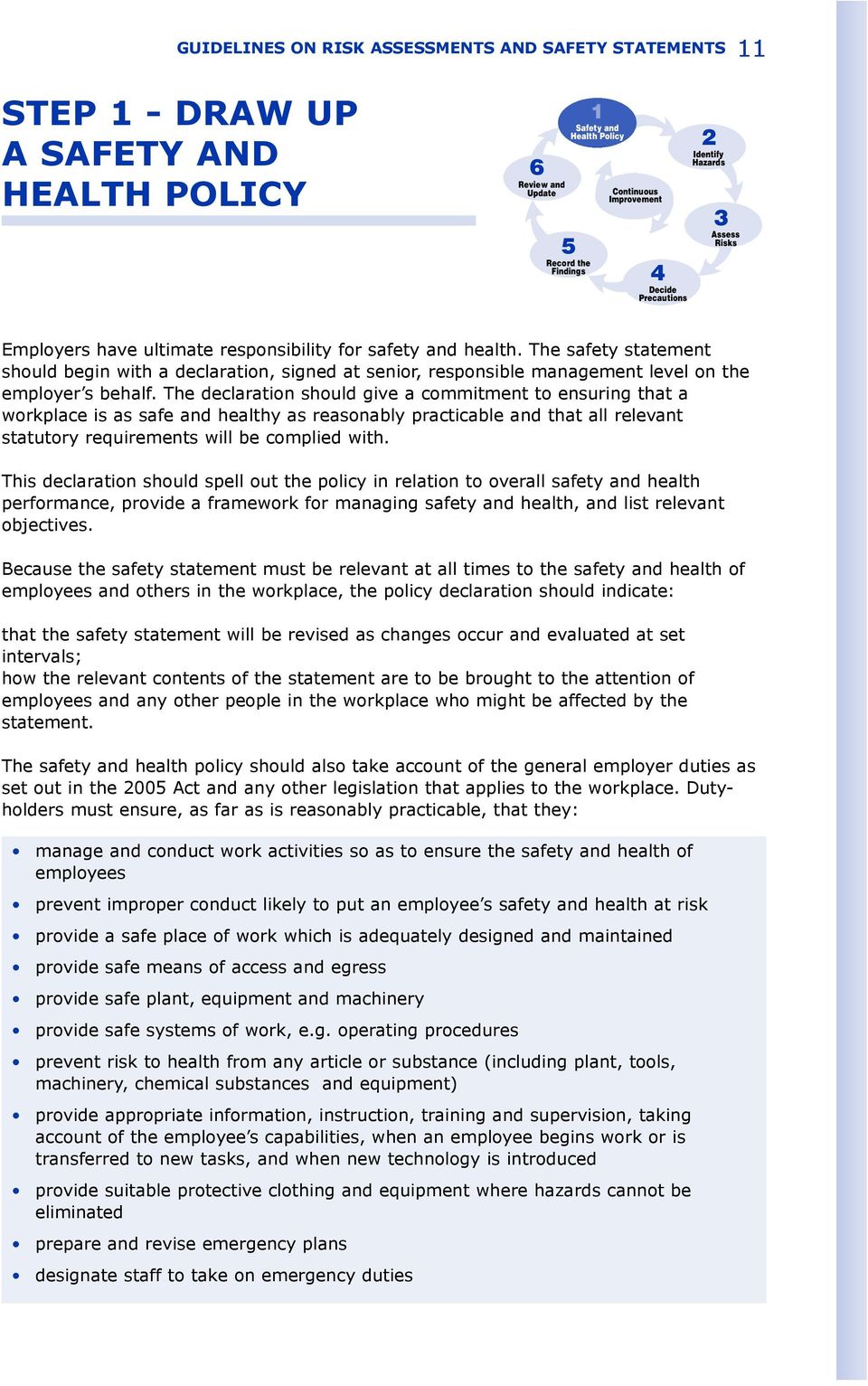
11 10 GUIDELINES ON RISK ASSESSMENTS AND SAFETY STATEMENTS GETTING STARTED: SIX SIMPLE STEPS TO FOLLOW A comprehensive safety statement, if properly implemented, is a practical tool for reducing accidents and ill health at work. For small to medium-sized businesses the preparation of a safety statement should be simple and straightforward. There are six simple steps to be followed, one of which is the process of assessing risk. In developing a safety and health management programme for an organisation, all steps are important. These are set out in the following diagram and explained below: 6 Review and Update 5 Record the Findings 1 Safety and Health Policy Continuous Improvement 4 Decide Precautions 2 Identify Hazards 3 Assess Risks

12 GUIDELINES ON RISK ASSESSMENTS AND SAFETY STATEMENTS 11 STEP 1 - DRAW UP A SAFETY AND HEALTH POLICY 6 Review and Update 1 Safety and Health Policy 2 Identify Hazards 5 Record the Findings Continuous Improvement 4 Decide Precautions 3 Assess Risks Employers have ultimate responsibility for safety and health. The safety statement should begin with a declaration, signed at senior, responsible management level on the employer s behalf. The declaration should give a commitment to ensuring that a workplace is as safe and healthy as reasonably practicable and that all relevant statutory requirements will be complied with. This declaration should spell out the policy in relation to overall safety and health performance, provide a framework for managing safety and health, and list relevant objectives. Because the safety statement must be relevant at all times to the safety and health of employees and others in the workplace, the policy declaration should indicate: that the safety statement will be revised as changes occur and evaluated at set intervals; how the relevant contents of the statement are to be brought to the attention of employees and any other people in the workplace who might be affected by the statement. The safety and health policy should also take account of the general employer duties as set out in the 2005 Act and any other legislation that applies to the workplace. Dutyholders must ensure, as far as is reasonably practicable, that they: manage and conduct work activities so as to ensure the safety and health of employees prevent improper conduct likely to put an employee s safety and health at risk provide a safe place of work which is adequately designed and maintained provide safe means of access and egress provide safe plant, equipment and machinery provide safe systems of work, e.g. operating procedures prevent risk to health from any article or substance (including plant, tools, machinery, chemical substances and equipment) provide appropriate information, instruction, training and supervision, taking account of the employee s capabilities, when an employee begins work or is transferred to new tasks, and when new technology is introduced provide suitable protective clothing and equipment where hazards cannot be eliminated prepare and revise emergency plans designate staff to take on emergency duties
13 12 GUIDELINES ON RISK ASSESSMENTS AND SAFETY STATEMENTS provide and maintain welfare facilities provide, where necessary, a competent person to advise and assist in securing the safety, health and welfare of employees. (A competent person, as defined in the 2005 Act, must have the necessary qualifications as well as sufficient training, experience and knowledge appropriate to the nature of the work to be undertaken If any of these issues are particularly relevant to the workplace being covered, employers may comment on them in the policy declaration. Otherwise do so in the main part of the safety statement. The managing director or another senior manager who has overall responsibility for safety and health should sign the safety and health policy and communicate it to all staff. EXAMPLE OF A COMPANY S POLICY DECLARATION To all employees: As your employer, we are required to comply with all safety and health legislation that applies to this company. With this in mind we have carried out risk assessments of all our key operations and processes in all the workplaces we control. We have discussed these risk assessments with all relevant employees and worked with the safety committee in preparing this safety statement This statement sets out the safety and health measures we are implementing to protect everyone who works here The Board of ABC Ltd has endorsed this statement and gave me the responsibility to implement it. I am committed to ensuring that the safety and health measures set out in our safety statement are met John Kelly, Safety and Health Manager, will give advice and information on how to comply with this safety statement but everyone, especially if you are in a management or supervisory position, is responsible for ensuring compliance where they work We expect all employees to co-operate with us so that we can achieve our target of avoiding accidents. Consultation on safety and health matters, between senior managers and all employees, will be carried out through the safety committee, which you have selected You must play your part under the safety statement. Comply with all the safety and health rules for your area. Work safely and think of others as you do. Know and understand the risk assessments for your area. Report safety and health problems to your supervisor. Know who your safety representative is and contact him or her with any safety and health enquiries you may have Signed Joan Mc Carthy Managing Director DATE
14 GUIDELINES ON RISK ASSESSMENTS AND SAFETY STATEMENTS 13 STEP 2: IDENTIFY THE HAZARDS 6 Review and Update 1 Safety and Health Policy 2 Identify Hazards 5 Record the Findings Continuous Improvement 4 Decide Precautions 3 Assess Risks Here are the common definitions of the terms hazard, risk, risk assessment and control as they apply in the workplace. HAZARD in general means anything that can cause harm but, for your purposes, this must be workplace-generated (e.g. dangerous chemicals, electricity, working at heights from ladders, poor housekeeping). RISK is the likelihood, great or small, that someone will be harmed by the hazard, together with the severity of harm suffered. Risk also depends on the number of people exposed to the hazard. RISK ASSESSMENT is a careful examination of what, in the workplace, could cause harm to people, so that the employer can weigh up whether he or she has taken enough precautions or should do more to prevent harm. CONTROLLING RISK means that the employer (as the law requires) does all that is reasonably practicable to ensure that a hazard will not injure anyone (e.g. by eliminating the hazard, enclosing it in a totally enclosed container, using general or local exhaust ventilation, implementing safe operating procedures, or providing personal protection, as a last resort). The first step in safeguarding safety and health is to identify hazards from materials, equipment, chemicals and work activities. You are required to systematically examine your workplace and work activities to identify workplace-generated hazards. If you control more than one work location, different types of work activity or changing work locations (as in road repairs or building work), you may need to prepare a safety statement that has separate sections dealing with the different locations or activities. Employers will be familiar with the hazards associated with the type of work they are involved in. But to identify the main hazards and put risks in their true perspective, employers can also check: records of accidents, ill health and insurance claims any relevant legislation or standards covering the hazard (e.g. the Construction Regulations for construction-site hazards, the Chemical Agents Regulations and Code of Practice for chemical hazards and their control) manufacturers instructions or datasheets Some hazards are obvious, such as unguarded moving parts of machinery, dangerous fumes, electricity, working at heights, or moving heavy loads. Less obvious, but at the root of many accidents, are hazards presented by untidy workplaces and poor

15 14 GUIDELINES ON RISK ASSESSMENTS AND SAFETY STATEMENTS maintenance. In the case of some hazards, such as excessive noise, it may take months or even years before damage materialises. Don t be overcomplicated. In most firms in the office, retail, commercial, service and light industrial sector, the hazards and hazardous work activities are few and simple. Checking them is common sense, but necessary. In small firms, employers understand their work and can identify hazards and assess risks themselves. For larger firms, a responsible experienced employee or safety officer should be used. Consult and involve as necessary all employees, including the safety representatives. But remember the employer is responsible for seeing that the work is adequately done. If you use external advisers to help prepare the safety statement, make sure they know the work activity and have the appropriate experience. If you do the work yourself, walk around the workplace and look afresh at what could reasonably be expected to cause harm. Ignore the trivial and concentrate on the significant hazards that could result in serious harm or affect several people. Ask employees and their representatives what they think. They may have noticed things that are not immediately obvious. The following checklists provide a systematic, though not exhaustive, approach to identifying hazards: PHYSICAL HAZARDS Some common causes of accidents, with examples, are: manual handling (heavy, awkward or hard-to-reach loads, handling patients, treating farm animals) slipping/tripping hazards (poorly maintained or untidy floors, passageways or stairs) falling from a height (from mezzanine floors or scaffolding) being struck by material falling from above getting caught or cut by machinery, especially moving parts of machinery (blades or rollers, power take-off shafts on tractors and farm machinery) equipment (poorly maintained or whose guards have been disabled) falling objects being struck by internal transport (fork-lifts) or external transport (delivery trucks at loading bays) introduction of new machinery or work systems fire (from flammable or combustible materials, hay, waste material) ejection of material (from plastic moulding or woodworking machines) electricity (poor wiring or not being protected by residual current devices) special hazards of maintenance of equipment and the workplace itself (the roof, windows or gutters) injury by another person or an animal hot substances or surfaces hand tools (noise, eye injury, electrocution) poor housekeeping burial in trenches or by loose material such as grain or soil suffocation by drowning or from exposure to carbon monoxide (from portable generators) pressure systems (steam boilers)

16 GUIDELINES ON RISK ASSESSMENTS AND SAFETY STATEMENTS 15 You can find out the most common causes of accidents in your sector by consulting the Health and Safety Authority website or the most up-to-date Summary of Fatality, Injury and Illness Statistics published by the Authority available at HEALTH HAZARDS negative stress (e.g. from poor work organisation or control, repetitive strain, etc) noise (e.g. if people must raise their voices to be heard) harmful dusts (e.g. from grinding) unsuitable lighting levels some types of light (e.g. over-exposure to ultra-violet light can cause skin cancer) vibration (e.g. from pneumatic rock or concrete breakers or drills) sources of radiation extremes of temperature injury through poor design of tasks or machinery radiation hazards including naturally occurring radon CHEMICAL HAZARDS Chemical substances are used in nearly all organisations. They range from common everyday products such as glues and correction fluids to industrial solvents, dyes, pesticides or acids. In most cases the hazards are well documented and information is available on safety precautions to be taken. Regulations require certain chemicals to be labelled according to their hazards. Manufacturers and suppliers are legally required to provide material safety data sheets, which give information on the safety and health risks of any chemical substances. They should be asked for this information. The code of practice for the Chemical Agents Regulations lists several hundred dangerous chemical agents. Check this list if chemicals are used in your operations. To identify chemical hazards and assess their risks, you need data on at least the following: immediate problems, (e.g. acute toxic effects or catching fire) long-term effects of exposure on health (e.g. cancer-causing) likelihood of explosion likelihood of skin problems (e.g. skin irritation or sensitiser causing dermatitis) likelihood of chest problems (e.g. respiratory irritation or sensitisation, asthma) BIOLOGICAL AGENT HAZARDS These include viruses and bacteria that can cause infection and substances from plants or animals that can lead to other health problems. These hazards are likely to occur in places such as laboratories, hospitals, farms or abattoirs. They include:

17 16 GUIDELINES ON RISK ASSESSMENTS AND SAFETY STATEMENTS tuberculosis from contact with infectious cases brucellosis farmer s lung, caused by spores from mouldy hay hepatitis from unprotected handling of infected body fluids or waste If you work in or are responsible for any of the above activities you should consult the Biological Agents Regulations for further information on identifying biological agent hazards and methods of control. HUMAN-FACTOR HAZARDS Apart from physical surroundings, human factors must also be taken into account when identifying hazards: People should be mentally and physically capable of doing their jobs safely. The workplace, the work system, the organisation of work and the job should be designed so as to avoid causing sustained stress. Workers should not be subjected to bullying by or violence from other workers or members of the public. Some groups are particularly vulnerable: young workers, who have a higher accident rate pregnant women (see the General Application Regulations) people with disabilities new or inexperienced workers workers who have recently changed roles or jobs or started work in a new workplace older workers workers whose first language is not English

18 GUIDELINES ON RISK ASSESSMENTS AND SAFETY STATEMENTS 17 STEP 3: CARRY OUT A RISK ASSESSMENT 6 Review and Update 1 Safety and Health Policy 2 Identify Hazards 5 Record the Findings Continuous Improvement 4 Decide Precautions 3 Assess Risks Risk means the likelihood, great or small, that someone will be harmed by a hazard, together with the severity of the harm suffered. Risk also depends on the number of people who might be exposed to the hazard. In assessing the risk, you should estimate: how likely it is that a hazard will cause harm how serious that harm is likely to be how often and how many workers are exposed Then you can weigh up whether you have taken enough precautions or should do more to prevent harm. You can also decide if any corrective measures are especially urgent. WHO SHOULD CARRY OUT THE RISK ASSESSMENT? It is the employer s duty, under section 19 of the 2005 Act, to carry out the risk assessment so you should try to do it yourself, while involving managers and employees as much as possible. Where the in-house expertise is not available, employ the services of an external competent person to help. Check that they are familiar with and have the ability to assess specific work activities. Involve as many employees as possible in order to encourage them to share ownership of the finished assessments. IS THERE A FORMULA I CAN USE TO ASSESS RISK? There are various qualitative and quantitative methods for carrying out risk assessment. Choose one which best suits the organisation. A generic format for carrying out risk assessments in tabular form is given in the Appendix. WHAT FACTORS AFFECT THE LEVEL OF RISK? Risk will depend on many, often related, circumstances: Who is exposed to the hazard? Is the hazard likely to cause injury to my workers or others? How serious would the injury be? Is the hazard well controlled? 1 1 If one uses dangerous chemicals, the hazards and the precautions will be listed on the label or the material safety data sheet. There may also be safety and health regulations, industry standards, and codes of practice or guidelines dealing with a particular hazard. For example, regulations require stop controls to be provided at each work station for machinery. Guidance on stop controls and emergency stop controls is available in the Use of Work Equipment Guide to the Safety Health and Welfare at Work (General Application) Regulations. Employers should use these to help assess the risks and to decide if existing precautions are adequate.
19 18 GUIDELINES ON RISK ASSESSMENTS AND SAFETY STATEMENTS Is the level of supervision adequate? How long are people exposed? What levels of exposure should not be exceeded? (These levels apply to chemicals, temperature, noise, heavy loads, radiation, etc.) WHO DO I NEED TO CONSIDER? Apart from employees (e.g. operators, maintenance personnel, and office staff) think about people who may not be in the workplace all the time, for example: cleaners visitors contractors outside maintenance personnel customers others (such as students in a school) members of the public or people who share the workplace, if there is a chance they could be hurt by the work activities Pay particular attention to staff with disabilities, visitors, inexperienced staff, workers who do not have English as a first language e and lone workers. If changes such as new plant, new working practices or new materials occur in the workplace, the employer must carry out a new risk assessment, implement any necessary improvements and update the safety statement accordingly. The risk assessments and any subsequent revisions must be brought to the attention of everyone affected by them. HOW DO I ASSESS RISK TO TRAVELLING OR MULTI-SITE WORKERS? The risk assessment and safety statement should relate to the place of work. Where workers will be working away from their normal base, the risk assessment and safety statement should address the type of work to be performed in that place of work. It may not be practical to have the full safety statement or risk assessment at particular workplaces or certain work activities (e.g. at roadworks or working on a roof). In these cases a simplified method statement or work procedure, which covers the risks at hand, is sufficient, provided that employees are familiar with their own safety statement. The Authority has produced a Safe System of Work Plan to help supervisors and workers in the construction industry to carry out simple risk assessments for many types of construction work.
20 GUIDELINES ON RISK ASSESSMENTS AND SAFETY STATEMENTS 19 STEP 4: DECIDE WHAT PRECAUTIONS ARE NEEDED 6 Review and Update 1 Safety and Health Policy 2 Identify Hazards 5 Record the Findings Continuous Improvement 4 Decide Precautions 3 Assess Risks Employers may already have in place some safety measures. The risk assessment will tell whether these are adequate. Employers must ensure they have done all that the law requires. Remember that all safety and health laws provide guidance on how to assess the risks and establish appropriate safeguards. For example, there are legal requirements on preventing access to dangerous parts of machinery. Then ensure that generally accepted industry standards are in place. But do not stop there because the law also says that you must do what is reasonably practicable to keep the workplace safe. The real aim is to make all risks small by adding to existing precautions if necessary. Improving safety and health need not cost a lot. For instance, placing a mirror on a dangerous blind corner to help prevent vehicle accidents, or putting some non-slip material on slippery steps, are inexpensive precautions considering the risks. Sometimes changing the way a job is done can reduce the risk of an accident. Employers need to ask themselves: Can I get rid of the hazard altogether? Can I change the way the job is done so as to make it safer? If not, what safety precautions are necessary to control this risk? HOW DO I CONTROL RISK? Common sense tells us that life cannot be totally risk-free. However, employers are required to do all that is reasonably practicable to minimise the risk of injury. Employers will have done all that is reasonably practicable if they have: exercised care in putting in place necessary preventive measures have identified the hazards and risks relating to the place of work have put in place appropriate measures such that it would be grossly disproportionate to do more Some common methods of controlling risk are: replacing a hazardous system of work with a less hazardous system, e.g. preassembling components on the ground to reduce the need to work at a height, or using mechanical aids to reduce or eliminate the need for manual handling replacing a substance with a less hazardous substance, e.g. replacing a flammable with a non-flammable substance designing the workplace to reduce risk, e.g. providing guardrails around roofmounted equipment or designated walkways and crossing points through areas with moving vehicles

21 20 GUIDELINES ON RISK ASSESSMENTS AND SAFETY STATEMENTS ensuring a clean and tidy workplace to prevent trips and slips extracting or containing the hazard at source, e.g. providing a fume cupboard with extraction adapting the work to the individual, e.g. providing adjustable height tables or chairs to reduce muscle injuries ventilating an area of the workplace where extraction at source is not possible isolating the process or the worker (e.g. switching off and isolating machines before carrying out repairs or alterations) safeguarding machinery, e.g. providing interlocked guards that switch off the machine if someone tries to gain entry to dangerous parts of it providing adequate training and supervision establishing emergency planning procedures, including first aid providing protective equipment, clothing or signs (they should be used only as a last resort after all other ways of eliminating the hazard have been fully explored) setting up adequate health-surveillance programmes including pre-placement or regular health checks where appropriate analysing and investigating accidents (including ill-health) and dangerous occurrences using permit-to-work systems or safe working procedures putting in place adequate welfare facilities establishing other policies as appropriate, e.g. to eradicate bullying, etc WHAT IF I SHARE A WORKPLACE? If you share a workplace, tell the other employers and self-employed people there about any risks they might face and what precautions they should take. Also, think about the risks to your workforce from those who share the workplace. The need for the various risk-control methods will vary according to the needs of your workplace. EXAMPLES OF FACTORS TO BE CONSIDERED IN SPECIFIC RISK ASSESSMENTS Risk of a slip, trip or fall Slips, trips and falls are the second most common type of accident in most places of work. The risk depends on: the premises being kept clean, tidy and uncluttered the flooring and stairs being kept in good repair and on the type of flooring used the control of other trip hazards the quality of lighting spillages of liquid being cleaned promptly The extent of injury may vary from relatively minor to severe, depending on a variety of factors including the nature of the fall, whether at the level or from a height.
22 GUIDELINES ON RISK ASSESSMENTS AND SAFETY STATEMENTS 21 Risk of being struck by a fork-lift truck Vehicles in the workplace are a risk to other employees on foot. The risk is a combination of the chance that someone will be struck, together with the likely severity of the injury. This will depend on: whether pedestrians use walkways which keep them away from moving fork-trucks the number of pedestrians and fork-lift trucks using the same areas the training and instruction provided to both drivers and pedestrians the degree of supervision and enforcement of safe procedures (e.g. for separating pedestrians and forklifts) the mechanical condition of the fork-lift truck (e.g. brakes and flashing beacons) the wearing of high-visibility PPE The extent of injury is likely to be severe and may result in death or disability. Isocyanate paint risk assessment Paints containing isocyanates are a hazard to health. The material safety data sheet and the label on the paint container give this information. Breathing in isocyanate fumes can cause asthma. The risk is a combination of the chance that someone s lungs will be damaged together with the extent of the likely damage. This will depend on: the amount of isocyanate in the air how often the job is done (all day every day or once or twice a year) the work method how the paint is used (e.g. if it is sprayed the risk will be greater than if brushed on) the number of people that could be affected. (Does just one person work with the paint or do many? Could their work affect others?) what could go wrong (the errors that could lead to spillage and atmospheric emissions) the adequacy of precautions taken, such as exhaust ventilation and personal protective equipment. (Do they comply with the legal requirements? How do they compare with good practice and national or trade guidance?) The extent of the likely damage is severe. An employee could develop asthma, which might make him or her unemployable in that industry. Permit-to-work systems A permit-to-work system is a written system of the procedures which must be taken to safeguard workers doing work such as repair, maintenance or cleaning work in potentially dangerous areas. It involves mechanical, electrical or process isolation procedures or monitoring the atmosphere for the presence of dangerous fumes. It sets out in a systematic way the work to be done, the hazards involved and the precautions to be taken. Situations where this is necessary include when machinery could be restarted with the worker still inside it, or working in confined spaces where there is a danger of chemical or physical contamination. The employer should write down in the safety statement what work activities require a permit-to-work system. Employers may also need to consider the Confined Space Regulations and associated code of practice.
23 22 GUIDELINES ON RISK ASSESSMENTS AND SAFETY STATEMENTS STEP 5: RECORD THE FINDINGS 6 Review and Update 1 Safety and Health Policy 2 Identify Hazards 5 Record the Findings Continuous Improvement 4 Decide Precautions 3 Assess Risks The safety statement is the place to record the significant findings of the risk assessments. This means writing down the more significant hazards and recording the most important conclusions. For example: A safety statement where electrical installations may pose a risk may include: Electrical installations: insulation and earthing to be checked every six months and after any modifications. A workplace where fumes from welding may pose a risk may state: Local exhaust ventilation has been provided. Supervisor to ensure that it is always used and is checked every month. Employers should inform employees about these findings. The employer should also state in the safety statement where the results of these checks are retained. To make things simpler, the safety statement can refer to specific procedures contained in other documents. These documents might include: quality manuals operating instructions company rules manufacturers instructions company safety and health procedures These may already list hazards and precautions. There is no need to repeat all that, and it is up to the employer whether to combine all the documents or keep them separately. But the employer must make sure employees are made aware of these risks and precautions. The safety statement must also specify how you are going to organise and assign responsibilities to safeguard your employees safety and health on a day-to-day basis. The areas it must cover are: available resources safety and health competence responsibility and control co-operation by employees consultation participation of employees and representation planning and setting standards measuring safety and health performance
24 GUIDELINES ON RISK ASSESSMENTS AND SAFETY STATEMENTS 23 RESOURCES The safety statement must detail the resources provided by the employer, in terms of time, people and finance, to ensure the safety and health of employees. For example, the employer should specify the budgets and the commitments to ensure safety and health training for all employees. SAFETY AND HEALTH COMPETENCE Under the 2005 Act and other safety and health laws, employers are required to have competent persons to do various tasks. These people need to have sufficient training, experience and knowledge appropriate to the work to be done. You need to: assess the skills needed to carry out all tasks safely provide the means to ensure that all employees, including managers, supervisors and temporary staff, are adequately instructed and trained in safety and health requirements ensure, in particular, that those who do especially dangerous work have the necessary qualifications, training, experience and other qualities to carry out the work safely It is recommended by the 2005 Act to have in-house safety and health experts. If this is not practicable, ensure that external advice and help is available. When carrying out restructuring or reorganization, the employer must ensure that those taking on new safety and health responsibilities are competent. RESPONSIBILITY AND CONTROL An organisation chart showing the safety and health management structure and the names and responsibilities of key personnel should be written down in the safety statement. As a minimum it must include the name of the person at senior management or director level with delegated responsibility for safety and health in the company. Make sure the board of directors or other management body in charge know they have safety and health responsibilities as well. Responsibilities should be clearly identified. Identify people responsible for particular safety and health jobs, especially where special expertise is called for, e.g. for carrying out risk assessments, monitoring compliance with safety and health standards, driving forklift trucks, etc. Ensure that managers, supervisors and team leaders understand their responsibilities and have the time and resources to carry them out. Lines of communication should also be laid down between the different levels of responsibility. Ensure that everyone knows what they must do and how they will be held accountable set objectives. Lead by example. Demonstrate a commitment and provide clear direction. Let everyone know that safety and health is important.
25 24 GUIDELINES ON RISK ASSESSMENTS AND SAFETY STATEMENTS CO-OPERATION REQUIRED FROM EMPLOYEES All employees have a duty to take care of their own safety while at work. They must cooperate in the use of personal protective equipment or clothing provided for their safety and health and in enabling the employer to comply with the law. They must attend any safety and health training provided by their employer. The co-operation required must be clearly spelt out in the safety statement and must not be couched in vague generalities. Where disciplinary procedures for failure to comply with safety and health requirements are appropriate, these should be specified. Since employees are required to report to either the employer, their manager or their supervisor any defects in plant, equipment, place or system of work that might endanger safety and health, the safety statement should indicate the system for doing so. CONSULTATION, PARTICIPATION OF EMPLOYEES, AND REPRESENTATION The law requires employers to put in place a safety consultation programme that facilitates participation by all employees in safety and health matters. Also the law allows employees to select a safety representative. Participation by employees supports the risk control by encouraging their ownership of safety and health policies and procedures. It also gives them an understanding that the workplace and the people working in it benefit from good safety and health performance. Pooling knowledge and experience through employee consultation, participation and representation means that safety and health becomes everybody s business. Under the 2005 Act, safety committees can be used for this consultation. Details on how these committees can operate are set out in the Act. The safety statement must specify the arrangements to be used for consultation with and participation by employees on safety and health matters. These would include the procedures to facilitate effective co-operation and communication on safety and health matters between the employer and employees. Other consultation areas include: any issues which can substantially affect safety and health appointment of persons to deal with emergencies and any prevention measures carrying out risk assessments, preparing the safety statement provision of safety and health information to employees the planning and organisation of safety and health training introduction of new technologies which can affect safety and health To demonstrate commitment to safety and health, the employer or a senior manager should be a member of the safety committee, if there is one. Involve the safety committee in: planning and reviewing safety and health performance writing safety and health procedures solving problems
26 GUIDELINES ON RISK ASSESSMENTS AND SAFETY STATEMENTS 25 It can also review the safety and health performance of contractors who work on the premises and ensure they fit into the safety and health regime. The names and functions of the safety representatives and the safety committee members should be detailed in the statement. PLANNING AND SETTING STANDARDS Planning is the key to ensuring that the safety and health efforts really work. It involves setting objectives, assessing your risks, implementing standards of performance and developing a safety culture. The employer should record the safety and health plans in the safety statement. The planning should provide for: identifying hazards and assessing risks, and deciding how they can be eliminated or controlled complying with the safety and health laws that apply to the business agreeing safety and health targets with directors, managers and supervisors board decisions which reflect the safety and health policies as set out in the safety statement a purchasing and supply policy which takes safety and health into account the design of tasks, processes, equipment, products and services, and safe systems of work procedures to deal with emergencies and serious and imminent danger co-operation with neighbours and/or subcontractors setting standards against which performance can be measured ensuring co-operation between managers so that safety and health obligations are complied with MEASURING SAFETY AND HEALTH PERFORMANCE Just as in finance, production or sales, the employer needs to measure safety and health performance to find out if the effort is successful. Two key components of measuring performance are: Active monitoring (before things go wrong). The employer needs to carry out routine inspections and checks to see that standards are being maintained. Are the objectives and standards which were set being achieved? Are they effective? Reactive monitoring (after things go wrong): investigating injuries, cases of illness, bullying complaints, property damage and near misses specifying in each case why performance was sub-standard. The procedures for monitoring safety and health performance need to be set out in the safety statement. Once the safety statement has been written, the employer should keep the written document for future reference or use. It may be needed if a Health and Safety Authority inspector questions the precautions used, or if there is an action for civil liability. It can also remind employers to keep an eye on particular matters, and it helps to show that they are doing what the law requires.
27 26 GUIDELINES ON RISK ASSESSMENTS AND SAFETY STATEMENTS STEP 6: REVIEW THE PROGRAMME AND UPDATE AS NECESSARY 6 Review and Update 1 Health and Safety Policy 5 Record Your Findings Continuous Improvement 4 Decide Precautions 2 Identify Hazards 3 Assess Risks KEEPING SAFETY STATEMENTS UP TO DATE Implementing the safety statement should be an integral part of everyday operations. A copy of the statement or relevant extracts of it must be kept available for inspection at or near every workplace to which it relates. The safety statement needs to be relevant at all times. It may be necessary to revise it whenever there are changes, or when risk assessments are carried out and improvements made that have an impact on safety and health. Such changes may include changes in work processes, organisational structure, equipment or substances used, technical knowledge, and legislation or standards. Changes in the workforce may also have an impact; e.g. altering the number of workers on a particular process, replacing more experienced workers with trainees or as a result of experience gained through training. Do not amend the safety statement for every trivial change, or for each new job, but if a new job introduces significant new hazards, you need to assess the risks assessments and implement the necessary prevention measures. A Health and Safety Authority inspector may review the safety statement during an inspection of the workplace. If he or she finds that it is inadequate or does not cover risk assessments for processes currently going on during the inspection, he or she can direct that it be revised within 30 days. PERIODIC REVIEW OF SAFETY STATEMENTS LEARNING FROM EXPERIENCE The safety statement should be periodically reviewed. The review serves two purposes: a backward look to review how effective the safety and health management has been a forward look to ensure you have considered any proposed changes Employers should always try to improve on the last performance. The monitoring programme covered above should help you to do this. Employers are responsible for drawing up, reviewing and revising the safety statement. If they are not competent to do so, they must obtain assistance from a competent person. It may also be appropriate to call on outside experts (e.g. an engineer, scientist, occupational physician, ergonomist, occupational hygienist or other relevant safety and health adviser) to solve particular problems.
28 GUIDELINES ON RISK ASSESSMENTS AND SAFETY STATEMENTS 27 HOW SHOULD THE SAFETY STATEMENT BE REVIEWED? In reviewing the safety statement, employers should consider at least the following: Were the aims in the safety statement relevant and appropriate? Did it identify the significant hazards, assess their risks and set out the necessary preventive and protective safety measures? Were the safety and health measures, which were identified, implemented in practice? Was the planned progress achieved? Were new work practices or processes introduced since the last review and if so were they risk-assessed? Did you put in place the measures necessary to comply with the relevant statutory provisions (e.g. on safety and health management, safety consultation and training, etc)? Did you comply fully with safety and health performance standards (including legislation and approved codes of practice)? Are there areas where standards are absent or inadequate? Have you analysed your data to find out the immediate and underlying causes of any injuries, illness or incidents? Have you identified any trends and common features? What new safety and health measures were applied following any reportable accidents or other incidents, or following any enforcement measures relating to your workplace? Were adequate financial, physical, human and organisational resources committed to safety and health? What improvements in safety and health performance need to be made? As part of the review, employers will find it helpful to refer to any records which have been kept, such as accident/incident reports, health-surveillance results, training records, inspection and audit reports, maintenance logs, or atmospheric monitoring figures. Employers must also consult safety representatives and others who may be affected by the review. WHEN SHOULD THE SAFETY STATEMENT BE REVIEWED? It is recommended that employers review the safety statement at least annually. However, in deciding the frequency of the review, they should consider the nature of their operations and any changes that might affect workers safety and health. WHAT SHOULD THE EMPLOYER DO AFTER THE SAFETY STATEMENT HAS BEEN REVIEWED? Employers should bring any changes made to the attention of the safety representatives, employees and any other persons who may be affected by the new measures set out in the safety statement. Inform them about the new findings and of any changes in the required safety and health precautions. Make sure all modifications or improvements required by the new risk assessments and safety statement review are implemented as soon as possible.
29 28 GUIDELINES ON RISK ASSESSMENTS AND SAFETY STATEMENTS FURTHER INFORMATION The Health and Safety Authority has produced many publications that can be consulted for further information when carrying out risk assessments or preparing and implementing safety statements. They cover: specific workplace hazards (on manual handling, noise, stress, violence, bullying, chemicals, carcinogens, asbestos, petroleum and confined spaces) specific work sectors (construction, quarries, agriculture, forestry, chemical processing, LPG filling, offices, shops, transport of dangerous goods, security industry, hotels, catering and restaurants, retail and distribution) sector-specific safety statements for agriculture, shops, fishing vessels, offices and small businesses other work-related issues (on workplace safety and health management, obligatory safety signs, pregnancy and work, child safety on farms, safety and workplace vehicles, rider-operated lift trucks, occupational asthma, safety consultation and representation, scaffolding, cranes and roofwork construction sites see the Safe System of Work Plan All these publications are available on the Health and Safety Authority website at or telephone Many are free of charge.
30 GUIDELINES ON RISK ASSESSMENTS AND SAFETY STATEMENTS 29 APPENDIX The appendix includes three forms: 1 Guidance on Carrying Out Risk Assessments 2 Risk Assessment Examples 3 Risk Assessment Pro Forma
31 30 GUIDELINES ON RISK ASSESSMENTS AND SAFETY STATEMENTS GUIDANCE ON CARRYING OUT RISK ASSESSMENTS Company name Company address Area/department/activity Signed Date Assessment review date Hazards and risks: Look only for hazards, which you could reasonably expect to result in significant harm under the conditions in your workplace. Use the following examples as a guide: Who might be harmed? There is no need to list individuals by name - just think about groups of people doing similar work or who may be affected, e.g.: Office staff Slipping/tripping hazards (e.g. poorly maintained floors or stairs) Fire (e.g. from flammable materials) Chemicals (e.g. battery acid) Moving parts of machinery (e.g. blades) Work at height (e.g. from mezzanine floors) Ejection of material (e.g. from plastic molding) Pressure systems (e.g. steam boilers) Vehicles (e.g. fork-lift trucks) Electricity (e.g. poor wiring) Dust (e.g. from grinding) Fume (e.g. welding) Manual handling Noise Poor lighting Low temperature. Maintenance personnel Contractors People sharing your workplace Operators Cleaners Members of the public. Pay particular attention to: Staff with disabilities Visitors Inexperienced staff Lone workers. They may be more vulnerable.
32 GUIDELINES ON RISK ASSESSMENTS AND SAFETY STATEMENTS 31 Assessment undertaken by Page of Is the risk adequately controlled or do you need to do more? Have you already taken precautions against the risks from the hazards you listed? For example, have you provided: Responsible persons: You can list individuals by name and job title. It should be clear who is responsible for controlling the risks. adequate information, instruction and training? adequate systems and procedures? Do the precautions: meet the standards set by a legal requirement? comply with a recognized industry standard? represent good practice? reduce risk as far as reasonably practicable? If so, then the risks are adequately controlled, but you need to indicate the precautions you have in place. You may refer to procedures, manuals, company rules, etc., giving this information.
33 32 GUIDELINES ON RISK ASSESSMENTS AND SAFETY STATEMENTS RISK ASSESSMENT EXAMPLES (This list of hazards and controls is not intended to be exhaustive. While they may apply to certain situations in your workplace, the controls that you require to comply with the law can only be determined by your own risk assessment.) Company name Company address Area/department/activity Signed Date Assessment review date List hazards and risks here: List groups of people who are especially at risk from the significant hazards Hazard: Faulty electrical equipment Risk: Shock likely to occur and severe injury could result Employees Cleaners Contractors Hazard: Manual handling of 25kg boxes of material Risk: Back injury likely to occur and be reportable Employees in packing department Hazard: Working near edge of mezzanine floor over offices Risk: Falls likely to occur and severe injury could result Employees in stores department Hazard: Sheep dipping with organophosphates Risk: Exposure to slashes or spray could result in poisoning Farmers, agricultural contractors and farm workers
34 GUIDELINES ON RISK ASSESSMENTS AND SAFETY STATEMENTS 33 Assessment undertaken by Page of List required controls here or note where the information may be found: Responsible persons: which you have identified: Report defective equipment Employees Ensure all leads checked monthly Supervisor Residual current device (RCD) provided and checked every 4 months Supervisor Push trucks provided and should be used Supervisor Employees trained in manual handling General Manager Guard-rail in place at edge of mezzanine floor and kept in place at all times General Manager Loading bay protected with gates, must be kept closed when not loading Supervisor Supervisor and operators Gate fitted with lift-up rail to enable gate to be opened and shut safely Wear suitable waterproof clothing and rubber boots. Use face visor when mixing concentrates. Check safety data. Farmer/Agricultural Contractor
35 34 GUIDELINES ON RISK ASSESSMENTS AND SAFETY STATEMENTS RISK ASSESSMENT PRO FORMA Company name Company address Area/department/activity Signed Date Assessment review date List hazards and risks here: List groups of people who are especially at risk from the significant hazards which you have identified:
36 GUIDELINES ON RISK ASSESSMENTS AND SAFETY STATEMENTS 35 Assessment undertaken by Page of List required controls here or note where the information may be found: Responsible persons:
37 36 GUIDELINES ON RISK ASSESSMENTS AND SAFETY STATEMENTS
38 Guidelines on Risk Assessments and Safety Statements Achieving and a Healthy Safe Working Life -Together HEALTH AND SAFETY AUTHORITY HEADQUARTERS 10 Hogan Place, Dublin 2 Tel Callers outside Republic of Ireland Fax. (01) website: ISBN
Health and Safety Management in Healthcare
 Health and Safety Management in Healthcare Information Sheet Nov 2010 This information sheet gives guidance on the key elements of health and safety management in healthcare. It is intended for small employers
A Short Guide to The Safety, Health and Welfare at Work Act, 2005
 A Short Guide to The Safety, Health and Welfare at Work Act, 2005 3 A Short Guide to the Safety, Health and Welfare at Work Act, 2005 Published in August 2005 by the Health and Safety Authority, 10 Hogan
Five steps to risk assessment
 This leaflet aims to help you assess health and safety risks in the workplace A risk assessment is an important step in protecting your workers and your business, as well as complying with the law. It
Five steps to risk assessment
 This leaflet aims to help you assess health and safety risks in the workplace A risk assessment is an important step in protecting your workers and your business, as well as complying with the law. It
Risk assessment code of practice
 Risk assessment code of practice Document control information Published document name: Risk assessment code of practice Date issued: 01 May 2011 Version: 2.0 Previous review dates: Next Review Date: Related
Risk management a practical approach
 Risk management a practical approach Introduction Preventing work related accidents and injuries is the primary concern for all those involved in health and safety. Work related accidents and injuries
Six steps to Occupational Health and Safety
 Six steps to Occupational Health and Safety This booklet gives basic guidelines for workplace health and safety systems to help industry in NSW comply with the "duty of care" principle outlined in the
Corporate Health and Safety Policy Issue 9
 Corporate Health and Safety Policy Issue 9 July 2011 1 Contents Foreword by the Chief Executive 3 1. General health and safety policy statement 4 a Our responsibilities 5 b Health and safety management
How To Ensure Safety On A Caravan Site
 EAST CAMBRIDGESHIRE DISTRICT COUNCIL A Site Operators Guide to Health and Safety Introduction The Health and Safety at Work Etc. Act 1974 places a duty on all persons having control of a caravan site to
Elements of an Occupational Health and Safety Program
 Occupational Health and Safety Division Elements of an Occupational Health and Safety Program Table of Contents Introduction 3 What workplaces must have a program? 5 What criteria must the program meet?
Risk Management & Assessment at UQ
 Risk Management & Assessment at UQ Course Overview: This training module has been developed for workers at the University of Queensland, and forms part of the OH&S training program at UQ. The aim of this
IOSH Working Safely MODULE 2: DEFINING HAZARD AND RISK. (Material correct Autumn 2013)
 IOSH Working Safely MODULE 2: DEFINING HAZARD AND RISK Sample material (Material correct Autumn 2013) RRC 27-37 St George s Road London SW19 4DS United Kingdom T +44 (0)20 8944 3100 F +44 (0)20 8944 7099
Workplace Safety and Health Management
 Policy Audit and review Planning Measuring performance Implementation and operation Workplace Safety and Health Management 14 WORKPLACE SAFETY AND HEALTH MANAGEMENT Practical Guidelines on the Implementation
Risk Assessment. Module 1. Health & Safety. Essentials. 16-23 November 2013. Registered charity number 207890
 Risk Assessment Module 1 Risk assessment in the laboratory After studying this module you will be able to understand the need to conduct risk assessments, how this applies to all laboratory activities,
OAKPARK SECURITY SYSTEMS LIMITED. Health & Safety Policy. Requests or suggestions for amendment to this procedure
 OAKPARK SECURITY SYSTEMS LIMITED Requests or suggestions for amendment to this procedure should be submitted to the owner of the process PROCESS OWNER: MANAGEMENT TEAM Current version: PREVIOUS VERSION
Five steps. TO risk assessment
 Five steps TO risk assessment 5 steps to RISK ASSESSMENT This leaflet aims to help employers and selfemployed people to assess risks in the workplace. It is aimed at firms in the commercial, service and
RISK MANAGEMENT AND THE THE RISK ASSESSMENT METHOD STFC TRAINING MANUAL
 RISK MANAGEMENT AND THE THE RISK ASSESSMENT METHOD STFC TRAINING MANUAL Rev 1.4, Issued May 22, 2012 Author: G J Baker Issue No: 1.4 Issue Date: 22/05/2012 Page 2 of 16 CONTENTS INTRODUCTION... 3 FLOW
Guidance on Risk Assessment and Control
 Guidance on Risk Assessment and Control Page 1 of 18 CONTENTS Section Page Executive Summary 2. FLOWCHART 4. 1. Introduction and Scope 5. Hierarchy of risk control 5. Definitions 5. 2. Related Documents
How to carry out a risk assessment and create a safety statement
 How to carry out a risk assessment and create a safety statement The Health and Safety Authority (HSA) provides the publication Guidelines on Risk Assessments and Safety Statements available to purchase
Looking after health, safety and welfare at work
 Looking after health, safety and welfare at work Clocking In to Clocking Out Improving workplace basic education Published by: FÁS National Adult Literacy Agency (NALA) Skills for Work 76 Lower Gardiner
Example risk assessment for a motor vehicle mechanical repair workshop
 Example risk assessment for a motor vehicle mechanical repair workshop Setting the scene The garage manager did the risk assessment. The business employed 12 mechanics, including two apprentices who carried
No. Name of Legislation Applicable Issues and Requirements Demonstration of Compliance 1. Health and Safety at Work Act 1974
 The Police Treatment Centres Health and Safety Legal Compliance Register No. Name of Legislation Applicable Issues and Requirements Demonstration of Compliance 1. Health and Safety at Work Act 1974 2.
6 STEPS TO RISK MANAGEMENT
 6 STEPS TO RISK MANAGEMENT Disclaimer This Guide provides general information about the obligations of persons conducting a business or undertaking and/or persons in control of premises and workers under
WHS Induction Series. 36 Toolbox Talks. Contents
 36 Toolbox Talks 3-5 minute toolbox talks for induction or refresher safety training. Having regular training programs that educate your workers about workplace issues has never been easier than now with
BASIC HEALTH AND SAFETY POLICY
 BASIC HEALTH AND SAFETY POLICY 1 In the following pages is an example of a basic health and safety policy. The text in the square brackets [ ] provide instructions on how to complete any gaps in the policy.
Important Facts about this Lawpack Kit
 Important Facts about this Lawpack Kit This Lawpack Kit contains the background information, guidance and forms necessary to draw up some essential risk assessments for small to medium-sized employers
Basic Information / Risk Assessment General Part I II. http://hwi.osha.europa.eu
 Risk Assessment Tool Basic Information / Risk Assessment General Part I II http://hwi.osha.europa.eu 2 R I S K A S S E S S M E N T T O O L I B A S I C I N F O R M A T I O N & R I S K A S S E S S M E N
1. GENERAL STATEMENT OF COMPANY HEALTH, SAFETY AND ENVIRONMENTAL POLICY
 1. GENERAL STATEMENT OF COMPANY HEALTH, SAFETY AND ENVIRONMENTAL POLICY Dumfries Timber Co. Ltd. is committed to comply with our legal duties in order to provide a safe and healthy working environment
Getting the occupational safety basics organised
 Getting the occupational safety basics organised 10 important measures Introduction Occupational health and safety are the foundation of wellbeing at work. The employer is responsible for providing safe
COSHH: A brief guide to the Regulations
 COSHH: a brief guide to the Regulations Health and Safety Executive COSHH: A brief guide to the Regulations What you need to know about the Control of Substances Hazardous to Health Regulations 2002 (COSHH)
WORKSAFE VICTORIA A HEALTH AND SAFETY SELF-ASSESSMENT CHECKLIST FOR SMALL BUSINESS
 Aug 2013 WORKSAFE VICTORIA A HEALTH AND SAFETY SELF-ASSESSMENT CHECKLIST FOR SMALL BUSINESS As a small business operator, you need to be aware of your health and safety responsibilities, and identify risks
68 Metal Industry Guidelines for Safe Work
 3 68 Metal Industry Guidelines for Safe Work section 3 high-risk 3 activities Metal Industry Guidelines for Safe Work 69 section 3 high risk activities 3.1 working at heights Falls from heights have been
Sample Risk Management Policy and Procedure
 Sample Risk Management Policy and Procedure 1. Purpose and Scope This policy establishes the process for the management of risks faced by [organisation]. The aim of risk management is to maximise opportunities
MD 52 WASTE MANAGEMENT AUTHORITY CORPORATE HEALTH AND SAFETY PROGRAM
 UNSAFE ACTS AND CONDITIONS All accidents are the result of an unsafe act, an unsafe condition or a combination of both. Unsafe acts account for approximately 80% of all incidents/accidents, while unsafe
HealthandSafetyOntario.ca. Introduction. Responsibilities. Health and Safety Policy
 starting your Health and safety program Introduction Workplace injuries and illnesses can be prevented. The key to achieving safe production is to identify and control all workplace health and safety hazards.
Safety in Offices and other General Areas
 Safety in Offices and other General Areas 1. INTRODUCTION This document covers health and safety in offices and other 'general areas' including corridors, stairs, entrances, small kitchens and rest areas.
SLIPS, TRIPS AND FALLS POLICY
 SLIPS, TRIPS AND FALLS POLICY First Issued Issue Version Purpose of issue/description of change Planned Review Date 2 Root cause analysis (RCA), RIDDOR August 2012 and inspection of communal areas referenced
Building and Construction
 Checklist for enterprises to use in their workplace assessment Building and Construction Introduction This checklist is a tool for enterprises to use when preparing their workplace assessment (WPA). All
Conducting a Job Hazard Assessment. Environmental, Health and Safety 275-3241
 Conducting a Job Hazard Assessment Environmental, Health and Safety 275-3241 EH&S Programs: Fire Safety Blood Borne Pathogens Hazard Communication Personal Protective Equipment Emergency Preparedness General
Risk assessment. A brief guide to controlling risks in the workplace
 Risk assessment A brief guide to controlling risks in the workplace This leaflet is aimed at employers, managers and others with responsibility for health and safety. It will also be useful to employees
Guidance to Prevent Slips, Trips & Falls
 Guidance to Prevent Slips, Trips & Falls Published June 2005 CONTENTS 1. Scope of this guidance 2. New plant/ installations 3. Maintenance 4. Housekeeping 1. Scope of this guidance Slips, trips and falls
Young Workers Health & Safety Workshop
 Young Workers Health & Safety Workshop Our goal is to give you the health and safety awareness you need to protect yourself and your fellow workers. SUMMER JOBS SERVICE Why? Because an average of 36 young
Confined Spaces. The National Food and Drink Manufacturing Conference October 2012
 Confined Spaces The National Food and Drink Manufacturing Conference October 2012 Confined spaces A silent killer! What is a confined space Typical hazards Examples of confined space in the food and drink
Hazard/Risk Identification and Control Procedure
 Hazard/Risk Identification and Control Procedure Introduction Hazard identification and the steps taken to minimize the risks associated with identified hazards are a critical component of working safely.
Walk around and identify the area to be assessed and look at what could reasonably be expected to cause harm.
 Risk Assessment Introduction The assessment of risk is central to the management of health and safety. The purpose of this is to assist in identifying those measures which are needed to remove or otherwise
School of Engineering University of Glasgow
 School of Engineering University of Glasgow Electronics Workshops Rankine Building 319A (2 Technicians) 510 (1 Technician) 712A (4 Technicians, 1 Modern Apprentice) James Watt South 619 (2 Technicians)
Getting Started with Workplace Health and Safety
 Getting Started with Workplace Health and Safety An Introduction to Workplace Health and Safety Policies, Procedures and Evaluation Victorian WorkCover Authority Revised June 2001 First published February
SAFETY TRAINING CLASSES & SERVICES LIST
 SAFETY TRAINING CLASSES & SERVICES LIST CUSTOM CLASS ROOM TRAINING AVAILABLE, BACKED WITH ON-SITE SUPPORT SAFETY, TRAINING COURSES OFFERED BY OUR CERTIFIED ELITE RISK CONTROL TEAM: EM 385-1-1 (Military)
HEALTH & SAFETY BICS ULTIMATE GUIDE HEALTH SAFETY
 BICS ULTIMATE GUIDE TO HEALTH & SAFETY Health and Safety is an integral part of the management of any activity. The Societies Office is committed to health and safety and this dedication cannot be met
A GUIDE FOR SAFETY REPRESENTATIVES
 A GUIDE FOR SAFETY REPRESENTATIVES safety reps to challenge the employer if they do not do a suitable assessment or do not act to remove the hazards identified in the risk assessment. It is important that
Cleaning and Support Services / Cleaning Services Supervision National Occupational Standards
 Cleaning and Support Services / Cleaning Services Supervision National Occupational Standards Contents C1 02 Maintain Personal Hygiene Standards when Cleaning... 3 C1 03 Do your job in a customer friendly
COSHH(NI): A brief guide to the Regulations
 COSHH(NI): A brief guide to the Regulations What you need to know about the Control of Substances Hazardous to Health Regulations (Northern Ireland) 2003 (COSHH(NI)) This booklet is written mainly for
Completion Test Answer Key. 1. Why are young people more likely to be injured on the job than other groups of workers?
 1. Why are young people more likely to be injured on the job than other groups of workers? They receive little or no safety training or supervision. They are reluctant to ask questions for fear of appearing
Information for a person conducting a business or undertaking
 BULLETIN Information for a person conducting a business or undertaking Overview of your responsibilities to provide a healthy and safe workplace. The Work Health and Safety laws (WHS laws) aim to provide
Risk Assessment of Chemical Hazards
 Risk Assessment of Chemical Hazards All employers and self-employed people have duties under health and safety law to assess risks in the workplace. The risk assessment forms the basis of the Safety Statement
How To Prevent Accidents At Work
 2 Preventing vehicle accidents Construction work is considered to be one of the most hazardous industrial activities in the EU. The rate of injury in the construction industry is higher than in other industries.
Health & Safety at Work
 Ministry of Labour Worker Health & Safety at Work Prevention Starts Here Worker Health and Safety Awareness in 4 Steps This workbook belongs to: Contents 01 INTRODUCTION 03 STEP 1: GET ON BOARD 03 Everyone
Confined spaces can be deadly. What is a confined space?
 Confined spaces A brief guide to working safely This leaflet explains what you, as an employer, may need to do to protect your employees when working in confined spaces. It will also be useful to the self-employed
ACCIDENT/INCIDENT REPORTING AND INVESTIGATION PROCEDURE
 ACCIDENT/INCIDENT REPORTING AND INVESTIGATION PROCEDURE Introduction 1. Accidents involving personal injuries, including staff, students and visitors etc. and/or property damage may occur on campus. Such
How To Protect Your Shop From Tripping Hazards
 For Employers and Supervisors The hazards of poor housekeeping The purpose of this Crew Talk handout is to provide employers and supervisors with information to help protect their workers from injuries
DIT HEALTH AND SAFETY OFFICE
 DIT HEALTH AND SAFETY OFFICE PROCEDURE TITLE Risk Assessment Procedure REVISION NO.: 5 NUMBER OF PAGES: 8 REFERENCE: Parent Health and Safety Statement Risk Assessment Template (DITRAT) Safety Inspection
WHS Policies and Procedures Package
 WHS Policies and Procedures Package The following is an extract to highlight the style and layout of this publication, as well as a snapshot of the content. Some samples may not be included in their entirety
Working alone Health and safety guidance on the risks of lone working
 Working alone Health and safety guidance on the risks of lone working Introduction This leaflet provides guidance on how to keep lone workers healthy and safe. It is aimed at anyone who employs or engages
School or service safety advisor (SSA) role
 School or service safety advisor (SSA) role Document control information Published document name: ssa-role-gn Date issued: January 2012 Version: 1.0 School or service safety advisor (SSA) role Previous
How to manage health and safety in small businesses
 How to manage health and safety in small businesses Do I need to read this? Are you a self-employed person? Do you own a business and employ staff or contractors? Do you want some influence over your ACC
Generic risk assessment form. This document forms part of Loughborough University s health and safety policy Version 3 February 2014
 Generic risk assessment form Date: (1) Assessed by: (2) Checked / Validated* by: (3) Location: (4) Assessment ref no (5) Review date: (6) Task / premises: (7) Activity (8) Significant hazard (9) Who might
Occupational Health & Safety Practitioner. Reading PRINCIPLES OF ACCIDENT PREVENTION
 Occupational Health & Safety Practitioner Reading PRINCIPLES OF ACCIDENT PREVENTION January 2009 Contents OVERVIEW...1 SECTION 1: INTRODUCTION...1 SECTION 2: TECHNIQUES FOR ACCIDENT PREVENTION...4 SECTION
How to Manage Hazards
 How to Manage Hazards FOR ROAD TRANSPORT If you are thinking about improving the health and safety of your workplace, hazard management is a good place to start. Why should you do this thing called hazard
Health and Safety at Work Policy
 Health and Safety at Work Policy Introduction Management of health and safety issues is an integral part of our business and is given the highest priority. Compliance with Health and Safety legislation
HAZARD & RISK MANAGEMENT PROCEDURE
 Introduction ATTAR is committed to providing a safe and healthy work environment for all employees. ATTAR also recognises its legal and moral obligation to provide and uphold so far as is practicable,
Health and safety guidance on the risks of lone working
 Working alone Health and safety guidance on the risks of lone working Introduction This leaflet provides advice and guidance on how to keep lone workers healthy and safe. It is aimed at anyone who employs
Workplace Transport Safety Reversing Vehicles Information Sheet What are the dangers associated with reversing vehicles? Why is reversing a problem?
 Workplace Transport Safety Reversing Vehicles Information Sheet This information sheet aims to raise awareness of the dangers caused by reversing vehicles in the workplace. It provides basic information,
Managing Occupational Safety and Health in Schools
 Managing Occupational Safety and Health in Schools Occupational Safety and Health Branch Labour Department This Guide is prepared by the Occupational Safety and Health Branch, Labour Department. This Edition
OCCUPATIONAL HEALTH AND SAFETY RISK ASSESSMENT PROGRAM FOR AGRICULTURE
 OCCUPATIONAL HEALTH AND SAFETY RISK ASSESSMENT PROGRAM FOR AGRICULTURE Definitions of Commonly Used Terms in Risk Management Hazard: anything, including a work practice or procedure, that causes, or has
WORKING IN CONFINED SPACES GUIDELINES
 WORKING IN CONFINED SPACES GUIDELINES Contents 1 Introduction... 2 2 Scope... 2 3 Definitions... 2 4 Responsibilities... 3 4.1 Permit Authoriser... 3 4.2 Permit Receiver... 3 4.3 Responsible UOW Officer...
PLYMOUTH COLLEGE Risk Assessment: Policy Guidance
 PLYMOUTH COLLEGE Assessment PLYMOUTH COLLEGE Assessment: Policy Guidance 1 Scope This guidance is applicable to all those with responsibility for undertaking risk assessments for activities which are under
E3902 Seeing Accidents Before They Happen Leader s Guide
 E3902 Seeing Accidents Before They Happen Leader s Guide ERI PRODUCTIONS INC. SEEING ACCIDENTS BEFORE THEY HAPPEN This easy-to-use Leader s Guide is provided to assist in conducting a successful presentation.
Health and Safety Policy and Procedures
 Health and Safety Policy and Procedures Health & Safety Policy & Procedures Contents s REVISION AND AMENDMENT RECORD : Summary of Change Whole Policy 4.0 05 Nov 08 Complete re-issue Whole Policy 4.1 10
Clients in Construction Best Practice Guidance
 Clients in Construction Best Practice Guidance Published in 2009 by the, Metropolitan Building, James Joyce Street, Dublin 1. Copyright The January 2009 Clients in Construction: Best Practice Guidance
Hazard Identification, Risk Assessment & Control Program
 Hazard Identification, Risk Assessment & Control Program 1. INTRODUCTION Hazard Identification, Risk Assessment and Control The Nova Scotia Occupational Health and Safety Act, Capital Health Policies and
Small Business. Safety Solutions
 Small Business Safety Solutions Introduction ACCI would like to thank the South Australian WorkCover Corporation for their assistance in the development of Small Business Safety Solutions (2004). Important
Guidance on Lone Working in the Healthcare Sector
 Guidance on Lone Working in the Healthcare Sector Our vision: A national culture where all commit to safe and healthy workplaces and the safe and sustainable management of chemicals Contents 1. Introduction
Questionnaire: Physical-Ergonomic Workplace Evaluation The University of Aarhus 2008
 Questionnaire: Physical-Ergonomic Workplace Evaluation The University of Aarhus 2008 1 of 22. Please fill in this workplace evaluation questionnaire for all your work functions e.g. office, computer room,
Guidelines on Managing Safety, Health and Welfare. in Primary Schools
 Guidelines on Managing Safety, ealth and Welfare in Primary Schools Guidelines on Managing Safety, ealth and Welfare in Primary Schools Part 1 Part 1 Part 1 Foreword Foreword The publication of the Guidelines
Using contractors. A brief guide. Your responsibilities. What you need to do
 Using contractors A brief guide Using contractors A brief guide This leaflet is aimed at businesses that use contractors. A contractor is anyone you ask to do work for you who is not an employee. The guidance
Guidelines on Managing Safety and Health. in Post-Primary Schools. Part 1
 Guidelines on Managing Safety and Health in Post-Primary Schools Part 1 foreword foreword The publication of the Guidelines on Managing Safety and Health in Post-Primary Schools is the outcome of a joint
HEALTH & SAFETY POLICY
 HEALTH & SAFETY POLICY Last Updated: November 2014 Finance & General Purposes Committee: November 2014 Corporation Approval: December 2014 Review Date: November 2016 HEALTH AND SAFETY POLICY 1. Policy
Accidents/Incidents are Preventable
 Section 4 Fundamentals of Accident/Incident Prevention Accidents/Incidents are Preventable Many people believe that accidents are the inevitable result of unchangeable circumstances, fate, or a matter
Entry Level Award in Workplace Hazard Awareness
 Entry Level Award in Workplace Hazard Awareness Student resource sheets www.britsafe.org Membership Training Qualifications Audit and Consultancy Audit and Policy Consultancy and Opinion Policy Awards
A 5 STEP GUIDE. for employers, workers and their representatives on conducting workplace risk assessments. International Labour.
 A 5 STEP GUIDE for employers, workers and their representatives on conducting workplace risk assessments International Labour Office Geneva A 5 STEP GUIDE for employers, workers and their representatives
Mechanical Engineering
 RISK ASSESSMENT Mechanical Engineering January 2011 Mark Hoare Health and Safety Manager The University of Birmingham Course Content Introduction to health and safety How heath and safety is managed at
Health and Safety Policy
 Health and Safety Policy Status: Final Next Review Date: Apr 2014 Page 1 of 16 NHS England Health and Safety: Policy & Corporate Procedures Health and Safety Policy Policy & Corporate Procedures Issue
Business & Legal Reports (BLR) Training. Workplace Safety Online Courses. Accident Investigations. Aerial Lift Safety
 Business & Legal Reports (BLR) Training Workplace Safety Online Courses COURSE TITLE Accident Investigations Aerial Lift Safety Americans with Disabilities Act - What Supervisors Need to Know Arc Flash
Workplace Safety and Health (Risk Management) Regulations
 A Guide to the Workplace Safety and Health (Risk Management) Regulations 1 Contents Introduction 2 Workplace Safety and Health (Risk Management) Regulations - Why is there a need for the Workplace Safety
Providing and using work equipment safely
 Providing and using work equipment safely A brief guide Introduction This leaflet provides an outline of the requirements of the Provision and Use of Work Equipment Regulations 1998 (PUWER) and describes
ACCIDENT/INCIDENT INVESTIGATION RIDDOR
 1.0 INTRODUCTION ACCIDENT/INCIDENT INVESTIGATION RIDDOR In the event of an employee, contractor, visitor or member of the public suffering an injury from a work related incident, certain procedures must
How To Manage Health And Safety At Work
 The health and safety toolbox How to control risks at work This is a free-to-download, web-friendly version of HSG268 (published 2014). You can order a printed version at www.hse.gov.uk/pubns/books/hsg268.htm
Health and safety made simple The basics for your business
 Health and safety made simple The basics for your business Introduction This guide is for employers and those who want some basic information on what they must do to make sure their businesses comply with
Preventing slips and trips at work A brief guide
 Preventing slips and trips at work A brief guide What is this leaflet about? Slips and trips are the most common cause of injury at work. On average, they cause 40 per cent of all reported major injuries