
SPECIFIC RATING GUIDELINES
|
|
|
- Sharyl Allen
- 10 years ago
- Views:
Transcription
1 NATIONAL FLOOD INSURANCE PROGRAM SPECIFIC RATING GUIDELINES April 2015 FEDERAL EMERGENCY MANAGEMENT AGENCY FEDERAL INSURANCE AND MITIGATION ADMINISTRATION RISK INSURANCE DIVISION UNDERWRITING BRANCH
2 This page is intentionally left blank.

3 TABLE OF CONTENTS LIST OF ATTACHMENTS... iii INTRODUCTION AND GENERAL INSTRUCTIONS... iv SECTION 1 PRE-FIRM AND POST-FIRM NON-ELEVATED BUILDINGS AND PRE-FIRM ELEVATED BUILDINGS PAGE ZONES A1-A30, AE: 1-4 Family Dwellings and Low-Rise Residential Condominium Building Association Policy Other Residential Buildings and High-Rise Residential Condominium Building Association Policy Non-Residential Buildings Non-Residential Buildings Used for Agricultural Purposes Manufactured (Mobile) Homes Single-Family Dwellings Manufactured (Mobile) Homes Non-Residential Buildings PRE- AND POST-FIRM BUILDINGS ZONES AO, AH, and D: All Occupancy Types and Residential Condominium Building Association Policy Basement Buildings or Elevated Buildings with Enclosures ZONES V1-V30, VE: All Occupancy Types and Residential Condominium Building Association Policy Non-Elevated or Elevated with Non-Breakaway Wall Enclosure ZONES A, A1-A30, AE, AH, AO: All Occupancy Types Buildings With Crawlspace (Above Grade or Subgrade) With or Without Proper Openings Zones AE, A1-A Unnumbered A Zone With No BFE Unnumbered A Zone With BFE AH Zone AO Zone SECTION 2 POST-FIRM ELEVATED BUILDINGS ELEVATED BUILDING RATING ZONES A1-A30, AE: All Occupancy Types and Residential Condominium Building Association Policy Specific Rating Guidelines i April 2015

4 TABLE OF CONTENTS (Continued) ZONES V1 V30, VE: All Occupancy Types and Residential Condominium Building Association Policy Elevated Buildings with No Enclosures/Obstructions All Occupancy Types and Residential Condominium Building Association Policy Elevated Buildings with Enclosures/Obstructions SECTION 3 UNNUMBERED A ZONE UNNUMBERED A ZONE: All Occupancy Types and Residential Condominium Building Association Policy Non-Elevated Buildings No Basement With-Basement Buildings Elevated Buildings With BFE Elevated Buildings No BFE All Occupancy Types and Residential Condominium Building Association Policy Buildings on a Crawlspace No BFE (Without Proper Openings) With BFE (Without Proper Openings) SECTION 4 UNNUMBERED V ZONE UNNUMBERED V ZONE: Post-FIRM, 1981 Post-FIRM, and Pre-FIRM Post-FIRM and Pre-FIRM Elevated Buildings Pre-FIRM and 1981 Post-FIRM Residential Condominium Building Association Policy High-Rise Elevated Condominium Buildings Pre-FIRM and Post-FIRM Residential Condominium Building Association Policy Low-Rise Elevated Condominium Buildings Pre-FIRM and Post-FIRM Residential Condominium Building Association Policy High-Rise and Low-Rise Elevated Condominium Buildings Pre-FIRM and 1981 Post-FIRM SECTION 5 MISCELLANEOUS Buildings Over Water All Zones, All Occupancies Rating Floodproofed Non-Residential Buildings Standard Flood Insurance Policy Increased Cost of Compliance (ICC) Coverage PAGE Specific Rating Guidelines ii April 2015
5 LIST OF ATTACHMENTS PAGE APPENDIX FORMS FOR USE IN SPECIFIC RATING Exhibit 1. Elevated Building Determination Form Zones A, A1-A30, AE, AH... A-1 Exhibit 2. Elevated Building Determination Form Zones V, V1-V30, VE... A-2 Exhibit 3. Specific Rating Reporting Form and Rating Worksheet Non-Elevated Buildings... A-3 Exhibit 4. Specific Rating Reporting Form and Rating Worksheet Elevated Buildings... A-4 Exhibit 5. Variance Chart... A-5 Specific Rating Guidelines iii October 2013
6 INTRODUCTION AND GENERAL INSTRUCTIONS This Specific Rating Guidelines manual provides the rules and rates for Submit-for-Rate risks. These are properties at high flood risk that, because of peculiarities in their exposure to flooding, do not lend themselves to pre-programmed rates noted in the NFIP Flood Insurance Manual. These risks require an in-depth underwriting analysis before a risk premium rate can be applied. Use of these guidelines is restricted to: (1) the National Flood Insurance Program (NFIP) servicing contractor and (2) those Write Your Own (WYO) companies approved by the Federal Emergency Management Agency (FEMA) as having established a designated specific rating unit within their underwriting departments. Changes in this manual are highlighted by a vertical bar in the right-hand margin of the page. Rate changes are further highlighted through use of boldface type. Related footers have been updated to reflect the latest effective date. Upon request, a complete copy of the underwriting file along with a fully completed FEMA approved rating worksheet is to be submitted to the FEMA Underwriting Branch within 15 days of receiving the request. The WYO Companies and the Direct Servicing Agent are required to provide the following: NFIP Application Elevation Certificate Form Photographs Submit-for-Rate Worksheet Elevated Building Determination Form Miscellaneous (variance statement for Post-FIRM buildings, list of machinery and equipment, breakaway wall certification, V-Zone Risk Factor Rating Form, etc.) The NFIP s two-fold goal of establishing sound actuarial rates and obtaining information for enforcing floodplain management requires that the following procedures be followed for risks that fall within the Submit-for-Rate category. 1. All policies (new and renewal) must be rated using the rates that are in effect at the inception date of each policy term. A quote on a specifically rated risk is good for 90 days, except for ICC premium, Federal Policy Fee, and Probation Surcharge, if applicable. No premium should be accepted before the quote is made. All rates contained in these guidelines are based on the NFIP's minimum deductibles, currently $1,000 for coverage up to $100,000, and $1,250 for coverage over $100,000, based on whether the building is Pre- or Post-FIRM. 2. Before a specific rate can be quoted for a risk, the underwriter must have the following: Complete NFIP Flood Insurance Application. Complete Elevation Certificate Specific Rating Guidelines iv April 2015
7 A letter of variance issued by the local community stating that permission was granted to construct the building if the building is Post-FIRM and constructed with the lowest floor elevation below the Base Flood Elevation (BFE). If no variance was granted, a statement to that effect signed by the applicant or the applicant s representative is required. Refer to Exhibit 5 (Variance Chart) in the Appendix, which provides a list of risks that require a variance. Recent photographs of the building (front and back), or a blueprint (layout of the building) if the building is under construction. In some cases, particularly large commercial risks, copies of blueprints are extremely valuable in evaluating the risk. The square footage of any enclosure(s) below the elevated floor, the use of the enclosure, a list of machinery and equipment, and the approximate value of each item located in the enclosure. If the area below the elevated floor is enclosed using masonry walls and these walls are represented as being breakaway walls in V Zones, a signed letter from a local building official, an engineer, or an architect is needed for verification. If the photographs submitted with an application appear to display masonry walls, this verification is required to validate breakaway wall construction. A statement from the applicant or applicant s representative that the enclosure was built at the time that the building was originally constructed, or at a later date (give date). If the building has a basement, a list of machinery and equipment located in the basement and each item s approximate value must be provided. The valuation of the machinery and equipment must coincide with the coverage being afforded by the policy being written. If the policy provides replacement cost, then replacement cost valuation must be used; otherwise, actual cash value must be used. For Post-FIRM elevated buildings, an Elevated Building Determination Form signed by the insured must be secured before the policy can be issued. Effective October 1, 2010, use of this form is limited to elevated buildings where the lower level is fully enclosed and the foundation system meets the NFIP definition of an elevated building. NOTE: If the lower level is fully enclosed and finished, or used for other than parking, storage, or building access, and the foundation system is not visible from the photographs, the policy must be issued as a non-elevated building unless an engineering certification is provided certifying that the building s lowest elevated floor is raised above ground level by foundation walls, shear walls, posts, piers, pilings, or columns, as defined in the Standard Flood Insurance Policy. For all Post 81 V-Zone, non-elevated buildings, foundation/structural plans must be obtained before a specific rate can be provided. In the event that foundation/ structural plans are not available, the applicant or agent may provide a written statement to that effect. Specific Rating Guidelines v April 2015

8 3. Pre-FIRM elevated buildings using optional Post-FIRM rating will be rated in a manner similar to non-elevated buildings, with limited exceptions. Pre-FIRM buildings with enclosures below the lowest elevated floor of an elevated building do not have the same coverage limitations as Post-FIRM structures, in accordance with the Standard Flood Insurance Policy (SFIP). Therefore, Pre-FIRM elevated buildings with enclosures cannot be rated the same as Post-FIRM elevated buildings with enclosures, and must be rated in a manner similar to Post-FIRM nonelevated buildings without basement or enclosure. Pre-FIRM buildings can be rated using full-risk rates if more favorable to the insured. The decision to obtain an Elevation Certificate and to request full-risk rating of a Pre- FIRM building eligible for subsidized premium rates is an option of the insured. Subsidized rates will continue to be used until the full-risk rates are more favorable. Subsidized premium rates will be phased out over time through annual premium increases. Once it is determined that full-risk rating will provide a lower premium, a policy may be endorsed for the current policy year only to obtain a lower rate. When presented a valid Elevation Certificate, an insurer must record the elevation data in order to determine whether Optional Elevation Rating will benefit the insured. A comparison must be made at each renewal as Pre-FIRM subsidized premium rates are phased out under the law. 4. Submit-for-Rates issued with FEMA Special Rates must be reported to the NFIP Bureau and Statistical Agent using Risk Rating Method S for Post- FIRM buildings, and using Risk rating Method E for Pre-FIRM buildings. Certain risks may be eligible for FEMA Special Rates consideration. These risks include buildings elevated on posts, piers, pilings, or columns with hanging floors below the BFE enclosing finished or unfinished space; high-rise residential condominium buildings, eligible under the Residential Condominium Building Association Policy, where the lowest floor elevation is below the BFE, unfinished, and used for building access, parking, or storage only; and Pre-FIRM buildings with partial enclosures below the BFE (where a partial enclosure does not enclose the entire area under the elevated floor). NEW: Special Rate Consideration will also be provided to a subgrade crawlspace when the distance between the subgrade crawlspace floor and the top of the next higher floor is greater than 5 feet or the top of the bottom floor elevation is more than 2 feet below the lowest adjacent grade. To request FEMA Special Rates, the company must submit the appropriate documentation to the NFIP Bureau and Statistical Agent along with a complete application and Elevation Certificate. The required documentation includes the following: High-Rise Residential Condominium Buildings All applicable documentation listed on pages iv through vii of these guidelines Structural plans Value and use of the floor(s) below the BFE Specific Rating Guidelines vi October 2013

9 Clear pictures of interior of the floor(s) below the BFE List and value of machinery and equipment below the BFE Hanging Floors and Partial Enclosures All applicable documentation listed on pages iv through vii of these guidelines Pictures of the interior and exterior of the lowest elevated floor Size of the lowest elevated floor Value of the lowest elevated floor List and value of machinery and equipment, and appliances Finished or unfinished subgrade crawlspace All applicable documentation listed on pages iv through vii of these guidelines Pictures of the interior of the crawlspace List and value of machinery and equipment, and appliances If there are any questions or if a particular risk does not fit the guidelines, these can be referred to the NFIP Bureau and Statistical Agent, Underwriting Department. Specific Rating Guidelines vii October 2013

10 This page is intentionally left blank.

11 SECTION 1 PRE-FIRM AND POST-FIRM NON-ELEVATED BUILDINGS AND PRE-FIRM ELEVATED BUILDINGS
12 This page is intentionally left blank.

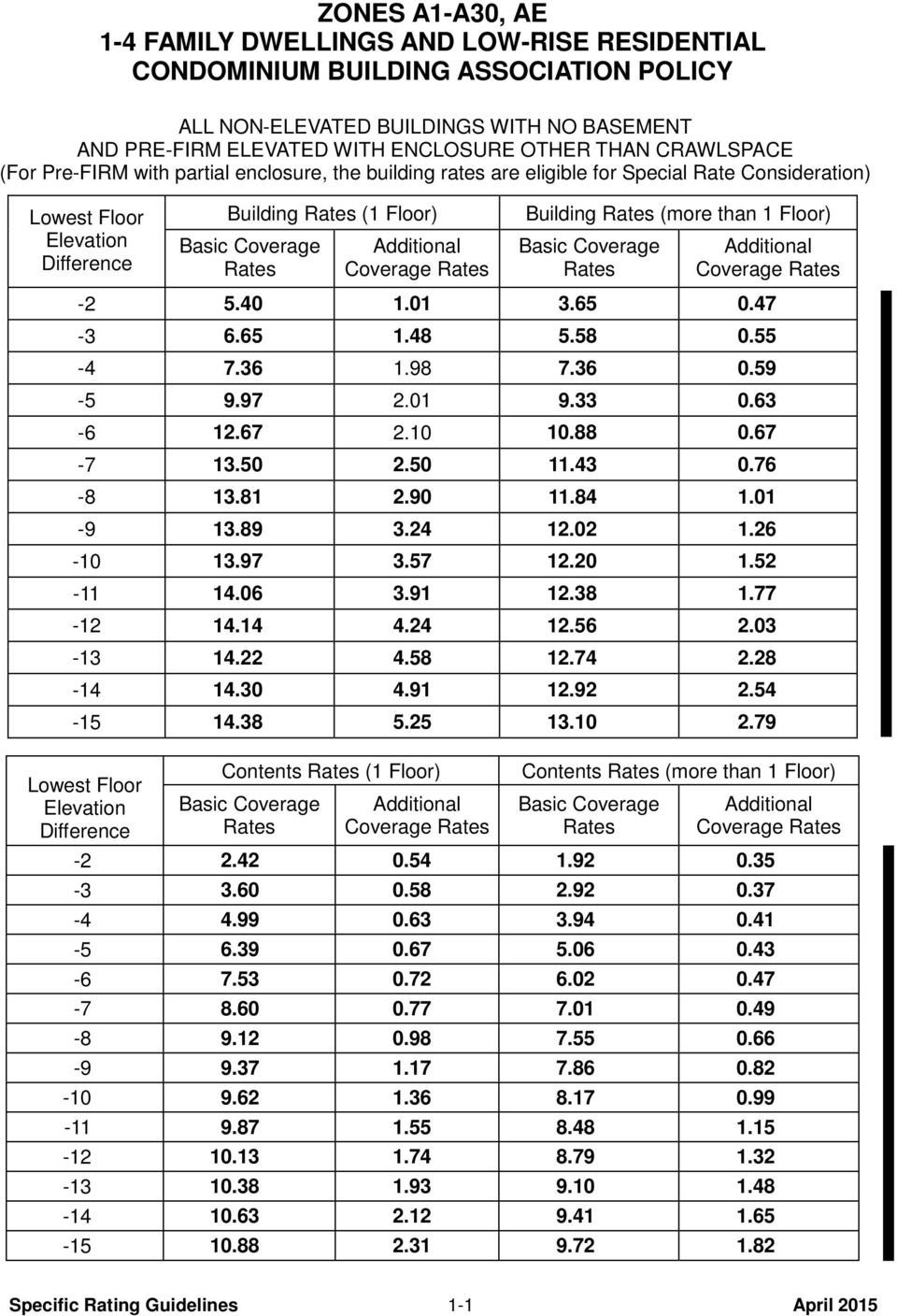
13 ZONES A1-A30, AE 1-4 FAMILY DWELLINGS AND LOW-RISE RESIDENTIAL CONDOMINIUM BUILDING ASSOCIATION POLICY ALL NON-ELEVATED BUILDINGS WITH NO BASEMENT AND PRE-FIRM ELEVATED WITH ENCLOSURE OTHER THAN CRAWLSPACE (For Pre-FIRM with partial enclosure, the building rates are eligible for Special Rate Consideration) Lowest Floor Elevation Difference Building Rates (1 Floor) Basic Coverage Rates Additional Coverage Rates Building Rates (more than 1 Floor) Basic Coverage Rates Additional Coverage Rates Lowest Floor Elevation Difference Contents Rates (1 Floor) Basic Coverage Rates Additional Coverage Rates Contents Rates (more than 1 Floor) Basic Coverage Rates Additional Coverage Rates Specific Rating Guidelines 1-1 April 2015
14 Basement Floor Elevation Difference ZONES A1-A30, AE 1-4 FAMILY DWELLINGS AND LOW-RISE RESIDENTIAL CONDOMINIUM BUILDING ASSOCIATION POLICY WITH BASEMENT (2 or more floors, not split-level) No Machinery In Basement Building With Machinery In Basement Basic Additional Basic Additional Basic Coverage Rates Contents Additional Coverage Rates NOTE: For AE, A1-A30 zone risks, condominium unit owners are eligible to use the elevation of the lowest finished floor for rating if the following conditions are met: o o o The condominium building is currently insured under the RCBAP (copy of the declarations page must be provided); The condominium building is classified as a high-rise building; and The unfinished basement is used only for parking and storage. Specific Rating Guidelines 1-2 April 2015

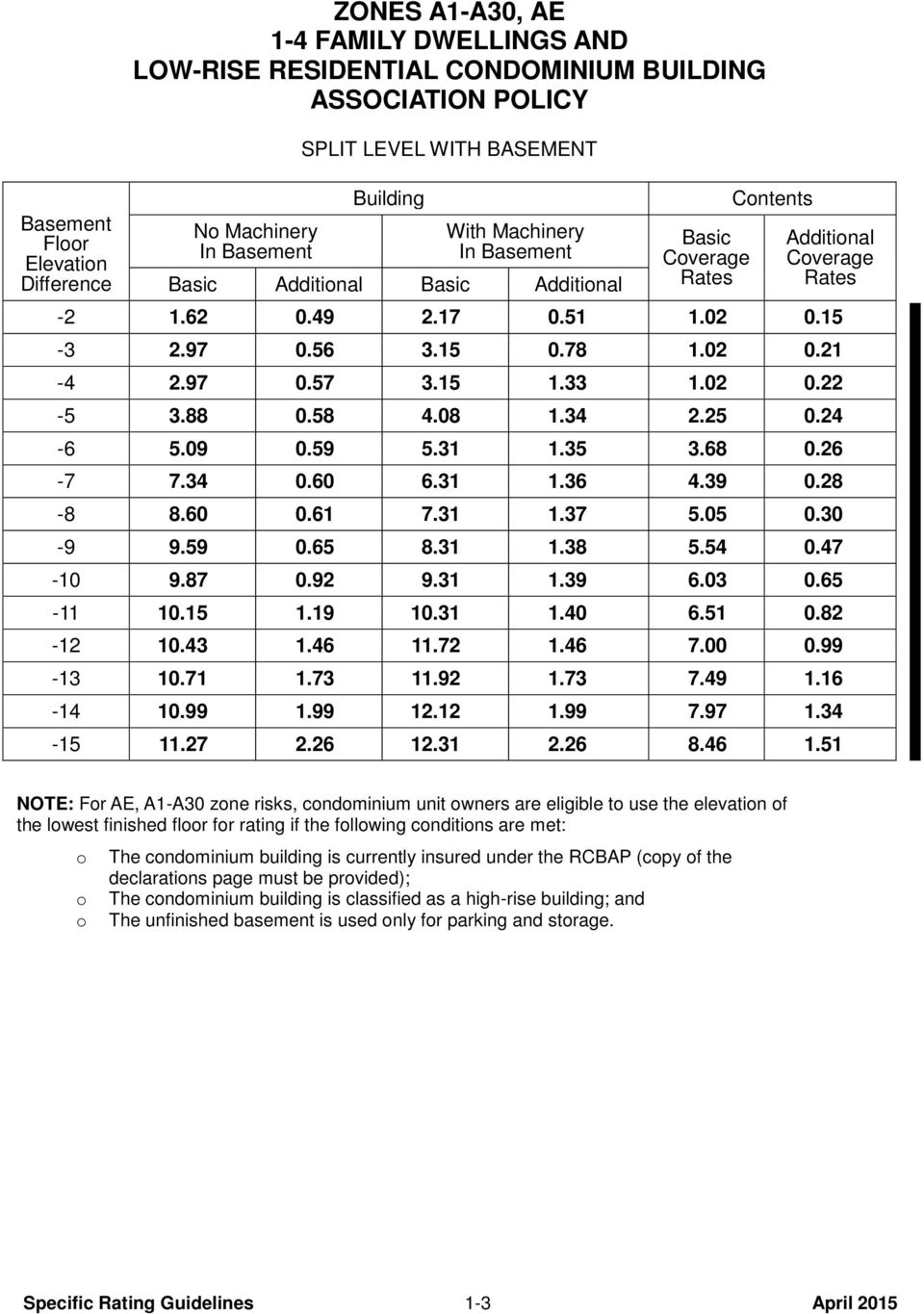
15 Basement Floor Elevation Difference ZONES A1-A30, AE 1-4 FAMILY DWELLINGS AND LOW-RISE RESIDENTIAL CONDOMINIUM BUILDING ASSOCIATION POLICY No Machinery In Basement SPLIT LEVEL WITH BASEMENT Building With Machinery In Basement Basic Additional Basic Additional Basic Coverage Rates Contents Additional Coverage Rates NOTE: For AE, A1-A30 zone risks, condominium unit owners are eligible to use the elevation of the lowest finished floor for rating if the following conditions are met: o The condominium building is currently insured under the RCBAP (copy of the declarations page must be provided); o The condominium building is classified as a high-rise building; and o The unfinished basement is used only for parking and storage. Specific Rating Guidelines 1-3 April 2015
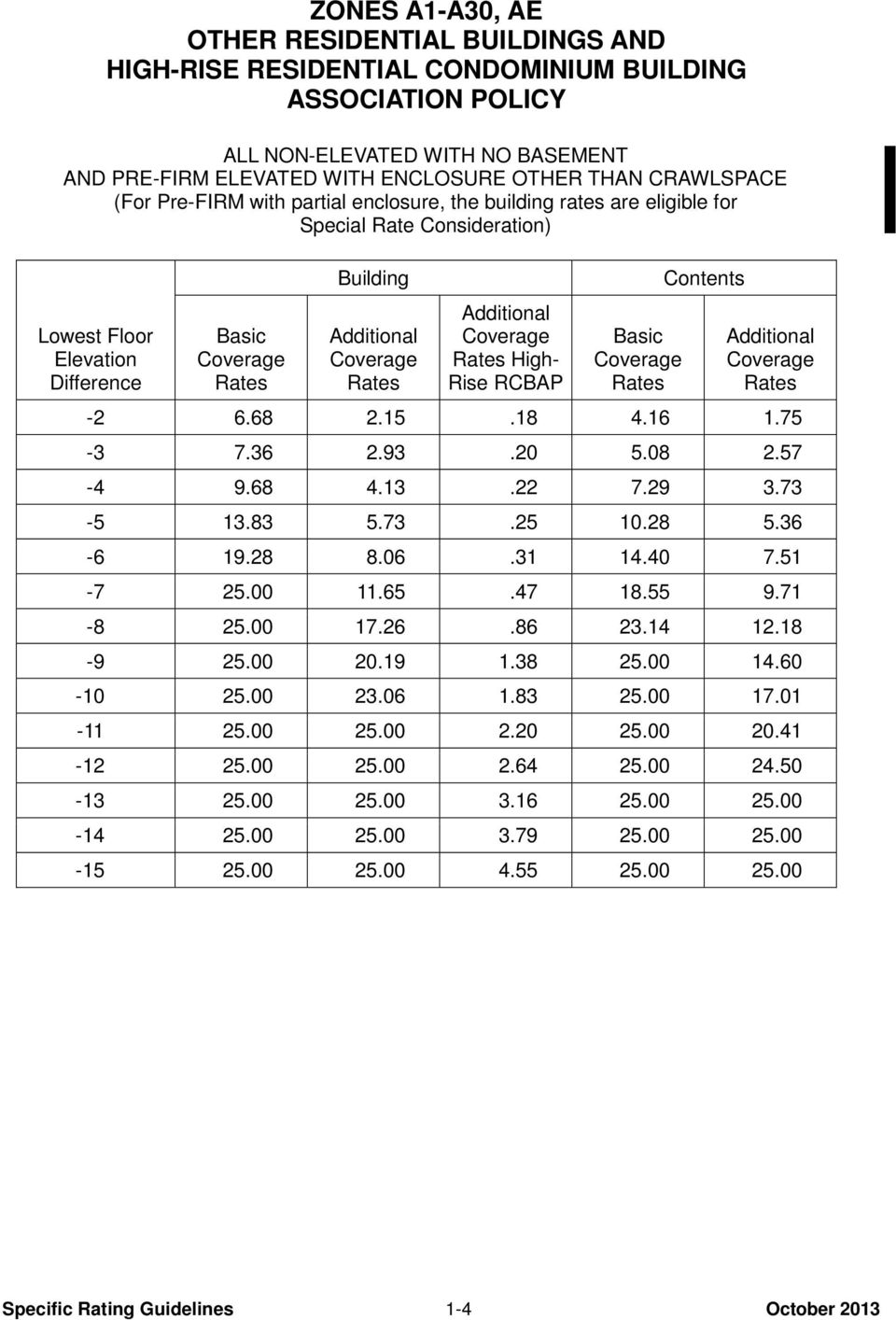
16 ZONES A1-A30, AE OTHER RESIDENTIAL BUILDINGS AND HIGH-RISE RESIDENTIAL CONDOMINIUM BUILDING ASSOCIATION POLICY ALL NON-ELEVATED WITH NO BASEMENT AND PRE-FIRM ELEVATED WITH ENCLOSURE OTHER THAN CRAWLSPACE (For Pre-FIRM with partial enclosure, the building rates are eligible for Special Rate Consideration) Lowest Floor Elevation Difference Basic Coverage Rates Building Additional Coverage Rates Additional Coverage Rates High- Rise RCBAP Basic Coverage Rates Contents Additional Coverage Rates Specific Rating Guidelines 1-4 October 2013
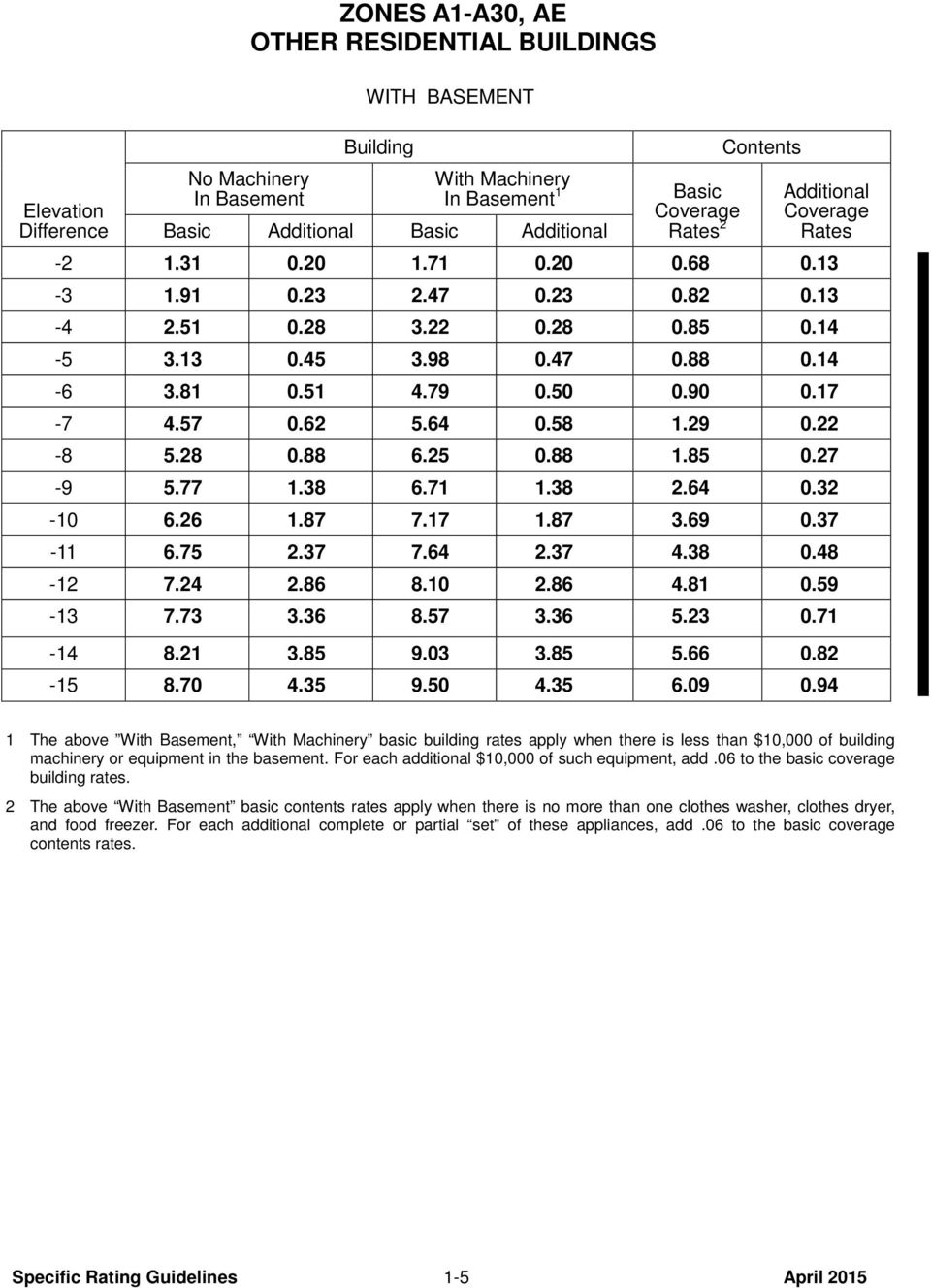
17 Elevation Difference ZONES A1-A30, AE OTHER RESIDENTIAL BUILDINGS No Machinery In Basement WITH BASEMENT Building With Machinery In Basement 1 Basic Additional Basic Additional Basic Coverage Rates 2 Contents Additional Coverage Rates The above With Basement, With Machinery basic building rates apply when there is less than $10,000 of building machinery or equipment in the basement. For each additional $10,000 of such equipment, add.06 to the basic coverage building rates. 2 The above With Basement basic contents rates apply when there is no more than one clothes washer, clothes dryer, and food freezer. For each additional complete or partial set of these appliances, add.06 to the basic coverage contents rates. Specific Rating Guidelines 1-5 April 2015
18 ZONES A1-A30, AE HIGH-RISE RESIDENTIAL CONDOMINIUM BUILDING ASSOCIATION POLICY TWO OR MORE FLOORS WITH BASEMENT, INCLUDING SPLIT LEVEL Building Contents Basement Floor Elevation Difference Basic Coverage Rates No Machinery in Basement With Machinery in Basement 1 Additional Coverage Rates High- Rise RCBAP Basic Coverage Rates 2 Additional Coverage Rates The above With Basement, With Machinery basic building rates apply when there is less than $10,000 of building machinery or equipment in the basement. For each additional $10,000 of such equipment, add.06 to the basic coverage building rates. 2 The above With Basement basic contents rates apply when there is no more than one clothes washer, clothes dryer, and food freezer. For each additional complete or partial set of these appliances, add.06 to the basic coverage contents rates. Specific Rating Guidelines 1-6 April 2015

19 ZONES A1-A30, AE NON-RESIDENTIAL BUILDINGS ALL NON-ELEVATED BUILDINGS WITH NO BASEMENT (INCLUDING SPLIT-LEVEL WITHOUT BASEMENT) AND PRE-FIRM ELEVATED WITH ENCLOSURE OTHER THAN CRAWLSPACE (For Pre-FIRM with partial enclosure, the building rates are eligible for Special Rate Consideration) Elevation Difference Basic Coverage Rates Building (1-floor) Additional Coverage Rates Building (more than 1-floor) Basic Coverage Rates Additional Coverage Rates Elevation Difference Basic Coverage Rates Contents (1-floor) Additional Coverage Rates Contents (more than 1-floor) Basic Coverage Rates Additional Coverage Rates Specific Rating Guidelines 1-7 April 2015

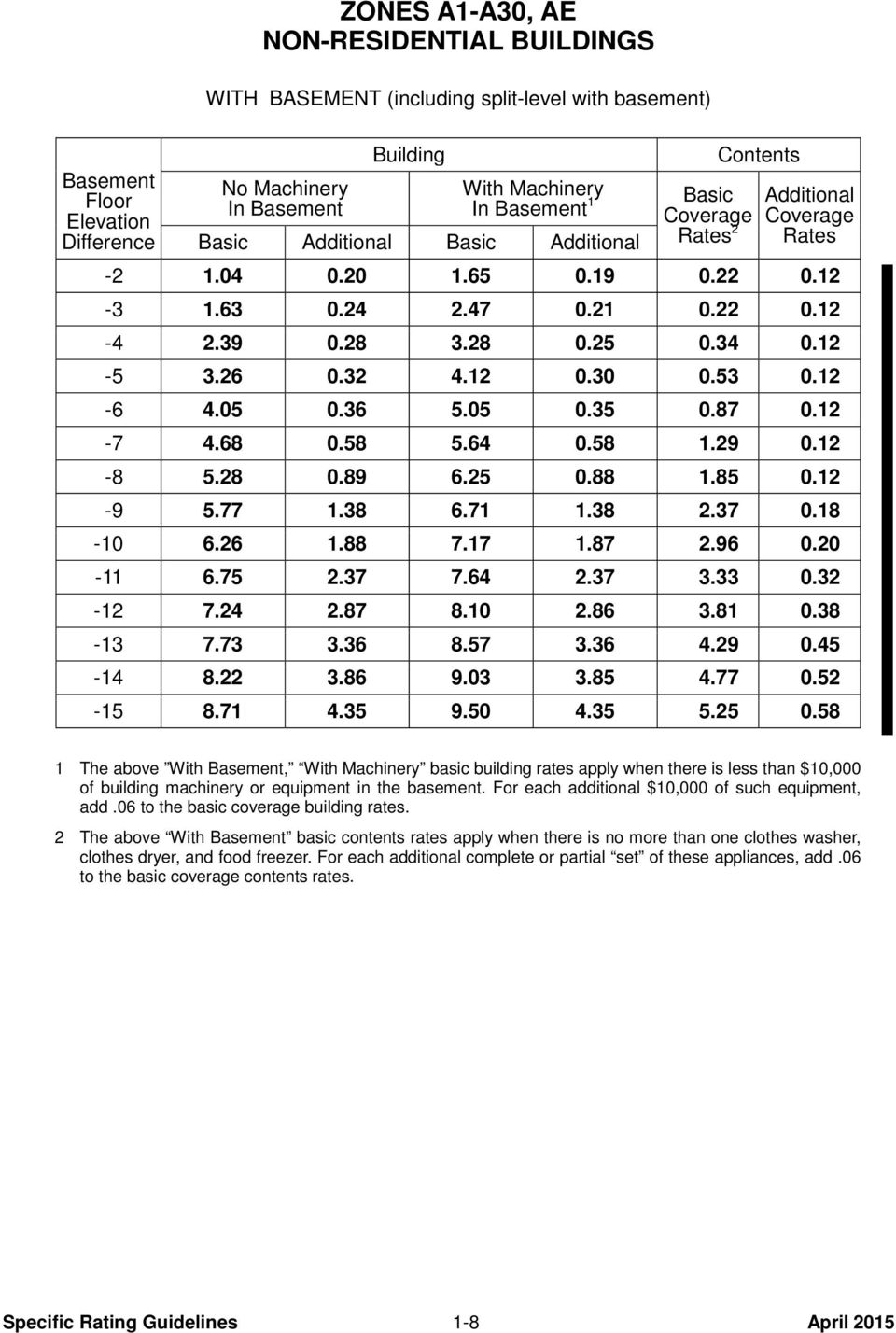
20 Basement Floor Elevation Difference ZONES A1-A30, AE NON-RESIDENTIAL BUILDINGS WITH BASEMENT (including split-level with basement) No Machinery In Basement Building With Machinery In Basement 1 Basic Additional Basic Additional Basic Coverage Rates 2 Contents Additional Coverage Rates The above With Basement, With Machinery basic building rates apply when there is less than $10,000 of building machinery or equipment in the basement. For each additional $10,000 of such equipment, add.06 to the basic coverage building rates. 2 The above With Basement basic contents rates apply when there is no more than one clothes washer, clothes dryer, and food freezer. For each additional complete or partial set of these appliances, add.06 to the basic coverage contents rates. Specific Rating Guidelines 1-8 April 2015
21 ZONES A1-A30, AE NON-RESIDENTIAL BUILDINGS USED FOR AGRICULTURAL PURPOSES (BARNS, SILOS, ETC.) ALL NON-ELEVATED BUILDINGS WITH NO BASEMENT AND PRE-FIRM ELEVATED WITH ENCLOSURE OTHER THAN CRAWLSPACE (Pre-FIRM with partial enclosure is eligible for Special Rate Consideration) Lowest Floor Elevation Difference Basic Coverage Rates Building Additional Coverage Rates For contents rates, use the table on page 1-7 of these guidelines. Specific Rating Guidelines 1-9 October 2013
22 ZONES A1-A30, AE MANUFACTURED (MOBILE) HOMES 1 SINGLE-FAMILY DWELLINGS INCLUDING ELEVATED BUILDINGS WITH ENCLOSURES AND SUBGRADE CRAWLSPACES NO BASEMENT Lowest Floor Elevation Difference 2 Basic Coverage Rates Building Additional Coverage Rates Basic Coverage Rates Contents Additional Coverage Rates Doublewide manufactured (mobile) homes defined as non-movable, permanent buildings, at least 16 wide and with an area within the perimeter walls of at least 600 square feet must be classified as a manufactured (mobile) home and not one of the other building types. 2 Above rates are based on the lowest elevated floor of an elevated building. Specific Rating Guidelines 1-10 April 2015
23 ZONES A1-A30, AE MANUFACTURED (MOBILE) HOMES 1 NON-RESIDENTIAL BUILDINGS INCLUDING ELEVATED BUILDINGS WITH ENCLOSURES AND SUBGRADE CRAWLSPACES NO BASEMENT Building Contents Lowest Floor Elevation Difference 2 Basic Coverage Rates Additional Coverage Rates Basic Coverage Rates Additional Coverage Rates Doublewide manufactured (mobile) homes defined as non-moveable, permanent buildings, at least 16 wide and with an area within the perimeter walls of at least 600 square feet must be classified as a manufactured (mobile) home and not one of the other building types. 2 Above rates are based on the lowest elevated floor of an elevated building. Specific Rating Guidelines 1-11 April 2015
24 PRE- AND POST-FIRM BUILDINGS ZONES AO, AH, AND D ALL OCCUPANCY TYPES AND RESIDENTIAL CONDOMINIUM BUILDING ASSOCIATION POLICY Basement Buildings or Elevated Buildings With Enclosures The risks submitted for specific rating in Zones AO, AH, and D are structures with a basement or an enclosure. This includes a building with a crawlspace (under-floor space) that has its interior floor (finished or not) subgrade, but the distance between the subgrade crawlspace floor and the top of the next higher floor is more than 5 feet. These risks must be rated as follows: NOTE: For AO and AH zone risks, condominium unit owners are eligible to use the elevation of the lowest finished floor for rating if the following conditions are met: The condominium building is currently insured under the RCBAP (copy of the declarations page must be provided); The condominium building is classified as a high-rise building; and The unfinished basement is used only for parking and storage. 1. AO Zone Non-Elevated Buildings With Basement Use the Without Certification of Compliance or Elevation Certificate rates found on Table 3A of the Rating Section and 3B and 4A of the Condominium Section of the NFIP Flood Insurance Manual if the lowest floor 1 is below the base flood depth. Use the following procedures to determine the lowest floor elevation, base flood depth, and the elevation difference: When a base flood depth is shown on the FIRM, use it as the BFE. Use the example below to determine if the lowest floor is below the base flood depth. Example: Base Flood Depth = +3 feet LFE 1 = -5 feet Elevation Difference = -8 feet When no base flood depth is shown on the FIRM, use +2 feet. Use the example below to determine if the lowest floor is below the base flood depth. Example: Base Flood Depth = +2 feet LFE 1 = -8 feet Elevation Difference = -10 feet 2. AO Zone Elevated Buildings With Enclosure Use the With Certification of Compliance rates if the lowest floor 1 (enclosure) is at or above the base flood depth or the Without Certification of Compliance or Elevation Certificate rates found on Table 3A of the Rating Section and 3B and 4A of the Condominium Section of the NFIP Flood Insurance Manual if the lowest floor is below the base flood depth. 1 Difference between the enclosure/basement floor and the highest adjacent grade or natural grade, if available. Specific Rating Guidelines 1-12 October 2013
25 Use the following procedures to determine the lowest floor elevation, base flood depth, and the elevation difference: When a base flood depth is shown on the FIRM, use it as the BFE. Use the example below to determine if the lowest floor is below the base flood depth. Example: Base Flood Depth = +1.0 foot LFE 1 = +0.5 foot Elevation Difference = -0.5 foot (Rounded to 0 ) Use With Certification rates When no base flood depth is shown on the FIRM, use +2 feet. Use the example below to determine if the lowest floor is below the base flood depth. Example: Base Flood Depth = +2 feet LFE 1 = +1 foot Elevation Difference = -1 foot Use Without Certification rates 3. AH Zone Non-Elevated Buildings With Basement or Elevated Buildings With Enclosure Use the With Certification of Compliance rates if the lowest floor (basement/enclosure) is at or above the base flood elevation, or the Without Certification of Compliance or Elevation Certificate rates found on Table 3A of the Rating Section and 3B and 4A of the Condominium Section of the NFIP Flood Insurance Manual if the lowest floor is below the base flood elevation. The BFE shown on the FIRM is used. Use the example below to determine if the lowest floor is above or below the BFE. Example: LFE BFE Elevation Difference = feet = feet = feet Use With Certification rates 1 Difference between the basement/enclosure floor and the highest adjacent grade or natural grade, if available. Specific Rating Guidelines 1-13 October 2013
26 4. D Zone Non-Elevated Buildings With Basements/Subgrade Crawlspaces or Elevated Buildings With Enclosures/Crawlspaces Rate Tables Building Rates Occupancy/ Building Type Single Family 2 4 Family Other- Residential Non- Residential RCBAP With Basement.91 / / / / /.37 With Enclosure.91 / / / / /.26 Elevated on Crawlspace Non-Elevated with Subgrade Crawlspace N/A N/A N/A N/A N/A N/A N/A N/A N/A N/A Contents Rates Occupancy/ Building Type Single Family 2 4 Family Other- Residential Non- Residential RCBAP Basement & Above 1.07 / / / / / 1.11 Enclosure & Above 1.07 / / / / / 1.23 Subgrade Crawlspace & Above Crawlspace & Above N/A N/A N/A N/A N/A N/A N/A N/A N/A N/A Use the Numbered A Zone Non-Elevated or Elevated Building type worksheet with an explanation on the worksheet when submitting the specific rating information to FEMA in accordance with the instructions on pages iv-vii. Specific Rating Guidelines 1-14 October 2014
27 PRE-FIRM AND V1-V30, VE ZONE RATES ALL OCCUPANCY TYPES AND RESIDENTIAL CONDOMINIUM BUILDING ASSOCIATION POLICY NON-ELEVATED OR ELEVATED WITH NON-BREAKAWAY WALL ENCLOSURE This table is to be used to rate all Post-FIRM buildings constructed in V1-V30 zones on or after January 1, 1975 and before October 1, 1981, or for Pre-FIRM buildings in zones V1-V30 including Pre-FIRM elevated buildings with enclosure. If the elevation difference is minus 1 or higher, use the V1-V30, VE rates found on Table 3D of the Rating Section and Tables 3D and 4F of the Condominium Section of the NFIP Flood Insurance Manual. All Post- 81 V zone non-elevated risks, including high-rise and low-rise RCBAP, regardless of the elevation difference, must use page 1-16 of these guidelines. The lowest floor elevation to be used in this case is the elevation of the bottom of the slab, or grade beam if there is one. If this elevation is not available, subtract 1 foot from the top of the bottom floor elevation on 1-4 family dwellings and 1.5 feet from the top of the bottom floor elevation on other residential and non-residential buildings. For RCBAP, building rates, use only the.75 or More column below. Bottom of Slab Elevation Difference 1.75 or More Building Rates Insurance to Replacement Cost Ratio.50 to.74 Under.50 Residential Contents Rates Non-Residential The difference between the elevation of the bottom of the slab (see second paragraph above) and the Base Flood Elevation, including the effects of wave action. If the top of the bottom floor is below grade on all sides, do not follow this procedure. Specific Rating Guidelines 1-15 October 2014
28 1981 V1-V30, VE ZONE RATES ALL OCCUPANCY TYPES AND RESIDENTIAL CONDOMINIUM BUILDING ASSOCIATION POLICY NON-ELEVATED OR ELEVATED WITH NON-BREAKAWAY WALL ENCLOSURE This table is to be used to rate all Post-FIRM buildings constructed on or after October 1, 1981, or Pre-FIRM buildings with a current FIRM effective on or after October 1, 1981, including Pre-FIRM elevated buildings with enclosure (whether breakaway wall or not). Non-elevated risks, including those with basements and subgrade crawlspaces, and elevated buildings with non-breakaway wall enclosures (solid [perimeter] foundation walls or masonry), in V1-V30 and VE zones, including high-rise and low-rise RCBAP, are Submit-for-Rate, regardless of the elevation difference. The lowest floor elevation to be used in this case is the elevation of the bottom of the slab, or grade beam if there is one. If this elevation is not available, subtract 1 foot from the top of the bottom floor elevation on 1 4 family dwellings and 1.5 feet from the top of the bottom floor elevation on other residential and non-residential buildings. For RCBAP building rates, use only the.75 or More column below. Bottom of Slab Elevation Difference 1.75 or More.50 to.74 Under.50 Residential Non-Residential +4 or more Submit to NFIP Bureau Building Rates Insurance to Replacement Cost Ratio Submit to NFIP Bureau Submit to NFIP Bureau Submit to NFIP Bureau Contents Rates Submit to NFIP Bureau 1 The difference between the elevation of the bottom of the slab (see second paragraph above) and the Base Flood Elevation, including the effects of wave action. If the top of the bottom floor is below grade on all sides, do not follow this procedure. Specific Rating Guidelines 1-16 April 2015
29 PRE-FIRM AND POST-FIRM BUILDINGS ZONES A, A1-A30, AE, AH, AO ALL OCCUPANCY TYPES BUILDINGS WITH CRAWLSPACE (ABOVE GRADE OR SUBGRADE) WITH OR WITHOUT PROPER OPENINGS This section is to be used only to rate a crawlspace (under-floor space) whether below grade, or at or above grade when: Its interior floor is no more than 5 feet below the top of the next higher floor (above the crawlspace), and The elevation of the crawlspace floor is below the Base Flood Elevation (BFE). A subgrade crawlspace must be within 2 feet below the elevation of the lowest adjacent grade. For coverage purposes, crawlspaces at or above grade are considered an enclosure below an elevated building. Subgrade crawlspaces are considered basements in non-elevated buildings in floodplain management regulations. However, because the frequency and damage estimates and loss exposure are similar, for rating purposes, the two types of crawlspaces are considered the same in these guidelines. Rates for structures located in Zones AH or AO cannot be higher than the Without Certification of Compliance or Elevation Certificate rates found on Table 3A of the Rating Section or Tables 3B and 4A of the Condominium Section of the NFIP Flood Insurance Manual. For unnumbered A zones, rates cannot be higher than the No Elevation Certificate rates found on Table 3C of the Rating Section and Tables 3B and 4C of the Condominium Section of the NFIP Flood Insurance Manual. NOTE: Special Rate Consideration will be provided to a subgrade crawlspace when the distance between the subgrade crawlspace floor and the top of the next higher floor is greater than 5 feet, or the top of the bottom floor elevation is more than 2 feet below the lowest adjacent grade. If not applying for Special Rate Consideration, a structure with a subgrade crawlspace more than 2 feet below the elevation of the lowest adjacent grade, or that has more than 5 feet between the elevation of the top of the crawlspace floor and the top of the floor over the crawlspace must be rated using the following: For Zones AE and A1-A30, use the with basement rate tables provided on pages 1-1 through 1-7 of these guidelines or the rates found on Table 3B of the Rating Section or Table 3A of the Condominium Section of the NFIP Flood Insurance Manual if the elevation difference is minus 1 foot or higher. For Zones AO and AH, use the information provided on pages 1-11 through 1-12 of these guidelines. For Zone Unnumbered A, use the information provided on pages 3-1 through 3-3 of these guidelines. If the elevation of the crawlspace floor is at or above the Base Flood Elevation (BFE), use the with basement rates provided on Table 3B of the Rating Section of the NFIP Flood Insurance Manual. Specific Rating Guidelines 1-17 October 2013
30 1. ZONES AE, A1-A30 1.A. Building Coverage Rate Calculation Step 1: Starting Rate Obtain the no basement/enclosure rates basic and additional limits for the elevation of the lowest elevated floor (based on the appropriate building type and occupancy) from the rate tables on Table 3B of the Rating Section and Tables 3A and 4B of the Condominium Section of the NFIP Flood Insurance Manual. If the difference between the next higher floor and BFE is minus 2 or lower, obtain the no-basement rate (basic and additional limits), from pages 1-1 to 1-7 of these guidelines. In determining the next higher floor to use for the starting rate for non-elevated buildings with subgrade crawlspaces only, an attached garage floor elevation below the BFE may be excluded as the next higher floor if the garage is unfinished and has no machinery and equipment below the BFE, so long as the building to be insured is rated as a single-family dwelling (including an individual condominium unit within a multi-unit residential building that qualifies as a single building and is insured under the Dwelling form, or a single-family detached condominium building insured under the RCBAP). If the attached garage has machinery or equipment below the BFE, the floor of the attached garage can be excluded as the next higher floor in determining the starting rate if all of the following conditions exist: The building is described and rated as a single-family dwelling; The building is a non-elevated building with a subgrade crawlspace; The garage floor elevation is below the elevation of the top of the floor over the subgrade crawlspace; and The garage has proper openings. Step 2: Loading a. Crawlspace/Subgrade Crawlspace Loading (Without Proper Openings) To the basic limits starting rate obtained in Step 1, add a loading calculated from the table below. No loading is added to the additional limits rate. Crawlspace At or Above Grade or Below Grade (LAG) Within 2 feet Crawlspace Area in Square Feet Under 1,200 1,200 2,400 Over 2, b. Subgrade Crawlspace Loading (With Proper Openings) Use the enclosure loading provided below only if a subgrade crawlspace below the BFE has proper openings that equalize hydrostatic pressures by allowing for the automatic entry and exit of floodwaters. The bottom of each flood vent opening can be no more than 1 foot above the lowest adjacent exterior grade. To the basic limits starting rate obtained in Step 1, add a loading calculated from the table below. No loading is added to the additional limits rate. Specific Rating Guidelines 1-18 June 2014
31 Crawlspace Below Grade (LAG) Within 2 feet Crawlspace Area in Square Feet Under 1,200 1,200 2,400 Over 2, Step 3: Crawlspace/Subgrade Crawlspace Machinery and Equipment Loadings To the total rate obtained after Step 2, add a loading calculated from the table below if there is building machinery and equipment below BFE. All Occupancies Elevation of Machinery Below BFE Loading Factor For other residential and non-residential buildings, use the above loadings for the first $10,000 of building machinery and equipment beneath the elevated floor of the building. For each additional $10,000 or portion thereof of machinery and equipment, add.06 to the loading obtained above. 1.B. Contents Coverage Rate Calculation Obtain the "no basement/enclosure" rates basic and additional limits based on the elevation difference between the top of the next higher floor and BFE (using the appropriate contents location and occupancy) from the rate tables on Table 3B of the Rating Section, or on Tables 3A and 4B of the Condominium Section of the NFIP Flood Insurance Manual. If the difference between the next higher floor and BFE is minus 2 or lower, obtain the rate (basic and additional limits) from pages 1-1 to 1-7 of these guidelines. 2. UNNUMBERED A ZONE WITH NO BFE 2.A. Building Coverage Rate Calculation In Zone A where there is no BFE, the difference between the top of the bottom floor (crawlspace), and the highest adjacent grade (HAG) or natural grade, if available, is the lowest floor elevation used for rating. In order to develop a rate, the following elevations must be established: The difference between the crawlspace floor and the LAG, and The difference between the top of the next higher floor (finished floor) and the HAG. Specific Rating Guidelines 1-19 October 2013
32 Step 1: Starting Rate Obtain the no basement/enclosure rates basic and additional limits based on the elevation difference between the top of the next higher floor and HAG (using the appropriate occupancy) from the rate tables on Table 3C of the Rating Section or on Tables 3B and 4C of the Condominium Section of the NFIP Flood Insurance Manual. If the top of the next higher floor is equal to or below the HAG, obtain the rate (basic and additional limits) from page 3-1 or 3-2 of these guidelines. Step 2: Add Loading a. Crawlspace/Subgrade Crawlspace Loading (Without Proper Openings) To the basic limits starting rate obtained in Step 1, add a loading calculated from the table below. No loading is added to the additional limits rate. Crawlspace At or Above Grade or Below Grade (LAG) Within 2 feet Crawlspace Area in Square Feet Under 1,200 1,200 2,400 Over 2, b. Subgrade Crawlspace Loading (With Proper Openings) Use the enclosure loading provided below only if the subgrade crawlspace has proper openings. The bottom of each flood vent opening can be no more than 1 foot above the lowest adjacent exterior grade. To the basic limits starting rate obtained in Step 1, add a loading calculated from the table below. No loading is added to the additional limits rate. Crawlspace Below Grade (LAG) Within 2 feet Crawlspace Area in Square Feet Under 1,200 1,200 2,400 Over 2, Step 3: Crawlspace/Subgrade Crawlspace Machinery and Equipment Loadings To the total rate obtained after Step 2, add a loading calculated from the table below if there is building machinery and equipment below the HAG. All Occupancies Elevation of Machinery Below HAG Loading Factor or lower.08 For other residential and non-residential buildings, use the above loadings for the first $10,000 of building machinery and equipment beneath the elevated floor of the building. For each additional $10,000 or portion thereof of machinery and equipment, add.06 to the loading obtained above. Specific Rating Guidelines 1-20 October 2013
33 2.B. Contents Coverage Rate Calculation Obtain the "no basement/enclosure" rates basic and additional limits based on the elevation difference between the top of the next higher floor and HAG (using the appropriate occupancy) from the rate tables on Table 3C of the Rating Section or on Tables 3B and 4C of the Condominium Section of the NFIP Flood Insurance Manual. 3. UNNUMBERED A ZONE WITH BFE 3.A. Building Coverage Rate Calculation In Zone A where there is a BFE, the difference between the top of the bottom floor (subgrade crawlspace) and the BFE must be determined. In order to develop a rate, the following elevation must be established: The elevation difference between the crawlspace floor and the BFE, and The elevation difference between the top of the next higher floor (finished floor) and the BFE. In determining the next higher floor to use for the starting rate for non-elevated buildings with subgrade crawlspaces only, an attached garage floor elevation below the BFE may be excluded as the next higher floor if the garage is unfinished and has no machinery and equipment below the BFE, so long as the building to be insured is rated as a single-family dwelling (including an individual condominium unit within a multi-unit residential building that qualifies as a single building and that is insured under the Dwelling form, or a single-family detached condominium building insured under the RCBAP). If the attached garage has machinery or equipment below the BFE, the floor of the attached garage can be excluded as the next higher floor in determining the starting rate if all of the following conditions exist: The building is described and rated as a single-family dwelling; The building is a non-elevated building with a subgrade crawlspace; The garage floor elevation is below the elevation of the top of the floor over the subgrade crawlspace; and The garage has proper openings. Step 1: Starting Rate Obtain the no basement/enclosure rates basic and additional limits based on the elevation difference between the top of the next higher floor and BFE (using the appropriate occupancy) from the rate tables on Table 3C of the Rating Section or on Tables 3B and 4C of the Condominium Section of the NFIP Flood Insurance Manual. If the difference between the next higher floor and BFE is minus 2 or lower, use the rates provided on page 3-1 or 3-2 of these guidelines. Step 2: Add Loading a. Crawlspace/Subgrade Crawlspace Loading (Without Proper Openings) To the basic limits starting rate obtained in Step 1, add a loading calculated from the table below. No loading is added to the additional limits rate. Specific Rating Guidelines 1-21 June 2014
34 Crawlspace At or Above Grade or Below Grade (LAG) Within 2 feet Crawlspace Area in Square Feet Under 1,200 1,200 2,400 Over 2, b. Subgrade Crawlspace Loading (With Proper Openings) To the basic limits starting rate obtained in Step 1, add a loading calculated from the table below. No loading is added to the additional limits rate. Crawlspace Below Grade (LAG) Within 2 feet Crawlspace Area in Square Feet Under 1,200 1,200 2,400 Over 2, Step 3: Crawlspace/Subgrade Crawlspace Machinery and Equipment Loadings To the total rate obtained after Step 2, add a loading calculated from the table below if there is building machinery and equipment below BFE. All Occupancies Elevation of Machinery Below BFE Loading Factor For other residential and non-residential buildings, use the above loadings for the first $10,000 of building machinery and equipment beneath the elevated floor of the building. For each additional $10,000 or portion thereof of machinery and equipment, add.06 to the loading obtained above. 3.B. Unnumbered A Zone With BFE Contents Coverage Rate Calculation Obtain the "no basement/enclosure" rates basic and additional limits based on the elevation difference between the top of the next higher floor and BFE (using the appropriate occupancy) from the rate tables on Table 3C of the Rating Section or on Tables 3B and 4C of the Condominium Section of the NFIP Flood Insurance Manual. If the difference between the next higher floor and BFE is minus 2 or lower, obtain the rate (basic and additional limits) from page 3-1 of these guidelines. Specific Rating Guidelines 1-22 October 2013
35 4. AH ZONE 4.A. Building Coverage Rate Calculation In Zone AH, the difference between the top of the bottom floor (crawlspace) and the BFE must be determined. Use the With Certification of Compliance rates if the lowest floor (crawlspace) is at or above the BFE. In order to develop a rate, the following elevation must be established: The elevation difference between the crawlspace floor and the BFE, and The elevation difference between the top of the next higher floor (finished floor) and the BFE. Step 1: Starting Rate Obtain the no basement/enclosure rates basic and additional limits based on the elevation difference between the top of the next higher floor and BFE (using the appropriate occupancy) from the rate tables on Table 3A of the Rating Section or on Tables 3B and 4A of the Condominium Section of the NFIP Flood Insurance Manual. Use the With Certification of Compliance rates if the elevation of the next higher floor (finished floor) is at or above the BFE. Use the Without Certification of Compliance or Elevation Certificate rates if the elevation of the next higher floor (finished floor) is below the BFE. When the Without Certification rates are used, there is no need to add any loadings since this is the highest rate that can be charged. In determining the next higher floor to use for the starting rate for non-elevated buildings with subgrade crawlspaces only, an attached garage floor elevation below the BFE may be excluded as the next higher floor if the garage is unfinished and has no machinery and equipment below the BFE, so long as the building to be insured is rated as a single-family dwelling (including an individual condominium unit within a multi-unit residential building that qualifies as a single building and is insured under the Dwelling form, or a single-family detached condominium building insured under the RCBAP). If the attached garage has machinery or equipment below the BFE, the floor of the attached garage can be excluded as the next higher floor in determining the starting rate if all of the following conditions exist: The building is described and rated as a single-family dwelling; The building is a non-elevated building with a subgrade crawlspace; The garage floor elevation is below the elevation of the top of the floor over the subgrade crawlspace; and The garage has proper openings. Step 2: Add Loading a. Crawlspace/Subgrade Crawlspace Loading (Without Proper Openings) To the basic limits starting rate obtained in Step 1, add a loading calculated from the table below. No loading is added to the additional limits rate. Crawlspace At or Above Grade or Below Grade (LAG) Within 2 feet Crawlspace Area in Square Feet Under 1,200 1,200 2,400 Over 2, Specific Rating Guidelines 1-23 June 2014
36 b. Subgrade Crawlspace Loading (With Proper Openings) To the basic limits starting rate obtained in Step 1, add a loading calculated from the table below. No loading is added to the additional limits rate. Crawlspace Below Grade (LAG) Within 2 feet Crawlspace Area in Square Feet Under 1,200 1,200 2,400 Over 2, Step 3: Crawlspace/Subgrade Crawlspace Machinery and Equipment Loadings To the total rate obtained after Step 2, add a loading calculated from the table below if there is building machinery and equipment below BFE. Elevation of Machinery Below BFE All Occupancies Loading Factor For other residential and non-residential buildings, use the above loadings for the first $10,000 of building machinery and equipment beneath the elevated floor of the building. For each additional $10,000 or portion thereof of machinery and equipment, add.06 to the loading obtained above. 4.B. AH Zone Contents Coverage Rate Calculation Obtain the "With Certificate of Compliance rates basic and additional limits from the rate tables on Table 3A of the Rating Section or on Tables 3B and 4A of the Condominium Section of the NFIP Flood Insurance Manual. Use the Without Certification of Compliance or Elevation Certificate rates if the elevation of the next higher floor (finished floor) is below the BFE. 5. AO ZONE 5.A. Building Coverage Rate Calculation In Zone AO, the difference between the top of the bottom floor (subgrade crawlspace) and the highest adjacent grade (HAG) or natural grade, if available, is the lowest floor elevation used for rating. Use the following procedures to determine the base flood depth, lowest floor elevation, and the elevation difference: Use the base flood depth (BFD) shown on the FIRM. Use the example below to determine if the lowest floor is below the base flood depth. Specific Rating Guidelines 1-24 October 2013
37 Example: Base Flood Depth = +3 feet LFE 1 = -1 foot Elevation Difference = -4 feet When no base flood depth is shown on the FIRM, use +2 feet. Use the example below to determine if the lowest floor is below the base flood depth. Example: Base Flood Depth = +2 feet LFE 1 = -2 feet Elevation Difference = -4 feet Step 1: Starting Rate Use the With Certification of Compliance rates if the top of the next higher floor (lowest elevated floor) is at or above the base flood depth (using the appropriate occupancy) from the rate tables on Table 3A of the Rating Section or on Tables 3B and 4A of the Condominium Section of the NFIP Flood Insurance Manual. Use the Without Certification of Compliance or Elevation Certificate rates if the top of the next higher floor (lowest elevated floor) is below the base flood depth. No loading should be added to the Without Certification rate since this is the highest rate that can be charged. In determining the next higher floor to use for the starting rate for non-elevated buildings with subgrade crawlspaces only, an attached garage floor elevation below the BFD may be excluded as the next higher floor if the garage is unfinished and has no machinery and equipment below the BFD, so long as the building to be insured is rated as a single-family dwelling (including a condominium unit within a multi-unit residential building that qualifies as a single building). If the attached garage has machinery or equipment below the BFD, the floor of the attached garage can be excluded as the next higher floor in determining the starting rate if all of the following conditions exist: The building is described and rated as a single-family dwelling; The building is a non-elevated building with a subgrade crawlspace; The garage floor elevation is below the elevation of the top of the floor over the subgrade crawlspace; and The garage has proper openings. Step 2: Add Loading a. Crawlspace/Subgrade Crawlspace Loading (Without Proper Openings) To the basic limits starting rate obtained in Step 1, add a loading calculated from the table below. No loading is added to the additional limits rate. Crawlspace At or Above Grade or Below Grade (LAG) Within 2 feet Crawlspace Area in Square Feet Under 1,200 1,200 2,400 Over 2, Difference between the basement/subgrade crawlspace floor and the highest adjacent grade or natural grade, if available. Specific Rating Guidelines 1-25 October 2013
38 b. Subgrade Crawlspace Loading (With Proper Openings) Use the enclosure loading provided below only if the subgrade crawlspace has proper openings. The bottom of each flood vent opening can be no more than 1 foot above the lowest adjacent exterior grade. To the basic limits starting rate obtained in Step 1, add a loading calculated from the table below. No loading is added to the additional limits rate. Crawlspace Below Grade (LAG) Within 2 feet Crawlspace Area in Square Feet Under 1,200 1,200 2,400 Over 2, Step 3: Crawlspace/Subgrade Crawlspace Machinery and Equipment Loadings To the total rate obtained after Step 2, add a loading calculated from the table below if there is building machinery and equipment below the HAG. Elevation of Machinery Below HAG All Occupancies Loading Factor or lower.08 For other residential and non-residential buildings, use the above loadings for the first $10,000 of building machinery and equipment beneath the elevated floor of the building. For each additional $10,000 or portion thereof of machinery and equipment, add.06 to the loading obtained above. 5.B. AO Zone Contents Coverage Rate Calculation Obtain the "With Certificate of Compliance rates basic and additional limits from the rate tables on Table 3A of the Rating Section or on Tables 3B and 4A of the Condominium Section of the NFIP Flood Insurance Manual. Use the Without Certification of Compliance or Elevation Certificate rates if the elevation of the next higher floor (finished floor) is below the BFD. Specific Rating Guidelines 1-26 October 2013
39 SECTION 2 POST-FIRM ELEVATED BUILDINGS (Do not use for Pre-FIRM buildings unless otherwise noted)
40 This page is intentionally left blank.
41 ELEVATED BUILDING RATING It may appear to the insured to be more advantageous for the building to be rated as elevated, because the policy will be less expensive. However, at the time of a loss, there are coverage limitations outlined in the policy below the lowest elevated floor of a Post- FIRM elevated building. Consequently, it is extremely important to establish whether the building is or is not elevated at the time the quote is offered. We have developed two Elevated Building Determination forms (included in this section), which must be signed by the applicant for every quote on a specifically rated elevated building and submitted with the worksheet. These forms highlight the coverage limitations below elevated floors and are to be kept as a permanent part of the company's policy file, and, if the policy is assigned, the new owner must sign a form as part of the assignment procedure. When the instructions refer to the NFIP Flood Insurance Manual to obtain a starting rate, be sure to select the appropriate rate based on building occupancy and building type. Because Pre-FIRM buildings are not subject to the same coverage limitations below an elevated floor as Post-FIRM buildings, the rates found in this section of these guidelines cannot be used to determine the premium for Pre-FIRM buildings. The NFIP Bureau and Statistical Agent or FEMA's Risk Insurance Division may be contacted for assistance with difficult cases. Specific Rating Guidelines 2-1 October 2013
42 ZONES A1-A30, AE ALL OCCUPANCY TYPES AND RESIDENTIAL CONDOMINIUM BUILDING ASSOCIATION POLICY BUILDING COVERAGE RATE CALCULATION Step 1: Starting Rate Obtain the "no basement/enclosure" rates basic and additional limits for the elevation of the lowest elevated floor (based on the appropriate building type and occupancy) from the rate tables on Table 3B of the Rating Section and Tables 3A and 4B of the Condominium Section of the NFIP Flood Insurance Manual. If the lowest elevated floor is below -1, obtain the starting rate from pages 1-1 to 1-7 of these guidelines. For high-rise condominium policies, enclosure and equipment loadings are to be applied to the Residential Condominium Building Association Policy (RCBAP) only, not to the unit policies. Step 2: Enclosure Loading To the basic limits starting rate obtained in Step 1, add a loading calculated from the table below, based on the number of feet the enclosure floor level is below the BFE, or if the elevated floor is below the BFE, the number of feet the enclosure floor level is below the elevated floor. Outside of V Zones, it is not necessary to include a loading for an unfinished enclosed area, which does not impede the movement of floodwaters. These enclosures would be constructed with such features as permanent openings (vents, louvers, missing bricks, or blocks) or discontinuous walls. In addition, an area below the lowest elevated floor that is not closed in on all sides is excluded for rating, and the building should be described as elevated without enclosure. Elevation Difference Under Enclosed Area in Square Feet ,000 Over 10, Specific Rating Guidelines 2-2 October 2013
43 Step 3: Machinery and Equipment Loadings To the total rate obtained after Step 2, add a loading calculated from the table below if there is building machinery or equipment beneath the elevated floor of the building. Elevation of Machinery Loading Below the BFE 1 4 Family Dwellings Loading Factors For other residential and non-residential buildings, use the above loadings for the first $10,000 of building machinery and equipment beneath the elevated floor of the building. For each additional $10,000 or portion thereof of machinery and equipment, add.06 to the loading obtained above. Step 4: Elevator(s) Loading For each elevator that is below the BFE, add a $0.25 loading, regardless of the elevation difference. Do not apply a loading to low-rise condominiums. FINAL BUILDING RATES The final basic limits rate is the rate obtained by adding Steps 1, 2, 3, and 4. The additional limits rate is the additional limits rate obtained in Step 1, used without modification. Specific Rating Guidelines 2-3 October 2013
44 CONTENTS COVERAGE RATE CALCULATION Step 1: Starting Rate Obtain the "no basement/enclosure" rates basic and additional limits for the elevation of the lowest elevated floor (based on the appropriate contents location and occupancy) from the rate tables on Table 3B of the Rating Section and Tables 3A and 4B of the Condominium Section of the NFIP Flood Insurance Manual. If the lowest elevated floor is below -1, obtain the starting rate from pages 1-1 to 1-7 of these guidelines. Step 2: Appliance Loading To the basic limits starting rate obtained in Step 1, add a loading calculated from the table below if the enclosed area below the lowest elevated floor contains a clothes washer, clothes dryer, or food freezer. Elevation of Appliance Loading Below the BFE Loading Factors Single Family The above loading factors apply when there is no more than one clothes washer, clothes dryer, and food freezer. For other occupancy types where there may be more than one "set" of these appliances in the enclosed area, add the loading charge per "set" (partial or complete). FINAL CONTENTS RATES The final basic limits rate is the rate obtained by adding Steps 1 and 2. The additional limits rate is the additional limits rate obtained in Step 1, used without modification. Specific Rating Guidelines 2-4 October 2013
45 1981 POST-FIRM V1-V30, VE ZONE RATES ALL OCCUPANCY TYPES AND RESIDENTIAL CONDOMINIUM BUILDING ASSOCIATION POLICY ELEVATED BUILDINGS WITH NO ENCLOSURES/OBSTRUCTIONS The table below is to be used for rating elevated building Post 81 V-Zone risks with no enclosures, obstructions, or machinery and equipment below the lowest horizontal member. This table is an extension of the rate tables found on Table 3E of the rating Section and Table 5A of the Condominium Section of the NFIP Flood Insurance Manual. For RCBAP building rates, use only the.75 or More column below. If the current FIRM became effective on or after October 1, 1981, Pre-FIRM elevated buildings without enclosure must use these rates. No Enclosures/Obstructions Bottom of Floor Beam Elevation Difference 1 Building Rates Insurance to Replacement Cost Ratio Contents Rates.75 or More.50 to.74 Under.50 Residential Non-Residential The difference between the elevation of the bottom of the floor beam of the lowest elevated floor and the Base Flood Elevation, including the effects of wave action. Specific Rating Guidelines 2-5 April 2015
46 ZONES V1-V30, VE ALL OCCUPANCY TYPES AND RESIDENTIAL CONDOMINIUM BUILDING ASSOCIATION POLICY ELEVATED BUILDINGS WITH ENCLOSURES/OBSTRUCTIONS For all Post-FIRM V1-V30, VE Zone risks, use the guidelines provided below if the breakaway walls enclosure is below the BFE, the enclosure has an area of 300 square feet or more, or the enclosure has an area of less than 300 square feet with machinery and equipment servicing the building that is below the BFE. Buildings elevated on solid (perimeter) foundation walls must be rated using the nonelevated rate tables. Use page 1-15 for when the elevation difference is 2 or lower and page 1-16 when Post- 81. As an option, Post-FIRM V-Zone elevated building risks may use the Post- 81 V-Zone rate table if the rates are more favorable to the insured. The criteria listed under Post- 81 V-Zone Optional Rating, page RATE 23 of the NFIP Flood Insurance Manual, must be met to qualify. BUILDING COVERAGE RATE CALCULATION Step 1: Starting Rate Post-FIRM V Zone For Post-FIRM V1-V30, VE Zone risks, obtain the no basement/enclosure rates basic and additional limits for the elevation of the lowest elevated floor (based on the appropriate building occupancy and building type) from Table 3D of the Rating Section and Tables 3D and 4F of the Condominium Section of the NFIP Flood Insurance Manual. If the lowest elevated floor is minus 2 or more below the BFE, the base rate for both basic and additional limits is obtained from page 1-15 of these guidelines. For 1981 Post-FIRM V1-V30, VE Zone risks, obtain the "With Obstruction" rates basic and additional limits for the elevation of the lowest elevated floor (bottom of the beam) from the rate tables on Table 3F of the Rating Section and Table 5B of the Condominium Section of the NFIP Flood Insurance Manual. If the lowest elevated floor is below minus 3, obtain the starting rate from page 2-5 of these guidelines. For RCBAP building rates, use only the.75 or More column; otherwise, select the rate appropriate for the insurance-to-replacementcost ratio. For high-rise condominium policies, enclosure and equipment loading are to be applied to the RCBAP only, not to unit policies. For RCBAP townhouse/rowhouse V-Zone risks only, there is no enclosure loading if no individual unit enclosure is more than 299 square feet. For unit-owners in high-rise condominiums, use the lowest horizontal member of the lowest elevated floor for rating. If the lowest floor elevation for rating is minus 3 or higher, obtain the Without Obstruction rates basic and additional for the elevation of the lowest elevated floor from Table 3E of the Rating Section of the NFIP Flood Insurance Manual. If the enclosure is at or above the BFE, use the free of obstruction rate table. The elevation of the bottom enclosure floor is the lowest floor for rating (LFE). Specific Rating Guidelines 2-6 October 2013
47 Step 2: Enclosure Loading To the basic limits starting rate obtained in Step 1, add a loading calculated from the table below, based on the number of feet that the bottom of the enclosure floor level is below the BFE, or if the elevated floor is below the BFE, the number of feet the enclosure floor level is below the elevated floor. Enclosed Area in Square Feet Elevation Difference Under ,000 Over 10,000-1 Included in Starting Rate Specific Rating Guidelines 2-7 October 2013
48 Step 3: Machinery and Equipment Loadings To the total rate obtained after Step 2, add a loading calculated from the table below if there is building machinery or equipment beneath the elevated floor of the building, even if the enclosure is less than 300 square feet. 1 4 Family Dwellings Elevation of Machinery Loading Below the BFE Loading Factors For other residential and non-residential buildings, use the above loadings for the first $10,000 of building machinery and equipment beneath the elevated floor of the building. For each additional $10,000 or portion thereof of machinery and equipment, add.06 to the loading obtained above. Step 4: Elevator(s) Loading For each elevator that is below the BFE, add a $0.50 loading, regardless of the elevation difference. Do not apply loading to low-rise condominiums. FINAL BUILDING RATES The final basic limits rate is the rate obtained by adding Steps 1, 2, 3, and 4. The additional limits rate is the additional limits rate obtained in Step 1, used without modification. CONTENTS COVERAGE RATE CALCULATION Step 1: Starting Rate For Post-FIRM V1-V30, VE Zone risks, obtain the no basement/enclosure rates basic and additional limits for the elevation of the lowest elevated floor (based on the appropriate building occupancy and building type) from Table 3D of the Rating Section and Tables 3D and 4F of the Condominium Section of the NFIP Specific Rating Guidelines 2-8 October 2013
49 Flood Insurance Manual. If the lowest elevated floor is below -1, obtain the base rate for both basic and additional limits from page 1-15 of these guidelines. For 1981 Post-FIRM V1-V30, VE Zone risks, obtain the "With Obstruction" rates basic and additional limits for the elevation of the lowest elevated floor (bottom of the beam) from Table 3F of the Rating Section and Table 5B of the Condominium Section of the NFIP Flood Insurance Manual. If the lowest elevated floor is below - 3, obtain the base rate for both basic and additional limits from page 2-5 of these guidelines. Step 2: Appliance Loading To the basic limits starting rate obtained in Step 1, add a loading calculated from the table below if the enclosed area below the lowest elevated floor contains a clothes washer, clothes dryer, or food freezer. Lowest Floor Elevation Difference Loading Factors - Single Family The above loading factors apply when there is no more than one clothes washer, clothes dryer, and food freezer. For other occupancy types where there may be more than one "set" of these appliances in the enclosed area, add the loading charge per "set" (partial or complete). FINAL CONTENTS RATES The final basic limits rate is the rate obtained by adding Steps 1 and 2. The additional limits rate is the additional limits rate obtained in Step 1, used without modification Specific Rating Guidelines 2-9 October 2013
50 This page is intentionally left blank.
51 SECTION 3 UNNUMBERED A ZONE (Pre-FIRM and Post-FIRM)
52 This page is intentionally left blank.
53 UNNUMBERED A ZONE ALL OCCUPANCY TYPES AND RESIDENTIAL CONDOMINIUM BUILDING ASSOCIATION POLICY 1. Non-Elevated Buildings No-Basement/No Enclosure Buildings No-basement/no-enclosure risks are generally rated by insurance agents from Table 3C of the Rating Section and Tables 3B and 4C of the Condominium Section of the NFIP Flood Insurance Manual. For rates at elevations lower than those shown in the manual, use the applicable table below. Standard Policies (excluding RCBAPs) Unnumbered A Zone Without Basement/Enclosure Building Rates Type of Elevation Certification No BFE Provided With BFE Provided Elevation Difference to Nearest Foot 1-4 Family Residential Building Rates Other Residential & Non- Residential Building Rates Basic Additional Basic Additional or lower or lower Contents Rates Type of Elevation Certification No BFE Provided With BFE Provided Elevation Difference to Nearest Foot Residential Contents Rates Non-Residential Contents Rates Basic Additional Basic Additional or lower or lower Specific Rating Guidelines 3-1 October 2013
54 RCBAP High-Rise Condominium Rates Unnumbered A Zone Without Basement/Enclosure Type of Elevation Certification No BFE Provided With BFE Provided High-Rise Building Rates Elevation Difference to Nearest Foot Basic Additional or lower or lower Type of Elevation Certification No BFE Provided With BFE Provided Contents Rates Elevation Difference to Nearest Foot Basic Additional or lower or lower RCBAP Low-Rise Condominium Rates Unnumbered A Zone Without Basement/Enclosure Type of Elevation Certification No BFE Provided With BFE Provided Low-Rise Building Rates Elevation Difference to Nearest Foot Basic Additional or lower or lower Type of Elevation Certification No BFE Provided With BFE Provided Contents Rates Elevation Difference to Nearest Foot Basic Additional or lower or lower Specific Rating Guidelines 3-2 October 2013
55 2. With-Basement Buildings 2.A. With BFE Building and Contents Coverage Rate Calculations The specific rates for basement buildings are determined by using the specific rating tables and rating method for numbered A Zones on pages 1-1 through 1-7 of these guidelines, and the published rates in the NFIP Flood Insurance Manual. The difference between the top of the bottom floor (basement) and the BFE must be determined. 2.B. Without BFE Building and Contents Coverage Rate Calculations In those cases where no BFE has been provided, the LFE and the elevation difference for rating are the difference between the basement floor and the HAG. The specific rates are determined by using the specific rating tables and rating method that is used for numbered A Zones on pages 1-1 through Elevated Buildings With BFE 3.A. Elevated Building With No Enclosure (With Proper Openings) An elevated building with no enclosure below the lowest elevated floor can be rated using the rates from Table 3C of the Rating Section and Tables 3B and 4C of the Condominium Section of the NFIP Flood Insurance Manual or from page 3-1 of these guidelines, depending on the elevation difference between that floor and the BFE. The rate is obtained by using the difference between the elevation of the lowest elevated floor and the BFE. 3.B. Elevated Building With Enclosure (Without Proper Openings) For elevated buildings with enclosures below the lowest elevated floor, the enclosure floor is the lowest floor for rating. The rate is obtained by using the difference between the elevation of the enclosure floor and the BFE. If the elevation difference between the enclosure floor and the estimated BFE is minus 1 or higher, the rate is obtained from Table 3C of the Rating Section and Tables 3B and 4C of the Condominium Section of the NFIP Flood Insurance Manual. If the elevation difference is minus 2 or more below the BFE, the rate is obtained from page 3-1 or 3-2 of these guidelines. 4. Elevated Buildings No BFE 4.A. Elevated Building With No Enclosure (With Proper Openings) An elevated building with no enclosure below the lowest elevated floor can be rated using Table 3C of the Rating Section and Tables 3B and 4C of the Condominium Section of the NFIP Flood Insurance Manual. Specific Rating Guidelines 3-3 October 2013
56 4.B. Elevated Building With Enclosure (Without Proper Openings) For elevated buildings with enclosures below the lowest elevated floor, the enclosure floor is the lowest floor for rating. The rate is obtained by using the difference between the elevation of the enclosure floor and the HAG or natural grade, if available. If the elevation difference is +1 or above the HAG, the rate is obtained from the rate tables on Table 3C of the Rating Section and Tables 3B and 4C of the Condominium Section of the NFIP Flood Insurance Manual. If the elevation difference is at or below the HAG, the rate is obtained from page 3-1 or 3-2 of these guidelines. For buildings elevated on a crawlspace, obtain the rate using pages 3-5 through 3-7 of these guidelines. Specific Rating Guidelines 3-4 October 2013
57 UNNUMBERED A ZONE ALL OCCUPANCY TYPES AND RESIDENTIAL CONDOMINIUM BUILDING ASSOCIATION POLICY BUILDINGS ON A CRAWLSPACE The following procedures are to be used for new business and renewal policies for buildings that are elevated on a crawlspace. 1. No BFE (Without Proper Openings) 1.A. Building Coverage Rate Calculation In Zone A where there is no BFE, the difference between the top of the bottom floor (crawlspace), and the highest adjacent grade (HAG) or natural grade, if available, is the lowest floor elevation used for rating. In order to develop a rate, the following elevations must be established: The difference between the crawlspace floor and the LAG, and The difference between the top of the next higher floor (finished floor) and the HAG. Step 1: Starting Rate Obtain the no basement/enclosure rates basic and additional limits based on the elevation difference between the top of the next higher floor and HAG (using the appropriate occupancy) from Table 3C of the Rating Section and Tables 3B and 4C of the Condominium Section of the NFIP Flood Insurance Manual. If the top of the next higher floor is equal to or below the HAG, obtain the rate (basic and additional limits) from page 3-1 or 3-2 of these guidelines. Step 2: Add Loading a. Crawlspace/Enclosure Loading (Without Proper Openings) To the basic limits starting rate obtained in Step 1, add a loading calculated from the table below. No loading is added to the additional limits rate. Crawlspace Area in Square Feet Crawlspace Under 1,200 1,200 2,400 Over 2, Specific Rating Guidelines 3-5 October 2013
58 Step 3: Machinery and Equipment Loadings To the total rate obtained after Step 2, add a loading calculated from the table below if there is building machinery and equipment below the HAG. All Occupancies Elevation of Machinery Below HAG Loading Factor or lower.08 For other residential and non-residential buildings, use the above loadings for the first $10,000 of building machinery and equipment beneath the elevated floor of the building. For each additional $10,000 or portion thereof of machinery and equipment, add.06 to the loading obtained above. 1.B. Contents Coverage Rate Calculation Obtain the "no basement/enclosure" rates basic and additional limits based on the elevation difference between the top of the next higher floor and HAG (using the appropriate occupancy) from Table 3C of the Rating Section and Tables 3B and 4C of the Condominium Section of the NFIP Flood Insurance Manual and page 3-1 or 3-2 of these guidelines. 2. With BFE (Without Proper Openings) 2.A. Building Coverage Rate Calculation In Zone A where there is a BFE, the difference between the top of the bottom floor (crawlspace) and the BFE must be determined. In order to develop a rate, the following elevation must be established: The elevation difference between the crawlspace floor and the BFE, and The elevation difference between the top of the next higher floor (finished floor) and the BFE. Step 1: Starting Rate Obtain the no basement/enclosure rates basic and additional limits based on the elevation difference between the top of the next higher floor and BFE (using the appropriate occupancy) from Table 3C of the Rating Section and Tables 3B and 4C of the Condominium Section of the NFIP Flood Insurance Manual. If the difference between the next higher floor and BFE is minus 2 or lower, use the rates provided on page 3-1 or 3-2 of these guidelines. If the elevation of the crawlspace is at or above the Base Flood Elevation (BFE), use the with basement rates provided on Table 3B of the Rating Section of the NFIP Flood Insurance Manual. Specific Rating Guidelines 3-6 October 2013
59 Step 2: Add Loading Crawlspace/Enclosure Loading (Without Proper Openings) To the basic limits starting rate obtained in Step 1, add a loading calculated from the table below. No loading is added to the additional limits rate. Crawlspace Area in Square Feet Crawlspace Under 1,200 1,200 2,400 Over 2, Step 3: Machinery and Equipment Loadings To the total rate obtained after Step 2, add a loading calculated from the table below if there is building machinery and equipment below BFE. All Occupancies Elevation of Machinery Below BFE Loading Factor or lower.14 For other residential and non-residential buildings, use the above loadings for the first $10,000 of building machinery and equipment beneath the elevated floor of the building. For each additional $10,000 or portion thereof of machinery and equipment, add.06 to the loading obtained above. 2.B. Unnumbered A Zone With BFE Contents Coverage Rate Calculation Obtain the "no basement/enclosure" rates basic and additional limits based on the elevation difference between the top of the next higher floor and BFE (using the appropriate occupancy) from Table 3C of the Rating Section and Tables 3B and 4C of the Condominium Section of the NFIP Flood Insurance Manual. If the difference between the next higher floor and BFE is minus 2 or lower, obtain the rate (basic and additional limits) from page 3-1 of these guidelines. Specific Rating Guidelines 3-7 October 2013
60 This page is intentionally left blank.
61 SECTION 4 UNNUMBERED V ZONE
62 This page is intentionally left blank.
63 UNNUMBERED V ZONE Pre-FIRM and Post-FIRM The risks requiring specific rating in these zones are as follows: Post-FIRM and Pre-FIRM buildings Elevated buildings with finished or habitable enclosures 300 square feet or larger, below the lowest elevated floor Elevated buildings with non-breakaway enclosures below the lowest elevated floor, regardless of size Non-elevated buildings 1981 Post-FIRM and Pre-FIRM buildings Elevated buildings with unfinished breakaway enclosures 300 square feet or larger, below the lowest elevated floor Elevated buildings with finished or habitable enclosures below the lowest elevated floor, regardless of size Elevated buildings with non-breakaway enclosures below the lowest elevated floor, regardless of size Non-elevated buildings The specific rating of these risks presents some unique problems not found in numbered V Zones. Due to the difficulty in rating these risks, contact the NFIP Bureau and Statistical Agent for assistance. Specific Rating Guidelines 4-1 October 2014
64 UNNUMBERED V ZONE PRE-FIRM AND POST-FIRM RATE TABLE ELEVATED BUILDINGS Annual Rates Per $100 of Insurance Basic and Additional Limits 1 Building Contents 2 Occupancy Occupancy Building Type 1-4 Family Other & Non- Residential Single Family Non-Residential (Single Occupancy) 1 Floor With No Enclosed Area Or More Floors With No Enclosed Area 2 Floors Including Unfinished Enclosed Area 3 Or More Floors Including Unfinished Enclosed Area 2 Or More Floors Including Finished Enclosed Area Under 300 Sq. Ft Manufactured (Mobile) Home Rates are to be computed with the rate shown applying to both basic and additional limits of coverage. 2 Contents rates for multiple occupancy, see page 4-3. Specific Rating Guidelines 4-2 October 2014
65 UNNUMBERED V ZONE PRE-FIRM AND POST-FIRM RATE TABLE ELEVATED BUILDINGS Annual Rates Per $100 of Insurance Basic and Additional Limits 1 Contents Rates for Multiple Occupancy Only Contents Location Residential Non-Residential Lowest Elevated Floor Lowest Elevated Floor and Above Lowest Elevated Floor and Unfinished Enclosed Area Lowest Elevated Floor and Above Including Unfinished Enclosed Area All Contents At Least One Full Floor Above Lowest Elevated Floor Rates are to be computed with the rate shown applying to both basic and additional limits of coverage. Specific Rating Guidelines 4-3 October 2014
66 UNNUMBERED V ZONE PRE-FIRM AND 1981 POST-FIRM RATE TABLE Annual Rates Per $100 of Insurance Basic and Additional Limits Elevated Buildings Free of Obstruction 1 Below the Beam Supporting the Building s Lowest Floor Residential Contents Rate Building Rates Based on Insurance to Replacement Cost Ratio Non- Residential.75 or More.50 to.74 Under.50 Certification in Accordance With Section 60.3(e)(4) 3 Without Certification Elevated Buildings With Obstruction 2 Below the Beam (Also use for non-elevated, above-/below-grade crawlspaces, and with basements) Supporting the Building s Lowest Floor Residential Contents Rate Building Rates Based on Insurance to Replacement Cost Ratio Non- Residential.75 or More.50 to.74 Under.50 Certification in Accordance With Section 60.3(e)(4) 3 Without Certification Free of Obstruction The space below the lowest elevated floor must be completely free of obstruction or any attachment to the building, or may have: (1) Insect screening, provided that no additional supports are required for the screening; or (2) Wooden or plastic lattice with at least 40 percent of its area open and made of material no thicker than ½ inch; or (3) Wooden or plastic slats or shutters with at least 40 percent of their area open and made of material no thicker than 1 inch. Any of these systems must be designed and installed to collapse under stress without jeopardizing the structural support of the building, so that the impact on the building of abnormally high tides or wind-driven water is minimized. Any machinery or equipment below the lowest elevated floor must be at or above the BFE. 2 With Obstruction The space below the lowest elevated floor contains machinery/equipment or breakaway solid wall construction. If the walls are not breakaway, submit the application to the NFIP for rating; include a copy of the variance, a recent photograph or blueprints, and a post-construction (or pre-construction, if builder s risk) Elevation Certification with the application. 3 Section 60.3(e)(4): Provides (i) that all new construction and substantial improvements within Zones V, V1-V30, and VE on the community s FIRM are elevated on adequately anchored pilings or columns, and securely anchored to such piles or columns so that the lowest portion of the structural members of the lowest floor (excluding the pilings and columns) is elevated to or above the base flood level and (ii) that a registered professional engineer or architect certify that the structure is securely anchored to adequately anchored pilings or columns in order to withstand velocity waters and hurricane wave wash. The Section 60.3(e)(4) Certification should always accompany the application when coverage is desired for a Post-81 V Zone property. Specific Rating Guidelines 4-4 June 2014
67 UNNUMBERED V ZONE RESIDENTIAL CONDOMINIUM BUILDING ASSOCIATION POLICY HIGH-RISE ELEVATED CONDOMINIUM BUILDINGS PRE-FIRM AND POST-FIRM RATE TABLE Annual Rates Per $100 of Insurance Basic and Additional Limits 1 Building Type Building Contents 3 or More Floors with No Enclosed Area or More Floors including Unfinished Enclosed Area 3 or More Floors including Finished Enclosed Area Under 300 Sq. Ft. 3 or More Floors including Finished Enclosed Area Over 300 Sq. Ft Submit to NFIP Bureau for Rating 1 All Post-FIRM V Zone rates are to be computed with the rate shown applying to both basic and additional limits of coverage desired. Specific Rating Guidelines 4-5 October 2014
68 UNNUMBERED V ZONE RESIDENTIAL CONDOMINIUM BUILDING ASSOCIATION POLICY LOW-RISE ELEVATED CONDOMINIUM BUILDINGS (INCLUDING TOWNHOUSE/ROWHOUSE) PRE-FIRM AND POST-FIRM RATE TABLE Annual Rates Per $100 of Insurance Basic and Additional Limits 1 Building Type Building Contents 2 1 Floor With No Enclosed Area Or More Floors With No Enclosed Area 2 Floors Including Finished Enclosed Area 3 Or More Floors Including Unfinished Enclosed Area 2 Or More Floors Including Finished Enclosed Area Under 300 Sq. Ft Rates are to be computed with the rate shown applying to both basic and additional limits of coverage. 2 Contents rates for multiple occupancy, see page 4-7. Specific Rating Guidelines 4-6 October 2014
69 UNNUMBERED V ZONE RESIDENTIAL CONDOMINIUM BUILDING ASSOCIATION POLICY LOW-RISE ELEVATED CONDOMINIUM BUILDINGS (INCLUDING TOWNHOUSE/ROWHOUSE) PRE-FIRM AND POST-FIRM RATE TABLE Annual Rates Per $100 of Insurance Basic and Additional Limits 1 Contents Rates for Multiple Occupancy Only Contents Location Residential Lowest Elevated Floor 1.00 Lowest Elevated Floor and Above.83 Lowest Elevated Floor and Unfinished Enclosed Area Lowest Elevated Floor and Above Including Unfinished Enclosed Area All Contents At Least One Full Floor Above Lowest Elevated Floor Rates are to be computed with the rate shown applying to both basic and additional limits of coverage. Specific Rating Guidelines 4-7 October 2014
70 UNNUMBERED V ZONE RESIDENTIAL CONDOMINIUM BUILDING ASSOCIATION POLICY HIGH-RISE and LOW-RISE ELEVATED CONDOMINIUM BUILDINGS PRE-FIRM AND POST- 81 V ZONE RATE TABLE Annual Rates Per $100 of Insurance Basic and Additional Limits Elevated Buildings Free of Obstruction 1 Below the Beam Supporting the Building s Lowest Floor Building Rates Contents Rates Certification in Accordance With Section 60.3(e)(4) Without Certification Elevated Buildings With Obstruction 2 Below the Beam (Also use for non-elevated, above-/below-grade crawlspaces, and with basements) Supporting the Building s Lowest Floor Building Rates Contents Rates Certification in Accordance With Section 60.3(e)(4) Without Certification Free of Obstruction The space below the lowest elevated floor must be completely free of obstruction or any attachment to the building, or may have: (1) Insect screening, provided that no additional supports are required for the screening; or (2) Wooden or plastic lattice with at least 40 percent of its area open and made of material no thicker than ½ inch; or (3) Wooden or plastic slats or shutters with at least 40 percent of their area open and made of material no thicker than 1 inch. Any of these systems must be designed and installed to collapse under stress without jeopardizing the structural support of the building, so that the impact on the building of abnormally high tides or wind-driven water is minimized. Any machinery or equipment below the lowest elevated floor must be at or above the BFE. 2 With Obstruction The space below the lowest elevated floor contains machinery/equipment or breakaway solid wall construction. If the walls are not breakaway, submit the application to the NFIP for rating; include a copy of the variance, a recent photograph or blueprints, and a post-construction (or pre-construction, if builder s risk) Elevation Certification with the application. 3 Section 60.3(e)(4): Provides (i) that all new construction and substantial improvements within Zones V, V1-V30, and VE on the community s FIRM are elevated on adequately anchored pilings or columns, and securely anchored to such piles or columns so that the lowest portion of the structural members of the lowest floor (excluding the pilings and columns) is elevated to or above the base flood level and (ii) that a registered professional engineer or architect certify that the structure is securely anchored to adequately anchored pilings or columns in order to withstand velocity waters and hurricane wave wash. The Section 60.3(e)(4) Certification should always accompany the application when coverage is desired for a Post-81 V Zone property. Specific Rating Guidelines 4-8 June 2014
71 SECTION 5 MISCELLANEOUS
72 This page is intentionally left blank.
73 BUILDINGS OVER WATER Pre-FIRM and Post-FIRM All Zones, All Occupancies Partially Over Water These rates apply only to buildings constructed partially over water outside of the coastal high hazard areas (V Zones). Surcharge is to be added to the basic and additional building and contents rates. Where: Where: Where: Where: (1) A building extends partially over water, and (2) its lowest floor elevation is at or above the BFE, and (3) no part of the foundation or support system is in the water, then no rate adjustment is required. (1) A building extends partially over water, and (2) its lowest floor elevation is lower than the BFE, and (3) no part of the foundation or support system is in the water, then increase the basic and additional coverage rates by 25 percent. (1) A building extends partially over water, and (2) its lowest floor elevation is at or above the BFE, and (3) part of the foundation or support system is in the water, then increase the basic and additional coverage rates by 50 percent. (1) A building extends partially over water, and (2) its lowest floor elevation is lower than the BFE, and (3) part of the foundation or support system is in the water, then increase the basic and additional coverage rates by 75 percent. All risks partially over water in V Zones must be referred to FEMA's Risk Insurance Division for rating. These risks must have the construction evaluated, and the BFE must be recalculated. BFEs in V Zones apply only landward of the shoreline. When the only portion over water is an attached deck, then there is no surcharge when the building is located in Zone AE or VE. Completely Over Water All Post-FIRM risks that are completely over water and that were constructed prior to October 1, 1982, must be referred to NFIP Bureau and Statistical Agent for rating. Specific Rating Guidelines 5-1 June 2014
74 New Business RATING FLOODPROOFED NON-RESIDENTIAL BUILDINGS Effective October 1, 2013, all new business applications applying for non-residential floodproofing credit must be submitted to FEMA for review and approval. In order to ensure compliance and provide reasonable assurance that due diligence had been applied in designing and constructing floodproofing measures, the following information must be provided and submitted to FEMA through the NFIP Bureau and Statistical Agent: Completed Flood Insurance Application Completed Floodproofing Certificate o Photographs of shields, gates, barriers, or components, designed to provide floodproofing protection to the structure Written certification that all portions of the structure below the BFE are made watertight or substantially impermeable to the passage of water and must perform in accordance with Title 44 Code of Federal Regulations (44 CFR 60.3 (c)(3)) A comprehensive Maintenance Plan for the entire structure to include but not limited to: o Exterior envelope of structure o All penetrations to the exterior of the structure o All shields, gates, barriers, or components, designed to provide floodproofing protection to the structure o All seals or gaskets for shields, gates, barriers, or components o Location of all shields, gates, barriers, and components as well as all associated hardware, and any materials or specialized tools necessary to seal the structure Renewals Effective on or after December 1, 2013 All policies renewing effective on or after December 1, 2013, and currently receiving nonresidential floodproofing credit must be reunderwritten before the policy can be renewed. These policies are subject to the new requirement under new business procedures described above before the floodproofing credit can be applied on the renewal offer. The insurer must request the additional information at least 90 days prior to the policy expiration date, and no renewal offer with floodproofing credit can be sent unless the additional information is received and the floodproofing credit is approved by FEMA. If the additional information is not received 45 days prior to the policy expiration date, the insurer may send a renewal offer using the lowest floor elevation, if available, for rating. Specific Rating Guidelines 5-2 April 2015
75 To receive rating credit for floodproofing 1, the rating rules in the NFIP Flood Insurance Manual require a non-residential building to be floodproofed to at least 1 foot above the BFE. When the building is floodproofed to at least that level, the rate is calculated by subtracting 1 foot from the floodproofed elevation and then subtracting the BFE from this figure to determine the elevation difference. If a building is floodproofed only to the BFE, it is not eligible for any rating credit for the floodproofing. However, this type of risk may be submitted to FEMA for Special Rate Consideration. 1 Floodproofing applies only outside of Zones V, V1-V30, and VE for non-residential buildings. Specific Rating Guidelines 5-3 October 2013
76 STANDARD FLOOD INSURANCE POLICY INCREASED COST OF COMPLIANCE (ICC) COVERAGE 1 Premium Table for $30,000 ICC Coverage All Submit-for-Rate Policies Pre-FIRM and Post-FIRM ALL EXCEPT RCBAP All Residential 2 Non-Residential BUILDING TYPE Non- Elevated Buildings and Pre- FIRM Elevated With Full Enclosure Elevated Buildings With Or Without Enclosure and Pre- FIRM Buildings With Partial Enclosure or Without Enclosure FLOOD ZONE A, A1-A30, AE, AO, AH Post- 81 V, V1- V30, VE V, V1-V30, VE Amount of Insurance $1- $230,000 $230,001 - $500,000 Amount of Insurance $1- $480,000 RCBAP $480,001 - $500,000 All Limits D A, A1-A30, AE, AO, AH Post- 81 V, V1- V30, VE V, V1-V30, VE D ICC coverage does not apply to contents-only policies, or to individually owned condominium units insured under the Dwelling Form or General Property Form. The ICC premium is not eligible for deductible discount. First, calculate the deductible discount; then, add in the ICC premium for each policy year. 2 For 1-4 family residential structures, the maximum building program limit is $250,000. Specific Rating Guidelines 5-4 October 2014
77 APPENDIX FORMS FOR USE IN SPECIFIC RATING
78 This page is intentionally left blank.
79 National Flood Insurance Program Post-FIRM Elevated Building Determination ZONES A, A1-A30, AE, AH Policy Number: Property Address: To: Insurance Company My building located at the above property address, in Zone, was constructed to have the lowest elevated floor elevated off the ground by means of piles, posts, piers, columns, solid perimeter walls, or parallel shear walls. My building has an enclosure, crawlspace, or attached garage below the lowest elevated floor with an area of square feet. I understand that my Standard Flood Insurance Policy (SFIP) is being issued based on your reliance upon the accuracy of information and statements that I have furnished to you herein, as part of my application for the SFIP. I understand that my building is being classified as an elevated building subject to the restriction and limitations of coverage and under the terms and conditions of the SFIP, found in Section III, Property Covered, A.8 and B.3 based upon these representations by me. I also understand that in consideration of the reduced premium rate that will apply to my policy based upon it being an elevated building, coverage limitations in the SFIP (referenced above) will apply to the enclosed area below the lowest elevated floor of my building and to the contents and personal property located in this enclosed area. I understand and agree that this Elevated Building Determination is a part of my flood insurance application, and that the statements herein are subject to the provisions of Sections VII(B) and VII(G)(3) of the SFIP, which could result in certain consequences, including, but not limited to, the SFIP being void and any claim I may make as a result of a flood loss being denied, if the statements by me are false or materially misrepresent any fact. Signature of Insured Date Exhibit 1. Elevated Building Determination Form Zones A, A1-A30, AE, AH Specific Rating Guidelines A-1 October 2013
80 National Flood Insurance Program Post-FIRM Elevated Building Determination ZONES V, V1-V30, VE Policy Number: Property Address: To: Insurance Company My building located at the above property address, in Zone, was constructed to have the lowest elevated floor elevated off the ground by means of piles, posts, piers, columns, solid perimeter walls, or parallel shear walls. My building has an enclosure, crawlspace, or attached garage below the lowest elevated floor with an area of square feet. I understand that my Standard Flood Insurance Policy (SFIP) is being issued based on your reliance upon the accuracy of information and statements that I have furnished to you herein, as part of my application for the SFIP. I understand that my building is being classified as an elevated building subject to the restriction and limitations of coverage and under the terms and conditions of the SFIP, found in Section III, Property Covered, A.8 and B.3 based upon these representations by me. I also understand that in consideration of the reduced premium rate that will apply to my policy based upon it being an elevated building, coverage limitations in the SFIP (referenced above) will apply to the enclosed area below the lowest elevated floor of my building and to the contents and personal property located in this enclosed area. I understand and agree that this Elevated Building Determination is a part of my flood insurance application, and that the statements herein are subject to the provisions of Sections VII(B) and VII(G)(3) of the SFIP, which could result in certain consequences, including, but not limited to, the SFIP being void and any claim I may make as a result of a flood loss being denied, if the statements by me are false or materially misrepresent any fact. Signature of Insured Date Exhibit 2. Elevated Building Determination Form Zones V, V1-V30, VE Specific Rating Guidelines A-2 October 2013
81 Specific Rating Reporting Form and Rating Worksheet NON-ELEVATED BUILDINGS WYO Company: Date: Underwriter: Quote only: Policy No.: Policy Type: Regular SFR Re-rating Applicant: RCBAP FEMA Special Rates Pre- or Post-FIRM: Community Number: - Suffix: RATING INFORMATION PROPERTY ADDRESS FIRM Zone: Street: Base Flood Elevation: Base Flood Depth: Lowest Floor Elevation: City: Floodproofed Elevation: State and ZIP: Elevation Difference: Highest Adjacent Grade: Lowest Adjacent Grade: Estimated Base Flood Elevation (Unnumbered A only): Base Flood Elevation adjustment for FIRM Zone Unnumbered A or D (with-basement buildings only) Building Diagram No.: BUILDING DESCRIPTION Occupancy: Building Type: Basement Type: Finished Unfinished Construction Date: / / M&E in Basement? Yes No List Machinery & Equipment Servicing the Building: (e.g. Hot Water Heater, Furnace, AC Unit, & Other M&E) Appliances in basement?: Yes No Washer & Dryer Food Freezer If value of M & E is over $5,000, list value $ Number of sets of washers & dryers: Has been adjusted for wave height? Yes No Insurance to replacement cost ratio is % V ZONES ONLY FIRM BFE includes wave height? Yes No RATE CALCULATIONS BUILDING: Basic Coverage Rate Additional Coverage Rate Step 1 Rate from table Step 2 Loading (describe below) + Step 3 Discount Total: CONTENTS: Basic Coverage Rate Additional Coverage Rate Step 1 Rate from table Step 2 Appliance loading (if any) + Step 3 Discount Total: ICC PREMIUM 1 : $ Copy of community issued variance enclosed. (This may be required to qualify for ICC coverage.) Copy of statement that No Variance Was Required enclosed. Comments: 1 ICC coverage does not apply to contents-only policies, or to individually owned condominium units insured under the Dwelling Form or General Property Form. ICC premium is not eligible for deductible discount. FOR BUREAU USE ONLY Lowest Floor below BFE Garage with M&E below BFE Comments: Other FOR FEMA USE ONLY Exhibit 3. Specific Rating Reporting Form and Rating Worksheet Non-Elevated Buildings Specific Rating Guidelines A-3 October 2013
82 Specific Rating Reporting Form and Rating Worksheet ELEVATED BUILDINGS WYO Company: Date: Underwriter: Quote only: Policy No.: Policy Type: Regular SFR Re-rating Applicant : RCBAP FEMA Special Rates Pre- or Post-FIRM: RATING INFORMATION Community Number: - Suffix: PROPERTY ADDRESS FIRM Zone: Street: Base Flood Elevation: Base Flood Depth: Lowest Elevated Floor: City: Lowest Floor/Enclosure Elevation: State and ZIP: Mid-level Foyer Elevation Highest Adjacent Grade: Lowest Adjacent Grade: Elevation of M & E: Elevation of Appliances: Enclosure Size: Square Feet Size of Mid-level Foyer Square Feet Estimated Base Flood (Unnumbered A only): Elevation Difference. Lowest Elevated Floor - BFE = Enclosure - BFE = Building Diagram No.: BUILDING DESCRIPTION Occupancy: Building Type: Enclosure Type: Finished Unfinished Construction Date: / / M&E in Enclosure? Yes No Crawlspace below grade on all sides? Yes No List Machinery & Equipment Serving the Building: (e.g. Hot Water Heater, Furnace, AC Unit, & Other M&E) Appliances in enclosure?: Yes No Washer & Dryer Food Freezer If value of M & E is over $5,000, list value $ Number of sets of washers & dryers: Number of elevators V ZONES ONLY Insurance to replacement cost ratio is % Has been adjusted for wave height? Yes No FIRM BFE includes wave height? Yes No Building partially over water? Yes No Is part of support system in the water? Yes No RATE CALCULATIONS BUILDING: Basic Coverage Rate Additional Coverage Rate Step 1 Starting Rate Step 2 Enclosure loading + Step 3 M & E loading (if any) + Step 4 Elevator loading (if any) + Step 5 Partially over water loading + Step 6 Discount Total: CONTENTS: Basic Coverage Rate Additional Coverage Rate Step 1 Starting rate Step 2 Appliance loading (if any) + Step 3 Discount Total: ICC PREMIUM 1 : $ Copy of community issued variance enclosed. (This may be required to qualify for ICC coverage.) Copy of statement that No Variance Was Required enclosed. Comments: 1 ICC coverage does not apply to contents-only policies, or to individually owned condominium units insured under the Dwelling Form or General Property Form. ICC premium is not eligible for deductible discount. Exhibit 4. Specific Rating Reporting Form and Rating Worksheet Elevated Buildings Specific Rating Guidelines A-4 October 2013
83 The following Submit-for-Rate risks are considered non-compliant structures by the NFIP Floodplain Management Ordinance if Post-FIRM. However, a community may have issued a variance for a particular Submit-for-Rate risk; therefore, the writing company must obtain a copy of the variance granted to the property owner from the local community official before providing the rate. If no variance was granted, a signed statement from the agent or applicant that no variance was granted is acceptable. A statement of variance is required for the following Submit-for-Rate risks. Flood Zone Building Type Post-FIRM Unnumbered A Zone (No Estimated BFE) Elevated Building Unfinished enclosure without proper openings Finished enclosure with or without proper openings Non-Elevated Building With or Without Basement Subgrade Crawlspace Post-FIRM Unnumbered A Zone (With Estimated BFE) Elevated Building Unfinished enclosure without proper openings Finished enclosure with or without proper openings Non-Elevated Building With or Without Basement Subgrade Crawlspace Post-FIRM AE Zone Elevated Building Unfinished enclosure without proper openings Finished enclosure with or without openings Non-Elevated Building With or Without Basement Subgrade Crawlspace Post-FIRM AH Zone Elevated Building Unfinished enclosure without proper openings Finished enclosure with or without proper openings Non-Elevated Building With or Without Basement Subgrade Crawlspace Exhibit 5. Variance Chart Specific Rating Guidelines A-5 October 2013
84 Flood Zone Post-FIRM AO Zone VE Zone Building Type Elevated Building Unfinished enclosure without proper openings Finished enclosure with or without proper openings Non-Elevated Building With or Without Basement Subgrade Crawlspace Elevated Building Solid (Perimeter) Load-Bearing Walls Non-Breakaway Walls Finished enclosure (breakaway or non-breakaway walls) Non-Elevated Building With or Without Basement Subgrade Crawlspace Exhibit 5. Variance Chart (Continued) Specific Rating Guidelines A-6 October 2013
LOWEST FLOOR GUIDE I. LOWEST FLOOR DETERMINATION. Previous Section Table of Contents
 Previous Section Table of Contents Next Section This section is to be used as a guide for identifying the lowest floor for rating buildings being considered for coverage under the National Flood Insurance
LOWEST FLOOR GUIDE I. LOWEST FLOOR DETERMINATION
 LOWEST FLOOR GUIDE This section is to be used as a guide for identifying the lowest floor for rating buildings being considered for coverage under the National Flood Insurance Program (NFIP). I. LOWEST
LOWEST FLOOR GUIDE I. LOWEST FLOOR DETERMINATION
 Previous Section Main Menu Table of Contents Next Section This section is to be used as a guide for identifying the lowest floor for rating buildings being considered for coverage under the National Flood
LOWEST FLOOR GUIDE I. LOWEST FLOOR DETERMINATION
 This section is to be used as a guide for identifying the lowest floor for rating buildings being considered for coverage under the National Flood Insurance Program. I. LOWEST FLOOR DETERMINATION The following
CONDOMINIUMS I. METHODS OF INSURING CONDOMINIUMS. Important Notice to Agents/Producers:
 Important Notice to Agents/Producers: CONDOMINIUMS Boards of directors of condominium associations typically are responsible under their by-laws for maintaining all forms of property insurance necessary
CONDOMINIUMS I. METHODS OF INSURING CONDOMINIUMS. Previous Section Table of Contents. Important Notice to Agents/Producers:
 Previous Section Table of Contents Next Section Important Notice to Agents/Producers: CONDOMINIUMS Boards of directors of condominium associations typically are responsible under their by-laws for maintaining
National Flood Insurance Program Insurance Agent s Lowest Floor Guide
 National Flood Insurance Program Insurance Agent s Lowest Floor Guide Insurance Agent s Lowest Floor Guide PUTTING IT INTO PERSPECTIVE Sections A and C of the 2009 Elevation Certificate provide fields
Flood Insurance Rating: Facts and Factors. Jana Green, CFM 2013 NJAFM Annual Conference October 17, 2013 Concurrent Session #3
 Flood Insurance Rating: Facts and Factors Jana Green, CFM 2013 NJAFM Annual Conference October 17, 2013 Concurrent Session #3 Purpose of Presentation THIS PRESENTATION IS INTENDED TO PROVIDE: A clear and
NFIP LOWEST FLOOR GUIDE ABRIDGED
 NFIP LOWEST FLOOR GUIDE ABRIDGED National Flood Insurance Program SCROLL DOWN 1 NFIP LOWEST FLOOR GUIDE QUICK REFERENCE This is an abridged version of the 2013 Flood Insurance Manual Lowest Floor Guide.
3/23/2015 FEMA NFIP. Session Overview
 FEMA NFIP A g e n t Tr a i n i n g P r o g r a m 1 Session Overview 2 1 Introduction to the Session Session 2 Module 5: Loss Settlement Module 6: Building an NFIP Policy Module 7: Base Flood Elevation
Elevations Certificates: Update 2009 Presented by Wendy Lathrop, PLS, CFM
 Elevations Certificates: Update 2009 Presented by Wendy Lathrop, PLS, CFM The objectives of the National Flood Insurance Program (NFIP): Reduce the exposure to flood damages through the use of minimum
Producer Name. Producer Street Address. Producer City/State/Zipcode. Producer Phone Number. Producer Number. Insured s Name: Mailing Address:
 Excess Flood Insurance Policy Application Policy Form House Condominium Cooperative Other permanent structure Policy Type New Endorsement Underlying Flood Policy #: Requested Policy Effective Date: 12:01
Ignoring Flood Insurance Equals an E & O Exposure
 Ignoring Flood Insurance Equals an E & O Exposure Picture Courtesy of FEMA Photo Library Quick Reference - National Flood Insurance Program This is intended for overview purposes only. For complete underwriting
Agenda. Presenter. The Current Form. Adobe Fillable Form. Elevation Certificates FEMA Form 81-31. Elevation Certificates Training 11/14/2013
 NORFMA Floodplain Conference November 14, 2013 Boise, Idaho Agenda Introductions & Housekeeping Overview Basics of FEMA Form 81-31 Building Diagrams Exercise Common Errors Using ECs in Floodplain Development
April 2, 2009. Write Your Own (WYO) Company Principal Coordinators and NFIP Servicing Agent
 U.S. Department of Homeland Security 500 C Street SW Washington, DC 20472 W-09020 April 2, 2009 MEMORANDUM TO: Write Your Own (WYO) Company Principal Coordinators and NFIP Servicing Agent FROM: SUBJECT:
Elevation Certificates. Brad Loar FEMA Region IV
 Elevation Certificates Brad Loar FEMA Region IV What is the purpose of the Elevation Certificate? The Elevation Certificate is an important administrative tool of the National Flood Insurance Program (NFIP).
FEMA Elevation Certificate
 FEMA Elevation Certificate 2013 MARLS Conference Larry Schock, CFM DNRC Missoula Regional Office (406) 542-5885 [email protected] FEMA Elevation Certificate Presentation Overview National Flood Insurance
Table of Contents. Comments on the Technical Bulletins should be directed to:
 Openings in Foundation Walls and Walls of Enclosures Below Elevated Buildings in Special Flood Hazard Areas in accordance with the National Flood Insurance Program Technical Bulletin 1 / August 2008 Table
Openings in Foundation Walls for Buildings Located in Special Flood Hazard Areas
 Openings in Foundation Walls for Buildings Located in Special Flood Hazard Areas in accordance with the National Flood Insurance Program FEDERAL EMERGENCY MANAGEMENT AGENCY FEDERAL INSURANCE ADMINISTRATION
Elevation Certificate Completion Guide
 Elevation Certificate Completion Guide General Comment: The latest FEMA Elevation Certificate form must be used. The form can be downloaded directly from the FEMA website (FEMA.gov). All information requested
DEPARTMENT OF PLANNING AND DEVELOPMENT
 DEPARTMENT OF PLANNING AND DEVELOPMENT FLOODPLAIN DEVELOPMENT PERMIT APPLICATION FOR NON-RESIDENTIAL DEVELOPMENT Property Owner Telephone Street/P.O. Box City State ZIP Agent (if any) Relationship to Property
Understanding the National Flood Insurance Program (NFIP)in Georgia Jeff Brady September 10, 2015 2:45 PM 4:15 PM
 Education Session H Understanding the National Flood Insurance Program (NFIP)in Georgia Jeff Brady September 10, 2015 2:45 PM 4:15 PM GREC Course Code # 66076 / 66077 / 66078 You must attend two 1½-hour
PREFERRED RISK POLICY
 Previous Section Table of Contents Next Section PREFERRED RISK POLICY I. GENERAL DESCRIPTION The Preferred Risk Policy (PRP) is a Standard Fld Insurance Policy (SFIP), written using the Dwelling Form or
Introduction to the National Flood Insurance Program: A Guide for Coastal Property Owners
 Introduction to the National Flood Insurance Program: A Guide for Coastal Property Owners Maine Beaches Conference 2015 Sue Baker, CFM State NFIP Coordinator [email protected] 207-287-8063 NFIP Goal:
Flood Insurance for Risk Managers
 Flood Insurance for Risk Managers Basics of the National Flood Insurance Program August 20, 2012 Susan W. Wilson DHS/FEMA Region IV NFIP Created by National Flood Insurance Act of 1968 THIS Adopt a local
PIMA COUNTY REGIONAL FLOOD CONTROL DISTRICT TECHNICAL PROCEDURE
 PIMA COUNTY REGIONAL FLOOD CONTROL DISTRICT TECHNICAL PROCEDURE TECHNICAL PROCEDURE TECH-113 EFFECTIVE DATE: 5/23/2007 REVISED DATE(S): 1/16/2008, 11/30/2009, 2/2/2012, 7/17/2014 PROCEDURE TITLE: Elevation
Permit Application No. Development Address. Legal Description. A. Flood Plain and Floodway Information and Sources: (To be completed with Staff)
 FLOOD PLAIN DEVELOPMENT PERMIT APPLICATION of Olathe, Department of Public Works 1385 S. Robinson Drive P.O. Box 768 Olathe, Kansas 66051-0768 (913) 971-9045 FAX (913) 971-9099 Olathe, Kansas, Community
UNIT 9: FLOOD INSURANCE AND FLOOD MANAGEMENT
 UNIT 9: FLOOD INSURANCE AND FLOOD MANAGEMENT In this unit While you are probably not an insurance agent, you should be aware of the close relationship between floodplain management and flood insurance.
National Flood Insurance Program Summary of Coverage
 National Flood Insurance Program Summary of Coverage FEMA F-679 / November 2012 This document was prepared by the National Flood Insurance Program (NFIP) to help you understand your flood insurance policy.
Elevating Your House. Introduction CHAPTER 5
 CHAPTER 5 Elevating Your House Introduction One of the most common retrofitting methods is elevating a house to a required or desired Flood Protection Elevation (FPE). When a house is properly elevated,
CHAPTER 3 page 69 LOCAL FLOODPLAIN REGULATIONS AND NFIP STANDARDS
 CHAPTER 3 page 69 LOCAL FLOODPLAIN REGULATIONS AND NFIP STANDARDS LOCAL FLOODPLAIN REGULATIONS AND NFIP STANDARDS, page 69 THE PARTICIPATION OF A COMMUNITY IN THE NFIP IS MADE POSSIBLE BY ITS ADOPTION
Summary of Coastal Construction Requirements and Recommendations
 Summary of Coastal Construction Requirements and Recommendations HOME BUILDER S GUIDE TO COASTAL CONSTRUCTION FEMA 499/August 2005 Technical Fact Sheet No. 2 Purpose: To summarize National Flood Insurance
Flood Insurance. NFIP Flood Insurance
 Flood Insurance 11 Flood insurance is essential in helping people repair, recover, rebuild, and even install some retrofitting measures. Flood insurance has many advantages, especially for people in areas
FLOOD DAMAGE PREVENTION ORDINANCE
 FLOOD DAMAGE PREVENTION ORDINANCE SECTION 1.0 STATUTORY AUTHORIZATION, FINDINGS FO FACT, PURPOSE, AND OBJECTIVES 1.1 STATUTORY AUTHORIZATION The Legislature of the State of Washington has in RCW delegated
SECTION 19 RESIDENTIAL CONSTRUCTION IN FLOODZONES
 SECTION 19 RESIDENTIAL CONSTRUCTION IN FLOODZONES The purpose of the following information and documents are to clarify procedures used by the Sonoma County Permit & Resource Management Department to enforce
Local Administrator s Handbook for Floodplain Management
 APPENDIX E Excerpts from unpublished Local Administrator s Handbook for Floodplain Management North Carolina Division of Emergency Management Introduction...2 Agreement between Communities and the NFIP...3
CITY OF PITTSBURGH Department of City Planning 200 Ross Street, Pittsburgh, PA 15219 412-255-2241 412-255-2561(fax)
 CITY OF PITTSBURGH Department of City Planning 200 Ross Street, Pittsburgh, PA 15219 412-255-2241 412-255-2561(fax) APPLICATION Construction and Development In the Flood Plain Overlay District This is
ARTICLE 12 FLOOD DAMAGE PREVENTION
 ARTICLE 12 FLOOD DAMAGE PREVENTION SECTION 12.1 AUTHORIZATION 12.1.1 General The Legislature of the State of North Carolina has in Part 6, Article 21 of Chapter 143; Parts 3 and 4 of Article 18 of Chapter
Changing Flood Maps: A Guide for Homeowners and Consumers
 Changing Flood Maps: A Guide for Homeowners and Consumers The flood maps in your community are being changed. What does this mean to you? Flood maps, also known as Flood Insurance Rate Maps or FIRMs, are
Determination, Eligibility, Rating & Evidence of Insurance: Condominium Associations
 Determination, Eligibility, Rating & Evidence of Insurance: Condominium Associations National Flood Conference April 12, 2010 Panel: Moderator: Patty Latshaw, American Bankers Insurance Company of Florida
Quick RefeRence Guide comparison of Select nfip and Building code Requirements for Special flood Hazard Areas
 Quick RefeRence Guide comparison of Select nfip and Building code Requirements for Special flood Hazard Areas This guide illustrates the similarities and highlights the differences between the National
MORTGAGE PORTFOLIO PROTECTION PROGRAM RATE AND INCREASED COST OF COMPLIANCE (ICC) TABLE
 MORTGAGE PORTFOLIO PROTECTION PROGRAM I. BACKGROUND The Mortgage Portfolio Protection Program (MPPP) was introduced on January 1, 1991, as an additional tool to assist the mortgage lending and servicing
CFM REVIEW COURSE UNIT 8: SUBSTANTIAL IMPROVEMENT AND SUBSTANTIAL DAMAGE
 CFM REVIEW COURSE UNIT 8: SUBSTANTIAL IMPROVEMENT AND SUBSTANTIAL DAMAGE SUBSTANTIAL IMPROVEMENT & SUBSTANTIAL DAMAGE SUBSTANTIAL IMPROVEMENTS/DAMAGE Substantial Improvement means any reconstruction, rehabilitation,
Reducing Flood Risk to Residential Buildings That Cannot Be Elevated
 Reducing Flood Risk to Residential Buildings That Cannot Be Elevated FEMA P-1037 / September 2015 Elevated utility readable from standing height ~6.5' above grade Basement infill with gravel Approximate
EXISTING STRUCTURES 1) FAIR MARKET VALUE OF STRUCTURE(s) BEFORE IMPROVEMENT: 2) COST OF IMPROVEMENTS:
 Date Received: Received By: Project/Permit Number: Fee: (To be Completed by MOA) FLOOD HAZARD PERMIT APPLICATION (Please fill out application completely; Indicate NA if necessary. Property information
FLOODPLAIN MANAGEMENT IN ILLINOIS
 FLOODPLAIN MANAGEMENT IN ILLINOIS 2001 Illinois Department of Natural Resources Office of Water Resources 524 South Second Street Springfield, IL 62702 (217) 782-3863 http://dnr.state.il.us/waterresources
OKANOGAN COUNTY OFFICE OF PLANNING AND DEVELOPMENT FLOODPLAIN DEVELOPMENT PERMIT APPLICATION
 OKANOGAN COUNTY OFFICE OF PLANNING AND DEVELOPMENT FLOODPLAIN DEVELOPMENT PERMIT APPLICATION Okanogan County Code, OCC 15.08, Floodplain Management The State of Washington has authorized county governments
4.3.5 - Breakaway Walls
 4.3.5 - Breakaway Walls Elevation of a structure on a properly designed foundation reduces the potential for water damage from flooding. When the space below the lowest elevated floor is maintained free
PREFERRED RISK POLICY
 PREFERRED RISK POLICY I. GENERAL DESCRIPTION The Preferred Risk Policy (PRP) offers low-cost coverage to owners and tenants of eligible buildings located in the moderate-risk B, C, and X Zones in NFIP
Flood Insurance Premium Increases And Increased Cost of Compliance Eligibility
 Flood Insurance Premium Increases And Increased Cost of Compliance Eligibility January 11, 2015 (This document is updated frequently, so please consult the most recent edition) Margaret Becker Director
UNIT 8 SUBSTANTIAL IMPROVEMENT AND SUBSTANTIAL DAMAGE
 UNIT 8 SUBSTANTIAL IMPROVEMENT AND SUBSTANTIAL DAMAGE In this unit This unit covers: The substantial improvement rule how to regulate major additions and other improvements to buildings in the floodplain.
Substantial Improvement/ Substantial Damage Desk Reference. FEMA P-758 / May 2010 FEMA
 Substantial Improvement/ Substantial Damage Desk Reference FEMA P-758 / May 2010 FEMA Substantial Improvement/ Substantial Damage Desk Reference FEMA P-758 / May 2010 Preface When buildings undergo repair
Changes Coming to the National Flood Insurance Program What to Expect Impact of changes to the NFIP under Section 205 of the Biggert-Waters Act
 Changes Coming to the National Flood Insurance Program What to Expect Impact of changes to the NFIP under Section 205 of the Biggert-Waters Act Joe Cecil, Federal Insurance and Mitigation Administration
Updated Federal Emergency Management Agency Flood Insurance Rate Maps and Zoning Ordinance Update. July 16, 2015 Policy Committee
 Updated Federal Emergency Management Agency Flood Insurance Rate Maps and Zoning Ordinance Update July 16, 2015 Policy Committee FEMA Map Update Costal Analysis and mapping study by FEMA in 2009 Changes
Flood Insurance Secrets That Most Agents Won t Tell You and Most People Don t Find Out Until It s Too Late!
 Flood Insurance Secrets That Most Agents Won t Tell You and Most People Don t Find Out Until It s Too Late! By Scott Kirby, Licensed Insurance Agent and Consumer Advocate In this report, you will discover
Myths and Facts about the NFIP
 Chapter 4: After the Disaster How the NFIP Works Who needs flood insurance? Everyone. And everyone in a participating community of the National Flood Insurance Program (NFIP) can buy flood insurance. More
VI. INCREASED COST OF COMPLIANCE (ICC)
 VI. INCREASED COST OF COMPLIANCE (ICC) A. PRINCIPAL FEATURES OF ICC COVERAGE The limit of liability for Increased Cost of Compliance (ICC) coverage was raised to $30,000 on May 1, 2003. Any flood loss
Elevator Installation for Buildings Located in Special Flood Hazard Areas in accordance with the National Flood Insurance Program
 Elevator Installation for Buildings Located in Special Flood Hazard Areas in accordance with the National Flood Insurance Program FEDERAL EMERGENCY MANAGEMENT AGENCY FEDERAL INSURANCE ADMINISTRATION FIA-TB-4
SECTION 15 FLOODPLAIN MANAGEMENT
 SECTION 15 15.1 Purpose Certain areas of the City of Gardiner, Maine, are subject to periodic flooding, causing serious damages to properties within these areas. Relief is available in the form of flood
Answers to Questions. For Property Owners Remapped Into Higher-Risk Flood Areas
 Answers to Questions For Property Owners Remapped Into Higher-Risk Flood Areas You have just been informed that the structure on your property may have been mapped into a higher risk flood zone, known
Substantial Improvement/Substantial Damage
 Substantial Improvement/Substantial Damage Substantial improvement means any reconstruction, rehabilitation, addition or other improvement of a structure, the cost of which equals or exceeds 50% of the
ARROWHEAD GENERAL INSURANCE AGENCY RESIDENTIAL EARTHQUAKE INSURANCE PROGRAM UNDERWRITING GUIDELINES & RATE MANUAL
 UNDERWRITING GUIDELINES & RATE MANUAL Arrowhead General Insurance Agency, Inc. Page 1 of 8 Producers Manual June 2001 UNDERWRITING GUIDELINES A. BINDING AUTHORITY/ELIGIBILITY Binding and risk approval
SUBSTANTIAL IMPROVEMENT OR SUBSTANTIAL DAMAGE APPLICATION REVIEW
 CITY OF EDGEWATER BUILDING DEPARTMENT 104 North Riverside Drive Edgewater, Florida 32132 Phone: (386) 424-2400 X 1514 FAX: (386) 424-2423 SUBSTANTIAL IMPROVEMENT OR SUBSTANTIAL DAMAGE APPLICATION SUBSTANTIAL
How To Build A Floodproofed Basement
 General Basement Exception Guidelines National Flood Insurance Program (NFIP) floodplain management criteria at 44 CFR 60.6 (c) provide for the granting of exceptions to permit construction of floodproofed
Floodproof Construction Requirements
 Floodproof Construction Requirements CITY OF FARGO BUILDING INSPECTION DIVISION Updated April 2015 The State of North Dakota requires that you call 1-800-795-0555 at least two business days before you
FEMA Flood Insurance. What s Next?
 FEMA Flood Insurance What s Next? Why the Changes to the NFIP? 1968: Congress created the NFIP to make affordable flood insurance generally available (flood damage is not covered by a typical homeowners