
Information by Assessment
|
|
|
- Luke Thornton
- 10 years ago
- Views:
Transcription
1 Information by Assessment Prepared by Pearson for submission under contract with the National Board for Professional Teaching Standards CTRC_elec_01
2 Contents This document is a reference guide for candidates seeking National Board Certification to use when deciding which of the 25 certificate areas, listed below, to apply for. Art Early and Middle Childhood... 1 Early Adolescence through Young Adulthood... 2 Career and Technical Education Early Adolescence through Young Adulthood... 3 English as a New Language Early and Middle Childhood... 4 Early Adolescence through Young Adulthood... 6 English Language Arts Early Adolescence... 8 Adolescence and Young Adulthood... 9 Exceptional Needs Specialist Early Childhood through Young Adulthood Generalist Early Childhood Middle Childhood Health Education Early Adolescence through Young Adulthood Library Media Early Childhood through Young Adulthood Literacy: Reading Language Arts Early and Middle Childhood Mathematics Early Adolescence Adolescence and Young Adulthood... 18

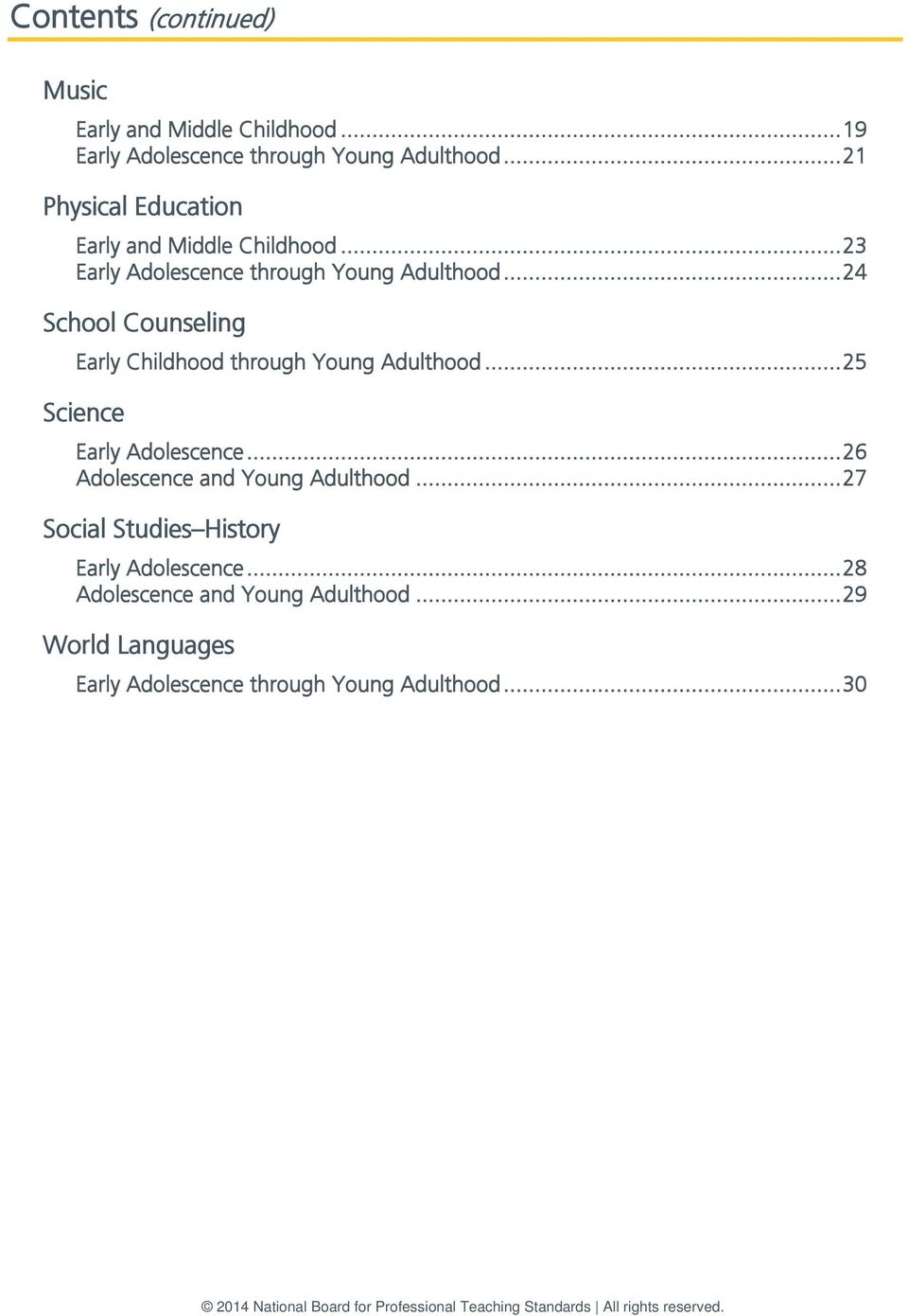
3 Contents (continued) Music Early and Middle Childhood Early Adolescence through Young Adulthood Physical Education Early and Middle Childhood Early Adolescence through Young Adulthood School Counseling Early Childhood through Young Adulthood Science Early Adolescence Adolescence and Young Adulthood Social Studies History Early Adolescence Adolescence and Young Adulthood World Languages Early Adolescence through Young Adulthood... 30
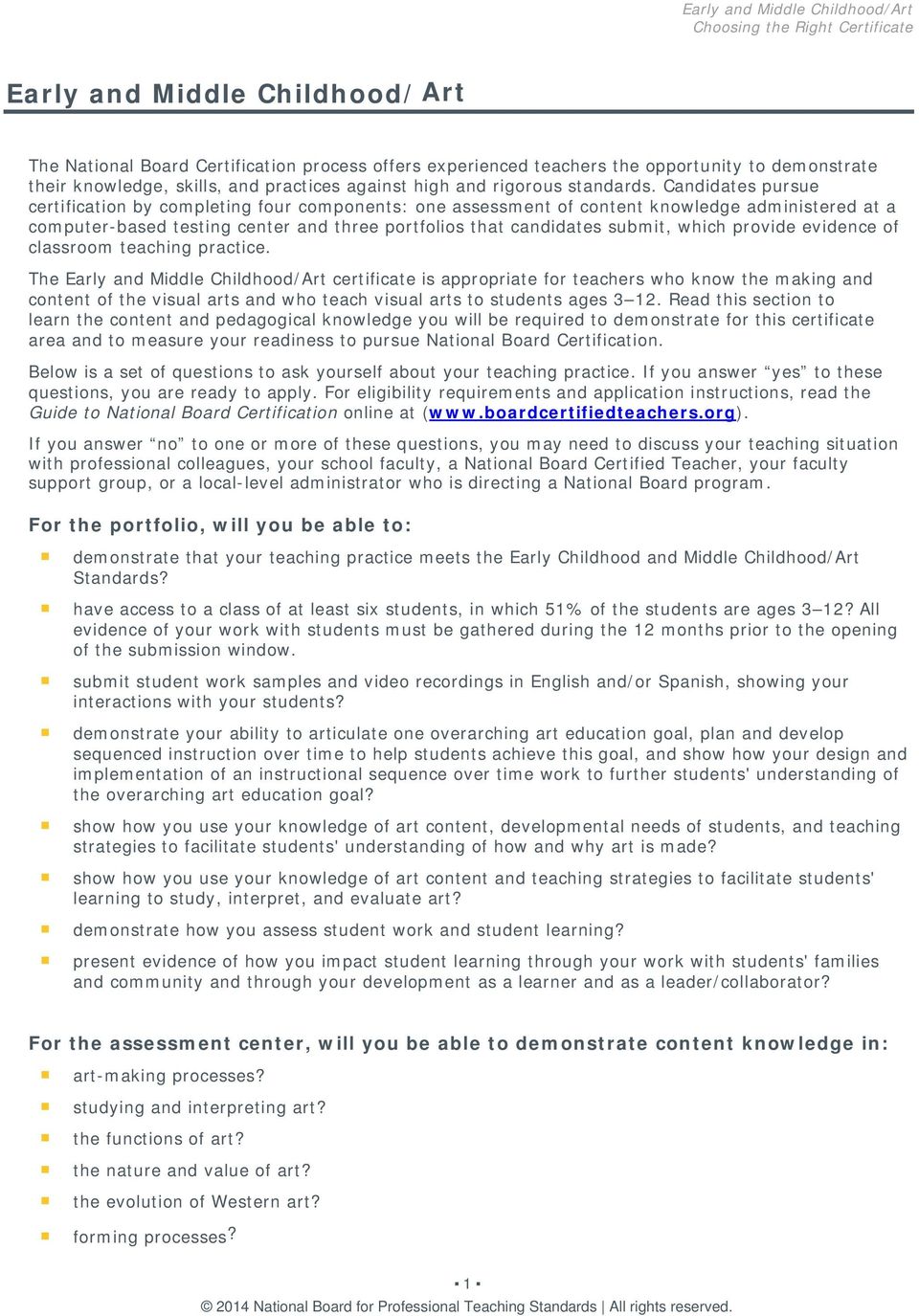
4 Early and Middle Childhood/Art Early and Middle Childhood/Art The Early and Middle Childhood/Art certificate is appropriate for teachers who know the making and content of the visual arts and who teach visual arts to students ages Read this section to learn the content and pedagogical knowledge you will be required to demonstrate for this certificate area and to measure your readiness to pursue National Board Certification. demonstrate that your teaching practice meets the Early Childhood and Middle Childhood/Art Standards? have access to a class of at least six students, in which 51% of the students are ages 3 12? All evidence of your work with students must be gathered during the 12 months prior to the opening of the submission window. submit student work samples and video recordings in English and/or Spanish, showing your interactions with your students? demonstrate your ability to articulate one overarching art education goal, plan and develop sequenced instruction over time to help students achieve this goal, and show how your design and implementation of an instructional sequence over time work to further students' understanding of the overarching art education goal? show how you use your knowledge of art content, developmental needs of students, and teaching strategies to facilitate students' understanding of how and why art is made? show how you use your knowledge of art content and teaching strategies to facilitate students' learning to study, interpret, and evaluate art? demonstrate how you assess student work and student learning? art-making processes? studying and interpreting art? the functions of art? the nature and value of art? the evolution of Western art? forming processes? 1
5 Early Adolescence through Young Adulthood/Art Early Adolescence through Young Adulthood/Art The Early Adolescence through Young Adulthood/Art certificate is appropriate for teachers who teach visual arts to students ages and who know the making and content of the visual arts. Read this section to learn the content and pedagogical knowledge you will be required to demonstrate for this certificate area and to measure your readiness to pursue National Board Certification. demonstrate that your teaching practice meets the Early Adolescence through Young Adulthood/Art Standards? have access to a class of at least 6 students, in which 51% of the students are ages ? All evidence of your work with students must be gathered during the 12 months prior to the opening of the submission window. submit student work samples and video recordings in English and/or Spanish showing your interactions with your students? demonstrate your ability to articulate one overarching art education goal, plan and develop sequenced instruction over time to help students achieve this goal, and show how your design and implementation of an instructional sequence over time work to further students understanding of the overarching art education goal? show how you use your knowledge of art content, developmental needs of students, and teaching strategies to facilitate students understanding of how and why art is made? show how you use your knowledge of art content and teaching strategies to facilitate students learning to study, interpret, and evaluate art? demonstrate how you assess student work and student learning? present evidence of how you impact student learning through your work with students families art-making processes? studying and interpreting art? the functions of art? the nature and value of art? the evolution of Western art? forming processes? 2

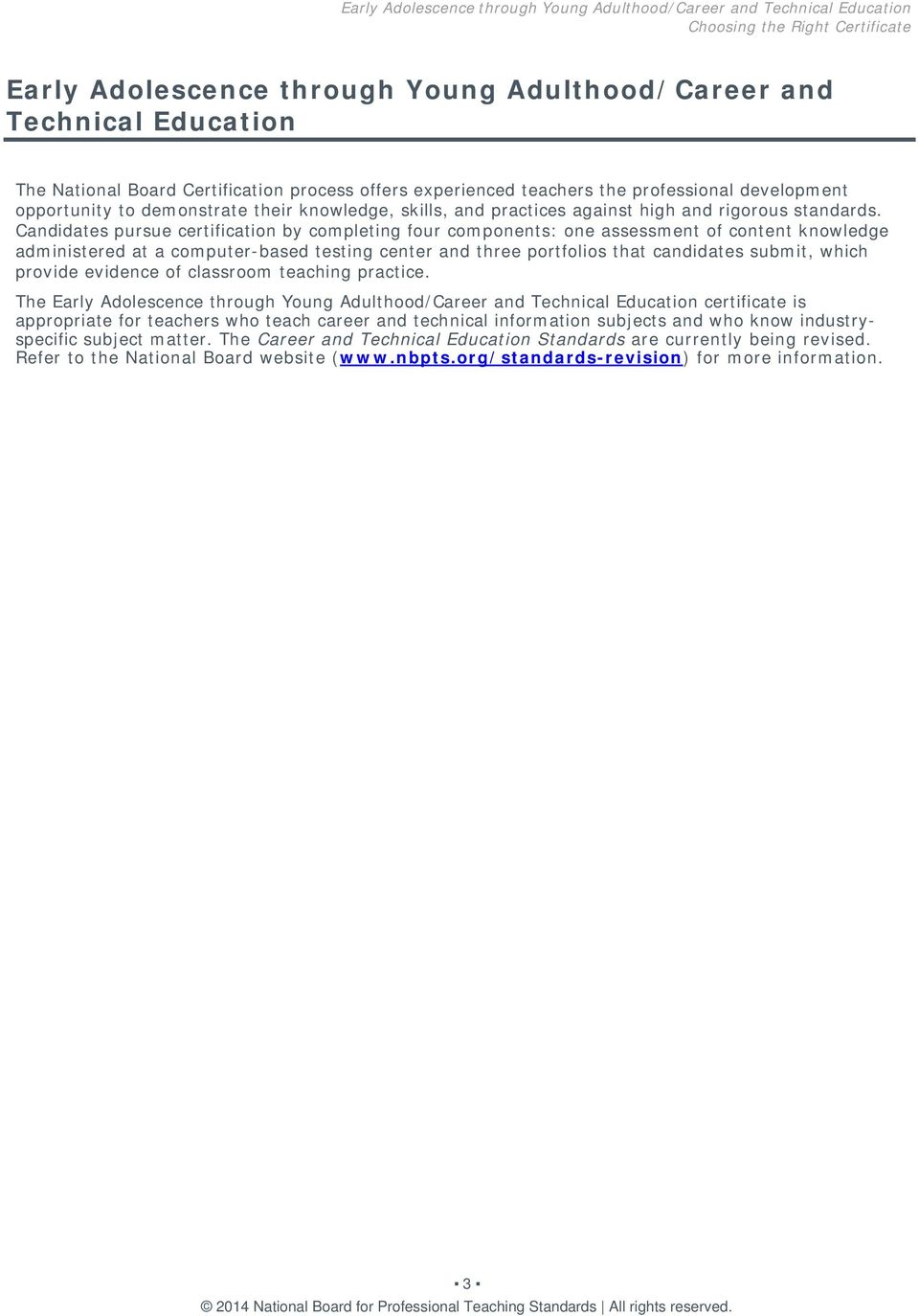
6 Early Adolescence through Young Adulthood/Career and Technical Education Early Adolescence through Young Adulthood/Career and Technical Education The National Board Certification process offers experienced teachers the professional development opportunity to demonstrate their knowledge, skills, and practices against high and rigorous standards. Candidates pursue certification by completing four components: one assessment of content knowledge administered at a computer-based testing center and three portfolios that candidates submit, which provide evidence of The Early Adolescence through Young Adulthood/Career and Technical Education certificate is appropriate for teachers who teach career and technical information subjects and who know industryspecific subject matter. The Career and Technical Education Standards are currently being revised. Refer to the National Board website ( for more information. 3
7 Early and Middle Childhood/English as a New Language Early and Middle Childhood/English as a New Language The Early and Middle Childhood/English as a New Language certificate is appropriate for teachers who teach linguistically and culturally diverse learners ages 3 12 and who know the range of the early and middle childhood curriculum. Read this section to learn the content and pedagogical knowledge you will be required to demonstrate for this certificate area and to measure your readiness to pursue National Board Certification. The Early and Middle Childhood/English as a New Language certificate area offers the following paths: Path 1 is an assessment of the English as a New Language Standards and is designed for bilingual teachers (the term "bilingual" is used here in a nonspecific sense to identify the teacher who uses both English and another language in instruction) who would like to achieve certification within the English as a New Language framework while also demonstrating their accomplishment as Early Childhood or Middle Childhood Generalists. All candidates must show in their portfolio entries that they are fostering English language development within their bilingual context. At the assessment center, they will complete exercises in their respective generalist areas. Path 2 is also an assessment of the English as a New Language Standards and is designed for teachers who identify themselves as English Language Development Specialists (ELDS) (ELDS is used here to identify the teacher who is an English language development specialist and who may or may not use the students' first language in instruction). All candidates must show in their portfolio entries that they are fostering English language development. At the assessment center, they will complete exercises focusing on their knowledge of English language development. support group, or a local-level administrator who is directing a National Board program. demonstrate that your teaching practice meets the English as a New Language Standards? have access to a class of at least 3 students, in which 51% of the students are ages 3 12? All evidence of your work with students must be gathered during the 12 months prior to the opening of the submission window. submit student work samples and video recordings showing your interactions with your students? demonstrate how you use assessment to build profiles of students as language learners, set goals, develop and implement a unit of instruction for linguistically and culturally diverse learners, and reassess learners' progress? 4

8 Early and Middle Childhood/English as a New Language show how you use teaching strategies to scaffold (that is, make accessible) new information for linguistically and culturally diverse learners, and how you create an optimal learning environment? demonstrate how you facilitate and interact with small groups of linguistically and culturally diverse learners who are working collaboratively? For the assessment center for bilingual content teachers (Early Childhood Generalist or Middle Childhood Generalist), will you be able to: demonstrate a command of subject matter knowledge of your content area? (Refer to language specific to your content area for Early Childhood or Middle Childhood Generalist.) For the assessment center for English Language Development Specialists, will you be able to demonstrate content knowledge in: domains of English language development? linguistic structure of English? second-language acquisition? academic language across the content areas? linking content to English-language development? technical/theoretical vocabulary? 5

9 Early Adolescence through Young Adulthood/English as a New Language Early Adolescence through Young Adulthood/English as a New Language The Early Adolescence through Young Adulthood/English as a New Language certificate is appropriate for teachers who teach linguistically and culturally diverse learners ages and who know the range of the early adolescence through young adulthood curriculum. Read this section to learn the content and pedagogical knowledge you will be required to demonstrate for this certificate area and to measure your readiness to pursue National Board Certification. The Early Adolescence through Young Adulthood/English as a New Language certificate area offers the following paths: Path 1 is an assessment of the English as a New Language Standards and is designed for bilingual teachers (the term "bilingual" is used here in a nonspecific sense to identify the teacher who uses both English and another language in instruction) who would like to achieve certification within the English as a New Language framework while also demonstrating their accomplishment as Early Adolescence (EA) or Adolescence and Young Adulthood (AYA) content specialists in Mathematics, Science, or Social Studies History. All candidates must show in their portfolio entries that they are fostering English language development within their bilingual context. At the assessment center, they will complete exercises in their respective content areas. Path 2 is also an assessment of the English as a New Language Standards and is designed for teachers who identify themselves as English Language Development Specialists (ELDS) (ELDS is used here to identify the teacher who is an English language development specialist and who may or may not use the students' first language in instruction). All candidates must show in their portfolio entries that they are fostering English language development. At the assessment center, they will complete exercises focusing on their knowledge of English language development. 6

10 Early Adolescence through Young Adulthood/English as a New Language demonstrate that your teaching practice meets the English as a New Language Standards? have access to a class of at least 3 students, in which 51% of the students are ages ? All evidence of your work with students must be gathered during the 12 months prior to the opening of the submission window. submit student work samples and video recordings in English and/or Spanish showing your interactions with your students? demonstrate how you use assessment to build profiles of students as language learners, set goals, develop and implement a unit plan of instruction for linguistically and culturally diverse learners, and reassess learners' progress? show how you use teaching strategies to scaffold (that is, make accessible) new information for linguistically and culturally diverse learners, and how you create an optimal learning environment? demonstrate how you facilitate and interact with small groups of linguistically and culturally diverse learners who are working collaboratively? For the assessment center for bilingual content teachers (EA or AYA, Mathematics, Social Studies History, or Science), will you be able to: demonstrate a command of the subject matter knowledge for your content area? (Refer to language specific to your content area.) For the assessment center for English Language Development Specialists, will you be able to demonstrate content knowledge in: domains of English language development? linguistic structure of English? second-language acquisition? academic language across the content areas? linking content to English-language development? technical/theoretical vocabulary? 7

11 Early Adolescence/English Language Arts Early Adolescence/English Language Arts The Early Adolescence/English Language Arts certificate is appropriate for teachers who teach students ages and who know the full range of the school language arts curriculum, including reading, writing, listening, and speaking. Read this section to learn the content and pedagogical knowledge you will be required to demonstrate for this certificate area and to measure your readiness to pursue National Board Certification. demonstrate that your teaching practice meets the English Language Arts Standards, Third Edition? have access to a class of at least 6 students, in which 51% of the students are ages 11 15? All evidence of your work with students must be gathered during the 12 months prior to the deadline for portfolio submission. submit student work samples and video recordings in English showing your interactions with your students? demonstrate how you help students grow as readers and writers? show the teaching strategies you use for whole-class discussion? show the teaching strategies you use for small-group instruction? literary analysis? universal themes? teaching reading? language study? analysis of writing? teaching writing? 8

12 Adolescence and Young Adulthood/English Language Arts Adolescence and Young Adulthood/English Language Arts The National Board Certification process offers experienced teachers opportunity to demonstrate their knowledge, skills, and practices against high and rigorous standards. Candidates pursue certification by completing four components: one assessment of content knowledge administered at a computerbased testing center and three portfolios that candidates submit, which provide evidence of The Adolescence and Young Adulthood/English Language Arts certificate is appropriate for teachers who teach students ages and who know the full range of the school language arts curriculum, including reading, writing, listening, and speaking. Read this section to learn the content and pedagogical knowledge you will be required to demonstrate for this certificate area and to measure your readiness to pursue National Board Certification. demonstrate that your teaching meets the English Language Arts Standards, Third Edition? have access to a class of at least 6 students, in which 51% of the students are ages ? All evidence of your work with students must be gathered during the 12 months prior to the deadline for portfolio submission. submit student work samples and video recordings in English showing your interactions with your students? demonstrate how you help students grow as readers and writers? show the teaching strategies you use for whole-class discussion? show the teaching strategies you use for small-group instruction? literary analysis? universal themes? teaching reading? language study? analysis of writing? teaching writing? 9

13 Early Childhood through Young Adulthood/Exceptional Needs Specialist Early Childhood through Young Adulthood/Exceptional Needs Specialist The Early Childhood through Young Adulthood/Exceptional Needs Specialist certificate is appropriate for teachers who teach students ages birth through 21+ years * with exceptional needs, and who know the philosophical, historical, and legal foundations of exceptional needs education. Read this section to learn the content and pedagogical knowledge you will be required to demonstrate for this certificate area and to measure your readiness to pursue National Board Certification. Candidates applying for certification in the Exceptional Needs Specialist certificate area must select a specialty area when applying. The following path descriptions may help you determine the specialty area that best fits your teaching situation: Deaf/Hard of Hearing (birth to 21+ years). Teachers in this path work with students from birth to 21+ years of age with any degree of hearing loss, from mild unilateral to profound bilateral loss, in self-contained to home or generic education environments, and via multiple languages and communication modes. Early Childhood (birth to 8 years). Teachers in this path work with students from birth to 8 years of age with special needs. These teachers may serve families with children who have special needs in a family-centered approach to early intervention, children who are at risk for special needs, and children with a wide range of special needs. Gifted and Talented (3 to 18+ years). Teachers in this path work with students with gifts and talents from 3 to 18+ years of age. Mild/Moderate Disabilities (5 to 21+ years). Teachers in this path work with students from 5 to 21+ years of age with mild to moderate cognitive disabilities. The students served by these teachers may have learning disabilities, mild to moderate mental retardation, attention deficit disorders, developmental delays, autism, emotional disturbance, behavioral disorders, or health impairments. Severe and Multiple Disabilities (5 to 21+ years). Teachers in this path work with students from 5 to 21+ years of age with a range of cognitive abilities, often accompanied by sensory, physical, emotional, and/or health impairments. The students served by these teachers may have severe or profound mental retardation, traumatic brain injury, uncontrolled seizure disorders, dual sensory impairments, autism, neurological impairments, physical impairments, and/or health impairments. Visual Impairments (birth to 21+ years). Teachers in this path work with students from birth to 21+ years of age with visual impairment. The students served by these teachers may have low vision or severe to total visual impairment. Refer to the Exceptional Needs Specialist Standards for a complete description of each specialty-area practice. * Students need not be seen in the context of a classroom group. Teachers, working one-on-one with IEPd or IFSPd students under federal or state mandated special education laws are eligible to pursue this certificate. In most states the students included under these mandates would be ages birth to 21. In states where the mandate extends special education beyond age 21, teachers should contact National Board prior to applying to determine whether their teaching context meets the eligibility requirements for candidacy. 10

14 Early Childhood through Young Adulthood/Exceptional Needs Specialist demonstrate that your teaching practice meets the Exceptional Needs Standards? have access to at least 3 students * with exceptional needs? All evidence of your work with students must be gathered during the 12 months prior to the deadline for portfolio submission. submit instructional materials and video recordings in English and/or Spanish showing your interactions with your students? demonstrate your ability to engage your student(s) in a Communication/Literacy lesson? demonstrate your ability to engage your student(s) in a Social/Emotional Development lesson? show how you use assessment to inform your instruction? present evidence of how you impact student learning through your work with students families social development and behavior? numeracy? literacy? transitions and career development? assessment? collaboration? * Students need not be seen in the context of a classroom group. Teachers, working one-on-one with IEPd or IFSPd students under federal or state mandated special education laws are eligible to pursue this certificate. In most states the students included under these mandates would be ages birth to 21. In states where the mandate extends special education beyond age 21, teachers should contact National Board prior to applying to determine whether their teaching context meets the eligibility requirements for candidacy. 11

15 Early Childhood/Generalist Early Childhood/Generalist computer-based testing center and three portfolios that candidates submit, which provide evidence of The Early Childhood/Generalist certificate is appropriate for teachers of students ages 3 8 who engage their students in all subject areas addressed in the Early Childhood/Generalist Standards. Some Generalists are assigned to teach a single subject while others are assigned multiple subjects, for example, humanities teachers or mathematics/science teachers. Some focus in their teaching on interdisciplinary or cross-disciplinary lessons while others may use such curricular approaches only occasionally. However, all Generalists, without regard to their assignment, practice in a manner designed to advance student learning in two or more subjects. Read this section to learn thecontent and pedagogical knowledge you will be required to demonstrate for this certificate area and to measure your readiness to pursue National Board Certification. demonstrate that your teaching practice meets the Early Childhood/Generalist Standards? have access to a class of at least 6 students, in which 51% of the students are ages 3 8? All evidence of your work with students must be gathered during the 12 months prior to the deadline for portfolio submission. submit student work samples and video recordings showing your interactions with your students? discuss how you foster children's literacy development? demonstrate your ability to deepen students' understanding of an important topic/concept/theme in social studies through the integration of the arts? demonstrate your ability to sustain a classroom environment that supports students' growth, learning, social and emotional development, and understanding of a social skill/concept? show how you help children acquire scientific and mathematical knowledge in understanding unifying concepts and processes in science by integrating these two disciplinary areas? literacy? mathematics? science? social studies? children's play? health education and physical education? 12

16 Middle Childhood/Generalist Middle Childhood/Generalist The Middle Childhood/Generalist certificate is appropriate for teachers who teach students ages 7 12 and who know the range of the middle grades curriculum: language arts, mathematics, science, social studies and history, the arts, and health. Some Generalists are assigned to teach a single subject while others are assigned multiple subjects, for example, humanities teachers or mathematics/science teachers. Some focus in their teaching on interdisciplinary or cross-disciplinary lessons while others may use such curricular approaches only occasionally. However, all Generalists, without regard to their assignment, practice in a manner designed to advance student learning in two or more subjects. Read this section to learn the content and pedagogical knowledge you will be required to demonstrate for this certificate area and to measure your readiness to pursue National Board Certification. demonstrate that your teaching practice meets the Middle Childhood/Generalist Standards? have access to a class of at least 6 students, in which 51% of the students are ages 7 12? All evidence of your work with students must be gathered during the 12 months prior to the opening of the submission window. submit student work samples and video recordings showing your interactions with your students? explain how you use a topic in writing to develop students' thinking and writing skills for different audiences through the use of narrative and expository student work samples? show how you create a climate that supports students' emerging abilities to understand and consider perspectives other than their own and to assume responsibility for their own actions through a social studies topic? discuss how you help students better understand unifying concepts and processes in science using relevant science and mathematics knowledge, and engage students in work that helps to enrich their understanding of the interdisciplinary areas? reading skills? mathematics? science? social studies? health and wellness? the arts? 13

17 Early Adolescence through Young Adulthood/Health Education Early Adolescence through Young Adulthood/Health Education The Early Adolescence through Young Adulthood/Health Education certificate is appropriate for teachers of students ages The Health Education Standards describe an important facet of accomplished teaching; they often occur concurrently because of the seamless quality of teaching. Read this section to learn the content and pedagogical knowledge you will be required to demonstrate for this certificate area and to measure your readiness to pursue National Board Certification. demonstrate that your teaching practice meets the Health Education Standards? have access to a class of at least 6 students, in which 51% of the students are ages ? All evidence of your work with students must be gathered during the 12 months prior to the opening of the submission window. submit student work samples and video recordings in English and/or Spanish showing your interactions with your students? show how you bring about positive health habits linked to an appropriate health curriculum and/or student standards applicable to real life situations and encompass the social, spiritual, physical, mental, and emotional components of health? show how you demonstrate the knowledge and understanding of health curriculum and education through appropriate instruction and assessment strategies that foster growth in health literacy for students? show how you establish a nurturing/supportive classroom setting and environment through a variety of intellectual challenges in which students explore health literacy? present evidence of how you impact student learning through your work outside of the classroom as you interact with students families, your colleagues, and other professionals? dynamics of nutrition, its importance and influences on one s health and wellness? the impact of risky behaviors (for example, but not limited to, diet, lifestyles, injuries) on personal health and wellness? the stages of human growth and development throughout the life cycle and the management of healthy and unhealthy relationships? analysis and evaluation of health-related information as it relates to critical thinking and decision making about products and services? applying the principles and procedures related to mental and emotional health? diseases and ability to assess information and services that impact a healthy lifestyle? 14

18 Early Childhood through Young Adulthood/Library Media Early Childhood through Young Adulthood/Library Media The Early Childhood through Young Adulthood/Library Media certificate is appropriate for Library Media specialists who teach students ages and who know the range of information literacy, instructional collaboration, and the integration of technology. Read this section to learn the content and pedagogical knowledge you will be required to demonstrate for this certificate area and to measure your readiness to pursue National Board Certification. demonstrate that your teaching practice meets the Library Media Standards? have access to a class in which 51% of the students are ages 3 18+? All evidence of your work with students must be gathered during the 12 months prior to the opening of the submission window. submit instructional materials and video recordings showing your interactions with your students? demonstrate your ability to collaborate with others in your instructional community to create, plan, and implement learning experiences and assess student learning, using a variety of resources? demonstrate your ability to foster an appreciation of literature in your students and demonstrate your ability to create an inviting and supportive library media center environment that provides equal access to all learners? demonstrate effective selection and integration of technologies into the instructional program and foster learners' understanding of the ethical or legal use of information? ethical and legal tenets? collection development? technologies? organizational management? information literacy? knowledge of literature? 15

19 Early and Middle Childhood/Literacy: Reading Language Arts Early and Middle Childhood/Literacy: Reading Language Arts The Early and Middle Childhood/Literacy: Reading Language Arts certificate is appropriate for teachers who teach students ages 3 12 and who know the range of the Literacy: Reading Language Arts curriculum: reading, writing, listening, speaking, and viewing. Some Literacy: Reading Language Arts teachers are assigned to teach a single student at a time while others are assigned small groups or whole classes of students. Some focus their teaching on a prescribed approach to teaching literacy while others may teach a broader, more open curriculum. However, all Literacy: Reading Language Arts teachers, without regard to their assignment, practice in a manner designed to advance student learning in Literacy: Reading Language Arts. Read this section to learn the content and pedagogical knowledge you will be required to demonstrate for this certificate area and to measure your readiness to pursue National Board Certification. demonstrate that your teaching practice meets the Early and Middle Childhood/Literacy: Reading Language Arts Standards? have access to a class of at least 1 student, in which the student(s) are ages 3 12? All evidence of your work with students must be gathered during the 12 months prior to the opening of the submission window. submit student work samples and video recordings showing your interactions with your students? describe how you promote literacy development through writing and guide a student in constructing meaning through print, over an instructional period that ranges from three weeks to three months, by analyzing samples of a student's work? demonstrate how you use your knowledge of the reading process to support diverse learners in their growth as readers? present evidence of how you plan and facilitate interdisciplinary learning experiences using technology to foster effective listening, speaking, and viewing skills for a specific purpose and audience? present evidence of how you impact student learning through your work outside of the classroom as you interact with students' families, your colleagues, and other professionals? reading comprehension? oral language acquisition skills for learners of English as a new language? emergent literacy? analyzing student reading? interpreting visual text? writing development? 16

20 Early Adolescence/Mathematics Early Adolescence/Mathematics The Early Adolescence/Mathematics certificate is appropriate for teachers who teach students ages and who know the full range of the school mathematics curriculum: numbers and operations; algebra and functions; geometry; discrete mathematics; trigonometry; data analysis and statistics; and calculus as described in the Mathematics Standards. Read this section to learn the content and pedagogical knowledge you will be required to demonstrate for this certificate area and to measure your readiness to pursue National Board Certification. demonstrate that your teaching practice meets the Middle Childhood through Early Adolescence/Mathematics Standards? have access to a class of at least 6 students, in which 51% of the students are ages 11 15? All evidence of your work with students must be gathered during the 12 months prior to the opening of the submission window. submit student work samples and video recordings in English and/or Spanish showing your interaction with your students? demonstrate how you use assessment to target mathematical understanding and make sense of student performance as you help students build important conceptual connections in mathematics? show how you and your students engage in mathematical discourse as the whole class explores a concept, principle, technique, and/or reasoning method of mathematics? show how you engage students in learning collaboratively and in mathematical discourse as they explore a mathematics concept in small groups as you use technology or manipulative materials to help students? algebra and functions? geometry? number and operation sense? data analysis? right triangle trigonometry? various mathematical thinking processes? connections among mathematical ideas and applications across mathematical domains? 17

21 Adolescence and Young Adulthood/Mathematics Adolescence and Young Adulthood/Mathematics The Adolescence and Young Adulthood/Mathematics certificate is appropriate for teachers who teach students ages and who know the full range of the school mathematics curriculum: numbers and operations, algebra and functions; geometry; discrete mathematics; trigonometry; data analysis and statistics; and calculus. Read this section to learn the content and pedagogical knowledge you will be required to demonstrate for this certificate area and to measure your readiness to pursue National Board Certification. demonstrate that your teaching practice meets the Adolescence and Young Adulthood/ Mathematics Standards? have access to a class of at least 6 students, in which 51% of the students are ages ? All evidence of your work with students must be gathered during the 12 months prior to the opening of the submission window. submit student work samples and video recordings in English and/or Spanish showing your interactions with your students? demonstrate how you use assessment to target mathematical understanding and make sense of student performance as you help students build important conceptual connections in mathematics? show how you and your students engage in mathematical discourse as the whole class explores a concept, principle, technique, and/or reasoning method of mathematics? show how you engage students in learning collaboratively and in mathematical discourse as they explore a mathematics concept in small groups as you use technology or manipulative materials to help students? algebra and functions? calculus? discrete mathematics? geometry? statistics and data analysis? families of functions? various mathematical thinking processes? 18
22 Early and Middle Childhood/Music Early and Middle Childhood/Music The Early and Middle Childhood/Music certificate is appropriate for teachers who teach music to students ages 3 12, who know the full range of the school music curriculum, and who have highly specialized knowledge in choral, instrumental, or general music. Read this section to learn the content and pedagogical knowledge you will be required to demonstrate for this certificate area and to measure your readiness to pursue National Board Certification. Candidates applying for certification in the Early and Middle Childhood/Music certificate area must select a performance perspective when applying. Two of the assessment center exercises (Exercises 1 and 3) require responses from a music performance perspective. In order to provide all teachers with a more tailored range of possibilities to meet their individual needs, and for the purposes of these two exercises only, teachers will select their desired performance perspective prior to attending the assessment center: band, vocal, or orchestra. demonstrate that your teaching practice meets the Music Standards? have access to a class of at least 6 students, in which 51% of the students are ages 3 12? All evidence of your work with students must be gathered during the 12 months prior to the opening of the submission window. submit video recordings in English and/or Spanish showing samples of students at work and your interactions with them? demonstrate how you implement a multi-lesson unit from your program of music instruction, within which you identify and implement instructional strategies and activities designed to meet selected students' needs in performance, participation, or skills? demonstrate how you deliver instruction while motivating students, and promoting and nurturing their achievement? show how you use your musicianship within the teaching and learning environment, how you develop musicianship in your students, and how you use assessment as a means for informing future teaching? 19
23 Early and Middle Childhood/Music diagnostic skills? historical repertoire? applied theory/composition? instructional strategies? music from a world sample? curricular applications? 20
24 Early Adolescence through Young Adulthood/Music Early Adolescence through Young Adulthood/Music The Early Adolescence through Young Adulthood/Music certificate is appropriate for teachers who teach students ages , who know the full range of the school music curriculum, and who have highly specialized knowledge in choral, instrumental, or general music. Read this section to learn the content and pedagogical knowledge you will be required to demonstrate for this certificate area and to measure your readiness to pursue National Board Certification. Candidates applying for certification in the Early Adolescence through Young Adulthood/Music certificate area must select a performance perspective when applying. Two of the assessment center exercises (Exercises 1 and 3) will require responses from a music performance perspective. In order to provide all teachers with a more tailored range of possibilities to meet their individual needs, and for the purposes of these two exercises only, teachers will select their desired performance perspective prior to attending the assessment center: band, vocal, or orchestra. demonstrate that your teaching practice meets the Music Standards? have access to a class of at least 6 students, in which 51% of the students are ages 11 18? All evidence of your work with students must be gathered during the 12 months prior to the opening of the submission window. submit video recordings in English and/or Spanish showing samples of students at work and your interactions with them? demonstrate how you implement a multi-lesson unit from your program of music instruction, within which you identify and implement instructional strategies and activities designed to meet selected students' needs in performance, participation, or skills? demonstrate how you deliver instruction while motivating students, and promoting and nurturing their achievement? show how you use your musicianship within the teaching and learning environment, how you develop musicianship in your students, and how you use assessment as a means for informing future teaching? 21
25 Early Adolescence through Young Adulthood/Music diagnostic skills? historical repertoire? applied theory/composition? instructional strategies? music from a world sample? curricular applications? 22
26 Early and Middle Childhood/Physical Education Early and Middle Childhood/Physical Education The Early and Middle Childhood/Physical Education certificate is appropriate for teachers of students ages 3 12 who teach physical education programs. Read this section to learn the content and pedagogical knowledge you will be required to demonstrate for this certificate area and to measure your readiness to pursue National Board Certification. demonstrate that your teaching practice meets the Physical Education Standards, Second Edition? have access to a class of at least 6 students, in which 51% of the students are ages 3 12? All evidence of your work with students must be gathered during the 12 months prior to the opening of the submission window. submit student work samples and video recordings in English and/or Spanish showing your interactions with your students? demonstrate your ability to engage your students in sequenced motor skill instruction and promote their understanding of a related cognitive concept? demonstrate your ability to integrate assessment into your instruction to promote learning of all students and show how you use the results of assessment to inform your instructional decisions? show how you engage your students in purposeful instruction in a physically and emotionally safe environment that supports equitable access to learning and promotes student interaction and reflection? show how you promote physical activity for a lifetime and raise students' awareness that physical activity is valuable? motor learning, biomechanics, and skill acquisition? fitness components, related scientific/exercise principles and their application to physical education themes/activities? safety, equity, and fairness issues? planning instruction for students with disabilities? the principles of movement and critical elements of specific movement forms? integration of skills from other disciplines along with appropriate uses of technology for effective physical education instruction? 23
27 Early Adolescence through Young Adulthood/Physical Education Early Adolescence through Young Adulthood/Physical Education The Early Adolescence through Young Adulthood/Physical Education certificate is appropriate for teachers of students ages who teach physical education programs. Read this section to learn the content and pedagogical knowledge you will be required to demonstrate for this certificate area and to measure your readiness to pursue National Board Certification. demonstrate that your teaching practice meets Physical Education Standards, Second Edition? have access to a class of at least 6 students, in which 51% of the students are ages ? All evidence of your work with students must be gathered during the 12 months prior to the opening of the submission window. submit student work samples and video recordings in English and/or Spanish showing your interactions with your students? demonstrate your ability to engage your students in sequenced motor skill instruction and promote their understanding of a related cognitive concept? demonstrate your ability to integrate assessment into your instruction to promote learning of all students and show how you use the results of assessment to inform your instructional decisions? show how you engage your students in purposeful instruction in a physically and emotionally safe environment that supports equitable access to learning and promotes student interaction and reflection? show how you promote physical activity for a lifetime and raise students' awareness that physical activity is valuable? motor learning, biomechanics, and skill acquisition? fitness components, related scientific/exercise principles and their application to physical education themes/activities? safety, equity, and fairness issues? planning instruction for students with disabilities? the principles of movement and critical elements of specific movement forms? integration of skills from other disciplines along with appropriate uses of technology for effective physical education instruction? 24
28 Early Childhood through Young Adulthood/School Counseling Early Childhood through Young Adulthood/School Counseling The Early Childhood through Young Adulthood/School Counseling certificate is appropriate for counselors who work with students in grades PreK 12 (3 18+) in educational settings. These school counselors may work with individuals, small groups, a whole class, or the entire school to advance student learning academically, emotionally, and socially, and in the area of career development. Some may focus their counseling primarily in the area of student assistance, college planning, academic testing, or a more general guidance delivery model. However, all school counselors, without regard to their assignment, practice in a manner designed to advance student learning in the areas of academics, social/emotional and career development. Read this section to learn the content and pedagogical knowledge you will be required to demonstrate for this certificate area and to measure your readiness to pursue National Board Certification. demonstrate that your counseling practice meets the Early Childhood through Young Adulthood/School Counseling Standards? have access to a whole class, a small group, and an individual student, in which the student(s) are in grades prek 12 (ages 3 18+)? All evidence of your work with students must be gathered during the 12 months prior to the opening of the submission window. submit student work samples and video recordings in English and/or Spanish showing your interactions with your students? present evidence of how the use of data guides your counseling with a group of students related to social/emotional issues? present evidence of how you plan and deliver a career development lesson for a specific class and purpose? present evidence of how you develop an academic intervention plan that will address the identified needs of the featured student? present evidence of how you impact student learning and improve your school counseling program through your work outside of explicit school counseling as you interact with students' families, your colleagues, and other professionals? human growth and development? school counseling program? diverse populations? theories? data and change? collaboration? 25
29 Early Adolescence/Science Early Adolescence/Science The Early Adolescence/Science certificate is appropriate for teachers who teach students ages and who know the full range of the school science curriculum: physical sciences, life sciences, and earth and space sciences. Read this section to learn the content and pedagogical knowledge you will be required to demonstrate for this certificate area and to measure your readiness to pursue National Board Certification. demonstrate that your teaching practice meets the Science Standards, Third Edition? have access to a class of at least 6 students, in which 51% of the students are ages 11 15? All evidence of your work with students must be gathered during the 12 months prior to the opening of the submission window. submit student work samples and video recordings in English and/or Spanish showing your interactions with your students? demonstrate how you help students make important conceptual connections in science during a sequence of instruction? demonstrate how you use assessment to target important science understanding and to analyze and make sense of student performance? show how you use inquiry strategies to uncover students' conceptions of important ideas in science? show how you support students in a scientific inquiry discussion as they explore, analyze, and synthesize data that have been collected during the course of investigating an important concept in science? data analysis? interrelationships in science? unifying concepts? changes over time? student understanding and prior knowledge issues in science, society, and technology? 26
30 Adolescence and Young Adulthood/Science Adolescence and Young Adulthood/Science The Adolescence and Young Adulthood/Science certificate is appropriate for teachers who teach students ages and who know the full range of the school science curriculum: physical sciences, life sciences, and earth and space sciences. Read this section to learn the content and pedagogical knowledge you will be required to demonstrate for this certificate area and to measure your readiness to pursue National Board Certification. Prior to attending the assessment center, candidates in this certificate area must select one of four science specialty areas: biology, chemistry, earth and space science, or physics. demonstrate that your teaching practice meets the Science Standards, Third Edition? have access to a class of at least 6 students, in which 51% of the students are ages ? All evidence of your work with students must be gathered during the 12 months prior to the opening of the submission window. submit student work samples and video recordings in English and/or Spanish showing your interactions with your students? demonstrate how you help students make important conceptual connections in science during a sequence of instruction? demonstrate how you use assessment to target important science understanding and to analyze and make sense of student performance? show how you use inquiry strategies during different stages of scientific exploration to help students understand important ideas in science? show the discussion strategies that you use to facilitate student reasoning and understanding of an important concept in science? data analysis? interrelationships within a science? fundamental concepts in your selected discipline of science (biology, chemistry, earth and space science, or physics)? changes over time (biology, earth and space science, and physics) or changes in systems (chemistry)? connections in science? breadth of knowledge across the four major disciplines of science? 27
31 Early Adolescence/Social Studies History Early Adolescence/Social Studies History The Early Adolescence/Social Studies History certificate is appropriate for teachers who teach students ages and who know the full range of the school social studies-history curriculum: United States History, World History, Economics, Political Science, and Geography. Read this section to learn the content and pedagogical knowledge you will be required to demonstrate for this certificate area and to measure your readiness to pursue National Board Certification. demonstrate that your teaching practice meets the Early Adolescence/Social Studies History Standards? have access to a class of at least 6 students, in which 51% of the students are ages 11 15? All evidence of your work with students must be gathered during the 12 months prior to the opening of the submission window. submit student work samples and video recordings in English and/or Spanish showing your interactions with your students? demonstrate how you help students learn through interpretive, persuasive, or analytical writing? show how you deepen student understanding of important social studies and history topics by making real-world connections to your students' lives? show how you use small-group interactions among students to promote students' understanding of social systems and of their own social and civic identities? demonstrate how you use whole-class lessons to foster in students the knowledge and skills necessary for civic engagement? historical documents? population movements? economic policymaking? social movements? regional economic and geographic trends? conflict in society? 28
32 Adolescence and Young Adulthood/Social Studies History Adolescence and Young Adulthood/Social Studies History certification by completing four components: one assessment of content knowledge administered at a computer-based testing center and three portfolios that candidates submit, which provide evidence of The Adolescence and Young Adulthood/Social Studies History certificate is appropriate for teachers who teach students ages and who know the full range of the school social studies history curriculum: United States History, World History, Economics, Political Science, and Geography. Read this section to learn the content and pedagogical knowledge you will be required to demonstrate for this certificate area and to measure your readiness to pursue National Board Certification. Below is a set of questions to ask yourself about your teaching practice. If you answer yes to these questions, you are ready to apply. For eligibility requirements and application instructions, read the demonstrate that your teaching practice meets the Adolescence and Young Adulthood/Social Studies History Standards? have access to a class of at least 6 students, in which 51% of the students are ages ? All evidence of your work with students must be gathered during the 12 months prior to the opening of the submission window. submit student work samples and video recordings in English and/or Spanish showing your interactions with your students? demonstrate how you help students learn through interpretive, persuasive, or analytical writing? show how you deepen student understanding of important social studies and history topics by making real-world connections to your students' lives? show how you use small-group interactions among students to promote students' understanding of social systems and of their own social and civic identities? demonstrate how you use whole-class lessons to foster in students the knowledge and skills necessary for effective civic engagement? historical documents? population movements? economic policymaking? social movements? regional economic and geographic trends? conflict in society? 29
33 Early Adolescence through Young Adulthood/World Languages Early Adolescence through Young Adulthood/World Languages computer-based testing center and three portfolios that candidates submit, which provide evidence of The Early Adolescence through Young Adulthood/World Languages certificate is appropriate for teachers who teach Spanish or French to students ages and whose functional ability in the language they teach is at an advanced level. Read this section to learn the content and pedagogical knowledge you will be required to demonstrate for this certificate area and to measure your readiness to pursue National Board Certification. demonstrate that your teaching practice meets the Early Adolescence through Young Adulthood/World Languages Standards? have access to a class of at least 6 students, in which 51% of the students are ages ? All evidence of your work with students must be gathered during the 12 months prior to the opening of the submission window. submit student work samples and video recordings in a single target language (French or Spanish only) showing your interactions with your students? show how you design instruction and assessment? demonstrate your ability to build communicative and cultural competence through activities and instruction in a language-learning and culture-learning environment? demonstrate your ability to use your knowledge of students' prior language experiences and learning styles to select instructional goals, adapt or create materials, and apply methodologies appropriate for your students? show how you enable students to fulfill real-world tasks that are developmentally and culturally appropriate through the use of authentic materials and everyday objects? oral proficiency? interpreting aural texts? interpreting written texts? written communication? knowledge of language acquisition? knowledge of how language works? 30
34 Produced for by 2014 National Board for Professional Teaching Standards. All rights reserved. No part of this publication may be reproduced or transmitted in any form or by any means, electronic or mechanical, including photocopy, recording, or any information storage or retrieval system, without permission in writing from the publisher. The National Board for Professional Teaching Standards logo, National Board for Professional Teaching Standards, NBPTS, National Board Certified Teacher, NBCT, National Board Certification, Take One!, Accomplished Teacher, and Profile of Professional Growth are registered trademarks or service marks of the National Board for Professional Teaching Standards. Other marks are trademarks or registered trademarks of their respective organizations. The National Board for Professional Teaching Standards, Inc. has been funded in part with grants from the U.S. Department of Education and the National Science Foundation. The contents of this publication do not necessarily represent the policy of the U.S. Department of Education or the National Science Foundation, and you should not assume endorsement by the Federal Government. Any opinions, findings, and conclusions or recommendations expressed in this material are those of the author(s) and do not necessarily reflect the views of the sponsors. Prepared by Pearson for submission under contract with the National Board for Professional Teaching Standards. Pearson and its logo are trademarks, in the U.S. and/or other countries, of Pearson Education, Inc. or its affiliate(s).
EXCEPTIONAL NEEDS SPECIALIST
 IMPORTANT NOTICE TO CANDIDATES: The assessment information in this document is aligned with NBPTS Exceptional Needs Standards, Second Edition (for teachers of students ages birth 21+). If you applied for
Standards for Certification in Early Childhood Education [26.110-26.270]
![Standards for Certification in Early Childhood Education [26.110-26.270]](/thumbs/24/3436110.jpg "Standards for Certification in Early Childhood Education [26.110-26.270]") I.B. SPECIFIC TEACHING FIELDS Standards for Certification in Early Childhood Education [26.110-26.270] STANDARD 1 Curriculum The competent early childhood teacher understands and demonstrates the central
I.B. SPECIFIC TEACHING FIELDS Standards for Certification in Early Childhood Education [26.110-26.270] STANDARD 1 Curriculum The competent early childhood teacher understands and demonstrates the central
SCHOOL COUNSELING. Assessment at a Glance. Early Childhood through Young Adulthood. Choosing the Right Certificate. Reviewing the Standards
 Early Childhood through Young Adulthood SCHOOL COUNSELING Choosing the Right Certificate Reviewing the Standards Demonstrating Your Teaching Practice and Content Knowledge Understanding the National Board
PHYSICAL EDUCATION. Assessment at a Glance. Early and Middle Childhood. Choosing the Right Certificate. Reviewing the Standards
 Early and Middle Childhood PHYSICAL EDUCATION Choosing the Right Certificate Reviewing the Standards Demonstrating Your Teaching Practice and Content Knowledge Understanding the National Board Scoring
New Hampshire Department of Education Special Education Program Approval and Improvement Process
 New Hampshire Department of Education Special Education Program Approval and Improvement Process The mission of NHDOE Special Education Program Approval is to improve education results for all learners.
Department of Interdisciplinary Learning and Teaching
 The University of Texas at San Antonio 1 Department of Interdisciplinary Learning and Teaching Mission Statement The mission of the Department of Interdisciplinary Learning and Teaching is to: Advance
Bachelor of Arts in Early Childhood Degree Offerings through the 2010-2012 Catalog*
 Bachelor of Arts in Early Childhood Degree Offerings through the 2010- Catalog* Catalog Number Class Name Course Description Semester Credits Prerequisites Semesters Offered Mode of Delivery EC 210 INTRODUCTION
Childhood and Special Education/Inclusive Education
 Master of Science in Education: Childhood and Special Education/Inclusive Education Dual Initial Certification Program Childhood 1-6 and Students with Disabilities 1-6 Program Overview The Master of Science
CALIFORNIA S TEACHING PERFORMANCE EXPECTATIONS (TPE)
 CALIFORNIA S TEACHING PERFORMANCE EXPECTATIONS (TPE) The Teaching Performance Expectations describe the set of knowledge, skills, and abilities that California expects of each candidate for a Multiple
MUSIC. Assessment at a Glance. Early and Middle Childhood. Choosing the Right Certificate. Reviewing the Standards
 Early and Middle Childhood MUSIC Choosing the Right Certificate Reviewing the Standards Demonstrating Your Teaching Practice and Content Knowledge Understanding the National Board Scoring Process Beginning
NEW YORK STATE TEACHER CERTIFICATION EXAMINATIONS
 NEW YORK STATE TEACHER CERTIFICATION EXAMINATIONS TEST DESIGN AND FRAMEWORK September 2014 Authorized for Distribution by the New York State Education Department This test design and framework document
IAC Ch 13, p.1. b. Oral communication.
 IAC Ch 13, p.1 282 13.28 (272) Minimum content requirements for teaching endorsements. 13.28(1) Agriculture. 5-12. Completion of 24 semester credit hours in agriculture and agriculture education to include:
Standard Two: Knowledge of Mathematics: The teacher shall be knowledgeable about mathematics and mathematics instruction.
 Performance-Based Standards for Colorado Teachers The following shall serve as standards for the licensing of all teacher education candidates in Colorado and reflect the knowledge and skills required
MASTER OF EDUCATION 1. MASTER OF EDUCATION DEGREE (M.ED.) (845) 575-3028 [email protected]
 MASTER OF EDUCATION 1 MASTER OF EDUCATION DEGREE (M.ED.) (845) 575-3028 [email protected] MISSION AND OBJECTIVES The Teacher Education programs offered by Marist College are integrally linked
Bachelor of Bachelor of Education (Honours)
 Bachelor of Bachelor of Education (Honours) Detailed Course Requirements The 2016 Monash University Handbook will be available from October 2015. This document contains interim 2016 course requirements
BOK Course Title Course Description Access to Children
 ECE Online Courses Course Number BOK Course Title Course Description Access to Children 18CI1001 TI Educational Technology This course encompasses effectively analyzing, designing, Must videotape a developing,
TOOL KIT for RESIDENT EDUCATOR and MENT OR MOVES
 Get to Know My RE Observe Collect Evidence Mentor Moments Reflect Review Respond Tailor Support Provide Provide specific feedback specific Feedback What does my RE need? Practice Habits Of Mind Share Data
Colorado Professional Teaching Standards
 Colorado Professional Teaching Standards Standard I: Teachers demonstrate knowledge of the content they teach a. Teachers provide instruction that is aligned with the Colorado Academic Standards and their
NEW YORK STATE TEACHER CERTIFICATION EXAMINATIONS
 NEW YORK STATE TEACHER CERTIFICATION EXAMINATIONS TEST DESIGN AND FRAMEWORK September 2014 Authorized for Distribution by the New York State Education Department This test design and framework document
Arkansas Teaching Standards
 Arkansas Teaching Standards The Arkansas Department of Education has adopted the 2011 Model Core Teaching Standards developed by Interstate Teacher Assessment and Support Consortium (InTASC) to replace
CEC Special Education Specialist Advanced Preparation Standards 1
 Page 1 of 8 CEC Special Education Specialist Advanced Preparation Standards 1 Among the sine qua non characteristics of mature professions are the identification of the specialized knowledge and skill
DEPARTMENT OF SPECIAL EDUCATION AND DISABILITY POLICY
 VCU 1 DEPARTMENT OF SPECIAL EDUCATION AND DISABILITY POLICY Colleen Thoma, Ph.D. Professor and chair The mission of the Department of Special Education and Disability Policy is to prepare skilled, effective
Literacy Education. Master of Science in Education: Program Overview. Program Highlights
 Master of Science in Education: Literacy Education Program Overview The Ralph C. Wilson, Jr., School of Education offers a Master of Science in Literacy Education. The Literacy Education programs lead
Standards of Quality and Effectiveness for Professional Teacher Preparation Programs APPENDIX A
 APPENDIX A Teaching Performance Expectations A. MAKING SUBJECT MATTER COMPREHENSIBLE TO STUDENTS TPE 1: Specific Pedagogical Skills for Subject Matter Instruction Background Information: TPE 1. TPE 1 is
SPECIAL EDUCATION AND DISABILITY POLICY (SEDP)
 VCU 1 SPECIAL EDUCATION AND DISABILITY POLICY (SEDP) SEDP 330. Survey of Special Education. 3 Semester course; 3 lecture hours. 3 credits. Presents an overview of the historical basis and regulatory requirements
Illinois Professional Teaching Standards
 Illinois Professional Teaching Standards Preamble: We believe that all students have the potential to learn rigorous content and achieve high standards. A well-educated citizenry is essential for maintaining
UNDERGRADUATE TEACHER EDUCATION CERTIFICATION CARDINAL STRITCH UNIVERSITY
 UNDERGRADUATE TEACHER EDUCATION CERTIFICATION AT CARDINAL STRITCH UNIVERSITY "Devoted to bridging knowledge, practice, and service." Our mission is to transform lives and communities by preparing leaders
NEW YORK STATE TEACHER CERTIFICATION EXAMINATIONS
 NEW YORK STATE TEACHER CERTIFICATION EXAMINATIONS TEST DESIGN AND FRAMEWORK September 2014 Authorized for Distribution by the New York State Education Department This test design and framework document
ILLINOIS CERTIFICATION TESTING SYSTEM
 ILLINOIS CERTIFICATION TESTING SYSTEM FIELD 188: ASSESSMENT OF PROFESSIONAL TEACHING (PK 12) June 2011 ILLINOIS CERTIFICATION TESTING SYSTEM FIELD 188: ASSESSMENT OF PROFESSIONAL TEACHING (PK 12) June
Matrix Showing Match between NCATE Curriculum Guidelines for Early Childhood Education and CEOE Competencies. CEOE Subarea Competency III III
 Certification Examinations for Oklahoma Educators (CEOE) Framework Development Correlation Table The Framework Development Correlation Table provides information about possible alignment of some of the
School of Education MASTER OF SCIENCE IN SPECIAL EDUCATION. Master of Science in Special Education
 School of Education MASTER OF SCIENCE IN SPECIAL EDUCATION Master of Science in Special Education 2012-2014 Master of Science in Special Education Master of Science in Special Education Purpose The Master
SECTION 4: MASTER OF EDUCATION DEGREE
 SECTION 4: MASTER OF EDUCATION DEGREE Beginning with the summer session in 1954, a fifthyear program of teacher education leading to the degree Master of Teaching was instituted at Northwestern Oklahoma
SECTION 4: MASTER OF EDUCATION DEGREE
 SECTION 4: MASTER OF EDUCATION DEGREE Beginning with the summer session in 1954, a fi fth-year program of teacher education leading to the degree Master of Teaching was instituted at Northwestern Oklahoma
B.A. in Education Specialization: Early Childhood Education (P-3) Student Handbook
 B.A. in Education Specialization: Early Childhood Education (P-3) Student Handbook Rowan University College of Education Teacher Education Department 1 Table of Contents Program Description 3 ECED Program
Monmouth University School of Education Alumni Survey May 2011 N = 278 Part I: Year Completing the Most Recent Program at Monmouth University
 Monmouth University School of Education Alumni Survey May 2011 N = 278 Part I: Year Completing the Most Recent Program at Monmouth University Year Completing Last Program at MU Frequencies Year Completing
Degree Type Bachelor of Interdisciplinary Studies (BIS) Degree Title Elementary Education with Teacher Certification (EC-6 or EC-12)
 Degree Type Bachelor of Interdisciplinary Studies (BIS) Degree Title Elementary Education with Teacher Certification (EC-6 or EC-12) To prepare highly skilled professionals to assume roles and positions
Foundations of the Montessori Method (3 credits)
 MO 634 Foundations of the Montessori Method This course offers an overview of human development through adulthood, with an in-depth focus on childhood development from birth to age six. Specific topics
Master of Science in Early Childhood Education Singapore, 2004 2005
 Master of Science in Early Childhood Education Singapore, 2004 2005 Sponsored by Wheelock College s Center for International Education, Leadership, and Innovation and RTRC Asia in Singapore Background
Whitnall School District Report Card Content Area Domains
 Whitnall School District Report Card Content Area Domains In order to align curricula kindergarten through twelfth grade, Whitnall teachers have designed a system of reporting to reflect a seamless K 12
ASU College of Education Course Syllabus ED 4972, ED 4973, ED 4974, ED 4975 or EDG 5660 Clinical Teaching
 ASU College of Education Course Syllabus ED 4972, ED 4973, ED 4974, ED 4975 or EDG 5660 Clinical Teaching Course: ED 4972, ED 4973, ED 4974, ED 4975 or EDG 5660 Credit: 9 Semester Credit Hours (Undergraduate),
Illinois State Board Of Education Adopted June 2000 CONTENT-AREA STANDARDS FOR EDUCATORS
 Illinois State Board Of Education Adopted June 2000 CONTENT-AREA STANDARDS FOR EDUCATORS Division of Professional Preparation January 2001 Revised October 2001 Content-Area Standards Table of Contents
EA 597 School Planning and Facilities Management (3)
 EA 581 Basic Concepts of Educational Administration (3) An introduction to the basic concepts underlying school building administration. The theory and practice of educational administration is analyzed
Program Administrator Definition and Competencies
 I. Program Administrator Definition The program administrator is the individual responsible for planning, implementing, and evaluating a child care, preschool or kindergarten program. The role of the administrator
M.A. in Special Education / 2013-2014 Candidates for Initial License
 M.A. in Special Education / 2013-2014 Candidates for Initial License Master of Arts in Special Education: Initial License for Teachers of Students with Moderate Disabilities (PreK-8 or 5-12) Candidates
Pre-Requisites EDAM-5001 Early Literacy Guiding Principles and Language
 . EDAM EDAM-5001. EARLY LITERACY: GUIDING PRINCIPLES AND LANGUAGE DEVELOPMENT This course is the prerequisite for all other courses in the Early Childhood Literacy program. It outlines the philosophical
SECTION 5: MASTER OF EDUCATION DEGREE
 SECTION 5: MASTER OF EDUCATION DEGREE Beginning with the summer session in 1954, a fifth-year program of teacher education leading to the degree Master of Teaching was instituted at Northwestern Oklahoma
Recommended Course Sequence MAJOR LEADING TO PK-4. First Semester. Second Semester. Third Semester. Fourth Semester. 124 Credits
 ELEMENTARY AND EARLY CHILDHOOD EDUCATION MAJOR LEADING TO PK-4 Recommended Course Sequence 124 Credits Elementary and Early Childhood Education majors will also complete a Reading Education minor within
Admissions Requirements
 Special Education Dickinson Hall, Rooms 300F, 304 (501) 569-3124, (501) 569-8710, (501) 569-8922 Master of Education in Special Education The Master of Education in Special Education (SPED) prepares candidates
YOUNG FIVES PROGRAM 2009-2012 THREE-YEAR SINGLE PLAN FOR STUDENT ACHIEVEMENT. Palo Alto Unified School District
 YOUNG FIVES PROGRAM THREE-YEAR SINGLE PLAN FOR STUDENT ACHIEVEMENT 2009-2012 Palo Alto Unified School District DISTRICT GOAL: Create an exceptional learning environment that engages, challenges, and supports
Disability Evaluation & Second Language Learners. Martha Buenrostro PhD, Education Program Specialist, ODE [email protected] 503.947.
 Disability Evaluation & Second Language Learners Martha Buenrostro PhD, Education Program Specialist, ODE [email protected] 503.947.5611 Learning Objectives Review: Oregon s ELL SPED K-12 data,
Position Statement on English Language Arts Education Connecticut State Board of Education December 3, 2008
 Position Statement on English Language Arts Education Connecticut State Board of Education December 3, 2008 The Connecticut State Board of Education believes a high-quality, comprehensive prekindergarten-12
MSGP Associated Course Codes with Descriptions
 MSGP Course Codes Current Course Codes 2014-15 Course Codes 2015-16 Math 270201 Sixth Grade Mathematics 270201 Sixth Grade Mathematics 270202 Seventh Grade Mathematics 270202 Seventh Grade Mathematics
South Carolina Literacy Competencies. for Reading Coaches
 2014 15 South Carolina Literacy Competencies for Reading Coaches Standard 1: Foundational Knowledge Coaches understand the theoretical and evidence-based foundations of reading and writing processes and
To help improve the educational experience and general wellbeing of those students who are unable to profit from the existing school program.
 LOCATOR: 3.01 TITLE: School Psychologist QUALIFICATIONS: 1. Valid Connecticut certification with endorsement as psychologist. 2. Such alternatives to the above qualifications as the Board may find appropriate
LEHMAN COLLEGE Department of Counseling, Leadership, Literacy, and Special Education CURRICULUM CHANGE
 1 LEHMAN COLLEGE Department of Counseling, Leadership, Literacy, and Special Education CURRICULUM CHANGE Type of Change: Revision of Bilingual School Counseling Extension From: M.S.ED. Program in Counselor
Regulations Governing the Review and Approval of Education Programs in Virginia
 Regulations Governing the Review and Approval of Education Programs in Virginia Effective September 21, 2007 Amended January 19, 2011 State Board of Education 8VAC20-542-10 et. seq. Virginia Department
Gifted & Talented Program Description
 Gifted & Talented Program Description The purpose of Cedar Unified School District s gifted and talented program is to nurture academic excellence and improve student achievement among all students. To
Regulations Governing the Certification of Educators in Rhode Island. Promulgated November 3, 2011 Effective: January 1, 2012
 Regulations Governing the Certification of Educators in Rhode Island Promulgated November 3, 2011 Effective: January 1, 2012 8 1 INTRODUCTION These Regulations Governing the Certification of Educators
Master s in Educational Leadership Ed.S. in Administration and Supervision
 Master s in Educational Leadership Ed.S. in Administration and Supervision Austin Peay State University Professional Educational Standards, TILS Standards, and NCATE Standards Austin Peay State University
MASTER OF SCIENCE IN EDUCATION PROGRAM
 DIVISION OF GRADUATE STUDIES Raymond Carty, Graduate/Online Studies The Division of Graduate Studies ensures that its graduates have specialized training that results in a firm grounding in the areas of
Alignment Table School Counseling. Austin Peay State University Professional Educational Standards, CACREP STANDARDS, and NCATE Standards
 Alignment Table School Counseling Austin Peay State University Professional Educational Standards, CACREP STANDARDS, and NCATE Standards Austin Peay State University Professional Educational Standards
Table 1100.1 Required Assessments and Qualified Examiners by Type of Disability Disability Assessments Required Qualified Examiners
 Table 1100.1 Required Assessments and Qualified Examiners by Type of Disability Disability Assessments Required Qualified Examiners AUTISM School School Professional Licensed to provide a DEAF-BLINDNESS
MASTER OF SCIENCE IN EDUCATION PROGRAM
 DIVISION OF GRADUATE STUDIES Jill Arnold, Director of Graduate/Online Studies The Division of Graduate Studies ensures that its graduates have specialized training that results in a firm grounding in the
Literacy Specialist Endorsement
 Literacy Specialist Endorsement 2004 Modified Ohio/IRA Program Standards (Grades K-12) Literacy specialist (limited to a teaching license that is endorsed for the teaching of reading grades kindergarten
CURRICULUM MAP. Elementary and Early Childhood Program: Alignment of Student Learning Outcomes, Standards, and Assessments
 CURRICULUM MAP Elementary and Early Childhood Program: Alignment of Student Learning Outcomes, Standards, and Assessments ACEI = Association for Childhood Education International Standards (see below for
A. The master of arts, educational studies program will allow students to do the following.
 PROGRAM OBJECTIVES DEPARTMENT OF EDUCATION DEGREES OFFERED MASTER OF ARTS, EDUCATIONAL STUDIES (M.A.); MASTER OF ARTS, SCIENCE EDUCATION (M.S.); MASTER OF ARTS IN GERMAN WITH TEACHING LICENSURE (M.A.);
Certification Teacher Competencies and Skills 1
 Attachment 1 Voluntary Prekindergarten (VPK) Education Instructor Credentials Bachelor s and Related Certification Coverages/Teacher Competencies and Skills Current Bachelor s Early Childhood Education/Preschool
ARLINGTON PUBLIC SCHOOLS SPECIAL EDUCATION PROGRAMS AND SERVICES
 ARLINGTON PUBLIC SCHOOLS SPECIAL EDUCATION PROGRAMS AND SERVICES Introduction The Arlington Public Schools provides a comprehensive array of programs and services from pre-school through grades 12 designed
Walden University Catalog
 Walden University Catalog 2005 2006 vii School of Education M.S. in Education The M.S. in Education program is designed to develop educators serving students in K 12 classrooms as scholar-practitioners
NW COLORADO BOCES ALTERNATIVE LICENSURE PROGRAM
 NW COLORADO BOCES ALTERNATIVE LICENSURE PROGRAM 1 *For specific online course requirements, please refer to the attached course handout entitled Comprehensive Online Teacher Induction Program and Alternative
1. Getting Started. Register for edtpa at www.edtpa.com. Click Candidates in the top navigation. Then, on the Candidates page, click Register.
 1. Getting Started Register for edtpa at www.edtpa.com. Click Candidates in the top navigation. Then, on the Candidates page, click Register. Pearson, P.O. Box 226, Amherst, MA 01004 2 Before registering,
Key Principles for ELL Instruction (v6)
 Key Principles for ELL Instruction (v6) The Common Core State Standards (CCSS) in English Language Arts and Mathematics as well as the soon-to-be released Next Generation Science Standards (NGSS) require
Courses in College of Education SPECIAL EDUCATION COURSES (480, 489)
 Courses in College of Education SPECIAL EDUCATION COURSES (480, 489) The expectations for graduate level Special Education enrollment is consistent with UW-Whitewater s guidelines and requires additional
v. 2014 w/out cert info KY Valid Course List
 KY Valid Course List Kentucky Uniform Academic Course Codes 704 KAR 3:540 states the following: Section 1. (1) Local districts and schools shall use uniform academic course codes, listed and described
OHIO ASSESSMENTS FOR EDUCATORS (OAE) FIELD 045: SPECIAL EDUCATION SPECIALIST: VISUALLY IMPAIRED
 OHIO ASSESSMENTS FOR EDUCATORS (OAE) FIELD 045: SPECIAL EDUCATION SPECIALIST: VISUALLY IMPAIRED June 2013 Content Domain Range of Competencies Approximate Percentage of Assessment Score I. Knowledge of
Master of Science in Early Childhood Education Singapore, 2005 2006
 Master of Science in Early Childhood Education Singapore, 2005 2006 Offered by RTRC Asia in Collaboration with Wheelock College s Center for International Education, Leadership, and Innovation Background
GEORGIA STANDARDS FOR THE APPROVAL OF PROFESSIONAL EDUCATION UNITS AND EDUCATOR PREPARATION PROGRAMS
 GEORGIA STANDARDS FOR THE APPROVAL OF PROFESSIONAL EDUCATION UNITS AND EDUCATOR PREPARATION PROGRAMS (Effective 9/01/08) Kelly Henson Executive Secretary Table of Contents Standard 1: Candidate Knowledge,
List of Approved Assessments for 2015-2016 August 19, 2015 Page 1
 Missouri Department of Elementary and Secondary Education Missouri Educator Gateway Assessments (MEGA) List of Approved Assessments for 2015-2016 August 19, 2015 The State Board of Education has approved
Alignment of the Hawaii Preschool Content Standards With HighScope s Preschool Child Observation Record (COR), 2nd edition
 Alignment of the Hawaii Preschool Content Standards With HighScope s Preschool Child Observation Record (COR), 2nd edition The following chart shows how items from the Hawaii Preschool Content Standards
SECTION 5: MASTER OF EDUCATION DEGREE
 SECTION 5: MASTER OF EDUCATION DEGREE Beginning with the summer session in 1954, a fifth-year program of teacher education leading to the degree Master of Teaching was instituted at Northwestern Oklahoma
PROPOSED AMENDMENTS TO 603 CMR 7.00 EDUCATOR LICENSURE AND PREPARATION PROGRAM APPROVAL REGULATIONS. DESE Proposed Amendments
 PROPOSED AMENDMENTS TO 603 CMR 7.00 EDUCATOR LICENSURE AND PREPARATION PROGRAM APPROVAL REGULATIONS 603 CMR 7.00 Regulations for Educator Licensure and Preparation Program Approval 7.14: General Provisions
Standards for the School Social Worker [23.140]
![Standards for the School Social Worker [23.140]](/thumbs/40/21507228.jpg "Standards for the School Social Worker [23.140]") Standards for the School Social Worker [23.140] STANDARD 1 - Content The competent school social worker understands the theories and skills needed to provide individual, group, and family counseling; crisis
Standards for the School Social Worker [23.140] STANDARD 1 - Content The competent school social worker understands the theories and skills needed to provide individual, group, and family counseling; crisis
THE ANGLO-AMERICAN SCHOOL OF MOSCOW. K-12 Health Education
 THE ANGLO-AMERICAN SCHOOL OF MOSCOW K-12 Health Education The Physical Education curriculum is designed to encourage a commitment to a lifelong healthy lifestyle. Our program promotes personal, social,
Kentucky Career and Technical Education Curriculum Alignment Resource. Child and Human Development
 Kentucky Career and Technical Education Curriculum Alignment Resource Child and Human Development Project Launched October 2011 KENTUCKY CAREER PATHWAY/PROGRAM OF STUDY TEMPLATE Recommended Course Sequence
Certification Areas Grade Levels Test Titles Fees Early Childhood Education & Elementary Education
 Missouri Educator Gateway Assessments Missouri Content Area Assessments Individual Certification Areas, Test Titles, and Costs for 2014-2015 (Including Highly Qualified Teacher (HQT) Requirements) Certification
STUDENT HANDBOOK Graduate Programs in Special Education
 STUDENT HANDBOOK Graduate Programs in Special Education Masters Degree Programs Leading to Initial/Professional Certification & Post-Masters Advanced Certification Programs Graduate Programs in Special
Masters Degree (MEd) Individualized Plan of Study, Concentration in Early Childhood Studies
 Masters Degree (MEd) Individualized Plan of Study, Concentration in Early Childhood Studies Overview of Plan of Study: MCLA is currently conducting a needs assessment to determine the level of interest
Raritan Valley Community College Academic Course Outline. HMNS 240 Introduction to Special Education
 Raritan Valley Community College Academic Course Outline HMNS 240 Introduction to Special Education I. Basic Course Information A. Course Number and Title: HMNS 240 Introduction to Special Education B.
New Jersey Professional Standards for Teachers Alignment with InTASC NJAC 6A:9C-3.3 (effective May 5, 2014)
 New Jersey Professional Standards for Teachers Alignment with InTASC NJAC 6A:9C-3.3 (effective May 5, 2014) Background On April 1, 2014, the State Board of Education adopted updated Professional Standards
Standards for the School Nurse [23.120]
![Standards for the School Nurse [23.120]](/thumbs/25/4559478.jpg "Standards for the School Nurse [23.120]") Standards for the School Nurse [23.120] STANDARD 1 Content Knowledge The certificated school nurse understands and practices within a framework of professional nursing and education to provide a coordinated
Standards for the School Nurse [23.120] STANDARD 1 Content Knowledge The certificated school nurse understands and practices within a framework of professional nursing and education to provide a coordinated
Community, Family and Child Studies Diploma Program
 School of Health and Human Services Community, Family and Child Studies Diploma Program 2011 Page 1 of 21 Program Philosophy We believe we have a collective responsibility to create a just society. We
62 Hearing Impaired MI-SG-FLD062-02
 62 Hearing Impaired MI-SG-FLD062-02 TABLE OF CONTENTS PART 1: General Information About the MTTC Program and Test Preparation OVERVIEW OF THE TESTING PROGRAM... 1-1 Contact Information Test Development
LA Department of Education Approved Colleges/Universities Offering Add-On Endorsement Courses for Teachers
 Endorsement areas are permanent authorizations added to an existing Louisiana teaching certificate. For specific requirements (e.g., courses, Praxis exams, degree, type of certificate, etc.) go to www.teachlouisiana.net,
OFF-CAMPUS MASTER S PROGRAMS M.Ed. in Educational Leadership. The Head, Hand, and Heart of School Leadership. Degree Requirements:
 M.Ed. in Educational Leadership This program is for experienced classroom teachers who have an inner passion for facilitating student achievement and school improvement. These educators will find the graduate
Middle School Course Catalog
 Middle School Course Catalog 2015-2016 1 P a g e Mater Academy of Nevada School Mission Statement The mission of Mater Academy of Nevada is to provide an innovative, challenging, multi-cultural education,