
MHM Sex Offender Treatment Program Massachusetts Treatment Center
|
|
|
- Jeremy Snow
- 10 years ago
- Views:
Transcription
1 MHM Sex Offender Treatment Program Massachusetts Treatment Center 12/3/14 BROOKE BERARD, PSY.D. KAITLYN PERETTI, PSY.D MHM SERVICES, INC. MASSACHUSETTS TREATMENT CENTER

2 Overview Massachusetts Treatment Center & SOTP Overview Overview of Best Practices for Treatment MTC SOTP Assessment & Treatment Services Preliminary Results: Risk frequency data at MTC

3 MTC & SOTP Overview

4 Massachusetts Treatment Population Demographics Total Population: 550 State Inmate Pop: 310 Total Civil: 207 Total Temp. Comm: 31 Center

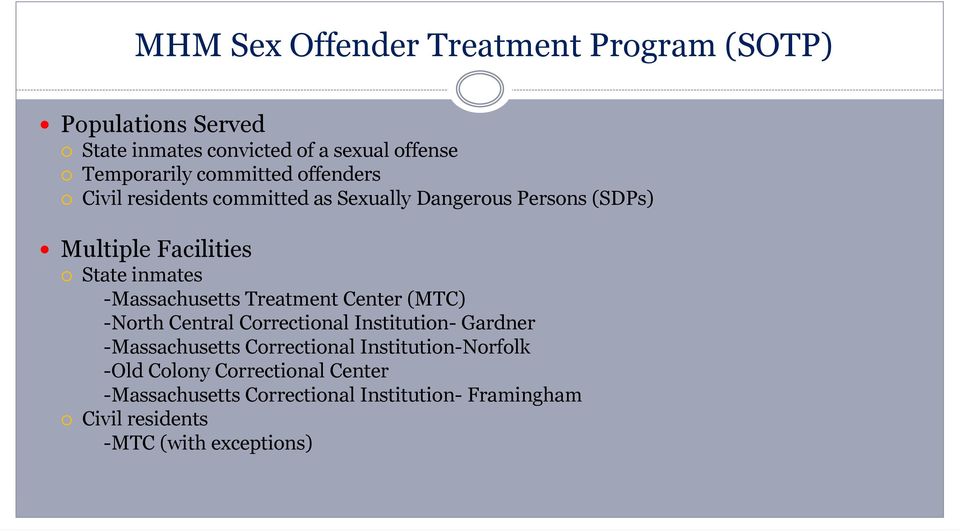
5 MHM Sex Offender Treatment Program (SOTP) Populations Served State inmates convicted of a sexual offense Temporarily committed offenders Civil residents committed as Sexually Dangerous Persons (SDPs) Multiple Facilities State inmates -Massachusetts Treatment Center (MTC) -North Central Correctional Institution- Gardner -Massachusetts Correctional Institution-Norfolk -Old Colony Correctional Center -Massachusetts Correctional Institution- Framingham Civil residents -MTC (with exceptions)
6 State Inmates Eligibility Generally within 6 years of earliest possible release Need ~18 months on sentence for transfer to MTC Referred by Correctional Programming Officer Treatment Phases Assessment & Treatment Introduction (off site only) Assessment & Treatment Preparation (MTC) ~6 months Nonresidential Treatment (MTC) OR Residential Treatment (MTC) Moderate intensity treatment High intensity treatment months months Maintenance Treatment (MTC, NCCI Gardner, & MCI Norfolk)

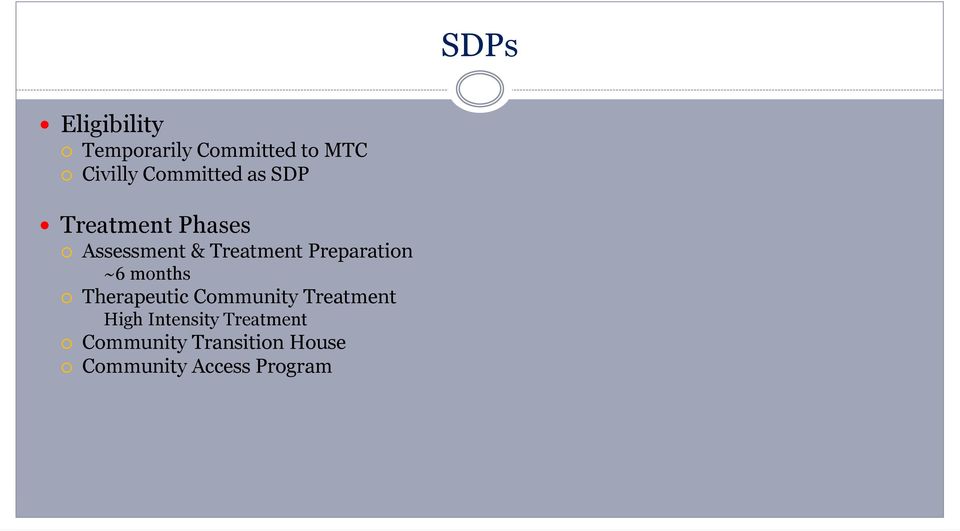
7 SDPs Eligibility Temporarily Committed to MTC Civilly Committed as SDP Treatment Phases Assessment & Treatment Preparation ~6 months Therapeutic Community Treatment High Intensity Treatment Community Transition House Community Access Program
8 Overview of Best Practices for Treatment of Adult Sexual Offenders

9 Best Practices: Treatment Best Practices in SO Treatment Cognitive Behavioral Therapy (CBT) model Include aspects of Social Learning Theory Include components of Relapse Prevention (RP) Focus on dynamic risk factors Focus on risk, needs, responsivity principles Incorporate aspects of positive psychology (strengths-based treatment) Individualized treatment services Objective measures of treatment progress Focus on risk management AND rehabilitation No more one size fits all treatment (Ward & Fisher, 2006; McGrath et al., 2010; Olver et al., 2012)

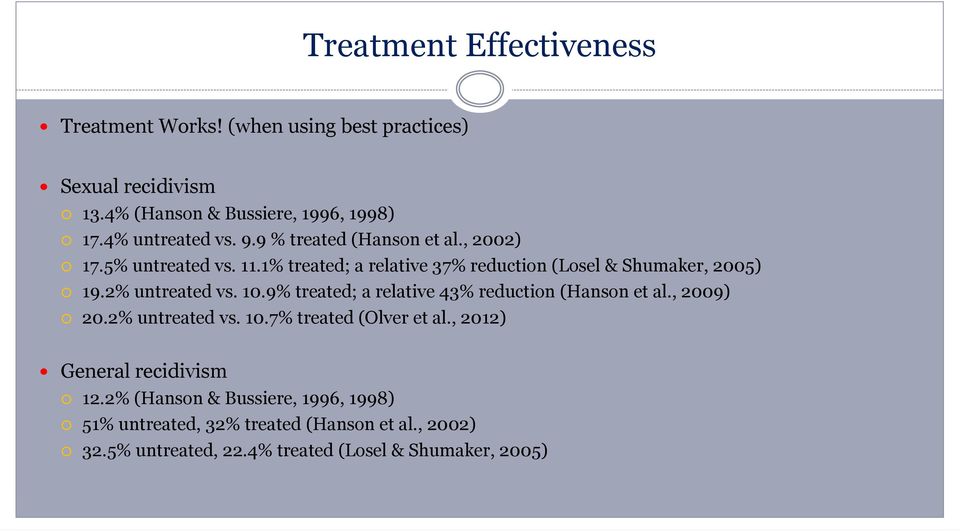
10 Treatment Effectiveness Treatment Works! (when using best practices) Sexual recidivism 13.4% (Hanson & Bussiere, 1996, 1998) 17.4% untreated vs. 9.9 % treated (Hanson et al., 2002) 17.5% untreated vs. 11.1% treated; a relative 37% reduction (Losel & Shumaker, 2005) 19.2% untreated vs. 10.9% treated; a relative 43% reduction (Hanson et al., 2009) 20.2% untreated vs. 10.7% treated (Olver et al., 2012) General recidivism 12.2% (Hanson & Bussiere, 1996, 1998) 51% untreated, 32% treated (Hanson et al., 2002) 32.5% untreated, 22.4% treated (Losel & Shumaker, 2005)
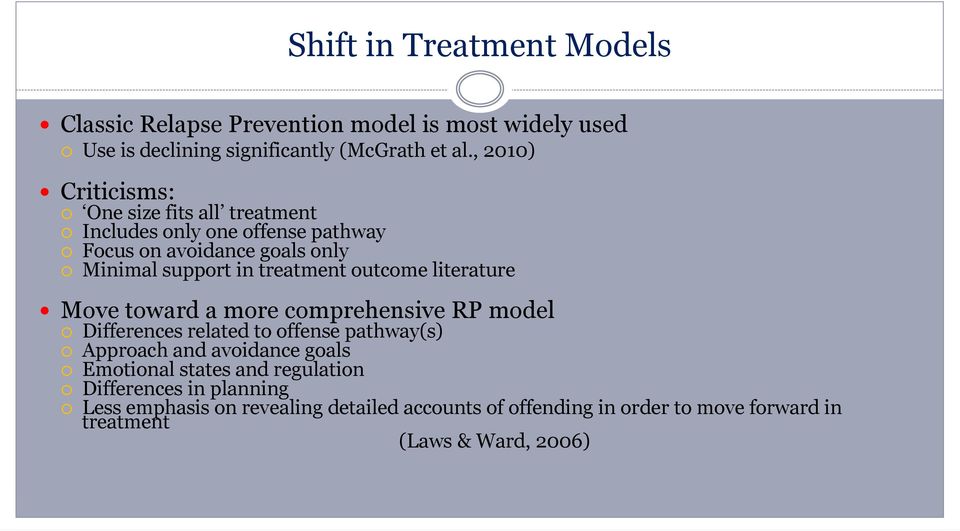
11 Shift in Treatment Models Classic Relapse Prevention model is most widely used Use is declining significantly (McGrath et al., 2010) Criticisms: One size fits all treatment Includes only one offense pathway Focus on avoidance goals only Minimal support in treatment outcome literature Move toward a more comprehensive RP model Differences related to offense pathway(s) Approach and avoidance goals Emotional states and regulation Differences in planning Less emphasis on revealing detailed accounts of offending in order to move forward in treatment (Laws & Ward, 2006)
12 Treatment Models Risk Need Responsivity (RNR) Risk: who? Need: what? Responsivity: how? Self-Regulation Model Modified RP Multiple pathways to offending (approach and avoidant) Based on regulation and goal theories Good Lives Model Strengths-based approach Approach is goal oriented (vs. avoidant) (Laws & Ward, 2006)

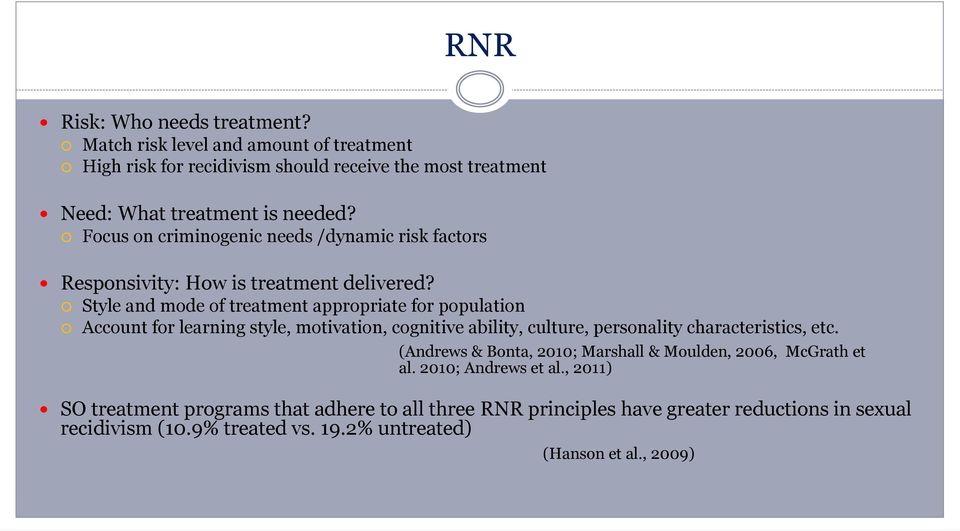
13 RNR Risk: Who needs treatment? Match risk level and amount of treatment High risk for recidivism should receive the most treatment Need: What treatment is needed? Focus on criminogenic needs /dynamic risk factors Responsivity: How is treatment delivered? Style and mode of treatment appropriate for population Account for learning style, motivation, cognitive ability, culture, personality characteristics, etc. (Andrews & Bonta, 2010; Marshall & Moulden, 2006, McGrath et al. 2010; Andrews et al., 2011) SO treatment programs that adhere to all three RNR principles have greater reductions in sexual recidivism (10.9% treated vs. 19.2% untreated) (Hanson et al., 2009)
14 SO Risk Assessment Static & Dynamic Risk Static Risk Factors -Historical, fixed and unchanging factors that contribute to risk of reoffense -Not treatment targets- cannot change -Level/amount of risk Dynamic Risk Factors -Psychological or behavioral factors that can change and contribute to risk of reoffense Stable (relatively enduring) Acute (rapidly changing) -Identify treatment targets -Level/amount of risk -Change in risk/ability to manage risk (increase or decrease) (Mann et al., 2010)

15 Influential Research Hanson & Bussiere (1996, 1998) Looked at 61 studies with a total of 28,972 sex offenders Identified factors related and unrelated to sexual recidivism Mann, Hanson, & Thornton (2010) Empirically supported risk factors (stand alone) Promising risk factors (need supportive evidence) Unsupported risk factors, with interesting exceptions Risk factors worth exploring (inconclusive or no studies) Risk factors with little or no relationship to sexual recidivism

16 Static Risk Factors Prior sexual offenses Diverse sexual offenses Contact and noncontact offenses, adult and child victims Non sexual violence Separate from sex offense and/or at time of sex offense Victim characteristics Unrelated victim Stranger victim Male victim History of criminal behaviors Having never been married/lived with partner Younger age (at time of assessment) Having dropped out of SO treatment (Hanson & Bussiere, 1998)

17 Risk Factors for Sexual Recidivism Sexual preoccupation Sexual preference for prepubescent or pubescent children Sexualized violence Multiple paraphilias Offense-supportive attitudes Emotional congruence with children Lack of emotionally intimate relationships with adults Lifestyle impulsiveness Poor problem solving Resistance to rules and supervision Grievance/hostility Negative social influences (Mann et al. 2010)

18 Promising Risk Factors Hostile beliefs about women Machiavellianism Lack of concern for others Dysfunctional coping Sexualized coping Externalized coping
19 Factors Unrelated to SO Risk Denial* Low self-esteem* Major mental illness* Loneliness* Depression Social skills deficits Poor victim empathy Lack of motivation for treatment (assessed pretreatment) * Some exceptions noted (Mann et al., 2010)

20 Implications Assessment and treatment should target empirically supported risk factors No one factor alone is strongly related to recidivism -> do not be over influenced by one factor, assess for a range of risk factors in a comprehensive manner Some factors can be changed through treatment, some cannot All factors can be managed

21 Common Assessment Tools Static: Static 99-R Static 2002-R Dynamic: Stable 2007 & Acute 2007 Structured Risk Assessment (SRA)-Forensic Version Sex Offender Treatment Progress Scale (SOTPS) Multidimensional Inventory of Development Sex and Aggression (MIDSA)
22 Static 99-R Revised in 2003 by Harris, Phenix, Hanson, and Thornton Actuarial measure of static risk for sexual violence 10 items: Age Ever lived with Index non sexual violence Prior non sexual violence Prior sex offenses Prior sentencing dates Convictions for non contact offenses Unrelated victims Stranger victims Male victims
23 Stable-2007 Developed by Hanson & Harris Most widely used measures of dynamic risk for sexual offenders in United States and Canada (McGrath et al., 2009) Designed for community offenders; more recently recommended for use with incarcerated offenders (DPP & DSP; Hanson & Harris 2000 and Hanson & Harris 2004) More predictive when looking at average over last 6-12 months changes the way we look at acute factors, more than imminent risk Should be used in combination with Static 99R/2002R to estimate recidivism rates for sexual, violent, and general recidivism with SO (Fernandez, Harris, Hanson, & Sparks, 2012)
24 Significant Social Influences Capacity for Relationship Stability Emotional Identification with Children Hostility toward Women General Social Rejection/Loneliness Lack of Concern for Others Impulsive Acts Poor Problem Solving Skills Negative Emotionality Sex Drive/Sex Preoccupation Sex as Coping Deviant Sexual Interests/Preference Cooperation with Supervision Stable 2007
25 Treatment Planning Stable dynamic risk factors Can change over time or through learning and using new skills Evidenced-based treatment plan Developed based on risk assessment (risk assessment is a checklist for treatment plan) Individualized Treatment recommendations based on factors identified as contributing to risk Specific to the offender- not one size fits all Collaborative Update annually (or more frequently) Evaluate stable dynamic risk factors Measure treatment progress (Harris & Hanson, 2010; Fernandez et al., 2012; )
26 Need to Individualize Treatment Difference between Child Molester and Pedophile Molesting children is a behavior Pedohilia is a sexual interest/urge Not all child molesters are sexually attracted to children and not all pedophiles molest children Types of Offenders Based on Motivation Paraphilic Offenders Paraphilic/deviant sexual interests motivate offending Some offenders are otherwise relatively pro-social Antisocial/Opportunistic Offenders No specific sexual interest in a victim type or sexual behavior Antisocial values/behaviors motivate offending (Wilson et al., 2012)
27 Common Language & Key Terms Risk Need Responsivity (RNR) Static Risk Factors Dynamic Risk Factors Assessment-based treatment Individualized treatment Objective measures of treatment progress
28 MTC SOTP Assessment & Treatment Services
29 Treatment Model Summary RNR is the umbrella Assessment based treatment Match risk level and treatment intensity Target dynamic risk factors in treatment Consider individual factors related to responsivity to treatment S-R and GLM models used to engage offenders in treatment, understand offending, and move toward successful treatment and reintegration
30 SOTP Assessment Services Assessment as intervention Occurs early in treatment Required for all state inmates and civil residents who participate in treatment Goals/Utility: Motivate and engage offenders in treatment Identify risk and level of service needed Identify treatment targets Facilitate development of individualized treatment plan Measure treatment progress Communication of risk/continuity of care upon release
31 SOTP Assessment Services Comprehensive Evaluation Includes Clinical Interview, Risk Assessment, Personality Assessment, and Cognitive Screen (additional measures if necessary) Risk measures: Static 99-R and Stable 2007 Penile Plethysmograph (PPG) Polygraph (in development) Annual updated Stable-2007
32 SOTP Treatment Services Group therapy (1-2x/week) Psychoeducational classes (based on dynamic risk factors) Community meetings, activities & privileges Peer support meetings Self-help meetings Rehabilitation programs Reentry services DOC services (education, vocation, religious, rehabilitation, reentry)
33 Treatment Progress Objective Initial and annual Stable 2007 scores PPG data Institutional conduct Subjective/Clinical Impression Clinical narratives about progress made Course evaluations Documentation Updated treatment plans Parole status reports Annual Treatment Review (SDPs)
34 SOTP Reentry Services SOTP close to release (state inmates) Focus on reintegration begins upon entry to SOTP, increased focus prior to release Updated assessments throughout treatment and prior to release Collaboration with DOC, related agencies, and community agencies when possible Use of best practice allows for common language between systems and improved continuity of care upon release
35 Challenges to Reentry Catch 22 Often need housing and services in place for release/parole, need to be released/paroled to obtain housing and services Housing/Homelessness Limited housing resources available: finances, risk, stigma, policy restrictions Community contacts Difficult to make contacts: either no resources available or no resources willing Community treatment providers generally do not set initial appointment/intake until offender is released
36 Preliminary Results: Risk Frequency Data at MTC
37 MTC Program Evaluation Research Research approved by DOC Office of Planning & Research SOTP Director of Research Shanon Maney, Psy.D. Goals: Evaluate effectiveness of MHM SOTP Improve the accuracy of identification of risk level/characteristics and improve treatment effectiveness
38 Static-99R Total Scores 60.0% 50.0% 40.0% 50.9% 40.6% Low Low Moderate Moderate High High 30.0% 20.0% 17.4% 24.2% 23.5% 23.5% 12.4% 10.0% 7.5% 0.0% CIVIL (n = 161) STATE ( n = 170)
39 Stable 2007 Total Score Comparisons 100.0% 90.0% 80.0% 70.0% 90.5% Low Moderate High 60.0% 50.0% 40.0% 30.0% 44.8% 52.2% 20.0% 10.0% 0.0% 0.0% 9.5% 3.0% CIVIL (n = 96) STATE (n = 133)
40 Static-99R & Stable-2007 Combined Low Moderate-Low Moderate-High High Very High Civil State
41 Distribution of Stable-2007 Risk Categories DSP (Hanson et al., 2007) (n=790) Massachusetts Civil (n=96) Massachusetts State (n=133) Low Mod High Low Mod High Low Mod High Percentages Rounded; Risk Category Percentages for Stable 2007 Scores at First Assessment
42 Summary & Implications State Inmates ~ 60% are in low or low-moderate risk category (combined Static 99R/Stable 2007) ~ 3% are in low risk category on Stable 2007 only SDPs No low risk (combined) Majority are in very high risk category (combined) ~50% are in high risk on Static 99R ~90% are in high risk on Stable 2007 Implications Treatment intensity & resource allocation (differences within state and between state/civil) Improved understanding of risk Reentry planning Importance of developing local norms Communication of risk and treatment needs
43 Challenges
44 Challenges: An MHM SOTP Perspective Reentry Release Decisions - At times inconsistent with treatment recommendations and evaluations - Importance placed on acceptance of responsibility - Ideally guided by assessments Housing - Limited housing available for sex offenders, especially level 3 - No transitional housing for SDPs Supervision - Most SDPs are released with no supervision - Often one size fits all supervision for sex offenders (legal restrictions) - Ideally conditions are guided by assessments; RNR principles apply Treatment - No system to facilitate continuity of care/communication - Inconsistency in sex offender treatment offered in community Research - No follow up post release = no information on program effectiveness/recidivism - Note: research evolves Underutilization of MTC Resources?
45 Select References Andrews, D.A., & Bonta, J. (2010). The Psychology of Criminal Conduct. (5 th Edition) New Providence, NJ: Lexis Nexis. Fernandez, Y., Harris, A.J.R., Hanson, R.K., & Sparks, J. (2012). Stable-2007 Coding Manual Revised Hanson, R.K., Bourgon, G., Helmus, L., & Hodgson, S. (2009). The principles of effective correctional treatment also apply to sexual offenders: A meta-analysis. Criminal Justice and Behavior, 36, Harris, A.J.R., and Hanson, R.K. (2010). Clionical, actuarial, and dynamic risk assessment of sexual offenders: Why do things keep changing? Journal of Sexual Aggression, 16(3) Laws, D.R. & Ward, T. (2006). When on-size doesn t fit all: The reformulation of relapse prevention. In Marshall, W.L., Fernandez, Y.M., Marshall, L.E., & Serran, G.A. (Eds.) Sexual Offender Treatment: Controversial Issues, (pp ). West Sussex, England: John Wiley & Sons, Ltd. Mann, R.E., Hanson, R.K., & Thornton, D. (2010). Assessing risk for sexual recidivism: Some proposals on the nature of some psychologically meaningful risk factors. Sexual Abuse: A Journal of Research and Treatment, 22(2), Marshall, L.E., & Moulden, H.N. (2006). Preparatory treatment programs for sexual offenders. In Marshall, W.L., Fernandez, Y.M., Marshall, L.E., & Serran, G.A. (Eds.) Sexual Offender Treatment: Controversial Issues, (pp ). West Sussex, England: John Wiley & Sons, Ltd. McGrath, R., Cumming, G., Burchard, B., Zeoli, S., & Ellerby, L. (2010). Current Practices and Emerging Trends in Sexual Abuser Management: The Safer Society 2009 North American Survey. Brandon, Vermont: Safer Society Press. Ward, T. & Fisher, D. (2006). New ideas in the treatment of sexual offenders. In Marshall, W.L., Fernandez, Y.M., Marshall, L.E., & Serran, G.A. (Eds.) Sexual Offender Treatment: Controversial Issues, (pp ). West Sussex, England: John Wiley & Sons, Ltd. Yates, P., Prescott, D., & Ward, T. (2010). Applying the Good Lives and Self-Regulation Models to sex offender treatment: A practical guide for clinicians. Brandon, Vermont: Safer Society Press.
46 Questions Thank you for your time Brooke Berard, Psy.D. Kaitlyn Peretti, Psy.D.
Massachusetts Department of Correction SEX OFFENDER MANAGEMENT 103 DOC 446. Table of Contents. 446.01 Definitions...3. 446.02 General Policy...
 Massachusetts Department of Correction SEX OFFENDER MANAGEMENT 103 DOC 446 Table of Contents Page 446.01 Definitions...3 446.02 General Policy...3 446.03 Orientation...3 446.04 Classification & Program
SOTIPS. Sex Offender Treatment Intervention and Progress Scale. Robert J. McGrath, Georgia F. Cumming and Michael P. Lasher
 SOTIPS Sex Offender Treatment Intervention and Progress Scale Robert J. McGrath, Georgia F. Cumming and Michael P. Lasher 2012 Copyright and Permissions Copyright 2012 by Robert J. McGrath, Georgia F.
STATE OF OHIO. DEPARTMENT OF REHABILITATION RELATED ACA STANDARDS: EFFECTIVE DATE: AND CORRECTION February 19, 2011 I. AUTHORITY
 STATE OF OHIO SUBJECT: PAGE 1 OF 7. Specialized Assessments and Screenings NUMBER: 67-MNH-16 RULE/CODE REFERENCE: SUPERSEDES: AR 5120-11-03, 07, 21 67-MNH-16 dated 01/13/10 ORC 5120.031; 5120.032; 5120.033
A Program Evaluation of In- Prison Components The Colorado Department of Corrections Sex Offender Treatment and Monitoring Program
 A Program Evaluation of In- Prison Components The Colorado Department of Corrections Sex Offender Treatment and Monitoring Program Central Coast Clinical and Forensic Psychology Services, Inc. Deirdre
GENDER-RESPONSIVE ASSESSMENT AND TREATMENT FOR JUSTICE-INVOLVED WOMEN IN COMMUNITY SUPERVISION
 GENDER-RESPONSIVE ASSESSMENT AND TREATMENT FOR JUSTICE-INVOLVED WOMEN IN COMMUNITY SUPERVISION Krista Gehring, Ph.D. Assistant Professor Department of Criminal Justice University of Houston-Downtown January
Charles A. Flinton, Ph.D. License #: PSY16095 870 Market Street, Suite 807-1107 San Francisco, CA 94102 Phone 415-391-7171 www.sffi.
 Charles A. Flinton, Ph.D. License #: PSY16095 870 Market Street, Suite 807-1107 94102 Phone 415-391-7171 www.sffi.us EDUCATION 1990 1997 California Institute of Integral Studies, M.A., Clinical Psychology
Improving the Effectiveness of Correctional Programs Through Research
 Improving the Effectiveness of Correctional Programs Through Research Presented by: Edward J. Latessa, Ph.D. Center for Criminal Justice Research Division of Criminal Justice University of Cincinnati www.uc.edu/criminaljustice
Results First Adult Criminal and Juvenile Justice Evidence-Based Program Inventory
 STATE OF CONNECTICUT Results First Adult Criminal and Juvenile Justice Evidence-Based Program Inventory October 2014 INSTITUTE FOR MUNICIPAL AND REGIONAL POLICY Central Connecticut State University Connecticut
Evidence Based Correctional Practices
 Evidence Based Correctional Practices What works in corrections is not a program or a single intervention but rather a body of knowledge that is accessible to criminal justice professionals. 1 The National
Rehabilitation programs for young offenders: Towards good practice? Andrew Day. Forensic Psychology Research Group. University of South Australia
 1 Rehabilitation programs for young offenders: Towards good practice? Andrew Day Forensic Psychology Research Group University of South Australia [email protected] Invited paper for the Understanding
California Sex Offender Management Board. Sex Offender Treatment Training Requirements
 California Sex Offender Management Board Sex Offender Treatment Training Requirements August 2013 CASOMB Certification and Re-certification Requirements for Sex Offender Treatment Providers (Revised July,
Reentry on Steroids! NADCP 2013
 Reentry on Steroids! NADCP 2013 Panel Introductions Judge Keith Starrett Moderator Judge Robert Francis Panelist Judge Stephen Manley Panelist Charles Robinson - Panelist Dallas SAFPF 4-C Reentry Court
How To Manage A Sex Offender
 California Sex Offender Management Board Sex Offender Treatment Program Certification Requirements June 2011 REQUIREMENTS FOR CERTIFICATION OF PROGRAMS 1 Introduction... 1 Definitions... 2 Requirements
STANDARDS FOR FORENSIC PSYCHOLOGICAL EVALUATIONS OF ADULT SEXUAL OFFENDERS
 STANDARDS FOR FORENSIC PSYCHOLOGICAL EVALUATIONS OF ADULT SEXUAL OFFENDERS Approved on March 24, 2003 by: The San Diego County Sex Offender Management Council Submitted by the Legal Process Subcommittee
Mental Health & Addiction Forensics Treatment
 Mental Health & Addiction Forensics Treatment Sheriffs: Help needed to cope with September 15, 2014 mentally ill INDIANAPOLIS - A sheriff says county jails have become the "insane asylums" for Indiana
The Rehabilitation of Offenders: A Strength-Based Desistance Approach
 The Rehabilitation of Offenders: A Strength-Based Desistance Approach Tony Ward, PhD, DipClinPsyc Victoria University of Wellington [email protected] Key Papers Laws, D. R. & Ward, T. (2011). Desistance
C enter For S ex O ffender M anagement. Myths and Facts About Sex Offenders. August 2000
 C enter For S ex O ffender M anagement Myths and Facts About Sex Offenders August 2000 There are many misconceptions about sexual offenses, sexual offense victims, and sex offenders in our society. Much
Predictors of Sexual Recidivism: An Updated Meta-Analysis
 R. Karl Hanson and Kelly Morton-Bourgon Public Safety and Emergency Preparedness Canada Predictors of Sexual Recidivism: An Updated Meta-Analysis 004-0 Public Works and Government Services Canada Cat.
Juvenile Sexual Offenders: An. Analytical View of Effective. Programming
 Juvenile Sexual Offenders: An Analytical View of Effective Programming Lee Hyman Volume 4 No. 2 Fall 2007 Abstract The following paper reviews the little discussed topic of juvenile sexual offenders as
ANNUAL EVALUATION OF CALIFORNIA DEPARTMENT OF CORRECTIONS AND REHABILITATION CONTRACTED SEX OFFENDER TREATMENT PROGRAMS
 ANNUAL EVALUATION OF CALIFORNIA DEPARTMENT OF CORRECTIONS AND REHABILITATION CONTRACTED SEX OFFENDER TREATMENT PROGRAMS State of California Department of Corrections and Rehabilitation Office of Research
DEPARTMENT OF CORRECTIONS PROBATION AND PAROLE DIVISION OPERATIONAL PROCEDURE. Subject: PROGRAM STRUCTURES
 DEPARTMENT OF CORRECTIONS PROBATION AND PAROLE DIVISION OPERATIONAL PROCEDURE Procedure No.: PPD 5.1.100 Reference: DOC 5.4.1; 53-1-203, MCA Page 1 of 6 Effective Date: 06/23/15 Revision Dates: Signature
BEST PRACTICE & EVIDENCE-BASED TREATMENT
 Rob Butters PhD LCSW 1 BEST PRACTICE & EVIDENCE-BASED TREATMENT SEXUAL ASSAULT 3-19-15 About Me 2 Assistant Professor, College of Social Work, University of Utah. Chair of Forensic Social Work at CSW,
Supervising the Drug Addicted Offender. Jac A. Charlier, M.P.A. Director Consulting and Training
 Supervising the Drug Addicted Offender Jac A. Charlier, M.P.A. Director Consulting and Training Learning Objectives Learn your supervision philosophy Review some of the 13 NIDA Principles of Drug Abuse
Charles A. Flinton, Ph.D. License #: PSY16095 870 Market Street, Suite 1107 San Francisco, CA 94102 Phone 415-391-7171 www.sffi.
 Charles A. Flinton, Ph.D. License #: PSY16095 870 Market Street, Suite 1107 94102 Phone 415-391-7171 www.sffi.us EDUCATION 1990 1997 California Institute of Integral Studies, M.A., Clinical Psychology
California Sex Offender Management Board. Sex Offender Treatment Program Certification Requirements
 California Sex Offender Management Board Sex Offender Treatment Program Certification Requirements Rev. June 2012 REQUIREMENTS FOR CERTIFICATION OF P ROGRAMS 1 Introduction... 1 Definitions... 3 Requirements
Samantha Smithstein, Psy.D.
 Curriculum Vitae Samantha Smithstein, Psy.D. Clinical & Forensic Psychologist License No. Psy19074 EDUCATION Psy.D. Clinical Psychology, December 2000 California Institute of Integral Studies, M.A. Clinical
Multisystemic Therapy With Juvenile Sexual Offenders: Clinical and Cost Effectiveness
 Multisystemic Therapy With Juvenile Sexual Offenders: Clinical and Cost Effectiveness Charles M. Borduin Missouri Delinquency Project Department of Psychological Sciences University of Missouri-Columbia
How To Become A Forensic Psychologist
 Forensic Psychology Postdoctoral Fellowship Massachusetts Treatment Center Massachusetts Department of Correction Forensic Health Services/MHM Inc. Bridgewater, Massachusetts 2013-2014 Table of Contents
Juvenile Section Highlights
 TEXT SIZE: SEND Printer-Friendly Option October 2014 / NCJ 247059 Perpetrators of sex crimes are often seen as needing special management practices. As a result, jurisdictions across the country have implemented
Another Look at Sex Offender Treatment Efficacy: A Within-Treatment Design
 Sex Offender Treatment Efficacy 1 Another Look at Sex Offender Treatment Efficacy: A Within-Treatment Design Troy Jones & Anthony W. Tatman, Ph.D. Iowa Department of Correctional Services Troy Jones is
Curriculum Vitae. Amy Phenix, Ph.D. 630 Quintana Road, # 242 Morro Bay, CA 93442. Phone: (805) 451-8483. [email protected] www.amyphenix.
 Curriculum Vitae Amy Phenix, Ph.D. 630 Quintana Road, # 242 Morro Bay, CA 93442 Phone: (805) 451-8483 [email protected] www.amyphenix.com PROFESSIONAL BACKGROUND 2009 to present Clinical Psychologist,
Probation in England and Wales Systems for Delivering Effective Practice
 Probation in England and Wales Systems for Delivering Effective Practice Workshop on Adult Intervention Programmes in Probation Services Antakya 17-18 th May 2011 Agenda Introduction: The National Offender
EFFECTIVENESS OF TREATMENT FOR VIOLENT JUVENILE DELINQUENTS
 EFFECTIVENESS OF TREATMENT FOR VIOLENT JUVENILE DELINQUENTS THE PROBLEM Traditionally, the philosophy of juvenile courts has emphasized treatment and rehabilitation of young offenders. In recent years,
TREATMENT OF SEXUAL OFFENDERS AND ITS EFFECTS
 TREATMENT OF SEXUAL OFFENDERS AND ITS EFFECTS By William. L. Marshall, Ph.D., FRSC* I. INTRODUCTION In the early 1980s research began to reveal high rates of sexual offending in various English-speaking
The Impact of Traumatic Brain Injury on Sexual Offending Behavior Sarah E. Herrick, Jerrod Brown, & Erwin Concepcion
 ISSN: 2161-0231 ONLINE The Impact of Traumatic Brain Injury on Sexual Offending Behavior Sarah E. Herrick, Jerrod Brown, & Erwin Concepcion Traumatic brain injury (TBI) is a potential risk factor for mental
California Sex Offender Management Board. Sex Offender Treatment Program Certification Requirements
 California Sex Offender Management Board Sex Offender Treatment Program Certification Requirements Rev. October 2013 CASOMB SEX OFFENDER TREATMENT PROGRAM CERTIFICATION REQUIREMENTS TABLE OF CONTENTS Effective
EOPS Grantee Tools. Implementing a Reentry Program According to Best Practices
 EOPS Grantee Tools Implementing a Reentry Program According to Best Practices Report prepared by: Massachusetts Executive Office of Public Safety Research and Policy Analysis Division March 2007 This document
Frequently Asked Questions (FAQs) of Drug Abuse Treatment for Criminal Justice Populations
 Frequently Asked Questions (FAQs) of Drug Abuse Treatment for Criminal Justice Populations From The National Institute on Drug Abuse (NIDA) 2. Why should drug abuse treatment be provided to offenders?
How To Manage A Sex Offender Program
 U.S. Department of Justice Federal Bureau of Prisons P R O G R A M S T A T E M E N T OPI: CPD/PSB NUMBER: 5324.10 DATE: February 15, 2013 Sex Offender Programs /s/ Approved: Charles E. Samuels, Jr. Director,
LEVEL III.5 SA: SHORT TERM RESIDENTIAL - Adult (DUAL DIAGNOSIS CAPABLE)
 LEVEL III.5 SA: SHT TERM RESIDENTIAL - Adult (DUAL DIAGNOSIS CAPABLE) Definition The following is based on the Adult Criteria of the Patient Placement Criteria for the Treatment of Substance-Related Disorders
Long-term Impact Evaluation of Specialized Sex Offender Probation Programs In Lake, DuPage and Winnebago Counties
 Long-term Impact Evaluation of Specialized Sex Offender Probation Programs In Lake, DuPage and Winnebago Counties Prepared for the The Illinois Criminal Justice Information Authority By: Loretta J. Stalans,
How To Treat A Drug Addict
 Texas Department of Criminal Justice Rehabilitation Programs Division June 2010 SAFPF (Substance Abuse Felony Punishment Facility) Community treatment alone is not always enough Some individuals must be
Results. Contact sexual crimes based on PSI and self-report after SOTP participation
 Self-Reported Contact Sexual Offenses by Participants in the Federal Bureau of Prisons Sex Offender Treatment Program: Implications for Internet Sex Offenders Andres E. Hernandez, Psy.D. Director, Sex
Mental Health Fact Sheet
 Mental Health Fact Sheet Substance Abuse and Treatment Branch (SATB), Community Supervision Services Re-Entry and Sanctions Center (RSC), Office of Community Justice Programs Adult Probationers / Parolees
Child Pornography Offender Characteristics and Risk to Reoffend. Michael C. Seto, Ph.D., C.Psych. Royal Ottawa Health Care Group
 Seto 1 Child Pornography Offender Characteristics and Risk to Reoffend Michael C. Seto, Ph.D., C.Psych. Royal Ottawa Health Care Group Prepared for the United States Sentencing Commission Draft dated February
There s plenty of work { on the dark side!
 There s plenty of work { on the dark side! Careers in treating sex offenders Jackson Tay Bosley, Psy.D. Thomas Graves, Ph.D. CST Alena Kearney, LSW, M.Ed. Assumptions Individuals who commit sexual offenses
In this paper, we examine the reasons for the resurgence of interest. t r e n d s & i s s u e s
 No.112 The Rehabilitation of Offenders: International Perspectives Applied to Australian Correctional Systems t r e n d s & i s s u e s Kevin Howells & Andrew Day In December 1998 there were 19,620 people
2016 MID-ATLANTIC SEXUAL OFFENDER CE TRAININGS. 20 CE Hours
 2016 MID-ATLANTIC SEXUAL OFFENDER CE TRAININGS 20 CE Hours HALF IN-PERSON, HALF ONLINE The Global Institute of Forensic Research, LLC (GIFR) is proud to present its 2016 Sexual Offender CE Trainings. GIFR
John Keel, CPA State Auditor. An Audit Report on Selected Rehabilitation Programs at the Department of Criminal Justice. March 2007 Report No.
 John Keel, CPA State Auditor An Audit Report on Selected Rehabilitation Programs at the Department of Criminal Justice Report No. 07-026 An Audit Report on Selected Rehabilitation Programs at the Department
Criminal Justice Professionals Attitudes Towards Offenders: Assessing the Link between Global Orientations and Specific Attributions
 Criminal Justice Professionals Attitudes Towards s: Assessing the Link between Global Orientations and Specific Attributions Prepared by: Dale Willits, M.A. Lisa Broidy, Ph.D. Christopher Lyons, Ph.D.
Stopping the Revolving Door for Mentally Ill Offenders in the Criminal Justice System via Diversion and Re-entry Programs
 GEORGIA GEORGIA GEORGIA GEORGIA GEORGIA Department of Corrections ON THE MOVE Stopping the Revolving Door for Mentally Ill Offenders in the Criminal Justice System via Diversion and Re-entry Programs Academic
Overview of Domestic Violence (DV) Risk Assessment Instruments (Frequently Asked Questions) Kristin Bechtel and Bill Woodward
 The author(s) shown below used Federal funds provided by the U.S. Department of Justice, National Institute of Corrections (NIC) and prepared the following final report: Document Title: Author: Overview
DEVELOPMENTAL DISABILITIES ADMINISTRATION Olympia, Washington TITLE: COMMUNITY PROTECTION PROGRAM POLICY 15.01 IDENTIFICATION AND ELIGIBILITY
 DEVELOPMENTAL DISABILITIES ADMINISTRATION Olympia, Washington TITLE: COMMUNITY PROTECTION PROGRAM POLICY 15.01 Authority: Chapter 71A RCW Developmental Disabilities Chapter 388-101 WAC Certified Community
Does Sex Offender Treatment Work? By Brett Trowbridge, Ph.D., J.D.
 Does Sex Offender Treatment Work? By Brett Trowbridge, Ph.D., J.D. It is very difficult to conduct good research on the effectiveness of sex offender treatment. As a result, authorities seem to agree that
How To Change The Way A Prison System Works
 Moving the California Department of Corrections and Rehabilitation from an Offense- Based to Risk-Based System Susan Turner University of California, Irvine September 2010 Presentation Will Cover Size
Current Practices and Emerging Trends in Sexual Abuser Management The Safer Society 2009 North American Survey
 Current Practices and Emerging Trends in Sexual Abuser Management The Safer Society 2009 North American Survey Robert J. McGrath Georgia F. Cumming Brenda L. Burchard Stephen Zeoli Lawrence Ellerby Current
Characteristics of OWI Offenders
 Characteristics of OWI Offenders Sean Corbin, MPA, CCJP December 16, 2009 Characteristics First Time Offender? Scratching the Surface. Recidivist Characteristics. Who Are They? How We Think Is How We Act.
Statistics on Women in the Justice System. January, 2014
 Statistics on Women in the Justice System January, 2014 All material is available though the web site of the Bureau of Justice Statistics (BJS): http://www.bjs.gov/ unless otherwise cited. Note that correctional
Career. A Career with the Correctional Service of Canada Join Us! Description. Learning objectives
 Correctional Service Canada Service correctionnel Canada Service correctionnel Canada Correctional Service Canada Career A Career with the Correctional Service of Canada Join Us! Description The Correctional
Understanding Treatment for Adults and Juveniles Who Have Committed Sex Offenses
 C enter for S ex O ffender M anagement A Project of the U.S. Department of Justice, Office of Justice Programs Understanding Treatment for Adults and Juveniles Who Have Committed Sex Offenses November
The Goal of Correctional Counseling
 41140_CH03_Pass2.qxd 8/9/07 12:21 PM Page 45 Jones and Bartlett Publishers. NOT FOR SALE OR DISTRIBUTION The Goal of Correctional Counseling 3 The goal of correctional counseling is usually based on two
SUBSTANCE ABUSE INTERVENTION STUDY AT THE SPECIAL ALTERNATIVE INCARCERATION (SAI) PROGRAM
 SUBSTANCE ABUSE INTERVENTION STUDY AT THE SPECIAL ALTERNATIVE INCARCERATION (SAI) PROGRAM Conducted by Ann L. Date, Psy.D. LP Partners in Change: Psychological and Community Services, PLC 720 W. Wackerly
Criminal Justice 101. The Criminal Justice System in Colorado and the Impact on Individuals with Mental Illness. April 2009
 Criminal Justice 101 The Criminal Justice System in Colorado and the Impact on Individuals with Mental Illness April 2009 Acronyms DOC = Department of Corrections DYC = Division of Youth Corrections DCJ
Questionnaire: Domestic (Gender and Family) Violence Interventions
 Questionnaire: Domestic (Gender and Family) Violence Interventions STRENGTHENING TRANSNATIONAL APPROACHES TO REDUCING REOFFENDING (STARR) On behalf of The Institute of Criminology STRENGTHENING TRANSNATIONAL
COMMONWEALTH OF MASSACHUSETTS DEPARTMENT OF CORRECTION 103 DOC 445 SUBSTANCE ABUSE PROGRAMS TABLE OF CONTENTS. 445.01 Definitions...
 COMMONWEALTH OF MASSACHUSETTS DEPARTMENT OF CORRECTION 103 DOC 445 SUBSTANCE ABUSE PROGRAMS TABLE OF CONTENTS 445.01 Definitions...2 445.02 Overall Principles for Substance Abuse Programs in Correctional
Texas Civil Commitment-Outpatient Sexually Violent Predator Treatment Program (OSVPTP) Health & Safety Code, Chapter 841
 Texas Civil Commitment-Outpatient Sexually Violent Predator Treatment Program (OSVPTP) Health & Safety Code, Chapter 841 U.S. History There have been a number of high profile sexually violent crimes that
The responsivity principle and offender rehabilitation
 The responsivity principle and offender rehabilitation Researchers began to seriously question the effectiveness of correctional programs in reducing recidivism in the mid-1970s. Many had come to believe
Clinical Skills for Evidence-Based Substance Abuse Treatment Practices with Offenders. Treatment of Co-Occurring Disorders
 Clinical Skills for Evidence-Based Substance Abuse Treatment Practices with Offenders Treatment of Co-Occurring Disorders National TASC Conference, Columbus, Ohio; May 8, 2013 Roger H. Peters, Ph.D., University
TEXAS DEPARTMENT OF CRIMINAL JUSTICE PAROLE DIVISION SUBJECT: SEX OFFENDER TREATMENT AND POLYGRAPH GUIDELINES
 TEXAS DEPARTMENT OF CRIMINAL JUSTICE PAROLE DIVISION NUMBER: PD/POP-3.6.9 DATE: 08/07/15 POLICY AND OPERATING PROCEDURE PAGE: 1 of 18 SUPERSEDES: 06/12/14 SUBJECT: SEX OFFENDER TREATMENT AND POLYGRAPH
Effective Intervention Strategies for Offenders with Co-Occurring Mental and Substance Use Disorders
 Effective Intervention Strategies for Offenders with Co-Occurring Mental and Substance Use Disorders Utah Fall Substance Abuse Conference Act, St. George, Utah September 24, 2014 Roger H. Peters, Ph.D.,
Curriculum Vitae. Amy Phenix, Ph.D. 630 Quintana Road, # 242 Morro Bay, CA 93442. Phone: (805) 451-8483. [email protected] www.amyphenix.
 Curriculum Vitae Amy Phenix, Ph.D. 630 Quintana Road, # 242 Morro Bay, CA 93442 Phone: (805) 451-8483 [email protected] www.amyphenix.com PROFESSIONAL BACKGROUND 2009 to present Clinical Psychologist,
13.6. Adjunct staff means an employee of Corrections who works in conjunction with the Sex Offender Treatment Program and staff.
 501 KAR 6:020 Policy Number Total s KENTUCKY CORRECTIONS Policies and Procedures Date Filed 20 References/Authority KRS 196.035, 197.020, 197.400-440, 439.340 ACA 4-4369 Subject May 14, 2008 September
Zachary Yeoman, Psy.D Somerset Psychological Group, PA 134 West End Avenue Somerville, NJ 08876 (908) 333-4646 x107 www.somersetpsych.
 CIRRICULUM VITAE Zachary Yeoman, Psy.D Somerset Psychological Group, PA 134 West End Avenue Somerville, NJ 08876 (908) 333-4646 x107 www.somersetpsych.com EDUCATION: Psy.D. The Illinois School of Professional
APPENDIX C HALFWAY HOUSE PROGRAM PROFILES
 APPENDIX C HALFWAY HOUSE PROGRAM PROFILES Alternatives Agency Inc. Alternatives Agency is a Halfway House located in Cleveland, Ohio. This facility serves adult males and females who are county probationers,
Objective Prison Classification, The cornerstone to good prison security
 Montecito # 38, WTC Piso 10, Oficina 18 Col. Nápoles México, 03810, D.F. Tel: (55) 9000 80 04 Objective Prison Classification, The cornerstone to good prison security Classification systems help minimize
Over the last several years, the importance of the risk principle has been
 Understanding the Risk Principle: How and Why Correctional Interventions Can Harm Low-Risk Offenders Over the last several years, the importance of the risk principle has been well established in many
SEX OFFENDER TREATMENT PROGRAMS
 SEX OFFENDER TREATMENT PROGRAMS JOHN HOWARD SOCIETY OF ALBERTA 2002 EXECUTIVE SUMMARY Although the number of convicted sex offenders grew from 2,768 in 1990 to 3,875 in 1995, the rate of reported sexual
Sue R. (Chartered Clinical & Forensic Psychologist) B.Sc. (Hons.), M.Sc., D. Clin. Psychol. AFBPSs.
 Sue R (Chartered Clinical & Forensic Psychologist) B.Sc. (Hons.), M.Sc., D. Clin. Psychol. AFBPSs. PROFESSIONAL QUALIFICATIONS & EXPERTISE Professional Qualification British Psychological Society Chartered
PROGRAM STRATEGY FOR WOMEN OFFENDERS
 PROGRAM STRATEGY FOR WOMEN OFFENDERS August 2004 By Doris Fortin Manager, Programs for Women Offenders TABLE OF CONTENTS PART 1 STRATEGIC OUTLOOK Pages 4-9 Background 4 Program Strategy for Women Offenders
Massachusetts Council on Compulsive Gambling
 Massachusetts Council on Compulsive Gambling We understand the problem. We can help. Gambling Problems and Corrections Solutions for the Future Scott Melissa, Massachusetts Council on Compulsive Gambling
Testimony of Adrienne Poteat, Acting Director Court Services and Offender Supervision Agency for the District of Columbia
 Testimony of Adrienne Poteat, Acting Director Court Services and Offender Supervision Agency for the District of Columbia Before the U.S. House of Representatives Committee on Oversight And Government
RHODE ISLAND SEX-OFFENDER REGISTRATION AND NOTIFICATION
 RHODE ISLAND SEX-OFFENDER REGISTRATION AND NOTIFICATION CONTACT INFORMATION Rhode Island State Police Bureau of Criminal Investigation 150 South Main Street Providence, RI 02903-2907 Telephone: 401-421-5268
TREATMENT PROGRAMS EMOTIONAL AND PERSONAL PROGRAMS COGNITIVE PROGRAMS. Idaho Department of Correction. Anger Management (SAMHSA)
 TREATMENT PROGRAMS Idaho Department of Correction Following is a listing and description of treatment programs currently offered, either in the community for offenders on probation/parole or in the institutions
Evaluation of the Performance of the Texas Department of Criminal Justice Rehabilitation Tier Programs
 Evaluation of the Performance of the Texas Department of Criminal Justice Rehabilitation Tier Programs Criminal Justice Policy Council Prepared for the 77 th Texas Legislature, 2001 Tony Fabelo, Ph.D.
Reentry & Aftercare. Reentry & Aftercare. Juvenile Justice Guide Book for Legislators
 Reentry & Aftercare Reentry & Aftercare Juvenile Justice Guide Book for Legislators Reentry & Aftercare Introduction Every year, approximately 100,000 juveniles are released from juvenile detention facilities
CURRICULUM VITAE. B.A. Psychology, 1999- Rutgers College, Rutgers, The State University of New Jersey, New Brunswick, New Jersey
 CURRICULUM VITAE Jason S. Fleming, Psy.D. Licensed Psychologist Associates in Psychological Services, P.A. 25 North Doughty Avenue Somerville, New Jersey 08876 (908) 526-1177 ext. 56 EDUCATION: Psy.D.
QUALIFICATIONS: BSc (Hons) Psychology 1995 Doctorate in Clinical Psychology 2001 MSc Forensic Psychology 2012
 Dr Dawn Bailham Consultant Clinical Psychologist BSc, MSc, Doctorate in Clinical Psychologist, Affiliated Member of the British Psychological Society, AFBPS Contact: Expert Witness Department Expert in