
Multisystemic Therapy With Juvenile Sexual Offenders: Clinical and Cost Effectiveness
|
|
|
- Esmond Curtis
- 9 years ago
- Views:
Transcription
1 Multisystemic Therapy With Juvenile Sexual Offenders: Clinical and Cost Effectiveness Charles M. Borduin Missouri Delinquency Project Department of Psychological Sciences University of Missouri-Columbia

2 Juvenile Sexual Offender Treatment: How Much Do We Really Know? Most treatment focuses on individual youths Is such treatment clinically effective? Is such treatment cost effective? Is it time for a change?
3 Juvenile Sexual Offender Treatment: Focus on the Individual Youth Most treatment approaches focus exclusively on altering youths individual characteristics and are patterned after existing interventions with adult sexual offenders Treatment programs are based on theories about deviant sexual arousal, relapse prevention, and abuse cycles Treatments last 12 to 24 months, include sex-offenderspecific modules (i.e., deviant arousal reduction, cognitive restructuring, victim empathy training, relapse prevention), and often involve group therapy
4 Juvenile Sexual Offender Treatment: Is it Clinically Effective? Studies (n = 3) examining sex-offender-specific cognitivebehavioral treatment for juveniles have failed to use randomized designs Even so, results from these studies are not encouraging & show only small between-groups differences in sexual recidivism & even worse outcomes for general recidivism (Hanson et al., 2002) To date, individually oriented treatment approaches for juvenile sexual offenders have little empirical support
5 Juvenile Sexual Offender Treatment: Is it Cost Effective? Considerable financial resources are being devoted to individually oriented treatments (which have little evidence of clinical effectiveness) in both residential and outpatient settings For example, South Carolina Medicaid reimburses from $91,250 (at $250 per day per youth, minimum length of stay approximately 12 months) to $219,000 (24 months at $300 per day per youth) for residential treatment of juvenile sexual offenders
6 Juvenile Sexual Offender Treatment: Is it Time for a Change? It is not surprising that individually oriented, sexoffender-specific treatment fails to substantially improve recidivism rates in juvenile sexual offenders It is also not surprising that such treatment is expensive Why?

7 Are Juvenile Sexual Offenders Different from Other Juvenile Offenders?

8 Correlates of Juvenile Sexual Offending Most studies have serious methodological limitations, but findings suggest that multiple risk factors are linked with sexual offending in juveniles: Individual factors (e.g., internalizing problems) Family factors (e.g., low warmth, high conflict, low monitoring) Parental problems (e.g., spousal violence, substance abuse) Peer relations (e.g., social isolation, immaturity) School performance (e.g., low achievement, behavior problems, school suspension, learning disabilities)
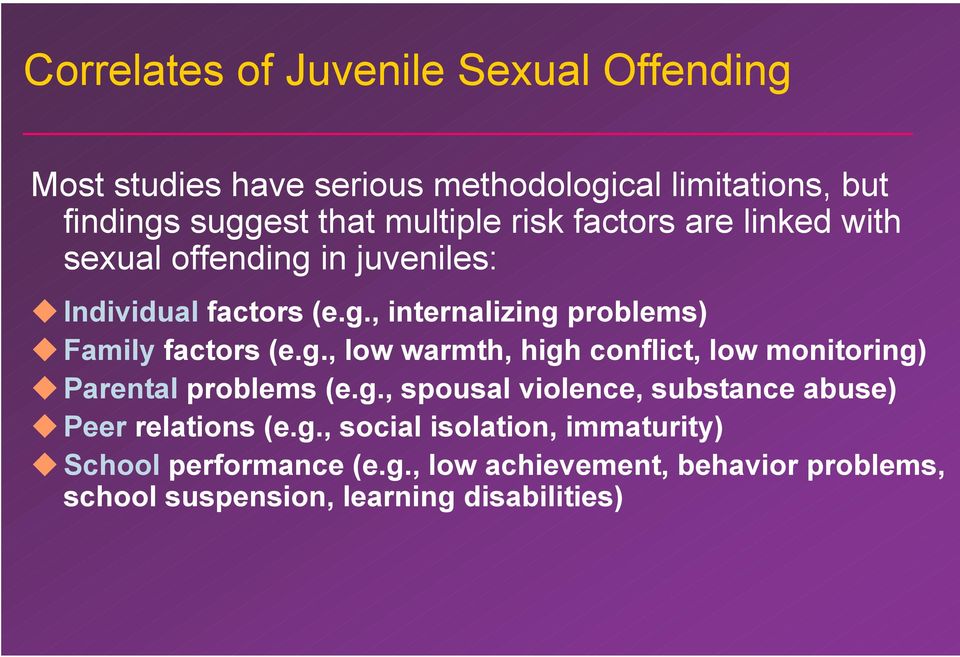
9 Correlates of Juvenile Sexual Offending Ronis and Borduin (2003) recently provided a more rigorous evaluation of juvenile sexual offenders and their social systems : 115 youths, divided into 5 demographically matched groups: aggressive sexual offenders (i.e., sexual assault, rape) nonaggressive sexual offenders (i.e., molesting younger children) aggressive nonsexual offenders (i.e., aggravated assault) nonaggressive nonsexual offenders (i.e., burglary, auto theft) nondelinquent youths (i.e., no history of arrests) Offenders averaged 8.6 arrests; mean age was 14.0 years; 68% were White and 32% African American; 51% were lower SES A multiagent, multimethod assessment battery assessed: youth and parent individual adjustment (i.e., symptoms, behavior problems) self-reported and observed family relations youth, parent, and teacher reports of youth peer relations academic performance (i.e., grades in school)
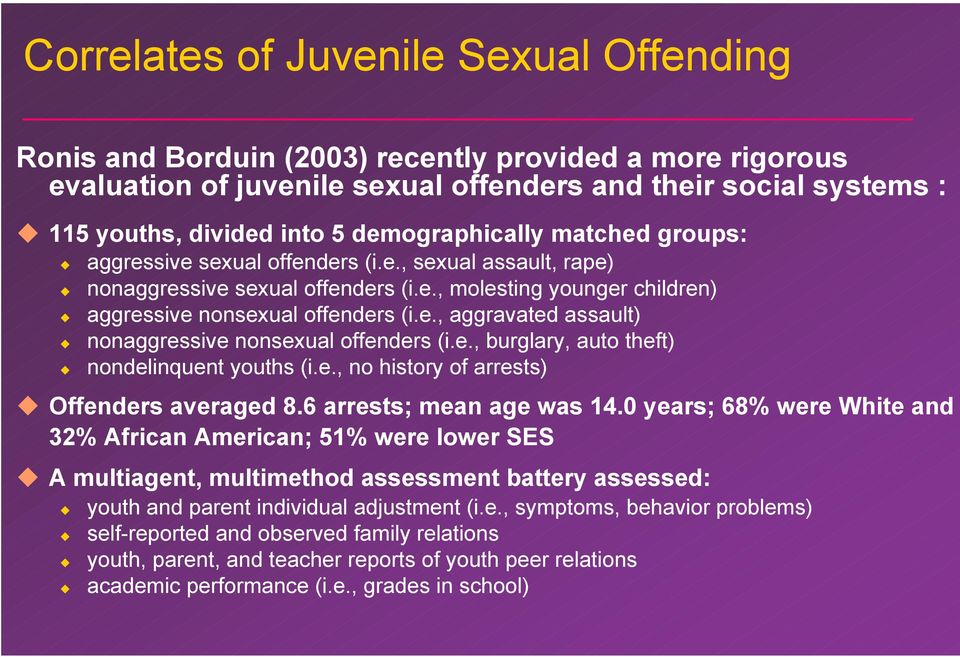
10 Correlates of Juvenile Sexual Offending Results of between-groups comparisons: Neither aggressive sexual offenders nor nonaggressive sexual offenders evidenced unique problems in their individual adjustment, family relations, peer relations, or academic performance Aggressive and nonaggressive sexual offenders shared many common problems with both groups of nonsexual offenders (across all domains of functioning) relative to nondelinquent youths The results suggest that sexual offending and nonsexual offending are linked with multiple common risk factors
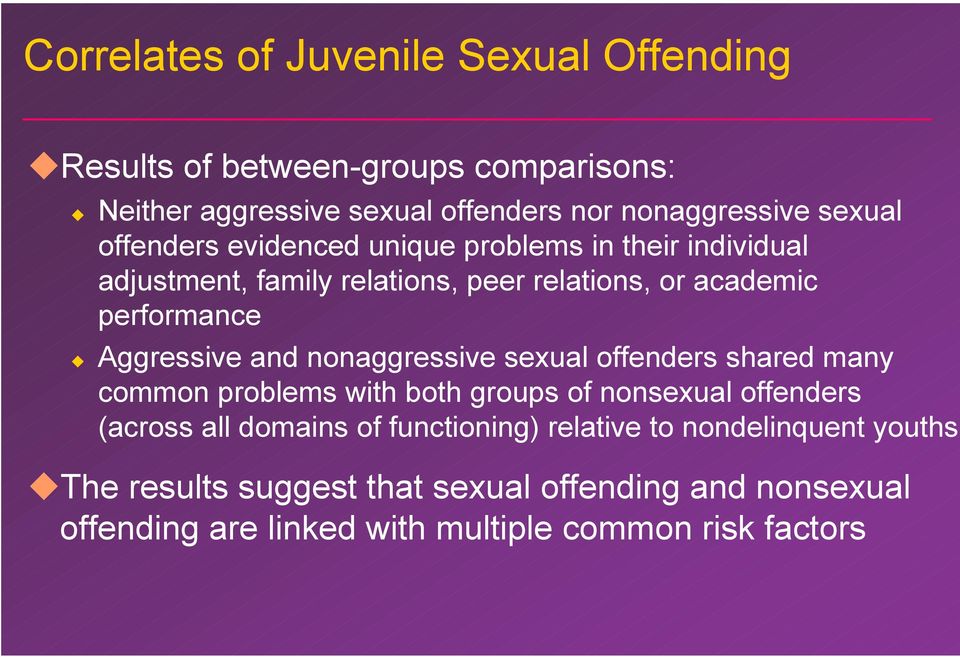
11 Implications of Research Findings for the Design of Effective Interventions Because the determinants of juvenile sexual offending and those of other forms of juvenile offending may be more similar than dissimilar, effective treatments for delinquency (e.g., MST) hold promise in treating juvenile sexual offenders Prevailing treatment models (i.e., cognitive-behavioral approaches) address few of the determinants of juvenile sexual offending and do little to promote youths competencies in real world settings
12 Findings from Randomized MST Efficacy Studies with Juvenile Sexual Offenders (Missouri Delinquency Project)

13 Study 1: Borduin, Henggeler, Blaske, & Stein (1990) Sample 16 male adolescents and their families participated Most of the offenders had at least 2 arrests for sexual offenses (69% rape or sexual assault, 31% molestation) and all had been previously incarcerated Offenders averaged 4.1 arrests for sexual and other criminal offenses combined Mean age of youths was 14.2 years; 62.5% were White and 37.5% were African American; 69% lived with one parent Design Random assignment to: Individual Counseling or Multisystemic Therapy Average treatment length: Multisystemic Therapy = 37 hours Individual Counseling = 45 hours

14 Study 1 (continued) Results of 3-Year Follow Up MST was significantly more effective at: Preventing sexual offending (recidivism was 12.5% for MST vs. 75.0% for Individual Counseling) Preventing other criminal offending (25.0% vs. 50.0%) Incarceration at time of follow up: 0 of 8 youths who received Multisystemic Therapy 3 of 8 (37.5%) youths who received Individual Counseling

15 Study 2: Borduin, Schaeffer, & Heiblum (2003) Sample Characteristics: 48 sexual offenders and their families participated 24 had one or more arrests for sexual offenses involving aggression (i.e., sexual assault, rape) 24 had one or more arrests for nonaggressive sexual offenses (i.e., molestation of younger children) Youths averaged 4.3 arrests (all offenses) Mean age of youths was 14.0 years; 66.7% were White and 33.3% were African American; 70.8% lived with one parent

16 Method Design: Pretest--posttest control group design Eligible youths were referred in yoked pairs and randomly assigned to MST or usual services Average length of MST = 30.8 weeks Follow up into early adulthood (M age = 23.4 years) Multiagent, multimethod battery used to assess: Instrumental outcomes (youth, family, peer, school) Ultimate outcomes (criminal activity, incarceration)

17 Instrumental Outcomes at Posttreatment MST was significantly more effective at: Decreasing behavior problems in youth Decreasing youth criminal offending (self-reported) Decreasing parent and youth symptomatology Increasing family cohesion and adaptability Decreasing youth association with deviant peers Decreasing violence toward peers by aggressive offenders Improving youth grades in school

18 Time In Out-of-Home Placements One Year After Referral Weeks MST Usual Srv Aggress Nonagr All
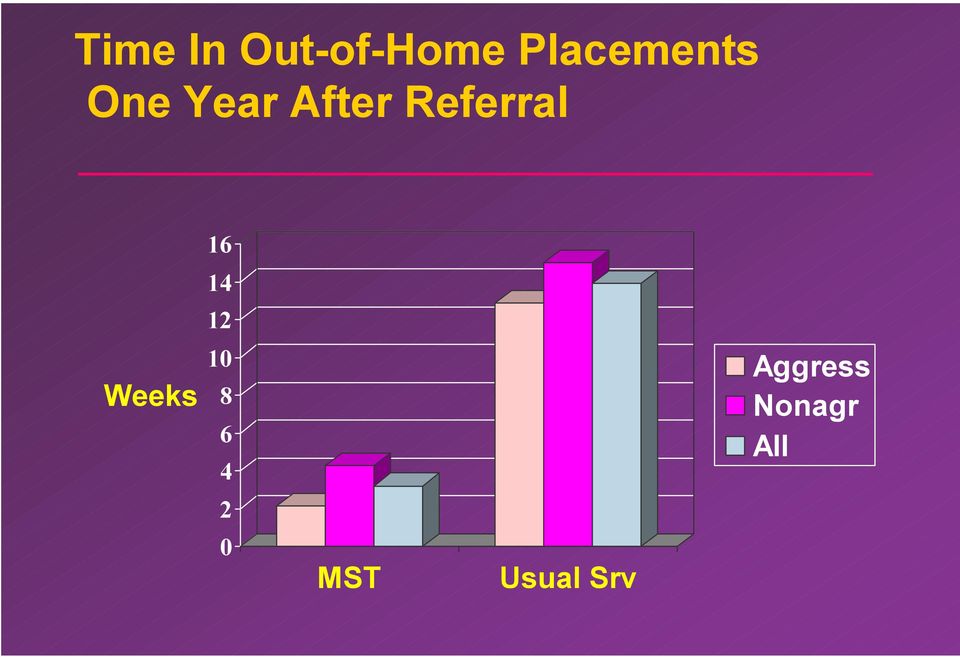
19 Short-Term Costs: Out-of-Home Placements One Year After Referral Based on the Missouri Division of Youth Services (DYS) Secure-Care Program Program cost per day is $ Multisystemic Therapy $ 3, Usual Services $ 14, Placement Cost (Per Youth)

20 Ultimate Outcomes at 9-Year Follow-Up MST was significantly more effective at: Preventing sexual offending (recidivism was 12.5% for MST vs. 41.7% for usual services) Preventing other criminal offending (29.2% vs. 62.5%) Decreasing days incarcerated during adulthood (by 62%)

21 Recidivism Rates for Aggressive Sex Offenders at 9-Year Follow-Up Percent Rearrest MST Usual Srv Sex crime Other crime Any crime
22 Recidivism Rates for Nonaggressive Sex Offenders at 9-Year Follow-Up Percent Rearrest Sex crime Other crime 10 0 MST Usual Srv Any crime
23 Long-Term Cost-Benefits to Taxpayers and Crime Victims at 9-Year Follow Up Based on the Washington State Institute for Public Policy (2001) Cost-Benefit Model This model was developed to identify ways to lower crime and lower total costs to taxpayers and crime victims Our estimates reflect Missouri costs (whenever available) to taxpayers and average national costs to crime victims
24 Estimating the Cost of One Criminal Offense Taxpayer Costs: Police and sheriffs offices Superior courts and county prosecutors Local adult jails and community supervision Local juvenile detention and supervision State juvenile rehabilitation administration State Department of Corrections Crime Victim Costs: Monetary Quality of Life
25 Estimating the Cost of Treatment Programs Personnel Therapists salaries Supervisor s salary Support staff salaries Operating expenses Rent Utilities Phone Supplies Therapist travel to homes, schools, etc. Converted to base year 2003 dollars using the U.S. Gross Domestic Product Deflator (2001)
26 Average Costs Per Juvenile Sexual Offender at 9-Year Follow Up MST Usual Services Taxpayer Costs Crime Victim Costs Total Costs $33,278 $13,783 $47,062 $153,027 $76,824 $229,852
27 MST Cost-Benefits Per Juvenile Sexual Offender at 9-Year Follow Up Nonaggressive Sex Offender Aggressive Sex Offender Total Sample Taxpayer $67,615 $171,882 $119,748 Crime Victim $35,692 $90,389 $63,040 Total Cost- Benefit (MST) $103,307 $262,271 $182,789
28 More Research is Needed Both of the MST clinical trials with juvenile sex offenders had small sample sizes (Ns = 16 and 48), so the results should be considered promising but not conclusive We need to assess the effectiveness of MST with a larger sample of juvenile sex offenders and using practicing clinicians from community mental health provider agencies
29 MST Effectiveness Study with Adolescent Sex Offenders A Chicago-based study that began in September 2003 is examining 160 adolescent sex offenders This study represents a collaboration between Cook County State s Attorney s Office, Cook County Probation, Central Baptist Treatment Providers, and the study investigators Youth are being randomly assigned to MST or Usual Services
30 MST Effectiveness Study (continued) Usual Services involve sex-offender-specific outpatient group treatment provided by the Probation Department. Youth returning from detention and from residential treatment are also eligible. MST involves standard MST with additional training on adaptations specific to adolescent sexual offenders and their families.
31 Clinical Adaptations of MST for Treating Juvenile Sexual Offenders Reduce family denial and minimization of offense Help family develop plan to ensure community safety and prevent offender relapse Evaluate and address offender s grooming strategies Assess within-family victimization issues and determine related treatment needs Interventions targeting peer relations are often needed
32 Conclusion If the effectiveness study proves as successful as the two smaller efficacy studies, MST will be conceptualized as a treatment for youth with delinquent behaviors, including aggressive and nonaggressive sexual offenses
Multisystemic Therapy (MST): An Overview of Clinical and Cost-Effectiveness
 Multisystemic Therapy (MST): An Overview of Clinical and Cost-Effectiveness Charles M. Borduin, Ph.D. Director, Missouri Delinquency Project Professor, Department of Psychological Sciences University of
COMMENTARY. Scott W. Henggeler, PhD
 COMMENTARY Advantages and Disadvantages of Multisystemic Therapy and Other Evidence-Based Practices for Treating Juvenile Offenders Scott W. Henggeler, PhD ABSTRACT. Evidence-based treatments of criminal
Juvenile Sexual Offenders: An. Analytical View of Effective. Programming
 Juvenile Sexual Offenders: An Analytical View of Effective Programming Lee Hyman Volume 4 No. 2 Fall 2007 Abstract The following paper reviews the little discussed topic of juvenile sexual offenders as
EFFECTIVENESS OF TREATMENT FOR VIOLENT JUVENILE DELINQUENTS
 EFFECTIVENESS OF TREATMENT FOR VIOLENT JUVENILE DELINQUENTS THE PROBLEM Traditionally, the philosophy of juvenile courts has emphasized treatment and rehabilitation of young offenders. In recent years,
Evidence Summary for Treatment Foster Care Oregon (formerly Multidimensional Treatment Foster Care, or MTFC)
 Top Tier Evidence Initiative: Evidence Summary for Treatment Foster Care Oregon (formerly Multidimensional Treatment Foster Care, or MTFC) HIGHLIGHTS: Intervention: A foster care program for severely delinquent
When incarceration rates increase 10%, research shows that crime rates
 Evidence-Based Public Policy Options to Reduce Criminal Justice Costs and Crime Rates by Assistant Director Washington State Institute for Public Policy When incarceration rates increase 10%, research
Results First Adult Criminal and Juvenile Justice Evidence-Based Program Inventory
 STATE OF CONNECTICUT Results First Adult Criminal and Juvenile Justice Evidence-Based Program Inventory October 2014 INSTITUTE FOR MUNICIPAL AND REGIONAL POLICY Central Connecticut State University Connecticut
C enter For S ex O ffender M anagement. Myths and Facts About Sex Offenders. August 2000
 C enter For S ex O ffender M anagement Myths and Facts About Sex Offenders August 2000 There are many misconceptions about sexual offenses, sexual offense victims, and sex offenders in our society. Much
STATE OF OHIO. DEPARTMENT OF REHABILITATION RELATED ACA STANDARDS: EFFECTIVE DATE: AND CORRECTION February 19, 2011 I. AUTHORITY
 STATE OF OHIO SUBJECT: PAGE 1 OF 7. Specialized Assessments and Screenings NUMBER: 67-MNH-16 RULE/CODE REFERENCE: SUPERSEDES: AR 5120-11-03, 07, 21 67-MNH-16 dated 01/13/10 ORC 5120.031; 5120.032; 5120.033
MST and Drug Court. Family Services Research Center Medical University of South Carolina Funded by NIDA and NIAAA
 MST and Drug Court Family Services Research Center Medical University of South Carolina Funded by NIDA and NIAAA Project Staff Scott Henggeler Jeff Randall Phillippe Cunningham Colleen Halliday-Boykins
Multidimensional Treatment Foster Care Program (formerly "Treatment Foster Care Program")
 BEST PRACTICE Multidimensional Treatment Foster Care Program (formerly "Treatment Foster Care Program") Quick Links To Attributes Of This Practice Characteristics Population Rated Effective By Evaluating
Drug Court as Diversion for Youthful Offenders
 Drug Court as Diversion for Youthful Offenders Juvenile Drug Courts in Hawaii: A Policy Brief Introduction The problem of drug abuse among the general population in the United States began to escalate
Best Practices in Juvenile Justice Reform
 The Case for Evidence-Based Reform Best Practices in Juvenile Justice Reform Over the past decade, researchers have identified intervention strategies and program models that reduce delinquency and promote
Decades of study have revealed much about risk factors for
 U.S. Department of Justice Office of Justice Programs J u s t i c e R e s e a R c h National Institute of Justice Office of Juvenile Justice and Delinquency Prevention AUGUST 2014 William J. Sabol Acting
HELP AVAILABLE TO VICTIMS OF CRIME IN PENNSYLVANIA
 HELP AVAILABLE TO VICTIMS OF CRIME IN PENNSYLVANIA Police Department Telephone Number Police Incident Number Contact Person Agency This form was created by the Office of Victims Services in the Pennsylvania
Most states juvenile justice systems have
 BRIEF I Setting the Stage: Juvenile Justice History, Statistics, and Practices in the United States and North Carolina Ann Brewster Most states juvenile justice systems have two main goals: increased public
Re-connecting Disconnected Youth with Community and Careers
 Re-connecting Disconnected Youth with Community and Careers NGA Policy Institute 9/20/2012 Toni Irving Deputy Chief of Staff Governor Quinn, Illinois In the beginning Illinois Juvenile Court Act of 1899
Redirection as Effective as Residential Delinquency Programs, Achieved Substantial Cost Avoidance
 March 2006 Report No. 06-34 Redirection as Effective as Residential Delinquency Programs, Achieved Substantial Cost Avoidance at a glance Although it experienced several start-up challenges, the Redirection
Reentry & Aftercare. Reentry & Aftercare. Juvenile Justice Guide Book for Legislators
 Reentry & Aftercare Reentry & Aftercare Juvenile Justice Guide Book for Legislators Reentry & Aftercare Introduction Every year, approximately 100,000 juveniles are released from juvenile detention facilities
Nebraska s Youth Rehabilitation. and Treatment Centers. Nebraska YRTCs Issue Brief. A Publication of. www.voicesforchildren.com
 Nebraska YRTCs Issue Brief Nebraska s Youth Rehabilitation and Treatment Centers Every year, Nebraska s courts send a number of serious and not-so-serious juvenile offenders to the Youth Residential Treatment
Long-term Impact Evaluation of Specialized Sex Offender Probation Programs In Lake, DuPage and Winnebago Counties
 Long-term Impact Evaluation of Specialized Sex Offender Probation Programs In Lake, DuPage and Winnebago Counties Prepared for the The Illinois Criminal Justice Information Authority By: Loretta J. Stalans,
SPECIAL OPTIONS SERVICES PROGRAM UNITED STATES PRETRIAL SERVICES AGENCY EASTERN DISTRICT OF NEW YORK
 SPECIAL OPTIONS SERVICES PROGRAM UNITED STATES PRETRIAL SERVICES AGENCY EASTERN DISTRICT OF NEW YORK February 4, 2013 1 I. Introduction The Special Options Services (SOS) Program was established in the
Juvenile Sex Offenders:
 Juvenile Sex Offenders: A Follow-up Study of Reoffense Behavior Research conducted by: Donna D. Schram, Ph.D. & Cheryl Darling Milloy, Ph.C. Urban Policy Research Wendy E. Rowe, M.A. Cambie Group International
Danielle C. Audet, Psy.D.
 Danielle Audet, Psy.D. Page 1 of 7 Danielle C. Audet, Psy.D. Massachusetts General Hospital Law and Psychiatry Service Juvenile Court Consultation Program One Bowdoin Square, 15 New Chardon Street Boston,
2009 Florida Prison Recidivism Study Releases From 2001 to 2008
 2009 Florida Prison Recidivism Study Releases From 2001 to 2008 May 2010 Florida Department of Corrections Walter A. McNeil, Secretary Bureau of Research and Data Analysis [email protected]
Cost-Benefit Analysis of Juvenile Justice Programs
 Cost-Benefit Analysis of Juvenile Justice Programs Cost-Benefit Analysis of Juvenile Justice Programs Juvenile Justice Guide Book for Legislators Cost-Benefit Analysis of Juvenile Justice Programs Introduction
The Alameda County Model of Probation: Juvenile Supervision
 The Alameda County Model of Probation: Juvenile Supervision August 2011 Model of Probation Juvenile Supervision 1 The Alameda County Model of Probation: Juvenile Supervision August 2011 With the appointment
SHORT TITLE: Criminal procedure; creating the Oklahoma Drug Court Act; codification; emergency.
 SHORT TITLE: Criminal procedure; creating the Oklahoma Drug Court Act; codification; emergency. STATE OF OKLAHOMA 2nd Session of the 45th Legislature (1996) SENATE BILL NO. 1153 By: Hobson AS INTRODUCED
Outcomes of a treatment foster care pilot for youth with complex multi-system needs
 Outcomes of a treatment foster care pilot for youth with complex multi-system needs Melissa Johnson Kimberly McGrath Mary Armstrong Norín Dollard John Robst René Anderson Presented at the 28th Annual Research
Office of the Bexar County Criminal District Attorney
 M.I.L.E.S. (Meaningful Intervention Leading to Enduring Success) A Pre-Trial Diversion Program by the Bexar County Criminal District Attorney s Office Overview The Bexar County Criminal District Attorney
Under the Start Your Search Now box, you may search by author, title and key words.
 VISTAS Online VISTAS Online is an innovative publication produced for the American Counseling Association by Dr. Garry R. Walz and Dr. Jeanne C. Bleuer of Counseling Outfitters, LLC. Its purpose is to
PRYDE The Juvenile Diversion Program of the Orange County Sheriff s Department
 PRYDE The Juvenile Diversion Program of the Orange County Sheriff s Department KENNETH WOOG, PSY.D. LICENSED CLINICAL PSYCHOLOGIST ASSOCIATE DIRECTOR, PRYDE PEPPERDINE UNIVERSITY GRADUATE SCHOOL OF EDUCATION
FLORIDA STATE UNIVERSITY POLICE DEPARTMENT Chief David L. Perry
 FLORIDA STATE UNIVERSITY POLICE DEPARTMENT Chief David L. Perry 830 West Jefferson Street 850-644-1234 VICTIMS' RIGHTS BROCHURE YOUR RIGHTS AS A VICTIM OR WITNESS: ------- We realize that for many persons,
Con-Quest Residential Substance Abuse Treatment Program Outcome Evaluation. February 2004
 Residential Substance Abuse Treatment Program Outcome Evaluation February 2004 Introduction The link between drugs and crime in the United States is widely accepted. Drug users frequently commit crime
BANNOCK COUNTY JUVENILE JUSTICE CLASSES AND PROGRAMS SUMMARY
 BANNOCK COUNTY JUVENILE JUSTICE CLASSES AND PROGRAMS SUMMARY PREVENTION/EARLY INTERVENTION YOUTH COURT Youth Court was started in Bannock County in November 1991. It is a diversion program designed to
Juvenile and Domestic Relations District Court
 LOB #190: LONG-TERM RESIDENTIAL CARE Purpose The Long-Term Residential Care (LTRC) Line of Business incorporates three programs: Boys Probation House (BPH) Foundations Transitional Living Program (TLP)
Tennessee Council of Juvenile and Family Court Judges Quarterly Summary Report Based on Number of Reported Cases January - March 2016
 General characteristics of these cases follow: Referral Reasons Before Amended Charges: Each case may include up to 5 referral reasons therefore the number of total referral reasons, referral sources,
Tennessee Council of Juvenile and Family Court Judges Quarterly Summary Report Based on Number of Reported Cases January - March 2016
 General characteristics of these cases follow: Referral Reasons Before Amended Charges: Each case may include up to 5 referral reasons therefore the number of total referral reasons, referral sources,
Promoting Public Safety Through Effective Correctional Interventions: What Works and What Doesn t?
 Promoting Public Safety Through Effective Correctional Interventions: What Works and What Doesn t? Edward J. Latessa University of Cincinnati T his chapter reviews the strides that science has made in
A Victim s Guide to Understanding the Criminal Justice System
 A Victim s Guide to Understanding the Criminal Justice System The Bartholomew County Prosecutor s Office Victim Assistance Program Prosecutor: William Nash 234 Washington Street Columbus, IN 47201 Telephone:
Long-Term Follow-Up to a Randomized Clinical Trial of Multisystemic Therapy With Serious and Violent Juvenile Offenders
 Journal of Consulting and Clinical Psychology Copyright 2005 by the American Psychological Association 2005, Vol. 73, No. 3, 445 453 0022-006X/05/$12.00 DOI: 10.1037/0022-006X.73.3.445 Long-Term Follow-Up
OFFICE OF THE STATE ATTORNEY NINTH JUDICIAL CIRCUIT OF FLORIDA PRE-TRIAL DIVERSION
 OFFICE OF THE STATE ATTORNEY NINTH JUDICIAL CIRCUIT OF FLORIDA PRE-TRIAL DIVERSION REVISED: JUNE 2009 Approved by State Attorney June 4, 2009 In the Ninth Judicial Circuit, Pre-Trial Diversion (PTD) is
State of Rhode Island and Providence Plantations Rhode Island Department of Children, Youth and Families
 State of Rhode Island and Providence Plantations Rhode Island Department of Children, Youth and Families Donald L. Carcieri, Governor Patricia H. Martinez, Director As active members of the community,
Social Worker - King County Step-Up Program
 Invites Applications for the Position of: Social Worker - King County Step-Up Program Apply online at http://www.kingcounty.gov/jobs King County is committed to equity and diversity in the workplace. In
WASHINGTON STATE JUVENILE JUSITCE PROFILE (courtesy of the NCJJ web site)
 WASHINGTON STATE JUVENILE JUSITCE PROFILE (courtesy of the NCJJ web site) Delinquency Services Summary Decentralized State: Delinquency services are organized at both the state and local level in Washington.
Results. Contact sexual crimes based on PSI and self-report after SOTP participation
 Self-Reported Contact Sexual Offenses by Participants in the Federal Bureau of Prisons Sex Offender Treatment Program: Implications for Internet Sex Offenders Andres E. Hernandez, Psy.D. Director, Sex
Testimony of Adrienne Poteat, Acting Director Court Services and Offender Supervision Agency for the District of Columbia
 Testimony of Adrienne Poteat, Acting Director Court Services and Offender Supervision Agency for the District of Columbia Before the U.S. House of Representatives Committee on Oversight And Government
court. However, without your testimony the defendant might go unpunished.
 Office of State Attorney Michael J. Satz VICTIM RIGHTS BROCHURE YOUR RIGHTS AS A VICTIM OR WITNESS: CRIMINAL JUSTICE PROCESS The stages of the criminal justice system are as follows: We realize that for
Utah s Voice on Mental Illness
 Utah s Voice on Mental Illness Adult and Juvenile Criminal Mental Jackie Rendo Health Courts Mentor Supervisor, Adult Criminal Justice Advocate [email protected]; 801-869-2872 Megan Lundskog Family Resource
Community Supervision Texas Association of Counties October 2015
 10/26/2015 Community Supervision Texas Association of Counties October 2015 Presented by District Judge Todd Blomerth, 421 st Judicial District Court of Caldwell County 1 10/26/2015 2 10/26/2015 Your Possible
WASHINGTON COUNTY Job Description. JOB TITLE: Social Worker
 WASHINGTON COUNTY Job Description JOB TITLE: Social Worker Exempt (Y/N): Yes DEPARTMENT: Regional Juvenile Detention Center DATE REVISED: December 2013 SUPERVISOR: Captain/Director SUMMARY: Under the general
Reentry on Steroids! NADCP 2013
 Reentry on Steroids! NADCP 2013 Panel Introductions Judge Keith Starrett Moderator Judge Robert Francis Panelist Judge Stephen Manley Panelist Charles Robinson - Panelist Dallas SAFPF 4-C Reentry Court
1. The youth is between the ages of 12 and 17.
 Clinical MULTISYSTEMIC THERAPY (MST) Definition Multisystemic therapy (MST) is an intensive family and community-based treatment that addresses multiple aspects of serious antisocial behavior in adolescents.
Oregon Sex Offender Assessment Scale Jackson County, Oregon. Sex Offender Assessment Attachment 1. Negative Scale (Increases Risk)
 Oregon Sex Offender Assessment Scale Jackson County, Oregon Sex Offender Assessment Attachment 1 OFFENDER SID Negative Scale (Increases Risk) 1. History of sexual crimes...-10 2. *History of sex offense
EDISON COURT, INC. Organizational Strategic Plan 2014-2016
 EDISON COURT, INC Organizational Strategic Plan 2014-2016 Edison Court, Inc. (ECI) was founded in 2003 and established as a not-for-profit corporation with the mission to provide therapeutic and evaluative
State Policy Implementation Project
 State Policy Implementation Project CIVIL CITATIONS FOR MINOR OFFENSES Explosive growth in the number of misdemeanor cases has placed a significant burden on local and state court systems. Throughout the
Questionnaire: Domestic (Gender and Family) Violence Interventions
 Questionnaire: Domestic (Gender and Family) Violence Interventions STRENGTHENING TRANSNATIONAL APPROACHES TO REDUCING REOFFENDING (STARR) On behalf of The Institute of Criminology STRENGTHENING TRANSNATIONAL
Department of Human Services Division of Youth Services Quarterly Performance Report In Compliance with Act 1222 of 1995 Report Period January March
 Department of Human Services Division of Youth Services Quarterly Performance Report In Compliance with Act of 995 Report Period January March Executive Summary January March In the third quarter of FY
Contents Opioid Treatment Program Core Program Standards... 2
 2016 OPIOID TREATMENT PROGRAM PROGRAM DESCRIPTIONS Contents Opioid Treatment Program Core Program Standards... 2 Court Treatment (CT)... 2 Detoxification... 2 Day Treatment... 3 Health Home (HH)... 3 Integrated
JUVENILE JUNCTION ALCOHOL AND DRUG PREVENTION AND TREATMENT PROGRAMS IN SAN LUIS OBISPO COUNTY SUMMARY
 JUVENILE JUNCTION ALCOHOL AND DRUG PREVENTION AND TREATMENT PROGRAMS IN SAN LUIS OBISPO COUNTY SUMMARY According to the San Luis Obispo County Drug and Alcohol Services Division of the Behavioral Health
Crime Victim Compensation Application 7 th Judicial District 1140 North Grand Ave, Suite #200, Montrose, CO 81401
 Crime Victim Compensation Application 7 th Judicial District 1140 North Grand Ave, Suite #200, Montrose, CO 81401 All claims are reviewed by the Crime Victim Compensation Board (CVC). The CVC board meets
Population, Alternatives to Incarceration and Budget Information
 Population, Alternatives to Incarceration and Budget Information 500 Employees 1,300 Offenders under supervision Lafayette Parish Correctional Center (LPCC), Transitional Housing Facility Community Corrections
Chapter 938 of the Wisconsin statutes is entitled the Juvenile Justice Code.
 Juvenile Justice in Wisconsin by Christina Carmichael Fiscal Analyst Wisconsin Chapter 938 of the Wisconsin statutes is entitled the Juvenile Justice Code. Statute 938.1 of the chapter states that it is
Governor Jennifer M. Granholm,
 Analyses of Crime, Community Corrections, and Sentencing Policies Governor Jennifer M. Granholm, Senate Majority Leader Michael D. Bishop, and Speaker of the House Andy Dillon requested intensive technical
Open Residential Firesetting and Sexual Behavior Treatment Program
 Open Residential Firesetting and Sexual Behavior Treatment Program ABRAXAS Open Residential Firesetting and Sexual Behavior Treatment Program Since 2006, the Abraxas Open Residential Firesetting and Sexual
Conduct Disorder: Treatment Recommendations. For Vermont Youth. From the. State Interagency Team
 Conduct Disorder: Treatment Recommendations For Vermont Youth From the State Interagency Team By Bill McMains, Medical Director, Vermont DDMHS Alice Maynard, Mental Health Quality Management Chief, Vermont
Associated Industries of Florida. Getting Smart on Juvenile Crime in Florida: Taking It to The Next Level
 Associated Industries of Florida Getting Smart on Juvenile Crime in Florida: Taking It to The Next Level Reducing Juvenile Arrests by 40% Barney T. Bishop III Chairman Wansley Walters, Director Miami-Dade
Adult Criminal Justice Case Processing in Washington, DC
 Adult Criminal Justice Case Processing in Washington, DC P. Mitchell Downey John Roman, Ph.D. Akiva Liberman, Ph.D. February 2012 1 Criminal Justice Case Processing in Washington, DC P. Mitchell Downey
Frequently Asked Questions (FAQs) of Drug Abuse Treatment for Criminal Justice Populations
 Frequently Asked Questions (FAQs) of Drug Abuse Treatment for Criminal Justice Populations From The National Institute on Drug Abuse (NIDA) 2. Why should drug abuse treatment be provided to offenders?
Services Provided for Polk County Residents
 Providing Successful, Evidence-Based Substance Abuse and Mental Health Treatment to Men, Women and Adolescents in Polk, Highlands and Hardee Counties for over 39 years. 1 Services Provided for Polk County
ALTERNATIVES TO INCARCERATION IN A NUTSHELL
 ALTERNATIVES TO INCARCERATION IN A NUTSHELL An alternative to incarceration is any kind of punishment other than time in prison or jail that can be given to a person who commits a crime. Frequently, punishments
TREATMENT DIRECTORY. Services for children with sexual behavioral problems and child sexual abuse victims.
 TREATMENT DIRECTORY Services for children with sexual behavioral problems and child sexual abuse victims. TABLE OF CONTENTS: Page 1 Page 2 Page 3 Page 4 Page 5 Page 6 Page 7 Page 8 Page 9 Page 10 B & K
SKAGIT COUNTY ADULT FELONY DRUG COURT
 SKAGIT COUNTY ADULT FELONY DRUG COURT Recidivism and Cost Benefit Analysis October 2008 Prepared by: Sarah Hinman Substance Abuse Treatment Specialist Skagit County Human Services And David Asia, PhD Substance
GEORGIA DEPARTMENT OF JUVENILE JUSTICE Applicability: { } All DJJ Staff { } Administration { } Community Services {x} Secure Facilities (YDCs Only)
 GEORGIA DEPARTMENT OF JUVENILE JUSTICE Applicability: { } All DJJ Staff { } Administration { } Community Services {x} Secure Facilities (YDCs Only) Transmittal # 15-05 Policy # 18.23 Related Standards
Evidence-Based Practices for Delinquent Youth with Mental Illness in Maryland: Medicaid Must Cover These Cost Effective Services
 Evidence-Based Practices for Delinquent Youth with Mental Illness in Maryland: Medicaid Must Cover These Cost Effective Services A Public Report by Maryland Disability Law Center January 31, 2007 About
OFFICE OF THE DISTRICT ATTORNEY
 OFFICE OF THE DISTRICT ATTORNEY TWENTIETH JUDICIAL DISTRICT Stanley L. Garnett, District Attorney Boulder Office: Justice Center, 1777 6th St., Boulder, Colorado 80302 303.441.3700 fax: 303.441.4703 Longmont
This report provides the executive summary for Indicators of School Crime and Safety: 2014.
 1 Liability Report Number: LB-10-66 Release Date: August 6, 2015 Section Title: General Information Abstract School violence not only has a direct impact on students, but also on educators, parents, and
Criminal Justice 101. The Criminal Justice System in Colorado and the Impact on Individuals with Mental Illness. April 2009
 Criminal Justice 101 The Criminal Justice System in Colorado and the Impact on Individuals with Mental Illness April 2009 Acronyms DOC = Department of Corrections DYC = Division of Youth Corrections DCJ
Dodge-Fillmore- Olmsted Methamphetamine Treatment Project. July 2006-December 2007 evaluation report
 Dodge-Fillmore- Olmsted Methamphetamine Treatment Project July 2006-December 2007 evaluation report M A Y 2 0 0 8 Dodge-Fillmore-Olmsted Methamphetamine Treatment Project July 2006-December 2007 evaluation
How To Help Mentally Ill Offenders In The Criminal Justice System
 Mentally Ill Offenders in the Criminal Justice System Webinar Panelists: Hon. Michael Finkle King County District Court Judge Seattle, WA Bradley Jacobs Deputy Director, Adult Behavioral Health Services
YORK COUNTY TREATMENT COURTS COURT OF COMMON PLEAS
 YORK COUNTY TREATMENT COURTS COURT OF COMMON PLEAS NINETEENTH JUDICIAL DISTRICT Judges John S. Kennedy Craig T. Trebilcock Maria Musti Cook Harry M. Ness Todd R. Platts Coordinators Holly Wise Cameron
Juvenile Justice in the U.S. Facts for Policymakers
 FA C T S H E E T Juvenile Justice in the U.S. Facts for Policymakers David Gottesman Susan Wile Schwarz July 2011 Recent research shows that the human brain continues to develop throughout adolescence,
Each youth shall be provided individualized services and supervision driven by his/her assessed risk and needs.
 GEORGIA DEPARTMENT OF JUVENILE JUSTICE Applicability: { } All DJJ Staff { } Administration {x} Community Services { } Secure Facilities (RYDCs and YDCs) Transmittal # 14-01 Related Standards & References:
An Analysis of Idaho s Kootenai County DUI Court
 An Analysis of Idaho s Kootenai County DUI Court AN ALCOHOL TREATMENT PROGRAM FOR PERSONS ARRESTED FOR THEIR SECOND DUI OFFENSE OR BAC OF 0.20% OR HIGHER Prepared for National Highway Traffic Safety Administration
Notice of Proposed Local Rule Amendments and Finding Good Cause to Deviate From Established Schedule May 15, 2014
 STATE OF INDIANA COUNTY OF MIAMI IN THE MIAMI CIRCUIT AND SUPERIOR COURTS Notice of Proposed Local Rule Amendments and Finding Good Cause to Deviate From Established Schedule May 15, 2014 The judges of