
Financial and Education Law Training Program Page 26-1 Study Guide Winter, FUND ACCOUNTING. Introduction. National Account Structure
|
|
|
- Pauline Floyd
- 10 years ago
- Views:
Transcription
1 Financial and Education Law Training Program Page FUND ACCOUNTING Introduction An account is established for each asset, for each liability, and for each fund balance account of a local school system in governmental accounting. This means that as transactions occur, that are posted into accounts that are separate for each asset, for each liability, and for each fund balance. Each grouping of transactions that results in the creation of assets, and liabilities, and fund balances may be considered as belonging to business activity for a specific purpose. These could be general operations, the operation of the food service program, the construction of buildings, and so forth. When a group of transactions affects a specific type of operations, then the assets, liabilities, and fund balances of this group of transactions constitutes a fund, which is an independent accounting entity with its own assets, liabilities, and fund balance. These requirements dictate the structure of the account classification. National Structure The account structure must be a master classification of balance sheet, revenue, and expenditure accounts from which selections can be made for reporting comparable transactions on a uniform basis. In order to facilitate meaningful cost data comparisons with national educational statistics and meet reporting requirements of various federal revenue sources. The structure is flexible and allows for expansion to meet increased reporting needs as well as unique needs of the individual user. The Financial ing Classification Structure developed by the National Center for Education Statistics and published in Financial ing for Local and State School Systems 1990 has accommodated Generally Accepted ing Principles (GAAP) and the principles of the Government ing Standards Board (GASB) in the description of the three basic types of financial activity. These are the following: Revenues and Other Sources of Funds Expenditures and Other Uses of Funds Transactions Affecting the Balance Sheet Only These three types of financial activity each is described by a specific overall account code which is made up from a combination of classifications called dimensions. Each dimension describes one way of classifying financial activity. The dimensions which are applicable to each of the three types of financial activity follow in Table 26-1 which follows. This is a way of placing a full and complete description of financial activity into a matrix which allows logical grouping of descriptors. In order to fully describe the financial activity of a government unit and to provide the information basis to produce financial statements of this activity, the components of the matrix above must be employed.

2 Financial and Education Law Training Program Page 26-2 Table 26-1 Types of Financial Activity and Dimensions Revenues Expenditures Balance Sheet Fund Fund Fund Revenue Source Program Balance Sheet Project/Reporting Function Assets Object Liabilities Project/Reporting Fund Equity Level of Instruction Operational Unit Subject Matter Alabama s Financial ing System will generally follow this matrix and the dimensions presented with the exception that some of the dimensions recognized to report expenditures are not utilized. However, this is entirely acceptable since the handbook classification structure described above is capable of generating more detailed data than may be desired and can be considered as optional. The following accounting structure is the minimum chart of accounts that a state and its LEAs must employ to prepare necessary Federal reporting requirements which are found in Table 26-2 below: Table 26-2 Minimum Chart of s for Federal Reporting Revenues Expenditures Balance Sheet Fund Fund Fund Revenue Source Program Balance Sheet Function Assets Object Liabilities Project/Reporting Fund Equity All of the categories in addition to these described in the Minimum Chart of s are considered as option for Federal reporting. Alabama s accounting structure as will be seen in the following exceeds the minimum requirements. The Chart of s is a list of all the accounts of an LEA and the numbers assigned to the accounts. As is readily seen in these account structure descriptions, one element is integral to all accounting and reporting the fund. Governmental accounting systems are thus organized and operated on a fund basis. The diverse nature of governmental operations and the necessity of assuring legal compliance preclude recording and summarizing financial transactions in a single accounting entity. Rather, the required accounts are organized on the basis of funds each of which is completely independent of any other. Each fund must so be accounted for that the identity of its resources,
3 Financial and Education Law Training Program Page 26-3 obligations, revenues, expenditures, and fund equities is continually maintained. Schools operate financially by a system of fund accounting which is a system which is organized and reported around the types of revenue and expenditures that best describe educational organizations. Certain accounting principles apply that make it possible to track revenues and expenditures. The primary purpose of fund accounting in the requirement that each fund be used only for specific purposes and that funds are not commingled. Therefore, the purpose of fund accounting is to recognize discrete fiscal operations, to track the revenues and expenditures by function, and to provide information of these functions and the intended use of expenditures. This is accomplished by providing a set of self-balancing accounts for each fund which shows its assets, liabilities, reserves, fund balances or retained earnings, revenues, and expenditures or expenses. A fund is a fiscal and accounting entity with a self-balancing set of accounts recording financial resources with all related liabilities, fund equity, and changes caused by the receipt of revenues and the expenditure of funds. It one were to compare fund accounting with commercial accounting, each fund would equate to an independent business, with a separate set or records owned by one entity, the local school system. LEAs must use several different types of funds. The issue is not whether to use fund accounting, but how many different types to actually use. The general rule is that the fewer, the better. Only the minimum number of funds necessary to meet legal and operating requirements should be established. Unnecessary numbers of funds result in inflexibility, undue complexity, and inefficient. The minimum number of funds which should be utilized have been jointly agreed upon by the Governmental ing Standards Board (GASB), the National Center for Education Statistics (NCES) and the Association of School Business Officials (ASBO). These groups have agreed upon the classification of funds into four separate categories: in the LEA The local school system accounting system must be organized and operated on a fund basis. Each fund is a separate fiscal entity in the school district much the same as various corporate subsidiaries are fiscally separate in private enterprise. The separate funds are established by the school district for the specific activities and objectives in accordance with statutes, laws, regulations, restrictions, or for specific purposes. A fund is defined in GASB Codification Section 1300 as:... a fiscal and accounting entity with a self-balancing set of accounts recording cash and other financial resources, together with all related liabilities and residual equities or balances, and changes therein, which are segregated for the purpose of carrying on specific activities or attaining certain objectives in accordance with special regulations, restrictions, or limitations.
4 Financial and Education Law Training Program Page 26-4 The requirement for a self-balancing set of accounts means that the familiar debit and credit framework is applied to the recording of transactions and events in the accounting systems of each fund. But the requirement that a fund must be both a separate fiscal and accounting entity indicates that the self-balancing feature itself is not adequate alone; account groups to establish accounting control and accountability for the government's general fixed assets and the unmatured principal of its long-term debt are also required. The general long-term debt account group and a general fixed assets account group are used to establish accounting control and accountability for the government's general fixed assets and the unmatured principal of its long-term debt. Legal reporting requirements and the varied nature of school district's operations preclude a single set of accounts for recording and summarizing all transactions. The records must be organized on a multiple-fund basis with each of the several funds complete and independent accounting entities. The absolute minimum number of funds appropriate for public school operations depends on the purposes and legal requirements of the various activities. The identified fund types are for group activities that are similar in nature or purpose. The required fund types and groups of selfbalancing accounts as described in GASB Codification Section and 103 (excerpted) follow. Description of Fund Types In compliance with generally accepted accounting practices, the following three types of funds and one account group are prescribed by the National Center for Education Statistics in Financial ing for Local and State School Systems, 1990: 1. Governmental Fund Types - often called "source and disposition," "expendable," or "government-type" funds - are those through which most governmental functions typically are financed. The acquisition, use, and balances of the government's expendable financial resources and the related current liabilities - except those accounted for in proprietary funds - are accounted for through governmental funds (general, special revenue, capital projects, and debt service funds). Governmental funds are in essence an accounting segregation of financial resources. Expendable assets are assigned to the various governmental funds according to the purposes for which they must be used; current liabilities are assigned to the fund from which they are to be paid; and the difference between governmental fund assets and liabilities, the fund equity, is referred to as "Fund Balance." The governmental fund measurement focus is on determination of financial position and changes in financial position (sources, uses, and balances of financial resources), rather than on net income determination. The statement of revenue, expenditures, and changes in fund balance is the primary governmental fund operating statement. It may be supported or supplemented by more detailed schedules of
5 Financial and Education Law Training Program Page 26-5 revenues, expenditures, transfers, and other changes in fund balance. 2. Proprietary Funds - sometimes referred to as "income determination," "non-expendable," or "commercial-type" funds - are used to account for a government's ongoing organizations and activities that are similar to those often found in the private sector (enterprise and internal service funds). All assets, liabilities, equities, revenues, expenses and transfers relating to the government's business and quasi-business activities - where net income and capital maintenance are measured - are accounted for through proprietary funds. The generally accepted accounting principles here are those applicable to similar businesses in the private sector; and the measurement focus is on determination of net income, financial position, and cash flows. However, if the GASB has issued pronouncements applicable to those entities and activities, those entities and activities should be guided by GASB pronouncements. 3. Fiduciary Funds - trust and agency funds - are used to account for assets held by a government in a trustee capacity or as an agent for individuals, private organizations, other governmental units, and/or other funds. Each trust fund is classified for accounting measurement purposes as either a governmental fund or a proprietary fund. Expendable trust funds are accounted for in essentially the same manner as governmental funds. Nonexpendable trust funds and pension trust funds are accounted for in essentially the same manner as proprietary funds. Agency funds are purely custodial (assets equal liabilities) and thus do not involve measurement of results of operations. However, the use of these three types of funds is inadequate to completely provide accountability for and control of the government's general fixed assets and general long-term debt. This is accomplished through a fourth category of accounting entities, the "account groups." 4. Groups are used to establish accounting control and accountability for the government's general fixed assets and the unmatured principal of its general long-term debt. The government's general fixed assets - all fixed assets except those accounted for in proprietary funds or trust funds - are not financial resources available for expenditure. The unmatured principal of its general long-term debt - long-term liabilities not accounted for in proprietary funds or trust funds - does not require an appropriation or expenditure during the current accounting period. Hence, neither is accounted for in the governmental funds, but in self-balancing account groups. These account groups are not funds, they do not reflect available financial resources and related liabilities but are accounting records of the general fixed assets and general long-term debt, respectively, and certain associated information. In compliance with generally accepted accounting practices, the following categories of funds and account groups is provided by the National Center for Education Statistics in Financial ing for Local and State School Systems, 1990 in Table 26-3 below:
6 Financial and Education Law Training Program Page 26-6 Table 26-3 Matrix of Fund Usage FUND DESCRIPTION I. GOVERNMENTAL TYPE FUNDS 1. General Fund - s for all financial resources except those required to be accounted for in another fund. 2. Special Revenue Funds - for the proceeds of specific revenue sources that have been restricted to expenditure for specific purposes other than expendable trusts or for major capital projects. 3. Capital Project Funds - for the receipt and disbursement of resources for the purpose of constructing or acquiring major capital assets such as new schools, public buildings, or recreational facilities. The Capital Projects Funds are used to account for such assets other than those financed by proprietary funds and trust funds. 4. Debt Service Funds - for resources set aside to pay interest and principal on long-term debt. II. PROPRIETARY TYPE FUNDS 1. Enterprise Funds - for operations (a) that are financed and operated in a manner similar to private business enterprises, where the intent of the governing body is that the costs (expenses, including depreciation) of providing goods or services to the general public on a continuing basis be financed or recovered primarily through user charges, or (b) where the governing body has decided that periodic determination of revenues earned, expenses incurred, and/or net income is appropriate for capital maintenance, public policy, management control, accountability or other purposes 2. Internal Service Funds - for the financing of goods or services provided by one department or funds to other departments or funds within the same school district on a cost reimbursement basis. III. FIDUCIARY TYPE FUNDS 1. Trust Funds - for collection and disbursement of assets held in trusts by the school district for an individual, a group of individuals or another governmental unit. The three types of trust funds are: (a) Expendable Trust Funds - for funds received from individuals and/or organizations for specific purposes for which the principal, and earned interest or revenue may be used. (b) Nonexpendable Trust Funds - for funds received from individuals or organizations for which the principal used must be repaid to restore the original amount and may be increased by the collection of interest. EXAMPLES General Fund, including the Local Maintenance Fund, Food Service Fund, etc. ESEA, Title I, Part A - Improving Basic Programs Fund, National School Breakfast and Lunch Program Fund, Vocational Education Fund, Campus Activity Fund, Shared Services Arrangements Funds, etc. Locally Defined Capital Project Funds Locally Defined Debt Service Funds National School Breakfast and Lunch Program Fund (food service operations are to be accounted of in this fund when a school district intends for the food service operations to be financed from the NSLP program and user charges, rather than from General Fund subsidies), State Defined Enterprise Funds, Locally Defined Enterprise Funds Transportation Fund, Print Shop Fund, Insurance Fund, Computer Operation Fund, etc. Scholarship Funds (both principal and earned interest on revenue can be distributed Scholarship Funds (limited to the use of only earned interest or revenue), etc.

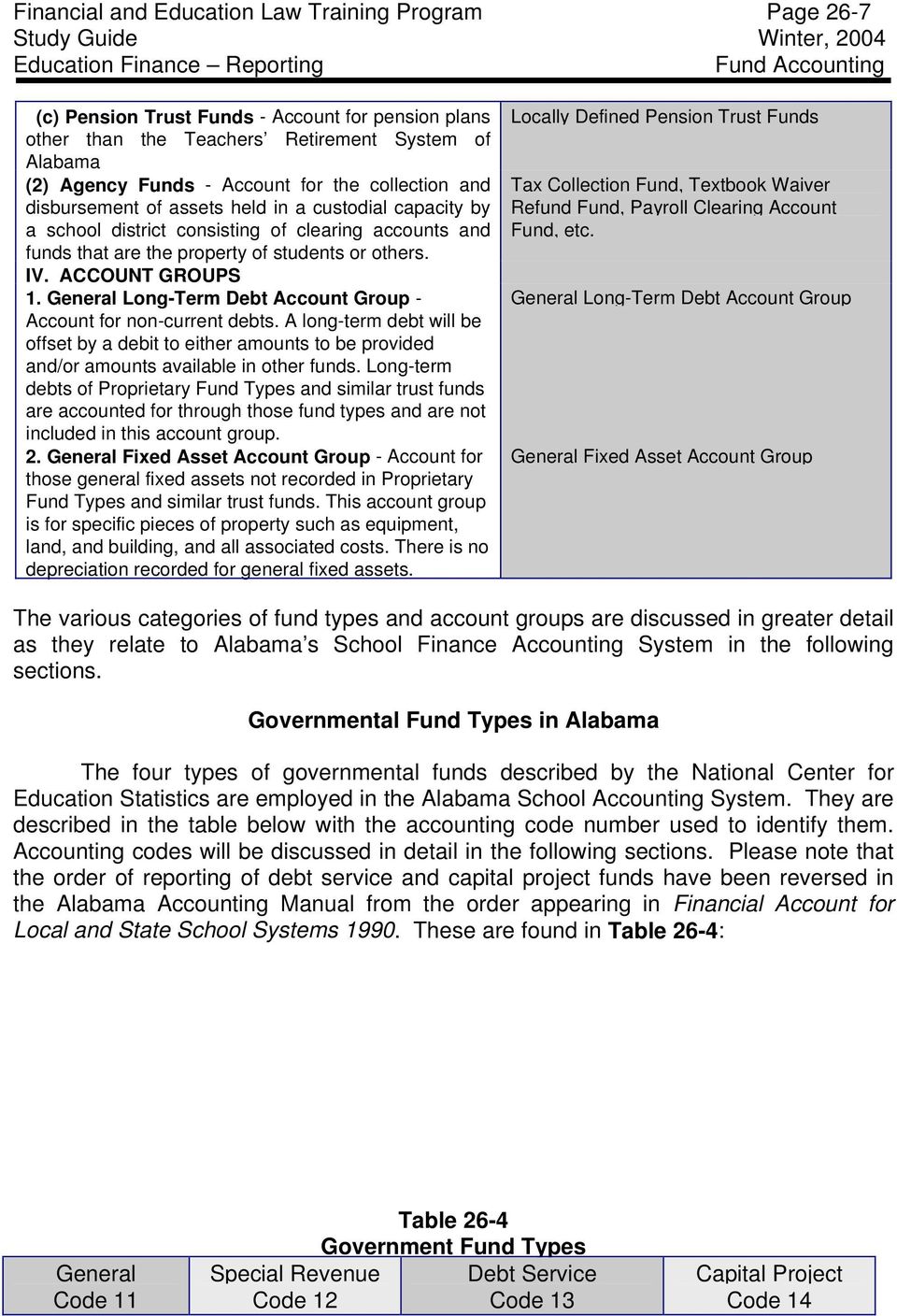
7 Financial and Education Law Training Program Page 26-7 (c) Pension Trust Funds - for pension plans other than the Teachers Retirement System of Alabama (2) Agency Funds - for the collection and disbursement of assets held in a custodial capacity by a school district consisting of clearing accounts and funds that are the property of students or others. IV. ACCOUNT GROUPS 1. General Long-Term Debt Group - for non-current debts. A long-term debt will be offset by a debit to either amounts to be provided and/or amounts available in other funds. Long-term debts of Proprietary Fund Types and similar trust funds are accounted for through those fund types and are not included in this account group. 2. General Fixed Asset Group - for those general fixed assets not recorded in Proprietary Fund Types and similar trust funds. This account group is for specific pieces of property such as equipment, land, and building, and all associated costs. There is no depreciation recorded for general fixed assets. Locally Defined Pension Trust Funds Tax Collection Fund, Textbook Waiver Refund Fund, Payroll Clearing Fund, etc. General Long-Term Debt Group General Fixed Asset Group The various categories of fund types and account groups are discussed in greater detail as they relate to Alabama s School Finance ing System in the following sections. Governmental Fund Types in Alabama The four types of governmental funds described by the National Center for Education Statistics are employed in the Alabama School ing System. They are described in the table below with the accounting code number used to identify them. ing codes will be discussed in detail in the following sections. Please note that the order of reporting of debt service and capital project funds have been reversed in the Alabama ing Manual from the order appearing in Financial for Local and State School Systems These are found in Table 26-4: General Code 11 Table 26-4 Government Fund Types Special Revenue Debt Service Code 12 Code 13 Capital Project Code 14
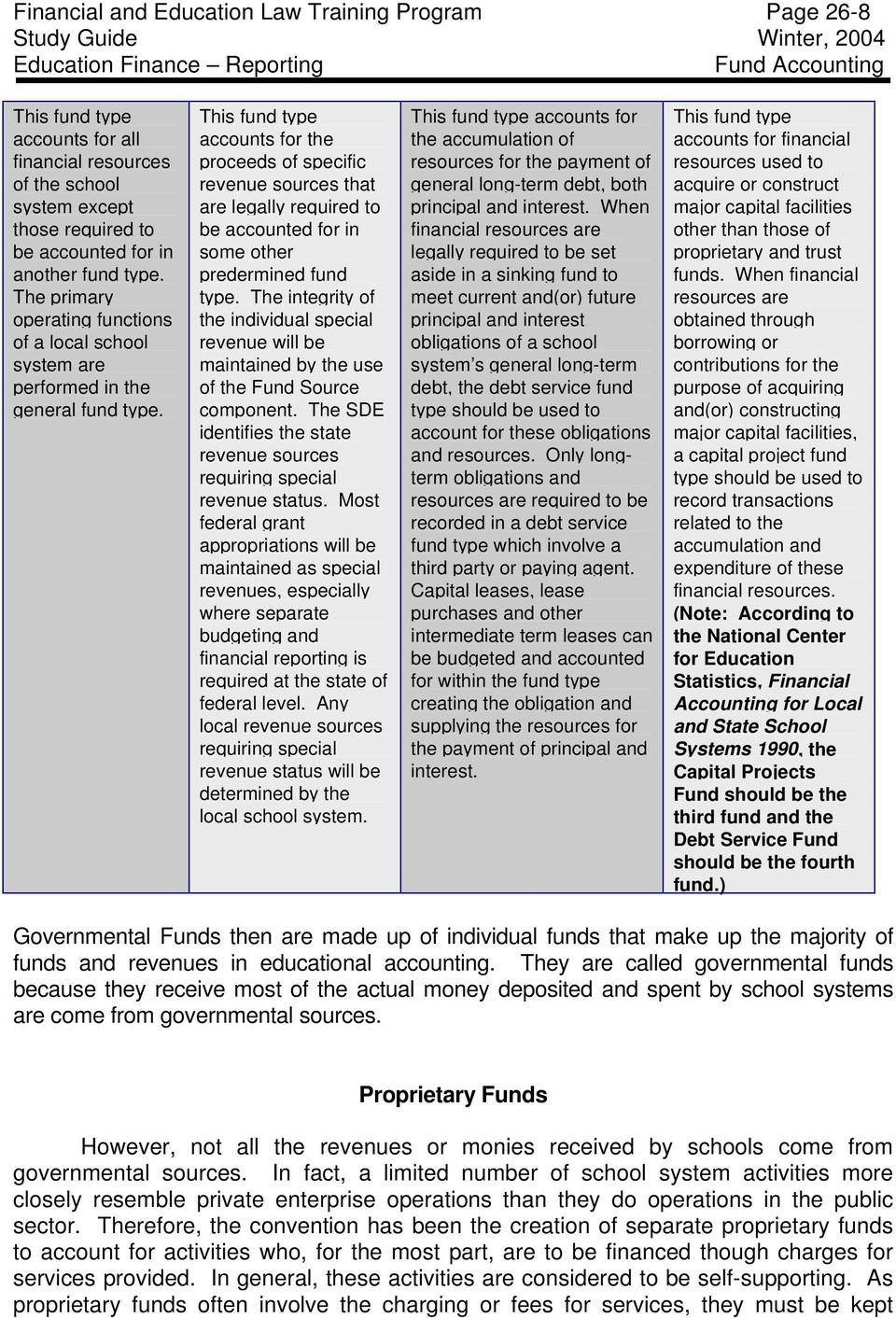
8 Financial and Education Law Training Program Page 26-8 This fund type accounts for all financial resources of the school system except those required to be accounted for in another fund type. The primary operating functions of a local school system are performed in the general fund type. This fund type accounts for the proceeds of specific revenue sources that are legally required to be accounted for in some other predermined fund type. The integrity of the individual special revenue will be maintained by the use of the Fund Source component. The SDE identifies the state revenue sources requiring special revenue status. Most federal grant appropriations will be maintained as special revenues, especially where separate budgeting and financial reporting is required at the state of federal level. Any local revenue sources requiring special revenue status will be determined by the local school system. This fund type accounts for the accumulation of resources for the payment of general long-term debt, both principal and interest. When financial resources are legally required to be set aside in a sinking fund to meet current and(or) future principal and interest obligations of a school system s general long-term debt, the debt service fund type should be used to account for these obligations and resources. Only longterm obligations and resources are required to be recorded in a debt service fund type which involve a third party or paying agent. Capital leases, lease purchases and other intermediate term leases can be budgeted and accounted for within the fund type creating the obligation and supplying the resources for the payment of principal and interest. This fund type accounts for financial resources used to acquire or construct major capital facilities other than those of proprietary and trust funds. When financial resources are obtained through borrowing or contributions for the purpose of acquiring and(or) constructing major capital facilities, a capital project fund type should be used to record transactions related to the accumulation and expenditure of these financial resources. (Note: According to the National Center for Education Statistics, Financial ing for Local and State School Systems 1990, the Capital Projects Fund should be the third fund and the Debt Service Fund should be the fourth fund.) Governmental Funds then are made up of individual funds that make up the majority of funds and revenues in educational accounting. They are called governmental funds because they receive most of the actual money deposited and spent by school systems are come from governmental sources. Proprietary Funds However, not all the revenues or monies received by schools come from governmental sources. In fact, a limited number of school system activities more closely resemble private enterprise operations than they do operations in the public sector. Therefore, the convention has been the creation of separate proprietary funds to account for activities who, for the most part, are to be financed though charges for services provided. In general, these activities are considered to be self-supporting. As proprietary funds often involve the charging or fees for services, they must be kept
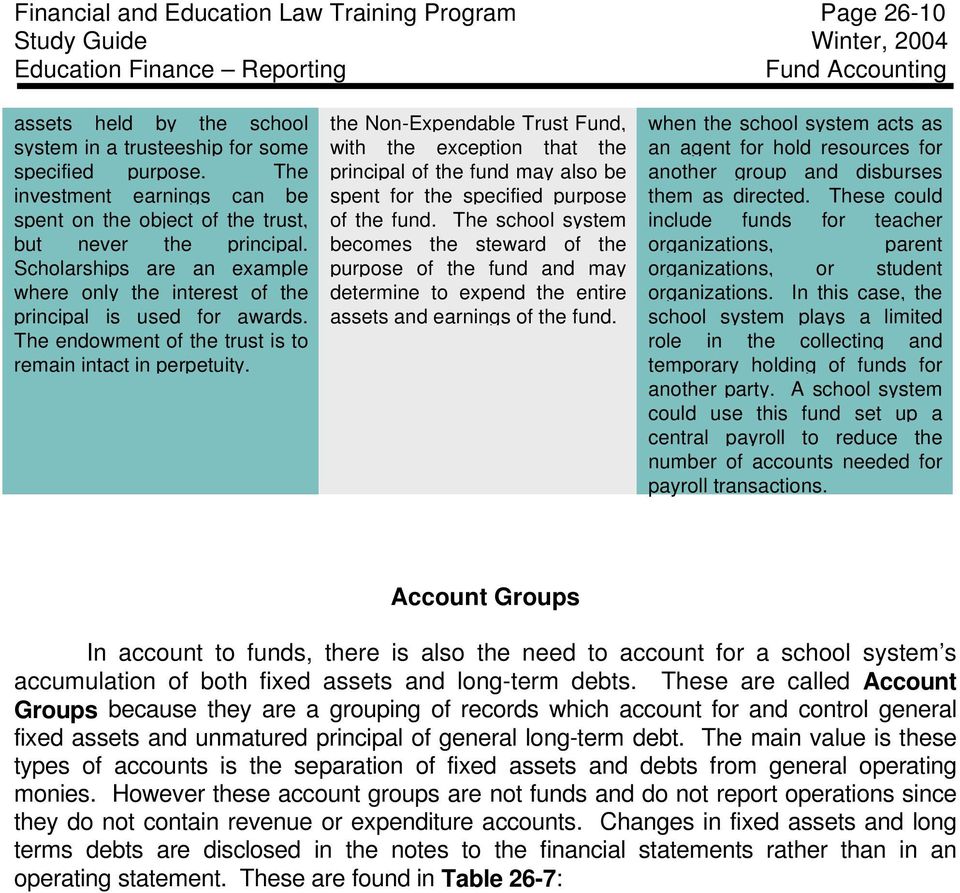
9 Financial and Education Law Training Program Page 26-9 separate and apart from regular school system operations. As self-supporting funds, they must provide for a means of internal billing. The two types of propriety funds are described in the following Table 26-5: Table 26-5 Proprietary Funds Enterprise Fund Code 21 Internal Service Fund Code 22 This fund type is used to account for businesslike This fund type is used to account for business-like operations of a school system in which operations of the school system whereby goods or direct goods or services are provided to consumers. These consumers may be either services are provided to operational units inside the school system (other programs), other school students are the general public. The systems, or other governmental agencies on a consumers are directly charged for the goods or services and the resulting revenues are used to help pay for the costs of the operation. Common examples are food service operations, interscholastic athletics, the school newspaper or yearbook, the bookstore operations, and for fee transportation services. The idea is that cost-reimbursement basis. Internal service funds are supported by user-charges. Examples could be printing, or maintenance, central warehousing, purchasing, data processing Internal service funds are supported by user-charges. Examples could be printing, or maintenance, central warehousing, purchasing, data processing and others. these activities are like private enterprises, with services provided in turn for charges. As a result, enterprise revenues and expenditures are maintained separately. Fiduciary Funds There is a third type of fund necessary to describe the financial operations of a public school system. These are known as fiduciary funds. Not all revenues to a school system fall neatly into the categories of governmental or proprietary funds. This fund type is used to account for assets held by the school system as trustee or agent. Revenues are deposited into a fiduciary fund and the expenditures are controlled by an agreement detailing the purpose of the fund, how the fund is to be managed, and the disposition of the proceeds of the fund if the agreement is ever dissolved. These are found in Table 26-6: Table 26-6 Types of Fiduciary Funds Non-Expendable Trust Fund Type 31 Expendable Trust Fund Type 32 Agency Funds Fund Type 38/39 This fund accounts for financial This is a similar type of fund to This type of fund is created

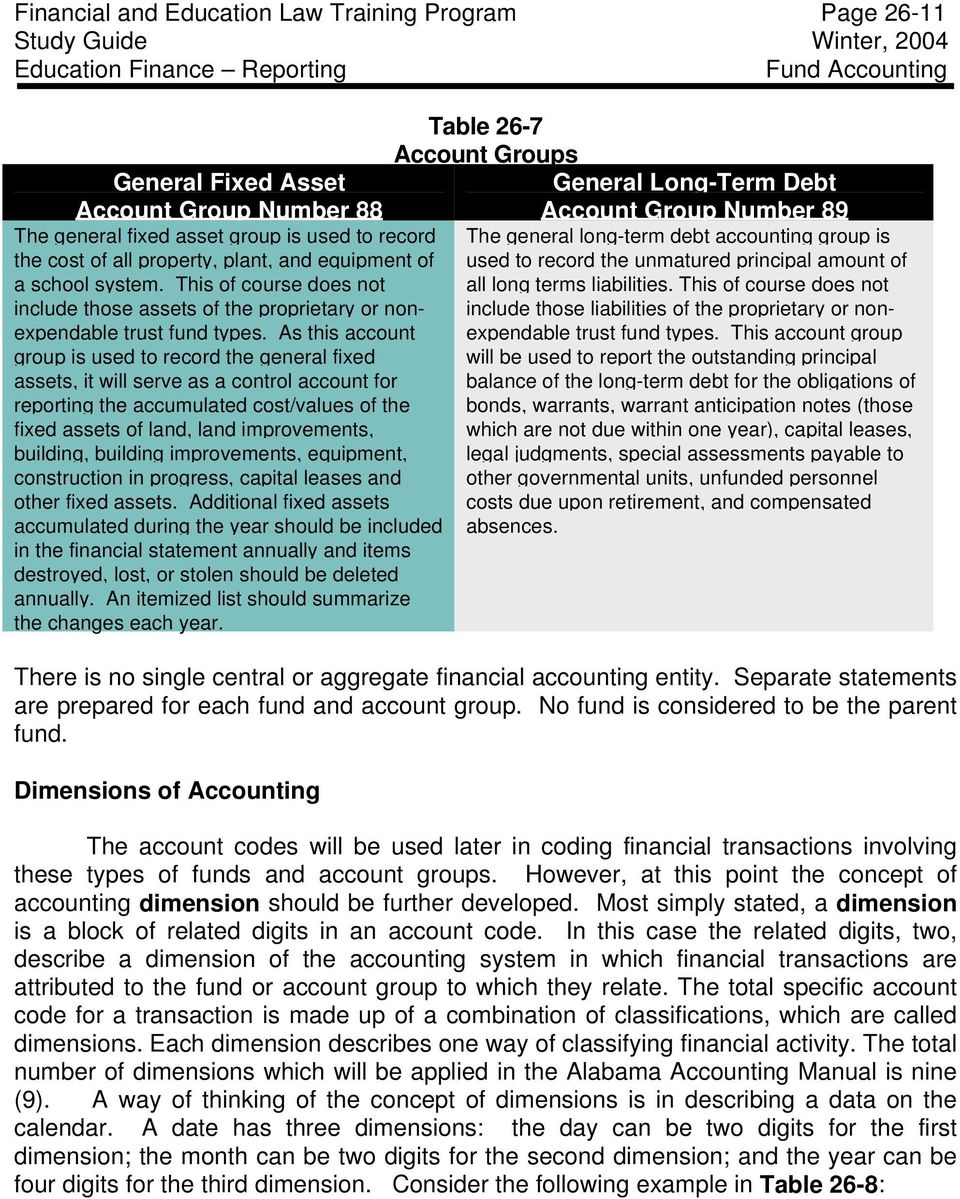
10 Financial and Education Law Training Program Page assets held by the school system in a trusteeship for some specified purpose. The investment earnings can be spent on the object of the trust, but never the principal. Scholarships are an example where only the interest of the principal is used for awards. The endowment of the trust is to remain intact in perpetuity. the Non-Expendable Trust Fund, with the exception that the principal of the fund may also be spent for the specified purpose of the fund. The school system becomes the steward of the purpose of the fund and may determine to expend the entire assets and earnings of the fund. when the school system acts as an agent for hold resources for another group and disburses them as directed. These could include funds for teacher organizations, parent organizations, or student organizations. In this case, the school system plays a limited role in the collecting and temporary holding of funds for another party. A school system could use this fund set up a central payroll to reduce the number of accounts needed for payroll transactions. Groups In account to funds, there is also the need to account for a school system s accumulation of both fixed assets and long-term debts. These are called Groups because they are a grouping of records which account for and control general fixed assets and unmatured principal of general long-term debt. The main value is these types of accounts is the separation of fixed assets and debts from general operating monies. However these account groups are not funds and do not report operations since they do not contain revenue or expenditure accounts. Changes in fixed assets and long terms debts are disclosed in the notes to the financial statements rather than in an operating statement. These are found in Table 26-7:
11 Financial and Education Law Training Program Page Table 26-7 Groups General Fixed Asset General Long-Term Debt Group Number 88 Group Number 89 The general fixed asset group is used to record The general long-term debt accounting group is the cost of all property, plant, and equipment of used to record the unmatured principal amount of a school system. This of course does not all long terms liabilities. This of course does not include those assets of the proprietary or nonexpendable trust fund types. As this account expendable trust fund types. This account group include those liabilities of the proprietary or non- group is used to record the general fixed will be used to report the outstanding principal assets, it will serve as a control account for balance of the long-term debt for the obligations of reporting the accumulated cost/values of the bonds, warrants, warrant anticipation notes (those fixed assets of land, land improvements, which are not due within one year), capital leases, building, building improvements, equipment, legal judgments, special assessments payable to construction in progress, capital leases and other governmental units, unfunded personnel other fixed assets. Additional fixed assets costs due upon retirement, and compensated accumulated during the year should be included absences. in the financial statement annually and items destroyed, lost, or stolen should be deleted annually. An itemized list should summarize the changes each year. There is no single central or aggregate financial accounting entity. Separate statements are prepared for each fund and account group. No fund is considered to be the parent fund. Dimensions of ing The account codes will be used later in coding financial transactions involving these types of funds and account groups. However, at this point the concept of accounting dimension should be further developed. Most simply stated, a dimension is a block of related digits in an account code. In this case the related digits, two, describe a dimension of the accounting system in which financial transactions are attributed to the fund or account group to which they relate. The total specific account code for a transaction is made up of a combination of classifications, which are called dimensions. Each dimension describes one way of classifying financial activity. The total number of dimensions which will be applied in the Alabama ing Manual is nine (9). A way of thinking of the concept of dimensions is in describing a data on the calendar. A date has three dimensions: the day can be two digits for the first dimension; the month can be two digits for the second dimension; and the year can be four digits for the third dimension. Consider the following example in Table 26-8:
12 Financial and Education Law Training Program Page Table 26-8 Coding for Date Dimensions Day Month Year Digits XX XX XXXX Date Therefore, the calendar date that can be electronically or visually processed carries a numeric code consisting of three dimensions and eight digits: or This is precisely the way the account coding process will be developed in the following sections. The following table displays the fund and account group classifications with the corresponding code used in Alabama s school accounting system in Table 26-9: Table 26-9 Fund Classifications and Codes Classification Code Type Code (1) Governmental Funds General Fund 11 Special Revenue Funds 12 Debt Service Funds 13 Capital Projects Fund 14 (2) Propriety Funds Enterprise Funds 21 Internal Service Funds 22 (3) Fiduciary Funds Trust funds Non-Expendable Trust 31 Expendable Trust Agency Funds Payroll Clearing 38 s Payable Clearing 39 Other Agency 40 (4) Groups General Fixed Assets 88 General Long-Term Debt 89 ing Dimensions in Detail Dimension Number 1- Fund Type and Group The ing System Components for Alabama now have introduced their first dimension, the Fund Type and Group as seen in Table The further development of the ing System will describe and discuss the application of the remaining eight (8) dimensions of the nine (9) dimension accounting system. The system can be viewed in the following table, which will be progressively updated with additional dimensions as they are presented in this document.

13 Financial and Education Law Training Program Page Fund/ Group XX Categories Table Dimensions of ing System As seen above, the first dimension has a two digit code with four categories of possibilities. Type The Type is used to define a descriptive heading under which are recorded financial transactions that are similar in terms of a given frame of reference. As was stipulated in the beginning of this document, there are three major types of financial activity: Revenues and Other Sources of Funds Expenditures and Other Uses of Funds Transactions Affecting the Balance Sheet Only The transactions affecting the balance sheet were determined to be of three basic types in the stipulation of the minimum chart of accounts. These were the following: Assets Liabilities Fund Equity Therefore, the Type Dimension has five categories as seen in Table Table Type Codes Assets Liabilities Fund Equity Revenues Expenditures Code 1 Code 2 Code 3 Code 4 Code 5 Dimension 2 Type Codes With the adding of the Type Codes, the second dimension has been applied. This code consists of one (1) digit as seen in Table The further development of the ing System will describe and discuss the application of the remaining seven (7) dimensions of the nine (9) dimension accounting system. The system can be viewed in the following table, which will be progressively updated with additional dimensions as they are presented in this document.

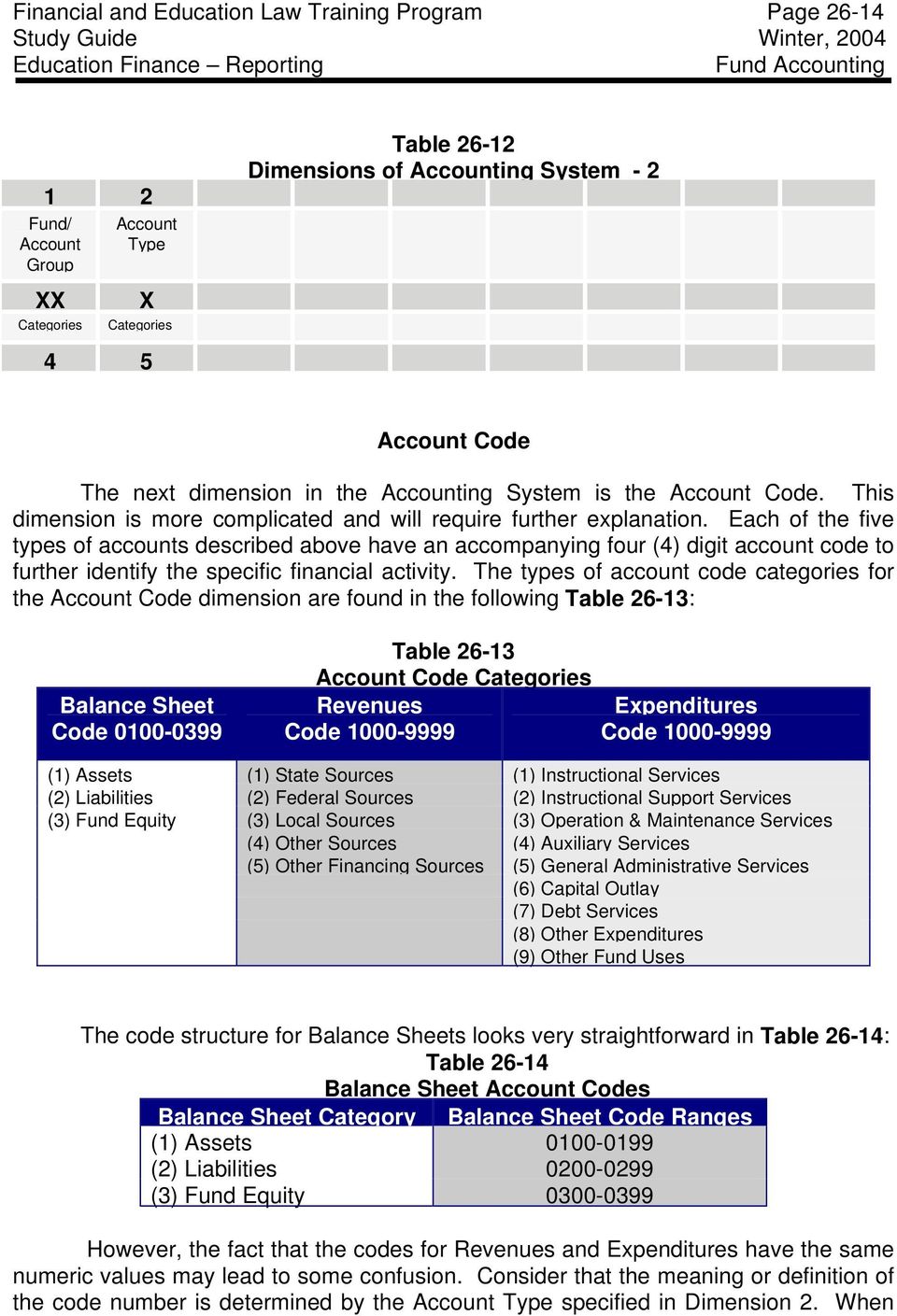
14 Financial and Education Law Training Program Page Fund/ Group XX Categories Type X Categories Table Dimensions of ing System Code The next dimension in the ing System is the Code. This dimension is more complicated and will require further explanation. Each of the five types of accounts described above have an accompanying four (4) digit account code to further identify the specific financial activity. The types of account code categories for the Code dimension are found in the following Table 26-13: Balance Sheet Code Table Code Categories Revenues Code Expenditures Code (1) Assets (1) State Sources (1) Instructional Services (2) Liabilities (2) Federal Sources (2) Instructional Support Services (3) Fund Equity (3) Local Sources (3) Operation & Maintenance Services (4) Other Sources (4) Auxiliary Services (5) Other Financing Sources (5) General Administrative Services (6) Capital Outlay (7) Debt Services (8) Other Expenditures (9) Other Fund Uses The code structure for Balance Sheets looks very straightforward in Table 26-14: Table Balance Sheet Codes Balance Sheet Category Balance Sheet Code Ranges (1) Assets (2) Liabilities (3) Fund Equity However, the fact that the codes for Revenues and Expenditures have the same numeric values may lead to some confusion. Consider that the meaning or definition of the code number is determined by the Type specified in Dimension 2. When
15 Financial and Education Law Training Program Page Type Code 4 for Revenues has been entered, the accounting system attaches the definition of revenues sources to the account code range entered. The Source of Revenue is obvious, generally government tax revenues from state, federal, and local sources. When, however, Type Code 5 for Expenditures has been entered, the accounting system attaches the definition of expenditures by function to the account code range entered. Expenditures by function means the action a person takes or the purpose for which a thing exists or is used. Function includes the activities or actions, which are performed to accomplish the objectives of an enterprise (four digits). Expenditure by Function describes the purpose of the expenditure. It refers to an expenditure activity or service area aimed at accomplishing a certain purpose or end. It is an essential component of reporting to the National Center for Education Statistics and is used to compare the expenditure patterns of the 50 states school systems to each other. The difference between Revenue and Expenditure Codes is further displayed in the following tables that display the codes that will be used by the sub-category of each category of dimension 3, account codes in Table 26-15: Table Revenue Codes Revenue Source Category Revenue Code Range (1) State Sources (2) Federal Sources (3) Local Sources (4) Other Sources (5) Other Financing Sources The category of revenues by the source of the revenues, predominately taxes, and the type of tax or the federal programs allocating revenues to LEAs is a relatively simple task. Expenditures are more complex. Expenditure s Expenditures are the cost of doing business in a school system. Expenditures are described as the cost of goods acquired or the cost of services secured, whether paid of unpaid, and include expenses, provisions for retirement of debt not reported as a liability of the fund from which retired, and capital outlays. Budgeting consists of planning the expenditures which the district expects to make along with the revenues it anticipates receiving during the upcoming school year. Expenditure structure is more complex than revenue for good reasons. While revenue sources fit into five categories, expenditures can be broken into many classifications. Expenditures in every state are classified in a program budgeting format. This means that that are identified by fund, program, function, and object. This takes the description of the expenditure from the most general to the most specific. The issue here is expenditure by function and is categorized in the following Table 26-16:

16 Financial and Education Law Training Program Page Table Expenditure Codes by Function Expenditure Categories Function Code Range (1) Instructional Services (2) Instructional Support Services (3) Operation & Maintenance Services (4) Auxiliary Services (5) General Administrative Services (6) Capital Outlay (7) Debt Service (8) Other Expenditures (9) Other Fund Uses The addition of this third dimension represents perhaps one of the most important in the accounting structure coding process to yield useful reports from the accounting system. Dimension 3 Codes With the adding of the Codes, the third dimension has been applied. This code consists of four (4) digits. The further development of the ing System will describe and discuss the application of the remaining six (6) dimensions of the nine (9) dimension accounting system. The system can be viewed in the following Table 26-17, which will be progressively updated with additional dimensions as they are presented in this document. Table Dimensions of ing System Fund/ Group Type Code XX X XXXX Categories Categories Categories 4 5 3,5,9 Object of Expenditure The characterization of an expenditure by the Object of Expenditure for the final purpose for which expenditures are made. This term refers to the service or commodity obtained as the result of a specific expenditure. Objects of Expenditure are required to be used with the Function of Expenditure Code found in Dimension 3 when recording expenditure transactions. The category is utilized only when the financial transaction is an expenditure that is being accounted for and is a three (3) digit code. Objects of expenditure are divided into major categories that are found in the following Table 26-18:
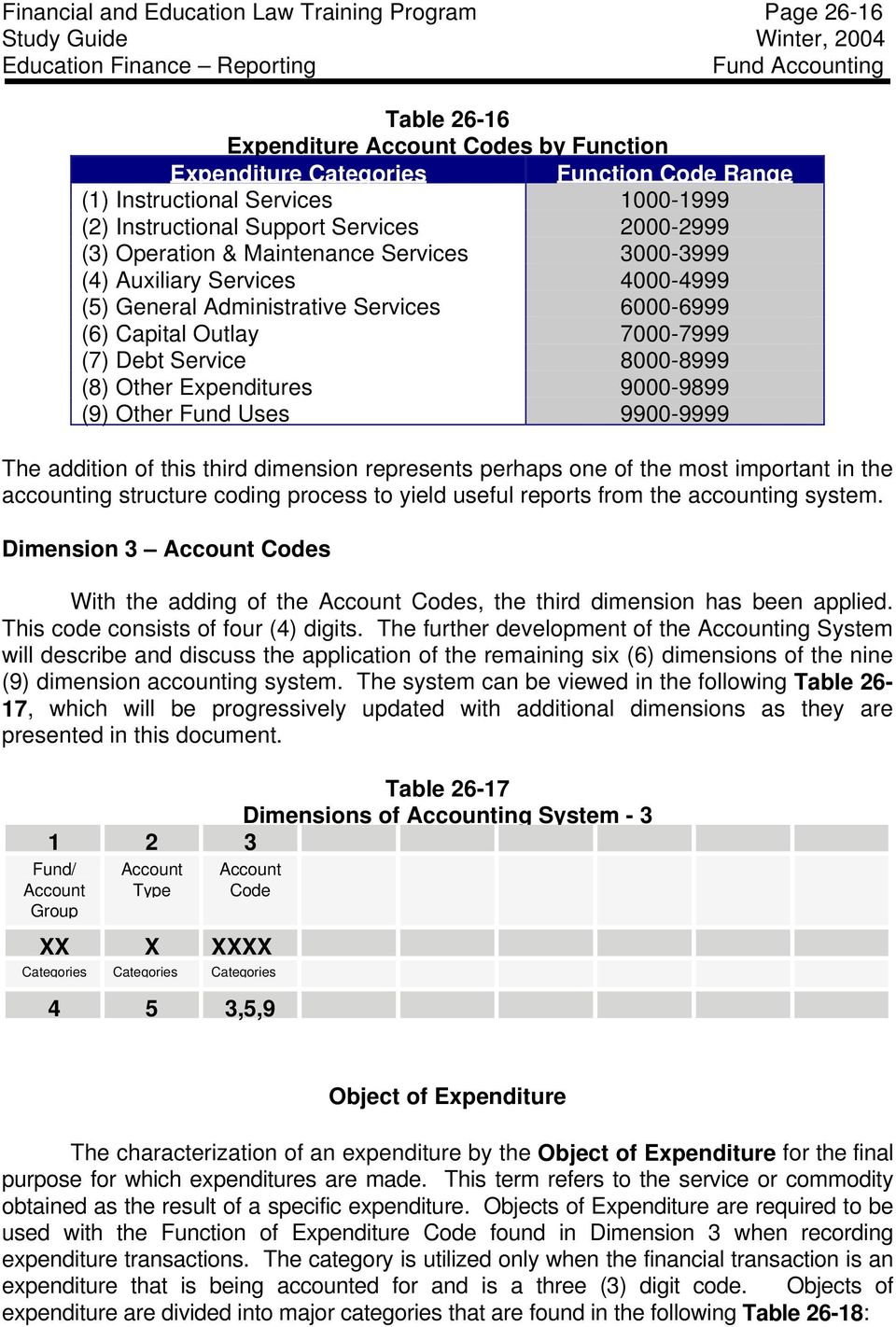
17 Financial and Education Law Training Program Page Table Object of Expenditure Codes Categories of Objects of Expenditure Object Code Range (1) Personal Services (2) Employee Benefits (3) Purchased Services (4) Materials and Supplies (5) Capital Outlay (6) Other Objects (7) Other Fund Uses Dimension 4 Object of Expenditure Codes `With the adding of the Object of Expenditure Codes, the fourth dimension has been applied. This code consists of three (3) digits. The further development of the ing System will describe and discuss the application of the remaining five (5) dimensions of the nine (9) dimension accounting system. The system can be viewed in the following Table 26-19, which will be progressively updated with additional dimensions as they are presented in this document. Table Dimensions of ing System Fund/ Group Type Code Object of Expenditure XX X XXXX XXX Categories Categories Categories Categories 4 5 3,5,9 7 Cost Center The next dimension is a useful way of classifying expenditures by cost center or operational unit. This dimension categorizes school system expenditures by school system. It can be used to collect and report expenditures by school building or other designated site. The cost center component in Table is used in the accounting system to identify specific units for budgeting revenue and expenditures, accumulating transactions, and identifying financial resources designated for a particular unit. Table Cost Center Component Codes
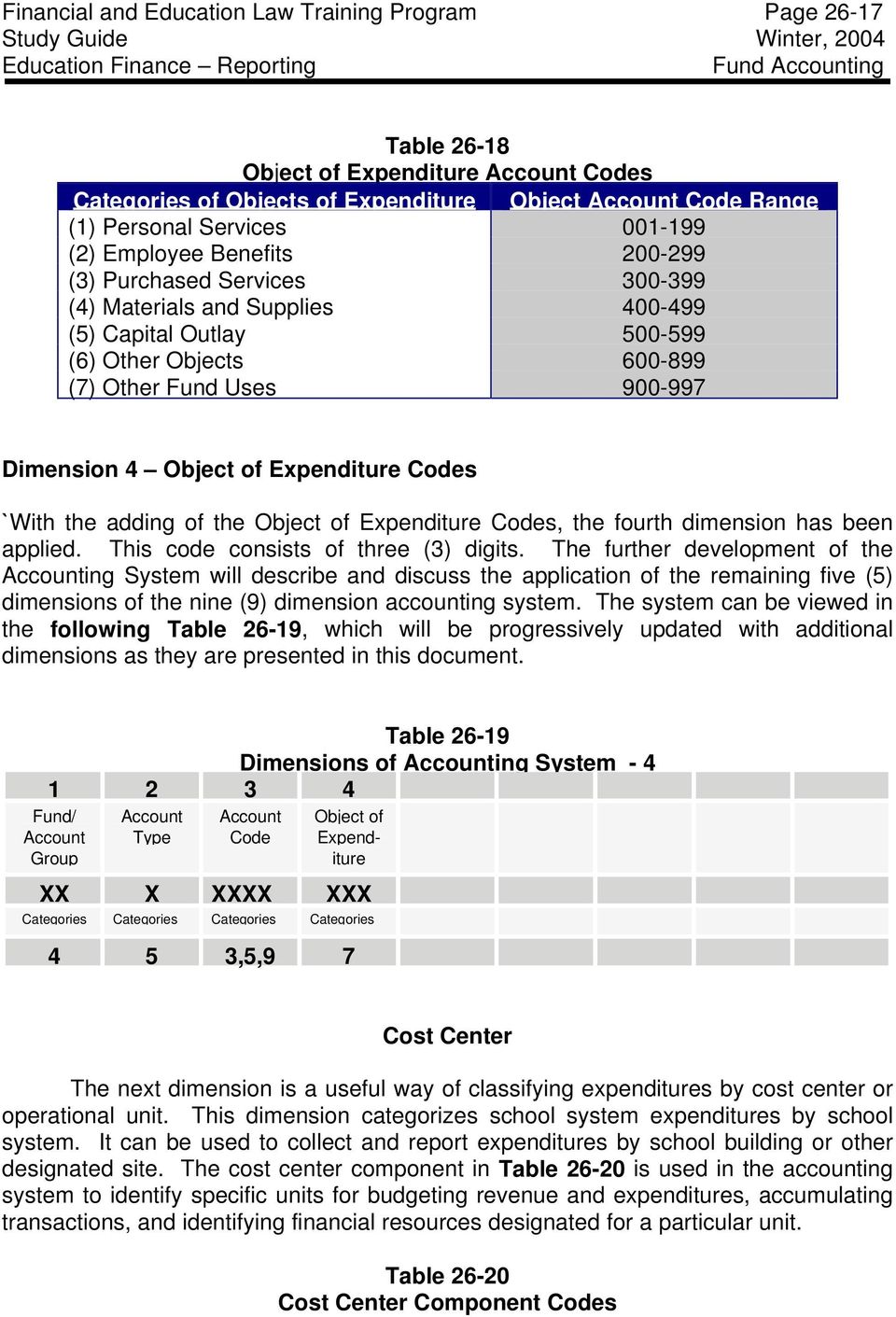
18 Financial and Education Law Training Program Page Cost Center Categories Cost Center Code Range (1) No Cost Center Required 0000 (2) Non-School Sites (Special Population) 0001 (3) School Sites (4) Vocational Centers (5) Cost Center Pools (6) Non-Regular Instructional Cost Centers The Cost Center Code allows accountability for budgeting and expenditure control. Since the Foundation Program identifies school building sites or cost centers in its calculation of cost to be reimbursed cost centers, it only makes logical sense to record budgets and expenditures by cost center. Therefore, all expenditures are required for all expenditure transactions. As expenditure transactions are recorded, they should be direct charged to the applicable school site or vocational cost center. Expenditures which are not charged to a specific site should be charged to a cost center pool. Cost center codes must be used with revenue accounts only when budgeting is required for a revenue being restricted for a designated school site. Dimension 5 Cost Center Codes With the adding of the Cost Center Codes, the fifth dimension has been applied. This code consists of four (4) digits. The further development of the ing System will describe and discuss the application of the remaining four (4) dimensions of the nine (9) dimension accounting system. The system can be viewed in the following Table 26-21, which will be progressively updated with additional dimensions as they are presented in this document. Table Dimensions of ing System Fund/ Group Type Code Object of Expenditure Cost Center XX X XXXX XXX XXXX Categories Categories Categories Categories Categories 4 5 3,5,9 7 6 Fund Source The Fund Source Dimension is used to determine the source of revenues for expenditures. Remember that when the Code Dimension was used for Revenues, then a code structure for revenues was entered. However, this information was not available when the Code Dimension was coded for an expenditure. Therefore, the addition of another dimension in Table insures the recording of the
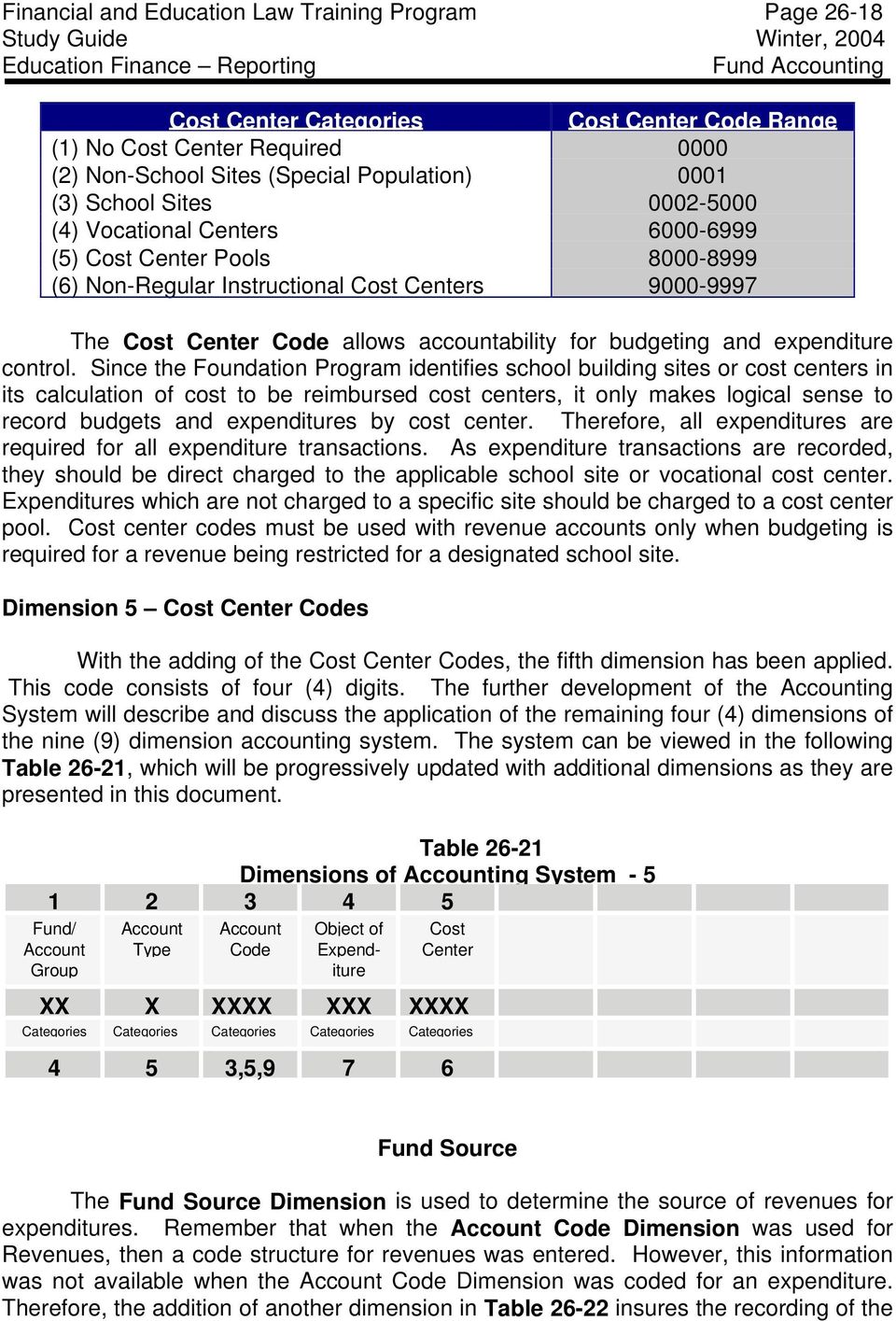
19 Financial and Education Law Training Program Page source of revenues for an expenditure. The Fund Source Codes are the same as the Revenue Codes. Table Fund Source Codes Revenue Source Category Revenue Code Range (1) State Sources (2) Federal Sources (3) Local Sources (4) Other Sources (5) Other Financing Sources Dimension 6 Fund Source Codes With the adding of the Fund Source Codes, the sixth dimension has been applied. This code consists of three (3) digits. The further development of the ing System will describe and discuss the application of the remaining three (3) dimensions of the nine (9) dimension accounting system. The system can be viewed in the following Table 26-23, which will be progressively updated with additional dimensions as they are presented in this document. Table Dimensions of ing System Fund/ Group Type Code Object of Expenditure Cost Center Fund Source XX X XXXX XXX XXXX XXXX Categories Categories Categories Categories Categories Categories 4 5 3,5, Appropriation Year Component Appropriation Year Codes are the seventh dimension used in conjunction with the fund source to identify the appropriation year, grant year, and (or) fiscal year to which the account or transaction is to be reported. The primary objective of this code is to provide a means of reporting state and federal grants by appropriation year. This is especially valuable when multiple appropriation and grant year transactions occur within the same fiscal year. All balance sheet, revenue, and expenditure transactions must reference the appropriate fund source and fiscal year code. The majority of accounting transactions will record the current fiscal year appropriation year code. However, special revenue fund transactions in which most federal grant programs are maintained must sue the appropriate grant year code is the transaction relates to a carryover or
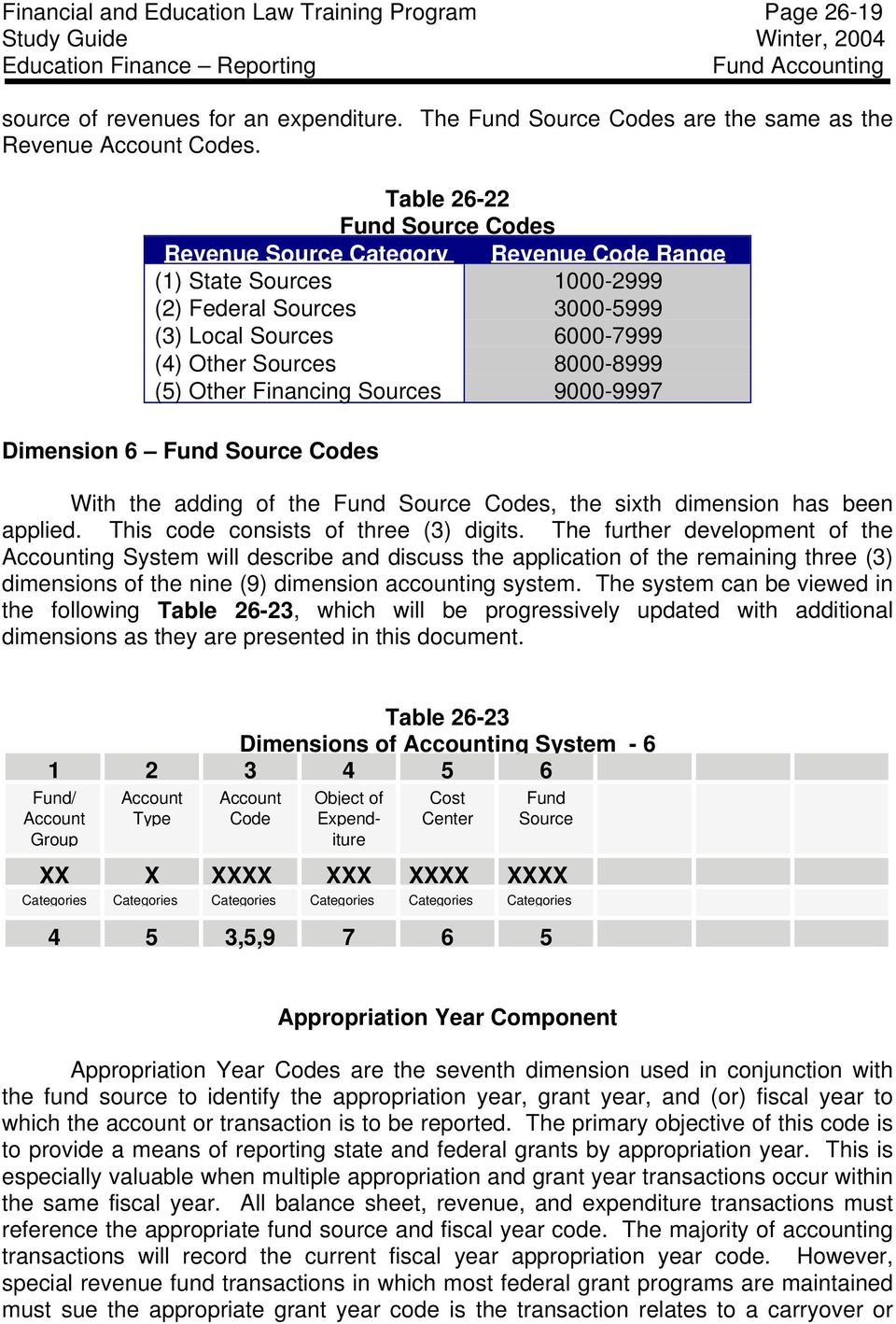
20 Financial and Education Law Training Program Page prior year appropriation. These follow in Table 26-4 below: Table 26-4 Appropriation Year Codes Appropriation Year Code (1) Current Year Appropriations 0 (2) LEA Carryover Appropriations 1 (3) July September (Federal) Appropriations 2 (4) Prior Year State Appropriation Encumbrances 9 Dimension 7 Appropriation Year Codes With the adding of the Appropriation Year Codes, the seventh dimension has been applied. This code consists of one (1) digit. The further development of the ing System will describe and discuss the application of the remaining two (2) dimensions of the nine (9) dimension accounting system. The system can be viewed in the following Table which will be progressively updated with additional dimensions as they are presented in this document. Table Dimensions of ing System Fund/ Group Type Code Cost Center Fund Source Object of Expenditure Appropriation Year XX X XXXX XXX XXXX XXXX X Categories Categories Categories Categories Categories Categories Categories 4 5 3,5, Program Component The eighth dimension is the Program Component Code. As was true in the case of the Object of Expenditure Code, when the Code is a Revenue Code, then no Program Code is required. Obviously, it is impossible to assign a Revenue Code to a Program of Expenditure Category. The Program of Expenditure is the broadest categorization of expenditures whereas the Object of Expenditure was the most specific. A program is a plan of activities and procedures designed to accomplish a predetermined objective or set of objectives. The Program Code Component allows LEAs to charge program costs, instructional and support, directly to the benefiting program. For example, special education transportation cots are recorded directly to the Special Education Program. For Regular Education Programs, this component allows for costs to be recorded by grade level or subject area by a four (4) digit code. Table below lists the categories and codes:
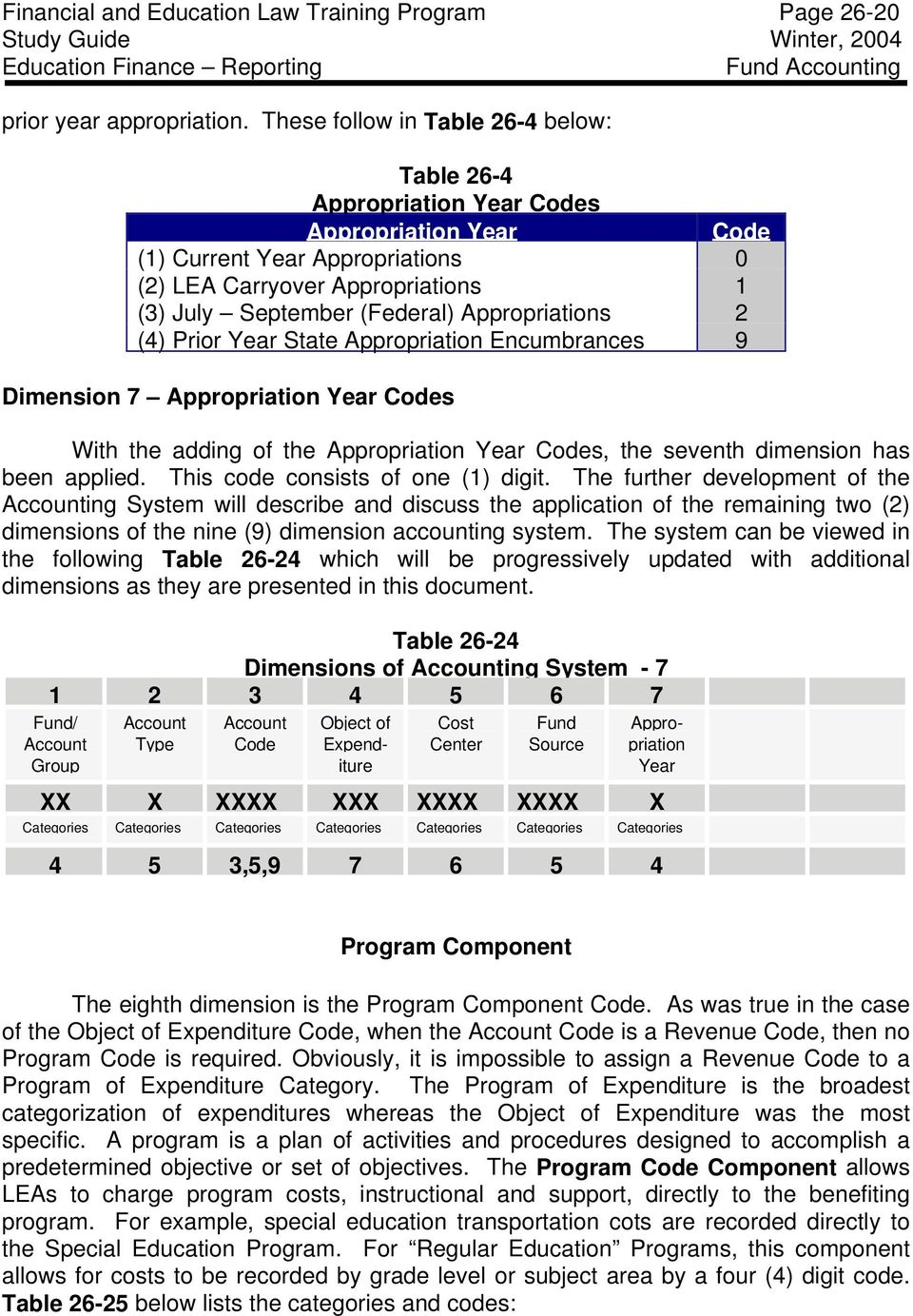
21 Financial and Education Law Training Program Page Table Program Component Codes Program Component Categories Program Component Code Ranges (1) No Program Code Required 0000 (2) Instructional Programs Regular Education Programs Special Education Programs Vocational/Technical Education Programs Non-Regular Day School Instructional Programs (3) Program Pools (4) Non-Instructional Programs Dimension 8 Program Codes With the adding of the Program Codes, the eighth dimension has been applied. This code consists of four (4) digits. The further development of the ing System will describe and discuss the application of the remaining one(21 dimensions of the nine (9) dimension accounting system. The system can be viewed in the following Table 26, which will be progressively updated with additional dimensions as they are presented in this document. Table 26 Dimensions of ing System Fund/ Group Type Code Cost Center Fund Source Object of Expenditure Appropriation Year Program XX X XXXX XXX XXXX XXXX X XXXX Categories Categories Categories Categories Categories Categories Categories Categories 4 5 3,5, Special Use Component The ninth and final dimension, the Special Use Component, is used in the reporting classification to provide specific identification not provided in other components and allow for a further breakdown or subdivision. The following codes are provided in Table below:
22 Financial and Education Law Training Program Page Table Special Use Component Codes Special Use Component Categories Special Use Code Ranges (1) No Special Use Code Necessary 0000 (2) State Department of Education Use Classroom Instructional Support Matching State Special Use (3) Local School System Use LEA s Use Local School ing Activity Codes Interfund Receivable/Payable Payroll Deduction Designators Dimension 9 Special Use Codes With the adding of the Special Use Codes, the Ninth and final dimension has been applied. This code consists of four (4) digits and is found in Table below: Table Dimensions of ing System Fund/ Group Type Code Cost Center Fund Source Object of Expenditure Appropriation Year Program Special Use XX X XXXX XXX XXXX XXXX X XXXX XXXX Categories Categories Categories Categories Categories Categories Categories Categories Categories 4 5 3,5, This completes the full complement of accounting codes used to fully record financial transactions according to the Alabama School Finance ing Manual. It should be very clear by now that the most rigorous component of the accounting system is the recording and reporting of expenditures. While accurate recording of revenues is vitally important, these data can be obtained from primary sources for the most part from which the revenues were generated. The State Department can document the both the state and federal revenues received by LEAs. For those federal funds not allocated by the SDE, other appropriate agencies can provide such data. Local revenues will originate with county revenue commissioners, county commissions, or municipal boards that have their own governmental accounting standards to follow and audits to be prepared. With the exception of other local revenues, the revenues can be fully documented by other governmental entities than the LEA.
23 Financial and Education Law Training Program Page Reporting by Expenditures The situation with expenditures is entirely different. Since expenditures are budgeted and paid fully with the direction, oversight, and accounting of LEAs, they are the only source of such information. This and the need for accountability with the taxpayers dollars makes the reporting of expenditures so very important. Consider once again the detail to which the accounting system allows the documentation of expenditures: A. Expenditure by Fund. Expenditures are first classified as expenditure from a governmental fund, proprietary fund, fiduciary fund, or an account group. The purpose of starting with the Fund is obvious; revenues are assigned to a fund on the expected basis of use in supporting some type of activity of the school system. Expenditures must therefore be assigned to the proper fund and the balance in the fund reduced. B. Expenditure by Program. A further classifying of expenditures is classification by program. A program is a plan of activities and procedures designed to accomplish a predetermined objective or set of objectives. The following categories have been identified: 1. Instructional Programs a. Regular Education Programs b. Special Education Programs c. Vocational/Technical Education Programs d. Non-Regular Day School Instructional Programs 2. Program Pools 3. Non-Instructional Programs C. Expenditure by Function. The function represents the purpose of the expenditure. It refers to an expenditure activity or service area aimed at accomplishing a certain purpose or end. Generally, the financial activities of school systems are divided into major functions. The following categories have been identified: 1. Instructional Services 2. Instructional Support Services 3. Operation and Maintenance Services 4. Auxiliary Services 5. General Administrative Services 6. Capital Outlay Real Property 7. Debt Services Long-Term 8. Other Expenditures D. Expenditure by Object. Expenditures are finally classified by object, which is the final purpose for which expenditures are made. This term refers to the service or commodity obtained as the result of a specific expenditure. The following categories have been
24 Financial and Education Law Training Program Page identified: 1. Personal Services 2. Employee Benefits 3. Purchased Services 4. Materials and Supplies 5. Capital Outlay 6. Other Objects 7. Other Fund Uses Responsibilities for Coding Generally, the responsibility for the Dimensions for (1) Fund/ Group, (2) Type, (3) Code, and (4) Object of Expenditure will be a responsibility of the Finance Officer of Custodian of Funds of the LEA as follows in Figure 26-1: Figure 26-1 General Ledger and Special Reporting Codes General Ledger Codes Primary Responsibility of Finance Officer Special Reporting Codes Primary Responsibility of Program Managers/Principals The further breaking down of expenditures will be the account coding responsibility of the program managers or principals at the cost center level. In summary, completely recording a financial transaction involves the use of nine dimensions with digitized codes for each: 1 is Fund Type & Group (2 digits) 5 is Cost Center Code (4 digits)
25 Financial and Education Law Training Program Page is Type (1 digit) 6 is Fund Source Code (4 digits) 3 is Code (4 digits) 7 is Appropriation Year (1 digit) 4 is Object Code (3 digits) 8 is Program Code (4 digits) 9 is Special Use Code (4 digits) Thus the total coding structure is thus 27 digits. What Is It and Where Did It Come From? GASB Statement 34 In June 1999, the GASB enacted sweeping changes in the way school districts report their finances to the public. These sweeping changes are embodied in GASB Statement 34, Basic Financial Statements and Management s Discussion and Analysis for State and Local Governments. Statement 34 changes the format and contents of school system financial statements to better meet the intentions of GASB spelled out in its Concepts Statement No. 1, Objectives of Financial Reporting. Statement 34 applies to all state and local governments, including school systems, public colleges and universities, public hospitals and healthcare organizations, public museums and cultural institutions, libraries, public employee retirement systems, and so on. When the GASB was established, it inherited several outstanding research issues from the National Council on Governmental ing (NCGA). None was more ambitious and wide-ranging than the project to revise the design school districts follow when reporting their finances publicly. The project that culminated in Statement 34 spanned the entirety of the GASB s then 15 year existence. In June 1999, the GASB issued Statement No. 34, Basic Financial Statements - and Management s Discussion and Analysis - for State and Local Governments. This Statement will affect how the financial statements / audits are presented for political subdivisions. Paragraph 143 of Statement 34 sets forth a three-phase implementation schedule for the new financial statements, based on a government s total annual revenues. The following implementation schedule in Table is based on the political subdivisions total revenue for the fiscal year ending June 30, Total Revenues Table GASB Statement 34 Implementation Schedule All Provisions of GASB 34 Except Retroactive Reporting of for Retroactive Reporting of Infrastructure Assets Infrastructure Assets $100 Million or More Starting fiscal years ending June 30, 2002 Starting fiscal years ending June 30, 2006 $10 Million to $100 Starting fiscal years ending June Starting fiscal years ending June 30,
26 Financial and Education Law Training Program Page Million 30, Less than $10 Million Starting fiscal years ending June 30, 2004 Retroactive Reporting of Infrastructure Assets Not Required The numerical designation for the fiscal year comes from the calendar year in which it ends. For the federal government fiscal year and for the State of Alabama fiscal year, the fiscal year ends on September 30. GASB has encouraged early implementation of all of Statement 34. In general, these changes are required minimum accounting standards. This will mean significant changes in local school boards audit reports, beginning for some boards as early as this year. And, while actual accounting systems won t change, the new reports will include some previously omitted expenditures that will cause most school boards to look financially over-extended. GASB Statement 34 rules are designed to give the public, bond buyers and other interested parties a clearer, more realistic and easier to understand report on what it costs governmental bodies, including school boards, to do business. These rules school boards and their auditors to begin releasing information about their financial health using financial statements that show all assets, liabilities and revenues when they only actually when they occur, the full accrual method. The change means school boards that incur debts at the start of each school year (in one fiscal year) for which they will eventually receive state funding (in the next fiscal year), will likely at least on paper appear to be in the red on their financial statements. The problem occurs largely because Alabama is one of only two states with an October-September fiscal year, instead of a July-June year. Thus, school boards must split each school year s expenses between two different fiscal years. Further, in order to pay teachers (and others who work less than 12 months a year) in 12 paychecks instead of nine, a portion of their pay each month is escrowed to pay them in the summer months. But under the new full accrual reporting method, the portion of the salaries that are escrowed in August and September will show as a debt. The earlier your school system resumes classes each fall, the bigger the debt will appear on your audit statement. State examiners do plan to include notes with school board audits explaining that the boards will receive the revenues to cover the accrued and escrowed salaries in the next fiscal year. In addition to the new rules on accrual issues, GASB will require school systems to include in their audits financial statements showing their long-term debt, depreciation of equipment and capital assets. Although most school boards have more in fixed assets (like buildings and equipment), financial statements for those that are growing rapidly and have long-term financing of multiple building projects likely will show deficits here too. GASB 34 does have some redeeming qualities, however. It will require school systems to include in their audit reports a management discussion and analysis that highlights and interprets changes in the budget from year to year. Specifically, the analysis must include: A comparison of current year and prior year results, with explanations of any significant changes;
27 Financial and Education Law Training Program Page A comparison of the year s original budget, final budget and actual revenues and expenditures, again with explanations of the changes; and A discussion of any other relevant situations or issues that have or will have a significant impact on the school system s financial position. This discussion and analysis, which likely will be written by superintendents and their staffs, is expected to give school boards and the public a more detailed understanding of the factors that impacted the previous year s budget. It is unclear if the discussion and analysis will require school board approval. The GASB changes are being phased in starting with the current fiscal year for school boards that had total revenues of $100 million or more in FY 99 when GASB announced the changes. That means only seven boards Baldwin County, Birmingham, Huntsville, Jefferson County, Mobile County, Montgomery County and Shelby County will be required to comply when the current fiscal year is audited. Most other boards those that had revenues between $10 million and $100 million in FY 99 will be folded in next year. The remaining boards will be covered beginning in FY 04. However, State auditors will begin using the full accrual financial statements with the resulting deficits in audits being conducted now for the 2001 fiscal year. In addition to switching to the full accrual method as the basis of accounting, changes will also occur in fund classification. Some of the changes in reporting by fund follow. The four classifications of funds are previously discussed would now be divided into the following fund types: Governmental Funds 1. General Fund 2. Special Revenue Funds 3. Capital Projects Funds 4. Debt Service Funds 5. Permanent Funds (GASB Statement 34) Proprietary Funds 6. Enterprise Funds 7. Internal Service Funds Fiduciary Funds 8. Trust and Agency Funds (this fund type is eliminated when GASB Statement 34 is Implemented) 8. Pension Trust Funds 9. Private-Purpose Trust Funds (GASB Statement 34) 10. Agency Funds Groups 11. General Fixed Assets 12. General Long-Term Debt
28 Financial and Education Law Training Program Page In the case of Governmental Funds, these are the funds through which most LEA functions are typically financed. The reporting focus of these funds is upon determining financial position rather than net income. A new category is created when GASB Statement 34 is implemented entitled Permanent Funds. This governmental fund type was introduced as part of the governmental financial reporting model established by GASB Statement No. 34. In the case of Fiduciary Funds, these are the funds used to account for assets that benefit individuals, private organizations, or other governments (GASB Statement 34) which are held by an LEA as trustee or agent. Each trust fund is treated for accounting measurement purposes in a manner similar to either a governmental fund or a proprietary fund. Expendable trust funds (eliminated when GASB Statement 34 is implemented) (Permanent Funds (GASB Statement 34) are accounted for in essentially the same manner as governmental funds. Nonexpendable trust funds (eliminated when GASB Statement 34 is implemented) and pension trust funds are accounted for in essentially the same manner as proprietary funds. Agency funds are purely custodial (assets equal liabilities) and thus do not involve measurements of results of operations. GASB's objective in developing the new reporting model was to improve governments' accountability in financial reporting and provide additional information for decision-making. The new model includes a focus on medium- to long-term operational accountability in addition to the traditional focus on current-year fiscal accountability. In the course of generating the new financial reporting requirements, GASB's due process procedures garnered valuable suggestions that weighed heavily on GASB's decisions. RSI + BFS + RSI = GAAP Under the new reporting model, governments will issue annual basic financial statements (BFS) preceded and followed by required supplementary information (RSI). This information replaces the general purpose financial statements currently required. Management's Discussion and Analysis (MD&A) This is now defined as Required Supplemental Information (RSI). GASB Statement No. 34 provides that MD&A "should provide an objective and easily readable analysis of the government's financial activities" based upon facts, decisions, or conditions known to management as of the auditor's report date. MD&A should focus on the primary government, though comments on individual discrete component units may be included when appropriate. MD&A should emphasize current-year activities but include prior-year comparisons when relevant. Statement No. 34 establishes certain minimum content requirements for MD&A while encouraging flexibility in its preparation. Briefly, these requirements include the following: A description of the basic financial statements and the relationship of the
29 Financial and Education Law Training Program Page government-wide financial statements to the fund financial statements. The discussion should assist readers to understand whether measurements and results presented in the fund financial statements reinforce the information in the government-wide statements or provide additional information. Comparative condensed financial information derived from the governmentwide financial statements. Explanations for significant improvement or deterioration in financial position and results of operations from the prior year, addressing both governmental and business-type activities. Analysis of significant changes in balances and transactions of individual funds. Analysis of significant differences between 1) the original and final budget amounts and 2) the final budget amounts and actual budgetary results, for the general fund. Descriptions of capital asset and long-term debt activities taking place during the year. SUMMARY The following statements summarize the accounting principles and standards of reporting which have been discussed in the preceding material. 1. A balance sheet shows the financial position at a given date. 2. An operating statement shows the changes in financial position and results of operations during a period ending on the balance sheet date. 3. The things a district owns are called assets. 4. The amounts a district owes are called liabilities. 5. The excess of assets over liabilities is called equity or fund balance. 6. Receipts are increases in cash. 7. Disbursements are decreases in cash. 8. Increases in assets or decreases in liabilities which result in an increase in fund balance are called revenue. 9. Decreases in assets or increases in liabilities which result in a decrease in fund balance are called expenditures. 10. Increases and decreases in equity are called revenues and expenses, respectively. 11. Fund accounting is used by LEAs to permit accounting separately for resources affected by different types of spending restrictions and/or accounting principles. 12. Debits are entries to the left side of the account. 13. Credits are entries to the right side of the account.
30 Financial and Education Law Training Program Page Assets normally have debit balances; therefore debits increase assets credits decrease assets 15. Liabilities and fund balances normally have credit balances; therefore debits decrease liabilities and fund balances credits increase liabilities and fund balances. 16. The original entry of a financial transaction in the records is made in a journal. 17. From the journal, transactions are posted to accounts in the ledgers. 18. A set of account records is called a ledger. 19. A trial balance is a listing of account titles, account numbers, and balances for the purpose of determining whether the accounts are in balance - whether the total of all debit account balances equals the total of all credit account balances. 20. Generally accepted accounting principles (GAAP) are standards for accounting and reporting. GAAP applicable to governmental organizations are published by the National Council on Governmental ing (NCGA). 21. The basis of accounting refers to the point in time at which transactions are recognized in the accounting system. 22. In cash basis accounting, financial transactions are recognized only when cash is taken in or paid out. 23. In accrual basis accounting, revenues are recognized when they are earned and expenditures are recognized when goods are consumed or services rendered. The accrual basis is used for proprietary type funds. 24. The modified accrual basis of accounting is used for governmental type funds. On this basis, revenues are recognized when they are available and measurable and expenses are recognized when a liability is incurred. 25. Revenue and other financing sources accounts appear in the operating statement prepared at the close of the fiscal year. Glossary - List of Acronyms AICPA - American Institute of Certified Public ants ASLGU - AICPA's Audit and ing Guide Audits of State and Local Governmental Units CAFR - Comprehensive Annual Financial Report CART - Committee-Appointed Review Team CFDA - Catalogue of Federal Domestic Assistance CPA - Certified public accountant EDP - Electronic data processing FASB - Financial ing Standards Board FFA - Federal financial assistance GAAP - Generally accepted accounting principles GAAS - Generally accepted auditing standards GAO - United States Government ing Office
31 Financial and Education Law Training Program Page GAS - Government Auditing Standards GASB - Governmental ing Standards Board GFOA Government Finance Officers Association GPFS - General purpose financial statements IBNR - Incurred but not reported NCGA National Council on Governmental ing NSLP - National School Lunch Program OMB - United States Office of Management and Budget SAS - AICPA Statements on Auditing Standards SFAS - Statement on Financial ing Standards Supplementary Schedule - Supplementary Schedule of Federal Financial Assistance USDA - United States Department of Agriculture Appendices Which Follow 26. FUND ACCOUNTING Appendix 26-1 Appendix 26-2 Appendix 26-3 Appendix 26-4 Appendix 26-5 ing System Components: Dimensions, Categories, and Codes Fund Organization Chart ing Entities of State and Local Governments Revenue s Expenditure s
32 Financial and Education Law Training Program Page Appendix 26-1 ing System Components: Dimensions, Categories, and Codes ACCOUNTING SYSTEM COMPONENTS Dimensions, Categories, and Codes Dimension Dimension Dimension Dimension Dimension Dimension Dimension Dimension Dimension Number 1 Number 2 Number 3 Number 4 Number 5 Number 6 Number 7 Number 8 Number 9 Fund/ Object of Cost Fund Appropriation Special Group Type Code Expenditure Center Source Year Program Use Digits Digits Digits Digits Digits Digits Digits Digits Digits XX X XXXX XXX XXXX XXXX X XXXX XXXX Categories: Categories: Categories: Categories: Categories: Categories: Categories: Categories: Categories: A. Governmental: A. Balance Sheet: 1. General A. Assets 1 Assets 2. Special Revenue B. Liabilities 2. Liabilities 3. Debt Service C. Fund Equity 3. Fund Equity 4. Capital Projects D. Revenues B. Revenues: If Revenues: B. Non-School Sites Revenues: B. Proprietary: 1. State Sources 0000 C. School Sites 1. State Sources 1. Enterprise 2.Federal Sources D. Vocational 2.Federal Sources 2. Internal Service 3. Local Sources Centers 3. Local Sources C. Fiduciary: 4.Other Sources 4. Other Sources 1. Trust 5. Other Financing E. Cost Center Pools 5. Other Financing 2. Agency a. Non-Expendable E. Expenditures C. Expenditures by Function: If Expenditures: b. Expendable 1. Instructional Services 1. Personal Services a. Payroll Clearing 2. Instructional Support Services 3. Operation & Maintenance 2. Employee Benefits 3. Purchased Services b. s Payable 4. Auxiliary Services 4. Materials & Supplies c. Other Agency D. Groups: 5. General 5. Capital Outlay Administrative Services 6. Capital Outlay 6. Other Objects 7. Debt Services 7. Other Fund Uses If Revenues: 1. General Fixed Asset 8. Other Expenditures General Long-Term Debt 9. Other Fund Uses A. No Cost Center Required F. Non-Regular Instructional Cost Centers A. Current Year Appropriations B. LEA Carryover Appropriations C. July 1- September 2. Special Education (Federal) Programs Appropriations D. Prior Year State Appropriation Encumbrances A. No Program Code A. No Special Use Required B. Instructional Program: 1. Regular Education Programs 3. Vocational/ Technical Education Programs 4. Non-Regular Day School Instructional Programs C. Program Pools D. Non-Instructional Programs Code Necessary B. State Department of Education Use C. Local School System Use
33 Financial and Education Law Training Program Page Appendix 26-2 Fund Organization Chart FUND ORGANIZATIONAL CHART The Reporting LEA A. Governmental Fund Types 1. General 2. Special Revenue 3. Capital Projects 4. Debt Service B. Proprietary Fund Types 5. Enterprise 6. Internal Service C. Fiduciary Fund Types 7. Trust 8. Agency Non- Expendable Trust Expendable Trust Payroll Clearning s Payable Clearing D. Groups General Fixed s General Long-Term Debt
34 Financial and Education Law Training Program Page Appendix 26-3 ing Entities of State and Local Governments ing Entities of State and Local Governments GOVERNMENTAL FUNDS PROPRIETARY FUNDS The General Fund Enterprise Funds Special Revenue Funds Internal Service Funds Capital Projects Funds Debt Service Funds NONFUND ACCOUNT GROUPS FUDICIARY FUNDS General Fixed Assets Expendable Trust Funds General Long Term Debt GENERAL GOVERNMENT ACCOUNTING ENTITIES Non-Expendable Trust Funds Pension Trust Funds Agency Funds Categories of Funds and Groups: Types of Funds and Groups: Each Fund and Group is an independent accounting entity with a separate selfbalancing set of accounts. Financial statements are prepared for each fund (individual fund statements), for all funds of each type (combining statements) and for the government reporting entity (combined statements).
35 Financial and Education Law Training Program Page Appendix 26-4 Revenue s REVENUE ACCOUNTS Fund/ Object Acct. Acct. Acct. of Cost Fund App. Spec. Group Type Code Exp. Center Source Year Prog. Use X = Number of Digits in ing System XX X XXXX 000 XXXX XXXX X 0000 XXXX The Fund Type (4) and Groups (2) are used to record all related financial transactions. Provides for a segregation of revenues & expenditures which are genally established in accordance with GAAP. The Type Component is used to designate the five (5) major account types used in an automated accounting system -- Assets, Liabilities, Fund Equity, Revenues, and Expenditures The Code Component is used to designate balance sheet (assets, liabilities, and fund equity), revenue, and expenditure accounts; identifies Source of Revenues for an Type 4 Revenue SAME SAME Not used when Code is for Revenue, Code 4 The Cost Center Component is used to identify specific units for budgeting revenues and expenditures, accumulating transactions, and identifying financial resoruces designated for a particular center. All school sites have assigned cost center numbers. The Funding Source Component is the component that is used to maintain fund accounting. The fund source tells you where you are getting the funds to finance the expenditure. Most fund sources have a identical revenue source. The Appropriation Year Component is a one digit code used to identify the grant/appropration year that applies to the transaction. Current Year is "O," Federal carryover funds are "1," Federal programs July to September are "2," and encumbered state fund Not used when Code is for Revenue, Code 4 The Special Use Component is used when further breakdown is needed that is not provided in the other eight components. Appendix 26-5
36 Financial and Education Law Training Program Page Expenditure s EXPENDITURE ACCOUNTS Fund/ Object Acct. Acct. Acct. of Cost Fund App. Spec. Group Type Code Exp. Center Source Year Prog. Use X = Number of Digits in ing System XX X XXXX XXX XXXX XXXX X XXXX XXXX The Fund Type (4) and Groups (2) are used to record all related financial transactions. Provides for a segregation of revenues/expenditures which are genally established in accordance with GAAP. The Type Component is used to designate the five (5) major account types used in an automated accounting system -- Assets, Liabilities, Fund Equity, Revenues, and Expenditures The Code Component uses the Function of Expenditure code when the Type is a 5 for Expenditures to identify the service performed or for which the material is required. The Object of Expenditure Component is used to classify in detail the services or commodities brought from the financial resources in the fund source from which the expenditure is being made. The Cost Center Component is used to identify specific units for budgeting revenues and expenditures, accumulating transactions, and identifying financial resoruces designated for a particular center. All school sites have assigned cost center numbers. The Funding Source Component is the component that is used to maintain fund accounting. The fund source tells you where you are getting the funds to finance the expenditure. Most fund sources have a corresponding revenue source. The Appropriation Year Component is a one digit code used to identify the grant/appropration year that applies to the transaction. Current Year is "O," Federal carryover funds are "1," Federal programs July to September are "2," and encumbered state fund The Program Code Component allows the charging of expenditures direct to be benefiting program, such as elementary, secdonary, vocational, or special education. The Function Code tells what services you provided; the Program Code tells you who or what yo The Special Use Component is used when further breakdown is needed that is not provided in the other eight components.
TOPIC ACCOUNTING PRINCIPLES SUB-SECTION 03.00.00 SUB-SECTION INDEX REVISION NUMBER 99-004
 Page 1 of 1 TOPIC ACCOUNTING PRINCIPLES SUB-SECTION 03.00.00 SECTION ISSUANCE DATE JUNE 30, 1999 SUB-SECTION INDEX REVISION NUMBER 99-004 03 Accounting Principles 10 Organization Structure of State Government
25. Introduction to School Accounting
 Financial and Education Law Training Program Page 25-1 25. Background and Introduction During the early years of American education, financial records were not extensive because local school systems were
AUDIT REPORT of DUBOIS AREA SCHOOL DISTRICT. DuBois, Pennsylvania A.U.N. 1-06-17-200-3. For The Year Ended June 30, 2013
 AUDIT REPORT of DUBOIS AREA SCHOOL DISTRICT DuBois, Pennsylvania A.U.N. 1-06-17-200-3 For The Year Ended June 30, 2013-1 - TABLE OF CONTENTS Page Number Independent Auditor's Report 4 Management's Discussion
RULE 2 EFFECTIVE DATE JULY 7, 2013 (REVISED) NEBRASKA DEPARTMENT OF EDUCATION UNIFORM SYSTEM OF ACCOUNTING FOR NEBRASKA PUBLIC SCHOOL DISTRICTS
 NEBRASKA DEPARTMENT OF EDUCATION RULE 2 UNIFORM SYSTEM OF ACCOUNTING FOR NEBRASKA PUBLIC SCHOOL DISTRICTS TITLE 92, NEBRASKA ADMINISTRATIVE CODE, EFFECTIVE DATE JULY 7, 2013 (REVISED) State of Nebraska
ACCOUNTING SYSTEM AND PERSONNEL REPORTING. Overview. The Components of the System 9/22/2015. Accounting System and Personnel Reporting 1
 ACCOUNTING SYSTEM AND PERSONNEL REPORTING Sonja Peaspanen LEA Fiscal Accountability September 2015 Overview Accounting Code Components What do the numbers actually mean? How do you choose an account number?
PA Office of the Budget Office of Comptroller Operations Central Agencies & School Finance Unit [email protected]
 Manual of Accounting and Financial Reporting for PA Public Schools Chart of Accounts Revised 9-24-12 Maintained by PA Office of the Budget Office of Comptroller Operations Central Agencies & School Finance
CHAPTER II GENERAL LEDGER ACCOUNTS
 CHAPTER II GENERAL LEDGER ACCOUNTS A general ledger is basic to an accounting system. The General Ledger of a fund is a summary record containing the balance of assets, liabilities, deferred revenues,
Guidelines for Creating and Evaluating Funds and Accounts
 Guidelines for Creating and Evaluating Funds and Accounts Adopted by the Legislative Commission on Planning and Fiscal Policy 12/5/2002 Introduction This section presents a general background of government
How To Account For Money In The European System Of Accounting
 80.20.10 80.20 Generally Accepted Accounting Principles 80.20.10 July 1, 2001 This state adopts Generally Accepted Accounting Principles (GAAP) Generally accepted accounting principles (GAAP) are uniform
Manual of Accounting and Financial Reporting for Pennsylvania Public Schools CHAPTER 9 TABLE OF CONTENTS. Chapter 9 9.1
 Manual of Accounting and Financial Reporting for Pennsylvania Public Schools CHAPTER 9 TABLE OF CONTENTS 9.1 9.1 ENTERPRISE FUNDS 9.2 Nature And Purpose 9.2 Food Service Fund 9.2 Basis Of Accounting And
O FFICE OF THE NEW YORK STATE COMPTROLLER DIVISION OF LOCAL GOVERNMENT AND SCHOOL ACCOUNTABILITY. Thomas P. DiNapoli
 O FFICE OF THE NEW YORK STATE COMPTROLLER DIVISION OF LOCAL GOVERNMENT AND SCHOOL ACCOUNTABILITY School Districts Accounting and Reporting Manual Thomas P. DiNapoli Reissued March 2012 TABLE OF CONTENTS
ALASKA DEPARTMENT OF EDUCATION AND EARLY DEVELOPMENT UNIFORM CHART OF ACCOUNTS AND ACCOUNT CODE DESCRIPTIONS FOR PUBLIC SCHOOL DISTRICTS 2014 Edition
 ALASKA DEPARTMENT OF EDUCATION AND EARLY DEVELOPMENT UNIFORM CHART OF ACCOUNTS AND ACCOUNT CODE DESCRIPTIONS FOR PUBLIC SCHOOL DISTRICTS Table of Contents INTRODUCTION... 3 Objectives... 3 Background...
Introductory Governmental Accounting Part I. For State and Local Governments
 Introductory Governmental Accounting Part I For State and Local Governments FINANCIAL MANAGEMENT CERTIFICATE TRAINING PROGRAM INTRODUCTORY GOVERNMENTAL ACCOUNTING PART I COURSE OBJECTIVES Upon completion
CHAPTER 1 Principles of Accounting
 CHAPTER 1 Principles of Accounting Table of Contents Page PRINCIPLES OF ACCOUNTING 1 Accounting and Reporting Capabilities...2 GAAP Basis Financial Statements...3 Unqualified GAAP...3 Other Comprehensive
The following document was not prepared by the Office of the State Auditor, but was prepared by and submitted to the Office of the State Auditor by a
 The following document was not prepared by the Office of the State Auditor, but was prepared by and submitted to the Office of the State Auditor by a private CPA firm. The document was placed on this web
Uniform Massachusetts Accounting System
 Uniform Massachusetts Accounting System July, 2014 Massachusetts Department of Revenue Division of Local Services Amy A. Pitter, Commissioner Robert G. Nunes, Deputy Commissioner & Director of Municipal
Accounting for Colleges & Universities. Chapter 17
 Accounting for Colleges & Universities Chapter 17 Learning Objectives Understand why most government C&Us choose to report as business-type only special purpose governments Explain unique aspects of C&U
EASTLAND FAIRFIELD CAREER & TECHNICAL SCHOOLS FRANKLIN COUNTY SINGLE AUDIT
 EASTLAND FAIRFIELD CAREER & TECHNICAL SCHOOLS FRANKLIN COUNTY SINGLE AUDIT FOR THE YEAR ENDED JUNE 30, 2014 EASTLAND-FAIRFIELD CAREER AND TECHNICAL SCHOOLS FRANKLIN COUNTY TABLE OF CONTENTS TITLE PAGE
GREENUP COUNTY SCHOOL DISTRICT FINANCIAL STATEMENTS AND SUPPLEMENTAL INFORMATION
 FINANCIAL STATEMENTS AND SUPPLEMENTAL INFORMATION TABLE OF CONTENTS Page Independent Auditors' Report 1 Management s Discussion and Analysis 4 Basic Financial Statements: Statement of Net Position 8 Statement
Appendix C: Examples of Common Accounting and Bookkeeping Procedures
 Appendix C: Examples of Common Accounting and Bookkeeping Procedures In this Appendix the use of the term monthly means on a regular cycle, based on the needs of your district. Some of the sample accounting
Warren Consolidated Schools. Financial Report with Supplemental Information June 30, 2014
 Financial Report with Supplemental Information Contents Independent Auditor's Report 1-3 Management's Discussion and Analysis 4-12 Basic Financial Statements Government-wide Financial Statements: Statement
TOWN OF MANCHESTER, MARYLAND. FINANCIAL STATEMENTS June 30, 2015
 FINANCIAL STATEMENTS TABLE OF CONTENTS PAGE INDEPENDENT AUDITORS REPORT... 1 MANAGEMENT S DISCUSSION AND ANALYSIS... 3 FINANCIAL STATEMENTS... 13 Government wide Financial Statements Statement of Net Position...14
CITY OF ARCADIA, FLORIDA ANNUAL FINANCIAL REPORT. For the Fiscal Year Ended September 30, 2015
 ANNUAL FINANCIAL REPORT For the Fiscal Year Ended September 30, 2015 ANNUAL FINANCIAL REPORT FOR THE FISCAL YEAR ENDED SEPTEMBER 30, 2015 TABLE OF CONTENTS Page INDEPENDENT AUDITOR'S REPORT... 1 MANAGEMENT'S
Keystone Central School District
 Financial Statements and Supplementary Information Table of Contents Page Independent Auditors' Report Management's Discussion and Analysis 1 3 Basic Financial Statements Government-Wide Financial Statements
FORT MYERS BEACH MOSQUITO CONTROL DISTRICT. September 30, 2014 BASIC FINANCIAL STATEMENTS, TOGETHER WITH REPORTS OF INDEPENDENT AUDITORS
 FORT MYERS BEACH MOSQUITO CONTROL DISTRICT September 30, 2014 BASIC FINANCIAL STATEMENTS, TOGETHER WITH REPORTS OF INDEPENDENT AUDITORS TABLE OF CONTENTS Report of the Independent Auditors 1-2 Management's
Texas Department of Assistive and Rehabilitative Services (538) - Unaudited
 Note 1: Summary of Significant Accounting Policies Entity The Texas Department of Assistive and Rehabilitative Services ( DARS ) is an agency of the State of Texas and its financial records comply with
REPORT NO. 2012-121 MARCH 2012 BROWARD COLLEGE. Financial Audit
 REPORT NO. 2012-121 MARCH 2012 Financial Audit For the Fiscal Year Ended June 30, 2011 BOARD OF TRUSTEES AND PRESIDENT Members of the Board of Trustees and President who served during the 2010-11 fiscal
Principles of Accounting and Financial Reporting for State and Local Governments
 Chapter 2 Principles of Accounting and Financial Reporting for State and Local Governments McGraw-Hill/Irwin Copyright 2010 by The McGraw-Hill Companies, Inc. All rights reserved. 2-2 Learning Objectives
TABLE OF CONTENTS CHAPTER 9
 TABLE OF CONTENTS CHAPTER 9 Purpose...1 Balance Sheet Accounts...1 Assets...1 Cash...1 Accounts Receivable...2 Accounts Receivable Allowances...4 Loans and Notes Receivable...4 Loans and Notes Allowances...5
CALIFORNIA STATE UNIVERSITY, SAN MARCOS. Financial Statements. June 30, 2005 and 2004. (With Independent Auditors Report Thereon)
 Financial Statements (With Independent Auditors Report Thereon) Table of Contents Page Independent Auditors Report 1 Management s Discussion and Analysis 3 Financial Statements: Statements of Net Assets
OTHER COMPREHENSIVE BASIS OF ACCOUNTING (OCBOA) CASH BASIS NOTES TO THE FINANCIAL STATEMENTS
 OTHER COMPREHENSIVE BASIS OF ACCOUNTING (OCBOA) CASH BASIS NOTES TO THE FINANCIAL STATEMENTS Table of Contents Page NOTE 1 SUMMARY OF SIGNIFICANT ACCOUNTING POLICIES... 1 NOTE 2 SELF-INSURANCE SECURITY
Accounting and Reporting for Public Colleges and Universities. Objectives
 Accounting and Reporting for Public Colleges and Universities 2012-2013 NACUBO Intermediate Accounting Objectives Upon completion of these materials, you will be able to Comprehend the reporting and recognition
Chapter Seven. Accounting for the Business-type Activities of State and Local Governments
 Chapter Seven Accounting for the Business-type Activities of State and Local Governments Learning Objectives After studying this chapter, you should be able to: 1. Distinguish between the purposes of internal
AD VALOREM TAX ADOPTED BUDGET
 AD VALOREM TAX ADOPTED BUDGET AGGREGATE TAX RATE AMENDMENT APPROPRIATION ASSESSED VALUE BALANCE FORWARD BALANCE FORWARD - CAPITAL A tax levied on the assessed value of real property (also known as "property
VILLAGE OF LONG GROVE Long Grove, Illinois
 Long Grove, Illinois FINANCIAL STATEMENTS Including Independent Auditors' Report TABLE OF CONTENTS Independent Auditors' Report 1 2 Basic Financial Statements Statement of Net Assets 3 Statement of Activities
TOWNSHIP OF ROLLAND ISABELLA COUNTY, MICHIGAN AUDITED FINANCIAL STATEMENTS. Fiscal Year Ended March 31, 2010
 ISABELLA COUNTY, MICHIGAN AUDITED FINANCIAL STATEMENTS Fiscal Year Ended TABLE OF CONTENTS Independent Auditor s Report.. 1 FINANCIAL STATEMENTS Government Wide Statement of Net Assets. 2 Government Wide
The following document was not prepared by the Office of the State Auditor, but was prepared by and submitted to the Office of the State Auditor by a
 The following document was not prepared by the Office of the State Auditor, but was prepared by and submitted to the Office of the State Auditor by a private CPA firm. The document was placed on this web
ACCOUNTING AND FINANCIAL REPORTING REGULATION MANUAL
 ACCOUNTING AND FINANCIAL REPORTING REGULATION MANUAL STATE BOARD OF ACCOUNTS 302 West Washington Street Room E418 Indianapolis, Indiana 46204-2769 Issued January 2011 Revised April 2012 TABLE OF CONTENTS
GRANT RECEIVABLES. A grant expenditure is incurred. A grant revenue is recorded when the check is received. (consider recording a receivable)
 FALL ASBO 2011 BALANCE SHEET ACCOUNTS GRANT RECEIVABLES EXPENDITURE A grant expenditure is incurred. REVENUE A grant revenue is recorded when the check is received. (consider recording a receivable) There
Trust and Agency (Fiduciary) Funds
 Trust and Agency (Fiduciary) Funds Summary of Interfund GCA GLTL Accounting Chapter 12 Learning Objectives Understand & discuss the circumstances when funds are used Define and distinguish among the four
REPORT NO. 2012-155 MARCH 2012 MIAMI DADE COLLEGE. Financial Audit
 REPORT NO. 2012-155 MARCH 2012 Financial Audit For the Fiscal Year Ended June 30, 2011 BOARD OF TRUSTEES AND PRESIDENT Members of the Board of Trustees and President who served during the 2010-11 fiscal
WYOMING SCHOOL BUDGETING, ACCOUNTING AND REPORTING MANUAL
 WYOMING SCHOOL BUDGETING, ACCOUNTING AND REPORTING MANUAL Finance Unit Wyoming Department of Education Revised April 2, 2015 The Wyoming Department of Education does not discriminate on the basis of race,
LASALLE COUNTY EMERGENCY TELEPHONE SYSTEM BOARD OTTAWA, ILLINOIS
 OTTAWA, ILLINOIS Financial Report CONTENTS Page Number Independent Auditor's Report Management's Discussion and Analysis (Unaudited) Statement of Net Assets - Business-Type Activities Statement of Revenues,
Copyright 2005 POLICEPAY.NET, Inc.
 UNDERSTANDING GOVERNMENTAL ACCOUNTING POLICEPAY.NET, INC One Leaderships Square, Suite 350 211 North Robinson Avenue Oklahoma City, OK 73102 (405) 234-2235 www.policepay.net Copyright 2005 POLICEPAY.NET,
CITY OF COLEMAN, TEXAS FINANCIAL STATEMENTS AND INDEPENDENT AUDITOR'S REPORT SEPTEMBER 30, 2014
 CITY OF COLEMAN, TEXAS FINANCIAL STATEMENTS AND INDEPENDENT AUDITOR'S REPORT SEPTEMBER 30, 2014 Becky Roberts, CPA 104 Pine Street, Suite 610 Abilene, Texas 79601 325-665-5239 [email protected]
THE WILLIAM PATERSON UNIVERSITY OF NEW JERSEY (A Component Unit of the State of New Jersey)
 Financial Statements and Management s Discussion and Analysis (With Independent Auditors Report Thereon) Table of Contents Management s Discussion and Analysis 1 Independent Auditors Report 12 Financial
Expenditure Accounting: Governmental Funds. Chapter 6
 Expenditure Accounting: Governmental Funds Chapter 6 Learning Objectives Define expenditures Understand & apply expenditure recognition guidance Understand multiple classifications of expenditures Account
Statewide Accounting Policy & Procedure
 Statewide Accounting Policy & Procedure Accounting Manual Reference: Section: Revenues & Receivables Sub-section: Revenues, Receivables, Unearned Revenues and Unavailable Revenues - General Effective Date:
STACEY E. PICKERING STATE AUDITOR
 , MISSISSIPPI Audited Financial Statements and Special Reports For the Year Ended September 30, 2013 STACEY E. PICKERING STATE AUDITOR William R. Doss, CPA Director, Financial and Compliance Audit Division
How To Account For School Money
 PART 6 6-1 CLASSIFICATION AND DEFINITION OF CLEARING ACCOUNTS CLASSIFICATION OF CLEARING ACCOUNTS In an accounting system maintained on a cash basis, it becomes necessary to establish certain ledger accounts
COMMUNITY COLLEGE DISTRICT OF ST. LOUIS, ST. LOUIS COUNTY, MISSOURI St. Louis, Missouri. FINANCIAL STATEMENTS June 30, 2014 and 2013
 St. Louis, Missouri FINANCIAL STATEMENTS TABLE OF CONTENTS PAGE INDEPENDENT AUDITORS REPORT...1 MANAGEMENT S DISCUSSION AND ANALYSIS...3 FINANCIAL STATEMENTS Statements of Net Position...14 Statements
ASSESSED VALUATION. A valuation set upon real estate or other property by a government as a basis for levying taxes.
 ACCOUNTS PAYABLE. A short-term liability account reflecting amounts owed to private persons or organizations for goods and services received by a government. ACCOUNTS RECEIVABLE. An asset account reflecting
Borough of Baldwin. Primary Government Financial Statements and Required Supplementary Information
 Borough of Baldwin Primary Government Financial Statements and Required Supplementary Information Year Ended December 31, 2015 with Independent Auditor s Report TABLE OF CONTENTS Independent Auditor's
SOUTH CAROLINA APPALACHIAN COUNCIL OF GOVERNMENTS AUDITED FINANCIAL STATEMENTS YEAR ENDED JUNE 30, 2012
 SOUTH CAROLINA APPALACHIAN COUNCIL OF GOVERNMENTS AUDITED FINANCIAL STATEMENTS YEAR ENDED JUNE 30, 2012 SOUTH CAROLINA APPALACHIAN COUNCIL OF GOVERNMENTS AUDITED FINANCIAL STATEMENTS YEAR ENDED JUNE 30,
CHAPTER XII DOUBLE ENTRY ACCOUNTING SYSTEM
 12-1 CHAPTER XII DOUBLE ENTRY ACCOUNTING SYSTEM SECTION A - ACCOUNTING BASIS The accounting basis for recording transactions will vary according to the purpose for which each fund is established. Generally,
Fund Accounting for Michigan School Districts in 2015 Presented by Eric Formberg, CPA, CGFM
 MSBO September 23, 2015 Fund Accounting for Michigan School Districts in 2015 Presented by Eric Formberg, CPA, CGFM Plantemoran.com Objectives Basics Accounting Methods and Rules Specifics of Funds Government
FLORIDA HIGH SCHOOL FOR ACCELERATED LEARNING - WEST PALM BEACH CAMPUS, INC. d/b/a QUANTUM HIGH SCHOOL
 LEARNING - WEST PALM BEACH CAMPUS, INC. Financial Statements with Independent Auditors Reports Thereon June 30, 2015 CONTENTS Page Management s Discussion and Analysis 1 6 Report of Independent Auditors
Actual Nonmajor Special Revenue Funds --------------------------------------------------------- 34
 CONTENTS: FLORIDA DEPARTMENT OF EDUCATION SUPERINTENDENT S ANNUAL FINANCIAL REPORT (ESE 145) DISTRICT SCHOOL BOARD OF SUMTER COUNTY For the Fiscal Year Ended June 30, 2015 Return completed form to: Florida
3. ACCOUNTING. 3.3 Capital Assets 3.3.4 Capital Asset System Accounting
 3. ACCOUNTING 3.3 Capital Assets 3.3.4 Capital Asset System Accounting 3.3.4.10 Once the capital asset system is in operation, the government needs to make sure that assets which should be capitalized
Manual of Accounting and Financial Reporting for Pennsylvania Public Schools CHAPTER 11 TABLE OF CONTENTS 11.A. Chapter 11 11.1
 Manual of Accounting and Financial Reporting for Pennsylvania Public Schools CHAPTER 11 TABLE OF CONTENTS 11.1 Capital Assets And Infrastructure 11.1 What Are Capital Assets? 11.1 Valuation Of Capital
UNIFORM ACCOUNTING SYSTEM MANUAL
 2 0 1 1 UNIFORM ACCOUNTING SYSTEM MANUAL Edition For Florida Counties State of Florida Department of Financial Services Bureau of Local Government D E P A R T M E N T O F F I N A N C I A L S E R V I C
University of Central Florida Foundation, Inc. (A Discrete Component Unit of the University of Central Florida)
 University of Central Florida Foundation, Inc. (A Discrete Component Unit of the University of Central Florida) Single Audit Report Year Ended June 30, 2015 Contents Independent Auditor s Report 1 Management
REPORT NO. 2012-115 MARCH 2012 FLORIDA INTERNATIONAL UNIVERSITY. Financial Audit
 REPORT NO. 2012-115 MARCH 2012 Financial Audit For the Fiscal Year Ended June 30, 2011 BOARD OF TRUSTEES AND PRESIDENT Members of the Board of Trustees and President who served during the 2010-11 fiscal
New Hampshire Financial Accounting Handbook for Local Education Agencies
 New Hampshire Financial Accounting Handbook for Local Education Agencies 1999 Edition (Revised August 2001) New Hampshire Department Of Education In Cooperation With New Hampshire Department of Revenue
The accounting system and procedures detailed herein are based on IC 20-41-1-1 et seq..
 Revised 2010-1-1 CHAPTER 1 SCHOOL EXTRA-CURRICULAR ACCOUNT - OVERVIEW INTRODUCTION The accounting system and procedures detailed herein are based on IC 20-41-1-1 et seq.. Activity or activities as used
LAKE SHORE HOSPITAL AUTHORITY ANNUAL FINANCIAL REPORT. For the Fiscal Year Ended September 30, 2013
 ` LAKE SHORE HOSPITAL AUTHORITY ANNUAL FINANCIAL REPORT For the Fiscal Year Ended September 30, 2013 1 LAKE SHORE HOSPITAL AUTHORITY ANNUAL FINANCIAL REPORT For the Fiscal Year Ended September 30, 2013
The Uniform Minimum Chart of Accounts For New Jersey Public Schools. 2015-16 Edition
 The Uniform Minimum Chart of s For New Jersey Public Schools 2015-16 Edition Effective July 1, 2015 STATE OF NEW JERSEY DEPARTMENT OF EDUCATION OFFICE OF SCHOOL FINANCE 100 Riverview Plaza CN 500 TRENTON,
Charlotte Public Schools Charlotte, Michigan FINANCIAL STATEMENTS. June 30, 2012
 Charlotte, Michigan FINANCIAL STATEMENTS Charlotte, Michigan BOARD OF EDUCATION Ron Schultheiss President Julie Kimmer Vice-President Robert Wilson Secretary Andrew Hazel Treasurer Mike Bruce Trustee Eric
DESOTO COUNTY DISTRICT SCHOOL BOARD. Financial, Operational, and Federal Single Audit. For the Fiscal Year Ended June 30, 2012
 REPORT NO. 2013-158 MARCH 2013 Financial, Operational, and Federal Single Audit For the Fiscal Year Ended June 30, 2012 Real Version BOARD MEMBERS AND SUPERINTENDENT Board members and the Superintendent
CHAPTER 9 Information Unique to Each Fund
 CHAPTER 9 Information Unique to Each Fund Table of Contents Section - Page INTRODUCTION 1 1 THE GENERAL FUND 2 1 ASSOCIATED STUDENT BODY FUND (ASB) 3 1 Introduction...1 Accounting Methods and Procedures...2
WITH REPORTS OF INDEPENDENT AUDITORS
 As of and for the Years Ended JUNE 30, 2013 AND JUNE 30, 2014 Financial Statements and Schedule of Expenditures of Federal Awards WITH REPORTS OF INDEPENDENT AUDITORS AUDITED FINANCIAL STATEMENTS Independent