
The Uniform Minimum Chart of Accounts For New Jersey Public Schools Edition
|
|
|
- Evangeline Young
- 10 years ago
- Views:
Transcription
1 The Uniform Minimum Chart of s For New Jersey Public Schools Edition Effective July 1, 2015 STATE OF NEW JERSEY DEPARTMENT OF EDUCATION OFFICE OF SCHOOL FINANCE 100 Riverview Plaza CN 500 TRENTON, NEW JERSEY

2 STATE BOARD OF EDUCATION MARK W. BIEDRON President JOSEPH FISICARO Vice President ARCELIO APONTE RONALD K. BUTCHER CLAIRE CHAMBERLAIN JACK FORNARO EDITHE FULTON ERNEST P. LEPORE ANDREW J. MULVIHILL Hunterdon Burlington Middlesex Gloucester Somerset Warren Ocean Hudson Sussex J. PETER SIMON Morris DOROTHY STRICKLAND Essex David C. Hespe, Commissioner Secretary, State Board of Education

3 FOREWORD This handbook establishes the chart of accounts for use by New Jersey school districts. In accordance with the New Jersey Administrative Code (N.J.A.C. 6A:23A-16.1 et seq.), each district shall maintain a uniform system of financial bookkeeping and reporting that is consistent with generally accepted accounting principles (GAAP). Chart of accounts means a classification structure for the accounting system that permits the standardization of reported financial data whereby analyses may be performed within and between district boards of education, and on a nationwide basis. The State Board of Education originally authorized The Chart of s on July 1, In 1992, The Uniform Minimum Chart of s (Handbook 2R2), an amended manual, was published to conform to generally accepted accounting principles (GAAP) as provided by the National Council on Governmental ing. Since the 1992 edition, the information in the Chart of s has been updated with revisions issued in 1994, 2003, and 2008, by annual software vendor letters and budget guidelines, and through the distribution of accounting memos. The requirement to complete school-based budgets and account for appropriations at the school level was implemented for certain at-risk school districts with guidance provided through annual school-based budget district specific budget guidelines as well as any other policy memos issued by the Department. The 2003-updated edition of the Chart of s reflected the use of fund 15, a character class within the general fund used for school-based budgeting and accounting. Fund 15 is still included in this edition. The Government ing Standards Board (GASB) issued Statement No.34 (GASB 34) in June 1999 for implementation by June 30, 2004, which had several key implications for the 2003 Chart of s update. GASB 34 eliminated the financial reporting of the general fixed asset account and general long-term debt account groups. Capital assets and long-term debt were included in the Statement of Net Assets, a district-wide accrual basis statement. Consequently, those account codes which are used in either the proprietary or fiduciary funds (accrual basis) or the governmental column of the district-wide statements (accrual basis) were identified in the 2003 updated Chart of s with the phrase [Accrual basis of accounting] at the end of the description of the account code. These notations are also in this edition. Districts do not need to include all accrual basis account codes in the general ledger software for day-to-day accounting, only those needed for the proprietary and fiduciary funds. In November 2003, the National Center for Education Statistics (NCES) issued a revised publication Financial ing for Local and State School Systems, which was an updated version of the 1990 NCES chart of accounts and comparable to most account codes in the NJ Chart of s. The 2008 Chart of s update incorporated the changes issued in annual software vendor letters and budget guidelines, through the distribution of accounting memos, and as a result of the passage of The School Funding Reform Act of 2008 (SFRA). i

4 This 2015 Chart of s update incorporates the changes issued in annual software vendor letters and budget guidelines since the 2008 update. New account numbers issued are highlighted in gray. numbers that are no longer applicable are noted as Reserved and are listed in new Appendix C Details of Reserved Codes. The 2008 edition of the NJ Chart of s used an asterisk (*) to identify the accounts that are required for the annual data collection that is sent to NCES. This notation continues in this 2015 NJ Chart of s update. ii

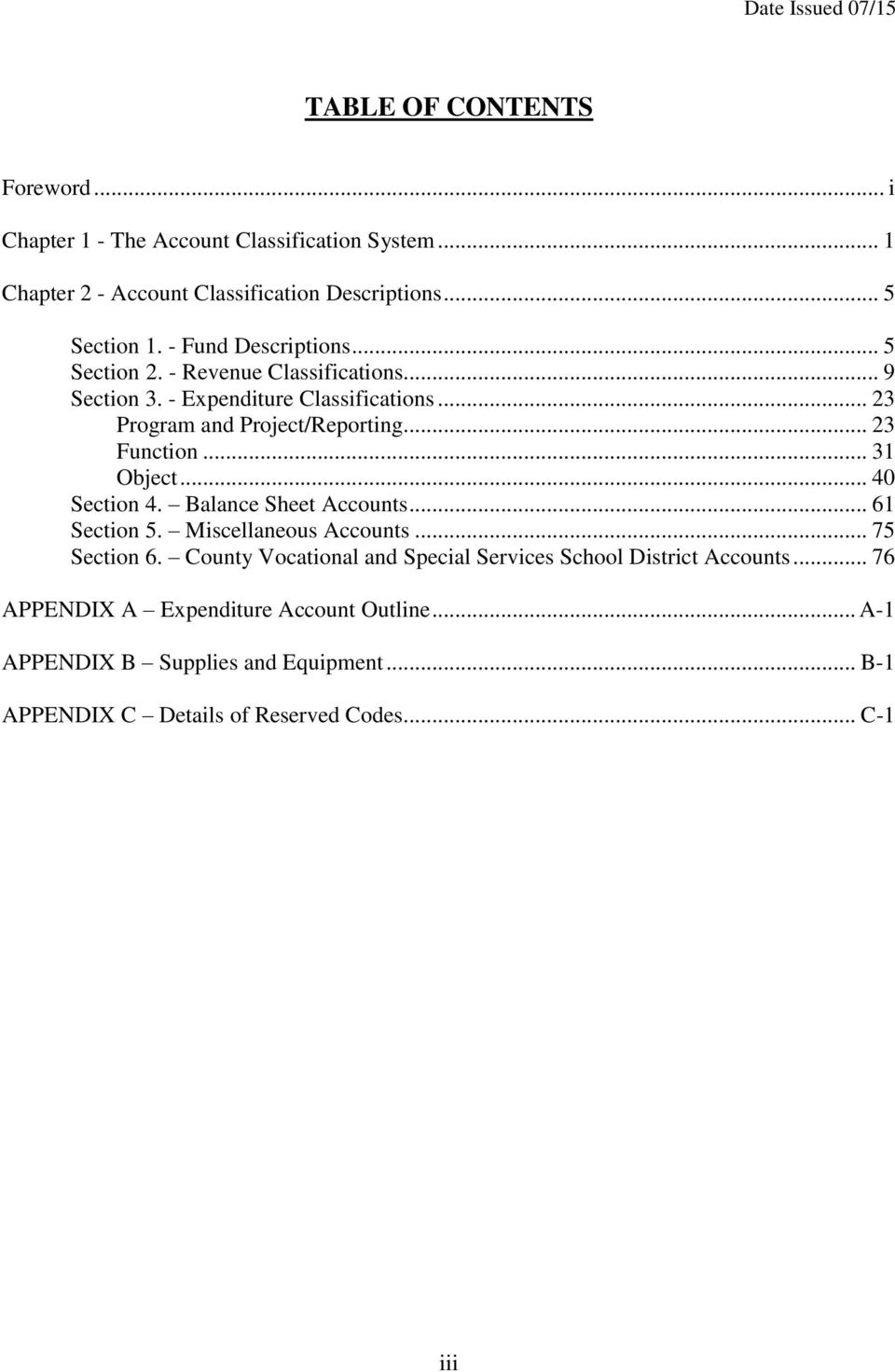
5 TABLE OF CONTENTS Foreword... i Chapter 1 - The Classification System... 1 Chapter 2 - Classification s... 5 Section 1. - Fund s... 5 Section 2. - Revenue Classifications... 9 Section 3. - Expenditure Classifications Program and Project/Reporting Function Object Section 4. Balance Sheet s Section 5. Miscellaneous s Section 6. County Vocational and Special Services School District s APPENDIX A Expenditure Outline... A-1 APPENDIX B Supplies and Equipment... B-1 APPENDIX C Details of Reserved Codes... C-1 iii
6 THIS PAGE INTENTIONALLY LEFT BLANK iv

7 THE ACCOUNTING SYSTEM CHAPTER 1 THE ACCOUNT CLASSIFICATION SYSTEM The accounting system is the means by which financial data is captured during the actual operation of the district, recorded in the books of account, and then analyzed to produce required reports. Financial transactions can be classified to facilitate their accumulation in categories needed for reports. The guidelines here provide a classification structure that will meet most of the accounting system s needs and, by standardizing reported data, will permit reports from different districts to be comparable. Several principles guided the design of the account classification structure in this publication. Taken together, they support the needs of decision-makers - school officials, other public officials, creditors, and the general public - who use district financial reports. These principles are as follows: 1. The chart of accounts encourages full disclosure of the financial position of the local education agency (LEA). Emphasis is placed on the accurate classification of financial transactions. Expenditures are recorded in the accounting categories applicable, regardless of the implications of some of those decisions. 2. Comprehensiveness of financial reporting is encouraged. The LEA should incorporate all financial activities into a single accounting and reporting system for full disclosure. The account classifications here encourage this procedure. s for such activities as food services, student activities, community services, and commercial-like enterprises all should be included in the financial reports of the LEA. 3. Simplified reporting is encouraged. Only the minimum number of funds consistent with legal and operating requirements should be established, since unnecessary funds result in undue complexity and inefficient financial administration. 4. Financial reporting emphasizes the results of LEA operations more than the resources applied. The account code structure emphasizes program accounting and the application of supporting services costs to the products of the educational enterprise. 5. The account classification system is flexible; it meets the needs of both small and large LEAs while retaining comparability of reported data. The guidelines here include a minimum list of accounts essential for state reporting. 6. The classification of accounts and the recommended reporting structure remain in accordance with GAAP. 1

8 THE ACCOUNT CLASSIFICATION STRUCTURE This publication provides for classifying three basic types of financial activity: revenues and other sources of funds, expenditures and other uses of funds, and transactions affecting the balance sheet. For each type of transaction, the specific account code is made up of a combination of classifications called dimensions. Each dimension describes one way of classifying financial activity. A school location dimension is only required for districts with schools implementing school-based budgeting. The dimensions applicable to each type of transaction are as follows: Revenues Expenditures Balance Sheet Fund Fund Fund Revenue Source Program & Project/Reporting Balance Sheet Program & Project/Reporting Function Location Object Location Coding structures applicable to each dimension are shown below. An additional identifying dimension may be added, if required, to accommodate computerized record keeping systems. Also, depending on each district s needs, the location dimension may be either two or three digits. Revenues Revenue Program and Fund Source Project/Reporting Location xx xxxx xxx xxx Expenditures Program and Fund Project/Reporting Function Object Location xx xxx xxx xxx xxx Balance Sheet Fund xx Balance Sheet xxx REVENUE DIMENSIONS Fund (Subfund) A fund is a fiscal and accounting entity with a self-balancing set of accounts recording cash and other financial resources. It also contains all related liabilities and residual equities or balances, or changes therein. Funds are established to carry on specific activities or attain certain objectives of an LEA according to special legislation, regulations, or other restrictions. A list of funds, descriptions, and account codes is provided in Chapter 2. 2

9 Revenue Source This dimension classifies revenue by type and source. There are four broad source categories: local, intermediate, state, and federal. Program and Project/Reporting See program and project/reporting under expenditure dimensions. Location See location under expenditure dimensions. EXPENDITURE DIMENSIONS Fund (Subfund) See Fund (Subfund) under revenue dimensions. Program and Project/Reporting Programs and projects are activities and procedures designed to accomplish an objective or set of objectives. Function The function describes the activity for which a service or material object is acquired. Functions consist of activities, which have the same general operational objectives. Furthermore, categories of activities comprising each of these divisions are grouped according to the principle that the activities should be combinable, comparable, relatable, and mutually exclusive. Object The object is the service or commodity bought. These categories are divided into sub-objects for more detailed accounting. Location The location code identifies the individual schools of the district. This is mandatory for districts with schools that prepare school-based budgets. Required maintenance under Education Facilities Construction Financing Act (EFCFA) is required to be reported by school facility. BALANCE SHEET DIMENSIONS Fund (Subfund) See Fund (Subfund) under revenue dimensions. 3
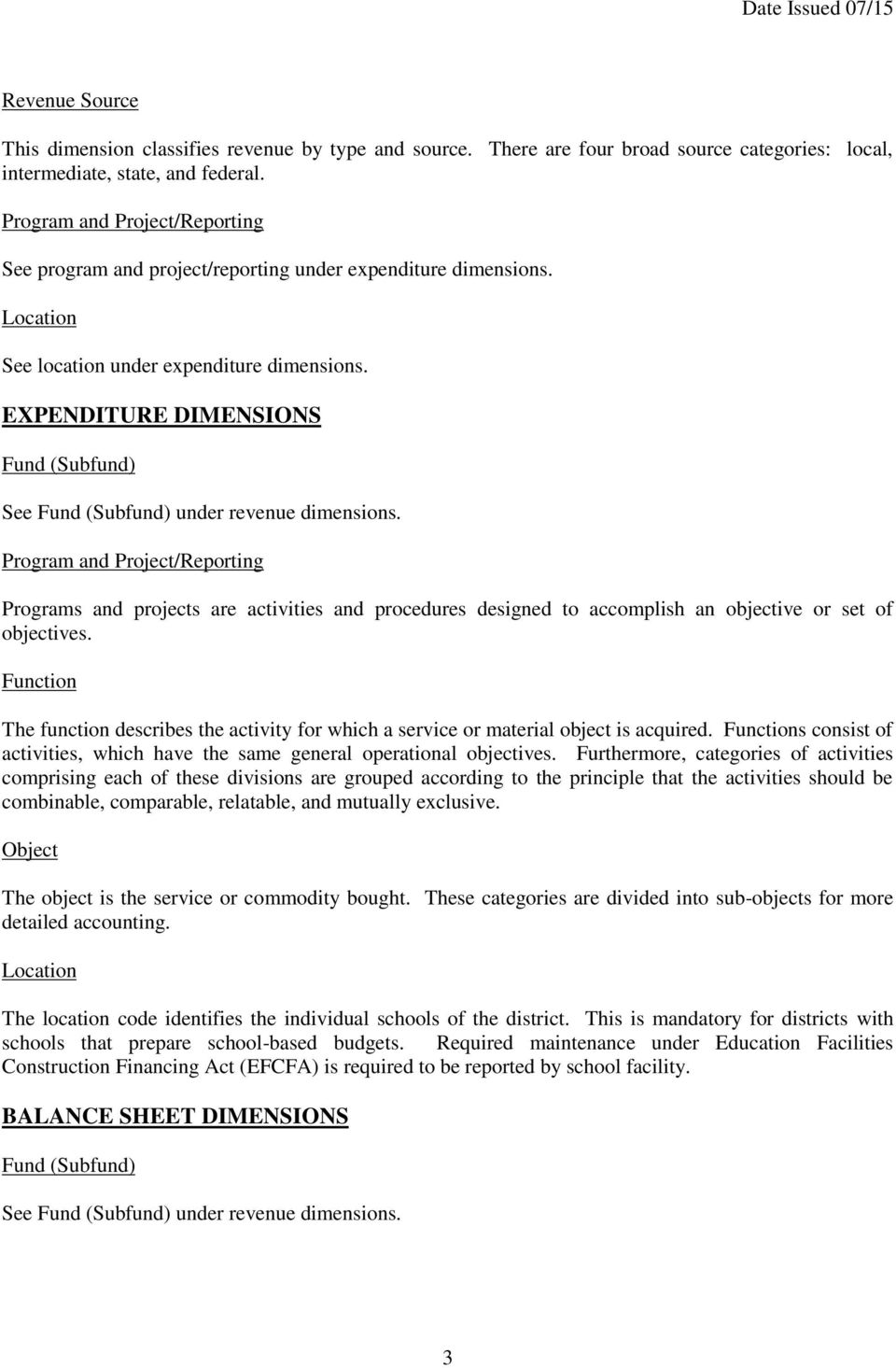
10 Balance Sheet ( Type) These classifications correspond to the items normally appearing on the balance sheet. A listing of balance sheet accounts, descriptions, and codes is contained in Chapter 2. THE MINIMUM CHART OF ACCOUNTS Used in its entirety, the chart of accounts classification structure (particularly the expenditure classifications) can generate a variety of detailed data. Hence, an LEA may choose in some ways which parts of the system it needs or wants to use. It may choose: 1. To design its own program and project/reporting code structure. 2. To expand the level of detail of the function or object dimension by using more specific categories described in the chart of accounts (the three-digit function code may be expanded to four digits). 3. To add dimensions not included in the publication such as organizational unit, level of instruction or job classification. Whatever course an LEA chooses, it must follow a certain minimum list of these classifications to meet state reporting requirements. Dimensions, accounts, and coding structures listed in this chart of accounts are minimum requirements unless labeled as optional. A district must prepare a revenue and expenditure report each month and a final year-end report in conformity with the dimensions, accounts, coding structures and minimum requirements outlined in this publication. Such reports must be in addition to any expanded formats a district may design on its own. Budgetary records must be maintained in conformity with the annual school district budget and supplemented as necessary. Supplemental budgetary records for special projects must be maintained in conformity with the uniform grant project budget statement. 4
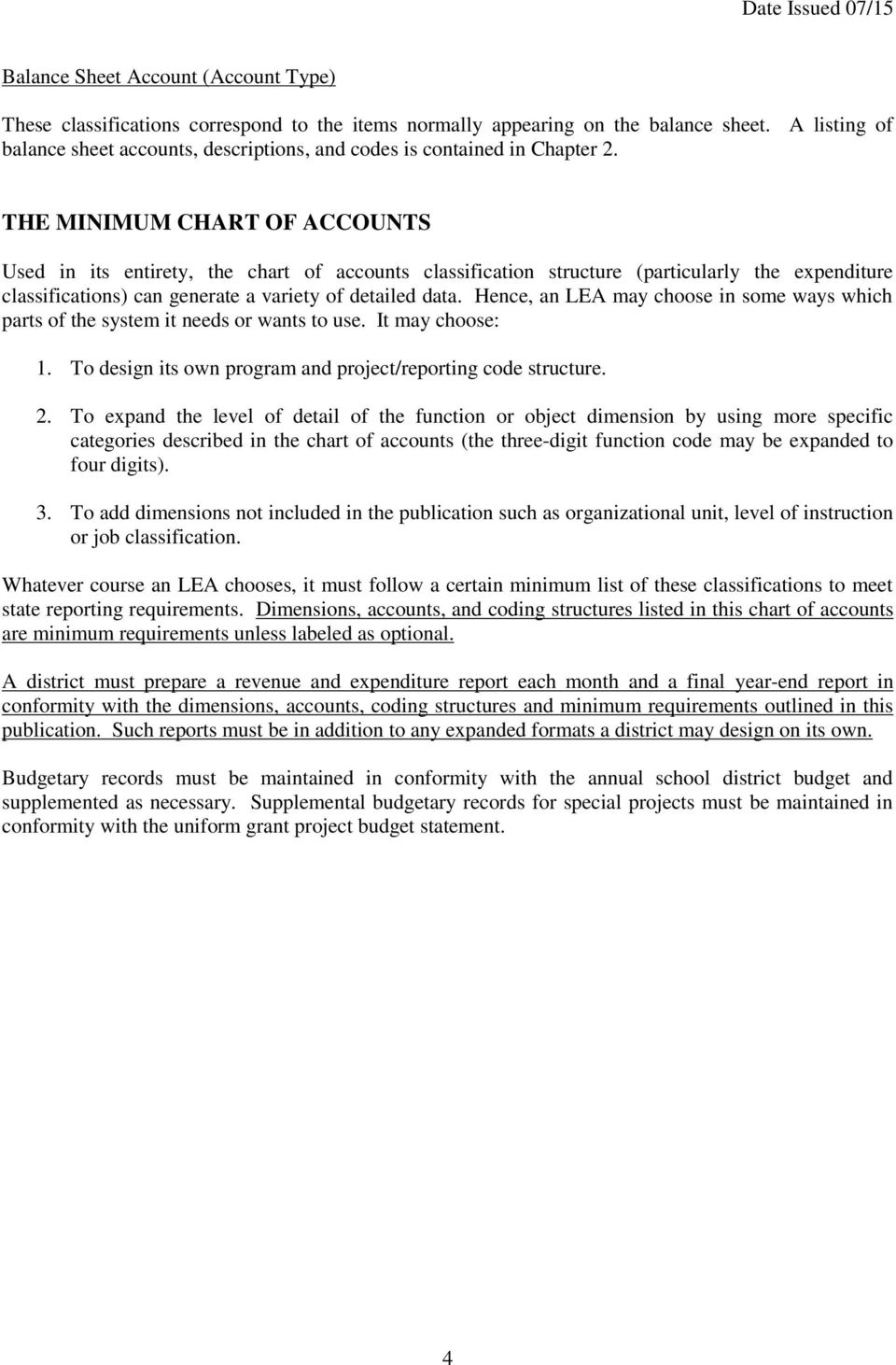
11 CHAPTER 2 ACCOUNT CLASSIFICATION DESCRIPTIONS This chapter describes the account classification structure in detail. Each component of the dimensions in the accounting system are numbered and defined. This chapter contains five sections for all school districts: funds, revenue classifications, expenditure classifications, balance sheet accounts, and miscellaneous accounts as well as a sixth section specific to county vocational and special services districts. SECTION 1. - FUND DESCRIPTIONS Governmental accounting systems should be organized and operated on a fund basis. The diverse nature of governmental operations and the necessity of assuring legal compliance preclude recording and summarizing financial transactions in a single accounting entity. Instead, the required accounts are organized based on funds, each of which is completely independent of another. Each fund must be accounted for so that the identity of its resources, obligations, revenues, expenditures, and fund equities is continuously maintained. These purposes are accomplished by providing a complete self-balancing set of accounts for each fund, which shows its assets, liabilities, reserves, fund balances, revenues, and expenditures. A fund is a fiscal and accounting entity, with a self-balancing set of accounts recording cash and other resources, together with all related liabilities and residual equities or balances, or changes therein. If one were to compare fund accounting with commercial accounting, each fund would equate to an independent business, with a separate set of records owned by one entity, the district. The classifications of funds included here are similar to those used by other state and local government units and follow the reporting structure required by GASB 34. They consist of the following: Governmental Fund Types. The funds through which most district functions are typically financed. The reporting focus of these funds is on determining financial position rather than net income. Governmental funds track the financial activity of the LEA s basic services such as regular and special education. The governmental fund category includes the general fund, special revenue fund, capital projects fund, debt service fund, and permanent fund. Proprietary Fund Types. The funds used to account for district activities for which a fee is charged to external users for goods or services. The proprietary fund category includes enterprise and internal service funds. Fiduciary Fund Types. The funds used to account for assets held by a district as trustee or agent for individuals, private organizations, or other governmental units and therefore are not available to support the district s own programs. Fiduciary funds are comprised of Trust and Agency Funds and include pension (and other employee benefit) trust funds, investment trust funds, private-purpose trust funds, and agency funds. Each trust fund is treated for accounting measurement purposes in a manner similar to either a governmental fund or a proprietary fund. Trust funds are distinguished from agency funds generally by the existence of a trust agreement that affects the degree of management involvement and the length of time that the resources are held. Agency funds are purely custodial (assets equal liabilities) and thus do not involve measurements of results of operations. 5 Fund codes

12 Governmental Funds Code 10 General Fund. s for all financial resources of the district except those required to be accounted for in another fund. General fund balance sheet and revenue accounts use fund code 10. A district may have only one general fund. Expenditure reporting requires further breakout in the fund code for character class delineation as follows: 11 General Current Expense. s for all expenditures of the district for current expenses. Expenditures included here would be regular program instruction costs and the administrative and other support services costs related to providing the district's normal operations. 12 Capital Outlay. s for all expenditures of the district for capital outlay supported by current revenues. It includes increases in the general fund capital reserve, equipment purchases, and facilities acquisition and construction services. Payments made on the lease purchase of equipment are recorded as rental payments under the appropriate program/function in general current expense, not capital outlay. 13 Special Schools. s for all expenditures of the LEA other than state and federal grants for current expenses of special schools. It includes the entire cost of adult school programs, including community schools. 15 School-based Budgets. s for revenues and expenditures, by school, for those schools required to prepare school-based budgets. Districts with schools preparing school-based budgets must record all the revenues and expenditures for each school separately in character class 15. Revenues for schools in the district that do not prepare school-based budgets would be recorded in fund code Reserved. 17 Reserved. 18 Reserved. 19 FEMA Community Development Block Grant (CDBG). s for the grants received from Federal Emergency Management Agency (FEMA) for CDBG related to Hurricane Sandy. 20 Special Revenue Fund. s for the proceeds of specific revenue sources (other than trusts or major capital projects) that are legally restricted to expenditures for specified purposes. Some examples of special revenue funds might include restricted state or federal grants-in-aid and restricted tax levies. One fund is used, supplemented by the use of program codes. 30 Capital Projects Fund. s for financial resources used to acquire or construct major capital facilities (other than those of proprietary and fiduciary funds). The source of revenue in this fund would be the sale of bonds, grants, or transfers from the general fund to augment the grant. Separate accounting must be used for each capital project. 6 Fund codes
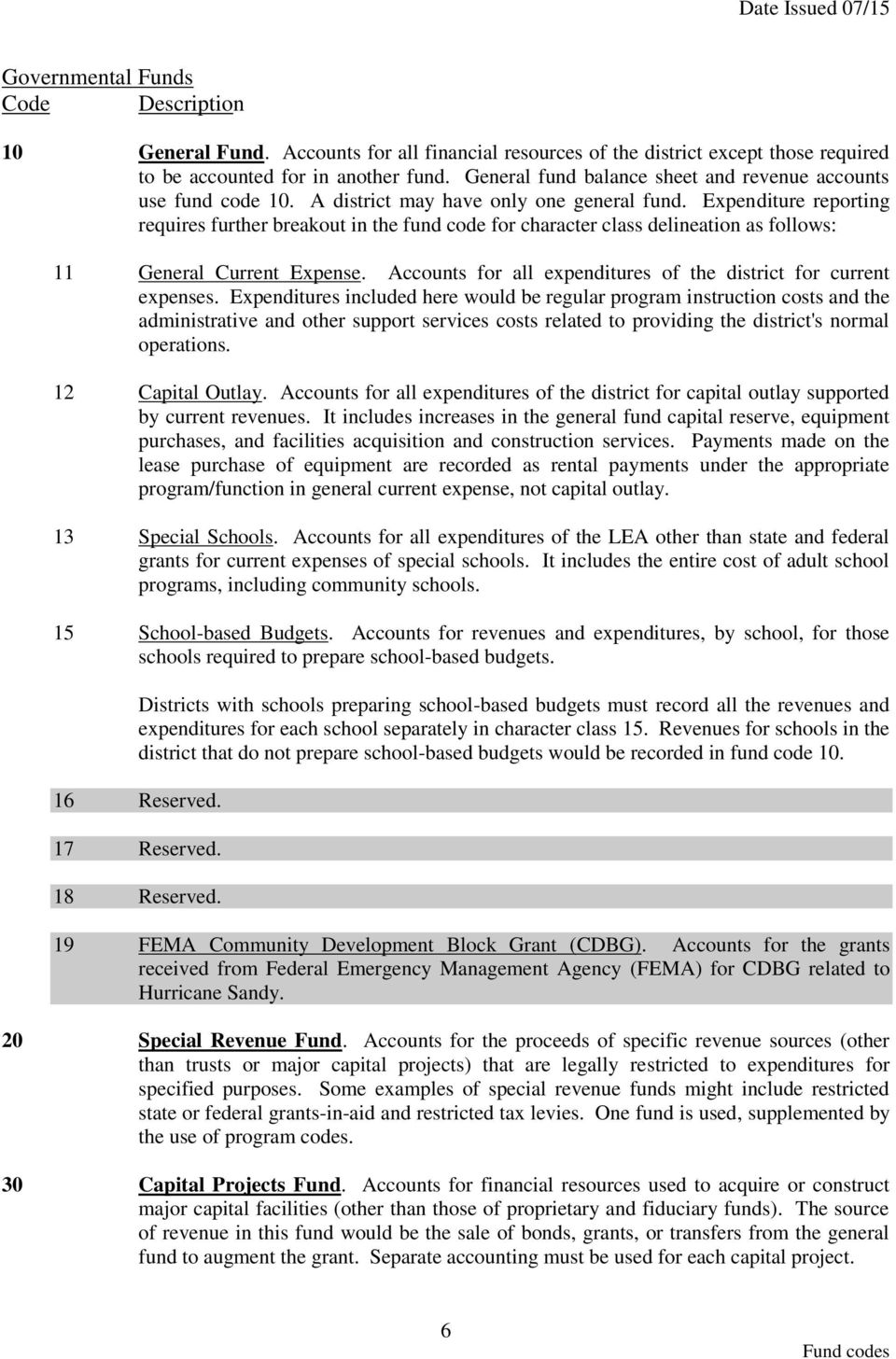
13 40 Debt Service Fund. s for the accumulation of resources for, and the payment of, long-term debt, principal and interest. The source of revenue in this fund would be state aid, debt service tax levy, transfers from capital projects after completion of the original purpose or transfers from general fund capital reserve. 50 Permanent Fund. s for resources legally restricted such that only earnings, and not the principal, may be used to support the district s activities. An example is a fund established by an outside contributor with the restriction that only the income may be used. Permanent funds do not include trust and agency funds (defined below). Proprietary Funds Code 60 Enterprise Fund. May be used to account for any activity for which a fee is charged to external users for goods or services. The enterprise fund is required to be used for any activity whose principal revenue sources meet any of the following criteria: Laws or regulations require the district to recover costs through fees and charges; The pricing policies of the activity establish fees and charges designed to recover its costs, including capital costs (such as depreciation or debt service); or Debt is backed solely by revenues from fees and charges (thus, not debt that is backed by the full faith and credit of the district). Some examples of enterprise funds include funds used for the food service program, a bookstore operation, an athletic stadium, and a community swimming pool. Insignificant activities of districts are not required to be included in an enterprise fund. 70 Internal Service Fund. s for any activity that provides goods or services to other district funds, other districts, or to other governmental units, on a cost-reimbursable basis. Some examples of internal service funds could include central warehousing and purchasing, central data processing, and central printing and duplicating. Internal service funds are used if the reporting government is the predominant participant in the activity. Otherwise, the activity should be reported as an enterprise fund. Fiduciary Funds Code 80 Trust Fund. s for assets held in a trustee capacity for others and therefore cannot be used to support the district s own programs. Three trust fund types are used to account for resources held and administered by the district when it is acting in a fiduciary capacity for individuals, private organizations or other governmental units. These funds are distinguished from agency funds generally by the existence of a trust agreement that affects the degree of management involvement and the length of time that the resources are held. 81 Pension and Other Employee Benefit Trust. s for resources held in trust for the members and beneficiaries of various employee benefit plans. 82 Investment Trust Fund. s for the portion of investment pools reported by the sponsoring district. 7 Fund codes

14 83 Private Purpose Trust Fund. s for all other trust arrangements, such as a scholarship fund to benefit individual students. 90 Agency Fund. s for resources held by the reporting district in a purely custodial capacity that involve only the receipt, temporary investment, and remittance of fiduciary resources to individuals, private organizations, or other governments. Districts must maintain the financial integrity of the individual agencies through a separate accounting of each activity for which the district is acting as an agent. Agency funds would include a central payroll (clearing) account, parent-teacher organizations and student activity accounts. 95 Student Activity Funds. Funds, which are owned, operated, and managed by the student body under the guidance and direction of adults or a staff member for educational, recreational, or cultural purposes. Although the board of education has the ultimate responsibility for student activity funds, in most cases they are not school district funds. If the board of education subsidizes a portion of a student activity fund, that subsidy should be included in the regular budget of that district. Some examples of student activity funds include: 1. Homeroom 2. Yearbook 3. Class Years 4. Choral and Band Groups 5. Classes 6. Student Clubs 7. Student Council 8. Student Sponsored Bookstores 8 Fund codes
15 SECTION 2. - REVENUE CLASSIFICATIONS Revenues are classified by type and source for the various funds of a district. The term revenues means increases in (sources of) fund financial resources other than from interfund transfers and debt issue proceeds and redemptions of demand bonds. Revenues are generally additions to assets that do not increase any liability and do not represent the cancellation of certain liabilities without a corresponding increase in other liabilities or a decrease in assets. PROGRAM AND PROJECT/REPORTING When an LEA receives money for restricted uses, it frequently must prepare a report showing the amount received and the amounts expended for those purposes. When revenues of this nature are received, the LEA assigns a program and project/reporting classification to the revenue transactions. The structure and classification of the program and project/reporting codes assigned is identical to those in the program and project/reporting code used to classify expenditures. The third section of this chapter, Expenditure Classifications provides a detailed discussion of the program and project/reporting dimension. Otherwise, 000 is assigned as the program and project/reporting dimension of revenue accounts. REVENUE SOURCE Revenues are classified by four major sources: local, intermediate, state, and federal. Within each source of revenue, individual items of revenue are classified into basic groupings of similar types of revenue such as taxes or tuition. These group headings are not account titles; they are used only as a convenient means of identifying specific revenue accounts. The revenue source classification includes other financing sources which constitute fund revenues in a strict fund accounting context, but are not considered revenues to the LEA. They include the sale of bonds and the receipt of interfund transfers. These other sources are described in the 5000 accounts. In coding the revenue accounts, adherence to the federal publication Financial ing for Local and State School Systems 2008 Edition has been maintained wherever possible. This results in some instances in a skip in number sequence. An asterisk (*) placed after an account code indicates the account is a federal reporting account code. 9 Revenue codes

16 Revenue Source Code 1000 Revenue from Local Sources. Revenue from local sources is the amount of money produced within the boundaries of the LEA and available to the LEA for its use. Money collected in the same amount by another governmental unit as an agent of the LEA (less collections costs) is recorded as revenue from local sources. Shared revenue (revenue levied by another governmental unit, but shared in proportion to the amount collected within the LEA) is also recorded as revenue from local sources. Revenue from local sources may be either restricted or unrestricted. Restricted revenues are recorded in the special revenue fund and unrestricted revenues are recorded in the general fund. Restricted revenues from local sources include funds received from a local foundation, trust, booster club, or individual that has provided the funds for an express written purpose. 1200* Revenue from Local Governmental Units Other than LEAs. Revenue received from the appropriations of another local governmental unit. 1210* Ad Valorem Taxes Local Tax Levy. Taxes levied for school purposes by a local governmental unit other than the LEA. The LEA is not the final authority, within legal limits, in determining the amount to be raised. For example, after an LEA has determined that a certain amount of revenue is necessary, another governmental unit may exercise discretionary power in reducing or increasing the amount Municipal Surplus. Revenue from unappropriated surplus or from unappropriated anticipated receipts of a municipality or municipalities, which has been transferred to the LEA Other Revenue from Local Governmental Units Other Than LEAs Tuition. Revenue from individuals, other LEAs and other sources for education provided by the LEA. Fees for adult education programs are recorded in account (Note: county vocational and special services districts see Section 6 for tuition account codes available for use by vocational and special services districts). Used only with the general fund. 1310* Tuition From Individuals. Tuition paid by an individual to attend school in an LEA other than the one in which they reside. This code is also used to record tuition received from members of the community or district employees to send children to the preschool program recorded in fund * Tuition from Other LEAs within the State. Tuition received from an LEA located within New Jersey for educating students residing within the paying district. This code is also used to record tuition received from an LEA located within New Jersey for educating students residing within the paying district that attend the receiving district s preschool program recorded in fund Revenue codes
17 Revenue Source Code 1321* Tuition from Other Governmental Sources within the State. Tuition received from a governmental source located in New Jersey such as tuition paid by the court system. 1330* Tuition from Other LEAs Outside the State. Tuition received from an LEA located outside of New Jersey for educating students residing outside the state. 1340* Tuition from Other Sources. Includes tuition received from sources both within and outside of New Jersey paid to an LEA for educating students not specifically referenced elsewhere in the 1300 series Tuition From Summer School. This account is available to regular districts only Transportation Fees. Revenues derived from individuals, other LEAs, and other sources for transporting students to and from school and school activities. Used only with fund * Transportation Fees from Individuals. Fees paid by parents/guardians for transporting students who reside outside the zone of free public school busing (subscription busing). Also included are fees paid by students for transportation on school field trips. 1420* Transportation Fees from Other LEAs within the State. Fees paid by other LEAs located within the state for transporting their students between home and school. 1421* Transportation Fees from Other Government Sources within the State. Fees paid by municipal governments for non-mandated transportation. 1440* Transportation Fees from Other Sources. This account is used for transportation fees not specifically included above. 1500* Earnings on Investments. Revenues from holdings (short and long-term) invested for earnings purposes. Earnings on investments are most commonly used with general fund 10, capital projects fund 30, and debt service fund Interest On Investments. Interest revenue on the investments authorized by New Jersey statutes Dividends on Investments. Revenue from dividends on stocks held for investment Gains or Losses from Investments. Gains or losses recognized from the sale of investments or changes in the fair value of investments. Gains represent the excess of sale proceeds (or fair value) over cost or any other basis on the date of sale (or valuation) over sales value (or fair value). All recognized investment gains may be accounted for using accounts 1531 and For financial statement purposes, GASB Statement 31 requires that all investment income, including the changes in fair value of investments, be reported as revenue in the operating statement Realized Gains (Losses) on Investments. Gains or losses realized from the sale of investments. Gains represent the excess of sale proceeds over cost or any other basis on 11 Revenue codes

18 Revenue Source Code the date of sale. Losses represent the excess of the cost or any other basis at the date of sale over sales value. Note that for financial statement purposes, the net of all realized and unrealized investment gains and losses should be reported as a single line in the financial statements Unrealized Gains (Losses) on Investments. Gains or losses recognized from changes in the value of investments. Gains represent the excess of fair value over cost or any other basis on the date of valuation. Losses represent the excess of the cost or any other basis at the date of valuation over fair value. For financial reporting purposes, the net of all realized and unrealized investment gains and losses should be reported as a single line in the financial statements Investment Income from Real Property. Revenue for rental, use charges, and other income on real property held for investment purposes. Note that rentals of real property not held for investment purposes should be posted to revenue code * Food Service. Revenues from dispensing food to students and adults Daily Sales - Reimbursable Programs. Revenues from students for the sale of breakfasts, lunches and milk that are considered reimbursable programs by the United States Department of Agriculture. Federal reimbursements are recorded in account 4460 series, Child Nutrition Programs Daily Sales - School Lunch Program. Revenue from students for the sale of reimbursable lunches as part of the National School Lunch Program Daily Sales - School Breakfast Program. Revenue from students for the sale of reimbursable breakfasts as part of the School Breakfast Program Daily Sales - Special Milk Program. Revenue from students for the sale of reimbursable milk as part of the Special Milk Program Daily Sales After School Program. Revenue received from students for the sale of reimbursable costs from after-school programs Daily Sales Non-reimbursable Programs. Revenue from students and adults for the sale of non-reimbursable breakfasts, lunches and milk. This category would include all sales to adults, the second type A lunch to students, and a la carte sales Special Functions. Revenue from students, adults or organizations from the sale of food products and services considered special functions. Some examples would include potlucks, PTA-sponsored functions, and athletic banquets. 1700* District Activities. Revenue resulting from co-curricular and extra-curricular activities controlled and administered by the school district. These revenues are not to be commingled with the proceeds from student activities. (See section on agency funds for student activity funds.) 12 Revenue codes

19 Revenue Source Code 1710 Admissions. Revenue from patrons of a school-sponsored activity such as a concert, school play, or athletic event Bookstore Sales. Revenue from school-sponsored bookstores Student Organization Membership Dues and Fees. Revenue from students for memberships in school clubs or organizations. 1750* Revenue from Enterprise Activities. Revenue (gross) from vending machines, school stores, soft drink machines, and so on, not related to the regular food service program. These revenues are normally associated with activities at the school level that generate incremental local revenues to be used for the benefit of the school Other Activity Income. Other revenue from school or district activities not specifically included above. 1800* Revenue from Community Services Activities. Revenue from community service activities operated by the LEA. For example, the revenue from the operation of a swimming pool by an LEA as a community service would be recorded here. Multiple classifications may be established within this series to differentiate activities Other Revenues from Local Sources. 1910* Rentals. Revenue from the rental of either real or personal property owned by the LEA. Note that rental income from real property held for investment is posted to revenue code * Contributions and Donations from Private Sources. Revenue received from a philanthropic foundation, private individuals or private organizations for which no repayment or special service to the contributor is expected. This code should be used to record on-behalf payments made by private organizations to school district personnel, such as stipends paid to teachers. 1930* Gains or Losses on Sale of Capital Assets. The amount of revenue over the book value of the fixed assets sold. For example, the gain on the sale would be the portion of the selling price received in excess of the depreciated value (book value). This account is used in the proprietary funds or fiduciary funds. For funds other than proprietary and fiduciary, account 5300 is used to report the proceeds from the disposal of assets. [Accrual basis of accounting] 1940* Textbook Sales and Rentals. Revenue from the sale or rental of textbooks not including sales from regular bookstore operations. 1950* Services Provided Other LEAs. Revenue from services provided to other LEAs other than for tuition and transportation services. For example, data processing, printing, and purchasing. 13 Revenue codes

20 Revenue Source Code 1960* Services Provided Other Local Governmental Units. Revenue from services provided to governmental units other than LEAs. For example, data processing, printing, and purchasing. 1970* Services Provided To Other Funds. Revenue from services provided to other funds such as printing, purchasing, or data processing. 1980* Refund of Prior Year s Expenditures. Revenues recorded for refunds in the current year of expenditures made in the prior year. If refund and expenditure occurred in the current year, current year expenditures are reduced, as prescribed by GAAP. Tuition overpayments are not considered miscellaneous income, but rather a reduction to the expenditure in the year of refund State Health Benefits Refund. Revenues recorded for refunds of employer premiums paid on behalf of employees of the LEA. 1990* Miscellaneous Revenue from Local Sources. Revenue from local sources not provided for elsewhere. Book fines and fees collected for non-accredited adult education program fees are recorded under this classification Adult Education Testing Center Revenue. Revenue for test fees for those seeking a New Jersey State issued high school diploma through tests of Adult Education Testing Centers (formerly called General Education Development (GED)) Advertising Fees School Buses. Revenue from fees charged for advertising on exterior sides of school buses, pursuant to N.J.S.A. 18A: * Revenue from Intermediate Sources. Revenue from intermediate sources is revenue from funds collected by an intermediate administrative unit, or a political subdivision between the LEA and the State, and distributed to LEAs in amounts that differ in proportion to those which were collected within such systems. An illustration of revenue from intermediate sources is a property tax levied and collected by a county government, which then distributes the money collected to the LEAs on a flat grant or foundation-aid basis. 2100* Unrestricted Grants-in-Aid. Revenue recorded as grants by the LEA from an intermediate unit, which can be used for any legal purpose by the LEA without restriction County Transportation Contributions. 2200* Restricted Grants-in-Aid. Revenue recorded as grants by the LEA from an intermediate unit that must be used for a categorical or specific purpose. If such money is not completely used by the LEA, it must be returned, usually, to the intermediate governmental unit. 14 Revenue codes

21 Revenue Source Code 2300* Revenue in Lieu of Taxes. Commitments or payments made out of general revenues by an intermediate governmental unit to the LEA in lieu of taxes it would have had to pay had its property or other tax base been subject to taxation by the LEA on the same basis as privately owned property or other tax base. It would include payments in lieu of taxes on privately owned property that is not subject to taxation on the same basis as other private property because of an action taken by the intermediate governmental unit. 2400* Revenue for/on Behalf of the LEA. Commitments or payments made by an intermediate governmental jurisdiction for the benefit of the LEA including contributions of equipment or supplies. Such revenue includes payments to a pension fund by the intermediate unit on behalf of an employee of the LEA, and a contribution of capital assets by an intermediate unit to the LEA. Separate accounts may be maintained to identify the specific nature of the revenue item. 3000* Revenue from State Sources. Revenue from funds produced within the boundaries of and collected by the State and distributed to LEAs in amounts proportionately different from those collected within such LEAs Unrestricted Grants-in-Aid. Revenue from state funds which can be used without restriction for any legal purpose desired by the LEA with any unspent balances remaining with the LEA School Choice Aid. State aid based on actual enrollment plus the number of projected choice students for the following period (N.J.S.A. 18A:7F-62) Categorical Transportation Aid. State aid for transportation services pursuant to the SFRA of 2008 (N.J.S.A. 18A:7F-57) Extraordinary Aid. This account is used to record additional state aid provided to assist the district with special education costs Categorical Special Education Aid. State aid for special education classes and services pursuant to the SFRA of 2008 (N.J.S.A. 18A:7F-55) Family Crisis Transportation Aid. State aid for reimbursement to school districts for transportation costs related to family crisis situations under N.J.S.A. 18A: Debt Service Aid Type II. State aid for the payment of debt service. This classification is used in the debt service fund Educational Adequacy Aid. State aid provided to certain districts pursuant to the SFRA of 2008 (N.J.S.A. 18A:7F-58 section 16b) Equalization Aid. State aid to fund the difference between the district s adequacy budget and the district s local fair share under the SFRA of 2008 (N.J.S.A. 18A:7F-48, -52 and -53). 15 Revenue codes
22 Revenue Source Code 3177 Categorical Security Aid. State aid for security equipment, personnel and services (N.J.S.A. 18A:7F-56) Adjustment Aid. State aid to ensure districts receive a minimum of a 2% state aid increase (N.J.S.A. 18A:7F-58) Other Unrestricted State Aid. Unrestricted state aid not specifically included elsewhere Aid for Adult and Post-Graduate Programs. This aid category is used by regular and vocational districts only Teacher Quality Mentoring. State aid for the Teacher Mentoring program activities. This program reimburses districts for the stipends paid to experienced teachers who serve as mentors to new teachers Advanced State Aid. Advance loans of state aid pursuant to N.J.S.A. 18A:7A Restricted Grants-in-Aid. Revenue from state funds which must be used for a specific purpose. Restricted grants-in-aid, other than for debt service, are classified in the special revenue fund Restricted Formula Aids. Restricted state aids that are dedicated, nonlapsing sources of funds Reserved Preschool Education Aid and Prior Year Carryover. State aid for funding preschool education programs (N.J.S.A. 18A:7F-54). This classification is used in the special revenue fund State School Lunch Program. State reimbursements from the state program for school lunches Restricted Nonpublic Aids. Revenue received from the State for the cost of providing nonpublic school students with nursing, technology, textbooks, transportation, auxiliary, and handicapped services. Unique program codes are used to track each restricted aid separately. See program code 500 for individualized programs. Used only with fund Nonpublic Textbook Aid. Revenue received from the state for the cost of textbooks purchased and loaned to nonpublic school students. This classification is used in the special revenue fund Nonpublic Auxiliary Services Aid Compensatory. Revenue received from the state for the cost of providing compensatory education to nonpublic school students. This classification is used in the special revenue fund. 16 Revenue codes
23 Revenue Source Code 3233 Nonpublic Auxiliary Services Aid E.S.L. Revenue received from the State for the cost of providing English as a Second Language programs to nonpublic students. This classification is used in the special revenue fund Nonpublic Auxiliary Services Aid Home Instruction. Revenue received from the State for the costs of providing home instruction to nonpublic students. This classification is used in the special revenue fund Nonpublic Auxiliary/Handicapped Transportation Aid. Revenue received from the state for the cost of providing transportation to nonpublic students. This classification is used in the special revenue fund Nonpublic Handicapped Aid Supplemental Instruction. Revenue received from the state for the cost of providing supplementary instruction to nonpublic students. This classification is used in the special revenue fund Nonpublic Handicapped Aid. Revenue received from the State for the cost of providing identification, examination and classification services to nonpublic students. This classification is used in the special revenue fund Nonpublic Handicapped Aid Speech Correction. Revenue received from the State for the cost of providing speech correction services to nonpublic students. This classification is used in the special revenue fund Nonpublic Nursing Services Aid. Revenue received from the State for the cost of providing nursing services to nonpublic students. This classification is used in the special revenue fund Nonpublic Technology Initiative Aid. Revenue received from the state for the cost of providing technology including computers, software, networks, distance learning equipment, and other technologies to all students attending a nonpublic school located in the public school district. This classification is used in the special revenue fund Emergency Aid. State aid to meet unforeseeable conditions Additional State School Building Aids Reserved Reserved Reserved Additional State School Building Aid EDA Grant. Revenue item used in the Capital Projects Fund to record the EDA grant General Vocational Education. State aid in the form of grants issued by the Office of Career and Technical Education for general vocational education programs including 17 Revenue codes
24 Revenue Source Code district and regional vocational education, industrial education, and work-study programs. Each grant should be detailed separately by use of the program and project/reporting code Adult and Continuing Education. State aid in the form of grants issued by the Department of Labor for evening adult and continuing education programs including high school completion, evening vocational and adult education. Each grant should be detailed separately by use of the program and project/reporting code Evening School for the Foreign-Born. State aid for operation of an evening school for the foreign-born Other Special State Projects. Other restricted state grants not detailed above. Detailed separately by use of program and project/reporting code. 3900* Revenue for/on Behalf of the School District. Commitments or payments made by the State for the benefit of the school district, or contributions of equipment or supplies. Such revenue includes the payment to a pension fund by the State on behalf of an LEA employee for services rendered to the LEA. It would include a contribution of capital assets by a State unit to the LEA. Separate accounts may be maintained to identify the specific nature of the revenue item T.P.A.F. Pension Aid T.P.A.F. Social Security Aid Revenue from Federal Sources. Revenue from federal sources is revenue from funds collected by the federal government and distributed to LEAs. In determining whether revenue is federal revenue, it is unimportant whether the funds are distributed directly to the school district by the federal government or through some intervening agency such as the State. When a school district does not have a method for determining the prorated share of federal, state and other sources of revenue in a commingled grant, the distributing agency should provide this information to the school district. When recording reimbursement for indirect costs, the revenue should be recorded in the fund and revenue source classification for the program for which the indirect costs are claimed. 4100* Impact Aid. Impact Aid revenue direct from the federal government, which can be used for any legal purpose desired without restriction Impact Aid (General). Impact Aid revenue received from the federal government under sections 8002 or 8003 of the Elementary and Secondary Education Act of Impact Aid (Capital). Impact Aid revenue received from the federal government under sections 8007 or 8008 of the Elementary and Secondary Education Act of Revenue codes
25 Revenue Source Code 4200* Unrestricted Grants-in-Aid from the Federal Government through the State. Revenues from the federal government through the State as grants, which can be used for any legal purpose desired without restrictions. Includes Medicaid Reimbursement revenue ARRA/SEMI Revenue. Revenues from the federal government through the state Department of Treasury for increase in the Special Education Medicaid Incentive (SEMI) program s Federal Medical Assistance Percentage under the American Recovery and Reinvestment Act. 4300* Restricted Grants-in-Aid Direct From the Federal Government. Revenue direct from the federal government as grants that must be used for a categorical or specific purpose. If such money is not completely used, it usually is returned to the governmental unit. This classification is used in the special revenue fund * Restricted Grants-in-Aid from the Federal Government through the State. Revenues from the federal government provided through the State as grants that must be used for a categorical or specific purpose. If such money is not completely used, it usually is returned to the governmental unit. Included in this area are funds received under IASA, IDEA, Vocational Programs Carl Perkins Act, Adult Education, Child Development Programs, Child Nutrition Programs, and No Child Left Behind (NCLB). Districts receiving funds that are not identified below by a unique revenue code are to code such funds to series Note that NCLB codes have been assigned account ranges The following NCLB grants utilize this revenue code range: Title I-Part A - Improving Basic Programs. Title I- Part A - SIA School Improvement. Title I- Part D - Neglected, Delinquent, or At Risk Range used for the following programs: Title VI- Rural and Low-Income School Programs I.D.E.A. Part B - Individuals with Disabilities Education Act. Federal entitlement grants recorded in the special revenue fund and separated in the IDEA accounts by title and approved project Carl D. Perkins Vocational and Technical Education Act of Federal formula grants for improving student achievement and preparing students for postsecondary education, learning, and careers Other Vocational. Other federal vocational programs. Detail separately by use of program and project/reporting code Adult Basic Education and Family Literacy The following NCLB grants utilize this revenue code range: Title II-A-Teacher and Principal Training and Recruiting. Title II-D-Enhancing Education through Technology. 19 Revenue codes
26 Revenue Source Code 4460 Child Nutrition Programs. Separately detail programs by use of program and project/reporting code School Breakfast Program National School Lunch Program. Use this account also for the After School Snack Program as well as the School Lunch Program Special Milk Program for Children Other Nutrition Reimbursements. Include Summer Food or Childcare Food Program funds in this account Title IV- Safe and Drug Free Schools Title III- English Language Enhancement Reserved. 4500* Other Restricted Grants-in-Aid from the Federal Government through the State. Federal grants not specifically classified in the preceding range Reserved Reserved Reserved Race to the Top III. Federal funds received through the Race to the Top program are recorded here. (Used only in Fund 20) FEMA Community Development Block Grant (CDBG). Used to record revenue received from the Federal Emergency Management Agency (FEMA) for CDBG in fund 19 and Project SERV grants in fund 20, related to Hurricane Sandy Preschool Expansion Grant. Federal grant for Preschool Development Expansion. Grant is based on projected number of regular education 4-year-old students at or below 200 percent of the poverty level Revenue for/on Behalf of the LEA. Payments made by the federal government for the benefit of the school district, or contributions of equipment or supplies. This includes a contribution of capital assets by a federal governmental unit to the school district and foods donated by the federal government to the school district. Separate accounts should be maintained to identify the specific nature of revenue items U.S.D.A. Commodities. Used to record the full cash equivalent value of U.S.D.A. Commodities. The processing fee should be recorded as an expense. 20 Revenue codes
27 Revenue Source Code 4700* Grants-In-Aid from the Federal Government through Other Intermediate Agencies. Revenue from the Federal Government through an intermediate agency. Includes Private Industry Council (JTPA) revenue. 4800* Revenue in Lieu of Taxes. Payments made out of general revenues by the federal government unit to the LEA in lieu of taxes it would have had to pay had its property or other tax base been subject to taxation by the LEA on the same basis as privately owned property or other tax base. 5000* Other Financing Sources 5100 Issuance of Bonds. Used to record the face amount of the bonds that are issued. Shortterm debt proceeds should not be classified as revenue. When a school district issues short-term debt (debt with a duration of less than 12 months) that is to be repaid from governmental funds, a liability (notes payable) should be recorded in the balance sheet of the fund responsible for repayment of the debt. 5110* Bond Principal. Principal from the sale of bonds Premium (or Discount) on the Issuance of Bonds. Proceeds from that portion of the sale price of bonds in excess of or below their par value. The premium or discount represents an adjustment of the interest rate and will be amortized using expenditure object account 834 or revenue account Interfund Transfers. Amounts transferred from another fund, which will not be repaid. Transfers shall be by resolution of the board of education Transfer from Capital Reserve. This account is used to record budgeted transfers to the debt service fund from the capital reserve for the purpose of offsetting principal and interest payments for bonded projects Sale or Compensation for Loss of Capital Assets. Amount received, or due to be received, from the sale of school property, or compensation for the loss of capital assets. Any gain on the sale of capital assets for the proprietary funds would be recorded in account Loans. Proceeds from loans greater than 12 months Community Disaster Loan (CDL) Property Tax Offset Super Storm Sandy. Used to record amounts received from Federal Emergency Management Agency (FEMA) for CDL, which were used to offset property taxes Capital Leases. Proceeds from leasing of properties Lease Purchases. Proceeds from a lease purchase agreement Proceeds of Refunding Bonds. Proceeds from bonds issued to refinance an outstanding bond issue before the date the outstanding bonds become due or callable. These proceeds 21 Revenue codes
28 Revenue Source Code are deposited in escrow with a fiduciary, invested in U.S. Treasury Bonds or other authorized securities and used to redeem the underlying bonds at their maturity or call date, to pay interest on the bonds being refunded, or to pay interest on the advance refunding bonds Other Long-Term Debt Proceeds. Used to record proceeds from other long-term debt instruments not captured in the preceding codes (e.g., certificates of obligation) Other Financing Sources Insurance Recovery Related to Impaired Capital Asset-Super Storm Sandy. Used to record insurance proceeds for assets damaged in Hurricane Sandy Other Financing Sources Insurance Recovery Related to Other Costs of Super Storm Sandy. Used to record insurance proceeds for issues other than impaired assets from Hurricane Sandy Other Items 6100 Capital Contributions. Capital assets acquired by donation or bequest from an individual, estate, another government, or a corporation. [Accrual basis of accounting] 6200 Premium or Discount on the Issuance of Bonds. Credit entries associated with the amortization of debt premiums in connection with the issuance of debt. This account is used with proprietary and fiduciary funds. [Accrual basis of accounting] 6300 Special Items. Used to classify special items in accordance with GASB Statement 34. Included are transactions or events within the control of the school district administration that are either unusual in nature or infrequent in occurrence. For some districts, these include the sale of certain general governmental capital assets; sale of infrastructure assets; or significant forgiveness of debt by a financial institution. Special items may also include events that are not within the control of the district. In the governmental funds, these items should be separately captioned or disclosed. [Accrual basis of accounting] 6400 Extraordinary Items. Used to classify items in accordance with GASB 34. Included are transactions or events that are outside the control of school district school administration and are both unusual in nature and infrequent in occurrence. [Accrual basis of accounting] 22 Revenue codes
29 SECTION 3. - EXPENDITURE CLASSIFICATIONS Expenditures include total obligations incurred, whether paid or unpaid, for current expense, capital outlays, debt service and intergovernmental grants, entitlements and shared revenues. Transfers between funds; exchanges of cash for other current assets such as the investment of cash in U.S. bonds; payments of cash in settlement of liabilities already accounted as expenditures; and the repayment of the principal of current loans payable in the same fiscal year in which the money was borrowed are not considered expenditures. The expenditure classifications are divided into the following dimensions: Fund Program and project/reporting Function Object Location (optional for those districts not required to implement school-level accounting and budgeting) PROGRAM AND PROJECT/REPORTING Programs and projects are activities and procedures designed to accomplish an objective or set of objectives. Program and project/reporting codes allow districts to accumulate expenditures to meet a variety of specialized reporting requirements at the local, state and federal level. The program and project/reporting code permits the organization of both restricted and unrestricted projects. The sample coding structure outlined below represents the minimum requirement by the Department of Education (DOE). A district may choose to use the sample coding structure or develop its own program and project/reporting code structure. While DOE approval is not required, any coding system used must contain at least three digits in the program code and must enable districts to meet the minimum reporting and bookkeeping requirements. Budget submission and final reporting must be submitted to the DOE using the minimum coding structure. The first digit of the three-digit program code represents the broad category. The second and third digits show the sequence that individual program/projects appear within each broad category and ensure that each program/project contains a unique code. The three-digit code serves as the program and project/reporting dimension for restricted revenues. These program codes will be represented twice, once when used in the general fund and once when used in the special revenue fund, with their related descriptions. Ranges are used to provide flexibility. Districts may select codes that best fit their accounting systems where code ranges are presented. Program Code 100 Regular Programs - Elementary/Secondary. Activities that provide students in preschool and grades K-12 with learning experiences to prepare them for activities as citizens, family members, and non-vocational workers. These programs contrast with those designed to improve or overcome physical, mental, social and/or emotional disabilities. Regular program instructional costs include all direct classroom instructional costs, (i.e., teacher salaries and other compensation, aides, other instructional staff, classroom speakers, classroom equipment and supplies, etc.) and are recorded under the 23 Program codes
30 Program Code appropriate grade category program code. Regular home instruction costs are recorded under program 150. All other regular program instructional costs are recorded under program 190. If teachers cross program categories, their salaries should be prorated based on the time spent in each program. This program series is commonly used in the general fund. 105 Regular Programs- Preschool. 110 Regular Programs Kindergarten. 120 Regular Programs - Grades Regular Programs - Grades Regular Programs - Grades Regular Programs Home Instruction. 190 Regular Programs - Undistributed. 200 Special Programs. Includes activities primarily for students having special needs that require services outside the realm of general education. The special programs include pre-kindergarten, kindergarten, elementary, and secondary services for the cognitive impaired, physically, mentally and behaviorally disabled, culturally different, students with learning disabilities, and bilingual students, along with special programs for other types of students. When recording special education instructional costs, services that benefit all students in the program classification and are provided in a self-contained classroom, are recorded under the appropriate program category. Salaries should be prorated between programs based on the amount of time spent in each. Special education program codes are generally used with the general fund. 201 Special Education - Cognitive - Mild. Mild cognitively impaired corresponds to educable and means a level of cognitive development and adaptive behavior in home, school and community settings that are mildly below age expectations. 202 Special Education - Cognitive Moderate. 204 Special Education - Learning and/or Language Disabilities. 206 Special Education - Visual Impairments. 207 Special Education - Auditory Impairments. 209 Special Education - Behavioral Disabilities. 212 Special Education - Multiple Disabilities. 24 Program codes
31 Program Code 213 Special Education - Resource Room/Resource Center. 214 Special Education - Autism. 215 Special Education - Preschool Disabilities Part-Time. 216 Special Education - Preschool Disabilities Full-Time. 218 Preschool Education. Program of full-day preschool for three and four year old students eligible for Preschool Education Aid funding and expansion of kindergarten, if approved by the Commissioner. Used with the special revenue fund. 219 Special Education - Home Instruction. 220 Preschool Expansion Grant. Federal grant for Preschool Development Expansion. Grant is based on projected number of regular education 4-year-old students at or below 200 percent of the poverty level. Used with the special revenue fund. 221 Special Education - Extended School Year. Only applicable for special services schools. 222 Special Education - Cognitive Severe. 230 Basic Skills/Remedial Instruction NCLB Title I, Part A; Improving Basic Programs and SIA, and Part D, Neglected Delinquent or at Risk. 240 Bilingual Education Instruction NCLB Title III-English Language Enhancement I.D.E.A. Part B Reserved NCLB Title VI-Rural and Low Income School Programs NCLB Title IIA-Teacher and Principal Training & Recruiting, Title IID-Enhancing Education Through Technology NCLB Title IV-Safe and Drug Free Schools Other Special Programs. 25 Program codes
32 Program Code 300 Vocational Programs. Activities that provide students with the opportunity to develop the knowledge, skills, and attitudes needed for employment in an occupational area offered during regular school hours. Vocational program codes are used when the district receives funding from state and federal governments for vocational programs that require a local share to be provided by the district. If a district is not required to provide information regarding matching costs as part of a grant agreement, the costs of the local vocational program may be included under regular instruction. Some vocational program examples would be auto shop, wood shop, and graphic arts. (Note: County vocational school districts see Section 6.) Vocational Programs Local. Provides the matching portion of the district s local share for programs that are funded by grants Vocational Programs State. Restricted. Used only with special revenue fund Vocational Programs Federal. Restricted. Used only with special revenue fund Other Instructional Programs - Elementary/Secondary. Activities that provide students in preschool and grades K-12 with learning experiences not included in the program codes , 500, and School - Sponsored Co-curricular and Extra-curricular Activities. School-sponsored activities, under the guidance and supervision of the LEA staff, designed to provide students with experiences as motivation, enjoyment, and improvement of skills. Cocurricular activities normally supplement the regular instructional program and include such activities as band, chorus, choir, speech, debate, student government, clubs, and honor societies. Used only with general fund character class 11, 12 and School - Sponsored Athletics. School-sponsored athletics, under the guidance and supervision of the LEA staff, usually provide interscholastic competition and frequently receive some financing through gate receipts or fees. However, if such activities are profit-making ventures that receive the bulk of their support from receipts rather than from local government, these activities should be reported under Enterprise Activities (program 900). Used only with character class 11, 12 and Other Instructional Programs. Used only with character class 11, 12 and Before/After School Programs. Programs associated with remedial/supplementary help for students. Program provides tutoring, homework assistance, and/or structured recreation and social activities. Programs may be held before or after the school day or on Saturdays. This program may include teacher tutors (object code 178) and reading specialists (object code 179). This does not include after school kid-care or other programs designed solely as child-care services. Used only with general fund character class 11, 12 and Summer School. Remedial programs for students designed to prevent summer learning loss and make up of credits and/or to provide structured recreation and/or summer employment. This program may include teacher tutors (object code 178) and reading 26 Program codes
33 Program Code specialists (object code 179). This program code may also be used for enrichment programs for students. Used only with character class 11, 12 and 15 and fund 20. Used with character class 13 for recreational summer school programs only. 423 Instructional Alternative Education Programs. Programs designed for students assigned to alternative campuses, centers or classrooms to provide enhanced learning experiences. Typically alternative education programs are designed to meet the instructional needs of students that cannot be addressed in a traditional classroom setting. This program may include teacher tutors (object code 178) and reading specialists (object code 179). Used only with general fund character class 11, 12 and Other Supplemental/At-Risk Programs. Programs including small learning communities, academies, tutoring, reading improvement and the associated costs with the staff, supplies, contracted services and equipment. This program may include teacher tutors (object code 178) and reading specialists (object code 179). Used only with general fund character class 11, 12 and Other Alternative Education Programs. Programs designed for students assigned to alternative campuses, centers or classrooms to provide improved behavior modification. Used only with general fund character class 11, 12 and Other Special Schools Including Summer Recreation. Used only with general fund character class 12 and 13, and fund Other State Projects. Used only with fund Other Federal Projects. Used only with fund Nonpublic School Program. Activities for students attending a school established by an agency other than the State, a subdivision of the State, or the federal government, which usually is supported primarily by private funds, not public funds. The services consist of such activities as those involved in providing instructional services, attendance and social work services, health services, and transportation services for nonpublic school students. The unique program codes identified below should be used with revenue source code 3230 as well as applicable expenditures within the special revenue fund New Jersey Nonpublic Textbooks Aid. Appropriation of state aid received for the cost of textbooks purchased and loaned to nonpublic school students. 502 New Jersey Nonpublic Auxiliary Services - Basic Skills/Remedial. Appropriation of state aid received for the cost of providing compensatory education to nonpublic school students. 27 Program codes
34 Program Code 503 Nonpublic Auxiliary - English as a Second Language. Appropriation of state aid received for the cost of providing English as a Second Language programs to nonpublic students. 504 Nonpublic Auxiliary - Home Instruction. Appropriation of state aid received for the costs of providing home instruction to nonpublic students. 505 Nonpublic Auxiliary Transportation. Appropriation of state aid received for the cost of providing maintenance of vehicular classrooms or transportation to nonpublic students for the purposes of the required nonpublic program, which are usually held offsite. 506 Nonpublic Handicapped - Supplemental Instruction. Appropriation of state aid received for the cost of providing supplementary instruction to nonpublic students. 507 New Jersey Nonpublic Handicapped Services. Appropriation of state aid received for the cost of providing identification, examination and classification services to nonpublic students. 508 Nonpublic Handicapped - Corrective Speech. Appropriation of state aid received for the cost of providing speech correction services to nonpublic students. 509 New Jersey Nonpublic Nursing Services. Appropriation of state aid received for the cost of providing nursing services to nonpublic students. 510 Nonpublic Technology Initiative Program. Appropriation of state aid received for the cost of providing nonpublic school pupils with computers, educational software, networks, distance learning equipment and other technologies that can improve their education by meeting their specific educational needs and to give nonpublic school teachers the skills, resources and incentives to use educational technologies effectively to improve teaching and learning in the classroom. 600 Adult/Continuing Education Programs. Activities that develop knowledge and skills to meet immediate and long range educational objectives of adults who, have completed or interrupted formal schooling, have accepted adult roles and responsibilities. Programs include activities to foster the development of fundamental tools of learning, prepare students for a postsecondary career, prepare students for postsecondary education programs, upgrade occupational competence, prepare students for a new or different career, develop skills and appreciation for special interests, or to enrich the aesthetic qualities of life. This would include programs that are outside the normal daytime instruction of the student population, such as adult and evening classes. 601 Accredited Evening/Adult High School/Post-Graduate. Used for program costs that provide basic skills, preparatory adult education courses, accredited courses towards a high school diploma, and supplemental courses for high school graduates intending to enter college. This program is used only with general fund character class Adult Education Local. Used for the locally funded portion of adult basic education courses (ABE local match). The code may also be used for community enrichment program costs. This program is used only with character class Program codes
35 Program Code Adult Education State. This program is used only with fund Adult Education Federal. This program is used only with fund Vocational Evening Local. Local funds used for those programs that are offered in the evening as adult/continuing education, regardless of the age of the enrollee, and would include GED classes. 630 Vocational Evening State. 631 Evening School for the Foreign Born Local. 632 Evening School for the Foreign Born State. 640 Adult Education Testing Centers. Used to track the expenditures related to Adult Education Testing Centers (formerly known as General Education Development (GED) test centers). This program is used only with character class Debt Service. Programs to service the debt of the LEA, including payments of both principal and interest. This program category is to be used with the debt service fund. 701 Debt Service Regular. Includes amounts from local sources and State Debt Service Aid. 702 Reserved. 703 Reserved. 704 Reserved. 800 Community Services Programs. Activities that are not directly related to the provision of educational services in an LEA. These include services such as community recreation programs, civic activities, public libraries, programs of custody and care of children (board funded latchkey programs), and community welfare activities provided by the LEA. Also included are Community Learning Centers. Community Learning Centers offer academic, artistic and cultural enrichment opportunities to students and families when school is not in session in elementary and secondary schools or other accessible facilities. If the program charges fees to the parents for the provision of services, the activity should be accounted for in an enterprise fund. The only cost reflected in the budget in such circumstances would be the board s contribution to the program, which would be recorded as a transfer to cover deficit. Community service programs are used only with general fund character class Enterprise Programs. Programs that are intended to be self-supporting. This program category would normally be used with the proprietary funds. 29 Program codes
36 Program Code 910 Food Services. Food service operations are activities that provide food to students and staff in a school. These services include preparing and serving regular and incidental meals or snacks in connection with school activities as well as delivery of food to schools. [Accrual basis of accounting] 990 Other Enterprise Funds. [Accrual basis of accounting] 000 Undistributed Expenditures. All charges that are not readily assignable directly to an actual program are classified here. For program-costing purposes, the charges to functions in the 100, 200 and 300 series and this program may be attributed indirectly to instructional, community service and enterprise programs. Charges to functions 400 and 500 and this program normally are not allocated to other programs Other Local Projects. Program code used to track expenditures of restricted locally funded projects. Used only with special revenue fund Program codes
37 FUNCTION The function describes the activity for which a service or material object is acquired. The functions of an LEA are classified into five broad areas: instruction, support services, operation of non-instructional services, facilities acquisition and construction, and other outlays. Functions are further broken down into subfunctions and service areas. Each of these levels consists of activities that have somewhat the same general operational objectives. Furthermore, categories of activities comprising each of these divisions and subdivisions are grouped according to the principle that the activities are related and can be combined and compared. For example: Function - support services 200 Subfunction - support services - students 210 Service area -attendance and social work services 211 The function structure in these guidelines is not intended to dictate an organizational structure. Rather, an effort has been made to group together functions in relation to the magnitude of expenditures typically found in the LEA. This grouping corresponds to the categories most frequently requested in reporting to external authorities. The asterisk (*) next to the function code denotes a required federal reporting field in the federal (NCES) chart of accounts. Function Code 100* Instruction. Instruction includes the activities involving the interaction between teachers and students. Teaching may be provided for students in a school classroom, in another location such as a home or hospital, and in other learning situations such as those involving co-curricular activities. It may also be provided through some other approved medium such as television, radio, computer, Internet, multimedia telephone, and correspondence, that is delivered inside or outside the classroom, or in other teacher-student settings. Included here are the activities of aides or classroom assistants of any type who assist in the instructional process; salaries paid to substitute teachers; additional compensation paid to teachers for services such as hall monitors, detention duties and chaperoning educational activities; purchased services that are related to instruction such as assembly speakers or standardized specific subject exams; other purchased services including rental or lease of equipment for instruction as well as reimbursements to teachers for school-to-school travel; communication costs directly related to instruction, such as dedicated lines to teaching labs or classrooms; teaching supplies other than textbooks; and dues and fees for teachers membership in professional organizations. 31 Function codes
38 Function Code Instructional costs should be coded to the applicable program. If teachers cross program categories, their salaries should be prorated based on the time spent in each program. Expenditures should also be prorated for department chairpersons or supervisors who teach. Department chairpersons or supervisors who do not teach and whose primary function is the supervision and evaluation of teaching staff members are coded under function 240 Support Services School Administration. Used only with programs with the exception of unallocated equipment purchases and tuition, which use program code Support Services. Support services provide administrative, technical (such as guidance and health), and logistical support to facilitate and enhance instruction. These services exist as adjuncts for fulfilling the objectives of instruction, community services, and enterprise programs, rather than as entities within themselves. 210 Support Services - Students. Activities designed to assess and improve the well-being of students and to supplement the teaching process. 211 Attendance and Social Work Services. Activities designed to improve student attendance at school and that serve to prevent or solve student problems involving the home, the school, and the community. These services include the supervision of attendance and social work services. This encompasses the identification of nonattendance patterns, promotion of improved attitudes toward attendance, enforcement of attendance laws including the investigation and diagnosis of student problems arising from the home, school, or community, casework and group-work services for the child or parent, and communications with other staff about student problems. Members of the family support team for at-risk students (object code 172), drop-out prevention officers/coordinators (object code 171), community/school coordinators (object code 174) and the family/parent liaison and community parent involvement specialists (object code 173) are budgeted here. Student accounting services - the collection, maintenance, and reporting of school attendance records, family characteristics data, census data, and other pertinent information are included here. Registration activities for adult education programs are also included here. 213 Health Services. Health Services includes physical and mental health services, which are not directly instructional. This function includes supervision of health services, health appraisal (including screening for vision, communicable diseases, and hearing deficiencies), screening for psychiatric services, periodic health examinations, emergency injury and illness care, dental services, nursing services, and communications with parents and medical officials. Salaries of social services coordinators (object code 175) are included here. 216 Speech/Occupational Therapy/Physical Therapy and Related Services. Costs of related services as a result of individualized education programs (I.E.P.s). This function 32 Function codes
39 Function Code includes speech, occupational and physical therapy and additional counseling. These services are considered Tier I services in the calculation of special education aid. 217 Extraordinary Services. Costs of services other than related services provided to students as a result of an I.E.P. that are unique to individual students, such as one-to one aides. 218 Guidance Services. Guidance services and any other activities, supplemental to the teaching process, which are designed to assess and improve the well-being of students other than functions 211, 213, 216, 217, or 219. Guidance services include counseling with students and parents, consulting with other staff members on learning problems, evaluating the abilities of students, assisting students in their education and career plans, assisting students in personal and social development, providing referral assistance, and working with other staff members in planning and conducting guidance programs for students. Guidance services also include record maintenance services - the compiling, maintaining, and interpreting of records of individuals for such factors as physical and medical status, standardized test results, personal and social development, school performance, and home background - and they include placement services the placing of students for educational and occupational situations. 219 Child Study Teams. Services provided by child study team members, including psychologists, social workers, learning consultants, and other services relating to the classification of students and the development of I.E.P.s. Child study team members may provide both support services in the development of the I.E.P. and may provide the actual services for the implementation of the I.E.P. This may include services to non-classified pupils and regular instruction staff to prevent or remediate learning problems. If such services are routine, child study team salaries must be prorated between Child Study Teams and Guidance Services based on time spent. If such services are infrequent, there is no need to prorate. Services provided as a result of I.E.P.s that benefit individual students in a program classification are considered extraordinary and are included in function 217, Extraordinary Services. Social workers who are part of the family support team for atrisk students (object code 172) are not recorded here but are recorded in function * Support Services - Instructional Staff. Activities associated with assisting the instructional staff with the content and process of providing learning experiences for students. 221 Improvement of Instruction Services. Activities primarily related to assisting instructional staff in planning, developing, and evaluating the process of providing learning experiences for students. These activities include curriculum development, techniques of instruction, and child development, understanding. Used with all programs Department chairperson activities are not assigned here; they are assigned to function 240. The facilitator, math coach, literacy coach and master teachers (object code 176) are recorded here. 33 Function codes
40 Function Code 222 Educational Media/Library Services. Activities concerned with directing, managing, and supervising educational media services. Educational media services include school library services, audiovisual services, educational television services, and computer assisted instruction services. It would also include communications costs directly related to educational media services/school library, such as on-line reference services as well as activities such as selecting acquiring, preparing, cataloging, and circulating books and other printed or displayed materials. Educational media is inclusive of all devices, content materials, methods, or experiences used in supporting the teaching and learning process. School library services involve selecting, acquiring, preparing, cataloging, and circulating books and other printed materials; planning the use of the library by students, teachers and other members of the instructional staff; and guiding individuals in their use of library books and materials, whether maintained separately or as a part of an instructional materials center. It also includes the cost of binding or other repairs to school library books. Textbooks should not to be charged to this function but rather to function 100. Audiovisual services involve selecting, preparing, caring for, and making available to members of the instructional staff equipment, films, filmstrips, transparencies, tapes, TV programs, and similar materials. Educational television services concern the planning, programming, writing, and presenting of educational programs or segments of programs by closed circuit or broadcast television. Computer-assisted instruction services include the development of educational projects that use a computer as the principal medium of instruction. However, the actual provision of computer-assisted instruction is recorded under the instruction function 100. The technology coordinator (object code 177) is recorded here. 223 Instructional Staff Training Services. Activities that contribute to the professional occupational growth and competence of members of the instructional staff. Professional development costs include reimbursement to teaching staff for attendance at out-of-district workshops, and the costs for in-house sponsored programs for teaching staff. The in-house program costs for non-instructional staff members are included under function 251. The reimbursed costs for other instructional staff members are recorded under the applicable function. Reimbursed costs include registration, travel, overnight accommodations and meals. The direct cost for in-house programs include the reasonable allocation of staff time for program development, materials and supplies, and any outside consultant fees and their related expenses. Allocated costs may not include any costs relating to the supervision or evaluation of staff of curriculum work and any tuition reimbursements. Tuition reimbursement is considered an employee benefit and is coded to the employee benefit function. If not allocating benefits, use function Function codes
41 Function Code 230* Support Services - General Administration. Activities concerned with establishing and administering policy for operating the LEA. These include board of education services and executive administration services. Board of Education Services involve activities of the elected or appointed body that have been created according to state law and vested with responsibilities for educational activities in a given administrative unit. These include board secretary/ treasurer activities, school election services (including bond elections and election of officers), staff relations and negotiations services, and board of education expenses. School district meetings and expenses for legal advice are also included, as are the activities of external auditors. Note that if the board secretary acts as the chief business official, then the entire salary would be charged to function 251. Executive Administration Services involve activities associated with the overall general administration of or executive responsibility for the entire LEA. This includes activities in the office of the superintendent. Only general administrative costs are recorded under this function. The salaries and related costs of assistant superintendents or other administrators for specific support services should not be recorded here but rather should be recorded under the appropriate support services function. Included in this function would be all district-wide costs for telephone and communication services, postage, legal ads, board related insurance (liability and fidelity), write-off of uncollectible accounts receivable, and court awarded judgments against the school district that are not covered by liability insurance. Not included in this function would be communication costs related to direct dedicated lines to technology labs or classrooms and judgments against the district resulting from failure to pay bills. 240* Support Services - School Administration. Activities concerned with the overall administrative responsibility for a particular school. It includes the activities performed by the principal, assistant principals, and other assistants while they supervise operations of the school, evaluate school staff members, supervise and maintain the records of the school, and coordinate school instructional activities with those of the LEA. Also included here would be the activities of department directors or supervisors such as guidance, athletic, and special education. Department chairpersons, supervisors and directors who have direct responsibility for evaluation and supervision of staff are recorded here. These activities include the work of clerical staff in support of teaching and administrative duties. Graduation expenses, full-time department chairperson expenditures, and the prorated expenditures of part-time department chairpersons are also included in this function. 251* Central Services. Activities that support other administrative and instructional functions including fiscal services, human resources, strategic planning, purchasing, 35 Function codes
42 Function Code warehousing and distribution services, and printing services including public information services. The chief business official expenditures are included here. Fiscal services are activities concerned with the fiscal operations of the school district. This function includes budgeting, receiving and disbursing, financial and property accounting, payroll, inventory control, internal auditing, and funds management. Fiscal service includes the payment of interest on current loans defined as loans repayable within one year of receiving the obligation. Human resources are activities concerned with maintaining efficient personnel for the school system. It includes such activities as recruitment and placement and maintaining personnel information. Planning includes activities concerned with selecting or identifying the overall, longrange goals and priorities of the district. Also included are activities associated with conducting and managing programs of research, development, and evaluation for a school system. 252 Administrative Information Technology. Activities concerned with supporting the school district s information technology systems, including supporting administrative networks, maintaining administrative information systems, and processing data for administrative and managerial purposes. Specifically included are costs associated with the administration and supervision of technology personnel, systems planning and analysis, systems application development, systems operations, network support services, hardware maintenance and support services and other technology-related administrative costs. The salary of the network engineer is recorded here. 260* Operation and Maintenance of Plant Services. Activities concerned with keeping the physical plant open, comfortable, and safe for use, and keeping the grounds, buildings, and equipment in effective working condition. These include the activities of maintaining safety in buildings, on the grounds, and near schools. Included in this function are supervision of operation and maintenance services; repair, replacement, and cleaning of building facilities and equipment such as heating, lighting, and ventilating systems; care and upkeep of grounds including landscaping, snow removal, and grounds maintenance; care and upkeep of equipment such as furniture, machines, and movable equipment; provision of security services including police activities for school functions, traffic control on grounds, building alarm systems, employees, not teachers, hired as hall monitors, playground and lunchroom aides; and operation and maintenance of vehicles (other than for pupil transportation vehicles) such as trucks, tractors, graders, and staff vehicles. Also included in this function code and its subset are the costs of building rental, safety, security, and property insurance. 261 Required Maintenance for School Facilities. This function code is used to account for the reporting of required maintenance under N.J.A.C. 6A:26-20, Comprehensive Maintenance Plans. Expenditures meeting the definition of required maintenance for school facilities are recorded under this function code. Required maintenance is defined as expenditures for system warranty purposes that are approved for repairs and replacements for the purpose of keeping a school facility open, comfortable and safe for use or in its original condition, including repairs and replacements to a school 36 Function codes
43 Function Code facility s heating, lighting, ventilation, security and other fixtures to keep the facility or fixtures in effective working condition. Required maintenance includes periodic or occasional inspection; adjustment, lubrication, and cleaning (non-custodial) of buildings and fixtures; replacement of parts; and other actions to assure continuing service and to prevent breakdown. Required maintenance does not include contracted custodial services, expenditures for the cleaning of a school facility or its fixtures, the care and upkeep of grounds or parking lots, and the cleaning of, or repairs and replacement of, movable furnishings or equipment, or other expenditures that are not required to maintain the original condition over the facilities useful lives. 262 Custodial Services. Activities include the daily upkeep of the facilities that would not otherwise be required to maintain its original condition over its useful life. This would include custodial services, cleaning of a school facility, and the cleaning or repair of moveable furnishings and equipment. Cleaning services include garbage disposal. Also included in this function are the costs of building rental, property insurance, utilities, employees (other than teachers) hired as hall monitors, playground and lunchroom aides, and operation and maintenance of vehicles (other than for pupil transportation vehicles) such as trucks, tractors, graders, and staff vehicles. 263 Care and Upkeep of Grounds. Activities include maintaining and improving the land, but not the buildings. These include snow removal, landscaping, grounds maintenance, etc. Snow plowing as well as lawn care services are recorded here. 266 Security. Activities include maintaining a secure environment for students and staff, whether they are in transit to or from school, on a campus or administrative facility, or participating in school-sponsored events. These include costs associated with security plan development and implementation, installation of security monitoring devices (e.g., cameras, metal detectors), security personnel, purchase of security vehicles and communication equipment, and related costs. 270* Student Transportation Services. Activities concerned with conveying students between home and school and from school to other school activities as provided by state and federal law. This function includes supervision of student transportation services, vehicle operation services, monitoring services, and vehicle servicing and maintenance services. Vehicle operations services involve operating buses or other vehicles for student transportation from the time the vehicles leave the point of storage until they return to the point of storage. Monitoring services entail supervising students as they are transported between home and school and between school and school activities. Such supervision can occur while students are in transit and while they are being loaded and unloaded. 37 Function codes
44 Function Code Vehicle servicing and maintenance services include repairing vehicle parts; replacing vehicle parts; and cleaning, painting, fueling vehicles, and inspecting vehicles for safety. 290* Other Support Services. All other support services not classified elsewhere. 291 Personnel Services Unallocated Employee Benefits. The district has the option of reporting employee benefits under this function or allocating employee benefits under the applicable programs/functions of the current expense, capital outlay and special schools sub-funds. Employee benefits are detailed between group insurance, social security contributions, T.P.A.F. contributions-erip, other retirement contributions- PERS, other retirement contributions-regular, other retirement contributions-erip, other retirement contribution-deferred PERS, unemployment compensation, workmen's compensation, health benefits, tuition reimbursement, other employee benefits, and unused sick payments to terminated/retired staff. Other employee benefits include uniforms purchased for employees in accordance with union contracts, and assessment billings for COBRA and retirees. 300 Operation of Non-Instructional Services. Activities concerned with providing noninstructional services to students, staff, or the community. 310* Food Service Operations. Activities concerned with providing food to students and staff in a school or LEA. This service area includes preparing and serving regular and incidental meals, lunches, or snacks in connection with school activities. The food service operations activity could be recorded in an enterprise fund or the general fund, depending on its revenue sources. If the LEA receives state or federal reimbursement for or collects fees from students for the cost of meals, the entire food service operations activity would be recorded in the enterprise fund. Any contribution by the board towards the food services operation, including salaries, would be recorded in the general fund as an operating transfer to cover deficit. 320* Enterprise Operations. Activities that are financed and operated in a manner similar to private business enterprises - where the stated intent is that the costs are financed or recovered primarily through user charges. One example could be the LEA bookstore. Used only with program * Community Services Operations. Activities concerned with providing community services to students, staff, or other community participants. Examples of this function would be the operation of a community swimming pool, a community learning center, a recreation program for the elderly, a childcare center, etc. This also includes maintenance and management of public playgrounds and recreation places controlled by the board of education. Used only with program * Facilities Acquisition and Construction Services. Activities concerned with acquiring land and buildings, remodeling buildings, constructing buildings and 38 Function codes
45 Function Code additions to buildings, initially installing or extending service systems and other builtin equipment, and improving sites. The last two digits are used to designate the referendum number approving the expenditure. The capital outlay character class (12) would include the cost of rewiring facilities for the installation of a LAN and/or WAN and the principal portion of lease purchase agreements for land and buildings. The interest payment under the terms of the lease purchase agreement would be recorded in the general current fund under function Other Uses. A number of outlays of governmental funds are not properly classified as expenditures or do not meet the classification criteria of the preceding functions, but still require budgetary or accounting control. These are classified under Other Outlays. These accounts are not used with proprietary funds. 510* Debt Service. Used for payments servicing the debt of the LEA, including payments of both principal and interest. Interest on current loans (repayable within one year of receiving the obligation) is charged to function Retirement of Early Retirement Incentive Program (ERIP) Liability. Function code used to record the retirement of the existing ERIP liability. This code is limited in use to the general and debt service funds. 520 Fund Transfers. Transactions that withdraw money from one fund and place it in another without recourse. Fund transfers budgeted to another function activity, such as food services, are coded to the appropriate function and the object code 930. This includes the Contribution to School-based Budgets. 530 Payment to Refunded Bond Escrow Agent. Payment of the proceeds of advance refunding bonds to a bond escrow agent. 540 Scholarships. Payment of scholarships from a trust fund. 545 Payments to Nonpublic Schools. Used to record payments to educational institutions that are not otherwise classified as expenditures, but require budgetary or accounting control. This code is generally associated with a specific program code for purposes of segregating and aggregating expenditures/expenses. Pass-through payments of a federal grant from an LEA to a nonpublic school are recorded using this code. Tuition payments made to other LEAs, vocational schools, CSSDs, regional day schools or private schools for the disabled are recorded in function code 100 and are not recorded here. Transfers to charter schools are recorded in function code Function codes
46 OBJECT This dimension is used to describe the service or commodity obtained as the result of a specific expenditure. There are nine major object categories, each of which is further divided. The following are definitions of the object classes and selected sub object categories: Object Code 100* Personnel Services - Salaries. Amounts paid to both permanent and temporary LEA employees including personnel substituting for those in permanent positions and parttime employees. For individuals assigned to more than one activity, their salaries should be prorated according to the amount of time spent in each activity. Used with all functions except Salaries of Teachers. The salaries for all teaching services rendered to pupils including the services of part-time teachers. Salaries of teachers on sabbatical leave are recorded here. The salaries of department chairpersons who also teach are recorded here. If department chairpersons devote time to both supervision of instruction and teaching then their salaries are prorated between function/object (salaries of teachers) and (salaries of other professional staff). Used only with function Salaries of Supervisors of Instruction. The salaries for services rendered as general or subject supervisors of instruction. Supervisors of instruction assist teachers in improving instructional methods and the learning process. Used only with functions 221 and 223 and special revenue fund function code Salaries of Principals/Assistant Principals/Program Directors. The salaries of principals, assistant principals, program directors and other personnel performing the function of a principal. The salaries of a head teacher acting as principal should be recorded here. When teachers or other instructional staff members are assigned administrative duties usually performed by the assistant principal and given extra pay for these duties, the salaries for these extra services are also recorded here. For special schools and special revenue fund projects, this object includes salaries of program directors. Used only with function 240 and special revenue fund code function Salaries of Other Professional Staff. The salaries for services rendered by professional staff not recorded in the above objects. Detail breakout required with function codes 218, 219, 221, 223, and Object codes
47 Object Code 105 Salaries of Secretarial and Clerical Assistants. Detail breakout required with function codes 218, 219, 221, 223, and 240. Otherwise, may be included in object Other Salaries for Instruction. The salaries for any assistants or aides to instructional staff other than secretarial and clerical personnel. This includes the salary of certified staff members providing related services pursuant to an I.E.P. Used only with function Salaries of Non-instructional Aides. The salaries for transportation aides, lunchroom aides, playground aides and hall monitors. Used only with function 262 and Legal Salaries. The salaries of in-house attorneys. Used only with function Salaries-Governance Staff (BOE Direct Reports Only). Salaries of any employees that directly report to the Board of Education, not the Superintendent. Used only with function Other Salaries. Salaries not recorded in other objects. This object code should not be used to consolidate other objects that are specifically identified for other purposes. May include stipends or extra pay categories not identified in other objects. Used with all functions except 100, 270, and Salaries for Pupil Transportation (Between Home and School)-Regular. Includes salaries for administrative personnel, drivers of pupil transportation vehicles between home and school, and mechanics and other garage employees. The entry is based on the district s hourly rate paid to the employee times the number of hours worked per day. Only salaries of individuals on the payroll of the district are recorded here. Bus attendants are recorded in object 107. Salaries for administrative personnel include supervisors, secretaries, and clerks who are assigned student transportation responsibilities and duties. Salaries for pupil transportation administrative personnel who are employed part-time or who are assigned to activities outside of pupil transportation should be recorded elsewhere. Salaries for administrative personnel and for drivers of pupil transportation vehicles between home and school are recorded here only for individuals meeting state guidelines. Salaries for school bus attendants include salaries of employees who provide physical care for handicapped students transported between home and school. 41 Object codes
48 Object Code Salaries for mechanics and other garage employees include salaries for individuals assigned to school bus maintenance activities and only include those meeting state guidelines. This function does not include salaries related to routes separately established to transport special education pupils. This would be reported under object 161. Used only with function Salaries for Pupil Transportation (Between Home and School) - Special Education. Expenditures meeting the definition of object 160 for routes separately established to transport special education pupils. Used only with function Salaries for Pupil Transportation (Other than Between Home and School). The amount paid to LEA employees for transporting students for school activities other than between home and school. The entry is based on the district s hourly rate for extra-curricular employees, times the number of hours worked per day. Used only with function Salaries for Pupil Transportation (Between Home and School) Non-Public Schools. The amount paid to LEA employees for transporting non-public school students between home and school. Used only with function Salaries of Drop-out Prevention Officer/Coordinators. Provides services to staff and students to prevent students from dropping out of school and provides additional support and job counseling to increase academic and social achievement. Used only with function Salaries of Family Support Team. Consists of the certified positions of nurse, guidance counselor and social worker whose primary function is to work with at-risk students and their families to provide health and social services. Other members of the team including facilitators and school coordinators are not budgeted in this object but in objects 176 and 174, respectively. Used only with function Salaries of Family/Parent Liaison and Community Parent Involvement Specialists. Recruits and works with parents to encourage involvement in the schools and increase parental support for student learning at home. This position may be a member of the family support team. This is a non-instructional/non-certified position. Used only with function 211 in general fund character class 11 and programs 218 and 220 in fund Object codes
49 Object Code 174 Salaries of Community/School Coordinators. Provides health and social services through identifying and arranging community-based services to aid in student performance, attendance and reduce dropout rates. This position may be member of the family support team. Used only with function Salaries of Social Services Coordinators. Provides students and their families with community-based social services including health care. Used only with function Salaries of Facilitators, Math Coaches, Literacy Coaches and Master Teachers. Certified staff member who works directly with staff in the implementation and improvement of the delivery of instruction. The coordinator of instruction and/or assessment may also be recorded here. Math and literacy coaches are budgeted within this object. Used only with function 221 in general fund character class 11 and programs 218 and 220 in fund Salaries of Technology Coordinators. Facilitates implementation and use of educational technology throughout the school and within the classroom. Used only with function Salaries of Teacher Tutors. Certified teacher who works with individuals and/or small groups of students on reading and/or specific core curriculum content standard areas. Used only with programs in general fund character class 11 and special schools in general fund character class Salaries of Reading Specialists. Certified reading specialist who works with individuals and/or small groups of students on reading and reading comprehension skills. Used only with programs in general fund character class 11 and special schools in general fund character class Salaries of State Monitors. Salaries of State-appointed fiscal monitors. Used only with program Repayment of Principal DOE Loan. For districts that received advance state aid payments under N.J.S.A. 18A:7A-56, principal amount of the repayment. Used only with program Repayment of Interest DOE Loan. For districts that received advance state aid payments under N.J.S.A. 18A:7A-56, interest amount of the repayment. 43 Object codes
50 Object Code Used only with program Unused Vacation Payments to Terminated/ Normal Retirements. Payments of unused vacation time to terminated or retired staff under a normal severance transaction, made pursuant to contractual terms. Note that payments made for mass severance packages offered to a group of employees are recorded in object 298, not here. 200* Personnel Services - Employee Benefits. Amounts paid by the LEA on behalf of employees; these amounts are not included in the gross salary, but are in addition to that amount. Such payments are fringe benefits and, while not paid directly to employees, are part of the cost of personnel services. Included in this category are group insurance, social security contributions, retirement contributions, tuition reimbursement, unemployment compensation, workmen s compensation, unused sick leave, and other benefits. Used with function 291 for unallocated benefits or with functions 100, 200 and 400 series for allocated benefits. 210 Group Insurance. Employer s share of the cost of employee insurance benefits other than health benefits insurance. 220 Social Security Contributions. Employer s share of social security paid by the board. Employees social security deductions are not recorded but are included under the appropriate salary objects. 230 T.P.A.F. Contributions. The board s share of expenditures to the T.P.A.F. Pension Plan. Employees salary deductions for pension fund contributions are not recorded here but are included under the appropriate salary code. 231 T.P.A.F. Contributions - Regular. 232 T.P.A.F. Contributions - ERIP (Early Retirement Incentive Program). This account includes additional contributions to the State Health Benefits Program related to personnel participating in the early retirement incentive program. 233 T.P.A.F./PERS Special Assessments. This account includes payments made the the Division of Pensions for amounts related to an unauthorized Early Retirement Incentive Package. Districts are notified directly by the Division of Pensions when special assessments are imposed. 240 Other Retirement Contributions. The board s share of expenditures to funds other than T.P.A.F. which have been established by the state or county and have been built up through contributions from participants and other sources for the purpose of making payments to those who retire from service in the educational system by reason of age, disability, or length of service. Employees salary deductions for retirement funds are not recorded here but are included under the appropriate salary code. 44 Object codes
51 Object Code 241 Other Retirement Contributions PERS. Amounts paid by the school district for contributions to the Public Employees Retirement System (PERS). 242 Other Retirement Contributions - ERIP. Amounts paid by the school district for early retirement incentive program contributions to other than T.P.A.F. This account includes additional contributions to the State Health Benefits Program related to personnel participating in the early retirement incentive program. 248 Deferred PERS Contribution. Amounts paid by the school district on deferred Public Employees Retirement System contributions, pursuant to P.L. 2009, c Other Retirement Contributions Regular. Amounts paid by the school district for other retirement plans not included in other object 24X lines. 250 Unemployment Compensation. Amounts paid by the school district to provide unemployment compensation for its employees. 260 Workers Compensation. Amounts paid by the school district to provide workers compensation insurance for its employees. 270 Health Benefits. Amounts paid by the school district to provide health benefits for its current employees or employees now retired for whom benefits are paid. 280 Tuition Reimbursement. Amounts reimbursed by the school district to any employee qualifying for tuition reimbursement on the basis of school district policy. 290 Other Employee Benefits. Includes uniforms purchased for employees in accordance with union contracts, and assessment billings for COBRA and retirees. 297 Unused Sick Payments to Terminated/ Mass Severance. Payments of unused sick time to terminated or retired staff under a mass severance package offered to a group of employees under programs approved by the State. Note that payments made for normal retirement packages under individual contractual terms are recorded in object 299, not here. 298 Unused Vacation Payments to Terminated/ Mass Severance. Payments of unused vacation time to terminated or retired staff under a mass severance package offered to a group of employees under programs approved by the State. Note that payments made for normal retirement packages under individual contractual terms are recorded in object 199, not here. 299 Unused Sick Payments to Terminated/ Normal Retirements. Payments of unused sick time to terminated or retired staff for normal retirement packages under individual contractual terms. Note that payments made under a mass severance package offered to a group of employees under programs approved by the State are recorded in object 297, not here. 45 Object codes
52 Object Code 300* Purchased Professional and Technical Services. Services purchased from individuals or firms possessing specialized skills, knowledge, or professional licenses. While a product may or may not result from the transaction, the primary reason for the purchase is the service provided. Included are the services of architects, engineers, auditors, dentists, medical doctors, lawyers, consultants, teachers, accountants, etc. 320 Purchased Professional - Educational Services. Purchased professional services supporting the instructional program and its administration. Included would be purchased educational services for Pre-K, instructional classroom technologies, instructional support technologies, curriculum improvement services, counseling and guidance services, related and extraordinary services such as speech, occupational and physical therapy, child study teams, and contracted instructional services. 321 Purchased Educational Services- Contracted Pre-K. Expenditures for regular education preschool programs that are contracted out. Used only in fund 20 under the preschool program code Purchased Educational Services- Head Start. Expenditures for regular education preschool programs that are contracted out to Head Start programs. Used only in fund 20 under the preschool program codes 218 and Other Purchased Professional Education Services. Purchased professional education services not included in object code 321 and 325 above. 330 Other Purchased Professional Services. Expenditures for purchased professional services other than professional educational services. Included are management consultant services, school management support activities, election services, medical services, legal services, architectural services, accounting services, auditing services, negotiating services, and other such services. Used with function codes 251 and Legal Services. Legal fees directly related to an approved capital project are recorded under function 4XX. Legal fees related to the activities of the Board of Education are recorded under function 230. Salaries of in-house legal attorneys are recorded in object Audit Fees. Audit fees directly related to the year-end audit or other audit services provided by a public school accountant. Used with function Expenditure and Internal Control Audit Fees. Audit fees required pursuant to N.J.A.C. 6A:23A-5.5. All other audit fees are recorded in object 332. Used with function Object codes
53 Object Code 334 Architectural/Engineering Services. Fees directly related to an approved capital project are recorded under function 4XX. Architectural/engineering fees related to the maintenance activities of the board of education are recorded under function Public Relations Costs. To record public relations costs paid to professional consultants. Used only with function Other Professional Services. Object code used to record other purchased professional services other than those identified above. Used only with function Purchased Technical Services. Includes purchased services received by the LEA, which are not regarded as professional but require basic scientific knowledge, manual skills, or both. Included are data processing services, purchasing and warehousing services, graphic arts, security analysis and design, etc. Used with function 100, 230, 251 and Management Fees ESC & CTSA Transportation Programs. Management fees are those administrative fees charged by an ESC or a CTSA for the cost of processing transportation requests from local boards of education and planning those services. An Educational Services Commission (ESC) is an agency established for the purpose of carrying on programs of educational research and development and providing to public school districts such educational and administrative services as may be authorized pursuant to rules of the State Board of Education. These services may include transportation to and from school or school related activities. A Coordinated Transportation Services Agency (CTSA) is any school district, ESC, or other agency authorized by the Commissioner, which organizes, schedules and provides transportation services for other local Boards of Education in a manner that achieves maximum efficiency for the participating districts. These services and the method of payment are described in an agreement between the CTSA and the Board of Education. Used only with function Other Purchased Professional and Technical Services. Used for purchases of professional and technical services not specifically included in one of the above categories. Function codes 218, 219, 221, 223, 270, and 4XX require the detail breakout of specific purchased professional services (see Appendix A). This object is used to record expenditures for other types of purchased professional services and technical services under those functions. 400* Purchased Property Services. Services purchased to operate, repair, maintain, and rent property owned or used by the LEA. These services are performed by persons other than LEA employees. While a product may or may not result from the transaction, the 47 Object codes
54 Object Code primary reason for the purchase is the service provided. Included are utility services for water and sewage, cleaning services, repair and maintenance services, and rentals of land, buildings, equipment and vehicles. 420 Cleaning, Repair and Maintenance Services. Services by non-district personnel for cleaning buildings, for repairs and maintenance and contracted services for pest control and fertilizer. Services include garbage disposal services, snow plowing services, custodial services, and lawn care. Repairs and maintenance services include contracts and agreements covering the upkeep of buildings and equipment, but do not include costs for renovating and remodeling. Renovating and remodeling expenses are classified under object 450. Security and custodial services by non-district personnel in the preschool program are recorded here. Used only with functions 260, 261, 262, 263, 266 and 270 in general fund character class 11 and programs 218 and 220 in fund Rentals. The rental or lease of equipment and vehicles other than school buses is included under the appropriate program code, function code (usually 100 or 200 series), and costs of renting or leasing land, building, equipment, and vehicles. Lease purchase of equipment is recorded here. Lease purchase of school buses is recorded under object 443. The principal and interest of lease purchase agreements for the acquisition of land and buildings should be recorded under objects 721 and 832, respectively. The rental of land and buildings is reported under function 260 or 262, object 441. The rental or lease of equipment and vehicles is included under the appropriate function (usually 100 or 200 series) and program code in object 490, 500, or 590, depending upon the level of detail required. 441 Rental of Land and Buildings. Expenditures for rental of land and buildings for both temporary and long-range use by the LEA. Expenditures from lease purchase agreements should not be recorded here, but rather under objects 721 and 832. Used only with function Rental Payments School Buses. Used only with function Lease Purchase Payments School Buses. Used only with function Lease Purchase Payments Energy Savings Improvement Program. Expenditures for lease purchase agreements to fund equipment under the energy savings improvement program, pursuant to N.J.S.A. 18A:18A-4.6. Used only with function Object codes
55 Object Code 450* Construction Services. Includes amounts for constructing, renovating, and remodeling buildings or infrastructure assets paid to contractors. This account should also be used to account for the costs of non-permanent site improvements such as fencing, walkways, and roads that are related to buildings and building sites. Include amounts for rewiring of buildings for the installation of LANs and WANs. Used only with function 4XX. 490 Other Purchased Property Services. Includes equipment and vehicle rentals or lease purchases for operation and maintenance. Utility services such as water and sewer are included here. Heat and electricity are not included here but in objects 621, 622 and 624. Telephone services are not included here but rather in object 530. Used only with function * Other Purchased Services. Amounts paid for services rendered by organizations or personnel not on the payroll of the district (separate from Purchased Professional and Technical Services or Property Services). While a product may or may not result from the transaction, the primary reason for the purchase is the service provided. Included are student transportation services, insurance (other than employee benefits), communications, advertising, printing and binding, tuition, food service management, travel, etc. Transportation: 503 Contracted Services Aid In Lieu of Payment for Non-public School Students. Payments made to parents of eligible non-public school students in lieu of transportation services. Payments are based upon proper registration and certification of attendance by the non-public school. Used only with function Contracted Services Aid In Lieu of Payment for Charter School Students. Payments made to parents of eligible charter school students in lieu of transportation services. Payments are based upon proper registration and certification of attendance by the charter school. Used only with function Contracted Services Aid In Lieu of Payment for Choice School Students. Payments made to parents of eligible choice school students in lieu of transportation services. Payments are based upon proper registration and certification of attendance by the choice school. Used only with function Contracted Services Aid In Lieu of Payment for Renaissance School Students. Payments made to parents of eligible renaissance school students in lieu of transportation 49 Object codes
56 Object Code services. Payments are based upon proper registration and certification of attendance by the renaissance school. Used only with function Contracted Services Transportation (Between Home and School) Vendors. Expenditures made to owners (other than for joint agreements with other LEAs) who operate school buses and small vehicles to transport pupils; and to parents for transporting their own children to and from school. Also recorded here are expenditures for transportation on public carrier vehicles being used by the general public, regardless of whether a contract has been made with the carrier and regardless of whether payments have been made to the pupils or the carriers. Expenditures for the rental of buses that are operated by personnel on the LEA payroll are not recorded here; they are recorded under object 400, Purchased Property Services, which is included for reporting purposes under Miscellaneous Purchased Services - Transportation. Expenditures for routes established for transporting only special education pupils are not recorded here; they are recorded under object 514. Used only with function 270 in general fund character class 11 and programs 218 and 220 in fund Contracted Services (Other Than Between Home and School) - Vendors. The expenditures to vendors, for transporting students for school activities other than between home and school. Used only with function Contracted Services (Between Home and School) - Joint Agreements. Expenditures meeting the definition of object 511 with the exception that they are a result of a joint agreement with another LEA rather than from contracting directly with a vendor. Expenditures for routes established for transporting only special education pupils are not recorded here; they are recorded under object 515. Used only with function Contracted Services (Special Education Students) - Vendors. Expenditures to vendors for routes separately established to transport special education pupils. Used only with function Contracted Services (Special Education Students) - Joint Agreements. Expenditures meeting the definition of object 514 with the exception that they are a result of a joint agreement with another LEA rather than from contracting directly with a vendor. Used only with function Contracted Services (Other Than Between Home and School) - Grant Agreements. Expenditures incurred for transporting students for school activities other than between home and school as part of a grant agreement. 50 Object codes
57 Object Code Used only in fund 20. Other 517 Contracted Services (Regular Students) ESCs & CTSAs. Expenditures meeting the definition of object 511 with the exception that they are a result of an agreement with a CTSA or ESC rather than from contracting directly with a vendor. Expenditures for routes established specifically for transporting special education pupils are not recorded here but rather under object 518. Used only with function Contracted Services (Special Education Students) ESCs & CTSAs. Expenditures to ESCs or CTSAs for routes separately established to transport special education pupils. Used only with function Insurance. Expenditures for most types of insurance, including property, liability and fidelity as well as student accident insurance. Exceptions include the following: Employee benefit types of insurance - see the object code 200 series. Board related insurance for liability, fidelity and student accident is recorded under function 230, object 590. Transportation related insurance is reported under function 270, object 593. Detail breakout required with function Communications/Telephone. This category includes telephone and voice communication services; data communication services to establish or maintain computer-based communications, networking, and internet services; video communications services to establish or maintain one-way or two-way video communications via satellite, cable, or other devices; postal communications services to establish or maintain postage machine rentals, postage, express delivery services, or couriers. Usually used with function Tuition. Expenditures to reimburse other educational agencies for instructional services to students residing within the school district. 561* Tuition to Other LEAs within the State - Regular. Tuition expenditures for education services for pupils residing in the school district sent to an educational facility outside of their district but within New Jersey. Tuition adjustments based upon the Department of Education certification of rates are recognized in the year of receipt as an adjustment to the appropriate tuition expenditure account. The receiving district would record the adjustment in the appropriate tuition revenue account. Used only with program 000 and function 100 in character class 11, and programs 218 or 220 and function 100 in fund Object codes
58 Object Code 562* Tuition to Other LEAs within the State Special Education. Tuition expenditures for special education services for pupils residing in the school district sent to an educational facility outside of their district but within New Jersey. Used only with program 000 and function Tuition to County Vocational School Districts Regular. Used only with program 000 and function Tuition to County Vocational School Districts Special. Used only with program 000 and function Tuition to County Special Services Districts and Regional Day Schools. Tuition paid to agencies within New Jersey, such as regional educational service centers, for educational services to students. Used only with program 000 and function * Tuition to Private Schools for the Disabled within the State. Tuition paid to private schools for the disabled located within the state of New Jersey. Used only with program 000 and function * Tuition to Private Schools for the Disabled and Other LEAs Special Education- Outside the State. Tuition paid to private schools for the disabled located outside the state of New Jersey. Used only with program 000 and function Tuition State Facilities. Used only with program 000 and function * Tuition Other. Tuition paid to other governmental organizations as reimbursement for providing specialized instructions services to students residing within the boundaries of the paying school district not specifically mentioned elsewhere in the 560 series of account codes. Includes Marie Katzenbach School for the Deaf. Used only with program 000 and function X* Contribution (Transfer) of Funds to Charter Schools. The payment (transfer) of district general fund revenues to charter schools for resident students attendance at the charter school. This account uses the alpha X which is not intended to represent all applicable numbers. Used only with general fund 10 and function code 100 or special revenue fund 20 and function code Object codes
59 Object Code 570 Tuition to Non-Resident Renaissance School. Tuition paid to Renaissance school. Used only with program 000 and function Contribution (Transfer) of Funds to Renaissance Schools. The payment (transfer) of district general fund revenues to renaissance schools for resident students attendance at the renaissance school. Used only with general fund 10 and function code 100 or special revenue fund 20 and function code Travel. Expenditures for transportation, meals, hotel, registration fees and other expenses associated with staff travel for the district. Payments per diem in lieu of reimbursements for subsistence (room and board) also are charged here. Used with all functions except Board of Education (BOE) Other Purchased Services. Expenditures for district related Board travel including transportation, meals, hotel, registration fees and other expenses for out of district workshops and conferences Used only with function Miscellaneous Purchased Services. Purchased services other than those described above. Interdistrict payments other than tuition and transportation are reported here. 591 Residential Costs. Residential costs of living in institutions. These costs, which pertain to handicapped students, are exclusive of tuition costs. Used only with function Miscellaneous Purchased Services ( Series Other Then Residential Costs). Purchased services other than those specifically mentioned elsewhere in the 590 series. Includes expenditures for advertising for such purposes as personnel recruitment, legal ads or announcements in professional publications, newspapers or broadcasts over radio and television. Job printing, usually according to specifications of the school district for publications are included here. 593 Miscellaneous Purchased Services - Transportation. Purchased services in the series other than cleaning, repair, and maintenance services and contracted transportation services. Transportation related insurance would be reported here. Used only with function Sale/Leaseback Payments. Payments made pursuant to an agreement to sell and leaseback textbooks. Used only with program code 000 and function code Object codes
60 Object Code 600* Supplies and Materials. Amounts paid for material items of an expendable nature that are consumed, worn out, or deteriorated by use; or items that lose their identity through fabrication or incorporation into different or more complex units or substances. Supplies are distinguished from equipment by several factors. See Appendix B Supplies and Equipment. Object code 600 is used where the detail provided by codes is not otherwise required. Refer to Appendix A for object codes with specific function codes. Included are general supplies (including freight), energy, food, books and periodicals except when for specific instructional programs. Filmstrips, periodicals, and other reference items for use by staff but not for classroom instruction are included. Such items for general reference are recorded under Educational Media Services/School Library (function code 222). Forms, office supplies, paper supplies are included in this code. 610 General Supplies. Expenditures for supplies for the operation of an LEA including freight, other than those listed in objects and 624 (Energy) and 640 (Textbooks). Include teaching supplies such as workbooks, tests, chalk, paper, pencils, paints, and other classroom supplies. Filmstrips, periodicals, and other reference items for specific classroom instruction (e.g., regular, vocational) are included here. Include expenditures for reference books for specific classroom instruction. Do not include the purchase of books for the initial library stock (object code 732) or textbooks furnished free to pupils (object code 640). Supplies for required maintenance and for other operation and plant maintenance are included here. Supplies necessary to maintain the fleet of school buses are recorded in object Transportation Supplies. Expenditures for supplies necessary to maintain the fleet of school buses such as tires, oil, oil filters, etc. Used with function Energy. Expenditures for energy, including gas, oil, coal, gasoline, and services received from public or private utility companies other than water and sewage. Used with function Natural Gas. Expenditures for natural gas utility service from a private or public utility company. Used with function Electricity. Expenditures for electric utility service from a private or public utility company. Used with function Oil. Expenditures for bulk oil normally used for heating. Used with function Object codes
61 Object Code 626 Gasoline. Expenditures for gasoline/diesel fuel costs for maintenance and grounds vehicles. Used with function 262 and Board of Education In-House Training/Meeting Supplies. Costs for materials, supplies, and any outside consultant fees and their related expenses for in-house training for members of the Board of Education. Includes food, meeting materials and supplies. Used only with function Textbooks. Includes expenditures for textbooks furnished free to pupils. Also includes binding and other textbook repairs; and freight of textbooks. Expenditures for books not meeting this definition are included in general supplies, object Property. Expenditures for acquiring fixed assets, including land or existing buildings, improvements of grounds, initial equipment, and replacement of equipment. 710* Land and Improvements. Expenditures for the purchase of land and the improvements thereon. Purchase of air rights, mineral rights, and the like are included here. Also included are special assessments against the LEA for capital improvements such as streets, curbs, and drains. Not included here, but generally charged to object 450 are expenditures for improving sites and adjacent ways after acquisition by the LEA. Used with governmental funds only. Used only with function 4XX. 720* Buildings. Expenditures for acquiring existing buildings. Included are expenditures for installment or lease payments (except interest) which have a terminal date and result in the acquisition of buildings, except payments to public school housing authorities or similar agencies. Expenditures for the contracted construction of buildings, for major permanent structural alterations, and for the initial or additional installation of heating and ventilating systems, fire protection systems, and other service systems in existing buildings are recorded under object 450. Buildings built and alterations performed by the LEAs own staff are charged to objects 100, 200, 610, and 730 where appropriate. Building use charges for special projects are recorded here. These are charges for facilities owned by the district, allocated or otherwise, and which are allowable under grant guidelines. Used only with function 4XX. Used with governmental funds only. 721 Lease Purchase Agreements - Principal. Amounts paid for the principal under lease purchase agreements for land and buildings. 722 Buildings Other Than Lease Purchase Agreements. Expenditures for acquiring existing buildings. 55 Object codes
62 Object Code 723 Principal Payments Commissioner Approved Lease Agreements. Payments of principal for lease purchase agreements with terms in excess of five years approved prior to EFCFA. 730* Equipment. Expenditures for the initial, additional, and replacement items of equipment such as machinery, furniture and fixtures, and vehicles. See Appendix B Supplies and Equipment. 731 Instructional Equipment. Expenditures for the initial, additional, and replacement items of furniture and equipment. Instructional furniture and equipment is purchased for use by pupils and instructional staff in instruction programs. See Appendix B Supplies and Equipment. Used with all functions except Non-Instructional Equipment. Expenditures for furniture and equipment, which are purchased for use in a non-instructional activity. Include the initial purchase of library books for a new library here. Record replacement of library books as supplies. See Appendix B Supplies and Equipment. Used with all functions except School Buses Regular. Amounts paid for the purchase of pupil transportation vehicles for regular education routes. Used with all functions except School Buses Special. Amounts paid for the purchase of pupil transportation vehicles for special education routes. Used with all functions except * Infrastructure. Expenditures for purchased infrastructure assets by the school district. These items include water/sewer systems, roads, bridges, and other assets that have significantly longer useful lives than other capital assets. 790 Depreciation. The portion of the cost of a capital asset, which is charged as an expense during a particular period. In accounting for depreciation, the cost of a capital asset, less any salvage value, is apportioned over the estimated service life of such an asset, and each period is charged with a portion of such cost. Through this process, the cost of the asset is ultimately charged off as an expense. [Accrual basis of accounting] 800 Other Objects. Amounts paid for goods and services not classified above. 810 Other Transportation Costs of Special Education Pupils District Owned Vehicles. Expenditures for separately established routes for transporting special education pupils on district-owned buses. Category includes all actual or allocated costs, such as supplies. Such costs should not be included elsewhere in the budget. 56 Object codes
63 Object Code Used only with function Judgments Against the School District. Expenditures from current funds for all judgments against the school district that are not covered by liability insurance, but are of a type that might have been covered by insurance. Judgments against the school district resulting from failure to pay bills are recorded under the appropriate expenditure account. Legal expenses for defending against judgments are not recorded here; they are recorded under object 331 if outside attorneys are used. Salaries of in-house attorneys are recorded in object 108. Used only with function * Interest. Expenditures for interest on bonds or notes (Used only with function 500). 831 Interest on Current Loans. Interest payments for short-term notes or loans that are repayable within one year of receiving the obligation. 832 Interest on Lease Purchase Agreements. Amounts paid for interest under lease purchase agreements for land and buildings. The interest portion of lease purchases of equipment items is not included here, but is budgeted and recorded as a rental cost under the program and function applicable to where the equipment will be used. 833 Interest for Commissioner Approved Lease Purchase Agreements. Interest on such agreements with terms in excess of five years approved prior to EFCFA. 834 Interest on Bonds. Used with the debt service fund Interest on Early Retirement Incentive (ERI) Bonds. Interest expense on refunding bonds issued to fund the district s accrued liability due and owing for early retirement incentive benefits. Used with the general fund. 836 Interest on Bond Anticipation Notes (BANs). Interest on short-term notes issued by a district in anticipation of bond proceeds to be received at a later date. Used with the general fund. 837 Interest on Energy Savings Improvement Program Bonds. Expenditures for interest on bond financing to fund equipment under the energy savings improvement program, pursuant to N.J.S.A. 18A:18A-4.6. Used with function Interest on Community Disaster Loans. To record interest payments to the Federal Emergency Management Agency (FEMA) on Community Disaster Loans. 57 Object codes
64 Object Code Used with function Indirect Costs. Cost incurred for support services that are not readily identified as program costs. Examples of such services are custodial services, bookkeeping services, utilities, and supervision. Indirect costs are determined by an assigned indirect cost rate. 870 Cost of Sales. The costs related to manufactured products or services rendered that are accounted for in a proprietary fund. The costs would encompass direct labor, materials, and overhead. Used only in a proprietary fund. 871 Cost of Sales Reimbursable Programs. Used to track cost of sales for food programs reimbursable by the Division of Food and Nutrition. 872 Costs of Sales Non-reimbursable Programs. Used to track cost of sales for food programs that are not reimbursable by the Division of Food and Nutrition. 890 Miscellaneous Expenditures. Amounts paid for goods or services not properly classified in one of the above objects. Includes expenditures of assessments for membership in professional or other organizations or payment to a paying agent for services rendered. Used with all functions except Board of Education Membership Dues & Fees. Amounts paid for membership in school board associations, professional or other organizations for BOE members. Periodicals for BOE members are recorded here. Used only with function Assessment for Debt Service on SDA Funding. Amounts withheld from state aid for assessments on School Development Authority funding. Used only in fund 12, function Other Uses of Funds. This object is used to classify transactions that are not properly recorded as expenditures to the LEA or do not meet the classification criteria of the preceding objects but require budgetary or accounting control. These include redemption of principal on long-term debt, payments into sinking funds, and fund transfers. 910 Redemption of Principal. Amounts paid for the retirement of loan principal and bonds. Excludes money borrowed and paid back during the same year. Used only with function Principal Payments Community Disaster Loan (CDL). To record principal payments to FEMA on Community Disaster Loans. Used with function Object codes
65 Object Code 915 Retirement of Early Retirement Incentive Program (ERIP) Liability. Used to record the down payment of the district s early retirement incentive liability. Also used when such debt is refinanced by the district. 917 Principal on Energy Savings Improvement Program Bonds. Expenditures for principal on bond financing to fund equipment under the energy savings improvement program, pursuant to N.J.S.A. 18A:18A-4.6. Used with function Amounts Paid Into Sinking Fund. Amounts paid from current funds into sinking funds which are to be used at a future date to retire term bonds or required by lease purchase agreement. Used only with function Fund Transfers/Contribution to School-based Budgets; Local Contribution Transfer to Special Revenue; and Transfers to Cover Deficit. Includes all transactions conveying money from one fund to another without recourse. Generally, this takes the form of a transfer from the general fund to some other fund. General fund expenditures to cover deficit (Enterprise Fund) are recorded here. 931 Capital Reserve Transfer to Capital Projects. Used for the transfer of capital reserve amounts to the Capital Projects Fund. Used only with general fund - capital outlay character class Current Capital Outlay Transfer to Capital Projects. Used for the transfer of current capital outlay to the Capital Projects Fund. Used only with general fund - capital outlay character class Capital Reserve Transfer to Debt Service. Capital reserve amounts transferred to the Debt Service Fund. Used only with general fund - capital outlay character class Property Sale Proceeds Transfer to Debt Service. Used to record the transfer of the proceeds from the general fund to the debt service fund pursuant to P.L.2007, c Local Contribution Transfer to Special Revenue Regular Students. Used to record a general fund transfer to the special revenue fund for regular Preschool students. 936 Local Contribution Transfer to Special Revenue Inclusion Students. Used to record a general fund transfer to the special revenue fund for inclusion Preschool students. This is a transfer of the state aid received for the general education portion of the inclusion students. 59 Object codes
66 Object Code 937 Transfer from General Fund Surplus to Debt Service Fund to Repay CDL. Used only for districts that received a Community Disaster Loan (CDL) from FEMA. This line is used to record a general fund transfer to debt service fund in order to repay the CDL. 938 Impact Aid Reserve (Capital) Transfer to Capital Projects Fund. Impact Aid Reserve Capital amounts transferred to the Capital Projects Fund. 940 Payment to Refunded Bond Escrow Agent. Payment of the proceeds of advance refunding bonds to a bond escrow agent, to be invested in U.S. Treasury Bonds or other authorized securities and used to redeem the underlying bonds at their maturity or call date, to pay interest on the bonds being refunded, or to pay interest on the advance refunding bonds. Used only with function Scholarships. Payment of scholarships from a trust fund. 960 Losses from Investments. Losses recognized from the sale of investments or changes in the fair value of investments. Losses represent the excess of the cost or any other basis at the date of sale (or valuation) over sales value (or fair value). For financial reporting purposes, GASB Statement 31 requires that all investment income, including changes in the fair value of investments, be reported as revenue in the operating statement. 961 Realized Losses on Investments. Losses recognized from the sale of investments. 962 Unrealized Losses on Investments. Losses recognized from changes in the value of investments. Losses represent the excess of the cost or any other basis at the date of valuation over fair value. 970 Losses on the Sale of Capital Assets. The excess of book value of the capital assets sold over the amount received. This account is used in the Proprietary and Fiduciary funds only. Revenue account 5300 is used for Governmental funds. This account has been established for accounting for losses where only credits may be reported for revenue codes and only debits for expenditures codes. However, account 1930 may be used to record all gains or losses on these sales (reported as a contra revenue). [Accrual basis of accounting] 980 Special Items. Used to classify special items in accordance with GASB Statement 34. Included are transactions or events within the control of the school district administration that are either unusual in nature or infrequent in occurrence. Special items include events that are not within the control of the district. [Accrual basis of accounting] 990 Extraordinary Items. Used to classify items, in accordance with APB Opinion No. 30, that are transactions or events that are both unusual in nature and infrequent in occurrence. [Accrual basis of accounting]. 60 Object codes
67 SECTION 4. - BALANCE SHEET ACCOUNTS ASSETS AND OTHER DEBITS Balance Sheet Code Current Assets. 101 Cash in Bank. All funds on deposit with a bank or financial institution. 102 Cash on Hand. Currency, coins, checks, postal and express money orders, and bankers drafts on hand. 103 Petty Cash. A sum of money set aside for the purpose of paying small obligations for which the issuance of a formal voucher and check would be too expensive and timeconsuming. 104 Change Cash. A sum of money set aside for the purpose of providing change. 105 Cash with Fiscal Agents. Deposits with fiscal agents, such as commercial banks, for the payment of matured bonds and interest. This account would also be used for monies held in escrow under lease purchase agreements. 106 Cash Equivalents. Short-term, highly liquid investments that are both readily convertible to known amounts of cash and so near maturity that they present insignificant risk of changes in value because of changes in interest rates. Generally, only investments with original maturities of three months or less meet this definition. Examples of items commonly considered to be cash equivalents are Treasury bills, commercial paper, certificates of deposit, money market funds, and cash management pools. 108 Investment Impact Aid Reserve (General). The restricted asset account comprised of investments held for use exclusively for Impact Aid received under sections 8002 or 8003 of the Elementary and Secondary Education Act of Used only with fund Investment Impact Aid Reserve (Capital). The restricted asset account comprised of investments held for use exclusively for Impact Aid received under sections 8007 or 8008 of the Elementary and Secondary Education Act of Used only with fund Investments. Securities and real estate held for the production of income in the form of interest, dividends, rentals or lease payments. The account does not include capital assets used in district operations. Separate accounts for each category of investments may be maintained. 61 Balance Sheet codes
68 Balance Sheet Code 112 Unamortized Premiums on Investments. The excess of the amount paid for securities over the face value which has not yet been amortized. Use of this account is restricted to short-term investments. 113 Unamortized Discounts on Investments (Credit). The excess of the face value of securities over the amount paid for them which has not yet been written off. Use of this account is normally restricted to short-term investments. 114 Interest Receivable on Investments. The amount of interest receivable on investments, exclusive of interest purchased. Interest purchased should be shown in a separate account. 115 Accrued Interest on Investments Purchased. Interest accrued on investments between the last interest payment date and date of purchase. The account is carried as an asset until the first interest payment date after date of purchase. 116 Investments - Capital Reserve. The restricted asset account comprised of investments held for future capital projects and the earnings attributable to those investments. Used only with fund Investments - Maintenance Reserve. The restricted asset account comprised of investments held for use exclusively for required maintenance of school facilities. Used only with fund Investments Current Expense Emergency Reserve. The restricted asset account comprised of investments held for use exclusively to finance unanticipated general fund current expense costs required for a thorough and efficient education. Used only with fund Investments Debt Service Reserve. The restricted asset account comprised of investments held for use exclusively to retire outstanding debt service obligations of the district. Used only with fund Tax Levy Receivable. The uncollected portion of taxes levied which has become due including any interest or penalties which may be accrued. Separate accounts may be maintained on the basis of tax roll year and/or current and delinquent taxes. 131 Interfund Loans Receivable. An asset account used to record a loan by one fund to another fund in the same governmental unit. It is recommended that separate accounts be maintained for each interfund loan receivable. 62 Balance Sheet codes
69 Balance Sheet Code 132 Interfund s Receivable. An asset account used to indicate amounts owed to a particular fund by another fund in the same district for goods sold or services rendered. It is recommended that separate accounts be maintained for each interfund receivable. 140 Intergovernmental s Receivable. Amounts due to the reporting governmental unit from another governmental unit. These amounts may represent grants-in-aid, shared taxes, taxes collected for the reporting unit by another unit, loans, tuition, and charges for services rendered by the reporting unit for another government. 141 Intergovernmental s Receivable - State. 142 Intergovernmental s Receivable - Federal. 143 Intergovernmental s Receivable Other. 151 Loans Receivable. Amounts which have been loaned to persons or organizations, including notes taken as security for such loans, where permitted by statutory authority. 152 Allowance for Uncollectible Loans (Credit). The portion of loans receivable estimated not to be collectible. The account is shown on the balance sheet as a deduction from 151, Loans Receivable. 153 Other s Receivable. Amount owing on open account from private person, firms, or corporations for goods and services furnished by the district (including tuition, but not including amounts due from other funds or from other governmental units). 154 Allowance for Uncollectible s Receivable (Credit). The portion of accounts receivable that is estimated will not be collected. The account is shown on the balance sheet as a deduction from the Other s Receivable account. 161 Bond Proceeds Receivable. An account used to designate the amount receivable upon sale of bonds. 171 Inventories for Consumption. The cost of supplies and equipment on hand not yet distributed to requisitioning units. 172 Inventories for Resale. The value of goods held by a district for resale rather than for use in its own operations. 173 Work in Process. The costs of materials, labor and overhead assigned to items that have not been completed in the manufacturing process. Used only in the proprietary funds. [Accrual basis of accounting] 181 Prepaid Expenses. Expenses paid for benefits not yet received related to regularly recurring costs of operation. Prepaid expenses differ from deferred charges in that they are spread over a shorter period of time than deferred charges and are regularly recurring costs of operation. Examples of prepaid expenses are prepaid rent, prepaid interest, and unexpired insurance premiums. 63 Balance Sheet codes
70 Balance Sheet Code 191 Deposits. Funds deposited as prerequisite to receiving services and/or goods. 192 Deferred Expenditures. Certain disbursements that are made in one period, but are more accurately reflected as an expenditure/expense in the next fiscal period. 193 Capitalized Bond and Other Debt Issuance Costs. Represents certain bond and other debt issuance costs, including lease-purchase debt issuance costs that are capitalized for the purpose of accounting for the cost/valuation basis of capital assets. [Accrual basis of accounting] 194 Premium and Discount on Issuance of Bonds. Represents amounts to be amortized as debt premium/discount in connection with the issuance of bonds. [Accrual basis of accounting] 199 Other Current Assets. Current assets not provided for elsewhere. 200 Capital Assets. Those assets which the district intends to hold or continue to have in use over a long period of time. Capital assets include land, improvements to land, easements, buildings and building improvements, vehicles, machinery, equipment, works of art and historical treasures, infrastructure, and all other tangible or intangible assets that are used in operations and that have useful lives that extend beyond a single reporting period. [Accrual basis of accounting] 211 Land and Land Improvements. Capital asset account that reflects the acquisition value of land owned by the district. If land is purchased, this account includes the purchase price and costs such as legal fees, filling and excavation costs, and other associated improvement costs incurred to put the land in condition for its intended use. If land is acquired by gift, the account reflects its fair value at the time of acquisition. Further, permanent improvements to land, such as grading and fill, should be accounted for in this account. [Accrual basis of accounting] Land and land improvements are considered nonexhaustible assets owing to their significantly long expected useful life. Nonexhaustible assets are not to be depreciated. Therefore, not all assets classified by asset code 211 will result in a depreciation expense. [Accrual basis of accounting] 221 Site Improvements. The capital asset account that reflects the acquisition value of nonpermanent improvements to building sites, other than buildings, which add value to land. Examples of such improvements are fences, retaining walls, sidewalks, pavements, gutters, tunnels, and bridges. If the improvements are purchased or constructed, this account contains the purchase or contract price. If improvements are obtained by gift, it reflects the fair value at time of acquisition. Site improvements are improvements that have a limited useful life. Because these improvements decrease in their value/usefulness over time, it is appropriate to depreciate these assets. Therefore, all capitalized site improvements should be depreciated over their expected useful life. [Accrual basis of accounting] 64 Balance Sheet codes
71 Balance Sheet Code 222 Accumulated Depreciation on Site Improvements. Accumulated amounts for depreciation of site improvements. [Accrual basis of accounting] 231 Buildings and Building Improvements. A capital asset account which reflects the acquisition value of permanent structures used to house persons and property owned by the district. If buildings are purchased or constructed, this account includes the purchase or contract price of all permanent buildings and the fixtures attached to and forming a permanent part of such buildings. This account includes all building improvements, including upgrades made to building wiring for technology. If buildings are acquired by gift, the account reflects their fair value at the time of acquisition. [Accrual basis of accounting] 232 Accumulated Depreciation on Buildings and Building Improvements. Accumulated amounts for depreciation of buildings and building improvements. [Accrual basis of accounting] 241 Machinery and Equipment. Tangible property of a more or less permanent nature, other than land, buildings, or improvements thereto, which is useful in carrying on operations. Examples are machinery, tools, trucks, cars, buses, computers, purchased software, furniture, and furnishings. [Accrual basis of accounting] 242 Accumulated Depreciation on Machinery and Equipment. Accumulated amounts for depreciation of machinery and equipment. [Accrual basis of accounting] 251 Works of Art and Historical Treasures. Individual items or collections of items that are of artistic or cultural importance. [Accrual basis of accounting] 252 Accumulated Depreciation of Works of Art and Historical Collections. Accumulated amounts for the depreciation (as applicable) of works of art and historical treasures. [Accrual basis of accounting] 261 Infrastructure. A capital asset, network, or subsystem that has a useful life that is significantly longer than those of other capital assets. These assets may include water/sewer systems, roads, bridges, tunnels, and other similar assets. [Accrual basis of accounting] 262 Accumulated Depreciation on Infrastructure. Accumulated amounts for the depreciation of infrastructure assets. [Accrual basis of accounting] 271 Construction in Progress. The cost of construction work undertaken but not yet completed. [Accrual basis of accounting] BUDGETARY ACCOUNTS (REVENUE) Budgetary accounts are integrated into the accounting system in order to compare the actual revenues and expenditures to the budgeted amounts at any point in time. The importance of this procedure is to prevent overspending. 65 Balance Sheet codes
72 Balance Sheet Code Revenue accounts consist of control accounts as well as individual accounts. The control accounts are used to record the aggregate amount in the general ledger while the detail of the control account is recorded in a subsidiary ledger by individual accounts. The revenue subsidiary ledger is used to record the details of the control accounts and should include estimated and actual revenues. Budgeted fund balance and withdrawals of reserved fund balance are included here, although not true revenue. Although not a true revenue source, these accounts appear in the revenue section of the annual budget in order to balance the expenditure side. 301 Estimated Revenues (Control / Normal Debit Balance). The amount of revenues estimated to be received or to become receivable during the fiscal period. This account is debited to record the adoption of the annual budget. At the end of the fiscal period this account is closed out and does not appear in the balance sheet. It would only appear in interim financial statements. 302 Revenues (Control / Normal Credit Balance). The total of all revenues realized during a period. This includes receivables for revenues whose actual collections will not differ from the amounts in the certified budget (tax levy and state aid) as well as actual receipts of other types of revenue. At the end of the fiscal period this account is closed out and does not appear in the balance sheet. It would only appear in interim financial statements. 303 Budgeted Fund Balance. This account reflects the amount of fund balance the LEA will utilize in supporting the anticipated appropriations for the school budget. This account is also used to record the deposit into capital reserve at budget time through the appropriation of anticipated excess surplus. The account is debited to record the adoption of the annual budget. It would only appear in interim financial statements. At the end of the fiscal period, this account is closed out and does not appear in the balance sheet. 307 Budgeted Withdrawal from Capital Reserve. The budgetary account used to record the formal appropriation of eligible costs for a school facilities project in the current year. This account would only appear in interim financial statements. At the end of the fiscal period, this account is closed out and does not appear in the balance sheet. Used only with fund Budgeted Withdrawal From Sale/Leaseback Reserve. The budgetary account used to record the formal appropriation from the sale/leaseback reserve. At the end of the fiscal period, this account is closed out and does not appear in the balance sheet. 309 Budgeted Withdrawal from Capital Reserve Excess Costs and Other Capital Projects. A budgetary account used to record the formal appropriation of excess costs accumulated in the capital reserve account for current year appropriations. At the end of the fiscal period, this account is closed out and does not appear in the balance sheet. 310 Budgeted Withdrawal from Maintenance Reserve. A budgetary account used to record the formal appropriation of funds accumulated in the maintenance reserve account for 66 Balance Sheet codes
73 Balance Sheet Code current year appropriations. At the end of the fiscal period, this account is closed out and does not appear in the balance sheet. 311 Budgeted Withdrawal from Tuition Reserve. A withdrawal is made from the Tuition Reserve upon certification of rates in the third year following a contract year. Full appropriation of the applicable year s reserve must be liquidated and any remaining balance related to that year must be reserved and budgeted for tax relief. 312 Budgeted Withdrawal from Current Expense Emergency Reserve. A withdrawal is made from the Current Expense Emergency Reserve to fund unanticipated general fund current expense costs required for a thorough and efficient education. Used only with fund Budgeted Withdrawal from Debt Service Reserve. A withdrawal is made from the Debt Service Reserve to retire outstanding debt service obligations of the district. Used only with fund Withdrawal from Bus Advertising Reserve for Fuel Costs. A withdrawal made from the Bus Advertising Reserve for Fuel Costs. Pursuant to N.J.S.A. 18A:39-31, at least 50 percent of advertising revenue on school buses must be used to fund fuel costs. If this percentage is not met, the unspent amount is reserved and used in a subsequent year. Used only with fund Withdrawal from Capital Reserve Transfer to Debt Service. A withdrawal from capital reserve to fund a transfer to the debt service fund for payment of principal and interest. 318 Withdrawal from Federal Impact Aid Reserve (General). A withdrawal is made from the reserve for Impact Aid received under sections 8002 or 8003 of the Elementary and Secondary Education Act of 1965 to fund general fund expenditures, in conformity with federal law. 319 Withdrawal from Federal Impact Aid Reserve (Capital). A withdrawal is made from the reserve for Impact Aid received under sections 8007 or 8008 of the Elementary and Secondary Education Act of 1965 to fund capital expenditures, in conformity with federal law. LIABILITIES, RESERVES, AND FUND BALANCE AND OTHER CREDITS Current Liabilities 401 Interfund Loans Payable. A liability account used to record a debt owed by one fund to another fund in the same governmental unit. It is recommended that separate accounts be maintained for each interfund loan. 67 Balance Sheet codes
74 Balance Sheet Code 402 Interfund s Payable. A liability account used to indicate amounts owed by a particular fund and services rendered. It is recommended that separate accounts be maintained for each interfund account payable. 410 Intergovernmental s Payable. Amounts owed by the reporting district to another governmental unit. 411 Intergovernmental s Payable State. 412 Intergovernmental s Payable Federal. 413 Intergovernmental s Payable Other. 421 s Payable. Liabilities on open account owing to private persons, firms or corporations for goods and services received (but not including amounts due to other funds of the district or to other governmental units). Includes amounts due to designated payees in the form of a written order drawn by the district directing the treasurer to pay a specific amount. 422 Judgments Payable. Amounts due to be paid by the district as the result of court decisions, including condemnation awards in payment for private property taken for public use. 430 Compensated Absences Payable. Amounts owed to employees for unpaid vacation and sick leave liabilities that will be paid within one year. 431 Contracts Payable. Amounts due on contracts for goods or services received by the district. 432 Construction Contracts Payable Retainage. Liabilities on account of construction contracts for that portion of the work which has been completed but on which part of the liability has not been paid pending final inspection, or the lapse of a specified time period or both. The unpaid amount is usually a stated percentage of the contract price. 433 Construction Contracts Payable. Amounts due on contracts for construction of buildings, structures, and other improvements. 441 Matured Bonds Payable. Bonds which have reached or passed their maturity date but which remain unpaid. 442 Bonds Payable Current. Bonds that have not reached or passed their maturity date but are due within one year or less. [Accrual basis of accounting] 443 Unamortized Premiums on Bonds Sold. An account that represents that portion of the excess of bond proceeds over par value and that remains to be amortized over the remaining life of such bonds. [Accrual basis of accounting] 451 Loans Payable. Short-term obligations representing amounts borrowed for short periods of time usually evidenced by notes payable or warrants payable. 68 Balance Sheet codes
75 Balance Sheet Code 452 Lease Obligations Current. Capital lease obligations that are due within one year. [Accrual basis of accounting] 455 Interest Payable. Interest due within one year. [Accrual basis of accounting] 461 Accrued Salaries and Benefits. Salary and fringe benefit costs incurred during the current accounting period which are not payable until a subsequent accounting period. 471 Payroll Deductions and Withholdings. Amounts deducted from employees salaries for withholding taxes and other purposes. District-paid benefit amounts payable are also included here. A separate liability account may be used for each type of benefit. 481 Deferred Revenues. A liability account which represents revenues collected before they become due. 491 Deposits Payable. Liabilities for deposits received as a prerequisite to providing or receiving services and/or goods. 492 Due to Fiscal Agent. Amounts due to fiscal agents, such as commercial banks, for serving the district s matured indebtedness. 499 Other Current Liabilities. Other current liabilities not provided for elsewhere. Long-Term Liabilities. Obligations with a maturity of more than one year. Use with accrual basis of accounting. 511 Bonds Payable. Bonds that have not reached or passed their maturity date and which are not due within one year. [Accrual basis of accounting] 512 Accreted Interest. An account that represents interest that is accrued on deep discount bonds. This account should be used by school districts that issue capital appreciation bonds. Such bonds are usually issued at a deep discount from the face value, and no interest payment is made until maturity. Under full accrual accounting, the district is required to accrete the interest on the bonds over the life of the bonds. Accretion is the process of systematically increasing the carrying amount of the bond to its estimated value at the maturity date of the bond. To calculate accreted interest, the district should impute the effective interest rate, using the present value, the face value (or the future value), and the period of the bond, and multiply the effective interest rate by the book value of the debt at the end of the period. Accreted interest is usually recorded as an addition to the outstanding debt liability. [Accrual basis of accounting] 513 Unamortized Gains/Losses on Debt Refunding. An account that represents the difference between the reacquisition price and the net carrying amount of old debt when a current or advance refunding of debt occurs. This account should be used only when defeasance of debt occurs for proprietary funds. The unamortized loss amount should be deferred and amortized as a component of interest expense in a systematic and rational manner over the remaining life of the old debt or the life of the new debt, whichever is shorter. On the 69 Balance Sheet codes
76 Balance Sheet Code balance sheet, this deferred amount should be reported as a deduction from or an addition to the new debt liability. [Accrual basis of accounting] 521 Loans Payable. An unconditional written promise signed by the maker to pay a certain sum of money one year or more after the date of issuance. [Accrual basis of accounting] 531 Capital Lease Obligations. Amounts remaining to be paid on capital lease agreements. [Accrual basis of accounting] 540 Long-Term Compensated Absences Payable. Long-term portion of amounts owed to employees for unpaid vacation and sick leave liabilities. [Accrual basis of accounting] 541 Unfunded Pension Liabilities. The amount of the actuarial deficiency on a pension plan to be contributed by the district on behalf of present employees. [Accrual basis of accounting] 561 Arbitrage Rebate Liability. Liabilities arising from arbitrage rebates to the IRS from bond financing. [Accrual basis of accounting] 590 Other Long-Term Liabilities. Other long-term liabilities not provided for elsewhere. [Accrual basis of accounting] 70 Balance Sheet codes
77 BUDGETARY ACCOUNTS (EXPENDITURES) These accounts reflect budgeted and actual amounts related to expenditures and encumbrances. Budgetary accounts are integrated into the accounting system in order to compare the actual revenues and expenditures to the budgeted amounts at any point in time. The importance of this procedure is to prevent overspending. Expenditure accounts consist of control accounts as well as individual accounts. The control account is used to record the aggregate amount in the general ledger while the detail of the control account is recorded in a subsidiary ledger by individual accounts. The expenditure subsidiary ledger is used to record the details of the control accounts and should include appropriations, encumbrances and expenditures. Balance Sheet Code 601 Appropriations (Control /Normal Credit Balance). The total amount authorized by the school board or legislative body to make expenditures for specific purposes. This account is credited to record the adoption of the annual budget. At the end of the fiscal period, this account is closed out and does not appear in the balance sheet. It would only appear in interim financial statements. 602 Expenditures/Expenses (Control /Normal Debit Balance). The total of expenditures in governmental funds or operating expenses in proprietary funds charged against appropriation during such period. The expenditure account is shown in each governmental fund balance sheet as a deduction from the Appropriations account to arrive at the unexpended balance of total appropriations. At the end of the fiscal period, this account is closed out and does not appear in the balance sheet. It would only appear in interim financial statements. 603 Encumbrances (Control /Normal Debit or Credit Balance). This account designates obligations in the form of purchase orders, contracts, or salary commitments which are chargeable to an appropriation and for which part of the appropriation is reserved. In an interim balance sheet, encumbrances are deducted along with the expenditures from the Appropriations account to arrive at the unencumbered balance. 604 Increase in Capital Reserve /Interest Deposit to Capital Reserve. The budgetary account used to record increases in the capital reserve account for approved anticipated deposits. 605 Increase in Sale/Leaseback Reserve. The same reporting mechanism that is used for reporting capital reserve accounts should also be used for the sale/leaseback reserve account. Used to record a budgeted increase in the account balance. 606 Increase in Maintenance Reserve. The budgetary account used to record a budgeted increase in the maintenance reserve for anticipated deposits that will be used to fund future maintenance projects. 71 Balance Sheet codes
78 Balance Sheet Code 607 Increase in Current Expense Emergency Reserve/Interest Deposits. The budgetary account used to record a budgeted increase in the current expense emergency reserve for anticipated deposits that will be used to finance unanticipated general fund current expense costs required for a thorough and efficient education. Any capital gain or interest earned on the account shall become part of the reserve. Used only with fund Increase in Debt Service Reserve. The budgetary account used to record a budgeted increase in the debt service reserve for anticipated deposits that will be used to fund future debt service payments. Used only with fund Increase in Bus Advertising Reserve for Fuel Costs. The budgetary account used to record an increase in the Bus Advertising Reserve for Fuel Costs. Used only with fund Increase in Federal Impact Aid Reserve (General). The budgetary account used to record an increase in the reserve for Impact Aid received under sections 8002 or 8003 of the Elementary and Secondary Education Act of Increase in Federal Impact Aid Reserve (Capital). The budgetary account used to record an increase in the reserve for Impact Aid received under sections 8007 or 8008 of the Elementary and Secondary Education Act of Fund Balances/Fund Net Assets Statement of Net Assets 710 Invested in Capital Assets, Net of Related Debt. This account is used to record the net asset component invested in capital assets, net of related debt, which represents total capital assets less accumulated depreciation less debt directly related to capital assets. [Accrual basis of accounting] 720 Restricted Net Assets. This account is used to record the net assets component- restricted net assets, which represents net assets restricted by sources internal or external to the district. [Accrual basis of accounting] 730 Unrestricted Net Assets. This account is used to record the net asset componentunrestricted net assets, which represents net assets not classified in net assets invested in capital assets net of related debt (710) and restricted net assets (720). [Accrual basis of accounting] 72 Balance Sheet codes
79 Balance Sheet Code Balance Sheet 750 Restricted Fund Balance. A reserve that represents the segregation of a portion of a fund balance to indicate that assets equal to the amount of the reserve are not available for appropriation. 751 Reserve for Inventories. A reserve representing that portion of a fund balance segregated to indicate that assets equal to the amount of the reserve are invested in inventories and are, therefore, not available for appropriation. The use of this account is optional unless the purchases method of accounting for inventory is used. 752 Reserve for Prepaid Items. A reserve representing that portion of a fund balance segregated to indicate that assets equal to the amount of the reserve are invested in prepaid expenses and are, therefore, not available for appropriation. The use of this account is optional. 753 Reserve for Encumbrances Current Year. A reserve representing that portion of a fund balance segregated to provide for unliquidated encumbrances from the current year, i.e., orders issued in the current year that will be honored in the subsequent year. 754 Reserve for Encumbrances Prior Year. A reserve representing that portion of a fund balance segregated to provide for unliquidated encumbrances from the prior year. 755 Bus Advertising Revenue Reserved for Fuel Costs. A reserve account used for when a district receives school bus advertising revenue under N.J.S.A. 18A:39-31 and is unable to use at least 50 percent of the revenue for fuel costs. 756 Federal Impact Aid Reserve (General). A reserve representing unspent Impact Aid received under sections 8002 or 8003 of the Elementary and Secondary Education Act of Federal Impact Aid Reserve (Capital). A reserve representing unspent Impact Aid received under sections 8007 or 8008 of the Elementary and Secondary Education Act of Reserved Fund Balance - Capital Reserve. A reserve account maintained in the general fund for the accumulation of funds for future capital projects. 762 Reserve for Adult Education. A reserve representing that portion of a fund balance segregated to indicate that assets equal to the amount of the reserve are tied up and are, therefore, not available for appropriation. 763 Reserve for Sale/Leaseback. A reserve account in the general fund established with all or part of the proceeds from the sale and lease-back of textbooks and non-consumable instructional materials. Subsequent appropriation from the reserve account shall only be made within the original budget certified for taxes or as approved by the Commissioner for good cause. 73 Balance Sheet codes
80 Balance Sheet Code 764 Reserve for Maintenance. A reserve of fund balance to accumulate funds for the statutorily required maintenance of a facility. 765 Reserve for Tuition Payments. A reserve representing that portion of a fund balance segregated to indicate that assets equal to the amount of the reserve are tied up and are, therefore, not available for appropriation. 766 Reserve for Current Expense Emergencies. A reserve of fund balance to accumulate funds to finance future unanticipated general fund current expense costs required for a thorough and efficient education. Any capital gains or interest earned on the account shall become part of the reserve account. Used only with fund Reserve for Debt Service. A reserve of fund balance to accumulate funds from the sale of district property to be used to retire outstanding debt service obligations of the district. Any capital gains or interest earned on the account shall become part of the reserve account. Used only with fund Reserved. 770 Unassigned Fund Balance. Unassigned fund balance represents the excess of the assets of a fund over the fund s liabilities and reserves. It serves as a measure of current available financial resources. Unassigned fund balance may be subdivided into designated and undesignated portions. 771 Designated Fund Balance. A designation representing that portion of unassigned fund balance segregated to indicate that the governing board or senior management has earmarked assets equal to the amount of the designation for a bona fide purpose in the future. 772 Designated Fund Balance ARRA/SEMI. A designation representing that portion of unassigned fund balance segregated for unspent revenues from the federal government through the state for increase in the Special Education Medicaid Incentive (SEMI) program s Federal Medical Assistance Percentage under the American Recovery and Reinvestment Act. 74 Balance Sheet codes
81 SECTION 5. - MISCELLANEOUS ACCOUNTS (CLEARING ACCOUNTS) 801 Insurance Adjustments. This account is for the purpose of recording the receipts and expenditures of money for losses of school property from fire, theft, or other causes, when such losses are covered wholly or partly by insurance. At the completion of the project, an excess of revenues over expenditures would be recorded under 5300, Other Sources, Sale or Compensation for Loss of Fixed Assets. Expenditures in excess of revenue would be recorded under the appropriate expenditure accounts. In recording the net expenditure in such cases, it should be prorated to each expenditure class in the same proportion as the gross expenditure was divided. 801 Central Depository s. Clearing accounts used for the purpose of maintaining individual cash balances by fund in situations where one central bank account is used more than one fund. When the account balances in this series are summed, the resulting total will always be zero. 802 A Cash Depository Cash. 802 B Cash Depository Due to General Current Expense Subfund. 802 C Cash Depository Due to Capital Outlay Subfund. 802 D Cash Depository Due to Special Schools Subfund. 802 E Cash Depository Due to Special Revenue Fund. 802 F Cash Depository Due to Capital Projects Fund. 802 G Cash Depository Due to Debt Service Fund. 802 H Cash Depository Due to Enterprise and Internal Service Fund. 75 Miscellaneous (Clearing) codes
82 SECTION 6. - COUNTY VOCATIONAL AND SPECIAL SERVICES DISTRICT This section includes codes that differ from the regular district codes shown in Sections 2 and 3 of this Chart of s. County vocational and special services districts should refer to those sections for all other coding. Revenue Source Code 1300 Tuition. Revenue from individuals, LEA s and other sources for education provided by the county school district. Fees for adult education programs are recorded in account Used by either county vocational or special services districts Tuition from LEAs Tuition from Individuals Tuition from Other Sources Tuition from Summer School Non-Resident Fees County Vocational Education Program Aid. State aid paid to county vocational school districts for county vocational education programs. Use this classification in the general current expense subfund of county vocational school districts Aid for Adult and Post-Graduate Programs. This aid category is used by regular and vocational districts only Post-Secondary Vocational Program Aid. State aid for pupils enrolled in approved full-time postsecondary programs. Used only by county vocational districts. Program Code 221 Extended School Year. Special education and related services that are provided to a student with a disability beyond the normal school year in accordance with the student s IEP at no cost to the parent. Used only by county special services districts. 300 Vocational Programs. Activities that provide students with the opportunity to develop the knowledge, skills, and attitudes needed for employment in an occupational area. Used only by county vocational school districts. 310 Regular Vocational Programs Instruction. A program is considered regular when its classes contain only regular education pupils, including mainstreamed special education pupils. 320 Special Vocational Programs Instruction. A program is considered special when its classes contain only special education pupils. 330 Post-Secondary Programs. A program established for adult vocational students, both day and evening, which is recorded in the special schools character class County Vocational and Special Schools Codes
83 Object Code 897 Shared Service Agreement County Board of Freeholders. Amounts paid pursuant to Department of Community Affairs and executive county superintendent reviewed shared services agreements between the district and the county board of freeholders that are not classified elsewhere. 77 County Vocational and Special Schools Codes
84 APPENDIX A EXPENDITURE ACCOUNT OUTLINE 1. OVERVIEW The following expenditure account outline lists the minimum level of detail to be maintained in the chart of accounts for compliance with NJ Department of Education and federal reporting requirements, by operating type (regular, county special services and vocational). This handbook has described in detail the funds, programs, functions, and objects that comprise the coding structure of the chart of accounts. Appendix A lists the coding structure that incorporates the minimum function and object detail required to meet the aforementioned reporting requirements for each program. As reporting needs differ among programs, the function and object coding may be structured at the category or subcategory level. If at the category level (X00), the outline coding is a summary of subcategories with no specific detail breakout required. If a subcategory (XXX) is included in the coding, specific detail breakout is required for those expenditures, with remaining similar category items summarized in an other or miscellaneous subcategory (XX0). The account outline is not intended to dictate a standard chart of accounts for all districts, but offers an overview of the minimum expenditure categorizations within programs. When establishing their individual chart of accounts, handbook users should reference the expenditure account outline to assure that the coding established meets the requirements. 2. MINIMUM OUTLINE School-Based Number A- 1 Applicable to Operating Type: Reg CSSD Voc Line Number Number Preschool - Salaries of Teachers 2000 X Local Contrib. - Trans to Special Rev- Regular 2040 X Local Contrib. - Trans to Special Rev- Inclusion 2060 X Kindergarten - Salaries of Teachers 2080 X Grades Salaries of Teachers 2100 X Grades Salaries of Teachers 2120 X Grades Salaries of Teachers 2140 X Salaries of Teachers X Other Salaries for Instruction X Purchased Professional-Educational Services X Purchased Technical Services X Other Purchased Services ( series) X General Supplies X Textbooks X Other Objects X Salaries of Teachers 2500 X - X Other Salaries for Instruction 2520 X - X Purchased Professional-Educational Services 2540 X - X Purchased Technical Services 2560 X - X Other Purchased Services ( series) 2580 X - X General Supplies 2600 X - X Textbooks 2620 X - X Other Objects 2640 X - X
85 A- 2 School-Based Line Applicable to Operating Type: Number Number Number Reg CSSD Voc Other Salaries for Instruction 3000 X Unused Vacation Payment to Terminated / 3005 X - X Purchased Professional-Educational Services 3020 X Purchased Technical Services 3040 X Other Purchased Services ( series) 3060 X General Supplies 3080 X Textbooks 3100 X Other Objects 3120 X XX-100-XXX TOTAL REGULAR PROGRAMS - INSTRUCTION 3200 X - X Salaries of Teachers 3500 X X Other Salaries for Instruction 3520 X X Unused Vacation Payment to Terminated / 3525 X X Purchased Professional-Educational Services 3540 X X Purchased Technical Services 3560 X X Other Purchased Services ( series) 3580 X X General Supplies 3600 X X Textbooks 3620 X X Other Objects 3640 X X - TOTAL COGNITIVE - MILD 3660 X X Salaries of Teachers 4000 X X Other Salaries for Instruction 4020 X X Unused Vacation Payment to Terminated / 4025 X X Purchased Professional-Educational Services 4040 X X Purchased Technical Services 4060 X X Other Purchased Services ( series) 4080 X X General Supplies 4100 X X Textbooks 4120 X X Other Objects 4140 X X - TOTAL COGNITIVE - MODERATE 4160 X X Salaries of Teachers 4500 X X Other Salaries for Instruction 4520 X X Unused Vacation Payment to Terminated / 4525 X X Purchased Professional-Educational Services 4540 X X Purchased Technical Services 4560 X X Other Purchased Services ( series) 4580 X X General Supplies 4600 X X Textbooks 4620 X X Other Objects 4640 X X - TOTAL LEARNING AND/OR LANGUAGE 4660 X X - DISABILITIES Salaries of Teachers 5000 X X -
86 School-Based Line Applicable to Operating Type: Number Number Number Reg CSSD Voc Other Salaries for Instruction 5020 X X Unused Vacation Payment to Terminated / 5025 X X Purchased Professional-Educational Services 5040 X X Purchased Technical Services 5060 X X Other Purchased Services ( series) 5080 X X General Supplies 5100 X X Textbooks 5120 X X Other Objects 5140 X X - TOTAL VISUAL IMPAIRMENTS 5160 X X Salaries of Teachers 5500 X X Other Salaries for Instruction 5520 X X Unused Vacation Payment to Terminated / 5525 X X Purchased Professional-Educational Services 5540 X X Purchased Technical Services 5560 X X Other Purchased Services ( series) 5580 X X General Supplies 5600 X X Textbooks 5620 X X Other Objects 5640 X X - TOTAL AUDITORY IMPAIRMENTS 5660 X X Salaries of Teachers 6000 X X Other Salaries for Instruction 6020 X X Unused Vacation Payment to Terminated / 6025 X X Purchased Professional-Educational Services 6040 X X Purchased Technical Services 6060 X X Other Purchased Services ( series) 6080 X X General Supplies 6100 X X Textbooks 6120 X X Other Objects 6140 X X - TOTAL BEHAVIORAL DISABILITIES 6160 X X Salaries of Teachers 6500 X X Other Salaries for Instruction 6520 X X Unused Vacation Payment to Terminated / 6525 X X Purchased Professional-Educational Services 6540 X X Purchased Technical Services 6560 X X Other Purchased Services ( series) 6580 X X General Supplies 6600 X X Textbooks 6620 X X Other Objects 6640 X X - TOTAL MULTIPLE DISABILITIES 6660 X X Salaries of Teachers 7000 X - X A- 3
87 A- 4 School-Based Line Applicable to Operating Type: Number Number Number Reg CSSD Voc Other Salaries for Instruction 7020 X - X Unused Vacation Payment to Terminated / 7025 X - X Purchased Professional-Educational Services 7040 X - X Purchased Technical Services 7060 X - X Other Purchased Services ( series) 7080 X - X General Supplies 7100 X - X Textbooks 7120 X - X Other Objects 7140 X - X TOTAL RESOURCE ROOM/RESOURCE CENTER 7160 X - X Salaries of Teachers 7500 X X Other Salaries for Instruction 7520 X X Unused Vacation Payment to Terminated / 7525 X X Purchased Professional-Educational Services 7540 X X Purchased Technical Services 7560 X X Other Purchased Services ( series) 7580 X X General Supplies 7600 X X Textbooks 7620 X X Other Objects 7640 X X - TOTAL AUTISM 7660 X X Salaries of Teachers 8000 X X Other Salaries for Instruction 8020 X X Unused Vacation Payment to Terminated / 8025 X X Purchased Professional-Educational Services 8040 X X Purchased Technical Services 8060 X X Other Purchased Services ( series) 8080 X X General Supplies 8100 X X Other Objects 8120 X X - TOTAL PRESCHOOL DISABILITIES - PART-TIME 8140 X X Salaries of Teachers 8500 X X Other Salaries for Instruction 8520 X X Unused Vacation Payment to Terminated / 8525 X X Purchased Professional-Educational Services 8540 X X Purchased Technical Services 8560 X X Other Purchased Services ( series) 8580 X X General Supplies 8600 X X Other Objects 8620 X X - TOTAL PRESCHOOL DISABILITIES - FULL-TIME 8640 X X Salaries of Teachers 9260 X X X Other Salaries for Instruction 9280 X X X Unused Vacation Payment to Terminated / 9285 X X X
88 School-Based Number Applicable to Operating Type: Reg CSSD Voc Line Number Number Purchased Professional-Educational Services 9300 X X X Purchased Technical Services 9320 X X X Other Purchased Services ( series) 9340 X X X General Supplies 9360 X X X Textbooks 9380 X X X Other Objects 9400 X X X TOTAL HOME INSTRUCTION 9420 X X X Salaries of Teachers X Salaries of Supervisors of Instruction X Other Salaries for Instruction X Unused Vacation Payment to Terminated / X Purchased Professional-Educational Services X Purchased Technical Services X Other Purchased Services ( series) X General Supplies X Textbooks X Other Objects X - TOTAL EXTENDED SCHOOL YEAR X Salaries of Teachers X X Other Salaries for Instruction X X Unused Vacation Payment to Terminated / X X Purchased Professional-Educational Services X X Purchased Technical Services X X Other Purchased Services ( series) X X General Supplies X X Textbooks X X Other Objects X X - TOTAL COGNITIVE - SEVERE X X XX-100-XXX TOTAL SPECIAL EDUCATION - INSTRUCTION X X X Salaries of Teachers X - X Other Salaries for Instruction X - X Unused Vacation Payment to Terminated / X - X Purchased Professional-Educational Services X - X Purchased Technical Services X - X Other Purchased Services ( series) X - X General Supplies X - X Textbooks X - X Other Objects X - X XXX TOTAL BASIC SKILLS/REMEDIAL X - X INSTRUCTION Salaries of Teachers X - X A- 5
89 A- 6 School-Based Line Applicable to Operating Type: Number Number Number Reg CSSD Voc Other Salaries for Instruction X - X Unused Vacation Payment to Terminated / X - X Purchased Professional-Educational Services X - X Purchased Technical Services X - X Other Purchased Services ( series) X - X General Supplies X - X Textbooks X - X Other Objects X - X XXX TOTAL BILINGUAL EDUCATION X - X INSTRUCTION 11-3XX XX Salaries of Teachers X XX XX Other Salaries for Instruction X XX XX Unused Vacation Payment to Terminated / X XX XX Purchased Professional-Educational Services X XX XX Purchased Technical Services X XX XX Other Purchased Services ( series) X XX XX General Supplies X XX XX Textbooks X XX XX Other Objects X XX-100-XXX 15-3XX-100-XXX TOTAL VOCATIONAL PROGRAMS - LOCAL X - - INSTRUCTION Salaries of Teachers X Other Salaries for Instruction X Unused Vacation Payment to Terminated / X Purchased Professional-Educational Services X Purchased Technical Services X Other Purchased Services ( series) X General Supplies X Textbooks X Other Objects X TOTAL REGULAR VOCATIONAL PROGRAMS X INSTRUCTION Salaries of Teachers X Other Salaries for Instruction X Unused Vacation Payment to Terminated / X Purchased Professional-Educational Services X Purchased Technical Services X Other Purchased Services ( series) X General Supplies X Textbooks X Other Objects X
90 School-Based Number A- 7 Applicable to Line Operating Type: Number Reg CSSD Voc X Number TOTAL SPL. VOCATIONAL PROG. - INSTRUCTION 11-3XX-100-XXX TOTAL VOCATIONAL PROGRAMS X Salaries X X X Unused Vacation Payment to Terminated / X X X Purchased Services ( series) X X X Supplies and Materials X X X Other Objects X X X Transfers to Cover Deficit (Agency Funds) X X X XXX XXX TOTAL SCHOOL-SPON. CO/EXTRA CURR X X X ACTVTS. - INST Salaries X X X Unused Vacation Payment to Terminated / X X X Purchased Services ( series) X X X Supplies and Materials X X X Other Objects X X X Transfers to Cover Deficit (Agency Funds) X X X XXX XXX TOTAL SCHOOL-SPONSORED ATHLETICS X X X INSTRUCTION Salaries of Teachers X Other Salaries of Instruction X Salaries of Teacher Tutors X Salaries of Reading Specialists X Unused Vacation Payment to Terminated / X Purchased Professional & Technical Services X Other Purchased Services ( series) X Supplies & Materials X Other Objects X - - TOTAL BEFORE/AFTER SCHOOL PROGRAMS X - - INSTRUCTION Salaries X Unused Vacation Payment to Terminated / X Purchased Professional and Technical X - - Services Purchased Services ( series) X Supplies and Materials X Other Objects X - - TOTAL BEFORE/AFTER SCHOOL PROGRAMS X - - SUPPORT SVC XXX-XXX TOTAL BEFORE/AFTER SCHOOL PROGRAMS X Salaries of Teachers X Other Salaries of Instruction X - -
91 School-Based Number A- 8 Applicable to Operating Type: Reg CSSD Voc Line Number Number Salaries of Teacher Tutors X Salaries of Reading Specialists X Unused Vacation Payment to Terminated / X Purchased Professional & Technical Services X Other Purchased Services ( series) X General Supplies X Textbooks X Other Objects X - - TOTAL SUMMER SCHOOL - INSTRUCTION X Salaries X Unused Vacation Payment to Terminated / X Purchased Professional and Technical X - - Services Purchased Services ( series) X Supplies and Materials X Other Objects X - - TOTAL SUMMER SCHOOL - SUPPORT SVCS X XXX-XXX TOTAL SUMMER SCHOOL X Salaries of Teachers X Other Salaries of Instruction X Salaries of Teacher Tutors X Salaries of Reading Specialists X Unused Vacation Payment to Terminated / X Purchased Professional & Technical Services X Other Purchased Services ( series) X General Supplies X Textbooks X Other Objects X - - TOTAL INSTRUCTIONAL ALT ED PROG X - - INSTRUCTION Salaries X Unused Vacation Payment to Terminated / X Purchased Professional and Technical X - - Services Purchased Services ( series) X Supplies and Materials X Other Objects X - - TOTAL INSTRUCTIONAL ALTERNATIVE ED X - - PROG-SUPPORT XXX-XXX TOTAL INSTRUCTIONAL ALTERNATIVE ED X - - PROGRAM Salaries of Teachers X - -
92 School-Based Number A- 9 Applicable to Operating Type: Reg CSSD Voc Line Number Number Other Salaries of Instruction X Salaries of Teacher Tutors X Salaries of Reading Specialists X Unused Vacation Payment to Terminated / X Purchased Professional & Technical Services X Other Purchased Services ( series) X General Supplies X Textbooks X Other Objects X - - TOTAL OTHER SUPPL/AT-RISK PROG X - - INSTRUCTION Salaries X Unused Vacation Payment to Terminated / X Purchased Professional and Technical X - - Services Purchased Services ( series) X Supplies and Materials X Other Objects X - - TOTAL OTHER SUPPL/AT-RISK PROG X - - SUPPORT XXX-XXX TOTAL OTHER SUPPLEMENTAL/AT-RISK X - - PROGRAMS Salaries of Teachers X Other Salaries of Instruction X Salaries of Teacher Tutors X Salaries of Reading Specialists X Unused Vacation Payment to Terminated / X Purchased Professional & Technical Services X Other Purchased Services ( series) X General Supplies X Textbooks X Other Objects X - - TOTAL OTHER ALTERNATIVE ED PROGRAM X - - INSTRUCTION Salaries X Unused Vacation Payment to Terminated / X Purchased Professional and Technical X - - Services Purchased Services ( series) X Supplies and Materials X Other Objects X - - TOTAL OTHER ALTERNATIVE ED PROGRAM X - -
93 School-Based Number Line Number Applicable to Operating Type: Reg CSSD Voc Number SUPPORT SV XXX-XXX TOTAL OTHER ALTERNATIVE EDUCATION X - - PROGRAM 11-4XX XX Salaries X X X 11-4XX XX Unused Vacation Payment to Terminated / X X X 11-4XX XX Purchased Services ( series) X X X 11-4XX XX Supplies and Materials X X X 11-4XX XX Other Objects X X X 11-4XX Transfers to Cover Deficit (Agency Funds) X X X 11-4XX-100-XXX 15-4XX-100-XXX TOTAL OTHER INSTRUCTIONAL PROGRAMS X X X INSTRUCTION Salaries X X X Unused Vacation Payment to Terminated / X X X Purchased Services ( series) X X X Supplies and Materials X X X Other Objects X X X Transfers to Cover Deficit (Enterprise Funds) X X X XXX TOTAL COMMUNITY SERVICES X X X PROGRAMS/OPERATIONS Tuition to Other LEAs Within the State X - - Regular Tuition to Other LEAs Within the State-Special X Tuition to County Voc. School Dist.-Regular X Tuition to County Voc. School Dist.-Special X Tuition to CSSD & Reg. Day Schools X Tuition to Priv.Sch. for the Disabled W/I State X Tuition to Priv Sch Disabled & Oth LEAs X - - Spl,O/S St Tuition - State Facilities X Tuition - Other X Tuition to Non-Resident Renaissance School X XXX TOTAL UNDISTRIBUTED EXPENDITURES X - - INSTRUCTION (TUITION) Salaries X X X Salaries of Drop-Out Prevention X X X Officer/Coordinators Salaries of Family Support Teams X X X Salaries of Family Liaisons/Comm Parent Inv X X X Specialists Salaries of Community/School Coordinators X X X Unused Vacation Payment to Terminated / X X X Purchased Professional and Technical Services X X X A- 10
94 School-Based Number A- 11 Applicable to Operating Type: Reg CSSD Voc Line Number Number Other Purchased Services ( series) X X X Supplies and Materials X X X Other Objects X X X XXX TOTAL UNDIST. EXPEND.-ATTENDANCE AND X X X SOCIAL WORK Salaries X X X Salaries of Social Services Coordinators X X X Unused Vacation Payment to Terminated / X X X Purchased Professional and Technical X X X Services Other Purchased Services ( series) X X X Supplies and Materials X X X Other Objects X X X XXX TOTAL UNDIST. EXPENDITURES - HEALTH X X X SERVICES Salaries X X X Unused Vacation Payment to Terminated / X X X Purchased Professional - Educational Services X X X Supplies and Materials X X X Other Objects X X X XXX TOTAL UNDIST. EXPEND.-SPEECH, OT, PT AND X X X RELATED SVCS Salaries X X X Unused Vacation Payment to Terminated / X X X Purchased Professional - Educational Services X X X Supplies and Materials X X X Other Objects X X X XXX TOTAL UNDIST EXPEND-OTH SUPP SERV STD X X X EXTRA SERV Salaries of Other Professional Staff X - X Salaries of Secretarial and Clerical Assistants X - X Other Salaries X - X Unused Vacation Payment to Terminated / X - X Purchased Professional - Educational Services X - X Other Purchased Prof. and Tech. Services X - X Other Purchased Services ( series) X - X Supplies and Materials X - X Other Objects X - X XXX TOTAL UNDIST. EXPENDITURES - GUIDANCE X - X Salaries of Other Professional Staff X X X Salaries of Secretarial and Clerical Assistants X X X Other Salaries X X X
95 A- 12 School-Based Line Applicable to Operating Type: Number Number Number Reg CSSD Voc Unused Vacation Payment to Terminated / X X X Purchased Professional - Educational Services X X X Other Purchased Prof. and Tech. Services X X X Other Purchased Services ( series) X X X Residential Costs X Misc Pur Serv( series O/than Resid X - - Costs) Supplies and Materials X X X Other Objects X X X XXX TOTAL UNDIST. EXPENDITURES - CHILD STUDY X X X TEAMS Sal of Supervisor of Instruction X X X Sal of Other Professional Staff X X X Sal of Secr and Clerical Assist X X X Other Salaries X X X Unused Vacation Payment to Terminated / X X X Sal of Facilitators, Math & Literacy Coaches X X X Purchased Prof- Educational Services X X X Other Purch Prof. and Tech. Services X X X Other Purch Services ( ) X X X Supplies and Materials X X X Other Objects X X X XXX TOTAL UNDIST. EXPEND.-IMPROV. OF INST X X X SERV Salaries X X X Salaries of Technology Coordinators X X X Unused Vacation Payment to Terminated / X X X Purchased Professional and Technical X X X Services Other Purchased Services ( series) X X X Supplies and Materials X X X Other Objects X X X XXX TOTAL UNDIST. EXPEND.-EDU. MEDIA X X X SERV./LIBRARY Salaries of Supervisors of Instruction X X X Salaries of Other Professional Staff X X X Salaries of Secretarial and Clerical Assist X X X Other Salaries X X X Unused Vacation Payment to Terminated / X X X Purchased Professional - Educational Services X X X Other Purchased Prof. and Tech. Services X X X Other Purchased Services ( series) X X X
96 School-Based Number A- 13 Applicable to Operating Type: Reg CSSD Voc Line Number Number Supplies and Materials X X X Other Objects X X X XXX TOTAL UNDIST. EXPEND.-INSTR. STAFF X X X TRAINING SERV Salaries X X X Salaries of Attorneys X X X Salaries - Governance Staff (BOE Direct X X X Reports Only) Salaries of State Monitors X Repayment of Principal-NJDOE Loan X X X Interest Expense - NJDOE Loan X X X Unused Vacation Payment to Terminated / X X X Legal Services X X X Audit Fees X X X Expenditure & Internal Control Audit Fees X X X Architectural/Engineering Services X X X Other Purchased Professional Services X X X Purchased Technical Services X X X Communications / Telephone X X X BOE Other Purchased Services X X X Misc. Purch Serv ( ) [Other than 530 & X X X General Supplies X X X BOE In-House Training/Meeting Supplies X X X Judgments Against The School District X X X Miscellaneous Expenditures X X X BOE Membership Dues and Fees X X X XXX TOTAL UNDIST. EXPEND.-SUPPORT SERV X X X GEN. ADMIN Salaries of Principals/Asst. Principals/Prog Dir X X X Salaries of Other Professional Staff X X X Salaries of Secretarial and Clerical Assistants X X X Other Salaries X X X Unused Vacation Payment to Terminated / X X X Purchased Professional and Technical X X X Services Other Purchased Services ( series) X X X Supplies and Materials X X X Other Objects X X X XXX TOTAL UNDIST. EXPEND.-SUPPORT SERV X X X SCHOOL ADMIN Salaries X X X Unused Vacation Payment to Terminated / X X X
97 A- 14 School-Based Line Applicable to Operating Type: Number Number Number Reg CSSD Voc Purchased Professional Services X X X Purchased Professional Services - Public X X X Relations Costs Purchased Technical Services X X X Misc. Purchased Services ( ) [O/T 594] X X X Sale/Lease-back Payments X X X Supplies and Materials X X X Interest on Current Loans X X X Interest on Lease Purchase Agreements X X X Interest on Bond Anticipation Notes (BANs) X X X Miscellaneous Expenditures X X X Shared Service Agreement - County Board of X X Freeholders XXX TOTAL UNDIST. EXPEND. - CENTRAL SERVICES X X X Salaries X X X Unused Vacation Payment to Terminated / X X X Purchased Professional Services X X X Purchased Technical Services X X X Other Purchased Services ( series) X X X Supplies and Materials X X X Other Objects X X X XXX TOTAL UNDIST. EXPEND. - ADMIN. INFO X X X TECHNOLOGY Salaries X X X Unused Vacation Payment to Terminated / X X X Cleaning, Repair, and Maintenance Services X X X General Supplies X X X Other Objects X X X XXX TOTAL UNDIST. EXPEND.-REQUIRED MAINT X X X FOR SCH FAC Salaries X X X Salaries of Non-Instructional Aides X X X Unused Vacation Payment to Terminated / X X X Purchased Professional and Technical X X X Services Cleaning, Repair, and Maintenance Services X X X Rental of Land & Bldg. Oth. than Lease Pur X X X Agrmt Lease Purchase Pymts- Energy Savings Impr X X X Prog Other Purchased Property Services X X X Insurance X X X Miscellaneous Purchased Services X X X
98 School-Based Number A- 15 Applicable to Operating Type: Reg CSSD Voc Line Number Number General Supplies X X X Energy (Natural Gas) X X X Energy (Electricity) X X X Energy (Oil) X X X Energy (Gasoline) X X X Other Objects X X X Interest - Energy Savings Impr Prog Bonds X X X Principal - Energy Savings Impr Prog Bonds X X X XXX TOTAL UNDIST. EXPEND. - CUSTODIAL X X X SERVICES Salaries X X X Unused Vacation Payment to Terminated / X X X Purchased Professional and Technical X X X Services Cleaning, Repair, and Maintenance Services X X X General Supplies X X X Other Objects X X X XXX TOTAL UNDIST EXPEND.-CARE AND UPKEEP X X X OF GROUNDS Salaries X X X Unused Vacation Payment to Terminated / X X X Purchased Professional and Technical X X X Services Cleaning, Repair, and Maintenance Services X X X General Supplies X X X Other Objects X X X XXX TOTAL SECURITY X X X X-XXX TOTAL UNDIST. EXPEND.-OPER. AND MAINT X X X OF PLANT SERV Salaries of Non-Instructional Aides X - X Sal. for Pupil Trans(Bet Home & Sch)-Reg X - X Sal for Pupil Trans(Bet Home & Sch)-Sp Ed X - X Sal. for Pupil Trans(Other than Bet. Home & X X X Sch) Sal. for Pupil Trans(Bet. H&S) - NonPublic Sch X X X Unused Vacation Payment to Terminated / X X X Management Fee - ESC & CTSA Trans X - X Program Other Purchased Prof. and Technical Serv X X X Cleaning, Repair, & Maint. Services X X X Rental Payments - School Buses X X X Lease Purchase Payments - School Buses X X X Contract. Serv. - Aid in Lieu Pymts-NonPub X - -
99 School-Based Number A- 16 Line Number Applicable to Operating Type: Reg CSSD Voc Number Sch Contract. Serv. - Aid in Lieu Pymts-Charter Sch X Contract. Serv. - Aid in Lieu Pymts-Choice Sch X Contract. Serv. - Aid in Lieu Pymts X - - Renaissance Sch Contr Serv (Bet. Home and Sch)-Vendors X - X Contr Serv(Oth. than Bet Home & Sch)-Vend X X X Contr Serv(Bet. Home & Sch)-Joint Agrmnts X - X Contract. Serv. (Sp Ed Stds)-Vendors X - X Contract. Serv.(Sp Ed Stds)-Joint Agrmnts X - X Contract. Serv.(Reg. Students)-ESCs & CTSAs X - X Contract. Serv.(Spl. Ed. Students)-ESCs & X - X CTSAs Misc. Purchased Services - Transportation X X X General Supplies X X X Transportation Supplies X X X Fuel Costs Funded by Advertising Revenue X X X Other Objects X X X XXX TOTAL UNDIST. EXPEND.-STUDENT X X X TRANSPORTATION SERV. 11-1XX Group Insurance X - X 11-1XX Social Security Contributions X - X 11-1XX T.P.A.F. Contributions - ERIP X - X 11-1XX Other Retirement Contributions - PERS X - X 11-1XX Other Retirement Contributions - ERIP X - X 11-1XX Other Retirement Contrib. - Deferred PERS X - X Pymt 11-1XX Other Retirement Contributions - Regular X - X 11-1XX Unemployment Compensation X - X 11-1XX Workmen's Compensation X - X 11-1XX Health Benefits X - X 11-1XX Tuition Reimbursement X - X 11-1XX Other Employee Benefits X - X 11-1XX Unused Sick Payment to Terminated / Retired X - X Staff TOTAL REGULAR PROGRAMS - INSTRUCTION X - X 11-2XX Group Insurance X X X 11-2XX Social Security Contributions X X X 11-2XX T.P.A.F. Contributions - ERIP X X X 11-2XX Other Retirement Contributions - PERS X X X 11-2XX Other Retirement Contributions - ERIP X X X 11-2XX Other Retirement Contrib. - Deferred PERS X X X Pymt 11-2XX Other Retirement Contributions - Regular X X X 11-2XX Unemployment Compensation X X X
100 School-Based Number A- 17 Applicable to Operating Type: Reg CSSD Voc Line Number Number 11-2XX Workmen's Compensation X X X 11-2XX Health Benefits X X X 11-2XX Tuition Reimbursement X X X 11-2XX Other Employee Benefits X X X 11-2XX Unused Sick Payment to Terminated / Retired X X X Staff 11-2XX-100-2XX TOTAL SPECIAL PROGRAMS - INSTRUCTION X X X 11-3XX Group Insurance X - X 11-3XX Social Security Contributions X - X 11-3XX T.P.A.F. Contributions - ERIP X - X 11-3XX Other Retirement Contributions - PERS X - X 11-3XX Other Retirement Contributions - ERIP X - X 11-3XX Other Retirement Contrib. - Deferred PERS X - X Pymt 11-3XX Other Retirement Contributions - Regular X - X 11-3XX Unemployment Compensation X - X 11-3XX Workmen's Compensation X - X 11-3XX Health Benefits X - X 11-3XX Tuition Reimbursement X - X 11-3XX Other Employee Benefits X - X 11-3XX Unused Sick Payment to Terminated / Retired X - X Staff 11-3XX-100-2XX TOTAL VOCATIONAL PROGRAMS X - X INSTRUCTION 11-4XX Group Insurance X X X 11-4XX Social Security Contributions X X X 11-4XX T.P.A.F. Contributions - ERIP X X X 11-4XX Other Retirement Contributions - PERS X X X 11-4XX Other Retirement Contributions - ERIP X X X 11-4XX Other Retirement Contrib. - Deferred PERS X X X Pymt 11-4XX Other Retirement Contributions - Regular X X X 11-4XX Unemployment Compensation X X X 11-4XX Workmen's Compensation X X X 11-4XX Health Benefits X X X 11-4XX Tuition Reimbursement X X X 11-4XX Other Employee Benefits X X X 11-4XX Unused Sick Payment to Terminated / Retired X X X Staff 11-4XX-100-2XX TOTAL OTHER INSTRUCTIONAL PROGRAMS X X X INSTRUCTION Group Insurance X X X Social Security Contributions X X X T.P.A.F. Contributions - ERIP X X X Other Retirement Contributions - PERS X X X
101 School-Based Line Applicable to Operating Type: Number Number Number Reg CSSD Voc Other Retirement Contributions - ERIP X X X Other Retirement Contrib. - Deferred PERS X X X Pymt Other Retirement Contributions - Regular X X X Unemployment Compensation X X X Workmen's Compensation X X X Health Benefits X X X Tuition Reimbursement X X X Other Employee Benefits X X X Unused Sick Payment to Terminated / Retired X X X Staff TOTAL COMMUNITY SERVICES X X X PROGRAMS/OPERATIONS Group Insurance X X X Social Security Contributions X X X T.P.A.F. Contributions - ERIP X X X Other Retirement Contributions - PERS X X X Other Retirement Contributions - ERIP X X X Other Retirement Contrib. - Deferred PERS X X X Pymt Other Retirement Contributions - Regular X X X Unemployment Compensation X X X Workmen's Compensation X X X Health Benefits X X X Tuition Reimbursement X X X Other Employee Benefits X X X Unused Sick Payment to Terminated / Retired X X X Staff TOTAL ATTENDANCE AND SOCIAL WORK X X X SERVICES Group Insurance X X X Social Security Contributions X X X T.P.A.F. Contributions - ERIP X X X Other Retirement Contributions - PERS X X X Other Retirement Contributions - ERIP X X X Other Retirement Contrib. - Deferred PERS X X X Pymt Other Retirement Contributions - Regular X X X Unemployment Compensation X X X Workmen's Compensation X X X Health Benefits X X X Tuition Reimbursement X X X Other Employee Benefits X X X Unused Sick Payment to Terminated / Retired Staff X X X A- 18
102 School-Based Number A- 19 Applicable to Operating Type: Reg CSSD Voc Line Number Number TOTAL HEALTH SERVICES X X X Group Insurance X X X Social Security Contributions X X X T.P.A.F. Contributions - ERIP X X X Other Retirement Contributions - PERS X X X Other Retirement Contributions - ERIP X X X Other Retirement Contrib. - Deferred PERS X X X Pymt Other Retirement Contributions - Regular X X X Unemployment Compensation X X X Workmen's Compensation X X X Health Benefits X X X Tuition Reimbursement X X X Other Employee Benefits X X X Unused Sick Payment to Terminated / Retired X X X Staff XX TOTAL OTHER SUPP SERV - SPEECH/OT/PT& X X X RELATED SV Group Insurance X X X Social Security Contributions X X X T.P.A.F. Contributions - ERIP X X X Other Retirement Contributions - PERS X X X Other Retirement Contributions - ERIP X X X Other Retirement Contrib. - Deferred PERS X X X Pymt Other Retirement Contributions - Regular X X X Unemployment Compensation X X X Workmen's Compensation X X X Health Benefits X X X Tuition Reimbursement X X X Other Employee Benefits X X X Unused Sick Payment to Terminated / Retired X X X Staff TOTAL OTHER SUPP SERV - STUDENTS X X X EXTRAORDINARY Group Insurance X - X Social Security Contributions X - X T.P.A.F. Contributions - ERIP X - X Other Retirement Contributions - PERS X - X Other Retirement Contributions - ERIP X - X Other Retirement Contrib. - Deferred PERS X - X Pymt Other Retirement Contributions - Regular X - X Unemployment Compensation X - X Workmen's Compensation X - X
103 School-Based Number A- 20 Applicable to Operating Type: Reg CSSD Voc Line Number Number Health Benefits X - X Tuition Reimbursement X - X Other Employee Benefits X - X Unused Sick Payment to Terminated / Retired X - X Staff TOTAL OTHER SUPP SERV - GUIDANCE X - X Group Insurance X X X Social Security Contributions X X X T.P.A.F. Contributions - ERIP X X X Other Retirement Contributions - PERS X X X Other Retirement Contributions - ERIP X X X Other Retirement Contrib. - Deferred PERS X X X Pymt Other Retirement Contributions - Regular X X X Unemployment Compensation X X X Workmen's Compensation X X X Health Benefits X X X Tuition Reimbursement X X X Other Employee Benefits X X X Unused Sick Payment to Terminated / Retired X X X Staff XX TOTAL OTHER SUPP SERV - CHILD STUDY X X X TEAMS Group Insurance X X X Social Security Contributions X X X T.P.A.F. Contributions - ERIP X X X Other Retirement Contributions - PERS X X X Other Retirement Contributions - ERIP X X X Other Retirement Contrib. - Deferred PERS X X X Pymt Other Retirement Contributions - Regular X X X Unemployment Compensation X X X Workmen's Compensation X X X Health Benefits X X X Tuition Reimbursement X X X Other Employee Benefits X X X Unused Sick Payment to Terminated / Retired X X X Staff TOTAL IMPROVEMENT OF INSTRUCTION X X X SERVICES Group Insurance X X X Social Security Contributions X X X T.P.A.F. Contributions - ERIP X X X Other Retirement Contributions - PERS X X X Other Retirement Contributions - ERIP X X X
104 A- 21 School-Based Line Applicable to Operating Type: Number Number Number Reg CSSD Voc Other Retirement Contrib. - Deferred PERS X X X Pymt Other Retirement Contributions - Regular X X X Unemployment Compensation X X X Workmen's Compensation X X X Health Benefits X X X Tuition Reimbursement X X X Other Employee Benefits X X X Unused Sick Payment to Terminated / Retired X X X Staff TOTAL EDUCATIONAL MEDIA SERVICES - SCH X X X LIBRARY Group Insurance X X X Social Security Contributions X X X T.P.A.F. Contributions - ERIP X X X Other Retirement Contributions - PERS X X X Other Retirement Contributions - ERIP X X X Other Retirement Contrib. - Deferred PERS X X X Pymt Other Retirement Contributions - Regular X X X Unemployment Compensation X X X Workmen's Compensation X X X Health Benefits X X X Tuition Reimbursement X X X Other Employee Benefits X X X Unused Sick Payment to Terminated / Retired X X X Staff TOTAL INSTRUCTIONAL STAFF TRAINING X X X SERVICES Group Insurance X X X Social Security Contributions X X X T.P.A.F. Contributions - ERIP X X X Other Retirement Contributions - PERS X X X Other Retirement Contributions - ERIP X X X Other Retirement Contrib. - Deferred PERS X X X Pymt Other Retirement Contributions - Regular X X X Unemployment Compensation X X X Workmen's Compensation X X X Health Benefits X X X Tuition Reimbursement X X X Other Employee Benefits X X X Unused Sick Payment to Terminated / Retired X X X Staff XX TOTAL SUPPORT SERVICES - GENERAL ADMINISTRATION X X X
105 School-Based Number A- 22 Applicable to Operating Type: Reg CSSD Voc Line Number Number Group Insurance X X X Social Security Contributions X X X T.P.A.F. Contributions - ERIP X X X Other Retirement Contributions - PERS X X X Other Retirement Contributions - ERIP X X X Other Retirement Contrib. - Deferred PERS X X X Pymt Other Retirement Contributions - Regular X X X Unemployment Compensation X X X Workmen's Compensation X X X Health Benefits X X X Tuition Reimbursement X X X Other Employee Benefits X X X Unused Sick Payment to Terminated / Retired X X X Staff XX TOTAL SUPPORT SERVICES - SCHOOL X X X ADMINISTRATION Group Insurance X X X Social Security Contributions X X X T.P.A.F. Contributions - ERIP X X X Other Retirement Contributions - PERS X X X Other Retirement Contributions - ERIP X X X Other Retirement Contrib. - Deferred PERS X X X Pymt Other Retirement Contributions - Regular X X X Unemployment Compensation X X X Workmen's Compensation X X X Health Benefits X X X Tuition Reimbursement X X X Other Employee Benefits X X X Unused Sick Payment to Terminated / Retired X X X Staff XX TOTAL SUPPORT SERVICES - CENTRAL X X X SERVICES Group Insurance X X X Social Security Contributions X X X T.P.A.F. Contributions - ERIP X X X Other Retirement Contributions - PERS X X X Other Retirement Contributions - ERIP X X X Other Retirement Contrib. - Deferred PERS X X X Pymt Other Retirement Contributions - Regular X X X Unemployment Compensation X X X Workmen's Compensation X X X Health Benefits X X X
106 School-Based Number A- 23 Applicable to Operating Type: Reg CSSD Voc Line Number Number Tuition Reimbursement X X X Other Employee Benefits X X X Unused Sick Payment to Terminated / Retired X X X Staff XX TOTAL SUPP. SVCS - ADMIN. INFORMATION X X X TECHNOLOGY Group Insurance X X X Social Security Contributions X X X T.P.A.F. Contributions - ERIP X X X Other Retirement Contributions - PERS X X X Other Retirement Contributions - ERIP X X X Other Retirement Contrib. - Deferred PERS X X X Pymt Other Retirement Contributions - Regular X X X Unemployment Compensation X X X Workmen's Compensation X X X Health Benefits X X X Tuition Reimbursement X X X Other Employee Benefits X X X Unused Sick Payment to Terminated / Retired X X X Staff XX TOTAL OPERATION AND MAINTENANCE OF X X X PLANT SERVICE Group Insurance X X X Social Security Contributions X X X T.P.A.F. Contributions - ERIP X X X Other Retirement Contributions - PERS X X X Other Retirement Contributions - ERIP X X X Other Retirement Contrib. - Deferred PERS X X X Pymt Other Retirement Contributions - Regular X X X Unemployment Compensation X X X Workmen's Compensation X X X Health Benefits X X X Tuition Reimbursement X X X Other Employee Benefits X X X Unused Sick Payment to Terminated / Retired X X X Staff TOTAL STUDENT TRANSPORTATION SERVICES X X X Group Insurance X X X Social Security Contributions X X X T.P.A.F. Contributions - ERIP X X X Other Retirement Contributions - PERS X X X Other Retirement Contributions - ERIP X X X Other Retirement Contrib. - Deferred PERS X X X
107 School-Based Number A- 24 Line Number Applicable to Operating Type: Reg CSSD Voc Number Pymt Other Retirement Contributions - Regular X X X Unemployment Compensation X X X Workmen's Compensation X X X Health Benefits X X X Tuition Reimbursement X X X Other Employee Benefits X X X Unused Sick Payment to Terminated / Retired X X X Staff XX TOTAL FACILITIES ACQUISITION & CONSTR X X X SERVICES TOTAL ALLOCATED BENEFITS X X X Group Insurance X X X Social Security Contributions X X X T.P.A.F. Contributions - ERIP X X X TPAF/PERS - Special Assessments X X X Other Retirement Contributions - PERS X X X Other Retirement Contributions - ERIP X X X Other Retirement Contrib. - Deferred PERS X X X Pymt Other Retirement Contributions - Regular X X X Unemployment Compensation X X X Workmen's Compensation X X X Health Benefits X X X Tuition Reimbursement X X X Other Employee Benefits X X X Unused Sick Payment to Terminated / Retired X X X Staff - mass severance Unused Vacation Payment to Terminated / X X X - mass severance Unused Sick Payment to Terminated / Retired X X X Staff TOTAL UNALLOCATED BENEFITS X X X 11-XXX-XXX-2XX TOTAL PERSONAL SERVICES - EMPLOYEE X X X BENEFITS Transfers to Cover Deficit (Enterprise Fund) X X X TOTAL UNDISTRIBUTED EXPENDITURES-FOOD X X X SERVICES Non-Budgeted TPAF Pension (On-behalf) X X X Non-budgeted TPAF Post Retirement Medical Benefits (Onbehalf) X X X Non-Budgeted TPAF Social Security (Reimbursed) X X X Total TPAF Pension/Social Security X X X Non-Budgeted Retirement of ERIP Liability (non-budgeted) X X X Transfer Property Sale Proceeds to Debt Svc Res X - -
108 A- 25 School-Based Line Applicable to Operating Type: Number Number Number Reg CSSD Voc Transfer from General Fund to Debt Service X - - Fund to Repay CDL Transfer from GF Surplus to Debt Svc - Repay X - - CDL TOTAL UNDISTRIBUTED EXPENDITURES X X X Increase in Sale/Lease-back Reserve X X X Interest Earned on Maintenance Reserve X X X Increase in Maintenance Reserve X X X Increase in Current Expense Emergency X - - Reserve Interest Earned on Current Expense X - - Emergency Res Increase in Bus Advertising Reserve for fuel X X X costs Increase in Impact Aid Reserve (General) X Increase in Impact Aid Reserve (Capital) X - - TOTAL GENERAL CURRENT EXPENSE X X X Preschool X Kindergarten X Grades X Grades X Grades X - X Home Instruction X - X Cognitive - Mild X X Cognitive - Moderate X X Learning and/or Language Disabilities X X Visual Impairments X X Auditory Impairments X X Behavioral Disabilities X X Multiple Disabilities X X Resource Room/Resource Center X - X Autism X X Preschool Disabilities - Part-Time X X Preschool Disabilities - Full-Time X X Home Instruction X X X Extended School Year X Cognitive - Severe X X Basic Skills/Remedial - Instruction X - X Bilingual Education - Instruction X - X Vocational Programs:Regular Programs X Vocational Programs:Special Programs X 12-3XX XX Vocational Programs - Local - Instruction X X X At-Risk Programs X XX XX School-Sponsored and Other Instructional Program X X X
109 School-Based Number Applicable to Operating Type: Reg CSSD Voc Line Number Number Undistributed Expenditures - Instruction X X X Undist.Expend.-Support Serv.-Students - Reg X - X Undist.Expend.- Support Serv. - Students X X-730 Undist. Expend. - Supp Serv. - Related & X X X Extra Undist.Expend.-Support Serv. - Child Study X - X Teams Undist.Expend.-Support Serv. - Inst. Staff X X X Undistributed Expenditures - General Admin X X X Undistributed Expenditures - School Admin X X X Undistributed Expenditures - Central Services X X X Undistributed Expenditures - Admin Info X X X Tech Undist. Expend. - Required Maint for School X X X Fac Undist. Expend. - Custodial Services X X X Undist. Expend. - Care and Upkeep of X X X Grounds Undist. Expend. - Security X X X Undist.Expend.-Student Trans.-Non-Inst X X X Equip School Buses - Regular X - X School Buses - Special X X X Undistributed Expenditures - Non-Inst. Serv X X X 12-XXX-X Special Schools (All Programs) X X X 12-XXX-XXX-730 TOTAL EQUIPMENT X X X Salaries X X X Unused Vacation Payment to Terminated / X X X Legal Services X X X Architectural/Engineering Services X X X Other Purchased Prof. and Tech. Services X X X Construction Services X X X Supplies & Materials X X X Land and Improvements X X X Lease Purchase Agreements - Principal X X X Bldgs. Other than Lease Purchase Agreements X X X Infrastructure X X X Other Objects X X X Assessment for Debt Service on SDA Funding X X X Facilities Grant-Transfer to Special Revenue X Capital Outlay - Transfer to Capital Projects X X X XXX TOTAL FACILITIES ACQUISITION AND CONST X X X SERV Capital Reserve - Transfer to Capital Projects X X X A- 26
110 A- 27 School-Based Line Applicable to Operating Type: Number Number Number Reg CSSD Voc Capital Reserve - Transfer to Repayment of X - - Debt Increase in Capital Reserve X X X Interest Deposit to Capital Reserve X X X Impact Aid Reserve (Capital) - Transfer to X X X Capital Projects TOTAL CAPITAL OUTLAY X X X Salaries of Teachers X Other Salaries for Instruction X Unused Vacation Payment to Terminated / X Purchased Professional and Technical X Services Other Purchased Services ( series) X General Supplies X Textbooks X Other Objects X XXX TOTAL POST-SECONDARY PROGRAMS X INSTRUCTION Salaries X Unused Vacation Payment to Terminated / X Personal Services - Employee Benefits X Purchased Professional and Technical X Services Other Purchased Services ( series) X Supplies and Materials X Other Objects X XXX TOTAL POST-SECONDARY PROGRAMS X SUPPORT SERVICES X00-XXX TOTAL POST-SECONDARY PROGRAMS X Salaries of Teachers X X X Other Salaries for Instruction X X X Salaries of Teacher Tutors X X X Salaries of Reading Specialists X X X Unused Vacation Payment to Terminated / X X X Purchased Professional and Technical X X X Services Other Purchased Services ( series) X X X General Supplies X X X Textbooks X X X Other Objects X X X XXX TOTAL SUMMER SCHOOL - INSTRUCTION X X X Salaries X X X Unused Vacation Payment to Terminated / X X X
111 School-Based Number A- 28 Line Number Applicable to Operating Type: Reg CSSD Voc Number Personal Services - Employee Benefits X X X Purchased Professional and Technical X X X Services Other Purchased Services ( series) X X X Supplies and Materials X X X Other Objects X X X XXX TOTAL SUMMER SCHOOL - SUPPORT X X X SERVICES X00-XXX TOTAL SUMMER SCHOOL X X X 13-4XX Salaries of Teachers X X X 13-4XX Other Salaries for Instruction X X X 13-4XX Salaries of Teacher Tutors X X X 13-4XX Salaries of Reading Specialists X X X 13-4XX Unused Vacation Payment to Terminated / X X X 13-4XX Purchased Professional and Technical X X X Services 13-4XX Other Purchased Services ( series) X X X 13-4XX General Supplies X X X 13-4XX Textbooks X X X 13-4XX Other Objects X X X 13-4XX-100-XXX TOTAL OTHER SPECIAL SCHOOLS X X X INSTRUCTION 13-4XX Salaries X X X 13-4XX Unused Vacation Payment to Terminated / X X X 13-4XX Personal Services - Employee Benefits X X X 13-4XX Purchased Professional and Technical X X X Services 13-4XX Other Purchased Services ( series) X X X 13-4XX Supplies and Materials X X X 13-4XX Other Objects X X X 13-4XX-200-XXX TOTAL OTHER SPECIAL SCHOOLS - SUPPORT X X X SERVICES 13-4XX-X00-XXX TOTAL OTHER SPECIAL SCHOOLS X X X Salaries of Teachers X - X Other Salaries for Instruction X - X Salaries of Teacher Tutors X - X Salaries of Reading Specialists X - X Unused Vacation Payment to Terminated / X - X Purchased Professional and Technical X - X Services Other Purchased Services ( series) X - X General Supplies X - X
112 School-Based Number A- 29 Applicable to Operating Type: Reg CSSD Voc Line Number Number Textbooks X - X Other Objects X - X XXX TOTAL ACCRED. EVE./ADULT H.S./POST X - X GRAD.-INST Salaries X - X Unused Vacation Payment to Terminated / X - X Personal Services - Employee Benefits X - X Purchased Professional and Technical X - X Services Other Purchased Services ( series) X - X Supplies and Materials X - X Other Objects X - X XXX TOTAL ACCRED EVE/ADULT H S/POST-GRAD X - X SUPP.SER X00-XXX TOTAL ACCRED. EVE./ADULT H.S./POST X - X GRAD Salaries of Teachers X X X Other Salaries for Instruction X X X Salaries of Teacher Tutors X X X Salaries of Reading Specialists X X X Unused Vacation Payment to Terminated / X X X Purchased Professional and Technical X X X Services Other Purchased Services ( series) X X X General Supplies X X X Textbooks X X X Other Objects X X X XXX TOTAL ADULT EDUCATION-LOCAL X X X INSTRUCTION Salaries X X X Unused Vacation Payment to Terminated / X X X Personal Services - Employee Benefits X X X Purchased Professional and Technical X X X Services Other Purchased Services ( series) X X X Supplies and Materials X X X Other Objects X X X XXX TOTAL ADULT EDUCATION-LOCAL-SUPPORT X X X SERV X00-XXX TOTAL ADULT EDUCATION-LOCAL X X X Salaries of Teachers X X X Other Salaries for Instruction X X X Salaries of Teacher Tutors X X X
113 A- 30 School-Based Line Applicable to Operating Type: Number Number Number Reg CSSD Voc Salaries of Reading Specialists X X X Unused Vacation Payment to Terminated / X X X Purchased Professional and Technical X X X Services Other Purchased Services ( series) X X X General Supplies X X X Textbooks X X X Other Objects X X X XXX TOTAL VOCATIONAL EVENING-LOCAL X X X INSTRUCTION Salaries X X X Unused Vacation Payment to Terminated / X X X Personal Services - Employee Benefits X X X Purchased Professional and Technical X X X Services Other Purchased Services ( series) X X X Supplies and Materials X X X Other Objects X X X XXX TOTAL VOCATIONAL EVENING-LOCAL X X X SUPPORT SERV X00-XXX TOTAL VOCATIONAL EVENING - LOCAL X X X Salaries of Teachers X - X Other Salaries for Instruction X - X Salaries of Teacher Tutors X - X Salaries of Reading Specialists X - X Unused Vacation Payment to Terminated / X - X Purchased Professional and Technical X - X Services Other Purchased Services ( series) X - X General Supplies X - X Textbooks X - X Other Objects X - X XXX TOTAL EVE. SCH.-FOREIGN-BORN-LOCAL X - X INST Salaries X - X Unused Vacation Payment to Terminated / X - X Personal Services - Employee Benefits X - X Purchased Professional and Technical X - X Services Other Purchased Services ( series) X - X Supplies and Materials X - X Other Objects X - X
114 A- 31 School-Based Line Applicable to Operating Type: Number Number Number Reg CSSD Voc XXX TOTAL EVE. SCH.-FOREIGN-BORN-LOCAL X - X SUP.SERV X00-XXX TOTAL EVENING SCHOOL-FOREIGN-BORN X - X LOCAL Salaries X - X Unused Vacation Payment to Terminated / X - X Supplies and Materials X - X Other Objects X - X XXX TOTAL ADULT EDUCATION TESTING CENTERS X - X 13-XXX-XXX-XXX TOTAL SPECIAL SCHOOLS X X X X Transfer of Funds to Charter Schools X Transfer of Funds to Resident Renaissance X - - Schools General Fund Contribution to SBB X Budgeted Increase in Surplus for Tuition Calcs X X GENERAL FUND GRAND TOTAL X X X 20-xxx-xxx-xxx Disposition of Program Income X X X 20-XXX-XXX-XXX Local Projects X X X Salaries of Teachers X Other Salaries for Instruction X Unused Vacation Payment to Terminated / X Other Purchased Services ( series) X Tuition to Other LEAs w/in state - regular X General Supplies X Other Objects X XXX TOTAL PEA INSTRUCTION X Salaries of Supervisors of Instruction X Salaries of Program Directors X Salaries of Other Professional Staff X Salaries of Secr and Clerical Assistants X Other Salaries X Salaries of Community Parent Involvement X - - Spec Salaries of Master Teachers X Unused Vacation Payment to Terminated / X Personal Services - Employee Benefits X Purchased Ed. Services - Contracted Pre-K X Purchased Ed. Services - Head Start X Other Purchased Professional - Ed. Services X Other Purchased Professional Services X Cleaning, Repair & Maintenance Svcs X Rentals X - -
115 School-Based Number A- 32 Applicable to Operating Type: Reg CSSD Voc Line Number Number Contr Serv-Trans.(Bet. Home & School) X Contr Serv-Trans.(Field Trips) X Travel X Miscellaneous Purchased Services X Supplies and Materials X Other Objects X XXX TOTAL SUPPORT SERVICES X Instructional Equipment X Noninstructional Equipment X XXX TOTAL FAC ACQUISITION AND CONSTR X - - SERVICES X Contribution to Charter Schools X Contribution to Renaissance Schools X Transfer to General Fund X XXX-XXX TOTAL PRESCHOOL EDUCATION AID X XXX-XXX-XXX Nonpublic Textbooks X XXX-XXX-XXX Nonpublic Auxiliary Services X X - 20-XXX-XXX-XXX Nonpublic Handicapped Services X X - 20-XXX-XXX-XXX Nonpublic Nursing Services X X - 20-XXX-XXX-XXX Nonpublic Technology Initiative X X - 20-XXX-XXX-XXX Adult Education X - X 20-XXX-XXX-XXX Vocational Education X - X 20-XXX-XXX-XXX Other X X X 20-XXX Contribution to SBB - Other State Projects X - - Total Other State Projects X X X 20-XXX-XXX-XXX TOTAL STATE PROJECTS X X X Salaries of Teachers X Other Salaries for Instruction X Other Purchased Services ( series) X Tuition to Other LEAs w/in state - regular X General Supplies X Other Objects X XXX TOTAL PRESCHOOL EXPANSION GRANT X - - INSTRUCTION Salaries of Supervisors of Instruction X Salaries of Program Directors X Salaries of Other Professional Staff X Salaries of Secr and Clerical Assistants X Other Salaries X Salaries of Community Parent Involvement X - - Spec Salaries of Master Teachers X Personal Services - Employee Benefits X Purchased Ed. Services - Contracted Pre-K X - -
116 School-Based Number A- 33 Applicable to Operating Type: Reg CSSD Voc Line Number Number Purchased Ed. Services - Head Start X Other Purchased Professional - Ed. Services X Other Purchased Professional Services X Cleaning, Repair & Maintenance Svcs X Rentals X Contr Serv-Trans.(Bet. Home & School) X Contr Serv-Trans.(Field Trips) X Travel X Miscellaneous Purchased Services X Supplies and Materials X Other Objects X XXX TOTAL PRESCHOOL EXPANSION GRANT X - - SUPPORT SERVICES Construction Services X Instructional Equipment X Noninstructional Equipment X XXX TOTAL PRESCHOOL EXPANSION GRANT FAC X - - ACQUISITION AND CONSTR. SERVICES XXX-XXX TOTAL PRESCHOOL EXPANSION GRANT X XXX-XXX-XXX Title I X X X 20-XXX-XXX-XXX Title II X X X 20-XXX-XXX-XXX Title III X X X 20-XXX-XXX-XXX Title IV X X X 20-XXX-XXX-XXX Title VI X X X 20-XXX-XXX-XXX I.D.E.A. Part B (Handicapped) X X X 20-XXX-XXX-XXX Vocational Education X X X 20-XXX-XXX-XXX Adult Education X X X 20-XXX-XXX-XXX Private Industry Council (JTPA) X - X 20-XXX-XXX-XXX Other X X X 20-XXX Contribution to SBB - Other Federal Projects X XXX-XXX-XXX TOTAL FEDERAL PROJECTS X X X TOTAL SPECIAL REVENUE FUNDS X X X 30-XXX-XXX-73X Capital Project Equipment X X X XX-100 Salaries X X X XX-331 Legal Services X X X XX-390 Other Purchased Prof. and Tech Services X X X XX-450 Construction Services X X X XX-610 General Supplies X X X XX-710 Land and Improvements X X X XX-721 Lease Purchase Agreements - Principal X X X XX-722 Bldgs. Other than Lease Purchase Agreements X X X XX-800 Other Objects X X X XX-930 Transfer from Capital Projects X X X TOTAL CAPITAL PROJECTS FUNDS X X X
117 School-Based Line Applicable to Operating Type: Number Number Number Reg CSSD Voc Princ. Paymnts - Comm Approved Lease Purch X - - Agrm Int for Commissioner Approved Lease Purch X - - Agrm Interest on Early Retirement Bonds X Redemption of Principal-Early Retirement X - - Bonds Redemption of ERIP Liability X Interest on Community Development Loan X - - (CDL) Principal on Community Development Loan X - - (CDL) Interest on Bonds X Redemption of Principal X Amounts Paid Into Sinking Fund X XXX TOTAL REGULAR DEBT SERVICE X Increase in Debt Service Reserve X Interest Earned on Debt Service Reserve X - - TOTAL DEBT SERVICE FUNDS X - - TOTAL EXPENDITURES/APPROPRIATIONS X X X Salaries X X X Support Services- Employee Benefits X X X Purchased Professional/Technical Services X X X Purchased Property Services X X X Other Purchased Services X X X Supplies and Materials X X X Depreciation X X X Cost of Sales- Reimbursable Programs X X X Cost of Sales- Non-Reimbursable Programs X X X Misc. Expenditures X X X Impairment Loss - Special X X X Impairment Loss Extraordinary X X X Total Food Services Expenditures X X X 60-xxx-xxx-xxx Other Enterprise Fund Expenditures X X X TOTAL ENTERPRISE FUND EXPENDITURES X X X A- 34
118 APPENDIX B SUPPLIES AND EQUIPMENT CRITERIA FOR DISTINGUISHING SUPPLY AND EQUIPMENT ITEMS At one time, the federal accounting handbook published by the National Center for Education Statistics (NCES) contained lists of both supplies and equipment. Such lists can never be all-inclusive, and become outdated. Some federal, state, and local laws and regulations, usually in the form of funding programs, present conflicting criteria for distinguishing between supplies and equipment. For these reasons, the use of a supply and equipment list is not practical. The NCES has provided, in the Financial ing for Local and State School Systems 2009 Edition, a set of criteria for determining whether an item is classified as equipment or a supply. The four criteria are reproduced below and are in priority order as given by NCES. Unless otherwise bound by federal, state, or local law, school districts should use these criteria in their supply/equipment classification decisions. In cases where the distinction is unclear, the district, as always, must apply reason and good judgment in making its decision. EQUIPMENT ITEMS An equipment item is any instrument, machine, apparatus, or set of articles which meets all the following criteria: 1. It retains its original shape, appearance, and character with use; 2. It does not lose its identity through fabrication or incorporation into a different or more complex unit or substance; 3. It is nonexpendable; that is, if the item is damaged or some of its parts are lost or worn out, it is more feasible to repair the item than to replace it with an entirely new unit; 4. Under normal conditions of use, including reasonable care and maintenance, it can be expected to serve its principal purpose for at least one year. CAPITALIZATION POLICY The NCES decision chart reflects the above criteria and includes an additional point (capitalization threshold). When the answer to the following question is yes, If the item exceeds the minimum dollar value mandated by a state or other government unit (with due regard for group control of some items), and all four of the above criteria have been met, then the item should be classified as equipment. On January 11, 2001, the NJ Department of Education notified districts that effective July 1, 2001, the capitalization threshold (minimum dollar value for determining if an item is equipment) used by school districts in New Jersey was increased to $2,000. This higher capitalization threshold required for accounting and financial reporting does not preclude a district from using a lower threshold for insurance or asset management/management control purposes. SUPPLY ITEM An item should be classified as a supply if it does not meet all the stated equipment criteria, and the cost is not more than the capitalization threshold of $2,000. B-1
119 APPENDIX C DETAILS OF RESERVED CODES This section contains details of codes where use has been discontinued. The codes will not be re-used for other purposes, therefore they are reserved. RESERVED FUND CODES 16 American Recovery and Reinvestment Act of Education Stabilization Fund (ARRA-ESF). Federal awards to states governors by formula under the SFSF program in exchange for a commitment to advance essential education reforms to benefit students from early learning through post-secondary education. These funds helped implement the new school funding formula under the School Funding Reform Act of (Removed in ) 17 American Recovery and Reinvestment Act of Government Services Fund (ARRA-GSF). Federal awards to states governors by formula under the SFSF program in exchange for a commitment to advance essential education reforms to benefit students from early learning through post-secondary education. These funds helped stabilize state and local government budgets in order to minimize and avoid reductions in education and other essential public services. (Removed in ) 18 Education Jobs Fund. Federal award to fund compensation and benefits and other expenses, such as support services, necessary to retain existing employees, to recall or rehire former employees, and to hire new employees, in order to provide early childhood, elementary, or secondary educational and related services. Revenues were required to be spent by September 30, RESERVED REVENUE CODES 3211 Early Childhood Program Aid and Prior Year Carryover. State aid provided to all school districts with high concentrations of low-income pupils, for the purpose of providing full-day kindergarten and preschool classes and other early childhood programs and services. (State program no longer funded. Removed in ) 3251 Additional State School Building Aid Chapter 177. State aid for financing the cost of school facilities. This classification is used in the debt service fund. (State program no longer funded Removed in ) 3252 Additional State School Building Aid Chapter 10. State aid for financing the cost of school facilities. This classification is used in the debt service fund. (State program no longer funded Removed in ) 3253 Additional State School Building Aid Chapter 74. State aid for financing the cost of school facilities. This classification is used in the debt service fund. (State program no longer funded Removed in ) C-1
120 4520 Equalization Aid American Recovery and Reinvestment Act of Education Stabilization Fund (ARRA-ESF). Federal revenue provided to districts under the American Recovery and Reinvestment Act of 2009, to help implement the new school funding formula under the School Funding Reform Act of (Removed in ) 4521 Equalization Aid American Recovery and Reinvestment Act of Government Services Fund (ARRA-GSF). Federal revenue provided to districts under the American Recovery and Reinvestment Act of 2009, to minimize and avoid reductions in education and other essential public services. (Removed in ) 4522 Education Jobs Fund. Federal award and carryover to fund compensation and benefits and other expenses, such as support services, necessary to retain existing employees, to recall or rehire former employees, and to hire new employees, in order to provide early childhood, elementary, or secondary educational and related services. Funds were required to be spent by September 30, Title V- Innovative Programs. Revenue source is no longer funded. (Removed in ) RESERVED PROGRAM CODES NCLB Title V-Innovation Programs, (Removed in ) 702 Additional State School Building Aid - Chapter 177. State aid for financing the cost of school facilities. Used with revenue source code (State program no longer funded Removed in ) 703 Additional State School Building Aid - Chapter 10. State aid for financing the cost of school facilities. Used with revenue source code (State program no longer funded Removed in ) 704 Additional State School Building Aid - Chapter 74. State aid for financing the cost of school facilities. Used with revenue source code (State program no longer funded Removed in ) RESERVED BALANCE SHEET CODES 314 Withdrawal from Waiver Offset Reserve. A reserve representing that portion of fund balance to be used to reduce future waiver requests or for tax relief. The final year of Commissioner waivers was Increase in Waiver Offset Reserve. A reserve representing that portion of fund balance to be used to reduce future waiver requests or for tax relief. The final year of Commissioner waivers was Waiver Offset Reserve. A reserve representing that portion of fund balance to be used to reduce future waiver requests or for tax relief. The final year of Commissioner waivers was C-2
Financial and Education Law Training Program Page 26-1 Study Guide Winter, 2004 26. FUND ACCOUNTING. Introduction. National Account Structure
 Financial and Education Law Training Program Page 26-1 26. FUND ACCOUNTING Introduction An account is established for each asset, for each liability, and for each fund balance account of a local school
TOPIC ACCOUNTING PRINCIPLES SUB-SECTION 03.00.00 SUB-SECTION INDEX REVISION NUMBER 99-004
 Page 1 of 1 TOPIC ACCOUNTING PRINCIPLES SUB-SECTION 03.00.00 SECTION ISSUANCE DATE JUNE 30, 1999 SUB-SECTION INDEX REVISION NUMBER 99-004 03 Accounting Principles 10 Organization Structure of State Government
RULE 2 EFFECTIVE DATE JULY 7, 2013 (REVISED) NEBRASKA DEPARTMENT OF EDUCATION UNIFORM SYSTEM OF ACCOUNTING FOR NEBRASKA PUBLIC SCHOOL DISTRICTS
 NEBRASKA DEPARTMENT OF EDUCATION RULE 2 UNIFORM SYSTEM OF ACCOUNTING FOR NEBRASKA PUBLIC SCHOOL DISTRICTS TITLE 92, NEBRASKA ADMINISTRATIVE CODE, EFFECTIVE DATE JULY 7, 2013 (REVISED) State of Nebraska
How To Account For Money In The European System Of Accounting
 80.20.10 80.20 Generally Accepted Accounting Principles 80.20.10 July 1, 2001 This state adopts Generally Accepted Accounting Principles (GAAP) Generally accepted accounting principles (GAAP) are uniform
AUDIT REPORT of DUBOIS AREA SCHOOL DISTRICT. DuBois, Pennsylvania A.U.N. 1-06-17-200-3. For The Year Ended June 30, 2013
 AUDIT REPORT of DUBOIS AREA SCHOOL DISTRICT DuBois, Pennsylvania A.U.N. 1-06-17-200-3 For The Year Ended June 30, 2013-1 - TABLE OF CONTENTS Page Number Independent Auditor's Report 4 Management's Discussion
PA Office of the Budget Office of Comptroller Operations Central Agencies & School Finance Unit [email protected]
 Manual of Accounting and Financial Reporting for PA Public Schools Chart of Accounts Revised 9-24-12 Maintained by PA Office of the Budget Office of Comptroller Operations Central Agencies & School Finance
Manual of Accounting and Financial Reporting for Pennsylvania Public Schools CHAPTER 9 TABLE OF CONTENTS. Chapter 9 9.1
 Manual of Accounting and Financial Reporting for Pennsylvania Public Schools CHAPTER 9 TABLE OF CONTENTS 9.1 9.1 ENTERPRISE FUNDS 9.2 Nature And Purpose 9.2 Food Service Fund 9.2 Basis Of Accounting And
25. Introduction to School Accounting
 Financial and Education Law Training Program Page 25-1 25. Background and Introduction During the early years of American education, financial records were not extensive because local school systems were
EASTLAND FAIRFIELD CAREER & TECHNICAL SCHOOLS FRANKLIN COUNTY SINGLE AUDIT
 EASTLAND FAIRFIELD CAREER & TECHNICAL SCHOOLS FRANKLIN COUNTY SINGLE AUDIT FOR THE YEAR ENDED JUNE 30, 2014 EASTLAND-FAIRFIELD CAREER AND TECHNICAL SCHOOLS FRANKLIN COUNTY TABLE OF CONTENTS TITLE PAGE
GREENUP COUNTY SCHOOL DISTRICT FINANCIAL STATEMENTS AND SUPPLEMENTAL INFORMATION
 FINANCIAL STATEMENTS AND SUPPLEMENTAL INFORMATION TABLE OF CONTENTS Page Independent Auditors' Report 1 Management s Discussion and Analysis 4 Basic Financial Statements: Statement of Net Position 8 Statement
Louisiana Accounting & Uniform Governmental Handbook
 Louisiana Accounting & Uniform Governmental Handbook B u l l e t i n 19 2 9 N O V E M B E R paul g. pastorek 2 0 1 0 state superintendent of education LOUISIANA DEPARTMENT OF EDUCATION 1.877.453.2721 www.louisianaschools.net
Appendix C: Examples of Common Accounting and Bookkeeping Procedures
 Appendix C: Examples of Common Accounting and Bookkeeping Procedures In this Appendix the use of the term monthly means on a regular cycle, based on the needs of your district. Some of the sample accounting
O FFICE OF THE NEW YORK STATE COMPTROLLER DIVISION OF LOCAL GOVERNMENT AND SCHOOL ACCOUNTABILITY. Thomas P. DiNapoli
 O FFICE OF THE NEW YORK STATE COMPTROLLER DIVISION OF LOCAL GOVERNMENT AND SCHOOL ACCOUNTABILITY School Districts Accounting and Reporting Manual Thomas P. DiNapoli Reissued March 2012 TABLE OF CONTENTS
CHAPTER XII DOUBLE ENTRY ACCOUNTING SYSTEM
 12-1 CHAPTER XII DOUBLE ENTRY ACCOUNTING SYSTEM SECTION A - ACCOUNTING BASIS The accounting basis for recording transactions will vary according to the purpose for which each fund is established. Generally,
ACCOUNTING SYSTEM AND PERSONNEL REPORTING. Overview. The Components of the System 9/22/2015. Accounting System and Personnel Reporting 1
 ACCOUNTING SYSTEM AND PERSONNEL REPORTING Sonja Peaspanen LEA Fiscal Accountability September 2015 Overview Accounting Code Components What do the numbers actually mean? How do you choose an account number?
The following document was not prepared by the Office of the State Auditor, but was prepared by and submitted to the Office of the State Auditor by a
 The following document was not prepared by the Office of the State Auditor, but was prepared by and submitted to the Office of the State Auditor by a private CPA firm. The document was placed on this web
The following document was not prepared by the Office of the State Auditor, but was prepared by and submitted to the Office of the State Auditor by a
 The following document was not prepared by the Office of the State Auditor, but was prepared by and submitted to the Office of the State Auditor by a private CPA firm. The document was placed on this web
SECTION II SPECIFIC COMPLIANCE FUND 30 CAPITAL PROJECTS FUND
 Bond and Note Authorizations SECTION II SPECIFIC COMPLIANCE FUND 30 CAPITAL PROJECTS FUND Bonds and notes authorized by the voters (Type II) or the Board of School Estimate (Type I) are reported at the
TOWN OF MANCHESTER, MARYLAND. FINANCIAL STATEMENTS June 30, 2015
 FINANCIAL STATEMENTS TABLE OF CONTENTS PAGE INDEPENDENT AUDITORS REPORT... 1 MANAGEMENT S DISCUSSION AND ANALYSIS... 3 FINANCIAL STATEMENTS... 13 Government wide Financial Statements Statement of Net Position...14
OTHER COMPREHENSIVE BASIS OF ACCOUNTING (OCBOA) CASH BASIS NOTES TO THE FINANCIAL STATEMENTS
 OTHER COMPREHENSIVE BASIS OF ACCOUNTING (OCBOA) CASH BASIS NOTES TO THE FINANCIAL STATEMENTS Table of Contents Page NOTE 1 SUMMARY OF SIGNIFICANT ACCOUNTING POLICIES... 1 NOTE 2 SELF-INSURANCE SECURITY
PUBLIC AND NON-PUBLIC FUNDS. Public funds - restricted to the same legal requirements as Board funds:
 SECTION 1 Page 1 of 2 PUBLIC AND NON-PUBLIC FUNDS The funds maintained at the local schools can generally be divided into two major categories: public and non-public. Various factors must be considered
TOWNSHIP OF ROLLAND ISABELLA COUNTY, MICHIGAN AUDITED FINANCIAL STATEMENTS. Fiscal Year Ended March 31, 2010
 ISABELLA COUNTY, MICHIGAN AUDITED FINANCIAL STATEMENTS Fiscal Year Ended TABLE OF CONTENTS Independent Auditor s Report.. 1 FINANCIAL STATEMENTS Government Wide Statement of Net Assets. 2 Government Wide
CHAPTER 1 Principles of Accounting
 CHAPTER 1 Principles of Accounting Table of Contents Page PRINCIPLES OF ACCOUNTING 1 Accounting and Reporting Capabilities...2 GAAP Basis Financial Statements...3 Unqualified GAAP...3 Other Comprehensive
Montgomery County Nursing Home
 County Nursing Home A Component Unit of County, Arkansas Accountants Report and Financial Statements County Nursing Home A Component Unit of County, Arkansas Contents Independent Accountants Report on
ACCRUAL BASIS ACCOUNTING
 CHART OF ACCOUNTS This chart of accounts is intended to give Career-Technical schools certified to operate in Virginia specific parameters for reporting financial information to SCHEV. It is recommended
AD VALOREM TAX ADOPTED BUDGET
 AD VALOREM TAX ADOPTED BUDGET AGGREGATE TAX RATE AMENDMENT APPROPRIATION ASSESSED VALUE BALANCE FORWARD BALANCE FORWARD - CAPITAL A tax levied on the assessed value of real property (also known as "property
Texas Department of Assistive and Rehabilitative Services (538) - Unaudited
 Note 1: Summary of Significant Accounting Policies Entity The Texas Department of Assistive and Rehabilitative Services ( DARS ) is an agency of the State of Texas and its financial records comply with
Warren Consolidated Schools. Financial Report with Supplemental Information June 30, 2014
 Financial Report with Supplemental Information Contents Independent Auditor's Report 1-3 Management's Discussion and Analysis 4-12 Basic Financial Statements Government-wide Financial Statements: Statement
PRIVATE SCHOOLS FOR STUDENTS WITH DISABILITIES NARRATIVE EXPLANATION OF THE CHART OF ACCOUNTS
 PRIVATE SCHOOLS FOR STUDENTS WITH DISABILITIES NARRATIVE EXPLANATION OF THE CHART OF ACCOUNTS FORWARD This handbook describes the coding of accounts in New Jersey Approved Private Schools for Students
FORT MYERS PREPARATORY AND FITNESS ACADEMY, INC. A CHARTER SCHOOL AND COMPONENT UNIT OF THE DISTRICT SCHOOL BOARD OF LEE COUNTY, FLORIDA
 THE DISTRICT SCHOOL BOARD OF LEE COUNTY, FLORIDA FINANCIAL STATEMENTS WITH INDEPENDENT AUDITOR S REPORTS THEREON JUNE 30, 2013 CONTENTS Page Management s Discussion and Analysis 1-7 Report of Independent
DESOTO COUNTY DISTRICT SCHOOL BOARD. Financial, Operational, and Federal Single Audit. For the Fiscal Year Ended June 30, 2012
 REPORT NO. 2013-158 MARCH 2013 Financial, Operational, and Federal Single Audit For the Fiscal Year Ended June 30, 2012 Real Version BOARD MEMBERS AND SUPERINTENDENT Board members and the Superintendent
BOARD OF EDUCATION OF THE TOWNSHP OF EASTAMPTON SCHOOL DISTRICT COUNTY OF BURLINGTON
 BOARD OF EDUCATION OF THE TOWNSHP OF EASTAMPTON SCHOOL DISTRICT COUNTY OF BURLINGTON AUDITOR'S MANAGEMENT REPORT ON ADMINISTRATIVE FINDINGS - FINANCIAL, COMPLIANCE AND PERFORMANCE FOR THE FISCAL YEAR ENDED
The California State University GAAP Reporting Manual Effective June 2012 CHAPTER 6 STATEMENT OF CASH FLOWS
 CHAPTER 6 STATEMENT OF CASH FLOWS OVERVIEW GASB Statement No. 34 requires the presentation of a statement of cash flows based on the provisions of GASB Statement No. 9. It further requires the use of the
ALASKA DEPARTMENT OF EDUCATION AND EARLY DEVELOPMENT UNIFORM CHART OF ACCOUNTS AND ACCOUNT CODE DESCRIPTIONS FOR PUBLIC SCHOOL DISTRICTS 2014 Edition
 ALASKA DEPARTMENT OF EDUCATION AND EARLY DEVELOPMENT UNIFORM CHART OF ACCOUNTS AND ACCOUNT CODE DESCRIPTIONS FOR PUBLIC SCHOOL DISTRICTS Table of Contents INTRODUCTION... 3 Objectives... 3 Background...
Charlotte Public Schools Charlotte, Michigan FINANCIAL STATEMENTS. June 30, 2012
 Charlotte, Michigan FINANCIAL STATEMENTS Charlotte, Michigan BOARD OF EDUCATION Ron Schultheiss President Julie Kimmer Vice-President Robert Wilson Secretary Andrew Hazel Treasurer Mike Bruce Trustee Eric
Table of Contents. Overview 82.1 What is the purpose of the program and financing schedule and how is it organized?
 SECTION 82 PROGRAM AND FINANCING (SCHEDULE P) Table of Contents Overview 82.1 What is the purpose of the program and financing schedule and how is it organized? Detailed Guidance on the Program and Financing
Mechanics of a School District Budget
 Mechanics of a School District Budget A Guide to Understanding the Illinois School District Budget Process Illinois State Board of Education Revised May 2015 James T. Meeks, Chairman Illinois State Board
New Hampshire Financial Accounting Handbook for Local Education Agencies
 New Hampshire Financial Accounting Handbook for Local Education Agencies 1999 Edition (Revised August 2001) New Hampshire Department Of Education In Cooperation With New Hampshire Department of Revenue
Accounting for Colleges & Universities. Chapter 17
 Accounting for Colleges & Universities Chapter 17 Learning Objectives Understand why most government C&Us choose to report as business-type only special purpose governments Explain unique aspects of C&U
LASALLE COUNTY EMERGENCY TELEPHONE SYSTEM BOARD OTTAWA, ILLINOIS
 OTTAWA, ILLINOIS Financial Report CONTENTS Page Number Independent Auditor's Report Management's Discussion and Analysis (Unaudited) Statement of Net Assets - Business-Type Activities Statement of Revenues,
CHAPTER 9 Information Unique to Each Fund
 CHAPTER 9 Information Unique to Each Fund Table of Contents Section - Page INTRODUCTION 1 1 THE GENERAL FUND 2 1 ASSOCIATED STUDENT BODY FUND (ASB) 3 1 Introduction...1 Accounting Methods and Procedures...2
Homer Township Midland County, Michigan. Financial Statements
 Homer Township Midland County, Michigan ================================ Financial Statements TOWNSHIP OFFICIALS OFFICERS Barbara Radosa, Supervisor Ken Schlafley, Clerk Albert Tew, Treasurer TRUSTEES
Arkansas Development Finance Authority, a Component Unit of the State of Arkansas
 Arkansas Development Finance Authority, a Component Unit of the State of Arkansas Combined Financial Statements and Additional Information for the Year Ended June 30, 2000, and Independent Auditors Report
Lawrence County Board of Education
 Report on the Board of Education, Alabama October 1, 2014 through September 30, 2015 Filed: June 17, 2016 Department of Examiners of Public Accounts 50 North Ripley Street, Room 3201 P.O. Box 302251 Montgomery,
CITY OF AVENTURA POLICE OFFICERS RETIREMENT PLAN FINANCIAL STATEMENTS SEPTEMBER 30, 2014, AND 2013
 CITY OF AVENTURA POLICE OFFICERS RETIREMENT PLAN FINANCIAL STATEMENTS SEPTEMBER 30, 2014, AND 2013 CITY OF AVENTURA POLICE OFFICERS RETIREMENT PLAN FINANCIAL STATEMENTS SEPTEMBER 30, 2014, AND 2013 TABLE
FLORIDA HIGH SCHOOL FOR ACCELERATED LEARNING - WEST PALM BEACH CAMPUS, INC. d/b/a QUANTUM HIGH SCHOOL
 LEARNING - WEST PALM BEACH CAMPUS, INC. Financial Statements with Independent Auditors Reports Thereon June 30, 2015 CONTENTS Page Management s Discussion and Analysis 1 6 Report of Independent Auditors
THE WILLIAM PATERSON UNIVERSITY OF NEW JERSEY (A Component Unit of the State of New Jersey)
 Financial Statements and Management s Discussion and Analysis (With Independent Auditors Report Thereon) Table of Contents Management s Discussion and Analysis 1 Independent Auditors Report 12 Financial
Publication No. 140 Revised July 2015. Sample Financial Statements. for a Charter School. in North Carolina
 Publication No. 140 Revised July 2015 Sample Financial Statements for a Charter School in North Carolina State and Local Government Finance Division North Carolina Department of State Treasurer 35-H-1
Uniform Massachusetts Accounting System
 Uniform Massachusetts Accounting System July, 2014 Massachusetts Department of Revenue Division of Local Services Amy A. Pitter, Commissioner Robert G. Nunes, Deputy Commissioner & Director of Municipal
Statewide Accounting Policy & Procedure
 Statewide Accounting Policy & Procedure Accounting Manual Reference: Section: Revenues & Receivables Sub-section: Revenues, Receivables, Unearned Revenues and Unavailable Revenues - General Effective Date:
Coosa County Board of Education
 Report on the Board of Education, Alabama October 1, 2011 through September 30, 2012 Filed: May 3, 2013 Department of Examiners of Public Accounts 50 North Ripley Street, Room 3201 P.O. Box 302251 Montgomery,
Governmental Accounting Standards Series
 NO. 327-B JUNE 2012 Governmental Accounting Standards Series Statement No. 67 of the Governmental Accounting Standards Board Financial Reporting for Pension Plans an amendment of GASB Statement No. 25
July 1, 2010 TO THE GOVERNING AUTHORITIES OF ALL MISSISSIPPI MUNICIPALITIES
 OFFICE OF THE STATE AUDITOR STACEY E. PICKERING AUDITOR July 1, 2010 TO THE GOVERNING AUTHORITIES OF ALL MISSISSIPPI MUNICIPALITIES We are pleased to provide the 2010 Municipal Audit and Accounting Guide.
CHAPTER 7 General Journal Entries
 CHAPTER 7 Journal Entries Table of Contents Section - Page INTRODUCTION 1-1 GENERAL FUND JOURNAL ENTRIES 2-1 Opening Entry...2-1 Budget Entries...2-2 Budget Entries Modifications...2-2 Revenues Property
UNIVERSITY OF DENVER (COLORADO SEMINARY) Financial Statements and OMB A-133 Single Audit Reports. June 30, 2015 and 2014
 Financial Statements and OMB A-133 Single Audit Reports June 30, 2015 and 2014 (With Independent Auditors Report Thereon) Table of Contents Independent Auditors Report 1 Financial Statements Statement
Doral Performing Arts and Entertainment Academy (A charter school under Doral College, Inc.) Doral, Florida
 (A charter school under Doral College, Inc.) Doral, Florida Financial Statements and Independent Auditors' Report June 30, 2010 TABLE OF CONTENTS General Information....................................
BOARD OF EDUCATION OF THE TOWNSHIP OF BERLIN SCHOOL DISTRICT BERLIN, NEW JERSEY
 BOARD OF EDUCATION OF THE TOWNSHIP OF BERLIN SCHOOL DISTRICT BERLIN, NEW JERSEY COMPREHENSIVE ANNUAL FINANCIAL REPORT FOR THE FISCAL YEAR ENDED JUNE 30, 2015 22550 Table of Contents INTRODUCTORY SECTION
CITY OF COLEMAN, TEXAS FINANCIAL STATEMENTS AND INDEPENDENT AUDITOR'S REPORT SEPTEMBER 30, 2014
 CITY OF COLEMAN, TEXAS FINANCIAL STATEMENTS AND INDEPENDENT AUDITOR'S REPORT SEPTEMBER 30, 2014 Becky Roberts, CPA 104 Pine Street, Suite 610 Abilene, Texas 79601 325-665-5239 [email protected]
Charter Township of Fenton. Financial Report with Supplemental Information December 31, 2013
 Financial Report with Supplemental Information December 31, 2013 Contents Report Letter 1-2 Management's Discussion and Analysis 3-7 Basic Financial Statements Government-wide Financial Statements: Statement
REPORT NO. 2012-121 MARCH 2012 BROWARD COLLEGE. Financial Audit
 REPORT NO. 2012-121 MARCH 2012 Financial Audit For the Fiscal Year Ended June 30, 2011 BOARD OF TRUSTEES AND PRESIDENT Members of the Board of Trustees and President who served during the 2010-11 fiscal
GENERAL INSTRUCTIONS: ANNUAL FINANCIAL REPORT (CNPweb) National School Lunch, School Breakfast Programs 1/09
 GENERAL INSTRUCTIONS: ANNUAL FINANCIAL REPORT (CNPweb) National School Lunch, School Breakfast Programs 1/09 These are general guidelines for the online Annual Financial Report (AFR), explaining only the
Basic Accounting. Course Objective. General Budgetary Terms 12/8/2015. Presented by: Local Government Services
 Basic Accounting Presented by: Local Government Services Course Objective To give an overview of the different requirements, processes, transactions, and forms relating to your job as clerk General Budgetary
CHAPTER 7 General Journal Entries
 CHAPTER 7 Journal Entries Table of Contents Section Page INTRODUCTION 1 1 GENERAL FUND JOURNAL ENTRIES 2 1 Opening Entry... 1 Budget Entries... 2 Budget Entries Modifications... 2 Revenues Property Tax...
JAMES A. MICHENER ART MUSEUM
 FINANCIAL STATEMENTS YEAR ENDED DECEMBER 31, 2010 CONTENTS INDEPENDENT AUDITOR'S REPORT 1 FINANCIAL STATEMENTS Statement of Financial Position 2 Statement of Activities 3 Statement of Functional Expenses
INDIVIDUALS WITH DISABILITIES EDUCATION IMPROVEMENT ACT PART B (IDEA 0F 2004) GUIDELINES
 INDIVIDUALS WITH DISABILITIES EDUCATION IMPROVEMENT ACT PART B (IDEA 0F 2004) GUIDELINES Basic Flow-Through (ages 3-21) Preschool Flow-Through (ages 3, 4 and 5) TABLE OF CONTENTS PART I. PROGRAM ACRONYMS
Borough of Baldwin. Primary Government Financial Statements and Required Supplementary Information
 Borough of Baldwin Primary Government Financial Statements and Required Supplementary Information Year Ended December 31, 2015 with Independent Auditor s Report TABLE OF CONTENTS Independent Auditor's
Introductory Governmental Accounting Part I. For State and Local Governments
 Introductory Governmental Accounting Part I For State and Local Governments FINANCIAL MANAGEMENT CERTIFICATE TRAINING PROGRAM INTRODUCTORY GOVERNMENTAL ACCOUNTING PART I COURSE OBJECTIVES Upon completion
VILLAGE OF LONG GROVE Long Grove, Illinois
 Long Grove, Illinois FINANCIAL STATEMENTS Including Independent Auditors' Report TABLE OF CONTENTS Independent Auditors' Report 1 2 Basic Financial Statements Statement of Net Assets 3 Statement of Activities
COUNTY OF FLUVANNA ACCOUNTING & FINANCIAL REPORTING POLICIES AND PROCEDURES
 COUNTY OF FLUVANNA ACCOUNTING & FINANCIAL REPORTING POLICIES AND PROCEDURES Consolidation of Capital Expenditures (1.2), Vendor Refunds and Credit Memos (1.3), and Adjusting Journal Entries (1.6) Adopted
The Colleges of the Seneca Financial Statements May 31, 2007 and 2006
 Financial Statements PricewaterhouseCoopers LLP 1100 Bausch & Lomb Place Rochester NY 14604-2705 Telephone (585) 232 4000 Facsimile (585) 454 6594 Report of Independent Auditors To the Board of Trustees
Michigan Public School Accounting Manual Frequently Asked Questions Last Updated: January 2015
 Michigan Public School Accounting Manual Frequently Asked Questions Last Updated: January 2015 Revenue Topics Expenditures Topics Balance Sheet Topics Data Reporting Topics Financial Statements Topics