
Chapter Seven. Accounting for the Business-type Activities of State and Local Governments
|
|
|
- Sheila Morton
- 10 years ago
- Views:
Transcription
1 Chapter Seven Accounting for the Business-type Activities of State and Local Governments Learning Objectives After studying this chapter, you should be able to: 1. Distinguish between the purposes of internal service funds and enterprise funds. 2. Describe the characteristics of proprietary funds, including those unique to internal service and enterprise funds. 3. Explain the financial reporting requirements, including the differences between the reporting of internal service and enterprise funds in the government-wide and fund financial statements. 4. Describe accounting procedures and prepare journal entries and financial statements for an internal service fund. 5. Describe accounting procedures and prepare journal entries and financial statements for an enterprise fund. Chapters 3 6 addressed accounting and reporting for governmental funds. This chapter addresses accounting and reporting for proprietary funds. Governmental funds owe their existence to legal constraints placed on the raising of revenues and the use of resources. In contrast to the governmental funds, proprietary funds rely primarily on exchange transactions, specifically charges for services, to generate revenues. As a result, proprietary funds follow accounting principles that are similar to those of investor-owned businesses. The focus on exchange transactions with parties outside of government is the reason that the enterprise funds are reported in a separate Business-type Activities column at the government-wide level, whereas governmental funds and internal service funds are reported as governmental activities at the government-wide level. 255
2 256 Part One State and Local Governments PROPRIETARY FUNDS As shown in Illustration 2 1, there are two types of proprietary funds, internal service funds and enterprise funds. Traditionally, the reason for the creation of proprietary funds was to improve the management of resources. More recently, with increased citizen resistance to tax increases, many governmental entities have turned to user charges as a means of financing operations formerly financed by tax revenues and intergovernmental revenues. Thus, proprietary funds are now frequently used to account for activities formerly found in governmental funds. Because proprietary funds operate on user charges, it is important to determine whether user charges are sufficient to cover operating costs. Additionally, administrators and governing bodies need information that will allow them to determine that the costs of operating the fund are reasonable in relation to the benefits provided by the fund. For these reasons, accounting and operating activities of proprietary funds are conducted in a business-like manner, focusing on the economic flow of resources through the use of accrual accounting. As governments become more complex, efficiencies can be gained by combining or centralizing services that are commonly found in several departments or funds of government. Doing so meets one of the primary objectives of proprietary funds, improved management of resources. An example of a common service that is frequently centralized is purchasing. Another example is a central motor pool. Internal service funds are used to account for the production and distribution of centralized goods and services that are provided to departments or agencies of the government, or to other governments, on a cost-reimbursement basis. (Internal service funds are sometimes called intragovernmental service funds, working capital funds, or revolving funds.) Although internal service funds are accounted for internally as businesstype activities, their transactions predominantly involve sales of goods and services, or other transactions with the General Fund and other governmental funds. For this reason, the Governmental Accounting Standards Board (GASB) requires the financial balances of most internal service funds to be reported in the Governmental Activities column at the government-wide level rather than the Business-type Activities column. At the fund level, internal service funds are reported in a separate column of the proprietary fund financial statements. (See Illustrations A1 7, A1 8, and A1 9 for examples of proprietary fund statements for the City and County of Denver.) Enterprise funds account for activities that produce goods or services to be sold to the general public. Activities of enterprise funds are referred to as business-type activities for purposes of accounting and financial reporting at the government-wide level (see the City and County of Denver s statement of activities presented in Illustration A1 2). Similar to governmental funds, major enterprise funds must be identified and reported in separate columns of the fund financial statements, while nonmajor enterprise fund information is aggregated and reported in an Other Enterprise Funds column (see Illustrations A1 7, A1 8, and A1 9). Assets Acquired under Lease Agreements The acquisition of general capital assets under lease agreements is discussed in Chapter 5. Assets for use by proprietary funds may also be acquired under lease agreements. The criteria set forth in SFAS No. 13 (itemized in Chapter 5) are used to determine whether the lease is an operating lease or a capital lease. Assets acquired under an operating lease belong to the lessor, not to the proprietary fund; accordingly, the annual lease payment is recorded as a rental expense of

3 Chapter 7 Accounting for the Business-type Activities of State and Local Governments 257 the fund, 1 and there is no depreciation expense on the assets acquired under an operating lease agreement. Assets acquired under a capital lease agreement by an internal service fund, or an enterprise fund, should be capitalized by that fund. The amount to be recorded by a proprietary fund as the cost of the asset acquired under a capital lease is the lesser of (1) the present value of the rental and other minimum lease payments or (2) the fair value of the leased property. The amount recorded as the cost of the asset is amortized in a manner consistent with the government s normal depreciation policy for owned assets of proprietary funds. The amortization period is restricted to the lease term, unless the lease (1) provides for transfer of title or (2) includes a bargain purchase option, in which case the economic life of the asset becomes the amortization period. During the lease term, each minimum lease payment by the fund is to be allocated between a reduction of the obligation under the lease and interest expense in a manner that produces a constant periodic rate of interest on the remaining balance of the obligation. This allocation and other complexities that arise in certain events are described and illustrated in various paragraphs of SFAS No. 13 and in many intermediate accounting texts. Financial Reporting Requirements Accounting for proprietary funds is similar to that of investor-owned business enterprises of the same type. An enterprise fund established to account for a governmentowned electric utility, for example, should follow accounting principles similar to those of investor-owned electric utilities. Accordingly, proprietary funds focus on the flow of economic resources recognized on the accrual basis, both within the fund and at the government-wide level. Thus, these funds account for all capital assets used in their operations and for all long-term liabilities to be paid from the revenues generated from their operations, as well as for all current assets and current liabilities. Because proprietary funds follow business-type accounting principles, one should not be surprised that these funds prepare essentially the same financial statements that businesses do: a balance sheet (called either a statement of net assets or a balance sheet); a statement of revenues, expenses, and changes in fund net assets (equivalent to an income statement); and a statement of cash flows. These statements are prepared according to GASB standards, which differ in some respects from the statements identified by FASB for business organizations. Statement of Net Assets Similar to profit-seeking businesses, the statement of net assets (or a traditional balance sheet) for proprietary funds is classified; that is, current assets are shown separately from capital assets and other assets, and current liabilities are shown separately from long-term debt. Additionally, current assets are listed in the order of liquidity. However, unlike businesses, there is no owners or stockholders equity section on the statement of net assets. Instead, GASB standards require the reporting of net assets (assets minus liabilities), which is divided into three components: invested in capital assets, net of related debt; restricted; and unrestricted. Invested in capital assets, net of related debt is calculated as the total of gross capital assets, net of accumulated depreciation, less any outstanding debt related to the acquisition or construction of capital assets. If debt has been incurred for construction or acquisition 1 GASB, Codification, Sec. L establishes measurement criteria and recognition criteria for revenues and expenditures/expenses relating to operating leases with scheduled rent increases.
4 258 Part One State and Local Governments of a capital asset, but the proceeds of the debt have not been spent by year-end, that debt is excluded in calculating invested in capital assets, net of related debt. Restricted net assets are those net assets with restrictions on use imposed by law or external parties. For example, if a bond is issued for construction of a capital asset, but is unspent at year-end, the proceeds from the bond would be considered restricted net assets. Unrestricted net assets represent the residual amount of net assets after separately identifying investment in capital assets, net of related debt, and restricted net assets. Statement of Revenues, Expenses, and Changes in Fund Net Assets The period results of operations for a proprietary fund should be reported in a statement of revenues, expenses, and changes in fund net assets, which is similar to the income statement of a profit-seeking business. GASB standards state that revenues are to be reported by major revenue source. Unlike Financial Accounting Standards Board (FASB) standards, GASB standards also indicate that revenues should be shown net of any discounts or allowances. For example, rather than reporting bad debt expense, proprietary funds would record and report a contra-revenue account, such as Provision for Bad Debts, which would be netted against the Revenues account in the financial report. In the statement of revenues, expenses, and changes in fund net assets, revenues and expenses are to be identified as operating or nonoperating, with subtotals for operating revenues, operating expenses, and operating income. Operating revenues and expenses are those related to the primary functions of the proprietary fund. Management judgment is necessary when defining which revenues and expenses are primary to the operations of the fund. The distinction between operating and nonoperating revenues and expenses is important for achieving effective management control, as well as for complying with GASB requirements. If interfund transfers, special items, extraordinary items, or capital contributions are also reported in the statement of revenues, expenses, and changes in fund net assets they appear after the Nonoperating Revenues/Expenses section. Statement of Cash Flows GASB financial reporting standards require the preparation of a statement of cash flows as a part of the full set of financial statements for all proprietary funds. Unlike FASB, GASB requires the statement to be prepared using the direct method of presentation. Additionally, categories of cash flows provided by FASB Statement No. 95 were deemed insufficient to meet the needs of users of governmental financial reports. Consequently, GASB standards provide four categories of cash flows: operating, noncapital financing, capital and related financing, and investing. In each category, the term cash also includes cash equivalents (defined as short-term, highly liquid investments). Cash flows from operating activities include receipts from customers, receipts from sales to other funds, payments to suppliers of goods or services, payments to employees for services, payments for purchases from other funds (including payments in lieu of taxes that approximate the value of services received), and other operating cash receipts and payments. Cash flows from noncapital financing activities include proceeds from debt not clearly attributable to acquisition, construction, or improvement of capital assets; receipts from grants, subsidies, or taxes other than those specifically restricted for capital purposes or those for specific operating activities; payment of interest on and repayment of principal of noncapital financing debt; and grants or subsidies paid to other governments, funds, or organizations except payments for specific operating activities of the grantor government.

5 Chapter 7 Accounting for the Business-type Activities of State and Local Governments 259 INTERNAL SERVICE FUNDS Cash flows from capital and related financing activities include proceeds of debt and receipts from special assessments and taxes specifically attributable to acquisition, construction, or improvement of capital assets; receipts from capital grants; receipts from the sale of capital assets; proceeds of insurance on capital assets that are stolen or destroyed; payments to acquire, construct, or improve capital assets; and payment of interest on and repayment or refunding of capital and related financing debt. Cash flows from investing activities include receipts from collection of loans; interest and dividends received on loans, debt instruments of other entities, equity securities, and cash management and investment pools; receipts from the sales of debt or equity instruments; withdrawals from investment pools not used as demand accounts; disbursements for loans; payments to acquire debt or equity instruments; and deposits into investment pools not used as demand accounts. Budgetary Comparison Schedule Unlike the General Fund and other major governmental funds for which a budget is legally adopted, proprietary funds are not required by GASB standards to record budgets in their accounting systems, nor are they required to present a budgetary comparison schedule. Some governments do, however, require all funds to operate under legally adopted budgets. In such cases GASB standards permit but do not require the integration of budgetary accounts in the manner described in Chapters 3 and 4 for the General Fund and special revenue funds. Although the reason for the establishment of an internal service fund is to improve financial management of scarce resources, it should be stressed that a fund is a fiscal entity as well as an accounting entity; consequently, establishment of a fund is ordinarily subject to legislative approval. The ordinance or other legislative action that authorizes the establishment of an internal service fund should also specify the source or sources of financial resources to be used for fund operations. For example, to start up an internal service fund, the General Fund or an enterprise fund may contribute assets to the fund, or the internal service fund may receive the assets in the form of a longterm interfund loan to be repaid over a number of years. Alternatively, the resources initially allocated to an internal service fund may be acquired from the proceeds of a tax-supported bond issue or by transfer from other governments that anticipate utilizing the services to be rendered by the internal service fund. Since internal service funds are established to improve the management of resources, it is generally considered that their accounting and operations should be maintained on a business basis. The accounting and operating of a fund on a business basis can lead to conflict between managers, who want the freedom to operate the fund like a business, and legislators, who wish to exercise considerable control over funds. For example, assume that administrators request the establishment of a fund for the purchasing, warehousing, and issuing of supplies used by a number of funds and departments. Since no internal fund exists at the time of the request, each fund or department will include in its budget an appropriation for supplies, an appropriation for salaries and wages of personnel engaged in purchasing and handling the supplies, and an appropriation for any operating expense or facility costs associated with the supply function. Accordingly, legislators are likely to believe that by maintaining control over these budgets, they will be able to control the investment in supplies and the use of supplies by each fund and department. On the other hand, if they approve the establishment of the
6 260 Part One State and Local Governments ILLUSTRATION 7 1 Relationship between Appropriations and Internal Service Funds Legislative body Appropriations General and other budgetary funds Departments/programs Internal service funds Internal expenditures* Proprietary funds Enterprise funds External expenditures Employees External suppliers Contractors etc. *Internal expenditures are more formally referred to as interfund services provided and used or, the term the authors prefer, internal exchange transactions. requested supply fund, with the authority to generate operating revenues sufficient to maintain the fund, legislators may believe the supply function will no longer be subjected to annual legislative budget review and the legislature will lose control of the fund. Administrators are more likely to believe that if an internal service fund does not have the authority to generate operating revenues sufficient to maintain the fund and to spend those revenues at the discretion of fund management (rather than at the discretion of persons possibly more concerned with reelection than financial management), little will be gained by establishing the internal service fund. The two opposing views should be somewhat balanced by the fact that, as shown in Illustration 7 1, the customers of an internal service fund are, by definition, other funds and departments of the government or of other governments. Therefore, each using fund and department must include in its appropriations budget request the justification for the amount to be spent (i.e., paid to the internal service fund) for supplies, so the legislative branch continues to exercise budgetary review over the amount each fund and department budgets for supplies. As shown in Illustration 7 1, departments and programs that require legislative appropriations to expend resources for goods and services should account for purchases of goods or services from internal suppliers (i.e., internal service funds or enterprise funds) in essentially the same manner as goods and services purchased from external suppliers. By setting pricing policies for the internal service fund and policies governing the use and retention of current earnings, the legislature can maintain considerable control over the function performed by the internal service fund but leave the fund managers freedom to operate at their discretion within the policies set by the legislative branch. One of the more difficult problems to resolve to the satisfaction of persons with opposing views is the establishment of a pricing policy. Cost is obviously an incomplete answer: Historical cost of the supplies, whether defined as first-in, first-out; lastin, first-out; average; or specific identification, will not provide sufficient revenue to replace supplies issued if replacement prices have risen since the last purchase. Nor will it allow for an increase in the inventory quantities if the scale of governmental operations is growing. Payroll and other cash operating expenses of the internal service

7 Chapter 7 Accounting for the Business-type Activities of State and Local Governments 261 fund must be met; if the internal service fund has received a loan from another fund or another government, prices must be set at a level that will generate cash needed for debt retirement. If the internal service fund is to be operated on a true business basis, it must also be able to finance from its operations the replacement, modernization, and expansion of plant and equipment used in fund operations. Prices charged by the internal service fund, however, should be less than the using funds and departments would have to pay outside vendors for equivalent products and services if the existence and continued operation of the internal service fund is to be justified. Because of the considerations mentioned in preceding paragraphs, many different approaches to internal service fund operations are found in practice. The illustrations given in the following sections of this chapter assume that the financial objective of an internal service fund is to recover from operating revenues the full cost of operations with enough net income to allow for replacement of inventories in periods of rising prices and enough increase in inventory quantities to meet the needs of using funds and departments whose scale of operations is increasing. The illustrations also assume that net income should be sufficient to allow for replacement of capital assets used by the internal service fund but that expansion of the facilities must be financed through contributions from other funds authorized in their appropriations budgets. Managers of internal service funds must prepare operating plans budgets as a management tool. The illustrations assume that the budgets of internal service funds are submitted to the legislative body and to the public for information but not for legal action. Therefore, the budget is not formally recorded in internal service fund accounts. Similarly, managers of businesses must be kept informed of the status of outstanding purchase orders and contracts, but encumbrances need not be recorded in the accounts to accomplish this. Accounting for an internal service fund concerned with the functions of purchasing, warehousing, and issuing supplies is illustrated in the following section. Illustrative Case Supplies Fund In prior chapters a dual-track approach captured transactions using both the modified accrual (governmental funds) and the accrual (government-wide) basis of accounting. Because the internal service fund uses accrual accounting, the dualtrack approach is not needed to capture the different bases of accounting, since the basis is the same at the fund level and the government-wide level. However, the internal service fund is generally reported as a part of the Governmental Activities column of the government-wide financial statements. To ensure that double counting of revenues, expenses, and other transactions does not occur, GASB standards require the elimination of the effect of transactions between governmental funds and internal service funds. 2 For this reason, the dual-track approach is used in recording the following internal service fund transactions, thus ensuring that double counting does not occur at the government-wide level. Assume that the administrators of the Town of Brighton obtain approval from the town council to centralize the purchasing, storing, and issuing functions as of January 1, 2011, and to administer and account for these functions in a Supplies Fund. The town s General Fund is to transfer to the new fund its December 31, 2010, inventory of supplies totaling $61,500 and $30,000 in cash to be used for working capital; these transfers are intended as contributions to the Supplies Fund and are not to be repaid (see Chapter 4, illustrative Entry 2). Transfers of this nature are initially recorded by the receiving fund as interfund transfers in, as shown in Entry 1. Since the transaction 2 GASB Codification of Governmental Accounting and Financial Reporting Standards, as of June 30, 2008 (Norwalk, CT: GASB, 2008), Sec
8 262 Part One State and Local Governments involves two funds reported in the Governmental Activities column of the governmentwide financial statements, no journal entry is made at the government-wide level. Debits Credits Supplies Fund: 1. Cash ,000 Inventory of Supplies ,500 Interfund Transfers In ,500 In order to provide cash to be used for acquisition of a building and the equipment needed to handle the supply function efficiently, the town s Water Utility Fund is to provide a long-term interest-free interfund loan of $130,000 to the Supplies Fund. The loan is to be repaid by the Supplies Fund in 20 equal annual installments. Entry 2 illustrates the entry to be made by the Supplies Fund for the receipt of the interfund loan; Water Utility Fund entries for this transaction are illustrated later in this chapter. Supplies Fund: 2a. Cash ,000 Interfund Loan from Water Utility Fund Current ,500 Interfund Loan from Water Utility Fund Noncurrent ,500 Governmental Activities: 2b. Cash ,000 Internal Balances ,000 Assume that a satisfactory warehouse building is purchased for $95,000; $25,000 of the purchase price is considered the cost of the land. Necessary warehouse machinery and equipment are purchased for $25,000. Delivery equipment is purchased for $10,000. If the purchases are made for cash, the acquisition of the assets would be recorded in the books of the Supplies Fund as follows: Supplies Fund: 3a. Land ,000 Buildings ,000 Machinery and Equipment Warehouse ,000 Equipment Delivery ,000 Cash ,000 Governmental Activities: 3b. Land ,000 Buildings ,000 Equipment ,000 Cash ,000 Additional supplies would be ordered to ensure inventories can meet expected demand for supplies. During 2011, it is assumed supplies are received and related invoices are approved for payment in the amount of $192,600; the entry needed to record the asset and the liability follows:

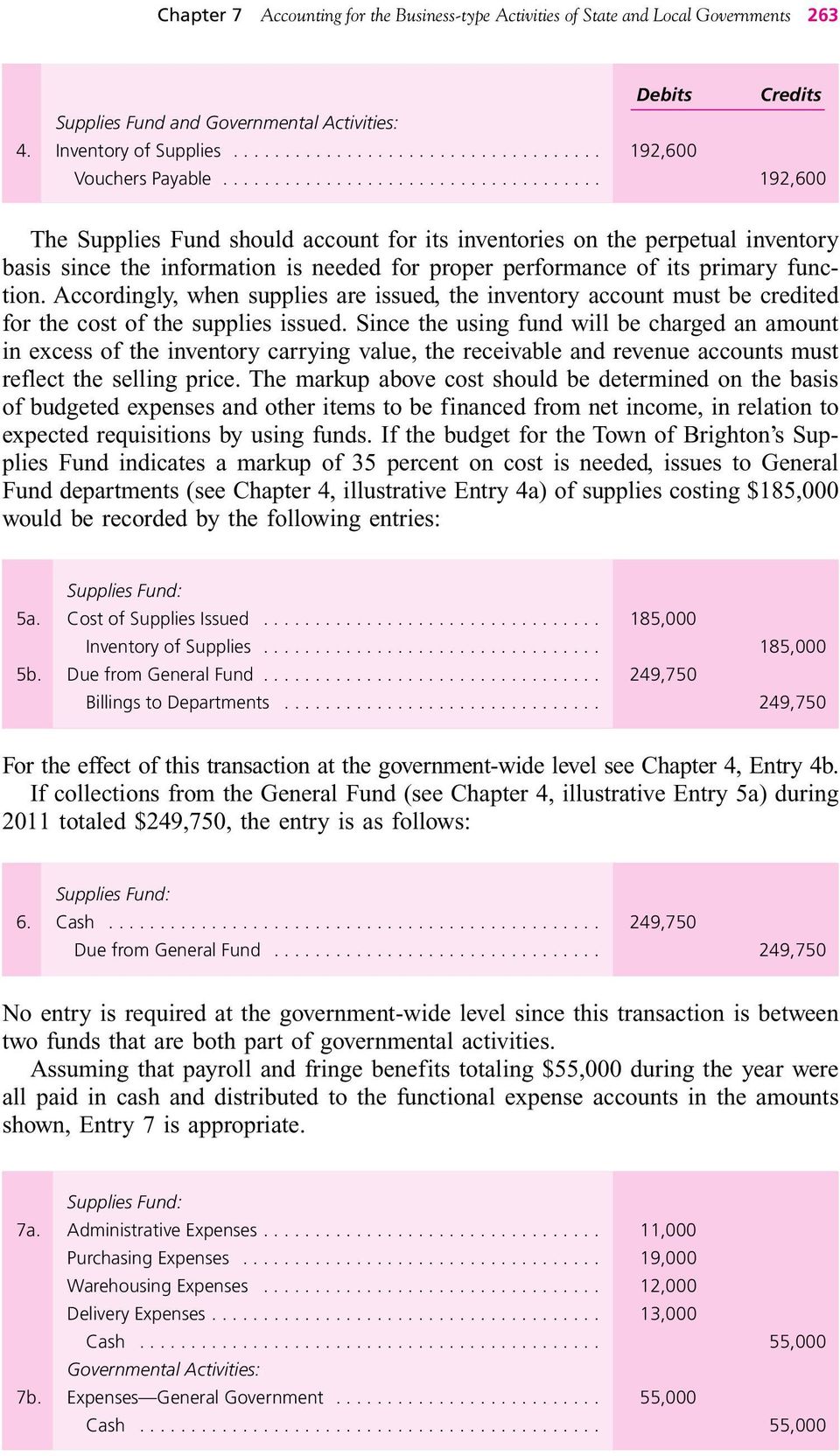
9 Chapter 7 Accounting for the Business-type Activities of State and Local Governments 263 Debits Credits Supplies Fund and Governmental Activities: 4. Inventory of Supplies ,600 Vouchers Payable ,600 The Supplies Fund should account for its inventories on the perpetual inventory basis since the information is needed for proper performance of its primary function. Accordingly, when supplies are issued, the inventory account must be credited for the cost of the supplies issued. Since the using fund will be charged an amount in excess of the inventory carrying value, the receivable and revenue accounts must reflect the selling price. The markup above cost should be determined on the basis of budgeted expenses and other items to be financed from net income, in relation to expected requisitions by using funds. If the budget for the Town of Brighton s Supplies Fund indicates a markup of 35 percent on cost is needed, issues to General Fund departments (see Chapter 4, illustrative Entry 4a) of supplies costing $185,000 would be recorded by the following entries: Supplies Fund: 5a. Cost of Supplies Issued ,000 Inventory of Supplies ,000 5b. Due from General Fund ,750 Billings to Departments ,750 For the effect of this transaction at the government-wide level see Chapter 4, Entry 4b. If collections from the General Fund (see Chapter 4, illustrative Entry 5a) during 2011 totaled $249,750, the entry is as follows: Supplies Fund: 6. Cash ,750 Due from General Fund ,750 No entry is required at the government-wide level since this transaction is between two funds that are both part of governmental activities. Assuming that payroll and fringe benefits totaling $55,000 during the year were all paid in cash and distributed to the functional expense accounts in the amounts shown, Entry 7 is appropriate. Supplies Fund: 7a. Administrative Expenses ,000 Purchasing Expenses ,000 Warehousing Expenses ,000 Delivery Expenses ,000 Cash ,000 Governmental Activities: 7b. Expenses General Government ,000 Cash ,000
10 264 Part One State and Local Governments If payments on vouchers during the year totaled $164,000, the entry is as follows: Supplies Fund and Governmental Activities: Debits 8. Vouchers Payable ,000 Credits Cash ,000 The interfund loan from the Water Utility Fund is to be repaid in 20 equal annual installments; repayment of one installment at the end of 2011 and reclassification of the next installment are recorded: Supplies Fund: 9a. Interfund Loan from Water Utility Fund Current ,500 Cash ,500 9b. Interfund Loan from Water Utility Fund Noncurrent ,500 Interfund Loan from Water Utility Fund Current ,500 Governmental Activities: 9c. Internal Balances ,500 Cash ,500 The building used as a warehouse was estimated at the time of purchase to have a remaining useful life of 20 years; the warehouse machinery and equipment were estimated to have useful lives of 10 years, and the delivery equipment to have a useful life of 5 years. If the administrative and clerical office space occupies 10 percent of the area of the warehouse, 10 percent of the depreciation of the warehouse, $350, may be considered administrative expense. Similarly, if the purchasing office occupies 10 percent of the space in the warehouse building, 10 percent of the building depreciation, $350, may be considered purchasing expense. The remainder of the building is devoted to warehousing; therefore, 80 percent of the total building depreciation, $2,800, is to be charged to Warehousing Expenses. This account is also charged $2,500 for machinery and equipment depreciation expense. Delivery Expense is charged $2,000 for depreciation of equipment during the year. Entry 10a illustrates the allocation of depreciation to the Supplies Fund s functions. To simplify the illustration at the government-wide level, Entry 10b assumes that only the general government function incurred supply expenses. In fact, most functions of government would incur supply expenses. Supplies Fund: 10a. Administrative Expenses Purchasing Expenses Warehousing Expenses ,300 Delivery Expenses ,000 Allowance for Depreciation Building ,500 Allowance for Depreciation Machinery and Equipment Warehouse ,500 Allowance for Depreciation Equipment Delivery ,000 Governmental Activities: 10b. Expenses General Government ,000 Accumulated Depreciation Building ,500 Accumulated Depreciation Equipment ,500

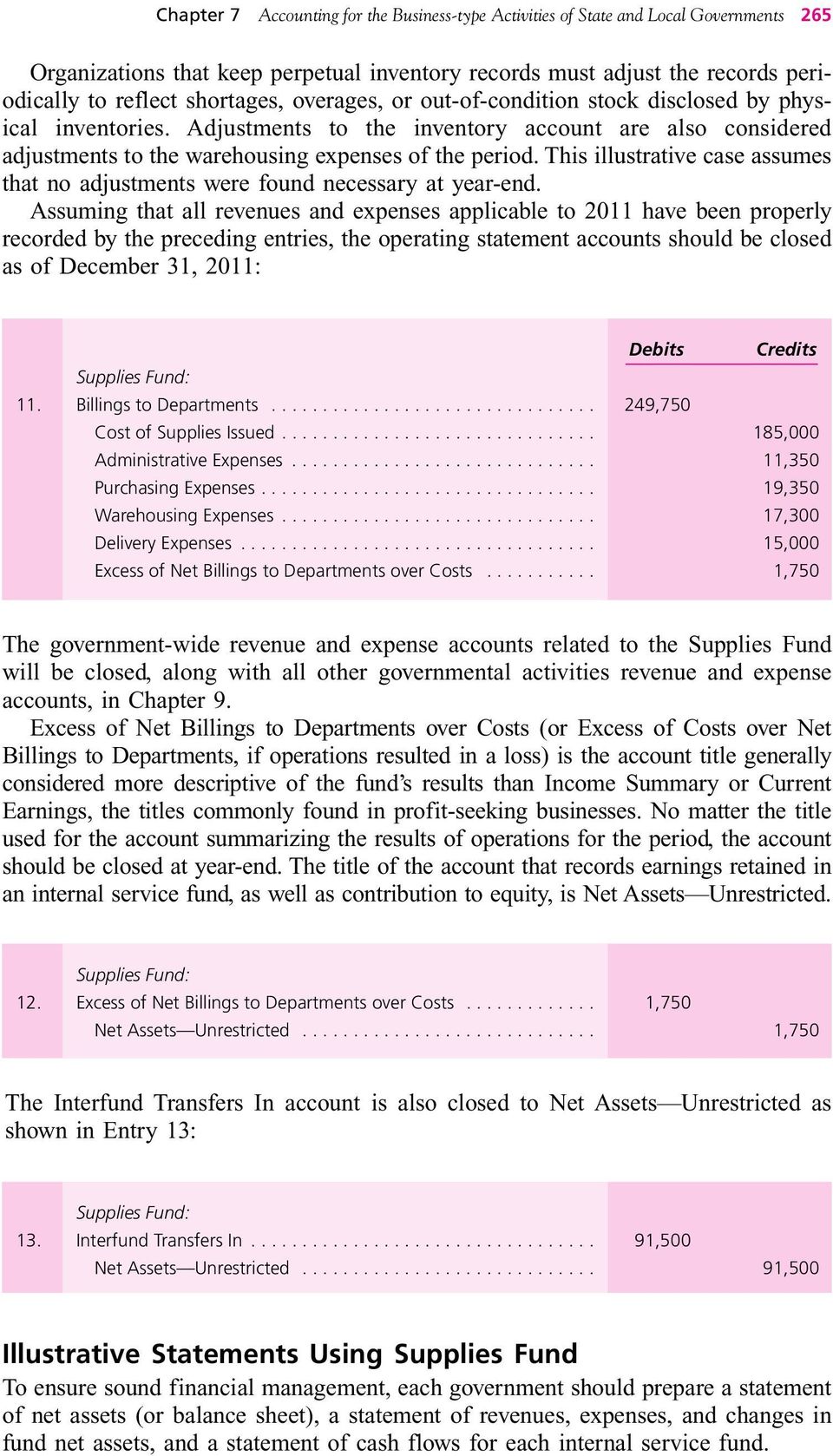
11 Chapter 7 Accounting for the Business-type Activities of State and Local Governments 265 Organizations that keep perpetual inventory records must adjust the records periodically to reflect shortages, overages, or out-of-condition stock disclosed by physical inventories. Adjustments to the inventory account are also considered adjustments to the warehousing expenses of the period. This illustrative case assumes that no adjustments were found necessary at year-end. Assuming that all revenues and expenses applicable to 2011 have been properly recorded by the preceding entries, the operating statement accounts should be closed as of December 31, 2011: Debits Credits Supplies Fund: 11. Billings to Departments ,750 Cost of Supplies Issued ,000 Administrative Expenses ,350 Purchasing Expenses ,350 Warehousing Expenses ,300 Delivery Expenses ,000 Excess of Net Billings to Departments over Costs ,750 The government-wide revenue and expense accounts related to the Supplies Fund will be closed, along with all other governmental activities revenue and expense accounts, in Chapter 9. Excess of Net Billings to Departments over Costs (or Excess of Costs over Net Billings to Departments, if operations resulted in a loss) is the account title generally considered more descriptive of the fund s results than Income Summary or Current Earnings, the titles commonly found in profit-seeking businesses. No matter the title used for the account summarizing the results of operations for the period, the account should be closed at year-end. The title of the account that records earnings retained in an internal service fund, as well as contribution to equity, is Net Assets Unrestricted. Supplies Fund: 12. Excess of Net Billings to Departments over Costs ,750 Net Assets Unrestricted ,750 The Interfund Transfers In account is also closed to Net Assets Unrestricted as shown in Entry 13: Supplies Fund: 13. Interfund Transfers In ,500 Net Assets Unrestricted ,500 Illustrative Statements Using Supplies Fund To ensure sound financial management, each government should prepare a statement of net assets (or balance sheet), a statement of revenues, expenses, and changes in fund net assets, and a statement of cash flows for each internal service fund.
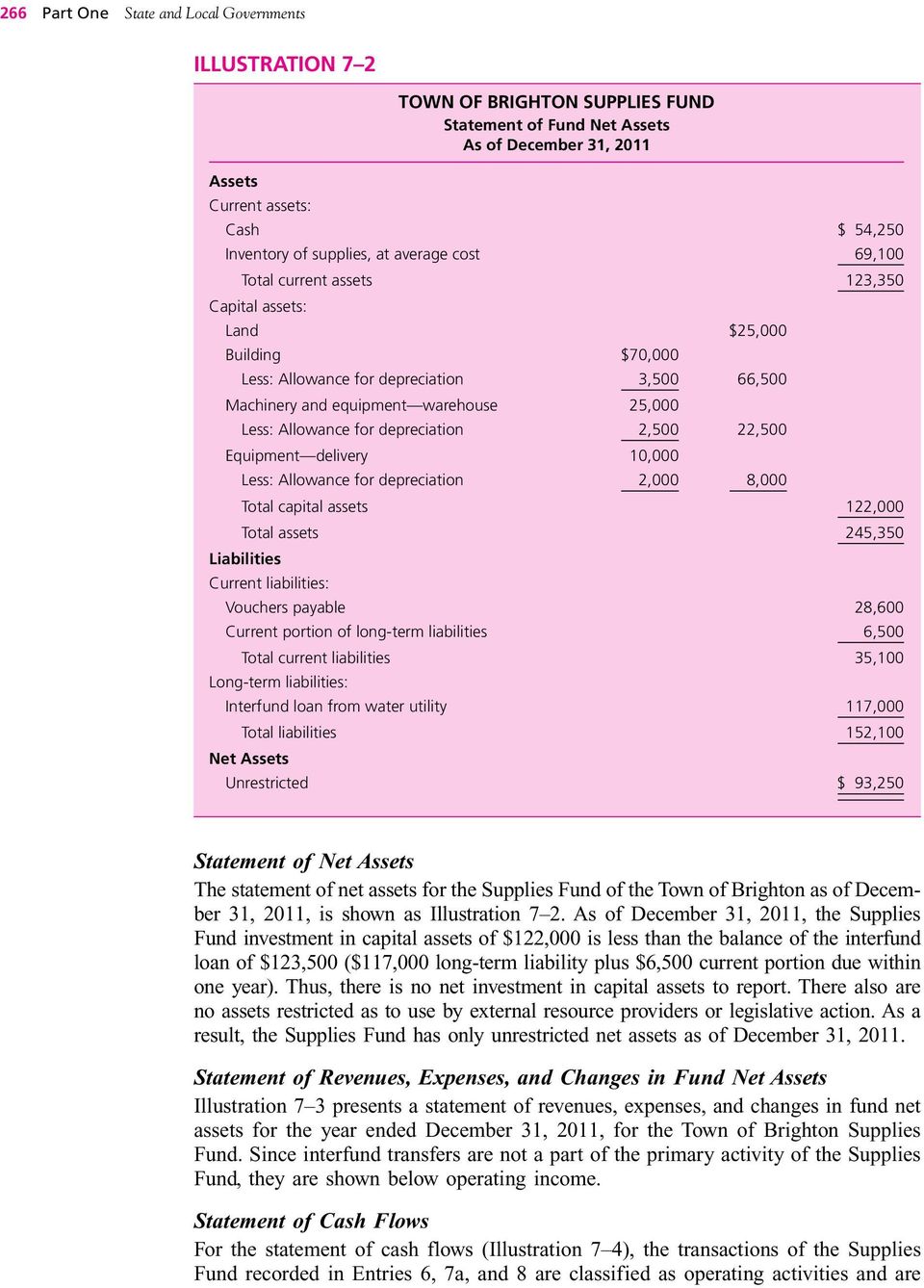
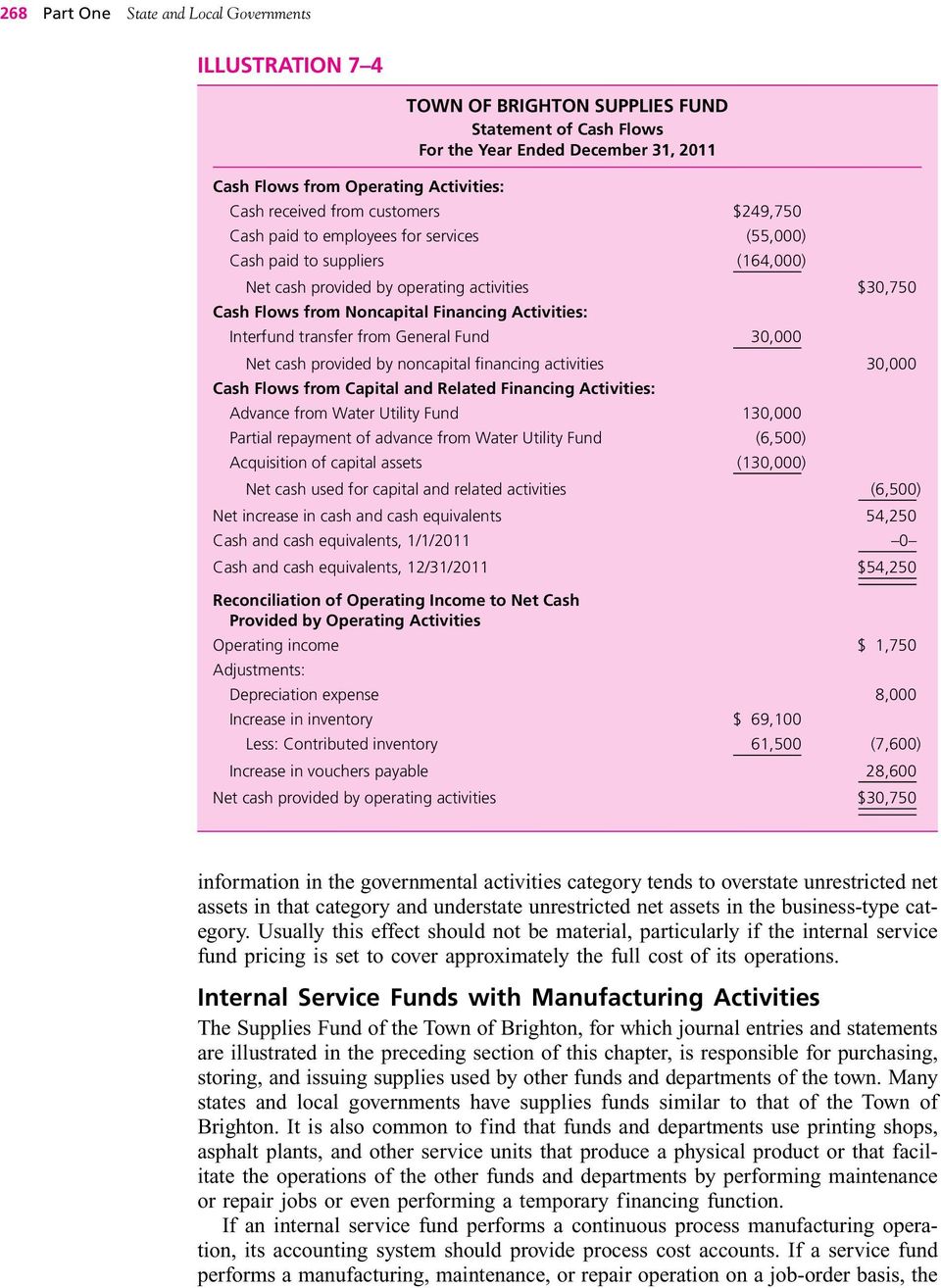
12 266 Part One State and Local Governments ILLUSTRATION 7 2 Assets Current assets: TOWN OF BRIGHTON SUPPLIES FUND Statement of Fund Net Assets As of December 31, 2011 Cash $ 54,250 Inventory of supplies, at average cost 69,100 Total current assets 123,350 Capital assets: Land $25,000 Building $70,000 Less: Allowance for depreciation 3,500 66,500 Machinery and equipment warehouse 25,000 Less: Allowance for depreciation 2,500 22,500 Equipment delivery 10,000 Less: Allowance for depreciation 2,000 8,000 Total capital assets 122,000 Total assets 245,350 Liabilities Current liabilities: Vouchers payable 28,600 Current portion of long-term liabilities 6,500 Total current liabilities 35,100 Long-term liabilities: Interfund loan from water utility 117,000 Total liabilities 152,100 Net Assets Unrestricted $ 93,250 Statement of Net Assets The statement of net assets for the Supplies Fund of the Town of Brighton as of December 31, 2011, is shown as Illustration 7 2. As of December 31, 2011, the Supplies Fund investment in capital assets of $122,000 is less than the balance of the interfund loan of $123,500 ($117,000 long-term liability plus $6,500 current portion due within one year). Thus, there is no net investment in capital assets to report. There also are no assets restricted as to use by external resource providers or legislative action. As a result, the Supplies Fund has only unrestricted net assets as of December 31, Statement of Revenues, Expenses, and Changes in Fund Net Assets Illustration 7 3 presents a statement of revenues, expenses, and changes in fund net assets for the year ended December 31, 2011, for the Town of Brighton Supplies Fund. Since interfund transfers are not a part of the primary activity of the Supplies Fund, they are shown below operating income. Statement of Cash Flows For the statement of cash flows (Illustration 7 4), the transactions of the Supplies Fund recorded in Entries 6, 7a, and 8 are classified as operating activities and are
13 Chapter 7 Accounting for the Business-type Activities of State and Local Governments 267 ILLUSTRATION 7 3 Operating revenues: TOWN OF BRIGHTON SUPPLIES FUND Statement of Revenues, Expenses, and Changes in Fund Net Assets For the Year Ended December 31, 2011 Billings to departments $249,750 Less: Cost of supplies issued 185,000 Gross margin 64,750 Operating expenses: Purchasing expenses $19,350 Administrative expenses 11,350 Warehousing expenses 17,300 Delivery expenses 15,000 Total operating expenses 63,000 Operating income 1,750 Interfund transfers in 91,500 Change in net assets 93,250 Net assets January 1, Net assets December 31, 2011 $ 93,250 reported in the first section of the statement of cash flows. As required by GASB standards, the statement of cash flows is accompanied by a reconciliation of operating income with the net cash flow from operating activities. The contribution from the General Fund to the Supplies Fund (see Entry 1) is reported in the cash flows from noncapital financing activities section of the statement of cash flows. The transactions recorded in Entries 2a, 3a, and 9a are classified as capital and related financing activities and are reported in that section of the statement of cash flows. During 2011 there were no transactions that would be classified as investing activities. External Financial Reporting of Internal Service Funds The financial statements presented in Illustrations 7 2, 7 3, and 7 4 are prepared for internal management purposes. As indicated earlier, for external reporting purposes the Supplies Fund financial information would be reported as a separate column of the statement of net assets proprietary funds; statement of revenues, expenses, and changes in net assets proprietary funds; and statement of cash flows proprietary funds, each of which is prepared for all proprietary funds (see Illustrations A1 7, A1 8, and A1 9 for examples). In the government-wide statement of net assets and statement of activities, internal service fund financial information is, in most cases, collapsed into and reported in the Governmental Activities column of both government-wide financial statements. As shown by the journal entries for the Supplies Fund, collapsing information requires eliminating any interfund activity between a governmental fund and an internal service fund. Thus, under the dual-track approach those activities involving a transaction between a governmental fund (General Fund in the Town of Brighton illustration) and an internal service fund (Supplies Fund in the Town of Brighton illustration) are not recorded for governmental activities at the government-wide level. If a portion of an internal service fund s operating income results from billings to enterprise funds, the GASB requirement to report internal service fund financial

14 268 Part One State and Local Governments ILLUSTRATION 7 4 Cash Flows from Operating Activities: TOWN OF BRIGHTON SUPPLIES FUND Statement of Cash Flows For the Year Ended December 31, 2011 Cash received from customers $249,750 Cash paid to employees for services (55,000) Cash paid to suppliers (164,000) Net cash provided by operating activities $30,750 Cash Flows from Noncapital Financing Activities: Interfund transfer from General Fund 30,000 Net cash provided by noncapital financing activities 30,000 Cash Flows from Capital and Related Financing Activities: Advance from Water Utility Fund 130,000 Partial repayment of advance from Water Utility Fund (6,500) Acquisition of capital assets (130,000) Net cash used for capital and related activities (6,500) Net increase in cash and cash equivalents 54,250 Cash and cash equivalents, 1/1/ Cash and cash equivalents, 12/31/2011 $54,250 Reconciliation of Operating Income to Net Cash Provided by Operating Activities Operating income $ 1,750 Adjustments: Depreciation expense 8,000 Increase in inventory $ 69,100 Less: Contributed inventory 61,500 (7,600) Increase in vouchers payable 28,600 Net cash provided by operating activities $30,750 information in the governmental activities category tends to overstate unrestricted net assets in that category and understate unrestricted net assets in the business-type category. Usually this effect should not be material, particularly if the internal service fund pricing is set to cover approximately the full cost of its operations. Internal Service Funds with Manufacturing Activities The Supplies Fund of the Town of Brighton, for which journal entries and statements are illustrated in the preceding section of this chapter, is responsible for purchasing, storing, and issuing supplies used by other funds and departments of the town. Many states and local governments have supplies funds similar to that of the Town of Brighton. It is also common to find that funds and departments use printing shops, asphalt plants, and other service units that produce a physical product or that facilitate the operations of the other funds and departments by performing maintenance or repair jobs or even performing a temporary financing function. If an internal service fund performs a continuous process manufacturing operation, its accounting system should provide process cost accounts. If a service fund performs a manufacturing, maintenance, or repair operation on a job-order basis, the
15 Chapter 7 Accounting for the Business-type Activities of State and Local Governments 269 fund s accounting system should provide appropriate job-order cost accounts. To the extent that operations, processes, or activities are capable of being standardized, cost standards for materials, direct labor, and overhead should be established; in such cases, the accounting system should provide for the routine measurement and reporting of significant variances from the standards. Cost determination for government services is discussed in Chapter 13 of this text. Internal Service Funds as Financing Devices Governments may utilize internal service funds as devices to finance risk management, equipment purchases and operations (including centralized computer operations), and other functions that are facilitated by generating revenues from user charges to cover costs and expenses computed on a accrual basis. In the case of funds to finance equipment purchases and operations, including the operations of computers owned by the government, an internal service fund can include depreciation and, perhaps, expected increases in the cost of replacing assets, in the charge to the using funds, thus incorporating these costs in current appropriations of governmental funds, rather than budgeting the estimated cost of equipment expected to be replaced. If internal service funds are used to finance equipment purchases and operations, the appropriations and expenditures of governmental funds more nearly approximate costs that would be reported by entities using accrual accounting than is true under the procedures discussed in Chapters 3 and 4. GASB has issued accounting and financial reporting standards for risk financing and related insurance activities. 3 Government entities that use internal service funds to account for risk financing activities are required to recognize revenues, claims expenses, and liabilities in essentially the same manner as do public entity risk pools (cooperative groups of government entities joined together to finance risks of loss to property, workers compensation, employee health care, and similar risks or exposures). Briefly, the internal service fund should recognize a claims expense and a liability when a claim is asserted, it is probable that an asset has been impaired or a liability has been incurred, and the amount of the loss is reasonably estimable; or if an estimable loss has been incurred and it is probable that a claim will be asserted. Reasonably possible (but not probable) loss contingencies, probable losses that are not reasonably measurable, and loss exposure in excess of the accrued liability should be disclosed in the notes to the financial statements. The disclosure should explain the nature of the contingency and an estimate of the possible loss, the range of the loss, or why the amount is not estimable. Internal service fund charges to other funds for risk financing activities should be sufficient to recover the total amount of claim expenses recognized for the period or, alternatively, may be based on an actuarial method so that internal service fund revenues and expenses over time are approximately equal. Charges to other funds may also include a reasonable provision for expected future catastrophe losses. Internal service fund charges to other funds are recognized as revenues by the internal service fund and as expenditures by governmental funds or expenses by proprietary funds. Internal service fund charges in excess of the full cost amount should be reported as a nonoperating transfer by the internal service fund and an other financing use by the other funds. If the internal service fund fails to recover the full cost of claims over a reasonable period of time, the accumulated fund deficit should be charged to the other funds and reported by the other funds as an expenditure or expense, as appropriate. 3 GASB, Codification, Sec. Po20.
16 270 Part One State and Local Governments ENTERPRISE FUNDS Dissolution of an Internal Service Fund When an internal service fund has completed the mission for which it was established or its activity is terminated for any other reason (such as outsourcing the activity to an outside vendor), dissolution must be accomplished. Liquidation may be accomplished in any one of three ways or in combinations thereof: (1) transfer the fund s assets to another fund that will continue the operation as a subsidiary activity, for example, a supply fund becoming a department of the General Fund; (2) distribute the fund s assets to another fund or to another government; or (3) convert all its noncash assets to cash and distribute the cash to another fund or other funds. Dissolution of an internal service fund, as for a private enterprise, would proceed by first paying outside creditors, followed by repayment of any longterm interfund loans outstanding and, finally, liquidation of remaining net assets. The entire process of dissolution should be conducted according to pertinent law and the discretion of the appropriate legislative body. Net assets contributed by another fund or government logically would revert to the contributor fund or government, but law or other regulations may dictate otherwise. If net assets have been built up from charges in excess of costs, liquidation will follow whatever regulations may govern the case; if none exist, the appropriate governing body must decide on the recipient or recipients. Enterprise funds and internal service funds are both classified by the GASB as proprietary funds, although only the enterprise funds are generally reported as part of the Business-type Activities column of the government-wide financial statements. As discussed in the prior section of the chapter, internal service funds are generally reported as part of the Governmental Activities column. If only enterprise funds are included in the Business-type Activities column, there is no need to maintain a separate set of accounting records for the business-type activities at the governmentwide level. Rather, the financial records of the enterprise funds can simply be added together for financial reporting purposes at the government-wide level. Any interfund transactions among enterprise funds should be eliminated because they would have no net effect on overall business-type activities. Enterprise funds are used by governments to account for services provided to the general public on a user charge basis. Under GASB standards, a government must report certain activities in an enterprise fund if any of the following criteria are met The activity is financed with debt that is secured solely by a pledge of the revenues from fees and charges of an activity. [Emphasis added by authors.] 2. Laws or regulations require that the activity s costs of providing services, including capital costs (such as depreciation or debt service), be recovered with fees and charges, rather than with taxes or similar revenues. 3. Pricing policies are designed to recover the costs of the activity, including capital costs. These criteria are quite specific regarding when an enterprise fund must be used. For example, if debt issued is also backed by the full faith and credit of the government, even though it is intended to be repaid from revenues of a particular activity, 4 GASB Codification, Sec

17 Chapter 7 Accounting for the Business-type Activities of State and Local Governments 271 that activity need not be reported in an enterprise fund. Similarly, if an activity is subsidized by a government s General Fund rather than fully covering its costs of providing services with fees or charges, that activity need not be reported in an enterprise fund. In either of these examples, the government could opt to report the activities in an enterprise fund. However, if governments support the activities primarily with general or special revenue sources rather than user charges, accounting for the activities is more appropriate in the General Fund or a special revenue fund. Since the word enterprise is often used as a synonym for business-type activity, it is logical that enterprise funds should use accrual accounting and account for all assets used in the production of goods or services offered by the fund. Similarly, if long-term debt is to be serviced by the fund, the fund does the accounting for the debt. The most common examples of governmental enterprises are public utilities, notably water and sewer utilities. Electric and gas utilities, transportation systems, airports, ports, hospitals, toll bridges, produce markets, parking lots, parking garages, liquor stores, and public housing projects are other examples frequently found. Since services of the types mentioned are intended to be largely self-supporting, they are generally accounted for by enterprise funds. Almost every type of enterprise operated by a government has its counterpart in the private sector. In order to take advantage of the work done by regulatory agencies and trade associations to develop useful accounting information systems for the investor-owned enterprises, it is recommended that governmentally owned enterprises use the accounting structures developed for investor-owned enterprises of the same nature. 5 Budgetary accounts should be used only if required by law. The accounting for debt service and construction activities of a governmental enterprise occurs within the enterprise fund rather than by separate debt service and capital projects funds. Thus, the financial statements of enterprise funds are self-contained, and creditors, legislators, or the general public can evaluate the performance of a governmental enterprise on the same bases as they can the performance of investor-owned enterprises in the same industry. By far the most numerous and important enterprise services rendered by local governments are public utilities. In this chapter, therefore, the example used is that of a water utility fund. 5 GASBS 20 and GASBS 34 provide guidance on business-type accounting and financial reporting for proprietary activities. This guidance clarifies the authoritative status of FASB pronouncements in determining generally accepted accounting principles (GAAP) for proprietary activities given the GAAP hierarchy provided in Statement on Auditing Standards No. 69, The Meaning of Present Fairly in Conformity with Generally Accepted Accounting Principles in the Independent Auditor s Report (AICPA, 1992). GASBS 20 gives governments an option between two accounting and financial reporting approaches for proprietary funds. The first approach requires consistent use of all GASB pronouncements and applicable pronouncements of FASB and its predecessors (Accounting Principles Board and Committee on Accounting Procedure) issued on or before November 30, 1989, unless those pronouncements conflict with or contradict GASB pronouncements. The second approach requires consistent use of all GASB pronouncements and all applicable pronouncements (both before and after November 30, 1989) of FASB and its predecessors unless those pronouncements conflict with or contradict GASB pronouncements. Thus, under the first approach, unless GASB directs otherwise, governments are not required to change their accounting procedures if FASB issues a standard that supersedes or amends a standard issued on or before November 30, This date (November 30, 1989) is significant as it is the date the Financial Accounting Foundation resolved a conflict over jurisdiction of the FASB and GASB.

18 272 Part One State and Local Governments WATER UTILITY FUNDS The statement of net assets as of December 31, 2010, for the Town of Brighton Water Utility Fund is shown in Illustration 7 5. The statement appears fairly conventional, but terminology peculiar to utilities warrants discussion prior to proceeding to the illustrative transactions for the year ending December 31, Part of the difference in terminology relates to the fact that the Water Utility Fund is part of a regulated ILLUSTRATION 7 5 TOWN OF BRIGHTON Water Utility Fund Statement of Net Assets As of December 31, 2010 Assets Current and accrued assets: Cash $ 126,000 Customer accounts receivable $69,000 Less: Accumulated provision for uncollectibles 2,900 66,100 Accrued utilities revenues 14,800 Materials and supplies 28,700 Total current and accrued assets $ 235,600 Restricted assets: Cash 6,600 Investments 556, ,600 Utility plant: Utility plant in service 3,291,825 Less: Accumulated depreciation 440,325 Utility plant net 2,851,500 Construction work in progress 125,000 Net utility plant 2,976,500 Total assets 3,774,700 Liabilities Current liabilities: Accounts payable 33,200 Customer advances for construction 21,000 Total current liabilities 54,200 Liabilities payable from restricted assets: Customer deposits 23,700 Long-term liabilities: Revenue bonds payable (net of unamortized discount of $5,300) 1,744,700 Total liabilities 1,822,600 Net Assets Invested in capital assets, net of related debt 1,231,800 Restricted for payment of debt service 538,900 Unrestricted 181,400 Total net assets $1,952,100
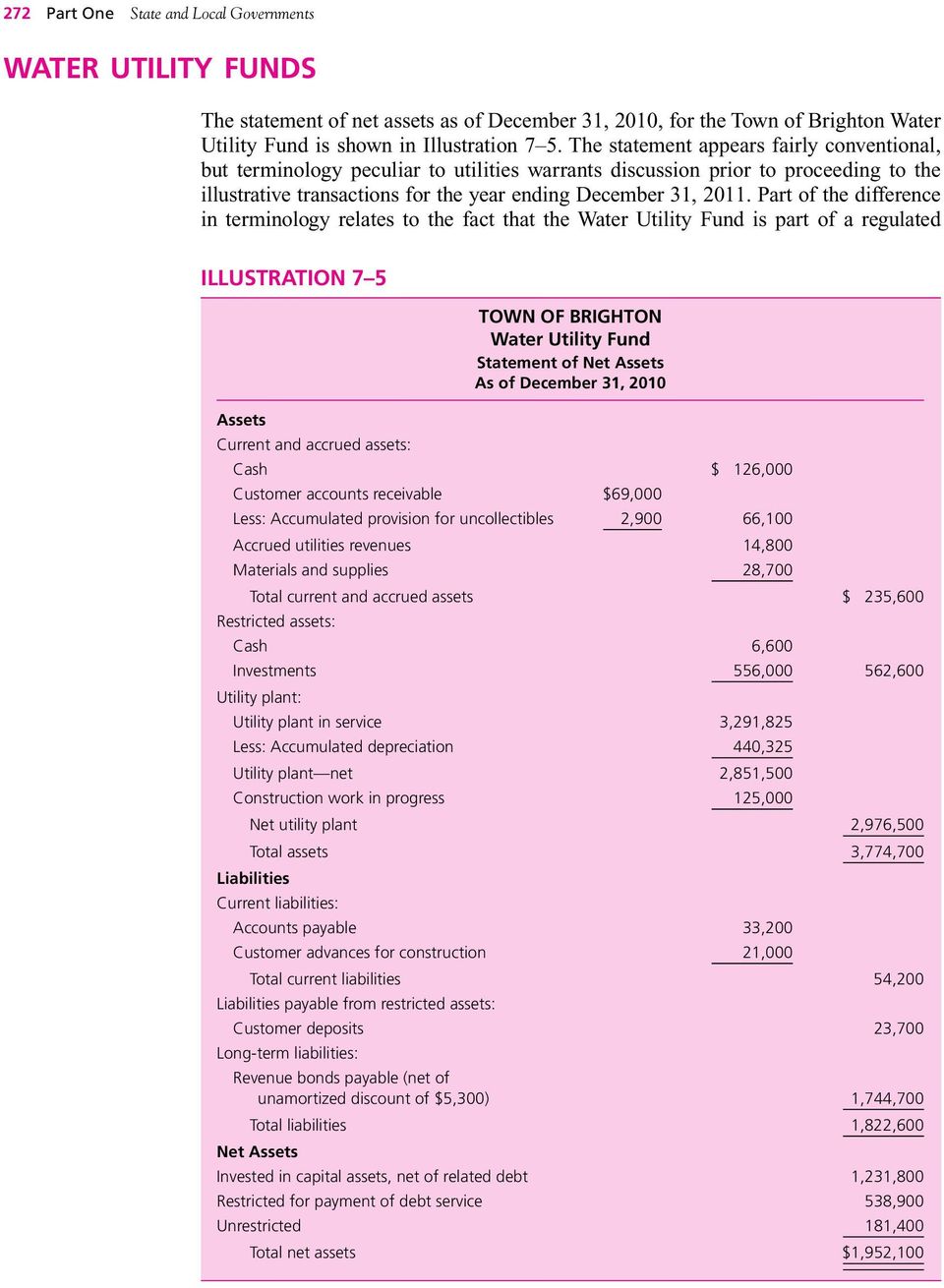
19 Chapter 7 Accounting for the Business-type Activities of State and Local Governments 273 industry. As such, the primary regulatory bodies, the National Association of Regulatory Utility Commissioners (NARUC) and Federal Energy Regulatory Commission (FERC), influence the accounting for utilities. Current and Accrued Assets The Cash and Materials and Supplies accounts shown in Illustration 7 5 in the Current and Accrued Assets section are not peculiar to utilities and need not be discussed here. The other two asset accounts in this section Customer Accounts Receivable and Accrued Utilities Revenues are related. The former represents billings to customers that are outstanding at year-end (and are reduced by an accumulated provision for uncollectibles). The latter results from the fact that utilities generally prepare billings to customers on the basis of meter readings, and it is not practical for utilities to read all meters simultaneously at year-end and bill all customers as of that time. Utilities that meter their service make extensive use of cycle billing, which, in substance, consists of billing part of their customers each day instead of billing by calendar months. Under this plan, meter reading is a continuous day-by-day operation, with billings following shortly after the filing of the meter readers reports. Individual meters are read on approximately the same day each month, or every other month, so that each bill covers approximately the same number of days of usage. Cycle billing eliminates the heavy peak load of accounting and clerical work that results from uniform billing on a calendar month basis. It does, however, result in a sizeable amount of unbilled receivables on any given date. Thus, in order to state assets and sales properly, accrual of unbilled receivables (Accrued Utilities Revenues, in regulatory terminology) is required as of the financial statement date. 6 Restricted Assets The section following Current and Accrued Assets in Illustration 7 5 is captioned Restricted Assets, the caption most commonly used when the use of assets is restricted by contractual agreements or legal requirements. Some governments that use regulatory terminology report restricted assets of utilities under the broader caption, Other Property and Investments. Other Property and Investments may include, in addition to restricted assets, the carrying value of property not being used for utility purposes or being held for future utility use. Cash and Investments are the only two items reported under the Restricted Assets caption of the balance sheet shown in Illustration 7 5. Those items are restricted for return of customer deposits and for retirement of revenue bonds pursuant to the bond covenants. The amount of assets segregated, $562,600, is offset by liabilities currently payable from restricted assets (in the case of the Town of Brighton, customer deposits of $23,700) and restrictions of net assets (in this case, restricted for payment of debt service, $538,900). This fund within a fund approach permits segregation of assets, related liabilities, and restricted net assets within a single enterprise fund. Net assets should be restricted in the amount of the net assets of each restricted fund within the enterprise fund, as shown in Illustration 7 5. Other items commonly reported in the Restricted Assets section include assets set aside to fund depreciation for capital improvements or grants and contributions restricted for capital acquisition or improvement. 6 Some governments use the same or a similar chart of accounts for utilities as those of regulated profit-seeking enterprises in the same industry.

20 274 Part One State and Local Governments Utility Plant Utility Plant in Service Utility Plant in Service is a control account, supported in whatever detail is required by regulatory agencies and by management needs. For example, water utilities commonly have six subcategories of plant assets: intangible plant, source of supply plant, pumping plant, water treatment plant, transmission and distribution plant, and general plant. Each of the six subcategories is supported by appropriate subsidiary accounts. For example, intangible plant consists of the costs of organization, franchises, and consents, and any other intangible costs necessary and valuable to the conduct of utility operations. Source of supply plant consists of land and land rights; structures and improvements; collecting and impounding reservoirs; lake, river, and other intakes; wells and springs; infiltration galleries and tunnels; supply mains; and other water source plant. Each of the accounts within each subcategory is supported by necessary subsidiary records for each individual asset detailing its description, location, cost, date of acquisition, estimated useful life, salvage value, depreciation charges, and any other information needed for management planning and control, regulatory agency reports, financial statements, or special reports to creditors. Construction Work in Progress The other utility plant item shown on the statement of net assets, Illustration 7 5, is Construction Work in Progress. This account represents the accumulated costs of work orders for projects that will result in items reportable as utility plant when completed and is supported by the work orders for projects in progress. Each work order, in turn, is supported by documents supporting payments to contractors and to suppliers or supporting charges for materials, labor, and overhead allocable to the project. Unlike self-constructed general capital assets, GASB requires interest capitalization for self-constructed assets of proprietary funds, except those constructed with general long-term debt that will be repaid from resources of governmental activities. 7 Current Liabilities Items commonly found in the Current Liabilities section of a utility statement of net assets are shown under that caption in Illustration 7 5. Accounts Payable needs no comment here. The other item, Customer Advances for Construction, results from utilities practice of requiring customers to advance to the utility a sizeable portion of the estimated cost of construction projects to be undertaken by the utility at the request of the customer. If the advances are to be refunded, either wholly or in part, or applied against billings for service rendered after completion of the project, they are classified as shown in Illustration 7 5. When a customer is refunded the entire amount to which he or she is entitled according to the agreement or rule under which the advance was made, the balance retained by the utility, if any, is reported as Contributions from Customers in the statement of revenues, expenses, and changes in fund net assets. Other items commonly reported under Current Liabilities include accrued expenses, amounts due to other funds, and current portions of long-term liabilities. Some governments also report customer deposits under the Current Liabilities caption. 8 7 GASB requires application of FASB Statement No. 34, Capitalization of Interest Cost, as amended. 8 Generally, customer deposits should be reported as Liabilities Payable from Restricted Assets, a special category of current liabilities, as explained in the following section.
21 Chapter 7 Accounting for the Business-type Activities of State and Local Governments 275 Liabilities Payable from Restricted Assets Liabilities payable from restricted assets should be displayed separately from current liabilities, as shown in Illustration 7 5. In addition to customer deposits, the current portion of revenue bonds payable, if any, would be reported here since restricted assets have been set aside for that purpose. The Town of Brighton follows the common practice of most utilities and requires all new customers to deposit a sum of money with the utility as security for the payment of bills. In many, but not all, jurisdictions, utilities are required to pay interest on customer deposits at a nominal rate. Regulatory authorities or local policy may require utilities to refund the deposits, and interest, after a specified period of time if the customer has paid all bills on time. The utility may be required, as was the Town of Brighton Water Utility Fund, to segregate cash or investments in an amount equal to the liability for Customer Deposits. Customer Advances for Construction are contractually different from Customer Deposits and are less likely to be reported separately as restricted assets and liabilities unless agreements with developers make it necessary to restrict assets for this purpose. Long-term Liabilities Bonds are the customary form of long-term liabilities. Bonds issued by a utility are usually secured by the pledge of certain portions of the utility s revenue, the exact terms of the pledge varying with individual cases; bonds of this nature are called revenue bonds. Some utility bonds are secured not only by a pledge of a certain portion of the utility s revenues but also by an agreement on the part of the town s or city s general government to subsidize the utility in any year in which its normal revenue is inadequate for compliance with the terms of the bond indenture. Other utility bonds carry the pledge of the government entity s full faith and credit, although the intent is to service them from utility revenues rather than general taxes. The latter are, therefore, technically general obligation bonds. GASB standards require that general obligation bonds intended to be serviced from utility revenues be reported as a liability of the enterprise fund. Similarly, special assessment debt may be assumed by an enterprise fund if the assets constructed by special assessment financing are used in enterprise fund operations. Governmentally owned utilities may have received long-term interfund loans from the government s General Fund or other funds. Also, enterprises may acquire assets under a capital lease arrangement. The portion of interfund loans, required lease payments, or bond or other debt issues to be paid within one year from the statement of net assets date should be reported as a current liability; the remainder is properly reported in the Long-term Liabilities section of the utility statement of net assets. Long-term bonds payable should be reported net of unamortized discount or premium, as shown in Illustration 7 5, or the unamortized discount or premium can be reported as an offset against bonds payable at par on the statement of net assets. Net Assets As discussed earlier in the chapter, proprietary funds report using three net asset categories: invested in capital assets, net of related debt; restricted; and unrestricted. The three categories of net assets for the Water Utility Fund are shown in Illustration 7 5. Restrictions may be placed by law, regulation, or contractual agreement with creditors or other outside parties. Illustration 7 5 shows a typical restriction: A sinking fund created pursuant to a bond indenture for repayment of revenue bond principal. Unrestricted net assets represent the residual amount of net assets after segregating investment in capital assets, net of related debt, and restricted net assets.
22 276 Part One State and Local Governments Illustrative Case Water Utility Fund The preceding discussion concerning the statement of net asset accounts of a water utility includes by implication the essential characteristics of accounting necessary for both governmentally owned utilities and investor-owned utilities. In this section, accounting for characteristic transactions of a utility fund is illustrated in general journal entry format for fiscal year 2011, the year following the statement of net assets presented in Illustration 7 5. It is assumed that the Town of Brighton is located in a state that permits enterprise funds to operate without formal legal approval of their budgets. Utility or other enterprise management must prepare operating budgets and capital expenditure budgets as management tools. For the illustrative case, it is assumed that the budgets are submitted to the town administrators, the town legislative body, and the public for information, not for legal action. Accordingly, the budget is not formally recorded in enterprise fund accounts. While utility management must be informed periodically of the status of outstanding construction contracts and purchase orders, encumbrances need not be recorded in the accounts in order to accomplish this. The nature of the Accrued Utilities Revenues account was explained previously in the section Current and Accrued Assets. For FY 2011, it is not feasible when customers bills are prepared to determine whether a portion of the bill has been accrued and, if so, in what amount. The simplest procedure, therefore, is to reverse the accrual entry as of the start of the new fiscal year. Assuming that the entire December 31, 2010, Town of Brighton Water Utility Fund revenues accrual has been credited to Sales of Water, the following entry is appropriate as of January 1, 2011: Debits Credits 1. Sales of Water ,800 Accrued Utility Revenues ,800 Earlier in this chapter, the establishment of a Supplies Fund by the Town of Brighton as of January 1, 2011, was illustrated. The Water Utility Fund advanced $130,000 to the Supplies Fund as a long-term loan. The entry by the Supplies Fund is illustrated in Entry 2a in the Illustrative Case Supplies Fund section earlier in this chapter; the corresponding entry in the Water Utility Fund would be: 2. Interfund Loan to Supplies Fund Noncurrent ,000 Cash ,000 When utility customers are billed during the year, appropriate revenue accounts are credited. Assuming that during 2011 the total bills to nongovernmental customers amounted to $696,000, bills to the Town of Brighton General Fund amounted to $30,000, and all revenue was from the sale of water, the following entry summarizes the events: 3. Customer Accounts Receivable ,000 Due from General Fund ,000 Sales of Water ,000
23 Chapter 7 Accounting for the Business-type Activities of State and Local Governments 277 If collections on receivables from nongovernmental water customers totaled $680,000, Entry 4 is needed: Debits Credits 4. Cash ,000 Customer Accounts Receivable ,000 Materials and supplies in the amount of $138,000 were purchased during the year by the Water Utility Fund. The liability is recorded as: 5. Materials and Supplies ,000 Accounts Payable ,000 Materials and supplies chargeable to the accounts itemized in the following entry were issued during the year. 6. Source of Supply Expenses ,000 Pumping Expenses ,000 Water Treatment Expenses ,000 Transmission and Distribution Expenses ,000 Construction Work in Progress ,000 Materials and Supplies ,000 Payrolls for the year were chargeable to the accounts shown in the following entry. Tax Collections Payable is the account provided in the NARUC and FERC systems to report the amount of taxes collected by the utility through payroll deductions or otherwise pending transmittal of such taxes to the proper taxing authority. Taxes Accrued is the account provided in the NARUC and FERC systems to report the liability for taxes that are the expense of the utility, such as the employer s share of social security taxes. The following entry assumes that the employer s share of social security taxes is charged to the same accounts that the employees gross earnings are; it also assumes that checks have been issued for employees net earnings. 7. Source of Supply Expenses ,200 Pumping Expenses ,700 Water Treatment Expenses ,500 Transmission and Distribution Expenses ,250 Customer Accounts Expenses ,550 Sales Expenses ,250 Administrative and General Expenses ,150 Construction Work in Progress ,400 Taxes Accrued ,800 Tax Collections Payable ,750 Cash ,450
24 278 Part One State and Local Governments Bond interest in the amount of $105,000 was paid; the bonds were issued to finance the acquisition of utility plant assets. Amortization of debt discount amounted to $530. Debits Credits 8. Interest on Long-term Debt ,530 Unamortized Discount Cash ,000 Bond interest in the amount of $12,900 was properly capitalized as part of construction work in progress during the year. (The Town of Brighton does not impute interest on its own resources during construction.) 9. Construction Work in Progress ,900 Interest on Long-term Debt ,900 Construction projects on which costs totaled $220,000 were completed and the assets placed in service were recorded: 10. Utility Plant in Service ,000 Construction Work in Progress ,000 Collection efforts on bills totaling $3,410 were discontinued. The customers owing the bills had paid deposits totaling $2,140 to the water utility; the deposits were applied to the bills, and the unpaid remainder was charged to Accumulated Provision for Uncollectible Accounts (Entry 11a). Restricted assets (cash) is reduced by $2,140, the amount of the decrease in Customer Deposits (Entry 11b). 11a. Customer Deposits ,140 Accumulated Provision for Uncollectible Accounts ,270 Customer Accounts Receivable ,410 11b. Cash ,140 Cash Customer Deposits ,140 Customers deposits amounting to $1,320 were refunded by check to customers discontinuing service (see Entry 12a). Deposits totaling $2,525 were received from new customers (see Entry 12b). 12a. Customer Deposits ,320 Cash Customer Deposits ,320 12b. Cash Customer Deposits ,525 Customer Deposits ,525
25 Chapter 7 Accounting for the Business-type Activities of State and Local Governments 279 Customers advances for construction in the amount of $14,000 were applied to their water bills; in accord with the agreement with the customers and NARUC recommendations, the remainder of the advances was transferred to Capital Contributions from Customers. Debits Credits 13. Customer Advances for Construction ,000 Customer Accounts Receivable ,000 Capital Contributions from Customers ,000 Payments of accounts payable for materials and supplies used in operations totaled $67,200, and payment of accounts payable for materials used in construction totaled $66,000. Payments of taxes accrued amounted to $13,500, and payments of tax collections payable amounted to $50, Accounts Payable ,200 Taxes Accrued ,500 Tax Collections Payable ,000 Cash ,700 The Water Utility Fund agreed to pay $25,000 to the town General Fund as a payment in lieu of property taxes. The entry in the General Fund is illustrated in Chapter 4 (see Chapter 4, illustrative Entry 24a). The following entry records the event in the accounts of the Water Utility Fund: 15. Payment in Lieu of Taxes ,000 Due to General Fund ,000 During the year, interest amounting to $44,500 in cash was received on restricted investments. The amount $1,375 is allocable to investments of customer deposit assets and is unrestricted as to use; the remaining $43,125 adds to the amount restricted for revenue bond repayment. 16a. Cash ,375 Cash Bond Repayment ,125 Interest and Dividend Income ,500 16b. Net Assets Unrestricted ,125 Net Assets Restricted for Bond Repayment ,125 At year-end, entries to record depreciation expense, the provision for uncollectible accounts, and unbilled customer accounts receivable should be made as illustrated by Entry 17. In accord with regulatory terminology, Uncollectible Accounts instead of Bad Debts Expense (FASB) or Provision for Bad Debts (GASB) is debited for the amount added to Accumulated Provision for Uncollectible Accounts. Amounts are assumed.
26 280 Part One State and Local Governments Debits Credits 17. Depreciation Expense ,750 Uncollectible Accounts ,980 Accrued Utility Revenues ,920 Accumulated Provision for Depreciation of Utility Plant ,750 Accumulated Provision for Uncollectible Accounts ,980 Sales of Water ,920 In accord with the revenue bond indenture, $100,000 of unrestricted cash was invested in U.S. government securities for eventual retirement of revenue bonds. Net assets are restricted in an amount equal to the increase in restricted assets. In addition, investments totaling $40,000 were made from restricted cash for eventual bond repayment. 18a. Investments Bond Repayment ,000 Cash ,000 Cash Bond Repayment ,000 18b. Net Assets Unrestricted ,000 Net Assets Restricted for Bond Repayment ,000 Toward the end of 2011, the Supplies Fund paid its first installment of $6,500 to the Water Utility Fund as a partial repayment of the long-term advance. Entry 9a of the illustrative entries for the supply fund shown earlier in this chapter (see the section titled Illustrative Case Supplies Fund ) illustrates the effect of the Supplies Fund on the accounts. The effect on the accounts of the Water Utility Fund is recorded by the following entry: 19. Cash ,500 Interfund Loan to Supplies Fund Noncurrent ,500 Nominal accounts for the year were closed: 20. Sales of Water ,120 Capital Contributions from Customers ,000 Interest and Dividend Income ,500 Source of Supply Expenses ,200 Pumping Expenses ,700 Water Treatment Expenses ,500 Transmission and Distribution Expenses ,250 Customer Account Expenses ,550 Sales Expenses ,250 Administrative and General Expenses ,150 Interest on Long-term Debt ,630 Payment in Lieu of Taxes ,000 Depreciation Expense ,750 Uncollectible Accounts ,980 Net Assets Unrestricted ,660
27 Chapter 7 Accounting for the Business-type Activities of State and Local Governments 281 In addition, Net Assets Invested in Capital Assets, Net of Related Debt, would be decreased for depreciation and amortization of the debt discount and increased for the change in utility plant during the year. Entry 21a reflects the adjustment for depreciation (Entry 17) and amortization of the bond discount (Entry 8). The increase to capital assets (Entries 6, 7 and 9), resulting in adjustment to net assets, is shown in Entry 21b. Debits Credits 21a. Net Assets Invested in Capital Assets, Net of Related Debt ,280 Net Assets Unrestricted ,280 21b. Net Assets Unrestricted ,300 Net Assets Invested in Capital Assets, Net of Related Debt.. 109,300 Illustrative Statements Using Water Utility Fund Statement of Net Assets The statement of net assets for a water utility, and definitions of certain statement of net assets categories and items peculiar to regulated utilities, have been explained at length in the sections of this chapter preceding the illustrative entries. The statement of net assets of the Town of Brighton Water Utility Fund as of December 31, 2011, is shown as Illustration 7 6. Similar to what was done in Chapter 4 (Illustration 4 5), and in conformance with GASB standards, internal receivables and payables are netted. That is, the amount due to the General Fund is offset against the amount due from that fund, and only the net amount of the receivable, $5,000, is shown as an asset. Statement of Revenues, Expenses, and Changes in Fund Net Assets The activity of the Town of Brighton s Water Utility Fund for the year ended December 31, 2011, is shown in Illustration 7 7, the statement of revenues, expenses, and changes in fund net assets. In accordance with GASB standards, operating revenues are shown net of Uncollectible Accounts and revenues and expenses are identified as operating and nonoperating. The classifications and account titles used in the statement are consistent with NARUC and FERC recommendations. If NARUC and FERC had not been used, a contra-revenue account title such as Provision for Bad Debts would have been used rather than the title Uncollectible Accounts. Statement of Cash Flows GASB standards require that a statement of cash flows be prepared for all proprietary funds as part of a full set of annual financial statements. As discussed earlier in this chapter, GASB standards for preparation of a cash flow statement differ from FASB standards, the main difference being that GASB standards specify four major categories of cash flows rather than three. The statement of cash flows for the Town of Brighton for the year ended December 31, 2011 (Illustration 7 8), utilizes only three of the four categories of cash flows since the town had no cash flows from noncapital financing activities. The section Cash Flows from Operating Activities (Illustration 7 8) was provided by receipts from customers (Entry 4) and the net increase in refundable customer deposits (Entries 12a and 12b). Note that the application of customer deposits to pay overdue bills (Entries 11a and 11b) has no effect
28 282 Part One State and Local Governments ILLUSTRATION 7 6 Assets Current and accrued assets: TOWN OF BRIGHTON Water Utility Fund Statement of Net Assets As of December 31, 2011 Cash $ 4,865 Customer accounts receivable $67,590 Less: Accumulated provision for uncollectibles 5,610 61,980 Accrued utilities revenues 15,920 Due from General Fund 5,000 Materials and supplies 24,700 Total current and accrued assets $ 112,465 Restricted assets: Cash 8,790 Investments 696, ,790 Utility plant: Utility plant in service 3,511,825 Less: Accumulated depreciation 543,075 Utility plant net 2,968,750 Construction work in progress 14,300 Net utility plant 2,983,050 Other noncurrent assets: Interfund loan to supplies fund 123,500 Total assets 3,923,805 Liabilities Current liabilities: Accounts payable 38,000 Taxes accrued 300 Tax collection payable 1,750 Total current liabilities 40,050 Liabilities payable from restricted assets: Customer deposits 22,765 Long-term liabilities: Revenue bonds payable (net of unamortized discount of $4,770) 1,745,230 Net Assets Total liabilities 1,808,045 Invested in capital assets, net of related debt 1,237,820 Restricted for payment of debt service 682,025 Unrestricted 195,915 Total net assets $2,115,760
29 Chapter 7 Accounting for the Business-type Activities of State and Local Governments 283 ILLUSTRATION 7 7 Utility operating revenue: TOWN OF BRIGHTON Water Utility Fund Statement of Revenues, Expenses, and Changes in Fund Net Assets For the Year Ended December 31, 2011 Sales of water (net of $3,980 for uncollectible accounts) $ 723,140 Operating expenses: Source of supply expenses $ 26,200 Pumping expenses 36,700 Water treatment expenses 41,500 Transmission and distribution expenses 89,250 Customer account expenses 96,550 Sales expenses 17,250 Administrative and general expenses 83,150 Depreciation expense 102,750 Payment in lieu of taxes 25,000 Total operating expenses 518,350 Utility operating income 204,790 Nonoperating income and deductions: Interest and dividend revenue (44,500) Interest on long-term debt 92,630 Total nonoperating income and deductions 48,130 Income before contributions 156,660 Capital contributions from customers 7,000 Change in net assets 163,660 Total net assets, January 1, ,952,100 Total net assets, December 31, 2011 $2,115,760 on total cash and cash equivalents. Cash from operating activities was used to pay employees (Entries 7 and 14). As suggested in the GASB Comprehensive Implementation Guide on reporting cash flows, 9 all employee-related items (in this case Taxes Accrued and Tax Collections Payable) have been added to the amount actually paid to employees. Payroll taxes and fringe benefits may be included in a separate line, called cash payments for taxes, duties, fines, and other fees or penalties, if significant in amount. Cash paid to employees for services in the amount of $312,550 is calculated as the net cash paid directly to employees, $279,450, less $30,400 capitalized as Construction Work in Progress (Entry 7) plus $63,500 paid for Taxes Accrued and Tax Collections Payable (Entry 14). Finally, cash from operating activities was used to pay suppliers (Entry 14). Although suppliers were paid $133,200 in total, only $67,200 of this amount applied to operating activities. The section Cash Flows from Capital and Related Activities in Illustration 7 8 shows two uses of cash. The first item, acquisition and construction of capital assets, is calculated as the sum of $30,400 (Entry 7) and $66,000 (Entry 14 where amounts 9 Governmental Accounting Standards Board, Comprehensive Implementation Guide 2008 (Norwalk, CT, 2008),
30 284 Part One State and Local Governments ILLUSTRATION 7 8 Cash Flows from Operating Activities: TOWN OF BRIGHTON WATER UTILITY FUND Statement of Cash Flows For the Year Ended December 31, 2011 Cash received from customers $680,000 Cash provided from customer deposits 1,205 Cash paid to employees for services (312,550) Cash paid to suppliers (67,200) Net cash provided by operating activities 301,455 Cash Flows from Capital and Related Financing Activities: Acquisition and construction of capital assets (96,400) Interest paid on long-term bonds (105,000) Net cash used for capital and related financing activities (201,400) Cash Flows from Investing Activities: Interest and dividend income 44,500 Purchases of restricted investments (140,000) Interfund loan (123,500) Net cash used for investing activities (219,000) Net decrease in cash and cash equivalents (118,945) Cash and cash equivalents January 1, ,600 Cash and cash equivalents December 31, 2011 $ 13,655 Reconciliation of Cash and Cash Equivalents to the Statement of Net Assets End Beginning of Year of Year Cash and cash equivalents in current and accrued assets $ 4,865 $126,000 Restricted cash and cash equivalents 8,790 6,600 Total cash and cash equivalents $ 13,655 $132,600 Reconciliation of Utility Operating Income to Net Cash Provided by Operating Activities Utility operating income $204,790 Adjustments: Depreciation expense $102,750 Increase in accounts payable 4,800 Increase in accrued liabilities 2,050 Decrease in customer deposits (935) Decrease in inventories 4,000 Increase in interfund receivables (5,000) Increase in accrued receivables (1,120) Decrease in customer accounts receivable 4,120 Customer advances applied to customer receivables (14,000) Total adjustments 96,665 Net cash provided by operating activities $301,455
31 Chapter 7 Accounting for the Business-type Activities of State and Local Governments 285 recorded in Entry 6 were paid). The other item, interest paid on long-term bonds, reflects bond interest in the amount of $105,000 paid in cash (Entry 8). The Cash Flows from Investing Activities section shows cash provided by interest and dividend income (Entry 16a), cash used to purchase investments (Entry 18a), and cash used to acquire an interfund loan (Entries 2 and 19). As shown in Illustration 7 8, two reconciliations are required. The first reconciliation is necessary because the Town of Brighton s Statement of Cash Flows reports changes in total cash and cash equivalents, whereas the statement of net assets shows two components of cash and cash equivalents: that included in Current and Accrued Assets and that included in Restricted Assets, respectively. 10 GASB standards also require a reconciliation of operating income to net cash provided by operating activities. External Financial Reporting of Enterprise Funds As shown in Illustrations A1 1 and A1 2, the totals for all enterprise funds, with interfund transactions between enterprise funds eliminated, are reported in the Business-type Activities columns of the government-wide financial statements. Governments must also prepare three fund financial statements for their major enterprise funds (see the Glossary for a definition of major funds) and the total of their internal service funds. These statements are the statement of net assets (or balance sheet), statement of revenues, expenses, and changes in fund net assets, and statement of cash flows. Illustrative proprietary fund statements are presented in Illustrations A1 7, A1 8, and A1 9. As those statements show, a separate column is provided for internal service funds. The amounts shown in this column are the totals for all internal service funds, since major fund reporting does not apply to the internal service funds. Regulatory Accounting Principles (RAP) Investor-owned utilities, as well as governmentally owned utilities in some states, are required to report in a prescribed manner to state regulatory commissions. Electric and certain other utilities subject to the Federal Power Act must also file reports with the FERC. As mentioned in footnote 6, both NARUC and FERC prescribe charts of accounts and uniform financial statement formats for reporting to regulatory agencies. Even though the Town of Brighton follows GAAP rather than regulatory accounting principles (RAP) in preparing its financial statements, the town uses some of the chart of accounts and some of the financial statement captions provided in regulatory publications. The illustrative financial statements shown earlier in this chapter are typical of those for water funds included in comprehensive annual financial reports. For utilities that are required to report to a state rate regulatory commission or the FERC, accounting and reporting procedures under RAP are quite different from GAAP. Because plant assets and long-term debt are customarily a dominant share of the total assets and total debt of utilities and current assets and current liabilities are relatively insignificant in amount, the regulatory balance sheet format displays plant assets before current assets and long-term debt before current liabilities. In Illustration 7 5, for example, Utility Plant Net amounts to almost 79 percent of total assets, and long-term debt is almost 96 percent of total debt. Under regulatory reporting, Utility Plant in Service is stated at original cost. Original cost is a regulatory concept that differs from historical cost, a concept commonly used in accounting for assets of nonregulated businesses. In essence, historical cost is the amount paid for an asset by its present owner. In contrast, 10 Ibid.,
32 286 Part One State and Local Governments original cost is the cost to the owner who first devoted the property to public service. When a regulated utility purchases plant assets from another utility, it must record in its accounts the amounts shown in the accounts of the seller for the utility plant purchased and for the related accumulated depreciation. Any premium paid by the present owner over and above such cost less depreciation is in the general nature of payments for goodwill by nonutility enterprises. But utilities enjoy monopoly privileges and are subject to corresponding restrictions. One of the restrictions is that earnings shall not exceed a fair rate of return. Since goodwill is the capitalized value of excess earnings, utilities can have no goodwill (in the accounting sense). Premium on plant purchased is therefore accounted for as Utility Plant Acquisition Adjustments. The amount of acquisition adjustment capitalized is amortized over a period of time determined by the appropriate regulatory body; accumulated amortization is disclosed in the Accumulated Provision for Amortization of Utility Plant Acquisition Adjustments account. For construction work in progress the Uniform System of Accounts for water, sewer, gas, and electric utilities published by NARUC contains a section on Utility Plant Instructions that, among other items, specifies the components of construction cost. Generally, the components are in agreement with those listed in any intermediate accounting text. One item long recognized in utility accounting and accepted by the FASB is the Allowance for Funds Used during Construction (AFUDC). 11 AFUDC includes the net cost for the period of construction of borrowed funds used for construction purposes and a reasonable rate on other funds so used. Thus, interest paid, accrued, or imputed during the period of construction of a utility plant asset is included as a cost of the asset. Interest paid or accrued, known as the debt component of AFUDC, is deducted from Interest on Long-term Debt in the Other Income and Deductions section of the utility s operating statement. This practice accomplishes two things: (1) It discloses to financial statement readers the amount of interest that was capitalized during the year and (2) it reduces the reported interest expense, thus increasing reported net income for the period (presumably slowing down utilities requests for rate increases). If construction is financed, in part, by use of resources generated by operations of the utility, regulatory authorities allow interest to be imputed on these equity funds and capitalized. Since imputed interest is not viewed by accountants as an expense, it is offset by reporting the equity component of AFUDC as nonoperating income. Other asset sections of balance sheets prepared in the regulatory format are Other Property and Investments and Deferred Debits. One item usually reported in the former section is Special Funds, which is similar to the Restricted Assets section of the GAAP format statement of net assets shown in Illustrations 7 5 and 7 6. Thus, as mentioned previously, Other Property and Investments is broader in scope than Restricted Assets and may contain items other than restricted assets. One item typically reported under the Deferred Debits caption is Unamortized Debt Discount and Expense, which under GAAP is reported as an offset to the related long-term debt. Accounting for Nonutility Enterprises Early in this chapter it was stressed that each governmentally owned enterprise should follow the accounting and financial reporting standards developed for 11 Financial Accounting Standards Board, Statement of Financial Accounting Standards No. 71, Accounting for the Effects of Certain Types of Regulation (Norwalk, CT, 1982), par. 15, as amended by Statement of Financial Accounting Standards No. 90 (Norwalk, CT, 1986), par. 8, and Statement of Financial Accounting Standards No. 92 (Norwalk, CT, 1987), pars. 8 and 9.
33 Chapter 7 Accounting for the Business-type Activities of State and Local Governments 287 investor-owned enterprises in the same industry. Generally, the standards developed by the Financial Accounting Standards Board and its predecessors have been accepted by the GASB as applying to internal service funds and enterprise funds. 12 Consequently, sections earlier in this chapter that discuss generally accepted accounting principles applicable to internal service funds apply equally to enterprise funds accounting for activities other than utilities. Accounting for Municipal Solid Waste Landfills According to Environmental Protection Agency (EPA) estimates, there are approximately 1,750 municipal solid waste landfills (MSWLFs) in the United States. 13 An EPA Rule, Solid Waste Disposal Facility Criteria (40 Code of Federal Regulations, parts 257 and 258), establishes certain closure requirements for MSWLFs and imposes stringent criteria for location, design, and operation of landfills, groundwater monitoring and corrective action, postclosure care, and financial assurance. State governments are assigned primary responsibility for implementing and enforcing the EPA rule and may increase or reduce its provisions based on site conditions existing within their states. MSWLF owners and operators may incur a variety of costs both during the period of operation and after closure. These costs include the equipment and facilities (including final covering of the MSWLF upon closure) and services for such items as postclosure maintenance and monitoring for a period of 30 years after closure. The EPA requires owners and operators to estimate in detail the current dollar cost of hiring a third party to close the largest area of an MSWLF expected to require a final cover and to care for the MSWLF over the 30-year postclosure period. Each year the closure and postclosure cost estimates must be adjusted for inflation and revised as necessary to reflect changes in plans or conditions. Owners and operators of MSWLFs must provide assurances that adequate financial resources will be available to cover the estimated costs of closure, postclosure care, and remediation or containment of environmental hazards when the landfill has been filled to capacity. Several forms of financial assurance are acceptable, including third-party trusts, surety bonds, letters of credit, insurance, or state-sponsored plans. GASB standards provide guidance both for measuring and reporting estimated total closure and postclosure costs. Although the detailed cost estimation procedures are beyond the scope of this chapter, reporting requirements for MSWLFs that use proprietary fund accounting are described briefly. An expense and a liability should be recognized each period for a portion of the estimated total current cost of MSWLF closure and postclosure care. The portion of total cost to be recognized is based on the units-of-production method so that estimated total current cost is assigned to periods on the basis of landfill usage rather than the passage of time. Recognition begins in the period in which the MSWLF first accepts solid waste and continues each period until closure. For example, a town opens a landfill and estimates that the capacity of the landfill is 4,000,000 cubic yards. Once capacity is reached, the town currently estimates that it will cost $9,500,000 to close and care for the landfill after closure. Based on the GASB guidance, the estimated closure and postclosure cost for the first year would be $190,000, if 80,000 cubic yards of capacity is used in the first year. The journal entry to record the estimated cost would be: 12 See footnote United States Environmental Protection Agency, Municipal Solid Waste Generation, Recycling, and Disposal in the United States: Facts and Figures for 2006, (Washington, D.C., 2007), Figure 7.
34 288 Part One State and Local Governments Debits Credits Provision for Landfill Closure and Postclosure ,000 Accrued Landfill Closure and Postclosure Liability ,000 Estimated total closure and postclosure costs should be reevaluated each year during operation of the landfill, and the cumulative effect of changes in the estimated costs, if any, should be reported in the period of the change. Costs of equipment, facilities, services, or final cover acquired during the period are reported as a reduction of the accrued liability, not as capital assets. Equipment and facilities installed prior to commencement of operation of the landfill should be fully depreciated by the closure date. Assets held by third-party trustees or in surety standby trusts to meet financial assurance requirements should be reported as amounts held by trustee in the Restricted Assets section of the statement of net assets and as net assets restricted for closure and postclosure costs. Earnings on such investments should be reported as revenue. GASB standards also provide guidance for reporting of MSWLFs in governmental fund types or by other entities such as colleges and universities. Accounting for MSWLFs in the General Fund, for example, requires that an expenditure and a fund liability be reported for the current closure and postclosure costs to the extent that an accrued liability would be settled with available fund resources; any remaining liability would be reported in the Governmental Activities column at the governmentwide level, as discussed in Chapter 6. Regardless of the fund type or entity reporting the MSWLF activities, GASB standards require the following note disclosures The nature and source of landfill closure and postclosure care requirements (federal, state, or local laws or regulations). 2. The recognition of a liability for closure and postclosure care costs based on landfill capacity used to date. 3. The reported liability for closure and postclosure care at the balance sheet date (if not apparent from the financial statements) and the estimated total current cost of closure and postclosure care remaining to be recognized. 4. The percentage of landfill capacity used to date and approximate remaining landfill life in years. 5. How closure and postclosure care financial assurance requirements, if any, are being met. Also, any assets restricted for payment of closure and postclosure care costs (if not apparent from the financial statements). 6. The nature of the estimates and the potential for changes due to inflation or deflation, technology, or applicable laws or regulations. The costs of improving landfills to meet increased EPA standards, providing financial assurance, and complying with accounting and reporting requirements can be significant for many governments. Required Segment Information As with investor-owned enterprises, governments are required to disclose segment information related to certain enterprise funds. 15 The GASB defines a segment as an 14 GASB, Codification, Sec. L Segment reporting is also required for a stand-alone entity that has one or more bonds or other debt instruments outstanding, with a revenue stream pledged to support the debt. (GASB, Codification, Sec )
35 Chapter 7 Accounting for the Business-type Activities of State and Local Governments 289 identifiable activity or group of activities within the enterprise fund. Within an enterprise fund, only those segments with one or more bonds or other debt instruments outstanding, and with a revenue stream pledged to support the debt, are subject to segment disclosure requirements. Additionally, segment disclosure is not required if the enterprise fund is both a segment (only one identifiable activity or group of activities) and is reported as a major fund. In reporting segment information, emphasis is placed on identifiable streams of revenues pledged for the support of revenue bonds along with related expenses, gains, losses, assets, and liabilities of the same activity. Disclosure requirements for segments are met by presenting condensed financial information in the notes. The condensed statement of net assets should provide information on total assets, total liabilities, and total net assets (by net asset type). The condensed statement of revenues, expenses, and changes in fund net assets should identify major sources of operating revenues, operating expenses, operating net income, nonoperating revenues and expenses, along with any capital contributions, special or extraordinary items, and transfers. At the bottom of the condensed statement of revenues, expenses, and changes in fund net assets, the change in net assets should be shown, along with beginning and ending net asset balances. The GASB s format for the statement of cash flows should be followed when presenting the required condensed statement of cash flows for the segment. Key Terms Cash equivalents, 258 Customer Advances for Construction, 274 General obligation bonds, 275 Historical cost, 285 Original cost, 286 Regulatory accounting principles (RAP), 285 Revenue bonds, 275 Utility Plant Acquisition Adjustment, 286 Selected References Questions Financial Accounting Standards Board. Statement of Financial Accounting Standards No. 71, Accounting for the Effects of Certain Types of Regulation. Norwalk, CT, Governmental Accounting Standards Board. Codification of Governmental Accounting and Financial Reporting Standards, as of June 30, Norwalk, CT, Explain the reporting requirements for internal service funds and enterprise funds When would a city establish an internal service fund? An enterprise fund? 7 3. A member of the city commission insists that the city s internal service fund prepare and submit a budget for commission approval. The commissioner argues that it is only through the budget that the commissioners will be able to ensure control over the internal service fund. Do you agree or disagree with the commissioner s argument? Explain your answer How does GASB reporting of uncollectible accounts for governmental funds and proprietary funds differ from the reporting of uncollectible accounts under FASB standards?
36 290 Part One State and Local Governments 7 5. What is the purpose of the Restricted Assets section of an enterprise fund statement of fund net assets? Provide examples of items that might be reported in the Restricted Assets section Explain how capitalization of interest costs differs for enterprise funds as opposed to governmental funds How does the statement of cash flows under GASB standards differ from the statement of cash flows under FASB standards? 7 8. What are regulatory accounting principles and how do they relate to enterprise fund accounting? 7 9. Explain the difference between operating revenues/expenses and nonoperating revenues/expenses. Why does the GASB require that operating revenues/ expenses be reported separately on proprietary statements of revenues, expenses, and changes in fund net assets? What is meant by segment information for enterprise funds? When is the disclosure of segment information required? Cases 7 1 Building Maintenance Fund. The balance sheet and statement of revenues, expenditures, and changes in fund balance for the Building Maintenance Fund, an internal service fund of Coastal City, are reproduced here. No further information about the nature or purposes of this fund is given in the annual report. COASTAL CITY BUILDING MAINTENANCE FUND Balance Sheet As of December 31, 2011 Assets Assets: Cash and investments $152,879 Accounts receivable 2,116 Inventory 779,000 Prepaid expenses 19,854 Total assets $953,849 Liabilities and Fund Equity Liabilities: Accounts payable $ 35,675 Other accrued liabilities 109,099 Accrued annual leave 227,369 Total liabilities 372,143 Fund equity: Fund balance 581,706 Total liabilities and fund equity $953,849
37 Chapter 7 Accounting for the Business-type Activities of State and Local Governments 291 Revenues: COASTAL CITY BUILDING MAINTENANCE FUND Statement of Revenues, Expenditures, and Changes in Fund Balance Year Ended December 31, 2011 Billings to departments $10,774,781 Miscellaneous 100,344 Total billings 10,875,125 Expenditures: Salaries and employee benefits 3,353,413 Supplies 3,409,096 Operating services and charges 495,143 Maintenance and repairs 3,536,443 Total expenditures 10,794,095 Excess of revenues over expenditures 81,030 Fund balance January 1, ,676 Fund balance December 31, 2011 $ 581,706 Required a. Assuming that the Building Maintenance Fund is an internal service fund, discuss whether the financial information is presented in accordance with GASB standards. b. If you were the manager of a city department that uses the services of the Building Maintenance Fund, what would you want to know in addition to the information disclosed in the financial statements? 7 2 Internal Service Fund. Jaffry County operates a Risk Management Pool as an internal service fund. The Risk Management Pool provides the insurance function for the county departments through the purchase of insurance policies and the investing of resources to cover uninsured losses and deductibles. The Risk Management Pool assesses the other funds of the county for the service it provides. In turn, the funds submit claims for any losses incurred to the Risk Management Pool. Recently, the Jaffry County office building suffered fire damage that required extensive repairs. The county upgraded the materials used when repairing the building, thus extending the life of the building. The General Fund submitted all repair claims (invoices) to the Risk Management Pool, and all but $100,000 of the claims were covered by insurance. The Risk Management Pool covered the $100,000 in uninsured claims. Rather than reimbursing the General Fund for the claims, the Risk Management Pool paid the invoices. As a result, the Risk Management Pool not only recorded debits related to the expenses for the building repairs, but it also recorded debits to a Building account for those costs that added to the office building s useful life. Never before has the Risk Management Pool recognized capital assets in its financial statements, since it is not an objective of the Risk Management Pool to hold capital assets. * Required a. How would the General Fund and the Risk Management Pool record the assessments made by the Risk Management Pool for the services provided? * The authors are indebted to Leanne Emm and Kathleen Askelson for providing the information from which this case was adapted.
38 292 Part One State and Local Governments Exercises and Problems b. How would the assessments be recorded at the government-wide level? c. When reporting at the government-wide level, does it make a difference whether the Risk Management Pool or the General Fund reports the increase in the value of the county office building? Explain your answer. d. Since it is not an objective of the Risk Management Pool to hold capital assets and since the Jaffry County office building is a general capital asset, the county would like to remove the Building account from the Risk Management Pool s ledger. What journal entry(ies) would you recommend to remove the Building account from the Risk Management ledger? Justify your answers. 7 3 Mass Transit System. The City of Dixon operates a mass transit system (DTS) consisting of a network of bus and trolley routes. The following information is provided about the operations and financing of the mass transit system.* 1. Operating revenues for the most recent fiscal year amounted to $549,420; operating expenses for the same year amounted to $1,011,843. Operating revenues have covered only 45 to 50 percent of operating expenditures since DTS was established five years ago. 2. The operating deficit (from part 1) of $462,423 was financed jointly by $362,423 from the city s General Fund and $100,000 in operating grants from the Urban Mass Transit Administration (UMTA). Capital contributions over the past five years have amounted to $3,334,286 divided about evenly between the city and capital grants from the UMTA. 3. Transit system managers have been pressured at times by city officials to increase bus and trolley fares but are strongly opposed because they believe DTS ridership would drop significantly. Advocates for disadvantaged groups have also lobbied hard to keep the current fares. Thus, for at least the next several years, the city plans to provide an annual operating subsidy to DTS to cover its operating deficit, less any operating grants received from UMTA or other sources. 4. Until now the accounting and reporting for DTS has been as an enterprise fund of the city. The city finance director and the head of the mass transit system would like to continue to use enterprise fund accounting; however, influential members of the finance committee of the city council are insisting that, since DTS is never expected to break even, it should use special revenue fund accounting. Changing to a special revenue fund also means that DTS will require council-approved appropriations for its expenditures. Required a. Develop an argument for retaining enterprise fund accounting. b. Develop an argument for adopting special revenue fund accounting. c. How would GASB require the transit system to be reported? 7 1 Examine the CAFR. Utilizing the comprehensive annual financial report (CAFR) obtained for Exercise 1 1, follow these instructions: a. Internal Service Funds. (1) Use of Funds. What activities of the government are reported as being administered by internal service funds? (Note: Working capital funds, revolving funds, industrial funds, and intragovernmental service funds are other names used for funds of the type discussed in Chapter 7.) If internal service funds are not used by the reporting entity, does the report *The authors are indebted to Charles M. Hicks for providing the information from which this case was adapted.
39 Chapter 7 Accounting for the Business-type Activities of State and Local Governments 293 disclose how financing and accounting for activities such as purchasing, motor pools, printing, data processing, and other activities commonly used by more than one fund are handled? Does the report state the basis of accounting used for the internal service funds? Is the accounting for all funds in this category on the same basis? If so, is the financial statement presentation consistent with the stated basis? If the basis of accounting is not stated, analyze the statements to determine which basis is used accrual, modified accrual, or cash basis. (2) Fund Disclosure. In the balance sheet(s) or statement(s) of net assets displaying information for the internal service fund(s), are assets classified in accord with practices of profit-seeking businesses, or are current, capital, and other assets not separately displayed? If there are receivables other than from other funds or other governments, are allowances for estimated uncollectibles provided? Are allowances for depreciation deducted from related capital asset accounts? Are current liabilities and long-term debt properly distinguished in the balance sheet? Are long-term loans from other funds properly distinguished from capital contributions received from other funds? Are budgetary accounts (Estimated Revenues, Appropriations, Encumbrances) used by the internal service funds? From what sources were revenues actually obtained by each internal service fund? How are costs and expenses of each fund classified? Are noncash expenses, such as depreciation, separately disclosed? Do the revenues of each fund exceed the costs and expenses of the period? Compute the net income (or net loss) of each fund in this category as a percentage of its operating revenue for the period. Does the net income (or net loss) for any fund exceed 5 percent of operating revenues? If so, do the statements or the accompanying notes explain how the excess is being used or how the deficiency is being financed? (3) Statement of Cash Flows. Is a statement of cash flows presented for internal service funds? If so, how does the cash provided by operations shown in this statement relate to the revenues and expenses shown in the statement of revenues, expenses, and changes in net assets, or other similarly titled operating statement? Are cash flows from financing activities presented separately for noncapital- and capital-related activities? Is there a section for cash flows from investing activities? (4) Government-wide Financial Statements. Is there a column for businesstype activities on the statement of net assets and statement of activities? Is there any evidence that the internal service fund account balances were collapsed into the Governmental Activities column? If enterprise funds are the predominant participants in the internal service fund, do you see evidence that the internal service fund balances are reported in the Business-type Activities column of the government-wide statements? b. Enterprise Funds. (1) Use of Funds. What activities of the government are reported as being administered by enterprise funds? Does the government own and operate its water utility? Electric utility? Gas utility? Transportation system? Are combining statements presented in the financial section of the CAFR for all enterprise funds, or are separate statements presented for each enterprise fund? Do all enterprise funds use accrual accounting? Are all funds in this category earning revenues at least equal to costs and expenses? If not, how is the operating deficit being financed? What
40 294 Part One State and Local Governments sources furnished the original investment in fund assets? Do the notes include segment information on individual enterprise funds where applicable (see Required Segment Information section of this chapter)? Are sales to other funds or other governments separately disclosed? Are there receivables from other funds or other governments? How are receivables from component units, if any, disclosed? Is there any evidence that enterprise funds contribute amounts to the General Fund in lieu of taxes to help support services received by the enterprise? Is there any evidence that enterprise funds make excessively large contributions to the General Fund or any other funds? (2) Utility Funds. Is it possible to tell from the report whether utilities of this government are subject to the same regulations as investor-owned utilities in the same state? (If the utility statements use account titles prescribed by the NARUC and the FERC, as described in this chapter, there is a good chance that the governmentally owned utilities are subject to at least some supervision by a state regulatory agency.) What rate of return on sales (or operating revenues) is being earned by each utility fund? What rate of return on total assets is being earned by each utility fund? Is depreciation taken on the utility plant? Are accounting policies and accounting changes properly disclosed? If so, what method of depreciation is being used? Does each utility account for its own debt service and construction activities in the manner described in this chapter? What special funds or restricted assets are utilized by each utility? (3) Nonutility Enterprise Funds. Is the accounting for nonutility enterprise funds the same as investor-owned enterprises in the same industries? (In order to answer this, you may need to refer to publications of trade associations or to handbooks or encyclopedias of accounting systems found in business libraries.) If you cannot find information about investorowned counterparts of the governmental nonutility enterprise funds, do the statements of the latter provide evidence that generally accepted accounting principles devised for profit-seeking businesses were used? (4) Government-wide Financial Statements. What proportion of the net assets of the business-type activities are reported as invested in capital assets, restricted, and unrestricted? Were the business-type activities profitable; that is, did revenues exceed expenses? 7 2 Multiple Choice. Choose the best answer. 1. Which of the following correctly states the role of budgeting in proprietary funds? a. Proprietary fund managers should ensure that a valid appropriation exists before providing goods or services to other funds or departments of the same government. b. Proprietary fund managers should have discretion to operate within a flexible budget consistent with pricing and other policies established by the legislative body. c. To ensure that appropriations are not overspent, all proprietary funds should use encumbrance procedures. d. Expenditures from proprietary funds should not be made unless there is a valid appropriation authorizing the expenditure. 2. Which of the following would most likely be accounted for in an internal service fund?
41 Chapter 7 Accounting for the Business-type Activities of State and Local Governments 295 a. City golf courses. b. The city s investments, which are pooled with the county s and the school district s investments. c. An asphalt plant used to supply the asphalt needed to resurface the city s streets. d. Proceeds from an endowment that are used to maintain the city s cemeteries. 3. The Computer Services Department operates as an internal service fund. It has billed the Parks and Recreation Department $3,000 for the services provided by its computer technicians. How would this be shown at the government-wide level? a. It would be an increase in governmental activities expenses of $3,000. b. It would be an increase in governmental activities internal balances of $3,000. c. It would be an increase in business-type activities revenues of $3,000. d. There would be no increase in governmental activities. 4. The City of Jenkins operates a central motor pool as an internal service fund for the benefit of the city s other funds and departments. In 2011, this fund billed the Community Services Department $30,000 for vehicle rentals. What account should the internal service fund use to record these billings? a. Interfund Transfers In. b. Interfund Exchanges. c. Billings to Departments. d. Cost of Providing Rentals to Other Funds and Units. 5. Which of the following events would generally be classified as nonoperating on an enterprise fund s statement of revenues, expenses, and changes in net assets? a. Billing other funds of the same government for services. b. Loss on the sale of a piece of equipment. c. Depreciation expense. d. Administrative expense. 6. During 2011 Darden City reported the following operating receipts from selfsustaining activities paid by users of the services rendered: Operations of water supply plant $4,000,000 Operations of transit system 800,000 What amounts should be reported as operating revenues of Darden s enterprise funds? a. $4,800,000. b. $4,000,000. c. $800,000. d. $0. 7. Under GASB standards, which of the following events would be classified as an investing activity on a proprietary fund s statement of cash flows? a. Interest earned on certificates of deposit held by the proprietary fund. b. Purchase of equipment for use by the proprietary fund. c. Grant received to construct a building that will be used by the proprietary fund. d. All of the above would be considered investing activities for reporting purposes.
42 296 Part One State and Local Governments 8. The proceeds of tax-supported bonds issued for the benefit of an enterprise fund and being serviced by a debt service fund: a. Should not be reported by the enterprise fund at all. b. Should be reported in the notes to enterprise fund statements but not in the body of any of the statements. c. Should be reported in the enterprise fund as long-term debt. d. Should be reported in the enterprise fund as a contribution or interfund transfer in the statement of revenues, expenses, and changes in net assets. 9. During the year an enterprise fund purchased $230,000 worth of equipment. The equipment was acquired with a cash down payment of $23,000 and a $207,000 loan. What is the net effect of this transaction on the net asset accounts of the enterprise fund? a. Invested in capital assets, net of related debt is increased by $23,000. b. Invested in capital assets, net of related debt is increased by $230,000. c. Invested in capital assets, net of related debt is increased by $207,000. d. Invested in capital assets, net of related debt is decreased by $207, The financial statements required by GASB for a proprietary fund are: a. Balance sheet and statement of revenues, expenditures, and changes in net assets. b. Balance sheet; statement of revenues, expenditures, and changes in fund balance; statement of cash flows. c. Statement of net assets; statement of revenues, expenses, and changes in fund net assets; statement of cash flows. d. Balance sheet and statement of revenues, expenses, and changes in retained earnings. 7 3 Central Duplicating Internal Service Fund. As of September 30, 2010, the Central Duplicating Fund of the Town of Fredericksburg had the following postclosing trial balance: Debits Credits Cash $ 15,000 Due from Other Funds 20,200 Service Supplies Inventory 35,300 Machinery and Equipment 300,000 Allowance for Depreciation $ 90,000 Due to Federal Government 1,500 Due to Other Funds 800 Accounts Payable 12,700 Net Assets Invested in Capital Assets 210,000 Net Assets Unrestricted 55,500 $370,500 $370,500 During the fiscal year ended September 30, 2011, the following transactions (summarized) occurred: 1. Employees were paid $290,000 wages in cash; additional wages of $43,500 were withheld for federal income and social security taxes. The employer s share of social security taxes amounted to $23, Cash remitted to the federal government during the year for withholding taxes and social security taxes amounted to $65,500.
43 Chapter 7 Accounting for the Business-type Activities of State and Local Governments Utility bills received from the Town of Fredericksburg s Utility Fund during the year amounted to $23, Office expenses paid in cash during the year amounted to $10, Service supplies purchased on account during the year totaled $157, Parts and supplies used during the year totaled $152,300 (at cost). 7. Charges to departments during the fiscal year were as follows: General Fund $308,700 Street Fund 279, Unpaid balances at year-end were as follows: General Fund $10,000 Street Fund 20, Payments to the Utility Fund totaled $21, Accounts Payable at year-end amounted to $13, Annual depreciation rate for machinery and equipment is 10 percent. 12. Revenue and expense accounts for the year were closed. Required a. Prepare a statement of revenues, expenses, and changes in net assets for the year. b. Comment on the evident success of the pricing policy of this fund, assuming that user charges are intended to cover all operating expenses, including depreciation, but are not expected to provide a net income in excess of 3 percent of billings to departments. c. Prepare a statement of net assets for the Central Duplicating Fund as of September 30, d. Prepare a statement of cash flows for the Central Duplicating Fund for the year ended September 30, Central Garage Internal Service Fund. The City of Ashville operates an internal service fund to provide garage space and repairs for all city-owned-and-operated vehicles. The Central Garage Fund was established by a contribution of $300,000 from the General Fund on July 1, 2008, at which time the land and building were acquired. The post-closing trial balance at June 30, 2010, was as follows: Debits Credits Cash $110,000 Due from Other Funds 9,000 Inventory of Supplies 90,000 Land 50,000 Building 250,000 Allowance for Depreciation Building $ 20,000 Machinery and Equipment 65,000 Allowance for Depreciation Machinery and Equipment 12,000 Vouchers Payable 31,000 Net Assets Invested in Capital Assets 333,000 Nets Assets Unrestricted 178,000 $574,000 $574,000
44 298 Part One State and Local Governments The following information applies to the fiscal year ended June 30, 2011: 1. Supplies were purchased on account for $92,000; the perpetual inventory method is used. 2. The cost of supplies used during the year ended June 30, 2011, was $110,000. A physical count taken as of that date showed materials and supplies on hand totaled $72,000 at cost. 3. Salaries and wages paid to employees totaled $235,000, including related costs. 4. Billings totaling $30,000 were received from the enterprise fund for utility charges. The Central Garage Fund paid $27,000 of the amount owed. 5. Depreciation of the building was recorded in the amount of $10,000; depreciation of the machinery and equipment amounted to $9, Billings to other departments for services provided to them were as follows: General Fund $270,000 Special Revenue Fund 37,000 Water and Sewer Utility Fund 90, Unpaid interfund receivable balances were as follows: 6/30/10 6/30/11 General Fund $2,500 $3,000 Special Revenue Fund 3,500 7,000 Water and Sewer Utility Fund 3,000 2, Vouchers payable at June 30, 2011, were $16, For June 30, 2011, closing entries were prepared for the Central Garage Fund (ignore government-wide closing entry). Required a. Assume all expenses at the government-wide level are charged to the General Government function. Prepare journal entries to record all of the transactions for this period in the Central Garage Fund accounts and in the governmental activities accounts. b. Prepare a statement of revenues, expenses, and changes in net assets for the Central Garage Fund for the period ended June 30, c. Prepare a statement of net assets for the Central Garage Fund as of June 30, d. Explain what the Central Garage Fund would need to report at the governmental activities level, and where the information would be reported. 7 5 Net Asset Classifications. During the past year, Oak City had a number of transactions that impacted net asset classifications of its produce market, which is operated as an enterprise fund. All nominal accounts for the period have been closed to unrestricted net assets. For reporting purposes, the city s finance director is trying to update the net asset categories to properly reflect current balances in each of the three net asset categories based on the following transaction information. 1. For the year, depreciation expense totaled $534, During the year a piece of equipment with a carrying value of $2,610 was sold for its carrying value.
45 Chapter 7 Accounting for the Business-type Activities of State and Local Governments During the year $1,000,000 in deferred serial bonds was issued to construct a building to house the produce market. At the end of the year, construction work in progress for the building totaled $948,000. It is expected the building will be completed at the beginning of the next year. 4. To retire the $1,000,000 deferred serial bonds, $25,000 cash was placed in a sinking fund. 5. A $5,000 principal payment was made on a capital lease. Required To assist the finance director you have been asked to provide a journal entry for each of the above five items. Your journal entries should indicate the effect of each item on the net asset categories invested in capital assets, net of related debt; restricted; and unrestricted. 7 6 Parking Facilities Fund. The City of Dalton accounts for its parking facilities as an enterprise fund. For the year ended December 31, 2011, the pre-closing trial balance for the Parking Facilities Fund is provided. Debits Credits Cash & Cash Equivalents $ 869,168 Accounts Receivable 3,607 Allowance for Uncollectible Accounts $ 72 Restricted Cash & Cash Equivalents 993,322 Land 3,021,637 Buildings and Equipment 23,029,166 Accumulated Depreciation 5,623,315 Accounts & Accrued Payables 312,830 6-month Note Payable 360,000 Bonds Payable 15,579,325 Net Assets Invested in Capital Assets, Net of Related Debt 4,931,749 Net Assets Restricted 951,996 Net Assets Unrestricted 765,893 Charges for Services 1,640,261 Interest Income 251,480 Personnel Expense 852,380 Utilities Expense 100,726 Repairs & Maintenance Expense 64,617 Supplies Expense 17,119 Depreciation Expense 578,861 Interest Expense 874,909 Interfund Transfer Out 11,409 $30,416,921 $30,416,921 Additional information concerning the Parking Facilities Fund is as follows: 1. All bonds payable were used to acquire property, plant, and equipment. 2. During the year, a principal payment of $500,000 was made to retire a portion of the bonds payable. 3. Equipment with a carrying value of $4,725 was sold for its carrying value.
46 300 Part One State and Local Governments 4. Total cash received from customers was $1,640,155 and cash received for interest and dividends was $251,480; $150,000 of this amount is restricted cash. (Hint: This was the only change to restricted cash during the year.) 5. Cash payments included $750,828 to employees, $365,137 to vendors, $874,909 for interest on bonded debt, and $11,409 to subsidize public works (the General Fund). 6. The beginning balance in Accounts Receivable was $3,501, and Accounts & Accrued Payables was $393, The net asset categories have not been updated to reflect correct balances as of the December 31, 2011, year-end. Required a. Prepare the statement of revenues, expenses, and changes in fund net assets for the Parking Facilities Fund as of December 31, b. Prepare the statement of net assets for the Parking Facilities Fund as of December 31, c. Prepare the statement of cash flows for the Parking Facilities Fund as of December 31, Central Station Fund. The Town of Elizabeth operates the old train station as an enterprise fund. The train station is on the national register of historic buildings. Since the town has held the building for such a long time, the Central Station Fund has no long-term debt. The only capital assets recorded by the Central Station Fund are machinery and equipment. Businesses rent space in the building and the town provides all services related to the operation and maintenance of the building. Following is information related to the fund s 2011 operating activities. 1. Rental income of $94,444 was accrued. Subsequently, cash in the amount of $90,210 was received on accounts. 2. Cash expenses for the period included: administrative services, $25,205; maintenance and repairs, $72,882; supplies and materials, $7,792; and utilities, $30, The Central Station Fund received a $60,000 transfer of funds from the General Fund. 4. Adjustments were made for depreciation ($3,519) and for uncollectible accounts ($667). 5. At the end of the period, nominal accounts were closed. Required: a. Prepare general journal entries to record the Central Station Fund s operating activities for the year. b. Prepare a statement of revenues, expenses, and changes in fund net assets. The net asset balance at the beginning of the period was $60,129. c. Based on the information provided, does it appear that the Central Station Fund is required to be recognized as an enterprise fund under GASB standards? Explain your answer. d. Assuming you are the town s manager, discuss your concerns about the Central Station Fund. 7 8 Enterprise Fund Journal Entries and Financial Statements. Following is the June 30, 2010, statement of net assets for the City of Bay Lake Water Utility Fund.
47 Chapter 7 Accounting for the Business-type Activities of State and Local Governments 301 CITY OF BAY LAKE Water Utility Fund Statement of Fund Net Assets June 30, 2010 Assets Current assets: Cash and investments $ 1,775,019 Accounts receivable (net of $13,367 provision for uncollectible accounts) 306,869 Accrued utility revenue 500,000 Due from General Fund 29,311 Accrued interest receivable 82,000 Total current assets 2,693,199 Restricted assets: Cash 9,193 Capital assets: Land $1,780,945 Buildings (net of $3,420,000 in accumulated depreciation) 5,214,407 Machinery and equipment (net of $5,129,928 in accumulated depreciation) 8,488,395 Total capital assets (net) 15,483,747 Total Assets 18,186,139 Liabilities Current liabilities: Accounts payable 532,047 Accrued interest payable 131,772 Current portion of long-term debt 400,000 Total current liabilities 1,063,819 Liabilities payable from restricted assets: Customer deposits 9,193 Long-term liabilities: Revenue bond payable 11,600,000 Total Liabilities 12,673,012 Net Assets Invested in capital assets, net of related debt 3,483,747 Unrestricted 2,029,380 $ 5,513,127
48 302 Part One State and Local Governments Required a. For fiscal year 2011, prepare general journal entries for the Water Utility Fund using the following information. (1) The amount in the Accrued Utility Revenue account was reversed. (2) Billings to customers for water usage during fiscal year 2011 totaled $2,982,557; $193,866 of the total was billed to the General Fund. (3) Cash in the amount of $260,000 was received. The cash was for interest earned on investments and $82,000 in accrued interest. (4) Expenses accrued for the period were: management and administration, $360,408; maintenance and distribution, $689,103; and treatment plant, $695,237. (5) Cash receipts for customer deposits totaled $2,427. (6) Cash collections on customer accounts totaled $2,943,401, of which $209,531 was from the General Fund. (7) Cash payments for the period were as follows: Accounts Payable, $1,462,596; interest (which includes the accrued interest payable), $395,917; bond principal, $400,000; machinery and equipment, $583,425; and return of customer deposits, $912. (8) A state grant amounting to $475,000 was received to help pay for new water treatment equipment. (9) Accounts written off as uncollectible totaled $10,013. (10) The utility fund transferred $800,000 in excess operating income to the General Fund. (11) Adjusting entries for the period were recorded as follows: depreciation on buildings was $240,053 and on machinery and equipment it was $360,079; the allowance for uncollectible accounts was increased by $14,913; an accrual for unbilled customer receivables was made for $700,000; accrued interest income was $15,849; and accrued interest expense was $61,406. (12) The Revenue Bond Payable account was adjusted by $400,000 to record the current portion of the bond. (13) Closing entries and necessary adjustments were made to the net asset accounts. b. Prepare a statement of revenues, expenses, and changes in fund net assets for the Water Utility Fund for the year ended June 30, c. Prepare a statement of net assets for the Water Utility Fund as of June 30, d. Prepare a statement of cash flows for the Water Utility Fund as of June 30, Proprietary Fund Financial Statements. Von County has prepared the following statement of revenues, expenses, and changes in fund net assets for its proprietary funds. The county has three enterprise funds and two internal service funds.
49 Chapter 7 Accounting for the Business-type Activities of State and Local Governments 303 Revenues VON COUNTY Statement of Revenues, Expenses, and Changes in Fund Net Assets Proprietary Funds for the Year Ended December 31, 2011 (amounts expressed in thousands) Total Total Internal Enterprise Service Funds Funds Total Charges for services $ 61,309 $10,621 $ 71,930 Investment income 1, ,145 Total Revenues 62,395 10,680 73,075 Expenses Personnel services 24,196 5,681 29,877 Supplies and materials 11,540 3,293 14,833 Interest expense 6, ,076 Depreciation 11,213 2,076 13,289 Loss on disposal of capital assets Interfund Transfer out Total Expenses 54,053 11,222 65,275 Change in net assets 8,342 (542) 7,800 Special item Loss on Sale (3,794) (3,794) Net assets January 1, ,611 3, ,948 Net assets December 31, 2011 $293,159 $ 2,795 $295,954 Required The statement as presented is not in accordance with GASB standards. Identify the errors and explain how the errors should be corrected in order to conform with GASB standards. Along with the information in Chapter 7, Illustration A1-8 will be helpful in identifying and correcting the errors Statement of Cash Flows for Proprietary Funds. From the right-hand column, choose the letter that corresponds to the section of the statement of cash flows where the activity listed in the left-hand column would be reported. Activities Cash Flow Section 1. Interest earned on investments A. Operating Activities 2. Grants received from the state B. Noncapital Financing Activities for summer interns C. Capital & Related Financing 3. Payments to vendors Activities 4. Receipts from customers D. Investing Activities 5. Interest paid on construction loans 6. Sale of equipment 7. Transfers to the General Fund 8 Receipts from the General Fund for service provided 9. Purchase of treasury notes 10. Payment of debt principal
50
Accounting for the Business- Type Activities of State and Local Governments
 Chapter 7 Accounting for the Business- Type Activities of State and Local Governments McGraw-Hill/Irwin Copyright 2010 by The McGraw-Hill Companies, Inc. All rights reserved. 7-2 Learning Objectives After
LASALLE COUNTY EMERGENCY TELEPHONE SYSTEM BOARD OTTAWA, ILLINOIS
 OTTAWA, ILLINOIS Financial Report CONTENTS Page Number Independent Auditor's Report Management's Discussion and Analysis (Unaudited) Statement of Net Assets - Business-Type Activities Statement of Revenues,
How To Account For Money In The European System Of Accounting
 80.20.10 80.20 Generally Accepted Accounting Principles 80.20.10 July 1, 2001 This state adopts Generally Accepted Accounting Principles (GAAP) Generally accepted accounting principles (GAAP) are uniform
TOWN OF MANCHESTER, MARYLAND. FINANCIAL STATEMENTS June 30, 2015
 FINANCIAL STATEMENTS TABLE OF CONTENTS PAGE INDEPENDENT AUDITORS REPORT... 1 MANAGEMENT S DISCUSSION AND ANALYSIS... 3 FINANCIAL STATEMENTS... 13 Government wide Financial Statements Statement of Net Position...14
CITY OF COLEMAN, TEXAS FINANCIAL STATEMENTS AND INDEPENDENT AUDITOR'S REPORT SEPTEMBER 30, 2014
 CITY OF COLEMAN, TEXAS FINANCIAL STATEMENTS AND INDEPENDENT AUDITOR'S REPORT SEPTEMBER 30, 2014 Becky Roberts, CPA 104 Pine Street, Suite 610 Abilene, Texas 79601 325-665-5239 [email protected]
Publication No. 140 Revised July 2015. Sample Financial Statements. for a Charter School. in North Carolina
 Publication No. 140 Revised July 2015 Sample Financial Statements for a Charter School in North Carolina State and Local Government Finance Division North Carolina Department of State Treasurer 35-H-1
CITY OF ARCADIA, FLORIDA ANNUAL FINANCIAL REPORT. For the Fiscal Year Ended September 30, 2015
 ANNUAL FINANCIAL REPORT For the Fiscal Year Ended September 30, 2015 ANNUAL FINANCIAL REPORT FOR THE FISCAL YEAR ENDED SEPTEMBER 30, 2015 TABLE OF CONTENTS Page INDEPENDENT AUDITOR'S REPORT... 1 MANAGEMENT'S
GREENUP COUNTY SCHOOL DISTRICT FINANCIAL STATEMENTS AND SUPPLEMENTAL INFORMATION
 FINANCIAL STATEMENTS AND SUPPLEMENTAL INFORMATION TABLE OF CONTENTS Page Independent Auditors' Report 1 Management s Discussion and Analysis 4 Basic Financial Statements: Statement of Net Position 8 Statement
AUDIT REPORT of DUBOIS AREA SCHOOL DISTRICT. DuBois, Pennsylvania A.U.N. 1-06-17-200-3. For The Year Ended June 30, 2013
 AUDIT REPORT of DUBOIS AREA SCHOOL DISTRICT DuBois, Pennsylvania A.U.N. 1-06-17-200-3 For The Year Ended June 30, 2013-1 - TABLE OF CONTENTS Page Number Independent Auditor's Report 4 Management's Discussion
Borough of Baldwin. Primary Government Financial Statements and Required Supplementary Information
 Borough of Baldwin Primary Government Financial Statements and Required Supplementary Information Year Ended December 31, 2015 with Independent Auditor s Report TABLE OF CONTENTS Independent Auditor's
FLORIDA HIGH SCHOOL FOR ACCELERATED LEARNING - WEST PALM BEACH CAMPUS, INC. d/b/a QUANTUM HIGH SCHOOL
 LEARNING - WEST PALM BEACH CAMPUS, INC. Financial Statements with Independent Auditors Reports Thereon June 30, 2015 CONTENTS Page Management s Discussion and Analysis 1 6 Report of Independent Auditors
Texas Department of Assistive and Rehabilitative Services (538) - Unaudited
 Note 1: Summary of Significant Accounting Policies Entity The Texas Department of Assistive and Rehabilitative Services ( DARS ) is an agency of the State of Texas and its financial records comply with
Chapter Four. Accounting for Governmental Operating Activities Illustrative Transactions and Financial Statements
 Chapter Four Accounting for Governmental Operating Activities Illustrative Transactions and Financial Statements Learning Objectives After studying this chapter, you should be able to: 1. Analyze typical
Governmental Accounting Standards Series
 NO. 171-A JUNE 1999 Governmental Accounting Standards Series Statement No. 34 of the Governmental Accounting Standards Board Basic Financial Statements and Management s Discussion and Analysis for State
Introductory Governmental Accounting Part I. For State and Local Governments
 Introductory Governmental Accounting Part I For State and Local Governments FINANCIAL MANAGEMENT CERTIFICATE TRAINING PROGRAM INTRODUCTORY GOVERNMENTAL ACCOUNTING PART I COURSE OBJECTIVES Upon completion
EASTLAND FAIRFIELD CAREER & TECHNICAL SCHOOLS FRANKLIN COUNTY SINGLE AUDIT
 EASTLAND FAIRFIELD CAREER & TECHNICAL SCHOOLS FRANKLIN COUNTY SINGLE AUDIT FOR THE YEAR ENDED JUNE 30, 2014 EASTLAND-FAIRFIELD CAREER AND TECHNICAL SCHOOLS FRANKLIN COUNTY TABLE OF CONTENTS TITLE PAGE
Manual of Accounting and Financial Reporting for Pennsylvania Public Schools CHAPTER 9 TABLE OF CONTENTS. Chapter 9 9.1
 Manual of Accounting and Financial Reporting for Pennsylvania Public Schools CHAPTER 9 TABLE OF CONTENTS 9.1 9.1 ENTERPRISE FUNDS 9.2 Nature And Purpose 9.2 Food Service Fund 9.2 Basis Of Accounting And
WHITE CLOUD AREA FIRE DEPARTMENT JOINT BUILDING AUTHORITY NEWAYGO COUNTY, MICHIGAN ANNUAL FINANCIAL REPORT YEAR ENDED DECEMBER 31, 2013
 WHITE CLOUD AREA FIRE DEPARTMENT JOINT BUILDING AUTHORITY NEWAYGO COUNTY, MICHIGAN ANNUAL FINANCIAL REPORT YEAR ENDED DECEMBER 31, 2013 TABLE OF CONTENTS INDEPENDENT AUDITOR'S REPORT 1 MANAGEMENT S DISCUSSION
CHICO PUBLIC FINANCING AUTHORITY. Chico, California. Component Unit Financial Report
 Chico, California Component Unit Financial Report Independent Auditors' Report, Financial Statements and Required Supplementary Information Table of Contents Page(s) Independent Auditors' Report... 1 Management
Delaware Health Information Network. Financial Statements and Independent Auditors Report. June 30, 2015 and 2014
 Financial Statements and Independent Auditors Report June 30, 2015 and 2014 Issue Date: November 4, 2015 Table of Contents June 30, 2015 and 2014 Page No. Independent Auditors Report 1 Management s Discussion
Accounting for General Capital Assets and Capital Projects
 Chapter 5 Accounting for General Capital Assets and Capital Projects McGraw-Hill/Irwin Copyright 2010 by The McGraw-Hill Companies, Inc. All rights reserved. 5-2 Learning Objectives After studying this
Warren Consolidated Schools. Financial Report with Supplemental Information June 30, 2014
 Financial Report with Supplemental Information Contents Independent Auditor's Report 1-3 Management's Discussion and Analysis 4-12 Basic Financial Statements Government-wide Financial Statements: Statement
Montgomery County Nursing Home
 County Nursing Home A Component Unit of County, Arkansas Accountants Report and Financial Statements County Nursing Home A Component Unit of County, Arkansas Contents Independent Accountants Report on
TOWNSHIP OF ROLLAND ISABELLA COUNTY, MICHIGAN AUDITED FINANCIAL STATEMENTS. Fiscal Year Ended March 31, 2010
 ISABELLA COUNTY, MICHIGAN AUDITED FINANCIAL STATEMENTS Fiscal Year Ended TABLE OF CONTENTS Independent Auditor s Report.. 1 FINANCIAL STATEMENTS Government Wide Statement of Net Assets. 2 Government Wide
ASPIRE CHARTER ACADEMY, INC. A Charter School and Component Unit of the District School Board of Orange County, Florida
 Financial Statements with Independent Auditors Reports Thereon June 30, 2015 CONTENTS Page Management s Discussion and Analysis 1 6 Report of Independent Auditors on Basic Financial Statements and Supplementary
CALIFORNIA STATE UNIVERSITY, SAN MARCOS. Financial Statements. June 30, 2005 and 2004. (With Independent Auditors Report Thereon)
 Financial Statements (With Independent Auditors Report Thereon) Table of Contents Page Independent Auditors Report 1 Management s Discussion and Analysis 3 Financial Statements: Statements of Net Assets
TOPIC ACCOUNTING PRINCIPLES SUB-SECTION 03.00.00 SUB-SECTION INDEX REVISION NUMBER 99-004
 Page 1 of 1 TOPIC ACCOUNTING PRINCIPLES SUB-SECTION 03.00.00 SECTION ISSUANCE DATE JUNE 30, 1999 SUB-SECTION INDEX REVISION NUMBER 99-004 03 Accounting Principles 10 Organization Structure of State Government
The following document was not prepared by the Office of the State Auditor, but was prepared by and submitted to the Office of the State Auditor by a
 The following document was not prepared by the Office of the State Auditor, but was prepared by and submitted to the Office of the State Auditor by a private CPA firm. The document was placed on this web
VILLAGE OF LONG GROVE Long Grove, Illinois
 Long Grove, Illinois FINANCIAL STATEMENTS Including Independent Auditors' Report TABLE OF CONTENTS Independent Auditors' Report 1 2 Basic Financial Statements Statement of Net Assets 3 Statement of Activities
STACEY E. PICKERING STATE AUDITOR
 , MISSISSIPPI Audited Financial Statements and Special Reports For the Year Ended September 30, 2013 STACEY E. PICKERING STATE AUDITOR William R. Doss, CPA Director, Financial and Compliance Audit Division
Charter Township of Fenton. Financial Report with Supplemental Information December 31, 2013
 Financial Report with Supplemental Information December 31, 2013 Contents Report Letter 1-2 Management's Discussion and Analysis 3-7 Basic Financial Statements Government-wide Financial Statements: Statement
The following document was not prepared by the Office of the State Auditor, but was prepared by and submitted to the Office of the State Auditor by a
 The following document was not prepared by the Office of the State Auditor, but was prepared by and submitted to the Office of the State Auditor by a private CPA firm. The document was placed on this web
Arkansas Development Finance Authority, a Component Unit of the State of Arkansas
 Arkansas Development Finance Authority, a Component Unit of the State of Arkansas Combined Financial Statements and Additional Information for the Year Ended June 30, 2000, and Independent Auditors Report
Lane County, Oregon Statement of Net Assets June 30, 2010. Governmental Activities. Business-type
 Statement of Net Assets June 30, 2010 Governmental Activities Business-type Activities Assets Current assets Cash and cash equivalents $ 152,238,503 $ 32,077,526 $ 184,316,029 Investments - 3,748,272 3,748,272
Expenditure Accounting: Governmental Funds. Chapter 6
 Expenditure Accounting: Governmental Funds Chapter 6 Learning Objectives Define expenditures Understand & apply expenditure recognition guidance Understand multiple classifications of expenditures Account
INGHAM COUNTY MEDICAL CARE FACILITY Okemos, Michigan
 INGHAM COUNTY MEDICAL CARE FACILITY Okemos, Michigan FINANCIAL STATEMENTS For the Year Ended December 31, 2010 TABLE OF CONTENTS PAGE Independent Auditors Report 1 Financial Statements for the Year Ended
University of Central Florida Foundation, Inc. (A Discrete Component Unit of the University of Central Florida)
 University of Central Florida Foundation, Inc. (A Discrete Component Unit of the University of Central Florida) Single Audit Report Year Ended June 30, 2015 Contents Independent Auditor s Report 1 Management
SOUTH CAROLINA APPALACHIAN COUNCIL OF GOVERNMENTS AUDITED FINANCIAL STATEMENTS YEAR ENDED JUNE 30, 2012
 SOUTH CAROLINA APPALACHIAN COUNCIL OF GOVERNMENTS AUDITED FINANCIAL STATEMENTS YEAR ENDED JUNE 30, 2012 SOUTH CAROLINA APPALACHIAN COUNCIL OF GOVERNMENTS AUDITED FINANCIAL STATEMENTS YEAR ENDED JUNE 30,
FINANCIAL STATEMENTS AND INDEPENDENT AUDITORS' REPORT FACULTY ASSOCIATES, INC. GAINESVILLE, FLORIDA JUNE 30, 2011
 FINANCIAL STATEMENTS AND INDEPENDENT AUDITORS' REPORT JUNE 30, 2011 FINANCIAL STATEMENTS AND INDEPENDENT AUDITORS' REPORT JUNE 30, 2011 TABLE OF CONTENTS Independent Auditors' Report... 1-2 Management's
FORT MYERS BEACH MOSQUITO CONTROL DISTRICT. September 30, 2014 BASIC FINANCIAL STATEMENTS, TOGETHER WITH REPORTS OF INDEPENDENT AUDITORS
 FORT MYERS BEACH MOSQUITO CONTROL DISTRICT September 30, 2014 BASIC FINANCIAL STATEMENTS, TOGETHER WITH REPORTS OF INDEPENDENT AUDITORS TABLE OF CONTENTS Report of the Independent Auditors 1-2 Management's
THE FLORIDA INTERNATIONAL UNIVERSITY ACADEMIC HEALTH CENTER HEALTH CARE NETWORK FACULTY GROUP PRACTICE, INC.
 FINANCIAL STATEMENTS FOR THE YEAR ENDED JUNE 30, 2011 CONTENTS Independent Auditors Report... 1-2 Management Discussion and Analysis... 3-7 Basic Financial Statements Statement of Net Assets...8 Statement
University of Central Florida Foundation, Inc. (A Discrete Component Unit of the University of Central Florida) Financial Report June 30, 2014
 University of Central Florida Foundation, Inc. (A Discrete Component Unit of the University of Central Florida) Financial Report June 30, 2014 Contents Independent Auditor s Report 1 Management s Discussion
ANNUAL FINANCIAL REPORT
 ANNUAL FINANCIAL REPORT CITY OF PALMDALE, CALIFORNIA HOUSING AUTHORITY For the Fiscal Year Ended June 30, 2011 THIS PAGE LEFT BLANK INTENTIONALLY ANNUAL FINANCIAL REPORT JUNE 30, 2011 TABLE OF CONTENTS
National Safety Council. Consolidated Financial Report June 30, 2014 and 2013
 Consolidated Financial Report June 30, 2014 and 2013 Contents Independent Auditor s Report 1 2 Financial Statements Consolidated statements of financial position 3 Consolidated statements of activities
STATE OF INDIANA. April 30, 2013. Board of Directors Sullivan County Community Hospital 2200 N. Section Street Sullivan, IN 47882
 STATE OF INDIANA AN EQUAL OPPORTUNITY EMPLOYER STATE BOARD OF ACCOUNTS 302 WEST WASHINGTON STREET ROOM E418 INDIANAPOLIS, INDIANA 46204-2765 Telephone: (317) 232-2513 Fax: (317) 232-4711 Web Site: www.in.gov/sboa
Investments and advances... 313,669
 Consolidated Financial Statements of the Company The consolidated balance sheet, statement of income, and statement of equity of the Company are as follows. Please note the Company s consolidated financial
ASSESSED VALUATION. A valuation set upon real estate or other property by a government as a basis for levying taxes.
 ACCOUNTS PAYABLE. A short-term liability account reflecting amounts owed to private persons or organizations for goods and services received by a government. ACCOUNTS RECEIVABLE. An asset account reflecting
Keystone Central School District
 Financial Statements and Supplementary Information Table of Contents Page Independent Auditors' Report Management's Discussion and Analysis 1 3 Basic Financial Statements Government-Wide Financial Statements
Cynk Technology Corp. (A Development Stage Company) (formerly Introbuzz) Balance Sheets
 Cynk Technology Corp. (A Development Stage Company) (formerly Introbuzz) Balance Sheets ASSETS March 31, December 2014 31, 2013 ------- --------- Current Assets Cash and cash equivalents $ 39 $ 39 --------
Chapter Three. Governmental Operating Statement Accounts; Budgetary Accounting
 Chapter Three Governmental Operating Statement Accounts; Budgetary Accounting Learning Objectives After studying this chapter, you should be able to: 1. Explain how operating revenues and expenses related
10-1. Auditing Business Process. Objectives Understand the Auditing of the Enteties Business. Process
 10-1 Auditing Business Process Auditing Business Process Objectives Understand the Auditing of the Enteties Business Process Identify the types of transactions in different Business Process Asses Control
Kent State University (a component unit of the State of Ohio)
 Kent State University (a component unit of the State of Ohio) Financial Report June 30, 2013 Board of Trustees Kent State University 224 Michael Schwartz Center P.O. Box 5190 Kent, Ohio 44242 We have
Appendix C: Examples of Common Accounting and Bookkeeping Procedures
 Appendix C: Examples of Common Accounting and Bookkeeping Procedures In this Appendix the use of the term monthly means on a regular cycle, based on the needs of your district. Some of the sample accounting
Chapter 21 The Statement of Cash Flows Revisited
 Chapter 21 The Statement of Cash Flows Revisited AACSB assurance of learning standards in accounting and business education require documentation of outcomes assessment. Although schools, departments,
CH 23 STATEMENT OF CASH FLOWS SELF-STUDY QUESTIONS
 C H 2 3, P a g e 1 CH 23 STATEMENT OF CASH FLOWS SELF-STUDY QUESTIONS (note from Dr. N: I have deleted questions for you to omit, but did not renumber the remaining questions) 1. The primary purpose of
MARYLAND ECONOMIC ADJUSTMENT FUND (MEAF) (AN ENTERPRISE FUND OF THE STATE OF MARYLAND) Financial Statements Together with Report of Independent
 (AN ENTERPRISE FUND OF THE STATE OF MARYLAND) Financial Statements Together with Report of Independent Public Accountants For the Years Ended JUNE 30, 2013 AND 2012 CONTENTS REPORT OF INDEPENDENT PUBLIC
Accounting Norms and Principles January 7, 2003
 1 Accounting Norms and Principles January 7, 2003 The purpose of an accounting system is to provide credit union management with complete and accurate financial information that can be used to operate
Student Learning Outcomes
 Chapter 5 Accounting for General Capital Assets and Capital Projects Dr. Chula King The University of West Florida Student Learning Outcomes Describe the nature and characteristics of general capital assets
City of Chicago, Illinois Chicago O Hare International Airport
 City of Chicago, Illinois Chicago O Hare International Airport Basic Financial Statements as of and for the Years Ended December 31, 2010 and 2009, Required Supplementary Information, Additional Information,
Houston County Community Hospital Financial Statements. June 30, 2013
 Houston County Community Hospital Financial Statements June 30, 2013 Houston County Community Hospital Board of Trustees Randall French Chairman Larry W. Sykes Vice Chairman George Jeram Daniel E. Martin,
Accounting for Colleges & Universities. Chapter 17
 Accounting for Colleges & Universities Chapter 17 Learning Objectives Understand why most government C&Us choose to report as business-type only special purpose governments Explain unique aspects of C&U
The California State University GAAP Reporting Manual Effective June 2012 CHAPTER 6 STATEMENT OF CASH FLOWS
 CHAPTER 6 STATEMENT OF CASH FLOWS OVERVIEW GASB Statement No. 34 requires the presentation of a statement of cash flows based on the provisions of GASB Statement No. 9. It further requires the use of the
City of Villa Rica. The Mill Amphitheater in Villa Rica, GA Photo Credit: Michael Valentine
 City of Villa Rica The Mill Amphitheater in Villa Rica, GA Photo Credit: Michael Valentine CITY OF VILLA RICA, GEORGIA ANNUAL FINANCIAL REPORT For the Year Ended December 31, 2015 CITY OF VILLA RICA, GEORGIA
BOYNTON VILLAGE COMMUNITY DEVELOPMENT DISTRICT
 BOYNTON VILLAGE COMMUNITY DEVELOPMENT DISTRICT BASIC FINANCIAL STATEMENTS BASIC FINANCIAL STATEMENTS TABLE OF CONTENTS PAGES BASIC FINANCIAL STATEMENTS Independent Auditors' Report 1-2 Management's Discussion
The Statement of Cash Flows
 CHAPTER The Statement of Cash Flows OBJECTIVES After careful study of this chapter, you will be able to: 1. Define operating, investing, and financing activities. 2. Know the categories of inflows and
Statewide Accounting Policy & Procedure
 Statewide Accounting Policy & Procedure Accounting Manual Reference: Section: Revenues & Receivables Sub-section: Revenues, Receivables, Unearned Revenues and Unavailable Revenues - General Effective Date:
Investments and advances... 344,499
 Consolidated Financial Statements of the Company The consolidated balance sheet, statement of income, and statement of equity of the Company are as follows. Please note the Company s consolidated financial
Goodwill Industries of Northern Michigan, Inc. and Affiliate. Consolidated Financial Report with Additional Information September 30, 2012
 Consolidated Financial Report with Additional Information September 30, 2012 Contents Report Letter 1 Consolidated Financial Statements Balance Sheet 2 Statement of Activities and Changes in Net Assets
TOWN OF HARRISBURG NORTH CAROLINA TABLE OF CONTENTS June 30, 2006. Independent Auditor's Report 1-2. Management s Discussion and Analysis 3-12
 TOWN OF HARRISBURG NORTH CAROLINA TABLE OF CONTENTS June 30, 2006 Exhibit Page FINANCIAL SECTION: Independent Auditor's Report 1-2 Management s Discussion and Analysis 3-12 Basis Financial Statements:
In this chapter, we build on the basic knowledge of how businesses
 03-Seidman.qxd 5/15/04 11:52 AM Page 41 3 An Introduction to Business Financial Statements In this chapter, we build on the basic knowledge of how businesses are financed by looking at how firms organize
PARKING AUTHORITY OF RIVER CITY, INC. A COMPONENT UNIT OF LOUISVILLE-JEFFERSON COUNTY METRO GOVERNMENT Louisville, Kentucky
 A COMPONENT UNIT OF LOUISVILLE-JEFFERSON COUNTY METRO GOVERNMENT Louisville, Kentucky COMPREHENSIVE ANNUAL FINANCIAL REPORT A COMPONENT UNIT OF LOUISVILLE-JEFFERSON COUNTY METRO GOVERNMENT Louisville,
FAU Finance Corporation (A component unit of Florida Atlantic University) Financial Report For the Year Ended June 30, 2014
 (A component unit of Florida Atlantic University) Financial Report For the Year Ended Contents Independent Auditor s Report on the Financial Statements 1 2 Management s Discussion and Analysis (unaudited)
FLORIDA INTERNATIONAL ELEMENTARY ACADEMY
 FLORIDA INTERNATIONAL ELEMENTARY ACADEMY (A COMPONENT UNIT OF THE PUBLIC SCHOOL BOARD OF MIAMI-DADE COUNTY, FLORIDA) BASIC FINANCIAL STATEMENTS AND ADDITIONAL INFORMATION BASIC FINANCIAL STATEMENTS AND
IMPLEMENTING GASB STATEMENT NO. 68 ACCOUNTING AND FINANCIAL REPORTING FOR PENSIONS A CCMA WHITE PAPER FOR CALIFORNIA LOCAL GOVERNMENTS
 IMPLEMENTING GASB STATEMENT NO. 68 ACCOUNTING AND FINANCIAL REPORTING FOR PENSIONS A CCMA WHITE PAPER FOR CALIFORNIA LOCAL GOVERNMENTS Issued April 2015 PUBLISHED BY THE CALIFORNIA COMMITTEE ON MUNICIPAL
CHAPTER 1 Principles of Accounting
 CHAPTER 1 Principles of Accounting Table of Contents Page PRINCIPLES OF ACCOUNTING 1 Accounting and Reporting Capabilities...2 GAAP Basis Financial Statements...3 Unqualified GAAP...3 Other Comprehensive
Manual of Accounting and Financial Reporting for Pennsylvania Public Schools CHAPTER 11 TABLE OF CONTENTS 11.A. Chapter 11 11.1
 Manual of Accounting and Financial Reporting for Pennsylvania Public Schools CHAPTER 11 TABLE OF CONTENTS 11.1 Capital Assets And Infrastructure 11.1 What Are Capital Assets? 11.1 Valuation Of Capital
AUTOMOBILE ACCIDENT COMPENSATION ADMINISTRATION. Financial Statements and Independent Auditors Report. June 30, 2001 and 2000
 AUTOMOBILE ACCIDENT COMPENSATION ADMINISTRATION Financial Statements and Independent Auditors Report Balance Sheets Assets 2001 2000 Cash and cash equivalents $ 5,175,507 $ 5,012,402 Collateral received
Westchester County Health Care Corporation Basic Financial Statements and Supplementary Schedules (With Management s Discussion and Analysis)
 Westchester County Health Care Corporation Basic Financial Statements and Supplementary Schedules (With Management s Discussion and Analysis) (With Report of Independent Certified Public Accountants) Table