
Oracle Fusion Applications Compensation Management, Compensation Guide. 11g Release 1 (11.1.4) Part Number E
|
|
|
- Tracy McDowell
- 10 years ago
- Views:
Transcription
1 Oracle Fusion Applications Compensation Management, Compensation Guide 11g Release 1 (11.1.4) Part Number E March 2012

2 Oracle Fusion Applications Compensation Management, Compensation Guide Part Number E Copyright , Oracle and/or its affiliates. All rights reserved. Authors: Holly Zimmerman, Michele Chung This software and related documentation are provided under a license agreement containing restrictions on use and disclosure and are protected by intellectual property laws. Except as expressly permitted in your license agreement or allowed by law, you may not use, copy, reproduce, translate, broadcast, modify, license, transmit, distribute, exhibit, perform, publish, or display any part, in any form, or by any means. Reverse engineering, disassembly, or decompilation of this software, unless required by law for interoperability, is prohibited. The information contained herein is subject to change without notice and is not warranted to be error-free. If you find any errors, please report them to us in writing. If this is software or related documentation that is delivered to the U.S. Government or anyone licensing it on behalf of the U.S. Government, the following notice is applicable: U.S. GOVERNMENT END USERS: Oracle programs, including any operating system, integrated software, any programs installed on the hardware, and/or documentation, delivered to U.S. Government end users are "commercial computer software" pursuant to the applicable Federal Acquisition Regulation and agency-specific supplemental regulations. As such, use, duplication, disclosure, modification, and adaptation of the programs, including any operating system, integrated software, any programs installed on the hardware, and/or documentation, shall be subject to license terms and license restrictions applicable to the programs. No other rights are granted to the U.S. Government. This software or hardware is developed for general use in a variety of information management applications. It is not developed or intended for use in any inherently dangerous applications, including applications that may create a risk of personal injury. If you use this software or hardware in dangerous applications, then you shall be responsible to take all appropriate fail-safe, backup, redundancy, and other measures to ensure its safe use. Oracle Corporation and its affiliates disclaim any liability for any damages caused by use of this software or hardware in dangerous applications. Oracle and Java are registered trademarks of Oracle Corporation and/or its affiliates. Other names may be trademarks of their respective owners. Intel and Intel Xeon are trademarks or registered trademarks of Intel Corporation. All SPARC trademarks are used under license and are trademarks or registered trademarks of SPARC International, Inc. AMD, Opteron, the AMD logo, and the AMD Opteron logo are trademarks or registered trademarks of Advanced Micro Devices. UNIX is a registered trademark of The Open Group. This software or hardware and documentation may provide access to or information on content, products and services from third parties. Oracle Corporation and its affiliates are not responsible for and expressly disclaim all warranties of any kind with respect to third-party content, products, and services. Oracle Corporation and its affiliates will not be responsible for any loss, costs, or damages incurred due to your access to or use of third-party content, products, or services.

3 Contents 1 Manage Compensation Manage Compensation: Overview Manage Base Pay Manage Base Pay: Overview FAQs for Manage Base Pay Manage Individual Compensation Manage Individual Compensation: Overview Manage Personal Contributions Manage Personal Contributions: Overview Manage Workforce Compensation Manage Workforce Compensation: Overview Using Advanced Filters: Worked Example FAQs for Manage Workforce Compensation Manage Compensation Budgets Manage Compensation Budgets: Overview Budget Publishing: Points to Consider Initiating Budgets: Points to Consider Allocation Methods: Critical Choices Selecting Budget Funding Level for Global Models: Points to Consider Applying Model Results: Points to Consider Creating Compensation Models: Worked Example Administer Workforce Compensation Administer Workforce Compensation: Overview Manage Worker Information Manage Compensation Plans Configure Global Compensation Settings
4 Manage Eligibility Profiles Analyze Total Compensation Analyze Total Compensation: Overview Manage Compensation Items, Categories, and Statement Definitions Worked Examples for Manage Compensation Items, Categories, and Statement Definitions FAQs for Manage Compensation Items, Categories, and Statement Definitions

5 Preface This Preface introduces the guides, online help, and other information sources available to help you more effectively use Oracle Fusion Applications. Oracle Fusion Applications Help You can access Oracle Fusion Applications Help for the current page, section, activity, or task by clicking the help icon. The following figure depicts the help icon. You can add custom help files to replace or supplement the provided content. Each release update includes new help content to ensure you have access to the latest information. Patching does not affect your custom help content. Oracle Fusion Applications Guides Oracle Fusion Applications guides are a structured collection of the help topics, examples, and FAQs from the help system packaged for easy download and offline reference, and sequenced to facilitate learning. You can access the guides from the Guides menu in the global area at the top of Oracle Fusion Applications Help pages. Note The Guides menu also provides access to the business process models on which Oracle Fusion Applications is based. Guides are designed for specific audiences: User Guides address the tasks in one or more business processes. They are intended for users who perform these tasks, and managers looking for an overview of the business processes. They are organized by the business process activities and tasks. Implementation Guides address the tasks required to set up an offering, or selected features of an offering. They are intended for implementors. They are organized to follow the task list sequence of the offerings, as displayed within the Setup and Maintenance work area provided by Oracle Fusion Functional Setup Manager. Concept Guides explain the key concepts and decisions for a specific area of functionality. They are intended for decision makers, such as chief financial officers, financial analysts, and implementation consultants. They are organized by the logical flow of features and functions.
6 Security Reference Manuals describe the predefined data that is included in the security reference implementation for one offering. They are intended for implementors, security administrators, and auditors. They are organized by role. These guides cover specific business processes and offerings. Common areas are addressed in the guides listed in the following table. Guide Intended Audience Purpose Common User Guide All users Explains tasks performed by most users. Common Implementation Guide Implementors Explains tasks within the Define Common Applications Configuration task list, which is included in all offerings. Information Technology Management, Implement Applications Guide Technical Guides Implementors System administrators, application developers, and technical members of implementation teams Explains how to use Oracle Fusion Functional Setup Manager to plan, manage, and track your implementation projects, migrate setup data, and validate implementations. Explain how to install, patch, administer, and customize Oracle Fusion Applications. For guides that are not available from the Guides menu, go to Oracle Technology Network at Other Information Sources My Oracle Support Oracle customers have access to electronic support through My Oracle Support. For information, visit ctx=acc&id=info or visit ctx=acc&id=trs if you are hearing impaired. Use the My Oracle Support Knowledge Browser to find documents for a product area. You can search for release-specific information, such as patches, alerts, white papers, and troubleshooting tips. Other services include health checks, guided lifecycle advice, and direct contact with industry experts through the My Oracle Support Community. Oracle Enterprise Repository for Oracle Fusion Applications Oracle Enterprise Repository for Oracle Fusion Applications provides visibility into service-oriented architecture assets to help you manage the lifecycle of your software from planning through implementation, testing, production,

7 and changes. In Oracle Fusion Applications, you can use the Oracle Enterprise Repository for Oracle Fusion Applications at for: Technical information about integrating with other applications, including services, operations, composites, events, and integration tables. The classification scheme shows the scenarios in which you use the assets, and includes diagrams, schematics, and links to other technical documentation. Publishing other technical information such as reusable components, policies, architecture diagrams, and topology diagrams. Documentation Accessibility For information about Oracle's commitment to accessibility, visit the Oracle Accessibility Program website at accessibility/index.html. Comments and Suggestions Your comments are important to us. We encourage you to send us feedback about Oracle Fusion Applications Help and guides. Please send your suggestions to You can use the Send Feedback to Oracle link in the footer of Oracle Fusion Applications Help.

8

9 1 Manage Compensation Manage Compensation: Overview This overview introduces the main business activities for the Manage Compensation business process, which are shown in the following figure. Manage Base Pay Line managers and HR specialists can view and change an individual worker's salary basis, adjust base pay, and view salary history. Compensation managers can perform the same tasks for purposes of oversight, overrides, or acting as a proxy. Manage Compensation 1-1
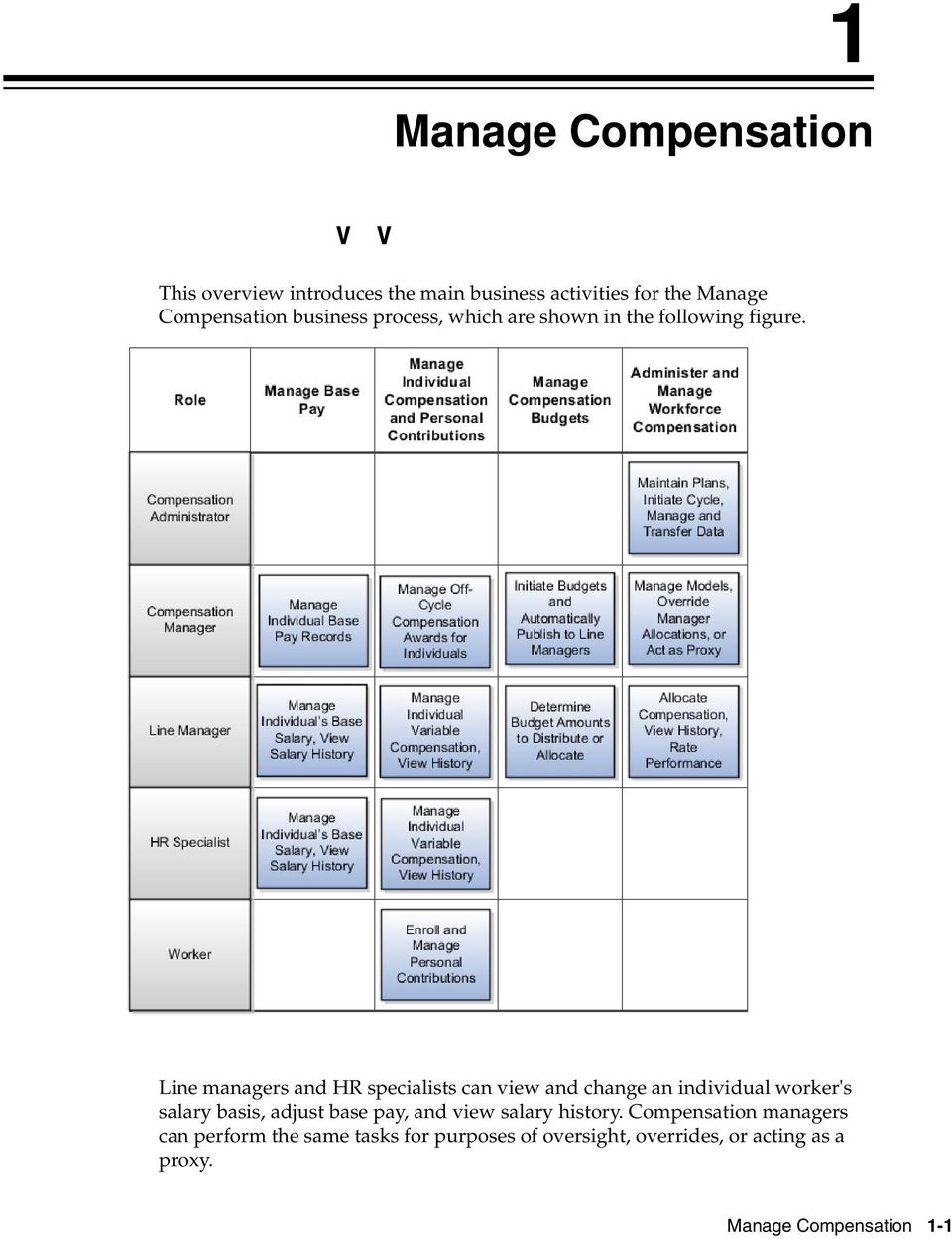
10 Manage Individual Compensation Line managers and HR specialists can view, allocate, and adjust individual ad-hoc variable compensation awards or recurring payments, and view compensation history. Compensation managers can perform the same tasks for purposes of oversight, overrides, or acting as a proxy. Manage Personal Contributions Workers can manage their own enrollment and voluntary contributions in company-sponsored savings and charitable contribution plans. Manage Compensation Budgets Compensation managers ensure that manager allocations stay within defined budget amounts by initiating and publishing budgets to line managers, who distribute budgets down the reporting hierarchy or allocate budget amounts at the worker level. Administer Workforce Compensation Compensation administrators can run processes to initiate a compensation cycle, refresh HR data, and transfer data to workers' HR records. They can also maintain plan configuration for new and current plan cycles. Compensation managers can manage and override worker information and allocations as well as analyze the results of compensation cycles using administrative reports. Manage Workforce Compensation Line managers can allocate one or more types of compensation manually or automatically for groups of workers on a focal, anniversary, or periodic basis, and approve allocations of lower level managers. While awarding compensation, they can promote and rate worker performance and view compensation history. To manage compensation in the Manage Compensation business process, start from the following work areas: Role Compensation Administrator Work Area Setup and Maintenance Select Navigator - Setup and Maintenance. Compensation Select Navigator - Compensation. Compensation Manager Compensation Select Navigator - Compensation. Workforce Compensation Select Navigator - Workforce Compensation. Line Manager Manager Resources Dashboard Select Navigator - Manager Resources. Workforce Compensation Select Navigator - Workforce Compensation. Person Gallery Select Navigator - Person Gallery. 1-2 Oracle Fusion Applications Compensation Management, Compensation Guide

11 HR Specialist Person Management Select Navigator - Person Management. Person Gallery Worker Select Navigator - Person Gallery. My Portrait Select Navigator - My Portrait Manage Compensation 1-3

12 1-4 Oracle Fusion Applications Compensation Management, Compensation Guide

13 2 Manage Base Pay Manage Base Pay: Overview View and adjust workers' base salary. Line managers can award compensation in a variety of business flows and work areas. Compensation managers and HR specialists can perform the same tasks for administrative, oversight, and troubleshooting purposes. They can: View a worker's salary basis and change it, subject to security and other constraints. Adjust base pay by adjusting amount, percentage, compa-ratio, or other salary factors. View salary history, as well as graphical analysis of current and new salary. To manage base pay, start from the following work areas: Role Line Manager Work Area Manager Resources Dashboard Select Navigator - Manager Resources. Person Gallery Compensation Manager HR Specialist Select Navigator - Person Gallery. Compensation Select Navigator - Compensation. Person Management Select Navigator - Person Management. Person Gallery Select Navigator - Person Gallery. Manage Base Pay 2-1

14 FAQs for Manage Base Pay What's a salary basis? The salary basis determines the period in which base pay is expressed, specifies whether salaries can be itemized with components, and identifies any associated grade rate for salary validation. A worker's salary basis generally remains constant. However, if a worker is promoted from an individual contributor to a manager, the salary basis might require change from hourly to annual. Or a union contract amendment might mandate itemizing a worker's pay rate, requiring change from an hourly salary basis that does not use components to an hourly salary basis that uses components. 2-2 Oracle Fusion Applications Compensation Management, Compensation Guide
15 3 Manage Individual Compensation Manage Individual Compensation: Overview Award variable compensation to individual workers outside of the regular compensation cycle, such as a spot bonus, education reimbursement, or car allowance. Line managers can award compensation in a variety of business flows and work areas. Compensation managers and HR specialists can perform the same tasks for administrative, oversight, and troubleshooting purposes. They can: Award ad hoc bonuses, allowances, and other compensation. Initiate and update recurring payments. View a worker's compensation history to help determine if an award is deserved and to view past award amounts. To manage Individual compensation, start from the following work areas: Role Line Manager Work Area Manager Resources Dashboard Select Navigator - Manager Resources. Person Gallery Compensation Manager HR Specialist Select Navigator - Person Gallery. Compensation Select Navigator - Compensation. Person Management Select Navigator - Person Management. Person Gallery Select Navigator - Person Gallery. Manage Individual Compensation 3-1

16 3-2 Oracle Fusion Applications Compensation Management, Compensation Guide

17 4 Manage Personal Contributions Manage Personal Contributions: Overview Manage your own enrollment and voluntary contributions in companysponsored savings and charitable contribution plans. To manage personal contributions, start from the My Portrait page. Select Navigator - My Portrait. Manage Personal Contributions 4-1
18 4-2 Oracle Fusion Applications Compensation Management, Compensation Guide

19 5 Manage Workforce Compensation Manage Workforce Compensation: Overview Managers allocate one or more types of compensation manually or automatically for a group of workers on a focal, anniversary, or periodic basis. Compensation administrators process and transfer approved data to workers' HR records. Line managers perform the following tasks, which compensation managers can also perform for oversight, to override, and to act as a proxy. Allocate compensation. Promote and rate worker performance while allocating compensation. Determine compensation amounts offline by downloading details to a spreadsheet. Use a model to automatically calculate and allocate compensation to workers based on selected criteria. Generate company-configured compensation change statements to notify workers of a compensation award, job change, or performance rating assignment. Analyze proposed changes for equity among peer groups and by manager, alignment with the market, and pay for performance strategies. Review and approve work of subordinate manager. To manage workforce compensation, start from the following work areas: Role Line Manager Compensation Manager Work Area Workforce Compensation Select Navigator - Workforce Compensation. Workforce Compensation Select Navigator - Workforce Compensation. Compensation Select Navigator - Compensation. Manage Workforce Compensation 5-1

20 Compensation Administrator Compensation Select Navigator - Compensation. Using Advanced Filters: Worked Example This example demonstrates how to create custom conditions that you can use to filter your worksheet. The following table summarizes key decisions for this scenario: Decision to Consider What workers do you want to see on the worksheet? In This Example Workers whose performance rating is outstanding and whose compa-ratio is less than 80 or whose bonus allocation is less than the bonus target. Create a custom condition and apply it to filter workers on the worksheet. Creating a New Custom Filter 1. In the Workforce Compensation work area, select a plan. 2. In the worksheet task bar click the Edit Advanced Filters icon to open the Edit Advanced Filters page. 3. Click the Add Row icon. 4. In the new row click the Edit icon to open the Edit Condition window. 5. In the Edit Condition window click the Start Building a Condition button. 6. In the Edit Condition window complete the fields as shown in this table. Click Next after each selection. Field Select a Column Select an Operation Enter a Value Select an Operation Select a Column Select an Operation Value Compensation Performance Rating Equals Outstanding And Enter a Number 80 Select an Operation Select a Column Select an Operation Current Compa-Ratio Is less than Or Bonus Amount Is less than 7. Click the Switch to Column Variable button. 5-2 Oracle Fusion Applications Compensation Management, Compensation Guide

21 8. In the Select a Column field select Bonus Target Amount. 9. Click Next. 10. Click Done. 11. Click Apply. 12. In the Name field enter a unique filter name. 13. Click Save and Close. Applying the Filter to a Worksheet 1. In the worksheet filters bar select the filter that you created in the Advanced field. 2. Click the Go icon. 3. View your filtered worksheet. FAQs for Manage Workforce Compensation How can I reassign workers to another manager's worksheet? Use the Assign Workers to Another Manager option on the Actions menu or the right-click menu to transfer one or more workers for this cycle only. Then select the manager to whom you want to reassign the workers and specify how subordinates are reassigned if the workers are managers. For example, you can reassign a worker to his previous manager's worksheet because the worker reported to that manager during the period being evaluated. What happens when I filter my worksheet by two or more teams? The information displayed in the summary table dynamically changes to show only the values for the teams you select. When you further filter the worksheet, such as filter by job, the budget information does not change. It continues to display the budget information associated with the managers you selected in the team filter. What happens if I switch the display currency? Salary adjustments and lump sum awards are processed in the worker's local currency. Switching the currency on the page is for display purposes only. What happens if I approve my lower manager's worksheet? The lower manager's access level is changed to Approved and the worksheet goes to the next level for approval. Lower managers can no longer make updates to their worksheets Manage Workforce Compensation 5-3
22 5-4 Oracle Fusion Applications Compensation Management, Compensation Guide
23 6 Manage Compensation Budgets Manage Compensation Budgets: Overview Keep compensation awards in line with the company's financial goals and targets by ensuring manager allocations stay within defined budget amounts. Compensation managers can: Publish budgets to line managers to distribute budgets down the reporting hierarchy or to allocate budget amounts at the worker level. With administrative budgeting, enable managers to award compensation within their allocated budget amounts by automatically publishing budget amounts. Line managers can: Manually calculate budget amounts or automatically determine budget amounts using a model. Determine budget amounts offline by downloading budget details to a spreadsheet. To manage compensation budgets, start from the following work areas: Role Line Manager Compensation Manager Work Area Workforce Compensation Select Navigator - Workforce Compensation. Workforce Compensation Select Navigator - Workforce Compensation. Compensation Select Navigator - Compensation. Budget Publishing: Points to Consider If you use manager-level budgeting and have at least one lower-level manager, you publish your budget to your managers who then continue to push the Manage Compensation Budgets 6-1
24 budget down the hierarchy or allocate compensation to their managers or workers. If you want to make changes after publishing, you must withdraw or republish the budget. Publish, withdraw, or republish your budget by one of two methods: Publish budget to all managers Publish budget to selected managers Publish Budget to All Managers All managers receive their own budgets to manage. If they have lower level managers, they publish the budget to their managers. If they do not have reporting managers, they allocate compensation directly to their workers. Publish Budget to Selected Managers Only the managers you select receive a budget. The selected managers manage their own budgets. You can use this method along with publishing to all managers. For example, publish a portion of your budget to one manager now and then publish the remaining budget to all managers at a later time. Initiating Budgets: Points to Consider You can distribute initial budgets for one or more managers in the hierarchy. You can initiate a budget by three methods: Initiate budgets manually Initiate budgets automatically by running the Start Compensation Cycle process Use a model to distribute budgets Initiating Budgets Manually You can initiate budgets manually on the Budget Pools page by switching to the manager whose budget you want to initiate and clicking the Adjust Budgets button. You can initiate budgets manually for a selected manager using the Adjust Budgets dialog box on the Budget Pools page. You can initiate budgets for the first time or adjust budgets previously initiated budgets. The budget amount can be a flat amount or a percentage of total eligible salaries. The selected manager receives the budget amount you initiated or modified. Running the Start Compensation Cycle Process When you create a budget pool you can choose to automatically publish budgets. The Start Compensation Cycle process automatically distributes budget amounts or budget percentages based on the default values you configured on the Detail Table tab or the Worker List tab on the Configure Budget Page Layout page. If you chose manager level budgeting for the budget pool, the Start Compensation Cycle process automatically distributes budget amounts to all managers with at least one lower level manager under them. The budget distribution amount or budget distribution percentage you configured on the 6-2 Oracle Fusion Applications Compensation Management, Compensation Guide
25 detail tab populates in all budgets. Managers can immediately begin allocating compensation to their workers If you chose worker level budgeting for the budget pool, the start compensation cycle process automatically distributes at the worker level. The budget amount or budget percentage you configured on the worker list tab populates for each worker. Manager level budgets are calculated from the sum of the individual worker budgets. Using a Model to Distribute Budgets You can build a global model or use an existing model to distribute budget amounts for the first time based on the model criteria. After you preview the model results you apply the results to the budget amounts on your budget sheet. Allocation Methods: Critical Choices The allocation method determines how a model calculates budget or compensation amounts and target amounts or ranges for a given worker population. It influences how you apply the model results. The allocation methods available depend upon how the plan is set up. The allocation method you select lets you model amounts by: Bringing workers up to a specific compa-ratio or quartile Supplying a numeric or text value to a custom column Supplying a target range or percentage Allocating by a specified amount or percent Increasing by a specified amount or percent Bringing Workers Up to a Specific Compa-Ratio or Quartile Increase all workers' budget or compensation amounts by specific criteria. For example, bring all workers in the US whose compa-ratio is less less than 80 to a compa-ratio of 100, or bring all workers in the UK in the Operations department to the third quartile. Supplying a Numeric or Text Value to a Custom Column Enter a numeric or text value in a specific custom column. For example, in custom numeric column 16 renamed to Corporate Modifier, display.02 for all workers in the US with a target of 80 percent or higher and.05 for all workers in Canada with target of 80 percent or higher. Or, in custom text column 1 renamed to Sanity Check, display Verify Salary for all workers whose performance rating is high and whose compa-ratio is less than 80. Supplying a Target Range or Percentage Define a target range using a flat amount or percentage. For example, define a target bonus range of 3,000 to 5,000 USD for workers in the US who have a job title of Analyst and a grade of 3. Manage Compensation Budgets 6-3
26 Allocate By a Specified Amount or Percentage Allocate compensation by a flat amount or percentage. For example, allocate all workers in the US with an outstanding performance rating a bonus of 5,000 USD and employees in the UK with an average performance rating a bonus of 2,500 GBP. Increase By a Specified Amount or Percentage Increase already allocated amounts by a flat amount or percentage of eligible salary. For example, give all workers in France an additional one percent of eligible salary on top of the compensation already allocated to them. To decrease a budget, enter a negative number or percentage. Selecting Budget Funding Level for Global Models: Points to Consider When you use a model to distribute budgets to your managers, you must specify the level of management to which the budget amounts apply. You can fund budgets by one of three methods: Fund budgets for top managers Fund budgets for managers one level down Fund budgets for all managers Funding Budgets for Top Managers Distribute budgets to only top level managers who have no manager above them. Funding Budgets for Managers One Level Down Distribute budgets to managers one level away from the highest manager in the hierarchy. Funding Budgets for All Managers Distribute budgets to all managers. Applying Model Results: Points to Consider After you create a model and preview model results you apply the results to the worksheet or budget sheet. Apply model results in one of four ways: Apply as budget amounts Apply as compensation amounts on the worksheet Apply to target amounts 6-4 Oracle Fusion Applications Compensation Management, Compensation Guide
27 Apply to target ranges Apply as Budget Amounts or Compensation Amounts Replace the existing budget or compensation amounts in the worksheet or budget sheet with the model budget or compensation amounts You increase the existing amounts if you use one of the following allocation methods: Note Increase amount by n percent Increase n amount per person Increase n percent of eligible salary These three methods must be enabled during setup. Apply as Target Amounts or Target Ranges You select an allocation method to supply a target range amount or percentage. For example, you can create a model to determine budget target ranges based on length of service and performance rating for an annual bonus plan. You enter different ranges for workers who meet different combinations of length of service and performance rating. When you apply the model, managers can use the target ranges as a guideline when determining allocation amounts for their workers. Creating Compensation Models: Worked Example This example demonstrates how to create and preview a compensation model that allocates a percentage of eligible salary based on job title and performance rating, exclude one worker from the model, and apply the results to the budget sheet or worksheet. The following table summarizes key decisions for this scenario. Decisions to Consider What allocation method will you use to calculate the results of the model? What criteria will you use to select the worker population? How will you distribute allocations based on the criteria? In This Example Allocate a percentage of the eligible salary Job title and performance rating For managers, allocate 4% for those with a performance rating of 2 and 8% for those with a performance rating of 3 For analysts, allocate 3% for those with a performance rating of 2 and 6% for those with a performance rating of 3 Will you exclude any workers? No allocations for those with a performance rating of 1 Exclude one worker who is on loan to another department Manage Compensation Budgets 6-5
28 Who can access the model? Limit model access to the model creator Create and preview a compensation model. Apply the model to the worksheet or budget sheet. Prerequisites 1. Enable performance ratings 2. Set up the following rating scales: Rating 1 equals Below Expectation Rating 2 equals Meets Expectations Rating 3 equals Exceeds Expectations Creating and Previewing a Model 1. In the Workforce Compensation work area, select a plan or budget sheet. Or, click Model Compensation. 2. On the budget sheet or worksheet, select Create Model from the Model menu. On the Manage Compensation Models page click Create. 3. In the Create Model window enter a model name and select a plan and component, as available. 4. Click Continue. 5. On the Create Compensation Model page enter the fields as shown in this table. Field Allocation Method Model Access Criteria 1 Criteria 2 Value Allocate n percent of eligible salary Limit model access to model creator Job Title Performance Rating 6. Click Build Model. 7. Click the Workers Included icon. 8. On the Select Workers page, deselect the first worker in the Include column. 9. Click Done. 10. In the Percentage of Eligible Salary column, enter the fields as shown in this table. Selection Criteria Manager, Rating 1 0 Manager, Rating 2 4 Percentage of Eligible Salary Value 6-6 Oracle Fusion Applications Compensation Management, Compensation Guide
29 Manager, Rating 3 8 Analyst, Rating 1 0 Analyst, Rating 2 3 Analyst, Rating 3 6 Applying Model Results 11. Click Preview Model Results. 12. On the Preview Model page view the model results. 1. Click Apply Results. 2. Select Budget Amounts. 3. View results on the budget sheet or worksheet. The New Budget Distribution Amount column displays the new values. Manage Compensation Budgets 6-7
30 6-8 Oracle Fusion Applications Compensation Management, Compensation Guide
31 7 Administer Workforce Compensation Administer Workforce Compensation: Overview Maintain the definitions of compensation plans and global models, maintain and update worker and plan information, run processes and review administration reports. Compensation administrators can: Update plan data. Maintain currency rates and access to plans from the watchlist. Run processes to initiate a compensation cycle, transfer data to the HR system, and refresh HR data. Compensation managers can: Create and manage models for use by line managers or by administrators to distribute compensation directly to workers. Manage worker data by changing assignment data effective for the current plan cycle only. Override line manager allocations, job changes, and performance ratings. Analyze plan results. To administer workforce compensation, select Navigator - Compensation. Manage Worker Information Reprocessing or Adding a Worker to a Plan After the Compensation Cycle Starts: Examples You can reprocess an individual who was previously found eligible or ineligible and reevaluate eligibility for a plan. You can add to a plan a worker who was not originally found eligible. The following scenarios illustrate when you might want to reprocess or add a worker to a plan after the compensation cycle starts. Administer Workforce Compensation 7-1
32 Worker Transfers Into an Organization Maria transfers into your organization after the compensation cycle starts and might be eligible to receive compensation. Her eligibility for the plan and cycle is evaluated based on the plan and cycle you select. If the process finds Maria eligible for the compensation plan, it adds her to the appropriate manager's worksheet. Worker's Data is Corrected in HR Incorrect data in Michael's employment record causes him to be found ineligible for a compensation plan. HR corrects the data after the compensation cycle starts. When you reprocess Michael, the process reevaluates his eligibility based on the corrected data. If it finds Michael eligible, it adds him to the appropriate manager's worksheet. Worker Leaves an Organization Janice is eligible for compensation when a cycle starts. A week later, she leaves your organization and is no longer eligible for a compensation award. When you reprocess Janice, the process reevaluates her eligibility, finds her ineligible, and removes Janice from her manager's worksheet. Contingent Worker Becomes a Regular Worker Ravi, a contingent worker, is not eligible to receive compensation when a cycle starts, but manages workers who are eligible. At this time his processing status is Limited, which allows him only to allocate compensation and approve lower managers' worksheets. A few weeks later, Ravi becomes a regular worker and is now eligible to receive compensation. When you reprocess Ravi, the process reevaluates his eligibility and finds him eligible. Ravi's eligibility status changes to Eligible and the process adds him to the appropriate manager's worksheet. FAQs for Manage Worker Information What's a Limited to Normal processing method? When a person is not eligible for a plan but has at least one subordinate worker who is eligible, the person's eligibility is Limited. The person can manage budgets and allocate compensation but not receive compensation within the plan. If the person becomes eligible for the plan after a cycle starts, you can add the person at that time. The processing method is called Limited to Normal. The person's eligibility changes from having limited participation in the plan to having full participation. The person is added to a manager's worksheet and can be allocated compensation. Manage Compensation Plans Workforce Compensation Setup: Critical Choices While designing your compensation plan, you make important choices, such as plan access, components, alerts, worksheet and budget sheet display, and models and reports. 7-2 Oracle Fusion Applications Compensation Management, Compensation Guide
33 The configuration options that you can enable are grouped into the following categories: Plan foundation Budgeting Worksheet Models and reports Plan Foundation Plan foundation configuration options are: Plan currency If you have global plans in which workers are paid in different currencies you can enable currency switching. Managers can view data in a preferred currency, each worker's local currency, or in the corporate currency. Plan access You can override the general access given to compensation administrator and compensation manager roles and limit who can access a plan from the line manager or administrative work areas to only those roles that you select. Compensation administrators have access to all plan configuration tasks for all plans. Compensation managers have access to the budget sheet and worksheets for all plans and worker administration tasks Feedback survey Budgeting You can ask managers up to five survey questions and allow them the opportunity to rate the overall compensation process when they submit their worksheets. If you use budgeting, you can have separate budgets for each component or link multiple components to a single budget. You can also link budgets to off-cycle compensation plans. For example, you can give a manager a single annual budget amount and draw both focal and off-cycle awards from the same budget pool. Once you enable budgeting, you configure how data displays on the budget page, such as data display order, available menu actions, and text instructions to the managers. Also, you can copy a budget page layout from another plan. Worksheet Worksheet configuration options are: Components Plans must have at least one component. You can create up to five components to represent the different types of compensation that you want to award within a plan. They can be the same type; for example, salary components such as merit and cost of living adjustments. Or they can be different types; for example, bonuses and stock options. Administer Workforce Compensation 7-3
34 Note Performance ratings If you use performance ratings while allocating compensation you can display the latest ratings to the managers during the compensation cycle. You can allow managers to enter performance ratings during the compensation cycle to be used only in the compensation plan. Also, you can make performance ratings and documents completed in Oracle Fusion Performance Management available to managers from the worksheet. Compensation change statements You can create templates that managers use to generate compensation change statements for workers. You specify when statements can be generated and in what file format. You can enable statement groups to make different sets of statements available for different plans or plan periods. For example, you might create three templates containing the same message but in three different languages. You create a template group, add the three templates, and add the statement group to a plan. Alerts You can alert managers of conditions on the worksheet, such as allocations that exceed target amounts, or worksheet data that is not in sync with HR data. You can also create custom alerts based on conditions you define using worksheet columns. If you are using HCM Coexistence between Oracle PeopleSoft Human Resources and Oracle Fusion Workforce Compensation, do not enable the leave of absence alert. Worksheet display You determine the number and types of tabs to display in the worksheet, columns displayed on each tab, the order in which they display, available menu actions, and text instructions to the managers. You can import the entire worksheet configuration from another plan and then modify it for use in a new plan. Models and Reports Models and reports configuration options are: Models Modeling enables managers to automatically allocate compensation to workers who meet certain criteria. You can enable modeling for managers and administrators, restrict modeling only to administrators, or disable it altogether. If modeling is enabled for managers, you can decide if they can create their own models or use only those created by compensation professionals. You decide how to apply the model results to the worksheet. You decide how to apply model results. The model 7-4 Oracle Fusion Applications Compensation Management, Compensation Guide
35 can be applied as budget amounts, as target amounts or ranges, or as compensation amounts. Reports You can enable a set of analytics for managers to use when allocating compensation. Reports are not configurable. Report dimensions Reports use dimensions to group data. Models use dimensions as the criteria to build a model. If you enable reports or modeling you select the dimensions and range increments to use. You can create custom dimensions by configuring the custom columns available to models and reports. Employment Records to Use: Points to Consider The type of employment record selected for a plan determines the employment records evaluated by the start compensation cycle process and which records are used during the compensation cycle. Determine the record to use by selecting one of the four options: Primary assignments All assignments Employment terms Any assignment or employment term with a salary Primary Assignments The start compensation cycle process includes and evaluates eligibility for primary assignments only. Even if a worker has multiple assignments, the worker only appears on the worksheet of the manager for the primary assignment. This is true if the plan uses a manager hierarchy. All Assignments The start compensation cycle process includes and evaluates eligibility for all assignments. If a worker has multiple assignments, the worker may appear on one manager's worksheet more than once. Or, if the manager on each assignment is different, the worker may appear on multiple managers' worksheets. Employment Terms The start compensation process includes and evaluates eligibility for employment terms of legal employers that use the three-tier employment model. If the plan uses a manager hierarchy, workers appear on the worksheet of the manager of the primary assignment. Workers whose legal employer uses a twotier employment model are not evaluated. Any Assignment or Employment Term with a Salary The start compensation process includes and evaluates eligibility for all assignments with a salary record and employment terms with a salary record. Administer Workforce Compensation 7-5
36 If the plan uses a manager hierarchy, workers appear on the worksheet of the manager of the primary assignment. If a worker has multiple assignments with a salary record, the worker may appear on one manager's worksheet more than once with a different base salary for each assignment. Or if the manager on each assignment is different, the worker may appear on multiple managers' worksheets with different salaries for each. Assignments and employment terms that do not have a salary record associated with it are not evaluated. Workforce Compensation Hierarchy Types: Points to Consider The hierarchy determines how approvals are routed to the highest level approver. The same hierarchy also determines how budgets are pushed down the organization when using manager level budgeting, or how budgets roll up when using worker level budgeting. It also determines the workers that appear on each manager's worksheet. Determine the hierarchy by one of the three options: Approvals management structure Manager hierarchy Formula Approvals Management Structure A set of approval relationships and rules used by the Approvals Management Structure determines the hierarchy. Manager Hierarchy The supervisor associated with the worker's employment record determines the hierarchy. Formula A custom hierarchy created using a formula determines the hierarchy. Compensation Hierarchy Determination Formula Type The Compensation Hierarchy Determination formula determines the hierarchy for an associated workforce compensation plan. You select the formula on the Configure Plan Details page. Contexts The following contexts are available to formulas of this type: EFFECTIVE_DATE HR_ASSIGNMENT_ID Database Items Database items are not available to formulas of this type. 7-6 Oracle Fusion Applications Compensation Management, Compensation Guide
37 Input Variables The following input variables are available to formulas of this type. Input Data Type Required Description CMP_IV_ASSIGNMENT_IDNumber Y Assignment ID CMP_IV_PLAN_ID Number Y Plan ID CMP_IV_PERIOD_ID Number Y Period ID CMP_IV_PLAN_START_DATE Date Y Plan Start Date CMP_IV_PLAN_END_DATEDate Y Plan End Date Return Values Use predefined names for return variables. The following return variables are available to formulas of this type. Return Value Data Type Required Description L_PERSON_ID Number Y Person ID of manager L_ASSIGNMENT_ID Number Y Assignment ID of manager Sample Formula This sample formula determines the manager of a person when the assignment_id is passed. /******************************************************************* FORMULA NAME : Compensation Hierarchy Determination Formula FORMULA TYPE : Compensation Hierarchy Determination DESCRIPTION : Hierarchy determination fast formula which is based on assignment_id *******************************************************************/ /*=========== INPUT VALUES DEFAULTS BEGIN =====================*/ INPUTS ARE CMP_IV_ASSIGNMENT_ID (number), CMP_IV_PLAN_ID (number), CMP_IV_PERIOD_ID (number) /*=========== INPUT VALUES DEFAULTS ENDS======================*/ /*================ FORMULA SECTION BEGIN =======================*/ DEFAULT FOR CMP_IV_ASSIGNMENT_ID IS 0 L_PERSON_ID = '0' L_ASSIGNMENT_ID = '0' if ( CMP_IV_ASSIGNMENT_ID = ) THEN ( L_PERSON_ID = to_char(-999) //-999 indicates top level //Manager. L_ASSIGNMENT_ID = to_char(-999) ) ELSE ( L_PERSON_ID = to_char( ) L_ASSIGNMENT_ID = to_char( ) ) Administer Workforce Compensation 7-7
38 RETURN L_PERSON_ID, L_ASSIGNMENT_ID /*================ FORMULA SECTION END =======================*/ Workforce Compensation Components, Salary Components, and Action Reasons: Explained Every time you do a compensation transaction you need to identify a reason, whether it is when allocating compensation for a workforce or awarding compensation on an off-cycle basis. Three ways of identifying the type or reason for compensation allocations are: Compensation action and reason Workforce compensation components Salary components Compensation Actions and Reasons When you set up a workforce compensation plan, you must select an action and optional action reason that are associated with all salary and assignment records when you transfer data to HR after the cycle is complete. Managers can also select action reasons for individual workers when they allocate compensation or promote. For example, you might have a plan where managers allocate merit increases only. The action for the plan could be Allocate Workforce Compensation. The action reason could be Merit. When the batch process updates salary records after the compensation cycle is over, the Allocate Workforce Compensation action and Merit action reason appears in the worker's compensation history for that salary record. One action and ten action reasons are provided to use with workforce compensation plans. You can extend this list to add additional actions and reasons. The Action provided is Allocate Workforce Compensation. Action reasons provided are: Anniversary Career Progression Cost of Living Adjustment Market Adjustment Mass Adjustment Merit Outstanding Performance Performance Periodic Review Promotion 7-8 Oracle Fusion Applications Compensation Management, Compensation Guide
39 Workforce Compensation Components A workforce compensation plan must have at least one component. Components represent compensation being awarded in the plan. Components can be the same type of compensation, such as Salary - Merit, Salary - Cost of Living Adjustment, or Merit - Market Adjustment. Components can also be different types of compensation within the same plan, such as Merit, Bonus, and Stock. You determine how each component is processed when configuring the column properties for the compensation amount columns. Workforce compensation components that capture salary adjustments are posted as salary. You can associate each workforce compensation component with specific salary components if more than one will post as salary. For example, you might have a plan where managers allocate Merit and Market Adjustments at the same time. Merit and Market Adjustments are the names of the components set up for the workforce compensation plan. These names are informational only. When you update worker salary records with their new salaries, you want to retain individual amounts allocated for each component. For the Merit component, you associate the Merit salary component. For the Market Adjustment component, you associate the Market salary component. For example, a manager might allocate compensation in this way. Component Percentage Amount Merit 5 $5,000 Market 1 $1,000 Total Adjustment 6 $6,000 When the process runs to transfer approved salary adjustments to worker salary records, it can post the individual components, therefore storing the 5 percent and 1 percent adjustments to the Merit and Market components, or it can post just the total salary adjustment of $6,000. Salary Components The salary basis attached to a worker's employment record determines if the worker's salary uses salary components. Salary components enable managers to itemize salary adjustments made into different reasons. For example, a manager might determine a worker's salary adjustment in this way. Component Percentage Amount Merit 5 $5,000 Cost of Living Adjustment 2 $2,000 Market 1 $1,000 Total Adjustment 8 $8,000 The worker's salary history will show an adjustment of $8,000 but the salary record will store the itemization of that 8 percent into the components shown. The salary transaction also has an action and optional action reason associated Administer Workforce Compensation 7-9
40 with it. If you adjust the salary while promoting the worker or if the worker is relocated, for example, the action may be Transfer or Relocation and the action reason would be the same. If a compensation or HR specialist adjusts the worker's salary, the action reason could be Change Salary and the reason could be Adjustment. You can edit the predefined components or add components to the Salary Component lookup type at any time. Salary Component Lookups: Explained Salary components itemize new or adjusted salary into one or more components that reflect different reasons for the allocation. You can edit or add components to the Salary Component lookup type during initial implementation and at any later time. The following salary components are predefined: Merit Cost of Living Adjustment: General adjustment Market: Adjustment due to salary being out of line with the market Structured: Adjustment dictated by union or employment contract, such as an increase after three months Equity: Adjustment to correct salary compression or inversion Promotion Location Progression: Regular and automatic adjustment To add or edit these codes in the CMP_SALARY_COMPONENTS lookup type, start in the Setup and Maintenance work area and search for lookup tasks. Plan Statuses: Explained Plan status identifies the state of the plan and any plan cycles already started or completed. The two plan statuses are: Active Inactive Active Plan Status The plan is available for use and you can start a plan cycle. Line managers can access the plan from the workforce compensation work area at any time during the period that worksheet is available to managers. Compensation managers can access the plan from the administration work area to view plan data even after the data is transferred to HR Oracle Fusion Applications Compensation Management, Compensation Guide
41 Inactive Plan Status The plan is no longer available for use and is not available to view or update. Compensation administrators can change the status back to Active from the Configure Plan Details page. Use this status to create and test plans, or for obsolete plans. Only plans with this status can be purged from the system. Initiating Budgets: Points to Consider You can distribute initial budgets for one or more managers in the hierarchy. You can initiate a budget by three methods: Initiate budgets manually Initiate budgets automatically by running the Start Compensation Cycle process Use a model to distribute budgets Initiating Budgets Manually You can initiate budgets manually on the Budget Pools page by switching to the manager whose budget you want to initiate and clicking the Adjust Budgets button. You can initiate budgets manually for a selected manager using the Adjust Budgets dialog box on the Budget Pools page. You can initiate budgets for the first time or adjust budgets previously initiated budgets. The budget amount can be a flat amount or a percentage of total eligible salaries. The selected manager receives the budget amount you initiated or modified. Running the Start Compensation Cycle Process When you create a budget pool you can choose to automatically publish budgets. The Start Compensation Cycle process automatically distributes budget amounts or budget percentages based on the default values you configured on the Detail Table tab or the Worker List tab on the Configure Budget Page Layout page. If you chose manager level budgeting for the budget pool, the Start Compensation Cycle process automatically distributes budget amounts to all managers with at least one lower level manager under them. The budget distribution amount or budget distribution percentage you configured on the detail tab populates in all budgets. Managers can immediately begin allocating compensation to their workers If you chose worker level budgeting for the budget pool, the start compensation cycle process automatically distributes at the worker level. The budget amount or budget percentage you configured on the worker list tab populates for each worker. Manager level budgets are calculated from the sum of the individual worker budgets. Using a Model to Distribute Budgets You can build a global model or use an existing model to distribute budget amounts for the first time based on the model criteria. After you preview the model results you apply the results to the budget amounts on your budget sheet. Administer Workforce Compensation 7-11
42 Local Currency Determination: Points to Consider If you have global plans in which workers are paid in different currencies, you must select how each worker's local currency is determined for each component. Corporate currency Element input currency Legal employer currency Salary basis currency Formula Corporate Currency The corporate currency defined for the plan determines the local currency. Element Input Currency The input currency of the payroll element mapped to the component determines the local currency. Legal Employer Currency The currency defined by the worker's legal employer determines the local currency. Salary Basis Currency The payroll element associated with the salary basis definition linked to the worker's employment record determines the local currency. Formula A formula you create to retrieve the currency from some other source determines the local currency. Compensation Currency Selection Formula Type The Compensation Currency Selection formula determines the currency associated with a workforce compensation component. You select the formula on the Configure Compensation Components page. Contexts The following contexts are available to formulas of this type: EFFECTIVE_DATE HR_ASSIGNMENT_ID Database Items Database items are not available to formulas of this type Oracle Fusion Applications Compensation Management, Compensation Guide
43 Input Variables The following input variables are available to formulas of this type. Input Data Type Required Description CMP_IV_PLAN_ID Number Y Plan ID CMP_IV_ASSIGNMENT_IDNumber Y Assignment ID CMP_IV_PERIOD_ID Number Y Period ID CMP_IV_COMPONENT_IDNumber Y Component ID CMP_IV_PLAN_START_DATE Date Y Plan Start Date CMP_IV_PLAN_END_DATEDate Y Plan End Date Return Values Use predefined names for return variables. The following return variables are available to formulas of this type. Return Value Data Type Required Description L_CURR_CODE Char N Currency code from the formula Sample Formula This sample formula determines if a person is selected for a plan based on their assignment_id. /******************************************************************* FORMULA NAME : Compensation Currency Selection Formula FORMULA TYPE : Compensation Currency Selection DESCRIPTION : It returns the currency code based on component_id. *******************************************************************/ /*=========== INPUT VALUES DEFAULTS BEGIN =====================*/ INPUTS ARE CMP_IV_ASSIGNMENT_ID (number), CMP_IV_PLAN_ID (number), CMP_IV_PERIOD_ID (number), CMP_IV_COMPONENT_ID (number) /*=========== INPUT VALUES DEFAULTS ENDS======================*/ /*================ FORMULA SECTION BEGIN =======================*/ DEFAULT FOR CMP_IV_COMPONENT_ID IS 0 l_curr_code = 'XXX' IF (CMP_IV_COMPONENT_ID = 489) THEN ( l_curr_code = 'USD' ) ELSE IF (CMP_IV_COMPONENT_ID = 490) THEN ( l_curr_code = 'GBP' ) RETURN l_curr_code /*================ FORMULA SECTION END =======================*/ Administer Workforce Compensation 7-13
44 Performance Ratings: Points to Consider If you consider performance ratings when allocating compensation you can display ratings from Oracle Fusion Performance Management or rate workers during a workforce compensation cycle. You can use performance ratings in the worksheet in the following ways: Display Performance Management ratings Rate workers within compensation Use both Performance Management ratings and compensation ratings Display Performance Management Ratings If you integrate with Performance Management, you can display performance ratings given in the performance management system and provide access to the full performance document from within the worksheet. You select the performance document template and performance period to make available, and whether to display only completed ratings or ratings in any status. The performance template is not required. You also have the option to select midyear or final ratings. Rate Workers Within Compensation Managers can rate workers as they allocate compensation. These ratings are used only within the current compensation plan and cycle. The ratings are not transferred to the performance management system. When you set up a plan, you can select a rating model to use, or you can navigate to the Manage Rating Model page to edit an existing rating model or create a new one. You can also decide how managers rate performance, either by selecting the rating from a list of values or by designating the number of stars to represent the worker's rating. Use Both Performance Management Ratings and Compensation Ratings You can choose to display both Performance Management ratings and compensation ratings in the worksheet. For example, if you gave Performance Management ratings several months before the compensation cycle starts you might want managers to reassess their worker' performance to ensure that current performance is consistent with past performance. You can set up the plan to display the ratings given in the performance management system and also enable managers to give compensation ratings during the compensation cycle as a point of comparison. Configuring Approvals: Critical Choices The hierarchy type defined for the plan determines the approvals hierarchy. You can create an alternate approval hierarchy for a manager that overrides the plan hierarchy if you want approvals to occur in a different sequence or by different people. You also specify the timing when managers can submit their worksheets for approval and when they can approve their lower managers' worksheets. Choices to make when configuring approvals are: Approval mode 7-14 Oracle Fusion Applications Compensation Management, Compensation Guide
45 Submit mode Alternate approver hierarchy Approval Mode Approval mode identifies when managers can approve their lower managers' worksheets. The first option, Approve anytime, allows managers to approve their lower managers' worksheets at any time during the period the worksheet is available to them. The second option, Manager must first submit, means that lower level managers must submit their worksheets upward for approval before a higher level manager can approve them. This ensures that higher managers do not approve worksheets before lower managers have had time to complete them. Submit Mode Submit mode identifies when managers can submit their worksheets. The first option, Submit anytime, allows managers to submit their worksheets at any time during the period the worksheet is available to them. The second option, All managers must be approved, means that all lower level managers' worksheets must be approved before a higher level manager can submit his own worksheet for approval. This ensures that higher managers review and approve allocations of lower managers before submitting allocations for their entire organization for approval. Alternate Approver Hierarchy By defining alternate approvers, you replace the standard approval hierarchy for a manager with a new set or sequence of approvers. The alternate approver does not have to be a part of the regular plan hierarchy. You can create multiple approvers for the same manager by identifying the specific individuals and using the approval sequence to determine the order in which approvals occur. The highest sequence is the final approver. Alternate hierarchies are commonly used when approval control transitions from managers to the HR department. Creating Custom Alerts: Worked Example This example demonstrates how to create a custom alert that displays a warning on the worksheet when a manager allocates a bonus amount that is more than the recommended bonus amount. The following table summarizes key decisions for this scenario. Decisions to Consider What worksheet actions do you want to trigger the alert? What type of alert do you want to display? In This Example Manager allocates a bonus amount that is more than the recommended bonus amount. Warning Creating the Custom Alert 1. On the Configure Alerts page, Custom Alerts region, click the Add icon. Administer Workforce Compensation 7-15
46 2. In the new row complete the fields as shown in this table. Field Name Type Description Value Bonus exceeds maximum recommended amount Warning You allocated more than the recommended bonus amount 3. Click the Define Condition that Displays Alert on Worksheet icon. 4. On the Edit Condition window, Basic tab, click Build Condition. 5. Complete the fields as shown in this table. Field Column Operation Value Bonus Amount Is greater than 6. Click Switch to Column. 7. Select Bonus Target Amount. 8. Click Done. 9. Click Validate. This step is optional. 10. Click OK in the confirmation. 11. Click Apply. Testing the Custom Alert 1. Click the Test Custom Alert Condition icon. 2. On the Test Condition window complete the fields as shown in this table. Field Value Bonus Amount 5000 Bonus Target Amount Click Test. 4. Verify that the results are as expected in the Review Results window and click Done. Worksheet Tab Types: Explained Tab types control the display of information on a worksheet page, which consists of one or more tabs. The information on each tab varies by the tab type. You can define up to 10 tabs for each worksheet. Commonly used columns are enabled by default for each tab type to make implementation easier Oracle Fusion Applications Compensation Management, Compensation Guide
47 You can display the same set of columns in the details region of any tab type, except for the approvals and communicate tab types. The compensation, performance, and promotions tab types have summary tables and graphs specific to the focus of the tab. However, you can also give performance ratings and promotions on the compensation tab type and make compensation allocations on the performance and promotion tab type when you want to combine tasks into a single tab. The detail table columns are organized into these groups: Group Name Personal Alerts Employment Salary Information Component 1 through 5 Promotion Performance Custom Columns Information Displayed Worker personal information such as name, address, assignment manager and country. Alerts to notify managers of situations that need attention. Assignment or employment term details such as their hire date, work location, working hours, manager name, job, grade, and person number. Base pay information such as the current salary, annualized full-time salary, current compa-ratio, current quartile, and more. Information that is specific to a component such as eligible salary, compensation amount, percentage of eligible salary, units, target amounts, and effective date. You can configure up to five components for a plan. The same set of columns is available for each component. Information related to job, grade or position changes given during the compensation cycle such as new job, new grade, new position, new salary range minimum, midpoint, and maximum, and promotion effective date. Performance ratings given in Oracle Fusion Performance Management or given during the current or previous compensation cycle such as overall performance rating, calculated goal rating, worker potential and risk of loss. Any type of information you can configure. Use custom columns 1-15 to display text. Use columns to display numeric data. Use columns to create custom lists from which managers can select a value. When you set up the plan, you enable the tab types that are relevant to what managers do during the compensation cycle. Worksheet tab types are: Compensation Approvals Communicate Performance Promotions Administer Workforce Compensation 7-17
48 Detail table only Compensation Tab Type You use this tab to manage and allocate compensation. It contains a summary table that displays high-level information about each component in the plan. For each component in the plan, the summary region can display the number of eligible and ineligible workers, allocation totals, and budget totals. You can choose to sum the data for all components within the plan in the summary region. However, if the components use different units of measure the totals will be inaccurate. You can expand the summary region for each component to view analytics providing a snapshot of allocations in the current cycle. Approvals Tab Type This tab is included only in the worksheets for managers with at least one lower level manager. Higher managers use it to view the status of lower manager's worksheets, approve or reject submitted worksheets, or request additional information. You can enable up to seven additional subtabs that display summarized information for each lower manager. This table describes the subtabs and what they display. Subtab Approvals Compensation Overview Allocation Statistics Salary Range Analysis Target Analysis Promotions Performance Alerts Displays All lower level managers and the status of their worksheets. This subtab is always enabled when the approvals type tab is enabled. The number of workers awarded compensation during the cycle, the total amount allocated, and the total available budget. The total, average, minimum, and maximum allocations as well as the averages by compa-ratio, salary range position, and quartile. Comparison of the average current and new comparatio and salary range position by manager. Allocations compared to defined targets and target ranges. The number of workers whose job, grade or position was changed during the compensation cycle. The number of workers given each performance rating. Shows all the alerts currently triggered and allows managers to view the affected workers. Communicate Tab Type You use this tab to generate compensation statements for workers to notify them of their new or adjusted compensation, performance rating, or promotion. Performance Tab Type You use this tab to give new performance ratings, or view existing performance ratings given either during a previous workforce compensation cycle or in Oracle Fusion Performance Management. The summary displays the number 7-18 Oracle Fusion Applications Compensation Management, Compensation Guide
49 and percentage of workers for each rating as well as the target distribution if one is defined for the rating model used. Promotions Tab Type You use this tab to view and update the job, grade, or position. The summary displays information and graphs showing the number of jobs, grades, and positions changed. Detail Table Only Tab Type This tab displays only the detail table without any summary information. You can use it when summarized information is not appropriate. For example, you could set up a plan to capture information from managers or distribute data to managers where compensation is not allocated, performance ratings are not used, and promotions are not given. Worksheet Tab Types: Examples You can use the worksheet tab types to display a variety of information depending on what tab type you include in the worksheet and what columns you enable. The following scenarios illustrate how you can use the tab types to design different compensation plans. Using Two Compensation Type Tabs to Allocate Merit and Stock Awards You create a plan that allows managers to award merit adjustments and stock during the same compensation cycle. You enable two compensation type tabs, the first one labeled Merit Adjustments and the other Stock Awards. You enable columns on the Merit Adjustments tab that include information necessary for managers to make informed salary decisions, such as current base pay, eligible salary, current and new compa-ratio, quartile, salary range low, and salary range high. You enable the merit adjustment amount column on this tab so managers can enter adjustment amounts. The Stock Awards tab includes columns such as job, length of service, or any company-specific measures or calculations that affect a manager's stock allocation decision. You enable the stock amount column on this tab. Using One Compensation Type Tab to Allocate Merit and Bonus Awards, View Performance Ratings, and Promote You create a plan that allows managers to award merit adjustments and bonuses, as well as promote workers, during the same compensation cycle. You enable one compensation type tab to allocate merit and bonuses and label it Compensation Awards. On this tab, you enable columns that include information necessary for managers to make informed salary decisions, such as current base pay, eligible salary, current and new compa-ratio, quartile, salary range low, salary range high, and performance rating, as well as columns that contain information needed to allocate stock. You also enable both the merit adjustment amount and the stock amount columns on this tab. To support promotions, you enable the job, new job, grade, and new grade columns so that managers can see their workers' current jobs and grades and promote workers to a new job or grade. Administer Workforce Compensation 7-19
50 Using the Performance Type Tab, Promotion Type Tab, And Compensation Type Tab to Rate Performance, Promote, and Allocate Merit You create a plan that allows managers to rate worker performance, promote workers by changing their job, grade, or position, and award merit increases during the same compensation cycle. You enable a performance type tab and label it Rate Performance. You enable columns related to a worker's performance such as their length of service, job, grade, last rating date, last rating, and a column to enter their new performance rating. Note Performance ratings that you enter during a compensation cycle are used only within the compensation process and are not used outside the compensation tool. Then, you enable a promotion type tab and label it Promote Workers. You enable columns that help managers promote workers, such as time in grade, time in job, performance rating, potential, current job, current grade, current position, new job, new grade, and new position. Finally, you enable a compensation type tab and label it Allocate Compensation. You enable the columns that include information necessary for managers to make informed salary decisions, such as eligible salary, current base salary, new base salary, current and new compa-ratio, quartile, salary range low, and salary range high. You also enable the merit adjustment amount and merit adjustment percentage columns. Configuring Column Properties: Points to Consider Use the Configure Column Properties dialog box to configure a column's properties. You can configure column properties for the summary and detail table columns on the Configure Worksheet Page Layout page and for the summary, detail table, and worker list columns on the Configure Budget Page Layout page. The number of tabs that appear on the dialog box vary depending on the column you are configuring. The tabs are: General Default Values Element Mapping Information General Tab The options available on the General tab vary depending on the type of column you are configuring and the selections you make on the tab. They control the display and storage of data. The values that may display are: 7-20 Oracle Fusion Applications Compensation Management, Compensation Guide
51 Data Type Rounding Rule Decimals to Display Show Numeric Separators Monetary Read-Only Initially Hidden Hide the column on the worksheet. Managers can add the hidden column to their worksheets by using the View menu. Include in Audit Trail Include changes made to this column in the audit trail. Value Remains Unchanged The percentages stored in certain columns are to remain static and not change even when the corresponding amount changes. Lookup Type Display the related lookup type for the list value. This is available for custom list columns only. Display Total for All Components Display a total for all components in the summary section of the worksheet. This is available for numeric columns in the summary tab only. Default Values Tab On the Default Values tab, you can specify settings that control default values displayed in the column. The values populate the column on the worksheet when you run the Start Compensation Cycle process or when you refresh the column defaults. You can select to refresh the default column value when the Refresh Data process runs. Configuring default values is optional. Values available are: Default Value Enter an initial, specific value for a column. Default and Override Formula Override any existing values and display values using the Compensation Default and Override formula type. Compensation Derived Factor Display values using a compensation derived factor. Cross Reference Fields Administer Workforce Compensation 7-21
52 For certain columns you have the option to cross reference data from other columns and plans. Element Mapping Tab When you configure compensation component columns you need to identify how to transfer approved compensation awards to HR. You use the Element Mapping tab to post the award as an adjustment to base pay or as a lump sum payment using the Compensation Amount column for the component. You use the Element Mapping tab to post the award as an adjustment to base pay or as a lump sum payment for the component. Adjustment to Base Pay If the compensation component is an adjustment to base pay you select Yes for Post as Salary. Each worker's salary record is updated with the amount stored in the column. If you want the current salary adjustment to be posted as an itemized adjustment, you can optionally select a salary component in the Salary Component to use. This creates a salary component record in each worker's main salary record. For example, you have a plan with two salary components - Merit Pay and COLA - where a worker receives a $5,000 allocation for Merit Pay and a $1,500 allocation for COLA. You want both of these components to increase the worker's base pay amount and you want to retain the breakdown of the amount for each component. When you configure the Compensation Amount columns for the Merit Pay and COLA components, you map the Merit Pay plan component to the Merit Salary component and the COLA plan component to the COLA salary component. When data is transferred to HR, the worker's salary record displays a total salary increase of $6,500 as a result of a Merit adjustment for $5,000 and a COLA adjustment for $1,500. You can modify the list of salary components available using the CMP_SALARY_COMPONENT lookup type. Lump Sum Payment If the compensation component is a lump sum payment, you select No for Post as Salary. You add the payroll elements to use to pay the compensation award. You can add multiple payroll elements to accommodate payments in different currencies and for workers in different legislative data groups. Information Tab You can use the Information tab to provide managers additional information or details about the data displayed in any column. The text appears when managers hover over a help icon that appears after the column heading in the summary or detailed table section of the worksheet. You can type up to 300 characters for each column. Eligible Salary Column: Explained You must configure the Eligible Salary column for each component for the plan when you use or display percentage columns or when you configure a budget 7-22 Oracle Fusion Applications Compensation Management, Compensation Guide
53 pool to store budgets as percentages. Many calculations use eligible salary, such as the allocation percentage, target percentage, and worker budget percentages. Eligible salary may simply be equal to each worker's current base pay, or it may be prorated based on various factors. You can define eligible salary when you configure the column properties by selecting a fast formula or derived factor on the Default Values tab. Or you can use dynamic calculations to determine each worker's eligible salary. Varying Worksheet Column Results: Points to Consider You can use fast formulas and dynamic columns to vary column results on the worksheet. The best method depends on the data you use, the complexity of the calculation, and the timing of the refresh data process. Using Fast Formulas Fast formulas use any data in Oracle Fusion applications to determine column results. You can create simple to complex formulas that require multiple compound conditions or multiple database records. Calculations are evaluated when the compensation cycle is started for the first time, or when you refresh column defaults. Using Dynamic Columns Dynamic columns use other columns to determine column results. You can create simple "if then" expressions or build a few compound conditions. Calculations can be immediate, such as when a manager tabs out of a column. To refresh the column results you can refresh column defaults or fully refresh all the worksheet and plan data. Numeric Properties in Models: Explained When you configure numeric columns you determine whether to use numeric separators, how to round numbers, and how many decimal places display. Numeric Properties When you use the columns in models these three numeric properties vary depending on from where you open the model. Model Region Where Model Opened Numeric Properties Source Model Summary Budget Sheet Configure Budget Page Layout Summary Tab, Define Column Properties dialog box Model Summary Worksheet Configure Worksheet Page Layout Summary Tab, Define Column Properties dialog box Model Detail Table Anywhere Configure Worksheet Page Layout Detail Tab, Define Column Properties dialog box Administer Workforce Compensation 7-23
54 Cross Referencing Data Between Plans: Points to Consider When you need to see data combined from multiple plans in one plan, you can create a single reporting plan and cross reference data for certain columns from other compensation plans. The referenced data is available in the new plan immediately after the worksheet is saved in the originating plan. When you set up a new plan, you configure the column properties for the worksheet columns. If the type of column is available to cross reference, then you can specify the following default values: Cross reference plan Cycle matching Column to cross reference Cross Reference Plan All active plans are available to be cross referenced, even plans with no started cycles. You can also reference a plan within itself to display values from a previous plan cycle in a subsequent cycle. For example, you can display a target amount or custom score from a previous plan cycle in the current plan cycle so that managers are aware of that data when making a current compensation decision. You cannot select a default value for a column by cross-referencing a column from another plan if you have selected values for the Default Value, Default and Override Formula, or Compensation Derived Factor fields on the Configure Column Properties dialog box. Cycle Matching You select which cycle to use to obtain the reference data by specifying the cycle to match. Cycle matching uses information only for cycles that were started. Cycle matching values are: Same Cycle Extract Date Match the HR Data Extraction Date of the current plan's cycle to find the cross reference plan's cycle. Same Cycle Display Name Match the exact same display name of the current plan's cycle to find the cross reference plan's cycle. Previous Cycle Extract Date Compare the current plan's HR Data Extraction Date to the most recent extract date from the cross reference plan. The extract date from the cross reference plan must be earlier than the current plan's date. You can use this to reference data from cycle to cycle with the same plan, for example, to bring in values from last year's bonus cycle Oracle Fusion Applications Compensation Management, Compensation Guide
55 Latest Cycle Extract Date Obtain the latest extract date from the cross reference plan without regard to the current plan's extract date. You can use this in a total compensation plan that is always available and automatically clears once the new cycles are run. Columns to Cross Reference You can cross reference most columns in the cross reference plan. The type of columns you cannot cross reference are: Promotion columns Performance Management columns Iconic columns HR data columns Percentage columns Columns that are cross referenced from another plan Cross Referencing Data Between Plans: Examples The following examples illustrate when to cross reference data between compensation plans. Example 1 You create a salary plan and a bonus plan. You want managers to have a total compensation view when awarding from either plan even if they are not open concurrently. In the bonus plan you reference the New Salary or Salary Change Amount column. Then, in the salary plan you reference the Bonus Amount column. Example 2 Your company wants to create a single compensation change statement that includes compensation awarded from multiple plans. You can create a compensation statement plan, reference all the compensation awarded from each of the different plans into the compensation statement plan, and generate worker statements from the single plan. Each worker receives only one compensation statement. Allocating Compensation by Percentage of Budget Amount: Points to Consider You can enable managers to allocate compensation as a percentage of the budget pool as an alternative to allocating compensation as a percentage of eligible salary or a flat amount. If you allocate compensation as a percentage of a budget pool, you need to disable the eligible salary column for the component linked to the budget pool. You should also disable modeling allocation methods that use Administer Workforce Compensation 7-25
56 eligible salary, as well as understand how rounding rules can affect summary values. Disable Eligible Salary Columns and Allocation Method The eligible salary columns and allocation method are enabled by default. If you enable the Percentage of Budget column for any component, you must disable the following: Percentage of Eligible Salary columns on the Detail tab for any given component Total Eligible Salaries and Percentage of Total Eligible Salaries columns on the Summary tab n Percentage of Eligible Salary allocation method, if you use modeling. Rounding Rules The rounding rule set for the corresponding Component Amount column affects the amount calculated for the Percentage of Budget column. For example, if the overall budget is $900 and the rounding rule set for the Component Amount column is Round to the nearest 10, the following calculations take place when managers enter 4 in the Percentage of Budget column. Column Calculated Amount Amount After Rounding Component Amount (4 / 100) * 900 = When the rounded amount is used to calculate the percentage of budget it produces a different result than without the rounding. Column With Rounding Without Rounding Percentage of Budget 40 / 900 = / 900 = 4 Automatically Ranking Workers: Points to Consider If you are ranking more than just your direct reports, you can automatically rank workers from highest rank to lowest rank using one of three methods: Rank workers based on their ranking score Rank workers based on their ranking percentile Copy direct managers' rankings Regardless of the method you choose to automatically rank, it is possible that automatic ranking could result in multiple workers having the same rank. You choose whether to handle ties by retaining the ties or by arbitrarily resolving them. How you handle ties can change the ranking results for any of the three automatic ranking methods Oracle Fusion Applications Compensation Management, Compensation Guide
57 Rank Workers Based on Their Ranking Score The ranking score considers the rankings of all managers who ranked the worker, who are in the viewing manager's organization. A worker's ranking score varies according to the manager viewing the score. It also considers each manager's position in the hierarchy, giving more weight to the ranking of higher level managers since the worker is ranked against a larger population of workers. This table compares the different ranking results for the same scores when you retain the ties or arbitrarily resolve the ties. Worker Score Retain Ties Arbitrarily Resolve Ties Maria Rahul Maya Janice Carlos Michael Yan Rank Workers Based on Their Ranking Percentile The ranking percentile considers the ranking given by a worker's direct manager when ranking at least ten workers. It places workers in order from highest to lowest within a range of 0 to 100. It is calculated as (rank / population * 100) = percentile. Note The population is the total number of workers ranked by the direct manager. For example, if the worker is ranked five out of 27 workers ranked by the direct manager, the percentile is 82, derived from the calculation (5 / 27 * 100). Worker Percentile Retain Ties Arbitrarily Resolve Ties Maria Rahul Maya Janice Carlos Michael Yan Copy Direct Managers' Rankings Rankings given by each worker's worksheet manager are used exactly as given. Multiple workers can have the same ranking. Ranking values need not be Administer Workforce Compensation 7-27
58 consecutive. Managers can choose to give the same ranking to multiple workers or can choose to leave gaps in the ranking. This table compares the different tie handling results for a manager viewing the rankings that managers in his organization gave to their direct reports. Direct Manager Worker Direct Manager's Ranking Copy Direct Manager's Ranking Retain Ties Lakshmi Maria Lakshmi Rahul Lakshmi Maya Lakshmi Janice Barry Carlos Barry Michael Barry Yan Barry Prasad Arbitrarily Resolve Ties Ranking Score: How It Is Calculated The ranking score is a calculated value from 0 to 100 for each worker who has at least one ranking. It considers the rankings of all managers who ranked the worker, who are in the viewing manager's organization. A worker's ranking score varies according to the manager viewing the score. It also considers each manager's position in the hierarchy, giving more weight to the ranking of higher level managers since the worker is ranked against a larger population of workers. The scores are whole numbers only. Conditions That Affect the Ranking Score There are three conditions that affect the ranking score. The ranking given by each manager The viewer's position in the hierarchy The number of other workers ranked. Ranking score is only calculated when there are at least 10 total workers ranked. How the Ranking Score Is Calculated The ranking score is derived using this formula: Following is the description of the variables in the equation: 7-28 Oracle Fusion Applications Compensation Management, Compensation Guide
59 Group Population: Includes all ranked workers reporting directly or indirectly to the manager viewing the score. The group population must include at least 10 workers for a score to be calculated. Ranking: The position value given to a worker. It must be a positive, whole number from 1 to N. 1: Added to the numerator to ensure that workers ranked 1 by all managers will receive a score of 100. (Group Population - Ranking + 1): Summed for the manager looking at the score and all lower managers who ranked the worker. Example 1 John views the rankings for a worker who reports directly to Peter. John ranked the worker 299 out of 2200 and Peter ranked the worker a 1 out of his 7 workers ranked. Manager Worker's Ranking Workers Ranked Group Population - Ranking + 1 John Susan Henry Nancy Peter Sum not applicable The ranking score of the worker John is viewing is 86, derived from the calculation (100 * 2534) / Example 2 Nancy views the same worker (who reports to Peter) as John, in example 1. Manager Worker's Ranking Workers Ranked Group Population - Ranking + 1 Nancy Peter Sum not applicable The ranking score of the worker Nancy is viewing changes to 91, derived from the calculation (100*30) / 33. Example 3 Nancy views the same worker (who reports to Peter), with the same ranking as in the previous examples, but with a smaller number of workers ranked in Nancy's organization. Note that the worker's ranking score is 82 in the smaller organization (example 3) and 91 in the larger organization (example 2). These examples illustrate that the same ranking results in a higher ranking score when the higher level manager has a larger population of workers ranked. Administer Workforce Compensation 7-29
60 Manager Worker's Ranking Workers Ranked Group Population - Ranking + 1 Nancy Peter Sum not applicable The ranking score of the worker Nancy is viewing is 82, derived from the calculation (100*14) / 17. Compensation Default and Override Formula Type The Compensation Default and Override formula determines the default values populated in a column for a workforce compensation plan. You select the formula when you configure the worksheet display for a column using the Default Values tab on the Define Column Properties window. Contexts The following contexts are available to formulas of this type: EFFECTIVE_DATE HR_ASSIGNMENT_ID PAYROLL_ASSIGNMENT_ID DATE_EARNED JOB_ID HR_TERM_ID Database Items Database items are not available to formulas of this type. Input Variables The following input variables are available to formulas of this type. Input Data Type Required Description CMP_IV_PLAN_ID Number Y Plan ID CMP_IV_PERIOD_ID Number Y Period ID CMP_IV_COMPONENT_IDNumber Y Component ID CMP_IV_ITEM_NAME Char Y Item Name CMP_IV_PERSON_ID Number Y Person ID CMP_IV_PLAN_START_DATE Date Y Plan Start Date CMP_IV_PLAN_END_DATEDate Y Plan End Date Return Values Use predefined names for return variables. The following return variables are available to formulas of this type Oracle Fusion Applications Compensation Management, Compensation Guide
61 Return Value Data Type Required Description L_DEFAULT_VALUE Number/Char/Date Y Default value from the formula L_DATA_TYPE Char Y Data type of the column Sample Formula This sample formula determines if a person is selected for a plan based on their assignment_id. /******************************************************************* FORMULA NAME : Compensation Default and Override Formula FORMULA TYPE : Compensation Default and Override DESCRIPTION : Defaults the value of a column based on its item_name. *******************************************************************/ /*=========== INPUT VALUES DEFAULTS BEGIN =====================*/ INPUTS ARE CMP_IV_PLAN_ID (number), CMP_IV_PERIOD_ID (number), CMP_IV_COMPONENT_ID (number), CMP_IV_ITEM_NAME (text) /*=========== INPUT VALUES DEFAULTS ENDS======================*/ /*================ FORMULA SECTION BEGIN =======================*/ DEFAULT FOR CMP_IV_ITEM_NAME IS 'YYYYYYY' L_DEFAULT_VALUE = to_char(0) L_DATA_TYPE = 'NONETYPE' //Valid L_DATA_TYPE values can be - //NUMBER, CHAR, DATE. IF (CMP_IV_ITEM_NAME = 'AmountComp1') THEN ( L_DATA_TYPE = 'NUMBER' L_DEFAULT_VALUE = to_char(3333) ) ELSE IF (CMP_IV_ITEM_NAME = 'AmountComp2') THEN ( L_DATA_TYPE = 'NUMBER' L_DEFAULT_VALUE = to_char(7777) ) ELSE ( L_DATA_TYPE = 'NONETYPE' L_DEFAULT_VALUE = to_char(-999) ) RETURN L_DATA_TYPE, L_DEFAULT_VALUE /*================ FORMULA SECTION END =======================*/ Dynamic Calculations : Explained Dynamic calculations are conditional statements, or expressions, that you use to calculate and display values that vary by worker or to change the value of one column based on the value of another. You build a condition by selecting worksheet columns, operators, and values, or by manually creating the condition. When you use the Basic tab, the system Administer Workforce Compensation 7-31
62 guides you through the creation of conditions or column results. Alternatively, you can create expressions free-hand using the Advanced tab. The aspects of dynamic calculations are: Evaluation order Triggering events Default expression Evaluation Order You enter an evaluation order to identify the order in which multiple dynamic columns are calculated when the results of one column is used in the condition or results of another. For example, you can define a Total Cash Compensation column that displays the sum of an automatically calculated COLA adjustment and a managerentered merit adjustment. Define a dynamic column for the COLA adjustment for all workers that varies the adjustment by each worker's location and grade. Give this dynamic expression an evaluation order of 1. Give the Total Cash Compensation column an evaluation order of 2 so the application evaluates the COLA adjustment first and then uses that amount to display the Total Cash Compensation for each worker. Triggering Events Triggering events are actions that determine when dynamic calculations are evaluated. Events that trigger evaluation or recalculation of dynamic columns are: Triggering Event Start compensation cycle Refresh data Change worker data Description and Usage When you run the Start Compensation Cycle, the application evaluates the column conditions and calculates the results. For example, you might select this trigger to calculate eligible salaries used during the cycle. When you run the Refresh Data process, you can reevaluate all dynamic calculations, fast formulas, or HR data used in dynamic calculations. When a manager enters or changes data on the worksheet and tabs out of the cell, the application reevaluates the condition and corresponding results. Because this trigger might slow the application performance, do not use it if the column result does not depend on data that might be changed in the worksheet. Default Expression The default expression is the one to use when no other conditions are met Oracle Fusion Applications Compensation Management, Compensation Guide
63 A condition must be met for the calculation to be performed. The system evaluates every condition in sequence order. If no result is met then the system uses the default condition. If you do not select a default expression and no conditions are met, the column displays no values. The default expression must be the highest sequence number because it is only applied after all other conditions are evaluated and determined not have been met. Using Dynamic Calculations: Examples Use these scenarios to understand how to use dynamic calculations to calculate and display a value or change the value of one column based on the value of another. Using Dynamic Calculations to Define Eligible Salary You are setting up the annual compensation plan. You want to base the bonus eligible salary on the current annual salary. Using dynamic calculations, you create an expression that moves the current annual salary amount into the Bonus Eligible Salary column when you start the compensation cycle. Using Dynamic Calculations to Define Targets As part of the annual bonus review you want to display bonus target amounts on the worksheet for managers to consider during allocations. Your company uses performance ratings and you want to use the ratings as the basis for the targets. Using dynamic calculations, you create expressions that vary the Bonus Target Amount by performance ratings. For example, if performance rating is Outstanding, then Bonus Target Amount equals 10 percent of Bonus Eligible Salary. Using One Column's Results in Another Expression At your company managers can rate workers performance as part of the annual compensation cycle. As you set up the compensation plan you want to make sure that performance ratings are used as a basis for determining salary increase targets. For example, high performers have a target of 10 percent of eligible salary where average performers have a target of 5 percent of eligible salary. Using dynamic calculations, you create an expression for the Merit Eligible Salary and give it an Evaluation Order of 1. Then, you create another expression that defines the Target Compensation Percentage as a percentage of Merit Eligible Salary for each different performance rating and give it an Evaluation Order of 2. The application evaluates the Merit Eligible Salary first, and then uses it to calculate the Target Compensation Percentage. Creating Dynamic Calculations: Worked Example This example demonstrates how to create a dynamic column for an annual bonus plan that rewards high performing workers. The following table summarizes key decisions for this scenario. Decisions to Consider What events do you want to trigger the calculation? In This Example Start Compensation Cycle and Refresh Data. Administer Workforce Compensation 7-33
64 What conditions do you want evaluated? Performance Ratings of 5 (Outstanding) and 4 (Exceeds Expectations) Which column on the worksheet do you want to dynamically calculate? What results do you want to see for the dynamic column? Compensation Amount column for the Bonus component A bonus of ten percent of annual salary for workers with a rating of 5. A bonus of five percent of annual salary for workers with a rating of 4. All others receive 0 Prerequisites Create a dynamic calculation, build three expressions, and test the dynamic calculation. 1. Enable the Compensation Amount column for the Bonus component. 2. Enable performance ratings. 3. Set up a rating scale from 1 to 5, where 5 equals Outstanding and 4 equals Exceeds Expectations. Creating the Dynamic Calculation 1. On the Detail Table tab of the Configure Worksheet Page Layout page click the Dynamic Columns icon for the Compensation Amount column. 2. On the Manage Dynamic Calculations page select Start compensation cycle and Refresh data triggering events. 3. Click the Add icon to create the first expression. 4. Enter 1 for the Sequence. 5. Click the Create or Edit Expression icon for the Condition. Building the First Expression 1. On the Edit Condition window, click Build Condition. 2. On the Basic tab complete the fields as shown in this table. Field Column Operation Fixed Value 5 Value Performance Rating Contains 3. Click Done. 4. Click Validate. This step is optional. 5. Click OK in the confirmation. 6. Click Apply. 7. On the Manage Dynamic Calculations page click the Create or Edit Expression icon for Column Results for the expression you just created. 8. On the Basic tab of the Edit Column Results window select Equation Oracle Fusion Applications Compensation Management, Compensation Guide
65 9. Click Switch to Column. 10. Compete the fields as shown in this table. Click Next between steps. Field Value Column Annualized Full-Time Salary - Current Operation Multiplied by Fixed Value Click Done. 12. Click Apply. Building the Second Expression 1. On the Manage Dynamic Calculations page click Add icon to create the second expression. 2. On the Edit Condition window, click Build Condition. 3. On the Basic tab complete the fields as shown in this table. Field Column Operation Fixed Value 4 Value Performance Rating Contains 4. Click Done. 5. Click Apply. 6. On the Manage Dynamic Calculations page click the Create or Edit Expression icon for Column Results for the expression you just created. 7. On the Basic tab of the Edit Column Results window select Equation. 8. Click Switch to Column. 9. Compete the fields as shown in this table. Click Next between steps. Field Column Operation Value Fixed Value 0.05 Annualized Full-Time Salary - Current Multiplied by 10. Click Done. 11. Click Apply. Building the Third Expression 1. On the Manage Dynamic Calculations page click the Add icon to create the third expression. 2. Enter 3 for the Sequence. Administer Workforce Compensation 7-35
66 3. Select Default. 4. Click the Create or Edit Expression icon for Column Result for the expression you just created. 5. On the Basic tab of the Edit Condition window enter 0 as the Fixed Value. 6. Click Done. 7. Click Apply. Testing the Dynamic Calculation 1. On the Manage Dynamic Calculations page click the Test Condition and Column Results icon. 2. On the Test Condition window complete the fields as shown in this table. Field Performance Rating 5 Value Annualized Full-Time Salary - Current Click Test. Dimensions: Explained 4. Verify that the results are as expected and click OK in the confirmation. Dimensions are attributes used to group data in reports or as criteria when building models. You can enable the dimensions that have meaning to your organization within the context of the plan. Some examples of delivered dimensions are country, department, years of service, performance management rating, location, job, position, and grade. Aspects of dimensions include: Reporting usage Modeling usage Range increments Reporting Usage Reports use dimensions to group data. For example, you can analyze compensation allocations by country and job to see how average allocations vary. Or, for a given manager's team, you can analyze salaries by performance rating and compa-ratio to verify data or correct pay discrepancies. Modeling Usage Models use dimensions as criteria to build models. For example, when you create a model to automatically allocate salary adjustment amounts you know that a worker's country or location will affect the allocation. You can select Country and Location as modeling criteria to model values for workers who meet each combination of criteria Oracle Fusion Applications Compensation Management, Compensation Guide
67 Range Increments When aggregating data across people, you can define increments to display for the following ranges: Compa-Ratio Salary Range Position Years Employed Performance Management Calculated Overall Rating Performance Management Calculated Goal Rating Performance Management Calculated Competency Rating Graphs and tables do not show a separate data point for each person. Instead, they show people grouped within the increments defined. For example, when using compa-ratio to group data in reports, you might want to see workers grouped in increments of 10 percentage points, meaning that all workers whose compa-ratio falls between 80 and 90 are grouped together. FAQs for Manage Compensation Plans What happens if I include ineligible workers on the worksheet? The worksheet displays ineligible workers but managers cannot allocate compensation, promote or rate worker performance. Managers or administrators can change an ineligible worker's status to eligible. What happens if my eligibility requirements are different for the components than they are for the plan? Plan level eligibility is evaluated before component level eligibility. A worker must be eligible for the plan to be eligible for a component. Each component can have different eligibility requirements. If a worker is found eligible for the plan, the worker might or might not be eligible for one or more components in the plan. What happens if I select Value Remains Unchanged when I configure a column's properties? The percentages stored in the following columns remain static and do not change even when the corresponding amount related to eligible salary or budget pool changes. Compensation Percentage of Eligible Salary Compensation Percentage Maximum Compensation Percentage Minimum Target Percentage Target Percentage Maximum Administer Workforce Compensation 7-37
68 Target Percentage Minimum Worker Budget Percentage Percentage of Budget Pool What's the difference between worksheet manager and alternate approver? A worksheet manager is the worksheet owner responsible for allocating compensation to eligible workers, commonly the supervisor of the workers who appear on the worksheet. An alternate approver is a person defined as an approver of a worksheet. The person may not be part of the standard hierarchy or may be in a different position than in the standard approval hierarchy. The standard approval hierarchy is built using the hierarchy type defined for the plan. Can I change an alternate hierarchy? Yes. You can change the hierarchy of an already defined alternate approver without running the refresh process. But, if you want to add an alternate approver for a new person or delete one for an existing person after the start compensation cycle process has run, then you must refresh the data. Why are some columns already enabled in my new tab? Each tab type includes commonly used columns enabled by default. You can deselect the columns if you do not want them to appear on the worksheet. What's the difference between Basic and Advanced tabs in the Edit or Create Condition Rules window? The Basic tab takes you through a sequence of steps to create a condition and places the columns and operators in the correct position of the expression. On the Advanced tab, you can use the series of steps to create an expression, but you can also manually edit a condition by placing the cursor where you want to insert a column or operator, or create a condition by typing the names of columns and operators. Configure Global Compensation Settings Notifications: Explained You can send notifications when managers perform certain actions. The notifications settings configured here are common to all workforce compensation plans. The aspects of notifications are: Notification options 7-38 Oracle Fusion Applications Compensation Management, Compensation Guide
69 Actions requiring notification Notification Options For each individual action you can set the notification to always be sent, to send only if the initiating manager chooses, or disable the notification altogether. You can use different notification options for different actions. For example, you can choose to always send notifications for all worksheet actions, send notifications for budget actions only if the manager chooses, and never send notifications when the plan access changes. Actions Requiring Notification The person who receives a notification varies depending on the type of action taken. Action Requiring Notification Budget Published Plan Access Changed Worksheet Submitted Worksheet Withdrawn Worksheet Returned for Correction Budget Withdrawn Worksheet Approved by Higher Manager Worksheet Overridden by Higher Manager Final Approval Obtained Who Receives the Notification Worksheet managers who have a budget published to them The worksheet manager whose access is being changed Next person in line to approve the submitting manager's work The higher manager to whom a lower manager submitted the worksheet for approval Worksheet manager whose work is being returned The person to whom a budget was previously published Worksheet manager whose work is approved by a higher level manager who is not the final approver Worksheet manager whose proposals are being overridden All worksheet managers in the hierarchy of the highest level approver FAQs for Configure Global Compensation Settings Why did the default stock details change? More than one administrator might have access to these settings because this stock price and currency information is used to display stock in compensation history as well as when managing workforce compensation or generating total compensation statements. Manage Eligibility Profiles Eligibility Components: How They Work Together You add eligibility criteria to an eligibility profile, and then associate the profile with an object that restricts eligibility. Administer Workforce Compensation 7-39
70 The following figure shows the relationships between eligibility components. Eligibility Criteria You can add different types of eligibility criteria to an eligibility profile. For many common criteria, such as gender or employment status, you can select from a list of predefined criteria values. However, you must create user-defined criteria and derived factors before you can add them to an eligibility profile. Eligibility Profile When you add an eligibility criterion to a profile, you define how to use it to determine eligibility. For example, when you add gender as a criterion, you must specify a gender value (male or female) and whether to include or exclude persons who match that value. Associating the Profile with Objects You can associate an eligibility profile with different kinds of objects: Derived Factors: Explained Associate an eligibility profile with a variable rate or variable coverage profile to establish the criteria required to qualify for that rate or coverage. Associate an eligibility profile with a checklist task to control whether that task appears in an allocated checklist. Associate an eligibility profile with a total compensation statement to apply additional eligibility criteria after statement generation population parameters. Associate one or more eligibility profiles with a benefits or compensation object to establish the eligibility criteria for specific plans and options. Derived factors define how to calculate certain eligibility criteria that change over time, such as a person's age or length of service. You add derived factors 7-40 Oracle Fusion Applications Compensation Management, Compensation Guide
71 to eligibility profiles and then associate the profiles with objects that restrict eligibility. Derived Factor Types You can create six different types of derived factors: age, compensation, length of service, hours worked, full-time equivalent, and a combination of age and length of service. Determination Rules and Other Settings For each factor that you create, you specify one or more rules about how eligibility is determined. For example, the determination rule for an age derived factor specifies the day on which to evaluate the person's calculated age for eligibility. If the determination rule is set to the first of the year, then the person's age as of the first of the year is used to determine eligibility. For the full-time equivalent factor, you specify the minimum and maximum full-time equivalent percentage and whether to use the primary assignment or the sum of all assignments when evaluating eligibility. For example, if the percentage range is 90 to 100 percent for the sum of all assignments, then a person who works 50 percent full-time on two different assignments is considered eligible. Other settings define the unit of measure for time or monetary amounts, rounding rules, and minimums and maximums. Derived Factors: Examples The following scenarios illustrate how to define different types of derived factors: Age Derived Factor Name Benefits administrators frequently use age factors to determine dependent eligibility. You can also use age as a factor when determining life insurance rates. Age factors typically define a range of ages, referred to as age bands, and rules for evaluating the person's age. The following table illustrates a set of age bands that could be used to determine eligibility for life insurance rates that vary based on age. Greater Than or Equal To Age Value Age Under Age 25 to Age 35 to Age 45 to Age 55 to Age 64 or Older Less Than Age Value The determination rule and other settings for each age band are the same: Administer Workforce Compensation 7-41
72 Field Determination Rule Age to Use Units Rounding Value First of calendar year Person's Year None Derived Factor Name Length of Service A derived factor for length of service defines a range of values and rules for calculating an employee's length of service. The following table illustrates a set of length-of-service bands that could be used to determine eligibility for compensation objects such as bonuses or severance pay. Greater Than or Equal To Length of Service Value Service Less Than Service 1 to Service 5 to Service 10 to Service 15 to Service 20 to Service 25 to Service 30 Plus Less Than Length of Service Value The determination rule and other settings for each length-of-service band are the same: Field Period Start Date Rule Determination Rule Age to Use Units Rounding Value Date of hire (This sets the beginning of the period being measured.) End of year (This sets the end of the period being measured.) Person's Year None Derived Factor Name Compensation A derived factor for compensation defines a range of values and rules for calculating an employee's compensation amount. The following table illustrates a set of compensation bands that could be used to determine eligibility for compensation objects such as bonuses or stock options. Greater Than or Equal To Compensation Value Less than ,000 Less Than Compensation Value 7-42 Oracle Fusion Applications Compensation Management, Compensation Guide
73 Salary 20 to ,000 35,000 Salary 35 to ,000 50,000 Salary 50 to ,000 75,000 Salary 75 to , ,000 Salary 100 to , ,000 Salary Plus 200, ,999,999 The determination rule and other settings for each compensation band are the same: Field Determination Rule Unit of Measure Source Rounding Value First of year US Dollar Stated compensation Rounds to nearest hundred Age to Use: Points to Consider The Age to Use value that you select is an important aspect of an age derived factor. This value determines whose birth date is used to calculate the derived age. Selecting Person's Age to Use In most cases, you use the Person's value in the Age to Use field to define an age derived factor for either a participant or dependent eligibility profile. In this case, each person's birth date is used to calculate the age criterion by which eligibility is evaluated for that person. Example For example, if you select Person's as the Age to Use value, and associate the age derived factor with a dependent eligibility profile, each dependent's eligibility is evaluated based on the age calculated from his or her own birth date. Selecting Other Age to Use Values You might select another predefined value in the Age to Use field if you intend to evaluate participant or dependent eligibility or rates based on someone else's age, such as a spouse, child, or other dependent. Note If you choose Inherited Age, the evaluation is based on the date of birth as defined in the person extra information flexfield. Administer Workforce Compensation 7-43
74 Example If you select Person's oldest child as the Age to Use value, and associate this derived factor with a dependent eligibility profile, eligibility for all dependents is evaluated based on the age of the participant's oldest child. Consequently, when the oldest child reaches the maximum age of eligibility, for instance, all dependents become ineligible. User-Defined Criteria: Explained You can define your own criteria to meet any special needs of your organization. For example, if your organization employs deep sea divers and offers different benefits or benefits rates based on how deep they dive, you can create Depth of Diving as a new eligibility criterion. The data for the eligibility criterion must be stored in a table that is accessible to the application. If the data is stored in either the Person or Assignment table, you can select the table and column from a list, and then specify the lookup type used to validate input values. You can also allow a range of valid values if the field stores a numeric value or a date. Note To select the correct values for the column and lookup fields, you must have a basic understanding of the structure of the table that stores the eligibility criterion information. If the data is stored in a table other than the Person or Assignment table, you must first create a formula to retrieve the data from the table, and then set the formula type to User-Defined Criteria. You can define two sets of criteria on the User-Defined Criteria page. The participant must meet the criteria defined in either set to be considered eligible (or to be excluded from eligibility if the Exclude check box is selected when the criteria is added to an eligibility profile). After you have created your user-defined criteria, you can add it to an eligibility profile. User-Defined Criteria: Examples The following scenarios illustrate how to define different types of user-defined criteria. In each example, you must first create the user-defined criteria and then add it to an eligibility profile and set the criteria values to use in the profile. Set Eligibility Based on Custom Attribute A commercial diving company wants to offer different benefit rates to employees who dive to depths greater than 330 feet. This data is stored for each employee in a custom attribute called Dive_Depth in the Person table. To define eligibility 7-44 Oracle Fusion Applications Compensation Management, Compensation Guide
75 based on diving depth, set the following values on the Create or Edit User- Defined Criteria page: Field Table Column Lookup Enable range validation one Value Person Dive_Depth_Attribute Dive_Depth_Validation Selected Field Save the user-defined criteria, and then add it to an eligibility profile. Set the following values on the User-Defined Criteria tab, which is under the Other tab on the Create or Edit Eligibility Profile page: Value Set 1 Meaning 329 Set 1 To Meaning 9999 Exclude Deselected Save the eligibility profile and associate it with a variable rate profile. Exclude Work-at-Home Assignments from Eligibility An employer wants to exclude work-at-home assignment from eligibility for a transportation benefit option. To accomplish this, set the following values on the Create or Edit User-Defined Criteria page: Field Table Column Lookup Enable range validation one Value Assignment Work_at_home YES_NO Deselected Save the user-defined criteria, and then add it to an eligibility profile. Set the following values on the User-Defined Criteria tab: Field Set 1 Meaning Exclude Value Yes Selected Save the eligibility profile and associate it with the transportation benefit option. Use a Formula to Determine Eligibility A company wants to offer a spot incentive bonus to hourly employees who worked 100 percent of their scheduled shift hours in a three month period. To determine eligibility for the bonus, create a formula that calculates scheduled hours less worked hours for each week in the previous three months. If the result Administer Workforce Compensation 7-45
76 of successive calculations is less than or equal to zero, then the formula returns a result of Yes. The first step is to create the formula. Once the formula has been defined, create a user-defined criterion to run the formula. Enter the following values on the Create or Edit User-Defined Criteria page: Field Access One Formula Enable range validation one Value Worked_Sched_Hours_Percent Deselected Save the user-defined criteria, and then add it to an eligibility profile. Set the following values on the User-Defined Criteria tab: Field Set 1 Meaning Exclude Value Yes Deselected Save the eligibility profile and associate it with the bonus compensation object. Note For very complex scenarios, your organization or implementation team can write a custom program to evaluate eligibility, and then create a formula that calls the custom program. Range of Scheduled Hours: Example Field This example illustrates how to define eligibility criteria based on the number of hours an employee is scheduled to work within a specified period of time. Weekly and Monthly Ranges You want to limit eligibility for a benefits offering to employees who were scheduled to work between 30 and 40 hours each week or between each month as of the end of the previous quarter. To do this, add two different ranges on the Range of Scheduled Hours tab, which is under the Employment tab on the Create or Edit Eligibility Profile page. Set the values for the first range as shown in this table: Sequence 1 Minimum Hours 30 Maximum Hours 40 Scheduled Enrollment Periods Determination Rule Value Weekly End of previous quarter Set the values for the second range as shown in this table: 7-46 Oracle Fusion Applications Compensation Management, Compensation Guide
77 Field Value Sequence 2 Minimum Hours 130 Maximum Hours 160 Scheduled Enrollment Periods Monthly Determination Rule End of previous quarter Eligibility Profiles: Explained An eligibility profile defines criteria used to determine whether a person qualifies for a benefits offering, variable rate profile, variable coverage profile, compensation object, checklist task, or other object for which eligibility must be established. The following are key aspects of working with eligibility profiles: Planning and prerequisites Specifying the profile type and usage Defining eligibility criteria Excluding from eligibility Assigning sequence numbers Adding multiple criteria Viewing the criteria hierarchy Planning and Prerequisites Before you create an eligibility profile, consider the following: If an eligibility profile uses derived factors, user-defined formulas, or user-defined criteria to establish eligibility, you must create these items before you create the eligibility profile. If you are defining eligibility criteria for a checklist task, variable rate profile, or variable coverage profile, you must include all criteria in a single eligibility profile, because these objects can be associated with only one eligibility profile. You can, however, associate multiple eligibility profiles with benefits offerings and compensation objects. Eligibility profiles are reusable, so use names that identify the criteria being defined rather than the object with which the profile is associated. For example, use "Age NonSmoker" rather than "Supplemental Life-Min Rate." Specifying Profile Types and Usage When you create an eligibility profile, you specify whether the profile applies to participants or dependents. Use participant profiles to define criteria for Administer Workforce Compensation 7-47
78 employees or ex-employees who are eligible for company-sponsored benefits. Use dependent profiles for participants' spouses, family members, or other individuals who qualify as dependents. Dependent profiles can be associated only with plans and plan types. An eligibility profile's usage determines the type of objects the profile can be associated with. For example, if you set the profile usage to Benefits, the profile is available for selection when you are associating eligibility profiles with benefits objects, such as programs, plans, plan types, options, variable rate profiles, and variable coverage profiles. You can also set the usage to Compensation, Checklist, or Global. Defining Eligibility Criteria Criteria defined in an eligibility profile are divided into categories: Personal: Includes gender, person type, postal code ranges, and other person-specific criteria Employment: Includes assignment status, hourly or salaried, job, grade, and other employment-specific criteria Derived factors: Includes age, compensation, length of service, hours worked, full-time equivalent, and a combination of age and length of service Other: Includes miscellaneous and user-defined criteria Related coverage: Includes criteria based on whether a person is covered by, eligible for, or enrolled in other benefits offerings. Some criteria, such as gender, provide a fixed set of choices. The choices for other criteria, such as person type, are based on values defined in tables. You can define multiple criteria for a given criteria type. Excluding from Eligibility For each eligibility criterion that you add to a profile, you can indicate whether persons who meet the criterion are considered eligible or are excluded from eligibility. For example, an age factor can include persons between 20 and 25 years old or exclude persons over 65. If you exclude certain age bands, then all age bands not explicitly excluded are automatically included. Similarly, if you include certain age bands, then all age bands not explicitly included are automatically excluded. Assigning Sequence Numbers You must assign a sequence number to each criterion. The sequence determines the order in which the criterion is evaluated relative to other criteria of the same type. Adding Multiple Criteria 7-48 Oracle Fusion Applications Compensation Management, Compensation Guide
79 If you define multiple values for the same criteria type, such as two postal code ranges, a person needs to satisfy at least one of the criteria to be considered eligible. For example, a person who resides in either postal range is eligible. If you include multiple criteria of different types, such as gender and age, a person must meet at least one criterion defined for each criteria type. Viewing the Criteria Hierarchy Select the View Hierarchy tab to see a list of all criteria that you have saved for this profile. The list is arranged by criteria type. Combining Eligibility Criteria or Creating Separate Profiles: Points to Consider You can define multiple criteria in an eligibility profile or create separate profiles for individual criterion. To determine the best approach, consider the following: Does the object you are defining eligibility for support multiple eligibility profiles? What is the best approach in terms of efficiency and performance? Support for Multiple Eligibility Profiles If you are defining eligibility criteria for a checklist task, variable rate profile, or variable coverage profile, you must include all criteria in a single eligibility profile, because these objects can be associated with only one eligibility profile. You can, however, associate multiple eligibility profiles with benefits offerings and compensation objects. Efficiency and Performance For optimum performance and efficiency, you should usually attach profiles at the highest possible level in the benefits object hierarchy and avoid duplicating criteria at lower levels. Plan types in program, plans in program, plans, and options in plans inherit the eligibility criteria associated with the program. For example, to be eligible for a benefits plan type, a person must satisfy eligibility profiles defined at the program level and at the plan type in program level. However, it is sometimes faster to create more than one profile and attach the profiles at various levels in the hierarchy. For example, you might exclude employees from eligibility at the program level who do not have an active assignment. At the level of plan type in program, you might exclude employees who do not have a full-time assignment. Finally, at the plan level, you might exclude employees whose primary address is not within a service area you define. Note Eligibility criteria can be used to include or exclude persons from eligibility. Sequencing of criteria is more complicated when you mix included and excluded criteria in the same profile. For ease of implementation, try to keep all excluded criteria in a separate eligibility profile. Administer Workforce Compensation 7-49
80 Creating a Participant Eligibility Profile: Worked Example This example demonstrates how to create a participant eligibility profile used to determine eligibility for variable life insurance rates. The profile includes two eligibility criteria: age and tobacco. Once the eligibility profile is complete, you can associate it with a variable rate profile. The following table summarizes key decisions for this scenario. Decisions to Consider What is the profile type? What type of object is associated with this profile? What types of eligibility criteria are defined in this profile? In this Example Participant Variable rate for benefits offering Age derived factor (must have been previously defined) Uses Tobacco criteria What are the criteria values? Age: Under 30 Should persons meeting these criteria be included or excluded from eligibility? Tobacco Use: None Included The following figure shows the tasks to complete in this example: Note In this example, you create one eligibility profile that defines the requirements for a single variable rate. Typically, you create a set of eligibility profiles, one for each variable rate. When you have completed all steps described in this example, you can repeat them, varying the age and tobacco use criteria, to create a separate profile for each additional rate. Prerequisites 1. Create an age derived factor for ages less than 30. Creating the Eligibility Profile 1. In the Plan Configuration work area, click Manage Eligibility Profiles Oracle Fusion Applications Compensation Management, Compensation Guide
81 2. Click the Create menu, and then click Create Participant Profile. 3. In the Eligibility Profile Definition region of the Create Participant Eligibility Profile page, complete the fields as shown in this table. Use the default values except where indicated. Field Name Profile Usage Description Status Assignment to Use Value Age Under 30+Non-Smoking Benefits Participant, age under 30, non smoker Active Any assignment Adding the Derived Factor for Age 1. In the Eligibility Criteria region, select the Derived Factors tab. 2. On the Age tab, click Create. 3. In the Sequence field, enter In the Age field, select the derived factor that you previously defined for ages under Do not select the Exclude check box. Adding the Criteria for Tobacco Use 1. Select the Personal tab. 2. On the Uses Tobacco tab, click Create. 3. In the Sequence field, enter In the Tobacco Use field, select None. 5. Do not select the Exclude check box. 6. Click Save and Close. Associating the Eligibility Profile with a Variable Rate Profile 1. In the Plan Configuration work area, click Manage Benefits Rates. 2. Select the Variable Rates tab. 3. Click Create. 4. In the Eligibility Profile field, select the eligibility profile you just created. 5. Complete other fields as appropriate for the rate. 6. Click Save and Close. Note You can reuse this eligibility profile by associating it with other objects that restrict eligibility, including benefits offerings, compensation plans, and checklist tasks. Administer Workforce Compensation 7-51
82 Eligibility Profiles: Examples The following examples illustrate scenarios where eligibility profiles are needed and briefly describe the setup required for each scenario. 401(k) Eligibility A 401(k) savings plan is restricted to full-time employees under 65 years of age. To restrict eligibility for the plan, you must first create a derived factor for the age band of 65 and older, if one does not already exist. Then create an eligibility profile. Set the Profile Usage to Benefits and the Profile Type to Participant. Add the following criteria: Criteria Type Name Values Employment Assignment Category Full-Time Derived Factor Age Select the age derived factor you created previously, and then select the Exclude check box. Associate the eligibility profile with the 401(k) plan. Bonus Eligibility A bonus is offered to all employees who received the highest possible performance rating in all rating categories. To restrict eligibility for the bonus, create an eligibility profile. Set the Profile Usage to Compensation and the Profile Type to Participant. Add the following criteria for each rating category: Criteria Type Name Values Employment Performance Rating Select the performance template and rating name, and then select the highest rating value. Associate the eligibility profile with the bonus compensation object. Checklist Task Eligibility A new hire checklist contains tasks that do not apply to employees who work in India. To restrict eligibility for the tasks, create a participant eligibility profile. Set the Profile Usage to Checklist and the Profile Type to Participant. Add the following criteria: Criteria Type Name Values Employment Work Location Select India as the work location, and then select the Exclude check box. Associate the eligibility profile with each checklist task that does not apply to workers in India Oracle Fusion Applications Compensation Management, Compensation Guide
83 FAQs for Manage Eligibility Profiles What happens if I include multiple criteria in an eligibility profile? If you define multiple values for the same criteria type, such as two postal code ranges, a person needs to satisfy at least one of the criteria to be considered eligible. For example, a person who resides in either postal range is eligible. If you include multiple criteria of different types, such as gender and age, a person must meet at least one criterion defined for each criteria type. What happens if I do not select the Required option when I add an eligibility profile to an object? If you add only one eligibility profile to an object, then the criteria in that profile must be satisfied, even if the Required option is not selected. If you add multiple eligibility profiles, the following rules apply: If all profiles are optional, then at least one of the profiles must be satisfied. If all profiles are required, then all of the profiles must be satisfied. If some but not all profiles are required, then all required profiles must be satisfied and at least one optional profile must also be satisfied. Administer Workforce Compensation 7-53
84 7-54 Oracle Fusion Applications Compensation Management, Compensation Guide
85 Analyze Total Compensation: Overview 8 Analyze Total Compensation Maintain and analyze a statement that communicates compensation, rewards, and benefits to workers. Analyzing total compensation involves maintenance and generation of statements by the compensation administrator, and the viewing and analysis of statements by the compensation manager, individual workers, and HR specialists, as shown in the following figure. The total compensation statement can include compensation often overlooked by workers, such as fringe benefits or perks, company contributions towards health and welfare benefits, the value of stock grants, and paid time off, in addition to traditional forms of pay such as base pay and variable compensation. To analyze total compensation: Compensation administrators create or edit compensation items, categories, and statement definitions, then generate statements. Compensation managers view and analyze generated statements. Workers view and analyze their total compensation statements while the statement is available for access. HR specialists view workers' statements in response to inquiries. Maintain statement definitions and analyze total compensation from the following work areas: Analyze Total Compensation 8-1
86 Role Compensation Administrator Work Area Setup and Maintenance Select Navigator - Setup and Maintenance. Compensation Compensation Manager HR Specialists Select Navigator - Compensation. Compensation Select Navigator - Compensation. Person Management Select Navigator - Person Management. Person Gallery Workers Select Navigator - Person Gallery. Total Compensation Statements Select Navigator - Total Compensation Statements. My Portrait Select Navigator - My Portrait. Manage Compensation Items, Categories, and Statement Definitions Total Compensation Statement Building Blocks: How They Fit Together To construct a total compensation statement, you create compensation items, attach them to compensation categories, and arrange the categories hierarchically in a statement definition. After specifying the statement period and configuring other display options, you generate the statements and make them available for workers to view. This figure shows the construction of a total compensation statement definition and how it displays items and categories. 8-2 Oracle Fusion Applications Compensation Management, Compensation Guide
87 Compensation Items and Sources Compensation items are the foundation on which the statement is built. Define compensation items that represent actual amounts paid to workers, costs incurred by the company, or the value of accrued time off, for example. Map each item to the specific source from which the compensation information is retrieved. The sources of compensation information include payroll element entries, payroll balances, and benefit balances. You can also create fast formulas to retrieve compensation from other sources. You can use compensation items across statement definitions. Compensation Categories Arrange compensation items into categories, such as cash compensation, benefits, time off, or stock history, which enable you to display related compensation items together. Compensation categories display information in tables. The category type determines the table columns and the general layout of a category page within the statement. A row in a category table can contain compensation items, or it can contain another category used as a subcategory that contains its own compensation items. You can use compensation categories across statement definitions. Statement Definition The statement definition acts as a template and determines the layout and content of the generated statement. Add the categories that contain the items you want to include in the statement, and arrange them into a hierarchy. You can Analyze Total Compensation 8-3
88 nest categories within other categories to create subcategories. Define periods for which statement data is valid and customize an optional welcome message for each period. You can reuse statement definitions by creating new statement periods and then modify the definition for subsequent periods. You can also duplicate a definition as the starting point for other definitions. Statement Display Top-level categories in the statement definition appear in the optional summary page and as separate pages in the statement. From each top-level category, viewers can view item details, or drill into items and subcategories, depending on how the category is configured. The statement can also display optional graphs, worker instructions, and supplemental information, such as compensation policies or benefit plan details. Compensation Items and Sources: Explained Compensation items are the lowest level of detail on which the total compensation statement is based. Items can hold monetary, nonmonetary, date, or text values. Compensation items must be added to a compensation category to include them in a total compensation statement. You cannot add items to statement definitions directly. These are significant aspects of compensation items: Source types Type of compensation and unit of measure Estimated values Rounding Source Types You map compensation items to the source of the compensation to retrieve the compensation information. Compensation items using different source types have slightly different data entry configurations based on the data required for each type. This table describes the source types and special data entry requirements. Source Type Description Additional Data Entry Requirements Payroll Element Payroll Balance Benefit Balance Compensation retrieved from payroll elements, such as salary and bonus earnings. Compensation retrieved from payroll balance records, such as commissions or company-paid taxes. Compensation entered as a onetime benefit balance, such as data obtained from a legacy compensation system. Legislative Data Group and Input Value Legislative Data Group and Dimension None 8-4 Oracle Fusion Applications Compensation Management, Compensation Guide
89 Formula Create a formula to retrieve compensation information that is not stored in the other predefined source types. Type of Compensation, nonmonetary Unit of Measure, and Currency. (Formula unit or currency overrides item definition) Compensation Type and Unit of Measure The compensation item inherits from the source the default type of compensation, such as monetary or nonmonetary, and the monetary currency or nonmonetary unit of measure. In some cases you can override the default compensation type and nonmonetary unit of measure when defining the item. Note If a formula that retrieves compensation also specifies currency or nonmonetary unit of measure, the formula currency or unit overrides the currency or unit specified in the item definition. Estimated Values For each item, you can select the Estimated amount option to indicate that this compensation is not the actual amount paid. In the statement definition, you can specify whether to display the estimated amount indicator for amounts designated as estimated. Rounding You can specify how to round nonmonetary amounts. Compensation Category Types: Explained The compensation category type determines the table columns and general layout of the category page in the total compensation statement, as well as whether the category can include subcategories within it. These are the category types: Benefits Cash Compensation Savings and Retirement Time Off Stock History Custom Other Benefits, Cash Compensation, Savings and Retirement The Benefits, Cash Compensation, Savings and Retirement, and Other categories share the same basic category structure. These category types permit you to add compensation items as well as categories nested within the category as subcategories. By default, the category table display includes a worker contribution column and an employer contribution column, as well as a description. You can hide columns that do not apply. Analyze Total Compensation 8-5
90 Time Off The Time Off category does not permit you to add categories as subcategories. It includes columns for the type of time off, monetary value of the time off, and accrued balance. You can edit column labels and configure each row name in the category table to be a link to time off information, such as a holiday schedule for paid holidays. Stock History The Stock History category type displays up to 27 columns of data from the database table that stores workers' stock details. When you configure the category, you can select which types of stock to include in the category, such as incentive stock options, non-qualified stock options, restricted stock, and so on. By default, many of the columns are hidden or only visible in the statement optionally, if the worker selects the column in the statement View menu. You can alter which columns are hidden or optionally available in the statement, and edit the column labels. Custom If you select the Custom category type, you must also specify the number of columns, up to five, that you want to include in the category, and then configure the column labels and select compensation items for the table rows. For example, you might use the custom category type to display information about commissions by including columns such as sales target, units sold, percentage over target, percentage under target, and commission amount. You cannot add subcategories to the Custom category type. Other The Other category type shares the same basic structure as the Cash Compensation or Benefits category type, but you can use it for any type of compensation. Total Compensation Categories and Subcategories: Critical Choices Group related compensation together into compensation categories for display in total compensation statements. When planning how to group compensation items and categories for display, you must consider compatibility of the grouped compensation and some display options. The following factors affect your ability to add compensation items or other categories to a category and how you can display the category in the statement: Category type Contribution type and unit of measure Level of detail Category Type When you create a new category, you first select the category type. The category type determines the table columns and general layout of the page in the statement. The category types are Benefits, Cash Compensation, Stock 8-6 Oracle Fusion Applications Compensation Management, Compensation Guide
91 History, Custom, Savings and Retirement, Time Off, and Other. You can add subcategories only to categories of Benefits, Cash Compensation, Savings and Retirement, or Other category type. Important You can use a category in more than one statement. Once you use a category in any statement, you cannot change the category type. Contribution Type and Unit of Measure A category's monetary or nonmonetary contribution type and nonmonetary unit of measure are determined by the contribution type and unit of measure of the items or subcategories added. All items and subcategories within a nonmonetary subcategory must share the same unit of measure. Level of Detail When you create a category, you specify how you want to display the category details in the statement. Choose one of these levels of detail for the category: Provide links from a high-level category page that drill down to specific details for each item or subcategory row in the category. For example, you can create a Benefits category that displays high-level information for different health benefits such as medical, dental, vision, and life insurance. To see the details of each row in the category, such as medical, viewers can drill into the row and access a separate details page. Display the full detail of the category's content on a single page in the statement. For example, you can create a Bonus category that displays the amount of different bonuses, such as new hire and quarterly, as rows on the category page. When deciding on the level of detail display option, consider the following effects of showing all details on a single page: You cannot add subcategories to the Benefits, Cash Compensation, Savings and Retirement, or Other categories, which would be permitted if the level of detail enabled drilling to see details. The name column does not show in the statement for rows in the category. You cannot hide all columns in the category. This option is not recommended for recurring information. Total Compensation Statement Definitions: Critical Choices Consider these statement elements and options when determining how many different total compensation statement definitions you require and planning the presentation of content in each: Analyze Total Compensation 8-7
92 Compensation items and categories Statement audience Statement periods Statement duplication Statement reuse Including Compensation Items and Categories The total compensation statement definition comprises compensation items added to compensation categories to build the structure of the statement. You can define these building block components first and then associate them hierarchically to build the statement definition, or you can create the item and category components as you build the statement hierarchy. Because you can reuse items and categories across multiple statements, you might find it more efficient to create the items and categories before creating statement definitions. The total compensation statement can report compensation across countries. You can add compensation items with sources, such as payroll elements, that belong to different legislative data groups. Specifying the Statement Audience When you generate statements for a statement definition, you can select the statement audience at run time using the following population filter parameters: business unit, benefits group, legal employer, country, a person selection formula that you define, or a single person that you select. In addition, you might want to configure different statement definitions for different statement audiences within the populations determined by the run time population filters. For example, within a business unit, you might create separate statement definitions for individual contributors and executive level workers. Accomplish this by creating eligibility profiles that differentiate between individual contributors and executive workers, and attach each to the corresponding statement definition. Defining Statement Periods Configure statements to cover any period of time by specifying start and end dates. You can create multiple periods at one time. For each statement period, further specify: An optional statement period display name For example, name the period 2011 Annual Statement rather than the default display of start and end date. The date that statements are available to workers The exchange rate date for currency conversions An optional welcome message Duplicating Statement Definitions You can duplicate a statement definition and edit it to create a new definition. For example, to create the definition for executive level workers, you could 8-8 Oracle Fusion Applications Compensation Management, Compensation Guide
93 duplicate the statement definition for individual contributors, add additional compensation categories or items, and associate a different eligibility profile. Reusing Statements in Other Periods You do not need to recreate statement definitions for each year or period. You can reuse an existing statement definition by adding new periods. You might also want to update the welcome message, add or edit the items and categories included, or modify the display of graphs and tables. Total Compensation Statement Display Options: Points to Consider You have many options to control the layout and display of tables and categories in total compensation statements, as well as additional options for displaying graphs, descriptive text, and supplemental information. In general, you configure display options for category detail pages during category setup. During statement definition setup, you configure top-level categories and the summary page. This table lists and compares the display options available when creating or editing compensation categories and compensation statement definitions. Display Option Category Setup Statement Definition Setup Hide table columns Yes Yes: summary page columns Rename table columns Yes Yes: top-level categories only Configure display of zero values Yes Yes: top-level categories only Configure graph display Yes Yes: in summary page Add descriptive text Yes Yes: in summary page Add supplemental text Yes Yes: in summary page Change vertical display order Yes Yes: in summary page Hide regions for graphs or descriptions Exclude category from statement summary Hide or show estimated amount indicator Include and hide welcome message Include and hide statement summary page Yes No No No No Yes: in summary page Yes: top-level categories only Yes Yes Yes Hiding Columns When you edit the column properties to hide a column in the statement, the data that the column would display is not included in summary or detail tables or graphs. Here are points to consider when hiding columns: Analyze Total Compensation 8-9
94 You can hide unused or not applicable columns, such as the worker contribution column in a cash compensation category. You cannot hide all columns in a category if you configure the category level of details to show all details on a single category overview page. You can hide description columns. However, if you choose to show a category's row in the statement even when it contains only zero values, you should show at least the description column and enter a description, otherwise viewers will see a row of zeros with no associated description. Displaying Zero Contribution Values When you design categories for a statement, decide how to handle rows for categories, subcategories, and items for which a worker has no values to display during the statement period, such as when a worker has not received any stock options during the period or a worker is not participating in a compensation or benefit plan. This table describes the zero value display options. Statement Element Category and item rows Subcategory rows Top-level categories Display Options When All Contribution Values are Zero Display the row in the statement or hide it. Display or hide the row in the high-level category page and permit or prevent drilling to the subcategory detail page. Display or hide the top-level category page in the statement. If you choose to display the row or category page with zero values, you can optionally compose a message to display in the statement that explains the lack of values or calls attention to missed opportunities, such as participation in a stock purchase plan. Displaying Graphs You can display up to two graphs for each category. If you include a summary page in the statement, you can also include up to two graphs each in the Monetary and Nonmonetary sections of the summary. For each graph that you choose to display, you must specify: Note Graph type: Pie chart or various types of bar chart Columns included in the graph: Worker contributions, company contributions, or both. A graph cannot include columns containing text, dates, more than one nonmonetary unit of measure, or a combination of monetary and nonmonetary values. For example, a graph that mixes shares of stock, a company car, and fitness membership would not provide clear information Oracle Fusion Applications Compensation Management, Compensation Guide
95 Denoting Estimated Amounts When creating compensation items, you can identify whether the item amounts are estimates. At the statement level, you specify whether to display or hide the indicator that visually denotes amounts as estimated. Composing a Welcome Message For each statement period, you can compose an optional welcome message, personalized with each worker's name, that uses rich text and includes hyperlinks. If included, the welcome message is the first page the worker sees in the statement. Configuring the Statement Summary Page The optional statement summary page provides workers with a high-level view of their total compensation in graphs and tables. The summary displays summed totals of the top-level categories included in monetary and nonmonetary sections. Viewers can drill down to detailed category pages from the summary page or from the navigation links in the regional area. The summary page comprises three optional sections that you can configure. Note Monetary section and nonmonetary section, each containing section-level descriptive text, graphs, and tables Summary page descriptive text that can include rich text formatting and hyperlinks Summary page supplemental information, such as hyperlinks to company policies and resources, displayed in a separate window If you include a graph in the nonmonetary section, all top-level categories in the nonmonetary summary should share the same unit of measure. You can exclude individual top-level categories from the summary. Worked Examples for Manage Compensation Items, Categories, and Statement Definitions Creating a Bonus Category: Worked Example This example demonstrates how to create a bonus category that includes a profit sharing bonus, a new hire bonus, and a quarterly bonus. The new hire and quarterly bonus items already exist and are reused in this category. The following table summarizes key decisions for the Profit Sharing compensation item in this scenario. Decision to Consider What compensation does the item represent? What is the source type? What is the legislative data group? Item in This Example Profit sharing bonus Payroll element USA Analyze Total Compensation 8-11
96 The following table summarizes key decisions for the category in this scenario. Decision to Consider What is the category type? Display category details in the statement at what level? Add items? (Describe) Add other categories as subcategories? Describe Display graphs? (No or Yes?) One or two? What type? Hide or edit any columns in the category? Display the row if values are zero in the period? Category in This Example Cash Compensation Viewers see all details on one page. Yes: Profit sharing bonus, new hire bonus, and quarterly bonus. No Yes. Two: Bar and stacked bar. Hide worker contributions because this is a cash compensation category. Edit company contribution column name to make it familiar to workers. No Prerequisites Create a profit sharing bonus item, then create a bonus category and attach the item you created along with other existing bonus items and configure display options. Use the default values except where indicated. 1. Create a payroll element named Profit Sharing Bonus using the USA legislative data group. 2. Create the following compensation items using payroll elements in the USA legislative data group: New Hire Bonus Quarterly Bonus Creating a Compensation Item Use the default values except where indicated. 1. In the Compensation work area, click Manage Compensation Items to open the Manage Compensation Items page. 2. Click Create. 3. On the Create Compensation Item page, complete the fields as shown in this table: Field Item Name Source Type Legislative Data Group Payroll Element Input Value Value Profit Sharing Bonus Element entry USA Profit Sharing Bonus Pay Value 4. Click Save and Close Oracle Fusion Applications Compensation Management, Compensation Guide
97 Entering Category Details and Adding Items 1. In the Compensation work area, click Manage Compensation Categories to open the Manage Compensation Categories page. 2. Click Create. 3. On the Create Compensation Categories page, complete the fields, as shown in this table. Field Name Category Type Value Bonus Cash Compensation 4. Click Continue. 5. On the Create Category page, Table tab, select Viewers see all details on one page in the Level of Detail field. 6. Click Add Items three times to add three new rows. 7. Complete the fields for each new row, entering a name and description of the category row and selecting compensation items for the contribution column, as shown in this table. Name Description Company Contribution (Items) Profit Sharing Profit Sharing Bonus Profit Sharing Bonus New Hire New Hire Bonus New Hire Bonus Quarterly Quarterly Bonus Quarterly Bonus 8. Click Edit Column Properties and select the Your Contribution column. 9. Select Do not display in the statement. 10. Click OK. 11. Click Edit Column Properties and select the Company Contribution column. 12. Enter Amount in the Column Label field. 13. Click OK. Configuring Display Options. 1. Select the Graphs tab. 2. Complete the fields for two graphs, as shown in this table. Field Value for the First Graph Value for the Second Graph Graph Title Your Bonuses How Your Bonuses Add Up Graph Type Bar Bar - stacked Analyze Total Compensation 8-13
98 Graph Items Amount Amount 3. Click Save. 4. Click OK in the confirmation. 5. Select the Descriptive Text tab. 6. Enter any text here to describe what is included in this category or details about policies, and format it appropriately. 7. Click Reorder Components at the top of the page. 8. Select Descriptive Text and click the downward arrow until Descriptive Text appears below Graphs. 9. Click OK. 10. Click Save and Close. Creating a Benefits Category: Worked Example This example demonstrates how to create a benefits category that includes medical, dental, vision, disability insurance, and life insurance. The following table summarizes key decisions for the compensation items in this scenario. Decision to Consider First Item Second Item What compensation does the item represent? Worker contribution for medical benefit What is the source type? Payroll element Payroll element What is the legislative data group? USA USA Company contribution for medical benefit The following table summarizes key decisions for the category in this scenario. Decision to Consider What is the category type? Display category details in the statement at what level? Add items? (Describe) Add other categories as subcategories? Describe Display graphs? (No or Yes?) One or two? What type? Hide or edit any columns in the category? Display the row if values are zero in the period? Category in This Example Benefits Display details of item rows on separate pages that viewers drill to for details. Yes: Both worker and company contributions for medical, dental, vision, disability insurance, and life insurance benefits. No Yes. Two: Stacked bar and pie chart. No No Create items for medical insurance, then create a benefits category and attach the items you created along with eight existing benefits items and configure display options. Use the default values except where indicated Oracle Fusion Applications Compensation Management, Compensation Guide
99 Prerequisites 1. Create the following payroll elements using the USA legislative data group. Medical Worker Contribution Medical Company Contribution 2. Create the following compensation items using payroll elements in the USA legislative data group: Dental Worker Contribution Dental Company Contribution Vision Worker Contribution Vision Company Contribution Disability Worker Contribution Creating a Compensation Item Disability Company Contribution Life Insurance Worker Contribution Life Insurance Company Contribution Use the default values except where indicated. 1. In the Compensation work area, click Manage Compensation Items to open the Manage Compensation Items page. 2. Click Create. 3. On the Create Compensation Item page, complete the fields as shown in this table: Field Item Name Source Type Legislative Data Group Payroll Element Input Value Value Medical Worker Contribution Element entry USA Medical Worker Contribution Pay Value 4. Click Save and Create Another. 5. On the Create Compensation Item page, complete the fields as shown in this table: Field Item Name Value Medical Company Contribution Analyze Total Compensation 8-15
100 Source Type Legislative Data Group Payroll Element Input Value Element entry USA Medical Company Contribution Pay Value 6. Click Save and Close. Entering Category Details and Adding Items 1. In the Compensation work area, click Manage Compensation Categories to open the Manage Compensation Categories page. 2. Click Create. 3. On the Create Compensation Categories page, complete the fields, as shown in this table. Field Name Category Type Value Benefits Benefits 4. Click Continue. 5. On the Create Category page, Table tab, select Viewers drill into line items to see details in the Level of Detail field. 6. Click Add Items five times to add five new rows. 7. Complete the fields for each new row, entering a name and description of the category row and selecting compensation items for each contribution column in the category, as shown in this table. Name Description Your Contribution (Items) Medical Dental Vision Disability Insurance Life Insurance Amounts reflect your coverage. Amounts reflect your coverage. Amounts reflect your coverage. LTD provides income protection. Life insurance is a core benefit. Medical Worker Contribution Dental Worker Contribution Vision Worker Contribution Disability Worker Contribution Life Insurance Worker Contribution Company Contribution (Items) Medical Company Contribution Dental Company Contribution Vision Company Contribution Disability Company Contribution Life Insurance Company Contribution Configuring Display Options. 1. Select the Graphs tab Oracle Fusion Applications Compensation Management, Compensation Guide
101 2. Complete the fields for two graphs, as shown in this table. Field Value for the First Graph Value for the Second Graph Graph Title Employee Versus Company Contributions Graph Type Bar Pie Graph Items Your Contribution, Company Contribution Total Contribution Comparison Your Contribution, Company Contribution 3. Click Save. 4. Click OK in the confirmation. 5. Select the Descriptive Text tab. 6. Enter any text here to describe what is included in this category or details about policies, and format it appropriately. 7. Click Reorder Components at the top of the page. 8. Select Descriptive Text and click the downward arrow until Descriptive Text appears below Graphs. 9. Click OK. 10. Click Save and Close. Creating a Custom Category for Commissions: Worked Example This example demonstrates how to create a Commissions category using the Custom category type. The following table summarizes key decisions for the category in this scenario. Decision to Consider What is the category type? Display category details in the statement at what level? Add items? (Describe) Add other categories as subcategories? Describe Display graphs? (No or Yes?) One or two? What type? Hide or edit any columns in the category? Display the row if values are zero in the period? Category in This Example Custom Viewers see all details on one page. Yes: Sales target, sales revenue, and commissions items for year end. No Yes. Two bar charts, one for revenue generated and one for commissions earned. Edit column labels. No Prerequisites Create a Custom category, attach existing compensation items, and configure display options. Use the default values except where indicated. 1. Create the following compensation items: Analyze Total Compensation 8-17
102 Sales Target Year End Sales Revenue Year End Commission Year End Entering Category Details and Adding Items 1. In the Compensation work area, click Manage Compensation Categories to open the Manage Compensation Categories page. 2. Click Create. 3. On the Create Compensation Categories page, complete the fields, as shown in this table. Field Name Category Type Value Commissions Custom Number of Item Columns 3 4. Click Continue. 5. On the Create Category page, Table tab, select Viewers see all details on one page in the Level of Detail field. 6. Click Edit Column Properties and select the Your Contribution column. 7. Enter Sales Target in the Column Label field. 8. Click OK. 9. Click Edit Column Properties and select the Company Contribution column. 10. Enter Sales Revenue in the Column Label field. 11. Click OK. 12. Click Edit Column Properties and select the Custom Column 3 column. 13. Enter Commission in the Column Label field. 14. Click OK. 15. Click Add Items. 16. Complete the fields for the new row, entering a description of the category row and selecting a compensation item for each column in the category, as shown in this table. Name Description Sales Target (Item) Sales Revenue (Item) Commission (Item) Row 1 Year End Activity Sales Target Year End Sales Revenue Year End Commission Year End Note 8-18 Oracle Fusion Applications Compensation Management, Compensation Guide
103 The Name column does not show in the statement when the level of detail is configured to display all details on a single page. Configuring Display Options. 1. Select the Graphs tab. 2. Complete the fields for two graphs, as shown in this table. Field Value for the First Graph Value for the Second Graph Graph Title Revenue Generated Commissions Earned Graph Type Bar Bar Graph Items Sales Revenue Commissions 3. Click Save. 4. Click OK in the confirmation. 5. Select the Descriptive Text tab. 6. Enter any text here to describe what is included in this category or details about policies, and format it appropriately. 7. Click Reorder Components at the top of the page. 8. Select Descriptive Text and click the downward arrow until Descriptive Text appears below Graphs. 9. Click OK. 10. Click Save and Close. Creating a Stock History Category: Worked Example This example demonstrates how to create a stock history category for nonqualified stock options with vesting information. The following table summarizes key decisions for the category in this scenario. Decision to Consider What is the category type? Display category details in the statement at what level? Add items? (Describe) Add other categories as subcategories? Describe Display graphs? (No or Yes?) One or two? What type? Hide or edit any columns in the category? Category in This Example Stock History Viewers see all details on one page. Not applicable Not applicable Yes. One: Bar. Accept most default column visibility settings. Make some adjustments to visibility of vested share columns and grant number. Edit some column labels for display on the statement. Analyze Total Compensation 8-19
104 Display the row if values are zero in the period? Not applicable Create a stock history category and configure column visibility and graphs. Note The Stock Details table must contain stock data. Entering Category Details and Configuring Columns 1. In the Compensation work area, click Manage Compensation Categories to open the Manage Compensation Categories page. 2. Click Create. 3. On the Create Compensation Categories page, complete the fields, as shown in this table. Field Name Category Type Value Stock History Stock History 4. Click Continue. 5. On the Create Category page, Table tab, select Non-Qualified Stock Option in the Grant Type field. 6. Edit the column labels and availability of column types, as shown in this table, using the default values of columns not listed. Sequence Column Type Column Label Available for Display 1 Original Grant Date Grant Date (Use default) 3 Grant Number (Use default) Select 10 Original Value at Grant 16 Estimated Market Value of Total Shares Grant Value Estimated Market Value (Use default) (Use default) 17 Vested Shares (Use default) Select 18 Exercised Shares (Use default) Select 20 Estimated Gain from Vested Shares (Use default) Deselect Configuring Display Options. 1. Select the Graphs tab. 2. Complete the fields, as shown in this table Oracle Fusion Applications Compensation Management, Compensation Guide
105 Field Graph Title Graph Type Nonmonetary Graph Items Value for the First Graph Vested Versus Unvested Shares Bar Vested Shares, Unvested Shares 3. Click Save. 4. Click OK in the confirmation. 5. Select the Descriptive Text tab. 6. Enter any text here to describe what is included in this category or details about policies, and format it appropriately. 7. Click Reorder Components at the top of the page. 8. Select Descriptive Text and click the downward arrow until Descriptive Text appears below Graphs. 9. Click OK. 10. Click Save and Close. Creating a Total Compensation Statement: Worked Example This example demonstrates how to create, generate, and view a total compensation statement that contains two top-level categories, one for cash compensation and one for stock. The statement definition is for individual contributors whose salaries are quoted on an annual basis. The categories added as subcategories have already been created for other statement definitions and are reused in this definition. The following table summarizes key decisions for the compensation item in this scenario. Decision to Consider What compensation does the item represent? What is the source type? What is the legislative data group? Item in This Example Base pay for exempt workers with annual salary Payroll element USA The following table summarizes key decisions for the categories in this scenario. Decision to Consider Cash Compensation Category Stock Category What is the category type? Cash Compensation Other Display category details in the statement at what level? Display details of item and subcatgory rows on separate pages that viewers drill to for details. Display details of item and subcatgory rows on separate pages that viewers drill to for details. Add items? (Describe) Yes: Base pay for exempt workers Not directly, only through subcategories. Add other categories as subcategories? Describe Yes. One: Bonuses Exempts Yes. Two: ESPP Exempts and Stock History Exempts Analyze Total Compensation 8-21
106 Display graphs? (No or Yes?) One or two? What type? Hide or edit any columns in the category? Display the row if values are zero in the period? Yes. Two: Bar and stacked bar. Hide worker contributions because this is a cash compensation category. Edit subcategory names to make them familiar to workers. No No Edit subcategory names to make them familiar to workers. Display the Employee Stock Purchase Plan row but prevent drilling to details. Decision to Consider Include which top-level categories? The following table summarizes key decisions for the statement definition in this scenario. Statement Definition in This Example Cash Compensation and Stock What is the statement period? Calendar year 2010 Include welcome message? Include summary page? What is the statement audience for eligibility? What is the population for statement generation? Also create a second annual period to be ready for the next year. Yes. Address recipients by first name. Yes Individual contributors whose salaries are quoted on an annual basis Legal employer: Infusion USA Prerequisites Create a new total compensation statement definition using a new item and two new categories that you create, assembled with some existing categories that contain items. Generate and view statements using the new definition. 1. Create a compensation item. 2. Create a cash compensation category and add the item and a subcategory. 3. Create a stock category and add subcategories. 4. Create a statement definition. 5. Configure optional eligibility and statement summary page. 6. Generate and view statements. 1. Create a payroll element named Base Pay Exempts that represents base pay earnings for salaried exempt workers in the USA legislative data group. 2. Create the following compensation categories with items: Bonuses Exempts ESPP Exempts Stock History 8-22 Oracle Fusion Applications Compensation Management, Compensation Guide
107 3. Create an eligibility profile named IC Annual Salary that identifies individual contributors who are salaried with annual salary basis. Creating a Compensation Item Use the default values except where indicated. 1. In the Compensation work area, click Manage Compensation Items to open the Manage Compensation Items page. 2. Click Create. 3. On the Create Compensation Item page, complete the fields as shown in this table: Field Item Name Source Type Legislative Data Group Payroll Element Input Value Value Base Pay Exempts Element entry USA Base Pay Exempts Pay Value 4. Click Save and Close. Creating a Cash Compensation Category Create a cash compensation category and attach the base pay item you created along with two existing cash categories with items. Use the default values except where indicated. 1. Enter category details and add an item. 2. Add and configure subcategories. 3. Configure display options. 1. Enter category details and add an item. 1. In the Compensation work area, click Manage Compensation Categories to open the Manage Compensation Categories page. 2. Click Create. 3. On the Create Compensation Categories page, complete the fields, as shown in this table. Field Name Category Type Value Cash Compensation Cash Compensation 4. Click Continue. 5. On the Create Category page, Table tab, select Viewers drill into line items to see details in the Level of Detail field. 6. Click Add Items. Analyze Total Compensation 8-23
108 7. Complete the column fields in the new row, as shown in this table. Column Name Description Company Contribution Value Salary Base pay amounts Base Pay Exempts 8. Click Edit Column Properties and select the Your Contribution column. 9. Select Do not display in the statement. 10. Click OK. 11. Click Edit Column Properties and select the Company Contribution column. 12. Enter Amount in the Column Label field. 13. Click OK. 2. Add and configure a subcategory. 1. Click Add Subcategory. 2. On the Select and Add: Categories page, select Bonuses Exempts. 3. Click Apply. 4. Click Done. 5. Complete the fields, as shown in this table, for the new category row. Column Name Description Value Bonuses Lump sum compensation amounts 6. Click Save. 7. Click OK in the confirmation. 3. Configure display options. 1. Select the Graphs tab. 2. Complete the fields for two graphs, as shown in this table. Field Value for Graph 1 Value for Graph 2 Graph Title Your Cash Awards Total Cash Compensation Graph Type Bar Bar - stacked Graph Items Amount Amount 3. Click Save. 4. Click OK in the confirmation. 5. Select the Descriptive Text tab Oracle Fusion Applications Compensation Management, Compensation Guide
109 6. Enter any text here to describe what is included in this category or details about the compensation policies, and format it appropriately. 7. Click Reorder Components at the top of the page. 8. Select Descriptive Text and click the downward arrow until Descriptive Text appears below Graphs. 9. Click OK. 10. Click Save and Close. Creating a Stock Category Create a stock category and attach two existing stock categories with items. Use the default values except where indicated. 1. Enter category details. 1. Enter category details. 2. Add and configure subcategories. 3. Configure display options. 1. On the Manage Compensation Categories page click Create. 2. On the Create Compensation Categories page, complete the fields, as shown in this table: Field Category Name Category Type Value Stock Awards Other 3. Click Continue. 4. On the Create Category page, Table tab, select Viewers drill into line items to see details in the Level of Detail field. 2. Add and configure subcategories. 1. Click Add Subcategory. 2. On the Select and Add: Category page, select the row for ESPP Exempts. 3. Hold down the Control key and select the Stock History Exempts row. 4. Click Done. 3. Configure display options. 1. On the Create Category page, Table tab, edit the subcategory names as shown in this table: Column Stock History Category ESPP Category Name Stock Options Employee Stock Purchase Plan 2. Click Edit Column Properties and select the Company Contributions column. Analyze Total Compensation 8-25
110 3. Change the column label to Stock Award. 4. Click OK. 5. Select the Employee Stock Purchase Plan row. 6. In the Action menu, select Configure Zero Value Behavior of Row. 7. On the Zero Value Behavior page, complete the fields as shown in this table: Field Zero Contributions Display Alert Message Value Display the row and prevent drilling to subcategory Enter any text to display when workers have no stock to display. 8. Click OK. 9. Click Save and Close. Creating a Statement Definition Create a statement definition and configure the statement table display, periods, and welcome message. Use the default values except where indicated. 1. Enter statement details and add top-level categories. 2. Configure table display options. 3. Define statement periods and welcome message. 1. Enter statement details and add top-level categories. 1. In the Compensation work area, click Manage Statement Definitions to access the Manage Statement Definitions page. 2. Click Create. 3. In the Create Statement Definition window, enter any name for the statement, such as 2010 Annual Statement. 4. Click Continue. 5. On the Create Statement Definition page, enter any description of the statement. 6. Click Add Category. 7. On the Select and Add: Categories page, select the two categories that you created: Cash Compensation and Stock. 8. Click Apply. 9. Click Done. 2. Configure table display options. 1. On the Statement Definition Details tab, edit the top-level category names in the Display Name column to make the names more familiar to workers Oracle Fusion Applications Compensation Management, Compensation Guide
111 2. In the Description column, add descriptions that display in the statement, as needed. 3. Select Reorder Top-Level Categories in Statement from the Actions menu. 4. Select the first category and use the downward arrow to place it after the other category. 5. Click OK. 6. Click Save. 7. Click OK in the confirmation. 3. Define statement periods and welcome message. 1. Select the Statement Periods tab. 2. Click Add. 3. Complete the fields to create two annual periods, as shown in this table: Field Start Date End Date Date Available to Workers Currency Conversion Date Number of Periods 2 Value 01-Jan Dec Mar Dec Click OK. 5. In the Display Name column, add a display name for each period, such as 2010 Annual Statement and 2011 Annual Statement. 6. Click the icon in the Welcome Message column to compose a welcome message that workers see as the first page in the statement. 7. Type Dear followed by a space. 8. Click Insert Name. 9. In the First Name row, click the Insert Segment icon. 10. Click Done. 11. Enter a comma after the first name placeholder in the welcome message. 12. Use the rich text editor to complete the welcome message. 13. Click Save and Close. Configuring Optional Eligibility and Statement Summary Page 1. Select the Statement Options tab. 2. In the Eligibility Profile field, select IC Annual Salary. 3. Click Configure Summary Page. 4. In the Monetary Compensation section, select the Table tab and verify the table contents. Analyze Total Compensation 8-27
112 5. Select the Graphs tab. 6. Complete the fields, as shown in this table. Field Value for the First Graph Value for the Second Graph Graph Title Your Total Compensation How Your Compensation Adds Up Graph Type Bar Bar - stacked Graph Items Company Contributions Company Contributions 7. Click Save. 8. Click OK in the confirmation. 9. Select the Descriptive Text tab. 10. Enter any text that you want to display in the summary page specifically related to monetary compensation. 11. Scroll down to the Summary Page Descriptive Text section and expand it. 12. Enter some text, such as: The summary provides you an overview of your compensation package. Click each category name to view additional details. 13. Click Save and Close. 14. Click OK in the confirmation. 15. Click Finish to validate the statement. Generating and Viewing Statements Update global settings, run the process to generate the statements, check the process reports, and view workers' generated statements. Use the default values except where indicated. 1. Generate statements. 2. Monitor the process. 3. View the statements. 1. Generate statements. 1. In the Total Compensation Statements work area, click Configure Global Settings to access the Configure Global Settings page. 2. Complete the fields used for default stock estimates in the statement, as shown in this table. Field Default Stock Price 35 Currency Value US Dollar 3. In the Total Compensation Statements work area, click Generate Statements to access the Process Details page Oracle Fusion Applications Compensation Management, Compensation Guide
113 4. On the Process Details page, complete the fields, as shown in this table. Field Statement Definition Name Statement Period Legal Employer Value 2010 Annual Statement 2010 Annual Statement Infusion USA 5. Click Submit. 2. Monitor the process. 3. View the statements. Note 6. Click OK in the information window. 1. In the Total Compensation Statements work area, click Monitor Processes to access the Monitor Total Compensation Processes page. 2. Find your process in the table. 3. If the status is Processing, click Refresh. 4. When the status is Completed, click the icon in the Reports column for your process ID. 5. Analyze the summary details. You must have the Compensation Manager role to view statements. 1. Click the Details tab to see the workers for whom statements were generated. 2. Click the icon in the View Statement column for a worker. 3. Verify the statement content and formatting. 4. Click Processing Reports in the task pane to return to the report Details tab. 5. View and verify additional statements as needed. 6. Click Sign Out. 7. Close the Browser. FAQs for Manage Compensation Items, Categories, and Statement Definitions How can I change whether the category displays zero values in the statement? Select the category or item row, and then select the zero value display option in the Actions menu. The Display Zero Rows column shows the current setting Analyze Total Compensation 8-29
114 for each category. On the Edit Statement Definition page you can edit only the top-level category. You must edit subcategory and item rows on the Edit Compensation Categories page. How can I display a hidden column? Click the Column Properties button and select the column from the menu. Update the option to display the column in the statement. On the summary page you can edit only summary table column properties. You must edit each individual category's column properties on the Edit Compensation Category page. How can I hide or show the welcome message in total compensation statements? First select the statement definition and click Edit. On the Periods tab, select the icon in the Welcome Message column. Edit the Do not display welcome message option. How can I change welcome message text in total compensation statements? First select the statement definition and click Edit. On the Periods tab, select the edit icon in the Welcome Message column. Why can't I delete or edit some items? If the item is in use in a compensation category, it cannot be deleted and you cannot edit some attributes, such as the type of compensation and nonmonetary unit of measure. Why did the default stock details change? More than one administrator might have access to these settings because this stock price and currency information is used to display stock in compensation history as well as when managing workforce compensation or generating total compensation statements. Can I reuse a previous year's statement? Yes. You can reuse an existing statement definition by adding new periods. You might also want to update the welcome message, add or edit the items and categories included, and hide or update the display of graphs, descriptive text, and supplementary information. Can I correct the definition after workers received statements? Yes. You can correct the statement definition and regenerate the statements, which makes the newer version available to workers Oracle Fusion Applications Compensation Management, Compensation Guide
115 action Glossary Tracks changes to certain Human Capital Management (HCM) records, for example, changes to employment and assignment records. You can create your own actions and associate them with the predefined action types. You can optionally associate action reasons with actions. action reason Action reasons provide further explanation to actions, for example, an action of transfer could have reasons such as reorganization or career progression. allocation method User-selected way a model automatically calculates workforce compensation budget amounts, compensation amounts, or targets. band A specified range of values. For example, an age band defines a range of ages, such as 25 to 30, used to determine a person's eligibility. benefits object hierarchy A structure that enables benefits that share similar attributes to be defined and managed efficiently. The four object types used to structure benefits offerings are programs, plan types, plans, and options. benefits offering Any of an organization's non salary components of employee benefits packages, such as health, savings, life insurance, recreation, goods, or services. COLA Cost of living adjustment compa-ratio Salary as a percentage of salary range midpoint. 100 denotes salary at midpoint. compensation category Group of similar compensation items that are all monetary or share the same nonmonetary units. compensation item The lowest level of compensation detail used to create total compensation statements. Each item maps to a source such as a payroll element entry, payroll balance, benefit balance, or a formula that locates the source of the compensation. Glossary-1
116 compensation objects Any of an organization's workforce compensation plans and components or individual compensation plans and options for allocating salary, bonus, stock options, and so on. contribution column Table columns that display compensation items representing the worker's or company's contribution amounts in a total compensation statement or compensation category. derived factor Calculated eligibility criterion that changes over time, such as age or length of service. eligibility profile A user-defined set of criteria used to determine whether a person qualifies for a benefits offering, variable rate or coverage, compensation plan, checklist task, or other object for which eligibility must be established. fast formula A simple way to write formulas using English words and basic mathematical functions. Formulas are generic expressions of calculations or comparisons you want to repeat with different input values. flexfield Grouping of extensible data fields called segments, where each segment is an attribute added to an entity for capturing additional information. HR Abbreviation for human resource. legislative data group A means of partitioning payroll and related data. At least one legislative data group is required for each country where the enterprise operates. Each legislative data group is associated with one or more payroll statutory units. quartile Salary range divided into four equal parts. Quartile 1 is the lowest. rank Worker's assigned rank indicating where they stand with respect to others in a manager's organization, where 1 is the highest performing, or most valuable, worker. Glossary-2
117 ranking percentile Value given to a worker that represents the percentile rank among total workers ranked in a manager's organization, where 100 is the highest ranked worker. ranking score Calculated value between 0 and 100 using all rankings given to a worker by all subordinate managers. rating model A scale used to measure the performance and proficiency of workers. regional area The collapsible region on the left side of the work area, containing controls that refresh, manipulate, or otherwise update the local area. salary component Change reasons that enable itemization of salary adjustments by entering amounts or percentages for one or more components, such as merit or cost of living adjustment. top-level category Highest level of compensation category displayed hierarchically in a total compensation statement definition. Each top-level category can contain compensation items, subcategories nested within it, or a combination of items and subcategories. total compensation statement A statement that communicates compensation, rewards, and benefits to workers. The statement can include compensation often overlooked by workers, such as fringe benefits or perks, company contributions towards health and welfare benefits, the value of stock grants, and paid time off. user-defined criteria Custom factors used to determine eligibility for objects such as benefits offerings and rates, compensation plans, and checklist tasks. variable coverage profile A set of attributes that define the coverage amount for a benefit offering that varies based on one or more factors. variable rate profile A set of attributes that define the cost of a benefit offering that varies based on one or more factors. Glossary-3
Oracle Global Human Resources Cloud Using Reputation Management
 Oracle Global Human Resources Cloud Using Reputation Management Release 9 This guide also applies to on-premise implementations Oracle Global Human Resources Cloud Part Number E55735-01 Copyright 2011-2014,
Oracle Fusion Applications Workforce Deployment, Expenses Guide. 11g Release 1 (11.1.4) Part Number E22898-04
 Oracle Fusion Applications Workforce Deployment, Expenses Guide 11g Release 1 (11.1.4) Part Number E22898-04 March 2012 Oracle Fusion Applications Workforce Deployment, Expenses Guide Part Number E22898-04
Oracle Human Capital Management Cloud Securing Oracle HCM Cloud. Release 10
 Oracle Human Capital Management Cloud Release 10 Oracle Human Capital Management Cloud Part Number E61339-03 Copyright 2011-2015, Oracle and/or its affiliates. All rights reserved. Authors: Suzanne Kinkead,
Oracle Cloud E66330-01
 Oracle Cloud Known Issues for Oracle Data Visualization Cloud Service E66330-01 November 2015 Describes information about known software issues and their workarounds for this release of Oracle Data Visualization
Oracle Sales Cloud Reporting and Analytics Overview. Release 13.2 Part Number E51666-02 January 2014
 Oracle Sales Cloud Reporting and Analytics Overview Release 13.2 Part Number E51666-02 January 2014 Copyright 2005, 2014 Oracle and/or its affiliates. All rights reserved. This software and related documentation
Oracle Fusion Applications Security Guide. 11g Release 5 (11.1.5) Part Number E16689-05
 Oracle Fusion Applications Security Guide 11g Release 5 (11.1.5) Part Number E16689-05 June 2012 Oracle Fusion Applications Security Guide Part Number E16689-05 Copyright 2011-2012, Oracle and/or its affiliates.
Oracle Fusion Applications Order Fulfillment, Receivables, Payments, Cash, and Collections Guide. 11g Release 1 (11.1.3) Part Number E22896-03
 Oracle Fusion Applications Order Fulfillment, Receivables, Payments, Cash, and Collections Guide 11g Release 1 (11.1.3) Part Number E22896-03 November 2011 Oracle Fusion Applications Order Fulfillment,
Oracle Enterprise Manager
 Oracle Enterprise Manager System Monitoring Plug-in Installation Guide for Microsoft Active Directory Release 12.1.0.1.0 E28548-04 February 2014 Microsoft Active Directory, which is included with Microsoft
Oracle Transactional Business Intelligence Enterprise for Human Capital Management Cloud Service 11.1.1.10
 Oracle Transactional Business Intelligence Enterprise for Human Capital Management Cloud Service 11.1.1.10 Human Resources Workforce Learning Enrollment and Completion July 2015 Contents Human Resources
Oracle Cloud E37404-05
 Oracle Cloud Known Issues for Oracle Business Intelligence Cloud Service E37404-05 November 2015 Describes information about known software issues and their workarounds for this release of Oracle Business
Oracle Retail MICROS Stores2 Functional Document Tax Free - Manual Receipt Number Assignment Release 1.35. September 2015
 Oracle Retail MICROS Stores2 Functional Document Tax Free - Manual Receipt Number Assignment Release 1.35 September 2015 Oracle Retail MICROS Stores2 Functional Document Tax Free - Manual Receipt Number
Oracle Enterprise Manager Ops Center. Introduction. Tuning Monitoring Rules and Policies 12c Release 1 (12.1.1.0.0)
 Oracle Enterprise Manager Ops Center Tuning Monitoring Rules and Policies 12c Release 1 (12.1.1.0.0) E27340-01 August 2012 This guide provides an end-to-end example for how to use Oracle Enterprise Manager
Oracle Enterprise Manager
 Oracle Enterprise Manager System Monitoring Plug-in Installation Guide for Microsoft Internet Information Services Release 12.1.0.2.0 E28547-05 February 2014 This document provides a brief description
PeopleSoft HR 9.1 PeopleBook: Administer Compensation
 PeopleSoft HR 9.1 PeopleBook: Administer Compensation March 2012 PeopleSoft HR 9.1 PeopleBook: Administer Compensation SKU hcm91fp2hhac-b0312 Copyright 1988, 2012, Oracle and/or its affiliates. All rights
Introduction to Virtual Datacenter
 Oracle Enterprise Manager Ops Center Configuring a Virtual Datacenter 12c Release 1 (12.1.1.0.0) E27347-01 June 2012 This guide provides an end-to-end example for how to use Oracle Enterprise Manager Ops
Oracle Fusion Middleware
 Oracle Fusion Middleware Getting Started with Oracle Business Intelligence Publisher 11g Release 1 (11.1.1) E28374-02 September 2013 Welcome to Getting Started with Oracle Business Intelligence Publisher.
Oracle Fusion Middleware. 1 Oracle Identity Management Templates
 Oracle Fusion Middleware Domain Reference for Oracle Identity and Access Management 11g Release 2 (11.1.2) E35961-01 July 2012 This chapter describes the WebLogic domain and extension templates that are
Oracle Retail MICROS Stores2 Functional Document Sales - Reasons Release 1.34. September 2015
 Oracle Retail MICROS Stores2 Functional Document Sales - Reasons Release 1.34 September 2015 Oracle Retail MICROS Stores2 Functional Document, Sales - Reasons, Release 1.34 Copyright 2015, Oracle and/or
Oracle Cloud. Creating a Business Intelligence Cloud Extract 11.1.1.10.1 E59934 01
 Oracle Cloud Creating a Business Intelligence Cloud Extract 11.1.1.10.1 E59934 01 June 2015 Oracle Cloud Creating a Business Intelligence Cloud Extract, 11.1.1.10.1 E59934 01 Copyright 2014, 2015, Oracle
Oracle Banking Digital Experience
 Oracle Banking Digital Experience Dashboard Widgets Loans User Manual Release 15.1.0.0.0 Part No. E66313-01 October 2015 Dashboard Widgets Loans User Manual October 2015 Oracle Financial Services Software
Reviewing Employee History
 COPYRIGHT & TRADEMARKS Copyright 1998, 2009, Oracle and/or its affiliates. All rights reserved. Oracle is a registered trademark of Oracle Corporation and/or its affiliates. Other names may be trademarks
Oracle Fusion Applications Marketing Leads Guide. 11g Release 1 (11.1.3) Part Number E22673-03
 Oracle Fusion Applications Marketing Leads Guide 11g Release 1 (11.1.3) Part Number E22673-03 November 2011 Oracle Fusion Applications Marketing Leads Guide Part Number E22673-03 Copyright 2011, Oracle
JD Edwards EnterpriseOne Tools. 1 Understanding JD Edwards EnterpriseOne Business Intelligence Integration. 1.1 Oracle Business Intelligence
 JD Edwards EnterpriseOne Tools Embedded Business Intelligence for JD Edwards EnterpriseOne Release 8.98 Update 4 E21426-02 March 2011 This document provides instructions for using Form Design Aid to create
Review Employee Leave Balances
 COPYRIGHT & TRADEMARKS Copyright 1998, 2009, Oracle and/or its affiliates. All rights reserved. Oracle is a registered trademark of Oracle Corporation and/or its affiliates. Other names may be trademarks
Oracle Fusion Transactional Business Intelligence 11.1.1.8.0
 Oracle Fusion Transactional Business Intelligence 11.1.1.8.0 Payroll Payroll Run Results Real Time Subject Area November 2014 Contents Payroll Payroll Run Results Real Time... 3 Description... 3 This subject
How To Create Employee Review Documents In Peoplesoft
 PeopleSoft HR 9.1 PeopleBook: Manage Employee Reviews March 2012 PeopleSoft HR 9.1 PeopleBook: Manage Employee Reviews SKU hcm91fp2herv-b0312 Copyright 1988, 2012, Oracle and/or its affiliates. All rights
Oracle Field Service Cloud SmartCollaboration Administration Panel. Release 4.5
 Oracle Field Service Cloud SmartCollaboration Administration Panel Release 4.5 Copyright 2015 Oracle and/or its affiliates. All rights reserved. Part Number E62377-02. This software and related documentation
Oracle Retail MICROS Stores2 Functional Document General - License Control Release 1.37.1. September 2015
 Oracle Retail MICROS Stores2 Functional Document General - License Control Release 1.37.1 September 2015 Oracle Retail MICROS Stores2 Functional Document General - License Control, Release 1.37.1 Copyright
NetFlow Collection and Processing Cartridge Pack User Guide Release 6.0
 [1]Oracle Communications Offline Mediation Controller NetFlow Collection and Processing Cartridge Pack User Guide Release 6.0 E39478-01 June 2015 Oracle Communications Offline Mediation Controller NetFlow
Integrating Oracle Sales Cloud, Release 9 with JD Edwards EnterpriseOne release 9.1 Implementation Guide
 December 2014 Integrating Oracle Sales Cloud, Release 9 with JD Edwards EnterpriseOne release 9.1 Implementation Guide Doc version 1.0 Copyright 2005, 2014 Oracle and/or its affiliates. All rights reserved.
Revenue/Expenses Balance by Fund
 COPYRIGHT & TRADEMARKS Copyright 1998, 2009, Oracle and/or its affiliates. All rights reserved. Oracle is a registered trademark of Oracle Corporation and/or its affiliates. Other names may be trademarks
Oracle Enterprise Manager. Introduction to the Oracle Virtual Networking Plug-in. Requirements. Supported Versions
 Oracle Enterprise Manager System Monitoring Plug-in Installation Guide for Oracle Virtual Networking Release 12.1.0.2.0 E40873-02 October 2013 This document describes how to install and use the System
About Contract Management
 Contract Management System Architecture Data Sheet June 2015 About Contract Management Oracle Primavera Contract Management is a multi-user, multi-project Web-based application that manages all aspects
Oracle Banking Digital Experience
 Oracle Banking Digital Experience Dashboard Widgets Personal Finance Management User Manual Release 15.1.0.0.0 Part No. E66313-01 October 2015 Dashboard Widgets Personal Finance Management User Manual
PeopleSoft Candidate Gateway 9.1 PeopleBook
 PeopleSoft Candidate Gateway 9.1 PeopleBook March 2012 PeopleSoft Candidate Gateway 9.1 PeopleBook SKU hcm91fp2hert-b0312 Copyright 1988, 2012, Oracle and/or its affiliates. All rights reserved. Trademark
Oracle Fusion Applications Asset Lifecycle Management, Assets Guide. 11g Release 1 (11.1.3) Part Number E22894-03
 Oracle Fusion Applications Asset Lifecycle Management, Assets Guide 11g Release 1 (11.1.3) Part Number E22894-03 December 2011 Oracle Fusion Applications Asset Lifecycle Management, Assets Guide Part Number
New Features in Primavera Contract Management 14.1
 New Features in Primavera Contract Management 14.1 July 2014 COPYRIGHT & TRADEMARKS Copyright 2014 Oracle and/or its affiliates. All rights reserved. Oracle is a registered trademark of Oracle Corporation
Oracle Utilities Work and Asset Management
 Oracle Utilities Work and Asset Management User Guide Release 2.1.0 E61870-01 May 2015 Oracle Utilities Work and Asset Management User Guide Release 2.1.0 E61870-01 May 2015 Documentation build: 4.30.2015
Siebel Installation Guide for Microsoft Windows. Siebel Innovation Pack 2013 Version 8.1/8.2, Rev. A April 2014
 Siebel Installation Guide for Microsoft Windows Siebel Innovation Pack 2013 Version 8.1/8.2, Rev. A April 2014 Copyright 2005, 2014 Oracle and/or its affiliates. All rights reserved. This software and
StorageTek Library Attach for Window Servers
 StorageTek Library Attach for Window Servers Release Notes Version 1.4.3 Part Number: 316138001 May 2010, Revision AA Submit comments about this document by clicking the Feedback [+] link at: http://docs.sun.com
Siebel Installation Guide for UNIX. Siebel Innovation Pack 2013 Version 8.1/8.2, Rev. A April 2014
 Siebel Installation Guide for UNIX Siebel Innovation Pack 2013 Version 8.1/8.2, Rev. A April 2014 Copyright 2005, 2014 Oracle and/or its affiliates. All rights reserved. This software and related documentation
Oracle Transactional Business Intelligence Enterprise for Human Capital Management Cloud Service 11.1.1.10
 Oracle Transactional Business Intelligence Enterprise for Human Capital Management Cloud Service 11.1.1.10 Human Resources Talent Profile Subject Area July 2015 Contents Human Resources Talent Profile
Contents Legal Notices... 2 Preface... 5 Introduction... 7 Installation Instructions... 8
 Unifier File Transfer Utility Instructions Release 9.13.0.0 August 2013 Legal Notices Oracle Primavera Unifier File Transfer Utility Instructions Copyright 1998, 2013, Oracle and/or its affiliates. All
Version 15.5. Using Oracle Commerce Cloud Service Agent Console
 Version 15.5 Using Oracle Commerce Cloud Service Agent Console Using Oracle Commerce Cloud Service Agent Console Product version: 15.5 Release date: 10-28-15 Document identifier: UsingCCAgent1511110401
PeopleSoft Enterprise Human Resources 9.1 PeopleBook: Administer Compensation
 PeopleSoft Enterprise Human Resources 9.1 PeopleBook: Administer Compensation November 2010 PeopleSoft Enterprise Human Resources 9.1 PeopleBook: Administer Compensation SKU hrms91hhac-b1110 Copyright
http://support.oracle.com/
 Contract Management System Architecture Data Sheet October 2012 Legal Notices Copyright 1997, 2012, Oracle and/or its affiliates. All rights reserved. Oracle and Java are registered trademarks of Oracle
Oracle Audit Vault Administrator s Guide Oracle Audit Vault Auditor s Guide Oracle Enterprise Manager Cloud Control Administrator s Guide
 Oracle Enterprise Manager System Monitoring Plug-in Installation Guide for Oracle Audit Vault Release 12.1 (12.1.0.2.0) E26595-02 September 2012 Oracle Audit Vault is used to transparently collect and
Oracle Cloud E54561-04
 Oracle Cloud Known Issues for Trial and Paid Subscriptions Release 15.3 E54561-04 August 2015 Documentation for Oracle Cloud administrators that lists the known issues related to subscription of Oracle
PeopleSoft HR 9.1 PeopleBook: Administer Salary Packaging
 PeopleSoft HR 9.1 PeopleBook: Administer Salary Packaging March 2012 PeopleSoft HR 9.1 PeopleBook: Administer Salary Packaging SKU hcm91fp2hhsp-b0312 Copyright 1988, 2012, Oracle and/or its affiliates.
Oracle Taleo Enterprise Scheduling Center Configuration Guide
 Oracle Taleo Enterprise Scheduling Center Configuration Guide Feature Pack 15A Part Number: E64232-01 June 19, 2015 Scheduling Center Configuration Guide Part Number: E64232-01 Copyright 2015, Oracle and/or
Hardware and Software Requirements
 Oracle Retail Allocation Release Notes Release 14.1 E58971-01 December 2014 This document highlights the major changes for Release 14.1 of Oracle Retail Allocation. Overview A retailer's most important
Siebel Social Media Guide. Siebel Innovation Pack 2013 Version 8.1/8.2 September 2013
 Siebel Social Media Guide Siebel Innovation Pack 2013 Version 8.1/8.2 September 2013 Copyright 2005, 2013 Oracle and/or its affiliates. All rights reserved. This software and related documentation are
Oracle Banking Digital Experience
 Oracle Banking Digital Experience Merchant Payments User Manual Release 16.1.0.0.0 Part No. E71761-01 March 2016 Merchant Payments User Manual March 2016 Oracle Financial Services Software Limited Oracle
Oracle Enterprise Manager
 Oracle Enterprise Manager System Monitoring Plug-in Installation Guide for Apache Tomcat Release 12.1.0.1.0 E28545-04 February 2014 This document provides installation instructions and configuration information
Oracle Project Portfolio Management Cloud Using Grants Management
 Oracle Project Portfolio Management Cloud Release 10 This guide also applies to on-premise implementations Oracle Project Portfolio Management Cloud Part Number E61457-02 Copyright 2011-2015, Oracle and/or
COPYRIGHT & TRADEMARKS
 COPYRIGHT & TRADEMARKS Copyright 1998, 2009, Oracle and/or its affiliates. All rights reserved. Oracle is a registered trademark of Oracle Corporation and/or its affiliates. Other names may be trademarks
Oracle Utilities Meter Data Management Business Intelligence
 Oracle Utilities Meter Data Management Business Intelligence Metric Reference Guide Release 2.3.2 E22567-01 May 2011 Oracle Utilities Meter Data Management Business Intelligence Metric Reference Guide
1 Changes in this release
 Oracle SQL Developer Oracle TimesTen In-Memory Database Support Release Notes Release 4.0 E39883-01 June 2013 This document provides late-breaking information as well as information that is not yet part
Oracle Agile Product Lifecycle Management for Process
 Oracle Agile Product Lifecycle Management for Process Document Reference Library User Guide Release 6.1.0.1 E27854-01 March 2012 Oracle Agile Product Lifecycle Management for Process Document Reference
Siebel Correspondence, Proposals, and Presentations Guide. Siebel Innovation Pack 2013 Version 8.1/8.2 September 2013
 Siebel Correspondence, Proposals, and Presentations Guide Siebel Innovation Pack 2013 Version 8.1/8.2 September 2013 Copyright 2005, 2013 Oracle and/or its affiliates. All rights reserved. This software
Oracle Virtual Desktop Client for Android. Release Notes for Release 1.2
 Oracle Virtual Desktop Client for Android Release Notes for Release 1.2 E35974-01 February 2013 Oracle Virtual Desktop Client for Android: Release Notes for Release 1.2 Copyright 2013, Oracle and/or its
Oracle Fusion Applications Cloud Service and Cloud Service Options Licensing Information
 Oracle Fusion Applications Cloud Service and Cloud Service Options Licensing Information 11g Release 1 (11.1.2.0.0) Oracle Fusion Applications Cloud Service and Cloud Service Options Licensing Information
Oracle. Project Portfolio Management Cloud Using Grants Management. Release 11. This guide also applies to on-premise implementations
 Oracle Project Portfolio Management Cloud Release 11 This guide also applies to on-premise implementations Oracle Project Portfolio Management Cloud Part Number E67297-02 Copyright 2011-2016, Oracle and/or
Oracle Hospitality Payment Gateway Services Release Notes Release 6.0.2 Part Number: E70291-01. January 2016
 Oracle Hospitality Payment Gateway Services Release Notes Release 6.0.2 Part Number: E70291-01 January 2016 Copyright 2006, 2016, Oracle and/or its affiliates. All rights reserved. This software and related
Oracle CRM On Demand Connected Mobile Sales Administration Guide. Version 1.0.3 March 2012
 Oracle CRM On Demand Connected Mobile Sales Administration Guide March 2012 Copyright 2005, 2012 Oracle and/or its affiliates. All rights reserved. This software and related documentation are provided
Siebel Application Deployment Manager Guide. Siebel Innovation Pack 2013 Version 8.1/8.2 September 2013
 Siebel Application Deployment Manager Guide Siebel Innovation Pack 2013 Version 8.1/8.2 September 2013 Copyright 2005, 2013 Oracle and/or its affiliates. All rights reserved. This software and related
PeopleSoft HR 9.1 PeopleBook: Manage Variable Compensation
 PeopleSoft HR 9.1 PeopleBook: Manage Variable Compensation March 2012 PeopleSoft HR 9.1 PeopleBook: Manage Variable Compensation SKU hcm91fp2hhvc-b0312 Copyright 1988, 2012, Oracle and/or its affiliates.
P R O V I S I O N I N G O R A C L E H Y P E R I O N F I N A N C I A L M A N A G E M E N T
 O R A C L E H Y P E R I O N F I N A N C I A L M A N A G E M E N T, F U S I O N E D I T I O N R E L E A S E 1 1. 1. 1.x P R O V I S I O N I N G O R A C L E H Y P E R I O N F I N A N C I A L M A N A G E
Oracle. Human Capital Management Cloud Using Workforce Reputation Management. Release 11. This guide also applies to on-premise implementations
 Oracle Human Capital Management Cloud Using Workforce Reputation Management Release 11 This guide also applies to on-premise implementations Oracle Human Capital Management Cloud Part Number E67266-01
Crystal Access Guide HCM 9.1 All Sites
 Crystal Access Guide HCM 9.1 Version Date: April 2013 COPYRIGHT & TRADEMARKS Copyright 1998, 2011, Oracle and/or its affiliates. All rights reserved. Oracle is a registered trademark of Oracle Corporation
Oracle Virtual Desktop Client. Release Notes for Release 3.2
 Oracle Virtual Desktop Client Release s for Release 3.2 E36350-03 January 2013 Oracle Virtual Desktop Client: Release s for Release 3.2 Copyright 2013, Oracle and/or its affiliates. All rights reserved.
Pre-Installation Instructions
 Agile Product Lifecycle Management PLM Mobile Release Notes Release 2.0 E49504-02 October 2014 These Release Notes provide technical information about Oracle Product Lifecycle Management (PLM) Mobile 2.0.
Human Resources 9.1 Basic Navigation Guide
 Human Resources 9.1 Version Date: July 2012 COPYRIGHT & TRADEMARKS Copyright 1998, 2011, Oracle and/or its affiliates. All rights reserved. Oracle is a registered trademark of Oracle Corporation and/or
Vendor Performance Summary Report
 COPYRIGHT & TRADEMARKS Copyright 1998, 2009, Oracle and/or its affiliates. All rights reserved. Oracle is a registered trademark of Oracle Corporation and/or its affiliates. Other names may be trademarks
Introduction. Document Conventions. Administration. In This Section
 MS Project Integration Guide March 2014 Contents Introduction... 5 Document Conventions... 5 Administration... 5 MS Project Template... 6 MS Project Template Usage... 6 Project Metadata... 6 Project WBS/Assignments...
Oracle FLEXCUBE Direct Banking
 Oracle FLEXCUBE Direct Banking Corporate E-Factoring User Manual Release 12.0.3.0.0 Part No. E52543-01 April 2014 User Manual Oracle FLEXCUBE Direct Banking Corporate E-Factoring. i Corporate E-Factoring
Oracle FLEXCUBE Direct Banking Release 12.0.1.0.0 Help Desk User Manual. Part No. E52306-01
 Oracle FLEXCUBE Direct Banking Release 12.0.1.0.0 Help Desk User Manual Part No. E52306-01 Help Desk User Manual Table of Contents 1. Transaction Host Integration Matrix... 3 2. Introduction... 4 3. Advance
Oracle Retail Customer Engagement Cloud Service (Relate) Release Notes Release 11.4. March 2015
 Oracle Retail Customer Engagement Cloud Service (Relate) Release Notes Release 11.4 March 2015 Oracle Retail Customer Engagement Cloud Service (Relate), Release Notes, Release 11.4 Copyright 2015, Oracle
Reference Process Models User's Guide for Oracle Application Integration Architecture Foundation Pack 11g Release 1 (11.1.1.9.0)
 [1]Oracle Fusion Middleware Reference Process Models User's Guide for Oracle Application Integration Architecture Foundation Pack 11g Release 1 (11.1.1.9.0) E17368-09 December 2014 Describes the modeling
Oracle Sales Cloud Securing Oracle Sales Cloud. Release 10
 Oracle Sales Cloud Securing Release 10 Oracle Sales Cloud Securing Part Number E61255-03 Copyright 2011-2015, Oracle and/or its affiliates. All rights reserved. Authors: Shannon Connaire, Scott Dunn, David
PeopleSoft Enterprise Campus Solutions 9.0 Enrollment Web Services
 PeopleSoft Enterprise Campus Solutions 9.0 Enrollment Web Services DEVELOPER'S GUIDE July 2011 ORACLE PROPRIETARY AND C ONFIDENTIAL P AGE 1 OF 26 Enrollment Web Services Developer s Guide for PeopleSoft
Oracle Taleo Enterprise Onboarding (Transitions) User Guide
 Oracle Taleo Enterprise Onboarding (Transitions) User Guide Feature Pack 15A Part Number: E64229-01 June 26, 2015 Onboarding (Transitions) User Guide Part Number: E64229-01 Copyright 2015, Oracle and/or
JD Edwards EnterpriseOne Applications
 JD Edwards EnterpriseOne Applications Customer Relationship Management Fundamentals Implementation Guide Release 9.1 E15092-03 November 2012 JD Edwards EnterpriseOne Applications Customer Relationship
Agile Product Lifecycle Management for Process
 Document Reference Library User Guide Release 6.0.0.3.0 Part No. E18528-01 September 2010 Copyrights and Trademarks Agile Product Lifecycle Management for Process, Release 6.0.0.3.0 E18528-01 Copyright
Customer Order Portal Created on 9/24/2009 12:45 PM
 Created on 9/24/2009 12:45 PM COPYRIGHT & TRADEMARKS Copyright 1998, 2009, Oracle and/or its affiliates. All rights reserved. Oracle is a registered trademark of Oracle Corporation and/or its affiliates.
Oracle Fusion Applications Information Technology Management, Implement Applications Developer Guide
 Oracle Fusion Applications Information Technology Management, Implement Applications Developer Guide 11g Release 1 (11.1.4) Part Number E23515-04 March 2012 Oracle Fusion Applications Information Technology
Oracle Retail MICROS Retail-J. Inventory Management: Stock Adjustments Release 13.0
 Oracle Retail MICROS Retail-J Inventory Management: Stock Adjustments Release 13.0 June 2015 Oracle Retail Inventory Management: Stock Adjustments, 13.0 Copyright 2015, Oracle and/or its affiliates. All
New Features in Primavera P6 Professional 15.1
 New Features in Primavera P6 Professional 15.1 COPYRIGHT & TRADEMARKS Copyright 2015, Oracle and/or its affiliates. All rights reserved. Oracle is a registered trademark of Oracle Corporation and/or its
Report Writer's Guide Release 14.1
 Prime Report Writer's Guide Release 14.1 March 2014 Contents Understanding and Working With the Reporting User's Schema... 5 Understanding The Reporting User's Schema... 5 Working With the Reporting User's
Third Party System Management Integration Solution
 Third Party System Management Integration Solution Oracle Hardware Management Connector Update Catalog 1.1 for Microsoft System Center Configuration Manager 2007 A complete list of currently supported
Approve or Reject Purchase Requistions, Contracts, and Purchase Orders
 Contracts, and Purchase Orders COPYRIGHT & TRADEMARKS Copyright 1998, 2009, Oracle and/or its affiliates. All rights reserved. Oracle is a registered trademark of Oracle Corporation and/or its affiliates.
IBM WebSphere Portal Reference Guide Release 9.2
 [1]JD Edwards EnterpriseOne IBM WebSphere Portal Reference Guide Release 9.2 E53620-03 March 2016 Describes how to use this guide to supplement the use of the IBM WebSphere Portal with Oracle JD Edwards
Oracle Retail MICROS Stores2 Functional Document Customers - Online Centralized Customer Management Release 1.34.1. September 2015
 Oracle Retail MICROS Stores2 Functional Document Customers - Online Centralized Customer Management Release 1.34.1 September 2015 Oracle Retail MICROS Stores2 Functional Document, Customers - Online Centralized
Oracle Sales Cloud Using Incentive Compensation
 Oracle Sales Cloud Using Incentive Compensation Release 10 This guide also applies to on-premise implementations Oracle Sales Cloud Part Number E61248-02 Copyright 2011-2015, Oracle and/or its affiliates.
Oracle Banking Current Accounts and Savings Accounts
 Oracle Banking Current Accounts and Savings Accounts Functional Overview Release 2.2.0.0.0 E51323-01 December 2013 Oracle Banking Current Accounts and Savings Accounts Functional Overview, Release 2.2.0.0.0
Oracle Project Portfolio Management Integration Pack for Primavera P6 and Oracle E-Business Suite 3.1 - Implementation Guide
 Oracle Project Portfolio Management Integration Pack for Primavera P6 and Oracle E-Business Suite 3.1 - Implementation Guide Release 3.1 Part No. E20507-02 June 2011 Oracle Project Portfolio Management
Oracle Communications Connector for Microsoft Outlook
 Oracle Communications Connector for Microsoft Outlook Release Notes Release 9.0 E63672-01 September 2015 This document provides release notes for Oracle Communications Connector for Microsoft Outlook,
Oracle Fusion Middleware
 Oracle Fusion Middleware Getting Started with Oracle Data Integrator 12c Virtual Machine Installation Guide December 2014 Oracle Fusion Middleware Getting Started with Oracle Data Integrator, 12c Copyright
Oracle Beehive. Using iphone or ipad with Oracle Beehive Release 2 (2.0.1.6)
 Oracle Beehive Using iphone or ipad with Oracle Beehive Release 2 (2.0.1.6) November 2011 Document updated November 4, 2011 This page contains instructions on how to access Oracle Beehive from your iphone
Oracle Transactional Business Intelligence Enterprise for Human Capital Management Cloud Service 11.1.1.10
 Oracle Transactional Business Intelligence Enterprise for Human Capital Management Cloud Service 11.1.1.10 Human Resources Succession Management Subject Area July 2015 Contents Human Resources Succession