
Performance Summary Second Quarter 2015
|
|
|
- Stuart Holland
- 10 years ago
- Views:
Transcription
1 VANGUARD VARIABLE ANNUITY Performance Summary Second Quarter 2015 The performance data shown represent past performance, which is not a guarantee of future results. Investment returns and principal value will fluctuate, so investors shares, when sold, may be worth more or less than their original cost. Current performance may be lower or higher than the performance data cited. For performance data current to the most recent month-end, visit our website at vanguard.com/performance. Standardized 1 Total Returns Nonstandardized 1 Total Returns for Periods Ended 6/30/2015 Portfolio/Subaccount (Inception Date) Second Quarter 2015 YTD Year 5 Years 10 Years Since Inception Annualized Current Yield* for Period Ending 6/30/2015 Money Market (5/2/1991) 0.04% 0.09% 0.19% 0.16% 1.32% 2.67% 0.17%* Citigroup 3-Month U.S. Treasury Bill Index Short-Term Investment-Grade (2/8/1999) Barclays U.S. 1 5 Year Credit Index Total Bond Market Index (4/29/1991) Spliced Barclays U.S. Aggregate Float Adjusted Index 2 High Yield Bond (6/3/1996) Barclays U.S. Corporate High Yield Index Conservative Allocation (10/19/2011) Conservative Allocation Composite Index Moderate Allocation (10/19/2011) Moderate Allocation Composite Index Balanced (5/23/1991) Standard & Poor s 500 Index Var Ins Balanced Composite Index Total Stock Market Index (5/1/2003) Spliced Total Market Index** Equity Index (4/29/1991) Standard & Poor s 500 Index Var Ins Large-Cap Core Funds Average Equity Income (6/7/1993) Spliced Equity Income Index*** Diversified Value (2/8/1999) Russell 1000 Value Index Growth (6/7/1993) Russell 1000 Growth Index Standard & Poor s 500 Index Capital Growth (5/1/2003) Standard & Poor s 500 Index Mid-Cap Index (2/9/1999) Spliced Mid Cap Index**** Small Company Growth (6/3/1996) Russell 2500 Growth Index Var Ins Small-Cap Growth Funds Average REIT Index (2/9/1999) REIT Spliced Index International (6/3/1994) Spliced International Index a (05/15) ZQBS2P The Vanguard Group, Inc. All rights reserved. Vanguard Marketing Corporation, Distributor.

2 VANGUARD VARIABLE ANNUITY *Seven-day yield for the Money Market Portfolio; the annualized yield reflects the current earnings of the portfolio more closely than the total returns shown. **Spliced Total Market Index: Dow Jones Wilshire 5000 Index through June 17, 2005; S&P Total Market Index thereafter. ***Spliced Equity Income Index: Russell 1000 Value Index through July 31, 2007; FTSE High Dividend Yield Index thereafter. **** Spliced Mid Cap Index: S&P MidCap 400 Index through May 16, 2003; MSCI US Mid Cap 450 Index through January 30, 2013; CRSP US Mid Cap Index thereafter. MSCI US REIT Index adjusted to include a 2% cash position (Lipper Money Market Average) through April 30, 2009; MSCI US REIT Index thereafter. The portfolio adopted the MSCI All Country World Index ex USA on June 1, 2010, as its target index, replacing the MSCI EAFE Index. The Spliced International Index reflects performance of the MSCI EAFE Index through May 31, 2010, and performance of the MSCI All Country World Index ex USA thereafter. 1 The nonstandardized quarter and year-to-date returns are unadjusted. The standardized one-year, five-year, ten-year, and since-inception period returns are adjusted for the $25 annual fee charged on contracts valued at less than $25,000. With respect to contracts issued in New York State, performance figures shown are based on the actual performance of Vanguard Variable Insurance Fund as if the contracts were being offered in New York prior to their first New York offering date in November Distributions taken prior to age 59½ may be subject to a 10% federal penalty tax. 2 Barclays U.S. Aggregate Bond Index through December 31, 2009; Barclays U.S. Aggregate Float Adjusted Index thereafter. 3 Because high-yield bonds are considered speculative, investors should be prepared to assume a substantially greater level of risk than with other types of bonds. 4 These investments are eligible for the Guaranteed Lifetime Withdrawal Benefit. 5 A portfolio that concentrates its investments in small- and mid-capitalization stocks may be more volatile than a portfolio that invests in large-capitalization stocks. 6 A portfolio that concentrates its investments in one economic sector or geographic region faces the risk of higher share-price volatility. 7 Foreign stock prices are subject to the same influences as domestic stocks, but international investing can involve additional risks and expenses that can increase the potential for losses in the portfolio (for example, changes in currency rates, higher transaction costs, less stable economies and political structures, and differences in auditing and other financial standards). Average portfolio performance is based on data provided by Lipper, a Thomson Reuters Company. The returns presented in the table on the reverse take into account the reinvestment of all dividends and capital gains, reduced by a daily mortality and expense risk charge. The daily mortality and expense risk charge corresponds to an annual fee of 0.19% and an administrative charge that corresponds to an annual fee of 0.10%. Variable annuities are long-term, tax-deferred investment vehicles that are designed for retirement investing. They offer investment options through subaccounts and insurance features such as annuitization and death benefit options. Only the subaccounts bolded in the table on the reverse are available through the Vanguard Variable Annuity. Please reference the Vanguard Variable Insurance Fund prospectus for more information regarding risk. An investment in a money market portfolio is not insured or guaranteed by the Federal Deposit Insurance Corporation or any other government agency. Although a money market portfolio seeks to preserve the value of your investment at $1 per share, it is possible to lose money by investing in such a portfolio. The Vanguard Variable Annuity is a flexible-premium variable annuity issued by Transamerica Premier Life Insurance Company, Cedar Rapids, Iowa (NAIC No ), and in New York State only, by Transamerica Financial Life Insurance Company, Harrison, New York (NAIC No ). Form No. VVAP U 1101 (in Florida, Form No. VVAP U 1101 (FL), in Oregon, Form No. VVAP U 1101 (OR) (R), and in New York, VVA NY 0208(R13)). GLWB Rider Form No. RGMB (in Florida, RGMB (SI)(FL), RGMB (JT)(FL), in Oregon, RGMB (SI)(OR), RGMB (JT)(OR), and in New York, RGMB (SI)(NY) (REV), RGMB (JT)(NY) (REV)), without agent representation. Policy and rider form numbers may vary by state and may not be available in all states. The Vanguard Group administers the Vanguard Variable Annuity for the issuer. Its variable annuity and investment costs rank among the lowest in the industry, according to Morningstar, Inc., December The Vanguard Group, Transamerica Premier Life Insurance Company, and Transamerica Financial Life Insurance Company do not provide tax advice. Investors are encouraged to consult a tax advisor for information on how annuity taxation applies to their individual situations. The funds or securities referred to herein are not sponsored, endorsed, or promoted by MSCI, and MSCI bears no liability with respect to any such funds or securities. For such funds or securities, the prospectus or the Statement of Additional Information contains a more detailed description of the limited relationship MSCI has with The Vanguard Group and any related funds. Standard & Poor s 500 is a registered trademark of Standard & Poor s Financial Service LLC ( S&P ), and has been licensed for use by The Vanguard Group, Inc. Vanguard mutual funds are not sponsored, endorsed, sold, or promoted by S&P or its affiliates, and S&P and its affiliates make no representation, warranty, or condition regarding the advisability of buying, selling, or holding units/shares in the funds. Russell 1000 Value Index, Russell 1000 Growth Index, Russell 2500 Growth Index, and Russell are registered trademarks of Russell Investments and have been licensed for use by The Vanguard Group, Inc. The products are not sponsored, endorsed, sold, or promoted by Russell Investments, and Russell Investments makes no representation regarding the advisability of investing in the products. All other marks are the exclusive property of their respective owners. For more information about the Vanguard Variable Annuity, visit vanguard.com or call to obtain fund and variable annuity contract prospectuses. Investment objectives, risks, charges, expenses, and other important information about the product are contained in the prospectus; read and consider it carefully before investing.
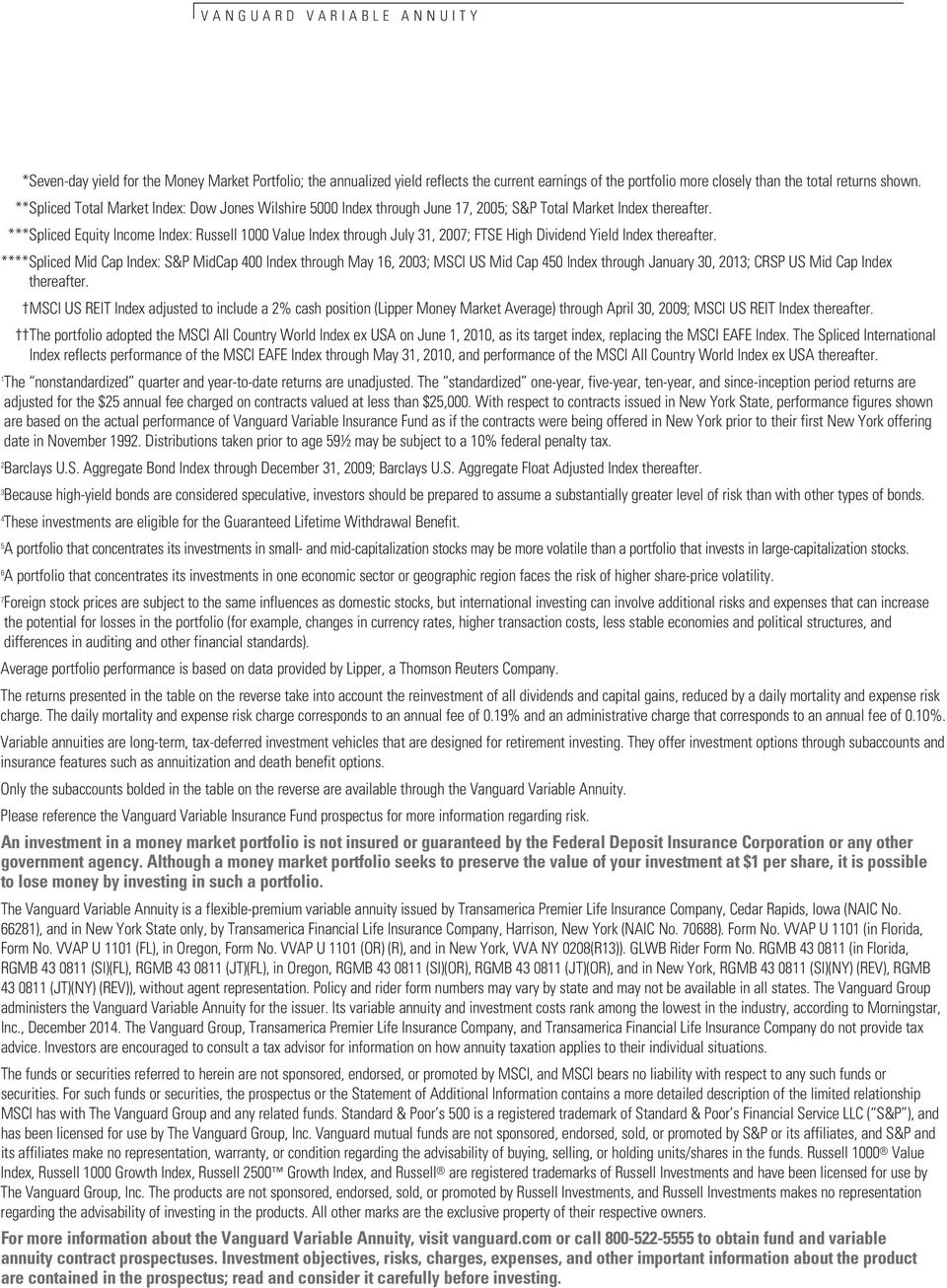
3 VANGUARD VARIABLE ANNUITY Issued by TRANSAMERICA PREMIER LIFE INSURANCE COMPANY Separate Account VA DD Supplement Dated September 10, 2015 to the Prospectus dated May 1, 2015 The following hereby replaces the corresponding paragraphs in the TAX INFORMATION section in the prospectus: Same Sex Relationships Same sex couples have the right to marry in all states. The parties to each marriage that is valid under the law of any state will each be treated as a spouse as defined in this contact. Individuals in other arrangements, such as civil unions, registered domestic partnerships, or other similar arrangements, that are not recognized as marriage under the relevant state law, will not be treated as married or as spouses as defined in this contract. Therefore, exercise of the spousal continuation provisions of this contract or any riders by individuals who do not meet the definition of spouse may have adverse tax consequences and/or may not be permissible. Please consult a tax adviser for more information on this subject. TPLPSB
4 Vanguard Variable Annuity Prospectus May 1, 2015
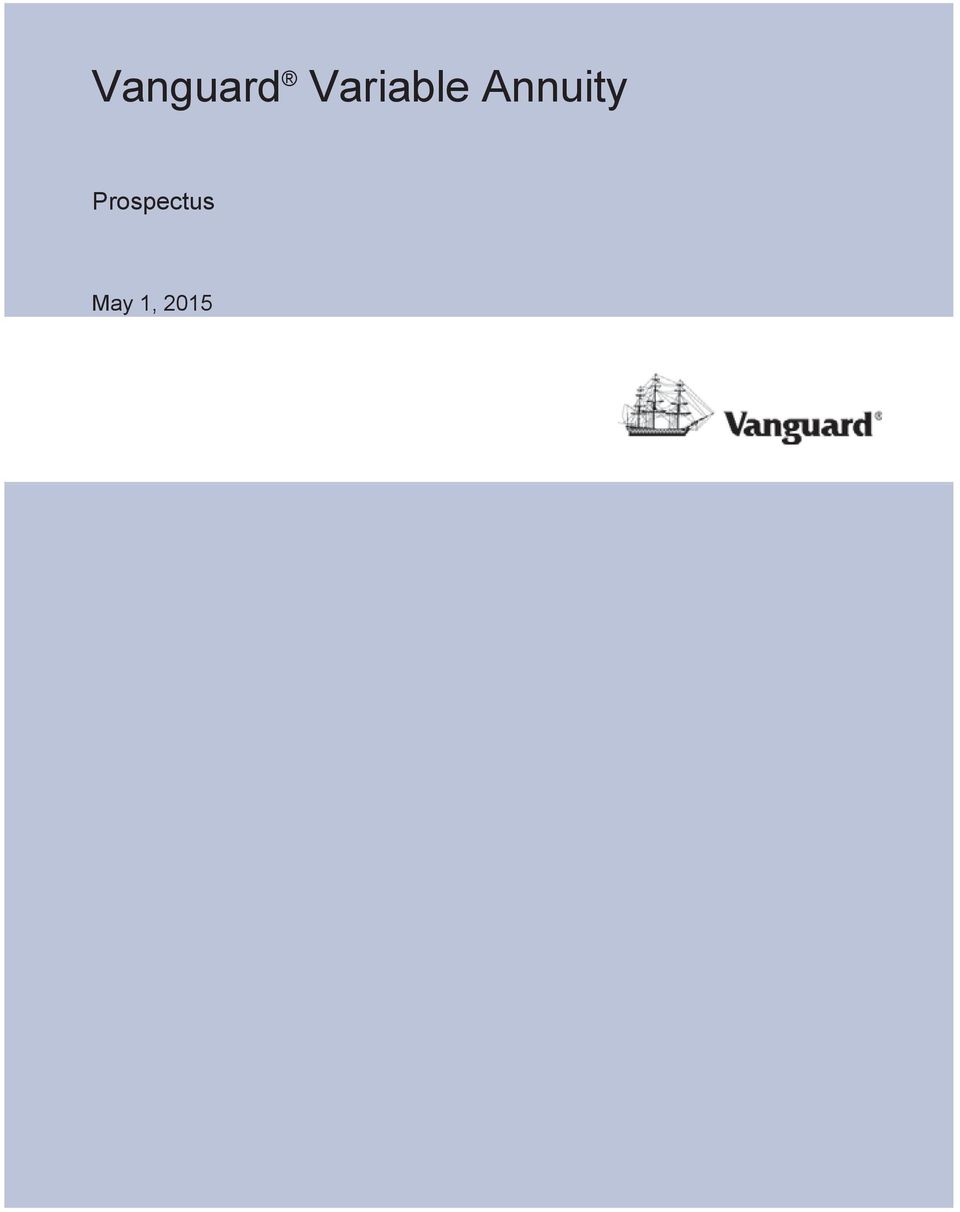
5 Vanguard Variable Annuity Prospectus May 1, 2015 Issued Through Separate Account VA DD By Transamerica Premier Life Insurance Company The Vanguard Variable Annuity (the Contract ) provides a means of investing on a tax-deferred basis in Portfolios of Vanguard Variable Insurance Fund Money Market Portfolio Short-Term Investment-Grade Portfolio Total Bond Market Index Portfolio High Yield Bond Portfolio Conservative Allocation Portfolio Moderate Allocation Portfolio Balanced Portfolio Equity Income Portfolio Diversified Value Portfolio Total Stock Market Index Portfolio Equity Index Portfolio Mid-Cap Index Portfolio Growth Portfolio Capital Growth Portfolio Small Company Growth Portfolio International Portfolio REIT Index Portfolio The Contract is intended for retirement savings or other long-term investment purposes. You bear all investment risk (including the possible loss of principal), and investment results are not guaranteed. The Contract provides a Free Look Period of at least 10 days (20 days or more in some instances) during which the Contract may be cancelled. Why Reading This Prospectus Is Important This prospectus explains the Vanguard Variable Annuity. Reading the Contract prospectus will help you decide whether the Contract is the right investment for you. The Contract prospectus must be accompanied by a current prospectus for Vanguard Variable Insurance Fund, which discusses in greater depth the objective, risks, and strategies of each Portfolio of Vanguard Variable Insurance Fund. Please read them both carefully before you invest and keep them for future reference. A Statement of Additional Information for the Contract prospectus has been filed with the Securities and Exchange Commission, is incorporated by reference, and is available free by writing to Vanguard Annuity and Insurance Services, 455 Devon Park Drive, Wayne, PA or by calling on business days between 8 a.m. and 8 p.m., Eastern time. The Table of Contents for the Statement of Additional Information is included at the end of the Contract prospectus. Neither the Securities and Exchange Commission nor any state securities commission has approved or disapproved these securities or passed upon the accuracy or adequacy of this prospectus. Any representation to the contrary is a criminal offense. The Contract is available in all states except New York. This prospectus does not constitute an offering in any jurisdiction where it would be unlawful to make an offering like this. No one has been authorized to give any information or make any representations about this offering other than those contained in this prospectus. You should not rely on any other information or representations. Contents 1 Cross Reference to Definitions 26 Access to Your Money 2 Summary 27 Performance 5 Fee Table 28 Death Benefit 6 Example 31 Additional Features 8 The Annuity Contract 36 Other Information 9 Annuity Payments 41 Table of Contents of Statement of Additional Information 11 Purchase 42 Appendix A (Condensed Financial Information) 14 Investment Options 44 Appendix B (Death Benefit) 19 Expenses 46 Appendix C (GLWB Rider Adjusted Partial Withdrawals) 20 Tax Information 48 Appendix D (GLWB Rider Blended Rider Fee)
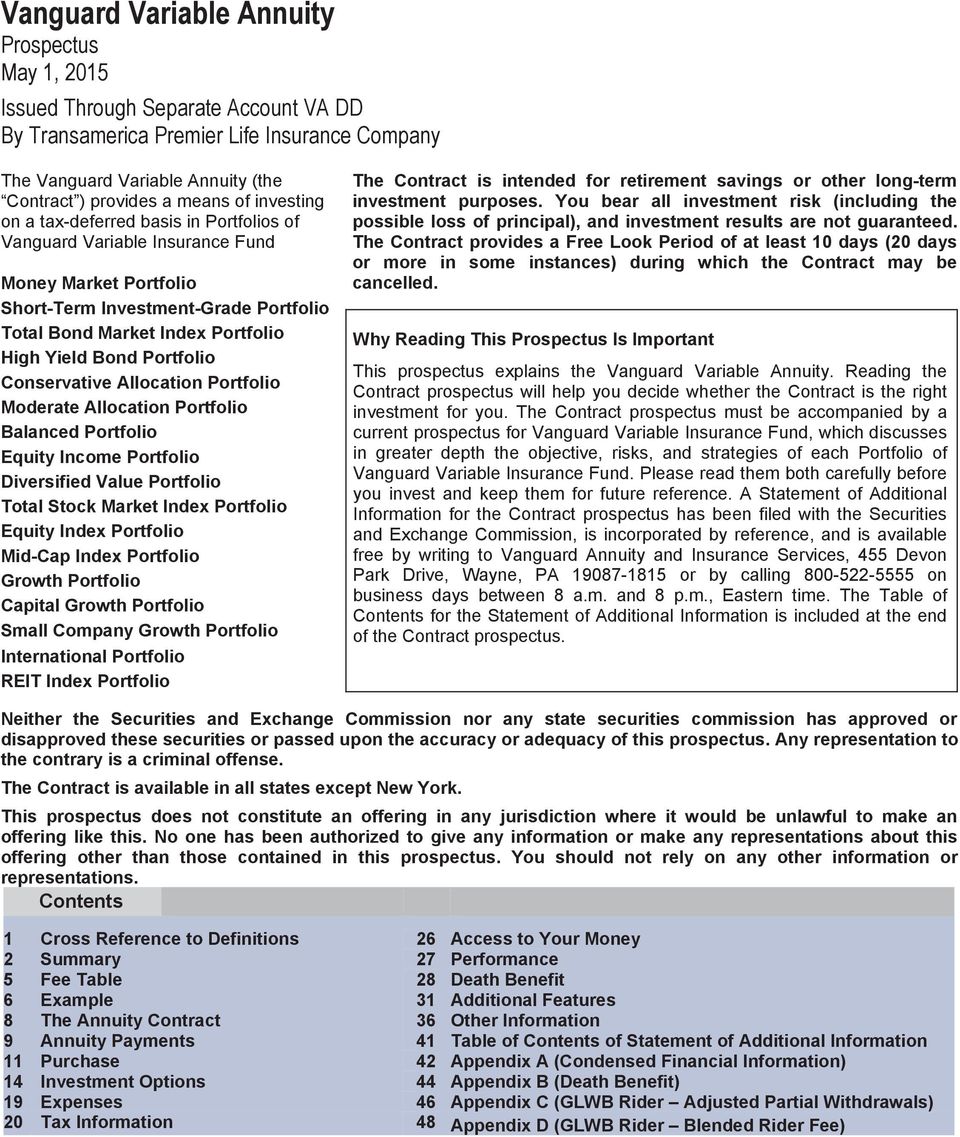
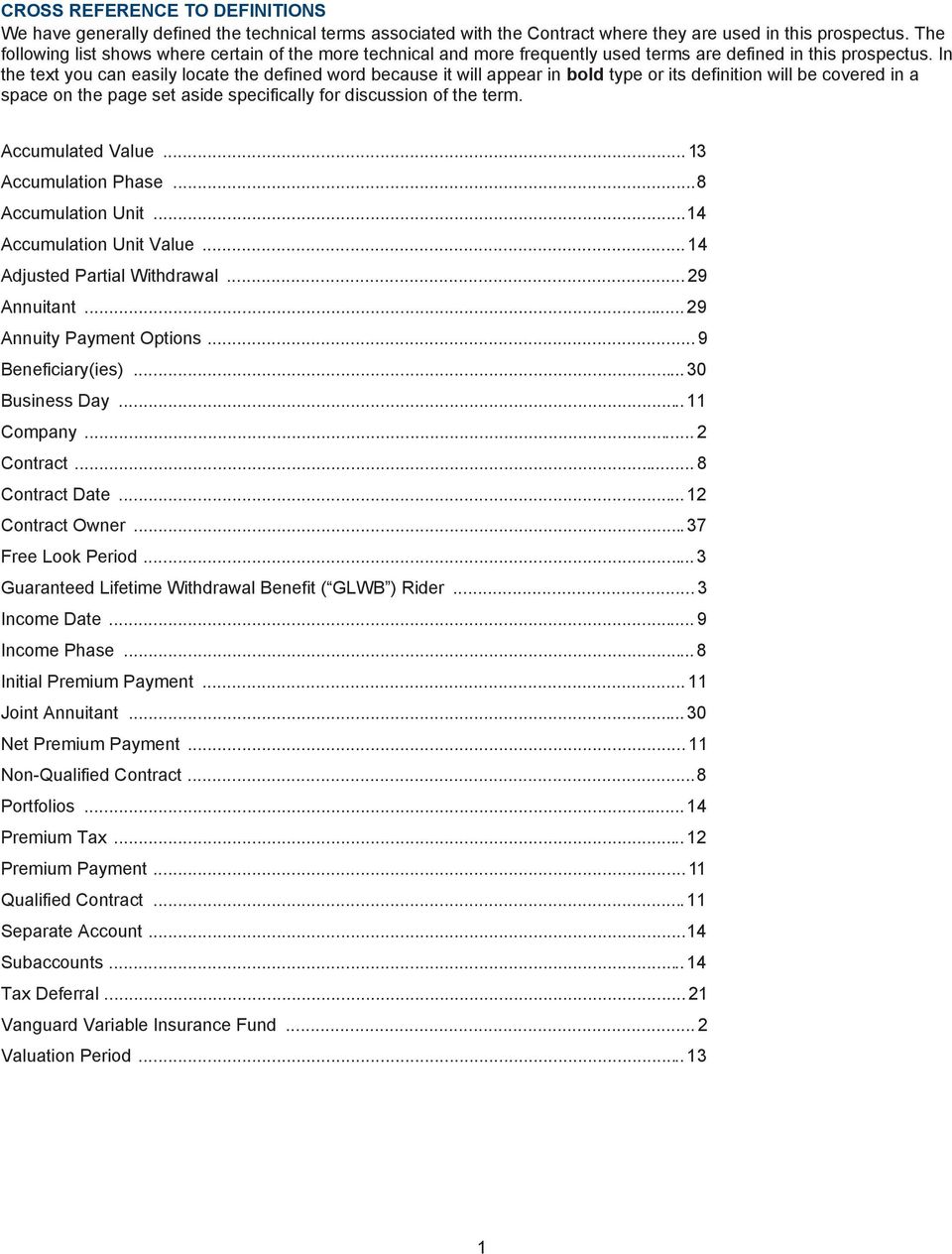
6 CROSS REFERENCE TO DEFINITIONS We have generally defined the technical terms associated with the Contract where they are used in this prospectus. The following list shows where certain of the more technical and more frequently used terms are defined in this prospectus. In the text you can easily locate the defined word because it will appear in bold type or its definition will be covered in a space on the page set aside specifically for discussion of the term. Accumulated Value Accumulation Phase... 8 Accumulation Unit Accumulation Unit Value Adjusted Partial Withdrawal Annuitant Annuity Payment Options... 9 Beneficiary(ies) Business Day Company... 2 Contract... 8 Contract Date Contract Owner Free Look Period... 3 Guaranteed Lifetime Withdrawal Benefit ( GLWB ) Rider... 3 Income Date... 9 Income Phase... 8 Initial Premium Payment Joint Annuitant Net Premium Payment Non-Qualified Contract... 8 Portfolios Premium Tax Premium Payment Qualified Contract Separate Account Subaccounts Tax Deferral Vanguard Variable Insurance Fund... 2 Valuation Period
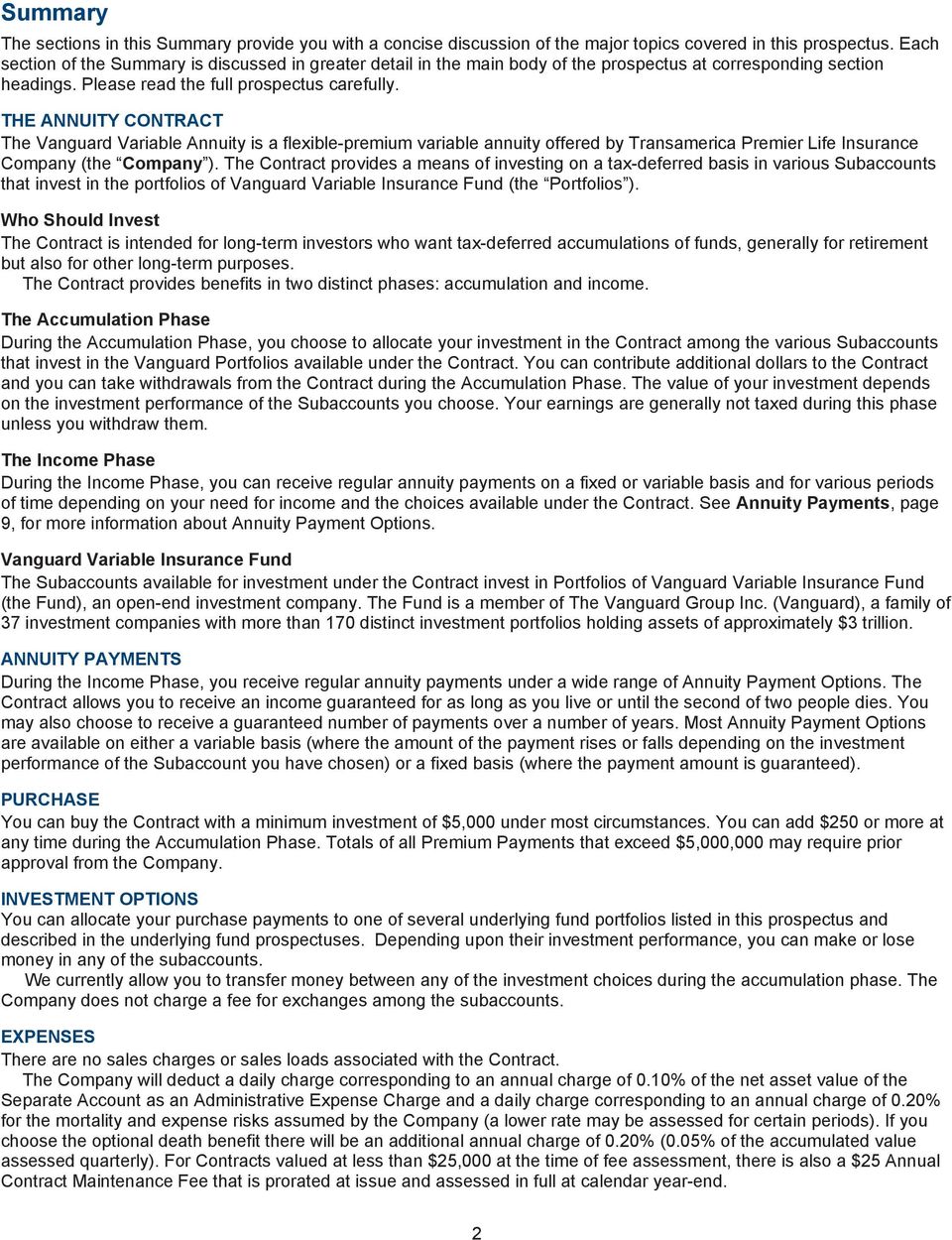
7 Summary The sections in this Summary provide you with a concise discussion of the major topics covered in this prospectus. Each section of the Summary is discussed in greater detail in the main body of the prospectus at corresponding section headings. Please read the full prospectus carefully. THE ANNUITY CONTRACT The Vanguard Variable Annuity is a flexible-premium variable annuity offered by Transamerica Premier Life Insurance Company (the Company ). The Contract provides a means of investing on a tax-deferred basis in various Subaccounts that invest in the portfolios of Vanguard Variable Insurance Fund (the Portfolios ). Who Should Invest The Contract is intended for long-term investors who want tax-deferred accumulations of funds, generally for retirement but also for other long-term purposes. The Contract provides benefits in two distinct phases: accumulation and income. The Accumulation Phase During the Accumulation Phase, you choose to allocate your investment in the Contract among the various Subaccounts that invest in the Vanguard Portfolios available under the Contract. You can contribute additional dollars to the Contract and you can take withdrawals from the Contract during the Accumulation Phase. The value of your investment depends on the investment performance of the Subaccounts you choose. Your earnings are generally not taxed during this phase unless you withdraw them. The Income Phase During the Income Phase, you can receive regular annuity payments on a fixed or variable basis and for various periods of time depending on your need for income and the choices available under the Contract. See Annuity Payments, page 9, for more information about Annuity Payment Options. Vanguard Variable Insurance Fund The Subaccounts available for investment under the Contract invest in Portfolios of Vanguard Variable Insurance Fund (the Fund), an open-end investment company. The Fund is a member of The Vanguard Group Inc. (Vanguard), a family of 37 investment companies with more than 170 distinct investment portfolios holding assets of approximately $3 trillion. ANNUITY PAYMENTS During the Income Phase, you receive regular annuity payments under a wide range of Annuity Payment Options. The Contract allows you to receive an income guaranteed for as long as you live or until the second of two people dies. You may also choose to receive a guaranteed number of payments over a number of years. Most Annuity Payment Options are available on either a variable basis (where the amount of the payment rises or falls depending on the investment performance of the Subaccount you have chosen) or a fixed basis (where the payment amount is guaranteed). PURCHASE You can buy the Contract with a minimum investment of $5,000 under most circumstances. You can add $250 or more at any time during the Accumulation Phase. Totals of all Premium Payments that exceed $5,000,000 may require prior approval from the Company. INVESTMENT OPTIONS You can allocate your purchase payments to one of several underlying fund portfolios listed in this prospectus and described in the underlying fund prospectuses. Depending upon their investment performance, you can make or lose money in any of the subaccounts. We currently allow you to transfer money between any of the investment choices during the accumulation phase. The Company does not charge a fee for exchanges among the subaccounts. EXPENSES There are no sales charges or sales loads associated with the Contract. The Company will deduct a daily charge corresponding to an annual charge of 0.10% of the net asset value of the Separate Account as an Administrative Expense Charge and a daily charge corresponding to an annual charge of 0.20% for the mortality and expense risks assumed by the Company (a lower rate may be assessed for certain periods). If you choose the optional death benefit there will be an additional annual charge of 0.20% (0.05% of the accumulated value assessed quarterly). For Contracts valued at less than $25,000 at the time of fee assessment, there is also a $25 Annual Contract Maintenance Fee that is prorated at issue and assessed in full at calendar year-end. 2
8 You will also pay Fund Operating Expenses, which currently range from 0.16% to 0.46% annually of the average daily value of the Portfolios. If you elect the Guaranteed Lifetime Withdrawal Benefit ( GLWB ) Rider, then there is a quarterly rider fee based on an annual rate of the current rider fee of 1.20% (0.95% for the portion of the total withdrawal base attributable to premium payments or transfers into designated investments prior to May 1, 2013) during the accumulation phase (for the single or joint life option) of the total withdrawal base on each rider anniversary. TAXES In general, you are not taxed on earnings on your investment in the Contract until you withdraw them or receive Annuity Payments. Earnings are taxed as ordinary income. During the Accumulation Phase, for tax purposes withdrawals are taken from earnings first, then from your investment in the Contract. If you receive money from the Contract before age 59 1 /2, you may have to pay a 10% federal penalty tax on the earnings portion received. During the Income Phase, payments come partially from earnings, partially from your investment. ACCESS TO YOUR MONEY You can take money out of your Contract at any time during the Accumulation Phase without incurring a withdrawal charge. In the absence of specific directions from the contract owner, all deductions will be made from all funded Subaccounts on a pro rata basis. You may have to pay income tax and a tax penalty on any money you take out. Please refer to Page 26 for minimum withdrawal requirements based on withdrawal type and disbursement method. PERFORMANCE The investment performance of the Subaccounts you choose directly affects the value of your Contract. You bear all investment risk (including the possible loss of principal), and investment results are not guaranteed. From time to time, the Company may advertise the investment performance of the Subaccounts. In doing so, it will use standardized methods prescribed by the Securities and Exchange Commission ( SEC ), as well as certain nonstandardized methods. Past performance does not indicate or predict future performance. DEATH BENEFIT If the Annuitant dies during the Accumulation Phase, the Beneficiary will receive the Death Benefit. The Death Benefit is the then-current Accumulated Value of the Contract on the date the Company receives Due Proof of Death and all Company forms, fully completed. However, for an additional charge, there is an optional Death Benefit Rider available that you can select at the time of purchase, the Return of Premium Death Benefit (the optional Death Benefit ) (see Death Benefit, page 28). The optional Death Benefit is the greater of the then-current Accumulated Value of the Contract or the sum of all Premium Payments less any Adjusted Partial Withdrawals and Premium Taxes, if any. The Contract is a variable annuity and if applicable, the Death Benefit is subject to market risk until Beneficiaries have made claim (any optional Death Benefit may also be subject to market risk until Beneficiaries have made claim). The Beneficiary may elect to receive these amounts as a lump sum or as Annuity Payments. ADDITIONAL FEATURES GLWB Rider You may elect to purchase the optional Guaranteed Lifetime Withdrawal Benefit ( GLWB ) Rider (also known as Secure Income TM ). The rider provides you with a guaranteed lifetime withdrawal benefit (Subject to the claims-paying ability of the insurance company) for amounts you have invested in certain designated investments available under the Contract. The rider is available during the accumulation phase, and only the designated investments will be considered in determining the total withdrawal base for the guaranteed lifetime withdrawal benefit provided under the rider. Transfers from designated investments to non-designated investments will be considered withdrawals under the rider. Excess withdrawals may significantly reduce or eliminate the benefit of this rider. The tax rules for qualified contracts may limit the value of this rider. Please consult a qualified tax advisor before electing the GLWB Rider for a qualified contract. There is an extra charge for this rider. OTHER INFORMATION Free Look Period The Contract provides for a Free Look Period of at least 10 days after the Contract Owner receives the Contract (20 or more days in some instances as specified in your Contract) plus 5 days for mailing. TRANSAMERICA PREMIER LIFE INSURANCE COMPANY Transamerica Premier Life Insurance Company is a life insurance company incorporated under Iowa law. It is principally engaged in offering life insurance and annuity contracts. 3

9 Separate Account VA DD The Separate Account VA DD (the Separate Account ) is a unit investment trust registered with the SEC and operating under Iowa law. The Separate Account has various Subaccounts, each of which invests solely in a corresponding Portfolio of the Fund. Other topics Additional information on the topics summarized above and on other topics not summarized here can be found at Other Information, page 36. INQUIRIES AND CONTRACT AND POLICYHOLDER INFORMATION For more information about the Vanguard Variable Annuity, call or write: Regular Mail: Overnight or Certified Mail: Vanguard Annuity and Insurance Services Vanguard Annuity and Insurance Services P.O. Box Devon Park Drive Valley Forge, PA Wayne, PA If you have questions about your Contract, please telephone Vanguard Annuity and Insurance Services at Personal and/or account specific information may be requested to validate a caller s identity and authorization prior to the providing of any information. We reserve the right to refuse a telephone request if the caller is unable to provide the requested information or if we reasonably believe that the caller is not an individual authorized to act on the Contract. As Contract Owner, you will receive periodic statements confirming any transactions that take place as well as quarterly statements and an annual report. 4
10 Fee Table The following Fee Table illustrates all expenses that you would incur as a Contract Owner. The purpose of this Fee Table is to assist you in understanding the various costs and expenses that you would pay directly or indirectly as a purchaser of the Contract. The first table describes the fees and expenses that you will pay at the time you purchase the Contract, surrender the Contract, or transfer cash value between investment options. State premium taxes may also be deducted. For a complete discussion of Contract cost and expenses, see Expenses, page 19. OWNER TRANSACTION EXPENSES Sales Load Imposed on Purchases... None Surrender Fees... None Exchange Fees... None State Premium Tax (See page 12 Premium Tax) % to 3.50% The next table describes the fees and expenses that you will pay periodically during the time that you own the Contract, not including the investment portfolios fees and expenses. SEPARATE ACCOUNT ANNUAL EXPENSES 1 (as a percentage of average account value) Annual Contract Maintenance Fee 2... $25 Accumulated Value Death Benefit Mortality and Expense Risk Charge 3, % Administrative Expense Charge % Total Separate Account Annual Expenses % OPTIONAL RIDER FEES Return of Premium Death Benefit 5, % Return of Premium Death Benefit (No Longer Available for New Issues) 6, % Annual Step-Up Death Benefit (No Longer Available for New Issues) 6, % GLWB Rider (annualized rate % of Total Withdrawal Base attributable to premium payments and transfers into designated investments on or after May 1, 2013) 9 : Maximum % Current % GLWB Rider (annualized rate % of Total Withdrawal Base attributable to premium payments and transfers into designated investments prior to May 1, 2013) 9 : % See Expenses, page 19 for more information. Applies to Contracts valued at less than $25,000 at the time of initial purchase and any year thereafter if the Accumulated Value is below $25,000. For Contracts valued at less than $25,000 at the time of fee assessment, the $25 Annual Contract Maintenance Fee is prorated at issue and assessed in full at calendar year-end. The mortality and expense risk charge will not be greater than 0.20% (as shown in the table); however, the fee may be assessed at a lower rate for certain periods at our discretion. Currently, the daily mortality and expense risk charge will be assessed at a rate corresponding to an annual charge of 0.190%. For contract owners who purchased the contract on or after October 19, This additional annual fee is a percentage of the Accumulated Value that is assessed at the beginning of each quarter based on the Contract Anniversary Date. For contract owners who purchased the contract on or before October 18, For contract owners who purchased the contract prior to October 30, The GLWB rider fee is a percentage of the total withdrawal base. The total withdrawal base on the date the rider takes effect ( rider date ) is the accumulated value in the designated investments. During any rider year, the total withdrawal base is equal to the total withdrawal base on the rider date or on the most recent rider anniversary, plus subsequent premium payments to or transfers into the designated investments under the rider, less any total withdrawal base adjustments. On the rider anniversary the total withdrawal base can step up to the accumulated value in the designated investments if the accumulated value in the designated investments is greater than the current total withdrawal base. The annual rider fee percentage is currently 1.20% (for the single or joint life option). If any premium additions or transfers are made into the designated investments under the rider, then a new rider fee percentage may apply to such premium additions or transfers. Thereafter, if a new fee applies the total rider fee will be adjusted to reflect the weighted average of the current rider fee percentage and the rider fee percentage associated with the additional premium and/or transfers to the designated investments under the rider. 5

11 The next item shows the minimum and maximum total operating expenses charged by the investment Portfolios that you may pay periodically during the time that you own the Contract. More detail concerning each investment Portfolio s fees and expenses is contained in the prospectus for the Fund. TOTAL FUND OPERATING EXPENSES 1 Minimum Maximum Expenses that are deducted from Portfolio assets, including management fees, distribution and/or service (12b-1) fees, and other expenses 0.16% 0.46% 1 The fee table information relating to the underlying fund portfolios is for the year ending December 31, 2014 (unless otherwise noted) and was provided to the Company by the underlying fund portfolios, their investment advisors or managers. Actual future expenses of the portfolios may be greater or less than those shown in the table. ANNUAL FUND OPERATING EXPENSES during the fiscal year ended December 31, 2014 Subaccount Management Fees 12b-1 Distribution Fees Other Expenses Acquired Fund Fees and Expenses Total Fund Operating Expenses Money Market Portfolio % None 0.03% 0.00% 0.16% Short-Term Investment-Grade Portfolio 0.18% None 0.02% 0.00% 0.20% Total Bond Market Index Portfolio 0.17% None 0.02% 0.00% 0.19% High Yield Bond Portfolio 0.26% None 0.03% 0.00% 0.29% Conservative Allocation Portfolio 0.00% None 0.00% 0.19% % Moderate Allocation Portfolio 0.00% None 0.00% 0.19% % Balanced Portfolio 0.23% None 0.02% 0.00% 0.25% Equity Income Portfolio 0.29% None 0.03% 0.00% 0.32% Diversified Value Portfolio 0.31% None 0.03% 0.00% 0.34% Total Stock Market Index Portfolio 0.00% None 0.00% 0.17% % Equity Index Portfolio 0.14% None 0.02% 0.00% 0.16% Mid-Cap Index Portfolio 0.21% None 0.03% 0.00% 0.24% Growth Portfolio 0.39% None 0.04% 0.00% 0.43% Capital Growth Portfolio 0.37% None 0.03% 0.00% 0.40% Small Company Growth Portfolio 0.36% None 0.03% 0.01% % International Portfolio 0.42% None 0.04% 0.00% 0.46% REIT Index Portfolio 0.24% None 0.03% 0.00% 0.27% 1 Vanguard and the Portfolio s Board have voluntarily agreed to temporarily limit certain net operating expenses in excess of the Portfolio s daily yield so as to maintain a zero or positive yield for the Portfolio. Vanguard and the Portfolio s Board may terminate the temporary expense limitation at any time. 2 Although the Portfolio is not expected to incur any net expenses daily, the Portfolio s contract owners indirectly bear the expenses of the underlying Vanguard funds in which the Portfolio invests. This figure includes transaction costs (i.e., purchase and redemption fees), if any, imposed on the Portfolio by the underlying funds. See the Vanguard Variable Insurance Fund Prospectus. 3 Acquired Fund Fees and Expenses are expenses incurred indirectly by the Portfolio through its ownership of shares in other investment companies, such as business development companies. These expenses are similar to the expenses paid by any operating company held by the Portfolio. They are not direct costs paid by Portfolio shareholders and are not used to calculate the Portfolio s net asset value. They have no impact on the costs associated with portfolio operations. Example The following Example is intended to help you compare the cost of investing in the Contract with the cost of investing in other variable annuity contracts. These costs include Contract owner transaction expenses, Separate Account annual expenses, and Portfolio fees and expenses. 1 6

12 The Example assumes that you invest $10,000 in the Contract for the time periods indicated. The Example also assumes that your investment has a 5% annual rate of return each year, the highest fees and expenses of any of the Portfolios for the year ended December 31, 2014, and the Contract with the combination of available optional features with the highest fees and expenses, including the GLWB Rider (Joint Life), the Accumulated Value Death Benefit Option and the Return of Premium Death Benefit Option, respectively. Although your actual costs may be higher or lower, based on these assumptions, your costs would be: 1 Year 3 Years 5 Years 10 Years If the Contract is annuitized or if you surrender the Contract at the end of the applicable time period Return of Premium Death Benefit Option $247 $760 $1300 $2774 Accumulated Value Death Benefit Option $227 $700 $1199 $ The Example does not reflect premium tax charges. Different fees and expenses not reflected in the Example may be assessed during the income phase of the Contract. Please remember that the Example is an illustration and does not represent past or future expenses. Your actual expenses may be lower or higher than those reflected in the Example. Similarly, your rate of return may be more or less than the 5% assumed in the Example. For information concerning the compensation and expenses paid for the sale of the Contracts, see Distributor of the Contracts. CONDENSED FINANCIAL INFORMATION Please note that Appendix A contains a history of accumulation unit values in a table labeled Condensed Financial Information. Automated Quotes The Vanguard Tele-Account Service provides access to Accumulation Unit Values (to six decimal places) and total returns for all Subaccounts, and yield information for the Money Market, Total Bond Market Index, High Yield Bond, and Short-Term Investment-Grade Portfolios of the Fund. Contract Owners may use this service for 24-hour access to Portfolio information. To access the service you may call Tele-Account at (ON-BOARD) and follow the step-by-step instructions, or speak with a Vanguard Annuity and Insurance Services associate at to request a brochure that explains how to use the service. Vanguard s website also has Accumulation Unit Values (to six decimal places) for all Subaccounts. This service can be accessed from vanguard.com. Accessing Your Contract on the Web You may access information and manage your annuity on vanguard.com. This convenient service, available 24-hours a day, allows you to check your annuity balances, your Portfolio holdings, and make exchanges between Portfolios at any time. (Note: exchange requests received prior to the close of regular trading on the New York Stock Exchange usually 4 p.m., Eastern time will be processed as of the close of business on that same day. Requests received after the close of regular trading will be processed the next Business Day). In order to access your annuity on the web, you must be a registered user of vanguard.com. You can simply log on to vanguard.com to register, or speak with a Vanguard Annuity and Insurance Services associate at for assistance. 7

13 The Annuity Contract The Vanguard Variable Annuity is a flexible-premium variable annuity offered by Transamerica Premier Life Insurance Company (the Company ). The Contract provides a means of investing on a tax-deferred basis in Subaccounts that invest in various portfolios (the Portfolios ) offered by Vanguard Variable Insurance Fund. You may purchase a Contract using after-tax dollars (a Non-Qualified Contract), or you may purchase a Qualified Contract by rolling over funds from another individual retirement annuity or from a qualified plan. Who Should Invest The Contract is intended for long-term investors who are United States citizens or Resident Aliens who want tax-deferred accumulation of funds, generally for retirement but also for other long-term investment purposes. The tax-deferred feature of the Contract is most attractive to investors in high federal and state marginal tax brackets who have exhausted other avenues of tax deferral, such as pre-tax contributions to employer-sponsored retirement or savings plans. The taxdeferred feature of the Contract is unnecessary when the Contract is purchased to fund a qualified plan. About the Contract The Vanguard Variable Annuity is a contract between you, the Contract Owner, and the Company, the issuer of the Contract. The Contract provides benefits in two distinct phases: accumulation and income. Accumulation Phase The Accumulation Phase starts when you purchase your Contract and ends immediately before the Income Date, when the Income Phase starts. During the Accumulation Phase, you choose to allocate your investment in the Contract among the various available Subaccounts. The Contract is a variable annuity because the value of your investment in the Subaccounts can go up or down depending on the investment performance of the Subaccounts you choose. The Contract is a flexible-premium annuity because you can make additional investments of at least $250 until the Income Phase begins. During this phase, you are generally not taxed on earnings from amounts invested unless you withdraw them. Other benefits available during the Accumulation Phase include the ability to: Make transfers among your Subaccount choices ( exchanges ) at no charge and without current tax consequences. (See Exchanges Among the Subaccounts, page 14.) Withdraw all or part of your money with no surrender penalty charged by the Company, although you may incur income taxes and a 10% penalty tax prior to age 59 1 /2. (See Full and Partial Withdrawals, page 26.) Income Phase During the Income Phase, you receive regular annuity payments. The amount of these payments is based in part on the amount of money accumulated under your Contract (its Accumulated Value) and the Annuity Payment Option you select. The Annuity Payment Options are explained at Annuity Payments. At your election, payments can be either variable or fixed. If variable, the payments rise or fall depending on the investment performance of the Subaccounts you choose. If fixed, the payment amounts are guaranteed. Annuity payments are available in a wide variety of options, including payments over a specified period or for life (for either a single life or joint lives), with or without a guaranteed number of payments. Please note: all benefits (guaranteed benefit or living benefit riders) under the Contract terminate when annuity payments begin or on the maturity date. The only benefits that remain include guarantees provided under the terms of the annuity option. The Separate Account When you purchase a Contract, your money is deposited into the Company s Separate Account VA DD (the Separate Account ). The Separate Account contains a number of Subaccounts that invest exclusively in shares of the corresponding Portfolios. The investment performance of each Subaccount is linked directly to the investment performance of one of the Portfolios. Assets in the Separate Account belong to the Company but are accounted for separately from the Company s other assets and can be used only to satisfy its obligations to Contract Owners. Vanguard Variable Insurance Fund The Subaccounts available for investment under the Contract invest in the Portfolios of Vanguard Variable Insurance Fund, an open-end investment company intended exclusively as an investment vehicle for variable annuity and variable life insurance contracts offered by insurance companies. The Fund is a member of Vanguard, a family of 37 investment companies with more than 170 distinct investment portfolios holding assets of approximately $3 trillion. Through their jointly owned subsidiary, Vanguard, Vanguard Variable Insurance Fund and the other funds in the group obtain at cost virtually all of their corporate management, administrative, shareholder accounting, and distribution services. 8

14 Annuity Payments During the Income Phase, you receive regular annuity payments under a wide range of Annuity Payment Options. Starting the Income Phase As Contract Owner, you exercise control over when the Income Phase begins. The Income Date is the date on which annuity payments begin and is always the first day of the month. You may also change the Income Date at any time in writing, as long as the Annuitant or Joint Annuitant is living and the Company receives the request at least 30 days before the then-scheduled Income Date. Any Income Date you request must be at least 30 days from the day the Company receives written notice. You can generally change the annuity commencement date by giving us 30 days notice with the new date or age. The latest Income Date generally cannot be after the date specified in your Contract unless a later date is agreed to by us. The earliest Income Date is at least 30 days after you purchase your Contract. The Income Date on Qualified Contracts may also be controlled by the plan or its endorsements. Your Contract may not be partially annuitized, i.e., you may not apply a portion of your contract value to an Annuity Option while keeping the remainder of your Contract in force. Please note: all benefits (guaranteed benefit or living benefit riders) under the Contract terminate when annuity payments begin or on the maturity date. The only benefits that remain include guarantees provided under the terms of the annuity option. Annuity Payment Options The income you take from the Contract during the Income Phase can take several different forms, depending on your particular needs. Except for the Period Certain Annuity Option listed below, the Annuity Payment Options listed below are available on either a variable basis or a fixed basis. Other Annuity Payment Options may be available. For Qualified Contracts, the Annuity Payment option must satisfy the minimum distribution requirements under the federal tax law. If available on a variable basis, the Annuity Payment Options provide payments that, after the initial payment, will go up or down depending on the investment performance of the Subaccounts you choose. If available on a fixed basis, the Annuity Payment Options provide payments in an amount that does not change. If you choose a fixed Annuity Payment Option, the Company will move your investment out of the Subaccounts and into the general account of the Company. Life Annuity Monthly Annuity Payments are paid for the life of an Annuitant, ending with the last payment before the Annuitant dies. If the annuitant dies before the due date of the second (third, fourth, etc ) annuity payment, then we will only make one (two, three, etc ) annuity payments. Joint and Last Survivor Annuity Monthly Annuity Payments are paid for as long as at least one of two named Annuitants is living, ending with the last payment before the surviving Annuitant dies. This option is also available as a 50% or 75% Last Survivor Annuity. (The payment decreases by 50% or 25%, respectively upon the death of the first annuitant.) If the surviving annuitant dies before the due date of the second (third, fourth, etc ) annuity payments, then we will only make one (two, three, etc ) annuity payments. Life Annuity With Period Certain Monthly Annuity Payments are paid for as long as the Annuitant lives, with payments guaranteed to be made for a period of 10,15, 20 or 30 years, as elected. If the Annuitant dies before the period certain ends, the Company will make any remaining payments to the Beneficiary. Period Certain Annuity Available only on a fixed basis. Monthly Annuity Payments are paid for a specified period, which may be from 10 to 30 years. Adjusted Annuitant Age Annuity Payments under Options 1, 2, and 3 are based on the Adjusted Age of the Annuitant. The Adjusted Age is the Annuitant s actual age on the Annuitant s nearest birthday, at the Income Date, adjusted as follows: Income Date Adjusted Age Before 2010 Actual Age Actual Age minus Actual Age minus Actual Age minus Actual Age minus 4 After 2040 Determined by the Company Calculating Annuity Payments Fixed Annuity Payments. Each fixed Annuity Payment is guaranteed to be at least the amount shown in the Contract s Annuity Tables corresponding to the Annuity Payment Option selected. 9

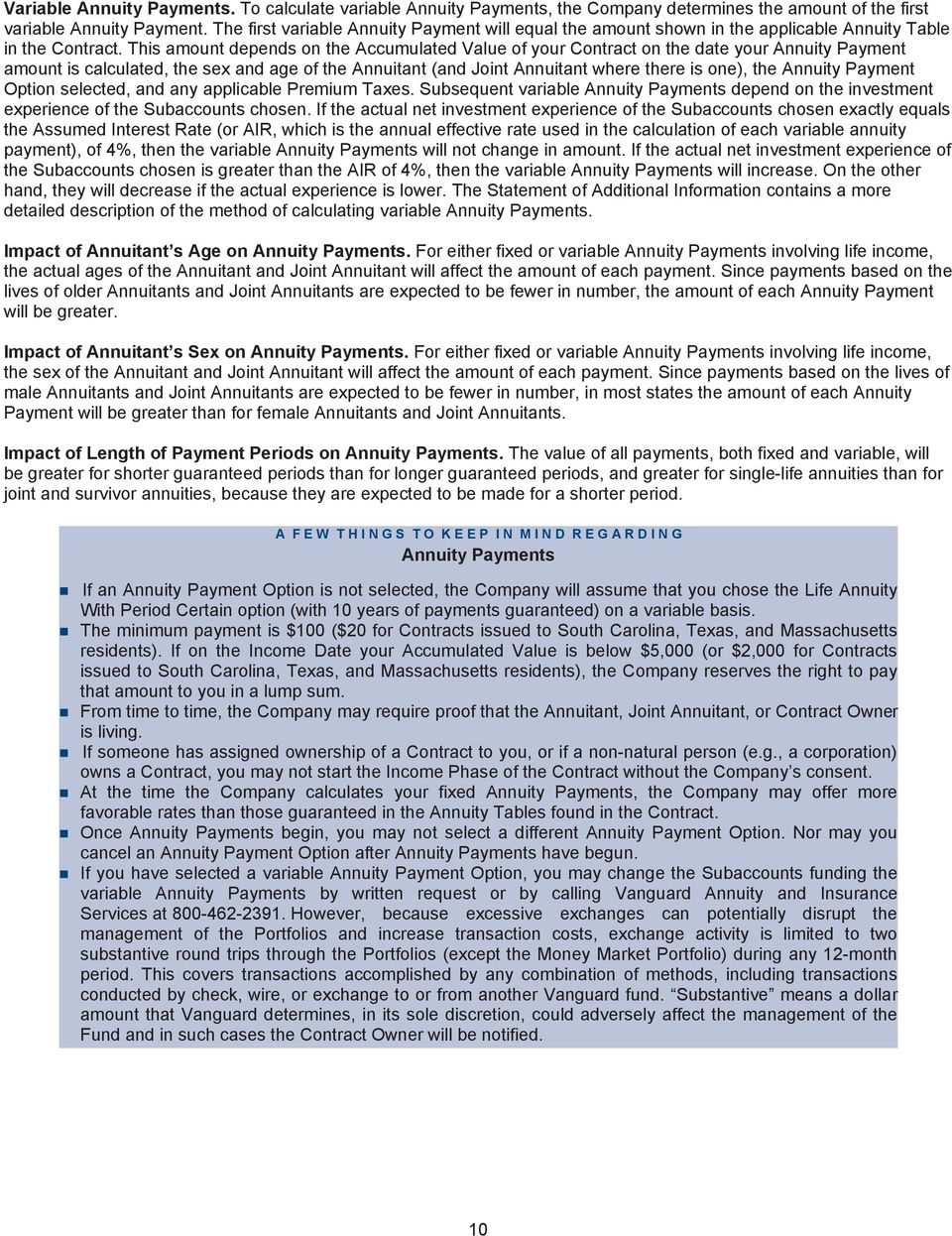
15 Variable Annuity Payments. To calculate variable Annuity Payments, the Company determines the amount of the first variable Annuity Payment. The first variable Annuity Payment will equal the amount shown in the applicable Annuity Table in the Contract. This amount depends on the Accumulated Value of your Contract on the date your Annuity Payment amount is calculated, the sex and age of the Annuitant (and Joint Annuitant where there is one), the Annuity Payment Option selected, and any applicable Premium Taxes. Subsequent variable Annuity Payments depend on the investment experience of the Subaccounts chosen. If the actual net investment experience of the Subaccounts chosen exactly equals the Assumed Interest Rate (or AIR, which is the annual effective rate used in the calculation of each variable annuity payment), of 4%, then the variable Annuity Payments will not change in amount. If the actual net investment experience of the Subaccounts chosen is greater than the AIR of 4%, then the variable Annuity Payments will increase. On the other hand, they will decrease if the actual experience is lower. The Statement of Additional Information contains a more detailed description of the method of calculating variable Annuity Payments. Impact of Annuitant s Age on Annuity Payments. For either fixed or variable Annuity Payments involving life income, the actual ages of the Annuitant and Joint Annuitant will affect the amount of each payment. Since payments based on the lives of older Annuitants and Joint Annuitants are expected to be fewer in number, the amount of each Annuity Payment will be greater. Impact of Annuitant s Sex on Annuity Payments. For either fixed or variable Annuity Payments involving life income, the sex of the Annuitant and Joint Annuitant will affect the amount of each payment. Since payments based on the lives of male Annuitants and Joint Annuitants are expected to be fewer in number, in most states the amount of each Annuity Payment will be greater than for female Annuitants and Joint Annuitants. Impact of Length of Payment Periods on Annuity Payments. The value of all payments, both fixed and variable, will be greater for shorter guaranteed periods than for longer guaranteed periods, and greater for single-life annuities than for joint and survivor annuities, because they are expected to be made for a shorter period. A F E W T H I N G S T O K E E P I N M I N D R E G A R D I N G Annuity Payments If an Annuity Payment Option is not selected, the Company will assume that you chose the Life Annuity With Period Certain option (with 10 years of payments guaranteed) on a variable basis. The minimum payment is $100 ($20 for Contracts issued to South Carolina, Texas, and Massachusetts residents). If on the Income Date your Accumulated Value is below $5,000 (or $2,000 for Contracts issued to South Carolina, Texas, and Massachusetts residents), the Company reserves the right to pay that amount to you in a lump sum. From time to time, the Company may require proof that the Annuitant, Joint Annuitant, or Contract Owner is living. If someone has assigned ownership of a Contract to you, or if a non-natural person (e.g., a corporation) owns a Contract, you may not start the Income Phase of the Contract without the Company s consent. At the time the Company calculates your fixed Annuity Payments, the Company may offer more favorable rates than those guaranteed in the Annuity Tables found in the Contract. Once Annuity Payments begin, you may not select a different Annuity Payment Option. Nor may you cancel an Annuity Payment Option after Annuity Payments have begun. If you have selected a variable Annuity Payment Option, you may change the Subaccounts funding the variable Annuity Payments by written request or by calling Vanguard Annuity and Insurance Services at However, because excessive exchanges can potentially disrupt the management of the Portfolios and increase transaction costs, exchange activity is limited to two substantive round trips through the Portfolios (except the Money Market Portfolio) during any 12-month period. This covers transactions accomplished by any combination of methods, including transactions conducted by check, wire, or exchange to or from another Vanguard fund. Substantive means a dollar amount that Vanguard determines, in its sole discretion, could adversely affect the management of the Fund and in such cases the Contract Owner will be notified. 10
16 You may select an Annuity Payment Option and allocate a portion of the value of your Contract to a fixed version of that Annuity Payment Option and a portion to a variable version of that Annuity Payment Option (assuming the Annuity Payment Option is available on both a fixed and variable basis). You may not select more than one Annuity Payment Option. If you choose an Annuity Payment Option and the postal or other delivery service is unable to deliver checks to the Payee s address of record, no interest will accrue on amounts represented by uncashed Annuity Payment checks. It is the Payee s responsibility to keep the Company informed of the Payee s most current address of record. If annuity payments are selected as a death distribution option, payments must begin within one year of the date of death. Purchase Client Information Form and Issuance of Contracts Contract Issuance. To invest in the Vanguard Variable Annuity, you should send a completed Client Information Form, Assessment and Disclosure form, and your Initial Premium Payment to Vanguard Annuity and Insurance Services. Depending on the Death Benefit option selected, there may be limitations on the age of the Annuitant (See Death Benefit, page 28). If the Client Information Form is received in good order, the Company will issue the Contract and will credit the Initial Premium Payment within two Business Days after receipt. A Business Day is any day that the New York Stock Exchange is open for trading. If the Company cannot credit the Initial Premium Payment because the Client Information Form is incomplete, the Company will contact the applicant, explain the reason for the delay, and refund the Initial Premium Payment within five Business Days unless the client consents to the Company s retaining the Initial Premium Payment and crediting it as soon as the necessary requirements are fulfilled. In order to prevent lengthy processing delays caused by the clearing of foreign checks, the Company will accept only those foreign checks that are drawn in U.S. dollars and are issued by a foreign bank with a U.S. correspondent bank. You may purchase a Qualified Contract only in connection with a rollover of funds from another qualified plan or individual retirement annuity. Qualified Contracts contain certain other restrictive provisions limiting the timing of payments to and distributions from the Qualified Contract. No additional Premium Payments to your Qualified Contract will be accepted, unless the additional premium payment is funded by another qualified plan. (See QUALIFIED INDIVIDUAL RETIREMENT ANNUITIES, page 26.) D E F I N I T I O N Qualified Contract When the term Qualified Contract is used in this prospectus we generally mean a Contract that qualifies as an individual retirement annuity under Section 408(b) of the Internal Revenue Code; there are other types of qualified annuity contracts defined under different Internal Revenue Code sections. Premium Payments A Premium Payment is any amount you use to buy or add to the Contract. A Premium Payment may be reduced by any applicable Premium Tax or an initial Annual Contract Maintenance Fee. In that case, the resulting amount is called a Net Premium Payment. A F E W T H I N G S T O K E E P I N M I N D R E G A R D I N G Premium Payments The minimum Initial Premium Payment for a Contract is $5,000. You must obtain prior Company approval to purchase a policy with an amount less than the stated minimum. The Company will not accept third-party checks, Travelers checks, or money orders for Premium Payments. You may make additional Premium Payments at any time during the Accumulation Phase and while the Annuitant or Joint Annuitant, if applicable, is living. Additional Premium Payments must be at least $250 unless you have obtained our prior approval to accept a lesser amount. We will credit Additional Premium Payments to your policy as of the business day we receive your premium and required information in good order at our Administrative Office. Additional Premium Payments must be received before the close of the New York Stock Exchange (usually 4 p.m., Eastern time) to get same-day pricing of the additional Premium Payment. 11

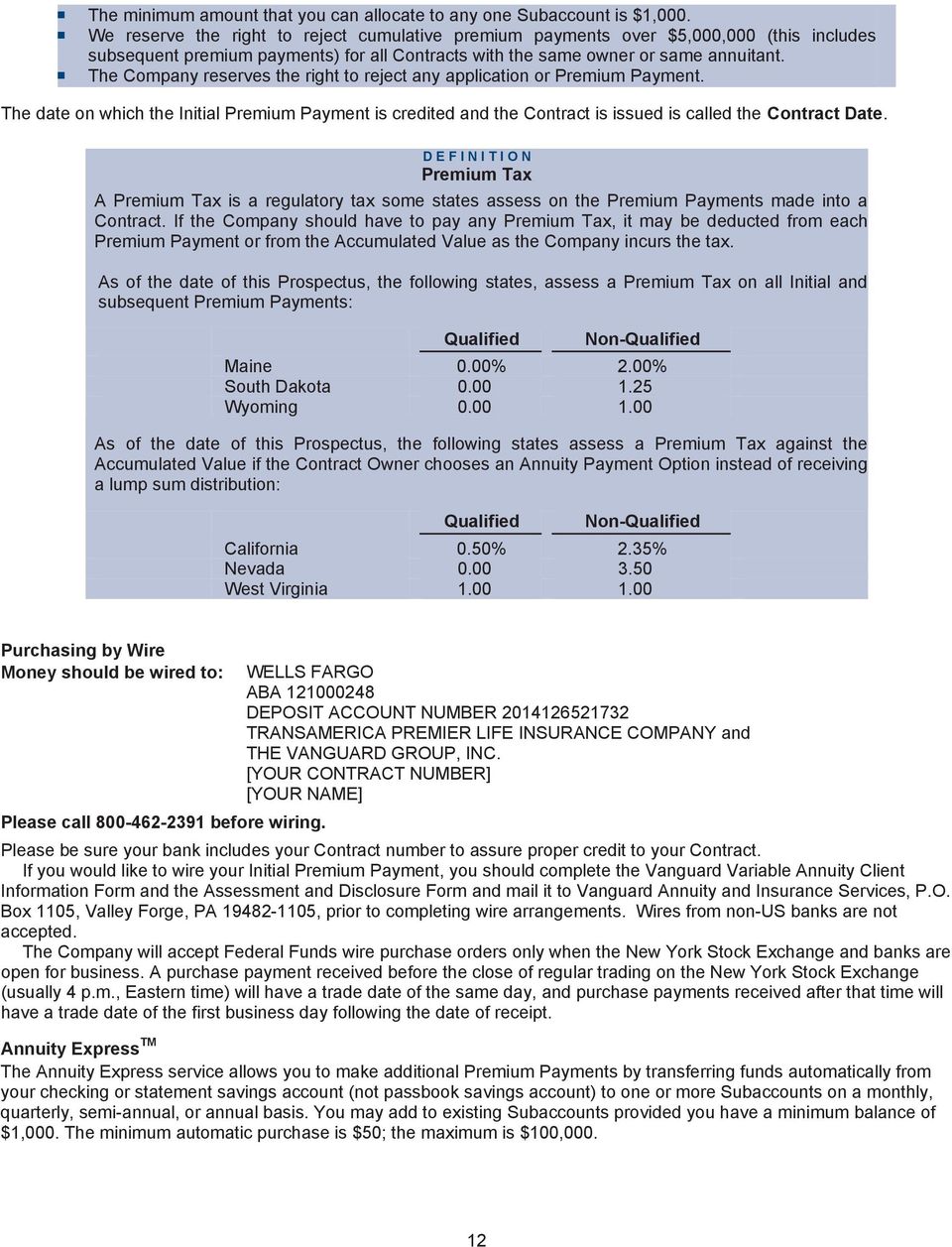
17 The minimum amount that you can allocate to any one Subaccount is $1,000. We reserve the right to reject cumulative premium payments over $5,000,000 (this includes subsequent premium payments) for all Contracts with the same owner or same annuitant. The Company reserves the right to reject any application or Premium Payment. The date on which the Initial Premium Payment is credited and the Contract is issued is called the Contract Date. D E F I N I T I O N Premium Tax A Premium Tax is a regulatory tax some states assess on the Premium Payments made into a Contract. If the Company should have to pay any Premium Tax, it may be deducted from each Premium Payment or from the Accumulated Value as the Company incurs the tax. As of the date of this Prospectus, the following states, assess a Premium Tax on all Initial and subsequent Premium Payments: Qualified Non-Qualified Maine 0.00% 2.00% South Dakota Wyoming As of the date of this Prospectus, the following states assess a Premium Tax against the Accumulated Value if the Contract Owner chooses an Annuity Payment Option instead of receiving a lump sum distribution: Qualified Non-Qualified California 0.50% 2.35% Nevada West Virginia Purchasing by Wire Money should be wired to: WELLS FARGO ABA DEPOSIT ACCOUNT NUMBER TRANSAMERICA PREMIER LIFE INSURANCE COMPANY and THE VANGUARD GROUP, INC. [YOUR CONTRACT NUMBER] [YOUR NAME] Please call before wiring. Please be sure your bank includes your Contract number to assure proper credit to your Contract. If you would like to wire your Initial Premium Payment, you should complete the Vanguard Variable Annuity Client Information Form and the Assessment and Disclosure Form and mail it to Vanguard Annuity and Insurance Services, P.O. Box 1105, Valley Forge, PA , prior to completing wire arrangements. Wires from non-us banks are not accepted. The Company will accept Federal Funds wire purchase orders only when the New York Stock Exchange and banks are open for business. A purchase payment received before the close of regular trading on the New York Stock Exchange (usually 4 p.m., Eastern time) will have a trade date of the same day, and purchase payments received after that time will have a trade date of the first business day following the date of receipt. Annuity Express TM The Annuity Express service allows you to make additional Premium Payments by transferring funds automatically from your checking or statement savings account (not passbook savings account) to one or more Subaccounts on a monthly, quarterly, semi-annual, or annual basis. You may add to existing Subaccounts provided you have a minimum balance of $1,000. The minimum automatic purchase is $50; the maximum is $100,
18 Section 1035 Exchanges Under Section 1035 of the Internal Revenue Code, you may exchange the assets of an existing non-qualified annuity contract or life insurance or endowment policy to the Vanguard Variable Annuity without any current tax consequences. To make a 1035 Exchange, complete a 1035 Exchange form and mail it along with your signed and completed Client Information Form and your current contract, to Vanguard Annuity and Insurance Services. To accommodate owners of Vanguard Variable Annuities, under certain conditions the Company will allow for the consolidation of two or more Vanguard Variable Annuities into the newest Contract. In order to provide Contract Owners with consolidated account reporting, the Company will accept these exchanges on a case-by-case basis. If applicable, you will be responsible for only one Annual Contract Maintenance Fee. Under no circumstances will the Company allow the exchange of an existing Vanguard Variable Annuity for an identical new Vanguard Variable Annuity. Because special rules and procedures apply to 1035 Exchanges, particularly if the Contract being exchanged was issued prior to August 14, 1982, you should consult a tax adviser before making a 1035 Exchange. Please note that any outstanding loans you may have on a contract you wish to exchange may create a current tax consequence. For this reason we encourage you to settle any outstanding loans with your current insurance company before initiating a 1035 Exchange into a Vanguard Variable Annuity. Allocation of Premium Payments You specify on the Client Information Form what portion of your Premium Payments you want to be allocated among which Subaccounts. You may allocate your Premium Payments to one or more Subaccounts. All allocations you make should be in whole-number percentages and a minimum of $1,000. Your Initial Net Premium Payment will be immediately allocated among the Subaccounts in the percentages you specified on your Client Information Form without waiting for the Free Look Period to pass. Should your investment goals change, you may change the allocation percentages for additional Net Premium Payments by sending written notice to Vanguard Annuity and Insurance Services. The change will take effect on the date the Company receives your written notice. You may establish the telephone privilege by completing the appropriate section of the Client Information Form, or by sending a letter authorizing the Company to take instructions by telephone. See Telephone and Online Privilege, page 18. W H A T S M Y C O N T R A C T W O R T H T O D A Y? Accumulated Value The Accumulated Value of your Contract is the value of all amounts accumulated under the Contract during the Accumulation Phase (similar to the current market value of a mutual fund account). When the Contract is opened, the Accumulated Value is equal to your initial Net Premium Payment. On any Business Day thereafter, the Accumulated Value equals the Accumulated Value from the previous Business Day; plus: Any additional Net Premium Payments credited. Any increase in the Accumulated Value due to investment results of the Subaccount(s) you selected. minus: Any decrease in the Accumulated Value due to investment results of the Subaccount(s) you selected. The daily Mortality and Expense Risk Charge. The daily Administrative Expense Charge. The Annual Contract Maintenance Fee, if applicable. Any optional death benefit charge, if applicable. Any withdrawals. Any Premium Taxes that occur during the Valuation Period. The Valuation Period is any period between two successive Business Days beginning at the close of business of the first Business Day and ending at the close of business of the next Business Day. You should expect the Accumulated Value of your Contract to change from Valuation Period to Valuation Period, reflecting the investment experience of the Subaccounts you have selected as well as the daily deduction of charges. 13

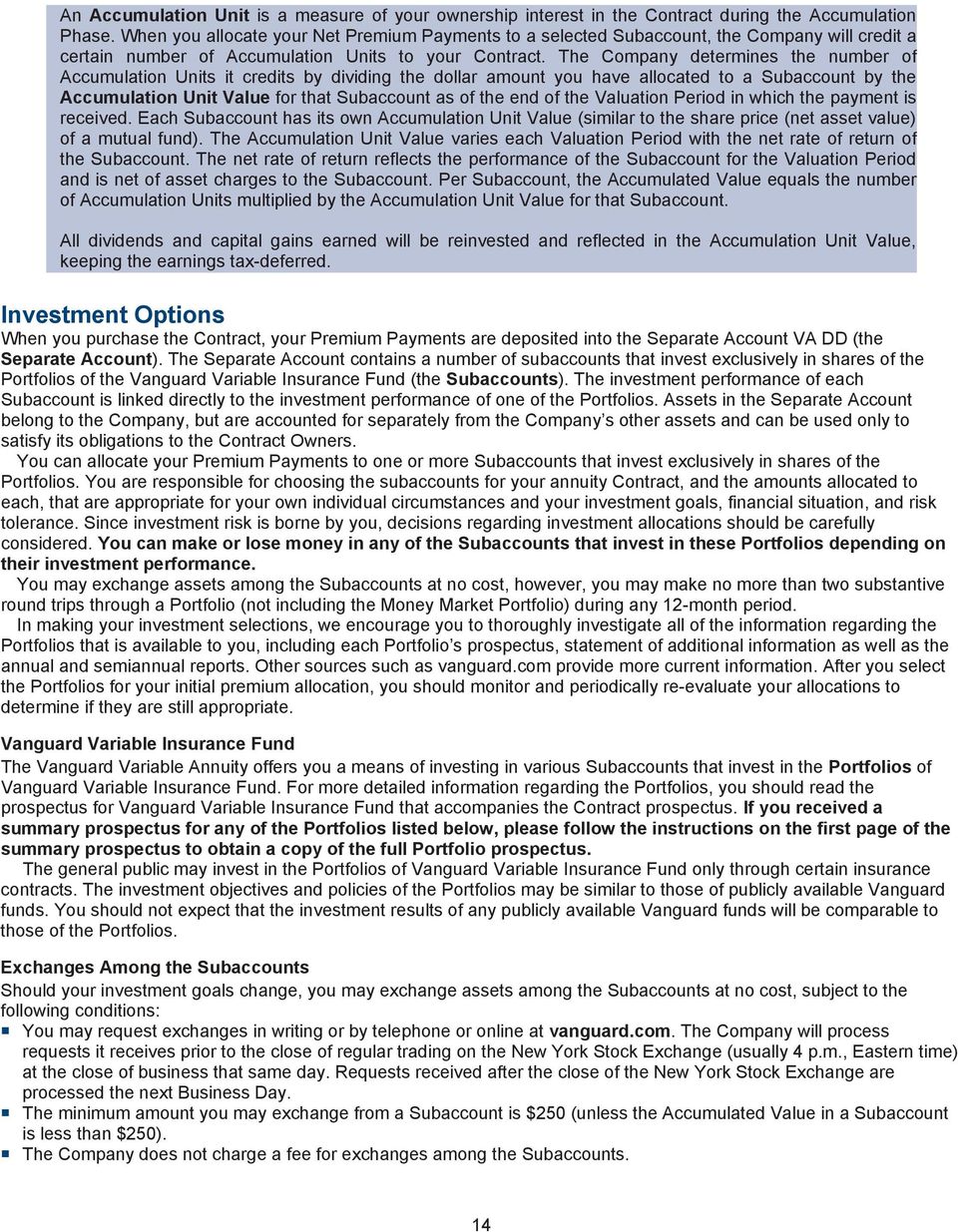
19 An Accumulation Unit is a measure of your ownership interest in the Contract during the Accumulation Phase. When you allocate your Net Premium Payments to a selected Subaccount, the Company will credit a certain number of Accumulation Units to your Contract. The Company determines the number of Accumulation Units it credits by dividing the dollar amount you have allocated to a Subaccount by the Accumulation Unit Value for that Subaccount as of the end of the Valuation Period in which the payment is received. Each Subaccount has its own Accumulation Unit Value (similar to the share price (net asset value) of a mutual fund). The Accumulation Unit Value varies each Valuation Period with the net rate of return of the Subaccount. The net rate of return reflects the performance of the Subaccount for the Valuation Period and is net of asset charges to the Subaccount. Per Subaccount, the Accumulated Value equals the number of Accumulation Units multiplied by the Accumulation Unit Value for that Subaccount. All dividends and capital gains earned will be reinvested and reflected in the Accumulation Unit Value, keeping the earnings tax-deferred. Investment Options When you purchase the Contract, your Premium Payments are deposited into the Separate Account VA DD (the Separate Account). The Separate Account contains a number of subaccounts that invest exclusively in shares of the Portfolios of the Vanguard Variable Insurance Fund (the Subaccounts). The investment performance of each Subaccount is linked directly to the investment performance of one of the Portfolios. Assets in the Separate Account belong to the Company, but are accounted for separately from the Company s other assets and can be used only to satisfy its obligations to the Contract Owners. You can allocate your Premium Payments to one or more Subaccounts that invest exclusively in shares of the Portfolios. You are responsible for choosing the subaccounts for your annuity Contract, and the amounts allocated to each, that are appropriate for your own individual circumstances and your investment goals, financial situation, and risk tolerance. Since investment risk is borne by you, decisions regarding investment allocations should be carefully considered. You can make or lose money in any of the Subaccounts that invest in these Portfolios depending on their investment performance. You may exchange assets among the Subaccounts at no cost, however, you may make no more than two substantive round trips through a Portfolio (not including the Money Market Portfolio) during any 12-month period. In making your investment selections, we encourage you to thoroughly investigate all of the information regarding the Portfolios that is available to you, including each Portfolio s prospectus, statement of additional information as well as the annual and semiannual reports. Other sources such as vanguard.com provide more current information. After you select the Portfolios for your initial premium allocation, you should monitor and periodically re-evaluate your allocations to determine if they are still appropriate. Vanguard Variable Insurance Fund The Vanguard Variable Annuity offers you a means of investing in various Subaccounts that invest in the Portfolios of Vanguard Variable Insurance Fund. For more detailed information regarding the Portfolios, you should read the prospectus for Vanguard Variable Insurance Fund that accompanies the Contract prospectus. If you received a summary prospectus for any of the Portfolios listed below, please follow the instructions on the first page of the summary prospectus to obtain a copy of the full Portfolio prospectus. The general public may invest in the Portfolios of Vanguard Variable Insurance Fund only through certain insurance contracts. The investment objectives and policies of the Portfolios may be similar to those of publicly available Vanguard funds. You should not expect that the investment results of any publicly available Vanguard funds will be comparable to those of the Portfolios. Exchanges Among the Subaccounts Should your investment goals change, you may exchange assets among the Subaccounts at no cost, subject to the following conditions: You may request exchanges in writing or by telephone or online at vanguard.com. The Company will process requests it receives prior to the close of regular trading on the New York Stock Exchange (usually 4 p.m., Eastern time) at the close of business that same day. Requests received after the close of the New York Stock Exchange are processed the next Business Day. The minimum amount you may exchange from a Subaccount is $250 (unless the Accumulated Value in a Subaccount is less than $250). The Company does not charge a fee for exchanges among the Subaccounts. 14
20 Please note: If you elect the GLWB Rider, then transfers out of the designated investments may reduce or eliminate the benefits of the rider. L I M I T A T I O N S O N Exchanges Because excessive exchanges can disrupt management of the Fund and increase the Fund s costs for all Contract Owners, the Fund limits exchanges as follows: You may make no more than two substantive round trips through a Portfolio (not including the Money Market Portfolio) during any 12-month period. The Fund and the Company may refuse an exchange at any time, for any reason. The Company may revoke a Contract Owner s exchange privilege at any time, for any reason. A round trip is a redemption from a Portfolio followed by a purchase back into the Portfolio. Also, round trip covers transactions accomplished by any combination of methods, including transactions conducted by check, wire, or exchange to or from another Vanguard fund. Substantive means a dollar amount that Vanguard determines, in its sole discretion, could adversely affect the management of the Fund. PORTFOLIO AND MANAGEMENT Money Market Portfolio Manager: The Vanguard Group, Inc., through its Fixed Income Group Short-Term Investment-Grade Portfolio Manager: The Vanguard Group, Inc., through its Fixed Income Group Total Bond Market Index Portfolio Manager: The Vanguard Group, Inc., through its Fixed Income Group High Yield Bond Portfolio Manager: Wellington Management Company, LLP Conservative Allocation Portfolio Manager: The Vanguard Group, Inc. (1) Moderate Allocation Portfolio Manager: The Vanguard Group, Inc. (1) Balanced Portfolio Manager: Wellington Management Company, LLP Equity Income Portfolio Manager: Wellington Management Company, LLP and The Vanguard Group, Inc. Diversified Value Portfolio Manager: Barrow, Hanley, Mewhinney & Strauss, LLC. Total Stock Market Index Portfolio Manager: The Vanguard Group, Inc. (2) Equity Index Portfolio Manager: The Vanguard Group, Inc., through its Equity Investment Group Mid-Cap Index Portfolio Manager: The Vanguard Group, Inc., through its Equity Investment Group Growth Portfolio Manager: Jackson Square Partners, LLC, Wellington Management Company, LLP, and William Blair & Company, L.L.C. INVESTMENT OBJECTIVE seeks to provide current income while maintaining liquidity and a stable share price of $1. seeks to provide current income while maintaining limited price volatility. seeks to track the performance of a broad, market-weighted bond index. seeks to provide a high level of current income. seeks to provide current income and low to moderate capital appreciation. seeks to provide capital appreciation and a low to moderate level of current income. seeks to provide long-term capital appreciation and reasonable current income. seeks to provide an above-average level of current income and reasonable longterm capital appreciation. seeks to provide long-term capital appreciation and income. seeks to track the performance of a benchmark index that measures the investment return of the overall stock market. seeks to track the performance of a benchmark index that measures the investment return of large-capitalization stocks. seeks to track the performance of a benchmark index that measures the investment return of mid-capitalization stocks. seeks to provide long-term capital appreciation. 15
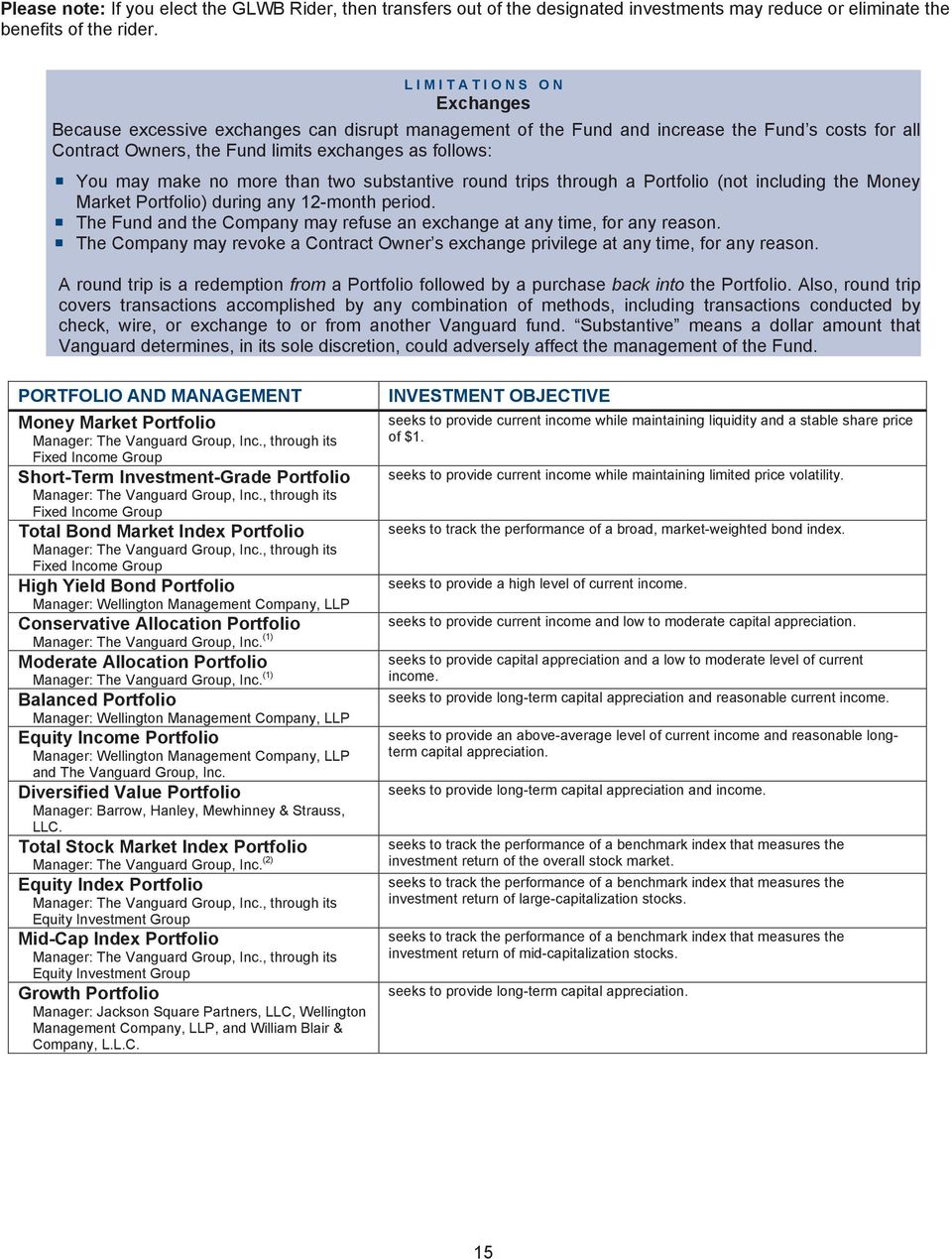
21 PORTFOLIO AND MANAGEMENT Capital Growth Portfolio Manager: PRIMECAP Management Company Small Company Growth Portfolio Manager: Granahan Investment Management, Inc. and The Vanguard Group, Inc. International Portfolio Manager: Baillie Gifford Overseas Ltd, M&G Investment Management Limited, and Schroder Investment Management North America Inc. REIT Index Portfolio Manager: The Vanguard Group, Inc., through its Equity Investment Group INVESTMENT OBJECTIVE seeks to provide long-term capital appreciation. seeks to provide long-term capital appreciation. seeks to provide long-term capital appreciation. seeks to provide a high level of income and moderate long-term capital appreciation by tracking the performance of a benchmark index that measures the performance of publicly traded equity REITs. 1 2 The Conservative Allocation Portfolio and Moderate Allocation Portfolio each receive advisory services indirectly by investing in the Total Bond Market Index Portfolio, Equity Index Portfolio, Extended Market Index Fund, Total International Stock Index Fund, and Total International Bond Index Fund. The Total Stock Market Index Portfolio receives advisory services indirectly by investing in the Equity Index Portfolio and Extended Market Index Fund. There is no assurance that a Portfolio will achieve its stated objective. Disruptive Trading and Market Timing Statement of Policy. This variable insurance product was not designed for the use of market timers or other investors who make programmed, large, frequent, or short-term exchanges. Such exchanges may be disruptive to the underlying fund portfolios and increase transaction costs. Market timing and other programmed, large, frequent, or short-term exchanges among the subaccounts can cause risks with adverse effects for other contract owners (and beneficiaries and underlying fund portfolios). These risks and harmful effects include: (1)dilution of the interests of long-term investors in a subaccount if purchases or exchanges into or out of an underlying fund portfolio are made at prices that do not reflect an accurate value for the underlying fund portfolio s investments (some market timers attempt to do this through methods known as time-zone arbitrage and liquidity arbitrage ); (2)an adverse effect on portfolio management, such as: (a) impeding a portfolio manager s ability to sustain an investment objective; (b) causing the underlying fund portfolio to maintain a higher level of cash than would otherwise be the case; or (c) causing an underlying fund portfolio to liquidate investments prematurely (or otherwise at an inopportune time) in order to pay withdrawals or exchanges out of the underlying fund portfolio; and (3)increased brokerage and administrative expenses. These costs are borne by all contract owners invested in those subaccounts, not just those making the exchanges. We have developed policies and procedures with respect to market timing and other exchanges and we do not make special arrangements or grant exceptions to accommodate market timing or other potentially disruptive or harmful trading. Do not invest with us if you intend to conduct market timing or other potentially disruptive trading. Detection. We employ various means in an attempt to detect and deter market timing and disruptive trading. However, despite our monitoring we may not be able to detect nor halt all harmful trading. In addition, because other insurance companies (and retirement plans) with different policies and procedures may invest in the underlying fund portfolios, we cannot guarantee that all harmful trading will be detected or that an underlying fund portfolio will not suffer harm from programmed, large, frequent, or short-term exchanges among subaccounts of variable products issued by these other insurance companies or retirement plans. Deterrence. If we determine you are engaged in market timing or other disruptive trading, we may take one or more actions in an attempt to halt such trading. Your ability to make exchanges is subject to modification or restriction if we determine, in our sole opinion, that your exercise of the exchange privilege may disadvantage or potentially harm the rights or interests of other contract owners (or others having an interest in the variable insurance products). As described below, restrictions may take various forms, but under our current policies and procedures will include a temporary suspension of exchange privileges. We may also restrict the exchange privileges of others acting on your behalf. We reserve the right to reject any premium payment or exchange request from any person without prior notice, if, in our judgment, (1) the payment or exchange, or series of exchanges, would have a negative impact on an underlying fund portfolio s operations, or (2) if an underlying fund portfolio would reject or has rejected our purchase order, or (3) because of a history of large or frequent exchanges. We may impose other restrictions on exchanges, or even prohibit exchanges for any owner who, in our view, has abused, or appears likely to abuse, the exchange privilege. We may, at any time and 16
22 without prior notice, discontinue exchange privileges, modify our procedures, impose holding period requirements or limit the number, size, frequency, manner, or timing of exchanges we permit. Because determining whether to impose any such special restrictions depends on our judgment and discretion, it is possible that some policy owners could engage in disruptive trading that is not permitted for others. We also reserve the right to reverse a potentially harmful exchange if an underlying fund portfolio refuses or reverses our order; in such instances some contract owners may be treated differently than others. For all of these purposes, we may aggregate two or more variable insurance products that we believe are connected. If you engage a third party investment advisor for asset allocation services, then you may be subject to these transfer restrictions because of the actions of your investment advisor in providing these services. In addition to our internal policies and procedures, we will administer your variable insurance product to comply with any applicable state, federal, and other regulatory requirements concerning exchanges. We reserve the right to implement, administer, and charge you for any fee or restriction, including redemption fees, imposed by any underlying fund portfolio. To the extent permitted by law, we also reserve the right to defer the exchange privilege at any time that we are unable to purchase or redeem shares of any of the underlying fund portfolios. Under our current policies and procedures, we do: expressly limit the number of round trips in a given period as described in the Investment Options section under Limitations on Exchanges. Under our current policies and procedures, we do not: impose redemption fees on exchanges; expressly limit the number of nonround trip exchanges or the size of exchanges in a given period; or provide a certain number of allowable exchanges in a given period. Redemption fees, exchange limits, and other procedures or restrictions may be more or less successful than ours in deterring market timing or other disruptive trading and in preventing or limiting harm from such trading. Please note that the limits and restrictions described herein are subject to our ability to monitor exchange activity. Our ability to detect market timing or other disruptive trading may be limited by operational and technological systems, as well as by our ability to predict strategies employed by contract owners (or those acting on their behalf) to avoid detection. As a result, despite our efforts to prevent harmful trading activity among the variable investment options available under this variable insurance product, there is no assurance that we will be able to detect or deter frequent or harmful exchanges by such contract owners or intermediaries acting on their behalf. Moreover, our ability to discourage and restrict market timing or other disruptive trading may be limited by provisions of the variable insurance product. Furthermore, we may revise our policies and procedures in our sole discretion at any time and without prior notice, as we deem necessary or appropriate (1) to better detect and deter market timing or other harmful trading that may adversely affect other contract owners, other persons with material rights under the variable insurance products, or underlying fund shareholders generally, (2) to comply with state or federal regulatory requirements, or (3) to impose additional or alternative restrictions on owners engaging in frequent exchange activity among the investment options under the variable insurance product. In addition, we may not honor exchange requests if any variable investment option that would be affected by the exchange is unable to purchase or redeem shares of its corresponding underlying fund portfolio. Underlying Fund Portfolio Frequent Trading Policies. The underlying fund portfolios may have adopted their own policies and procedures with respect to frequent purchases and redemptions of their respective shares. Underlying fund portfolios may, for example, assess a redemption fee (which we reserve the right to collect) on shares held for a relatively short period of time. The prospectuses for the underlying fund portfolios describe any such policies and procedures. The frequent trading policies and procedures of an underlying fund portfolio may be different, and more or less restrictive, than the frequent trading policies and procedures of other underlying fund portfolios and the policies and procedures we have adopted for our variable insurance products to discourage market timing and other programmed, large, frequent, or shortterm exchanges. Contract owners should be aware that we may not have the contractual ability or the operational capacity to monitor contract owners exchange requests and apply the frequent trading policies and procedures of the respective underlying funds that would be affected by the exchanges. Accordingly, contract owners and other persons who have material rights under our variable insurance products should assume that the sole protection they may have against potential harm from frequent exchanges is the protection, if any, provided by the policies and procedures we have adopted for our variable insurance products to discourage market timing or other disruptive trading. Contract owners should be aware that we are required to provide to an underlying fund portfolio or its designee, promptly upon request, certain information about the trading activity of individual owners, and to restrict or prohibit further purchases or transfers by specific owners identified by an underlying fund portfolio as violating the frequent trading policies for that underlying fund portfolio. Omnibus Orders. Contract owners and other persons with material rights under the variable insurance products also should be aware that the purchase and redemption orders received by the underlying fund portfolios generally are omnibus orders from intermediaries such as retirement plans and separate accounts funding variable insurance 17
23 products. The omnibus orders reflect the aggregation and netting of multiple orders from individual retirement plan participants and individual owners of variable insurance products. The omnibus nature of these orders may limit the underlying fund portfolios ability to apply their respective frequent trading policies and procedures. We cannot guarantee that the underlying fund portfolios will not be harmed by exchange activity relating to the retirement plans or other insurance companies that may invest in the underlying fund portfolios. These other insurance companies are responsible for their own policies and procedures regarding frequent exchange activity. If their policies and procedures fail to successfully discourage harmful exchange activity, it will affect other owners of underlying fund portfolio shares, as well as the owners of all of the variable annuity or life insurance policies, including ours, whose variable investment options correspond to the affected underlying fund portfolios. In addition, if an underlying fund portfolio believes that an omnibus order we submit may reflect one or more exchange requests from owners engaged in market timing and other programmed, large, frequent, or short-term exchanges, the underlying fund portfolio may reject the entire omnibus order and thereby delay or prevent us from implementing your request. Automatic Asset Rebalancing During the Accumulation Phase, you can automatically rebalance the amounts invested in the Subaccounts in order to maintain a desired allocation. This rebalancing occurs automatically on a date you select and can take place on a monthly, quarterly, semi-annual or annual basis (provided the $1,000 minimum balance requirement has been met in the Subaccount to which you are moving money). The minimum amount you may exchange is $250. Rebalancing can be started, stopped, or changed at any time. Automatic Asset Rebalancing cannot be used in conjunction with the Automatic Exchange Service. Any additional exchange requests will not cause Automatic Asset Rebalancing to cease (Please note, an Automatic Asset Rebalance will not begin on the 29 th, 30 th, or 31 st of the month. If an Automatic Asset Rebalance would have started on one of these dates, it will start on the 1 st business day of the following month). To take advantage of the Automatic Asset Rebalancing service, complete a Vanguard Variable Annuity Automatic Asset Rebalance service form or contact Vanguard Annuity and Insurance Services. Automatic Exchange Service During the Accumulation Phase, you can move money automatically among the Subaccounts. You can exchange fixed dollar amounts or percentages of your Subaccount balance into the other Subaccounts offered under the Contract on either a monthly, quarterly, semi-annual, or annual basis (provided the $1,000 minimum balance requirement has been met in the Subaccounts to which you are moving money).the minimum amount you may exchange is $250. While you are participating in this service, if the service date falls on a day that the New York Stock Exchange is closed, the service date will be the next business day. (Please note, an Automatic Exchange Service will not begin on the 29th, 30th, or 31st of the month. If an Automatic Exchange Service would have started on one of these dates, it will start on the 1st business day of the following month.) The Automatic Exchange Service should not be used to circumvent the limits placed on exchanges. Automatic Exchange Service Using the Automatic Exchange Service, you can exchange at regular intervals in a plan of investing often referred to as dollar-cost averaging, moving money, for example, from the Money Market Portfolio into a stock or bond Portfolio. The main objective of dollar-cost averaging is to shield your investment from short-term price fluctuations. Since the same dollar amount is transferred to other Subaccounts each month, more Accumulation Units are credited to a Subaccount if the value per Accumulation Unit is low, while fewer Accumulation Units are credited if the value per Accumulation Unit is high. Therefore, it is possible to achieve a lower average cost per Accumulation Unit over the long term if the Accumulation Unit Value declines over that period. This plan of investing allows investors to take advantage of market fluctuations but does not assure a profit or protect against a loss in declining markets. To take advantage of the Automatic Exchange Service, complete a Vanguard Variable Annuity Automatic Exchange Service Form or contact Vanguard Annuity and Insurance Services. You may change the amount to be exchanged or cancel this service at any time in writing or by telephone if you have telephone authorization on your Contract. This service cannot be used to establish a new Subaccount, and will not go into effect until the Free Look Period has expired. The minimum balance requirements will not apply to the subaccount that money is being automatically moved from. Telephone and Online Privilege You may establish the telephone and online privilege on your Contract by completing the appropriate section of the Client Information Form or by sending a letter authorizing the Company to take instructions over the telephone. You may request 18
24 an exchange of assets among the subaccounts through vanguard.com if you are a registered user. The Company, the Fund, and Vanguard shall not be responsible for the authenticity of instructions received by telephone or online. We will take reasonable steps to confirm that instructions communicated are genuine. Personal and/or account specific information may be requested to validate identity and authorization prior to the providing of any information. This information will be verified against the Contract Owner s records and all transactions performed will be verified with the Contract Owner through a written confirmation statement. We reserve the right to refuse a telephone request if the caller is unable to provide the requested information or if we reasonably believe that the caller is not an individual authorized to act on the Contract. We will record all calls. The Company, the Fund, and Vanguard shall not be liable for any loss, cost, or expense for action on telephone or online instructions believed to be genuine in accordance with these procedures. We will make every effort to maintain the privilege. However, the Company and the Fund reserve the right to revise or terminate its provisions, limit the amount of a transaction, or reject any transaction, as deemed necessary, at any time. Expenses A C L O S E R L O O K A T The Costs of Investing in a Variable Annuity Costs are an important consideration in choosing a variable annuity. That s because you, as a contract owner, pay the costs of operating the underlying mutual funds, plus any transaction costs incurred when the fund buys and sells securities, as well as the costs associated with the annuity contract itself. These combined costs can have a significant effect on the investment performance of the annuity contract. Even seemingly small differences in mutual fund and annuity contract expenses can, over time, have a dramatic effect on performance. The projected expenses for the Vanguard Variable Annuity are substantially below the costs of other variable annuity contracts. For example, on a $25,000 Contract the average expense ratio of other variable annuity contracts was 2.25% as of December 31, 2014, compared to 0.56% for the Vanguard Variable Annuity. (Source for competitors data: Morningstar Principia Pro for VA/L Subaccounts, December 2014.) S U M M A R Y O F C O S T S O F I N V E S T I N G in the Vanguard Variable Annuity No sales load or sales charge No charge to make full or partial withdrawals No fee to exchange money among the Subaccounts $25 Annual Contract Maintenance Fee on Contracts valued at less than $25,000 Annual Mortality and Expense Risk Charge: 0.20% Annual Administrative Expense Charge: 0.10% Current Return of Premium death benefit fee: 0.20% Current GLWB Rider Fee: 1.20% (Single or Joint Life Option). Fees and expenses paid by the Portfolios which ranged from 0.16% to 0.46% in the fiscal year ended December 31, 2014 Mortality and Expense Risk Charge The Company charges a fee as compensation for bearing certain mortality and expense risks under the Contract. The Company will deduct a daily charge corresponding to an annual charge of 0.20% for the mortality and expense risks assumed by the Company (a lower rate may be assessed for certain periods). The mortality and expense risk charge described above cannot be increased. If the charge is more than sufficient to cover actual costs or assumed risks, any excess will be added to the Company s surplus. If the charges collected under the Contract are not enough to cover actual costs or assumed risks, then the Company will bear the loss. The mortality and expense risk charge may be assessed at a lower rate for certain periods at our discretion. Currently, the daily mortality and expense risk charge will be assessed at a rate reduced by an amount corresponding to an annual amount of 0.010%. Accordingly, an aggregate annual charge of 0.190% will be assessed. 19
25 A C L O S E R L O O K A T The Mortality and Expense Risk Charge The Company assumes mortality risk in two ways. First, where Contract Owners elect an Annuity Payment Option under which the Company guarantees a number of payments over a life or joint lives, the Company assumes the risk of making monthly annuity payments regardless of how long all Annuitants may live. Second, the Company assumes mortality risk in providing a Death Benefit in the event the Annuitant dies during the Accumulation Phase. The expense risk the Company assumes is that the charges for administrative expenses, which are guaranteed not to increase beyond the rates shown for the life of the Contract, may not be great enough to cover the actual costs of issuing and administering the Contract. Administrative Expense Charge The Company assesses each Contract an annual Administrative Expense Charge to cover the cost of issuing and administering each Contract and of maintaining the Separate Account. The Administrative Expense Charge is assessed daily at a rate equal to 0.10% annually of the net asset value of the Separate Account. Annual Contract Maintenance Fee In certain situations, the Company charges an Annual Contract Maintenance Fee of $25. The fee is to reimburse the Company for the costs it expects over the life of the Contract for maintaining each Contract and the Separate Account. The Company charges the fee if: Your Initial Premium Payment is less than $25,000; and in any subsequent year the Accumulated Value is below $25,000. For Contracts valued at less than $25,000 at the time of fee assessment, the $25 Annual Contract Maintenance Fee is prorated at issue and assessed in full at calendar year-end. The fee will be assessed on the last Friday of the calendar year, based on the Accumulated Value of the Contract on that day. If that day is not a business day, it will be assessed on the preceding business day. If that Friday is the last business day of the calendar year, the fee will be assessed on the preceding Friday. GLWB Rider If you elect this rider, a rider fee will be deducted on the rider date, and on each rider quarter thereafter, before annuitization. Each rider quarter, one-fourth of the current annual charge of 1.20% (0.95% for the portion of the Total Withdrawal Base attributable to premium payments and transfers into designated investments prior to May 1, 2013) for the single or joint life option of the total withdrawal base is deducted. Rider fees are deducted from each of the designated investments in proportion to the amount of Accumulated Value in each designated investment. Fund Operating Expenses The value of the assets in the Separate Account will reflect the fees and expenses paid by Vanguard Variable Insurance Fund. A complete description of these expenses is found in the Fee Table section of this prospectus, the Fees and Expenses section of the Fund s prospectus, and in the Management of the Fund section of the Fund s Statement of Additional Information. Tax Information INTRODUCTION The following discussion of annuity taxation is general in nature and is based on the Company s understanding of the treatment of annuity contracts under current federal income tax law, particularly the Internal Revenue Code and various Treasury Regulations and Internal Revenue Service interpretations. The discussion does not touch upon applicable state or other income tax laws, any state and local estate or inheritance tax, or other tax consequences of ownership or receipt distributions under a Contract. It is not tax advice. You may want to consult with a qualified tax adviser about your particular situation to ensure that your purchase of a Contract results in the tax treatment you desire. TAXATION OF THE COMPANY The Company is taxed as a life insurance company under Part I of Subchapter L of the Internal Revenue Code. Since the Separate Account is not a separate entity from the Company and its operations form a part of the Company, the Separate Account will not be taxed separately as a "regulated investment company" under Subchapter M of the Internal Revenue Code. Investment income and realized capital gains on the assets of the Separate Account are reinvested and taken into 20
26 account in determining the Accumulated Value. Under existing federal income tax law, the Separate Account's investment income, including realized net capital gains, is not taxed to the Company. The Company reserves the right to make a deduction for taxes should they be imposed with respect to such items in the future. Under present laws, the Company will incur state or local taxes in several states. If there is a change in state or local tax laws, the Company may make charges for such taxes. At present time, the Company does not charge the Contract Owner for these other taxes. If there is a change in state or local tax laws, charges for such taxes may be made. The Company does not expect to incur any federal income tax liability attributable to investment income or capital gains retained as part of the reserves under the Contracts. Based upon these expectations, no charge is currently being made to the Separate Account for corporate federal income taxes that may be attributable to the Separate Account. The Company will periodically review the question of a charge to the Separate Account for corporate federal income taxes related to the Separate Account. Such a charge may be made in future years for any federal income taxes the Company incurs. This might become necessary if the Company ultimately determines that its tax treatment is not what it currently believes it to be, if there are changes in the federal income tax treatment of annuities at the corporate level, or if there is a change in the Company's tax status. If the Company should incur federal income taxes attributable to investment income or capital gains retained as part of the reserves under the Contracts, the Accumulated Value of the Contract would be correspondingly adjusted by any provision or charge for such taxes. TAXATION OF ANNUITIES IN GENERAL Tax Deferral Special rules in the Internal Revenue Code for annuity taxation exist today. In general, those rules provide that you are not currently taxed on increases in value under a Contract until you take some form of withdrawal or distribution from it. However, it is important to note that, under certain circumstances, you might not get the advantage of tax deferral, meaning that the increase in value would be subject to current federal income tax. (See ANNUITY CONTRACTS OWNED BY NON-NATURAL PERSONS, page 23, and DIVERSIFICATION STANDARDS, page 24.) A CLOSER LOOK A T Tax Deferral Tax deferral means no current tax is due on earnings in your Contract. The amount you would have paid in income taxes can be left in the Contract and earn money for you. One tradeoff of tax deferral is that there are certain restrictions on your ability to access your money, including penalty taxes for early withdrawals. This is one reason why a variable annuity is intended as a long-term investment. Another tradeoff is that, when funds are withdrawn, they are taxed at ordinary income rates instead of capital gains rates, which apply to certain other sorts of investments. We may occasionally enter into settlements with owners and beneficiaries to resolve issues relating to the contract. Such settlements will be reported on the applicable tax form (e.g., Form 1099) provided to the taxpayer and the taxing authorities. Taxation of Full and Partial Withdrawals If you make a full or partial withdrawal (including a Systematic Withdrawal) from a Non-Qualified Contract during the Accumulation Phase, you as the Contract Owner will be taxed at ordinary income rates on earnings you withdraw at that time. For purposes of this rule, withdrawals are taken first from earnings on the Contract and then from the money you invested in the Contract. This investment in the contract can generally be described as the cost of the Contract, or cost basis, and it generally includes all Premium Payments minus any amounts you have already received under the Contract that represented the return of invested money. (Special rules apply if any Premium Payments are made by a Section 1035 Exchange.) Also for purposes of this rule, a pledge or assignment of a Contract is treated as a partial withdrawal from a Contract. (If you are contemplating using your Contract as collateral for a loan, you may be asked to pledge or assign it.) You may also be subject to current taxation if you make a gift of a Non-Qualified Contract without valuable consideration. In the case of a full surrender under a Non-Qualified Contract, the amount received generally will be taxable only to the extent it exceeds the Owner s investment in the contract. Taxation of Annuity Payments When you take Annuity Payments in the Income Phase of a Non-Qualified Contract, for tax purposes each payment is deemed to return to you a portion of your investment in the Contract. Since with a Non-Qualified Contract you have already paid taxes on those amounts (the Contract was funded with after-tax dollars), you will not be taxed again on your investment only on your earnings. For fixed Annuity Payments from a Non-Qualified Contract, in general, the Company calculates the taxable portion of 21
27 each payment using a formula known as the exclusion ratio. This formula establishes the ratio that the investment in the Contract bears to the total expected amount of Annuity Payments for the term of the Contract. The Company then applies that ratio to each payment to determine the non-taxable portion of the payment. The remaining portion of each payment is taxable at ordinary income tax rates. For variable Annuity Payments from a Non-Qualified Contract, in general, the Company calculates the taxable portion of each payment using a formula that establishes a specific dollar amount of each payment that is not taxed. To find the dollar amount, the Company divides the investment in the Contract by the total number of expected periodic payments. The remaining portion of each payment is taxable at ordinary income tax rates. Once your investment in the Contract has been returned, the balance of the Annuity Payments represent earnings only and therefore are fully taxable. Taxation of Death Benefit Proceeds Amounts may be distributed from a Contract because of your death or the death of an Annuitant. Generally, such amounts are includible in the income of the recipient as follows: (i) if distributed in a lump sum, they are taxed in the same manner as a full surrender of the Contract, (ii) if distributed via partial withdrawals, these amounts are taxed in the same manner as partial surrenders, or (iii) if distributed under an Annuity Payment Option, they are taxed in the same way as Annuity Payments. Taxation of Withdrawals and Distributions From Qualified Contracts Generally, the entire amount distributed from a Qualified Contract is taxable to the Contract Owner. In the case of Qualified Contracts with after-tax contributions, you may exclude the portion of each withdrawal or Annuity Payment constituting a return of after-tax contributions. Special rules must be used to determine the excludable portion. Once all of your after-tax contributions have been returned to you on a non-taxable basis, subsequent withdrawals or annuity payments are fully taxable as ordinary income. Since the Company has no knowledge of the amount of after-tax contributions you have made, you will need to make this computation in the preparation of your federal income tax return. Tax Withholding Federal tax law requires that the Company withhold federal income taxes on all distributions unless the Contract Owner or payee, if applicable, elects not to have any amounts withheld and properly notifies the Company of that election. T he amount of withholding varies according to the type of distribution. The withholding rates applicable to the taxable portion of periodic payments (other than eligible rollover distributions) are the same as the withholding rates generally applicable to payments of wages. A 10% withholding rate applies to the taxable portion of non-periodic payments. Regardless of whether you elect not to have federal income tax withheld, you are still liable for payment of federal income tax on the taxable portion of the payment. In certain situations, the Company will withhold taxes on distributions to non-resident aliens at a flat 30% rate unless a lower treaty rate or exemption from withholding applies under an applicable tax treaty and the Company has received the appropriate Form W-8 certifying the U.S. taxpayer identification number. Some states may require State Tax Withholding. Penalty Taxes on Certain Early Withdrawals The Internal Revenue Code provides for a penalty tax in connection with certain withdrawals or distributions that are includible in income. The penalty amount is 10% of the amount includible in income that is received under an annuity. However, there are exceptions to the penalty tax. For instance, it does not apply to withdrawals: (1) made after the Contract Owner reaches age 59 1 /2; (2) made on or after the death of the Contract Owner or, where the Contract Owner is not an individual, on or after the death of the primary Annuitant (who is defined as the individual the events in whose life are of primary importance in affecting the timing and payment under the Contracts); (3) attributable to the disability of the Contract Owner which occurred after the purchase of the Contract (as defined in the Internal Revenue Code); (4) that are part of a series of substantially equal periodic payments made at least annually for the life (or life expectancy) of the Contract Owner, or joint lives (or joint life expectancies) of the Contract Owner and his or her beneficiary; (5) under an immediate annuity contract (as defined in the Internal Revenue Code); (6) that can be traced to an investment in the Contract prior to August 14, 1982; or (7) under a Contract that an employer purchases on termination of certain types of qualified plans and that the employer holds until the employee s severance from employment. Regarding the disability exception, because the Company cannot verify that the owner is disabled, the Company will report such withdrawals to the Internal Revenue Service as early withdrawals with no known exception. If the penalty tax does not apply to a withdrawal as a result of the application of item (4) above, and the series of payments is subsequently modified (for some reason other than death or disability), the tax for the year in which the modification occurs will be increased by an amount (as determined under Treasury Regulations) equal to the penalty tax that would have been imposed but for item (4) above, plus interest for the deferral period. The foregoing rule applies if the modification takes place (a) before the close of the period that is five years from the date of the first payment and after the taxpayer attains age 59 1 /2, or (b) before the taxpayer reaches age 59 1 /2. Certain exceptions to the modification rule may apply. Consult a tax advisor for more information regarding the application of these exceptions to your circumstances. 22
28 Distributions from Qualified Contracts are also subject to a 10% penalty tax. Many of the same exceptions to the early withdrawal or distribution apply to Qualified Contracts. The penalty tax may not apply to distributions from Qualified Contracts issued under Section 408(b) of the Internal Revenue Code that you use to pay qualified higher education expenses, the acquisition costs (up to $10,000) involved in the purchase of a principal residence by a first-time homebuyer, or a distribution made on account of an Internal Revenue Service levy. Because the Company cannot verify that such an early withdrawal is for qualified higher education expenses or a first home purchase, the Company will report such withdrawals to the Internal Revenue Service as early withdrawals with no known exception. Other exemptions may be applicable under certain circumstances and special rules may be applicable in connection with the exceptions enumerated above. For Qualified Contracts, other tax penalties may apply to certain distributions as well as to certain contributions and other transactions. You should consult with your personal tax advisor if you have any questions regarding the exceptions to the early withdrawal or distribution penalties. ANNUITY CONTRACTS OWNED BY NON-NATURAL PERSONS Where a non-natural person (for example, a corporation) holds a Non-Qualified Contract, that Contract is generally not treated as an annuity contract for federal income tax purposes, and the income on that Contract (generally the increase in the net Accumulated Value less the payments) is considered taxable income each year. This rule does not apply where the non-natural person is only a nominal owner such as a trust or other entity acting as an agent for a natural person. The rule also does not apply where the estate of a decedent acquires a Contract, where an employer purchases a Contract on behalf of an employee upon termination of a qualified plan, or to an immediate annuity (as defined in the Internal Revenue Code). A Contract owned by a trust using the grantor s social security number as its taxpayer identification number will be treated as owned by the grantor (natural person) for the purposes of our application of Section 72 of the Code. Consult a tax adviser for more information on how this may impact your contract. MULTIPLE-CONTRACTS RULE All non-qualified annuity contracts issued by the same company (or affiliate) to the same Contract Owner during any calendar year are to be aggregated and treated as one contract for purposes of determining the amount includible in the taxpayer s gross income prior to the Contract s Income Date. Thus, any amount received under any Contract prior to the Contract s Income Date, such as a partial withdrawal, will be taxable (and possibly subject to the 10% federal penalty tax) to the extent of the combined income in all such contracts. The Treasury Department has specific authority to issue regulations that prevent the avoidance of the multiple-contracts rules through the serial purchase of annuity contracts or otherwise. In addition, there may be other situations in which the Treasury Department may conclude that it would be appropriate to aggregate two or more Contracts purchased by the same Contract Owner. Accordingly, a Contract Owner should consult a tax adviser before purchasing more than one Contract or other annuity contracts. (The aggregation rules generally do not apply to immediate annuities (as defined in the Internal Revenue Code). OWNERSHIP TRANSFERS OF ANNUITY CONTRACTS Any transfer of a Non-Qualified Contract during the Accumulation Phase for less than full and adequate consideration will generally trigger income tax (and possibly the 10% federal penalty tax) on the gain in the Contract to the Contract Owner at the time of such transfer. The transferee s investment in the Contract will be increased by any amount included in the Contract Owner s income. This provision, however, does not apply to transfers between spouses or former spouses incident to a divorce that are governed by Internal Revenue Code Section 1041(a). TRANSFERS, ASSIGNMENTS OR EXCHANGES OF ANNUITY CONTRACTS A transfer of ownership in a Contract, a collateral assignment, the exchange of a Contract, or the designation of an Annuitant or other beneficiary who is not also the Contract Owner may result in tax consequences to the Contract Owner, Annuitant, or beneficiary that this prospectus does not discuss. A Contract Owner considering such transaction or designation should contact a tax adviser about the potential tax effects of such a transaction. DIFFERENT INDIVIDUAL OWNER AND ANNUITANT If the owner and annuitant on the Contract are different individuals, there may be negative tax consequences to the Contract Owner and/or beneficiaries under the contract if the Annuitant predeceases the owner including, but not limited, to the assessment of penalty tax and the loss of certain death benefit distribution options. You may wish to consult your legal counsel or tax adviser if you are considering designating a different individual as the Annuitant on your contract to determine the potential tax ramifications of such a designation. ANNUITY STARTING DATE This section makes reference to the annuity starting date as defined in Section 72 of the Code and the applicable regulations. Generally, the definition of annuity starting date will correspond with the definition of annuity commencement date used in your Contract and the dates will be the same. However, in certain circumstances, your annuity starting date 23
29 and annuity commencement date will not be the same date. If there is a conflict between the definitions, we will interpret and apply the definitions in order to ensure your contract maintains its status as an annuity contract for federal income tax purposes. You may wish to consult a tax adviser for more information on when this issue may arise. It is possible that at certain advanced ages a policy might no longer be treated as an annuity contract if the policy has not been annuitized before that age or have other tax consequences. You should consult with a tax adviser about the tax consequences in such circumstances. MEDICARE TAX Distributions from nonqualified annuity contracts will be considered investment income for purposes of the Medicare tax on investment income. Thus, in certain circumstances, a 3.8% tax may be applied to some or all of the taxable portion of distributions (e.g. earnings) to individuals whose income exceeds certain threshold amounts. The Company is required to report distributions made from Non-Qualified Contracts as being potentially subject to this tax. While distributions from Qualified Contracts are not subject to the tax, such distributions may be includable in income for purposes of determining whether certain Medicare Tax thresholds have been met. As such, distributions from your Qualified Contract could cause your other investment income to be subject to the tax. Please consult a tax advisor for more information. TAX-FREE EXCHANGES We may issue the Non-Qualified Contract in exchange for all or part of another annuity contract that you own. Such an exchange will be tax free if certain requirements are satisfied. If the exchange is tax free, your investment in the contract immediately after the exchange will generally be the same as that of the annuity contract exchanged, increased by any additional premium payment made as part of the exchange. Your contract value immediately after the exchange may exceed your investment in the contract. That excess may be includable in income should amounts subsequently be withdrawn or distributed from the contract (e.g., as partial withdrawal, surrender, annuity payment, or death benefit). If you exchange part of an existing contract for the Non-Qualified Contract, and within 180 days of the exchange you receive a payment other than certain annuity payments (e.g., you make a partial withdrawal) from either contract, the exchange may not be treated as a tax free exchange. Rather, some or all of the amount exchanged into the Non- Qualified Contract could be includible in your income and subject to a 10% penalty tax. You should consult your tax advisor in connection with an exchange of all or part of an annuity contract for the Non- Qualified Contract, especially if you may make a withdrawal from either contract within 180 days after the exchange. DIVERSIFICATION STANDARDS To comply with certain regulations under Internal Revenue Code Section 817(h), after a start-up period, each Subaccount of the Separate Account is required to diversify its investments in accordance with certain diversification standards If the diversification requirements are not satisfied, a Non-Qualified Contract will not be treated as an annuity contract for federal income tax purposes. We intend to comply with the diversification regulations. OWNER CONTROL In certain circumstances, owners of variable annuity contracts have been considered for federal income tax purposes to be the owners of the assets of the separate account supporting their contracts due to their ability to exercise investment control over those assets. When this is the case, the contract owners have been currently taxed on income and gains attributable to the variable account assets. There is limited guidance in this area, and some features of the Contracts, such as the flexibility of an owner to allocate premium payments and transfer amounts among the investment divisions of the separate account, have not been clearly addressed in published rulings. While we believe that the Contracts do not give Owners investment control over separate account assets, we reserve the right to modify the Contracts as necessary to prevent an Owner from being treated as the Owner of the separate account assets supporting the Contract. REQUIRED DISTRIBUTIONS In order to be treated as an annuity contract for federal income tax purposes, Section 72(s) of the Internal Revenue Code requires any Non-Qualified Contract to contain certain provisions specifying how an owner s interest in the Contract will be distributed in the event of the death of an owner of the Contract. Specifically, section 72(s) requires that (a) if any owner dies on or after the annuity starting date, but prior to the time the entire interest in the contract has been distributed, the entire interest in the contract will be distributed at least as rapidly as under the method of distribution being used as of the date of such owner s death; and (b) if any owner dies prior to the annuity starting date, the entire interest in the contract will be distributed within five years after the date of such owner s death. These requirements will be considered satisfied as to any portion of an owner s interest which is payable to or for the benefit of a designated beneficiary and which is distributed over the life of such designated beneficiary or over a period not extending beyond the life expectancy of that beneficiary, provided that such distributions begin within one year of the owner s death. The designated beneficiary refers to a natural person designated by the owner as a beneficiary and to whom ownership of the contract passes by reason of death. However, if the designated beneficiary is the surviving spouse of the deceased owner, the contract may be continued with the surviving spouse as the new owner. Where the owner is not a natural person (for example, is a 24
30 corporation), the death of the primary annuitant is treated as the death of the owner for purposes of federal tax law. (The Internal Revenue Code defines a primary annuitant as the individual who is of primary importance in affecting the timing or the amount of payout under the contract.) In addition, where the owner is not a natural person, a change in the identity of the primary annuitant is also treated as the death of the owner for purposes of federal tax law. The Non-Qualified Contracts contain provisions that are intended to comply with these Internal Revenue Code requirements, although no regulations interpreting these requirements have yet been issued. We intend to review such provisions and modify them if necessary to assure that they comply with the applicable requirements when such requirements are clarified by regulation or otherwise. Other after-death distribution rules apply to Qualified Contracts under Section 401(a)(9) of the Internal Revenue Code. SAME SEX RELATIONSHIPS The right of a spouse to continue the Contract and all Contract provisions relating to spousal continuation are available only to a person who meets the definition of spouse under federal law. Section 3 of the Federal Defense of Marriage was recently ruled unconstitutional by the U.S. Supreme Court and the Internal Revenue Service adopted a rule in response thereto recognizing the marriage of same sex individuals validly entered into in a jurisdiction that authorizes same sex marriages, even if the individuals are domiciled in a jurisdiction that does not recognize the marriage. The Internal Revenue Service also ruled that the term spouse does not include an individual who has entered into a registered domestic partnership, civil union, or other similar relationship that is not denominated as a marriage under the laws of that jurisdiction. The Company intends to administer the Contract consistent with these rulings until further guidance is provided. Therefore, the spousal continuation provisions of the Contract will not be available to domestic or civil union partners. Please note the jurisdiction where you are domiciled may not recognize same sex marriage which may limit your ability to take advantage of certain benefits provided to spouses under the Contract. There are several unanswered questions regarding the scope and impact of this ruling and the subsequent guidance provided by the Internal Revenue Service. You may wish to consult with your personal tax advisor for more information on this subject. FEDERAL ESTATE, GIFT AND GENERATION-SKIPPING TRANSFER TAXES Beginning in 2013, the federal estate tax, gift tax and generation-skipping transfer ( GST ) tax exemptions and maximum rates are $5,000,000 indexed for inflation and 40%, respectively. There is no guarantee that the transfer tax exemptions and maximum rates will remain the same in the future. The uncertainty as to how the current law might be modified in coming years underscores the importance of seeking guidance from a qualified adviser to help ensure that your estate plan adequately addresses your needs and that of your beneficiaries under all possible scenarios. FEDERAL ESTATE TAXES While no attempt is being made to discuss the federal estate tax implications of the contract, a purchaser should keep in mind that the value of an annuity contract owned by a decedent and payable to a beneficiary by virtue of surviving the decedent is included in the decedent s gross estate. Depending on the terms of the annuity contract, the value of the annuity included in the gross estate may be the value of the lump sum payment payable to the designated beneficiary or the actuarial value of the payments to be received by the beneficiary. Consult an estate planning advisor for more information. GENERATION-SKIPPING TRANSFER TAX Under certain circumstances, the Internal Revenue Code may impose a generation skipping transfer tax when all or part of an annuity contract is transferred to, or a death benefit is paid to, an individual two or more generations younger than the Owner. Regulations issued under the Internal Revenue Code may require us to deduct the tax from your Contract, or from any applicable payment, and pay it directly to the Internal Revenue Service. FOREIGN TAX CREDITS We may benefit from any foreign tax credits attributable to taxes paid by certain funds to foreign jurisdictions to the extent permitted under federal tax law. FOREIGN ACCOUNT TAX COMPLIANCE ACT ( FATCA ) If the payee of a distribution from the Contract is a foreign financial institution ( FFI ) or a non-financial foreign entity ( NFFE ) within the meaning of the Code as amended by the Foreign Account Tax Compliance Act ( FATCA ), the distribution could be subject to U.S. federal withholding tax on the taxable amount of the distribution at a 30% rate irrespective of the status of any beneficial owner of the Contract or the distribution. 25
31 The rules relating to FATCA are complex, and a tax advisor should be consulted if an FFI or NFFE is or may be designated as a payee with respect to the Contract. QUALIFIED INDIVIDUAL RETIREMENT ANNUITIES Generally, you may purchase Qualified Contracts only in connection with a rollover of funds from another individual retirement annuity (IRA) or qualified plan. Qualified Contracts must contain special provisions and are subject to limitations on contributions and the timing of when distributions can and must be made pursuant to Section 401(a)(9) of the Internal Revenue Code. For the Qualified Contracts the Code requires that distributions generally must commence no later than the later of April 1 of the calendar year following the calendar year in which the owner reaches age 70½. The actuarial present value of death and/or living benefit options and riders elected need to be taken into account in calculating minimum required distributions. Consult a competent tax adviser before purchasing an optional living or death benefit. Tax penalties may apply to contributions greater than specified limits, loans, reassignments, distributions that do not meet specified requirements, or in other circumstances. No additional Premium Payments to your Qualified Contract will be accepted unless the additional premium is funded by another qualified plan. The tax rules applicable to Qualified Contracts vary according to the type of retirement plan and the terms and conditions of the plan. The Internal Revenue Service has not reviewed the Contract for qualification as an IRA and has not addressed in a ruling of general applicability whether any death b benefit provision in the Contract comports with IRA qualification requirements. Your rights under a Qualified Contract may be subject to the terms of the retirement plan itself, regardless of the terms of the Qualified Contract. Adverse tax consequences may result if you do not ensure that contributions, distributions and other transactions with respect to the Contract comply with law. Anyone desiring to purchase a Qualified Contract should consult a personal tax adviser. For Contracts with a guaranteed lifetime withdrawal benefit the application of certain tax rules, particularly those rules relating to distributions from your Contract are not entirely clear. The tax rules for qualified contracts may impact the value of the guaranteed lifetime withdrawal benefits. Additionally, certain actions may cause the owner to lose the benefit of the guaranteed lifetime withdrawal benefit. In view of this uncertainty, you should consult a tax adviser before purchasing this contract as a qualified contract. POSSIBLE TAX LAW CHANGES Although the likelihood of legislative or regulatory changes is uncertain, there is always the possibility that the tax treatment of the Contract could change by legislation, regulation or otherwise. You should consult a tax adviser with respect to legal or regulatory developments and their effect on the Contract. We have the right to modify the Contract to meet the requirements of any applicable laws or regulations, including legislative or regulatory changes that could otherwise diminish the favorable tax treatment that annuity contract owners currently receive. Access To Your Money The value of your Contract can be accessed during the Accumulation Phase: By making a full or partial withdrawal. By electing an Annuity Payment Option. By your Beneficiary in the form of a Death Benefit. Full and Partial Withdrawals You may withdraw all or part of your money at any time during the Accumulation Phase of your Contract without a Company charge, provided the Annuitant or Joint Annuitant is still living. All partial withdrawals must be for at least $250. On the date the Company receives your request for a full withdrawal, the amount payable is the Accumulated Value. On the date the Company receives your request for a partial withdrawal, the Accumulated Value will be reduced by the amount of the partial withdrawal. Because you assume the investment risk under the Contract, the total amount paid upon a full withdrawal of the Contract may be more or less than the total Premium Payments made (taking prior withdrawals into account). To make a withdrawal, you may establish the telephone privilege by completing the appropriate section of the Client Information Form, or by sending a letter authorizing the Company to take instructions by telephone. See Telephone and Online Privilege, page 18. Withdrawals are not currently permitted to be requested online. You may send a written request to make a withdrawal to Vanguard Annuity and Insurance Services. Your telephone or written request should include your Contract number, the amount you wish to withdraw, how you want that amount allocated among the various Subaccounts, the authorization of all required Contract Owners, and your federal (and state, if applicable) tax withholding election. In the absence of specific directions from the Contract Owner, all deductions will be made from all funded Subaccounts on a pro rata basis. 26
32 Systematic Withdrawals You may elect to have a specified dollar amount or a percentage of the balance withdrawn from your Contract s Accumulated Value on a monthly, quarterly, semi-annual, or annual basis. The Company requires a Subaccount balance of at least $1,000 in order to establish the systematic withdrawal program for your Contract. (See the Minimum Balance Requirements section below for additional information.) Withdrawals may be requested via check or electronic funds transfer. All check withdrawals must be for at least $250; a Systematic Withdrawal may be established via electronic fund transfer for at least $50. In the absence of specific directions from the Contract Owner, all deductions will be made from all funded Subaccounts on a pro rata basis. You may elect this option by completing a Variable Annuity Automatic Transfer Form. The Form must be signed by all Contract Owners and must be signature-guaranteed if you are directing the withdrawal payments to an address other than the Contract address. The Company must receive your Form at least 30 days before the date you want systematic withdrawals to begin. The Company will process each Systematic Withdrawal on the date and at the frequency you specified in your Electronic Bank Transfer Service Form. You may change the amount to be withdrawn and the percentage, the frequency of distributions, or cancel this option by telephone. Any other changes you make, including a change in the destination of the check must be made in writing, and should include signatures of all Contract Owners. Minimum Balance Requirements The required minimum balance in any Subaccount is $1,000. If an exchange or withdrawal (but not solely negative investment performance) would reduce the balance in a Subaccount to less than $1,000, the Company will transfer the remaining balance to the other Subaccounts under the Contract on a pro rata basis. If the entire value of the Contract falls below $1,000, the Company may notify you that the Accumulated Value of your Contract is below the minimum balance requirement. In that case, you will be given 60 days to make an additional Premium Payment before your Contract is liquidated. The Company would then promptly pay proceeds to the Contract Owner. The proceeds would be taxed as a withdrawal from the Contract. Full withdrawal will result in an automatic termination of the Contract. Federal tax law may impose restrictions on our right to terminate certain qualified contracts. Payment of Full or Partial Withdrawal Proceeds The Company will pay cash withdrawals within seven days after receipt of your telephone or written request except in one of the following situations, in which the Company may delay the payment beyond seven days: The New York Stock Exchange is closed on a day that is not a weekend or a holiday, or trading on the New York Stock Exchange is otherwise restricted. An emergency exists as defined by the SEC, or the SEC requires that trading be restricted. The SEC permits a delay for your protection as a Contract Owner. The payment is derived from premiums paid by check, in which case the Company may delay payment until the check has cleared your bank, which may take up to ten calendar days. T A X A T I O N O F Withdrawals For important information on the tax consequences of withdrawals, see Taxation of Full and Partial Withdrawals, page 21, and Penalty Taxes on Certain Early Withdrawals, page 22. Tax Withholding on Withdrawals If you do not provide the Company with a telephone or written request not to have federal income taxes withheld when you request a full, partial or systematic withdrawal, federal tax law requires the Company to withhold federal income taxes from the taxable portion of any withdrawal and send that amount to the federal government. In that case, we will withhold at a rate of 10%. State income tax withholding may also be required. Performance Standardized Performance From time to time, the Company may advertise the yield and total return investment performance of a Subaccount for various periods, including quarter-to-date, year-to-date, one-year, five-year, and since inception. The Company will calculate advertised yields and total returns according to standardized methods prescribed by the SEC, so that all charges and expenses attributable to the Contract will be included. Including these fees has the effect of decreasing the advertised performance of a Subaccount, so that a Subaccount s investment performance will not be directly comparable to that of an ordinary mutual fund. 27
33 Non-Standardized Performance The Company may also advertise total return or other performance data in non-standardized formats that do not reflect the Annual Contract Maintenance Fee. Not Indications of Future Performance The performance measures discussed above are not intended to indicate or predict future performance. Statement of Additional Information Please refer to the Statement of Additional Information for a description of the method used to calculate a Subaccount s yield and total return and a list of the indices and other benchmarks used in evaluating a Subaccount s performance. Death Benefit In General If the Annuitant dies during the Accumulation Phase, the Beneficiary will receive the Death Benefit. The Death Benefit is the then-current Accumulated Value of the Contract on the date the Company receives Due Proof of Death and all Company forms, fully completed. However, for an additional charge, there is an optional Death Benefit Rider that can be selected by the Owner at the time of purchase. Please note, we may be required to remit the death benefit proceeds to a state prior to receiving Due Proof of Death (See Abandoned or Unclaimed Property, page 39). For contract owners who purchased the contract on or after October 19, 2011: Return of Premium Death Benefit Rider This option is only available to Annuitants age 75 or younger at the time of Contract purchase. There is an additional annual charge of 0.20% (to be assessed 0.05% per quarter). With this option, the Death Benefit will be the greater of: The Accumulated Value of the Contract as of the date the Company receives Due Proof of Death and all Company forms, fully completed; or The sum of all Premium Payments; less any Adjusted Partial Withdrawals and Premium Taxes, if any (see Adjusted Partial Withdrawal, page 29). For contract owners who purchased the contract between October 30, 2010 and October 18, 2011: Return of Premium Death Benefit Rider This option is only available to Annuitants age 75 or younger at the time of Contract purchase. There is an additional annual charge of 0.05% (to be assessed % per quarter). The additional annual charge will only be assessed for a period of 10 years from the Contract Date. With this option, the Death Benefit will be the greater of: The Accumulated Value of the Contract as of the date the Company receives Due Proof of Death and all Company forms, fully completed; or The sum of all Premium Payments; less any Adjusted Partial Withdrawals and Premium Taxes, if any. For contract owners who purchased the contract prior to October 30, 2010: 1) Return of Premium Death Benefit Rider This option was only available to Annuitants age 75 or younger at the time of Contract purchase. There is an additional annual charge of 0.05% (to be assessed % per quarter). The additional annual charge will only be assessed for a period of 10 years from the Contract Date. With this option, the Death Benefit will be the greater of: The Accumulated Value of the Contract as of the date the Company receives Due Proof of Death and all Company forms, fully completed; or the sum of all Premium Payments; less any Adjusted Partial Withdrawals and Premium Taxes, if any. 2) Annual Step-Up Death Benefit Rider This option was only available to Annuitants age 69 or younger at the time of Contract purchase. There is an additional annual charge of 0.12% (to be assessed 0.03% per quarter). The additional annual charge will only be assessed until the Annuitant s 80th birthday. With this option, the Death Benefit will be the greatest of: The Accumulated Value of the Contract as of the date the Company receives Due Proof of Death and all Company forms, fully completed. the sum of all Premium Payments, less any Adjusted Partial Withdrawals and Premium Taxes, if any; or the highest Accumulated Value on any Contract Anniversary Date on or after the date the Rider is added to the Contract and until the Annuitant reaches age 80, plus any subsequent Premium Payment received by the Company after such Contract Anniversary Date less any Adjusted Partial Withdrawals and Premium Taxes, if any. If you elect the Return of Premium Death Benefit Rider you may cancel this rider by contacting Vanguard Annuity and Insurance Services. Please note that if you cancel the rider, you will not be allowed to elect the additional death benefit 28
34 rider in the future. Once the rider is cancelled, the Beneficiary will receive the Death Benefit upon the death of the annuitant. The Death Benefit is the then-current Accumulated Value of the Contract on the date the Company receives Due Proof of Death and all Company forms, fully completed. Federal tax law generally requires that if a Contract Owner is a natural person and dies before the Income Date, then the entire value of the Contract must be distributed within five years of the date of death of the Contract Owner. If the Contract Owner is not a natural person, the death of the primary Annuitant triggers the same distribution requirement. Special rules may apply to a surviving spouse. A W O R D A B O U T Adjusted Partial Withdrawal When a Partial Withdrawal is taken from a Contract with the Death Benefit Rider, the Death Benefit will be reduced by an amount called the Adjusted Partial Withdrawal. It is equal to the Partial Withdrawal amount multiplied by an adjustment factor. The adjustment factor is equal to the amount of the Death Benefit prior to the Partial Withdrawal divided by the Accumulated Value prior to the Partial Withdrawal. Under certain circumstances, the Adjusted Partial Withdrawal amount deducted from the Death Benefit may be more than the dollar amount of the Partial Withdrawal. This will generally be the case if the Death Benefit amount exceeds the Accumulated Value at the time of the Partial Withdrawal. The formula for the adjusted partial withdrawal is equal to (1) multiplied by (2) divided by (3), where: (1) is the amount of the partial withdrawal (2) is the value of the current guaranteed minimum death benefit immediately prior to the gross partial surrender; (3) is the accumulated value immediately prior to the partial withdrawal. Appendix B contains a more detailed description of the Adjusted Partial Withdrawal and provides examples of how it is calculated. Death of the Annuitant During the Accumulation Phase If the Annuitant dies during the Accumulation Phase, the Beneficiary will be entitled to the Death Benefit. The Death Benefit will be calculated on the date the Company receives Due Proof of Death and all Company forms, fully completed. For contracts with multiple beneficiaries, we will process the first beneficiary to provide us with due proof of their share of the death proceeds. We will not process any remaining beneficiary their share until we receive due proof of death from that beneficiary. Each Beneficiary can choose to receive the amount payable in a lump-sum cash benefit or under one of the Annuity Payment Options. If the Beneficiary is the surviving spouse, he or she may receive the Death Benefit; elect any available Annuity Payment Option; or continue the Contract at the Accumulated Value as the new Contract Owner and Annuitant and name a new Beneficiary. Death of the Annuitant During the Income Phase The Death Benefit, if any, payable if the Annuitant dies during the Income Phase depends on the Annuity Payment Option selected. Upon the Annuitant s death, the Company will pay the Death Benefit, if any, to the Beneficiary under the Annuity Payment Option in effect. For instance, if the Life Annuity With Period Certain option has been elected, and if the Annuitant dies during the Income Phase, then any unpaid payments certain will be paid to the Beneficiary. D E F I N I T I O N Due Proof of Death When the term Due Proof of Death is used in this prospectus we mean any of the following: A certified death certificate showing the manner of death A certified decree of a court of competent jurisdiction as to the finding of death A written notarized statement by a medical doctor who attended the deceased Any other proof satisfactory to the Company 29
35 A W O R D A B O U T Joint Annuitants The Contract permits you as Contract Owner to name a Joint Annuitant. This can have different effects depending on whether the Contract is in the Accumulation Phase or the Income Phase. During the Accumulation Phase, the Death Benefit is payable only after the death of both the Annuitant and the Joint Annuitant, subject to any limitations imposed by federal tax law. During the Income Phase, it will not matter that you have named a Joint Annuitant unless you have chosen an Annuity Payment Option, such as the Joint and Last Survivor Annuity option, that pays over the life of more than one person. Therefore, if you have chosen an Annuity Payment Option that provides income over the life of someone other than the person named as Joint Annuitant, the Joint Annuitant s death during the Income Phase will have no effect on the benefits due under the Contract. Designation of a Beneficiary The Contract Owner may select one or more Beneficiaries for the Annuitant and name them on the Client Information Form. Thereafter, while the Annuitant or Joint Annuitant is living, the Contract Owner may change the Beneficiary by written notice. The change will take effect as of the date the Contract Owner signs the notice, but it will not affect any payment made or any other action taken before the Company acknowledges the notice. The Contract Owner may also make the designation of Beneficiary irrevocable by sending written notice to the Company and obtaining approval from the Company. Changes in the Beneficiary may then be made only with the consent of the designated irrevocable Beneficiary. In the event the Contract Owner and the Annuitant are different, the Contract Owner may also name an Owner s Designated Beneficiary. The Owner s Designated Beneficiary may assume ownership of the Contract upon the Contract Owner s death subject to any restrictions required under federal tax law. See Death of Contract Owner During the Accumulation Phase, page 30. The Owner s Designated Beneficiary may be added or changed only in writing. If the Annuitant dies during the Accumulation Period, the following will apply unless the Contract Owner has made other provisions: If there is more than one Beneficiary, each will share in the Death Benefit equally. If one or more Beneficiaries have already died, the Company will pay that share of the Death Benefit equally to the survivor(s). If no Beneficiary is living, the Company will pay the proceeds to the Contract Owner. If no Beneficiary is named, the Company will pay the proceeds to the estate. If a Beneficiary dies at the same time as the Annuitant, the Company will pay the proceeds as though the Beneficiary had died first. If a Beneficiary dies within 15 days after the Annuitant s death and before the Company receives due proof of the Annuitant s death, the Company will pay proceeds as though the Beneficiary had died first. If a Beneficiary who is receiving Annuity Payments dies, the Company will pay any remaining Payments Certain to that Beneficiary s named Beneficiary(ies) when due. If no Beneficiary survives the Annuitant, the right to any amount payable will pass to the Contract Owner. If the Contract Owner is not living at this time, this right will pass to his or her estate. Death of the Contract Owner Death of the Contract Owner During the Accumulation Phase. With two exceptions, federal tax law requires that when either the Contract Owner or the Joint Owner (if any) dies during the Accumulation Phase, the Company must pay out the entire value of the Contract within five years of the date of death. Since the death of a Contract Owner who is not the Annuitant does not trigger the payment of the Death Benefit, the value of the Contract in this instance will be the Accumulated Value only. First exception: If the entire value is to be distributed to the Owner s Designated Beneficiary, he or she may elect to have it paid under an Annuity Payment Option over his or her life or over a period certain no longer than his or her life expectancy as long as the payments begin within one year of the Contract Owner s death. In certain instances an Owner s Designated Beneficiary may be permitted to elect a stretch withdrawal option as a means of disbursing death proceeds from a non-qualified annuity. The only method the Company uses for making distribution payments from a non-qualified stretch withdrawal option is the required minimum distribution method as set forth in Revenue Ruling The applicable payments are calculated using the Single Life Expectancy Table set forth in Treasury Regulation 1.401(a)(9)-9, A-1. Second exception: If the Owner s Designated Beneficiary is the spouse of the Contract Owner (or Joint Owner), the spouse may elect to continue the Contract in his or her name as Contract Owner indefinitely and to continue deferring tax on the accrued and future income under the Contract. ( Owner s Designated Beneficiary means the natural person whom the Contract Owner names as a beneficiary and who becomes the Contract Owner upon the Contract Owner s death.) If the Contract Owner and the Annuitant are the same person, then upon that person s death the Beneficiary is entitled to the Death Benefit under the distribution options described in this paragraph. 30
36 Death of the Contract Owner During the Income Phase. Federal tax law requires that when either the Contract Owner or the Joint Owner (if any) dies during the Income Phase, the Company must pay the remaining portions of the value of the Contract at least as rapidly as under the method of distribution being used on the date of death. Non-Natural Person as Contract Owner. Where the Contract Owner is not a natural person (for example, is a corporation), the death of the primary Annuitant is treated as the death of the Contract Owner for purposes of federal tax law. (The Internal Revenue Code defines a primary Annuitant as the individual who is of primary importance in affecting the timing or the amount of payout under the Contract.) In addition, where the Contract Owner is not a natural person, a change in the identity of the primary Annuitant is also treated as the death of the Contract Owner for purposes of federal tax law. Payment of Lump-Sum Death Benefits The Company will pay lump-sum Death Benefits within seven days after the election to take a lump sum becomes effective except in one of the following situations, in which the Company may delay the payment beyond seven days: The New York Stock Exchange is closed on a day that is not a weekend or a holiday, or trading on the New York Stock Exchange is otherwise restricted. An emergency exists as defined by the SEC, or the SEC requires that trading be restricted. The SEC permits a delay for your protection as a Contract Owner. The payment is derived from premiums paid by check, in which case the Company may delay payment until the check has cleared your bank, which may take up to ten calendar days. Please note, the death benefit terminates upon annuitization and there is a maximum annuity commencement date. Additional Features GLWB Rider You may elect the following optional rider under the Contract that offers a guaranteed lifetime withdrawal benefit. This rider is available during the accumulation phase, and the benefit under the rider only applies to Accumulated Value invested in certain designated investments. The tax rules for qualified contracts may limit the value of this rider. You should consult with a qualified tax professional before electing the GLWB Rider for a qualified Contract. Please Note: This Rider may not be issued or added to Inherited IRA (sometime also referred to as beneficiary IRAs) or a non-qualified annuity under which death benefits are being distributed under a stretch withdrawal option. You can elect to add this rider after your Contract has been issued (the spouse may elect the rider upon spousal continuation of the Contract). Your rider will take effect on the Contract s next quarterversary. The guaranteed lifetime withdrawal benefit is based on our claims-paying ability. GLWB Rider Base Benefit Under this rider, you can receive up to the maximum annual withdrawal amount each rider year (first as withdrawals from your Accumulated Value and later, if necessary, as payments from the Company), starting with the rider year immediately following the annuitant s 59th birthday and lasting until the annuitant s death (unless your total withdrawal base is reduced to zero because of excess withdrawals ; see Total Withdrawal Base Adjustments, page 34). A rider year begins on the rider date (the date the rider becomes effective) and on each anniversary thereafter. All withdrawals before the annuitant is age 59 are excess withdrawals. If the joint life option is elected, then for all purposes under the rider, age is determined by the age of the younger of the annuitant and the annuitant s spouse. A penalty tax may be assessed on amounts withdrawn from the contract before the owner reaches age 59 1 /2. Please note: You will begin paying the rider fee as of the date the rider takes effect ( rider date ), even if you do not begin taking withdrawals for many years, or ever. (The rider fee may change over time. Any change in the rider fee will apply to new premium payments and transfers to the designated investments.) The Company will not refund the charges you have paid under the rider if you never choose to take withdrawals and/or if you never receive any payments under the rider. This rider has been designed for you to take withdrawals from the designated investments each rider year that are less than or equal to the maximum annual withdrawal amount. You should not purchase this rider if you plan to take withdrawals from the designated investments in excess of the maximum annual withdrawal amount, because such excess withdrawals may significantly reduce or eliminate the benefit provided by the rider. The longer you wait to start making withdrawals under the rider, the less time you have to benefit from the guarantee because of decreasing life expectancy as you age. On the other hand, the longer you wait to begin making withdrawals, the higher your withdrawal percentage may be (within limits) and the more opportunities you will have to 31
37 lock in a higher total withdrawal base. You should carefully consider when to begin making withdrawals. There is a risk that you will not begin making withdrawals at the most financially beneficial time for you. Because the guaranteed lifetime withdrawal benefit under this rider is accessed through regular withdrawals that do not exceed the maximum annual withdrawal amount, the rider may not be appropriate for you if you do not foresee a need for liquidity and your primary objective is to take maximum advantage of the tax deferral aspect of the contract. Only Accumulated Value allocated to a limited number of specified funds (see Designated Investments, page 34) will be covered by this rider. You should determine whether these limitations are suited for your financial needs and risk tolerance. Cumulative withdrawals from the designated investments in any rider year that are in excess of the maximum annual withdrawal amount are excess withdrawals. Any withdrawals before age 59 are excess withdrawals. An excess withdrawal may reduce the maximum annual withdrawal amount and the total withdrawal base on greater than a dollar-for-dollar basis. Transfers from designated investments to non-designated investments are considered withdrawals under the rider. Upon the death of the annuitant, this rider terminates and there are no more additional guaranteed withdrawals. If the rider joint life option is elected, however, then this rider terminates and there are no further guaranteed withdrawals upon the death of the surviving spouse. Under the joint life option, the benefit applies only to the person who is the annuitant s spouse on the rider date; this benefit does not apply to a person who becomes the annuitant s spouse after the rider date. Under both the single life and joint life options available under this rider, the rider will terminate on the death of the owner if the owner is not an annuitant. Like all withdrawals, withdrawals under this benefit also: reduce your Accumulated Value; reduce your death benefit and other benefits; may be subject to income taxes and federal tax penalties. Maximum Annual Withdrawal Amount. You can withdraw from the designated investments up to the maximum annual withdrawal amount (after age 59) in any rider year without causing an excess withdrawal. (See Total Withdrawal Base Adjustments, page 34.) The maximum annual withdrawal amount is zero if the annuitant (or youngest annuitant for a joint life rider) is not 59 years old on the rider date and remains zero until the first day of the rider year after the youngest annuitant s 59th birthday. If the youngest annuitant is at least 59 years old on the rider date, then the maximum annual withdrawal amount is equal to the total withdrawal base multiplied by the withdrawal percentage (see page 33). For qualified contracts: The maximum annual withdrawal amount is equal to the greater of: (1)the maximum annual withdrawal amount described above; or (2)after the first rider anniversary, an amount equal to a required minimum distribution amount attributable to the Accumulated Value in the designated investments using the annuitant s age. The required minimum distribution may be used only if all of the following are true: the Contract to which the rider is attached is a tax-qualified contract for which IRS required minimum distributions are required, the required minimum distributions do not start before the annuitant s attained age 70 1 /2, the required minimum distributions are based on either the Uniform Lifetime table or the Joint Life and Last Survivor Expectancy table, the required minimum distributions are based on the age of the living annuitant (or the annuitant s spouse, if the joint life option is elected and the annuitant is deceased). The required minimum distributions cannot be based on the age of someone who is deceased, the required minimum distributions are based only on the contract to which this rider is attached, and the required minimum distributions are only for the current calendar year. Amounts carried over from past calendar years are not considered. If any of the above are not true, then (2) above is equal to zero and the required minimum distribution is not available as a maximum annual withdrawal amount. An amount in addition to the amount described in (2) above may need to be taken to satisfy required minimum distributions if your required minimum distribution is calculated differently. Please consult with your tax advisor before electing this rider for a qualified contract. Such additional withdrawal amount will be considered an excess withdrawal (as described under Total Withdrawal Base Adjustments, below). Once your Accumulated Value in the designated investments reaches zero, you will be eligible to receive benefit payments. Furthermore, any subsequent premium payments or transfers to the designated investments will not be considered for purposes of GLWB rider benefits. To receive withdrawals guaranteed by this rider after the Accumulated Value of your designated investments reaches zero (i.e., benefit payments), you must select the frequency of benefit 32
38 payments. Once selected, the amount and frequency of benefit payments after your Accumulated Value reaches zero cannot be changed. Benefit payments after the Accumulated Value reaches zero are subject to the Company s claims paying ability. Please note: If the rider is added before the youngest annuitant s 59th birthday, then you will be charged a rider fee even though the maximum annual withdrawal amount is zero until the beginning of the rider year after the youngest annuitant s 59th birthday. You cannot carry over any portion of your maximum annual withdrawal amount that is not withdrawn during a rider year for withdrawal in a future rider year. This means that if you do not take the full maximum annual withdrawal amount during a rider year, you cannot take more than the maximum annual withdrawal amount in the next rider year and maintain the rider s guarantees. Excess withdrawals may cause you to lose the benefit of the rider. Withdrawal Percentage for contract owners who purchased the GLWB Rider on or after May 1, A withdrawal percentage is used to calculate the maximum annual withdrawal amount. The withdrawal percentage is determined by the age of the annuitant (or the annuitant s spouse if younger and the joint life option is elected) at the time of the first withdrawal taken on or after the rider anniversary immediately following the 59th birthday of the annuitant (or the annuitant s spouse if younger and the joint life option is elected). The following withdrawal percentages currently apply under the single life and the joint life options of the rider: Attained Age Withdrawal Percentage at Time of First Withdrawal Single Life Joint Life % 0.0% % 3.5% % 4.5% % 4.5% % 5.5% Withdrawal Percentage for contract owners who purchased the GLWB Rider prior to May 1, A withdrawal percentage is used to calculate the maximum annual withdrawal amount. The withdrawal percentage is determined by the age of the annuitant (or the annuitant s spouse if younger and the joint life option is elected) at the time of the first withdrawal taken on or after the rider anniversary immediately following the 59th birthday of the annuitant (or the annuitant s spouse if younger and the joint life option is elected). The following withdrawal percentages currently apply under the single life and the joint life options of the rider: Attained Age Withdrawal Percentage at Time of First Withdrawal Single Life Joint Life % 0.0% % 4.0% % 4.5% % 5.0% % 6.0% Please note: Once established, the withdrawal percentage will not increase even though the annuitant s age increases. Total Withdrawal Base. A total withdrawal base is used to calculate the maximum annual withdrawal amount and rider fee. The total withdrawal base on the rider date is the Accumulated Value in the designated investments. During any rider year, the total withdrawal base is equal to the total withdrawal base on the rider date or most recent rider anniversary, plus subsequent premium payments allocated to (and transfers from non-designated investments into) designated investments (up to a maximum of $2.5 million in total premium payments and transfers into designated investments), less subsequent total withdrawal base adjustments. On each rider anniversary, the total withdrawal base will be set to the greater of: the current total withdrawal base; or the accumulated value in the designated investments on the rider anniversary. 33
39 Please note: The total withdrawal base is determined solely to calculate the maximum annual withdrawal amount. Your total withdrawal base is not an Accumulated Value, a surrender value, or a death benefit. It is not available for withdrawal, it is not a minimum return for any subaccount, and it is not a guarantee of Accumulated Value. Because the total withdrawal base is generally equal to the Accumulated Value in the designated investments on the rider date, the maximum annual withdrawal amount may be lower if you delay electing the rider and the Accumulated Value in the designated investments decreases before you elect the rider. Total Withdrawal Base Adjustments. Cumulative gross partial withdrawals up to the maximum annual withdrawal amount from one or more designated investments in any rider year will not reduce the total withdrawal base. Cumulative gross partial withdrawals in excess of the maximum annual withdrawal amount ( excess withdrawals ) from one or more designated investments in any rider year, and transfers from a designated investment to a non-designated investment, will reduce the total withdrawal base, however, by the greater of the dollar amount of the excess withdrawal or a pro rata amount (that is in proportion to the reduction in the Accumulated Value in the designated investments), possibly to zero. Total withdrawal base adjustments occur immediately following excess withdrawals. See Appendix C Vanguard GLWB Rider Adjusted Partial Withdrawals for examples showing the effect of hypothetical withdrawals in more detail, including an excess withdrawal that reduces the total withdrawal base by a pro rata amount (i.e., by more than the amount withdrawn). Excess withdrawals may eliminate the benefit provided by this rider. The effect of an excess withdrawal is amplified if the Accumulated Value in the designated investments is less than the total withdrawal base. Example. Assume you are the owner and annuitant and you make a single premium payment of $100,000 into the designated investments when you are 56 years old. Further assume that you do not make any additional withdrawals or premium payments, no step-ups occurred, but that after ten years your Accumulated Value in the designated investments has declined to $90,000 solely because of negative investment performance. You could withdraw from the designated investments up to $5,000, which is the applicable current withdrawal percentage of 5% multiplied by the total withdrawal base of $100,000, each rider year for the rest of your life (assuming that you take your first withdrawal when you are age 66, that you do not withdraw more than the maximum annual withdrawal amount from the designated investments in any one year and your total withdrawal base doesn t increase in the future). Of course, you can always withdraw, at your discretion, an amount up to your Accumulated Value pursuant to your rights under the contract. Example continued. Assume the same facts as above, but you withdraw $7,000 when you are 66 years old. That excess withdrawal will reduce your total withdrawal base and, consequently, reduce your future maximum annual withdrawal amount from $5,000 to $4, See Appendix C GLWB Rider Adjusted Partial Withdrawals for examples showing the effect of hypothetical withdrawals in more detail. Designated Investments. The rider benefit applies ONLY to Accumulated Value in the following designated investments: the Conservative Allocation Portfolio the Moderate Allocation Portfolio the Balanced Portfolio Please note: You may transfer amounts among the designated and non-designated investments (subject to the terms and conditions of the Contract and this rider). Transfers from designated to non-designated investments are considered withdrawals for purposes of this rider. We reserve the right to restrict new premium payments and transfers into the designated investments. A designated investment may be un-designated at any time. If a designated investment is un-designated, then a Contract owner will be given the option to reallocate the value in the un-designated investment to a designated investment. Any amount not so reallocated will be treated as a withdrawal under this rider. The rider benefit only applies to the Accumulated Value in the designated investments. The designated investments are designed to help manage the Company s risk and support the guarantees under the rider (through, in part, a decrease in equity exposure and volatility) which may lessen the likelihood that the Company might have to make payments. 34
40 GLWB Rider Joint Life Option If you elect this rider, you can also elect to continue the benefits of the rider until the later of the death of the annuitant or the annuitant s spouse. This allows the maximum annual withdrawal amount to be withdrawn until the later of the death of the annuitant or, if the annuitant s spouse continues the contract, the annuitant s spouse. Please note that under this option: The annuitant s spouse (i.e., a married man or woman as of the rider date) must be the joint annuitant. In the case of spousal joint owners, upon the death of the first annuitant, the surviving spouse may elect to continue the contract and rider. The rider continues until the death of the surviving spouse. If, at the time of the annuitant s death, the spouse cannot continue to keep the contract in effect under the tax code (e.g. because of a change in marital status), then the rider will terminate and no additional withdrawals under the rider are permitted. The annuitant s spouse for purposes of this rider cannot be changed. The rider withdrawal percentage is based on the age of the younger of the annuitant and annuitant s spouse. GLWB Rider Fee If you elect this rider, a rider fee will be deducted on the rider date, and on each rider quarter thereafter, before annuitization. The currently deducted rider fee corresponds to an annual rate of the current rider fee of 1.20% (0.95% for the portion of the Total Withdrawal Base attributable to premium payments and transfers into designated investments prior to May 1, 2013) for the single or joint life option of the total withdrawal base for contract owners who purchase the rider on or after May 1, Rider fees are deducted from each designated investment in proportion to the amount of Accumulated Value in each designated investment and do not impact your maximum annual withdrawal amount. The rider fee percentage applicable to your rider will not change unless an additional premium payment is allocated to (or a transfer is made into) the designated investments and the rider fee percentage has changed since your rider was issued. Only the proportional increase in the total withdrawal base attributable to such additional premiums (or transfers) will be subject to the new rider fee percentage. Thereafter, the rider fee percentage will be adjusted to reflect the weighted average of the rider fee percentage and the rider fee percentage associated with any additional premium payments allocated to (and/or transfers into) the designated investments. The adjusted (or blended ) rider fee percentage will equal the sum of A and B, with the result divided by C, where: A = the current total withdrawal base before the premium addition multiplied by your rider s rider fee percentage; B = the amount of additional premium paid multiplied by the rider fee percentage for new premium additions; and C = the total withdrawal base after adding the additional premium. Example. Assume that you elect the joint life option under the rider and you make an initial premium payment of $100,000 on July 1. The rider fee on the initial premium is 1.20% of the total withdrawal base. Further assume that on October 1 of that same year, (i) the total withdrawal base (after step-ups) equals $150,000, (ii) you make an additional premium payment of $60,000, and (iii) the rider fee percentage on the additional premium is 1.30%. A new blended rider fee is calculated when the additional premium is paid. Your blended rider fee is 1.23% = [(150,000 x 1.20%) + (60,000 x 1.30%)] divided by (150, ,000). See Appendix D GLWB Rider Blended Rider Fee. Please Note: Because the rider fee is a percentage of your total withdrawal base on each rider quarter, the rider fee can be substantially more than that (same) percentage of your Accumulated Value in the designated investments if your total; withdrawal base is higher than your Accumulated Value in the designated investments. GLWB Rider Issue Requirements The Company will issue the GLWB Rider if: the annuitant is not yet age 91 (or younger if required by state law); the annuitant is also an owner (except in the case of non-natural owners); there are no more than two owners; and if the joint life option is elected, the annuitant s spouse is the joint annuitant, and has not attained age 91 (or younger if required by state law). Termination The GLWB Rider will terminate upon the earliest of the following: the beginning of the next rider quarter (i.e., each three-month period following the rider date) following the date Vanguard Annuity and Insurance Services receives written notice from you requesting termination of the GLWB Rider; the death of the annuitant (or the death of the annuitant s spouse, if the joint life option was elected and that spouse continued the contract as the surviving spouse); the death of the owner if the owner is not an annuitant; 35
41 assignment of your contract; a change in the owner of the contract without the Company s approval; a change to an annuitant (other than death); or termination of your Contract. Please note: You must begin to receive guaranteed lifetime withdrawal benefit payments from your designated investments no later than the latest Income Date. If you do not elect to receive guaranteed lifetime withdrawal benefit payments from your designate investments before the latest Income Date, we will begin making monthly payments to you, based on your maximum annual withdrawal amount. If this rider is terminated at your request, then you can elect any available guaranteed lifetime withdrawal benefit rider one year following that termination date. The GLWB Rider may vary for certain contracts, may not be available for all contracts, and may not be available in all states. This disclosure explains the material features of the GLWB Rider. The application and operation of the rider are governed by the terms and conditions of the rider itself. Other Information Transamerica Premier Life Insurance Company (the Company, We, Us, Our ) On July 1, 2014, Monumental Life Insurance Company changed its name to Transamerica Premier Life Insurance Company. Transamerica Premier Life Insurance Company is an Iowa stock life insurance company incorporated on March 5, It is engaged in the sale of life and health insurance and annuity policies. Transamerica Premier Life Insurance Company is a wholly-owned indirect subsidiary of Transamerica Corporation which conducts most of its operations through subsidiary companies engaged in the insurance business or in providing non-insurance financial services. All of the stock of Transamerica Corporation is indirectly owned by Aegon N.V. of The Netherlands, the securities of which are publicly traded. Aegon N.V., a holding company, conducts its business through subsidiary companies engaged primarily in the insurance business. Transamerica Premier Life Insurance Company is licensed in all states except New York, the District of Columbia, Guam and Puerto Rico. All obligations arising under the policies, including the promise to make annuity payments, are general corporate obligations of the Company. Financial Condition of the Company Many financial services companies, including insurance companies, have been facing challenges in this unprecedented economic and market environment, and we are not immune to those challenges. It is important for you to understand the impact these events may have, not only on your Accumulated Value, but also on our ability to meet the guarantees under your Contract. Assets in the Separate Account. You assume all of the investment risk for your Accumulated Value that is allocated to the Subaccounts of the Separate Account. Your Accumulated Value in those Subaccounts constitutes a portion of the assets of the Separate Account. These assets are segregated and insulated from our general account, and may not be charged with liabilities arising from any other business that we may conduct. Assets in the General Account. Any guarantees under a Contract that exceed Accumulated value, such as those associated with any optional death benefits, are paid from our general account (and not the Separate Account). Therefore, any amounts that we may be obligated to pay under the Contract in excess of Accumulated Value are subject to our financial strength and claims-paying ability and our long-term ability to make such payments. The assets of the Separate Account, however, are also available to cover the liabilities of our general account, but only to the extent that the Separate Account assets exceed the Separate Account liabilities arising under the Contracts supported by it. We issue other types of insurance policies and financial products as well, and we also pay our obligations under these products from our assets in the general account. Our Financial Condition. As an insurance company, we are required by state insurance regulation to hold a specified amount of reserves in order to meet all the contractual obligations of our general account. In order to meet our claimspaying obligations, we monitor our reserves so that we hold sufficient amounts to cover actual or expected policy and claims payments. In addition, we hedge our investments in our general account, and may require purchasers of certain of the variable insurance products that we offer to allocate premium payments and Accumulated Value in accordance with specified investment requirements. However, it is important to note that there is no guarantee that we will always be able to meet our claims-paying obligations, and that there are risks to purchasing any insurance product. State insurance regulators also require insurance companies to maintain a minimum amount of capital, which acts as a cushion in the event that the insurer suffers a financial impairment, based on the inherent risks in the insurer s operations. 36
42 These risks include those associated with losses that we may incur as the result of defaults on the payment of interest or principal on our general account assets, which include bonds, mortgages, general real estate investments, and stocks, as well as the loss in market value of these investments. We may also experience liquidity risk if our general account assets cannot be readily converted into cash to meet obligations to our Contract owners or to provide the collateral necessary to finance our business operations. How to Obtain More Information. We encourage both existing and prospective Contract Owners to read and understand our financial statements. We prepare our financial statements on a statutory basis. Our financial statements, which are presented in conformity with accounting practices prescribed or permitted by the Iowa Department of Insurance as well as the financial statements of the separate account are located in the Statement of Additional Information (SAI). For a copy of the SAI, simply call or write us at the phone number or address of our Administrative and Service Office referenced in this prospectus. In addition, the SAI is available on the SEC s website at Our financial strength ratings which reflect the opinions of leading independent rating agencies of our ability to meet our obligations to our Contract owners, are available on our website ( and the websites of these nationally recognized statistical ratings organizations A.M. Best Company ( Moody s Investors Service ( Standard & Poor s Rating Services ( and Fitch, Inc. ( Separate Account VA DD Established by the Company on July 16, 1990, the Separate Account operates under Iowa law. The Separate Account is a unit investment trust registered with the SEC under the Investment Company Act of 1940 (the 1940 Act ). Such registration does not signify that the SEC supervises the management or the investment practices or policies of the Separate Account. The Company owns the assets of the Separate Account, and the obligations under the Contract are obligations of the Company. These assets are held separately from the other assets of the Company and are not chargeable with liabilities incurred in any other business operation of the Company (except to the extent that assets in the Separate Account exceed the reserves and other liabilities of the Separate Account). The Company will always keep assets in the Separate Account with a value at least equal to the total Accumulated Value under the Contracts. Income, gains, and losses incurred on the assets in the Separate Account, whether or not realized, are credited to or charged against the Separate Account without regard to other income, gains, or losses of the Company. Therefore, the investment performance of the Separate Account is entirely independent of the investment performance of the Company s general account assets or any other separate account the Company maintains. The Separate Account has various Subaccounts, each of which invests solely in a corresponding Portfolio of the Fund. Additional Subaccounts may be established at the Company s discretion. The Separate Account meets the definition of a separate account under Rule 0-1(e)(1) of the 1940 Act. Contract Owner ( You, Your ) The Contract Owner is the person or persons designated as the Contract Owner in the Client Information Form to participate in the Contract. The term shall also include any person named as Joint Owner. A Joint Owner shares ownership in all respects with the Owner. The Owner has the right to assign ownership to a person or party other than himself. Payee The Payee is the Contract Owner, Annuitant, Beneficiary, or any other person, estate, or legal entity to whom benefits are to be paid. Free Look Period The Contract provides for a Free Look Period of at least 10 days after the Contract Owner receives the Contract (20 or more days in some instances as specified in your Contract) plus 5 days for mailing. The Contract Owner may cancel the Contract during the Free Look Period by returning it to Vanguard Annuity and Insurance Services, P.O. Box 1105, Valley Forge, PA Upon cancellation, the Contract is treated as void from the Contract Date. Withdrawals are currently permitted during the Free Look Period. Administrative Services Vanguard, Vanguard Annuity and Insurance Services, 455 Devon Park Drive, Wayne, PA , serves as Third Party Administrator of the contracts under an Administrative Services agreement with the Company. Distributor of the Contracts We have entered into a distribution arrangement with Vanguard, through its wholly owned subsidiary, Vanguard Marketing Corporation, which is the principal distributor of the Contract. In addition we and/or our affiliates paid Vanguard 37
43 $550, in 2014 to assist with marketing expenses. During the fiscal year ended December 31, 2014, the Balanced Portfolio, Capital Growth Portfolio, Diversified Value Portfolio, Equity Income Portfolio, Equity Index Portfolio, Growth Portfolio, High Yield Bond Portfolio, International Portfolio, Mid-Cap Index Portfolio, REIT Index Portfolio, Short-Term Investment-Grade Portfolio, Small Company Growth Portfolio, and Total Bond Market Index Portfolio incurred distribution and marketing expenses representing 0.02% of each Portfolio s average net assets; the Money Market Portfolio incurred distribution and marketing expenses representing 0.03% of the Portfolio s average net assets. No Portfolio shall incur annual marketing and distribution expenses in excess of 0.20 of 1% of its average month-end net assets. The Conservative Allocation Portfolio, Moderate Allocation Portfolio, and Total Stock Market Index Portfolio pay no direct expenses; the Portfolios, as a shareholder of the underlying Vanguard funds, will indirectly bear the costs associated with operating those funds. A complete description of the services provided by Vanguard Marketing Corporation is found in the Management of the Fund section in the fund s Statement of Additional Information. The principal business address for Vanguard is 455 Devon Park Drive, Wayne, PA Mixed and Shared Funding The underlying fund portfolios may serve as investment vehicles for variable life insurance contracts, variable annuity contracts and retirement plans ( mixed funding ) and shares of the underlying fund portfolios also may be sold to separate accounts of other insurance companies ( shared funding ). While the Company currently does not foresee any disadvantages to owners and participants arising from either mixed or shared funding, it is possible that the interests of owners of various contracts and/or participants in various plans for which the underlying fund portfolios serve as investments might at some time be in conflict. The Company and each underlying fund portfolio s Board of Directors intend to monitor events in order to identify any material conflicts and to determine what action, if any, to take. Such action could include the sale of underlying fund portfolio shares by one or more of the separate accounts, which could have adverse consequences. Such action could also include a decision that separate funds should be established for variable life and variable annuity separate accounts. In such an event, the Company would bear the attendant expenses, but owners and plan participants would no longer have the economies of scale resulting from a larger combined fund. Please read the prospectuses for the underlying fund portfolios, which discuss the underlying fund portfolios risks regarding mixed and shared funding, as applicable. Voting Rights The Fund does not hold regular meetings of shareholders. The trustees of the Fund may call special meetings of shareholders as the 1940 Act or other applicable law may require. To the extent required by law, the Company will vote the Portfolio shares held in the Separate Account at shareholder meetings of the Fund in accordance with instructions received from persons having voting interests in the corresponding Portfolio. The Company will vote Fund shares as to which no timely instructions are received and those shares held by the Company as to which Contract Owners have no beneficial interest in proportion to the voting instructions that are received with respect to all Contracts participating in that Portfolio. Voting instructions to abstain on any item to be voted upon will be applied on a pro rata basis to reduce the votes eligible to be cast. Prior to the Income Date, the Contract Owner holds a voting interest in each Portfolio to which the Accumulated Value is allocated. The number of votes which are available to a Contract Owner will be determined by dividing the Accumulated Value attributable to a Portfolio by the net asset value per share of the applicable Portfolio. After the Income Date, the person receiving Annuity Payments under any variable Annuity Payment Option has the voting interest. The number of votes after the Income Date will be determined by dividing the reserve for such Contract allocated to the Portfolio by the net asset value per share of the corresponding Portfolio. After the Income Date, the votes attributable to a Contract decrease as the reserves allocated to the Portfolio decrease. In determining the number of votes, fractional shares will be recognized. The number of votes of the Portfolio that are available will be determined as of the date established by that Portfolio for determining shareholders eligible to vote at the meeting of the Fund. Voting instructions will be solicited by written communication prior to such meeting in accordance with procedures established by the Fund. When we receive those instructions, we will vote all of the shares in proportion to those instructions. Accordingly, it is possible for a small number of Contract owners (assuming there is a quorum) to determine the outcome of a vote, especially if they have large Accumulated Values. Additions, Deletions, or Substitutions of Investments The Company retains the right, subject to any applicable law, to make certain changes. The Company reserves the right to eliminate the shares of any of the Portfolios and to substitute shares of another Portfolio of the Fund or of another registered open-end management investment company, if the shares of the Portfolios are no longer available for investment or if, in the Company s judgment, investment in any Portfolio would be inappropriate in view of the purposes of the Separate Account. To the extent the 1940 Act requires, substitutions of shares attributable to a Contract Owner s 38
44 interest in a Portfolio will not be made until SEC approval has been obtained and the Contract Owner has been notified of the change. The Company may establish new Portfolios when marketing, tax, investment, or other conditions so warrant. The Company will make any new Portfolios available to existing Contract Owners on a basis the Company will determine. The Company may also eliminate one or more Portfolios if marketing, tax, investment, or other conditions so warrant. In the event of any such substitution or change, the Company may, by appropriate endorsement, make whatever changes in the Contracts may be necessary or appropriate to reflect such substitution or change. Furthermore, if deemed to be in the best interests of persons having voting rights under the Contracts, the Company may operate the Separate Account as a management company under the 1940 Act or any other form permitted by law, may deregister the Separate Account under the 1940 Act in the event such registration is no longer required, or may combine the Separate Account with one or more other separate accounts. Regulatory Modifications to Policy We reserve the right to amend the policy or any riders attached thereto as necessary to comply with specific direction provided by state and federal regulators, through change of law, rule, regulation, bulletin, regulatory directives or agreements. Certain Offers From time to time, we may offer you some form of payment or incentive in return for terminating or modifying certain guaranteed benefits. When we makes an offer, we may vary the offer amount, up or down, among the same group of Contract owners based on certain criteria such as cash value and any applicable benefit base, investment allocations and the amount and type of withdrawals taken. For example, for guaranteed benefits that have benefit bases that can be reduced on either a pro rata or dollar-for-dollar basis depending on the amount of withdrawals taken, we may consider whether you have taken any withdrawal that has caused a pro rata reduction in your benefit base, as opposed to a doll-for-dollar reduction. Also, we may increase or decrease offer amounts from offer to offer. In other words, we may make an offer to a group of Contract owners based on an offer amount, and, in the future, make another offer based on a higher or lower offer amount to the remaining Contract owners in the same group. If you accept an offer an offer that requires to terminate a guaranteed benefit and you retain your Contract, we will no longer charge you for it, and you will not be eligible for any future offers related to that type of guaranteed benefit, even if such future offer would have included a greater offer amount or different payment or incentive. We will notify you of the terms of any such offer. Financial Statements The audited statutory-basis financial statements and schedules of the Company and the audited financial statements of the subaccounts of the Separate Account which are available for investment by Vanguard Variable Annuity Contract Owners (as well as the Report of Independent Registered Public Accounting Firm on them) are contained in the Statement of Additional Information. Independent Registered Public Accounting Firm PricewaterhouseCoopers LLP serves as Independent Registered Public Accounting Firm for the Company and the subaccounts of the Separate Account which are available for investment by Vanguard Variable Annuity Owners and audits their financial statements annually. Abandoned or Unclaimed Property Every state has unclaimed property laws that generally provide for escheatment to the state of unclaimed property (including proceeds of annuity, life and other insurance policies) under various circumstances. In addition to the state unclaimed property laws, we may be required to escheat property pursuant to regulatory demand, finding, agreement or settlement. To help prevent such escheatment, it is important that you keep your contact and other information on file with us up to date, including the names, contact information and identifying information for owners, insureds, annuitants, beneficiaries and other payees. Such updates should be communicated in a form and manner satisfactory to us. 39
45 Legal Proceedings We, like other life insurance companies, are subject to regulatory and legal proceedings, including class action lawsuits, in the ordinary course of our business. Such legal and regulatory matters include proceedings specific to us and other proceedings generally applicable to business practices in the industry in which we operate. In some lawsuits and regulatory proceedings involving insurers, substantial damages have been sought and/or material settlement payments have been made. Although the outcome of any litigation or regulatory proceeding cannot be predicted with certainty, at the present time, we believe that there are no pending or threatened proceedings or lawsuits that are likely to have a material adverse impact on the separate account or on our ability to meet our obligations under the policy. We are currently being audited on behalf of multiple states' treasury and controllers' offices for compliance with laws and regulations concerning the identification, reporting and escheatment of unclaimed benefits or abandoned funds. The audits focus on insurance company processes and procedures for identifying unreported death claims, and their use of the Social Security Master Death File to identify deceased policy and contract holders. In addition, we are the subject of multiple state Insurance Department inquiries and market conduct examinations with a similar focus on the handling of unreported claims and abandoned property. The audits and related examination activity have resulted in or may result in additional payments to beneficiaries, escheatment of funds deemed abandoned, administrative penalties and changes in our procedures for the identification of unreported claims and handling of escheatable property. We do not believe that any regulatory actions or agreements that have resulted from or will result from these examinations has had or will have a material adverse impact on the separate account or on our ability to meet our obligations under the policy. Although it is possible that the outcome of any such examination could have a material adverse impact on results of the Company s operations in any particular reporting period as the proceedings are resolved, the Company believes that it has adequately reserved for the unclaimed matters described here. Cyber Security Our variable product business is highly dependent upon the effective operation of our computer systems and those of our business partners. Consequently, our business is potentially susceptible to operational and information security risks resulting from a cyber-attack. These risks include, among other things, the theft, misuse, corruption and destruction of data maintained online or digitally, denial of service attacks on websites and other operational disruption and unauthorized release of confidential customer information. Cyber-attacks affecting us, any third party administrator, the underlying fund portfolios, intermediaries and other affiliated or third-party service provides may adversely affect us and your cash value. For instance, cyber-attacks may interfere with our processing of Contract transactions, including the processing of orders from our website or with the underlying fund portfolios; cause the release and possible destruction of confidential customer or business information; impede order processing; subject us and/or our service providers and intermediaries to regulatory fines and financial losses; and/or cause reputational damage. Cyber security risks may also affect the issuers of securities in which the underlying fund portfolios invest, which may cause the underlying fund portfolios to lose value. There can be no assurance that we, the underlying fund portfolios or our service providers will avoid losses affecting your Contract that result from cyber-attacks or information security breaches. 40
46 Table of Contents for the Vanguard Variable Annuity Statement of Additional Information Contents The Contract Computation of Variable Annuity Income Payments Exchanges Joint Annuitant General Matters Non-Participating Misstatement of Age or Sex Assignment Annuity Data Annual Report Incontestability Ownership Distribution of the Contract Performance Information Subaccount Inception Dates Money Market Subaccount Yields 30-Day Yield for Non-Money Market Subaccounts Standardized Average Annual Total Return Additional Performance Measures Non-Standardized Cumulative Total Return and Non-Standardized Average Annual Total Return Safekeeping of Account Assets Conflicts of Interest with Other Separate Accounts State Regulation of the Company Records and Reports Independent Registered Public Accounting Firm Other Information Financial Statements 41
47 Appendix A CONDENSED FINANCIAL INFORMATION The Accumulation Unit Values and the number of Accumulation Units outstanding for each Subaccount are as follows: For the period January 1, 2003 through December 31, 2014 Total Money Market Short-Term Investment- Grade Bond Market Index High Yield Bond Conservative Allocation Portfolio Moderate Allocation Portfolio Balanced Equity Income Accumulation unit value as of: 12/31/ /31/ /31/ /31/ /31/ /31/ /31/ /31/ /31/ /31/ Number of units outstanding as of: 12/31/ ,197 24,449 21,045 11,547 23,523 12,394 12/31/ ,003 24,366 24,148 10,997 23,965 12,592 12/31/ ,712 26,268 30,255 10,584 24,553 11,959 12/31/ ,929 24,900 32,884 10,232 22,394 10,790 12/31/ ,421 42,643 38,239 12,524 21,802 9,719 12/31/ ,382 43,576 39,006 12,248 21,303 9,863 12/31/ ,731 46,613 41,027 12, ,103 10,528 12/31/ ,252 47,221 41,255 14,562 2,503 2,511 21,730 10,825 12/31/ ,164 47,236 34,896 11,553 3,773 4,567 22,247 10,993 12/31/ ,038 50,166 36,537 11,182 5,566 6,400 22,404 10,580 (Units are shown in thousands) 42
48 For the period January 1, 2003 through December 31, 2014 Total Stock Diversified Value Mkt. Index Equity Index Mid-Cap Index Capital Growth Small Company Growth International REIT Index Growth Accumulation unit value as of: 12/31/ /31/ /31/ /31/ /31/ /31/ /31/ /31/ /31/ /31/ Number of units outstanding as of: 12/31/ ,369 19,255 24,890 21,707 16,123 9,052 17,595 23,947 11,547 12/31/ ,914 21,518 22,231 20,394 14,113 11,243 16,407 27,348 11,653 12/31/ ,678 24,088 20,889 19,766 12,987 12,579 14,563 31,499 8,237 12/31/ ,252 26,354 19,810 17,685 11,818 13,538 38,239 26,146 8,724 12/31/ ,097 28,395 18,808 17,537 11,296 13,147 13,015 27,594 8,715 12/31/ ,989 30,630 17,644 17,756 10,275 12,206 13,139 26,087 9,300 12/31/ ,546 29,461 16,520 16,327 9,474 12,337 12,001 23,770 9,499 12/31/ ,928 29,376 15,680 14,810 10,074 10,151 10,804 21,903 10,174 12/31/ ,080 30,263 15,175 15,100 9,573 12,382 11,131 22,565 9,374 12/31/ ,681 30,397 15,068 14,571 9,040 13,605 9,915 21,829 9,997 (Units are shown in thousands) * Date of commencement of operations for the Total Bond Market Index and Equity Index Subaccounts was April 29, 1991, for the Money Market Subaccount was May 2, 1991, for the Balanced Subaccount was May 23, 1991, for the Equity Income and Growth Subaccounts was June 7, 1993, for the International Subaccount was June 3, 1994, for the High Yield Bond and Small Company Growth Subaccounts was June 3, 1996, for the Short-Term Investment- Grade, Diversified Value, Mid-Cap Index, and REIT Index Subaccounts was February 8, 1999, for the Total Stock Market Index and Capital Growth Subaccounts was May 1, 2003, and for the Conservative Allocation and Moderate Allocation Subaccounts was October 19,
49 Appendix B DEATH BENEFIT Adjusted Partial Withdrawal. If you make a partial withdrawal, then your death benefit is reduced by an amount called the adjusted partial withdrawal. The amount of the reduction depends on the relationship between your guaranteed minimum death benefit and the accumulated value. The adjusted partial withdrawal is equal to (1) multiplied by (2) divided by (3), where: (1)is the amount of the partial withdrawal (2)is the value of the current guaranteed minimum death benefit immediately prior to the gross partial surrender; (3)is the accumulated value immediately prior to the partial withdrawal. The following examples describe the effect of a partial surrender on the death benefit and the accumulated value. Example 1 (Assumed Facts for Example) Current guaranteed minimum death benefit before withdrawal... $ 75,000 Current accumulated value before withdrawal... $ 50,000 Current death proceeds (greater of accumulated value or guaranteed minimum death benefit)... $ 75,000 Total Partial Withdrawal... $ 15,494 Adjusted partial withdrawal = 15,494 * 75,000 / 50, $ 23,241 New guaranteed minimum death benefit (after withdrawal) = $75,000 23, $ 51,759 New accumulated value (after withdrawal) = 50,000 15, $ 34,506 Summary: Reduction in guaranteed minimum death benefit = $23,241 Reduction in accumulated value = $15,494 * This example is for illustrative purposes only. The purpose of this illustration is to demonstrate how this feature is calculated using hypothetical values. Your experience will vary based on circumstances at the time of withdrawal. ** The guaranteed minimum death benefit is reduced more than the accumulated value because the guaranteed minimum death benefit was greater than the accumulated value just prior to the withdrawal. Example 2 (Assumed Facts for Example) Current guaranteed minimum death benefit before withdrawal... $ 50,000 Current accumulated value before withdrawal... $ 75,000 Current death proceeds (greater of accumulated value or guaranteed minimum death benefit)... $ 75,000 Total Partial Withdrawal... $ 15,556 Adjusted partial withdrawal = 15,556 * 50,000 / 75, $ 10,370 New guaranteed minimum death benefit (after withdrawal) = $50,000 10, $ 39,630 New accumulated value (after withdrawal) = 75,000 15, $ 59,444 Summary: Reduction in guaranteed minimum death benefit = $10,370 Reduction in accumulated value = $15,556 * This example is for illustrative purposes only. The purpose of this illustration is to demonstrate how this feature is calculated using hypothetical values. Your experience will vary based on circumstances at the time of withdrawal. ** The guaranteed minimum death benefit is reduced less than the accumulated value because the guaranteed minimum death benefit was less than the accumulated value just prior to the withdrawal. 44
50 Hypothetical Example In this example, certain death benefit values at various points in time are depicted based on hypothetical assumed rates of performance. This example is for illustrative purposes only and assumes a single $100,000 premium payment by a sole owner and annuitant who is age 50. It further assumes no subsequent premium payments or withdrawals. Net Rate of Return for Fund* Policy Value (No GMDB Elected) Policy Value (Return of Premium GMDB Elected) Return of Premium GMDB End of Year Issue N/A $100,000 $100,000 $100, % $95,700 $95,650 $100, % $112,639 $112,532 $100, % $129,197 $129,018 $100, % $119,765 $119,535 $100, % $121,801 $121,508 $100, % $133,616 $133,233 $100, % $151,922 $151,420 $100, % $146,908 $146,347 $100, % $171,442 $170,714 $100, % $181,214 $180,359 $100,000 * The assumed rate does reflect the deduction of a hypothetical fund fee but does not reflect the deduction of any other fees, charges or taxes. The death benefit values do reflect the deduction of hypothetical base policy fees and hypothetical death benefit fees. Different hypothetical returns and fees would produce different results. 45
51 Appendix C GLWB RIDER ADJUSTED PARTIAL WITHDRAWALS When a withdrawal is taken, the following parts of the guaranteed lifetime withdrawal benefit can be affected: 1. Total Withdrawal Base ( TWB ) 2. Maximum Annual Withdrawal Amount ( MAWA ) Total Withdrawal Base. Gross partial withdrawals from the designated investments in a rider year up to the maximum annual withdrawal amount will not reduce the total withdrawal base. Gross partial withdrawals from the designated investments in a rider year in excess of the maximum annual withdrawal amount will reduce the total withdrawal base by an amount equal to the greater of: the excess withdrawal amount; and a pro rata amount, the result of (A / B) * C, where: A) is the excess withdrawal amount (the amount in excess of the maximum annual withdrawal amount remaining prior to the withdrawal); B) is the Accumulated Value in the designated investments after the maximum annual withdrawal amount has been withdrawn, but prior to the withdrawal of the excess amount; and C) is the total withdrawal base prior to the withdrawal of the excess amount. The following demonstrates, on a purely hypothetical basis, the effects of partial withdrawals under this guaranteed lifetime withdrawal benefit. Example 1 (Non-Excess Withdrawal): Assumptions: Total Withdrawal Base ( TWB ) = $100,000 Maximum Annual Withdrawal Amount ( MAWA ) = 5.5% withdrawal percentage would result in $5,500 (5.5% of the then current $100,000 total withdrawal base) Gross partial withdrawal ( GPWD ) = $5,500 Excess withdrawal ( EWD ) = None Accumulated Value ( AV ) before GPWD = $100,000 Question: Is any portion of the withdrawal greater than the maximum annual withdrawal amount? No. There is no excess withdrawal under the guarantee since no more than $5,500 is withdrawn. Result: In this example, because no portion of the withdrawal was in excess of $5,500, the total withdrawal base does not change. Example 2 (Excess Withdrawal): Assumptions: TWB = $100,000 MAWA = 5.5% withdrawal percentage would result in $5,500 (5.5% of the current $100,000 total withdrawal base) GPWD = $7,000 EWD = $1,500 ($7,000 - $5,500) AV before GPWD = $90,000 Result. For the guaranteed lifetime withdrawal benefit, because there was an excess withdrawal amount, the total withdrawal base needs to be adjusted and a new lower maximum annual withdrawal amount calculated. Had the withdrawal for this example not been more than $5,500, the total withdrawal base would remain at $100,000 and the maximum annual withdrawal amount would be $5,500. However, because an excess withdrawal has been taken, the total withdrawal base is also reduced (this is the amount the 5.5% is based on). New total withdrawal base: Step One. The total withdrawal base is reduced only by the amount of the excess withdrawal or a pro rata amount, if greater. Step Two. Calculate how much the total withdrawal base is affected by the excess withdrawal. 1. The formula is (EWD / (AV - 5.5% withdrawal)) * TWB before any adjustments 2. ($1,500 / ($90,000 - $5,500)) * $100,000 = $1, Step Three. Which is larger, the actual $1,500 excess withdrawal or the $1, pro rata amount? $1, pro rata amount. Step Four. What is the new total withdrawal base upon which the maximum annual withdrawal amount is based? $100,000 - $1, = $98,
52 Result. The new total withdrawal base is $98, New maximum annual withdrawal amount: Because the total withdrawal base was adjusted (due to the excess withdrawal) we have to calculate a new maximum annual withdrawal amount for the 5.5% guarantee that will be available starting on the next rider anniversary. This calculation assumes no more activity prior to the next rider anniversary. Question: What is the new maximum annual withdrawal amount? $98, (the adjusted total withdrawal base) * 5.5% = $5, Result. Going forward, the maximum you can take out from the designated investments in a year without causing an excess withdrawal and further reduction of the total withdrawal base is $5, (assuming there are no future automatic step-ups). Example 3 (Required Minimum Distribution RMD ): TWB = $100,000 MAWA for rider year beginning July 1, 2011 = 5.5% withdrawal would be $5,500 (5.5% of the current $100,000 total withdrawal base). RMD for 2011 = $6,000 (calculated as set forth in the rider) RMD for 2012 = $6,500 (calculated as set forth in the rider) GPWD on February 1, 2012 = $6,500 EWD = $500 Question: Is any portion of the withdrawal greater than the maximum annual withdrawal amount or the required minimum withdrawal calculated pursuant to the terms of the rider? Yes. Because more than $6,000 (the greater of the MAWA ($5,500) or RMD for the tax year on that rider anniversary ($6,000) was withdrawn, there is an excess withdrawal of $500 (6,500-6,000 = 500). Please note, even though the withdrawal occurred in 2012, the RMD for 2012 does not become part of the MAWA calculation until July 1, 2012 (the rider anniversary during that tax year). Result: Because there was an excess withdrawal amount, the total withdrawal base needs to be adjusted and a new lower maximum annual withdrawal amount calculated. See Example 2 (Excess Withdrawal) for an example of how the new total withdrawal base and new maximum annual withdrawal amount are calculated. 47
53 Appendix D GLWB RIDER BLENDED RIDER FEE Assumptions: Policy Issue Date = 12/15/2012 Initial Premium = $100,000 Initial Premium allocated to designated funds = Total Withdrawal Base (TWB) = $50,000 GLWB Rider Fee at issue = 0.95% Rider Fee Change 5/1/2013 = 1.20% Premium Addition allocated to designated funds 2/1/2014 = $9, Result: In this example, your blended rider fee on 2/1/2014 is.99%. The calculation is [($50,000 x 0.95%) + ($ x 1.20%)] divided by ($50,000 + $9,951.27). Then, assume: Fund transfer from a non-designated fund 8/1/2014 = $5,000 TWB before fund transfer = $59, Result. Your blended rider fee on 8/1/2014 is 1.01% based on this fund transfer. The calculation is [($59, x 0.99%) + ($5,000 x 1.20%)] divided by ($59, $5,000). Lastly, assume: Rider Fee Change 5/1/2015 = 1.30% Premium Addition allocated to designated funds 7/1/2015 = $5,000 TWB before Premium Addition = $64, Result. Your blended rider fee on 7/1/2015 is 1.03%. The calculation is [($64, x 1.01 %) + ($5,000 x 1.30%)] divided by ($64, $5,000). 48
54 Transamerica Premier Life Insurance Company P
55 Vanguard Variable Insurance Fund Diversified Value Portfolio Supplement to the Prospectus and Summary Prospectus Dated April 30, 2015 Important Change to the Diversified Value Portfolio Effective December 31, 2015, James P. Barrow will no longer serve as a portfolio manager for the Diversified Value Portfolio managed by Barrow, Hanley, Mewhinney & Strauss, LLC. Jeff G. Fahrenbruch and David W. Ganucheau, who currently serve as associate portfolio managers with Mr. Barrow, will remain as co-managers of the Diversified Value Portfolio. The Portfolio's investment objective, strategies, and policies will remain unchanged The Vanguard Group, Inc. All rights reserved. Vanguard Marketing Corporation, Distributor. PS
56 Vanguard Variable Insurance Fund Growth Portfolio Supplement to the Prospectus and Summary Prospectus Dated April 30, 2015 William Blair & Company, L.L.C. (William Blair & Company) one of the advisors to Vanguard Variable Insurance Fund Growth Portfolio recently completed an internal corporate restructuring that resulted in the formation of a new entity, William Blair Investment Management, LLC (WBIM). WBIM has assumed investment advisory responsibilities for the portion of assets of the Portfolio previously advised by William Blair & Company. WBIM will have an identical governance structure to William Blair & Company, and the restructuring should not result in a change in the nature or level of advisory services provided to the Portfolio or an increase in the fees paid by the Portfolio for such services. The Portfolio s investment objective, strategies, and risks remain unchanged. All references to William Blair & Company, L.L.C. (William Blair & Company) in the prospectus and summary prospectus are hereby replaced with William Blair Investment Management, LLC (WBIM) The Vanguard Group, Inc. All rights reserved. Vanguard Marketing Corporation, Distributor. PS
57 Vanguard Variable Insurance Fund Prospectus April 30, 2015 Money Market Portfolio Short-Term Investment-Grade Portfolio Total Bond Market Index Portfolio High Yield Bond Portfolio Conservative Allocation Portfolio Moderate Allocation Portfolio Balanced Portfolio Equity Income Portfolio Diversified Value Portfolio Total Stock Market Index Portfolio Equity Index Portfolio Mid-Cap Index Portfolio Growth Portfolio Capital Growth Portfolio Small Company Growth Portfolio International Portfolio REIT Index Portfolio This prospectus contains financial data for the Portfolios through the fiscal year ended December 31, The Securities and Exchange Commission (SEC) has not approved or disapproved these securities or passed upon the adequacy of this prospectus. Any representation to the contrary is a criminal offense.
58 Contents Portfolio Summaries An Introduction to Vanguard Variable Insurance Fund 42 Money Market Portfolio 1 More on the Portfolios 43 Short-Term Investment-Grade Portfolio 3 More on the Money Market Portfolio 43 Total Bond Market Index Portfolio 5 More on the Bond Portfolios 45 High Yield Bond Portfolio 8 More on the Balanced Portfolios 51 Conservative Allocation Portfolio 10 More on the Stock Portfolios 54 Moderate Allocation Portfolio 13 Additional Information 63 Balanced Portfolio 16 Turnover Rate 66 Equity Income Portfolio 18 The Portfolios and Vanguard 66 Diversified Value Portfolio 21 Investment Advisors 66 Total Stock Market Index Portfolio 23 Taxes 73 Equity Index Portfolio 25 Share Price 74 Mid-Cap Index Portfolio 27 Financial Highlights 75 Growth Portfolio 29 General Information 84 Capital Growth Portfolio 32 Glossary of Investment Terms 86 Small Company Growth Portfolio 34 International Portfolio 36 REIT Index Portfolio
59 1 Money Market Portfolio Investment Objective The Portfolio seeks to provide current income while maintaining liquidity and a stable share price of $1. Fees and Expenses The following table describes the fees and expenses you may pay if you buy and hold shares of the Portfolio. The expenses shown in the table and in the example that follow do not reflect additional fees and expenses associated with the annuity or life insurance program through which you invest. If those additional fees and expenses were included, overall expenses would be higher. Annual Portfolio Operating Expenses (Expenses that you pay each year as a percentage of the value of your investment) Management Fees 0.13% 12b-1 Distribution Fee None Other Expenses 0.03% Total Annual Portfolio Operating Expenses % 1 Vanguard and the Portfolio's Board have voluntarily agreed to temporarily limit certain net operating expenses in excess of the Portfolio's daily yield so as to maintain a zero or positive yield for the Portfolio. Vanguard and the Portfolio's Board may terminate the temporary expense limitation at any time. Example The following example is intended to help you compare the cost of investing in the Portfolio with the cost of investing in other mutual funds. It illustrates the hypothetical expenses that you would incur over various periods if you invested $10,000 in the Portfolio s shares. This example assumes that the Portfolio provides a return of 5% each year and that total annual portfolio operating expenses remain as stated in the preceding table. The results apply whether or not you redeem your investment at the end of the given period. Although your actual costs may be higher or lower, based on these assumptions your costs would be: 1 Year 3 Years 5 Years 10 Years $16 $52 $90 $205 Principal Investment Policies The Portfolio invests primarily in high-quality, short-term money market instruments, including certificates of deposit, banker s acceptances, commercial paper, Eurodollar and Yankee obligations, and other money market securities. To be considered high quality, a security generally must be rated in one of the two highest credit-quality categories for short-term securities by at least two nationally recognized rating services (or by one, if only one rating service has rated the security). If unrated, the security must be determined by Vanguard to be of quality equivalent to securities in the two highest credit-quality categories. The Portfolio invests more than 25% of its assets in securities issued by companies in the financial services industry. The Portfolio maintains a dollar-weighted average maturity of 60 days or less and a dollar-weighted average life of 120 days or less. Principal Risks The Portfolio is designed for investors with a low tolerance for risk; however, the Portfolio is subject to the following risks, which could affect the Portfolio s performance: Income risk, which is the chance that the Portfolio s income will decline because of falling interest rates. Because the Portfolio s income is based on short-term interest rates which can fluctuate significantly over short periods income risk is expected to be high. Manager risk, which is the chance that poor security selection will cause the Portfolio to underperform relevant benchmarks or other funds with a similar investment objective. Credit risk, which is the chance that the issuer of a security will fail to pay interest or principal in a timely manner, or that negative perceptions of the issuer s ability to make such payments will cause the price of that security to decline. Credit risk should be very low for the Portfolio because it invests primarily in securities that are considered to be of high quality.
60 2 Industry concentration risk, which is the chance that there will be overall problems affecting a particular industry. Because the Portfolio invests more than 25% of its assets in securities issued by companies in the financial services industry, the Portfolio s performance depends to a greater extent on the overall condition of that industry and is more susceptible to events affecting that industry. An investment in the Portfolio is not a deposit of a bank and is not insured or guaranteed by the Federal Deposit Insurance Corporation or any other government agency. Although the Portfolio seeks to preserve the value of your investment at $1 per share, it is possible to lose money by investing in the Portfolio. Annual Total Returns The following bar chart and table are intended to help you understand the risks of investing in the Portfolio. The bar chart shows how the performance of the Portfolio has varied from one calendar year to another over the periods shown. The table shows how the average annual total returns of the Portfolio compare with those of a relevant market index and a comparative benchmark, which have investment characteristics similar to those of the Portfolio. The Portfolio s returns are net of its expenses but do not reflect additional fees and expenses that are deducted by the annuity or life insurance program through which you invest. If such fees and expenses were included in the calculation of the Portfolio s returns, the returns would be lower. Returns for the Variable Insurance Money Market Funds Average are derived from data provided by Lipper, a Thomson Reuters Company. Keep in mind that the Portfolio s past performance does not indicate how the Portfolio will perform in the future. Updated performance information is available by visiting our website for Financial Advisors at advisors.vanguard.com or by calling Vanguard toll-free at Annual Total Returns Money Market Portfolio % 40% 20% 0% -20% -40% -60% During the periods shown in the bar chart, the highest return for a calendar quarter was 1.32% (quarter ended December 31, 2006), and the lowest return for a quarter was 0.02% (quarter ended September 30, 2014). Average Annual Total Returns for Periods Ended December 31, Year 5 Years 10 Years Money Market Portfolio 0.10% 0.15% 1.74% Comparative Benchmarks (reflect no deduction for fees or expenses) Citigroup 3-Month U.S. Treasury Bill Index 0.03% 0.06% 1.46% Variable Insurance Money Market Funds Average Investment Advisor The Vanguard Group, Inc. (Vanguard) Portfolio Manager John C. Lanius, Portfolio Manager at Vanguard. He has managed the Portfolio since Tax Information The Portfolio normally distributes its net investment income and net realized capital gains, if any, to its shareholders, which are the insurance company separate accounts that sponsor your variable annuity or variable life insurance contract. The tax consequences to you of your investment in the Portfolio depend on the provisions of the annuity or life insurance contract through which you invest. For more information on taxes, please refer to the prospectus of the annuity or life insurance contract through which Portfolio shares are offered.
61 3 Payments to Financial Intermediaries The Portfolio and its investment advisor do not pay financial intermediaries for sales of Portfolio shares. Short-Term Investment-Grade Portfolio Investment Objective The Portfolio seeks to provide current income while maintaining limited price volatility. Fees and Expenses The following table describes the fees and expenses you may pay if you buy and hold shares of the Portfolio. The expenses shown in the table and in the example that follow do not reflect additional fees and expenses associated with the annuity or life insurance program through which you invest. If those additional fees and expenses were included, overall expenses would be higher. Annual Portfolio Operating Expenses (Expenses that you pay each year as a percentage of the value of your investment) Management Fees 0.18% 12b-1 Distribution Fee None Other Expenses 0.02% Total Annual Portfolio Operating Expenses 0.20% Example The following example is intended to help you compare the cost of investing in the Portfolio with the cost of investing in other mutual funds. It illustrates the hypothetical expenses that you would incur over various periods if you invested $10,000 in the Portfolio s shares. This example assumes that the Portfolio provides a return of 5% each year and that total annual portfolio operating expenses remain as stated in the preceding table. The results apply whether or not you redeem your investment at the end of the given period. Although your actual costs may be higher or lower, based on these assumptions your costs would be: 1 Year 3 Years 5 Years 10 Years $20 $64 $113 $255 Portfolio Turnover The Portfolio pays transaction costs, such as commissions, when it buys and sells securities (or turns over its portfolio). A higher portfolio turnover rate may indicate higher transaction costs. These costs, which are not reflected in annual portfolio operating expenses or in the previous expense example, reduce the Portfolio s performance. During the most recent fiscal year, the Portfolio s turnover rate was 83% of the average value of its portfolio. Principal Investment Strategies The Portfolio invests in a variety of high-quality and, to a lesser extent, medium-quality fixed income securities. Under normal circumstances, at least 80% of the Portfolio s assets will be invested in short- and intermediate-term investment-grade securities. The Portfolio s 80% policy may be changed only upon 60 days notice to shareholders. High-quality fixed income securities are those rated the equivalent of A3 or better by Moody s Investors Service, Inc. (Moody s), or by another independent rating agency or, if unrated, are determined to be of comparable quality by the Portfolio s advisor; mediumquality fixed income securities are those rated the equivalent of Baa1, Baa2, or Baa3 by Moody s or another independent rating agency, or, if unrated, are determined to be of comparable quality by the Portfolio s advisor. (Investment-grade fixed income securities are those rated the equivalent of Baa3 and above by Moody s.) The Portfolio is expected to maintain a dollar-weighted average maturity of 1 to 4 years.
62 4 Principal Risks The Portfolio is designed for investors with a low tolerance for risk; however, you could still lose money by investing in it. The Portfolio is subject to the following risks, which could affect the Portfolio s performance: Income risk, which is the chance that the Portfolio s income will decline because of falling interest rates. Income risk is generally high for short-term bond funds, so investors should expect the Portfolio s monthly income to fluctuate. Interest rate risk, which is the chance that bond prices will decline because of rising interest rates. Interest rate risk should be low for the Portfolio because it invests primarily in short-term bonds, whose prices are much less sensitive to interest rate changes than are the prices of long-term bonds. Credit risk, which is the chance that a bond issuer will fail to pay interest or principal in a timely manner, or that negative perceptions of the issuer s ability to make such payments will cause the price of that bond to decline. Although the Portfolio invests a limited portion of its assets in low-quality bonds, credit risk should be low for the Portfolio because it invests primarily in bonds that are considered high-quality and, to a lesser extent, in bonds that are considered medium-quality. Call risk, which is the chance that during periods of falling interest rates, issuers of callable bonds may call (redeem) securities with higher coupon rates or interest rates before their maturity dates. The Portfolio would then lose any price appreciation above the bond s call price and would be forced to reinvest the unanticipated proceeds at lower interest rates, resulting in a decline in the Portfolio s income. Call risk should be low for the Portfolio. Extension risk, which is the chance that during periods of rising interest rates, certain debt obligations will be paid off substantially more slowly than originally anticipated, and the value of those securities may fall. Extension risk is generally low for short-term bond funds. Manager risk, which is the chance that poor security selection will cause the Portfolio to underperform relevant benchmarks or other funds with a similar investment objective. An investment in the Portfolio is not a deposit of a bank and is not insured or guaranteed by the Federal Deposit Insurance Corporation or any other government agency. Annual Total Returns The following bar chart and table are intended to help you understand the risks of investing in the Portfolio. The bar chart shows how the performance of the Portfolio has varied from one calendar year to another over the periods shown. The table shows how the average annual total returns of the Portfolio compare with those of a relevant market index, which has investment characteristics similar to those of the Portfolio. The Portfolio s returns are net of its expenses but do not reflect additional fees and expenses that are deducted by the annuity or life insurance program through which you invest. If such fees and expenses were included in the calculation of the Portfolio s returns, the returns would be lower. Keep in mind that the Portfolio s past performance does not indicate how the Portfolio will perform in the future. Updated performance information is available by visiting our website for Financial Advisors at advisors.vanguard.com or by calling Vanguard toll-free at Annual Total Returns Short-Term Investment-Grade Portfolio % 40% 20% 0% -20% -40% -60% During the periods shown in the bar chart, the highest return for a calendar quarter was 5.92% (quarter ended June 30, 2009), and the lowest return for a quarter was 2.98% (quarter ended September 30, 2008). Average Annual Total Returns for Periods Ended December 31, Year 5 Years 10 Years Short-Term Investment-Grade Portfolio 1.76% 2.88% 3.72% Barclays U.S. 1-5 Year Credit Bond Index (reflects no deduction for fees or expenses) 1.95% 3.42% 4.10%
63 5 Investment Advisor The Vanguard Group, Inc. (Vanguard) Portfolio Manager Gregory S. Nassour, CFA, Principal of Vanguard. He has managed the Portfolio since Tax Information The Portfolio normally distributes its net investment income and net realized capital gains, if any, to its shareholders, which are the insurance company separate accounts that sponsor your variable annuity or variable life insurance contract. The tax consequences to you of your investment in the Portfolio depend on the provisions of the annuity or life insurance contract through which you invest. For more information on taxes, please refer to the prospectus of the annuity or life insurance contract through which Portfolio shares are offered. Payments to Financial Intermediaries The Portfolio and its investment advisor do not pay financial intermediaries for sales of Portfolio shares. Total Bond Market Index Portfolio Investment Objective The Portfolio seeks to track the performance of a broad, market-weighted bond index. Fees and Expenses The following table describes the fees and expenses you may pay if you buy and hold shares of the Portfolio. The expenses shown in the table and in the example that follow do not reflect additional fees and expenses associated with the annuity or life insurance program through which you invest. If those additional fees and expenses were included, overall expenses would be higher. Annual Portfolio Operating Expenses (Expenses that you pay each year as a percentage of the value of your investment) Management Fees 0.17% 12b-1 Distribution Fee None Other Expenses 0.02% Total Annual Portfolio Operating Expenses 0.19% Example The following example is intended to help you compare the cost of investing in the Portfolio with the cost of investing in other mutual funds. It illustrates the hypothetical expenses that you would incur over various periods if you invested $10,000 in the Portfolio s shares. This example assumes that the Portfolio provides a return of 5% each year and that total annual portfolio operating expenses remain as stated in the preceding table. The results apply whether or not you redeem your investment at the end of the given period. Although your actual costs may be higher or lower, based on these assumptions your costs would be: 1 Year 3 Years 5 Years 10 Years $19 $61 $107 $243 Portfolio Turnover The Portfolio pays transaction costs, such as commissions, when it buys and sells securities (or turns over its portfolio). A higher portfolio turnover rate may indicate higher transaction costs. These costs, which are not reflected in annual portfolio operating expenses or in the previous expense example, reduce the Portfolio s performance. During the most recent fiscal year, the Portfolio s turnover rate was 118% of the average value of its portfolio.
64 6 Principal Investment Strategies The Portfolio employs an indexing investment approach designed to track the performance of the Barclays U.S. Aggregate Float Adjusted Index. This Index represents a wide spectrum of public, investment-grade, taxable, fixed income securities in the United States including government, corporate, and international dollar-denominated bonds, as well as mortgagebacked and asset-backed securities all with maturities of more than 1 year. The Portfolio invests by sampling the Index, meaning that it holds a broadly diversified collection of securities that, in the aggregate, approximates the full Index in terms of key risk factors and other characteristics. All of the Portfolio s investments will be selected through the sampling process, and under normal circumstances, at least 80% of the Portfolio s assets will be invested in bonds held in the Index. The Portfolio maintains a dollar-weighted average maturity consistent with that of the Index, which generally ranges between 5 and 10 years. Principal Risks An investment in the Portfolio could lose money over short or even long periods. You should expect the Portfolio s share price and total return to fluctuate within a wide range, like the fluctuations of the overall bond market. The Portfolio is subject to the following risks, which could affect the Portfolio s performance: Interest rate risk, which is the chance that bond prices will decline because of rising interest rates. Interest rate risk should be moderate for the Portfolio because it invests primarily in short- and intermediate-term bonds, whose prices are less sensitive to interest rate changes than are the prices of long-term bonds. Income risk, which is the chance that the Portfolio s income will decline because of falling interest rates. Income risk is generally high for short-term bond funds and moderate for intermediate-term bond funds, so investors should expect the Portfolio s monthly income to fluctuate accordingly. Credit risk, which is the chance that a bond issuer will fail to pay interest or principal in a timely manner, or that negative perceptions of the issuer s ability to make such payments will cause the price of that bond to decline. Credit risk should be low for the Portfolio because it purchases only bonds that are of investment-grade quality. Call risk, which is the chance that during periods of falling interest rates, issuers of callable bonds may call (redeem) securities with higher coupon rates or interest rates before their maturity dates. The Portfolio would then lose any price appreciation above the bond s call price and would be forced to reinvest the unanticipated proceeds at lower interest rates, resulting in a decline in the Portfolio s income. Call risk should be moderate for the Portfolio because it invests only a portion of its assets in callable bonds. Prepayment risk, which is the chance that during periods of falling interest rates, homeowners will refinance their mortgages before their maturity dates, resulting in prepayment of mortgage-backed securities held by the Portfolio. The Portfolio would then lose any price appreciation above the mortgage s principal and would be forced to reinvest the unanticipated proceeds at lower interest rates, resulting in a decline in the Portfolio s income. Prepayment risk is moderate for the Portfolio because it invests only a portion of its assets in mortgage-backed securities. Extension risk, which is the chance that during periods of rising interest rates, certain debt obligations will be paid off substantially more slowly than originally anticipated, and the value of those securities may fall. For funds that invest in mortgage-backed securities, extension risk is the chance that during periods of rising interest rates, homeowners will prepay their mortgages at slower rates. Extension risk is generally moderate for intermediate-term bond funds. Index sampling risk, which is the chance that the securities selected for the Portfolio, in the aggregate, will not provide investment performance matching that of the Portfolio s target index. Index sampling risk for the Portfolio should be low. An investment in the Portfolio is not a deposit of a bank and is not insured or guaranteed by the Federal Deposit Insurance Corporation or any other government agency.
65 Annual Total Returns The following bar chart and table are intended to help you understand the risks of investing in the Portfolio. The bar chart shows how the performance of the Portfolio has varied from one calendar year to another over the periods shown. The table shows how the average annual total returns of the Portfolio compare with those of its target index and other comparative indexes, which have investment characteristics similar to those of the Portfolio. The Portfolio s returns are net of its expenses, but do not reflect additional fees and expenses that are deducted by the annuity or life insurance program through which you invest. If such fees and expenses were included in the calculation of the Portfolio s returns, the returns would be lower. Keep in mind that the Portfolio s past performance does not indicate how the Portfolio will perform in the future. Updated performance information is available on our website for Financial Advisors at advisors.vanguard.com or by calling Vanguard toll-free at Annual Total Returns Total Bond Market Index Portfolio % 40% 20% 0% -20% -40% -60% During the periods shown in the bar chart, the highest return for a calendar quarter was 4.40% (quarter ended December 31, 2008), and the lowest return for a quarter was 2.50% (quarter ended June 30, 2013). Average Annual Total Returns for Periods Ended December 31, Year 5 Years 10 Years Total Bond Market Index Portfolio 5.89% 4.29% 4.63% Comparative Indexes (reflect no deduction for fees or expenses) Barclays U.S. Aggregate Bond Index 5.97% 4.45% 4.71% Barclays U.S. Aggregate Float Adjusted Index Spliced Barclays U.S. Aggregate Float Adjusted Index Investment Advisor The Vanguard Group, Inc. (Vanguard) Portfolio Managers William D. Baird, Portfolio Manager at Vanguard. He has co-managed the Portfolio since Joshua C. Barrickman, CFA, Principal of Vanguard and head of Vanguard s Fixed Income Indexing Americas. He has co-managed the Portfolio since Tax Information The Portfolio normally distributes its net investment income and net realized capital gains, if any, to its shareholders, which are the insurance company separate accounts that sponsor your variable annuity or variable life insurance contract. The tax consequences to you of your investment in the Portfolio depend on the provisions of the annuity or life insurance contract through which you invest. For more information on taxes, please refer to the prospectus of the annuity or life insurance contract through which Portfolio shares are offered. Payments to Financial Intermediaries The Portfolio and its investment advisor do not pay financial intermediaries for sales of Portfolio shares.
66 8 High Yield Bond Portfolio Investment Objective The Portfolio seeks to provide a high level of current income. Fees and Expenses The following table describes the fees and expenses you may pay if you buy and hold shares of the Portfolio. The expenses shown in the table and in the example that follow do not reflect additional fees and expenses associated with the annuity or life insurance program through which you invest. If those additional fees and expenses were included, overall expenses would be higher. Annual Portfolio Operating Expenses (Expenses that you pay each year as a percentage of the value of your investment) Management Fees 0.26% 12b-1 Distribution Fee None Other Expenses 0.03% Total Annual Portfolio Operating Expenses 0.29% Example The following example is intended to help you compare the cost of investing in the Portfolio with the cost of investing in other mutual funds. It illustrates the hypothetical expenses that you would incur over various periods if you invested $10,000 in the Portfolio s shares. This example assumes that the Portfolio provides a return of 5% each year and that total annual portfolio operating expenses remain as stated in the preceding table. The results apply whether or not you redeem your investment at the end of the given period. Although your actual costs may be higher or lower, based on these assumptions your costs would be: 1 Year 3 Years 5 Years 10 Years $30 $93 $163 $368 Portfolio Turnover The Portfolio pays transaction costs, such as commissions, when it buys and sells securities (or turns over its portfolio). A higher portfolio turnover rate may indicate higher transaction costs. These costs, which are not reflected in annual portfolio operating expenses or in the previous expense example, reduce the Portfolio s performance. During the most recent fiscal year, the Portfolio s turnover rate was 35% of the average value of its portfolio. Principal Investment Strategies The Portfolio invests primarily in a diversified group of high-yielding, higher-risk corporate bonds commonly known as junk bonds with medium- and lower-range credit-quality ratings. Under normal circumstances, the Portfolio invests at least 80% of its assets in corporate bonds that are rated below Baa by Moody s Investors Service, Inc. (Moody s); have an equivalent rating by any other independent bond-rating agency; or, if unrated, are determined to be of comparable quality by the Portfolio s advisor. The Portfolio s 80% policy may be changed only upon 60 days notice to shareholders. The Portfolio may not invest more than 20% of its assets in any of the following, taken as a whole: bonds with credit ratings lower than B or the equivalent, convertible securities, preferred stocks, and fixed and floating rate loans of medium- to lowerrange credit quality. The loans in which the Portfolio may invest will be rated Baa or below by Moody s; have an equivalent rating by any other independent bond-rating agency; or, if unrated, are determined to be of comparable quality by the Portfolio s advisor. The Portfolio s high-yield bonds and loans have mostly short- and intermediate-term maturities.
67 Principal Risks An investment in the Portfolio could lose money over short or even long periods. You should expect the Portfolio s share price and total return to fluctuate within a wide range. The Portfolio is subject to the following risks, which could affect the Portfolio s performance: Credit risk, which is the chance that a bond or loan issuer will fail to pay interest or principal in a timely manner, or that negative perceptions of the issuer s ability to make such payments will cause the price of that bond to decline. Credit risk should be high for the Portfolio because it invests primarily in bonds and loans with medium- and lower-range credit-quality ratings. Income risk, which is the chance that the Portfolio s income will decline because of falling interest rates. Income risk is generally high for short-term bond funds and moderate for intermediate-term bond funds, so investors should expect the Portfolio s monthly income to fluctuate accordingly. Call risk, which is the chance that during periods of falling interest rates, issuers of callable bonds may call (redeem) securities with higher coupon rates or interest rates before their maturity dates. The Portfolio would then lose any price appreciation above the bond s call price and would be forced to reinvest the unanticipated proceeds at lower interest rates, resulting in a decline in the Portfolio s income. Call risk should be moderate for the Portfolio because it invests only a portion of its assets in callable bonds. Interest rate risk, which is the chance that bond or loan prices will decline because of rising interest rates. Interest rate risk should be moderate for the Portfolio because it invests primarily in short- and intermediate-term bonds, whose prices are less sensitive to interest rate changes than are the prices of long-term bonds. Liquidity risk, which is the chance that the Portfolio could experience difficulties in valuing and selling illiquid high-yield bonds or loans. In the event that the Portfolio needs to sell a portfolio security during periods of infrequent trading of the security, it may not receive full value for the security. Manager risk, which is the chance that poor security selection will cause the Portfolio to underperform relevant benchmarks or other funds with a similar investment objective. Because of the speculative nature of junk bonds, you should carefully consider the risks associated with this portfolio. An investment in the Portfolio is not a deposit of a bank and is not insured or guaranteed by the Federal Deposit Insurance Corporation or any other government agency. 9 Annual Total Returns The following bar chart and table are intended to help you understand the risks of investing in the Portfolio. The bar chart shows how the performance of the Portfolio has varied from one calendar year to another over the periods shown. The table shows how the average annual total returns of the Portfolio compare with those of a relevant market index and a composite index, which have investment characteristics similar to those of the Portfolio. The Portfolio s returns are net of its expenses but do not reflect additional fees and expenses that are deducted by the annuity or life insurance program through which you invest. If such fees and expenses were included in the calculation of the Portfolio s returns, the returns would be lower. Keep in mind that the Portfolio s past performance does not indicate how the Portfolio will perform in the future. Updated performance information is available by visiting our website for Financial Advisors at advisors.vanguard.com or by calling Vanguard toll-free at Annual Total Returns High Yield Bond Portfolio % 40% 20% 0% -20% -40% -60% During the periods shown in the bar chart, the highest return for a calendar quarter was 14.41% (quarter ended June 30, 2009), and the lowest return for a quarter was 14.60% (quarter ended December 31, 2008).
68 10 Average Annual Total Returns for Periods Ended December 31, Year 5 Years 10 Years High Yield Bond Portfolio 4.40% 8.34% 6.26% Comparative Indexes (reflect no deduction for fees or expenses) Barclays U.S. Corporate High Yield Bond Index 2.45% 9.03% 7.74% High-Yield Corporate Composite Index Investment Advisor Wellington Management Company LLP (Wellington Management) Portfolio Manager Michael L. Hong, CFA, Managing Director and Fixed Income Portfolio Manager of Wellington Management. He has managed the Portfolio since Tax Information The Portfolio normally distributes its net investment income and net realized capital gains, if any, to its shareholders, which are the insurance company separate accounts that sponsor your variable annuity or variable life insurance contract. The tax consequences to you of your investment in the Portfolio depend on the provisions of the annuity or life insurance contract through which you invest. For more information on taxes, please refer to the prospectus of the annuity or life insurance contract through which Portfolio shares are offered. Payments to Financial Intermediaries The Portfolio and its investment advisor do not pay financial intermediaries for sales of Portfolio shares. Conservative Allocation Portfolio Investment Objective The Portfolio seeks to provide current income and low to moderate capital appreciation. Fees and Expenses The following table describes the fees and expenses you may pay if you buy and hold shares of the Portfolio. The expenses shown in the table and in the example that follow do not reflect additional fees and expenses associated with the annuity or life insurance program through which you invest. If those additional fees and expenses were included, overall expenses would be higher. Annual Portfolio Operating Expenses (Expenses that you pay each year as a percentage of the value of your investment) Management Fees None 12b-1 Distribution Fee None Other Expenses None Acquired Fund Fees and Expenses 0.19% Total Annual Portfolio Operating Expenses 0.19%
69 11 Example The following example is intended to help you compare the cost of investing in the Portfolio (based on the fees and expenses of the underlying funds) with the cost of investing in other mutual funds. It illustrates the hypothetical expenses that you would incur over various periods if you invested $10,000 in the Portfolio s shares. This example assumes that the Portfolio provides a return of 5% each year and that total annual operating expenses of the Portfolio and its underlying funds remain as stated in the preceding table. The results apply whether or not you redeem your investment at the end of the given period. Although your actual costs may be higher or lower, based on these assumptions your costs would be: 1 Year 3 Years 5 Years 10 Years $19 $61 $107 $243 Portfolio Turnover The Portfolio may pay transaction costs, such as purchase fees, when it buys and sells securities (or turns over its portfolio). A higher portfolio turnover rate may indicate higher transaction costs. These costs, which are not reflected in annual portfolio operating expenses or in the previous expense example, reduce the Portfolio s performance. During the most recent fiscal year, the Portfolio s turnover rate was 13% of the average value of its portfolio. Principal Investment Strategies The Portfolio invests in other Vanguard mutual funds according to a fixed formula that reflects an allocation of approximately 60% of the Portfolio s assets to bonds and 40% to common stocks. The targeted percentage of the Portfolio s assets allocated to each of the underlying funds is: Vanguard Variable Insurance Fund Total Bond Market Index Portfolio 48% Vanguard Variable Insurance Fund Equity Index Portfolio 22% Vanguard Total International Stock Index Fund 12% Vanguard Total International Bond Index Fund 12% Vanguard Extended Market Index Fund 6% The Portfolio s indirect bond holdings are a diversified mix of short-, intermediate-, and long-term U.S. government, U.S. agency, and investment-grade U.S corporate bonds; mortgage-backed and asset-backed securities; and government, agency, corporate, and securitized investment-grade foreign bonds issued in currencies other than the U.S. dollar (but hedged by Vanguard to minimize foreign currency exposure). The Portfolio s indirect stock holdings are a diversified mix of U.S. and foreign large-, mid-, and small-capitalization stocks. The Portfolio uses its investment in Vanguard Variable Insurance Fund Equity Index Portfolio and Vanguard Extended Market Index Fund to gain exposure to the overall domestic stock market. While the percentage of the Portfolio s assets invested in either of these two underlying funds may deviate slightly from the target allocation, the combination of the two underlying funds will equal approximately 28% of the Portfolio s assets in the aggregate. Principal Risks The Portfolio is subject to the risks associated with the stock and bond markets, any of which could cause an investor to lose money. However, because fixed income securities such as bonds usually are less volatile than stocks and because the Portfolio invests more than half of its assets in fixed income securities, the Portfolio s overall level of risk should be low to moderate. With a target allocation of approximately 60% of its assets to bonds, the Portfolio is proportionately subject to bond risks, including the following: interest rate risk, which is the chance that bond prices will decline because of rising interest rates; credit risk, which is the chance that the issuer of a security will fail to pay interest or principal in a timely manner, or that negative perceptions of the issuer s ability to make such payments will cause the price of that security to decline, thus reducing the underlying fund s return; and income risk, which is the chance that an underlying fund s income will decline because of falling interest rates. If an underlying fund holds securities that are callable, the underlying fund s income may decline because of call risk, which is the chance that during periods of falling interest rates, issuers of callable bonds may call (redeem) securities with higher coupon rates or interest rates before their maturity dates. An underlying fund would then lose any price appreciation above the bond s call price and would be forced to reinvest the unanticipated proceeds at lower interest rates, resulting in a decline in the underlying fund s income. For mortgage-backed securities, this risk is known as prepayment risk. The Portfolio is also subject to the following risks associated with investments in currency-hedged foreign bonds: country/regional risk, which is the chance that world events such as political upheaval, financial troubles, or natural disasters will adversely affect the value or liquidity of securities issued by foreign governments, government agencies, or
70 12 companies; and currency hedging risk, which is the chance that the currency hedging transactions entered into by the underlying international bond fund may not perfectly offset the fund s foreign currency exposure. With approximately 40% of its assets allocated to stocks, the Portfolio is proportionately subject to stock market risk, which is the chance that stock prices overall will decline. Stock markets tend to move in cycles, with periods of rising prices and periods of falling prices. The Portfolio is also subject to the following risks associated with investments in foreign stocks: country/regional risk, which is the chance that world events such as political upheaval, financial troubles, or natural disasters will adversely affect the value of securities issued by companies in any one country or region; and currency risk, which is the chance that the value of a foreign investment, measured in U.S. dollars, will decrease because of unfavorable changes in currency exchange rates. Country/regional risk and currency risk are especially high in emerging markets. An investment in the Portfolio is not a deposit of a bank and is not insured or guaranteed by the Federal Deposit Insurance Corporation or any other government agency. Annual Total Returns The following bar chart and table are intended to help you understand the risks of investing in the Portfolio. The bar chart shows how the performance of the Portfolio has varied from one calendar year to another over the periods shown. The table shows how the average annual total returns of the Portfolio compare with those of a relevant market index and other comparative benchmarks, which have investment characteristics similar to those of the Portfolio. The Portfolio s returns are net of its expenses, but do not reflect additional fees and expenses that are deducted by the annuity or life insurance program through which you invest. If such fees and expenses were included in the calculation of the Portfolio s returns, the returns would be lower. Returns for the Variable Insurance Mixed-Asset Target Allocation Conservative Funds Average are derived from data provided by Lipper, a Thomson Reuters Company. Keep in mind that the Portfolio s past performance does not indicate how the Portfolio will perform in the future. Updated performance information is available on our website for Financial Advisors at advisors.vanguard.com or by calling Vanguard toll-free at Annual Total Returns Conservative Allocation Portfolio % 40% 20% 0% -20% -40% -60% During the periods shown in the bar chart, the highest return for a calendar quarter was 5.03% (quarter ended March 31, 2012), and the lowest return for a quarter was 0.97% (quarter ended June 30, 2013). Average Annual Total Returns for Periods Ended December 31, Year Since Inception (Oct. 19, 2011) Conservative Allocation Portfolio 6.91% 8.60% Comparative Benchmarks (reflect no deduction for fees or expenses) Barclays U.S. Aggregate Float Adjusted Index 5.85% 3.01% Conservative Allocation Composite Index Variable Insurance Mixed-Asset Target Allocation Conservative Funds Average
71 13 Investment Advisor The Vanguard Group, Inc. (Vanguard) Portfolio Managers Michael H. Buek, CFA, Principal of Vanguard. He has co-managed the Portfolio since William Coleman, Portfolio Manager at Vanguard. He has co-managed the Portfolio since Walter Nejman, Portfolio Manager at Vanguard. He has co-managed the Portfolio since Tax Information The Portfolio normally distributes its net investment income and net realized capital gains, if any, to its shareholders, which are the insurance company separate accounts that sponsor your variable annuity or variable life insurance contract. The tax consequences to you of your investment in the Portfolio depend on the provisions of the annuity or life insurance contract through which you invest. For more information on taxes, please refer to the prospectus of the annuity or life insurance contract through which Portfolio shares are offered. Payments to Financial Intermediaries The Portfolio and its investment advisor do not pay financial intermediaries for sales of Portfolio shares. Moderate Allocation Portfolio Investment Objective The Portfolio seeks to provide capital appreciation and a low to moderate level of current income. Fees and Expenses The following table describes the fees and expenses you may pay if you buy and hold shares of the Portfolio. The expenses shown in the table and in the example that follow do not reflect additional fees and expenses associated with the annuity or life insurance program through which you invest. If those additional fees and expenses were included, overall expenses would be higher. Annual Portfolio Operating Expenses (Expenses that you pay each year as a percentage of the value of your investment) Management Fees 12b-1 Distribution Fee None Other Expenses Acquired Fund Fees and Expenses 0.19% Total Annual Portfolio Operating Expenses 0.19% Example The following example is intended to help you compare the cost of investing in the Portfolio (based on the fees and expenses of the underlying funds) with the cost of investing in other mutual funds. It illustrates the hypothetical expenses that you would incur over various periods if you invested $10,000 in the Portfolio s shares. This example assumes that the Portfolio provides a return of 5% each year and that total annual operating expenses of the Portfolio and its underlying funds remain as stated in the preceding table. The results apply whether or not you redeem your investment at the end of the given period. Although your actual costs may be higher or lower, based on these assumptions your costs would be: None None 1 Year 3 Years 5 Years 10 Years $19 $61 $107 $243
72 14 Portfolio Turnover The Portfolio may pay transaction costs, such as purchase fees, when it buys and sells securities (or turns over its portfolio). A higher portfolio turnover rate may indicate higher transaction costs. These costs, which are not reflected in annual portfolio operating expenses or in the previous expense example, reduce the Portfolio s performance. During the most recent fiscal year, the Portfolio s turnover rate was 9% of the average value of its portfolio. Principal Investment Strategies The Portfolio invests in other Vanguard mutual funds according to a fixed formula that reflects an allocation of approximately 60% of the Portfolio s assets to common stocks and 40% to bonds. The targeted percentage of the Portfolio s assets allocated to each of the underlying funds is: Vanguard Variable Insurance Fund Equity Index Portfolio 34% Vanguard Variable Insurance Fund Total Bond Market Index Portfolio 32% Vanguard Total International Stock Index Fund 18% Vanguard Total International Bond Index Fund 8% Vanguard Extended Market Index Fund 8% The Portfolio s indirect stock holdings are a diversified mix of U.S. and foreign large-, mid-, and small-capitalization stocks. The Portfolio s indirect bond holdings are a diversified mix of short-, intermediate-, and long-term U.S. government, U.S. agency, and investment-grade U.S. corporate bonds; mortgage-backed and asset-backed securities; and government, agency, corporate, and securitized investment-grade foreign bonds issued in currencies other than the U.S. dollar (but hedged by Vanguard to minimize foreign currency exposure). The Portfolio uses its investment in Vanguard Variable Insurance Fund Equity Index Portfolio and Vanguard Extended Market Index Fund to gain exposure to the overall domestic stock market. While the percentage of the Portfolio s assets invested in either of these two underlying funds may deviate slightly from the target allocation, the combination of the two underlying funds will equal approximately 42% of the Portfolio s assets in the aggregate. Principal Risks The Portfolio is subject to the risks associated with the stock and bond markets, any of which could cause an investor to lose money. However, because fixed income securities such as bonds usually are less volatile than stocks and because the Portfolio invests a significant portion of its assets in fixed income securities, the Portfolio s overall level of risk should be moderate. With approximately 60% of its assets allocated to stocks, the Portfolio is proportionately subject to stock market risk, which is the chance that stock prices overall will decline. Stock markets tend to move in cycles, with periods of rising prices and periods of falling prices. The Portfolio is also subject to the following risks associated with investments in foreign stocks: country/ regional risk, which is the chance that world events such as political upheaval, financial troubles, or natural disasters will adversely affect the value of securities issued by companies in any one country or region; and currency risk, which is the chance that the value of a foreign investment, measured in U.S. dollars, will decrease because of unfavorable changes in currency exchange rates. Country/regional risk and currency risk are especially high in emerging markets. With a target allocation of approximately 40% of its assets to bonds, the Portfolio is proportionately subject to bond risks, including the following: interest rate risk, which is the chance that bond prices will decline because of rising interest rates; credit risk, which is the chance that the issuer of a security will fail to pay interest or principal in a timely manner, or that negative perceptions of the issuer s ability to make such payments will cause the price of that security to decline, thus reducing the underlying fund s return; and income risk, which is the chance that an underlying fund s income will decline because of falling interest rates. If an underlying fund holds securities that are callable, the underlying fund s income may decline because of call risk, which is the chance that during periods of falling interest rates, issuers of callable bonds may call (redeem) securities with higher coupon rates or interest rates before their maturity dates. An underlying fund would then lose any price appreciation above the bond s call price and would be forced to reinvest the unanticipated proceeds at lower interest rates, resulting in a decline in the underlying fund s income. For mortgage-backed securities, this risk is known as prepayment risk. The Portfolio is also subject to the following risks associated with investments in currency-hedged foreign bonds: country/regional risk, which is the chance that world events such as political upheaval, financial troubles, or natural disasters will adversely affect the value or liquidity of securities issued by foreign governments, government agencies, or companies; and currency hedging risk, which is the chance that the currency hedging transactions entered into by the underlying international bond fund may not perfectly offset the fund s foreign currency exposure.
73 An investment in the Portfolio is not a deposit of a bank and is not insured or guaranteed by the Federal Deposit Insurance Corporation or any other government agency. 15 Annual Total Returns The following bar chart and table are intended to help you understand the risks of investing in the Portfolio. The bar chart shows how the performance of the Portfolio has varied from one calendar year to another over the periods shown. The table shows how the average annual total returns of the Portfolio compare with those of a relevant market index and other comparative benchmarks, which have investment characteristics similar to those of the Portfolio. The Portfolio s returns are net of its expenses, but do not reflect additional fees and expenses that are deducted by the annuity or life insurance program through which you invest. If such fees and expenses were included in the calculation of the Portfolio s returns, the returns would be lower. Returns for the Variable Insurance Mixed-Asset Target Allocation Moderate Funds Average are derived from data provided by Lipper, a Thomson Reuters Company. Keep in mind that the Portfolio s past performance does not indicate how the Portfolio will perform in the future. Updated performance information is available on our website for Financial Advisors at advisors.vanguard.com or by calling Vanguard toll-free at Annual Total Returns Moderate Allocation Portfolio % 40% 20% 0% -20% -40% -60% During the periods shown in the bar chart, the highest return for a calendar quarter was 7.52% (quarter ended March 31, 2012), and the lowest return for a quarter was 1.82% (quarter ended June 30, 2012). Average Annual Total Returns for Periods Ended December 31, 2014 Since Inception (Oct. 19, 1 Year 2011) Moderate Allocation Portfolio 7.03% 11.31% Comparative Benchmarks (reflect no deduction for fees or expenses) Dow Jones U.S. Total Stock Market Float Adjusted Index 12.47% 20.74% Moderate Allocation Composite Index Variable Insurance Mixed-Asset Target Allocation Moderate Funds Average Investment Advisor The Vanguard Group, Inc. (Vanguard) Portfolio Managers Michael H. Buek, CFA, Principal of Vanguard. He has co-managed the Portfolio since William Coleman, Portfolio Manager at Vanguard. He has co-managed the Portfolio since Walter Nejman, Portfolio Manager at Vanguard. He has co-managed the Portfolio since 2013.
74 16 Tax Information The Portfolio normally distributes its net investment income and net realized capital gains, if any, to its shareholders, which are the insurance company separate accounts that sponsor your variable annuity or variable life insurance contract. The tax consequences to you of your investment in the Portfolio depend on the provisions of the annuity or life insurance contract through which you invest. For more information on taxes, please refer to the prospectus of the annuity or life insurance contract through which Portfolio shares are offered. Payments to Financial Intermediaries The Portfolio and its investment advisor do not pay financial intermediaries for sales of Portfolio shares. Balanced Portfolio Investment Objective The Portfolio seeks to provide long-term capital appreciation and reasonable current income. Fees and Expenses The following table describes the fees and expenses you may pay if you buy and hold shares of the Portfolio. The expenses shown in the table and in the example that follow do not reflect additional fees and expenses associated with the annuity or life insurance program through which you invest. If those additional fees and expenses were included, overall expenses would be higher. Annual Portfolio Operating Expenses (Expenses that you pay each year as a percentage of the value of your investment) Management Fees 0.23% 12b-1 Distribution Fee None Other Expenses 0.02% Total Annual Portfolio Operating Expenses 0.25% Example The following example is intended to help you compare the cost of investing in the Portfolio with the cost of investing in other mutual funds. It illustrates the hypothetical expenses that you would incur over various periods if you invested $10,000 in the Portfolio s shares. This example assumes that the Portfolio provides a return of 5% each year and that total annual portfolio operating expenses remain as stated in the preceding table. The results apply whether or not you redeem your investment at the end of the given period. Although your actual costs may be higher or lower, based on these assumptions your costs would be: 1 Year 3 Years 5 Years 10 Years $26 $80 $141 $318 Portfolio Turnover The Portfolio pays transaction costs, such as commissions, when it buys and sells securities (or turns over its portfolio). A higher portfolio turnover rate may indicate higher transaction costs. These costs, which are not reflected in annual portfolio operating expenses or in the previous expense example, reduce the Portfolio s performance. During the most recent fiscal year, the Portfolio s turnover rate was 70% of the average value of its portfolio. Principal Investment Strategies The Portfolio invests 60% to 70% of its assets in dividend-paying and, to a lesser extent, non-dividend-paying common stocks of established large and mid-size companies. In choosing these companies, the advisor seeks those that appear to be undervalued but have prospects for improvement. These stocks are commonly referred to as value stocks. The remaining 30% to 40% of Portfolio assets are invested mainly in fixed income securities that the advisor believes will generate a reasonable level of current income. These securities include investment-grade corporate bonds, with some exposure to U.S. Treasury and government agency bonds, and mortgage-backed securities.
75 Principal Risks The Portfolio is subject to the risks associated with the stock and bond markets, any of which could cause an investor to lose money. However, because stock and bond prices can move in different directions or to different degrees, the Portfolio s bond holdings may counteract some of the volatility experienced by the Portfolio s stock holdings. With approximately 60% to 70% of its assets allocated to stocks, the Portfolio is proportionately subject to the following stock risks: stock market risk, which is the chance that stock prices overall will decline; and investment style risk, which is the chance that returns from large- and mid-capitalization value stocks will trail returns from the overall stock market. Large- and mid-cap stocks each tend to go through cycles of doing better or worse than other segments of the stock market or the stock market in general. These periods have, in the past, lasted for as long as several years. Historically, mid-cap stocks have been more volatile in price than large-cap stocks. With approximately 30% to 40% of its assets allocated to bonds, the Portfolio is proportionately subject to the following bond risks: interest rate risk, which is the chance that bond prices will decline because of rising interest rates; income risk, which is the chance that the Portfolio s income will decline because of falling interest rates; credit risk, which is the chance that a bond issuer will fail to pay interest or principal in a timely manner or that negative perceptions of the issuer s ability to make such payments will cause the price of that bond to decline; and call risk, which is the chance that during periods of falling interest rates, issuers of callable bonds may call (redeem) securities with higher coupon rates or interest rates before their maturity dates. The Portfolio would then lose any price appreciation above the bond s call price and would be forced to reinvest the unanticipated proceeds at lower interest rates, resulting in a decline in the Portfolio s income. For mortgagebacked securities, this risk is known as prepayment risk. The Portfolio is also subject to manager risk, which is the chance that poor security selection will cause the Portfolio to underperform relevant benchmarks or other funds with a similar investment objective. In addition, significant investments in the financial and industrial sectors subject the Portfolio to proportionately higher exposure to the risks of these sectors. An investment in the Portfolio is not a deposit of a bank and is not insured or guaranteed by the Federal Deposit Insurance Corporation or any other government agency. 17 Annual Total Returns The following bar chart and table are intended to help you understand the risks of investing in the Portfolio. The bar chart shows how the performance of the Portfolio has varied from one calendar year to another over the periods shown. The table shows how the average annual total returns of the Portfolio compare with those of a relevant market index and a composite stock/bond index, which have investment characteristics similar to those of the Portfolio. The Portfolio s returns are net of its expenses but do not reflect additional fees and expenses that are deducted by the annuity or life insurance program through which you invest. If such fees and expenses were included in the calculation of the Portfolio s returns, the returns would be lower. Keep in mind that the Portfolio s past performance does not indicate how the Portfolio will perform in the future. Updated performance information is available by visiting our website for Financial Advisors at advisors.vanguard.com or by calling Vanguard toll-free at Annual Total Returns Balanced Portfolio % 40% 20% 0% -20% -40% -60% During the periods shown in the bar chart, the highest return for a calendar quarter was 13.60% (quarter ended June 30, 2009), and the lowest return for a quarter was 10.86% (quarter ended December 31, 2008).
76 18 Average Annual Total Returns for Periods Ended December 31, Year 5 Years 10 Years Balanced Portfolio 9.84% 11.28% 8.01% Comparative Indexes (reflect no deduction for fees or expenses) Standard & Poor's 500 Index 13.69% 15.45% 7.67% Composite Stock/Bond Index Investment Advisor Wellington Management Company LLP (Wellington Management) Portfolio Managers Edward P. Bousa, CFA, Senior Managing Director and Equity Portfolio Manager of Wellington Management. He has managed the stock portion of the Portfolio since John C. Keogh, Senior Managing Director and Fixed Income Portfolio Manager of Wellington Management. He has managed the bond portion of the Portfolio since Tax Information The Portfolio normally distributes its net investment income and net realized capital gains, if any, to its shareholders, which are the insurance company separate accounts that sponsor your variable annuity or variable life insurance contract. The tax consequences to you of your investment in the Portfolio depend on the provisions of the annuity or life insurance contract through which you invest. For more information on taxes, please refer to the prospectus of the annuity or life insurance contract through which Portfolio shares are offered. Payments to Financial Intermediaries The Portfolio and its investment advisor do not pay financial intermediaries for sales of Portfolio shares. Equity Income Portfolio Investment Objective The Portfolio seeks to provide an above-average level of current income and reasonable long-term capital appreciation. Fees and Expenses The following table describes the fees and expenses you may pay if you buy and hold shares of the Portfolio. The expenses shown in the table and in the example that follow do not reflect additional fees and expenses associated with the annuity or life insurance program through which you invest. If those additional fees and expenses were included, overall expenses would be higher. Annual Portfolio Operating Expenses (Expenses that you pay each year as a percentage of the value of your investment) Management Fees 0.29% 12b-1 Distribution Fee None Other Expenses 0.03% Total Annual Portfolio Operating Expenses 0.32%
77 19 Example The following example is intended to help you compare the cost of investing in the Portfolio with the cost of investing in other mutual funds. It illustrates the hypothetical expenses that you would incur over various periods if you invested $10,000 in the Portfolio s shares. This example assumes that the Portfolio provides a return of 5% each year and that total annual portfolio operating expenses remain as stated in the preceding table. The results apply whether or not you redeem your investment at the end of the given period. Although your actual costs may be higher or lower, based on these assumptions your costs would be: 1 Year 3 Years 5 Years 10 Years $33 $103 $180 $406 Portfolio Turnover The Portfolio pays transaction costs, such as commissions, when it buys and sells securities (or turns over its portfolio). A higher portfolio turnover rate may indicate higher transaction costs. These costs, which are not reflected in annual portfolio operating expenses or in the previous expense example, reduce the Portfolio s performance. During the most recent fiscal year, the Portfolio s turnover rate was 31% of the average value of its portfolio. Principal Investment Strategies The Portfolio invests mainly in common stocks of mid-size and large companies whose stocks pay above-average levels of dividend income and are considered to have the potential for capital appreciation. In addition, the advisors generally look for companies that they believe are committed to paying dividends consistently. Under normal circumstances, the Portfolio will invest at least 80% of its assets in equity securities. The Portfolio s 80% policy may be changed only upon 60 days notice to shareholders. The Portfolio uses multiple investment advisors. Principal Risks An investment in the Portfolio could lose money over short or even long periods. You should expect the Portfolio s share price and total return to fluctuate within a wide range, like the fluctuations of the overall stock market. The Portfolio is subject to the following risks, which could affect the Portfolio s performance: Stock market risk, which is the chance that stock prices overall will decline. Stock markets tend to move in cycles, with periods of rising prices and periods of falling prices. Investment style risk, which is the chance that returns from mid- and large-capitalization dividend-paying value stocks will trail returns from the overall stock market. Mid- and large-cap stocks each tend to go through cycles of doing better or worse than other segments of the stock market or the stock market in general. These periods have, in the past, lasted for as long as several years. Historically, mid-cap stocks have been more volatile in price than large-cap stocks. Manager risk, which is the chance that poor security selection will cause the Portfolio to underperform relevant benchmarks or other funds with a similar investment objective. An investment in the Portfolio is not a deposit of a bank and is not insured or guaranteed by the Federal Deposit Insurance Corporation or any other government agency. Annual Total Returns The following bar chart and table are intended to help you understand the risks of investing in the Portfolio. The bar chart shows how the performance of the Portfolio has varied from one calendar year to another over the periods shown. The table shows how the average annual total returns of the Portfolio compare with those of a relevant market index and other comparative benchmarks, which have investment characteristics similar to those of the Portfolio. The Portfolio s returns are net of its expenses but do not reflect additional fees and expenses that are deducted by the annuity or life insurance program through which you invest. If such fees and expenses were included in the calculation of the Portfolio s returns, the returns would be lower. Returns for the Variable Insurance Equity Income Funds Average are derived from data provided by Lipper, a Thomson Reuters Company. Keep in mind that the Portfolio s past performance does not indicate how the Portfolio will perform in the future. Updated performance information is available by visiting our website for Financial Advisors at advisors.vanguard.com or by calling Vanguard toll-free at
78 20 Annual Total Returns Equity Income Portfolio % 40% 20% 0% -20% -40% -60% During the periods shown in the bar chart, the highest return for a calendar quarter was 15.14% (quarter ended September 30, 2009), and the lowest return for a quarter was 17.99% (quarter ended December 31, 2008). Average Annual Total Returns for Periods Ended December 31, Year 5 Years 10 Years Equity Income Portfolio 11.41% 15.75% 8.22% Comparative Benchmarks (reflect no deduction for fees or expenses) FTSE High Dividend Yield Index 13.58% 16.13% 7.88% Spliced Equity Income Index Variable Insurance Equity Income Funds Average Investment Advisors Wellington Management Company LLP (Wellington Management) The Vanguard Group, Inc. (Vanguard) Portfolio Managers W. Michael Reckmeyer, III, CFA, Senior Managing Director and Equity Portfolio Manager of Wellington Management. He has managed a portion of the Portfolio since Michael R. Roach, CFA, Portfolio Manager at Vanguard. He has co-managed a portion of the Portfolio since James P. Stetler, Principal of Vanguard. He has managed a portion of the Portfolio since 2003 (co-managed since 2012). James D. Troyer, CFA, Principal of Vanguard. He has co-managed a portion of the Portfolio since Tax Information The Portfolio normally distributes its net investment income and net realized capital gains, if any, to its shareholders, which are the insurance company separate accounts that sponsor your variable annuity or variable life insurance contract. The tax consequences to you of your investment in the Portfolio depend on the provisions of the annuity or life insurance contract through which you invest. For more information on taxes, please refer to the prospectus of the annuity or life insurance contract through which Portfolio shares are offered. Payments to Financial Intermediaries The Portfolio and its investment advisors do not pay financial intermediaries for sales of Portfolio shares.
79 21 Diversified Value Portfolio Investment Objective The Portfolio seeks to provide long-term capital appreciation and income. Fees and Expenses The following table describes the fees and expenses you may pay if you buy and hold shares of the Portfolio. The expenses shown in the table and in the example that follow do not reflect additional fees and expenses associated with the annuity or life insurance program through which you invest. If those additional fees and expenses were included, overall expenses would be higher. Annual Portfolio Operating Expenses (Expenses that you pay each year as a percentage of the value of your investment) Management Fees 0.31% 12b-1 Distribution Fee None Other Expenses 0.03% Total Annual Portfolio Operating Expenses 0.34% Example The following example is intended to help you compare the cost of investing in the Portfolio with the cost of investing in other mutual funds. It illustrates the hypothetical expenses that you would incur over various periods if you invested $10,000 in the Portfolio s shares. This example assumes that the Portfolio provides a return of 5% each year and that total annual portfolio operating expenses remain as stated in the preceding table. The results apply whether or not you redeem your investment at the end of the given period. Although your actual costs may be higher or lower, based on these assumptions your costs would be: 1 Year 3 Years 5 Years 10 Years $35 $109 $191 $431 Portfolio Turnover The Portfolio pays transaction costs, such as commissions, when it buys and sells securities (or turns over its portfolio). A higher portfolio turnover rate may indicate higher transaction costs. These costs, which are not reflected in annual portfolio operating expenses or in the previous expense example, reduce the Portfolio s performance. During the most recent fiscal year, the Portfolio s turnover rate was 16% of the average value of its portfolio. Principal Investment Strategies The Portfolio invests mainly in large- and mid-capitalization companies whose stocks are considered by the advisor to be undervalued. Undervalued stocks are generally those that are out of favor with investors and that the advisor feels are trading at prices that are below average in relation to such measures as earnings and book value. These stocks often have aboveaverage dividend yields. Principal Risks An investment in the Portfolio could lose money over short or even long periods. You should expect the Portfolio s share price and total return to fluctuate within a wide range, like the fluctuations of the overall stock market. The Portfolio is subject to the following risks, which could affect the Portfolio s performance: Stock market risk, which is the chance that stock prices overall will decline. Stock markets tend to move in cycles, with periods of rising prices and periods of falling prices. Investment style risk, which is the chance that returns from large- and mid-capitalization value stocks will trail returns from the overall stock market. Large- and mid-cap stocks each tend to go through cycles of doing better or worse than other segments of the stock market or the stock market in general. These periods have, in the past, lasted for as long as several years. Historically, mid-cap stocks have been more volatile in price than large-cap stocks.
80 22 Asset concentration risk, which is the chance that the Portfolio s performance may be hurt disproportionately by the poor performance of relatively few stocks. The Portfolio tends to invest a high percentage of assets in its ten largest holdings. Manager risk, which is the chance that poor security selection will cause the Portfolio to underperform relevant benchmarks or other funds with a similar investment objective. In addition, significant investment in the financial sector subjects the Portfolio to proportionately higher exposure to the risks of this sector. An investment in the Portfolio is not a deposit of a bank and is not insured or guaranteed by the Federal Deposit Insurance Corporation or any other government agency. Annual Total Returns The following bar chart and table are intended to help you understand the risks of investing in the Portfolio. The bar chart shows how the performance of the Portfolio has varied from one calendar year to another over the periods shown. The table shows how the average annual total returns of the Portfolio compare with those of a relevant market index, which has investment characteristics similar to those of the Portfolio. The Portfolio s returns are net of its expenses but do not reflect additional fees and expenses that are deducted by the annuity or life insurance program through which you invest. If such fees and expenses were included in the calculation of the Portfolio s returns, the returns would be lower. Keep in mind that the Portfolio s past performance does not indicate how the Portfolio will perform in the future. Updated performance information is available by visiting our website for Financial Advisors at advisors.vanguard.com or by calling Vanguard toll-free at Annual Total Returns Diversified Value Portfolio % 40% 20% 0% -20% -40% -60% During the periods shown in the bar chart, the highest return for a calendar quarter was 18.07% (quarter ended June 30, 2009), and the lowest return for a quarter was 20.32% (quarter ended December 31, 2008). Average Annual Total Returns for Periods Ended December 31, Year 5 Years 10 Years Diversified Value Portfolio 9.83% 13.47% 7.32% Russell 1000 Value Index (reflects no deduction for fees or expenses) 13.45% 15.42% 7.30% Investment Advisor Barrow, Hanley, Mewhinney & Strauss, LLC (Barrow, Hanley) Portfolio Managers James P. Barrow, Founding Partner and Executive Director of Barrow, Hanley. He has managed the Portfolio since its inception in Jeff G. Fahrenbruch, CFA, Managing Director of Barrow, Hanley. He has served as an associate portfolio manager of the Portfolio since David W. Ganucheau, CFA, Managing Director of Barrow, Hanley. He has served as an associate portfolio manager of the Portfolio since 2013.
81 Tax Information The Portfolio normally distributes its net investment income and net realized capital gains, if any, to its shareholders, which are the insurance company separate accounts that sponsor your variable annuity or variable life insurance contract. The tax consequences to you of your investment in the Portfolio depend on the provisions of the annuity or life insurance contract through which you invest. For more information on taxes, please refer to the prospectus of the annuity or life insurance contract through which Portfolio shares are offered. 23 Payments to Financial Intermediaries The Portfolio and its investment advisor do not pay financial intermediaries for sales of Portfolio shares. Total Stock Market Index Portfolio Investment Objective The Portfolio seeks to track the performance of a benchmark index that measures the investment return of the overall stock market. Fees and Expenses The following table describes the fees and expenses you may pay if you buy and hold shares of the Portfolio. The expenses shown in the table and in the example that follow do not reflect additional fees and expenses associated with the annuity or life insurance program through which you invest. If those additional fees and expenses were included, overall expenses would be higher. Annual Portfolio Operating Expenses (Expenses that you pay each year as a percentage of the value of your investment) Management Fees 12b-1 Distribution Fee None Other Expenses Acquired Fund Fees and Expenses 0.17% Total Annual Portfolio Operating Expenses 0.17% Example The following example is intended to help you compare the cost of investing in the Portfolio (based on the fees and expenses of the underlying funds) with the cost of investing in other mutual funds. It illustrates the hypothetical expenses that you would incur over various periods if you invested $10,000 in the Portfolio s shares. This example assumes that the Portfolio provides a return of 5% each year and that total annual operating expenses of the Portfolio and its underlying funds remain as stated in the preceding table. The results apply whether or not you redeem your investment at the end of the given period. Although your actual costs may be higher or lower, based on these assumptions your costs would be: None None 1 Year 3 Years 5 Years 10 Years $17 $55 $96 $217 Portfolio Turnover The Portfolio may pay transaction costs, such as purchase fees, when it buys and sells securities (or turns over its portfolio). A higher portfolio turnover rate may indicate higher transaction costs. These costs, which are not reflected in annual portfolio operating expenses or in the previous expense example, reduce the Portfolio s performance. During the most recent fiscal year, the Portfolio s turnover rate was 9% of the average value of its portfolio. Principal Investment Strategies The Portfolio employs an indexing investment approach designed to track the performance of the Standard & Poor s (S&P) Total Market Index by investing all, or substantially all, of its assets in two Vanguard funds Vanguard Variable Insurance Fund Equity Index Portfolio and Vanguard Extended Market Index Fund. The S&P Total Market Index consists of substantially all of the U.S. common stocks regularly traded on the New York Stock Exchange and the Nasdaq over-the-counter market.
82 24 Principal Risks An investment in the Portfolio could lose money over short or even long periods. You should expect the Portfolio s share price and total return to fluctuate within a wide range, like the fluctuations of the overall stock market. Though the Portfolio seeks to track the Index, its performance typically can be expected to fall short by a small percentage representing operating costs of the underlying funds. The Portfolio is subject to the following risk, which could affect the Portfolio s performance: Stock market risk, which is the chance that stock prices overall will decline. Stock markets tend to move in cycles, with periods of rising prices and periods of falling prices. In addition, the Portfolio s target index may, at times, become focused in stocks of a particular market sector, which would subject the Portfolio to proportionately higher exposure to the risks of that sector. An investment in the Portfolio is not a deposit of a bank and is not insured or guaranteed by the Federal Deposit Insurance Corporation or any other government agency. Annual Total Returns The following bar chart and table are intended to help you understand the risks of investing in the Portfolio. The bar chart shows how the performance of the Portfolio has varied from one calendar year to another over the periods shown. The table shows how the average annual total returns of the Portfolio compare with those of its target index and other comparative indexes, which have investment characteristics similar to those of the Portfolio. The Portfolio s returns are net of its expenses but do not reflect additional fees and expenses that are deducted by the annuity or life insurance program through which you invest. If such fees and expenses were included in the calculation of the Portfolio s returns, the returns would be lower. Keep in mind that the Portfolio s past performance does not indicate how the Portfolio will perform in the future. Updated performance information is available by visiting our website for Financial Advisors at advisors.vanguard.com or by calling Vanguard toll-free at Annual Total Returns Total Stock Market Index Portfolio % 40% 20% 0% -20% -40% -60% During the periods shown in the bar chart, the highest return for a calendar quarter was 16.95% (quarter ended June 30, 2009), and the lowest return for a quarter was 22.75% (quarter ended December 31, 2008). Average Annual Total Returns for Periods Ended December 31, Year 5 Years 10 Years Total Stock Market Index Portfolio 12.29% 15.50% 7.87% Comparative Indexes (reflect no deduction for fees or expenses) Dow Jones U.S. Total Stock Market Float Adjusted Index 12.47% 15.72% 8.09% S&P Total Market Index Spliced Total Market Index
83 25 Investment Advisor The Vanguard Group, Inc. (Vanguard) Portfolio Managers Michael H. Buek, CFA, Principal of Vanguard. He has co-managed the Portfolio since William Coleman, Portfolio Manager at Vanguard. He has co-managed the Portfolio since Walter Nejman, Portfolio Manager at Vanguard. He has co-managed the Portfolio since Tax Information The Portfolio normally distributes its net investment income and net realized capital gains, if any, to its shareholders, which are the insurance company separate accounts that sponsor your variable annuity or variable life insurance contract. The tax consequences to you of your investment in the Portfolio depend on the provisions of the annuity or life insurance contract through which you invest. For more information on taxes, please refer to the prospectus of the annuity or life insurance contract through which Portfolio shares are offered. Payments to Financial Intermediaries The Portfolio and its investment advisor do not pay financial intermediaries for sales of Portfolio shares. Equity Index Portfolio Investment Objective The Portfolio seeks to track the performance of a benchmark index that measures the investment return of large-capitalization stocks. Fees and Expenses The following table describes the fees and expenses you may pay if you buy and hold shares of the Portfolio. The expenses shown in the table and in the example that follow do not reflect additional fees and expenses associated with the annuity or life insurance program through which you invest. If those additional fees and expenses were included, overall expenses would be higher. Annual Portfolio Operating Expenses (Expenses that you pay each year as a percentage of the value of your investment) Management Fees 0.14% 12b-1 Distribution Fee None Other Expenses 0.02% Total Annual Portfolio Operating Expenses 0.16% Example The following example is intended to help you compare the cost of investing in the Portfolio with the cost of investing in other mutual funds. It illustrates the hypothetical expenses that you would incur over various periods if you invested $10,000 in the Portfolio s shares. This example assumes that the Portfolio provides a return of 5% each year and that total annual portfolio operating expenses remain as stated in the preceding table. The results apply whether or not you redeem your investment at the end of the given period. Although your actual costs may be higher or lower, based on these assumptions your costs would be: 1 Year 3 Years 5 Years 10 Years $16 $52 $90 $205
84 26 Portfolio Turnover The Portfolio pays transaction costs, such as commissions, when it buys and sells securities (or turns over its portfolio). A higher portfolio turnover rate may indicate higher transaction costs. These costs, which are not reflected in annual portfolio operating expenses or in the previous expense example, reduce the Portfolio s performance. During the most recent fiscal year, the Portfolio s turnover rate was 7% of the average value of its portfolio. Principal Investment Strategies The Portfolio employs an indexing investment approach designed to track the performance of the Standard & Poor s 500 Index, a widely recognized benchmark of U.S. stock market performance that is dominated by the stocks of large U.S. companies. The Portfolio attempts to replicate the target index by investing all, or substantially all, of its assets in the stocks that make up the Index, holding each stock in approximately the same proportion as its weighting in the Index. Principal Risks An investment in the Portfolio could lose money over short or even long periods. You should expect the Portfolio s share price and total return to fluctuate within a wide range, like the fluctuations of the overall stock market. The Portfolio is subject to the following risks, which could affect the Portfolio s performance: Stock market risk, which is the chance that stock prices overall will decline. Stock markets tend to move in cycles, with periods of rising prices and periods of falling prices. The Portfolio s target index tracks a subset of the U.S. stock market, which could cause the Portfolio to perform differently from the overall stock market. In addition, the Portfolio s target index may, at times, become focused in stocks of a particular market sector, which would subject the Portfolio to proportionately higher exposure to the risks of that sector. Investment style risk, which is the chance that returns from large-capitalization stocks will trail returns from the overall stock market. Large-cap stocks tend to go through cycles of doing better or worse than other segments of the stock market or the stock market in general. These periods have, in the past, lasted for as long as several years. An investment in the Portfolio is not a deposit of a bank and is not insured or guaranteed by the Federal Deposit Insurance Corporation or any other government agency. Annual Total Returns The following bar chart and table are intended to help you understand the risks of investing in the Portfolio. The bar chart shows how the performance of the Portfolio has varied from one calendar year to another over the periods shown. The table shows how the average annual total returns of the Portfolio compare with those of its target index, which has investment characteristics similar to those of the Portfolio. The Portfolio s returns are net of its expenses, but do not reflect additional fees and expenses that are deducted by the annuity or life insurance program through which you invest. If such fees and expenses were included in the calculation of the Portfolio s returns, the returns would be lower. Keep in mind that the Portfolio s past performance does not indicate how the Portfolio will perform in the future. Updated performance information is available by visiting our website for Financial Advisors at advisors.vanguard.com or by calling Vanguard toll-free at Annual Total Returns Equity Index Portfolio % 40% 20% 0% -20% -40% -60% During the periods shown in the bar chart, the highest return for a calendar quarter was 15.95% (quarter ended June 30, 2009), and the lowest return for a quarter was 21.84% (quarter ended December 31, 2008).
85 27 Average Annual Total Returns for Periods Ended December 31, Year 5 Years 10 Years Equity Index Portfolio 13.51% 15.28% 7.57% Standard & Poor's 500 Index (reflects no deduction for fees or expenses) 13.69% 15.45% 7.67% Investment Advisor The Vanguard Group, Inc. (Vanguard) Portfolio Manager Ryan E. Ludt, Principal of Vanguard. He has managed the Portfolio since Tax Information The Portfolio normally distributes its net investment income and net realized capital gains, if any, to its shareholders, which are the insurance company separate accounts that sponsor your variable annuity or variable life insurance contract. The tax consequences to you of your investment in the Portfolio depend on the provisions of the annuity or life insurance contract through which you invest. For more information on taxes, please refer to the prospectus of the annuity or life insurance contract through which Portfolio shares are offered. Payments to Financial Intermediaries The Portfolio and its investment advisor do not pay financial intermediaries for sales of Portfolio shares. Mid-Cap Index Portfolio Investment Objective The Portfolio seeks to track the performance of a benchmark index that measures the investment return of mid-capitalization stocks. Fees and Expenses The following table describes the fees and expenses you may pay if you buy and hold shares of the Portfolio. The expenses shown in the table and in the example that follow do not reflect additional fees and expenses associated with the annuity or life insurance program through which you invest. If those additional fees and expenses were included, overall expenses would be higher. Annual Portfolio Operating Expenses (Expenses that you pay each year as a percentage of the value of your investment) Management Fees 0.21% 12b-1 Distribution Fee None Other Expenses 0.03% Total Annual Portfolio Operating Expenses 0.24% Example The following example is intended to help you compare the cost of investing in the Portfolio with the cost of investing in other mutual funds. It illustrates the hypothetical expenses that you would incur over various periods if you invested $10,000 in the Portfolio s shares. This example assumes that the Portfolio provides a return of 5% each year and that total annual portfolio operating expenses remain as stated in the preceding table. The results apply whether or not you redeem your investment at the end of the given period. Although your actual costs may be higher or lower, based on these assumptions your costs would be: 1 Year 3 Years 5 Years 10 Years $25 $77 $135 $306
86 28 Portfolio Turnover The Portfolio pays transaction costs, such as commissions, when it buys and sells securities (or turns over its portfolio). A higher portfolio turnover rate may indicate higher transaction costs. These costs, which are not reflected in annual portfolio operating expenses or in the previous expense example, reduce the Portfolio s performance. During the most recent fiscal year, the Portfolio s turnover rate was 16% of the average value of its portfolio. Principal Investment Strategies The Portfolio employs an indexing investment approach designed to track the performance of the CRSP US Mid Cap Index, a broadly diversified index of stocks of mid-size U.S. companies. The Portfolio attempts to replicate the target index by investing all, or substantially all, of its assets in the stocks that make up the Index, holding each stock in approximately the same proportion as its weighting in the Index. Principal Risks An investment in the Portfolio could lose money over short or even long periods. You should expect the Portfolio s share price and total return to fluctuate within a wide range, like the fluctuations of the overall stock market. The Portfolio is subject to the following risks, which could affect the Portfolio s performance: Stock market risk, which is the chance that stock prices overall will decline. Stock markets tend to move in cycles, with periods of rising prices and periods of falling prices. The Portfolio s target index tracks a subset of the U.S. stock market, which could cause the Portfolio to perform differently from the overall stock market. In addition, the Portfolio s target index may, at times, become focused in stocks of a particular market sector, which would subject the Portfolio to proportionately higher exposure to the risks of that sector. Investment style risk, which is the chance that returns from mid-capitalization stocks will trail returns from the overall stock market. Historically, mid-cap stocks have been more volatile in price than the large-cap stocks that dominate the overall market, and they often perform quite differently. An investment in the Portfolio is not a deposit of a bank and is not insured or guaranteed by the Federal Deposit Insurance Corporation or any other government agency. Annual Total Returns The following bar chart and table are intended to help you understand the risks of investing in the Portfolio. The bar chart shows how the performance of the Portfolio has varied from one calendar year to another over the periods shown. The table shows how the average annual total returns of the Portfolio compare with those of the Portfolio s target index and other comparative indexes, which have investment characteristics similar to those of the Portfolio. The Portfolio s returns are net of its expenses but do not reflect additional fees and expenses that are deducted by the annuity or life insurance program through which you invest. If such fees and expenses were included in the calculation of the Portfolio s returns, the returns would be lower. Keep in mind that the Portfolio s past performance does not indicate how the Portfolio will perform in the future. Updated performance information is available by visiting our website for Financial Advisors at advisors.vanguard.com or by calling Vanguard toll-free at Annual Total Returns Mid-Cap Index Portfolio % 40% 20% 0% -20% -40% -60% During the periods shown in the bar chart, the highest return for a calendar quarter was 21.44% (quarter ended September 30, 2009), and the lowest return for a quarter was 25.65% (quarter ended December 31, 2008).
87 29 Average Annual Total Returns for Periods Ended December 31, Year 5 Years 10 Years Mid-Cap Index Portfolio 13.59% 16.87% 9.38% Comparative Indexes (reflect no deduction for fees or expenses) MSCI US Mid Cap 450 Index 13.39% 17.21% 9.55% Spliced Mid Cap Index CRSP US Mid Cap Index Investment Advisor The Vanguard Group, Inc. (Vanguard) Portfolio Manager Donald M. Butler, CFA, Principal of Vanguard. He has managed the Portfolio since its inception in Tax Information The Portfolio normally distributes its net investment income and net realized capital gains, if any, to its shareholders, which are the insurance company separate accounts that sponsor your variable annuity or variable life insurance contract. The tax consequences to you of your investment in the Portfolio depend on the provisions of the annuity or life insurance contract through which you invest. For more information on taxes, please refer to the prospectus of the annuity or life insurance contract through which Portfolio shares are offered. Payments to Financial Intermediaries The Portfolio and its investment advisor do not pay financial intermediaries for sales of Portfolio shares. Growth Portfolio Investment Objective The Portfolio seeks to provide long-term capital appreciation. Fees and Expenses The following table describes the fees and expenses you may pay if you buy and hold shares of the Portfolio. The expenses shown in the table and in the example that follow do not reflect additional fees and expenses associated with the annuity or life insurance program through which you invest. If those additional fees and expenses were included, overall expenses would be higher. Annual Portfolio Operating Expenses (Expenses that you pay each year as a percentage of the value of your investment) Management Fees 0.39% 12b-1 Distribution Fee None Other Expenses 0.04% Total Annual Portfolio Operating Expenses 0.43%
88 30 Example The following example is intended to help you compare the cost of investing in the Portfolio with the cost of investing in other mutual funds. It illustrates the hypothetical expenses that you would incur over various periods if you invested $10,000 in the Portfolio s shares. This example assumes that the Portfolio provides a return of 5% each year and that total annual portfolio operating expenses remain as stated in the preceding table. The results apply whether or not you redeem your investment at the end of the given period. Although your actual costs may be higher or lower, based on these assumptions your costs would be: 1 Year 3 Years 5 Years 10 Years $44 $138 $241 $542 Portfolio Turnover The Portfolio pays transaction costs, such as commissions, when it buys and sells securities (or turns over its portfolio). A higher portfolio turnover rate may indicate higher transaction costs. These costs, which are not reflected in annual portfolio operating expenses or in the previous expense example, reduce the Portfolio s performance. During the most recent fiscal year, the Portfolio s turnover rate was 39% of the average value of its portfolio. Principal Investment Strategies The Portfolio invests mainly in large-capitalization stocks of U.S. companies considered to have above-average earnings growth potential and reasonable stock prices in comparison with expected earnings. The Portfolio uses multiple investment advisors. Principal Risks An investment in the Portfolio could lose money over short or even long periods. You should expect the Portfolio s share price and total return to fluctuate within a wide range, like the fluctuations of the overall stock market. The Portfolio is subject to the following risks, which could affect the Portfolio s performance: Stock market risk, which is the chance that stock prices overall will decline. Stock markets tend to move in cycles, with periods of rising prices and periods of falling prices. Investment style risk, which is the chance that returns from large-capitalization growth stocks will trail returns from the overall stock market. Large-cap growth stocks tend to go through cycles of doing better or worse than other segments of the stock market or the stock market in general. These periods have, in the past, lasted for as long as several years. Asset concentration risk, which is the chance that the Portfolio s performance may be hurt disproportionately by the poor performance of relatively few stocks. The Portfolio tends to invest a high percentage of assets in its ten largest holdings. Manager risk, which is the chance that poor security selection will cause the Portfolio to underperform relevant benchmarks or other funds with a similar investment objective. In addition, significant investments in the consumer discretionary and information technology sectors subject the Portfolio to proportionately higher exposure to the risks of these sectors. An investment in the Portfolio is not a deposit of a bank and is not insured or guaranteed by the Federal Deposit Insurance Corporation or any other government agency. Annual Total Returns The following bar chart and table are intended to help you understand the risks of investing in the Portfolio. The bar chart shows how the performance of the Portfolio has varied from one calendar year to another over the periods shown. The table shows how the average annual total returns of the Portfolio compare with those of relevant market indexes, which have investment characteristics similar to those of the Portfolio. The Portfolio s returns are net of its expenses but do not reflect additional fees and expenses that are deducted by the annuity or life insurance program through which you invest. If such fees and expenses were included in the calculation of the Portfolio s returns, the returns would be lower. Keep in mind that the Portfolio s past performance does not indicate how the Portfolio will perform in the future. Updated performance information is available by visiting our website for Financial Advisors at advisors.vanguard.com or by calling Vanguard toll-free at
89 31 Annual Total Returns Growth Portfolio % 40% 20% 0% -20% -40% -60% During the periods shown in the bar chart, the highest return for a calendar quarter was 18.12% (quarter ended March 31, 2012), and the lowest return for a quarter was 21.54% (quarter ended December 31, 2008). Average Annual Total Returns for Periods Ended December 31, Year 5 Years 10 Years Growth Portfolio 13.79% 15.11% 7.85% Comparative Indexes (reflect no deduction for fees or expenses) Russell 1000 Growth Index 13.05% 15.81% 8.49% Standard & Poor's 500 Index Investment Advisors Jackson Square Partners, LLC (Jackson Square) Wellington Management Company LLP (Wellington Management) William Blair & Company, L.L.C. (William Blair & Company) Portfolio Managers Christopher J. Bonavico, CFA, Vice President, Senior Portfolio Manager, and Equity Analyst at Jackson Square. He has co-managed a portion of the Portfolio since Christopher M. Ericksen, CFA, Vice President, Portfolio Manager, and Equity Analyst at Jackson Square. He has co-managed a portion of the Portfolio since Daniel J. Prislin, CFA, Vice President, Senior Portfolio Manager, and Equity Analyst at Jackson Square. He has co-managed a portion of the Portfolio since Jeffrey S. Van Harte, CFA, Chairman and Chief Investment Officer at Jackson Square. He has co-managed a portion of the Portfolio since Andrew J. Shilling, CFA, Senior Managing Director and Equity Portfolio Manager of Wellington Management. He has managed a portion of the Portfolio since James Golan, CFA, Partner and Portfolio Manager of William Blair & Company. He has co-managed a portion of the Portfolio since David Ricci, CFA, Partner and Portfolio Manager of William Blair & Company. He has co-managed a portion of the Portfolio since Tax Information The Portfolio normally distributes its net investment income and net realized capital gains, if any, to its shareholders, which are the insurance company separate accounts that sponsor your variable annuity or variable life insurance contract. The tax consequences to you of your investment in the Portfolio depend on the provisions of the annuity or life insurance contract through which you invest. For more information on taxes, please refer to the prospectus of the annuity or life insurance contract through which Portfolio shares are offered.
90 32 Payments to Financial Intermediaries The Portfolio and its investment advisors do not pay financial intermediaries for sales of Portfolio shares. Capital Growth Portfolio Investment Objective The Portfolio seeks to provide long-term capital appreciation. Fees and Expenses The following table describes the fees and expenses you may pay if you buy and hold shares of the Portfolio. The expenses shown in the table and in the example that follow do not reflect additional fees and expenses associated with the annuity or life insurance program through which you invest. If those additional fees and expenses were included, overall expenses would be higher. Annual Portfolio Operating Expenses (Expenses that you pay each year as a percentage of the value of your investment) Management Fees 0.37% 12b-1 Distribution Fee None Other Expenses 0.03% Total Annual Portfolio Operating Expenses 0.40% Example The following example is intended to help you compare the cost of investing in the Portfolio with the cost of investing in other mutual funds. It illustrates the hypothetical expenses that you would incur over various periods if you invested $10,000 in the Portfolio s shares. This example assumes that the Portfolio provides a return of 5% each year and that total annual portfolio operating expenses remain as stated in the preceding table. The results apply whether or not you redeem your investment at the end of the given period. Although your actual costs may be higher or lower, based on these assumptions your costs would be: 1 Year 3 Years 5 Years 10 Years $41 $128 $224 $505 Portfolio Turnover The Portfolio pays transaction costs, such as commissions, when it buys and sells securities (or turns over its portfolio). A higher portfolio turnover rate may indicate higher transaction costs. These costs, which are not reflected in annual portfolio operating expenses or in the previous expense example, reduce the Portfolio s performance. During the most recent fiscal year, the Portfolio s turnover rate was 11% of the average value of its portfolio. Principal Investment Strategies The Portfolio invests in stocks considered to have above-average earnings growth potential that is not reflected in their current market prices. The Portfolio consists predominantly of large- and mid-capitalization stocks. Principal Risks An investment in the Portfolio could lose money over short or even long periods. You should expect the Portfolio s share price and total return to fluctuate within a wide range, like the fluctuations of the overall stock market. The Portfolio is subject to the following risks, which could affect the Portfolio s performance: Stock market risk, which is the chance that stock prices overall will decline. Stock markets tend to move in cycles, with periods of rising prices and periods of falling prices. Investment style risk, which is the chance that returns from mid- and large-capitalization growth stocks will trail returns from the overall stock market. Mid- and large-cap stocks each tend to go through cycles of doing better or worse than other segments of the stock market or the stock market in general. These periods have, in the past, lasted for as long as several years. Historically, mid-cap stocks have been more volatile in price than large-cap stocks.
91 Asset concentration risk, which is the chance that the Portfolio s performance may be hurt disproportionately by the poor performance of relatively few stocks. The Portfolio tends to invest a high percentage of assets in its ten largest holdings. Manager risk, which is the chance that poor security selection will cause the Portfolio to underperform relevant benchmarks or other funds with a similar investment objective. In addition, significant investments in the health care and information technology sectors subject the Portfolio to proportionately higher exposure to the risks of these sectors. An investment in the Portfolio is not a deposit of a bank and is not insured or guaranteed by the Federal Deposit Insurance Corporation or any other government agency. 33 Annual Total Returns The following bar chart and table are intended to help you understand the risks of investing in the Portfolio. The bar chart shows how the performance of the Portfolio has varied from one calendar year to another over the periods shown. The table shows how the average annual total returns of the Portfolio compare with those of a relevant market index, which has investment characteristics similar to those of the Portfolio. The Portfolio s returns are net of its expenses, but do not reflect additional fees and expenses that are deducted by the annuity or life insurance program through which you invest. If such fees and expenses were included in the calculation of the Portfolio s returns, the returns would be lower. Keep in mind that the Portfolio s past performance does not indicate how the Portfolio will perform in the future. Updated performance information is available on our website for Financial Advisors at advisors.vanguard.com or by calling Vanguard toll-free at Annual Total Returns Capital Growth Portfolio % 40% 20% 0% -20% -40% -60% During the periods shown in the bar chart, the highest return for a calendar quarter was 14.43% (quarter ended September 30, 2009), and the lowest return for a quarter was 21.64% (quarter ended December 31, 2008). Average Annual Total Returns for Periods Ended December 31, Year 5 Years 10 Years Capital Growth Portfolio 18.43% 16.23% 10.37% Standard & Poor's 500 Index (reflects no deduction for fees or expenses) 13.69% 15.45% 7.67% Investment Advisor PRIMECAP Management Company (PRIMECAP) Portfolio Managers Theo A. Kolokotrones, Chairman of PRIMECAP. He has co-managed the Portfolio since its inception in Joel P. Fried, President of PRIMECAP. He has co-managed the Portfolio since its inception in Alfred W. Mordecai, Executive Vice President of PRIMECAP. He has co-managed the Portfolio since its inception in M. Mohsin Ansari, Executive Vice President of PRIMECAP. He has co-managed the Portfolio since James Marchetti, Senior Vice President, Portfolio Manager, and Principal of PRIMECAP. He has co-managed the Portfolio since 2015.
92 34 Tax Information The Portfolio normally distributes its net investment income and net realized capital gains, if any, to its shareholders, which are the insurance company separate accounts that sponsor your variable annuity or variable life insurance contract. The tax consequences to you of your investment in the Portfolio depend on the provisions of the annuity or life insurance contract through which you invest. For more information on taxes, please refer to the prospectus of the annuity or life insurance contract through which Portfolio shares are offered. Payments to Financial Intermediaries The Portfolio and its investment advisor do not pay financial intermediaries for sales of Portfolio shares. Small Company Growth Portfolio Investment Objective The Portfolio seeks to provide long-term capital appreciation. Fees and Expenses The following table describes the fees and expenses you may pay if you buy and hold shares of the Portfolio. The expenses shown in the table and in the example that follow do not reflect additional fees and expenses associated with the annuity or life insurance program through which you invest. If those additional fees and expenses were included, overall expenses would be higher. Acquired Fund Fees and Expenses are expenses incurred indirectly by the Portfolio through its ownership of shares in other investment companies, such as business development companies. Business development company expenses are similar to the expenses paid by any operating company held by the Portfolio. They are not direct costs paid by Portfolio shareholders and are not used to calculate the Portfolio s net asset value. They have no impact on the costs associated with portfolio operations. Annual Portfolio Operating Expenses (Expenses that you pay each year as a percentage of the value of your investment) Management Fees 0.36% 12b-1 Distribution Fee None Other Expenses 0.03% Acquired Fund Fees and Expenses % Total Annual Portfolio Operating Expenses 0.40% 1 Acquired Fund Fees and Expenses are not included in the Portfolio's financial statements, which provide a clearer picture of a portfolio's actual operating costs. Example The following example is intended to help you compare the cost of investing in the Portfolio with the cost of investing in other mutual funds. It illustrates the hypothetical expenses that you would incur over various periods if you invested $10,000 in the Portfolio s shares. This example assumes that the Portfolio provides a return of 5% each year and that total annual portfolio operating expenses remain as stated in the preceding table. The results apply whether or not you redeem your investment at the end of the given period. Although your actual costs may be higher or lower, based on these assumptions your costs would be: 1 Year 3 Years 5 Years 10 Years $41 $128 $224 $505 Portfolio Turnover The Portfolio pays transaction costs, such as commissions, when it buys and sells securities (or turns over its portfolio). A higher portfolio turnover rate may indicate higher transaction costs. These costs, which are not reflected in annual portfolio operating expenses or in the previous expense example, reduce the Portfolio s performance. During the most recent fiscal year, the Portfolio s turnover rate was 43% of the average value of its portfolio.
93 Principal Investment Strategies Under normal circumstances the Portfolio invests at least 80% of its assets primarily in common stocks of small companies. These companies tend to be unseasoned but are considered by the Portfolio s advisors to have superior growth potential. Also, these companies often provide little or no dividend income. The Portfolio s 80% policy may be changed only upon 60 days notice to shareholders. The Portfolio uses multiple investment advisors. 35 Principal Risks An investment in the Portfolio could lose money over short or even long periods. You should expect the Portfolio s share price and total return to fluctuate within a wide range, like the fluctuations of the overall stock market. The Portfolio is subject to the following risks, which could affect the Portfolio s performance: Stock market risk, which is the chance that stock prices overall will decline. Stock markets tend to move in cycles, with periods of rising prices and periods of falling prices. Investment style risk, which is the chance that returns from small-capitalization growth stocks will trail returns from the overall stock market. Historically, small-cap stocks have been more volatile in price than the large-cap stocks that dominate the overall market, and they often perform quite differently. Small companies tend to have greater stock volatility because among other things, these companies are more sensitive to changing economic conditions. Manager risk, which is the chance that poor security selection will cause the Portfolio to underperform relevant benchmarks or other funds with a similar investment objective. In addition, significant investment in the information technology sector subjects the Portfolio to proportionately higher exposure to the risks of this sector. An investment in the Portfolio is not a deposit of a bank and is not insured or guaranteed by the Federal Deposit Insurance Corporation or any other government agency. Annual Total Returns The following bar chart and table are intended to help you understand the risks of investing in the Portfolio. The bar chart shows how the performance of the Portfolio has varied from one calendar year to another over the periods shown. The table shows how the average annual total returns of the Portfolio compare with those of a relevant market index, which has investment characteristics similar to those of the Portfolio. The Portfolio s returns are net of its expenses but do not reflect additional fees and expenses that are deducted by the annuity or life insurance program through which you invest. If such fees and expenses were included in the calculation of the Portfolio s returns, the returns would be lower. Keep in mind that the Portfolio s past performance does not indicate how the Portfolio will perform in the future. Updated performance information is available by visiting our website for Financial Advisors at advisors.vanguard.com or by calling Vanguard toll-free at Annual Total Returns Small Company Growth Portfolio % 40% 20% 0% -20% -40% -60% During the periods shown in the bar chart, the highest return for a calendar quarter was 20.18% (quarter ended June 30, 2009), and the lowest return for a quarter was 25.40% (quarter ended December 31, 2008). Average Annual Total Returns for Periods Ended December 31, Year 5 Years 10 Years Small Company Growth Portfolio 3.38% 18.33% 9.05% Russell 2500 Growth Index (reflects no deduction for fees or expenses) 7.05% 17.27% 9.37%
94 36 Investment Advisors Granahan Investment Management, Inc. (Granahan) The Vanguard Group, Inc. (Vanguard) Portfolio Managers Gary C. Hatton, CFA, co-founder and Chief Investment Officer of Granahan. He has co-managed a portion of the Portfolio since its inception in Jane M. White, co-founder, President, and Chief Executive Officer of Granahan. She has co-managed a portion of the Portfolio since its inception in Jennifer M. Pawloski, Vice President of Granahan. She has co-managed a portion of the Portfolio since January John V. Schneider, CFA, Vice President of Granahan. He has co-managed a portion of the Portfolio since January Michael R. Roach, CFA, Portfolio Manager at Vanguard. He has co-managed a portion of the Portfolio since James P. Stetler, Principal of Vanguard. He has managed a portion of the Portfolio since 2008 (co-managed since 2012). James D. Troyer, CFA, Principal of Vanguard. He has co-managed a portion of the Portfolio since Tax Information The Portfolio normally distributes its net investment income and net realized capital gains, if any, to its shareholders, which are the insurance company separate accounts that sponsor your variable annuity or variable life insurance contract. The tax consequences to you of your investment in the Portfolio depend on the provisions of the annuity or life insurance contract through which you invest. For more information on taxes, please refer to the prospectus of the annuity or life insurance contract through which Portfolio shares are offered. Payments to Financial Intermediaries The Portfolio and its investment advisors do not pay financial intermediaries for sales of Portfolio shares. International Portfolio Investment Objective The Portfolio seeks to provide long-term capital appreciation. Fees and Expenses The following table describes the fees and expenses you may pay if you buy and hold shares of the Portfolio. The expenses shown in the table and in the example that follow do not reflect additional fees and expenses associated with the annuity or life insurance program through which you invest. If those additional fees and expenses were included, overall expenses would be higher. Annual Portfolio Operating Expenses (Expenses that you pay each year as a percentage of the value of your investment) Management Fees 0.42% 12b-1 Distribution Fee None Other Expenses 0.04% Total Annual Portfolio Operating Expenses 0.46%
95 37 Example The following example is intended to help you compare the cost of investing in the Portfolio with the cost of investing in other mutual funds. It illustrates the hypothetical expenses that you would incur over various periods if you invested $10,000 in the Portfolio s shares. This example assumes that the Portfolio provides a return of 5% each year and that total annual portfolio operating expenses remain as stated in the preceding table. The results apply whether or not you redeem your investment at the end of the given period. Although your actual costs may be higher or lower, based on these assumptions your costs would be: 1 Year 3 Years 5 Years 10 Years $47 $148 $258 $579 Portfolio Turnover The Portfolio pays transaction costs, such as commissions, when it buys and sells securities (or turns over its portfolio). A higher portfolio turnover rate may indicate higher transaction costs. These costs, which are not reflected in annual portfolio operating expenses or in the previous expense example, reduce the Portfolio s performance. During the most recent fiscal year, the Portfolio s turnover rate was 24% of the average value of its portfolio. Principal Investment Strategies The Portfolio invests predominantly in the stocks of companies located outside the United States and is expected to diversify its assets in countries across developed and emerging markets. In selecting stocks, the Portfolio s advisors evaluate foreign markets around the world and choose large-, mid-, and small-capitalization companies considered to have above-average growth potential. The Portfolio uses multiple investment advisors. Principal Risks An investment in the Portfolio could lose money over short or even long periods. You should expect the Portfolio s share price and total return to fluctuate within a wide range, like the fluctuations of global stock markets. The Portfolio is subject to the following risks, which could affect the Portfolio s performance: Investment style risk, which is the chance that returns from non-u.s. growth stocks, and, to the extent that the Portfolio is invested in them, small- and mid-capitalization stocks, will trail returns from global stock markets. Historically, non-u.s. smalland mid-cap stocks have been more volatile in price than the large-cap stocks that dominate the global markets, and they often perform quite differently. Stock market risk, which is the chance that stock prices overall will decline. Stock markets tend to move in cycles, with periods of rising prices and periods of falling prices. In addition, investments in foreign stocks can be riskier than U.S. stock investments. Foreign stocks tend to be more volatile and less liquid than U.S. stocks. The prices of foreign stocks and the prices of U.S. stocks may move in opposite directions. Country/regional risk, which is the chance that world events such as political upheaval, financial troubles, or natural disasters will adversely affect the value of securities issued by companies in foreign countries or regions. Because the Portfolio may invest a large portion of its assets in securities of companies located in any one country or region, including emerging markets, the Portfolio s performance may be hurt disproportionately by the poor performance of its investments in that area. Country/regional risk is especially high in emerging markets. Currency risk, which is the chance that the value of a foreign investment, measured in U.S. dollars, will decrease because of unfavorable changes in currency exchange rates. Currency risk is especially high in emerging markets. Manager risk, which is the chance that poor security selection will cause the Portfolio to underperform relevant benchmarks or other funds with a similar investment objective. In addition, significant investment in the financial sector subjects the Portfolio to proportionately higher exposure to the risks of this sector. An investment in the Portfolio is not a deposit of a bank and is not insured or guaranteed by the Federal Deposit Insurance Corporation or any other government agency.
96 38 Annual Total Returns The following bar chart and table are intended to help you understand the risks of investing in the Portfolio. The bar chart shows how the performance of the Portfolio has varied from one calendar year to another over the periods shown. The table shows how the average annual total returns of the Portfolio compare with those of a relevant market index and a comparative index, which have investment characteristics similar to those of the Portfolio. The Portfolio s returns are net of its expenses but do not reflect additional fees and expenses that are deducted by the annuity or life insurance program through which you invest. If such fees and expenses were included in the calculation of the Portfolio s returns, the returns would be lower. Keep in mind that the Portfolio s past performance does not indicate how the Portfolio will perform in the future. Updated performance information is available by visiting our website for Financial Advisors at advisors.vanguard.com or by calling Vanguard toll-free at Annual Total Returns International Portfolio % 40% 20% 0% -20% -40% -60% During the periods shown in the bar chart, the highest return for a calendar quarter was 27.23% (quarter ended June 30, 2009), and the lowest return for a quarter was 23.31% (quarter ended December 31, 2008). Average Annual Total Returns for Periods Ended December 31, Year 5 Years 10 Years International Portfolio 6.05% 6.85% 6.60% Comparative Indexes (reflect no deduction for fees or expenses) MSCI ACWI ex USA Index 3.44% 4.89% 5.59% Spliced International Index Investment Advisors Baillie Gifford Overseas Ltd. (Baillie Gifford) M&G Investment Management Limited (M&G) Schroder Investment Management North America Inc. (Schroders) Portfolio Managers James K. Anderson, Partner of Baillie Gifford & Co., which is the 100% owner of Baillie Gifford, and Head of Global Equities. He has managed a portion of the Portfolio since 2003 (co-managed since 2013). Kave Sigaroudinia, Partner of Baillie Gifford & Co., which is the 100% owner of Baillie Gifford. He has co-managed a portion of the Portfolio since Charles Anniss, CFA, Portfolio Manager at M&G. He has managed a portion of the Portfolio since Simon Webber, CFA, Portfolio Manager at Schroders. He has managed a portion of the Portfolio since 2009.
97 Tax Information The Portfolio normally distributes its net investment income and net realized capital gains, if any, to its shareholders, which are the insurance company separate accounts that sponsor your variable annuity or variable life insurance contract. The tax consequences to you of your investment in the Portfolio depend on the provisions of the annuity or life insurance contract through which you invest. For more information on taxes, please refer to the prospectus of the annuity or life insurance contract through which Portfolio shares are offered. 39 Payments to Financial Intermediaries The Portfolio and its investment advisors do not pay financial intermediaries for sales of Portfolio shares. REIT Index Portfolio Investment Objective The Portfolio seeks to provide a high level of income and moderate long-term capital appreciation by tracking the performance of a benchmark index that measures the performance of publicly traded equity REITs. Fees and Expenses The following table describes the fees and expenses you may pay if you buy and hold shares of the Portfolio. The expenses shown in the table and in the example that follow do not reflect additional fees and expenses associated with the annuity or life insurance program through which you invest. If those additional fees and expenses were included, overall expenses would be higher. Annual Portfolio Operating Expenses (Expenses that you pay each year as a percentage of the value of your investment) Management Fees 0.24% 12b-1 Distribution Fee None Other Expenses 0.03% Total Annual Portfolio Operating Expenses 0.27% Example The following example is intended to help you compare the cost of investing in the Portfolio with the cost of investing in other mutual funds. It illustrates the hypothetical expenses that you would incur over various periods if you invested $10,000 in the Portfolio s shares. This example assumes that the Portfolio provides a return of 5% each year and that total annual portfolio operating expenses remain as stated in the preceding table. The results apply whether or not you redeem your investment at the end of the given period. Although your actual costs may be higher or lower, based on these assumptions your costs would be: 1 Year 3 Years 5 Years 10 Years $28 $87 $152 $343 Portfolio Turnover The Portfolio pays transaction costs, such as commissions, when it buys and sells securities (or turns over its portfolio). A higher portfolio turnover rate may indicate higher transaction costs. These costs, which are not reflected in annual portfolio operating expenses or in the previous expense example, reduce the Portfolio s performance. During the most recent fiscal year, the Portfolio s turnover rate was 11% of the average value of its portfolio. Principal Investment Strategies The Portfolio employs an indexing investment approach designed to track the performance of the MSCI US REIT Index. The Index is composed of stocks of publicly traded equity real estate investment trusts (known as REITs). The Portfolio attempts to replicate the Index by investing all, or substantially all, of its assets in the stocks that make up the Index, holding each stock in approximately the same proportion as its weighting in the Index.
98 40 Principal Risks An investment in the Portfolio could lose money over short or even long periods. You should expect the Portfolio s share price and total return to fluctuate within a wide range, like the fluctuations of the overall stock market. The Portfolio is subject to the following risks, which could affect the Portfolio s performance: Industry concentration risk, which is the chance that the stocks of REITs will decline because of adverse developments affecting the real estate industry and real property values. Because the Portfolio concentrates its assets in REIT stocks, industry concentration risk is high. Stock market risk, which is the chance that stock prices overall will decline. Stock markets tend to move in cycles, with periods of rising prices and periods of falling prices. The Portfolio s target index may, at times, become focused in stocks of a limited number of companies, which could cause the Portfolio to underperform the overall stock market. Interest rate risk, which is the chance that REIT stock prices overall will decline, and that the cost of borrowing for REITs will increase because of rising interest rates. Interest rate risk is high for the Portfolio. Investment style risk, which is the chance that returns from REIT stocks which typically are small- or mid-capitalization stocks will trail returns from the overall stock market. Historically, REIT stocks have performed quite differently from the overall market. An investment in the Portfolio is not a deposit of a bank and is not insured or guaranteed by the Federal Deposit Insurance Corporation or any other government agency. Annual Total Returns The following bar chart and table are intended to help you understand the risks of investing in the Portfolio. The bar chart shows how the performance of the Portfolio has varied from one calendar year to another over the periods shown. The table shows how the average annual total returns of the Portfolio compare with those of its target index and a comparative index, which have investment characteristics similar to those of the Portfolio. The Portfolio s returns are net of its expenses but do not reflect additional fees and expenses that are deducted by the annuity or life insurance program through which you invest. If such fees and expenses were included in the calculation of the Portfolio s returns, the returns would be lower. Keep in mind that the Portfolio s past performance does not indicate how the Portfolio will perform in the future. Updated performance information is available by visiting our website for Financial Advisors at advisors.vanguard.com or by calling Vanguard toll-free at Annual Total Returns REIT Index Portfolio % 40% 20% 0% -20% -40% -60% During the periods shown in the bar chart, the highest return for a calendar quarter was 34.45% (quarter ended September 30, 2009), and the lowest return for a quarter was 38.26% (quarter ended December 31, 2008). Average Annual Total Returns for Periods Ended December 31, Year 5 Years 10 Years REIT Index Portfolio 30.11% 16.81% 8.29% Comparative Indexes (reflect no deduction for fees or expenses) MSCI US REIT Index 30.38% 17.05% 8.31% REIT Spliced Index
99 41 Investment Advisor The Vanguard Group, Inc. (Vanguard) Portfolio Manager Gerard C. O Reilly, Principal of Vanguard. He has managed the Portfolio since its inception in Tax Information The Portfolio normally distributes its net investment income and net realized capital gains, if any, to its shareholders, which are the insurance company separate accounts that sponsor your variable annuity or variable life insurance contract. The tax consequences to you of your investment in the Portfolio depend on the provisions of the annuity or life insurance contract through which you invest. For more information on taxes, please refer to the prospectus of the annuity or life insurance contract through which Portfolio shares are offered. Payments to Financial Intermediaries The Portfolio and its investment advisor do not pay financial intermediaries for sales of Portfolio shares.
100 42 An Introduction to Vanguard Variable Insurance Fund This prospectus explains the investment objectives, policies, strategies, and risks associated with the 17 Portfolios that make up Vanguard Variable Insurance Fund (the Fund). The Portfolios are mutual funds used solely as investment options for annuity or life insurance contracts offered by insurance companies. This means that you cannot purchase shares of the Portfolios directly, but only through a contract offered by an insurance company. Each Portfolio of Vanguard Variable Insurance Fund is separate from any other Vanguard mutual fund, even when a Portfolio and a fund have the same investment objective and advisor. Each Portfolio s investment performance will differ from the performance of any other Vanguard fund because of differences in the securities held and because of administrative and insurance costs associated with the annuity or life insurance program through which you invest. Vanguard Portfolio CUSIP Number Vanguard Portfolio CUSIP Number Balanced Mid-Cap Index Capital Growth Moderate Allocation Conservative Allocation Money Market Diversified Value REIT Index Equity Income Short-Term Investment-Grade Equity Index Small Company Growth Growth Total Bond Market Index High Yield Bond Total Stock Market Index International
101 More on the Portfolios 43 This prospectus describes the principal risks you would face as an investor in any of the Portfolios of Vanguard Variable Insurance Fund. It is important to keep in mind one of the main axioms of investing: generally, the higher the risk of losing money, the higher the potential reward. The reverse, also, is generally true: the lower the risk, the lower the potential reward. As you consider an investment in any mutual fund, you should take into account your personal tolerance for fluctuations in the securities markets. Look for this symbol throughout the prospectus. It is used to mark detailed information about the more significant risks that you would confront as a Portfolio investor. To highlight terms and concepts important to mutual fund investors, we have provided Plain Talk explanations along the way. Reading the prospectus will help you decide which portfolio, if any, is the right investment for you. We suggest that you keep this prospectus for future reference. This part of the prospectus is divided into four main sections: More on the Money Market Portfolio, More on the Bond Portfolios, More on the Balanced Portfolios, and More on the Stock Portfolios. These sections explain the principal investment strategies and policies that each Portfolio uses in pursuit of its objective. Following these sections is additional information that applies to some or all of the Portfolios. As you read the prospectus, be aware that the Fund s board of trustees, which oversees the management of the Portfolios, may change investment strategies or policies in the interest of shareholders without a shareholder vote, unless those strategies or policies are designated as fundamental. More on the Money Market Portfolio The Money Market Portfolio s primary policy is to invest in very high-quality money market instruments. Also known as cash equivalent investments, these instruments are considered short term (that is, they usually mature in 397 days or less). The Portfolio maintains a dollar-weighted average maturity of 60 days or less and has a dollar-weighted average life of 120 days or less. The Portfolio invests more than 25% of its assets in money market instruments issued by companies in the financial services industry. Plain Talk About Weighted Average Maturity and Weighted Average Life A money market fund will maintain a dollar-weighted average maturity (WAM) of 60 days or less and a dollar-weighted average life (WAL) of 120 days or less. For purposes of calculating a fund s WAM, the maturity of certain longer-term adjustable-rate securities held in the portfolio will generally be the period remaining until the next interest rate adjustment. When calculating its WAL, the maturity for these adjustable-rate securities will generally be the final maturity date the date on which principal is expected to be returned in full. Maintaining a WAL of 120 days or less limits a fund s ability to invest in longer-term adjustable-rate securities, which are generally more sensitive to changes in interest rates, particularly in volatile markets. Plain Talk About Money Market Instruments The term money market instruments refers to a variety of short-term, liquid investments, usually with maturities of 397 days or less. Some common types are U.S Treasury bills and notes, which are securities issued by the U.S. government; commercial paper, which are promissory notes issued by large companies or financial firms; banker s acceptances, which are credit instruments guaranteed by banks; and negotiable certificates of deposit, which are promissory notes issued by banks in large denominations. Money market securities can pay fixed, variable, or floating rates of interest. The Portfolio is subject to income risk, which is the chance that the Portfolio s income will decline because of falling interest rates. The Portfolio s income declines when interest rates fall because the Portfolio then must invest new cash flow and cash from maturing instruments in lower-yielding instruments. Because the Portfolio s income is based on short-term interest rates which can fluctuate significantly over short periods income risk is expected to be high.
102 44 The Vanguard Group, Inc. (Vanguard), advisor to the Money Market Portfolio, selects high-quality money market instruments. The Portfolio invests in commercial paper, U.S. Treasury and agency securities, certificates of deposit, banker s acceptances, and other money market securities. Commercial paper must be rated at least Prime-1 by Moody s Investors Service, Inc. (Moody s), or A-1 by Standard & Poor s. Securities that are unrated must be issued by a company with a debt rating of A3 or better by Moody s or A or better by Standard & Poor s. The Portfolio also invests in short-term corporate, state, and municipal obligations rated A3 or better by Moody s or A or better by Standard & Poor s, as well as in securities issued by U.S. government agencies and instrumentalities whose interest and principal payments are neither guaranteed by the U.S. Treasury nor backed by the full faith and credit of the U.S. government. In addition, the Portfolio invests in securities issued by U.S. government agencies and instrumentalities that are backed by the full faith and credit of the U.S. government. The Portfolio is subject to manager risk, which is the chance that poor security selection will cause the Portfolio to underperform relevant benchmarks or other funds with a similar investment objective. The Portfolio is subject, to a limited extent, to credit risk, which is the chance that the issuer of a security will fail to pay interest or principal in a timely manner, or that negative perceptions of the issuer s ability to make such payments will cause the price of that security to decline. Credit risk should be very low for the Portfolio because it invests in securities that are considered to be of high quality. The Portfolio is subject to industry concentration risk, which is the chance that the Portfolio s performance will be significantly affected, for better or for worse, by developments in the financial services industry. More than 25% of the Portfolio s assets will be invested in instruments issued by companies in the financial services industry, such as banks, insurance companies, real estate-related companies, securities firms, leasing companies, and other companies principally engaged in providing financial services to consumers and industry. These investments include, among others, bank obligations, high-quality asset-backed securities, and securities issued by the automobile finance industry. Changes in economic, regulatory, and political conditions that affect financial services companies could have a significant effect on the Portfolio. These conditions include changes in interest rates and defaults in payments by borrowers. The Money Market Portfolio may also invest in Eurodollar and Yankee obligations, which include certificates of deposit issued in U.S. dollars by foreign banks and foreign branches of U.S. banks. Eurodollar and Yankee obligations have the same risks as U.S. money market instruments, such as income risk and credit risk. Additional risks of Eurodollar and Yankee obligations include the chance that a foreign government will not let U.S. dollar-denominated assets leave the country, the chance that the banks that issue Eurodollar obligations may not be subject to the same regulations as U.S. banks, and the chance that adverse political or economic developments will affect investments in a foreign country. Before the Portfolio s advisor selects a Eurodollar or Yankee obligation, however, any foreign issuer undergoes the same credit-quality analysis and tests of financial strength as those for the issuers of domestic securities. Investing in Repurchase Agreements The Portfolio may also invest in repurchase agreements, which carry several risks. For instance, if the seller is unable to repurchase the securities as promised, the Portfolio may experience a loss when trying to sell the securities to another buyer. Also, if the seller becomes insolvent, a bankruptcy court may determine that the securities do not belong to the Portfolio and order that the securities be used to pay off the seller s debts. The Portfolio s advisor believes that these risks can be controlled through careful security and counterparty selection and monitoring. Plain Talk About Repurchase Agreements Repurchase agreements are contracts in which a bank or securities dealer sells government securities and agrees to repurchase the securities on a specific date (normally the next business day) at a specific price. The Portfolio reserves the right to invest, to a limited extent, in adjustable-rate securities, which are a type of derivative. An adjustable-rate security s interest rate, as the name implies, is not set; instead, it fluctuates periodically. Generally, the security s yield is based on a U.S. dollar-based interest-rate benchmark such as the federal funds rate, the 90-day Treasury bill rate, or the London Interbank Offered Rate (LIBOR). Adjustable-rate securities reset their yields on a periodic basis (for example, daily, weekly, or quarterly) or upon a change in the benchmark interest rate. These yields are closely correlated to changes in money market interest rates. The Portfolio will not use derivatives for speculation or for the purpose of leveraging (magnifying) investment returns.
103 45 Plain Talk About Derivatives A derivative is a financial contract whose value is based on the value of a financial asset (such as a stock, a bond, or a currency), a money market benchmark (such as U.S. Treasury bill rates or the federal funds effective rate), a physical asset (such as gold, oil, or wheat), a market index (such as the Barclays U.S. Aggregate Bond Index), or a reference rate (such as LIBOR). In addition, the Portfolio may invest up to 5% of its net assets in illiquid securities. These are securities that the Portfolio may not be able to sell within seven days in the ordinary course of business at approximately the price at which they are valued. More on the Bond Portfolios The Short-Term Investment-Grade, Total Bond Market Index, and High Yield Bond Portfolios each invest mainly in bonds. Plain Talk About Types of Bonds Bonds are issued (sold) by many sources: Corporations issue corporate bonds; the federal government issues U.S. Treasury bonds; agencies of the federal government issue agency bonds; financial institutions issue asset-backed bonds; and mortgage holders issue mortgage-backed pass-through certificates. Each issuer is responsible for paying back the bond s initial value as well as for making periodic interest payments. The bond Portfolios are subject to varying levels of interest rate risk, which is the chance that bond prices will decline because of rising interest rates. Although bonds are often thought to be less risky than stocks, there have been periods when bond prices have fallen significantly because of rising interest rates. For instance, prices of long-term bonds fell by almost 48% between December 1976 and September To illustrate the relationship between bond prices and interest rates, the following table shows the effect of a 1% and a 2% change (both up and down) in interest rates on the values of three noncallable bonds (i.e., bonds that cannot be redeemed by the issuer) of different maturities, each with a face value of $1,000. How Interest Rate Changes Affect the Value of a $1,000 Bond 1 Type of Bond (Maturity) After a 1% Increase After a 1% Decrease After a 2% Increase After a 2% Decrease Short-Term (2.5 years) $977 $1,024 $954 $1,049 Intermediate-Term (10 years) 922 1, ,180 Long-Term (20 years) 874 1, ,328 1 Assuming a 4% coupon rate. These figures are for illustration only; you should not regard them as an indication of future performance of the bond market as a whole or the Portfolios in particular.
104 46 Plain Talk About Bonds and Interest Rates As a rule, when interest rates rise, bond prices fall. The opposite is also true: Bond prices go up when interest rates fall. Why do bond prices and interest rates move in opposite directions? Let s assume that you hold a bond offering a 4% yield. A year later, interest rates are on the rise and bonds of comparable quality and maturity are offered with a 5% yield. With higher-yielding bonds available, you would have trouble selling your 4% bond for the price you paid you would probably have to lower your asking price. On the other hand, if interest rates were falling and 3% bonds were being offered, you should be able to sell your 4% bond for more than you paid. How mortgage-backed securities are different: In general, declining interest rates will not lift the prices of mortgagebacked securities such as GNMAs as much as the prices of comparable bonds. Why? Because when interest rates fall, the bond market tends to discount the prices of mortgage-backed securities for prepayment risk the possibility that homeowners will refinance their mortgages at lower rates and cause the bonds to be paid off prior to maturity. In part to compensate for this prepayment possibility, mortgage-backed securities tend to offer higher yields than other bonds of comparable credit quality and maturity. In general, interest rate fluctuations widen as a bond portfolio s average maturity lengthens. The Short-Term Investment- Grade Portfolio is expected to have a low level of interest rate risk. The Total Bond Market Index and High Yield Bond Portfolios are expected to have a moderate level of interest rate risk because their holdings have an intermediate-term average maturity. Each bond Portfolio is subject to income risk, which is the chance that the Portfolio s income will decline because of falling interest rates. A Portfolio s income declines when interest rates fall because the Portfolio then must invest new cash flow and cash from maturing bonds in lower-yielding bonds. In general, income risk is higher for short-term bond portfolios and lower for long-term bond portfolios. Accordingly, the Short-Term Investment-Grade Portfolio should have a high level of income risk. Plain Talk About Bond Maturities A bond is issued with a specific maturity date the date when the issuer must pay back the bond s principal (face value). Bond maturities range from less than 1 year to more than 30 years. Typically, the longer a bond s maturity, the more price risk you, as a bond investor, will face as interest rates rise but also the higher the potential yield you could receive. Longer-term bonds are more suitable for investors willing to take a greater risk of price fluctuations to get higher and more stable interest income. Shorter-term bond investors should be willing to accept lower yields and greater income variability in return for less fluctuation in the value of their investment. Each bond Portfolio is also subject to credit risk, which is the chance that a bond issuer will fail to pay interest or principal in a timely manner, or that negative perceptions of the issuer s ability to make such payments will cause the price of that bond to decline. Plain Talk About Credit Quality A bond s credit-quality rating is an assessment of the issuer s ability to pay interest on the bond and, ultimately, to repay the principal. Credit quality is evaluated by one of the nationally recognized statistical rating organizations (for example, Moody s Investors Service, Inc. or Standard & Poor s) or through independent analysis conducted by a fund s advisor. The lower the rating, the greater the chance in the rating agency s or advisor s opinion that the bond issuer will default, or fail to meet its payment obligations. All things being equal, the lower a bond s credit rating, the higher its yield should be to compensate investors for assuming additional risk. Investment-grade bonds are those rated in one of the four highest ratings categories. A portfolio may treat an unrated bond as investment grade if warranted by the advisor s analysis. Credit risk should be low for the Short-Term Investment-Grade and Total Bond Market Index Portfolios because they invest mainly in fixed income securities with high credit-quality ratings. Credit risk is expected to be high for the High Yield Bond Portfolio because it invests primarily in bonds and loans with medium- and lower-range credit-quality ratings.
105 The bond Portfolios may enter into mortgage-dollar-roll transactions, in which a Portfolio sells mortgage-backed securities to a dealer and simultaneously agrees to purchase similar securities in the future at a predetermined price. These transactions simulate an investment in mortgage-backed securities and have the potential to enhance the Portfolio s returns and reduce its administrative burdens, compared with holding mortgage-backed securities directly. These transactions may increase a Portfolio s turnover rate. Mortgage dollar rolls will be used only to the extent that they are consistent with a Portfolio s investment objective and risk profile. Each of the bond Portfolios may invest in international U.S. dollar-denominated bonds issued by foreign governments, government agencies, and companies. To the extent that a Portfolio owns foreign bonds, it is subject to country risk, which is the chance that world events such as political upheaval, financial troubles, or natural disasters will adversely affect the value or liquidity of securities issued by governments, government agencies, and companies in foreign countries. Because the bond s value is designated in dollars rather than in the currency of the issuer s country, the Portfolios are not exposed to currency risk; rather, the issuer assumes the risk, usually to attract U.S. investors. The High Yield Bond Portfolio may invest in foreign currency bonds, which are bonds denominated in the local currency of a non-u.s. country and issued by foreign governments, government agencies, and companies. To the extent that the Portfolio owns foreign currency bonds, it intends to hedge its foreign currency exposure to those bonds back to the U.S. dollar. In addition to country risk, the Portfolio is subject to currency hedging risk. Currency hedging risk is the chance that the currency hedging transactions entered into by the Portfolio may not perfectly offset the Portfolio s foreign currency exposures. 47 Short-Term Investment-Grade Portfolio The Short-Term Investment-Grade Portfolio invests in a variety of high-quality and, to a lesser extent, medium-quality fixed income securities, at least 80% of which will be short- and intermediate-term investment-grade fixed income securities. The Portfolio s 80% policy may be changed only upon 60 days notice to shareholders. The Portfolio is expected to maintain a dollar-weighted average maturity of 1 to 4 years. The Portfolio may invest no more than 30% of its assets in medium-quality fixed income securities, preferred stocks, and convertible securities and no more than 5% of its assets in non-investment-grade fixed income securities, preferred stocks, and convertible securities. Non-investment-grade fixed income securities are those rated the equivalent of Moody s Ba1 or below or, if unrated, are determined to be of comparable quality by the advisor. The Portfolio is subject to call risk. Call risk is the chance that during periods of falling interest rates, issuers of callable bonds may call (redeem) securities with higher coupon rates or interest rates before their maturity dates. The Portfolio would then lose any price appreciation above the bond s call price and would be forced to reinvest the unanticipated proceeds at lower interest rates, resulting in a decline in the Portfolio s income. Call risk should be low for the Portfolio. The Portfolio is subject to extension risk. Extension risk is the chance that during periods of rising interest rates, certain debt obligations will be paid off substantially more slowly than originally anticipated, and the value of those securities may fall. Extension risk is generally low for short-term bond funds. Plain Talk About Callable Bonds Although bonds are issued with clearly defined maturities, in some cases the bond issuer has a right to call in (redeem) the bond earlier than its maturity date. When a bond is called, the bondholder must replace it with another bond that may have a lower yield than the original bond. One way for bond investors to protect themselves against call risk is to purchase a bond early in its lifetime, long before its call date. Another way is to buy bonds with lower coupon rates or interest rates, which make them less likely to be called. To a limited extent, the Portfolio is exposed to event risk, which is the chance that corporate fixed income securities held by the Portfolio may suffer a substantial decline in credit quality or market value because of a restructuring of the companies that issued the securities, or because of other factors negatively affecting issuers. The types of financial instruments that may be purchased by the Portfolio are identified and explained below. Corporate debt obligations usually called bonds represent loans by an investor to a corporation. U.S. government and agency bonds represent loans by investors to the U.S. Treasury Department or a wide variety of government agencies and instrumentalities. Securities issued by most U.S. government entities are neither guaranteed by the U.S. Treasury nor backed by the full faith and credit of the U.S. government. These entities include, among others, the Federal Home Loan Banks (FHLBs), the Federal National Mortgage Association (FNMA), and the Federal Home Loan Mortgage Corporation (FHLMC). Securities issued by the U.S. Treasury and a small number of U.S. government agencies, such as the
106 48 Government National Mortgage Association (GNMA), are backed by the full faith and credit of the U.S. government. The market values of U.S. government and agency securities and U.S. Treasury securities are subject to fluctuation. Plain Talk About U.S. Government-Sponsored Entities A variety of U.S. government-sponsored entities (GSEs), such as the Federal Home Loan Mortgage Corporation (FHLMC), the Federal National Mortgage Association (FNMA), and the Federal Home Loan Banks (FHLBs), issue debt and mortgage-backed securities. Although GSEs may be chartered or sponsored by acts of Congress, they are not funded by congressional appropriations. In September of 2008, the U.S. Treasury placed FNMA and FHLMC under conservatorship and appointed the Federal Housing Finance Agency (FHFA) to manage their daily operations. In addition, the U.S. Treasury entered into purchase agreements with FNMA and FHLMC to provide them with capital in exchange for senior preferred stock. Generally, their securities are neither issued by nor guaranteed by the U.S. Treasury and are not backed by the full faith and credit of the U.S. government. In most cases, these securities are supported only by the credit of the GSE, standing alone. In some cases, a GSE s securities may be supported by the ability of the GSE to borrow from the Treasury, or may be supported by the U.S. government in some other way. Securities issued by the Government National Mortgage Association (GNMA), however, are backed by the full faith and credit of the U.S. government. State and municipal bonds represent loans by an investor to a state or municipal government, or to one of its agencies or instrumentalities. Mortgage dollar rolls are transactions in which the Portfolio sells mortgage-backed securities to a dealer and simultaneously agrees to purchase similar securities in the future at a predetermined price. These transactions simulate an investment in mortgage-backed securities and have the potential to enhance the Portfolio s returns and reduce its administrative burdens, compared with holding mortgage-backed securities directly. These transactions may increase the Portfolio s turnover rate. Mortgage dollar rolls will be used only if consistent with the Portfolio s investment objective and risk profile. Cash equivalent investments is a blanket term that describes a variety of short-term fixed income investments, including money market instruments, commercial paper, bank certificates of deposit, banker s acceptances, and repurchase agreements. Repurchase agreements represent short-term (normally overnight) loans by the Portfolio to banks or large securities dealers. Asset-backed securities are bonds that represent partial ownership in pools of consumer or commercial loans most often credit card, automobile, or trade receivables. Asset-backed securities, which can be types of corporate fixed income obligations, are issued by entities formed solely for that purpose, but their value ultimately depends on repayments by underlying borrowers. A primary risk of asset-backed securities is that their maturity is difficult to predict, being driven by borrowers prepayments. International dollar-denominated bonds are bonds denominated in U.S. dollars and issued by foreign governments and companies. To the extent that the Portfolio owns foreign bonds, it is subject to country risk, which is the chance that world events such as political upheaval, financial troubles, or natural disasters will adversely affect the value or liquidity of securities issued by companies in foreign countries. Because the bond s value is designated in dollars rather than in the currency of the issuer s country, the Portfolio is not exposed to currency risk; rather, the issuer assumes the risk, usually to attract U.S. investors. Foreign currency bonds are bonds denominated in the local currency of a non-u.s. country and issued by foreign governments, government agencies, and companies. To the extent that the Portfolio owns foreign currency bonds, it will hedge its exposure to those bonds back to the U.S. dollar. In addition to country risk, the Portfolio is subject to currency hedging risk. Currency hedging risk is the chance that the currency hedging transactions entered into by the Portfolio may not perfectly offset the Portfolio s foreign currency exposures. Preferred stocks distribute set dividends from the issuer. The preferred-stock holder s claim on the issuer s income and assets ranks before that of common-stock holders, but after that of bond holders. Convertible securities are bonds or preferred stocks that are convertible into, or exchangeable for, common stocks. Collateralized mortgage obligations (CMOs) are special bonds that are collateralized by mortgages or mortgage passthrough securities. Cash-flow rights on underlying mortgages the rights to receive principal and interest payments are divided up and prioritized to create short-, intermediate-, and long-term bonds. CMOs rely on assumptions about the timing of cash flows on the underlying mortgages, including expected prepayment rates. The primary risk of a CMO is that these assumptions are wrong, which would either shorten or lengthen the bond s maturity. The Portfolio will invest only in CMOs that are believed to be consistent with its maturity and credit-quality standards.
107 The Portfolio may invest up to 15% of its net assets in illiquid securities. Illiquid securities are securities that the Portfolio may not be able to sell within seven business days in the ordinary course of business at approximately the price at which they are valued. Restricted securities are a special type of illiquid security; these securities have not been publicly issued and legally can be resold only to qualified buyers. From time to time, the Fund s board of trustees may determine that particular restricted securities are not illiquid, and those securities may then be purchased by the Portfolio without limit. The Portfolio may also invest in fixed income futures contracts, fixed income options, interest rate swaps, total return swaps, currency swaps, credit default swaps, foreign currency exchange forwards, or other derivatives only if the expected risks and rewards of the derivatives are consistent with the investment objective, policies, strategies, and risks of the Portfolio as disclosed in this prospectus. In particular, derivatives will be used for the Portfolio only when they may help the advisor: invest in eligible asset classes with greater efficiency and lower cost than is possible through direct investment; add value when these instruments are attractively priced; adjust sensitivity to changes in interest rates; adjust the overall credit risk of the portfolio or to actively overweight or underweight credit risk to specific bond issuers; hedge foreign currency exposure; or hedge foreign interest rate exposure. The Portfolio is subject to manager risk, which is the chance that poor security selection will cause the Portfolio to underperform relevant benchmarks or other funds with a similar investment objective. 49 Total Bond Market Index Portfolio Because it would be very expensive and inefficient to buy and sell all securities held in its target index, the Total Bond Market Index Portfolio uses index sampling techniques to select securities. Using computer programs, the Portfolio s advisor selects a representative sample of securities that approximates the full target index in terms of key risk factors and other characteristics. These factors include duration, cash flow, quality, and callability of the underlying bonds. In addition, the Portfolio keeps industry sector and subsector exposure within tight boundaries relative to its target index. Because the Portfolio does not hold all of the issues in its target index, some of the securities (and issuers) that are held will likely be overweighted (or underweighted) compared with the target index. The maximum overweight (or underweight) is constrained at the issuer level with the goal of producing well-diversified credit exposure in the Portfolio. The Portfolio is subject to index sampling risk, which is the chance that the securities selected for the Portfolio, in the aggregate, will not provide investment performance matching that of the Portfolio s target index. Index sampling risk for the Portfolio should be low. The Barclays U.S. Aggregate Float Adjusted Index represents a wide spectrum of public, investment-grade, taxable, fixed income securities in the United States including government, corporate, and international dollar-denominated bonds, as well as mortgage-backed and asset-backed securities all with maturities of more than 1 year. As of December 31, 2014, the Portfolio was composed of the following types of bonds: Type of Bond Treasury/Agency 40.3% Government Mortgage-Backed 21.0 Industrial 15.5 Finance 8.3 Foreign 6.8 Agency 3.1 Commercial Mortgage-Backed 2.1 Utilities 2.0 Asset-Backed 0.6 Other 0.3 Portion of Portfolio s Net Assets The Portfolio s policy of investing at least 80% of its assets in bonds in its target index may be changed only upon 60 days notice to shareholders. Up to 20% of the Portfolio s assets may be used to purchase nonpublic, investment-grade securities, generally referred to as 144A securities, as well as smaller public issues or medium-term notes not included in the Index because of the small size of the issue. The vast majority of these securities will have characteristics and risks similar to those in the target index. Subject to the same 20% limit, the Portfolio may also purchase other investments that are outside of its target index or may hold bonds that, when acquired, were included in the index but subsequently were removed. The Portfolio may invest a portion of its assets in callable bonds.
108 50 The Portfolio is subject to call risk. Call risk is the chance that during periods of falling interest rates, issuers of callable bonds may call (redeem) securities with higher coupon rates or interest rates before their maturity dates. The Portfolio would then lose any price appreciation above the bond s call price and would be forced to reinvest the unanticipated proceeds at lower interest rates, resulting in a decline in the Portfolio s income. Call risk should be moderate for the Portfolio because it invests only a portion of its assets in callable bonds. The Total Bond Market Index Portfolio may also invest in conventional mortgage-backed securities which are packaged by private corporations and are not guaranteed by the U.S. government and enter into mortgage-dollar-roll transactions. The Portfolio is subject to prepayment risk. Prepayment risk is the chance that during periods of falling interest rates, homeowners will refinance their mortgages before their maturity dates, resulting in prepayment of mortgage-backed securities held by the Portfolio. The Portfolio would then lose any price appreciation above the mortgage s principal and would be forced to reinvest the unanticipated proceeds at lower interest rates, resulting in a decline in the Portfolio s income. Prepayment risk is moderate for the Portfolio because it invests only a portion of its assets in mortgage-backed securities. The Portfolio is subject to extension risk. Extension risk is the chance that during periods of rising interest rates, certain debt obligations will be paid off substantially more slowly than originally anticipated, and the value of those securities may fall. For funds that invest in mortgage-backed securities, extension risk is the chance that during periods of rising interest rates, homeowners will prepay their mortgages at slower rates. This will lengthen the duration or average life of mortgage-backed securities held by the Portfolio and delay the Portfolio s ability to reinvest proceeds at higher interest rates. Extension risk is generally moderate for intermediate-term bond funds. High Yield Bond Portfolio The High Yield Bond Portfolio invests primarily in a diversified group of high-yielding, higher-risk corporate bonds, commonly known as junk bonds, with medium- and lower-range credit-quality ratings. The Portfolio also invests in fixed and floating rate loans of medium- to lower-range credit quality; which have mostly short and intermediate term maturities. As a result of this investment strategy, the Portfolio is subject to certain risks. Because of its investment in junk bonds and loans, the Portfolio is subject to high credit risk, which is the chance that a bond or loan issuer will fail to pay interest or principal in a timely manner, or that negative perceptions of the issuer s ability to make such payments will cause the price of that bond or loan to decline. Plain Talk About High-Yield Bonds High-yield bonds, or junk bonds, are issued by companies or other entities whose ability to pay interest and principal on the debt in a timely manner is considered questionable. Such bonds are rated below investment-grade by independent rating agencies. Because they are riskier than investment-grade bonds, high-yield bonds typically must pay more interest to attract investors. Some high-yield bonds are issued by smaller, less-seasoned companies, while others are issued as part of a corporate restructuring, such as an acquisition, a merger, or a leveraged buyout. Some high-yield bonds were once rated as investment-grade but have been downgraded to junk-bond status because of financial difficulties experienced by their issuers. Conversely, an issuer s improving financial condition may result in an upgrading of its junk bonds to investment-grade status. The Portfolio may invest up to 10% of its assets in trust-preferred securities, which are preferred securities issued by a special purpose trust that holds subordinated debt of the trust s corporate parent. The interest received by the trust from the debt issued by the corporate parent is distributed to the holders of the trust-preferred securities. A trust-preferred security has characteristics of both a debt security and an equity security and generally will have the same risks as these types of securities, including market, credit, interest rate, and call risks. Trust-preferred securities typically are subordinated to the bonds and other obligations of the parent company and, therefore, may be subject to greater credit risk than such bonds and obligations. The Portfolio may invest up to 20% of its assets in government securities and/or bonds that are rated Baa or above by Moody s or have an equivalent rating from any other independent bond-rating agency, or, if unrated, are determined to be of comparable quality by the advisor. These are commonly referred to as investment-grade securities. The Portfolio will only invest in bonds and loans that, at the time of initial investment, are rated Caa or higher by Moody s or have an equivalent rating from any other independent bond-rating agency, or, if unrated, are determined to be of comparable quality by the advisor. However, the Portfolio may continue to hold bonds that have been downgraded, even if they would no longer be eligible for purchase by the Portfolio.
109 The Portfolio s advisor selects bonds on a company-by-company basis, emphasizing fundamental research and a long-term investment horizon. The analysis focuses on the nature of a company s business, its strategy, and the quality of its management. Based on this analysis, the advisor looks for companies whose prospects are stable or improving and whose bonds offer an attractive yield. Companies with improving prospects are normally more attractive because they offer better assurance of debt repayment and greater potential for capital appreciation. The Portfolio is subject to manager risk, which is the chance that poor security selection will cause the Portfolio to underperform relevant benchmarks or other funds with a similar investment objective. As of December 31, 2014, the Portfolio s holdings had the following credit-quality characteristics: 51 Credit Quality U.S. Government 2.4% Baa 3.1 Ba 53.4 B 34.3 Below B/Other 6.8 Percentage of Portfolio s Net Assets Bonds that are rated below Moody s Baa or have an equivalent rating, such as those held by the Portfolio, are classified as non-investment grade. These bonds carry a high degree of risk and are considered speculative by the major rating agencies. Because of the speculative nature of junk bonds, you should carefully consider the risks associated with the Portfolio before you purchase shares. To minimize credit risk, the Portfolio normally diversifies its holdings among debt of separate issuers, representing many industries. As of December 31, 2014, the Portfolio held debt of 169 issuers. This diversification should lessen the negative impact to the Portfolio of a particular issuer s failure to pay either principal or interest. The Portfolio is subject to liquidity risk, which is the chance that the Portfolio could experience difficulties in valuing and selling illiquid high-yield bonds or loans. In the event that the Portfolio needs to sell a portfolio security during periods of infrequent trading of the security, it may not receive full value for the security. Although it has no present plans to do so, the Portfolio may invest up to 5% of its assets in non-cash-flow-producing highyield bonds, such as zero-coupon bonds (which pay interest only at maturity) or payment-in-kind bonds (which pay interest in the form of additional securities). The Portfolio is subject to call risk, which is the chance that during periods of falling interest rates, issuers of callable bonds may call (redeem) securities with higher coupons or interest rates before their maturity dates. The Portfolio would then lose any price appreciation above the bond s call price and would be forced to reinvest the unanticipated proceeds at lower interest rates, resulting in a decline in the Portfolio s income. The Portfolio may enter into foreign currency exchange forward contracts, which are a type of derivative. A foreign currency exchange forward contract is an agreement to buy or sell a country s currency at a specific price on a specific date, usually 30, 60, or 90 days in the future. In other words, the contract guarantees an exchange rate on a given date. Managers of funds that invest in foreign securities can use these contracts to guard against unfavorable changes in currency exchange rates. These contracts, however, would not prevent the Portfolio s securities from falling in value as a result of risks other than unfavorable currency exchange movements. More on the Balanced Portfolios The Balanced Portfolio invests in both stocks and bonds. The Conservative and Moderate Allocation Portfolios invest in shares of other Vanguard mutual funds to achieve exposure to stocks and bonds. The stock portion of the Balanced Portfolio is subject to investment style risk. The stock portion of each Portfolio is subject to stock market risk, while the bond portion of each Portfolio is subject to interest rate risk, income risk, credit risk, call risk, and prepayment risk. The bond portions of the Conservative and Moderate Allocation Portfolios are also subject to risks associated with investments in currencyhedged foreign bonds, including country/regional risk and currency hedging risk. Both portions of the Balanced Portfolio are subject to manager risk. Each Portfolio s bond holdings help to reduce but not eliminate some of the stock market volatility experienced by the Portfolio. Likewise, changes in interest rates may not have as dramatic an effect on the Portfolios as they would on a portfolio made up entirely of bonds. Each Portfolio s balanced holdings, in the long run, should result in less investment risk and a lower investment return than those of a portfolio investing exclusively in common stocks.
110 52 Plain Talk About Balanced Funds Balanced funds are generally investments that seek to provide some combination of income and capital appreciation by investing in a mix of stocks and bonds. Because prices of stocks and bonds can respond differently to economic events and influences, a balanced fund should experience less volatility than a fund investing exclusively in stocks. Balanced Portfolio Roughly 60% to 70% of the Portfolio s assets are invested in stocks and the remaining 30% to 40% are invested in bonds. For the stock portion of the Portfolio, the advisor uses extensive research to find what it considers to be undervalued stocks of established large and mid-size companies. The advisor considers a stock to be undervalued if company earnings, or potential earnings, are not fully reflected in the stock s share price. The advisor s goal is to identify and purchase these securities before their value is recognized by other investors. The advisor emphasizes stocks that, on average, provide a higher level of dividend income than generally provided by stocks in the overall market. By adhering to this stock selection strategy and by investing in a wide variety of companies and industries, the advisor expects to moderate overall risk. The asset-weighted median market capitalization of the Portfolio s stock holdings as of December 31, 2014, was $99.1 billion. For the bond portion of the Portfolio, the advisor selects investment-grade bonds that it believes will generate a reasonable level of current income. These may include short-, intermediate-, and long-term corporate and U.S. Treasury, government agency, and asset-backed bonds, as well as mortgage-backed securities. The advisor does not generally make large adjustments in the average maturity of the Portfolio s bond holdings in anticipation of changes in interest rates. Although the Portfolio does not have specific maturity guidelines, the average duration of the Portfolio s bond holdings as of December 31, 2014, was 6.5 years. A breakdown of the Portfolio s bond holdings (which amounted to 33.8% of the Portfolio s net assets) as of December 31, 2014, follows: Type of Bond Industrial 34.8% Finance 25.5 Treasury/Agency 15.2 Government Mortgage-Backed 5.9 Utilities 5.6 Asset-Backed/Commercial Mortgage-Backed 5.3 Other 4.8 Foreign 2.9 Percentage of Portfolio s Bond Holdings The advisor purchases bonds of investment-grade quality that is, bonds rated at least Baa3 by Moody s Investors Service, Inc., or BBB by Standard & Poor s and, to a lesser extent, unrated bonds that are of comparable credit quality in the advisor s opinion. Although the mix of stocks and bonds varies from time to time, depending on the advisor s view of economic and market conditions, the stock portion can be expected to represent at least 60% of the Portfolio s holdings under normal circumstances. The Portfolio may invest up to 25% of its assets in foreign securities, which may include depositary receipts. Foreign securities may be traded on U.S. or foreign markets. To the extent that it owns foreign securities, the Portfolio is subject to country risk and currency risk. Country risk is the chance that world events such as political upheaval, financial troubles, or natural disasters will adversely affect the value or liquidity of securities issued by companies in foreign countries. In addition, the prices of foreign stocks and the prices of U.S. stocks have, at times, moved in opposite directions. Currency risk is the chance that the value of a foreign investment, measured in U.S. dollars, will decrease because of unfavorable changes in currency exchange rates. Conservative and Moderate Allocation Portfolios The Allocation Portfolios are funds of funds, which means that each Portfolio seeks to achieve its objective by investing in other mutual funds rather than in individual securities. Each Portfolio separately invests a percentage of its assets in five other Vanguard stock and bond mutual funds. The trustees of the Fund allocate each Portfolio s assets among the underlying funds. The trustees may authorize a Portfolio to invest in additional Vanguard funds without shareholder approval.
111 Additionally, the trustees may increase or decrease the percentage of a Portfolio s assets invested in any particular underlying fund without advance notice to shareholders. Through its investments in underlying funds, each of the Allocation Portfolios indirectly owns a diversified portfolio of stocks and bonds. Plain Talk About Fund of Funds The term fund of funds is used to describe a mutual fund that pursues its objective by investing in other mutual funds. A fund of funds may charge for its own direct expenses, in addition to bearing a proportionate share of the expenses charged by the underlying funds in which it invests. A fund of funds is best suited for long-term investors. 53 Each Allocation Portfolio invests in five underlying Vanguard funds to pursue a target allocation of stocks and bonds. The table that follows illustrates the asset allocation range for each Portfolio: Asset Allocation Stocks Bonds Conservative Allocation Portfolio 40% 60% Moderate Allocation Portfolio 60% 40% By owning shares of other Vanguard funds, each of the Allocation Portfolios indirectly invests, to varying degrees, in U.S. stocks, with an emphasis on large-cap stocks. To a lesser extent, each of the Allocation Portfolios also invests in foreign stocks. Through their investments in one underlying fund (Vanguard Variable Insurance Fund Equity Index Portfolio), each Portfolio holds a representative sample of the stocks that make up the S&P 500 Index, which is dominated by large-cap stocks. Through another underlying fund (Vanguard Extended Market Index Fund), each Portfolio holds a representative sample of the stocks that make up the S&P Completion Index, which represents mid- and small-capitalization stocks. Historically, midand small-cap stocks have been more volatile than and at times have performed quite differently from large-cap stocks. This volatility is due to several factors, including the fact that smaller companies often have fewer customers and financial resources than larger firms. These characteristics can make mid-size and small companies more sensitive to economic conditions, leading to less certain growth and dividend prospects. Stocks of publicly traded companies and funds that invest in stocks are often classified according to market value, or market capitalization. These classifications typically include small-cap, mid-cap, and large-cap. It s important to understand that, for both companies and stock funds, market-capitalization ranges change over time. Also, interpretations of size vary, and there are no official definitions of small-, mid-, and large-cap, even among Vanguard fund advisors. As of the calendar year ended December 31, 2014, the stocks in the underlying domestic equity funds had asset-weighted median market capitalizations of approximately $62.8 billion. The stocks in the underlying international equity fund had asset-weighted median market capitalizations of approximately $24.3 billion. Because each Allocation Portfolio invests in Vanguard Variable Insurance Fund Equity Index Portfolio and Vanguard Extended Market Index Fund so as to gain exposure to the overall domestic stock market, an Allocation Portfolio may shift its holdings among these two underlying funds to remain proportionate with the overall domestic stock market. By owning shares of Vanguard Total International Stock Index Fund, each Allocation Portfolio is subject to risks associated with investments in foreign stocks. For more detail on the risks associated with investing in stocks, see More on the Portfolios: More on the Stock Portfolios. For additional discussion on the risks associated with investing in stocks issued by companies located in emerging markets, see More on the Portfolios: More on the Stock Portfolios: International Portfolio. By owning shares of Vanguard Variable Insurance Fund Total Bond Market Index Portfolio, each Allocation Portfolio indirectly invests, to varying degrees, in U.S. government and U.S. corporate bonds, as well as in mortgage-backed and asset-backed securities. For more detail on the risks associated with investing in bonds, see More on the Portfolios: More on the Bond Portfolios. By owning shares of Vanguard Total International Bond Index Fund, each Allocation Portfolio indirectly invests in currencyhedged foreign bonds and is therefore subject to the risks associated with such investments, including country/regional risk and currency hedging risk.
112 54 The Conservative Allocation and Moderate Allocation Portfolios are subject to country/regional risk and currency hedging risk. Country/regional risk is the chance that world events such as political upheaval, financial troubles, or natural disasters will adversely affect the value or liquidity of securities issued by foreign governments, government agencies, or companies. Currency hedging risk is the chance that the currency hedging transactions entered into by the underlying international bond fund may not perfectly offset the fund s foreign currency exposure. Through their investments in the underlying index funds, each Allocation Portfolio is subject, to a limited extent, to index sampling risk. Index sampling risk is the chance that the securities selected for an underlying fund, in the aggregate, will not provide investment performance matching that of the underlying fund s target index. More on the Stock Portfolios The Equity Income, Diversified Value, Equity Index, Mid-Cap Index, Growth, Capital Growth, Small Company Growth, International, and REIT Index Portfolios invest mainly in common stocks, although each has its own strategies and types of holdings. To achieve exposure to common stocks, the Total Stock Market Index Portfolio invests in shares of other mutual funds. Each stock Portfolio is subject to stock market risk, which is the chance that stock prices overall will decline. Stock markets tend to move in cycles, with periods of rising prices and periods of falling prices. In addition, a Portfolio s target index may, at times, become focused in stocks of a particular market sector, which would subject the Portfolio to proportionately higher exposure to the risks of that sector. Other than the International Portfolio, each Portfolio invests mainly in, or has exposure mainly to, stocks of U.S. companies. To illustrate the volatility of stock prices, the following table shows the best, worst, and average annual total returns for the U.S. stock market over various periods as measured by the S&P 500 Index, a widely used barometer of U.S. market activity. (Total returns consist of dividend income plus change in market price.) Note that the returns shown in the table do not include the costs of buying and selling stocks or other expenses that a real-world investment portfolio would incur. (You will find a chart illustrating the volatility of the international stock market on page 60.) U.S. Stock Market Returns ( ) 1 Year 5 Years 10 Years 20 Years Best 54.2% 28.6% 19.9% 17.8% Worst Average The table covers all of the 1-, 5-, 10-, and 20-year periods from 1926 through You can see, for example, that although the average annual return on common stocks for all of the 5-year periods was 10%, average annual returns for individual 5-year periods ranged from 12.4% (from 1928 through 1932) to 28.6% (from 1995 through 1999). These average annual returns reflect past performance of common stocks; you should not regard them as an indication of future performance of either the stock market as a whole or the Portfolios in particular. Actively Managed Portfolios Six of the stock Portfolios are actively managed, meaning that their investment advisors buy and sell securities based on research, judgment, and analysis in an attempt to outperform the market. These six Portfolios are the Equity Income, Diversified Value, Growth, Capital Growth, Small Company Growth, and International Portfolios. Each actively managed stock Portfolio is subject to manager risk, which is the chance that poor security selection or focus on securities in a particular sector, category, or group of companies will cause the Portfolio to underperform relevant benchmarks or other funds with a similar investment objective. Because the Diversified Value, Growth, Capital Growth, and Equity Income Portfolios each tend to invest a high percentage of assets in their ten largest holdings, the Portfolios are subject to asset concentration risk, which is the chance that a Portfolio s performance may be hurt disproportionately by the poor performance of relatively few stocks.
113 Investment Styles Mutual funds that invest in stocks are often classified according to market value or market capitalization. These classifications typically include small-cap, mid-cap, and large-cap. It s important to understand that, for both companies and stock funds, market-capitalization ranges change over time. Also, interpretations of size vary, and there are no official definitions of small-, mid-, and large-cap, even among Vanguard fund advisors. The asset-weighted median market capitalization of each of the stock Portfolios as of December 31, 2014, was: 55 Portfolio Asset-Weighted Median Market Capitalization Total Stock Market Index $48.0 billion Equity Income Diversified Value 84.8 Equity Index 77.2 Mid-Cap Index 11.1 Growth 47.0 Capital Growth 72.1 Small Company Growth 1.6 International 29.8 REIT Index 10.3 Stock funds can also be categorized according to whether the stocks they hold are value or growth stocks or a blend of both. Plain Talk About Growth Funds and Value Funds Growth investing and value investing are two styles employed by stock-fund managers. Growth funds generally focus on stocks of companies believed to have above-average potential for growth in revenue, earnings, cash flow, or other similar criteria. These stocks typically have low dividend yields and above-average prices in relation to measures such as earnings and book value. Value funds typically emphasize stocks whose prices are below average in relation to those measures; these stocks often have above-average dividend yields. Value stocks also may remain undervalued by the market for long periods of time. Growth and value stocks have historically produced similar long-term returns, though each style has periods when it outperforms the other. Each stock Portfolio (other than the Total Stock Market Index Portfolio) is subject to investment style risk, which is the chance that returns from the types of stocks in which the Portfolio invests will trail returns from the overall stock market. Specific types of stocks tend to go through cycles of doing better or worse than the stock market in general. These periods have, in the past, lasted for as long as several years. Likewise, international stocks go through cycles of doing better or worse than U.S. stocks. The following illustration shows how each of the nine Portfolios that invest in U.S. stocks generally fits into these categories. (The International Portfolio invests primarily in large-capitalization growth stocks of companies located outside the United States.)
114 56 Foreign Securities The International Portfolio invests primarily in foreign securities. None of the other stock Portfolios typically makes significant investments in securities of companies based outside the United States. For the Equity Index, Mid-Cap Index, and REIT Index Portfolios, foreign securities will be held only to the extent that they are represented in each Portfolio s target index. The Equity Income, Capital Growth, Diversified Value, and Small Company Growth Portfolios may each invest up to 25% of their assets in foreign securities, and the Growth Portfolio may invest up to 20% of its assets in foreign securities. To the extent that a Portfolio owns foreign securities, it is subject to country risk and currency risk. Country risk is the chance that world events such as political upheaval, financial troubles, or natural disasters will adversely affect the value of securities issued by companies in foreign countries. In addition, the prices of foreign stocks and the prices of U.S. stocks have, at times, moved in opposite directions. Currency risk is the chance that the value of a foreign investment, measured in U.S. dollars, will decrease because of unfavorable changes in currency exchange rates. Equity Income Portfolio The Equity Income Portfolio invests mainly in common stocks of mid-size and large companies whose stocks pay aboveaverage dividends. At the time of purchase by the Portfolio, a stock can be out of favor with the investment community. Stocks purchased by the Portfolio are expected to produce an above average level of current income and to have the potential for long-term capital appreciation. The Portfolio uses multiple investment advisors. Each investment advisor independently selects and maintains a portfolio of common stocks for the Portfolio. These advisors employ active investment management methods, which means that securities are bought and sold according to the advisors evaluations of companies and their financial prospects, the prices of the securities, and the stock market and the economy in general. Each advisor will sell a security when, in the view of the advisor, it is no longer as attractive as an alternative investment. Each advisor uses a different process to select securities for its portion of the Portfolio s assets; however, each is committed to buying stocks that it believes will produce above-average income and that, in the advisor s opinion, have the potential for long-term capital appreciation. Wellington Management Company LLP (Wellington Management) employs a fundamental security analysis approach to identify desirable individual stocks, seeking those that typically offer above-average dividend yields, below-average valuations, and the potential for dividend increases in the future. The Vanguard Group, Inc. (Vanguard) constructs a diversified portfolio of dividend-paying stocks based on its assessment of the relative return potential of the securities. The advisor selects securities that it believes offer an appropriate balance between strong growth prospects and reasonable valuations relative to their industry peers. Vanguard manages the portfolio through the use of a quantitative process to evaluate all of the securities in the Portfolio s benchmark, the FTSE High Dividend Yield Index, while seeking to maintain a risk profile similar to that of the Index. This process was developed by a team of Vanguard researchers, and this process is continually evolving. All potential enhancements to the process go through rigorous peer vetting and validation before being implemented. A team of portfolio managers utilizes the resulting process to determine which securities to buy and sell in the portfolio. Diversified Value Portfolio The Diversified Value Portfolio invests mainly in common stocks of large- and mid-cap companies (although the advisor will occasionally select stocks with lower market capitalizations) whose stocks are considered by the advisor to be undervalued. The advisor uses traditional methods of stock selection research and analysis to identify undervalued securities. These stocks (called value stocks) often have above-average dividend yields. Undervalued stocks are generally those that are out of favor with investors and that the advisor feels are trading at prices that are below average in relation to measures such as earnings and book value. To keep the Portfolio well diversified, the advisor generally invests no more than 15% of the Portfolio s assets in a single industry group. The Portfolio s overall makeup is expected to differ from that of the broad stock market in terms of industry weightings and market capitalization. Therefore, the Portfolio s performance is likely to differ from the performance of the overall market or of broad indexes such as the S&P 500 Index. Total Stock Market Index Portfolio The Total Stock Market Index Portfolio is a fund of funds. The trustees of the Fund allocate the Total Stock Market Index Portfolio s assets among the underlying funds. The trustees may authorize the Portfolio to invest in additional Vanguard funds without shareholder approval. Additionally, the trustees may increase or decrease the percentage of assets invested in any particular fund without advance notice to shareholders. Under normal circumstances, the Portfolio will invest at least 80%, and usually all or substantially all, of its assets in Vanguard Variable Insurance Fund Equity Index Portfolio and Vanguard
115 Extended Market Index Fund, which together seek to track the Portfolio s target index. The Portfolio s 80% investment policy may be changed only upon 60 days notice to shareholders. The Total Stock Market Index Portfolio is a stock index fund that seeks to track the performance of the S&P Total Market Index by investing all, or substantially all, of its assets in two Vanguard funds Vanguard Variable Insurance Fund Equity Index Portfolio, which seeks to track the S&P 500 Index, and Vanguard Extended Market Index Fund, which seeks to track the S&P Completion Index. The S&P Total Market Index is a combination of the S&P 500 Index and the S&P Completion Index; it consists of substantially all of the U.S. common stocks regularly traded on the New York Stock Exchange and the Nasdaq over-the-counter market. The S&P 500 Index is dominated by stocks of large U.S. companies, and the S&P Completion Index represents mid- and small-capitalization stocks. As of December 31, 2014, the Portfolio allocated 80.4% of its assets to Vanguard Variable Insurance Fund Equity Index Portfolio and the remaining 19.6% of its assets to Vanguard Extended Market Index Fund. Through its investments in underlying funds, the Portfolio indirectly owns a diversified portfolio of stocks. 57 Equity Index Portfolio The Equity Index Portfolio is a stock index fund that seeks to track the performance of a benchmark index that measures the investment return of large-capitalization stocks. The Portfolio employs an indexing investment approach designed to track the performance of the Standard & Poor s 500 Index, a widely recognized benchmark of U.S. stock market performance that is dominated by the stocks of large U.S. companies. As of December 31, 2014, these stocks represented approximately 77% of the market value of all U.S. common stocks. In seeking to fully replicate the Index s performance, the Portfolio intends to hold each of the stocks in the Index in approximately the same proportion as its weighting in the Index. For example, if 3% of the Standard & Poor s 500 Index were made up of the stock of a specific company, the Portfolio would invest approximately 3% of its assets in that company. All, or substantially all (but in no event less than 80%), of the Portfolio s assets will be invested in stocks that make up the Index. The Portfolio s 80% policy may be changed only upon 60 days notice to shareholders. The actual stocks that make up the Index are chosen by Standard & Poor s. The Index is weighted according to the market capitalization of the stocks it holds, so that the stocks with the highest market values represent the largest portion of the Index and have the heaviest influence on its performance. Mid-Cap Index Portfolio The Mid-Cap Index Portfolio is a stock index fund that seeks to track the performance of a benchmark index that measures the investment return of mid-capitalization stocks. The Portfolio employs an indexing investment approach designed to track the performance of the CRSP US Mid Cap Index, a broadly diversified index of stocks of mid-size U.S. companies. In seeking to replicate the Index s performance, the Portfolio intends to hold each of the stocks in the Index in approximately the same proportion as its weighting in the Index. For example, if 3% of the CRSP US Mid Cap Index were made up of the stock of a specific company, the Portfolio would invest approximately 3% of its assets in that company. All, or substantially all (but in no event less than 80%), of the Portfolio s assets will be invested in stocks that make up the Index. The actual stocks that make up the Index are chosen by CRSP. The Portfolio s 80% policy may be changed only upon 60 days notice to shareholders. Historically, mid-cap stocks have been more volatile than and at times have performed quite differently from the large-cap stocks that dominate the overall stock market. There is no certainty, however, that this pattern will continue in the future. Growth Portfolio The Growth Portfolio invests mainly in common stocks of companies that, in the advisors opinions, offer favorable prospects for capital appreciation. These stocks tend to produce little current income. The Portfolio generally focuses on companies that are considered large-cap by the Portfolio s investment advisors. The Growth Portfolio uses multiple investment advisors. Each advisor independently selects and maintains a portfolio of common stocks for the Portfolio. Different advisors may reach different conclusions on the same security. Each advisor employs active investment management methods, which means that securities are bought and sold according to the advisor s evaluations of companies and their financial prospects, the prices of securities, and the stock market and the economy in general. Each advisor will sell a security when, in the view of the advisor, it is no longer as attractive as an alternative investment. Jackson Square Partners, LLC (Jackson Square) invests primarily in common stocks of large-capitalization, growth-oriented companies that it believes have long-term capital appreciation potential and are expected to grow faster than the U.S. economy. The advisor uses a bottom-up approach, seeking companies that have large end-market potential, dominant business models, and strong free-cash-flow generation, and are attractively priced compared with the intrinsic value of their securities. Jackson Square tends to hold a relatively focused portfolio with a limited number of stocks.
116 58 Wellington Management Company LLP (Wellington Management) employs a traditional, bottom-up fundamental research approach to identify securities that possess sustainable growth at reasonable valuations. Wellington Management identifies companies that have demonstrated above-average growth in the past, then conducts a thorough review of each company s business model. The goal of this review is to identify companies that can sustain above-average growth because of their superior business model. The advisor takes a long-term perspective and seeks to determine a competitive barrier to entry for each company, which will enable it to maintain its growth profile over time. A disciplined valuation analysis follows to determine which securities are attractively priced. William Blair & Company, L.L.C. (William Blair & Company) uses an investment process that relies on thorough, in-depth fundamental analysis. William Blair & Company invests in companies that it believes are high quality and have sustainable, above-average growth. In selecting stocks, the advisor considers some or all of the following company criteria: leadership position within the markets served, quality of the products or services provided, marketing capability, return on equity, accounting policies/financial transparency, and quality/depth of the management team. Capital Growth Portfolio The Capital Growth Portfolio invests mainly in common stocks of companies that the advisor expects to have favorable prospects for capital appreciation and that sell at attractive prices, but typically produce little current income. PRIMECAP, the Portfolio s advisor, selects common stocks that it believes have above-average earnings growth potential that is not reflected in the current market price. Companies selected for stock purchases typically have strong positions within their industries, increasing sales, improving profitability, good long-term prospects for above-average growth in earnings, and strong management teams. Using careful analysis, the advisor attempts to quantify a company s fundamental value, which is the advisor s estimate of the financial value of the company. The advisor compares the fundamental value with the market price of the company s stock. The Advisor then decides whether or not to purchase the stock mainly on the basis of how attractive its market price is in relation to its fundamental value. Although the Portfolio invests with a long-term horizon of three to five years, the advisor may sell a stock if its market price appears to have risen above its fundamental value, if other securities appear to be more favorably priced, or if the reasons for which the stock was purchased no longer hold true. PRIMECAP does not try to make investment decisions based on short-term trends in the stock market. If attractively priced stocks cannot be found, the Portfolio s cash levels will increase. Because PRIMECAP s selections are determined by an analysis of each individual stock, the Portfolio s makeup may differ substantially from the overall market s characteristics. For example, the proportion of the Portfolio s assets invested in a particular market sector or industry may be significantly larger or smaller than that sector or industry s proportion in the overall stock market. Small Company Growth Portfolio The Portfolio s investment in small-company stocks generally will be within the capitalization range of the companies included in the Russell 2500 Growth Index ($2.2 million to $13.8 billion, as of December 31, 2014). In the future, the Index s market capitalization range may be higher or lower, and the Portfolio s investments may track another index. Such changes may occur at any time and without notice to Portfolio shareholders. The Portfolio s stocks are expected to provide little or no dividend income. The Portfolio uses multiple investment advisors. Each advisor independently selects and maintains a portfolio of common stocks for the Portfolio. These advisors employ active investment management methods, which means that securities are bought and sold according to the advisors evaluations of companies and their financial prospects, the prices of the securities, and the stock market and the economy in general. Each advisor uses a different process to select securities for its portion of the Portfolio s assets; however, each is committed to buying stocks of small companies that, in the advisor s opinion, have strong growth potential. The Portfolio trades stocks aggressively, which may result in higher transaction costs. Granahan Investment Management, Inc. (Granahan) groups securities into three categories as part of its selection process. The first category, core growth, emphasizes companies that have a well-known or established product or service and, as a result, have a proven record of growth and a strong market position. The second category, pioneers, is made up of companies that offer unique products or services, technologies that may lead to new products, or expansion into new markets. Granahan judges pioneer stocks based on their estimated growth potential compared with market value. The third category, special situation, includes companies that lack a record of strong growth but that, in Granahan s view, are both undervalued in the market and likely to grow in the next few years. Core growth stocks generally make up 35% to 70% of the advisor s share of Portfolio assets, with the other two categories generally at 10% to 35% each.
117 The Vanguard Group, Inc. (Vanguard) constructs a broadly diversified portfolio of small-cap domestic growth stocks based on its assessment of the relative return potential of the securities. The advisor selects securities that it believes offer an appropriate balance between strong growth prospects and reasonable valuations relative to their industry peers. Vanguard manages the portfolio through the use of a quantitative process to evaluate all of the securities in the Portfolio s benchmark, the Russell 2500 Growth Index, while seeking to maintain a risk profile similar to that of the Index. This process was developed by a team of Vanguard researchers, and this process is continually evolving. All potential enhancements to the process go through rigorous peer vetting and validation before being implemented. A team of portfolio managers utilizes the resulting process to determine which securities to buy and sell in the portfolio. 59 Plain Talk About Business Development Companies and Acquired Fund Fees and Expenses A portfolio may invest in business development companies (BDCs), a special type of closed-end investment company that generally invests in small, developing, and often private companies. Like an automaker, retailer, or any other operating company, many BDCs incur expenses such as employee salaries. These costs are not paid directly by a portfolio that owns shares in a BDC, just as the costs of labor and steel are not paid directly by a portfolio that owns shares in an automaker. SEC rules nevertheless require that any expenses incurred by a BDC be included in a portfolio s expense ratio as Acquired Fund Fees and Expenses. The expense ratio of a portfolio that holds a BDC will thus overstate what the portfolio actually spends on portfolio management, administrative services, and other shareholder services by an amount equal to these Acquired Fund Fees and Expenses. The Acquired Fund Fees and Expenses are not included in a portfolio s financial statements, which provide a clearer picture of a portfolio s actual operating expenses. International Portfolio The International Portfolio invests mainly in common stocks of non-u.s. companies that are considered to have aboveaverage potential for growth. The Portfolio uses multiple investment advisors. Each advisor independently selects and maintains a portfolio of common stocks for the Portfolio. Each advisor employs active investment management methods, which means that securities are bought and sold according to the advisor s evaluations of companies and their financial prospects, the prices of the securities, and the stock market and the economy in general. Each advisor will sell a security when, in the view of the advisor, it is no longer as attractive as an alternative investment. Different advisors may reach different conclusions on the same security. Baillie Gifford Overseas Ltd. (Baillie Gifford) follows an investment approach based on making long-term investments in wellresearched and well-managed businesses with above average growth potential. Baillie Gifford analyzes a company s ability to grow at an above average rate by considering the industry in which it operates, any sustainable competitive advantages the company has within that industry, the ability of management to execute on the market opportunity before them, and whether the company can fund growth with internally generated cash flows. Baillie Gifford also considers the valuation of the company to understand the extent to which the market has already appreciated these factors. Historically, Baillie Gifford has been willing to pay a premium for companies it believes can deliver superior growth. Schroder Investment Management North America Inc. (Schroders) seeks to invest in securities of international companies where it has identified a significant growth gap, which is defined as forward earnings growth that is not yet recognized by the market. Schroders leverages the extensive knowledge of, and recommendations generated by, approximately 70 regional analysts located across the globe. The strongest ideas of these local analysts are then overlaid with the global perspective of an international team of global sector specialists. In Schroders view, this combination of local expertise and global analysis provides an optimal framework for identifying strong investment candidates and building high-quality efficient portfolios across multiple regions and sectors. M&G Investment Management Limited (M&G) uses a long-term, bottom-up approach to portfolio management that focuses on attractively valued quality companies with (1) competitive advantages that may protect their profitability, and (2) positive internal and external dynamics helping to grow the value of the business. The team seeks to identify companies that fall into one of two categories: sustainable returns high quality companies with competitive advantages that may support sustainable superior returns; improving returns companies that are in the process of becoming sustainable returns businesses, but have the potential to further optimize returns and grow the value of the business.
118 60 Because it invests mainly in international stocks, the Portfolio is subject to: Currency risk, which is the chance that the value of a foreign investment, measured in U.S. dollars, will decrease because of unfavorable changes in currency exchange rates. Currency risk is especially high in emerging markets. Conversely, when the U.S. dollar falls in value versus other currencies, returns from international stocks are enhanced because a given sum in foreign currency translates into more U.S. dollars. The Portfolio is also subject to: Country/regional risk, which is the chance that world events such as political upheaval, financial troubles, or natural disasters will adversely affect the value of securities issued by companies in foreign countries or regions. Because the Portfolio may invest a large portion of its assets in securities of companies located in any one country or region, including emerging markets, its performance may be hurt disproportionately by the poor performance of its investments in that area. Country/regional risk is especially high in emerging markets. Plain Talk About International Investing U.S. investors who invest abroad will encounter risks not typically associated with U.S. companies because foreign stock and bond markets operate differently from the U.S. markets. For instance, foreign companies and governments are not subject to the same accounting, auditing, and financial-reporting standards and practices as U.S. companies and the U.S. government, and their stocks and bonds may not be as liquid as those of similar U.S. entities. In addition, foreign stock exchanges, brokers, companies, bond markets, and dealers may be subject to less government supervision and regulation than their counterparts in the United States. These factors, among others, could negatively affect the returns U.S. investors receive from foreign investments. Returns of international stocks can be as volatile as or more volatile than returns of U.S. stocks. To illustrate the volatility of foreign stock market prices for the U.S. dollar-based investor, the following table shows the best, worst, and average annual total returns for foreign stock markets over various periods as measured by the MSCI EAFE Index, a widely used barometer of foreign market activity. (Total returns consist of dividend income plus change in market price.) Note that the returns shown in the table do not include the costs of buying and selling stocks or other expenses that a real-world investment portfolio would incur. Foreign Stock Market Returns ( ) 1 Year 5 Years 10 Years 20 Years Best 69.4% 36.1% 22.0% 15.5% Worst Average The table covers all of the 1-, 5-, 10-, and 20-year periods from 1970 through These average annual returns reflect past performance of foreign stocks; you should not regard them as an indication of future performance of either foreign markets as a whole or the Portfolio in particular. The Portfolio may invest in foreign issuers through American Depositary Receipts (ADRs), European Depositary Receipts (EDRs), Global Depositary Receipts (GDRs), or similar investment vehicles. The Portfolio may also invest in convertible securities. REIT Index Portfolio The REIT Index Portfolio uses an indexing investment approach. The Portfolio attempts to replicate the MSCI US REIT Index by investing all, or substantially all, of its assets in the stocks that make up the Index.
119 61 Plain Talk About REITs Rather than directly owning properties which can be costly and difficult to convert into cash when needed some investors buy shares in a company that owns and manages real estate. Such a company is known as a real estate investment trust, or REIT. Unlike corporations, REITs do not have to pay income taxes if they meet certain Internal Revenue Code requirements. To qualify, a REIT must distribute at least 90% of its taxable income to its shareholders and receive at least 75% of that income from rents, mortgages, and sales of property. REITs offer investors greater liquidity and diversification than direct ownership of a handful of properties. REITs also offer the potential for higher income than an investment in common stocks would provide. As with any investment in real estate, however, a REIT s performance depends on several factors, such as the company s ability to find tenants for its properties, to renew leases, and to finance property purchases and renovations. That said, returns from REITs may not correspond to returns from direct property ownership. The Portfolio holds each stock contained in the MSCI US REIT Index in approximately the same proportion as its weighting in the Index. For example, if 5% of the MSCI US REIT Index were made up of the stock of a specific REIT, the Portfolio would invest 5% of its assets in that stock. Because it invests in stocks of REITs, the Portfolio is subject to several risks in addition to general stock market risk. These risks include: Industry concentration risk, which is the chance that the stocks of REITs will decline because of adverse developments affecting the real estate industry and real property values. Because the Portfolio concentrates its assets in REIT stocks, industry concentration risk is high. Interest rate risk, which is the chance that REIT stock prices overall will decline, and that the cost of borrowing for REITs will increase because of rising interest rates. Interest rate risk is high for the Portfolio. In general, during periods of high interest rates, REITs may lose some of their appeal for investors who may be able to obtain higher yields from other income-producing investments, such as long-term bonds. Higher interest rates also mean that financing for property purchases and improvements are more costly and difficult to obtain. Plain Talk About Types of REITs An equity REIT generally owns properties directly. Equity REITs typically generate income from rental and lease payments, and they offer the potential for growth from property appreciation as well as occasional capital gains from the sale of property. A mortgage REIT makes loans to commercial real estate developers. Mortgage REITs earn interest income and are subject to credit risk (i.e., the chance that a developer will fail to repay a loan). A hybrid REIT holds properties and mortgages. The Portfolio invests in equity REITs only, and not in other types of REITs. Because of its emphasis on REIT stocks, the Portfolio s performance may, at times, be linked to the ups and downs of the real estate market. In general, real estate values can be affected by a variety of factors, including supply and demand for properties, the economic health of the nation as well as different regions, and the strength of specific industries that rent properties. Ultimately, an individual REIT s performance depends on the types and locations of the properties it owns and on how well the REIT manages its properties. For instance, rental income could decline because of extensive vacancies, increased competition from nearby properties, tenants failure to pay rent, or incompetent management. Property values could decrease because of overbuilding in the area, environmental liabilities, uninsured damages caused by natural disasters, a general decline in the neighborhood, losses because of casualty or condemnation, increases in property taxes, or changes in zoning laws. Loss of IRS status as a qualified REIT may also affect an individual REIT s performance. In addition, many real estate issuers, including REITs, utilize leverage (and some may be highly leveraged), which increases investment risk and could adversely affect the issuer s operations and market value in periods of rising interest rates. The MSCI US REIT Index is made up of the stocks of publicly traded equity REITs that meet certain criteria. For example, to be included in the Index, a REIT must meet a minimum market capitalization threshold and have enough shares and trading volume to be considered liquid. In line with the Index, the Portfolio invests in equity REITs only.
120 62 As of December 31, 2014, 141 equity REITs were included in the Index. The Index is rebalanced quarterly, except when a merger, acquisition, or similar corporate action dictates same-day rebalancing. On a quarterly basis, current stocks are tested for continued compliance with the guidelines of the Index. A REIT may be removed from the Index because of a decline in market capitalization, because it becomes illiquid, or because of other changes in its status. REITs in the MSCI US REIT Index tend to be small- and mid-capitalization stocks. Like small- and mid-cap stocks in general, REIT stocks tend to be more volatile than the large-cap stocks that dominate the overall stock market. REIT stocks tend to have a significant amount of dividend income, which can reduce the impact of this volatility. However, the Portfolio is subject to additional risk because of the concentration in the real estate sector. This focus on a single sector may result in more risk than that for a more diversified, multi-sector portfolio. Stocks in the MSCI US REIT Index represent a broadly diversified range of property types. The makeup of the Portfolio, as of December 31, 2014, was as follows. Portfolio Allocation by REIT type Percentage of Portfolio Retail 25.6% Residential 16.2 Health Care 13.9 Office 13.3 Diversified 9.8 Specialized 8.7 Hotel & Resort 8.0 Industrial 4.5
121 Additional Information 63 Substituting Target Indexes Each index Portfolio reserves the right to substitute a different index for the index it currently tracks if the current index is discontinued, if the Portfolio s agreement with the sponsor of its target index is terminated, or for any other reason determined in good faith by the Fund s board of trustees. In any such instance, the substitute index would represent the same market segment as the current index. Mortgage-Backed Securities and Prepayment Risk Prepayment risk is the chance that during periods of falling interest rates, homeowners will refinance their mortgages before their maturity dates, resulting in prepayment of mortgage-back securities held by a portfolio. The portfolio would then lose any price appreciation above the mortgage s principal and would be forced to reinvest the unanticipated proceeds at lower interest rates, resulting in a decline in the Portfolio s income. The Total Bond Market Index Portfolio may invest a portion of its assets in mortgage-backed securities, which represent interests in underlying pools of mortgages. Unlike ordinary bonds, which generally pay a fixed rate of interest at regular intervals and then repay principal upon maturity, mortgage-backed securities pass through both interest and principal from underlying mortgages as part of their regular payments. Because the mortgages underlying the securities can be prepaid at any time by homeowners or corporate borrowers, mortgage-backed securities are subject to prepayment risk. These types of securities are issued by a number of government agencies, including the GNMA, the FHLMC, and the FNMA. Mortgagebacked securities issued by the GNMA are guaranteed by the full faith and credit of the U.S. government as to the timely payment of principal and interest; those issued by other government agencies or private corporations are not. Because the Conservative and Moderate Allocation Portfolios invest approximately 49% and 32%, respectively, of their assets in the Total Bond Market Index Portfolio, the Allocation Portfolios are indirectly subject to prepayment risk. The Short-Term Investment-Grade and Balanced Portfolios may invest a portion of their assets in mortgage-backed securities. Prepayment risk should be low for both Portfolios. The High-Yield Bond Portfolio is subject to prepayment risk on fixed and floating rate loans. Other Investment Policies and Risks Collateralized Mortgage Obligations The Balanced and Total Bond Market Index Portfolios may also invest in relatively conservative classes of collateralized mortgage obligations (CMOs), which offer a high degree of cash-flow predictability and a low level of vulnerability to mortgage prepayment risk. To reduce credit risk, these less-risky classes of CMOs are purchased only if they are issued by agencies of the U.S. government or issued by private companies that carry high-quality investment-grade ratings. Convertible Securities The Short-Term Investment-Grade, International, and Balanced Portfolios may also invest in convertible securities. Exchange-Traded Funds and ETF Shares Vanguard may invest a small portion of the Balanced Index, Diversified Value, Total Stock Market Index, Equity Income, Growth, Small Company Growth, and International Portfolios assets in stock index futures and may invest a small portion of the Balanced Index, Short-Term Investment-Grade, and Total Bond Market Index Portfolios assets in U.S. Treasury futures. Stock index futures and U.S. Treasury futures are types of derivatives. Vanguard may also invest a small portion of these Portfolios assets in shares of stock or bond exchange-traded funds (ETFs), including ETF Shares issued by Vanguard funds. These stock index futures, U.S. Treasury futures, and stock or bond ETFs typically provide returns similar to those of the stocks or bonds listed in an index or in a subset of an index tracked by a Portfolio. Vanguard may also purchase ETFs, stock index futures, or U.S. Treasury futures when doing so will facilitate cash management, reduce a Portfolio s transaction costs, or potentially add value because the instruments are favorably priced. Vanguard receives no additional revenue from Portfolio assets invested in ETF Shares of other Vanguard funds. Portfolio assets invested in ETF Shares are excluded when allocating to the Portfolio its share of the costs of Vanguard operations.
122 64 Derivatives Generally speaking, a derivative is a financial contract whose value is based on the value of a financial asset (such as a stock, a bond, or a currency), a physical asset (such as gold, oil, or wheat), a market index (such as the S&P 500 Index), or a reference rate (such as LIBOR). Each Portfolio may invest in derivatives. In general, derivatives may involve risks different from, and possibly greater than, those of investments directly in the underlying securities, assets, or market indexes. Plain Talk About Derivatives Derivatives can take many forms. Some forms of derivatives such as exchange-traded futures and options on securities, commodities, or indexes have been trading on regulated exchanges for decades. These types of derivatives are standardized contracts that can easily be bought and sold and whose market values are determined and published daily. Non-exchange-traded derivatives (such as certain swap agreements and foreign currency exchange forward contracts), on the other hand, tend to be more specialized or complex, and may be harder to value. Total Bond Market Index, Short-Term Investment-Grade, and High Yield Bond Portfolios The Total Bond Market Index, Short-Term Investment-Grade, and High Yield Bond Portfolios may invest in derivatives only if the expected risks and rewards of the derivatives are consistent with the investment objective, policies, strategies, and risks of each Portfolio as disclosed in this prospectus. In particular, derivatives will be used only where they may help the advisor invest in eligible asset classes with greater efficiency and lower cost than is possible through direct investment; add value when these instruments are attractively priced; or adjust sensitivity to changes in interest rates; and in addition, for the Short- Term Investment-Grade and High Yield Bond Portfolios only, hedge foreign currency exposure, hedge foreign interest rate exposure, adjust the overall credit risk of the Portfolios or actively overweight or underweight credit risk to specific bond issuers. The Portfolios derivative investments may include fixed income futures contracts; fixed income options, including options on swaps; interest rate swaps; total return swaps; credit default swaps; currency swaps; foreign currency exchange forwards; or other derivatives. Losses (or gains) involving futures contracts can sometimes be substantial in part because a relatively small price movement in a futures contract may result in an immediate and substantial loss (or gain) for a portfolio. Similar risks exist for other types of derivatives. Balanced Portfolio The Balanced Portfolio may invest a portion of its total assets in bond futures contracts, options, straddles, credit swaps, interest rate swaps, total rate of return swaps, and other types of derivatives. The Portfolio will not use derivatives for speculation or for the purpose of leveraging (magnifying) investment returns. Other Portfolios (Excluding the Money Market Portfolio) All of the other Portfolios (excluding the Money Market Portfolio) may invest, to a limited extent, in futures, total return swaps, and options contracts, which are types of derivatives. These Portfolios will not use derivatives for speculation or for the purpose of leveraging (magnifying) investment returns. The Total Stock Market Index, Equity Index, Mid-Cap Index, and REIT Index Portfolios use futures only for the purpose of tracking their target indexes. The Balanced, Equity Income, Diversified Value, Growth, Small Company Growth, Capital Growth, and International Portfolios may enter into foreign currency exchange forward contracts, which are a type of derivative. A foreign currency exchange forward contract is an agreement to buy or sell a country s currency at a specific price on a specific date, usually 30, 60, or 90 days in the future. In other words, the contract guarantees an exchange rate on a given date. Advisors of funds that invest in foreign securities can use these contracts to guard against unfavorable changes in currency exchange rates. These contracts, however, would not prevent a Portfolio s securities from falling in value as a result of risks other than unfavorable currency exchange movements. Cash Management Each Portfolio s daily cash balance may be invested in one or more Vanguard CMT Funds, which are very low-cost money market funds. When investing in a Vanguard CMT Fund, each Portfolio bears its proportionate share of the at-cost expenses of the CMT Fund in which it invests.
123 Temporary Investment Measures Each Portfolio (except the Money Market Portfolio and the Allocation Portfolios) may temporarily depart from its normal investment policies and strategies when an advisor believes that doing so is in the Portfolio s best interest, so long as the alternative is consistent with the Portfolio s investment objective. For instance, the Portfolio may invest beyond its normal limits in derivatives or exchange-traded funds that are consistent with the Portfolio s objective when those instruments are more favorably priced or provide needed liquidity, as might be the case when the Portfolio receives large cash flows that it cannot prudently invest immediately (applicable to all Portfolios other than the Allocation Portfolios) or if the Portfolio is transitioning assets from one advisor to another (applicable to all Portfolios except the Total Bond Market Index, Total Stock Market Index, Equity Index, Mid-Cap Index, REIT Index, and Allocation Portfolios). In addition, each Portfolio, other than the five index Portfolios and the Allocation Portfolios, may take temporary defensive positions that are inconsistent with its normal investment policies and strategies for instance, by allocating substantial assets to cash equivalent investments or other less volatile instruments in response to adverse or unusual market, economic, political, or other conditions. In doing so, the Portfolio may succeed in avoiding losses but may otherwise fail to achieve its investment objective. 65 Frequent Trading or Market-Timing Background Some investors try to profit from strategies involving frequent trading of mutual fund shares, such as market-timing. For funds holding foreign securities, investors may try to take advantage of an anticipated difference between the price of a fund s shares and price movement in overseas markets, a practice also known as time-zone arbitrage. Investors also may try to engage in frequent trading of funds holding investments such as small-cap stocks and high-yield bonds. As money is shifted into and out of a fund by an investor engaging in frequent trading, the fund incurs costs for buying and selling securities, resulting in increased brokerage and administrative costs. These costs are borne by all fund investors, including the long-term investors who do not generate the costs. In addition, frequent trading may interfere with an advisor s ability to efficiently manage the fund. Policies to Address Frequent Trading The Vanguard funds (other than money market funds and short-term bond funds, but including Vanguard Short-Term Inflation- Protected Securities Index Fund) do not knowingly accommodate frequent trading. The board of trustees of each Vanguard fund (other than money market funds and short-term bond funds, but including Vanguard Short-Term Inflation-Protected Securities Index Fund) has adopted policies and procedures reasonably designed to detect and discourage frequent trading and, in some cases, to compensate the fund for the costs associated with it. These policies and procedures do not apply to Vanguard ETF Shares because frequent trading in ETF Shares generally does not disrupt portfolio management or otherwise harm fund investors. Although there is no assurance that Vanguard will be able to detect or prevent frequent trading or market-timing in all circumstances, the following policies have been adopted to address these issues: Each Vanguard fund reserves the right to reject any purchase request including exchanges from other Vanguard funds without notice and regardless of size. For example, a purchase request could be rejected because the investor has a history of frequent trading or if Vanguard determines that such purchase may negatively affect a fund s operation or performance. Certain Vanguard funds charge investors purchase and/or redemption fees on transactions. You may purchase or sell Portfolio shares through a contract offered by an insurance company. When insurance companies establish omnibus accounts in a Portfolio for their clients, we cannot monitor the individual clients trading activity. However, we review trading activity at the omnibus account level, and we look for activity that may indicate potential frequent trading or market-timing. If we detect suspicious trading activity, we will seek the assistance of the insurance company to investigate that trading activity and take appropriate action, including prohibiting additional purchases of portfolio shares by a client. Insurance companies may apply frequent-trading policies that differ from one another. Please read the insurance company contract and program materials carefully to learn of any rules or fees that may apply. See the accompanying prospectus for the annuity or insurance program through which Portfolio shares are offered for further details on transaction policies. Each Portfolio (other than the Money Market Portfolio), in determining its net asset value, will use fair-value pricing when appropriate, as described in the Share Price section of this prospectus and the prospectuses of the underlying funds of the funds of funds, respectively. Fair-value pricing may reduce or eliminate the profitability of certain frequent-trading strategies. Do not invest with Vanguard if you are a market-timer.
124 66 Turnover Rate A mutual fund s turnover rate is a measure of its trading activity. The Portfolios may sell securities regardless of how long they have been held. The turnover rates for the Portfolios can be found in the Financial Highlights section of this prospectus, except for the Money Market Portfolio, whose turnover rate is not meaningful because of the very short-term nature of its holdings. A turnover rate of 100% would occur, for example, if a Portfolio sold and replaced securities valued at 100% of its net assets within a one-year period. Plain Talk About Turnover Rate Before investing in a mutual fund, you should review its turnover rate. This gives an indication of how transaction costs, which are not included in a fund s expense ratio, could affect the fund s future returns. In general, the greater the volume of buying and selling by the fund, the greater the impact that brokerage commissions, and other transaction costs will have on its return. Also, funds with high turnover rates may be more likely to generate capital gains, including short-term capital gains, that must be distributed to shareholders. The Portfolios and Vanguard Vanguard Variable Insurance Fund is a member of The Vanguard Group, a family of more than 170 mutual funds holding assets of approximately $2.8 trillion. All of the funds that are members of The Vanguard Group (other than funds of funds) share in the expenses associated with administrative services and business operations, such as personnel, office space, and equipment. Vanguard Marketing Corporation provides marketing services to the funds. Although shareholders do not pay sales commissions or 12b-1 distribution fees, each fund (other than a fund of funds) or each share class of a fund (in the case of a fund with multiple share classes) pays its allocated share of the Vanguard funds marketing costs. The Conservative Allocation, Moderate Allocation, and Total Stock Market Index Portfolios are funds of funds. According to an agreement applicable to these Portfolios and Vanguard, each Portfolio s direct expenses will be offset by Vanguard for (1) the Portfolio s contributions to the costs of operating the underlying Vanguard funds in which the Portfolio invests and (2) certain savings in administrative and marketing costs that Vanguard expects to derive from the Portfolio s operation. The Portfolios trustees believe that the offsets should be sufficient to cover most, if not all, of the direct expenses incurred by the Portfolios. As a result, each Portfolio is expected to operate at a very low or zero direct expense ratio. Since their inceptions, the Portfolios, in fact, have incurred no direct net expenses. Although the Portfolios are not expected to incur any net expenses directly, the Portfolios shareholders indirectly bear the expenses of the underlying Vanguard funds. Plain Talk About Vanguard s Unique Corporate Structure The Vanguard Group is truly a mutual mutual fund company. It is owned jointly by the funds it oversees and thus indirectly by the shareholders in those funds. Most other mutual funds are operated by management companies that may be owned by one person, by a private group of individuals, or by public investors who own the management company s stock. The management fees charged by these companies include a profit component over and above the companies cost of providing services. By contrast, Vanguard provides services to its member funds on an at-cost basis, with no profit component, which helps to keep the funds expenses low. Investment Advisors The Vanguard Group, Inc. The Vanguard Group, Inc. (Vanguard), P.O. Box 2600, Valley Forge, PA 19482, which began operations in 1975, provides investment advisory services on an at-cost basis to 11 of the Portfolios of Vanguard Variable Insurance Fund. As of December 31, 2014, Vanguard managed approximately $2.3 trillion in assets. Mortimer J. Buckley, Chief Investment Officer and Managing Director of Vanguard. As Chief Investment Officer, he is responsible for the oversight of Vanguard s Equity Investment and Fixed Income Groups. The investments managed by these two groups include active quantitative equity funds, equity index funds, active bond funds, index bond funds, stable value portfolios, and money market funds. Mr. Buckley joined Vanguard in 1991 and has held various senior leadership positions with Vanguard. He received his A.B. in economics from Harvard and an M.B.A. from Harvard Business School.
125 67 Joseph Brennan, CFA, Principal of Vanguard and global head of Vanguard s Equity Index Group. He has oversight responsibility for all equity index funds managed by the Equity Investment Group. He first joined Vanguard in He received his B.A. in economics from Fairfield University and an M.S. in finance from Drexel University. John Ameriks, Ph.D., Principal of Vanguard and head of Vanguard s Quantitative Equity Group. He has oversight responsibility for all active quantitative equity funds managed by the Equity Investment Group. He joined Vanguard in He received his A.B. in economics from Stanford University and a Ph.D. in economics from Columbia University. Gregory Davis, CFA, Principal of Vanguard and global head of Vanguard s Fixed Income Group. He has direct oversight responsibility for all money market funds, bond funds, and stable value portfolios managed by the Fixed Income Group. He has been with Vanguard since 1999 and has managed investment portfolios since He received his B.S. in insurance from The Pennsylvania State University and an M.B.A. from The Wharton School of the University of Pennsylvania. Kenneth E. Volpert, CFA; Principal of Vanguard; global head of Fixed Income Indexing; and head of investments, Europe. He has direct oversight responsibility for all bond index funds managed by the Fixed Income Group. He managed investment portfolios from 1982 through May 2014 and has been with Vanguard since He received his B.S. from the University of Illinois and an M.B.A. from the University of Chicago. David R. Glocke, Principal of Vanguard and head of Vanguard s Taxable Money Market Funds. He has direct oversight responsibility for all taxable money market funds managed by the Fixed Income Group. He has worked in investment management since 1991 and has managed investment portfolios for Vanguard since He received his B.S. from the University of Wisconsin. Paul M. Jakubowski, Principal of Vanguard and head of credit. He has oversight responsibility for investment activities within the credit-related sectors of the taxable fixed income market as well as taxable credit research. He has worked in investment management since joining Vanguard in 2000 and has managed investment portfolios since He received his B.S. from the University of Richmond and an M.B.A. from Villanova University. Ronald M. Reardon, Principal of Vanguard and head of rates. He has oversight responsibility for investment activities within the rates-related sectors of the taxable fixed income market including foreign exchange. He has worked in investment management for Vanguard since 2001 and has managed investment portfolios since He received his B.S. from The College of New Jersey and an M.B.A. from the University of Rochester. Vanguard, through its Fixed Income Group, provides investment advisory services for the Money Market, Short-Term Investment-Grade, and Total Bond Market Index Portfolios. The managers primarily responsible for the day-to-day management of these Portfolios are: William D. Baird, Portfolio Manager at Vanguard. He has worked in investment management since 1988, has managed investment portfolios since 1993, and has co-managed the Total Bond Market Index Portfolio since joining Vanguard in Education: B.A., Rutgers University; M.B.A., Stern School of Business at New York University. Joshua C. Barrickman, CFA, Principal of Vanguard and head of Vanguard s Fixed Income Indexing Americas. He has been with Vanguard since 1998, has worked in investment management since 1999, has managed investment portfolios since 2005, and has co-managed the Total Bond Market Index Portfolio since Education: B.S., Ohio Northern University; M.B.A., Lehigh University. John C. Lanius, Portfolio Manager at Vanguard. He has been with Vanguard since 1996, has worked in investment management since 1997, and has managed investment portfolios, including the Money Market Portfolio, since Education: B.A., Middlebury College. Gregory S. Nassour, CFA, Principal of Vanguard. He has been with Vanguard since 1992, has worked in investment management since 1994, has managed investment portfolios since 2001, and has managed the Short-Term Investment- Grade Portfolio since Education: B.S., West Chester University; M.B.A., St. Joseph s University. For the fiscal year ended December 31, 2014, the Money Market Portfolio s advisory expenses represented an effective annual rate of less than 0.01% of the Portfolio s average net assets. For the fiscal year ended December 31, 2014, the Short-Term Investment-Grade Portfolio s advisory expenses represented an effective annual rate of 0.01% of the Portfolio s average net assets. For the fiscal year ended December 31, 2014, the Total Bond Market Index Portfolio s advisory expenses represented an effective annual rate of 0.01% of the Portfolio s average net assets.
126 68 Vanguard, through its Equity Investment Group, provides investment advisory services for the Equity Income, Equity Index, Mid-Cap Index, Small Company Growth, and REIT Index Portfolios. Vanguard also provides investment advisory services for the Conservative Allocation, Moderate Allocation, and Total Stock Market Index Portfolios, the funds of funds, by (1) maintaining each Portfolio s allocation to its underlying investments, and (2) providing investment advisory services to those underlying funds. The managers primarily responsible for the day-to-day management of these Portfolios are: Donald M. Butler, CFA, Principal of Vanguard. He has been with Vanguard since 1992, has managed investment portfolios since 1997, and has managed the Mid-Cap Index Portfolio since its inception in Education: B.S.B.A., Shippensburg University. Michael H. Buek, CFA, Principal of Vanguard. He has been with Vanguard since 1987, has managed investment portfolios since 1991, and has co-managed the Conservative Allocation, Moderate Allocation, and Total Stock Market Index Portfolios since Education: B.S., University of Vermont; M.B.A., Villanova University. William Coleman, Portfolio Manager at Vanguard. He has worked in investment management since joining Vanguard in 2006, and has co-managed the Conservative Allocation, Moderate Allocation, and Total Stock Market Index Portfolios since Education: B.S., King s College; M.S., Saint Joseph s University. Walter Nejman, Portfolio Manager at Vanguard. He has been with Vanguard since 2005, has worked in investment management since 2008, and has co-managed the Conservative Allocation, Moderate Allocation, and Total Stock Market Index Portfolios since Education: B.A., Arcadia University; M.B.A., Villanova University. Ryan E. Ludt, Principal of Vanguard. He has been with Vanguard since 1997 and has managed investment portfolios, including the Equity Index Portfolio, since Education: B.S., The Pennsylvania State University. Gerard C. O Reilly, Principal of Vanguard. He has been with Vanguard since 1992, has managed investment portfolios since 1994, and has managed the REIT Index Portfolio since its inception in Education: B.S., Villanova University. Michael R. Roach, CFA, Portfolio Manager at Vanguard. He has been with Vanguard since 1998, has worked in investment management since 2001, and has co-managed a portion of the Equity Income and Small Company Growth Portfolios since Education: B.S., Bloomsburg University; M.S., Drexel University. James P. Stetler, Principal of Vanguard. He has been with Vanguard since 1982; has worked in investment management since 1996; has managed investment portfolios, including a portion of the Equity Income Portfolio, since 2003 (co-managed since 2012); and has managed a portion of the Small Company Growth Portfolio since 2008 (co-managed since 2012). Education: B.S., Susquehanna University; M.B.A., Saint Joseph s University. James D. Troyer, CFA, Principal of Vanguard. He has managed investment portfolios since 1986, has been with Vanguard since 1989, and has co-managed a portion of the Equity Income and Small Company Growth Portfolios since Education: A.B., Occidental College. For the fiscal year ended December 31, 2014, the Equity Index Portfolio s advisory expenses represented an effective annual rate of 0.02% of the Portfolio s average net assets. For the fiscal year ended December 31, 2014, the Mid-Cap Index Portfolio s advisory expenses represented an effective annual rate of 0.02% of the Portfolio s average net assets. For the fiscal year ended December 31, 2014, the REIT Index Portfolio s advisory expenses represented an effective annual rate of 0.02% of the Portfolio s average net assets. Vanguard employs nine independent investment advisors to manage eight of the Portfolios of Vanguard Variable Insurance Fund. Wellington Management Company LLP Wellington Management Company LLP (Wellington Management), 280 Congress Street, Boston, MA 02210, provides investment advisory services for the High Yield Bond, Balanced, Equity Income, and Growth Portfolios. Wellington Management, a Delaware limited liability partnership, and an investment counseling firm that provides investment services to investment companies, employee benefit plans, endowments, foundations, and other institutions. Wellington Management and its predecessor organizations have provided investment advisory services for over 80 years. Wellington Management is owned by the partners of Wellington Management Group LLP, a Massachusetts limited liability company. As of December 31, 2014, Wellington Management had investment management authority with respect to approximately $914 billion in assets. The firm manages each Portfolio subject to the supervision and oversight of Vanguard and the Fund s board of trustees.
127 The managers primarily responsible for the day-to-day management of these Portfolios are: Edward P. Bousa, CFA, Senior Managing Director and Equity Portfolio Manager of Wellington Management. He has worked in investment management since 1984, has managed assets for Wellington Management and has assisted in the management of the Balanced Portfolio since 2000, and has managed the stock portion of the Balanced Portfolio since Education: B.A., Williams College; M.B.A., Harvard Business School. Michael L. Hong, CFA, Managing Director and Fixed Income Portfolio Manager of Wellington Management. He has managed fixed income portfolios for Wellington Management since 1997 and has managed the High Yield Bond Portfolio since Education: A.B., Harvard College. John C. Keogh, Senior Managing Director and Fixed Income Portfolio Manager of Wellington Management. He has worked in investment management since 1979, has been with Wellington Management since 1983, and has managed the bond portion of the Balanced Portfolio since Education: B.A., Tufts University. W. Michael Reckmeyer, III, CFA, Senior Managing Director and Equity Portfolio Manager of Wellington Management. He has worked in investment management since 1984, has been with Wellington Management since 1994, and has managed a portion of the Equity Income Portfolio since Education: B.S. and M.B.A., University of Wisconsin. Andrew J. Shilling, CFA, Senior Managing Director and Equity Portfolio Manager of Wellington Management. He has worked in investment management for Wellington Management since 1994, has managed investment portfolios since 2000, and has managed a portion of the Growth Portfolio since Education: B.A., Amherst College; M.B.A., Tuck School of Business, Dartmouth College. Wellington Management s advisory fee for the High Yield Bond Portfolio is paid quarterly and is a percentage of average daily net assets under management during the most recent fiscal quarter. The Balanced Portfolio pays Wellington Management a base fee plus or minus a performance adjustment. The base fee, which is paid quarterly, is a percentage of average daily net assets under management during the most recent fiscal quarter. The base fee has breakpoints, which means that the percentage declines as assets go up. The performance adjustment, also paid quarterly, is based on the cumulative total return of the Portfolio relative to that of a Composite Stock/Bond Index over the preceding 36-month period. The Index is a composite benchmark, weighted 65% in the Standard & Poor s 500 Index and 35% in the Barclays U.S. Credit A or Better Bond Index. When the performance adjustment is positive, the Portfolio s expenses increase; when it is negative, expenses decrease. For the fiscal year ended December 31, 2014, the advisory fee paid to Wellington Management with respect to the High Yield Bond Portfolio represented an effective annual rate of 0.06% of the Portfolio s average net assets. For the fiscal year ended December 31, 2014, the advisory fee paid to Wellington Management with respect to the Balanced Portfolio represented an effective annual rate of 0.06% of the Portfolio s average net assets, before a performance-based decrease of less than 0.01%. 69 Wellington Management Company LLP, and The Vanguard Group, Inc. Wellington Management and Vanguard s Equity Investment Group each provide investment advisory services for the Equity Income Portfolio. The Portfolio uses a multimanager approach. Each advisor independently manages its assigned portion of the Portfolio s assets, subject to the supervision and oversight of Vanguard and the Fund s board of trustees. The board of trustees designates the proportion of Portfolio assets to be managed by each advisor and may change these proportions at any time. The Portfolio pays Wellington Management a base fee plus or minus a performance adjustment. The base fee, which is paid quarterly, is a percentage of average daily net assets managed by the advisor during the most recent fiscal quarter. The performance adjustment, also paid quarterly, is based on the cumulative total return of the advisor s portion of the Portfolio relative to that of the FTSE High Dividend Yield Index over the preceding 36-month period. When the performance adjustment is positive, the Portfolio s expenses increase; when it is negative, expenses decrease. The Portfolio pays Vanguard on an at-cost basis for the investment advisory and other services Vanguard provides. For the fiscal year ended December 31, 2014, the aggregate advisory fees and expenses represented an effective annual rate of 0.10% of the Equity Income Portfolio s average net assets, before a performance-based decrease of less than 0.01%.
128 70 Barrow, Hanley, Mewhinney & Strauss, LLC Barrow, Hanley, Mewhinney & Strauss, LLC (Barrow, Hanley), 2200 Ross Avenue, 31st Floor, Dallas, TX 75201, provides investment advisory services for the Diversified Value Portfolio. Barrow, Hanley, an investment advisory firm founded in 1979, managed approximately $100 billion in stock and bond portfolios as of December 31, Barrow, Hanley manages the Portfolio subject to the supervision and oversight of Vanguard and the Fund s board of trustees. The managers primarily responsible for the day-to-day management of the Diversified Value Portfolio are: James P. Barrow, Founding Partner and Executive Director of Barrow, Hanley. He has managed investment portfolios since 1963, has been with Barrow, Hanley since 1979, and has managed the Portfolio since its inception in Education: B.S., University of South Carolina. Jeff G. Fahrenbruch, CFA, Managing Director of Barrow, Hanley. He has worked in investment management since 1997, has been with Barrow, Hanley since 2002, has managed investment portfolios since 2012, and has served as an associate portfolio manager of the Portfolio since Education: B.B.A., University of Texas. David W. Ganucheau, CFA, Managing Director of Barrow, Hanley. He has worked in investment management since 1996, has been with Barrow, Hanley since 2004, has managed investment portfolios since 2012, and has served as an associate portfolio manager of the Portfolio since Education: B.B.A., Southern Methodist University. The Portfolio pays the advisor a base fee plus or minus a performance adjustment. The base fee, which is paid quarterly, is a percentage of average daily net assets under management during the most recent fiscal quarter. The performance adjustment, also paid quarterly, is based on the cumulative total return of the Portfolio relative to that of the MSCI US Prime Market 750 Index over the preceding 36-month period. When the performance adjustment is positive, the Portfolio s expenses increase; when it is negative, expenses decrease. For the fiscal year ended December 31, 2014, the advisory fee paid to Barrow, Hanley represented an effective annual rate of 0.12% of the Diversified Value Portfolio s average net assets, before a performance-based decrease of 0.01%. Jackson Square Partners, LLC Jackson Square Partners, LLC (Jackson Square), 101 California Street, Suite 3750, San Francisco, CA 94111, provides investment advisory services for the Growth Portfolio. As of December 31, 2014, Jackson Square s Focus Growth Team managed approximately $29 billion in assets. The managers primarily responsible for the day-to-day management of the Growth Portfolio are: Christopher J. Bonavico, CFA, Vice President, Senior Portfolio Manager, and Equity Analyst at Jackson Square. He has worked in investment management since 1988, has managed investment portfolios since joining Jackson Square in 2005, and has co-managed a portion of the Portfolio since Education: B.S., University of Delaware. Christopher M. Ericksen, CFA, Vice President, Portfolio Manager, and Equity Analyst at Jackson Square. He has worked in investment management since 1994, has managed investment portfolios since 2004, has been with Jackson Square since 2005, and has co-managed a portion of the Portfolio since Education: B.S., Carnegie Mellon University. Daniel J. Prislin, CFA, Vice President, Senior Portfolio Manager, and Equity Analyst at Jackson Square. He has worked in investment management since 1994, has managed investment portfolios since 1996, has been with Jackson Square since 2005, and has co-managed a portion of the Portfolio since Education: B.S. and M.B.A., University of California at Berkeley. Jeffrey S. Van Harte, CFA, Chairman and Chief Investment Officer at Jackson Square. He has worked in investment management since 1980, has managed investment portfolios since 1984, has been with Jackson Square since 2005, and has co-managed a portion of the Portfolio since Education: B.A., California State University at Fullerton. William Blair & Company, L.L.C. William Blair & Company, L.L.C. (William Blair & Company), 222 West Adams Street, Chicago, IL 60606, provides investment advisory services for the Growth Portfolio. William Blair & Company is an independently owned, full-service investment management firm founded in It manages assets for mutual funds, public and private employee benefits plans, foundations, endowments, institutions, and separate accounts. William Blair & Company managed approximately $63 billion in assets as of December 31, 2014.
129 The managers primarily responsible for the day-to-day management of the Growth Portfolio are: James Golan, CFA, Partner and Portfolio Manager of William Blair & Company. He has worked in investment management since 1988, has been with William Blair & Company since 2000, has managed investment portfolios since 2005, and has co-managed a portion of the Portfolio since Education: B.A., DePauw University; M.B.A., J.L. Kellogg Graduate School of Management, Northwestern University. David Ricci, CFA, Partner and Portfolio Manager of William Blair & Company. He has worked in investment management at William Blair & Company since 1994, has managed investment portfolios since 2005, and has co-managed a portion of the Portfolio since Education: Sc. B., Brown University; M.B.A., Harvard Business School. 71 Jackson Square Partners, LLC, Wellington Management Company LLP, and William Blair & Company, L.L.C. Jackson Square, Wellington Management, and William Blair & Company each provide investment advisory services for the Growth Portfolio. The Portfolio uses a multimanager approach. Each advisor independently manages its assigned portion of the Portfolio s assets, subject to the supervision and oversight of Vanguard and the Fund s board of trustees. The board of trustees designates the proportion of Portfolio assets to be managed by each advisor and may change these proportions at any time. The Portfolio pays each of its investment advisors a base fee plus or minus a performance adjustment. Each base fee, which is paid quarterly, is a percentage of average daily net assets managed by the advisor during the most recent fiscal quarter. The performance adjustment, also paid quarterly, is based on the cumulative total return of each advisor s portion of the Portfolio relative to that of the Russell 1000 Growth Index over the preceding 36-month period (60-month period for William Blair & Company). When the performance adjustment is positive, the Portfolio s expenses increase; when it is negative, expenses decrease. For the fiscal year ended December 31, 2014, the aggregate advisory fees represented an effective annual rate of 0.14% of the Growth Portfolio s average net assets, before a performance-based increase of 0.01%. PRIMECAP Management Company PRIMECAP Management Company (PRIMECAP), 225 South Lake Avenue, Suite 400, Pasadena, CA 91101, provides investment advisory services to the Capital Growth Portfolio. An investment advisory firm founded in 1983, PRIMECAP also provides investment advisory services to endowment funds, employee benefits plans, mutual funds, and foundations unrelated to Vanguard. PRIMECAP managed approximately $104 billion in assets as of December 31, PRIMECAP manages the Portfolio subject to the supervision and oversight of Vanguard and the Fund s board of trustees. The managers primarily responsible for the day-to-day management of the Capital Growth Portfolio are: Theo A. Kolokotrones, Chairman of PRIMECAP. He has worked in investment management since 1970, has managed assets since 1979, has been with PRIMECAP since 1983, and has co-managed the Portfolio since its inception in Education: B.A., University of Chicago; M.B.A., Harvard Business School. Joel P. Fried, President of PRIMECAP. He has worked in investment management since 1985, has been with PRIMECAP since 1986, has managed assets since 1987, and has co-managed the Portfolio since its inception in Education: B.S., University of California, Los Angeles; M.B.A., Anderson Graduate School of Business, University of California, Los Angeles. Alfred W. Mordecai, Executive Vice President of PRIMECAP. He has worked in investment management and has been with PRIMECAP since 1997, has managed assets since 1999, and has co-managed the Portfolio since its inception in Education: B.S.E., Duke University; M.E.A., Virginia Polytechnic Institute and State University; M.B.A., Harvard Business School. M. Mohsin Ansari, Executive Vice President of PRIMECAP. He has worked in investment management and has been with PRIMECAP since 2000; has managed assets since 2007, and has co-managed the Portfolio since Education: B.A., Colgate University; B.S., Washington University; M.B.A., Harvard Business School. James Marchetti, Senior Vice President, Portfolio Manager, and Principal of PRIMECAP. He has worked in investment management and has been with PRIMECAP since 2005, has managed assets since 2014, and has co-managed the Portfolio since Education: B.S., Massachusetts Institute of Technology; M.B.A., MIT Sloan School of Management. Each of these five individuals manages his portion of the Portfolio autonomously; there is no decision-making by committee. A small portion of the Portfolio s assets is co-managed by individuals in PRIMECAP s research department. PRIMECAP s advisory fee is paid quarterly and is a percentage of average daily net assets under management during the most recent fiscal quarter. For the fiscal year ended December 31, 2014, the advisory fee paid to PRIMECAP represented an effective annual rate of 0.15% of the Capital Growth Portfolio s average net assets.
130 72 Granahan Investment Management, Inc. and The Vanguard Group, Inc. Granahan Investment Management, Inc. (Granahan), 404 Wyman Street, Suite 460, Waltham, MA 02451, and Vanguard s Equity Investment Group each provide investment advisory services for the Small Company Growth Portfolio. Granahan, an investment advisory firm founded in 1985, is a Massachusetts corporation. Granahan managed approximately $3.5 billion in assets as of December 31, The Portfolio uses a multimanager approach. Each advisor independently manages its assigned portion of the Portfolio s assets subject to the supervision and oversight of Vanguard and the Fund s board of trustees. The board of trustees designates the proportion of Portfolio assets to be managed by each advisor and may change these proportions at any time. The managers primarily responsible for the day-to-day management of the Granahan portion of the Small Company Growth Portfolio are: Gary C. Hatton, CFA, co-founder and Chief Investment Officer of Granahan. He has worked in investment management since 1982, has been with Granahan since 1985, and has co-managed a portion of the Portfolio since its inception in Education: B.S., University of Rhode Island; M.S., University of Wisconsin. Jane M. White, co-founder, President, and Chief Executive Officer of Granahan. She has worked in investment management since 1980, has been with Granahan since 1985, and has co-managed a portion of the Portfolio since its inception in Education: B.A., Boston University. Jennifer M. Pawloski, Vice President of Granahan. She has worked in investment management since 1993, has been with Granahan since 2007, has managed investment portfolios since 2008, and has co-managed a portion of the Portfolio since January Education: B.S., Bentley College. John V. Schneider, CFA, Vice President of Granahan. He has worked in investment management since 2000, has been with Granahan since 2006, has managed investment portfolios since 2007, and has co-managed a portion of the Portfolio since January Education: A.B., Dartmouth College. The Portfolio pays Granahan a base fee plus or minus a performance adjustment. The base fee, which is paid quarterly, is a percentage of average daily net assets managed by the advisor during the most recent fiscal quarter. The performance adjustment, also paid quarterly, is based on the cumulative total return of the advisor s portion of the Portfolio relative to that of the Russell 2500 Growth Index over the preceding 36-month period. When the performance adjustment is positive, the Portfolio s expenses increase; when it is negative, expenses decrease. The Portfolio pays Vanguard on an at-cost basis for the investment advisory services Vanguard provides. For the fiscal year ended December 31, 2014, the aggregate advisory fees and expenses represented an effective annual rate of 0.16% of the Small Company Growth Portfolio s average net assets, before a performance-based increase of 0.01%. Baillie Gifford Overseas Ltd., M&G Investment Management Limited, and Schroder Investment Management North America Inc. Baillie Gifford Overseas Ltd. (Baillie Gifford), Calton Square, 1 Greenside Row, Edinburgh, EH1 3AN, Scotland; M&G Investment Management Limited (M&G), Laurence Pountney Hill, London, EC4R 0HH, England; and Schroder Investment Management North America Inc. (Schroders), 875 Third Avenue, 22nd Floor, New York, NY each provide investment advisory services for the International Portfolio. Baillie Gifford is an investment advisory firm founded in It is wholly owned by a Scottish investment company, Baillie Gifford & Co., which was founded in Baillie Gifford & Co. is one of the largest independently owned investment management firms in the United Kingdom and manages money primarily for institutional clients. Baillie Gifford began managing a portion of the Portfolio in As of December 31, 2014, Baillie Gifford & Co. had assets under management that totaled approximately $179 billion. M&G is an advisory firm and wholly owned subsidiary of the Prudential plc. M&G is a company incorporated in the United Kingdom, based in London, England, and is not affiliated in any manner with Prudential Financial, Inc., a company whose principal place of business is in the United States. M&G, a separate business unit within the Prudential Group, launched Great Britain s first unit trust (mutual fund) in M&G began managing a portion of the Portfolio in As of December 31, 2014, M&G managed approximately $412 billion in assets. Schroders is a registered investment advisor that is part of a worldwide group of financial services companies that are wholly owned by Schroders plc. Schroders currently serves as investment advisor to the Portfolio, other mutual funds, and a broad range of institutional investors. As of December 31, 2014, Schroders plc, together with its affiliated companies, managed approximately $468 billion in assets. Schroder Investment Management North America Ltd. (Schroder Limited), 31 Gresham Street, London, EC2V 7QA, England, serves as the sub-advisor for the Schroders portion of the Portfolio.
131 The Portfolio uses a multimanager approach to investing its assets. Each advisor independently manages its assigned portion of the Portfolio s assets, subject to the supervision and oversight of Vanguard and the Fund s board of trustees. The board of trustees designates the proportion of Portfolio assets to be managed by each advisor and may change these proportions at any time. The managers primarily responsible for the day-to-day management of the International Portfolio are: James K. Anderson, Partner of Baillie Gifford & Co., which is the 100% owner of Baillie Gifford, and Head of Global Equities. He has managed assets with Baillie Gifford since 1985 and has managed a portion of the Portfolio since 2003 (co-managed since 2013). Education: B.A., University College, Oxford; Diploma, Bologna Center of Johns Hopkins University; M.A., Carleton Ottawa University. Kave Sigaroudinia, Partner of Baillie Gifford & Co., which is the 100% owner of Baillie Gifford. He has worked in investment management with Baillie Gifford since 1999, has managed investment portfolios since 2001, and has co-managed a portion of the Portfolio since Education: M.A., University of Edinburgh. Charles Anniss, CFA, Portfolio Manager at M&G. He has been with M&G since 2000, has worked in investment management since 2003, has managed investment portfolios since 2006, and has managed a portion of the Portfolio since Education: B.A., Bristol University. Simon Webber, CFA, Portfolio Manager at Schroders. He has worked in investment management since 1999, has managed assets for Schroders since 2001, and has managed a portion of the Portfolio since Education: B.Sc. University of Manchester. The Portfolio pays each of its investment advisors a base fee plus or minus a performance adjustment. Each base fee, which is paid quarterly, is a percentage of average daily net assets managed by the advisor during the most recent fiscal quarter. The performance adjustment, also paid quarterly, is based on the cumulative total return of each advisor s portion of the Portfolio relative to that of the MSCI ACWI ex USA Index over the preceding 36-month period. When the performance adjustment is positive, the Portfolio s expenses increase; when it is negative, expenses decrease. Schroders pays 59% of its advisory fee to Schroder Limited for providing sub-advisory services. For the fiscal year ended December 31, 2014, the aggregate advisory fees represented an effective annual rate of 0.15% of the International Portfolio s average net assets, before a performance-based increase of 0.03%. 73 All Investment Advisors Under the terms of an SEC exemption, the Fund s board of trustees may, without prior approval from shareholders, change the terms of an advisory agreement or hire a new investment advisor either as a replacement for an existing advisor or as an additional advisor. Any significant change in a Portfolio s advisory arrangements will be communicated to shareholders in writing. In addition, as the Fund s sponsor and overall manager, The Vanguard Group may provide additional investment advisory services to any Portfolio, on an at-cost basis, at any time. Vanguard may also recommend to the board of trustees that an advisor be hired, terminated, or replaced, or that the terms of an existing investment advisory agreement be revised. For a discussion of why the board of trustees approved each Portfolio s investment advisory arrangements, see the Vanguard Variable Insurance Fund s most recent semiannual report to shareholders covering the fiscal period ended June 30. The Fund s Statement of Additional Information provides information about each portfolio manager s compensation, other accounts under management, and ownership of shares of the Portfolios. Taxes Each Portfolio normally distributes its net investment income and net realized short-term or long-term capital gains, if any, to its shareholders, which are the insurance company separate accounts that fund your variable annuity or variable life insurance contract. The tax consequences to you of your investment in a Portfolio depend on the provisions of the annuity or life insurance contract through which you invest; please refer to the prospectus of such contract for more information. Each Portfolio intends to operate in such a manner that a separate account investing only in Portfolio shares will result in the variable annuity and variable life insurance contracts supported by that account receiving favorable tax treatment. This favorable treatment means that you will generally not be taxed on Portfolio distributions or proceeds on dispositions of Portfolio shares received by the separate account funding your contract. In order to qualify for this favorable treatment, the insurance company separate accounts that invest in the Portfolios must satisfy certain requirements. If a Portfolio funding your contract does not meet such requirements, your contract could lose its favorable tax treatment and income and gain allocable to your contract could be taxable currently to you. Also, if the IRS were to determine that contract holders have an impermissible level of control over the investments funding their contracts, your contract could lose its favorable tax
132 74 treatment and income and gain allocable to your contract could be taxable currently to you. Please see the Vanguard Variable Insurance Funds Statement of Additional Information for more information. Share Price Share price, also known as net asset value (NAV), is calculated each business day as of the close of regular trading on the New York Stock Exchange (NYSE), generally 4 p.m., Eastern time. The NAV per share is computed by dividing the total assets, minus liabilities, of a Portfolio by the number of Portfolio shares outstanding. On U.S. holidays or other days when the NYSE is closed, the NAV is not calculated, and the Portfolios do not sell or redeem shares. However, on those days the value of a Portfolio s assets may be affected to the extent that the Portfolio holds securities that change in value on those days (such as foreign securities that trade on foreign markets that are open). The underlying Vanguard funds in which the Total Stock Market Index and Allocation Portfolios invest also do not calculate their NAV on days when the NYSE is closed but the value of their assets may be affected to the extent that they hold securities that change in value on those days (such as foreign securities that trade on foreign markets that are open). Stocks held by a Vanguard portfolio are valued at their market value when reliable market quotations are readily available from the principal exchange or market on which they are traded. Such securities are generally valued at their official closing price, the last reported sales price, or if there were no sales that day, the mean between the closing bid and asking prices. Debt securities held by a Vanguard portfolio are valued based on information furnished by an independent pricing service or market quotations. Certain short-term debt instruments used to manage a portfolio s cash (except for the Money Market Portfolio) may be valued at amortized cost when it approximates fair value. The investments held by the Money Market Portfolio are valued on the basis of amortized cost. The values of any foreign securities held by a portfolio are converted into U.S. dollars using an exchange rate obtained from an independent third party as of the close of regular trading on the NYSE. The values of any mutual fund shares held by a portfolio are based on the NAVs of the shares. The values of any ETF or closed-end fund shares held by a portfolio are based on the market value of the shares. When a portfolio determines that pricing-service information or market quotations either are not readily available or do not accurately reflect the value of a security, the security is priced at its fair value (the amount that the owner might reasonably expect to receive upon the current sale of the security). A portfolio also will use fair-value pricing if the value of a security it holds has been materially affected by events occurring before the portfolio s pricing time but after the close of the principal exchange or market on which the security is traded. This most commonly occurs with foreign securities, which may trade on foreign exchanges that close many hours before the portfolio s pricing time. Intervening events might be company-specific (e.g., earnings report, merger announcement), or country-specific or regional/global (e.g., natural disaster, economic or political news, act of terrorism, interest rate change). Intervening events include price movements in U.S. markets that exceed a specified threshold or that are otherwise deemed to affect the value of foreign securities. Fair-value pricing may be used for domestic securities for example, if (1) trading in a security is halted and does not resume before the portfolio s pricing time or if a security does not trade in the course of a day, and (2) the portfolio holds enough of the security that its price could affect the portfolio s NAV. A portfolio may use fair-value pricing with respect to its fixed income securities on bond market holidays when the portfolio is open for business (such as Columbus Day and Veterans Day). Fair-value prices are determined by Vanguard according to procedures adopted by the board of trustees. When fair-value pricing is employed, the prices of securities used by a Portfolio to calculate its NAV may differ from quoted or published prices for the same securities. Fair-value pricing is not used by the Money Market Portfolio. The prospectuses for the underlying funds in which the Conservative Allocation, Moderate Allocation, and Total Stock Market Index Portfolios invest explain the circumstances under which the underlying funds will use fair-value pricing and the effects of doing so. Although the stable share price is not guaranteed, the NAV of Vanguard Money Market Portfolio is expected to remain at $1 per share. Instruments are purchased and managed with that goal in mind. Each Portfolio s NAV is used to determine the unit value for the annuity or life insurance program through which you invest. For more information on unit values, please refer to the accompanying prospectus of the insurance company that offers your annuity or life insurance program.
133 Financial Highlights 75 The following financial highlights tables are intended to help you understand each Portfolio s financial performance for the periods shown, and certain information reflects financial results for a single Portfolio share. The total returns in each table represent the rate that an investor would have earned or lost each period on an investment in the Portfolio (assuming reinvestment of all distributions). This information has been obtained from the financial statements audited by PricewaterhouseCoopers LLP, an independent registered public accounting firm, whose report, along with the Portfolios financial statements, is included in the Vanguard Variable Insurance Fund s most recent annual report to shareholders. You may obtain a free copy of the latest annual or semiannual report by visiting vanguard.com or by contacting Vanguard by telephone or mail. Yields and total returns presented for the Portfolios are net of the Portfolios operating expenses, but do not take into account charges and expenses attributable to the annuity or life insurance program through which you invest. The expenses of the annuity or life insurance program reduce the returns and yields you ultimately receive, so you should bear those expenses in mind when evaluating the performance of the Portfolios and when comparing the yields and returns of the Portfolios with those of other mutual funds. Plain Talk About How to Read the Financial Highlights Tables This explanation uses the Money Market Portfolio as an example. The Portfolio began fiscal year 2014 with a net asset value (share price) of $1.00 per share. During the year, the Portfolio earned $0.001 per share from investment income (interest). Shareholders received $0.001 per share in the form of dividend distributions. The earnings ($0.001 per share) minus the distributions ($0.001 per share) resulted in a share price of $1.00 at the end of the year. For a shareholder who reinvested the distributions in the purchase of more shares, the total return from the Portfolio was 0.10% for the year. As of December 31, 2014, the Portfolio had approximately $1.2 billion in net assets. For the year, its expense ratio was 0.06% ($0.60 per $1,000 of net assets), and its net investment income amounted to 0.10% of its net assets. Money Market Portfolio Year Ended December 31, For a Share Outstanding Throughout Each Period Net Asset Value, Beginning of Period $1.00 $1.00 $1.00 $1.00 $1.00 Investment Operations Net Investment Income Net Realized and Unrealized Gain (Loss) on Investments Total from Investment Operations Distributions Dividends from Net Investment Income (.001) (.001) (.001) (.002) (.002) Distributions from Realized Capital Gains Total Distributions (.001) (.001) (.001) (.002) (.002) Net Asset Value, End of Period $1.00 $1.00 $1.00 $1.00 $1.00 Total Return 0.10% 0.11% 0.14% 0.17% 0.23% Ratios/Supplemental Data Net Assets, End of Period (Millions) $1,197 $1,308 $1,108 $1,218 $1,214 Ratio of Total Expenses to Average Net Assets 0.06% % % % % 1 Ratio of Net Investment Income to Average Net Assets 0.10% 0.11% 0.14% 0.17% 0.23% 1 The ratios of total expenses to average net assets before an expense reduction were 0.16% for 2014, 0.16% for 2013, 0.16% for 2012, 0.18% for 2011, and 0.18% for For additional information, see Note B in the Notes to Financial Statements section of the Portfolio's current annual report to shareholders dated December 31, 2014.
134 76 Short-Term Investment-Grade Portfolio Year Ended December 31, For a Share Outstanding Throughout Each Period Net Asset Value, Beginning of Period $10.68 $10.89 $10.71 $10.97 $10.74 Investment Operations Net Investment Income Net Realized and Unrealized Gain (Loss) on Investments (.002) (.075).232 (.043).215 Total from Investment Operations Distributions Dividends from Net Investment Income (.180) (.235) (.285) (.370) (.320) Distributions from Realized Capital Gains (.055) (.090) (.105) Total Distributions (.235) (.325) (.285) (.475) (.320) Net Asset Value, End of Period $10.63 $10.68 $10.89 $10.71 $10.97 Total Return 1.76% 1.08% 4.42% 2.02% 5.22% Ratios/Supplemental Data Net Assets, End of Period (Millions) $1,265 $1,121 $1,059 $991 $895 Ratio of Total Expenses to Average Net Assets 0.20% 0.20% 0.20% 0.20% 0.20% Ratio of Net Investment Income to Average Net Assets 1.88% 1.81% 2.18% 2.51% 3.07% Portfolio Turnover Rate 83% 112% 79% 50% 59% Total Bond Market Index Portfolio Year Ended December 31, For a Share Outstanding Throughout Each Period Net Asset Value, Beginning of Period $11.73 $12.46 $12.43 $12.06 $11.77 Investment Operations Net Investment Income Net Realized and Unrealized Gain (Loss) on Investments.397 (.580) Total from Investment Operations.678 (.275) Distributions Dividends from Net Investment Income (.295) (.315) (.341) (.405) (.432) Distributions from Realized Capital Gains (.043) (.140) (.113) (.110) (.021) Total Distributions (.338) (.455) (.454) (.515) (.453) Net Asset Value, End of Period $12.07 $11.73 $12.46 $12.43 $12.06 Total Return 5.89% -2.29% 4.02% 7.65% 6.50% Ratios/Supplemental Data Net Assets, End of Period (Millions) $2,619 $2,305 $2,666 $2,488 $2,146 Ratio of Total Expenses to Average Net Assets 0.19% 0.19% 0.20% 0.21% 0.21% Ratio of Net Investment Income to Average Net Assets 2.47% 2.36% 2.49% 3.06% 3.38% Portfolio Turnover Rate 118% 2 106% 2 105% 2 113% 2 104% 2 1 Calculated based on average shares outstanding. 2 Includes 61%, 69%, 66%, 53%, and 41% attributable to mortgage-dollar-roll activity.
135 77 High Yield Bond Portfolio Year Ended December 31, For a Share Outstanding Throughout Each Period Net Asset Value, Beginning of Period $8.24 $8.33 $7.72 $7.78 $7.46 Investment Operations Net Investment Income Net Realized and Unrealized Gain (Loss) on Investments (.061) (.108) Total from Investment Operations Distributions Dividends from Net Investment Income (.455) (.440) (.451) (.580) (.538) Distributions from Realized Capital Gains Total Distributions (.455) (.440) (.451) (.580) (.538) Net Asset Value, End of Period $8.14 $8.24 $8.33 $7.72 $7.78 Total Return 4.40% 4.35% 14.30% 6.93% 12.10% Ratios/Supplemental Data Net Assets, End of Period (Millions) $534 $509 $546 $397 $355 Ratio of Total Expenses to Average Net Assets 0.29% 0.29% 0.29% 0.29% 0.29% Ratio of Net Investment Income to Average Net Assets 5.24% 5.51% 6.10% 6.85% 7.54% Portfolio Turnover Rate 35% 37% 29% 37% 38% Conservative Allocation Portfolio Oct. 19, Year Ended Dec. 31, to Dec. 31, For a Share Outstanding Throughout the Period Net Asset Value, Beginning of Period $23.86 $22.27 $20.44 $20.00 Investment Operations Net Investment Income Capital Gain Distributions Received Net Realized and Unrealized Gain (Loss) on Investments Total from Investment Operations Distributions Dividends from Net Investment Income (.386) (.215) (.041) Distributions from Realized Capital Gains (.630) (.190) (.018) Total Distributions (1.016) (.405) (.059) Net Asset Value, End of Period $24.44 $23.86 $22.27 $20.44 Total Return 6.91% 9.06% 9.25% 2.20% Ratios/Supplemental Data Net Assets, End of Period (Millions) $160 $102 $61 $11 Ratio of Total Expenses to Average Net Assets Acquired Fund Fees and Expenses 0.19% 0.19% 0.20% 0.25% 3 Ratio of Net Investment Income to Average Net Assets 2.07% 2.23% 1.97% 0.75% 3 Portfolio Turnover Rate 13% 37% 17% 20% 1 Inception. 2 Calculated based on average shares outstanding. 3 Annualized.
136 78 Moderate Allocation Portfolio Year Ended Dec. 31, For a Share Outstanding Throughout the Period Oct. 19, to Dec. 31, 2011 Net Asset Value, Beginning of Period $25.72 $22.82 $20.47 $20.00 Investment Operations Net Investment Income Capital Gain Distributions Received Net Realized and Unrealized Gain (Loss) on Investments Total from Investment Operations Distributions Dividends from Net Investment Income (.370) (.245) (.064) Distributions from Realized Capital Gains (.479) (.235) (.006) Total Distributions (.849) (.480) (.070) Net Asset Value, End of Period $26.63 $25.72 $22.82 $20.47 Total Return 7.03% 15.02% 11.84% 2.35% Ratios/Supplemental Data Net Assets, End of Period (Millions) $198 $133 $63 $13 Ratio of Total Expenses to Average Net Assets Acquired Fund Fees and Expenses 0.19% 0.19% 0.20% 0.20% 3 Ratio of Net Investment Income to Average Net Assets 2.00% 2.08% 2.21% 1.24% 3 Portfolio Turnover Rate 9% 21% 12% 2% 1 Inception. 2 Calculated based on average shares outstanding. 3 Annualized. Balanced Portfolio Year Ended December 31, For a Share Outstanding Throughout Each Period Net Asset Value, Beginning of Period $23.66 $20.70 $18.90 $18.70 $17.35 Investment Operations Net Investment Income Net Realized and Unrealized Gain (Loss) on Investments Total from Investment Operations Distributions Dividends from Net Investment Income (.555) (.550) (.547) (.495) (.525) Distributions from Realized Capital Gains (1.297) (.480) Total Distributions (1.852) (1.030) (.547) (.495) (.525) Net Asset Value, End of Period $23.99 $23.66 $20.70 $18.90 $18.70 Total Return 9.84% 19.88% 12.56% 3.70% 11.02% Ratios/Supplemental Data Net Assets, End of Period (Millions) $2,334 $2,089 $1,691 $1,430 $1,397 Ratio of Total Expenses to Average Net Assets % 0.27% 0.26% 0.29% 0.30% Ratio of Net Investment Income to Average Net Assets 2.50% 2.52% 2.86% 2.95% 2.90% Portfolio Turnover Rate 70% 2 31% 2 24% 2 36% 2 38% 1 Includes performance-based investment advisory fee increases (decreases) of 0.00%, 0.00%, (0.01%), 0.00%, and 0.01%. 2 Includes 15%, 19%, 18%, and 9% attributable to mortgage-dollar-roll activity.
137 79 Equity Income Portfolio Year Ended December 31, For a Share Outstanding Throughout Each Period Net Asset Value, Beginning of Period $22.36 $17.63 $15.93 $14.78 $13.26 Investment Operations Net Investment Income Net Realized and Unrealized Gain (Loss) on Investments Total from Investment Operations Distributions Dividends from Net Investment Income (.555) (.483) (.413) (.355) (.394) Distributions from Realized Capital Gains (1.150) Total Distributions (1.705) (.483) (.413) (.355) (.394) Net Asset Value, End of Period $23.04 $22.36 $17.63 $15.93 $14.78 Total Return 11.41% 30.04% 13.40% 10.27% 14.71% Ratios/Supplemental Data Net Assets, End of Period (Millions) $978 $911 $672 $563 $474 Ratio of Total Expenses to Average Net Assets % 0.32% 0.33% 0.33% 0.35% Ratio of Net Investment Income to Average Net Assets 2.69% 2.71% 2.99% 2.92% 2.82% Portfolio Turnover Rate 31% 34% 28% 27% 40% 1 Includes performance-based investment advisory fee increases (decreases) of 0.00%, 0.00%, 0.00%, 0.01%, and 0.01%. Diversified Value Portfolio Year Ended December 31, For a Share Outstanding Throughout Each Period Net Asset Value, Beginning of Period $18.10 $14.31 $12.57 $12.33 $11.55 Investment Operations Net Investment Income Net Realized and Unrealized Gain (Loss) on Investments Total from Investment Operations Distributions Dividends from Net Investment Income (.415) (.353) (.320) (.250) (.290) Distributions from Realized Capital Gains (.730) Total Distributions (1.145) (.353) (.320) (.250) (.290) Net Asset Value, End of Period $18.65 $18.10 $14.31 $12.57 $12.33 Total Return 9.83% 29.40% 16.50% 3.92% 9.33% Ratios/Supplemental Data Net Assets, End of Period (Millions) $1,213 $1,116 $868 $732 $771 Ratio of Total Expenses to Average Net Assets % 0.35% 0.35% 0.39% 0.40% Ratio of Net Investment Income to Average Net Assets 2.50% 2.50% 2.65% 2.41% 2.15% Portfolio Turnover Rate 16% 20% 14% 14% 12% 1 Includes performance-based investment advisory fee increases (decreases) of (0.01%), (0.01%), (0.01%), (0.01%), and (0.02%).
138 80 Total Stock Market Index Portfolio Year Ended December 31, For a Share Outstanding Throughout Each Period Net Asset Value, Beginning of Period $32.01 $25.32 $23.63 $24.44 $21.73 Investment Operations Net Investment Income Capital Gain Distributions Received Net Realized and Unrealized Gain (Loss) on Investments (.753) Total from Investment Operations Distributions Dividends from Net Investment Income (.450) (.435) (.428) (.340) (.419) Distributions from Realized Capital Gains (1.785) (1.005) (1.670) (.730) (.496) Total Distributions (2.235) (1.440) (2.098) (1.070) (.915) Net Asset Value, End of Period $33.46 $32.01 $25.32 $23.63 $24.44 Total Return 12.29% 33.28% 16.33% 0.83% 17.11% Ratios/Supplemental Data Net Assets, End of Period (Millions) $1,629 $1,209 $903 $786 $956 Ratio of Total Expenses to Average Net Assets Acquired Fund Fees and Expenses 0.17% 0.18% 0.18% 0.18% 0.20% Ratio of Net Investment Income to Average Net Assets 1.61% 1.62% 1.83% 1.52% 1.66% Portfolio Turnover Rate 9% 17% 8% 12% 12% 1 Calculated based on average shares outstanding. Equity Index Portfolio Year Ended December 31, For a Share Outstanding Throughout Each Period Net Asset Value, Beginning of Period $31.50 $24.93 $22.85 $23.51 $21.11 Investment Operations Net Investment Income Net Realized and Unrealized Gain (Loss) on Investments Total from Investment Operations Distributions Dividends from Net Investment Income (.555) (.505) (.474) (.390) (.442) Distributions from Realized Capital Gains (.614) (.705) (1.020) (.770) (.246) Total Distributions (1.169) (1.210) (1.494) (1.160) (.688) Net Asset Value, End of Period $34.44 $31.50 $24.93 $22.85 $23.51 Total Return 13.51% 32.18% 15.86% 1.93% 14.91% Ratios/Supplemental Data Net Assets, End of Period (Millions) $3,784 $3,199 $2,418 $2,132 $2,287 Ratio of Total Expenses to Average Net Assets 0.16% 0.16% 0.17% 0.17% 0.19% Ratio of Net Investment Income to Average Net Assets 1.88% 1.96% 2.13% 1.92% 1.91% Portfolio Turnover Rate 7% 8% 9% 8% 12%
139 81 Mid-Cap Index Portfolio Year Ended December 31, For a Share Outstanding Throughout Each Period Net Asset Value, Beginning of Period $20.77 $16.13 $14.49 $14.93 $12.02 Investment Operations Net Investment Income Net Realized and Unrealized Gain (Loss) on Investments (.462) Total from Investment Operations (.290) Distributions Dividends from Net Investment Income (.200) (.200) (.178) (.150) (.121) Distributions from Realized Capital Gains (.792) (.625) (.458) Total Distributions (.992) (.825) (.636) (.150) (.121) Net Asset Value, End of Period $22.49 $20.77 $16.13 $14.49 $14.93 Total Return 13.59% 34.93% 15.82% 2.04% 25.37% Ratios/Supplemental Data Net Assets, End of Period (Millions) $1,364 $1,172 $820 $750 $824 Ratio of Total Expenses to Average Net Assets 0.24% 0.25% 0.26% 0.26% 0.28% Ratio of Net Investment Income to Average Net Assets 1.29% 1.15% 1.30% 1.11% 1.19% Portfolio Turnover Rate 16% 35% 23% 27% 22% Growth Portfolio Year Ended December 31, For a Share Outstanding Throughout Each Period Net Asset Value, Beginning of Period $20.62 $15.32 $12.99 $13.18 $11.87 Investment Operations Net Investment Income Net Realized and Unrealized Gain (Loss) on Investments (.177) Total from Investment Operations (.105) Distributions Dividends from Net Investment Income (.090) (.085) (.064) (.085) (.085) Distributions from Realized Capital Gains (.106) Total Distributions (.196) (.085) (.064) (.085) (.085) Net Asset Value, End of Period $23.24 $20.62 $15.32 $12.99 $13.18 Total Return 13.79% 35.28% 18.43% 0.84% 11.81% Ratios/Supplemental Data Net Assets, End of Period (Millions) $446 $411 $321 $260 $271 Ratio of Total Expenses to Average Net Assets % 0.41% 0.41% 0.40% 0.40% Ratio of Net Investment Income to Average Net Assets 0.65% 0.50% 0.58% 0.54% 0.73% 1 Portfolio Turnover Rate 39% 38% 43% 45% 105% 1 Net investment income per share and the ratio of net investment income to average net assets include $0.014 and 0.11%, respectively, resulting from a special dividend from VeriSign Inc. in December Includes performance-based investment advisory fee increases (decreases) of 0.01%, (0.01%), (0.01%), (0.01%), and (0.02%).
140 82 Capital Growth Portfolio Year Ended December 31, For a Share Outstanding Throughout Each Period Net Asset Value, Beginning of Period $23.60 $17.68 $15.69 $16.38 $15.04 Investment Operations Net Investment Income (Loss) Net Realized and Unrealized Gain (Loss) on Investments (.274) Total from Investment Operations (.120) Distributions Dividends from Net Investment Income (.218) (.250) (.165) (.145) (.135) Distributions from Realized Capital Gains (.481) (.470) (.252) (.425) (.440) Total Distributions (.699) (.720) (.417) (.570) (.575) Net Asset Value, End of Period $27.15 $23.60 $17.68 $15.69 $16.38 Total Return 18.43% 38.48% 15.47% 0.93% 13.08% Ratios/Supplemental Data Net Assets, End of Period (Millions) $829 $631 $395 $370 $337 Ratio of Total Expenses to Average Net Assets 0.40% 0.41% 0.41% 0.42% 0.44% Ratio of Net Investment Income to Average Net Assets 1.31% 1.13% 1.48% 1.03% 1.05% 1 Portfolio Turnover Rate 11% 7% 6% 11% 7% 1 Net investment income per share and the ratio of net investment income to average net assets include $0.031 and 0.21%, respectively, resulting from a special dividend from Weyerhaeuser Co. in July Small Company Growth Portfolio Year Ended December 31, For a Share Outstanding Throughout Each Period Net Asset Value, Beginning of Period $26.90 $20.08 $17.89 $17.68 $13.46 Investment Operations Net Investment Income Net Realized and Unrealized Gain (Loss) on Investments Total from Investment Operations Distributions Dividends from Net Investment Income (.075) (.160) (.045) (.033) (.049) Distributions from Realized Capital Gains (3.380) (1.767) (.382) Total Distributions (3.455) (1.927) (.427) (.033) (.049) Net Asset Value, End of Period $24.14 $26.90 $20.08 $17.89 $17.68 Total Return 3.38% 46.54% 14.65% 1.36% 31.79% Ratios/Supplemental Data Net Assets, End of Period (Millions) $1,329 $1,406 $910 $834 $759 Ratio of Total Expenses to Average Net Assets % 0.38% 0.38% 0.41% 0.41% Ratio of Net Investment Income to Average Net Assets 0.34% 0.32% 0.78% 0.23% 0.30% Portfolio Turnover Rate 43% 64% 61% 59% 62% 1 Includes performance-based investment advisory fee increases (decreases) of 0.01%, 0.01%, 0.02%, 0.04%, and 0.02%. Excludes the Acquired Fund Fees and Expenses shown under Annual Portfolio Operating Expenses, which are not direct costs paid by Portfolio shareholders.
141 83 International Portfolio Year Ended December 31, For a Share Outstanding Throughout Each Period Net Asset Value, Beginning of Period $22.28 $18.35 $15.58 $18.29 $16.05 Investment Operations Net Investment Income Net Realized and Unrealized Gain (Loss) on Investments (1.736) (2.782) Total from Investment Operations (1.335) (2.430) Distributions Dividends from Net Investment Income (.315) (.280) (.346) (.280) (.261) Distributions from Realized Capital Gains Total Distributions (.315) (.280) (.346) (.280) (.261) Net Asset Value, End of Period $20.63 $22.28 $18.35 $15.58 $18.29 Total Return 6.05% 23.26% 20.14% 13.54% 15.79% Ratios/Supplemental Data Net Assets, End of Period (Millions) $2,203 $2,284 $1,754 $1,507 $1,789 Ratio of Total Expenses to Average Net Assets % 0.47% 0.49% 0.51% 0.51% Ratio of Net Investment Income to Average Net Assets 1.89% % 1.89% 1.97% 1.59% Portfolio Turnover Rate 24% 22% 29% 33% 40% 1 Net investment income per share and the ratio of net investment income to average net assets include $0.061 and 0.28%, respectively, resulting from income received from Vodafone Group plc in the form of cash and shares in Verizon Communications Inc. in February Includes performance-based investment advisory fee increases (decreases) of 0.03%, 0.03%, 0.04%, 0.04%, and 0.04%. REIT Index Portfolio Year Ended December 31, For a Share Outstanding Throughout Each Period Net Asset Value, Beginning of Period $11.87 $12.12 $10.90 $10.35 $8.30 Investment Operations Net Investment Income Net Realized and Unrealized Gain (Loss) on Investments Total from Investment Operations Distributions Dividends from Net Investment Income (.367) (.255) (.233) (.185) (.256) Distributions from Realized Capital Gains (.701) (.305) (.405) (.130) Total Distributions (1.068) (.560) (.638) (.315) (.256) Net Asset Value, End of Period $14.17 $11.87 $12.12 $10.90 $10.35 Total Return 30.11% 2.33% 17.46% 8.44% 28.25% Ratios/Supplemental Data Net Assets, End of Period (Millions) $1,009 $655 $644 $516 $466 Ratio of Total Expenses to Average Net Assets 0.27% 0.27% 0.28% 0.28% 0.30% Ratio of Net Investment Income to Average Net Assets 3.96% 2.50% 2.36% 2.21% 2.23% Portfolio Turnover Rate 11% 19% 8% 13% 17%
142 84 General Information Each Portfolio of the Vanguard Variable Insurance Fund offers its shares to insurance companies to fund both annuity and life insurance contracts. Because of differences in tax treatment or other considerations, the best interests of various contract owners participating in a Portfolio might at some time be in conflict. The Fund s board of trustees will monitor for any material conflicts and determine what action, if any, should be taken. If the board of trustees determines that continued offering of shares would be detrimental to the best interests of a Portfolio s shareholders, the Portfolio may suspend the offering of shares for a period of time. If the board of trustees determines that a specific purchase acceptance would be detrimental to the best interests of the Portfolio s shareholders (for example, because of the size of the purchase request or a history of frequent trading by the investor), the Portfolio may reject such a purchase request. If you wish to redeem money from a Portfolio, please refer to the instructions provided in the accompanying prospectus for the annuity or life insurance program. Shares of the Portfolio may be redeemed on any business day. The redemption price of shares will be at the next-determined net asset value (NAV) per share. Redemption proceeds will be wired to the administrator generally on the day following receipt of the redemption request, but no later than seven calendar days. Contract owners will receive their redemption checks from the administrator. A Portfolio may suspend the redemption right or postpone payment at times when the New York Stock Exchange is closed or during any emergency circumstances, as determined by the SEC. In connection with a determination by the board of trustees, in accordance with Rule 22e-3 under the Investment Company Act of 1940, a money market fund may suspend redemptions and postpone payment of redemption proceeds in order to facilitate an orderly liquidation of the fund. The exchange privilege (your ability to redeem shares from one Portfolio to purchase shares of another Portfolio) may be available to you through your contract. Although we make every effort to maintain the exchange privilege, Vanguard reserves the right to revise or terminate this privilege, limit the amount of an exchange, or reject any exchange, at any time, without notice. If the board of trustees determines that it would be detrimental to the best interests of a Portfolio s remaining shareholders to make payment in cash, the Portfolio may pay redemption proceeds, in whole or in part, by an in-kind distribution of readily marketable securities. For certain categories of investors, the Portfolio has authorized one or more brokers to accept on its behalf purchase and redemption orders. The brokers are authorized to designate other intermediaries to accept purchase and redemption orders on the Portfolio s behalf. A Portfolio will be deemed to have received a purchase or redemption order when an authorized broker, or a broker s authorized designee, accepts the order in accordance with the Portfolio s instructions. In most cases, for these categories of investors, a contract owner s properly transmitted order will be priced at the Portfolio s next-determined NAV after the order is accepted by the authorized broker or the broker s designee. The contract owner should review the authorized broker s policies relating to trading in the Vanguard funds. Please consult the Vanguard Variable Insurance Fund s Statement of Additional Information or our website for a description of the policies and procedures that govern disclosure of the Fund s portfolio holdings.
143 85 CFA is a registered trademark owned by CFA Institute. Vanguard funds are not sponsored, endorsed, sold, or promoted by the University of Chicago or its Center for Research in Security Prices, and neither the University of Chicago nor its Center for Research in Security Prices makes any representation regarding the advisability of investing in the funds. THESE FUNDS ARE NOT SPONSORED, ENDORSED, SOLD OR PROMOTED BY MSCI INC. ( MSCI ), ANY OF ITS AFFILIATES, ANY OF ITS DIRECT OR INDIRECT INFORMATION PROVIDERS OR ANY OTHER THIRD PARTY INVOLVED IN, OR RELATED TO, COMPILING, COMPUTING OR CREATING ANY MSCI INDEX (COLLECTIVELY, THE MSCI PARTIES ). THE MSCI INDEXES ARE THE EXCLUSIVE PROPERTY OF MSCI. MSCI AND THE MSCI INDEX NAMES ARE SERVICE MARK(S) OF MSCI OR ITS AFFILIATES AND HAVE BEEN LICENSED FOR USE FOR CERTAIN PURPOSES BY VANGUARD. NONE OF THE MSCI PARTIES MAKES ANY REPRESENTATION OR WARRANTY, EXPRESS OR IMPLIED, TO THE OWNERS OF THESE FUNDS OR ANY MEMBER OF THE PUBLIC REGARDING THE ADVISABILITY OF INVESTING IN FUNDS GENERALLY OR IN THESE FUNDS PARTICULARLY OR THE ABILITY OF ANY MSCI INDEX TO TRACK CORRESPONDING STOCK MARKET PERFORMANCE. MSCI OR ITS AFFILIATES ARE THE LICENSORS OF CERTAIN TRADEMARKS, SERVICE MARKS AND TRADE NAMES AND OF THE MSCI INDEXES WHICH ARE DETERMINED, COMPOSED AND CALCULATED BY MSCI WITHOUT REGARD TO THESE FUNDS OR THE ISSUER OR OWNER OF THESE FUNDS. NONE OF THE MSCI PARTIES HAS ANY OBLIGATION TO TAKE THE NEEDS OF THE ISSUERS OR OWNERS OF THESE FUNDS INTO CONSIDERATION IN DETERMINING, COMPOSING OR CALCULATING THE MSCI INDEXES. NONE OF THE MSCI PARTIES IS RESPONSIBLE FOR OR HAS PARTICIPATED IN THE DETERMINATION OF THE TIMING OF, PRICES AT, OR QUANTITIES OF THESE FUNDS TO BE ISSUED OR IN THE DETERMINATION OR CALCULATION OF THE CONSIDERATION INTO WHICH THESE FUNDS ARE REDEEMABLE. NONE OF THE MSCI PARTIES HAS ANY OBLIGATION OR LIABILITY TO THE OWNERS OF THESE FUNDS IN CONNECTION WITH THE ADMINISTRATION, MARKETING OR OFFERING OF THESE FUNDS. ALTHOUGH MSCI SHALL OBTAIN INFORMATION FOR INCLUSION IN OR FOR USE IN THE CALCULATION OF THE MSCI INDEXES FROM SOURCES WHICH MSCI CONSIDERS RELIABLE, NONE OF THE MSCI PARTIES WARRANTS OR GUARANTEES THE ORIGINALITY, ACCURACY AND/OR THE COMPLETENESS OF ANY MSCI INDEX OR ANY DATA INCLUDED THEREIN. NONE OF THE MSCI PARTIES MAKES ANY WARRANTY, EXPRESS OR IMPLIED, AS TO RESULTS TO BE OBTAINED BY LICENSEE, LICENSEE S CUSTOMERS OR COUNTERPARTIES, ISSUERS OF THE FUNDS, OWNERS OF THE FUNDS, OR ANY OTHER PERSON OR ENTITY, FROM THE USE OF ANY MSCI INDEX OR ANY DATA INCLUDED THEREIN IN CONNECTION WITH THE RIGHTS LICENSED HEREUNDER OR FOR ANY OTHER USE. NONE OF THE MSCI PARTIES SHALL HAVE ANY LIABILITY FOR ANY ERRORS, OMISSIONS OR INTERRUPTIONS OF OR IN CONNECTION WITH ANY MSCI INDEX OR ANY DATA INCLUDED THEREIN. FURTHER, NONE OF THE MSCI PARTIES MAKES ANY EXPRESS OR IMPLIED WARRANTIES OF ANY KIND, AND THE MSCI PARTIES HEREBY EXPRESSLY DISCLAIM ALL WARRANTIES OF MERCHANTABILITY OR FITNESS FOR A PARTICULAR PURPOSE, WITH RESPECT TO ANY MSCI INDEX AND ANY DATA INCLUDED THEREIN. WITHOUT LIMITING ANY OF THE FOREGOING, IN NO EVENT SHALL ANY OF THE MSCI PARTIES HAVE ANY LIABILITY FOR ANY DIRECT, INDIRECT, SPECIAL, PUNITIVE, CONSEQUENTIAL OR ANY OTHER DAMAGES (INCLUDING WITHOUT LIMITATION LOST PROFITS) EVEN IF NOTIFIED OF THE POSSIBILITY OF SUCH DAMAGES. S&P and S&P 500 are registered trademarks of Standard & Poor s Financial Services LLC ( S&P ). The trademarks have been licensed to S&P Dow Jones Indices LLC and its affiliates and have been sublicensed for use for certain purposes by Vanguard. The S&P 500 Index is a product of S&P Dow Jones Indices LLC and has been licensed for use by Vanguard. Vanguard Equity Index Portfolio is not sponsored, endorsed, sold or promoted by S&P Dow Jones Indices LLC, Dow Jones, S&P, or any of their respective affiliates (collectively, S&P Dow Jones Indices ). S&P Dow Jones Indices make no representation or warranty, express or implied, to the owners of the Vanguard Equity Index Portfolio or any member of the public regarding the advisability of investing in securities generally or in Vanguard Equity Index Portfolio particularly or the ability of the S&P 500 Index to track general market performance. S&P Dow Jones Indices only relationship to Vanguard with respect to the S&P 500 Index is the licensing of the Index and certain trademarks, service marks and/ or trade names of S&P Dow Jones Indices and/or its third party licensors. The S&P 500 Index is determined, composed and calculated by S&P Dow Jones Indices without regard to Vanguard or the Vanguard Equity Index Portfolio. S&P Dow Jones Indices have no obligation to take the needs of Vanguard or the owners of Vanguard Equity Index Portfolio into consideration in determining, composing or calculating the S&P 500 Index. S&P Dow Jones Indices are not responsible for and have not participated in the determination of the prices, and amount of Vanguard Equity Index Portfolio or the timing of the issuance or sale of Vanguard Equity Index Portfolio or in the determination or calculation of the equation by which Vanguard Equity Index Portfolio is to be converted into cash. S&P Dow Jones Indices has no obligation or liability in connection with the administration, marketing or trading of Vanguard Equity Index Portfolio. There is no assurance that investment products based on the S&P 500 Index will accurately track index performance or provide positive investment returns. S&P Dow Jones Indices LLC is not an investment advisor. Inclusion of a security within an index is not a recommendation by S&P Dow Jones Indices to buy, sell, or hold such security, nor is it considered to be investment advice. S&P DOW JONES INDICES DOES NOT GUARANTEE THE ADEQUACY, ACCURACY, TIMELINESS AND/OR THE COMPLETENESS OF THE S&P 500 INDEX OR ANY DATA RELATED THERETO OR ANY COMMUNICATION, INCLUDING BUT NOT LIMITED TO, ORAL OR WRITTEN COMMUNICATION (INCLUDING ELECTRONIC COMMUNICATIONS) WITH RESPECT THERETO. S&P DOW JONES INDICES SHALL NOT BE SUBJECT TO ANY LIABILITY FOR ANY ERRORS, OMISSIONS, OR DELAYS THEREIN. S&P DOW JONES INDICES MAKES NO EXPRESS OR IMPLIED WARRANTIES, AND EXPRESSLY DISCLAIMS ALL WARRANTIES OR CONDITIONS OF MERCHANTABILITY OR FITNESS FOR A PARTICULAR PURPOSE OR USE AND ANY OTHER EXPRESS OR IMPLIED WARRANTY OR CONDITION WITH RESPECT TO THE S&P 500 INDEX OR DATA INCLUDED THEREIN. WITHOUT LIMITING ANY OF THE FOREGOING, IN NO EVENT WHATSOEVER SHALL S&P DOW JONES INDICES BE LIABLE FOR ANY INDIRECT, SPECIAL, INCIDENTAL, PUNITIVE, OR CONSEQUENTIAL DAMAGES INCLUDING BUT NOT LIMITED TO, LOSS OF PROFITS, TRADING LOSSES, LOST TIME OR GOODWILL, EVEN IF THEY HAVE BEEN ADVISED OF THE POSSIBILITY OF SUCH DAMAGES, WHETHER IN CONTRACT, TORT, STRICT LIABILITY, OR OTHERWISE. Vanguard Total Bond Market Index Portfolio is not sponsored, endorsed, issued, sold or promoted by Barclays Capital Inc. or any of its affiliates ( Barclays ). Barclays makes no representation or warranty, express or implied, to the owners or purchasers of Vanguard Total Bond Market Index Portfolio or any member of the public regarding the advisability of investing in securities generally or in Vanguard Total Bond Market Index Portfolio particularly or the ability of the Barclays Index to track general bond market performance. Barclays has not passed on the legality or suitability of the Vanguard Total Bond Market Index Portfolio with respect to any person or entity. Barclays only relationship to Vanguard and Vanguard Total Bond Market Index Portfolio is the licensing of the Barclays Index which is determined, composed and calculated by Barclays without regard to Vanguard or the Vanguard Total Bond Market Index Portfolio or any owners or purchasers of the Vanguard Total Bond Market Index Portfolio. Barclays has no obligation to take the needs of Vanguard, Vanguard Total Bond Market Index Portfolio or the owners of Vanguard Total Bond Market Index Portfolio into consideration in determining, composing or calculating the Barclays Index. Barclays is not responsible for and has not participated in the determination of the timing of, prices at, or quantities of Vanguard Total Bond Market Index Portfolio to be issued. Barclays has no obligation or liability in connection with the administration, marketing or trading of the Vanguard Total Bond Market Index Portfolio. BARCLAYS SHALL HAVE NO LIABILITY TO THIRD PARTIES FOR THE QUALITY, ACCURACY AND/OR COMPLETENESS OF THE INDEX OR ANY DATA INCLUDED THEREIN OR FOR INTERRUPTIONS IN THE DELIVERY OF THE INDEX. BARCLAYS MAKES NO WARRANTY, EXPRESS OR IMPLIED, AS TO RESULTS TO BE OBTAINED BY OWNERS OF THE VANGUARD TOTAL BOND MARKET INDEX PORTFOLIO OR ANY OTHER PERSON OR ENTITY FROM THE USE OF THE INDEX OR ANY DATA INCLUDED THEREIN IN CONNECTION WITH THE RIGHTS LICENSED HEREUNDER OR FOR ANY OTHER USE. BARCLAYS RESERVES THE RIGHT TO CHANGE THE METHODS OF CALCULATION OR PUBLICATION, OR TO CEASE THE CALCULATION OR PUBLICATION OF THE BARCLAYS INDEX, AND BARCLAYS SHALL NOT BE LIABLE FOR ANY MISCALCULATION OF OR ANY INCORRECT, DELAYED OR INTERRUPTED PUBLICATION WITH RESPECT TO ANY OF THE BARCLAYS INDICES. BARCLAYS MAKES NO EXPRESS OR IMPLIED WARRANTIES, AND HEREBY EXPRESSLY DISCLAIMS ALL WARRANTIES OF MERCHANTABILITY OR FITNESS FOR A PARTICULAR PURPOSE OR USE WITH RESPECT TO THE INDEX OR ANY DATA INCLUDED THEREIN. BARCLAYS SHALL NOT BE LIABLE FOR ANY DAMAGES, INCLUDING, WITHOUT LIMITATION, ANY INDIRECT OR CONSEQUENTIAL DAMAGES RESULTING FROM THE USE OF THE INDEX OR ANY DATA INCLUDED THEREIN Barclays. Used with Permission. Source: Barclays Global Family of Indices. Copyright 2015, Barclays. All rights reserved.
144 86 Glossary of Investment Terms Acquired Fund. Any mutual fund, business development company, closed-end investment company, or other pooled investment vehicle whose shares are owned by a portfolio. Active Management. An investment approach that seeks to exceed the average returns of a particular financial market or market segment. In selecting securities to buy and sell, active managers may rely on, among other things, research, market forecasts, quantitative models, and their own judgment and experience. Average Maturity. The average length of time until bonds held by a portfolio reach maturity and are repaid. In general, the longer the average maturity, the more a portfolio s share price fluctuates in response to changes in market interest rates. In calculating average maturity, a portfolio uses a bond s maturity or, if applicable, an earlier date on which the advisor believes it is likely that a maturity-shortening device (such as a call, put, refunding, prepayment or redemption provision, or an adjustable coupon rate) will cause the bond to be repaid. Barclays U.S. 1 5 Year Credit Bond Index. An index that includes investment-grade corporate and international dollardenominated bonds with maturities of 1 to 5 years. Barclays U.S. Aggregate Bond Index. An index that is the broadest measure of the taxable U.S. bond market, including most Treasury, agency, corporate, mortgage-backed, asset-backed, and international dollar-denominated issues, all with investment-grade ratings (rated Baa3 or above by Moody s) and maturities of 1 year or more. Barclays U.S. Aggregate Float Adjusted Index. An index that is the broadest representation of the taxable U.S. bond market, including most U.S. Treasury, agency, corporate, mortgage-backed, asset-backed, and international dollardenominated issues, all with investment-grade ratings and maturities of 1 year or more. This Index weights its constituent securities based on the value of the constituent securities that are available for public trading, rather than the value of all constituent securities. Barclays U.S. Corporate High Yield Bond Index. An index that includes mainly corporate bonds with credit ratings at or below Ba1 (Moody's) or BB+ (Standard & Poor s); these issues are considered below investment grade. Bond. A debt security (IOU) issued by a corporation, government, or government agency in exchange for the money you lend it. In most instances, the issuer agrees to pay back the loan by a specific date and to make regular interest payments until that date. Capital Gains Distribution. Payment to portfolio shareholders of gains realized on securities that a portfolio has sold at a profit, minus any realized losses. Cash Equivalent Investments. Cash deposits, short-term bank deposits, and money market instruments that include U.S. Treasury bills and notes, bank certificates of deposit (CDs), repurchase agreements, commercial paper, and banker s acceptances. Citigroup 3-Month U.S. Treasury Bill Index. An index that measures the performance of short-term U.S. government debt securities. Common Stock. A security representing ownership rights in a corporation. Composite Stock/Bond Index. An index that is weighted 65% S&P 500 Index and 35% Barclays U.S. Credit A or Better Bond Index. Conservative Allocation Composite Index. An index that is weighted 48% Barclays U.S. Aggregate Float Adjusted Index, 28% S&P Total Market Index, 12% Barclays Global Aggregate ex-usd Float Adjusted RIC Capped Index, and 12% FTSE Global All Cap ex US Index as of June 3, Previously, the composite was weighted 60% Barclays U.S. Aggregate Float Adjusted Index, 28% S&P Total Market Index, and 12% MSCI ACWI ex USA IMI Index through June 2, Corporate Bond. An IOU issued by a business that wants to borrow money. As with other types of bonds, the issuer promises to repay the borrowed money by a specific date and generally to make interest payments in the meantime. Coupon Rate. The interest rate paid by the issuer of a debt security until its maturity. It is expressed as an annual percentage of the face value of the security. Distributions. Payments to portfolio shareholders of dividend income, capital gains, and return of capital generated by the portfolio s investment activities and distribution policies, after expenses. Dividend Distribution. Payment to portfolio shareholders of income from interest or dividends generated by a portfolio s investments.
145 Dow Jones U.S. Total Stock Market Float Adjusted Index. An index that represents the entire U.S. stock market and tracks more than 5,000 stocks, excluding shares of securities not available for public trading. Duration. A measure of the sensitivity of bond and bond fund prices to interest rate movements. For example, if a bond has a duration of two years, its price would fall by approximately 2% when interest rates rise by 1%. On the other hand, the bond s price would rise by approximately 2% when interest rates fall by 1%. Expense Ratio. A portfolio s total annual operating expenses expressed as a percentage of the portfolio s average net assets. The expense ratio includes management and administrative expenses, but does not include the transaction costs of buying and selling portfolio securities. Face Value. The amount to be paid at a bond s maturity; also known as the par value or principal. Fixed Income Security. An investment, such as a bond, representing a debt that must be repaid by a specific date, and on which the borrower must pay a fixed, variable, or floating rate of interest. Float-Adjusted Index. An index that weights its constituent securities based on the value of the constituent securities that are available for public trading, rather than the value of all constituent securities. Some portion of an issuer s securities may be unavailable for public trading because, for example, those securities are owned by company insiders on a restricted basis or by a government agency. By excluding unavailable securities, float-adjusted indexes can produce a more accurate picture of the returns actually experienced by investors in the measured market. FTSE High Dividend Yield Index. An index that tracks common stocks of U.S. companies that have paid above-average dividends for the previous 12 months, excluding REITs. Fund of Funds. A mutual fund that pursues its objective by investing in other mutual funds. High-Yield Corporate Composite Index. An index weighted 95% Barclays U.S. High Yield BA/B 2% Issuer Capped Index and 5% Barclays U.S. 1 5 Year Treasury Bond Index. Inception Date. The date on which the assets of a portfolio are first invested in accordance with the portfolio s investment objective. For portfolios with a subscription period, the inception date is the day after that period ends. Investment performance is generally measured from the inception date. Indexing. A low-cost investment strategy in which a mutual fund attempts to track rather than outperform a specified market benchmark, or index. Investment-Grade Bond. A debt security whose credit quality is considered by independent bond-rating agencies, or through independent analysis conducted by a portfolio s advisor, to be sufficient to ensure timely payment of principal and interest under current economic circumstances. Debt securities rated in one of the four highest rating categories are considered investment-grade. Other debt securities may be considered by an advisor to be investment-grade. Liquidity. The degree of a security s marketability (i.e., how quickly the security can be sold at a fair price and converted to cash). Median Market Capitalization. An indicator of the size of companies in which a portfolio invests; the midpoint of market capitalization (market price x shares outstanding) of a portfolio s stocks, weighted by the proportion of the portfolio s assets invested in each stock. Stocks representing half of the portfolio s assets have market capitalizations above the median, and the rest are below it. Moderate Allocation Composite Index. An index that is weighted 42% S&P Total Market Index, 32% Barclays U.S. Aggregate Float Adjusted Index, 18% FTSE Global All Cap ex US Index, and 8% Barclays Global Aggregate ex-usd Float Adjusted RIC Capped Index as of June 3, Previously the composite was weighted 42% S&P Total Market Index, 40% Barclays U.S. Aggregate Float Adjusted Index, and 18% MSCI ACWI ex USA IMI Index. Money Market Instruments. Short-term, liquid investments (usually with a maturity of 397 days or less) that include U.S. Treasury bills and notes, bank certificates of deposit (CDs), repurchase agreements, commercial paper, and banker s acceptances. Mortgage-Backed Security. A bond or pass-through certificate that represents an interest in an underlying pool of mortgages and is issued by various government agencies or private corporations. Unlike ordinary fixed income securities, mortgage-backed securities include both interest and principal as part of their regular payments. MSCI ACWI ex USA Index. An index that tracks stock markets in countries included in the MSCI EAFE Index plus Canada and a number of emerging markets, but excluding the United States. 87
146 88 MSCI EAFE Index. An index that tracks more than 1,000 stocks from more than 20 developed markets in Europe and the Pacific Rim. MSCI US Mid-Cap 450 Index. An index that tracks the stocks of approximately 450 mid-capitalization companies in the U.S. market. MSCI US REIT Index. An index that represents approximately 85% of the U.S. real estate investment trust market. Mutual Fund. An investment company that pools the money of many people and invests it in a variety of securities in an effort to achieve a specific objective over time. Non-Investment-Grade Bond. A debt security whose credit quality is considered by independent bond-rating agencies, or through independent analysis conducted by a portfolio s advisor, to be below investment-grade. These high-risk corporate bonds have a credit-quality rating equivalent to or below Moody s Ba or Standard & Poor s BB and are commonly referred to as junk bonds. Principal. The face value of a debt instrument or the amount of money put into an investment. Quantitative Process. An assessment of specific measurable factors, such as cost of capital; value of assets; and projections of sales, costs, earnings, and profits. The use of a quantitative process provides a systematic approach to investment decisions and portfolios. Real Estate Investment Trust (REIT). A company that owns and manages a group of properties, mortgages, or both. REIT Spliced Index. An index that reflects performance of the MSCI US REIT Index adjusted to include a 2% cash position (Lipper Money Market Average) through April 30, 2009, and performance of the MSCI US REIT Index thereafter. Russell 1000 Growth Index. An index that measures the performance of those Russell 1000 Index companies with higher price/book ratios and higher predicted growth rates. Russell 1000 Value Index. An index that measures the performance of those Russell 1000 Index companies with lower price/book ratios and lower predicted growth rates. Russell 2500 Growth Index. An index that measures the performance of those Russell 2500 Index companies with higher price/book ratios and higher predicted growth rates. S&P Total Market Index. An index that reflects the entire U.S. stock market by combining the S&P 500 and the S&P Completion Index to form a benchmark for the full U.S. equity market. Securities. Stocks, bonds, money market instruments, and other investments. Spliced Barclays U.S. Aggregate Float Adjusted Index. An index that reflects performance of the Barclays U.S. Aggregate Bond Index (not float-adjusted) through December 31, 2009, and the Barclays U.S. Aggregate Float Adjusted Index thereafter. Spliced Equity Income Index. An index that reflects performance of the Russell 1000 Value Index through July 31, 2007, and the FTSE High Dividend Yield Index thereafter. Spliced International Index. An index that reflects performance of the MSCI EAFE Index through May 31, 2010, and the MSCI ACWI ex USA thereafter. Spliced Mid Cap Index. An index that reflects performance of the MSCI US Mid Cap 450 Index through January 30, 2013, and the CRSP US Mid Cap Index thereafter. Spliced Total Market Index. An index that reflects performance of the Dow Jones U.S. Total Stock Market Index (formerly known as the Dow Jones Wilshire 5000 Index) through June 17, 2005, and the S&P Total Market Index thereafter. Standard & Poor s 500 Index. A widely recognized benchmark of U.S. stock market performance that is dominated by the stocks of large U.S. companies. Total Return. A percentage change, over a specified time period, in a portfolio s net asset value, assuming the reinvestment of all distributions of dividends and capital gains. Volatility. The fluctuations in value of a mutual fund or other security. The greater a portfolio s volatility, the wider the fluctuations in its returns. Yield. Income (interest or dividends) earned by an investment, expressed as a percentage of the investment s price.
147 P.O. Box 2600 Valley Forge, PA Connect with Vanguard > Vanguard.com For More Information If you would like more information about Vanguard Variable Insurance Fund, the following documents are available free upon request: Annual/Semiannual Reports to Shareholders Additional information about the Fund s investments is available in the Fund s annual and semiannual reports to shareholders. In the annual reports, you will find a discussion of the market conditions and investment strategies that significantly affected the Fund s performance during its last fiscal year. Statement of Additional Information (SAI) The SAI provides more detailed information about the Fund and is incorporated by reference into (and thus legally a part of) this prospectus. Information Provided by the Securities and Exchange Commission (SEC) You can review and copy information about the Fund (including the SAI) at the SEC s Public Reference Room in Washington, DC. To find out more about this public service, call the SEC at Reports and other information about the Fund are also available in the EDGAR database on the SEC s website at or you can receive copies of this information, for a fee, by electronic request at the following address: [email protected], or by writing the Public Reference Section, Securities and Exchange Commission, Washington, DC Fund s Investment Company Act file number: To receive a free copy of the latest annual or semiannual reports or the SAI, or to request additional information about the Fund or other Vanguard funds, please visit vanguard.com or contact us as follows: Vanguard Annuity and Insurance Services P.O. Box 2600 Valley Forge, PA Telephone: Text Telephone for the hearing impaired: The Vanguard Group, Inc. All rights reserved. Vanguard Marketing Corporation, Distributor. P
148 Transamerica Premier Life Insurance Company P
Steady income with growth potential
 Steady income with growth potential Secure Income through the Vanguard Variable Annuity Product issued by Transamerica Premier Life Insurance Company and, in New York State only, by Transamerica Financial
What to do when you inherit a Vanguard Variable Annuity
 What to do when you inherit a Vanguard Variable Annuity The Vanguard Variable Annuity is issued by Transamerica Premier Life Insurance Company and, in New York State only, by Transamerica Financial Life
Advisor s Edge Variable Annuity Prospectus May 2015
 Advisor s Edge Variable Annuity Prospectus May 2015 Advisor s Edge Variable Annuity Prospectus VAE0515 Annuities issued in all states except New York by Transamerica Premier Life Insurance Company, Cedar
Your guide to annuitization
 Your guide to annuitization The Vanguard Variable Annuity is issued by Transamerica Premier Life Insurance Company and, in New York State only, by Transamerica Financial Life Insurance Company. 5070 (07/14)
Protect your heirs by selecting the right structure for your Vanguard Variable Annuity
 Protect your heirs by selecting the right structure for your Vanguard Variable Annuity 5074 (04/11) Make the right choices when structuring your annuity When you buy a Vanguard Variable Annuity, you have
Advisor s Edge Variable Annuity Product Guide Effective July 1, 2015
 Advisor s Edge Variable Annuity Product Guide Effective July 1, 2015 Advisor s Edge Product Guide Annuities issued by Transamerica Premier Life Insurance Company Cedar Rapids, IA. Annuities are underwritten
Variable Deferred Annuity
 May 1, 2015 State Farm Life Insurance Company P R O S P E C T U S Variable Deferred Annuity profile Profile Dated May 1, 2015 STATE FARM VARIABLE DEFERRED ANNUITY POLICY STATE FARM LIFE INSURANCE COMPANY
Advisor s Edge Variable Annuity Product Guide
 Advisor s Edge Variable Annuity Product Guide Advisor s Edge Product Guide Annuities issued by: Monumental Life Insurance Company Cedar Rapids, IA Underwritten and distributed by Transamerica Capital,
Guaranteed Income for Life (GIFL) Rollover Variable Annuity IRA
 GIFL_Prospectus Cvr_Prdt 0414:Layout 1 4/29/14 10:36 AM Page 2 Guaranteed Income for Life (GIFL) Rollover Variable Annuity IRA PROSPECTUS Exclusively available for 401(k) plan participants with the John
AFAdvantage Variable Annuity
 AFAdvantage Variable Annuity from May 1, 2013 AFAdvantage Variable Annuity issued by American Fidelity Separate Account B and American Fidelity Assurance Company PROSPECTUS May 1, 2013 American Fidelity
Variable Universal Life Insurance Policy
 May 1, 2015 State Farm Life Insurance Company P R O S P E C T U S Variable Universal Life Insurance Policy prospectus PROSPECTUS DATED MAY 1, 2015 INDIVIDUAL FLEXIBLE PREMIUM VARIABLE UNIVERSAL LIFE INSURANCE
Vanguard Target Retirement Funds
 Vanguard Target Retirement Funds Supplement to the Prospectus Dated January 27, 2014 Prospectus Text Changes The Average Annual Total Returns table for Vanguard Target Retirement Income Fund is replaced
The Hartford Saver Solution Choice SM A FIXED INDEX ANNUITY DISCLOSURE STATEMENT
 The Hartford Saver Solution Choice SM A FIXED INDEX ANNUITY DISCLOSURE STATEMENT THE HARTFORD SAVER SOLUTION CHOICE SM FIXED INDEX ANNUITY DISCLOSURE STATEMENT This Disclosure Statement provides important
SCOTT & WHITE RETIREMENT/401(K) PLAN Plan Number 090337 Plan Information as of 05/16/2015
 SCOTT & WHITE RETIREMENT/401(K) PLAN Plan Number 090337 Plan Information as of 05/16/2015 This legally required notice includes important information to help you compare the investment options under your
No-Load Variable Annuity
 May 1, 2008 P ROSPECTUS T. ROWE PRICE No-Load Variable Annuity ISSUED BY SECURITY BENEFIT LIFE INSURANCE COMPANY VARIABLE ANNUITY PROSPECTUS T. Rowe Price No-Load Variable Annuity An Individual Flexible
T. Rowe Price Target Retirement 2030 Fund Advisor Class
 T. Rowe Price Target Retirement 2030 Fund Advisor Class Supplement to Summary Prospectus Dated October 1, 2015 Effective February 1, 2016, the T. Rowe Price Mid-Cap Index Fund and the T. Rowe Price Small-Cap
Information on Retirement Savings Plans Available at Carnegie Mellon University
 Information on Retirement Savings Plans Available at Carnegie Mellon University Carnegie Mellon University offers two retirement savings plans based on eligibility and citizenship/residency: Carnegie Mellon
The Hartford Saver Solution SM A FIXED INDEX ANNUITY DISCLOSURE STATEMENT
 The Hartford Saver Solution SM A FIXED INDEX ANNUITY DISCLOSURE STATEMENT THE HARTFORD SAVER SOLUTION SM FIXED INDEX ANNUITY DISCLOSURE STATEMENT This Disclosure Statement provides important information
American Legacy Fusion variable annuity
 American Legacy Fusion variable annuity May 1, 2015 Product Prospectus This document and many others can be read online by signing up for edelivery! Make a positive environmental impact by signing up today!
Voya SmartDesign Multi-Rate Index Annuity
 Voya Insurance and Annuity Company Deferred Modified Guaranteed Annuity Prospectus Voya SmartDesign Multi-Rate Index Annuity May 1, 2015 This prospectus describes Voya SmartDesign Multi-Rate Index Annuity,
The following replaces similar text in the Investing With Vanguard section:
 Vanguard Funds Supplement to the Prospectus Prospectus Text Changes The following replaces similar text for the second bullet point under the heading Frequent Trading or Market-Timing in the More on the
Retirement Balanced Fund
 SUMMARY PROSPECTUS TRRIX October 1, 2015 T. Rowe Price Retirement Balanced Fund A fund designed for retired investors seeking capital growth and income through investments in a combination of T. Rowe Price
Guardian Investor II SM Variable Annuity Fact Card
 THE GUARDIAN INSURANCE & ANNUITY COMPANY, INC. (GIAC) Guardian Investor II SM Variable Annuity Fact Card A Variable Annuity is a long-term financial product for retirement purposes that allows you to accumulate
Hy7hn MONUMENT ADVISOR JEFFERSON NATIONAL LIFE ANNUITY ACCOUNT G. May 1, 2015 PROSPECTUS
 Hy7hn MONUMENT ADVISOR JEFFERSON NATIONAL LIFE ANNUITY ACCOUNT G May 1, 2015 PROSPECTUS Monument Advisor Individual Variable Annuity Issued by: JEFFERSON NATIONAL LIFE ANNUITY ACCOUNT G AND JEFFERSON NATIONAL
Allianz Endurance Plus Annuity
 Allianz Life Insurance Company of North America Allianz Endurance Plus Annuity A versatile and flexible retirement solution CB59951-03 Page 1 of 16 Discover the Allianz Endurance Plus Annuity. A solid
The IBM 401(k) Plus Plan. Invest today for what you hope to accomplish tomorrow
 The IBM 401(k) Plus Plan Invest today for what you hope to accomplish tomorrow The IBM 401(k) Plus Plan Dollar-for-dollar company match, automatic company contributions, broad range of investment options
NAIC Buyer s Guide for Deferred Annuities
 NAIC Buyer s Guide for Deferred Annuities Prepared by the National Association of Insurance Commissioners The National Association of Insurance Commissioners is an association of state insurance regulatory
Allianz MasterDex 10 Plus Annuity
 Allianz Life Insurance Company of North America Allianz MasterDex 10 SM Plus Annuity Start building today the life you want tomorrow CB51288-03 Page 1 of 16 Discover the MasterDex 10 Plus SM Annuity from
The rates below apply for applications signed between December 15, 2015 and January 14, 2016. Income Growth Rate: 6.00% Income Percentages
 PRUDENTIAL DEFINED INCOME ( PDI ) VARIABLE ANNUITY PRUCO LIFE INSURANCE COMPANY PRUCO LIFE FLEXIBLE PREMIUM VARIABLE ANNUITY ACCOUNT PRUCO LIFE INSURANCE COMPANY OF NEW JERSEY PRUCO LIFE of NEW JERSEY
Waddell & Reed Advisors Select Plus Annuity SM Invest in your future
 Investment choices performance report January 31, 2016 Waddell & Reed Advisors Select Plus Annuity SM Invest in your future Answers to frequently asked questions. What you should know about purchasing
Variable Annuity Prospectus
 Allianz Index Advantage New York Variable Annuity Allianz Life Insurance Company of New York www.allianzlife.com/newyork/ Allianz Index Advantage New York Variable Annuity Prospectus Individual flexible-payment
Power Portfolio a variable annuity issued by Genworth Life Insurance Company
 as of November 30, 2012 Power Portfolio 16979 12/01/12 Exp. 01/15/13 '2012 Genworth Financial, Inc. All rights reserved. Page 1 of 9 IMPORTANT INFORMATION The following information is designed to help
KANSAS CITY LIFE INSURANCE COMPANY. Kansas City Life Variable Life Separate Account
 KANSAS CITY LIFE INSURANCE COMPANY Kansas City Life Variable Life Separate Account Supplement dated May 1, 2015 to the Prospectus dated May 1, 2015 for the Century II Variable Universal Life Insurance
A Powerful Combination for Retirement
 Power Select Plus Income Index Annuity A Powerful Combination for Retirement Principal Protection. Growth Potential. Lifetime Income. Plus, the Opportunity to Guarantee Rising Income for Up to 10 Contract
Freedom Variable Annuity
 Freedom Variable Annuity Variable Product Series Building your future with a secure partner SM Kansas City Life Insurance Company Freedom Variable Annuity features at a glance Minimum deposit $25,000 minimum
SUPPLEMENT SEPTEMBER 2015 TO THE VANGUARD 529 COLLEGE SAVINGS PLAN PROGRAM DESCRIPTION DATED NOVEMBER 2014
 SUPPLEMENT SEPTEMBER 2015 TO THE VANGUARD 529 COLLEGE SAVINGS PLAN PROGRAM DESCRIPTION DATED NOVEMBER 2014 Please keep this Supplement, which describes important changes, with your other Vanguard 529 College
Allianz 222 Annuity. Protection and flexible benefits. Allianz Life Insurance Company of North America CB95352-1
 Allianz Life Insurance Company of North America Allianz 222 Annuity Protection and flexible benefits CB95352-1 Must be used with Allianz 222 Annuity consumer brochure insert (CB95352-B) or appropriate
TABLE OF CONTENTS PAGE GENERAL INFORMATION B-3 CERTAIN FEDERAL INCOME TAX CONSEQUENCES B-3 PUBLISHED RATINGS B-7 ADMINISTRATION B-7
 STATEMENT OF ADDITIONAL INFORMATION INDIVIDUAL VARIABLE ANNUITY ISSUED BY JEFFERSON NATIONAL LIFE INSURANCE COMPANY AND JEFFERSON NATIONAL LIFE ANNUITY ACCOUNT G ADMINISTRATIVE OFFICE: P.O. BOX 36840,
Ameritas Life Insurance Corp. of New York ("Ameritas Life of NY")
 Ameritas Life Insurance Corp. of New York ("Ameritas Life of NY") Ameritas Life of NY Separate Account VUL Ameritas Life of NY Separate Account VA ("Separate Accounts") Supplement to: Overture Encore!
Allianz Vision SM Prospectus
 Allianz Life Insurance Company of New York www.allianzlife.com/newyork/ Allianz Vision New York Variable Annuity Allianz Vision SM Prospectus New York Variable Annuity Individual flexible-payment deferred
Allstate ChoiceRate Annuity
 Allstate ChoiceRate Annuity Allstate Life Insurance Company P.O. Box 80469 Lincoln, NE 68501-0469 Telephone Number: 1-800-203-0068 Fax Number: 1-866-628-1006 Prospectus dated May 1, 2008 Allstate Life
CENTURY II VARIABLE UNIVERSAL LIFE PROSPECTUS INDIVIDUAL FLEXIBLE PREMIUM VARIABLE LIFE INSURANCE CONTRACT
 CENTURY II VARIABLE UNIVERSAL LIFE PROSPECTUS INDIVIDUAL FLEXIBLE PREMIUM VARIABLE LIFE INSURANCE CONTRACT KANSAS CITY LIFE VARIABLE LIFE SEPARATE ACCOUNT OF KANSAS CITY LIFE INSURANCE COMPANY Street Address:
19801NY 12/01/12 Exp. 01/15/13 '2012 Genworth Financial, Inc. All rights reserved. Page 1 of 13
 as of November 30, 2012 For contracts issued on or after May 1, 2003 RetireReady SM Choice NY 19801NY 12/01/12 Exp. 01/15/13 '2012 Genworth Financial, Inc. All rights reserved. Page 1 of 13 IMPORTANT INFORMATION
Allianz MasterDex X Annuity. Allianz Life Insurance Company of North America CB52575-NFA-CA-2. Page 1 of 16
 Allianz Life Insurance Company of North America CB52575-NFA-CA-2 Page 1 of 16 Discover the MasterDex X Annuity from Allianz. A fixed index annuity from Allianz can be a valuable asset. A prudent plan shouldn
How To Get A Masterdex X Annuity
 Allianz Life Insurance Company of North America Allianz MasterDex X Annuity Focus on the X factor CB52575-NFA-3 1 of 20 Discover the MasterDex X Annuity A fixed index annuity from Allianz Life Insurance
Fact Card. Structured Capital Strategies Series B. important considerations
 Structured Capital Strategies Series B Fact Card This document is one part of the Structured Capital Strategies product kit. Please note that this document is intended to be viewed only after reading the
Optional Living and Death Benefit Riders
 ONcore Variable Annuities Optional Living and Death Benefit Riders Protect Safeguard your investment and Plan Accumulate guarantee your payments. Access This material must be preceded or accompanied by
MML Series Investment Fund II MML Blend Fund MML Equity Fund MML Managed Bond Fund MML Money Market Fund
 Massachusetts Mutual Life Insurance Company Massachusetts Mutual Variable Annuity Separate Account 1 (For Tax-Qualified Arrangements) Massachusetts Mutual Variable Annuity Separate Account 2 (For Non-Tax
The Security Benefit Foundations Annuity Frequently Asked Questions
 The Security Benefit Foundations Annuity Frequently Asked Questions This document is intended to assist consumers with the Foundations Annuity by providing additional guidance on the product and its features.
GROW more assets for retirement with interest crediting strategies that are based in part on the performance of the S&P 500 (excluding dividends).
 SM Power Index Plus Annuity with Lifetime SM Income Plus PRODUCT HIGHLIGHTS Help Clients Secure More Retirement Income For Life To help your clients with their retirement goals, it s important to consider
Secure Income Annuity Statement of Understanding
 Security Benefit Secure Income Annuity Statement of Understanding Effective Date: June 16, 2014 Must be signed by the customer and agent and the signature page returned to Security Benefi t with the application.
The IBM 401(k) Plus Plan. Invest today for what you hope to accomplish tomorrow
 The IBM 401(k) Plus Plan Invest today for what you hope to accomplish tomorrow The IBM 401(k) Plus Plan Dollar-for-dollar company match, automatic company contributions, broad range of investment options
SUPPLEMENT TO CALVERT VP NATURAL RESOURCES PORTFOLIO. Calvert Variable Products Portfolios Prospectus (Calvert VP Index Portfolios) dated May 1, 2016
 SUPPLEMENT TO CALVERT VP NATURAL RESOURCES PORTFOLIO Calvert Variable Products Portfolios Prospectus (Calvert VP Index Portfolios) dated May 1, 2016 Calvert VP Natural Resources Portfolio Summary Prospectus
ALLOCATION STRATEGIES A, C, & I SHARES PROSPECTUS August 1, 2015
 ALLOCATION STRATEGIES A, C, & I SHARES PROSPECTUS August 1, 2015 Investment Adviser: RidgeWorth Investments A Shares C Shares I Shares Aggressive Growth Allocation Strategy SLAAX CLVLX CVMGX Conservative
The Basics of Annuities: Planning for Income Needs
 March 2013 The Basics of Annuities: Planning for Income Needs summary the facts of retirement Earning income once your paychecks stop that is, after your retirement requires preparing for what s to come
Variable Annuities. Reno J. Frazzitta Investment Advisor Representative 877-909-7233 www.thesmartmoneyguy.com
 Reno J. Frazzitta Investment Advisor Representative 877-909-7233 www.thesmartmoneyguy.com Variable Annuities Page 1 of 8, see disclaimer on final page Variable Annuities What is a variable annuity? Investor
Understanding Indexed Universal Life Insurance
 Understanding Indexed Universal Life Insurance Consumer Guide Table of Contents Overview [ 2 ] Indexed Universal Life Insurance [ 2 ] What is Indexed Universal Life Insurance? [ 2 ] How North American
Allianz MasterDex 5 Plus Annuity
 Allianz Life Insurance Company of North America Allianz MasterDex 5 SM Plus Annuity Make your plans. Then make them happen. CB51261-3 Page 1 of 16 Discover the MasterDex 5 Plus SM Annuity from Allianz.
Understanding Annuities: A Lesson in Variable Annuities
 Understanding Annuities: A Lesson in Variable Annuities Did you know that an annuity can be used to systematically accumulate money for retirement purposes, as well as to guarantee a retirement income
Lincoln ChoicePlus SM Design variable annuity
 FOR INCOME Prospectus Lincoln ChoicePlus SM Design variable annuity May 1, 2012 This document and many others can be read online by signing up for edelivery! Make a positive environmental impact by signing
Ameritas Life Insurance Corp. of New York ("Ameritas Life of NY")
 Ameritas Life Insurance Corp. of New York ("Ameritas Life of NY") Ameritas Life of NY Separate Account VUL Ameritas Life of NY Separate Account VA ("Separate Accounts") Supplement to: Overture Encore!
Personalized Annuity Hypothetical Illustrations. Allianz MasterDex X Annuity. Prepared For Valued Client. Prepared On January 15, 2015 12:22
 Prepared For d Client Prepared On January 5, 205 2:22 Prepared By Stan The Annuity Man PO Box 2225 Ponte Vedra Beach, Florida, 32004 800-509-6473 Allianz Life Insurance Company of North America Personalized
No bank guarantee Not a deposit May lose value Not FDIC/NCUA insured Not insured by any federal government agency
 Understanding annuities An Overview for Your Retirement No bank guarantee Not a deposit May lose value Not FDIC/NCUA insured Not insured by any federal government agency 2/15 13096-15A Contents Get Ready
RetireReady SM Selections NY a variable annuity issued by Genworth Life Insurance Company of New York
 as of November 30, 2012 RetireReady SM Selections NY 19807NY 12/01/12 Exp. 01/15/13 '2012 Genworth Financial, Inc. All rights reserved. Page 1 of 14 IMPORTANT INFORMATION The following information is designed
Portfolio Director Fixed and Variable Annuity
 Portfolio Director Fixed and Variable Annuity Prospectus, May 1, 2015 SAVING : INVESTING : PLANNING Enroll in PersonalDeliver- Start today and Go Paperless. Together we can make a difference. Visit VALIC.com
Allianz MasterDex X Annuity
 Allianz Life Insurance Company of North America Allianz MasterDex X Annuity Focus on the X factor CB52575-3 Page 1 of 16 Page 2 of 16 Discover the MasterDex X Annuity A solid retirement plan considers
Variable annuities. A tax-advantaged way to save for retirement
 Variable annuities A tax-advantaged way to save for retirement Common terms Annuitant The person (may be the same as the contract owner) whose life expectancy is used to calculate the income payment amount
Prospectus Socially Responsible Funds
 Prospectus Socially Responsible Funds Calvert Social Investment Fund (CSIF) Balanced Portfolio Equity Portfolio Enhanced Equity Portfolio Bond Portfolio Money Market Portfolio Calvert Social Index Fund
Guaranteed Income for Life (GIFL) Rollover Variable Annuity IRA
 Guaranteed Income for Life (GIFL) Rollover Variable Annuity IRA Exclusively available for 401(k) plan participants with the John Hancock Guaranteed Income for Life in-plan benefit Annuity contracts are
SUMMARY PROSPECTUS. TCW High Yield Bond Fund FEBRUARY 29 I SHARE: TGHYX N SHARE: TGHNX
 TCW High Yield Bond Fund I SHARE: TGHYX N SHARE: TGHNX 20 6 FEBRUARY 29 SUMMARY PROSPECTUS Before you invest, you may want to review the Fund s Prospectus which contain more information about the Fund
Balanced Fund RPBAX. T. Rowe Price SUMMARY PROSPECTUS
 SUMMARY PROSPECTUS RPBAX May 1, 2016 T. Rowe Price Balanced Fund A fund seeking capital growth and current income through a portfolio of approximately 65% stocks and 35% fixed income securities. Before
CHAPTER 10 ANNUITIES
 CHAPTER 10 ANNUITIES are contracts sold by life insurance companies that pay monthly, quarterly, semiannual, or annual income benefits for the life of a person (the annuitant), for the lives of two or
Understanding Indexed Universal Life Insurance
 Understanding Indexed Universal Life Insurance Consumer Guide Table of Contents Overview [ 2 ] Indexed Universal Life Insurance [ 2 ] What is Indexed Universal Life Insurance? [ 2 ] How North American
Variable Annuity. Transamerica Retirement Income Plus SM. Prospectus May 2015
 Transamerica Retirement Income Plus SM Prospectus May 2015 Variable Annuity edelivery from Transamerica Less paper conserves natural resources No waiting for the mail Receive documents electronically Store
Retirement Chapters 10 SM Fixed Index Annuity
 Retirement Chapters 10 SM Fixed Index Annuity Personalized Hypothetical Annuity Illustration Prepared For Im A. Client Prepared On May 1, 2015 Prepared By Im A. Producer Producer Firm 123 Any Street Anyplace,
Understanding Annuities
 Annuities, 06 5/4/05 12:43 PM Page 1 Important Information about Variable Annuities Variable annuities are offered by prospectus, which you can obtain from your financial professional or the insurance
Vanguard U.S. Stock ETFs Prospectus
 Vanguard U.S. Stock ETFs Prospectus April 27, 2016 Exchange-traded fund shares that are not individually redeemable and are listed on NYSE Arca Vanguard Total Stock Market Index Fund ETF Shares (VTI) Vanguard
Series. Eagle Select. Fixed Indexed Annuity (ICC13 E-IDXA)* Issued by:
 Fixed Indexed Annuity Eagle Select Series (ICC13 E-IDXA)* Issued by: * Form number and availability may vary by state. Annuity contracts are products of the insurance industry and are not guaranteed by
The Basics of Annuities: Income Beyond the Paycheck
 The Basics of Annuities: PLANNING FOR INCOME NEEDS TABLE OF CONTENTS Income Beyond the Paycheck...1 The Facts of Retirement...2 What Is an Annuity?...2 What Type of Annuity Is Right for Me?...2 Payment
FREE MARKET U.S. EQUITY FUND FREE MARKET INTERNATIONAL EQUITY FUND FREE MARKET FIXED INCOME FUND of THE RBB FUND, INC. PROSPECTUS.
 FREE MARKET U.S. EQUITY FUND FREE MARKET INTERNATIONAL EQUITY FUND FREE MARKET FIXED INCOME FUND of THE RBB FUND, INC. PROSPECTUS December 31, 2014 Investment Adviser: MATSON MONEY, INC. 5955 Deerfield
Vanguard Municipal Bond Funds Prospectus
 Vanguard Municipal Bond Funds Prospectus February 24, 2012 Investor Shares & Admiral Shares Vanguard Tax-Exempt Money Market Fund Investor Shares (VMSXX) Vanguard Short-Term Tax-Exempt Fund Investor Shares
Allianz Life Insurance Company of North America www.allianzlife.com. A flexible-payment deferred variable annuity: Allianz Life Variable Account B
 Allianz Life Insurance Company of North America www.allianzlife.com Allianz Vision Variable Annuity Allianz Vision SM Prospectus Variable Annuity A flexible-payment deferred variable annuity: Allianz Life
Guide to buying annuities
 Guide to buying annuities Summary of the key points contained in this disclosure document Before you purchase your annuity contract, make sure that you read and understand this guide. While reading this
ONcore Variable Annuities. Guaranteed Lifetime Withdrawal Benefit Preferred IS Rider
 ONcore Variable Annuities Guaranteed Lifetime Withdrawal Benefit Preferred IS Rider Building Your Retirement Income Strategy You ve spent years working hard and sacrificing to save money for your retirement.
Glossary: The Language of Variable Annuities
 Glossary: The Language of Variable Annuities Glossary: The Language of Variable Annuities A variable annuity (VA) is a long-term, tax-deferred investment designed to help investors save for retirement.
Annuity Death Benefit Summary and Explanation of Options
 Variable Annuity May 26, 2011 2 General Contract Information 3 Optional Benefit Descriptions 5 Special Features & Annuitization 6 Withdrawal & Transfer 7 Investment Options 10 Historical Benefit Summary
UNDERSTANDING FIXED INDEXED ANNUITIES
 UNDERSTANDING FIXED INDEXED ANNUITIES INTRODUCING FIXED INDEXED ANNUITIES Fixed Indexed Annuities combine the features of Fixed Annuities including tax-deferred interest accumulation, a minimum guaranteed
Income Plus Variable Annuity
 Just the facts about New York Life... Income Plus Variable Annuity What is the New York Life Income Plus Variable Annuity? 1 Why should I consider Income Plus with the Guaranteed Future Income Benefit
Allianz MasterDex 5 Plus SM Annuity
 Allianz Life Insurance Company of North America Allianz MasterDex 5 Plus SM Annuity Make your plans. Then make them happen. CB51261-2 Page 1 of 16 A fixed index annuity from Allianz can be a valuable asset.
Understanding Annuities: A Lesson in Indexed Annuities
 Understanding Annuities: A Lesson in Indexed Annuities Did you know that an annuity can be used to systematically accumulate money for retirement purposes, as well as to guarantee a retirement income that
SINGLE PREMIUM IMMEDIATE ANNUITIES
 PROSPECTUS SINGLE PREMIUM IMMEDIATE ANNUITIES SINGLE PREMIUM IMMEDIATE VARIABLE ANNUITY CONTRACTS Funded through TIAA-CREF Life Separate Account VA-1 of TIAA-CREF Life Insurance Company MAY 1, 2011 edelivery