
Transamerica Advisors Life Insurance Company
|
|
|
- Molly West
- 10 years ago
- Views:
Transcription
1 UNITED STATES SECURITIES AND EXCHANGE COMMISSION WASHINGTON, D.C Form 8-K Current Report Pursuant to Section 13 or 15(d) of the Securities Exchange Act of 1934 Date of Report (Date of earliest event reported): March 31, 2015 Transamerica Advisors Life Insurance Company (Exact name of Registrant as specified in its charter) Arkansas (State or other jurisdiction of incorporation or organization) ; ; ; ; ; ; ; ; ; ; ; (Commission File Numbers) 4333 Edgewood Road, NE Cedar Rapids, Iowa (Address of Principal Executive Offices) (800) (Registrant telephone number including area code) (I.R.S. Employer Identification No.) Check the appropriate box below if the Form 8-K filing is intended to simultaneously satisfy the filings obligations of the registrant under any of the following provisions (see General Instruction A.2 below): Written communication pursuant to Rule 425 under the Securities Act (17 CFR ) Soliciting material pursuant to Rule 14a-12 under the Exchange Act (17 CFR a-12) Pre-commencement communications pursuant to Rule 14d-2(b) under the Exchange Act (17CFR d-2(b)) Pre-commencement communications pursuant to Rule 13e-4(c) under the Exchange Act (17CFR e-4(c))
2 Item 4.02 Non-Reliance on Previously Issued Financial Statements or a Related Audit Report or Completed Interim Review On March 31, 2015, the Audit Committee of the Board of Directors (the Audit Committee ) of Transamerica Advisors Life Insurance Company (the Company ) concluded that the financial statements contained in the Company s Annual Report on Form 10-K for the year ended December 31, 2013 (the 2013 Form 10-K ), filed with the United States Securities and Exchange Commission (the SEC ), should no longer be relied upon due to an error in the tax valuation allowance. The error principally relates to the scheduling of certain deferred tax liabilities in our analysis of the future ability to utilize net operating loss carryforwards in our tax expense calculations. This results in an overstatement of the valuation allowance and understatement of net income of approximately $42 million for the fourth quarter and year ended December 31, 2013, thereby changing the Company s 2013 reported net loss from $254 million to approximately $212 million. The Company intends to file as soon as practicable the restated financial statements for the year ended December 31, 2013 in the Company s Annual Report on Form 10-K for the year ended December 31, 2014 (the 2014 Form 10-K ). Since the Company intends to include restated financial data for the year ended December 31, 2013 in the 2014 Form 10-K, the Company does not intend to file an amendment to its 2013 Form 10-K. Management is currently evaluating the impact of this error on the interim unaudited financial statements for the periods ended September 30, 2014, June 30, 2014 and March 31, 2014 included in the Quarterly Reports on Form 10-Q and as such cannot reasonably estimate such impact at this time. The Audit Committee of the Company has discussed the matter disclosed in this Form 8-K with Ernst & Young LLP, which was the Company s independent registered public accounting firm for the year ended December 31, 2013, and with PricewaterhouseCoopers LLP, which is the Company s independent registered public accounting firm for the year ended December 31, Management is assessing the effect of the restatement on the Company s disclosure controls and procedures and internal control over financial reporting and will report its conclusions regarding the effectiveness of its disclosure controls and procedures and the Company s internal control over financial reporting in Item 9A of the 2014 Form 10-K. In connection with its evaluation of the impact of the error on the interim financial statements for the three quarters of 2014, management will consider the impact of the error on the effectiveness of its disclosure controls and procedures as of the end of those interim periods. 2

3 SIGNATURES Pursuant to the requirements of the Securities Exchange Act of 1934, the registrant has duly caused this report to be signed on its behalf by the undersigned hereto duly authorized. Date: April 1, Transamerica Advisors Life Insurance Company /s/ Eric J. Martin Eric J. Martin Chief Financial Officer, Vice President, Treasurer and Controller

4

5 Prospectus Dated May 15, 2013 as Amended and Restated May 15, 2014 GROUP (OR INDIVIDUAL) CONTINGENT DEFERRED ANNUITY CONTRACT ISSUED BY TRANSAMERICA ADVISORS LIFE INSURANCE COMPANY 4333 Edgewood Road, N.E. Cedar Rapids, Iowa Phone: (800) This prospectus describes the group (or individual) contingent deferred annuity (the Contract ) issued by Transamerica Advisors Life Insurance Company ( TALIC ) to the Group Contract Holder, or to an individual, depending upon the state of issue. This prospectus also describes the certificate (the Certificate ), which for purposes of this prospectus means an individual certificate issued under a group Contract, or the Contract itself in the case of an individual Contract. The Certificate may be offered to investors who have purchased shares ( Covered Assets ) of specified investments (the Eligible Assets ) and hold all of those shares (the Covered Asset Pool ) in an account ( Account ) at an approved financial institution ( Financial Institution ). Investors may include individuals, entities and Qualified Accounts holding assets on behalf of beneficial owners of the Qualified Accounts. An investor who purchases a Certificate is referred to as a Certificate Owner. The Certificate will provide guaranteed benefit payments over the life of the Certificate Owner (or the beneficial owner if the Certificate Owner is a non-natural person, or a Spouse if the Certificate is a joint life Certificate) (a Covered Person ) if the Covered Asset Pool is depleted, subject to certain conditions specified in the Contract and Certificate. Prospective purchasers of the Certificate may complete an enrollment form to purchase a Certificate. Transamerica Capital, Inc. ( TCI ) is the principal underwriter for the Certificates. TCI has entered into selling agreements with affiliated and unaffiliated broker-dealers to sell the Certificates. TCI is not obligated to sell any specific number or dollar amount of Certificates. TCI is obligated only to use its best efforts to locate retail broker-dealers to solicit applications for the Certificate. This prospectus provides important information that a prospective purchaser of the Contract or a Certificate should know before investing. Please retain this prospectus for future reference. IMPORTANT NOTICES The Contract and Certificate involve certain risks. See Section 3 - Risk Factors. The Contract and Certificate have no cash value, surrender value or death benefit. The Contract and Certificate are not bank deposits, are not FDIC insured, and are not insured or endorsed by a bank or any government agency. The Contract and Certificate do not guarantee Covered Asset performance and do not guarantee against a loss of principal in your Covered Asset Pool.
6 A Certificate will terminate and no benefit payments will be made if an Excess Withdrawal reduces the Coverage Base or Coverage Amount to zero. A Certificate will terminate and no benefit payments will be made if the Certificate Fee is not paid. A Certificate will terminate and no benefit payments will be made if the Composition Requirements are not met. An Excess Withdrawal can significantly reduce the benefits of the Certificate. The Certificate Fee can increase (subject to a maximum). Neither the U.S. Securities and Exchange Commission ("SEC") nor any state securities commission has approved or disapproved of the securities described in this prospectus or passed on the accuracy or adequacy of this prospectus. Any representation to the contrary is a criminal offense. The Contract and Certificate are novel and innovative. While the Internal Revenue Service has recently issued private letter rulings concerning products similar to the Certificate issued by other insurance companies, these rulings are not binding on the Internal Revenue Service with respect to the Certificate. You should consult a tax advisor before you purchase a Certificate. Please see Section 7 - Tax Considerations. The Certificate may not be available in every state. This prospectus does not constitute an offering in any jurisdiction in which such offering may not be lawfully made. 2

7 TABLE OF CONTENTS INTRODUCTION...6 SECTION 1 - CAPSULE SUMMARY...9 Introduction...9 Preliminary Note Regarding Terms Used in this Prospectus...9 The Certificate...9 Composition Requirements...11 Coverage Base...11 Coverage Percentage...12 Coverage Amount...12 Payment of Benefits: Insured Event...13 Certificate Fee...14 Free Look Period...15 SECTION 2 - HOW YOUR CERTIFICATE WORKS: "THE BASICS"...16 SECTION 3 - RISK FACTORS...18 SECTION 4 - DESCRIPTION OF THE CERTIFICATE...24 Introduction to the Certificate...24 Purchasing the Certificate...25 Composition Requirements...25 Coverage Base...31 Coverage Base Increases...31 Coverage Base Decreases...33 Coverage Percentage...35 Coverage Amount...37 Calculation of the Coverage Amount at the Lock-In Date

8 Calculation of the Coverage Amount after the Lock-In Date...38 Coverage Amount Decreases...39 Additional Coverage Amount...40 Automatic Step-Ups of Coverage Base and Coverage Amount...42 Impact of Automatic Step-Up on Certificate Fee Percentage...42 Withdrawals...43 Covered Asset Transfers...44 Payment of Benefits: Insured Event...44 Benefit Payments...45 Certificate Fee...46 Fee Options...46 Certificate Fee Percentages for Eligible Funds...49 Additional Information About Certificate Fees...59 Certificate Eligibility and Ownership...60 Single Life Certificate...60 Joint Life Certificates...61 Divorce...63 Death of a Certificate Owner or Covered Person...64 Cancellation...66 When Certificate Coverage Terminates...66 Disapproved Financial Institution...67 SECTION 5 - ELIGIBLE ASSETS...69 SECTION 6 - DISTRIBUTION OF THE CERTIFICATE...72 SECTION 7 - TAX CONSIDERATIONS...73 Nonqualified Accounts

9 Qualified Accounts...75 Other Tax Matters...78 SECTION 8 - TRANSAMERICA ADVISORS LIFE INSURANCE COMPANY...81 SECTION 9 - ADDITIONAL INFORMATION...83 Administration of the Certificate...83 Notice...83 Misstatement of Age...83 Evidence of Survival...83 Suspension of Group Contract...83 Amendments...84 Entire Certificate...84 Assignability...85 Conversion...85 Legal Matters...85 Experts...85 Where You Can Find More Information...86 Incorporation of Certain Documents by Reference...86 Section 10 - Definitions...87 Appendix A
10 INTRODUCTION Who can buy this Contingent Deferred Annuity (CDA)? An investor working with a registered investment advisor who has a contract with a broker that is contracted to distribute this product. How do I buy this CDA? Invest at least $50,000 in Eligible Funds or Eligible Strategy. Ala Carte Pick from any of the Eligible Funds representing a range of investment strategies, objectives and asset classes. Remember to select funds based on your desired profile (Composition Requirements may also apply). Strategies Pick one of the Eligible Strategies. You can switch back and forth from ala carte to a strategy, but you can t be in both at the same time. Choose a Fee Option Fee Options Fee(s) allowed to be withdrawn from Covered Assets (1)(2) Option 1 None Allowed Option 2 1% RIA Option 3 1.5% RIA Option 4 CDA Fee Option 5 CDA+1% RIA Option 6 CDA+1.5% RIA What We Charge / Current Annual CDA Fee Percentage (3) Profile A 1.75% 1.40% 1.45% 1.90% 2.20% 2.35% Profile B 1.35% 1.25% 1.30% 1.60% 1.90% 2.00% Profile C 1.15% 1.10% 1.15% 1.40% 1.60% 1.70% Profile D 1.00% 1.00% 1.05% 1.20% 1.40% 1.50% Profile E 0.90% 0.90% 0.95% 1.00% 1.20% 1.30% Profile F 0.80% 0.80% 0.85% 0.90% 1.05% 1.15% Strategy A Strategy B Strategy C 1.05% NA NA 0.95% NA NA 1.00% NA NA 1.15% NA NA 1.40% 1.05% NA 1.50% NA 0.90% (1) Allowed RIA fee is a percentage of the Covered Asset Pool while allowed CDA fee is a percentage of the Coverage Base. (2) Beginning on the first Certificate Anniversary, the Certificate Fee Percentage may increase (or decrease) due to and at the time of an Automatic Step-Up of the Coverage Base or Coverage Amount. However, the Certificate Fee Percentage will not exceed the Maximum Certificate Fee Percentage shown in the Eligible Fund Certificate Fee Table (see subsection Certificate Fee Percentages for Eligible Funds) in Section 4 Description of the Certificate. (3) For Option 1 the fee is calculated based on the value of the Covered Asset Pool and for Options 2, 3, 4, 5 and 6 the fee is calculated based on value of the Coverage Base. Complete our application or order form. How does this CDA work? Before Lock-in You can withdraw from your Covered Asset Pool the amount allowed under the Fee Option you selected. Lock-in You tell us when you want to start taking withdrawals from your Covered Asset Pool (called your Lock-in Date ). Your Certificate will tell you what Coverage Amount you can withdraw each Certificate Year without causing an Excess Withdrawal. After Lock-in You can receive up to the Coverage Amount (plus any allowed fee depending on the fee option you selected) each Certificate Year as Withdrawals from your Covered Asset Pool until the Covered Person s death. 6

11 Excess Withdrawals Excess Withdrawals can reduce the Coverage Base and Coverage Amount on a greater than dollar-for-dollar basis and may eliminate the benefit. Insured Event If the value of your Covered Asset Pool goes to zero by other than an Excess Withdrawal, we will make payments to you of the Coverage Amount each Certificate Year until the Covered Person s death. How do I control my covered assets? Ala Carte You can reallocate among Eligible Funds at any time you choose (Composition Requirements may apply). Reallocation may change your profile and fee. Investment performance may change your profile, fee and/or require reallocation. Strategies You can reallocate to another Eligible Strategy (its fee may be different) at any time you choose. Investment performance may require reallocation. How do I pay for this product? Ala Carte Your fee will vary based on the Fund Factors of Eligible Funds in your Covered Asset Pool according to the formula we use to set fees. Your Certificate and this prospectus describe this formula in detail and also describe the ways your fee can change. Strategies Your fee will vary based on the Eligible Strategy you select. Your Certificate and this prospectus describe the ways your fee can change. What are some other things I should consider? Payments (after the Insured Event) are guaranteed by us and are subject to our claims paying ability. This CDA has no cash surrender value. You may not commute your lifetime benefit payments before or after the Insured Event. Your fees and the choices of mutual funds and strategies may change. This means you may have to pay more for this product and not have access to the same mutual funds and strategies over the duration of your Certificate. This CDA is not available in all states. We offer no assurances as to the tax treatment of this CDA. This CDA involves certain risks, so pay particular attention to the Important Notices on the cover of this prospectus and Section 3 - Risk Factors in this prospectus. You will begin paying the Certificate Fee as of the Certificate Date, even if you do not begin taking Withdrawals for many years, or ever. We will not refund the charges you have paid under the Certificate if you never choose to take Withdrawals and/or if you never receive any payments under the Certificate. We have designed this Certificate to allow for Withdrawals from your Covered Assets each Certificate Year that are less than or equal to the Coverage Amount (plus any allowed fees based on the Fee Option you selected). You should not purchase this Certificate if you plan to take Withdrawals in excess of that amount, because such Excess Withdrawals may significantly reduce or eliminate the value of the guarantees provided by the Certificate. The longer you wait to Lock-in, the less time you have to benefit from the guarantee because of decreasing life expectancy as you age. On the other hand, the longer you wait to Lock-in, the higher 7

12 your withdrawal percentage may be, the higher the Coverage Base due to growth may be, and the more opportunities you will have to lock in a higher Coverage Amount. You should carefully consider when to Lock-in. There is a risk that you will not Lock-in at the most financially beneficial time for you. All value must be allocated to Eligible Funds or an Eligible Strategy in accordance with the Composition Requirements. You should consult with your financial professional to assist you in determining whether Eligible Funds or an Eligible Strategy are suited for your financial needs and risk tolerance. Upon the death of the Covered Person (or the death of the surviving Spouse if the joint option is elected), the Certificate terminates and all benefits thereunder cease. 8

13 SECTION 1 - CAPSULE SUMMARY Introduction This section provides a summary of the Certificate. This summary is intended to provide a basic overview of what the Certificate is and how it functions. To fully understand the Certificate, you should read the entire prospectus, including Section 3 - Risk Factors, and read the Contract and Certificate. Definitions for capitalized terms used in this prospectus can be found in Section 10 Definitions. Preliminary Note Regarding Terms Used in this Prospectus Certain terms used in this prospectus have specific and important meanings. The meaning of such terms generally is explained the first time they are used in this prospectus. Definitions of these terms may also be found in Section 10 Definitions. In addition, as you read the prospectus, please be aware of the following terminology: We, Us, Our, TALIC, and the Company may be used interchangeably and refer to Transamerica Advisors Life Insurance Company. You, and your may be used interchangeably and refer to the Certificate Owner. The Certificate The Certificate is offered to investors who have purchased Covered Assets from a list of certain specified Eligible Assets and hold all of those Covered Assets in an Account at a Financial Institution. The Certificate is available in connection with Nonqualified Accounts or Qualified Accounts. In the future, We may add new investments or remove existing investments from the list of Eligible Assets. The Covered Assets in your Account must be invested at all times in accordance with the Composition Requirements to be covered by the Certificate. To comply with the Composition Requirements, your assets in an Account must at all times be (i) allocated exclusively to Eligible Assets, and (ii) invested in accordance with investment parameters that TALIC specifies. If the Composition Requirements change, you will be provided with written notice at least thirty (30) days before the change. If we notify you that Composition Requirements have changed, you will have thirty (30) days from the date of the notice to reallocate your investments if necessary in order to conform to the updated Composition Requirements. If you do not reallocate to the then prevailing Composition Requirements within the Compliance Deadline, the Certificate will terminate and no benefits will be paid. The Certificate is designed to protect investors who are concerned that, either because of Withdrawals (other than Excess Withdrawals), sub-par or poor market performance, or both, their Covered Asset Pool may be depleted during their lifetime. The Certificate has no cash value, surrender value or death benefit. In other words, the Contract and the Certificate provide a 9

14 form of insurance against outliving your assets. The Certificate is intended for long-term investment purposes. You may purchase the Certificate through individuals who have been appointed by Us as insurance agents who are financial professionals. Subject to certain conditions, the Certificate will provide guaranteed benefit payments over the life of a Covered Person (defined in Section 10 Definitions) if and when the Insured Event occurs. The Insured Event occurs when the Covered Asset Pool has been reduced to zero during the lifetime of the Covered Person other than by an Excess Withdrawal. As described in more detail further below, an Excess Withdrawal occurs when you withdraw more than the Coverage Amount in one Certificate Year (excluding Withdrawal of any Annual Fee Allowance, if applicable, in a Certificate Year and/or any Additional Coverage Amount, if applicable, in any calendar year). Excess Withdrawals may significantly reduce, and may even terminate, the benefits offered by the Certificate. In other words, in order to enjoy the full benefits and protections offered by the Certificate, you will be limited in the amount of your assets you may withdraw from the Covered Asset Pool in any given year. At the time you purchase the Certificate, your Attained Age (and the Attained Age of your Spouse, under a joint life Certificate) must be between 35 and 90 and you must have at least $50,000 in Covered Assets. For joint life Certificates, if the Certificate is purchased in connection with a Qualified Account (defined in Section 10 Definitions) or by a Qualified Account, the difference between the Attained Ages of the joint Covered Persons cannot be more than 10 years. The Certificate does not provide a guarantee that your Covered Asset Pool Value will not decline due to Withdrawals or sub-par or poor investment performance, or that your Covered Asset Pool Value will remain steady or grow. Instead, the Certificate provides a guarantee that, under certain specified conditions, and regardless of the investment performance of the Covered Asset Pool and regardless of how long you live, you will be able to receive a guaranteed level of annual income for life (and the life of your Spouse, under a joint life Certificate). This income comes first in the form of Withdrawals you take from your Covered Asset Pool, and if that is exhausted, from guaranteed benefit payments that We pay to you. Note: There are three important dates to keep in mind relevant to the operation of the Certificate: (1) The Certificate Date: The date on which We issue the Certificate to the Certificate Owner. (2) Lock-In Date: The date the initial Coverage Amount is set. The Certificate Owner sets the Lock-In Date. (3) The Insured Event: The date on which the Covered Asset Pool Value is reduced to zero by other than an Excess Withdrawal. 10

15 Composition Requirements Your Account and the Covered Asset Pool belong to you either directly or via certain nonindividual entities acting as agents on your behalf (or the trustee or custodian for your Qualified Account). We have no ownership or control over them. Through your Account (or your Qualified Account, if permitted under the terms of the Qualified Account), you may make additional Contributions to the Covered Asset Pool (before the Lock-In Date) or make Withdrawals from or transfers among Covered Assets by redeeming Covered Assets at your discretion (subject to applicable tax requirements). However, in order for the Certificate to remain in force, you must comply at all times with the Composition Requirements described in this prospectus (see subsection Composition Requirements under Section 4 Description of the Certificate). If at any time the composition of your Covered Asset Pool does not meet the then prevailing Composition Requirements, We will send you written notice of the noncompliance. If We notify a Certificate Owner that the Covered Asset Pool does not comply with the Composition Requirements (either because the Composition Requirements have changed or otherwise), the Certificate Owner must reallocate to the then prevailing Composition Requirements within the Compliance Deadline or the Certificate will terminate and no benefits will be paid. You are responsible for monitoring and rebalancing your Account in order to maintain compliance with the Composition Requirements. The Composition Requirements are designed to manage the risk that We will be required to make benefit payments to you under the Certificate. The Eligible Assets for your Covered Asset Pool are described under Section 5 - Eligible Assets. Coverage Base The Coverage Base is an amount We use to calculate your initial Coverage Amount. The Coverage Base is also used to calculate the Certificate Fee for Fee Options 2 6. The Coverage Base is not available as a cash value. On the Certificate Date, the Coverage Base is set equal to the Certificate Owner s Covered Asset Pool Value, or, if you purchased the Certificate pursuant to a Conversion We permit, the Coverage Base of your prior certificate on the date of the Conversion, if higher. (See, Section 9 - Additional Information, Conversion). However, the Coverage Base is not the same as the Covered Asset Pool. Thereafter, before the Lock-In Date, the Coverage Base is increased by any Subsequent Contributions to the Certificate Owner s Covered Asset Pool and is decreased for any Excess Withdrawals. Subsequent Contributions are permitted until the Lock-In Date. After the Lock-In Date, Subsequent Contributions are no longer permitted. The sum of the initial Contribution and any Subsequent Contributions may not exceed the Maximum Total Contributions of $1 million without Our prior approval. Subsequent Contributions do not include dividends or other distributions reinvested in the Covered Asset Pool. Please note that dividends and other distributions from the Covered Assets that are automatically reinvested in the Covered Asset Pool will not be treated as Contributions. If they are not automatically reinvested, they will be treated as Withdrawals. On each Certificate Anniversary before the Lock-In Date, the Certificate Owner s Coverage Base will be the greatest of: 1) the current Coverage Base; 2) the Certificate Owner s Covered 11

16 Asset Pool Value on the Certificate Anniversary; or 3) if there have been no Excess Withdrawals during the preceding Certificate Year, the Certificate Owner s highest Covered Asset Pool Value as of any Quarterversary during the immediately preceding Certificate Year. If the Certificate Owner s Coverage Base increases pursuant to 2 or 3, We will treat the increase as an Automatic Step-Up (see Section 4 Description of the Certificate, Automatic Step-Ups of Coverage Base and Coverage Amount). The Certificate Fee Percentages may increase due to an Automatic Step-Up of the Coverage Base (unless the Step-Up is rejected by the Certificate Owner). The Certificate Fee Percentage applicable to Eligible Funds will never exceed the maximum shown in the Eligible Fund Certificate Fee Table (see Section 4 Description of the Certificate, Certificate Fee Percentages for Eligible Funds). The Certificate Fee Percentage applicable to an Eligible Strategy will not be increased by more than 0.75% above the Certificate Fee Percentage at the time of the Certificate Owner s investment in the Eligible Strategy. On the Lock-In Date, the Coverage Base will be the greater of (1) the current Coverage Base or (2) the current Covered Asset Pool Value. After the Lock-In Date, the Coverage Base is increased in the event of an Automatic Step-Up in the Coverage Amount, and is decreased proportionally for any Excess Withdrawals. After the Lock-In Date the Coverage Base is no longer used to calculate the Coverage Amount and is used only to calculate the Certificate Fee Percentage for Fee Options 2 6. For additional information on increases and decreases in the Coverage Base, see Section 4 Description of the Certificate, Coverage Base Increases and Coverage Base Decreases. Coverage Percentage The Coverage Percentage is the factor that the Coverage Base or Covered Asset Pool is multiplied by to determine the Coverage Amount. The Coverage Percentage is determined by (i) the Annuitant s Attained Age (age at last birthday) (or for a joint life certificate, the Attained Age of the younger Spouse) at the Lock-In Date, and (ii) the current yield on the 10-year United States Treasury Bond. After the Lock-In Date, the Coverage Percentage may only vary from year-to-year based upon changes in the 10-year United States Treasury Bond yield. The Coverage Percentage ranges from 4-8%. See Section 4 Description of the Certificate, Coverage Percentage. Because the Coverage Percentage is determined, in part, by the Attained Age of the Annuitant when the Lock-In Date is set, and the Coverage Percentage increases as Attained Age increases (for each United States Treasury Bond yield category) the longer you wait to set the Lock-In Date, the higher your Coverage Amount may be (assuming the 10-year United States Treasury Bond yield remains the same). On the other hand, the longer you wait to set the Lock-In Date, the less time you have to benefit from the guarantee because of decreasing life expectancy as you age. Coverage Amount The Coverage Amount is the amount of lifetime fixed annuity payments We guarantee to pay you each year should your Covered Asset Pool be depleted in accordance with the conditions described in this prospectus and specified in the Certificate. These are referred to as benefit 12

17 payments. Under a joint life Certificate, We guarantee that We will make these payments until the later of your death or the death of your Spouse. Before your Covered Asset Pool is depleted, the Coverage Amount, plus any Annual Fee Allowance, is also the maximum amount that you may withdraw in one Certificate Year without causing an Excess Withdrawal. See Section 4 - Withdrawals. Under certain circumstances, after the Lock-In Date, an Additional Coverage Amount may also apply for Certificates issued in connection with Qualified Accounts, because of minimum distribution requirements under the Internal Revenue Code. Prior to the Lock-In Date, the Coverage Amount is equal to zero. At the Lock-In Date, we calculate the initial Coverage Amount by multiplying the Coverage Percentage by the greater of (i) the Coverage Base or (ii) the current Covered Asset Pool Value. After the Lock-In Date but before the Insured Event, the Coverage Amount is calculated on each Certificate Anniversary. On each such Certificate Anniversary, the Certificate Owner s Coverage Amount will be the greater of: 1) the current Coverage Amount; or 2) the current Covered Asset Pool Value on the Certificate Anniversary multiplied by the current Coverage Percentage as determined by the Annuitant s Attained Age (age at last birthday) (or for a joint life Certificate, the Attained Age of the younger Spouse) at the Lock-In Date and the current 10- year United States Treasury Bond Yield. If the Certificate Owner s Coverage Amount increases pursuant to 2, We will treat the increase as an Automatic Step-Up. After the Lock-In Date, the Coverage Amount is decreased proportionally for any Excess Withdrawals. For additional information on increases and decreases in the Coverage Amount, see the sections entitled Coverage Amount Increases and Coverage Amount Decreases below. Withdrawals that you make above the Coverage Amount, or any Annual Fee Allowance, in any Certificate Year have the potential to significantly decrease and even terminate the benefits provided by the Certificate. Payment of Benefits: Insured Event No benefits are paid until the Insured Event occurs and other conditions are met. The Insured Event occurs when the Covered Asset Pool Value has been reduced to zero by means other than an Excess Withdrawal. If the Insured Event occurs and all of the following are true, then you will be eligible to benefit payments under the Certificate: (1) The Certificate is in force; (2) The Lock-In Date has passed; (3) The Covered Person (or, for joint life Certificates, at least one Covered Person) is alive; (4) The Coverage Amount is greater than zero; and (5) All fees due the Company are paid. 13
18 If the above are true, then We will pay you the Coverage Amount each Certificate Year (after the Certificate Year in which the Insured Event occurs, for which We pay any remaining Coverage Amount). These benefit payments may be divided into monthly (or other periodic) payments, as elected by you and agreed to by Us, and will be paid to you until the Covered Person s death (or the death of the surviving Spouse, if later, under a joint life Certificate). Benefit payments to you are generally taxable as ordinary income. You should consult a tax advisor as to the tax treatment of benefit payments under the Certificate. For additional information regarding the tax treatment of benefit payments under your Certificate please see Section 7 Tax Considerations. Certificate Fee The Certificate Fee (i.e., the fee you pay for the Certificate) will be calculated and due on the Certificate Date and thereafter at each Quarterversary. You may choose one of six Fee Options for paying the Certificate Fee. You may choose to pay the Certificate Fee from a separate cash account you establish with an approved Financial Institution (Fee Options 1 3) or from the Covered Asset Pool (Fee Options 4 6). You should consult with your financial professional to determine which Fee Option is most appropriate for you. If We do not receive the Certificate Fee as of the due date, We will send you at least two notices of the deficiency within 45 days. If the required Certificate Fee is not paid within 95 days of the due date, then the Certificate will terminate and no benefits will be paid. The Certificate Fee will be calculated and due on the Certificate Date and thereafter at each Quarterversary. In general terms, the Certificate Fee is the applicable Certificate Fee Percentage (see Section 4 Current and Maximum Certificate Fee Percentages), times your Covered Asset Pool Value (Fee Option 1) or the value of your Coverage Base (Fee Options 2 6) on the Calculation Date times the number of calendar days in a Certificate Quarter divided by the number of calendar days in the Certificate Year. The maximum fee percentage under the Certificate is 3.25%. You should select your Fee Option carefully based on the differences among the Options, your expectation regarding the values of the Coverage Base and Covered Asset Pool over time, and your expected use of the Certificate. You should consult with your financial professional before selecting a Fee Option. You may not change Fee Options after the Certificate Date. If your Covered Asset Pool is allocated to Eligible Funds, the Certificate Fee Percentage will vary based on the Certificate Owner s Fee Option, the Fund Factors applicable to the Eligible Funds, and the Investment Profile. The greater the percentage of assets in the Certificate Owner s Covered Asset Pool that are allocated to Eligible Funds with higher risk profiles, the higher the Certificate Fee Percentage. Your Investment Profile may change due to market performance, Contributions, Withdrawals, Covered Asset Transfers, or changes made by us (such as Fund Factor change). If your Covered Asset Pool is allocated to an Eligible Strategy, the Certificate Fee Percentage depends on the Fee Option and Eligible Strategy you select. We will determine the Certificate Fee Percentage based on the risk profile of each Eligible Strategy. (See Section 4 Description of the Certificate). 14
19 The current and maximum Certificate Fee Percentages applicable to Eligible Funds are shown in the Eligible Fund Certificate Fee Table in Section 4 Certificate Fee Percentages for Eligible Funds. Different current rates may apply at the time you purchase your Certificate (please contact your financial professional for a list of current rates). Beginning on the first Certificate Anniversary, the Certificate Fee Percentage may increase due to and at the time of an Automatic Step-Up of the Coverage Base or Coverage Amount. An increase in the Certificate Fee Percentage at the time of Automatic Step-Up is independent of and does not require a change in Fund Factor(s). However, the Certificate Fee Percentage will not exceed the Maximum Certificate Fee Percentage. The Certificate Fee Percentages applicable to Eligible Strategies will be declared by Us from time to time. The Certificate Fee Percentage applicable to an Eligible Strategy will not be increased by more than 0.75% above the Certificate Fee Percentage at the time of the Certificate Owner s investment in the Eligible Strategy. Please contact your financial professional or go to the website: for a list of current Certificate Fee Percentages applicable to Eligible Strategies. We may adjust the Certificate Fee in the event of a Covered Asset Transfer; refer to Section 4 - Covered Asset Transfers. In addition, Subsequent Contributions or Excess Withdrawals that the Certificate Owner makes on other than a Calculation Date will be subject to a Certificate Fee Adjustment as described below in Section 4, Certificate Fee Adjustment for Excess Withdrawals and Certificate Fee Adjustment for Subsequent Contributions. Beginning on the first Certificate Anniversary, the Certificate Fee Percentage may increase (or decrease) due to and at the time of an Automatic Step-Up. However, the Certificate Fee Percentage applicable to Eligible Funds will not exceed the Maximum Certificate Fee Percentage (see Section 4 Current and Maximum Certificate Fee Percentages). The Certificate Fee Percentage applicable to an Eligible Strategy will not be increased by more than 0.75% above the Certificate Fee Percentage at the time of the Certificate Owner s investment in the Eligible Strategy. The Certificate Fees described above are in addition to: any Advisory Fee or other charges that are imposed in connection with advisory and other services or charges (including sales loads or brokerage commissions) imposed by (or in connection with) the Covered Assets in which you are invested; and any other fees or charges associated with the Account. Free Look Period After you purchase and receive the Certificate, you are given a Free Look Period of 30 calendar days. If you provide written notice of cancellation within 30 days after receiving the Certificate (or such longer period that your state may require), the Certificate will terminate and no benefits will be paid. If you cancel the Certificate during the Free Look Period, We will refund any Certificate Fees paid for the Certificate. 15

20 SECTION 2 - HOW YOUR CERTIFICATE WORKS: "THE BASICS" Certificate Date to Lock-In Date Lock-In Date to Insured Event After Insured Event Invest in Eligible Assets Initial Coverage Base established o On Certificate Date = Covered Asset Pool Value o Thereafter, adjusted for any Subsequent Contributions and Excess Withdrawals o Can increase to reflect investment performance (Automatic Step-Ups) Composition requirements apply Coverage Amount = $0 Certificate Fee o due and payable quarterly o may increase due to an Automatic Step-Up Before Lock-In Date, any Withdrawal from the Covered Asset Pool (except Withdrawal of an Annual Fee Allowance) is an Excess Withdrawal. Note: Excess Withdrawals may cause the benefit to terminate Lock-In Date selected by Certificate Owner (at least age 60) Initial Coverage Amount established o Greater of the (i) Coverage Base or (ii) current Covered Asset Pool Value, multiplied by applicable Coverage Percentage (based on Annuitant's Attained Age on the Lock-In- Date and 10-year U.S. Treasury Bond Yield) o Can increase to reflect investment performance (Automatic Step-Ups) Annual Withdrawals up to Coverage Amount (and any Annual Fee Allowance and/or Annual Coverage Amount) do not decrease future benefits. Any Withdrawal decreases the Covered Asset Pool Excess Withdrawals reduce future benefits (Coverage Amount) and may cause the benefit to terminate Insured Event: Covered Asset Pool depleted (= $0) by other than Excess Withdrawal; other conditions apply Fixed annuity benefit payments begin. Annuity benefit payments correspond to the Coverage Amount as of the Insured Event. Fixed annuity benefit payments last for life Certificate Fee will cease The Annual Fee Allowance no longer applies. If not reinvested, dividends, and capital gains distributions from Covered Assets treated as Withdrawals Subsequent Contributions are not permitted Certificate Fee due and payable, and may increase due to an Automatic Step-Up 16
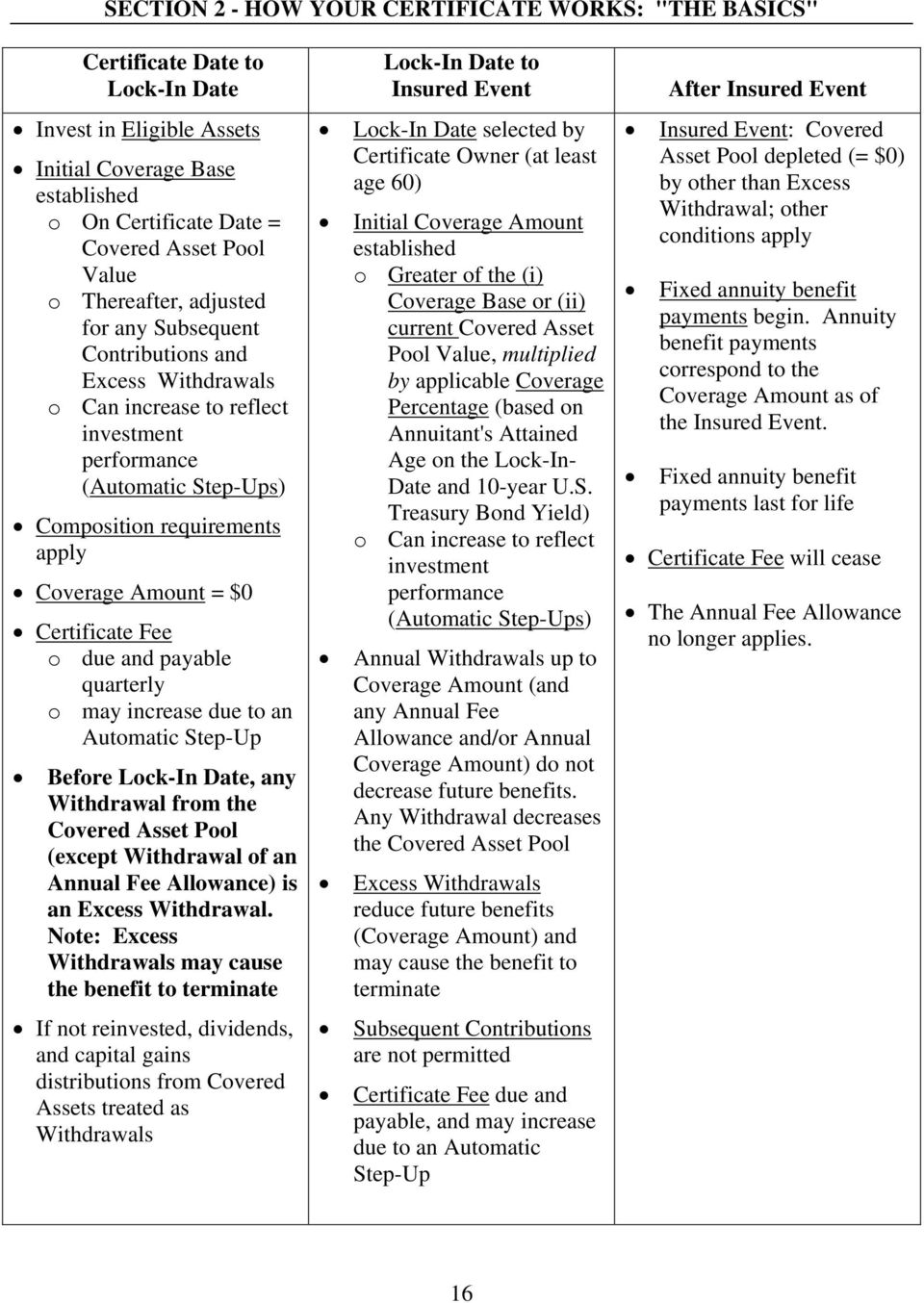
21 Certificate Date to Lock-In Date Maximum Total Contributions may not exceed $1 million without Our prior approval Lock-In Date to Insured Event Composition requirements apply If not automatically reinvested, dividends and capital gains distributions from Covered Assets treated as Withdrawals After Insured Event **The chart above is a very brief summary that is qualified in its entirety by the more detailed disclosure elsewhere in this prospectus, and in the Contract and Certificate. 17
22 SECTION 3 - RISK FACTORS It is important for you to understand the following risk factors before purchasing the Certificate, in order to determine whether the Certificate is suited to your needs and goals. You may never receive the benefits available under the Certificate, because the Covered Asset Pool may perform well enough that it is never reduced to zero. The Certificate includes several restrictions, including restrictions on what investments are Eligible Assets (and other Composition Requirements) and on the amount of Withdrawals you may make without reducing your Coverage Base and Coverage Amount. There is a significant chance that your Covered Asset Pool will perform well enough that it will never be reduced to zero by other than an Excess Withdrawal. The Composition Requirements are designed to manage the risk that We will be required to make benefit payments to you and therefore the likelihood that the Insured Event will occur and that We make benefit payments to you under the Certificate may be small. (Note: any Withdrawals you make are redemptions of the assets in your Account, and are not benefit payments from Us. The ability to make Withdrawals as discussed in this prospectus should not be viewed as a benefit under the Certificate.) The point in time when you begin taking Withdrawals from your Covered Asset Pool may impact any benefit payments you may receive under the Certificate. The longer you wait to set the Lock-In Date and start making Withdrawals from your Covered Asset Pool, the less likely you will benefit from your Certificate s guarantee, because of decreasing life expectancy as you age. You also will be paying for a benefit you are not using. On the other hand, the longer you wait to set the Lock-In Date, the more opportunities you will have to make additional Contributions or lock in any appreciation of your Covered Asset Pool through the operation of the Automatic Step-Up that may occur on each Certificate Anniversary. You should, of course, carefully consider when to set the Lock-In Date and begin making Withdrawals, but there is a risk that you will not begin making Withdrawals at the most financially beneficial time for you. You should also remember that Certificate Fees are due beginning on the Certificate Date, even if you do not begin taking Withdrawals from your Covered Asset Pool for many years, or ever, and whether or not We pay you any benefit payments. If you choose never to take Withdrawals, and/or if you never receive any benefit payments, you will not receive a refund of the Certificate Fees you have paid. You may die before the Covered Asset Pool is reduced to zero. If you (or you and your Spouse under a joint life Certificate) die before the Covered Asset Pool is reduced to zero, neither you nor your estate will ever receive any benefit payments under the Certificate. The Certificate does not have any cash value, surrender value, or provide a death benefit. Furthermore, even if you begin to receive benefit payments, you may die before receiving an amount equal to or greater than the amount you have paid in Certificate Fees. 18
23 The Covered Asset Pool may be depleted before the Lock-In Date is set. The Covered Asset Pool Value decreases each time you make a Withdrawal. The Covered Asset Pool may also decrease based on market fluctuations, e.g., changes in the value of the Eligible Asset(s) held in the Covered Asset Pool and Certificate Fees. Additionally, there are certain fees and charges associated with the Eligible Assets, which may reduce the Covered Asset Pool Value. These fees may include management fees, distribution fees, acquired fund fees and expenses, redemption fees, exchange fees, advisory fees, administrative fees, sales loads and commissions. Before the Lock-In Date any Withdrawal (other than for the Annual Fee Allowance, if any) is an Excess Withdrawal. If the Covered Asset Pool is reduced to zero prior to the Lock-In Date being set, the Certificate will terminate without value and no benefits will be paid. You may make Excess Withdrawals which will reduce and may even terminate the benefits available under the Certificate. Due to the long-term nature of the Certificate guarantee, there is a risk that you may encounter a personal financial situation in which you need to make Withdrawals before the Lock-In Date or after the Lock-In Date but in excess of the Coverage Amount. Any Withdrawal (other than for the Annual Fee Allowance) before the Lock-In Date is an Excess Withdrawal. Any transfer out of the Covered Asset Pool (including amounts transferred from the Covered Asset Pool to fund the cash account for the purpose of paying the Certificate Fee) is considered a Withdrawal for purposes of the Certificate and may lead to an Excess Withdrawal. Please note that an Excess Withdrawal will reduce the Coverage Base or Coverage Amount available each year before the Insured Event. Such Excess Withdrawals will reduce your Coverage Base or Coverage Amount (by an amount that could be substantially more than the actual dollar amount of the Withdrawal), which in turn will reduce the amount of, or even eliminate, any future benefit payments that you would otherwise receive. If you make an Excess Withdrawal, We will not provide you with advance notification regarding the repercussions of the Withdrawal. Dividends and capital gains that are distributed and not automatically reinvested are considered Withdrawals, and may cause an Excess Withdrawal, particularly when realized before the Lock-In Date. Also, please keep in mind that for any Withdrawal that you make from your Account, federal and state income taxes will apply, and if the withdrawal is from a Qualified Account, a 10% federal tax penalty may also apply if you have not yet reached age 59 ½. You may cancel the Certificate prior to a severe market downturn. Once you have cancelled the Certificate, Our obligation to make benefit payments to you will cease. If you happen to cancel your Certificate prior to a severe market downturn, you will not receive any benefit payments, even if your previously covered investments are reduced to zero by other than an Excess Withdrawal. We may cancel the Certificate and make no benefit payments if assets in your Account fail to meet the Composition Requirements, or if you do not provide Us with information necessary to monitor the composition of your Account. 19
24 The assets in your Account must be invested at all times in accordance with the Composition Requirements to be covered by the Certificate. Covered Assets must at all times be allocated either to: (a) Eligible Funds in accordance with applicable Eligible Fund Composition Requirements; or (b) An Eligible Strategy in accordance with applicable Eligible Strategy Composition Requirements. The Composition Requirements limit the minimum and maximum percentages of Covered Asset Pool Value that may be invested in certain investments or Asset Class Categories. We may change the Composition Requirements at any time upon 30 days advance notice. We may change the Composition Requirements due to a variety of factors including, but not limited to, market, risk and competitive factors. In addition, your Covered Asset Pool may shift out of compliance with the Composition Requirements for other reasons beyond your control, including, without limitation, market fluctuations, failure of your Financial Institution or financial professional to make certain Eligible Assets available with your Account, or failure of your financial professional to maintain your Account in compliance with the Composition Requirements. You are responsible for monitoring and rebalancing your Covered Asset Pool in order to maintain compliance with the Composition Requirements. Your Certificate will terminate and TALIC will make no benefit payments if you fail to reallocate Eligible Assets to comply with the Composition Requirements within the Compliance Deadline. In addition, your Certificate will terminate and We will make no benefit payments if your Financial Institution, the Third-Party Administrator or you do not provide or give Us access to the information or data necessary to monitor the composition of your Account. We may change the Eligible Assets and you may have to move your assets or the Certificate may be terminated. We may change the Eligible Assets at any time. If we notify you the Eligible Assets have changed, you must re-allocate the Covered Asset Pool in accordance with the then applicable Composition Requirements within 30 days of the date of notice, or your Certificate will be terminated and no benefits will be paid. In addition, complying with the Composition Requirements in the event of a change in Eligible Assets may lead to higher fees and may also have adverse tax implications. The Certificate Fee Percentage for Covered Funds may change solely as a result of market fluctuations If your Covered Asset Pool is allocated to Eligible Funds, the Certificate Fee Percentage is based on your Fee Option, the Fund Factors applicable to your Covered Funds, and your Investment Profile on the Calculation Date. Certain Fee Options have higher Certificate Fee Percentages. Also, the Investment Profiles with a higher percentage of assets allocated to Eligible Funds with 20
25 higher risk profiles (and higher Fund Factors) have a higher Certificate Fee Percentage. Because your Investment Profile may change for no reason other than market fluctuations, your Certificate Fee Percentage also may increase for no reason other than market fluctuations. We may increase the Certificate Fee Percentage. We may change the Fund Factors for Eligible Funds from time to time which may result in an increase in the Certificate Fee Percentage, subject to the stated maximum percentage. We may increase the Certificate Fee Percentage applicable to Eligible Strategies from time to time. If you are invested in an Eligible Strategy at the time of an increase in the Certificate Fee Percentage, the fee increase would only apply in the event of an Automatic Step-Up in the Coverage Amount. The Certificate Fee Percentage applicable to an Eligible Strategy will not be increased by more than 0.75% above the Certificate Fee Percentage at the time of the Certificate Owner s investment in the Eligible Strategy. We may cancel the Certificate if the Certificate Fee is not paid. If We do not receive the Certificate Fee within 95 days of the due date, the Certificate will terminate and no benefits will be paid. We may remove a Financial Institution from Our list of approved Financial Institutions and you may have to move your Account to an approved Financial Institution or the Certificate may be terminated. We may remove a Financial Institution from Our list of approved Financial Institutions at any time. Please note that if We remove a Financial Institution from Our list of approved Financial Institutions, you must maintain compliance with the terms of the Certificate and move your Account to an approved Financial Institution. Your Certificate will terminate and no benefits will be paid unless you (i) move your Account to an approved Financial Institution within 90 calendar days of the date We send notice of disapproval, (ii) maintain compliance with the Composition Requirements and provide or give Us access to the information or data necessary to monitor the composition of your Account at all times, and (iii) comply with all other applicable terms of the Certificate. In addition, your Certificate will terminate and no benefits will be paid if the Financial Institution is the custodian or sponsor of your IRA, or the custodian or trustee of another Qualified Account and that custodian/sponsor/trustee discontinues its services unless (i) you replace the custodian/sponsor/trustee within 90 calendar days of discontinuance of service, (ii) maintain compliance with the Composition Requirements and provide or give Us access to the information or data necessary to monitor the composition of your Account at all times, and (iii) comply with all other applicable terms of the Certificate. The Coverage Percentage is partly determined by the 10-year United States Treasury Bond Yield. There is risk that the 10-year United States Treasury Bond Yield may decrease. Because the Coverage Percentage is determined in part by the current 10-year United States Treasury Bond yield (10-year US Bond yield), there is risk that the 10-year US Bond yield may 21
26 be lower at the time you Lock-In the Coverage Amount. A lower 10-year US Treasury Bond yield on the Lock-In Date would result in a lower Coverage Percentage. In addition, a change in the 10-year US Bond yield after the Lock-In Date may impact your opportunity to Step-Up the Coverage Amount upon a Certificate Anniversary even if the Covered Asset Pool Value has increased. Your investments may grow better if you are not subject to the Certificate s Composition Requirements. The Certificate limits your investment choices. Only certain funds may be available under the Certificate. The Eligible Assets may be managed in a more conservative fashion than other investments available to you. If you do not purchase the Certificate, it is possible that you may purchase other investments (such as other mutual funds) that experience higher growth or lower losses, depending on the market, than the Eligible Assets experience. You should consult with your financial representative to assist you in determining whether the Eligible Assets are suited for your financial needs and risk tolerance. If you reallocate or transfer the investments in your Account so that you are no longer invested in the Eligible Assets in accordance with the Composition Requirements, We will terminate your Certificate and no benefits will be paid. Your receipt of any benefits under the Certificate is subject to Our financial strength and claims paying ability. The Certificate is not a separate account product. This means that the assets supporting the Certificate are not held in a segregated account for the exclusive benefit of Certificate Owners. Rather, We will make benefit payments under the Certificate from Our general account, which is not insulated from the claims of other policyholders and Our third party creditors. Therefore, your receipt of payments from Us is subject to Our claims paying ability. You cannot seek enforcement of the guarantee against any other party. You may obtain information on Our financial condition by reviewing Form 10-K, which is the Annual Report We file with the Securities and Exchange Commission pursuant to Sections 13 and 15(d) of the Securities Exchange Act of 1934 ( Exchange Act ). For further information, refer to Section 8 - Transamerica Advisors Life Insurance Company. Your payment of the Certificate Fee and/or Advisory Fees from a Qualified Account may have tax consequences and affect the benefits provided under your Certificate. Your Certificate Fee and Advisory Fees are paid from your separate cash account held outside the Account, if you elect Option 1. There may be tax consequences if you elect to liquidate Covered Assets in your Qualified Account to pay the Certificate Fee (such as under Fee Options 4 6) and/or the Advisory Fee (such as under Fee Options 2, 3, 5 or 6) (see Section 4, Certificate Fee: Fee Options). You should consult your tax advisor before electing a Fee Option. In addition, your Qualified Account, other than an IRA, may prohibit the use of Covered Assets to pay the Certificate Fee and/or the Advisory Fee. You should consult your plan administrator before purchasing a Certificate. 22
27 If you liquidate Covered Assets in excess of any permitted Annual Fee Allowance to pay Certificate Fees, Advisory Fees, or any other fees then some or all of that payment may be an Excess Withdrawal. Excess Withdrawals may significantly reduce, and may even terminate, the benefits offered by the Certificate. For a Certificate held in a non-ira Qualified Account the requirement of the surviving spouse to roll the Covered Assets and Certificate may limit the benefit of a joint life Certificate. For non-ira Qualified Accounts holding the Certificate, if the surviving Spouse of the beneficial owner of the Qualified Account wishes to continue the Certificate, the surviving Spouse must rollover the Covered Assets and the Certificate to a compliant Qualified Account holding assets at an approved Financial Institution. The surviving Spouse must be the beneficial owner of the Qualified Account and the Covered Person. This rollover requirement for non-ira Qualified Accounts holding the Certificate may limit or prevent the surviving Spouse from receiving any benefits under a joint life Certificate (or continuing a single life Certificate). You should take this into consideration when deciding whether you want to cover joint lives with assets held in your non-ira Qualified Account. A divorce could significantly impact the benefits of the Certificate. If (i) you have purchased a single or joint life Certificate; (ii) you and your Spouse divorce; and (iii) ownership of your Account is transferred or split (either by a settlement agreement, qualified domestic relations order ( QDRO ) or a court-issued divorce decree), then you must immediately notify Us in writing and provide the information that We require (which may include court records). Transferring or dividing the Account may constitute a Withdrawal or Excess Withdrawal depending on the amounts involved and when concluded. A Certificate Fee Adjustment may apply for any Excess Withdrawals. See Section 4 Description of the Certificate, Divorce. You should be aware of the various regulatory protections that do and do not apply to the Certificate. Your Certificate is registered in accordance with the Securities Act of The issuance and sale of your Certificate must be conducted in accordance with the requirements of the Securities Act of We are also subject to applicable periodic reporting requirements and other requirements imposed by the Exchange Act. However, We are not an investment advisor and do not provide investment advice to you in connection with the Certificate or your Account. We also are not an investment company and therefore We are not registered under the Investment Company Act of 1940, as amended, and the protections provided by the Investment Company Act of 1940 are not applicable with respect to your Certificate. 23
28 Introduction to the Certificate SECTION 4 - DESCRIPTION OF THE CERTIFICATE The Certificate is available in connection with Accounts held outside any formal retirement arrangement (i.e., Nonqualified Accounts). The Certificate is also available in connection with Qualified Accounts. The Certificate may either be held as an asset of the Qualified Account or may be held directly by the Covered Person who is the beneficial owner of the Qualified Account. The Certificate is issued pursuant to the terms of a group contingent deferred annuity contract issued by TALIC to the Group Contract Holder. The word contingent indicates that you will not receive any benefits under the Certificate unless certain events take place (the Insured Event ), and these events may or may not occur. The word deferred indicates that We will not make benefit payments, if any, until after the Insured Event. The Certificate is offered to individuals who have purchased Eligible Assets either directly or via certain non-individual entities acting as agents on their behalf and hold their Covered Asset Pool in an Account with a Financial Institution. The Certificate may also be offered to Qualified Accounts holding assets on behalf of the Covered Persons who are the beneficial owners of the Qualified Accounts. You must be a member of the discretionary group associated with a Group Contract Holder in order to be eligible to purchase a Certificate in any jurisdiction utilizing a Group Contract. Please contact your financial professional for the list of Eligible Assets. In the future, We may add new Eligible Assets or remove existing Eligible Assets. The Certificate is designed to protect investors who are concerned that, either because of Withdrawals (other than Excess Withdrawals), sub-par or poor market performance, or both, their Covered Asset Pool may be depleted during their lifetime. In other words, the Contract and the Certificate provide a form of insurance against outliving your assets. Under the Certificate, you agree that you will pay the Certificate Fee to Us on a quarterly basis, and you agree to comply with the Composition Requirements under the Certificate. We agree that, if you comply with the conditions of the Contract and Certificate, We will make fixed and guaranteed benefit payments to you on a monthly (or other periodic) basis for the remainder of your life (and, under a joint life Certificate, your Spouse s life) if your Covered Asset Pool is reduced to zero by other than an Excess Withdrawal. Note: There are three important dates to keep in mind relevant to the operation of the Certificate: (1) The Certificate Date: The date on which We issue the Certificate to the Certificate Owner. On the Certificate Date the Coverage Base is set equal to the Certificate Owner s Covered Asset Pool Value. (2) Lock-In Date: The date initial Coverage Amount is set. The Certificate Owner sets the Lock-In Date. The Lock-In Date may be no earlier than the date the Certificate Owner/Covered Person (or if joint life coverage is selected, the date the younger 24
29 Spouse) attain(s) age 60. Prior to the Lock-In Date all Withdrawals other than Withdrawals of the Annual Fee Allowance are considered Excess Withdrawals. (3) The Insured Event: The date on which the Covered Asset Pool Value is reduced to zero by other than an Excess Withdrawal. The Insured Event must occur, and other conditions must be met, before benefit payments will be paid under the Certificate. Purchasing the Certificate On the date you purchase the Certificate, all of the following must be true: The Covered Asset Pool Value held in your Account must be at least $50,000 and not more than $1 million (see Coverage Base Increases below). Cumulative Contributions in excess of $1 million per Covered Person must be pre-approved by Us. You must comply with the applicable Composition Requirements. The Covered Person (or both Covered Persons under a joint life Certificate) must be between ages 35 and 90. We may require due proof of age before issuing the Certificate. To purchase the Certificate, you must complete an enrollment form. Enrollment forms are available through financial professionals. Your enrollment form is subject to Our approval. We may refuse to issue a Certificate at any time in Our sole discretion. We may discontinue offering the Certificate at any time. If your application is accepted and the Certificate is issued, then you are given a Free Look Period during which you may cancel the Certificate. The Free Look Period begins upon receipt of the Certificate and ends 30 calendar days thereafter (or such longer period that your state may require). To cancel the Certificate during the Free Look Period, you must provide the Company with written notice within the 30 day period. If you cancel the Certificate during the Free Look Period, We will refund any Certificate Fees paid for the Certificate. Composition Requirements The Covered Assets in your Account must be invested at all times in accordance with the Composition Requirements to be covered by the Certificate. You are responsible for monitoring and rebalancing your Account in order to maintain compliance with the Composition Requirements. Your Certificate will terminate and no benefits will be paid if the Covered Assets do not comply with the Composition Requirements. Covered Assets must at all times be allocated either to: (a) Eligible Funds in accordance with applicable Eligible Fund Composition Requirements (described below); or (b) An Eligible Strategy in accordance with applicable Eligible Strategy Composition Requirements (described below). 25
30 The Eligible Assets currently consist of Eligible Funds and Eligible Strategies. Eligible Funds include mutual funds, including exchange traded funds or ETFs approved and monitored by Us. Eligible Strategies are currently designated groups of mutual funds and ETFs held or rebalanced in accordance with allocation percentages and Composition Requirements we specify. Individual investments (mutual funds and ETFs) held or rebalanced in accordance with an Eligible Strategy are referred to as Eligible Strategy Funds. You must choose to invest either (i) in Eligible Funds, or (ii) in Eligible Strategy Funds according to an Eligible Strategy. If you select an Eligible Strategy, you must allocate 100% of your Covered Asset Pool to the Eligible Strategy Funds designated for the Eligible Strategy. Some or all of the Eligible Funds may also be Eligible Strategy Funds. If you select an Eligible Strategy, your Certificate will be subject to the Certificate Fee and Composition Requirements applicable to the Eligible Strategy you selected, even if your investments also correspond to Eligible Funds. Similarly, if you choose to invest in Eligible Funds, your Certificate will be subject to the Certificate Fee and Composition Requirements applicable to Eligible Fund investments, even if your investments also correspond to Eligible Strategy Funds designated for an Eligible Strategy. The above provision is presented in table format as follows: if you select An Eligible Strategy, if you select Eligible Funds, your Certificate will be subject to the Certificate Fee and Composition Requirements applicable to the Eligible Strategy, your Certificate will be subject to the Certificate Fee and Composition Requirements applicable to Eligible Funds. However, subject to the terms of the Certificate, you may transfer from an Eligible Strategy to Eligible Funds, or from Eligible Funds to an Eligible Strategy pursuant to a Covered Asset Transfer. Please contact your financial professional for the list of Eligible Assets. We cannot and do not guarantee that any of the Eligible Assets will always be available for investment, and We reserve the right to make changes in the array of available Eligible Assets. A complete list of Eligible Assets will be available on Our website and can be obtained from the financial professional who sold you the Certificate. Eligible Fund Composition Requirements If the Certificate Owner elects to invest in Eligible Funds, all of the following Composition Requirements must be met: (a) Your entire Covered Asset Pool must be allocated and maintained in Eligible Funds. (b) 20% or more of your Covered Asset Value must be invested in Eligible Funds designated as Asset Class Category 2 (Core Investment Grade Debt), unless 100% of the Eligible 26
31 Funds invested are designated as Asset Class Category 16 (Balanced) and Asset Class Category 2 (Core Investment Grade Debt). (c) The percentage of the Covered Asset Pool Value invested in any Asset Class Category may not exceed the specified maximum Asset Category Cap, shown below, as of any Calculation Date before the Insured Event. (d) The Fee Factor may not exceed the highest Fee Factor range ( Fee Factor Cap ) currently available (currently 80%), as shown in the Investment Profile and Fee Factor Range Table. As of the date of this prospectus, the Asset Category Caps for the Asset Class Categories are as follows: Asset Class Category Asset Class Description Asset Category Cap 1 International Investment Grade Debt 50% 2 Core Investment Grade Debt 100% 3 High Yield Debt 20% 4 International High Yield Debt 10% 5 Emerging Markets Debt 10% 6 Real Estate 10% 7 International Large Equity 50% 8 Domestic Large Equity 80% 9 Commodities 10% 10 Domestic Mid Cap Equity 25% 11 Domestic Small Cap Equity 15% 12 Emerging Markets Small Equity 5% 13 Alternative Funds 5% 14 International Small Equity 10% 15 Emerging Markets Large Equity 10% 16 Balanced 100% We may, in Our sole discretion, change Composition Requirements at any time upon advance written notice. The change could cause the Covered Asset Pool to exceed an Asset Category Cap or highest Fee Factor Cap. If We notify a Certificate Owner that Composition Requirements have changed, the Certificate Owner will have thirty (30) days from the date of the notice to reallocate the Covered Asset Pool (if necessary). If the Certificate Owner fails to reallocate to the then prevailing Composition Requirements within the Compliance Deadline, the Certificate will terminate and no benefits will be paid. A current list of Eligible Funds organized by Asset Class Category and the current Asset Category Caps and Fee Factor Cap will be available on the website and can be obtained from your financial professional. We have assigned Asset Class Categories for Eligible Funds based on certain criteria which may or may not be consistent with the industry. As a result, an Eligible Fund may not be categorized in the same Asset Class Category as that same fund utilizing different methodology. Moreover, We may change the assignment of an Eligible Fund at our discretion. 27
32 Asset Category Cap Example 1: Below is a hypothetical Example of how compliance with the Asset Category Caps is determined. The Covered Funds, Covered Asset Values and Asset Class Categories shown in the Example are hypothetical only and are not guaranteed. Covered Fund Covered Asset Value Asset Class Category Hypothetical Fund 1 $50,000 8 Hypothetical Fund 2 $60,000 2 Hypothetical Fund 3 $10, Hypothetical Fund 4 $12, Total $132,000 Asset Class Category Sum of Covered Asset Values for Category Percentage of Total Asset Category Cap Pass or Fail 2 $60,000 45% 100% Pass 8 $50,000 38% 80% Pass 11 $22,000 17% 15% Fail In this Example, the Covered Asset Values do not comply with the Asset Category Caps. Asset Category Cap Example 2: Below is a second hypothetical Example of how compliance with the Asset Category Caps is determined. The Covered Funds, Covered Asset Values and Asset Class Categories shown in the Example are hypothetical only and are not guaranteed. Covered Funds Covered Asset Value Asset Class Category Hypothetical Fund 1 $50,000 8 Hypothetical Fund 2 $60,000 2 Hypothetical Fund 3 $10, Hypothetical Fund 4 $8, Total $128,000 Asset Class Category Sum of Covered Asset Values for Category Percentage of Total Asset Category Cap Pass or Fail 2 $60,000 47% 100% Pass 8 $50,000 39% 80% Pass 11 $18,000 14% 15% Pass In this Example, the Covered Asset Values do comply with the Asset Category Caps. An example of how the Fee Factor is calculated appears in Section 4: Certificate Fee Investment Profiles. When deciding how to allocate your money among Eligible Funds, remember that the Certificate Fee will depend on your Investment Profile associated with your allocation to Eligible Funds, and your Investment Profile may change because of market fluctuations, Contributions, 28
33 Withdrawals or Covered Asset Transfers. The Investment Profiles are described in detail in Section 4 Description of the Certificate. Your Certificate Fee will be affected if your Covered Asset Pool shifts to a different Investment Profile, due to investment performance (i.e., market fluctuations) or otherwise. You should consult with your financial professional regarding portfolio rebalancing and other strategies to monitor your Account and maintain continuous compliance with the Composition Requirements and your desired Investment Profile. Eligible Strategy Composition Requirements If you select an Eligible Strategy, all of the Covered Asset Pool must be allocated and maintained in accordance with that Eligible Strategy on each Calculation Date and immediately following any Subsequent Contribution, Excess Withdrawal, or Covered Asset Transfer. Investments in Eligible Strategy Funds will be deemed to meet the Composition Requirements for the selected Eligible Strategy as long as the Covered Asset Pool is allocated in accordance with the then required allocation percentages for the Eligible Strategy. Deviation from an Eligible Strategy due to a Withdrawal which is not an Excess Withdrawal and/or market fluctuation must be corrected no later than the next Calculation Date. Maintaining the proper allocation percentages may require periodic rebalancing. We assume or undertake no duty or obligation to remind any Certificate Owner how or when to rebalance their Covered Asset Pool within an Eligible Strategy or if compliance with these Composition Requirements might otherwise be achieved through investment in Eligible Funds. You should consult with your financial professional regarding portfolio rebalancing and other strategies to monitor your Account and maintain continuous compliance with the Composition Requirements. It is possible that a Certificate Owner may fail to comply with Eligible Strategy Composition Requirements but yet comply with Eligible Fund Composition Requirements (assuming that all such Eligible Strategy Funds were also Eligible Funds within then permissible Asset Class Categories and Asset Category Caps). In this event, rather than terminate the Certificate at the end of the Compliance Deadline, We will reclassify the Covered Assets as being fully invested in Eligible Funds, rather than the previously selected Eligible Strategy. This will be treated as a Covered Asset Transfer and will result in a Certificate Fee Adjustment. On and after the reclassification to Eligible Funds, all Certificate provisions applicable to investments in Eligible Funds, including Certificate Fees and Composition Requirements will apply to your Certificate. If your Covered Asset Pool does not comply with Eligible Fund Composition Requirements as of the Compliance Deadline, your Certificate will be terminated and no benefits will be paid. Additional Information Regarding Composition Requirements We have no ownership or discretionary control over your Account. We cannot reallocate assets in your Account to maintain compliance with Composition Requirements. You are responsible for maintaining compliance with the Composition Requirements at all times. We may, in Our sole discretion, change the Composition Requirements at any time. For example, We may add, modify, replace or delete Eligible Assets, Asset Class Categories, and/or Fee Factor ranges from time to time. In addition, We may reassign one or more Eligible Funds to different Asset Class Categories or change their Fund Factors. The change in one or more Eligible Funds Asset Class Categories or Fund Factors could cause the Covered Asset Pool to 29
34 exceed an Asset Category Cap or highest Fee Factor range (Fee Factor Cap). If the Composition Requirements change, you will be provided with written notice at least thirty (30) days before the change. If We notify a Certificate Owner that Composition Requirements have changed, the Certificate Owner will have thirty (30) days from the date of the notice to reallocate the Covered Asset Pool (if necessary). If the Certificate Owner fails to reallocate to the then prevailing Composition Requirements within the Compliance Deadline, the Certificate will terminate and no benefits will be paid. Except for circumstances related to a change of Composition Requirements, as described in the paragraph above, if at any time the composition of your Covered Asset Pool does not meet the then prevailing Composition Requirements, We will provide you notice of the non-compliance. You will have seven (7) business days from the date of notice to reallocate your Covered Asset Pool to the then prevailing Composition Requirements. If the Certificate Owner fails to reallocate to the then prevailing Composition Requirements within the Compliance Deadline, your Certificate will be terminated and no benefits will be paid. We have no duty or obligation to notify or advise any Certificate Owner as to an optimal or more cost efficient manner of managing their Covered Asset Pool. We are not responsible for investment losses or lost opportunities in any way associated with compliance with Composition Requirements. There may be tax and Certificate Fee consequences associated with any reallocations made to the Account. Note: New Eligible Assets may have higher fees and charges and different investment objectives/strategies than any removed Eligible Asset(s). The Composition Requirements are designed to manage the risk that we will be required to make benefit payments to you under the Certificate. We evaluate the Composition Requirements periodically (typically quarterly) to determine whether the Composition Requirements continue to meet Our risk profile with respect to Our obligations under the Certificates. We also evaluate each of the Eligible Assets to assess if each Eligible Asset continues to meet Our requirements to qualify as an Eligible Asset, and whether each Eligible Fund continues to fit within its designated Asset Class Category and/or Fund Factor. In reviewing the Composition Requirements (which includes considering changes to the list of Eligible Assets) We consider a variety of risk factors, including, without limitation: market volatility; current risks associated with each investment or asset category; composition, risk, volatility, expenses, and performance of the Eligible Funds and Eligible Strategy Funds; the extent to which there are available hedging derivatives with direct correlation to the Eligible Funds and Eligible Strategy Funds; and the liquidity and cost of derivatives needed to hedge against investment risks. Note: There is a risk that your Covered Asset Pool may shift out of compliance with the Composition Requirements for reasons beyond your control, such as market fluctuations. In addition, your Financial Institution and your financial professional may impact your ability to 30
35 comply with the Composition Requirements. For example, your Financial Institution or financial professional could have investment requirements that conflict with the Composition Requirements, your Financial Institution or your financial professional may cease making certain Eligible Assets available with your Account, your Financial Institution or your financial professional may not make new Eligible Assets available with your Account, or your financial professional may fail to maintain your Account in compliance with the Composition Requirements. In any of these circumstances, your Certificate will terminate seven (7) business days from the date of notice to reallocate to the then prevailing Composition Requirements and no benefits will be paid if the Composition Requirements are not met within the Compliance Deadline. Coverage Base It is important to remember that the Coverage Base is used only in calculating your initial Coverage Amount and your Certificate Fee (if you have selected one of the Fee Options 2-6) (see Section 4, Fee Options). It is not, and should not be thought of as, a cash value of the Certificate; the Certificate has no cash value, and the Coverage Base cannot be withdrawn (although it may increase or decrease; see below). It also is not a guarantee of the value of any assets held within your Account. On the Certificate Date, the Coverage Base is set equal to the Certificate Owner s Covered Asset Pool Value. Example 1: Assume that you purchase the Certificate and at that time, you have $100,000 invested in the Covered Asset Pool through your Account. Your initial Coverage Base on the Certificate Date is $100,000. After the Insured Event and provided certain conditions are met, no Certificate Fee is charged and the Coverage Base will no longer be calculated. For Certificates issued as part of a Conversion, the Coverage Base on the Certificate Date will be no less than the Coverage Base on the day of the prior certificate termination. Coverage Base Increases Prior to the Lock-In Date, the Coverage Base will increase in two circumstances: First, each time you make a Subsequent Contribution to the Covered Asset Pool (up to a maximum of $1 million in aggregate Contributions unless approved by Us), your Coverage Base is immediately increased by the amount of the Subsequent Contribution. For these purposes, the Covered Asset Pool Value upon purchase of the Certificate is considered to be a Contribution. Contributions are permitted until the Lock-In Date (subject to Our right to suspend Subsequent Contributions). After the Lock-In Date, Contributions will no longer be permitted. Qualified Account contributions are subject to limitations under the Code. 31
36 Second, on each Certificate Anniversary prior to the Lock-In Date, the Certificate Owner s Coverage Base will be the greatest of: 1) the current Coverage Base; 2) the Certificate Owner s Covered Asset Pool Value on the Certificate Anniversary; or 3) if there have been no Excess Withdrawals during the preceding Certificate Year, the Certificate Owner s highest Covered Asset Pool Value as of any Quarterversary during the immediately preceding Certificate Year. If the Certificate Owner s Coverage Base increases pursuant to 2 or 3, We will treat the increase as an Automatic Step-Up. The Certificate Fee Percentages may be changed due to an Automatic Step-Up of the Coverage Base unless the Certificate Owner rejects the Automatic Step-Up in accordance with the terms of the Contract and Certificate. The Certificate Fee Percentage for Eligible Funds will never exceed the maximum shown in the Eligible Fund Certificate Fee Table (see Section 4 Certificate Fee Percentages for Eligible Funds). The Certificate Fee Percentage applicable to an Eligible Strategy will not be increased by more than 0.75% above the Certificate Fee Percentage at the time of the Certificate Owner s investment in the Eligible Strategy. This Automatic Step-Up feature does not require the termination of the existing Certificate. The Certificate will continue with the same Certificate Date and features. In the event a Certificate Anniversary or a Quarterversary occurs on a day that is not a Valuation Day, for purposes of the Automatic Step-Up calculation, We will use the Certificate Owner s Covered Asset Pool Value on the next Valuation Day. The Covered Asset Pool Value is the aggregate net asset value of the Covered Asset Pool at the close of any Valuation Day. For determining the value of the Covered Asset Pool, ETF s will be valued under the certificate according to their closing value. The Covered Asset Pool Value increases each time you make a Contribution and decreases each time you make a Withdrawal. The Covered Asset Pool Value may also increase or decrease based on "market fluctuations," (e.g., changes in the value of the fund shares held in the Covered Asset Pool). Example 2: Assume that your Coverage Base and Covered Asset Pool are both $100,000, and that you then make a Contribution of $25,000. Upon making the Contribution, your Coverage Base and your Covered Asset Pool will increase to $125,000. Assume that on the next Certificate Anniversary, your Covered Asset Pool Value has decreased to $120,000, due to market declines. Your Coverage Base will remain $125,000. Assume that during the following Certificate Year, your Covered Asset Pool is still at $120,000 and you make a Contribution of $5,000. Your Coverage Base will increase to $130,000, even though your Covered Asset Pool will increase only to $125,000. Assume that on the following Certificate Anniversary, your Covered Asset Pool has increased to $135,000 due to market gains and that this value represents the highest value of the prior three Quarterversaries. Your Coverage Base will increase to $135,
37 Assume that on the following Certificate Anniversary, your Covered Asset Pool Value is still at $135,000 and that your Covered Asset Pool Value during one of the Quarterversaries during the immediately preceding Certificate Year was $140,000. Your Coverage Base will increase to $140,000. The sum of the initial Contribution and any subsequent Contributions may not exceed the Maximum Total Contributions of $1 million without Our prior approval (e.g., the Coverage Base will be limited to $1 million in aggregate Contributions; any amounts inadvertently accepted in excess of this amount, and any appreciation thereon, will not be included in the Coverage Base). Note that the Coverage Base could exceed $1 million if the excess is due to appreciation in the Covered Asset Pool Value. Please note that, for joint life Certificates, the $1 million limit remains the same; it is not increased by the additional Covered Person. Also, if you own multiple Certificates, a single $1 million limit will apply across all of your Certificates. For example, if you and your Spouse purchase a joint life Certificate with an initial Covered Asset Pool of $500,000, then (1) you can contribute an additional $500,000 to be covered by the existing joint life Certificate; OR (2) you or your Spouse can purchase a second joint life Certificate that will have a $500,000 limit on Contributions. However, you could also purchase two single life Certificates, one for you and one for your Spouse, each with a $1 million limit on Contributions. Regardless of the limit on Contributions noted above, we may suspend Subsequent Contributions at any time by providing written notice. After the Lock-In Date, the Coverage Base is used only in calculating your Certificate Fee (if you have selected one of the Fee Options 2 6) (see Section 4, Fee Options). On the Lock-In Date, the Coverage Base will be the greater of (1) the current Coverage Base or (2) the current Covered Asset Pool Value. If the Covered Base increases pursuant to (2) above, we will treat the increase as an Automatic Step-Up. After the Lock-In Date, the Coverage Base will increase only in the event of an Automatic Step-Up in the Coverage Amount. In the event of an Automatic Step-Up in Coverage Amount, the Coverage Base will be reset to equal the result of A divided by B and multiplied by C: Where: (A / B) x C A = the Coverage Amount after the Automatic Step-Up; B = the Coverage Amount immediately prior to the Automatic Step-Up; and C = the Coverage Base prior to the Automatic Step-Up. Coverage Base Decreases Your Coverage Base will decrease whenever you make an Excess Withdrawal. Prior to the Lock-In Date, an Excess Withdrawal is the full amount of any Withdrawal (excluding Withdrawal of any Annual Fee Allowance) because the Coverage Amount is zero before the Lock-In Date. Prior to the Lock-In Date an Excess Withdrawal will reduce the Coverage Base by the greater of (1) the Excess Withdrawal amount, or (2) a pro rata amount in 33
38 proportion to the reduction in the Covered Asset Pool Value. More specifically, an Excess Withdrawal will reduce the Coverage Base by the greater of (1) or (2), where: (1) is the Excess Withdrawal amount; and (2) is the result of A multiplied by B and divided by C A X B C Where: A = the Excess Withdrawal amount; B = the Coverage Base prior to the Withdrawal; and C = the Covered Asset Pool Value after Withdrawal of any Annual Fee Allowance but before the Excess Withdrawal. Example 3: Assume, before the Lock-In Date, that your Coverage Base is $100,000, and that your Covered Asset Pool Value is $90,000 on the Withdrawal date. Assume you elected Fee Option 1 and no Annual Fee Allowance applies. Assume that you withdraw $1,000 in a Certificate Year. Because your Coverage Amount is zero, you have made an Excess Withdrawal of $1,000. The Excess Withdrawal ($1,000) multiplied by the Coverage Base before the Excess Withdrawal ($100,000), and then divided by the Covered Asset Pool Value ($90,000): ($1,000 x $100,000) = $1, ($90,000) $1, is greater than the Excess Withdrawal of $1,000. Therefore, the Coverage Base will be reduced by $1, The new Coverage Base will be $98, After the Lock-In Date, an Excess Withdrawal occurs if you withdraw more than the Coverage Amount in any Certificate Year, except that the Withdrawal of any Annual Fee Allowance, if any, in a Certificate Year, and/or Withdrawal of an Additional Coverage Amount, if any, in a calendar year will not be considered an Excess Withdrawal. Dividends and capital gains distributions not automatically reinvested in the Account are considered Withdrawals and as a result, the Coverage Base will be adjusted accordingly. After the Lock-In Date, if the Coverage Amount decreases due to an Excess Withdrawal, the Coverage Base will be reset to: (A/B) x C, where: A = Coverage Amount after the Excess Withdrawal; 34
39 B = Coverage Amount immediately prior to the Excess Withdrawal; and C = Coverage Base prior to the Excess Withdrawal. An Excess Withdrawal can reduce the Coverage Amount to zero. If the Coverage Amount is reduced to zero due to an Excess Withdrawal, the Certificate terminates without value and no benefits will be paid. If the Certificate Owner withdraws less than the Coverage Amount or Annual Fee Allowance from the Covered Asset Pool in a Certificate Year, the unused portion cannot be carried over to the next Certificate Year. Note that if you make a transfer from your Covered Asset Pool to fund a separate account in order to pay the Certificate Fee or an Advisory Fee in excess of any Annual Fee Allowance, it will be considered a Withdrawal for purposes of calculating the Coverage Base and the Coverage Amount. Coverage Percentage The Coverage Percentage is the factor that the Coverage Base or Covered Asset Pool is multiplied by to determine the Coverage Amount. Prior to the Lock-In Date the Coverage Percentage is zero. On or after the Lock-In Date but before the Insured Event, the Coverage Percentage is determined by the Annuitant s Attained Age (age at last birthday) (or for a joint life Certificate, the Attained Age of the younger Spouse) at the Lock-In Date (as set by you) and the current 10-year United States Treasury Bond Yield. After the Lock-In Date, the Coverage Percentage may only vary from year-to-year based upon changes in the 10-year United States Treasury Bond Yield. For example, if the Annuitant under a single life Certificate is age 65 at the Lock-In Date and the current 10-year United States Treasury Bond Yield is 4.25%, the Coverage Percentage is 4%. If, at the next Certificate Anniversary, the United States Treasury Bond Yield is 4.67%, the Coverage Percentage is 4.5%. Because the Coverage Percentage is determined, in part, by the Attained Age of the Annuitant when the Lock-In Date is set, and the Coverage Percentage increases as Attained Age increases, the longer you wait to set the Lock-In Date, the higher your Coverage Amount may be. On the other hand, the longer you wait to set the Lock-In Date, the less time you have to benefit from the guarantee because of decreasing life expectancy as you age. After the Insured Event and provided certain conditions are met, the Coverage Amount will not change and the Coverage Percentage will no longer be calculated. 35
40 The Coverage Percentages are shown in the table below. Certificate Owner Coverage Percentages (Single Life Certificate) Attained Age 10-Year United States Treasury Bond Yield of Covered Person At Lock-In Date (If joint life coverage, Attained Age of younger joint life at Lock-In Date) 0.00% to less than 4.50% 4.50% to less than 5.00% 5.00% to less than 5.50% 5.50% to less than 7.00% 7.00% % 4.0% 4.5% 5.0% 5.5% % 4.1% 4.6% 5.1% 5.6% % 4.2% 4.7% 5.2% 5.7% % 4.3% 4.8% 5.3% 5.8% % 4.4% 4.9% 5.4% 5.9% % 4.5% 5.0% 5.5% 6.0% % 4.6% 5.1% 5.6% 6.1% % 4.7% 5.2% 5.7% 6.2% % 4.8% 5.3% 5.8% 6.3% % 4.9% 5.4% 5.9% 6.4% % 5.0% 5.5% 6.0% 6.5% % 5.1% 5.6% 6.1% 6.6% % 5.2% 5.7% 6.2% 6.7% % 5.3% 5.8% 6.3% 6.8% % 5.4% 5.9% 6.4% 6.9% % 5.5% 6.0% 6.5% 7.0% % 5.6% 6.1% 6.6% 7.1% % 5.7% 6.2% 6.7% 7.2% % 5.8% 6.3% 6.8% 7.3% % 5.9% 6.4% 6.9% 7.4% % 6.0% 6.5% 7.0% 7.5% % 6.1% 6.6% 7.1% 7.6% % 6.2% 6.7% 7.2% 7.7% % 6.3% 6.8% 7.3% 7.8% % 6.4% 6.9% 7.4% 7.9% % 6.5% 7.0% 7.5% 8.0% 36
41 The Coverage Percentages shown in the table above are for single life Certificates. If coverage is for joint lives, each of the Coverage Percentages will be 0.5% lower than for a single life Certificate. For example, if the applicable Coverage Percentage for single-life coverage (in the table above) is 6.0%, then the corresponding Coverage Percentage for joint-life coverage is 5.5%. The 10-year United States Treasury Bond Yield will be determined as the closing yield as quoted by Bloomberg.com. We reserve the right, subject to insurance commissioner approval, to substitute a comparable index if 10 year U.S. Treasury Bonds cease to be issued on a regular basis. Coverage Amount The Coverage Amount (plus any Annual Fee Allowance) is the amount you can withdraw each Certificate Year from the Covered Asset Pool without causing an Excess Withdrawal. Prior to the Lock-In Date, the Coverage Amount is zero (this means that any Withdrawals (other than Withdrawals for the Annual Fee Allowance) before the Lock-In Date are Excess Withdrawals). Any transfer out of the Covered Asset Pool is considered a Withdrawal for purposes of the Certificate and may lead to an Excess Withdrawal (see Section 4, Withdrawals). The Certificate Owner may elect to lock-in the Coverage Amount at any time on or after the earliest Lock-In Date. After the Insured Event, the Coverage Amount is the amount of fixed annuity payments We guarantee to pay you each Certificate Year. Under a joint life Certificate, We guarantee that We will make these payments until the later of your death or the death of your Spouse. After the Insured Event, the Annual Fee Allowance no longer applies. Calculation of the Coverage Amount at the Lock-In Date At the Lock-In Date, We calculate the initial Coverage Amount by multiplying the Coverage Percentage by the greater of the (i) Coverage Base or (ii) the current Covered Asset Pool Value. If, for example, your Coverage Percentage is 5.0%, then you may withdraw up to 5.0% of the Coverage Base (plus any Annual Fee Allowance) every Certificate Year from the Covered Asset Pool without causing an Excess Withdrawal and reducing the benefits guaranteed to you by the Certificate. The Coverage Amount is not pro-rated for any partial year remaining before the first Certificate Anniversary after the Lock-In Date. This means that the full Coverage Amount may be withdrawn before the first Contract Anniversary after the Lock-In Date. The mechanics of the Coverage Amount calculation at the Lock-In Date are described below. Example 4: Assume that you purchase a single life Certificate at age 65 and your Coverage Base on the Lock-In Date is $100,000. This means that your initial Coverage Amount equals $100,000 multiplied by the applicable Coverage Percentage. Assume that the current 10-year United States Treasury Bond Yield is 5.25% and that the applicable Coverage Percentage is 5.0%. Then the initial Coverage Amount equals $5,000. Therefore, before the Insured Event, you may withdraw $5,000 annually (i.e., each Certificate Year) from your Covered Asset Pool without reducing the benefits guaranteed to you. If the Insured Event occurs (and you satisfy all other conditions), then We will pay you $5,000 annually (in monthly or other periodic payments) until your death. 37
42 In addition to the Coverage Amount, any Annual Fee Allowance withdrawn before the Insured Event will not be counted towards the Coverage Amount and will not result in an Excess Withdrawal. After the Insured Event, the Annual Fee Allowance no longer applies. Calculation of the Coverage Amount after the Lock-In Date After the Lock-In Date but before the Insured Event, the Coverage Amount is calculated on each Certificate Anniversary. The Coverage Amount is the greater of: 1) the current Coverage Amount; or 2) the current Covered Asset Pool Value on the Certificate Anniversary multiplied by the current Coverage Percentage as determined by the Annuitant s Attained Age (age at last birthday) (or for a joint life Certificate, the Attained Age of the younger Spouse) at the Lock-In Date and the current 10-year United States Treasury Bond Yield (see the table under Coverage Percentage above). If the Certificate Owner s Coverage Amount increases pursuant to 2, We will treat the increase as an Automatic Step-Up. The Certificate Fee Percentages may be changed due to an Automatic Step-Up of the Coverage Amount (unless the Automatic Step-Up is rejected by the Certificate Owner). The Certificate Fee Percentage applicable to Eligible Funds will never exceed the maximum shown in the Eligible Fund Certificate Fee Table. The Certificate Fee Percentage applicable to an Eligible Strategy will not be increased by more than 0.75% above the Certificate Fee Percentage at the time of the Certificate Owner s investment in the Eligible Strategy. Example 5: Assume the same facts in Example 4. Your initial Coverage Amount equals $5,000. On a Certificate Anniversary your Covered Asset Pool Value is $95,000. Assume that the Coverage Percentage, based on the current 10-year United States Treasury Bond Yield of 6% and your age at the Lock-In Date, is 5.5%. Therefore, on that Certificate Anniversary, your Coverage Amount is recalculated as $5,225. (5.5% of $95,000 equals $5,225.) Accordingly, before the Insured Event, you may withdraw $5,225 annually (i.e., each Certificate Year) from your Covered Asset Pool without reducing the benefits guaranteed to you. If the Insured Event occurs (and you satisfy all other conditions), then We will pay you $5,225 annually (in monthly or other periodic payments) until your death. In addition to the Coverage Amount, any Annual Fee Allowance withdrawn will not be counted towards the Coverage Amount and will not result in an Excess Withdrawal. After the Insured Event, the Annual Fee Allowance no longer applies. However, please remember that Withdrawals that you make above the Coverage Amount in any Certificate Year could significantly decrease and even terminate the benefits provided by the Certificate. 38
43 If you do not withdraw the entire Coverage Amount or the Annual Fee Allowance, if any, in any Certificate Year, you may not carry over the unused amount to the next year. The Coverage Amount is not pro-rated for any partial year remaining before the first Certificate Anniversary after the Lock-In Date. Note: For Certificates issued as part of a Conversion, the Coverage Amount will be no less than the Coverage Amount on the day of the Conversion. Coverage Amount Decreases Your Coverage Amount will decrease whenever you make an Excess Withdrawal. After the Lock-In Date but before the Insured Event, the Certificate Owner can make a Withdrawal (or Withdrawals) without causing an Excess Withdrawal as long as the total amount of all Withdrawal(s) do not exceed: a. The Coverage Amount and Annual Fee Allowance, if any, for the Certificate Year; and b. The Additional Coverage Amount, if any, for the calendar year. (Note: Coverage Amounts and Annual Fee Allowances are based on Certificate Years, and not on calendar years). The Excess Withdrawal is the amount withdrawn in excess of the Coverage Amount and any Annual Fee Allowance. Dividends and distributions from Covered Assets that are not automatically reinvested in the Account are treated as Withdrawals. An Excess Withdrawal after the Lock-In Date will reduce the Coverage Amount on a pro rata basis in proportion to the reduction in the Covered Asset Pool Value. Therefore, after the Lock- In Date, an Excess Withdrawal can reduce the Coverage Amount by a dollar amount that is greater than the amount of the Excess Withdrawal. Excess Withdrawals will reduce and may even eliminate the benefits of the Certificate. More specifically, after the Lock-In Date an Excess Withdrawal will reduce the Coverage Amount according to the following formula: A multiplied by B and divided by C: Where: A x B C A = the Excess Withdrawal amount (i.e., the amount withdrawn in excess of the Coverage Amount and any Annual Fee Allowance that remained before the Withdrawal); B = the Coverage Amount prior to the Withdrawal; and C = the Covered Asset Pool Value after the Coverage Amount and any Annual Fee Allowance has been Withdrawn, but before the Excess Withdrawal. 39
44 Example 6: Assume the same facts in Example 4. Your Coverage Base is $100,000. As in Example 4 earlier, your Coverage Amount is $5,000. Assume you elected Fee Option 1 and no Annual Fee Allowance applies. Assume that you initially withdraw $3,000 in a Certificate Year. This amount is below $5,000, so there is no Excess Withdrawal. Assume that in the same Certificate Year, you later withdraw an additional $3,000 and that prior to this Withdrawal, your Covered Asset Pool Value was $97,000. When added to the previous Withdrawal of $3,000, you have made an Excess Withdrawal of $1,000. The Excess Withdrawal ($1,000) multiplied by the Coverage Amount prior to the withdrawal ($5,000) divided by the Covered Asset Pool Value ($97,000) after the remaining Coverage Amount ($2,000) is withdrawn: ($1,000 x $5,000) ($97,000 - $2,000) = $ Therefore, the Coverage Amount will be reduced by $ The new Coverage Amount will be $4, Example 7: Assume the same facts in Example 6, except that your Covered Asset Pool Value after the remaining Coverage Amount is withdrawn is $2,000. The Excess Withdrawal ($1,000) multiplied by the Coverage Amount prior to the withdrawal ($5,000) divided by the Covered Asset Pool Value ($2,000) after the remaining Coverage Amount ($2,000) is withdrawn: ($1,000 x $5,000) ($2,000) = $2,500. Therefore, the Coverage Amount will be reduced by $2,500, a dollar amount greater than the amount of the Excess Withdrawal. Additional Coverage Amount In certain circumstances, after the Lock-In Date, an Additional Coverage Amount will also apply for Certificates issued in connection with Qualified Accounts, because of minimum distribution requirements under the Internal Revenue Code. If the Covered Asset Pool is held in a Qualified Account and if the Certificate Owner s (or the beneficial owner s Qualified Account) RMD (for the purposes of determining the Additional Coverage Amount) is calculated using: (a) The age the beneficial owner of the Qualified Account will attain in the current calendar year (the Required Minimum Distributions do not start prior to the Certificate Owner attaining his or her required beginning date as defined in Section 401(a)(9)(C) of the Code); 40
45 (b) The IRS Uniform Lifetime Table, as amended; (c) The value of the Covered Asset Pool (including in some instances the value of the Certificate) as of December 31 st of the calendar year preceding the current calendar year; and (d) The RMD for the current calendar year (no carry-over from past calendar years) is greater than the Coverage Amount, then each calendar year the Certificate Owner (or the beneficial owner of the Qualified Account) can make additional Withdrawals from the Account, after the Lock-In Date but before the Insured Event, up to an amount which represents the difference between the RMD (as determined in the manner described in this subsection) amount and the Coverage Amount, without causing an Excess Withdrawal. This annual amount is referred to as an Additional Coverage Amount. If the Certificate Owner (or the beneficial owner of the Qualified Account) withdraws or transfers less than the Additional Coverage Amount in a calendar year from your Covered Asset Pool, the unused portion cannot be carried over to the next calendar year. For purposes of determining the RMD amount, only assets held in the Covered Asset Pool as of December 31 st of the calendar year preceding the current calendar year will be taken into account. Qualified Account assets held outside the Covered Asset Pool will not be taken into account for calculating the Additional Coverage Amount. In certain situations, an amount greater than this Additional Coverage Amount may need to be distributed to satisfy the Code s required minimum distribution. Such additional Withdrawal amount will be considered an Excess Withdrawal. Note: The Coverage Amount is available on a Certificate Year basis, but the Additional Coverage Amount is available on a calendar year basis. If you make a Withdrawal and both the remaining Coverage Amount and the remaining Additional Coverage Amount are greater than zero, We will treat the Withdrawal as coming from the Coverage Amount or the Additional Coverage Amount that will expire first. Example #1 The remaining Coverage Amount and the remaining Additional Coverage Amount are greater than zero. Certificate Anniversary is June 1. Withdrawal date is March 1. Because the Coverage Amount expires soonest on June 1, the Withdrawal would reduce the Coverage Amount first. Example #2 The remaining Coverage Amount and the remaining Additional Coverage Amount are greater than zero. Certificate Anniversary is June 1. Withdrawal date is July 1. Because the Additional Coverage Amount expires soonest on December 31, the Withdrawal would reduce the Additional Coverage Amount first. 41
46 Note: Under Section 401(a)(9)(C) of the Code, the first required minimum distribution for an IRA must be taken no later than April 1 of the calendar year following the calendar year in which you turn 70 ½. For all other Qualified Accounts, the first required minimum distribution must be taken no later than April 1 of the calendar year following the calendar year in which you turn 70 ½ or the date you retire. Please note that two required minimum distributions cannot be taken from the Certificate in the same Certificate Year. Therefore, depending on your individual circumstances, you may need to take your first required minimum distribution for the year you reach age 70½ in that calendar year, rather than waiting until April 1 of the next calendar year to avoid an Excess Withdrawal. Automatic Step-Ups of Coverage Base and Coverage Amount The Coverage Base and Coverage Amount will automatically step-up under certain circumstances. On each Certificate Anniversary before the Lock-In Date, the Certificate Owner s Coverage Base will be the greatest of: 1) the current Coverage Base; 2) the Certificate Owner s Covered Asset Pool Value on the Certificate Anniversary; or 3) if there have been no Excess Withdrawals during the preceding Certificate Year, the Certificate Owner s highest Covered Asset Pool Value as of any Quarterversary during the immediately preceding Certificate Year. If the Certificate Owner s Coverage Base increases pursuant to 2 or 3, We will treat the increase as an Automatic Step-Up. On each Certificate Anniversary after the Lock-In Date, the Certificate Owner s Coverage Amount will be the greater of: 1) the current Coverage Amount; or 2) the current Covered Asset Pool Value on the Certificate Anniversary multiplied by the current Coverage Percentage as determined by the Annuitant s Attained Age (age at last birthday) (or for a joint life Certificate, the Attained Age of the younger Spouse) at the Lock-In Date and the current 10-year United States Treasury Bond Yield. If the Certificate Owner s Coverage Amount increases pursuant to 2, We will treat the increase as an Automatic Step-Up. The Certificate Fee Percentages may be changed due to an Automatic Step-Up (unless the Automatic Step-Up is rejected by the Certificate Owner as described below). Impact of Automatic Step-Up on Certificate Fee Percentage Beginning on the first Certificate Anniversary, the Certificate Fee Percentage may increase (or decrease) at the time of an Automatic Step-Up of the Coverage Base or Coverage Amount. If your Coverage Base steps up, the current Certificate Fee Percentage in effect at the time of the Automatic Step-Up will be applicable to your Certificate. We reserve the right to declare different Certificate Fee Percentages for different Certificates. Each time an Automatic Step-Up would result in a Certificate Fee Percentage increase, the Certificate Owner has the right to reject the Automatic Step-Up and reinstate the Coverage Base or the Coverage Amount and Certificate Fee Percentage to their respective amounts immediately before the Automatic Step-Up (any Subsequent Contributions or Withdrawals will be reprocessed based on the reinstated Coverage Base or Coverage Amount), provided We receive the rejection, in a written form satisfactory to Us, at Our Service Center within the 30 day period after the Certificate Anniversary on which the 42
47 Automatic Step-Up occurred. A satisfactory form of written rejection of an Automatic Step-Up is provided in Appendix A. Upon such rejection, the increase in the Certificate Fee Percentage, as well as any changes to the Coverage Amount or Coverage Base as a result of the Automatic Step-Up will be reversed. A rejection of one Automatic Step-Up will not be deemed a rejection of potential future Automatic Step-Ups. The Certificate Fee Percentage applicable to an Eligible Fund will never exceed the maximum shown in the Eligible Fund Certificate Fee Table. The Certificate Fee Percentage applicable to an Eligible Strategy will not be increased by more than 0.75% above the Certificate Fee Percentage at the time of the Certificate Owner s investment in the Eligible Strategy. Withdrawals The Certificate does not prohibit you from making Withdrawals from your Covered Asset Pool. You may reallocate assets in your Account or take distributions from your Account at any time subject to any federal tax consequences and the terms of your Account. (As with any investment account, you must liquidate assets to provide for cash withdrawals.) Please see Tax Considerations. The amount of Withdrawals you make, however, may reduce or even eliminate the benefits under your Certificate. We have designed the Certificate for you to take Withdrawals (that do not exceed the Coverage Amount) from the Covered Asset Pool each year for life (and your Spouse s life, under a joint life Certificate) following the Lock-In Date. To obtain the maximum potential lifetime annuity payments under your Certificate if the Insured Event occurs, you must satisfy the restrictions and requirements on Withdrawals and transfers stated in this prospectus and set forth in the Contract and your Certificate. Withdrawals are all amounts deducted from your Covered Asset Pool during the term of your Certificate (including the sale, exchange, or transfer of assets from your Covered Asset Pool as well as the possible conversion of Covered Assets into Ineligible Assets). Dividends and distributions that are not automatically reinvested back into the Account are treated as Withdrawals. Please note regarding Withdrawals: Prior to the Lock-In Date, any amount withdrawn or transferred from the Covered Asset Pool (other than any Annual Fee Allowance) is considered an Excess Withdrawal. After the Lock-In Date but before the Insured Event, the Certificate Owner can withdraw up to the Coverage Amount (and any Annual Fee Allowance) from the Certificate Owner s Covered Asset Pool each Certificate Year without causing an Excess Withdrawal. However, if the Certificate Owner withdraws more than the Coverage Amount (excluding Withdrawal of any Annual Fee Allowance) in any Certificate Year (considered an Excess Withdrawal), the Certificate Owner s Coverage Amount will be reduced on at least a pro rata basis in proportion to the reduction in the Covered Asset Pool Value. Any dividends or distributions from any of the Certificate Owner s Covered Assets must be automatically reinvested in the Covered Asset Pool. If they are not, they will be 43
48 considered Withdrawals. (However, any dividends or distributions from any of the Certificate Owner's Covered Assets that are automatically reinvested in the Covered Asset Pool are not considered Subsequent Contributions and, consequently, do not increase the Coverage Base or Coverage Amount.) One or more Excess Withdrawals can reduce the Certificate Owner s Coverage Amount to zero. If the Coverage Amount is reduced to zero through an Excess Withdrawal, the Certificate terminates without value and no benefits will be paid. Subject to the Composition Requirements described in this prospectus, before the Insured Event the Certificate Owner may make as many Covered Asset Transfers as desired without affecting the benefits under the Certificate. We may adjust the Certificate Fee Percentage as a result of a Covered Asset Transfer if your Investment Profile changes. After the Insured Event, no Withdrawals are permitted. Covered Asset Transfers The Certificate Owner may make any or all of the following Covered Asset Transfers prior to the Lock-In Date subject to applicable Composition Requirements: (a) Add, delete or replace an Eligible Fund(s) for another Eligible Fund(s) or an Eligible Strategy; or (b) Add, delete or replace an Eligible Strategy for another Eligible Strategy or Eligible Fund(s). Any transfer, sale or exchange of a Covered Asset for and into an Ineligible Asset shall be considered to be a Withdrawal and in some instances could constitute an Excess Withdrawal(s). No Covered Asset Transfers are permissible after the Insured Event. Covered Asset Transfers may impact Certificate Owner s Investment Profile or Eligible Strategy and may trigger an adjustment to the Certificate Fee. Payment of Benefits: Insured Event No benefits are paid unless and until the Insured Event occurs and other conditions (such as providing proof of survival) are met. The Insured Event occurs when the Covered Asset Pool Value has been reduced to zero by means other than an Excess Withdrawal. If the Insured Event occurs and all of the following are true, you will be eligible to receive benefit payments under the Certificate: (1) The Certificate is still in force (i.e., it has not been terminated for any reason); (2) The Lock-In Date has passed; (3) The Covered Person (or, for joint life Certificates, at least one of the Covered Persons) is alive; 44
49 (4) The Coverage Amount is greater than zero; and (5) All Certificate Fees due the Company are paid. If the above are true, then upon the occurrence of the Insured Event, We will pay any remaining Coverage Amount for the current Certificate Year. Thereafter, beginning on the Certificate Anniversary following the Insured Event, We will pay you the Coverage Amount each year, divided into monthly payments (or other periodic payments as agreed to by TALIC), until the Covered Person s death (or the death of the surviving Spouse, if later, under a joint life Certificate). We may require proof of age before We make the first payment. After the Insured Event, the Annual Fee Allowance no longer applies. If, however, the Certificate Owner/Covered Person dies (or, for joint life Certificates, both Covered Persons die) before the Insured Event, then We will make no benefit payments under the Certificate. In this regard, the value or benefit provided by the Certificate depends more on how long an applicable Covered Person lives than on stock market volatility and the investment performance of your Covered Asset Pool. Put another way, the longer a Certificate Owner/Covered Person (or, for joint life Certificates, at least one Covered Person) lives after the Insured Event, the more benefit payments We will make to the Certificate Owner(s) and, therefore, the more value the Certificate Owner(s) derive from the Certificate. Benefit Payments Upon the occurrence of the Insured Event, We will pay any remaining Coverage Amount for the current Certificate Year. Thereafter, beginning on the Certificate Anniversary following the Insured Event (and provided all conditions in the Contract and Certificate are met), the Coverage Amount (which will not fluctuate) will be paid in the form of a fixed lifetime annuity for as long as the Covered Person(s) are living. Single Life Certificates Payments will be made in equal installments for the life of the Annuitant. Payments cease upon the death of the Annuitant. Joint Life Certificates Payments will be made in equal installments for the life of the Annuitant and joint Annuitant. Payments cease upon the death of the last surviving Annuitant. Frequency of Payments. The Certificate Owner may choose to receive payments either monthly, quarterly, semi-annually, or annually. We may require that the amount of any such payments be at least a minimum amount. If We exercise this right, this may result in a different frequency payment option. The income portion of benefit payments to you are generally taxable as ordinary income. You should consult a tax advisor as to the tax treatment of benefit payments under the Certificate. For additional information regarding the tax treatment of benefit payments under your Certificate see Section 7 - Tax Considerations. 45
50 Certificate Fee The Certificate Fee will be calculated and due on the Certificate Date and thereafter at each Quarterversary. In general terms, the Certificate Fee is the applicable annualized Certificate Fee Percentage multiplied by the Fee Basis on the Calculation Date times the number of calendar days in a Certificate quarter divided by the number of calendar days in the Certificate Year. If your Covered Asset Pool is allocated to Eligible Funds, the Certificate Fee Percentage applicable on each Calculation Date depends on (i) the Fee Option you select and (ii) the Fund Factors applicable to the Eligible Funds you select, and (iii) your Investment Profile which is based on your Covered Asset Pool allocation among the Eligible Funds. If your Covered Asset Pool is allocated to an Eligible Strategy, the Certificate Fee Percentage applicable on each Calculation Date depends on (i) the Fee Option you select and (ii) the Eligible Strategy you select. The Fee Basis is either the Covered Asset Pool Value or the Coverage Base depending on the Fee Option you select. The Certificate provides guaranteed benefit payments over the life of the Covered Person(s) if the Covered Asset Pool is reduced to zero, subject to conditions specified in the Contract and Certificate. The Certificate Fee compensates Us for providing this insurance protection. We expect to make a profit based on the Certificate Fee. If your Covered Asset Pool is automatically reclassified to Eligible Funds due to a failure to comply with Eligible Strategy Composition Requirements, your Certificate Fee Percentage will be based on your allocation among Eligible Funds on and after the reclassification date. The reclassification will be treated as a Covered Asset Transfer for purposes of calculating the Certificate Fee for the remainder of the Quarterversary in which the reclassification occurred. See Certificate Fee Adjustments below for details. Fee Options You may select one of six Fee Options. The Fee Options allow you to choose a method for paying your Certificate Fee and Advisory Fees. Under Fee Option 1, your Certificate Fee (and any Advisory Fees) will be paid from a separate cash account you establish with the Financial Institution. Under Fee Option 1, the Certificate Fee (and any Advisory Fees) will not be deducted from your Covered Asset Pool. Under Fee Options 2 6 you may withdraw some combination of your Certificate Fee and/or your Advisory Fee (up to a maximum percentage) out of your Covered Asset Pool each Certificate Year without such Withdrawals being considered Excess Withdrawals. The total applicable Certificate Fee and/or Advisory Fee that may be withdrawn each Certificate Year without such Withdrawals being considered Excess Withdrawals is referred to as the Annual Fee Allowance. Any Advisory Fees that exceed the maximum amount specified for your selected Fee Option may not be deducted from the Covered Asset Pool and must be paid from assets outside the Covered Asset Pool. In addition, any Withdrawal not properly identified as a Withdrawal to pay the Certificate Fee or Advisory Fee will not be counted as a Withdrawal Covered by the Annual Fee Allowance and may result in an Excess Withdrawal. 46
51 You should select your Fee Option carefully based on the differences among the Options, your expectation regarding the values of the Coverage Base and Covered Asset Pool over time, and your expected use of the Certificate. For example, Fee Option 1 does not include an Annual Fee Allowance, whereas Fee Option 4 provides for an Annual Fee Allowance equal to the Certificate Fee. The Certificate Fee Percentage under Fee Option 1 is lower than the Certificate Fee Percentage under Fee Option 4. Under Fee Option 1 the Certificate Fee is a percentage of the Covered Asset Pool, whereas under Fee Option 4, the Certificate Fee is a percentage of the Coverage Base. Accordingly, a choice between Fee Option 1 and Fee Option 4 may depend, in part, on the extent to which you expect the Covered Asset Pool to be higher or lower than the Coverage Base while you own the Certificate due to investment performance, Automatic Step- Ups, and/or expected Withdrawals. Also, for example, the Certificate Fee Percentage under Fee Option 3 is lower than the Certificate Fee Percentage under Fee Option 4. In addition, Fee Option 3 allows you to withdraw Advisory Fees equal to 1.50% of the Covered Asset Pool, whereas Fee Option 4 allows you to withdraw Certificate Fees at varying percentages (depending on your Investment Profile) of the Coverage Base. Accordingly, a choice between Fee Option 3 and Fee Option 4 may depend, in part, on the applicable Certificate Fee Percentage under Option 4 and the extent to which you expect the Covered Asset Pool to be higher or lower than the Coverage Base while you own the Certificate. You should consult with your financial professional before selecting a Fee Option. You may not change Fee Options after the Certificate Date. Your Fee Basis also will depend on the Fee Option you choose. If you choose Fee Option 1, the Certificate Fee is a percentage of the Covered Asset Pool. If you choose Fee Option 2, 3, 4, 5 or 6, the Certificate Fee is a percentage of the Coverage Base. The following table shows the Fee Basis and how the Certificate Fees and Advisory Fees are deducted for each Option. Certificate Fee from Covered Assets? Advisory Fee from Covered Assets? Maximum Percentage of Advisory Fee from Covered Assets (as a % of the Covered Asset Pool) Fee Basis Fee Option Option 1 No No N/A Covered Asset Pool Option 2 No Yes 1.00% Coverage Base Option 3 No Yes 1.50% Coverage Base Option 4 Yes No N/A Coverage Base Option 5 Yes Yes 1.00% Coverage Base Option 6 Yes Yes 1.50% Coverage Base 47
52 Under Fee Options 2, 3, 5 and 6, the maximum amount of Advisory Fees that may be Withdrawn each Certificate Year from the Covered Asset Pool without such Withdrawals being deemed an Excess Withdrawal is equal to the maximum percentage rate for the applicable Fee Option multiplied by the greater of the (1) the value of the Covered Asset Pool on the Valuation Day immediately prior to the date the Advisory Fee is applied or (2) the highest value of the Covered Asset Pool on the last Valuation Day of each of the three months immediately prior to the date the Advisory Fee is applied. In the event of multiple Withdrawals of Advisory Fees in a Certificate Year, the percentage of Advisory Fee withdrawn will equal the sum of each percentage of the Covered Asset Pool (on the greater of the Valuation Days specified above) withdrawn to pay Advisory Fees in the Certificate Year. Advisory Fee Withdrawal Example A: Assume the Certificate Date is January 1, 2013 and Fee Option 2 is chosen (1% Advisory Fee), and Withdrawals are made as follows: Advisory Fee Date Withdrawn 1/31/2013 2/28/2013 3/4/2013 3/5/2013 $250 3/29/2013 4/30/2013 5/31/2013 6/13/2013 6/14/2013 $275 6/28/2013 7/31/2013 8/30/2013 9/11/2013 9/12/2013 $300 9/30/ /31/ /29/ /13/ /16/2013 $225 Covered Asset Pool Value Percentage Withdrawn Cumulative Percentage Withdrawn $ 99,000 $100,000 $ 99,000 $ 98, % 0.25% $101,000 $103,000 $105,000 $110,000 $107, % 0.50% $111,000 $115,000 $120,000 $121, % 0.75% $ 89,000 $ 88,000 $ 90,000 $ 87,000 $ 91, % 1.00% Total: 1.00% Result: In this Example, the cumulative Withdrawals in the Certificate Year for the Advisory Fees do not exceed the maximum percentage for the Fee Option. The Advisory Fees withdrawn would not result in an Excess Withdrawal. 48
53 Advisory Fee Withdrawal Example B: Assume the Certificate Date is January 1, 2013 and Fee Option 2 is chosen (1% Advisory Fee) and Withdrawals are made as follows: Date 1/31/2013 2/28/2013 3/4/2013 3/5/2013 $250 3/29/2013 4/30/2013 5/31/2013 6/13/2013 6/14/2013 $220 6/28/2013 7/31/2013 8/30/2013 9/11/2013 9/12/2013 $360 9/30/ /31/ /29/ /13/ /16/2013 $270 Advisory Fee Withdrawn Covered Asset Pool Value Percentage Withdrawn Cumulative Percentage Withdrawn $99,000 $100,000 $99,000 $98, % 0.25% $101,000 $103,000 $105,000 $110,000 $107, % 0.45% $111,000 $115,000 $120,000 $121, % 0.75% $89,000 $88,000 $90,000 $87,000 $91, % 1.05% Total: 1.05% Result: In this Example, cumulative withdrawals in the Certificate Year for Advisory Fees exceed the maximum percentage for the Fee Option. The amount of $45.00 would be considered an Excess Withdrawal. Any unused Annual Fee Allowance will not carry over to subsequent Certificate Years. Withdrawals from the Covered Asset Pool for any purpose other than to pay Advisory Fees or Certificate Fees will not be counted towards the Annual Fee Allowance (even if you do not withdraw the maximum permitted Advisory Fees in a Certificate Year). You must choose one Fee Option on the Certificate Date. You may not change Fee Options after the Certificate Date. Certificate Fee Percentages for Eligible Funds If your Covered Asset Pool is allocated to Eligible Funds, the Certificate Fee Percentage applicable on each Calculation Date depends on (i) the Fee Option you select, (ii) the Fund Factors applicable to the Eligible Funds you select, and (iii) your Investment Profile which is based on your Covered Asset Pool allocation among the Eligible Funds. 49
54 This section does not apply to you if your Covered Asset Pool is allocated to an Eligible Strategy (even if the Eligible Strategy is comprised exclusively of Eligible Funds). See Certificate Fee Percentages for Eligible Strategies below for a description of how Certificate Fee Percentages are determined for Eligible Strategies. The Certificate Fee Percentage applicable to Eligible Funds may be higher or lower than the Certificate Fee Percentage applicable to an Eligible Strategy with the same or similar allocation percentages. Please consult with your financial professional regarding your Covered Asset Pool allocation. Investment Profiles and Fund Factors The Investment Profile for your Covered Asset Pool is calculated each Quarterversary and each time you make a Contribution, Excess Withdrawal or Covered Asset Transfer. If your Covered Asset Pool is allocated to Eligible Funds, your Investment Profile depends on the Covered Fund Value of each of your Covered Funds multiplied by a Fund Factor assigned to each corresponding Eligible Fund. Fund Factors range from 0 to 2 depending on the risk profile of the Eligible Fund as determined by Us. Please contact your financial professional for a current list of Eligible Funds and each corresponding Fund Factor. The Company may change the Fund Factor and Asset Class Category for any Eligible Fund at any time. On the Certificate Date and each Quarterversary, We will use the current Fund Factors to determine the Fee Factor and Investment Profile. A change to a Fund Factor may result in a change to the Certificate Owner s Investment Profile. We will notify the Certificate Owner of a Fund Factor change by sending notification thirty (30) days in advance. We will notify you if your Investment Profile changes. If your Investment Profile changes due to market fluctuations, a Withdrawal that is not an Excess Withdrawal, or a change made by Us, your Certificate Fee Percentage will not change until the next Calculation Date following notification to the Certificate Owner by Us and expiration of the Compliance Deadline. A change in Investment Profile due to a Subsequent Contribution, Excess Withdrawal or Covered Asset Transfer will result in a pro rata adjustment to the Certificate Fee that will be payable on the next Calculation Date. See, Certificate Fee Adjustments, below for more information. There are currently six Investment Profiles. Each Investment Profile is defined by a range of Fee Factors. We apply the following steps in calculating the Fee Factor and Investment Profile: (a) We confirm compliance with the Composition Requirements; (b) We multiply the assigned Fund Factor for each Covered Asset by the value of the Eligible Fund. This calculation is repeated for all Covered Assets. The sum of these calculations is then divided by the Covered Asset Value to derive the Fee Factor; and (c) We compare the Fee Factor to the Fee Factor range in the table below to determine the Investment Profile. 50
55 The Fee Factor range for each Investment Profile is as follows: Investment Profile and Fee Factor Range Table Investment Profile Fee Factor Range Greater than: Not to exceed: A 70% 80% B 60% 70% C 50% 60% D 40% 50% E 30% 40% F 0% 30% Fee Factor Example: Below is a hypothetical Example of how the Fee Factor is determined for each Covered Asset Pool. The Fund Factors shown in the Example are hypothetical only and are not guaranteed. Covered Fund Covered Asset Value (A) Fund Factor (B) A x B Hypothetical Fund 1 $100,000 1 $100,000 Hypothetical Fund 2 $25, $37,500 Hypothetical Fund 3 $50,000 0 $0 Total $175,000 $137,500 In this Example, the Fee Factor equals $137,500 divided by $175,000 = 78.57% (Investment Profile A). Current and Maximum Certificate Fee Percentages The Certificate Fee Percentages (annual rates) for each Fee Option and each Investment Profile are as follows: Eligible Fund Certificate Fee Table Investment Profile Fee Option 1 (% of Covered Asset Pool) Fee Option 2 (% of Coverage Base) Fee Option 3 (% of Coverage Base) Current Maximum Current Maximum Current Maximum Profile A 1.75% 2.50% 1.40% 2.15% 1.45% 2.20% Profile B 1.35% 2.10% 1.25% 2.00% 1.30% 2.05% Profile C 1.15% 1.90% 1.10% 1.85% 1.15% 1.90% Profile D 1.00% 1.75% 1.00% 1.75% 1.05% 1.80% Profile E 0.90% 1.65% 0.90% 1.65% 0.95% 1.70% Profile F 0.80% 1.55% 0.80% 1.55% 0.85% 1.60% 51
56 Investment Profile Fee Option 4 (% of Coverage Base) Fee Option 5 (% of Coverage Base) Fee Option 6 (% of Coverage Base) Current Maximum Current Maximum Current Maximum Profile A 1.90% 2.65% 2.20% 2.95% 2.35% 3.00% Profile B 1.60% 2.35% 1.90% 2.65% 2.00% 2.75% Profile C 1.40% 2.15% 1.60% 2.35% 1.70% 2.45% Profile D 1.20% 1.95% 1.40% 2.15% 1.50% 2.25% Profile E 1.00% 1.75% 1.20% 1.95% 1.30% 2.05% Profile F 0.90% 1.65% 1.05% 1.80% 1.15% 1.90% Beginning on the first Certificate Anniversary, the Certificate Fee Percentage may increase (or decrease) due to and at the time of an Automatic Step-Up of the Coverage Base or Coverage Amount. An increase in the Certificate Fee Percentage at the time of Automatic Step-Up is independent of and does not require a change in Fund Factor(s). However, the Certificate Fee Percentage will not exceed the Maximum Certificate Fee Percentage shown in the table above. To the extent there may be administrative efficiencies with respect to certain allocations among Eligible Funds, the Certificate Fee Percentages may be reduced by at least 0.05% when 100% of your Covered Asset Pool is allocated to and remain invested within a predefined group of Eligible Funds. Please see the current list of Eligible Assets for more information on any fee reduction applicable to a group of Eligible Funds. Certificate Fee Percentages for Eligible Strategies If your Covered Asset Pool is allocated to an Eligible Strategy, the Certificate Fee Percentage applicable on each Calculation Date depends on (i) the Fee Option you select and (ii) the Eligible Strategy you select. We establish the Certificate Fee Percentage for each Eligible Strategy depending on the risk profile of the Eligible Strategy as determined by Us. The Certificate Fee Percentage range for an Eligible Strategy is 0.10% to 3.00% of either the Covered Asset Pool or the Coverage Base, depending on the Fee Option chosen. Please contact your financial professional, or go to the website: for a current list of Eligible Strategies and each corresponding Certificate Fee Percentage. Beginning on the first Certificate Anniversary, the Certificate Fee Percentage may increase (or decrease) due to and at the time of an Automatic Step-Up. However, the Certificate Fee Percentage applicable to an Eligible Strategy will not be increased by more than 0.75% above the Certificate Fee Percentage at the time of the Certificate Owner s investment in the Eligible Strategy. This section does not apply to you if your Covered Asset Pool is allocated to Eligible Funds. See Certificate Fee Percentages for Eligible Funds above for a description of how Certificate Fee Percentages are determined for Eligible Funds. The Certificate Fee Percentage applicable to an Eligible Strategy may be higher or lower than the Certificate Fee Percentage applicable to 52
57 Eligible Funds with the same or similar allocation percentages. Please consult with your financial professional regarding your Covered Asset Pool allocation. Certificate Fee Payments The Certificate Fee will be calculated and due on the Certificate Date and thereafter each Quarterversary. For Fee Options 1 3, any transfer out of the Covered Asset Pool to fund the cash account for the purpose of paying the Certificate Fee is considered a Withdrawal for purposes of the Certificate and may lead to an Excess Withdrawal. In addition, to the extent the cash account is funded through liquidation of assets, there may be tax consequences to the Certificate Owner. If We do not receive the Certificate Fee as of the due date, We will notify you of the deficiency at least twice before 45 days have elapsed. If the required Certificate Fee is not paid within 95 days of the due date, then the Certificate will terminate and no benefits will be paid. Calculation of Certificate Fee Fee Option 1: The Certificate Fee under Fee Option 1 is the applicable annualized Certificate Fee Percentage multiplied by the Certificate Owner s Covered Asset Pool Value on the Calculation Date times the number of days in a Certificate quarter divided by the number of days in the Certificate Year. More specifically, the Certificate Fee is calculated by multiplying A by B by C: A x B x C Where: A = the Covered Asset Pool Value as of the Calculation Date; B = the applicable Certificate Fee Percentage; and C = the number of calendar days in the current Certificate quarter divided by the number of calendar days in the Certificate Year. Fee Options 2 6: In general terms, the Certificate Fee for Fee Options 2-6 is the applicable annualized Certificate Fee Percentage multiplied by the value of the Certificate Owner s Coverage Base on the Calculation Date times the number of days in a Certificate quarter divided by the number of days in the Certificate Year. More specifically, the Certificate Fee for Fee Options 2-6 is calculated by multiplying A by B by C: 53
58 Where: A x B x C A = the value of the Coverage Base as of the Calculation Date; B = the applicable Certificate Fee Percentage; and C = the number of calendar days in the current Certificate quarter divided by the number of calendar days in the Certificate Year. The Eligible Assets are specified under Section 5 - Eligible Assets below. Certificate Fee Reductions The Certificate Fee Percentages will be reduced according to the following schedule: Net Certificate Contributions Percentage Reduction $500,000 and above 0.05% These fee reductions will be applied on a prospective basis and for so long as Net Certificate Contributions exceed this threshold. If approved by Us in advance, you may aggregate net Contributions made by you and your Spouse for purpose of calculating net Contributions required for a Certificate Fee Percentage discount. You must notify your Financial Institution and the fee discount must be approved by Us prior to the Contribution in order for the discount based on you and your Spouse s aggregate Net Certificate Contributions to apply. We reserve the right to discontinue this feature at any time. In addition, Excess Withdrawals made by you and your Spouse may reduce or eliminate any discounts in the future. Example 8: Assume you elected Fee Option 1 and no Annual Fee Allowance applies and that your Covered Asset Pool Value is $100,000 and that there are 91 calendar days in the current Certificate quarter. Further assume that your Covered Asset Pool is allocated to Eligible Funds and your Account falls in Investment Profile D. The Certificate Fee is calculated in two steps: 1. Multiply your Covered Asset Pool ($100,000) by the Initial Certificate Fee Percentage for Investment Profile D (1.00%): ($100,000) x (0.01) = $1, Multiply the result from step 1 by the number of days in the current quarter 91 divided by the number of days in the Certificate Year (365): 91/365 = $1,000 x ( ) = $ Therefore, the Certificate Fee for the quarter would be $
59 Example 9: Assume example 8 above applies to your first Certificate quarter and you add a $400,000 Subsequent Contribution during that first quarter. Further assume that you take no Excess Withdrawals, make no asset transfers, and remain invested in Investment Profile D. The Certificate Fee Adjustment for the Subsequent Contribution is calculated as described in the section below, using the Certificate Fee Percentage determined at the beginning of the quarter. The Certificate Fee on the next Quarterversary is calculated applying the percentage reduction to the Net Certificate Contribution: 1. Multiply your Covered Asset Pool (assumed at $500,500) by the Certificate Fee Percentage for Investment Profile D less the percentage reduction (1.00% %): ($500,500) x (0.0095) = $4, Multiply the result from step 1 by the number of days in the current quarter 91 divided by the number of days in the Certificate Year (365): 91/365 = $4, x ( ) = $1, Therefore, the Certificate Fee for the quarter would be $1, Certificate Fee Adjustments We may adjust the Certificate Fee in the event of a Covered Asset Transfer, as described below under Certificate Fee Adjustment for Transfers. In addition, Subsequent Contributions or Excess Withdrawals that the Certificate Owner makes on other than a Calculation Date will be subject to a Certificate Fee Adjustment as described below under Certificate Fee Adjustment for Excess Withdrawals and Certificate Fee Adjustment for Subsequent Contributions. Certificate Fee Adjustment for Transfers. Covered Asset Transfers that the Certificate Owner makes on other than a Calculation Date may be subject to a Certificate Fee Adjustment. The Certificate Fee Adjustment will be calculated by multiplying A by B by C: Where: A x B x C A = the value of the Fee Basis (Covered Asset Pool for Fee Option 1, or Coverage Base for Fee Options 2 6) as of the date of the most recent Certificate Fee calculation or Certificate Fee Adjustment calculation; B = the Certificate Fee Percentage for the new Investment Profile or Eligible Strategy, as applicable, minus the Certificate Fee Percentage for the previous Investment Profile or Eligible Strategy, as applicable; and 55
60 C = the number of calendar days remaining in the Certificate quarter divided by the number of calendar days in the Certificate Year. Based on the composition of the Covered Asset Pool after a Covered Asset Transfer, the Certificate Fee Adjustment may be positive or negative. The Certificate Fee Adjustment will be added to the Certificate Fee and will be due and payable on the next following Calculation Date. Example 10: Assume your Covered Asset Pool is allocated to Eligible Funds (and not to an Eligible Strategy). Assume you selected Fee Option 1 and that your Covered Asset Pool Value is $100,000 and that there are 30 calendar days left in the current Certificate quarter. You transfer assets within your Covered Asset Pool and as a result of the transfer move from Investment Profile with a Certificate Fee Percentage of 1.75% to an Investment Profile with a Certificate Fee Percentage of 1.00%. The Certificate Fee Adjustment is calculated in three steps: 1. Determine the Covered Asset Pool Value as of the date of the most recent Certificate Fee calculation or fee adjustment Calculation Date: $100, Multiply the Covered Asset Pool Value from step 1 ($100,000) by the result of the Certificate Fee Percentage applicable to the new Investment Profile (1.00%) minus the Certificate Fee Percentage applicable to the previous Investment Profile (1.75%): $100,000 x ( ) = -$ Multiply the result from step 2 (-$750) by the number of days remaining in the Certificate quarter (30) divided by the number of days in the Certificate Year (365): (-$750) x (30/365) = - $ Certificate Fee Adjustment for Subsequent Contributions. A Certificate Fee Adjustment will also be calculated for Subsequent Contributions. The amount of this Certificate Fee Adjustment is calculated by multiplying A by B by C: Where: A x B x C A = the amount of the Subsequent Contribution; B = the applicable Certificate Fee Percentage; and C = the number of calendar days remaining in the Certificate quarter divided by the number of calendar days in the Certificate Year. 56
61 Example 11: Assume that you make a Subsequent Contribution of $25,000 into your Account. Assume that there are 30 calendar days left in the current Certificate quarter at the time you make the Contribution and that the applicable Certificate Fee Percentage is 1.35%. The additional fee is calculated in two steps: 1. Multiply the Contribution into the Account by applicable Certificate Fee Percentage: $25,000 x = $ Multiply the result from step 1 by the number of days remaining in the Certificate quarter divided by the number of days in the Certificate Year: ($337.50) x (30/365) = $ Certificate Fee Adjustment for Excess Withdrawals. A Certificate Fee Adjustment will also be calculated for Excess Withdrawals. The amount of this Certificate Fee Adjustment is calculated by multiplying -A (negative A) by B by C: -A x B x C Where: A = the amount of the Excess Withdrawal; B = the applicable Certificate Fee Percentage; and C = the number of calendar days remaining in the Certificate quarter divided by the number of calendar days in the Certificate Year. Example 12: Assume that you make an Excess Withdrawal of $50,000 and that there are 30 calendar days left in the current Certificate quarter. Also assume that the applicable Certificate Fee Percentage is 1.35%. The Certificate Fee Adjustment is calculated in two steps: 1. Multiply the Excess Withdrawal by the applicable Certificate Fee Percentage: (-$50,000) x = -$ Multiply the result from step 1 by the number of days remaining in the Certificate quarter (30) divided by the number of days in the Certificate Year. (-675) x (30/365) = -$ Certificate Fee Adjustment for Subsequent Contributions or Excess Withdrawals that Change the Investment Profile. If a Subsequent Contribution or Excess Withdrawal results in a change in the Investment Profile, an additional fee adjustment will be calculated by multiplying: A x B x C 57
62 Where: A = the Fee Basis as of the date of the current Certificate Fee Adjustment calculation, reflecting any adjustments to the Fee Basis due to the Subsequent Contribution or Excess Withdrawal; B = the Certificate Fee Percentage based on the new Investment Profile or Eligible Strategy, as applicable, minus the Certificate Fee Percentage for the previous Investment Profile or Eligible Strategy, as applicable; and C = the number of days remaining in the Certificate quarter divided by the number of days in the Certificate Year. The sum of all necessary Certificate Fee Adjustments will be added to or subtracted from the Certificate Fee and will be due and payable on the next Calculation Date. Example 13: Assume your Covered Asset Pool is allocated to Eligible Funds (and not to an Eligible Strategy). Assume you selected Fee Option 1 and that your Covered Asset Pool Value is $100,000 and that there are 30 calendar days left in the current Certificate quarter. You make a Subsequent Contribution of $25,000 into your Account and as a result of the transfer move from an Investment Profile with a Certificate Fee Percentage of 1.35% to an Investment Profile with a Certificate Fee Percentage of 1.00%. This transaction will create two separate adjustments: one for the Subsequent Contribution and one for the Profile change. As shown in Example 11, the Subsequent Contribution creates a Fee Adjustment of $ The Certificate Fee Adjustment for the change in your Investment Profile is calculated in three steps: 1. Determine the Covered Asset Pool Value reflecting the Subsequent Contribution: $125,000 = $100,000 + $25, Multiply the Covered Asset Pool from step 1 ($125,000) by the result of the Certificate Fee Percentage applicable to the new Investment Profile (1.00%) minus the Certificate Fee Percentage applicable to the previous Investment Profile (1.35%): $125,000 x ( ) = -$ Multiply the result from step 2 (-$437.50) by the number of days remaining in the Certificate quarter (30) divided by the number of days in the Certificate Year (365): (-$437.50) x (30/365) = - $ As a result of these two steps there is a fee adjustment of $27.74 for the Subsequent Contribution and a fee adjustment for the Investment Profile change of -$
63 Further assume that your Covered Asset Pool Value is $130,000 as of the next Calculation Date and there are 91 days in the next Certificate quarter. The Certificate Fee for the quarter will be calculated in three steps: 1. Multiply your Covered Asset Pool Value (assumed at $130,000) by the Certificate Fee Percentage applicable to the new Investment Profile (1.00%) above: ($130,000) x (0.01) = $1, Multiply the result from step1 by the number of days in the current quarter (91) divided by the number of days in the Certificate Year (365): = (91/365) = $1,300 x ( ) = $ Add or subtract any applicable Certificate Fee Adjustments (determined above) to the Certificate Fee: $ $ $36.46 = $ Therefore, the Certificate Fee for the quarter will be $ Additional Information About Certificate Fees Certificate Fees for any Certificate will cease upon the occurrence of: The Insured Event; Termination of the Contract; or Termination of the Certificate. Please note regarding the Certificate Fee: Because the Certificate Fee is a percentage of the Covered Asset Pool Value (Fee Option 1) or Coverage Base (Fee Options 2 6), the amount of the Certificate Fee due will increase if the Covered Asset Pool (Fee Option 1) or Coverage Base (Fee Options 2 6) increases (although the percentage(s) may remain the same). If your Covered Asset Pool is allocated to the Eligible Funds, the Certificate Fee Percentage will increase or decrease if your Investment Profile changes, even if that change is due solely to market fluctuations (i.e., changes in the value of your Covered Assets). If your Covered Asset Pool is allocated to the Eligible Funds, changes in the Certificate Fee Percentage due to a change in the Investment Profile of your Covered Asset Pool will occur automatically, and you will not receive any advance notice of any such change. If you make a transfer that results in a change to your Investment Profile or Eligible Strategy, as applicable, your Certificate Fee Percentage may increase or decrease as described above. 59
64 We may change the Fund Factors for Eligible Funds from time to time which may result in an increase in the Certificate Fee Percentage, subject to the stated maximum percentage. We may increase the Certificate Fee Percentage applicable to Eligible Strategies from time to time, subject to applicable limits for existing investments. The Certificate Fees described above are in addition to any Advisory Fee or other charges that are imposed in connection with advisory and other services or charges imposed by the funds in which you are invested or the Account. The Certificate will terminate if the Certificate Fee is not paid. Certificate Eligibility and Ownership Contract benefits are offered to Certificate Owners investing in Covered Assets which are held in an Account at a Financial Institution, subject to the terms and conditions set forth in the Contract and Certificate. At all times while the Certificate is in effect, the Certificate must be owned: (a) by an individual; (b) by two individuals who are Spouses; (c) by a trust or other non-natural person acting as agent in accordance with Section 72(u) of the Code for an individual or for two individuals who are Spouses; (d) by an individual or two individuals who are Spouses and are the sole-general partner(s) of a Family Limited Partnership holding the Account; or (e) by a Qualified Account holding assets on behalf of a Covered Person. Certificates relating to a single Covered Person are called a Single Life Certificate and those relating to more than one Covered Person who are Spouses are called a Joint Life Certificate. A Covered Person must be a natural person. Single Life Certificate If the Certificate is owned by a single individual the Certificate Owner must, on the Certificate Date or at the time he or she becomes the Certificate Owner (as described under Death of a Certificate Owner or Covered Person ), be: (a) between the Attained Ages of 35 and 90; (b) an owner of the Account or the sole general partner of a Family Limited Partnership holding the Account, or when the Certificate is held in connection with a Qualified Account the Certificate Owner is the sole beneficial owner of the Qualified Account; and (c) the Covered Person. If the Certificate is owned jointly by two individuals, the joint Certificate Owners on the Certificate Date or at the time they become joint Certificate Owners must be: (a) both between the Attained Ages of 35 and 90; (b) joint owners of the Account or the sole general partners of a Family Limited Partnership holding the Account), or when the Certificate is held in connection with a Qualified 60
65 Account, one of the joint Certificate Owners is the sole beneficial owner of the Qualified Account; (c) Spouses (at least one of the Spouses must be the owner or beneficial owner of the Account and the other Spouse must be the sole primary beneficiary or joint owner of the Account); and (d) a Covered Person (one of the Certificate Owners). If a Certificate is owned by a trust acting as agent for an individual in accordance with Section 72(u) of the Code, the individual for whom the Certificate Owner acts as agent on the Certificate Date, or at the time the trust becomes the Certificate Owner on behalf of the individual (as described under Death of a Certificate Owner or Covered Person ), must be: (a) between the Attained Ages of 35 and 90; (b) an owner of the Account (or the Certificate Owner must be the owner of the Account as agent for the individual); and (c) the Covered Person. If the Covered Asset Pool is owned by a Family Limited Partnership, a Certificate may be issued only to a general partner of that Family Limited Partnership and the Certificate Owner must, on the Certificate Date or at the time he or she becomes the Certificate Owner (as described under Death of a Certificate Owner or Covered Person ) be: (a) between the Attained Ages of 35 and 90; and (b) the Covered Person. Upon the occurrence of the Insured Event and subject to the conditions shown in the Contract and Certificate, the Coverage Amount payments will be made to the Certificate Owner(s) and not the Family Limited Partnership. If the Certificate is owned by a Qualified Account, the beneficial owner of the Qualified Account must on the Certificate Date or at the time he or she becomes the beneficial owner of the Qualified Account that is the Certificate Owner be: (a) between the Attained Ages of 35 and 90; (b) the sole beneficial owner of the Qualified Account; and (c) the Covered Person. Joint Life Certificates Joint coverage may be elected or unelected at any time prior to the Lock-In Date. In all cases the joint Covered Persons must be Spouses on the date joint coverage is elected. In the case of a Certificate purchased in connection with a Qualified Account or by a Qualified Account, if joint coverage is elected, the difference between the Attained Ages of the joint Covered Persons may not be more than 10 years. For example, if you were born on June 16, 1940, and your Spouse was born on September 27, 1950, then you could not purchase a joint life Certificate in connection with a Qualified Account. 61
66 The Attained Age of the Covered Person means, in the case of a joint life Certificate, the Attained Age of the younger Covered Person. For joint life Certificates, one or both joint Covered Person must be alive at the time of the Insured Event. We may require satisfactory evidence that the Covered Person or joint Covered Person is alive before any payments can begin. If coverage is for joint Covered Persons, each of the applicable Coverage Percentages will be 0.5% lower than for a single Covered Person. For example, if the applicable Coverage Percentage for single-life coverage (in the table above) is 6.0%, then the corresponding Coverage Percentage for joint-life coverage is 5.5%. The younger of the two joint lives must be at least age 60 for the Lock-In Date to occur. Before the Lock-In Date, you may change your election of joint life coverage to single life coverage. After the Lock-In Date, you may not change your election of joint life coverage. If the joint life Certificate is owned by a single individual on the Certificate Date then: (a) both the Certificate Owner and the Certificate Owner s Spouse must be between the Attained Ages of 35 and 90; (b) the Certificate Owner s Spouse must be the sole primary beneficiary on the Certificate for the death distribution rules of Section 72(s) of the Code; (c) the Certificate Owner s Spouse must be the sole primary beneficiary or joint owner of the Account; and (d) the Certificate Owner and the Certificate Owner s Spouse must both be Covered Persons. If the joint life Certificate is owned jointly by two individuals, the joint Certificate Owners on the Certificate Date must be: (a) both between the Attained Ages of 35 and 90; (b) Spouses (at least one of the Spouses must be the owner or beneficial owner or the Account and the other Spouse must be the sole primary beneficiary or joint owner of the Account; (c) Covered Persons; and (d) the designated beneficiary of the other Certificate Owner for the death distribution rules of Section 72(s) of the Code. If the Covered Asset Pool is owned by a Family Limited Partnership in order for a joint life Certificate to be issued, such Certificate Owners must be: (a) both sole general partners of the Family Limited Partnership; (b) both between the Attained Ages of 35 and 90; (c) Spouses; and (d) Covered Persons. Upon the occurrence of the Insured Event and subject to the conditions shown in the Contract and Certificate, the Coverage Amount payments will be made to the Certificate Owner(s) and not the Family Limited Partnership. If the joint life Certificate is used in connection with a Qualified Account, then: (a) both Covered Persons must be between the Attained Ages of 35 and 90; 62
67 (b) the Certificate Owner s Spouse must be the sole primary beneficiary of the Qualified Account; (c) the difference between the ages of the joint Covered Persons may not be more than 10 years; and (d) if there are joint Covered Persons but only one Certificate Owner, then the joint Covered Person who is not the Certificate Owner will be the designated beneficiary of the Certificate Owner for the death distribution rules of Section 72(s) of the Code. If the joint life Certificate is owned by a Qualified Account, then: (a) both Covered Persons must be between the Attained Ages of 35 and 90; (b) the beneficial owner of the Qualified Account s Spouse must be the sole primary beneficiary of the Qualified Account; and (c) the difference between the ages of the joint Covered Persons may not be more than 10 years. Note: Unless otherwise stated, the age of the Covered Person means the age of the younger Covered Person. After the Lock-In Date, if there is a death of one Spouse, the Coverage Percentage will stay at the joint life rate(s). The Insured Event condition that the Annuitant be alive when the Covered Asset Pool is depleted will be met if the Annuitant or joint Annuitant is alive at that time. The benefit payments, if any, will continue for as long as either the Annuitant or joint Annuitant (i.e., either Covered Person) is alive. We may require satisfactory evidence that the Annuitant or joint Annuitant is alive before any benefit payments can begin. If, at the time of your death, the Spouse cannot continue to keep the Certificate in force under the Internal Revenue Code (for example, you are divorced), then the Certificate will terminate and no benefits will be paid. Divorce The Certificate Owner must immediately notify Us if they complete divorce proceedings regardless of whether this Certificate is held in a single or joint life option. We may require that they provide Us with court records and other information We require. Transferring or dividing the Account may constitute a Withdrawal or Excess Withdrawal depending on the amounts involved and when concluded. A Certificate Fee Adjustment may apply for any Excess Withdrawals. If these circumstances occur before the Lock-In Date. o If the former Spouse of the Certificate Owner becomes the sole owner of the Account, then the Certificate Owner may request that the Certificate be reissued with the former Spouse as the sole Certificate Owner and sole Covered Person; otherwise, the Certificate may be terminated. 63
68 If the Certificate is reissued, then a new Coverage Base (calculated as of the date the new Certificate is issued) will apply. The then current Certificate Fee applicable to single life Certificates will apply to the new Certificate. o If the Account is divided between the Certificate Owner and former Spouse, the Certificate Owner or Certificate Owners may request that that the Certificate be reissued as one or two new Certificates; otherwise, the Certificate will be terminated. In either event: Any single life Certificate issued in connection with a divorce must comply with Our rules on who may be a Certificate Owner and who may be a Covered Person. A new Coverage Base (calculated as of the date the new Certificate is issued) will apply to each new Certificate. The then current Certificate Fee applicable to single life Certificates will apply to each new Certificate. o In the case of a joint life Certificate, if there is a divorce and one of the joint Covered Persons dies before the date on which the Insured Event occurs, the Certificate will terminate as of the date of death in order to comply with the Code unless a single life Certificate or two single life Certificates have been issued before the date of death. If the divorce occurs after the Lock-In Date, the terms of the divorce settlement agreement or court-issued divorce decree will govern the disposition of any subsequent benefit payments and the transfer of the rights under the Certificate, provided, however, that such Covered Amount payments may not be split or divided (i.e., the Company will not make payments to multiple payees). Death of a Certificate Owner or Covered Person Death: Single Life Certificate Prior to the Lock-In Date, if the Certificate Owner/Covered Person dies, the Certificate will terminate as of the date of death and no payments will be made under the Certificate unless the following conditions are met: (a) The Certificate is in force; (b) The deceased Certificate Owner s (or Qualified Account beneficial owner s) Spouse on the date of death is the sole beneficiary of the Certificate and Account either directly or via a trust which is a grantor trust for federal income tax purposes (or is a general partner of a Family Limited Partnership which is the beneficiary of the Account); 64
69 (c) The Spouse becomes the sole owner of the Account either directly or via a trust which is a grantor trust for federal income tax purposes (or with respect to a Qualified Account the sole beneficial owner of a compliant Qualified Account where the Covered Asset Pool and if applicable the Certificate was rolled in accordance with the Code) (or is a general partner of the Family Limited Partnership holding the Account); (d) The Account is not owned by a non-natural person other than a Qualified Account trust, Family Limited Partnership (meeting certain conditions), or a trust which is a grantor trust for federal income tax purposes; and (e) The Spouse meets the eligibility requirements for issuing a Certificate. If all of the above conditions are met, the surviving Spouse may elect to continue the Certificate. In that event, the surviving Spouse will become the Covered Person and the Certificate Owner (unless the Certificate is owned by a Qualified Account or grantor trust whose beneficial owner is the surviving Spouse). Note: If a single life Certificate is owned by a non-natural person, then the foregoing provisions shall apply, substituting Covered Person for the owner. Death: Joint Life Certificate Prior to the Lock-In Date, if a Certificate Owner/Covered Person dies, the Certificate will terminate as of the date of death and no payments will be made under the Certificate unless the following conditions are met: (a) The Certificate is in force; (b) The deceased Certificate Owner s (or Qualified Account beneficial owner s) Spouse on the date of death is the sole beneficiary and/or joint owner of the Certificate and Account either directly or via a trust which is a grantor trust for federal income tax purposes (or is a general partner of a Family Limited Partnership which is the beneficiary of the Account); (c) The Spouse becomes the sole owner of the Account either directly or via a trust which is a grantor trust for federal income tax purposes (or with respect to a Qualified Account the sole owner of a compliant Qualified Account where the Covered Asset Pool and if applicable the Certificate was rolled in accordance with the Code) (or is a general partner of the Family Limited Partnership holding the Account); and (d) The Account is not owned by a non-natural person other than a Qualified Account trust, Family Limited Partnership (meeting certain conditions), or a trust which is a grantor trust for federal income tax purposes. If all of the above conditions are met, the surviving Spouse may continue the Certificate. In that event, the surviving Spouse will become the Covered Person and the Certificate Owner (unless the Certificate is owned by a Qualified Account or grantor trust whose beneficial owner is the surviving Spouse). Note: If a joint life Certificate is owned by a non-natural person, then the foregoing provisions shall apply, substituting Covered Persons for the joint owners. 65
70 On or after the Lock-In Date, if a Covered Person dies, the Certificate will terminate and no further payments will be made under the Certificate, unless the Certificate is a joint life Certificate and a Covered Person is alive, in which case the Certificate will continue as long as the surviving Covered Person remains alive. In the case of a Certificate owned by an eligible non-natural person, the eligible non-natural person shall be the sole Certificate Owner on behalf of the surviving Covered Person. Tax Information For the purposes of Section 401(a)(9) of the Code in the case of a Certificate owned by a Qualified Account, the Spouse of the beneficial owner of the Qualified Account shall be the sole designated beneficiary of the Qualified Account. For purposes of section 72(s) of the Code, in the case of a Certificate owned by one individual, the Spouse of the Certificate Owner shall be the designated beneficiary of the Certificate Owner, and in the case of a jointly owned Certificate, each joint Certificate Owner shall be the designated beneficiary of the other Certificate Owner. In all events, the Certificate will comply with section 72(s) of the Code. Cancellation You may cancel the Certificate by sending written notice to the Company. If you cancel the Certificate outside of the Free Look Period, We will not refund any Certificate Fees that you may have paid. If you cancel your Certificate, We may restrict your ability to purchase a new Certificate within one (1) year of the date you elected to cancel the Certificate. When Certificate Coverage Terminates Certificate coverage terminates: on a relevant Certificate Owner s or Covered Person s death, as the case may be, prior to the Insured Event, as described in Section 4, Death of a Certificate Owner or Covered Person ; on a relevant Annuitant s death or joint Annuitant s death, as the case may be, after the Insured Event, as described in Section 4, Benefit Payments; upon assignment, pledge, viatication, levy or garnishment of any Covered Asset or any of the rights under the Contract and Certificate to the Coverage Amount; upon the transfer, sale or other disposition of all or substantially all of the Covered Asset Pool into Ineligible Assets upon non-payment of the Certificate Fee; 66
71 on the date the Coverage Base or Coverage Amount is reduced to zero due to an Excess Withdrawal; on the date We receive any Certificate Owner s written notice to cancel; if the composition of the Covered Asset Pool does not meet then applicable Composition Requirements and the non-compliance is not corrected by the Compliance Deadline; if the Financial Institution, the Third-Party Administrator, or the Certificate Owner does not provide or give Us access to the information or data necessary to monitor the composition of the Certificate Owner's Account; if the Certificate Owner/Covered Person s age (or Certificate Owner/Covered Person s Spouse s, if a joint life Certificate) is misstated and the Certificate would not have been issued had such age(s) not been misstated; if the Certificate Owner does not transfer the Account to a then approved Financial Institution within the prescribed time following removal of a Financial Institution as described under Disapproved Financial Institution ; or with respect to a Certificate covering an Account held by a Family Limited Partnership if the Certificate Owners/Covered Persons are no longer the sole general partner(s) of the Family Limited Partnership; change of law as described in Section 9 - Additional Information, Amendments; or upon termination of the Contract. Upon termination of the Certificate or the Contract We will refund any unearned Certificate Fee. Certificate Fees will be refunded (subject to any applicable Certificate Fee Adjustment) on a prorated basis for the period beginning on the date of termination and ending on the last day of the current Certificate quarter in which the termination occurs. Termination of the Certificate will result in the loss of all current and future benefits provided by the Contract and Certificate. We may restrict the Certificate Owner s ability to purchase a new Certificate within one (1) year of the date the Certificate Owner elected to cancel the Certificate. If the Certificate Owner terminates the Certificate and subsequently purchases a new contingent annuity certificate or contract or similar product, if available, the new certificate will have its own Certificate Fee Percentage, which may be higher than the Certificate Fee Percentage under the Certificate issued under the Contract, and its own coverage terms, which may not be as advantageous as the coverage terms available through the Certificate under the Contract. After the Company satisfies all obligations with respect to any benefit established under the Contract or any Certificate issued hereunder, the Contract will terminate and the Company will be relieved of all further liability. Disapproved Financial Institution If, prior to an Insured Event, for any reason We remove a Financial Institution maintaining a Certificate Owner s Account from Our list of approved Financial Institutions, then the Certificate Owner must maintain compliance with the terms of the Certificate and transfer the Account from the disapproved Financial Institution to an approved Financial Institution within ninety (90) 67
72 calendar days. Different Financial Institutions may assess different fees and charges for their services. Accordingly, if you are required to transfer from a disapproved Financial Institution to an approved Financial Institution you may be subject to higher Advisory Fees and charges. We will send the Certificate Owner a notice upon disapproval of the Certificate Owner s current Financial Institution. Your Certificate will terminate and no benefits will be paid unless you (i) move your Account to an approved Financial Institution within 90 days of the date We send notice of disapproval, (ii) maintain compliance with the Composition Requirements and provide or give Us access to the information or data necessary to monitor the composition of your Account at all times, and (iii) comply with all other applicable terms of the Certificate. We will provide the Certificate Owner with written notice of the termination. A current list of approved Financial Institutions is available at In addition, your Certificate will terminate and no benefits will be paid if the Financial Institution that is the custodian or sponsor of your IRA, or the custodian or trustee of your Qualified Account and that custodian/sponsor/trustee discontinues its services unless (i) you replace the custodian/sponsor/trustee within 90 days of discontinuance of service, (ii) maintain compliance with the Composition Requirements and provide or give Us access to the information or data necessary to monitor the composition of your Account at all times, and (iii) comply with all other applicable terms of the Certificate. Certificate Fee Refund. If We terminate the Contract and Certificates issued thereunder pursuant to a disapproved Financial Institution We will refund any unearned Certificate Fee to the Certificate Owners. Certificate Fees will be refunded (subject to any applicable Certificate Fee Adjustment) on a prorated basis for the period beginning on the date of termination and ending on the last day of the current Certificate quarter in which the termination occurs. 68
73 SECTION 5 - ELIGIBLE ASSETS The Contract provides protection relating to Eligible Assets by ensuring that, regardless of how the Eligible Assets actually perform after the Lock-In Date, the Annuitant will receive predictable income payments for as long as the Annuitant lives so long as specified conditions are met. The Eligible Assets currently consist of Eligible Funds and Eligible Strategies. The Eligible Funds are currently mutual funds, including exchange traded funds or ETFs, specified by Us. An ETF is a type of pooled investment vehicle that invests in the securities of other issuers and the shares of which, unlike a traditional mutual fund, are traded on an exchange in secondary markets. Each share of an ETF represents an undivided ownership interest in the portfolio held by an ETF. ETFs will be valued under the Certificate according to their closing value. The Eligible Strategies are currently specified groups of mutual funds and ETFs held in accordance with specified allocation percentages and requirements. Individual investments (mutual funds and ETFs) held in accordance with an Eligible Strategy are referred to as Eligible Strategy Funds. Certain Eligible Strategy Funds may not be designated as Eligible Funds. The Eligible Strategies are developed by a third-party consultant and approved by Us for use with the Certificate. The designation of an Eligible Strategy for use with the Certificate does not constitute a recommendation of the Eligible Strategy, and neither We nor the third-party consultant is providing investment advice to you with respect to the Eligible Strategies. The Eligible Strategies are static and the allocation percentages among Eligible Strategy Funds will not be periodically updated. However, We may offer new Eligible Strategies from time to time. In addition, We will review the Eligible Strategies, and We may remove an Eligible Strategy from the list of Eligible Assets if the allocation among the Eligible Strategy Funds is no longer consistent with Our risk tolerances under the Certificate. We may make new Eligible Assets available or cease making existing Eligible Assets available at any time in Our complete discretion. If We remove an Eligible Asset, the Certificate Owner will be provided with written notice at least thirty (30) days before the change. If We notify a Certificate Owner that the list of Eligible Assets has changed, the Certificate Owner will have thirty (30) days from the date of the notice to reallocate the Covered Asset Pool (if necessary) to conform to the then applicable Composition Requirements. If the Certificate Owner fails to reallocate to the then prevailing Composition Requirements within the Compliance Deadline, the Certificate will terminate and no benefits will be paid. Transfers may have tax consequences depending on whether the Eligible Assets are in a Nonqualified Account or a Qualified Account. For example, any sales resulting from a reallocation to Eligible Assets in a Nonqualified Account will be a taxable event, and you may not be able to apply the proceeds therefrom to purchase Eligible Assets on a tax-free basis. Any sales resulting from a reallocation to Eligible Assets in a Qualified Account will not result in current taxation. 69
74 For a current list of Eligible Assets, you may contact your financial professional or go to the website: In addition, not all Eligible Assets may be available through your Financial Institution or financial professional. Contact your financial professional for a list of Eligible Assets available for your Account. We have divided the Eligible Funds into the following Asset Class Categories: Asset Class Categories International Investment Grade Debt Core Investment Grade Debt High Yield Debt International High Yield Debt Emerging Markets Debt Real Estate International Large Equity Domestic Large Equity Commodities Domestic Mid Cap Equity Domestic Small Cap Equity Emerging Markets Small Equity Alternative Funds International Small Equity Emerging Markets Large Equity Balanced We may add, modify, replace or delete Asset Class Categories from time to time in Our complete discretion. In addition, We may reassign one or more Eligible Funds to different Asset Class Categories (or change their Fund Factors). We have assigned Asset Class Categories for Eligible Funds based on certain criteria which may or may not be consistent with the industry. As a result, an Eligible Fund may not be categorized in the same Asset Class Category as that same fund utilizing different methodology. For a current list of Eligible Funds organized by Asset Class Category, you may contact your financial professional or go to the website: If We change one or more Eligible Funds Asset Class Categories or Fund Factors, the Certificate Owner will be provided with written notice at least thirty (30) days before the change. If We notify a Certificate Owner that the Asset Class Categories or Fund Factors have changed, the Certificate Owner will have thirty (30) days from the date of the notice to reallocate the Covered Asset Pool (if necessary) to conform to the then applicable Composition Requirements. If the Certificate Owner fails to reallocate to the then prevailing Composition Requirements within the Compliance Deadline, the Certificate will terminate and no benefits will be paid. In addition to the Certificate Fee, there are certain fees and charges associated with the Eligible Funds and Eligible Strategy Funds, which may reduce the Covered Asset Pool Value. These fees may include management fees, distribution fees, acquired fund fees and expenses, redemption fees, exchange fees, advisory fees, administrative fees, sales loads, and commissions. 70
75 Information about the Eligible Funds and Eligible Strategy Funds investment objectives, expenses, strategies and risks appears in the respective prospectus for each Eligible Fund or Eligible Strategy Fund. Please read that separate prospectus carefully before investing in an Eligible Fund or Eligible Strategy Fund. The Eligible Funds and Eligible Strategy Funds may not achieve their respective investment objectives, and may be subject to significant investment risk, including loss of the amount invested. Investing in Eligible Assets in accordance with the Composition Requirements does not affect or reduce these risks. Purchasing a Certificate does not reduce these risks. We do not provide any investment advice to you with respect to your Account or the Composition Requirements. In deciding whether or not to add a fund or strategy to or remove a fund or strategy from the list of Eligible Assets, Our primary focus is the cost of the guarantee We provide. In reviewing changes to the list of Eligible Assets We consider a variety of factors, including, without limitation: composition, risk, volatility, expenses, and performance of the fund or strategy; the extent to which there are available hedging derivatives with direct correlation to the fund or funds in a strategy; and the liquidity and cost of derivatives needed to hedge against investment risks. The selection of Eligible Assets and the Composition Requirements are generally designed to provide consistent returns by reducing risk; accordingly, compliance with the Composition Requirements may also limit the potential for your investments to appreciate. You may earn a higher rate of return by selecting investments other than Eligible Assets and by investing other than in accordance with the Composition Requirements. NOTE: You should consult with your financial professional and tax advisor to assist you in determining whether the Composition Requirements are suited for your financial needs and risk tolerance. 71
76 SECTION 6 - DISTRIBUTION OF THE CERTIFICATE We have entered into an underwriting agreement with Transamerica Capital, Inc. ( TCI ), an affiliate of the Company, for the distribution and sale of the Certificate. Pursuant to this agreement, TCI serves as principal underwriter for the Certificates, offering them on a continuous basis. TCI is not obligated to sell any specific number or dollar amount of Certificates. TCI is obligated only to use its best efforts to locate retail broker-dealers to solicit applications for the Certificate. TCI is located at 4600 S. Syracuse Street, Suite 1100, Denver, Colorado TCI was organized as a corporation under the laws of the State of California in TCI is registered as a broker-dealer with the SEC under the Exchange Act, as well as with the securities commissions of the states in which it operates, and is a member of the Financial Industry Regulatory Authority ( FINRA ). More information about TCI is available through FINRA at or by calling (800) TCI enters into selling agreements with affiliated and unaffiliated broker-dealers to sell the Certificates. The financial professionals of these selling firms are registered with FINRA and with the states in which they do business, and are licensed as insurance agents in the states in which they do business and are appointed by Us. No commissions are paid for sales of the Certificate. See the prospectuses for the Eligible Funds or Eligible Strategy Funds for information on sales charges and compensation for sales of those investments. We pay compensation to the Third-Party Administrator for providing administrative services related to monitoring the composition of the Certificate Owners Covered Asset Pool in accordance with Our requirements. We may discontinue offering the Certificate at any time. 72
77 SECTION 7 - TAX CONSIDERATIONS The following is a general discussion based on Our interpretation of current Federal income tax law. This discussion does not cover every situation and does not address all possible circumstances. In general, this discussion does not address the tax treatment of transactions involving the investments in your Covered Asset Pool. Further, no attempt is made to consider any applicable state tax or other tax laws, or to address any federal estate, or state and local estate, inheritance and other tax consequences, of the Certificate. Tax consequences will depend on your individual circumstances. The Certificate is a new and innovative type of contract. While the IRS recently issued favorable private letter rulings ( PLRs ) concerning products similar to the Certificate issued by other insurance companies, these rulings are not binding on the IRS with respect to the Certificate. Due to factual differences between the Certificate and the products involved in these PLRs, and their non-precedential nature, the analysis and rulings in the PLRs may not reflect the IRS s position with respect to the tax treatment of the Certificate, now or in the future. We can give no assurances that the IRS will agree with Our interpretations regarding the proper tax treatment of a Certificate or the effect (if any) of the purchase of a Certificate on the tax treatment of any transactions in your Account, or that a court will agree with Our interpretations if the IRS challenges them. Please consult your own qualified tax advisor regarding the potential tax consequences of the Certificate in your particular circumstances. Different tax rules apply to Qualified Accounts and Nonqualified Accounts, and the tax rules applicable to Qualified Accounts vary according to the type of Qualified Account and the terms and conditions of the Qualified Account. We may occasionally enter into settlements with owners and beneficiaries to resolve issues relating to the Certificate. Such settlements will be reported on the applicable tax form (e.g., Form 1099) provided to the taxpayer and the taxing authorities. Nonqualified Accounts Treatment of a Certificate as an Annuity Contract Consistent with PLRs that have been issued by the IRS with respect to similar products offered by other insurance companies, We intend to treat a Certificate as an annuity contract for federal income tax purposes. As noted above, however, these rulings are not binding on the IRS with respect to the Certificate. Due to factual differences between the Certificate and the products involved in these PLRs, and their non-precedential nature, the analysis and rulings in the PLRs may not reflect the IRS's position with respect to the tax treatment of the Certificate, now or in the future. Thus, while We believe that the factual differences between the Certificate and the products involved in the PLRs should be immaterial and that the reasoning underlying the PLRs supports treating a Certificate as an annuity for federal income tax purposes, it is possible that a Certificate could be treated as some other type of financial instrument or derivative for such purposes, with different tax consequences than if it were treated as an annuity. If you are the holder or beneficiary of a Certificate, in view of the limited guidance you should consult your own tax advisor regarding the proper tax treatment of a Certificate. 73
78 In order to be treated as an annuity contract for federal tax purposes, a Certificate needs to contain certain provisions prescribing distributions that must be made when an owner of the Certificate dies. We believe that by its terms a Certificate satisfies these requirements. In all events, We will administer a Certificate to comply with these federal tax requirements. As a general rule, a Certificate also needs to be owned by a natural person to be treated as an annuity contract for federal income tax purposes. Under the relevant rules, however, a Certificate that is owned by a trust or other entity holding the Certificate as an agent for a natural person is treated as owned by a natural person for federal income tax purposes. If someone other than a natural person will be the owner of a Certificate, a tax advisor should be consulted before the Certificate is purchased to determine whether the Certificate will be treated as owned by a natural person. It is possible that at certain advanced ages, a Certificate might no longer be treated as an annuity contract if the Insured Event has not occurred before that age. You should consult with a tax advisor about the tax consequences in such circumstances. Treatment of Benefit Payments under a Certificate Assuming that a Certificate is treated as an annuity contract for tax purposes, payments under the Certificate beginning if and when the Insured Event occurs should be treated in part as taxable ordinary income and in part as non-taxable recovery of the aggregate total Certificate Fees you have previously paid under your Certificate (your "investment in the Certificate") until you recover all of your investment in the Certificate. The amount that is not taxable prior to recovering all of your investment in the Certificate should be based upon the ratio of your investment in the Certificate to the expected value of the annuity payments to be made under the Certificate if and when the Insured Event occurs. After you recover all of your investment in the Certificate, annuity benefit payments will be taxable in full as ordinary income. You should consult a tax advisor as to the tax treatment of benefit payments under the Certificate. In addition, We will withhold and send to the U.S. Government a part of the taxable portion of each payment made under a Certificate unless you notify Us before payment of an available election not to have any amounts withheld. In certain circumstances, We may be required to withhold tax. Separate Treatment of a Certificate and an Account Consistent with PLRs that have been issued by the IRS with respect to similar products issued by other insurance companies, We intend to treat a Certificate as an annuity contract that is separate and apart from the assets in your Account for federal income tax purposes. Your Account In view of the conclusions reached in these PLRs, We believe that the tax treatment of transactions involving the assets in your Account including redemptions, dispositions, and distributions with respect to such assets, should generally be the same as such treatment would be in the absence of a Certificate. (The tax treatment of such transactions is beyond the scope of this prospectus, and you should consult a tax advisor for further information about the tax 74
79 treatment of assets covered by a Certificate.) Thus, in general, We believe that (1) distributions and dividends on investments in your Account will not be treated as payments under your Certificate, but rather as distributions with respect to such investments; (2) amounts received on redemption or disposition of your assets in your Account will be treated as amounts realized on a sale or exchange of such assets rather than as distributions under your Certificate; and (3) the purchase of a Certificate should not result in either (a) loss of the benefit of preferential income tax rates applicable to dividends paid on assets in your Account otherwise constituting "qualified dividend income" (if applicable under the tax law in effect at the time of distribution) or (b) under the so-called "straddle" rules, suspension of the holding period for purposes of determining eligibility for long-term capital gains treatment of any gains, or potential deferral of losses, when assets in your Account are sold or exchanged. As noted above, there are limited published legal authorities directly supporting Our conclusions as to the tax treatment of transactions involving the assets in your Account and the Internal Revenue Service could take a different position with respect to the Certificate than it has taken with respect to similar products offered by different insurance companies and ruled upon in the PLRs. Thus, the Internal Revenue Service may disagree with Our interpretations. If the Internal Revenue Service were to successfully take a different position on these issues, it could have a material adverse effect on the tax consequences of your acquisition, holding and disposition of assets in your Account. The tax consequences could also change due to changes in the tax laws. Given the new and innovative character of a Certificate, you should consult your own tax advisor as to the tax consequences, if any, of a Certificate under the "qualified dividend income" (if applicable under the tax law in effect at the time of distribution) and "straddle" rules, as well as other relevant tax provisions, both at the time of initial purchase and in subsequent years. Payment of the Certificate Fee Payment of the Certificate Fee with proceeds from the sale of investment assets held in your Account or from the cash account may have tax consequences. You should consult a tax advisor for further information. Qualified Accounts The Certificate may be used with traditional Individual Retirement Accounts and Roth IRA Accounts, tax-sheltered annuity custodial accounts, eligible deferred compensation plans and qualified plans (collectively Qualified Accounts ). The Certificate is not available as an Individual Retirement Annuity or Roth IRA Annuity. A Certificate may be purchased in connection with a Covered Asset Pool held under any of these arrangements. The Certificate may either be held as an asset of the Qualified Account or may be held directly by the Covered Person who is the beneficial owner of the Qualified Account. The tax results for a Certificate may vary according to the terms and conditions of the Qualified Account. No attempt is made here to provide more than general information about the use of the Certificate with any Qualified Account. Beneficial owners under any Qualified Account, as well as beneficiaries, are cautioned that the rights of any person to any benefits under any Qualified Account are subject to the terms and conditions of that Qualified Account or limited by applicable law, regardless of the terms and conditions of the Certificate. 75
80 We may discontinue offering the Certificates to new Owners that plan to use the Certificate with a Qualified Account. The Certificate is generally available only with respect to the Qualified Account for which the Certificate is purchased. We are not responsible for determining whether the Certificate complies with the terms and conditions of, or applicable law governing, any Qualified Account. You are responsible for making that determination. Similarly, We are not responsible for administering any applicable tax or other legal requirements applicable to the Qualified Account. You or a service provider for the Qualified Account are responsible for determining that distributions, beneficiary designations, Composition Requirements, charges and other transactions under the Certificate are consistent with the terms and conditions of the Qualified Account and applicable law. Traditional IRAs, tax-sheltered annuity custodial account, eligible deferred compensation plan or qualified plan are subject to lifetime required minimum distribution rules. Withdrawals from your Covered Asset Pool taken to meet required minimum distribution requirements may be made available as an Additional Coverage Amount and, if so, do not cause an Excess Withdrawal. (See Additional Coverage Amount. ) The Certificate Fee may be paid from assets in your Qualified Account if permitted under the terms of the Qualified Account. You should consult your tax advisor regarding the tax consequences of paying the Certificate Fee from your Qualified Account. If your Qualified Account is the only source to pay the Certificate Fee and is insufficient to pay the Certificate Fee or is not permitted under the terms of the Qualified Account to pay the Certificate Fee, the Certificate will terminate. If you choose to have your Qualified Account own the Certificate the actuarial present value of the Certificate (calculated in accordance with Treasury Regulation 1.401(a)(9)-6) may need to be included in the value of Covered Asset Pool for the purposes of calculating the required minimum distribution amount for the Qualified Account. If the actuarial present value of the Certificate is included in the calculation, your required minimum distribution may be higher than it would be if the Certificate is held outside the Qualified Account. Numerous changes have been made to the income tax rules governing Qualified Accounts as a result of legislation enacted during the past several years, including rules with respect to: maximum contributions, required distributions, penalty taxes on early or insufficient distributions and income tax withholding on distributions. The following is a general description of Qualified Accounts and of the use of the Certificate in connection with those Accounts. Qualified Accounts Sections 408(a) and 408A of the Internal Revenue Code ( Code ) permit eligible individuals to contribute to an individual retirement program known as an IRA or Roth IRA, respectively. Section 403(b)(7) of the Code permits employees of eligible employers to contribute to taxsheltered annuity custodial accounts. Section 457 of the Code permits employees under an eligible deferred compensation plan to contribute to such plan. Section 401(a) of the Code permits employees of employers who establish qualified plans to contribute to such plans. 76
81 Section 408(p) of the Code allows employers to establish a type of IRA called SIMPLE (Savings Incentive Match Plan for Employees). Section 408(k) of the Code allows employers to establish Simplified Employee Pension ( SEP ) IRAs. These plans are subject to limitations on the amount that may be contributed, the persons who may be eligible to participate and on the time when distributions must commence. In addition, distributions from these plans may be transferred on a tax-deferred basis into another of these plans. Tax on Certain Distributions Relating to Qualified Accounts In the case of distributions to you from your traditional IRA (see discussion of Roth IRA below), your tax-sheltered annuity custodial account or your qualified plan, a ratable portion of the amount received is taxable as ordinary income, generally based on the ratio of your cost basis (if any) to your total accrued benefit under the IRA, tax-sheltered annuity custodial account or qualified plan. Section 72(t) of the Code imposes a 10% penalty tax on the taxable portion of any distribution from IRAs, tax-sheltered annuity custodial accounts or qualified plans subject to certain exceptions set forth in the Code. To the extent amounts are not includable in gross income because they have been properly rolled over to another IRA or to another eligible qualified plan, no tax penalty will be imposed. The tax penalty also will not apply to: (a) distributions made on or after the date on which you reach age 59 ½; (b) distributions following your death or disability (for this purpose disability is as defined in Section 72(m)(7) of the Code); (c) distributions that are part of substantially equal periodic payments made not less frequently than annually for your life (or life expectancy) or the joint lives (or joint life expectancies) of you and your designated beneficiary; and (d) certain other distributions specified in the Code. Generally, distributions from a traditional IRA must commence no later than April 1 of the calendar year following the year in which you attain age 70 ½. Distributions from a taxsheltered annuity custodial account, eligible deferred compensation plan or qualified plan must commence not later than the later of April 1 of the calendar year following the year in which you attain age 70 ½ or the calendar year in which you retire. Required distributions must be made at least annually over a period not exceeding your life (or life expectancy) or the joint lives (or joint life expectancies) of you and your designated beneficiary. Distribution requirements also apply to IRAs upon the death of the IRA owner and to tax-sheltered annuity custodial accounts, eligible deferred compensation plans and qualified plans upon the death of the participant. If the required minimum distributions are not made, a 50% penalty tax is imposed as to the amount not distributed. Roth IRAs, as described in Code section 408A, permit certain eligible individuals to make nondeductible contributions to a Roth IRA in cash or as a rollover or transfer from another Roth IRA or other IRA. A rollover from or conversion of a traditional IRA to a Roth IRA is generally subject to tax and other special tax rules apply. You may wish to consult a tax advisor before combining any converted amounts with any other Roth IRA contributions, including any other conversion amounts from other tax years. Distributions from a Roth IRA generally are not 77
82 taxed, except that, once aggregate distributions exceed contributions to the Roth IRA, income tax and a 10% penalty tax may apply to distributions made (1) before age 59½ (subject to certain exceptions) or (2) during the five taxable years starting with the year in which the first contribution is made to any Roth IRA. Distributions may be subject to withholding for the recipient s U.S. federal income tax liability, although recipients who are U.S. citizens may generally elect not to have tax withheld from such payments. Qualified Accounts and Continuation of Certificate For non-ira Qualified Accounts holding the Certificate, if the surviving Spouse of the beneficial owner of the Qualified Account wishes to continue the Certificate, the surviving Spouse must rollover the Covered Assets and the Certificate to a compliant Qualified Account holding assets at an approved Financial Institution. The surviving Spouse must be the beneficial owner of the Qualified Account and the Covered Person. This rollover requirement may limit or prevent the surviving Spouse from receiving any benefits under a joint life Certificate (or continuing a single life Certificate). You should take this into consideration when deciding whether you want to cover joint lives with assets held in your non- IRA Qualified Account. Seek Tax Advice The above description of federal income tax consequences of the different types of arrangements which may be covered by a Certificate offered by this prospectus is only a brief summary meant to alert you to the issues and is not intended as tax advice. Anything less than full compliance with the applicable rules, all of which are subject to change, may have adverse tax consequences. Any person considering the purchase of a Certificate in connection with an arrangement described above should first consult a qualified tax advisor, with regard to the suitability of the Certificate for such arrangement. Other Tax Matters Same Sex Relationships Section 3 of the Federal Defense of Marriage Act was recently ruled unconstitutional and the Internal Revenue Service adopted a rule in response thereto recognizing the marriage of same sex individuals validly entered into in a jurisdiction that authorizes same sex marriages, even if the individuals are domiciled in a jurisdiction that does not recognize the marriage. The Internal Revenue Service also ruled that the term spouse does not include an individual who has entered into a registered domestic partnership, civil union, or other similar relationship that is not denominated as a marriage under the laws of that jurisdiction. The Company intends to administer the Certificate consistent with these rulings until further guidance is provided. Therefore, exercise of the spousal continuation provisions of this Certificate by persons who do not meet the definition of spouse under federal law e.g., domestic and civil union partners - may have adverse tax consequences. Please note the jurisdiction where you are domiciled may not recognize same sex marriage which may limit your ability to take advantage of 78
83 certain benefits provided to spouses under the Certificate. There are several unanswered questions regarding the scope and impact of this ruling and the subsequent guidance provided by the Internal Revenue Service. Please consult a tax adviser for more information on this subject. Medicare Tax Beginning in 2013, distributions from nonqualified annuity contracts will be considered "investment income" for purposes of the newly enacted Medicare tax on investment income. Thus, in certain circumstances, a 3.8% tax may be applied to some or the entire taxable portion of distributions (e.g., earnings) from a Certificate to individuals whose income exceeds certain threshold amounts ($200,000 for filing single, $250,000 for married filing jointly and $125,000 for married filing separately). We are required to report distributions made from nonqualified annuity policies as being potentially subject to this tax. While distributions from Qualified Accounts are not subject to the tax, such distributions may be includable in income for purposes of determining whether certain Medicare Tax thresholds have been met. Please consult a tax advisor for more information. Annuity Purchases by Residents of Puerto Rico The Internal Revenue Service has ruled that income received by residents of Puerto Rico under life insurance or annuity contracts issued by a Puerto Rico branch of a United States life insurance company is U.S.-source income that is generally subject to U.S. federal income tax. Annuity Purchases by Nonresident Aliens and Foreign Corporations The discussion above provides general information regarding U.S. federal income tax consequences to annuity purchasers that are U.S. citizens or residents. Purchasers that are not U.S. citizens or residents will generally be subject to U.S. federal withholding tax on taxable distributions from annuity contracts at a 30% rate, unless a lower treaty rate applies. In addition, purchasers may be subject to state and/or municipal taxes and taxes that may be imposed by the purchaser s country of citizenship or residence. Prospective purchasers who are not U.S. citizens and residents are advised to consult with a qualified tax advisor regarding U.S., state, and foreign taxation with respect to a Certificate purchase. Section 1035 and Conversion Offer We may offer owners of the Fixed Contingent Annuity Certificates issued by TALIC ( Existing Certificates ) the option to convert their Existing Certificates for the Certificate described in this prospectus ( New Certificate ). We believe that this conversion should be considered tax-free under Section 1035 of the Code. Section 1035 of the Code provides that no gain or loss shall be recognized on the exchange of one annuity contract for another annuity contract. As described in this section, we believe that the Certificates should be treated as annuity contracts under the Code. Thus, any exchange of an Existing Certificate for a New Certificate should qualify as a tax-free exchange under Section 1035 of the Code as long as the New Certificate is held by the same Certificate Owner(s) and covers the same Covered Person(s). However, the IRS may take a contrary position with respect to the conversion of Certificates being considered a tax-free transaction under Section 1035 of the Code. Please consult with your tax advisor regarding the tax consequences of a conversion transaction prior to electing to participate in such an offering. 79
84 Possible Tax Law Changes Although the likelihood of legislative changes is uncertain, there is always the possibility that the tax treatment of the Certificate could change by legislation or otherwise. Consult a tax advisor with respect to legislative developments and their effect on the Certificate. We have the right to modify the Certificate in response to legislative changes that could otherwise diminish the favorable tax treatment that annuity contract owners currently receive. We make no guarantee regarding the tax status of any Certificate and do not intend the above discussion as tax advice. 80
85 SECTION 8 - TRANSAMERICA ADVISORS LIFE INSURANCE COMPANY Transamerica Advisors Life Insurance Company ( TALIC ) is a life insurance company engaged primarily in the sale of insurance products. TALIC was incorporated under the laws of the State of Washington on January 27, 1986 and redomesticated to the State of Arkansas on August 31, TALIC is currently subject to primary regulation by the Arkansas Insurance Department. Prior to July 1, 2010, TALIC was known as Merrill Lynch Life Insurance Company. TALIC is a direct wholly owned subsidiary of AEGON USA, Inc., which is an indirect wholly owned subsidiary of AEGON N.V. of the Netherlands, the securities of which are publicly traded. AEGON N.V., a holding company, conducts its business through subsidiary companies engaged primarily in the insurance business. TALIC is currently licensed in 49 states, the District of Columbia, Puerto Rico, the Virgin Islands, and Guam. Financial Condition of the Company The Certificate is not a separate account product, which means that no assets are set aside in a segregated or "separate" account to satisfy Our obligations under the Certificates. Any benefits paid after the Insured Event will be paid from Our general account and, therefore, are subject to Our claims-paying ability. We issue other types of insurance policies and financial products as well, and We pay Our obligations under these products from Our assets in the general account. As an insurance company, We are required by state insurance regulation to hold a specified amount of reserves in order to meet all the contractual obligations of Our general account. To meet Our claims-paying obligations, We monitor Our reserves so that We hold sufficient amounts to cover actual or expected contract and claims payments. However, it is important to note that there is no guarantee that We will always be able to meet Our claims-paying obligations, and that there are risks to purchasing any insurance product. State insurance regulators also require insurance companies to maintain a minimum amount of capital, which acts as a cushion in the event that the insurer suffers a financial impairment, based on the inherent risks in the insurer s operations. These risks include those associated with losses that We may incur as the result of defaults on the payment of interest or principal on Our general account assets, which include bonds, mortgages, general real estate investments, and stocks, as well as the loss in market value of these investments. How to Obtain More Information. We encourage both existing and prospective Group Contract Holders and Certificate Owners to read and understand Our financial statements. We prepare Our financial statements on both a statutory basis and according to Generally Accepted Accounting Principles (GAAP). Our audited financial statements, as well as other information about TALIC, are provided in Our Annual Report on Form 10-K (for the year ended December 31, 2013). We make Our annual (10-K) and quarterly (10-Q) reports available through Our website as soon as reasonably practicable after filing such material with, or furnishing such material to, the SEC. Those reports and financial statements are also available on the SEC s website at 81
86 In addition, this prospectus, which constitutes part of a registration statement, does not contain all of the information set forth in the registration statement. Parts of the registration statement are omitted from this prospectus in accordance with the rules and regulations of the SEC. The registration statement, including exhibits, contains additional relevant information about us. You can read and copy any reports or other information that We file at the SEC Public Reference Room at 100 F Street, NE, Washington, DC You can obtain information about the operation of the Public Reference Room by calling the SEC at SEC Our filings are also available electronically at the SEC s website. 82
87 SECTION 9 - ADDITIONAL INFORMATION Administration of the Certificate We have contracted with the Third-Party Administrator to provide all services relevant to the administration of the Certificate. The Third-Party Administrator will establish and maintain the Coverage Base, calculate the Coverage Amount and Certificate Fees, and monitor the composition of a Certificate Owner's Covered Asset Pool. If you are entitled to benefits under the Certificate, the Company will pay such benefits. Notice Where notice is required to be made to the Company, such notice must be in writing, signed, and received at Our Administrative and Service Office. For some information or transactions, We may accept electronic notice, such as internet or telephone instructions. Such electronic notice must meet the requirements We establish for such notices. Misstatement of Age If any Covered Person's Attained Age is misstated, benefits will be adjusted to what the correct Attained Age of the Covered Person would provide. Any underpayment made by Us will be paid with the next payment. Any overpayment made by Us will be deducted from future payments. However, if the Certificate would not have been issued had such age(s) not been misstated, the Certificate will be treated as void from inception and no benefits will be paid. In this case, We will refund any unearned Certificate Fee. Certificate Fees will be refunded (subject to any applicable Certificate Fee Adjustment on a pro-rated basis for the period beginning on the first day We discover the misstatement of age and ending on the last day of the Certificate quarter. We may require proof of age at any time. Evidence of Survival We may require satisfactory evidence in writing that each Certificate Owner and Covered Person is alive upon and following the Insured Event. If the Certificate is held by a non-natural owner, the Certificate Owner must promptly notify Us in writing of the dissolution or the cessation of the legal existence of any Certificate Owner. We may periodically review publicly available sources to confirm the living status of any Certificate Owner or Covered Person. We may also take any and all actions that We deem necessary to address the death or dissolution of a Certificate Owner or Covered Person, whether or not the Certificate Owner informs Us about the same, including, but not limited to, terminating the Certificate. No payment will be made until We receive such evidence. Suspension of Group Contract The Group Contract Holder may suspend the Contract by giving 30 days written notice to the Company. The Company may suspend the Contact by giving the Group Contract Holder written 83
88 notice. Upon receipt by the Group Contract Holder of such written notice, the Contract is immediately suspended. During the period the Contract is suspended, the Company will no longer accept enrollment forms from prospective Certificate Owners and will stop issuing Certificates under the Contract. Such suspension will be considered irrevocable unless the Contract is restored to full force and effect by written agreement between the Group Contract Holder and the Company. However, as of the date of suspension and thereafter, an existing Certificate Owner or the nonindividual entity acting as an agent on the Certificate Owner s behalf may continue to make Contributions into a Covered Asset Pool, subject to all terms and conditions of the Certificate. Amendments The Contract and Certificate are intended to qualify as annuity contracts for federal income tax purposes. The provisions of the Contract and Certificate are to be interpreted to maintain such qualification. To maintain such qualification, We may unilaterally amend the Contract and any Certificate to reflect clarifications which may be needed or are appropriate to maintain such tax qualification or to conform the Contract and Certificate to any applicable changes in tax qualification requirements. Please note that any impediment to Our ability to exercise this right may result in adverse tax consequences. We may also amend or delete any term or provision of the Contract or Certificate based upon any change of law. A change of law may include, but is not limited to, any change in surplus or reserving requirements relating in any manner to this Contract as well as the application of any new or additional laws, regulations, bulletins, directives or official interpretations with respect to the Contract, Certificate or contingent deferred annuities, generally. We may terminate the Contract or the Certificate in any state if this type of Contract is considered to be financial guaranty insurance. We may also amend the Contract and any Certificate to add provisions required by any state insurance department, changes in legislation, judicial decree, or regulatory order. We may, from time to time, offer existing Certificate Owners the right to relinquish any or all of their rights under their Certificate in consideration for any form of remuneration or other benefits, including exchanges of the Certificate for other investments that We may then be offering. Any changes to the Contract and/or the Certificate will be delivered to the Group Contract Holder or the Certificate Owner, if applicable, and signed by Our President, Secretary or Vice President. Entire Certificate This prospectus describes the material provisions of the Contract. The Contract and the Certificate, any amendments, endorsements or riders thereon and the group application constitute the entire contract between the Group Contract Holder, Certificate Owner and Us. All statements in the enrollment form are representations and not warranties. 84
89 Assignability General. This Contract and any Certificate issued hereunder and all applicable rights under each (such as the right to receive the benefit payments) may not be pledged, viaticated, assigned or transferred without Our prior written approval. We are not responsible for the validity or tax consequences of any assignment. We will not consider any request for approval of an assignment or transfer of contract rights until We receive instructions that We consider sufficient from you or any Certificate Owner and any assignee as to the desired allocation of rights under the Contract. Qualified Accounts. If a Certificate is issued in connection with a Qualified Account or to a Qualified Account, it may not be assigned, pledged, or sold, nor may it be used as collateral for a loan or as security for the performance of an obligation. Conversion We may offer owners of the Fixed Contingent Annuity Certificates issued by TALIC ( Existing Certificates ) the option to convert their Existing Certificate for the Certificate described in this prospectus ( New Certificate ) subject to specified terms and conditions (a Conversion Offer ). We will provide the specific terms and conditions of any such Conversion Offer at the time the offer is made. To accept a Conversion Offer, Certificate Owners must convert their Existing Certificate for the New Certificate, subject to Our approval. Before electing to participate in a Conversion Offer, you should consult with your tax advisor and financial professional to determine if it is in your best interest to participate in a Conversion Offer. We may modify or terminate a Conversion Offer at any time. A Conversion Offer may not be available in all states or for all Existing Certificates. Legal Matters Division General Counsel for the Company has provided legal advice on certain matters in connection with the issuance and operation of the Contract and Certificates. Jorden Burt LLP of Washington, DC has provided legal advice to TALIC regarding certain matters under the federal securities laws that relate to the Contract and Certificates. Experts The financial statements and schedules incorporated in this prospectus by reference from the Transamerica Advisors Life Insurance Company's Annual Report on Form 10-K have been audited by Ernst & Young LLP, an independent registered public accounting firm, as stated in their report, which is incorporated herein by reference, and has been so incorporated in reliance upon their report given upon their authority as experts in accounting and auditing. The principal business address of Ernst & Young LLP is Suite 3000, 801 Grand Avenue, Des Moines, Iowa
90 Where You Can Find More Information This prospectus, which constitutes part of a registration statement, does not contain all of the information set forth in the registration statement. Parts of the registration statement are omitted from this prospectus in accordance with the rules and regulations of the SEC. The registration statement, including exhibits, contains additional relevant information about Us. We are subject to the informational requirements of the Exchange Act and, in compliance with such laws, We file annual, quarterly, and current reports and other information with the SEC. You can read and copy any reports or other information that We file at the SEC Public Reference Room at 100 F Street, NE, Washington, DC You can obtain information about the operation of the Public Reference Room by calling the SEC at SEC Our filings are also available electronically at the SEC s website, Incorporation of Certain Documents by Reference Transamerica Advisors Life Insurance Company's Annual Report on Form 10-K for the year ended December 31, 2013 is incorporated herein by reference. This prospectus also incorporates by reference all documents or reports We file pursuant to Section 13(a), 13(c), 14, or 15(d) of the Exchange Act after the date of this prospectus and prior to the termination of this offering. Such documents or reports will be a part of this prospectus from the date such documents are filed. REQUESTING DOCUMENTS. You may request a free copy of any or all of the information incorporated by reference into the prospectus (other than exhibits not specifically incorporated by reference into the text of such documents). Please direct any oral or written requests for such documents to Our Service Center at: Transamerica Advisors Life Insurance Company c/o Aria Retirement Solutions First Jefferson Centre 222 South1st St., Suite 600 Louisville, KY PUBLIC INFORMATION. We file Our Exchange Act documents and reports, including Our annual and quarterly reports on Form 10-K and Form 10-Q, electronically pursuant to EDGAR under CIK No The Securities and Exchange Commission ("SEC") maintains a website that contains reports, proxy and information statements, and other information regarding registrants that file electronically with the SEC. The address of the site is You can also review and copy any materials filed with the SEC at its Public Reference Room at 100 F Street, N.E., Washington, D.C You may obtain information on the operation of the Public Reference Room by calling the SEC at SEC
91 SECTION 10 - DEFINITIONS Account: The account established and maintained with a Financial Institution within which the Certificate Owner s Covered Assets are held on behalf of the Certificate Owner (or the nonnatural person or Qualified Account holding the assets). Additional Coverage Amount: In connection with Qualified Accounts, the additional amount (because of minimum required distributions), if any, that the Certificate Owner may withdraw from the Covered Asset Pool in excess of the Coverage Amount in a calendar year without reducing the Coverage Amount in future years. Administrative and Service Office: Transamerica Advisors Life Insurance Company, c/o Aria Retirement Solutions, First Jefferson Centre, 222 South 1 st St., Suite 600, Louisville, KY Advisory Fee: Fees paid by the Owner for asset management and/or investment advisory services with respect to Covered Assets. Annual Fee Allowance: The total applicable Certificate Fee and/or Advisory Fee, if any, that may be withdrawn each Certificate Year prior to the Insured Event without such Withdrawals being considered Excess Withdrawals. Annuitant: The person (persons for joint Annuitants) upon whose continuation of life annuity payments will be made subject to the terms of the Contract and Certificate. Also referred to as the Covered Person. Asset Class Category: The designation group for each Eligible Fund. Asset Category Cap: The maximum percentage of the Covered Asset Value which can be invested in each Asset Class Category. Attained Age: The age of each Covered Person on his or her last birthday. Automatic Step-Up: Any time that the Certificate Owner s Coverage Amount or Coverage Base, as the case may be, is increased over the last prevailing Coverage Amount or Coverage Base, respectively, as a result of calculations on an applicable Certificate Anniversary, subject to the Certificate Owner s right to reject an Automatic Step-Up (as described in Section 4, Impact of Automatic Step-Up on Certificate Fee Percentage). Calculation Date: The Certificate Date and thereafter each Quarterversary and Certificate Anniversary. Certificate: The individual Certificate that provides coverage under the Contract issued by the Company to the Group Contract Holder, or the individual contract issued to an individual, depending upon the state of issue. 87
92 Certificate Anniversary: An anniversary of the Certificate Date that is used in calculating the Coverage Base and the Coverage Amount. If the Certificate Anniversary does not fall on a Valuation Day, the values and calculations associated with such Certificate Anniversary will be made as of the next following Valuation Day. Certificate Contributions or Contributions: The initial Certificate Contribution is the Covered Asset Pool Value on the Certificate Date. After the Certificate Date, but before the Lock-In Date, additional investments may be made by a Certificate Owner into the Covered Asset Pool. We refer to these as Subsequent Contributions. We may suspend Subsequent Contributions at any time by providing written notice. Certificate Date: The date on which We issue the Certificate to the Certificate Owner. Certificate Fee: The fee We charge the Certificate Owner on the Calculation Date for the benefits provided under the Certificate. Certificate Fee Adjustment: An adjustment made to the Certificate Fee because of a Covered Asset Transfer, Subsequent Contribution, or Excess Withdrawal. Certificate Fee Percentage: A factor used to determine the Certificate Fee. If your Covered Asset Pool is allocated to Eligible Funds, the Certificate Fee Percentage will vary based on the Certificate Owner's Fee Option, the Fund Factors applicable to the Eligible Funds, and the Investment Profile. If your Covered Asset Pool is allocated to an Eligible Strategy, the Certificate Fee Percentage depends on the Fee Option and Eligible Strategy you select. We will determine the Certificate Fee Percentage based on the risk profile of each Eligible Strategy. Certificate Owner: The person (or persons) that purchases and owns the Certificate. This may include a Qualified Account or the beneficial owner of a Qualified Account. For Qualified Accounts, only a single Certificate Owner may be named. Certificate Year: A one year period beginning on a Certificate Anniversary (or the Certificate Date). Code: The Internal Revenue Code of 1986, as amended. Company, Us, We or Our: Transamerica Advisors Life Insurance Company, the issuer of the Contract and the Certificate. Compliance Deadline: The applicable timeframe by which the Certificate Owner must take corrective action to comply with the terms and conditions under the Contract or Certificate. Composition Requirements: The requirements We establish from time to time with respect to the composition of Covered Assets in your Account in order to be covered by the Certificate. Contract: The group, or individual contingent deferred annuity contract issued by the Company to the Group Contract Holder, or an individual, depending on the state of issue. 88
93 Conversion: A contractual right under which owners of a fixed contingent annuity certificate issued by us may exchange their existing certificate for a new Certificate while retaining their Coverage Base or Coverage Amount from the terminated certificate. Coverage Amount: Prior to the Lock-In Date, it is equal to zero. On or after the Lock-In Date but before the Insured Event, it is the amount that the Certificate Owner may withdraw from the Covered Asset Pool in a Certificate Year without reducing the Coverage Amount in future years. On or after an Insured Event, the amount that We will pay to the Certificate Owner (or the surviving Spouse if a joint life Certificate or if the Certificate is continued) in the form of a lifetime annuity, provided certain conditions are met. Coverage Base: An amount that is used to determine the initial Coverage Amount and your Certificate Fee (if you have selected one of the Fee Options 2 6). Coverage Percentage: The factor that the Coverage Base or Covered Asset Pool as applicable is multiplied by to determine the Coverage Amount. This percentage differs according to the Attained Age of the applicable Covered Person at the Lock-In Date and the then current yield of the 10-Year United States Treasury Bond. Covered Asset: An Eligible Asset designated by a Certificate Owner for coverage under the Contract and his or her Certificate and held within an Account. Covered Asset Pool: All Covered Assets held in a Certificate Owner s Account at the close of any Valuation Day. Covered Asset Pool Value: The aggregate net asset value of the Covered Asset Pool as of the close of any Valuation Day. Covered Asset Transfer: The movement of money out of one Covered Asset into another Covered Asset. The transfer of money out of one Eligible Asset into an Ineligible Asset is not a Covered Asset Transfer but rather constitutes a Withdrawal or an Excess Withdrawal, as the case may be. Covered Asset Value: The value of a Covered Asset held in a Certificate Owner s Account at the close of any Valuation Day. Covered Person: The person (or person and his or her Spouse under a joint life Certificate) on whose life (or lives) benefits are paid under the Certificate and Contract. The Covered Person is also referred to as the Annuitant. If there are two Covered Persons and you purchase the Certificate in connection with a Qualified Account, the difference between your Attained Ages may not be more than 10 years. To be eligible for coverage under a joint life Certificate, one of the Spouses must be the owner or beneficial owner of the Account or both of the Spouses must be the sole general partners of the Family Limited Partnership holding the Account. Unless otherwise stated, the age of the Covered Person means the age of the younger Covered Person. Custodial (Financial Institution) Account Fees: Fees charged by your Financial Institution and paid by you to your Financial Institution for administration of your Account. 89
94 Eligible Asset: An Eligible Fund or Eligible Strategy that We designate as eligible for coverage under the Contract and any Certificate. After the Contract or any Certificate is issued, We may designate additional Eligible Assets. Once We designate an Eligible Asset, We, at any time in the future, may determine that such investment or strategy is no longer an Eligible Asset. Eligible Fund: An individual investment (e.g., mutual fund or ETF) that We designate from time to time as eligible for coverage under the Contract and any Certificate. Eligible Strategy: A specified group of Eligible Strategy Funds that We designate as eligible for coverage under the Contract or any Certificate when held or rebalanced in accordance with specified allocation percentages and Composition Requirements. Eligible Strategy Fund: An individual investment (e.g., mutual fund or ETF) that We designate as eligible for coverage under the Contract and any Certificate when held with other Eligible Strategy Funds in accordance with an Eligible Strategy. Certain Eligible Strategy Funds may not be designated as Eligible Funds. Excess Withdrawal: Before the Lock-In Date any Withdrawal from your Covered Asset Pool (excluding Withdrawal of an Annual Fee Allowance, if any) is an Excess Withdrawal. After the Lock-In Date, the amount of any Withdrawal (excluding Withdrawal of any Annual Fee Allowance, if any, in a Certificate Year and/or Withdrawal of an Additional Coverage Amount, if any, in a calendar year) in excess of the Coverage Amount in a Certificate Year is an Excess Withdrawal. In addition, We may permit Owners to make Withdrawals from the Covered Asset Pool to pay certain annual Custodial (Financial Institution) Account Fees and Trading Fees ( Permitted Fee Withdrawals ) without treating the Withdrawal as an Excess Withdrawal. We may establish procedures to verify that a Withdrawal is a Permitted Fee Withdrawal. Any Withdrawal that is not properly identified by you and your Financial Institution as a Permitted Fee Withdrawal and approved by Us may be treated as an Excess Withdrawal. We reserve the right to set a maximum amount of Custodial (Financial Institution) Account Fees and Trading Fees that will not be treated as Excess Withdrawals, or to modify or eliminate this policy at any time in Our sole discretion. Family Limited Partnership: A limited partnership controlled by members of a family. Fee Basis: The value, either the Covered Asset Pool Value (Fee Option 1) or Coverage Base (Fee Options 2-6), by which the applicable Certificate Fee Percentage is applied to determine the Certificate Fee. Fee Factor: The value We use to identify the weighted risk of the Eligible Funds in the Certificate Owner s Covered Asset Pool. The Fee Factor is used to determine the applicable Investment Profile. Fee Option: The option you choose that determines if the Certificate Fee and Advisory Fee, if any, will or will not be allowed to be withdrawn from the Covered Assets and the corresponding Fee Basis. Financial Institution: An entity approved by Us to establish and maintain an Account on behalf of the Certificate Owner (or non-natural person or Qualified Account holding the assets on the 90
95 Certificate Owner s behalf). We may designate additional approved Financial Institutions, and may, for any reason, disapprove a previously approved Financial Institution. Fund Factor: The factor derived from the use of a proprietary algorithm that attempts to assess the relative risk associated with each Eligible Fund. The algorithm factors criteria such as market data, historical volatility and other measures of exposure. We then attribute a Fund Factor to every Eligible Fund. The Company may change the Fund Factor from time to time. The current list of available Eligible Funds and current Fund Factors are available by contacting the Company. Group Contract Holder: The entity (including a trust, if applicable) to which a group Contract is issued. Ineligible Asset: An asset that the Company has not yet designated (or no longer designates) as an Eligible Asset and is not or is no longer a Covered Asset. Insured Event: The date on which the Covered Asset Pool Value is reduced to zero by other than an Excess Withdrawal. The Insured Event must occur, and other conditions must be met, before benefit payments will be paid under the Certificate. Investment Profile: Any number of listed profiles that We may establish from time to time, based on minimum and maximum Fee Factor ranges. The Investment Profile is used in determining the Certificate Fee. IRA: Individual Retirement Accounts governed by Code Sections 408 (IRA) or 408A (Roth IRA). Lock-In Date: The date the Certificate Owner establishes an initial Coverage Amount. The Certificate Owner selects the Lock-In Date. For Certificates issued as part of a Conversion, the Lock-In Date from the prior Certificate will be the Lock-In Date for the new Certificate. It may be no earlier than the date the Certificate Owner (or if joint life coverage is selected, the date the younger Spouse) attains age 60. Maximum Total Contributions: The maximum amount of Contributions that can be made to the Covered Asset Pool. Net Certificate Contributions: Aggregate Certificate Contributions less Excess Withdrawals. Nonqualified Account An Account other than a Qualified Account held outside any tax advantaged retirement and savings arrangement as provided for under the Code. Qualified Account An Account maintained pursuant to: (1) An IRA; (2) A Tax-Sheltered Annuity Custodial Account as defined in Section 403(b)(7) of the Code; (3) A plan under Section 457(b) of the Code; or (4) A plan qualified under Section 401(a) of the Code and federal law. 91
96 Quarterversary: The same calendar day of each successive three month period, beginning with the Certificate Date. If the Certificate Date falls on the 29 th, 30 th, or 31 st and there is no corresponding date in a subsequent third month, or falls on a non-valuation Day, the values and calculations associated with such Quarterversary will be made as of the next following Valuation Day. Required Minimum Distribution (RMD): With respect to a Qualified Account, this is the minimum amount, calculated pursuant to Section 401(a)(9)(A) of the Code and the regulations thereunder, that must be distributed annually to a beneficial owner of a Qualified Account (other than a Roth IRA), beginning within the time period prescribed under Section 401(a)(9)(C) of the Code and the regulations thereunder. Spouse: The Certificate Owner s Spouse (husband or wife), as recognized under the Code and federal law. Subsequent Contributions: After the Certificate Date, but prior to the Lock-In Date, additional Contributions made by a Certificate Owner into the Covered Asset Pool. The sum of the initial Contribution and any Subsequent Contributions may not exceed the Maximum Total Contributions. Subsequent Contributions do not include dividends, capital gains or Covered Asset Transfers from Covered Assets that are automatically reinvested. After the Lock-In Date, Subsequent Contributions will not be permitted. TALIC: Transamerica Advisors Life Insurance Company, the issuer of the Contract and the Certificate. TCI: Transamerica Capital, Inc., the principal underwriter of the Contracts. TCI is an affiliate of TALIC. Third-Party Administrator: The entity with whom We have contracted to monitor the composition of a Certificate Owner s Covered Asset Pool in accordance with Our requirements. Trading Fees: Transaction fees charged by your Financial Institution and paid by you to your Financial Institution for the execution of securities transactions for the Account. Valuation Day: Each day and for so long as the New York Stock Exchange is open for regular trading. Withdrawal: Any withdrawal from, or transfer out of, the Certificate Owner s Covered Asset Pool. All amounts deducted from your Covered Asset Pool during the term of your Certificate (including the sale, exchange, or transfer of assets from your Covered Asset Pool as well as the possible conversion of Covered Assets into Ineligible Assets) are treated as Withdrawals. Dividends and capital gains distributions that are not automatically reinvested back into the Account are also treated as Withdrawals. 92
97 APPENDIX A Form of written rejection of an Automatic Step-Up: Valued Client 123 Main Street City, State ZIP Account #: Dear Valued Client, On January x, 20xx, because of positive growth in your Transamerica Advisors Life Insurance Company contingent annuity contract, the guaranteed coverage amount has stepped up from x to y. As stated in the prospectus, the certificate fee percentage may increase after the first rider year with an Automatic Step-Up. The step-up mentioned in this letter does come with an increased certificate fee of x%. You have the right to reject this step-up and remain at the original certificate fee of x%, retaining the rights to all future step-ups that may occur. Any questions about this or other features of your contract, please contact the Transamerica Customer Service Department at xxx-xxx-xxxx. To reject the coverage amount step up and the subsequent certificate fee increase, please sign below and return in the enclosed pre-addressed envelope. Client Signature (By my signature I reject the step up described above.) Date Thank you, Signature 93
The rates below apply for applications signed between December 15, 2015 and January 14, 2016. Income Growth Rate: 6.00% Income Percentages
 PRUDENTIAL DEFINED INCOME ( PDI ) VARIABLE ANNUITY PRUCO LIFE INSURANCE COMPANY PRUCO LIFE FLEXIBLE PREMIUM VARIABLE ANNUITY ACCOUNT PRUCO LIFE INSURANCE COMPANY OF NEW JERSEY PRUCO LIFE of NEW JERSEY
Allstate ChoiceRate Annuity
 Allstate ChoiceRate Annuity Allstate Life Insurance Company P.O. Box 80469 Lincoln, NE 68501-0469 Telephone Number: 1-800-203-0068 Fax Number: 1-866-628-1006 Prospectus dated May 1, 2008 Allstate Life
AFAdvantage Variable Annuity
 AFAdvantage Variable Annuity from May 1, 2013 AFAdvantage Variable Annuity issued by American Fidelity Separate Account B and American Fidelity Assurance Company PROSPECTUS May 1, 2013 American Fidelity
Verizon Communications
 A Direct Stock Purchase and Share Ownership Plan for Common Stock, $.10 par value per share, of Verizon Communications Inc. Verizon Communications Direct Invest Purchase Verizon shares conveniently. Build
Voya SmartDesign Multi-Rate Index Annuity
 Voya Insurance and Annuity Company Deferred Modified Guaranteed Annuity Prospectus Voya SmartDesign Multi-Rate Index Annuity May 1, 2015 This prospectus describes Voya SmartDesign Multi-Rate Index Annuity,
Variable Deferred Annuity
 May 1, 2015 State Farm Life Insurance Company P R O S P E C T U S Variable Deferred Annuity profile Profile Dated May 1, 2015 STATE FARM VARIABLE DEFERRED ANNUITY POLICY STATE FARM LIFE INSURANCE COMPANY
American Legacy Fusion variable annuity
 American Legacy Fusion variable annuity May 1, 2015 Product Prospectus This document and many others can be read online by signing up for edelivery! Make a positive environmental impact by signing up today!
Advisor s Edge Variable Annuity Prospectus May 2015
 Advisor s Edge Variable Annuity Prospectus May 2015 Advisor s Edge Variable Annuity Prospectus VAE0515 Annuities issued in all states except New York by Transamerica Premier Life Insurance Company, Cedar
No-Load Variable Annuity
 May 1, 2008 P ROSPECTUS T. ROWE PRICE No-Load Variable Annuity ISSUED BY SECURITY BENEFIT LIFE INSURANCE COMPANY VARIABLE ANNUITY PROSPECTUS T. Rowe Price No-Load Variable Annuity An Individual Flexible
Variable Universal Life Insurance Policy
 May 1, 2015 State Farm Life Insurance Company P R O S P E C T U S Variable Universal Life Insurance Policy prospectus PROSPECTUS DATED MAY 1, 2015 INDIVIDUAL FLEXIBLE PREMIUM VARIABLE UNIVERSAL LIFE INSURANCE
DESCRIPTION OF THE PLAN
 DESCRIPTION OF THE PLAN PURPOSE 1. What is the purpose of the Plan? The purpose of the Plan is to provide eligible record owners of common stock of the Company with a simple and convenient means of investing
Hy7hn MONUMENT ADVISOR JEFFERSON NATIONAL LIFE ANNUITY ACCOUNT G. May 1, 2015 PROSPECTUS
 Hy7hn MONUMENT ADVISOR JEFFERSON NATIONAL LIFE ANNUITY ACCOUNT G May 1, 2015 PROSPECTUS Monument Advisor Individual Variable Annuity Issued by: JEFFERSON NATIONAL LIFE ANNUITY ACCOUNT G AND JEFFERSON NATIONAL
Guaranteed Income for Life (GIFL) Rollover Variable Annuity IRA
 GIFL_Prospectus Cvr_Prdt 0414:Layout 1 4/29/14 10:36 AM Page 2 Guaranteed Income for Life (GIFL) Rollover Variable Annuity IRA PROSPECTUS Exclusively available for 401(k) plan participants with the John
PROSPECTUS. Aflac Incorporated Worldwide Headquarters 1932 Wynnton Road Columbus, Georgia 31999 1.800.227.4756-706.596.3589
 PROSPECTUS Aflac Incorporated Worldwide Headquarters 1932 Wynnton Road Columbus, Georgia 31999 1.800.227.4756-706.596.3589 AFL Stock Plan A Direct Stock Purchase and Dividend Reinvestment Plan We are offering
Program Disclosures. Legent Insured Deposits Disclosure Terms and Conditions
 Program Disclosures Legent Insured Deposits Disclosure Terms and Conditions Introduction The Legent Insured Deposits Program (the Legent Insured Deposits or the Program ) is offered by your brokerage firm
THE LINCOLN NATIONAL LIFE INSURANCE COMPANY. Lincoln National Variable Annuity Account H. American Legacy III B Class
 THE LINCOLN NATIONAL LIFE INSURANCE COMPANY Lincoln National Variable Annuity Account H American Legacy III B Class Supplement dated November 15, 2010 to the Prospectus dated May 1, 2010, as supplemented
Prospectus. Dominion Direct 11,000,000 Shares of Common Stock (Without Par Value) (NYSE: D)
 Prospectus Dominion Direct 11,000,000 Shares of Common Stock (Without Par Value) (NYSE: D) March 7, 2014 Dominion Resources, Inc. Investing in Dominion Common Stock involves risks. For information about
Dividend Reinvestment. and Voluntary Stock Purchase Plan for Shareholders
 Dividend Reinvestment a and Voluntary Stock Purchase Plan for Shareholders PROSPECTUS BALL CORPORATION Dividend Reinvestment and Voluntary Stock Purchase Plan for Shareholders 2,000,000 Shares of Common
Single Purchase Payment
 CONTRACT SUMMARY Pacific Life Insurance Company P.O. Box 2378 Omaha, NE 68103-2378 (800) 722-4448 Contract Owners (800) 722-2333 Registered Representatives www.pacificlife.com Pacific Income Provider Individual
TABLE OF CONTENTS PAGE GENERAL INFORMATION B-3 CERTAIN FEDERAL INCOME TAX CONSEQUENCES B-3 PUBLISHED RATINGS B-7 ADMINISTRATION B-7
 STATEMENT OF ADDITIONAL INFORMATION INDIVIDUAL VARIABLE ANNUITY ISSUED BY JEFFERSON NATIONAL LIFE INSURANCE COMPANY AND JEFFERSON NATIONAL LIFE ANNUITY ACCOUNT G ADMINISTRATIVE OFFICE: P.O. BOX 36840,
Your rights will expire on October 30, 2015 unless extended.
 DIVIDEND AND INCOME FUND 11 Hanover Square New York, NY 10005 September 28, 2015 Re: Rights Offering. Prompt action is requested. Dear Fellow Shareholder: Your rights will expire on October 30, 2015 unless
BANK OF MONTREAL SHAREHOLDER DIVIDEND REINVESTMENT AND SHARE PURCHASE PLAN
 BANK OF MONTREAL SHAREHOLDER DIVIDEND REINVESTMENT AND SHARE PURCHASE PLAN This Offering Circular covers common shares of Bank of Montreal (the Bank ) which may be purchased on the open market through
PROSPECTUS August 15, 2011 INTRICON CORPORATION. Summary of the 2007 Employee Stock Purchase Plan
 PROSPECTUS August 15, 2011 INTRICON CORPORATION Summary of the 2007 Employee Stock Purchase Plan This document constitutes part of a prospectus covering securities that have been registered under the Securities
Guide to buying annuities
 Guide to buying annuities Summary of the key points contained in this disclosure document Before you purchase your annuity contract, make sure that you read and understand this guide. While reading this
[LOGO] ROGERS COMMUNICATIONS INC. DIVIDEND REINVESTMENT PLAN. November 1, 2010
![[LOGO] ROGERS COMMUNICATIONS INC. DIVIDEND REINVESTMENT PLAN. November 1, 2010](/thumbs/30/14484201.jpg "[LOGO] ROGERS COMMUNICATIONS INC. DIVIDEND REINVESTMENT PLAN. November 1, 2010") [LOGO] ROGERS COMMUNICATIONS INC. DIVIDEND REINVESTMENT PLAN November 1, 2010 Rogers Communications Inc. Dividend Reinvestment Plan Table of Contents SUMMARY... 3 DEFINITIONS... 4 ELIGIBILITY... 6 ENROLLMENT...
[LOGO] ROGERS COMMUNICATIONS INC. DIVIDEND REINVESTMENT PLAN November 1, 2010 Rogers Communications Inc. Dividend Reinvestment Plan Table of Contents SUMMARY... 3 DEFINITIONS... 4 ELIGIBILITY... 6 ENROLLMENT...
Automatic Dividend Reinvestment and Stock Purchase Plan
 Automatic Dividend Reinvestment and Stock Purchase Plan The Automatic Dividend Reinvestment and Stock Purchase Plan ("the Plan") of Media General, Inc. provides all registered holders of its Class A Common
Guardian Investor II SM Variable Annuity Fact Card
 THE GUARDIAN INSURANCE & ANNUITY COMPANY, INC. (GIAC) Guardian Investor II SM Variable Annuity Fact Card A Variable Annuity is a long-term financial product for retirement purposes that allows you to accumulate
HD Lifetime Five. Highest Daily Lifetime Five SM 5% Income for Life. HD Lifetime Five Offers: variable annuity optional benefit
 HD Lifetime Five Highest Daily Lifetime Five SM 5% Income for Life variable annuity optional benefit HD Lifetime Five Offers:» 5% ANNUAL COMPOUNDED GROWTH ON THE HIGHEST DAILY ACCOUNT VALUE (SEE DETAILS
Understanding Annuities: A Lesson in Annuities
 Understanding Annuities: A Lesson in Annuities Did you know that an annuity can be used to systematically accumulate money for retirement purposes, as well as to guarantee a retirement income that you
Understanding Annuities: A Lesson in Indexed Annuities
 Understanding Annuities: A Lesson in Indexed Annuities Did you know that an annuity can be used to systematically accumulate money for retirement purposes, as well as to guarantee a retirement income that
Framewater Business - Writing Up a Contract
 IMPORTANT NOTICE TO ADVISORS! Variable Annuity and Variable Universal Life Contract Notice: Please be advised that prior to submitting a Variable Annuity or Variable Universal Life Contract for management
New Alternatives Fund, Inc. INDIVIDUAL RETIREMENT ACCOUNT (IRA) TRADITIONAL IRA SEP IRA ROTH IRA
 New Alternatives Fund, Inc. INDIVIDUAL RETIREMENT ACCOUNT (IRA) TRADITIONAL IRA SEP IRA ROTH IRA TABLE OF CONTENTS COMBINED DISCLOSURE STATEMENT 3 TRADITIONAL INDIVIDUAL RETIREMENT ACCOUNT DISCLOSURE 4
Ameriprise Certificates
 PROSPECTUS Ameriprise Certificates Prospectus April 29, 2015 Cash strategies to manage your financial future Ameriprise Cash Reserve Certificate Ameriprise Flexible Savings Certificate Ameriprise Step-Up
VECTREN CORPORATION AUTOMATIC DIVIDEND REINVESTMENT AND STOCK PURCHASE PLAN
 PROSPECTUS VECTREN CORPORATION AUTOMATIC DIVIDEND REINVESTMENT AND STOCK PURCHASE PLAN Vectren Corporation hereby offers to current and potential shareholders, including eligible employees of the Company
Supplement to IRA Custodial Agreements
 Supplement to IRA Custodial Agreements Effective December 31, 2014, the update below will be made to the American Century Custodial agreements for the following retirement accounts: Traditional IRAs, Roth
Minimum Premium: Qualified [$5,000] Non-Qualified [$10,000] Maximum Premium: [$250,000]
![Minimum Premium: Qualified [$5,000] Non-Qualified [$10,000] Maximum Premium: [$250,000]](/thumbs/34/16991506.jpg "Minimum Premium: Qualified [$5,000] Non-Qualified [$10,000] Maximum Premium: [$250,000]") 2721 North Central Avenue, Phoenix, Arizona 85004-1172 (866) 641-9999 Oxford Life Insurance Company Single Premium Multi-Year Guarantee Annuity With Market Value Adjustment Feature Benefit Summary and
2721 North Central Avenue, Phoenix, Arizona 85004-1172 (866) 641-9999 Oxford Life Insurance Company Single Premium Multi-Year Guarantee Annuity With Market Value Adjustment Feature Benefit Summary and
CHAPTER 10 ANNUITIES
 CHAPTER 10 ANNUITIES are contracts sold by life insurance companies that pay monthly, quarterly, semiannual, or annual income benefits for the life of a person (the annuitant), for the lives of two or
KANSAS CITY LIFE INSURANCE COMPANY. Kansas City Life Variable Life Separate Account
 KANSAS CITY LIFE INSURANCE COMPANY Kansas City Life Variable Life Separate Account Supplement dated May 1, 2015 to the Prospectus dated May 1, 2015 for the Century II Variable Universal Life Insurance
Lifetime Income Benefit Rider
 for a secure Retirement Lifetime Income Benefit Rider (LIBR-2010)* Included automatically on most Fixed Indexed Annuities** for use with Fixed Indexed Annuities *May vary by state. Not available in all
Highest Daily Lifetime 7 Plus SM Spousal Highest Daily. Income Guarantees
 Income Guarantees Highest Daily Lifetime 7 Plus SM Spousal Highest Daily Lifetime 7 Plus SM Optional benefits are offered under variable annuities issued by Pruco Life Insurance Company (in New York, issued
CENTURY II VARIABLE UNIVERSAL LIFE PROSPECTUS INDIVIDUAL FLEXIBLE PREMIUM VARIABLE LIFE INSURANCE CONTRACT
 CENTURY II VARIABLE UNIVERSAL LIFE PROSPECTUS INDIVIDUAL FLEXIBLE PREMIUM VARIABLE LIFE INSURANCE CONTRACT KANSAS CITY LIFE VARIABLE LIFE SEPARATE ACCOUNT OF KANSAS CITY LIFE INSURANCE COMPANY Street Address:
Certain capitalized terms in this Premium Dividend and Dividend Reinvestment Plan have the meaning assigned to them under "Definitions" below.
 Premium Dividend and Dividend Reinvestment Plan Certain capitalized terms in this Premium Dividend and Dividend Reinvestment Plan have the meaning assigned to them under "Definitions" below. Important
Guide to buying annuities
 Guide to buying annuities Summary of the key points contained in this disclosure document Before you purchase your annuity contract, make sure that you read and understand this guide. While reading this
The Hartford Saver Solution SM A FIXED INDEX ANNUITY DISCLOSURE STATEMENT
 The Hartford Saver Solution SM A FIXED INDEX ANNUITY DISCLOSURE STATEMENT THE HARTFORD SAVER SOLUTION SM FIXED INDEX ANNUITY DISCLOSURE STATEMENT This Disclosure Statement provides important information
Security Benefit Advanced Choice Annuity Application Individual Single Purchase Payment Deferred Annuity
 Security Benefit Advanced Choice Annuity Application Individual Single Purchase Payment Deferred Annuity Issued by Security Benefit Life Insurance Company. Questions? Call our National Service Center at
SINGLE PREMIUM IMMEDIATE ANNUITY
 SINGLE PREMIUM IMMEDIATE ANNUITY United of Omaha Life Insurance Company will pay you the income payments described on the data pages. When the Annuitant dies, we will pay any amount due according to this
An Overview of Variable Annuities
 An Overview of Variable Annuities Why Consider a Variable Annuity? A variable annuity is a long-term investment designed for retirement purposes or other longrange goals and provides the ability to accumulate
Sun Life Financial Inc.
 Sun Life Financial Inc. Canadian Dividend Reinvestment and Share Purchase Plan AMENDED AND RESTATED OFFERING CIRCULAR Table of Contents Parts of this Offering Circular... 1 Notice to Non-Registered Beneficial
Immediate Annuities. Reno J. Frazzitta Investment Advisor Representative 877-909-7233 www.thesmartmoneyguy.com
 Reno J. Frazzitta Investment Advisor Representative 877-909-7233 www.thesmartmoneyguy.com Immediate Annuities Page 1 of 7, see disclaimer on final page Immediate Annuities What is an immediate annuity?
UBS RMA Money Market Portfolio U.S. Government Portfolio Tax-Free Fund California Municipal Money Fund New York Municipal Money Fund
 Money Market Funds Prospectus and SAI Supplement UBS RMA Money Market Portfolio U.S. Government Portfolio Tax-Free Fund California Municipal Money Fund New York Municipal Money Fund Supplement to the Prospectus
Clear Income Fixed Annuity FP Series 1 Issuing company
 Just the facts about the New York Life... Clear Income Fixed Annuity FP Series 1 Issuing company Issue ages Minimum initial premium Additional premiums Interest crediting Interest crediting bands New York
FLEXINSURED ACCOUNT DISCLOSURE STATEMENT
 FLEXINSURED ACCOUNT DISCLOSURE STATEMENT Cetera Investment Services is pleased to make available to its clients the option of sweeping their available cash balances into one or more financial institutions
Voya GoldenSelect Guarantee Annuity
 Voya Insurance and Annuity Company Deferred Modified Guaranteed Annuity Prospectus Voya GoldenSelect Guarantee Annuity May 1, 2015 This prospectus describes Voya GoldenSelect Guarantee Annuity, a group
Lifetime Income Benefit Rider
 for a secure Retirement Lifetime Income Benefit Rider (LIBR-2008)* Included automatically on most Indexed Annuities** Take Back Control of Your Retirement With Guaranteed Lifetime Income! *Not available
578326 (Rev 14) Cash Sweep Program Disclosure Statement
 578326 (Rev 14) Cash Sweep Program Disclosure Statement Cash Sweep Program Disclosure Statement Summary Please consult the full text of the disclosure statement below for further information at the pages
TITLING VARIABLE ANNUITIES
 Transamerica s guide to TITLING VARIABLE ANNUITIES Transamerica s guide to TITLING VARIABLE ANNUITIES Annuities can provide beneficial and creative wealth-accumulation and wealth-transfer solutions for
PRIVACY POLICIES, DISCLOSURES, INSTRUCTIONS & AGREEMENTS FOR: INDIVIDUAL RETIREMENT ACCOUNT (IRA) TRADITIONAL IRA SEP IRA ROTH IRA
 Fairholme Funds Inc. PRIVACY POLICIES, DISCLOSURES, INSTRUCTIONS & AGREEMENTS FOR: INDIVIDUAL RETIREMENT ACCOUNT (IRA) TRADITIONAL IRA SEP IRA ROTH IRA FAIRHOLME FUNDS, INC. INDIVIDUAL RETIREMENT ACCOUNT
Preference Premier. for your loved ones. Enhanced Death Benefit & Earnings Preservation Benefit. Protection Benefits ANNUITIES VARIABLE
 ANNUITIES VARIABLE Preference Premier for your loved ones. Protection Benefits Enhanced Death Benefit & Earnings Preservation Benefit ISSUED BY METROPOLITAN LIFE INSURANCE COMPANY what if you could provide
Understanding Annuities: A Lesson in Variable Annuities
 Understanding Annuities: A Lesson in Variable Annuities Did you know that an annuity can be used to systematically accumulate money for retirement purposes, as well as to guarantee a retirement income
variable annuity Protected Lifetime Income Options Your choice. Your retirement. PAC.3286 (09.11)
 variable annuity Protected Lifetime Income Options Your choice. Your retirement. PAC.3286 (09.11) xperience unique retirement Security in uncertain times with protected lifetime income benefits. valuable
UBS Financial Services Inc. Deposit Account Sweep Program Disclosure Statement
 UBS Financial Services Inc. Deposit Account Sweep Program Disclosure Statement On or about October 28, 2011, the UBS Deposit Account Sweep Program minimum cap amounts will be increased to $250,000/$500,000
TRANSAMERICA LIFE INSURANCE COMPANY Home Office: [4333 Edgewood Road NE, Cedar Rapids, IA 52499] A Stock Company
![TRANSAMERICA LIFE INSURANCE COMPANY Home Office: [4333 Edgewood Road NE, Cedar Rapids, IA 52499] A Stock Company](/thumbs/18/707690.jpg "TRANSAMERICA LIFE INSURANCE COMPANY Home Office: [4333 Edgewood Road NE, Cedar Rapids, IA 52499] A Stock Company") TRANSAMERICA LIFE INSURANCE COMPANY Home Office: [4333 Edgewood Road NE, Cedar Rapids, IA 52499] A Stock Company Subject to the provisions of this Certificate and receipt of due proof of the Insured s
TRANSAMERICA LIFE INSURANCE COMPANY Home Office: [4333 Edgewood Road NE, Cedar Rapids, IA 52499] A Stock Company Subject to the provisions of this Certificate and receipt of due proof of the Insured s
S I M P L E. Savings incentive match plan for employees. Participant application kit
 S I M P L E Savings incentive match plan for employees Participant application kit SIMPLE IRA PARTICIPANT INSTRUCTIONS Follow these instructions if you are an employee whose employer has an existing SIMPLE
ReliaStar Life Insurance Company Separate Account N
 ReliaStar Life Insurance Company Separate Account N ING Advantage Century Plus SM (Prospectus No. PRO.100208-05) Supplement dated October 14, 2005 to the Contract Prospectus and Statement of Additional
you can take RMDs while growing and protecting your benefit
 ANNUITIES VARIABLE you can take RMDs while growing and protecting your benefit MetLife s optional riders provide you with the RMD flexibility you need GMIB Plus and Enhanced Death Benefit What is a variable
Annuity Policy. issued by Transamerica Life Canada
 issued by Transamerica Life Canada Annuity Policy ANY AMOUNT THAT IS ALLOCATED TO A SEGREGATED FUND IS INVESTED AT THE RISK OF THE OWNER AND MAY INCREASE OR DECREASE IN VALUE. TRANSAMERICA LIFE CANADA
IIPRC-A-02-I-GLB ADDITIONAL STANDARDS FOR GUARANTEED LIVING BENEFITS FOR INDIVIDUAL DEFERRED NON-VARIABLE ANNUITIES
 IIPRC-A-02-I-GLB ADDITIONAL STANDARDS FOR GUARANTEED LIVING BENEFITS FOR INDIVIDUAL DEFERRED NON-VARIABLE ANNUITIES 1. Date Adopted: February 22, 2010 2. Purpose and Scope: These standards apply to guaranteed
DOMINI SOCIAL INVESTMENTS INDIVIDUAL RETIREMENT ACCOUNT (IRA) TRADITIONAL IRA SEP IRA ROTH IRA
 DOMINI SOCIAL INVESTMENTS INDIVIDUAL RETIREMENT ACCOUNT (IRA) TRADITIONAL IRA SEP IRA ROTH IRA TABLE OF CONTENTS TRADITIONAL and ROTH INDIVIDUAL RETIREMENT ACCOUNT (IRA) 4 COMBINED DISCLOSURE STATEMENT
Guide to Titling Annuitant-Driven Contracts
 Guide to Titling Annuitant-Driven Contracts ADVANCED MARKETS Guide to Titling Annuitant-Driven Contracts Annuities can provide beneficial and creative wealth-accumulation and wealth-transfer solutions
Retirement Management Account Individual Retirement Account (IRA) CUSTODIAL ACCOUNT AGREEMENT & DISCLOSURE STATEMENT
 MASSACHUSETTS MUTUAL LIFE INSURANCE COMPANY Retirement Management Account Individual Retirement Account (IRA) CUSTODIAL ACCOUNT AGREEMENT & DISCLOSURE STATEMENT Retirement Management Account IRA Custodial
Profile 457(b) Individual Custodial Account Agreement
 Profile Governmental 457(B) Individual ARTICLE I - Description of Account This Agreement sets forth the terms of a custodial account established for You under an eligible deferred compensation plan established
Retirement Chapters 10 SM Fixed Index Annuity
 Retirement Chapters 10 SM Fixed Index Annuity Personalized Hypothetical Annuity Illustration Prepared For Im A. Client Prepared On May 1, 2015 Prepared By Im A. Producer Producer Firm 123 Any Street Anyplace,
SINGLE PREMIUM IMMEDIATE ANNUITIES
 PROSPECTUS SINGLE PREMIUM IMMEDIATE ANNUITIES SINGLE PREMIUM IMMEDIATE VARIABLE ANNUITY CONTRACTS Funded through TIAA-CREF Life Separate Account VA-1 of TIAA-CREF Life Insurance Company MAY 1, 2011 edelivery
LPL FINANCIAL INSURED CASH ACCOUNT PROGRAM DISCLOSURE BOOKLET Updated: April 2016
 LPL FINANCIAL INSURED CASH ACCOUNT PROGRAM DISCLOSURE BOOKLET Updated: April 2016 TABLE OF CONTENTS Basics of Program Page 3 What Accounts Are Eligible Page 3 What is Deposit Insurance Page 4 When accounts
Cash Sweep Program Disclosure Statement
 Cash Sweep Program Disclosure Statement Summary Please consult the full text of the disclosure statement below for further information at the pages indicated. How the Cash Sweep Program Works The Cash
NATIONAL PENSIONS REGULATORY AUTHORITY
 NATIONAL PENSIONS REGULATORY AUTHORITY /GD/INV/01/11 GUIDELINES ON INVESTMENT OF PENSION SCHEME FUNDS CONTENTS 1. INTRODUCTION 2. DEFINITIONS 3. RESTRICTED INVESTMENTS 4. PERMISSIBLE INVESTMENTS 5. COLLECTIVE
SUPPLEMENT DATED MAY 19, 2015 FIRST INVESTORS INCOME AND EQUITY FUNDS PROSPECTUS DATED JANUARY 31, 2015
 SUPPLEMENT DATED MAY 19, 2015 FIRST INVESTORS INCOME AND EQUITY FUNDS PROSPECTUS DATED JANUARY 31, 2015 FIRST INVESTORS LIFE SERIES FUNDS PROSPECTUS DATED MAY 1, 2015 1. In The Funds Summary Section for
The Individual Annuity
 The Individual Annuity a resource in your retirement an age of Decision Retirement today requires more planning than for previous generations. Americans are living longer many will live 20 to 30 years
Shareholder Dividend Reinvestment and Stock Purchase Plan
 Shareholder Dividend Reinvestment and Stock Purchase Plan 2012 Offering circular 1 WHAT S INSIDE Introduction 3 Summary 4 Contact Information 4 Questions and Answers 5 Shareholder Dividend Reinvestment
EDISON INTERNATIONAL
 PROSPECTUS EDISON INTERNATIONAL Dividend Reinvestment and Direct Stock Purchase Plan Our Dividend Reinvestment and Direct Stock Purchase Plan (the Plan) provides you an economical and convenient method
Equity Opportunity Trust Value Select Ten Series 2008A (A Unit Investment Trust)
 Equity Opportunity Trust Value Select Ten Series 2008A (A Unit Investment Trust) Designed for Total Return From: Current Dividend Income Capital Appreciation Portfolio of 10 Highest Dividend Yielding Dow
The Lincoln National Life Insurance Company (the "Company") A Stock Company
 Lincoln MoneyGuard II Sample Interstate Compact policy Issue State Alabama The Lincoln National Life Insurance Company (the "Company") A Stock Company Home Office: Service Office: State of Issue Department
or guarantee rising income for up to 12 years?
 Income Plus 6% Looking for a Retirement Income Advantage that can Guarantee 7% Withdrawals or guarantee rising income for up to 12 years? Guarantees are backed by the claims-paying ability of the issuing
The Hartford Saver Solution Choice SM A FIXED INDEX ANNUITY DISCLOSURE STATEMENT
 The Hartford Saver Solution Choice SM A FIXED INDEX ANNUITY DISCLOSURE STATEMENT THE HARTFORD SAVER SOLUTION CHOICE SM FIXED INDEX ANNUITY DISCLOSURE STATEMENT This Disclosure Statement provides important
Ameriprise Investor Unified Account Program
 Provide this form to the client. Do NOT send it to the Corporate Office. Ameriprise Investor Unified Account Program 1. Overview of Investor Unified Account Program Ameriprise Financial Services, Inc.
UBS Deposit Account Sweep Program Disclosure Statement
 UBS Deposit Account Sweep Program Disclosure Statement Contents Summary 3 How the Program Works 4 Eligibility 4 Deposit Procedures 4 Withdrawal Procedures 4 Sweep Limit or Cap Election 4 Interest Rates
BANK DEPOSIT SWEEP PROGRAM (BDSP SM ) DISCLOSURE DOCUMENT
 BANK DEPOSIT SWEEP PROGRAM (BDSP SM ) DISCLOSURE DOCUMENT Please read the complete Disclosure Document describing the Bank Deposit Sweep Program and your core account investment vehicle. You may consult
Investment Objectives and Management
 DISCLOSURE STATEMENT DESERET POOLED INCOME FUND The Corporation of the President of the Church of Jesus Christ of Latter-day Saints (the "Church") has created the Deseret Pooled Income Fund, (the "Fund")
$3,420,000 Royal Bank of Canada Senior Global Medium-Term Notes, Series D. Inflation Linked Notes, Due January 28, 2020
 Pricing Supplement dated January 26, 2010 to the Product Prospectus Supplement FIN-1 dated January 11, 2010, the Prospectus Supplement dated January 11, 2010 and the Prospectus dated January 11, 2010 $3,420,000