
How To Compare The Different Evaluations By Different Nordic Enic/Naric Offices
|
|
|
- Lillian Dickerson
- 5 years ago
- Views:
Transcription
1 1 Recognition of foreign higher education degrees in the Nordic countries - similarities and differences Nordic Gränshinderprojektet Subproject Recognition

2 2 The contents 1 Introduction 1.1 Background 1.2 The aims of the project 1.3 Organisation of work 2 The data 2.1 The cases 2.2 Evaluation of the cases 3 Description of the evaluations and criteria 3.1 More similarities than differences 3.2 Criteria used in evaluation 3.3 Finding the differences 3.4 Similarities and differences 4 Thematic discussions 4.1 Difficulties in achieving relevant information 4.2 Admission level and content of studies 4.3 Joint degrees 4.4 Student achievement 4.5 Differences is Nordic education systems and systems of recognition 4.6 System changes in education structures 5 Summary and suggestions Annexes Annex 1 Purpose of the recognition by different Nordic ENIC/NARICs Annex 2 Higher education degrees in different Nordic countries Annex 3 Example of the data sheet Annex 4 Division of evaluations into different groups

3 1 Introduction Background Nordic Gränshinderprojektet supported by the Nordic Council of Ministers has been going on for a few years. It is aimed at identifying barriers for mobility within the Nordic countries, and comparing the systems of recognition of foreign credentials in the Nordic countries and identifying problematic issues within the field of recognition. Subproject Recognition is part of this project. It was suggested by the Finnish ENIC/NARIC office and accepted by the leaders in their meeting in Copenhagen in November In this subproject the idea is to compare the actual outcome in recognition or evaluation in different Nordic countries. Similarities and differences are identified and topics for further discussion presented. 1.2 The aims of the project The aims of the project as expressed in the project plan were the following: - to identify similarities/differences in evaluating foreign degrees - to analyse and discuss the differences - to suggest on further action to decrease the differences. 1.3 Organisation of work Every Nordic country was represented in the project. The participants in the project coordinator group were: Denmark: Gry Dose Jarmer Finland: Raija Timonen, project leader Iceland: Gisli Fannberg Norway: Marit Egner Sweden: Nina Kowalewska Each national coordinator cooperated with other national experts in his/her office as needed. Major part of work was carried out in the five offices and communicated between them by electronic means. The coordinator group held two meetings; the first on August 22, 2005 in Helsinki and the second on February 14, 2006 in Stockholm. 2 The data 2.1 The cases For gathering data on the evaluations made by Nordic ENIC/NARIC offices an electronic data sheet was designed (annex 3). The data sheet was tested in December 2004 and modified according to feed back from the testers. In the next phase the cases to be included in the project were selected. Each office was asked to pick up 5-10 such cases from their files of applications which it regarded important to be taken into consideration. The cases represented different countries, different levels of degrees, different study fields, different professions, EU-degrees and third country degrees, with and without professional experience etc. The total amount of cases was 31. The cases were given a code which identified the country, too. Denmark provided seven cases (1D - 7D), Finland five cases (8F - 12F), Iceland five cases (13I - 17I), Norway seven cases (18N - 24N) and Sweden seven cases (26S -

4 4 31S). Since in some cases the applicant had more than one qualification the final amount of evaluations is 35. Each office filled in the information identifying the qualification (annex 3). The information consisted of the name of country, name of awarding institution, name of qualification and (if applicable) title conferred, date of issue, official length of programme, main field of study, short description of the programme, access requirement, access to further study, applicant's professional experience and professional status (if applicable) given by the qualification in the country of origin. The provider of cases scanned the certificate/s and sent the documents by together with data sheets to other offices for evaluation. 2.2 Evaluation of the cases Credential evaluators in each Nordic office assessed the cases as if they were applications addressed to them. The evaluations and the criteria and methods used in evaluation were written onto the electronic data sheets. Some offices asked for supplementary information on the cases during the process. The Danish office did not evaluate case 12F because there was no translation of the degree certificate from the Estonian language. The group members were asked to describe the criteria and methods used in evaluation under the following headings: Status of higher education institution, status of qualification, level of qualification, substantial differences, deductions (e.g. lower admission level, irrelevant/ideological content), other criteria. The project leader combined all the evaluations and the criteria from different countries after which the completed sheets were sent to the national coordinators for their investigation. 3 Description of the evaluations and criteria 3.1 More similarities than differences The main finding of the investigation carried out in this project is that there are more similarities than differences in the outcome of the evaluations of foreign qualifications by different Nordic ENIC/NARIC offices. In more than one third (37 %) of the cases the evaluations are similar or contain only minor differences. In 40 % of evaluations there is some more variation. In about little less than a quarter of the cases (23 %) the variation in the evaluations is large. The result cannot be generalised, however, to all the evaluations made in the Nordic ENIC/NARIC offices. The cases were selected, not random sampled. The criteria used in the selection were the following: qualifications we considered difficult to evaluate, qualifications which we thought or knew from experience would probably be evaluated differently, rare qualifications. For this reason one can even presume that a representative sample would have resulted in a more unified outcome of the evaluations. Part of the differences in evaluations is due to the fact that there are differences in the education structure in different Nordic countries. The length of primary and secondary education is fourteen years in Iceland, thirteen years in Norway and twelve years in Denmark, Finland and Sweden. Furthermore, in Finland there are no higher education degrees the scope of which is less than three years while in the rest of the Nordic countries such degrees exist. Swedish magisterexamen (Master of ) requires four years of studies in one or two cycles, while in other countries the corresponding level is reached after five years. More information on higher education degrees in the Nordic countries is provided in annex 2.

5 Another part of the differences can be explained by the differences in the type, purpose and use of the recognition decisions/statements in different Nordic countries. A more detailed description of this is given in annex 1, but a few words are worth mentioning here also to ensure clear understanding of the comparison. As can be seen later in many cases the evaluations by the Danish, Icelandic, Norwegian and Swedish offices are quite close to each other while the evaluation by the Finnish office differs from those of the rest of the countries. This is caused by the fact that the Finnish office s evaluations are for professional purposes only. In this type of evaluation the foreign degree is compared with Finnish degree the level of which is closest to it, i.e. it is not possible to set the degree in between Finnish levels. For academic purposes it is possible to say for instance that the foreign degree is recognised as Bachelor level plus 60 ECTS on Master level. Information that the Finnish office gives to higher education institutions (concerning e.g. the level, length, credit system and admission criteria of the degree, academic and professional rights it gives as well as information concerning the status of both the higher education institution and the degree in question) is not formalised in structure and is thus not presented in this connection. The Icelandic office s evaluations are for academic purposes and it does not have any competence in professional recognition. The Swedish office issues officially binding recognition statements (behörighetsbevis) for foreign teachers. Advisory statements (utlåtande) by the Swedish office and Norwegian NOKUT s binding decisions on general recognition may be used for professional purposes in non-regulated professions. The status of the statement by the Danish office depends on the purpose for which it is used. In general, it is both a recommendation and a legally binding statement, depending on the use. The Danish office is the competent authority for recognition of foreign teachers. Each office compares foreign qualifications with its own national qualifications. The qualification titles in the list of comparison (annex 4) are often given in the national language. The titles and descriptions of the qualifications can be found in annex Criteria used in evaluation A compilation of the criteria used in evaluating the cases is given below. Some of the criteria are common to all offices while others are applied by only one or more offices, but not all of them. Furthermore, some criteria apply only when decisions for professional purposes are taken. Common criteria - the status of institution: has to be a recognised/accredited institution in the country of origin - the status of the qualification: has to be part of the education system in the country of origin - the level of qualification - the nominal length of education - access requirement - access to further studies Criteria used by some of the offices 1. Admission level Deductions from the length of studies are made for the following reasons: - the length of primary and secondary education has been shorter than in the receiving country - a graduate with a foreign language as his/her main subject has studied this language a shorter time than required in the receiving country - the access level is not considered to be equivalent to own country s level 2. Content of education - ideological/irrelevant content is deducted from the length of studies

6 - proportional weighting accorded to research and thesis in Master's and Doctor's studies - the absence of a thesis or equivalent in the Master s degree - the scope of thesis - the absence of an exam project at sub-degree level education - in-depth studies in the major subject; if studies required for the degree are not at the comparable level the recognition is issued for a lower level degree - subjects contained are more comparable to upper secondary qualification in the receiving country 6 3. Marks achieved - the years the graduate receives result Third Division are not recognised but are totally deducted from the length of studies 4. Other - general degree requirements in the receiving country must be fulfilled for recognition as equivalent to a national degree - in cases with more than one degree some Nordic countries evaluate the education as a whole while others look at them separately Additional criteria used in professional recognition (DK, F, S) - different scope of competence, e.g. teacher of grades 1-6 or language instruction in the national language of the receiving country is missing - a requirement to teach two subjects. The outcome of the evaluation of a foreign degree is a result of using several criteria. The combination of criteria varies from case to case. 3.3 Finding the differences In order to find out the differences that occur most often the evaluations of the cases must be sorted out in one way or another. The level and length of education are the criteria always used in comparing a foreign qualification with that of our own country. The comparison is started with a question whether the qualification in the country of origin belongs to secondary level, post-secondary level or higher education. The next question usually concerns the scope of education leading to the qualification. It is usually measured by years or credits. While comparing the evaluations that the five Nordic ENIC/NARIC offices have given on the 31 cases that form the data for this investigation it soon becomes obvious that the amount of variation in the recognized level and length of education are the criteria that can be used for arranging evaluations for further study. Evaluations are first divided into three groups according to the amount of variation in the recognised scope and level of education. Second, the cases in each group are described in order to know which qualifications (e.g. country of origin, type of qualification etc.) we evaluate similarly and where do our evaluations differ from each other. Finally, some of the findings are lifted up and presented as themes for further discussion. Group 1 includes cases in which the evaluations are very similar with only minor differences. In group 2 there is some more variation, e.g. a difference of at least one year in the length of degree/studies to which it has been compared. Group 3 contains those cases where the variation is the largest, at least two years in the length of the degree/studies to which it has been compared and/or different levels of education. Some cases appear in two different groups. This is because in some cases there is more than one qualification and there has been a different amount of variation in the evaluations of different qualifications.

7 7 The division of evaluations into different groups and shortened versions of each country s evaluation statement can be seen in annex Similarities and differences Below is a short description of the cases belonging to each group. It will help in finding features that characterise the groups. Group 1, minor or no differences, 13 evaluations The so called sub-degree level diplomas, i.e. diplomas for which the scope of studies is less than that for Bachelor s degrees, belong to this group. There is a three-year post-secondary pre-school teacher s diploma from Lithuania (case 3D), a two-year diploma from Ethiopia (case 21N) and two-years of nondegree studies from China (case 22N). German Fachhochschule degree (case 15I) and Bachelor s and Master s degrees in a two-tier system from Europe, Near East, South America and Africa are also evaluated very similarly. The countries represented in this data are Brazil (case 5D), United Kingdom (case 8F qual. 2), Finland (case 9F qual.2) and Germany (case 9F qual. 1), Cameroon (case 13I), Iran (case 16I), Iraq (case 26S) and Poland (case 28S). Bachelor and Master may have been completed in different countries (case 9F). Bachelor of Science degree from a non-recognised higher education institution (case 10F, qual. 2) is not recognised in any Nordic country. Group 2, more differences, 14 evaluations This group consists of sub-degree level studies from The United Kingdom (case 1D) and South Africa (case 4D), Russian and former Soviet Union degrees (cases 19N, 25S, 27S) and three Bachelor's degrees from outside EU/EEA, namely USA (case 31S), Morocco (case 6D) and Pakistan (case 17I). Furthermore, there are one-tier university degrees from Bulgaria (case 18N) and Germany (case 2D), a teacher s degree (case 11F) and Master of Arts degree (case 24N) from The United Kingdom, a Nordic (Iceland + Sweden) two-tier degree (case 14I) and a joint degree (case 8F, 1.) Group 3, large variation, 8 evaluations Degrees from Bangladesh, China, India, Pakistan and The Philippines (cases 30S, 29S, 20N, 7D and 23N respectively) are degrees where evaluations differ a lot. The same applies to Estonian long one-tier degree (case 12F), recognised Master s degree based on unrecognised Bachelor s degree (case 10F) and Iraqi Bachelor s degree for teaching profession (26S). The case in which the variation is largest is 20N. A two-year Master's degree based on a three year Bachelor s degree from Indian university is recognised either as a second cycle higher education degree (Finland, Sweden), Bachelor of Arts plus one year of second cycle studies (Denmark), first cycle Bachelor of Arts/Bachelor of Science degree (Iceland) or recognition of the last year of Master s studies as one year of higher education studies 1 (Norway). 4 Thematic discussions In one quarter of the cases there is large variation in the evaluations by different Nordic ENIC/NARIC offices. Differences are caused by application of different combinations of criteria. It would be too cumbersome to present all combinations or to try to explain all variation. The project group had 1 The Norwegian recognition practise for India, Pakistan and Bangladesh, taking student achievements into account, was changed in March 2006, and the new practise would be to recognise these two degrees as equivalent to a Bachelor s degree (180 ECTS) and one year of study at Master s level.

8 discussions on the following six subjects which cause variation between the evaluations by the different Nordic ENIC/NARICs Difficulties in achieving relevant information Accurate and up-to-date information on higher education system and higher education degrees in the country in which the applicant has completed his/her qualification is of utmost importance for the evaluator in order to be able to make a fair assessment. The possibilities on finding information sources have, thanks to information technology and the Internet, increased a lot. However, there always remains the chance of misunderstandings and misinterpretations. Knowing the language of the country of origin gives the evaluator an enhanced standing in accessing first hand information. In this project the ability to search information on Chinese higher education in the Chinese language proved out to be especially important, but the same will apply to many other countries and languages (Arabic, Persian, Japanese to mention just a few). Even if there is enough information available there is still a chance of misunderstandings and different interpretations. A critical stance towards sources of information is emphasised. It is always wise to check more than one source, but it happens that the different sources cross reference each other so that a misinterpretation might be spread out. Different interpretations are still possible even if we have the same and accurate information. Everyone has his/her own context and underlying attitudes which have an effect on our decisions. Some of us have already a lot of experience in the field of recognition while some are quite new in the business. Referring to the aforementioned the project group suggests that exchange of information between the Nordic ENIC/NARIC offices is facilitated. Besides the knowledge the credential evaluators themselves have on education systems also knowledge on the sources we are using might be distributed between us. In all Nordic ENIC/NARICs except Iceland (only one credential evaluator) the evaluators specialise in certain countries or geographical areas. Also the variety of languages that the evaluators master differs in different offices. It would be valuable and time saving if there was easily accessible information on country expertise and language skills. NORRIC website could possibly be used for this purpose. One of the cases evaluated in the project needs to be made topic for further discussion in order to share information and possibly achieve similar understanding in different Nordic ENIC/NARIC offices. It is a Chinese Bachelor's degrees completed in adult higher education (29S). Norway does not recognise it while all other offices do recognise. This is based on different understanding on the status of the degree in China. According to NOKUT adult higher education in China can not be considered as higher education as far as its admission requirements and level of education are concerned. Bachelor s degree completed in adult higher education does not give access to Master s degree studies at regular higher education institutions. Suggestions - more efficient exchange of information between the Nordic ENIC/NARIC offices - discussion on Chinese adult higher education degrees in order to achieve common understanding. 4.2 Admission level and content of studies One reason for variation in evaluations is different attitudes towards countries with shorter length of primary and secondary education giving access to higher education. The length of primary and

9 secondary education is fourteen years in Iceland, thirteen years in Norway an twelve years in Denmark, Finland and Sweden. 9 The Finnish ENIC/NARIC does not apply any deductions based on shorter length of primary and secondary education while recognising foreign degrees for professional purposes. According to legislation a foreign qualification giving access to higher education in the country of origin also gives access to higher education in Finland. Sweden does not apply general deduction for the length of primary and secondary education. In Sweden access to higher education studies is dependent not only on the level and length of studies at primary and secondary level but also on fulfilling specific admission requirements concerning the level of studies in specific subjects. If admission requirement for the foreign degree in the subject is lower than the Swedish specific requirement to corresponding programme, the first courses in this subject are considered to be at secondary level and deducted. Swedish higher education institutions have agreed on the admission manual in which foreign secondary school levels are expressed in terms of the Swedish specific requirements. The Swedish ENIC/NARIC office uses this manual to estimate entrance level for foreign qualifications. Other offices deduct one year or two years from the length of higher education based on the differences in the length of primary and secondary education, age at the end of secondary education etc. In Norway there is a list of minimum entry requirements decided by NOKUT. The list states what level of education the applicants from different countries need to have to meet the requirements for entry into Norwegian higher education. This level is also used as a starting level for recognition of foreign higher education. Another type of differences in evaluations that have a connection with admission level is differences in recognising two-tier degrees. If a Master s degree is based on a Bachelor s degree, which is not a recognised degree in the country of origin Danish and Finnish offices do not recognise either the Bachelor s or the Master s degree while Icelandic, Norwegian and Swedish offices do recognise the Master s degree. The Icelandic and Norwegian offices recognise the Master level studies (one year in case 10F) as comparable to one year study at Master level while Sweden recognises Master s degree as second cycle Master s degree, magisterexamen med ämnesbredd, which also requires one year of studies. The difference between the two recognition practises is based on a difference between two principles: a) the same degree/qualification should be issued the same recognition and b) the education, both for the recognised degree and for qualification giving access to it, should have been subject to quality assurance. Difference in the scope and content of studies is another source for deductions. This applies especially to language studies. Shorter duration of the applicant s studies in a foreign language may, possibly together with other criteria, form a basis for deduction from the length of higher education studies. Ideological or religious studies (studies in Marxism or Islamism for instance) or studies regarded irrelevant for the degree (for example physical education in degrees other than degrees in physical education) may sometimes be a reason for deduction from the length of higher education studies. In Sweden deduction based on ideological or irrelevant studies can have an effect especially on Russian degrees. In Norway this kind of deduction is rare and applied only in case of non-completed qualifications. In Finland no deductions are made by the National Board of Education. The differences above boil down to different interpretations of what is substantially different from our own system of education. In the Lisbon Recognition Convention articles IV.1, V.1 and VI.1 there is a concept substantial difference. Substantial difference can be used as a basis for not recognising qualifications giving access to higher education (article IV.1), periods of study (article V.1) and higher education qualification (VI.1). Text on recognition of higher education qualifications is as follows: To the extent that a recognition decision is based on the knowledge and skills certified by the higher education qualification,

10 10 each Party shall recognise the higher education qualifications conferred in another Party, unless a substantial difference can be shown between the qualification for which recognition is sought and the corresponding qualification in the Party in which recognition is sought. Suggestions - discussion on what constitutes a substantial difference referred to in articles IV.1, V.1 and VI.1 in the Lisbon Convention. This could give an input to the ENIC/NARIC -working group on substantial differences or be a follow-up on their work (depending on the timing) - discussion on how to assess education in which part of a degree or the basis of admission is non-recognised postsecondary education or assessment of prior learning. 4.3 Joint degrees Recognising joint degrees presents evaluators a new challenge. Joint degrees are relatively new phenomenon and there have not yet been very many such cases in our Nordic offices. In the future there will most certainly be a lot more applicants with joint degrees. In our project we had a European Master's Degree in Human Rights and Democratisation (case 8F), which was an intensive one-year academic course to educate professionals in the field of human rights and democratisation. This multidisciplinary programme was organised by 29 participating universities and the diploma was issued jointly by four participating universities. The diploma only refers to one national diploma, the Italian MU1. The Lisbon Recognition Convention Committee has adopted a "Recommendation on the Recognition of Joint Degrees" in June This document urges national recognition bodies to recognise joint degrees unless they can prove substantial differences. Recognition authorities may, however, require that the programme is subject to transparent quality assessment or belongs to the education system of one or more parties to the Lisbon Recognition Convention. In our project Norway is the only office which recognised this joint degree. According to new legislation from 2005 (Lov av 1. apr nr 15 om universiteter og høyskoler) Norwegian institutions can provide joint degrees if the cooperating institutions are recognised/accredited institutions and their part of the degree is recognised or accredited at the relevant degree level in those countries respectively. It is possible to recognise the degree even though the degree itself does not belong to any national system. The same principles are used for recognition. In Iceland the legislation on joint degrees is under preparation, but in Sweden the procedure has not yet started. In Finland it is possible for Finnish higher education institutions to issue/deliver joint degrees. It is recommended that the degree is part of a national higher education system. The same principle applies to recognition of joint degrees. The refusal by the Finnish and Swedish offices is based on the fact that the degree is not considered a national diploma falling under directive 89/48. The purpose of recognition in Finland was professional. In the diploma there were no references to national legislation or national degree systems by three out of four universities that issued the diploma. The fourth university, an Italian university, refers to one national diploma, the Italian MU1. According to Italian competent authorities this diploma does not lead to any regulated profession in Italy and is therefore not considered a diploma falling under directive 89/48. Suggestion - discussion on recognising joint degrees in a Nordic conference: is it enough, for example, that if any one country recognises we would recognise, too.

11 Student achievement In Norway it was a standard practise at the time of data collection that applicant's achievement in studies was checked when the degree had been completed in India, Pakistan or Bangladesh. All the years when the applicant s result was lower than Second Division were deducted from the amount of years studied. This could lead to situations where two Master's degrees were considered different even though they were identical and with the same results, just because the admission was based on degrees with different student achievements. After a study visit to these countries this practise was changed in March Sweden has had this criteria based on student achievement before, but it is no more applied. Suggestion: - no suggested action. 4.5 Differences in Nordic education systems and systems of recognition Differences in qualification structures between the Nordic countries cause apparent differences in the evaluation for recognition in this project. In Denmark, Iceland, Norway and Sweden there are higher education degrees with nominal duration of less than three years while in Finland such degrees do not exist. There is variation also in the scope of second cycle degrees. It is not possible in Finland for professional purposes to recognise university degrees from outside EU/EEA area with the duration of shorter than three years, because no such degrees exist in Finland. This is the reason why the evaluations of the so called sub-degree diplomas from South Africa, Ethiopia and China (cases 4D, 21N and 22N) seem different in this project. Denmark, Iceland, Norway and Sweden have given some credits for academic purposes while the Finnish office would give similar recommendation to a Finnish higher education institution. The differences in evaluation caused by differences in Nordic education systems will diminish when the purpose of evaluation is taken into account. Also the coming reform of the Swedish degree structure should contribute to narrow the gap. Suggestion: - discussion in the Nordic conference on the possibility of recognition of study periods and credits and the use value of half a degree. 4.6 System changes in education structures We all are quite well aware of the fact that qualification structures change in different countries at different times. When the applicant s degree has been completed long ago the qualification structure has been changed afterwards in the country of origin as well as in the receiving country. In these cases the applicant s qualification can be compared either with the respective qualification which existed in the receiving country at the time the applicant completed his/her qualification or with the present qualifications in the receiving country. When comparing the applicant s qualification for academic purposes the practice is very much the same in all Nordic countries. The ENIC/NARIC offices compare the applicant s qualification with the present system and therefore additional studies are required by the university from the applicant in case

12 his/her qualification is old and thus differs a lot from the qualification in the present system. The Icelandic office expresses the required additional studies in the statement. 12 When comparing the applicant s qualification for professional purposes the Swedish office compares teacher s qualifications for teacher s licence (behörighetsbevis) with the old teachers qualifications in Sweden. The comparisons of teachers qualifications by the Finnish office for teaching competence, as well as other qualifications for professional purposes, are always with the present qualification structure. The reason is that the national requirements in the regulated professions are always expressed in terms of present qualification structure. This does not, however, form an obstacle to recognition for an applicant with EU citizenship and qualification from EU/EEA area, because the recognition will always be given albeit with compensatory measures. The Danish evaluation of Lithuanian pre-school teacher s program (case 3D) on post-secondary level (Vocational Education and Training within the pedagogical area) looks different from the evaluations of Finland and Sweden for professional purposes. This is caused by the fact that the profession of pre-school teacher is not regulated in Denmark and therefore this is not a de jure professional recognition. If someone with a pre-school teacher s qualification from Lithuania from time when this qualification was raised to higher education level the degree would be fully recognised. There are some differences in evaluation caused by changes in the education systems and the fact that applicant s qualification is sometimes compared with the old system and sometimes with the present system in the receiving country. The project group, however, regards these differences quite marginal. Suggestion: - no suggested action. 5 Summary The purpose of the project was to compare the actual outcome of evaluation of foreign degrees by all five Nordic ENIC/NARIC offices. Similarities and differences were identified, differences analysed and discussed and finally some topics picked up and suggested to be made objects for further study. The data comprises 31 real cases selected from the files of the Nordic ENIC/NARIC offices. All cases were evaluated in every office. The evaluations were compared in order to find out where we agree and where we differ. The evaluations were grouped into three categories according to the amount of variation in evaluations. The main criteria for grouping of the cases were the recognised level and length of education. One of the findings in this project is that there are more similarities than differences in the evaluations. In more than one third of the cases (37 %) the evaluations are quite similar. In 40 per cent of cases there is some more variation and only in a little less than a quarter of the cases (23 %) the variation in the evaluations is large. The group of cases which were evaluated very similarly in this project consists of most of the regular one-tier or two-tier degrees from the western hemisphere. Differences appeared in evaluating so-called sub-degrees, joint degrees and Russian degrees. The biggest differences were found in evaluations of degrees from the Far Eastern countries. The result is based on the data of this project and cannot be generalised to all evaluations by the offices. Another important finding during this project was once again to experience how fruitful it is to exchange information in order to gain a shared understanding within the Nordic ENIC/NARIC offices. One conclusion from the project is that this method with parallel assessments and the data sheets visualized well the similarities and differences in the recognition practise between the countries. This method could be applied to thematic studies in the future.

13 13 Next, six thematic areas were found to cause us trouble or be the source for most of the variation in the evaluations: 1. Difficulty in achieving relevant information 2. Admission level and content of education 3. Joint degrees 4. Student achievement 5. Differences in the Nordic higher education systems 6. Changes in education systems The group reached consensus on proposing the following four subject areas to be made topic for thematic discussion on the Nordic arena: 1. Difficulty in achieving relevant information 2. Admission level and content of education 3. Joint degrees 4. Differences in the Nordic higher education systems and systems of recognition Some of the differences found are due to differences in higher education systems, legislation on recognition and the formal competence of the office while other differences are due to different access to information and interpretation of the information available. The last named might be overcome by better cooperation between the Nordic ENIC/NARIC offices and better recognition skills in the offices while the legislative variation is out of our hands to change. The project group wishes to leave to the leaders to decide if there is a possibility for diminishing the variation found in the evaluations. Such decisions could be a starting point for new projects in aiming to achieve a better mutual understanding.

14 14 Annex 1 Purpose of the recognition by different Nordic ENIC/NARICs Denmark In Denmark we do not distinguish between academic and professional de facto recognition. It is not possible to state whether an academic/professional de facto recognition is either a recommendation or legally binding. The status of the statement depends on the purpose for which it is used. In general, it is both a recommendation and a legally binding, depending on the use. The majority of the evaluations the Danish office performs has the purpose that the applicant uses the assessment for jobseeking. Iceland The Icelandic ENIC/NARIC office deals with academic recognition, not with professional recognition. The main purpose of the academic recognition of the office is to locate the qualification in question in the overall educational structure of the home country and to determine the comparable level in the Icelandic educational system. Some key questions in this regard are: What are the entrance requirements? What is the nominal length of the study programme in question? Does the qualification give rights to further studies at university level? In the case of studies at Master's and doctoral level we may also look for the proportion of research and thesis. If the entrance requirements are comparable to the entrance requirements at Icelandic universities, and the nominal length and the rights for further university-level studies similar, then the ENIC/NARIC office recommends that the foreign qualification should be considered comparable to a given Icelandic qualification. The service offered at the Icelandic ENIC/NARIC office is limited to giving a guiding assessment on academic recognition and information on education at home and abroad. The ENIC/NARIC office may be asked for guiding assessment by instituitions or individuals. Finland The Finnish ENIC/NARIC issues legally binding decisions on professional recognition to holders of foreign degrees in order to confer eligibility to regulated professions. Besides NBE there are also other competent authorities which deal with professional recognition and decide on the right to practice a certain profession. A decision on the eligibility a foreign qualification gives for further studies or on the recognition of foreign studies as part of a Finnish qualification, i.e academic recognition, is made by a Finnish higher education institution. The NBE provides higher education institutions with information on foreign education and qualifications, but does not issue any written statements. Civil service posts and positions in the Finnish public sector are governed by qualification requirements stated in decrees or municipal regulations. In general, these qualification requirements include a qualification of a certain level, e.g. a higher education degree, but may also include a qualification of a specific title or certain specified studies (e.g. posts or positions in teaching and the social services, as well as for posts and positions that require an extensive knowledge in legislation). The NBE decides on this kind of eligibility that qualifications that have been taken abroad confer for civil service posts and positions in Finland. The NBE s decision of recognition is either based on the Act and Decree on the Implementation of the General System of Recognition of Professional Qualifications of EC Citizens, or the Act and Decree on Competence for Civil Service Posts Conferred by Higher Education Studies Taken Abroad, depending on the citizenship of the applicant and the country in which the qualification was completed. The NBE's decisions may be appealed against. Norway In Norway there is a division between academic recognition and de jure professional recognition. The term academic recognition is used for recognition of foreign higher education qualifications compared to Norwegian higher education qualifications. Academic recognition is regulated by the Universities and Colleges Act (2005), section 3-4. The recognition may be used for academic purposes or at the labour market as de facto professional recognition.

15 15 There is no other form of de facto professional recognition of higher education for the non-regulated professions. The decisions on academic recognition made by the institutions or by NOKUT are individual administrative decisions with a right of appeal. An individual with foreign higher education can apply to NOKUT for a general recognition (generell godkjenning) of the qualification as equivalent to a degree, part of degree or other qualification within Norwegian higher education. These decisions express the level and nominal duration of the education in relation to a Norwegian degree and number of ECTS credits (studiepoeng). The decisions are binding on credits and general degree level, but the higher education institutions may have additional requirements for admission, concerning the academic content. The higher education institutions can recognize foreign qualifications as academically equivalent (faglig godkjenning) to a degree, part of a degree or course provided by the institution. This is a subject specific recognition where the institution decides whether a foreign qualification fulfils specific requirements regarding breadth and depth of the subject specific degree awarded by the institution. The decisions are binding and recognition as academically equivalent to a subject specific degree gives the right to use the title established for the degree. The purpose of the division between general and subject specific academic recognition is to have a system where the recognition is not more detailed than necessary, thus saving labour and simplifying the documentation requests, and to give the institutions a possibility to adjust their recognitions to their academic needs. For use on the labour market the general recognition will normally be sufficient. Furthermore, general recognition can be granted in many cases where subject specific recognition cannot be awarded. This is due to the comprehensive requirements for documentation of academic content in order to get a subject specific recognition. De jure professional recognition is an authorisation to practice a profession regulated by law. Different acts and regulations apply, depending on the field of the profession. For de jure recognition, the applicant must apply to the competent authority. Sweden The Swedish office issues with two kinds of statements: Utlåtande can be awarded to those who have applied for evaluation of foreign higher education. The statement is a standardized document consisting of individual information, information concerning the foreign degree followed by a separate comment describing the content of the degree in terms of major subject, minor subjects, specialization, internships periods or other information relevant for understanding of the foreign degree. The assessment is expressed in terms of Swedish higher education degrees. This statement is not considered as an official binding decision. The value of the document is only advisory. There is no possibility of appeal to any other authority. The document can be used as an explanatory appendix to the foreign qualification in case of application for job or membership in a professional organization. Higher education institutions are fully responsible for admission and transfer of credits but the statement can facilitate their decision-making. The applicants can appeal negative decisions on academic recognition and the statement can be used as a supporting document before the Board of Appeals. Behörighetsbevis can be awarded to those who have applied for certification as a qualified/competent teacher. The certificate is a pre-printed document consisting of individual information. The certificate declares the person competent to teach in the Swedish public school system. The certificate consists of a statement of the teaching competence (in terms of e.g. school level and subject/s of instruction. The statement is awarded in accordance with the Educational Act. To become a qualified teacher a person with foreign qualification must have a certificate (behörighetsbevis) issued by the National Agency for Higher Education. Only qualified teachers can be appointed to a permanent teaching position in public schools.

16 Annex 2 16 Higher education degrees in different Nordic countries Denmark College qualifications Academy Profession degree: The Academy Profession degree (AP degree) (Danish title: profession + (AK)) is awarded after 2 years of study (120 ECTS points). Admission is possible on the basis of either general upper secondary education or relevant vocational education and training supplemented by adequate general upper secondary courses (e.g. maths, physics, English). The programmes qualify students to perform practical, vocational tasks on an analytical basis. Apart from theoretical subjects, the programmes usually involve a final project. Professional Bachelor s degree (first cycle degree): The Professional Bachelor s degree is awarded after 3 to 4½ years of study ( ECTS points) at a level corresponding to that of university Bachelor s programmes. The programmes provide students with knowledge of theory and the application of theory to professional practice. All programmes include periods of practical training and require the submission of a project paper. Most programmes give access to further studies in the same field, i.e. a master s programme (adult and continuing education) or, on certain conditions, a specific candidatus programme. Other college qualifications: In certain fields, other types of specialised higher education are offered, including 4-year degrees in film and theatre. University qualifications University programmes are research-based, analytical and theoretical. They provide a broad academic foundation as well as specialised knowledge. Bachelor s degree (first cycle degree): The Bachelor s degree (BA/BSc + field) is awarded after an undergraduate programme of 3 years of study (180 ECTS points), normally concentrated on one or two fields of study. Students are required to submit a project paper. The programmes qualify students for occupational functions and for studies for the candidatus degree. Master s degree (second cycle degree): The candidatus(a) degree (cand. + field, in English: usually MA or MSc + field) is normally awarded after 2 years of study (120 ECTS points) following a BA/BSc degree. The programmes qualify students for occupational functions and scientific work. They include the preparation of a thesis of ½-1 year s duration (30-60 ECTS points). The mag.art. is awarded in the humanities after 3 years of research-oriented studies (180 ECTS points) following a BA. Music Academies offer a specialist degree of 2 to 4 years following the candidatus degree. Doctorate (third cycle degree): The PhD (ph.d.) degree is normally awarded after 3 years of higher education and research (180 ECTS points) following a candidatus degree. The PhD programme includes the preparation and public defence of a thesis. Iceland In higher education institutions in Iceland studies are divided into study credits (námseiningar), 30 credits corresponding to one academic year of full-time studies, 15 credits corresponding to one semester of full-time studies. As a general rule, in other words: 30 (Icelandic) credits equal 60 ECTS credits. The following qualifications are offered at Icelandic third-level institutions: An independent final examination (Diploma/Certificate), awarded after one or two years of studies.

17 Bachelor degrees are awarded to students who have satisfactorily completed three to four years of first-degree studies ( credits, ECTS credits). The bachelor degree constitutes a formal qualification for postgraduate (second degree) studies. Candidatus degree, which qualifies the holder for a special office or profession. Candidatus programmes last from four to six years. Vocational studies (Postgraduate Diploma/Certificate). These certificates are conferred after one or two years' postgraduate study after the bachelor degree. Master's degree, which is awarded after two years of successful completion of post-graduate study. A major thesis or research project is a substantial part of the programme. Doctorate degree, which is awarded to those who have successfully completed a doctorate programme (a five-year second and third-degree programme, or three years after a master's degree) and defended a doctoral thesis. 17 Finland Higher education studies are measured in credits (opintopiste/studiepoäng). Study courses are quantified according to the work load required. One year of studies is equivalent to 1600 hours of student work on the average and is defined as 60 credits. The credit system complies with the European Credit Transfer and Accumulation System (ECTS). University degrees The first-cycle university degree consists of at least 180 credits (3 years of full-time study). The degree is called kandidaatti/kandidat in all fields of study except Law (oikeusnotaari/rättsnotarie) and Pharmacy (farmaseutti/farmaceut). The determined English translation for all these degrees is Bachelor s degree, the most common degrees being the Bachelor of Arts or Bachelor of Science. The second-cycle university degree consists of at least 120 credits (2 years of full-time study). The extent of studies required for a programme leading to the second cycle university degree which is geared towards foreign students is a minimum of 90 credits. The degree is usually called maisteri/magister. Other second-cycle degree titles are diplomi-insinööri/diplomingenjör (Technology), proviisori/provisor (Pharmacy) and arkkitehti/arkitekt (Architecture). The determined English translation for all these degrees is Master s degree, the most common degrees being the Master of Arts or Master of Science. The second-cycle university degree title in the fields of Medicine, Veterinary Medicine and Dentistry is lisensiaatti/licentiat, the English title being Licentiate. The admission requirement for the second-cycle university degree is a first-cycle degree. In the fields of Medicine and Dentistry the university may arrange the education leading to the second-cycle university degree without including a first-cycle university degree in the education. In Medicine the degree consists of 360 credits (6 years of full-time study) and in Dentistry the degree consists of 300 credits (5 years of full-time study). A pre-doctoral degree of lisensiaatti/licentiat (Licentiate) may be taken before the Doctor's degree and in general it takes 2 years of full-time study to complete. The Doctor s degree (tohtori /doktor) takes approximately 4 years to complete after the second-cycle degree or 2 further years following the pre-doctoral degree. Polytechnic degrees The first-cycle polytechnic degree consists of 180, 210 or 240 credits (3 to 4 years of full-time study) depending on the study field. For specific reasons, the Ministry of Education may confirm the scope of the degree to exceed 240 credits. The first-cycle polytechnic degree is called ammattikorkeakoulututkinto/yrkeshögskoleexamen. The determined English translation for the degree is Bachelor s degree. The degree titles indicate the field of study, e.g. Bachelor of Engineering or Bachelor of Health Care.

18 The second-cycle polytechnic degree consists of 60 or 90 credits (1 or 1.5 years of full-time study). The degree is called ylempi ammattikorkeakoulututkinto/högre yrkeshögskoleexamen. The determined English translation for the second-cycle polytechnic degree is Master s degree. The degree titles indicate the field of study, e.g. Master of Culture and Art or Master of Business Administration. Eligibility for second-cycle polytechnic degrees is given by a relevant first-cycle degree with at least 3 years of relevant work or artistic experience. 18 Norway Courses are measured in studiepoeng according to the ECTS standard (European Credit Transfer System credits). The full-time workload for one academic year is 60 studiepoeng/ects credits. The Høgskolekandidat degree is obtained after two years of study. This degree may be built upon to obtain a Bachelor s degree. The degree is offered at state university colleges and a few other institutions. The Bachelor s degree is awarded by all the state universities, specialized university institutions, university colleges and a good number of the other higher education institutions, both private and public. It is obtained after three years of study. The Master s degree is awarded by the state universities and specialised university institutions, several university colleges and some private institutions. The degree is normally obtained after 2 years of study. An important part of this degree is independent work, earning between studiepoeng/ects credits. Various professional qualifications are awarded by all the state higher education institutions and a number of the private higher education institutions. These programmes/degrees are of four to six years duration and cover both regulated and non-regulated professions. The Doctoral degree Philosophiae Doctor (PhD) is awarded after three years of study following completion of a Master s degree or a professional degree/programme. Doctoral programmes, which are essentially research programmes, are offered by all university-level institutions, some state university colleges and a few private institutions. Sweden Higher education is provided in the form of courses. These may be combined to constitute degree programmes with varying levels of individual choice. Students themselves are also able to combine different courses for the award of a degree. A course syllabus is required for each undergraduate course and a curriculum for each degree programme. Sweden has a system of credit points (poäng); one week of successful full-time study is equivalent to 1 credit point. One academic year usually yields 40 credit points. In the Degree Ordinance, the Government has laid down which degrees may be awarded and the objectives for these degrees. In the Swedish higher education system there are generally no intermediate qualifications. All degrees are regarded as final qualifications, even if there is a possibility to continue studying. Degrees are divided into general degrees and professional degrees. General degrees 1. Högskoleexamen requiring a minimum of 80 credit points 2. Kandidatexamen requiring a minimum of 120 credit points with 60 credit points in the major subject including a thesis/degree project of 10 credit points 3. Magisterexamen med ämnesdjup (Master of) requiring a minimum of 160 credit points with 80 credit points in the major subject including one thesis/degree project of 20 or two thesis/degree projects of 10 credit points each 4. Magisterexamen med ämnesbredd (Master of) requiring a minimum of 40 credit points with specialisation including a thesis/degree project of at least 10 credit points. A prerequisite for Magisterexamen med ämnesbredd is a general or professional degree of at least 120 credit points or a comparable foreign degree.

19 19 Kandidatexamen and Magisterexamen med ämnesdjup may indicate the major subject or faculty, e.g. ekonomie magisterexamen (... of Science in Business Adminstration or... of Science in Economics). The most advanced courses (at the credit points level) for Magisterexamen med ämnesdjup can be accepted as partial fulfilment of the requirements for a doctoral programme. Professional degrees Professional degrees are awarded in the fields of engineering, health care, agriculture, law, education, the arts etc. There are around 60 professional degrees. Programmes leading to professional degrees vary in length depending on their character. Some of the professional degrees demand a previous undergraduate qualification as a prerequisite, especially within the field of health care. Institutions have to apply for the right to award professional degrees.

20 Annex 3 20 Example of the data sheet Case code: 6D Providing office: CIRIUS, Denmark Information identifying the qualification Country: Morocco Name of awarding institution: Université Mohammed Premier, Department of English and Literature Date of issue: 1999 Name of qualification and (if applicable) title conferred: Licence en Lettres Main field of study: English literature and language Official length of programme (years, credits): 4 years Access requirement: 12 years of schooling Applicant's professional experience (type and length, after graduation): Teaching Arabic at a primary school in Denmark, 1 year, on a temporary basis Short description of the programme (level of qualification, thesis and its scope, practical studies if any): Bachelors Degree, consisting of 2 years of first cycle and 2 years of second cycle. Contains a number of subjects within the humanities. The programme is concluded with a thesis. Access to further study: Gives access to third cycle programmes Professional status (if applicable) given by the qualification in the country of origin: Information on the evaluation in different Nordic countries Please use the following abbreviations to express the status of evaluation: AR = for academic purposes, recommendation; AB = for academic purposes, binding; PR = for professional purposes, recommendation; PB = for professional purposes, binding. Denmark Evaluation by CIRIUS Status: Evaluation: 2 years of HE within humanities Criteria and methods used in evaluation Status of HEI: Public Status of qualification: University Level of qualification: First and second cycle in Morocco, equivalent to a Bachelor s Degree. Substantial differences: See below. The content of subjects as such is not examined. Deductions (e.g. lower admission level, irrelevant/ideological content): Generally we consider the access point to be at a lower level in Morocco when it comes to both 1) the previous schooling as such, and 2) English language studies, therefore we make a deduction that is the double of a qualification for instance within the natural sciences. The deduction therefore is 2 years of length. Other criteria:
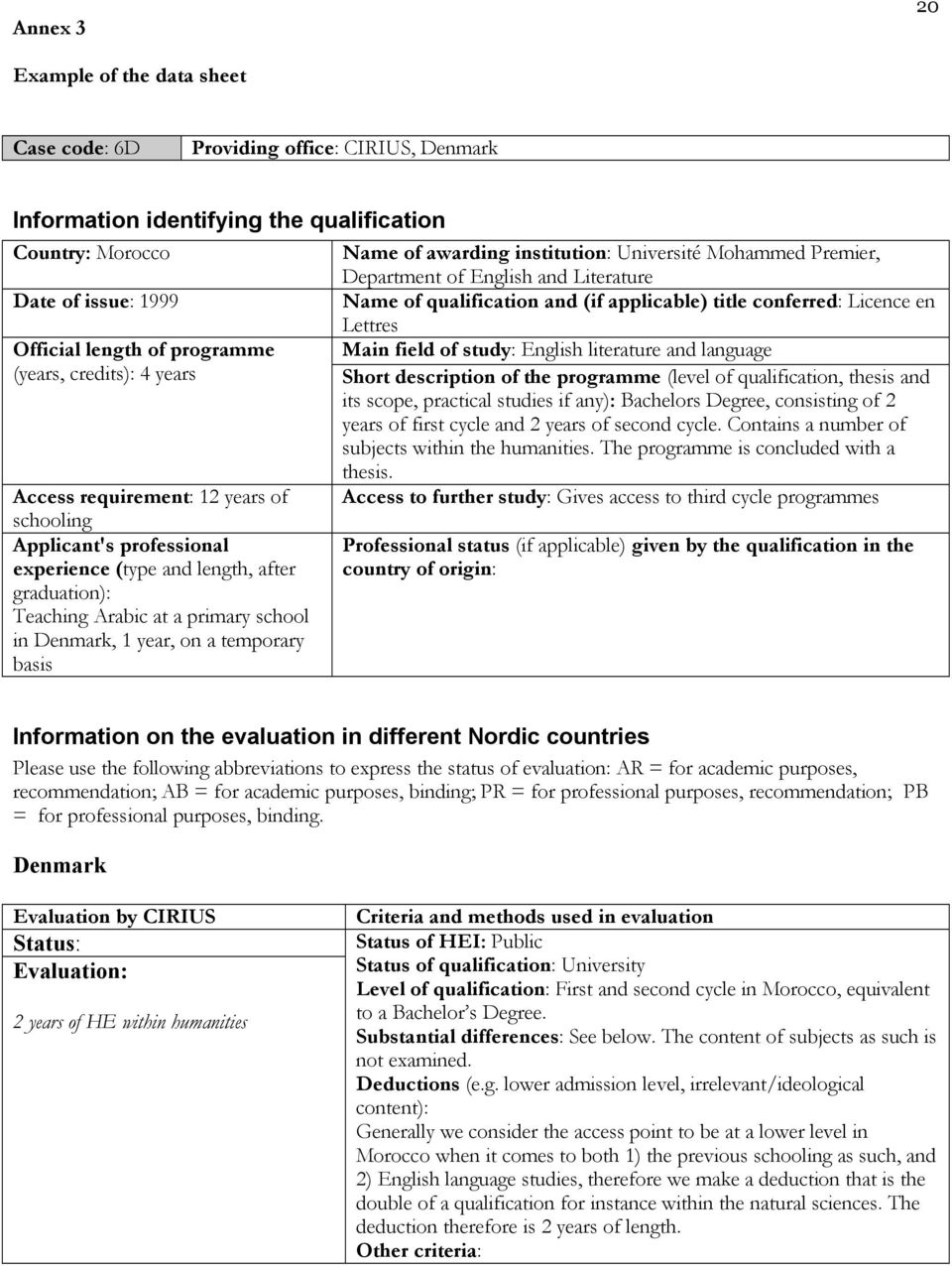
21 Finland 21 Evaluation by NBE and its status Status: PB Evaluation: Eligibility for posts and positions for which the required qualification is a university Bachelor's degree Criteria and methods used in evaluation Status of HEI: OK Status of qualification: OK Level of qualification: First cycle university degree Substantial differences: none Deductions (e.g. lower admission level, irrelevant/ideological content): not applied in Finland Other criteria: previous advisory statements by Finnish universities concerning licence-level degrees from Morocco Iceland Evaluation by the Icelandic ENIC/NARIC and its status Status: Evaluation: Comparable to a BA degree in Iceland with a 120 ECTS credit major Criteria and methods used in evaluation Status of HEI: Officially recognised HEI Status of qualification: Officially recognised HE degree Level of qualification: 1 st cycle Substantial differences: Deductions (e.g. lower admission level, irrelevant/ideological content): Admission level lower than in Iceland. Other criteria: Norway Evaluation by NOKUT and its status Status: AB, PR Evaluation: Equivalent to 3 years of higher education/180 ECTS credits in Norway and to a Norwegian Bachelor degree. Criteria and methods used in evaluation Status of HEI: Public university Status of qualification: Part of higher education degree structure Level of qualification: undergraduate Substantial differences: Admission level Deductions: One year deducted because the admission requirement from Morocco to Norway is 1 year of university education. Other criteria: Sweden Evaluation by HSV and its status Status: PR, AR Evaluation: Comparable to Swedish kandidatexamen with English as major ECTS credits Criteria and methods used in evaluation Status of HEI: + Status of qualification: + Level of qualification: Grundläggande högskoleutbildning Substantial differences: Absence of thesis (but there is often an allinclusive final examination.) Length: After deduction of Islam and English, the foreign degree is 0,25 years shorter than the Swedish, but we don t regard this as a substantial difference. Deductions (e.g. lower admission level, irrelevant/ideological content): Level of English. We deduct one year of studies in English. Other criteria: Complete transcripts required. Here only three years are documented.
22 22 Annex 4 Division of evaluations into different groups (Abbreviations for the status of evaluation: AR = for academic purposes, recommendation; AB = for academic purposes, binding; PR = for professional purposes, recommendation; PB = for professional purposes, binding.) Group 1, minor or no differences, 13 evaluations Case Denmark Finland, PB Iceland, AR Norway, AB Sweden, AR 3D Lithuania, post-sec. diploma, 3 years Not comparable to HE qualifications offered in Iceland Not generally recognised: 0 ECTS 5D Brazil, medicina veterinaria, 4 yrs 8F 1. Joint degree, 1 year European Master 2. UK, BSc, 3 years 9F 1. German MSc, 2 years 2. Finnish polytechnic Bachelor, 4 years 10F 1. UK, MSc, 1 year 2. USA/Finland, BBA, 1 year 13I Cameroon, licence (law), 3 years 15I Germany, Sozialarbeiterin, 3 years 16I Iran, Master 2 years, based on Bachelor Vocational Education and Training within the pedagogical area The profession of preschool teacher not regulated Bachelor of Science Degree within the natural sciences 2. Bachelor's degree within political science 1. Danish candidatus degree within the field of science 2. Professional Bachelor Level not comparable to any Finnish HE degree; pre-school teacher and /or nursery school teacher. Adaptation period /aptitude test possible. Eligibility for teacher's profession in the country of origin mentioned in part "additional information" University Bachelor's degree BSc degree in Iceland 3 years of HE/180 ECTS credits, Bachelor degree 2. University Bachelor's degree 2. Bachelor's degree 2. Bachelor degree/180 ECTS credits University Master's degree Comparable to an Icelandic MSc degree 1. Master degree/120 ECTS credits ECTS credits and bachelor degree+60 Norwegian credits on bachelor level PB: Preschool teacher after one-year adaptation period as preschool teacher in Sweden AR: 0 Swedish poäng Kandidatexamen 2. Kandidatexamen Internat. Relations as major 1. Magisterexamen med ämnesbredd, geoscience 2.Högskoleingenjörsexamen med inriktning miljöteknik 2. CIRIUS will not evaluate the BBA from Preston University, since this institution is neither regionally nor nationally accredited or holds any other type of accreditation. 2. Not recognised 2. Not recognized/0 ECTS 2. Not recognized Bachelor degree in law University Bachelor's degree 120 ECTS credits at 1st cycle in 3 years of HE /180 ECTS credits ECTS credits, Kandidatexamen Danish professional bachelor degree Danish Candidatus degree within the field of Science Polytechnic Bachelor's degree University Master's degree Icelandic universities 180 ECTS credits, BA, (esp. concerning access to further studies in Social Work) Comparable to an Icelandic Master s degree and Bachelor degree Bachelor degree/180 ECTS credits and 60 ECTS credits/1 year of HE Generally recognized as equivalent to 2 years of HE /120 ECTS and to a Norwegian Master s degree; 300 (juridik) Kandidatexamen with social work as major 250 ECTS credits, Magisterexamen med ämnesdjup; without transcript: Magisterexamen med
23 21N Ethiopia, diploma, 2 years 22N China, two years of non-degree studies 26S Iraq, BSc (physics), 4 years 28S Poland, licencjat 3 years, magister 2 years One year of university studies in English Between a VET and 1 year of short cycle HE A: Bachelor's degree in natural sciences 1+2: Candidatus (Master's degree) within Public Administration Not comparable to any Finnish HE degree Not comparable to any Finnish HE degree University Bachelor's degree Comparable to an Icelandic BSc degree 1+2: University Master's degree 1+2: Master of Public Administration degree ECTS together with the Bachelor's ämnesbredd degree One year of 1 st cycle university 1 year/60 ECTS credits max 0,5 year/30 ECTS credits studies Not recognised ½ year/30 ECTS credits Not comparable to a Swedish degree 3 years of higher education/180 ECTS credits and Bachelor degree 1. Bachelor degree, no subject specification indicated 2. 2 years/120 ECTS credits and Master degree, no subject specification indicated AR: Kandidatexamen (Bachelor) Magisterexamen med ämnesdjup, major offentlig förvaltning 23
24 24 Group 2, some differences, 14 evaluations Case Denmark Finland, PB Iceland, AR Norway, AB Sweden, AR 1D UK, Higher National Diploma, 2 yrs 2 years of HE within the mercantile area Not recognised as giving eligibility for a post or position for which the qualification requirement is a higher education qualification or a postsecondary level qualification of at least three years. 1-2 years of university studies in the field in question Equivalent to 60 ECTS credits Högskoleexamen 2D Germany, Diplomprüfung, 4 years 4D South Africa, National Diploma, 3 years 6D Morocco, Licence en Lettres, 4 years 8F 1. Joint degree, 1 year European Master 2. UK, BSc, 3 years 11F UK, BA (Primary ed), 3 years + induction period 1 year 14I 1. Sweden, M. of European Affairs, 1 year 2. Iceland, BA, 3 years 17I Pakistan, LLB, 2 years, based on 4 years of HE within the natural sciences Short cycle professional HE, (erhvervsakademiuddannelse), Surveyor Technician (2 years) 2 years of HE within humanities 1. Not possible to assess, since the recognition criteria are unclear. PB: Teacher in folkeskole, an exam in one line subject, 30 ECTS cr or a probation period of 1 year 4 years of HE studies (more than a bachelor, less than a candidatus degree) If the qualification requirement is lower than three-year HE qualification, the employer decides on the eligibility. University Master's degree Not comparable to any Finnish HE degree Bachelor degree + one year at Master s level 240 ECTS credits, Bachelor degree and 60 ECTS credits/1 year of master degree level studies Hortonomexamen (200 Swedish poäng) 1-2 years of university studies General recognition as 60 ECTS Högskoleingenjörsexamen University Bachelor's degree BA degree in Iceland with a 120 ECTS credits major 3 years of HE /180 ECTS credits, Bachelor degree 1. Not recognised as university 1. Not recognised 1. One year /60 ECTS at Master s Master's degree level University Bachelor's degree; class teacher after two years of professional experience as a class teacher University Master's degree Comparable to Icelandic BEd degree 60 ECTS credits at masters level at Icelandic universities 2 years of university studies University Bachelor's degree Bachelor degree with 120 ECTS credits in major 3 years of higher education/180 ECTS, equivalent to a Bachelor degree Eligibility for teacher's profession in the country of origin mentioned in part "additional information" Kandidatexamen with English as major 1. No evaluation PB: University degree; class teacher after one-year adaptation period as class teacher in Sweden or an aptitude test 60 ECTS at master degree level 2. Kandidatexamen med statsvetenskap som huvudämne Together recognized as equivalent to a Norwegian bachelor degree Qualifications together comparable to Swedish kandidatexamen
25 25 BA 18N Bulgaria, magistr (law), 5 yrs 19N Ukraina, 1. diplom 5 years 2. kandidat nauk 3 yrs 3. diplom 2 years 24N UK, Master of Arts psychoanalytical studies, 12 months /180 British credits, based on nursing qual. and some HE studies 25S Russia, teacher's degree, 5 years; 5 years of teaching experience 27S Russia, specialist degree, 5,5 years 31S USA, BA, 4 years Equivalent to a BA + 1 year of 2 nd cycle studies 1. 4 years of HE studies within natural sciences (biology), ie. Bachelor + 1 year of kandidat studies (2 year second cycle programme) 2. Ph.D degree 3. Diploma of Education (psychology), Bachelor-level 1 year of candidatus studies or 4 years of university studies in psychology (if Bachelor within the same subject) A: 4 years of HE studies, ie. Bachelor + 1 of a Master's programme P: Teacher of biology and chemistry in grades 1-10 in compulsory school 4 years of HE studies within civil engineering, ie. Bachelor 3 years + 1 year of a twoyear second cycle candidatus programme Bachelor degree within the field of Social Sciences University Master's degree Master's degree with no thesis 5 years of HE / 300 ECTS credits, Bachelor degree ECTS credits at Master level 1. University Master's degree; teacher of biology and chemistry after further study, max 25 Finnish credits 2. Lisensiaatti / licentiat degree (pre-doctoral) 3. Not recognised University Master's degree (if based on an official first-cycle degree) or degree of HE without defining the level (if based on a post-sec. at least 3-year q.) University Master's degree; teacher of biology and chemistry in lower and upper secondary level education after further studies, max 25 Finnish credits University Master's degree University Bachelor's degree 1. BSc degree in Biology 2. Master's degree plus one to two years at doctoral level 3. Two years at 1 st cycle level Master's degree comparable to 75 ECTS credits at masters level Comparable to an Icelandic BA/BSc degree From year 2005: Bachelor + 1 year at Master level BSc degree in Chemical Engineering and 0.5 to 1 year of studies at Master level Comparable to Icelandic BA/BSc degree 9 years/ 540 ECTS credits 1. Bachelor and 60 ECTS at Master level ECTS at Master level from Qualification 1 and the first year of Qualification 2 equivalent to Norwegian Master. 2 last years of Qualification 2 recognized as 2 years/120 ECTS at PhD-level 3. 2 years/120 ECTS at Bachelor level 12 months/75 ECTS credits at Master level 4 years of HE/240 ECTS credits, Bachelor degree and in addition 60 ECTS credits on Master level 4 ½ years/270 ECTS credits, Bachelor degree and 90 Norwegian credits/ 1 ½ years at Master level 3 years of HE/180 ECTS credits and equivalence to a Bachelor degree Professional degree in law, Juris kandidatexamen, 180 credit points/260 ECTS 1. Magisterexamen med ämnesdjup, major: biology 2. Doktorsexamen 3. Not recognized Magisterexamen med ämnesbredd, specialization in Psychoanalytic Studies PB: Teacher of Biology and Chemistry in grades 4 9 of the Swedish Compulsory School Civilingenjörsexamen i kemiteknik, 180 poäng Högskoleexamen
26 26 Group 3, large variation, 8 evaluations Case Denmark Finland, PB Iceland, AR Norway, AB Sweden, AR 7D Pakistan, B. Comm, MBA, both 2 years 2 years of university studies within the social sciences University Master's degree 2-3 years of university education without a degree Qualifications together equivalent to Bachelor s degree (3 year fulltime study/ 180 ECTS credits Kandidatexamen 10F 1. UK, MSc, 1 year 2. USA/Finland, BBA, 1 year 12F Estonia, Diplom, 5 years 20N India, Bachelor 3 years, Master 2 years 23N The Philippines, 1.BSc 4 years 2.B Elementary Ed, 4 years 26S Iraq, BSc (physics), 4 years 29S China, 2 years of adult HE, Bachelor 3 years 30S Bangladesh, BA, 3 years 1. CIRIUS will not evaluate the master degree, since we do not recognise the admission level. CIRIUS did not evaluate the case because of missing translation 4 years of HE equivalent to a BA + 1 year of 2nd cycle studies in Denmark within commerce 1. 2 years of higher education studies years of HE teacher training studies P: Qualified to teach in Danish Folkeskole after an aptitude test in one line subject other than physics Recommendation to follow the course Skolen i samfundet (approx. 10 ECTS credits), but not requirement One year of HE within the area of humanities 1-2 years of HE in social work 1. Not recognised as university Master's degree University Bachelor's degree; class teacher with a two-year adaptation period or an aptitude test University Master's degree Both degrees would separately be recognised as university Bachelor's degree University Bachelor's degree; not recognised as teacher 1.Comparable to one year of study at Master's level Comparable to an Icelandic BEd degree Comparable to an Icelandic BA/BS degree Degrees together 3-4 years of 1 st cycle university education without a degree Comparable to Icelandic BS degree 1. Equivalent to 60 ECTS at Master degree level AB: 300 ECTS equivalent to masters degree Eligibility for teacher's profession in the country of origin mentioned in part "additional information" Recognition of the last year of the Master degree as 1 year/60 ECTS credits Qualifications together 4 years/ 240 ECTS credits at Bachelor level, both degrees can be recognised as "høgskolekandidat" 3 years of higher education/180 ECTS credits and Bachelor degree Eligibility for teacher's profession in the country of origin mentioned in part "additional information" University Bachelor's degree Comparable to Icelandic BA degree Not higher education. 0 ECTS credits University Bachelor's degree Comparable to 1-2 years of university education 2-year full-time study/ 120 ECTS credits and equivalence to the Norwegian degree Høgskolekandidat 1. Magisterexamen med ämnesbredd, specialisation Criminology PB:University degree, class teacher after one-year adaption period as class teacher in Sweden or an aptitude test Magisterexamen med ämnesdjup, major in företagsekonomi Both degrees would separately be recognised as högskoleexamen PB: Together with work experience teacher of physics in higher grades of Swedish Compulsory School Kandidatexamen Högskoleexamen
27 27
NIELS BROCK. part of Copenhagen Business Academy of Professional Higher Education
 AP degree in Financial Management NIELS BROCK part of Copenhagen Business Academy of Professional Higher Education Diploma Supplement AP degree in Financial Management Curriculum 0709 This Diploma Supplement
Business Academy Copenhagen North. (Erhvervsakademiet København Nord)
 Bachelor s Degree in Software Development (a top-up programme) Business Academy Copenhagen North (Erhvervsakademiet København Nord) part of Copenhagen Business Academy of Professional Higher Education
How To Get A Degree In Danesland
 Bachelor of Science in Nursing UNIVERSITY COLLEGE NORTHERN DENMARK Diploma Supplement Bachelor s Degree of Science in Nursing This Diploma Supplement follows the model developed by the European Commission,
DIPLOMA SUPPLEMENT 1234567 1(6)
 DIPLOMA SUPPLEMENT 1234567 1(6) This Diploma Supplement follows the model developed by the European Commission, Council of Europe and UNESCO/CEPES. The purpose of this supplement is to provide sufficient
SAMK / DIPLOMA SUPPLEMENT
 SATAKUNNAN AMMATTIKORKEAKOULU SATAKUNTA UNIVERSITY OF APPLIED SCIENCES OP03 DIPLOMA SUPPLEMENT SAMK / DIPLOMA SUPPLEMENT This Diploma Supplement follows the model developed by the European Commission,
SAMK / DIPLOMA SUPPLEMENT
 SATAKUNNAN AMMATTIKORKEAKOULU SATAKUNTA UNIVERSITY OF APPLIED SCIENCES OP04 DIPLOMA SUPPLEMENT SAMK / DIPLOMA SUPPLEMENT This Diploma Supplement follows the model developed by the European Commission,
8 Information on the national higher education system
 8 Information on the national higher education system Higher education in Norway All public and private higher education in Norway is subject to Act No. 15 of 1 April 2005 relating to Universities and
RECOGNITION OF FOREIGN TEACHING QUALIFICATIONS IN FINLAND
 RECOGNITION OF FOREIGN TEACHING QUALIFICATIONS IN FINLAND Publications 2010:1 RECOGNITION OF FOREIGN TEACHING QUALIFICATIONS IN FINLAND Publications 2010:1 Finnish National Board of Education Publications
DIPLOMA SUPPLEMENT. FI-33014 University of Tampere, Finland Tel. 358 3 3551 11 Fax 358 3 3551 6013 Email: [email protected]
 DIPLOMA SUPPLEMENT This Diploma Supplement model was developed by the European Commission, Council of Europe and UNESCO/CEPES. The purpose of this supplement is to provide sufficient independent data to
DIPLOMA SUPPLEMENT 0801401 1(5)
 DIPLOMA SUPPLEMENT 080101 1(5) This Diploma Supplement follows the model developed by the European Commission, Council of Europe and UNESCO/CEPES. The purpose of this supplement is to provide sufficient
Diploma Supplement Academy Profession degree in Marketing Management Markedsføringsøkonom AK AP Graduate in Marketing Management
 Move forward VIA University College Diploma Supplement Academy Profession degree in Marketing Management Markedsføringsøkonom AK AP Graduate in Marketing Management Name: «fornavn» «efternavn» Civil registration
National Report Sweden - Report on the Swedish follow-up of the Bologna Declaration and the Prague Communiqué
 Memorandum 30 April 2003 Ministry of Education and Science Sweden Division for Higher Education National Report Sweden - Report on the Swedish follow-up of the Bologna Declaration and the Prague Communiqué
Information identifying the holder of the qualification Family name(s): National identification: 2 Information identifying the qualification
 Diploma Supplement University of Bergen This Diploma Supplement model was developed by the European Commission, Council of Europe and UNESCO/CEPES. The purpose of the supplement is to provide sufficient
Bologna process main assumptions, implementation in Poland and Ukraine
 Tomasz Oczoś Bologna process main assumptions, implementation in Poland and Ukraine 1. Introduction In my short presentation I will describe briefly Bologna process, its aims, actions and main documents
3 INFORMATION ON THE LEVEL OF THE QUALIFICATION 3.1 Level of qualification: 3.2 Official length of programme: 3.3 Access requirements(s)
 Sida 1 av 7 B.1.4-3 This Diploma Supplement model was developed by the European Commission, Council of Europe and UNESCO/CEPES. The purpose of the supplement is to provide sufficient independent data to
------------------------- Higher Education Institution DIPLOMA SUPPLEMENT
 ------------------------- Higher Education Institution Priloga št. 2 DIPLOMA SUPPLEMENT The Diploma supplement is issued pursuant to Article 32a of the Higher Education Act (Uradni list RS (Official Gazette
RECOGNITION OF FOREIGN QUALIFICATIONS IN FINLAND
 RECOGNITION OF FOREIGN QUALIFICATIONS IN FINLAND RECOGNITION OF FOREIGN QUALIFICATIONS IN FINLAND Recognition of a qualification refers to a decision on the types of eligibility that a foreign educational
Move forward VIA University College
 Move forward VIA University College Diploma Supplement Bachelor degree in International Sales and Marketing Management Professionsbachelor I International Handel og Markedsføring Bachelor of International
Act on the Education and Recruitment of Teachers and Head Teachers in Pre-School, Compulsory School and Upper Secondary School
 1 Act on the Education and Recruitment of Teachers and Head Teachers in Pre-School, Compulsory School and Upper Secondary School No. 87, 12 June 2008 CHAPTER I Scope, Objective and Administration Article
Implementation of the Bologna Goals in Denmark
 Note Implementation of the Bologna Goals in Denmark The Bologna Process A reform of higher education programmes, known as the Bologna Process, is taking place in several European countries for the purpose
Regulations for the Master of Science HES-SO in Business Administration
 The Rector s Office of the University of Applied Sciences and Arts Western Switzerland (HES-SO) having regard to the Intercantonal Convention on the HES-SO, of 26 May 2011, having regard to the Regulations
DIPLOMA SUPPLEMENT. Bachelor degree in Civil Engineering
 This Diploma Supplement model was developed by the European Commission, Council of Europe and UNESCO/CEPES. The purpose of the supplement is to provide sufficient independent data to improve the international
Romanian Action Plan for Recognition
 Romanian Action Plan for Recognition 1. Legislation 1.1 Council of Europe/UNESCO Convention The Lisbon Recognition Convention has been ratified in Romania by the Law no. 172/1998, which contains the Convention
Application to Vocational Teacher Education
 Application to Vocational Teacher Education Selection procedure You can apply to all Vocational Teacher Education institutions with a shared application form during the application period of 7 January
DEGREE REGULATIONS FOR HANKEN SCHOOL OF ECONOMICS
 DEGREE REGULATIONS FOR HANKEN SCHOOL OF ECONOMICS These degree regulations were approved by the Board of Hanken School of Economics on 16 April 2015. They replace earlier versions of the Degree Regulations
Joint Degree Programmes, Implementation (Joint-degree-Empfehlung 2012) Last update: 3 rd October 2012
 Joint Degree Programmes, Implementation (Joint-degree-Empfehlung 2012) Last update: 3 rd October 2012 GZ BMWF- BMWF-53.810/0001-III/7/2012 The Federal Ministry of Science and Research recommends for the
The PhD programme in Economics and Business at NBMU School of Economics and Business. The programme consists of the following programme options:
 1 ECONOMICS AND BUSINESS The Regulations for the Degree of Philosophiae Doctor (PhD) at the Norwegian University of Life Sciences apply for the PhD education. The regulations concern the objectives of,
General Syllabus for Third Cycle Studies for the Degree of Doctor in Systematic Theology
 GENERAL SYLLABUS 15 January 2014 Reg. no U 2014/44 1 Centre for Theology and Religious Studies Systematic Theology General Syllabus for Third Cycle Studies for the Degree of Doctor in Systematic Theology
Automatic Recognition of Full Degrees. Erasmus Student Network AISBL *1. Emanuel Alfranseder #2. February 2014
 Automatic Recognition of Full Degrees *1 Emanuel Alfranseder #2 February 2014 * 1 ESN AISBL, Rue Hydraulique / Waterkrachtstraat, 15B, 1210 Saint-Josse-Ten-Noode / Sint-Jost-ten-Node, Brussels BELGIUM,
Programme description for PhD Programme in Educational Sciences for Teacher Education (180 ECTS credits) at Oslo and Akershus University College of
 Programme description for PhD Programme in Educational Sciences for Teacher Education (180 ECTS credits) at Oslo and Akershus University College of Applied Sciences Approved by the Oslo and Akershus University
Curriculum for the Master s Programme at the Royal Danish Academy of Fine Art, School of Architecture
 The Royal Danish Academy of Fine Arts School of Adopted by the School Council on 18 June 2008 Amended on 24 September 2008 and 13 January 2011 September 2008 Unofficial translation File no. 001105 / File
Common structural guidelines of the Länder for the accreditation of Bachelor s and Master s study courses
 Common structural guidelines of the Länder for the accreditation of Bachelor s and Master s study courses (Resolution of the Standing Conference of the Ministers of Education and Cultural Affairs of the
DIPLOMA SUPPLEMENT. Bachelor Degree in Value Chain Management. School of Technology and Business Bachelor Programme in Value Chain Management, Horsens
 This Diploma Supplement model was developed by the European Commission, Council of Europe and UNESCO/CEPES. The purpose of the supplement is to provide sufficient independent data to improve the international
MASTER S DEGREE PROGRAMME IN CHOREOGRAPHY
 Theatre Academy of the University of the Arts Helsinki Student Admissions 2015 MASTER S DEGREE PROGRAMME IN CHOREOGRAPHY Two-Year Programme, 120 Credits The Master s Degree Programme in Choreography is
Act on the education and recruitment of teachers and administrators of preschools, compulsory schools and upper secondary schools
 Legislation in force Icelandic legislation 1 January 2014 Edition No 143a Act on the education and recruitment of teachers and administrators of preschools, compulsory schools and upper secondary schools
Migration Policies and Recognition of Foreign Qualifications for Health Professionals: Recognition of Foreign Qualifications
 Austria No (5 years of practice in a German speaking country or a language ). Belgium No No, systematic exam. Doctors: Special rules apply notably to qualification from former Yugoslavian countries. Third
Degree regulations of the School of Electrical Engineering
 Degree regulations of the School of Electrical Engineering Approved by the Academic Committee for Electrical Engineering on 7 June 2011. I General provisions Section 1 Mission As a unit defined in Section
Finland STRUCTURE OF HIGHER EDUCATION SYSTEM
 Finland STRUCTURE OF HIGHER EDUCATION SYSTEM Description: Finland has a binary system of higher education which comprises Universities and Polytechnics. The Finnish higher education system comprises 20
NORWAY. Implementation of the elements of the Bologna Process
 NORWAY Implementation of the elements of the Bologna Process In March 2001 a White Paper containing the principles of the so-called Quality Reform, was presented to the Norwegian Parliament, the Storting.
GENERAL INFORMATION STUDIES DEGREE PROGRAMME PERIOD OF EXECUTION 2014-2017 SCOPE DESCRIPTION LANGUAGE OF STUDY CODE DEGREE
 Curriculum 1 (6) GENERAL INFORMATION DEGREE PROGRAMME PERIOD OF EXECUTION 2014-2017 SCOPE DESCRIPTION LANGUAGE OF STUDY CODE DEGREE Degree Programme in Logistics Engineering 240 ECTS The Degree Programme
PROGRAMME AND COURSE OUTLINE MASTER S PROGRAMME IN MULTICULTURAL AND INTERNATIONAL EDUCATION. 12O ECTS credits. The academic year 2013/2014
 PROGRAMME AND COURSE OUTLINE MASTER S PROGRAMME IN MULTICULTURAL AND INTERNATIONAL EDUCATION 12O ECTS credits The academic year 2013/2014 Oslo and Akershus University College of Applied Sciences Faculty
National summary sheets on education system in Europe and ongoing reforms. 2009 Edition
 National summary sheets on education system in Europe and ongoing reforms 2009 Edition National summary sheets on education systems in Europe and ongoing reforms FINLAND AUGUST 2009 1. Education population
AUSTRIA State of Implementation of the Bologna Objectives. Bundesministerium für Bildung, Wissenschaft und Kultur
 AUSTRIA State of Implementation of the Bologna Objectives Bundesministerium für Bildung, Wissenschaft und Kultur AUSTRIA State of Implementation of the Bologna Objectives Introduction The Austrian Federal
SURVEY ON THE TRAINING OF GENERAL CARE NURSES IN THE EUROPEAN UNION. The current minimum training requirements for general care nurses
 SURVEY ON THE TRAINING OF GENERAL CARE NURSES IN THE EUROPEAN UNION This survey serves as a background document for the discussion of the Commission's legislative proposal to modernize the minimum requirements
Degree Regulations of the Aalto University School of Engineering
 Degree Regulations of the Aalto University School of Engineering Approved by the Academic Committee for Engineering on 6 June 2011 (Amended 20 August 2012 and 5 November 2012) Chapter 1 General provisions
Polytechnics Act 351/2003 (As amended up to 2009)
 Unofficial translation Finnish legislation valid only in Finnish and Swedish Polytechnics Act 351/2003 (As amended up to 2009) Chapter 1. General provisions Section 1. Scope of application This Act applies
Curriculum for the PhD programme at the Faculty of Law, University of Copenhagen
 Curriculum for the PhD programme at the Faculty of Law, University of Copenhagen Considered at the PhD Study Committee meetings on 22 and 31 January 2008 Approved by the Dean on 7 February 2008 Issued
Section 2 Fields of education and responsibilities for provision of degree education
 Government Decree on University Degrees 794/2004 Chapter 1 General provisions Section 1 Application 1. This Decree provides for lower and higher university degrees and scientific and artistic postgraduate
General Syllabus for Third Cycle Studies for the Degree of
 GENERAL SYLLABUS 1 10 December 2015 Reg. no U 2015/469 Centre for Theology and Religious Studies Philosophy of Religion and Ethics General Syllabus for Third Cycle Studies for the Degree of Doctor in Philosophy
Higher Education Institution Act No. 63/2006
 Higher Education Institution Act No. 63/2006 (Draft translation) Chapter I Scope of the Act Role of Higher Education Institutions. Article 1 This Act applies to educational institutions providing higher
National Report regarding the Bologna Process implementation 2009-2012. Lithuania
 National Report regarding the Bologna Process implementation 2009-2012 Lithuania 1 Part 1.0 BFUG Data Collection: administrative information For which country do you fill in the questionnaire? Lithuania
A Global Guide to Management Education 2006
 Finland Demographics for Finland Population: 5,223,442 (July 2005 est.) GDP (by PPP method): US$151.2 billion Currency (inc code): Euro (EUR) Language(s): Finnish (official), Swedish (official), others
ECCE Standing Committee Education & Training
 ECCE Standing Committee Education & Training Impact of the Bologna Process on Civil engineering education in Europe Prof. Iacint Manoliu 45 th ECCE meeting Bucharest, 11 May 2007 SCD Civil Engineering
How To Calculate Tertiary Type A Graduation Rate
 Indicator How Many Students Finish Tertiary Education? Based on current patterns of graduation, it is estimated that an average of 46% of today s women and 31% of today s men in OECD countries will complete
Encouraging Quality in Early Childhood Education and Care (ECEC)
 Encouraging Quality in Early Childhood Education and Care (ECEC) STRATEGIES TO TACKLE CHALLENGES IN IMPROVING WORKFORCE DEVELOPMENT AND WORKING CONDITIONS Challenge 1: Improving staff qualifications Qualifications
Improving Vocational Education and Training. overview of reform of the Danish vocational education system
 Improving Vocational Education and Training overview of reform of the Danish vocational education system Improving Vocational Education and Training overview of reform of the Danish vocational education
THE DIPLOMA SUPPLEMENT
 TECHNOLOGICAL EDUCATION INSTITUTE OF CENTRAL MACEDONIA SCHOOL OF ADMINISTRATION AND ECONOMICS DEPARTMENT OF BUSINESS ADMINISTRATION POSTGRADUATE PROGRAM IN BUSINESS ADMINISTRATION Terma Magnesias, 62124,
GUIDE TO HIGHER EDUCATION IN NORWAY STUDY IN NORWAY. GUIDE TO HIGHER EDUCATION STUDYINNORWAY.NO
 STUDY IN NORWAY. GUIDE TO HIGHER EDUCATION STUDYINNORWAY.NO FACTS ABOUT NORWAY OFFICIAL NAME: The Kingdom of Norway LOCATION: Northern Europe with borders to Finland, Sweden, Russia, the North Sea and
REGULATION on the education, rights and obligations of psychologists and criteria for granting of licences and specialist licences, No. 1130/2012.
 REGULATION on the education, rights and obligations of psychologists and criteria for granting of licences and specialist licences, No. 1130/2012. SECTION I General provisions. Article 1 Scope. This Regulation
Call for Applications 2016-2017
 Call for Applications 2016-2017 1. The Stipendium Hungaricum Scholarship Programme... 3 1.1. Mission of the Programme...3 1.2. Available Scholarship Types...3 1.3. Provisions Covered by the Scholarship...4
How To Teach In Latvian Higher Education
 HIGHER EDUCATION IN LATVIA Gunta Takere Academic Programme Agency Key Facts About Latvia One of the Baltic States, member of European Union, on the east coast of the Baltic Sea Capital Riga 2,3 million
Centre for Continuing Education. Palmenia
 Centre for Continuing Education Palmenia eacher qualifications 2 3 Content 3 hree main routes of becoming a teacher 4 Central terms related to teacherhood 5 eacher Qualifications 6 Crediting of pedagogical
Health and welfare Humanities and arts Social sciences, bussiness and law. Ireland. Portugal. Denmark. Spain. New Zealand. Argentina 1.
 Indicator to Which fields of education are students attracted? Women represent the majority of students and graduates in almost all OECD countries and largely dominate in the fields of education, health
European Higher Education Fair - 2014
 EU Public Diplomacy and Outreach in India and in the SAARC European Higher Education Fair - 2014 New Delhi - 30 November to 01 December Bengaluru - 03 December Kolkata - 05 December Students FAQs Answered
ABOUT THE UNIVERSITY
 ABOUT THE UNIVERSITY The National University of Public Service (NUPS) claims to be a unique institution in the European Higher Educational Area. Our University offers a wide range of diverse and comprehensive
provided by the schools in their capacity as service providers.
 The Rector s Office of the University of Applied Sciences and Arts Western Switzerland (HES-SO) having regard to the Intercantonal Convention on the HES-SO, of 26 May 2011, having regard to the Regulations
ADMISSION CRITERIA FOR MASTER S DEGREE PROGRAMMES AT THE FACULTY OF SCIENCE OF THE UNIVERSITY OF HELSINKI IN 2015
 ADMISSION CRITERIA FOR MASTER S DEGREE PROGRAMMES AT THE FACULTY OF SCIENCE OF THE UNIVERSITY OF HELSINKI IN 2015 November 2014 ADMISSION DECISIONS... 2 NUMBER OF STUDENTS TO BE ADMITTED... 2 ADMISSION
Government Decree on University Degrees 794/2004
 Government Decree on University Degrees 794/2004 Chapter 1 General provisions Section 1 Application 1. This Decree provides for lower and higher university degrees and scientific and artistic postgraduate
The referencing of the Norwegian Qualifications Framework for Lifelong Learning to the European Qualifications Framework (EQF) and selfcertification
 The referencing of the Norwegian Qualifications Framework for Lifelong Learning to the European Qualifications Framework (EQF) and selfcertification to the Qualifications Framework of the European Higher
Scope of the programme. Objectives of programme. Approved 2012-02-28 Dnr FAK 2011/555 Humanities and Social Sciences
 Approved 2012-02-28 Dnr FAK 2011/555 Humanities and Social Sciences Third-cycle (postgraduate research) training programmes are regulated in the Higher Education Act: the Higher Education Ordinance and
Country Report on Adult Education in CROATIA
 Country Report on Adult Education in CROATIA Helsinki, 2011 Please check our website for the latest version of this country report via the following url or QR-code, or contact us directly at eaea-info[at]eaea.org.
Curriculum for the Master of Science (MSc) in Social Sciences in Comparative Public Policy and Welfare Studies
 Curriculum for Master of Science (MSc) in Social Sciences in Comparative Public Policy and Welfare Studies Odense 2013 1 of 19 This curriculum has been prepared under powers conferred by The Ministry of
+! ( " + + # ! " #! $% & 1974-06-23, Musterhausen ' ( " ) # " *!! ) 5691. ! $" $! #,$" * * - ).#! / # # / " / 0 Master of Arts (M.A.
 +! ( " + + # This Diploma Supplement model was developed by the European Commission, Council of Europe and UNESCO/CEPES. The purpose of the supplement is to provide sufficient independent data to improve
MSC INTERNATIONAL MARKETING
 MSC INTERNATIONAL MARKETING TITLE Master of Science (MSc) in Economics and Business Administration (International Marketing) DURATION Full time - two years LOCATION Aalborg University (AAU), Campus East
COMPETENCE-BASED QUALIFICATION GUIDE. Publications 2013:22
 COMPETENCE-BASED QUALIFICATION GUIDE Publications 2013:22 Finnish National Board of Education 1st edition Publications 2013:22 ISBN 978-952-13-5716-9 (pb) ISBN 978-952-13-5717-6 (pdf) Translation: Semantix
Polytechnic Sector in Norway the University Colleges
 Polytechnic Sector in Norway the University Colleges Mr. Widar Hvamb Vice-Secretary General Association of Norwegian Higher Education The Structure of Higher Education in Norway today The general structure
1.1 Family name(s): 1.2 Name(s): 1.3 Place and date of birth: 1.4 Students identification number or code:
 DİPLOMA SUPPLEMENT Diploma No İSTANBUL BİLİM ÜNİVERSİTESİ Diploma Date Büyükdere Cad. No:120 34394 Esentepe-Şişli / İstanbul/TÜRKİYE Tel: +90(212)21348-89 Fax: +90(212)272341 http://www.istanbulbilim.edu.tr
European Approach for Quality Assurance of Joint Programmes
 European Approach for Quality Assurance of Joint Programmes October 2014 approved by EHEA ministers in May 2015 Joint programmes are a hallmark of the European Higher Education Area (EHEA). They are set
INFORMATION ABOUT ADMISSION REQUIREMENTS AND APPLICATION PROCEDURES
 INFORMATION ABOUT ADMISSION REQUIREMENTS AND APPLICATION PROCEDURES INTERNATIONAL APPLICANTS MSC IN SPORT MANAGEMENT Application deadline: 1 March 2014 1 2 Content 1. Introduction... 4 2. Program description
Vice Rector responsible for education and teaching process. Approved by Board of HAMK University of Applied Sciences on 10 December 2012
 1 (19) DEGREE REGULATIONS Maintained by Vice Rector responsible for education and teaching process Approved by Board of HAMK University of Applied Sciences on 10 December 2012 In witness whereof Veijo
Design and implementation of joint/double degrees
 November 2011 Design and implementation of joint/double degrees Development of joint degrees and degree programmes implemented in international co-operation forms an important part of the international
APPLICATION GUIDE TO MASTER S DEGREE PROGRAMMES AT HANKEN 2015
 APPLICATION GUIDE TO MASTER S DEGREE PROGRAMMES AT HANKEN 2015 Hanken offers several two-year Master's Degree Programmes with instruction in English both in Helsinki and in Vaasa. If you hold a Bachelor's
For a European Space of Legal Education
 European Law Faculties Association (ELFA) Secretariat: KU Leuven, Faculty of Law Tiensestraat 41 B 3000 Leuven Email: [email protected] Website: http://elfa.bham.ac.uk/ For a European Space of Legal
University of Tampere s Regulations on Degrees
 1/14 These Regulations on Degrees enter into force on 1 August 2015. NB: This is an unofficial translation. In the event of any discrepancies between the Finnish and English versions, the original Finnish