
Becoming A 21st Century Learning System. Hoke County Schools. High School Planning Guide
|
|
|
- Karin Lee
- 10 years ago
- Views:
Transcription
1 Into The Future Becoming A 21st Century Learning System Hoke County Schools High School Planning Guide

2 DISTRICT MISSION STATEMENT Hoke County Schools Becoming a 21 st Century Learning System Dr. Freddie Williamson Superintendent Hoke County Schools does not discriminate on the basis of race, color, creed, sex, religion, national origin, socioeconomic status, disability, age, or marital status.
3

4 TABLE OF CONTENT GENERAL INFORMATION Introduction... 3 High School Registration... 4 Steps for Using the Planning Guide... 5 COURSE REQUIREMENTS Graduation Requirements Checklist... 6 NC Career and College Promise Advanced Placement Program Special Recognition Graduation Requirements/Honor Graduates NC Scholars Program Hoke County Schools Graduation Requirements Credit Recovery/NC Virtual Public School Grading Policy OTHER INFORMATION NC Athletic Association Requirements Co-Curricular Activities and Athletics Attendance Policy Checklist for Career and College Readiness NC Career Clusters HIGH SCHOOL OPTIONS Hoke County High School Turlington Alternative School SandHoke Early College High School COURSE DESCRIPTIONS English Foreign Language Mathematics Science Social Studies Fine Arts Career-Technical Education Health & Physical Education JROTC Exceptional Education Special Course Offerings

5 2

6 INTRODUCTION The Hoke County High Schools Mission Statement is All Hoke County Schools students will graduate from high school globally competitive for the world and post-secondary education and prepared for life in the 21 st Century. Our mission embraces the definition of College and Career Readiness as defined by ACT, Inc. College and Career Readiness is the acquisition of the knowledge and skills a student needs to enroll in and succeed in credit-bearing first-year courses at a postsecondary institution (such as a two- or four-year college, trade school, or technical school) without the need for remediation. Remediation means that a student may be required by a college to take courses to acquire skills that he or she should have learned in high school. We are proud to implement Governor Purdue s Career and College Promise Program, College Readiness Assessments (EXPLORE, PLAN, ACT and WorkKeys), Advanced Placement opportunities, the 3R s; Rigor, Relevance, Relationships and more. The planning guide will provide you with a comprehensive menu of information that is needed to prepare you for high school and beyond. We are excited that you are moving into the most rewarding experience of your educational career. For the next four to five years, you will attend one of our high schools. Our school system offers three different choices: Hoke County High School, Turlington Alternative School and SandHoke Early College. High School is the next step of preparing you for your future career. The high school experience will provide you with an opportunity to select rigorous academic courses, to experience job readiness skills and to develop peer and adult relationships. Our administration and staff are looking forward to teaching and equipping you with the necessary skills to become productive citizens in the 21 st Century. The choices you make will impact your future education and future job opportunities. This planning guide is designed to help you, the student, plan your program of study from the variety of courses offered at Hoke County High Schools. Regardless of whether you plan to pursue a college degree, attend technical school, join the military, enter an apprenticeship program or join the workforce immediately after high school, the courses you choose in high school will have a definite impact upon your success once you graduate. Ask for assistance from parents, counselors and teachers as you consider the various options. They can be very helpful to you so that you make the most of your high school years. Please take time to review the curriculum guide, and depending upon your post-high school goal(s), chart the courses you might possibly need to take during all four years of high school. For those of you who will be in the 10 th, 11 th, or 12 th grade next year, it s not too late to plan your remaining time. But, do it now! For those of you who are entering 9 th grade now is the perfect time to plan ahead. Do you need help in making a decision? Talk to your parents, counselors, teachers and other adults who work in various occupations. Explore these online resources and If you have not completed the interest inventory and a learning style assessment in Career Cruising, please make plans to do so within the next five days. The more knowledge you have of options, the better planning you can do. Sounds like a lot of work. Maybe, but the payoff is having a better idea of where you might be headed and how to get there. It can be fun too! We re glad you are a student in the Hoke County School System. Please let us know how we can assist you. For general guidelines, you may contact the school counselor. 3

7 HIGH SCHOOL REGISTRATION The Hoke County Schools Planning Guide contains information needed for you to register for high school. It is designed to help you and your parents or your guardians make the best choices for your high school education. You will find several exciting options for you as a high school student in the guide. Please read it carefully with your parents or your guardians. Beginning in the spring semester, counselors and teachers will assist students in the selection of courses for the following year. Parents are encouraged to contact their child s counselor to assist in this process. Students may select courses from: English, Foreign Language, Mathematics, Science, Social Studies, Fine Arts, Career Technical Education, Health and Physical Education, Junior Reserve Officers Training Corps (JROTC) and Exceptional Education. Following completion of registration and development of the master schedule, parents will be provided with a copy of the courses selected by the student. Please note that courses will only be available if enrollment is sufficient. If any course is cancelled, students will be notified and an alternate course scheduled. The administration has designated June 28, 2013 as the last date for adding or dropping courses. There will be absolutely no changes after this date, unless initiated by the counselor or principal for the following reasons: 1. The student failed a pre-requisite for the course, or 2. The student needs the course to complete graduation requirements, or 3. The student has taken and successfully completed the course. Students must complete all courses, credits and test requirements of at least one Course of Study to earn a high school diploma. The Courses of Study are designed to prepare students for postsecondary opportunities from entry-level career options to highly technical fields, from community colleges to colleges and universities. Students are encouraged to pursue the most challenging Course of Study in which they can be successful. ONLINE REGISTRATION The Online Registration Tool known as the Course Planner Module is a feature within the Futures for Kids Program. Futures for Kids (F4K) is an online tool that allows the student a safe and fun way to explore and find careers that match their unique interest and abilities. The website features online mentoring, interactive career counseling, newsletters, skill and career matching support. It links to a wide assortment of educational opportunities and powerful search engines to help students and their families easily navigate the information and make good decisions. Freshman through juniors must schedule a minimum of eight courses. Students may register for eight courses, including P.E., to take advantage of the numerous course offerings at Hoke County High School and to better prepare for the future. Students who move into the district must complete the enrollment process at the school. The parent must accompany the student at the time of enrollment. Proof of residency, health record, and birth certificate will be required. Official record can be brought by the parent at the time of enrollment or requested by the registrar. Until this information is received, a student will not be officially enrolled in Hoke County High School. 4

8 STEPS FOR USING THIS PLANNING GUIDE Review North Carolina Course and Credit Requirements Checklist on pages 6 11 to determine the courses needed to meet the minimum promotion and graduation requirements. Read the NC Career Clusters sections beginning on page 35. Select courses based on the list of offerings at your school and the descriptions of those offerings beginning on page 66. Consult with school counselors and other school personnel for assistance and answers to questions. Have your parents or guardians double check your selections to make sure you have registered for the courses you need in order to meet graduation and college/university requirements. Sign all registration documents and ask your parents or guardians to do the same. HOKE COUNTY PUBLIC SCHOOL SYSTEM 5
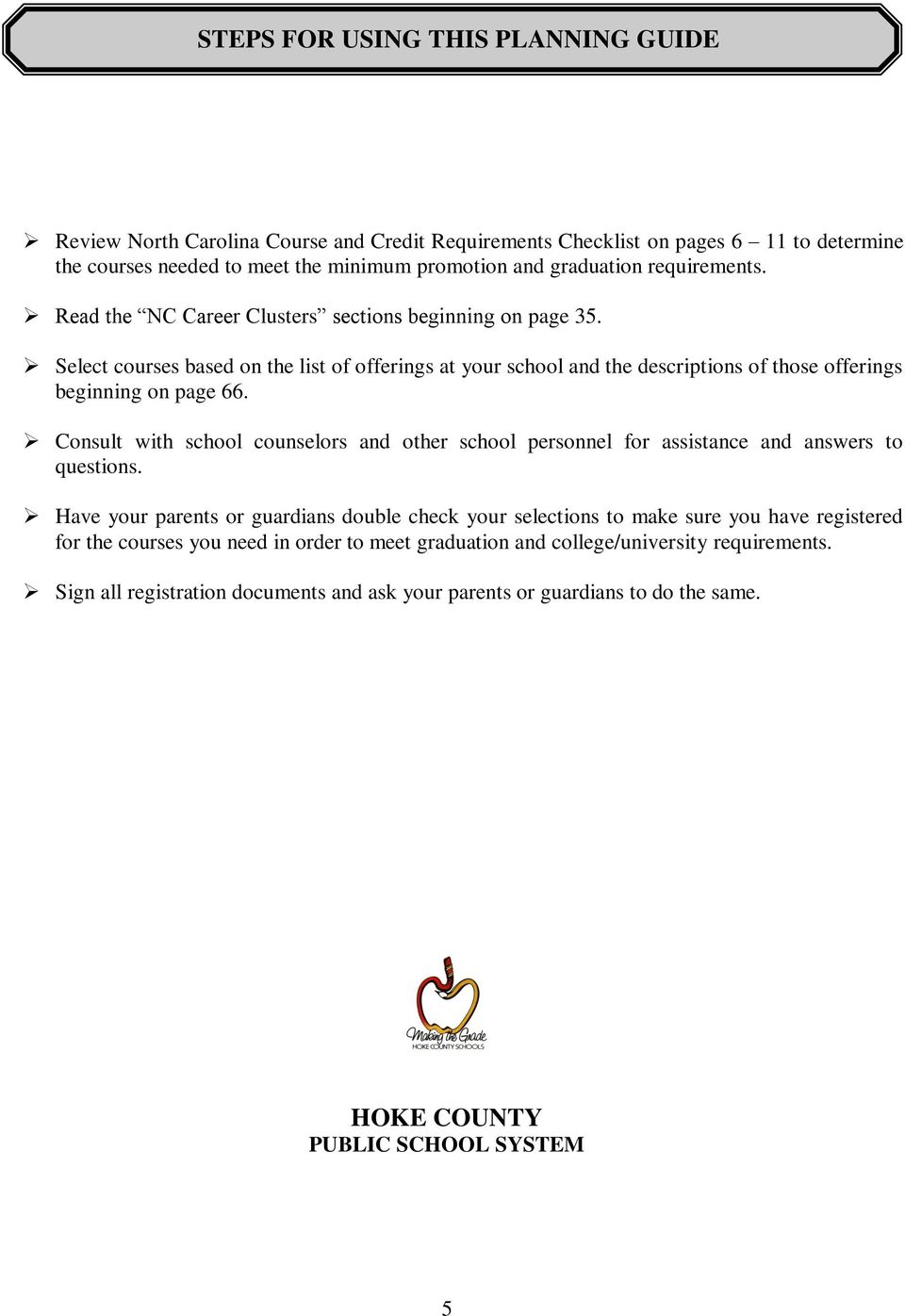
9 HOKE COUNTY SCHOOLS WILL CONTINUE THE STANDARD AS A LOCAL POLICY THAT STUDENTS SCORE A LEVEL III OR ABOVE ON EOG AND EOC TESTS (OR MSL) AS ONE MEASURE IN DETERMINING PROMOTION FROM ONE GRADE LEVEL TO ANOTHER OR HIGH SCHOOL GRADUATION. 6

10 HOKE COUNTY SCHOOLS WILL CONTINUE THE STANDARD AS A LOCAL POLICY THAT STUDENTS SCORE A LEVEL III OR ABOVE ON EOG AND EOC TESTS (OR MSL) AS ONE MEASURE IN DETERMINING PROMOTION FROM ONE GRADE LEVEL TO ANOTHER OR HIGH SCHOOL GRADUATION. 7
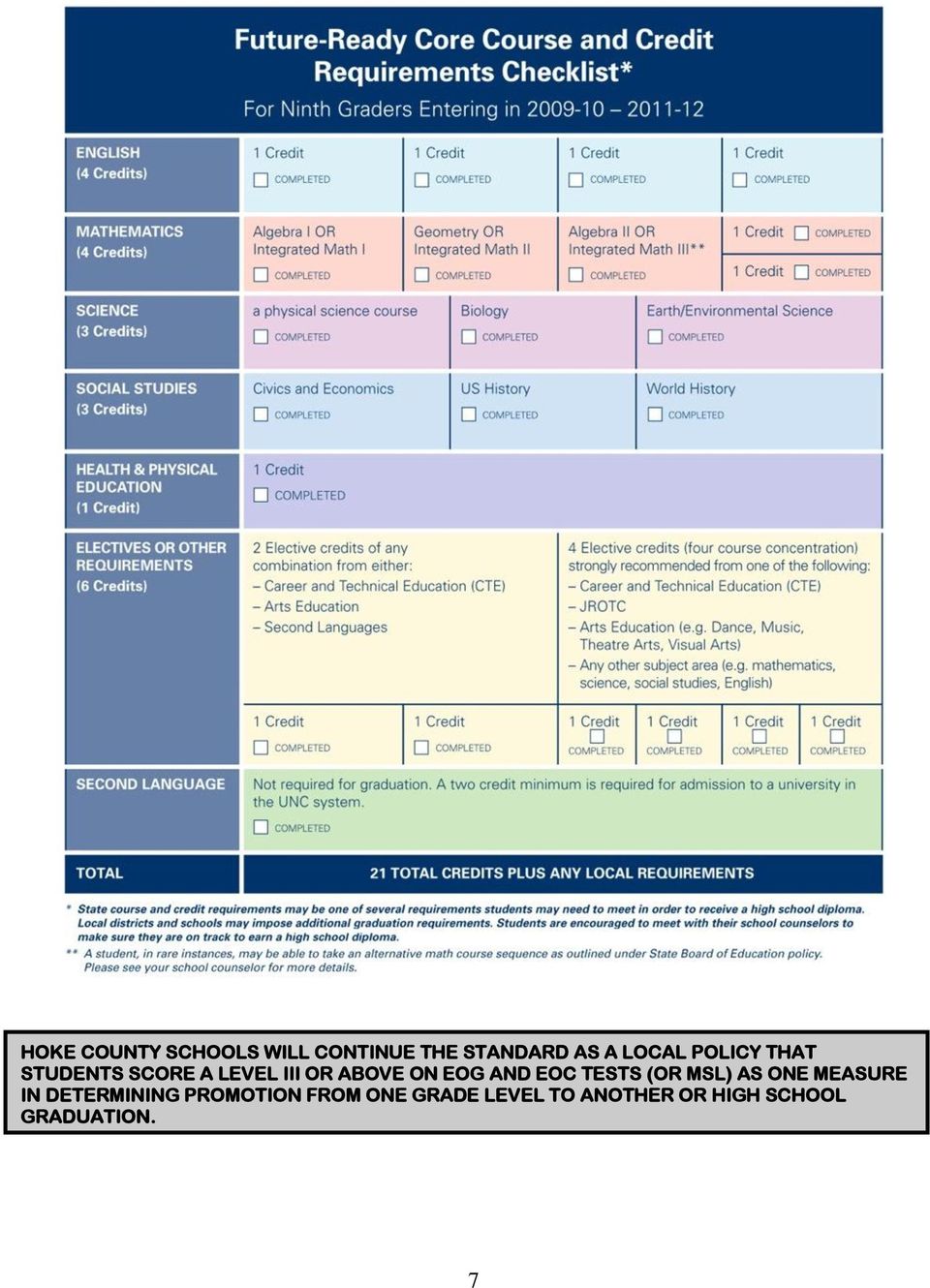
11 HOKE COUNTY SCHOOLS WILL CONTINUE THE STANDARD AS A LOCAL POLICY THAT STUDENTS SCORE A LEVEL III OR ABOVE ON EOG AND EOC TESTS (OR MSL) AS ONE MEASURE IN DETERMINING PROMOTION FROM ONE GRADE LEVEL TO ANOTHER OR HIGH SCHOOL GRADUATION. 8

12 HOKE COUNTY SCHOOLS WILL CONTINUE THE STANDARD AS A LOCAL POLICY THAT STUDENTS SCORE A LEVEL III OR ABOVE ON EOG AND EOC TESTS (OR MSL) AS ONE MEASURE IN DETERMINING PROMOTION FROM ONE GRADE LEVEL TO ANOTHER OR HIGH SCHOOL GRADUATION. 9
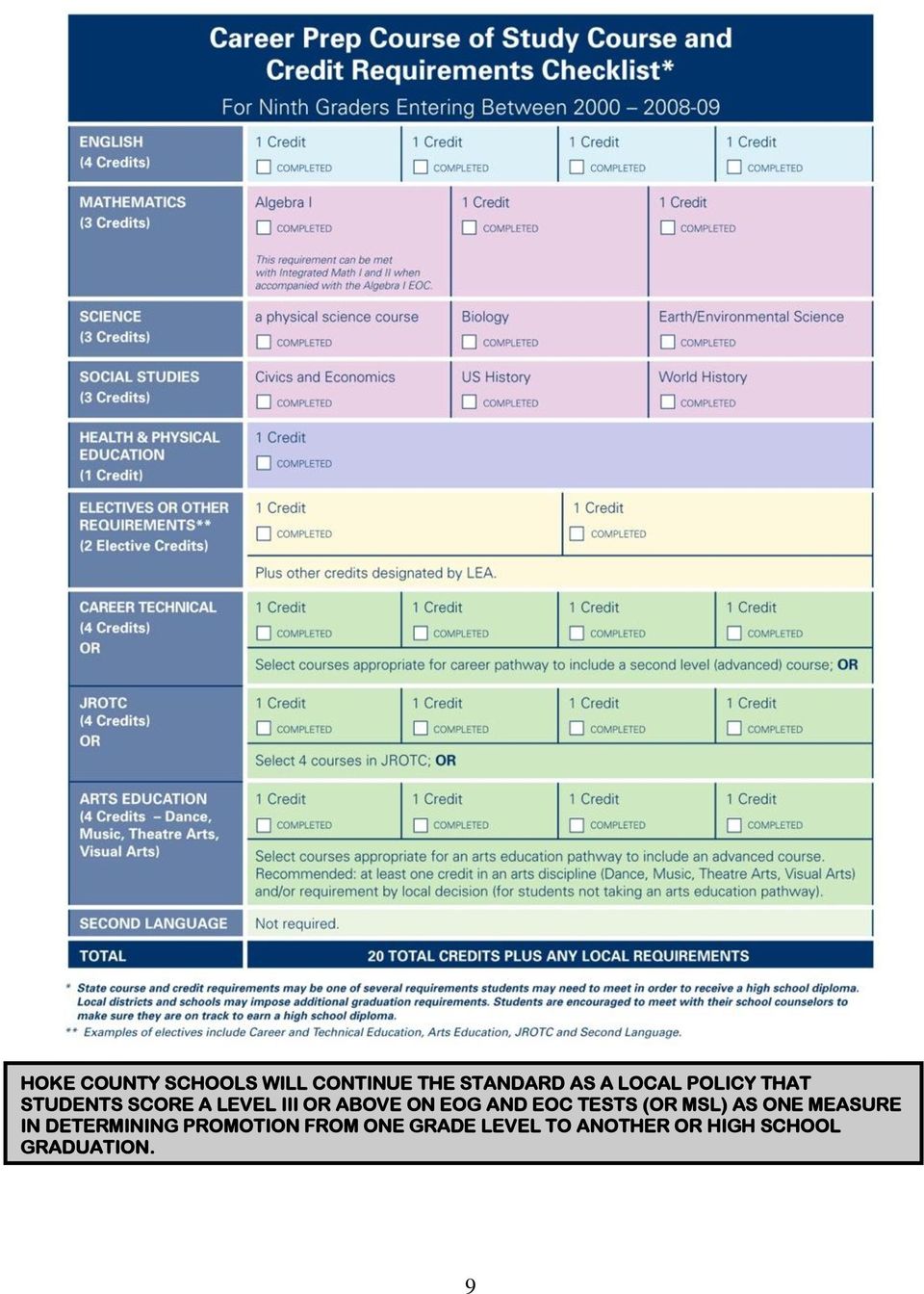
13 HOKE COUNTY SCHOOLS WILL CONTINUE THE STANDARD AS A LOCAL POLICY THAT STUDENTS SCORE A LEVEL III OR ABOVE ON EOG AND EOC TESTS (OR MSL) AS ONE MEASURE IN DETERMINING PROMOTION FROM ONE GRADE LEVEL TO ANOTHER OR HIGH SCHOOL GRADUATION. 10

14 HOKE COUNTY SCHOOLS WILL CONTINUE THE STANDARD AS A LOCAL POLICY THAT STUDENTS SCORE A LEVEL III OR ABOVE ON EOG AND EOC TESTS (OR MSL) AS ONE MEASURE IN DETERMINING PROMOTION FROM ONE GRADE LEVEL TO ANOTHER OR HIGH SCHOOL GRADUATION. 11

15 All students, no matter where they live, must graduate with the skills they need for a career, two-or four-year college or technical training. Gov. Bev Perdue Gov. Perdue s Career & College Promise In today s global economy, successful careers could require a two- or four-year degree, a diploma or a nationally-recognized job credential. Gov. Bev Perdue s Career & College Promise offers North Carolina high school age students a clear, focused and affordable path to future success. Qualified North Carolina high-school age students can begin their two- or four-year college work, tuition free, while they are in high school allowing them to get a head start on their workplace and college preparation. The program is free to all students who maintain a B average and meet other eligibility requirements. Career & College Promise provides three pathways to help advance eligible students posthigh school success: College Transfer Earn tuition-free course credits toward a four-year degree through North Carolina s community colleges. Students who complete a 44-hour credit program will be able to transfer all of their credit to all UNC institutions and many of NC s Independent Colleges and Universities. Technical Career Earn tuition-free course credits at an NC Community College toward an entry-level job credential, certificate or diploma in a technical career. Innovative High Schools (limited availability) Begin earning tuition-free college credits as a high-school freshman by attending a Cooperative Innovative High School. For more information, visit

16 Career & College Promise Pathway Descriptions and Eligibility Requirements College Transfer Pathway Career Technical Education Pathway Cooperative Innovative High School Pathway Earn college transfer credits that transfer seamlessly to any public or participating private college or university (Students must complete 44 hours to ensure credit transfer). Reduced cost for a two- or four-year degree. Accelerated completion of a diploma, associate degree or four-year degree. Develops skills for success at the next level. Earn tuition-free course credits at an NC Community College toward an entry-level job credential, certificate or diploma in a technical career. Includes applied academic skills needed for workplace success. Provides innovative educational opportunities for students in grades 9-12 Emphasis on first-generation college students Enables students to complete a high school diploma and two years of college credit in four-to-five years Prepares students for future learning in the workplace or in higher education Eligibility: Eligibility: Eligibility: Be a high school junior or senior as of January 2012 or later. Enter the program with a weighted 3.0 GPA and maintain a 2.0 on college coursework after completing two courses. Continue to make progress toward high school graduation. Demonstrate college readiness I English, reading and mathematics on an approved assessment or placement test (visit careercollegenc.org for details). Select a program of study. Be a high school junior or senior as of January 2012 or later. Enter the program with a weighted 3.0 GPA (or have a principal s recommendation) and maintain a 2.0 on college coursework after completing two courses. Continue to make progress toward high school graduation. Demonstrate career and college readiness through career pathway prerequisites. Take PLAN assessment while in grade 10. Select a program of study. Be a high school student in grades 9 to 12 with access to a cooperative innovative high school approved by the State Board of Education. Meet the eligibility requirements established by the local board of education and higher education partner as required in GS Chapter 115C

17 How to apply for NC Career & College Promise Program Contact your school counselor about applying for Career & College Promise during your usual course registration time Document eligibility with your school counselor o Grade Point Average o Prerequisites Complete College Application Include your Career & College Promise course selections on your high school's course selection process Eligible students must take the Career & College Promise courses as a pair. The courses are offered on alternate days College Transfer Pathway Who is eligible? High school juniors and seniors as of January 2012 or later Students with at least a 3.0 grade point average on a 4.0 weighted scale Students who have demonstrated college readiness on an approved assessment or placement test College Readiness Benchmarks on Diagnostic Assessment Tests Test PLAN PSAT Asset (NCCCS Cut Score) COMPASS (NCCCS Cut Score) Accuplacer (NCCCS Cut Score) English Writing 70 Writing 86 Sentence Skills Reading Reading 81 Reading 80 Reading Mathematics Numerical Skills and 41 Int. Algebra 47 Pre-Algebra and 66 Algebra 55 Arithmetic and 75 Elem. Algebra In addition to the diagnostic assessments, colleges may use the following SAT and ACT scores as benchmarks for college readiness: SAT Technical Career Pathway Who is eligible? High school juniors and seniors as of January 2012 and later Students interested in pursuing one of the 16 high school Career and Technical Education career clusters Students with at least a 3.0 grade point average on a 4.0 weighted scale OR upon principal recommendation Students who have demonstrated college readiness by meeting course prerequisites ACT Mathematics 500 Mathematics 22 Critical Reading 500 Reading 21 Writing 500 English 18 14

18 Cooperative Innovative High School Who is eligible? High school students in grades 9 to 12 with access to an approved cooperative innovative high school Special emphasis and preference given to first-generation college students Additional eligibility requirements set by local board of education and partner community college or university 15

19 HOKE COUNTY HIGH SCHOOL ADVANCED PLACEMENT PROGRAM EXPECTATIONS 'If you can change your mind, you can change the world.' Joey Reimer Advanced Placement Courses Expectations and Student Accountability Congratulations for considering the challenges and opportunities that Advanced Placement (AP) courses offer. Research has shown that students who participate in AP courses outperform others in college, particularly in grades and graduation rates. Hoke County Schools believes that all children deserve access to the rigor of advanced coursework and can be successful with the appropriate support. The purpose of this document is to better prepare students and parents for AP courses. We want to provide our students and parents with information to assist them in determining which AP courses will be most beneficial for the student. Why Take Advanced Placement Courses? Taking the College Challenge with the AP Program: AP courses are comparable to first-year college-level courses in a wide variety of subject areas that students can take while still in high school. AP courses are usually more demanding than regular high school courses. They are not easy, but they aren t impossible either. They offer students challenging course work and a taste of what college classes are like. Research consistently shows that students who score a 3 or higher on an AP Exam typically experience greater academic success and increased college graduation rates than students who do not take AP courses. What the AP Program can do for You: Confidence AP courses help students develop better study habits, improve writing skills and sharpen problem-solving skills giving students the confidence to tackle academic challenges they can expect in college. Credit Most four-year colleges in the United States and colleges in more than 60 other countries give students credit, advanced placement or both on the basis of AP Exam scores. By entering college with AP credits, students will have the opportunity to move into upper level courses, pursue a double-major or study abroad. 16

20 College Success Research consistently shows that students who are successful in AP courses typically experience greater academic success in college. Scholarships Taking AP courses increases a student s eligibility for scholarships. Thirty-five (35) percent of colleges and universities consider a student s AP experience when making decisions about which students will receive scholarships. College Admission Eighty-five (85) percent of selective colleges and universities report that a student s AP experience favorably impacts admissions decisions. Expectations of AP Courses Intense reading and writing assignments Additional research and study necessary to analyze all the material covered in the course Student s desire and ability to work independently and strive to reach his or her highest academic and intellectual levels Engagement in the study of subject matter beyond just learning facts; in-depth analysis and synthesis of material is required Requirement that students take the AP test at the end of the year with the expectation the exam will be taken seriously Listed below are specific subject area course expectations that students will be required to meet: English read and respond to works of fiction and non-fiction analytically and critically; develop a writing voice with an understanding of audience and purpose; read and analyze texts from various genres Global Studies construct a logical historical argument; read, analyze, and interpret primary resources; develop a historical perspective in both written and verbal format; understand and explain the reasons for different points of view Math problem-solve; demonstrate abstract and analytical reasoning; use logic, inductive, and deductive reasoning to draw conclusions and solve problems; translate among graphic, algebraic, numeric, tabular, and verbal representations of functions and relations Sciences demonstrate an analytical approach to material; design and conduct scientific investigations and produce high-level lab reports 17

21 AP Exams At the conclusion of an AP course, students will be required to take the corresponding AP Exam. AP Exams are two-to-three-hour exams, administered in May. They are made up of multiplechoice and free-response (essay) questions which are scored by college faculty and AP teachers. They use scoring standards and rubrics developed by college and university faculty who teach the corresponding college courses. AP scores signify how qualified students are to receive college credit and placement. The final score is reported on a 5 point scale: 5 = extremely well qualified 4 = well qualified 3 = qualified 2 = possibly qualified 1 = no recommendation The composite score for each AP Exam is converted to a score of 5, 4, 3, 2 or 1. An AP Exam score of 5 is equivalent to an A in the corresponding college course; a score of 4 is equivalent to grades of A-, B+ and B; a score of 3 is equivalent to grades of B-, C+ and C. AP Exam Fees The fee for each exam is $87. The exam fee(s) are paid by Hoke County Schools Academically/Intellectually Gifted Program for any student taking an AP Exam. AP Coursework Grades and the Impact on High School GPA Advanced Placement courses are weighted with + 2 GPA quality points Numeric Mark=Quality Points Advanced placement weighted Course Mark QP Mark QP Mark QP Mark QP
22 Outside Assignments Students may be required to complete certain pre-class assignments in Advanced Placement courses. AP Contract A student registering for any AP class must complete a Student Advanced Placement (AP) Contract. The contract must be signed by the student, parent/guardian and the AP teacher of that course. Advanced Placement Scholars Awards Programs Each year, the College Board recognizes high school students who have demonstrated college-level achievement through Advanced Placement courses and exams. Recipients receive an award certificate and notation is made on AP Grade Reports sent to colleges the following fall (Students do not receive any monetary award from the College Board). AP Scholar Awarded to students who receive grades of 3 or higher on three or more AP exams. AP Scholar with Honor Awarded to students who receive an average grade of at least 3.25 on all AP Exams taken, and grades of 3 or higher on four or more of these exams. AP Scholar with Distinction Awarded to students who receive an average grade of at least 3.5 on all AP Exams taken, and grades of 3 or higher on 5 or more of these exams. AP State Scholar Awarded to the one male and one female student in each U.S. state and the District of Columbia with grades of 3 or higher on the greatest number of AP exams, and then the highest average grade (at least 3.5) on all AP Exams taken. National AP Scholar Awarded to students in the U.S. who receive an average grade of at least 4 on all AP Exams taken, and grades of 4 or higher on eight or more of these exams. 19
23 SPECIAL RECOGNITION GRADUATION REQUIREMENTS HONOR GRADUATES Honor graduates may be designated by the principal on the basis of criteria established by the superintendent. Students may also choose to participate in the North Carolina Academic Scholars Program. Successful completion of the requirements of the program entitles a student to receive a North Carolina Academic Scholars Seal that will be affixed to his/her diploma. The Academic Scholars program is a rigorous program of courses that exceeds State Board requirements. Students who complete the requirements for an academically challenging high school program will be named NC Academic Scholar. The following criteria must be met: Complete all of the NC Graduation Requirements for the Future Ready Core Have an overall four-year unweighted grade point average of 3.50% Must demonstrate computer proficiency 20
24 NORTH CAROLINA ACADEMIC SCHOLARS PROGRAM The following designated number of credits per subject area listed below must be taken in grades 9-12: Future-Ready Core Course of Study Credits The following designated number of Credits credits per subject area listed below must be taken in grades English I, II, III, IV 4 English I, II, III, IV 4 Mathematics (Algebra I, Algebra II, Geometry, and a higher level math course with Algebra II as prerequisite OR Integrated Mathematics, I, II, III, and a higher level mathematics course with Integrated Mathematics III as prerequisite) 3 Science (a Physics or Chemistry course, Biology, and an Earth/Environmental Science course) 3 Social Studies (World History, Civics/Economic, and U.S. History) 4 Mathematics (should include Algebra I, Algebra II, Geometry, and a higher level math course with Algebra II as a prerequisite OR Integrated Mathematics I, II, III, and a higher level mathematics course with Integrated Mathematics III as prerequisite) 3 Science (a Physics or Chemistry course, Biology, and an Earth/Environmental Science course) 3 Social Studies (World History, Civics/Economic, and U.S. History) 1 Healthful Living 1 Health and Physical Education 2 Languages other than English (two credits of the same language) 6 Two (2) elective credits in a second language required for the UNC System 1 Career and Technical Education Four (4) elective credits constituting a concentration recommended from one of the following: Career and Technical Education (CTE), JROTC, Arts Education, Second Languages, any other subject area 1 Arts Education (Dance, Music, Theatre Arts or Visual Arts) 5 Elective credits to include at least two second-level or advance courses (examples of electives include JROTC and other courses that are of interest to the student) or 23+ NCGP High School Graduation Requirement 3 Higher level courses taken during junior and/or senior years which carry 5 or 6 quality points such as: -AP-IB-Dual or college equivalent course On-line courses-other honors or above designated courses OR 2 Higher level courses taken during junior and/or senior years which carry 5 or 6 quality points such as : -AP- IB- Dual or college equivalent course Advanced CTE/CTE credentialing course On-line courses-other honors or above designated courses and completion of The North Carolina Graduation Project. 21
25 HOKE COUNTY HIGH SCHOOLS GRADUATION REQUIREMENTS From the time you enter kindergarten, you re getting ready for high school graduation. To make sure you are on track, remember that every Hoke County high school student must meet the Course and Credit requirements, successfully complete the Hoke County Schools 21 st Century Readiness Project, demonstrate proficiency on the End of Course Tests, demonstrate Computer Skills Proficiency, and meet all Local requirements. Please refer to pages 63 to 145 for specific details for your child s Course of Study. Your school counselor is available to answer questions you may have about what you need to reach your goal of high school graduation. Course and Credit Requirements Listed in the Course of Study and Credit Requirements Checklists on pages 6-11 and organized according to the year a student first entered high school. End-of-Course Assessments & Measure of Student Learning Score proficient on the three essential end-of-course assessments (Hoke County Schools Board of Education Policy): Algebra I, Biology, English I, English II and Career and Technical Education Post Assessments. Local Requirements Meet any additional requirements adopted by the Hoke County Board of Education. (Total of 28 Credits to Graduate) 21 st Century Readiness Project Successfully complete the Hoke County Schools 21 st Century Readiness Project. The 21 st Century Readiness Project is an English-embedded project in grades 9-12 that prepares students for success in post-secondary environments. In conjunction with the Common Core State Standards and Essential Standards, students in each grade level will complete a research project that emphasizes the following 21 st Century skills: Research-Based Papers, Multi-Media Presentations, Oral Presentations, Project Based Learning. GRADE CLASSIFICATIONS Sophomore Junior Senior Earn 6 units, including English I Earn 13 units, including English I and II Earn 20 units, including English I, II, and III 22
26 CREDIT RECOVERY The State Board of Education defined Credit Recovery as a block of instruction that is less than the entirety of the Standard Course of Study for that course. Credit recovery, therefore, delivers a subset of the Standard Course of Study or Blueprint of the original course in order to address specific deficiencies in a student s mastery of the course and target specific components of a course necessary for completion. The purpose of credit recovery is to recover credit. NC VIRTUAL PUBLIC SCHOOL The Hoke County Schools provide online instruction in partnership with the NC Virtual Public school. Currently, these courses are available for students in grades Please contact your school s counselor for more information or to register for a course. 23
27 Grading Policy For purposes of determining graduation requirements, each student is assigned to a graduating class upon initial enrollment in ninth grade. In order to graduate from high school, the student must meet the HCHS graduation requirements for that particular class. This provision applies to a student who graduates before or after the graduating class to which the student was assigned upon entering the ninth grade. Grades are standardized measurements of varying levels of comprehension within a subject area. Grades can be assigned in letters (for example, A, B, C, D, or F) or as a range (for example ). Grade Point Average (GPA): the average of a student s grades over a set period of time, such as four years of high school. It is measure of the student s academic performance. Grade Point Average is a calculation of the average of all of a student s grades for all semesters and courses completed up to a given academic term. An unweighted GPA is the average of all class grades based on a 4.0 scale. A weighted GPA is the average of honors and advanced placement class grades based on additional quality points. The Grade Point Average (GPA) is the measure of a student s academic performance. The GPA is potentially used by employers and post-secondary institutions to assess and compare applicants. I. Weighted Grade Point Average Many schools in the United States, including Hoke High, utilize weighted grade point averages in order to encourage students to take more rigorous courses such as Honors and Advanced Placement courses. In calculating the weighted grade point average, one (1) additional quality point is added to the earned quality points for Honors courses and Career and College Promise courses. Two (2) additional points are added for Advanced Placement courses. For example: Course Final Grade Unweighted Points Weighted Points AP English IV AP Biology HNS Pre-Calculus Visual Arts II Quality Point Total Unweighted Grade Point Average Total Unweighted Points divided by Number of Courses Attempted = Unweighted GPA divided by 4 = Weighted Grade Point Average Total Weighted Points divided by Number of Courses Attempted = Weighted GPA divided by 4 =
28 It is important to remember that a student s grade point average is cumulative, including all courses taken beginning with the 9th grade. Therefore, students should attempt to do their very best in all courses taken throughout high school. All coursework taken in grades 9-12 for which final grades are earned will be used in calculating a student s grade point average. Final grades will earn quality points according to the above chart as approved by the North Carolina Department of Public Instruction. The grade point average is determined by dividing the sum total of all earned quality points by the number of courses attempted. For example: Course Final Grade Quality Points English I Algebra I World History Health/PE Quality Point Total Total Quality Points divided by Number of Courses Attempted = Grade Point Average divided by 4 = Final Course Grade A B C D F Standard ACADEMIC COURSE LEVEL Honors/college courses identified in Comprehensive Articulation Agreement TOTAL QUALITY POINTS (Unweighted) (Weighted) Advanced Placement/ higher-level college courses identified in Comprehensive Articulation Agreement (Weighted)
29 II. Class Rank I. Rank in Class A. Students Eligible to be Ranked 1. All students enrolled in school at the time class ranks are calculated will be included in the class ranking. 2. In order to be eligible to be Valedictorian or Salutatorian a student must be enrolled at Hoke County High School for at least two full *terms prior to the grade averaging deadline to be considered. The Valedictorian and Salutatorian are determined by using all coursework from grades nine through the end of the second semester of the senior year. 3. In order to be eligible to be a Junior Marshal a student must be enrolled at Hoke County High School for at least two full *terms prior to the grade averaging deadline to be considered. The Junior Marshals are determined by using all coursework from courses taken in grades nine through the first nine weeks of the second semester of the junior year. B. Computation and Schedule for Determining Class Rank 1. Class rank is determined by ranking all students numerically by weighted GPA. The student with the highest average will be assigned a rank of number one (1) in the class. 2. Class rank is run for grades 9th through 12th: At the end of first semester At the end of second semester At the end of summer school *A Term is defined as a school year. Classing Rankings Hoke County Board of Education policy (3450) 26
30 OTHER INFORMATION NORTH CAROLINA ATHLETIC ASSOCIATION REQUIREMENTS A student, upon enrolling, is eligible to participate in competitive sports during the fall term. Students enrolling in tenth, eleventh and twelfth grades are required to meet local promotion standards to participate in a fall sport. They must have passed three (3) of the four (4) courses the previous term. To participate in a spring sport, all students must have passed three (3) of the four (4) courses the first term. For a complete list of the eligibility rules, please see your school counselor or athletic director. Students must be in Attendance 85% of the previous semester. COLLEGE ATHLETIC ELIGIBILITY REQUIREMENTS College Freshman Athletic Eligibility Requirements for NCAA Division I and II institutions are on a sliding scale for GPA on core courses and for SAT/ACT scores. Students interested in athletic participation at the college level should see their school counselor and athletic coach for a detailed interpretation of the eligibility rules. 27
31 CO-CURRICULAR ACTIVITIES AND ATHLETICS STUDENT CLUBS STUDENT ORGANIZATIONS SkillsUSA Future Business Leaders of America (FBLA) Association of Marketing Students (DECA) Future Teachers of America (FTA) Health Occupations Student Association (HOSA) Marching Band Future Farmers of America (FFA) Family, Community, Career Leaders of America (FCCLA) Students Against Drunk Drivers (SAAD) Monogram/Antler Club Thespian/Forensics Clubs Science Club Men of Distinction Ladies of Total Image Key Club National Technical Honor Society National Honor Society BETA Club Chess Club Fellowship of Christian Athletes AIM Club (Action, Inspiration, Motivation) 4 H Club Student Council Association Chorale TRU (Tobacco Reality Unfiltered) Club The Leadership Council Brilliant Bucks Drama Club Native American Student Association (NASA) History Club ROTC (Rile/Raider/Drill Teams) Dance Club Step Team JROTC/Raiders JROTC/Staff JROTC/Color Guard JROTC/Drill Team Wrestling Interscholastic Athletes Football (Varsity, JV, 9 th ) Volleyball (Varsity, JV, 9 th ) Cross Country Softball (Varsity, JV, 9 th ) Baseball (Varsity, JV, 9 th ) Basketball (Male, Female) Varsity, JV (9 th ) Track & Field (Male, Female) Indoor Track Soccer (Male, Female) Tennis (Male, Female) Golf (Male, Female) Bowling (Male, Female) Hoke County Schools are committed to providing educational activities outside of the classroom instruction which allow all students opportunities to pursue a variety of interests. Each of these extracurricular activities carries academic, attendance and behavior requirements of their own student participation. These clubs/organizations may vary at each high school campus. 28
32 ATTENDANCE POLICY Attendance in school and participation in class are integral parts of academic achievement and the teaching-learning process. Through regular attendance, students develop patterns of behavior essential to professional and personal success in life. Regular attendance by every student is mandatory. The State of North Carolina requires that every child in the State between the ages of 7 (or younger if enrolled) and 16 attend school. Parents and legal guardians are responsible for ensuring that students attend and remain at school daily. A. ATTENDANCE RECORDS School officials shall keep accurate records of attendance, including accurate attendance records in each class. Attendance records will be used to enforce the Compulsory Attendance Law of North Carolina. B. EXCUSED ABSENCES When a student must miss school, a written excuse signed by a parent or guardian must be presented to the student s teacher on the day the student returns after an absence. An absence may be excused for any of the following reasons. 1. Personal illness or injury that makes the student physically unable to attend school. 2. Isolation ordered by the State Board of Health. 3. Death in the immediate family. 4. Medical or dental appointment. 5. Participation under subpoena as a witness in a court proceeding. 6. A minimum of two days each academic year for observance of an event required or suggested by the religion of the student or the student s parents. The student will have the opportunity to make up any tests or other work missed due to the excused absence for a religious observance. 7. Participation in a valid educational opportunity, such as travel or service as a legislative or Governor s page, with prior approval from the principal. 8. Pregnancy and related conditions or parenting, when medically necessary. In addition, a student whose parent or legal guardian (a) is an active duty member of the uniformed services, as defined by policy 4050, Children of Military Families; and (b) has been called to duty for, is on leave from, or has immediately returned from deployment to a combat zone or combat support posting will be granted additional excused absences at the discretion of the superintendent or designee to visit with his or her parent or legal guardian. Absences due to extended illnesses generally require a statement from a physician. 29
33 ATTENDANCE POLICY In the case of excused absences and short-term out-of-school suspensions, the student will be permitted to make up his or her work. (See also policy 4351, Short-Term Suspension.) The teacher will determine when work is to be made up. The student is responsible for finding out what assignments are due and completing them within the specified time period. C. SCHOOL-RELATED ACTIVITIES All classroom activities are important and difficult, if not impossible, to replace if missed. Principals shall ensure that classes missed by students due to school-related activities are kept to an absolute minimum. The following school-related activities will not be counted as absences from either class or school: 1. Field trips sponsored by the school; 2. job shadows and other work-based learning opportunities, as described in G.S. 115C- 47(34a); 3. school-initiated and -scheduled activities; 4. athletic events that require early dismissal from school; 5. Career and Technical Education student organization activities approved in advance by the principal; and 6. in-school suspensions. Assignments missed for these reasons are eligible for makeup by the student. The teacher will determine when work is to be made up. The student is responsible for finding out what assignments are due and completing them within the specified time period. D. EXCESSIVE ABSENCES Class attendance and participation are critical elements of the educational process and may be taken into account in assessing academic achievement. Students are expected to be at school on time and to be present at the scheduled starting time for each class. Students who are excessively tardy to school or class may be suspended for up to two days for such offenses. The principal shall notify parents and take all other steps required by G.S. 115C-378 for excessive absences. Students may be suspended for up to two days for truancy. If a student is absent from school for five or more days in a semester, the principal or a committee established by the principal shall consider whether the student s grades should be reduced because of the absences. The principal or committee shall review other measures of academic achievement, the circumstances of the absences, the number of absences, and the extent to which the student completed missed work. A committee may recommend to the principal and the principal may make any of the following determinations: 30
34 ATTENDANCE POLICY 1. The student will not receive a passing grade for the semester; 2. The student s grade will be reduced; 3. The student will receive the grade otherwise earned; or 4. The student will be given additional time to complete the missed work before a determination of the appropriate grade is made. Students with excused absences due to documented chronic health problems are exempt from this policy. Legal References: G.S. 115C-47, -84.2, -288(a), , -378 through -383, (d), , ; 16 N.C.A.C. 6E.0102,.0103; State Board of Education Policies TCS-L-000 through -003 Cross References: Education for Pregnant and Parenting Students (policy 4023), Children of Military Families (policy 4050), Short-Term Suspension (policy 4351) Adopted: June 11, 1991 Revised: July 13, 1997; August 9, 1994; April 10, 2002; April 14, 2011; July 18,
35 Your Checklist for College and Career Readiness 9 th Grade Take courses that challenge you Concentrate on making good grades Meet with your school counselor about your 4-year plan Visit a college informally to provide you with an idea of what college life is like Create a FREE College Foundation of North Carolina account at Explore career interests Research ways to save and pay for college Make a commitment to an extracurricular activity and community service 10 th Grade Continue to pursue extracurricular interests such as dance, sports, clubs, or community service Review your goals for the future with your counselor Update your CFNC planner Start using the Free SAT and ACT test prep at Take the PSAT for practice Start exploring what you might like to study in college (check on CollegeConfidential.com) Talk with your family and friends about their educational and/or career experiences Tour colleges online at CFNC.org Register for AP, honors, and advance courses 11 th Grade Meet with your counselor to review your academic record, financial aid, and college/career options Get schedules for college entrance exams and placement tests Use the free SAT and ACT test prep at CFNC.org Take PSAT in October in order to qualify for National Merit Scholarships Check entrance requirements for colleges that interest you Keep your CFNC planner updated Attend College and Career Fairs Attend Workshops on financial aid Visit colleges, request information packets, view websites, talk to alumni, friends, family and/or an admissions representative Research scholarships, grants and loans available Talk with coaches about college sports and scholarship eligibility Register to take the SAT, ACT, and/or AP Tests Narrow down your list of college and/or career interests Find a summer job or internship in your field of interest 32
36 12 th Grade Fall Review courses, graduation requirements, and scholarship opportunities with your counselor Update your CFNC planner Select three to five colleges or careers to focus on Track application deadlines for colleges and financial aid Take the first SAT or ACT offered in the fall Write, edit, proofread, and rewrite your admissions essays early Ask teachers, counselors, or other references to write letters of recommendation Attend a college and/or a career day Participate in College Application Week Complete online college applications on CFNC.org before the deadlines Send in supplemental materials with application such as entrance exam scores, admissions essay, letters of recommendation, transcript, etc. Check with college financial aid offices for school specific scholarship information and applications Take a visit to a local industry in a career field that you are interested in Take Advantage of Job Shadow opportunities Student athletes send transcripts to NCAA Clearinghouse for eligibility certification Parents need to plan to prepare tax information soon after January 1 for financial aid applications 12 th Grade Spring Complete and submit FAFSA at as soon as possible after January 1 For help with your FAFSA, sign-up at CFNC.org for a February FAFSA Day near you Compare admission acceptance letters and financial aid packages Apply for educational loans, if needed Make sure your final transcript is sent to your college of choice Send in any early college credit courses (community college, etc.) Take exams for any AP or college-level courses completed For community college admission, take the ASSET, COMPASS, or ACCUPLACER test If entering into the workforce, take the WORKKEYS test It s never too early to start planning for life after graduation. Whether your goal is to attend a postsecondary institution or enter into the workforce, we are here to help you find all the college and career planning tools and materials you will need to be successful. 33
37 34
38 Click on a logo to hyperlink to a specific cluster worksheet. To return to the cover page, click on the icon at the far left, lower region of Excel and then the "Cover" tab. Please see the FAQ worksheet tab for Frequently Asked Questions. NC CAREER CLUSTERS Career Clusters, Pathways, and Courses North Carolina Career and Technical Education Revised
39 How do I use this document? Frequently Asked Questions This document contains all of the NC Career and Technical Education courses approved by the NC State Board of Education representing all Career Clusters and Pathways. LEAs should edit this document to publish a local guide reflecting its own Career Clusters, Pathways, and courses. The Local document may also include any approved Local Course Offerings. What does the ^ mean? The ^ indicates the courses uses materials from third-party providers. What does the * mean? The * indicates a completer course. What is a completer course? A completer course is the second or third course in a series that builds upon skills acquired in the previous course(s). A completer course has a prerequisite. What is a concentrator? A concentrator is a student who has earned four or more technical credits in a Career Cluster, at least one of which is a completer course. The student may earn all four credits from foundation courses or three from foundation and one from enhancement courses for the Career Cluster. What is a foundation course? A foundation course provides fundamental knowledge and skills needed for student success in secondary and postsecondary education and careers in the Career Cluster. What is an enhancement course? An enhancement course augments related knowledge and skills developed in foundation courses and provides for success in postsecondary education and careers in the Career Cluster. What is the difference between a Career Cluster and a Career Pathway? Career Clusters are groupings of occupations used as an organizing tool for curriculum design and instruction. Career pathways are sub-groupings of occupations within a Career Cluster. Occupations are grouped into pathways based on the set of common knowledge and skills required for career success. What is the National Academy Foundation? The National Academy Foundation provides industry-focused curricula in four themes: Finance, Hospitality & Tourism, Information Technology, and Engineering. For more information on NAF, please visit What is the NC Career & College Promise? The NC Career & College Promise offers North Carolina high school age students a clear, focused and affordable path to future success. Qualified North Carolina high-school age students can begin their two- or four-year college work, tuition free, while they are in high school allowing them to get a head start on their workplace and college preparation. The program is free to all students who maintain a B average and meet other eligibility requirements. For more information on the NC Career & College Promise, please visit Is Cooperative Education still available? Yes. Cooperative Education is a method of instruction for students, 16 and older, where technical classroom instruction is combined with paid employment directly related to the classroom instruction. The two experiences must be planned and supervised by the school and the employer so that each contributes to the student's career objective/major and employability. What are the current graduation requirements for a student in North Carolina? For the most current graduation requirements, please visit 36
40 Pathways Cluster Enhancement Courses Cluster Foundation Courses for Hoke County Schools Agribusiness Systems 6810 Agriscience Applications 8595 CTE Advanced Studies Animal Systems 6810 Agriscience Applications 8595 CTE Advanced Studies Food Products & Processing Systems Natural Resources Systems 8726 Personal Finance (BFIT, FACS & MEE) 7045 Foods I 8595 CTE Advanced Studies 6810 Agriscience Applications 8595 CTE Advanced Studies Plant Systems 6810 Agriscience Applications 6841 Horticulture I 6842 Horticulture II * 8595 CTE Advanced Studies 6145 Career Management 6417 Microsoft Word, PowerPoint, & Publisher ^ 6419 Microsoft Excel & Access ^ 6621 Marketing ^ 7120 Introduction to Culinary Arts & Hospitality 8716 Entrepreneurship I ^ (BFIT & MEE) 8721 Principles of Business & Finance (BFIT & MEE) 8596 CTE Apprenticeship 8597 CTE Internship Power, Structural & Technical Systems 6810 Agriscience Applications 8595 CTE Advanced Studies Career & College Promise 8598 and 8599 * Career & College Promise Career Technical Education Pathway Additional Pathways Environmental Service Systems 6158 Exploring Career Decisions 6828 Exploring Biotechnolgy in Agriculture Middle School Courses 6207 Computer Skills and Applications 6829 Exploring Agricultural Science 6208 Exploring Business, Marketing, and Entrepreneurship 7018 Exploring Life Skills 37

41 Pathways Cluster Enhancement Courses Construction Design/Pre-construction 7700 Core and Sustainable Construction ^ 8726 Personal Finance (BFIT, FACS & MEE) 8721 Principles of Business & Finance (BFIT & MEE) Cluster Foundation Courses for Hoke County Schools 7721 Carpentry I ^ 7921 Drafting I 7722 Carpentry II * ^ 7723 Carpentry III ^ 7962 Drafting II Architectural * 7963 Drafting III Architectural 8595 CTE Advanced Studies 6145 Career Management 6414 Multimedia and Webpage Design 6417 Microsoft Word, PowerPoint, & Publisher ^ 6419 Microsoft Excel & Access ^ 6621 Marketing ^ 6631 Fashion Merchandising 7035 Apparel I 8716 Entrepreneurship I ^ (BFIT & MEE) 8596 CTE Apprenticeship 8597 CTE Internship Career & College Promise 8598 and 8599 * Career & College Promise Career Technical Education Pathway Additional Pathways Maintenance/Operations 6158 Exploring Career Decisions 7018 Exploring Life Skills Middle School Courses 6207 Computer Skills and Applications 8201 Technology Design & Innovation 6208 Exploring Business, Marketing, and Entrepreneurship 38
42 Pathways Cluster Enhancement Courses Cluster Foundation Courses for Hoke County Schools Audio & Video Technology & Film 6414 Multimedia and Webpage Design (BFIT & T&I) 8595 CTE Advanced Studies Printing Technology 6621 Marketing ^ 6631 Fashion Merchandising (FACS & MEE) 7035 Apparel I (FACS & MEE) 7036 Apparel II-Enterprise* (FACS & MEE) 8716 Entrepreneurship I ^ (BFIT & MEE) 6145 Career Management 6419 Microsoft Excel & Access ^ 8721 Principles of Business & Finance (BFIT & MEE) 8726 Personal Finance (BFIT, FACS, & MEE) 8596 CTE Apprenticeship 8597 CTE Internship Visual Arts 8595 CTE Advanced Studies 6417 Microsoft Word, PowerPoint, & Publisher ^ Career & College Promise 8598 and 8599 * Career & College Promise Career Technical Education Pathway Additional Pathways Performing Arts Journalism & Broadcasting Telecommunications 6158 Exploring Career Decisions 7018 Exploring Life Skills Middle School Courses 6207 Computer Skills and Applications 8201 Technology Design & Innovation 6208 Exploring Business, Marketing, and Entrepreneurship 39
43 Pathways Cluster Enhancement Courses General Management 8721 Principles of Business & Finance (BFIT & MEE) Cluster Foundation Courses for Hoke County Schools 6311 Accounting I 8710 Business Management * ^ 6215 Business Law * 6417 Microsoft Word, PowerPoint, & Publisher ^ 8716 Entrepreneurship I * ^ (BFIT & MEE) 8717 Entrepreneurship II ^ (BFIT & MEE) 8595 CTE Advanced Studies 6145 Career Management 6414 Multimedia and Webpage Design 6419 Microsoft Excel & Access ^ 6621 Marketing ^ 8726 Personal Finance (BFIT, FACS, & MEE) 8596 CTE Apprenticeship 8597 CTE Internship Career & College Promise 8598 and 8599 * Career & College Promise Career Technical Education Pathway Additional Pathways Administrative Support Business Information Management Human Resources Management Operations Management Middle School Courses 6158 Exploring Career Decisions 6207 Computer Skills and Applications 6208 Exploring Business, Marketing, and Entrepreneurship 40
44 Cluster Enhancement Courses Cluster Foundation Courses for Hoke County Schools LEAs may use locally developed courses to provide opportunities for students in this Career Cluster CTE Advanced Studies is an appropriate foundational course in this cluster Career Management 6417 Microsoft Word, PowerPoint, & Publisher ^ 6419 Microsoft Excel & Access ^ 8721 Principles of Business & Finance (BFIT & MEE) 8726 Personal Finance (BFIT, FACS, & MEE) 8595 CTE Advanced Studies 8596 CTE Apprenticeship 8597 CTE Internship 8598 and 8599 * Career & College Promise Career Technical Education Pathway None 6158 Exploring Career Decisions 6208 Exploring Business, Marketing, and Entrepreneurship 6207 Computer Skills and Applications 7018 Exploring Life Skills 41
45 Pathways Cluster Enhancement Courses 8721 Principles of Business & Finance (BFIT & MEE) 8726 Personal Finance Business Finance 6311 Accounting I (BFIT, FACS, & MEE) 6419 Microsoft Excel & Access ^ Cluster Foundation Courses for Hoke County Schools 6312 Accounting II * 8716 Entrepreneurship I ^ (BFIT & MEE) 6215 Business Law 8595 CTE Advanced Studies 6145 Career Management 6417 Microsoft Word, PowerPoint, & Publisher ^ 6621 Marketing ^ 8596 CTE Apprenticeship 8597 CTE Internship National Academy Foundation Academy of Finance ^ Career & College Promise 8598 and 8599 * Career & College Promise Career Technical Education Pathway Additional Pathways Banking Services Securities and Investments Insurance 6158 Exploring Career Decisions 7018 Exploring Life Skills Middle School Courses 6207 Computer Skills and Applications 8201 Technology Design & Innovation 6208 Exploring Business, Marketing, and Entrepreneurship 42
46 Pathways Cluster Enhancement Courses Governance Cluster Foundation Courses for Hoke County Schools National Security Foreign Services Planning Revenue and Taxation Regulation LEAs may use locally developed courses to provide opportunities for students in this Career Cluster CTE Advanced Studies is an appropriate foundational course in this cluster Career Management 6417 Microsoft Word, PowerPoint, & Publisher ^ 6419 Microsoft Excel & Access ^ 8721 Principles of Business & Finance (BFIT & MEE) 8726 Personal Finance (BFIT, FACS, & MEE) 8595 CTE Advanced Studies 8596 CTE Apprenticeship 8597 CTE Internship Public Management and Administration Career & College Promise 8598 and 8599 * Career & College Promise Career Technical Education Pathway Additional Pathways None Middle School Courses 6158 Exploring Career Decisions 6208 Exploring Business, Marketing, and Entrepreneurship 6207 Computer Skills and Applications 7018 Exploring Life Skills 43
47 Pathways Cluster Enhancement Courses Therapeutic Services 7200 Biomedical Technology Cluster Foundation Courses for Hoke County Schools 7243 Nursing Fundamentals ^ (2 credits) Diagnostic Services Health Informatics Support Services Biotechnology Research & Development 7210 Health Team Relations 7240 Health Science I 7242 Health Science II * 8595 CTE Advanced Studies 6145 Career Management 6417 Microsoft Word, PowerPoint, & Publisher ^ 6419 Microsoft Excel & Access ^ 6621 Marketing ^ 7045 Foods I 7065 Parenting and Child Development 8716 Entrepreneurship I ^ (BFIT & MEE) 8721 Principles of Business & Finance (BFIT & MEE) 8726 Personal Finance (BFIT, FACS, & MEE) 8596 CTE Apprenticeship 8597 CTE Internship Career & College Promise 8598 and 8599 * Career & College Promise Career Technical Education Pathway Additional Pathways None Middle School Courses 6158 Exploring Career Decisions 7018 Exploring Life Skills 6207 Computer Skills and Applications 7205 Exploring Biotechnology in Health Science 44
48 Pathways Cluster Enhancement Courses Restaurants & Food/Beverage Service Travel & Tourism National Academy Foundation 7045 Foods I 6621 Marketing ^ Cluster Foundation Courses for Hoke County Schools 7120 Introduction to Culinary Arts & Hospitality 7121 Culinary Arts & Hospitality I (1 credit) 8716 Entrepreneurship I ^ (BFIT & MEE) Academy of Hospitality & Tourism ^ 7122 Culinary Arts & Hospitality II * (2 credits) 8595 CTE Advanced Studies 8717 Entrepreneurship II ^ (BFIT & MEE) 8595 CTE Advanced Studies 6145 Career Management 6414 Multimedia and Webpage Design 6417 Microsoft Word, PowerPoint, & Publisher ^ 6419 Microsoft Excel & Access ^ 8721 Principles of Business & Finance (BFIT & MEE) 8726 Personal Finance (BFIT, FACS, & MEE) 8596 CTE Apprenticeship 8597 CTE Internship Career & College Promise 8598 and 8599 * Career & College Promise Career Technical Education Pathway Additional Pathways Lodging Recreation, Amusements & Attractions Middle School Courses 6158 Exploring Career Decisions 6207 Computer Skills and Applications 6208 Exploring Business, Marketing, and Entrepreneurship 7018 Exploring Life Skills 45
49 Pathways Cluster Enhancement Courses Cluster Foundation Courses for Hoke County Schools Early Childhood Development & Services 8726 Personal Finance (BFIT, FACS, & MEE) 8721 Principles of Business & Finance (BFIT & MEE) 7065 Parenting & Child Development 7111 Early Childhood Education I 7112 Early Childhood Education II * 8595 CTE Advanced Studies 6145 Career Management 6417 Microsoft Word, PowerPoint, & Publisher ^ 6419 Microsoft Excel & Access ^ 7045 Foods I 8716 Entrepreneurship I ^ (BFIT & MEE) 8596 CTE Apprenticeship 8597 CTE Internship Career & College Promise 8598 and 8599 * Career & College Promise Career Technical Education Pathway Additional Pathways Counseling & Mental Health Services Personal Care Services Family & Community Services Consumer Services 6158 Exploring Career Decisions 7018 Exploring Life Skills Middle School Courses 6207 Computer Skills and Applications 8201 Technology Design & Innovation 6208 Exploring Business, Marketing, and Entrepreneurship 46
50 Pathways Cluster Enhancement Courses Programming & Software Development 8721 Principles of Business & Finance (BFIT & MEE) 6419 Microsoft Excel and Access ^ Cluster Foundation Courses for Hoke County High School Web & Digital Communications 6414 Multimedia & Webpage Design (BFIT & T&I) 6415 e-commerce I * 6416 e-commerce II 6145 Career Management 6417 Microsoft Word, PowerPoint, & Publisher ^ 8716 Entrepreneurship I ^ (BFIT & MEE) 8726 Personal Finance (BFIT, FACS, & MEE) 8596 CTE Apprenticeship 8597 CTE Internship Information Support & Services 7991 Computer Engineering Technology I (BFIT & T&I 7992 Computer Engineering Technology II * (BFIT & T&I) 8595 CTE Advanced Studies 6419 Microsoft Excel and Access ^ Network Systems National Academy Foundation Academy of Information Technology ^ Career & College Promise 8598 and 8599 * Career & College Promise Career Technical Education Pathway Additional Pathways Middle School Courses 6158 Exploring Career Decisions None 6208 Exploring Business, Marketing, and Entrepreneurship 6207 Computer Skills and Applications 8201 Technology Design & Innovation 47
51 Pathways Cluster Enhancement Courses Emergency & Fire Management Services Law Enforcement Services Career & College Promise Cluster Foundation Courses for Hoke County Schools 8598 and 8599 * Career & College Promise Career Technical Education Pathway 8595 CTE Advanced Studies 6145 Career Management 6417 Microsoft Word, PowerPoint, & Publisher ^ 6419 Microsoft Excel & Access ^ 8721 Principles of Business & Finance (BFIT & MEE) 8726 Personal Finance (BFIT, FACS, & MEE) 8596 CTE Apprenticeship 8597 CTE Internship Additional Pathways Corrections Services Law Enforcement Services Security & Protective Services Legal Services Middle School Courses 6158 Exploring Career Decisions 6207 Computer Skills and Applications 8201 Technology Design & Innovation 48
52 Pathways Cluster Enhancement Courses Production 7661 Welding Technology I Manufacturing Production Process Development Maintenance, Installation, and Repair 7661 Welding Technology I 8721 Principles of Business & Finance (BFIT & MEE) Cluster Foundation Courses for Hoke County Schools 7662 Welding Technology II * (1 credit) 7663 Welding Technology III (1 credit) 8595 CTE Advanced Studies 7631 Electronics I ^ 7632 Electronics II * ^ 7633 Electronics III ^ 6145 Career Management 6414 Multimedia and Webpage Design 6417 Microsoft Word, PowerPoint, & Publisher ^ 6419 Microsoft Excel & Access ^ 6621 Marketing ^ 7921 Drafting I 8716 Entrepreneurship I ^ (BFIT & MEE) 8726 Personal Finance (BFIT, FACS, & MEE) 8596 CTE Apprenticeship 8597 CTE Internship Career & College Promise 8598 and 8599 * Career & College Promise Career Technical Education Pathway Additional Pathways Quality Assurance Health, Safety & Environmental Assurance Logistics & Inventory Control Middle School Courses 6158 Exploring Career Decisions 6207 Computer Skills and Applications 6208 Exploring Business, Marketing, and Entrepreneurship 8201 Technology Design & Innovation 49
53 Pathways Cluster Enhancement Courses Cluster Foundation Courses for Hoke County Schools Marketing Management Merchandising 8721 Principles of Business & Finance (BFIT & MEE) 6621 Marketing ^ 6631 Fashion Merchandising (FACS & MEE) 6622 Marketing Management * ^ 6622 Marketing Management * ^ Professional Sales 6621 Marketing ^ 6622 Marketing Management * ^ 8716 Entrepreneurship I * ^ (BFIT & MEE) 8716 Entrepreneurship I * ^ (BFIT & MEE) 8716 Entrepreneurship I * ^ (BFIT & MEE) 8717 Entrepreneurship II ^ (BFIT & MEE) 8595 CTE Advanced Studies 8595 CTE Advanced Studies 8595 CTE Advanced Studies 6145 Career Management 6414 Multimedia and Webpage Design 6417 Microsoft Word, PowerPoint, & Publisher ^ 6419 Microsoft Excel & Access ^ 6512 Business Law 6911 Agribusiness Management, Trends & Issues I 7035 Apparel I 8726 Personal Finance (BFIT, FACS, & MEE) XXXX Microsoft SharePoint ^ XXXX Virtual Enterprises ^ 8596 CTE Apprenticeship 8597 CTE Internship Career & College Promise 8598 and 8599 * Career & College Promise Career Technical Education Pathway Additional Pathways Marketing Communications Marketing Research Middle School Courses 6158 Exploring Career Decisions 6207 Computer Skills and Applications 6208 Exploring Business, Marketing, and Entrepreneurship 50
54 Pathways Cluster Enhancement Courses Engineering & Technology 7973 Drafting III Engineering Science & Mathematics Cluster Foundation Courses for Hoke County High School 7921 Drafting I 7972 Drafting II Engineering * 8212 Engineering Design * ^ 8595 CTE Advanced Studies 8595 CTE Advanced Studies 6145 Career Management 6414 Multimedia and Webpage Design 6417 Microsoft Word, PowerPoint, & Publisher ^ 6419 Microsoft Excel & Access ^ 6841 Horticulture I 8716 Entrepreneurship I ^ (BFIT & MEE) 8721 Principles of Business & Finance (BFIT & MEE) 8726 Personal Finance (BFIT, FACS, & MEE) 8596 CTE Apprenticeship 8597 CTE Internship Career & College Promise 8598 and 8599 * Career & College Promise Career Technical Education Pathway Additional Pathways None 6158 Exploring Career Decisions 8201 Technology Design & Innovation Middle School Courses 6207 Computer Skills and Applications 8203 Technological Systems 8056 PLTW Gateway to Technology 51
55 Pathways Cluster Enhancement Courses Facility & Mobile Equipment Maintenance Logistics Planning & Management Services 6621 Marketing ^ Cluster Foundation Courses for Hoke County Schools 7511 Automotive Service ^ 6622 Marketing Management * ^ 7512Automotive Brakes ^ (1 credit) 7514 Automotive Electrical ^ (1 credit) 8716 Entrepreneurship I ^ (BFIT & MEE) 7513 Automotive Computer System Diagnostics * ^ (1 credit) 7515 Automotive Advanced Electrical * ^ (1 credit) 8595 CTE Advanced Studies 6145 Career Management 6417 Microsoft Word, PowerPoint, & Publisher ^ 6419 Microsoft Excel & Access ^ 8721 Principles of Business & Finance (BFIT & MEE) 8726 Personal Finance (BFIT, FACS, & MEE) 8596 CTE Apprenticeship 8597 CTE Internship Career & College Promise 8598 and 8599 * Career College & Promise Career Technical Education Pathway Additional Pathways Health, Safety, & Environmental Management Transportation Systems/Infrastructure Planning, Management, and Regulations Transportation Operations Sales and Service Middle School Courses 6158 Exploring Career Decisions 6208 Exploring Business, Marketing, and Entrepreneurship 6207 Computer Skills and Applications 8201 Technology Design & Innovation 52
56 53
57 HIGH SCHOOL OPTIONS HIGH SCHOOLS THEME GRADES Hoke County High Traditional 9-12 Turlington Alternative 9-12 SandHoke Early College Early College 9-13 Hoke County Schools offer a variety of options for high school study. Students who are innovative or students who are interested in the sciences, students who want to begin their college study early, and students who enjoy small learning environments can all find a place designed just for them. The next few pages of this book outline the different schools and programs available to our students. For more information talk with your school counselor or go to the web: 54
58 Hoke County High School 505 South Bethel Road Raeford, NC (910) Administration Mr. Roger Edwards, Principal Mr. Travis Stroud, Assistant Principal Mr. Heriberto Corral, Assistant Principal Mr. Joel Brewington, Assistant Principal Ms. Stephanie Burney, Assistant Principal Mr. Tommy Jacobs, Assistant Principal Counselors Ms. Lorraine Mosley Mr. Kevin Davis Ms. Annette Jones Mr. Russell Duncan Mr. Antonio Covington, College and Career Coordinator HOKE HIGH SCHOOL MISSION STATEMENT Through collaborative efforts all students will graduate with 21 st Century Skills. HOKE COUNTY HIGH SCHOOL S VISION STATEMENT Empowered High Achievers in a Safe Environment 55
59 JW TURLINGTON SCHOOL 116 West Prospect Avenue Raeford, North Carolina (910) Administration Dr. Krista Friedrich, Principal Counselor Ms. Bridget Hunt Titan Pride! VISION STATEMENT We Care, We Share, We Dare We care enough to encourage our children to break out of their cocoon and become the beautiful butterfly that they are, to reach for their stars, and to rise to the challenge. We share through collaboration, compassion and knowledge in deciding what is best for our students and we dare to venture outside the box to make things work. 56
60 JW TURLINGTON JW Turlington s primary mission is to equip students with the necessary skills to function and remain in school. This mission is accomplished by utilizing individual learning plans, parental participation, and school and community services for each student to meet the academic attendance and behavior terms of the Turlington School contract in a small class setting. This effort, along with the student s personal responsibility for attendance, behavior, and academic progress, will help each student meet the exit requirements from Turlington School. The goals of J.W. Turlington are: to continue the student s education with individualized instruction; behavioral improvements for all students enabling them to return to base school to increase school/ community interaction to reduce the school dropout rate the development of a personalized education and career plan. Turlington attempts to keep a low teacher/student ratio. Maintaining a low teacher/student ratio is critical to the success of the alternative program. 57
61 ADMITTANCE AND EXIT PRODECURES FOR TURLINGTON SCHOOL ADMITTANCE PROCEDURES FOR REGULAR ENROLLMENT 1. Students will be referred by base school, through the Superintendent of Hoke County Schools. 2. Students may be assigned to Turlington for various reasons. 3. Prospective student and parent(s)/guardians must meet with the Principal and Guidance Counselor of Turlington School. 4. Student, parent(s)/guardian(s) sign a contract with the principal at Turlington School. Student and parent(s) must agree that the student will follow the Turlington dress code. Student will not be permitted to attend class if not in proper uniform. Parent(s) agree to check on the student progress weekly. 5. Upon student enrollment all student records are delivered to Turlington School. 6. Information packet must be completed prior to the student attending class. ADMITTANCE PROCEDURES FOR TRANSITIONAL ENROLLMENT Upon notification from base-school principal that the student is awaiting a hearing, the student will enroll in JW Turlington in a transitional status. The following will apply to all students classified as transitional students: 1. Transitional students will be subjected to all requirements that apply at JW Turlington, except the requirement to wear their school uniform. 2. Transitional students will be permitted to attend class at JW Turlington at the discretion of the school s principal until admittance procedures are completed. 3. Transitional students will remain on the rolls at their base school. Transitional coordinator will manage attendance reporting. 4. Parents of transitional students will be responsible for providing transportation to school on the morning of the start of the first day of attendance at JW Turlington. 5. If long-term suspension is recommended and approved, the student will be withdrawn from the rolls of the base school and enrolled at JW Turlington as a regular student. At this time, the student will be required to wear the regular school uniform. 6. If long-term suspension is not recommended or approved, the student will return to their base school based upon the Superintendent s decision. 58
62 EXIT PROCEDURES 1. Students must attend Turlington School for at least one complete reporting period. 2. Student must pass 3 subjects and be absent no more than 7 days. 3. The Principal of JW Turlington School reviews student progress in all areas: length of time at JW Turlington School, discipline, attendance, grades and principal recommends exit from JW Turlington School to the Superintendent of Hoke County Schools. 4. Student is referred to the Guidance Department at base school and records are delivered. Note: The Turlington School Principal may recommend any student for return to their home school if it is in the best interest of the student. ELIGIBILITY AND ADMITTANCE PROCEDURE 1. The Admission committee is composed of the following: - Principal of Alternative School - Guidance Counselor 2. Base School administrators will be notified at the beginning of each semester of returning students. 3. Students will re-enter the base school only at the beginning of a semester. 59
63 TURLINGTON / COURSE SELECTION ENGLISH MATHEMATICS SCIENCE SOCIAL STUDIES English I Algebra I Physical Science Civics / Economics English II Geometry Environmental / Earth Science World History English III Algebra II Biology United States History English IV Publications Advanced Functions and Modeling Sociology Minorities Contemporary Law and Justice BUSINESS & INFORMATION TECHNOLOGY EDUCATION Microsoft ITA Word, Powerpoint and Publisher Microsoft ITA Access and Excel Multimedia and Web Page Media Design Visual Arts Visual Art I Visual Art II Visual Art III Visual Art IV CAREER DEVELOPMENT ED. Career Management Health & Physical Education HEALTH AND PHYSICAL EDUCATION Physical Conditioning I Physical Conditioning II Lifetime Sports Fall Spring 60
64 EXCEPTIONAL EDUCATION GENERAL INFORMATION Resource Lab Occupational Preparation I Occupational Preparation II Occupational III Occupational Preparation IV OCS Mathematics I OCS Algebra I OCS Financial Management OCS Applied Science OCS Biology Occupational Social Studies I Occupational Social Studies II OCS English I OCS English II OCS English III OCS English IV Individual Curriculum Lab 61
65 SANDHOKE EARLY COLLEGE HIGH SCHOOL 1110 E. Central Avenue Raeford, North Carolina (910) Administration Ms. Colleen Pegram, Principal Counselors Ms. Kimberly Conyers Mrs. Shenika Ward 62
66 SANDHOKE EARLY COLLEGE HIGH SCHOOL SandHoke Early College High School The Hoke County School System and Sandhills Community College partnered to implement an early college high school in 2006 with the purpose of providing students an opportunity to earn a high school diploma and a two-year college degree. The five-year program focuses on developing students college readiness skills through a rigorous accelerated course of study and building strong relationships. Due to SandHoke Early College High School s limited enrollment capacity, rising 9 th grade students are required to apply for the program. The school seeks to serve students who are potential first generation college students in their family and may not see college as an option. The school s primary recruitment goal is to embrace a true representation of the demographics of the district. Students attend courses at the Hoke Campus satellite site through the first three years, and then transition to Sandhills Community College main campus beginning in their 4 th year. The five-year program is tuition free for the student to include course fees, textbooks, and college student fees. SHECHS encourages all rising 9 th grade students to consider SHECHS as their high school. Beginning the fall of 2013, students will be allowed to participate in athletics hosted at Hoke High School. For more information on sports, review the policy in the SHECHS Handbook. This is an excellent opportunity to become an athletic scholar. 63
67 SANDHOKE EARLY COLLEGE HIGH SCHOOL COURSE SEQUENCE Courses English Math Science Social Studies Physical Ed. Freshman Advanced Inquiry English I Algebra I Algebra II Earth & Environmental Science World History Health, Freshman Seminar, & Success 101 Sophomore English II English III Geometry Biology Civics & Economics College Course(s) Foreign Language Junior English IV H.S. Pre- Calculus/ College Math H.S. Chemistry American History 1/American History 2 College Course(s)/ Foreign Language Senior College English 111/112 College Math 140/171&172 College Biology & Lab/College Natural Science & Lab College Course(s) Humanities College Course(s) Senior Seminar Super Senior College Course College Course College Course College Course College Course/Super Senior Seminar *All required high school courses are Honors level. *Elective courses are designated as Honors or regular. 64
68 SANDHOKE EARLY COLLEGE HIGH SCHOOL YEAR FALL SPRING FRESHMAN Algebra I / Algebra II Algebra II or Geometry or Geometry ALL H.S. Courses World History/Earth & World History/Earth & Environmental Science Environmental Science Advanced Inquiry English I ELECTIVE CREDITS Seminar Health/Success 101 SOPHOMORE Algebra PreCal II/Geometry/PreCal HIGH SCHOOL American History I American History II COURSE English II English III Biology Biology College Courses Select 2 (Depends on Select 2 (12 Semester HRS) Math) JUNIOR English IV ENG 111 and MAT 1471 or Math 140* Senior (SCC Main Campus) 12 MIN REQUIRED CREDIT HOURS SUPER SENIOR (12 Minimum credit hours per semester) Civics or Chemistry Foreign Language I Select two face-to-face college courses Civics or Chemistry Foreign Language II Select two face-to-face college courses ENG 112 ENG 131/ENG 231 Natural Science MAT 172 Elective Choice (Science or Arts) PED (Fulfill H.S. Req.) Students choice Based on Degree Path Social Science Physical Education TOTAL HOURS 64 Natural Science Humanities (Student Choice) Elective Requirements (Science or Arts) 12 semester hours minimum required each semester** Elective *Students must score on the Accuplacer, PLAN, ACT or a combination of the tests to qualify for ENG 111, MAT 140 and MAT 171 prior to enrollment in these courses. *Students must be enrolled in a high school course throughout the enrollment of the program. Seminar is the high school course for 4th and 5th year students. **Students must enroll in 12 semester hours to be considered full-time. Additionally, SHECHS requires these 12 hours to be face-to-face courses. Online courses may be taken in addition to the 12 hours. The only waiver to this policy is in the spring semester of the fifth year. Students are required to take only the courses they need for graduation. 65
69 COURSE DESCRIPTIONS 66
70 67
71 SUGGESTED ENGLISH COURSE SEQUENCES FRESHMAN ENGLISH I ENGLISH I HONORS ENGLISH I HONORS SOPHOMORE ENGLISH II ENGLISH II HONORS ENGLISH II HONORS JUNIOR ENGLISH III ENGLISH III HONORS ADVANCED PLACEMENT LANGUAGE SENIOR ENGLISH IV ENGLISH IV HONORS ADVANCED PLACEMENT LITERATURE ENGLISH ELECTIVES Advanced Honors Broadcast Media Productions Cinema Studies Creative Writing Debate Journalism II Honors Journalism II Students enrolled in an AP course are required to take the AP exam. Hoke County Schools will pay the fee for the AP exams. College credit may be given to students who score a 3 or higher on the AP examination. College credit is granted based on individual colleges and universities AP credit policy requirements. 68
72 ENGLISH ENGLISH AS A SECOND LANGUAGE (ESL) I ENGLISH I GRADE: 9 12 GRADE: 9 PREREQUISITE: None The purpose of this course is to introduce non-english proficient students to the English language. It will provide students with basic skills in listening, speaking, reading, and writing through a whole language approach. Cultural similarities as well as differences are studied. Student assessment will determine eligibility ENGLISH AS A SECOND LANGUAGE (ESL) II PREREQUISITE: ESL I This course is a continuation of ESL I. It provides limited English proficient students with intermediate skills in listening, speaking, reading and writing. Increased progress in communication skills, vocabulary development, grammatical structure, literature, and culture are emphasized. Placement will be based on a student s mastery of skills in ESL I ENGLISH AS A SECOND LANGUAGE (ESL) III PREREQUISITE: ESL II GRADE: 9 12 GRADE: 9 12 This course is a continuation of ESL II. It provides limited English proficient students with intermediate skills in listening, speaking, reading and writing. Increased progress in communication skills, vocabulary development, grammatical structure, literature, and culture are emphasized. Placement will be based on a student s mastery of skills in ESL II. PREREQUISITE: None This course includes elements of listening, speaking, and study skills while exploring and understanding various kinds of literature, such as: short stories, poetry, drama literary nonfiction, informational text, novels, and US documents. Grammar and composition will be taught together using the writing process to develop paragraphs and longer compositions in the major modes such as: narration, argumentation, and explanatory/information Instruction is geared to prepare the student for the demands of continued study. Additionally, students will complete the 9 th grade requirements of the 21 st Century Readiness Project. Requirements include a community service project, 3-5 page teacher-guided research paper, a multi-media presentation, and an oral presentation HONORS ENGLISH I GRADE: 9 PREREQUISITE: Proficient in 8 th grade reading. Students in the honors course will explore textual analysis of literature and composition more widely and deeply in the ways that audience, purpose, and context shape oral communication, written communication, media, and technology. Honors courses will require students to work as independent and reflective learners, in groups, and in selfdirected activities. Additionally, students will complete the 9 th grade requirements of the 21 st Century Readiness Project. Requirements include a community service project, 3-5 page teacher-guided research paper, a multi-media presentation, and an oral presentation. 69
73 ENGLISH continued ENGLISH II ENGLISH III GRADE: 10 GRADE: 11 PREREQUISITE: English I World Literature Selections of various cultures and historical periods (Americans, Africa, Eastern Europe, Asia, Oceania and Middle East Students will study short stories, informational text, poetry, drama, literary nonfiction, novels and influential U.S. documents. Students will develop writing compositions in the major modes such as: narration, argumentation, and explanatory/information. Speaking and listening skills will be integrated into the forgoing areas of study. Semantics, word study, and viewing skills are included in this curriculum in addition critical and to analytical reading skills. Additionally, students will complete the 10 th grade requirements of the 21 st Century Readiness Project. Requirements include a community service project, 5-7 page persuasive research paper, multimedia presentation, and an oral presentation. PREREQUISITE: English I and II This course focuses primarily on analysis and interpretation of American literary nonfiction and literature, its movements, and its historical periods from the 17 th century through the early 20 th century. Students will study other various selections such as: short stories, informational text, poetry, drama and novels. Students are taught to compose thought in an appropriate medium. Students will learn to locate, organize, and synthesize information from a variety of sources, as well as apply practical grammar and language mechanics to written responses. Additionally, students will complete the 11 th grade requirements of the 21 st Century Readiness Project. Requirements include a community service project, 8-10 page argumentative research paper, multi-media presentation, and oral presentation HONORS ENGLISH II HONORS ENGLISH III GRADE: 10 GRADE: 11 PREREQUISITE: English I The content of the English II curriculum will be taught more widely and deeply in the exploration of World Literature, development of grammar and composition, vocabulary, speaking, and listening skills. Honors courses will require students to work as self-directed and reflective learners, both independently and in groups as leaders and collaborators. Additionally, students will complete the 10 th grade requirements of the 21 st Century Readiness Project. Requirements include a community service project, 5-7 page persuasive research paper, a multi-media presentation, and an oral presentation. PREREQUISITE: English II The English III curriculum requires students to explore American Literature and Composition. Honors courses will require students to work as self-directed and reflective learners, both independently and in groups as leaders and collaborators. Additionally, students will complete the 11 th grade requirements of the 21 st Century Readiness Project. Requirements include a community service project, 8-10 page argumentative research paper, multi-media presentation, and oral presentation. 70
74 ENGLISH continued ENGLISH IV S - ADVANCED PLACEMENT ENGLISH LANGUAGE AND COMP PREREQUISITE: English I, II and III Students will develop critical reading, writing, and thinking skills by exploring and analyzing, European Literature (Western, Southern, and Northern), influential U.S. documents, informational text, poetry, drama, short stories, literary nonfiction and novels. Using these skills, students understand how literature shapes and reflects the philosophical, religious, social, economic, and political climate of its time. Additionally, students will complete the 12 th grade requirements of the 21 st Century Readiness Project. The requirements include an 8-10 page research paper that explores a social change, a multi-media presentation, and an oral presentation to be presented to the community on 21 st Century Readiness Night. Students will also use this evening as a chance to showcase their Service Learning experience and learning portfolios to the community HONORS ENGLISH IV PREREQUISITE: English III GRADE: 12 GRADE: 12 Students will explore European literature, composition, grammar and mechanics, oral, listening, and speaking skills. Honors courses will require students to work as self-directed and reflective learners, both independently and in groups as leaders and collaborators. Additionally, students will complete the 12 th grade requirements of the 21 st Century Readiness Project. The requirements include an 8-10 page research paper that explores a social change, a multi-media presentation, and an oral presentation to be presented to the community on 21 st Century Readiness Night. Students will also use this evening as a chance to showcase their Service Learning experience and learning portfolios to the community. PREREQUISITE: English II Eleventh grade AP English Language and Composition is a college-level course designed to teach students to read critically and to analyze rhetorical devices. The objectives for this course will focus on the evolution of American Literature and Writing. Additionally, students will complete the 11 th grade requirements of the 21 st Century Readiness Project. Requirements include a community service project, a 5-7 page argumentative research paper, multi-media presentation, and oral presentation. Students enrolled in an AP course are required to take the AP exam. Hoke County Schools will pay the fee for the AP exams. College credit may be given to students who score a 3 or higher on the AP examination. College credit is granted based on individual colleges and universities AP credit policy requirements S - ADVANCED PLACEMENT ENGLISH LIT AND COMP PREREQUISITE: English III GRADE: 11 GRADE: 12 12th Grade AP English Literature and Composition is a college-level course designed to teach students to analyze and evaluate Literature. The objectives for this course will focus on the evolution of European Literature from oral tradition to Modern Literature. Additionally, student will complete the 12th grade requirements of the 21st Century Readiness Project. The requirements include an 8-10 page research paper that explores a social change, a multi-media presentation, and an oral presentation to be presented to the community on 21st Century Readiness Night. Students will also use this evening as a chance to showcase their Service Learning experience and learning portfolios to the community. 71 Students enrolled in an AP course are required to take the AP exam. Hoke County Schools will pay the fee for the AP exams. College credit may be given to students who score a 3 or higher on the AP examination. College credit is granted based on individual colleges and universities AP credit policy requirements.
75 ENGLISH continued S - HONORS CREATIVE WRITING JOURNALISM I (NEWSPAPER) GRADE: GRADE: 9-12 PREREQUISITE: English I This course will be genre free and focus on creative writing prose, poetry, short stories, etc.. Students will do intense writing in and out of class. Enrollment is limited to students DEBATE GRADE: 9-11 PREREQUISITE: None Students will master the basic principles of newspaper journalism and the basic elements of news by reading and analyzing news stories, gathering information and photos and writing articles in various styles and formats. Students will receive instruction in preparing copy, designing layouts, organization of individual sections and production of a school newspaper. Grades are determined by successful and timely accomplishment of assigned tasks, copy production, consistent attendance, and participation in class assignments. PREREQUISITE: None This course will focus on elocution, four-man team debate, Lincoln-Douglas debate, diction, group communication and team building. Class members will be required to participate in Local and State Competitions JOURNALISM II (NEWSPAPER) GRADE: JOURNALISM II - 1st SEM (1 Credit) JOURNALISM II - 2nd SEM (1 Credit) Must take both courses for 2 credits 2 CREDITS GRADE: PREREQUISITE: Recommendation from English teacher and annual staff sponsor interview. The basic principles of yearbook journalism will be studied with individualized instruction in preparing copy, in designing layouts, in the organizing of individual sections and the selling of advertisements and yearbooks. GRADES are determined by sales, deadlines, staff assignments after school, and consistent attendance in class. This class will publish the school yearbook, THE EKOH. PREREQUISITE: Journalism I Students in Journalism II will explore the elements of news including: development of leads and the style and structure of news stories. Students will read and analyze news stories to enhance their understanding of the elements of news, and learn to gather and report news stories in various formats. Students will work together as a team to delegate staff assignments, establish deadlines, and organize various sections, in order to produce the school newspaper. Students in Journalism II may serve in Senior Editorial positions and/or assist Journalism I students with gathering photos and developing articles for the school newspaper. Grades are determined by successful and timely accomplishment of assigned tasks, copy production, consistent attendance, and participation in class assignments. 72
76 ENGLISH continued HONORS JOURNALISM II (NEWSPAPER) GRADE: HONORS BROADCAST MEDIA PRODUCTIONS GRADE: PREREQUISITE: Successful Completion of Journalism I and Teacher Selection/Approval Students in Honors Journalism II are selected by the Journalism teacher to serve in leadership positions in order to produce the school newspaper. These students will develop leadership, organization and writing skills as they assist with delegating staff assignments, establishing deadlines, and organizing the various sections of the school newspaper. Grades are determined by successful and timely accomplishment of assigned tasks, copy production, consistent attendance and participation In classroom assignments CINEMA STUDIES PREREQUISITE: English I GRADE: Students will view films to develop skills in criticism and develop and understanding of classic and contemporary films, gaining insight to the role of film in society. Students will advise their writing skills by researching and writing about film and it role in contemporary society. PREREQUISITE: English I Cinema Studies and Proficient in This course is designed to introduce students to the concept of broadcasting and its influence in the world around us. Students will learn the historical background of both radio and television, and working to produce a daily news program to be broadcast to the Hoke High community. Students will learn how to write, produce, direct, film, edit and ultimately distribute their own shows and programs. In addition, students will work with the latest technology which will make them competitive and marketable in our 21 st century global economy ADVANCED HONORS BROADCAST MEDIA/PRODUCTIONS GRADE: PREREQUISITE: Cinema Studies and Proficient in Honors Broadcast Media Productions Advanced Honors Broadcast Media/Productions continues upon the skills acquired in Broadcast Media/Productions. Student will discuss in-depth the role television and the internet play in modern society. Additionally, students will work with Final Cut Pro and I-Movie to continue to write, anchor, and produce a daily news broadcast on Hoke County High School s news channel, WHKE News. Students will also examine the rules and regulations of the Federal Communications Commission to gain a better idea of the governance behind television, radio and the internet. Also, students will coordinate live remotes and online specials for Hoke County High School activities and events to be streamed live online over the latest industry software. Lastly, student will acquire and use skills of event planning to aid them in coordinating and producing shows and webcasts. 73
77 74
78 SUGGESTED FOREIGN LANGUAGE COURSE SEQUENCES FRESHMAN Spanish I Spanish I Native Speakers SOPHOMORE Spanish II Honors Spanish II Native Speakers JUNIOR Spanish III Honors Advanced Placement Spanish Language SENIOR Spanish IV Honors 75
79 FOREIGN LANGUAGE Continued SPANISH I HNS - SPANISH IV PREREQUISITE: None This course is geared toward conversation with emphasis on listening, speaking, reading, and writing the Spanish language while acquiring cultural knowledge SPANISH II PREREQUISITE: Spanish I This course is a continuation of the skills taught in Spanish I, with a greater emphasis on grammatical structure of the language HNS SPANISH III GRADE: 9-12 GRADE: GRADE: PREREQUISITE: Spanish I and Spanish II. The third level of Spanish emphasizes greater and more sophisticated use of the four skills of listening, reading, writing, and speaking. Students are taught to demonstrate and use language and patterns of behavior appropriate to real life situations. PREREQUISITE: Spanish III Emphasis is placed on the ability to demonstrate and use language and patterns that are appropriate to real life situations. Students will be able to read advanced materials dealing with culture and literature ADVANCED PLACEMENT SPANISH LANGUAGE PREREQUISITE: Spanish IV GRADE: 12 GRADE: 12 Students at this advanced language level are expected to demonstrate greater and more sophisticated use of the four skills of listening, speaking reading and writing. Literature, history and culture are taught primarily through the active use of the second language. Those content/skill areas which are outlined for the Advanced Placement Test by the College Board form the basis for the course of study. At the completion of this course, students may take the Advanced Placement Test and may receive college credit based upon their scores and requirements of the college of their choice. College credit may be given to students who score a 3 or higher on the AP examination. College credit is granted based on individual colleges and universities AP credit policy requirements. 76
80 FOREIGN LANGUAGE Continued SPANISH I NATIVE SPEAKERS GRADE: 9-12 PREREQUISITE: None for Native/heritage Speakers Spanish I and Spanish II for Non- Native Speakers This course is designed specifically for native/heritage speakers of Spanish who already have some oral language proficiency. The purpose of this course is to enable students whose heritage language is Spanish to develop, maintain, and enhance proficiency in Spanish. The course will allow students to explore the cultures of the Hispanic world including their own and it will enable students to gain a better understanding of the nature of their own language as well as other languages to be acquired HONORS SPANISH II NATIVE SPEAKERS GRADE: PREREQUISITE: Spanish for Native Speakers I for Native/heritage Speakers Spanish I and Spanish II for Non- Native Speakers This course is designed specifically for native/heritage speakers of Spanish who already have some oral language proficiency. The purpose of this course is to enable students whose heritage language is Spanish to develop, maintain, and enhance proficiency in Spanish. The course will allow students to explore the cultures of the Hispanic world including their own and it will enable students to gain a better understanding of the nature of their own language as well as other languages to be acquired. Note: The objectives for Spanish for Native Speakers II are equivalent to Honors Spanish III as a foreign language. 77
81 78
82 SUGGESTED MATHEMATICS COURSE SEQUENCES FRESHMAN Algebra I Honors Geometry SOPHOMORE Geometry/ Honors Geometry Honors Algebra II JUNIOR Algebra II/ Honors Algebra II Honors Pre-Calculus SENIOR Fourth Mathematics Course Advanced Placement Calculus AB Fourth Mathematic Courses: Honors Pre-Calculus, Honors Discrete Mathematics, Advanced Placement Statistics, Advanced Placement Calculus AB, Advanced Placement Calculus BC, Advanced Functions and Modeling Honors Mathematic Courses: Honors Algebra II, Honors Geometry, Honors Pre-Calculus, Advanced Placement Calculus AB, Advanced Placement Calculus BC, Honors Discrete Mathematics, Advanced Placement Statistics Honors mathematic courses are available to all students. Students enrolled in an AP course are required to take the AP exam. Hoke County Schools will pay the fee for the AP exams. College credit may be given to students who score a 3 or higher on the AP examination. College credit is granted based on individual colleges and universities AP credit policy requirements. 79
83 MATHEMATICS ALGEBRA I HONORS ALGEBRA II GRADE: 9 GRADE: PREREQUISITE: None Major topics include: number and quantity: real number system, quantities; algebra: structure in expressions, polynomials and rational expressions, reasoning with equations and inequalities; functions: interpreting and building functions, linear, quadratic, exponential models; geometry: congruence, geometric properties with equations, geometric measurement and dimension; statistic and probability: interpreting categorical and quantitative data. Graphing calculators used ALGEBRA II PREREQUISITE: Algebra I / Geometry This course consists of a more in-depth study of the topics covered in Algebra II (202422) with emphasis on independent study/projects GEOMETRY PREREQUISITE: Algebra I GRADE: 9-10 PREREQUISITE: Algebra I GRADE: Major topics include: geometry: congruence, similarity, right triangles, trigonometry, circles, proof, expressing geometric properties with equations, geometric measurement and dimension; statistic and probability: interpreting categorical and quantitative data, using probability to make decisions. Graphing calculators used. Algebra II extends concepts learned in Algebra I. Topics include: number and quantity: complex number system, vector and matrix quantities; algebra: structure in expressions, polynomials and rational expressions, reasoning with equations and inequalities; functions: interpreting and building functions, linear, quadratic, exponential models; statistics and probability: interpreting categorical and quantitative data, using probability to make decisions. Graphing calculators used HONORS GEOMETRY PREREQUISITE: Algebra I GRADE: 9-10 This course consists of a more in-depth study of the topics covered in Geometry
84 MATHEMATICS continued ADVANCED PLACEMENT STATISTICS HONORS PRE-CALCULUS PREREQUISITE: HNS Pre-Calculus GRADE: An introduction to the major concepts and tools for collecting, analyzing, and drawing conclusions from data. Students are exposed to four broad conceptual themes: a.) exploring data: describing patterns and departures from patterns; b.) sampling and experimentation: planning and conducting a study; c.) anticipating patterns: exploring random phenomena using probability and simulation; d.) statistical inference: estimating population parameters and testing hypotheses. Course syllabus is College Board approved. Students enrolled in an AP course are required to take the AP exam. Hoke County Schools will pay the fee for the AP exams. College credit may be given to students who score a 3 or higher on the AP examination. College credit is granted based on individual colleges and universities AP credit policy requirements HONORS DISCRETE MATHEMATICS GRADE: PREREQUISITE: Algebra I, Algebra II and Geometry Discrete Mathematics introduces students to the mathematics of networks, social choice, and decision making. The course extends students application of matrix arithmetic and probability. Applications and modeling are central to this course of study. Appropriate technology, from manipulatives to calculators and application software, will be used regularly for instruction and assessment. PREREQUISITE: Algebra I, Algebra II and Geometry This course is designed for students who have completed Algebra I, Algebra II and Geometry. Topics covered are functions, sequences, conics, trigonometry, exponential and logarithmic functions, limits, and data analysis. (Graphic calculator used) ADVANCED PLACEMENT CALCULUS AB PREREQUISITE: HNS Pre-Calculus GRADE: GRADE: Advance Placement Calculus develops the student s understanding of the concepts of calculus (functions, graphs, limits, derivatives, and integrals) and provides experiences with its methods and applications. The course encourages the geometric, numerical, analytical, and verbal expression of concepts, results, and problems. Course syllabus is College Board approved. Students enrolled in an AP course are required to take the AP exam. Hoke County Schools will pay the fee for the AP exams. College credit may be given to students who score a 3 or higher on the AP examination. College credit is granted based on individual colleges and universities AP credit policy requirements. 81
85 MATHEMATICS continued ADVANCED PLACEMENT CALCULUS BC GRADE: 12 PREREQUISITE: Advanced Placement Calculus AB Calculus BC is an extension of calculus AB. This course teacher topics associated with functions, graphs, and limits; derivatives and integrals; and polynomial approximations and series. The course encourages the geometric, numerical, analytical and verbal expression of concept, results, and problems. Course syllabus is College Board approved. Students enrolled in an AP course are required to take the AP exam. Hoke County Schools will pay the fee for the AP exams. College credit may be given to students who score a 3 or higher on the AP examination. College credit is granted based on individual colleges and universalities AP credit policy requirements ADVANCED FUNCTIONS AND MODELING GRADE: PREREQUISITE: Algebra I, Algebra II and Geometry Advanced Functions and Modeling provides students and indepth study of modeling and applying functions. Home, work, recreation, consumer issues, public policy, and scientific investigations are just a few of the areas from which applications should originate. Appropriate technology, from manipulatives to calculators and application software, will be used regularly for instruction and assessment. *Prior approval by the school administrator 82
86 83
87 SUGGESTED SCIENCE COURSES SEQUENCES FRESHMAN EARTH SCIENCE HONORS EARTH SCIENCE HONORS EARTH SCIENCE SOPHOMORE BIOLOGY HONORS BIOLOGY HONORS BIOLOGY/ ADVANCED PLACEMENT BIOLOGY JUNIOR PHYSICAL SCIENCE / CHEMISTRY HONORS CHEMISTRY / HONORS PHYSICS HONORS CHEMISTRY / ADVANCED PLACEMENT CHEMISTRY SENIOR SCIENCE ELECTIVES SCIENCE ELECTIVES SCIENCE ELECTIVES SCIENCE ELECTIVES Chemistry Honors Chemistry Honors Anatomy & Physiology Honors Marine Science Honors Physics Advanced Placement Biology Advanced Placement Chemistry Advanced Placement Environmental Science Advanced Placement Physics C: Mechanics * Honors science courses are available to all students Students enrolled in an AP course are required to take the AP exam. Hoke County Schools will pay the fee for the AP exams. College credit may be given to students who score a 3 or higher on the AP examination. College credit is granted based on individual colleges and universities AP credit policy requirements. 84
88 SCIENCE PHYSICAL SCIENCE BIOLOGY GRADE: GRADE: PREREQUISITE: Algebra I A traditional approach to the principles, concepts, and processes of science dealing with matter and energy. Topics include the atom, periodic table, chemical reactions, motion, forces, and energy, heat energy, electricity and magnetism, waves, sound and light. Students need a basic calculator. NO EOC EARTH/ENVIRONMENTAL SCIENCE PREREQUISITE: Earth/Environmental Science A study of principles, concepts, and processes involving organisms and their environment. Topics include: the nature of life; the continuity of life, organisms, behavior of living things, biology of humans, ecology, and the dynamics of biology to people. This course has an EOC HONORS BIOLOGY PREREQUISITE: None GRADE: 9 An introductory course dealing with the study of principles, concepts, and processes involving the environment with special emphasis on the Sandhills area. Topics include air, water, soil, plants, animals and man s influence upon each area. PREREQUISITE: Earth / Environment Science GRADE: An in-depth study of principles, concepts, and processes involving organisms and their environment. Topics include: the nature of life; the continuity of life, organisms, behavior of living things, biology of humans, ecology, and the dynamics of biology to people. This course has an EOC HONORS EARTH/ ENVIRONMENTAL SCIENCE ADVANCED PLACEMENT BIOLOGY PREREQUISITE: None GRADE: 9 An introductory course dealing with the study of principles, concepts, and processes involving the environment with special emphasis on the Sandhills area. Topics include air, water, soil, plants, animals and man s influence upon each area. This course will be taught at a faster pace and in greater depth. PREREQUISITE: Honors Biology GRADE: 12 This course provides an in-depth study of the three broad areas of the biological sciences: molecular and cellular biology, organismal biology, and populational biology. College-level textbooks will be used, and laboratory experiments and observations will be an integral part of the course. Students must be willing to devote six hours of outside study and preparation time a week. Students enrolled in an AP course are required to take the AP exam. Hoke County Schools will pay the fee for the AP exams. College credit may be given to students who score a 3 or higher on the AP examination. College credit is granted based on individual colleges and universities AP credit policy requirements. 85
89 SCIENCE Continued CHEMISTRY HONORS ANATOMY AND PHYSIOLOGY GRADE: GRADE: PREREQUISITE: Algebra II & Biology A laboratory course in which chemical nomenclature, measurements and laboratory techniques are emphasized. Students study the periodic table, chemical reactions, energy relationships, atomic theory and chemical bonding. Students need scientific calculators and a lab notebook HONORS CHEMISTRY PREREQUISITE: Algebra II and Biology GRADE: A laboratory course for the serious science student. This course covers material in Chemistry and additional topics in chemical equilibrium, thermodynamics, kinetics and nuclear chemistry. Students use scientific calculators and a lab notebook. PREREQUISITE: Biology Anatomy and Physiology is designed for students interested in pursuing a career in the health sciences. Emphasis will be placed on study of the function and structure of the human body. Laboratory investigations will be used to study important concepts HONORS PHYSICS PREREQUISITE: Biology GRADE: A mathematical approach to physics with components which include the study of forces in motion, electromagnetic wave theory, thermodynamics and electricity ADVANCED PLACEMENT CHEMISTRY HONORS MARINE SCIENCE GRADE: GRADE: PREREQUISITE: Honors Chemistry This course is the equivalent of an introductory college chemistry course. Students cover topics in chemical thermodynamics, kinetics, equilibrium, electrochemistry and nuclear chemistry. Emphasis is placed on advanced laboratory techniques. An advanced text is used. This course is taught at a faster pace and is designed to prepare students for Advanced Placement Chemistry Test. Prerequisite: Biology This course is intended for students who are interested in learning about the oceans of the world and the organisms that live in them. Laboratory activities and field trips will be an integral part of the course. Students will study marine plants, invertebrates, ecology, sand beaches, dunes and marine biomes. Students enrolled in an AP course are required to take the AP exam. Hoke County Schools will pay the fee for the AP exams. College credit may be given to students who score a 3 or higher on the AP examination. College credit is granted based on individual colleges and universities AP credit policy requirements. 86
90 SCIENCE Continued ADVANCED PLACEMENT ENVIRONMENTAL SCIENCE ADVANCED PLACEMENT PHYSICS C: MECHANICS GRADE GRADE PREREQUISITE: Honors Biology AP Environmental Science provides students with the scientific principles, concepts, and methodologies required to understand the natural world. Students will evaluate environmental problems and evaluate risks associated with these problems. There are six interdisciplinary environmental concepts that provide the foundation for this course. Students enrolled in an AP course are required to take the AP exam. Hoke County Schools will pay the fee for the AP exams. College credit may be given to students who score a 3 or higher on the AP examination. College credit is granted based on individual colleges and universities AP credit policy requirements. PREREQUISITE: Honors Physics or Honors Chemistry Physics C: Mechanics will provide instruction in each of the following six content areas: kinetics; Newton s laws of motion; work, energy and power; systems of particles and linear momentum; circular motion and rotation; and oscillations and gravitation. Students will spend a minimum of 20 percent of instructional time engaged in hands-on laboratory experiments. This course is designed to prepare student for the Advanced Placement Physics C: Mechanics Test. 87
91 88
92 SUGGESTED SOCIAL STUDIES COURSE SEQUENCES FRESHMAN CIVICS AND ECONOMICS HONORS CIVICS AND ECONOMICS/ SOPHOMORE WORLD HISTORY HONORS WORLD HISTORY or ADVANCED PLACEMENT WORLD HISTORY JUNIOR SENIOR US HISTORY ELECTIVES ADVANCED PLACEMENT US HISTORY or HONORS US HISTORY AND ADVANCED PLACEMENT GOV/ADVANCED PLACEMENT PSYCH 9 TH GRADE ELECTIVES African American Studies Twentieth Century Civil Liberties and Civil Rights Law and Justice Minority Studies Native American Studies 10 TH -12 TH GRADE ELECTIVES AP Human Geography African American Studies Twentieth Century Civil Liberties and Civil Rights Community Law and Justice Minority Studies Native American Studies Psychology Sociology Turning Point in American History World Humanities AP GOVERNMENT, AP PSYCHOLOGY, AP WORLD HISTORY, AP EUROPEAN HISTORY OR ELECTIVE Students enrolled in an AP course are required to take the AP exam. Hoke County Schools will pay the fee for the AP exams. College credit may be given to students who score a 3 or higher on the AP examination. College credit is granted based on individual colleges and universities AP credit policy requirements. 89
93 SOCIAL STUDIES REQUIRED COURSES CIVICS AND ECONOMICS WORLD HISTORY GRADE: 9 GRADE: 10 PREREQUISITE: None The essential standards of this course are organized under three strands Civics and Government, Personal Financial Literacy and Economics. The Civics and Government strand is framed to develop students increased understanding of the institutions of constitutional democracy and the fundamental principles and values upon which they are founded, the skills necessary to participate as effective and responsible citizens and the knowledge of how to use democratic procedures for making decisions and managing conflict. The Economic ad Personal Financial Literacy strands are framed to provide students with an understanding of the role economic factors play in making economic decisions HONORS CIVICS AND ECONOMICS PREREQUISITE: Civics and Economics Students taking this will study major turning points that shaped the modern world. The learning standards of this course have been written to focus around a basic core of chronologically organized periods and events in history in order to have a set of learning standards that can be reasonably taught and learned with some depth and not just memorization of facts HONORS WORLD HISTORY GRADE: 10 PREREQUISITE: None GRADE: 9 The essential standards of this course are organized under three strands Civics and Government, Personal Financial Literacy and Economics. The Civics and Government strand is framed to develop students increased understanding of the institutions of constitutional democracy and the fundamental principles and values upon which they are founded, the skills necessary to participate as effective and responsible citizens and the knowledge of how to use democratic procedures for making decisions and managing conflict. The Economic ad Personal Financial Literacy strands are framed to provide students with an understanding of the role economic factors play in making economic decisions. PREREQUISITE: Civics and Economics Students taking this will study major turning points that shaped the modern world. The learning standards of this course have been written to focus around a basic core of chronologically organized periods and events in history in order to have a set of learning standards that can be reasonably taught and learned with some depth and not just memorization of facts UNITED STATES HISTORY GRADE: 11 PREREQUISITE: Civics and Economics / World History This course will begin with the European exploration of the new world through Reconstruction. Students will examine the historical and intellectual origins of the United States from the European exploration and colonial settlement to the Revolutionary and Constitutional eras. Students will learn about the important political and economic factors that contributed to the development of colonial America and the outbreak of the American Revolution as well as consequences of the Revolution, including the writing and key ideas of the U.S. Constitution. 90
94 SOCIAL STUDIES REQUIRED COURSES HONORS UNITED STATES HISTORY GRADE: 11 PREREQUISITE: Civics and Economics / World History This course will begin with the European exploration of the new world through Reconstruction. Students will examine the historical and intellectual origins of the United States from the European exploration and colonial settlement to the Revolutionary and Constitutional eras. Students will learn about the important political and economic factors that contributed to the development of colonial America and the outbreak of the American Revolution as well as consequences of the Revolution, including the writing and key ideas of the U.S. Constitution. 91
95 SOCIAL STUDIES ELECTIVES AFRICAN AMERICAN STUDIES S - CONTEMPORARY LAW AND JUSTICE PREREQUISITE: None GRADE: 9-12 Students will examine how African Americans have made significant contributions to the economic, political, social, and cultural developments of the United States. Through this course, students discover how African Americans have always been an integral part of the American experience; however, African Americans have also been a viable force unto themselves with their own experiences, culture, and aspirations. African American history cannot be understood except in the broader context of the United States history. PREREQUISITE: None This course examines the criminal justice system of the United States. Students study the history, philosophy, and organization of our criminal justice system, focusing on significant historical developments, contemporary issues, and understanding. Mock trials, small group exercises, and guest lectures are used to address crime in America, policing, adjudication, corrections, and special issues SOCIOLOGY GRADE: AMERICAN INDIAN STUDIES PREREQUISITE: None GRADE: 9-12 American Indian Studies introduces students to the diverse history and culture of American Indians beginning with life prior to Columbus. Important issues American Indians have faced from prehistoric societies to present-day contemporary society are discussed. Students immerse themselves in America s oldest and continuous civilizations and cultures with a focus on American Indians of North Carolina TWENTIETH CENTURY CIVIL LIBERTIES AND CIVIL RIGHTS PREREQUISITE: None Students of sociology engage in an exploration of the social science devoted to studying individuals and their group interaction. Students will examine behavior and how group involvement shapes individual and group behavior. Students will analyze the rules, organizations, and value systems that enable people to live together. Students of sociology acquire information from a variety of sources: written, visual, oral, and through interviews and surveys. They use information to plan their work, to solve both hypothetical and real problems and to reach decisions about preferred courses of action MINORITY STUDIES GRADE: PREREQUISITE: None GRADE: 9-12 America is a multi-ethnic, diverse place to live. This class will examine the history, struggles, success and similarities of diverse groups of 20 th century Americans who protested on behalf of civil liberties and civil rights. PREREQUISITE: None GRADE: America is a multi-ethnic, diverse place to live. There were many ports of entry and many people entered, thus bringing their cultures, attitudes, values, heritages, interests and behaviors. This course will focus on the many people and their contributions as well as the treatment they received upon coming to America. 92
96 SOCIAL STUDIES ELECTIVES continued TURNING POINT IN AMERICAN HISTORY S - PSYCHOLOGY PREREQUISITE: None GRADE: In this historical study of key turning points in American history, students will examine the operations, policies, institutional growth, and administrative and technological developments from colonial times to the recent past. Students will assess the impact of various turning point in American History and how they have shaped our nation today. PREREQUISITE: None GRADE: Psychology engages students in the understanding, articulation, and dissemination of psychology as a science. Students are introduced to psychology, with a focus on the scientific study of human development, learning, motivation, and personality. It emphasizes the empirical examination of behavior and mental processes and it infuses perspectives fostering students growth, development, and understanding of cultural diversity. Students of psychology acquire information from a variety of sources, use information as they make decisions and evaluations, and solve problems. The study of psychology enables students to recognize and cope with uncertainty and ambiguity in human behavior WORLD HUMANITIES GRADE: PREREQUISITE: Civics and Economics / World History World Humanities is an integrated study of the various ways in which people, from every time period, and across the world, proves and document the human experience. Students will examine enduring human problems and become more culturally sensitive to all humanity. 93
97 SOCIAL STUDIES AP COURSES ADVANCED PLACEMENT HUMAN GEOGRAPHY ADVANCED PLACEMENT EUROPEAN HISTORY GRADE: GRADE: 12 PREREQUISITE: Civics and Economics Advanced Placement Human Geography course is a college level survey course that will introduce students to the systematic study of patterns and processes that have shaped human understanding, use, and alteration of Earth s surface. Students employ spatial concepts and landscape analysis to examine human social organization and its environmental consequences. They also learn about the methods and tools geographers use in their science and practice. Students enrolled in an AP course are required to take the AP exam. Hoke County Schools will pay the fee for the AP exams. College credit may be given to students who score a 3 or higher on the AP examination. College credit is granted based on individual colleges and universities AP credit policy requirements ADVANCED PLACEMENT UNITED STATES HISTORY GRADE: PREREQUISITE: AP U.S. History Advanced Placement European History is a college-level survey course that covers the time period from approximately 1450 until the present. The course will cover economic, social, cultural, intellectual, political, and diplomatic theme in European history. Students will be expected to develop analytical thinking and persuasive writing skills in dealing with historical evidence and interpretation. Students enrolled in an AP course are required to take the AP exam. Hoke County Schools will pay the fee for the AP exams. College credit may be given to students who score a 3 or higher on the AP examination. College credit is granted based on individual colleges and universities AP credit policy requirements ADVANCED PLACEMENT WORLD HISTORY GRADE: PREREQUISITE: Civics and Economics / World History This course takes a chronological approach beginning with the colonial period and ending with contemporary problems facing the United States. Students will get a thorough grounding in the relevant facts, but should be able to go from these facts to examine their significance. Outside reading will be emphasized as a student analyzes historical material through detailed essay questions. Emphasis is also on interpreting primary source materials. Students enrolled in an AP course are required to take the AP exam. Hoke County Schools will pay the fee for the AP exams. College credit may be given to students who score a 3 or higher on the AP examination. College credit is granted based on individual colleges and universities AP credit policy requirements. PREREQUISITE: Civics and Economics Advanced Placement World History is a college-level survey course that covers the time period from prehistory until present. The course will cover economic, social, cultural, intellectual, political, and diplomatic themes in World history. Students will be expected to develop analytical thinking and persuasive writing skills in dealing with historical evidence and interpretation. Students enrolled in an AP course are required to take the AP exam. Hoke County Schools will pay the fee for the AP exams. College credit may be given to students who score a 3 or higher on the AP examination. College credit is granted based on individual colleges and universities AP credit policy requirements. 94
98 SOCIAL STUDIES AP COURSES continued ADVANCED PLACEMENT PSYCHOLOGY S ADVANCED PLACEMENT U.S. GOVERNMENT AND POLITICS GRADE: GRADE: PREREQUISITE: Civics and Economics Advanced Placement Psychology is a college-level survey course that engages students in the understanding, articulation, and dissemination of psychology as a science. Students are introduced to psychology, with a focus on the scientific study of human development, learning, motivation, and personality. It emphasizes the empirical examination of behavior and mental processes and it infuses perspectives fostering students growth, development, and understanding of cultural diversity. Students of psychology acquire information from a variety of sources, use information as they make decisions and evaluations, and solve problems. The study of psychology enables students to recognize and cope with uncertainty and ambiguity in human behavior. Students enrolled in an AP course are required to take the AP exam. Hoke County Schools will pay the fee for the AP exams. College credit may be given to students who score a 3 or higher on the AP examination. College credit is granted based on individual colleges and universities AP credit policy requirements. PREREQUISITE: Civics and Economics / World History Advanced Placement U.S. Government and Politics will provide students an intellectual foundation for observing, analyzing, and understanding national politics in the United States. Using primary and secondary source documents, as well as analysis of specific examples, students will examine and evaluate the institutions of American government, political parties and elections, mass media, political behavior, public policies, and the development of individual rights and liberties and their impact on citizens. The content of this course is the equivalent to that of an introductory college course in U.S. government and politics. Students enrolled in an AP course are required to take the AP exam. Hoke County Schools will pay the fee for the AP exams. College credit may be given to students who score a 3 or higher on the AP examination. College credit is granted based on individual colleges and universities AP credit policy requirements. 95
99 96
100 SUGGESTED FINE ARTS COURSE SEQUENCES FRESHMAN VISUAL ARTS (Beginning) I THEATRE ARTS I (Beginning) VOCAL MUSIC (Beginning) Chorus I VOCAL MUSIC (Beginning) Chorus II SOPHOMORE VISUAL ARTS (Intermediate) II THEATRE ARTS (Intermediate) (Studio Theatre) II VOCAL MUSIC (Intermediate) CONCERT CHOIR I VOCAL MUSIC (Intermediate) CONCERT CHOIR II JUNIOR SENIOR HONORS VISUAL ARTS III (Proficient) HONORS THEATRE ARTS (Proficient) T/A III HONORS VOCAL MUSIC (Proficient) ENSEMBLE I- FALL III HONORS MUSIC SPECIALIZATION (Proficient) ENSEMBLE I- SPRING III HONORS VISUAL ARTS IV (Advanced) Advanced Placement Studio Art: 2-D Design Advanced Placement Music Theory HONORS THEATRE ARTS (Advanced) T/A IV HONORS VOCAL MUSIC (Advanced) ENSEMBLE II- FALL IV HONORS MUSIC SPECIALIZATION (Advanced) ENSEMBLE II- SPRING IV Students enrolled in an AP course are required to take the AP exam. Hoke County Schools will pay the fee for the AP exams. College credit may be given to students who score a 3 or higher on the AP examination. College credit is granted based on individual colleges and universities AP credit policy requirements. 97
101 SUGGESTED FINE ARTS COURSE SEQUENCES FRESHMAN BAND (Beginning) FALL I BAND (Beginning) SPRING I JAZZ ENSEMBLE I SOPHOMORE BAND (Intermediate) FALL II BAND (Intermediate) FALL II JAZZ ENSEMBLE II JUNIOR HONORS BAND (Proficient-Fall III) HONORS MUSIC SPECIALIZATION (Proficient) BAND- Spring III JAZZ ENSEMBLE III SENIOR HONORS BAND (Advanced-Fall IV) HONORS MUSIC SPECIALIZATION (Advanced) BAND- Spring IV JAZZ ENSEMBLE IV 98
102 FINE ARTS VOCAL MUSIC (BEGINNING) CHORUS I VOCAL MUSIC (INTERMEDIATE) CONCERT CHOIR I PREREQUISITE: None GRADE: 9 12 GRADE: Chorus I is a choir of mixed voices. Its primary objectives are to develop the vocal instrument and sight-reading skills. Emphasis is placed on choral development through the study of vocal anatomy and the sight reading of music through the use of solfege syllables. Members are REQUIRED to attend ALL CONCERTS. Students will receive instruction on all aspects of vocal technique and sight-reading VOCAL MUSIC (BEGINNING) CHORUS II PREREQUISITE: None GRADE: 9 12 Chorus II is a choir of mixed voices. Its primary objectives are to develop the vocal instrument and sight-reading skills. Emphasis is placed on choral development through the study of vocal anatomy and the sight reading of music through the use of solfege syllables. Members are REQUIRED to attend ALL CONCERTS. Students will receive instruction on all aspects of vocal technique and sight-reading. PREREQUISITE: Audition and approval of Choral Director Concert Choir I is a choir of mixed voices. Its primary objectives are to develop an advanced vocal instrument and sight-reading skills. Emphasis is placed on choral development through the study of vocal anatomy and the sight reading of music through the use of solfege syllables. Members are REQUIRED to attend ALL CONCERTS. Students will receive instruction on advanced aspects of vocal technique and sight-reading. Particular emphasis is placed on performing unaccompanied music. This class will require occasional performances outside of the school environment (i.e. contests, competitions, etc.) VOCAL MUSIC (INTERMEDIATE) CONCERT CHOIR II GRADE: PREREQUISITE: Audition and approval of Choral Director Concert Choir II is a choir of mixed voices. Its primary objectives are to develop an advanced vocal instrument and sight-reading skills. Emphasis is placed on choral development through the study of vocal anatomy and the sight-reading of music through the use of solfege syllables. Members are REQUIRED to attend ALL CONCERTS. Students will receive instruction on advanced aspects of vocal technique and sight-reading. Particular emphasis is placed on performing unaccompanied music. This class will require occasional performances outside of the school environment (i.e. contests, competitions, etc.) 99
103 FINE ARTS continued HONORS VOCAL MUSIC (PROFICIENT) ENSEMBLE I - FALL III HONORS VOCAL MUSIC (ADVANCED) ENSEMBLE II - FALL IV GRADE: GRADE: PREREQUISITE: Audition, superior vocal quality, previous participation in concert choir I, II, and superior music reading skills. Students must have and approval of the choral director. Membership is limited to 16 students (4 soprano, 4 alto, 4 tenor, 4 bass) Vocal ensemble members will be selected by the director. Students are required to participate in all adjudicated trips, all evening or added rehearsals, and many scheduled concerts. Maximum dedication to the group is expected. Each choir student is required to meet with the director four times per marking period for personal or small group vocal instruction. Students will receive instruction on all aspects of vocal technique and sight-reading. PREREQUISITE: Audition, superior vocal quality, previous participation in concert choir I, II, and superior music reading skills. Students must have and approval of the choral director. Membership is limited to 16 students (4 soprano, 4 alto, 4 tenor, 4 bass) Vocal ensemble members will be selected by the director. Students are required to participate in all adjudicated trips, all evening or added rehearsals, and many scheduled concerts. Maximum dedication to the group is expected. Each choir student is required to meet with the director four times per marking period for personal or small group vocal instruction. Students will receive instruction on all aspects of vocal technique and sight-reading HONORS MUSIC SPECIALIZATION (PROFICIENT) ENSEMBLE I - SPRING III HONORS MUSIC SPECIALIZATION (ADVANCED) ENSEMBLE II - SPRING IV GRADE: GRADE: PREREQUISITE: Audition, superior vocal quality, previous participation in concert choir I, II, and superior music reading skills. Students must have and approval of the choral director. Membership is limited to 16 students (4 soprano, 4 alto, 4 tenor, 4 bass) Vocal ensemble members will be selected by the director. Students are required to participate in all adjudicated trips, all evening or added rehearsals, and many scheduled concerts. Maximum dedication to the group is expected. Each choir student is required to meet with the director four times per marking period for personal or small group vocal instruction. Students will receive instruction on all aspects of vocal technique and sight-reading. PREREQUISITE: Audition, superior vocal quality, previous participation in concert choir I, II, and superior music reading skills. Students must have and approval of the choral director. Membership is limited to 16 students (4 soprano, 4 alto, 4 tenor, 4 bass) Vocal ensemble members will be selected by the director. Students are required to participate in all adjudicated trips, all evening or added rehearsals, and many scheduled concerts. Maximum dedication to the group is expected. Each choir student is required to meet with the director four times per marking period for personal or small group vocal instruction. Students will receive instruction on all aspects of vocal technique and sight-reading. 100
104 FINE ARTS continued BAND (BEGINNING) FALL I BAND (INTERMEDIATE) SPRING II PREREQUISITE: None This course is designed for students who have successfully completed eighth grade band. Emphasis is on furthering basic skills while exploring and performing music that is on a Grade III/IV level. All performances are required and will be graded BAND (BEGINNING) SPRING I PREREQUISITE: None GRADE: 9 GRADE: 9 This course is designed for students who have successfully completed eighth grade band. Emphasis is on furthering basic skills while exploring and performing music that is on a Grade III/IV level. All performances are required and will be graded. GRADE: PREREQUISITE: Band (Beginning) Fall I Emphasis is on furthering skills while exploring and performing music that is on a Grade IV level. All performance are required and will be graded HONORS MUSIC SPECIALIZATION (PROFICIENT) BAND-SPRING III GRADE: PREREQUISITE: Band (Beginning) I, Band (Intermediate) II This course is designed for students who have successfully completed Band (proficient) 3. Emphasis is on refining performance skills and techniques while performing music that is on a Grade IV/V level. All performances are required and will be graded BAND (INTERMEDIATE) FALL II GRADE: PREREQUISITE: None This course is designed for students who have successfully completed and Emphasis is on furthering skills while exploring and performing music that is on a Grade IV level. All performances are required and will be graded. 101

105 FINE ARTS continued HONORS MUSIC SPECIALIZATION (ADVANCED) BAND-SPRING IV JAZZ ENSEMBLE I GRADE: 12 GRADE: 9-12 PREREQUISITE: Fall Band IV Emphasis is on refining performance skills and techniques while performing music that is on a Grade V/VI level. All performances are required and will be graded. PREREQUISITE: Band I This course will explore the jazz idiom of music, with emphasis on jazz styles, improvisation skills, theory and ear training. Graded performances during and after the school day will be required HONORS BAND (PROFICIENT) FALL III GRADE: JAZZ ENSEMBLE II GRADE: PREREQUISITE: Successful completion of Band I, II and be in marching band during the same academic year. This course is designed for more advanced players. The emphasis will be on refining performance skills and techniques while performing music literature on a Grade VI level. Students will be required to complete out of class assignments and attend all performances. PREREQUISITE: Jazz Ensemble I This course will explore the jazz idiom of music, with emphasis on jazz styles, improvisation skills, theory and ear training. Graded performances during and after the school day will be required HONORS BAND (ADVANCED) FALL IV GRADE: 12 PREREQUISITE: Successful completion of and be in marching band during the same academic year. High school director approval. This course is designed for more advanced players. The emphasis will be on refining performance skills and techniques while performing music literature on a Grade VI level. Students will be required to complete out of class assignments and attend all performances. 102
106 FINE ARTS continued JAZZ ENSEMBLE III VISUAL ARTS (INTERMEDIATE) II PREREQUISITE: Jazz Ensemble II This course will explore the jazz idiom of music, with emphasis on jazz styles, improvisation skills, theory and ear training. Graded performances during and after the school day will be required JAZZ ENSEMBLE IV GRADE: PREREQUISITE: Visual Arts I GRADE: Successful completion of Visual Arts I is necessary for enrollment in this class. This course is designed for the interested and talented student on a selected basis. Emphasis will be placed on the same areas as Visual Arts I, only on a more sophisticated level HONORS VISUAL ARTS (ADVANCED) GRADE: 12 GRADE: 12 PREREQUISITE: Jazz Ensemble III This course will explore the jazz idiom of music, with emphasis on jazz styles, improvisation skills, theory and ear training. Graded performances during and after the school day will be required VISUAL ARTS (BEGINNING) I GRADE: 9-12 PREREQUISITE: Honors Visual Arts (Proficient) Successful completion of Visual Arts III is necessary for enrollment in this course. This course is a continuation of the objectives learned in previous levels of visual art with much more sophistication. Instruction is geared to helping the individual student reach his/her maximum potential and prepare for continuation on a college level HONORS VISUAL ARTS (PROFICIENT) PREREQUISITE: None Art I is a course in which the student will develop positive attitudes about her/himself, about others, and about art. The student will develop the concepts and skills necessary for understanding and producing art. These include elements, principles, creativity, personal perception, and evaluation processes. They also include drawing, painting, printmaking, sculpture, and fine craft processes. The development of a knowledge and appreciation of art in the past and present, along with the awareness of art as a vocation and profession, will also be included. GRADE: PREREQUISITE: Visual Arts (Intermediate II) Successful completion of Visual Arts II is necessary for enrollment in this course. Emphasis will be placed on the same areas as Visual Arts I and II only on a much more sophisticated level. Students will have a greater concentration in selected media, designed to meet specific needs and individual abilities. 103
107 FINE ARTS continued THEATRE ARTS I (BEGINNING) INCLUDES TECHNICAL THEATRE HONORS THEATRE ARTS (PROFICIENT) T/A III PREREQUISITE: Audition GRADE: 9-10 This course is an overview focused on the areas of acting, play writing, directing, voice and articulation, theatre history, and improvisation. Participation, self-discipline, and self-motivation are required for successful completion of this course. Student involvement and performance is a daily to weekly event. This course also gives students an opportunity to demonstrate knowledge of theatre history by researching in depth world history and cultures identifying plays, playwrights, dramatic styles and historical facts. Students are required to read one one-act play. Writing and vocabulary skills are strengthened through daily journal writings, script writing and the study of theatre terms. The ability to work in a group is essential THEATRE ARTS (INTERMEDIATE) STUDIO THEATRE II GRADE: PREREQUISITE: Theater arts I and audition for theatre arts teacher. Reading of 2 one-act plays required. Studio theater will revolve around the production of plays for public viewing, videotaping, and traveling to community functions and competition. Students will perform both printed plays from scripts, and student-written works. Improvisation will be a standard in the class. Acting will be studied from three viewpoints: for stage, for television, and for film. Creative movement and voice will be blended with this course to produce a total theatre approach. This class necessitates after school assignments and projects which will involve after school rehearsals and performances for the public. PREREQUISITE: Theatre Arts I and II Theatre Arts III follows Theatre Arts II and is for students who wish to continue to study and develop their knowledge of theatre arts on a more challenging level. This course involves the applied study of theatre vocabulary, reading and writing of theatre literature, acting, and technical theatre. Acting experience in Theatre Arts III continues and refines the exploration of the concepts of self, body and voice work, improvisation, acting techniques, and reading and writing. Reading requirement: 3 full-length plays from varied time periods. In addition, students begin to practice individual analysis and critiquing of student work to develop a personal understanding of theatre arts by utilizing the knowledge base gained in previous study. Theatre study at this level places a greater emphasis on the execution of skills, ensemble work, and collaboration with other student artists. Students use a wider variety of theatre literature and styles from theatre history and various cultures in forms of theatre and theatre related media through informal and formal productions. Students continue to add to their portfolio or collection of work and related activities to illustrate their growing understanding of accomplishments in theatre arts. This class necessitates after school assignments and projects which will involve after school rehearsals and performances for the public VISUAL ARTS SPECIALIZATION (BEGINNING) PREREQUISITE: None GRADE: GRADE: 9-12 This course is designed to establish an understanding of art, to develop an appreciation for the relation between art and man, and to study the cultural and historical contexts of artistic production and reception. 104
108 FINE ARTS continued HONORS THEATRE ARTS (ADVANCED) T/A IV PREREQUISITE: Theatre arts I, II and III Theatre Arts IV follows Theatre Arts III and is for students who wish to complete the broad-based study of theatre arts. Through more independent study and increased production responsibilities, study in Theatre Arts IV involves the application of expertise prepared for and acquired in previous theatre arts studies. Analysis of theatre processes, self-motivation, personal discipline and more demanding projects in directing, design, and writing are emphasized. The acting experience in Theatre Arts IV concludes the exploration of the concepts of self, body and voice work, improvisation, acting techniques, and reading and writing. Reading requirement: 4 full-length plays from varied time periods. Independent work in this course develops commitment, helps students form aesthetic judgments and refine artistic choices. Students finish and evaluate their portfolio, or collection of their work and related activities, to illustrate their learning, experiences, accomplishments and growth in theatre arts. This class necessitates after school assignments and projects which will involve after school rehearsals and performances for the public ADVANCED PLACEMENT STUDIO ART: 2-D DESIGN PREREQUISITE: None GRADE: GRADE: 9-12 Students will create a portfolio of artwork where student demonstrate a depth of investigation and process of discovery through a concentration. They will maintain a sketchbook to work out ideas and to show growth. They will also participate in individual and group activities MUSIC SPECIALIZATION (BEGINNING) PREREQUISITE: None GRADE: 9-12 This course is designed to engage students in the development of knowledge and understanding of music. Emphasis given to the forms of music found in different periods and the relationship of music to general cultural development ADVANCED PLACEMENT MUSIC THEORY GRADE: 9-12 PREREQUISITE: Prior Music Experience & Approval of Principal upon Teacher Recommendation Advanced Placement Music Theory is an advanced level music course. Students in this class will work towards a deeper understanding of the various building blocks of music: melody, harmony, rhythm, meter, texture and form. Students will seek to develop music writing skills through analysis, composition and notation. They will improve their musicianship through listening skills, sight-singing and harmonization at the keyboard and by singing. The work in this class is equivalent to a first year college music theory class and culminates with the AP exam. The student s ability to read and write musical notation is fundamental to this course and the student must have adequate performance skills in either voice or an instrument. Students enrolled in an AP course are required to take the AP exam. Hoke County Schools will pay the fee for the AP exams. College credit may be given to students who score a 3 or higher on the AP examination. College credit is granted based on individual colleges and universities AP credit policy requirements. Students enrolled in an AP course are required to take the AP exam. Hoke County Schools will pay the fee for the AP exams. College credit may be given to students who score a 3 or higher on the AP examination. College credit is granted based on individual colleges and universities AP credit policy requirements. 105
109 106
110 SUGGESTED CAREER-TECHNICAL ED. COURSE SEQUENCES AGRICULTURAL EDUCATION BUSINESS, FINANCE and INFORMATION TECHNOLOGY EDUCATION CAREER DEVELOPMENT EDUCATION FAMILY and CONSUMER SCIENCE EDUCATION HEALTH SCIENCES EDUCATION Agriscience Applications (9-10) Principles of Business & Finance (10-12) Career Management (9-10) Foods I (9-10) Health Team Relations (9-10) Horticulture I (10-11) Microsoft: Word, PowerPoint, and Publisher (9-10) Parenting and Child Development (9 or 10) Biomedical Technology (9-10) HNS Horticulture II (11-12) Microsoft: Excel and Access (9-10) Fashion Merchandising (10) Health Science I (10) Multimedia and Webpage Design Apparel I (10 or 11) Health Science II (11) Accounting I (10-11) Apparel II Enterprise (11 or 12) Nursing Fundamentals (12) HNS Accounting II (11-12) Personal Finance (11-12) HNS E-Commerce I (11-12) Introduction Culinary Arts & Hospitality (11 or 12) Business Law (10-12) Culinary Arts & Hospitality I (11 or 12) Business Management (11-12) Culinary Arts & Hospitality II (12) Early Childhood Ed. I (11) 107 HNS Early Childhood Ed. II (12)
111 SUGGESTED CAREER-TECHNICAL ED. COURSE SEQUENCES MARKETING AND ENTREPRENEURSHIP EDUCATION TRADE AND INDUSTRIAL EDUCATION Principles of Business & Finance (10-12) Core & Sustainable Construction (9-10) Automotive Services (10-11) Drafting I (9-10) Electronics I (10-11) Marketing (10-11) Carpentry I ( 10-11) Automotive Brakes (11-12) Drafting II Architecture Honors (10-12) HNS Electronics II (10-11) Marketing Management (11-12) Carpentry II ( 10-12) Automotive Computer System Diagnostics (11-12) Drafting III Architecture Honors (11-12) Electronics III (11-12) Entrepreneurship I (10-11) Carpentry III ( 12) Automotive Electrical (11 12) Drafting II Engineering Honors (10 or 12) Entrepreneurship II (11 or 12) Automotive Electrical Advance (11 12) Drafting III Engineering Honors (11-12) TRADE AND INDUSTRIAL EDUCATION Cosmetology I (11) Cosmetology II (12) Welding Technology I (10 or 11) Welding Technology II (11 or 12) Welding Technology III (11 or 12) 108 Computer Engineering Technology I (10 or 11) Computer Engineering Technology II (11 or 12)
112 CAREER AND TECHNICAL EDUCATION AGRISCIENCE APPLICATIONS AGRICULTURAL EDUCATION HNS HORTICULTURE II GRADE: 9-10 GRADE: PREREQUISITE: None This course focuses on integrating biological/physical sciences with technology as related to the environment, natural resources, food production, science, and agribusiness. Topics of instruction include agricultural awareness and literacy, employability skills and introduction to all aspects of the total agricultural industry. English language arts, mathematics, and science are reinforced. Work-based learning strategies appropriate for this course are apprenticeship, cooperative education, mentorship, school-based enterprise, service learning, job shadowing, and supervised agricultural experience. FFA competitive events, community service, and leadership activities provide the opportunity to apply essential standards and workplace readiness skills through authentic experiences HORTICULTURE I PREREQUISITE: Horticulture I This course covers instruction that expands scientific knowledge and skills to include more advanced scientific computations and communication skills needed in the horticulture industry. Topics include greenhouse plant production and management, bedding plant production, watering systems, light effects, basic landscape design, installation and maintenance, lawn and turf grass management, and personal development. English language arts, mathematics, and science are reinforced. Work-based learning strategies appropriate for this course are apprenticeship, cooperative education, entrepreneurship, internship, mentorship, school-based enterprise, service learning, job shadowing, and supervised agricultural experience. FFA competitive events, community service, and leadership activities provide the opportunity to apply essential standards and workplace readiness skills through authentic experiences. GRADE: PREREQUISITE: None This course provides instruction on the broad field of horticulture with emphasis on the scientific and technical knowledge for a career in horticulture. Topics in this course include plant growth and development, plant nutrition, media selection, basic plant identification, pest management, chemical disposal, customer relations, and career opportunities. English language arts, mathematics, and science are reinforced. Work-based learning strategies appropriate for this course are apprenticeship, cooperative education, internship, mentorship, schoolbased enterprise, job shadowing, and supervised agricultural experience. FFA competitive events, community service, and leadership activities provide the opportunity to apply essential standards and workplace readiness skills through authentic experiences. 109
113 ACCOUNTING I CAREER AND TECHNICAL EDUCATION BUSINESS, FINANCE AND INFORMATION TECHNOLOGY EDUCATION MICROSOFT WORD, POWERPOINT, AND PUBLISHER GRADE: GRADE: 9-10 PREREQUISITE: None This course is designed to help students understand the basic principles of the accounting cycle. Emphasis is placed on the analysis and recording of business transactions, preparation, and interpretation of financial statements, accounting systems, banking and payroll activities, basic types of business ownership, and an accounting career orientation. Mathematics is reinforced. Work-based learning strategies appropriate for this course include cooperative education, entrepreneurship, internship, mentorship, school-based enterprise, service learning, and job shadowing. Apprenticeship is not available for this course. Future Business Leaders of America (FBLA) competitive events, community service, and leadership activities provide the opportunity to apply essential standards and workplace readiness skills through authentic experiences HONORS ACCOUNTING II PREREQUISITE: Accounting I GRADE: This course is designed to provide students with an opportunity to develop in-depth knowledge of accounting procedures and techniques utilized in solving business problems and making financial decisions. Emphasis includes departmental accounting, corporate accounting, cost accounting, and inventory control systems, managerial accounting and budgeting, and further enhancement of accounting skills. Mathematics is reinforced. Work-based learning strategies appropriate for this course include cooperative education, entrepreneurship, internship, mentorship, school-based enterprise, service learning, and job shadowing. Apprenticeship is not available for this course. Future Business Leaders of America (FBLA) competitive events, community service, and leadership activities provide the opportunity to apply essential standards and workplace readiness skills through authentic experiences. PREREQUISITE: None Students in Microsoft IT Academies benefit from worldclass Microsoft curriculum and software tools to tackle real-world challenges in the classroom environment. In the first part, students will learn to use the newest version of Microsoft Word interface, commands, and features to create, enhance, customize, share and create complex documents, and publish them. In the second part, students will learn to use the newest version of Microsoft PowerPoint interface, commands, and features to create, enhance, customize, and deliver presentations. In the last part, students will learn to use the basic features of the newest version of Publisher to create, customize, and publish a publication. English language arts are reinforced. Work-based learning strategies appropriate for this course include cooperative education, internship, service learning, and job shadowing. Apprenticeship is not available for this course. Future Business Leaders of America (FBLA) competitive events, community service, and leadership activities provide the opportunity to apply essential standards and workplace readiness skills through authentic experiences. This course can help prepare students for the Microsoft Office Specialist (MOS) in Word and/or PowerPoint, mos.aspx. 110
114 CAREER AND TECHNICAL EDUCATION BUSINESS, FINANCE AND INFORMATION TECHNOLOGY EDUCATION MICROSOFT EXCEL AND ACCESS MULTIMEDIA AND WEBPAGE DESIGN GRADE: 9-10 GRADE: PREREQUISITE: None Students in Microsoft IT Academies benefit from worldclass Microsoft curriculum and cutting-edge software tools to tackle real-world challenges in the classroom environment. The first part of the class is designed to help you use the newest version of Microsoft Excel interface, commands, and features to present, analyze, and manipulate various types of data. Students will learn to manage workbooks as well as how to manage, manipulate, and format data. In the second part of the class, students will learn how to create and work with a database and its objects by using the new and improved features in newest version of Microsoft Access. Students will learn how to create, modify, and locate information as well as how to create programmable elements and share and distribute database information. Mathematics is reinforced. Work-based learning strategies appropriate for this course include cooperative education, internship, service learning, and job shadowing. Apprenticeship is not available for this course. Future Business Leaders of America (FBLA) competitive events, community service, and leadership activities provide the opportunity to apply essential standards and workplace readiness skills through authentic experiences. This course can help prepare students for the Microsoft Office Specialist (MOS) in Excel and/or Access, mos.aspx PREREQUISITE: Microsoft Word, Powerpoint and Publisher or Microsoft Excel and Access This course focuses on desktop publishing, graphic image design, computer animation, virtual reality, multimedia production, and webpage design. Communication skills and critical thinking are reinforced through software applications. English language arts and arts are reinforced. Work-based learning strategies appropriate for this course include cooperative education, internship, school-based enterprise, service learning, and job shadowing. Apprenticeship is not available for this course. Future Business Leaders of America (FBLA) competitive events, community service, and leadership activities provide the opportunity to apply essential standards and workplace readiness skills through authentic experiences HONORS E-COMMERCE I GRADE: PREREQUISITE: Multimedia and Webpage Design This course is designed to help student s master skills in the design and construction of complex web sites for conducting business electronically. Emphasis is on skill development in advanced web page construction and entrepreneurial applications of conducting business electronically as well as economic, social, legal, and ethical issues related to electronic business. Students learn through project-based applications as they plan, design, create, publish, maintain, and promote an e-commerce website. Art is reinforced. Work-based learning strategies appropriate for this course include apprenticeship, cooperative education, entrepreneurship, internship, mentorship, school-based enterprise, service learning, and job shadowing. FBLA competitive events, community service, and leadership activities provide the opportunity to apply essential standards and workplace readiness skills through authentic experiences.
115 PRINCIPLES OF BUSINESS AND FINANCE CAREER AND TECHNICAL EDUCATION BUSINESS, FINANCE AND INFORMATION TECHNOLOGY EDUCATION BUSINESS MANAGEMENT GRADE: GRADE: PREREQUISITE: None This course introduces students to topics related to business, finance, management, and marketing to cover business in the global economy, functions of business organization and management, marketing basics, and significance of business financial and risk management. English language arts, social studies, and mathematics are reinforced. Work-based learning strategies appropriate for this course include mentorship, school-based enterprise, service learning, and job shadowing. Cooperative education is not available for this course. Apprenticeship is not available for this course. DECA (an association for Marketing Education students) and Future Business Leaders of America (FBLA) competitive events, community service, and leadership activities provide the opportunity to apply essential standards and workplace readiness skills through authentic experiences BUSINESS LAW PREREQUISITE: Principles of Business and Finance This course expands student understanding of management, including customer relationship management, human resources management, information management, knowledge management, productdevelopment management, project management, quality management, and strategic management. Economics, finance, and professional development are also stressed throughout the course. English language arts are reinforced. Work-based learning strategies appropriate for this course include cooperative education, entrepreneurship, internship, mentorship, school-based enterprise, service learning, and job shadowing. Apprenticeship is not available for this course. Future Business Leaders of America (FBLA) competitive events, community service, and leadership activities provide the opportunity to apply essential standards and workplace readiness skills through authentic experiences. GRADE: PREREQUISITE: Principles of Business and Finance This course is designed to acquaint students with the basic legal principles common to all aspects of business and personal law. Business topics include contract law, business ownership including intellectual property, financial law, and national and international laws. Personal topics include marriage and divorce law, purchasing appropriate insurance, renting and owning real estate, employment law, and consumer protection laws. Social studies and English language arts are reinforced. Work-based learning strategies appropriate for this course include apprenticeship, internship, and job shadowing. Apprenticeship and cooperative education are not available for this course. Future Business Leaders of America (FBLA) competitive events, community service, and leadership activities provide the opportunity to apply essential standards and workplace readiness skills through authentic experiences. 112
116 CAREER AND TECHNICAL EDUCATION FAMILY AND CONSUMER SCIENCES EDUCATION APPAREL I FOODS I GRADE: GRADE: 9-10 PREREQUISITE: None In this course students are introduced to clothing production in the areas of preparation for clothing construction, basic clothing construction techniques, consumer decisions, textiles, historical perspectives and design, and career opportunities. Emphasis is placed on students applying these construction and design skills to apparel and home fashion. Art, mathematics, and science are reinforced. Work-based learning strategies appropriate for this course include service learning and job shadowing. Apprenticeship and Cooperative education are not available for this course. Family, Career and Community Leaders of America (FCCLA) competitive events, community service, and leadership activities provide the opportunity to apply essential standards and workplace readiness skills through authentic experiences APPAREL II - ENTERPRISE PREREQUISITE: None This course examines the nutritional needs of the individual. Emphasis is placed on the relationship of diet to health, kitchen and meal management, food preparation and sustainability for a global society, and time and resource management. English language arts, mathematics, science, and social studies are reinforced. Work-based learning strategies appropriate for this course include service learning and job shadowing. Apprenticeship and cooperative education are not available for this course. Family, Career and Community Leaders of America (FCCLA) competitive events, community service, and leadership activities provide the opportunity to apply essential standards and workplace readiness skills through authentic experiences INTRODUCTION TO CULINARY ARTS and HOSPITALITY PREREQUISITE: Apparel I GRADE: In this course students are introduced to advanced clothing and housing apparel development skills. The use of fibers and fabrics is combined with design and construction techniques to develop and produce clothing or housing apparel products. A real or simulated apparel business enterprise and FCCLA activities allow students to apply instructional strategies and workplace readiness skills to an authentic experience and to develop a portfolio. Mathematics and science are reinforced. Work-based learning strategies appropriate for this course include cooperative education, entrepreneurship, internship, mentorship, school-based enterprise, service learning and job shadowing. Apprenticeship is not available for this course. Family, Career and Community Leaders of America (FCCLA) competitive events, community service, and leadership activities provide the opportunity to apply essential standards and workplace readiness skills through authentic experiences. 113 GRADE: PREREQUISITE: None (Foods I is recommended as preparation for this course) In this course, basic safety and sanitation practices leading to a national industry-recognized food safety credential are introduced. Commercial equipment, smallwares, culinary math, and basic knife skills in a commercial foodservice facility are taught. Art, mathematics, and science are reinforced. Work-based learning strategies appropriate for this course include service learning and job shadowing. Apprenticeship and cooperative education are not available for this course. Family, Career and Community Leaders of America (FCCLA) competitive events, community service, and leadership activities provide the opportunity to apply essential standards and workplace readiness skills through authentic experiences.
117 CAREER AND TECHNICAL EDUCATION FAMILY AND CONSUMER SCIENCES EDUCATION CULINARY ARTS and HOSPITALITY I FASHION MERCHANDISING GRADE: PREREQUISITE: Introduction to Culinary Arts and Hospitality This course focuses on basic skills in cold and hot food production, baking and pastry, and service skills. Art, English language arts, mathematics, and science are reinforced. Work-based learning strategies appropriate for this course include service learning and job shadowing. Apprenticeship and cooperative education are not available for this course. Family, Career and Community Leaders of America (FCCLA) leadership activities provide the opportunity to apply instructional competencies and workplace readiness skills to authentic experiences CULINARY ARTS and HOSPITALITY II 2 CREDITS GRADE: 12 PREREQUISITE: None GRADE: 10 In this course students are introduced to the fashion and merchandising industries. Students acquire transferable knowledge and skills among the concepts of the business of fashion, fashion promotion events, the evolution and movement of fashion, the fashion industry, career development, merchandising of fashion, and the selling of fashion. Mathematics and science are reinforced. Workbased learning strategies appropriate include cooperative education, entrepreneurship, internship, mentorship, school-based enterprise, service learning, and job shadowing. Apprenticeship is not available for this course. DECA (an association for Marketing Education students) and Family, Career and Community Leaders of America (FCCLA) competitive events, community service, and leadership activities provide the opportunity to apply essential standards and workplace readiness skills through authentic experiences. PREREQUISITE: Culinary Arts and Hospitality I This course provides advanced experiences in cold and hot and food production, management (front and back of the house), and service skills. Topics include menu planning, business management, and guest relations. Art, English language arts, mathematics, and science are reinforced. Work-based learning strategies appropriate for this course include apprenticeship, cooperative education, entrepreneurship, internship, mentorship, school-based enterprise, service learning and job shadowing. Family, Career and Community leaders of America (FCCLA) competitive events, community service, and leadership activities provide the opportunity to apply essential standards and workplace readiness skills through authentic experiences. 114
118 CAREER AND TECHNICAL EDUCATION FAMILY AND CONSUMER SCIENCES EDUCATION EARLY CHILDHOOD EDUCATION I HNS EARLY CHILDHOOD EDUCATION II 2 CREDITS GRADE: 11 2 CREDITS GRADE: 12 PREREQUISITE: Students must be 16 by October 1 This two-credit course prepares students to work with children in early education and child care settings. Areas of study include personal and professional preparation, child development from birth to age 12, techniques and procedures for working with young children, and history, trends and opportunities in this field. An internship makes up 50 percent of instructional time. Work-based learning strategies appropriate for this course include internship, mentorship, service learning, and job shadowing. Cooperative education and apprenticeship are not available for this course. Family, Career and Community Leaders of America (FCCLA) competitive events, community service, and leadership activities provide the opportunity to apply essential standards and workplace readiness skills through authentic experiences. Parenting and Child Development is recommended as preparation for this course. Because they intern in early childhood centers that must meet NC Child Care General Statute , Section 8, students must be 16 years of age prior to October 1 to enroll in this course. PREREQUISITE: Early Childhood Education I Students must be 16 by October 1 This two-credit course provides advanced experiences in working with children from infancy to age 12 in early education and child care settings. Areas of study include program planning and management, developmentally appropriate practice, procedures and strategies for working with special groups of children, and career development and professionalism. An internship makes up 50 percent of instructional time. Work-based learning strategies appropriate for this course include internship, mentorship, service learning, and job shadowing. Cooperative education and apprenticeship are not available for this course. Family, Career and Community Leaders of America (FCCLA) competitive events, community service, and leadership activities provide the opportunity to apply essential standards and workplace readiness skills through authentic experiences. Because they intern in early childhood centers that must meet NC Child Care General Statute , Section 8, students must be 16 years of age prior to October 1 to enroll in this course. 115
119 CAREER AND TECHNICAL EDUCATION FAMILY AND CONSUMER SCIENCES EDUCATION PARENTING AND CHILD DEVELOPMENT PERSONAL FINANCE PREREQUISITE: None GRADE: 9-10 This course introduces students to responsible nurturing and basic applications of child development theory with children from infancy through age six. Areas of study include parenthood decisions, child care issues, prenatal development and care, and development and care of infants, toddlers, and children three through six. Emphasis is on responsibilities of parents, readiness for parenting, and the influence parents have on children while providing care and guidance. Art, English language arts, and science are reinforced. Work-based learning strategies appropriate for this course include service learning and job shadowing. Apprenticeship and cooperative education are not available for this course. Family, Career and Community Leaders of America (FCCLA) competitive events, community service, and leadership activities provide the opportunity to apply essential standards and workplace readiness skills through authentic experiences. PREREQUISITE: None GRADE: This course prepares students to understand economic activities and challenges of individuals and families, the role of lifestyle goals in education and career choices, procedures in a successful job search, financial forms used in independent living, and shopping options and practices for meeting consumer needs. The course also prepares students to understand consumer rights, responsibilities and information, protect personal and family resources, and apply procedures for managing personal finances. English language arts and mathematics are reinforced in this course. Work-based learning strategies appropriate for this course include mentorship, school-based enterprise, service learning, and job shadowing. Apprenticeship and cooperative education are not available for this course. DECA (an association for Marketing Education students), Future Business Leaders of America (FBLA) and Family, Career and Community Leaders of America (FCCLA) competitive events, community service, and leadership activities provide the opportunity to apply essential standards and workplace readiness skills through authentic experiences. 116
120 CAREER AND TECHNICAL EDUCATION HEALTH SCIENCES EDUCATION HEALTH SCIENCE I HEALTH TEAM RELATIONS PREREQUISITE: None This course focuses on human anatomy, physiology and human body diseases and disorders, and biomedical therapies. Students will learn about health care careers within the context of human body systems. Projects, teamwork, and demonstrations serve as instructional strategies that reinforce the curriculum content. English language arts and science are reinforced in this course. Work-based learning strategies appropriate for this course include service learning and job shadowing. Apprenticeship and cooperative education are not available for this course. Health Occupations Students of America (HOSA) competitive events, community service, and leadership activities provide the opportunity to apply essential standards and workplace readiness skills through authentic experiences. Biology is recommended as preparation for this course HEALTH SCIENCE II GRADE: 10 GRADE: 11 PREREQUISITE: None GRADE: 9-10 This course is designed to assist potential health care workers in their role and function as health team members. Topics include terminology, the history of health care, health care agencies, ethics, legal responsibilities, careers, holistic health, human needs, change, cultural awareness, communication, medical math, leadership, and career decision making. English language arts are reinforced. Work-based learning strategies appropriate for this course include service learning, field trips, and job shadowing. Apprenticeship and cooperative education are not available for this course. English language arts and social studies are reinforced in this course. Health Occupations Students of America (HOSA) competitive events, community service, and leadership activities provide the opportunity to apply essential standards and workplace readiness skills to authentic experiences BIOMEDICAL TECHNOLOGY GRADE: 9-10 PREREQUISITE: Health Sciences I This course is designed to help students expand their understanding of financing and trends of health care agencies, fundamentals of wellness, legal and ethical issues, concepts of teamwork, and effective communication. Students will learn health care skills, including current CPR and first aid training. English language arts and science are reinforced in this course. Work-based learning strategies appropriate for this course include internship, mentorship, service learning, and job shadowing. Apprenticeship and cooperative education are not available for this course. Health Occupations Students of America (HOSA) competitive events, community service, and leadership activities provide the opportunity to apply essential standards and workplace readiness skills through authentic experiences. *Class enrollment limited to 20 to establish a foundation of knowledge critical to the application of patient care skills. 117 PREREQUISITE: None This course challenges students to investigate current medical and health care practices using technology and advances in health care research. Topics include ethics, forensic medicine, infectious diseases, organ transplants, cell biology and cancer, and biomedical research. English language arts and science are reinforced in this course. Work-based learning strategies appropriate for this course include service learning and job shadowing. Apprenticeship and cooperative education are not available for this course. Health Occupations Students of America (HOSA) competitive events, community service, and leadership activities provide the opportunity to apply essential standards and workplace readiness skills through authentic experiences.
121 CAREER AND TECHNICAL EDUCATION NURSING FUNDAMENTALS HEALTH SCIENCES EDUCATION 2 CREDITS GRADE: 12 PREREQUISITE: 7242 Health Science II This course is designed for students interested in medical careers where personal care and basic nursing skills are used. This course is an enhanced adaptation of the North Carolina Divisions of Health Service Regulation (DHSR) Nurse Aide I (NAI) curriculum and helps prepare students for the National Nurse Aide Assessment (NNAAP). Students who pass the NNAAP become listed on the NC NAI Registry. English language arts, mathematics, and science, are reinforced. Work-based learning strategies appropriate for this course include a required clinical internship in a long-term care agency. Healthcare agencies may require testing for tuberculosis and/or other diseases and a criminal record check for felonies related to drugs. Cooperative education is not available for this course. HOSA competitive events, community service, and leadership activities provide the opportunity to apply essential standards and workplace readiness skills through authentic experiences. 118
122 CAREER AND TECHNICAL EDUCATION MARKETING AND ENTREPRENEURSHIP EDUCATION MARKETING MARKETING MANAGEMENT GRADE: GRADE: PREREQUISITE: None In this course, students develop an understanding of the processes involved from the creation to the consumption of products/services. Students develop an understanding and skills in the areas of distribution, marketing-information management, market planning, pricing, product/service management, promotion, and selling. Students develop an understanding of marketing functions applications and impact on business operations. Mathematics and social studies are reinforced. Work-based learning strategies appropriate include cooperative education, entrepreneurship, internship, mentorship, school.-based enterprise, service learning, and job shadowing. Apprenticeship is not available for this course. DECA (an association for Marketing Education students) competitive events, community service, and leadership activities provide the opportunity to apply essential standards and workplace readiness skills through authentic experience. PREREQUISITE: Marketing or Fashion Merchandising In this course, students acquire an understanding of management environments of marketing concepts and functions. Topics include human resources, marketing information, products/services, distributing, promotion, and selling. Students develop an understanding of marketing functions applications and impact on business decisions. English language arts and social studies are reinforced. Work-based learning strategies appropriate include cooperative education, entrepreneurship, internship, mentorship, school-based enterprise, service learning, and job shadowing. Apprenticeship is not available for this course. DECA (an association for Marketing Education students) competitive events, community service, and leadership activities provide the opportunity to apply essential standards and workplace readiness skills through authentic experiences. 119
123 CAREER AND TECHNICAL EDUCATION MARKETING AND ENTREPRENEURSHIP EDUCATION ENTREPRENEURSHIP I ENTREPRENEURSHIP II GRADE: GRADE: PREREQUISITE: Marketing; Personal Finance; or Principles of Business and Finance In this course, students evaluate the concepts of going into business for themselves and working for or operating a small business. Emphasis is on the exploration of feasible ideas of products/services, research procedures, business financing, marketing strategies, and access to resources for starting a small business. Students develop components of a business plan and evaluate startup requirements. English language arts and social studies are reinforced. Work-based learning strategies appropriate include cooperative education, entrepreneurship, internship, mentorship, school-based enterprise, service learning, and job shadowing. Apprenticeship is not available for this course. DECA (an association for Marketing Education students) and Future Business Leaders of America (FBLA) competitive events, community service, and leadership activities provide the opportunity to apply essential standards and workplace readiness skills through authentic experiences. PREREQUISITE: Entrepreneurship I In this course, students develop an understanding of pertinent decisions to be made after obtaining financing to open a small business. Students acquire in-depth understanding of business regulations, risks, management, and marketing. Students develop a small-business management handbook. English language arts and social studies are reinforced. Work-based learning strategies appropriate include cooperative education, entrepreneurship, internship, mentorship, school-based enterprise, service learning, and job shadowing. Apprenticeship is not available for this course. DECA (an association for Marketing Education students) and Future Business Leaders of America (FBLA) competitive events, community service, and leadership activities provide the opportunity to apply essential standards and workplace readiness skills through authentic experiences. 120
124 CAREER AND TECHNICAL EDUCATION TRADE AND INDUSTRIAL EDUCATION AUTOMOTIVE SERVICE GRADE: AUTOMOTIVE COMPUTER SYSTEM DIAGNOSTICS GRADE: PREREQUISITE: None This course introduces basic automotive skills and job opportunities in the auto repair industry. Topics include engine theory, automotive service preventive maintenance, brake repair, electrical systems troubleshooting, safety, test equipment, and measuring. English language arts are reinforced. Work-based learning strategies appropriate for this course include job shadowing. Apprenticeship and cooperative education are not available for this course. SkillsUSA competitive events, community service, and leadership activities provide the opportunity to apply essential standards and workplace readiness skills through authentic experiences AUTOMOTIVE ELECTRICAL PREREQUISITE: Automotive Brakes This course is based upon the use of computer system diagnostic tools to read and diagnose computer codes in a variety of automotive types. English language arts and mathematics are reinforced. Work-based learning strategies appropriate for this course include apprenticeship, cooperative education, entrepreneurship, internship, and job shadowing. SkillsUSA competitive events, community service, and leadership activities provide the opportunity to apply essential standards and workplace readiness skills through authentic experiences AUTOMOTIVE ELECTRICAL ADVANCED 1CREDIT GRADE: GRADE: PREREQUISITE: 7511 Automotive Service This course emphasizes automotive electrical/electronics and is basic for electrical/electronic automotive preparation. Basic inspection, troubleshooting, and repair of automotive electrical/electronic systems will be included in this course. English language arts and mathematics are reinforced. Work-based learning strategies appropriate for this course include apprenticeship, cooperative education, and job shadowing. This course helps prepare students for the Automotive Service Excellence (ASE) certification in electrical/electronics. SkillsUSA competitive events, community service, and leadership activities provide the opportunity to apply essential standards and workplacereadiness skills through authentic experiences Automotive Service is recommended as preparation for this course. PREREQUISITE: Automotive Electrical This course emphasizes advanced electrical/electronics. Advanced inspection, troubleshooting, and repair of automotive electrical/electronic systems will be included in this course. English language arts and mathematics are reinforced. Work-based learning strategies appropriate for this course include apprenticeship, cooperative education, entrepreneurship, internship, and job shadowing. This course helps prepare students for the Automotive Service Excellence (ASE) certification in electrical/electronics. SkillsUSA competitive events, community service, and leadership activities provide the opportunity to applyessential standards and workplace readiness skills through authentic experiences. 121
125 CAREER AND TECHNICAL EDUCATION TRADE AND INDSTRIAL EDUCATION AUTOMOTIVE BRAKES COMPUTER ENGINEERING TECHNOLOGY II PREREQUISITE: 7511 Automotive Service GRADE:11-12 This course teaches installation, inspection, and troubleshooting of automotive brake systems. Automotive Service Technology programs in North Carolina are National Automotive Technician Education (NATEF) certified. English language arts and mathematics are reinforced. Work-based learning strategies appropriate for this course include apprenticeship, cooperative education, and job shadowing Automotive Service is recommended as preparation for this course. This course helps prepare students for the Automotive Service Excellence (ASE) certification in brakes. SkillsUSA competitive events, community service, and leadership activities provide the opportunity to apply essential standards and workplace readiness skills through authentic experiences. PREREQUISITE: Computer Engineering Technology I This course includes advanced computer hardware, software, applications, troubleshooting, and customer service as integral parts of the course requirements. English language arts, mathematics, and science are reinforced. Work-based learning strategies appropriate for this course include apprenticeship, cooperative education, internship, and job shadowing. This course helps prepare students for the CompTIA A+ credential. SkillsUSA competitive events, community service, and leadership activities provide the opportunity to apply essential standards and workplace readiness skills through authentic experiences CARPENTRY I GRADE: COMPUTER ENGINEERING TECHNOLOGY I PREREQUISITE: None GRADE: This course introduces the essential hardware competencies for an entry-level PC service technician. This course focuses on the CompTIA A+ Core Hardware exam objectives. Students demonstrate basic knowledge of installing, configuring, upgrading, troubleshooting, and repairing microcomputer systems. The work-based strategy appropriate for this course is job shadowing. Hands-on experiences and SkillsUSA leadership activities provide many opportunities to enhance classroom instruction and career development. GRADE: PREREQUISITE: Core and Sustainable Construction This course covers basic carpentry terminology and develops technical aspects of carpentry with emphasis on development of introductory skills. English language arts and mathematics are reinforced. Work-based learning strategies appropriate for this course include apprenticeship, cooperative education, internship, and job shadowing. This course helps prepare students for National Center for Construction Education and Research (NCCER) certification. SkillsUSA competitive events, community service, and leadership activities provide the opportunity to apply essential standards and workplace readiness skills through authentic experiences. Geometry is recommended as preparation for this course. 122
126 CAREER AND TECHNICAL EDUCATION TRADE AND INDUSTRIAL EDUCATION CARPENTRY II CORE AND SUSTAINABLE CONSTRUCTION PREREQUISITE: Carpentry I GRADE: This course covers additional technical aspects of carpentry with emphasis on development of intermediate skills. The course content includes floor systems, wall and ceiling Framing, roof framing, introductions to concrete, reinforcing framing, roof framing, introductions to concrete, reinforcing materials and forms, windows and exterior doors, and basic stair layout. English language arts and mathematics are reinforced. Work-based learning strategies appropriate for this courseinclude apprenticeship, cooperative education, internship, and job shadowing. This course helps prepare students for NationalCenter for ConstructionEducation andresearch (NCCER) certification. SkillsUSA competitive events, community service, and leadership activities provide the opportunity to apply essential standards and workplace readiness skills through authentic experiences. Geometry is recommended as preparation for this course.*due to potentially hazardous processes and equipment a maximum enrollment of 20 is recommended CARPENTRY III GRADE: PREREQUISITE: None GRADE: 9-10 This course covers the National Center for Construction Education and Research (NCCER) Core certification modules required for all of the NCCER curriculum-area programs, and an additional Green module. The course content includes: basic safety, introduction to construction math, introduction to hand tools, introduction to power tools, introduction to blueprints, material handling, basic communication skills, and basic employability skills, and Your Role in the Green Environment. The additional Green module has been added to provide students with instruction in the green environment, green construction practices, and green building rating systems. Also it will help students better understand their personal impacts on the environment and make them more aware of how to reduce their carbon footprint. English Language Arts and Mathematics are reinforced. Work-based learning strategies appropriate for this course include apprenticeship, cooperative education, internship, and job shadowing. This course helps prepare students for additional National Center for Construction Education and Research (NCCER) Core certification. SkillsUSA competitive events, community service, and leadership activities provide the opportunity to apply essential standards and workplace readiness skills through authentic experiences. Geometry is recommended as preparation for this course. PREREQUISITE: Carpentry II This course develops advanced technical aspects of carpentry with emphasis on development of skills. The course content includes roofing applications, thermal and moisture protection, exterior finishing, cold formed steel framing and drywall installations. English language arts and mathematics are reinforced. Work-based learning strategies appropriate for this course include apprenticeship, cooperative education, internship, and job shadowing. This course helps preparestudents for National Center for Construction Education and Research (NCCER) certification. SkillsUSA competitive events, community service, and leadership activities provide the opportunity to apply essential standards and workplace. 123
127 CAREER AND TECHNICAL EDUCATION TRADE AND INDUSTRIAL EDUCATION 8598U111 - COSMETOLOGY CONCEPTS I 8599U114 - SALON II PREREQUISITE: None 2 CREDITS GRADES: 11 This course introduces basic cosmetology concepts. Topics include safety, first aid, sanitation, bacteriology, anatomy, diseases and disorder, hygiene, product knowledge, chemistry ethics, manicures, and other related topics. Upon completion, student should be able to safely and competently apply cosmetology concepts in the salon setting. PREREQUISITE: Salon I 2 CREDITS GRADES: 12 This course provides experience in a simulated salon setting. Topics include basic skin care, manicuring, nail application, scalp treatments, shampooing, rinsing, hair color, design, haircutting, chemical restructuring, pressing, wigs, and other related topics. Upon completion, students should be able to safely and competently demonstrate these salon services. 8598U112 - SALON I DRAFTING I 2 CREDITS GRADES: 11 S GRADE: 9-10 PREREQUISITE: None This course introduces basic salon services. Topics include scalp treatments, shampooing, rinsing, hair color, design, haircutting, permanent waving, pressing relaxing, wigs, and other related topics. Upon completing, students should be able to safely and competently demonstrate salon services. 8599U113 - COSMETOLOGY CONCEPTS II PREREQUISITE: Cosmetology Concepts I 2 CREDITS GRADES: 12 PREREQUISITE: None This course introduces students to the use of simple and complex graphic tools used to communicate and understand ideas and concepts found in the areas of architecture, manufacturing, engineering, science, and mathematics. Topics include problem-solving strategies, classical representation methods such as sketching, geometric construction techniques, as well as computer assisted design (CAD), orthographic projection, and 3-D modeling. English language arts, mathematics, and science are reinforced. Work-based learning strategies appropriate for this course include apprenticeship, cooperative education, internship, and job shadowing. SkillsUSA competitive events, community service, and leadership activities provide the opportunity to apply essential standards and workplace readiness skills through authentic experiences. This course covers more comprehensive cosmetology concepts. Topics include safety, product knowledge, chemistry, manicuring, chemical restructuring, and hair coloring. Upon completing, students should be able to safely and competently apply these cosmetology concepts in the salon setting. 124
128 CAREER AND TECHNICAL EDUCATION TRADE AND INDUSTRIAL EDUCATION HNS DRAFTING II - ENGINEERING HONORS DRAFTING III - ENGINEERING S GRADE: S GRADE: PREREQUISITE: Drafting I This course focuses on engineering graphics introducing the student to symbol libraries, industry standards, and sectioning techniques. Topics include coordinate systems, principles of machine processes and gearing, and the construction of 3-D wireframe models using computer assisted design (CAD). English language arts, mathematics, and science are reinforced. Work-based learning strategies appropriate for this course include apprenticeship, cooperative education, internship, and job shadowing. SkillsUSA competitive events, community service, and leadership activities provide the opportunity to apply essential standards and workplace readiness skills through authentic experiences HONORS DRAFTING II - ARCHITECTURE GRADE: PREREQUISITE: Drafting II - Engineering This course introduces the student to advanced engineering concepts using computer assisted design (CAD) tools. Topics studied include descriptive geometry, geometric tolerancing, and advanced engineering design concepts such as surface and solid modeling. English language arts, mathematics, and science are reinforced. Work-based learning strategies appropriate for this course include apprenticeship, cooperative education, internship, and job shadowing. SkillsUSA competitive events, community service, and leadership activities provide the opportunity to apply essential standards and workplace readiness skills through authentic experiences. Geometry is recommended as preparation for this course HONORS DRAFTING III-ARCHITECTURE GRADE: PREREQUISITE: Drafting I This course focuses on the principles, concepts, and use of complex graphic tools used in the field of architecture, structural systems, and construction trades. Emphasis is placed on the use of computer assisted design (CAD) tools in the creation of floor plans, wall sections, and elevation drawings. English language arts, mathematics, and science are reinforced. Work-based learning strategies appropriate for this course include apprenticeship, cooperative education, internship, and job shadowing. SkillsUSA competitive events, community service, and leadership activities provide the opportunity to apply essential standards and workplace readiness skills through authentic experiences. PREREQUISITE: Drafting II - Architectural This course introduces students to advanced architectural design concepts. Emphasis is placed on the use of computer assisted design (CAD) tools in the design and execution of site and foundation plans as well as topographical information and detail drawings of stairs and wall sections. English language arts, mathematics, and science are reinforced. Work-based learning strategies appropriate for this course include apprenticeship, cooperative education, internship, and job shadowing. SkillsUSA competitive events, community service, and leadership activities provide the opportunity to apply essential standards and workplace readiness skills through authentic experiences. Geometry is recommended as preparation for this course. 125
129 CAREER AND TECHNICAL EDUCATION TRADE AND INDUSTRIAL EDUCATION ELECTRONICS I ELECTRONICS III GRADE: GRADE: PREREQUISITE: None This course covers electronic practices and fundamentals, roles of electronics in communications and industry, and career development based upon the Electronic Technicians Association (ETA) areas of digital and direct current. Topics include safety, tools, schematics, soldering, measuring electricity, Ohm s/watt s/kirchhoff s Laws, power, and circuits. English language arts, mathematics, and science are reinforced. Work-based learning strategies appropriate for this course include apprenticeship, cooperative education, internship, and job shadowing. This course helps prepare students for ETA certification in Digital and Direct Current. SkillsUSA competitive events, community service, and leadership activities provide the opportunity to apply essential standards and workplace readiness skills through authentic experiences. Algebra I is recommended as good preparation for this course HONORS ELECTRONICS II GRADE: PREREQUISITE: HNS Electronics II This course is based upon the Electronic Technicians Association (ETA) areas of Comprehensive Basics. Topics include soldering, desoldering, tools, electrical conductors, AC power distribution, circuit protection, circuit controls, generators, motors, interfacing of electronics products, and technician work procedures. Mathematics, science, and English language arts are reinforced. Work-based learning strategies appropriate for this course include apprenticeship, cooperative education, internship, and job shadowing. This course can help prepare student for ETA certification in Comprehensive Basic. SkillsUSA competitive events, community service, and leadership activities provide the opportunity to apply essential standards and workplace readiness skills through authentic experiences. Algebra I is recommended as preparation for this course WELDING TECHNOLOGY I GRADE: PREREQUISITE: Electronics I This course covers advanced practices, principles, and special equipment and materials based upon the Electronic Technicians Association (ETA) areas of analog and alternating current. Topics include safety, alternating current, inductive/capacitive/rcl circuits, semiconductor devices, rectifiers/ filter circuits, and bipolar transistors. English language arts, mathematics, and science are reinforced. Work-based learning strategies appropriate for this course include apprenticeship, cooperative education, internship, and job shadowing. This course helps prepare students for ETA certification in Analog and Alternating Current. SkillsUSA competitive events, community service, and leadership activities provide the opportunity to apply essential standards and workplace readiness skills through authentic experiences. Algebra I is recommended as good preparation for this course. 126 PREREQUISITE: None This course covers basic industrial and construction welding practices, occupation characteristics, and employment opportunities. Topics include safety, tools, print reading, measurement, thermal cutting processes, base metal preparation and shielded metal arc welding (SMAW). Arts, English language arts, mathematics, and science are reinforced. Work-based learning strategies appropriate for this course include apprenticeship, cooperative education, entrepreneurship, internship, and job shadowing. SkillsUSA competitive events, community service, and leadership activities provide the opportunity to apply essential standards and workplace readiness skills through authentic experiences. Geometry is recommended as preparation for this course.
130 CAREER AND TECHNICAL EDUCATION TRADE AND INDUSTRIAL EDUCATION WELDING TECHNOLOGY II CAREER DEVELOPMENT EDUCATION CAREER MANAGEMENT GRADE: GRADE: 9-10 PREREQUISITE: Welding Technology I This course introduces advanced welding and cutting practices used in industry and construction and emphasizes hands-on experience. Topics include weld fit-up and testing, metal properties, gas metal (GMAW), flux cored (FCAW), and shielded metal (SMAW) arc welding. Arts, English language arts, mathematics, and science are reinforced. Work-based learning strategies appropriate for this course include apprenticeship, cooperative education, entrepreneurship, internship, and job shadowing. SkillsUSA competitive events, community service, and leadership activities provide the opportunity to apply essential standards and workplace readiness skills through authentic experiences. Geometry is recommended as preparation for this course WELDING TECHNOLOGY III PREREQUISITE: None This course prepares students to locate, secure, keep, and change careers. Emphasis is placed on self-assessment of characteristics, interests, and values; education and career exploration; evaluation of career information and creation of a career plan. Based on the National Career Development Guidelines, skills learned in this course include, but are not limited to communications, interpersonal skills, problem solving, personal management and teamwork. English language arts are reinforced. Work-based learning strategies appropriate for this course include business/industry field trips, internships, job shadowing, and service learning. Student participation in Career and Technical Student Organization, (CTSO) competitive events, community service, and leadership activities provide the opportunity to apply essential standards and workplace readiness skills through authentic experiences. S GRADE: PREREQUISITE: Welding Technology II This course is designed to continue the development of advanced welding and cutting practices used in industry and construction and emphasizes hands-on experience. Further emphasis is placed on topics covered in Welding Technology II such as a weld fit-up and testing, metal properties, gas metal (GMAW), flu cored (FCAW), and shielded metal (SMAW) arc welding. Arts, English language arts, mathematics, and science are reinforced. Work-based learning strategies appropriate for this course include apprenticeship, cooperative education, entrepreneurship, internship, and job shadowing. SkillsUSA competitive events, community service, and leadership activities provide the opportunity apply essential standards and workplace readiness skills through authentic experiences. Geometry is recommended as preparation for this course. 127
131 128
132 SUGGESTED HEALTH & PHYSICAL ED. COURSE SEQUENCES FRESHMAN Health/PE Intro to Physical Conditioning SOPHOMORE Physical Conditioning Basic Athletic Training Sports JUNIOR Physical Conditioning Basic Athletic Training Sports SENIOR Physical Conditioning Basic Athletic Training Lifetime Sports Sports Officiating & Scorekeeper 129
133 HEALTH AND PHYSICAL EDUCATION STUDENTS MAY TAKE NO MORE THAN ONE PHYSICAL EDUCATION COURSE PER TERM HEALTH & PHYSICAL EDUCATION PREREQUISITE: None Health and Physical Education is a required course that is needed for graduation from high school in North Carolina. Four and one half weeks of each 9 weeks will be spent in the classroom where Health Education will be the primary objective. Four and a half weeks of each 9 weeks will be spent in Physical Education Fundamentals. The instructor will select sports from the following areas: flag football, soccer, volleyball, basketball, softball, track, recreational sports and cardiovascular conditioning. Sports videos will be shown periodically IPC - INTRO TO PHYSICAL CONDITIONING PREREQUISITE: Health & PE GRADE: 9 GRADE: 9 Weightlifting techniques will be taught and proper conditioning program will be introduced. This course stresses body development through daily exercise and activities in a planned conditioning program through the use of weight training equipment MF - PHYSICAL CONDITIONING MAINTENANCE PROGRAM FALL TERM ONLY PREREQUISITE: Continue from spring program This course stresses body development through daily exercise and activities in a planned conditioning program through the use of weight training equipment MS - PHYSICAL CONDITIONING BIGGER FASTER STRONGER PROGRAM - SPRING TERM ONLY PREREQUISITE: Health and Physical Education Emphasis placed on gaining strength. This course stresses body development through daily exercise and activities in a planned conditioning program through the use of weight training equipment FS - PHYSICAL CONDITIONING SPRING TERM ONLY GRADE: GRADE: GRADE: 9-11 PREREQUISITE: Health and Physical Education This course stresses body development through daily exercise and activities in a planned conditioning program through the use of weight training equipment. 130
134 HEALTH AND PHYSICAL EDUCATION continued FF - PHYSICAL CONDITIONING FALL TERM ONLY SPORTS MED / ATHLETIC TRAINING GRADE: GRADE: PREREQUISITE: Health and Physical Education This course stresses body development through daily exercise and activities in a planned conditioning program through the use of weight training equipment LTS - LIFETIME SPORTS GRADE: 12 PREREQUISITE: Health and Physical Education and supply personal equipment for some sports This course is designed to accommodate students with the background and skill of activities that one can engage in despite the age, skill level, or athletic ability. An in-depth study will include the following: golf, track and field, badminton, ping-pong, aerobics, tennis, horseshoes and croquet OFF - SPORTS OFFICIATING & SCOREKEEPING COACHING TECHNIQUES & STRATEGIES (FALL TERM ONLY) GRADE: 12 PREREQUISITE: Health & Physical Education. Interest in sports & supply personal rule books PREREQUISITE: Interest in sports medicine, athletic training physical therapy or a medical related career - basic anatomy This course is designed to introduce the career choice of Athletic Training and Sports Medicine to those interested in pursuing it as a career. This course will cover basic anatomy, common sports injuries, evaluation and treatment of those injuries and rehabilitation. Other aspects of this class would include designing an athletic training facility, designing a budget and assessing importance of supplies. Administrative aspects such as medical files, insurance documentation and daily organizational issues in the training room are discussed. Forty hours of hands-on practical experience will be a requirement for the semester at various sporting events. CPR certification and field trips to college or university athletic training facility may also be possible SPT - SPORTS GRADE: PREREQUISITE: Health and Physical Education This course is designed to include the development of personal fitness, and active participation in sports such as basketball, soccer, flag football, volleyball, and softball. This course includes the history, rules, and terminology with an emphasis in skill development of the various sports. Emphasis will be placed on officiating team sports, such as football, volleyball, basketball, soccer, baseball, softball, and wrestling. Mechanics, techniques of officiating and scorekeeping will be taught. Videos and field trips will be part of the class. 131
135 132
136 SUGGESTED JROTC COURSE SEQUENCES FRESHMAN JROTC I - Fall JROTC I - Spring SOPHOMORE JROTC II - Fall JROTC II - Spring JUNIOR JROTC III - Fall JROTC III - Spring SENIOR JROTC IV - Fall JROTC IV - Spring 133
137 JUNIOR RESERVE OFFICERS TRAINING CORPS - JROTC A CADET MUST MAINTAIN A PASSING GRADE IN ALL SUBJECTS TO ENROLL AND REMAIN IN THE JROTC PROGRAM JUNIOR RESERVE OFFICERS TRAINING CORPS I (LET I) (Fall Term) JUNIOR RESERVE OFFICERS TRAINING CORPS I (LET I) (Spring Term) GRADE:9-12 GRADE: 9-12 PREREQUISITE: Physically fit and at least 14 years of age This course includes classroom and laboratory instruction in the history, customs, traditions and purpose of Army JROTC. It contains the development of basic leadership skills to include leadership principles, values and attributes. Development of core skills students should master, an appreciation for diversity, and active learning strategies are integrated throughout the course. The performance standards in this course are based on the performance standards identified in the curriculum for the US Army JROTC. Successful completion of at least three units of credit in the Army JROTC program will qualify the student for advanced placement in a college ROTC program or accelerated promotion in the military service. PREREQUISITE: Physically fit and at least 14 years of age This course includes classroom and laboratory instruction expanding on the communication skills and conflict management and resolution curriculum taught in LET 1 1st Semester. Emphasis is placed on writing skills and oral communications techniques. Financial planning is introduced. Physical fitness, diet, nutrition, healthy lifestyles and awareness of substance abuse and prevention and basic first aid measures are additional content areas. An overview of geography and the globe are incorporated. Also included in the course is a study of the U.S. Constitution, Bill of Rights, responsibilities of U.S. citizens and the federal justice system. The performance standards in this course are based on the performance standards identified in the curriculum for the US Army JROTC. Successful completion of at least three units of credit in the Army JROTC program will qualify the student for advanced placement in a college ROTC program or accelerated promotion in the military service. 134
138 JUNIOR RESERVE OFFICERS TRAINING CORPS - JROTC JUNIOR RESERVE OFFICERS TRAINING CORPS II (LET II) (Fall Term) JUNIOR RESERVE OFFICERS TRAINING CORPS II (LET II) (Spring Term) GRADE: GRADE: PREREQUISITE successful completion of JROTC LET 1, JROTC annual physical fitness test, passing grade in all subjects This course includes classroom and laboratory instruction expanding on skills taught in LET I. This course introduces equal opportunity and sexual harassment. It provides instruction on leadership styles and practical time to exercise leadership theories as well as the basic principles of management It provides self assessments that help students determine their skill sets and opportunities to teach using accepted principles and methods of instruction. The performance standards in this course are based on the performance standards identified in the curriculum for the US Army JROTC. Successful completion of at least three units of credit in the Army JROTC program will qualify the student for advanced placement in a college ROTC program or accelerated promotion in the military service. PREREQUISITE: Successful completion of JROTC LET1, JROTC annual physical fitness test, passing grade in all subjects This course includes classroom and laboratory instruction expanding on the skills taught in LET 2 1st Semester. It emphasizes community projects to assist in drug prevention efforts, includes dietary guidelines and fitness and introduces map-reading skills. It discusses the significant events that helped shape and develop the Constitution and government and teaches the role of political parties in the election process. The performance standards in this course are based on the performance standards identified in the curriculum for the US Army JROTC. Successful completion of at least three units of credit in the Army JROTC program will qualify the student for advanced placement in a college ROTC program or accelerated promotion in the military service. 135
139 JUNIOR RESERVE OFFICERS TRAINING CORPS - JROTC JUNIOR RESERVE OFFICERS TRAINING CORPS III (LET III) (Fall Term) JUNIOR RESERVE OFFICERS TRAINING CORPS III (LET III) (Spring Term) GRADE: GRADE: PREREQUISITE: Successful completion of JROTC LET2, JROTC annual physical fitness test, passing grade in all subjects This course includes classroom and laboratory instruction expanding on the skills taught in LET 1-2. This course allows cadets to investigate the interrelationships of the services while it continues to build their leadership development and decision-making skills. It includes negotiation skills and management principles. It emphasizes staff procedures and provides opportunities to handle various leadership situations. The research, identification, planning, and execution of service learning activities are included. The performance standards in this course are based on the performance standards identified in the curriculum for the US Army JROTC. Successful completion of at least three units of credit in the Army JROTC program will qualify the student for advanced placement in a college ROTC program or accelerated promotion in the military service. PREREQUISITE: Successful completion of JROTC LET 2. JROTC annual physical fitness test, passing grade in all subjects This course includes classroom and laboratory instruction expanding on the skills taught in LET 1-2 and LET 3 1st Semester. This course gives cadets the opportunity to apply basic concepts of career exploration strategies and planning. Instructs on the creation of career portfolios and plans for college or work. Financial management principles including investing, credit, and insurance are studied in depth. Skills for orienteering and/or land navigation are developed. Includes studies in the federal judicial system and how historical events shaped social systems. The performance standards in this course are based on the performance standards identified in the curriculum for the US Army JROTC. Successful completion of at least three units of credit in the Army JROTC program will qualify the student for advanced placement in a college ROTC program or accelerated promotion in the military service. 136
140 JUNIOR RESERVE OFFICERS TRAINING CORPS - JROTC JUNIOR RESERVE OFFICERS TRAINING CORPS IV (LET IV) (Fall Term) GRADE: JUNIOR RESERVE OFFICERS TRAINING CORPS IV (LET IV) (Spring Term) GRADE: 12 PREREQUISITE: Successful completion of JROTC LET 3, JROTC annual physical fitness test, passing grade in all subject This course includes classroom and laboratory instruction expanding on the skills taught in LET 1-3. It focuses on creating a positive leadership situation, negotiating, decision-making, problem solving, planning, team development, project management, and mentoring. It provides the opportunity to demonstrate leadership potential in an assigned command or staff position within the cadet battalion organizational structure. It includes how to use emotional intelligence in leadership situations as well as developing a positive attitude, preventing violence and managing anger. It provides instruction on etiquette, daily planning, financial planning, and careers. The performance standards in this course are based on the performance standards identified in the curriculum for the US Army JROTC. Successful completion of at least three units of credit in the Army JROTC program will qualify the student for advanced placement in a college ROTC program or accelerated promotion in the military service. PREREQUISITE: Successful completion of JROTC LET 3, JROTC annual physical fitness test, passing grade in all subjects This course includes classroom and laboratory instruction expanding on the skills taught in LET 1-3. It includes requirements for the practical application of leadership duties. Included are exercises in writing skills. It emphasizes physical fitness through healthy individual and group competition. The interactions between groups of people and how they affect the area s cultural, economic, and political characteristics are discussed. It explores various methods on determining distance, direction, and locations as well as environmental issues. Concepts of democracy and freedom and how to influence local governments are discussed. The performance standards in this course are based on the performance standards identified in the curriculum for the US Army JROTC. Successful completion of at least three units of credit in the Army JROTC program will qualify the student for advanced placement in a college ROTC program or accelerated promotion in the military service. 137
141 138
142 SUGGESTED EXCEPTIONAL ED. COURSE SEQUENCES FRESHMAN OCS English I OCS Mathematics I OCS Applied Science OCS Social Studies I SOPHOMORE OCS English II OCS Algebra I OCS Biology OCS Social Studies II JUNIOR OCS English III OCS Financial Management Elective Elective SENIOR OCS English IV Elective Elective Elective FRESHMAN Occupational Preparation I Occupational Preparation I Health & PE Career Management SOPHOMORE Occupational Preparation II Occupational Preparation II Elective Career Technical Ed. Course JUNIOR Occupational Preparation III Occupational Preparation III Elective Career Technical Ed. Course SENIOR Occupational Preparation IV Occupational Preparation IV Elective Career Technical Ed. Course 139
143 EXCEPTIONAL EDUCATION RESOURCE LAB OCCUPATIONAL PREPARATION II GRADE: 9-12 GRADE: 10 PREREQUISITE: Special Ed. Teacher recommendation This course offers assistance to students in their regular education classes with concentrated work in specific areas of weakness OCCUPATIONAL PREPARATION I GRADE: 9 PREREQUISITE: Recommendation of IEP team OCS Prep I is designed to introduce students to the fundamental attitudes, behaviors, and habits needed to obtain and maintain employment in their career choice and make career advancements. Students will participate in school-based learning activities including work ethic development, job skill training, decision-making skills, and self-management. Students will be involved in on-campus vocational training activities as school factories, work-based enterprises, hands-on vocational training in Career- Technical Education courses and the operation of small businesses. Formal career planning and development of knowledge regarding transition planning begins in this course and continues throughout the strand of Occupational Preparation courses. PREREQUISITE: Occupational Preparation I OCS Prep II is designed to allow students to develop skills generic to all career majors: resource management, communication, interpersonal relationships, technology, stamina, endurance, safety, mobility, motor skills, teamwork, sensory skills, problem solving, cultural diversity, information acquisition/management, and selfmanagement. The course content is focused on providing students with a repertoire of basic skills that will serve as a foundation for future career application. Students will expand their school-based learning activities to include oncampus jobs and work-based learning activities. Job seeking skills will also be refined. Students will finish completing their 300 school based hours OCCUPATIONAL PREPARATION III GRADE: 11 PREREQUISITE: Occupational Preparation II OCS Prep III is designed to allow students to continue the development and begin the application of skills learned in Occupational Preparation I and II. Work-based learning activities are provided, including community-based training, job shadowing, job sampling, internships, situational assessment, cooperative education, and apprenticeships. These work-based activities allow students to apply employability skills to competitive employment settings and demonstrate the effectiveness of their work personality. Multiple opportunities for leadership development and selfdetermination are provided. Students will begin their 240 hours of work based volunteering. 140
144 EXCEPTIONAL EDUCATION Continued OCCUPATIONAL PREPARATION IV OCS ALGEBRA I (HS MATH A) GRADE: 12 GRADE: 10 PREREQUISITE: Occupational Preparation III OCS Prep IV is designed to give students the opportunity to synthesize all the skills in previous Occupational Preparation courses and apply them to their personal career choice. This course allows the student to solve work-related problems experienced in competitive employment, practice self-advocacy skills, and master theoretical and practical aspects of their career choice. Students finish completing 360 hours of integrated competitive employment in a community setting required for the successful completion of the Occupational Course of Study. Students will also develop a job placement portfolio that provides and educational and vocational record of their high school experience OCS MATHEMATICS I GRADE: 9 PREREQUISITE: Recommendation of IEP team OCS Mathematics I is based on the NC Essential Standards and Common Core (National) Standards. The student will understand, rational numbers, apply mathematical operations with rational numbers to solve problems, apply ratios, proportions and percents to solve problems, apply time and management skills to solve problems, apply Algebraic properties to solve problems, understand patterns and relationships, and understand data in terms of graphic displays, measures of center and range. PREREQUISITE: OCS Mathematics I OCS Algebra I is based on the NC Essential Standards and Common Core (National) Standards. The student will understand the real number system, quantities, structure in expressions, arithmetic with polynomials and rational expressions, creating equations, reasoning with equations and inequalities, solving systems of equations, interpreting functions, interpreting functions that arise in applications in terms of the context, analyzing functions using different representations, building functions, building new functions from existing functions, linear, quadratic, and exponential models, interpreting expressions for functions in terms of the situation they model, congruence, expressing geometric properties with equations, geometric measurement and dimension, interpreting categorical and quantitative data, how to summarize, represent, and interpret data on two categorical and quantitative variables and interpreting linear models. The End-Of-Course Assessment will be the Extend II Algebra I EOC Test OCS FINANACIAL MANAGEMENT PREREQUISITE: OCS Algebra I GRADE: 11 or 12 OCS Financial Management is based on the NC Essential Standards and Common Core (National) Standards. The student will understand personal financial planning, appropriate methods for personal financial management and independent living, personal and state income tax, wages and compensation, the use of credit, different types of insurance in terms of their ability to meet personal needs and applying math skills to consumer spending. 141
145 EXCEPTIONAL EDUCATION Continued OCS APPLIED SCIENCE OCS BIOLOGY GRADE: 9-10 GRADE: 11 PREREQUISITE: Recommendation of IEP team OCS Applied Science is based on the NC Essential Standards and Common Core (National) Standards. The North Carolina Science Essential Standards maintain the respect for local control of each Local Education Authority (LEA) to design the specific curricular and instructional strategies that best deliver the content to their students. Nonetheless, engaging students in inquiry-based instruction is a critical way of developing conceptual understanding of the science content that is vital for success in the twentyfirst century. The process of scientific inquiry, experimentation and technological design should not be taught nor tested in isolation of the core concepts drawn from physical science, earth science and life science. A seamless integration of science content, scientific inquiry, experimentation and technological design will reinforce in students the notion that "what" is known is inextricably tied to "how" it is known. A well-planned science curriculum provides opportunities for inquiry, experimentation and technological design. Students should have opportunities to engage in "hands-on/minds-on" activities which are exemplars of scientific inquiry, experimentation and technological design. Students should understand force and motion, energy and its conservation, electricity and magnetism; properties of matter, use and danger of common chemicals and how humans can have positive and negative effects on the environment and the human body S - OCS SPECIAL INTEREST SCIENCE GRADE: 9 PREREQUISITE: Recommendation of IEP team OCS Special Interest Science is based on the NC Essential Standards and Common Core (National) Standards. The students will develop a basic understanding of Biology and key terms. This is a prerequisite to OCS Biology. A MSL will be developed for this course. PREREQUISITE: OCS Applied Science / OCS Special Interest Science OCS Biology is based on the NC Essential Standards and Common Core (National) Standards. The North Carolina Science Essential Standards maintain the respect for local control of each Local Education Authority (LEA) to design the specific curricular and instructional strategies that best deliver the content to their students. The student will understand the relationship between the structures and functions of cells and their organelles, analyze the cell as a living system, analyze the interdependence of living organisms within their environments, understand the impact of human activities on the environment (one generation affects the next), explain how traits are determined by the structure and function of DNA, understand how the environment, and/or the interaction of alleles, influences the expression of genetic traits, understand the application of DNA technology, explain the theory of evolution by natural selection as a mechanism for how species change over time, understand how classification systems are developed based upon speciation, understand how biological molecules are essential to the survival of living organisms and analyze the relationships between biochemical processes and energy use. The End-Of-Course Assessment will be the Extend II Biology EOC Test OCS SOCIAL STUDIES I GRADE: 9 PREREQUISITE: Recommendation of IEP team OCS Social Studies I is based on the NC Essential Standards and Common Core (National) Standards. The student will understand basic economic, government, and political knowledge they need to become responsible citizens and consumers. It covers the historical background of the United States, including the Constitution and amendments, the three branches of government, and major laws that affect citizens. The course also covers state and local government roles and jurisdictions, and issues of personal citizenship. 142
146 EXCEPTIONAL EDUCATION Continued OCS SOCIAL STUDIES II OCS ENGLISH II GRADE: 10 GRADE: 10 PREREQUISITE: Occupational Social Studies I OCS Social Studies II is based on the NC Essential Standards and Common Core (National) Standards. The student will understand concepts and skills related to selfadvocacy and self-determination, which are essential for achieving independence and successful adult outcomes. The course strands are presented in the following natural progression: Self-concept, Communication, and Assertiveness, problem solving and Self-Advocacy. The student will learn skills that build on one another, to ensure retention. The student will engage in participatory methods such as role-playing and learn to generalize skills to application in various environments. All curriculum strands emphasize self-regulatory skills such as setting, managing, and monitoring goal performance OCS ENGLISH I GRADE: 9 PREREQUISITE: Recommendation of IEP team OCS English I is based on the NC Essential Standards, Common Core (National) Standards and NC Standard Course of Study for English I. Students will express reflections and reactions to print and non-print text and personal experiences. They will explain meaning, describe processes, and answer research questions to inform an audience. They will examine argumentation and develop informed opinions. They will create and use standards to demonstrate understanding of various literary genres, concepts, elements, apply conventions of grammar and usage when writing or speaking. They will write routinely over extended time frames (time for research, reflection, and revision) and shorter time frames (a single sitting or a day or two) for a range of tasks, purposes, and audiences. PREREQUISITE: OCS English I OCS English II is based on the NC Essential Standards, Common Core (National) Standards and NC Standard Course of Study for English II. Students will express reflections and reactions to print and non-print text and personal experiences. They will explain meaning, describe processes, and answer research questions to inform an audience. They will examine argumentation and develop informed opinions. They will create and use standards to demonstrate understanding of various literary genres, concepts, elements, apply conventions of grammar and usage when writing or speaking. They will write routinely over extended time frames (time for research, reflection, and revision) and shorter time frames (a single sitting or a day or two) for a range of tasks, purposes, and audiences. The End-Of-Course Assessment will be the Extend II English II EOC Test OCS ENGLISH III PREREQUISITE: OCS English II GRADE: 11 OCS English III is based on the NC Essential Standards, Common Core (National) Standards and NC Standard Course of Study for English III. Students will understand literary and informational texts, use appropriate communication skills in employment, post secondary education/training and independent settings, create written products using templates or forms, apply reading and comprehension strategies to informational texts found in employment, post-secondary education/training and independent living domains, carry out a problem-solving process as it relates to personal life situations, apply knowledge of cause and effect relationships to decisionmaking and problem solving, summarize the importance of forming a viewpoint in situations related to adult living and critique informational products for use in employment, postsecondary education/training, and independent living domains. Students will integrate relative information into their career portfolio graduation requirement. 143
147 EXCEPTIONAL EDUCATION COURSES LIFE SKILLS COURSES OCS ENGLISH IV Y - LIFE SKILLS ENGLISH II GRADE: 12 PREREQUISITE: OCS English III OCS English IV is based on the NC Essential Standards, Common Core (National) Standards and NC Standard Course of Study for English IV. The student will apply information from literary and informational texts to carry out adult living tasks and activities, evaluate communication between various audiences, construct written products without reliance on templates or forms, apply reading and comprehension strategies in informational texts found in employment, post-secondary educational/training, and independent living domains, produce products to solve problems that occur in various domains of adult life, attribute the impact of cause and effect on a given real life situation generate a viewpoint based on the analysis of current events, written texts, and/or personal life experiences and create informational products for use in employment, post-secondary education/training and independent living domains. Students will complete their required career portfolio Y - LIFE SKILLS ENGLISH I PREREQUISITE: Recommendation of IEP Team This course provides students the opportunity to further develop reading and writing strategies. Students will learn to write sentences to form paragraphs and use proper grammar and learn to read and comprehend information found in a variety of printed material. Students will use basic word processing skills for written assignments Y - LIFE SKILLS ENGLISH III PREREQUISITE: Recommendation of IEP Team This course provides students the opportunity to further develop reading and writing strategies. Students will identify main concepts and supporting information from printed and non-printed materials. Students will expand proficiency in basic sentence and paragraph writing as applied to a variety of functional, independent living, and employment tasks. PREREQUISITE: Recommendation of IEP Team An introductory course dealing with the basic principles of applied reading and writing strategies to interpret and express factual, functional information. Life Skills English students will learn to write complete sentences, read functional vocabulary terms and employ accurate letter formation Y - LIFE SKILLS ENGLISH IV PREREQUISITE: Recommendation of IEP Team 144 This course provides students the opportunity to use written communication for explanatory argumentative, self-advocacy, and social purposes. Students will expand comprehension of functional vocabulary to include legal, medical, tax, and insurance terms. Read and comprehend directions and other printed materials for living and employment tasks. Produce and complete personal portfolios and resumes.
148 EXCEPTIONAL EDUCATION continued LIFE SKILLS COURSES Y - LIFE SKILLS MATH I Y - LIFE SKILLS MATH IV PREREQUISITE: Recommendation of IEP Team An introductory course dealing with the basic principles of mathematics to include computation and understanding of whole numbers, decimals, fractions, and percents. Students will be introduced to basic financial management skills, time, measurement, independent living and technology. These skills will be acquired through hands on approaches and cooperative learning within the classroom and community. The application of these skills is necessary for independent living and employment. PREREQUISITE: Recommendation of IEP Team This course emphasizes the application of skills previously learned in Life Skills Math courses. In this course, students demonstrate application of the skills in the community and places of employment Y - LIFE SKILLS SCIENCE I Y - LIFE SKILLS MATH II PREREQUISITE: Recommendation of IEP Team This course continues from LifeSkills Math I, the study of computation and the application of these skills for independent living and employment. Emphasis is placed on application and problem solving in the areas of financial management, interpreting schedules, time and measurement Y - LIFE SKILLS MATH III PREREQUISITE: Recommendation of IEP Team An introductory course dealing with the basic principles of the sciences, to include environmental science, physical science, human life skills and biology as it relates to work and daily living situations. This course teacher students the principles of matter, energy and the conservation of our resources Y - LIFE SKILLS SCIENCE II PREREQUISITE: Recommendation of IEP Team PREREQUISITE: Recommendation of IEP Team This course continues from LifeSkills Math II, the study of computation and the application of these skills for independent living and employment. Emphasis is placed on independent living using technology, hands on approaches and cooperative learning. This course provides students with the opportunity to acquire higher level skills in the area of safety, health/medical issues, relationships and human anatomy. Students will also continue to develop basic principles of the sciences, to include environmental science, physical science, human life skills and biology as it relates to work and daily living situations. 145
149 EXCEPTIONAL EDUCATION continued LIFE SKILLS COURSES Y - LIFE SKILLS SCIENCE III Y - LIFE SKILLS COMMUNICATION SKILLS III PREREQUISITE: Recommendation of IEP Team This course provides students with the opportunity to acquire higher level skills in the area of matter, energy and the conservation of our resources. Students will also continue to develop basic principles of the sciences, to include environmental science, physical science, human life skills and biology as it relates to work and daily living situations Y - LIFE SKILLS COMMUNICATION SKILLS I PREREQUISITE: Recommendation of IEP Team This course provides students with the opportunity to examine the speaking skills expected in a variety of settings and demonstrate effective oral communication in each. Students will develop effective interviewing skills, learn, to correctly complete employment applications and effectively compose resumes. Student will employ communication skills to locate and research information Y - LIFE SKILLS ADAPTIVE HEALTH/PHYSICAL EDUCATION PREREQUISITE: Recommendation of IEP Team An introductory course dealing with oral language strategies to communicate effectively in both formal and informal situations. Student will expand basic telephone skills for work and home, take and support positions of self-advocacy, and exhibit ethical behavior in the use of computer technology. PREREQUISITE: Recommendation of IEP Team This course introduces students to health related issues on an individual basis to include diet, exercise, anatomy, reproduction, drug and alcohol awareness. Students will receive instruction in physical conditioning and proper techniques Y - LIFE SKILLS COMMUNICATION SKILLS II Y - LIFE SKILLS COMMUNITY TRAINING I PREREQUISITE: Recommendation of IEP Team This course provides students with the opportunity to analyze and employ effective communications strategies in both daily living and employment settings, give and request verbal directions, demonstrate appropriate communication skills when addressing peers, and expand self-advocacy skills. 146 PREREQUISITE: Recommendation of IEP Team This course is designed to provide students with the basic economic, government, and political knowledge they need to become responsible citizens and consumers. It covers the history of the United States, the constitution, and the different branches of the government and how they relate to us in our daily lives. Students will learn the importance of individual contributions to the historical background of the development of the United States.
150 EXCEPTIONAL EDUCATION continued LIFE SKILLS COURSES Y - LIFE SKILLS COMMUNITY TRAINING II Y - LIFE SKILLS RECREATION/LEISURE I PREREQUISITE: Recommendation of IEP Team This course is designed to provide further knowledge to students with the basic economic, government, and political knowledge they need to become responsible citizens and consumers. This course emphasizes responsibilities as a citizen including voting, jury duty, abiding laws, democracy, citizenship and supporting governments. Diverse ethnic and minority groups are explored and interpreted Y - LIFE SKILLS COMMUNITY TRAINING III PREREQUISITE: Recommendation of IEP Team This course provides students the opportunity to acquire skills needed to participate in age appropriate recreational and leisure activities in the home, school and community. Students will learn personal hygiene, diet and nutritional value, and the benefits of exercise Y- LIFE SKILLS RECREATION/ LEISURE II PREREQUISITE: Recommendation of IEP Team PREREQUISITE: Recommendation of IEP Team This course is designed to provide further knowledge to students with the basic economic, government, and political knowledge they need to become responsible citizens and consumers. This course is a citizens in an interdependent world. Students will examine money, banking, business law, labor market, economics and supply and demand. This course stresses body development, anatomy and physiology through daily exercise and activities in a planned conditioning program Y- LIFE SKILLS RECREATION/ LEISURE III Y - LIFE SKILLS COMMUNITY TRAINING IV PREREQUISITE: Recommendation of IEP Team This course allows students to engage in studying individuals and their group interaction. Students will examine behavior and how group involvement shapes individual and group behavior. Students will analyze rules, organizations, and value systems that enable people to live together. Students will learn to solve both hypothetical and real problems and reach decisions about preferred courses of action. PREREQUISITE: Recommendation of IEP Team This course is designed to accommodate students with the background and skill of activities that one can engage in despite the age skill level or ability. An in-depth study will include the following: aerobics, tennis, golf, horseshoes, biking, swimming. 147
151 EXCEPTIONAL EDUCATION continued LIFE SKILLS COURSES Y- FUNCTIONAL LIFE SKILLS I Y- LIFE SKILLS CAREER TRAINING II PREREQUISITE: Recommendation of IEP Team An introductory course designed to prepare students to locate, secure, keep and change careers. Strategies for this course include teamwork, technology, problem-solving, decisionmaking, goal-setting and self-management. The following careers will be explored: agricultural education, business, information technology, family and consumer sciences education, health occupations education, marketing, trade and industry. JROTC involvement will also be explored Y- FUNCTIONAL LIFE SKILLS III PREREQUISITE: Recommendation of IEP Team This course is designed to allow students to develop skills generic to all career majors: communication, interpersonal relationships, technology, endurance, safety, mobility skills, motor skills, teamwork, sensory skills, problem solving, diversity, and self management. The focus is on proving students with basic skills that will serve as a foundation for future career application Y- LIFE SKILLS CAREER TRAINING III PREREQUISITE: Recommendation of IEP Team This course is designed to implement the skills learned in Functional Life Skills I and II, allowing students to locate, secure, keep and change career. The following careers will be explored: agricultural education, business, information technology, family and consumer sciences education, health occupations education, marketing, trade and industry. JROTC involvement will also be explored. PREREQUISITE: Recommendation of IEP Team This course is designed to allow students to develop and begin the application of skills learned in Life Skills Career Training I and II. Learning activities that are provided include job shadowing, job sampling, internships and apprentices Y- LIFE SKILLS CAREER TRAINING IV Y- LIFE SKILLS CAREER TRAINING I PREREQUISITE: Recommendation of IEP Team PREREQUISITE: Recommendation of IEP Team An introductory course dealing with the fundamental attitudes, behaviors, and habits needed to obtain and maintain employment in their career choice and make career adjustments. Students will participate in activities including work ethic development, job seeking skills, decision making skills and self management. Formal career planning and development of knowledge regarding transition planning begins in this course and continues throughout the Life Skills Career Training course. 148 This course is designed to allow students to develop and begin the application of skills learned in Life Skills Career Training I, II and III and apply them to their personal career choice. This course teaches students to solve work related problems. Students will develop a job placement portfolio/resume of their personal qualifications.
152 EXCEPTIONAL EDUCATION continued LIFE SKILLS COURSES LIFE SKILLS MUSIC I Y - LIFE SKILLS ART II PREREQUISITE: Recommendation of IEP Team An introductory course in which students will receive instruction on all aspects of vocal techniques and sight reading. Students will develop an appreciation of music as a vocation and profession. PREREQUISITE: Recommendation of IEP Team This course allows students to acquire a higher level of understanding and producing art including drawing, painting, print-making, and sculptures. Students will develop an appreciation of art as a vocation and profession LIFE SKILLS MUSIC II PREREQUISITE: Recommendation of IEP Team This course allows students to acquire a higher level of understanding of music and technique. Student will develop an appreciation of music as a vocation and profession LIFE SKILLS ART I PREREQUISITE: Recommendation of IEP Team An introductory course in which students develop the concepts of skills necessary for understanding and producing art including drawing, painting, print-making, and sculptures. Students will develop an appreciation of art as a vocation and profession. 149
153 150
154 SPECIAL COURSE OFFERINGS Y - HONORS TEACHER CADET II PEER HELPING 2 CREDITS GRADE: 12 2 CREDITS GRADE: PREREQUISITE: Senior Standing and Successful Application The Teacher Cadet Course is designed to introduce the beginning student to the field of education. Intentions are to grow North Carolina s future educators. It is a rich curriculum providing opportunities for introspection as a person, as a learning, and a community member through the unit entitled, The Learner. The cadet has a class experience and learns methodologies to help in the classroom during the first portion of the course. Unit two is The School; and the objective is to help students develop a greater understanding of the history of education in our state and nation as well as insights into the structure and functions of our schools and school systems. The Teacher and Teaching, unit three, acquaints the student with the teacher as both a person and a professional. It includes a field experience. The final unit, Culminating Activities affords time for the cadet to reflect on the experience and appreciate their growth and discovery during the Teacher Cadet Program. Observations, writing journals, reading educational literature, and teaching are a few of the skills sets utilized by the cadet. It is a demanding curriculum and the final component is a portfolio SAT PREP: MATH, VERBAL & WRITING GRADE: PREREQUISITE: Algebra II or a higher Math English II This course is only offered through the North Carolina Virtual Public High School. SEE YOUR COUNSELOR FOR MORE INFORMATION. PREREQUISITE: By application Peer helping is a class for those students interested in helping fellow students who might need assistance in the following areas: listening, questioning, communicating, problem solving, and tutoring skills. The students in the class will be trained to use the skills and act as an effective support system for students experiencing those problems. A selection process is used to decide class membership from those who apply for this class S - DEVELOPING LEADERS PREREQUISITE: None GRADE: 9-12 This class is for student that have shown an ability to lead, an interest to lead, and/or are already leading at school or in the community. The curriculum used in this course is Rising to the Challenge. The course is dedicated to the idea that positive leadership can be learned. This curriculum seeks to help students develop their own unique understanding of the concept of leadership and to discover the tools necessary for them to effect a positive change in their lives and communities. Instruction incorporates traditional classroom learning models, including class discussions, and research projects. Alternative learning practices, including active learning, off-site learning and service learning opportunities will also be an expectation of students. 151
155 XXXXXX - HONORS ADVANCE DEVELOPING LEADERS GRADE: PREREQUISITE: Developing Leaders This honors level course is dedicated to the idea that positive leadership can be learned. This curriculum seeks to help young adults develop their own unique understanding of the concept of leadership and to discover the tools necessary for them to effect a positive change in their lives and communities. To accomplish this goal, this semesterlong study of leadership incorporates traditional classroom learning models, including class discussions, worksheets and research projects, the course also makes use of some alternative learning practices, including active learning, offsite learning and service learning opportunities. The students will be trained in Peer Mediation so that they will be able to mediate on campus and at the middle school level. It is the goal to incorporate this class in mentoring middle school students to help them adjust to the high school setting. 152
156 Hoke County Board of Education 310 Wooley Street Raeford, North Carolina Phone: (910) Fax: (910) Website:
Career Clusters, Pathways, and Courses North Carolina Career and Technical Education. Revised 11-14-2012
 Career Clusters, Pathways, and Courses North Carolina Career and Technical Education Revised 11-14-2012 12/14/2012 Frequently Asked Questions How do I use this document? This document contains all of the
Looking Forward. High School Registration for 8th graders
 Looking Forward High School Registration for 8th graders Website https://sites.google.com/a/gaston.k12.nc. us/high-school-curriculum-guide/ Course of Study Students follow the Future Ready Course of Study
Career Clusters, Pathways, and Courses North Carolina Career and Technical Education
 Career Clusters, Pathways, and Courses North Carolina Career and Technical Education C lick on a logo to hyperlink to a specific cluster worksheet. To return to the cover page, click on the icon at the
College Planning Timeline. 9 th - 12 th Grade Checklist for College
 College Planning Timeline 9 th - 12 th Grade Checklist for College Understand your Graduation Requirements: http://www.ncpublicschools.org/curriculum/graduation/ For the classes of 2010-2012: 4 English
Florida s Guide to Public High School Graduation
 Florida s Guide to Public High School Graduation It s a Major Opportunity! For Students Entering Ninth Grade in 2007-2008 Florida Department of Education 2007 High School Graduation Programs Overview If
Florida s Guide to Public High School Graduation
 Florida s Guide to Public High School Graduation It s a Major Opportunity! For Students Entering Ninth Grade in 2008-2009 Florida Department of Education 2008 1 High School Graduation Programs Overview
Twelfth Grade Student Intervention and Support Courses AP Courses: AP Independent Study: Concurrent Enrollment Courses GTI Career Courses
 Cyprus High School As a 12 th grade student, you are almost ready to graduate! It s time to review your first three years and make sure you are online to graduate and prepared for college and/or a career
High School Registration Graduation Requirements
 High School Registration Graduation Requirements Beginning with the class of 2013, students will complete the Future-Ready course of study. These courses are designed so that all students graduate prepared
Career and College Promise
 Career College Promise Career College Promise offers North Carolina high school students a clear path to success in college or in a career. Eligible high school students can begin earning college credit
Operating Procedures (Approved by State Board of Community Colleges on 10/21/11; revised 03/16/12; revised 07/19/13; revised 11/15/13)
 Operating Procedures (Approved by State Board of Community Colleges on 10/21/11; revised 03/16/12; revised 07/19/13; revised 11/15/13) Session Law 2011-145, the Appropriations Act of 2011, authorized the
GRADUATION REQUIREMENTS
 GRADUATION REQUIREMENTS The Virginia Board of Education of the Commonwealth of Virginia establishes graduation requirements for all Virginia public schools. The Board of Education of the Chesapeake Public
Graduation Toolkit. Texas Education Agency. Foundation High School Program. Information for Planning Your High School Years & Beyond
 Texas Education Agency Graduation Toolkit Information for Planning Your High School Years & Beyond including information about the new Foundation High School Program Overview Benefits Choices Checklists
Welcome to the Sioux Falls School District High Schools!
 Welcome to the Sioux Falls School District High Schools! Dear Students, We welcome you and your parents/guardians to the Sioux Falls School District High Schools. We believe that high school can be full
PREPARING FOR LIFE AFTER HIGH SCHOOL
 PREPARING FOR LIFE AFTER HIGH SCHOOL A College/Career Preparation Checklist Produced by the Winter Haven Academic Booster Club To complete online visit www.whhsabc.com WELCOME TO WINTER HAVEN! The Winter
Graduation Toolkit. Graduation Program - Overview. Distinguished Level of Achievement - Benefits. Texas High School Diploma - Steps
 Texas Education Agency Graduation Toolkit Graduation Program - Overview Distinguished Level of Achievement - Benefits Texas High School Diploma - Steps Endorsements - Choices Graduation Program - Checklists
INDIANA S NEW HIGH SCHOOL COURSE AND CREDIT REQUIREMENTS
 Updated 6/15/06 Indiana State Board of Education FREQUENTLY ASKED QUESTIONS REGARDING INDIANA S NEW HIGH SCHOOL COURSE AND CREDIT REQUIREMENTS June 2006 TABLE OF CONTENTS General Information and Brief
TENNESSEE STATE BOARD OF EDUCATION
 TENNESSEE STATE BOARD OF EDUCATION HIGH SCHOOL POLICY 2.103 ELEMENTS OF SCHOOL-WIDE REFORM The following policy will be effective beginning with the ninth grade class entering high school during the 2009-2010
HB5 Foundation High School Programs
 HB5 Foundation High School Programs Foundation High School Program 22 Credits 4 English Credits: English I, II, III, one advanced English course 3 Math Credits: Algebra I, Geometry, one credit in any authorized
SOPHOMORE GUIDE to Successful College Planning
 SOPHOMORE GUIDE to Successful College Planning Artwork by: Jose O. Vigil Bell Multicultural Senior High School Class of 2000 Graduate COPYRIGHT 2003 DISTRICT OF COLUMBIA COLLEGE ACCESS PROGRAM. ALL RIGHTS
FAIRFIELD HIGH SCHOOL ACADEMIC HANDBOOK
 FAIRFIELD HIGH SCHOOL ACADEMIC HANDBOOK It is the policy of Fairfield High School not to discriminate on the basis of race, color, national origin, sex, age, or handicap in all courses and programs as
How To Get To College
 Guidelines for High School Students How To Get To College A Guide to Preparing for the California State University Sponsored by: The California State University and the Boeing Company What Classes Should
CMCSS Academic Catalog 2012-2013 Table of Contents
 CMCSS Academic Catalog 2012-2013 Table of Contents Planning for High School and Future Careers Introduction..ii EXPLORE, PLAN, ACT Readiness Benchmark Scores.......ii Graduation Requirements.....iii Focused
WELCOME TO WASHINGTON HIGH SCHOOL
 WELCOME TO WASHINGTON HIGH SCHOOL CLASS OF 2019 [email protected] remember to update parent email info 1 Choices Are you ready for all of the choices that you have to make? The things you do in high
Benedict College Columbia, SC
 C O L L E G E P R O F I L E - O V E R V I E W Benedict College Columbia, SC Benedict, founded in 1870, is a private, liberal arts college. Its 100-acre campus is located in Columbia. Web Site www.benedict.edu/
Engaging Families: Answering K-12 Family Questions About College To Career Readiness
 Engaging Families: Answering K-12 Family Questions About College To Career Readiness AUGUST 12, 2015 1 Key Topic Endorsements/ New Grad Plans/ 2015 Legislative Update Career Exploration Advanced Academics
5542 COURSES FOR CREDIT 5542
 5542 COURSES FOR CREDIT 5542 In Policy 5540, Graduation Requirements, the Board has established requirements for graduation and the granting of diplomas. In order for a course to be considered a credit
TABLE OF CONTENTS DEPARTMENT COURSES:
 TABLE OF CONTENTS Mission Statement of Educational Apostolate 02 Beckman System Exit Standards 03 Semester Hour Credit 04 Graduation Requirements 04 Graduation Ceremony Participation 04 Postsecondary Requirements
10 Different State Diploma Structures from Across the Country. October 28, 2014
 10 Different State Diploma Structures from Across the Country October 28, 2014 Guiding Questions How do other states compare on issues of rigor, complexity of course requirements, and college and career
House Bill 5 and High School Graduation Requirements
 House Bill 5 and High School Graduation Requirements Foundation High School Program HB 5 gives the SBOE decision-making authority in a number of areas related to the new high school graduation requirements.
Miami-Dade County Public Schools
 Please note that the information included in this document may be revised, pending legislative changes resulting from the 2016 legislative session. The changes would be in effect for the 2016-2017 school
NORTH CAROLINA STATE BOARD OF EDUCATION Policy Manual
 NORTH CAROLINA STATE BOARD OF EDUCATION Policy Manual Policy Identification Priority: Globally Competitive Students Category: Course for Credit Policy ID Number: GCS-M-001 Policy Title: Policy defining
Within the context of this policy, the following definitions apply:
 GRADUATION REQUIREMENTS BOARD OF EDUCATION Effective: July 1, 2015 I. Policy Statement The Board of Education is committed to ensuring that each student in the Howard County Public School System (HCPSS)
Things You Need To Know
 Things You Need To Know Civil Rights Compliance Statement Garrett High School has a policy of providing equal opportunity. All Courses are open to all students regardless of race, color, gender, disabilities,
CLARK COUNTY SCHOOL DISTRICT REGULATION HIGH SCHOOL GRADUATION REQUIREMENTS R-5127
 CLARK COUNTY SCHOOL DISTRICT REGULATION HIGH SCHOOL GRADUATION REQUIREMENTS R-5127 I. Graduation Requirements To receive a diploma signifying graduation from a Clark County School District high school,
South Brunswick High School PATHWAYS TO GRADUATION. Understanding Option II: A Guide for Students and Parents
 South Brunswick High School PATHWAYS TO GRADUATION Understanding Option II: A Guide for Students and Parents Table of Contents Graduation Requirements. Page 2 Options. Page 2 Option II: Course Registration.
Gainesville High School Options and Opportunities College Credit Now Dual Enrollment
 Gainesville High School Options and Opportunities College Credit Now Dual Enrollment 2014-2015 College Credit Now Advanced Placement Courses Gainesville High School Dual Academic Course Credit ACCEL University
Q: How do I apply to participate in the Career & College Promise program?
 Career & College Promise Frequently Asked Questions Career & College Promise General Questions Q: How do I apply to participate in the Career & College Promise program? A: For now, students should see
COURSE SELECTION PROCESS
 COURSE SELECTION PROCESS Franklin Central High School Our vision is to have the most sought after graduates by colleges, universities, and the world of work! Diploma Options Class of 2016+ Core 40 Requirements
2012-13 Indian Creek High School Curriculum Guide
 2012-13 Indian Creek High School Curriculum Guide March 1, 2012 Prepared for Indian Creek High School Students, Parents, and Family by Mr. Steve N. Cowser, Principal Table of Contents A Letter to Parents...
The Ohio Core. Purpose of the Ohio Core The stated purposes of the Ohio Core are:
 Purpose of the Ohio Core The stated purposes of the Ohio Core are: The Ohio Core To establish the Ohio Core as the standard expectation for all students graduating from high school; To prepare Ohioans
SOUTH HARDIN HIGH SCHOOL
 SOUTH HARDIN HIGH SCHOOL GRADUATION REQUIREMENTS There are minimum requirements* established by the State of Iowa and the local Board of Education. South Hardin requires a minimum* of 50 credits for graduation.
POLICY 8030 GRADUATION REQUIREMENTS. I. Policy Statement
 GRADUATION REQUIREMENTS BOARD OF EDUCATION Effective: July 1, 2014 I. Policy Statement The Board of Education is committed to ensuring that each student in the Howard County Public School System meets
For the Graduating Class of 2015
 For the Graduating Class of 2015 Programs of Study Hey, Sophomores! You are working towards earning a general high school diploma. There are no longer College Prep and Career Prep diplomas. You are expected
Moore County Schools. High School Program of Studies 2016-2017
 Moore County Schools High School Program of Studies 2016-2017 (Updated 2/18/2016) Dear Students, Statement from the Superintendent The High School Program of Studies contains information to aid you in
SECONDARY CHESAPEAKE PUBLIC SCHOOLS CATALOG A STUDENT HANDBOOK & COURSE OF STUDY GUIDE. Secondary Student Catalog 1
 CHESAPEAKE PUBLIC SCHOOLS A STUDENT HANDBOOK & COURSE OF STUDY GUIDE SECONDARY CATALOG 2013 REVISED 2/2013 Secondary Student Catalog 1 Secondary Student Catalog 2 The most current revisions to this publication
OFFERINGS GUIDE HIGH SCHOOL COURSE SPOTSYLVANIA COUNTY PUBLIC SCHOOLS CHANCELLOR HIGH 2015-2016 COURTLAND HIGH MASSAPONAX HIGH RIVERBEND HIGH
 SPOTSYLVANIA COUNTY PUBLIC SCHOOLS HIGH SCHOOL COURSE 2015-2016 OFFERINGS GUIDE CHANCELLOR HIGH COURTLAND HIGH MASSAPONAX HIGH RIVERBEND HIGH SPOTSYLVANIA HIGH CAREER & TECH CENTER WWW.SPOTSYLVANIA.K12.VA.US
CURRICULUM PROCEDURES REFERENCE MANUAL. Section 14. Career and College Promise
 CURRICULUM PROCEDURES REFERENCE MANUAL Section 14 Career and College Promise Operating Procedures approved by State Board of Community Colleges on 10/12/11; SBCC revised 03/16/12; SBCC revised 07/19/13;
Class of 2018 Graduation Requirements
 8 th Grade Parent Orientation January 23, 2014 Class of 2018 Graduation Requirements Language Arts Core Credits 4 Science Core Credits 4 Mathematics Core Credits 4 Social Studies Core Credits 4 World Language
How To Help Your Child With College Preparation
 DMS Preparing for College Parent Meeting What are some of the program options at DCHS? November 18, 2014 Welcome Thank you for coming tonight. We have several things on our agenda to accomplish tonight.
Undergraduate Admissions Policy
 Undergraduate Admissions Policy STATEMENT OF POLICY: Winston-Salem State University (WSSU) is committed to equality of educational opportunity. Admission to the university is based on merit and there is
CLARK COUNTY SCHOOL DISTRICT REGULATION HIGH SCHOOL GRADUATION REQUIREMENTS R-5127
 CLARK COUNTY SCHOOL DISTRICT REGULATION HIGH SCHOOL GRADUATION REQUIREMENTS R-5127 I. Graduation Requirements To receive a diploma signifying graduation from a Clark County School District high school,
QUESTIONS AND ANSWERS MassCore Updated October 16, 2015
 GENERAL QUESTIONS 1. What is? is a recommended, rigorous course of study based on standards in Massachusetts s curriculum frameworks that aligns high school coursework with college and career expectations.
CONTENTS NORTH CAROLINA CAREER CLUSTERS...29 NORTH CAROLINA CAREER CLUSTERS...36
 CONTENTS MESSAGE FROM DISTRICT ADMINISTRATION...4 MESSAGE TO STUDENTS AND PARENTS...5 GLOSSARY...6 HOW TO USE THIS GUIDE...8 QUICK REFERENCE TIPS...9 ATTENDANCE...9 EXAMS...9 MAKEUP POLICY...9 THE N.C.
High School Course Description and Registration Handbook 2014-2015
 High School Course Description and Registration Handbook 2014-2015 Havelock High School New Bern High School West Craven High School Craven County Schools Today s Learners Tomorrow s Leaders. Our Vision
GUILFORD COUNTY SCHOOLS 2011/12 HIGH SCHOOL REGISTRATION
 GUILFORD COUNTY SCHOOLS 2011/12 HIGH SCHOOL REGISTRATION 2 Table of Contents GENERAL INFORMATION Letter from the Superintendent...4 Introduction...5 Steps for Completing the Registration Process...5 Planning
Course Planning Guide 2015-2016
 Course Planning Guide 2015-2016 Brevard High School 609 North Country Club Road Brevard, NC 28712 Main Office 828.884.4103 Website bhs.tcsnc.org Believe in Education, Honor All People, Succeed in Life
POLICY FOR APPLICANTS FOR UNDERGRADUATE ADMISSION: Degree and Non-Degree 11/16/2015. Policy Statement
 OFFICIAL POLICY 12.1.6 POLICY FOR APPLICANTS FOR UNDERGRADUATE ADMISSION: Degree and Non-Degree 11/16/2015 Policy Statement Undergraduate Admissions Policy Statement: In support of the statement of institutional
How To Get A College Degree In Michigan
 Conditional Payment Q #1 A #1 May the district require a pupil to successfully complete the college course prior to tuition and fees being paid by the district? No. The language in MCL 388.514(4) and MCL
How To Get A College Degree In North Carolina
 HIGH SCHOOL OPTIONS FAQ s High School Options - Quick Glance: pg 1 International Baccalaureate Program: pg 2 Health Sciences Academy: pg 3 Phoenix STEM Academy: pg 4 Rockingham Early College High: pg 5
Cluster Templates for Students & Parents
 1 The Career Clusters icons are being used with the permission of the States Career Clusters Initiative, 2007. Updated December 2009 www.careerclusters.org Spartanburg Community College does not discriminate
NORWIN SCHOOL DISTRICT 105. CURRICULUM PROCEDURES OPTIONS TO ACHIEVING CREDITS
 NORWIN SCHOOL DISTRICT 105. CURRICULUM PROCEDURES OPTIONS TO ACHIEVING CREDITS The Board recognizes the need to allow students flexibility to accelerate through courses and has established the following
Indiana s Graduation Requirements. (Class of 2016 & Beyond)
 Indiana s Graduation Requirements (Class of 2016 & Beyond) Education in the US The national average high school graduation rate is 70% 1/3 of students are dropping out 1/3 are graduating but are unprepared
Edward Waters College Jacksonville, FL
 C O L L E G E P R O F I L E - O V E R V I E W Edward Waters College Jacksonville, FL Edward Waters College, founded in 1866, is a private, church-affiliated liberal arts college. Its 21-acre campus is
Coastal Carolina University Catalog 2004/2005 ADMISSIONS
 ADMISSIONS 25 ADMISSION INFORMATION The Office of Admissions is committed to marketing the University and attracting students who seek to attend a comprehensive liberal arts institution. As a team, we
UNIVERSITY, TECHNICAL COLLEGE/ APPRENTICESHIP, AND MILITARY ENTRANCE REQUIREMENTS. University of Wisconsin System: Preparing for College
 UNIVERSITY, TECHNICAL COLLEGE/ APPRENTICESHIP, AND MILITARY ENTRANCE REQUIREMENTS University of Wisconsin System: Preparing for College UW-Colleges (13 WI freshman/sophomore campuses) offer smaller classes
Requirements for Admission
 Requirements for Admission 25 Requirements for Admission Admissions Office Cope Administration Building 208 Application Filing Deadlines The deadline for Fall Semester applications is July 1. The deadline
VHS Dual Enrollment Procedures and Guidelines
 VHS Dual Enrollment Procedures and Guidelines Steps you need to take in order to become a dual enrollment student: 1. You need to meet with your counselor to discuss all of the aspects of dual enrollment.
Michigan Merit Curriculum
 Michigan Merit Curriculum East Grand Rapids Public Schools Educating and inspiring each student to navigate successfully in a global community East Grand Rapids Public Schools 2915 Hall Street SE Grand
Overhills High School
 Overhills High School Stalking the Course to your future. Course Guide Harnett County 2014-2015 Overhills High School 2495 Ray Road Spring Lake, North Carolina 28390 Phone (910)436-1436 Fax (910) 436-0413
PATRICK COUNTY HIGH SCHOOL PROGRAM OF STUDIES 2014-2015
 PATRICK COUNTY HIGH SCHOOL PROGRAM OF STUDIES 2014-2015 The mission of Patrick County High School is to build a foundation for lifelong learning that prepares students for responsible citizenship. Patrick
CAREER & COLLEGE PROMISE ENROLLMENT OPPORTUNITIES: 2015 FALL SEMESTER, 2016 SPRING SEMESTER, AND 2016 SUMMER SEMESTER
 444 Western Boulevard Jacksonville, North Carolina 28546-6816 Phone (910) 455-1221 TO: FROM: RE: PROSPECTIVE HIGH SCHOOL APPLICANTS ONSLOW CAREER AND COLLEGE PROMISE PROGRAM COASTAL CAROLINA COMMUNITY
C E. 21 st Century Model High Schools That Work. An Enhanced HSTW Design for Implementing the West Virginia Framework for High Performing High Schools
 21 st Century Model High Schools That Work An Enhanced HSTW Design for Implementing the West Virginia Framework for High Performing High Schools C E 21 st Century High Schools That Work (HSTW)is an effort-based
High School Academic Guide. 2015-16 Shelby County Schools. updated 12-16-15
 High School Academic Guide 2015-16 Shelby County Schools updated 12-16-15 FOREWORD This publication is designed as a guide for parents, students, counselors, teachers and administrators to assist in planning
60% - Summative Test, labs, DIA. 40% - Formatives Reading logs, Class work, Home work
 60% - Summative Test, labs, DIA 40% - Formatives Reading logs, Class work, Home work 3 Language Arts 3 Math 3 Science 3 Social Studies Reading is a district requirement Student s must pass 5 out of 7 classes
Mission Possible. Graduation and Beyond!
 Mission Possible Graduation and Beyond! 2019 Information for a Successful High School and Career Experience Mission Possible: Graduation and Beyond & BRIDGE Advisement Counselors support all students in
Michigan Merit Curriculum High School Graduation Requirements
 Michigan Merit Curriculum High School Graduation Requirements 45 Understanding Michigan s graduation requirements will enable you to help your child obtain a high school diploma and ultimately succeed
Shelby County Board of Education GRADUATION REQUIREMENTS
 Shelby County Board of Education GRADUATION REQUIREMENTS 5004 Issued Date: 08/26/10 Revised: 05/28/13 Effective: 07/01/13 I. PURPOSE To identify requirements for graduation for Shelby County Schools. II.
UNDERGRADUATE APPLICATION AND REQUIREMENTS
 www.nku.edu E-Mail: [email protected] Office of Admissions, Lucas Administrative Center 400 Nunn Drive, Highland Heights, KY 41099 UNDERGRADUATE APPLICATION AND REQUIREMENTS Northern Kentucky University
Highlands Christian Academy Counseling and Guidance Department
 Highlands Christian Academy Counseling and Guidance Department Academic and College Advisement 501 NE 48 th Street Pompano Beach, FL 33064 Tel: 954-421-1747 Fax: 954- highlandschristian.org Contents Introduction
Graduation Plans Students who entered 9 th grade before the 2014-2015 school year
 Graduation Plans Students who entered 9 th grade before the 2014-2015 school year All students should plan to graduate on the Recommended or Distinguished Achievement Program. Students should take rigorous
College Planning Timeline
 College Planning Timeline 9 th Grade - 12 th Grade Planning for Students and Parents Report by Stan Ezekiel, Founder and President: Join us on Facebook Visit our Website 1 Contents (click on the links
2015-2016 CURRICULUM REGISTRATION GUIDE
 O R A N G E C O U N T Y S C H O O L S 2015-2016 HIGH SCHOOL CURRICULUM and REGISTRATION GUIDE Preparing For Your Future CONTACT INFORMATION Orange High School Mr. Jason Johnson, Principal 500 Orange High
CURRICULUM. Texas Association of School Administrators
 HB 5 Aycock Accountability, Assessment, and Curriculum Requirements Due to the dense content of HB 5, the following summary is organized into four broad categories: (1) curriculum, (2) assessment, (3)
School Counselors. Alphabet represented: Ms. Stengel. LHHS Presenters: Mrs. Pressley Mrs. Krueger. Asst. Principal, Athletic Director
 LHHS Presenters: School Counselors Alphabet represented: Mr. Becker Principal Ms. Stengel A-D Mr. Burger Mrs. Thompson Asst. Principal, Athletic Director Math Dept. Chair Mrs. Pressley Mrs. Krueger Ms.
STUDENT ATTENDANCE. General Requirements
 STUDENT ATTENDANCE General Requirements The New Hanover County Board of Education (Board) believes that regular and punctual attendance at school is imperative for educational success. Students are expected
Grade 9. 1. Create a four- year high school plan. Think about what you d like to accomplish in the next four years.
 Community/Four- Year College/ Trade School Student Timeline There are some steps you can take as a ninth- and 10th- grader to make sure you re on the right track for college. Here s a list to help you
High School. Program Planning Guide
 High School Program Planning Guide 2015 2016 Table of Contents General Information... 5 Graduation Requirements... 5 Scheduling High School Courses for Middle School Students... 9 High School Courses for
Indiana s. Requirements (Class of 2016 & Beyond)
 Indiana s Graduation Requirements (Class of 2016 & Beyond) The Importance of Academic Rigor A rigorous high school academic curriculum is the singlemost significant factor determining a student s success