
CONTENTS NORTH CAROLINA CAREER CLUSTERS...29 NORTH CAROLINA CAREER CLUSTERS...36
|
|
|
- Stephany Hubbard
- 10 years ago
- Views:
Transcription
1 CONTENTS MESSAGE FROM DISTRICT ADMINISTRATION...4 MESSAGE TO STUDENTS AND PARENTS...5 GLOSSARY...6 HOW TO USE THIS GUIDE...8 QUICK REFERENCE TIPS...9 ATTENDANCE...9 EXAMS...9 MAKEUP POLICY...9 THE N.C. HIGH SCHOOL TESTING PROGRAM OVERVIEW...10 END-OF-COURSE TEST...10 HIGH SCHOOL EXIT STANDARDS...10 CAREER & TECHNICAL POSTASSESSMENT...10 ADVANCED PLACEMENT...10 PSAT (PRELIMINARY SCHOLASTIC APTITUDE TEST)...11 ACT (AMERICAN COLLEGE TEST)...11 SAT REASONING TEST (SCHOLASTIC APTITUDE TEST)...11 TEST OF ENGLISH AS A FOREIGN LANGUAGE (TOEFL)...11 COMMON EXAMS...11 PLAN...11 WORKKEYS...11 REGISTRATION REQUIREMENTS & RECOMMENDATIONS...12 COURSE LOADS...13 PREREQUISITES...13 ALTERNATE CHOICES...13 SCHEDULE CHANGES...13 COURSE LEVELS...13 QUALITY POINTS FOR COURSE LEVELS & TRANSFER STUDENTS...14 COLLEGE CREDIT AND ONLINE COURSE OPPORTUNITIES...15 NC VIRTUAL PUBLIC SCHOOL (NCVPS)...15 CAREER & COLLEGE PROMISE...15 NORTH CAROLINA ACADEMIC SCHOLARS PROGRAM...20 GRADUATION & GRADE LEVEL PROMOTION...21 PCS FUTURE READY CORE GRADUATION REQUIREMENTS...22 (for students entering 9 th grade in , , & ) PCS FUTURE READY CORE GRADUATION REQUIREMENTS...23 (for students entering 9 th grade and thereafter) PCS FUTURE READY CORE COURSE OF STUDY MATHEMATICS...24 (for students entering 9 th grade , , & ) PCS FUTURE READY CORE COURSE OF STUDY MATHEMATICS...25 (for students entering 9 th grade and thereafter) NORTH CAROLINA CAREER CLUSTERS...29 (for students entering 9 th grade in , , & ) NORTH CAROLINA CAREER CLUSTERS...36 (for students entering 9 th grade and thereafter)

2 CONTENTS CREDIT CHECKLIST FOR FUTURE READY CORE...38 (for students entering 9 th grade in , , & ) CREDIT CHECKLIST FOR FUTURE READY CORE...39 (for students entering 9 th grade and thereafter) EXTRACURRICULAR PARTICIPATION...40 N.C. DROPOUT AND DRIVER S LICENSING LEGISTLATION...41 CURRICULUM SUPPORT...42 TWILIGHT ACADEMY CREDIT RECOVERY PROGRAM...42 EXCEPTIONAL CHILDREN S PROGRAMS/SERVICES...42 ENGLISH AS A SECOND LANGUAGE (ESL) CLASSES...42 PREPARING FOR COLLEGE IN NORTH CAROLINA...44 ACADEMIC PLANNING...45 SCHOLARSHIPS AND FINANCIAL AID...48 HEALTH SCIENCES ACADEMY...49 AUTOMOTIVE YOUTH EDUCATIONAL SYSTEMS (AYES)...51 OCCUPATIONAL COURSE OF STUDY...53 CRITERIA FOR PLACEMENT...53 CURRICULUM REQUIREMENTS...53 REGISTRATION GUIDELINES...53 OCCUPATIONAL COURSES...55 OCCUPATIONAL PREPARATION...55 OCCUPATIONAL ENGLISH...56 OCCUPATIONAL MATH...57 OCCUPATIONAL LIFE SCIENCE...57 OCCUPATIONAL SOCIAL STUDIES...58 ARTS EDUCATION...58 VISUAL ARTS...59 MUSICAL ARTS...61 BAND...61 ORCHESTRA...62 CHORAL/VOCAL...63 MUSIC THEORY/MUSIC APPRECIATION...64 THEATRE ARTS...64 DANCE ARTS...66 CAREER & TECHNICAL EDUCATION...66 AGRICULTURE EDUATION...66 BUSINESS AND INFORMATION TECHNOLOGY...69 FAMILY AND CONSUMER SCIENCES...73 APPAREL AND FASHION...73 EARLY CHILDHOOD EDUCATION AND SERVICES...73 FAMILY AND INTERPERSONAL RELATIONSHIPS...74 FOODS, NUTRITION, AND WELLNESS...75 FOOD PRODUCTION AND SERVICES (CULINARY ARTS)...75

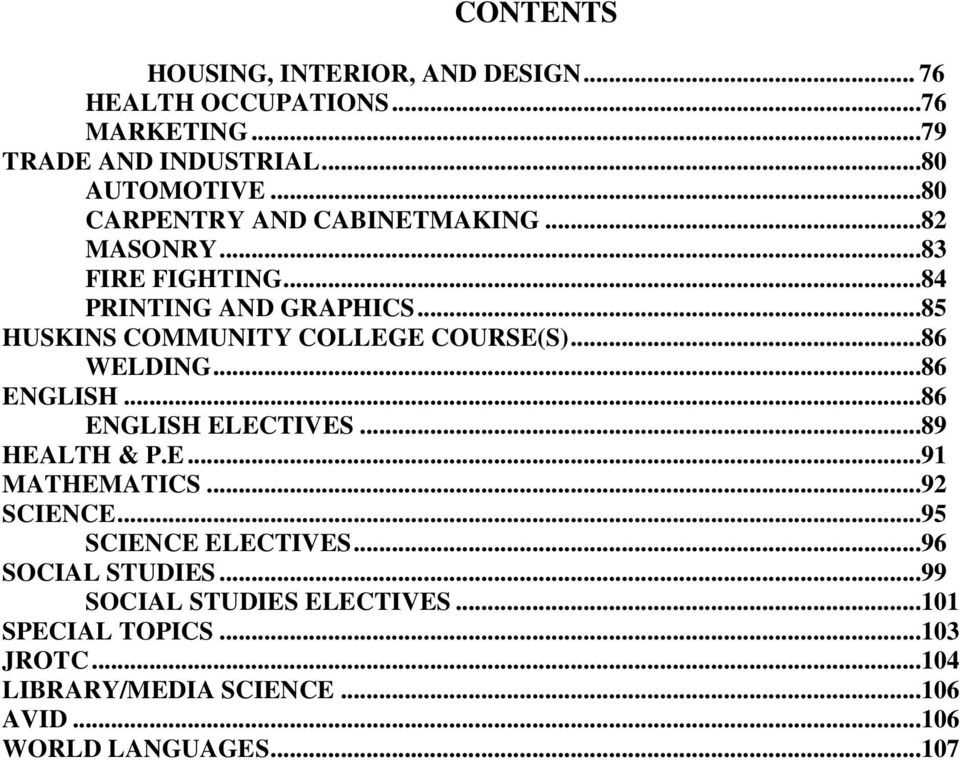
3 CONTENTS HOUSING, INTERIOR, AND DESIGN HEALTH OCCUPATIONS...76 MARKETING...79 TRADE AND INDUSTRIAL...80 AUTOMOTIVE...80 CARPENTRY AND CABINETMAKING...82 MASONRY...83 FIRE FIGHTING...84 PRINTING AND GRAPHICS...85 HUSKINS COMMUNITY COLLEGE COURSE(S)...86 WELDING...86 ENGLISH...86 ENGLISH ELECTIVES...89 HEALTH & P.E...91 MATHEMATICS...92 SCIENCE...95 SCIENCE ELECTIVES...96 SOCIAL STUDIES...99 SOCIAL STUDIES ELECTIVES SPECIAL TOPICS JROTC LIBRARY/MEDIA SCIENCE AVID WORLD LANGUAGES...107
4 MESSAGE FROM DISTRICT ADMINISTRATION 4

5 MESSAGE TO STUDENTS AND PARENTS Students entering high school make important decisions about their futures. The Pitt County High School Registration Guide is a comprehensive document to guide students by profiling programs and courses within Pitt County s high schools. It is an effort to provide students, parents and school professionals with an instrument to assist students in the selection of courses for grades 9 through 12. The high schools in Pitt County operate under a Student/Parent Informed Choice System or open registration. The decision to enroll in any regular course or program offered in grades 9-12 is the responsibility and the choice of the student and his/her parents or guardians. Parents/guardians and their children should discuss the student s goals, interests, past school grades, performance on standardized tests, personal habits, attitudes toward school, aptitudes, responsibilities outside the school, and other factors which may have an impact on the success of the student in a given course. The courses students select will shape the educational experiences they receive during their high school careers. The choice of specific courses is the critical foundation for career and post-secondary preparation. The decisions made will have an important impact on each student s future. In today s highly competitive and increasingly global economy, it is imperative that every student be equipped with the competencies needed to participate fully in a knowledgebased, technologically rich and culturally diverse society. A high-quality high school education is the springboard to a successful and rewarding future. By planning ahead for life s choices, a solid foundation is built. Therefore, students are encouraged to take the choices they make regarding high school very seriously by taking a rigorous and well-rounded course load. Students and parents/guardians alike must realize that the high school transcript is the official record of every course taken in high school and will follow the student throughout their adult life. Parents/guardians and students should carefully study this registration guide and utilize it to make the most of the high school experience. Additional assistance with course selection and graduation requirements is available through each school s Guidance Office. The Pitt County Schools, through high expectations, excellence in teaching and a safe, orderly environment, will ensure that all students master the skills necessary for success as life-long learners in a rapidly changing world It shall be the policy of Pitt County Schools to provide equal educational opportunities to all students regardless of race, color, national origin, sex, or handicap. 5

6 GLOSSARY ACT: American College Test. ACT assessment is a five-hour national college admissions test which includes five sections: writing, science, math, reading and English. Most colleges will accept a student s ACT scores as a part of the admissions evaluation. AP: Advanced Placement. Advanced Placement courses are designed by the College Board. In May, students take a test for each AP course in which they are enrolled; students who achieve a certain score may, if their college accepts the AP credit, receive college credit. There is a separate fee required for each AP test taken by the student. AVID: Advancement Via Individual Determination is a college readiness system designed to increase the number of students who enroll in four-year colleges and universities. AVID focuses on students in the academic middle. Each week, students receive instruction utilizing a rigorous college preparatory curriculum provided by AVID Center, tutor-facilitated study groups, motivational activities and academic success skills. Students participate in activities that incorporate strategies focused on writing, inquiry, collaboration, organization and reading to support their academic growth. AVID courses are available at Ayden-Grifton High School, Farmville Central High School and North Pitt High School. Interested students must apply and participate in a selection process (see a counselor or AVID teacher). AVID elective courses are paired with core subject courses to run yearlong on a rotating schedule determined by each school. Career & College Promise: An educational program that allows students to earn high school elective credit and community college credit at the same time. Pitt County Schools has agreements with Pitt Community College to offer courses for high school and college credit that are categorized as Science, Technology, Engineering, Mathematics, and Vocational. Capstone (Completer) Course: Any designated upper-level course in a series of courses in the Career and Technical Education program. Co-requisite: A co-requisite is a required course that is to be taken at the same time as the course of interest. Common Core: The Common Core State Standards provide a consistent, clear understanding of what students are expected to learn, so teachers and parents know what they need to do to help them. The standards are designed to be robust and relevant to the real world, reflecting the knowledge and skills that our young people need for success in college and careers. Course Recognition given by the high school that a course has been successfully completed. Essential Standards: Standards for the areas of Science, Social Studies, Information & Technology Skills, the Arts, Healthful Living, World Languages, and the Occupational Course of Study. The standards are based largely on the Revised Bloom s Taxonomy (RBT). EXPLORE: An achievement test that identifies the strengths and weaknesses of 8 th grade students that can be identified early in their educational development, when they have the greatest opportunity to establish a high school program of studies that will help them achieve their career and educational goals. Honors: Certain courses are designated as honors courses because of the challenging nature of the curriculum. These courses receive one additional quality point in the weighted grading system that is used to compute GPA. NCAA: The abbreviation for the National Collegiate Athletic Association. 6

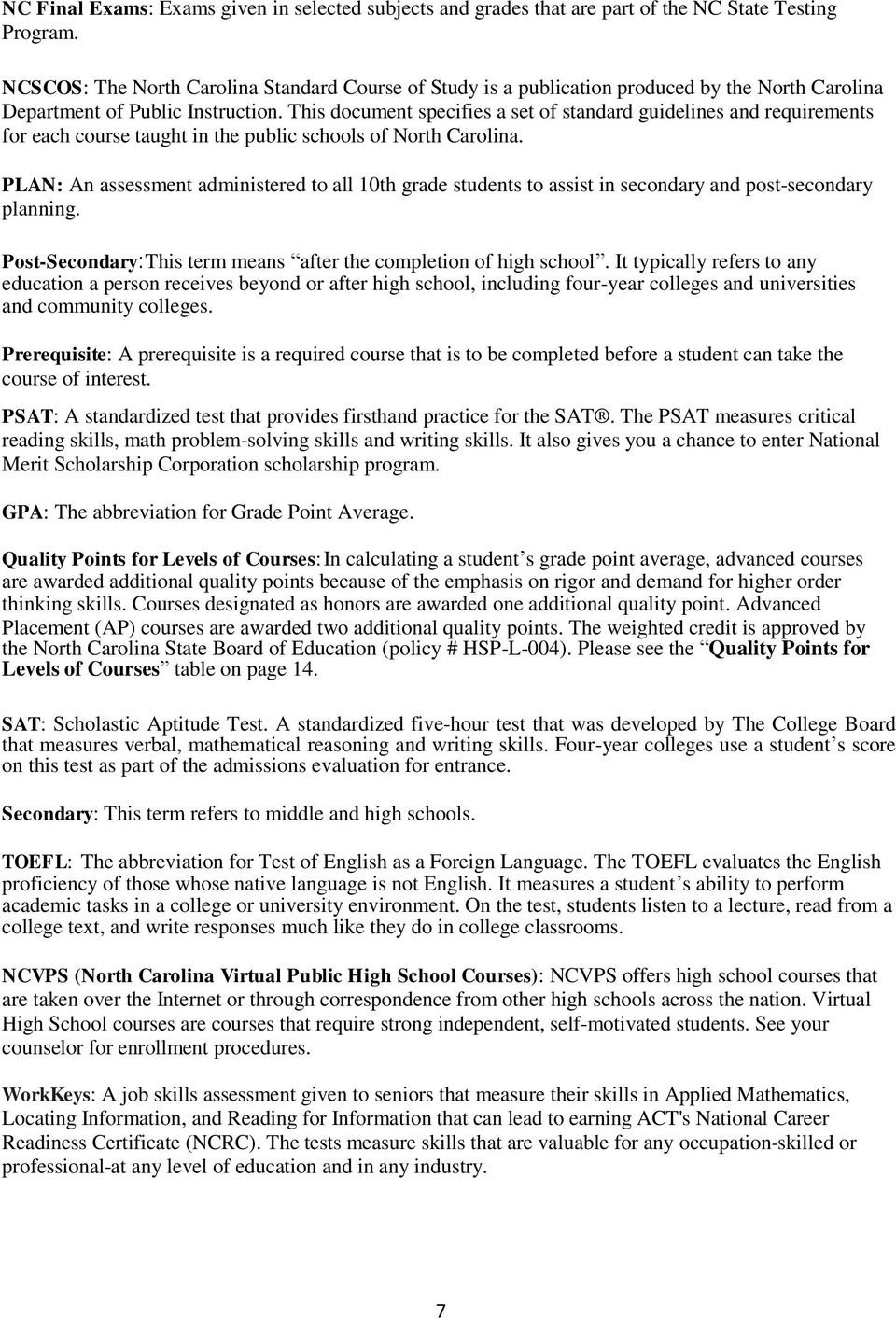
7 NC Final Exams: Exams given in selected subjects and grades that are part of the NC State Testing Program. NCSCOS: The North Carolina Standard Course of Study is a publication produced by the North Carolina Department of Public Instruction. This document specifies a set of standard guidelines and requirements for each course taught in the public schools of North Carolina. PLAN: An assessment administered to all 10th grade students to assist in secondary and post-secondary planning. Post-Secondary: This term means after the completion of high school. It typically refers to any education a person receives beyond or after high school, including four-year colleges and universities and community colleges. A prerequisite is a required course that is to be completed before a student can take the course of interest. PSAT: A standardized test that provides firsthand practice for the SAT. The PSAT measures critical reading skills, math problem-solving skills and writing skills. It also gives you a chance to enter National Merit Scholarship Corporation scholarship program. GPA: The abbreviation for Grade Point Average. Quality Points for Levels of Courses: In calculating a student s grade point average, advanced courses are awarded additional quality points because of the emphasis on rigor and demand for higher order thinking skills. Courses designated as honors are awarded one additional quality point. Advanced Placement (AP) courses are awarded two additional quality points. The weighted credit is approved by the North Carolina State Board of Education (policy # HSP-L-004). Please see the Quality Points for Levels of Courses table on page 14. SAT: Scholastic Aptitude Test. A standardized five-hour test that was developed by The College Board that measures verbal, mathematical reasoning and writing skills. Four-year colleges use a student s score on this test as part of the admissions evaluation for entrance. Secondary: This term refers to middle and high schools. TOEFL: The abbreviation for Test of English as a Foreign Language. The TOEFL evaluates the English proficiency of those whose native language is not English. It measures a student s ability to perform academic tasks in a college or university environment. On the test, students listen to a lecture, read from a college text, and write responses much like they do in college classrooms. NCVPS (North Carolina Virtual Public High School Courses): NCVPS offers high school courses that are taken over the Internet or through correspondence from other high schools across the nation. Virtual High School courses are courses that require strong independent, self-motivated students. See your counselor for enrollment procedures. WorkKeys: A job skills assessment given to seniors that measure their skills in Applied Mathematics, Locating Information, and Reading for Information that can lead to earning ACT's National Career Readiness Certificate (NCRC). The tests measure skills that are valuable for any occupation-skilled or professional-at any level of education and in any industry. 7
8 HOW TO USE THIS GUIDE The Pitt County Schools Registration Guide contains information needed to register for the school year. Please read through it carefully. Discuss your course selections with your parents or legal guardian, teachers, and school counselor. Focus on your graduation requirements, course requirements, career goals and interests. More information and explanations of procedures and programs at each high school will be shared with students as they register for classes. This registration guide provides descriptions of every course offered at Pitt County s high schools. Please use the glossary to understand terms about which you have questions. Please use the table of contents to locate courses and special programs in which you are interested. In addition, pay attention to necessary prerequisites, recommendations, and/or special notes before you register for any course. Register for a full schedule of eight courses/classes plus alternates. Course offerings begin on page Students who entered 9 th grade for the first time during the , , or school year, will be required to complete the Pitt County Schools Future Ready Course of Study. See page 22. Students who entered 9 th grade for the first time during the , will be required to complete the new Pitt County Schools Future Ready Course of Study. See page 23 for details. Choose courses that provide background for your plans after high school (educational and career concentration areas). 2. Review the course descriptions section of this guide to select the courses you need to take next year and complete the Registration Form provided by your school. In addition, pay attention to prerequisites before you register for any course. Register for a full schedule of eight courses/classes plus alternatives. Course offerings begin on page 55. 8


9 QUICK REFERENCE TIPS ATTENDANCE WARNING!! Absences, tardies, and early dismissals are taken very seriously in high school. You are not permitted to miss more than seven (7) class periods per course. Make sure that you are only missing days that are absolutely necessary. Legitimate (excused) absences are allowed for the following reasons: illness or injury; quarantine; death in the immediate family; documented medical or dental appointments; court or administrative hearings; religious services; and prior-approved educational opportunities. Only the circumstances listed constitute absences that can be coded "excused." Although these absences are regarded as excused absences, all absences from school (with the exception of school-related field trips) count as absences toward the total absences for the semester. MAKEUP POLICY At the discretion of the principal, a student who is passing a course and has been absent between 8 and no more than 15 periods may be provided an opportunity to make up time missed. Each high school shall provide sufficient makeup opportunities to allow the make-up of three days (twelve class periods) per semester. Students will be required to makeup 2 hours for each 90 minute class period that exceeds 7 absences. EXAMS Examinations provide students with an opportunity for worthwhile learning experiences which prepare them to become life-long learners. Students in high school level courses shall be required to take examinations each semester in each subject in which they are enrolled. Final examinations will count a minimum of 25 percent of the course grade. 9

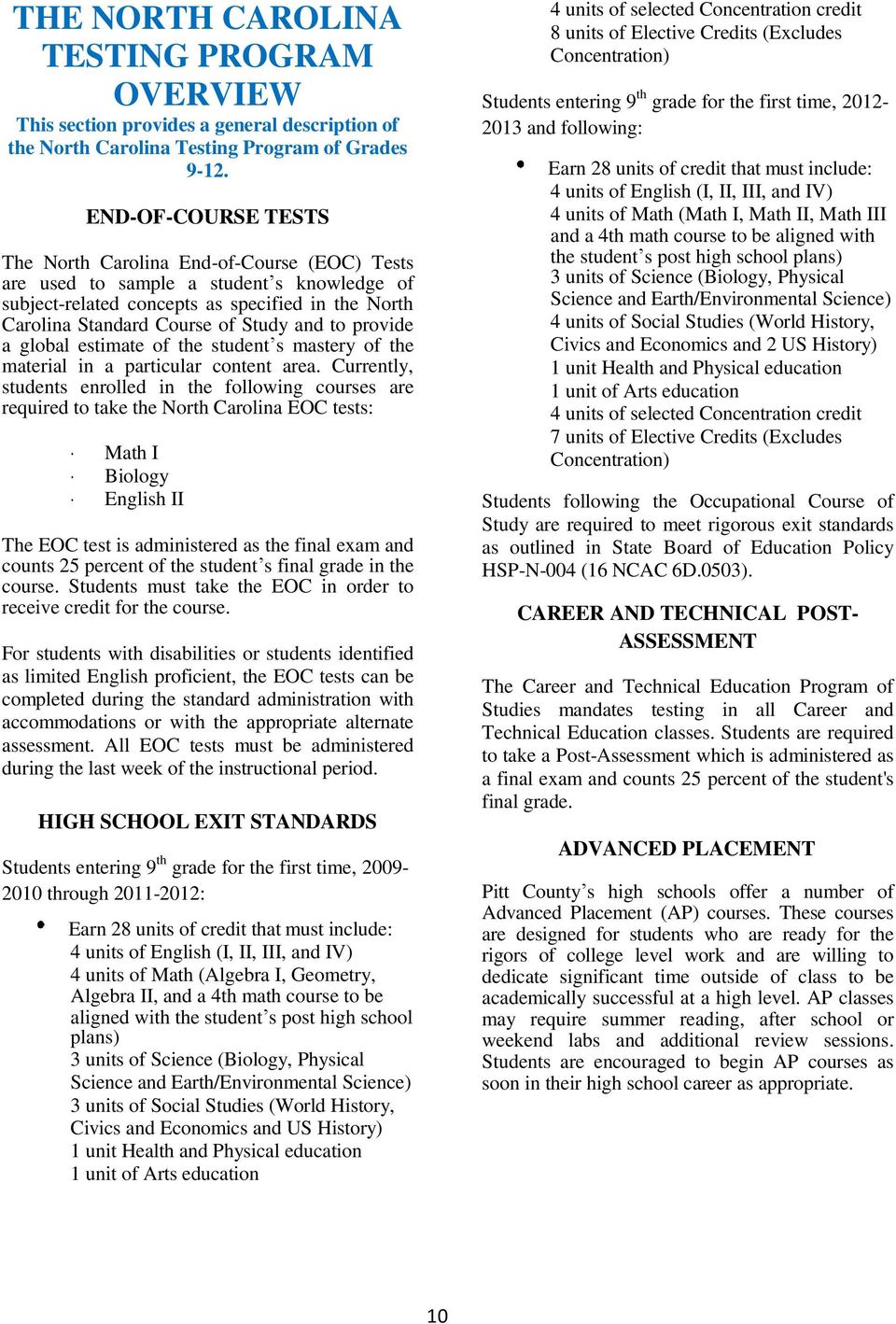
10 THE NORTH CAROLINA TESTING PROGRAM OVERVIEW This section provides a general description of the North Carolina Testing Program of Grades END-OF-COURSE TESTS The North Carolina End-of-Course (EOC) Tests are used to sample a student s knowledge of subject-related concepts as specified in the North Carolina Standard Course of Study and to provide a global estimate of the student s mastery of the material in a particular content area. Currently, students enrolled in the following courses are required to take the North Carolina EOC tests: Math I Biology English II The EOC test is administered as the final exam and counts 25 percent of the student s final grade in the course. Students must take the EOC in order to receive credit for the course. For students with disabilities or students identified as limited English proficient, the EOC tests can be completed during the standard administration with accommodations or with the appropriate alternate assessment. All EOC tests must be administered during the last week of the instructional period. HIGH SCHOOL EXIT STANDARDS Students entering 9 th grade for the first time, through : Earn 28 units of credit that must include: 4 units of English (I, II, III, and IV) 4 units of Math (Algebra I, Geometry, Algebra II, and a 4th math course to be aligned with the student s post high school plans) 3 units of Science (Biology, Physical Science and Earth/Environmental Science) 3 units of Social Studies (World History, Civics and Economics and US History) 1 unit Health and Physical education 1 unit of Arts education 4 units of selected Concentration credit 8 units of Elective Credits (Excludes Concentration) Students entering 9 th grade for the first time, and following: Earn 28 units of credit that must include: 4 units of English (I, II, III, and IV) 4 units of Math (Math I, Math II, Math III and a 4th math course to be aligned with the student s post high school plans) 3 units of Science (Biology, Physical Science and Earth/Environmental Science) 4 units of Social Studies (World History, Civics and Economics and 2 US History) 1 unit Health and Physical education 1 unit of Arts education 4 units of selected Concentration credit 7 units of Elective Credits (Excludes Concentration) Students following the Occupational Course of Study are required to meet rigorous exit standards as outlined in State Board of Education Policy HSP-N-004 (16 NCAC 6D.0503). CAREER AND TECHNICAL POST- ASSESSMENT The Career and Technical Education Program of Studies mandates testing in all Career and Technical Education classes. Students are required to take a Post-Assessment which is administered as a final exam and counts 25 percent of the student's final grade. ADVANCED PLACEMENT Pitt County s high schools offer a number of Advanced Placement (AP) courses. These courses are designed for students who are ready for the rigors of college level work and are willing to dedicate significant time outside of class to be academically successful at a high level. AP classes may require summer reading, after school or weekend labs and additional review sessions. Students are encouraged to begin AP courses as soon in their high school career as appropriate. 10
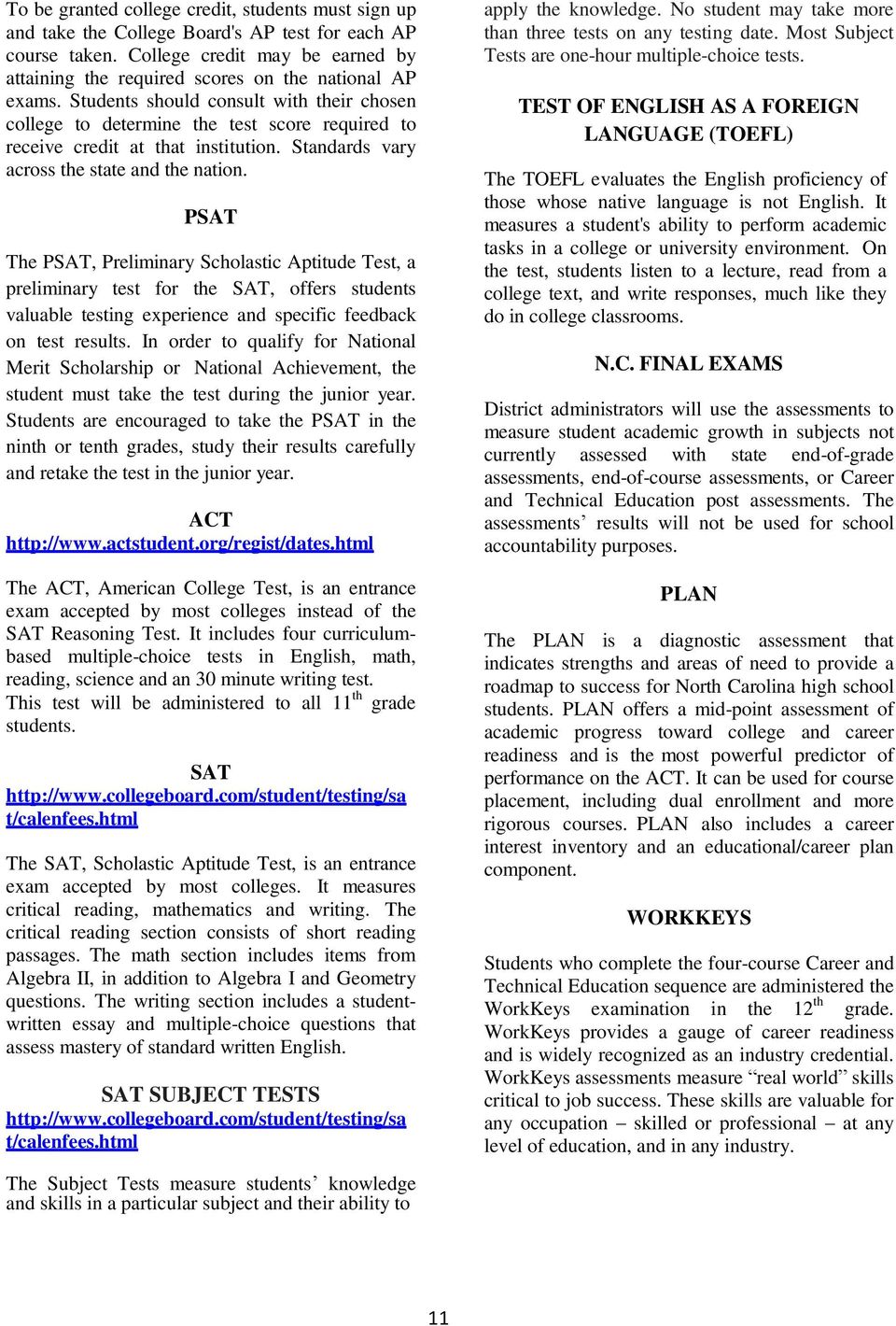
11 To be granted college credit, students must sign up and take the College Board's AP test for each AP course taken. College credit may be earned by attaining the required scores on the national AP exams. Students should consult with their chosen college to determine the test score required to receive credit at that institution. Standards vary across the state and the nation. PSAT The PSAT, Preliminary Scholastic Aptitude Test, a preliminary test for the SAT, offers students valuable testing experience and specific feedback on test results. In order to qualify for National Merit Scholarship or National Achievement, the student must take the test during the junior year. Students are encouraged to take the PSAT in the ninth or tenth grades, study their results carefully and retake the test in the junior year. ACT The ACT, American College Test, is an entrance exam accepted by most colleges instead of the SAT Reasoning Test. It includes four curriculumbased multiple-choice tests in English, math, reading, science and an 30 minute writing test. This test will be administered to all 11 th grade students. SAT t/calenfees.html The SAT, Scholastic Aptitude Test, is an entrance exam accepted by most colleges. It measures critical reading, mathematics and writing. The critical reading section consists of short reading passages. The math section includes items from Algebra II, in addition to Algebra I and Geometry questions. The writing section includes a studentwritten essay and multiple-choice questions that assess mastery of standard written English. SAT SUBJECT TESTS t/calenfees.html The Subject Tests measure students knowledge and skills in a particular subject and their ability to apply the knowledge. No student may take more than three tests on any testing date. Most Subject Tests are one-hour multiple-choice tests. TEST OF ENGLISH AS A FOREIGN LANGUAGE (TOEFL) The TOEFL evaluates the English proficiency of those whose native language is not English. It measures a student's ability to perform academic tasks in a college or university environment. On the test, students listen to a lecture, read from a college text, and write responses, much like they do in college classrooms. N.C. FINAL EXAMS District administrators will use the assessments to measure student academic growth in subjects not currently assessed with state end-of-grade assessments, end-of-course assessments, or Career and Technical Education post assessments. The assessments results will not be used for school accountability purposes. PLAN The PLAN is a diagnostic assessment that indicates strengths and areas of need to provide a roadmap to success for North Carolina high school students. PLAN offers a mid-point assessment of academic progress toward college and career readiness and is the most powerful predictor of performance on the ACT. It can be used for course placement, including dual enrollment and more rigorous courses. PLAN also includes a career interest inventory and an educational/career plan component. WORKKEYS Students who complete the four-course Career and Technical Education sequence are administered the WorkKeys examination in the 12 th grade. WorkKeys provides a gauge of career readiness and is widely recognized as an industry credential. WorkKeys assessments measure real world skills critical to job success. These skills are valuable for any occupation skilled or professional at any level of education, and in any industry. 11
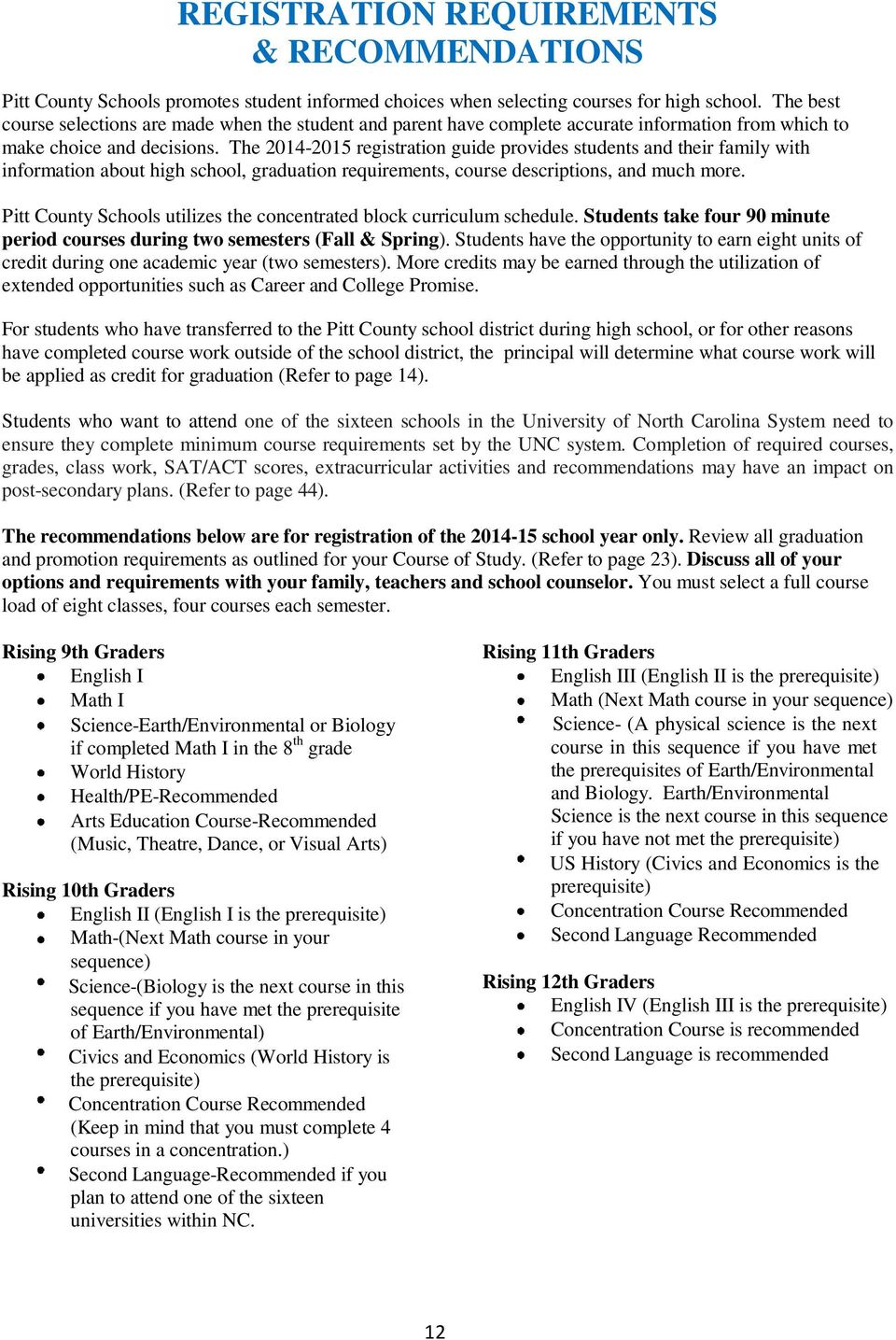
12 REGISTRATION REQUIREMENTS & RECOMMENDATIONS Pitt County Schools promotes student informed choices when selecting courses for high school. The best course selections are made when the student and parent have complete accurate information from which to make choice and decisions. The registration guide provides students and their family with information about high school, graduation requirements, course descriptions, and much more. Pitt County Schools utilizes the concentrated block curriculum schedule. Students take four 90 minute period courses during two semesters (Fall & Spring). Students have the opportunity to earn eight units of credit during one academic year (two semesters). More credits may be earned through the utilization of extended opportunities such as Career and College Promise. For students who have transferred to the Pitt County school district during high school, or for other reasons have completed course work outside of the school district, the principal will determine what course work will be applied as credit for graduation (Refer to page 14). Students who want to attend one of the sixteen schools in the University of North Carolina System need to ensure they complete minimum course requirements set by the UNC system. Completion of required courses, grades, class work, SAT/ACT scores, extracurricular activities and recommendations may have an impact on post-secondary plans. (Refer to page 44). The recommendations below are for registration of the school year only. Review all graduation and promotion requirements as outlined for your Course of Study. (Refer to page 23). Discuss all of your options and requirements with your family, teachers and school counselor. You must select a full course load of eight classes, four courses each semester. Rising 9th Graders English I Math I Science-Earth/Environmental or Biology if completed Math I in the 8 th grade World History Health/PE-Recommended Arts Education Course-Recommended (Music, Theatre, Dance, or Visual Arts) Rising 10th Graders English II (English I is the prerequisite) Math-(Next Math course in your sequence) Science-(Biology is the next course in this sequence if you have met the prerequisite of Earth/Environmental) Civics and Economics (World History is the prerequisite) Concentration Course Recommended (Keep in mind that you must complete 4 courses in a concentration.) Second Language-Recommended if you plan to attend one of the sixteen universities within NC. Rising 11th Graders English III (English II is the prerequisite) Math (Next Math course in your sequence) Science- (A physical science is the next course in this sequence if you have met the prerequisites of Earth/Environmental and Biology. Earth/Environmental Science is the next course in this sequence if you have not met the prerequisite) US History (Civics and Economics is the prerequisite) Concentration Course Recommended Second Language Recommended Rising 12th Graders English IV (English III is the prerequisite) Concentration Course is recommended Second Language is recommended 12
13 COURSE LOADS Students must register for a minimum of four 90 minute period courses during two semesters (Fall & Spring). Students have the opportunity to earn eight units of credit during one academic year (two semesters). Seniors who have received twenty-six credits may take only two credits in their final semester to receive twenty-eight credits to graduate. PREREQUISITES Some courses must be passed in a logical sequence; therefore, you must adhere to the designated prerequisites. Give attention to the listed prerequisites and suggested grade levels of all courses. You cannot enroll in the second level of any course until you have passed the first level of the course. Courses that do not require a prerequisite will list None under the prerequisite requirement. ALTERNATE CHOICES Students must list alternative courses on their registration forms in case some courses are unavailable. SCHEDULE CHANGES Once the registration process is completed and shared with the parent/guardian and student, the class schedule shall prevail. Because scheduling is a complicated process, it is frequently impossible to provide each student every choice made. Changes can be requested by completing an application from the Student Services Office at your high school. On that application the student should indicate the course that he/she wishes to add, the course he/she wishes to drop, and the reason for dropping the course. At the end of the first five days of school, no schedule changes will be allowed. Should a schedule change be denied, due process may be provided through an appeal to the principal. COURSE LEVELS You will have the opportunity to enroll in several different levels of academic courses. Enrolling in the proper course should make it possible for you to work at your individual level of ability. The following are approved course levels for Pitt County Schools: Standard- 4 Quality Points for an A: Courses at this level are designed to prepare students for postsecondary education or to enter the world of work. Honors - 5 Quality Points for an A: Courses at this level allow students to explore topics in more depth than in a standard course. The emphasis in an Honors course is on discovery, inquire learning, the utilization of research skills, and higher level thinking skills, as related to the specific course content. Advanced Placement - 6 Quality Points for an A: Courses at this level are designed for accelerated students attempting to receive college credit via an advanced placement (AP) exam. Students should be self-motivated critical thinkers. Teachers of AP courses adhere to the curriculum standards recommended by College Board and prepare students to take the approved College Board AP Exam in May. Students may choose to take the Advanced Placement Examination and pay any exam fees not provided by Pitt County Schools. Participating colleges may grant credit and appropriate college-level placement to students who satisfy the college or university s requirements. Registration for AP courses determines which courses are available in each high school on a yearly basis. In addition to the AP courses listed in this registration guide, College Board offers other Advanced Placement Exams. If you are interested in taking one of these exams, see your school counselor. 13

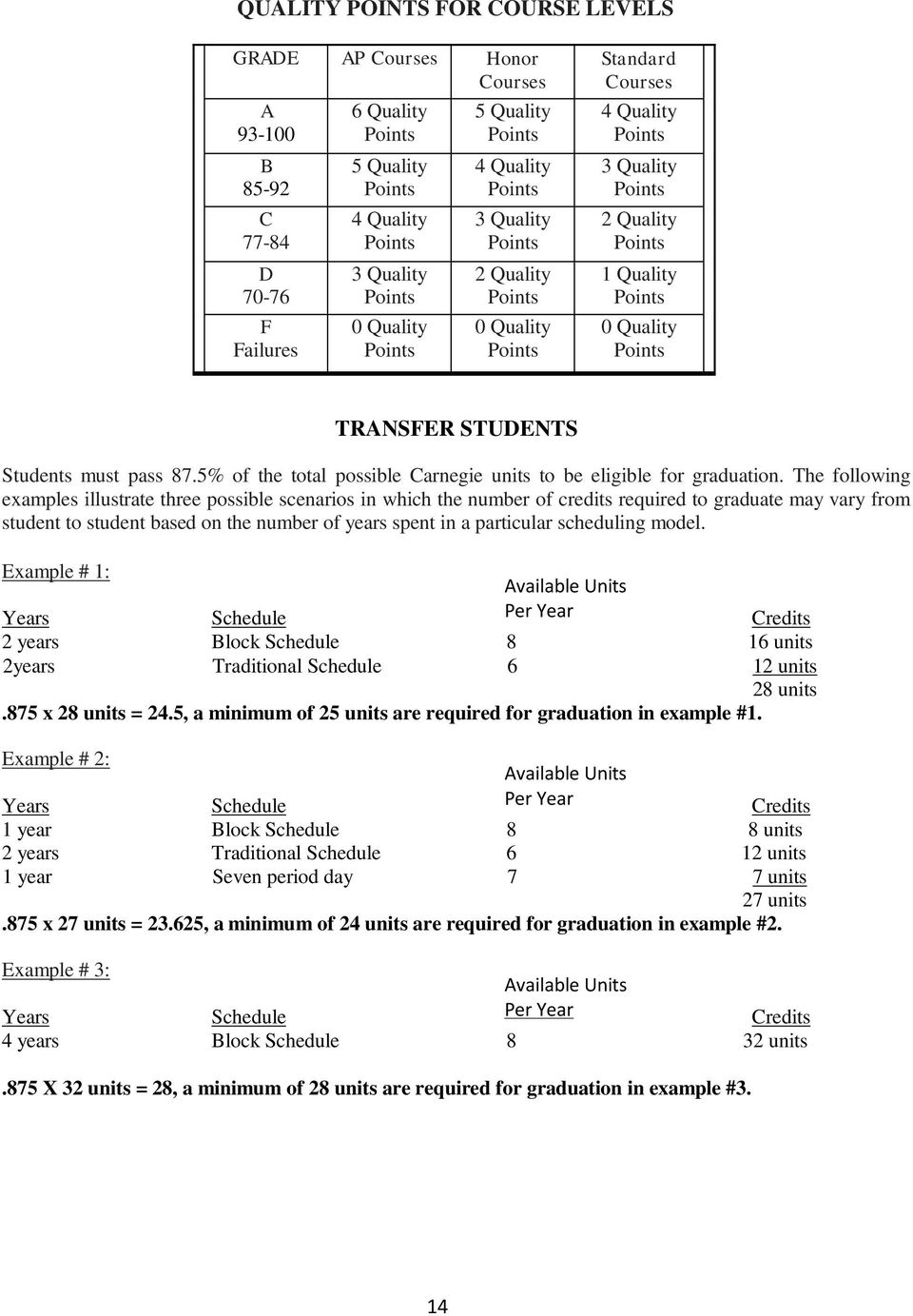
14 QUALITY POINTS FOR COURSE LEVELS GRADE AP Courses Honor Courses A B C D F Failures 6 Quality Points 5 Quality Points 4 Quality Points 3 Quality Points 0 Quality Points 5 Quality Points 4 Quality Points 3 Quality Points 2 Quality Points 0 Quality Points Standard Courses 4 Quality Points 3 Quality Points 2 Quality Points 1 Quality Points 0 Quality Points TRANSFER STUDENTS Students must pass 87.5% of the total possible Carnegie units to be eligible for graduation. The following examples illustrate three possible scenarios in which the number of credits required to graduate may vary from student to student based on the number of years spent in a particular scheduling model. Example # 1: Years Schedule Available Units Per Year Credits 2 years Block Schedule 8 16 units 2years Traditional Schedule 6 12 units 28 units.875 x 28 units = 24.5, a minimum of 25 units are required for graduation in example #1. Example # 2: Years Schedule Available Units Per Year Credits 1 year Block Schedule 8 8 units 2 years Traditional Schedule 6 12 units 1 year Seven period day 7 7 units 27 units.875 x 27 units = , a minimum of 24 units are required for graduation in example #2. Example # 3: Available Units Years Schedule Per Year Credits 4 years Block Schedule 8 32 units.875 X 32 units = 28, a minimum of 28 units are required for graduation in example #3. 14
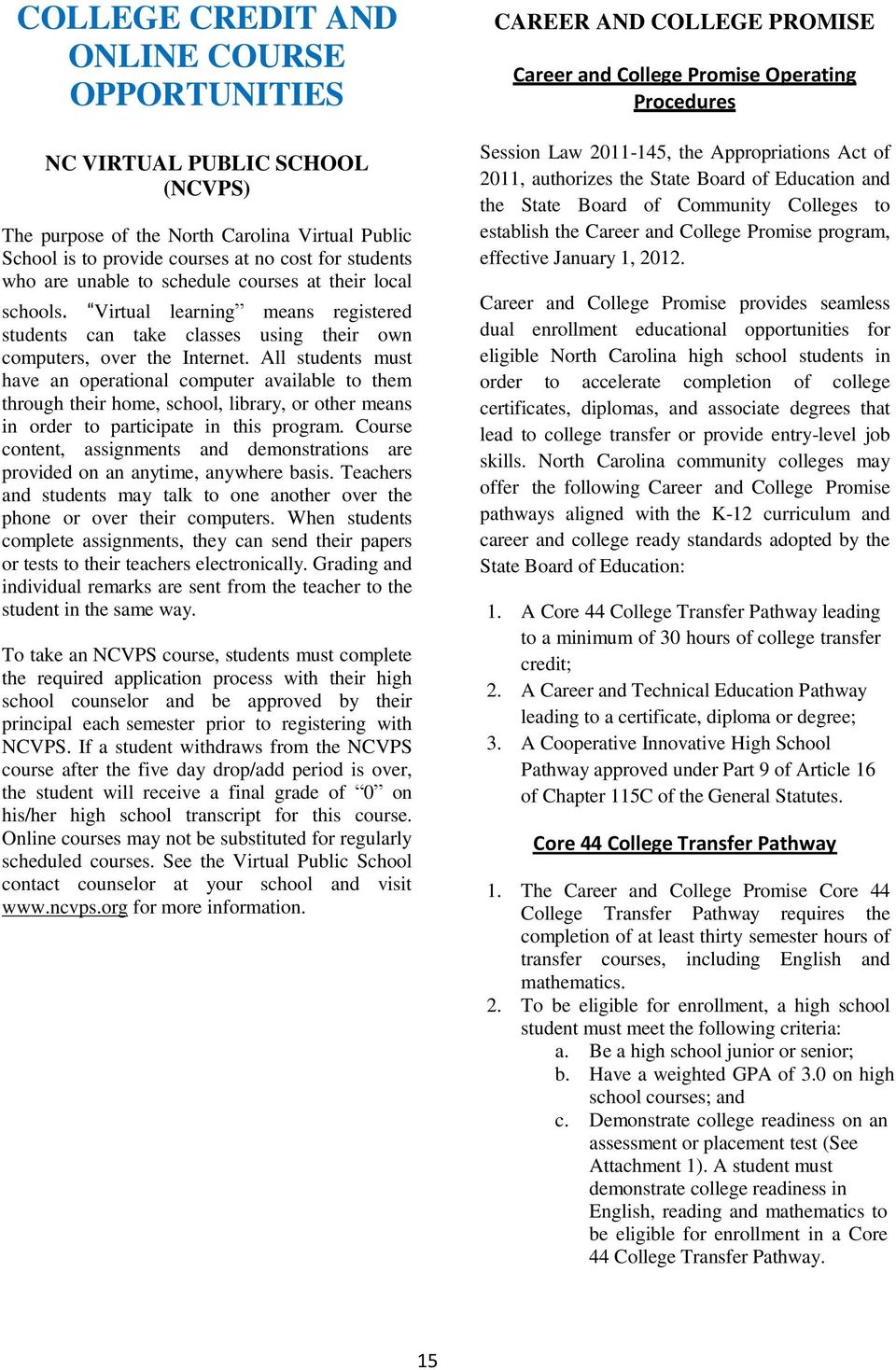
15 COLLEGE CREDIT AND ONLINE COURSE OPPORTUNITIES NC VIRTUAL PUBLIC SCHOOL (NCVPS) The purpose of the North Carolina Virtual Public School is to provide courses at no cost for students who are unable to schedule courses at their local schools. Virtual learning means registered students can take classes using their own computers, over the Internet. All students must have an operational computer available to them through their home, school, library, or other means in order to participate in this program. Course content, assignments and demonstrations are provided on an anytime, anywhere basis. Teachers and students may talk to one another over the phone or over their computers. When students complete assignments, they can send their papers or tests to their teachers electronically. Grading and individual remarks are sent from the teacher to the student in the same way. To take an NCVPS course, students must complete the required application process with their high school counselor and be approved by their principal each semester prior to registering with NCVPS. If a student withdraws from the NCVPS course after the five day drop/add period is over, the student will receive a final grade of 0 on his/her high school transcript for this course. Online courses may not be substituted for regularly scheduled courses. See the Virtual Public School contact counselor at your school and visit for more information. CAREER AND COLLEGE PROMISE Career and College Promise Operating Procedures Session Law , the Appropriations Act of 2011, authorizes the State Board of Education and the State Board of Community Colleges to establish the Career and College Promise program, effective January 1, Career and College Promise provides seamless dual enrollment educational opportunities for eligible North Carolina high school students in order to accelerate completion of college certificates, diplomas, and associate degrees that lead to college transfer or provide entry-level job skills. North Carolina community colleges may offer the following Career and College Promise pathways aligned with the K-12 curriculum and career and college ready standards adopted by the State Board of Education: 1. A Core 44 College Transfer Pathway leading to a minimum of 30 hours of college transfer credit; 2. A Career and Technical Education Pathway leading to a certificate, diploma or degree; 3. A Cooperative Innovative High School Pathway approved under Part 9 of Article 16 of Chapter 115C of the General Statutes. Core 44 College Transfer Pathway 1. The Career and College Promise Core 44 College Transfer Pathway requires the completion of at least thirty semester hours of transfer courses, including English and mathematics. 2. To be eligible for enrollment, a high school student must meet the following criteria: a. Be a high school junior or senior; b. Have a weighted GPA of 3.0 on high school courses; and c. Demonstrate college readiness on an assessment or placement test (See Attachment 1). A student must demonstrate college readiness in English, reading and mathematics to be eligible for enrollment in a Core 44 College Transfer Pathway. 15
16 A Provisional Status student may register only for college mathematics (MAT) and college English (ENG) courses within the chosen pathway. To be eligible to register for other courses in the pathway, the student must first successfully complete mathematics and English courses with a grade of C or higher. 3. To maintain eligibility for continued enrollment, a student must a. Continue to make progress toward high school graduation, and b. Maintain a 2.0 GPA in college coursework after completing two courses. 4. A student must enroll in one Core 44 College Transfer Pathway program of study and may not substitute courses in one program for courses in another. 5. A student may change his or her program of study major with approval of the high school principal or his/her designee and the college s chief student development administrator. 6. With approval of the high school principal or his/her designee and the college s chief student development administrator, a student who completes a Core 44 College Transfer Pathway while still enrolled in high school may continue to earn college transfer credits leading to the completion of the 44-hour general education transfer core. 7. With approval of the high school principal or his/her designee and the college s chief student development administrator, a student may enroll in both a Core 44 College Transfer Pathway program of study and a Career Technical Education program of study. 8. Currently enrolled high school students (Fall Semester 2011) who have successfully completed a college transfer STEM course with a grade of C or better may be admitted into a Career and College Promise College Core 44 Transfer the college s chief student development administrator. 16 Career Technical Education Pathway 1. The Career and College Promise Career Technical Education Pathway leads to a certificate or diploma aligned with a high school Career Cluster. 2. To be eligible for enrollment, a high school student must meet the following criteria: 1. Be a high school junior or senior; 2. Have a weighted GPA of 3.0 on high school courses or have the recommendation of the high school principal or his/her designee; and 3. Meet the prerequisites for the career pathway. 3. High school counselors should consider students PLAN scores in making pathway recommendations. 4. College Career Technical Education courses may be used to provide partial or full fulfillment of a four-unit career cluster. Where possible, students should be granted articulated credit based on the local or state North Carolina High School to Community College articulation agreement. 5. To maintain eligibility for continued enrollment, a student must 1. Continue to make progress toward high school graduation and 2. Maintain a 2.0 in college coursework after completing two courses. 6. A student must enroll in one program of study and may not substitute courses in one program for courses in another. The student may change his or her program of study major with approval of the high school principal or his/her designee and the entry GPA or testing requirements (i.e. PLAN). Students will be required to meet course prerequisite requirements. 7. Currently enrolled high school students (Fall Semester 2011) who have successfully completed a community college technical education course with a grade of C or better may be admitted into a Career and College Promise Career Technical Education Certificate Pathway in Spring Semester 2012 without meeting the entry GPA or testing requirements (i.e. PLAN).Students will be required to meet course prerequisite requirements. Student Application Procedures 1. The high school will document eligibility criteria (high school GPA and PLAN or other assessment scores) on the student s transcript. A Home school or non-public high school student must submit a transcript and official test scores from an approved assessment test. 2. Students must complete a college application to be admitted into a Career and College Promise pathway.

17 Pitt County Schools Additional Requirements Students must take two high school courses during the semester to be eligible to participate in the Career and College Promise program. Students who wish to withdraw from a Career and College Promise course for high school credit should do so within the first five days of Pitt County Schools semester. The student must withdraw during the drop/add period to assure that the community college course can be replaced with a high school course, thus fulfilling the minimum course enrollment for the student. If the student withdraws from a Career and College Promise course for which he/she indicated a desire for high school credit after the first five days of the high school semester, the student will receive a final grade of 0 on his/her high school transcript for the course(s). After the first five days of the semester, the high school will not be able to place the student in a Pitt County Schools class for credit to replace the Career and College Promise course. Attachment 1 College Readiness* Benchmarks on Approved Diagnostic Assessment Tests Test PLAN** PSAT** Asset (NCCCS Cut Score) COMPASS (NCCCS Cut Score) Accuplacer (NCCCS Cut Score) English Writing 70 Writing 86 Sentence Skills Reading Reading 81 Reading 80 Reading Mathematics Numerical Skills and 41 Int. Algebra 47 Pre-Algebra and 66 Algebra 55 Arithmetic and 75 Elem. Algebra In addition to the diagnostic assessments, colleges may use the following SAT and ACT scores recommended by the testing companies as benchmarks for college readiness:* SAT ACT English 500 English 18 Critical Reading 500 Reading 21 Mathematics 500 Mathematics 22 *To be eligible for enrollment in a College Transfer Pathway, students must demonstrate college readiness in English, reading and mathematics on an approved test. **PLAN and PSAT scores recommended by ACT and College Board as indicators of college readiness. 17

18 18 College Course ID Course Name HS Course Code ACA 122 College Transfer Success CCP Pathway(s)* Suggested Credit** N/A BE,EM,HS,LH No high school credit Notes This course has no analogous course in the NC SCoS; will not appear on the HS transcript. ART 111 Art Appreciation 5028 HS 1 elective credit Will not count as PCS requirement BIO 111 General Biology I 3020 BE,HS,LH 1 elective credit BIO 112 General Biology II 3020 BE,LH 1 elective credit Combination of BIO 111 AND BIO 112 CHM 151 CHM 152 CIS 110 ECO 251 ECO 252 ENG 111 ENG 112 ENG 113 ENG 131 Combination of ENG 111 AND ENG 112 or ENG 113 AND ENG 231 or 232 or 233 or 234 HS Biology Sequence General Chemistry I General Chemistry II Introduction to Computers Principles of Microeconomics Principles of Macroeconomics Expository Writing Argument-based Research Literature-based Research Introduction to Literature HS ENG III Credit Sequence Table 1. Proposed Dual Credit for Career & College Promise 3020 BE,LH 1 credit - HS Biology 3050 EM,LH 1 credit HS Chemistry 3050 LH 1 credit HS Chemistry 8592 B 1 elective credit E 4016 BE,EM 1 elective credit 4017 B 1 elective credit E 1025 BE,EM,HS,LH 1 elective credit 1025 BE,EM,HS,LH 1 elective credit 1025 BE,EM,HS,LH 1 elective credit 1027 BE,EM,HS,LH 1 elective credit 1023 BE,EM,HS,LH 1 credit HS ENG III Must pass both courses AND the EOC to receive HS credit. Must complete the laboratory to receive HS credit. Must complete the laboratory to receive HS credit. Must complete the full sequence of 3 courses to receive English III credit. *CCP Pathways Key: BE=Business and Economics EM=Engineering and Mathematics HS=Humanities and Social Studies LH=Life and Health Sciences **All courses appear on the Comprehensive Articulation Agreement and receive 1 extra quality point toward calculation of the student s Grade Point Average (Honors credit). **Pitt Community College may not offer all courses.

19 Table 1. Proposed Dual Credit for Career & College Promise 19 College Course ID Course Name HS Course Code Combination of ENG 111 AND ENG 112 or ENG 113 AND ENG 241 or 242 or 243 HIS 121 HIS 122 HS ENG IV Credit Sequence Western Civilization I Western Civilization II CCP Pathway(s)* Suggested Credit** 1024 BE,EM,HS,LH 1 credit HS ENG IV 4014 BE,EM,HS,LH 1 credit HS World History 4018 HS 1 credit HS World History HUM 115 Critical Thinking 4019 HS 1 elective credit MAT 151 Statistics I 2065 BE 1 elective credit MAT 161 College Algebra 2028 BE,HS 1 elective credit MAT 171 Pre-Calculus Algebra 2044 EM,LH 1 elective credit MAT 172 Combination of MAT 171 and 172 Pre-Calculus Trigonometry HS Pre-Calculus Sequence 2042 EM 1 elective credit 2070 EM 1 credit HS Pre-Calculus MAT 271 Calculus I 2043 EM 1 credit HS Calculus PSY 150 SOC 210 SPA 111 General Psychology Introduction to Sociology Elementary Spanish I 4053 HS 1 elective credit 4015 HS 1 elective credit 1051 HS 1 credit World Language *CCP Pathways Key: BE=Business and Economics EM=Engineering and Mathematics HS=Humanities and Social Studies LH=Life and Health Sciences Notes Must complete the full sequence of 3 courses to receive English IV credit. Requires both labs (0 credits each) to receive credit as 4th math. Requires lab (0 credits) to receive credits 4th math. Other world languages may be substituted. **All courses appear on the Comprehensive Articulation Agreement and receive 1 extra quality point toward calculation of the student s Grade Point Average (Honors credit). **Pitt Community College may not offer all courses.

20 NORTH CAROLINA ACADEMIC SCHOLARS PROGRAM Students who complete the State Board of Education requirements for a well-balanced, challenging high school program will be named North Carolina Scholars and receive special recognition. The requirements for this program are listed below. Students entering 9 th grade must: Complete all requirements of the North Carolina Academic Scholars Program. Have an overall four-year unweighted Grade Point Average of 3.5. Complete all requirements for a North Carolina high school diploma. The students who qualify for this special recognition: will be designated by the State Board of Education as North Carolina Academic Scholars and will receive a seal of recognition attached to their diplomas. may receive special recognition at graduation exercises and other community events. may be considered for scholarships from the local and state business/industrial community. may use this special recognition in applying to post-secondary institutions. (Candidates are identified by the end of grade 11 and their candidacy can be included in application forms and/or transcripts sent to these institutions.) Students entering 9 th grade , , and Students entering 9 th grade and thereafter Credits Future-Ready Core Course of Study Credits Future-Ready Core Course of Study 4 English I, II, III, IV 4 English I, II, III, IV 4 Mathematics (should include Algebra I, Algebra II, Geometry, and a higher level math course with Algebra II as prerequisite OR Integrated Mathematics I, II, III, and a higher level mathematics course with Integrated Mathematics III as prerequisite) 4 Mathematics (should include Math I, Math II, Math III, and a higher level math course ). 3 Science (Physics or Chemistry course, Biology, and an Earth/Environmental Science course) 3 Social Studies (World History, Civics/Economics, and U.S. History) 3 Science (Physics or Chemistry course, Biology, and an Earth/Environmental Science course) 4 Social Studies (World History, Civics/Economics, and American History I and II) 1 Health and Physical Education 1 Health and Physical Education 6 Two (2) elective credits in a second language required for the UNC System Four (4) elective credits constituting a concentration recommended from one of the following: Career and Technical Education Cluster (CTE), JROTC, Arts Education, Second Languages, any other subject area 6 Two (2) elective credits in a second language required for the UNC System Four (4) elective credits constituting a concentration recommended from one of the following: Career and Technical Education Cluster (CTE), JROTC, Arts Education, Second Languages, any other subject area 1 Elective Credit 1 Arts Education 1 Arts Education 5 Higher level courses taken during junior and/or senior years which carry 5 or 6 quality points such as: -AP -IB -Dual or college equivalent course -Advanced CTE/CTE credentialing courses -On-line courses -Other honors or above designated courses Higher level courses taken during junior and/or senior years which carry 5 or 6 quality points such as: -AP -IB -Dual or college equivalent course -Advanced CTE/CTE credentialing courses -On-line courses -Other honors or above designated courses 20

21 GRADUATION & GRADE LEVEL PROMOTION Grades 9 12 To earn credit in a course the student must: Have a passing final average Have no more than seven absences in a course (per semester) First-time 9 th Graders in and thereafter: Promotion to Grade 10 Earn 6 units of credit Promotion to Grade 11 Earn 13 units of credit must include English I Promotion to Grade 12 Earn 20 units of credit must include English II Graduation Must earn 87.5% of credits attempted CPR Requirement Passed in 2012, House Bill 837 is "an act to make successful completion of instruction in CPR available to all students with a plan to phase in completion of CPR instruction as a high school graduation requirement by 2015." principal by the last day of June prior to the beginning of the fourth year of enrollment. 2. The principal, with a committee of the local school staff, will consider the request and approve or deny early graduation on an individual case-by-case basis, subject to the criteria stated above. Assignment to homerooms and registration at various grade levels depend on the number of courses passed. In some cases, the inability to schedule required courses during the first semester may prevent early graduation. Students who graduate early will be allowed to participate in senior activities (prom, senior breakfast, awards ceremony, graduation practice, etc.) during second semester, unless individual circumstances warrant a denial by the school principal. The student shall be responsible for securing information relative to senior activities and for related costs. The school will not send individual mailings. In cases where the student completes all requirements for graduation at some time other than the end of second semester, the principal shall issue the student a signed statement indicating that all graduation requirements have been met and that an official diploma will be presented at the next regularly scheduled graduation exercise. EARLY GRADUATION For graduation prior to the end of the school year a student must: 1. Meet the course and testing graduation requirements that were effective the year he/she entered ninth grade for the first time; 2. Have support for early graduation from parents/guardians. Procedures for Early Graduation: 1. The parents/guardians of a student should request early graduation for the student by filing a written request with the school 21
22 PITT COUNTY SCHOOLS FUTURE READY CORE GRADUATION REQUIREMENTS (for students entering 9 th grade in , , & ) Content Area English FUTURE READY CORE Course of Study Requirements 4 Credits English I, II, III, IV OCCUPATIONAL Course of Study Requirements 4 Credits Occupational English I, II, III,IV Mathematics 4 Credits * Algebra I, Geometry, Algebra II, and a 4 th Math Course to be aligned with the student s post high school plans **See Future Ready Core of Study Mathematics Graduation Requirements Chart** Science Social Studies 3 Credits Biology, an earth/environmental science course, a physical science course 3 Credits World History, Civics and Economics, US History 3 Credits Occupational Mathematics I, II, III 2 Credits Life Skills Science I, II 2 Credits Social Studies I (Government/US History) Social Studies II (Self-Advocacy/Problem Solving) Health & Physical Education Arts Education Concentration Electives and other requirements 1 Credit Health/Physical Education 1 Credit-Can count toward concentration 4 Credits in Career Cluster Minimum of 3 foundation and 1 enhancement courses *Foundation must be Capstone (completer) course OR 4 Credits in JROTC OR 4 Credits in any Arts Discipline Must include a level 2 course OR 4 Credits in any Second Language Must include a level 2 course OR 4 Credits in Advanced Placement (AP) Excludes AP courses that meet other graduation requirements; OR 4 Credits in College Courses Includes, Huskins, Career and College Promise, or University Dual Enrollment OR 4 Credits within one of the following areas: English, Math, Science, or Social Studies Excludes courses that meet other graduation requirements 8 Elective Credits (Excludes Concentration) 2 electives come from one of the following: CTE, Arts, or World Languages (For example: You cannot pick 1 CTE and 1 Art. It has to be either 2 CTE, or 2 ART, or 2 World Language.) To meet minimum admissions requirement for the UNC-system two credits must be in the same Second Language. 1 Credit Health/Physical Education 4 Credits in Career and Technical 6 Credits: Occupational Preparation I, II, III, IV Completion of 300 hours of school-based training, 240 hours of community-based training, and 360 hours of paid employment. 6 Elective Credits Completion of IEP objectives/career Portfolio Assessments Total 28 Credits or 87.5% of total possible credits 28 Credits or 87.5% of total possible credits NOTE: Students in grades 6-8 who pass English I, math, science or second language courses that are described in the NC Standard Course of Study for grades 9-12 and who achieve level 3 or 4 on an End-of-Course test, if available, will receive a unit of high school credit and meet that high school graduation requirement. 22
23 PITT COUNTY SCHOOLS FUTURE READY CORE GRADUATION REQUIREMENTS (for students entering 9 th grade in and thereafter) Content Area English FUTURE READY CORE Course of Study Requirements 4 Credits English I, II, III, IV OCCUPATIONAL Course of Study Requirements 4 Credits Occupational English I, II, III,IV Mathematics 4 Credits * Math I, Math II, Math III, and a 4th Math Course to be aligned with the student s post high school plans **See Future Ready Core of Study Mathematics Graduation Requirements Chart** Science 3 Credits Biology, an earth/environmental science course, a physical science course Social Studies 4 Credits World History, Civics and Economics, American History I and II 3 Credits Occupational Mathematics I, II, III 2 Credits Life Skills Science I, II 2 Credits Social Studies I (Government/US History) Social Studies II (Self-Advocacy/Problem Solving) Health & Physical Education Arts Education Concentration Electives and other requirements 1 Credit Health/Physical Education 1 Credit-Can count toward concentration 4 Credits in Career Cluster Minimum of 3 foundation and 1 enhancement courses *Foundation must be Capstone (completer) course OR 4 Credits in JROTC OR 4 Credits in any Arts Discipline Must include a level 2 course OR 4 Credits in any Second Language Must include a level 2 course OR 4 Credits in Advanced Placement (AP) Excludes AP courses that meet other graduation requirements; OR 4 Credits in College Courses Includes, Huskins, Career and College Promise, or University Dual Enrollment OR 4 Credits within one of the following areas: English, Math, Science, or Social Studies Excludes courses that meet other graduation requirements 7 Elective Credits (Excludes Concentration) 2 electives come from one of the following: CTE, Arts, or World Languages (For example: You cannot pick 1 CTE and 1 Art. It has to be either 2 CTE, or 2 ART, or 2 World Language.) To meet minimum admissions requirement for the UNC-system two credits must be in the same Second Language. 1 Credit Health/Physical Education 4 Credits in Career and Technical 6 Credits: Occupational Preparation I, II, III, IV Completion of 300 hours of school-based training, 240 hours of community-based training, and 360 hours of paid employment. 6 Elective Credits Completion of IEP objectives/career Portfolio Assessments Total 28 Credits or 87.5% of total possible credits 28 Credits or 87.5% of total possible credits NOTE: Students in grades 6-8 who pass English I, math, science or second language courses that are described in the NC Standard Course of Study for grades 9-12 and who achieve level 3 or 4 on an End-of-Course test, if available, will receive a unit of high school credit and meet that high school graduation requirement. Students who completed Algebra I in the 8 th grade will take the following math sequence in high school: Algebra II, Geometry, and an advanced math course to align with the students post high school plan. 23

24 FUTURE-READY CORE COURSE OF STUDY MATHEMATICS GRADUATION REQUIREMENTS (for students entering 9 th grade in , , & ) 4 years of Mathematics suitable for UNC General Administration admissions Future Ready Core Mathematics Courses Algebra I (2023) Geometry (2030) Algebra II (2024) Plus a fourth math course to be aligned with the student s after-high-school plans Courses that are accepted by the UNC General Administration for admission to UNC institutions Courses from the NC Standard Course of Study for Mathematics Advanced Functions and Modeling (2025) Discrete Mathematics (2050) Pre-Calculus (2070) AP Statistics (2066) AP Calculus (AB) (2076) AP Calculus (BC) (2077) 4 years of Mathematics suitable for entrance to some universities as well as Community Colleges and Technical Schools Future Ready Core Mathematics Courses Algebra I (2023) Geometry (2030) Algebra II (2024) Plus a fourth math course to be aligned with the student s after-high-school plans Courses that are not accepted by the UNC General Administration for admission to UNC institutions but may be suitable for meeting the 4 th Math for high school graduation CTE 4 Courses that are acceptable substitutions for the 4 th Math Computerized Accounting II (6312) AP Computer Science (2508) 4 years of Mathematics Substitution by Principal Substitution for Future Ready Core Mathematics Requirements: In the rare instance a principal exempts a student from the Future-Ready Core mathematics sequence, except as limited by N.C.G.S. 115C-81(b) 1, the student will be required to pass [Algebra I and Geometry] OR [Algebra I and Algebra II]. Future Ready Core Mathematics Courses Algebra I (2023) Algebra II (2024) Plus two application based mathematics courses Two application based mathematics courses or any approved mathematics electives 2 as determined by LEA Pairs of CTE 4 courses that may substitute as application based mathematics courses Introductory Mathematics (2020) Foundations of Algebra (2018) Foundations of Geometry (2029) Foundations of Advanced Algebra (2019) OR Computerized Accounting I (6311) and II (6312) Drafting I (7921) and II (7972 or 7962) Computer Programming I (6421) and II (6422) Principles of Business and Finance (8721) and Entrepreneurship (8716) Personal Finance (8726) and Small Business Entrepreneurship (6235/6615) Apparel Development I (7035) and II (7036) Housing and Interiors I (7055) and II (7056) Carpentry I (7721) and II (7722) Electrical Trades I (7741) and II (7742) Foods I (7045) and II (7046) Suggested Decision-Making Process for Mathematics Substitution: A written request with reasons is made to substitute mathematics course credits to the recommended Future Ready Core mathematics courses Request is received by the school counselor Request may be made from a parent/guardian, school counselor, principal (or designee), or teacher If the request is made by school personnel, evidence of parent consent should be present Principal makes the final decision. 4 Notes about CTE courses used to meet mathematics requirements 1. If the student uses CTE courses to meet mathematics requirements, then the courses also must be counted for credit in meeting the completion of a career cluster credit. 2. The teacher must hold the appropriate CTE license and will not be required to obtain a mathematics license. 24
25 FUTURE-READY CORE COURSE OF STUDY MATHEMATICS GRADUATION REQUIREMENTS (for students entering 9 th grade and thereafter) 4 years of Mathematics suitable for UNC General Administration admissions 4 years of Mathematics suitable for entrance to some universities as well as Community Colleges and Technical Schools Future Ready Core Mathematics Courses Math I Math II Math III Plus a fourth math course to be aligned with the student s after-high-school plans Courses that are accepted by the UNC General Administration for admission to UNC institutions Courses from the NC Standard Course of Study for Mathematics Advanced Functions and Modeling (2025) Discrete Mathematics (2050) Pre-Calculus (2070) AP Statistics (2066) AP Calculus (AB) (2076) AP Calculus (BC) (2077) 4 years of Mathematics Substitution by Principal Substitution for Future Ready Core Mathematics Requirements: In the rare instance a principal exempts a student from the Future-Ready Core mathematics sequence, except as limited by N.C.G.S. 115C-81(b) 1, the student will be required to pass Math I and Math II. Two application based mathematics courses or any approved mathematics electives 2 as determined by LEA Future Ready Core Mathematics Courses Math I Math II Plus two application based mathematics courses Pairs of CTE 4 courses that may substitute as application based mathematics courses Introductory to Math I Foundations of Math II Foundations of Math III Foundations of Advanced Math OR Computerized Accounting I (6311) and II (6312) Computer Programming I (6421) and II (6422) Principles of Business and Finance (8721) and Entrepreneurship I (8716) Personal Finance (8726) and Entrepreneurship I (8716) Apparel Development I (7035) and II (7036) Interior Design I (7151) and II (7152) Carpentry I (7721) and II (7722) Foods I (7045)and II (7046) Suggested Decision-Making Process for Mathematics Substitution: A written request with reasons is made to substitute mathematics course credits to the recommended Future Ready Core mathematics courses Request is received by the school counselor Request may be made from a parent/guardian, school counselor, principal (or designee), or teacher If the request is made by school personnel, evidence of parent consent should be present Principal makes the final decision. 4 Notes about CTE courses used to meet mathematics requirements 1. If the student uses CTE courses to meet mathematics requirements, then the courses also must be counted for credit in meeting the completion of a career cluster credit. 2. The teacher must hold the appropriate CTE license and will not be required to obtain a mathematics license. 25
26 FUTURE-READY CORE COURSE OF STUDY MATHEMATICS GRADUATION REQUIREMENTS (for students entering 9 th grade and thereafter, con t) All freshman students entering in and receiving the first-level math instruction (Algebra I, Common Core Math I, or Integrated Math I) received instruction based upon Math I standards and will progress to Math II in Four mathematics credits are required for graduation. A student s post-secondary school plans should help determine the student s mathematics sequence. Students planning to apply for entry to a University of North Carolina System university should complete a mathematics sequence constructed from the following courses: Algebra I (2023) and Geometry (2030) and Algebra II (2024) Core Mathematics Courses OR Common Core Math I (2032) and Common Core Math II (2033) and Common Core Math III (2034) PLUS, a fourth mathematics course from the table below: Courses accepted as the fourth math for admission to UNC System institutions NC Standard Course of Study Math Courses 1 Community College Mathematics Courses 2 Advanced Functions and Modeling (2025) MAT 155 (2063) and MAT 155A (2499) (Statistical Analysis) Discrete Mathematics (2050) MAT 165 (2063) and MAT 165A (2499) (Finite Mathematics) Pre-Calculus (2070) AP Statistics (2066) MAT 171 (2044) and MAT171A (2499) (Pre-Calculus Algebra) PLUS AP Calculus (AB) (2076) MAT 172 (2042) and MAT 172A (2499) (Pre-Calculus Trigonometry) AP Calculus (BC) (2077) MAT 175 (2070) and MAT 175A (2499) (Pre-Calculus) MAT 252 (2063) and MAT 252A (Statistics II) MAT 271 (2043) and MAT 271A (2499) (Calculus I) MAT 272 (2063) and MAT 272A (2499) (Calculus II) Note: Beginning with the graduating class of : 1. Students who complete the sequence above, earn two credits in the same world language, and graduate with a 2.6 (or higher) un-weighted Grade Point Average will receive the College UNC endorsement on their diploma. 2. Students who complete the math sequence above and graduate with a 2.6 (or higher) un-weighted Grade Point Average but do not complete the world language sequence will receive the College endorsement on their diploma. 3. Students who complete the math sequence above but graduate with an un-weighted Grade Point Average below 2.6 will not receive an endorsement on their diploma. 4. All students also have the option to complete a four-course Career and Technical Education concentration in addition to the sequence above and/or receive the Career endorsement. 5. Endorsements and CTE Concentrator status will print on the student s transcript. 1 International Baccalaureate (IB) courses equivalent to the Advanced Placement (AP) courses are also acceptable for UNC admissions purposes. 2 Must be taken in conjunction with the associated lab course to be accepted as the fourth math for admission to UNC institutions. 26
27 FUTURE-READY CORE COURSE OF STUDY MATHEMATICS GRADUATION REQUIREMENTS (for students entering 9 th grade and thereafter, con t) Four mathematics credits are required for graduation. A student s post-secondary school plans should help determine the student s mathematics sequence. Students planning to apply for entry to a community college or technical school should complete a mathematics sequence constructed from the courses outlined below. This course sequence may also be suitable for students planning to apply for entry to a public or private university or college other than a UNC system institution. Counselors are advised to work with students interested in four-year, non-unc system colleges and universities to determine whether this sequence meets minimum admission requirements. Algebra I (2023) and Geometry (2030) and Algebra II (2024) Core Mathematics Courses OR Common Core Math I (2032) and Common Core Math II (2033) and Common Core Math III (2034) PLUS, a fourth mathematics course selected from the tables below: Courses suitable for meeting the fourth math for high school graduation NC Standard Course of Study Math Courses Community College Mathematics Courses 3 Any SCoS course from page 26, OR (use high school course code shown) Any CC math course from page 26, OR Probability & Statistics (2065) MAT 151 (2035) (Statistics I) MAT 161 (2028) (College Algebra) Application-based CTE Courses acceptable for the 4 th Math 4 Accounting I Accounting II Principles of Business and Finance Carpentry I AP Computer Science Apparel I Apparel II Enterprise Interior Design I Interior Design II Culinary Arts and Hospitality II Special Topics courses, including: MAT 162 (2063) (College Trigonometry) MAT 167 (2063) (Discrete Mathematics) MAT 210 (2063) (Logic) MAT 263 (2063) (Brief Calculus) MAT 273 (2063) (Calculus III) MAT 280 (2063) (Linear Algebra) MAT 285 (2063) (Differential Equations) Pairs of application-based CTE Courses acceptable for the 4 th Math 5 Personal Finance & Entrepreneurship I Masonry I & Masonry II Introduction to Culinary Arts and Hospitality & Culinary Arts and Hospitality I Carpentry II & Carpentry III Note: Beginning with the graduating class of : 1. Students who complete the sequence above and graduate with a 2.6 (or higher) un-weighted Grade Point Average will receive the College endorsement on their diploma. 2. Students who complete the math sequence above but graduate with an un-weighted Grade Point Average below 2.6 will not receive an endorsement on their diploma. 3. All students also have the option to complete a four-course Career and Technical Education concentration in addition to the sequence above and/or receive the Career endorsement. 4. Endorsements and CTE Concentrator status will print on the student s transcript. Important: Beginning with the graduating class of 2014, students who choose to use a CTE course or pair of CTE courses to meet the fourth math requirement will NOT be eligible for the NC Community College System s Multiple Measures placement policy and will be required to complete a mathematics assessment prior to enrolling in a credit-bearing community college mathematics course. 3 If a student chooses to use CTE courses to meet mathematics requirements, then the course(s) also count for credit in meeting the completion of a career cluster. 4 Both courses must be completed successfully to receive one math credit. 27
28 FUTURE-READY CORE COURSE OF STUDY MATHEMATICS GRADUATION REQUIREMENTS (for students entering 9 th grade and thereafter, con t) Four mathematics credits are required for graduation. A student s post-secondary school plans should help determine the student s mathematics sequence. In the rare instance a principal exempts a student from the usual Future-Ready Core mathematics sequence, the student must pass two core mathematics courses and two other mathematics courses, or two CTE courses as defined below. Algebra I (2023) and Geometry (2030) Core Mathematics Courses OR Common Core Math I (2032) and Common Core Math II (2033) PLUS, two additional mathematics courses from the table below: Two mathematics courses from the list below Introductory Mathematics (2020) Foundations of Algebra (2018) Foundations of Geometry (2029) Foundations of Advanced Algebra (2019) Alternate Mathematics I (2026) Alternate Mathematics II (2027) Analytical Geometry (2031) Trigonometry (2041) Probability & Statistics 2065) Special Topics in Math (2063; choose from any of the following community college courses): MAT 162 (College Trigonometry) MAT 167 (Discrete Mathematics) MAT 210 (Logic) MAT 263 (Brief Calculus) MAT 273 (Calculus III) MAT 280 (Linear Algebra) MAT 285 (Differential Equations) AND/OR Pairs of CTE courses that may substitute as mathematics courses 6 Accounting I (6311) and II (6312) Principles of Business and Finance (8721) and Entrepreneurship I (8716) Personal Finance (8726) and Entrepreneurship I (8716) Apparel I (7035) and II (7036) Interior Design I (7151) and II (7152) Carpentry I (7721) and II (7722) Culinary Arts & Hospitality I (7121) and II (7122) Intro to Culinary Arts & Hospitality (7120) and Culinary Arts & Hospitality I (7121) NOTE: Students are NOT required to complete a sequence from above in any particular order. Students may take CTE or other courses prior to or concurrently with core mathematics classes. Additionally, students may also complete the Substitution sequence with two core mathematics courses plus one course from the left column and one course from the right hand column, or any two courses from the table on Page 3. 5 It is important for their career development that students take both levels in a course sequence. It would be inappropriate to take two Level I CTE courses for the two alternative math credits. 28
29 North Carolina Career Clusters (for students entering 9 th grade in , , & ) Careers: Agribusiness Systems, Animal Systems, Environmental Service System, Plant Systems, and Natural Resources Systems CTE Program Area AGRICULTURAL EDUCATION BUSINESS AND INFORMATION TECHNOLOGY EDUCATION Concentration (Four Total Credits Required) Foundation Courses Enhancement Courses Agriscience Applications Horticulture I * Horticulture II * Horticulture II Landscape Construction * Agriculture Education Advanced Studies Agriculture Education Internship University-Agricultural Education Community College-Agricultural Education Principles of Business & Personal Finance Business Law Computerized Accounting 1 Computer Applications 1 Digital Communications Systems Personal Finance FAMILY AND CONSUMER SCIENCES EDUCATION HEALTH OCCUPATIONS MARKETING EDUCATION TRADE AND INDUSTRIAL EDUCATION Teen Living Foods 1 Fundamentals * Foods 2 Advanced Family & Consumer Sciences Education Cooperative Education * Family & Consumer Sciences Education Advanced Studies University- Family & Consumer Sciences Education Community College Family &Consumer Sciences Education Family & Consumer Sciences Education Internship Biomedical Technology Small Business Entrepreneurship Marketing Strategic Marketing Automotive Service Technology I Drafting I Careers: Design & Pre-Construction, Construction, and Maintenance & Operations BUSINESS AND INFORMATION TECHNOLOGY EDUCATION FAMILY AND CONSUMER SCIENCES EDUCATION Teen Living Housing & Interiors I * Housing & Interiors II Family & Consumer Sciences Education Advanced Studies Principles of Business & Personal Finance Business Law Computer Applications I Personal Finance University Family & Consumer Sciences Education Community College Family & Consumer Sciences Education Family & Consumer Sciences Education Internship 29
30 North Carolina Career Clusters: Continued (for students entering 9 th grade in , , & ) CTE Program Area MARKETING EDUCATION TRADE AND INDUSTRIAL EDUCATION Concentration (Four Total Credits Required) Foundation Courses Welding Technology I Furniture & Cabinetmaking I * Furniture & Cabinetmaking II Masonry I * Masonry II Masonry III Construction Technology I * Construction Technology II Construction Technology III Electrical Trades I * Electrical Trades II Drafting I * Drafting II --Architectural Drafting III--Architectural * Trade & Industrial Education Advanced Studies Enhancement Courses Small Business Entrepreneurship University Trade & Industrial Education Community College Trade & Industrial Education Trade & Industrial Education Internship Careers: Audio & Video Technology & Film, Journalism & Broadcasting, Performing Arts, Printing Technology, and Telecommunications BUSINESS AND INFORMATION TECHNOLOGY EDUCATION FAMILY AND CONSUMER SCIENCES EDUCATION MARKETING EDUCATION TRADE AND INDUSTRIAL EDUCATION Teen Living Apparel Development I * Apparel Development II * Family & Consumer Sciences Education Advanced Studies Printing Graphics I * Printing Graphics II Drafting I * Trade & Industrial Education Advanced Studies Principles of Business & Personal Finance Business Law Computer Applications I Digital Communication Systems Personal Finance Housing & Interior Design I University Family & Consumer Sciences Education Community College Family & Consumer Sciences Education Family & Consumer Sciences Education Internship Small Business Entrepreneurship Fashion Merchandising University-Trade & Industrial Education Community College-Trade &Industrial Education Trade & Industrial Education Internship 30
31 North Carolina Career Clusters: Continued (for students entering 9 th grade in , , & ) Concentration (Four Total Credits Required) CTE Program Area Foundation Courses Enhancement Courses Careers: Administrative Services, Business Information Technology, General Management, and Human Resources Management BUSINESS AND INFORMATION TECHNOLOGY EDUCATION MARKETING EDUCATION TRADE AND INDUSTRIAL EDUCATION Principles of Business & Personal Finance Business Law* Small Business Entrepreneurship* Computerized Accounting I Computer Applications I Multimedia and Webpage Design* Digital Communication Systems Business & Information Technology* Education Advanced Studies Networking I ecommerce I University Business & Marketing Community College Business & Marketing Business & Information Technology Education Internship Personal Finance Strategic Marketing Computer Engineering Technology I Careers: Accounting, Banking Services, Business Finance, Insurance, and Securities & Investments BUSINESS AND INFORMATION TECHNOLOGY EDUCATION Principles of Business & Personal Finance Business Law Small Business Entrepreneurship Computerized Accounting I Computerized Accounting II* Business & Information Technology Education* Advanced Studies Personal Finance Computer Applications I University Business & Marketing Community College Business & Marketing Business & Information Technology Education Internship FAMILY AND CONSUMER SCIENCES EDUCATION Teen Living Careers: Therapeutic Services, Diagnostic Services, Health Informatics, Support Services, and Biotechnology Research & Development BUSINESS AND INFORMATION TECHNOLOGY EDUCATION Principles of Business & Personal Finance Business Law Accounting I Computer Applications I Digital Communication Systems Personal Finance 31

32 North Carolina Career Clusters: Continued (for students entering 9 th grade in , , & ) CTE Program Area FAMILY AND CONSUMER SCIENCES EDUCATION HEALTH OCCUPATIONS MARKETING EDUCATION Concentration (Four Total Credits Required) Foundation Courses Biomedical Technology Health Team Relations Allied Health Sciences I Allied Health Sciences II* Medical Sciences I Medical Sciences II* Health Sciences Advanced Studies* Pharmacy Technician Foods I Fundamentals Enhancement Courses Health Careers Internship University Health Sciences Education Community College Health Sciences Education Small Business Entrepreneurship Marketing Careers: Lodging, Travel & Tourism, Recreation, Amusements & Attractions, and Restaurants and Food BUSINESS AND INFORMATION TECHNOLOGY EDUCATION FAMILY AND CONSUMER SCIENCES EDUCATION MARKETING EDUCATION Teen Living Foods I-Fundamentals Culinary Arts & Hospitality I Culinary Arts & Hospitality II* Family & Consumer Sciences Education Advanced Studies* Marketing Travel/Tourism & Recreation Marketing* Sports & Entertainment Marketing I Sports & Entertainment Marketing II* Principles of Business & Personal Finance Business Law Computer Applications I Digital Communications Systems Personal Finance University-Family Consumer Sciences Education Community College-Family & Consumer Sciences Education Family & Consumer Sciences Education Internship Small Business Entrepreneurship University-Business & Marketing Community College-Business & Marketing Marketing Education Internship Careers: Consumer Services, Counseling & Mental Health Services, Early Childhood Development and Services BUSINESS AND INFORMATON TECHNOLOGY EDUCATION Principles of Business & Personal Finance Business Law Computer Applications I Digital Communication Systems Personal Finance 32

33 North Carolina Career Clusters: Continued (for students entering 9 th grade in , , & ) Concentration (Four Total Credits Required) CTE Program Area FAMILY AND CONSUMER SCIENCES EDUCATION HEALTH OCCUPATIONS MARKETING EDUCATION TRADE AND INDUSTRIAL EDUCATION BUSINESS AND INFORMATION TECHNOLOGY EDUCATION MARKETING EDUCATION TRADE AND INDUSTRIAL EDUCATION Foundation Courses Teen Living Parenting Child Development Personal Finance Early Childhood Education I Early Childhood Education II* Family & Consumer Sciences Education* Advanced Studies AP Computer Science A Networking I Computer Applications I ecommerce I ecommerce II* Computer Programming I-VB NET Digital Communication Systems Business & Technology Education Advanced* Studies Computer Engineering Technology I Computer Engineering Technology II* Trade & Industrial Education Advanced Studies* Enhancement Courses University-Family & Consumer Sciences Education Community College-Family & Consumer Sciences Education Family & Consumer Sciences Education Internship Health Team Relations Pharmacy Technician Small Business Entrepreneurship University-Trade & Industrial Education Community College-Trade & Industrial Education Trade & Industrial Education Internship Careers: Building Linkages in IT Occupations Framework: For Entry Level, Technical, and Professional Careers Related to the Design, Development, Support and Management of Hardware, Software, Multimedia, and Systems Integration Services. Principles of Business & Personal Finance Multimedia and Webpage Design University-Business &Marketing Community College-Business Marketing Business & Information Technology Education Internship Personal Finance Small Business Entrepreneurship University-Trade & Industrial Education Community College-Trade & Industrial Education Drafting I Trade & Industrial Education Internship Careers: Planning, managing, and performing the processing of materials into intermediate or final products and related professional and technical support activities such as production planning and control, maintenance, and manufacturing /process engineering BUSINESS AND INFORMATION TECHNOLOGY EDUCATION Computer Applications I ecommerce I Digital Communication Systems 33

34 North Carolina Career Clusters: Continued (for students entering 9 th grade in , , & ) Concentration (Four Total Credits Required) CTE Program Area MARKETING EDUCATION TRADE AND INDUSTRIAL EDUCATION Foundation Courses Furniture & Cabinet Making Welding Technology I Welding Technology II* Drafting I Trade & Industrial Education Advanced Studies* Enhancement Courses Small Business Entrepreneurship1 Marketing Strategic Marketing University-Trade & Industrial Education Community College-Trade & Industrial Education Trade & Industrial Education Internship Careers: Planning, managing, and performing marketing activities to reach organizational objectives. BUSINESS AND INFORMATION TECHNOLOGY EDUCATION MARKETING EDUCATION Small Business Entrepreneurship* Marketing Strategic Marketing* Fashion Marketing Sports & Entertainment Marketing I* Marketing Education Advanced Studies* Principles of Business & Personal Finance Business Law Computerized Accounting I Computer Applications I ecommerce I Digital Communication Systems Personal Finance University-Business & Marketing Community College-Business & Marketing Marketing Education Internship Careers: Planning, managing, and providing scientific research and professional and technical services (e.g., physical science, social science, engineering) including laboratory and testing services, and research and development services. BUSINESS AND INFORMATION TECHNOLOGY EDUCATION TRADE AND INDUSTRIAL EDUCATION Electronics I Electronics II* Drafting I Drafting-Engineering II* Drafting Engineering III Computer Engineering Technology I Trade & Industrial Education Advanced Studies* Computer Applications I Digital Communications Systems University-Trade & Industrial Education Community College-Trade & Industrial Education Trade & Industrial Education Internship 34

35 North Carolina Career Clusters: Continued (for students entering 9 th grade in , , & ) Concentration (Four Total Credits Required) CTE Program Area Foundation Courses Enhancement Courses Careers: Industrial Electricians, Flight Attendants, Flight Engineers, Transportation Manager, Truck Drivers and Warehouse Managers BUSINESS AND INFORMATION TECHNOLOGY EDUCATION MARKETING EDUCATION TRADE AND INDUSTRIAL EDUCATION Automotive Service Technology I Automotive Service Technology II* Automotive Service Technology III Trade & Industrial Education Department of Labor Registered Apprenticeship Trade & Industrial Education Cooperative Education Trade & Industrial Education Advanced Studies* Principles of Business &Personal Finance Business Law Business Management & Applications International Baccalaureate Business Management Computerized Accounting I Computer Applications I Digital Communication Systems Personal Finance Small Business Entrepreneurship Marketing University Trade & Industrial Education Community College Trade & Industrial Education Trade & Industrial Education Internship (AYES) To earn a concentration for graduation and CTE federal reporting purposes: The student must take at least four technical credits from among the courses listed in the Career Cluster. At least three of the technical credits must come from among the Foundational courses listed. At least one of the Foundational courses must be at the completer level, identified by an asterisk on the chart above. The fourth technical credit can be either a Foundational or Enhancement course. Enhancement courses can be from any program area identified in the Career Cluster. *Completer course 35
36 36 Agriculture, Food & Natural Resources Pitt County Schools Course Offerings in Career Clusters (for students entering 9 th grade and thereafter) Architecture & Construction Arts, Audio/Video Technology Business Management & Administration Finance Health Science Hospitality & Tourism FOUNDATIONAL COURSES FOUNDATIONAL COURSES FOUNDATIONAL COURSES FOUNDATIONAL COURSES FOUNDATIONAL COURSES FOUNDATIONAL COURSES FOUNDATIONAL COURSES I I I I I I I Core & Sustainable Multimedia & Webpage Principles of Business & Principles of Business & Agriscience Applications Biomedical Technology Foods I Construction Design Finance Finance Introduction to Graphic Sports & Entertainment Teen Living Teen Living Microsoft Word, PP, Pub. Personal Finance Health Team Relations Communications Marketing I Personal Finance Personal Finance Teen Living Microsoft Excel & Access Marketing Principles of Bus. & Finance Electrical Trades I Masonry I Marketing Fashion Merchandising Microsoft Word, PPT, Pub. II II II II II II II Horticulture I Carpentry I Digital File Preparation* Accounting I Accounting I Health Sciences I Sports & Entert. Mkt. II* Environ.& Natural Resources I Interior Design I Apparel I Entrepreneurship I * Hospitality and Tourism* Foods I Electrical Trades II * Intro. to Culinary Arts Masonry II* III III III III III III III Horticulture II* Carpentry II* Print Advertising & Design Business Law* Accounting II* Health Sciences II* Entrepreneurship I Environ. & Natural Resources II* Carpentry III Apparel II* Entrepreneurship II Entrepreneurship I Nursing Fundamentals (2 Credits) Entrepreneurship II Horticulture II - Landscape* Interior Design II* Entrepreneurship I Business Law Pharmacy Technician Culinary Arts & Hosp. I Food II- Enterprise* Electrical Trades III Culinary Arts & Hosp. II * Masonry III Interior Applications ENHANCEMENT COURSES ENHANCEMENT COURSES ENHANCEMENT COURSES ENHANCEMENT COURSES ENHANCEMENT COURSES ENHANCEMENT COURSES ENHANCEMENT COURSES Multimedia & Webpage Multimedia & Webpage Microsoft Word, PPT, Pub Microsoft Excel & Access Microsoft Word, PPT, Pub Microsoft Word, PPT, Pub Microsoft Word, PPT, Pub. Design Design Microsoft Excel & Access Microsoft Word, PPT, Pub Interior Design I Personal Finance Marketing Microsoft Excel & Access Microsoft Excel & Access Principles of Business & Principles of Business & Marketing Microsoft Excel & Access Microsoft Excel & Access Strategic Marketing Marketing Finance Finance Entrepreneurship I Marketing Personal Finance Marketing Advanced Studies Foods I Personal Finance Principles of Business & Parenting & Child Multimedia & WebPage Fashion Merchandising Advanced Studies Strategic Marketing CTE Internship Finance Development Design Culinary Arts & Hosp. I Apparel I CTE Internship Advanced Studies Principles of Bus. & Finance Advanced Studies Advanced Studies Entrepreneurship I CTE Internship Personal Finance CTE Internship CTE Internship Advanced Studies Entrepreneurship I CTE Internship Advanced Studies CTE Internship *Capstone (Completer) Courses Minimum of 3 Foundations (1 must be a capstone) and 1 enhancement course
37 Pitt County Schools CTE Course Offerings in Career Clusters (for students entering 9 th grade and thereafter) Human Services Information Technology Law, Public Safety, Corrections & Security Manufacturing Marketing Science, Technology, Engineering, Math Transportation, Distribution, Logistics FOUNDATIONAL COURSES FOUNDATIONAL COURSES FOUNDATIONAL COURSES FOUNDATIONAL COURSES FOUNDATIONAL COURSES FOUNDATIONAL COURSES FOUNDATIONAL COURSES 37 I I I I I I I Principles of Business & Principles of Business & PCS is currently working on a Teen Living Principles of Bus.& Finance Fire Fighter Technology I Automotive Service Finance Finance plan to offer this cluster. Personal Finance Microsoft Excel & Access Public Safety Cabinetmaking I Marketing Marketing Principles of Bus./Fin Welding Technology I Fashion Merchandising II II II II II II II Parenting and Child Dev. Multimedia & Webpage Design Fire Fighter Tech. II* Cabinetmaking II * Marketing Management * Automotive Brakes Computer Engineering Tech. I Welding Technology II Automotive Electrical Network Eng. Tech. I Marketing Management III III III III III III III Early Childhood Ed. I Comp. Engin. Tech. II* Fire Fighter Tech. III Cabinetmaking III Entrepreneurship I* Automotive Computer System Diagnostics* Early Childhood Ed. II* Network Engin. Tech. II* Welding Technology III Strategic Marketing Automotive Advanced Electrical* Network Engin. Tech. III Entrepreneurship II Entrepreneurship I e-commerce I Strategic Marketing e-commerce II * ENHANCEMENT COURSES ENHANCEMENT COURSES ENHANCEMENT COURSES ENHANCEMENT COURSES ENHANCEMENT COURSES ENHANCEMENT COURSES ENHANCEMENT COURSES Microsoft Word, PPT,Pub Microsoft Word, PPT, Pub Microsoft Word, PPT, Pub Multimedia & Webpage Multimedia & Webpage Multimedia & Webpage Design Design Design Microsoft Word, PPT, PUB Microsoft Excel & Access Entrepreneurship I Microsoft Excel & Access Microsoft Word, PPT, Pub Microsoft Word, PPT, Pub Microsoft Word, PPt, Pub Microsoft Excel, Access Foods I Personal Finance Principles of Business & Principles of Business & Microsoft Excel & Access Microsoft Excel, Access Microsoft Excel, Access Finance Finance Entrepreneurship I Advanced Studies Personal Finance Marketing Business Law Horticulture I Personal Finance Advanced Studies CTE Internship Advanced Studies Entrepreneurship I Apparel I Entrepreneurship I Advanced Studies CTE Internship CTE Internship Personal Finance Personal Finance Principles of Bus. & Finance CTE Internship Advanced Studies Advanced Studies Advanced Studies CTE Internship CTE Internship CTE Internship *Capstone (Completer) Courses Minimum of 3 Foundations (1 must be a capstone) and 1 enhancement course

38 Name Grade Date FRC Credit Checklist Future Ready Core Graduation Requirements (for students entering 9 th grade in , , & ) Content Area Course of Study Requirements English English 1 _English 2 English 3 English 4 Mathematics Algebra 1 Geometry Algebra 2 4 th Math Science Biology Earth/Environmental Physical Science Social Studies World History Civics and Economics U.S. History Health & Physical Science Arts Education Health/Physical Education 1 Credit Career and Technical Education JROTC Arts Discipline Second Language Concentration (4 courses in one area) Advanced Placement College Courses English, Math, Science or Social Studies Concentration: Math Substitution: Yes No Electives and other 8 requirements Credits (excludes concentrations) Total 28 Credits (or 87.5% of total possible credits) 38
39 Name Grade Date FRC Credit Checklist Future Ready Core Graduation Requirements (for students entering 9 th grade in and thereafter) Content Area Course of Study Requirements English English 1 English 2 English 3 English 4 Mathematics Math I Math II Math III 4 th Math Science Biology Earth/Environmental Physical Science Social Studies World History Civics and Economics American History I American History II Health & Physical Science Arts Education Health/Physical Education 1 Credit Career and Technical Education JROTC Arts Discipline Second Language Concentration (4 courses in one area) Advanced Placement College Courses English, Math, Science or Social Studies Concentration: Math Substitution: Yes No Electives and other 7 requirements Credits (excludes concentrations) Total 28 Credits (or 87.5% of total possible credits) 39
40 EXTRACURRICULAR PARTICIPATION SCHOLASTIC REQUIREMENTS FOR ATHLETES The student athlete must have passed at least three courses and met all local promotion requirements the previous semester at an approved school to be eligible for the current semester. The student athlete would also need to have met all other NCHSAA requirements including the age, residence, enrollment and attendance requirements as well as the eight semester rule and medical examination regulation. A student who transfers from a NCHSAA member school will not be eligible to participate in interscholastic athletics unless he/she has met all NCHSAA eligibility standards the previous semester and has met either the local promotion standards of the school he/she last attended or the school he/she is entering. If a student transfers from a school that is not a NCHSAA member school, the student will not be eligible to participate in interscholastic athletics if the student has not met NCHSAA interscholastic athletic eligibility standards the previous semester as well as all Pitt County Schools local promotion standards. Proof of the eligibility status of the student must be on file at the school the student is attending. A student who is not academically eligible at the beginning of the semester is not eligible at any time during the semester. A student is academically eligible at the beginning of a semester and remains academically eligible throughout the semester. An eighth grade student who is over age for middle school competition shall be eligible for high school participation, provided the relevant high school eligibility requirements are satisfied. Students following the Occupational Course of Study shall be eligible for participation in interscholastic athletics provided the program of instruction is in accordance with the recommendations of the State Department of Public Instruction, and provided that in the opinions of the principal and teacher, the student is making satisfactory progress. Satisfactory progress is defined as the student having passed a minimum course load. All other regulations must be met. Students who plan to participate in Division I athletics at the college level must meet additional requirements. See your coach and/or school counselor for more information. EXTRACURRICULAR ACTIVITIES You should actively seek opportunities for participation in school-sponsored extracurricular programs. Most high schools offer a wide variety including: service clubs, special academic interest groups, athletic teams, intramural teams, and honor societies. Participation will enhance your education and provide opportunities for you to develop special interests and leadership skills. In some instance scholarships, awards, and/or college admission may be affected by your participation in community service. When a student is promoted from grade 8 to 9, the student is automatically eligible the first semester of the ninth grade. 40
41 NORTH CAROLINA DROPOUT AND DRIVER S LICENSING LEGISLATION STUDENTS WHO ARE AFFECTED The legislation is directed to all North Carolina students under the age of 18 who are eligible for a driving permit or license. This includes public school, federal school, home school, private school, and community college students. Note: A student who: 1) does not meet academic progress standards or 2) drops out of school will either not be granted the Driving Eligibility Certificate or will lose his/her permit/license. DROPOUTS Eligible students who drops out of school will either not receive his/her Driving Eligibility Certificate or will lose his or her driver s permit or license. TRANSFERS A student who is making adequate progress in school can transfer to a community college or a non-public school without any consequences. A student who is not making adequate progress (or drops out of school) and enrolls in a community college or a non-public school cannot be granted a Driving Eligibility Certificate for a period of six months. ACADEMIC PROGRESS A student must earn 3 credits out of the 4 possible credits during the previous semester of school in order to receive and/or maintain driver s license eligibility. At the end of each semester, students not passing 70% of the maximum possible courses are identified. Parents are notified that the student is not making adequate academic progress and have the option of submitting a hardship request to the principal or principal s designee to maintain the student s Driving Eligibility status. An exceptional child must be determined by his/her school-based IEP team to be making adequate progress towards obtaining a high school diploma. This is not intended to apply to exceptional students who have the ability to obtain a high school diploma. CHECKLIST FOR OBTAINING A LEARNER S PERMIT 1. Driver Education Certificate. 2. Driver Eligibility Certificate from the school. Certificate issued by school principal or designee only to parent or legal guardian and is good for only thirty days. Certificate issued based upon satisfactory academic progress as stated above. 3. Birth date verification information (A certificate or original birth certificate is needed to verify age). 4. Social Security Card (No metal, plastic cards or reproductions accepted). 5. Parent or legal guardian must be present to sign the application. 6. Pass a written, sign, and vision test. 7. Must pay the current fee. 41
42 CURRICULUM SUPPORT TWILIGHT ACADEMY CREDIT RECOVERY PROGRAM The Twilight Credit Recovery Program is offered at each of our high schools for two hours after school four nights per week. The program is designed to help students recover classes that they have previously failed or to help students graduate closer to on time if they have fallen behind. Courses are offered through various software providers and supported by the Twilight Credit Recovery Program staff so students can ask for help and support at any time. The program is designed to help our students closest to graduation first, but underclassmen are also encouraged to participate in the program. Please visit your schools guidance office to ask about applying to the program. A limited summer program may also be offered to help the students that can graduate before the end of the summer semester. EXCEPTIONAL CHILDREN S PROGRAMS/SERVICES Students with disabilities who have an Individual Education Plan (IEP) written by the multidisciplinary team which includes the special education teacher of the student, regular education teacher of the student, LEA representative, the parent of the student with a disability, and the student (when applicable) are eligible for special education services. At the time the IEP is written, the IEP Team recommends specific modifications, appropriate courses, and adaptations. Changes to the IEP must be made through the IEP team process. The functional level of the student rather than the student s specific disability determines the Course of Study that is recommended by the team. A course titled Curriculum Assistance is designed for students with IEPs who are pursuing the Future Ready Core course of study. The course provides individualized tutorial assistance associated with their area of eligibility and instruction in study skills and learning strategies necessary for success in the regular curriculum. Techniques and skills are developed for organizing materials and information in different subject areas. Specific techniques that directly assist the individual student to cope with the demands of the 42 curriculum are identified. The focus is on skills identified in the IEP and the relationship of those IEP goals to the course in which the student is enrolled. This course may be taken each semester and repeated for high school credit if recommended by the IEP Team. Students may earn one unit of credit per semester. Students enrolled in curriculum assistance should be paired to course(s) of identified need ie-ca when English is taught. Courses for students who are following the Occupational Course of Study begin on page 55 of this Registration Guide. ENGLISH AS A SECOND LANGUAGE (ESL) CLASSES English as a Second Language classes are designed to teach academic language and literacy skills to students who are still learning the English language. These classes adhere to the WIDA (World-Class Instructional Design and Assessment) Standards adopted by the State of North Carolina. Every student who qualifies for an ESL class will be automatically enrolled in it unless the students parents sign a waiver to refuse ESL service. Students enrolled in these classes may or may not be enrolled in another English class, based upon their proficiency level and the recommendation of the ESL Department. This course does not fulfill English graduation requirements. SECOND LANGUAGE PROFICIENCY MEETING UNC S MINIMUM COURSE REQUIREMENTS FOR SECOND LANGUAGE STUDENTS Based on recommendations from the UNC Board of Governors, Pitt County Schools allows the following options to meet the minimum course requirement for a language other than English: 1. Complete two units of the same second language in high school OR
43 2. Provide certification that the student s instruction through the ninth grade was delivered in a language other than English (i.e. The student attends school through the ninth grade in a country where the language of instruction is a language other than English before moving to this country and attending grades in a U.S. high school.) OR 3. Achieve a score of 450 on the SAT II* for a language other than English. Students must take SAT II Listening and Reading Tests. The SAT II tests are available in French, German, Spanish, Latin, Japanese, Korean, and Mandarin Chinese OR 4. Achieve a passing score on the New York University Foreign Language Proficiency Exam*. Students must take the 12-point Exam. The NYU tests are available in Afrikaans, Albanian, Arabic, Armenian, Bengali, Bosnian, Bulgarian, Catalan, Chinese Cantonese, Chinese Mandarin, Croatian, Czech, Danish, Dutch, Finnish, French, German, Greek (Modern), Gujarati, Haitian Creole, Hebrew, Hindi, Hungarian, Ibo, Icelandic, Indonesian, Irish (Gaelic), Italian, Japanese, Korean, Latin, Lithuanian, Malay, Norwegian, Persian, Polish, Portuguese, Punjabi, Romanian, Russian, Serbian, Spanish, Swahili, Swedish, Tagalog, Thai, Turkish, Ukranian, Urdu, Vietnamese, or Yiddish. The 12-point exam costs $250 and must be administered by a college faculty member, administrator or government official who must submit a letter agreeing to administer the exam. Please note: All information about NYU language testing is subject to change without notice. Visit testing website at OR 5. (For students who use American Sign Language) Achieve a minimum score of Intermediate on the Sign Communication Proficiency Interview*. * Note: Fees for all exams are the responsibility of the student/parent. 43
44 PREPARING FOR COLLEGE IN NORTH CAROLINA Students who are planning to continue academic studies beyond high school should select courses that will meet admission requirements. Each college has its own admission requirements. Minimum admission requirements for the 16 constituent institutions of the University of North Carolina and for many other institutions are presented for your information. The 16 Campuses of the University of North Carolina Appalachian State University East Carolina University Elizabeth City State Fayetteville State University NC A & T State University NC Central University NC School of Arts NC State University NC School of Science and Math UNC-Asheville UNC-Chapel Hill UNC-Charlotte UNC-Greensboro UNC-Pembroke UNC-Wilmington Western Carolina University Winston-Salem State University 2. Two (2) units of a language other than English. Four (4) course units of mathematics, in the following: Math I, II, III and 4 th Math Course to be aligned with the student s post high school plans. (The fourth unit of math affects applicants to all institutions except the North Carolina School of the Arts.) It is recommended that prospective students take a math course in the twelfth grade. Three (3) course units of Social Studies (U.S. History, Civics and Economics, World History) Three course units in Science (Biological Science, a Physical Science, Earth and Environmental Science) One (1) course unit in Health and Physical Education NOTE: Each university may require other courses in addition to these requirements; therefore, prospective students should refer to the catalogs and contact the admissions offices of any universities to which they plan to apply. In determining the admissibility of each applicant, institutions also consider factors other than courses completed, such as high school grades, rank in class, scores on college entrance examinations, extra-curricular activities, and recommendations. Students are responsible for verifying admissions requirements at individual campuses. Minimum Course Requirements for Undergraduate Admission to UNC Institutions Effective for Entering Freshmen in the fall of 2006 and After Individual constituent institutions may require other courses in addition to the minimum requirements. Graduation from an approved or accredited high school. A satisfactory score on the SAT or ACT and an overall 2.5 average on all work attempted in grades Six (6) course units in language, including: 1. Four (4) units in English emphasizing grammar, composition, and literature, and 44
45 ACADEMIC PLANNING TIPS FROM YOUR SCHOOL COUNSELOR Whether you join the workforce immediately after high school graduation, receive more technical training, or go to college, now is the time to begin planning for your career. In addition to academic subjects and electives, you need skills in problem solving, interpersonal communications, and leadership to succeed in the kind of career which will be satisfying and productive. Begin preparing NOW so that after high school graduation, you will be ready for the next step in reaching your goals. Career planning and decision making is a process; no one makes a career choice overnight. Take the most challenging courses you can in which you have a reasonable chance of succeeding. Ask your teachers for their recommendations. Engage in after-school, summer or weekend work experiences, but limit yourself to no more than hours each week so your grades will not suffer. Participate in your school s extracurricular programs (clubs, special projects, sports, etc). Use your time in high school (classes, leisure, jobs) to explore what you like and don t like and what you can do best. Investigate a variety of careers that interest you as well as the education and/or training which is required. Explore the Career and Technical courses offered in this registration guide. They will prepare you for real jobs available in this community or for further technical training. Ninth Grade Get to know your counselor. Check the admission requirements for the school/college/university you would like to attend. Develop a preliminary course schedule for all four years of high school. Recognize that class rank and Grade Point Average (GPA) are calculated beginning in the ninth grade. Participate in community activities. Tenth Grade Fall Semester Rethink your selection of high school courses to ensure wise choices. If you plan to attend a four-year school or junior college, take the PSAT for practice, usually given at your school in mid- October. A registration deadline will be announced well in advance of the test date. The PLAN assessment will be administered. Spring Semester Investigate several career choices and the education and/or training required for those fields of work. Compare your interests and abilities with specific skill requirements for those careers. Check with your counselor to make certain your selection of courses for the junior year fits your future plans and abilities. If you are in a Career and Technical class, plan to attend the Pitt County Schools Career Connections Expo to get information to assist you in making a career choice. Eleventh Grade Fall Semester Continue taking courses, which will sharpen your skills and enhance admission prospects. Attend the Pitt County College Fair. The Fair will allow you to talk with many college representatives about admission, cost, sports, financial aid, etc. If you plan to attend a four-year school or junior college, take the PSAT, which is usually given in mid-october. 45
46 (National Merit Semifinalists are selected from students who take this test in the eleventh grade.) Take the Armed Services Vocational Aptitude Battery (ASVAB) if you intend to apply to the military or if you need help in deciding on a career choice or college major. Prepare for the SAT. Preparation materials and programs may be available in the school s Media Center and/or Student Services Office. See schedule at end of section. Spring Semester Meet with your counselor. Discuss schools in general considering factors such as size, locations, cost, admission requirements, etc. Make a list of those you want to investigate further. Begin writing for general information and catalogs. As you receive brochures, pamphlets, letters, and catalogs, compare and contrast similarities and differences in curricula, costs, admission requirements, and financial aid opportunities. Chart your findings for easy reference. Sign up to talk with visiting school representatives. Make initial visits to the schools of interest. Check with your counselor and ask your parents to check on scholarship programs, which may be offered through their employers. Plan your senior year schedule. Check college admission or job requirements to be sure you are taking the courses for the schools or careers in which you are interested. If you are applying to a four-year school or junior college, take the SAT twice during the semester. Get SAT registration materials from your Student Services Office. The ACT will be administered to all 11 th grade students. Twelfth Grade Fall Semester Continue investigating various school options in the fall and become familiar with deadlines. Reference your high school website for updates. Request applications, catalogs, and financial aid information. Investigate scholarship opportunities for post-secondary schools. Reference your high school website for updates. Work with your counselor to complete appropriate applications and obtain letters of recommendation, if required. Attend the Pitt County College Fair in the early fall. Ask questions of the representatives to help you narrow your list of schools you might attend. Try to arrange school visits on teacher workdays or holidays. If you are applying to a four-year school or junior college, take the SAT or ACT twice during the semester. Register online or get SAT or ACT registration materials from the Student Services Office of your high school. Note the deadlines. Complete applications to four-year schools or junior colleges by November or December (earlier if applying for Early Decision.) Do not forget to enclose appropriate fees. Ask your counselor to forward your high school transcript to the schools to which you have applied. When applying for a health related field at a community college take the COMPASS or ASSET placement test. Call the community college testing office for the hours and days of the week the test center is open. Be sure to take this test as early in the year as possible. Spring Semester Attend the FAFSA Day sponsored by the College Foundation. Complete the Free Application for Federal Student Aid (FAFSA) and if required, the CSS PROFILE. Information about both forms is available in your Student Services Department. Some colleges may require additional forms. Check all deadlines do not let them slip by! If applying to a non-health science related program at the community colleges, mail your application in early spring. Community colleges have an open door policy, but if you wait too long, your program area may be filled. If applying to community colleges, investigate scholarship opportunities (lists available in your Senior Guide), complete and submit applications. Respond to college offers of admission and/or scholarships. Notify the colleges or schools of your intentions for admission. Send in the required deposits, housing contracts, and medical forms to the college of your choice. Ask your counselor to send a copy of your final transcript to the college or school you 46
47 will attend. For more help with academic planning see The WorkKeys assessment will be administered to 12 th grade CTE concentrators. CRITERIA FOR COLLEGE ENTRANCE AND SCHOLARSHIP COMPETITION College admissions officers and scholarship committees look for a variety of characteristics in applicants. Some of the information considered: Grades Class Rank and GPA SAT and ACT Scores Community Service Extracurricular Activities Courses Taken - You should take the most challenging courses in which you can succeed while not losing sight of your Grade Point Average and class rank. The more competitive the college, the more important the quality of courses taken will be. School and Community Activities Your focus should be on quality not quantity. Well-chosen activities of substance, which require significant time and energy, are more important than a long list of activities. Leadership development is extremely important. Recommendations - Get to know your counselor, school administrators, teachers, and other adults in the community. They will be the people you will ask to provide required recommendations. Other factors - residency, ethnicity, need, outstanding achievement, etc. PSAT/NMSQT: Preliminary SAT/National Merit Scholarship Qualifying Test This test serves as practice for the SAT and provides a rough indicator of how a student will score on the SAT. It is also the qualifying test for the National Merit Scholarship Program. Scores earned during the junior year can result in scholarship opportunities. Sophomores and juniors are strongly encouraged to take the PSAT. It is administered in October in each high school. You may get help with your career planning by visiting your school s Student Services Office or Career Center or by going on-line. Many of the following references will be available. Websites: Handbooks such as The College Handbook, Peterson s Guide to Colleges, The College Cost Book, Index of College Majors and Graduate Degrees Information about scholarships and financial aid A collection of college catalogs and videotapes of campuses Videos or DVDs on: job seeking/keeping skills applications, resumes interviewing specific careers study skills and test taking techniques SAT, ACT, and ASVAB preparation COMPARE COLLEGES Make a comparison of the colleges in terms of: 1) Location and setting: distance from home, city, suburban, small town or rural, 2) Type of college: coed, men s and women s, junior college, college and university, liberal arts, technical, private, church-related and statesupported 3) Size of College: enrollment and facilities 4) Comprehensive cost: tuition, room and board, extra fees, books, travel expenses, spending money, special clothing; 5) Financial aid: academic honor scholarships, grants-in-aid, loans, work/study programs, and campus jobs; 6) Special curricula: art, engineering, political science, computers, music education, marine biology, business, etc. 7) Admission requirements: required subjects, test scores, grade point average, class rank, residency, special talents, 8) Campus life: cultural events, sports, clubs, fraternities and sororities, recreational facilities, rules and regulations, setting 9) Characteristics of students who attend: abilities, interests, goals, ethnic and religious backgrounds. 47
48 SCHOLARSHIPS AND FINANCIAL AID No one should automatically rule out any institution because of its cost! When you consider costs, you should also consider financial aid. Once you apply for financial aid, your Expected Family Contribution is determined. Schools will then decide how much aid you could be offered by calculating the difference between the amount your family would be expected to pay and the estimated cost of attending the school. If you qualify for financial aid, you will probably be offered a larger amount at a more expensive college and a smaller amount at a less expensive one. By talking with the financial aid officer at each school, you will be able to learn what alternative means of covering expenses exist scholarships, work-study programs, loans, and grants. If you will need financial assistance (and many students do), begin the process by checking the financial aid and scholarship guides in your Student Services Office. Parents and students are encouraged to use the materials. Scholarships are announced and posted as information is received at the school. You may be eligible for financial assistance because of need, scholastic achievement, athletic or artistic accomplishments, your parents employee benefits, military service, trade union, civic or fraternal association membership, social security benefits, church affiliation, etc. Special scholarships are offered for intended careers such as teaching, nursing, engineering, military, etc. Monies are also available through federal programs such as Pell Grants, Stafford Loans, Supplemental Educational Opportunity Grants, College Work Study, and Perkins Loans. Additional funds are available through lending institutions such as College Foundation and Supplemental Loans for Students and PLUS loans for parents. The Free Application for Federal Student Aid (FAFSA) is used for most grants and loans to obtain a standard and consistent evaluation of a family s ability to contribute to college costs. These forms are available at They cannot be completed until January 1 of the student s senior year (based on tax return information). Seniors and their parents should fill out the FAFSA whether planning to attend a fouryear college/university or a community college like Pitt Community College. v isit TYPES OF FINANCIAL AID A financial aid package may include any or all of the following: Scholarship - gift aid which does not have to be repaid and is usually awarded based upon merit and/or financial needs. This includes awards given to students with outstanding ability in academics, athletics, or the arts. Grant - gift aid which does not have to be repaid; usually given to students with demonstrated financial need. Loan - money borrowed from federal, state and college sources. Normally, you must begin to repay this six months after leaving school. Work-Study Program - a federal program which provides part-time employment on campus and in community agencies. Students typically work ten to fifteen hours per week, depending on their class schedules. Financial aid applications are separate from the admissions application. Most colleges determine the amount of financial aid for which you qualify after you have been admitted. Your admissions status should not be affected by your financial need. Aid from programs must be used for educational purposes only. Aid does not continue from one year to the next. You must reapply annually. If you transfer from one school to another, your financial aid does not automatically go with you. Most programs set limits on the amount of aid you can receive or the number of years you can receive it. You are responsible for: o Obtaining the application; o Completing the application properly; o Checking the status of the application after it is submitted; o Knowing what portion of the aid received must be repaid and what portion is grant aid. Apply early and observe all deadlines. 48
49 Create your own future The Pitt County Schools Health Sciences Academy (HSA) is a high school curriculum program that provides students with support in preparing for a future in a healthcare field after graduation. Vision The Pitt County Schools Health Sciences Academy is a model education system that contributes to meeting the healthcare needs of the community by preparing students for future healthcare careers. Mission The mission of the Pitt County Schools Health Sciences Academy is to prepare students to enter the healthcare workforce and/or post-secondary healthcare education. Benefits for Academy Students Opportunities for educational development through experiences, workshops, and speakers Career Fair exposing newly accepted students to various health careers Job Shadowing day at Vidant Medical Center for Juniors Informational sessions and incentives at colleges and universities Special recognition at graduation and separate awards ceremonies for accomplishments Personal growth through volunteer services Consideration for scholarships Academy courses Pharmacy Tech and paid internships at Vidant Medical Center Specialized counselors to help students prepare for a health career field Consideration for Ambassador leadership training Letters of recommendation from the Academy coordinator and/or counselor Programs with Academy partners, strengthening relationships for the future Health Sciences Academy Partners East Carolina University & Brody School of Medicine Eastern AHEC Greenville-Pitt County Chamber of Commerce Pitt County Schools Pitt Community College Vidant Health *Expectations of Health Sciences Academy Students* Students must meet the academic standard of the HSA. Students must maintain a 3.0 or higher weighted GPA by the end of their sophomore year, and maintain this average throughout the remainder of high school. Transcripts will be reviewed at the end of each semester. Students must complete a minimum of 25 hours of volunteer community service hours each year in the Academy. All hours must be documented and submitted by the deadline set by the Health Sciences Academy staff. Students must have a minimum of 100 cumulative hours by the end of their senior year to graduate with Academy Honors. Students must maintain a good discipline history and represent the Academy well. Category II, III, and IV disciplinary infractions, as well as repeated Category I offenses are not acceptable. Students must follow the academic curriculum guidelines provided on the following page. Students that do not meet the guidelines will not graduate with Academy Honors. *Students not meeting the expectations of the HSA will be removed from the Academy* 49
50 Guidelines for Health Sciences Academy Curriculum Students must complete 6 of the following courses to graduate with Academy Honors. Any variations from this recommended list must be approved by the HSA Coordinator prior to registration. Health Team Relations Health Sciences Biology Algebra II/Math III Biomedical Technology Human Anatomy and Physiology Advanced Functions and Modeling Health Science I Advanced Biology Discrete Math Health Science II AP Biology Pre-Calculus Nursing Fundamentals Chemistry Introduction to Calculus Honors Advanced Studies Advanced Chemistry AP Calculus AB Pharmacy Tech** AP Chemistry AP Calculus BC Health Sciences Internship** Physics AP Statistics Sports Medicine AP Physics B Psychology Forensic Science AP Physics C BSOM Honors Medical Research AP Environmental Science ** These courses are only provided for Health Sciences Academy students. Health Sciences Internship Information Vidant Health seeks to invest in and support young people of Pitt County who have demonstrated a strong interest in a health career. Seeking promising and motivated students, this program is designed to provide hands on clinical experiences for the Health Sciences Academy students through a hours/week internship which begins in the summer before their senior year. Students are required to complete a minimum of 360 hours which will include evenings, weekends, and holidays. Students must apply through the Health Sciences Academy and are interviewed by UHS. Students with a discipline history and/or criminal background will not be considered for acceptance into this program. Pharmacy Tech Course Information The Pharmacy Tech course that is provided to our students is an excellent opportunity for students interested in pursuing a pharmacy career. This online course is offered to select seniors in the Health Sciences Academy each year. These students work in the classroom and in an internship to gain the information and skills necessary to register for the Pharmacy Technician certification exam. Fees for the course and registration for the exam are paid by the Health Sciences Academy. Interested students must apply during their junior year. Application information will be posted on the Health Sciences Academy website. Students with a discipline history and/or criminal background will not be considered for acceptance into this program. Applying to the Health Sciences Academy Current 9th and 10th graders have the option of applying in both the fall and spring semesters. Applications will be due prior to exams, and can be attained from the high school Health Occupations teachers or Career Development Coordinator. Applications will also be available on the Health Sciences Academy website. Contact Us Anyone interested in the Health Sciences Academy should refer to our website for more information, which can be found under Site Shortcuts of the Pitt County Schools website, or call the Academy office at The Academy also hosts a Facebook fan page to keep our parents and students updated with events. Anyone can join this page to receive more information. 50


51 CREATE your own future.. with a career in Automotive Technology What is AYES? The Automotive Youth Educational Systems (AYES) initiative is a school-to-career transition strategy that forges a partnership with Pitt County Schools, participating automotive manufacturers, and local participating automotive dealerships to provide students with high quality automotive training to prepare them as entry-level automotive technicians and to continue their training in postsecondary programs after graduation. Students enrolled in Automotive Brakes and Automotive Computer System Diagnostics who are juniors will have the opportunity to apply for job shadowing opportunities in participating AYES dealerships to learn more about the working environment and job responsibilities, and to be better able to measure their own interest in an automotive-related career. Following their shadowing experiences, students who decide on a career as service technicians will have the opportunity to apply and interview for a position in the AYES program. This process is competitive and the number of positions available will depend on openings at area dealerships. Criteria for applying include the following: Completion of Automotive Service and Automotive Brakes and Automotive Computer System Diagnostics (by spring) with a minimum grade of C A 2.5 minimum overall weighted grade point average Minimum age 16 by the start of the internship period Compliance with the Pitt County Schools Code of Conduct Compliance with the Pitt County Schools Attendance Policy Ability to provide own transportation (or satisfactory availability of public transportation) to South Central High School and the workplace Work permit if under the age of 18 Participation in SkillsUSA Additional criteria as required by dealerships. Student and parent attendance at AYES informational meeting prior to internship Commitment to AYES program indicated by student and parent signatures on Commitment Contract Students who are selected will participate in a paid summer internship in a dealership for approximately 400 hours of work-based learning (40 hours of work per week for 10 weeks) following the junior year. Completion of 320 hours of internship (minimum) during the summer is required. The student will be assigned to a dealership and will work under the supervision of a trained mentor, an experienced dealership technician who has agreed to assume this role. Students who are selected will participate in the AYES Mentor/Intern Training prior to the summer internship period. Once the school year begins, students are expected to continue work at their sponsoring dealerships on a part-time basis during their senior year. Completion of 270 (minimum) paid internship hours is required 51
52 during the school year. Participation in this program would preclude other extra-curricular activities such as: marching band, athletics, concurrent enrollment, etc. In addition, students who are selected for the AYES program must be enrolled in high school the entire school year. Because the AYES program is a year-long commitment, early graduation is not an option for these students. Students will be evaluated by their mentor at the dealership and will receive a grade for their internship experience each marking period. AYES Snap-on Tool Scholarships will be awarded in conjunction with the summer intern selection process. The list price value of this kit is $2,929, including the toolbox. (The contents of the set, the list price value, and the available AYES student price may be adjusted annually. These prices are in effect beginning January 2006.) The authorized AYES student price is $1,170. The student will be required to pay one-third ($390) in advance, and the dealership pays the remaining two-thirds ($780) in advance. Students are required to sign a Tool Scholarship Agreement. Among the provisions in this agreement are the following points: The toolbox and its contents remain the property of the dealership until the student/intern completes two years of employment at the dealership after high school graduation. At that time, the ownership of the tools is transferred to the employee (the former AYES student), at no additional cost to the employee. The student intern is responsible for replacing missing or broken tools (if used inappropriately). If the student intern quits or is terminated prior to the completion of the two-year period following graduation, he or she receives a refund of 75 percent of the amount the student paid (currently $293). The non-refundable portion is considered a fee for the use of the tools. If the AYES student/graduate leaves the dealership before the end of the two-year postgraduation period, the dealership would retain ownership of the tool set. These tools could be made available at a reduced price to succeeding students/interns. The Tool Scholarship Agreement is to be signed by the student interns, a parent or guardian, an authorized dealership representative, and an authorized representative of the school. Seniors accepted into the AYES program must take Automotive Electrical and Automotive Electrical Advanced at South Central High School. This allows access to a unique-upper level program and allows a student to continue in the AYES program upon successful completion of the summer internship. The AYES program is designed to prepare students for certification in four areas (identified by today s automotive dealers as most important and/or most in demand): A4: Suspension/Steering A5: Brakes A6: Electrical/ Electronic Systems A8: Engine Performance Students who enter the AYES program are strongly encouraged to continue their education at Pitt Community College in the Automotive Systems Technology Program. Students are required to document work site experiences, using AYES Student Work Journal materials: Work Journal Diagnostic Reports, Applied Education Summaries, Skill Set Record Sheets. Students will prepare to take one or more of the available ASE certification tests prior to completion of the level III course. Pitt County Schools will reimburse students for the price of the exam, if they pass the test and provide documentation to the school prior to the end of the year. Students must take the exam while enrolled in the course in order to be eligible for fee reimbursement. Dealers Participating with Pitt County Schools: Bob Barbour Brown & Wood, Inc., Buick, GMC, Mazda East Carolina Chrysler, Jeep, Dodge, Lincoln, Mercury Doug Henry Chevrolet Hastings Ford Phelps Chevrolet 52
53 OCCUPATIONAL COURSE OF STUDY This program is designed to provide a sound foundation in preparation for adult living for students with disabilities. Through participation in a vocationally oriented curriculum and in relevant work experiences, students learn skills necessary to enter the world of work, retain employment, and seek other employment throughout their adult lives. The Occupational Course of Study is designed to provide eligible students as determined by the IEP Team, the skills needed to develop a foundation for work. This course of Study consists of three components: (1) functional curriculum, (2) job training, and (3) competitive work experiences. The program addresses the aptitudes that are necessary for successful adult living and employment. Students follow a course of study that emphasizes integration into the working community after high school graduation. CRITERIA FOR PLACEMENT Students with disabilities in grades 9-12 are determined eligible to follow the Occupational Course of Study by an IEP Team. Students who meet the criteria for placement may demonstrate a variety of handicapping conditions. All decisions regarding participation in the Occupational Course of Study are made by the IEP Team and are based on the individual student s needs and goals for the future. CURRICULUM REQUIREMENTS Currently, Pitt County Schools requires the successful completion of 28 units of credit or 87.5% of total possible credits in order for a student with disabilities to receive a diploma through the Occupational Course of Study. Among graduation credit requirements is the completion of 300 hours of school-based training, 240 hours of community-based training, and 360 hours of paid employment. If necessary, the student could remain in school for additional semesters to complete all requirements, including the required training hours and paid employment hours, until the age of 22. Community-based training hours will be completed during the school day, while paid employment may be completed at anytime while the student is enrolled in high school. Communitybased training opportunities begin during a student s second year in high school and are provided once the eligibility criteria have been met. Students who have obtained competitive employment are required to provide Occupational Course of Study staff with actual paycheck stubs for documentation toward the paid employment hours. Students enrolled in the Occupational Course of Study are provided with a functional program designed to prepare them to live, work, play and continue to learn successfully in the community following high school graduation. Students also have the opportunity to take Career and Technical Education courses that provide on-campus and offcampus vocational training. These classes are modified to meet the student s unique educational needs. REGISTRATION GUIDELINES Transition planning involves the school, the student, and his/her family, and must be initiated prior to entry into high school. Therefore, during the student's middle school experience, the IEP Team must discuss the specific needs of the student. Consideration should be given to how well the student performs academically in class and on tests (standardized and non-standardized). The student s interests, goals for the future, and personal habits and attitudes should also be considered. If the IEP Team is unsure which course of study will be most appropriate for the student, it is recommended that the student follow the Future Ready Core Course of Study during the 9 th grade year. If during that year the IEP Team determines that the student is unable to successfully meet the requirements, even with modifications, adaptations, and supplemental aids and services, the student may transfer into the Occupational Course of Study. The student must meet all credit requirements for a North Carolina High School diploma. The IEP Team will review the student s transcripts and determine if the courses taken can substitute for those in the Occupational Course of Study. 53
54 During the annual registration period the student, with the assistance of his/her special education teacher and family, will complete the appropriate registration form. The form identifies the courses that the student plans to take the following year. Information on the courses taken is maintained in the student s career portfolio and reviewed annually to ensure that the student is progressing toward completion of graduation requirements. Graduation Requirements Occupational Course of Study Sample High School Plan Students who graduate with a diploma following the Occupational Course of Study are not eligible to continue their education at a four-year university. Students who meet the graduation requirements for the Occupational Course of Study become eligible for the open enrollment process at local community colleges. Some programs require placement testing. 9 th Grade 10 th Grade Occ English I Occ English II Introduction to Mathematics High School Math A Applied Science Biology Occ Prep I Occ Prep II (2 units) Occ Prep I Lab Career and Technical Elective Healthful Living Elective Elective Career and Technical Elective Elective Elective 11 th Grade 12 th Grade Occ English III Occ English IV Financial Management Occ Social Studies II Occ Social Studies I Coop Work Release (2 units) Occ Prep III (2 units) Occ Prep IV Career and Technical Elective Occ Prep IV Lab Career and Technical Elective Elective Elective Elective Required Training and Paid Employment Hours: School Based Training (SBT): 300 hours Community Based Training (CBT): 240 hours Paid Employment: 360 hours Mathematics Graduation Requirements for Students Following the Occupational Course of Study (for students entering high school in and thereafter) Foundational mathematics course Occupational Course of Study Introduction to Mathematics (9220) PLUS one core mathematics course: Core mathematics courses Occupational Course of Study Algebra I (9221) Occupational Course of Study Financial Management (9222) PLUS one Application-based mathematics course: Application-based mathematics courses Alternate Math II (2027) OR OR Personal Finance (8726) Students who complete the sequence above should be classified as Occupational Course of Study (OCS). These students may also complete a CTE concentration
55 OCCUPATIONAL COURSES OCCUPATIONAL PREPARATION 92400X0 Occ Prep I Length: 1 Semester None This course is designed to introduce students to the fundamental attitudes, behaviors, and habits needed to obtain and maintain employment in their career choice and make career advancements. Students will participate in school-based learning activities including work ethic development, job-seeking skills, decision-making skills, and self-management. Students will be involved in oncampus vocational training activities such as school factories, work-based enterprises, hands-on vocational training in Career and Technical courses and the operation of small businesses. Formal career planning and development of knowledge regarding transition planning begins in this course and continues throughout the strand of Occupational Preparation courses X01 Occ Prep I Lab Length: 1 Semester Occ Prep I This course will allow students the opportunity to have additional hands-on experiences in order to accumulate school-based training hours X0 Occ Prep II Length: 1 Semester Occ Prep I This course is designed to allow students to develop skills generic to all career majors; resource management, communication, interpersonal relationships, technology, stamina, endurance safety, mobility skills, motors skills, teamwork, sensory skills, problem solving, cultural diversity, information acquisition, and self-management. This course content is focused on providing students with the basic skills that will serve as a foundation for future career application. Students will expand their school-based learning activities to include on-campus jobs and begin some work-based activities. Job seeking skills will also continue to be refined G02 Length: Eligibility: Occ Prep II (2u) 2 Units 1 Semester (2 Blocks) Occ Prep I Sophomores (or second year students) or above This course enables students to take one 180-minute class that emphasizes the development of skills generic to careers. This course content is focused on providing students with the basic skills that will serve as a foundation for future career application. Students will expand their school-based learning activities to include on-campus jobs and begin some work-based learning activities. Job seeking skills will also continue to be refined X02 Occ Prep II Lab Length: 1 Semester Occ Prep II Grade(s): Sophomores (or second year students) or above This course enables students to take one 90-minute class that was designed to continue with the refinement of a student s job seeking skills. This course will provide students with additional time to acquire the needed hours in the areas of school-based and community-based training X0 Occ Prep III Length: 1 Semester Occ Prep II This course is designed to allow students to continue the development and begin the application of skills learned in Occupational Preparation I and II. Work-based learning activities are provided including communitybased training, job shadowing, job sampling, internships, situational assessment, cooperative education and apprenticeships. These work-based activities allow students to apply employability skills to competitive employment settings and demonstrate the effectiveness of their work personality. Multiple opportunities for leadership development and selfdetermination are provided G02 Occ Prep III (2u) 2 Units Length: 1 Semester (2 Blocks) Occ Prep II This course enables students to take one 180-minute class that is designed to continue the development and begin the application of skills learned in Occupational Preparation I and II. Work-based learning activities are provided including community-based training, job shadowing, job sampling, internships, situational assessment, cooperative education and apprenticeships. These work-based activities allow students to apply employability skills to competitive employment settings and demonstrate the effectiveness of their work personality. Multiple opportunities for leadership development and self-determination are provided. 55
56 96100X03 Occ Prep III Lab Length: 1 Semester Occ Prep III This course will allow students the opportunity to continue completing the required training hours to meet graduation requirements X0 Length: Grade(s): Occ Prep IV 1 Unit 1 Semester Occ Prep III Last anticipated semester of a student s senior year This course gives students the opportunity to synthesize all the skills acquired in previous Occupational Preparation courses and apply them to their personal career choice. This course will allow students to solve work-related problems experienced in competitive employment, practice self-advocacy skills, and master the theoretical and practical aspects of their career choice. Students will complete the 360 hours of integrated competitive employment in a community setting required for successful completion of the Occupational course of study. Students will also develop a job placement portfolio that provides an educational and vocational record of their high school experience. Completion of this course assures that all training and paid employment hours have been completed and students are eligible for graduation X04 Occ Prep IV Lab Length: 1 Semester Occ Prep III This course will allow the student the opportunity to complete the paid employment requirement and or continue completing the required training hours to meet graduation requirements X0 Occ Coop Work Internship Length: 1 Semester Occ Prep III Grade(s): Seniors only This course is only available to students who have paid competitive employment during school hours and/or need additional time to complete the 240 community based training hours requirement. Occ Coop Work Release (2u) 2 Units Length: 1 Semester Occ Prep III This course will allow students who have paid competitive employment during school hours an opportunity to receive course credit for work experience. 56 OCCUPATIONAL ENGLISH 92100X0 OCS English I Length: 1 Semester None This course covers standards in the areas of communication, language and meaning, critical thinking, and research. Students will use the writing process to develop a product and understand appropriate presentation skills. Use of a variety of strategies to comprehend texts and understand appropriate language and conventions in all forms of communication will be a focus in the course. Students will be expected to analyze cause and effect relationships in literature and real life, analyses of cause and effect relationships in literature and real life, and analyses of events in the context of culture and literature. Students will develop an understanding of literary elements and rhetorical techniques as well as literary and informational texts. Application of research tools and techniques to selected topics will be presented X0 OCS English II Length: 1 Semester Occ English I This course covers standards in the areas of oral and written communication, language and meaning, critical thinking and research in a more complex manner. Students will create increasingly complex oral and written responses for a variety of audiences, purposes, and contexts. The learner will use these skills in the development of presentations. Students will use a variety of strategies to comprehend text, and use appropriate language and conventions in all forms of communications. Analyses of texts in visual, auditory, and digital formats will be taught. Students will create research studies focusing on global issues and create oral, written, and visual products focusing on global issues. At the completion of this course, students must be assessed using the English II EOC with appropriate accommodations and modifications X0 Occ English III Length: 1 Semester Occ English II This course covers standards in the areas of communication, language and meaning, critical thinking and research through multifaceted approaches. Students will develop an understanding of literary and informational texts. They will use appropriate communication skills in employment, post-secondary education/training and independent living settings and be able to create written products using a template or form. Focusing on post-secondary education/training and independent living, the student will apply reading and comprehension strategies to informational texts in the specific domains. The learner will carry out problem-
57 solving process as it relates to personal life situations and apply the knowledge of cause and effect to decision making. The course will summarize the importance of forming a viewpoint in situations related to adult living X0 Occ English IV Length: 1 Semester Occ English III This course covers standards in the areas of communication, language and meaning, critical thinking and research through comprehensive methodologies. Students will apply information from literary and informational texts to carry out adult-living tasks and activities. They will communicate options that can be used to a variety of audiences. The course requires the student to construct written products without reliance on templates and/or forms and apply reading comprehension strategies to informational texts found in employment, post-secondary education/training, and independent living domains. The course requires the student to develop plans to solve problems that occur in adult life, while being able attribute the impact of cause and effect on a given real life problem and to generate a viewpoint based on current events in written text or personal life situations. patterns of change in functional relationships, understand functions based on mathematical and real world phenomena, and use strategies to find solutions for linear and exponential relationships. They will be required to analyze properties of geometric shapes in the Cartesian coordinate system and use formulas to solve problems involving area and volume. They will analyze statistical distributions in terms of the relationships among shape, center, spread and outliers and infer trends in bivariate data. Students will use vertex-edge graphs to route and optimize critical paths. At the completion of this course, students must be assessed using the Algebra I EOC with appropriate accommodations/ modifications X0 Financial Management Length: 1 Semester High School Math A This course focuses on the application of skills needed for independent living. Emphasis is placed on financial management and planning. Students will develop an understanding of state and federal income taxes, wages compensation, and the use of credit. They will be introduced to different types of insurance to meet personal needs while applying math skills to consumer spending. OCCUPATIONAL MATH 92200X0 Introduction to Mathematics Length: 1 Semester None This course covers number and operations, geometry, measurement, algebra, statistics and probability. It uses the core standards so students can understand rational numbers, apply mathematical operations with rational numbers, and apply ratios, proportions and percents to solve problems. Students will use time and measurement to solve problems. Algebraic properties will be used to solve problems and to understand patterns and relationships. Students will develop an understanding of data in terms of graphical displays, measure of center and range. 2210X0 High School Math A Length: Year Introduction to Mathematics This course uses the core standards to provide students a more complex mathematical curriculum. Following the format studied in Introduction to Mathematics, the course covers number and operations, geometry, measurement, algebra, statistics and probability, while adding the area of discrete algebra. Students will be required to use ratios and rates to solve problems and use properties of exponents to simplify expressions. They will use properties and strategies to combine and factor algebraic expressions, use direct and indirect variations to solve problems, analyze OCCUPATIONAL LIFE SCIENCE 92310X0 Applied Science Length: 1 Semester None This course covers core standards in forces and motion, energy, electricity and magnetism, matter, chemicals, and the environment. Through course design the students will learn concepts and describe attributes associated with weight, mass, and types of force. Energy and conservation will be defined with an explanation of related effects. Students will develop an understanding of electricity and magnetism as well as the properties of matter. They will identify the uses and dangers of common chemicals. The course covers how humans can have positive and negative effects on the environment. Students will develop an understanding of the human body s basic needs and control systems (including common health indicators) X0 OCS Biology Length: 1 Semester Applied Science This course covers standards in the areas of structure and functions of living organisms, evolution & genetics, and molecular biology. Students will understand the relationship between the structures and functions of cells and their organelles and the analysis of the cell as a living system. Students will explore the interdependence of living organisms within their environment and learn the 57
58 impact of human activities on the environment generation to generation. The course explains how traits are determined by the structure and function of DNA and how the environment, and/or the interaction of alleles, influences the expression of genetic traits, as well as the application of DNA technology. The theory of evolution by natural selection as a mechanism for how species change over time is covered, including how classification systems are developed based upon speciation. Students will develop an understanding of how biological molecules are essential to the survival of living organisms. They will analyze the relationship between biochemical processes and energy use. At the completion of the course, the student must be assessed using the Biology EOC with appropriate accommodations and modifications. OCCUPATIONAL SOCIAL STUDIES 92320X0 OCS American History I Length: 1 Semester None The OCS American History I course is intended to be taught prior to the OCS American History II course. The OCS American History I course is strategically aligned with the North Carolina Essential Standards for American History I. The course follows the Founding Principles Act and begins with the European Exploration and Colonization of the New World and follows chronologically through Post-Civil War Reconstruction. Students will learn about the important political, social, and economic factors that contributed to the development of colonial America, the onset of the American Revolution, and the results of the Revolution including the founding of the United States government and the drafting of founding documents including the Constitution and the Bill of Rights. Students will also learn about early domestic and foreign policy, westward expansion, reform, immigration, and the cultural variances that have both united and divided America. Pre-Assessments will be used as diagnostic tools. Meanwhile, students will work through Bloom s Taxonomy Hierarchy through completing lesson notes, formative assessments, completion assignments, and they will show mastery of learning through culminating projects and summative assessments. The course is designed to be implemented in a blended learning environment with collaborative instruction delivered by an online highly-qualified Social Studies teacher as well as a face-to-face OCS teacher X0 OCS American History II Length: 1 Semester OCS American History I The OCS American History II course is a sequel course to OCS American History I. The course is strategically aligned with the North Carolina Essential Standards for American History II. The course follows the Founding Principles Act and begins with late 19 th century American History to the 21 st century. Students will learn about the important political, social, and economic factors that transformed the ethnic composition of America and America s dependence on evolving technologies. Students will also learn about 19 th 21 st century domestic and foreign policy, westward expansion, reform movements, immigration, and the cultural variances that have both united and divided America. Pre-Assessments will be used as diagnostic tools. Meanwhile, students will work through Bloom s Taxonomy Hierarchy through completing lesson notes, formative assessments, completion assignments, and they will show mastery of learning through culminating projects and summative assessments. ARTS EDUCATION Arts Education (Dance, Theatre, Music, Visual Arts) classes provide students the opportunity to acquire and practice creative and innovative thinking. The highly sought skills needed in the 21 century labor force require workers who can think creatively and independently to solve problems for which there may be more than one solution. Regardless of what career path a student will follow, those who can imagine, innovate, understand the Big Ideas and the interconnectedness of concepts and cultures, will have the competitive edge in the workforce. Students at the high school level will have the option of studying an individual arts discipline as an area of interest, or completing a concentration in studies to prepare them for further education and/or a career in the arts. The NC Essential Standards communicate what students should know and be able to do as a result of instruction at each proficiency level; beginning, intermediate, proficient, and advanced. The Essential Standards are designed to reflect a student s skills and knowledge mastered at each level. The levels do not reflect grade level. It would not be uncommon for a student to remain at a level for more than one semester, in order to gain all the necessary skills and knowledge, before progressing to the next level. Students progress through the levels based on their demonstration of skills and their mastery of the knowledge needed to be successful at the next level. Each Pitt County High School is unique in the Arts Programs offered. Enrollment numbers vary and this may create situations where more than one level would be instructed within the same class. The arts educators at each of the high schools will continually provide updated proficiency levels to the high school counselors to assure the student will be placed in the class which is closest to the student s proficiency level. 58
59 VISUAL ARTS 54152X0 Visual Arts Foundations (May be repeated for credit) None This course is designed for students with little or with incomplete foundational skills and knowledge in the visual arts. The course emphasizes the study of the elements of art and principles of design, color theory, vocabulary, art criticism, art history, and safety in the art room. Students will apply creative and critical thinking skills to artistic expression and use the language of visual arts to communicate effectively. The Foundations class is aligned to the NC Essential Standards for Visual Arts at the beginning level X0 Length: Visual Arts Intermediate 1 Unit (May be repeated for credit) Semester Successful completion of Visual Arts Foundations and/or portfolio and placement exam In this course students will build upon prior knowledge attained in the foundations level and will have more concentrated study in drawing, painting, printmaking, ceramics, art history. Students will explore the global, historical, and cultural contexts of the visual arts. This course is designed to allow for independent choices and personal solutions to problems. The intermediate level prepares students with the knowledge and skills necessary for success in the Honors Level Art classes. Students are expected to maintain a portfolio of their work. This course is aligned to the NC Essential Standards for the Visual Arts at the intermediate level X0 Length: Visual Arts Honors Proficient 1 Unit (May be repeated for honors credit) Semester Successful completion of Visual Arts Intermediate and /or portfolio and placement exam In this course students continue to expand technique, vocabulary, and develop independent problem solving. Students will demonstrate a deeper understanding of art history and current trends in Art and Media. During the semester, students are expected to attend and critique at least one local Art Exhibit at the Greenville Museum of Art, Pitt County Art Council at Emerge, ECU s Gray Gallery or other approved Art Exhibit by the Instructor. Students are expected to maintain a portfolio of their work. This course is aligned to the NC Essential Standards for visual arts at the proficient level X0 Length: Visual Arts Honors Advanced 1 Unit (May be repeated for honors credit) Semester Successful completion of Visual Arts Honors Proficient and /or portfolio and placement exam In this course students will independently create art using a variety of tools, media and processes. Students will use interpretive and critical analysis to generate responses to a variety of art prompts. During the semester, students are expected to attend and critique two local Art Exhibits at the Greenville Museum of Art, Pitt County Art Council at Emerge, ECU s Gray Gallery or other approved Art Exhibits by the Instructor. Students will understand the global, historical, societal and cultural contexts and can use the language of the visual arts to communicate effectively. Students will be able to demonstrate an understanding of the interdisciplinary connections of art and can discuss current trends in Art and Media. Students are expected to maintain a portfolio of their work. This course is aligned to the NC Essential Standards for Visual Arts at the advanced level X0 Length: AP Art History 1 Unit Semester Successful completion of English I and World History This course is an introduction to interpreting the visual arts. It is designed for the college bound student who wants to take an examination to receive college credit (via AP Art History Exam) while in high school. Its chief goal is to assist the student in understanding and appreciating key examples of architecture, sculpture, and painting as historical documents. The specific objectives are to acquaint the student with the historical context within which great art has been produced and to develop skills necessary for recognizing and critically evaluating and comparing major works. **Advanced Placement course will not be listed as an AP course on a transcript or earn the student 6 GPA points unless the teacher s AP Audit proposal is approved by the College Board.** 54547X0 AP Studio Art Successful completion of VisualArts Honors Proficient and/or Portfolio and placement exam This course is designed for seniors who are pursuing a career in the field of art. Students will be focusing on foundation art skills such as drawing, painting, design, or sculpture. Students will explore a variety of media and techniques, and will also develop a portfolio incorporating original artwork and detailed photographs of their artwork. This course encourages students to become independent thinkers who will contribute inventively and critically to their culture through the making of art.**advanced Placement course will not be 59
60 listed as an AP course on a transcript or earn the student 6 GPA points unless the teacher's AP Audit proposal is approved by the College Board.** 54612X02 Length: Art of Broadcasting and Video Production 1 Unit (May be repeated for credit) One Semester Visual Art Foundation Level or Theatre Art Foundation Level or Technical Theatre Foundation Level and application (see Instructor) The class uses creative and critical thinking skills for a variety of school-produced broadcasts and edited videos. Students will experience video production and learn this phase of communications media. This portion of the course teaches the use of the video camera as a tool of the artists. A student learns processes and techniques as well as editing videotapes. Students engage in a variety of broadcast opportunities and learn to function as anchors and hosts on live and prerecorded broadcasts. Students must complete an application for this class X002 Length: Oil Painting Foundations 1 Unit (May be repeated for credit) Semester Visual Art Intermediate and/or portfolio and placement exam This course is designed for students with little or no experience in working with oil medium. Students will explore the basic foundations of oil painting through studies of oil on canvas techniques, medium mixing, oil history, and basic application processes X004 Length: Oil Painting Intermediate 1 Unit (May be repeated for honors credit Semester Successful completion of Oil Painting Foundations and/or portfolio and placement exam This course is designed for students who have successfully completed the standards of Oil Painting Foundations. Students will build upon prior knowledge attained at the foundations level and will have more concentrated study in oil painting techniques, the history of oils, famous painters, theory, and studio application X002 Length: Oil Painting Honors Proficient 1 Unit (May be repeated for honors credit) Semester Successful completion of Oil Painting Intermediate and/or portfolio and placement exam This course challenges students to continue to expand on various types of techniques and processes, vocabulary, and make cultural and historical connections. During the semester students will apply their oil painting skills and application with a higher level of rigor. Students are expected to maintain a portfolio of their work 54645X01 Length: Oil Painting Honors Advanced 1 Unit (May be repeated for honors credit) Semester Successful completion of Oil Painting Honors Proficient and/or portfolio and placement exam In this course students will independently create art using a variety of tools, media and processes. Students will use interpretive and critical analysis to generate responses to a variety of art prompts. Students will incorporate their own individual art style into their work. Students are expected to maintain a portfolio of their work X0 Length: Ceramics/Sculpture Foundations 1 Unit (May be repeated for credit) Semester Successful completion of Visual Art Intermediate and/or portfolio and placement exam This course is designed for students with little or no experience in working with the art of clay and building sculptures. Students will explore the foundation level of 3-D clay and sculpture techniques, vocabulary, history, and basic application and process X0 Length: Ceramics/Sculpture Intermediate 1 Unit (May be repeated for credit) Semester Successful completion of Ceramics/Sculpture Foundations and/or portfolio and placement exam This class is designed for students to expand their basic knowledge and skills in handbuilding, wheel thrown ceramics, and additive, subtractive, and mixed media sculpture. More emphasis will be placed on the craftsmanship and the quality of the finished products. Students may learn to load and fire and electric kiln. They will expand their vocabulary, knowledge and technical abilities in three dimensional designs through the medium of clay and other sculptural materials X0 Length: Ceramics/Sculpture Honors Proficient 1 Unit (May be repeated for honors credit) Semester Successful completion of Ceramics/Sculpture Intermediate and/or portfolio and placement exam At this level students continue to expand on various 3D (three dimensional) techniques, processes and vocabulary. Students will be familiar with the process of carving, casting, glazing, firing techniques, art criticism, and aesthetics. More emphasis will be placed on the design, form and function of the finished work. Students must be 60
61 self-motivated and quality conscious. Students expected to maintain a portfolio of their work X0 Length: are Ceramics/Sculpture Honors Advanced 1 Unit (May be repeated for honors credit) Semester Successful completion of Ceramics/Sculpture Honors Proficient and/or portfolio and placement exam This advanced course is designed for those students who have achieved to an advance level in ceramics and sculpture at the high school level. Students will independently create art and using a variety of mediums to create original 3D works. Students will use interpretive and critical analysis to link 3D work to history and culture. Students are expected to maintain a portfolio of their work. MUSICAL ARTS BAND Concert/Performance attire may be required for all band courses. There will be required performances that occur outside of class time for all band courses. Please contact the high school band director for more details X X002 Length: Band Foundations (Fall Sem) Band Foundations (Spring Sem) 1 Unit (May be repeated for credit) One Semester None or minimal middle school band experience In this course students will learn the fundamentals of proper tone production and technique as well as developing and improving music reading skills and ensemble work. Students work to acquire a solid foundation in order to be successful at the next level. Instruction may be delivered in a multi-level class setting. It is the responsibility of the student to obtain a band instrument, either by rental or by purchase. This course may require occasional night rehearsals and other relevant class activities. Performance attire is required. This course is aligned to the NC Essential Standards for Music at the beginning level X X002 Length: Concert Band (Fall Sem) Concert Band (Spring Sem) 1 Unit (May be repeated for credit) One semester Previous band experience in middle school or by audition This course is a performance and skill development class for instrumentalists that will assist in the acquisition of increased technical proficiency, sharpened sensitivity to music, and greater confidence in public performance. Special attention will be given to the varying abilities of all students through the use of private and group lessons, music theory, history, and sight-reading. Attendance at rehearsals, concerts, and contests is mandatory and a requirement of the Concert Band. Performance attire is required. This course is aligned to the NC Essential Standards for Music at the intermediate level X001 Honors Symphonic Band (Fall Sem) 52575X002 Honors Symphonic Band (Spring Sem) (May be repeated for honors credit) Length: One semester Audition This course places emphasis upon the study and performance of music for bands at the medium to advanced difficulty level. Students will be challenged to become proficient instrumentalists who are capable of performing difficult skills and making independent interpretive decisions. Students will have the opportunity to develop their musical abilities through private and group lessons, competitive playoffs, and sight-reading. Students will also study music theory, history, and composition. Attendance at rehearsals, concerts, and contests is mandatory and a requirement of Honors Symphonic Band. Performance attire is required. This course is aligned to the NC Essential Standards for Music at the proficient level X X002 Length: Honors Wind Ensemble(Fall Sem) Honors Wind Ensemble (Spring Sem) 1 Unit (May be repeated for honors credit) One Semester Audition This course will integrate a broad variety of musical perceptions through interpretation and performance of instrumental literature at the highest levels of difficulty. Through analysis of music s structure and form, study of music history, and development of appropriate musical vocabulary and symbols, advanced band courses will also provide students with an appreciation of and understanding of various styles of music, music periods, composers, and cultures. Students will exhibit highly advanced proficiencies in performance, conducting, listening, appreciation, history, analyzing, research culminating in written reports, composing, arranging, and use of current technology. Attendance at rehearsals, concerts, and contests is mandatory and a requirement of Honors Wind Ensemble. Performance attire is required. This course is aligned to the NC Essential Standards for Music at the advanced level Jazz Band (May be repeated for credit) Length: One semester Previous Band experience in middle school or by audition This class will concentrate on the exploration, performance, and study of various Jazz styles including, but not limited to, swing, funk, Latin, shuffle, ballad, 61
62 and rock. This is a performance-based class that will equip the intermediate instrumentalist to properly perform in a variety of styles and begin developing the ability to improvise appropriate melodies over basic chord structures. Attendance at rehearsals, concerts, and contests is mandatory and a requirement of Jazz Band. Performance attire is required Honors Jazz Band (May be repeated for honors credit) Length: One Semester Audition This course will concentrate on more advanced exploration, performance, and study of various Jazz styles including, but not limited to, swing, funk, Latin, shuffle, ballad, and rock. This is a performance-based class that will equip the proficient and advanced instrumentalist to become independent in their ability to handle the nuances of various jazz styles. In addition, students will be expected to further develop the ability to improvise appropriate melodies over more complex chord structures. Attendance at rehearsals, concerts, and contests is mandatory and a requirement of Honors Jazz Band. Performance attire is required X0 Length: Marching Band 1 Unit (May be repeated for credit) One Semester (Fall Semester only) Previous Band experience in middle school or by audition This performance-based course incorporates instrumental performance with body movement. Musicianship and performance quality will be emphasized for all instrumentalists. Additional emphasis will be placed on using correct marching and visual techniques. The meeting time for this course may be after the end of the regular school day at some schools. This course requires group rehearsals and performances during the summer and throughout the fall. Attendance at rehearsals, contests, festivals, parades, and football games is mandatory for all band members and a requirement for Marching Band X005 Color Guard/Visual Ensemble (May be repeated for credit) Length: One Semester (Fall Semester only) Audition During this course, the students will be required to perform choreographed routines with the Marching Band utilizing props, such as flags, rifles, sabres, etc. In addition, the students may have special projects such as choreographing their own routines. Emphasis will be placed on the correct visual techniques and the most current trends of color guard work as students work to give a visual representation of the music. Membership is based on auditions open to all students in the spring. This ensemble will perform as a part of the Marching Band and attendance at rehearsals, contests, festivals, parades, and football games is mandatory for all members and a requirement for the Color Guard/Visual Ensemble Class. Performance attire is required. MUSICAL ARTS ORCHESTRA Concert/Performance attire may be required for all orchestra courses. There will be required performances that occur outside of class time for all orchestra courses. Please contact the high school orchestra director for more details X X002 Length: String Ensemble (Fall Sem) String Ensemble (Spring Sem) 1 Unit (May be repeated for credit) One semester None or minimal middle school orchestra experience In this course students learn the fundamentals of proper tone production and technique of a string instrument as well as developing and improving music reading skills and ensemble work. Students work to acquire a solid foundation in order to be successful at the next level. Instruction may be delivered in a multi-level class setting. Students will be required to prepare for and perform in ensembles, competitions, and all other relevant class activities. It is the responsibility of the student to obtain a string instrument, either by rental or by purchase. This course requires occasional night rehearsals. Performance attire is required. This course is aligned to the NC Essential Standards for Music at the beginning level X X002 Length: Orchestra (Fall Sem) Orchestra (Spring Sem) 1 Unit (May be repeated for credit) One semester Previous Orchestra experience in middle school or by audition In this course students will be required to demonstrate musical excellence and an understanding of orchestral music and interpretation through participation in ensembles, competitions, festivals, and other class activities. Students will be exposed to intermediate string literature and will be expected to develop the corresponding skill sets needed to perform it. It is the student s responsibility to obtain an instrument, either through purchase or rental. This class may also require the use of after school or evening rehearsals and performances. Performance attire is required. This course is aligned to the NC Essential Standards for Music at the intermediate level X001 Honors Orchestra (Fall Sem) 52425X002 Honors Orchestra (Spring Sem) (Maybe repeated for honors credit) Length: Spring Semester Audition In this course students will be expected to achieve and maintain high levels musicianship and playing technique and apply those skills toward learning difficult literature. Students will also develop proficiency in conducting, solo performance, listening and analytical 62
63 skills, composition, and performance. This course may also require after school or evening rehearsals and performances as well as involvement in individual auditions and/or clinics. Performance attire is required. This course is aligned to the NC Essential Standards for Music at the proficient level X001 Honors Advanced Orchestra (Fall Sem) 52435X002 Honors Advanced Orchestra (Spring Sem) (May be repeated for honors credit) Length: One Semester Audition This course is designed to challenge students and expose them to a broad range and difficulty of orchestral literature, techniques, and musical knowledge. Students are expected to achieve and maintain very high levels of performance, musicianship, and individual technique. Students will extend their skills by applying them to composition, conducting, listening and analyzing music. Students will advocate for orchestra and represent their school at competitions, performances, festivals, clinics, and solo events. This course may also require after school or evening rehearsals and performances as well as involvement in individual auditions and/or clinics. Performance attire is required. This course is aligned to the NC Essential Standards for Music at the advanced level. MUSICAL ARTS CHORAL/VOCAL Concert/Performance attire may be required for all choral courses. There will be required performances that occur outside of class time for all choral courses. Please contact the high school chorus director for more details X001 Vocal Music Foundations (Fall Sem) 52302X002 Vocal Music Foundations (Spring Sem) 1 unit (May be repeated for credit) None or minimal choral experience In this course the student will develop proper choral technique, knowledge of the basic rudiments of music theory, and sight singing skills. This is a performancebased course. Ability to match pitch is expected. Repertoire will consist of varied voicing from unison to four-part. The student is expected to attend all performances and demonstrate appropriate concert etiquette and stage deportment. Entry level singing assessment will be administered by the high school choral director within first week of school. Students work to acquire a solid foundation in order to be successful at the next level. Instruction may be delivered in a multi-level class setting. Students will be encouraged to sing their voice part individually as they progress. Performance attire is required. This course is aligned to the NC Essential Standards for Music at the beginning level X X002 Mixed Choir (Fall Sem) Mixed Choir (Spring Sem) 1 unit (May be repeated for credit) Previous Choral experience in middle school or community choir This is a performance-based course and is designed for intermediate choral students who have prior experience with singing in an ensemble. Students are expected to have some basic sight-reading knowledge and experience, as well as basic knowledge of the rudiments of music theory. Emphasis is placed on part singing independence, which includes singing solo, interpretation of the entire music score, and developing skills in music theory. The student is expected to participate in all performances. Performance attire is required. This course is aligned to the NC Essential Standards for Music at the intermediate level X X004 Treble Ensemble (Fall Sem) Treble Ensemble (Spring Sem) 1 Unit (May be repeated for credit) Successful completion of Vocal Music Foundations, and/or placement by audition and written evaluation of proficiency This is a performance-based course for those who sing in a treble (high voice part) range. This course develops the blending of treble (high) voices, and continues to promote musicianship, vocal independence, and stage deportment introduced in previous choral classes. Students should be able to sight read and have previous choral experience. Part singing independence and singing alone and in small ensembles is a vital component of this course. The student will attend and participate in all choral performances. Performance attire required. This course is aligned to the NC Essential Standards for Music at the intermediate level X01 Honors Treble Ensemble (Fall Sem) 52315X02 Honors Treble Ensemble (Spring Sem) (May be repeated for credit) Audition This is a performance-based course for those who sing in a treble (high voice part) range. This course expands the Treble Ensemble requirements to include interpretation and performance of choral and vocal literature at the highest level. Analysis, history, vocabulary, styles, eras, conducting, listening, appreciation, composers and world music are integral components of this course, as well as research culminating in written reports, composing, and use of current technology. Singing on demand is a vital component of this course. The student will generate a portfolio of independent work. Attendance and participation in all performances is expected. Performance attire is required. This course is aligned to the NC Essential Standards for Music at the proficient level. 63
64 52325X X004 Honors Mixed Choir (Fall Sem) Honors Mixed Choir (Spring Sem) 1 Unit (May be repeated for honors credit) Successful completion of Mixed Choir or by audition This is a performance-based course for mixed voices. Students are expected to demonstrate proficient sightreading knowledge and skills as well as understanding an in-depth knowledge of the rudiments of music theory. Emphasis is placed on part singing independence, which includes singing solo, interpretation of the entire music score, and developing skills in music theory. Students are expected to participate in all performances. Performance attire is required. This course is aligned to the NC Essential Standards for Music at the proficient level X X002 Honors Concert Choir (Fall Sem) Honors Concert Choir (Spring Sem) 1 unit (May be repeated for honors credit) Honors Treble Ensemble or Honors Mixed Choir or Audition This course is designed for advanced choral students who have already demonstrated proficiency in vocal performance, sight-singing, interpretation, and music theory. Advanced study through analysis, history, vocabulary, styles, eras, conducting, listening, appreciation, composers and world music are integral components of this course, as well as research culminating in written reports, composing, and use of current technology. Singing on demand is a vital component of this course. The student will generate a portfolio of independent work. Attendance and participation in all performances is expected. Performance attire is required This course is aligned to the NC Essential Standards in Music at the advanced level. MUSICAL ARTS MUSIC THEORY/MUSIC APPRECIATION 52162X002 Fundamentals of Music Theory/ Music Literacy None This course will study basic music concepts with emphasis on reading music, notating, and listening to music. This course is open to all students with an interest and desire to study music; however, some prior musical experience will be helpful for success in this course X01 AP Music Theory 1 Unit Any honors level music course or Fundamentals of Music Theory/Music Literacy This course is designed to develop a student s ability to recognize, understand, and describe the basic materials and processes of music that are heard or presented in a musical score. The achievement of these goals will be approached by initially addressing fundamental aural, analytical, and compositional skills using both listening and written exercises. Building on this foundation, the course will progress to include more creative tasks of basic composition. A student should already be able to read music and have basic performance skills in voice or on an instrument prior to taking this course.**advanced Placement course will not be listed as an AP course on a transcript or earn the student 6 GPA points unless the teacher's AP Audit proposal is approved by the College Board.** 52162X004 Music Appreciation I Multicultural & Historical Perspectives of Music None Through the study of a variety of music literature, students develop an understanding and appreciation of music as a fine arts form. Historical and contemporary contributions of various cultures and geographic influences are important elements of this course, tracing the development of music from the medieval era to the 21 st century. This is a non-performance based class X006 Music Appreciation II America s Musical Landscape None This course will focus on the development of music in the United States, tracing the origins of music from the Native American culture through blues, jazz, swing, and current trends and music styles. This is a nonperformance based class. THEATRE ARTS Performance attire may be required. Please contact the instructor of theatre programs for requirements or costs X0 Length: Theatre Arts Foundations 1 Unit (May be repeated for credit) One Semester None or minimal middle school theatre experience Theatre Arts Foundations is an introductory level course for students with little or no theatre experience and is aligned with the NC Essential Standards for Theatre Arts at the beginning level. This course combines beginning acting exercises, character analysis, scene work, and simple acting projects along with the exploration of the various areas of technical theatre and production. Students will participate in both formal and 64
65 informal productions and direct a brief scene. Students are expected to maintain a portfolio which contains written and audio/visual examples of their work. This course is aligned with the NC Essential Standards for Theatre Arts at the beginning level X0 Length: Theatre Arts Intermediate 1 Unit (May be repeated for credit) One Semester Successful completion of Theatre Arts Foundations and/or portfolio/audition and placement exam In this course emphasis is given to speech and diction, body language, addressing an audience, pantomime, and oral reading. Students will perform several small one-act plays during the semester as well as presenting a directing project. Students are encouraged to attend and critique at least one university theatre production or community play of comparable quality. Play selections must be approved by instructor. Students are expected to maintain a portfolio which contains written and audio/visual examples of their work. This course aligned with the NC Essential Standards for Theatre Arts at the intermediate level X0 Length: Theatre Arts Honors Proficient 1 Unit (May be repeated for honors credit) One Semester Successful completion of Theatre Arts and/or portfolio/ audition and placement exam The course will consist of more individualized work in a seminar style with in-depth research, analysis, application, and production. Students will perform and direct several small one-act plays as well as presenting a directing project and critiquing one peer project. Students will participate in one main stage production and are required to attend and critique professional, university, community, and other high school plays assigned by the instructor. Students are expected to maintain a portfolio which contains written and audio/visual examples of their work. This course is aligned to the N C Essential Standards for theatre arts at the proficient level X0 Theatre Arts Honors Advanced (May be repeated for honors credit) Length: One Semester Successful completion of Theatre Arts Honors Proficient and/or portfolio/audition and placement exam Students will be expected to participate in and also direct small group improvisations, serve as stage manager and assistant director. They must be able to work on independent projects, prepare a prompt book, and direct a one-act play. Students are required to attend and critique professional, university, community, and other high school plays assigned by the instructor. Students must complete a minimum of five service hours towards after-school productions. Students are expected to maintain a portfolio which contains written and audio/visual examples of their work. This course is aligned to the North Carolina Essential Standards for Theatre Arts at the advanced level X0 Technical Theatre Foundations (May be repeated for credit) Length: One semester None This course is an introductory level course for students with little to no theatre arts experience in the area of Technical Theatre. This is a non-performance course designed for students who wish to be involved in the theatre program. Students learn all the production aspects of theatre at a basic level including costuming, lighting, scene design, construction, props, sets and management. Students are expected to maintain a portfolio which contains written and visual examples of their work X0 Length: Technical Theatre Intermediate 1 Unit (May be repeated for credit) One semester Successful completion of Technical Theatre Foundations and/or portfolio and placement exam. This is a non-performance intermediate level course designed for students who wish to be involved in the theatre program at a more in-depth level. In addition to learning all the aspects of backstage theatre production, students will commit to applying their education and learning for both informal and formal productions as a member of a crew. Students are expected to maintain a portfolio which contains written and visual examples of their work X0 Technical Theatre Honors Proficient (May be repeated for honors credit) Length: One semester Successful completion of Technical Theatre and/or portfolio At the proficient level, students will be able to demonstrate and apply their knowledge and skill in the technical aspects of theatre production. Independent problem solving of technical challenges will be expected. Emphasis is placed on demonstration of student creations and designs with critique. Students will commit to leading a crew during a formal production and maintain a prompt book. Students are expected to maintain a portfolio which contains written and visual examples of their work X0 Technical Theatre Honors Advanced (May be repeated for honors credit) Length: One semester Successful completion of Proficient Level of Technical Theatre and/or portfolio At the advanced level, the student will assume an 65
66 independent management/leadership role over their peers during formal productions maintaining a prompt book and portfolio of their experiences. They will apply their experience, knowledge and education during the design phase, rehearsal process and performance run of at least one full stage formal production. They can demonstrate a mastery of all aspects of Technical Theatre. Students are expected to maintain a portfolio which contains written and visual examples of their work. DANCE ARTS Performance attire may be required for all dance courses. Please contact the high school dance instructor for requirements and more details 51152X0 Length: Dance Arts Foundations 1 Unit (May be repeated for credit) Semester None or minimal middle school dance experience This course is an introductory level course for students with little to no dance experience. Opportunities for creating, performing, responding to, and understanding Dance are emphasized. Students are expected to maintain a portfolio which contains written and visual examples of their work. This course is aligned to the NC Essential Standards for Dance at the beginning level X0 Length: Dance Arts Intermediate 1 Unit (May be repeated for credit) One Semester Successful completion of Dance Foundations and/or audition/portfolio/placement exam In this course students will build on refining dance technique, expand vocabulary, identifying proper form, problem solving in dance construction and other choreographic challenges. Students are expected to maintain written and visual examples of their work. This course is aligned to the NC Essential Standards for Dance at the intermediate level X0 Length: Dance Arts Honors Proficient 1 Unit (May be repeated for honors credit) One Semester Successful completion of Intermediate Level Dance and/or audition/portfolio/ placement exam In this course emphasis is placed on expanding knowledge and demonstration of more complex dance technique, dance history, vocabulary, independence in problem solving in dance construction and other choreographic challenges using a variety of genres of music. Students are expected to maintain a portfolio which contains written and visual examples of their work. This course is aligned to the N C Essential Standards for Dance at the proficient level X0 Length: Dance Arts Honors Advanced 1 Unit (May be repeated for honors credit) One Semester Successful completion of Proficient Level Dance and/or audition/portfolio/placement exam In this course students will demonstrate a comprehensive knowledge of dance technique, vocabulary, choreography, dance history, principles of anatomy, and the creative process. Students are expected to maintain a portfolio which contains written and visual examples of their work. This course is aligned to the NC Essential Standards for Dance at the advanced level X001 Length: Jazz/Tap Foundations 1 Unit (May be repeated for credit) One Semester Successful completion of Dance Foundations Jazz/Tap Foundations is an introductory level course for students with little to no dance experience in the area of Jazz Dance and Tap Dance. Students will study proper technique, learn about the etiology and history of these Dance genres, create simple choreography in these Dance styles. Students are expected to maintain a portfolio which contains written and visual examples of their work. CAREER AND TECHNICAL EDUCATION AGRICULTURAL EDUCATION AU102X0 Agriscience Applications Grade(s): 9-10 None This course focuses on integrating biological/physical sciences with technology as related to the environment, natural resources, food production, science, and agribusiness. Topics of instruction include: agricultural awareness and literacy, leadership and FFA, employability skills and introduction to all aspects of the total agricultural industry. Skills in biology, language, writing, computers, mathematics, and physics are reinforced in this course. Work-based learning strategies appropriate for this course are field trips, shadowing, agriscience projects, and supervised agricultural experience. Supervised agricultural experience programs and FFA leadership activities are integral components of the course and provide many opportunities for practical application of instructional competencies. (A Postassessment is required.) 66
67 AP412X0 Agricultural Mechanics I Grade(s): None This course develops knowledge and technical skills in the broad field of agricultural machinery, equipment, and structures. The primary purpose of this course is to prepare students to handle the day to day problems and repair needs they will encounter in their chosen agricultural career. Topics include agricultural mechanics safety, agricultural engineering career opportunities, hand/power tool use and selection, electrical wiring, basic metal working, basic agricultural construction skills related to plumbing, concrete, carpentry, basic welding, and leadership development. English language arts, mathematics, and science are reinforced. Work based learning strategies appropriate for this course include apprenticeship, cooperative education, internship, mentorship, school-based enterprise, job shadowing, and supervised agricultural experience. FFA competitive events, community service, and leadership activities provide the opportunity to apply essential standards and workplace readiness skills through authentic experiences. AP412X0 Animal Science Grade(s): None This course focuses on the basic scientific principles and processes that are involved in animal physiology, breeding, nutrition, and care in preparation for an animal science career major. Topics include animal diseases, introduction to animal science, animal nutrition, animal science issues, career opportunities, and animal evaluation. English language arts, mathematics, and science are reinforced. Work-based learning strategies appropriate for this course are apprenticeship, cooperative education, mentorship, school-based enterprise, service learning, job shadowing, and supervised agricultural experience. FFA competitive events, community service, and leadership activities provide the opportunity to apply essential standards and workplace readiness skills through authentic experiences. AP412X0 Horticulture I Grade(s): None This course provides instruction on the broad field of horticulture with emphasis on the scientific and technical knowledge for a career in horticulture. Topics in this course include plant growth and development, plant nutrition, media selection, basic plant identification, pest management, chemical disposal, customer relations, career opportunities, and leadership development. Skills in biology, chemistry, and algebra are reinforced in this course. Workbased learning strategies appropriate for this 67 course are agriscience projects, internships, and supervised agricultural experience. Supervised agricultural experience programs and FFA leadership activities are integral components of the course and provide many opportunities for practical application of instructional competencies. (A Postassessment is required.) AP422X0 Horticulture II AP425X0 Honors Horticulture II Grade(s): Horticulture I This course covers instruction that expands the scientific knowledge and skills to include more advanced scientific computations, and communication skills needed in the horticulture industry. Topics include greenhouse plant production and management, bedding plant production, watering systems, light effects, basic landscape design, installation and maintenance, lawn and turfgrass management, career planning, and leadership/personal development. Skills in biology, chemistry, and algebra are reinforced in this class. Work-based learning strategies appropriate for this course are agriscience projects, cooperative education, and supervised agricultural experience. Supervised agricultural experience programs and FFA leadership activities are integral components of the course and provide many opportunities for practical application of instructional competencies. The honors version of this course covers the material in greater complexity and acceleration. Student learning must go beyond the skills of recognition, fact gathering and recall with an emphasis on problem solving and critical analysis. Students will be required to demonstrate their learning applications, processes and products. (A Postassessment is required.) AP442X0 Horticulture II Landscape Construction Grade(s): Horticulture I This course provides hands on instruction and emphasizes safety skills needed by landscape technicians in the field. This course is based on the North Carolina Landscape Contractor s Association skill standards for a Certified Landscape Technician. Students are instructed in interpreting landscape designs, identifying landscape plants, and planting/maintaining trees, shrubs and turf. Landscape construction is emphasized in the areas of grading and drainage, irrigation, paver installation and the use/maintenance of landscape equipment. Current topic discussions provide students an understanding of careers and the employability skills needed to enter the landscape industry. Opportunities exist for students to conduct internships as landscape technicians. (A Postassessment is required.)
68 AP432X0 Horticulture II Turf Grass Management Grade(s): Horticulture I This course provides hands-on instruction and emphasizes eight units of instruction including fundamentals of soils and pests, environmental issues related to turf management, landscape basics, lawn care and turf production, golf course management, sports turf and turf irrigation, turf equipment and maintenance, and human resources and financial management. Safety skills will be emphasized. English language arts, mathematics, and science are reinforced. Work-based learning strategies appropriate for this course are apprenticeship, cooperative education, entrepreneurship, internship, mentorship, school-based enterprise, service learning, job shadowing, and supervised agricultural experience. FFA competitive events, community service, and leadership activities provide the opportunity to apply essential standards and workplace readiness skills through authentic experiences. (A postassessment is required.) AN512X0 Environmental and Natural Resources I Grade(s): None This course provides an introduction to environmental studies, which includes topics of instruction in renewable and nonrenewable natural resources, history of the environment, personal development, water and air quality, waste management, land use regulations, soils, meteorology, fisheries, forestry, and wildlife habitat. Skills in biology and algebra are reinforced in this class. Workbased learning strategies appropriate for this course are agriscience projects, field trips, shadowing, and supervised agricultural experience. Supervised agricultural experience programs and FFA leadership activities are integral components of the course and provide many opportunities for practical application of instructional competencies. (A Postassessment is required.) AN522X0 Environmental and Natural Resources II Grade(s): Environmental and Natural Resources I This course covers instruction in best management practices in methods of environmental monitoring and conservation, air and water regulations, sampling methodologies, prescribing conservation techniques, and wildlife and forestry management. Skills in biology, chemistry, and algebra are reinforced in this class. Workbased learning strategies appropriate for 68 this course are agriscience projects, field trips, shadowing, cooperative education, and supervised agricultural experience. Supervised agricultural experience programs and FFA leadership activities are integral components of the course and provide many opportunities for practical application of instructional competencies. (A Postassessment is required.) CS952X0 Agriculture Advanced Studies CS955X0 Honors Agriculture Advanced Studies Grade(s): 12 Three technical credits in Agricultural Education This is a three-phased exit course for seniors who are career focused in agricultural education. The three components of the program include a research paper, a product, and a presentation. Students demonstrate their ability to use content and apply knowledge to real-world situations in a career major. In addition, they will also demonstrate their ability to write, speak, apply knowledge, problem-solve, and use life skills such as time management, planning, follow-through, and organization. Students work under the guidance of a teacher-facilitator in collaboration with community members, business representatives and other schoolbased personnel. FFA leadership activities are integral components of the course and provide many opportunities for practical application of instructional competencies. The honors version of this course covers the material in greater complexity and acceleration. Student learning must go beyond the skills of recognition, fact gathering and recall with an emphasis on problem solving and critical analysis. Students will be required to demonstrate their learning through performances, presentations, demonstrations, Applications, processes and products. BUSINESS AND INFORMATION TECHNOLOGY BB302X0 Business Law Grade(s): None This course is designed to acquaint students with the basic legal principles common to business and personal activities. Topics include consumer concepts to assist students when evaluating contracts, purchasing with credit, purchasing appropriate insurance, and renting and owning real estate. Business concepts such as contracting, ethics, starting a business, hiring employees, managing employees, and representing other businesses and individuals in an agency capacity are included. Skills in critical thinking are reinforced in this course along with oral and written communication skills. Work-based learning strategies appropriate for this course are field trips and job shadowing. In addition to simulations, projects, and teamwork, FBLA leadership activities, meetings, conferences, and competitions
69 provide opportunities for application of instructional competencies. (A Postassessment is required.) BA102X0 Accounting I Grade(s): Microsoft Word, PowerPoint, & Publisher This course is designed to help students understand the basic principles of the accounting cycle. Emphasis is placed on the analysis and recording of business transactions, preparation and interpretation of financial statements, accounting systems, banking and payroll activities, basic types of business ownership, and an accounting career orientation. Mathematical skills and critical thinking are reinforced. Work-based learning strategies appropriate to this course are school based enterprises, internships and cooperative education. In addition to simulations, projects, and teamwork, FBLA leadership activities, meetings, conferences, and competitions provide opportunities for application of instructional competencies. (A Postassessment is required.) PCC articulated college credit is available. BA202X0 Computerized Accounting II BA205X0 Honors Computerized Accounting II Grade(s): Computerized Accounting I This course is designed to provide students with an opportunity to develop in-depth knowledge of accounting procedures and techniques utilized in solving business problems and making financial decisions. Emphasis includes partnership accounting, adjustments and inventory control systems, budgetary control systems, cost accounting, and further enhancement of accounting skills. Mathematical skills and critical thinking are reinforced. Work-based learning strategies appropriate to this course are school-based enterprises, internships and cooperative education. Simulations, projects, teamwork, and FBLA leadership activities, meetings, conferences, and competitions provide opportunities for application of instructional competencies. The honors version of this course covers the material in greater complexity and acceleration. Student learning must go beyond the skills of recognition, fact gathering and recall with an emphasis on problem solving and critical analysis. Students will be required to demonstrate their learning through performances, presentations, demonstrations, applications, processes and products. (Postassessment is required.) BM102X0 Microsoft Word, PowerPoint, & Publisher BM105X0 Honors Microsoft Word, PowerPoint, & Publisher Grade(s): 9-11 None Students in Microsoft IT Academies benefit from worldclass Microsoft curriculum and software tools to tackle real-world challenges in the classroom environment. In the first part, students will learn to use the newest version of Microsoft Word interface, commands, and features to create, enhance, customize, share and create complex documents, and publish them. In the second part, students will learn to use the newest version of Microsoft PowerPoint interface, commands, and features to create, enhance, customize, and deliver presentations. In the last part, students will learn to use the basic features of the newest version of Publisher to create, customize, and publish a publication. English language arts are reinforced. Work-based learning strategies appropriate for this course include cooperative education, internship, service learning, and job shadowing. Apprenticeship is not available for this course. Future Business Leaders of America (FBLA) competitive events, community service, and leadership activities provide the opportunity to apply essential standards and workplace readiness skills through authentic experiences. This course can help prepare students for the Microsoft Office Specialist (MOS) in Word and/or PowerPoint. The honors version of this course covers the material in greater complexity and acceleration. Student learning must go beyond the skills of recognition, fact gathering and recall with an emphasis on problem solving and critical analysis. Students will be required to demonstrate their learning through performances, presentations, demonstrations, applications, processes, and products. (Postassessment is required.) PCC articulated college credit is available. BM202X0 Microsoft Excel & Access BM205X0 Honors Microsoft Excel & Excel Grade(s): 9-11 Microsoft Word, PowerPoint, Publisher Students in Microsoft IT Academies benefit from worldclass Microsoft curriculum and cutting edge software tools to tackle real-world challenges in the classroom environment. The first part of the class is designed to help you use the newest version of Microsoft Excel interface, commands, and features to present, analyze, and manipulate various types of data. Students will learn to manage workbooks as well as how to manage, manipulate, and format data. In the second part of the class, students will learn how to create and work with a database and its objects by using the new and improved features in newest version of Microsoft Access. Students will learn how to create, modify, and locate information as well as how to create programmable elements and 69
70 share and distribute database information. Mathematics is reinforced. Work-based learning strategies appropriate for this course include cooperative education, internship, service learning, and job shadowing. Apprenticeship is not available for this course. Future Business Leaders of America (FBLA) competitive events, community service, and leadership activities provide the opportunity to apply essential standards and workplace readiness skills through authentic experiences. This course can help prepare students for the Microsoft Office Specialist (MOS) in Excel and/or Access. The honors version of this course covers the material in greater complexity and acceleration. Student learning must go beyond the skills of recognition, fact gathering and recall with an emphasis on problem solving and critical analysis. Students will be required to demonstrate their learning through performances, presentations, demonstrations, applications, processes, and products. (Postassessment is required.) II212X0 Computer Engineering Technology I Grade(s): Two credits in Business &Information Technology Education and Algebra I This course introduces the essential hardware competencies for an entry-level PC service technician. This course focuses on the Comp TIA A+ Core Hardware exam objectives. Students will demonstrate basic knowledge of installing, configuring, upgrading, troubleshooting, and repairing microcomputer systems. The work-based strategy appropriate for this course is job shadowing. Handson experiences and FBLA leadership activities provide many opportunities to enhance classroom instruction and career development. (100-Item A Postassessment (QTL) or online typical exam from TestOut is required for a Postassessment.) II222X0 Computer Engineering Technology II II225X0 Honors Computer Engineering Technology II Grade(s): Computer Engineering Technology I This course provides the essential operating systems competencies for an entry-level PC service technician. This course focuses on the Comp TIA A+ Operating System Technologies exam objectives. Students demonstrate knowledge of installing, configuring, upgrading, troubleshooting, and repairing operating systems. Work-based strategies appropriate for this course are job shadowing, internships and cooperative education. Hands-on experiences and FBLA leadership activities provide many opportunities to enhance classroom instruction and career development. The honors version of this course covers the material in greater complexity 70 and acceleration. Student learning must go beyond the skills of recognition, fact gathering and recall with an emphasis on problem solving and critical analysis. Students will be required to demonstrate their learning through performances, presentations, demonstrations, applications, processes and products. (100- Item A Postassessment (QTL) or online typical exam from TestOut is required for a Postassessment.) BP102X0 Computer Programming I Grade(s): Two credits in Business and Information Technology Education and Algebra I This course is designed to introduce the concepts of programming, application development, and writing software solutions in the Visual Basic environment. Emphasis is placed on the software development process, principles of user interface design, and the writing of a complete Visual Basic program including event-driven input, logical decision-making and processing, and useful output. Communication, critical thinking, and lifelong learning skills are reinforced through the completion of course activities. Workbased learning strategies appropriate to this course are internships and cooperative education. Simulations, projects, teamwork, and FBLA leadership activities, meeting conferences, and competitions provide opportunities for application of instructional competencies. (A Postassessment is required.) AP Computer Science A Grade(s) Algebra II Computer Science A emphasizes object oriented programming methodology with a concentration on problem solving and algorithm development and is meant to be the equivalent of a first-semester college level course in Computer Science. This course includes the study of data structures, design, and abstraction. The programming language used in the course is Java. **Advanced Placement course will not be listed as an AP course on a transcript or earn the student 6 GPA points unless the teacher's AP Audit proposal is approved by the College Board.** BN122X0 e-commerce I BN125X0 Honors e-commerce I Grade(s): Multimedia and Webpage Design This course is designed to help students master skills in the design and construction of complex web sites for conducting business electronically. Emphasis is on skill development in advanced web page construction and entrepreneurial applications of conducting business electronically as well as economic, social, legal, and ethical issues related to electronic business. Students
71 will plan, design, create, publish, maintain, and promote an electronic business website. Communication skills and critical thinking are reinforced through software applications. Work-based learning strategies appropriate for this course are school based enterprises, internships, and cooperative education. Simulations, projects, teamwork, and FBLA leadership activities, meetings, conferences, and competitions provide opportunities for application of instructional competencies. This course is delivered online through Learn NC using Blackboard. The honors version of this course covers the material in greater complexity and acceleration. Student learning must go beyond the skills of recognition, fact gathering and recall with an emphasis on problem solving and critical analysis. Students will be required to demonstrate their learning through performances, presentations, demonstrations, applications, processes and products. (A Postassessment is required.) PCC articulated college credit is available. BW142X0 e-commerce II BW145X0 Honors e-commerce II Grade(s): e-commerce I This course is designed to help students master advanced skills in electronic commerce security; payment infrastructure; secure electronic commerce transactions; and electronic commerce order entry, tracking, and fulfillment. Emphasis is placed on marketing techniques for electronic commerce websites, tracking and using customer and sales data, and other uses of databases in electronic commerce sites. Communication skills, problem solving, research, and critical thinking skills are reinforced as students develop and enhance capstone projects. Work based learning strategies appropriate to this course are internships, cooperative education, and apprenticeship. Simulations, projects, teamwork, and FBLA leadership activities, meetings, conferences, and competitions provide opportunities for application of instructional competencies. This course is delivered online through Learn NC using Blackboard. The honors version of this course covers the material in greater complexity and acceleration. Student learning must go beyond the skills of recognition, fact gathering and recall with an emphasis on problem solving and critical analysis. Students will be required to demonstrate their learning through performances, presentations, demonstrations, applications, processes, and products. (Postassessment is required.) PCC articulated college credit is available. BW102X0 Multimedia and Webpage Design BW105X0 Honors Multimedia and Webpage Design Grade(s): 9-12 None This course focuses on desktop publishing, graphic image design, computer animation, virtual reality, multimedia production, and webpage design. Communication skills and critical thinking are reinforced through software applications. English language arts and arts are reinforced. Work-based learning strategies appropriate for this course include cooperative education, internship, school-based enterprise, service learning, and job shadowing. Apprenticeship is not available for this course. Future Business Leaders of America (FBLA) competitive events, community service, and leadership activities provide the opportunity to apply essential standards and workplace readiness skills through authentic experiences. (A Postassessment is required.) PCC articulated college credit is available. BF052X0 Personal Finance Grade(s): 9-10 None Personal Finance prepares students to understand economic activities and challenges of individuals and families, the role of lifestyle goals in education and career choices, procedures in a successful job search, financial forms used in independent living, and shopping options and practices for meeting consumer needs. The course also prepares students to understand consumer rights, responsibilities, and information, protect personal and family resources, and apply procedures for managing personal finances. Appropriate work-based learning strategies include career shadowing and service learning. Related activities in DECA, FBLA, and FCCLA provide the opportunity for students to apply personal financial planning skills in authentic settings. (A Postassessment is required.) BF102X0 Principles of Business and Finance Grade(s): None This course introduces students to topics related to business, finance, management, and marketing to cover business in the global economy, functions of business organization and management, marketing basics, and significance of business financial and risk management. Appropriate work-based learning strategies are job shadowing, field trips, and service learning. Participation in DECA and FBLA leadership activities, conferences, competitions, and meetings in addition to projects, simulations, and teamwork provide the opportunity for application of instructional competencies. (A Postassessment is required.) 71
72 ME112X0 Entrepreneurship I Grade(s): Principles of Business & Finance or Marketing In this course students evaluate the concepts of going into business for themselves and working for or operating a small business. Emphasis is on the exploration of feasible ideas of products/services, research procedures, business financing, marketing strategies, and access to resources for starting a small business. Students develop components of a business plan and evaluate startup requirements. English language arts and social studies are reinforced. Workbased learning strategies appropriate include cooperative education, entrepreneurship, internship, mentorship, school-based enterprise, service learning, and job shadowing. Apprenticeship is not available for this course. DECA (an association for Marketing Education students) and Future Business Leaders of America (FBLA) competitive events, community service, and leadership activities provide the opportunity to apply essential standards and workplace readiness skills through authentic experiences. The courses Principles of Business and Finance or Marketing are recommended as preparation for this course. (A Postassessment is required.) ME122X0 Entrepreneurship II ME125X0 Honors Entrepreneurship II Grade(s): Entrepreneurship I In this course, students develop an understanding of pertinent decisions to be made after obtaining financing to open a small business. Students acquire in-depth understanding of business regulations, risks, management, and marketing. Students develop a smallbusiness management handbook. English language arts and social studies are reinforced. Work-based learning strategies appropriate include cooperative education, entrepreneurship, internship, mentorship, school-based enterprise, service learning, and job shadowing. Apprenticeship is not available for this course. DECA (an association for Marketing Education students) and Future Business Leaders of America (FBLA) competitive events, community service, and leadership activities provide the opportunity to apply essential standards and workplace readiness skills through authentic experiences. The Entrepreneurship I and II courses can help prepare students for the Assessment of Skills and Knowledge (A*S*K), credential. The assessment is found on The honors version of this course covers the material in greater complexity and acceleration. Student learning must go beyond the skills of recognition, fact gathering and recall with an emphasis on problem solving and critical analysis. Students will be required to demonstrate their learning through performances, presentations, demonstrations, applications, processes and products. (A postassessment is required.) CS952X0 Business Advanced Studies CS955X0 Honors Business Advanced Studies Grade(s): 12 Three technical credits in Business and Information Technology Education, grades 9-12 This culminating course is for seniors who are career focused in accounting and finance, business administration, business management and ownership, information technology, or office systems technology. The three parts of the course include writing a research paper, producing a product, and delivering a presentation. Students demonstrate their abilities to use content and apply knowledge to professional business situations in a selected career. In addition, they will also demonstrate their ability to write, speak, apply knowledge, problem solve, and use life skills such as time management and organization. Students work under the guidance of a teacher-advisor in collaboration with community members, business representatives, and other school-based personnel. The honors version of this course covers the material in greater complexity and acceleration. Student learning must go beyond the skills of recognition, fact gathering and recall with an emphasis on problem solving and critical analysis. Students will be required to demonstrate their learning through performances, presentations, demonstrations, applications, processes and products. 72
73 FAMILY AND CONSUMER SCIENCES APPAREL AND FASHION FA31 Apparel Development I Credit 1 Unit Grade(s): 9-11 None This course examines clothing production in the areas of preparation for clothing construction, basic clothing construction techniques, consumer decisions, textiles, historical perspectives and design, and career opportunities. (A Postassessment is required.) FA322X0 Apparel Development II FA325X0 Honors Apparel Development II Grade(s): Apparel Development I or Housing and Interiors I This course focuses on advanced clothing and housing apparel development. The use of fibers and fabrics is combined with design and construction techniques to develop and produce a clothing or housing apparel product. A real or simulated business apparel enterprise and FCCLA activities allow students to apply instructional strategies and workplace readiness skills to an authentic experience and to develop a portfolio. Skills in science, mathematics, management, communication, and teamwork are reinforced in this course. Work-based learning strategies appropriate for the course include school-based enterprises, field trips, job shadowing, and service learning. The honors version of this course covers the material in greater complexity and acceleration. Student learning must go beyond the skills of recognition, fact gathering and recall with an emphasis on problem solving and critical analysis. Students will be required to demonstrate their learning through performances, presentations, demonstrations, applications, processes and products. (A Postassessment is required.) FAMILY AND CONSUMER SCIENCES EARLY CHILDHOOD EDUCATION AND SERVICES As a requirement for these courses, students will complete an off campus internship for 50% of the course in child care centers. All students who register for these courses must contact the school s Career Development Coordinator and complete an application for acceptance into the courses. Students will be selected using a rubric based on overall GPA, grades, attendance, and discipline. If you are accepted into one of these courses, but do not abide by school and child care center guidelines, you may be removed from the internship site, receive a failing grade for the internship experience, and be subject to discipline under Pitt County Schools Code of Conduct. Students not admitted due to discipline offenses may reapply if the student can demonstrate ONE FULL YEAR without offenses. An appeals process is available to students who are removed from the internship. Students must provide a criminal background check and receive a TB skin test at their own expense in order to participate in internships. Participation in the internship is mandatory. Students who will be participating in work-based learning experiences in child care centers must be 16 years of age prior to the beginning of the work-based placement (North Carolina Child Care Statute Section 8). FE112X0G (Year) Early Childhood FE112X0 (Sem) Education I FE115X0C(Year) Honors Early Childhood Education I Length: 2 Units Full Year (1 Block) or One semester (2 Blocks) Grade(s): 11 Submission of application This course prepares students to work with children birth to age 8. Emphasis is placed on enhancing the development of young children while providing early education and care. Topics include stages of development, health, safety, guidance, and developmentally appropriate activities. This course is a two-credit course with work-based learning comprising over 50 percent of the required coursework. Students who will be participating in work-based learning experiences in child care centers should be 16 years of age prior to the beginning of the work-based placement (North Carolina Child Care General Statute , Section 8). The work-based learning strategies appropriate for this course include school-based enterprises, internships, cooperative education, service learning, field trips and job shadowing. Industry skill development and FCCLA leadership activities provide the opportunity to apply instructional competencies and career management skills to authentic experiences. Parenting and Child Development is a recommended prerequisite for this course. The honors version of this course covers the material in greater complexity and acceleration. Student learning must go beyond the skills of recognition, fact gathering and recall with an emphasis on problem solving and critical analysis. Students will be required to demonstrate their learning through performances, presentations, demonstrations, applications, processes and products. (A Postassessment is required.) PCC articulated college credit is available. Students must complete levels I and II. 73
74 FE122X0G (Year)Early Childhood FE122X0 (Sem) Education II FE125X0C (Year)Honors Early Childhood FE125X0 (Sem) Education II Length: 2 Units Full Year (1 Block) or One semester (2 Blocks) Grade(s): 12 Early Child Education I; submission of application This course prepares students to work with children birth to twelve years of age in childcare, preschool, and/or after school programs. Students are encouraged to continue their education at a community college or university. Students receive instruction in childcare pertaining to teaching methods, career development, program planning and management, health and safety issues, entrepreneurship skills, and technology. This course is a two-credit course with work-based learning comprising over 50 percent of the required coursework. Students who successfully complete this course and are 18 years of age will be eligible to apply for the North Carolina Early Childhood Equivalency through the Division of Child Development. The work-based learning strategies appropriate for this course include school-based enterprises, internships, cooperative education, field trips and job shadowing. SCAN (industry) skill development and FCCLA leadership activities provide the opportunity to apply instructional competencies and career management skills to authentic experiences. The honors version of this course covers the material in greater complexity and acceleration. Student learning must go beyond the skills of recognition, fact gathering and recall with an emphasis on problem solving and critical analysis. Students will be required to demonstrate their learning through performances, presentations, demonstrations, applications, processes and products. (A Postassessment is required.) PCC articulated college credit is available. Students must complete levels I and II. CS952X0 CS955X0 Length: Family and Consumer Sciences Advanced Studies Honors Family and Consumer Sciences Advanced Studies 1 Unit Semester Three technical credits in Family and Consumer Sciences Education This culminating course is for seniors who are career focused in the apparel design, community and family services, culinary arts and hospitality, early childhood education, food science, dietetics, and nutrition; or interior design career areas. The three parts of the course include a research paper, a product, and a presentation. Students demonstrate their abilities to use content and apply knowledge to authentic situations in a selected career. In addition, they will also demonstrate their abilities to write, speak, solve problems, and to use life skills such as time management and organization. Students work under the guidance of a teacher- facilitator in collaboration with community members, business representatives, and other school-based personnel. FCCLA leadership activities provide the opportunity to apply instructional competencies and workplace readiness skills to authentic experiences. The honors version of this course covers the material in greater complexity and acceleration. Student learning must go beyond the skills of recognition, fact gathering and recall with an emphasis on problem solving and critical analysis. FAMILY AND CONSUMER SCIENCES FAMILY AND INTERPERSONAL RELATIONSHIPS FC102X0 Teen Living Grade(s): 9-10 None This course examines life management skills in the areas of personal and family living; wellness, nutrition, and foods: financial management; living environments; appropriate child development practices; fashion and clothing; and job readiness. Emphasis is placed on students applying these skills during their teen years. Through simulated experiences, they learn to fulfill their responsibilities associated with the work of the family and community. Skills in mathematics, communications, science, technology, and personal and interpersonal relationships are reinforced in this course. Work-based learning strategies appropriate for this course include field trips and service learning. FCCLA leadership activities provide the opportunity to apply instructional competencies and workplace readiness skills to authentic experiences. (A Postassessment is required.) FE602X0 Parenting and Child Development Grade(s): 9-11 None This course introduces students to responsible nurturing and basic applications of child development theory. Emphasis is on the parents responsibilities and the influences they have on children while providing care and guidance. Skills in communication, resource management, and problem solving are reinforced in this course. Work-based learning strategies appropriate for this course include field trips and service learning. FCCLA leadership activities provide the opportunity to apply instructional competencies and workplace readiness skills to authentic experiences. (A Postassessment is required.) 74
75 FAMILY AND CONSUMER SCIENCES FOODS, NUTRITION AND WELLNESS FN412X0 Foods I - Fundamentals Grade(s): 9-11 None This course examines the nutritional needs of the individual. Emphasis is placed on the relationship of diet to health, kitchen and meal management, and food preparation. Skills in science and mathematics are reinforced in this course. Work-based learning strategies appropriate for this course include field trips, job shadowing, and service learning. FCCLA leadership activities provide the opportunity to apply instructional competencies and workplace readiness skills to authentic experiences. (A Postassessment is required.) FN422X0 Foods II-Enterprise Grade(s): Foods I Fundamentals This course focuses on advanced food preparation techniques while applying nutrition, food science, and test kitchen concepts using new technology. Food safety and sanitation receive special emphasis, with students having the opportunity to take the exam for the ServSafe credential from the National Restaurant Association. Students develop skills in preparing foods such as yeast breads, cake fillings, and frostings. A real or simulated in-school food business component allows students to apply instructional strategies and workplace readiness skills to an authentic experience to develop a portfolio and to enhance FCCLA activities. Skills in science, math, management, and communication are reinforced in this course. Workbased learning strategies appropriate for this course include school-based enterprises, field trips, job shadowing, and service learning. (A Postassessment is required.) Students are required to follow ServSafe regulations regarding fingernails which states: no false nails, no polish and nails must be below the fingertip. FAMILY AND CONSUMER SCIENCES FOOD PRODUCTION AND SERVICES (Culinary Arts) FH202X0 Introduction to Culinary Arts and Hospitality Grade(s): 9-10 Foods I In this course, basic safety and sanitation practices leading to a national industry-recognized food safety credential are introduced. Commercial equipment, smallwares, culinary math, and basic knife skills in a commercial foodservice facility are taught. Art, mathematics, and science are reinforced. Work-based learning strategies appropriate for this course include service learning and job shadowing. Apprenticeship and cooperative education are not available for this course. Family, Career and Community Leaders of America (FCCLA) competitive events, community service, and leadership activities provide the opportunity to apply essential standards and workplace readiness skills through authentic experiences. Foods I is recommended as preparation for this course. (A Postassessment is required.) Students are required to follow ServSafe regulations regarding fingernails which states: no false nails, no polish and nails must be below the fingertip. FH212X0 Culinary Arts and Hospitality I Grade(s): Introduction to Culinary Arts and Hospitality This course focuses on basic skills in cold and hot food production, baking and pastry, and service skills. Art, English language arts, mathematics, and science are reinforced. Work-based learning strategies appropriate for this course include service learning and job shadowing. Apprenticeship and cooperative education are not available for this course. Family, Career and Community Leaders of America (FCCLA) leadership activities provide the opportunity to apply instructional competencies and workplace readiness skills to authentic experiences. (A Postassessment is required.) Students are required to follow ServSafe regulations regarding fingernails which states: no false nails, no polish and nails must be below the fingertip. FH222X0 (Sem) Culinary Arts and Hospitality II 2 Units Length: One semester (2 Blocks) Grade(s): Culinary Arts and Hospitality I This course provides advanced experiences in food production, management, and service. Topics include menu planning, business management, and guest relations. Skills in mathematics, communication, creative thinking, and entrepreneurship are reinforced in this course. Comprising 50 percent of the course work, work-based learning strategies appropriate for this course include school-based enterprises, internships and cooperative education. FCCLA leadership activities provide the opportunity to apply instructional competencies and workplace readiness skills to authentic experiences. (A Postassessment is required.) Students are required to follow ServSafe regulations regarding fingernails which states: no false nails, no polish and nails must be below the fingertip. Students who participate in internship experiences must abide by and be subject to the Pitt County School s Code of Conduct. Students demonstrating repeated Category I 75
76 offenses as determined by the appropriate school personnel will be unable to participate in clinical/internship experiences. Students with such for this course include cooperative education, offenses may be re-evaluated and allowed to participate entrepreneurship, internship, mentorship, school-based if the student can demonstrate ONE FULL YEAR enterprise, service learning, and job shadowing. without offenses to the appropriate school personnel. Apprenticeship is not available for this course. Family, An Appeals process is available. Students Career and Community Leaders of America (FCCLA) demonstrating a Category II, III, IV Offense as competitive events, community service, and leadership determined by the designated school personnel will activities provide the opportunity to apply essential NOT be allowed to participate in internship standards and workplace readiness skills through experiences. Students participating in internships at Pitt authentic experiences. The honors version of this course County Memorial Hospital must have black pants and covers the material in greater complexity and leather shoes, provide a criminal background check, acceleration. Student learning must go beyond the skills and receive the required immunizations at their own of recognition, fact gathering and recall with an expense. Participation in the internship is mandatory. emphasis on problem solving and critical analysis. Students are required to follow ServSafe regulations regarding fingernails which states: no false nails, no Students will be required to demonstrate their learning polish and nails must be below the fingertip. through performances, presentations, demonstrations, applications, processes and products. (A Postassessment FAMILY AND CONSUMER SCIENCES HOUSING, INTERIOR AND DESIGN is required.) FI532X0 FI535X0 Interior Applications Honors Interior Applications FI512X0 Interior Design I Grade(s): Grade(s): 9-11 None This course focuses on housing needs and options of individuals and families at various stages of the life cycle. Emphasis is placed on selecting goods and services and creating functional, pleasing living environments using sound financial decisions and principles of design. Topics of study include elements and principles of design, backgrounds and furnishings, architectural styles and features, and functional room design. Art and mathematics are reinforced. Workbased learning strategies appropriate for this course include cooperative education, entrepreneurship, internship, mentorship, school-based enterprise, service learning, and job shadowing. Apprenticeship is not available for this course. Family, Career Community Leaders of America (FCCLA) competitive events, community service, and leadership activities provide the opportunity to apply essential standards and workplace readiness skills through authentic experiences. (A Postassessment is required.) FI522X0 Interior Design II FI525X0 Honors Interiors Design II Grade(s): Interior Design I This course prepares students for entry-level and technical work opportunities in the residential and nonresidential interior design fields. Students deepen their understanding of design fundamentals and theory by designing interior plans to meet living space needs of specific individuals or families. Topics include application of design theory to interior plans and production, selection of materials, and examination of business procedures. Art and mathematics are reinforced. Work-based learning strategies appropriate Interior Design II This course prepares students for entry-level and technical work opportunities in interior design. Students develop interior applications to meet clients needs using components found in residential and non- residential settings. Students apply design, selection, production, and renovation skills to wall and floor coverings, lighting, windows, case goods, and upholstered furniture. Art and mathematics are reinforced. Work-based learning strategies appropriate for this course include cooperative education, entrepreneurship, internship, mentorship, schoolbased enterprise, service learning, and job shadowing. Apprenticeship is not available for this course. Family Career and Community Leaders of America (FCCLA) competitive events, community service, and leadership activities provide the opportunity to apply essential standards and workplace readiness skills through authentic experiences. The honors version of this course covers the material in greater complexity and acceleration. Student learning must go beyond the skills of recognition, fact gathering and recall with an emphasis on problem solving and critical analysis. Students will be required to demonstrate their learning through performances, presentations, demonstrations, applications, processes and products. (A Postassessment is required.) HEALTH OCCUPATIONS HU102X0 Health Team Relations Grade(s): 9-10 None This course is designed to assist potential health care workers in their role and function as health team members. Topics include terminology, the history of health care, health care agencies, ethics, legal responsibilities, careers, holistic health, human needs, change, cultural awareness, communication, medical 76
77 math, leadership, and career decision-making. Workbased learning strategies include service learning, field trips, and job shadowing. Basic academic skills, employability skills, critical thinking skills, teamwork, and the use of technology are reinforced in this course. HOSA leadership activities provide many opportunities for practical application of instructional competencies. (A Postassessment is required.) HB102X0 Biomedical Technology HB105X0 Honors Biomedical Technology Grade(s): 9-11 Honors Biology or Honors Health Sciences Biology concurrently, or 10 th grade students This survey course challenges students to investigate current and 21 st century medical and health care practices using computerized databases, the Internet, media, and visiting health team professionals. The topics include the world of biomedical technology, the language of medicine, present, and evolving biomedical specialties, and biomedical ethics: crisis and alternatives, and health career development. Work- based learning strategies include service learning, field trips, and job shadowing. Skills in science, mathematics, communications, health, and social studies are reinforced in this course. HOSA membership provides opportunities for personal and experiential growth. The honors version of this course covers the material in greater complexity and acceleration. Student learning must go beyond the skills of recognition, fact gathering and recall with an emphasis on problem solving and critical analysis. Students will be required to demonstrate their learning through performances, presentations, demonstrations, applications, processes and products. (A Postassessment is required.) HU402X0 Health Science I HU405X0 Honors Health Science I Grade(s): Successful completion of Healthful Living, Biology, Algebra I and submission of an application This course focuses on human anatomy, physiology and human body diseases and disorders, and biomedical therapies. Students will learn about health care careers within the context of human body systems. Projects, teamwork, and demonstrations serve as instructional strategies that reinforce the curriculum content. English language arts and science are reinforced in this course. Work-based learning strategies appropriate for this course include service learning and job shadowing. Apprenticeship and cooperative education are not available for this course. Health Occupations Students of America (HOSA) competitive events, community service, and leadership activities provide the opportunity to apply essential standards and workplace readiness skills through authentic experiences. Biology is recommended as preparation for this course. The honors version of this course covers the material in greater complexity and acceleration. Student learning must go beyond the skills of recognition, fact gathering and recall with an emphasis on problem solving and critical analysis. Students will be required to demonstrate their learning through performances, presentations, demonstrations, applications, processes and products. (A Postassessment is required.) PCC articulated college credit is available. HU422X0 Health Science II HU425X0 Honors Health Science II Grade(s): Successful completion of Health Science I; submission of an application This specialized course is designed to prepare potential health care workers, for performance in an advanced technical or professional health career. Emphasis is placed on professional development, communications, safety, bioethical/legal practices, healthcare delivery systems, assessment and diagnostic practices, health maintenance practices, and problem-solving and decision-making. Skills in mathematics, science, and communications are reinforced in this course. HOSA activities support networking with health care agencies and professionals through the development of clinical expertise and volunteerism. Students who successfully complete Health Science II will acquire American Red Cross Health Care Provider or American Heart Association Professional Rescuer CPR and Basic First Aid Certification. The honors version of this course covers the material in greater complexity and acceleration. Student learning must go beyond the skills of recognition, fact gathering and recall with an emphasis on problem solving and critical analysis. Students will be required to demonstrate their learning through performances, presentations, demonstrations, applications, processes and products. Honors students will also participate in work-based learning strategies include the development of individualized clinical skills specifically related to a selected mentorship (maximum of 45 hours) with an exemplary health professional. Students in the honors version must be able to provide their own transportation to selected mentorship sites. (A Postassessment is required.) PCC articulated college credit is available. HN432X0 Nursing Fundamentals 2 Units Grade(s): Successful completion of Health Sciences II This course is designed for students who are interested in medical careers where personal care and basic nursing care skills are used. This course is an enhancement of the North Carolina Division of Health Service Regulation Nurse Aide I curriculum. Students who successfully complete the course will be prepared 77
78 to take the National Nurse Aide Assessment Program (NNAAP) competency exam for Certified Nurse Aide I. Clinical internship in a long term facility is required. HOSA activities support networking with health care agencies and professionalism through the development of clinical expertise and volunteerism. In order for students to take this course in the school year, they must have completed Allied Health Sciences I or Medical Sciences I and Health Science II. (A Postassessment is required.) CS972X0 Health Sciences Internship 2 Units Length: Year Must be a senior enrolled in the Health Sciences Academy The Health Sciences paid internship provides seniors who are enrolled in the Health Sciences Academy an opportunity to begin learning an occupation using a system that combines on the job training and related academic and technical instruction. Students will have to compete with other students for internship positions according to the employer s requirements. Students may be required to complete applications, to be interviewed to take aptitude tests, and to submit to drug screening and a criminal record check in order to be considered for placement with an industry in the internship program. Students must provide their own transportation. Students must complete a minimum of 180 hours of work each semester for a total of 360 hours per year in order to earn two units of credit. Students will receive a grade based on the student s job performance as determined by the employer s evaluation each six weeks. HH322X0 Pharmacy Technician Training Program HH325X0 Honors Pharmacy Technician Training Program Grade(s): 12 Health Sciences Academy seniors enrolled in Health Sciences II This nationally recognized Pharmacy Technician online course and training teaches the skills needed to gain employment as a Pharmacy Technician in either the hospital or retail setting. This program provides students with the skills and knowledge that will enable them to qualify for entry level positions in pharmacies as well as prepare for national certification. Students are required to complete a 45 hour internship and take the Pharmacy Technician Certification Exam. Contact your school s Career Development Coordinator to apply for this course. CS952X0 CS955X0 Length: Health Science Advanced Studies Honors Health Science Advanced Studies 1 Unit Semester Three credits in Health Occupations Education This culminating course is for juniors and seniors who have earned two technical credits, one of which is a completer course, in one Career Cluster. The Advanced Studies course must augment the content of the completer course and prepare students for success in transitioning to postsecondary education and future careers. Students work under the guidance of a teacher with expertise in the content of the completer course in collaboration with community members, business representatives, and other school-based personnel. The four parts of the course include writing a research paper, producing a product, developing a portfolio, and delivering a presentation. Students demonstrate their abilities to use 21st century skills. DECA (an association for Marketing Education students), Future Business Leaders of America (FBLA), FFA, Family, Career and Community Leaders of America (FCCLA), Health Occupations Students of America (HOSA), SkillsUSA, and Technology Student Association (TSA) competitive events, community service, and leadership activities provide the opportunity to apply essential standards and workplace readiness skills through authentic experiences. The Honors version of this course includes additional units of study and a clinical mentorship as the additional components to the standard course. It will augment the content of Health Science II and prepare students for success in transitioning to postsecondary education and future health careers. The additional units of study are Professionalism, Healthcare Management, Healthcare Financing, Entrepreneurship, and Clinical Development. Students will be required to work with an exemplary health care professional for a maximum 45 hour clinical mentorship. HEALTH SCIENCE II, NURSING FUNDAMENTALS, AND INTERNSHIP GUIDELINES Students who participate in clinical/ internship experiences must abide by and be subject to the Pitt County School s Code of Conduct. Students demonstrating repeated Category I offenses as determined by the appropriate school personnel will be unable to participate in clinical/internship experiences. Students with such offenses may be re-evaluated and allowed to participate if the student can demonstrate ONE FULL YEAR without offenses to the appropriate school personnel. An Appeals process is available. Students demonstrating a Category II, III, IV Offense as determined by the designated school personnel will NOT be allowed to participate in clinical/internship experiences. Students enrolled in Nursing Fundamentals are required to complete a minimum 65-hour clinical internship as the work-based component of the course. Students enrolled in Honors Health Science II are required to complete a maximum 30-hour mentorship with an exemplary health professional as the work- 78
79 based component of the course. Students unable to meet the work-based component of these courses due to failing grades or disciplinary action will not receive credit for any portion of the course. Students participating in clinical internships at Pitt County Memorial Hospital and local nursing homes & assisted living facilities must purchase required scrubs and the appropriate type of shoes, provide a criminal background check, and receive the required immunizations at their own expense. Participation in the clinical internship is mandatory. MARKETING MI212X0 Fashion Merchandising Grade(s): 9-12 None This course is designed for students interested in the fashion industry and the merchandising of fashion. Topics include an overview of the fashion industry; evolution and movement of fashion, career development, merchandising, risk management, promotion, and fashion show production. Skills in research, mathematics, textile chemistry, and technical writing are reinforced in this course. Work-based learning strategies appropriate for this course include cooperative education or paid/unpaid internships. Marketing simulations, projects, teamwork, DECA leadership activities, meetings, conferences, and competitions provide many opportunities for application of instructional competencies. (A Postassessment is required.) MM51 Marketing Grades(s): 9-12 None This course is designed to help students develop basic knowledge, skills, and attitudes that will prepare them to enter the field of marketing. The course, which focuses on the National Marketing Education Standards and the National Curriculum Framework, emphasizes the foundations of business, management, and entrepreneurship; economics; professional development; and communication and interpersonal skills. Included in these foundations are concepts such as distribution, financing, selling, pricing, promotion, marketinginformation management, and product/service management. Skills in communications, mathematics, and psychology are reinforced in this course. Workbased learning strategies appropriate for this course include job shadowing, paid/unpaid internships, schoolbased enterprises, and field trips. (A Postassessment is required.) PCC articulated college credit is available. Students must complete Marketing and Marketing Management. MA522X0 Marketing Management Grade(s): Marketing or Fashion Merchandising This course is designed to continue the foundations covered in Marketing or Fashion Merchandising. Topics of study include recruiting, hiring, training, and evaluating employees; information management; purchasing; pricing; ethics; sales management; and financing. Skills in math, human relations, communications, and technical writing are reinforced in this course. Work-based learning strategies appropriate for this course are school-based enterprises, cooperative education and paid/unpaid internships. Marketing simulations, projects, teamwork, DECA leadership activities, meetings, conferences, and competitions provide many opportunities for application of instructional competencies. (A Postassessment is required.) PCC articulated college credit is available. Students must complete Marketing and Marketing Management. MH312X0 Sports & Entertainment Marketing I Grade(s): 9-12 None This course is designed for students interested in sports, entertainment, and event marketing. Emphasis is placed on the following principles as they apply to the industry: branding, licensing, and naming rights; business foundations; concessions and on-site merchandising; economic foundations; promotion; safety and security; and human relations. Skills in communications, human relations, psychology, and mathematics are reinforced in this course. Work-based learning strategies appropriate for this course include cooperative education, paid/unpaid internships, or school-based enterprises. Marketing simulations, projects, teamwork, DECA leadership activities, meetings, conferences, and competitions provide many opportunities for application of instructional competencies. (A Postassessment is required.) MH322X0 Sports & Entertainment Marketing II MH325X0 Honors Sports & Entertainment Marketing II Grade(s): Sports & Entertainment Marketing I This course is designed for students interested in an advanced study of sports, entertainment, and event marketing. Emphasis is placed on the following principles as they apply to the industry: business management, career development options, client relations, ethics, events management, facilities management, legal issues and contracts, promotion, and sponsorships. Skills in communications, human relations, mathematics, psychology, and technical 79
80 writing are reinforced in this course. Work-based learning strategies appropriate for this course include cooperative education, paid/unpaid internships, or school-based enterprises. Marketing simulations, projects, teamwork, DECA leadership activities, meetings, conferences, and competitions provide many opportunities for application of instructional competencies. The honors version of this course covers the material in greater complexity and acceleration. Student learning must go beyond the skills of recognition, fact gathering and recall with an emphasis on problem solving and critical analysis. Students will be required to demonstrate their learning through performances, presentations, demonstrations, applications, processes and products (A Postassessment is required). MU922X0 Strategic Marketing MU925X0 Honors Strategic Marketing Grade(s): Any Marketing Course This fast-paced course challenges students by combining into one course the content taught in the Marketing and Marketing Management courses. The curriculum, activities, and resources utilized in this course are written at the freshman college level. Topics include economics, marketing research and decision making, domestic and international markets and influences, human resource development, ethics, management, and financial analysis. Skills in mathematics, research, and critical thinking are reinforced in this course. Work-based learning strategies appropriate for this course include cooperative education and paid/unpaid internships. Marketing simulations, projects, teamwork, DECA leadership activities, meetings, conferences, and competitions provide many opportunities for application of instructional competencies. The honors version of this course covers the material in greater complexity and acceleration. Student learning must go beyond the skills of recognition, fact gathering and recall with an emphasis on problem solving and critical analysis. Students will be required to demonstrate their learning through performances, presentations, demonstrations, applications, processes and products. (A Postassessment is required.) PCC articulated college credit is available. CS952X0 Marketing Advanced Studies CS955X0 Honors Marketing Advanced Studies Grade(s): 12 Three technical credits in Business, Marketing, or Information Technology Education This is a culminating course for seniors who are career- focused in marketing technologies; sales and technical services; travel, tourism, and recreation marketing; business management and small Business/entrepreneurship; fashion merchandising; business administration; or sports and entertainment marketing. The three components of the course include writing a research paper, producing a product, and delivering a presentation. Students demonstrate the ability to use content and apply knowledge to real-world situations in a career major. In addition, they will also demonstrate the ability to write, speak, apply knowledge, problem solve, and use life skills such as time management, planning, follow through, and organization. Students work under the guidance of a teacher facilitator in collaboration with community members, business representatives, and other schoolbased personnel. Simulations, projects, teamwork, DECA leadership activities, meetings, conferences, and competitions provide opportunities for application of instructional competencies. The honors version of this course covers the material in greater complexity and acceleration. Student learning must go beyond the skills of recognition, fact gathering and recall with an emphasis on problem solving and critical analysis. Students will be required to demonstrate their learning through performances, presentations, demonstrations, applications, processes and products. (A Postassessment is required.) TRADE AND INDUSTRIAL AUTOMOTIVE IT112X0 Automotive Service Grade(s): 9-11 Completed or enrolled in Algebra I This course introduces basic automotive skills and job opportunities in the auto repair industry. Topics include engine theory, automotive service preventive maintenance, brake repair, electrical systems troubleshooting, safety, test equipment, and measuring. Skills in science, mathematics, thinking, and leadership are reinforced in this course. Work-based learning strategies for this course may include field trips, internships, and job shadowing. Hands-on work experiences and SkillsUSA leadership activities provide many opportunities to enhance classroom instruction and career development. (A Postassessment is required.) PCC articulated college credit is available. Students must complete levels I and II or levels II and III. IT122X0 Automotive Brakes Grade(s): Automotive Service Automotive Service Technology programs in North Carolina are National Automotive Technician Education (NATEF) Certified. Automotive Service Excellence areas of brakes and electrical/electronics are taught in this course. The level II course helps prepare students for the Automotive Service Excellence (ASE) technician certification. Work-based learning experience strategies appropriate for this course are field trips, job shadowing, internships, cooperative on-the-job training, and 80
81 apprenticeship. Hands-on work experiences and SkillsUSA leadership activities provide many opportunities to enhance classroom instruction and career development. (A Postassessment is required.) PCC articulated college credit is available. Students must complete levels I and II or levels II and III. Students must submit a signed NATEF Electrical Task List. IT132X0 Automotive Computer System Diagnostics Length: Year Grade(s): Automotive Brakes This course is based upon the use of computer system diagnostic tools to read and diagnose computer codes in a variety of automotive types. English language arts and mathematics are reinforced. Work-based learning strategies appropriate for this course include apprenticeship, cooperative education, entrepreneurship, internship, and job shadowing. SkillsUSA competitive events, community service, and leadership activities provide the opportunity to apply essential standards and workplace readiness skills through authentic experiences. (A Postassessment is required.) PCC articulated college credit is available. Students must complete levels I and II or levels II and III. Students must submit a signed NATEF Brakes Task List. IT142X0 Automotive Electrical Length: Year Grade(s): Automotive Service This course emphasizes automotive electrical/electronics and is basic for electrical/electronic automotive preparation. Basic inspection, troubleshooting, and repair of automotive electrical/electronic systems will be included in this course. English language arts and mathematics are reinforced. Work-based learning strategies appropriate for this course include apprenticeship, cooperative education, and job shadowing. This course helps prepare students for the Automotive Service Excellence (ASE) certification in electrical/electronics. SkillsUSA competitive events, community service, and leadership activities provide the opportunity to apply essential standards and workplace readiness skills through authentic experiences. IT11 Automotive Service is recommended as preparation for this course. (A Postassessment is required.) IT152X0 Automotive Electrical Advanced Length: Year Grade(s): Automotive Electrical This course emphasizes advanced electrical/electronics. Advanced inspection, troubleshooting, and repair of automotive electrical/electronic systems will be included in this course. English language arts and mathematics are reinforced. Work-based learning strategies appropriate for this course include apprenticeship, cooperative education, entrepreneurship, internship, and job shadowing. This course helps prepare students for the Automotive Service Excellence (ASE) certification in electrical/electronics. SkillsUSA competitive events, community service, and leadership activities provide the opportunity to apply essential standards and workplace readiness skills through authentic experiences. (A Postassessment is required.) PCC articulated college credit is available. Students must complete levels I and II or levels II and III. Students must submit a signed NATEF Brakes Task List. CS972X0 AYES Internship 2 Units Length: Year Grade(s): 12 Acceptance into the AYES program, Automotive Service Technology III concurrent This year long paid internship is designed for students who have decided on a career as an automotive service technician. Students selected to participate in the AYES program will be assigned to a dealership and will work under the supervision of a trained mentor. Students are required to work at their sponsoring dealerships on a part-time basis during their senior year and must complete a minimum of 270 hours. See page 51 for additional AYES program information. CS952X0 Trade and Industrial Advanced Studies CS955X0 Honors Trade and Industrial Advanced Studies Grade(s): 12 Three technical credits within Trade and Industrial Education This culminating, career-focused course for seniors in T & I programs includes a research paper, product, and presentation. Emphasis is on students demonstrating their abilities to use content and apply knowledge to real-world situations. Skills in leadership, writing, speaking, problem solving, mathematics, and science are reinforced in this course. It is important to connect work-based learning such as internship, apprenticeship, and cooperative education to this course. Students work under the guidance of a teacher-facilitator in collaboration with community members, business representatives, and other school-based personnel. Hands-on work experiences and SkillsUSA leadership 81
82 activities provide many opportunities to enhance classroom instruction and career development. TRADE AND INDUSTRIAL CARPENTRY AND CABINETMAKING IC002X0 Core & Sustainable Construction Grade(s): 9-11 None This course covers the National Center for Construction Education and Research (NCCER) Core certification modules required for all of the NCCER curriculum-area programs, and an additional Green module. The course content includes: basic safety, introduction to construction math, introduction to hand tools, introduction to power tools, introduction to blueprints, material handling, basic communication skills, and basic employability skills, and Your Role in the Green Environment. The additional Green module has been added to provide students with instruction in the green environment, green construction practices, and green building rating systems. Also it will help students better understand their personal impacts on the environment and make them more aware of how to reduce their carbon footprint. English Language Arts and Mathematics are reinforced. Workbased learning strategies appropriate for this course include apprenticeship, cooperative education, internship, and job shadowing. This course helps prepare students for additional National Center for Construction Education and Research (NCCER) Core certification. SkillsUSA competitive events, community service, and leadership activities provide the opportunity to apply essential standards and workplace readiness skills through authentic experiences. Geometry is recommended as preparation for this course. IC212X0 Carpentry I Grade(s): 9-11 Core & Sustainable Construction This course covers basic carpentry terminology and develops technical aspects of carpentry with emphasis on development of introductory skills. English language arts and mathematics are reinforced. Work-based learning strategies appropriate for this course include apprenticeship, cooperative education, internship, and job shadowing. This course helps prepare students for National Center for Construction Education and Research (NCCER) certification. SkillsUSA competitive events, community service, and leadership activities provide the opportunity to apply essential standards and workplace readiness skills through authentic experiences. Geometry is recommended as preparation for this course. (A Postassessment is required.) PCC articulated college credit is available. Students must complete levels I and II. IC222X0 Carpentry II Grade(s): Carpentry I This course covers additional technical aspects of carpentry with emphasis on development of intermediate skills. The course content includes floor systems, wall and ceiling framing, roof framing, introductions to concrete, reinforcing materials and forms, windows and exterior doors, and basic stair layout. English language arts and mathematics are reinforced. Work-based learning strategies appropriate for this course include apprenticeship, cooperative education, internship, and job shadowing. This course helps prepare students for National Center for Construction Education and Research (NCCER) certification. SkillsUSA competitive events, community service, and leadership activities provide the opportunity to apply essential standards and workplace readiness skills through authentic experiences. Geometry is recommended as preparation for this course. (A Postassessment is required.) PCC articulated college credit is available. Students must complete levels I and II. IC232X0 Carpentry III Grade(s): Carpentry II This course develops advanced technical aspects of carpentry with emphasis on development of skills. The course content includes roofing applications, thermal and moisture protection, exterior finishing, cold formed steel framing and drywall installations. English language arts and mathematics are reinforced. Workbased learning strategies appropriate for this course include apprenticeship, cooperative education, internship, and job shadowing. This course helps prepare students for National Center for Construction Education and Research (NCCER) certification. SkillsUSA competitive events, community service, and leadership activities provide the opportunity to apply essential standards and workplace readiness skills through authentic experiences. Geometry is recommended as preparation for this course. Geometry is a recommended prerequisite. (A Postassessment is required.) IM212X0 Cabinetmaking I Grade(s): 9-10 None This course introduces career information, employment opportunities, and skills required for work in the furniture and cabinetmaking industry. Topics include tools and equipment, theory and practice, types of woods, finishes, styles, bonds, and fasteners. English language arts and mathematics are reinforced. Workbased learning strategies appropriate for this course include apprenticeship, cooperative education, internship, and job shadowing. SkillsUSA competitive events, community service, and leadership activities provide the 82
83 opportunity to apply essential standards and workplace readiness skills through authentic experiences. Geometry is recommended as preparation for this course. (A Postassessment is required.) IM222X0 Cabinetmaking II Grade(s): Cabinetmaking I This course teaches the development of knowledge and skills in the furniture and cabinetmaking industry. Emphasis is placed on construction principles applied to mass production and the construction and installation of cabinet drawers and doors. English language arts and mathematics are reinforced. Work-based learning strategies appropriate for this course include apprenticeship, cooperative education, internship, and job shadowing. SkillsUSA competitive events, community service, and leadership activities provide the opportunity to apply essential standards and workplace readiness skills through authentic experiences. Geometry is recommended as preparation for this course. (A Postassessment is required. IM232X0 Cabinetmaking III Grade(s): Cabinetmaking II This course teaches the development of advanced knowledge and skills in the furniture and cabinetmaking industry. Further emphasis is placed on construction principles applied to mass production and the construction and installation of cabinet drawers and doors. English language arts and mathematics are reinforced. Work-based learning strategies appropriate for this course include apprenticeship, cooperative education, internship, and job shadowing. SkillsUSA competitive events, community service, and leadership activities provide the opportunity to apply essential standards and workplace readiness skills through authentic experiences. Geometry is recommended as preparation for this course. (A Postassessment is required. CS952X0 Trade and Industrial Advanced Studies CS955X0 Honors Trade and Industrial Advanced Studies Grade(s): 12 Three technical credits within Trade and Industrial Education This culminating, career-focused course for seniors in T & I programs includes a research paper, product, and presentation. Emphasis is on students demonstrating their abilities to use content and apply knowledge to real-world situations. Skills in leadership, writing, speaking, problem solving, mathematics, and science are reinforced in this course. It is important to connect work-based learning such as internship, apprenticeship, and cooperative education to this course. Students work under the guidance of a teacher-facilitator in collaboration with community members, business representatives, and other school-based personnel. Hands-on work experiences and SkillsUSA leadership activities provide many opportunities to enhance classroom instruction and career development. The honors version of this course covers the material in greater complexity and acceleration. Student learning must go beyond the skills of recognition, fact gathering and recall with an emphasis on problem solving and critical analysis. Students will be required to demonstrate their learning through performances, presentations, demonstrations, applications, processes and products. (A Postassessment is required.) TRADE AND INDUSTRIAL MASONRY IC11 Masonry I Grade(s): 9-11 Core & Sustainable Construction This course introduces the nature of masonry technology, materials and supplies, and employability skills. Topics include safety, layout, tools, leveling, lumbing, use of straightedge, and jointing brick and block in wall construction. Reading, mathematics, Problem solving, and principles of technology are reinforced in this course. Job shadowing is an appropriate work-based learning strategy for this course. Hands-on work experiences and SkillsUSA leadership activities provide many opportunities to enhance classroom instruction and career development. (A Postassessment is required.) IC122X0 Masonry II Grade(s): Masonry I This course provides a continuation of masonry skills, estimating, blueprint reading, and building codes. Topics include constructing walls, corners, sills, and similar structures using a variety of bonds and materials. Skills in safety, leadership, Reading, mathematics, problem solving, and career development are reinforced in this course. Work-based learning strategies appropriate for this course are cooperative education and apprenticeship. Hands-on work experiences and SkillsUSA leadership activities provide many opportunities to enhance classroom instruction and career development. Geometry is a recommended prerequisite. (A Postassessment is required.) 83
84 IC132X0 Masonry III Grade(s): Masonry II This course provides advanced masonry skills, leadership development, and the preparation of technical presentations. Topics include constructing composite walls, steps, arches, lattice walls, sidewalks, brick and concrete pavers, windowsills, chimneys, and fireplaces. Skills in safety, mathematics, reading, problem solving, and employability skills are reinforced in this course. Work-based learning strategies appropriate for this course are cooperative education and apprenticeship. Hands-on work experiences and SkillsUSA leadership activities provide many opportunities to enhance classroom instruction and career development. (A Postassessment is required.) CS952X0 Trade and Industrial Advanced Studies CS955X0 Honors Trade and Industrial Advanced Studies Grade(s): 12 Three technical credits within Trade and Industrial Education This culminating, career-focused course for seniors in T & I programs includes a research paper, product, and presentation. Emphasis is on students demonstrating their abilities to use content and apply knowledge to real-world situations. Skills in leadership, writing, speaking, problem solving, mathematics, and science are reinforced in this course. It is important to connect work-based learning such as internship, apprenticeship, and cooperative education to this course. Students work under the guidance of a teacher-facilitator in collaboration with community members, business representatives, and other school-based personnel. Hands-on work experiences and SkillsUSA leadership activities provide many opportunities to enhance classroom instruction and career development. The honors version of this course covers the material in greater complexity and acceleration. Student learning must go beyond the skills of recognition, fact gathering and recall with an emphasis on problem solving and critical analysis. Students will be required to demonstrate their learning through performances, presentations, demonstrations, applications, processes and products. (A Postassessment is required.) TRADE AND INDUSTRIAL FIRE FIGHTER TECHNOLOGY IP112X0 Public Safety I Grade(s): 9-10 None This course provides basic career information in public safety including corrections, emergency and fire management, security and protection, law enforcement, and legal services. Additionally students will develop a personal plan for a career in public safety. The course includes skills in each area, using resources from the community to help deliver instruction to the students. English language arts are reinforced. Work-based learning strategies appropriate for this course include job shadowing. Apprenticeship and cooperative education are not available for this course. SkillsUSA competitive events, community service, and leadership activities provide the opportunity to apply essential standards and workplace readiness skills through authentic experiences. IP312X0 Fire Fighter Technology I Grade(s): None This course covers part of the NC Fire Fighter I/II combination certification modules required for all fire fighters in North Carolina. The modules include: Fire Department Orientation and Safety; Fire Prevention, Education, and Cause; Fire Alarms and Communications; Fire Behavior; Personal Protective Equipment; Portable Fire Extinguishers; and Fire Hose, Streams, and Appliances. English language arts are reinforced. Work-based learning strategies appropriate for this course including job shadowing. Apprenticeship and cooperative education are not available for this course. This course prepares students for the North Carolina Fire Fighter I/II certification modules. SkillsUSA competitive events, community service, and leadership activities provide the opportunity to apply essential standards and workplace readiness skills through authentic experiences. IP322X0 Fire Fighter Technology II Grade(s): Fire Fighter Technology I This course covers additional NC Fire Fighter I/II combination certification modules required for all fire fighters in North Carolina. The modules include: Ropes; Ladders; Forcible Entry; Ventilation; Water Supply; Sprinklers; and Foam Fire Stream. English language arts are reinforced. Work-based learning strategies appropriate for this course including job shadowing. Apprenticeship and cooperative education are not 84
85 available for this course. This course prepares students for the North Carolina Fire Fighter I/II certification modules. SkillsUSA competitive events, community service, and leadership activities provide the opportunity to apply essential standards and workplace readiness skills through authentic experiences. IP332X0 Fire Fighter Technology III Grade(s): Fire Fighter Technology II In this course, students select one specific occupation in the Career Cluster and conduct research to include the nature of the work, work environment, training, education, and advancement, and job prospects. Workbased learning strategies appropriate for this course including job shadowing and internship. Apprenticeship and cooperative training are not available for this course. SkillsUSA competitive events, community service, and leadership activities provide the opportunity to apply essential standards and workplace readiness skills through authentic experiences. TRADE AND INDUSTRIAL PRINTING AND GRAPHICS IA112X0 Introduction to Graphic Communications Grade(s): 9-11 None This course provides students an overall understanding of the printing industry, its major operations, and the fundamental measurement, math, and interpersonal skills needed for a career in the printing industry. The content is theory-based and requires students to learn production-related issues, rather than to demonstrate performance. Art, English language arts, mathematics, and science are reinforced. Work-based learning strategies appropriate for this course include job shadowing. Apprenticeship and cooperative education are not available for this course. SkillsUSA competitive events, community service, and leadership activities provide the opportunity to apply essential standards and workplace readiness skills through authentic experiences. (A Postassessment is required.) IA12 Digital File Preparation Grade(s): Introduction to Graphic Communications This course focuses on the digital aspects of designing and programming needed in the digital printing age. Knowledge needed in this area requires students to understand the basic concepts and procedures in each step of file preparation. Students learn about file-related issues and to demonstrate various skills in creating and exporting images and laying out a page in appropriate software. Presses are not required. English language arts, mathematics, and science are reinforced. Workbased learning strategies appropriate for this course include apprenticeship, cooperative education, internship, and job shadowing. SkillsUSA competitive events, community service, and leadership activities provide the opportunity to apply essential standards and workplace readiness skills through authentic experiences. (A Postassessment is required.) IA132X0 Print Advertising and Design Grade(s): Digital File Preparation This course covers digital aspects of designing and programming needed in the digital printing. Hands-on activities for this course include the use of computer equipment and digital input devices. No presses are required. The course involves the application of creative thinking and development of design problems. Art, English language arts, and mathematics are reinforced. Work-based learning strategies appropriate for this course include apprenticeship, cooperative education, entrepreneurship, internship, and job shadowing. SkillsUSA competitive events, community service, and leadership activities provide the opportunity to apply essential standards and workplace readiness skills through authentic experiences. (A Postassessment is required.) IA312X0 Digital Media Grade(s): None This course provides students with industry knowledge and skills in the overall digital media design field. Areas covered in this course include graphics, animation, video, and web design. Industry certifications are used to align curriculum with industry needs. An emphasis is placed on the concepts of graphic design, various digital media technologies, non-linear editing, product development and design, and career development. English language arts, mathematics, and science are reinforced. Work-based learning strategies appropriate for this course include apprenticeship, cooperative education, internship, and job shadowing. SkillsUSA competitive events, community service, and leadership activities provide the opportunity to apply essential standards and workplace readiness skills through authentic experiences. Geometry is recommended as preparation for this course. IA322X0 Advanced Digital Media Grade(s): Digital Media I Areas covered in these two courses include graphics, animation, This course provides students with industry knowledge and skills in the overall digital media design 85
86 field. Areas video, and web design. An emphasis is placed on the fundamental concepts of graphic design, various digital media technologies, non-linear editing, product development and design, and career development. Art, English language arts, and mathematics are reinforced. Work-based learning strategies appropriate for this course include apprenticeship, cooperative education, internship, and job shadowing. SkillsUSA competitive events, community service, and leadership activities provide the opportunity to apply essential standards and workplace readiness skills through authentic experiences. WELDING The following courses may be taught at your high school by Pitt Community College instructors. You will receive both high school and community college credit upon successful course completion C27 Welding Part I Grade(s): None Students enrolled at North Pitt This course introduces the oxy-acetylene cutting process and shielded metal arc (stick) welding process. Emphasis is placed on padding, fillet, and groove welds in various positions with SMAW electrodes. Upon completion, students should be able to perform SMAW fillet and groove welds on carbon plate with prescribed electrodes. Students will receive credit for WLD 110AB and WLD 115AB at PCC. Students enrolled at North Pitt C28 Welding Part II Welding Part I Grade(s): Students enrolled at North Pitt This course introduces the oxy-acetylene cutting process and shielded metal arc (stick) welding process. Emphasis is placed on padding, fillet, and groove welds in various positions with SMAW electrodes and manipulative skills with SMAW electrodes on varying joint geometry. Upon completion, students should be able to perform SMAW fillet and groove welds on carbon plate with prescribed electrodes. Students will receive credit for WLD 110BB, WLD 115BB, and WLD 116AC at PCC. Students enrolled at North Pitt C29 Welding Part III Welding Part II Grade(s): Students enrolled at North Pitt This course is designed to enhance skills with the shielded metal Arc (stick) welding process and introduces the metal arc welding and flux core arc welding processes. Emphasis is placed on advancing manipulative skills with SMAW electrodes on varying joint geometry and application of GMAW and FCAW electrodes on carbon steel plate. Upon completion, students should be able to perform groove welds on carbon steel with prescribed electrode in the flat, horizontal, vertical, and overhead positions and perform groove welds with prescribed electrodes on various joint geometry. Students will receive credit for WLD 116BC and WLD 121AB at PCC. Students enrolled at North Pitt C30 Welding Part IV Welding Part III Grade(s): Students enrolled at North Pitt This course is designed to enhance skills with the shielded metal Arc (stick) welding process and introduce the metal arc welding and flux core arc welding processes. Emphasis is placed on advancing manipulative skills with SMAW electrodes on varying joint geometry and application of GMAW and FCAW electrodes on carbon steel plate. Upon completion, students should be able to perform groove welds on carbon steel with prescribed electrode in the flat, horizontal, vertical, and overhead positions and perform groove welds with prescribed electrodes on various joint geometry. Students will receive credit for WLD 116CC and WLD 121BB at PCC. Students enrolled at North Pitt. Once a student completes Welding Part IV, then he/she will receive a certificate in Basic Welding from Pitt Community College. Students taking all four Welding courses will receive five units of elective high school credit. 86
87 ENGLISH SUMMER AND SUPPLEMENTAL READING Summer reading of assigned literary works may be required at some course and grade levels as part of the curriculum. Lists, with requirements, will be available from teachers and counselors at each school during registration. Students in honors courses are expected to read one to two supplementary literary works each marking period X0 Introduction to English None This course is designed to increase reading proficiency, knowledge of language structures, study skills, and test- taking skills. Students will learn strategies to improve reading comprehension, build knowledge of standard usage of grammar and punctuation, develop study skills, and practice testtaking strategies to improve academic success X0 English I 10215X0 Honors English I None This course includes reading, writing, speaking and listening, and language using a survey of literary genres (novels, short stories, poetry, drama, literary nonfiction). In addition, it should include influential U.S. documents and one Shakespearean play, scene, or act. By the end of English I, students should be able to read in the 9-10 text complexity band proficiently, with scaffolding as needed at the high end of the range. Honors English begins with the new Common Core State Standards (universal access) and surpasses the standards with greater independence and responsibility on the part of the learner. Honors English courses are distinguished by a difference in the quality of work expected rather than quantity of work in alignment with the grade specific standards. Evidence may include resources, lessons, and tasks that enrich, extend, and / or accelerate student learning X X01 Length: Corequisite: Interdisciplinary Studies/Paideia English I Standard Paideia English I Honors Paideia English I 1 Unit Semester paired with Paideia World History Enrollment in Paideia World History This course is based on an educational philosophy that advocates an interdisciplinary and thematic approach to teaching traditional English and social studies courses. In addition to the requirements for standard and honors English I, this course emphasizes an interdisciplinary study of literature and world history. In this course students will read, discuss, and write about both classical and contemporary literature. Students will develop intellectual skills through individualized instruction and supervised practice in all areas of reading, writing, speaking, listening, viewing, and presenting. In addition, this course will guide students in development of an enlarged understanding of ideas and values using Socratic seminars and questioning. It is strongly suggested that students enrolled in this course have reliable Internet access. Students in the honors course will explore literature more widely and deeply, including more challenging and/or complete print and non-print texts. The honors English course fosters intellectual curiosity by encouraging students to generate thought-provoking questions and topics and to research diverse sources. Honors courses will require students to work as self-directed and reflective learners, both independently and in groups as leaders and collaborators. Higher level thinking skills will be emphasized through interdisciplinary and critical perspectives as reflected in the quality of student performance in oral language, written language, and other media/technology. Composition Essentials English I This course is designed to reinforce and enhance control of oral and written expression. Students will learn to analyze layers of text structure, use appropriate prewriting strategies, write effectively, use appropriate support and elaboration strategies, develop an engaging writing style, and develop skills in standard usage and mechanics X0 English II 10225X0 Honors English II English I This course includes reading, writing, speaking and listening, and language. This course introduces literary global perspectives focusing on literature from the Americas (Caribbean, Central, South, and North), Africa, 87
88 Eastern Europe, Asia, Oceania, and the Middle East. Influential U.S. documents and a Shakespearean play, scene, or act should be included. By the end of English II, students should be able to read at the high end of the 9-10 text complexity band independently and proficiently. Honors English begins with the new Common Core State Standards (universal access) and surpasses the standards with greater independence and responsibility on the part of the learner. Honors English courses are distinguished by a difference in the quality of work expected rather than quantity of work in alignment with the grade specific standards. Evidence may include resources, lessons, and tasks that enrich, extend, and / or accelerate student learning. Interdisciplinary Studies/ Paideia English II 10222X01 Standard Paideia English II 10225X01 Honors Paideia English II paired with Paideia Civics and Economics Corequisite: English I and enrollment in Interdisciplinary Studies/Paideia Civics and Economics This course is based on an educational philosophy that advocates an interdisciplinary and thematic approach to teaching traditional English and Social Studies courses. In this course students will read, discuss, and write about both classical and contemporary world literature in a context that teaches appreciation for cultural diversity and the complexity of world issues. Students will develop intellectual skills through individualized instruction and supervised practice in all areas of reading, writing, speaking, listening, viewing, and presenting. In addition, this course will guide students in the development of an enlarged understanding of ideas and values through the use of Socratic seminars and questioning. Students in the honors course will explore literature more widely and deeply, including more challenging and/or complete print and nonprint texts. The honors English course fosters intellectual curiosity by encouraging students to generate thought-provoking questions and topics and to research diverse sources. Honors courses will require students to work as self- directed and reflective learners, both independently and in groups as leaders and collaborators. Higher level thinking skills will be emphasized through interdisciplinary and critical perspectives as reflected in the quality of student performance in oral language, written language, and other media/technology X0 English III 10235X0 Honors English III English II This course includes reading, writing, speaking and listening, and language. This course uses U.S. literature and U.S. literary nonfiction, especially foundational works and documents from the 17th century through the early 20th century. At least one Shakespearean play, scene, or act should be included. By the end of English III, students should be able to read in the 11-CCR text complexity band proficiently, with scaffolding as needed at the high end of the range. Honors English begins with the new Common Core State Standards (universal access) and surpasses the standards with greater independence and responsibility on the part of the learner. Honors English courses are distinguished by a difference in the quality of work expected rather than quantity of work in alignment with the grade specific standards. Evidence may include resources, lessons, and tasks that enrich, extend, and / or accelerate student learning. Interdisciplinary Studies/Paideia English III 10232X01 Standard Paideia English III 10235X01 Honors Paideia English III paired with Paideia U.S. History Corequisite: English II and enrollment in Interdisciplinary Studies/Paideia U.S. History This course is based on an educational philosophy that advocates an interdisciplinary and thematic approach to teaching traditional English and Social Studies courses. In addition to the requirements for Standard and Honors English III, this course emphasizes an interdisciplinary study of American literature and American history. In this course students will read, discuss, and write about both classical and contemporary American literature in a context that teaches appreciation for diversity and the complexity of American issues. Students will develop intellectual through individualized instruction and supervised practice in all areas of reading, writing, speaking, listening, viewing, and presenting. In addition, this course will guide students in the development of an enlarged understanding of ideas and values using Socratic seminars and questioning X0 AP English Language and Composition English II This course will address advanced composition and analysis of language at a level equivalent to an introductory college course. Accelerated, articulate students who desire intensive instruction in the critical reading of nonfiction works and in nonfiction writing techniques will benefit most from AP English Language and composition. The course demands that students be self-motivated, avid, critical readers with a desire to improve already strong writing skills. The course includes discussion and analysis of the major texts, which comprise the canon of American literature, as well as classic and contemporary models in nonfiction. 88
89 In refining their awareness of language and the writer s craft, students write publishable works. Students in Advanced Placement English Language and Composition will become skilled readers of prose written in a variety of periods, disciplines, and rhetorical contexts and skilled writers who compose for a variety of purposes. Both their writing and their reading should make students aware of the interactions among a writer s purposes, audience expectations, and subjects as well as the way generic conventions and the resources of language contribute to effectiveness in writing. A summer assignment and supplemental reading are required. This course may count as graduation requirement for English III. **Advanced Placement course will not be listed as an AP course on a transcript or earn the student 6 GPA points unless the teacher's AP Audit proposal is approved by the College Board.** 10242X0 English IV 10245X0 Honors English IV English III This course includes reading, writing, speaking and listening, and language and completes the global perspective initiated in English II. Though its focus is on European (Western, Southern, Northern) literature, this course includes important U.S. documents and literature (texts influenced by European philosophy or action). At least one Shakespearean play, scene, or act should be included. By the end of English IV, students should be able to read at the high end of the 11-CCR text complexity band independently and proficiently. Honors English begins with the new Common Core State Standards (universal access) and surpasses the standards with greater independence and responsibility on the part of the learner. Honors English courses are distinguished by a difference in the quality of work expected rather than quantity of work in alignment with the grade specific standards. Evidence may include resources, lessons, and tasks that enrich, extend, and / or accelerate student learning X0 AP Literature and Composition English III This course is designed for the accelerated, articulate student who wants to take an examination to receive college credit (the AP British Literature and Composition Examination) while still in high school. This rigorous course demands that the student be a selfmotivated, avid, critical reader with strong writing skills. The course includes intense discussion and analysis (oral and written) of major British, American, and world authors with emphasis on critical reading and analysis of nonfiction, poetry, drama, short stories, and novels. Both summer reading and supplemental reading are required. Students in Advanced Placement English Literature and Composition will engage in the careful reading and critical analysis of imaginative literature. Through the close reading of selected texts, students should deepen their understanding of the ways writers use language to provide both meaning and pleasure to their readers. As they read, students should consider a work s structure, style, and themes as well as such smaller-scale elements as the use of figurative language, imagery, symbolism, and tone. ** This course may count as graduation requirement for English IV.** Advanced Placement course will not be listed as an AP course on a transcript or earn the student 6 GPA points unless the teacher's AP Audit proposal is approved by the College Board.** 10272X0 Length: ENGLISH ELECTIVES Literature and the Holocaust 1 Unit Semester Must have completed World History and English I This course is designed for students who wish to experience a deeper study of the Holocaust, its literature and history, and events that led to the Holocaust. Students will have briefly studied the Holocaust in social studies and previous English classes. Students will be expected to read, react to, and reflect upon print and nonprint Holocaust-related texts in oral and written form. Students will be asked to evaluate problems related to the Holocaust and to analyze cause and effect in researching topics related to the subject and to present information to an audience in oral and/or written forms. Students will be expected to demonstrate understanding of selected Holocaust literature through interpretation and analysis X0 Honors Literature of the Holocaust World History and English I This course will provide a deeper and more challenging study of the events surrounding the Holocaust, both from a literary and historic perspective. Students will have briefly surveyed information pertaining to the Holocaust in their previous history and English classes; however, this course will foster student curiosity by encouraging students to complete problem-based research projects, generate original ideas on the concepts presented, and research diverse sources in order to formulate independent theories and conclusions. This honors course will require students to work as self-directed and collaborative learners. 89
90 10272X0 Film and Literature English I This course will focus on film adaptations of classic literature. Students will be expected to read several classic novels, view showings of films, take part in discussions of the texts and films, and write related essays. Contemporary Literature English I This course is designed for students who are highly motivated readers interested in reading and studying the novels and the lives of today s best-selling authors. Honors Contemporary Literature English I This course is designed for students who are highly motivated readers interested in reading and studying the novels and the lives of today s best-selling authors. This course requires students to use higher level critical thinking skills to achieve the goals of the course, focusing more on analysis, synthesis, and evaluation X0 Creative Writing None The purpose of this class is to enhance and emphasize abstract thinking while promoting the writing process. Each student will be expected to write, edit, revise, and present work in various modes. Instruction will include poetry, short story, nonfiction, and various readings X0 Length: Journalism I 1 Unit Semester Recommendation of current high school English or Journalism teacher This course focuses on the basic elements of journalistic writing and layout. Students who elect to take the course should be genuinely interested in developing journalistic skills and becoming an active member of the school s publication staff. Student responsibilities include selling advertising, conducting interviews, writing stories, designing pages, proofreading copy, and distributing the newspaper X X X0 Length: Honors Journalism II Honors Journalism III Honors Journalism IV 1 Unit Semester Completion of one semester of Journalism; submission of an application and approval of journalism teacher. Students in Honors Journalism 2, 3, or 4 will build on the skills and knowledge they developed in Journalism 1 by continuing to write articles for the student newspaper and to design newspaper pages. These honors levels of journalism will distinguish themselves from the first level of the course through more demanding requirements of students time, leadership and expertise. Students will not only contribute to the paper but will lead the class in determining content of the paper. They will not merely receive and apply information, but will teach Journalism 1 students basic skills while building their own skills. Learning goals for the course include: work within the guidelines of ethical and responsible journalism; sell advertisements in a professional manner; contribute to the publication of a student newspaper; write stories on a variety of topics in journalistic style; utilize technology in the process of publishing a student newspaper; analyze writing techniques in various journalistic publications. Recommended positions: Editor-in-Chief, Production Manager, Business Manager, News, Sports, and In- depth Editors X0 Length: Yearbook I 1 Unit (Repeat for Credit) Semester English I, Recommendations from three teachers, and complete application process This course focuses on the basic elements of producing a yearbook. Students should be self-motivated to sell ads, conduct interviews with students and teachers, write, take photos, design, proofread, and work with other staff members X X0C X0C05 Length: Honors Yearbook II Yearbook III Yearbook IV 2 Units each Year Two previous credits of Yearbook, submission of an application, and recommendation of Yearbook advisor This course focuses on the leadership responsibilities in producing a yearbook. For honors credit, a student must take one or more of the leadership roles as well as master all the skills involved in production such as age layout, editing, proofreading, advertising, distribution, and business management. After school work will be required. Leadership activities may include attending a 90
91 summer workshop to help establish yearbook theme and basic design and/or completing a portfolio. Recommended positions: Editor-in-Chief, Business Manager, section Editors of Sports, Clubs, Academics, Student Life, Underclassmen, Seniors, Faculty, or Ads X0 Speech None This course is an interdisciplinary course designed to meet spoken communication needs of the high school student. The fundamentals of speech communication, public address, prepared speeches, interview techniques, and oral interpretation are studied in a manner to provide students selfconfidence in a variety of formal and informal situations. Also, this course will prepare students for their oral presentation requirement of the Senior Project X0 Honors Speech None This course is an interdisciplinary course designed to meet spoken communication needs of the high school student. The fundamentals of speech communication, public address, prepared speeches, interview techniques, and oral interpretation are studied in a manner to provide students self-confidence in a variety of formal and informal situations. Also, this course will prepare students for their oral presentation requirement of the Senior Project. The honors level of this course will require students to conduct extensive research and prepare extensive presentation activities. Students may be required to participate in speech competitions X0 Debate None This course will emphasize the skills required by students to be effective debaters. Students will learn the basics of debate, both historical and theoretical. Students will become efficient in all areas of debate: oral interpretation, dramatic interpretation, humorous interpretation, impromptu, extemporaneous, Lincoln- Douglas, cross-examination, and other forms. Students will also study the history of political debate and participate in a mock campaign and election. In addition, this course will prepare students for their oral presentation requirement of the Senior Project X0 Honors Debate None Students in this course will debate propositions of value and policy based upon various current topics. Time will be spent researching and organizing persuasive arguments to be presented orally as well as written. Active participation and engagement with current events including interaction with various forms of media and texts will be part of the researching process. Students will present team debates as well as individual debates. The debate course is divided into three units: argumentation skills and debate process, policy debate, and value debate. In addition, this course will prepare students for their oral presentation requirement of the Senior Project X0 Debate II Debate I This course is a continuation of Debate I. The course will provide students with more in depth knowledge of debate skills. Students will engage in more in depth policy analysis as well as Lincoln-Douglas debates. The course prepares students to do research, present information, and argue persuasively. English as a Second Language 10382X0 Novice Level X02 Novice Level 2 (Repeat for Credit) Length: Semester Identification as an ELL I or ELL II student This course is an introduction to the English language and to American culture. It follows the Standard Course of Study for Novice students. Emphasis is placed on developing basic skills in listening, speaking, reading and writing English for authentic social, personal and academic purposes. The content is structured around thematic units, and grammar is integrated throughout the course and selected according to authentic language needs. English as a Second Language Intermediate Level 1 Intermediate Level 2 Length: 1 Unit (Repeat for Credit) Semester Identification as an ELL III or ELL IV student This course is designed to continue students development of cognitive academic language proficiency (CALP). It follows the Standard Course of Study for Intermediate students. Emphasis is placed on expanding the development of skills in listening, speaking, reading, and writing English for academic purposes. The content is structured around thematic units, which will allow students to be exposed to a variety of texts related to other core subjects. The course will teach the student reading strategies for tackling academic and literary texts, writing strategies for composing creative and academic texts, oral language strategies for giving a presentation or participating in classroom discussion and receptive language strategies for listening and taking notes from 91
92 academic lectures. HEALTH & PE The North Carolina Standard Course of Study for Healthful Living includes instruction on family life and sexuality education. Pitt County Schools policy requires that this instruction follow the state- mandated legislation of Abstinence-Until-Marriage instruction X0 Healthful Living None The Healthful Living Curriculum is designed to help each individual develop proactive health promoting behaviors. Students develop the knowledge and skills that empower them to identify and manage health behaviors related to stress management, self-protection, interpersonal relationships, Nutrition/weight management, substance abuse, family life, CPR, and first aid. The physical education component stresses lifetime sports, gymnastics, cardiovascular fitness, and dance skills. Students have the opportunity to demonstrate acceptable levels of health related fitness and to develop the knowledge and skills to implement their own personal fitness program X0 Physical Education (Repeat for Credit) Healthful Living This course emphasizes a refinement of skills and techniques in physical education. A variety of team sports, lifetime sports, and dance activities is offered. Students must dress-out five days a week to participate in this course X0 Physical Fitness (Repeat for credit) Healthful Living This course focuses on intense training for the purpose of improving physical fitness through strength training, cardiovascular conditioning, flexibility exercise, speed training, plyometrics, and diet and nutrition. Students are tested periodically in the above areas. Students are required to participate five days per week X0 Sports Medicine Healthful Living This course is for students interested in the areas of nursing, physical therapy, or sports medicine as a profession. Classroom instruction involves the mechanics of athletic injuries, conditioning and training, prevention of injuries, care of equipment, legal implications, reconditioning, and training room procedures. Also included in the course is training for the care of injuries occurring in sports activities. For this reason, any student interested should be free to attend athletic practices and events. Physical Conditioning Healthful Living Students will apply physiological principles related to exercise and training such as warm-up/cool down, overload, frequency, intensity, specificity, or progression. Students will apply biomechanical principles related to exercise and training such as force, leverage, and type of contraction to create healthy behavior plans for fitness, nutrition and general health. This course will teach and educate students on how to condition safely on their own and develop proper healthy habits for exercising throughout their life. MATHEMATICS Common Core State Standards of Mathematics Overview The high school mathematics course of study is based upon the national Common Core State Standards for Mathematics (CCSS-M) adopted by the North Carolina State Board of Education in June, The Common Core Standards specify the mathematics that all students should study in order to be college and career ready. To see a complete list of standards please go to The standards are divided into two equally important parts: the Standards for Mathematical Practice and the Standards for Mathematical Content. The Practice Standards describe the characteristics and habits of mind that all mathematically proficient students exhibit. The Standards for Mathematical Practice are: 1. Make sense of problems and persevere in solving them. 2. Reason abstractly and quantitatively. 3. Construct viable arguments and critique the reasoning of others. 4. Model with mathematics. 5. Use appropriate tools strategically. 6. Attend to precision. 7. Look for and make use of structure. 8. Look for and express regularity in repeated reasoning. The Practice Standards will be applied throughout each course and, together with the Content Standards, will ensure that students experience mathematics as a coherent, useful, and logical subject. The Standards for Mathematical Content for high school are divided into 92
93 six conceptual categories: Number and Quantity, Algebra, Functions, Modeling, Geometry, and Statistics and Probability X0 Introduction to Math I (Elective Credit unless on the math substitution track) None This course is designed to provide students a survey of preparatory topics for mathematics, including the foundation for high school Algebra and Geometry. Appropriate technology from manipulatives to calculators will be used regularly. Strands that will be covered include number sense, numeration, numerical operations, spatial sense measurement, geometry, pattern relationships, functions, data probability, and statistics. This course will only receive a math credit if the student is on a math substitution track, otherwise it will be elective credit X0 Common Core Math I None Common Core Mathematics I (CCM I) is designed to formalize and extend the mathematics learned in the middle grades. The Standards for Mathematical Practice apply throughout this course and, together with the content standards, require that student s experience mathematics as a coherent, useful, and logical subject that makes use of their ability to make sense of problem situations. This course fulfills the North Carolina high school graduation requirement for Algebra I. The topics studied seek to deepen and extend the understanding of linear relationships, in part by contrasting them with exponential phenomena, and in part by applying linear models to data that exhibit a linear trend. This course also uses properties and theorems involving congruent figures to deepen and extend understanding of geometric knowledge from prior grades. Culminating units of study tie together the algebraic and geometric ideas studied and provide opportunities for the student to experience a more formal means of assessing how a model fits data. They further use graphical representations and knowledge of the context to make judgments about the appropriateness of a linear model. Appropriate technology and tools, including manipulatives and calculators, will be used regularly for instruction and assessment. The End-of-Course test is required based on the Common Core Math I Standards X0 Foundations to Common Core Math II Geometry The purpose of this course is to develop the algebraic knowledge that can be used to solve a variety of real world and mathematical problems. Algebraic relationships are developed inductively, with hands- on activities. The content of this course is less rigorous than Algebra II. This course is different from the regular Algebra II class and emphasizes the basic concepts of functions, polynomials, rational expressions, and the complex numbers, systems of equations and inequalities, and matrices. This course will only receive a math credit if the student is on a math substitution track, otherwise it will be elective credit X0 Common Core Math II 22015X0 Honors Common Core Math II Common Core Math I Common Core Mathematics II (CCM II) is a continuation of CCSS designed to provide an integrated approach to the content standards. Besides being essential for further mathematics study, geometry helps to develop logical thought by engaging in deductive and inductive reasoning. The student will study probability, data analysis, and decision-making with explore concepts of probability and area under a curve as it relates to geometry. An intensive exploration in depth concepts in trigonometry to include all trigonometric functions and applications to solve in figures, inverse trigonometric functions, trigonometric formulas and trigonometric graphs as well. Common Core State Standards (universal access) and surpasses the standards with greater independence and responsibility on the part of the learner. Appropriate technology and tools, including manipulatives and calculators will be used regularly for instruction and assessment. Honors course work is distinguished by a difference in the quality of work expected rather than quantity of work in alignment with the grade specific standards. Evidence may include resources, lessons, and tasks that enrich, extend, and/or accelerate student s learning. Foundations to Common Core Math III Common Core Math I and II The purpose of this course is to develop the geometric knowledge that can be used to solve a variety of real world and mathematical problems. Geometric relationships are developed inductively, with hands-on activities. The content of this course is less rigorous than Geometry and does not include formal deductive proofs. This course is different from the regular geometry class and emphasizes application rather than formal proofs. Concepts of spatial geometry are integrated with plane geometry. Algebraic skills are reviewed and strengthened through problem solving. Some of the major topics covered are distance, area, relationships, congruent and similar triangles, area, transformations, and basic trigonometric ratios. This course will only 93
94 receive a math credit if the student is on a math substitution track, otherwise it will be elective credit X0 Common Core Math III 23015X0 Honors Common Core Math III Common Core Math I and II Common Core Mathematics III (CCM III) is the final continuation of CCSS designed to provide an integrated approach to the content standards for high school mathematics. The student will solve basic and complex mathematical problems applying the concepts learned in Common Core Math I and II. These courses are divided into five conceptual categories of study: Number and Operations, Algebra, Functions, Geometry, Statistics and Probability with Modeling immersed within the course. Modeling is best interpreted not as a collection of isolated topics but rather in relation to all the other standards of mathematical content. The students study of advanced algebraic concepts will include functions, regression equations, polynomials, rational expressions, complex numbers, systems of equations and inequalities. Emphasis is placed on practical application and modeling. Appropriate technology, from manipulatives to calculators and application software, is used for instruction and assessment. Strong emphasis is placed on problem solving, investigation, analysis, discovery, and independent thinking. Common Core State Standards (universal access) and surpasses the standards with greater independence and responsibility on the part of the learner. Honors course work is distinguished by a difference in the quality of work expected rather than quantity of work in alignment with the grade specific standards. Evidence may include resources, lessons, and tasks that enrich, extend, and/or accelerate student s learning X0 Advanced Functions and Modeling Algebra II This course provides students an in-depth study of modeling and applying functions. Home, work, recreation, consumer issues, public policy, and scientific investigations are just a few of the areas from which application should originate. Major topics include one variable and two variable data analysis, theoretical and experimental probability, and functions (logarithmic, power, trig, piecewise, and recursively defined). Appropriate technology, from manipulatives to calculators and application software, should be used regularly for instruction and assessment X0 Honors Pre-Calculus Algebra II This course provides students an honors level study of trigonometry, advanced functions, analytic geometry, and data analysis in preparation for AP calculus. Topics include data analysis, composition of functions, graphing, analyzing, modeling, and transformations of basic functions (polynomials, rational functions), transcendental functions (polynomial, power, logistic, piecewise, and greatest integer, logarithmic exponential, trigonometric), complex numbers, vectors, parametric equations, and polar coordinates. Application and modeling are used throughout the course. Appropriate technology is used on a regular basis X0 Length: Honors Introduction to Calculus 1 Unit Semester Honors Pre-Calculus This course is the first semester of AP Calculus AB. This introductory course will prepare students for Advanced Placement Calculus AB and include topics such as functions, limits of functions, discontinuous functions, and differential calculus and its applications. This course does not count as a math credit for graduation. It is an elective course X0 Length: Discrete Mathematics Honors Discrete Mathematics 1 Unit Semester Advanced Functions and Modeling or Honors Pre-calculus This course is a study of mathematical properties of sets and systems that have only a finite number of elements. It introduces the student to the mathematics of networks, social choice, and decision-making and extends the student s investigation of matrix arithmetic and probability. Applications and modeling are central to this course of study. Students will learn to solve problems with the following topics: estate diagrams, laws of logic, permutations and combinations, expected values and fairness, Binomial Probability Theorem, cryptography, and coding theory. Explicit and recursively defined relationships are also included. Appropriate technology will be used regularly X0 Length: AP Calculus AB 1 Unit Semester Honors Pre-Calculus or Honors Introduction to Calculus This course is designed to be the equivalent of a freshman level college course. It includes such topics as functions, limits of functions, discontinuous functions, differential calculus, the derivative, and integral 94
95 calculus. Graphic calculators are required. **Advanced Placement course will not be listed as an AP course on a transcript or earn the student 6 GPA points unless the teacher's AP Audit proposal is approved by the College Board.** 25027X0 AP Calculus BC AP Calculus AB This course is designed to be the equivalent of one semester of college calculus. Topics included first semester are functions, limits of functions, and continuity of functions, differential calculus, and integral calculus. Second semester will include parametric, polar, and vector functions, L Hospital s Rule, convergence of improper integrals and series, Taylor series and Maclaurin series. Graphic calculators are required. **Advanced Placement course will not be listed as an AP course on a transcript or earn the student 6 GPA points unless the teacher s AP Audit proposal is approved by the College Board.** 25117X0 Length: AP Statistics 1 Unit Semester Advanced Functions and Modeling or Honors Pre- Calculus This course will provide students with an opportunity to study methods of data collection, data analysis and inference, and probability. The College Board AP Statistics course of study syllabus will be the minimum standard for the course. The basic topics include: graphical representations of data, descriptive statistics, inferential statistics, probability and regression, testing hypotheses, drawing inferences, examining bias, and evaluating results. Calculators and computing technology will be used regularly since they expose the students to current statistical tools and allow the students to represent and process data in a timely manner with greater accuracy. **Advanced Placement course will not be listed as an AP course on a transcript or earn the student 6 GPA points unless the teacher's AP Audit proposal is approved by the College Board.** SCIENCE 35012X0 Earth/Environmental Science None This curriculum is designed to continue student investigation of the earth sciences begun in grades K- 8. High school inquiry is expanded to include indepth study of two of the earth science strands: earth in the universe and earth systems, structures and processes. Emphasis includes how human activity impacts the lithosphere, hydrosphere, and atmosphere. Also, students will investigate how sustainable practices may impact local and global resources. Topics studied include: earth s role as a body in space, how processes and forces affect the lithosphere, structure and processes of the hydrosphere and within the atmosphere, human influence on the lithosphere and hydrosphere, analysis of global climate change over time, how the biosphere is affected by the lithosphere, hydrosphere and atmosphere, and how human behaviors affect earth s natural resources X0 Honors Earth/Environmental Science None This course is designed to give the student a more challenging and in-depth experience of the high school Earth Science content. Honors Earth Science is a rigorous curriculum designed to allow highly motivated students to conduct an in-depth study of the Earth and Environmental Sciences. Students are expected to work independently on a variety of assignments and accept greater responsibility for their learning. In order to develop a greater understanding of the processes that shape our everyday lives, the curriculum will integrate inquiry investigations and a variety of technologies with the study of earth as a system. The results of student investigations should be communicated through presentations and formal laboratory reports X0 Biology Earth/Environmental Science and Physical Science This curriculum is designed to continue student investigation of the biological sciences begun in grades K-8. High school inquiry is expanded to include indepth study of the life science strands: structures and functions of living organisms, ecosystems, evolution and genetics, and molecular biology. Topics studied include: cells and their environments, structures and functions of cells, interdependence of living organisms in their environments, impact of human activities on the environment, structure and function of DNA, how expression of genetic traits is influenced by the environment and interactions of alleles, DNA technology, evolution by natural selection, classification systems and speciation, structure and function of biological molecules, and the relationship between biochemical processes and energy. 95
96 33205X0 Honors Biology Math I Honors biology is intended as a ninth or tenth grade course for highly motivated students who have demonstrated an interest in science. The course is designed to give the student a more challenging and indepth experience of the high school Biology content. In Honors Biology, students are expected to work independently on a variety of assignments and accept greater responsibility for their learning. Students are expected to: design and carry out several independent investigations of biological questions, read and report on recent research in biology, and demonstrate a more indepth conceptual understanding of all biology content X01 Length: Health Sciences Biology 1 Unit Semester Earth/Environmental Science and Physical Science; Enrollment in the Health Sciences Academy, and recommend Biomedical Technology concurrently This course will follow the same curriculum as the standard Biology course, but using an integrated approach with health sciences. Material will be covered from the perspective of a future health care professional X0C01 Length: Honors Health Sciences Biology 1 Unit Semester Math I; Enrollment in the Health Sciences Academy, and recommend Biomedical technology concurrently This course will follow the same curriculum as the Honors Biology course, but using an integrated approach with health sciences. Material will be covered from the perspective of a future health care professional X0 Physical Science Completed Math I This curriculum is designed to continue the investigation of the concepts of the Physical Science begun in grades K-8. High school inquiry is expanded to include in-depth study of three of the physical science strands: forces and motion, matter (properties and change), and energy (conservation and transfer). This course will provide foundational knowledge in chemistry and physics for the continued study of science. Topics studied include: motion (speed, velocity, acceleration and momentum), the relationship between forces and motion, the types, properties and structures of matter, chemical bonding and interactions, the role of the atomic nucleus on radioactivity, energy (types, conservation and transfer), the nature of waves, and the relationships between electricity and magnetism X0 Length: Chemistry 1 Unit Semester Biology and Earth/Environmental; Math I This curriculum is designed to continue student investigation of the physical sciences begun in grades K-8. High school inquiry is expanded to include indepth study of the physical science strands: matter (properties and change), energy (conservation and transfer) and interactions of energy and matter. Topics studied include: structure of atoms and ions, bonding (types, strength and properties), the Periodic Table, the relationship among pressure, temperature, volume and phase, analysis of chemical reactions, the factors affecting rate of reaction and chemical equilibrium, and solutions X0 Honors Chemistry Honors Math I and Biology (Honors level is strongly recommended in these courses) Honors Chemistry is an accelerated comprehensive laboratory course designed to give the students a more conceptual and in-depth understanding of the concepts explored in regular Chemistry. Students are expected to work independently on a variety of assignments and accept greater responsibility for their learning. The course will include the additional honors objectives and an in-depth study of at least two of the listed enrichment topics. Students will design and complete at least one in-depth independent study of chemistry directed questions. This course is intended to be a tenth or eleventh grade course for students accelerated in mathematics. Success in Honors Chemistry will require the student to: 1) operate with algebraic expressions to solve problems using direct, inverse, combined, and joint variation, 2) use logarithms and exponents to solve problems, and 3) describe graphically, algebraically and verbally real-world phenomena as functions and identify the independent and dependent variables X0 Physics Math I This curriculum is designed to continue student investigations of the physical sciences begun in grades K- 8 and has a focus on conceptual and project-based learning. High school inquiry is expanded to include in- depth study of the physical science strands: forces and motion, energy (conservation and transfer) and interactions of energy and matter. This course is quantitative in nature and uses the language of mathematics to describe natural phenomena. 96
97 Investigations include: motion of objects, systems of forces, conservation of mass and energy, conservation of momentum, concepts of work, behavior of waves, nature of moving charges and electrical circuits, charges and electrostatic systems and magnetism X0 Honors Physics Completed Math II Honors Physics is an accelerated comprehensive laboratory course designed to give the students a more conceptual and in-depth understanding of the concepts described in regular Physics. This course uses the foundations of the regular Physics content for a more challenging and in-depth study to broaden the students view of the larger physics community including current research. Class time is devoted to student-directed exploration and experimentation. Students in Honors Physics will conduct an in-depth study of at least two enrichment topics. Honors Physics is an appropriate course for students with a strong mathematics and science background. The student will be required to: 1) operate with algebraic expressions to solve complex equations which include trigonometric functions, 2) use exponents to solve problems, and 3) describe graphically, algebraically and verbally real-world phenomena as functions and identify independent and dependent variables X0 Length: SCIENCE ELECTIVES AP Environmental Science 1 Unit Semester Honors Biology and Honors Chemistry AP Environmental Science is intended to provide a rigorous introductory college Environmental Science course with laboratory activities for high school students. Topics for investigation: the living world, population, land and water use, energy resources and consumption, pollution and global climate change.**advanced Placement course will not be listed as an AP course on a transcript or earn the student 6 GPA point unless the teacher's AP Audit proposal is approved by the College Board.** 33215X0 Honors Advanced Biology Biology and Chemistry (Honors level in both is strongly recommended) Pairing: AP Biology This course covers the following topics: cell chemistry, the cell, cellular energetics, heredity, molecular biology, and evolution. Activities will include individual research, lab investigations, written reports, and problem solving in the health science fields X0 Honors Advanced Chemistry Completion of 3 required science courses (Biology, Earth/Environmental, Chemistry, or Physics honors is strongly recommended in these courses); Math I and II Paring: AP Chemistry This course is a lab-based, second sequence chemistry course. It is recommended for students interested in a science or health related career. It will move at an accelerated pace and will expand on first year chemistry topics including practical applications in the health professions. Higher-level math and problem-solving skills are necessary for successful completion of this course X X01 Length: Astronomy Honors Astronomy 1 Unit Semester Completion of all required Science courses This course introduces the student to an overall view of modern astronomy. Topics include a survey of our Solar System, the Sun, stars, and galaxies. This course also includes the observational aspects of astronomy. Upon completion, the student should be able to demonstrate an understanding of the universe around them and be able to observe the night sky. Attendance at the observing sessions at night is mandatory. ***Honor classes will demonstrate more math and abstract reasoning. Honors labs would consist of labs from CLEA (Contemporary Laboratory Experiences in Astronomy). Honor students will use the laws of Physics in a mathematical understanding of Astronomy. A project is required by honor students using planetarium software X0 Brody School of Medicine Senior Medical Research 2 Units Length: Year Completion of all required Science courses (at least one Honors Level); recommend concurrent enrollment in AP Biology or AP Chemistry. A committee composed of representatives of Pitt County Schools and East Carolina University s Brody School of Medicine makes selection from student applicants This course requires extended after-school hours. It is designed in conjunction with East Carolina University s Brody School of Medicine and is for seniors highly motivated towards the medical sciences. The students select a medical area of interest, conduct interviews of medical researchers and engage in research guided by a faculty member in the School of Medicine. This program offers the students an exceptional opportunity to engage in primary medical research. Enrollment is limited to fifteen students system-wide who are selected on the basis of SAT score, grade point average, 97
98 understanding of scientific research, ability to communicate (oral and written), and interview. Students spend approximately ten hours each week with their mentors and/ or their research. Once a week, students are engaged with various medical researchers during seminars which aim to enhance student understanding of current and advanced research topics. Students are required to maintain the details of their learning and laboratory experiences in journals. Students will also prepare presentations of their research for either the NC Student Academy of Sciences or the NC Science and Engineering Fair X0 AP Chemistry Completion of all required Science courses (at least one Honors Level); Math I and Math II Pairing: Honors Advanced Chemistry The following are excerpts taken from the AP Chemistry and Exam Description located at where additional information can be found: The AP chemistry course is designed to be taken only after the successful completion of a first course in high school chemistry. Given the speed with which scientific discoveries and research continuously expand scientific knowledge, courses are faced with the challenge of balancing breadth of content coverage with depth of understanding. The AP Chemistry course addresses this challenge by focusing on a model of instruction which AP Chemistry course addresses this challenge by focusing on a model of instruction which promotes enduring, conceptual understandings and the content that supports them. The AP chemistry course is designed to be the equivalent of the general chemistry course usually taken during the first college year. **Advanced Placement course will not be listed as an AP course on a transcript or earn the student 6 GPA points unless the teacher s AP Audit proposal is approved by the College Board.** 31007X0 AP Biology Completion of 3 required Science courses (at least one Honors Level) Pairing: Honors Advanced Biology (or Honors Human Anatomy and Physiology) The AP Biology course is designed to enable students to develop advanced inquiry and reasoning skills, such as designing a plan for collecting data, analyzing data, applying mathematical routines, and connecting concepts in and across domains. The result will be readiness for the study of advanced topics in subsequent college courses. The AP Biology course is equivalent to a college introductory biology course. Emphasis is placed on science practices or ways to coordinate knowledge and skills in order to accomplish a goal or task. Additional information about the AP Biology course and Exam information can be found at **Advanced Placement course will not be listed as an AP course on a transcript or earn the student 6 GPA points unless the teacher s AP Audit proposal is approved by the College Board.** 30202X0 Forensic Science 30205X0 Honors Forensic Science Completion of 3 required Science Courses (Biology, an Earth/Environmental, and a Physical Science); Chemistry strongly recommended This elective course is designed to encourage upper level students to continue their investigation of science through forensics. Forensics science students will focus on the integration of scientific methods and inquiry skills with the concepts mastered in biology and chemistry courses. The forensic science students will practice critical thinking and problem solving skills as they relate to the legal, social and psychological aspects of criminal evidence and investigations. Topics are designed to be investigated using a hands-on laboratory approach and include areas such as crime scene, fingerprint, hair, metal and fiber analysis, toxicology and poisons, serology, DNA and soil analysis. Forensic anthropology, firearms, along with tool marks and impressions will also be explored. The forensic science students will be required to analyze mock crime scene evidence and will be evaluated with both traditional assessment coupled with performance and skill based assessments.**honors: Students will be required to analyze current forensic articles, write laboratory reports, and produce one research paper based on one area of forensic science interest.** 33302X0 Human Anatomy and Physiology 33305X0 Honors Human Anatomy and Physiology Completion of all required Science courses including Chemistry; (Honors level prerequisites for Honors Human Anatomy and Physiology is suggested) This course focuses on all aspects of human anatomy and physiology, including basic structure, composition, functions, body maintenance, and development by integrating concepts learned in Biology, Chemistry, and Healthful Living. This course is intended to be a collegepreparatory course for students who will continue into a field requiring more in-depth study of Human Anatomy & Physiology. 98
99 AP Physics 1 Completion of 3 required science courses (Biology, an Earth/Environmental, Chemistry or Physics), (Honors level is strongly recommended in these courses); Math II This curriculum is equivalent to a first semester algebrabased college level Physics course. The course is designed to give students a strong conceptual and mathematical foundation in physics. Topics covered in the course will include Newtonian mechanics (including rotational dynamics and angular momentum); work, energy, and power; mechanical waves and sound. It will also introduce electric circuits. The course will also have an in depth lab component. Additional information about the AP Biology Course Description and Exam information can be found at AP Physics II Completion of 3 required science courses (Biology, an Earth/Environmental, Chemistry or Physics), (Honors level is strongly recommended in these courses); Math II & AP Physics I This curriculum is the equivalent to a second-semester college course in algebra-based physics. The course covers fluid mechanics; thermodynamics; electricity and magnetism; optics; atomic and nuclear physics. This course will have an in depth lab component. Additional information about the AP Biology Course Description and Exam information can be found at AP Physics C Completion of all required Science courses (Honors Level); Physics Pairing: Calculus This course is designed to provide a rigorous introductory college level Physics course with laboratory activities. High school students are required to take the AP exam at the end of this course and may receive college credit. AP Physics C includes mechanics, electricity and magnetism at a level appropriate for students interested in pursuing college majors in the physical sciences and/or engineering. Calculus is used to formulate physical principles of electricity and magnetism and solve problems. One part of the Physics C examination covers mechanics (the major focus of the course in Pitt County); the other part covers electricity and magnetism. Students are permitted to take either or both parts of this examination, and separate grades are reported for the two subject areas. Additional information about the AP Biology Course Description and Exam information can be found at Placement course will not be listed as an AP course on a transcript or earn the student 6 GPA points unless the teacher s AP Audit proposal is approved by the College Board.** 35355X0 Honors Marine Biology Biology and Chemistry This course is designed to introduce students to marine ecosystems. Areas of study include ocean habitats, flora and fauna living in the ocean and on the shore, and human interaction with impact on the marine ecosystem. This course is recommended for students interested in expanding their knowledge of coastal environments. SOCIAL STUDIES 43032X0 World History 43035X0 Honors World History None Students taking this course will study major turning points that shaped the modern world and develop relevant enduring understandings of current world issues and relate them to their historical, political, economic, geographical and cultural contexts. As students examine the historical roots of significant events, ideas, movements, and phenomena, they encounter the contributions and patterns of civilizations of the past and societies around the world. Students taking this course will broaden their historical perspectives as they explore ways societies have dealt with continuity and change, exemplified by concepts such as civilization, revolution, government, economics, war, stability, movement, & technology. Honors World History is challenging and requires students to take greater responsibility for their learning by participating in problem-solving, scholarly and creative processes, critical analysis, application, and reflective thinking. Although the content framework is the same as in the standard course, the material is taught with greater complexity, novelty, acceleration, and reflects a differentiated curriculum. Interdisciplinary Studies/ Paideia World History 43032X01 Standard Paideia World History 43035X01 Honors Paideia World History paired with Paideia English I Corequisite: Enrolled in Paideia English I This course will include parallel studies of world history and literature in order for the student to see the influence of historical events on the way people think and feel. In addition, the student will be exposed to a variety of learning methods, such as seminars, simulations, class debates, research and oral presentations that will 99
100 encourage students to explore at a greater depth. This course presents a comprehensive interdisciplinary program which encourages students to think across the curriculum. Honors Paideia World History is challenging and requires students to take greater responsibility for their learning by participating in problem-solving, scholarly and creative processes, critical analysis, application, and reflective thinking. Although the content framework is the same as in the standard course, the material is taught with greater complexity, novelty, acceleration, and reflects a differentiated curriculum X0 Civics and Economics 42095X0 Honors Civics and Economics Prerequisites: World History Civics and Economics has been developed as a course that provides a framework for understanding the basic tenets of American democracy, practices of American government as established by the United States Constitution, basic concepts of American politics and citizenship and concepts in macro and micro economics and personal finance. The Civics and Government strand is framed to develop students increased understanding of the institutions of constitutional democracy and the fundamental principles and values upon which they are founded, the skills necessary to participate as effective and responsible citizens and the knowledge of how to use democratic procedures for making decisions and managing conflict. The Economic and Personal Financial Literacy strands are framed to provide students with an understanding of the role economic factors play in making economic decisions, the ability to reason logically about key economic issues and the knowledge and skills needed to manage personal financial resources effectively for lifetime financial security. Taken together these three strands should help to prepare students to become responsible and effective citizens in an interdependent world. Honors Civics and Economics is challenging and requires students to take greater responsibility for their learning by participating in problem-solving, scholarly and creative processes, critical analysis, application, and reflective thinking. Although the content framework is the same as in the standard course, the material is taught with greater complexity, novelty, acceleration, and reflects a differentiated curriculum X X01 Length: Interdisciplinary Studies/Paideia Civics and Economics Standard Paideia Civics and Economics Honors Paideia Civics and Economics 1 Unit Semester paired with Paideia English II Corequisite: Enrolled in Paideia English II This course will include parallel studies of Civics and Economics and literature and public documents. Students will learn to appreciate the impact of civic and economic issues on life as expressed in literature and public documents. In addition, students experience a variety of learning methods such as seminars, simulations, class debates, research, and oral presentations that will encourage students to explore issues at greater depth. This course presents a comprehensive interdisciplinary program, which encourages students to think across the curriculum. Honors Paideia Civics and Economics is challenging and requires students to take greater responsibility for their learning by participating in problem-solving, scholarly and creative processes, critical analysis, application, and reflective thinking. Although the content framework is the same as in the standard course, the material is taught with greater complexity, novelty, acceleration, and reflects a differentiated curriculum 40212CP 40215CP Length: Corequisite: Interdisciplinary Studies/Paideia U.S. History Standard Paideia U.S. History Honors Paideia U.S. History 1 Unit Semester paired with Paideia English III Civics and Economics and World History and enrolled in Paideia English III This course will include parallel studies of American literature and American history in order for the student to see the influences of historical events on the way people think and feel. In addition, the student will be exposed to a variety of learning methods such as seminars, simulations, class debates, research and oral presentations that will encourage students to explore literature and history to a greater depth. The goal of this course is to create a critical thinker who is prepared to meet the challenges of American society. Honors Paideia U.S. History is challenging and requires students to take greater responsibility for their learning by participating in problem-solving, scholarly and creative processes, critical analysis, application, and reflective thinking. Although the content framework is the same as in the standard course, the material is taught with greater complexity, novelty, acceleration, and reflects a differentiated curriculum. 100
101 43042X0 American History I 43045X0 Honors American History I Civics The Founding Principles will begin with the European exploration of the new world through Reconstruction. Students will examine the historical and intellectual origins of the United States from European exploration and colonial settlement to the Revolutionary and Constitutional eras. Students will learn about the important political and economic factors that contributed to the development of colonial America and the outbreak of the American Revolution as well as the consequences of the Revolution, including the writing and key ideas of the U.S. Constitution. American History I: The Founding Principles will guide students as they study the establishment of political parties, America s westward expansion, the growth of sectional conflict, how that sectional conflict led to the Civil War, and the consequences of the Civil War, including Reconstruction. Honors American History I is challenging and requires students to take greater responsibility for their learning by participating in problem-solving, scholarly and creative processes, critical analysis, application, and reflective thinking. Although the content framework is the same as in the standard course, the material is taught with greater complexity, novelty, acceleration, and reflects a differentiated curriculum X0 American History II 43055X0 Honors America History II Civics This course will guide students from the late nineteenth century time period through the early 21 st century. Students will examine the political, economic, social and cultural development of the United States from the end of the Reconstruction era to present times. The essential standards of American History Course II will trace the change in the ethnic composition of American society; the movement toward equal rights for racial minorities and women; and the role of the United States as a major world power. An emphasis is placed on the expanding role of the federal government and federal courts as well as the continuing tension between the individual and the state. The desired outcome of this course is for students to develop an understanding of the cause-and-effect relationship between past and present events, recognize patterns of interactions, and understand the impact of events on in the United States in an interconnected world. Honors American History II is challenging and requires students to take greater responsibility for their learning by participating in problem-solving, scholarly and creative processes, critical analysis, application, and reflective thinking. Although the content framework is the same as in the standard course, the material is taught with greater complexity, novelty, acceleration, and reflects a differentiated curriculum X0 AP U.S. History Civics *AP US HISTORY CAN BE TAKEN IN PLACE OF AMERICAN HISTORY 1 AND II. A 4 TH SOCIAL STUDIES COURSE MUST BE TAKEN TO SATISFY GRADUATION REQUIREMENTS This course is designed to provide students with the analytic skills and factual knowledge necessary to deal critically with the problems and materials in United States history. The program prepares students for intermediate and advanced college courses by making demands upon them equivalent to those made by fullyear introductory college courses. Students should learn to assess historical materials their relevance to a given interpretive problem, their reliability, and their importance and to weigh the evidence and interpretations presented in historical scholarship. An Advanced Placement United States History course should thus develop the skills necessary to arrive at conclusions on the basis of an informed judgment and to present reasons and evidence clearly and persuasively in essay format. This course is for elective credit and does not count for social studies graduation requirement. **Advanced Placement course will not be listed as an AP course on a transcript or earn the student 6 GPA points unless the teacher's AP Audit proposal is approved by the College Board.** SOCIAL STUDIES ELECTIVES 43107X0 AP World History Grade(s) This course develops a greater understanding of the evolution of global processes and contacts, in interaction with different types of human societies. The course highlights the nature of changes in international frameworks and their causes and consequences, as well as comparisons among major societies. The course emphasizes relevant knowledge deployed in conjunction of cultural, institutional, and technological precedents that, along with geography, set the human stage. **Advanced Placement course will not be listed as an AP course on a transcript or earn the student 6 GPA points unless the teacher's AP Audit proposal is approved by the College Board.** 43027X0 AP European History Grade(s) This course is designed to help students develop analytical skills and factual knowledge necessary to deal critically with the problems of European history from 1450 until The class will focus upon the major 101
102 intellectual, cultural, diplomatic, political, social, and economic history of this period. One major emphasis of this course will be the concentration on clear and concise essay writing since the AP exam will focus heavily on this area. **Advanced Placement course will not be listed as an AP course on a transcript or earn the student 6 GPA points unless the teache s AP Audit proposal is approved by the College Board.** 42017X0 AP Government and Politics: Comparative Grades The two major objectives of the course are to learn about the current political systems of five different nations and to analyze them using six analytical, comparative themes. To accomplish the first objective, students study the current governments of four core nations: Britain, France, Russia, and China. They finish up by examining a fifth, developing country: India, Mexico, or Nigeria. For the second objective, students learn six comparative themes they will use in the course. **Advanced Placement course will not be listed as an AP course on a transcript or earn the student 6 GPA points unless the teacher's AP Audit proposal is approved by the College Board.** 42027X0 AP Government and Politics: U.S. Grades The Advanced Placement Course in US Government and Politics is designed to give students an analytical perspective on government and politics in the United States, involving the study of general concepts used to interpret US politics and the analysis of specific case studies. It also requires familiarity with the various institutions, groups, beliefs, and ideas that constitute the political reality in the United States. **Advanced Placement course will not be listed as an AP course on a transcript or earn the student 6 GPA points unless the teacher s AP Audit proposal is approved by the College Board.** 45027X0 AP Human Geography Grades This course is designed to introduce students to the systematic study of patterns and processes that have shaped human understanding, use, and alteration of Earth s surface. Students employ spatial concepts and landscape analysis to analyze human social organization and its environmental consequences. They also learn about the methods and tools geographers use in their science and practice. **Advanced Placement course will not be listed as an AP course on a transcript or earn the student 6 GPA points unless the teacher s AP Audit proposal is approved by the College Board.** 44067X0 AP Psychology Grades This course explores the background of human behavior, the determinants of human behavior, and the personality characteristics of individuals. Students will also examine some professional methods of studying human behavior. The focus is on human growth and development, human learning, the effects of emotions on behavior, and how humans adapt to and interact in a variety of environments. This rigorous course demands that the student be a self-motivated, avid, and critical reader. **Advanced Placement course will not be listed as an AP course on a transcript or earn the student 6 GPA points unless the teacher s AP Audit proposal is approved by the College Board.** 44032X0 Psychology 44035X0 Honors Psychology Grades This course is a designed to introduce students to a general understanding of the discipline of psychology using various perspectives and research methods. Students will also examine the relationship between biology and behavior, how conditioning, learning, and cognition affect behavior, and how interaction with others influences thoughts, feelings, perceptions, and behaviors. Students will analyze human development throughout the lifespan and understand human differences and strategies for coping when those differences create dysfunction. Honors Psychology is challenging and requires students to take greater responsibility for their learning by participating in problem-solving, scholarly and creative processes, critical analysis, application, and reflective thinking. Although the content framework is the same as in the standard course, the material is taught with greater complexity, novelty, acceleration, and reflects a differentiated curriculum X0 Sociology 44005X0 Honors Sociology Grades This course is a designed to introduce students to a general understanding of the discipline of sociology using various perspectives and research methods. During this study, students will understand how culture and its diversity sustain humanity and how socialization regulates individual behavior. Students will also analyze human behavior in terms of conformity and deviance, analyze human relationships in terms of inequality and stratification and analyze the changing nature of society and the collective responses to change. Honors Sociology is challenging and requires students to take greater responsibility for their learning by participating in problem-solving, scholarly and creative processes, 102
103 critical analysis, application, and reflective thinking. Although the content framework is the same as in the standard course, the material is taught with greater complexity, novelty, acceleration, and reflects a differentiated curriculum X0 African American Studies 40115C Honors African American Studies Grades This course is designed to focus on the significant contributions African Americans have made to the economic, political, social and cultural development of the United States. Through this course, students discover how African Americans have always been a part of the American experience. Students will examine the issues of slavery, the contributions of African Americans to the cultural life of the United States during the Civil War and Reconstruction, their life experiences during the late nineteenth century and early twentieth century, their experiences during the Great Depression and World War II, the influence of the Harlem Renaissance, the growth of the Civil Rights Movement, and experiences of contemporary times. African American experiences will be history of the United States. Honors African American Studies is challenging and requires students to take greater responsibility for their learning by participating in problem-solving, scholarly and creative processes, critical analysis, application, and reflective thinking. Although the content framework is the same as in the standard course, the material is taught with greater complexity, novelty, acceleration, and reflects a differentiated curriculum X0 Contemporary Law and Justice 42085X0 Honors Contemporary Law and Justice Grades Contemporary Law and Justice is a practical study in the legal, judicial, law enforcement, and correctional systems of the United States. Students focus on legal principles and the laws and procedures derived from them. They examine relevant examples of civil and criminal laws, law-enforcement methods, court procedures, and corrective justice. In the Law and Justice course, students examine problems within the legal and justice systems. Contemporary Law and Justice should allow students to personally acquire information through direct observation of local courts and law enforcement practices, interviews with local and state officials and visits to correctional facilities on a non-threatening basis. Other key areas of importance for students are civic participation and the utilization of state and local resources. Honors Contemporary Law and Justice is challenging and requires students to take greater responsibility for their learning by participating in problem-solving, scholarly and creative processes, critical analysis, application, and reflective thinking. Although the content framework is the same as in the standard course, the material is taught with greater complexity, novelty, acceleration, and reflects a differentiated curriculum X 0 Current Events Grades This course will build upon and interact with social studies skills students acquire in other classes. The course is designed to give students a broader view of the world around them and to teach them to impartially judge sources of information presented to them through various forms of media. Students will examine important local, state, national, and international events and topics. Students will be evaluated based on measures of higher order thinking skills X0 History of Sports Grades This course is designed to teach the history of sports as it relates to the political, social, and cultural development of mankind. Students will learn to explain the evolving nature of sports in today s society, evaluate society s fascination with sports, identify and explain how sports and historical events are intertwined, learn to analyze and apply the concept that sports are a reflection of society, and come to appreciate the development of sports over time. Students should be prepared for extensive and challenging reading, research, and writing for this course. SPECIAL TOPICS Academic Development and Leadership (Freshman Academy) Length: Year None The main objective of this course is to improve student success by developing academic, personal, and leadership skills. The development of critical thinking and problem solving skills will provide an opportunity for students to enhance personal characteristics necessary for successful school and life experiences. Students will be guided through goal setting and career planning lessons. Organizational skills and study skills activities will be taught in conjunction with time management. Academic support will be integral to the program and will be provided through structured tutorials. 103
104 96102X0 Curriculum Assistance Must have an IEP This course is designed for students with an IEP who are pursuing the Future Ready Core course of study. The course provides individualized tutorial assistance and instruction in study skills and learning strategies necessary for success in the regular curriculum. Techniques and skills are developed for organizing materials and information in different subject areas. Specific techniques that directly assist the individual student to cope with the demands of the curriculum are identified. The focus is on skills identified in the IEP and the relationship of those IEP goals to the course in which the student is enrolled. This course may be taken each semester of high school if recommended by the IEP Team. Students may earn a unit of credit per course X0 SAT/ACT Prep English II and Geometry This course is designed to help students prepare for the SAT/ACT by developing and refining test-taking skills, writing skills, mathematical skills, and critical reading skills as measured by the SAT/ACT. JROTC (Junior Reserves Officers Training Corps) The JROTC curriculum contains academic, vocational, core and elective subjects that are appropriate to students interest and to the academic community. The emphasis of JROTC is Leadership, Education, and Training (LET). The scope, focus, and content of the curriculum are sequential, building upon the previous year s instruction. JROTC places emphasis on the acquisition of leadership and management fundamentals, problem solving, and decision-making skills. In addition to this, JROTC emphasizes citizenship, leadership, service to the community and personal responsibility, all of which are essential to growth in both the military and civilian communities. The JROTC program allows cadets to work with local civilian organizations to gain first-hand experience in how a citizen gets involved with the day-to-day operations of a community. JROTC does not require future military obligations. Successful completion of at least six units of credit in the Army JROTC program will qualify the student for advanced placement in a college ROTC program or accelerated promotion in the military service. There are specific dress and appearance requirements associated with this course (length of hair, etc.). Please see the instructor for details X0 Length: JROTC I 1 Unit Semester Interest and desire for selfimprovement This course includes classroom instruction and laboratory instruction in the history, customs, traditions, and purpose of Army JROTC. It contains the development of basic leadership skills to include leadership principles, values and attributes. Development of core skills students could master, an appreciation for diversity, and active learning strategies are integrated throughout the course. Emphasis is placed on writing skills and oral communications techniques. Financial planning is introduced. Physical fitness, diet, nutrition, healthy life-styles, and awareness of substance abuse and prevention and basic first aid measures are additional content areas. An overview of geography and the globe are incorporated. Also included is a study of the U.S. Constitution, Bill of Rights, responsibilities of U.S. citizens and the federal justice system. The performance standards in this course are based on the performance standards identified in the curriculum for the US Army JROTC X0 JROTC I JROTC I This course includes classroom instruction and laboratory instruction in teamwork, Maslow s hierarchy of needs, speaking and writing, developing potential, self-image, self-esteem and personal values, creating your own success, setting goals, developing dental hygiene and appreciation of music, learning how to study search for a career and write a résumé, study smart, build a team, resolve conflicts and perform community service. The performance standards in this course are based on the performance standards identified in the curriculum for the US Army JROTC X0 JROTC III JROTC II This course includes classroom instruction and laboratory instruction expanding on skills taught in JROTC I - II. This course introduces equal opportunity and sexual harassment. It provides instruction on leadership styles and practical time to exercise leadership theories as well as the basic principles of management. It provides self-assessments that help students determine their skill sets and opportunities to teach using accepted principles and methods of instruction. It emphasizes community projects to assist in drug prevention efforts, includes dietary guidelines and fitness, and introduces map reading skills. It discusses the significant events that helped shape, develop the Constitution and government, and teaches the role of political parties in the election process. The 104
105 performance standards in this course are based on the performance standards identified in the curriculum for the US Army JROTC X0 JROTC IV JROTC III This course includes classroom instruction and laboratory instruction in defining potential, understanding attitude and its relationship to performance, understanding conditioning and motivation, developing success habits and thought processes, understanding how words and self-image affect performance, learning how to write positive affirmations and use them to affect positive change. Students will study character education and development and perform a community service project based on what they have learned. Students can earn two college credits from the University of Colorado at Colorado Springs (UCCS)* for completing studies in character education and performing related service projects. The performance standards in this course are based on the performance standards identified in the curriculum for the US Army JROTC X0C22 JROTC V JROTC IV This course includes classroom instruction and laboratory instruction expanding on the skills taught in JROTC I IV. This course allows cadets to experience leadership development and decision- making skills. It includes negotiation skills and management principles. It emphasizes staff procedures and provides leadership situations and opportunities to handle various leadership situations as well as execution of service learning activities. This course gives cadets the opportunity to apply basic concepts of career exploration strategies and planning. It teaches how to create a career portfolio and plan for college work. Financial management principles are studied further. Skills for orienteering and/ or land navigation are developed. Included are studies in the federal judicial system and how historical events shaped social systems. The performance standards in this course are based on the performance standards identified in the curriculum for the US Army JROTC X0C32 JROTC VI JROTC V This course includes classroom instruction and laboratory instruction in economics. Students will learn how to manage their finances, budget, save, invest, purchase insurance, and manage credit. Once they have completed the course in financial management/economics and performed a related service, they can earn two college credits from the University of Colorado Springs UCCCS)*. They are expected to take leadership roles in the community service projects performed based on their high level of leadership development. The performance standards in this course are based on the performance standards identified in the curriculum for the US Army JROTC X052 JROTC VII JROTC VI This course includes classroom instruction and laboratory instruction expanding on the skills taught in JROTC I VI. It focuses on creating a positive leadership situation, negotiating, decision-making, problem solving, planning, and demonstrating leadership potential in an assigned command or staff position within the cadet battalion organizational structure. It includes how to use emotional intelligence, instruction on etiquette, daily planning, financial planning, and careers. It includes fitness through healthy individual and group competition. The interactions between groups of people and how they affect the area s cultural, economic, and political characteristics are discussed. It explores various methods on determining distance, direction, and locations as well as environmental issues. Concepts of democracy and freedom and how to influence local governments are discussed. The performance standards in this course are based on the performance standards identified in the curriculum for the US Army JROTC C52 JROTC VIII JROTC VII This course includes classroom instruction and laboratory instruction in writing and advanced citizenship. Students will learn the basic components of writing to prepare for college English or their career. They will use citizenship action groups to perform community service projects related to governmental processes. Once they have completed a course in citizenship and performed a related service, they can earn two college credits from the University of Colorado at Colorado Springs (UCCS)*. They are expected to take leadership roles in the community service projects performed based on their high level of leadership development. The performance standards in this course are based on the performance standards identified in the curriculum for the US Army JROTC. 105
106 Advanced Leadership Lab Length: Year JROTC I This course is designed for cadets who are in positions of leadership within extracurricular activities within the Battalion (i.e. Color Guard, Drill Team, Adventure Training Unit, Raiders, Saber Team, Honor Guard, or Rifle Team). It is a lab course, which covers all the basic drill procedures. Procedures for honors and ceremonies that would apply to both military and civilian protocol are included. In addition to standard military drill under arms, fancy drill is taught to enhance the cadet drill team s skills and capabilities. Cadet leaders are required to prepare for and to conduct drill practices and competitive drill meets. This class is taught before or after the school day. Honors Advanced Leadership Length: Year JROTC I and JROTC II This course develops an advanced competency and understanding of cadet leadership roles, skills and techniques. Cadets will serve in various positions of responsibility and will plan, coordinate, execute and evaluate all training and activities that the JROTC unit participates in. Cadets plan, prepare and conduct training for all JROTC teams (i.e. Color Guard, Drill Team, Raider Team, Saber Team, Rifle Team and JLAB Team) to be competitive for all meets and competitions. Cadets read, discuss, write and reflect on how significant military events and leaders shaped US and NC history. Cadets plan, coordinate and participate in community and school Service Learning Projects. Cadets become aware of financial planning and other issues that may affect them in the future. Cadets will participate in weekly uniform inspections, drill and physical fitness activities and will be evaluated on their performance as a leader, or as a follower. This class is taught before or after the school day. LIBRARY/MEDIA SCIENCE Intro to Library/Media Science Application Required This course is designed to introduce the student to basic library/media services and information skills X0 Length: Library/Media Science 1 Unit (Repeat for Credit) Semester Intro to Library/Media Science and Media Coordinator Recommendation This course is a specialized class that allows the student to develop advanced competencies in library/media services. Increased knowledge of library automation, electronic reference, and information skills are emphasized through accessing, processing, using, and communicating ideas and information. AVID (Advancement Via Individual Determination) AVID is a college readiness system designed to increase the number of students who enroll in four-year colleges and universities. The program focuses on students in the academic middle. The formula is simple raise expectations of students and, with the AVID support system in place, they will rise to the challenge. Each week, students receive instruction utilizing a rigorous college preparatory curriculum provided by AVID Center, tutor-facilitated study groups, motivational activities and academic success skills. Students participate in activities that incorporate strategies focused on writing, inquiry, collaboration, organization and reading to support their academic growth. AVID courses are available at Ayden-Grifton High School, Farmville Central High School and North Pitt High School. Interested students must apply and participate in a selection process (see a counselor or AVID teacher). AVID elective courses are paired with core subject courses to run yearlong on a rotating schedule determined by each school. AVID 1: 9 th Grade The 9th grade AVID Elective course will introduce the AVID philosophy and strategies. Students will work on academic and personal goals, communication, and adjusting to the high school setting. Students will increase awareness of their personal contributions to their learning, as well as their involvement in their school and community. There is an emphasis on analytical writing, focusing on personal goals and thesis writing. Students will work in collaborative settings, learning how to participate in collegial discussions and use sources to support their ideas and opinions. Students will prepare for and participate in college entrance and placement exams, while refining study skills and test- taking, note-taking, and research techniques. They will take an active role in field trip and guest speaker preparations and presentations. Their college research will include financial topics and building their knowledge on colleges and careers of interest. 106
107 AVID 2: 10 th Grade During the tenth grade AVID Elective course, students will refine the AVID strategies to meet their independent needs and learning styles. Students will continue to refine and adjust their academic learning plans and goals, increasing awareness of their actions and behaviors. As students increase the rigorous course load and school/community involvement, they will refine their time management and study skills accordingly. Students will expand their writing portfolio to include: analyzing prompts, supporting arguments and claims, character analysis and detailed reflections. Students will also analyze various documents, in order to participate in collaborative discussions and develop leadership skills in those settings. Students will expand their vocabulary use, continuing to prepare for college entrance exams and preparation. Text analysis will focus on specific strategies to understand complex texts. Lastly, students will narrow down their college and careers of interest, based on personal interests and goals. AVID 3: 11 th Grade The eleventh grade AVID Elective course is the first part in a junior/senior seminar course that focuses on writing and critical thinking expected of first- and second-year college students. In addition to the academic focus of the AVID seminar, there are college-bound activities, methodologies and tasks that should be undertaken during the junior year to support students as they apply to four-year universities and confirm their postsecondary plans. AVID 4: 12 th Grade The AVID Elective twelfth grade course is the second part in a junior/senior seminar course that focuses on writing and critical thinking expected of first- and second-year college students. Students will complete a final research essay project from research conducted in their junior year in AVID. In addition to the academic focus of the AVID senior seminar, there are collegebound activities, methodologies and tasks that should be achieved during the senior year that support students as they apply to four-year universities and confirm their postsecondary plans. All AVID seniors are required to develop and present a portfolio representing their years of work in the AVID program, as well as complete the requirements for the seminar course. WORLD LANGUAGES Students may bypass the first level of any second language by satisfactorily passing an examination of proficiency and obtaining teacher recommendation. Language students may be asked to purchase a workbook X0 American Sign Language I None This course is an introduction to the study of American Sign Language and the world of the deaf. Students will become familiar with both expressive (signing) and receptive (seeing and understanding) sign language and finger spelling. Students will develop skills to communicate at a basic level in American Sign Language. Basic conversational skills, emphasizing vocabulary and pragmatics will be covered. The course also includes information on the social, cultural, and educational implications of deafness. Completion of American Sign Language I and II fulfills the second language requirement for college admission to the UNC system X0 American Sign Language II None This course is a continuation of the study of American Sign Language and the world of the deaf. Students will begin to develop proficiency with both expressive (signing) and receptive (seeing and understanding) sign language and finger spelling. Conversational skills, emphasizing vocabulary and pragmatics will be emphasized. The course continues to examine the social, cultural, and educational implications of deafness. Completion of American Sign Language I and II fulfills the second language requirement for college admission to the UNC system X0 Honors American Sign Language III American Sign Language I and II This course is a continuation of the study of American Sign Language and the world of the deaf. Students will begin to develop proficiency with both expressive (signing) and receptive (seeing and understanding) sign language and finger spelling. Conversational skills, emphasizing vocabulary and pragmatics will be emphasized. The course continues to examine the social, cultural, and educational implications of deafness. Completion of American Sign Language I and II fulfills the second language requirement for college admission to the UNC system. 107
108 11012X0 French I None This course is an introduction to the study of the French language and its culture. It allows students to perform the most basic functions of the language and to become familiar with some elements of its culture. The emphasis is placed on the development of the four skills of listening, speaking, reading, and writing within a given context extending outside of the classroom setting when possible. The content focuses on the students lives and experiences and includes an exposure to everyday customs and lifestyles. Grammar is integrated throughout the course and is selected according to the language needs (functions). A general introduction to the culture, its products, perspectives, and practices is integrated throughout the course. Students acquire some insight into how languages and cultures work by comparing the target language and culture(s) to their own X0 French II French I This course provides students with opportunities to continue the development of their listening, speaking, reading, and writing skills. Students participate in simple conversational situations by combining and recombining learned elements of the language orally and in writing. They are able to satisfy basic survival needs and interact on issues of everyday life in the present time and past time inside and outside of the classroom setting. They compose related sentences, which narrate, describe, compare, and summarize familiar topics from the target culture. Focus is placed on understanding main ideas. They develop a better understanding of the similarities and differences between cultures and languages and they examine the influence of the beliefs and values on the target culture(s) X0 Honors French III French II This course provides students with additional opportunities to expand their listening, speaking, reading and writing skills as they create with the language and as they access short literary texts, authentic materials, and media on generally familiar topics. Students satisfy limited communication and social interaction demands; they initiate and maintain face-to- face communication. They identify main idea(s) and significant details in discussions, presentations, and written texts within a cultural context, read and interpret authentic materials, narrate and describe in sentences, groups of related sentences, and short cohesive passages in present, past, and future time and compose messages, announcements, personal notes, and advertisements. They continue to refine their knowledge and understanding of the target language and culture(s) and their own by examining the interrelationship of other cultures to their own X0 Honors French IV Honors French III This course will enable students to communicate in writing and in extended conversations on a variety of topics. Students begin to narrate, discuss, and support fairly complex ideas and concepts using concrete facts and topics in past, present, and future time. They satisfy routine social demands and meet most social requirements. Short stories, poetry, excerpts from various periods of literature, current events, and authentic materials are included. Emphasis is placed on independent reading. Finer points of grammar are studied to aid oral and written communication. There is more in-depth study of the target cultures and their influence throughout the world. Students are able to use the language inside and outside of the classroom setting. AP French Language Honors French IV This course will focus on proficiency and will prepare students for the AP exam. They will participate in a series of intense, independent activities that will include speaking, listening and reading comprehension, comparative grammar, basic linguistics, and composition. The program prepares students for intermediate college courses.**advanced Placement course will not be listed as an AP course on a transcript or earn the student 6 GPA points unless the teacher s AP Audit proposal is approved by the College Board.** 1057X0 AP French Literature AP French Language This course is designed to be the equivalent of a university-level course. It is taught entirely in French. Students will read and analyze representative works of prose, poetry, and drama from different historical periods. **Advanced Placement course will not be listed as an AP course on a transcript or earn the student 6 GPA points unless the teacher's AP Audit proposal is approved by the College Board.** 11812X0 Japanese I None This course is an introduction to the study of the Japanese language and its culture. It allows students to perform the most basic functions of the language and to become familiar with some elements of its culture. The 108
109 emphasis is placed on the development of the four skills of listening, speaking, reading, and writing within a given context extending outside of the classroom setting when possible. The context focuses on the students lives and experiences and includes an exposure to everyday customs and lifestyles. Grammar is integrated throughout the course and is selected according to the language needs (functions). A general introduction to the culture, its products, perspectives, and practices in integrated throughout the course. Students acquire some insight into how languages and cultures work by comparing the target language and culture(s) to their own X0 Japanese II Japanese I This course provides students with opportunities to continue the development for their listening, speaking, reading, and writing skills. Students participate in simple conversational situations by combining and recombining learned elements of the language orally and in writing. They are able to satisfy basic survival needs and interact on issues of everyday life in the present time and past time inside and outside of the classroom setting. They compose related sentences, which name narrate, describe, compare, and summarize familiar topics from the target culture. Focus is placed on understanding main ideas. They develop a better understanding of the similarities and differences between cultures and languages and they examine the influence of the beliefs and values on the target culture(s) X0 Honors Japanese III Japanese II This course provides students with additional opportunities to expand their listening, speaking, reading and writing skills as they create with the language and as they access short literary texts, authentic materials, and media on generally familiar topics. Students satisfy limited communication and social interaction demands; they initiate and maintain face-to-face communication. They identify main idea(s) and significant details in discussions, presentations, and written texts within a cultural contest, read and interpret authentic materials, narrate and describe in sentences, groups of related sentences, and short cohesive passages in present, past, and future time and compose messages, announcements, personal notes, and advertisements. They continue to refine their knowledge and understanding of the target language and culture(s) and their own by examining the interrelationship of other cultures to their own X0 Honors Japanese IV Honors Japanese III This course will enable students to communicate in writing and in extended conversations on a variety of topics. Students begin to narrate, discuss, and support fairly complex ideas and concepts using concrete facts and topics in past, present, and future time. They satisfy routine social demands and meet most social requirements. Another emphasis of this course is on culture and literature. Short stories, poetry, excerpts from various periods of literature, current events, and authentic materials are included. Emphasis is placed on independent reading. Finer points of grammar are studied to aid oral and written communication. There is more in-depth study of the target cultures and their influence throughout the world. They are able to use the language inside and outside of the classroom setting X0 Latin I None This course prepares students to read and understand simple Latin passages and to become familiar with basic vocabulary, syntax, and inflectional systems orally and in writing. Students examine historical figures, holidays, educational practices, geographical features, clothing, etc. Students will apply this knowledge to reflect on their own culture. They develop the study of prefixes, suffixes, and specialized vocabulary X0 Latin II Latin I This course will continue the development of the previous skills and complete basic grammar concepts. Students will read adapted and original Latin passages. They reflect on the relationship between the different aspects of culture. They expand their study of word derivation to include the meaning of English vocabulary through the analysis of the parts. They develop an understanding of the similarities and differences among languages and cultures X0 Honors Latin III Latin II This course requires students to comprehend, interpret, and analyze both adapted and original passages orally and in writing. They analyze the significance of the historical figures, the geographical features, and the development of Roman government and the Greco- Roman world. Note: Curricula for Latin III and IV may alternate annually to accommodate scheduling needs. 109
110 12445X0 Honors Latin IV Honors Latin III This course consists of a study of the Aeneid by Vergil. A review of grammar and vocabulary is included. Emphasis is placed on the age of Augustus and Imperial Rome. Students make inferences and draw conclusions about the ways the ancients thought and acted and about the influence of Latin and Greco-roman civilization and on their own language and culture. They extend their exploration and research of the Greco-Roman world to the global community X0 Spanish for Native Speakers I None This course is designed specifically for native/heritage speakers of Spanish who already have some oral language proficiency. The purpose of this course is to enable students whose heritage language is Spanish to develop, maintain, and enhance proficiency in Spanish by providing them the opportunity to listen, speak, read, and write in a variety of contexts and for a variety of audiences including the family, school, and the immediate community. The course will allow students to explore the cultures of the Hispanic world including their own and it will enable students to gain a better understanding of the nature of their own language as well as other languages to be acquired X0 Honors Spanish for Native Speakers II Spanish for Native Speakers I This course is designed specifically for native/heritage speakers of Spanish who display oral language proficiency. The purpose of this course is to give the students a deeper understanding of the Spanish language and to develop, maintain, and enhance proficiency in Spanish by providing them the opportunity to listen, speak, read, and write in a variety of contexts and for a variety of audiences including the family, school, and the immediate community. The course will allow students to explore the cultures of the Hispanic world including their own and it will enable students to gain a better understanding of the nature of their own language as well as other languages to be acquired X0 Spanish I None This course is an introduction to the study of the Spanish language and its culture. It allows students to perform the most basic functions of the language and to become familiar with some elements of its culture. The emphasis is placed on the development of the four skills of listening, speaking, reading, and writing within a given context extending outside of the classroom setting when possible. The content focuses on the students lives and experiences and includes an exposure to everyday customs and lifestyles. Grammar is integrated throughout the course and is selected according to the language needs (functions). A general introduction to the culture, its products, perspectives, and practices is integrated throughout the course. Students acquire some insight into how languages and cultures work by comparing the target language and culture(s) to their own X0 Spanish II Spanish I This course provides students with opportunities to continue the development of their listening, speaking, reading, and writing skills. Students participate in simple conversational situations by combining and recombining learned elements of the language orally and in writing. They are able to satisfy basic survival needs and interact on issues of everyday life in the present time and past time inside and outside of the classroom setting. They compose related sentences, which narrate, describe, compare, and summarize familiar topics from the target culture. Focus is placed on understanding main ideas. They develop a better understanding of the similarities and differences between cultures and languages and they examine the influence of the beliefs and values on the target culture(s) X0 Honors Spanish III Spanish II This course provides students with additional opportunities to expand their listening, speaking, reading and writing skills as they create with the language and as they access short literary texts, authentic materials, and media on generally familiar topics. Students satisfy limited communication and social interaction demands; they initiate and maintain face-to-face communication. They identify main idea(s) and significant details in discussions, presentations, and written texts within a cultural context, read and interpret authentic materials; narrate and describe in sentences, groups of related sentences, and sort cohesive passages in present, past, and future time and compose messages, announcements, personal notes, and advertisements. They continue to refine their knowledge and understanding of the target language and culture(s) and their own by examining the interrelationship of other cultures to their own. 110
111 11445X0 Honors Spanish IV Honors Spanish III This course will enable students to communicate in writing and in extended conversations on a variety of topics. Students begin to narrate, discuss, and support fairly complex ideas and concepts using concrete facts and topics in past, present, and future time. They satisfy routine social demands and meet most social requirements. Another emphasis of this course is on culture and literature. Short stories, poetry, excerpts from various periods of literature, current events, and authentic materials are included. Emphasis is placed on independent reading. Finer points of grammar are studied to aid oral and written communication. There is more in-depth study of the target cultures and their influence throughout the world. Students are able to use the language inside and outside of the classroom setting X0 AP Spanish Language Honors Spanish IV This course will focus on proficiency and will prepare students for the AP exam. They will participate in a series of intense, independent activities that will include speaking, listening and reading comprehension, grammar and composition. Students will interpret, analyze and synthesize formal and informal Spanish using authentic materials such as literary texts, magazine articles, and essays. The program prepares students to take the AP Spanish Exam and to place into intermediate-level college or university courses where allowed. **Advanced Placement course will not be listed as an AP course on a transcript or earn the student 6 GPA points unless the teacher s AP Audit proposal is approved by the College Board.** 11457X0 AP Spanish Literature AP Spanish Language This course will require that students possess a strong background in Spanish. Students will interpret and analyze literary texts, including poetry, and will conduct research on the authors. Students will read selections from Jorge Luis Borges, Federico Garcia Lorca, Miguel de Unamuno, Gabriel Garcia Marquez, and Ana Maria Matute. The program prepares students to take the AP Spanish Literature Exam and place into intermediate- level college or university courses where allowed. **Advanced Placement course will not be listed as an AP course on a transcript or earn the student 6 GPA points unless the teacher s AP Audit proposal is approved by the College Board.** 111
CURRICULUM PROCEDURES REFERENCE MANUAL. Section 14. Career and College Promise
 CURRICULUM PROCEDURES REFERENCE MANUAL Section 14 Career and College Promise Operating Procedures approved by State Board of Community Colleges on 10/12/11; SBCC revised 03/16/12; SBCC revised 07/19/13;
Operating Procedures (Approved by State Board of Community Colleges on 10/21/11; revised 03/16/12; revised 07/19/13; revised 11/15/13)
 Operating Procedures (Approved by State Board of Community Colleges on 10/21/11; revised 03/16/12; revised 07/19/13; revised 11/15/13) Session Law 2011-145, the Appropriations Act of 2011, authorized the
CAREER & COLLEGE PROMISE ENROLLMENT OPPORTUNITIES: 2015 FALL SEMESTER, 2016 SPRING SEMESTER, AND 2016 SUMMER SEMESTER
 444 Western Boulevard Jacksonville, North Carolina 28546-6816 Phone (910) 455-1221 TO: FROM: RE: PROSPECTIVE HIGH SCHOOL APPLICANTS ONSLOW CAREER AND COLLEGE PROMISE PROGRAM COASTAL CAROLINA COMMUNITY
Career and College Promise
 Career College Promise Career College Promise offers North Carolina high school students a clear path to success in college or in a career. Eligible high school students can begin earning college credit
High School Registration Graduation Requirements
 High School Registration Graduation Requirements Beginning with the class of 2013, students will complete the Future-Ready course of study. These courses are designed so that all students graduate prepared
Looking Forward. High School Registration for 8th graders
 Looking Forward High School Registration for 8th graders Website https://sites.google.com/a/gaston.k12.nc. us/high-school-curriculum-guide/ Course of Study Students follow the Future Ready Course of Study
5542 COURSES FOR CREDIT 5542
 5542 COURSES FOR CREDIT 5542 In Policy 5540, Graduation Requirements, the Board has established requirements for graduation and the granting of diplomas. In order for a course to be considered a credit
Career and College Promise - Pathways College Transfer Career Technical
 Definition Eligibility Career and College Promise - Pathways College Transfer Career Technical Pathways Education Pathways Tuition free course credits toward the Associate in Arts or Associate in Science
NORTH CAROLINA STATE BOARD OF EDUCATION Policy Manual
 NORTH CAROLINA STATE BOARD OF EDUCATION Policy Manual Policy Identification Priority: Globally Competitive Students Category: Course for Credit Policy ID Number: GCS-M-001 Policy Title: Policy defining
High School Graduation Requirements
 High School Graduation From the time students enter kindergarten, they are preparing for high school graduation. To make sure students stay on track for a high school diploma, please remember that every
Miami-Dade County Public Schools
 Please note that the information included in this document may be revised, pending legislative changes resulting from the 2016 legislative session. The changes would be in effect for the 2016-2017 school
Future-Ready Core Course and Credit Requirements Checklist*
 Future-Ready Core Course and Credit Requirements Checklist* For Ninth Graders Entering in 2012-13 and Later Math I Geometry Math II I Math III** I and II AP *** additional social studies course*** () REQUIREMENTS
GRADUATION REQUIREMENTS
 GRADUATION REQUIREMENTS The Virginia Board of Education of the Commonwealth of Virginia establishes graduation requirements for all Virginia public schools. The Board of Education of the Chesapeake Public
How To Get A College Degree In North Carolina
 HIGH SCHOOL OPTIONS FAQ s High School Options - Quick Glance: pg 1 International Baccalaureate Program: pg 2 Health Sciences Academy: pg 3 Phoenix STEM Academy: pg 4 Rockingham Early College High: pg 5
Michigan s High School Graduation requirements Guide for Parents
 D i c k i n s o n - I r o n I n t e r m e d i a t e S c h o o l D i s t r i c t Michigan s High School Graduation requirements Guide for Parents Important Notice Information is subject to change. For the
Moore County Schools. High School Program of Studies 2016-2017
 Moore County Schools High School Program of Studies 2016-2017 (Updated 2/18/2016) Dear Students, Statement from the Superintendent The High School Program of Studies contains information to aid you in
Q: How do I apply to participate in the Career & College Promise program?
 Career & College Promise Frequently Asked Questions Career & College Promise General Questions Q: How do I apply to participate in the Career & College Promise program? A: For now, students should see
High School & College Resources
 High School & College Resources Year-by-Year CHECKLIST! 9 th Grade Talk with your counselor and inform them that you want to attend a 4-yr college or university and that you need to schedule college prep
TABLE OF CONTENTS DEPARTMENT COURSES:
 TABLE OF CONTENTS Mission Statement of Educational Apostolate 02 Beckman System Exit Standards 03 Semester Hour Credit 04 Graduation Requirements 04 Graduation Ceremony Participation 04 Postsecondary Requirements
TENNESSEE STATE BOARD OF EDUCATION
 TENNESSEE STATE BOARD OF EDUCATION HIGH SCHOOL POLICY 2.103 ELEMENTS OF SCHOOL-WIDE REFORM The following policy will be effective beginning with the ninth grade class entering high school during the 2009-2010
Lenoir County Public Schools
 Lenoir County Public Schools Connecting Your Child to a Prosperous Future Student Guide for Course Selection Grades 9 12 2014 2015 Board of Education Jonathon L. Sargeant, Chairperson Bruce Hill, Vice
Admission to the College
 Admission to the College Admission of Curriculum Students College of The Albemarle follows the open door admissions policy of the State Board of Community Colleges. This policy provides for the admission
Shelby County Board of Education GRADUATION REQUIREMENTS
 Shelby County Board of Education GRADUATION REQUIREMENTS 5004 Issued Date: 08/26/10 Revised: 05/28/13 Effective: 07/01/13 I. PURPOSE To identify requirements for graduation for Shelby County Schools. II.
Engaging Families: Answering K-12 Family Questions About College To Career Readiness
 Engaging Families: Answering K-12 Family Questions About College To Career Readiness AUGUST 12, 2015 1 Key Topic Endorsements/ New Grad Plans/ 2015 Legislative Update Career Exploration Advanced Academics
INDIANA S NEW HIGH SCHOOL COURSE AND CREDIT REQUIREMENTS
 Updated 6/15/06 Indiana State Board of Education FREQUENTLY ASKED QUESTIONS REGARDING INDIANA S NEW HIGH SCHOOL COURSE AND CREDIT REQUIREMENTS June 2006 TABLE OF CONTENTS General Information and Brief
COURSE SELECTION PROCESS
 COURSE SELECTION PROCESS Franklin Central High School Our vision is to have the most sought after graduates by colleges, universities, and the world of work! Diploma Options Class of 2016+ Core 40 Requirements
1. A Core 44 College Transfer Pathway leading to a minimum of 30 hours of college transfer credit, for qualifying high school juniors and seniors
 35 ADMISSIONS will be formulated by the dean of curriculum programs and approved by the president. The administration of the selective administrative rules and regulations adopted by the College becomes
2015-2016 CURRICULUM REGISTRATION GUIDE
 O R A N G E C O U N T Y S C H O O L S 2015-2016 HIGH SCHOOL CURRICULUM and REGISTRATION GUIDE Preparing For Your Future CONTACT INFORMATION Orange High School Mr. Jason Johnson, Principal 500 Orange High
GUILFORD COUNTY SCHOOLS 2011/12 HIGH SCHOOL REGISTRATION
 GUILFORD COUNTY SCHOOLS 2011/12 HIGH SCHOOL REGISTRATION 2 Table of Contents GENERAL INFORMATION Letter from the Superintendent...4 Introduction...5 Steps for Completing the Registration Process...5 Planning
Review your plan of study each year after adjusting to the current course schedule.
 Develop a Four-Year Plan of Study Your School Counselor will help you plan your four years of high school in such a manner that your course selections will meet graduation requirements and help you in
QUESTIONS AND ANSWERS MassCore Updated October 16, 2015
 GENERAL QUESTIONS 1. What is? is a recommended, rigorous course of study based on standards in Massachusetts s curriculum frameworks that aligns high school coursework with college and career expectations.
Graduation & Promotion
 NOTICE OF Graduation & Promotion Hampton City Schools School Year 2015-2016 REQUIREMENTS Updated August 2015 Penny W. Petersen Director of School Counseling One Franklin Street Hampton, Virginia 23669
LOS ANGELES UNIFIED SCHOOL DISTRICT Policy Bulletin
 TITLE: NUMBER: ISSUER: Graduation Requirements for the Graduating Classes of 2014 and 2015 BUL-5186.0 DATE: February 11, 2011 Judy Elliott, Chief Academic Officer Office of Curriculum, Instruction, and
Joint School District No. 2, Meridian. EDUCATIONAL PROGRAM Series 600. Policy Title: High School Credits & Graduation Code No. 603.
 1 2 3 4 5 6 7 8 9 10 11 12 13 14 15 16 17 18 19 20 21 22 23 24 25 26 27 28 29 30 31 32 33 34 35 36 37 38 39 40 41 42 43 44 45 46 47 48 49 50 51 52 53 Joint School District No. 2, Meridian EDUCATIONAL PROGRAM
New. High School Graduation. Michigan s. Requirements
 Michigan s New High School Graduation Requirements a guide for parents of 7th and 8th grade students. Monroe County Intermediate School District 1101 South Raisinville Road Monroe, MI 48161 www.misd.k12.mi.us
GRADUATION REQUIREMENTS
 SOUTH LYON COMMUNITY SCHOOLS 5460/page 1 of 8 GRADUATION REQUIREMENTS Credits Twenty-three (23) credits in grades 9-12 are required for graduation. One-half (1/2) credit will be awarded for successful
Diploma Requirements Procedure (up to the Class of 2016) Hoover City Schools September 2013
 Note: These requirements apply to students who enrolled in the ninth (9 th ) grade before the 2013-14 school year. Graduation Credential Options The following sections describe the various options for
CMCSS Academic Catalog 2012-2013 Table of Contents
 CMCSS Academic Catalog 2012-2013 Table of Contents Planning for High School and Future Careers Introduction..ii EXPLORE, PLAN, ACT Readiness Benchmark Scores.......ii Graduation Requirements.....iii Focused
Overhills High School
 Overhills High School Stalking the Course to your future. Course Guide Harnett County 2014-2015 Overhills High School 2495 Ray Road Spring Lake, North Carolina 28390 Phone (910)436-1436 Fax (910) 436-0413
Florida s Guide to Public High School Graduation
 Florida s Guide to Public High School Graduation It s a Major Opportunity! For Students Entering Ninth Grade in 2007-2008 Florida Department of Education 2007 High School Graduation Programs Overview If
Course Planning Guide 2015-2016
 Course Planning Guide 2015-2016 Brevard High School 609 North Country Club Road Brevard, NC 28712 Main Office 828.884.4103 Website bhs.tcsnc.org Believe in Education, Honor All People, Succeed in Life
Florida s Guide to Public High School Graduation
 Florida s Guide to Public High School Graduation It s a Major Opportunity! For Students Entering Ninth Grade in 2008-2009 Florida Department of Education 2008 1 High School Graduation Programs Overview
Graduation Toolkit. Texas Education Agency. Foundation High School Program. Information for Planning Your High School Years & Beyond
 Texas Education Agency Graduation Toolkit Information for Planning Your High School Years & Beyond including information about the new Foundation High School Program Overview Benefits Choices Checklists
2015-2016 Articulation Manual
 2015-2016 Articulation Manual Ringling College of Art and Design For more information please visit: www.ringling.edu Mission Ringling College of Art and Design recognizes that artists and designers play
10 Different State Diploma Structures from Across the Country. October 28, 2014
 10 Different State Diploma Structures from Across the Country October 28, 2014 Guiding Questions How do other states compare on issues of rigor, complexity of course requirements, and college and career
PREPARING FOR LIFE AFTER HIGH SCHOOL
 PREPARING FOR LIFE AFTER HIGH SCHOOL A College/Career Preparation Checklist Produced by the Winter Haven Academic Booster Club To complete online visit www.whhsabc.com WELCOME TO WINTER HAVEN! The Winter
House Bill 5 and High School Graduation Requirements
 House Bill 5 and High School Graduation Requirements Foundation High School Program HB 5 gives the SBOE decision-making authority in a number of areas related to the new high school graduation requirements.
SECONDARY CHESAPEAKE PUBLIC SCHOOLS CATALOG A STUDENT HANDBOOK & COURSE OF STUDY GUIDE. Secondary Student Catalog 1
 CHESAPEAKE PUBLIC SCHOOLS A STUDENT HANDBOOK & COURSE OF STUDY GUIDE SECONDARY CATALOG 2013 REVISED 2/2013 Secondary Student Catalog 1 Secondary Student Catalog 2 The most current revisions to this publication
Florida Keys Community College Home Education Articulation Agreement
 Florida Keys Community College Home Education Articulation Agreement Program Description: The dual enrollment program for home education students consists of the enrollment of an eligible home education
NC Career and College Promise
 NC Career and College Promise Qualified North Carolina juniors and seniors can begin their two or four year college work, tuition free, while they are in high school. This will allow them to get a head
High School Guide and Course Catalog 2015-2016
 High School Guide and Course Catalog 2015-2016 WASC Accredited Independent Study/Personalized Learning Concurrent College Enrollment College Readiness Online Courses Extensive Vendor Options New Day Academy
Joint School District No. 2, Meridian. EDUCATIONAL PROGRAM Series 600. Policy Title: High School Credits & Graduation Code No. 603.
 1 2 3 4 5 6 7 8 9 10 11 12 13 14 15 16 17 18 19 20 21 22 23 24 25 26 27 28 29 30 31 32 33 34 35 36 37 38 39 40 41 42 43 44 45 46 47 48 49 50 51 52 53 54 55 Joint School District No. 2, Meridian EDUCATIONAL
Career & College Promise. College Transfer Pathways Career Technical Pathways Cooperative Innovative High Schools Pathway
 Career & College Promise Career Technical Pathways Cooperative Innovative High Schools Pathway Programs Description CAREER & COLLEGE PROMISE Career & College Promise Career and College Promise provides
2015-2016 CURRICULUM REGISTRATION GUIDE
 O R A N G E C O U N T Y S C H O O L S 2015-2016 HIGH SCHOOL CURRICULUM and REGISTRATION GUIDE Preparing For Your Future CONTACT INFORMATION Orange High School Mr. Jason Johnson, Principal 500 Orange High
High School Course Description and Registration Handbook 2014-2015
 High School Course Description and Registration Handbook 2014-2015 Havelock High School New Bern High School West Craven High School Craven County Schools Today s Learners Tomorrow s Leaders. Our Vision
High School Graduation Requirements
 High School Graduation Requirements Procedure No. 2410A A student graduating from a Longview high school shall receive a diploma indicating essential skills competency and exit outcomes proficiency. In
Michigan Merit Curriculum
 Michigan Merit Curriculum East Grand Rapids Public Schools Educating and inspiring each student to navigate successfully in a global community East Grand Rapids Public Schools 2915 Hall Street SE Grand
FAIRFIELD HIGH SCHOOL ACADEMIC HANDBOOK
 FAIRFIELD HIGH SCHOOL ACADEMIC HANDBOOK It is the policy of Fairfield High School not to discriminate on the basis of race, color, national origin, sex, age, or handicap in all courses and programs as
THE SCHOOL BOARD OF MIAMI-DADE COUNTY, FLORIDA
 Miami-Dade County Public Schools CURRICULUM BULLETIN 2013-2014 THE SCHOOL BOARD OF MIAMI-DADE COUNTY, FLORIDA Ms. Perla Tabares Hantman, Chair Dr. Martin Karp, Vice Chair Dr. Dorothy Bendross-Mindingall
HB5 Foundation High School Programs
 HB5 Foundation High School Programs Foundation High School Program 22 Credits 4 English Credits: English I, II, III, one advanced English course 3 Math Credits: Algebra I, Geometry, one credit in any authorized
Graduation Toolkit. Graduation Program - Overview. Distinguished Level of Achievement - Benefits. Texas High School Diploma - Steps
 Texas Education Agency Graduation Toolkit Graduation Program - Overview Distinguished Level of Achievement - Benefits Texas High School Diploma - Steps Endorsements - Choices Graduation Program - Checklists
Rowan-Salisbury Schools High School Guide Book 2014-2015
 Rowan-Salisbury Schools High School Guide Book 2014-2015 Rowan-Salisbury Schools High School Guidebook 2014-2015 Edition The High School Guidebook provides general information about the academic expectations
EDEN PRAIRIE HIGH SCHOOL REGISTRATION GUIDE for the 2013-2014 School Year
 EDEN PRAIRIE HIGH SCHOOL REGISTRATION GUIDE for the 2013-2014 School Year Class of 2015/2016/2017 INTRODUCTION This registration packet and the annual Course Offerings Guide have been prepared to assist
MANSFIELD CHRISTIAN SCHOOL
 MANSFIELD CHRISTIAN SCHOOL SECONDARY SCHOOL ACADEMIC HANDBOOK 2015-2016 CONTENTS Academic Information Diploma Options Course Descriptions by Department 1 TABLE OF CONTENTS Advanced Placement 4 Class Rank
Coastal Carolina University Catalog 2004/2005 ADMISSIONS
 ADMISSIONS 25 ADMISSION INFORMATION The Office of Admissions is committed to marketing the University and attracting students who seek to attend a comprehensive liberal arts institution. As a team, we
Committee on Educational Planning, Policies and Programs February 26, 2015
 Committee on Educational Planning, Policies and Programs February 26, 2015 10. Uniform Articulation Agreement for Engineering Programs...Katharine Stewart Situation: Individuals with training in engineering
Welcome to the Sioux Falls School District High Schools!
 Welcome to the Sioux Falls School District High Schools! Dear Students, We welcome you and your parents/guardians to the Sioux Falls School District High Schools. We believe that high school can be full
High School. Program Planning Guide
 High School Program Planning Guide 2015 2016 Table of Contents General Information... 5 Graduation Requirements... 5 Scheduling High School Courses for Middle School Students... 9 High School Courses for
OFFERINGS GUIDE HIGH SCHOOL COURSE SPOTSYLVANIA COUNTY PUBLIC SCHOOLS CHANCELLOR HIGH 2015-2016 COURTLAND HIGH MASSAPONAX HIGH RIVERBEND HIGH
 SPOTSYLVANIA COUNTY PUBLIC SCHOOLS HIGH SCHOOL COURSE 2015-2016 OFFERINGS GUIDE CHANCELLOR HIGH COURTLAND HIGH MASSAPONAX HIGH RIVERBEND HIGH SPOTSYLVANIA HIGH CAREER & TECH CENTER WWW.SPOTSYLVANIA.K12.VA.US
Michigan Merit Curriculum High School Graduation Requirements
 Michigan Merit Curriculum High School Graduation Requirements 45 Understanding Michigan s graduation requirements will enable you to help your child obtain a high school diploma and ultimately succeed
EDEN PRAIRIE HIGH SCHOOL REGISTRATION GUIDE. 2015-2016 School Year
 EDEN PRAIRIE HIGH SCHOOL REGISTRATION GUIDE 2015-2016 School Year INTRODUCTION This registration packet and the annual Course Offerings Guide have been prepared to assist students with making important
UNIVERSITY, TECHNICAL COLLEGE/ APPRENTICESHIP, AND MILITARY ENTRANCE REQUIREMENTS. University of Wisconsin System: Preparing for College
 UNIVERSITY, TECHNICAL COLLEGE/ APPRENTICESHIP, AND MILITARY ENTRANCE REQUIREMENTS University of Wisconsin System: Preparing for College UW-Colleges (13 WI freshman/sophomore campuses) offer smaller classes
HUBER HEIGHTS CITY SCHOOL DISTRICT
 HUBER HEIGHTS CITY SCHOOL DISTRICT College Credit Plus College Credit Plus replaces the Post- Secondary Education Option, also known as PSEO, and redefines alternative dual enrollment programs as advanced
Medical Assisting Admissions Requirements
 Medical Assisting Admissions Requirements 2014-2015 2 HEALTH PROGRAMS ADMISSIONS REQUIREMENTS Below are the general admissions requirements for all health programs followed by the program specific requirements.
Dual Enrollment. Frequently Asked Questions. General. 1. What is dual enrollment?
 Dual Enrollment Dual enrollment is an acceleration mechanism that allows students to pursue an advanced curriculum relevant to their individual postsecondary interests. Each year, more than 50,000 students
CURRICULUM. Texas Association of School Administrators
 HB 5 Aycock Accountability, Assessment, and Curriculum Requirements Due to the dense content of HB 5, the following summary is organized into four broad categories: (1) curriculum, (2) assessment, (3)
Virtual School Option TWO RIVERS VIRTUAL SCHOOL HANDBOOK
 Virtual School Option TWO RIVERS VIRTUAL SCHOOL HANDBOOK 2014-2015 Overview The Two Rivers Virtual School Option was implemented in the 2011-2012 school year for students in grades 9-12. Providing students
THE MISSION OF CHESAPEAKE PUBLIC SCHOOLS TABLE OF CONTENTS
 The most current revisions to this publication may be located on the Chesapeake Public Schools website www.cpschools.com. The copy may be found under the handbook/guidelines tab. THE MISSION OF CHESAPEAKE
Auburn Junior High School. What you need to know
 Auburn Junior High School What you need to know 9 th Grade Facts 9 th grade is considered high school! Credits are earned for all courses! Grades count/gpa begins! 9 th Grade Facts Grade Point Average
POLICY 8030 GRADUATION REQUIREMENTS. I. Policy Statement
 GRADUATION REQUIREMENTS BOARD OF EDUCATION Effective: July 1, 2014 I. Policy Statement The Board of Education is committed to ensuring that each student in the Howard County Public School System meets
Oh, that explains it. Michigan Merit Curriculum High School Graduation Requirements
 Oh, that explains it Michigan Merit Curriculum High School Graduation Requirements November 2006 Table of Contents Introduction... 1 Overview... 2 Non-Public and Home School Requirements... 4 Earning Credit...
College Planning Timeline. 9 th - 12 th Grade Checklist for College
 College Planning Timeline 9 th - 12 th Grade Checklist for College Understand your Graduation Requirements: http://www.ncpublicschools.org/curriculum/graduation/ For the classes of 2010-2012: 4 English
Admissions Standards for the Massachusetts State University System and the University of Massachusetts. Guidance Document. Updated April 2015
 Admissions Standards for the Massachusetts State University System and the University of Massachusetts Guidance Document Updated April 2015 Massachusetts Department of Higher Education One Ashburton Place,
Dual Enrollment. Frequently Asked Questions. General
 Dual Enrollment Dual enrollment is an acceleration mechanism that allows students to pursue an advanced curriculum relevant to their individual postsecondary interests. Each year, over 50,000 students
DISTRICT ADMINISTRATIVE RULE
 DISTRICT ADMINISTRATIVE RULE IHF-R Graduation Requirements 7/3/14 The District complies with all State Board Rules and policies regarding graduation requirements, credit transfers, and awarding of credits
Associate Degree Nursing Admissions Requirements
 Associate Degree Nursing Admissions Requirements 2014-2015 SOUTH PIEDMONT COMMUNITY COLLEGE HEALTH PROGRAMS ADMISSIONS REQUIREMENTS Below are the general admissions requirements for all health programs
HIGH SCHOOL ACADEMIC GUIDE
 HIGH SCHOOL ACADEMIC GUIDE Course Descriptions BALDWIN COUNTY PUBLIC SCHOOLS Building Excellence Class of 2019 Issued 2015 DIVISION OF INSTRUCTIONAL SUPPORT 0 FOREWORD This book serves as a guide for parents,
Nash-Rocky Mount Public Schools
 Nash-Rocky Mount Public Schools Secondary Course Selection Guide 2013-2014 The Nash-Rocky Mount Public School system does not discriminate against any person on the basis of race, sex, color, religion,
CURRICULUM FOR THE BACHELOR OF ARTS IN EDUCATION SECONDARY EDUCATION - SOCIAL STUDIES 2014-2015
 The University of Mississippi A Great American Public University Freshman/Sophomore courses available at Itawamba Community College Core Curriculum 46 hours CURRICULUM FOR THE BACHELOR OF ARTS IN EDUCATION
The BCHS Advanced Academics Options. For current 10 th graders as they prepare to select courses for 2016-2017
 The BCHS Advanced Academics Options For current 10 th graders as they prepare to select courses for 2016-2017 Why: Why Are You Here and What Is Our Objective Today? You are selected to be here because
WELCOME INCOMING FRESHMEN CLASS OF 2019!
 WELCOME INCOMING FRESHMEN CLASS OF 2019! Signature Programs Dysart Automotive Tech AVID Cambridge JROTC Photo Imaging Willow Canyon Valley Vista Shadow Ridge Allied Health Cambridge Academy International
Things You Need To Know
 Things You Need To Know Civil Rights Compliance Statement Garrett High School has a policy of providing equal opportunity. All Courses are open to all students regardless of race, color, gender, disabilities,
Glossary for ASPIRE Advisors, Students and Families
 Glossary for ASPIRE Advisors, Students and Families Academic Records Academic information kept on file by the school. This record includes a transcript of grades, test scores, and related academic materials.