
Table of contents. Danfoss A/S (RC-CM/sw), RF.5X.A1.02 3
|
|
|
- Alice Newton
- 10 years ago
- Views:
Transcription
1 Refrigeration and Air Conditioning Controls Lecture On/Off Control REFRIGERATION AND AIR CONDITIONING
2

3 Table of contents Introduction... 4 KP Controls, general... 5 Introduction... 5 Construction... 5 Design... 5 Function... 6 Cable entry... 7 RT Controls, general... 8 Introduction... 8 Types of switch... 8 Screwed cable entry Thermostats Example of thermostatic control Thermostat design Charges Thermal differential KP thermostats Setting KP thermostat program Dual thermostat type KP Application examples RT thermostats Setting, mechanical differential Special type RT thermostats Differential thermostats Application example Dead zone thermostats Construction Adjustment Dead zone Mechanical differential RT L programme Pressure controls, general KP pressure controls Introduction Fitting Low pressure controls type KP 1, 2, and 1A High pressure controls type KP 5 and 5A Combined high and low pressure control type KP 15 and 15A KP pressure controls with LP + HP signal KP pressure controls with convertible automatic/manual reset KP pressure control program RT pressure controls Pressure control designs Refrigerants Safety pressure controls of TÜV-design TÜV-design Meeting DIN requirements Differential pressure controls Differential control terminology MP differential pressure control Electrical connections Setting RT differential pressure controls Dead zone pressure controls Safety cut-out and liquid level control type RT 280A RT 280A used as safety cut-out RT 280A used as liquid level control Technical data Examples of application Temperature control of containers RT 140L used in ventilation systems RT 280A and RT 262A as safety equipment in pump recirculatory refrigeration plant Danfoss A/S (RC-CM/sw), RF.5X.A1.02 3
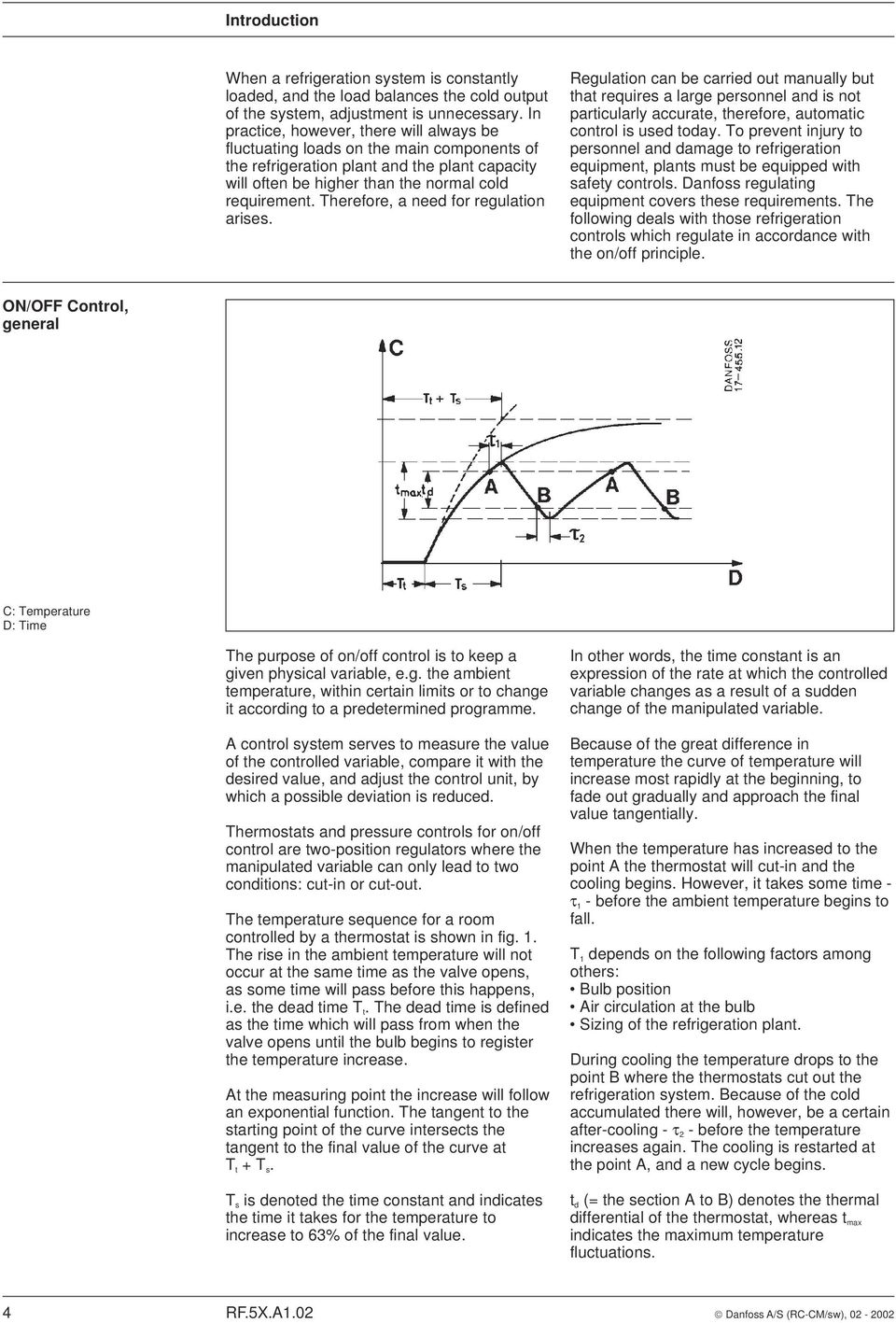
4 Introduction When a refrigeration system is constantly loaded, and the load balances the cold output of the system, adjustment is unnecessary. In practice, however, there will always be fluctuating loads on the main components of the refrigeration plant and the plant capacity will often be higher than the normal cold requirement. Therefore, a need for regulation arises. Regulation can be carried out manually but that requires a large personnel and is not particularly accurate, therefore, automatic control is used today. To prevent injury to personnel and damage to refrigeration equipment, plants must be equipped with safety controls. Danfoss regulating equipment covers these requirements. The following deals with those refrigeration controls which regulate in accordance with the on/off principle. ON/OFF Control, general C: Temperature D: Time The purpose of on/off control is to keep a given physical variable, e.g. the ambient temperature, within certain limits or to change it according to a predetermined programme. A control system serves to measure the value of the controlled variable, compare it with the desired value, and adjust the control unit, by which a possible deviation is reduced. Thermostats and pressure controls for on/off control are two-position regulators where the manipulated variable can only lead to two conditions: cut-in or cut-out. The temperature sequence for a room controlled by a thermostat is shown in fig. 1. The rise in the ambient temperature will not occur at the same time as the valve opens, as some time will pass before this happens, i.e. the dead time T t. The dead time is defined as the time which will pass from when the valve opens until the bulb begins to register the temperature increase. At the measuring point the increase will follow an exponential function. The tangent to the starting point of the curve intersects the tangent to the final value of the curve at T t + T s. T s is denoted the time constant and indicates the time it takes for the temperature to increase to 63% of the final value. In other words, the time constant is an expression of the rate at which the controlled variable changes as a result of a sudden change of the manipulated variable. Because of the great difference in temperature the curve of temperature will increase most rapidly at the beginning, to fade out gradually and approach the final value tangentially. When the temperature has increased to the point A the thermostat will cut-in and the cooling begins. However, it takes some time - τ 1 - before the ambient temperature begins to fall. T 1 depends on the following factors among others: Bulb position Air circulation at the bulb Sizing of the refrigeration plant. During cooling the temperature drops to the point B where the thermostats cut out the refrigeration system. Because of the cold accumulated there will, however, be a certain after-cooling - τ 2 - before the temperature increases again. The cooling is restarted at the point A, and a new cycle begins. t d (= the section A to B) denotes the thermal differential of the thermostat, whereas t max indicates the maximum temperature fluctuations. 4 RF.5X.A1.02 Danfoss A/S (RC-CM/sw),
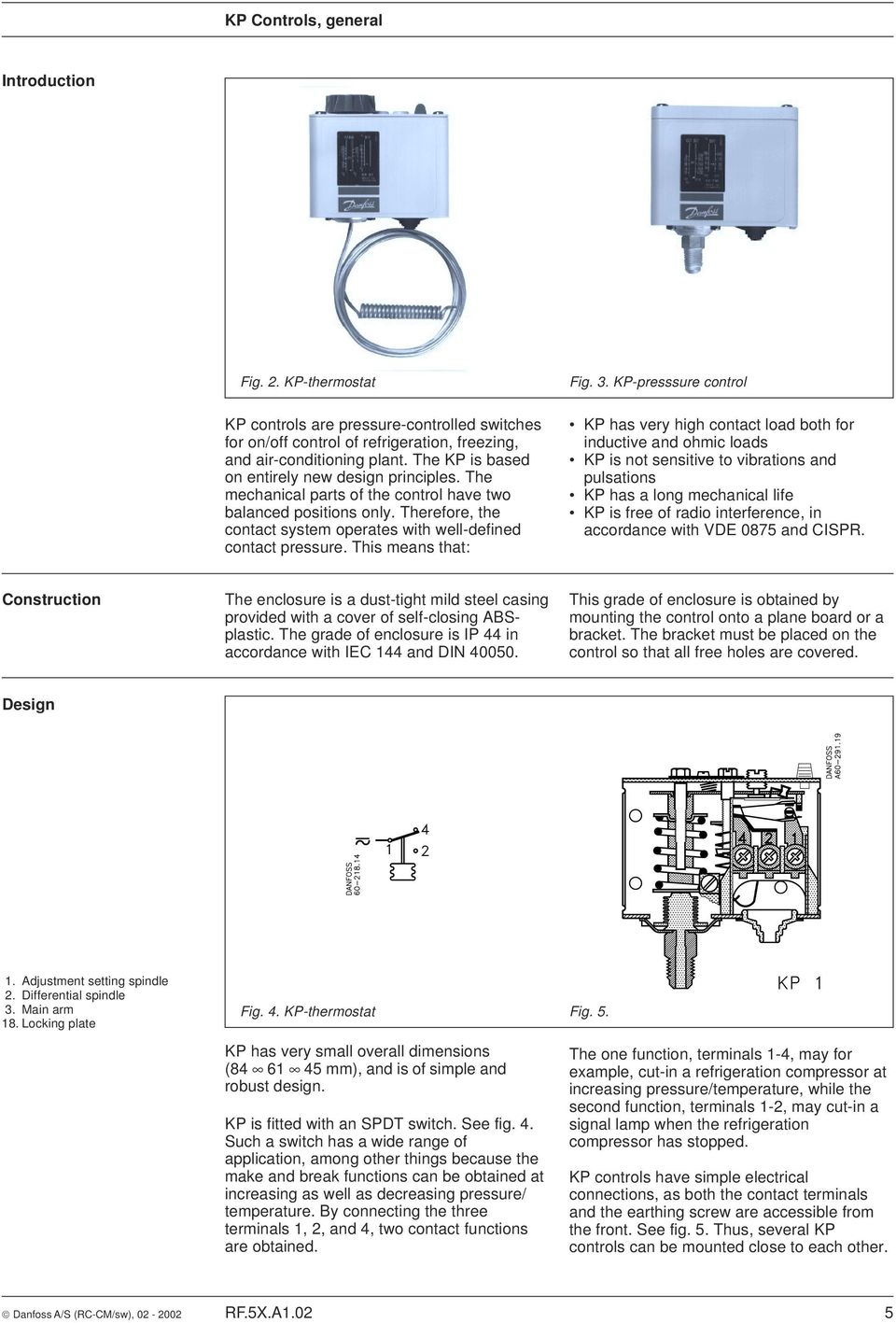
5 KP Controls, general Introduction Fig. 2. KP-thermostat Fig. 3. KP-presssure control KP controls are pressure-controlled switches for on/off control of refrigeration, freezing, and air-conditioning plant. The KP is based on entirely new design principles. The mechanical parts of the control have two balanced positions only. Therefore, the contact system operates with well-defined contact pressure. This means that: KP has very high contact load both for inductive and ohmic loads KP is not sensitive to vibrations and pulsations KP has a long mechanical life KP is free of radio interference, in accordance with VDE 0875 and CISPR. Construction The enclosure is a dust-tight mild steel casing provided with a cover of self-closing ABSplastic. The grade of enclosure is IP 44 in accordance with IEC 144 and DIN This grade of enclosure is obtained by mounting the control onto a plane board or a bracket. The bracket must be placed on the control so that all free holes are covered. Design 1. Adjustment setting spindle 2. Differential spindle 3. Main arm 18. Locking plate Fig. 4. KP-thermostat Fig. 5. KP has very small overall dimensions ( mm), and is of simple and robust design. KP is fitted with an SPDT switch. See fig. 4. Such a switch has a wide range of application, among other things because the make and break functions can be obtained at increasing as well as decreasing pressure/ temperature. By connecting the three terminals 1, 2, and 4, two contact functions are obtained. The one function, terminals 1-4, may for example, cut-in a refrigeration compressor at increasing pressure/temperature, while the second function, terminals 1-2, may cut-in a signal lamp when the refrigeration compressor has stopped. KP controls have simple electrical connections, as both the contact terminals and the earthing screw are accessible from the front. See fig. 5. Thus, several KP controls can be mounted close to each other. Danfoss A/S (RC-CM/sw), RF.5X.A1.02 5
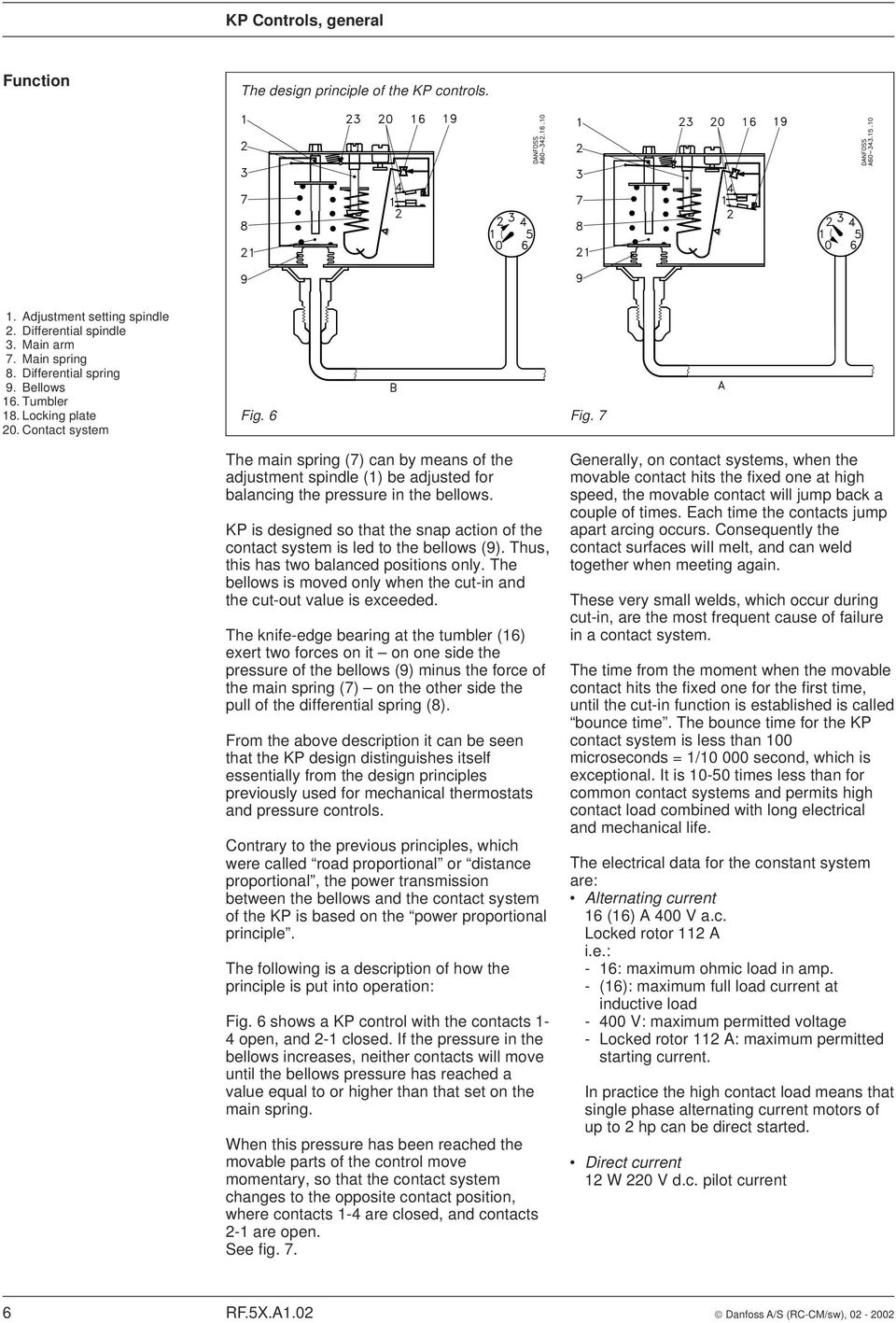
6 KP Controls, general Function The design principle of the KP controls. 1. Adjustment setting spindle 2. Differential spindle 3. Main arm 7. Main spring 8. Differential spring 9. Bellows 16. Tumbler 18. Locking plate 20. Contact system Fig. 6 Fig. 7 The main spring (7) can by means of the adjustment spindle (1) be adjusted for balancing the pressure in the bellows. KP is designed so that the snap action of the contact system is led to the bellows (9). Thus, this has two balanced positions only. The bellows is moved only when the cut-in and the cut-out value is exceeded. The knife-edge bearing at the tumbler (16) exert two forces on it on one side the pressure of the bellows (9) minus the force of the main spring (7) on the other side the pull of the differential spring (8). From the above description it can be seen that the KP design distinguishes itself essentially from the design principles previously used for mechanical thermostats and pressure controls. Contrary to the previous principles, which were called road proportional or distance proportional, the power transmission between the bellows and the contact system of the KP is based on the power proportional principle. The following is a description of how the principle is put into operation: Fig. 6 shows a KP control with the contacts 1-4 open, and 2-1 closed. If the pressure in the bellows increases, neither contacts will move until the bellows pressure has reached a value equal to or higher than that set on the main spring. When this pressure has been reached the movable parts of the control move momentary, so that the contact system changes to the opposite contact position, where contacts 1-4 are closed, and contacts 2-1 are open. See fig. 7. Generally, on contact systems, when the movable contact hits the fixed one at high speed, the movable contact will jump back a couple of times. Each time the contacts jump apart arcing occurs. Consequently the contact surfaces wiil melt, and can weld together when meeting again. These very small welds, which occur during cut-in, are the most frequent cause of failure in a contact system. The time from the moment when the movable contact hits the fixed one for the first time, until the cut-in function is established is called bounce time. The bounce time for the KP contact system is less than 100 microseconds = 1/ second, which is exceptional. It is times less than for common contact systems and permits high contact load combined with long electrical and mechanical life. The electrical data for the constant system are: Alternating current 16 (16) A 400 V a.c. Locked rotor 112 A i.e.: - 16: maximum ohmic load in amp. - (16): maximum full load current at inductive load V: maximum permitted voltage - Locked rotor 112 A: maximum permitted starting current. In practice the high contact load means that single phase alternating current motors of up to 2 hp can be direct started. Direct current 12 W 220 V d.c. pilot current 6 RF.5X.A1.02 Danfoss A/S (RC-CM/sw),
7 KP Controls, general Cable entry Fig. 8 Fig. 9 KP controls have a soft rubber entry as standard. See fig. 9. The entry will take cables from 6 to 14 mm diameter. As accessories Pg 13,5 and Pg 16 cable entries are available, fig. 8. Danfoss A/S (RC-CM/sw), RF.5X.A1.02 7

8 RT Controls, general Introduction Fig. 10. RT thermostat The RT-control is a pressure or temperaturecontrolled electric switch which makes or breaks an electric circuit depending on pressure or temperature variations at the bulb. Fig. 11. RT pressure control Danfoss RT controls are characterized by a hoseproof bakelite housing which is equipped with a steel cover, robust construction, and small differentials. Therefore, the control are suitable for industrial systems. Types of switch Designs and materials Most RT controls are equipped with switch which is an SPDT system (Single Pole Double Throw system). Switch can be replaced, without adjusting the controller. The switch has a transparent protective cover over the moving parts. Replacement systems are also equipped with a protective cover over the contact arm. This system is also available with manual reset on actuation for rising or falling pressure/ temperature (max. reset and min. reset respectively). Fig. 12 Code Nos Fig. Discription Type of switch normally used for RT. Terminals 1-4 make on increases. Terminals 1-2 make on decreases. Terminal 1 is common. Single-pole change-over switch with neutral centre position. Terminals 1-4: Make the circuit when the temperature/pressure increases. Terminals 1-2: Make the circuit when the temperature/pressure decreases. The neutral setpoint will be dealt with in the section of dead zone thermostats, page 22. Single-pole switch breaking two circuits at the same time when the pressure/ temperature increases. Momentary contact change-over. Terminals 1-4 and 1-2 are cut-out when the pressure/temperature increases. Single-pole switch making two circuits at the same time when the pressure/ temperature increases. Momentary contact change-over. Terminals 1-4 and 1-2 are cut-in when the pressure/temperature increases. Single-pole change-over switch with non-snap action. It gives less mechanical differential than , but the rated capacity is, therefore, lower and the switch must not be used where vibration occurs. Single-pole switch with the same functions as described for switch No The switch is equipped with silver contacts coated with gold. Therefore, it can be used with advantage for small electrical loads as well as in plants where the demand is for exeptional make reability, even after long periods of intermittent contact load Fig 13 Fig 15 Fig 17 Fig 19 Fig 14 Fig 16 Fig RF.5X.A1.02 Danfoss A/S (RC-CM/sw),

9 RT Controls, general Rating Type of switch a.c. d.c. Non-inductive Inductive rating Full-load Locked Code No. current rotor A 400 V 4 A 400 V 24 A 400 V 12 W 220 V A 400 V 3 A 400 V 18 A 400 V 12 W 220 V VA 24 V 25 VA 24 V A 400 V 2 A 400 V 12 A 400 V 12 W 220 V Marking The covers of switches and are marked: 10 (4) 400 V a.c. 12W 220 V d.c. The marking complies with the demands of VDE 0671 test class II which prescribes the above rating in relation to a minimum of 100,000 operations. Fig. 20 Alternating current (a.c.) It should be remembered that the two main demands are 10 A non-inductive rating and 30 A locked rotor. The 4 A inductive rating (or, more correctly, motor rating) is derived from 30 A locked rotor, since the maximum ratio between locked rotor/operating current for single-phase motors is approx = 4 A 7.5 This means that normally motors with an operating current of 4 A can be connected. It is permissible to connect motors with a higher operating current than 4 A, provided that locked rotor does not exceed 30 A. Danfoss A/S (RC-CM/sw), RF.5X.A1.02 9

10 RT Controls, general Application of two-circuit switches Fig. 21 Fig. 22 An RT control with a switch or can, for example, be used in pilot circuits with several RT controllers. When the above types of switch are used, auxiliary relays can be omitted. The two examples, fig. 21 and fig. 22, show the wiring diagrams for thermostatic control of two deep-freeze stores and one refrigerated store, where the three evaporators are connected to a centrally located compressor. The thermostats control the opening and closing of the solenoid valves in the liquid lines, depending on the ambient temperature. Fig. 21 shows the wiring diagram for RT thermostats with a standard switch and auxiliary contacts. Fig. 22 shows the same system, but in this case the switches have been replaced by the two-circuit switches , and the auxiliary contacts can thus be omitted. 10 RF.5X.A1.02 Danfoss A/S (RC-CM/sw),

11 RT Controls, general Screwed cable entry All RT controls are equipped with a Pg 13.5 nylon cable entry. The rubber ring of the cable entry consists of concentric rings which can be taken out to accommodate cable diameters of from 6 to 14 mm. The rubber rings are made of Nitril rubber. This gives a good seal, and it can be used with plastic cables. Fig. 23 Danfoss A/S (RC-CM/sw), RF.5X.A

12 Thermostats Example of thermostatic control Fig. 24 In the refrigeration system, fig. 24, a room thermostat is used to control the temperature in the refrigerated space. When the temperature of the refrigerated store room exceeds the value required, the thermostat makes the circuit to the compressor motor, and the refrigeration system starts. When the temperature required is reached, the thermostat breaks the circuit to the compressor motor, and the refrigeration system stops. Thermostat design Thermostats are temperature-controlled electrical switches which can break or make an electrical circuit, depending on temperature variations at the bulb. A thermostat, fig. 25, consists of the following main elements: The power element which consists of the bulb (29), the capillary tube (28), and the bellows element (23). The most important parts of the mechanical section are the spindle (15), the range spring (12), the knob (5) for adjusting the spring pressure, and the differential adjusting nut for adjusting the mechanical differential. The switch (16) is a single-pole change-over switch with momentary contact change-over. The power element contains a charge, the pressure of which changes with the temperature at the bulb. A fixed pressure corresponds to a given bulb temperature. If the bulb temperature increases, the pressure in the power element increases. Hence the spindle is moved until the pressure on the lower side of the bellows balances the counter-pressure of the main spring. Fig. 25 Charges Depending on the field of application, the charge of a thermostat can be: I : Vapour fade-out charge II : Adsorption charge III: Partial charge Vapour fade-out and adsorption charges will be described overleaf since these charges are used in our thermostats for refrigeration purposes. 12 RF.5X.A1.02 Danfoss A/S (RC-CM/sw),
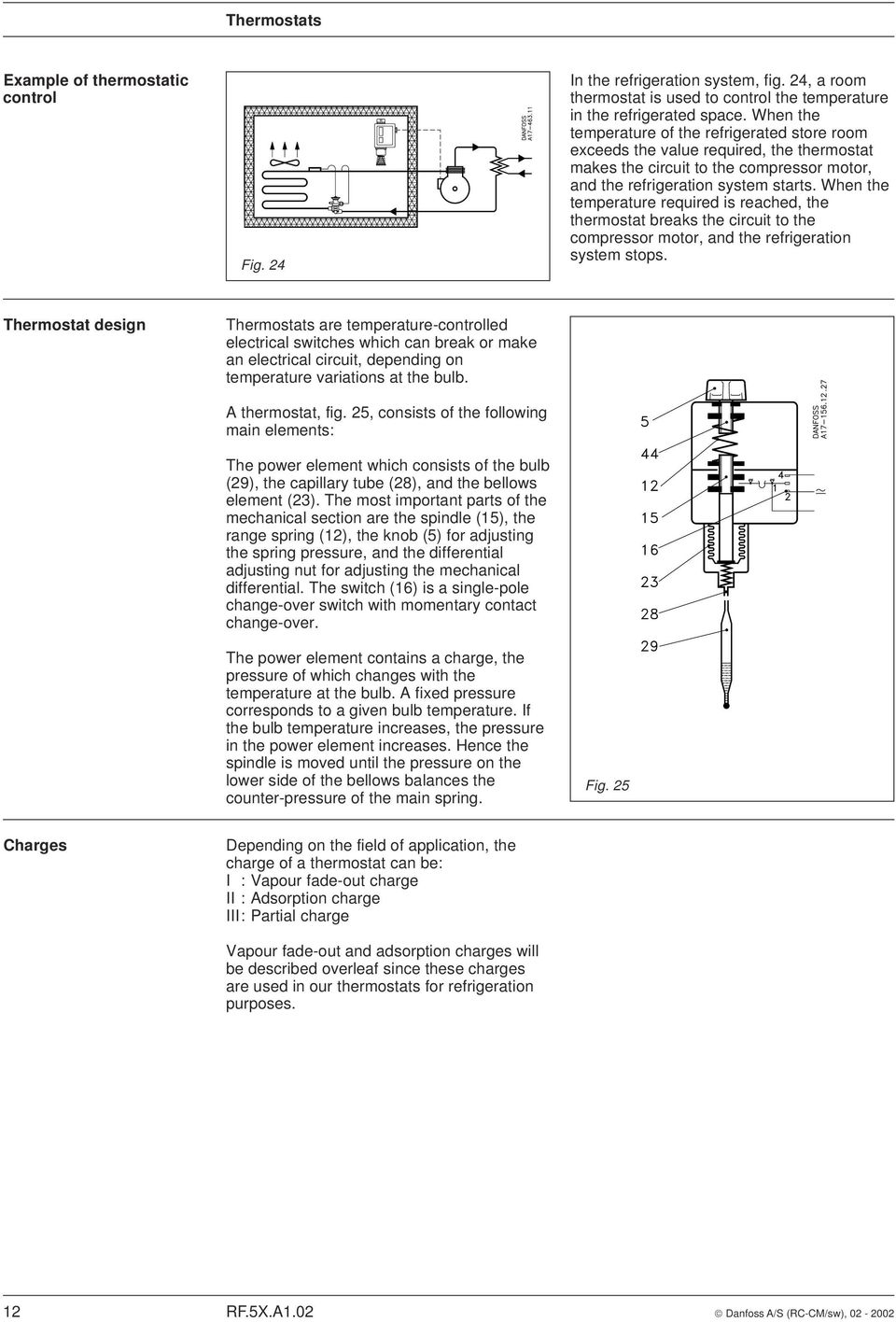
13 Thermostats I. Vapour fade-out charge The pressure of the charge depends on the temperature at the free liquid surface. As long as liquid remains, a pressure increase caused by ingress of heat into the liquid will progress according to the vapour pressure curve for the saturated vapour of the liquid. From the moment the last drop has evaporated, the pressure increase will, on the other hand, follow the curve for superheated vapour. At this point the pressure increase is considerably slower since it is now only the thermal expansion of the vapour which causes the pressure to increase. The temperature at which the vapour passes from saturated vapour to superheated vapour is called the pressure limiting temperature, denoted t 3 in fig. 26. Fig. 26 A vapour fade-out charge consists of a very small amount of liquid and the saturated vapours of that liquid. This type of charge utilizes the interdependence between the temperature and pressure of saturated vapour. The advantages of a vapour fade-out charge are e.g. 1. A very short reaction time (a short time constant). Heat has only to be supplied or given off for the respective evaporation and condensation of a very small quantity of liquid. 2. The charge is pressure-limited, i.e. the element is designed to resist temperatures higher than the maximum temperature setting. Vapour fade-out charge Saturated vapour + some liquid Vapour pressure curve + Small reaction time Pressure limited No capsule sensivity Capillary sensor The coldest part of the thermostatic element controls the function Pressure-temperature curve: Non-linear It can be seen from the inclination of the vapour pressure curve (fig. 28) that the differentials at the lower and upper parts of the curve are different when a given pressure variation Ðp is kept constant. A thermostat with a vapour fade-out charge has, therefore, smaller mechanical differentials at the upper end of its temperature range than at the lower end. Vapour fade-out charges are preferable for thermostats which are to work at low temperatures. Room thermostats Evaporator thermostats Thermostats for low temperatures Fig 27. In a vapour-filled thermostat the charge will condense at the coldest point of the power element, and the thermostat will regulate the temperature accordingly. Therefore, to obtain the regulation required it is a condition that the bulb must always be placed colder than the rest of the power element. Fig. 28 Danfoss A/S (RC-CM/sw), RF.5X.A
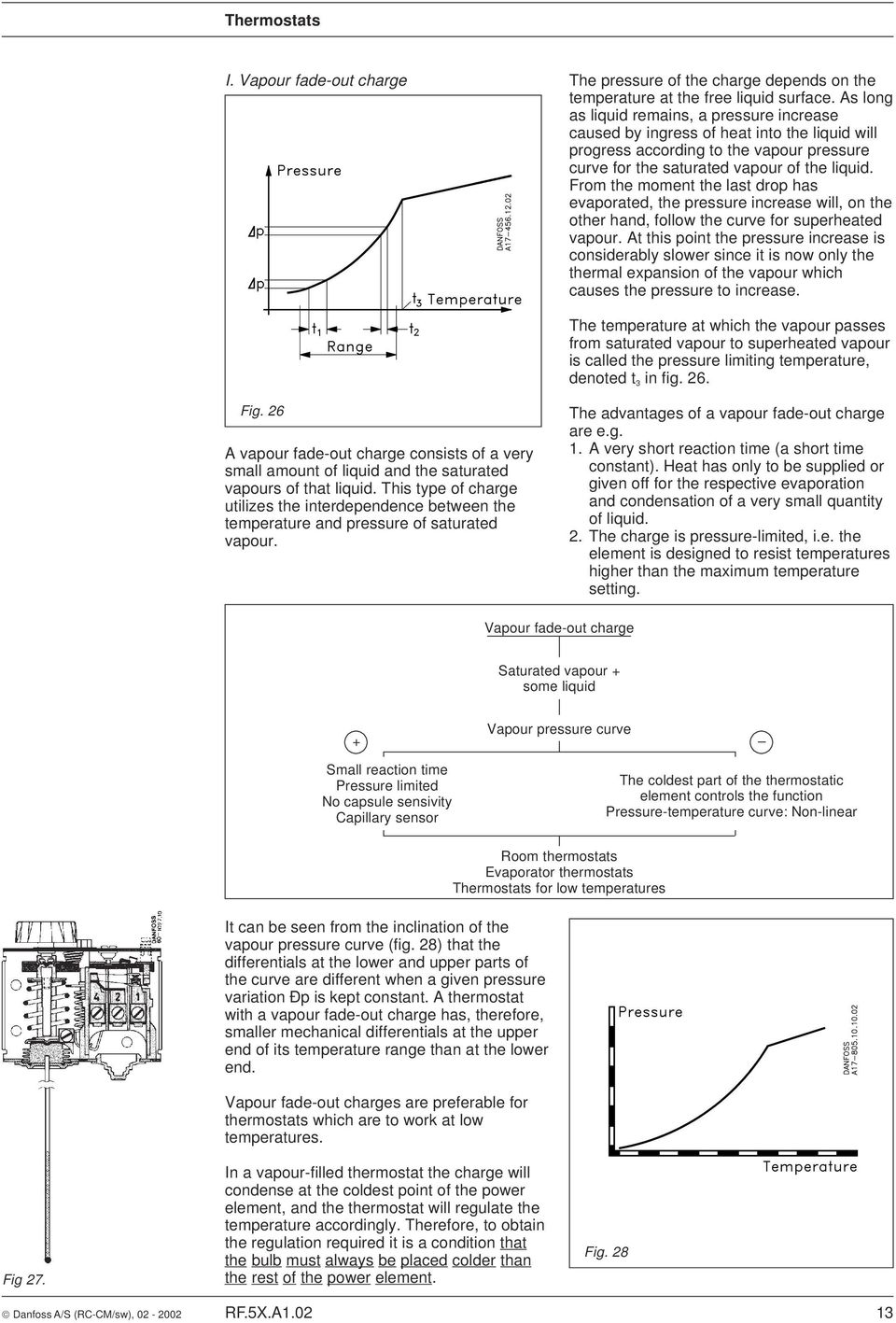
14 Thermostats II. Adsorption charge Fig. 29 Fig. 29 shows a pressure-temperature curve for an adsorption charge. The S-shape is typical for these curves. When carbon charges are used in power elements, the temperature range is mostly placed symmetrically about the turning point t v. Hence, a maximum pressure increase is obtained by means of a minimum quantity of carbon, and hence the smallest size of bulb. A great advantage of the adsorption charge is that a thermostat with this charge is CROSS AMBIENT, i.e. the bulb can be placed warmer or colder than the thermostat housing. This is possible because the carbon is always placed in the bulb. Therefore, the bulb always controls the thermostatic regulation. Adsorption charge is no doubt the most interesting one and the charge which is most universally applicable. By using the same two substances, e.g. active carbon as adsorbent and CO 2 as adsorbate, it is possible to produce many different pressure-temperature curves by varying the ratio between the quantities of the substances. Some porous substances, adsorbents, have the capacity of being able to bind molecules from another substance, the adsorbate, in their microscopic pores. Because of the porosity of the adsorbent, it has a surface area of several hundred m 2 per gram. If, in this way, CO 2 molecules are bound to active carbon in a closed container, the pressure is reduced. In the gaseous phase, CO 2 is known to participate in the pressure formation by means of its partial pressure. The capacity of an adsorbent to bind an adsorbate depends on temperature. When binding occurs in a closed system, it also depends on the counter-pressure which is set up. If the adsorbent is heated, it can no longer retain all the gas molecules previously retained by it. Some of them will be released, and, together with the other gas molecules which were already free, they will increase the concentration of gas molecules. The pressure in the element then increases. Adsorption charge Granulated material + superheated gas Physical mass attraction + Cross ambient Small bulb Pressure-temperature curve: Linear Capsule sensitive Moderate reaction time Room thermostats Thermostats for high temperatures A disadvantage of an adsorption charge is the capsule sensitivity. This means that greater temperature fluctuations at the capsule may influence the control accuracy. Fig. 30 Fig RF.5X.A1.02 Danfoss A/S (RC-CM/sw),
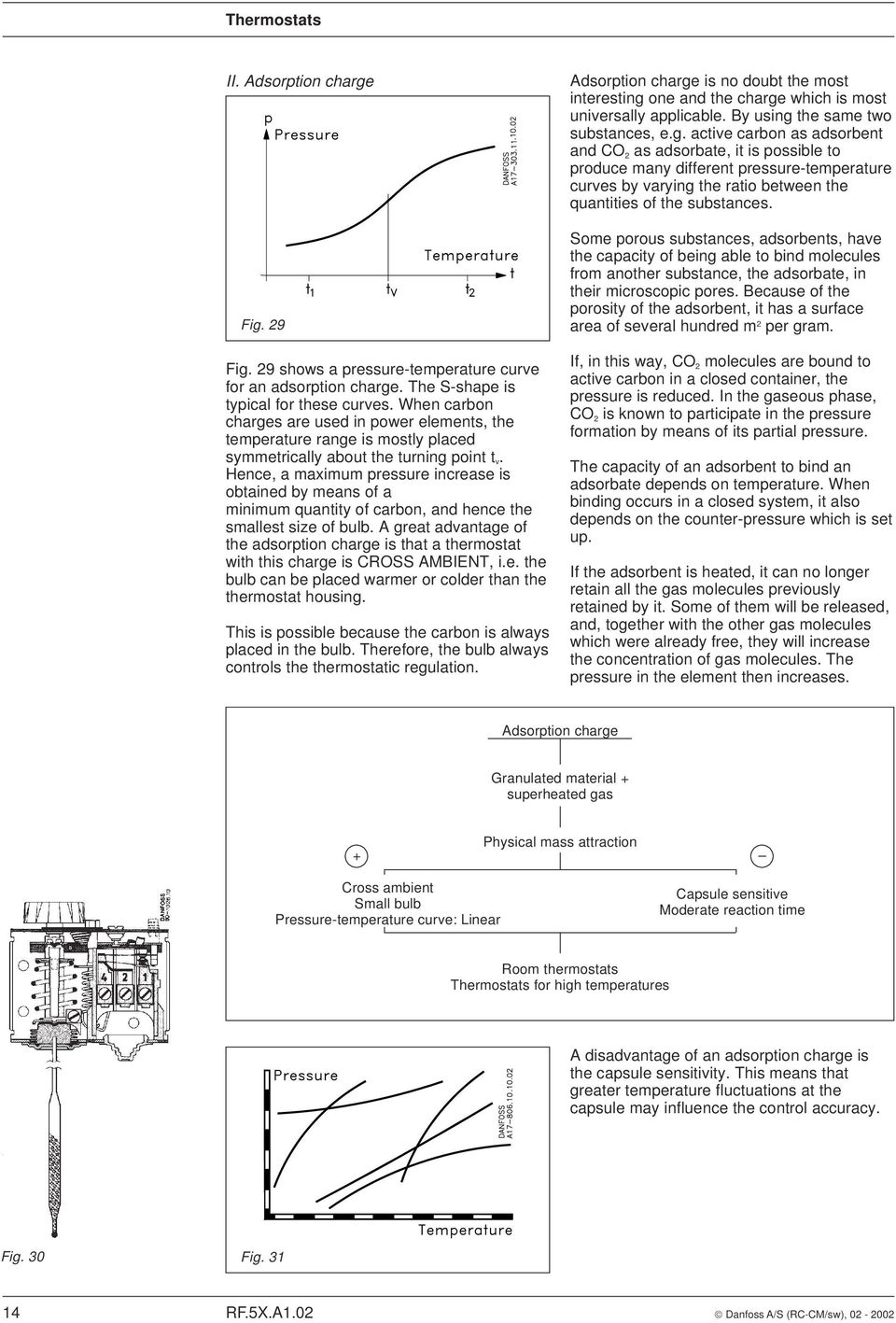
15 Thermostats Thermal differential The thermal differential is the differential at which the system operates. It is always higher than the mechanical differential. The thermal differential depends on several factors: 1. Velocity of medium. The higher the velocity at which the air or liquid pass the sensor, the smaller the thermal differential. Therefore, the sensor should always be located at a point with good circulation of the air and the liquid respectively. 2. Temperature variation rate of medium (temperature variation per time unit). The thermal differential increases with the temperature variation rate. If the temperature is to be controlled in the range from 5 C to +30 C, to ensure that the thermal differential will not be increased because of too high a temperature variation rate, an RT 4 thermostat with an electric heater in the bellows element can be used. 3. Heat transmission to the sensor. The sensor should have optimum contact with the medium to be temperaturecontrolled. Difficulties occur especially if the sensor is inserted in a pocket, where the thermal conduction between sensor and pocket is poor. The application of a heat-conductive compound between sensor and pocket will, normally, result in satisfactory heat transmission. Measuring the time constant To get an idea of what the time constant can be, measuring has been done on an RT 14 with an adsorption charge. The measuring was done under the following conditions: The sensor at 10 C was placed in an air current of 20 C. The contact change-over at increasing temperature was set at 16.3 C. The time constant τ indicates the time interval from the moment the bulb was placed in the air duct, and until contact change-over took place. Fig. 32 Measuring results Type RT 14 Air velocity m/s sec. τ Danfoss A/S (RC-CM/sw), RF.5X.A

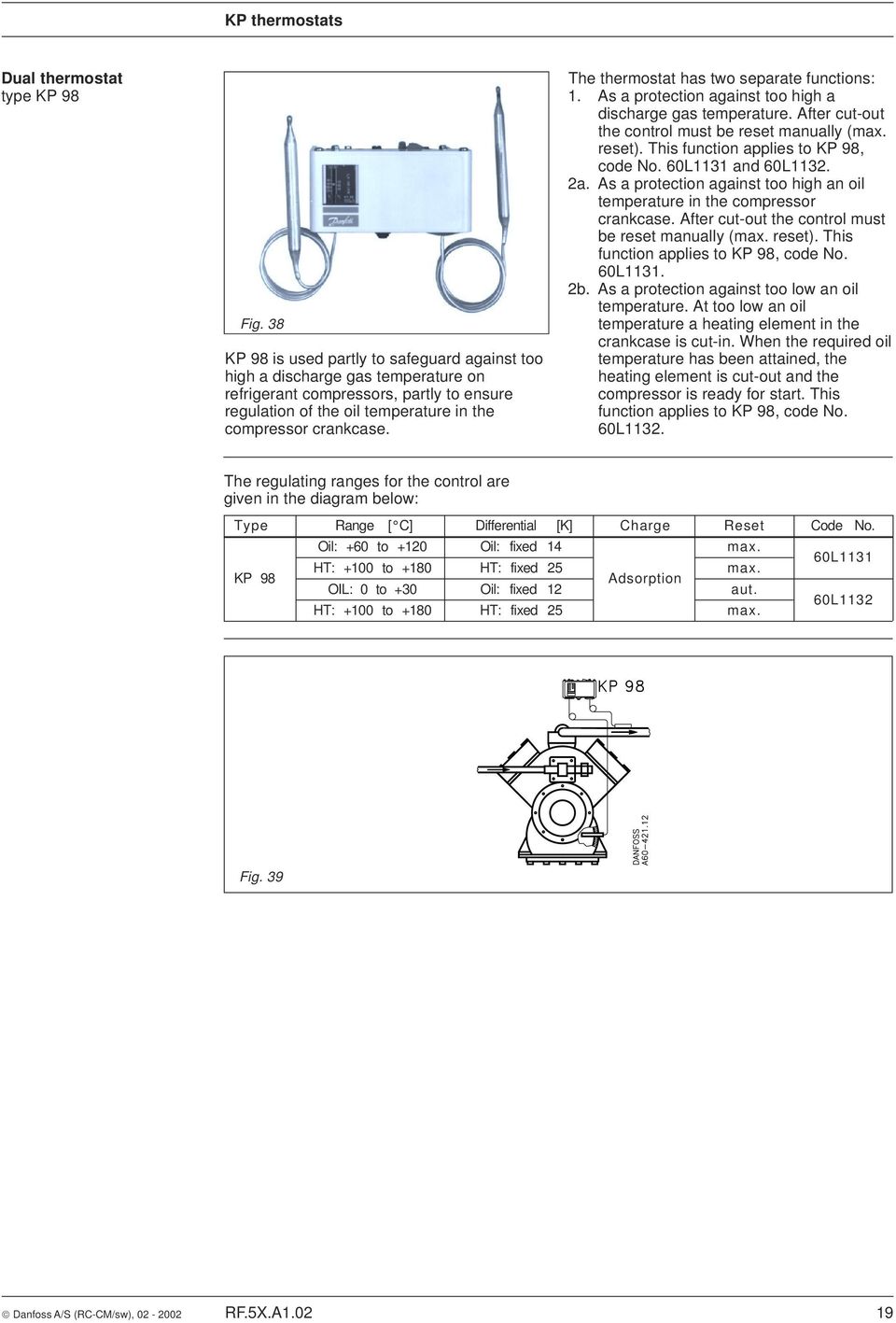
16 KP thermostats KP thermostats KP thermostats are single-pole double-throw (SPDT) temperature-controlled electrical switches for on/off control. Typical fields of application for KP thermostats are: - large refrigerated cabinets and display counters - freezing cabinets and display counters - commercial freezing plant - commercial refrigeration plant - air-conditioning plant The total temperature range is from -50 C to +180 C with independent temperature and differential settings. The thermostats can be obtained with vapour fade-out or adsorption charge and with the following sensor, see fig. 33. As standard range setting KP thermostats are provided with a knob for range setting. 1a. Vapour charge 1b. Adsorption charge 2 Capillary tube sensor 3. Capillary tube with a coiled capillary tube sensor 4. 3/8 in. cylindrical or double contact sensor 5. 1/4 in. cylindrical sensor 6. ø25 mm duct sensor. Fig RF.5X.A1.02 Danfoss A/S (RC-CM/sw),
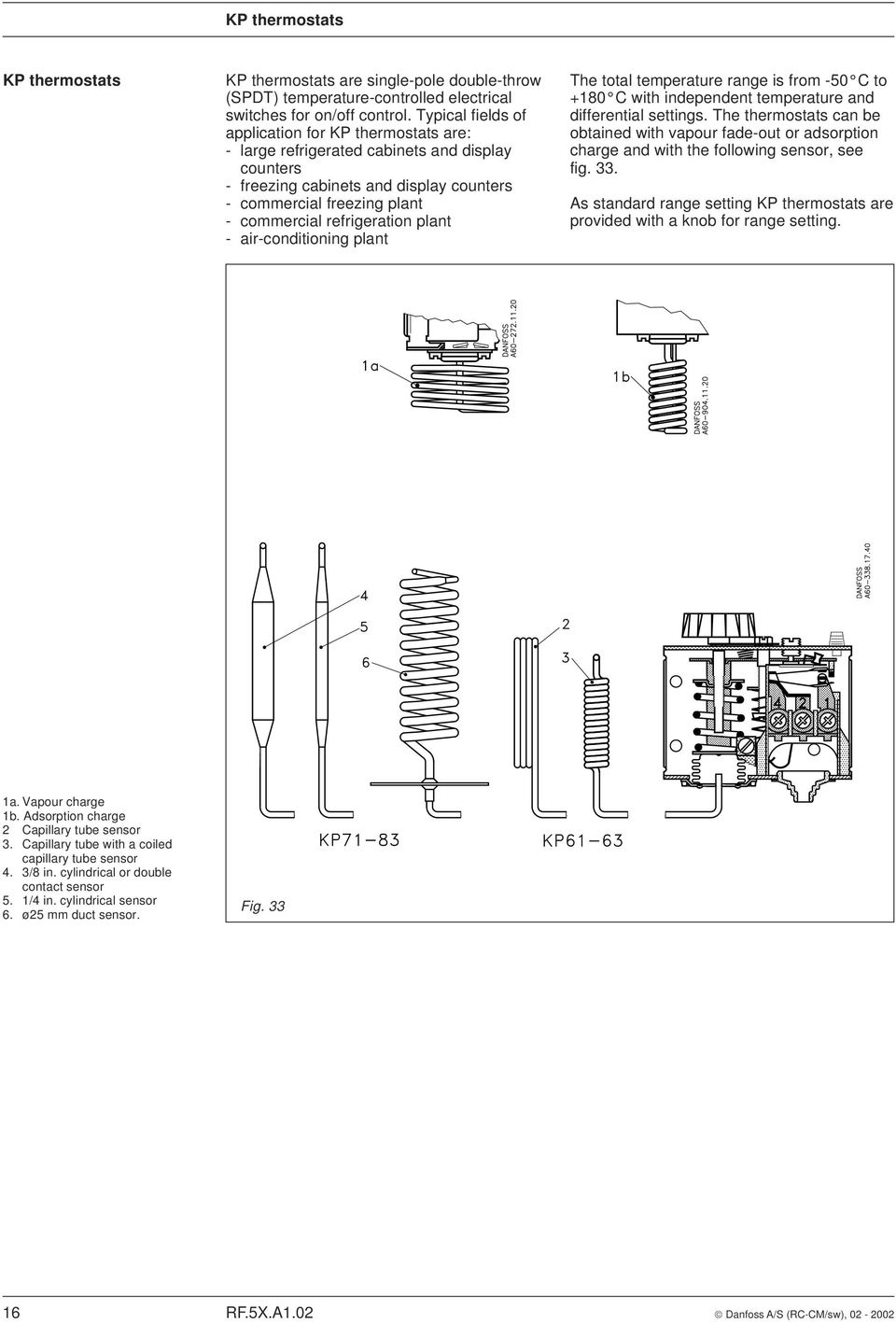
17 KP thermostats Setting Fig. 34 Fig. 35 Fig. 36 The setting can be seen in fig. 34. Illustrated here, the range setting is the maximum actuating value, and the differential is to be deducted from this setting to obtain the minimum actuating value. In addition the cutin and cut-out functions of the thermostat, is depending on the terminal connection applied. If the thermostat is to start and stop a refrigeration compressor (terminals 1-4) the cut-out temperature is equal to the cut-in temperature minus the differential. All KP thermostats with vapour fade-out charge are provided with a setting diagram as shown in fig. 35, to be used for the exact setting of the thermostat. Example of setting For temperature control in a deep-freeze box, the KP 61 thermostat should be set so that when temperature increases, the electric circuit is made at 17 C (starting temperature), assuming a requirement for a cut-out temperature (stopping temperature) of -24 C. The differential (the value to be set on the differential scale) must be determined. In the diagram for KP 61, fig. 35, the cut-in temperature -17 C is read on the range scale (contact change-over when temperature increases). On the horizontal scale (contact change-over on decreases in temperature) the temperature -24 C is read. The solid lines differential curve are followed from the intersection point between the lines from - 17 C and -24 C. The differential wanted = 6 K can be read from the differential scale. Consequently, the thermostat should be set as follows: Range scale: 17 C Differential scale: 6 K. Locking the setting The range setting spindle (1) or the differential setting spindle (2) can be locked by the locking plate (18). See fig. 36. Danfoss A/S (RC-CM/sw), RF.5X.A
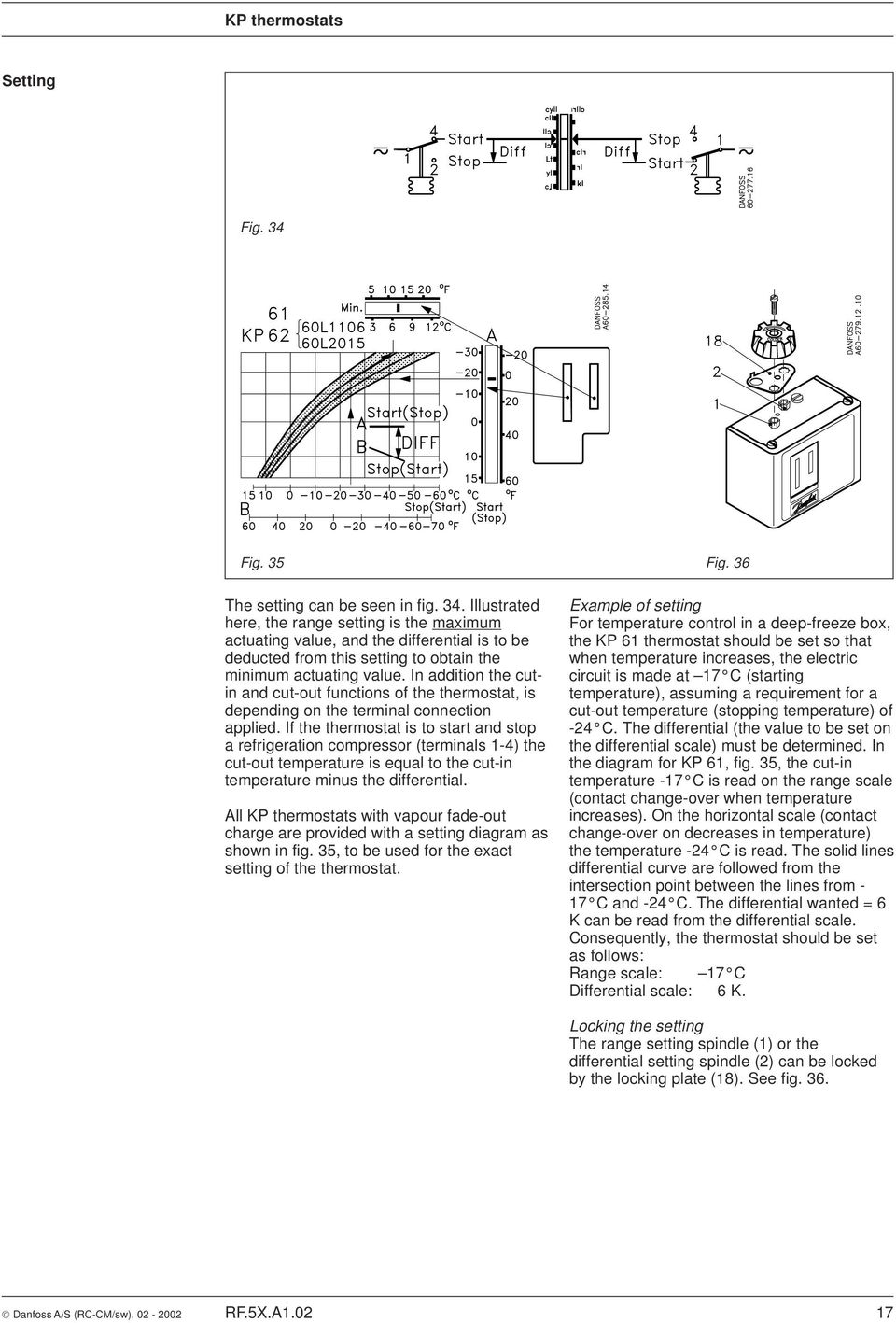
18 KP thermostats KP thermostat program KP thermostats can be divided into three main groups: 1) KP 61-69, which all - with the exception of KP 62 - are vapour fade-out charged. (KP 62, is available with adsorption charge and vapour fade-out charge (room thermostat)). 2) KP 71-77, which all have an adsorption charge (cross ambient) 3) KP 98, which is a dual thermostat. The table in fig. 37 shows the regulating ranges for group one and two. The type designation and the code No. are stamped on the underside of the control, while the approval, electrical data, and place of origin are printed on the scale plate. Fig RF.5X.A1.02 Danfoss A/S (RC-CM/sw),
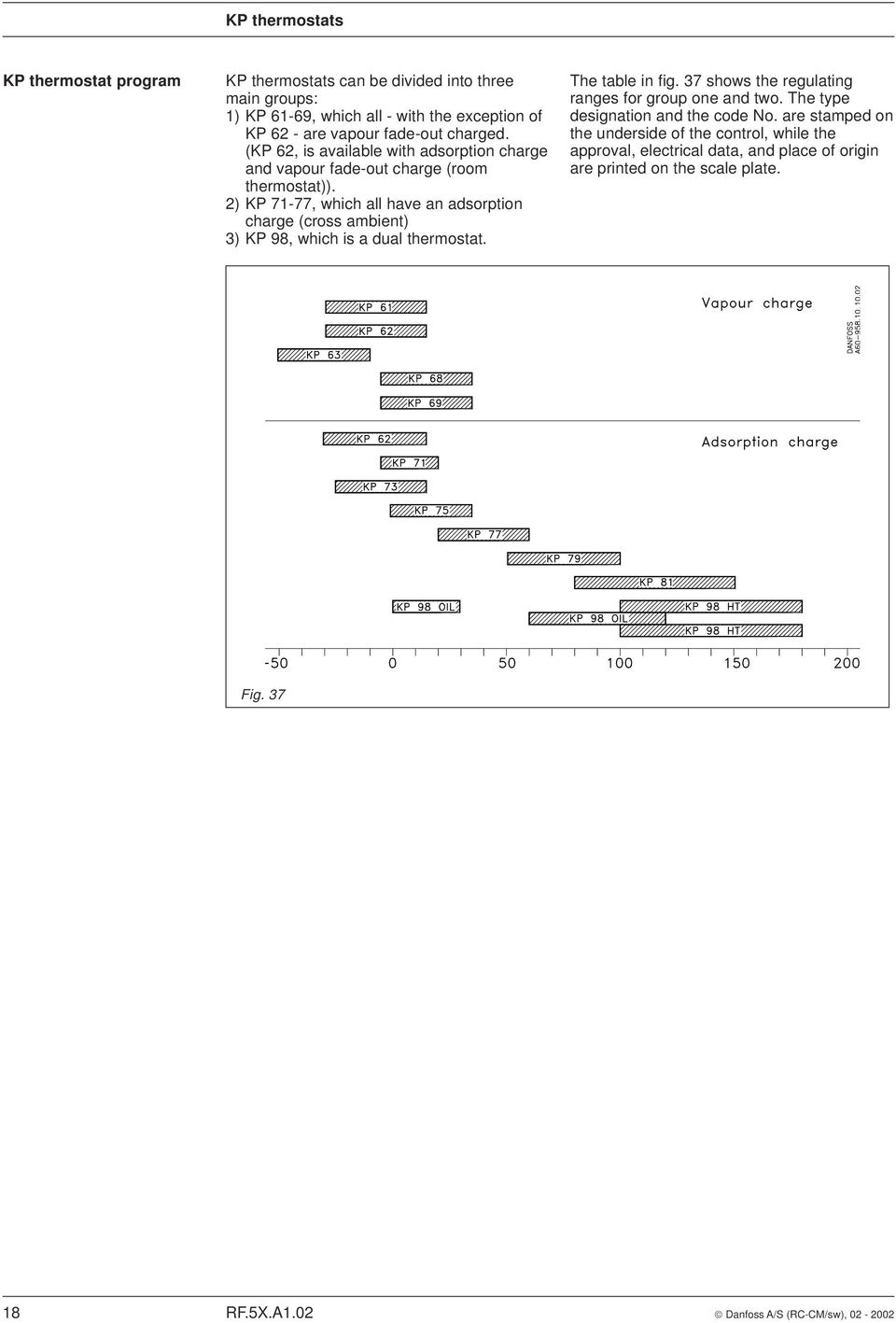
19 KP thermostats Dual thermostat type KP 98 Fig. 38 KP 98 is used partly to safeguard against too high a discharge gas temperature on refrigerant compressors, partly to ensure regulation of the oil temperature in the compressor crankcase. The thermostat has two separate functions: 1. As a protection against too high a discharge gas temperature. After cut-out the control must be reset manually (max. reset). This function applies to KP 98, code No. 60L1131 and 60L a. As a protection against too high an oil temperature in the compressor crankcase. After cut-out the control must be reset manually (max. reset). This function applies to KP 98, code No. 60L b. As a protection against too low an oil temperature. At too low an oil temperature a heating element in the crankcase is cut-in. When the required oil temperature has been attained, the heating element is cut-out and the compressor is ready for start. This function applies to KP 98, code No. 60L1132. The regulating ranges for the control are given in the diagram below: Type Range [ C] Differential [K] Charge Reset Code No. Oil: +60 to +120 Oil: fixed 14 max. 60L1131 HT: +100 to +180 HT: fixed 25 max. KP 98 Adsorption OIL: 0 to +30 Oil: fixed 12 aut. 60L1132 HT: +100 to +180 HT: fixed 25 max. Fig. 39 Danfoss A/S (RC-CM/sw), RF.5X.A
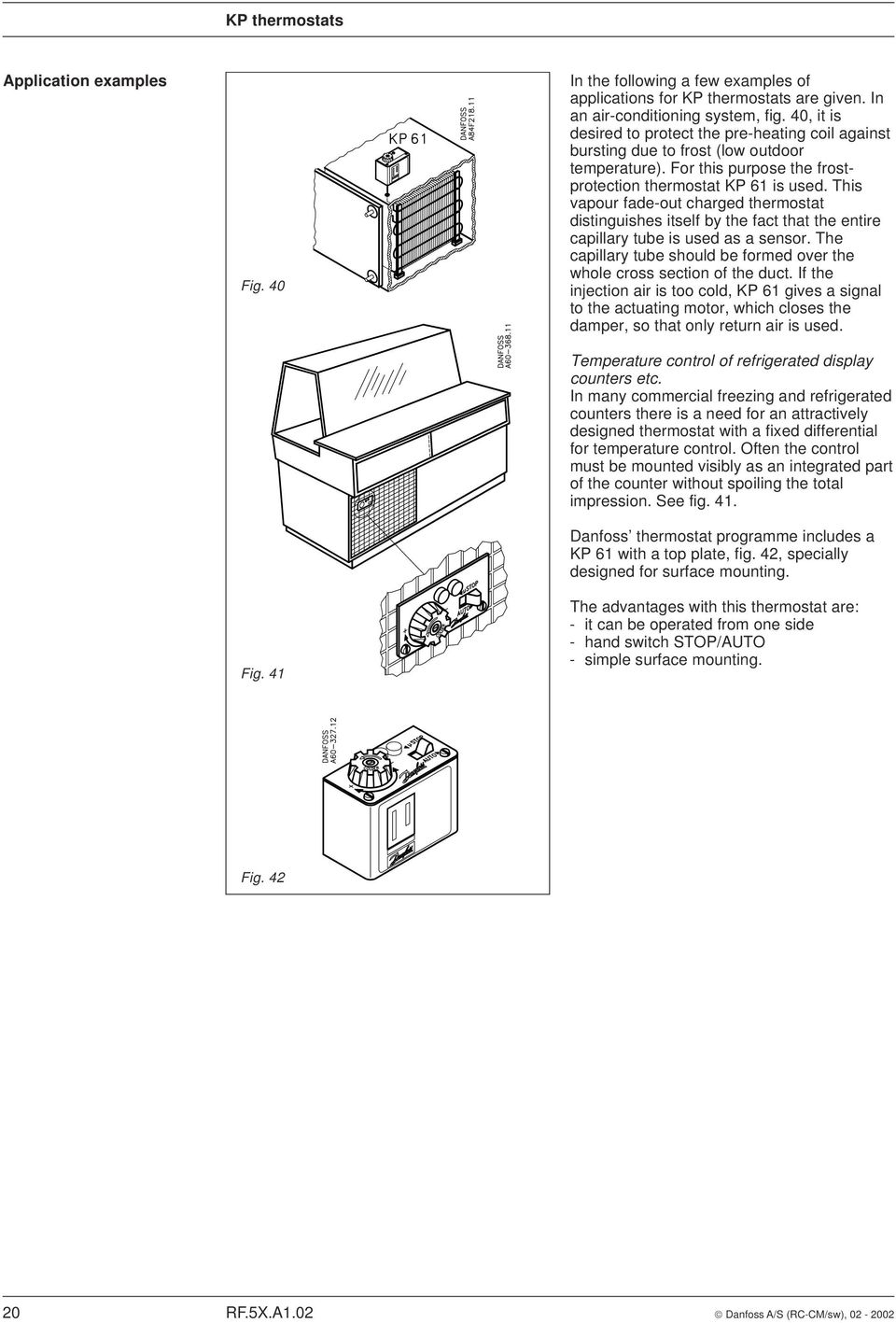
20 KP thermostats Application examples Fig. 40 Fig. 41 In the following a few examples of applications for KP thermostats are given. In an air-conditioning system, fig. 40, it is desired to protect the pre-heating coil against bursting due to frost (low outdoor temperature). For this purpose the frostprotection thermostat KP 61 is used. This vapour fade-out charged thermostat distinguishes itself by the fact that the entire capillary tube is used as a sensor. The capillary tube should be formed over the whole cross section of the duct. If the injection air is too cold, KP 61 gives a signal to the actuating motor, which closes the damper, so that only return air is used. Temperature control of refrigerated display counters etc. In many commercial freezing and refrigerated counters there is a need for an attractively designed thermostat with a fixed differential for temperature control. Often the control must be mounted visibly as an integrated part of the counter without spoiling the total impression. See fig. 41. Danfoss thermostat programme includes a KP 61 with a top plate, fig. 42, specially designed for surface mounting. The advantages with this thermostat are: - it can be operated from one side - hand switch STOP/AUTO - simple surface mounting. Fig RF.5X.A1.02 Danfoss A/S (RC-CM/sw),
21 RT thermostats 5. Knob 9. Scale 19. Differential adjusting nut 25. Mounting hole 26. Bulb holder 30. Bulb pocket 31. Capillary tube gland 38. Earth terminal Fig. 43 An RT thermostat is a temperature-controlled electric switch which makes or breaks an electrical circuit depending on temperature variations at the bulb. Our RT thermostats are characterized by a hoseproof bakelite housing which is equipped with a steel cover, robust construction, and small differentials. Therefore, the controls are suitable for industrial systems. Fig. 43 shows the design of an RT thermostat. As mentioned above, the power element contains a charge, the pressure of which varies with the temperature at the bulb. The main spring can be set for different pressures within the setting range. The pressure in the bellows element counteracts this pressure. A pressure change in the bellows moves the main spindle until balance is re-established between the forces. The movement of the main spindle is transferred to the contact arm of the switch by a guiding knob and a differential adjusting nut so that a break or make function can be obtained. Setting, mechanical differential Fig. 44 A: Range setting B: Obtained differential C: Differential setting Fig. 45 By turning the knob, the lowest temperature at which the switch is to operate is set on the range scale (break or make the circuit). The mechanical differential is then set by turning the differential adjusting nut. Maximum actuating temperature at the bulb is equal to the actuating temperature + preset mechanical differential. The mechanical differential is set by turning the differential adjusting nut according to the nomogram fig. 45. Example: Setting of RT 3 Range setting = 5 C Differential required = 2 K On the nomogram, a setting of the differential adjusting nut at 4 can be read. Resulting in: - Minimum actuating temperature = 5 C - Maximum actuating temperature = = 7 C Danfoss A/S (RC-CM/sw), RF.5X.A
22 RT thermostats Special type RT thermostats Besides covering a large temperature range, there are some types of RT thermostats which are suitable for conditions where special demands are made. Of these thermostats the below types can be mentioned: RT 4 with an electric heater in the bellows element As mentioned on page 13 an increased rate of temperature change will increase the thermal differential. To control the ambient temperature, a small thermal differential is, however, often necessary even if the rate of air temperature change is high. The application of RT 4 with an electric heater in the bellows element is recommended for this kind of system. The electric heater is heating when the refrigeration compressor is not operating, with the effect that the bellows and the bellows housing are always a little warmer than the phial. Without this arrangement, the bellows and the bellows housing would become the coldest parts of the power element at rapidly increasing temperatures, since the mass of the bellows housing is larger than that of the phial, and the charge vapours would condense in the bellows and thus not create the requisite pressure for changing over the switch. Fig. 46 RT thermostats with small differentials Danfoss has developed thermostats with small differentials. These types are: RT 21, 23 and 24 as well as RT 17 and 103. The technical data can be seen in the below table. The thermostats cover a range from 50 C to +45 C. Nature of controls Type Charge Range [ C] Mechanical differential [K] 5 to 18 RT 2 25 to 15 6 to 20 Brine, surface or 1 to 3 RT 23 Adsorption 5 to 22 room thermostat 1 to to 4 RT to to to 7 RT to 15 Vapour 1.5 to 5 Room thermostat fade-out 10 to to 7 RT to 5 22 RF.5X.A1.02 Danfoss A/S (RC-CM/sw),
23 Differential thermostats An RT differential thermostat is a single-pole electric change-over switch, the contact position of which is controlled by the temperature difference between the two bulbs of the thermostat. RT 270 is designed for use in processing plants, ventilation plants, refrigeration and heating plants where it is desired to maintain a fixed temperature difference of from 0 C to 15 C between two media. One sensor temperature is used as a reference and the other as an indirectly controlled variable. (The directly controlled variable is the temperature differential). Fig. 47 shows a cross section of an RT 270. The differential thermostat is equipped with two bellows elements: the LT element, the sensor (1) of which is to be placed in the medium with the lowest temperature, and the HT element, the sensor (2) of which is to be placed in the medium with the highest temperature. The range spring (3) has a rectilinear characteristic. Within the differential range it can be set for different temperature differentials by rotating the setting disc (4). The setting indicates the scale value at which contact change-over occurs when the spindle moves downwards. (Contacts 2-1 make the circuit). When the differential between the LT and HT bulb temperatures is reduced, the spindle (5) moves downwards and thus actuates the contact arm (7) of the switch via the upper guiding knob (6). Fig. 47 When the temperature differential between HT and LT increases, the switch changes over when the temperature differential has increased to the setting plus the fixed contact differential of approx. 2 K. Application example It is desired to maintain a temperature at 5 C above another temperature which is assumed to be constant at 12 C. The LT sensor is placed in the medium with the lowest temperature (reference temperature) and the HT sensor in the medium with the highest temperature (controlled temperature). The thermostat is set for a temperature differential of 5 K. Fig. 48 It is assumed that at first the controlled temperature is 14 C. The main spindle then moves downwards and closes the contacts 1-2 because the actual differential of 14-2 = 2 K is smaller than the desired differential of 5 K. When the contacts 1-2 are closed, a heating system is cut-in so that the controlled temperature increases, and the main spindle moves upwards until the differential between the sensor temperatures is 7 K = setting differential plus contact differential. Afterwards the controlled temperature will then fluctuate between 19 C and 17 C. If the reference temperature (LT temperature) falls or in creases, the HT temperature falls and increases proportionately. The differential will continue to fluctuate between 7 K and 5 K. Danfoss A/S (RC-CM/sw), RF.5X.A
24 Dead zone thermostats The RT L thermostats have an adjustable dead zone since they are fitted with a three position contact system, code No Construction Fundamentally the RT L thermostats are constructed as the other RT controls but to satisfy the dead zone function the contact system has two contact levers which mesh with two guide rollers, see fig. 49. Fig. 49 Adjustment, fig. 41 and 50 Dead zone The adjusted scale value corresponds to the break value of contact 2-3. The required dead zone is found in the diagram for the particular control. On the lower scale of the diagram the position in which the setting knob should be set, is read off. The interval of the controlled variable during which the control device is at rest is called the dead zone. Looking at fig. 50 the dead zone is the interval where no make function is obtained. Fig. 50 Mechanical differential The interval between the values of the controlled variable making the control device move is called mechanical differential. RT L programme RT L controls are available in various designs as shown in the table. Nature of controls Type Charge Range [ C] at low temp. C at low temp. C Brine surface or RT 8L 20 to room thermostat RT 14L Adsorption 5 to Air duct thermostat RT 140L + 15 to Vapour Room thermostat RT 16L 0 to fade-out 24 RF.5X.A1.02 Danfoss A/S (RC-CM/sw),
25 Pressure controls, general A pressure control contains a pressure operated change-over switch the contact position of which depends on the pressure in the bellows. Via the pipe connector the bellows is connected to the pressure in the plant. The fundamental layout is shown in fig. 51. The main spring (12) can be set for different pressures to balance the pressure on the bellows. On a rise in pressure the bellows is affected so that the main spindle (15) moves upwards until the spring and bellows pressures are in equilibrium. The movements on the main spindle are then transferred to the electric contact system. Fig Main spring 15. Main spindle 16. Contact system (RT) 23. Bellows element 27. Pipe connector 44. Range spindle Danfoss A/S (RC-CM/sw), RF.5X.A
26 KP pressure controls Introduction Like the KP thermostats the KP pressure controls are single pole electrical switches. As standard, pressure controls for freon are supplied with 1/4 in flare, 6mm or 1/4 in solder connection, or with 1 m fixed capillary tube with 1/4 in flare connection. Depending on the type, the connection must be made on the suction and/or pressure side of the refrigeration plant. The controls for ammonia are provided with a 1 m loose capillary tube of steel. Generally, KP pressure controls can be used for all fluorinated refrigerants, but those for ammonia are made from materials which will tolerate this refrigerant. KP pressure controls are made in the following basic types: - low pressure controls - high pressure controls - combined high and low pressure controls Fitting The KP pressure controls can be fitted in any position. However, as shown in fig. 52, the capillary tube is fitted in a way preventing direct downpiping of oil and refrigerant. In this way the risk of blocking the bellows is eliminated, and at the same time a correct pressure control is ensured. The pressure control can be fitted using one of the two types of brackets shown in fig. 53. These may be ordered separately. When wall mounting, the plain holes in the back of the control are to be used. Fig. 52 Fig RF.5X.A1.02 Danfoss A/S (RC-CM/sw),
27 KP pressure controls Low pressure controls type KP 1, 2, and 1A Fig. 54 Fig. 55 Fig. 56 Fig. 57 Fig. 58 Fig. 59 As previously mentioned the KP 1 and 2 are provided with 1/4 in flare connection, fig. 54, or with 1 m fixed capillary tube, fig. 55. The function of the control may be, for example: 1) Used to start and stop the compressor, depending of the pressure in the suction line. At too low a pressure the compressor is cut-out. When the pressure has increased by a value corresponding to the differential, the circuit to the compressor motor is made again. 2) Used as a low pressure safety switch. The pressure control will cut-out the compressor at too low a suction pressure. The compressor can then for example be controlled by a room thermostat. KP 1A is provided with a 1 m loose capillary tube of steel, fig. 56. The low pressure controls must be connected to the suction side. The range spindle (1), and the differential setting spindle (2) can be locked by the locking plate (18), fig. 57. The normal function of the low pressure control - cutting out the compressor at decreasing suction pressures - is shown in fig. 58. The electric connection to the terminals of the contact system are also shown as well. The cut-in value (terminals 1-4) required is set on the range scale (START) of the control. See fig. 59. The differential required is set on the differential scale, (DIFF). The cut-out value (STOP) (terminals 1-2) is then derived from the expression: STOP = START minus DIFF Fig. 60 KP 1 and 1A are also available in a design with minimum reset. See fig. 60. A manual reset can be carried out only when the pressure has increased by a value higher than or equal to the fixed differential. The scales on KP 1 and 1A reset controls are calibrated differently from the remaining KP low pressure controls. On these reset controls the scale value corresponding to the required cut-out value (STOP), while the scale value for the remaining KP low pressure controls corresponds to the cut-in value (START). KP low pressure controls with minimum reset have a locking plate on the range spindle, so that both the cut-in and the cut-out values of the control are fixed. Danfoss A/S (RC-CM/sw), RF.5X.A
28 KP pressure controls High pressure controls type KP 5 and 5A KP 5 and 5A are usually connected to the high pressure side of the refrigeration compressor. The usual function of the high pressure control is to cut the current supply to the compressor motor or relay, when the pressure exceeds that set on the range scale. Fig. 61 KP 5 and 5A can be obtained in two designs: 1) With adjustable differential, fig. 61. In this design the compressor is automatically cut-in again, when the pressure has fallen by a value equal to or higher than the differential setting. The electric connection of the high pressure control can be seen in fig. 62, and also how it is set. The cut-out value (terminals 1-4) required is set on the range scale (STOP) of the control. See fig. 63. The differential required is set on the differential scale (DIFF), fig. 61. The cut-in value (START, terminals 1-2) is then derived from the expression START = STOP minus DIFF The locking plate can lock both spindles. Fig. 62 Fig. 63 2) With maximum reset-function and fixed differential setting (4 bar), fig. 63. This type of pressure control is used as a safety switch and can be manually reset only when the pressure has fallen by a value equal to or higher than the fixed differential of 4 bar. The pressure control is provided with a locking plate, which ensures that the range setting is locked. For safety reasons it is often desirable to seal reset controls. This can be done by using a DIN-standardized sealing screw, see fig. 64. The sealing screw must be ordered separately. Fig. 64 Combined high and low pressure control type KP 15 and 15A Fig low pressure setting spindle, LP 2. differential setting spindle, LP 3. main arm 5. high pressure setting spindle, HP 18. locking plate 28 RF.5X.A1.02 Danfoss A/S (RC-CM/sw),
29 KP pressure controls Combined high and low pressure control type KP 15 and 15A (cont.) KP 15 and 15A are combined low and high pressure controls having setting facilities both on low and high pressure sides. As shown in fig. 65, the functions of the low pressure side and the high pressure side are mechanically separated. This means that both the low pressure side and the high pressure side are able to cut-in and cut-out the compressor, independently. For safety reasons, the high pressure side is provided with an internal scale, while the low pressure side is provided with an external scale. KP 15 and 15A exist in the following designs: 1) without reset, fig. 66 2) with maximum reset, fig. 67 3) with minimum/maximum reset, fig. 68 Fig. 66 Fig. 67 Fig. 68 Without reset When the compressor is running, terminals A- C are connected. See fig. 65. If the pressure on the HP side exceeds the cut out pressure on the high pressure spindle, or if the suction pressure on the LP side falls below the cutout pressure setting, in contact change-over occurs, so cutting the current to the compressor motor is cut-out. The compressor motor will restart when the conditions have returned to normal, i.e: 1) either when the suction pressure has increased by a value equal to or higher than the differential setting 2) or when the pressure on the condenser side has fallen by a value equal to or higher than the fixed differential of the control, approx. 4 bar. As mentioned previously on combined high and low pressure controls the two pressure ranges are set separately. High pressure setting The condensing pressure (~ STOP pressure) is determined according to the required working conditioning of the plant. This pressure is set by means of the high pressure spindle on the internal HP scale of the control. The cut-in value (START pressure) is then derived from the expression: START = STOP minus DIFF where DIFF is the fixed differential of approx. 4 bar. Low pressure setting Pressure controls with automatic reset LP: Set the LP start pressure on the CUT-IN scale (range scale). One rotation of the low pressure spindle ³ 0.7 bar. Set the LP differential so the DIFF scale. One rotation of the differential spindle ³ 0.15 bar. The LP stop pressure is the LP start pressure minus the differential. Note! The LP stop pressure must lie above absolute vacuum (p = 1 bar)! If with low stop pressure the refrigeration compressor will not stop, check to ensure that the differential value has not been set too high! Pressure controls with automatic reset HP: Set the HP pressure on the CUT-OUT scale. One rotation of the HP spindle ³ 2.3 bar. Set the HP differential on the DIFF scale. One rotation of the differential spindle ³ 0.28 bar. The HP start pressure is the HP stop pressure minus the differential. Pressure controls with manual reset Set the stop pressure on CUT-OUT scale (range scale). Low pressure controls can be manually reset when the pressure is equal to the stop pressure plus the differential. High pressure controls can be manually reset when the pressure is equal to the stop pressure plus the differential. Start and stop pressures for both the LP and HP sides of the system should always be checked with an accurate pressure gauge. With maximum reset It has been possible to work out, practically, the reset function for all KP controls with reset, so that a control will start operating together with the change-over. The setting of KP 15 and 15A with maximum reset follows the same procedure as described in the section concerning controls without reset. When the compressor is cut-out because of too high a condensing pressure, the resetting of controls with maximum reset cannot take place until the pressure has fallen to approx. 4 bar below the cut-out pressure setting on the high pressure scale. Reset can be performed only by actuating the maximum reset knob manually. See fig. 67. Danfoss A/S (RC-CM/sw), RF.5X.A
30 KP pressure controls With minimum/maximum reset On KP 15 and 15A with minimum reset the low pressure scale is calibrated in a way corresponding to KP 1 and 1A with minimum reset. The STOP value set on the low pressure scale corresponds to change-over at falling pressures. The cut-out value required on the low pressure side should be set by means of the low pressure spindle. Cutting-in the compressor motor, which has been stopped because of too low a suction pressure, cannot take place until the minimum reset knob is actuated, see fig. 68, and not until the pressure has increased by a value corresponding to the fixed differential of 0.7 bar. Setting and restarting after stop on the high pressure side are described in the section concerning KP 15 and 15A with maximum reset. KP pressure controls with LP + HP signal On variants of KP 15, KP 15A and 17W with both LP and HP signal contacts it is possible to take out two separate signals. The signal taken will depend on whether the pressure control is to cut out the compressor because of too low a suction pressure or too high a discharge pressure. On HP signal contact mk. D the current marking is 50 VA 380 V a.c. / 12 W 220 V d.c. ON LP signal contact mk. B the current marking is 16 A 380 V a.c. / 12 W 220 V d.c. (see fig. 71). et. al. Fig. 70 Fig. 71 KP pressure controls with convertible automatic/ manual reset KP 15 pressure controls with manual reset are available with convertible automatic/ manual reset. Convertible automatic/manual reset means that when the unit is installed it is possible to choose between manual reset mode or automatic reset mode on both high pressure and low pressure sides. This facility is also advantageous when servicing: the installer can allow the pressure control to operate with automatic reset while servicing the system. Changeover from one reset function to the other can be performed by turning the eccentric (A) with a screwdriver in the slot provided (fig. 72). Fig. 72 This function increases flexibility in both stocking and application, in that the pressure control can be set for four different reset functions and thus four different types of application, see table below. Low Pressure High Pressure Manual reset Automatic reset Automatic reset Manual reset Manual reset Manual reset Automatic reset Automatic reset 30 RF.5X.A1.02 Danfoss A/S (RC-CM/sw),
31 KP pressure controls KP pressure control program In fig. 73 is a table of the KP control programme with technical data. Fig. 73 Danfoss A/S (RC-CM/sw), RF.5X.A
32 RT pressure controls Pressure control designs The pressure controls are available in three designs: 1. Low pressure controls which makes the circuit when the pressure on the suction side of the system exceeds a preset value, and breaks it when the pressure falls to a value below the differential setting. The following types are low-pressure controls: RT 1, 1A, 110, 112, 113, 116, 121 and High pressure controls which breaks the circuit when the pressure on the highpressure side of the system exceeds a preset value, and makes the circuit when the pressure falls to a value below the differential setting. The following types are high-pressure controls: RT 5, 5A, 6W, 6B, 6S, 6AW, 6AB, 6AS, 117 and 118. The high pressure controls are, normally, supplied without a knob. Instead the main spindle is covered by a protective cap. Setting is only possible when the protective cap has been removed. Setting By turning the knob, the minimum pressure at which the switch is to operate (break or make the circuit) is set. This value can be read on the main scale of the control. Next, the differential is set by rotating the differential adjusting nut. Maximum actuating pressure = minimum actuating pressure + differential setting. Fig. 74 Example: Setting type RT 1 at 7 will result in a differential of approx. 1.2 bar, while the same setting on type RT 5A will result in a differential of approx. 3.0 bar. The diagram, fig. 74, shows the number on the differential scale which corresponds to the differential required. The diagram applies to switch Fig. 75 Fig RF.5X.A1.02 Danfoss A/S (RC-CM/sw),
33 RT pressure controls 3. Pressure controls with reset In those cases where the pressure control is used as a safety cut-out, reset must not be automatic. Therefore, RT 1 and 1A as well as RT 5 and 5A are available with a reset but so that reset can only be effected manually after the pressure has become normal. The scale is calibrated in such a way that the value set on the scale corresponds to contact change-over on decreases in the pressure. The low pressure controls RT 1 and 1A are available in designs with minimum reset (fig. 77) which cut-out when the pressure has fallen to a preset value. Manual reset (41) cannot take place until the pressure in the bellows system has increased to a value corresponding to the setting + differential. The factory locked differential adjusting nut (19) has been shortened at the top so that it cannot actuate the arm of the switch when the pressure increases. When the pressure falls, the guiding knob (17) actuates the arm of the switch in the usual way, and causes a contact change-over from 1-4 to 1-2. Fig. 77 The high pressure controls RT 5 and 5A are available in designs with maximum reset (fig. 78) which cut-out when the pressure has increased to a value corresponding to the pressure setting. Manual reset (41) cannot be effected until the pressure has fallen to a value which corresponds to the pressure setting minus the differential. The factory locked differential adjusting nut (19) is in this case used as a guiding knob. When the pressure increases, the differential adjusting nut (19) actuates the arm.of the switch and causes a contact change-over from 1-2 to 1-4. The scale is calibrated in such a way that the value set on the scale corresponds to contact change-over on increases in the pressure, which is quite the opposite of the usual RT controls. Fig. 78 Refrigerants All the pressure controls can be used for all fluorinated refrigerants. The RT 1A and 5A designs can also be used for ammonia (NH 3 ). Danfoss A/S (RC-CM/sw), RF.5X.A
34 Safety pressure controls of TÜV-design TÜV-design Today, in West Germany, the TÜV (Technische Überwachungs Verein) exercises authority over refrigeration plants. The TÜV deals especially with safety and, therefore, lays down the following regulations (which came into force 1 st December 1974). A. Accident prevention measures on refrigeration plants (VBG 20). B. Instructions and procedures for accident prevention on refrigeration plants (VBG 20). Refrigeration plant in operation in Germany affected by TÜV s regulations must be converted and equipped with safety controls complying with DIN requirements. This means that manufacturers exporting to Germany will have to supply refrigeration plants able to obtain TÜV approval. Of special interest to Danfoss are TÜV requirements on high pressure controls with fail-safe bellows elements. Meeting DIN requirements TÜV safety pressure controls with fail-safe functions are covered by three types of control. - DWK - Druckwächter (pressure control) - DBK - Druckbegrenzer (pressure limiter) - SDBK - Sicherheitsdruckbegrenzer (safety pressure limiter) These pressure controls must be able to cutout the refrigeration compressor, when the cut-out pressure is exceeded. A parallel requirement is, that the pressure control must cut-out the refrigeration compressor if the bellows ruptures. A practical solution of this problem has been found by providing the pressure controls with a bellows element consisting of an external and an internal bellows. The space between the bellows is evacuated, so that the pressure control will cut-out the compressor, if one of the bellows ruptures. The cross-sectional drawings show some TÜV approved controls. Please, note the bellows elements with the two bellows. Fig. 79 Fig. 81 Fig. 80 Fig RF.5X.A1.02 Danfoss A/S (RC-CM/sw),
35 Safety pressure controls of TÜV-design The three designs covering DIN requirement are as follows: DWK - pressure control This type of pressure control is used for regulation. The pressure control resets itself, after having cut-out when the pressure has fallen by a value equal to the differential. DBK - pressure limiter The pressure limiter is for use as a safety switch. It operates if the pressure increases to a value higher than the normal working pressure. DBK pressure controls are provided with external reset and, therefore, they can be reset only when the pressure has fallen by a value equal to the fixed differential. SDB - safety pressure limiter The safety pressure limiter is also for use as a safety switch, just like the DBK types. The SDBK pressure limiters have internal reset, meaning that the control cannot be reset until the cover has been removed. TÜV approved pressure controls Danfoss market the program of pressure controls shown in the table. All the controls are TÜV approved. The controls are suitable for the following categories of refrigeration plants: - Refrigeration plants with fluorinated refrigerants - Refrigeration plants with ammonia - Refrigeration plants with turbo refrigeration compressors. KP pressure controls with DIN approval 1 ) Low pressure (LP) High pressure (HP) Reset Regulating Differential Regula- Differential High Pressure Type range ting press. Contact DIN ) range system approvals p p bar bar bar bar HP High KP7W aut. SPDT DWK 4B00194 High KP7B 8 28 fixed 4 man. SPDT DBK 4B00394 High KP7S 8 28 fixed 4 man. SPDT DBK 4B00394 KP7BS 8 28 fixed 4 man. SPST DBK/DBK 4B00294 KP7ABS 3 ) 8 28 fixed 4 man. SPST DBK/DBK 4B00294 SPDT + Dual KP17W fixed 4 aut. HP and HD DWK 4B00594 signal KP17W fixed 4 aut. SPDT DWK 4B00594 KP17B fixed 4 man. SPDT DBK 4B ) Meets the requirements in VBG 20 dealing with safety equipment and excess pressures. 2 ) W = Wächter (pressure control, B= Begrenzer (pressure control with ext. reset), S = Sicherheitsdruckbegrenzer (pressure control with int. reset): A bellows rupture will cause the refrigeration plant compressor to stop. A rupture of the outer bellows wiill cause the stop pressure to fall approx. 3 bar under the set value. 3 ) KP 7 ABS can also be used for R 717 (NH 3). RT pressure controls with DIN approval 1 ) Type 2 ) Regulation range Mechanical differential P bar Pressure Connection Reset DIN approvals RT 36 B fixed 0.2 1/4 in. / 6 mm flare manual DBK 4B04091 RT 36S RT 30AW fixed 0.7 automatic DWK 4B03991 RT 30AB /2 BSP ext. fixed 0.5 manual DWK 4B03891 RT 30 AS RT 6W 5 25 fixed 3 automatic DWK 4B03791 RT 6B 1/4 in. / 6 mm flare fixed 1.5 manual DBK 4B03691 RT 6S RT 6AW 5 25 fixed 3 3/8 BSP ext. + automatic DWK 4B03791 RT 6AB fixed / 10 mm weld nipple manual DBK 4B03691 RT 6AS 1 ) Meets the requirements in VBG 20 dealing with safety equipment and excess pressures. 2 ) W = Wächter (pressure control, B= Begrenzer (pressure control with ext. reset), S = Sicherheitsdruckbegrenzer (pressure control with int. reset): A bellows rupture will cause the refrigeration plant compressor to stop. Danfoss A/S (RC-CM/sw), RF.5X.A
36 Differential pressure controls 3. LP connection 4. LP bellows element 5. Setting disc 12. Main spring 15. Main spindle 17. Upper guiding Knob 18. Contact system 20. Lower guiding Knob 24. HP bellows element 34. HP connection Fig. 83 A differential pressure control is a pressure controlled electrical switch which makes and breaks the circuit depending on the difference between the pressures in the two opposite acting bellows elements. Within the operating range, the functioning of the pressure control only depends on the said pressure difference, where as it is independent of the absolute pressures which act on the bellows. The differential pressure control is used for protecting refrigeration compressors with forced lubrication, where under any operating conditions the oil pressure has to be kept higher than the suction pressure or the crankcase pressure. Furthermore, the differential pressure control can be used for the protection of filters, pumps, etc. Differential control terminology Differential range The difference in pressure between the OIL and the LP connections within which the differential pressure control can be set to operate. Scale reading The difference that exists between the OIL and LP pressures at the moment the contact system changes over when the main spindle travels down. The downward travel corresponds to falling differential pressure. Function range The pressure range on the LP connection within which the differential pressure control is able to operate. Contact differential The pressure rise in excess of the set pressure differential which is necessary to make the contact system change from cut in to cut out. See the example in the section Setting on page 36. Release time The time the differential pressure control allows the compressor to run with too low an oil pressure. See the example in the section Setting on page 36. MP differential pressure control Types MP 54, 55 and 55A are for use as safety controls on pressure-lubricated refrigeration compressors. The units will stop a compressor after a certain time in the event of an oil pressure failure. The MP 54 and 55 are for refrigeration plants with fluorinated refrigerants like R 12, R 22, R 500 and R 502. The MP 55A is for refrigeration plants with R 717(NH 3 ) and can also be used with fluorinated refrigerants. Types MP 54, 55 and 55A have built-in thermal time relay with a fixed release time. Fig RF.5X.A1.02 Danfoss A/S (RC-CM/sw),
37 Differential pressure controls Fitting The differential pressure control can be installed in any position. It can be mounted direct on a wall or on the compressor installation panel by using the fitting holes in the back of the unit. The unit can also be installed on a bracket. See Accessories. Bellows element OIL is connected to the lubrication system at the point where the required minimum oil pressure must be maintained during operation. This will normally be at the outlet side of the pump or at the discharge from the crankshaft lubrication system. Bellows element LP is connected to the compressor crankcase. Connection must not be made to the suction manifold or a similar position where the pressure can vary from the pressure in the crankcase because of flow resistance. The connection must be made in such a way that the line to the pressure control cannot be shut off. On R 717(NH 3 ) refrigeration installations and out of consideration for the oil-ammonia mixture viscosity at ambient temperatures lower than approx. +15 C the inside diameter of the connection tube must be at least 4 mm. The weld connection on the MP 55A is designed for 04/06 mm steel tube. Fig. 85 Electrical connections The wiring diagram printed in the cover of the unit shows how the electrical connections are to be made. See fig. 86. Connection terminal S need not necessarily be connected to obtain correct function. Terminal S is for the connection of a signal lamp which will light up when the time relay cuts out the compressor because of an oil pressure failure. If indication of normal compressor operation is required, a signal lamp can be connected in parallel with the motor relay. If there is a requirement for a heating element in the crank case oil sump to be cut in during compressor standstill periods, an auxiliary contact in the motor relay or a KP 98 may be used. As can be seen in fig. 87, the unit contains two separate electrical circuits. One of the advantages of this is that the differential pressure control does not need to be the last link in the electrical circuit of the plant. The control unit (pressure control, thermostat) can be anywhere in the control circuit, before or after the differential pressure control. Fig. 86 Fig. 87 Danfoss A/S (RC-CM/sw), RF.5X.A
38 Differential pressure controls Setting MP 54 has a fixed setting of 0.7 bar differential pressure and cannot be re-adjusted. MP 55 and 55A By inserting a pressure gauge, as shown in fig. 88, the lubricating oil pressure (p 1 ) and the pressure in the crankcase (p 2 ) can be read off. The difference between these pressures is the oil pressure available for the lubrication system. Fig. 88 The least allowable oil pressure is set by using the setting disc (3). Turning it upwards decreases pressure and vice versa. NB.: On starting, the oil pressure must rise at least 0.2 bar over the set value. Example Types MP 55 and 55A are set at 3 bar = set value + fixed contact differential. If the oil pressure does not reach 3.2 bar within the release time, current to the coil of the motor starter is cut off and the compressor stops. Function If during start the oil fails to reach the set value, or if during operation it falls below the set value, the compressor will stop after the release time has expired. The reset button (4) can be used to cut in the compressor again. Restarting is possible about 2 minutes after cut out but should not be attempted before the reason for the oil pressure failure has been found and the fault corrected. After restarting the compressor a check should be made to see that the differential pressure control is operating according to requirements. This check can be carried out by pressing the test device (5). When the device is pressed upwards and held in that position the compressor must stop after the expiration of the release time given on the time relay. The compressor can then be started as described above. Fig RF.5X.A1.02 Danfoss A/S (RC-CM/sw),
39 Differential pressure controls RT differential pressure controls RT differential pressure controls can be delivered in two different designs: RT 260A and RT 262A. Fig. 90 shows the principle of a RT differential pressure control. The bellows (1) and (2) are connected to the LP connection, which is connected to the lower pressure (suction pressure), and the HP connection, which is connected to the higher pressure (oil pressure), respectively. The range spring (3) can be set for different differential pressures, by rotating the setting disc (4). If the pressure differential between the higher and the lower pressures is reduced, the spindle (5) moves downwards and thus actuates the contact arm of the switch through the upper guiding knob. On increase in the pressure differential between the HP and LP bellows, the switch is actuated to change over when the pressure differential has increased to the setting plus the fixed contact differential setting. 1. LP bellow element 2. HP bellow element 3. Main spring 4. Setting disc 5. Main spindle 6. Upper guiding knob 7. Contact arm Fig. 90 Setting The setting disc (4) can be turned with a screwdriver so that the differential pressure control can be set to make the switch change-over (break or make) at different required differential pressures. The setting can be read on the main scale. Contact position. Terminals 1-4 If the differential pressure falls below the setting, the switch breaks the circuit. The switch makes the circuit again when the differential pressure has increased to the setting + the fixed contact differential. Fig. 91 Example Differential pressure setting = 2 bar (RT 260A). When the pressure falls below the setting, the switch breaks the circuit. Differential pressure setting + contact differential = = 2.3 bar. At this value the switch makes the circuit again. Contact position. Terminals 1-2 If the differential pressure falls below the setting, the switch makes the circuit. The switch breaks the circuit again when the differential pressure has increased to the setting + the fixed contact differential. Example Differential pressure setting = 2 bar (RT 260A). When the pressure falls below the setting, the switch makes the circuit. Differential pressure setting + contact differential = = 2.3 bar. At this value the switch breaks the circuit. Danfoss A/S (RC-CM/sw), RF.5X.A
40 Dead zone pressure controls The pressure controls type RT L are controls with an adjust able dead zone, because they are equipped with a change-over switch, code No Design In principle, the RT L pressure controls are built up like the other RT controls, but in order to comply with the dead zone function, the switch has two contact arms which engage two guiding knobs, see fig. 92. Setting, fig. 92 and table below. The set scale value corresponds to the break value of contacts 1-4. The dead zone required is found in the diagram for the control in question. On the lower scale of the diagram it is then possible to read the position to which the knob is to be turned. Fig. 92 Nature of controls Type Range Differential Max. neutral zone Low pressure controls RT 1 AL bar fixed 0.2 bar bar RT 200 L bar fixed 0.25 bar bar High pressure control RT 5 AL 4 17 bar fixed 0.35 bar bar RT 117 L bar fixed 1.0 bar bar Dead zone The interval of the controlled variable where the control unit is idle is called the dead zone. From the table it can be seen that the dead zone is the interval without a make function. Mechanical differential The interval between the values of the controlled variable which makes the control unit move is called the mechanical differential. RT L pressure control range RT L controls can be obtained in different thermostat and pressure control designs as shown in the above table. They are also available with gold plated contacts. 40 RF.5X.A1.02 Danfoss A/S (RC-CM/sw),
41 Safety cut-out and liquid level control type RT 280A RT 280A used as safety cut-out RT 280A is the designation of a safety cut-out which has been designed primarily for use as a protection against too high a liquid level e.g. in separators or pump receivers in refrigeration plants with pump circulation. The regulation principle is anon/off control based on the thermal conduction difference between the liquid and vapour phases of a refrigerant. In principle, the RT 280A is-built like a differential pressure control, but the lower bellows system is here in the form of a thermal element with the sensor surrounded by an electric heater. When RT 280A is used as a safety cut-out, the thermal bulb is mounted in the tank side at the desired maximum level, fig. 95. The upper bellows system, which is a pressure element, is connected in such a way that the reference pressure corresponds to the pressure in the tank. The control switch is connected to the compressor motor starter so that the compressor will be cut-out as soon as the sensor is surrounded by the liquid in the tank, which is at maximum level. When the level drops again, more heat is transferred from the electric heater to the sensor, and the compressor is cut in again. Fig. 94 Fig. 95 Danfoss A/S (RC-CM/sw), RF.5X.A
42 Safety cut-out and liquid level control type RT 280A RT 280A/RT 281A used as liquid level control RT 280A and RT 281A can also be used as a liquid level control in cases where a level differential of ±40 mm can be permitted, fig. 96. Among other factors, the liquid level differential depends on the design of the system and the refrigerant rate of level variation. The differential will, normally, be considerably smaller. When RT 280A or RT 281A is used as a liquid level control, the switch has to send its impulses to a solenoid valve in the liquid inlet which then opens and closes to the liquid supply accordingly. Fig. 96 Technical data RT 280A has the following technical data: Refrigerants R 12, R 22, R 502 and R 717(NH 3 ) Temperature range RT 280A RT 281A R 12: 50 C to 10 C R 22 and R 717(NH3): 50 C to 0 C 30/20 R 502: 65 C to 5 C 30/20 Power element Adsorption charge 2 m capillary tube Maximum permissible bulb temperature +60 C Thermal bulb Electric heater for 24 V d.c. and a.c. (10 W). The electric heater must be constantly cut-in when the system is operating. The bulb is equipped with a 1.5 m cable. Type of switch A single-pole change-over switch (SPDT) RF.5X.A1.02 Danfoss A/S (RC-CM/sw),
43 Examples of application Examples of the application of RT thermostats and pressure controls. Temperature control of containers Fig. 97 In the temperature control of containers for refrigeration and freezing purposes, RT thermostats are often used for regulation and alarm. 1. Freezing Fig. 99 Fig. 98 When a container is used for freezing, the freezing compartment temperature is controlled by RT 7 ( 25 C to +15 C) e.g. 20 C to 17 C. Another RT 7 thermostat is used for actuating the alarm at too high a temperature e.g. 14 C. The alarm may be by signal lamp. (Connection of thermostats is shown in fig. 98). 2. Refrigeration For refrigeration for example at +2 C to +5 C, an RT 14L thermostat with a dead zone is used for temperature control (see fig. 99). At too high a temperature the compressor (terminals 1-4 closed) is cut-in. If the ambient temperature is lower than the temperature required in the container, it may be necessary to cut-in the electric heaters (terminals 1-2 closed) to maintain the temperature required for the refrigerated compartment. Another RT 14L is used as a safety thermostat, giving a signal if the temperature is higher or lower than the interval required. The compressor is protected on the high pressure side by an RT 5 pressure control which cuts out the compressor at excessive pressure. An RT 1 pressure control is used on the suction side, this control breaking the circuit to the compressor motor at too low a suction pressure. Danfoss A/S (RC-CM/sw), RF.5X.A
44 Examples of application RT 140L used in ventilation systems Fig. 100 shows a ventilation system in which RT 140L is used as control unit for two solenoid valves for the heating and cooling surfaces in the ventilation duct. Fig. 100 Operating principle (fig. 101) The regulating thermostat type RT 140L (3) makes the circuit at too high a temperature by closing contacts 1-4 so that the solenoid valve (4) to the cooling surface (water) opens. For a suitable temperature interval (max. 5.5 C) the thermostat switch remains in the neutral position, and none of the solenoid valves are actuated. At too low a temperature the contacts 1-2 are closed so that the solenoid valve (5) to the heating surface (water) is actuated. The safety thermostat type RT 140 (2), normally, remains with the contacts 1-4 closed. In this position, the motor starter (1) is cut-in, with the actuator motor (6) turned to one extreme position, resulting in the damper being open. If the temperature falls below the thermostat setting, contacts 2-1 are closed, and the motor starter is cut-out. At the same time, the actuator motor turns to the opposite extreme position and the air damper is closed. Fig. 101 NOTE: Fig. 101 does not show how the motor starter is cut out. 44 RF.5X.A1.02 Danfoss A/S (RC-CM/sw),
45 Examples of application RT 280A and RT 262A used as safety equipment in a pump recirculatory refrigeration plant In large cold stores, a refrigeration plant with a separator is often used. The normal liquid level in the separator is controlled by the electronic liquid level control type 38E. RT 280A is used as a protection against too high a liquid level. RT 280A breaks the circuit to the compressor when the sensor is surrounded by liquid. It is necessary to maintain a fixed minimum liquid level in the separator to protect the circulation pump against cavitation. If cavitation occurs, the circulation pump should be stopped as soon as possible. Fig. 102 shows a section of a piping layout diagram for a pump system with two pumps, one of which is used as a spare. The differential pressure control RT 262A is, in this case, installed for use as a safety cutout for the circulation pump and is connected to its suction and high pressure sides. RT 262A is very suitable for this application because of the small differential of the control, 0.1 bar. RT 262A may be combined with a timing relay with manual reset. When the pump is started, a sufficiently high pressure must be built-up on the high pressure side in a suitable time. Failing this, the pump motor is stopped by the timing relay breaking the circuit. Fig. 102 Danfoss A/S (RC-CM/sw), RF.5X.A
46 46 RF.5X.A1.02 Danfoss A/S (RC-CM/sw),
47 Danfoss A/S (RC-CM/sw), RF.5X.A
48 48 RF.5X.A1.02 Danfoss A/S (RC-CM/sw),
Pressure controls, type KP
 Introduction KP pressure controls are for use in refrigeration and air conditioning systems to give protection against excessively low suction pressure or excessively high discharge pressure. KP pressure
Pressure switches and thermostats, type KPS
 Description KPS units are pressure-controlled switches. The position of the contacts depends on the pressure in the inlet connection and the set scale value. In this series, special attention has been
HERZ-Thermal Actuators
 HERZ-Thermal Actuators Data Sheet 7708-7990, Issue 1011 Dimensions in mm 1 7710 00 1 7710 01 1 7711 18 1 7710 80 1 7710 81 1 7711 80 1 7711 81 1 7990 00 1 7980 00 1 7708 11 1 7708 10 1 7708 23 1 7709 01
MAKING MODERN LIVING POSSIBLE. Thermostatic valve AVTA. Technical brochure
 MAKING MODERN LIVING POSSIBLE Thermostatic valve AVTA Technical brochure 2 IC.PD.500.A3.02-520B3728 Danfoss A/S 07-2009/ RA-MC/mr Contents Page Features............................................................................................4
Refrigeration and Airconditioning Prof. M. Ramgopal Department of Mechanical Engineering Indian Institute of Technology, Kharagpur
 Refrigeration and Airconditioning Prof. M. Ramgopal Department of Mechanical Engineering Indian Institute of Technology, Kharagpur Lecture No. # 22 Refrigeration System Components: Compressor (Continued)
Automation of Commercial Refrigeration Plant
 Automation of Commercial Refrigeration Plant REFRIGERATION AND AIR CONDITIONING Automation of commercial Refrigeration Plant The purpose of this manual is to show some examples of the use of Danfoss automatic
Thermostatic valve Type AVTA
 MAKING MODERN LIVING POSSIBLE Data sheet Thermostatic valve Type AVTA Thermostatic valves are used for proportional regulation of flow quantity, depending on the setting and the sensor temperature. The
PRODUCT PRODUCT CODE TECHNICAL INSTRUCTIONS PAGE
 Table of Contents PRODUCT PRODUCT CODE TECHNICAL INSTRUCTIONS PAGE # Electric Room Comfort Controller NEW! RDY2000 Room Comfort Controller RDY 129-905 D-3 Electric for Specialized Applications Surface
Current valve. for AC 24 V pulse/pause control of electrical loads up to 30 kw
 4 937 DESIO Current valve for AC 24 V pulse/pause control of electrical loads up to 30 kw SEA45.1 Use The current valve is used for the control of electric heating elements in heating, ventilation and
Why and How we Use Capacity Control
 Why and How we Use Capacity Control On refrigeration and air conditioning applications where the load may vary over a wide range, due to lighting, occupancy, product loading, ambient weather variations,
Data sheet Radiator Thermostats type RA 2000 Valve bodies type RA-FN and RA-G
 Data sheet Radiator Thermostats type RA 2000 Valve bodies type RA-FN and RA-G EN 215-1 HD 1215-2 Application RA 2910 built-in sensor RA 2920 tamperproof RA 5062 remote sensor temperature adjuster RA-FN
Failure code manual. content
 Failure code manual content 一 wall split AC series 2 二 floor standing AC series. 4 三 portable AC series.. 5 四 dehumidifer 6 五 DC inverter single split series...7 六 DC inverter multi-split series 10 1 一
SERVICE INSTRUCTION R410A. WALL MOUNTEDtype INVERTER SPLIT TYPE ROOM AIR CONDITIONER. Models Indoor unit Outdoor unit
 SERVICE INSTRUCTION SPLIT TYPE ROOM AIR CONDITIONER WALL MOUNTEDtype INVERTER Models Indoor unit Outdoor unit ASYG07LECA ASYG09LECA ASYG12LECA ASYG14LECA AOYG07LEC AOYG09LEC AOYG12LEC AOYG14LEC R410A CONTENTS
SQUARE D INDUSTRIAL CONTROL PRODUCTS
 SQUARE D INDUSTRIAL CONTROL PRODUCTS CLASS 9012 3a INDUSTRIAL PRESSURE SWITCHES Type A Heavy duty switch for virtually any industrial application involving air, water, steam or oil Bellows, piston and
SECTION 15750 PACKAGED ROOFTOP AIR CONDITIONING UNITS
 SECTION 15750 PART 1 - GENERAL 1.01 DESCRIPTION A. Section includes requirements for roof mounted, self-contained units, with electric cooling, and electric or reverse refrigeration cycle (heat pump) heating
NO-FROST CUSTOMER SUPPORT INFORMATION INFORMATION ON THE NO-FROST TECHNOLOGY WHITE GOODS
 INFORMATION INFORMATION ON THE TECHNOLOGY The -Frost refrigerators are different from the other static refrigerators in terms of their operational system. In normal refrigerators, in the freezing section,the
V47 Series Temperature Actuated Modulating Water Valves
 V47 Series Temperature Actuated Modulating Water Valves Master Catalog 125 Valves, Miscellaneous (Other Than Gas) Section V Product Bulletin V47 Issue Date 0286 Application The V47 modulating valves regulate
Art.S001-S002 SOLAR MODULE WITH DELIVERY AND RETURN CONNECTIONS
 Art.S001-S002 SOLAR MODULE WITH DELIVERY AND RETURN CONNECTIONS Technical Information sheet 0001/07/Rev01 ENG FUNCTION Series S001 and S002 circulation units are applied to the primary circuit of solar
Assisted lift operated 2/2-way solenoid valves Type EV250B
 MAKING MODERN LIVING POSSIBLE Data sheet Assisted lift operated 2/2-way solenoid valves Type EV250B EV250B with assisted lift can operate from zero and up to 10 bar differential pressure. This 2/2-way
Solenoid valves Type EVU
 Data sheet Solenoid valves EVU EVU solenoid valves are designed to fit into compact refrigeration systems. Available in direct and pilot operated versions, they can be applied in liquid, suction, and hot
Table V. Troubleshooting Checklist for Refrigeration Systems. Air or non-condensable gas in system. Inlet water warm.
 Table V Troubleshooting Checklist for Refrigeration Systems TROUBLE POSSIBLE CAUSE CORRECTIVE MEASURE High condensing pressure. Low condensing pressure. Air or non-condensable gas in system. Inlet water
Table Z. Troubleshooting Chart for Air Conditioners. Cause
 Troubleshooting Chart for Air Conditioners Type of Unit Complaint Cause With open-type compressor Electric motor will not start Power failure Check circuit for power source Compressor stuck Locate cause
! WARNING. McDonnell & Miller Installation & Maintenance Instructions MM-217(I) Series 150S and 157S (Snap Switch, All Models except 157S-RB-P)
 Series 150S and 157S (Snap Switch, All Models except 157S-RB-P) Low Water Cut-Off/Pump Controllers For Steam Boilers and Other Level Control Applications McDonnell & Miller Installation & Maintenance Instructions
Data sheet ECC 12 and 22
 Application ECC is an electronic room temperature controller for water-based systems. ECC can control - fan-coil units - inductions units - air conditioning systems - small ventilating systems - 2-pipe
Digital inductive conductivity transmitter
 Digital inductive conductivity transmitter Optimal solution for conductivity measurements in difficult fluids (polluted, dirty,...) PEEK/PPA version for CIP applications Large range of process connections
SIRIUX. SINGLE AND DOUBLE HIGH EFFICIENCY CIRCULATORS Heating Air-conditioning OPERATING LIMITS APPLICATIONS. 28 m 3 /h* Heads up to: Flows up to:
 OPERATING LIMITS Flows up to: m /h* Heads up to: m C Max operating pressure: bars Temperature range: - à + C Max ambient temperature: + C ND of orifices: à * m /h: parallel operation SIRIUX SINGLE AND
SERVICE MANUAL REFRIGERATION
 SERVICE MANUAL REFRIGERATION ELECTROLUX HOME PRODUCTS S.p.A. Publication no. Spares Operations Italy 599 36 16-90 Corso Lino Zanussi, 30 031117 I - 33080 PORCIA / PN (ITALY) ITZ/SERVICE/AA Fax +39 0434
COMPUTHERM Q7 Programmable, digital room thermostat. Operating Instructions
 COMPUTHERM Q7 Programmable, digital room thermostat Operating Instructions GENERAL DESCRIPTION OF THE THERMOSTAT The COMPUTHERM Q7 type switched-mode room thermostat is suitable to regulate the overwhelming
SECTION 23 81 03 - PACKAGED ROOFTOP AIR CONDITIONING UNITS NON-CUSTOM
 SECTION 23 81 03 - PACKAGED ROOFTOP AIR CONDITIONING UNITS NON-CUSTOM PART 1 - GENERAL 1.1 SUMMARY A. Section Includes: 1. Packaged rooftop air conditioning unit (5 tons and smaller). 2. Roof curb. 1.2
Operating Instructions. Room temperature controller
 Operating Instructions 1. Area of application The room temperature controller is used to regulate the temperature in closed rooms such as flats, schools, function suites, workshops, etc. Safety instructions
SERVICE MANUAL FOR 6535 SERIES TWO TON HIGH EFFICIENCY PACKAGED HEAT PUMPS
 SERVICE MANUAL FOR 6535 SERIES TWO TON HIGH EFFICIENCY PACKAGED HEAT PUMPS TABLE OF CONTENTS 1. Warnings...2 2. Accessibility Of Appliance...3 3. Unit Dimensions And Specifications...3 4. Unit Specifications
Dual Pressure Controls for Refrigeration, Air-conditioning and Heatpump Applications
 Series P78 ual Pressure Controls for Refrigeration, Air-conditioning and Heatpump Applications Product Bulletin These dual pressure controls are designed for use in a variety of applications involving
Thermostatic expansion valves type TR6 REFRIGERATION AND AIR CONDITIONING. Technical leaflet
 Thermostatic expansion valves type REFRIGERATION AND AIR CONDITIONING Technical leaflet Thermostatic expansion valves, type Contents Page Introduction........................................................................................3
ELECTRONIC THERMOSTAT AND THERMOMETER With SPEED CONTROL
 148 OLD CONCORD TURNPIKE, BARRINGTON NH 03825 USA TEL (603) 868-5720 FAX (603) 868-1040 1-800-435-6708 E-Mail:[email protected] www.seafrost.com ELECTRONIC THERMOSTAT AND THERMOMETER With SPEED CONTROL
Technical Information
 Date of last update: Jul-05 Ref: Application Engineering Europe OIL PRESSURE SAFETY CONTROL FOR SEMI-HERMETICS 1 Oil Pressure Differential Switches The oil pressure differential switch breaks the control
ETC TWO STAGE ELECTRONIC TEMPERATURE CONTROL
 RANCO INSTALLATION INSTRUCTIONS ETC TWO STAGE ELECTRONIC TEMPERATURE CONTROL Relay Electrical Ratings PRODUCT DESCRIPTION The Ranco ETC is a microprocessor-based family of electronic temperature controls,
Pressure monitoring equipment for oil-sf 6. bushings, type GOEK
 Pressure monitoring equipment for oil-sf 6 bushings, type GOEK Installation and maintenance guide 5693 827-6 en, Rev. 3, 2002-01-30 This document must not be copied without our written permission, and
Installation and User Instructions Unvented Electric Storage Water Heater Models: S10UNV, S15UNV.
 Installation and User Instructions Unvented Electric Storage Water Heater Models: S10UNV, S15UNV. MULTIPOINT Please read and understand these instructions before starting work. Please leave this leaflet
M A N U A L 13-10-05
 Documentation The following information sheets illustrate the description below: 12-WW01-4G-E Sectional view of the lance with main dimensions 12-W101-6G-E Sectional view of the head of the lance with
Unit 24: Applications of Pneumatics and Hydraulics
 Unit 24: Applications of Pneumatics and Hydraulics Unit code: J/601/1496 QCF level: 4 Credit value: 15 OUTCOME 2 TUTORIAL 4 DIRECTIONAL CONTROL VALVES The material needed for outcome 2 is very extensive
SECTION 23 00 01 HEATING, VENTILATION AND AIR CONDITIONING EQUIPMENT
 SECTION 23 00 01 HEATING, VENTILATION AND AIR CONDITIONING EQUIPMENT PART 1 - GENERAL 1.1 DESCRIPTION A. The Work specified in this Section consists of designing, furnishing and installing factory-assembled
VC Series Zone Valves BALANCED 2-WAY AND 3-WAY HYDRONIC VALVES
 VC Series Zone Valves BALANCED 2-WAY AND 3-WAY HYDRONIC VALVES PRODUCT DATA Design VC Series zone valves consist of: 2-way or 3-way valve housing available with various connection ends Spindle and cartridge
Differential Pressure Sensors for air and non-corrosive gases, with calibration certificate
 1 919 1919P01 1919P03 QBM65/C, QBM75-1U/C Differential Pressure Sensors for air and non-corrosive gases, with calibration certificate QBM751-1/C QBM65/C QBM75/C Highly accurate measurements with calibration
Indoor coil is too warm in cooling mode or too cold in heating mode. Reversing valve or coil thermistor is faulty
 Codes Room Air Conditioner range: Indoor unit alarm s If timer lamp flashes for 1 second on, 1 second off, this indicates pre heating on the coil during heating mode and is not an error. If timer lamp
UNIT 2 REFRIGERATION CYCLE
 UNIT 2 REFRIGERATION CYCLE Refrigeration Cycle Structure 2. Introduction Objectives 2.2 Vapour Compression Cycle 2.2. Simple Vapour Compression Refrigeration Cycle 2.2.2 Theoretical Vapour Compression
Refrigeration Basics 101. By: Eric Nelson
 Refrigeration Basics 101 By: Eric Nelson Basics Refrigeration is the removal of heat from a material or space, so that it s temperature is lower than that of it s surroundings. When refrigerant absorbs
SERVICE INSTRUCTION R410A. WALL MOUNTEDtype SPLIT TYPE ROOM AIR CONDITIONER INVERTER. Models Indoor unit Outdoor unit AOU 9RLFW AOU12RLFW AOU15RLS
 SERVICE INSTRUCTION SPLIT TYPE ROOM AIR CONDITIONER WALL MOUNTEDtype INVERTER Models Indoor unit Outdoor unit ASU 9RLF ASURLF ASU5RLS AOU 9RLFW AOURLFW AOU5RLS R40A CONTENTS. DESCRIPTION OF EACH CONTROL
Model: AC-S13CG x 2. Model No: AC-S13CGx2.doc Version 1.0
 Air Conditioner Service Manual 2 3 Model: AC-S13CG x 2 3 Content Technical specification.. 4 Performance curve.5 Outline & dimension of indoor unit..10 Outline & dimension of outdoor unit 11 Exploded view
12S, 14S, 15S Series. Time Delay Relays and Sequencers. Time Delay Relays and Sequencers. Features and Benefits. Switch Actions and Configurations
 12S, 14S, 15S Series Time Delay Relays and Sequencers Time Delay Relays and Sequencers The Therm-O-Disc type 12S, 14S and 15S series time delay relays and sequencers are field-proven devices for controlling
ACS-30-EU-EMDR-10-MOD
 Multi-application heat tracing Control and Monitoring in commercial and residential buildings Roof & Gutter de-icing sensor module Technical Information Approvals Module IP rating Ambient operating temperature
Install Guide CT100. Caution. Caution ENGLISH. disconnect the power supply before beginning work.
 Install Guide CT100 PG 1 Caution top cover Your thermostat is a precise instrument, handle it with care. Turn off electricity to the system before installing or servicing thermostat or any part of the
D A T A S H E E T. PS3 Pressure Switch. Alco Controls PS3
 The ALCO S3 is a with fixed switchpoint settings. Features Maximum Operating ressure up to 43 bar Test ressure up to 48 bar Standard factory settings from stock in small volumes High and low pressure switches
Adding Pneumatic Preset Counter. Type 497. Continuously visible preset Integrated pneumatic reset 3 or 5-digit display Convenient button setting
 Adding Pneumatic Preset Counter Type 497 Continuously visible preset Integrated pneumatic reset 3 or 5-digit display Convenient button setting VARIABLE PILOT SIGNAL Using two pneumatic preset counters
SYLLABUS For BASIC TRADE COURSE (360 Hours) On REFRIGERATION AND AIR CONDITIONING
 SYLLABUS For BASIC TRADE COURSE (360 Hours) On REFRIGERATION AND AIR CONDITIONING INDEX 1. Introduction 3 2. Objectives 3 3. Employment Opportunity 4 4. Course Structure 4 5. Entry Qualification 4 6. List
PROAIR Water-Cooled Air Conditioner. CR43WC Model INSTRUCTION MANUAL. Rev. E 2013 Pentair Technical Products P/N 10-1008-167
 PROAIR Water-Cooled Air Conditioner CR43WC Model INSTRUCTION MANUAL Rev. E 2013 Pentair Technical Products P/N 10-1008-167 87976466 TABLE OF CONTENTS HANDLING & TESTING THE AIR CONDITIONER...3 INSTALLATION
RVL470. Heating Controller. Building Technologies HVAC Products. Series B
 2 522 Heating Controller Series B RVL470 Multifunctional heating controller for use in residential and non-residential buildings; suitable for weather-dependent flow temperature control of heating zones
HEAVY DUTY STORAGE GAS
 Multi-Fin flue technology Flue damper saves energy Electronic controls HEAVY DUTY STORAGE GAS Dependability The Rheem heavy duty gas range is the work horse of the industry having proved itself over many
Oil and Coolant Circulating Heating System. Model - OCSM
 Oil and Coolant Circulating Heating System Model - OCSM Installation & Operation Manual 216280-000 REV 2 Identifying Your System The HOTSTART heating system is designed to heat fluids for use in marine
ECOCIAT. Domestic hot water heat recovery unit
 Heat recovery unit Domestic hot water High energy efficiency with R410A Compact and quiet Scroll compressors Brazed-plate heat exchangers Heating Heat recovery ENVIRONMENTALLY HFC R410A PROTECTION DE FRIENDLY
SWIMMING POOL AIR-HANDLING UNITS KU-DB Series
 SWIMMING POOL AIR-HANDLING UNITS KU-DB Series ME20 proklima 2 SWIMMING POOL AIR-HANDLING UNITS - KU-DB Series proklima 3 TABLE OF CONTENTS 1 Introduction page 3 2 Features page 4 SWIMMING POOL AREA t =
Energy savings in commercial refrigeration. Low pressure control
 Energy savings in commercial refrigeration equipment : Low pressure control August 2011/White paper by Christophe Borlein AFF and l IIF-IIR member Make the most of your energy Summary Executive summary
Proportional pressure regulators VPPE
 Proportional pressure regulators VPPE Proportional pressure regulators VPPE Product range overview Function Version Pneumatic connection Proportional pressure regulator Nominal size for pressurisation/
DESIGN STANDARDS SECTION 23 60 00
 PART 1 - GENERAL 1.01 Work included: A. Piping, tubing and fittings. B. Piping specialties. C. Special duty valves. D. Refrigerants. E. Chillers. F. Refrigerant monitors. 1.02 General requirements: A.
Controller for temperature control - EKC 102 REFRIGERATION AND AIR CONDITIONING. Manual
 Controller for temperature control - EKC 102 REFRIGERATION AND AIR CONDITIONING Manual Introduction Application The controller is used for temperature control refrigeration appliances and cold room Defrost
HP switch LP switch Discharge thermo Comp. Surface thermo
 1 Specifications Zubadan Model Name PUHZ-SHW80VHA PUHZ-SHW11VHA PUHZ-SHW11YHA Power supply (phase, cycle, voltage) 1φ, V, Hz 1φ, V, Hz 3φ, 0V, Hz Max. current A 9.5 35.0 13.0 Breaker size A 3 16 Outer
Water valves REFRIGERATION AND AIR CONDITIONING. Fitters notes
 REFRIGERATION AND AIR CONDITIONING Fitters notes Contents Page Application...3 Identification...3 Installation...5 Setting...6 Maintenance...6 Spare parts...8 Fault location...9 2 RZ4DA202 DKRCC.PF.D00.A1.02
How To Read A Pipe From A Sensor
 Liquid Level Sensor Installation on pipes. Sensing by means electrostatic capacity and is not influenced by the color of the pipe or liquid. Available in 8 to mm dia. and to mm dia. models to enable sensing
Heat. Investigating the function of the expansion valve of the heat pump. LD Physics Leaflets P2.6.3.2. Thermodynamic cycle Heat pump
 Heat Thermodynamic cycle Heat pump LD Physics Leaflets P2.6.3.2 Investigating the function of the expansion valve of the heat pump Objects of the experiment g To study the operational components of the
Comfort Compact Controller ZG 215N
 Comfort Compact Controller ZG 215N OPERATION AND PUTTING INTO SERVICE 1 2 3 4 5 6 7 20 16 12 86 4 2 Xp 100 % 90 80 70 60 50 40 A 20...90 C 2 1,4 4 2,8 6 4,2 8 5,5 10 7,0 12 8,2 14 9,6 16 10,9 18 12,4 20
Self-operated Pressure Regulators Universal Pressure Reducing Valve Type 41-23
 Self-operated Pressure Regulators Universal Pressure Reducing Valve Type 41-23 Application Pressure regulators for set points from 5 mbar to 28 bar Valves in nominal sizes DN 15 to 100 Nominal pressures
Heating, Ventilation, Air Conditioning and Refrigeration (HVACR)
 Heating, Ventilation, Air Conditioning and Refrigeration (HVACR) I. Demonstrate safety skills in typical HVACR work situations to NATE Core Installer Knowledge Areas for Technician Excellence for Safety
IH 17025 E Sigma Island 90
 INSTRUCTIONS FOR USE Kitchen extractor hood Type: IH 17025 E Sigma Island 90 Dear Customer!! You are now a user of the newest generation kitchen extractor hood type IH 17025 E Sigma Island 90. This hood
Data sheet Thermostatic sensors type RA 2000
 Thermostatic sensors type RA 2000 EN 215-1 RA 2990 RA 2992 RA 2920 RA 5060 RA 5074 Application The RA series is a comprehensive programme of radiator thermostats which covers all central and district heating
Max primary circuit temperature 90ºC Max primary circuit temp. 90ºC Max secondary circuit temperature 45ºC Max secondary circuit temp.
 EGLISH 1 Product description exchanger equipped with an electronic control unit and circulation pump for the primary circuit. All Aqua-Mex variants can be ordered with an interior coil of either titanium
How To Understand Evaporator
 SECTION 5 COMMERCIAL REFRIGERATION UNIT 21 EVAPORATORS AND THE REFRIGERATION SYSTEM UNIT OBJECTIVES After studying this unit, the reader should be able to Define high-, medium-, and low-temperature refrigeration.
RDJ10RF/SET. Wireless room temperature controller with 24-hour time switch and LCD. Programmable, for heating systems
 3 072 RDJ10RF RCR10/433 Wireless room temperature controller with 24-hour time switch and LCD Programmable, for heating systems RDJ10RF/SET Operating modes: Automatic, Comfort, Energy Saving, and Frost
Electronic Pressure Switch EDS 300
 Electronic Pressure Switch EDS 300 User manual Page 2 of 16 Content 1. Functions of the EDS 300...3 2. Mounting...3 3. Operating keys on the membrane keypad...4 4. Digital display...4 5. Output function...5
Cold Room & Refrigeration System (Casserole Assembly) No of units: 1
 Technical Specifications Cold Room & Refrigeration System (Casserole Assembly) No of units: 1 For chiller storage of all sorts of items Chiller storage temperature: 2-5 C Provides excellent thermal efficiency
Subminiature Load Cell Model 8417
 w Technical Product Information Subminiature Load Cell 1. Introduction... 2 2. Preparing for use... 2 2.1 Unpacking... 2 2.2 Using the instrument for the first time... 2 2.3 Grounding and potential connection...
Chapter2. Installation
 Chapter2. Installation Power Supply Requirements The ULM-1000C operates from a DC supply of 20 30V and will typically draw less than 0.08A. All electronic products are susceptible to electrostatic shock,
Series P215PR/RM Direct- and Remote-Mount Pressure-Actuated Condenser Fan Speed Controllers for Single-Phase Motors
 European Refrigeration Controls Catalogue Catalogue Section 4 Product Bulletin P215PR/RM Issue 01/03/2013 Series P215PR/RM Direct- and Remote-Mount Pressure-Actuated Condenser Fan Speed Controllers for
Table of Contents. 1 - Specifications...3. 2 - Installation...3. 3 - Wiring...5. 4 - User controls...7
 THERMOSTATS Table of Contents Page 1 - Specifications...3 1.1 - Product range...3 ARTTH001 (DSL-610)...3 ARTTH002 (DSL-700)...3 ARTTH003 (DSL-600)...3 1.2 - Technical data...3 1.3 - Power failures...3
HEATER, AIR CONDITIONING AND VENTILATION
 55-1 GROUP 55 HEATER, AIR CONDITIONING AND VENTILATION CONTENTS GENERAL DESCRIPTION 55-2 HEATER AND AIR CONDITIONING SYSTEM 55-4 HEATER CONTROL 55-6 A/C-ECU 55-7 A/C COMPRESSOR 55-9 CONDENSER 55-9 DUCT
MasterINTERFACE 39 Series - Relay interface modules
 MasterINTERFACE 39 Series - Relay interface modules Common features Space saving 6.2 mm wide Connections for 16-way jumper link Integral coil indication and protection circuit Secure retention and easy
1 DESCRIPTION OF THE APPLIANCE
 1 DESCRIPTION OF THE APPLIANCE 1.1 INTRODUCTION The cast iron SF boilers are a valid solution for the present energetic problems, since they can run with solid fuels: wood and coal. These series of boilers
P70, P72, and P170 Series Controls for Dual Pressure Applications
 P70, P72, and P170 Series Controls for Dual Pressure Applications Product Bulletin Code No. LIT-125455 Issued August 30, 2012 Supersedes September 1, 2000 The P70, P72, and P170 controls for dual pressure
Dew Point Tester. Instruction Manual. CVS Regular Chiller Model A-2. CVS Regular Chiller Model A-2
 Instruction Manual Dew Point Tester The CVS Dew Point Tester is a chilled mirror apparatus, which operates by attaining the conditions necessary by the definition of dew point. When a gas is cooled out
BB-18 Black Body High Vacuum System Technical Description
 BB-18 Black Body High Vacuum System Technical Description The BB-18 Black Body is versatile and is programmed for use as a fixed cold target at 80 K or variable target, at 80 K- 350 K no extra cost. The
Circuit Breakers. NRC Series. NRC Series. 900 www.idec.com
 Switches & Pilot Lights Display Lights NRC series circuit breakers offer circuit protection which is far superior to using fuses in applications containing relay circuits, motor circuits, heater circuits,
SECTION 11 78 13 MORTUARY REFRIGERATORS
 PART 1 - GENERAL 1.1 DESCRIPTION SECTION 11 78 13 MORTUARY REFRIGERATORS SPEC WRITER NOTE: Delete between //---// if not applicable to project. Also delete any other item or paragraph not applicable in
Data Sheet. Electro-mechanical counters Hengstler 800 series
 Data Pack D Issued March 00 504897 Data Sheet Electro-mechanical counters Hengstler 800 series The 800 series totalising and predetermining batch counters, manufactured by Hengstler, is available from
MEMBRANE VACUUM MINI PUMPS
 MEMBRANE VACUUM MINI PUMPS The mini pumps described in this page are membrane-type. They can be used both as vacuum pumps and compressors. In the latter version they can supply compressed air 100% oil-free
MAINTENANCE INSTRUCTIONS. Thermia Robust heat pump
 MAINTENANCE INSTRUCTIONS Thermia Robust heat pump 9 6 8 0-5 4 7 4 5 0 0 1 R e v. 3 Table of contents 1 Important information.................. 2 1.1 Product description....................... 2 1.2 General................................
Ergo-Pro Single Line Solar Station Installation and Operating Instructions
 Rp 3/4 Ergo-Pro Single Line Solar Station Installation and Operating Instructions Item No Pump type 677.21.70 WILO ST 15/6 13 2 4 11 Technical Specifications Max. operating pressure: 6 bar Max. operating
SF 6 Gas Insulated Switchgear Type SDF for 170 kv
 Three Phase Encapsulated Type SF 6 Gas Insulated Switchgear Type SDF for 170 kv 06B1-E-0001 With Trustworthy Technology, Structure Fuji Electric as a manufacturer of comprehensive substation equipment
Installation and maintenance instructions. Danfoss Vent
 Installation and maintenance instructions Danfoss Vent 1 Unit design... 2 2 Project planning and installation instructions... 3 2.1 Ventilation...3 2.2 Piping installation....3 2.3 Condensation line...4
Service manual. Website: www.andico.com.au CAUTION - BEFORE SERVICING THE UNIT, READ THE SAFETY - PRECAUTIONS IN THIS MANUAL.
 Website: www.andico.com.au Service manual CAUTION - BEFORE SERVICING THE UNIT, READ THE SAFETY - PRECAUTIONS IN THIS MANUAL. - ONLY FOR AUTHORISED SERVICE PERSONNEL. MODELS: MPK1-09CR-QB8 MPK1-12ER-QB6
PRODUCT: WASHER / WASHER-DRYER COMBO MODEL: AW 120 / AW 122 / AW 125 AWD 120 / AWD 121 / AWD 129
 PRODUCT: WASHER / WASHER-DRYER COMBO MODEL: The information included in this Splendide Repair Manual may change without notice. Please see our web site www.splendide.com/service/docs.html for updates,
SERVICE MANUAL SPLIT SYSTEM ROOM AIR CONDITIONER SHARP CORPORATION SHARP CORPORATION CONTENTS
 SERVICE MANUAL SPLIT SYSTEM ROOM AIR CONDITIONER INDOOR UNIT AH-129 AH-MP14 OUTDOOR UNIT AU-129 AU-MP14 CONTENTS SPECIFICATIONS...2 EXTERNAL DIMENSIONS...4 WIRING DIAGRAMS...5 ELECTRICAL PARTS...6 MICROCOMPUTER